Emotion recognition ranging from basic feelings to complex nuances and mixed states. Strengthens accurate self-assessment through identity exploration, strength identification, and values-based decision making.
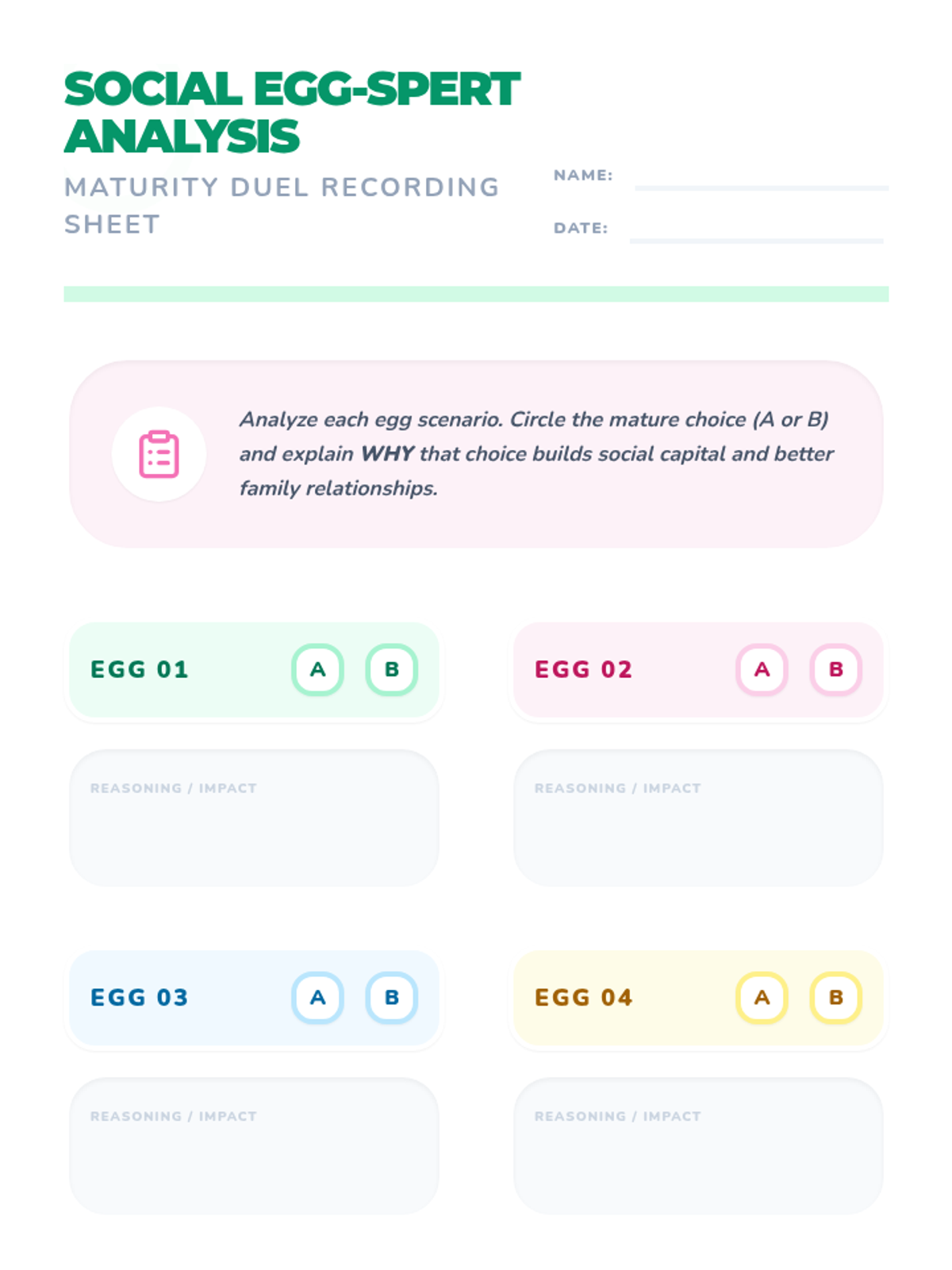
A student-facing recording sheet redesigned for middle school, emphasizing social analysis, reasoning, and reflection on maturity and perspective-taking. Now with an Easter-themed design.
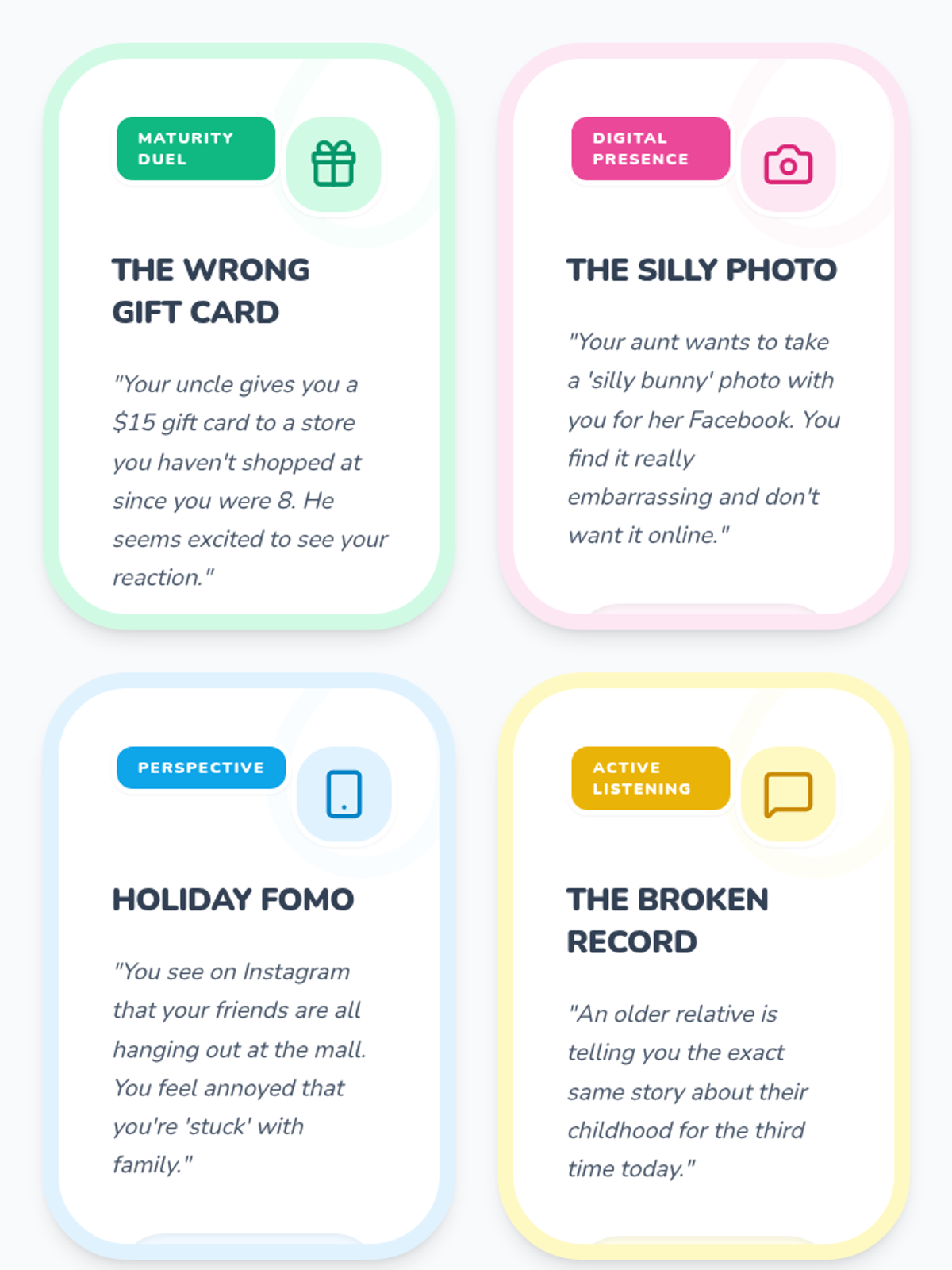
A set of 8 social skills task cards redesigned for middle school students, focusing on digital etiquette, social media boundaries, maturity, and complex family dynamics. Now featuring a heavy Easter theme with eggs and pastel borders.
An expanded slide deck that includes 8 scenario practice slides based on the task cards. Each practice slide features a tricky spring situation and two identical-looking choices for group discussion. Redesigned with a heavy Easter theme and optimized font sizes for visibility. All scenario prompts and options have been resized to ensure they fit correctly within the slides. All text is at least 24px (text-2xl).
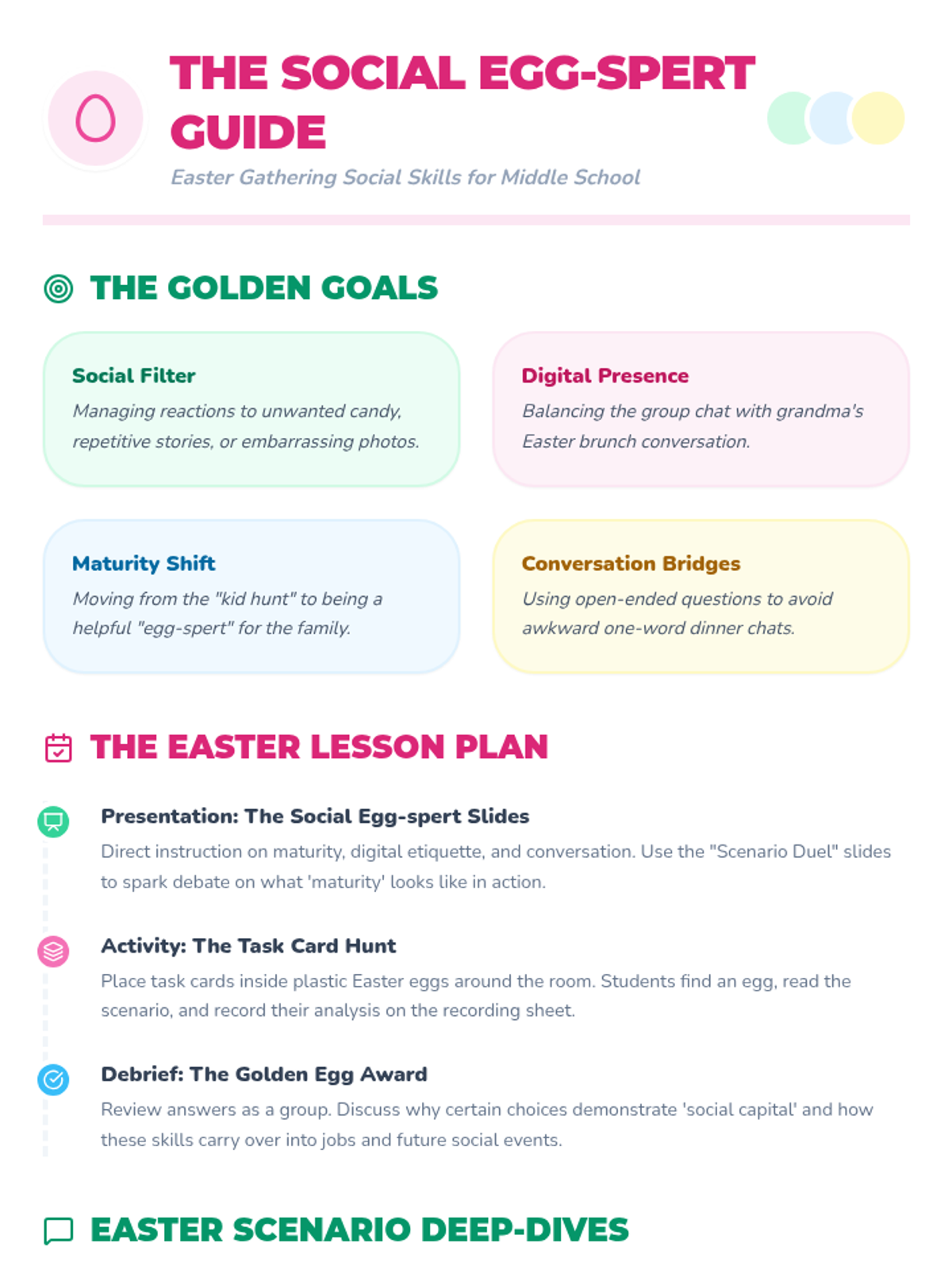
A teacher-facing guide outlining the learning objectives and facilitation strategies for the Spring Social Skills lesson. Redesigned with a heavy Easter theme (eggs, pastels, and terminology) for middle schoolers.
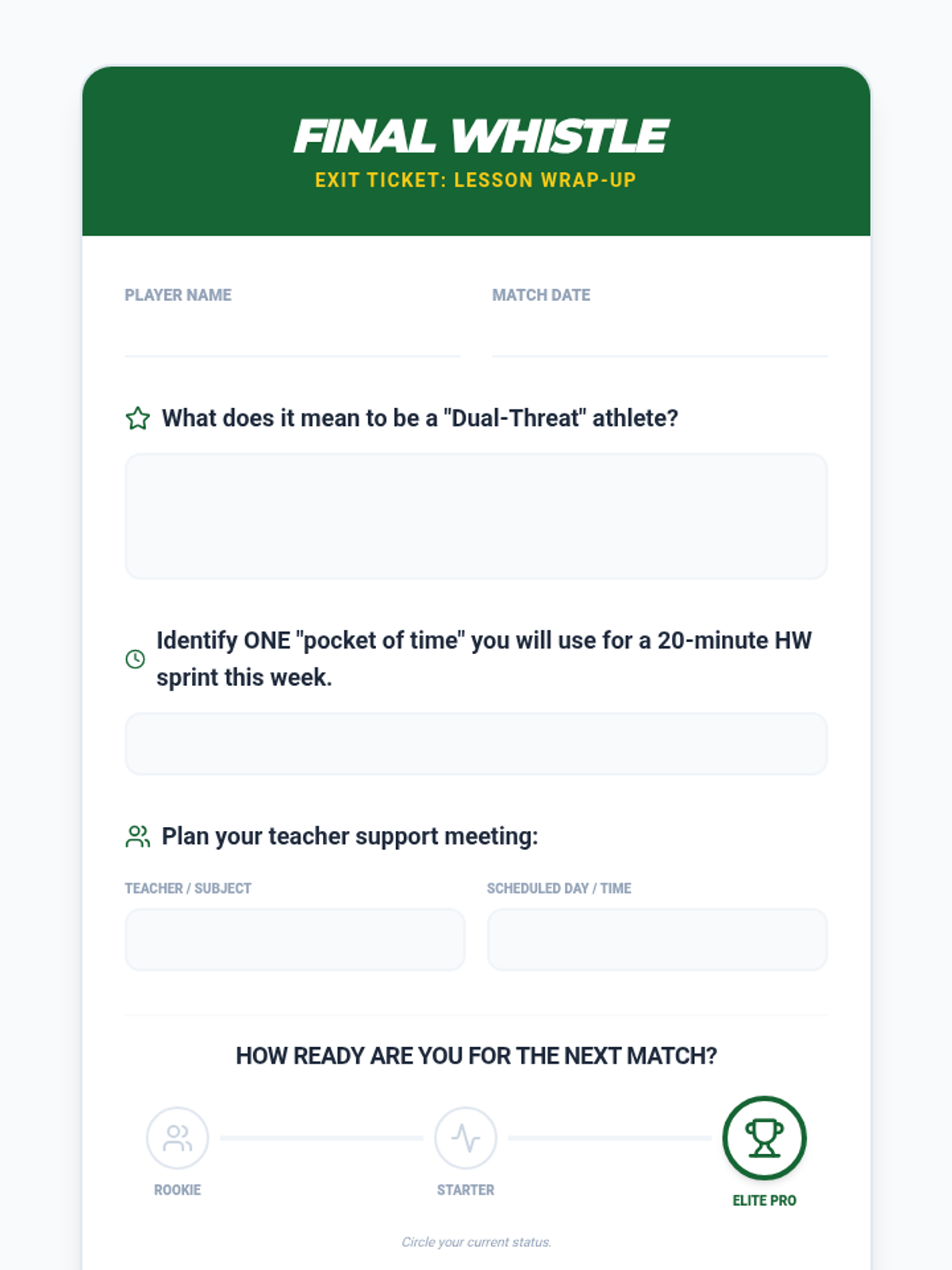
A soccer-themed exit ticket for the Pro Pitch Playbook lesson. It prompts students to reflect on the dual-threat concept, identify time management opportunities, and commit to seeking teacher support.
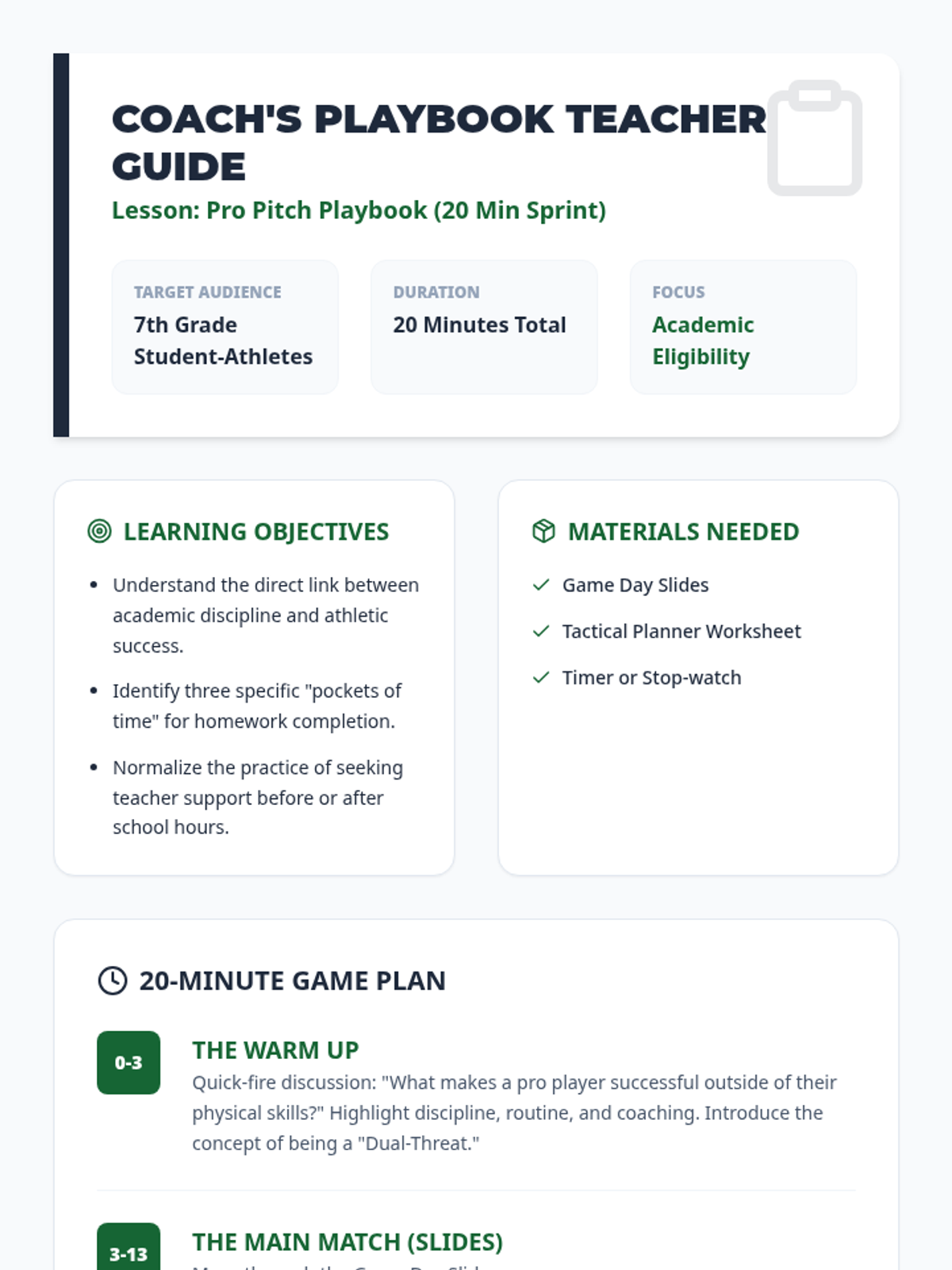
A facilitation guide for teachers to deliver the Pro Pitch Playbook lesson. Includes a 20-minute pacing guide, discussion prompts for each slide, and strategies for supporting student-athletes in 7th grade.
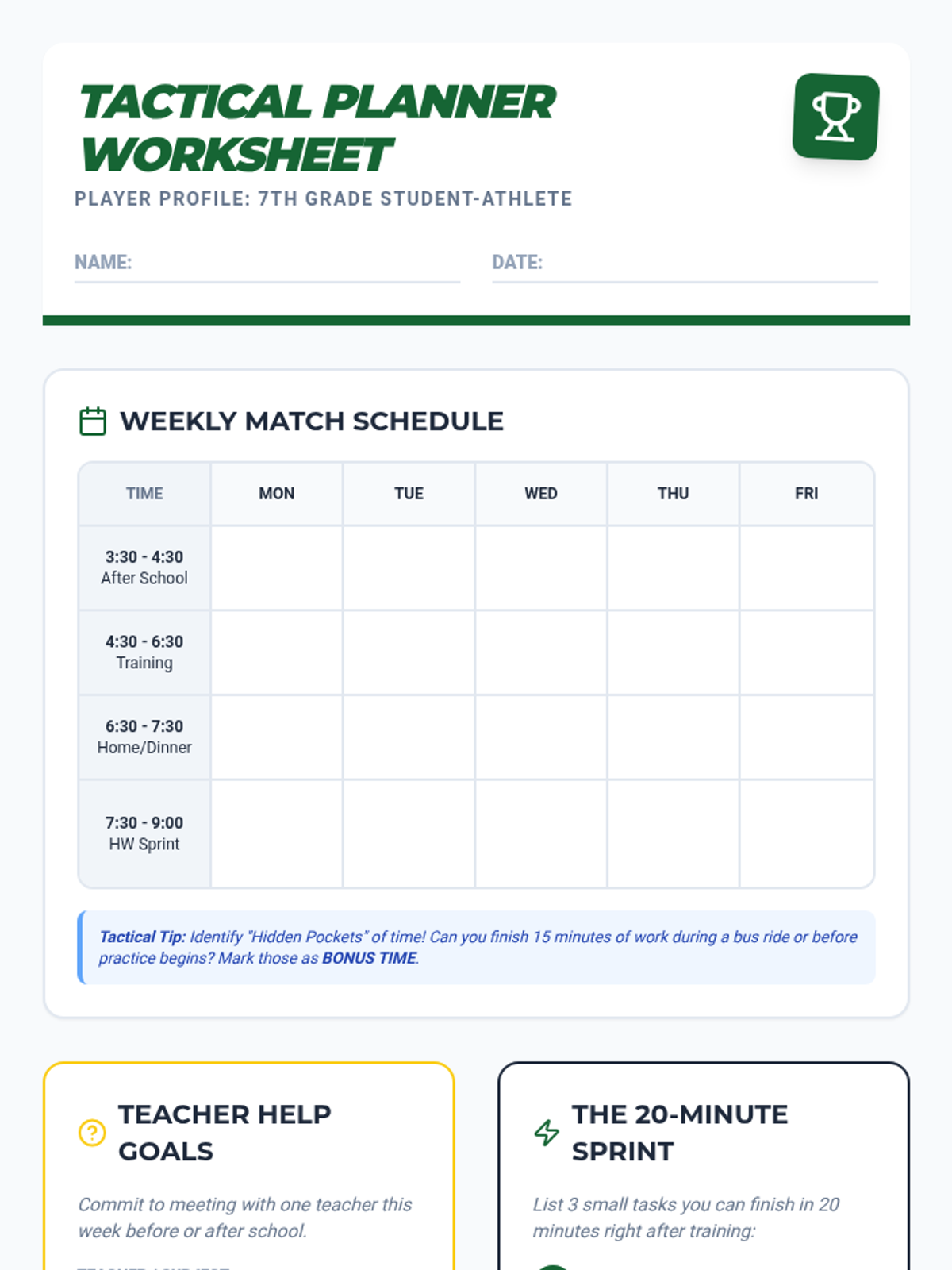
A soccer-themed planner document that helps student-athletes map their weekly schedule. It includes sections for tracking practice times, identifying homework blocks, and setting goals for teacher communication.
A high-energy, soccer-themed slide deck designed for a 20-minute lesson. It covers the dual responsibilities of student-athletes, time management tactics, and the importance of proactive communication with teachers.
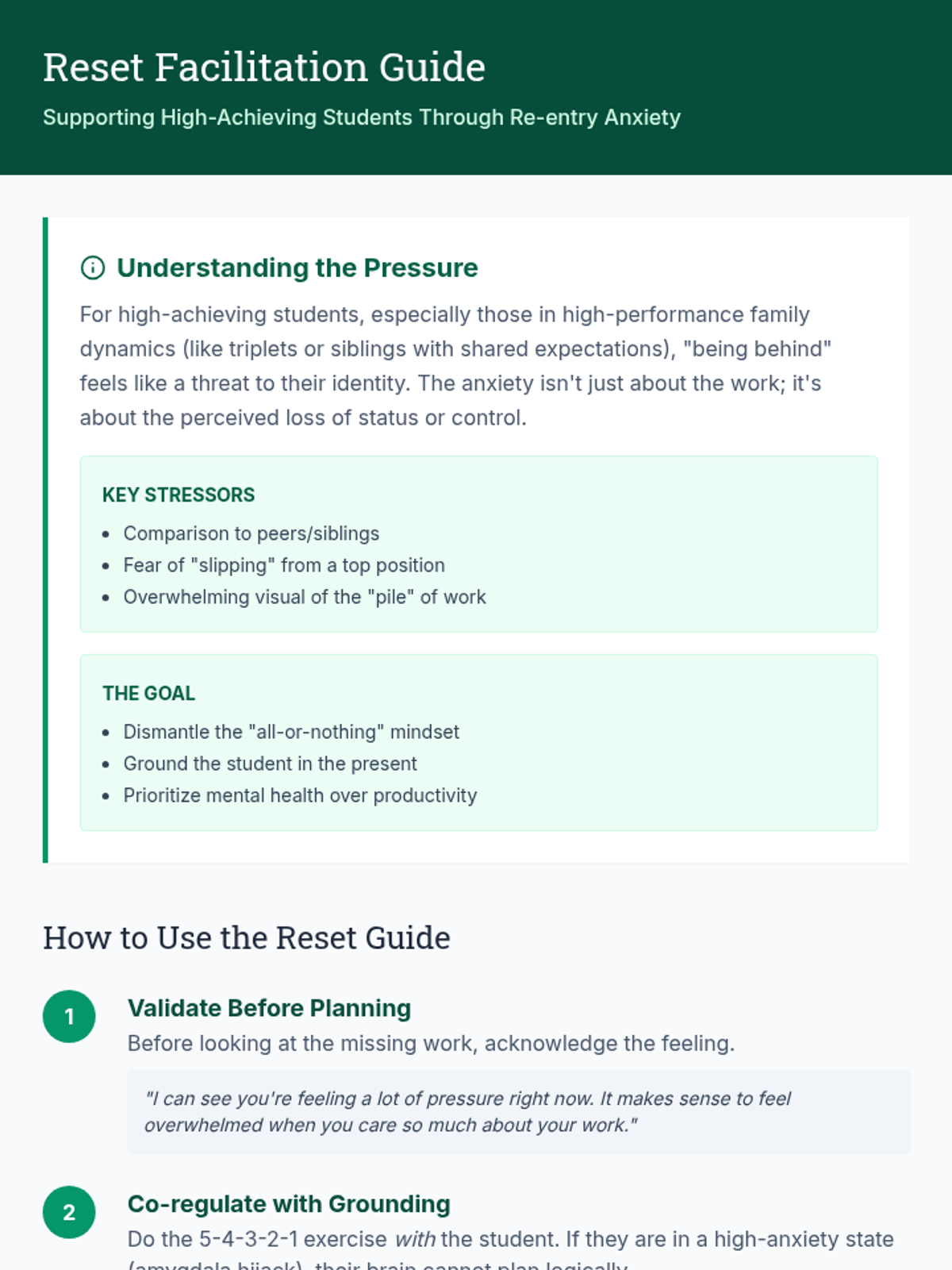
A facilitator's guide for teachers or counselors to help high-achieving students navigate academic re-entry anxiety and performance pressure.
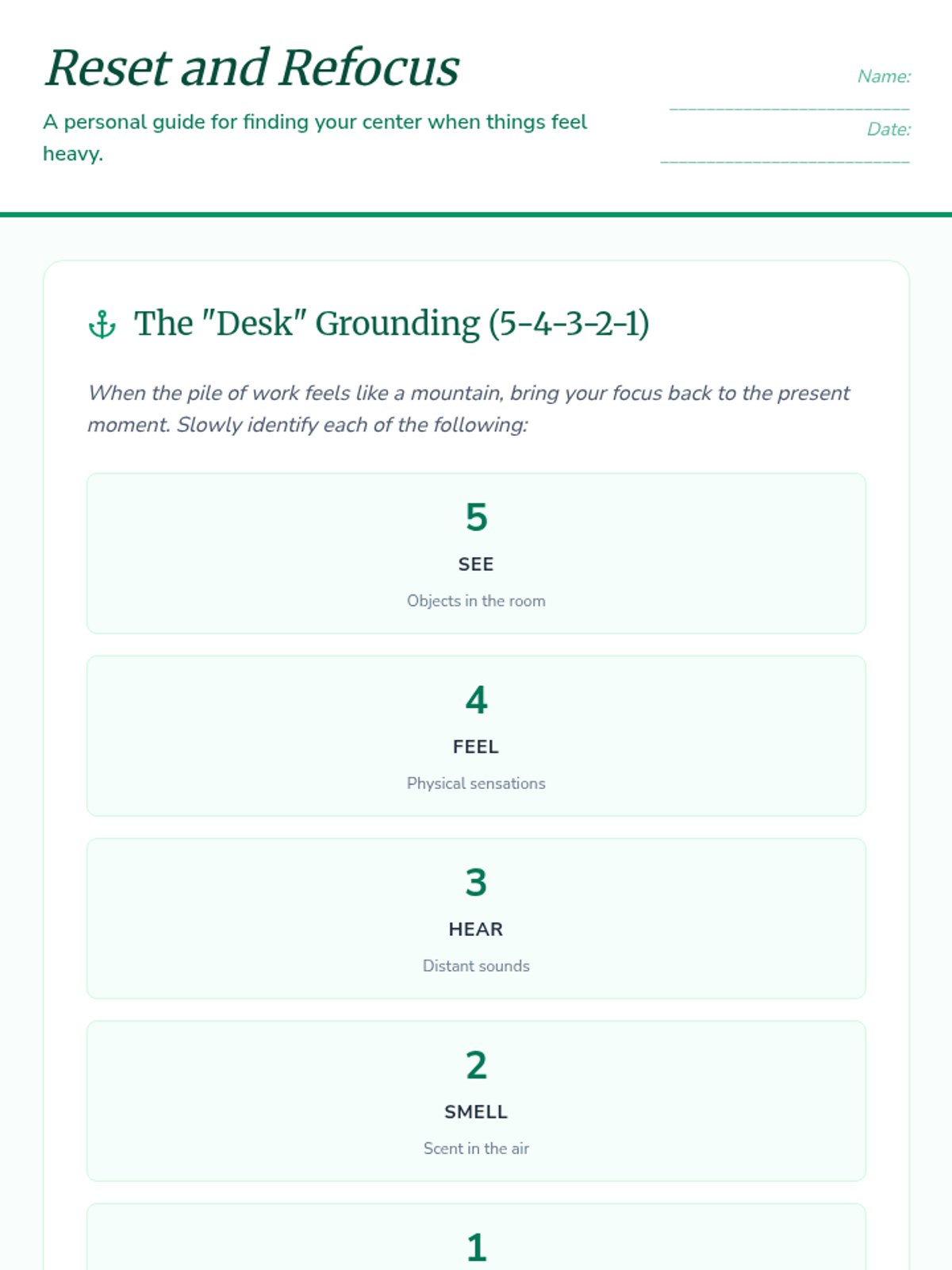
A grounding and mindfulness toolkit for high-achieving students to manage the anxiety of makeup work and academic pressure.
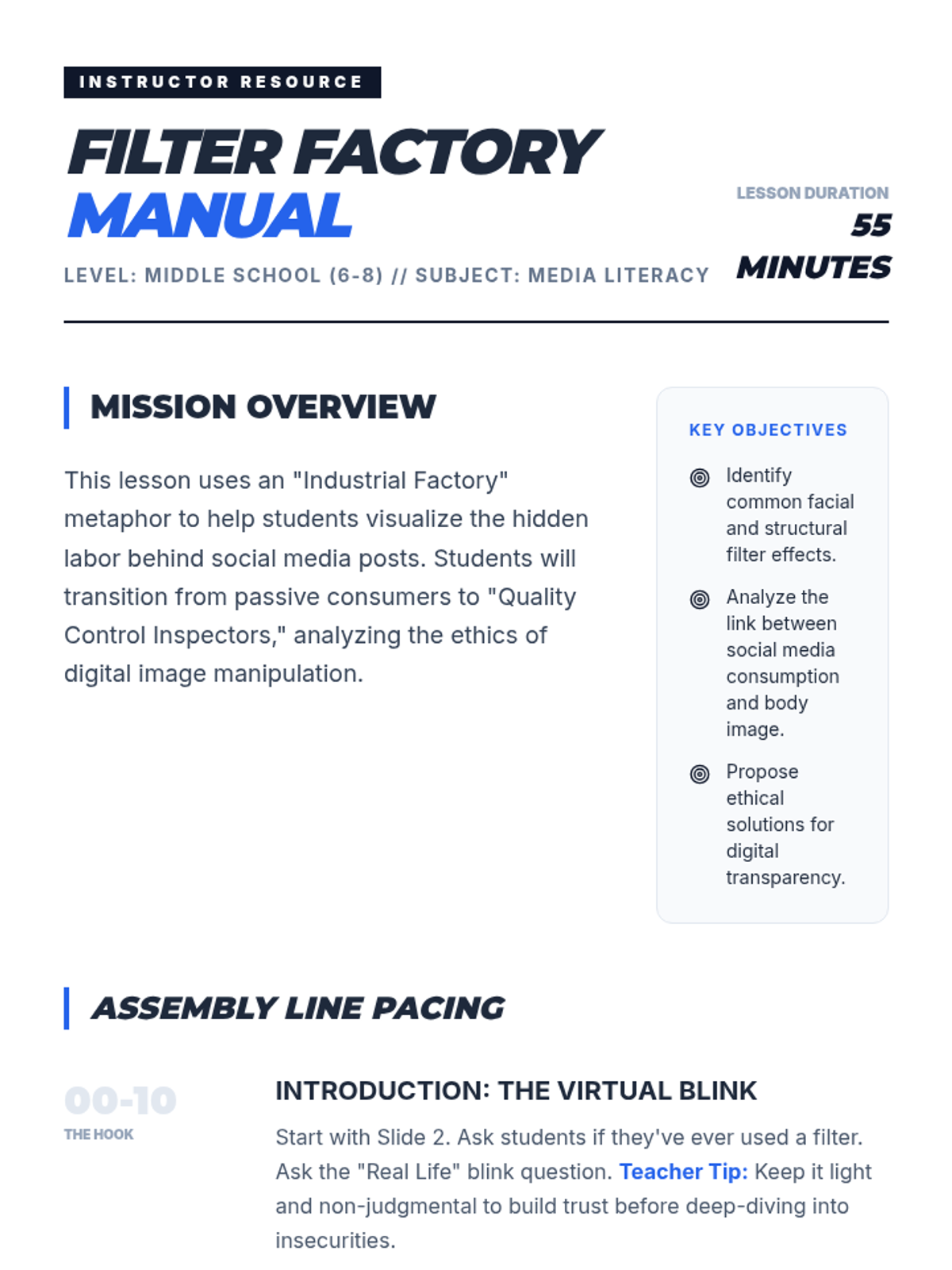
A comprehensive facilitator guide for the 'Filter Factory' lesson. It includes a minute-by-minute pacing guide, discussion probes, differentiation strategies, and pedagogical tips for teaching middle schoolers about digital authenticity.
An engaging presentation for the 'Filter Factory' lesson. It visually breaks down the 'assembly line' of social media modification, discusses psychological impacts, and provides instructions for group work.
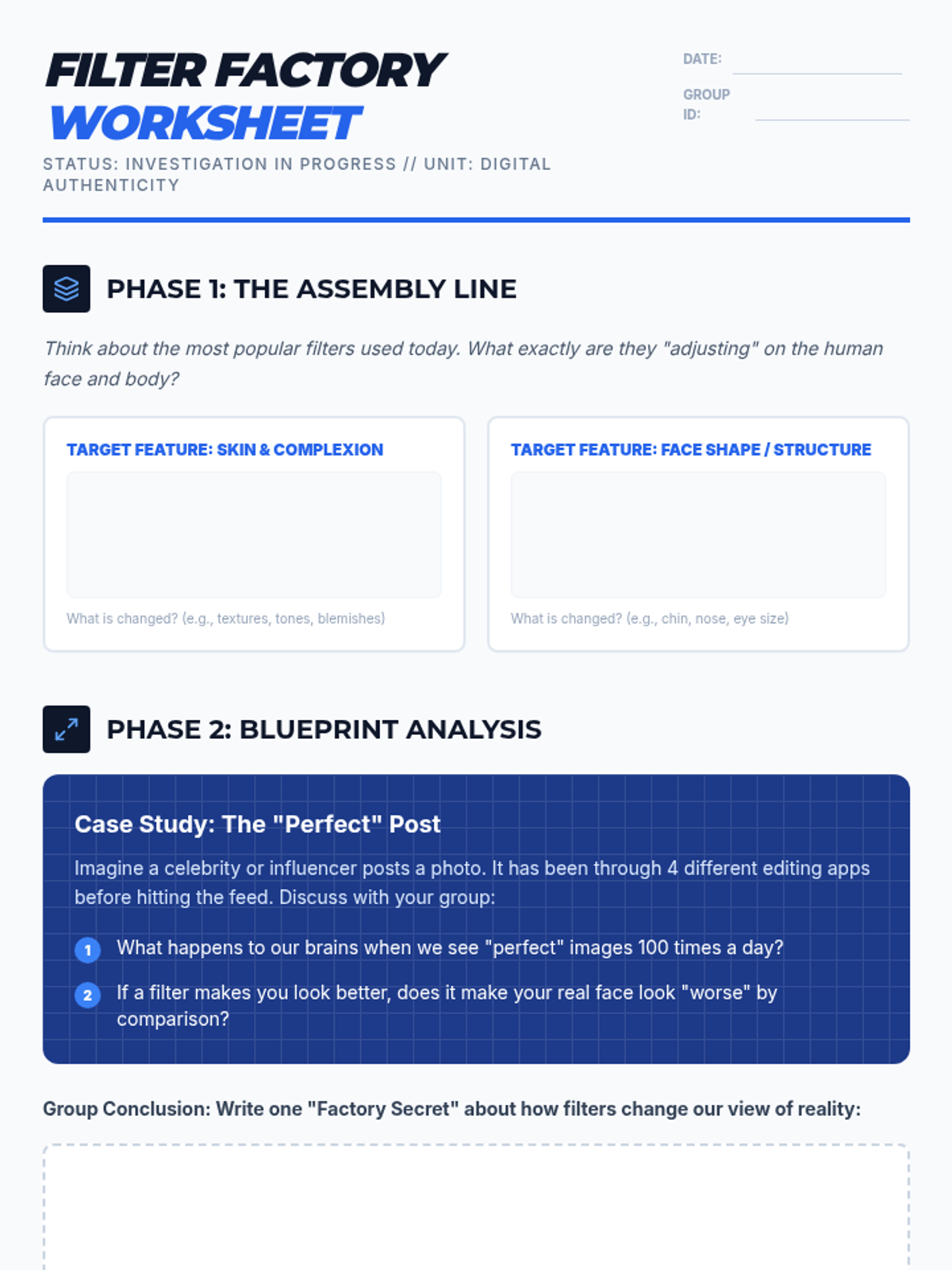
An industrial-themed small group worksheet for middle school students to analyze the 'Filter Factory' of social media. Includes activities on identifying filter effects, discussing body image ethics, and creating authenticity labels for digital content.
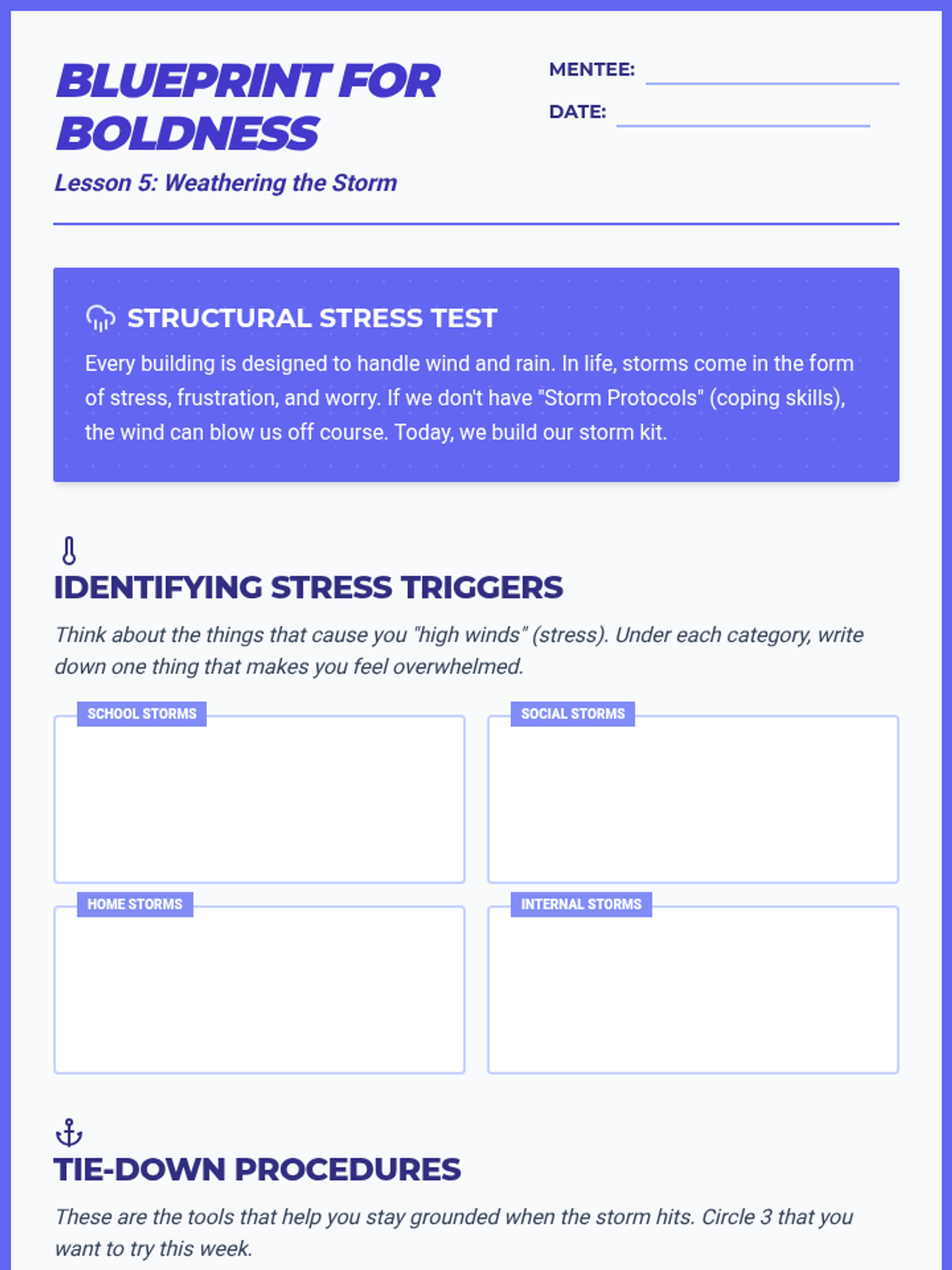
A stress management and coping skills worksheet with a structural stress test theme, helping mentees identify triggers and grounding techniques.
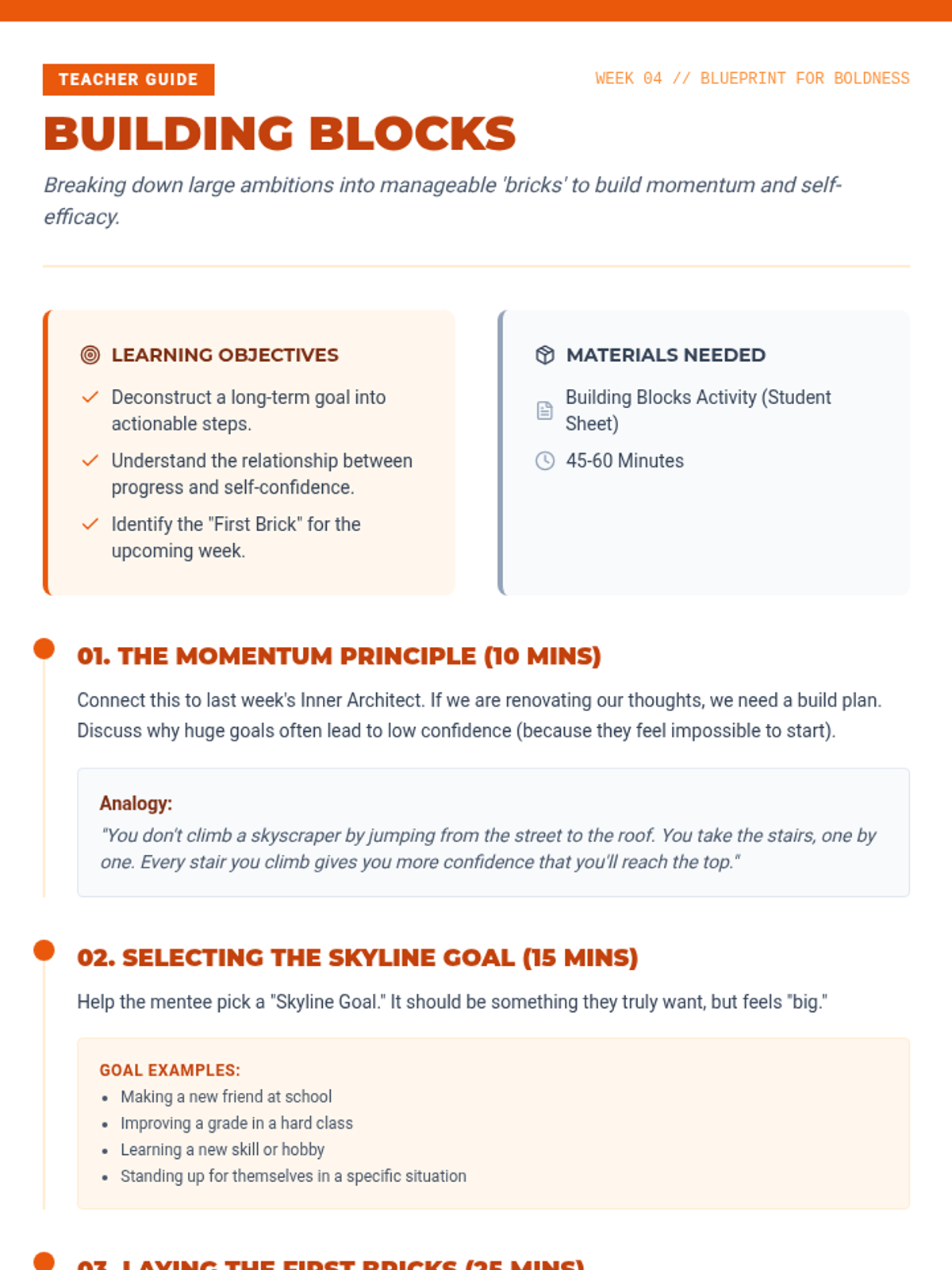
A teacher guide for Lesson 4, providing mentors with strategies for goal-setting, breaking down complex tasks, and building mentee self-efficacy.
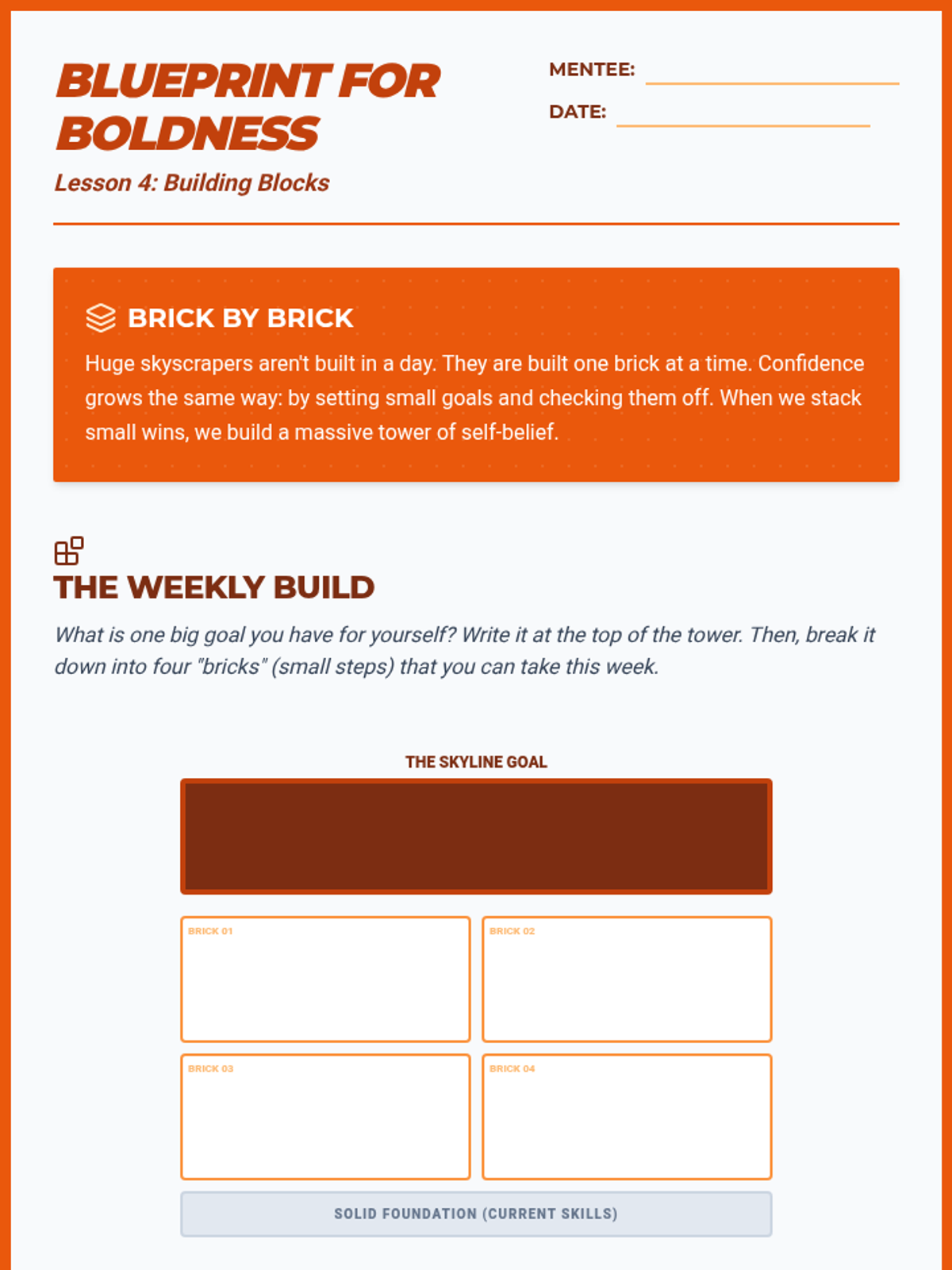
A student goal-setting activity using a construction theme to help mentees break down large ambitions into four manageable 'bricks' or actionable steps.
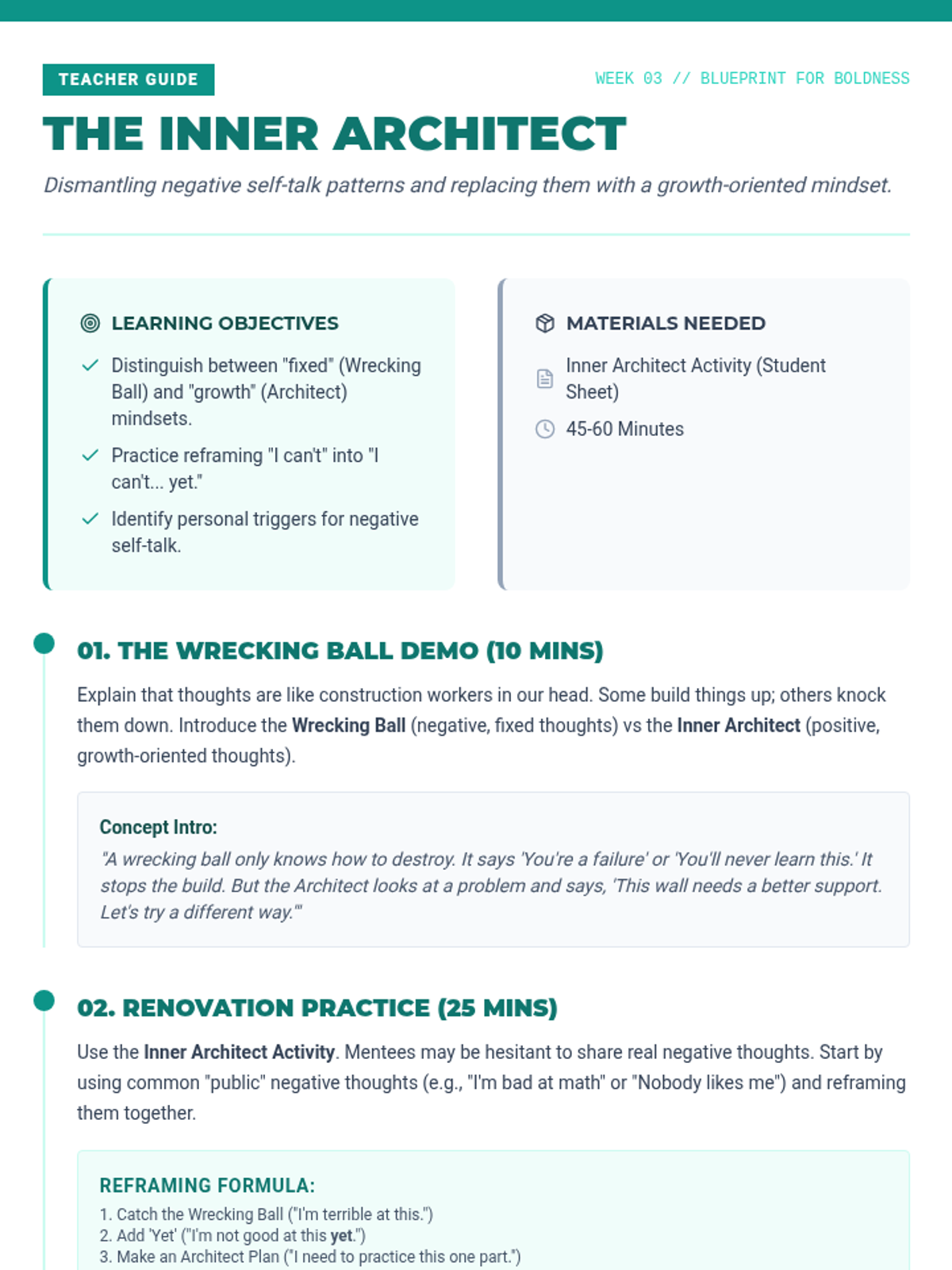
A facilitator guide for Lesson 3, helping mentors guide mentees through cognitive reframing with scripts, formulas, and reframing examples.
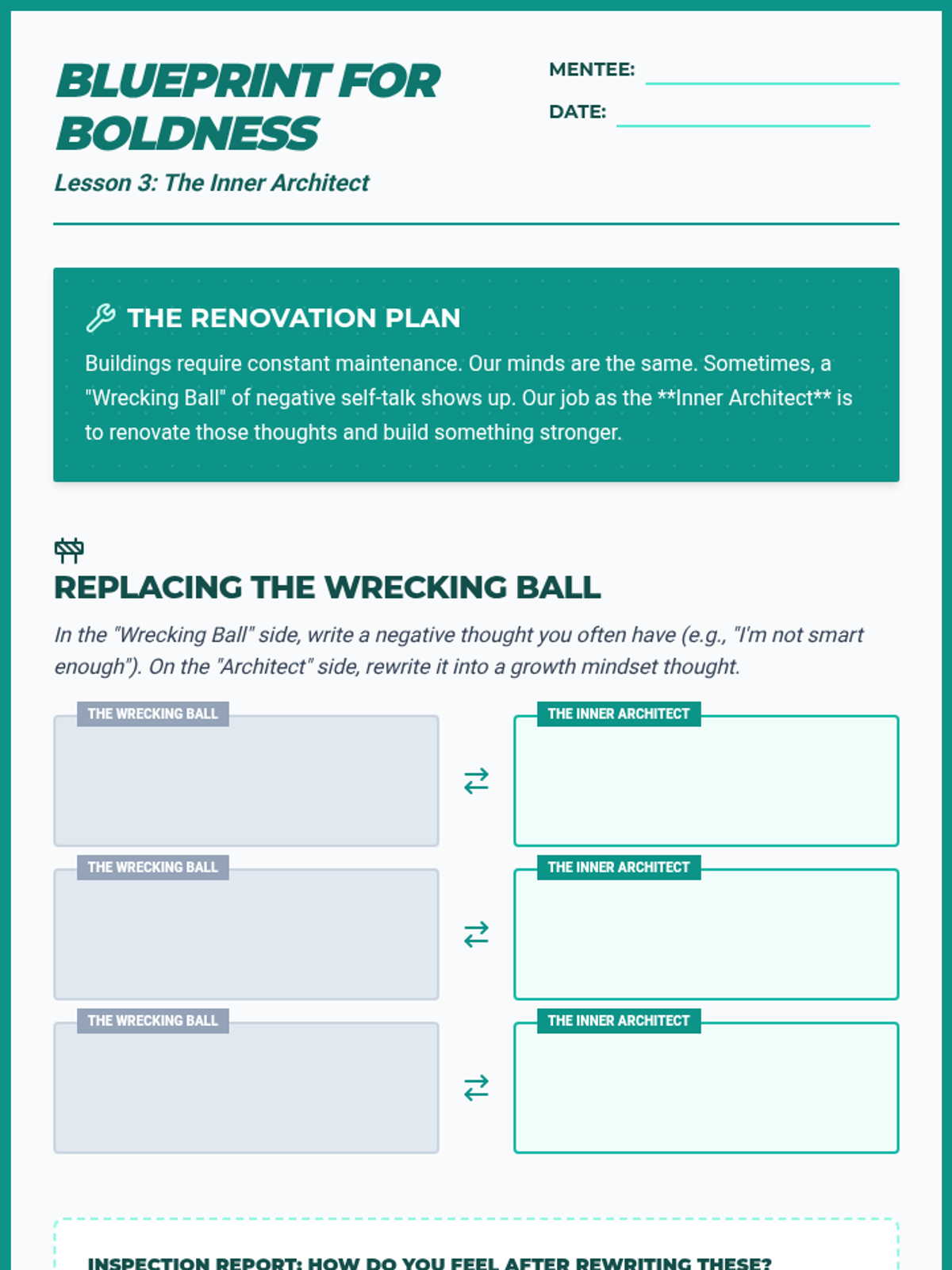
A student activity sheet focused on cognitive reframing, using a 'Wrecking Ball vs. Architect' metaphor to help mentees rewrite negative self-talk.
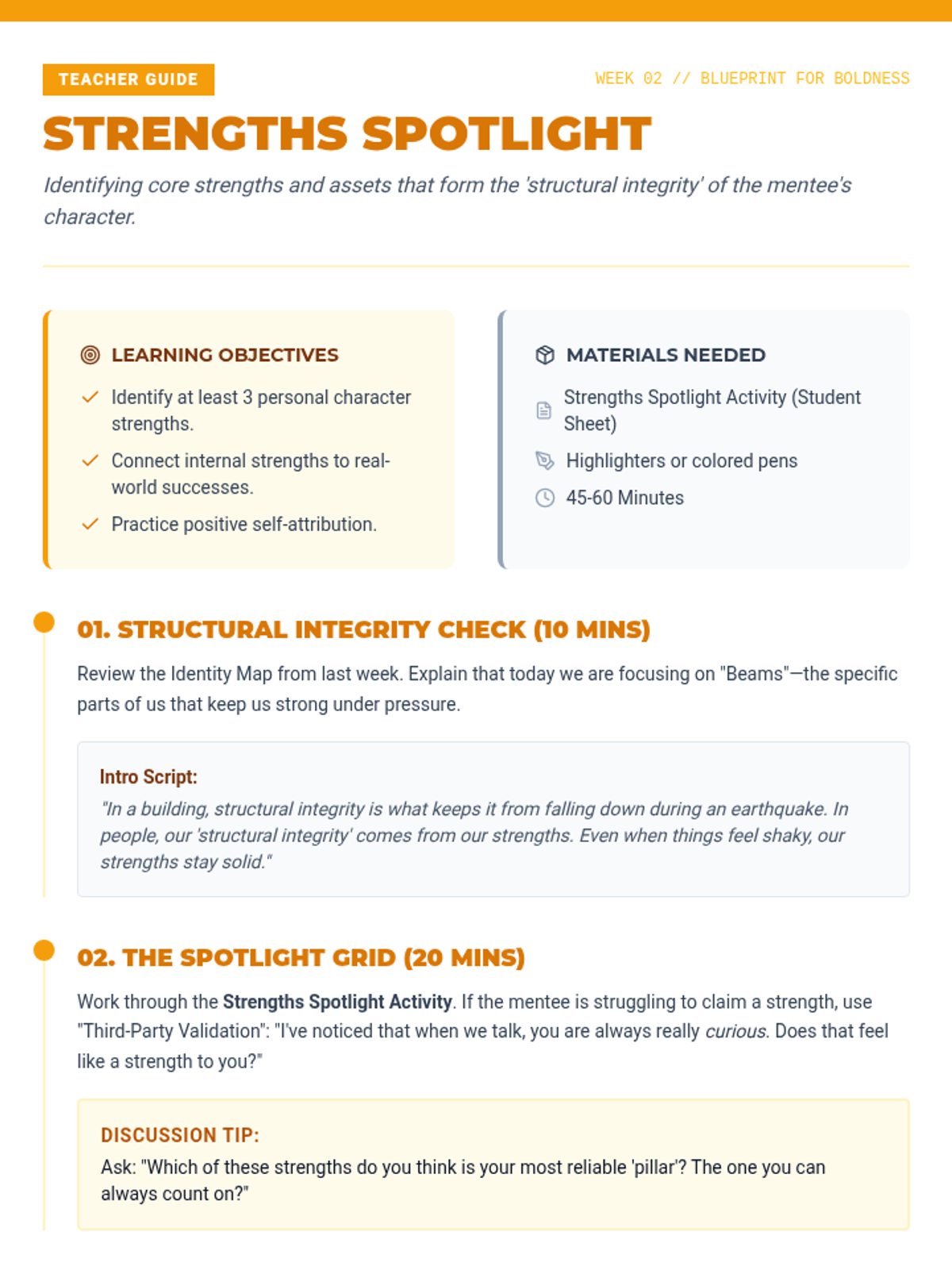
A teacher guide for Lesson 2, providing mentors with instructional strategies, intro scripts, and deeper discussion prompts for the Strengths Spotlight activity.
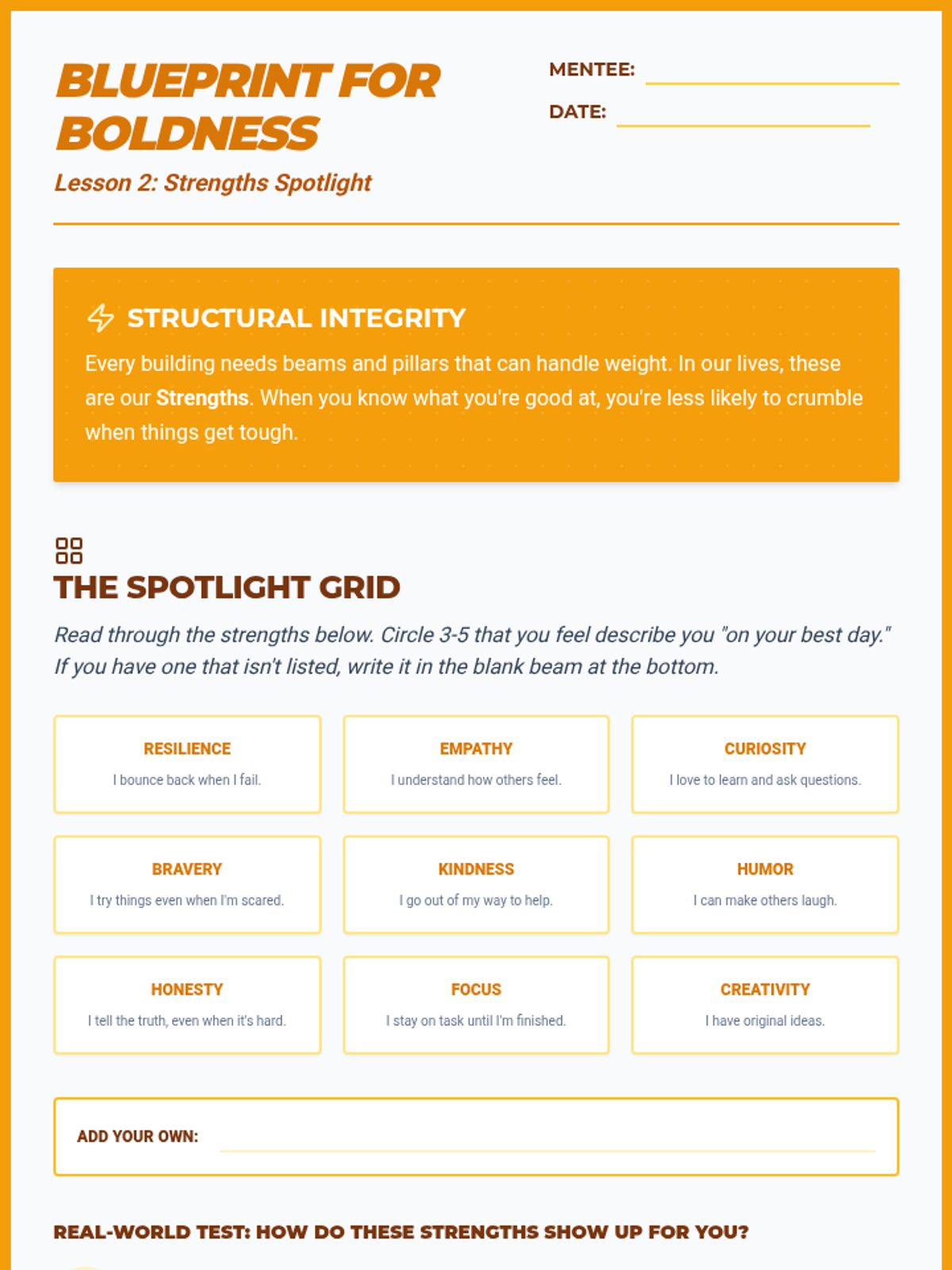
A character strengths inventory and reflection worksheet with a structural engineering theme, helping mentees identify and ground their confidence in specific personal assets.
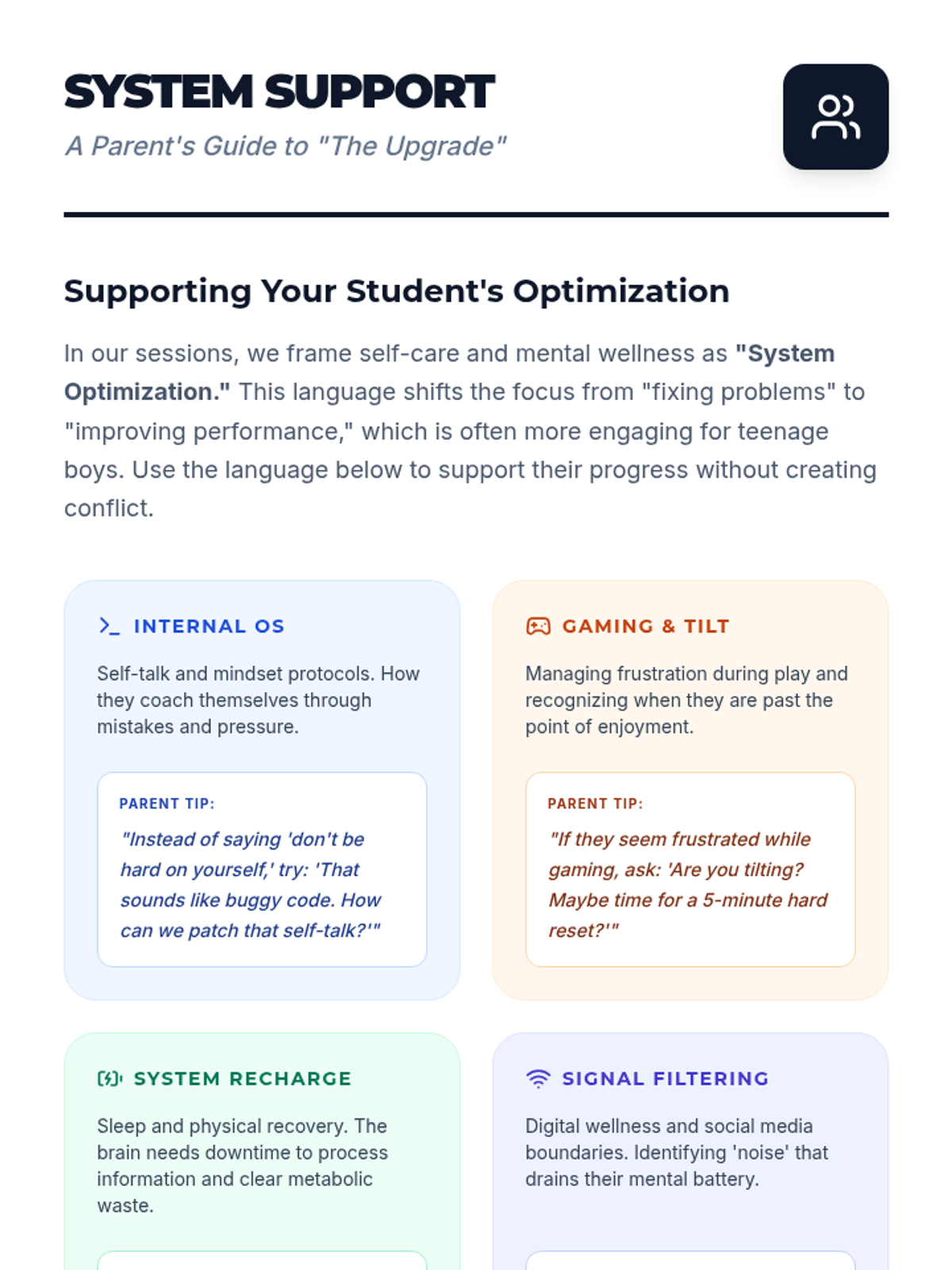
A parent-facing handout that explains the 'System Optimization' metaphor used in the lesson. It provides practical tips for parents to support their son's self-care using the same tech-inspired language to reduce conflict and increase engagement.
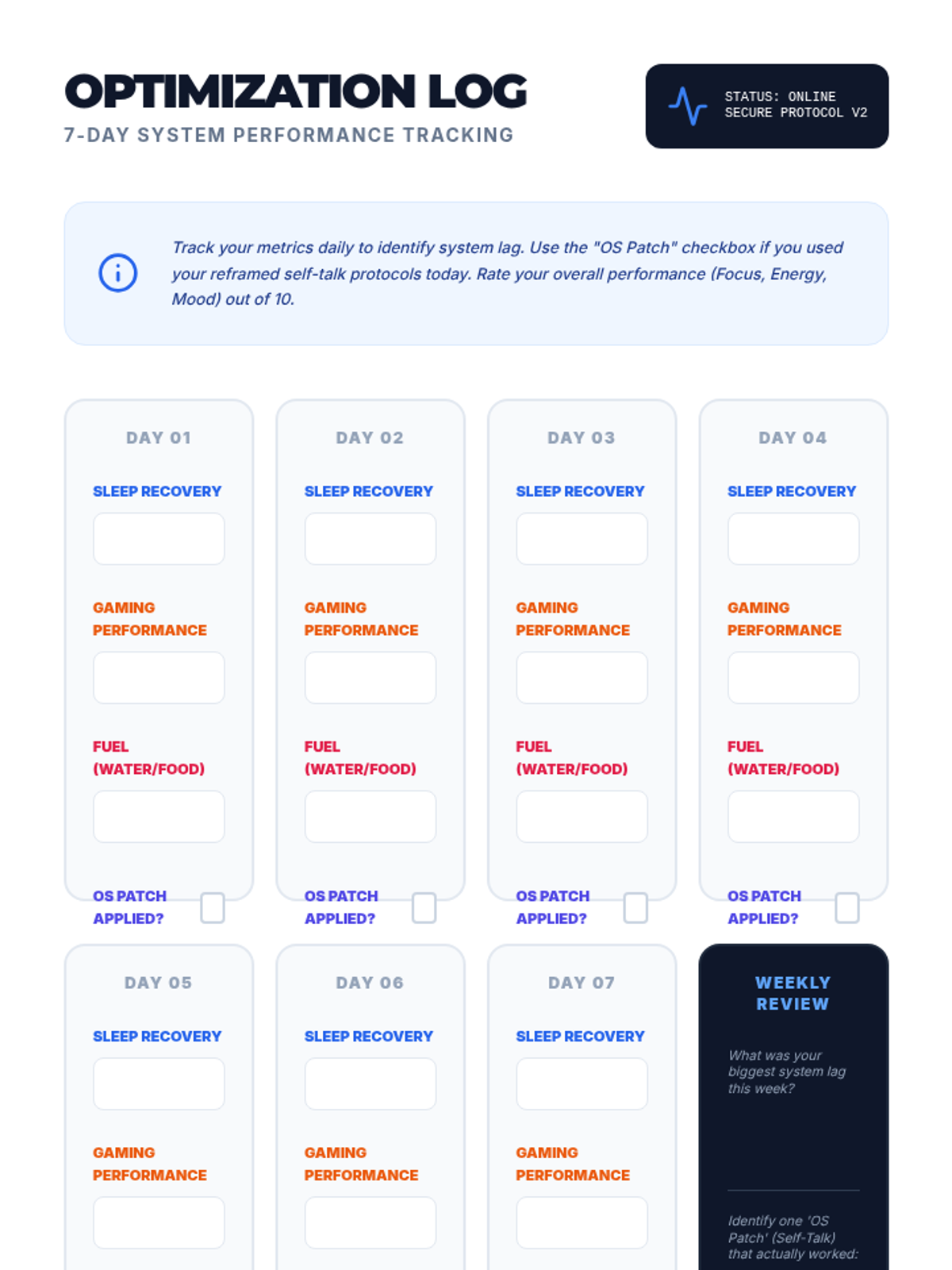
A high-tech student tracking sheet for monitoring sleep, gaming time, nutrition, and self-talk updates over a 7-day period. Designed to look like a system performance dashboard. It features large handwriting areas and clear, readable text.
A sleek, tech-inspired student workbook that guides teenage boys through reframing their self-talk as an 'Internal OS' and auditing their digital wellness and sleep habits. Features specialized work areas for system optimization protocols and now includes a video game performance audit and tilt management page.
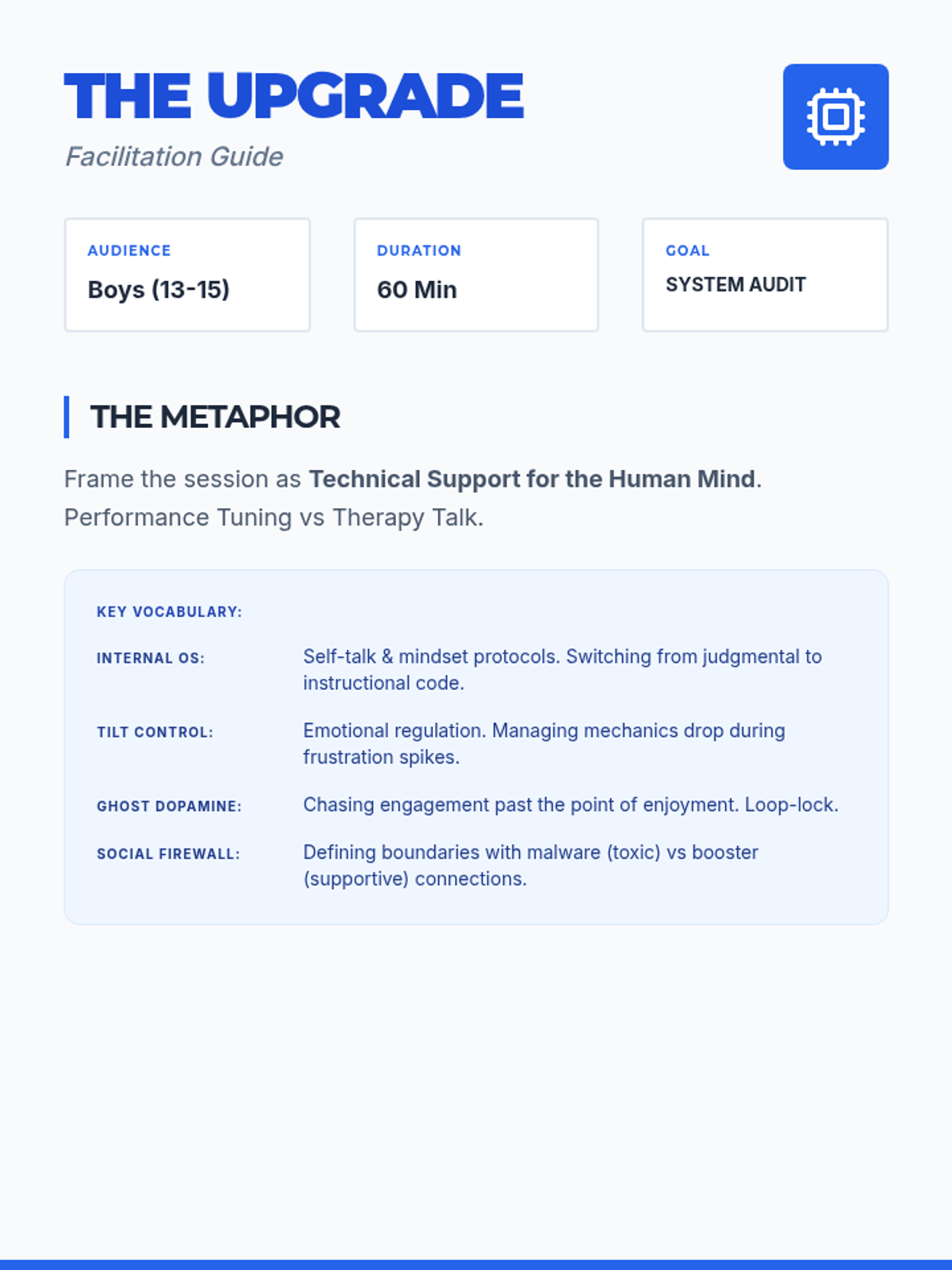
A professional facilitation guide for counselors that frames self-care and positive self-talk through a 'system optimization' metaphor designed to engage 14-year-old boys. It includes discussion prompts, key vocabulary, and psychological reframing strategies.
A revised 10-slide presentation using simple, concrete language to teach students about three zones of control: In My Control, May be in My Control, and Out of My Control. All violent or aggressive metaphors have been removed.
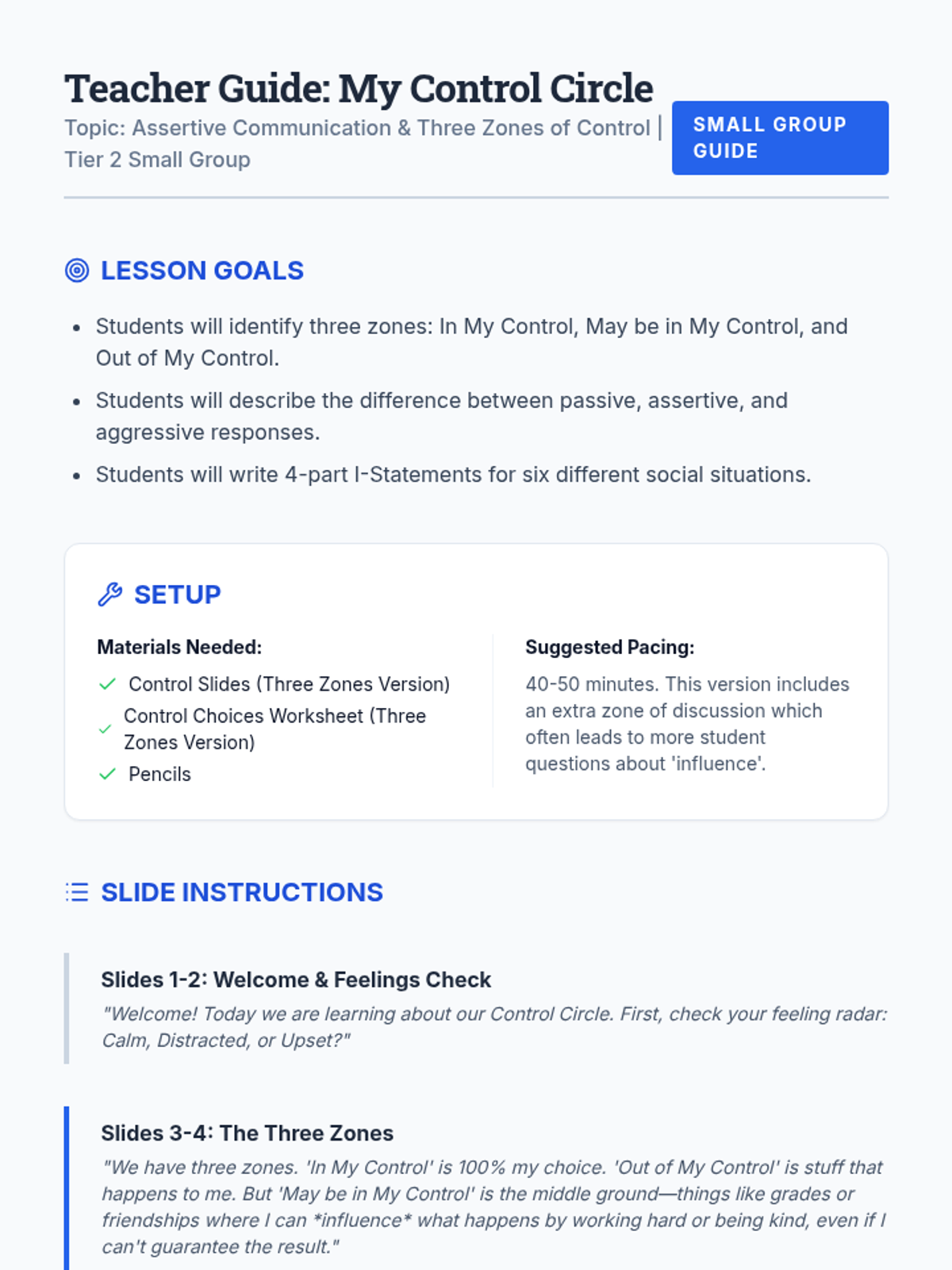
A revised teacher guide matching the three-zone model (In Control, May be in Control, Out of Control) and updated for the 6 practice scenarios.
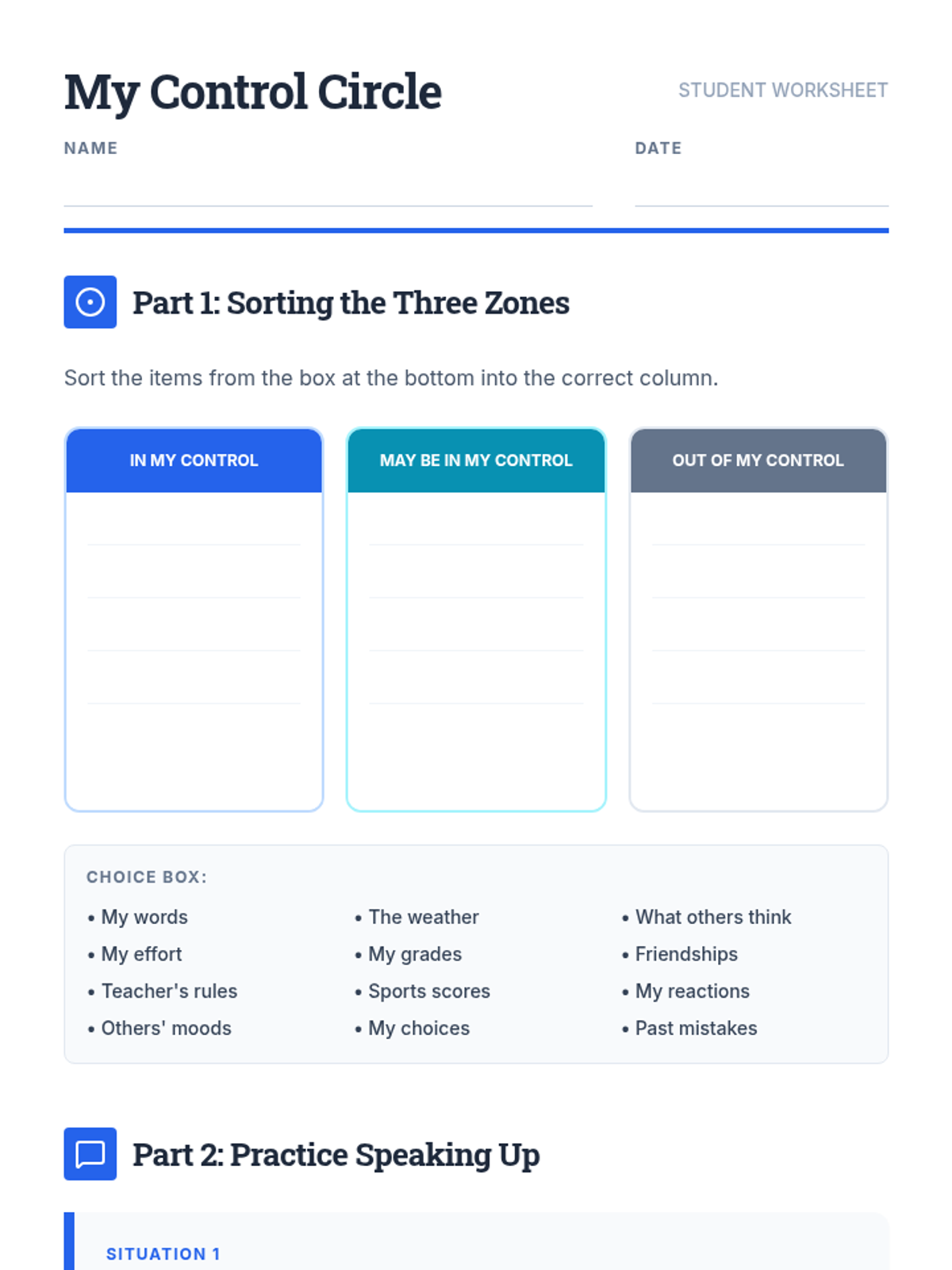
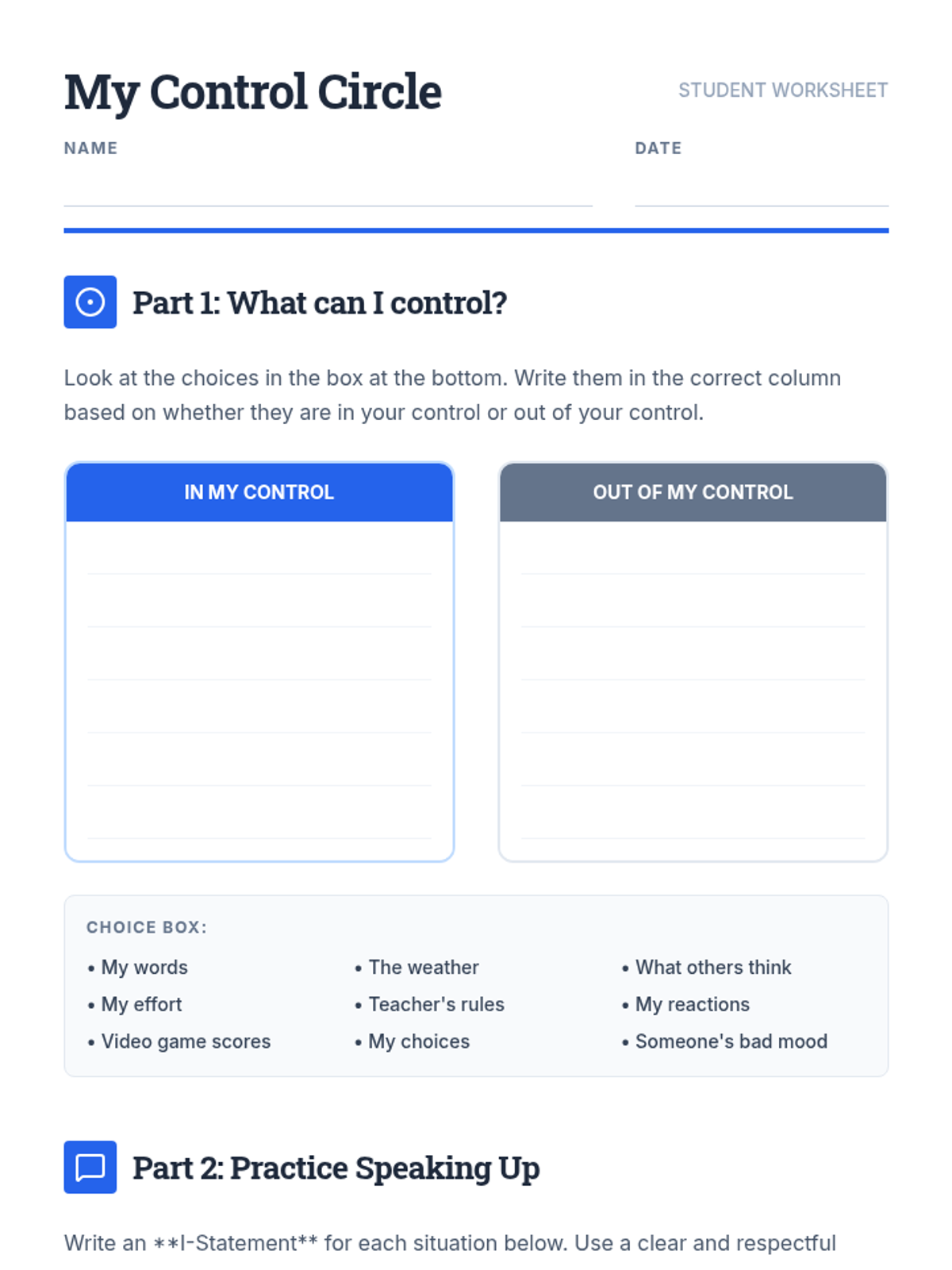
A concrete worksheet for 6th graders to practice identifying things in their control, what may be in their control, and writing assertive I-statements.
A revised 10-slide presentation using simple, concrete language to teach students about three zones of control: In My Control, May be in My Control, and Out of My Control.
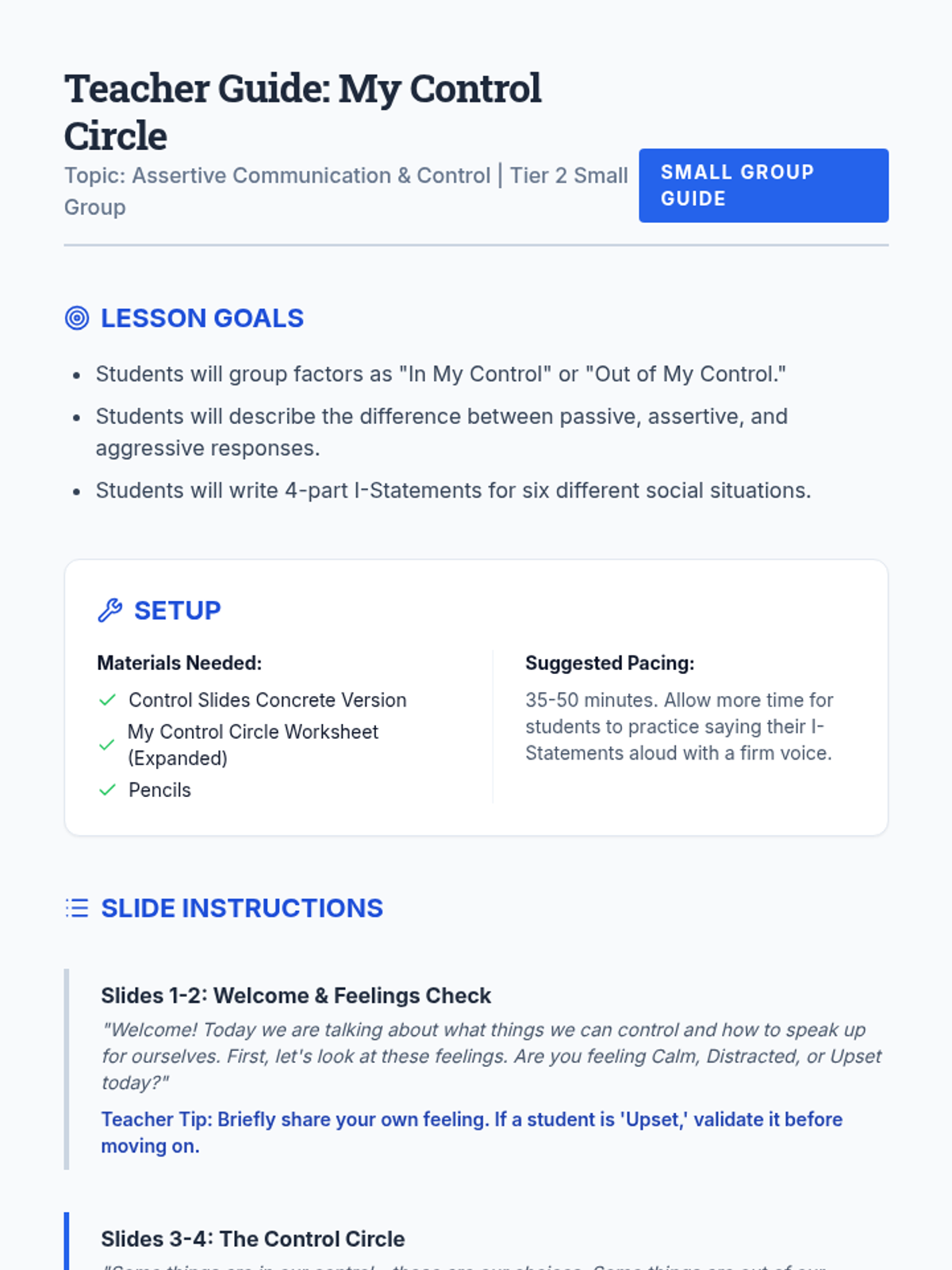
A revised teacher guide matching the concrete, analogy-free version of the control and assertiveness lesson, updated to include 6 practice situations.
An expanded worksheet for 6th graders with 6 practice situations for identifying control and writing assertive I-statements without analogies.
A revised 10-slide presentation using simple, concrete language to teach students about what is in their control and how to use assertive I-statements without analogies.
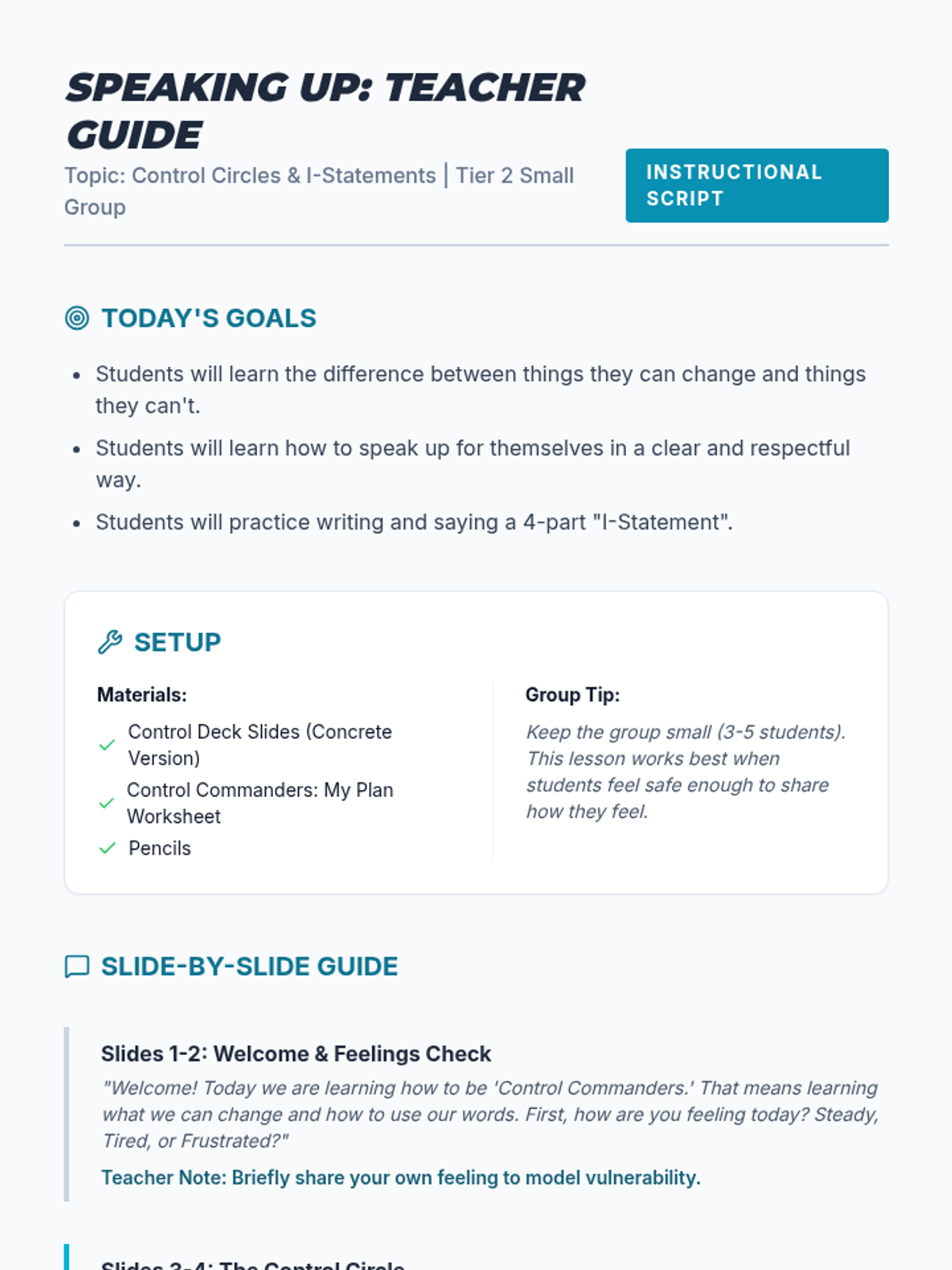
A revised facilitator guide for the Control Commanders lesson using more concrete language and matching the updated slide and worksheet versions.
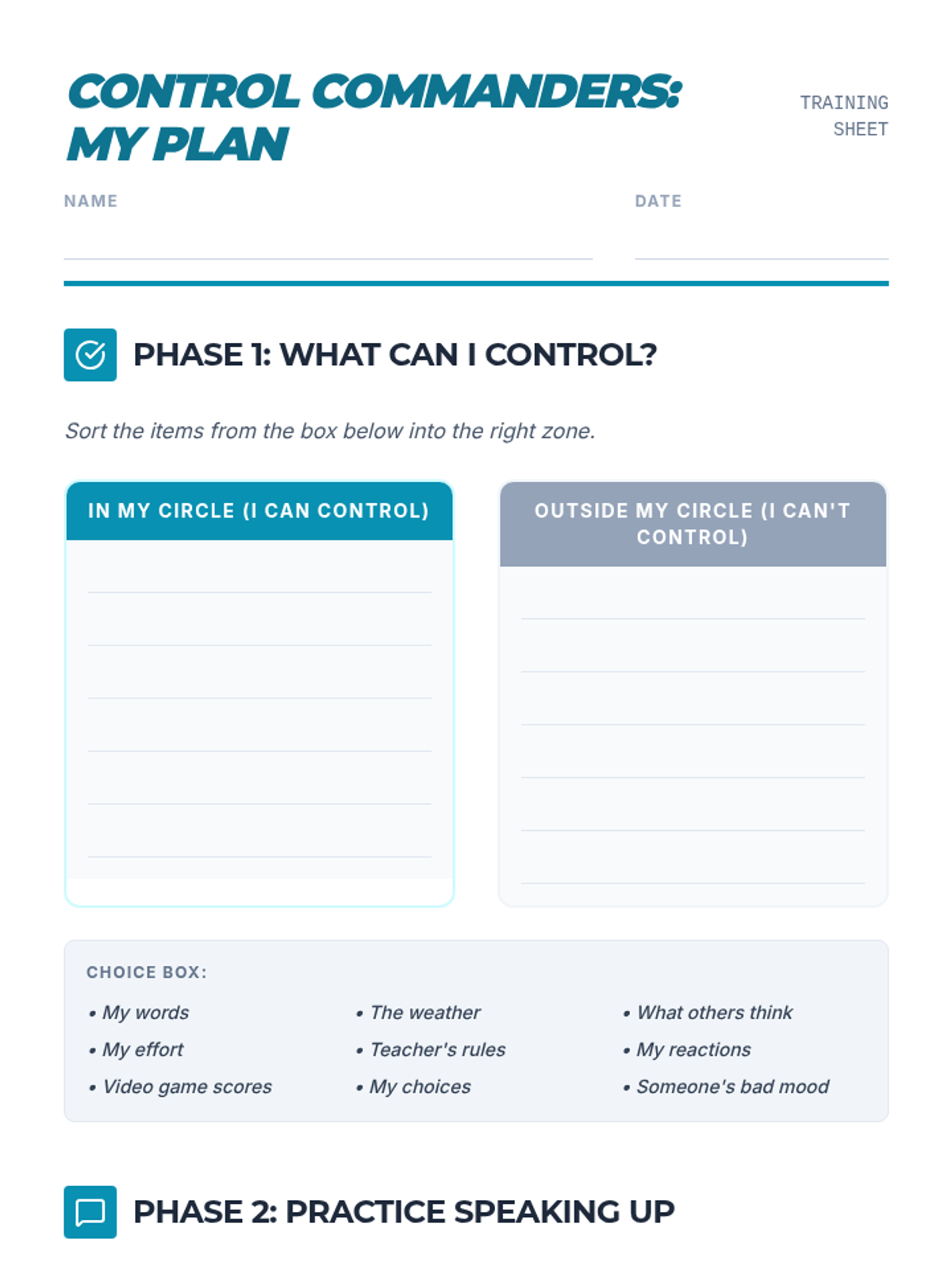
A revised graphic organizer for 6th grade students with concrete language to categorize control factors and practice drafting I-Statements.
A revised 10-slide presentation using more concrete, direct language to help 6th grade Tier 2 students understand control circles and I-Statements.
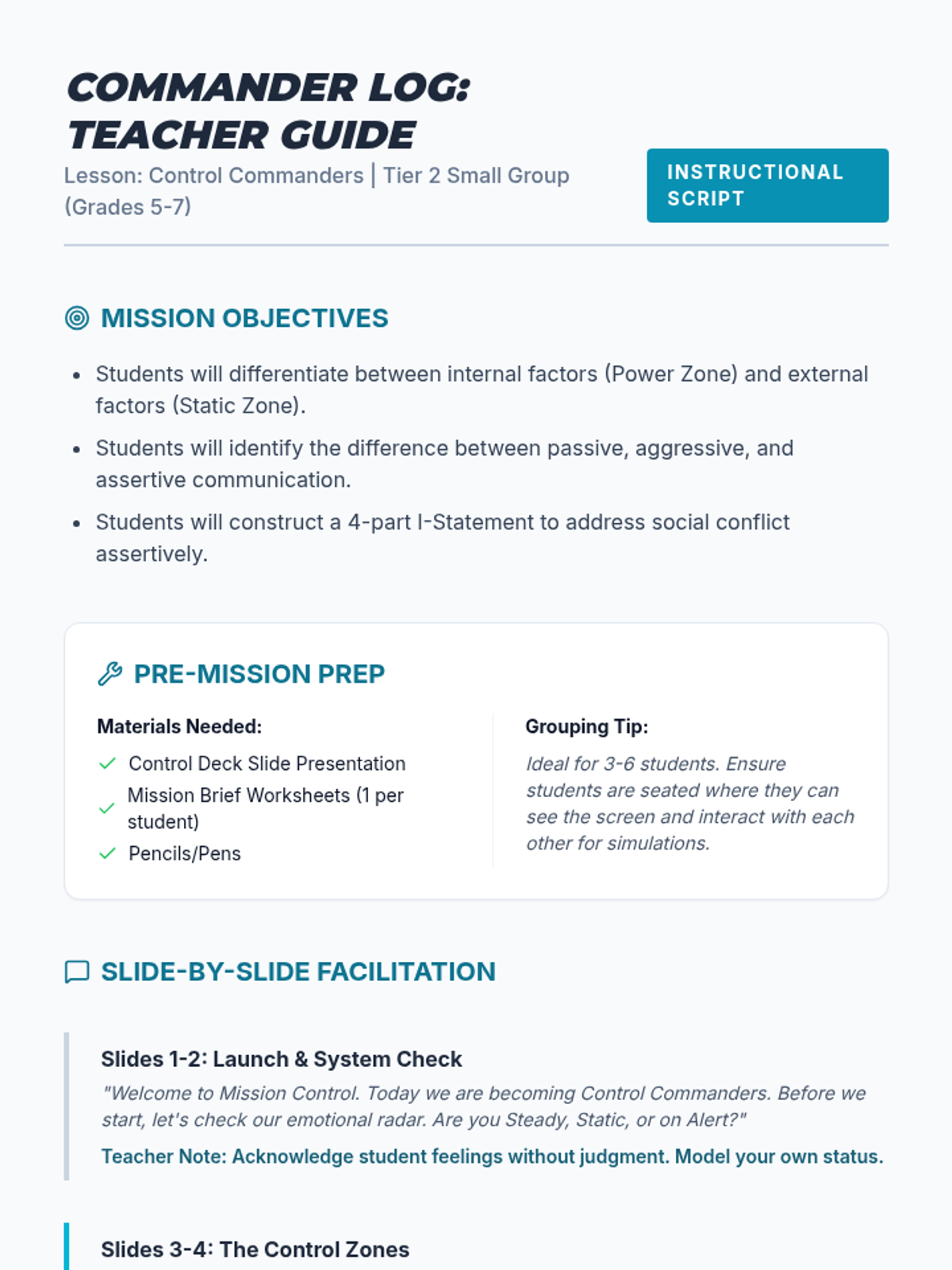
A facilitator guide for the Control Commanders lesson, providing slide-by-slide scripts, discussion prompts, and differentiation strategies for Tier 2 small groups.
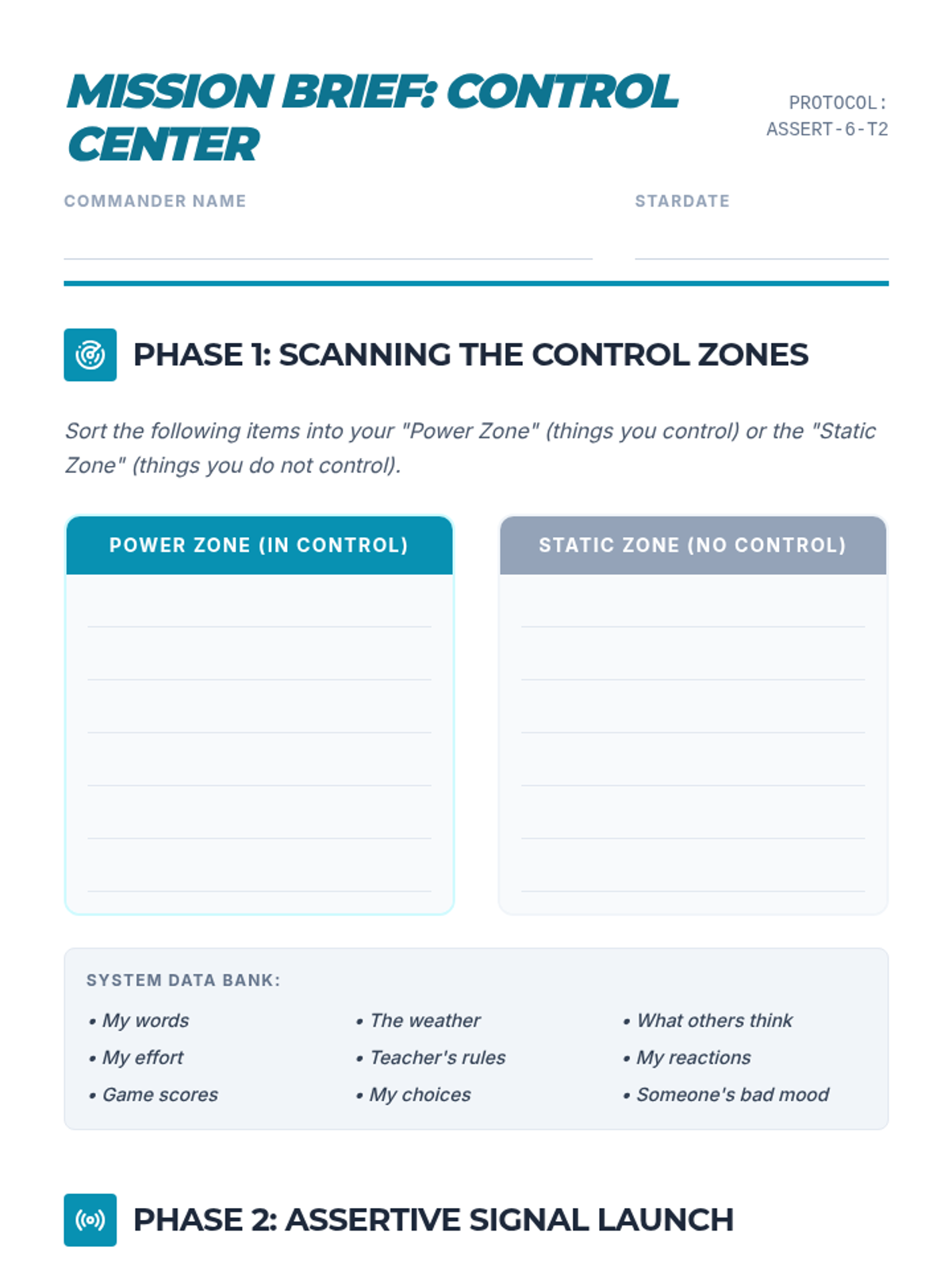
A graphic organizer for 6th grade students to categorize internal and external control factors and practice drafting I-Statements for social scenarios.
A 10-slide presentation using a high-tech "Mission Control" theme to teach students about internal vs. external control and the structure of assertive I-Statements.
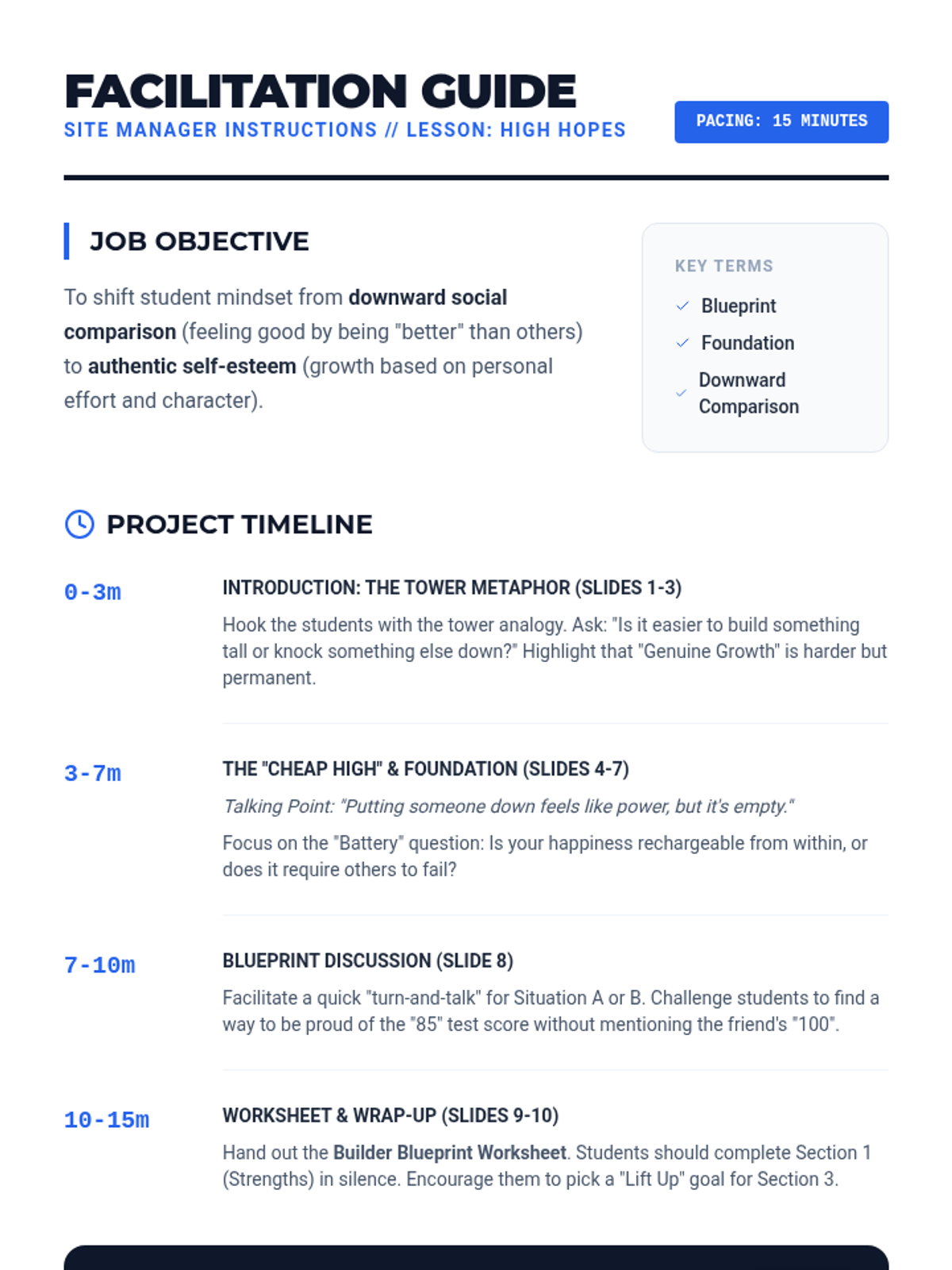
A teacher facilitation guide designed to manage a 15-minute lesson. It includes a pacing timeline, talking points for the tower metaphor, and strategies for handling common student responses.
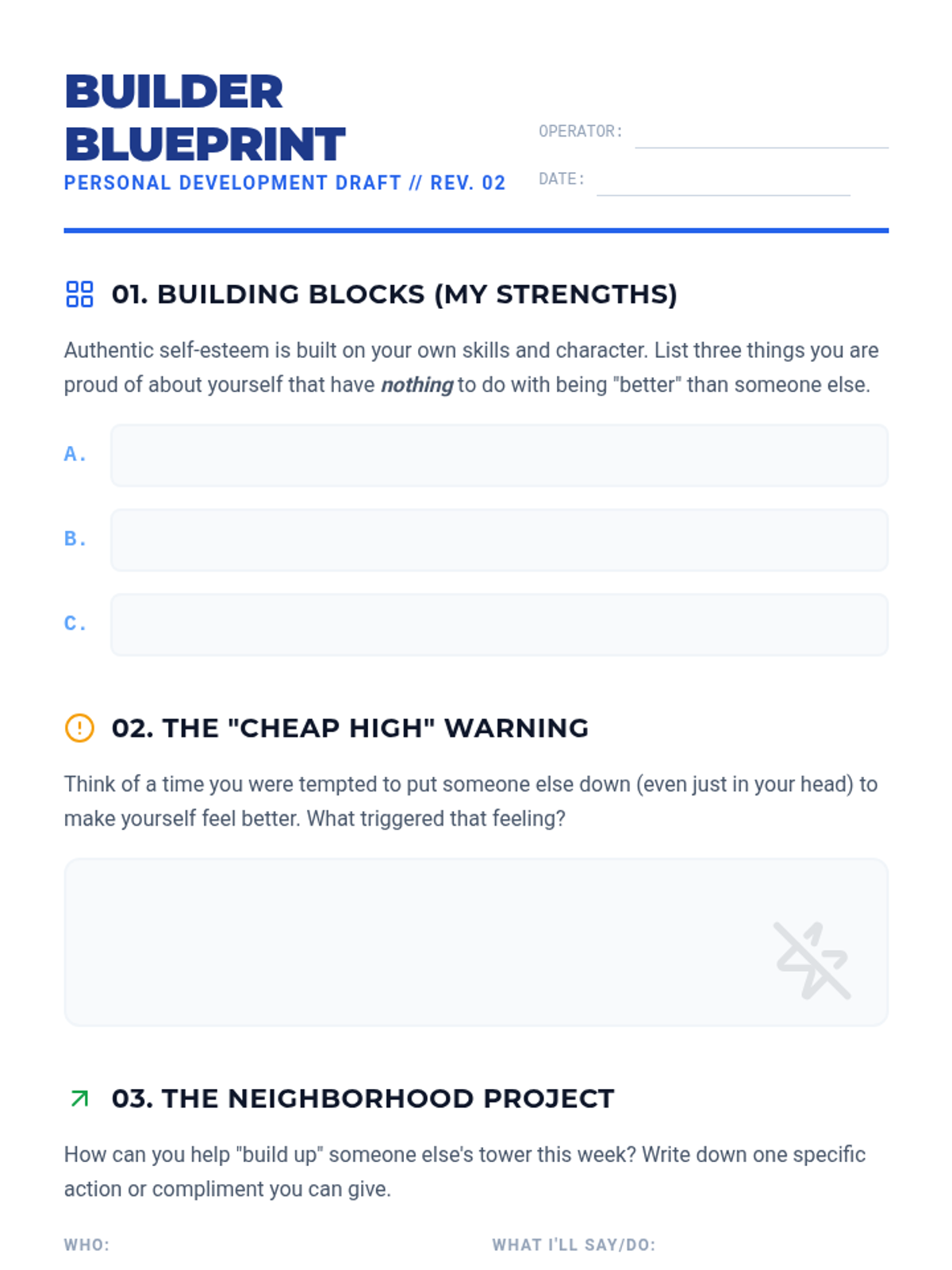
A student reflection worksheet that helps learners identify their personal strengths, recognize moments of unhealthy comparison, and set a goal to encourage others. Styled like a professional blueprint.
A 10-slide presentation using a construction and blueprint theme to teach students about authentic self-esteem. It contrasts 'building yourself up' with 'knocking others down' and provides actionable tools for genuine growth. Updated for maximum legibility.
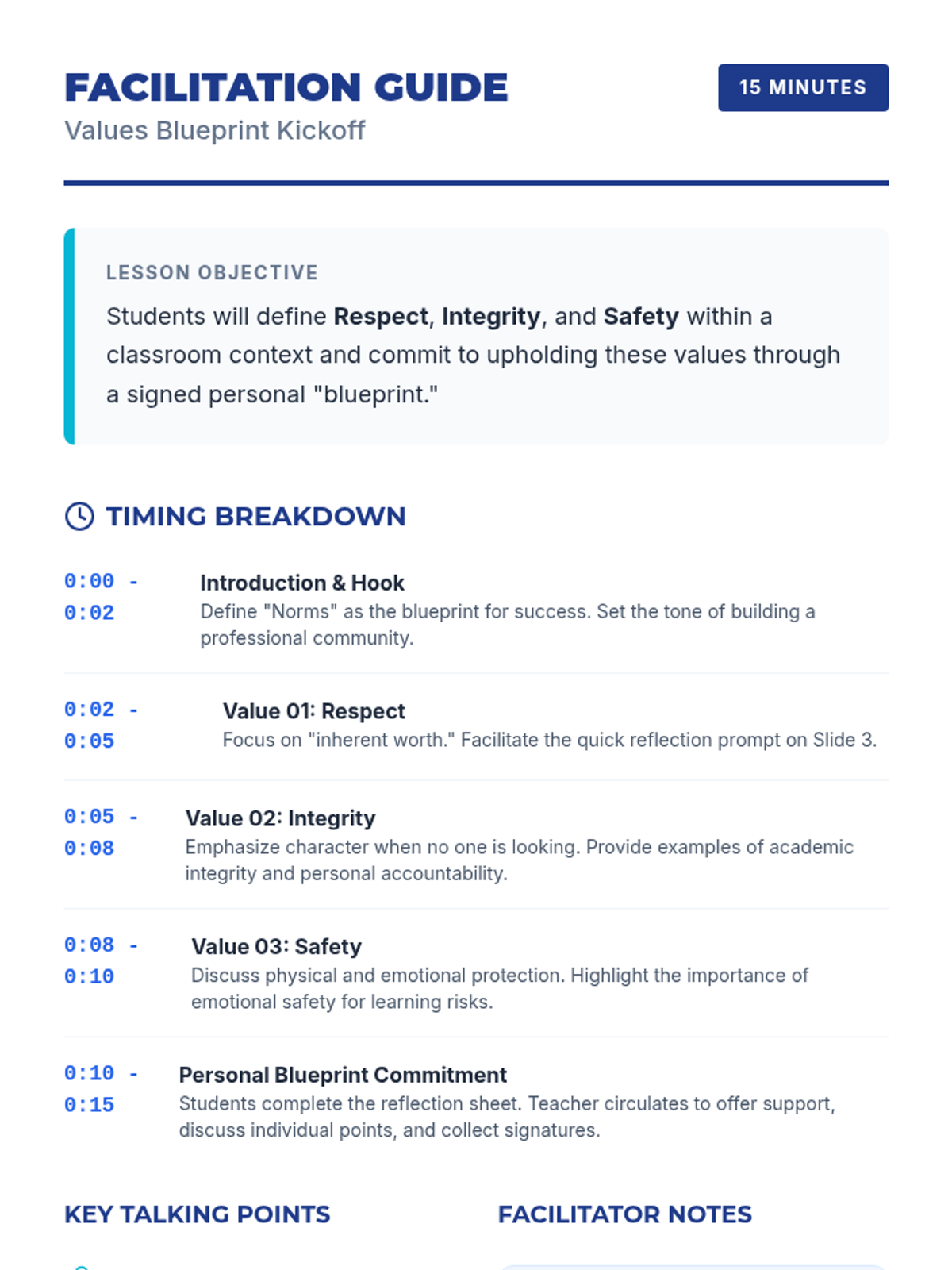
A concise facilitation guide for teachers to lead the 15-minute Values Blueprint Kickoff. Includes a minute-by-minute breakdown, key talking points, and strategies for handling student misconceptions.
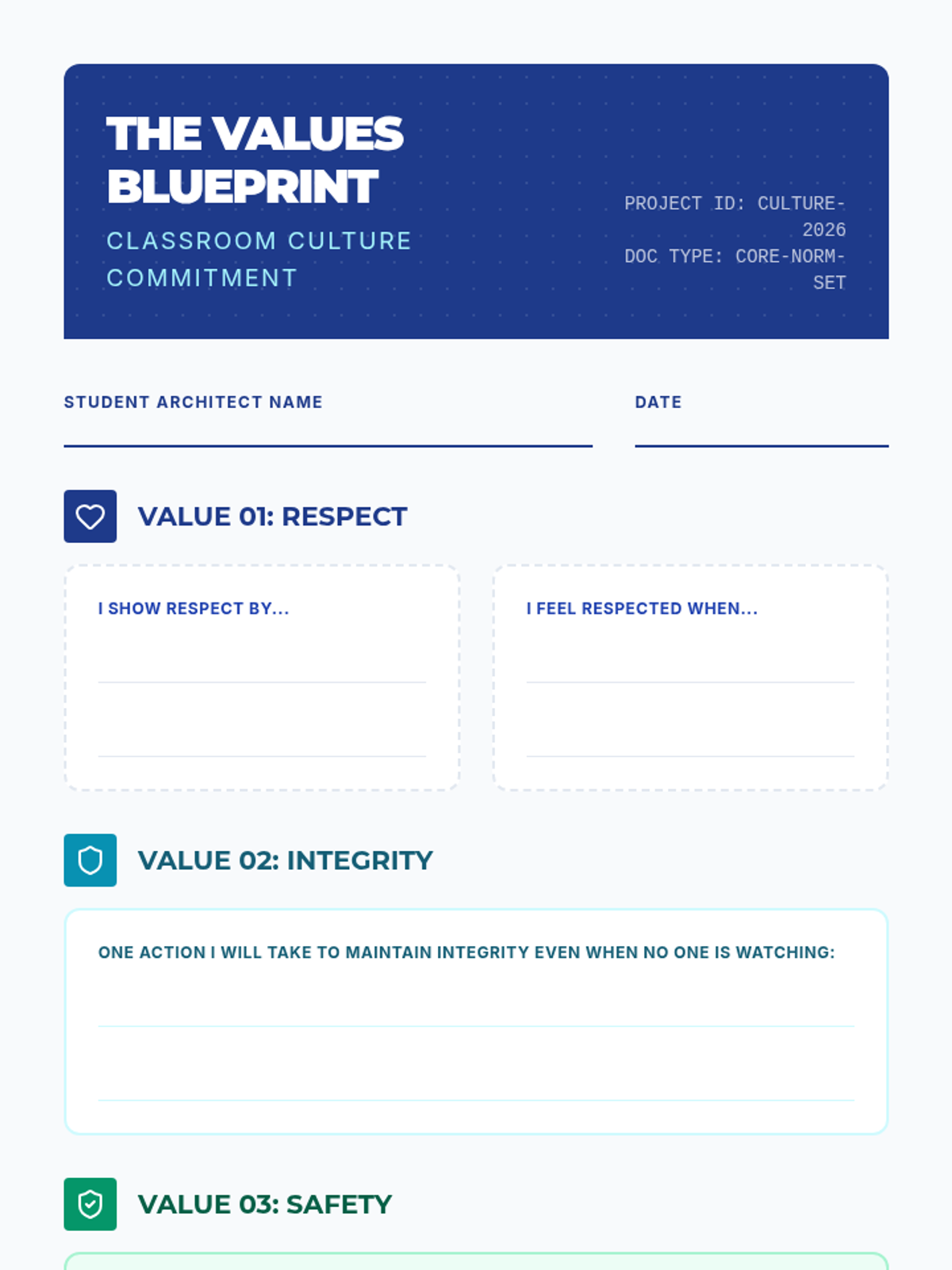
A student reflection sheet that reinforces the classroom values of Respect, Integrity, and Safety. Includes guided prompts and designated spaces for students to define their personal commitment to the classroom 'blueprint'.
A high-impact 7-slide presentation designed to introduce the core classroom values of Respect, Integrity, and Safety through a 'Blueprint' aesthetic. Includes clear definitions, practical examples, and a collective commitment.
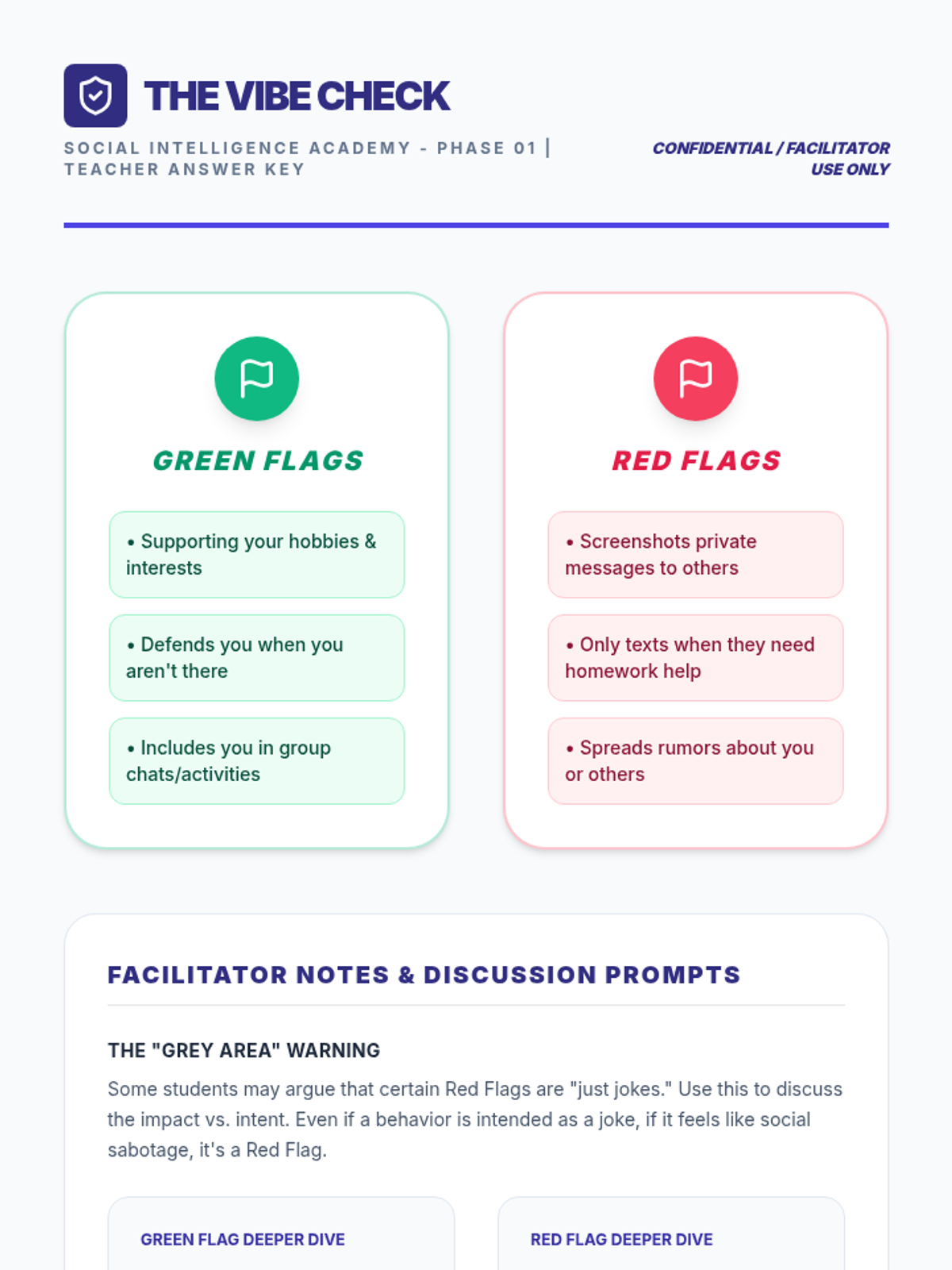
The facilitator's key for the Vibe Check worksheet, including correct categorization of behaviors and discussion prompts for a whole-class setting.
A modern, tech-inspired 9-slide presentation for Session 1 of the Social Intelligence Academy, focusing on "Vibe Checks" and healthy friendship markers for 6th graders.
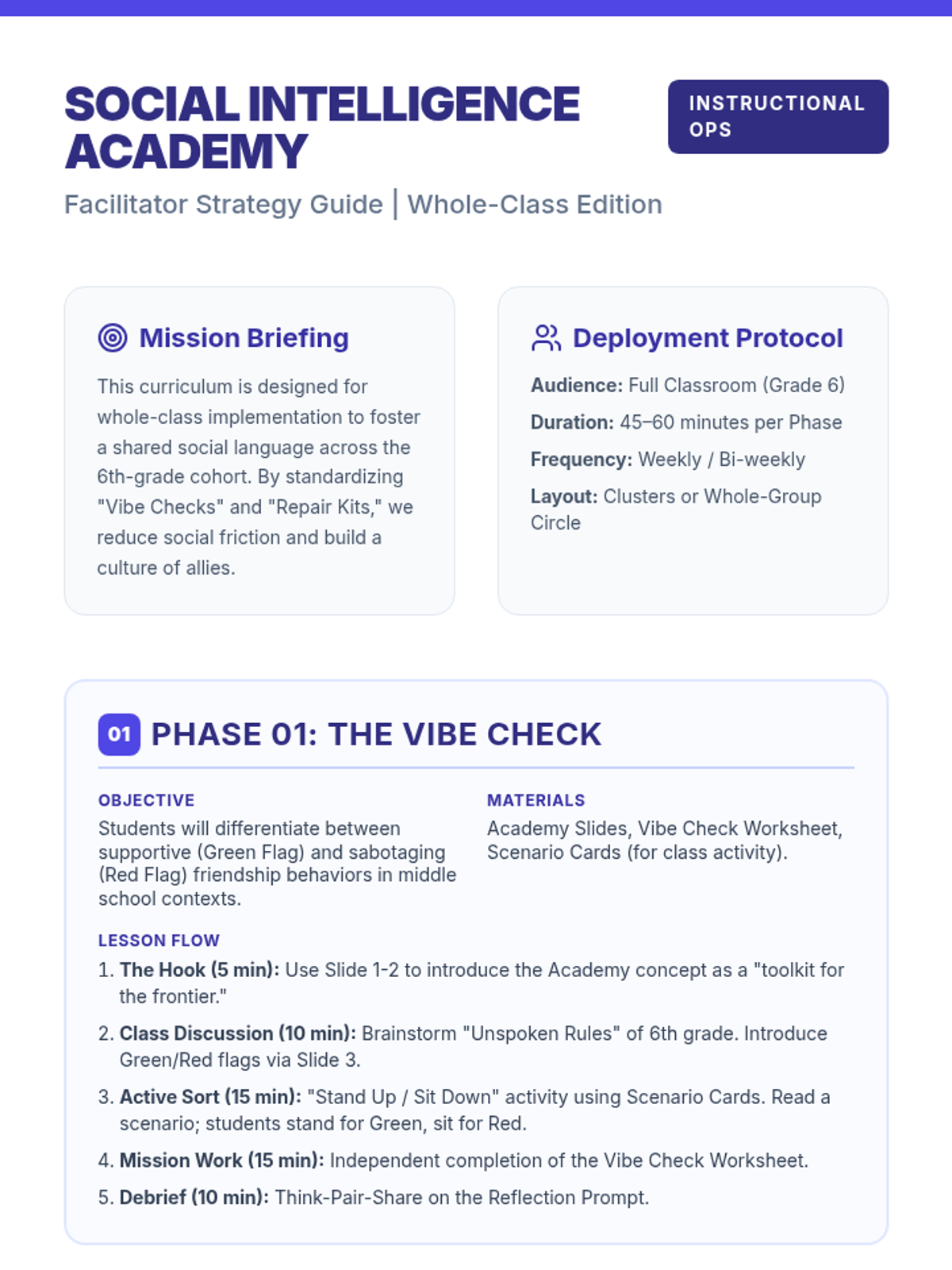
A sophisticated 3-page guide for middle school educators, adapting the Social Intelligence Academy curriculum for whole-class implementation with a focus on shared cohort culture, digital dynamics, and cohort-wide conflict resolution.
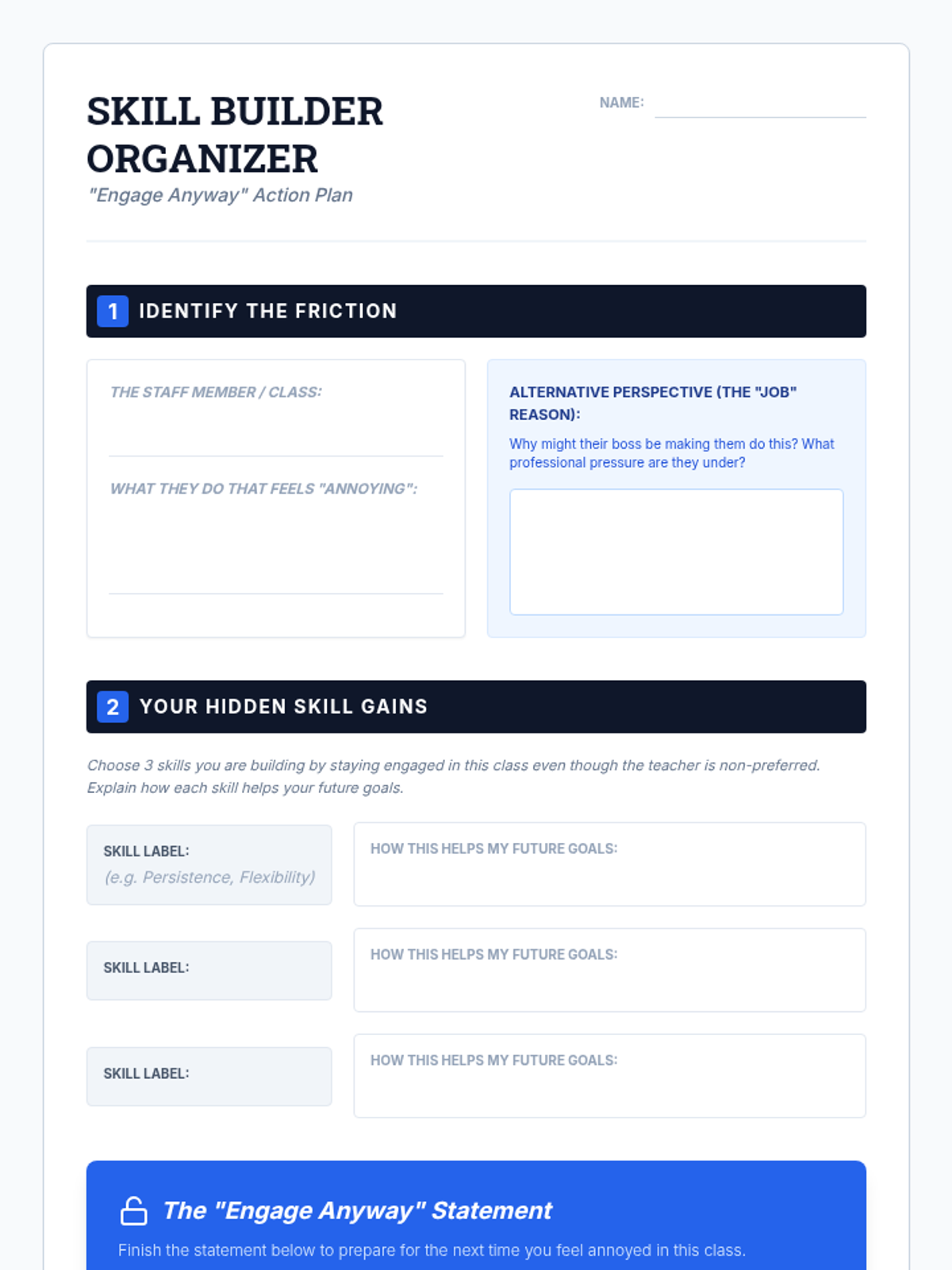
A student worksheet that helps students identify teacher perspectives and the personal skills (Persistence, Flexibility) they gain by choosing to engage despite annoyance.
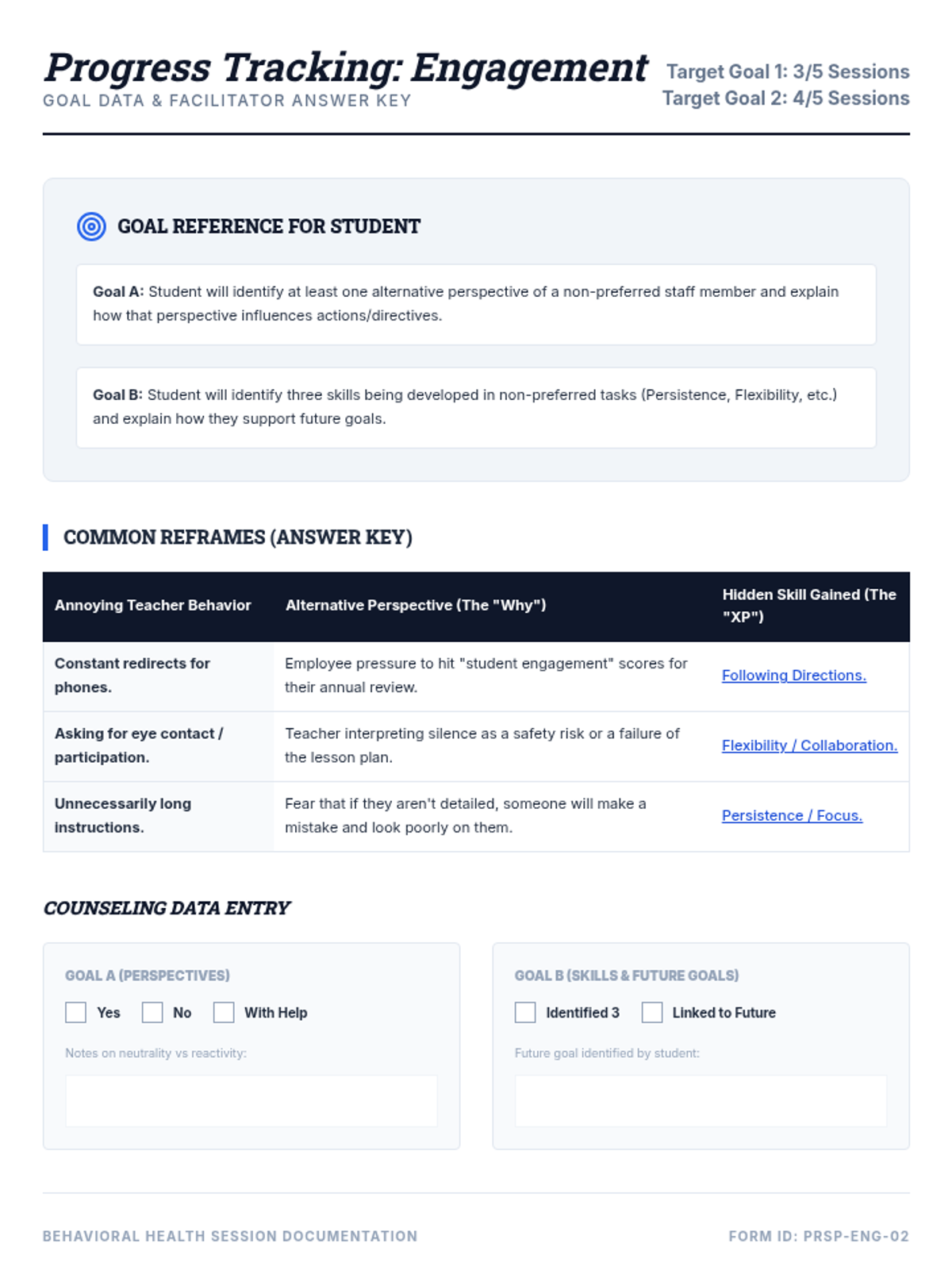
A tracking sheet and answer key for counselors to monitor student progress on perspective-taking and identifying skills (Persistence, Flexibility) developed during non-preferred tasks.
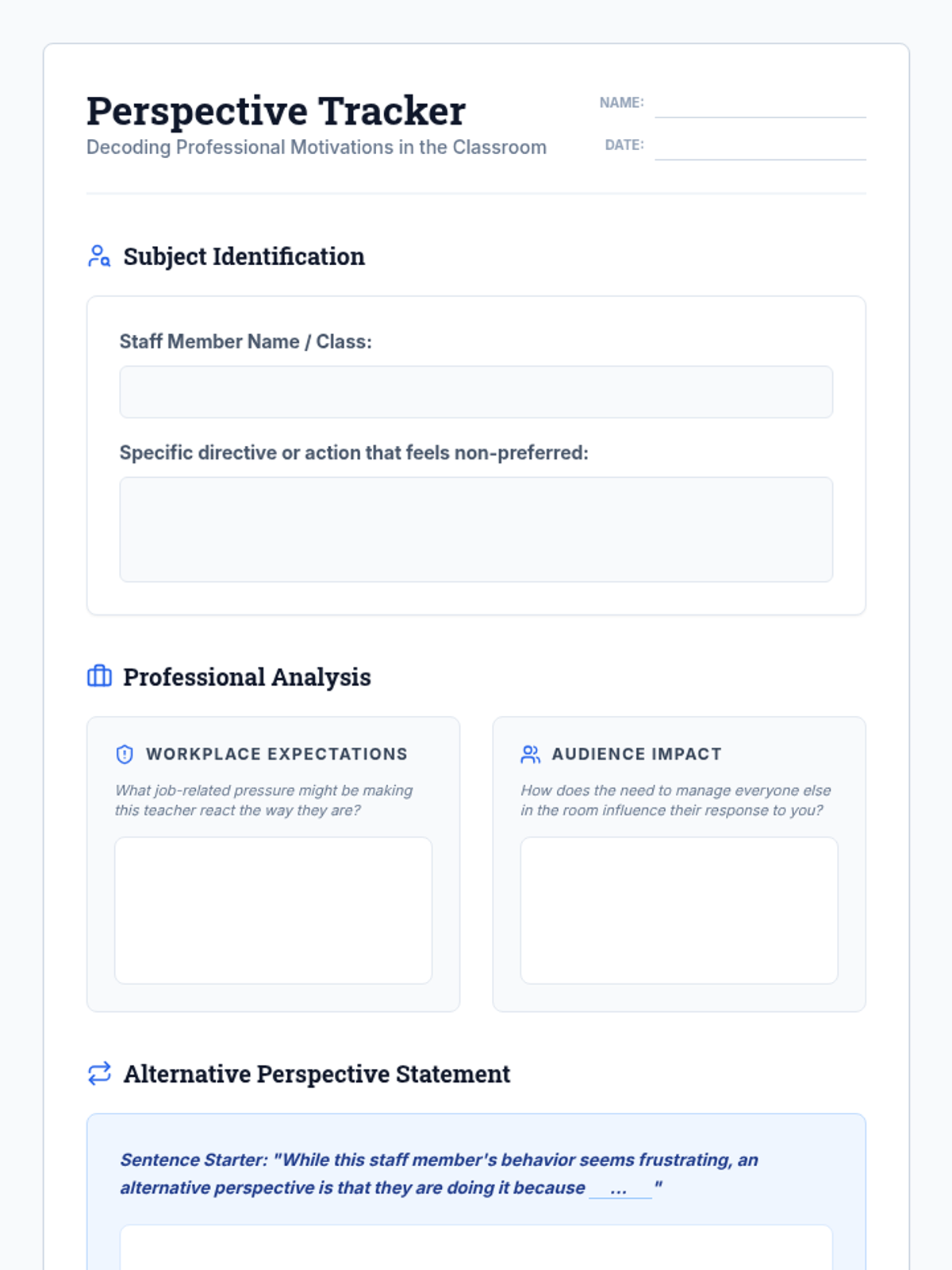
A student worksheet designed as a "Director's Script Organizer" to help students analyze staff member motivations and perspectives.
A presentation that reframes "annoying" staff behavior and focuses on the high-value skills (Persistence, Flexibility) students build by choosing to engage.
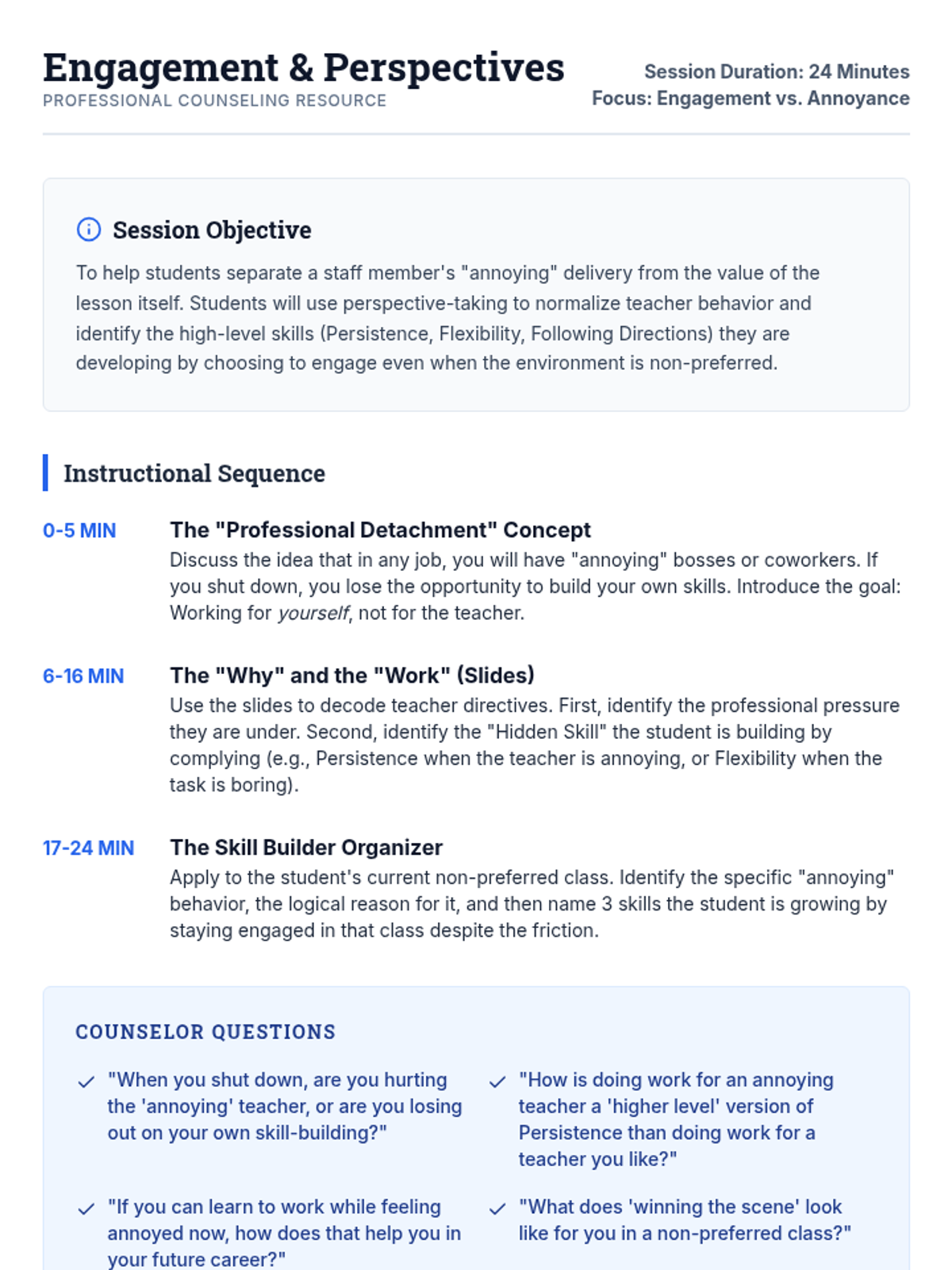
A facilitator's guide for a 24-minute counseling session focused on engaging in lessons despite feeling "annoyed" by staff, by identifying professional perspectives and personal skill-building.
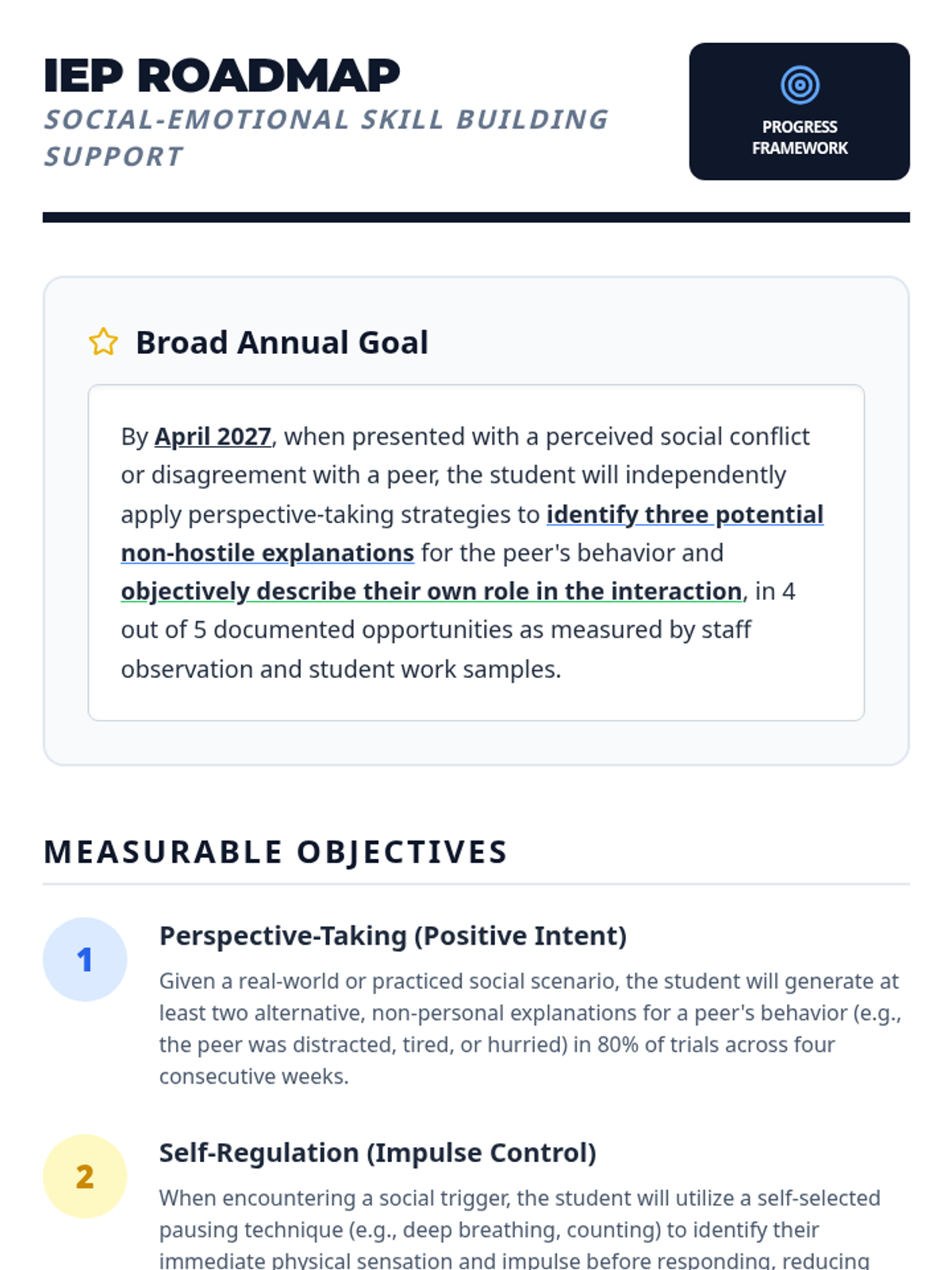
A finalized IEP Roadmap with generalized skill-building language for perspective-taking, self-regulation, and objective self-reflection, designed to support students with social perception challenges.
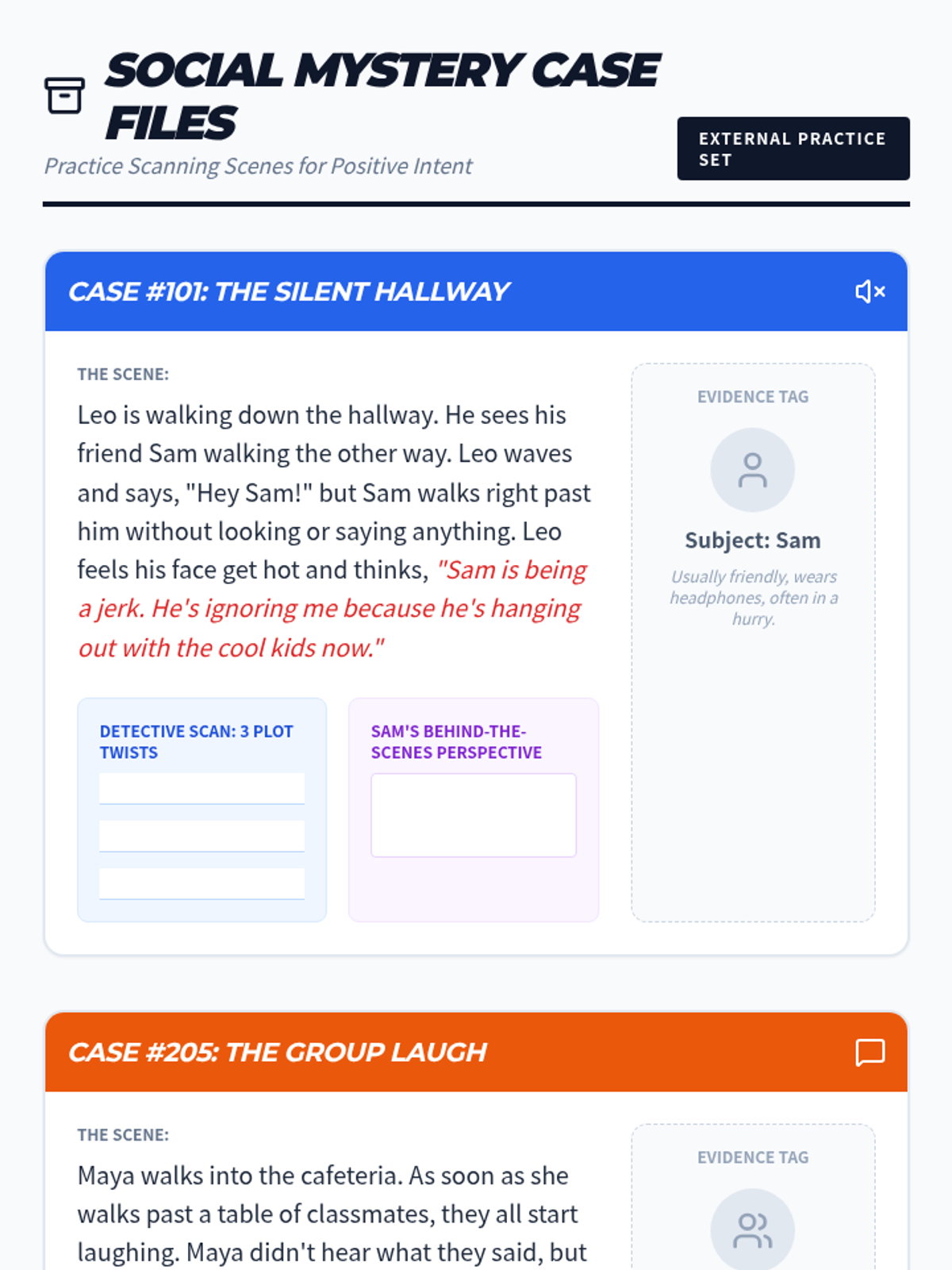
A multi-page set of 'Social Mystery Case Files' with four distinct practice scenarios. Each case includes a 'The Scene' description, an 'Evidence Tag' with extra clues, and space for students to brainstorm three 'Plot Twists' (positive intent explanations) and analyze the situation from an objective 'Camera View'.
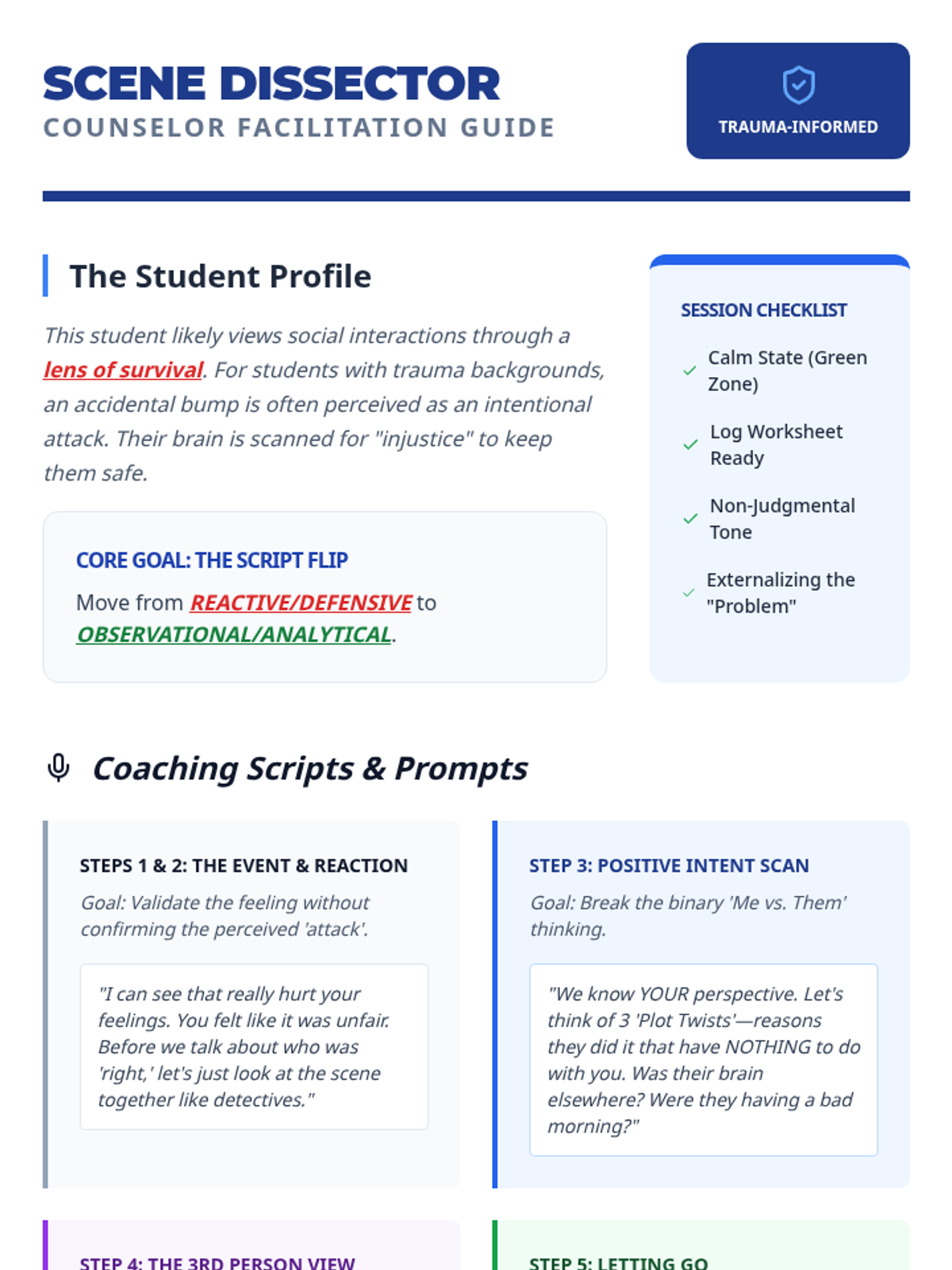
A facilitation guide for counselors to assist students in social interaction 'dissection'. It includes trauma-informed context, specific coaching scripts for each step of the 'Scene Scanners' process, and a metaphorical physical activity for addressing grudge-holding.
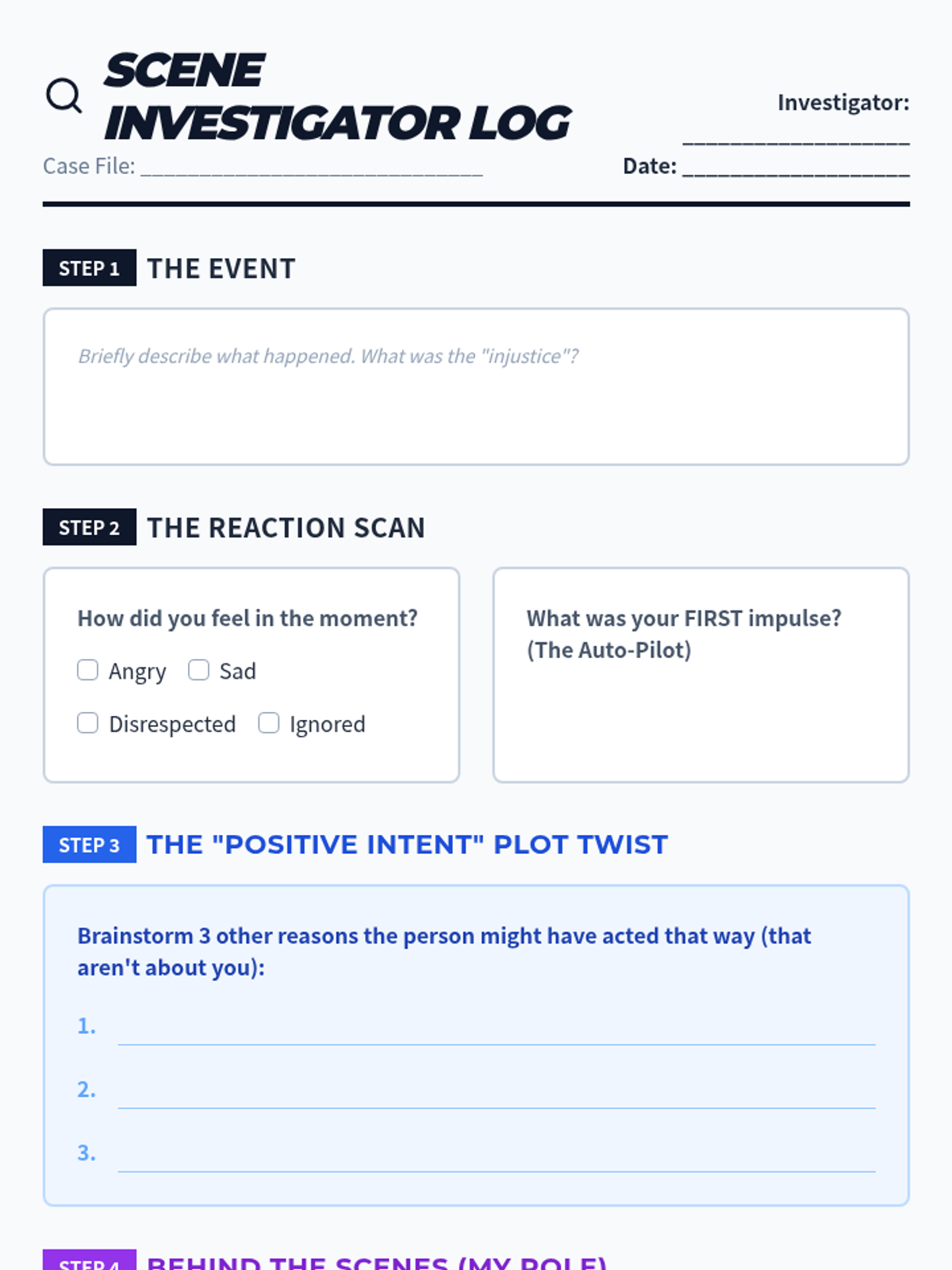
A student worksheet designed as an 'Investigator Log' to help students dissect social interactions. It prompts them to identify the event, their reaction, brainstorm positive intent, reflect on their own behavior, and consciously decide to let go of grudges.
A visual slide deck teaching the 'Scene Scanners' methodology for social interaction analysis. It focuses on assuming positive intent, using a '3-second brake' for impulse control, and understanding the personal weight of holding grudges.
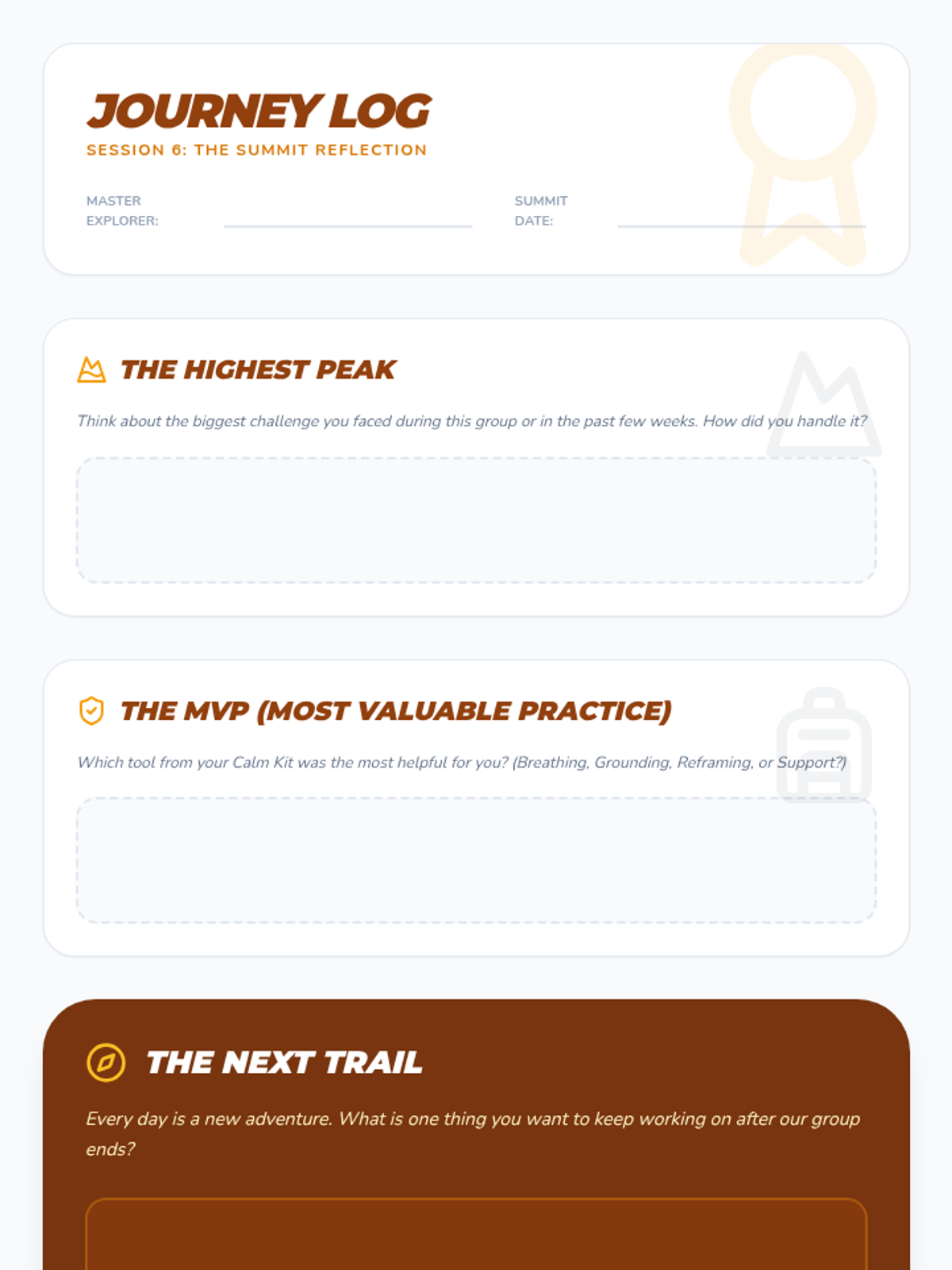
A student-facing reflection sheet for the final session, focusing on growth, accomplishments, and future goal setting.
A visual presentation for Session 6 of the Calm Explorers group, reflecting on growth, confidentiality, and celebrating the completion of the program.
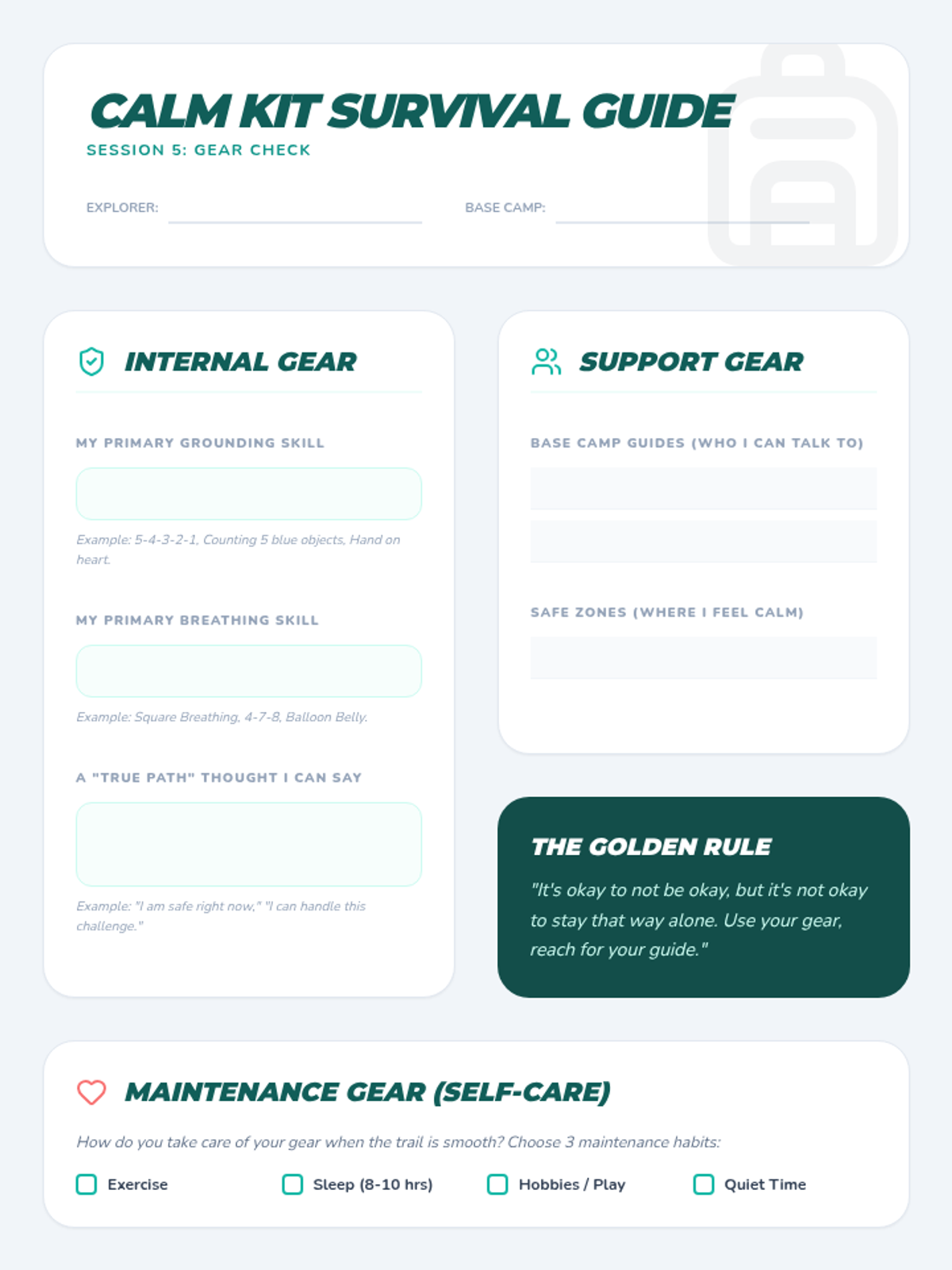
A student-facing planning sheet for identifying personalized coping strategies, support people, and self-care habits.
A visual presentation for Session 5 of the Calm Explorers group, reviewing skills, confidentiality, and planning a personalized 'Calm Kit'.
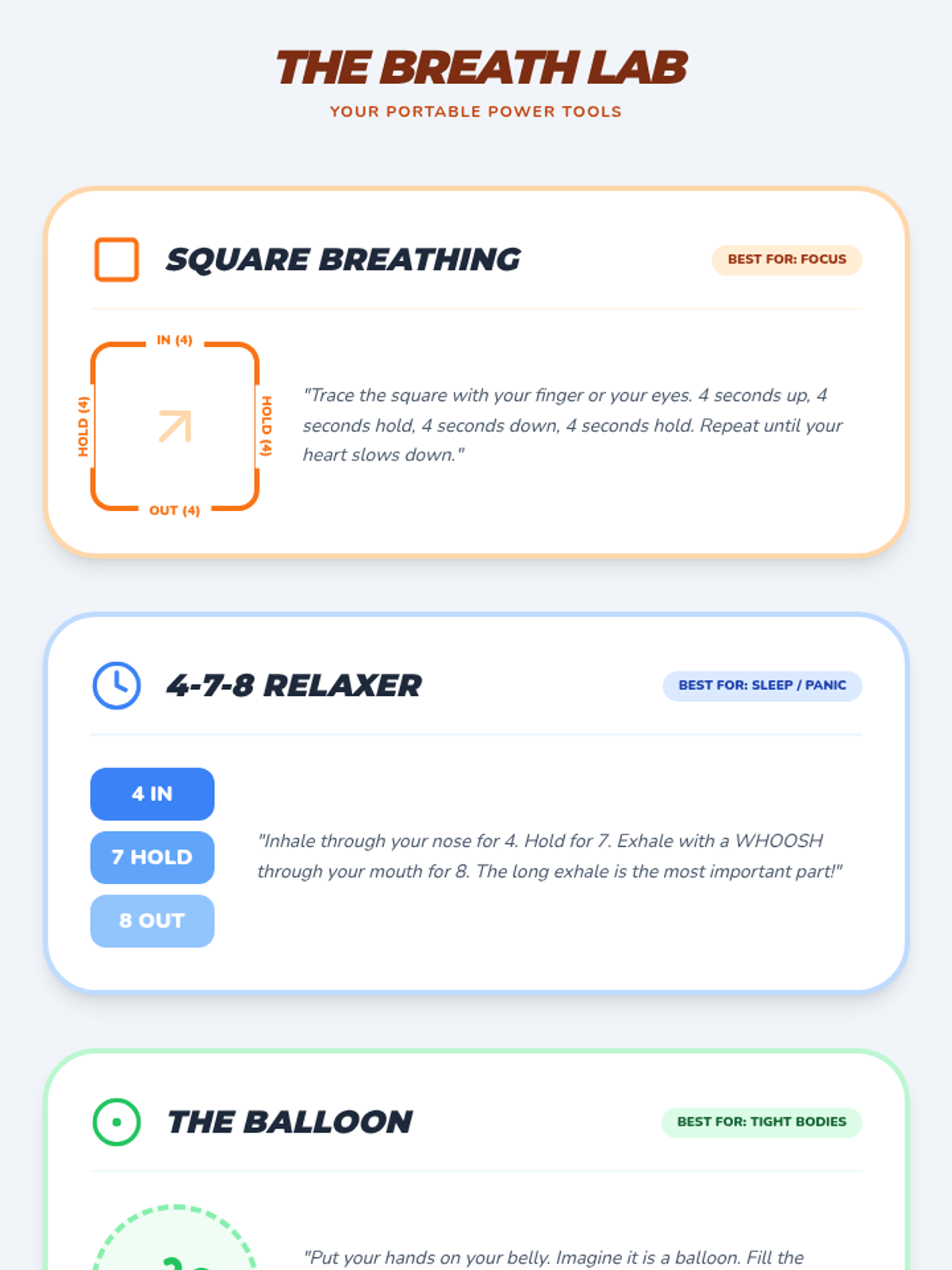
A student-facing reference card for various breathing techniques used as self-regulation tools for anxiety and stress.
A visual presentation for Session 4 of the Calm Explorers group, focusing on the power of breath, confidentiality, and mindfulness.
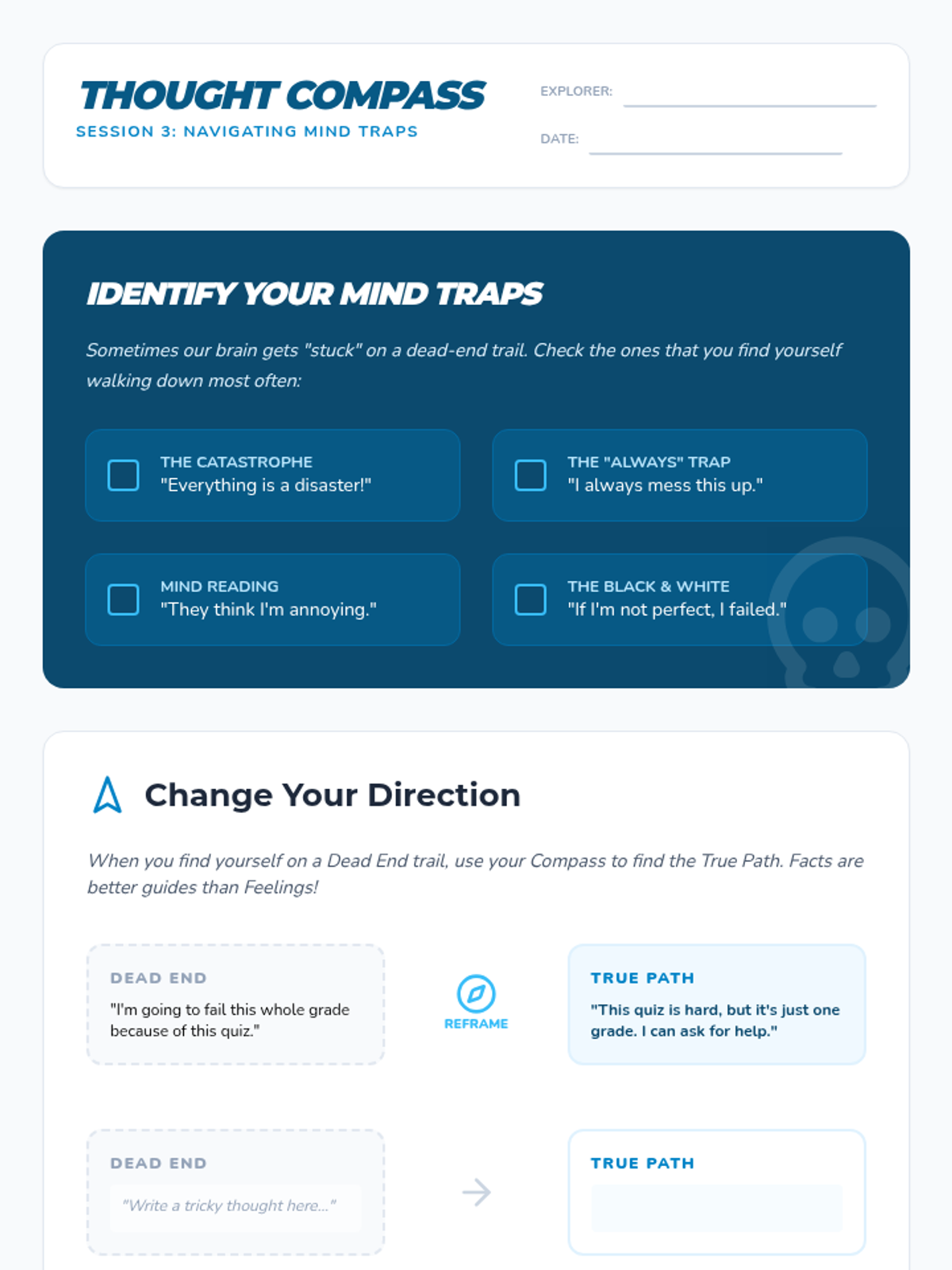
A student-facing activity sheet for practicing cognitive reframing by identifying 'mind traps' and finding 'true paths'.
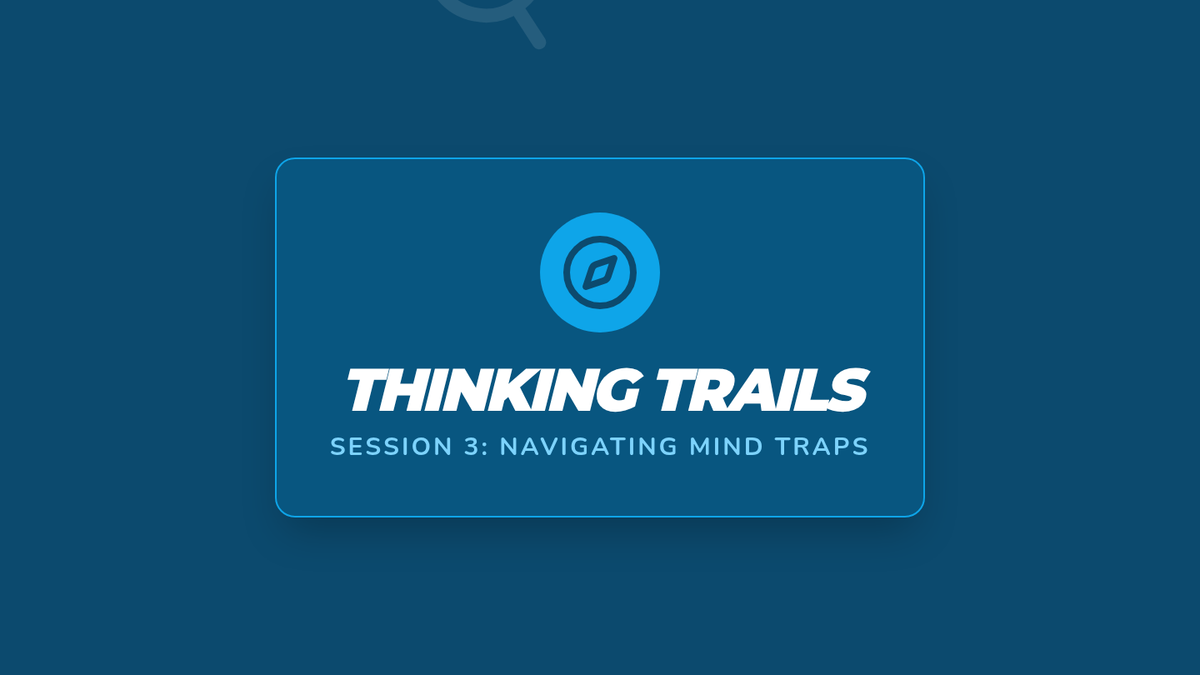
A visual presentation for Session 3 of the Calm Explorers group, focusing on identifying mind traps, confidentiality, and cognitive reframing.
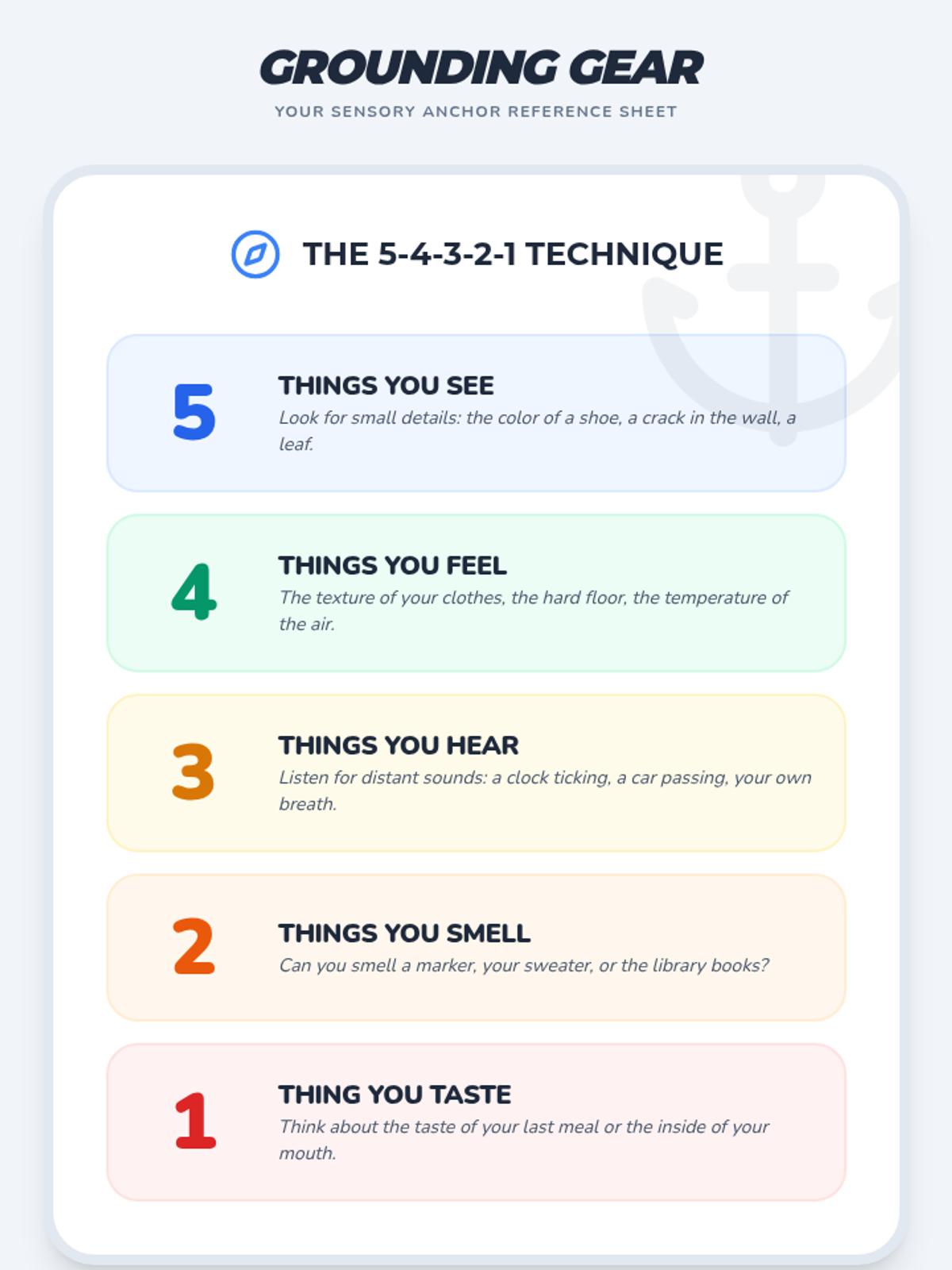
A student-facing reference card for the 5-4-3-2-1 grounding technique, designed as a sensory anchor during moments of high anxiety.
A visual presentation for Session 2 of the Calm Explorers group, focusing on body signals, confidentiality, and the 5-4-3-2-1 grounding technique.
A visual presentation for Session 1 of the Calm Explorers group, introducing norms, confidentiality, and the concept of stress.
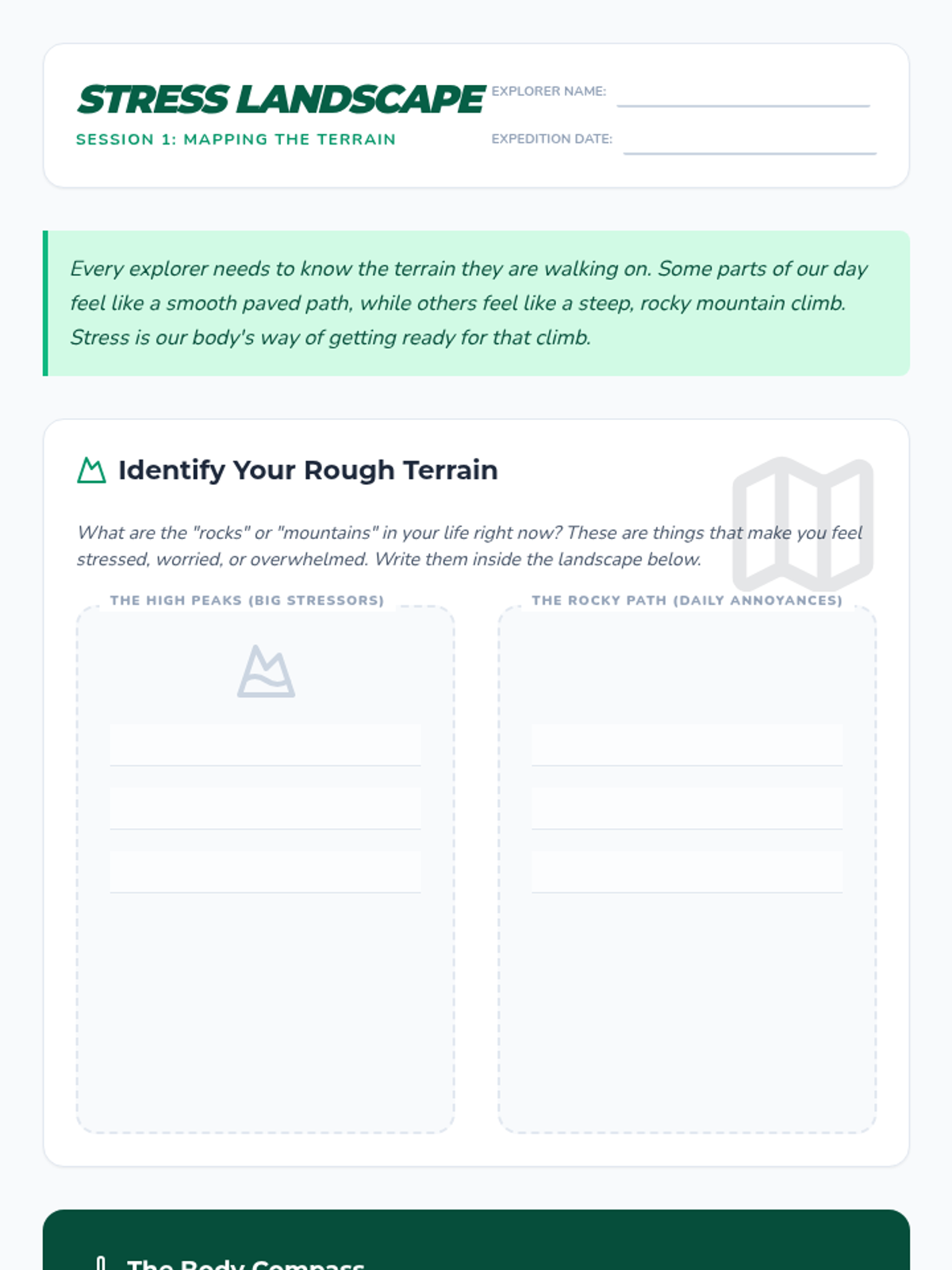
A student-facing worksheet for identifying stress triggers and physical symptoms of anxiety using a landscape metaphor.
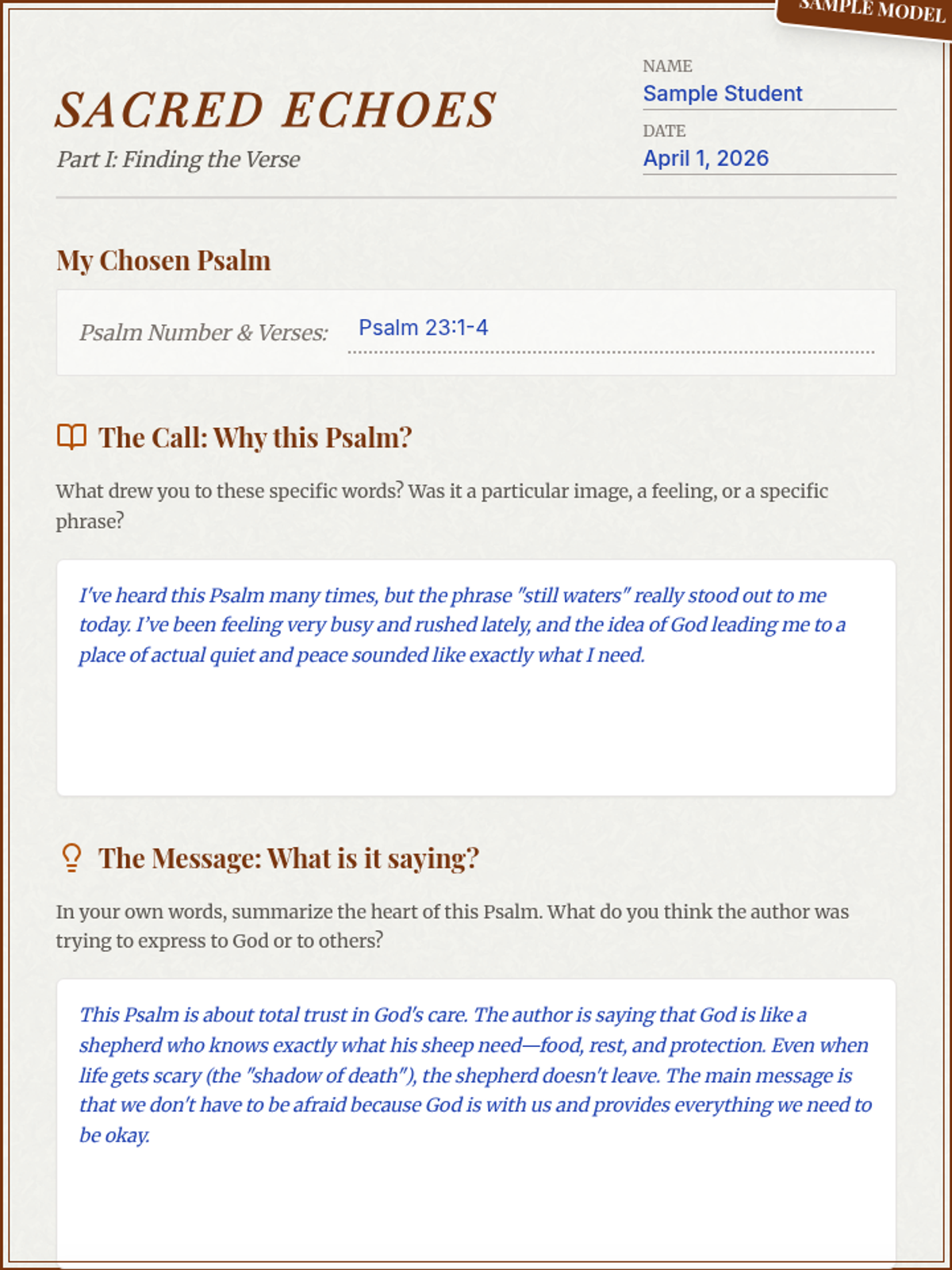
A sample completed version of the Sacred Echoes reflection worksheet using Psalm 23. Expanded into two pages to match the updated worksheet format, providing a clear example of the depth expected in each section.
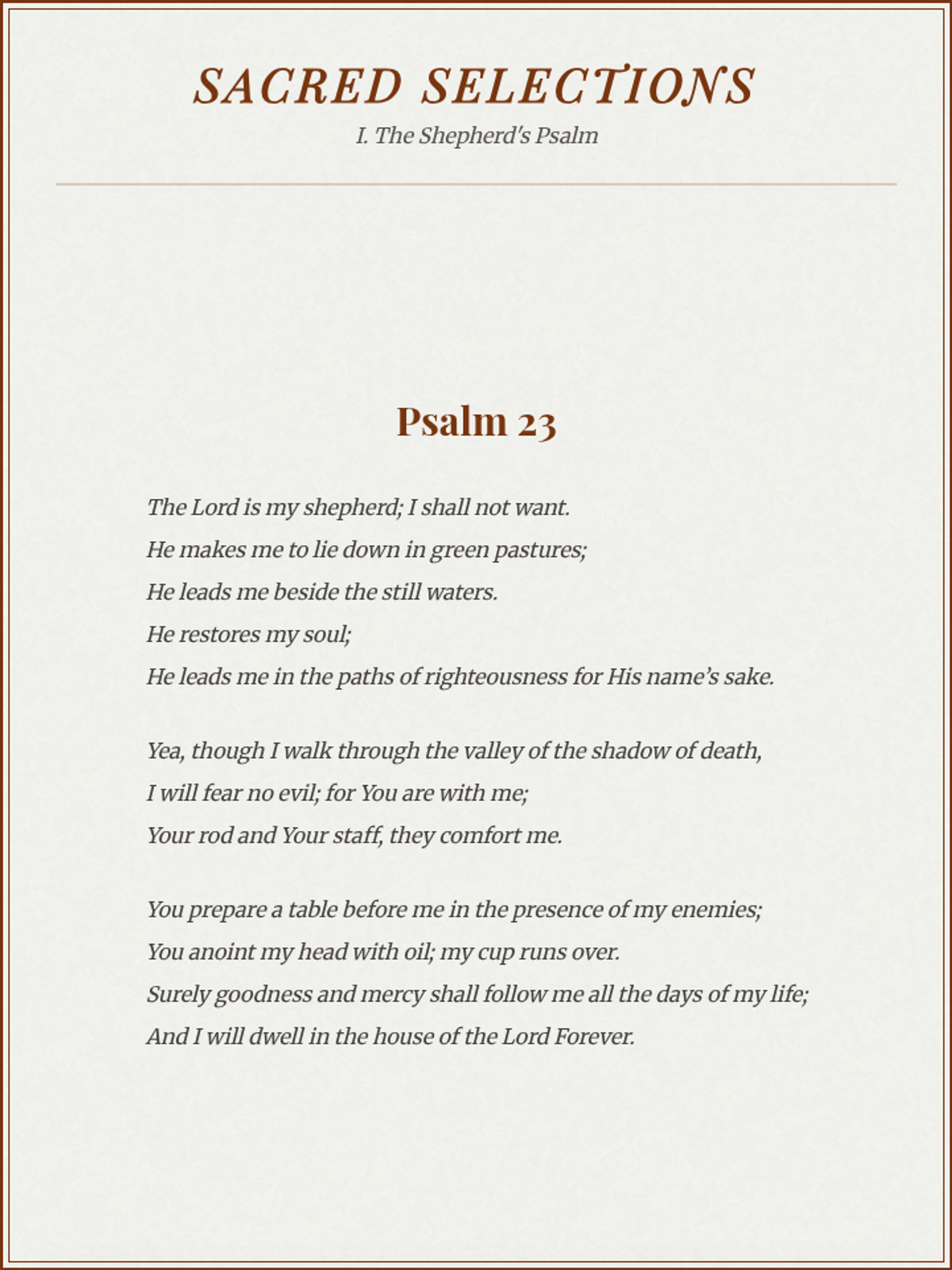
A collection of popular Psalms (23, 121, and excerpts from 46) provided as a reference handout. Each Psalm now starts on its own fresh page for clarity and easier reading.
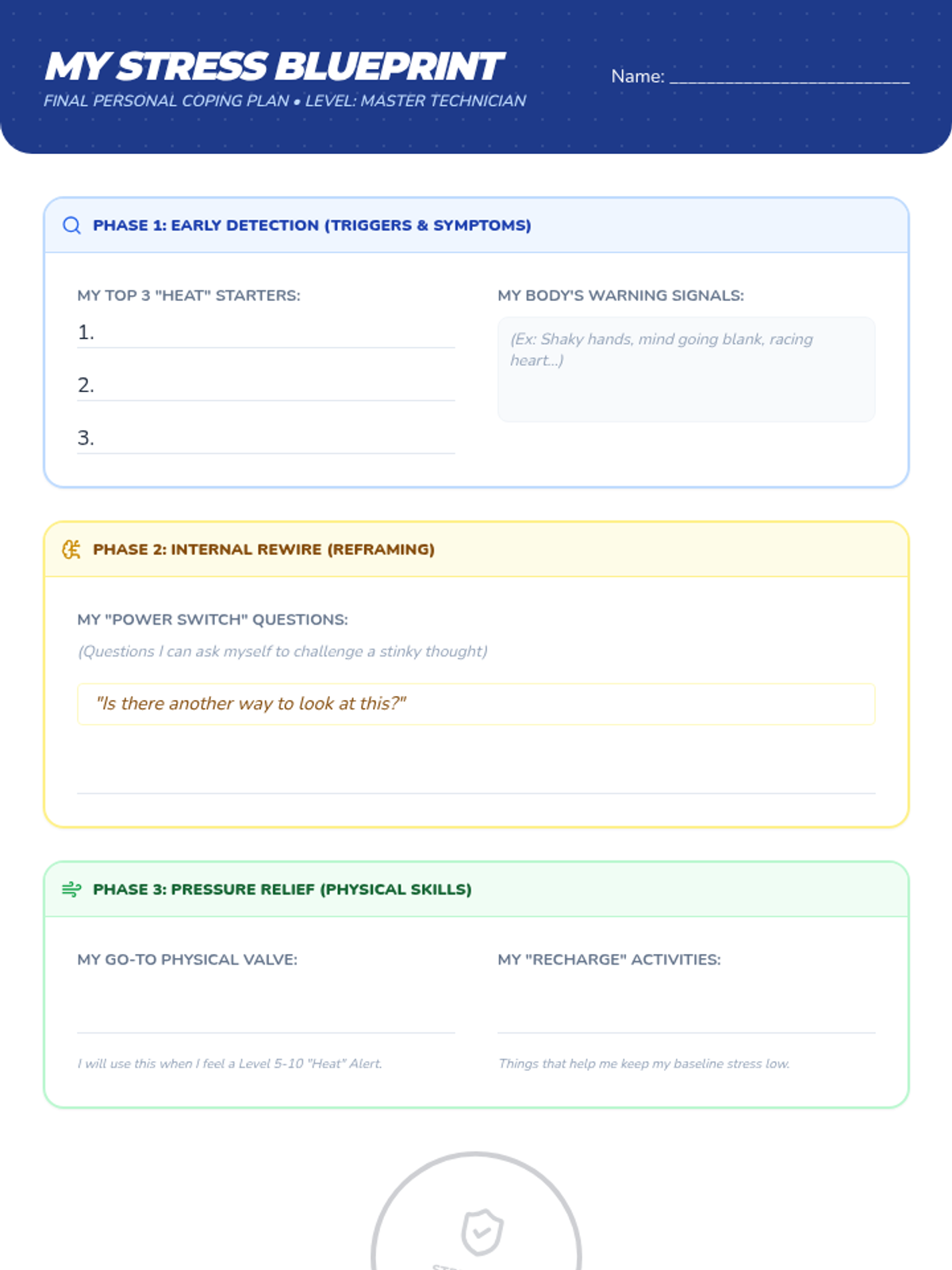
The final personal coping plan document for students, allowing them to synthesize their learning from all four sessions into a single "blueprint" for future use.
Slide presentation for Session 4, reviewing the unit's core concepts (Detection, Reframing, Regulation) and guiding students through the creation of their personal coping blueprints.
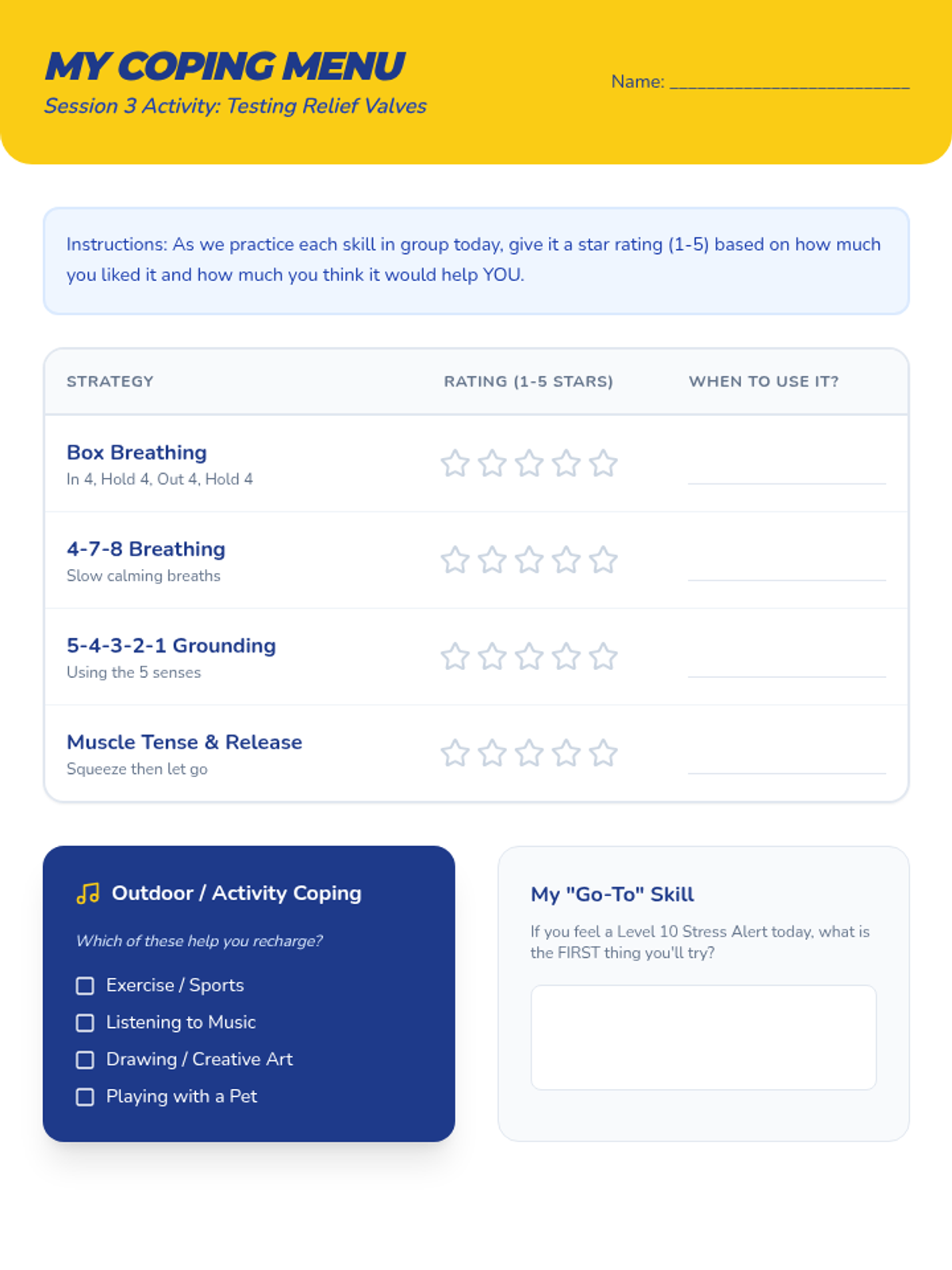
Coping strategy menu for students to trial and rate different physical and grounding techniques (e.g., box breathing, grounding) to identify what works best for them.
Slide presentation for Session 3, introducing physical coping mechanisms like controlled breathing, the 5-4-3-2-1 grounding technique, and explaining the physiological benefits of these strategies.
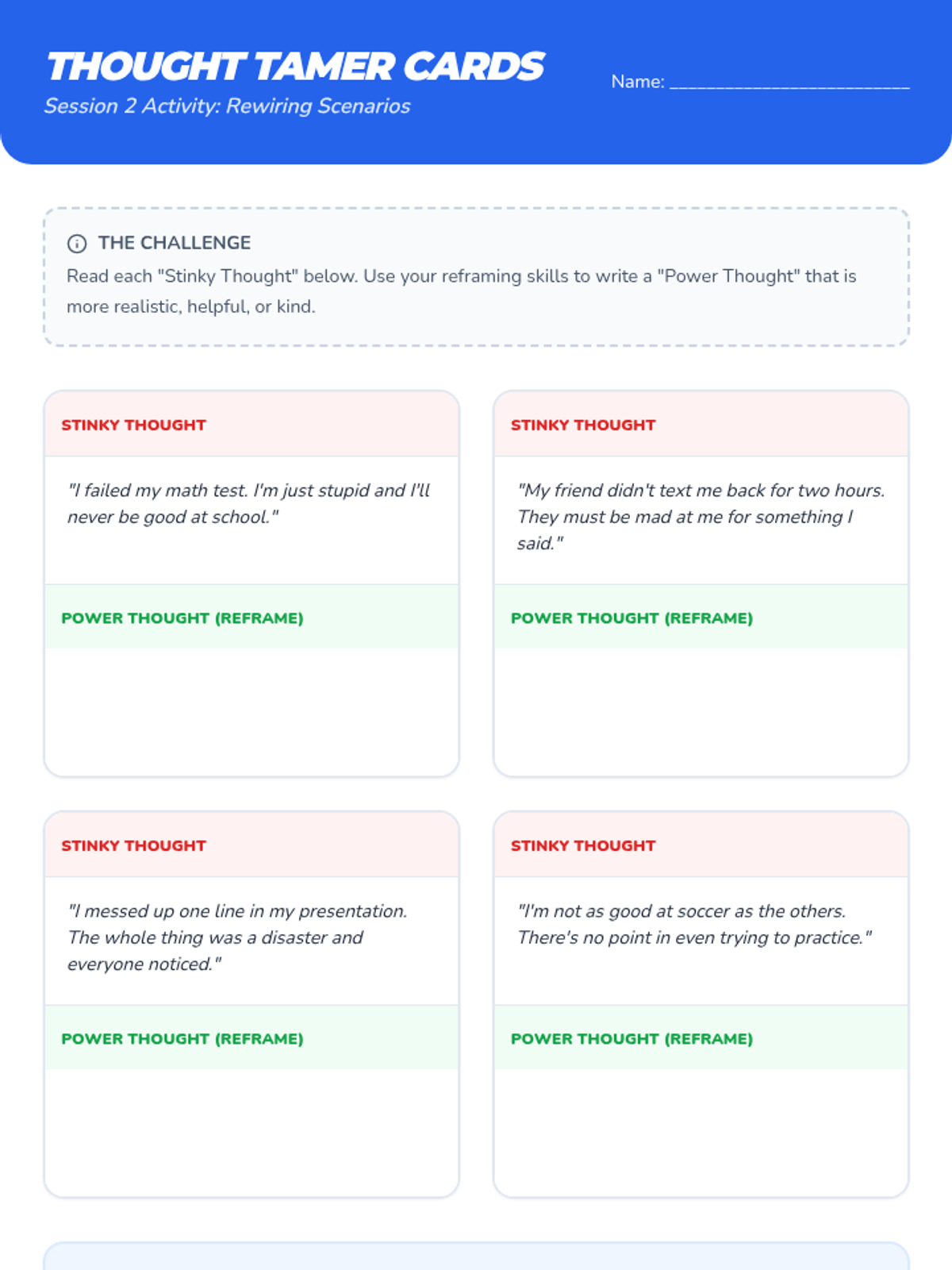
Student worksheet featuring common middle school stressors as "Stinky Thoughts" scenarios. Students practice cognitive reframing by writing realistic and positive "Power Thoughts" for each situation.
Slide presentation for Session 2, focusing on the connection between thoughts, feelings, and behaviors, and teaching students how to identify and reframe cognitive distortions.
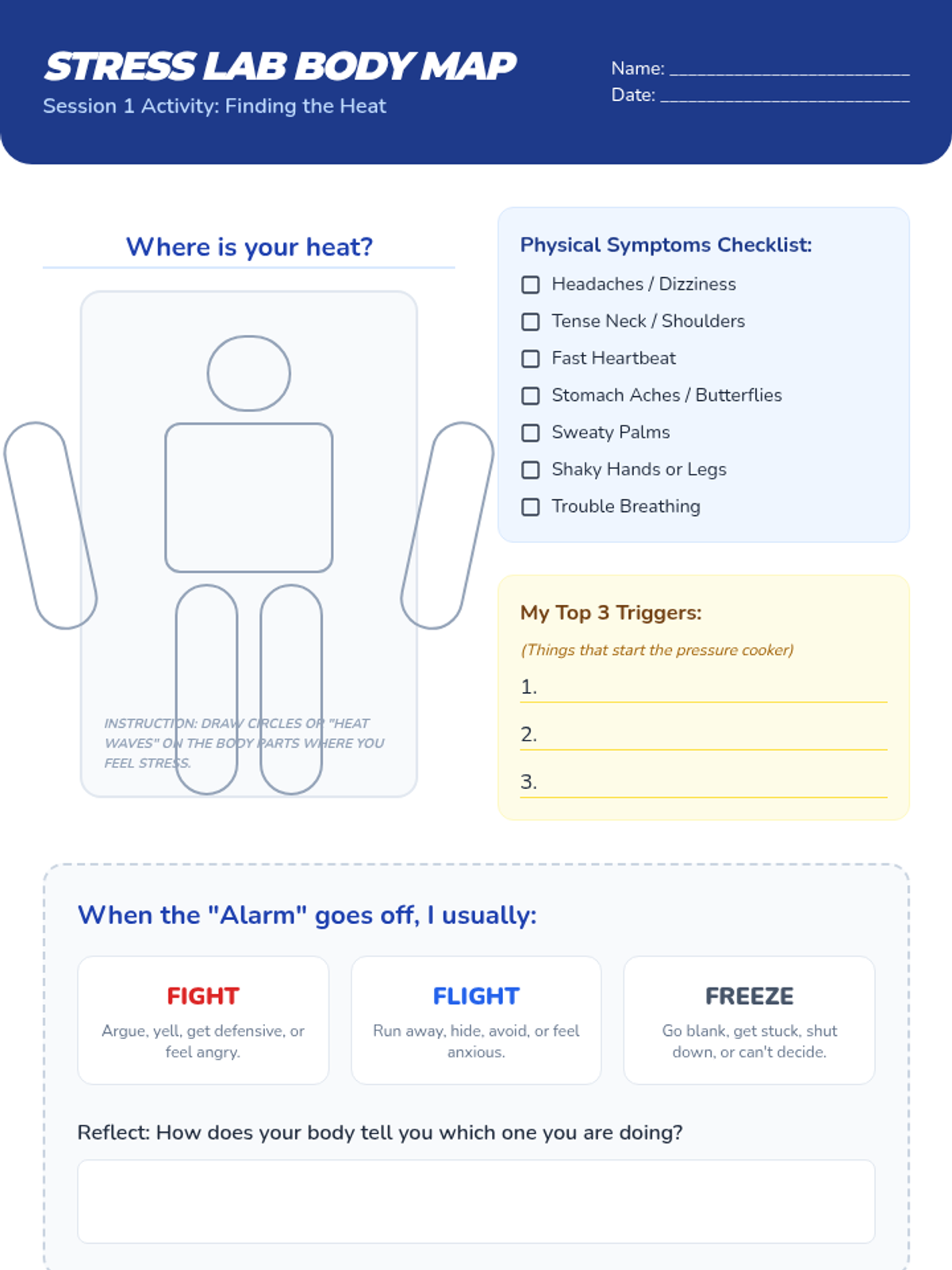
Student activity sheet for Session 1. Students identify their physical stress symptoms on a body map and list their primary personal triggers.
Slide presentation for Session 1, introducing the concept of stress using the pressure cooker analogy and explaining the body's fight/flight/freeze response.
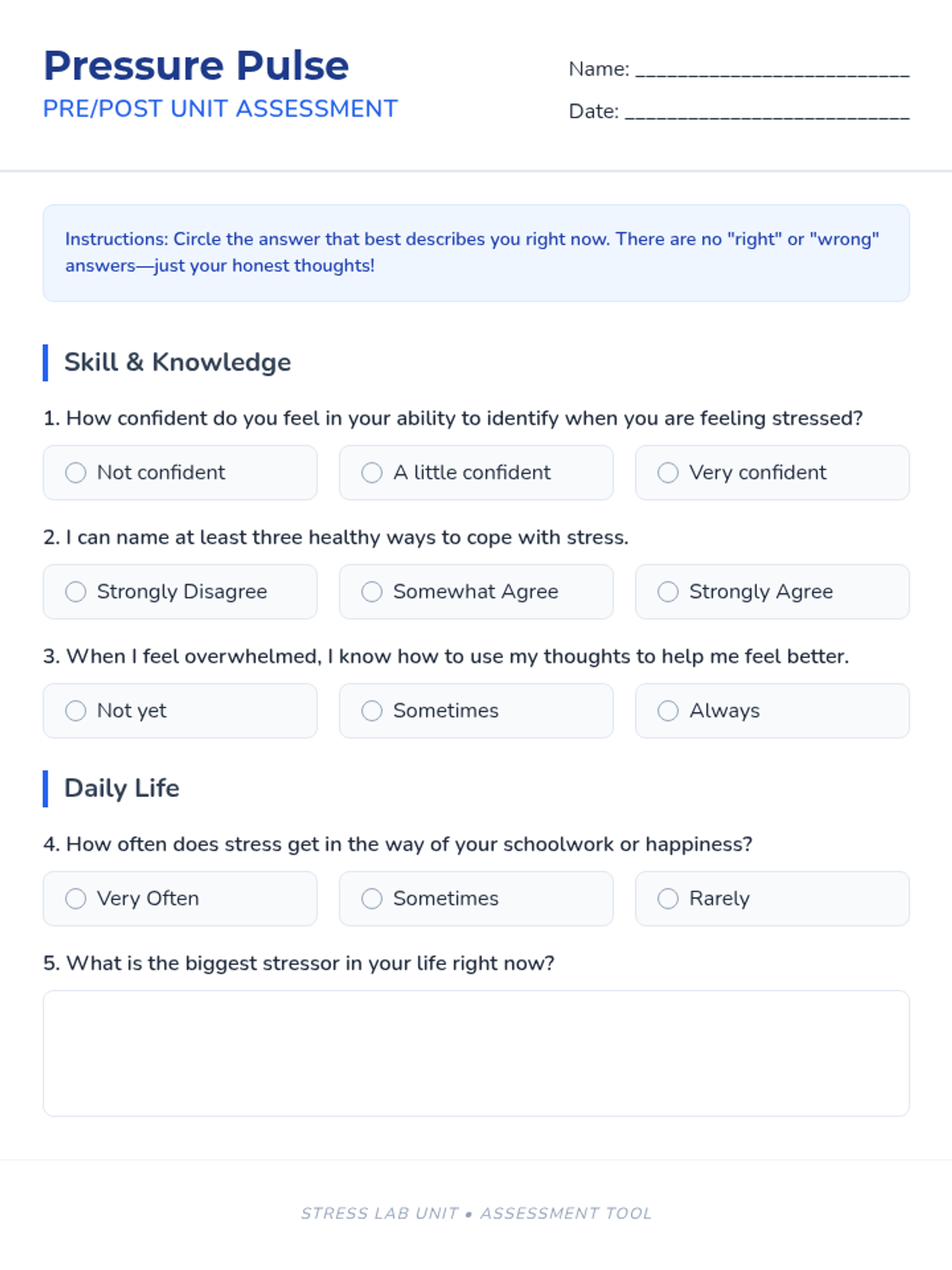
Unit pre- and post-assessment to measure student growth in identifying stressors and coping strategies.
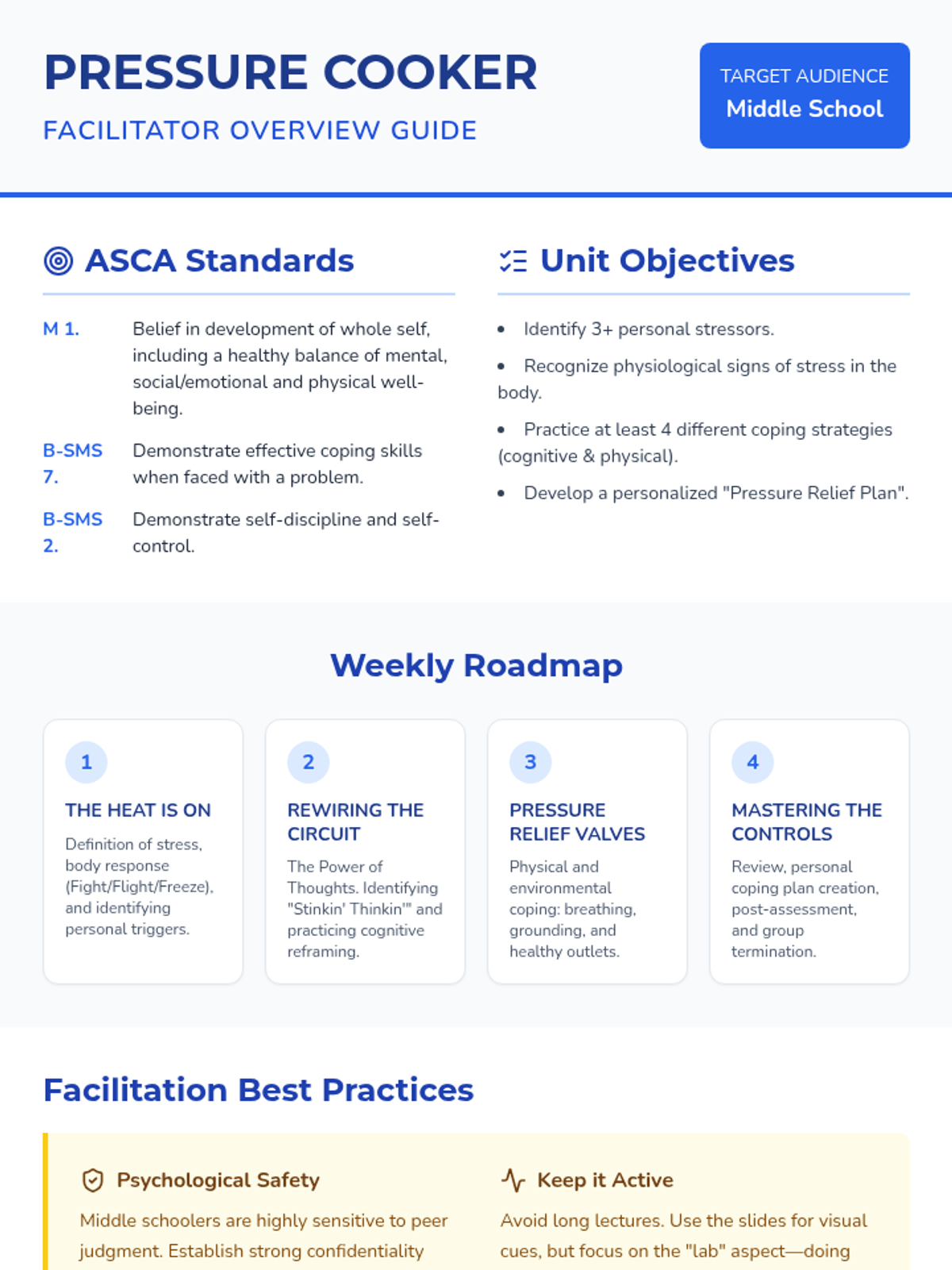
Facilitator guide for the 4-week unit, including ASCA alignment, objectives, and weekly plans.
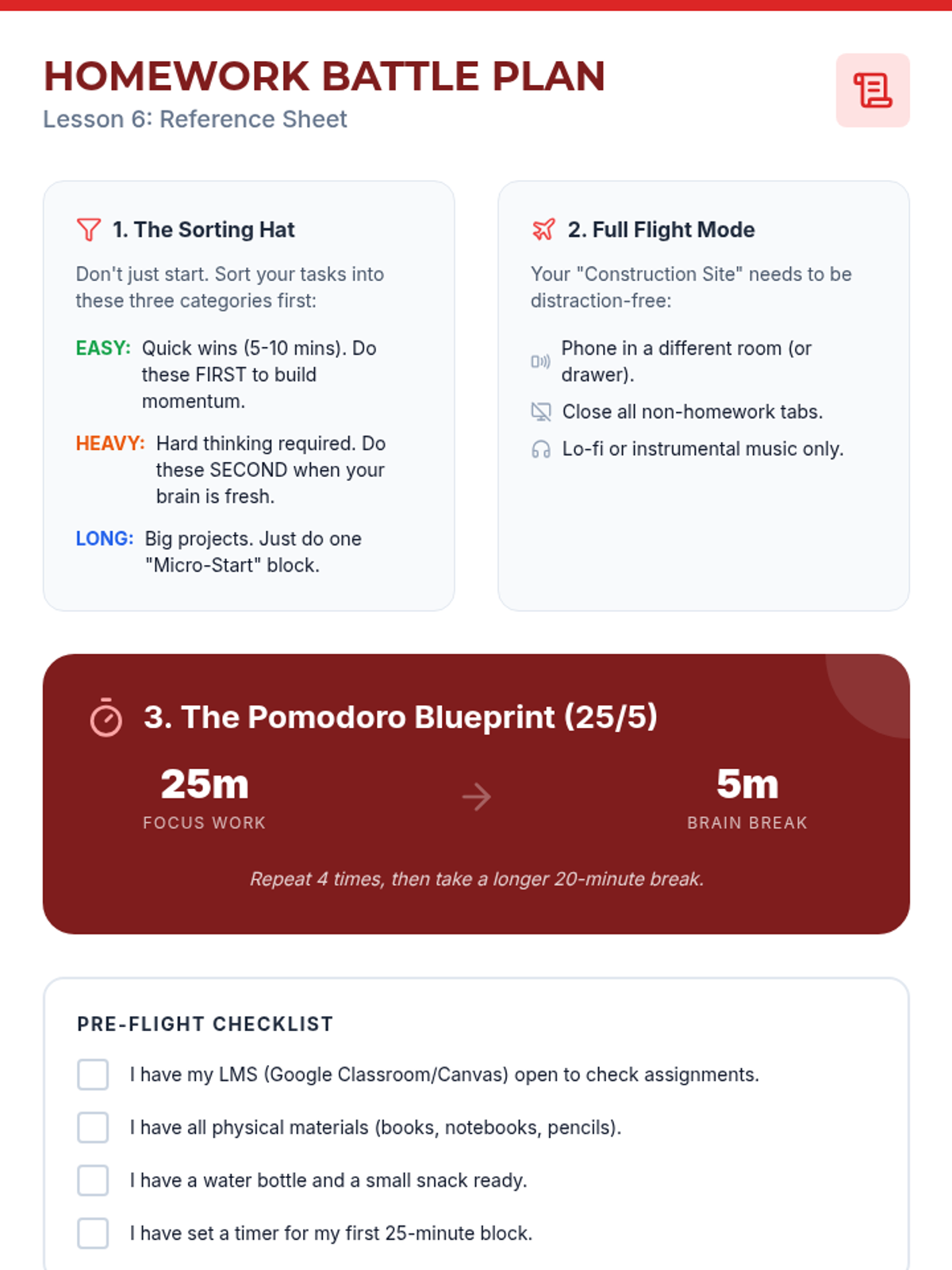
A comprehensive homework strategy guide featuring task sorting, distraction management, the Pomodoro method, and a pre-study checklist.
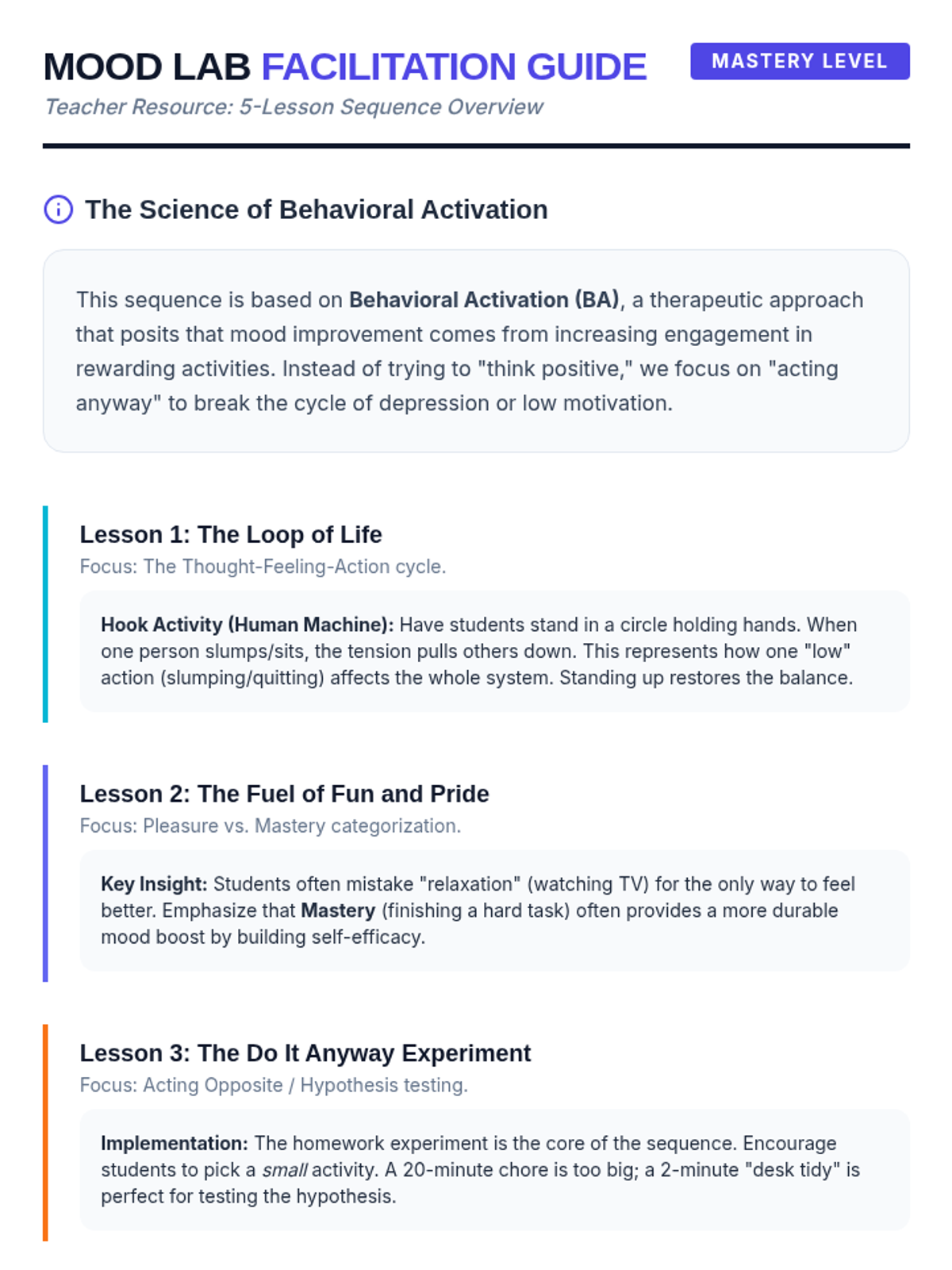
A teacher facilitation guide for the 'Mood Lab Experiment' sequence, providing therapeutic context, hook instructions, and tips for each lesson.
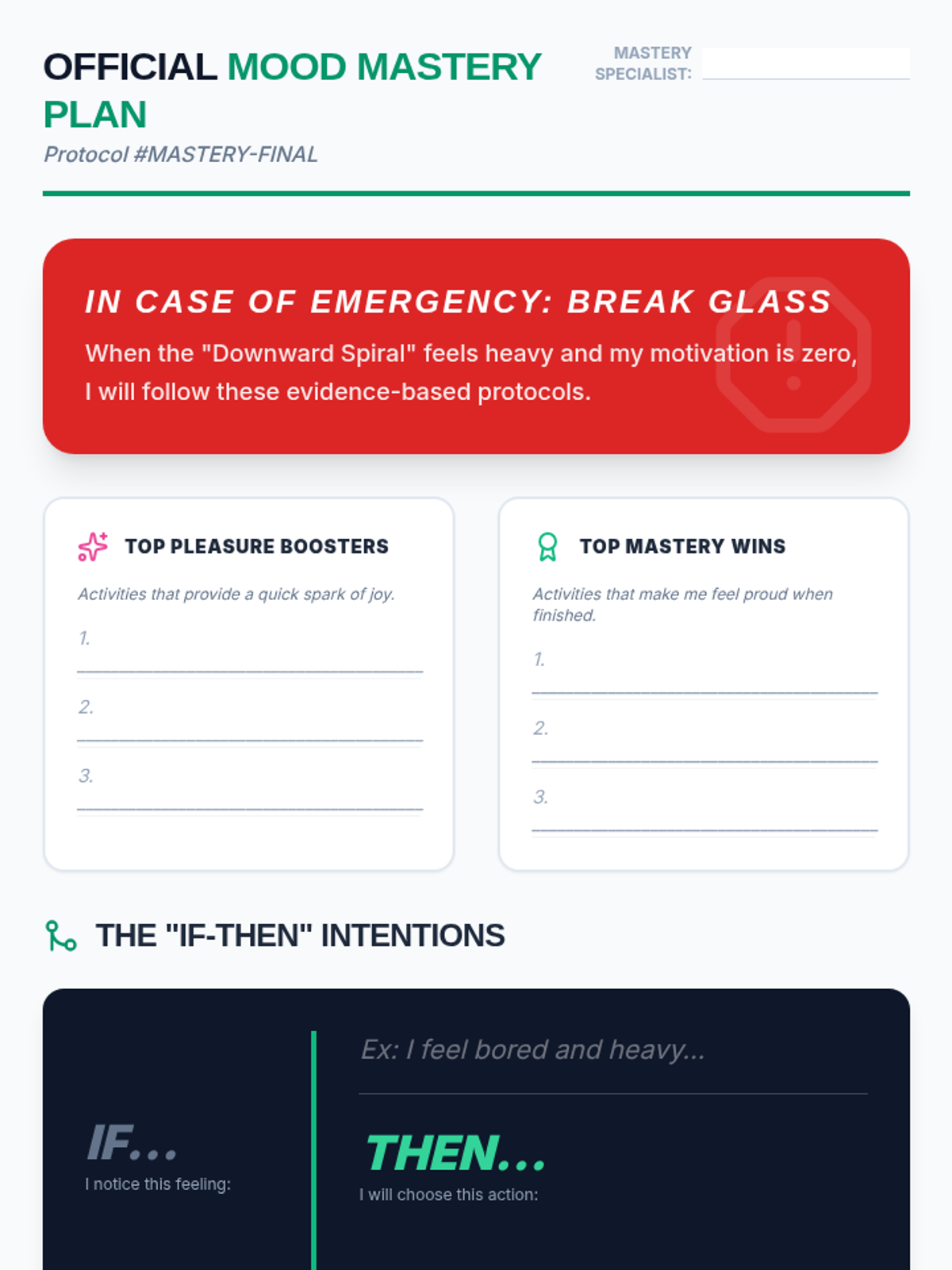
A comprehensive 'Break the Glass' emergency plan worksheet where students synthesize their findings into specific 'If-Then' implementation intentions for mood regulation.
Final slide deck for the 'Mood Mastery Lab' lesson, teaching students how to create implementation intentions and synthesize their learning into an emergency activation plan.
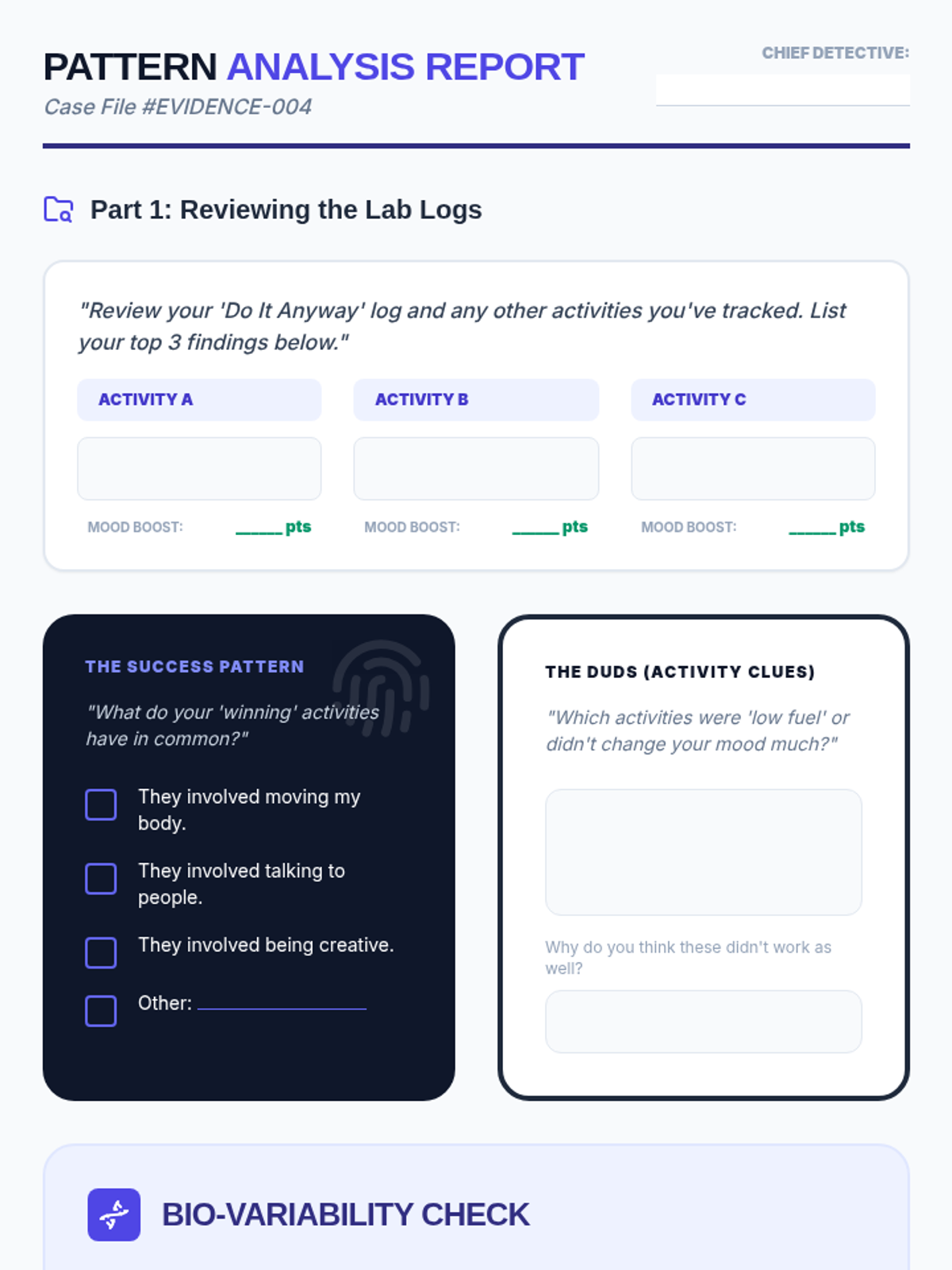
A lab report worksheet for students to analyze their experiment data, identify patterns in effective activities, and reflect on individual differences.
Introductory slides for the 'Mood Pattern Detectives' lesson, helping students analyze their data and understand the concept of individual variability in activity effectiveness.
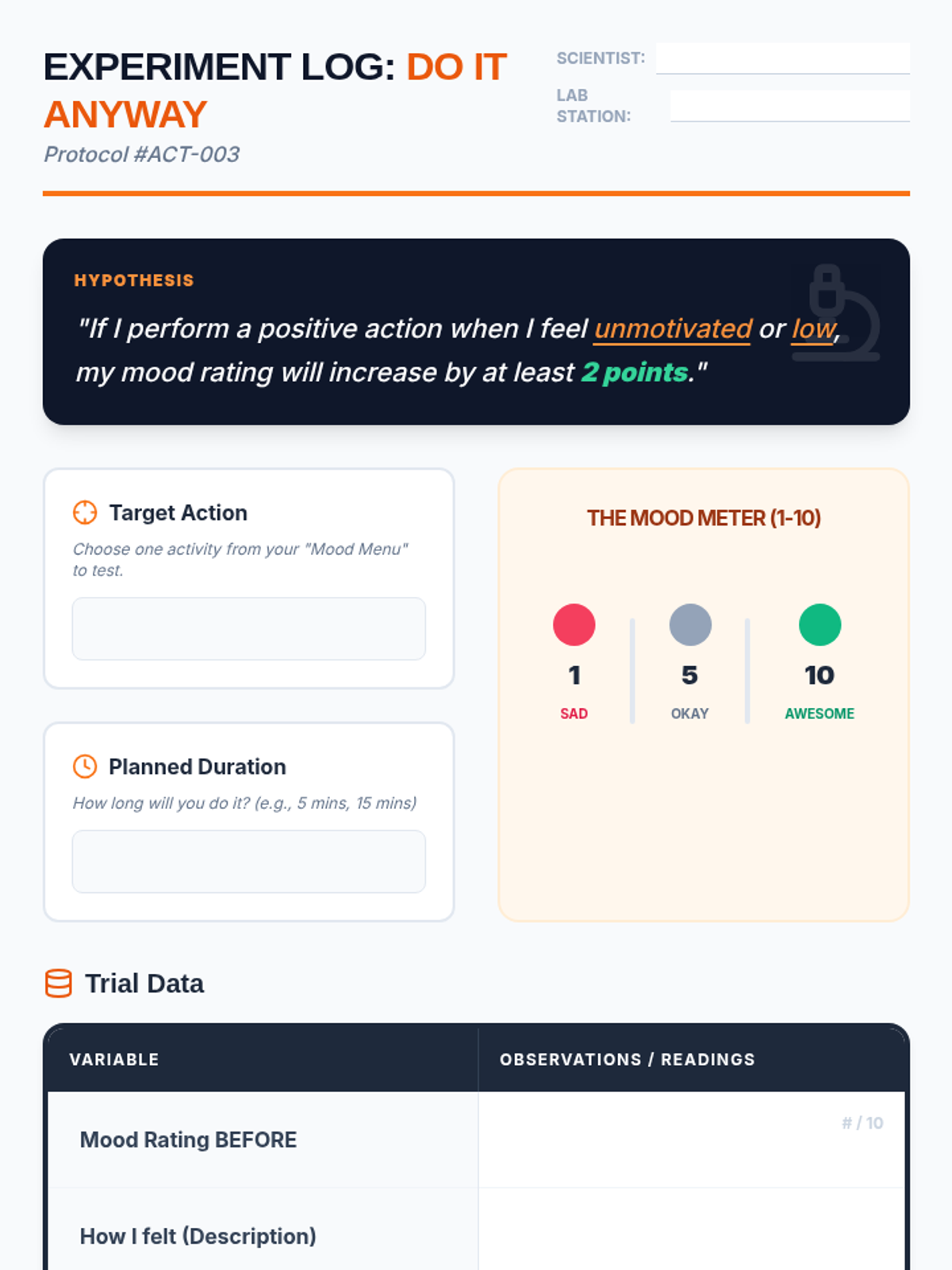
A data collection log for the 'Do It Anyway' experiment, allowing students to track their mood ratings before and after engaging in a positive action.
Introductory slides for the 'Do It Anyway' experiment, explaining the concept of 'acting opposite' and how to track mood data for a personal science experiment.
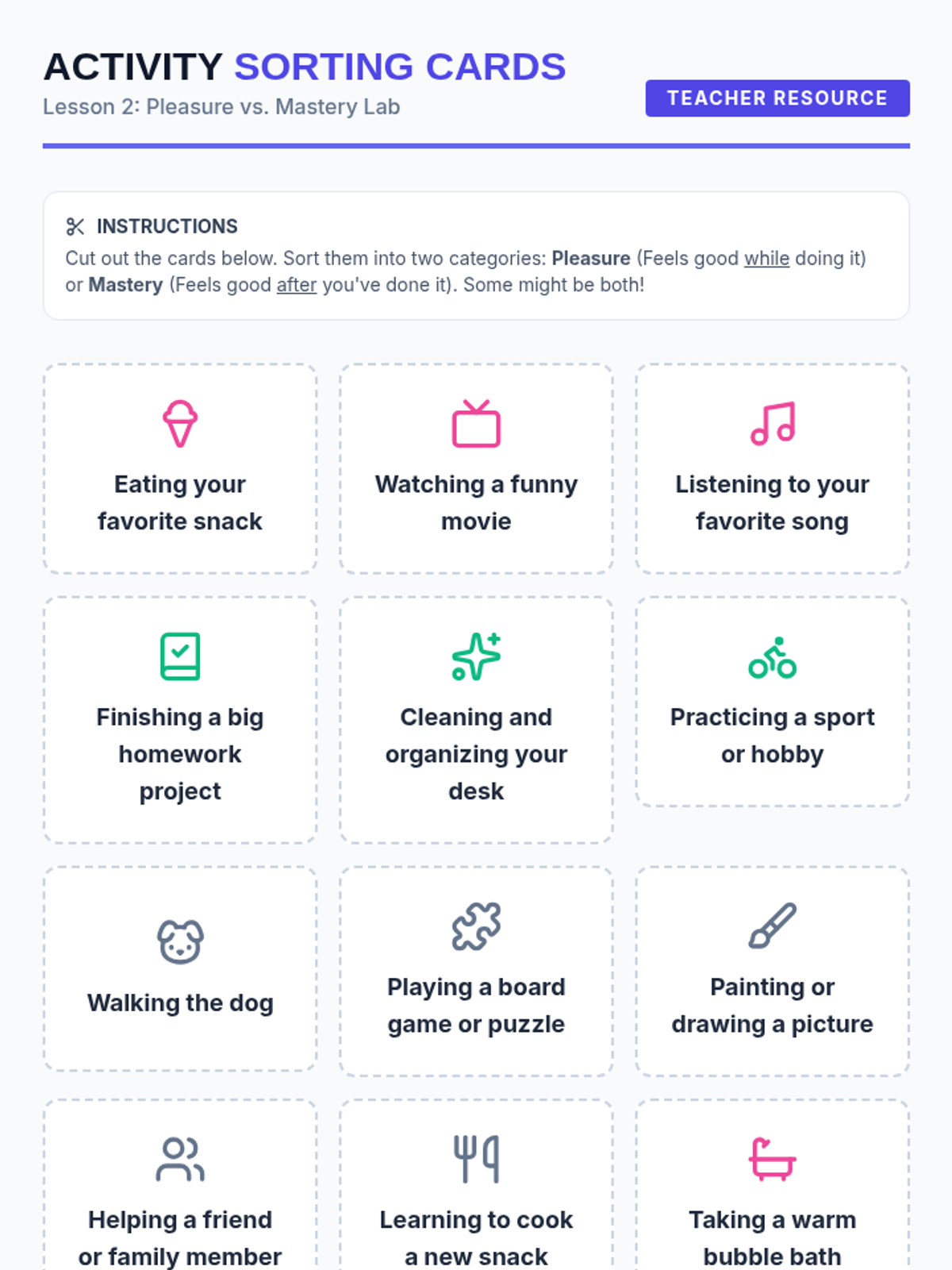
Sorting cards and a categorization t-chart for Lesson 2, helping students distinguish between pleasure-based and mastery-based activities.
Introductory slides for the 'Pleasure and Mastery' lesson, explaining the difference between 'Fun fuel' and 'Proud fuel' and the importance of a balanced activity diet.
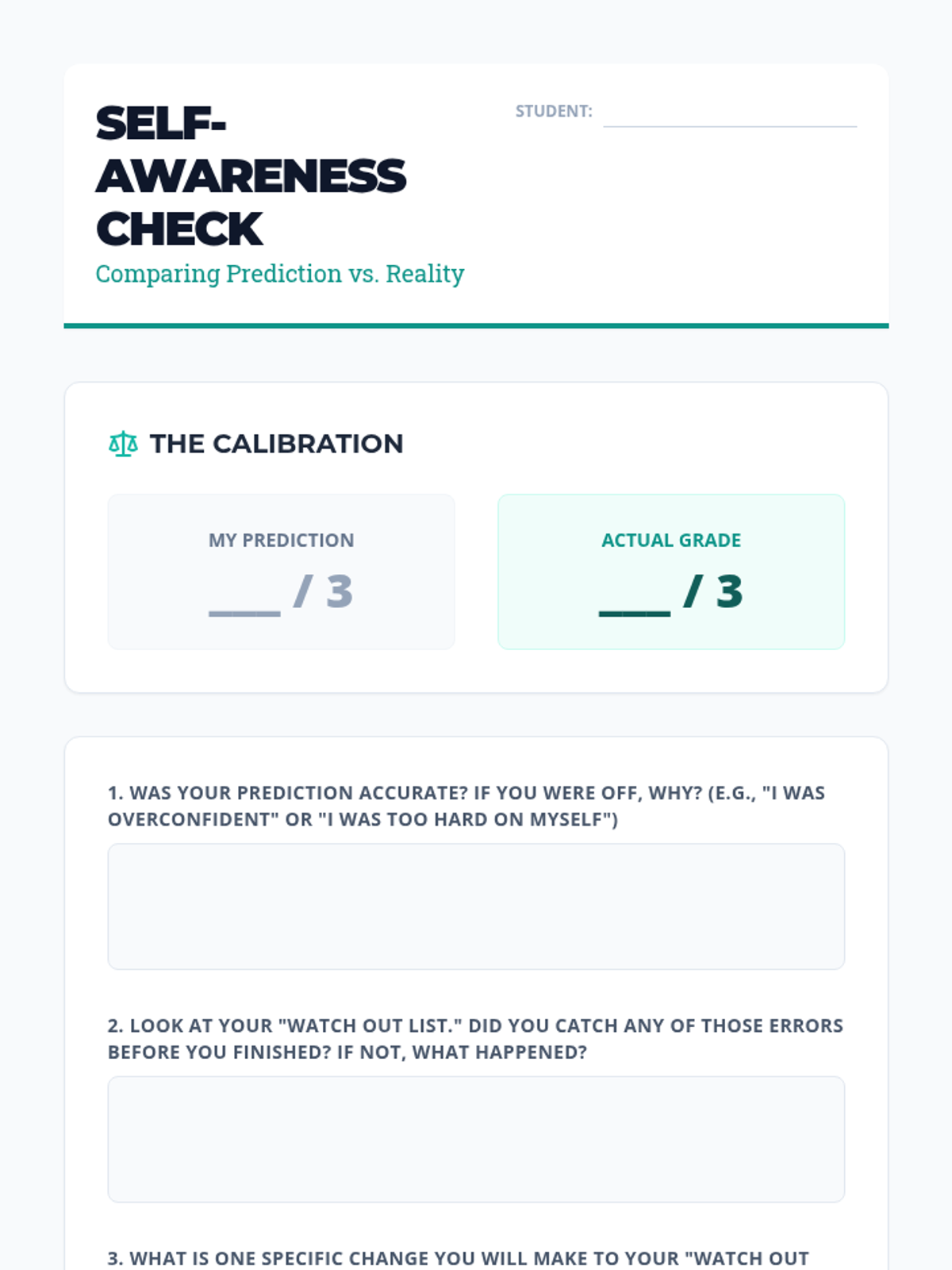
A final reflection sheet for students to compare their quiz predictions with their actual grades, evaluating the effectiveness of their metacognitive strategies.
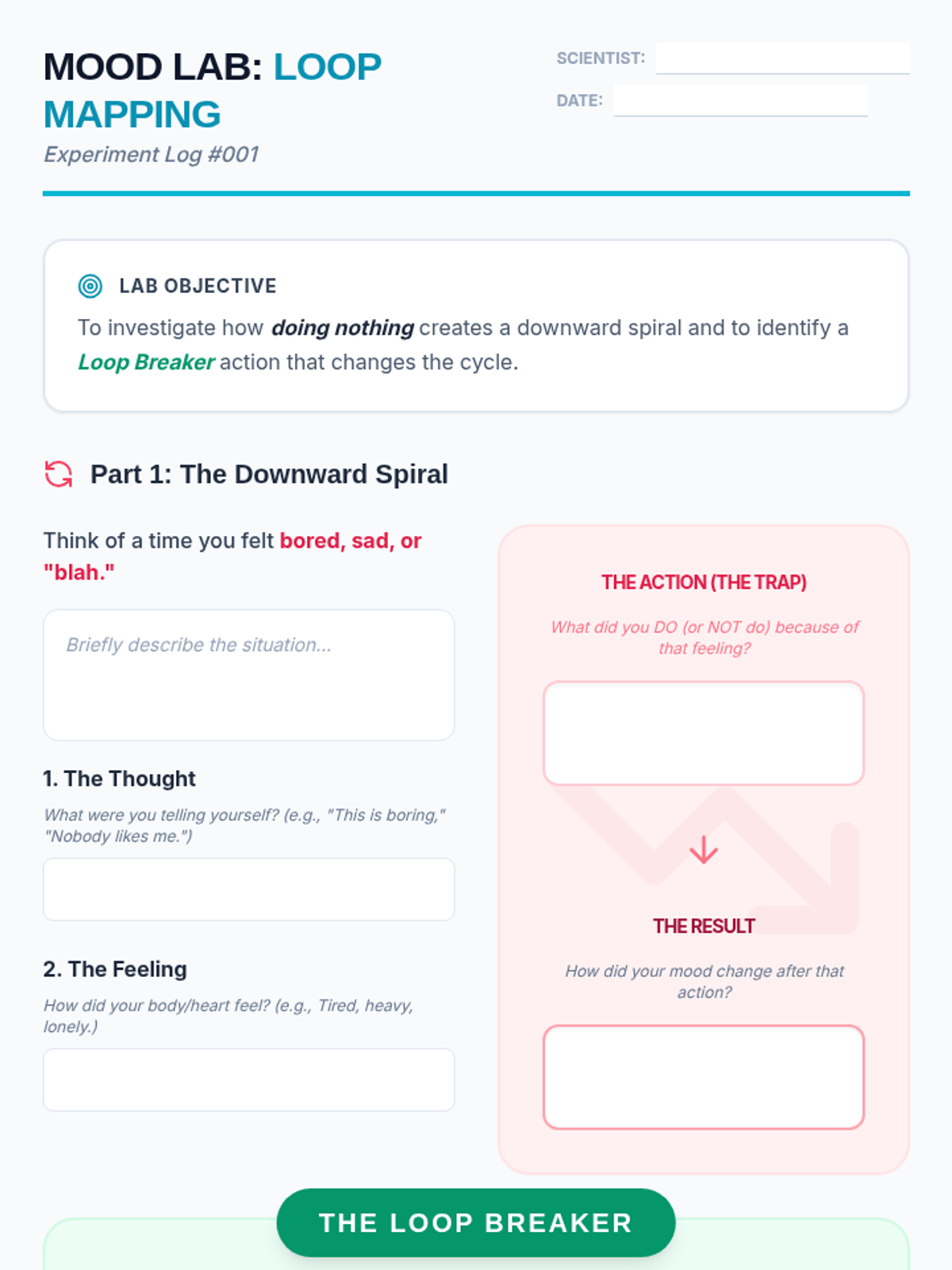
A lab notebook style worksheet for students to map out their own action-emotion loop, identifying a 'downward spiral' moment and a 'loop breaker' action.
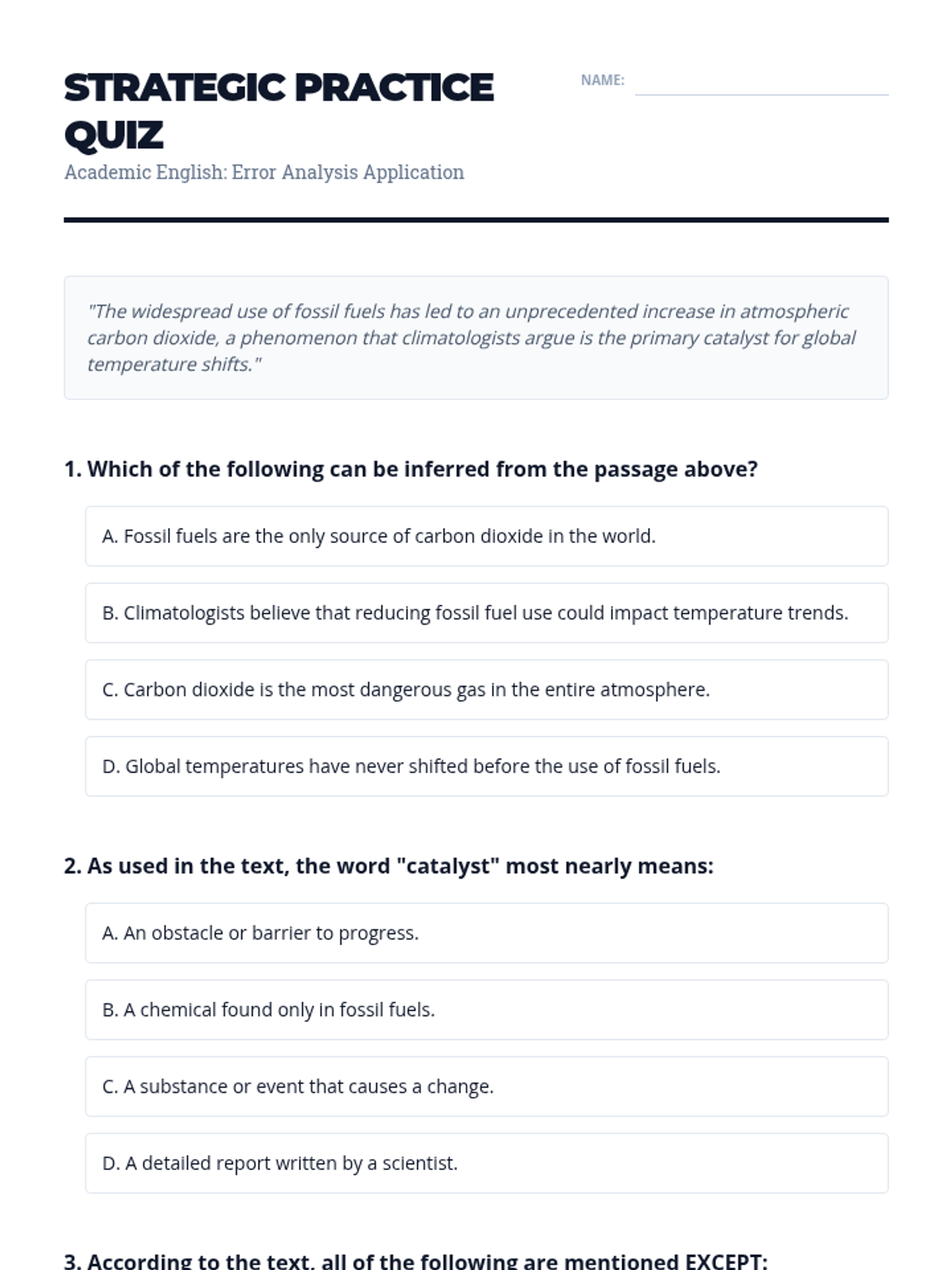
A short Academic English quiz designed to test students' application of their "Watch Out List," including a mandatory pre-grading self-reflection and score prediction section.
Final slides for the sequence focusing on the "Showtime" assessment. It introduces the score prediction challenge and real-time error analysis.
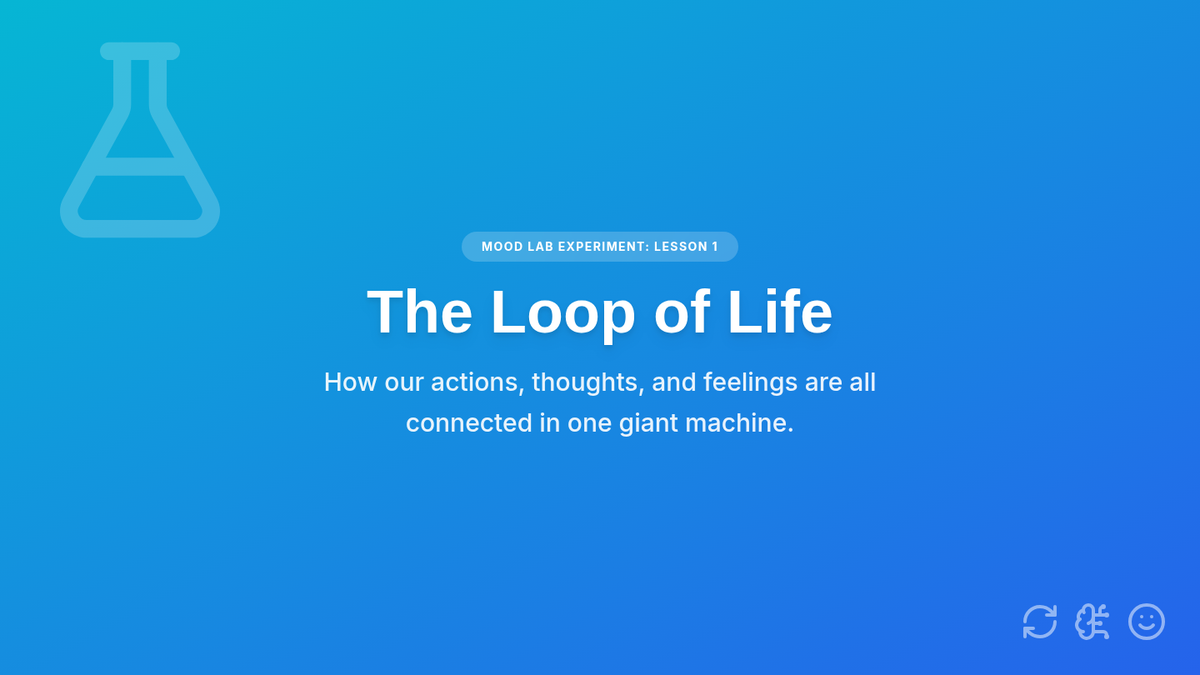
Introductory slides for the 'Loop of Life' lesson, featuring the human machine hook and visual representations of the thought-feeling-action cycle.
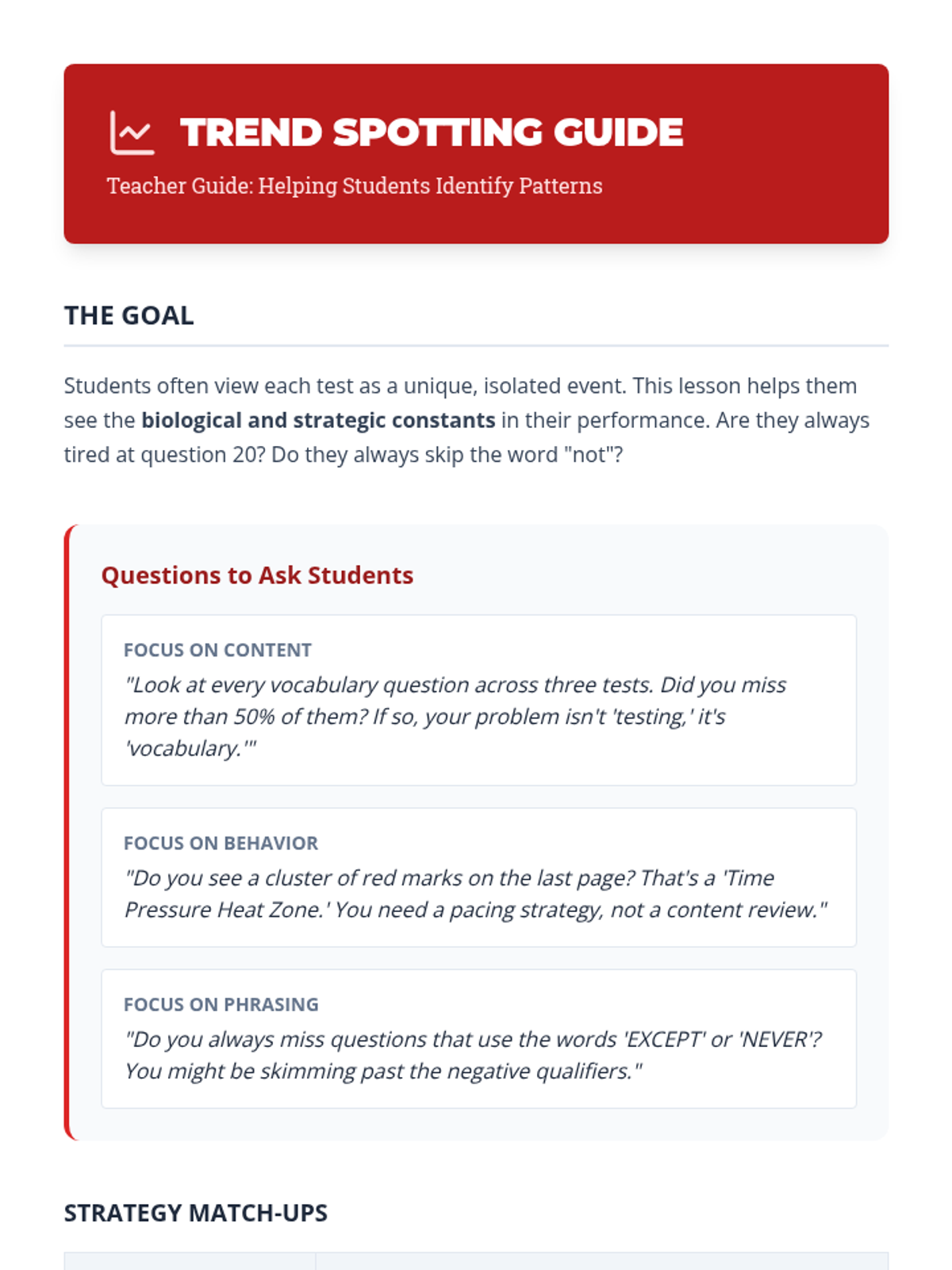
A guide for teachers to help students interpret their error data and connect patterns to specific defensive strategies.
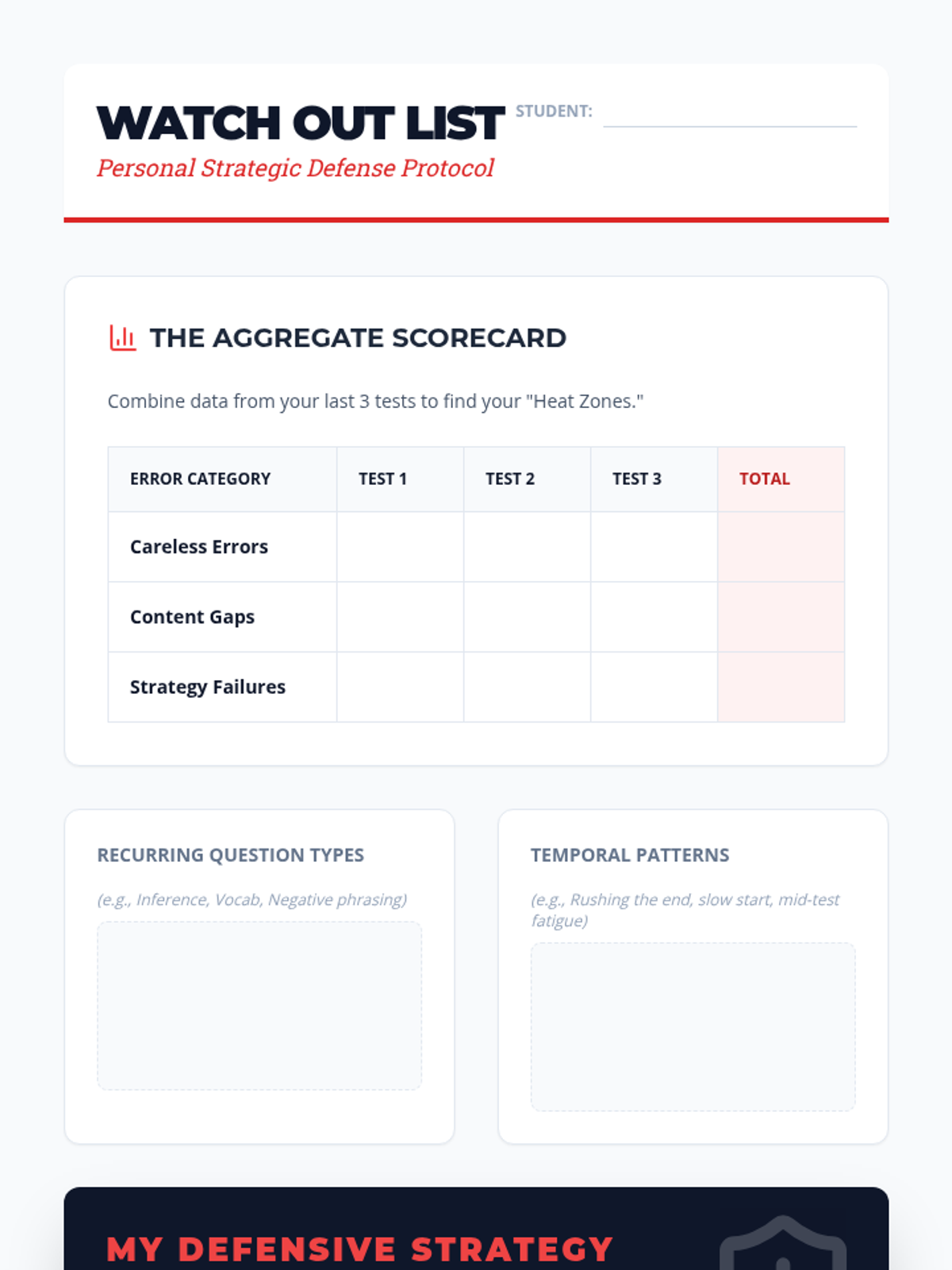
A student worksheet for aggregating error data across multiple assessments and distilling those patterns into a "Watch Out List" for future defense.
Slides for Lesson 4 that use a "Heatmap" analogy to teach students how to aggregate error data and identify recurring personal patterns.
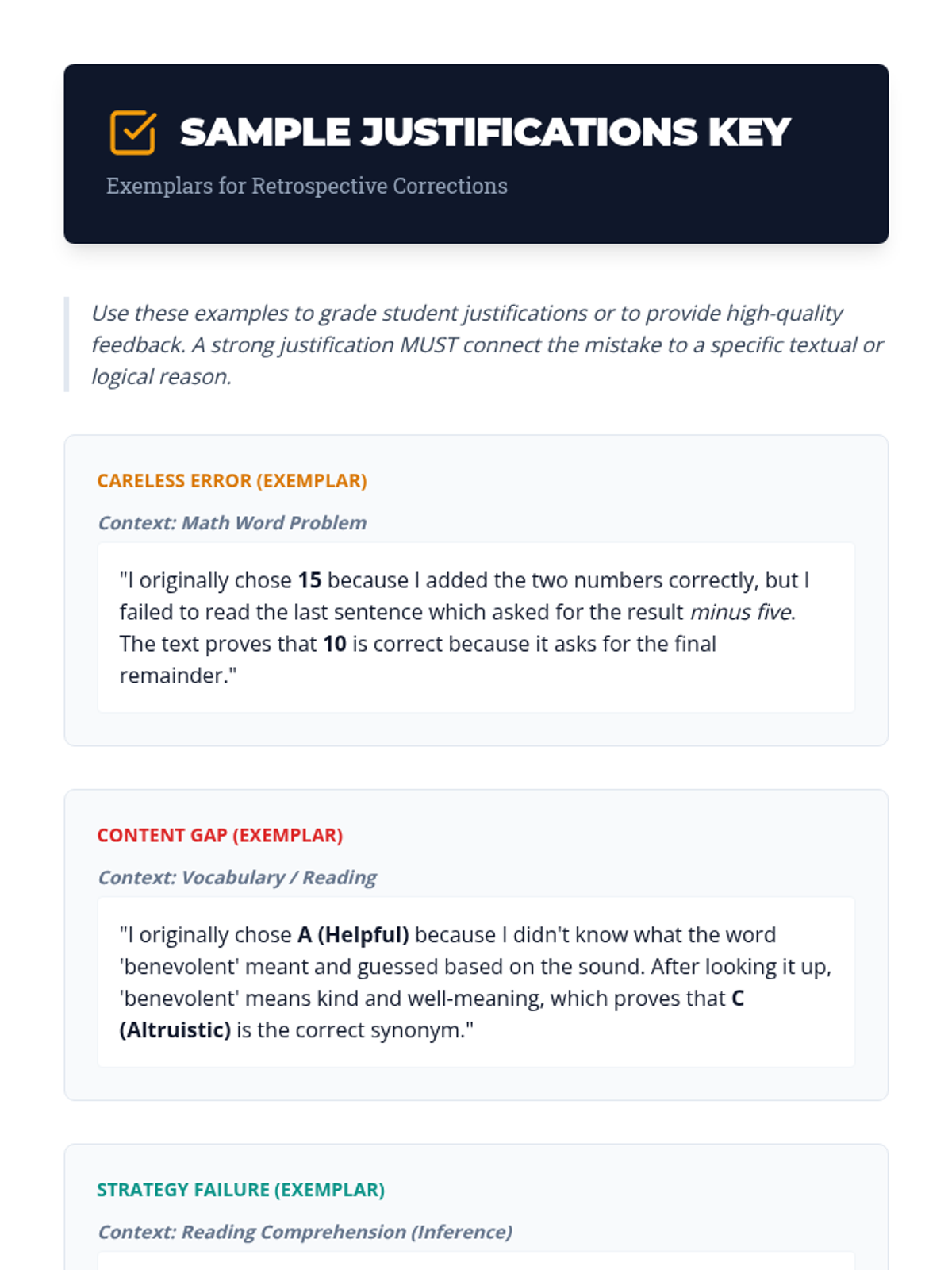
An answer key/exemplar guide for teachers to evaluate student justification statements, showing the difference between weak and mastery-level corrections.
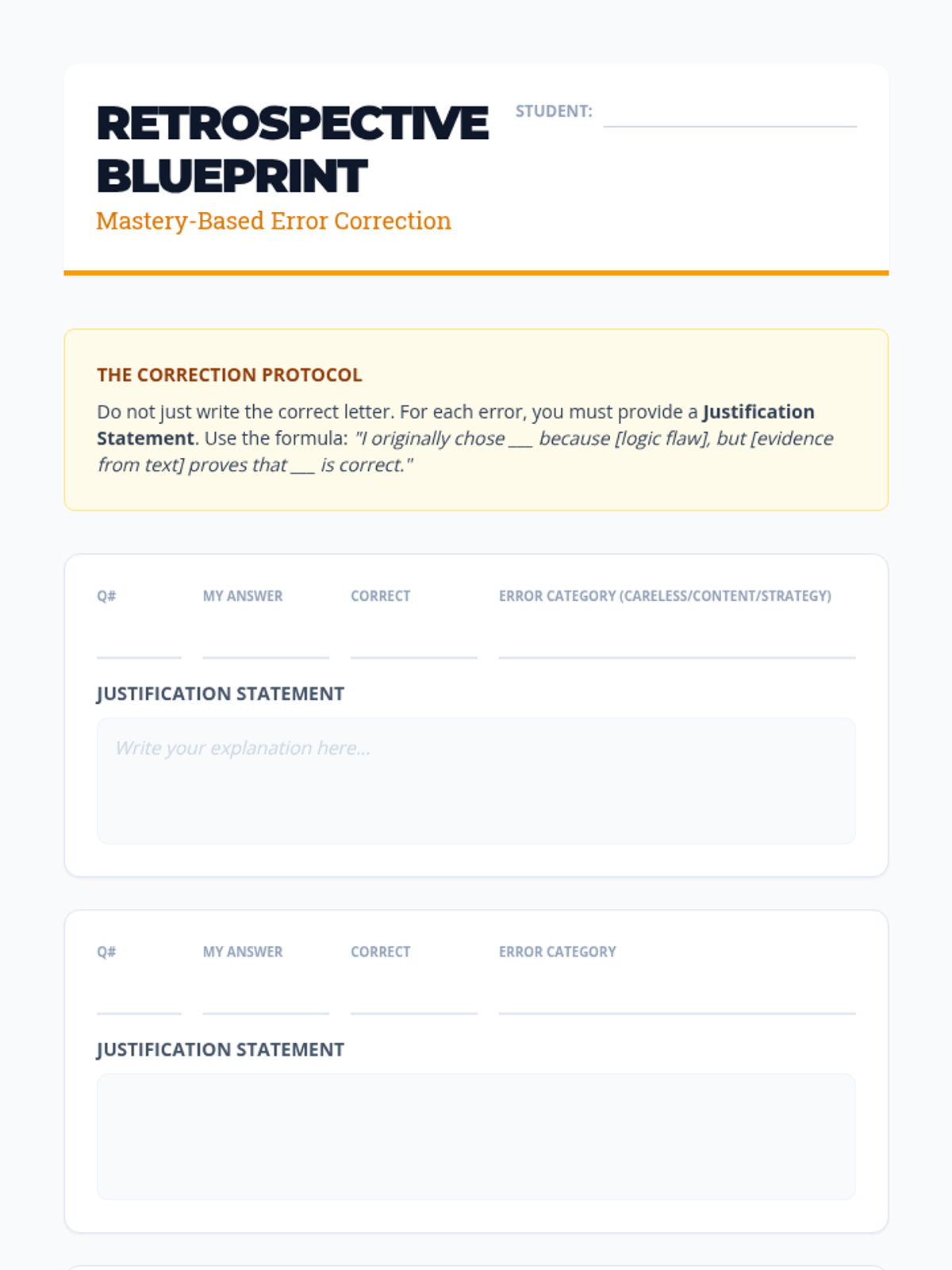
A template for students to perform deep error corrections, requiring them to write justification statements using a specific logic-based formula.
Slides for Lesson 3 introducing the "Justified Fix" method. It emphasizes that students must explain why they were wrong and why the new answer is right using evidence.