Answer key for the Sentence Scramble Worksheet, using a green 'passed inspection' theme.
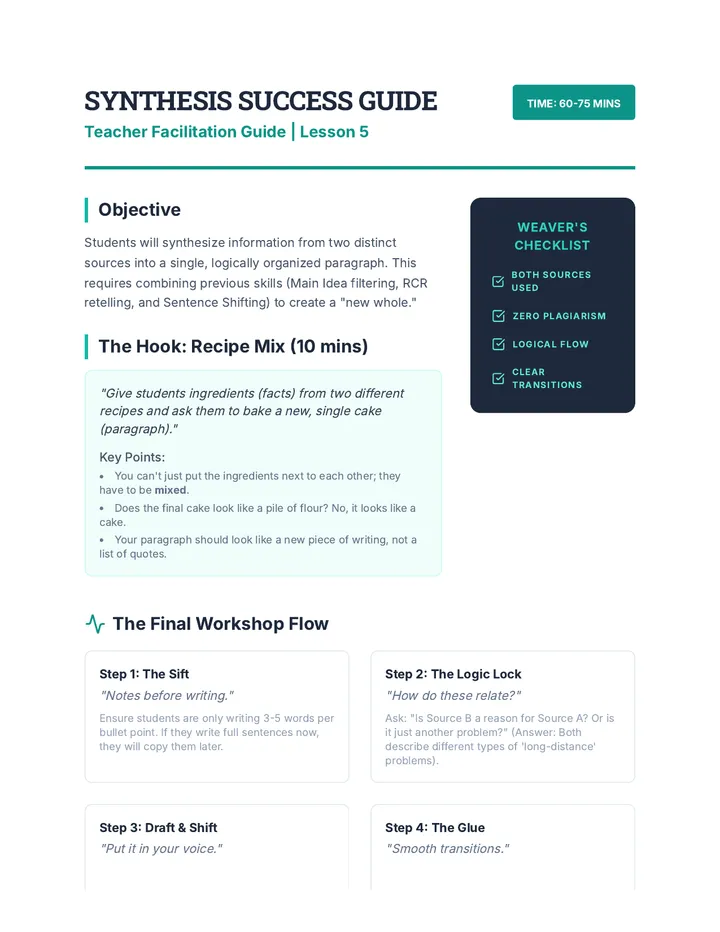
Teacher guide for "The Source Weaver" lesson. It outlines the synthesis process, provides a hook activity, transition words for ESL support, and a sample synthesized paragraph.
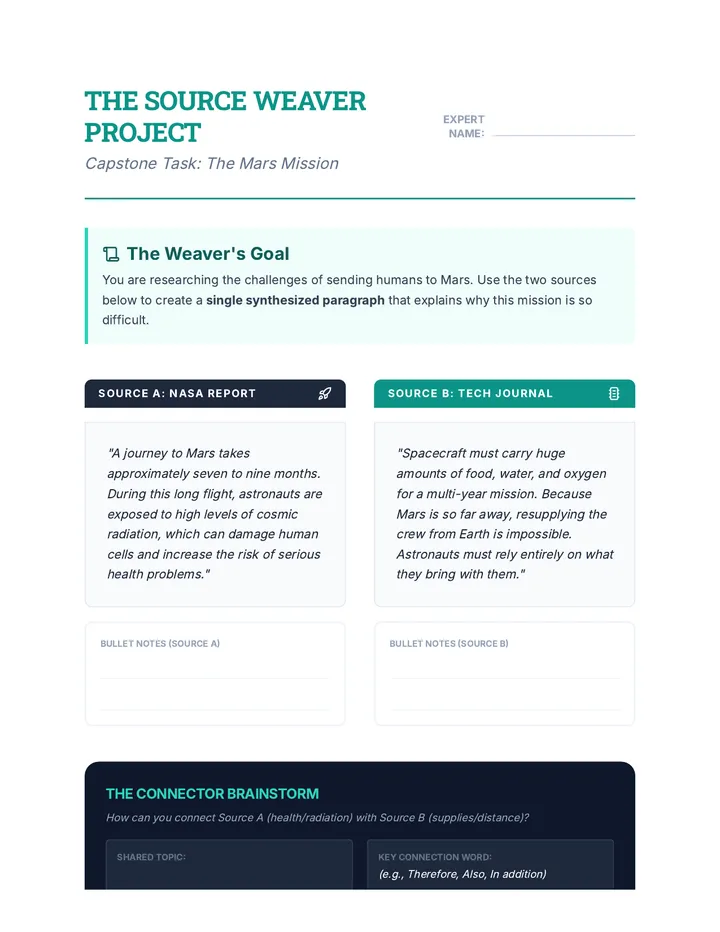
Capstone student project for "The Source Weaver" lesson. Students analyze two short texts about Mars, take notes, and synthesize the information into a single coherent paragraph using their own vocabulary and sentence structures.
Visual slides for "The Source Weaver" lesson. These slides introduce students to the concept of synthesis as connecting ideas from multiple sources to create a new, coherent whole.
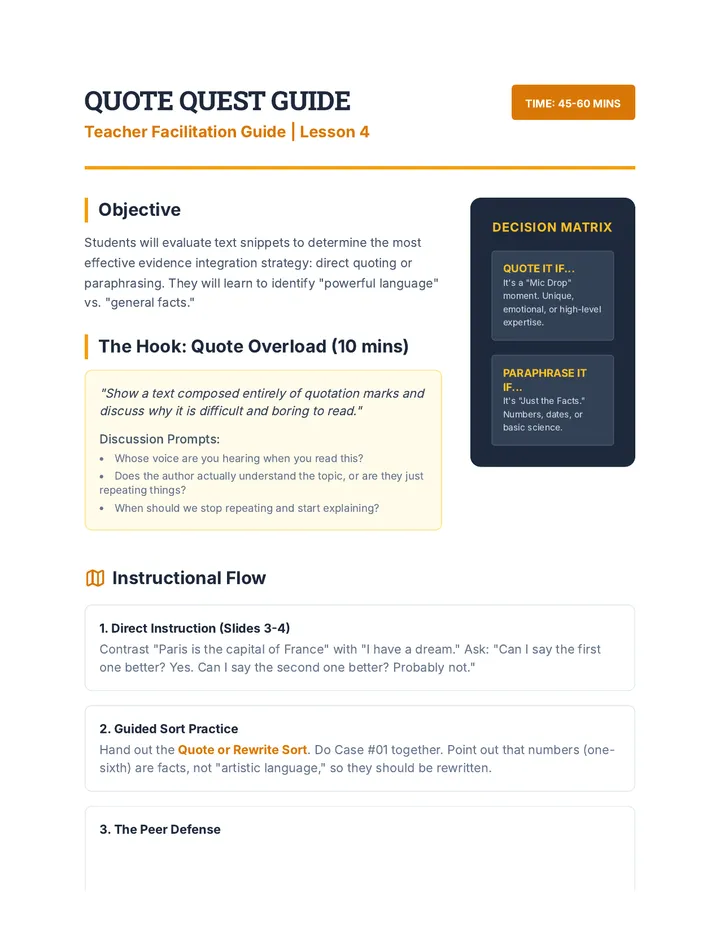
Teacher guide for "Quote Quest" lesson. It outlines the decision-making criteria for quoting vs. paraphrasing, provides instructional steps, and includes an answer key for the sorting activity.
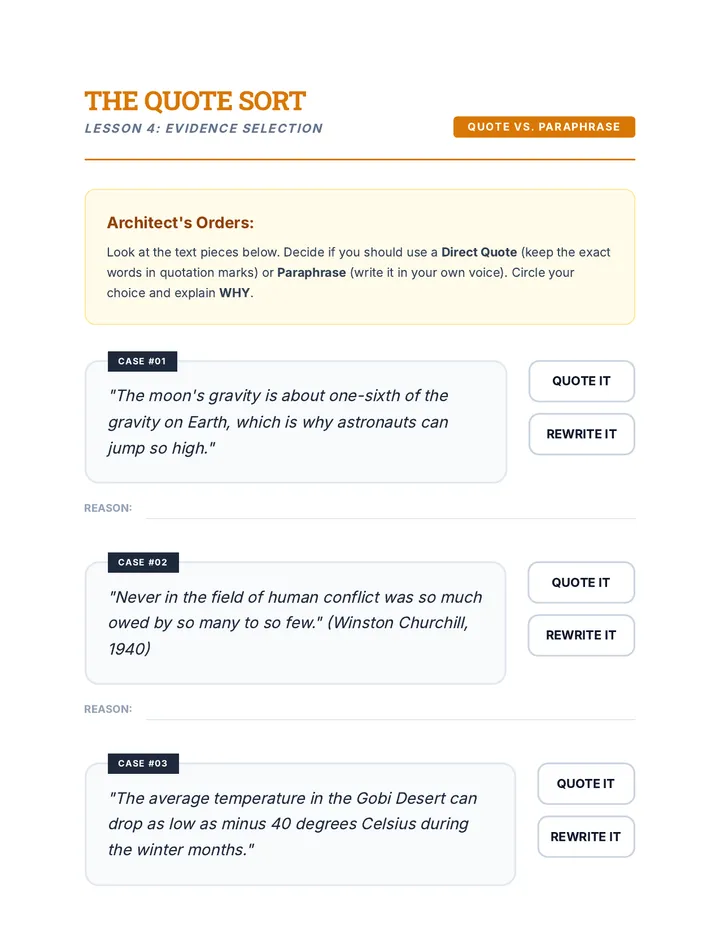
Student activity for "Quote Quest" lesson. It presents several textual scenarios and requires students to decide whether to use a direct quote or a paraphrase, providing a justification for their choice.
Visual slides for "Quote Quest" lesson. These slides help students distinguish between when to use direct quotes for impact and when to paraphrase for factual clarity.
Teacher guide for "Sentence Shifters" lesson. It outlines the instructional flow for synonym substitution and active-to-passive transformation, including a sample answer key.
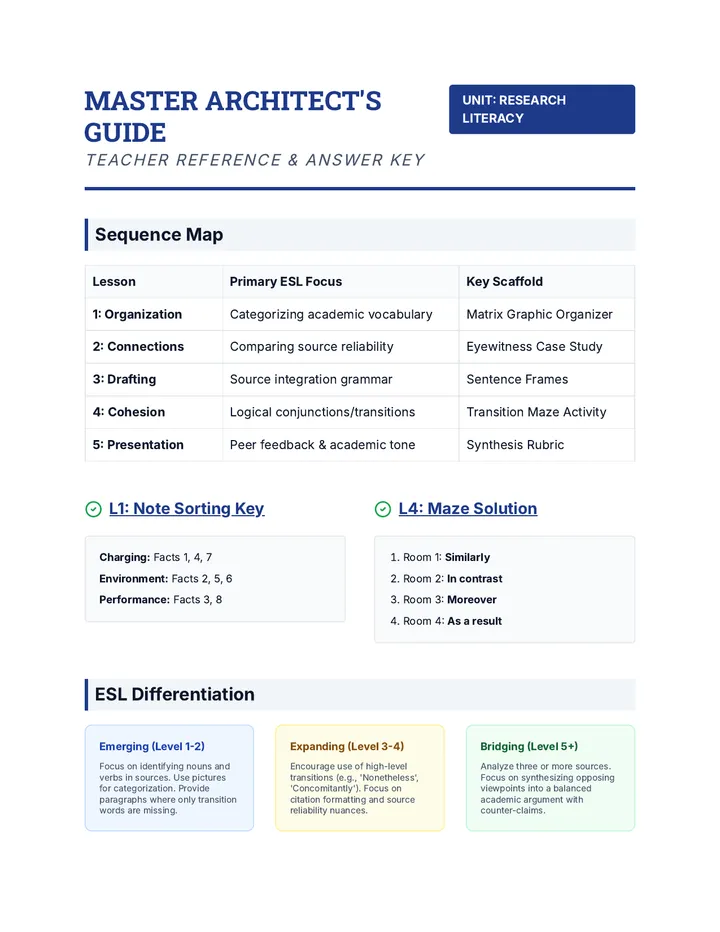
A comprehensive teacher-facing guide for the synthesis sequence. Includes the sequence map, answer keys for the Note Sorting and Transition Maze activities, differentiation strategies for various ESL levels, and a quick-check grading rubric.
Student worksheet for "Sentence Shifters" lesson. It includes a synonym bank and tiered practice exercises for synonym replacement, active-to-passive transformation, and combined paraphrasing.
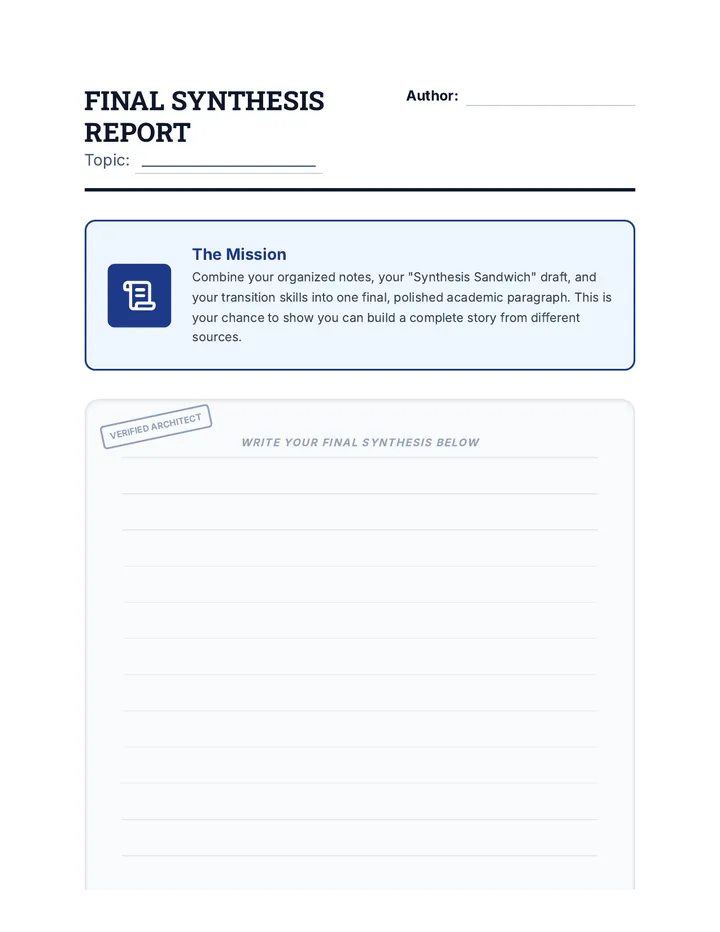
The final synthesis report template for students to write their completed academic paragraph. Includes a section for peer feedback from the Gallery Walk activity.
Visual slides for "Sentence Shifters" lesson. These slides introduce students to two primary paraphrasing tools: Synonym Swap and Structure Flip (Active/Passive voice).
Final project slide deck for Lesson 5. Outlines the synthesis project goals, explains the peer-review Gallery Walk process, and provides a final polishing checklist for students' academic work.
Teacher guide for "The Voice Lab" lesson. It outlines the 'Read, Cover, Recite' protocol, providing a hook activity, instructional steps, and specific ESL scaffolds for concept retrieval.
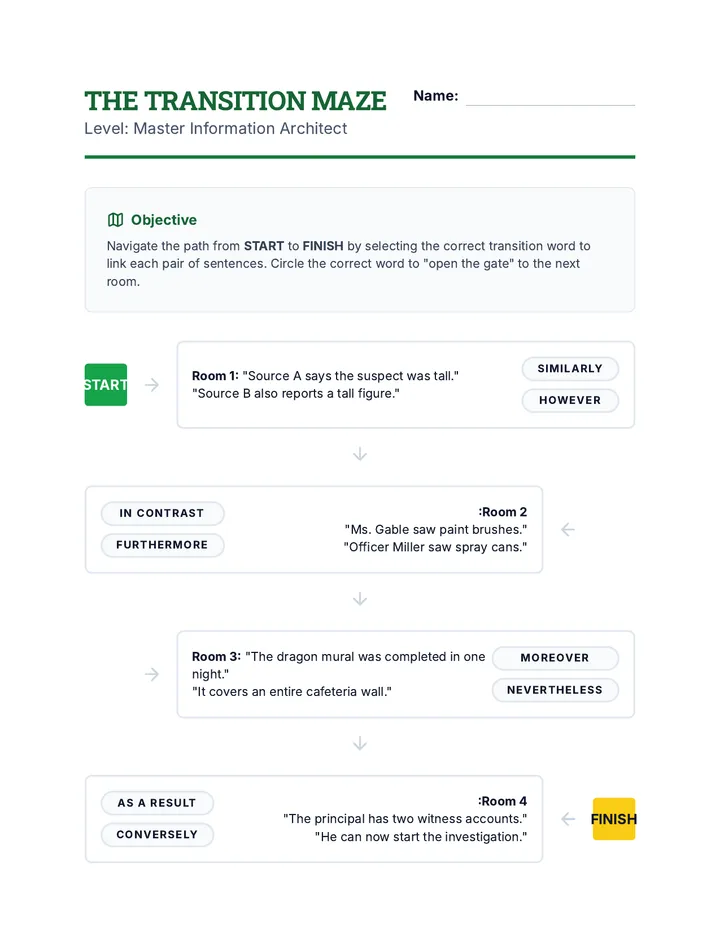
A game-based worksheet for Lesson 4 where students navigate a 'maze' by choosing the correct transition words to link sentences. Includes a section for practicing complex sentence structure with semicolons and commas.
Final assessment check for the Citation Mastery lesson. Includes multiple choice on error identification, a matching section for bibliographic terms, and a short response on the importance of publication dates.
Student activity cards for "The Voice Lab" lesson. These cards provide short, interesting facts that students must read, cover, and orally paraphrase to a partner to practice the RCR method.
Student practice worksheet for identifying bibliographic data and formatting MLA citations. Includes a matching exercise, a scrambled citation activity, and a template for citing their own source.
Slide deck for Lesson 4 on transitions and cohesion. Compares 'choppy' vs. 'smooth' writing, categorizes transition words (Addition, Contrast, Evidence), and explains the grammatical rules for using them.
Educational slides teaching students the technical rules of MLA citations, where to find bibliographic data on a source, and the standard formula for a website citation.
Visual slides for "The Voice Lab" lesson. These slides introduce the 'Read, Cover, Recite' (RCR) method for oral paraphrasing, emphasizing the separation of conceptual understanding from linguistic structure.
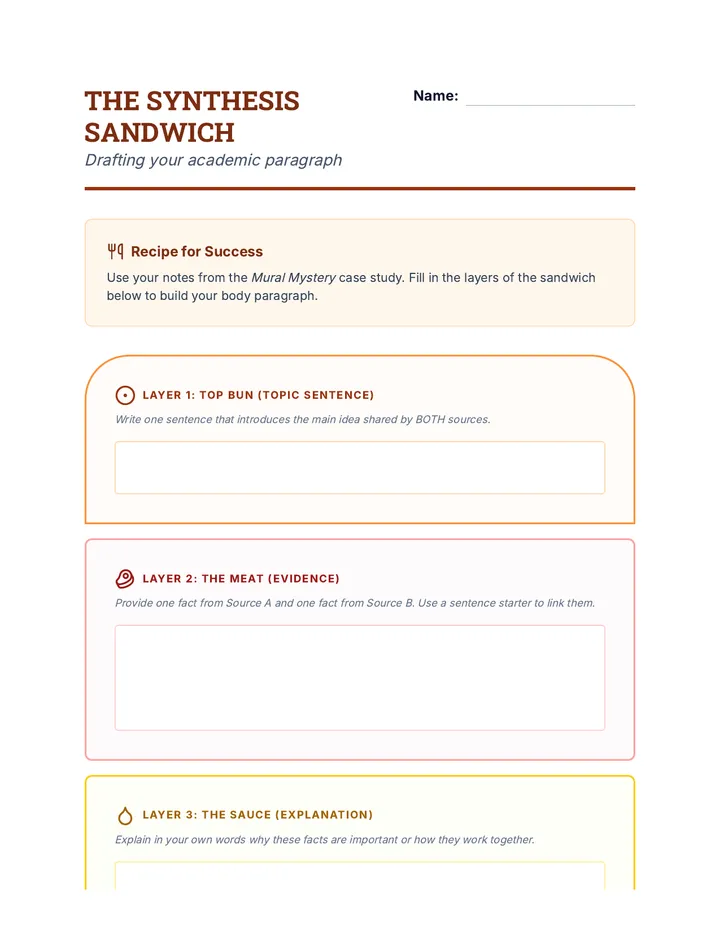
A graphic organizer for drafting a synthesis paragraph. Using a 'sandwich' metaphor, it guides students through writing a topic sentence, integrating evidence from multiple sources, and providing an explanation/conclusion. Includes a sentence starter toolbox.
Slide deck for Lesson 3 on drafting synthesis paragraphs. Uses the 'Synthesis Sandwich' analogy to teach paragraph structure (Topic-Evidence-Explanation) and provides sentence frames for integrating multiple sources.
Teacher guide for "The Idea Filter" lesson. It provides instructional flow, ESL scaffolding strategies, discussion prompts, and a sample answer key for the student worksheet.
A support reference guide for academic writing, featuring signal verbs, paraphrasing sentence starters, and transition words for synthesis. Designed to help ESL students use formal academic voice.
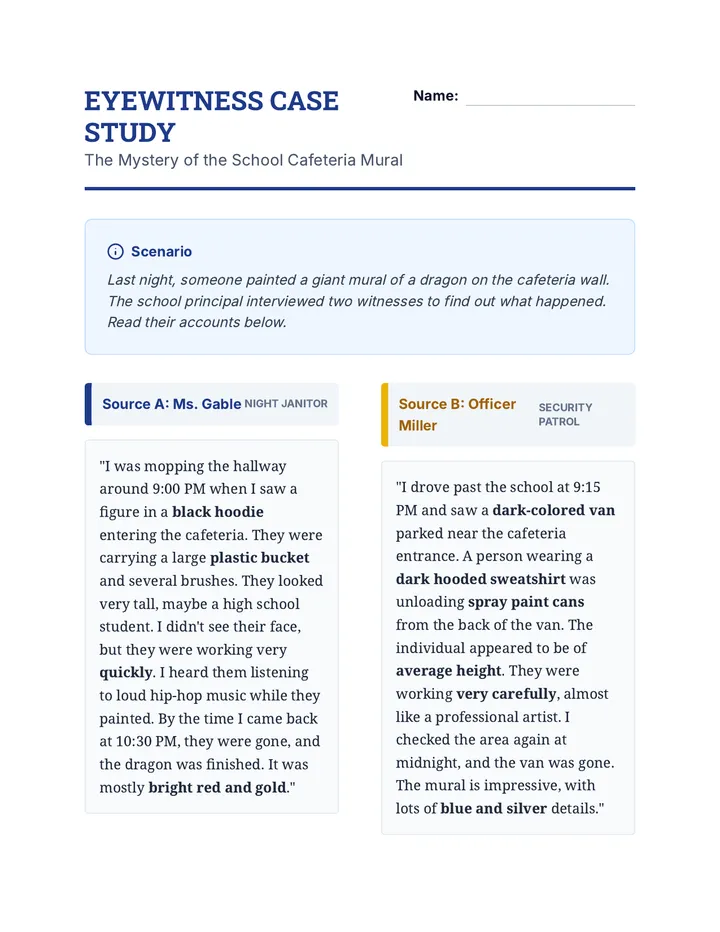
A reading passage and analysis worksheet for Lesson 2. Features two conflicting eyewitness accounts of a school mural event, and provides a Venn diagram and critical thinking questions to help students practice identifying connections and contradictions.
Student activity worksheet for practicing the 3-step paraphrase method and synthesizing information from two conflicting sources. Includes self-check checklist for plagiarism.
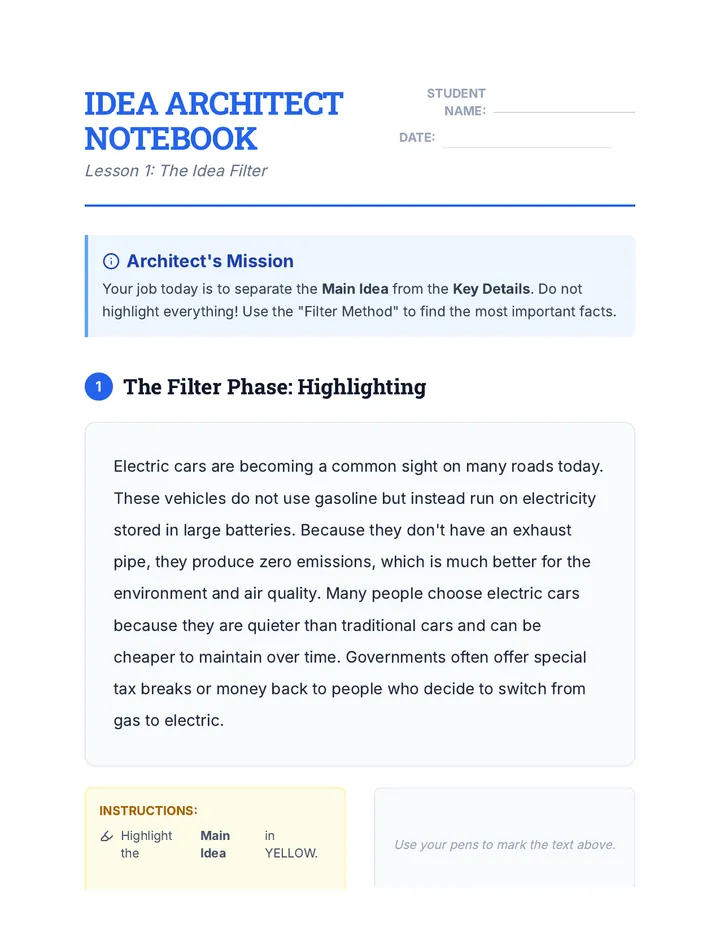
Student worksheet for "The Idea Filter" lesson. This activity guides students through highlighting a passage for main ideas and key details, followed by translating those highlights into bulleted notes.
Educational slides teaching students how to read, cover, and rewrite information (the 3-step paraphrase method) and how to synthesize information from multiple sources. Includes visual examples and synthesis bridges.
Slide deck for Lesson 2 on identifying connections across sources. Introduces the 'Source Conversation' concept, the use of Venn diagrams for synthesis, and basic academic sentence starters for comparing ideas.
Visual slides for "The Idea Filter" lesson. These slides introduce students to the concept of distinguishing main ideas from supporting details and emphasize the importance of bulleted note-taking over verbatim copying.
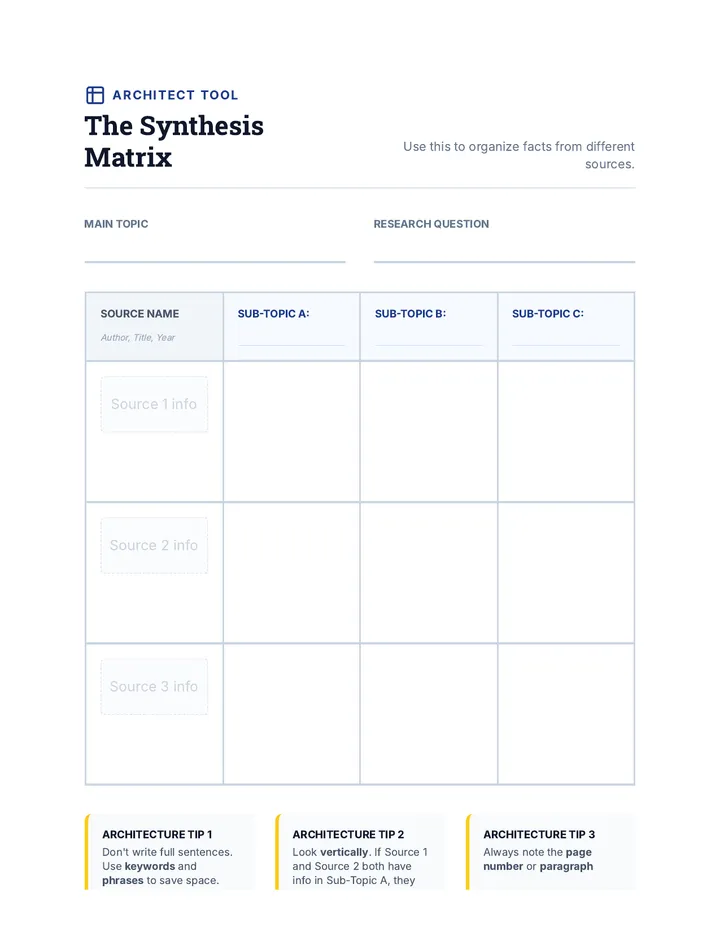
A blank Note Matrix template for students to use when organizing research facts from multiple sources. Designed as an 'architect tool' with spaces for source information and sub-topic columns.
A concise, printable "cheat sheet" for students to use while conducting research. Includes definitions of Boolean operators, exact phrase searching tips, and domain-specific search filters.
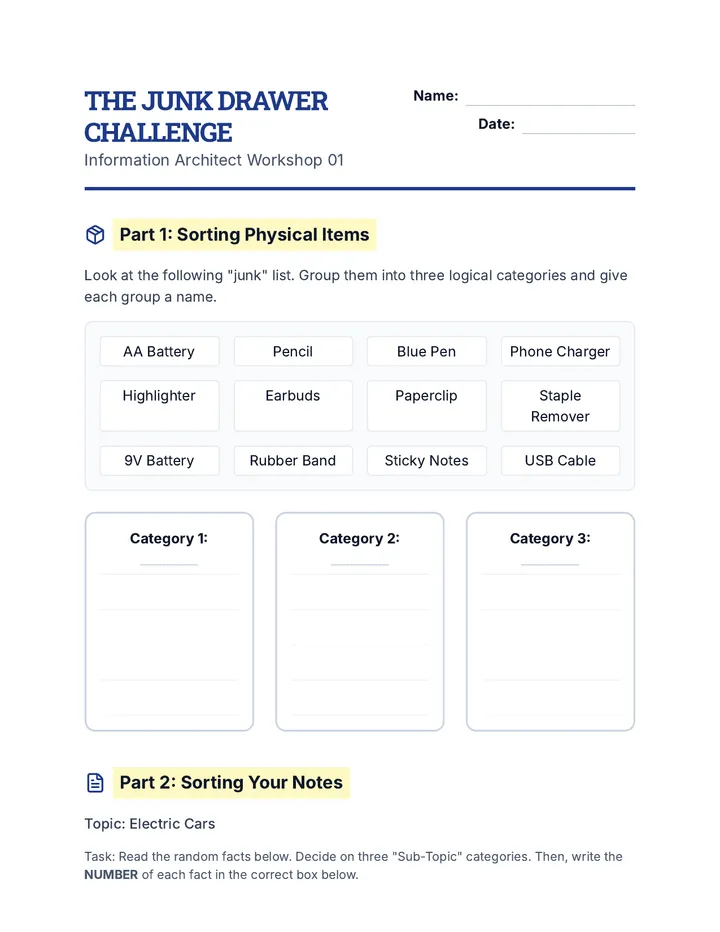
Student worksheet for Lesson 1 focusing on categorization. Part 1 involves sorting physical household items, and Part 2 transitions to sorting research facts about Electric Cars into sub-topics.
Student practice activity for formulating search strings. Includes Venn diagram logic exercises, converting natural language questions to keyword queries, and predicting result volume based on Boolean operators.
Educational slides teaching advanced search strategies, including keyword formulation and the use of Boolean operators (AND, OR, NOT). Includes visual Venn diagrams and tips for exact phrase searching.
Introductory slide deck for Lesson 1, introducing the concept of categorization in research and the 'Data Dump' problem. Uses a 'Junk Drawer' analogy and defines key academic vocabulary.
Teacher analysis guide for the Pacific Northwest Tree Octopus hoax. Provides a breakdown of why the site fails the CRAAP test to help teachers guide student discussion.
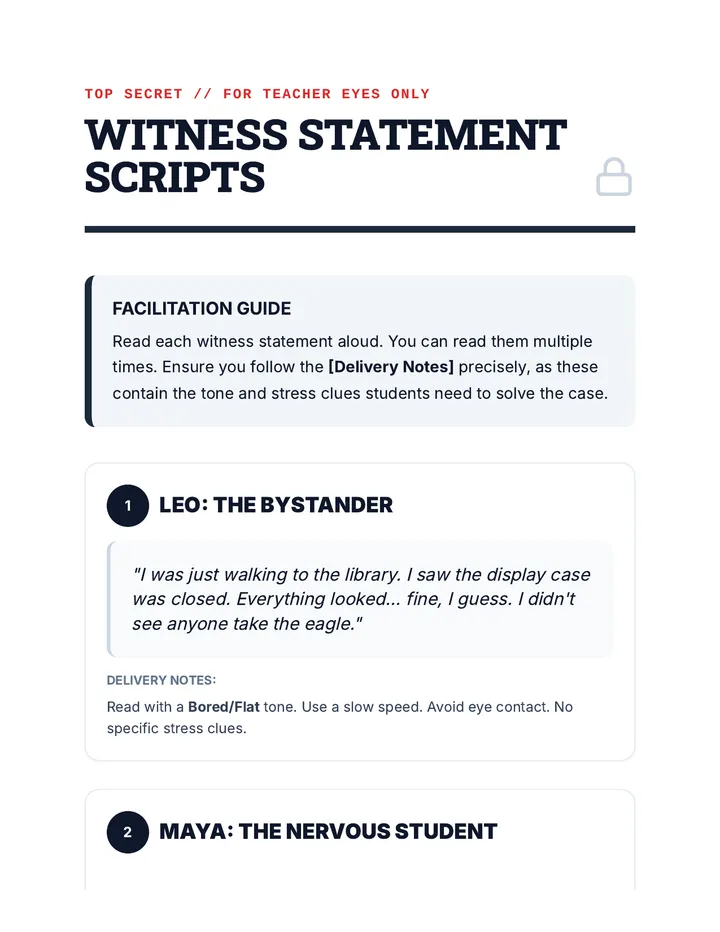
Teacher script for the Lesson 5 mystery simulation. Provides detailed transcripts and delivery notes for five witness statements, incorporating tone, idioms, and hyperbole for students to decode. Includes the solution key.
Student evaluation tool using the CRAAP test (Currency, Relevance, Authority, Accuracy, Purpose). Features a scoring table and a "Verdict" section for students to conclude if a source is reliable.
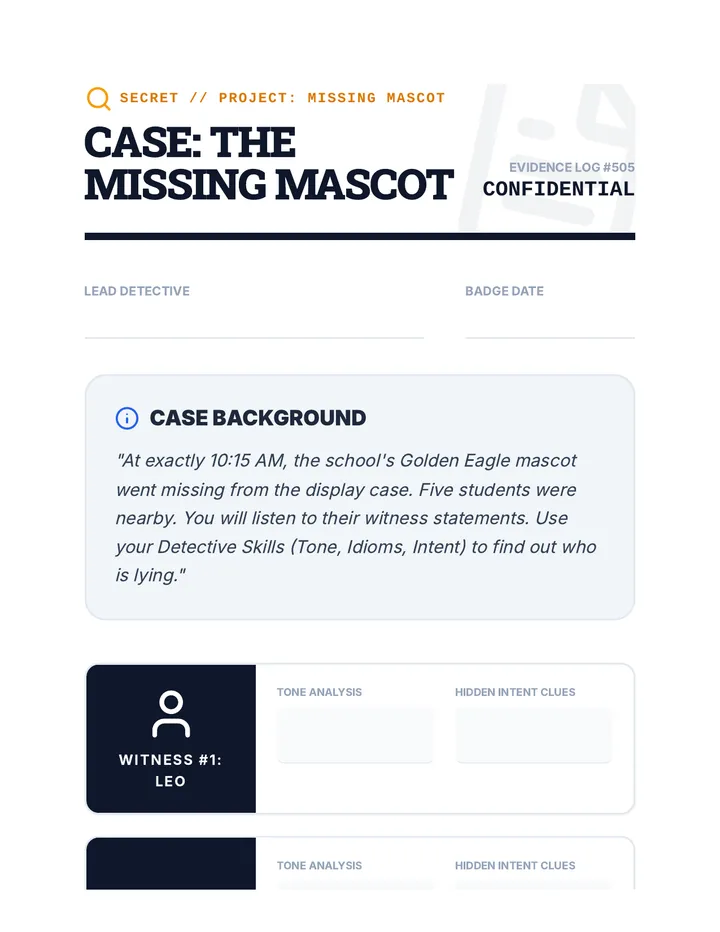
The final assessment for the sequence. Students log tone and intent clues from five witness statements to solve the "Missing Mascot" mystery. Requires synthesis of all listening skills learned in the sequence.
A facilitation guide for teachers for Lesson 5, including the "Beat the Clock" challenge rules, scoring guide, and a complete answer key for the assessment.
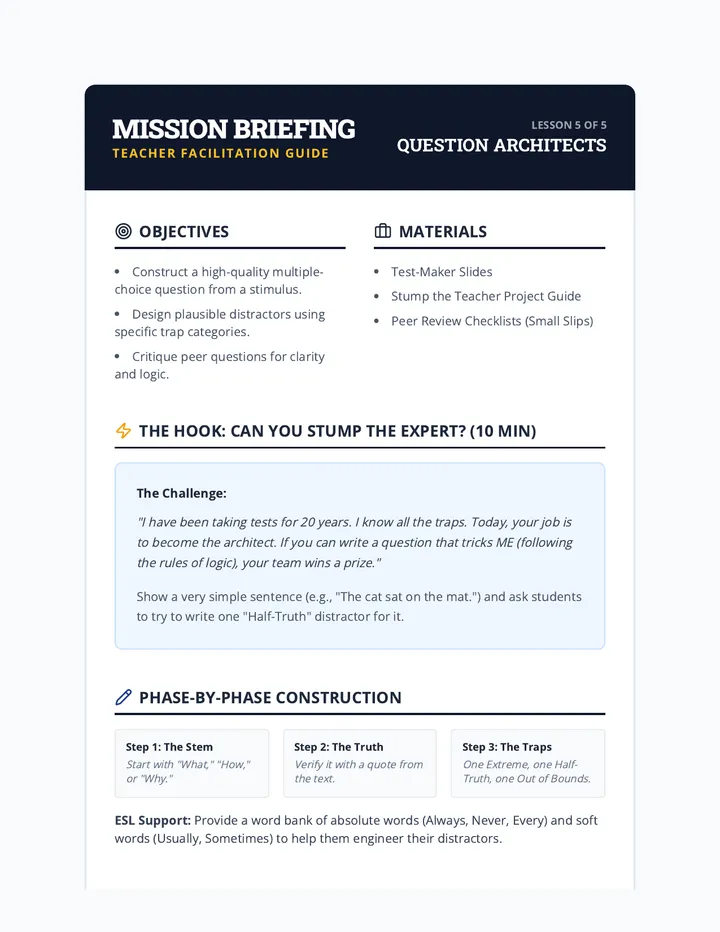
Facilitation guide for Lesson 5, including the "Stump the Expert" hook, phase-by-phase question construction steps, and a peer review protocol.
Educational slides teaching the CRAAP test for website evaluation. Includes visual guides for Currency, Relevance, Authority, Accuracy, and Purpose, with a hook centered on a famous digital hoax.
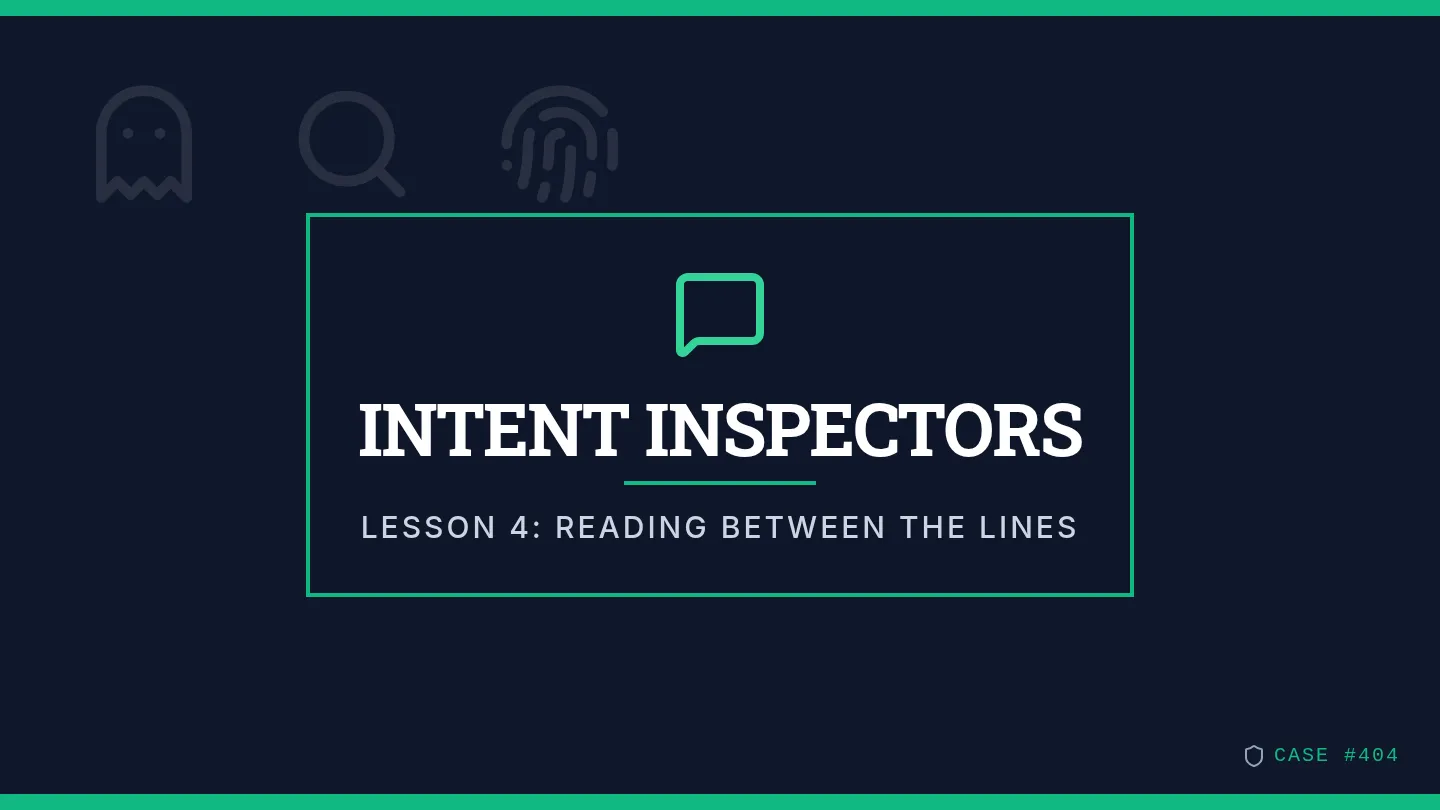
Lesson 4 slides on speaker intent and motivation. Introduces the concept of "hidden messages" and demonstrates how shifting word stress changes the implied meaning of a sentence.
The culminating assessment worksheet for Lesson 5. Features a text about Ancient Egypt with various text features and 10 retrieval questions to be answered in 10 minutes.
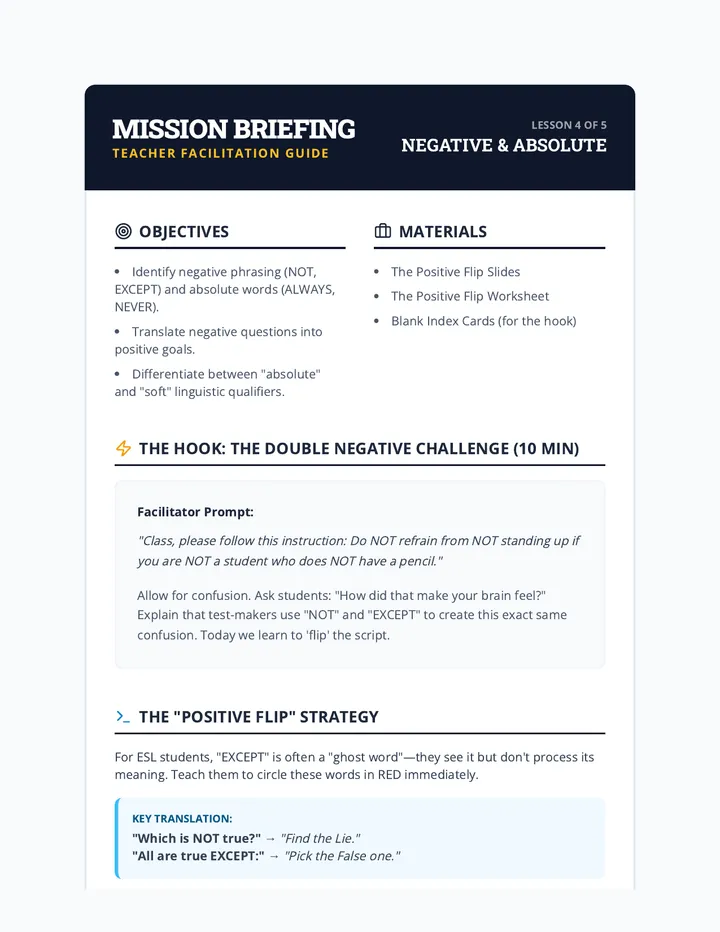
Facilitation guide for Lesson 4, including the "Double Negative Instructions" hook, translation strategies for "NOT" and "EXCEPT," and an answer key for the Positive Flip worksheet.