Set of 8 descriptive Christmas scene cards for students to use in the Subject Question speaking activity.
Final assessment for the Search Strategy Academy unit, covering keywords, Boolean operators, database use, and snippet analysis.
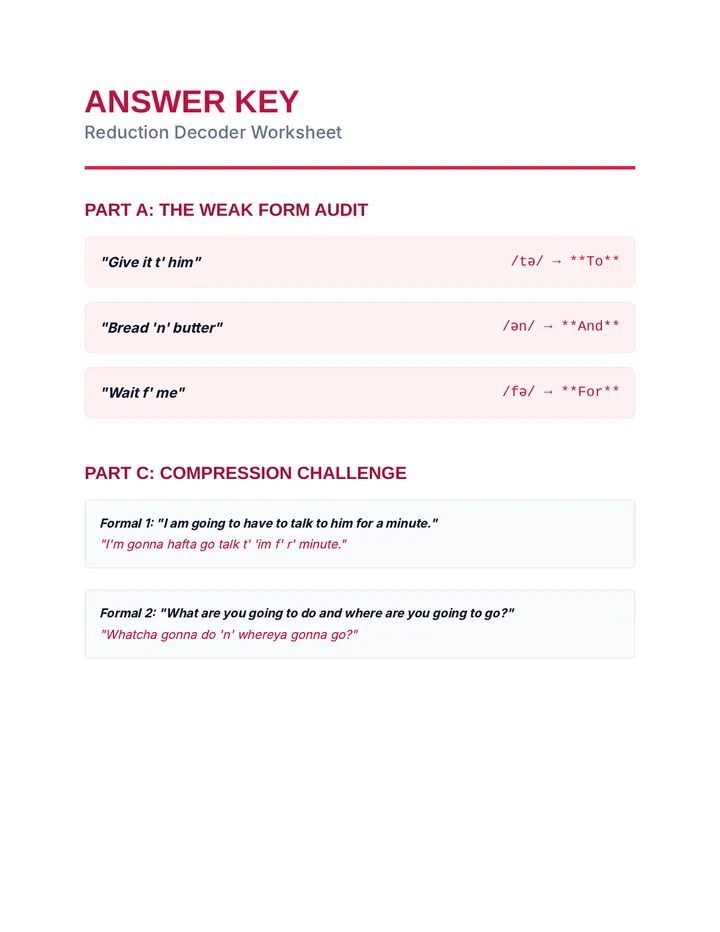
Answer key for the Lesson 4 worksheet on grammatical reductions.
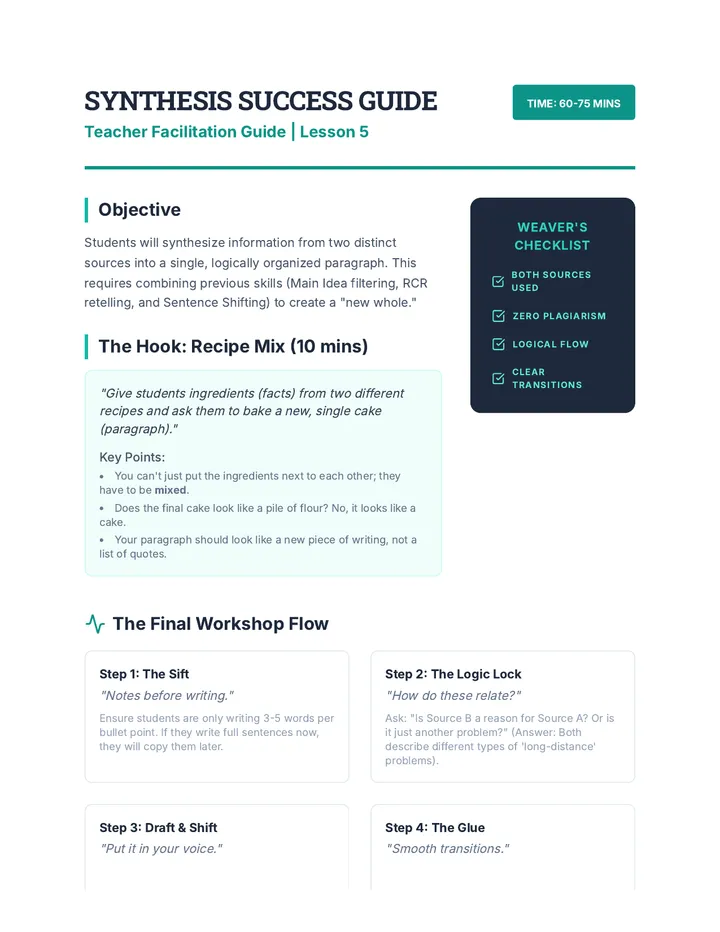
Teacher guide for "The Source Weaver" lesson. It outlines the synthesis process, provides a hook activity, transition words for ESL support, and a sample synthesized paragraph.
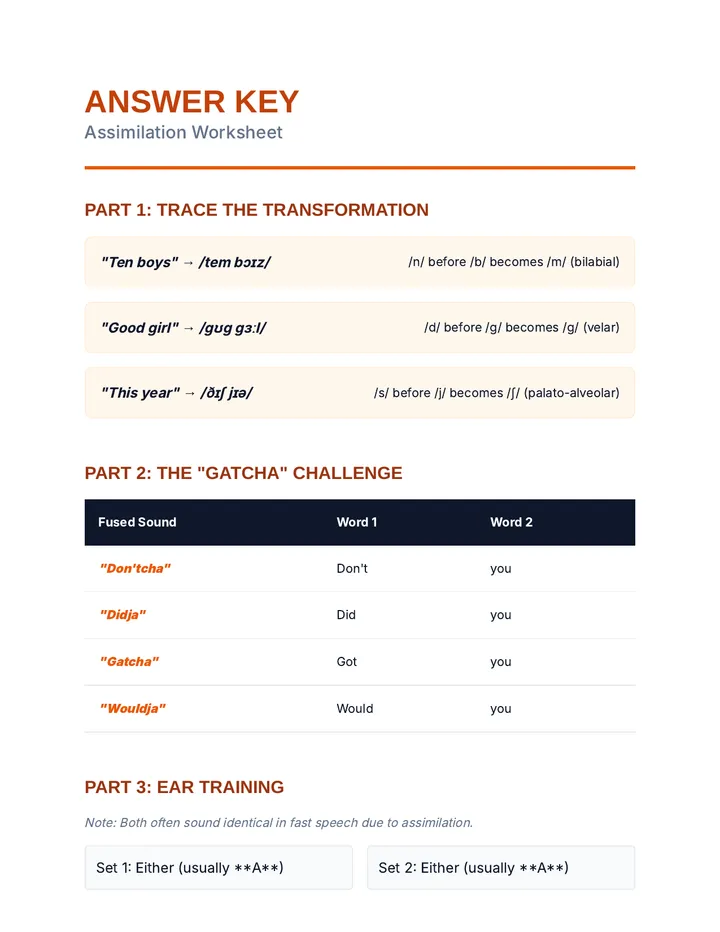
Answer key for the Lesson 3 worksheet on assimilation.
Student scavenger hunt log for Lesson 5, where students document their search strings and answers to obscure research questions.
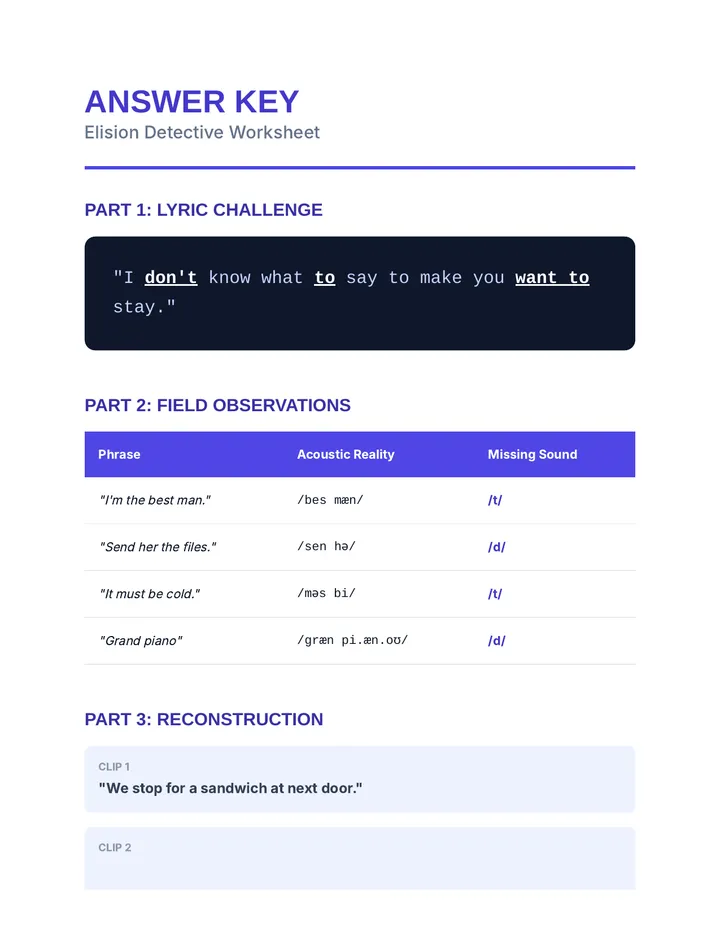
Answer key for the Lesson 2 worksheet on elision.
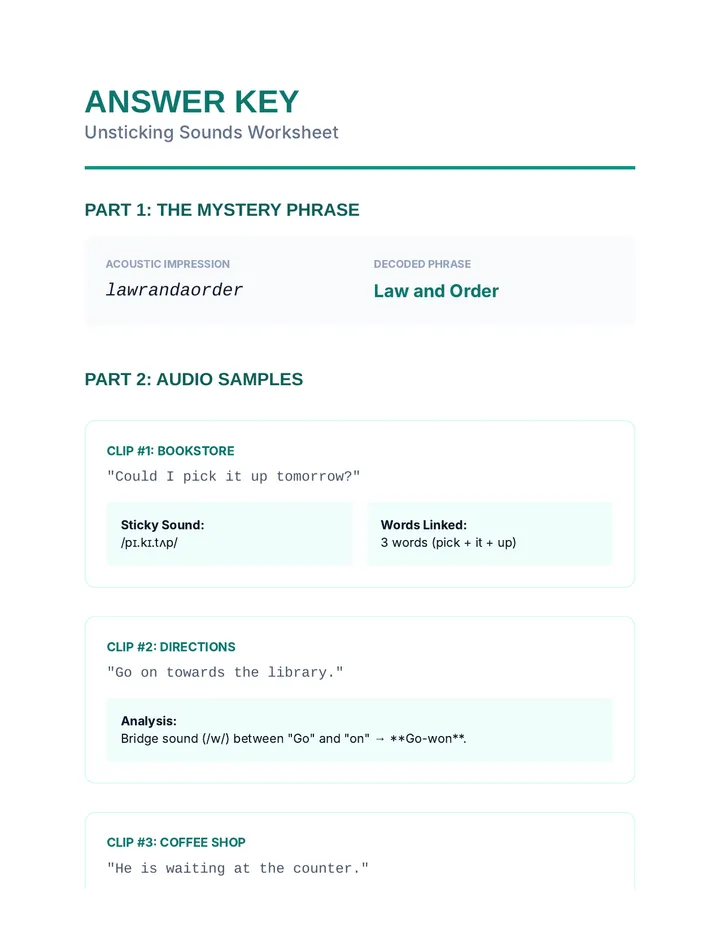
Answer key for the Lesson 1 worksheet on linking and intrusion.
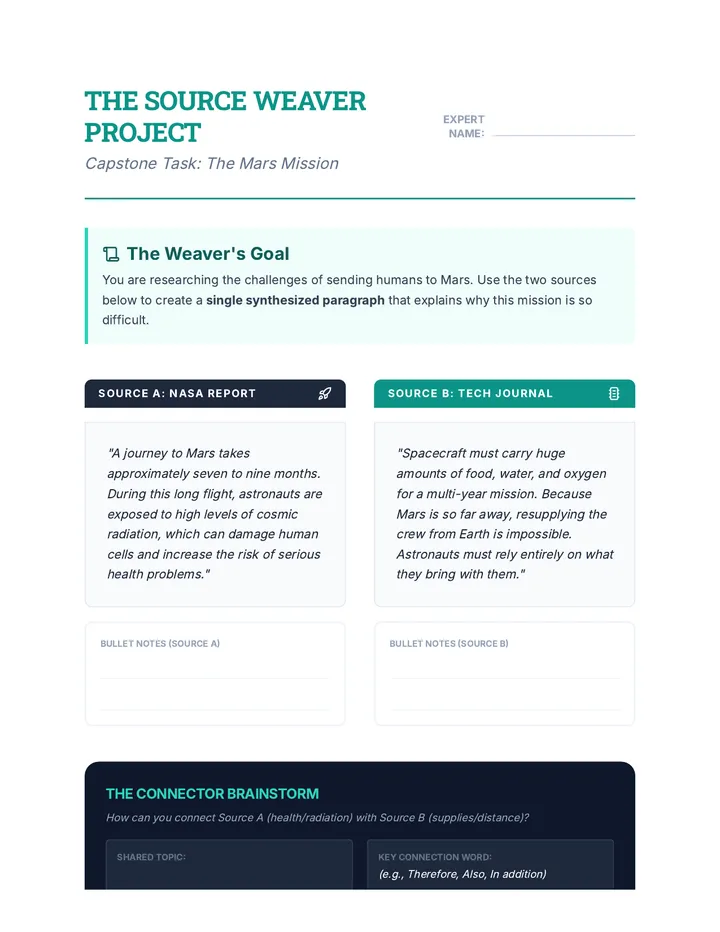
Capstone student project for "The Source Weaver" lesson. Students analyze two short texts about Mars, take notes, and synthesize the information into a single coherent paragraph using their own vocabulary and sentence structures.
Introductory slide deck for Lesson 5, reviewing all strategic search techniques and introducing the culminating Scavenger Hunt challenge.
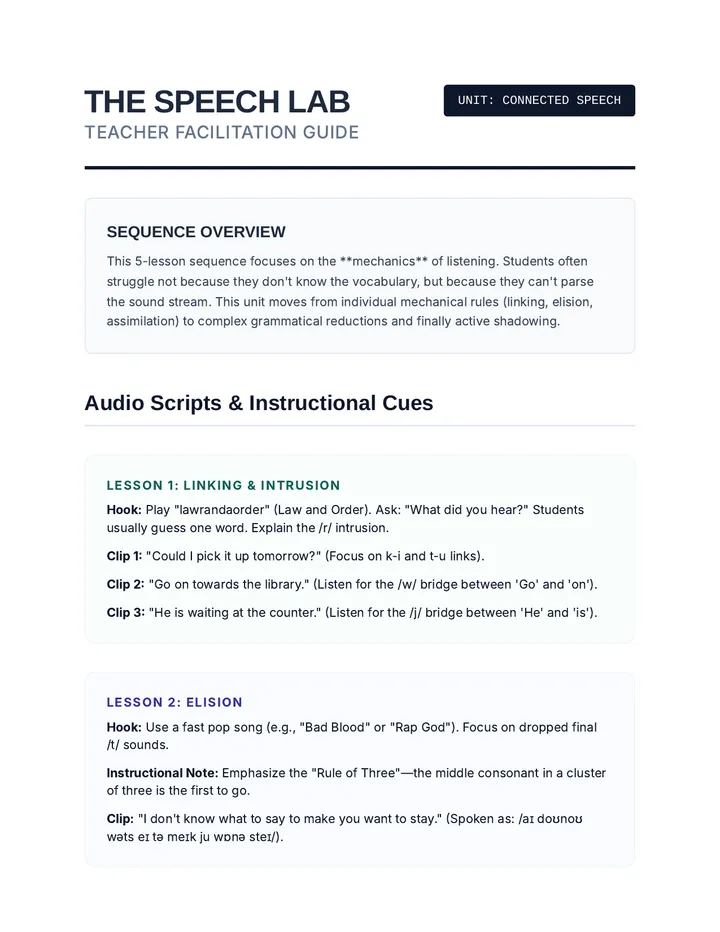
A comprehensive teacher guide for the Speech Lab sequence, including audio scripts, instructional cues, pacing, and differentiation strategies.
Visual slides for "The Source Weaver" lesson. These slides introduce students to the concept of synthesis as connecting ideas from multiple sources to create a new, coherent whole.
Teacher answer key and discussion guide for the "To Click or Not to Click" worksheet, focusing on snippet analysis and evaluation.
Student worksheet for Lesson 4 where students practice identifying the best search result based on snippets, titles, and URLs.
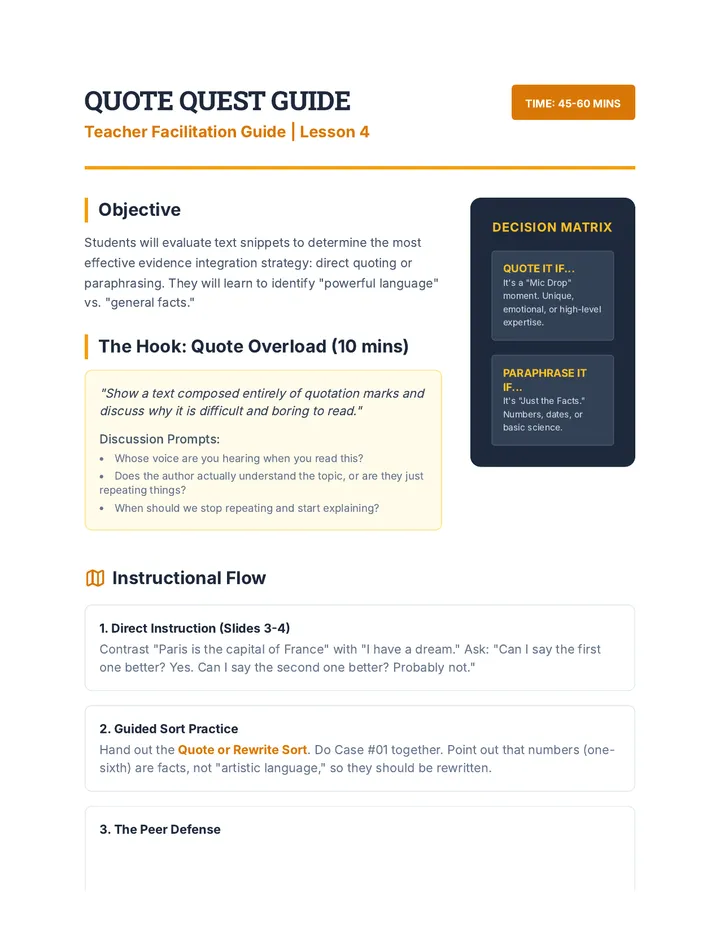
Teacher guide for "Quote Quest" lesson. It outlines the decision-making criteria for quoting vs. paraphrasing, provides instructional steps, and includes an answer key for the sorting activity.
A grading rubric for the final Curator Challenge project, assessing search strategies, source credibility, and annotation quality.
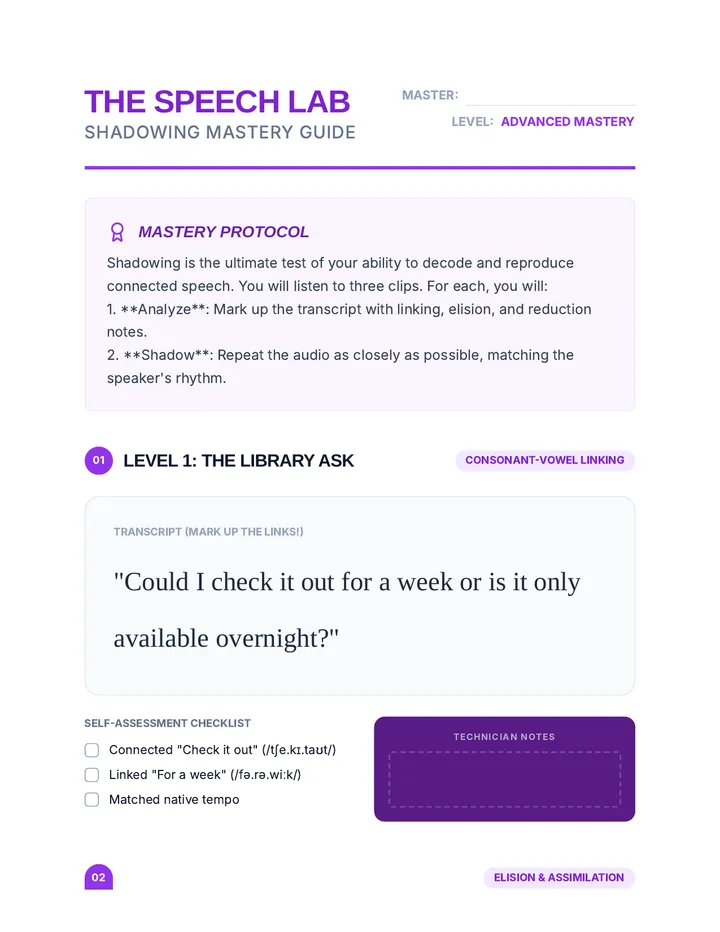
A student mastery guide for practicing shadowing techniques with transcript analysis of complex campus dialogues.
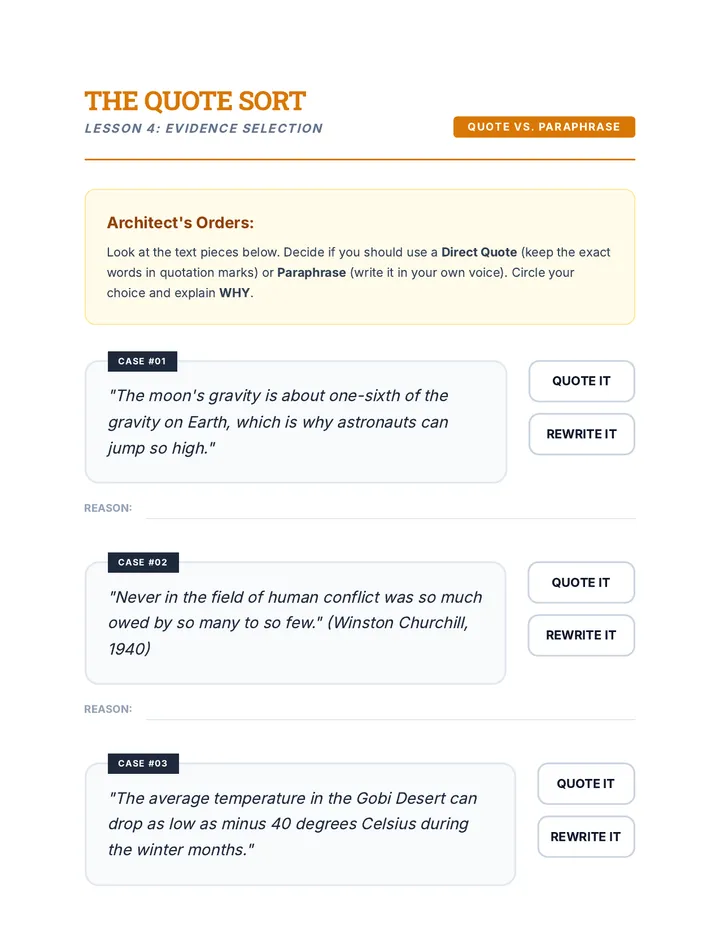
Student activity for "Quote Quest" lesson. It presents several textual scenarios and requires students to decide whether to use a direct quote or a paraphrase, providing a justification for their choice.
Introductory slide deck for Lesson 4, teaching students how to read and interpret search result snippets, titles, and bolded terms before clicking.
A culminating project template where students select a research topic and curate three credible sources with justifications.
A slide deck for Lesson 5 on shadowing techniques, prosody, and the final mastery assessment of connected speech patterns.
Visual slides for "Quote Quest" lesson. These slides help students distinguish between when to use direct quotes for impact and when to paraphrase for factual clarity.
A visual presentation for Lesson 5 introducing the final project: curating a list of three credible sources with annotations. It covers the purpose of annotations and project expectations.
A student assessment document for Lesson 5 where they act as editors to identify and correct plagiarism and citation errors in research samples.
Teacher facilitation guide for Lesson 3, providing instructions for the "Database Race" activity and tips for database exploration.
Teacher guide for "Sentence Shifters" lesson. It outlines the instructional flow for synonym substitution and active-to-passive transformation, including a sample answer key.
The introductory slide deck for the capstone Lesson 5 simulation, setting the stage for the plagiarism audit activity.
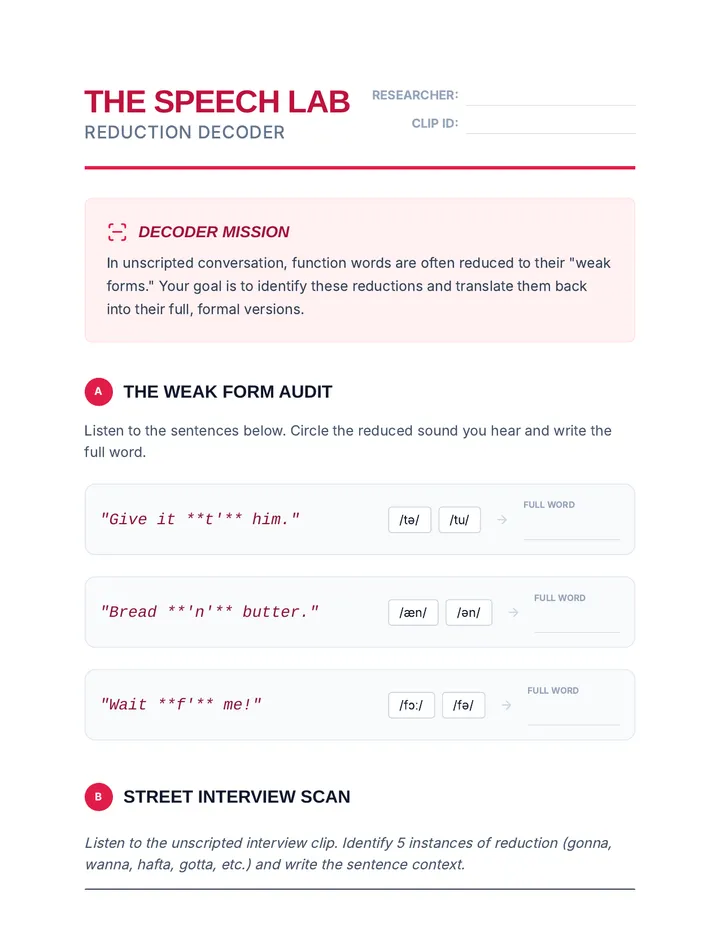
A student worksheet for identifying and translating grammatical reductions and weak forms in unscripted interviews.
Student checklist for Lesson 3 where students explore an academic database by performing a keyword search, applying filters, and identifying metadata.
A student worksheet for practice with navigating academic database interfaces, reading abstracts, and using built-in research tools.
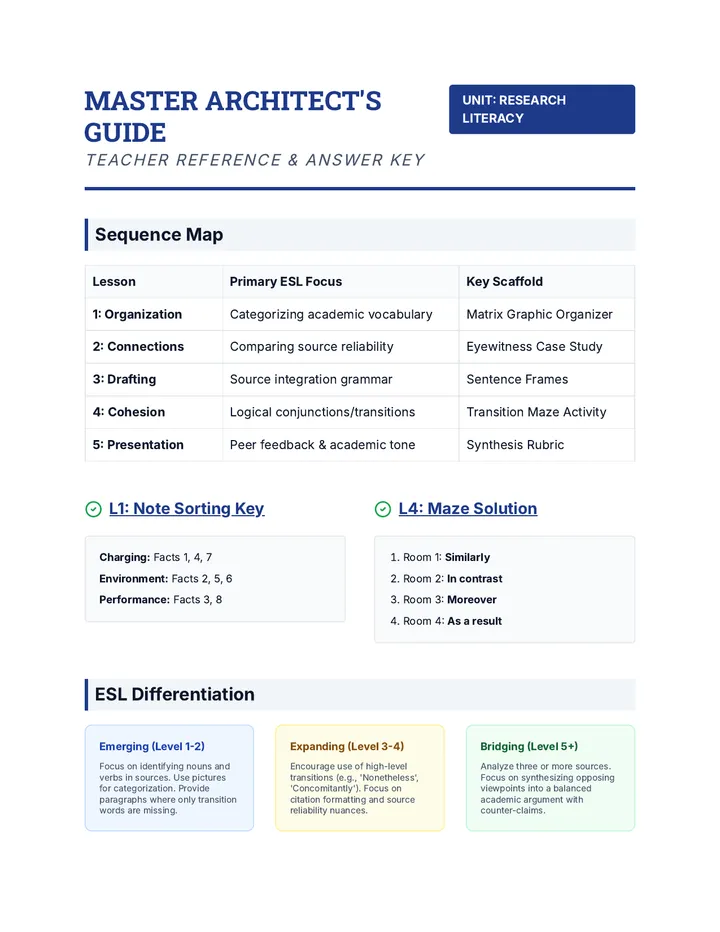
A comprehensive teacher-facing guide for the synthesis sequence. Includes the sequence map, answer keys for the Note Sorting and Transition Maze activities, differentiation strategies for various ESL levels, and a quick-check grading rubric.
Student worksheet for "Sentence Shifters" lesson. It includes a synonym bank and tiered practice exercises for synonym replacement, active-to-passive transformation, and combined paraphrasing.
Introductory slide deck for Lesson 3, teaching students about academic databases, filters, and how they differ from general search engines.
A teacher resource for Lesson 4 containing printable cards with citation components for a hands-on ordering activity.
A visual presentation for Lesson 4 introducing the differences between open web searches and curated academic databases. It highlights key features like abstracts and citation tools.
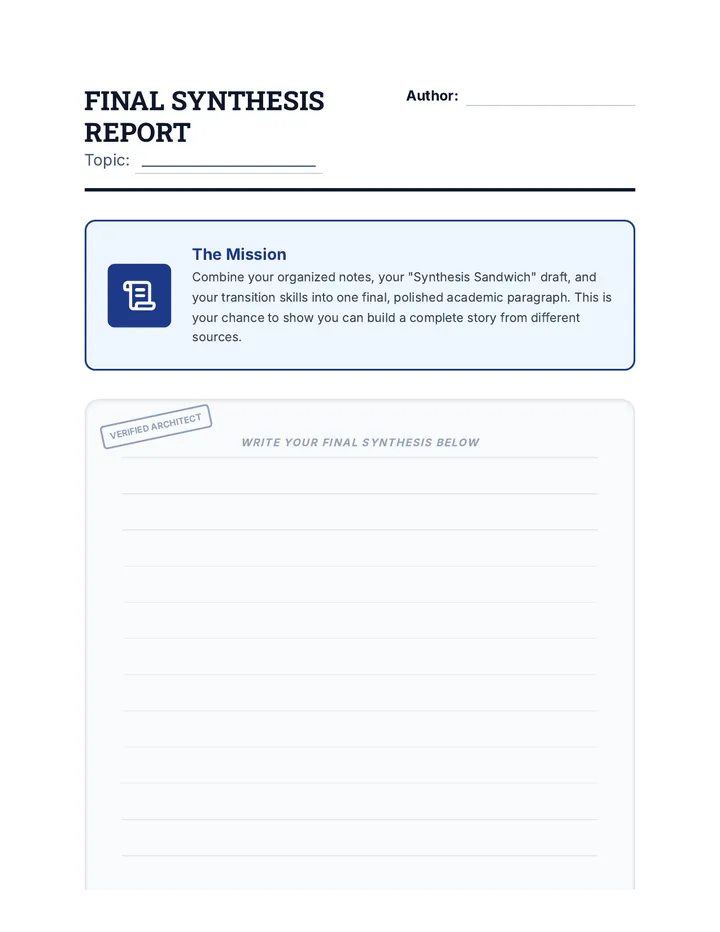
The final synthesis report template for students to write their completed academic paragraph. Includes a section for peer feedback from the Gallery Walk activity.
A slide deck for Lesson 4 focusing on grammatical reductions and weak forms, using a high-contrast visual style to highlight the difference between formal and casual speech.
Visual slides for "Sentence Shifters" lesson. These slides introduce students to two primary paraphrasing tools: Synonym Swap and Structure Flip (Active/Passive voice).
An instructional slide deck for Lesson 4 that introduces the elements and formatting of MLA citations using a 'construction' theme.
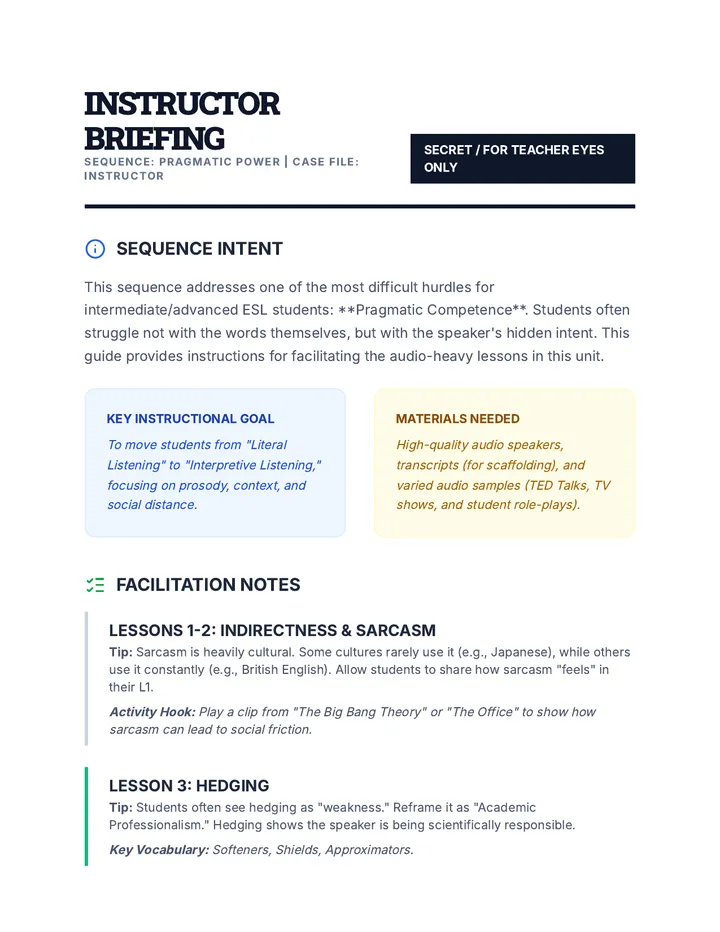
Instructor briefing and facilitation guide for the Pragmatic Power sequence, providing teaching tips, activity hooks, and assessment strategies for ESL instructors.
Final project slide deck for Lesson 5. Outlines the synthesis project goals, explains the peer-review Gallery Walk process, and provides a final polishing checklist for students' academic work.
Student reference cheat sheet for Lesson 2, providing a clear summary of AND, OR, and NOT Boolean operators with examples.
A student worksheet for practice with transforming natural language questions into effective keyword queries and search strings.
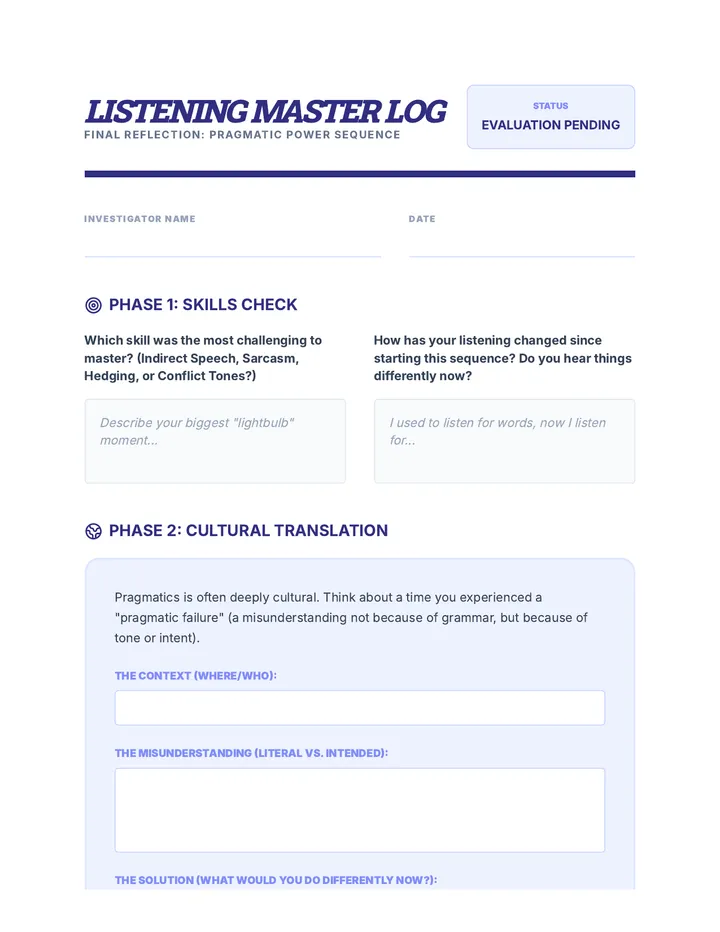
Final reflection worksheet and exit ticket for the sequence, allowing students to synthesize their learning about pragmatics and reflect on their own cultural communication experiences.
Teacher guide for "The Voice Lab" lesson. It outlines the 'Read, Cover, Recite' protocol, providing a hook activity, instructional steps, and specific ESL scaffolds for concept retrieval.
A student practice worksheet for Lesson 3 focusing on distinguishing between quotes and summaries, and applying signal phrases to integrate evidence.
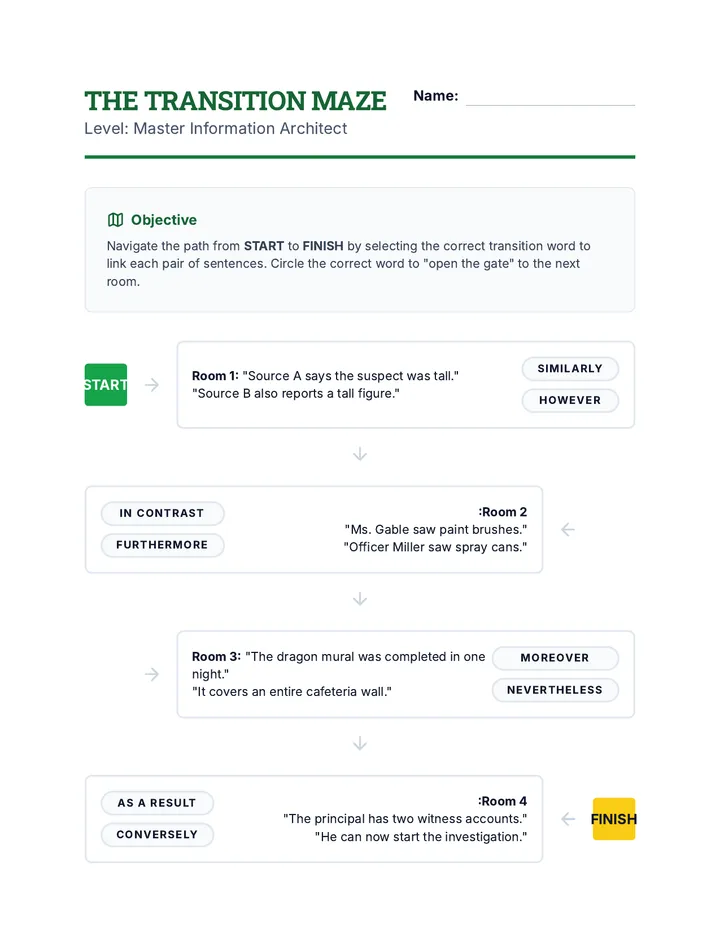
A game-based worksheet for Lesson 4 where students navigate a 'maze' by choosing the correct transition words to link sentences. Includes a section for practicing complex sentence structure with semicolons and commas.
Final assessment check for the Citation Mastery lesson. Includes multiple choice on error identification, a matching section for bibliographic terms, and a short response on the importance of publication dates.
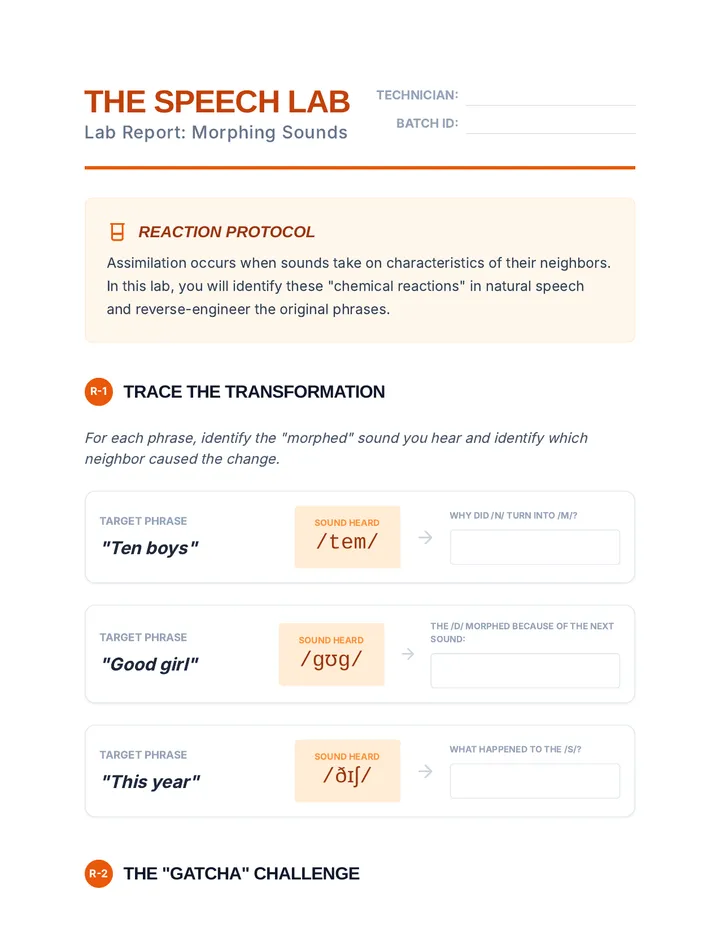
A student worksheet for identifying and reverse-engineering assimilated sounds in natural speech patterns.
Student matching activity for Lesson 2 where students connect Boolean search strings to their corresponding results.
A visual presentation for Lesson 3 introducing keyword generation, natural language versus keyword searching, and Boolean operators (AND, OR).