Fundamental principles of supply, demand, and monetary systems alongside micro- and macroeconomic structures. Examines the impact of corporate power, labor market dynamics, and global systems on social mobility and class inequality.
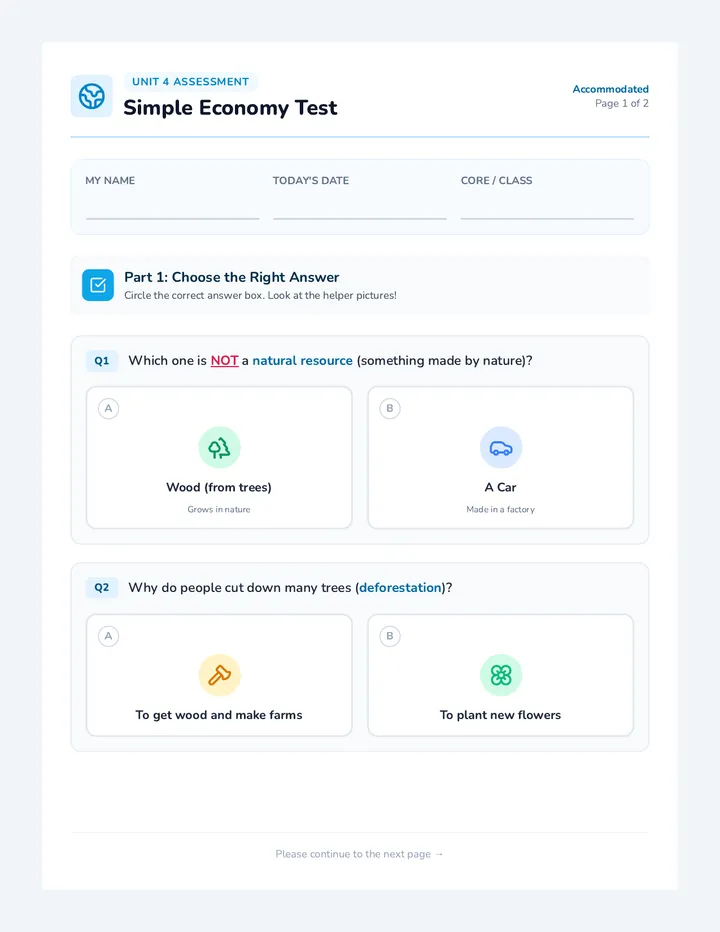
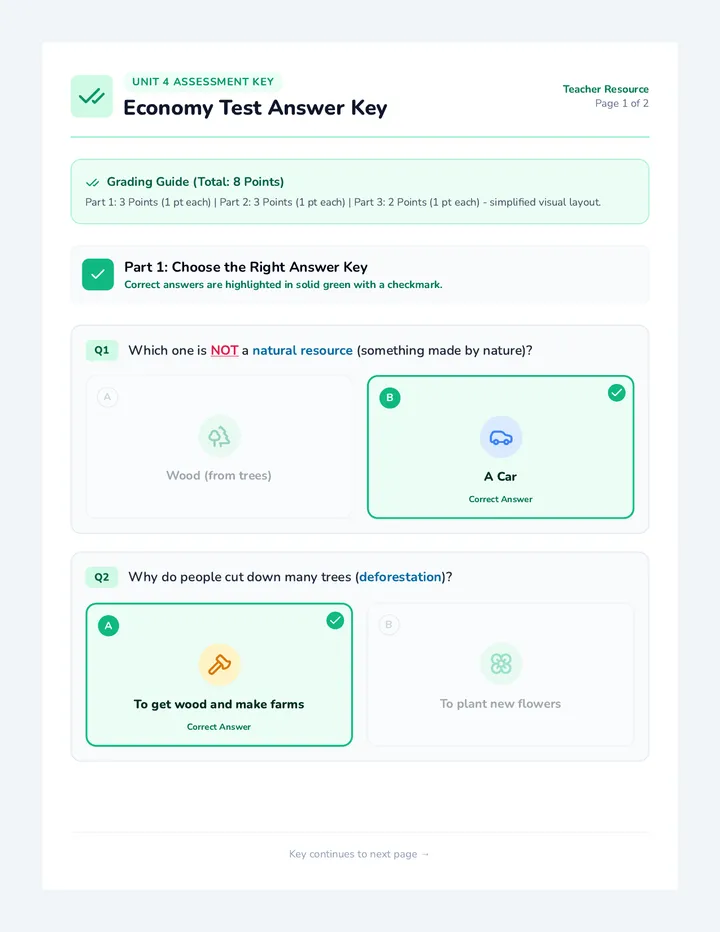
A modified, highly accessible economics assessment package tailored for students with IEP accommodations. Features simplified reading level, reduced multiple-choice options, bolded key terms, clear visual icons, and an intuitive match-by-letter format instead of complex grids.
An introductory lesson for third graders to explore the distinct regions of the original thirteen colonies, focusing on geography, climate, and daily life.
Students become "Price Detectives" to solve the mystery of why certain prices changed. They will analyze evidence like weather reports, celebrity news, and shipping delays to identify shifts in supply and demand.
Exploring how changes in supply and demand cause prices to rise and fall, using scenario cards and group discussions to predict market shifts.
An introduction to the relationship between supply (how much we have) and demand (how much people want), using a hands-on lemonade stand simulation to visualize the concepts.
An interactive simulation where students design and run carnival stalls to learn about supply, demand, budgeting, and economic trade-offs within a community.
A comprehensive lesson on the colonial bread-making process, featuring the roles of millers and bakers, bartering practices, and sequencing the steps from grain to loaf.
A look at modern life in the Midwest, including major cities, cultural contributions, and a final unit review.
Learning about the Ojibwe (Chippewa) people, their connection to the Great Lakes and woodlands, and their enduring traditions.
Exploring the history and cultures of the Sioux and Mandan nations, focusing on their adaptation to the Great Plains.
Investigating the climate of the Midwest and how it directly influences major industries like agriculture and manufacturing.
An introduction to the 12 states of the Midwest, their locations, and key geographic features like the Great Lakes and the Great Plains.
Students act as economic researchers to investigate the relationship between supply, demand, and market prices. They analyze real-world field observations, categorize data, and conclude their research with a summary of market impacts.
Focuses on Ancient Egypt, the importance of the Nile River, the power of Pharaohs, and the building of the pyramids.
Examines the rise of the Persian Empire and its influence on the region, concluding with a unit review.
Introduces the ancient Israelites, their beliefs, and the concept of monotheism.
Focuses on the Phoenicians and their contributions to trade and the development of the alphabet.
Explores the rise of the first civilizations in Mesopotamia, focusing on irrigation, city-states, and the invention of writing.
An introduction to the physical geography of the Middle East and North Africa, focusing on the impact of deserts and rivers on human settlement.
Students identify the eleven states of the West region and memorize their capital cities through a matching game and map assessment.
A comprehensive, interdisciplinary half-day program designed to transform 3rd graders into interactive business owners while practicing persuasive writing, graphing and data math, and visual design.
Students apply social studies economics concepts (producers, consumers, goods, services, productive resources) and math fractions to design, cost, and budget their own dream ice cream parlor business.
Students explore states of matter (solids, liquids, gases) and physical changes through a hands-on lab making ice cream in a bag, investigating how salt alters the freezing point of ice.
Students dive into math fraction concepts by partitioning circular ice cream pies, building multi-scooped waffle cones to represent fractions of a whole, and plotting ice cream truck routes on a fraction number line.
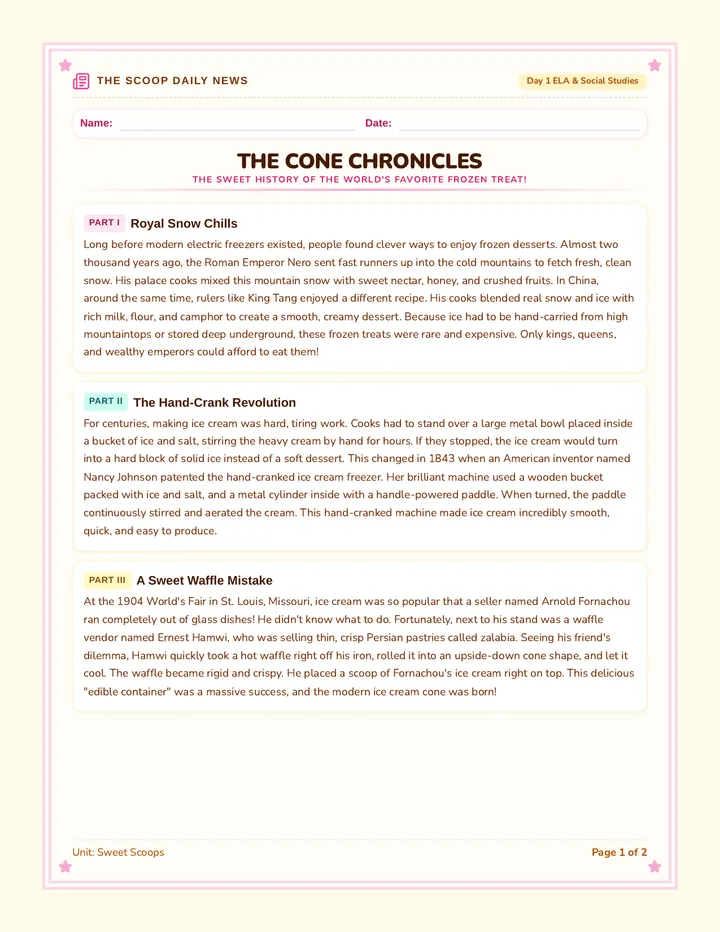
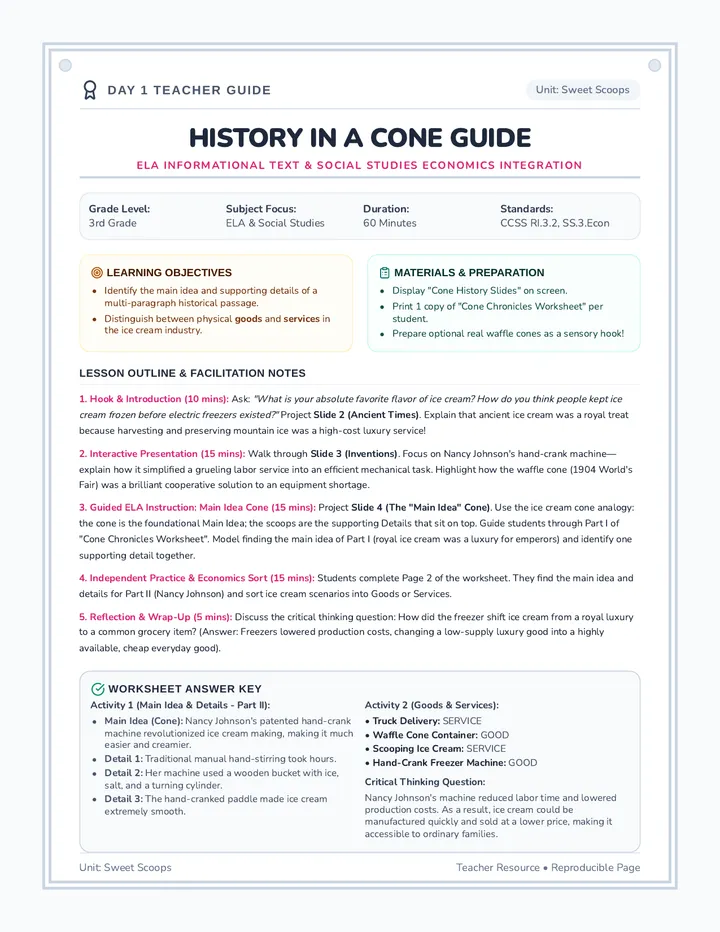
Students explore the origin and evolution of ice cream from ancient snow-chilled treats to modern factories, practicing identifying the main idea and supporting details in ELA, and understanding goods, services, and historical timelines in social studies.
Explores the transition from bartering to modern currency, defining the fiat system and the stages of production. Students will understand why money acts as a medium of exchange and how resources are transformed into goods.
This lesson introduces students to the key events of the American Revolution in Boston, focusing on the Boston Tea Party, the Stamp Act, and the fight for independence. it simplifies complex historical concepts for early elementary learners.
A lesson exploring the key events leading up to the American Revolution, including the French and Indian War, Sugar Act, Stamp Act, Townshend Acts, Boston Massacre, Boston Tea Party, Committees of Correspondence, and the First Continental Congress.
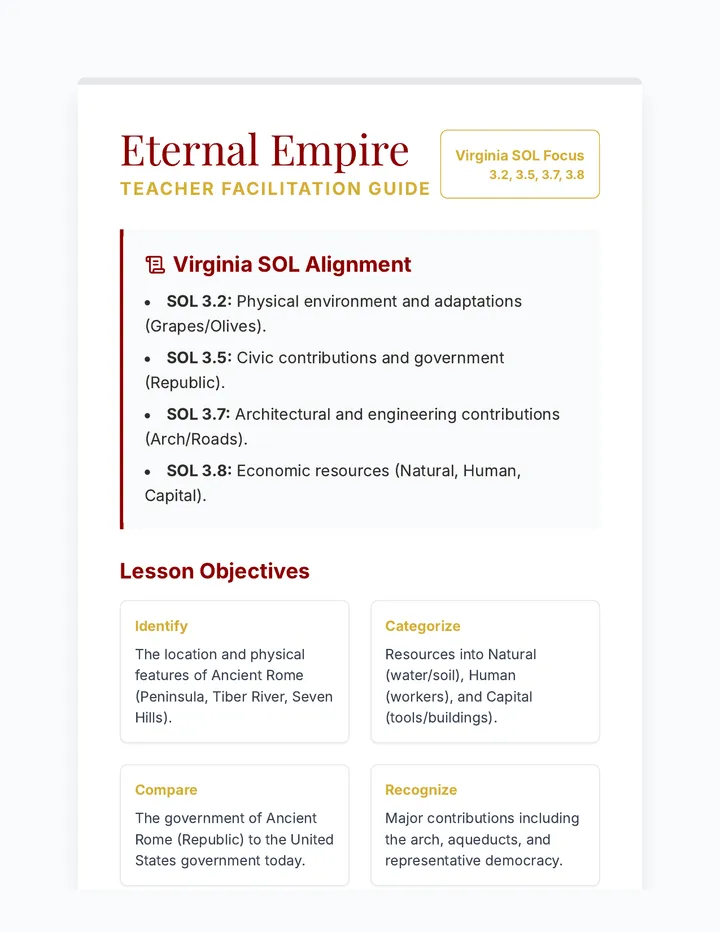
A deep dive into Ancient Rome covering geography, daily life, government, and lasting contributions tailored for 3rd grade Virginia SOLs. Students explore the physical environment of the Mediterranean and how Romans adapted to their surroundings through engineering and trade.
A lesson exploring how natural resources like water, soil, and forests support the needs and economy of a community. Students will learn to distinguish between claims about resource importance and the evidence that supports them.
A lesson covering the secession of the Southern states, the formation of the Confederacy, and the opening battle of the Civil War at Fort Sumter. Students will explore the causes of the split and sequence the events that led to the bombardment.
A lesson exploring Harriet Tubman's 1850 escape and the significance of the Mason-Dixon Line as a geographical and legal boundary in the pre-Civil War United States.
A lesson exploring the influence of the abolitionist press and the movement's political impact. Students will learn about abolitionist newspapers like The Liberator and how the movement pressured leaders like Abraham Lincoln to end slavery.
A lesson exploring Harriet Tubman's dual role as an abolitionist speaker and a conductor on the Underground Railroad. Students will learn how abolitionists collaborated to help enslaved people reach freedom.
A lesson introducing the abolitionist movement, focusing on the people who worked to end slavery. Students will learn the definition of "abolish," identify key leaders like Frederick Douglass, and explore the moral arguments against the practice of slavery.
A lesson comparing the lives of Northern factory workers with enslaved people in the South. Students will explore the concepts of paid labor, harsh working conditions, and the fundamental differences between freedom and slavery.
A lesson examining the Northern industrial economy, focusing on manufacturing, the production of steel, and the role of factories and transportation in regional trade. Students will explore how industrialization shaped Northern society and its economic relationship with the South.
A lesson exploring the economic differences between the North and South, focusing on agriculture, the plantation system, and regional crops. Students will compare and contrast the different types of labor and resources used in each region.
A lesson focusing on Harriet Tubman's escape and the historical significance of the Mason-Dixon Line as a boundary between freedom and slavery. Students will practice sequencing historical events and identifying key geographical markers.
A social studies PBL project for middle schoolers. Students act as historical investigators, using primary and secondary sources to piece together a narrative around a 'mystery' event or figure from the past.
A science-focused PBL project for elementary students. Students research an animal and design a functional 3D habitat model that meets all the animal's survival needs, demonstrating their understanding of ecosystems.
An elementary project where students apply addition, subtraction, and simple multiplication to create and run a classroom marketplace, focusing on financial literacy and operational math.
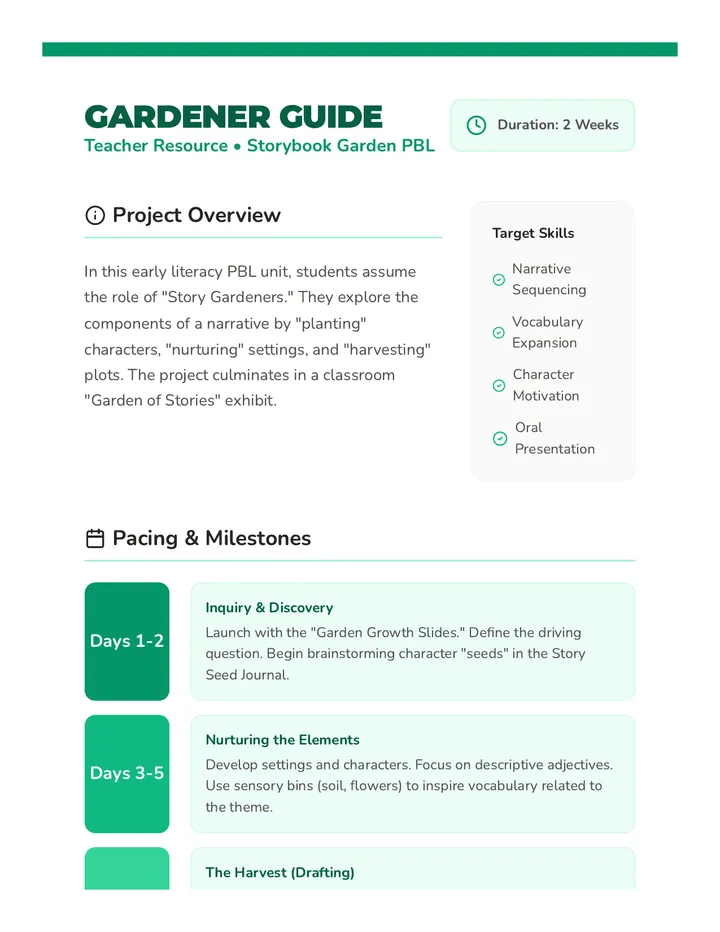
An early childhood project where students grow their literacy skills by 'planting' a story garden, focusing on letter recognition, sequencing, and narrative creation.
A comprehensive lesson where students learn fundamental economic concepts through the creation and operation of a classroom mini-economy, culminating in a hands-on Market Day event.
A lesson exploring the four types of economic resources: Natural, Capital, Human, and Intermediate Goods. Students use a scavenger hunt activity to classify the 'ingredients' of production for everyday products.
A comprehensive lesson covering the geography, culture, government, and economy of Japan, including a detailed presentation and a guided research log for students to record findings in complete sentences.
Tracing North Carolina's industrial growth and innovations with a focus on advanced vocabulary and context clues.
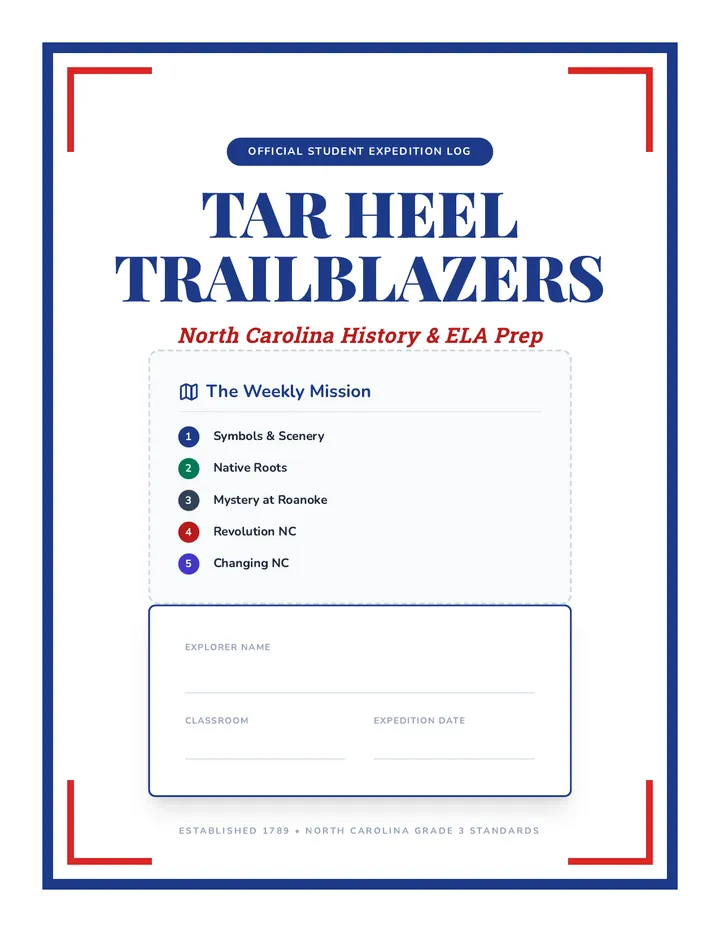
A comprehensive unit on North Carolina's history, geography, and government, featuring 3rd and 4th grade level resources with EOG-style assessments.
A look at the modern-day Southwest, including its major cities, diverse population, and current economic drivers like tourism, energy, and aerospace.
A hands-on lesson comparing the historic ways of life of the Southwest's original inhabitants with the modern lives of people living in the region today.
An exploration of the Apache and Comanche tribes, their nomadic lifestyles, warrior traditions, and their adaptation to the horse culture on the plains.
A study of the Pueblo and Navajo tribes, focusing on their unique cultures, traditional homes (pueblos and hogans), and artistic traditions like weaving and pottery.
An introduction to the geography and climate of the four Southwestern states: Arizona, New Mexico, Texas, and Oklahoma. Students will learn about deserts, mountains, and plains.
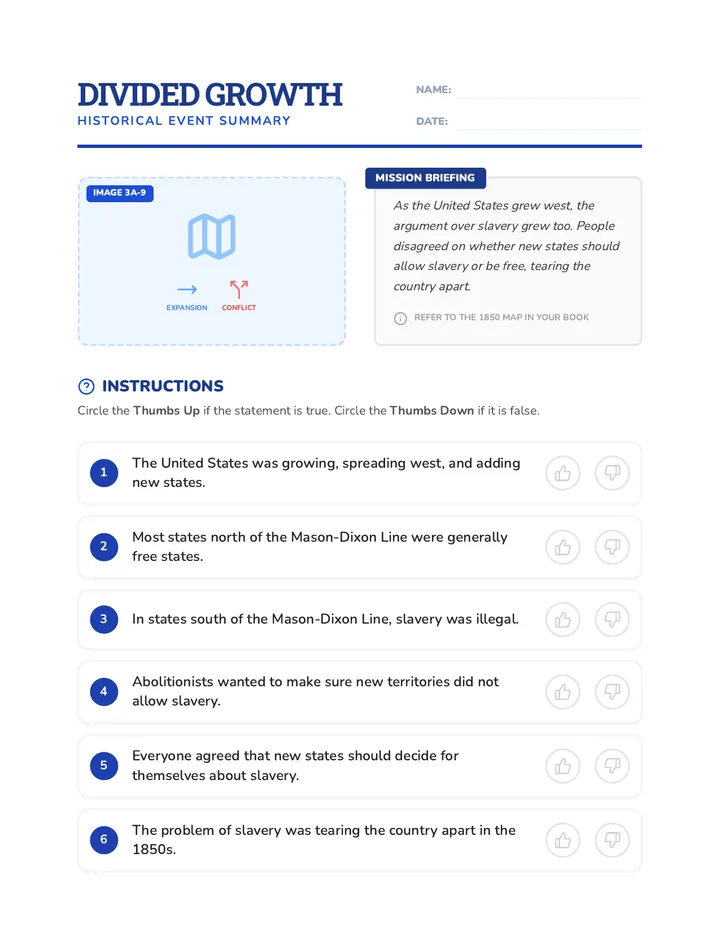
A lesson examining the expansion of the United States in the 1850s and the growing conflict over whether new territories should allow slavery. Students will explore how westward expansion pushed the country toward a breaking point.
A lesson exploring the various forms of rebellion against slavery, including John Brown's raid at Harpers Ferry, Nat Turner's revolt, and Denmark Vesey's planned uprising. Students will learn about the risks taken by those fighting for freedom and the different ways people fought back against the plantation system.
The capstone project where students design and present a community solution to ensure everyone has access to essential resources.
Students identify economic barriers families face and explore community systems (libraries, food banks) that provide support.
A deep-dive discussion into the difference between 'fair' and 'equal,' connecting the tower simulation to real-world economic gaps.
A hands-on simulation where groups attempt to build a tower with unequal supplies to experience the impact of resource disparity.
Students distinguish between survival needs and personal wants, introducing the concept that limited resources (money, time) require choices.
Groups present their service project plans to the class and reflect on their potential impact.
Students work in groups to select a community issue and brainstorm a service project to address it.
Students investigate the role of non-profit organizations and the difference between government support and private charity.
Students learn the concept of taxes as a collective resource for public services through a hands-on simulation.
Investigating the shift to digital transactions and synthesizing the three functions of money.
Exploring money as a store of value through a game comparing perishable goods and durable currency.
Learning how money acts as a unit of account by assigning prices and designing classroom currency.
Introducing commodity money to solve the "double coincidence of wants" problem and exploring historical currencies.
Students experience the difficulties of bartering directly through a classroom simulation to understand the need for a standardized medium of exchange.
Students examine the diverse roles of men, women, children, and elders, challenging stereotypes about political power and property ownership in Indigenous societies.
An exploration of the vast continental trade networks used by Indigenous peoples to exchange resources like obsidian, copper, and shells using specialized sign language.
Students simulate Indigenous consensus-building processes, exploring the role of Clan Mothers and the patience required for communal decision-making.
A deep dive into the Haudenosaunee Confederacy, focusing on the Great Law of Peace as a foundational model of representative democracy and its influence on modern governance.
Students explore matrilineal and clan-based family structures, learning how kinship determined social roles and responsibilities in various Indigenous communities.
Students apply their knowledge by designing their own multi-step processes for classroom or fictional systems.
Students identify their own skills and create a professional freelance profile to market their services to the class.
Focusing on the financial side of freelance work, students practice budgeting and saving for times when income varies.
Students learn how digital platforms connect workers to customers and design their own service-based app prototype.
A classroom simulation where students complete short tasks to earn currency, experiencing the freedom and uncertainty of a gig market.
Students compare traditional employees with freelancers, using sorting activities and discussion to understand steady pay vs. per-task pay.
Students apply their knowledge of scarcity and opportunity cost to create a personal budget, prioritizing needs and wants within a limited fictional allowance.
Students explore how positive and negative incentives influence economic behavior and personal choices through real-world examples and classroom challenges.
Students define opportunity cost as the value of the next best alternative given up when a choice is made, applying the concept to everyday scenarios.
Students experience scarcity first-hand through a classroom simulation, learning to define the concept and understand its impact on decision-making.
Students distinguish between essential needs and desirable wants through a survival simulation and categorization exercises.
In this culminating lesson, students apply their knowledge to create a simple savings timeline for a desired item, distinguishing between needs and wants.
Students explore the basics of credit and loans through a lemonade stand business simulation, learning about repayment and interest expense.
This lesson introduces the concept of interest as an incentive for saving money, using a 'growing garden' analogy to visualize how money can grow over time.
Students investigate why keeping large amounts of cash at home can be risky compared to depositing it in a bank, identifying safety features and basic transaction processes.
Students participate in a classroom mini-economy where they earn 'class currency' for completing tasks and make decisions about spending immediately versus saving for later.
Students synthesize their learning to design and describe a new profession for the automated future.
Exploring how software and computers (like ATMs and self-checkouts) change service-based jobs.
Investigation into how robots handle 'dirty, dull, or dangerous' tasks to improve safety and productivity.
A hands-on simulation comparing individual production with an assembly line to understand industrial specialization.
Students compare historical and modern tools to understand the shift from manual labor to machine-powered efficiency.
Students synthesize their learning to invent future jobs and identify the essential human skills needed to succeed in an automated world.
This lesson introduces the gig economy through a classroom 'Task Market' simulation, comparing traditional jobs with freelance work.
Students examine the shift to remote work, exploring the technology that enables digital connectivity and identifying which jobs can be done from anywhere.
Learners explore automation by simulating an assembly line process and discussing the efficiency and trade-offs of using machines versus humans.
Students analyze primary source images and narratives to compare workplaces from the early 20th century with modern offices and factories.
Students synthesize their knowledge to design a 'Job of the Future' that solves a specific problem. They create a blueprint and present their visions in a classroom gallery walk.
Students explore the concept of the 'gig economy' by role-playing as independent contractors. They learn the difference between steady employment and flexible, skill-based project work.
Students investigate how the internet allows people to work from anywhere, contrasting office environments with home workspaces. They engage in a digital collaboration task to experience remote work dynamics.
Students participate in a simulation comparing a human assembly line to an automated process to understand efficiency. They discuss how machines handle repetitive tasks and how human roles shift toward creativity.