Fundamental principles of supply, demand, and monetary systems alongside micro- and macroeconomic structures. Examines the impact of corporate power, labor market dynamics, and global systems on social mobility and class inequality.
A 5-question comprehensive quiz for the end of the economics unit. Revised to fit on a single page and fix fill-in-the-blank alignment.
A set of 8 vocabulary flashcards covering key economic terms. Revised to fit all cards on a single page for easier printing.
A teacher's guide for the final lesson, including a pacing guide and quiz answer key. Revised to fix label wrapping, consolidate to one page, and improve readability.
Guided notes for Lesson 2 focusing on money and production. Revised to fix dark backgrounds, increase writing space for blanks, and improve footer legibility.
A visual presentation for Lesson 2 explaining the functions of money, the characteristics of a fiat system, and the three stages of the production process.
A comprehensive teacher's guide for Lesson 2. Revised to consolidate content on a single page and improve padding in formative check.
Guided notes for Lesson 1, providing structured spaces for defining terms. Revised to fit on a single page, increase box sizes, and improve alignment.
A visual presentation for Lesson 1 covering the difference between goods and services, the three types of resources, and the mechanics of the barter system. Revised with higher icon opacity.
A comprehensive teacher's guide for Lesson 1, featuring learning objectives, a detailed pacing guide, classroom activities like the Barter Bazaar, and discussion prompts. Revised to fix page break issues.
Task cards for Lesson 2 featuring real-world scenarios where supply and demand factors influence pricing. Revised to ensure header and cards stay on one page, increased response areas, and added cutting guides.
Instructional slides for Lesson 2 focusing on scarcity, price fluctuation, and smart consumer choices. Sets the stage for the final Market Day project.
Scenario cards for the Lesson 1 hands-on simulation. Revised with cutting guides and improved visual contrast.
A student workbook for documenting observations during the supply and demand simulations. Includes space for definitions, simulation logs, and market predictions. Revised with improved page breaks and larger work areas for handwriting.
Introductory slides for Lesson 1 of the Market Masters unit, covering definitions of supply and demand and setting up the Lemonade Lab simulation.
Teacher's answer key for the Kings and Empires lesson, including review quiz answers and a checklist for unit completion.
Updated Kings and Empires worksheet with a "Power Pyramid" diagram illustrating the social and political structure of an empire (King, Satraps, People) for 3rd graders.
Slides for Lesson 5 on the Persian Empire, covering King Cyrus, the Royal Road, and a unit-wide review for 3rd graders.
Teacher's answer key for the Ancient Israel lesson, providing answers for the reading comprehension and sample short answer responses.
Updated Ancient Faiths and Laws worksheet with a visual "Ways to Believe" diagram comparing Polytheism (many gods) with Monotheism (one god) for 3rd graders.
Slide deck for Lesson 4 on ancient Israel, introducing monotheism, the Ten Commandments, and the Torah at a 3rd-grade level.
An answer key and teacher guide for the Divided House Activity, providing correct answers and context for Lincoln's 1858 debate and the "House Divided" argument.
A thumbs-up/thumbs-down activity worksheet based on Abraham Lincoln's "House Divided" argument and the outcome of the 1858 Senate race against Stephen Douglas.
A visual slide deck covering the key historical events of Harriet Tubman's escape and the sectional differences between the North and South, including Thumbs Up/Thumbs Down activity slides.
An answer key and teacher guide for the Two Candidates Activity, providing correct answers and context for the backgrounds of Lincoln and Douglas.
A thumbs-up/thumbs-down activity worksheet based on a historical passage about Abraham Lincoln and Stephen Douglas, their backgrounds, and their differing views on slavery.
An answer key and teacher guide for the Heart of the Debate Activity, providing correct answers and context for the 1858 U.S. map and the debate over expansion.
A thumbs-up/thumbs-down activity worksheet based on a historical passage about U.S. expansion and the 1858 map, focusing on the debate over slavery's spread to new territories.
An answer key and teacher guide for the Choice to Make Activity, providing correct answers and context for the discussion between Frank, Tom, and Mr. Foote.
A thumbs-up/thumbs-down activity worksheet based on a historical passage where Frank expresses doubt and learns about the final Lincoln-Douglas debate in Alton.
An answer key and teacher guide for the Great Debate Activity, providing correct answers and context for the discussion on states' rights and slavery.
A thumbs-up/thumbs-down activity worksheet based on a historical passage about the Lincoln-Douglas debates, featuring 6 comprehension statements about state sovereignty and Lincoln's views on slavery.
An answer key and teacher guide for the Eager Crowd Activity, providing correct answers and context for the October 1858 gathering in Alton, Illinois.
A thumbs-up/thumbs-down activity worksheet based on a historical passage about the meeting of two friends in a crowd gathered to hear Illinois politicians, featuring 6 comprehension statements.
An answer key and teacher guide for the Gathering Storm Activity, providing correct answers and context for the Alton, Illinois 1858 setting.
A thumbs-up/thumbs-down activity worksheet based on a historical passage about the town of Alton, Illinois in 1858, featuring 6 comprehension statements and a reference to Image 4A-1.
An answer key and teacher guide for the Drinking Gourd Activity, providing correct answers and context for the celestial navigation lesson.
A thumbs-up/thumbs-down activity worksheet based on a historical passage about Harriet Tubman teaching a child how to find the North Star using the "drinking gourd" (Big Dipper).
An answer key and teacher guide for the Safe Haven Activity, providing correct answers and context for the story of the woman helping fugitives.
A thumbs-up/thumbs-down activity worksheet based on a historical passage about a woman helping fugitives hide in a chicken coop and providing food.
An answer key and teacher guide for the Swamp Escape Activity, providing correct answers and context for Harriet Tubman's evasion tactics and the secret knock.
A final assessment for the Market Masters unit, styled as a detective clearance exam. Revised with writing lines, improved contrast, and page-break stability.
Scenario cards for the Market Mystery lesson. Each card presents clues about supply and demand changes that students must use to solve a "Price Crime" or market shift. Revised with improved cutting guides, layout stability, and writing space.
A student worksheet for the Market Mystery lesson. Students use this log to record evidence, analyze supply and demand levels, and reach a verdict on why prices changed for different cases. Revised with improved page breaks, writing lines, and label contrast.
Presentation slides for Lesson 3 that introduce the "Market Mystery" concept, teaching students how to use economic evidence to explain price changes through a detective-themed simulation.
An assessment rubric for the Carnival Economy lesson, evaluating students on budget mastery, understanding of supply and demand, pricing strategy, and the quality of their business pitch across four proficiency levels.
A student stall planner worksheet for the Carnival Economy lesson, where students select their game, manage a 50-coin budget, and develop demand and pricing strategies for their carnival business.
Instructional slides for the Carnival Economy lesson, covering the concepts of supply and demand, price fluctuations, and the student mission to design a profitable carnival stall within a budget.
A comprehensive teacher's guide for the Carnival Economy lesson, featuring learning objectives, a step-by-step lesson roadmap, and key vocabulary definitions to guide classroom instruction on supply, demand, and budgeting.
A quick assessment for students to demonstrate their understanding of supply, demand, and price changes, featuring a Market Research theme. Sized for single-page printing on shorter paper.
A comprehensive teacher facilitation guide for the Market Research Lab, including a detailed answer key, discussion prompts, and vocabulary support. Sized for natural page flow.
A student recording sheet for the Market Research card sort, featuring sized boxes for gluing the scenario and evidence cards. Market situations are pre-filled on the page. Compacted to ensure single-page printing on slightly smaller paper.
A collection of 8 printable cutout cards for the Market Research Lab activity. Each card features unique market observation data, sized to perfectly fit the slots in the Lab Report document. Sized for single-page printing.
A visual presentation to introduce the concepts of Supply and Demand using a professional "Market Research Lab" theme. Body text is sized for readability (28px+).
A teacher guide updated for 8.5 x 10.5 inch printing, focusing on human geography and community cooperation, updated to sync with the 750L reading level.
A two-page reading comprehension material formatted precisely to an 8.5 x 10 inch printable area with all text (story and analysis) set to a clear 12pt (16px) equivalent font size. Page 2 features expanded work areas and robust layout to prevent overlap.
A visual presentation for Lesson 4 explaining the concept of variable income and the importance of saving for freelancers.
A teacher resource to conclude the unit, including final reflection prompts, extension ideas like 'The Freelance Fair', and a summary of key learnings.
Students identify their own skills and create a professional freelance profile to market their services to the class.
An answer key for the Rollercoaster Paycheck Math worksheet, including calculations and sample reflection responses.
A math worksheet where students calculate a gig worker's variable income over a week and analyze budgeting decisions.
A design template for students to brainstorm and draft a service-based app, including the business model and a visual interface mockup.
A visual presentation for Lesson 3 explaining how digital platforms connect gig workers to customers with real-world examples.
A tracking sheet for students to log tasks completed and income earned during the classroom gig economy simulation, with reflection questions.
A set of printable task cards and "Gig Bucks" currency for use in the classroom gig economy simulation game.
A worksheet for students to categorize different modern careers as either traditional jobs or gig work based on short scenarios.
A teacher guide for Lesson 1 introducing the differences between traditional employment and gig work with discussion prompts and key concepts.
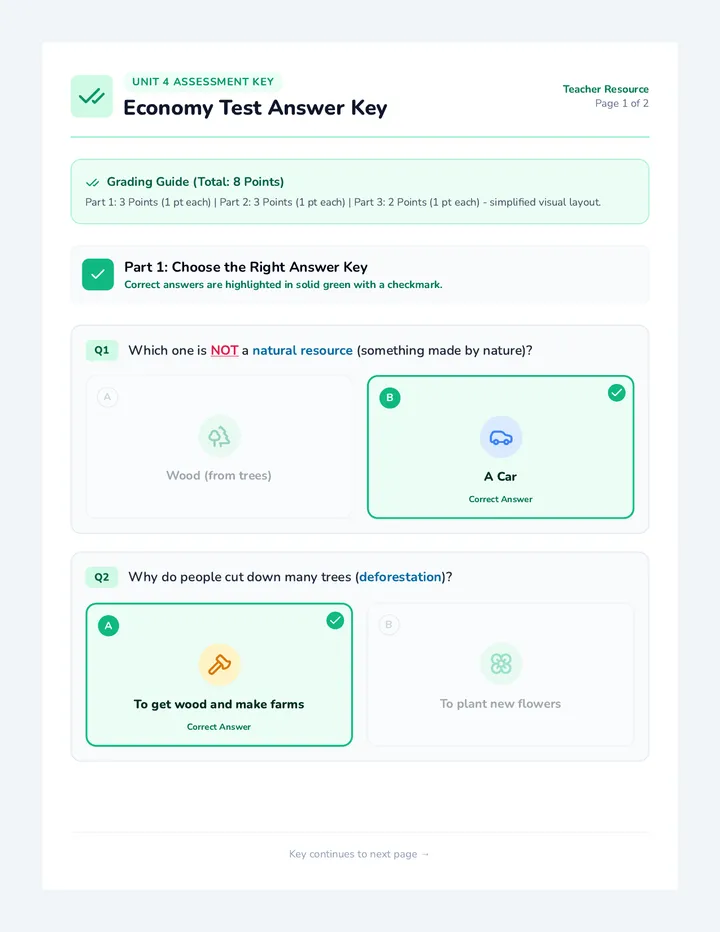
The teacher answer key for the IEP-modified Economy Test. It features clearly marked correct answers, filled-in letters for the matching section, and circled correct values in the True/False section for rapid and seamless grading.
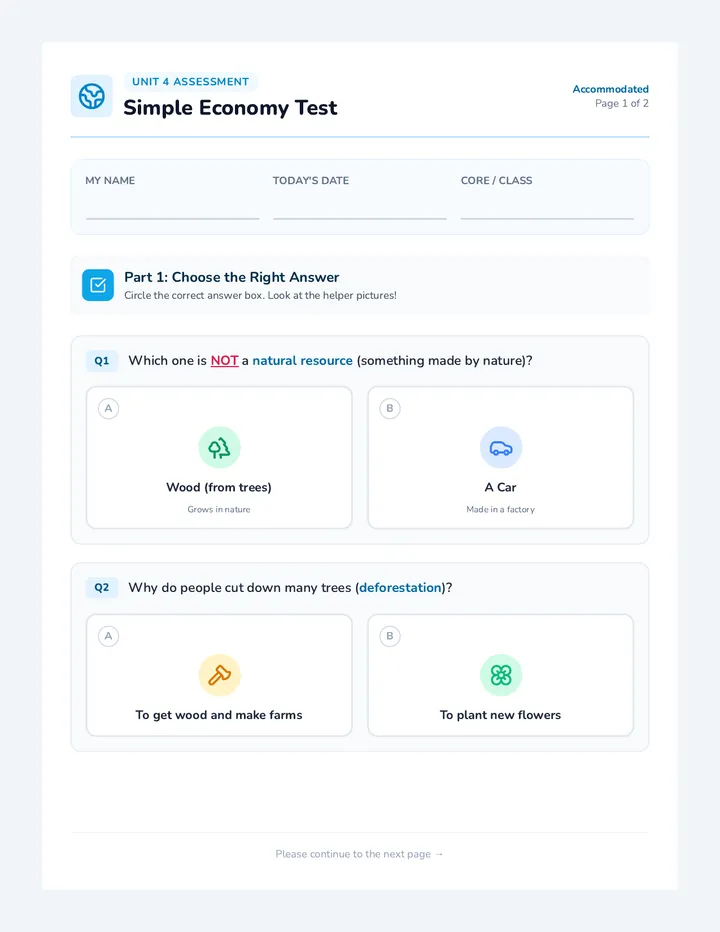
A highly simplified, ultra-accessible version of the Unit 4 Economy Test with a reduced question count (7 questions total), simple 2-choice options, bolded key terms, clear visual icons, and an easy-to-use 3-term word bank.
A printable map of the thirteen colonies for third-grade students to color-code by region, including a legend and a checklist of all thirteen colonies.
A comprehensive teacher guide and answer key for the Colonial Crossroads lesson, including correct responses and instructional tips.
An engaging reading passage for third-grade students that details the differences between the New England, Middle, and Southern colonies, followed by comprehension questions.
A vocabulary matching game featuring visual icons for key colonial terms, paired with a regional matching challenge for third graders.
A visual word work worksheet for Kindergarten and ESL students focusing on the word 'Customer', featuring say/draw/trace/circle sections for multi-sensory learning.
Updated answer key for the Fort Sumter Worksheet, following the T/F recap format.
A visual presentation for Lesson 10 exploring the secession of the Southern states and the 34-hour bombardment of Fort Sumter that marked the beginning of the Civil War.
A student worksheet covering the secession of the Southern states, the formation of the Confederacy, and the timeline of the Battle of Fort Sumter. It includes sequencing, vocabulary, and primary source reflection.
A creative blueprint and coloring sheet allowing students to name their lemonade business, set drink pricing, design their mascot shield, and outline secret ingredients.
A three-page student journal document comprising a reading passage on business development, a persuasive sensory word brainstorming page, and a custom scaled bar graphing activity.
A visually rich six-slide deck designed to guide third graders step-by-step through the morning schedule, including reading instruction, persuasive advertising vocabulary, active brain breaks, and math graphing guides.
A two-page teacher facilitation guide outlining the exact 9:00 AM - 11:50 AM schedule, curriculum integration points (ELA & Math), answer keys, and class discussion prompts.
A comprehensive 1-page lesson outline, classroom store simulation plan, and detailed answer key for Day 4 ("Scoop Economics") of the Sweet Scoops unit.
A beautiful 2-page print-ready simulation sheet where students brainstorm their custom parlor name/logo, sort productive resources (Natural, Human, Capital), price a signature 4-scoop waffle cone, and solve an economic profit budgeting math problem.
An engaging 5-slide presentation on Day 4 of the Sweet Scoops unit, teaching economics (producers, consumers, and productive resources) and integrating it with math fraction budgeting and cost calculation.
A comprehensive 1-page teacher guide and lab facilitation planner for Day 3 ("Chilly Chemistry"), outlining standard alignment, preparation logistics, heat transfer concept notes, and the lab answer key.
A 2-page print-ready lab report and scientific observations packet where students formulate a hypothesis, list materials, record experimental observations, classify states of matter, and write scientific conclusions about freezing point depression.
An engaging 5-slide presentation on Day 3 of the Sweet Scoops unit, exploring states of matter (solids, liquids, gases), physical phase changes (freezing, melting), heat energy transfer, and the science of using salt to lower the freezing point of ice.
A comprehensive 1-page lesson outline, common misconceptions guide, and detailed answer key for Day 2 ("Fraction Parlor") of the Sweet Scoops unit.
A 2-page print-ready math worksheet for students, practicing partitioning circles, identifying fractions of sets (scoops on a cone), placing fractions on number lines, and solving word problems.
An interactive 5-slide presentation on fractions for Day 2 of the Sweet Scoops unit, teaching fractions of a whole (ice cream cakes), fractions of a set (scoops on a cone), and fractions on a number line (the delivery truck route).
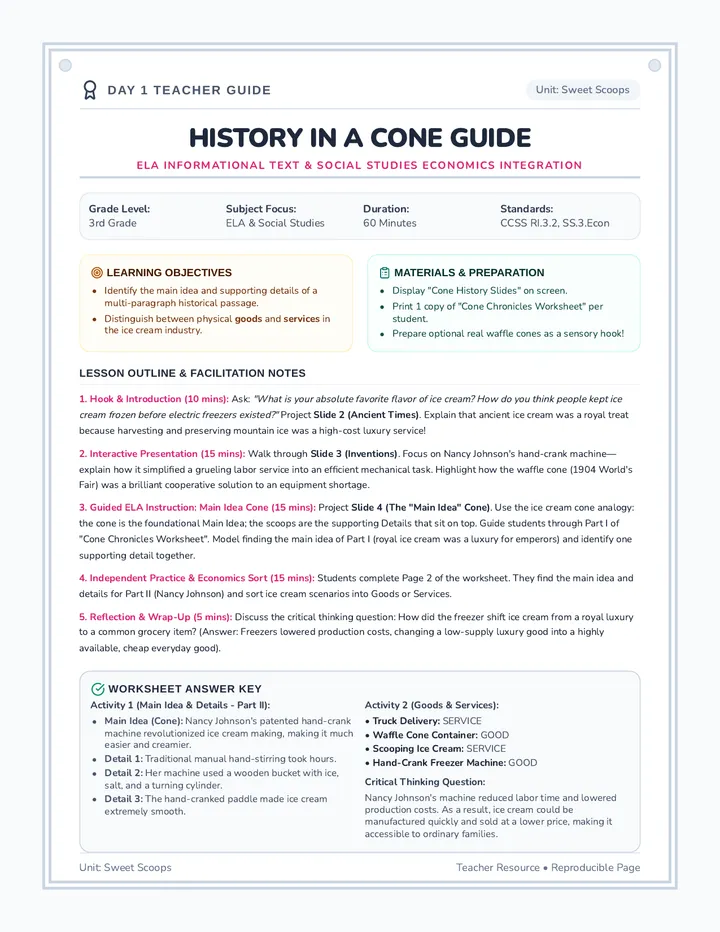
A comprehensive 1-page lesson outline and answer key for Day 1 ("History in a Cone"), providing pedagogical scaffolding, discussion prompts, time breakdown, and specific grading answers for the ELA and Social Studies student worksheet.
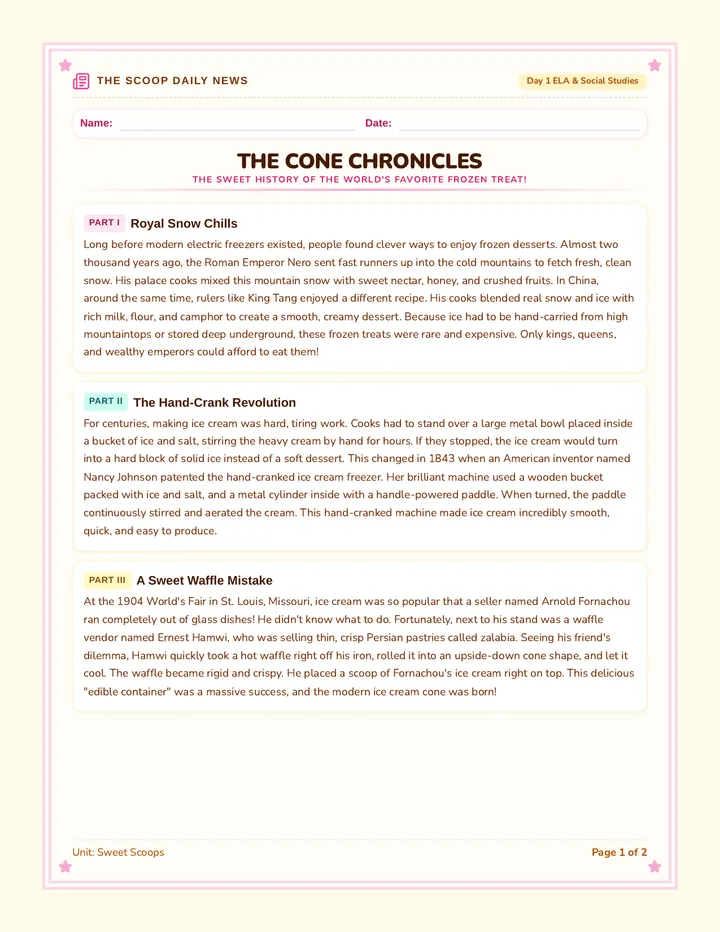
A 2-page print-ready ELA and Social Studies student worksheet containing a custom historical reading passage, a main idea and detail graphic organizer, a goods and services categorizing table, and a critical thinking essay question.
An engaging 5-slide visual presentation for Day 1 of the Sweet Scoops unit, exploring the history of ice cream (from Nero to Nancy Johnson), ELA main idea and supporting details using an ice cream model, and social studies economics concepts of goods and services.
A teacher answer key for the "Japan Logbook Worksheet," providing suggested complete-sentence responses based on the "Sun Rise Slides."
A 3-page guided research worksheet for students to record information about Japan. It requires students to write in complete sentences and matches the sections of the "Sun Rise Slides" presentation.
A vibrant and informative 15-slide presentation about Japan, covering its basic facts, geography, culture, government, and fun facts. It features a clean aesthetic with a national color palette and thematic icons.
The final, polished "Tar Heel Trailblazers" unit packet. Includes ONE professional cover page, a consolidated "Reading Booklet" (Part 1), and a "Question Log" (Part 2) with 10 multiple-choice questions per day. Standardized 1-column layout and darkened field lines for photocopier readiness.
The finalized "Tar Heel Trailblazers" unit. One overall cover page, followed by a consolidated 3-page "Reading Booklet" (Part 1), and a 50-question multiple-choice assessment (Part 2) matching 3rd grade NC EOG rigor. All other materials removed.
An answer key for the Regional Wonders Assessment in the "Field Journal" theme, with detailed rationales and pedagogical tips for 3rd grade teachers. Corrected rationales and font sizing.
A 3rd grade level 20-question assessment on NC geography, featuring the "Cartographer's Field Journal" theme with parchment backgrounds and removed student answer lines for a clean, unified look. Corrected reading passage layout and question formatting. expanded to 20 items.
A historical timeline slide deck in the "Field Journal" theme, tracing North Carolina's history from the Roanoke mystery to the Greensboro sit-ins. Fixed color consistency, badge layout, and balanced white space. expanded review questions.
Updated answer key for the Tar Heel Chronicles Assessment, featuring standard alignment and rationales in a matching "Field Ledger" theme. Now covers 20 questions.
A comprehensive 20-question assessment on NC history, now presented in a "Cartographer's Field Journal" theme with parchment tones and removed student work lines. Section headers updated to Parts for consistent question referencing. expanded to 20 items. Tightened layout for efficient printing.
A visually engaging slide deck covering North Carolina's state symbols and government, reimagined as a cartographer's field journal with parchment textures and weathered ink accents. Fixed text spacing and icon clipping. expanded review questions.
A comprehensive teacher facilitation guide for the Ancient Rome unit. Includes SOL alignment, slide-by-slide discussion prompts, extension activities, pacing suggestions, and differentiation strategies.
Answer key for the Empire Explorers Worksheet. Includes clear, bolded answers for geography, daily life, architecture, and government sections.
A 2-page student worksheet and study guide for Ancient Rome. Includes sections for geography, architecture, resource classification (SOL 3.8), and government (SOL 3.5).
A 18-slide deep dive presentation into Ancient Rome for 3rd grade Virginia SOLs. Now includes detailed slides on Natural, Human, and Capital resources (SOL 3.8). Updated with better contrast on resource slides.