Fundamental principles of supply, demand, and monetary systems alongside micro- and macroeconomic structures. Examines the impact of corporate power, labor market dynamics, and global systems on social mobility and class inequality.
A three-day immersive sequence where 3rd-grade students learn the fundamentals of supply and demand. Students progress from learning basic logic with lemonade to investigating "Price Crimes" as Market Detectives, using economic clues to solve mystery price shifts.
A differentiated social studies unit covering the geography, cultures, and empires of the Middle East and North Africa, adapted for 3rd-grade readability based on the DESE Investigating History Grade 6 curriculum.
Students explore the evolution of money from the barter system to digital currency, identifying the three primary functions of money: medium of exchange, unit of account, and store of value. through hands-on simulations and creative workshops.
A 3rd-grade history sequence exploring the sophisticated governance, social structures, and trade networks of Indigenous peoples in North America before European contact, focusing on the Haudenosaunee Confederacy and continental trade systems.
This sequence bridges social studies and procedural thinking, teaching students to analyze and design multi-step processes in government, economics, and daily life. Through simulations and case studies, students learn why the order of events is critical for fair and effective systems.
An immersive economics unit for 3rd grade that uses simulations, games, and real-world scenarios to explore scarcity, opportunity cost, and resource allocation. Students move from basic definitions of needs and wants to complex budgeting decisions and barter systems.
A game-based economics unit for 3rd graders exploring the shift from traditional employment to the gig economy, covering job types, technology's role, and financial literacy.
A 5-lesson sequence for 3rd-grade students exploring scarcity, needs vs. wants, opportunity cost, and incentives through hands-on simulations and budgeting activities.
An introductory economics sequence for third-graders exploring personal finance, banking functions, and the concepts of interest and credit. Students learn through a classroom mini-economy, simulations, and real-world scenarios to build financial literacy.
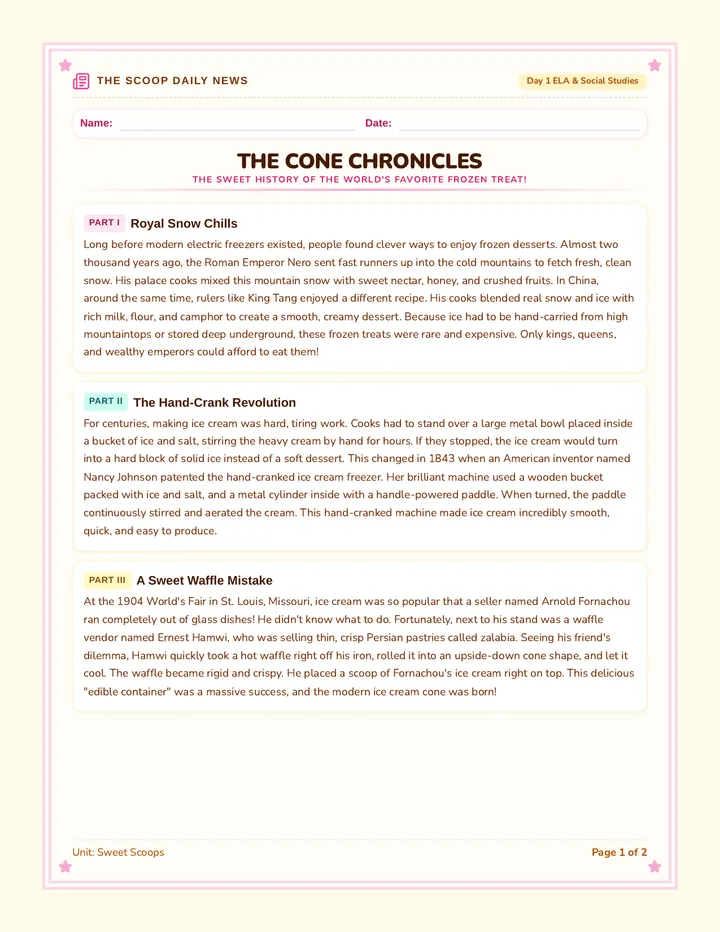
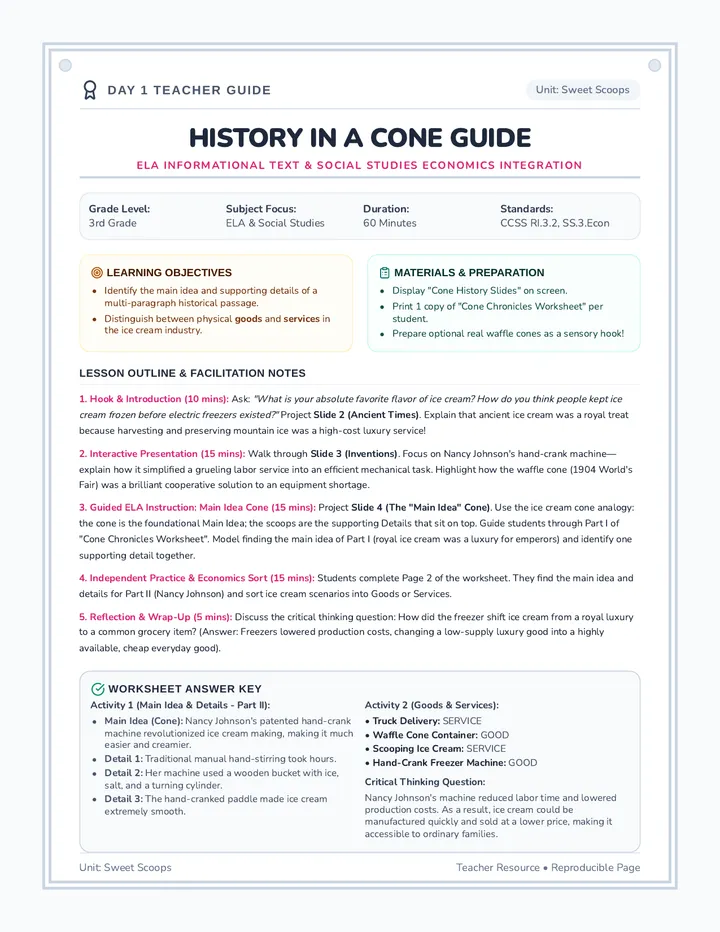
An integrated 4-day unit for 3rd grade that uses the engaging theme of ice cream to teach ELA informational reading, fraction concepts in math, states of matter in science, and economics in social studies. Students read historical texts, partition scoops of fractions, perform a chemistry freezing lab, and design their own parlor business.
A unit exploring the geographical, economic, and social differences between the North and South in the mid-19th century, centered on the life of Harriet Tubman and the abolitionist movement.
A 4-day social studies unit for 3rd grade focusing on Arizona's geography, history, and economy, specifically designed to meet standard 3.RI.9 by comparing and contrasting key details across multiple texts.
A comprehensive collection of Project-Based Learning (PBL) units spanning early childhood literacy, elementary math and science, and middle school social studies. Each unit guides students through inquiry, creation, and presentation within a themed 'Discovery Files' framework.
A comprehensive 5-lesson exploration of the West region of the United States, covering geography, climate, resources, culture, and states/capitals through reading passages and interactive activities.
This 3rd-grade sequence explores Africa's natural resources, historical trade routes like the salt-gold trade, agricultural reliance on the Nile, and modern economic connections. Students engage in simulations and mapping activities to understand how resources drive human movement and community growth.
Students navigate a simulated classroom economy to learn budgeting, opportunity cost, and the difference between needs and wants through games and real-world scenarios.
A 3rd-grade economics sequence that introduces students to investment, risk, resource allocation, and market principles through project-based learning. Students transition from being consumers to aspiring entrepreneurs who plan and pitch their own business investments.
A 5-lesson Social Studies sequence for 3rd graders exploring the core concepts of needs vs. wants, resource distribution, and economic inequality through interactive simulations and community-focused problem-solving.
A project-based sequence where students simulate a market economy by creating products, investing capital, and navigating supply and demand during a classroom market day.
A 3rd-grade economics unit exploring economic inequality, community support systems like taxes and philanthropy, and empowering students to design local service projects.
This unit introduces 3rd-grade students to economic fairness, resource scarcity, and distribution through interactive simulations and discussions. Students explore the difference between equality and equity, experience resource inequality, and collaborate to create more equitable outcomes.
A 5-lesson unit for 3rd-grade students exploring the natural resources and economies of Oceania, from Australia's sheep farms to the versatile coconut palms of the Pacific Islands, culminating in a trade simulation.
This sequence explores the Neolithic Revolution, tracing the shift from nomadic hunting and gathering to settled agricultural communities. Students investigate the 'accidental' discovery of farming, the process of animal domestication, the architecture of early villages like Catalhoyuk, and the economic shifts brought by food surpluses and job specialization.
A project-based sequence where 3rd-grade students research a specific state's symbols, climate, resources, and landmarks to understand how environment and history shape state identity, culminating in a 'State Float' presentation.
This sequence explores how cities function as complex systems, focusing on the infrastructure required for water, energy, and waste management. Students analyze the environmental impact of urban living and investigate nature-based solutions like green spaces and sustainable transportation to create healthier, more resilient cities.
An inquiry-based unit for 3rd graders to deconstruct media messages. Students learn to identify advertisements, analyze target audiences, recognize staging tricks, and decode emotional appeals, culminating in the creation of 'honest' advertisements.
A 3rd-grade inquiry into how technology, from simple machines to robotics and software, has transformed the workplace over time. Students explore productivity, automation, and future job trends.
A comprehensive 3rd-grade sequence exploring the fundamentals of economics, from personal roles as producers and consumers to the complex interactions of supply, demand, and market pricing. students engage in hands-on simulations and analysis to understand how goods are valued and prices are set.
A 5-lesson unit for 3rd graders introducing economic basics like scarcity, producers vs. consumers, and the relationship between supply, demand, and price through hands-on simulations.
A 3rd-grade economics unit where students take on the role of market participants to explore how supply and demand interact to determine prices through simulations, workshops, and a final CEO project.
A comprehensive sequence exploring the evolution of work from the Industrial Revolution to the gig economy, focusing on the impact of technology on jobs and skills.
Students investigate how technology shifts the nature of work from the past into the future. They explore historical tools, automation, remote work, and the gig economy, concluding by designing a job of the future.
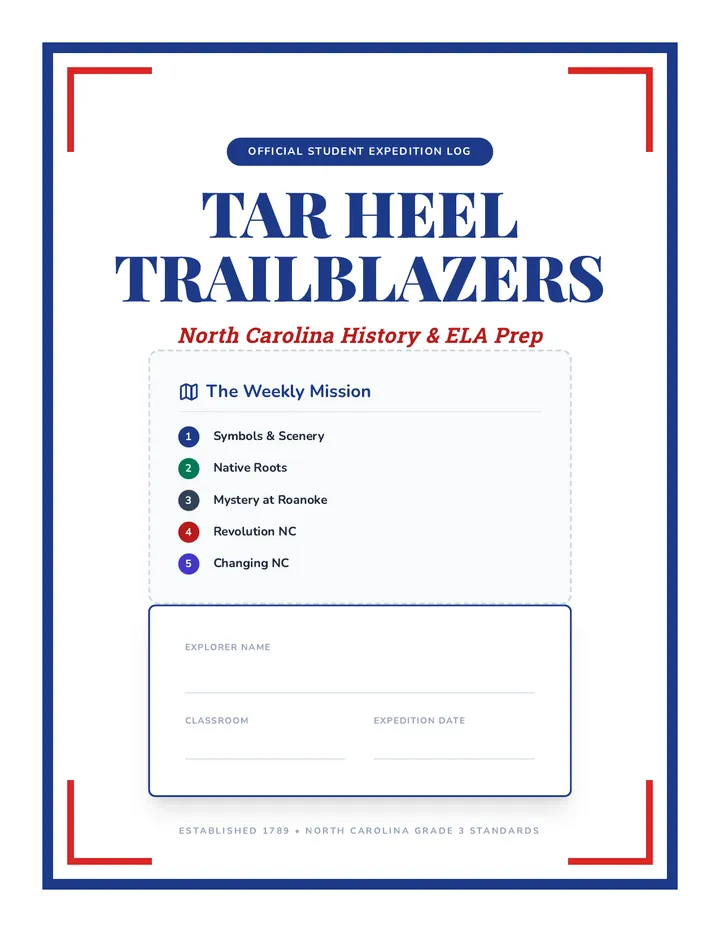
A comprehensive one-week social studies and ELA integration unit covering North Carolina history and symbols, designed to match the rigor of the NC 3rd Grade E.O.G. assessment.
A comprehensive 5-day unit exploring the geography, climate, indigenous history, and modern life of the U.S. Midwest, focusing on the cause-and-effect relationship between environment and industry.
A 5-day unit exploring the Northeastern United States, covering its unique geography and climate, the rich history of the Wampanoag, Abenaki, and Iroquois nations, and the vibrant modern culture of its eleven states.
A comprehensive 5-lesson unit exploring the unique geography, climate, natural resources, diverse cultures, and political boundaries of the Southwest region of the United States.
A comprehensive journey through the Midwest region, covering its geography, economy, and culture in bite-sized 20-minute sessions.
A 5-lesson unit exploring the geography, climate, resources, and culture of the Southeast United States, concluding with a states and capitals challenge.
A 5-lesson sequence exploring the geography, climate, resources, culture, and states of the Northeast region of the United States. Students will engage with reading passages, comprehension activities, and a states-and-capitals matching game.
An immersive 3rd-grade economics unit where students transform into an 'Island Society.' They explore scarcity and the three basic economic questions by simulating command, market, and mixed economic systems to understand how rules shape community life.
A 5-lesson 3rd-grade sequence exploring how the natural resources and geography of different U.S. regions shape their economies, lifestyles, and human adaptations. Students move from identifying raw materials to participating in a full-scale interregional trade simulation.
This sequence explores how geographic location and resource distribution impact economic opportunity and quality of life for 3rd-grade students. Through map analysis, simulation, and urban planning projects, students learn about 'resource deserts,' the importance of public goods, and systemic barriers to access.
A 5-day immersive unit exploring the Southwestern United States, covering geography, climate, indigenous cultures (Pueblo, Navajo, Apache, Comanche), and the transition from historic to modern life in AZ, NM, TX, and OK.
This inquiry-driven sequence explores how natural resources shape regional economies across the United States. Students will investigate the differences between renewable and non-renewable resources, analyze specific regional industries like oil in the Southwest and timber in the West, and participate in a trade simulation to understand economic interdependence.