College selection, application workflows, and financial aid navigation including FAFSA and scholarship acquisition. Builds skills in personal statement writing and career exploration to align post-secondary choices with long-term professional goals.
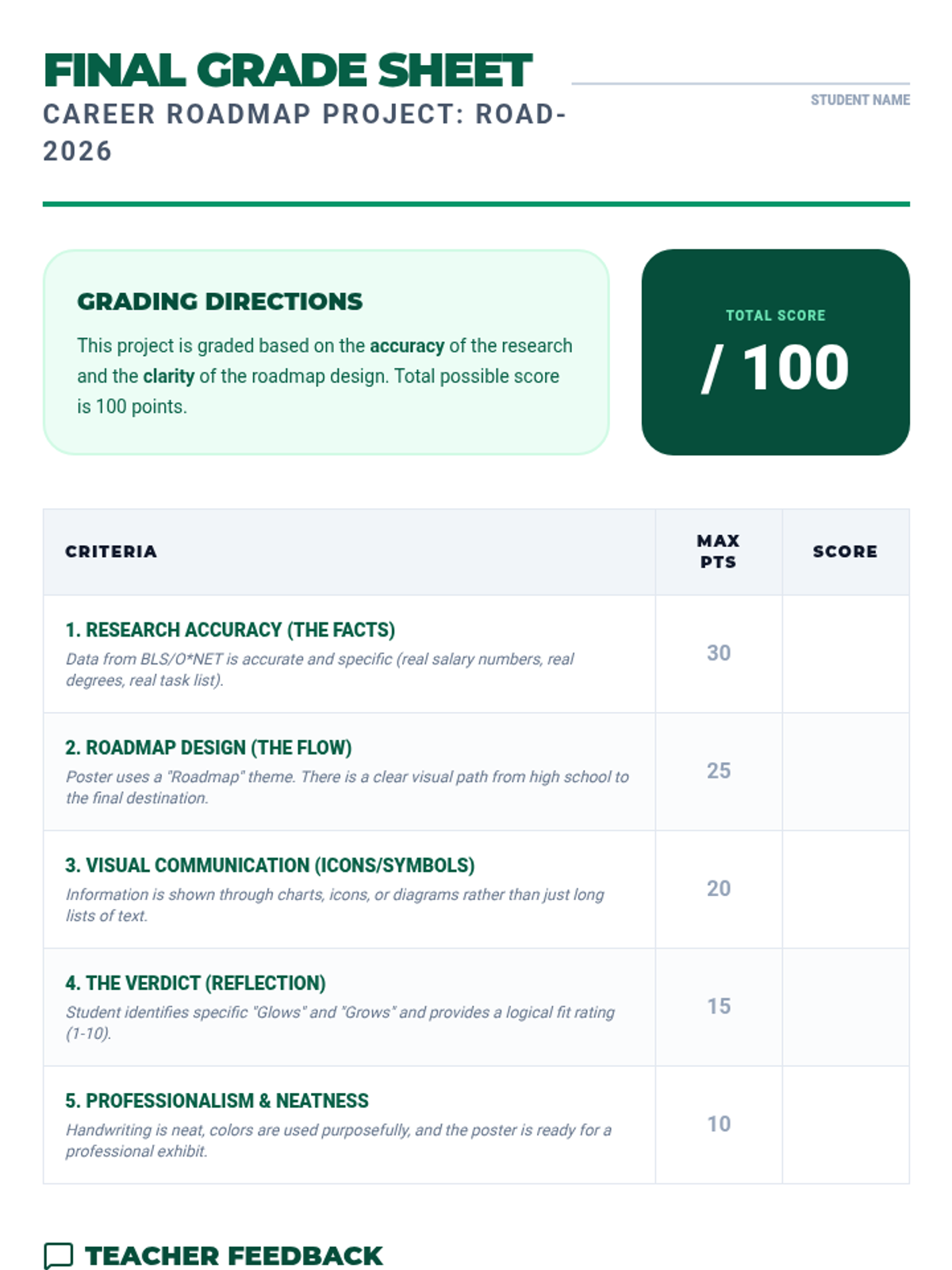
A formal project grading sheet for the Career Roadmap Project, featuring a detailed 100-point rubric with criteria for research accuracy, roadmap design, visual communication, and personal reflection.
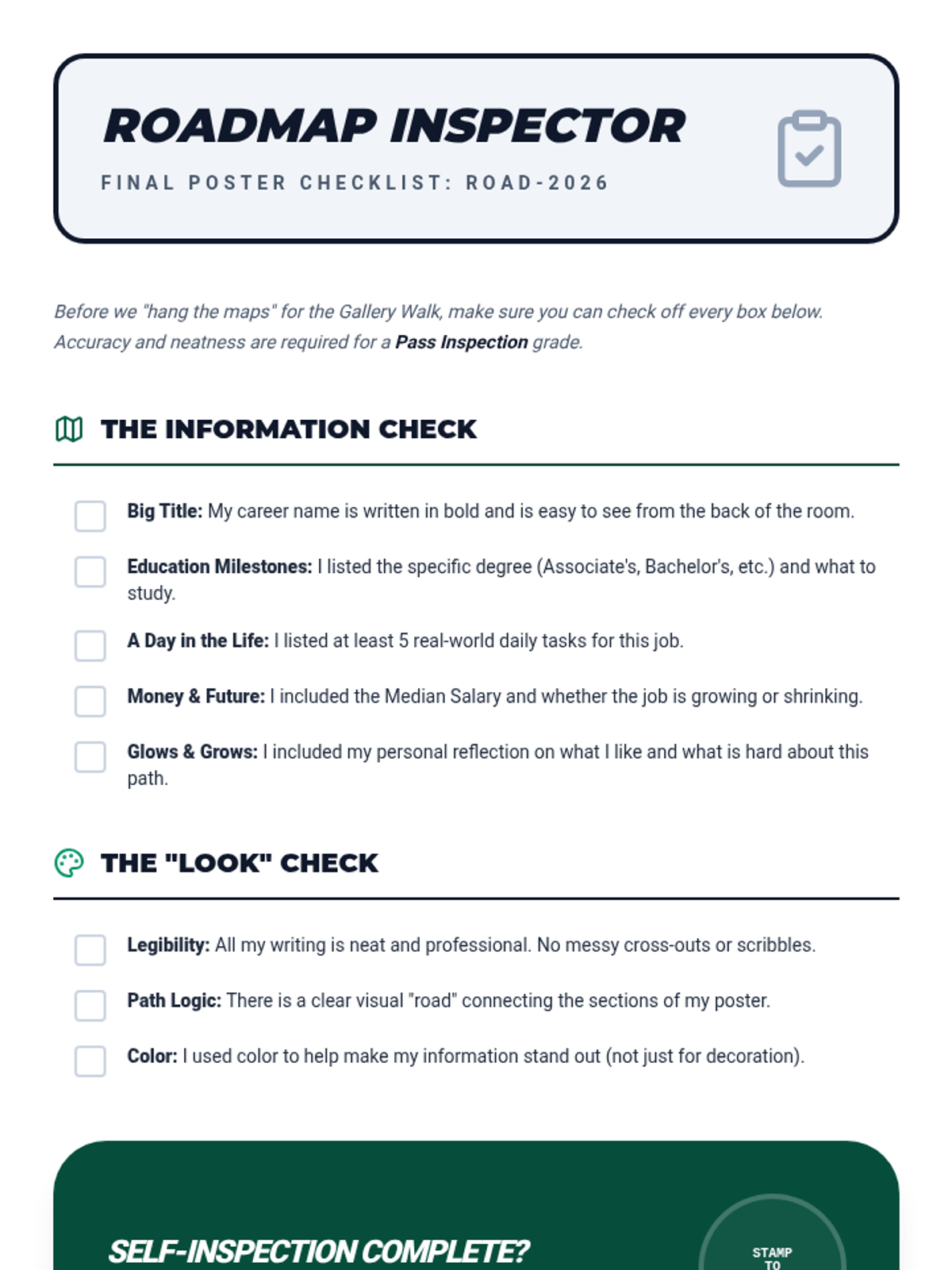
A student-facing design checklist for the final career roadmap poster, ensuring all required technical research and visual elements are included for assessment. This version is simplified for first-time researchers.
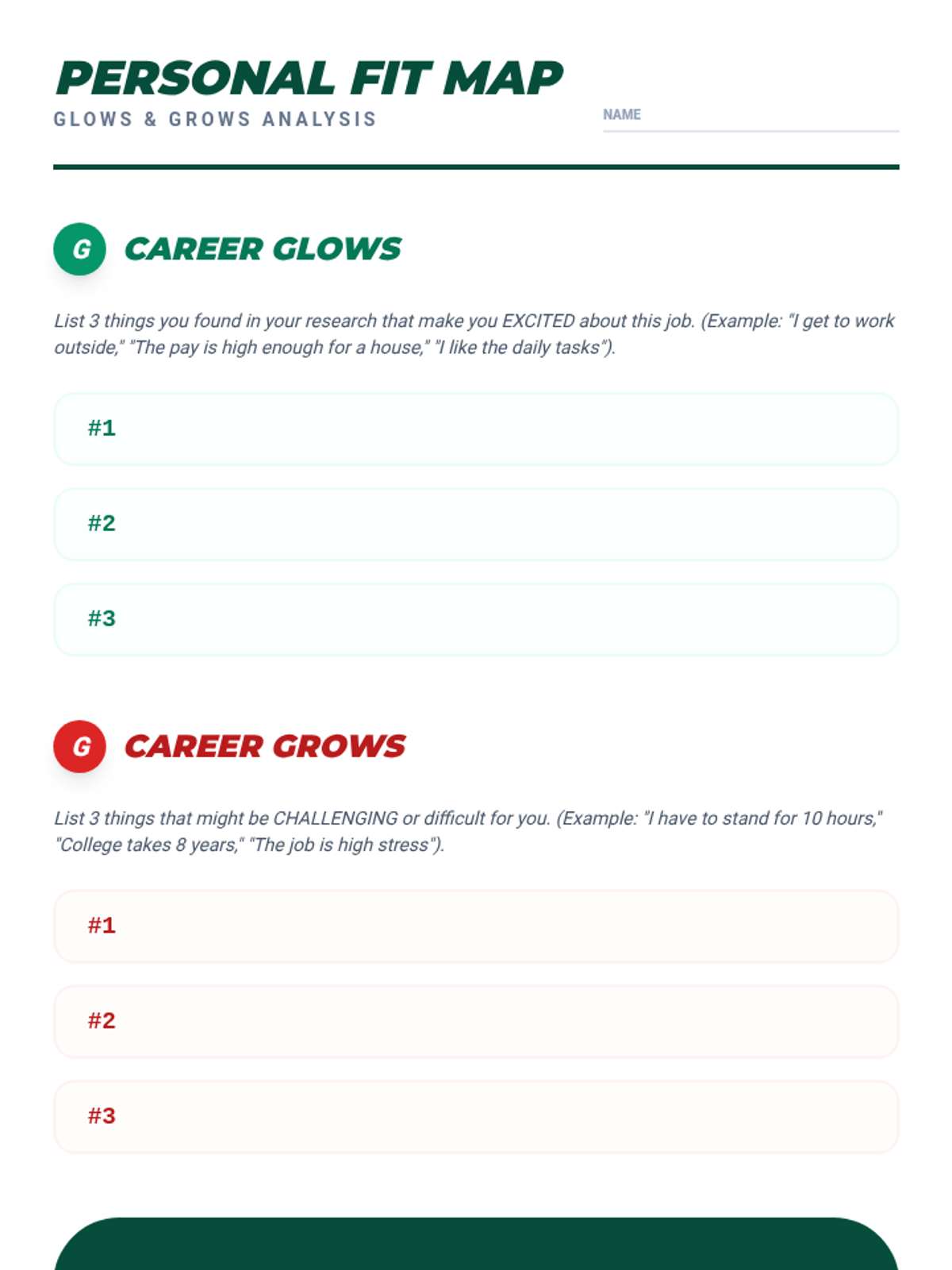
A personal reflection and analysis worksheet for the Career Roadmap Project, guiding students to weigh the pros and cons of their chosen career path and evaluate their personal fit before designing their poster. This version uses 'Glows & Grows' for simpler understanding.
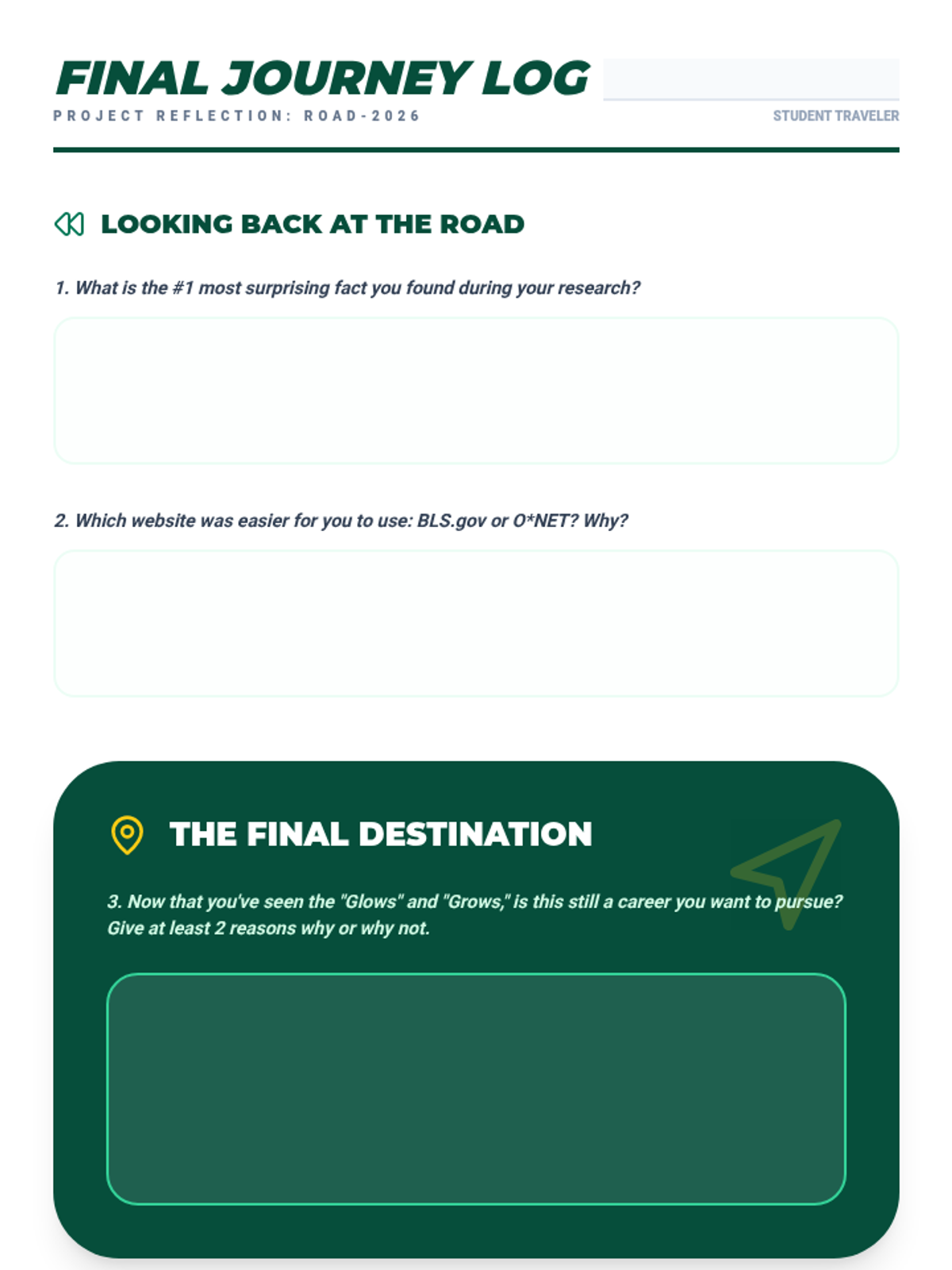
A comprehensive final reflection document for the Career Roadmap Project, guiding students through a structured analysis of their research findings, personal fit, and future action steps. This version is simplified for students new to career research.
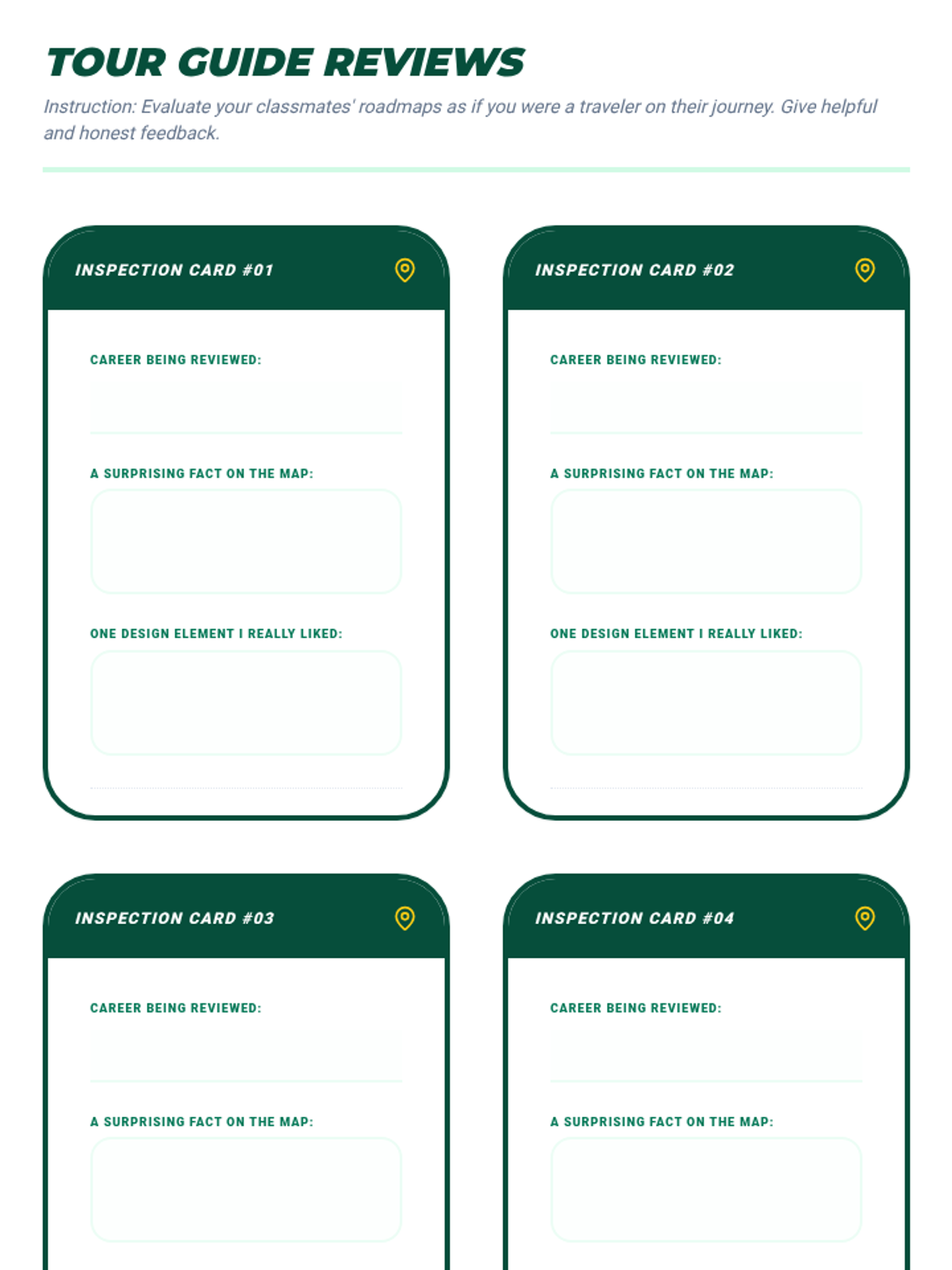
Peer feedback cards for the Gallery Walk phase of the Career Roadmap Project, designed as 'Inspection Cards' where students provide structured feedback on their classmates' posters.
A slide presentation for the third phase of the Career Blueprint Project, guiding students through the process of translating their research data into a technical blueprint-themed poster layout.
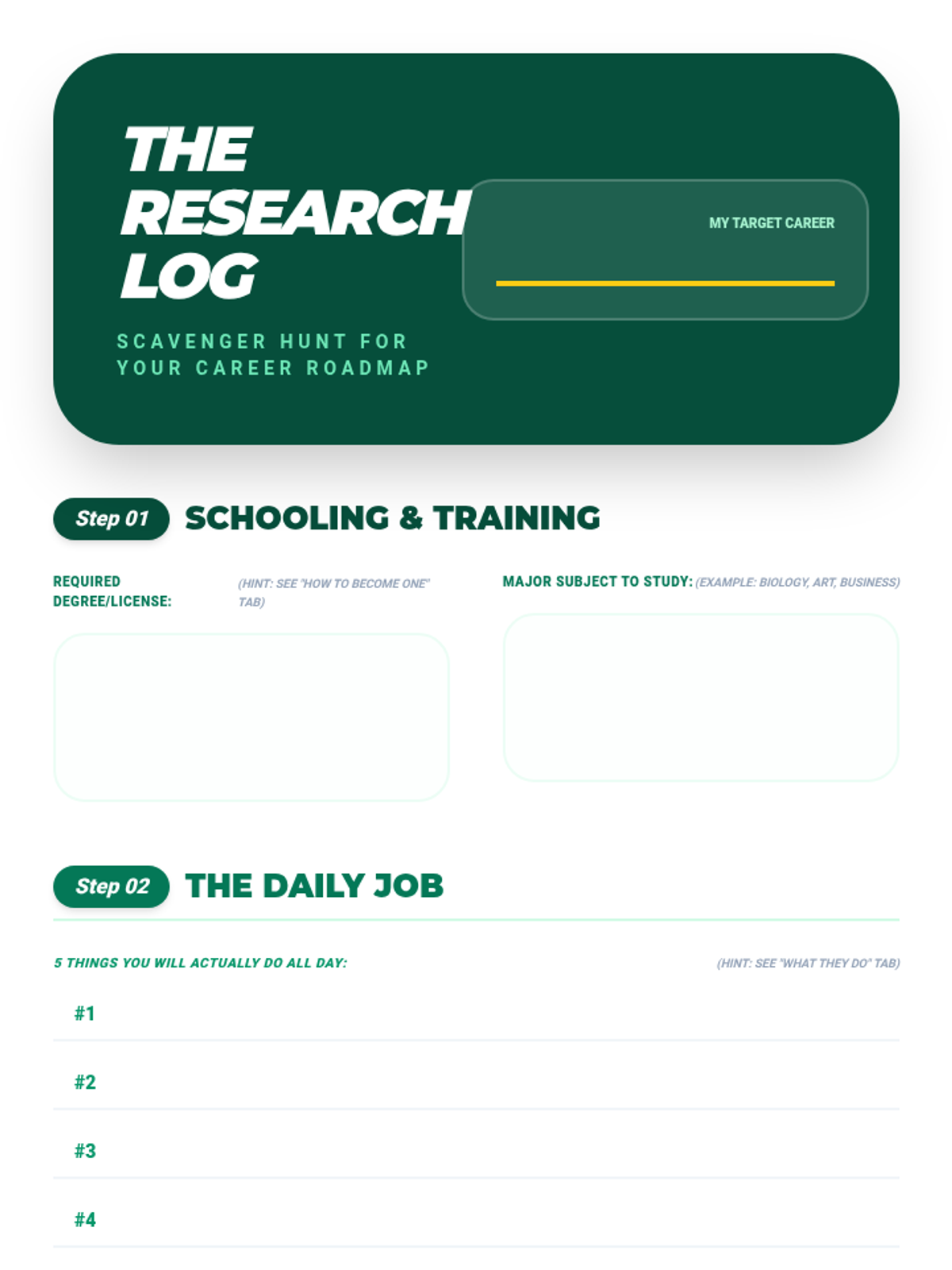
A detailed technical research organizer for the Career Roadmap Project, providing structured sections for students to record education requirements, skill sets, daily responsibilities, and market data. This version includes simple headers and hints specifically for beginners.
A slide presentation for the second phase of the Career Roadmap Project, specifically designed for students with no prior career research experience. It explains BLS/O*NET tools in simple terms and defines key vocabulary like 'Median Pay.'
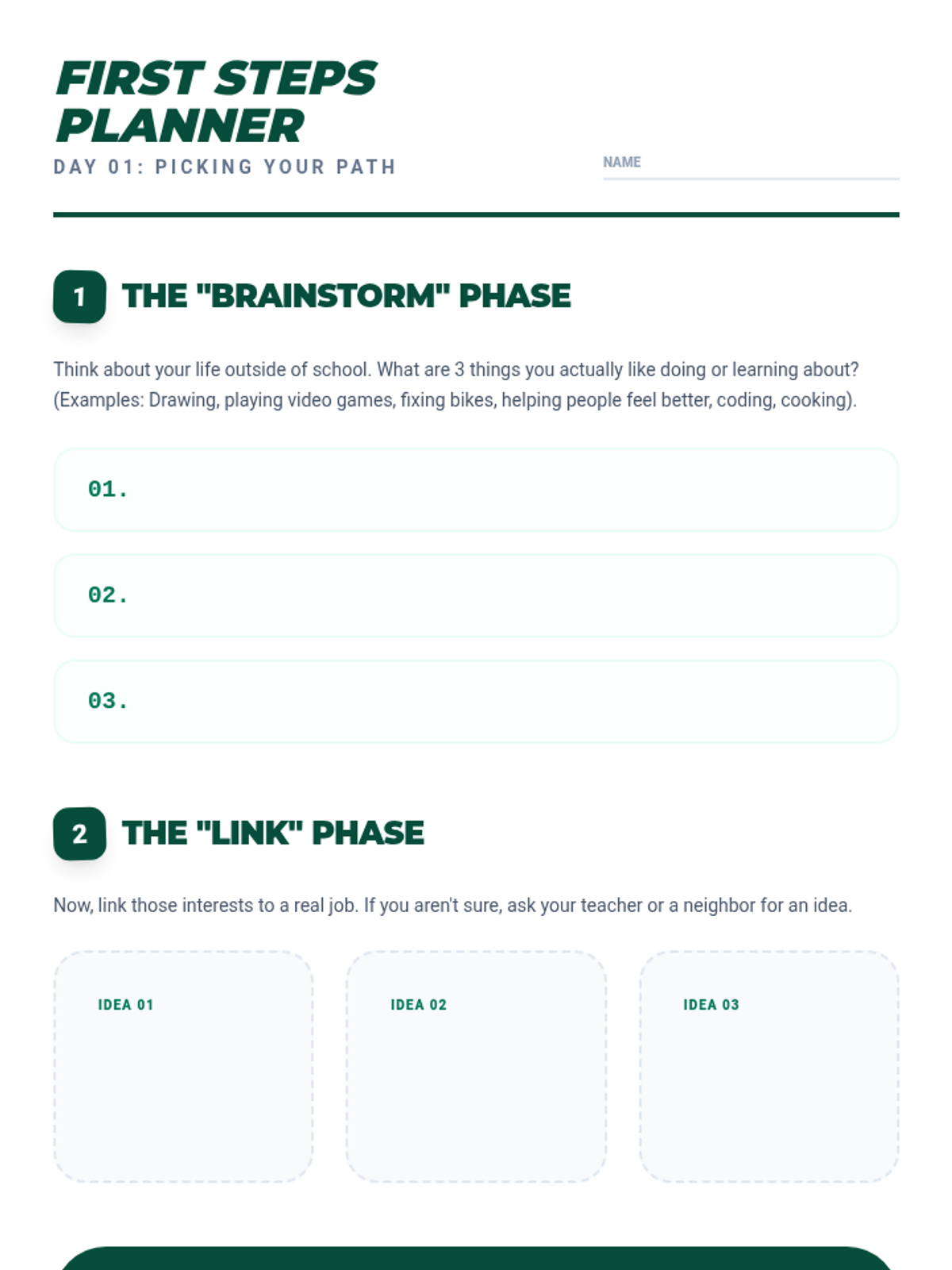
A student planning worksheet for the initial phase of the Career Roadmap Project, guiding 10th-grade students through interest inventory and career selection. This version is simplified for students new to career research.
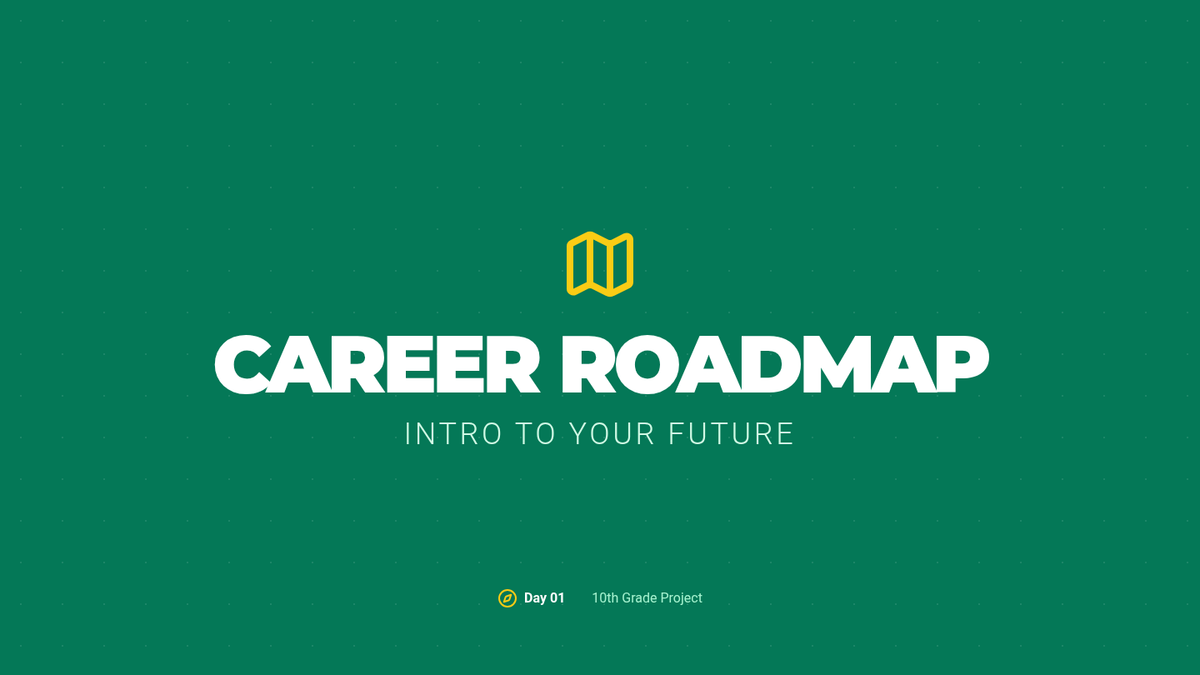
A simplified visual presentation for 10th-grade students with no prior career research experience. It introduces the project as an investigation, explains the real-world tools they will use (BLS/O*NET), and outlines the 10-day roadmap.
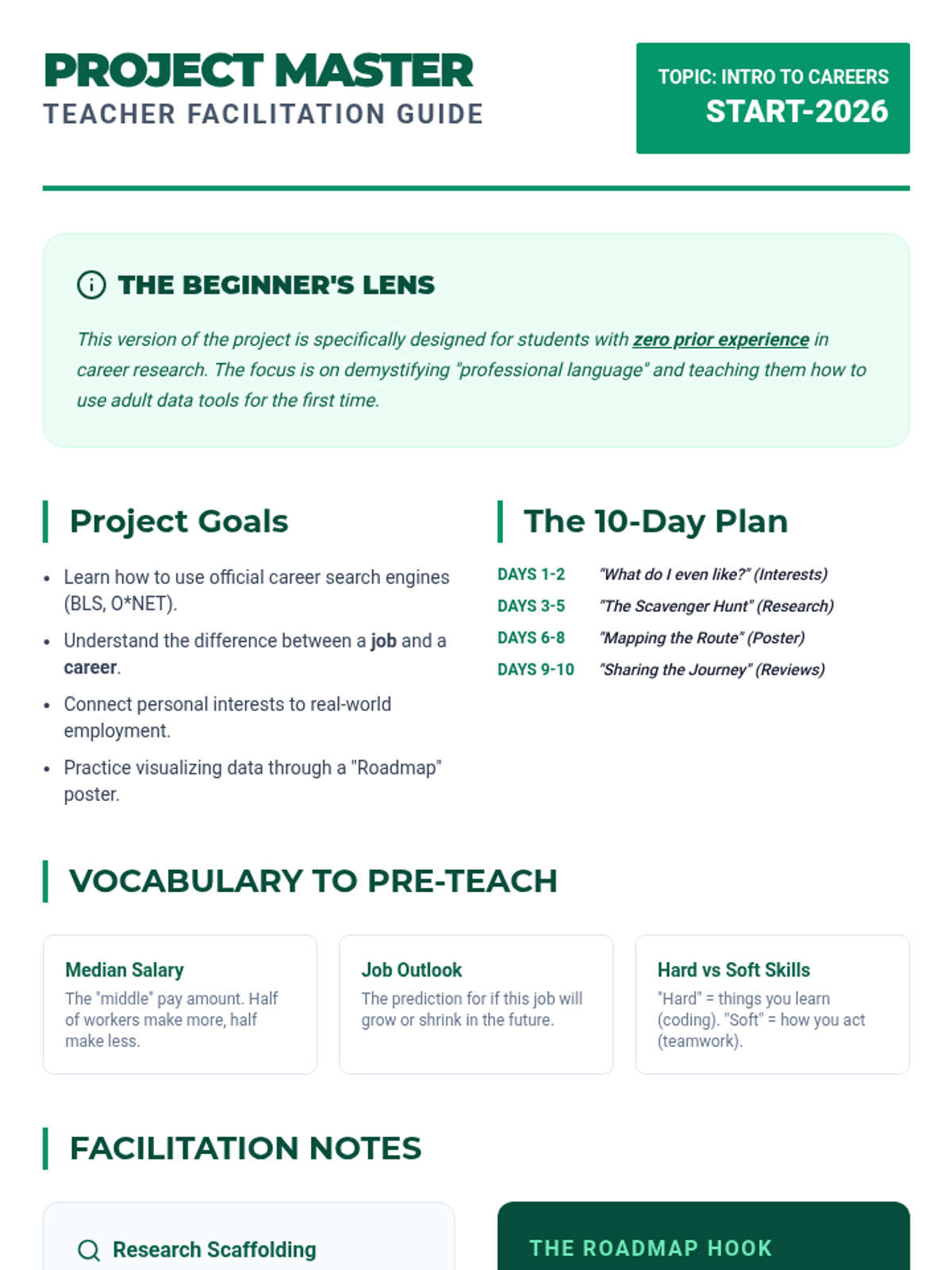
A simplified teacher facilitation guide for the Career Roadmap Project, specifically designed for students with no prior career research experience. It includes pre-teaching vocabulary, demonstration strategies, and a beginner-friendly project timeline.
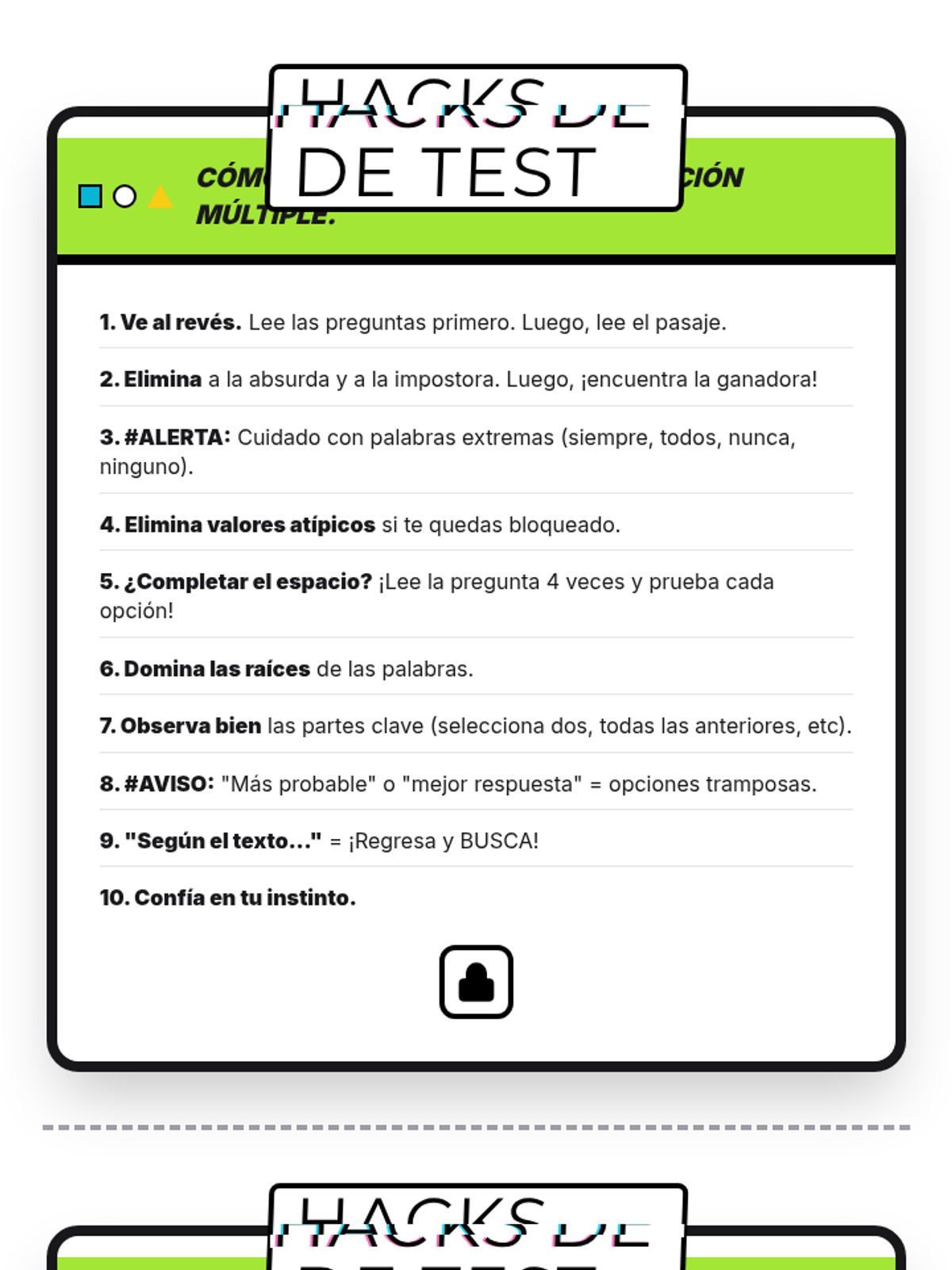
A Spanish translation of the Test Hacker handout, featuring two identical cards with a cyber-glitch aesthetic and practical multiple-choice strategies.
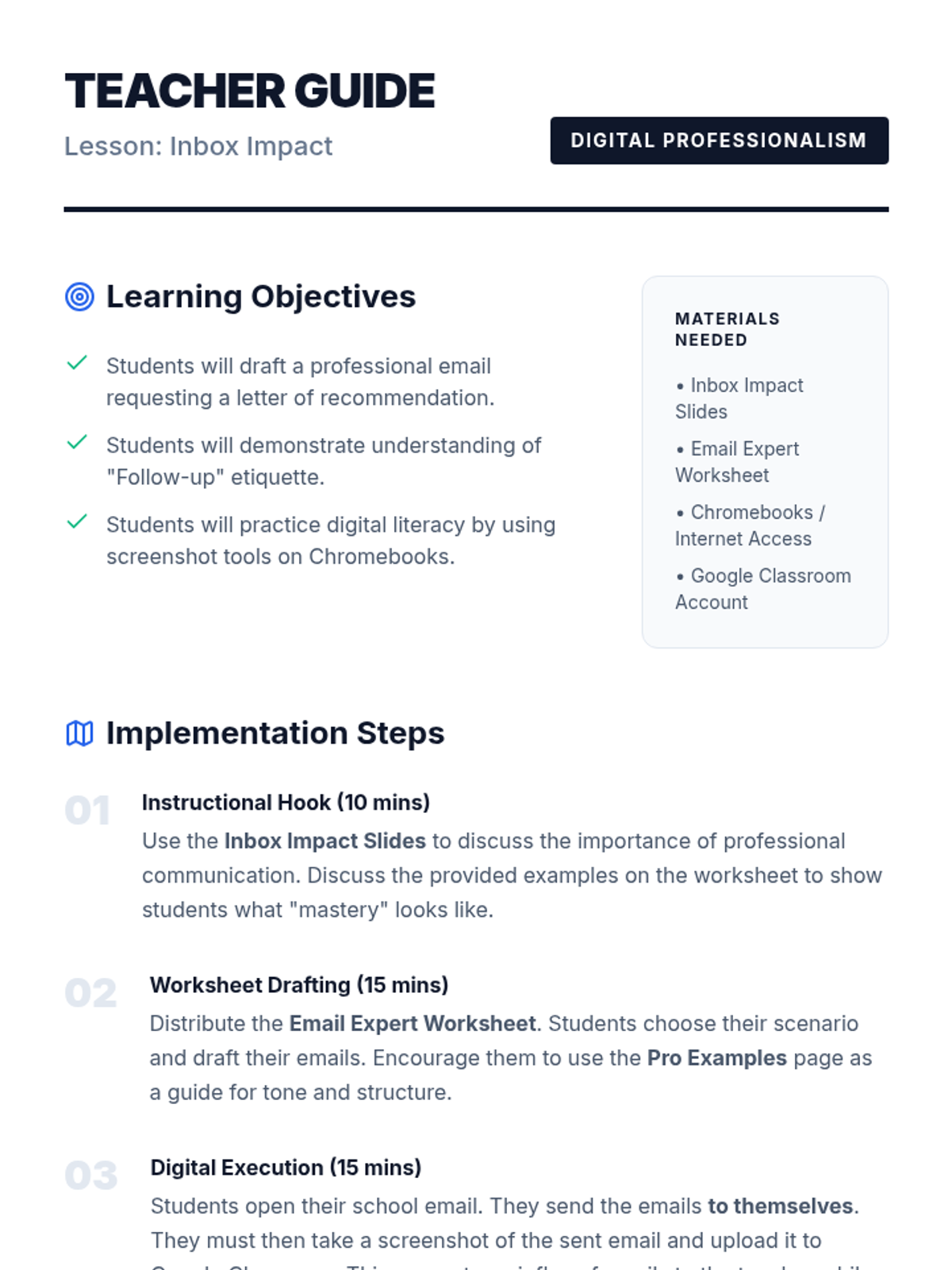
A comprehensive teacher guide for the Inbox Impact lesson. Includes learning objectives, step-by-step implementation, technical troubleshooting for Chromebooks, and a clear grading rubric. Updated to reflect student-to-self email submission process.
A high-impact slide deck for teaching professional email etiquette. It covers the importance of first impressions, the anatomy of a request email, drafting body paragraphs, and the technical steps for the digital assignment. Updated to reflect student-to-self email submission.
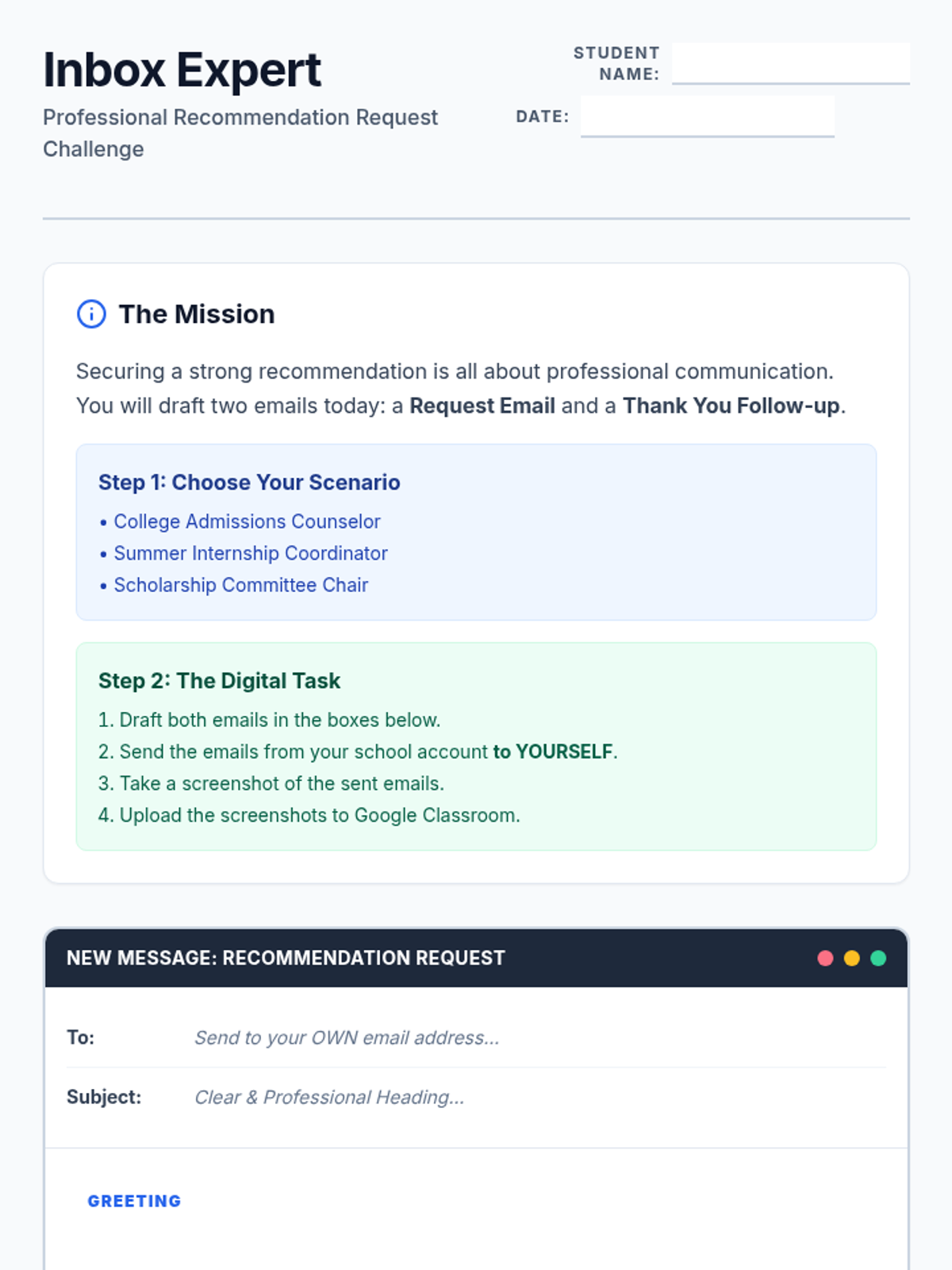
A professional email drafting worksheet designed to look like an inbox compose window. Students draft a recommendation request and a thank-you follow-up, with fields for recipient, subject, and body content, followed by a digital submission checklist. Includes full professional examples for both emails.
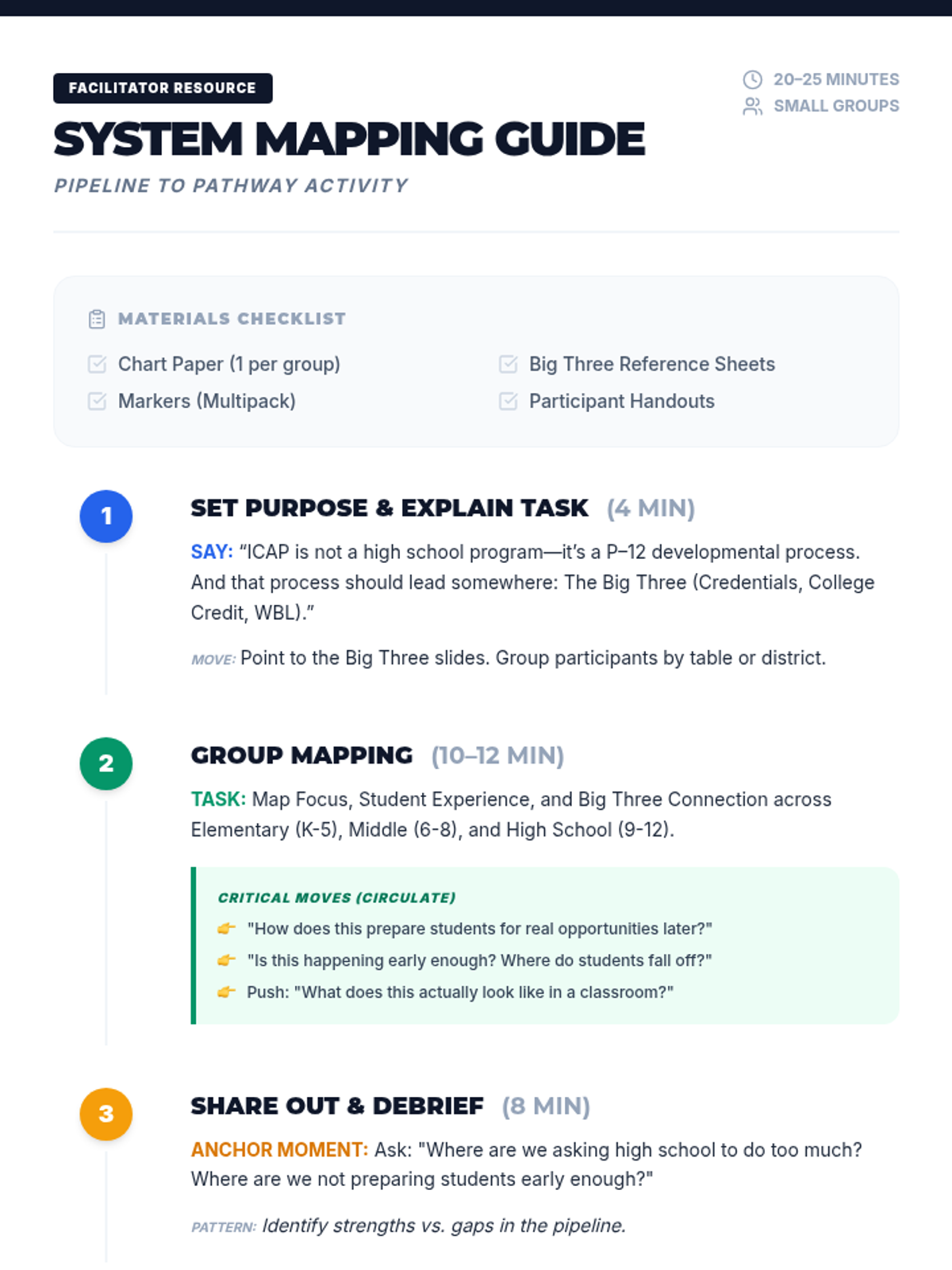
A facilitator cheat sheet for the Pipeline to Pathway activity, providing a step-by-step guide with scripts, moves, and critical prompts to ensure a high-impact session.
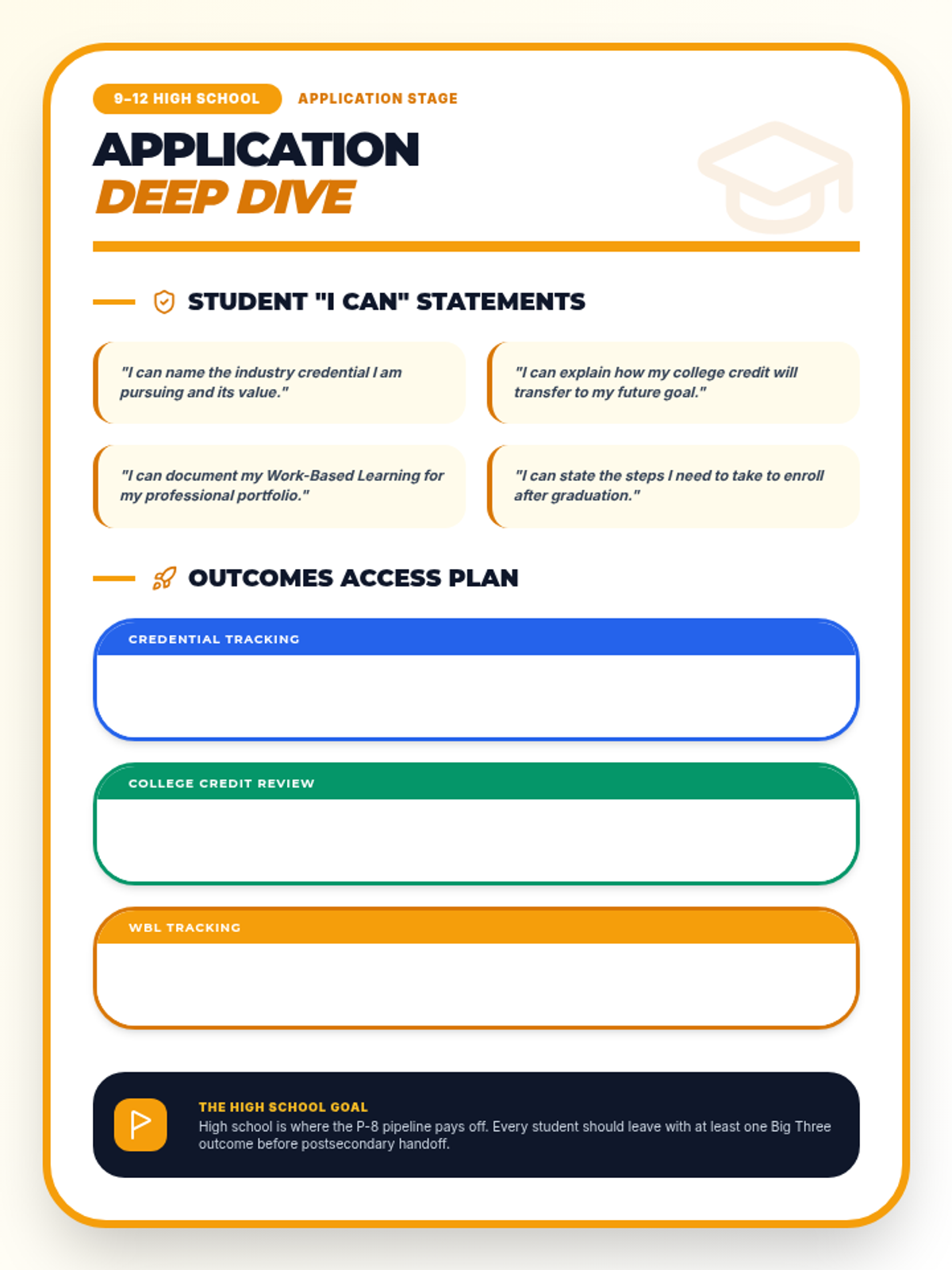
A deep dive implementation guide for the High School (9-12) level. Redesigned with a full-page layout that maximizes space for outcome tracking (Credentials, College Credit, WBL) and high-impact "I Can" statements.
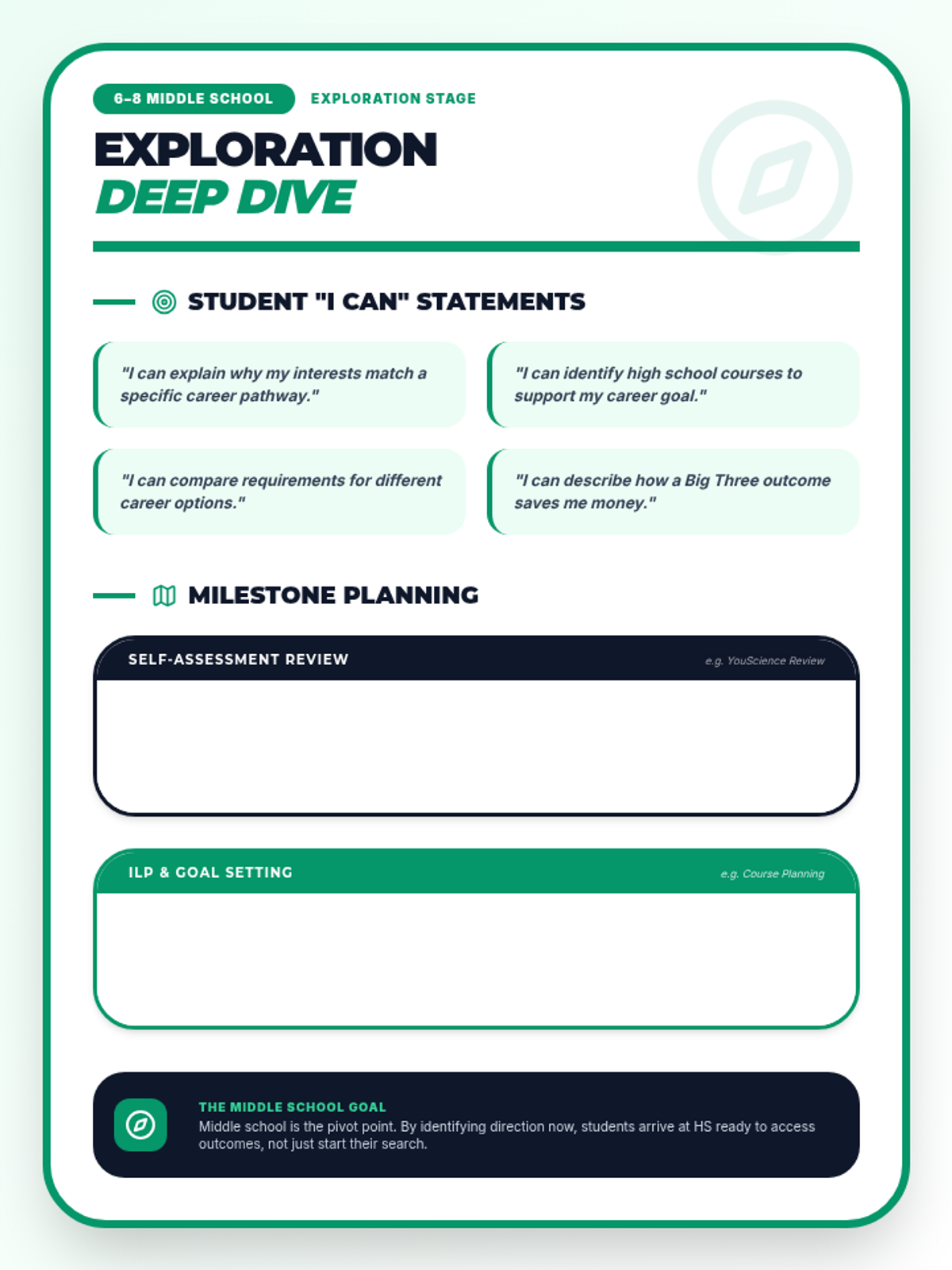
A deep dive implementation guide for the Middle School (6-8) level. Redesigned with a full-page layout that maximizes space for milestone planning and "I Can" statement exploration.
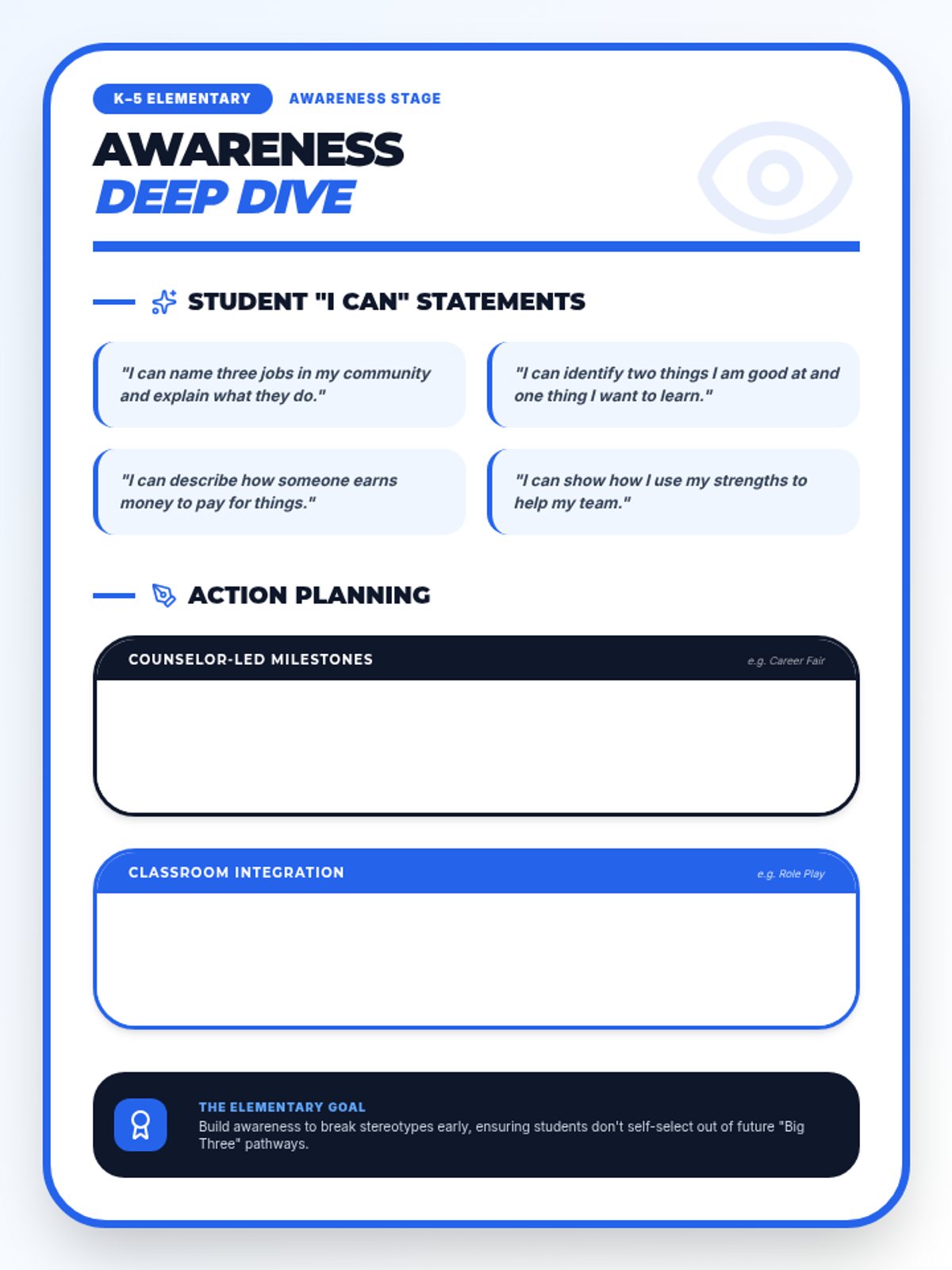
A deep dive implementation guide for the Elementary (K-5) level. Redesigned with a full-page layout that maximizes space for action planning while maintaining high-impact visuals.
A complete presentation guide for the facilitator, following the 7-step Pipeline to Pathway activity with integrated "Big Three" themes and prompts. All text is sized for maximum visibility (minimum 24px).
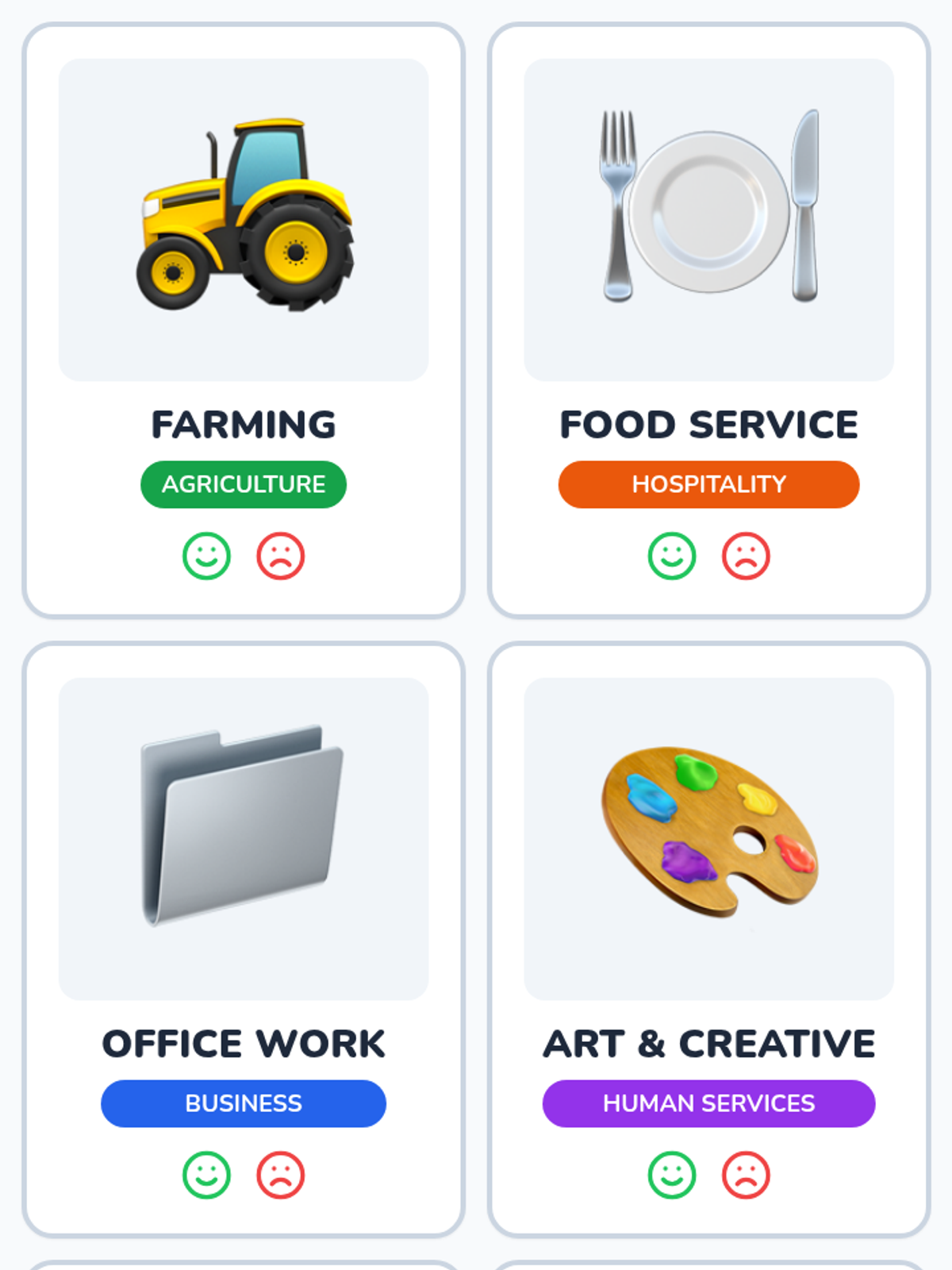
Printable 4-per-page job choice cards with visual cues and career cluster labels, designed for sorting activities and physical preference selection.
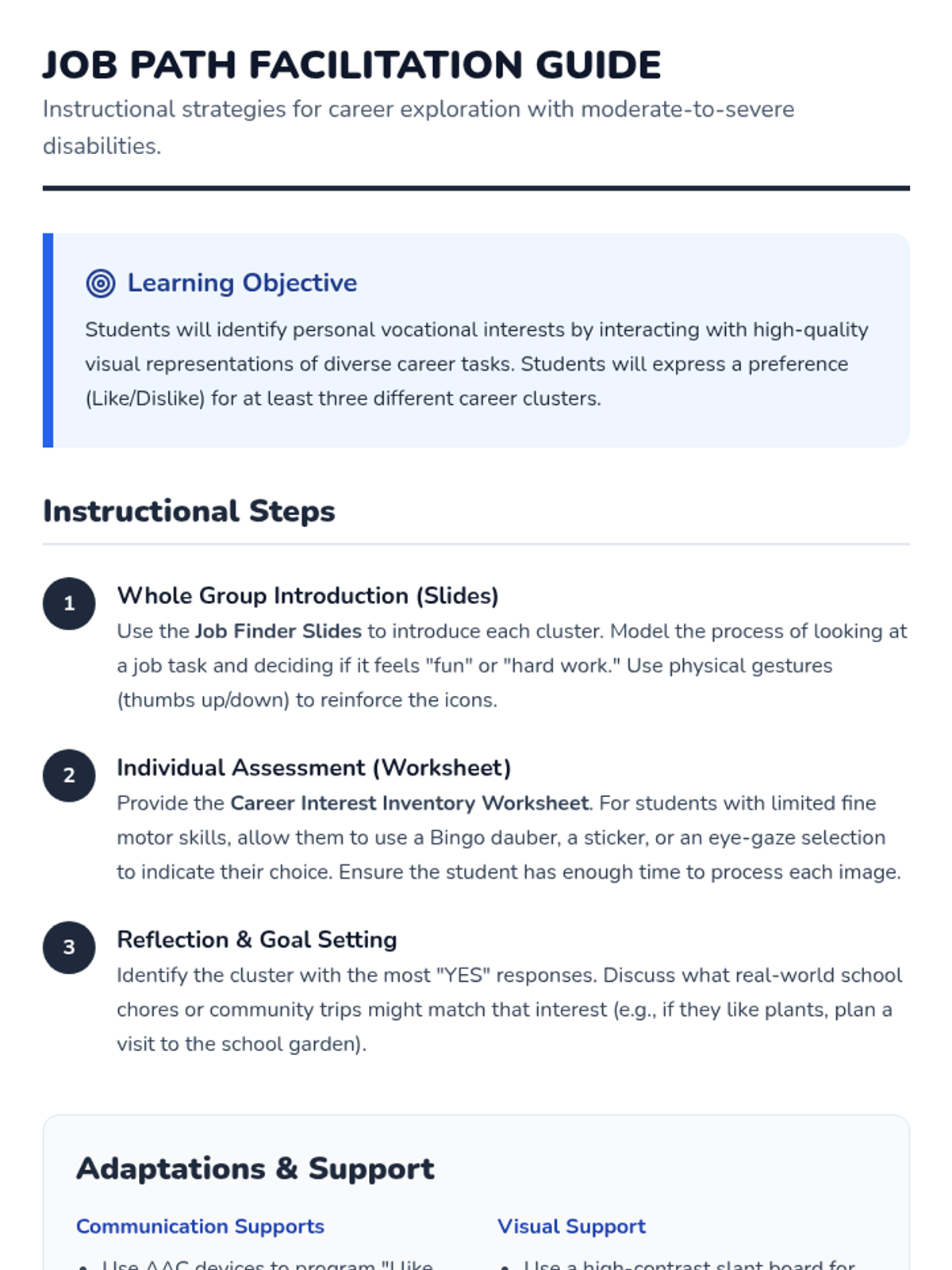
A teacher-facing facilitation guide providing instructional strategies, differentiation tips, and data collection prompts for the Job Path Explorer lesson.
A large-scale visual presentation featuring career clusters and tasks with simple 'Like' and 'Don't Like' prompts, updated to include Construction and Arts clusters for students with moderate to severe disabilities.
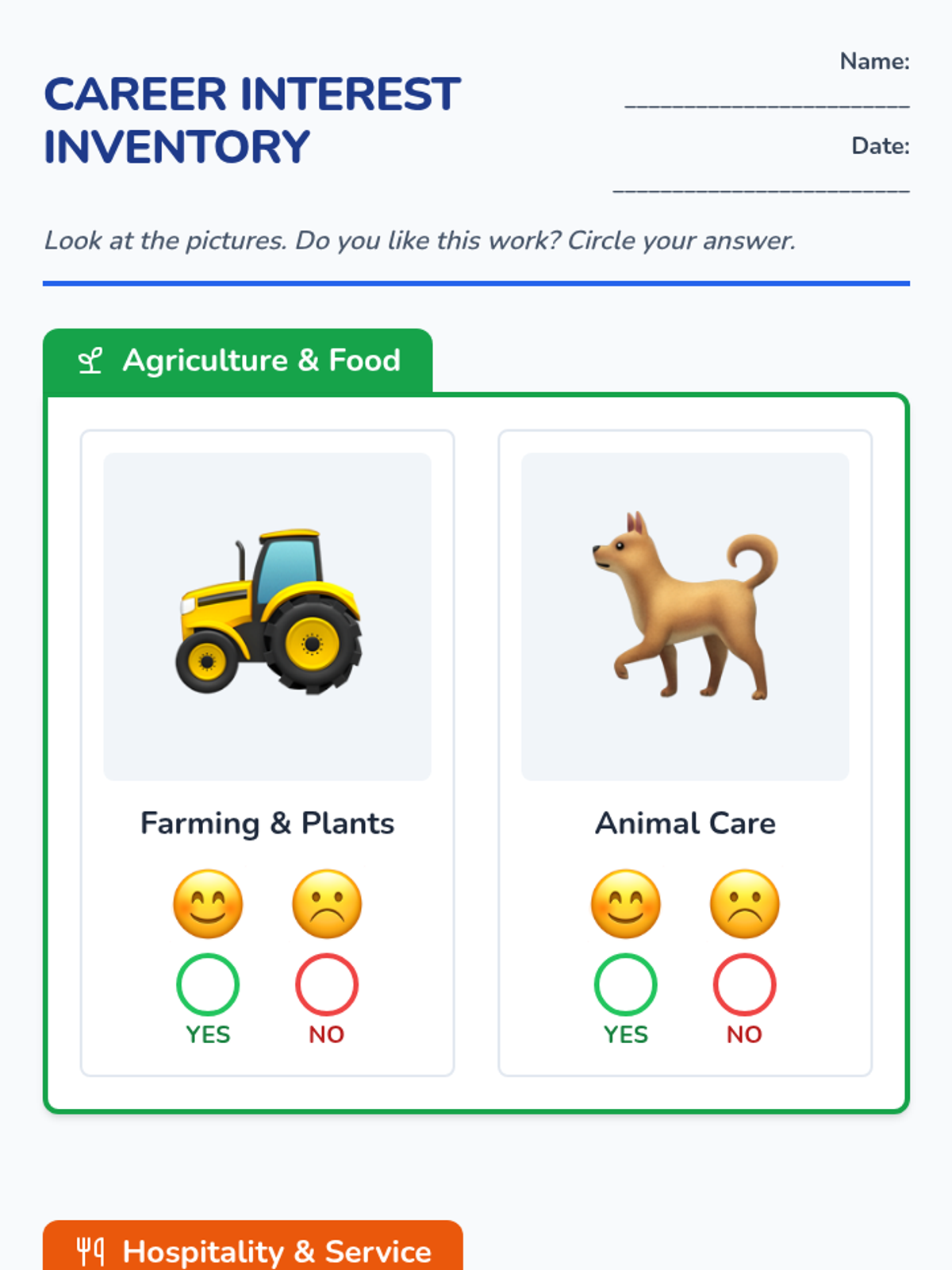
An expanded picture-based career interest inventory for students with moderate to severe disabilities, featuring 5 core career clusters with clear visual options for preferences.
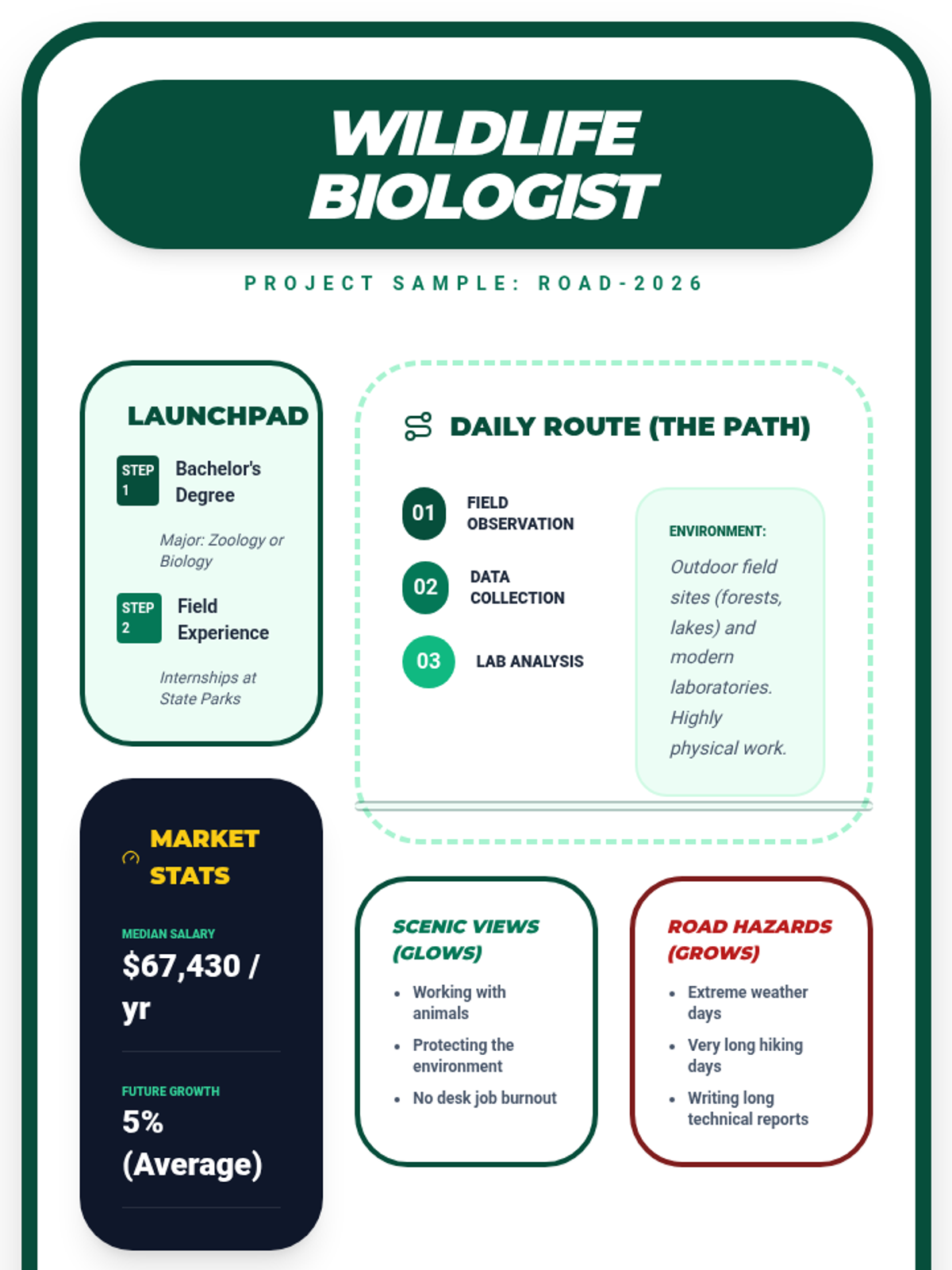
A visual model of the final Career Roadmap poster, using a 'Wildlife Biologist' career path to demonstrate how to visualize education milestones, daily responsibilities, market stats, and personal reflections.
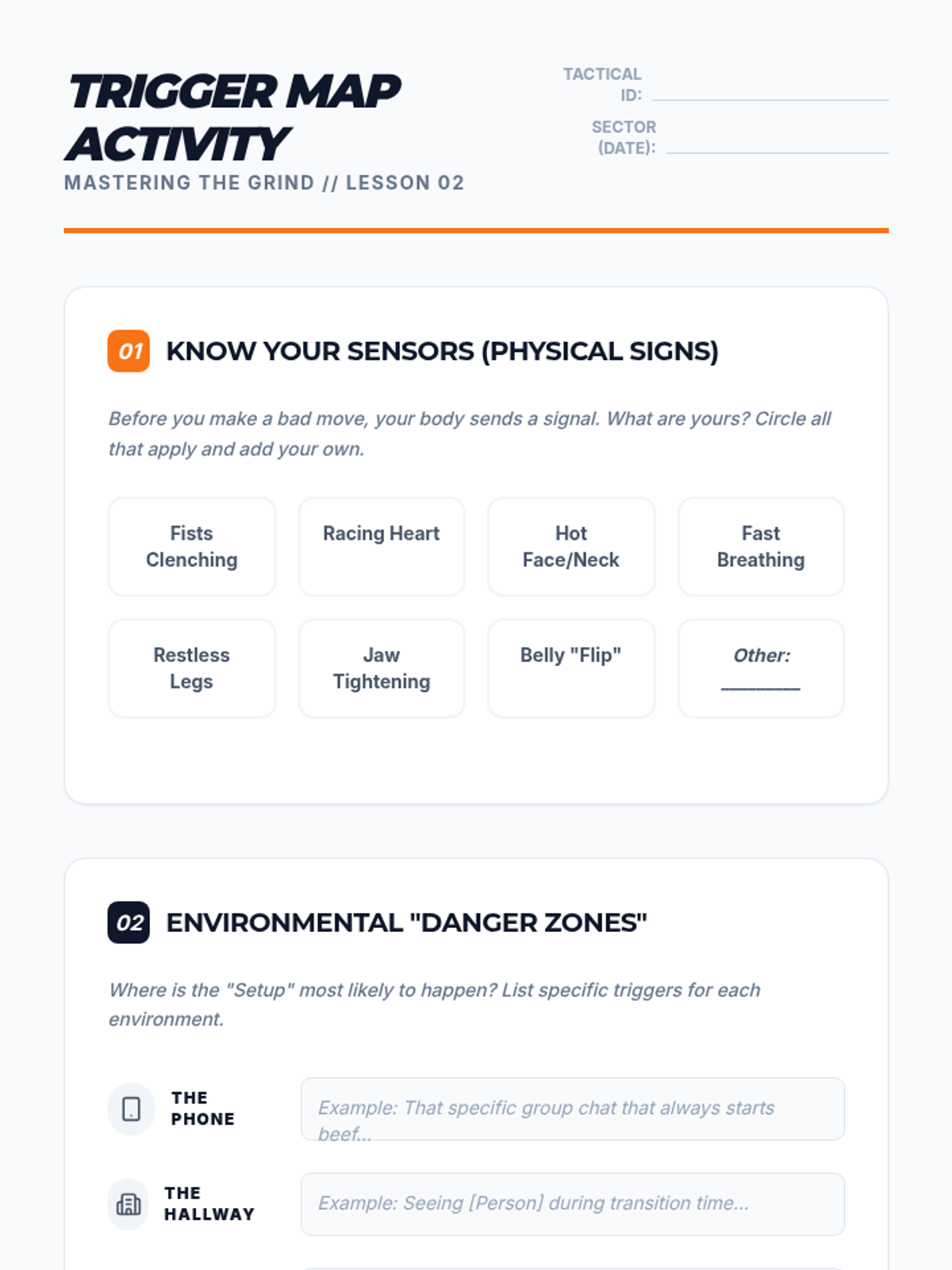
Student activity sheet for Lesson 2 to map out personal physical impulse signs and environmental triggers across different settings (home, school, social). Background of work area updated for legibility.
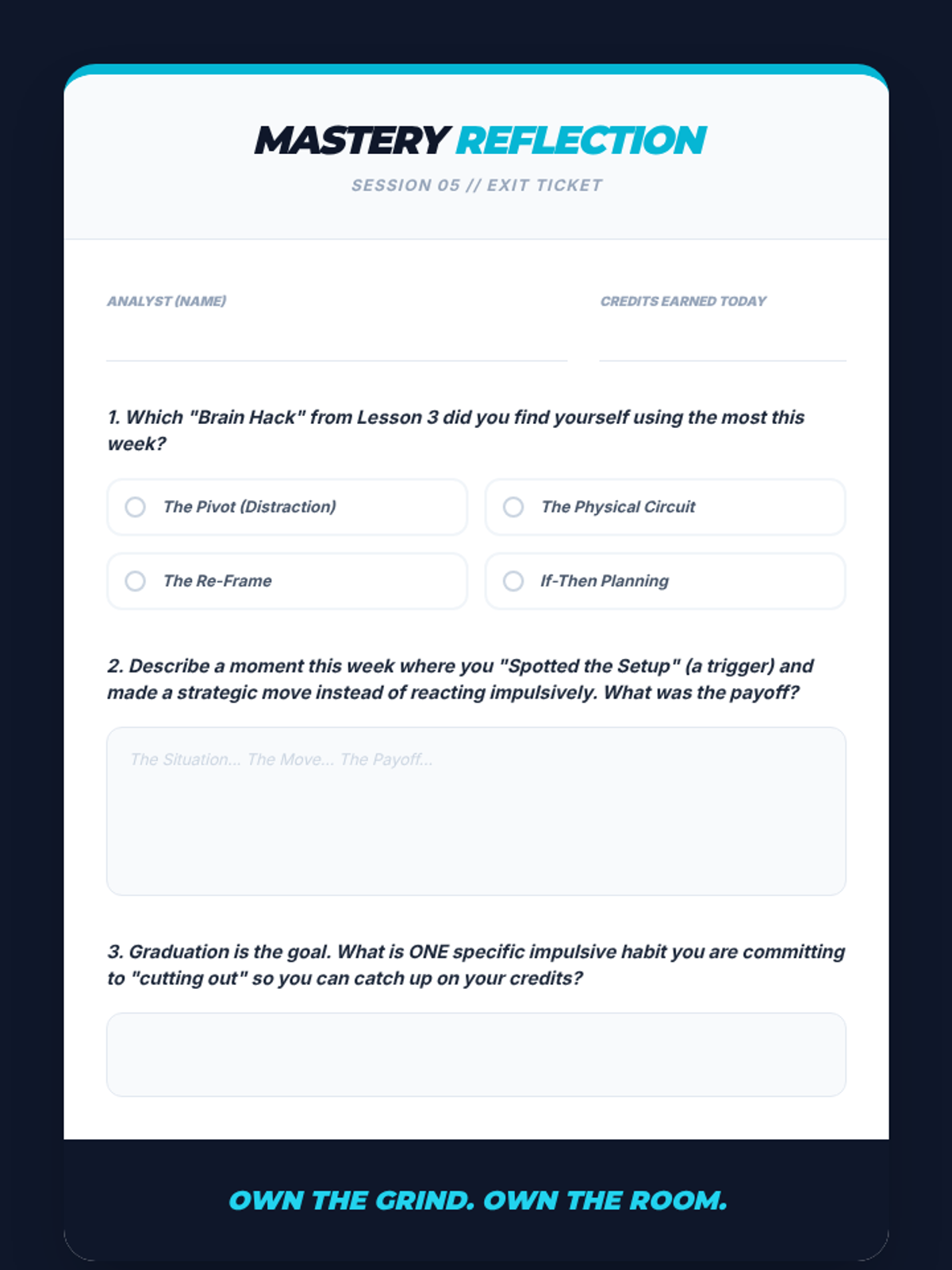
Summative reflection and exit ticket for the "Impulse Control Academy" sequence, where students self-assess their progress and set a goal for their future self.
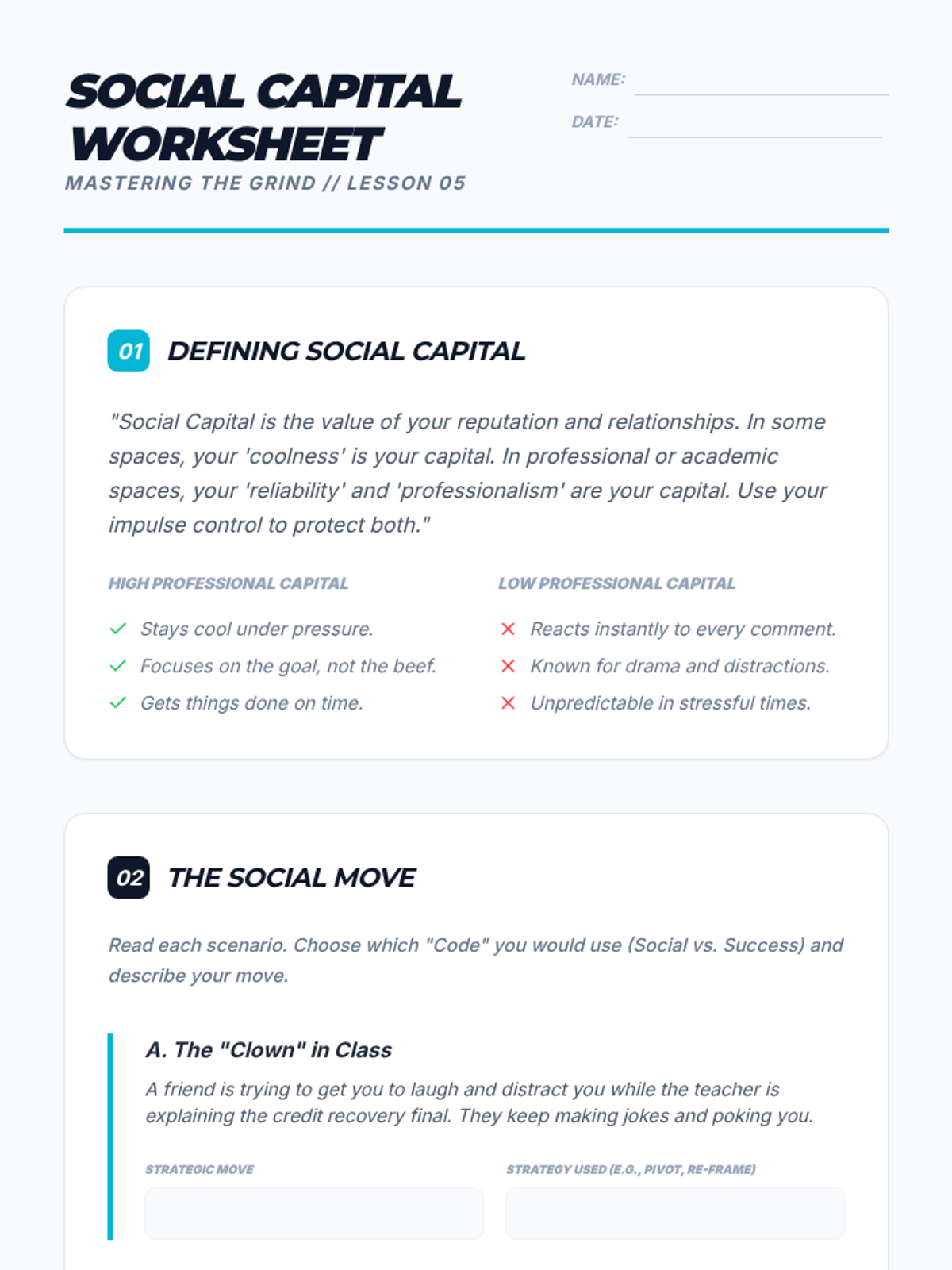
Student activity sheet for Lesson 5 focusing on social scenario analysis and the interpersonal consequences of impulsive versus regulated behavior.
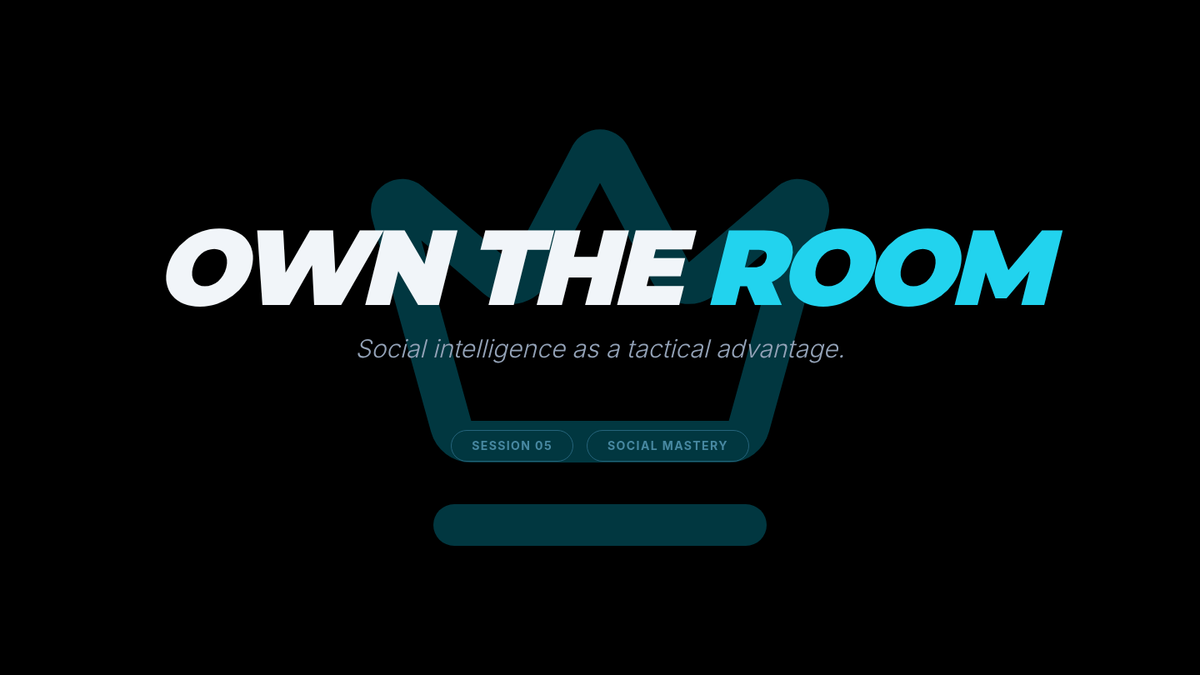
Final slide deck for Lesson 5, focusing on applying impulse control strategies to social interactions and peer pressure.
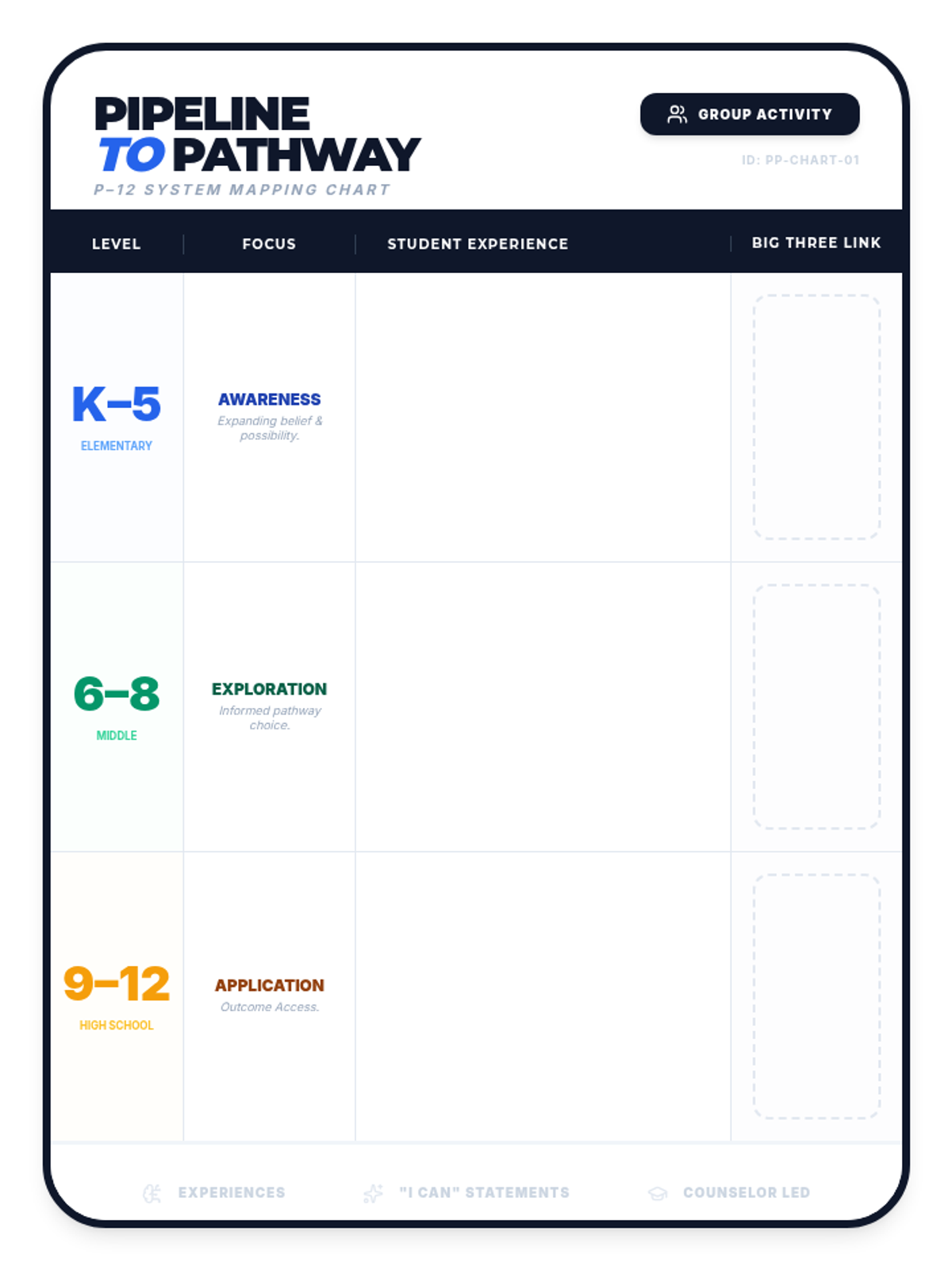
A large-format chart template for group activity, precision-fitted for a portrait printable area (720x960). Features three equal sections for Elementary, Middle, and High School mapping.
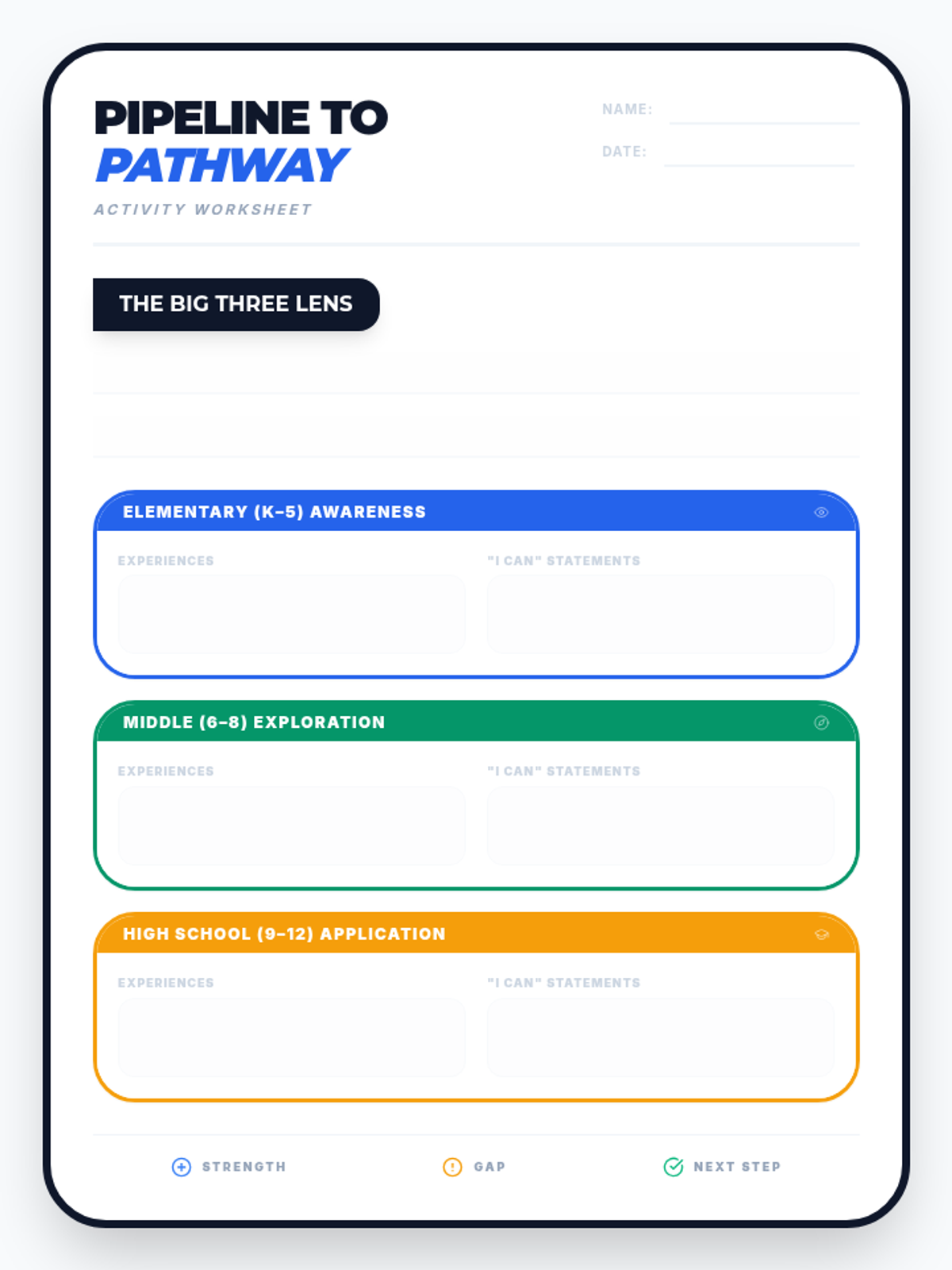
A participant handout for the Pipeline to Pathway activity. Redesigned to fill the full 720x960 page with three equal grade-level sections and clear work areas.
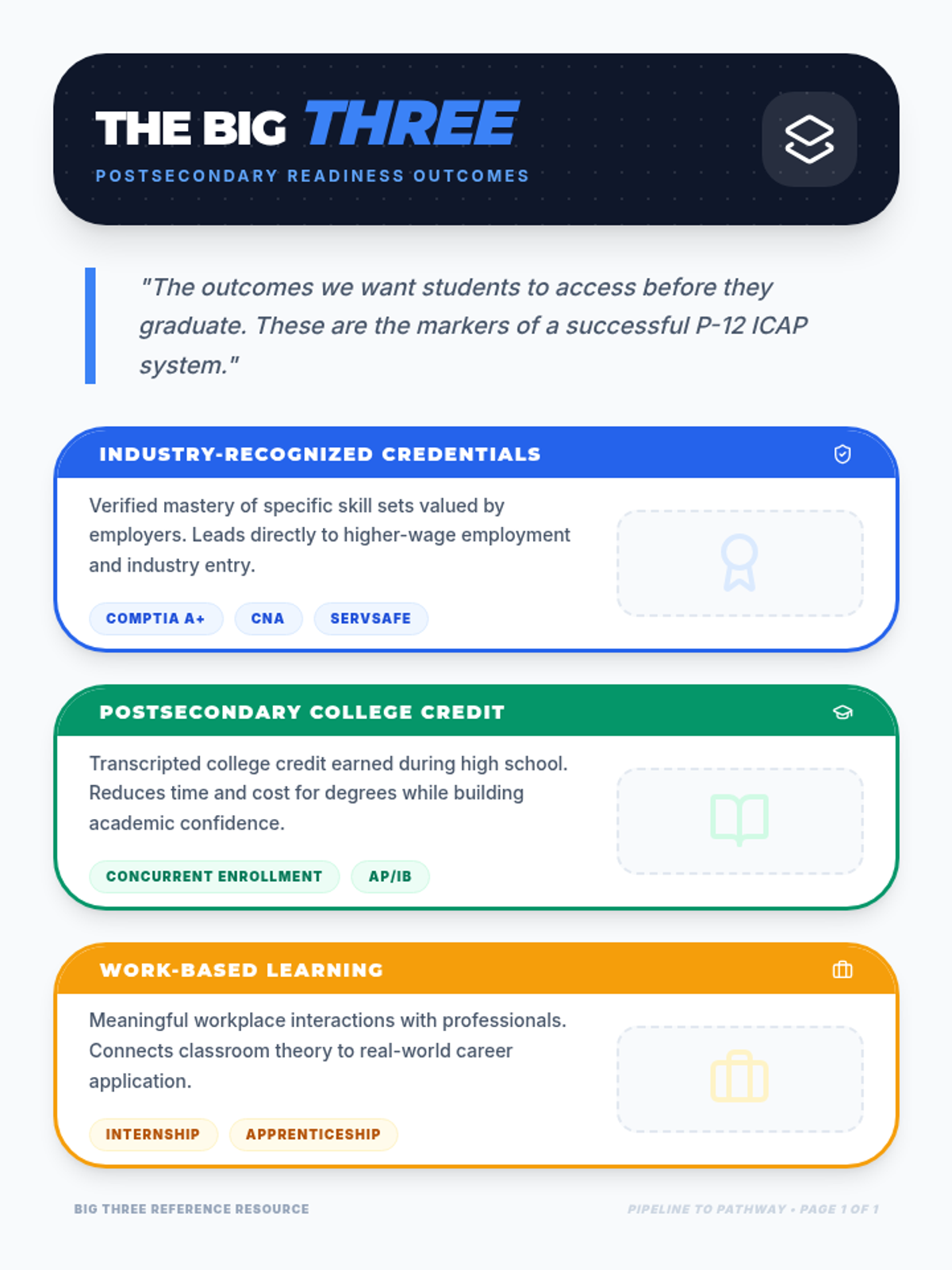
A high-quality reference sheet defining the Big Three outcomes (Industry Credentials, College Credit, and Work-Based Learning). Redesigned to fill the full 720x960 page with high-impact visuals.
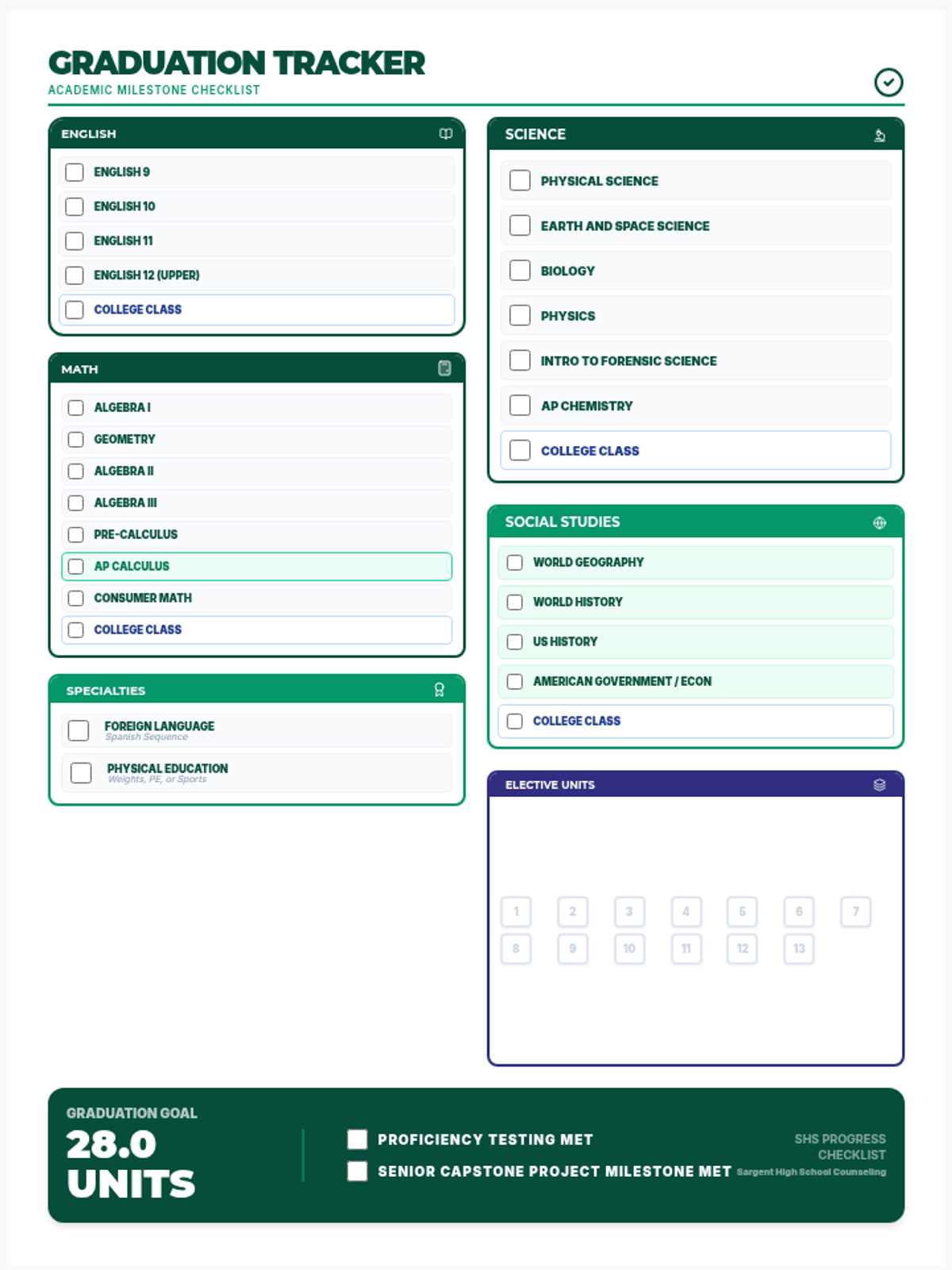
A comprehensive graduation tracker checklist for high school students, featuring updated 28.0 credit total and the Capstone Project milestone. English 12 now labeled as (Upper). American Government is listed as American Government / Econ. Math section updated with AP Calculus (Green) and College Class (Blue). Geometry placed after Algebra I. Science subjects broken out individually. Optimized for a robust single-page fit. All credit-level annotations like "1.0" have been removed. Science and Math broken out individually.
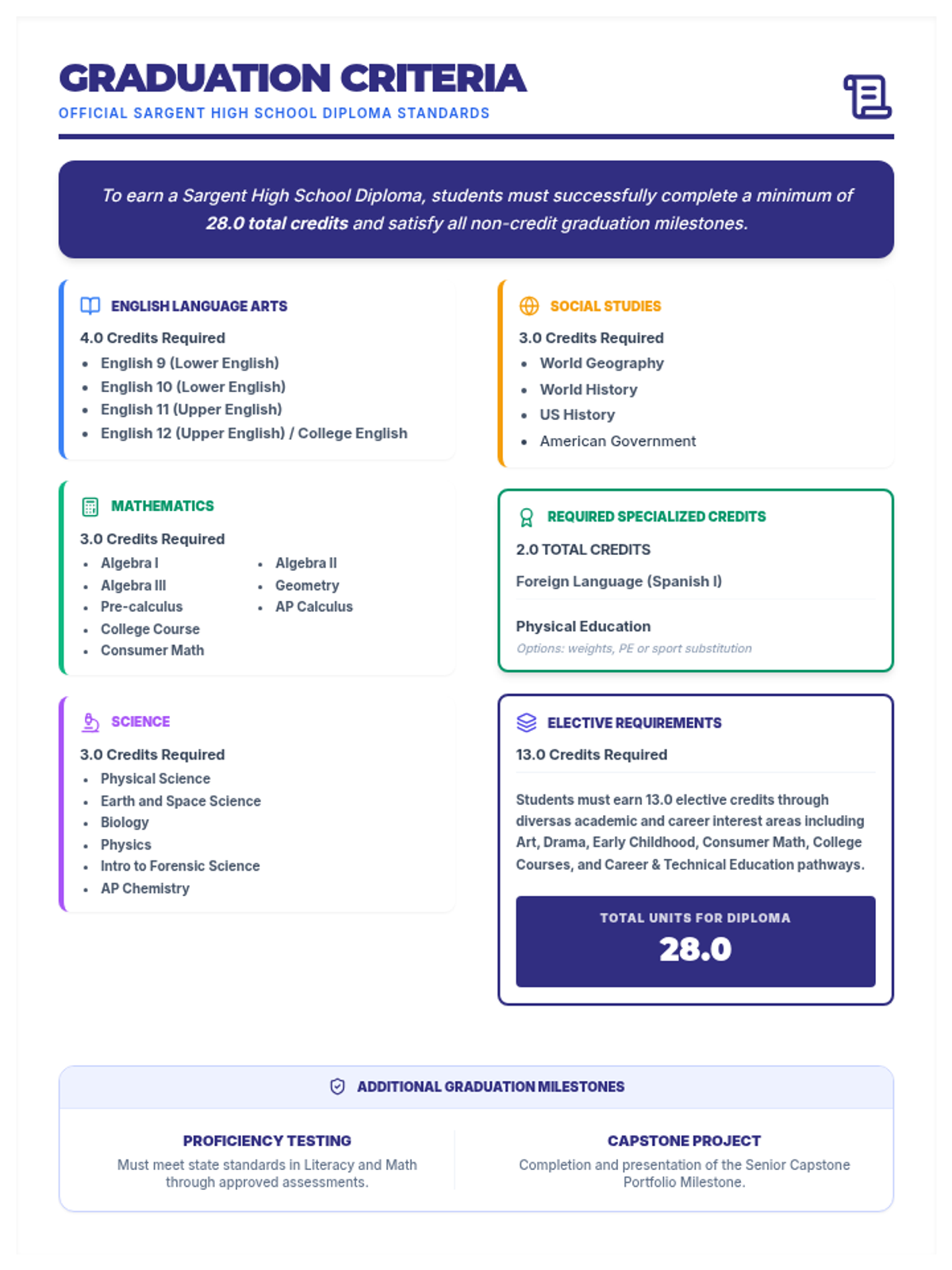
A comprehensive reference sheet outlining high school graduation requirements, reverted to the original 2-column layout optimized for a single-page fit. Science subjects are broken out individually and Social Studies is streamlined. All credit-level annotations like "1.0" have been removed from individual courses. Physical Education options clarified. Highlighting for Consumer Math and American Government has been removed. American Government is no longer bold. Elective pathways list removed from the description for a cleaner look.
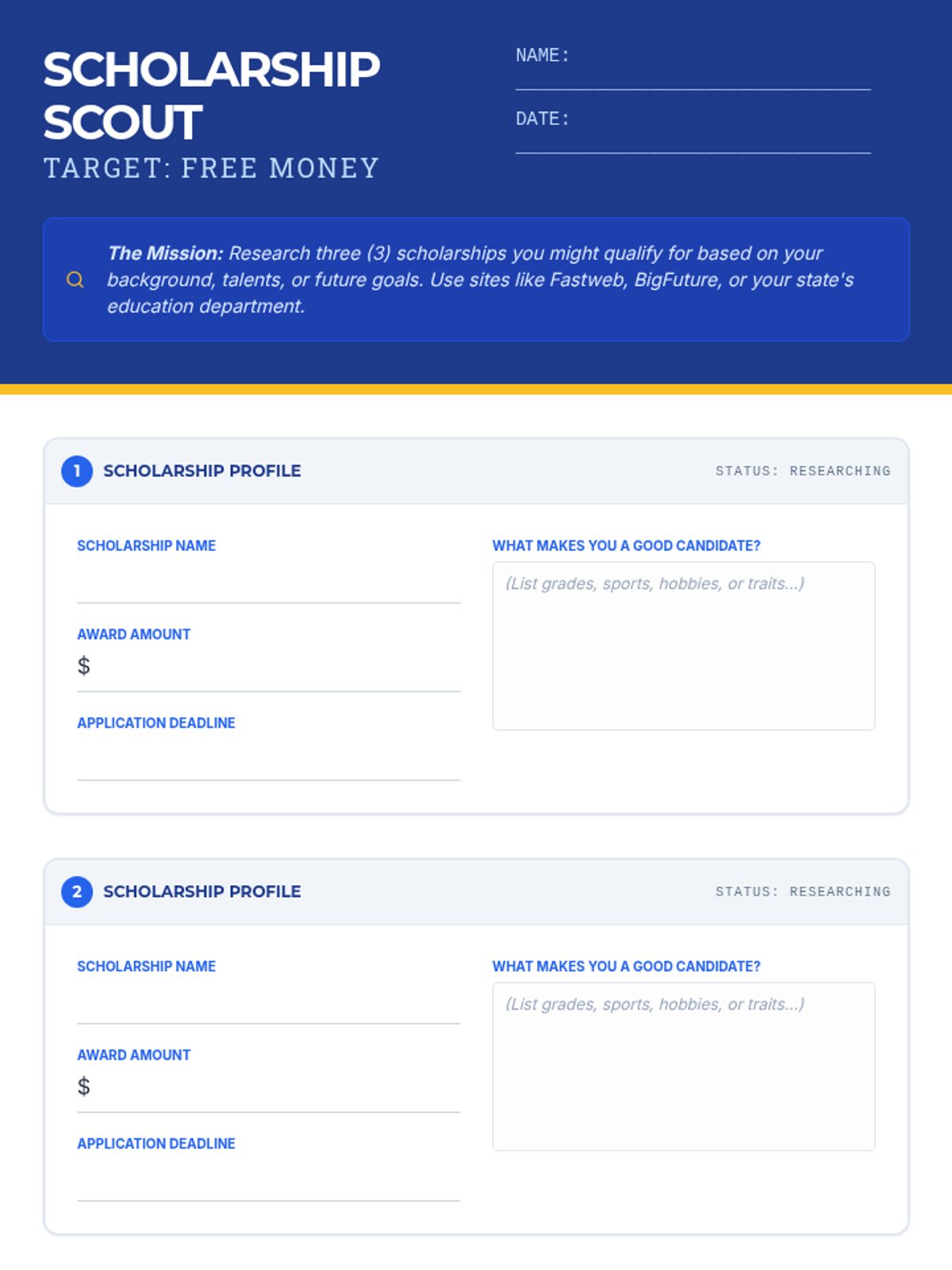
A research template for students to identify and analyze three specific college scholarships based on their background and interests.
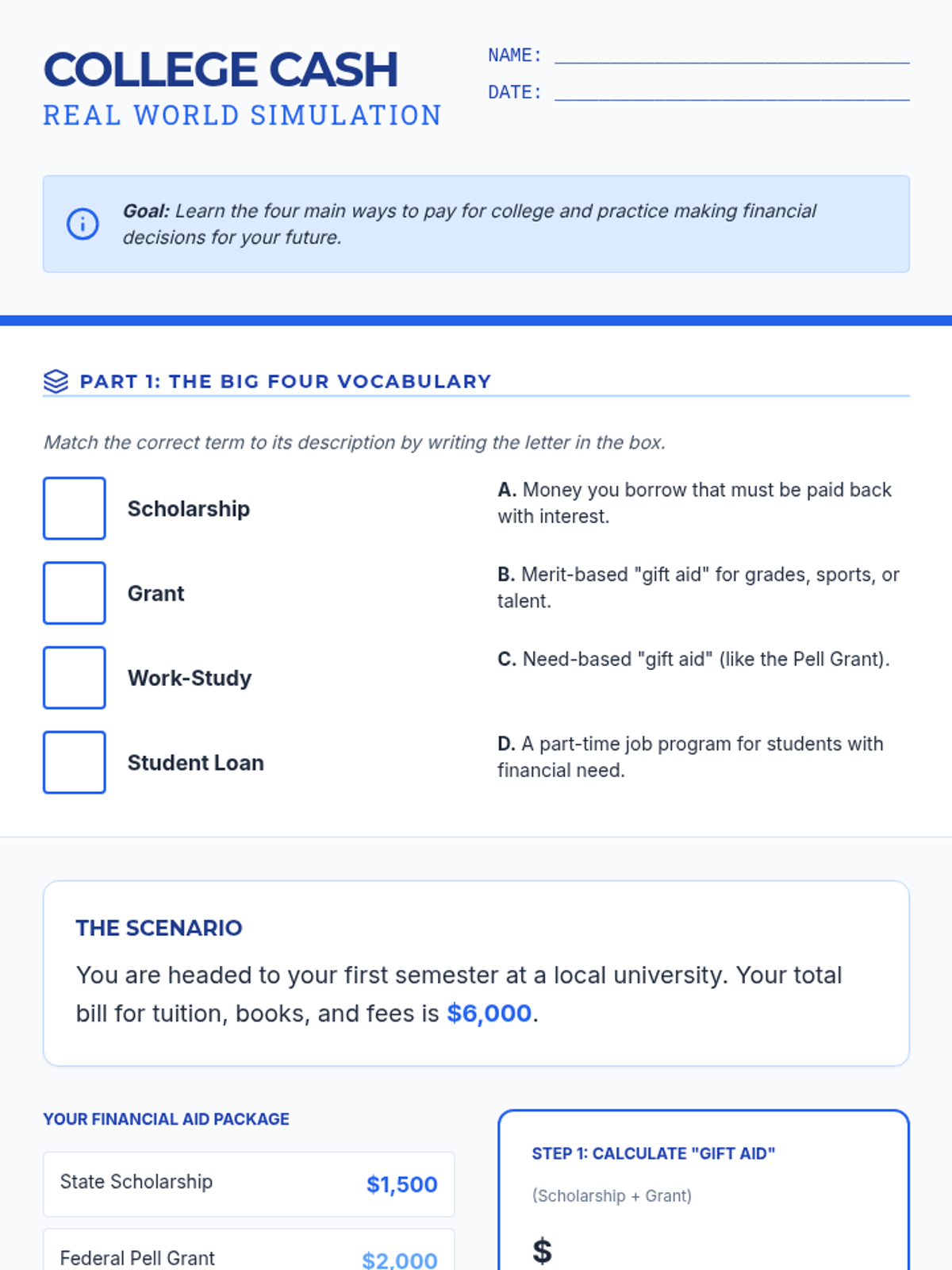
A student worksheet for calculating a college financial aid package and making budget-based decisions.
A visually engaging slide deck covering the four main types of college funding and the "Real World Budget" simulation scenario.
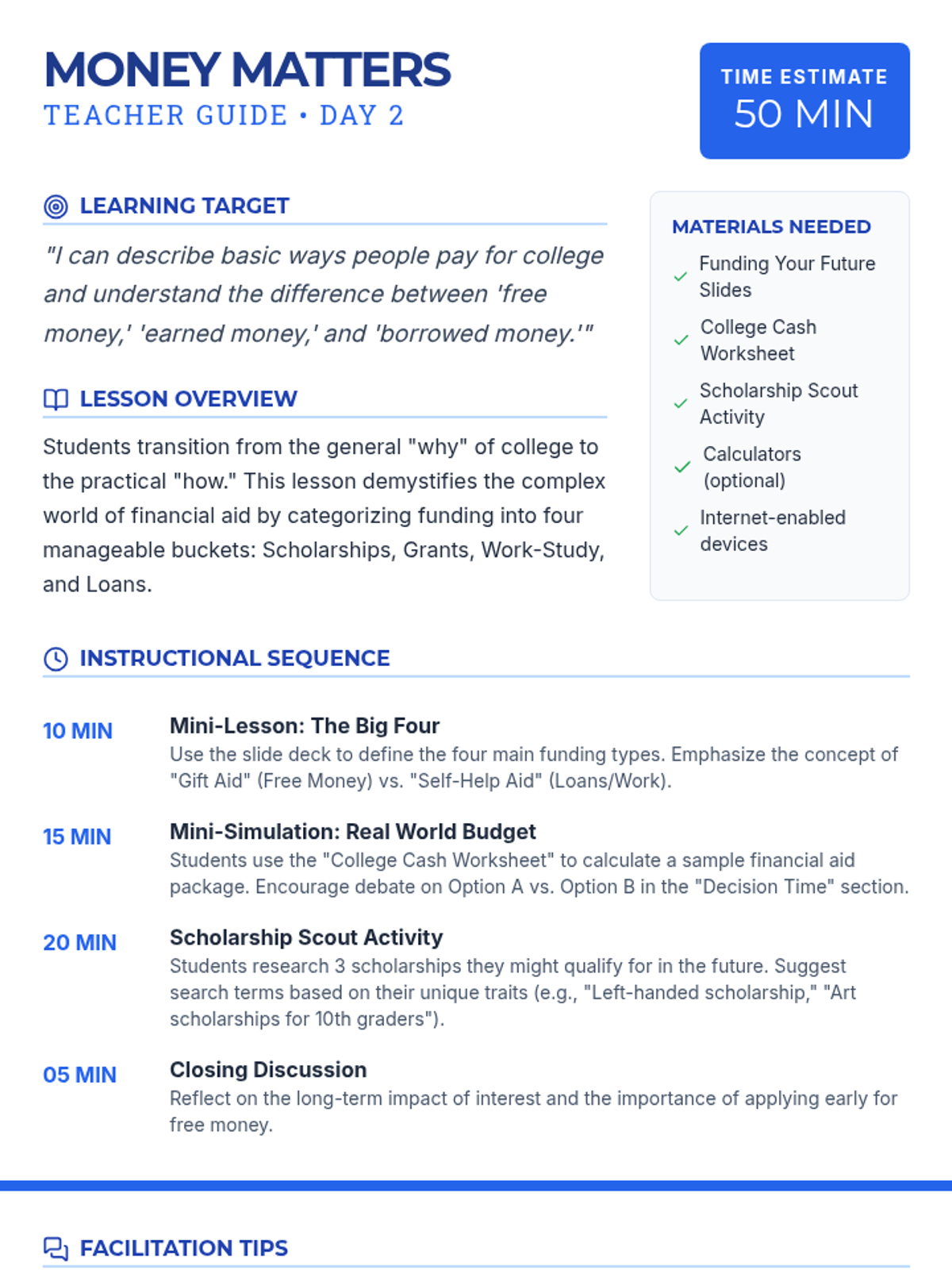
A comprehensive teacher's guide for the "Paying for College Basics" lesson, featuring a pacing guide, facilitation tips, common misconceptions, and an answer key for the student activities.
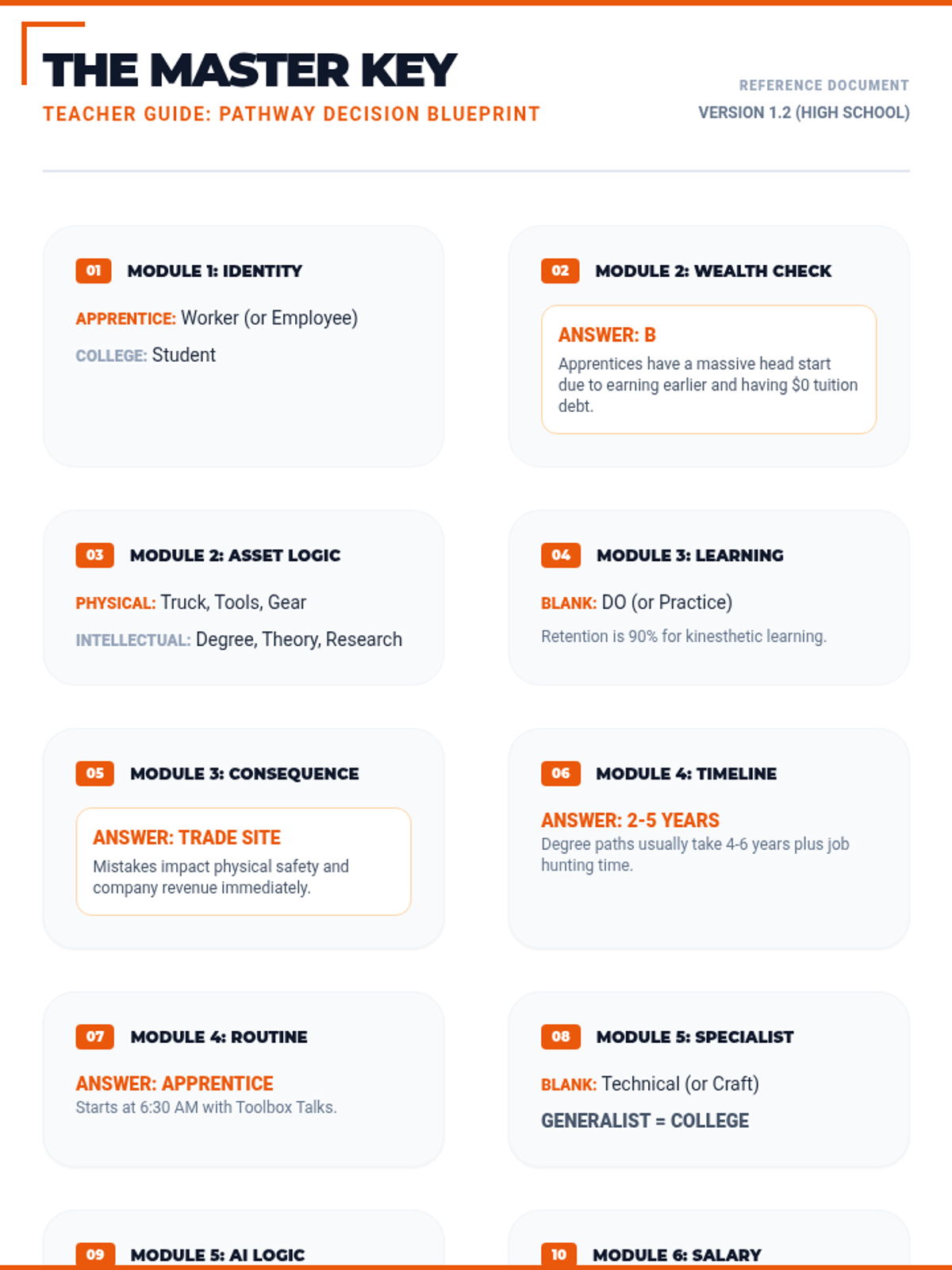
A teacher's master answer key for the Pathway Decision Blueprint Worksheet (15-section version), provided in a clean print layout with a Safety Orange and Slate theme.
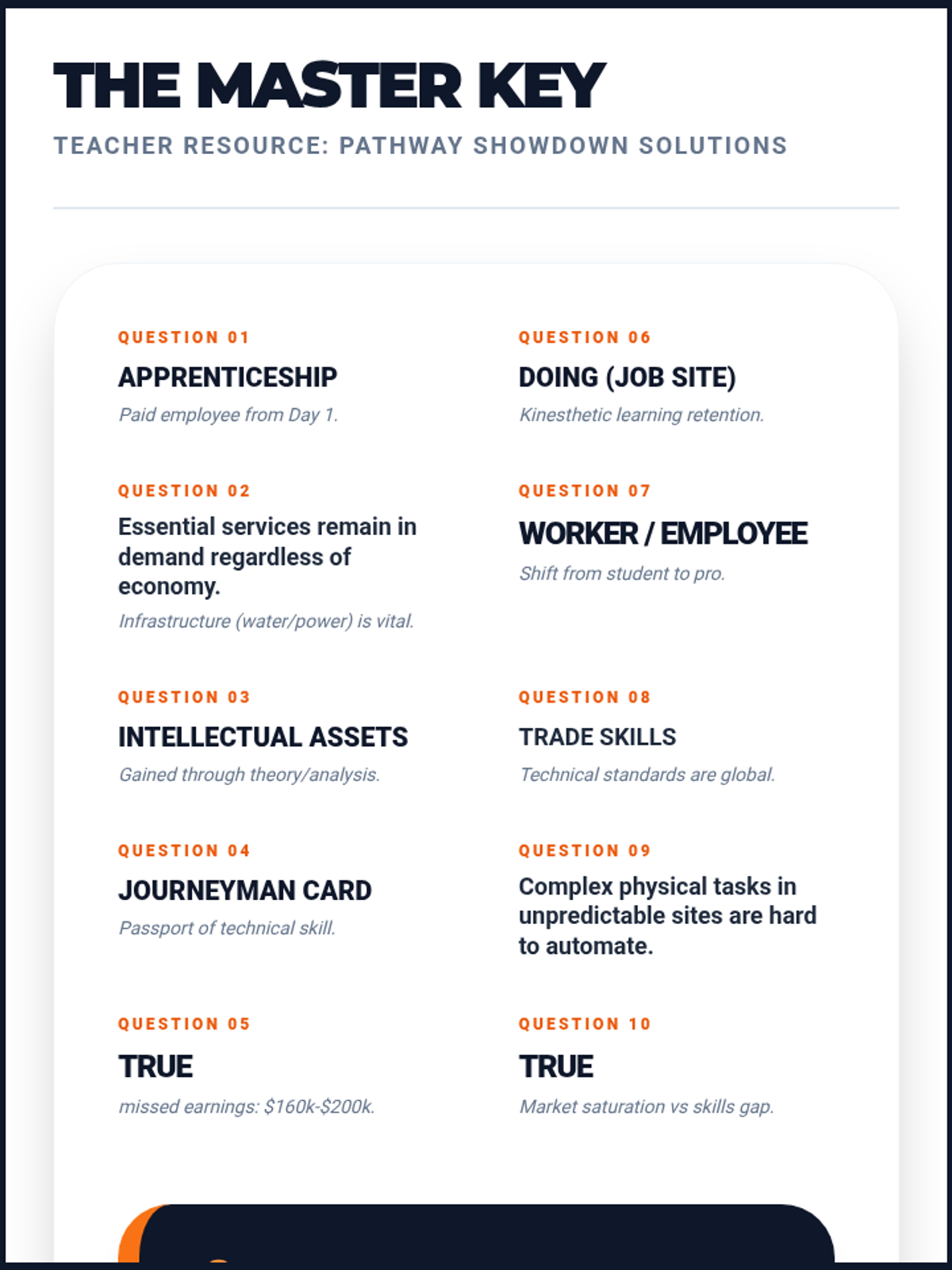
A standalone print-ready teacher answer key for the Pathway Showdown Info Sheet, featuring solutions for all 10 knowledge-check questions with detailed explanations.
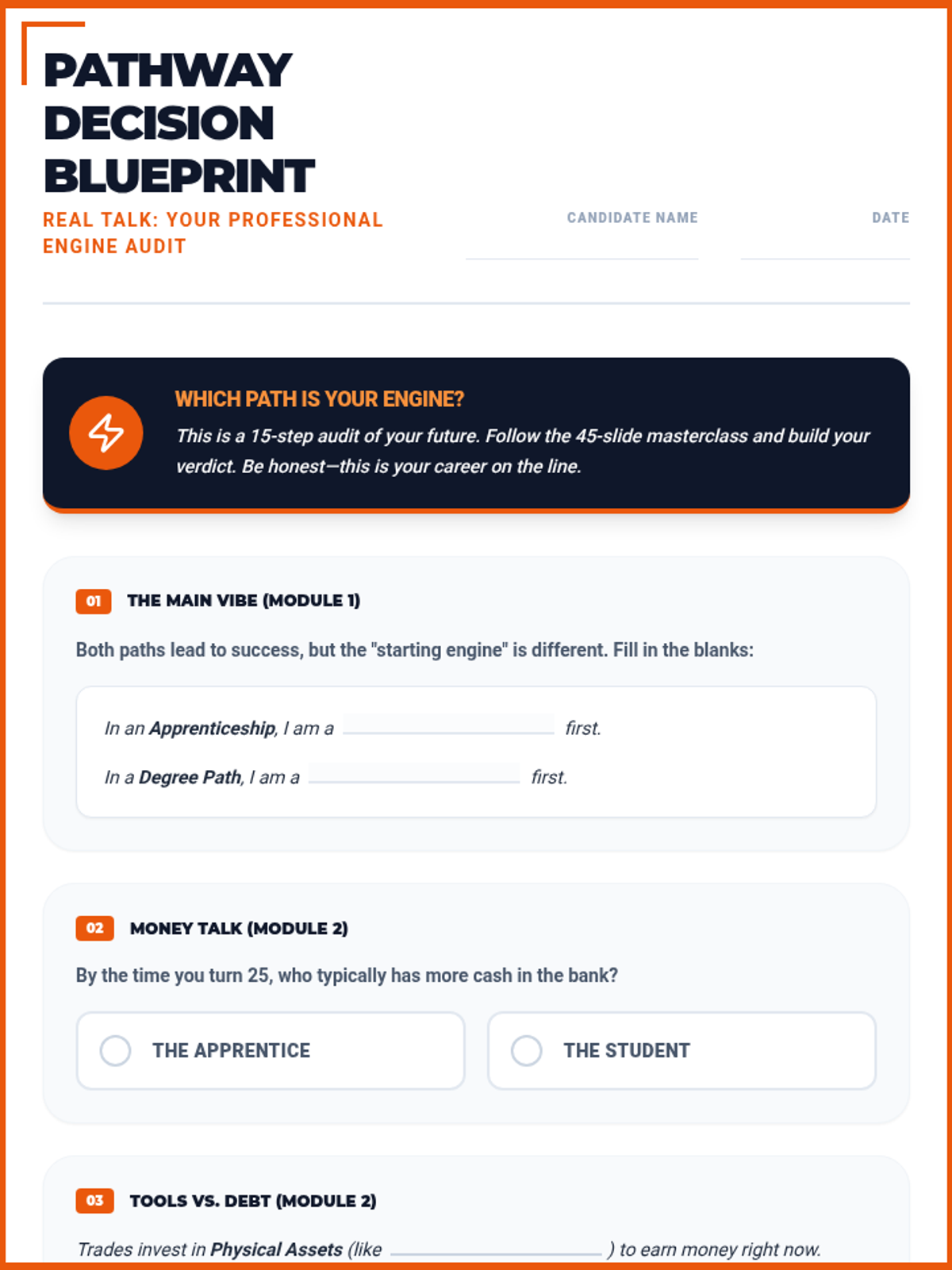
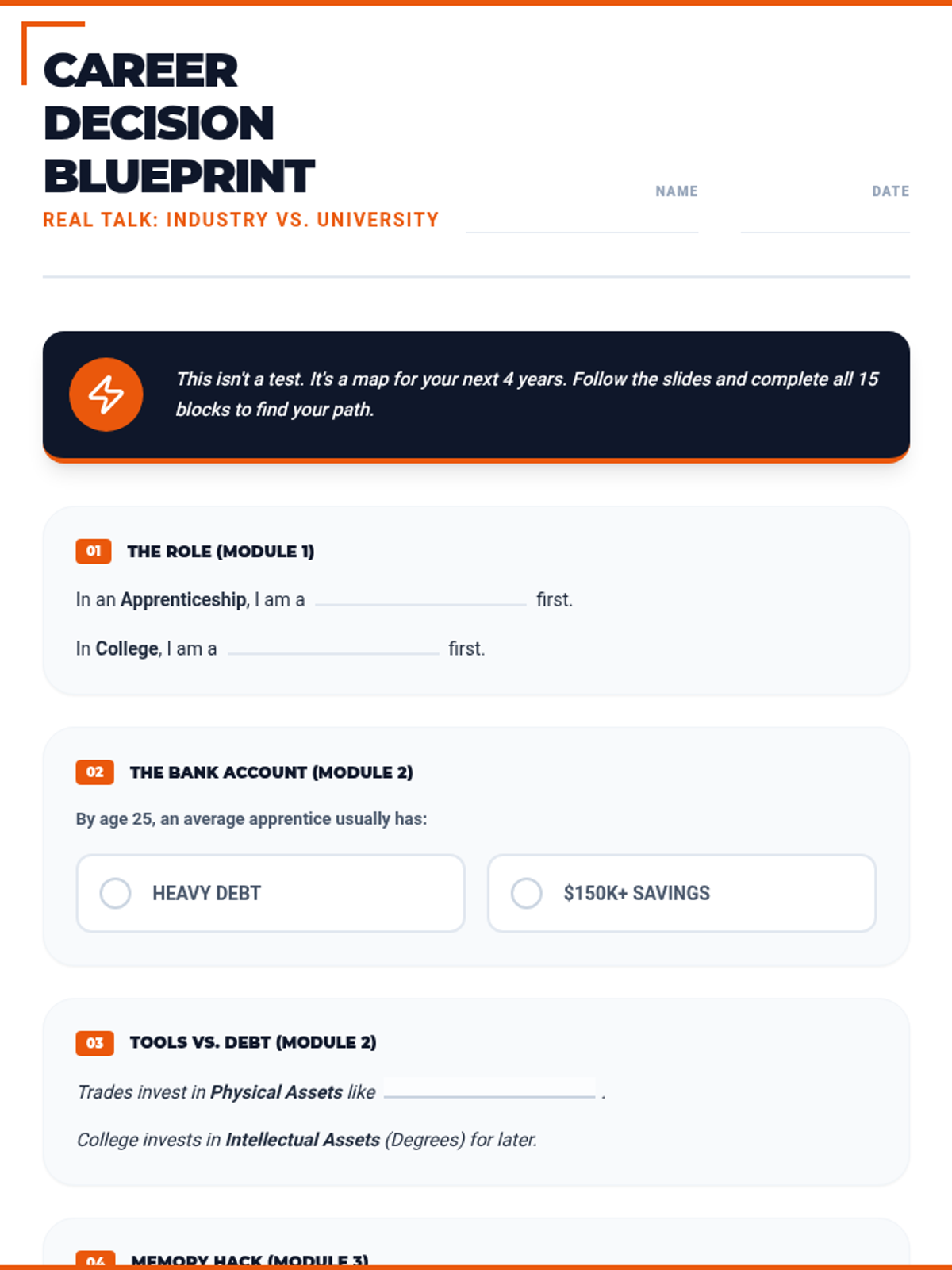
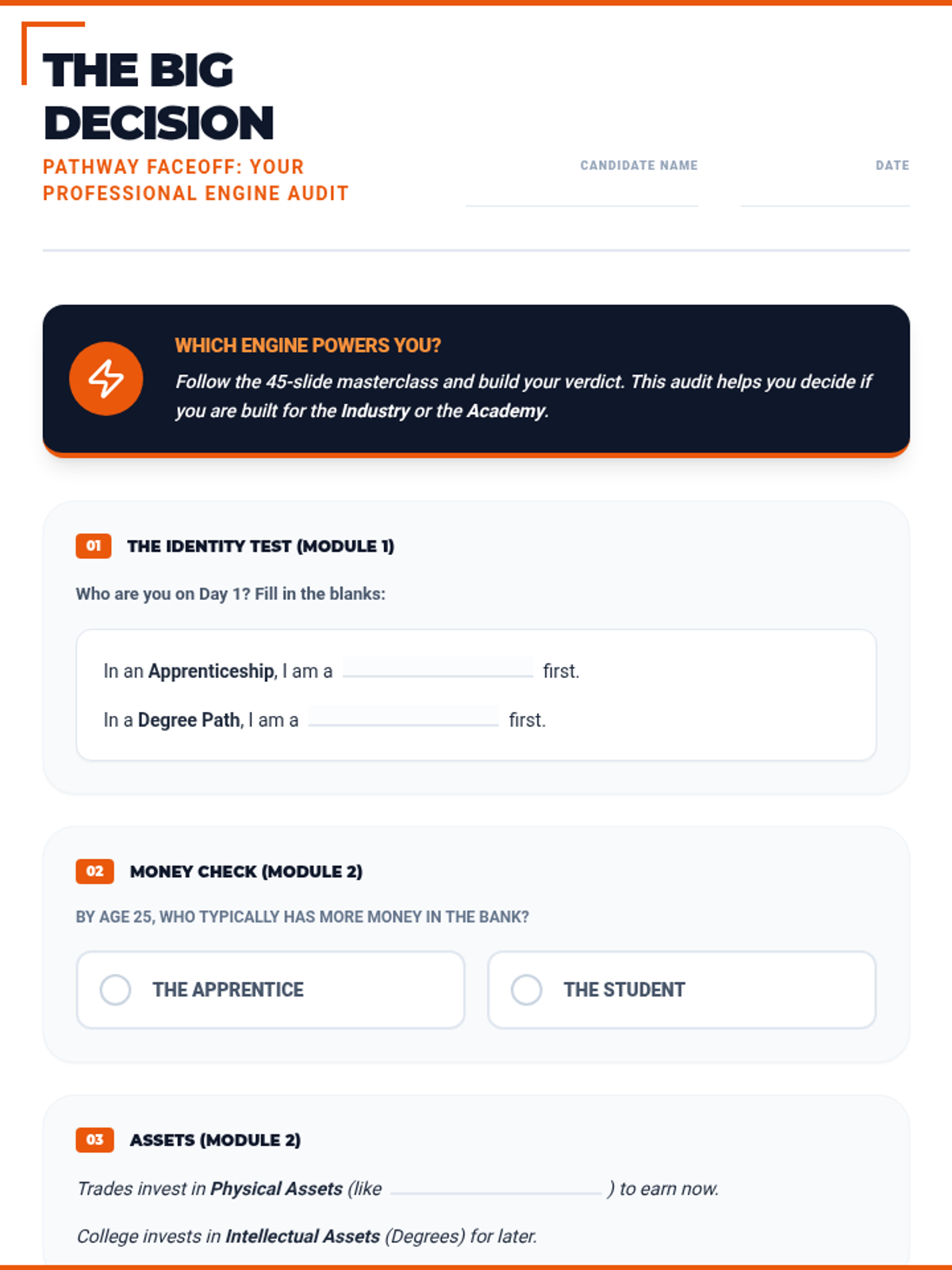
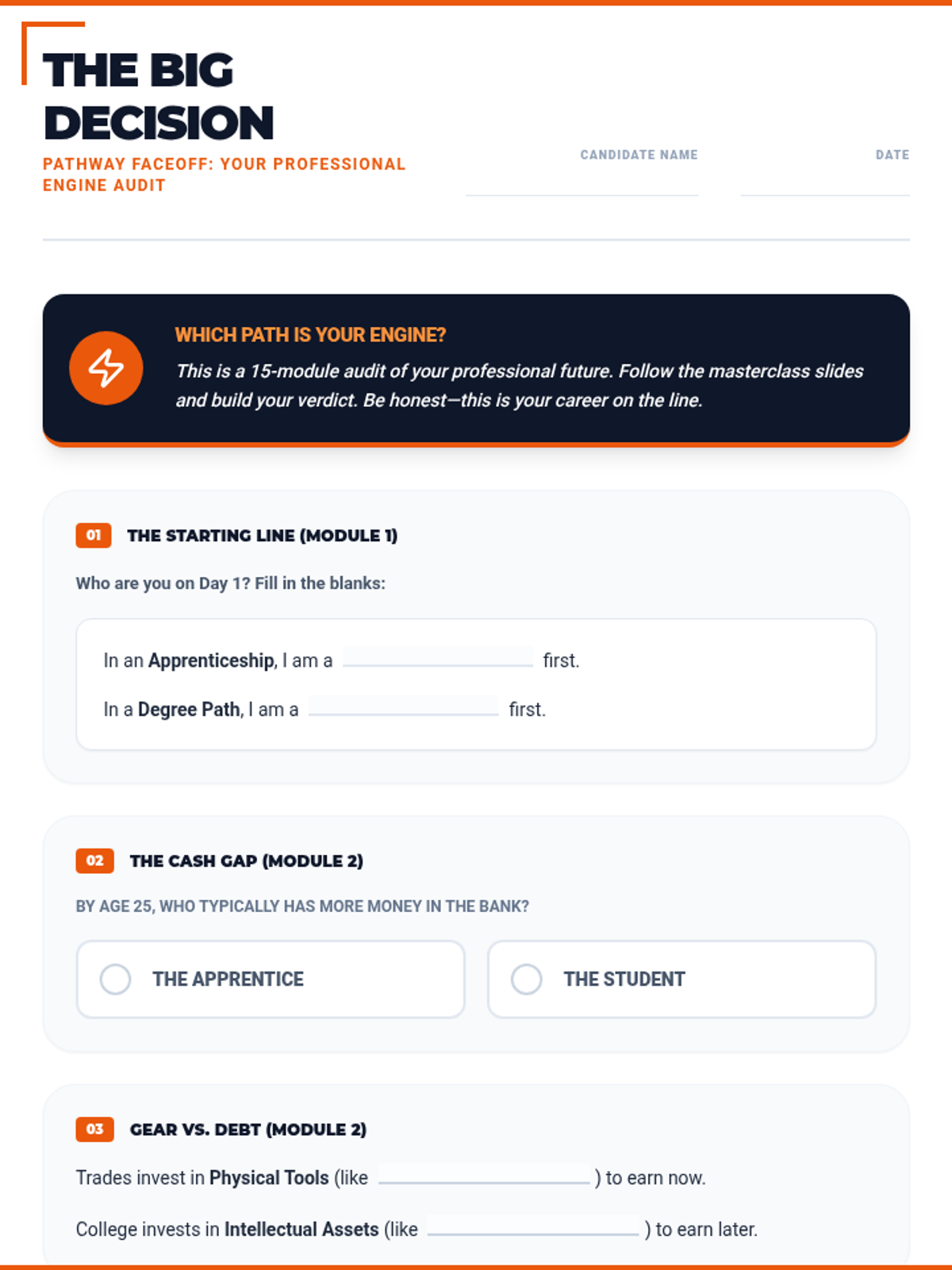
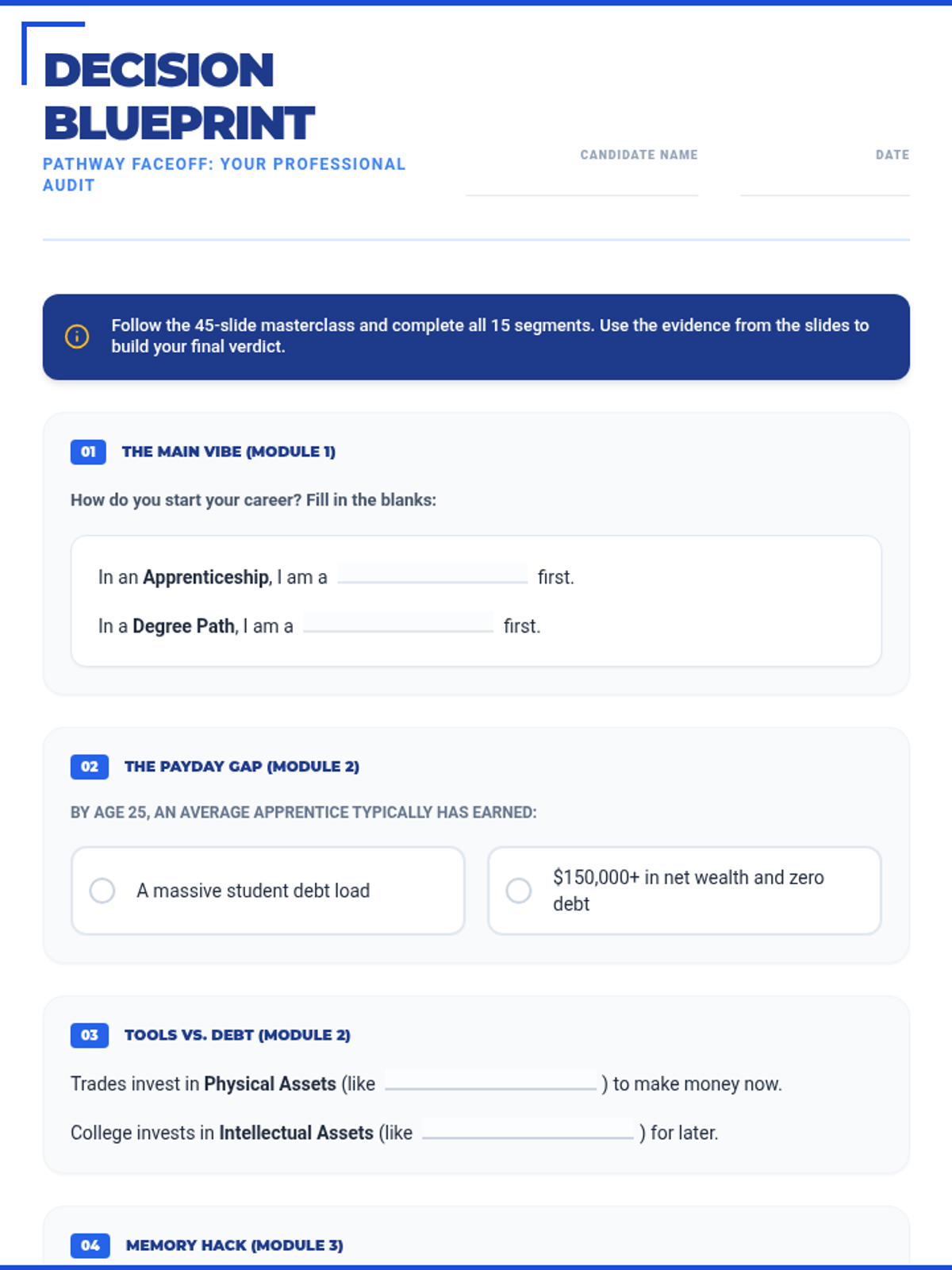
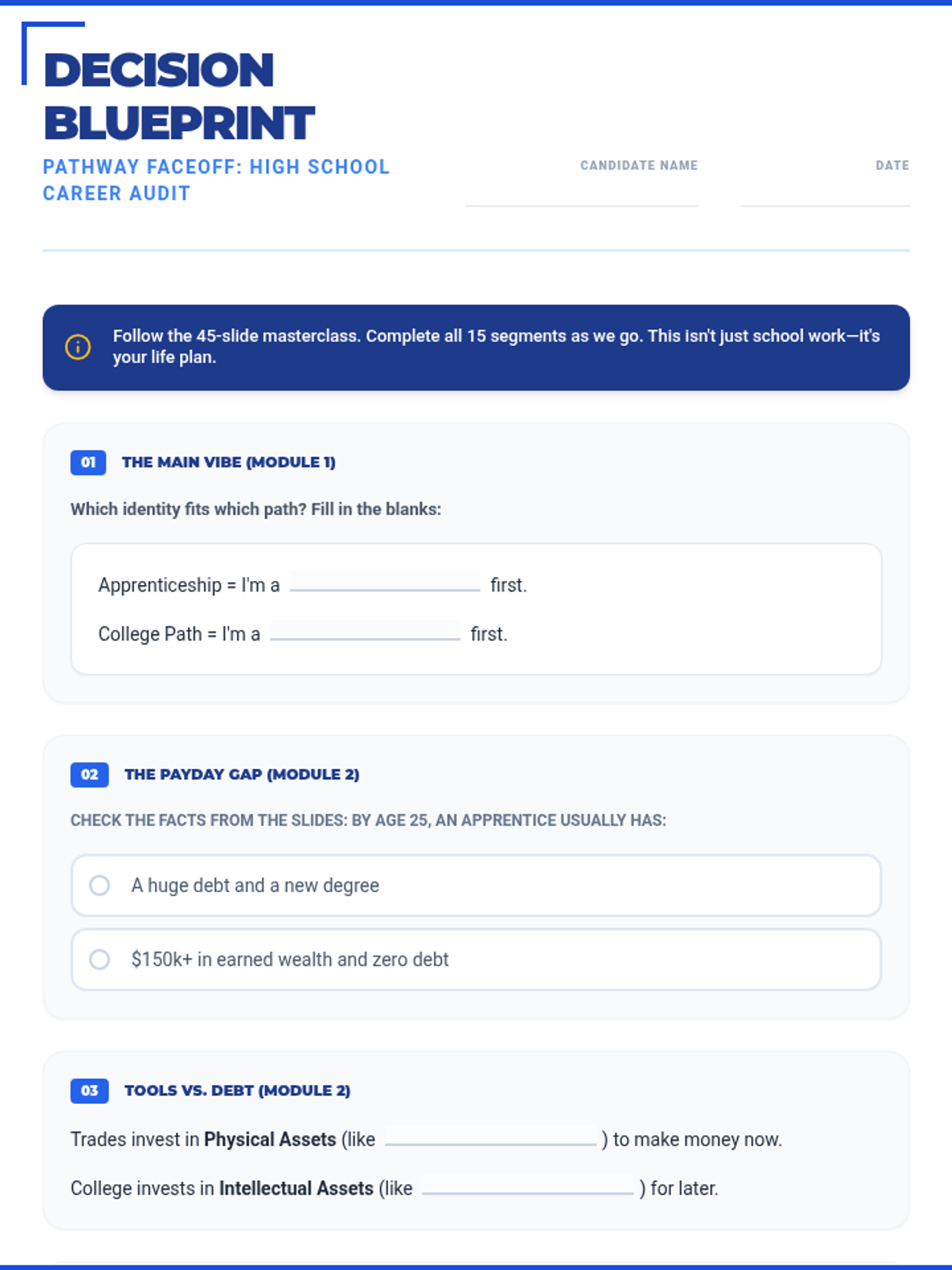
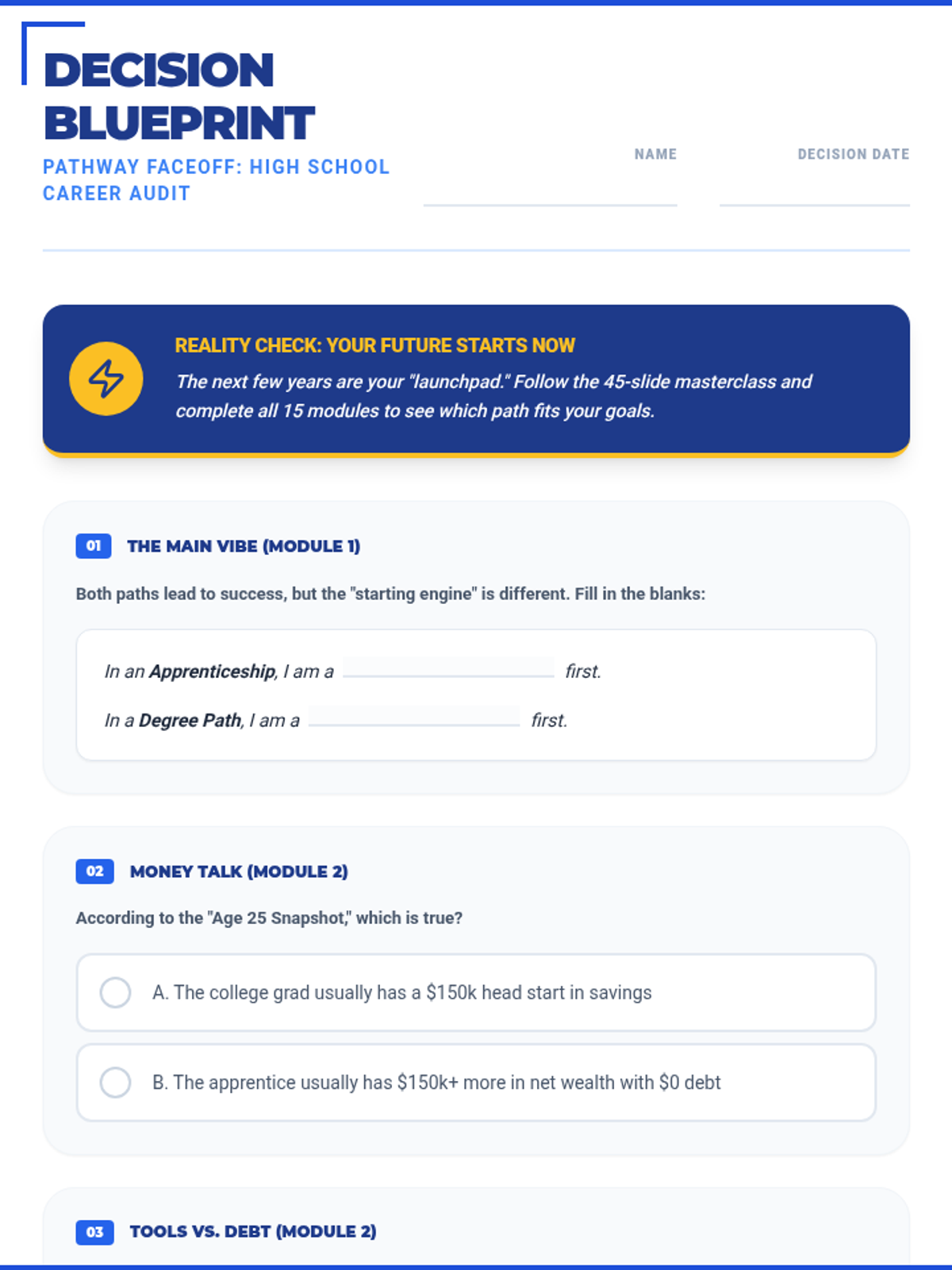
A simplified 15-section career exploration worksheet designed for 16-year-old high school students, featuring punchy, relatable titles and a "Safety Orange & Slate" theme. Meticulously aligned with the 45-slide masterclass. All correct answer highlights have been removed for student use.
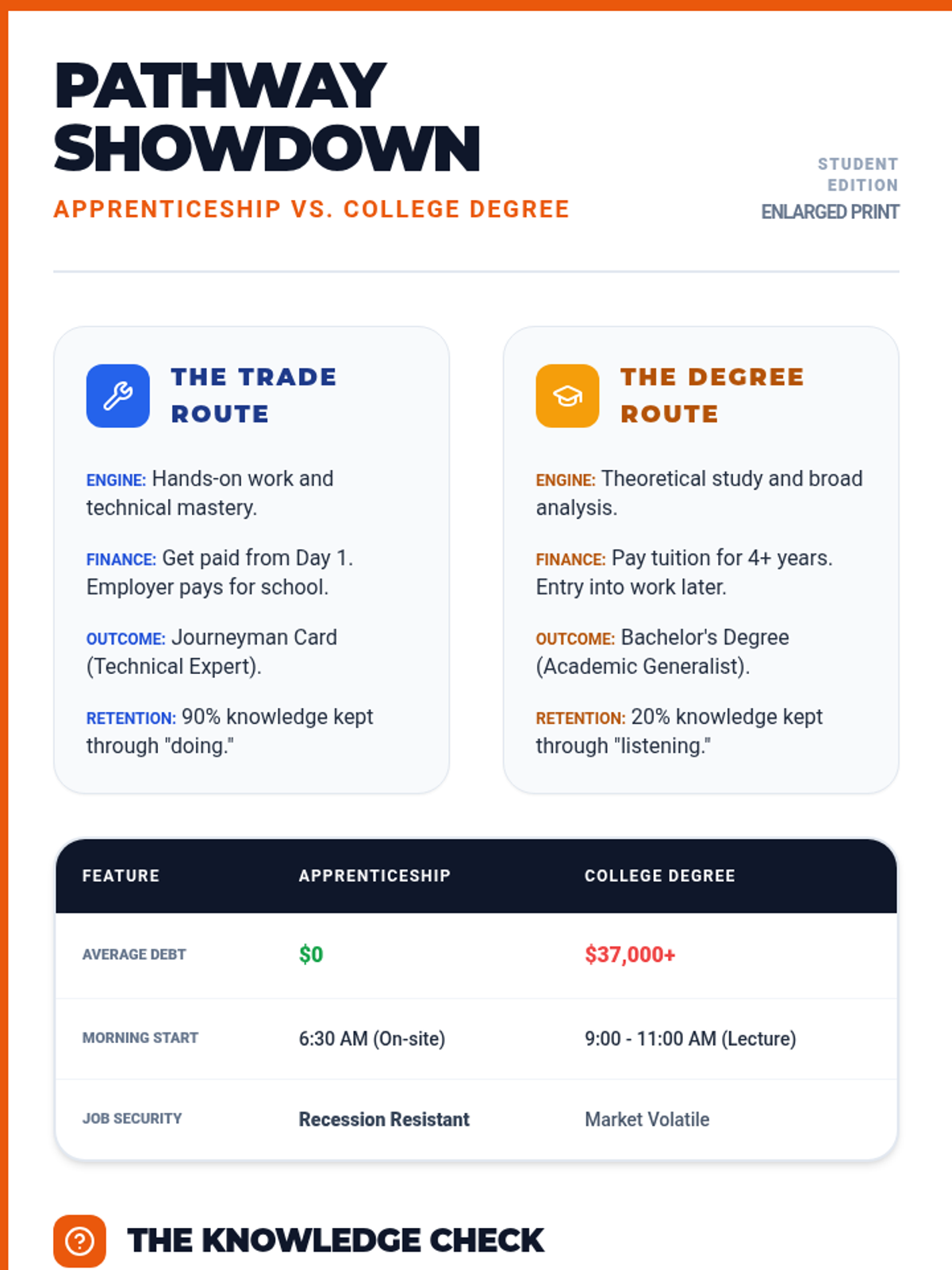
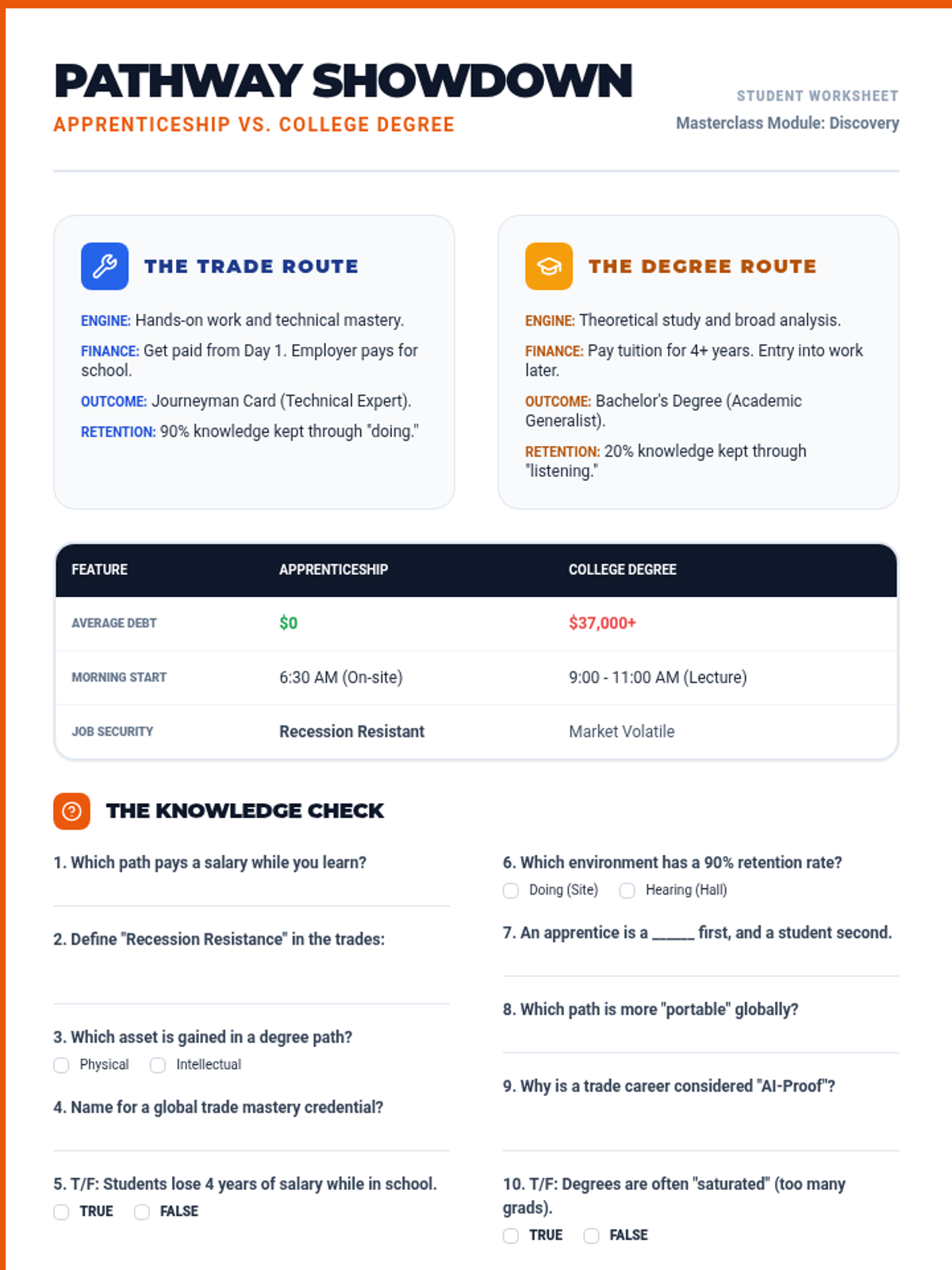
A 1-page enlarged informational summary comparing Apprenticeships and College Degrees, designed for maximum readability. Includes a facts breakdown, comparison table, and 6 key knowledge-check questions.
A 1-page informational summary comparing Apprenticeships and College Degrees, featuring a facts breakdown, comparison table, and 10 knowledge-check questions.
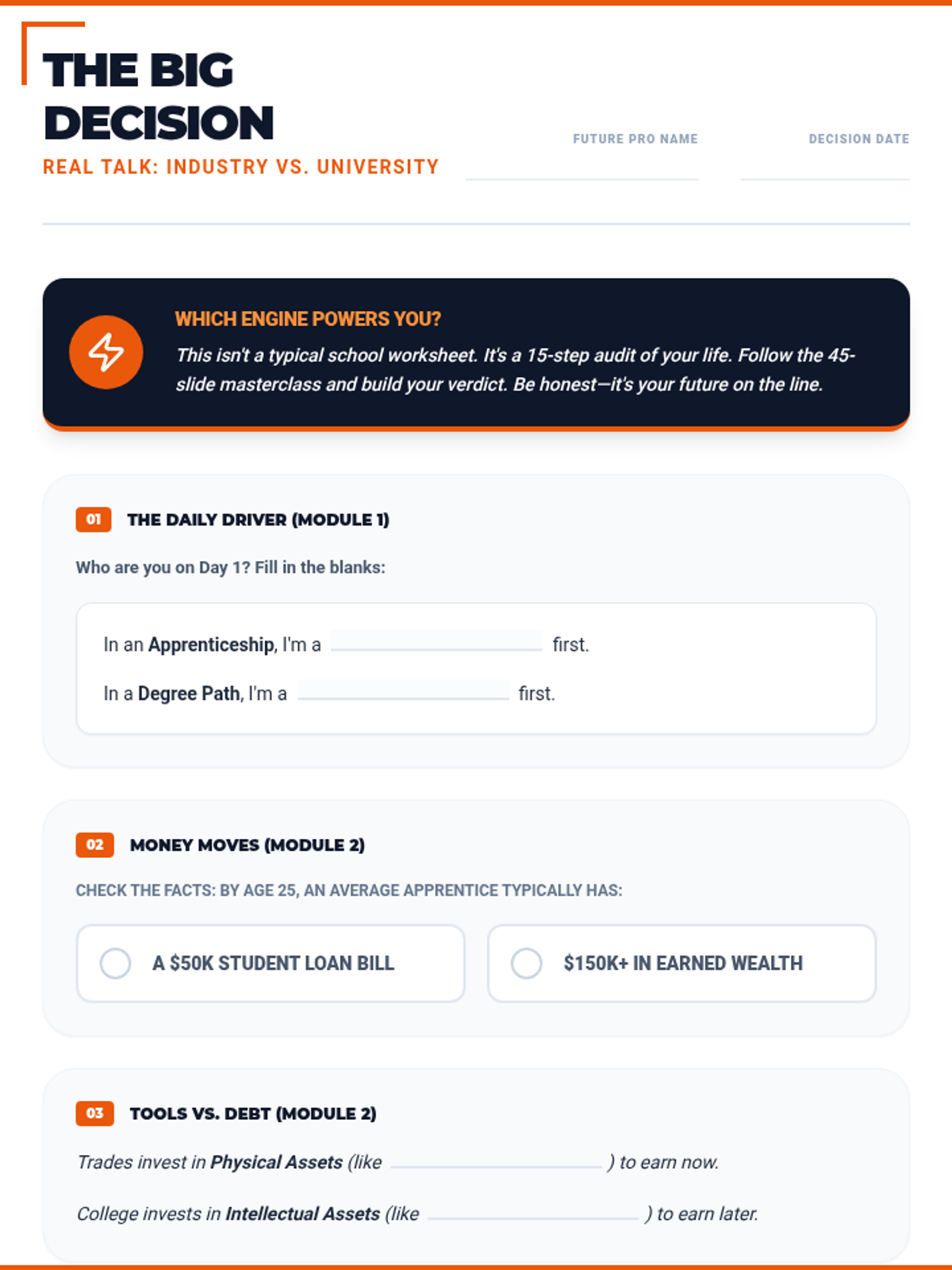
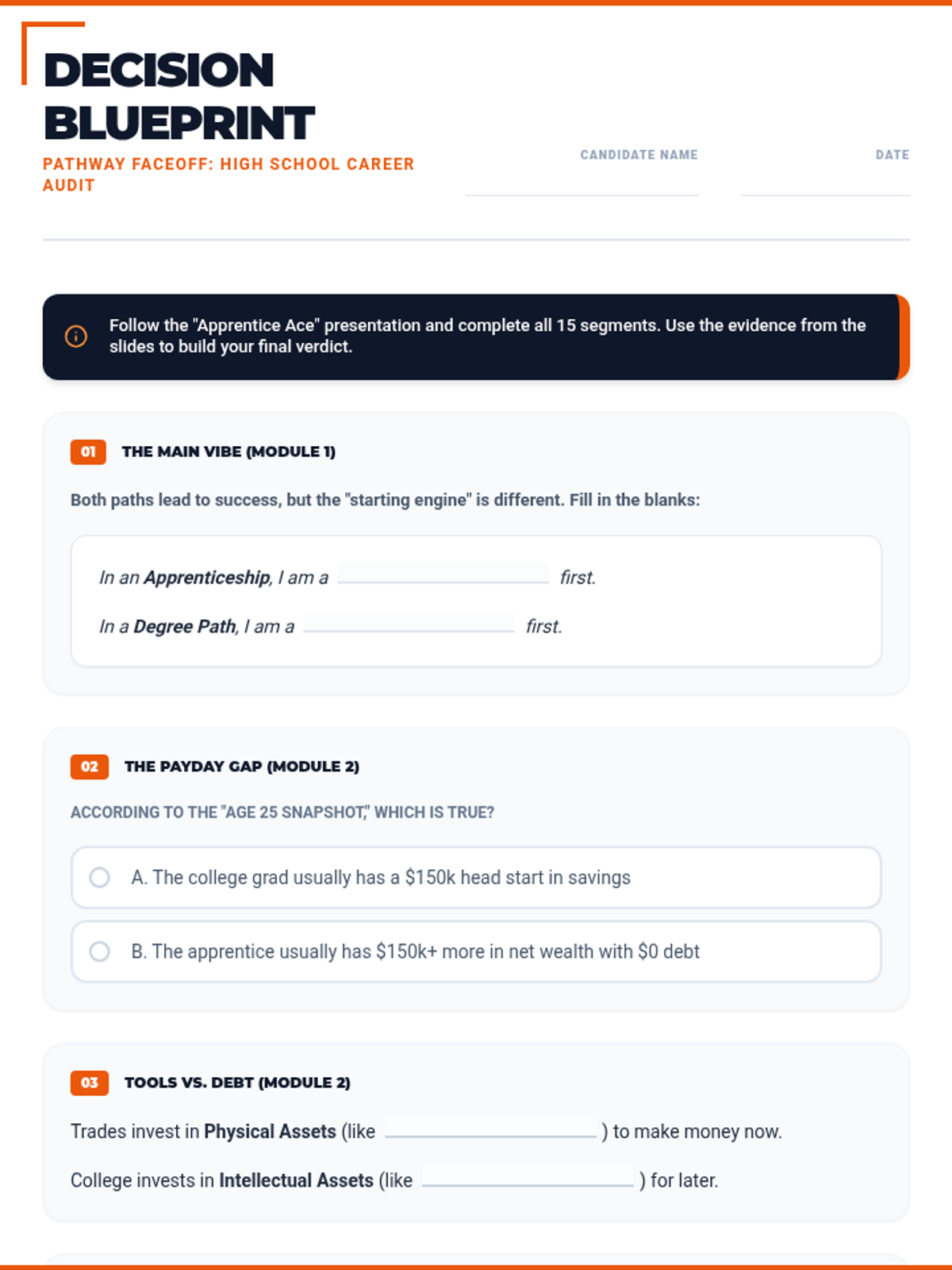
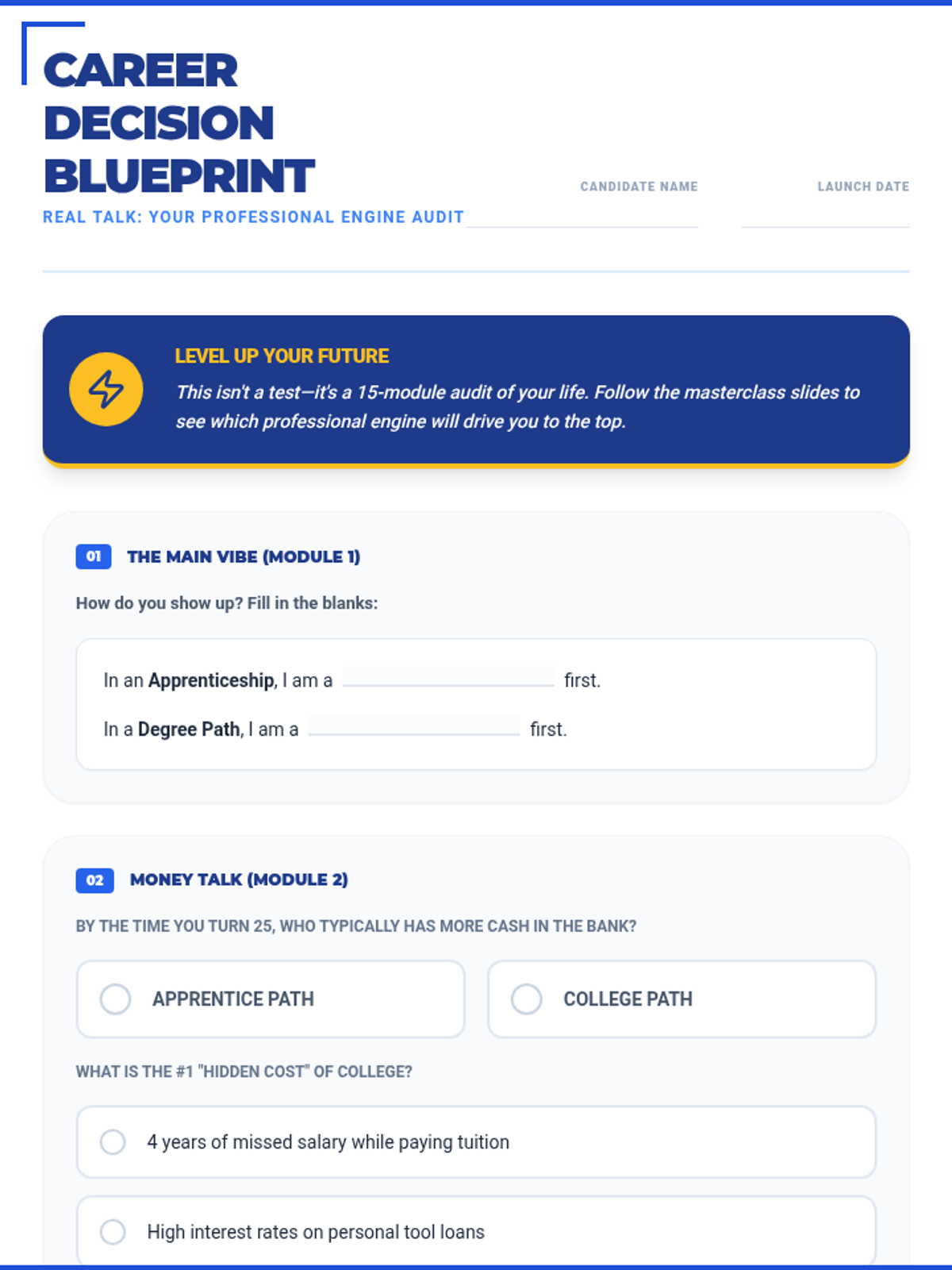
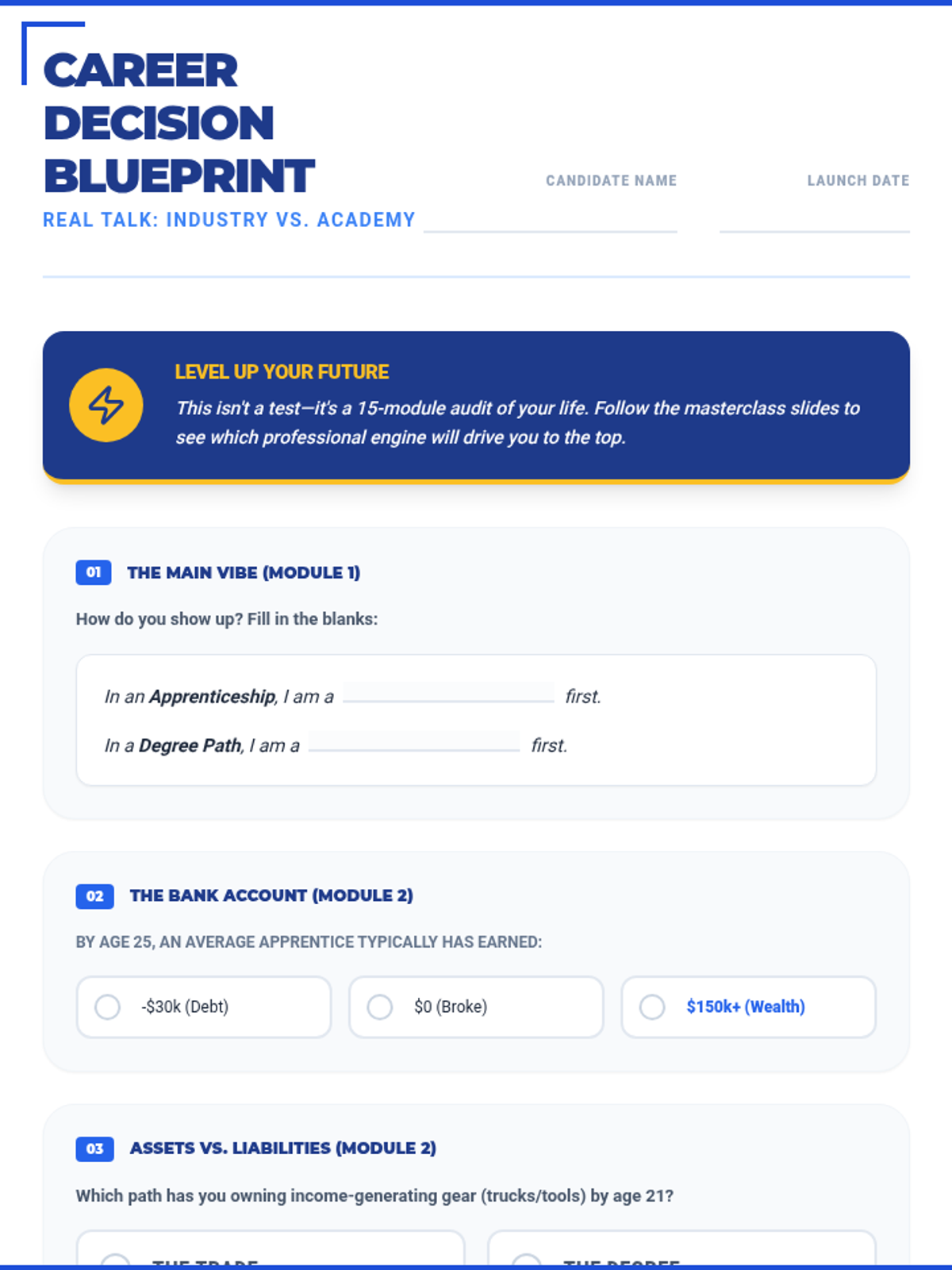
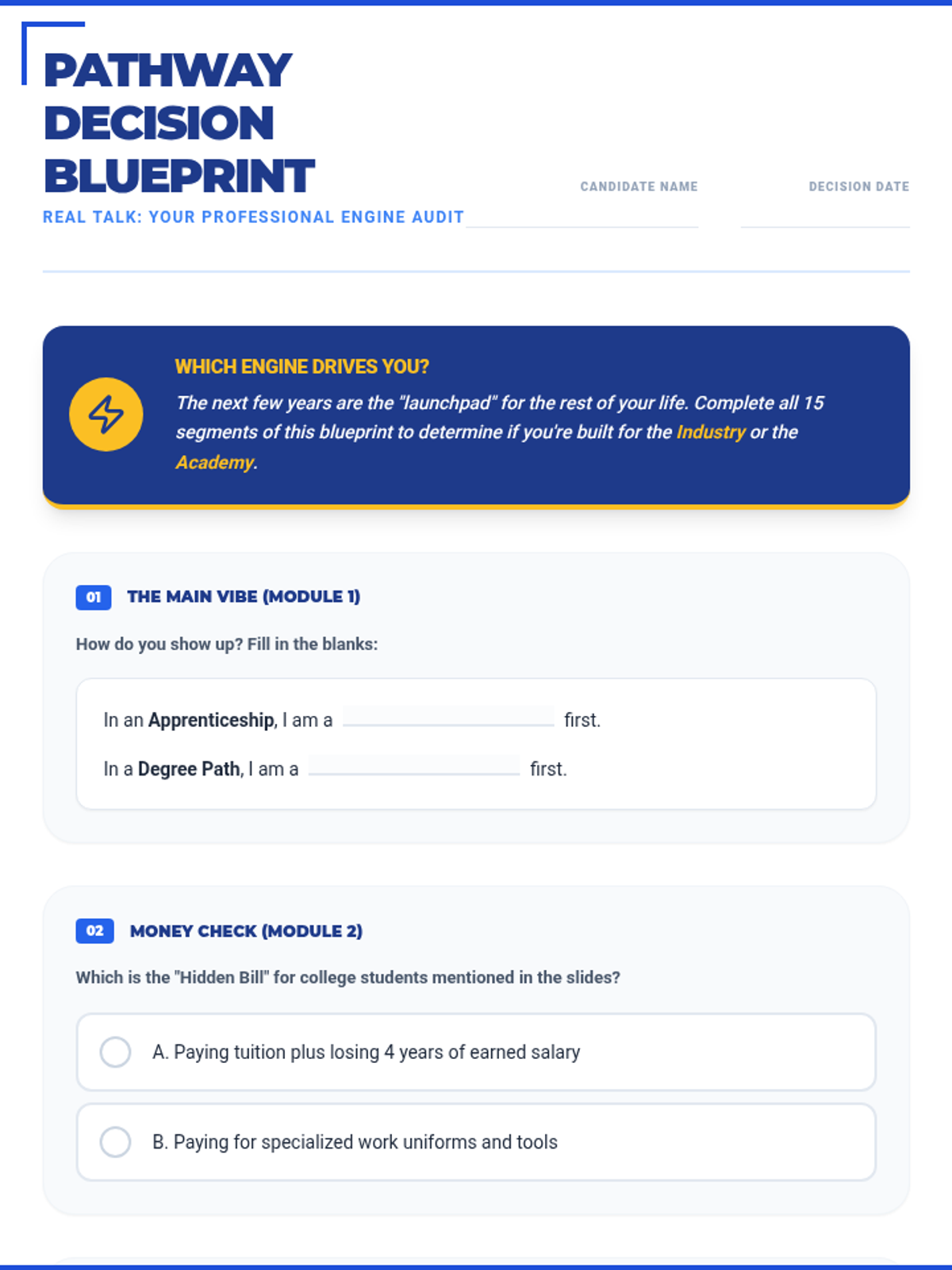
A 15-section career exploration worksheet designed for 16-year-old high school students, featuring punchy, relatable titles and refined "Real Talk" language like "The Main Vibe" and "Why I'll crush it." Meticulously aligned with the 45-slide masterclass. All correct answer highlights have been removed for student use.
A 15-section career exploration worksheet designed for 16-year-old high school students, featuring punchy, relatable titles and a "Safety Orange & Slate" theme. Meticulously aligned with the 45-slide masterclass. All correct answer highlights have been removed for student use.
A 15-section career exploration worksheet designed for 16-year-old high school students, featuring punchy, relatable titles and refined "Real Talk" language like "The Vibe Check" and "Why I'll crush it." Meticulously aligned with the 45-slide masterclass. All correct answer highlights have been removed for student use.
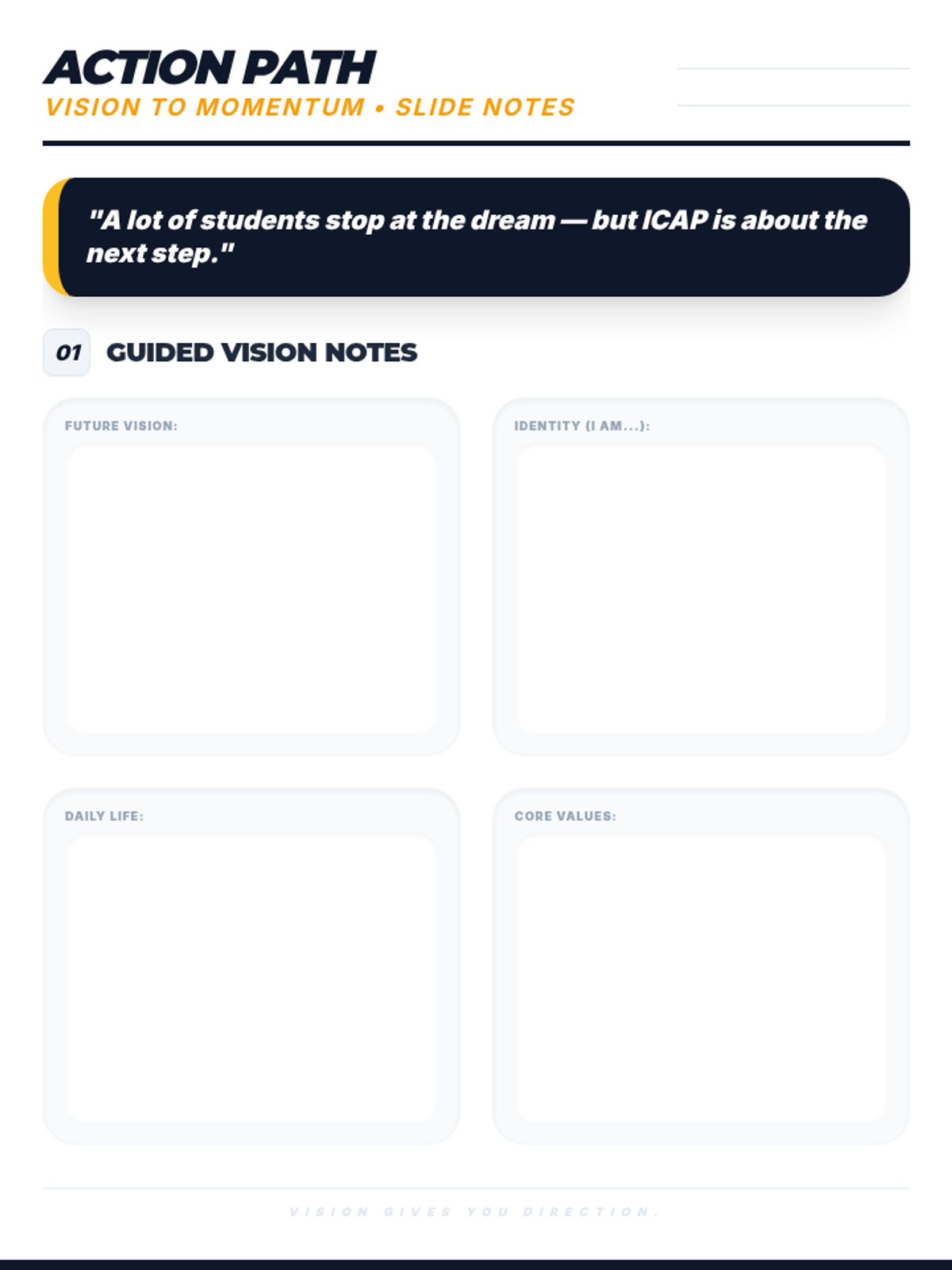
A comprehensive 2-page printable companion for the Action Path slide deck. Includes detailed sections for Vision, Next Steps, and Support/Barriers, designed for front-to-back printing. Strictly formatted to fit on two 720x960 pages without overflow. Guaranteed no page splitting. High-end professional aesthetic.
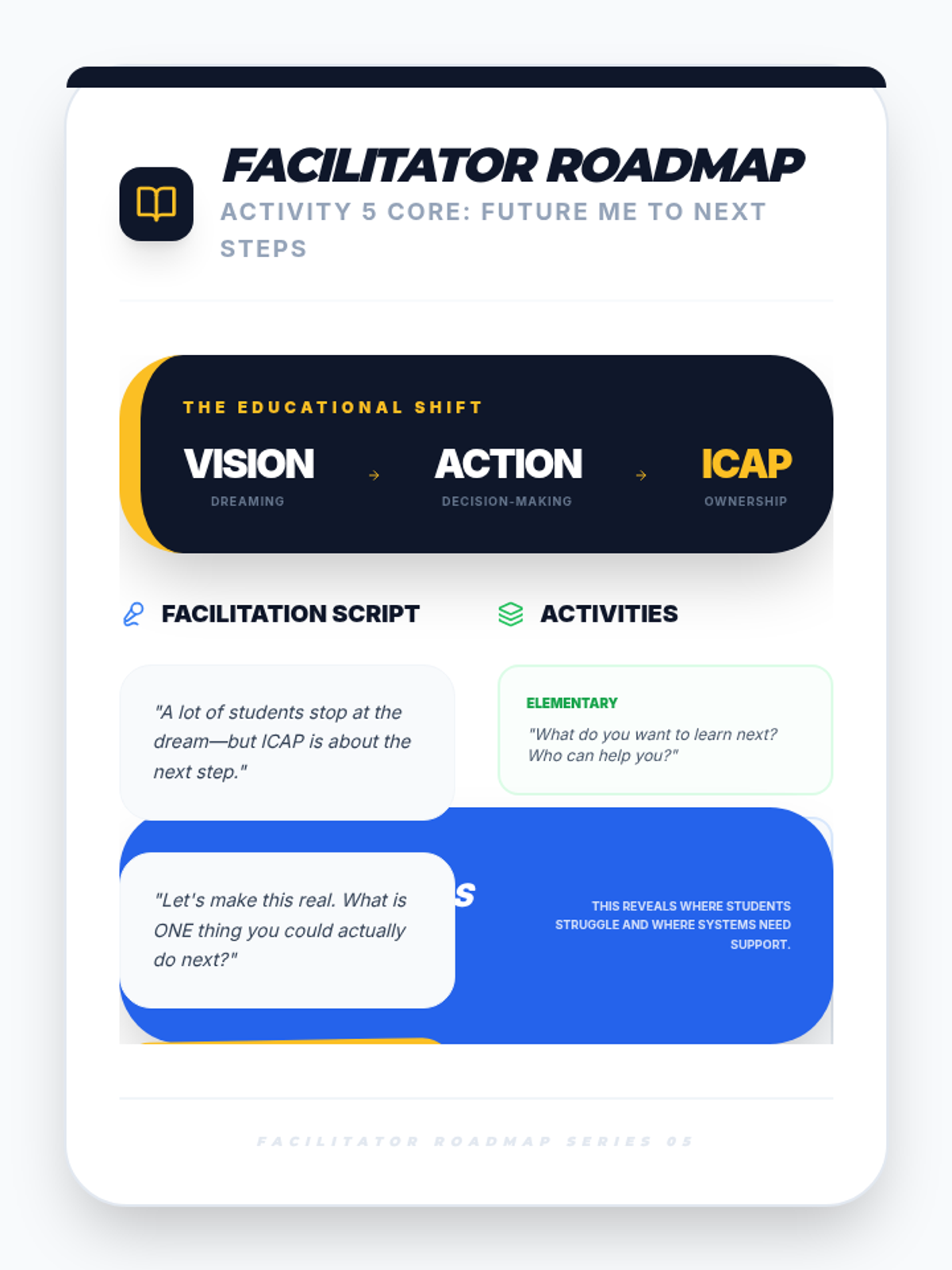
A high-impact facilitator guide for teachers. Includes scripts, grade-level strategies, and the core pedagogical shift from vision to action. Strictly formatted to fit on a single page.
A bold, visually striking classroom anchor chart that defines the Action Path stages: Future Me, Next Steps, and Support/Barriers. High-impact design for classroom walls.
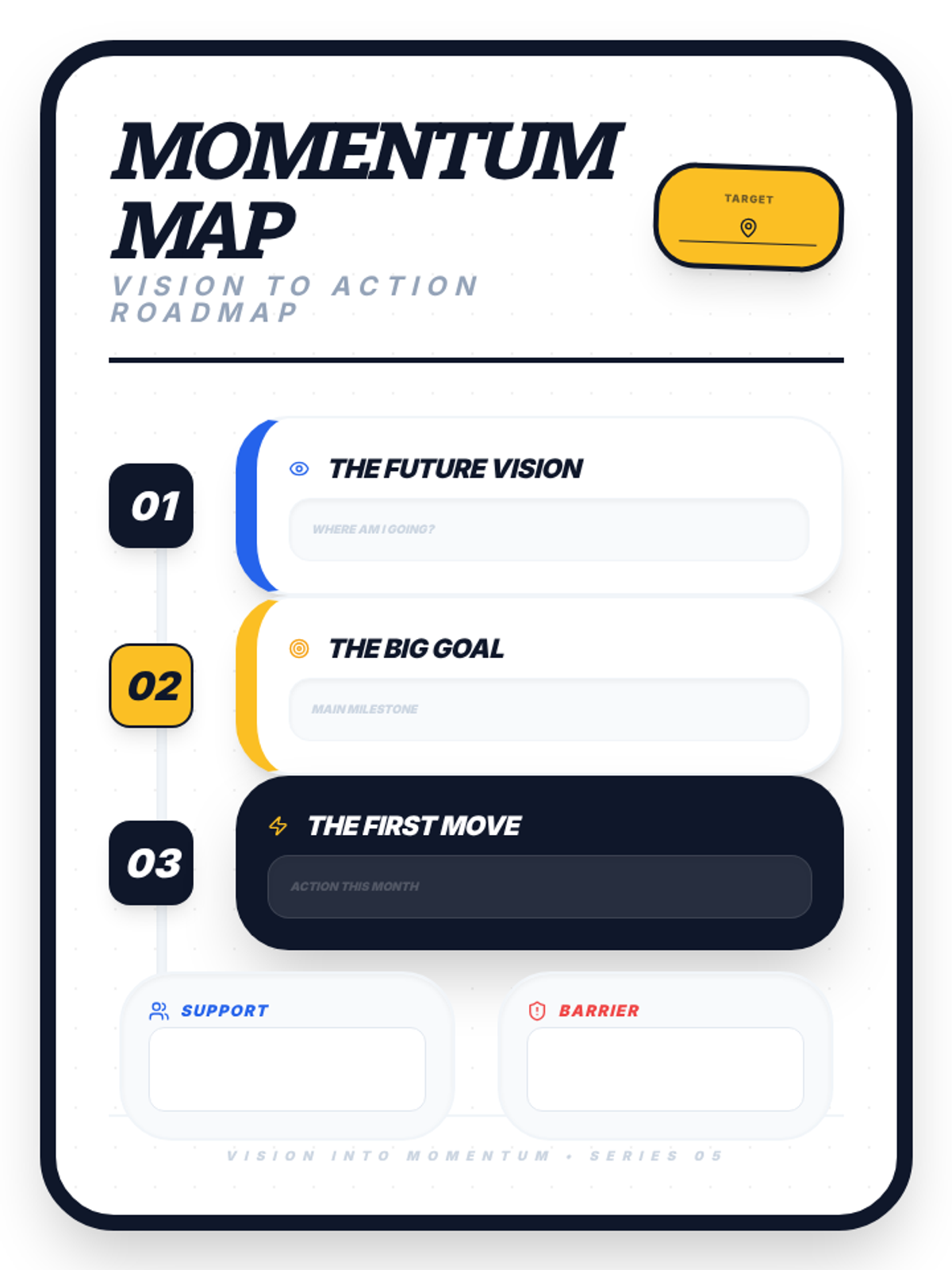
A professional, vertical roadmap Momentum Map. Designed with a high-contrast theme and strictly formatted to fit on a single 720x960 page using a safe height buffer. Guaranteed no overflow.
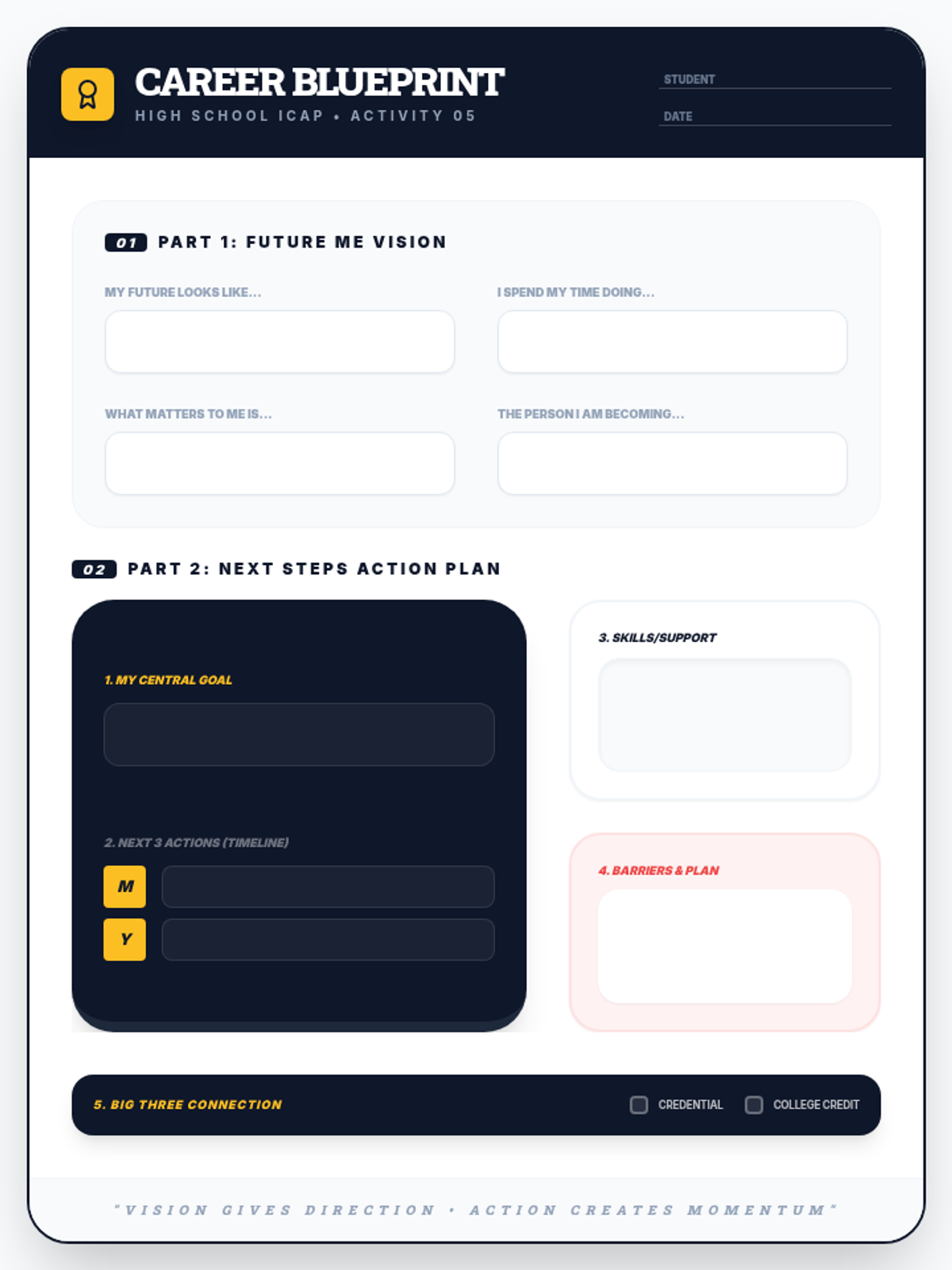
A high-density, professional Career Blueprint for high school students. Designed with a clean minimalist aesthetic and strictly formatted to fit 100% on a single 720x960 page using a safe height buffer. Guaranteed no page splitting.
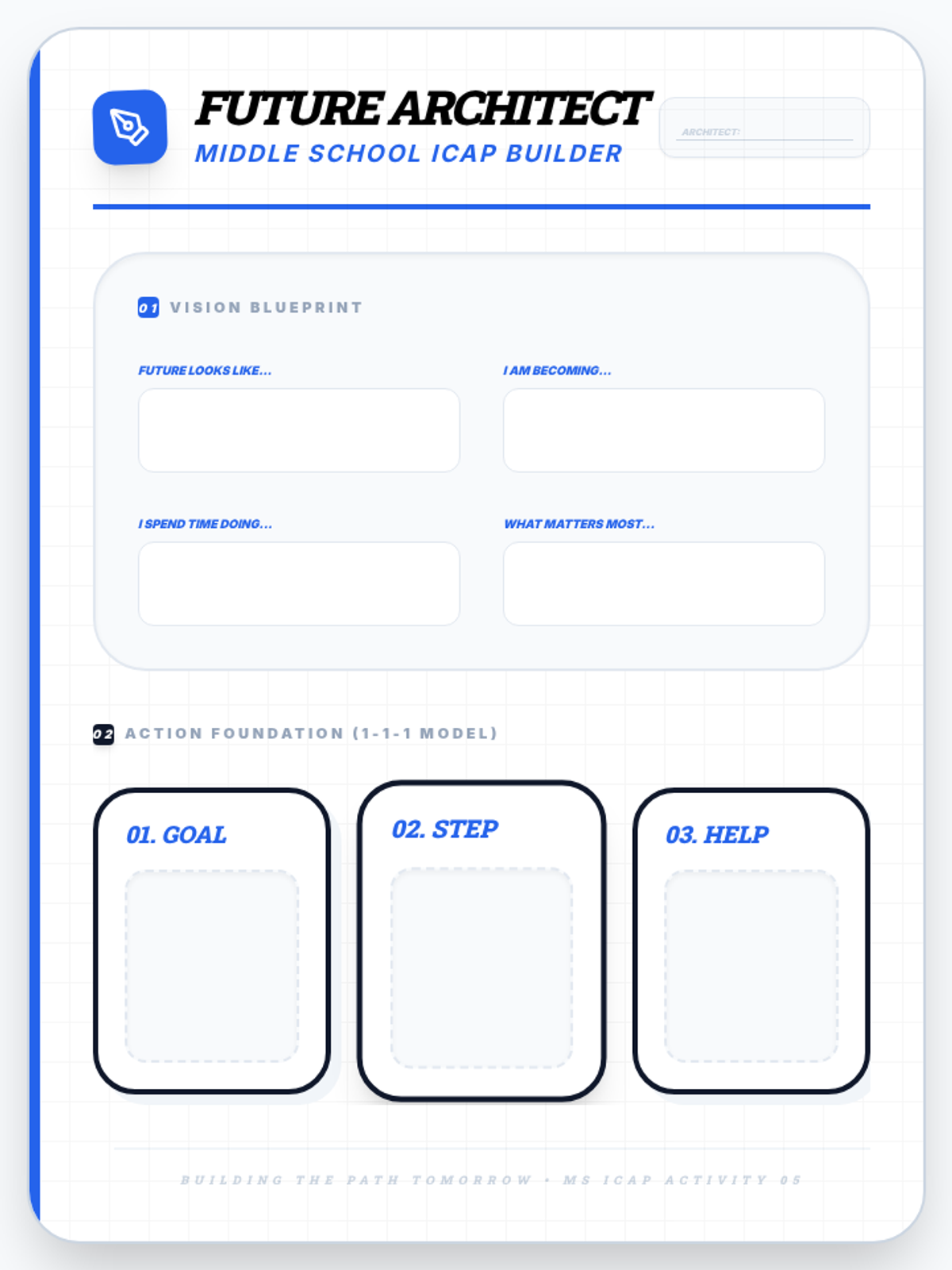
A high-impact planning worksheet for middle school students. Designed with a clean minimalist aesthetic and strictly formatted to fit on a single 720x960 page. Guaranteed no overflow.
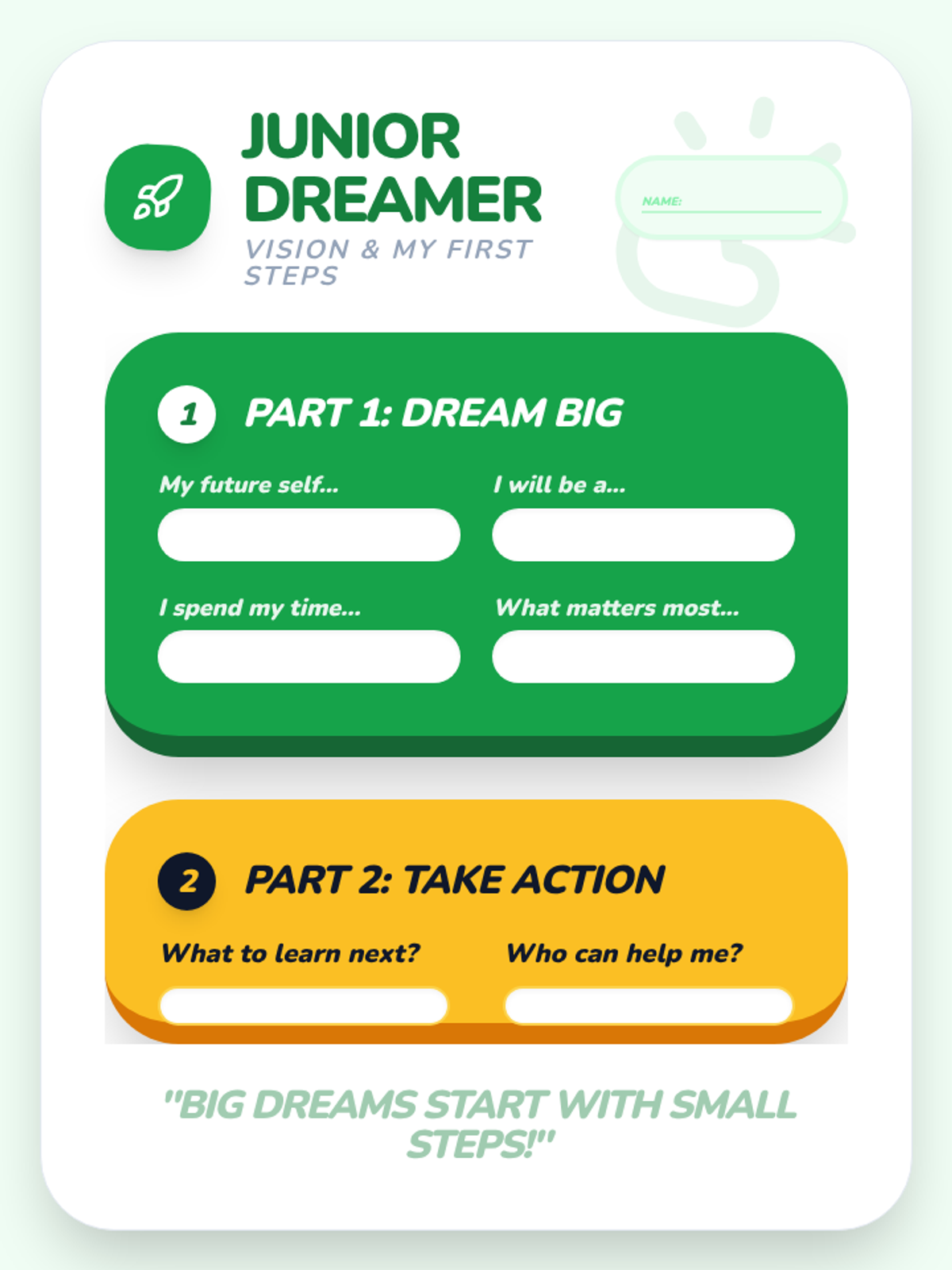
An engaging, professional-quality workshop sheet for elementary students. Designed with a clean minimalist aesthetic and strictly formatted for a single 720x960 page using a safe height buffer. Guaranteed no overflow.
A comprehensive slide presentation for Activity 5 Core: Future Me to Next Steps. Now fully inclusive of all grade levels (ES, MS, HS) with specific slides for each developmental stage and action model.
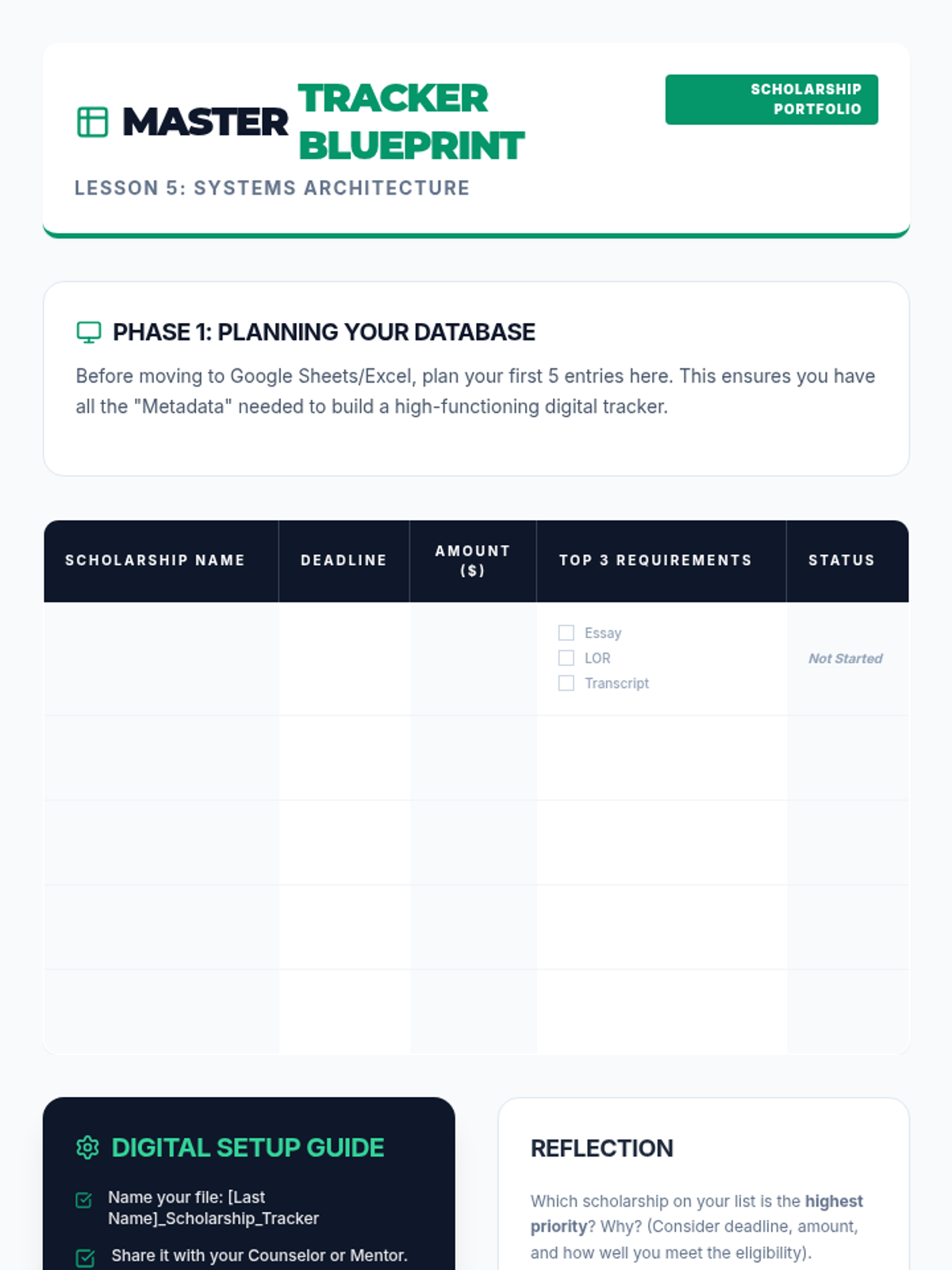
A physical planning sheet that mimics a digital spreadsheet, helping students organize their first 5 scholarship opportunities before building a digital tracker.
An introductory slide deck for the 'Building an Application Tracker' lesson, covering the importance of organization and the structure of an effective scholarship spreadsheet.
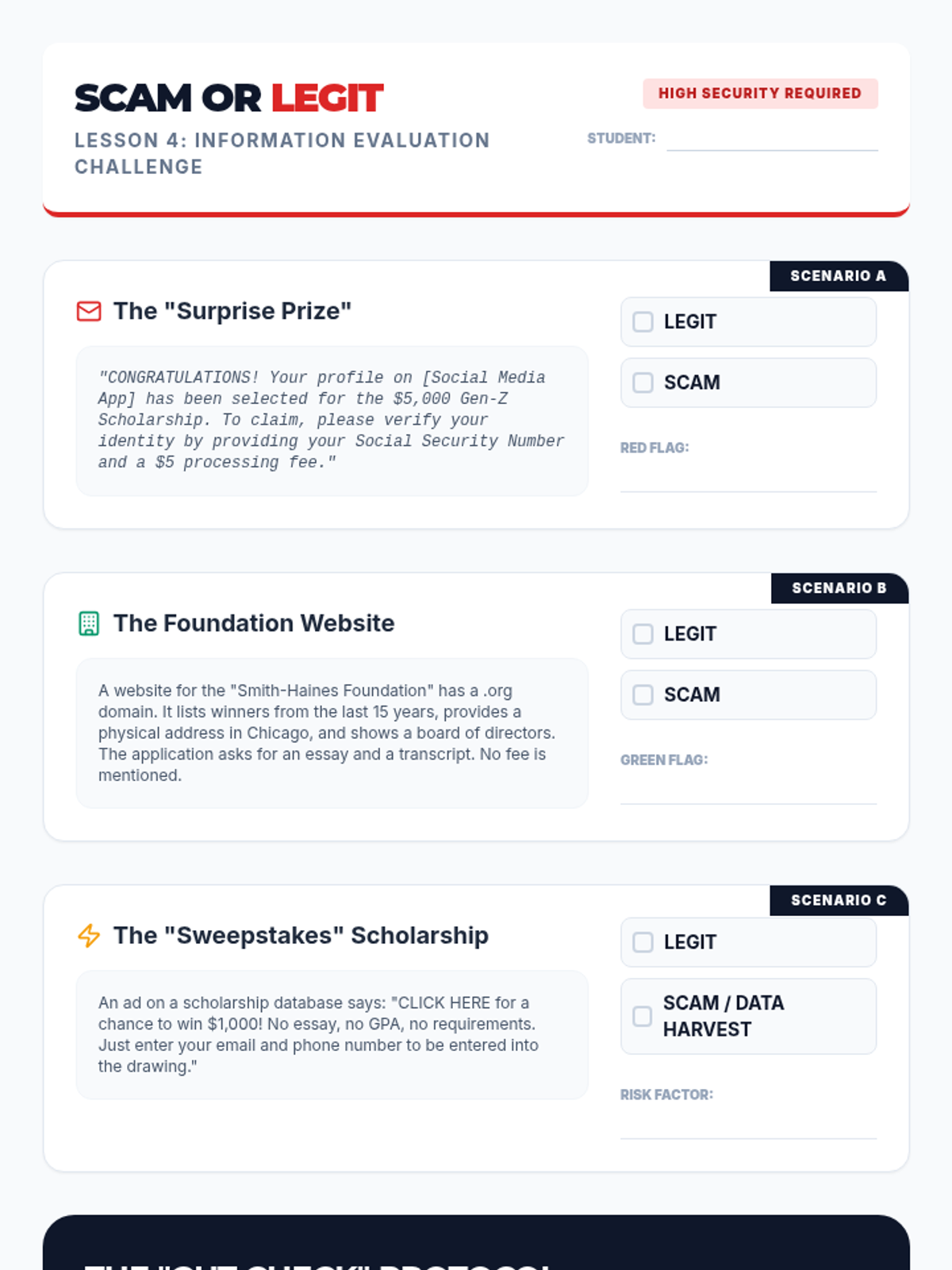
A student worksheet with evaluation scenarios to practice identifying scholarship scams and legitimate opportunities.
An introductory slide deck for the 'Spotting Scams and Red Flags' lesson, covering common red flags like application fees and guaranteed wins.
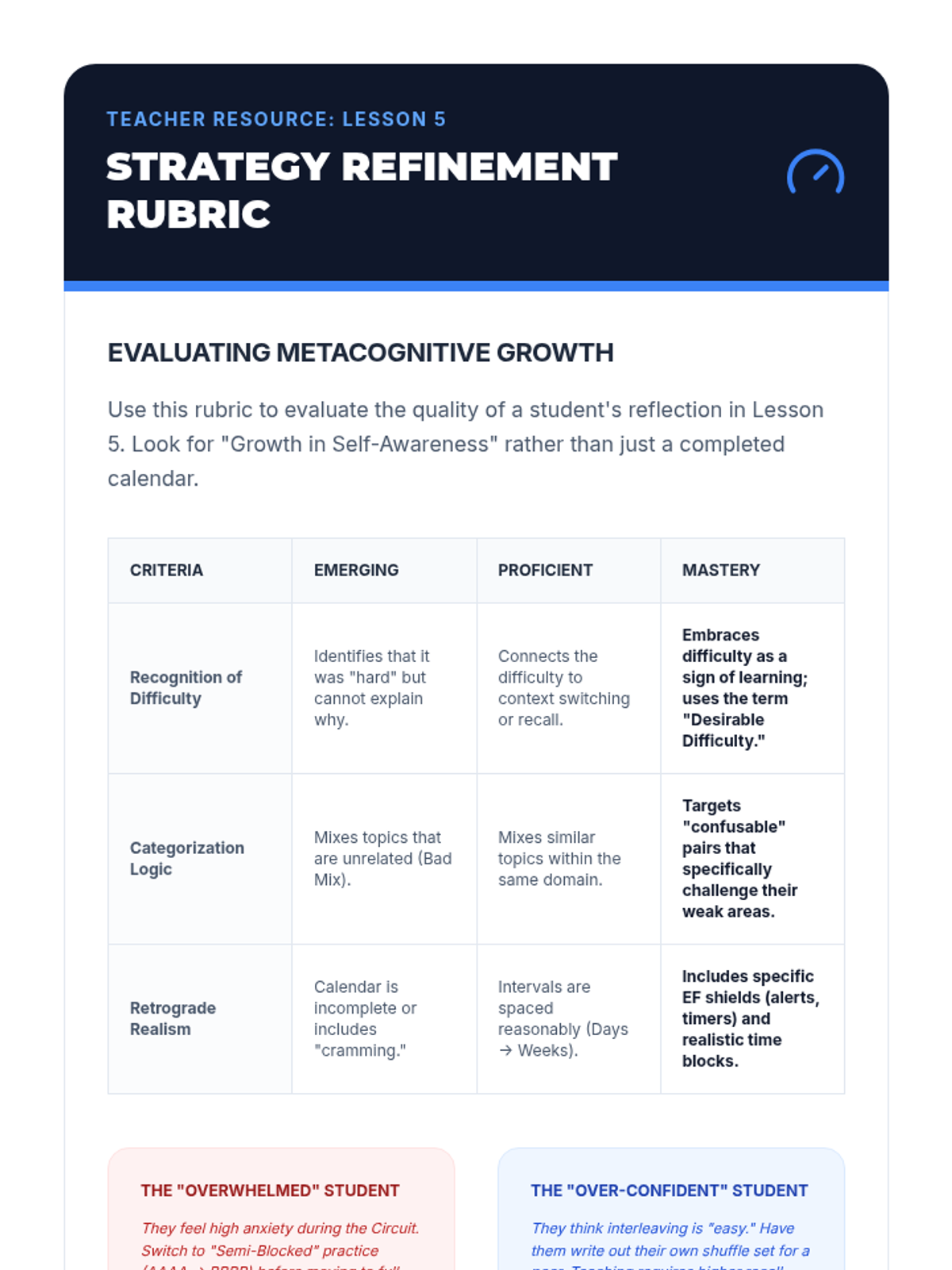
An assessment and guidance rubric for teachers to evaluate student progress in mastering interleaved practice and metacognitive strategies.
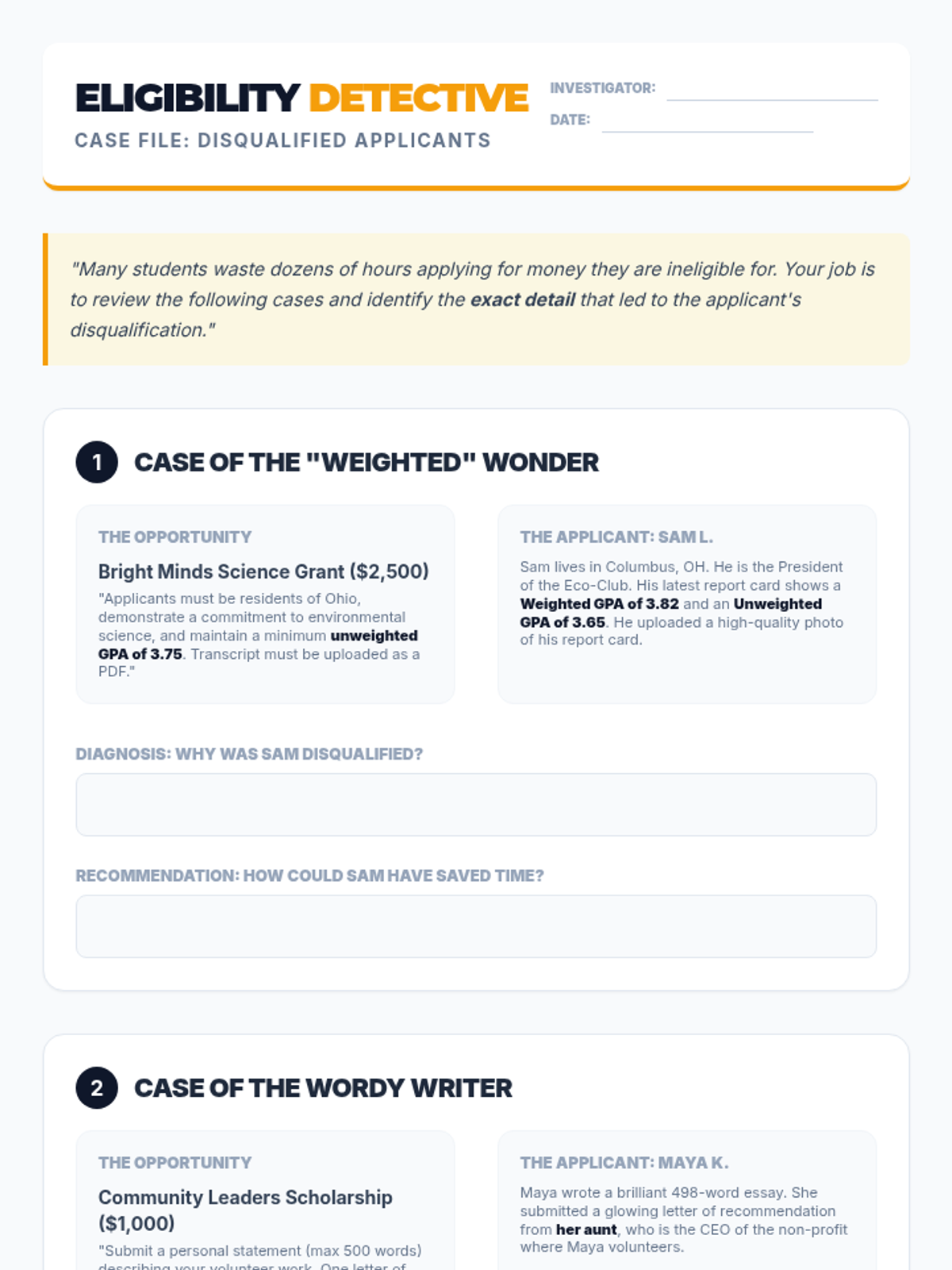
A case study worksheet where students act as detectives to identify why specific scholarship applicants were disqualified based on eligibility fine print.
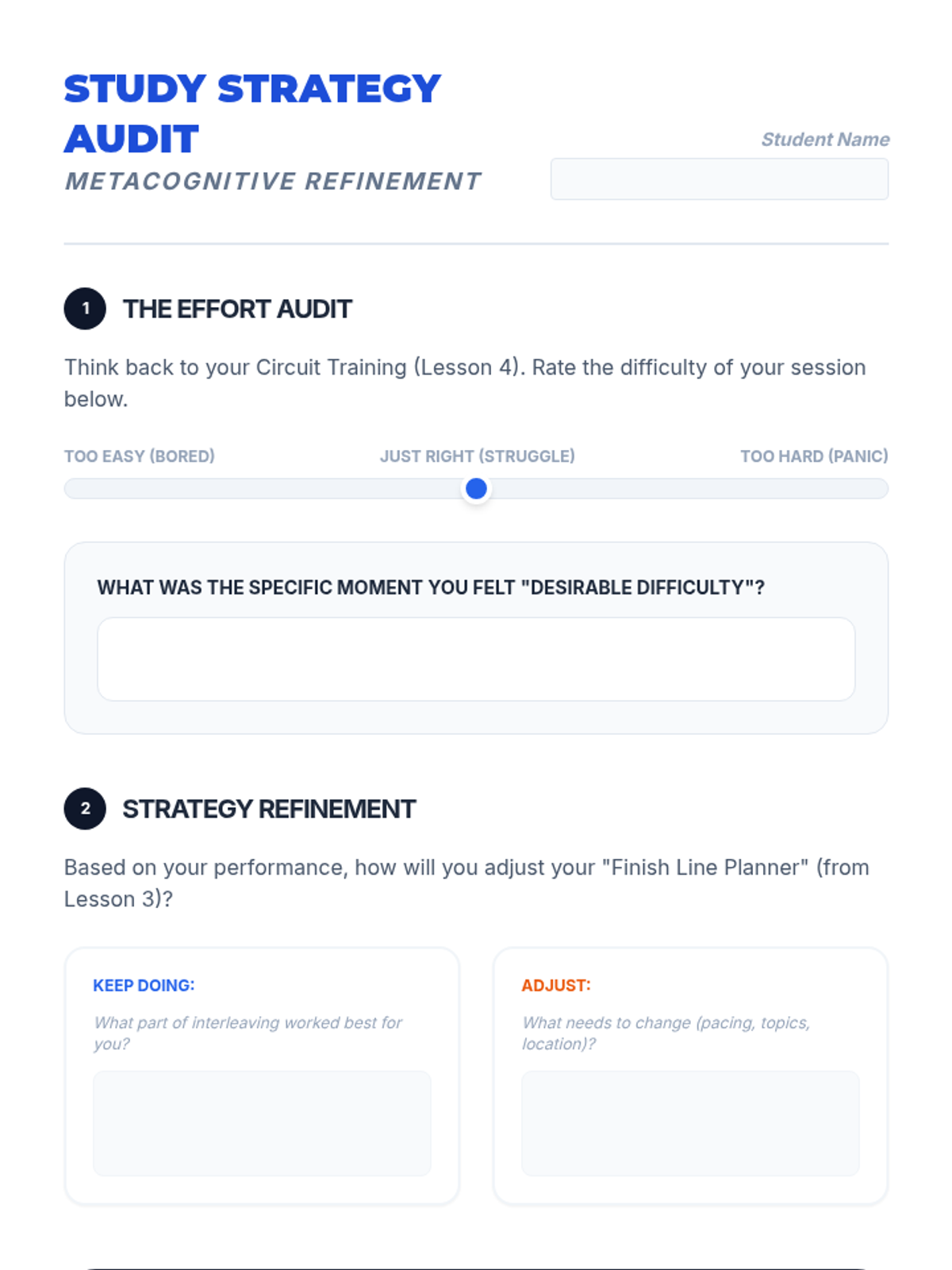
A reflection worksheet for Lesson 5 where students evaluate their study experience, assess the difficulty of their practice, and commit to refining their interleaved study habits.
Slides for Lesson 5 focusing on metacognition, the concept of 'desirable difficulty', and how students can optimize their interleaved study sessions.
An introductory slide deck for the 'Decoding Eligibility and Requirements' lesson, covering common eligibility traps and deliverable types.
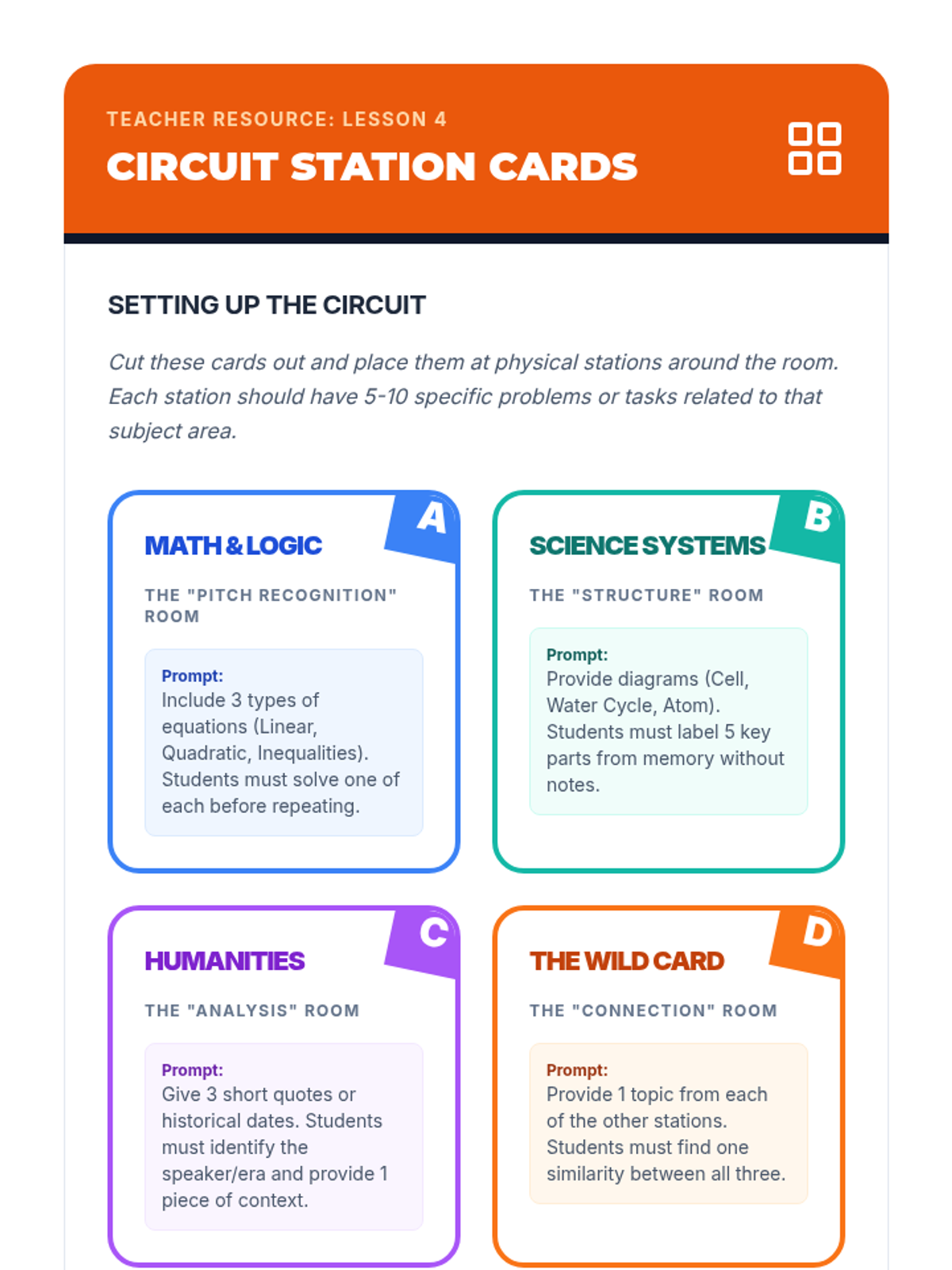
Templates for physical study stations used during the Active Recall Circuit. Includes subject-specific prompts for Math, Science, Humanities, and a 'Wild Card' connection station.
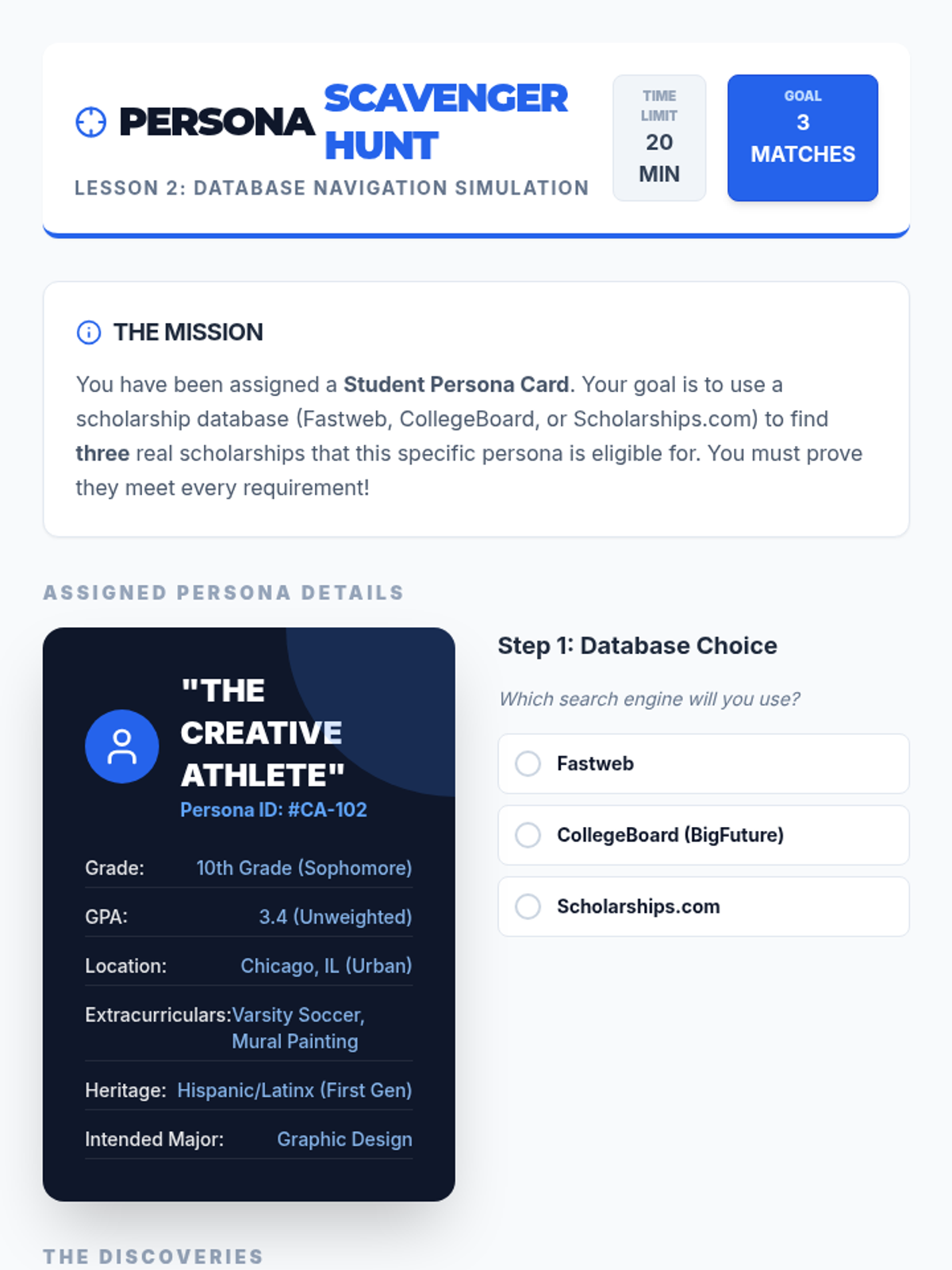
A simulation worksheet where students find scholarships for a specific student persona to practice database navigation and filtering.
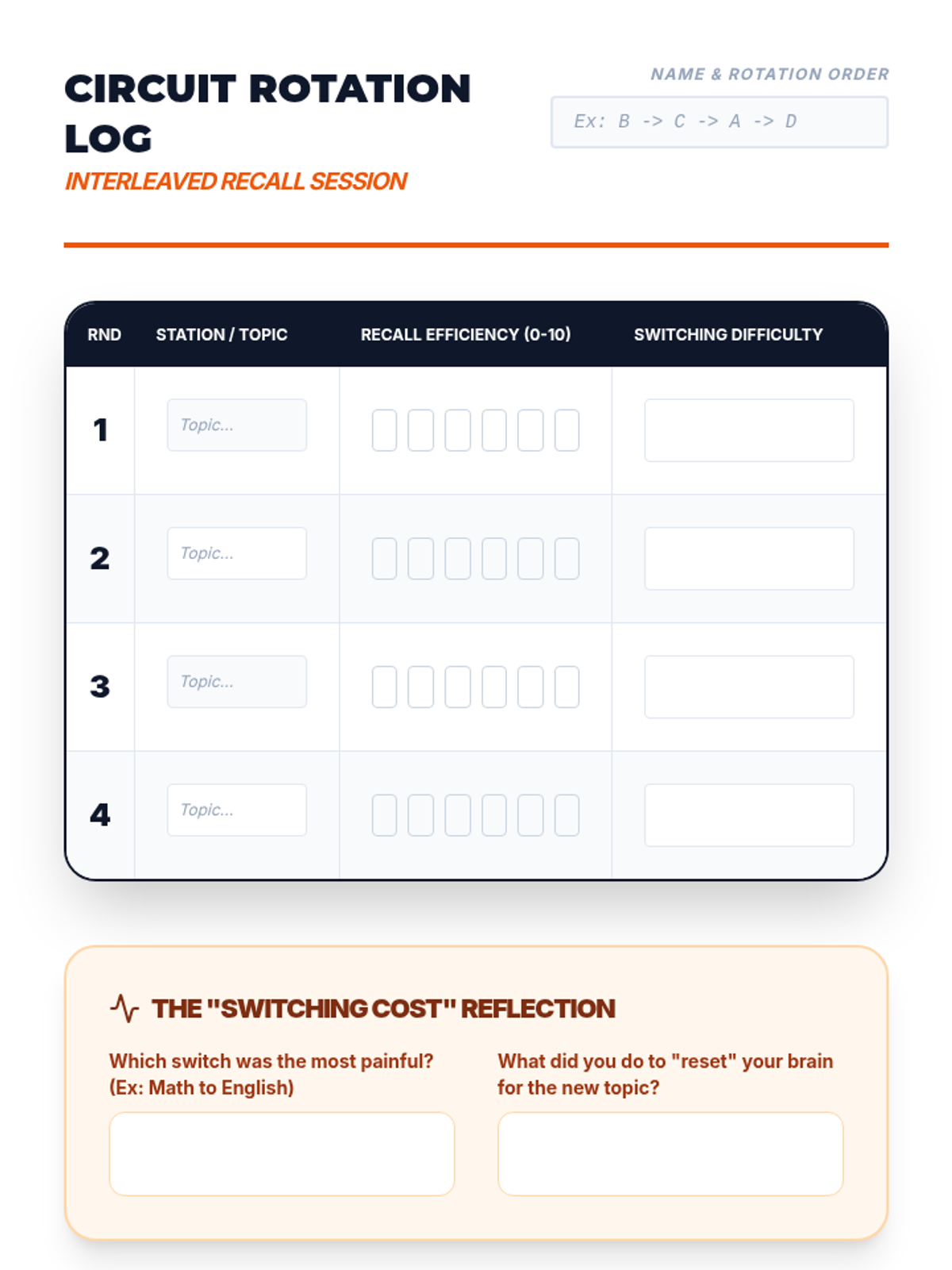
A tracking log for students to record their experience during the high-intensity circuit study session. Includes sections for recall efficiency and reflection on switching difficulty.
Instructions for the high-intensity 'circuit training' study session in Lesson 4, emphasizing context switching and rapid recall.
An introductory slide deck for the 'Navigating Scholarship Databases' lesson, covering profile setup, filtering strategies, and the top three search engines.
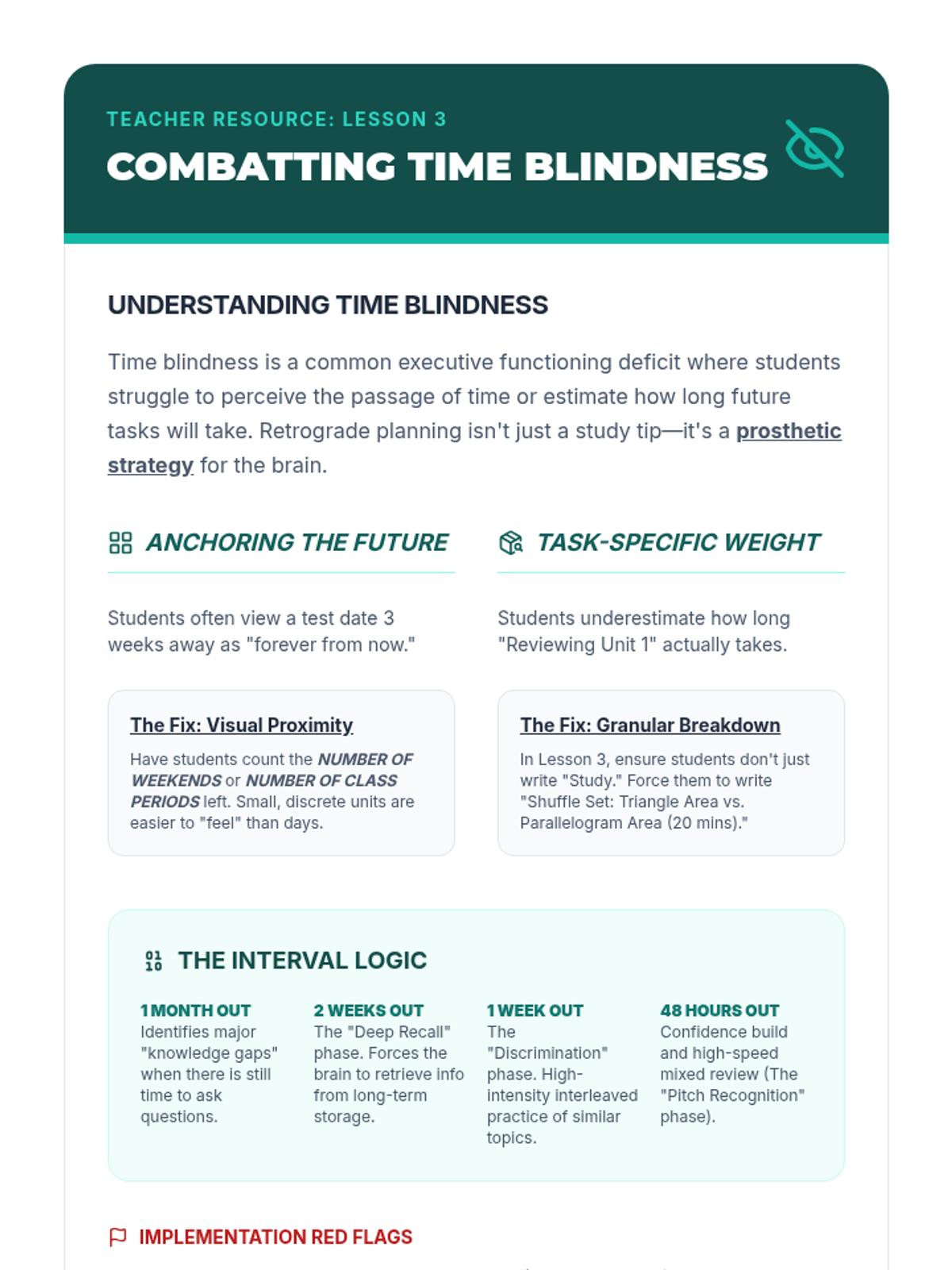
A guide for teachers to support students with executive functioning deficits (specifically time blindness) during the retrograde planning process.
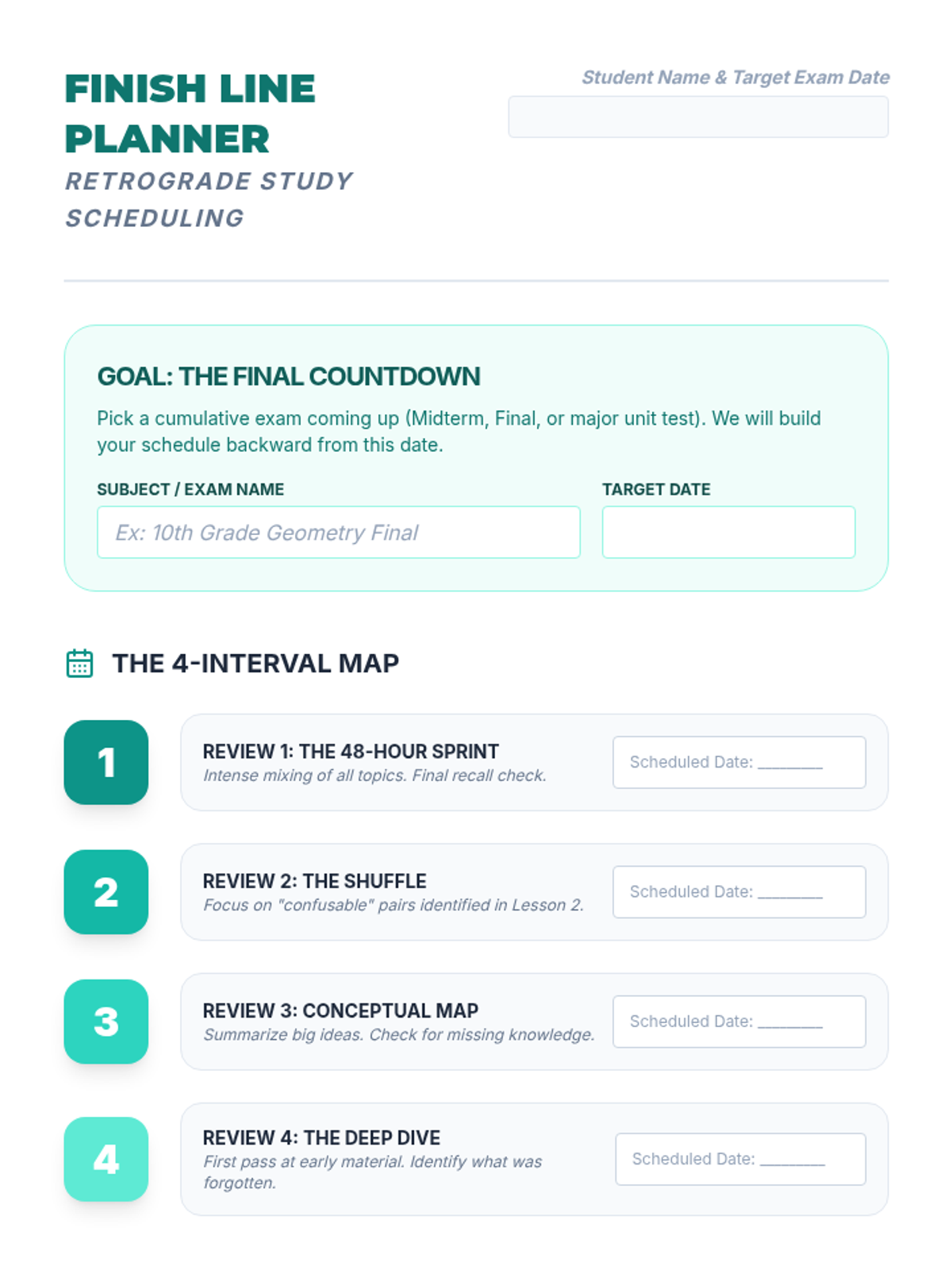
A student backward-planning calendar template for scheduling interleaved study sessions leading up to a cumulative exam. Includes intervals for 48 hours, 1 week, 2 weeks, and 1 month prior.
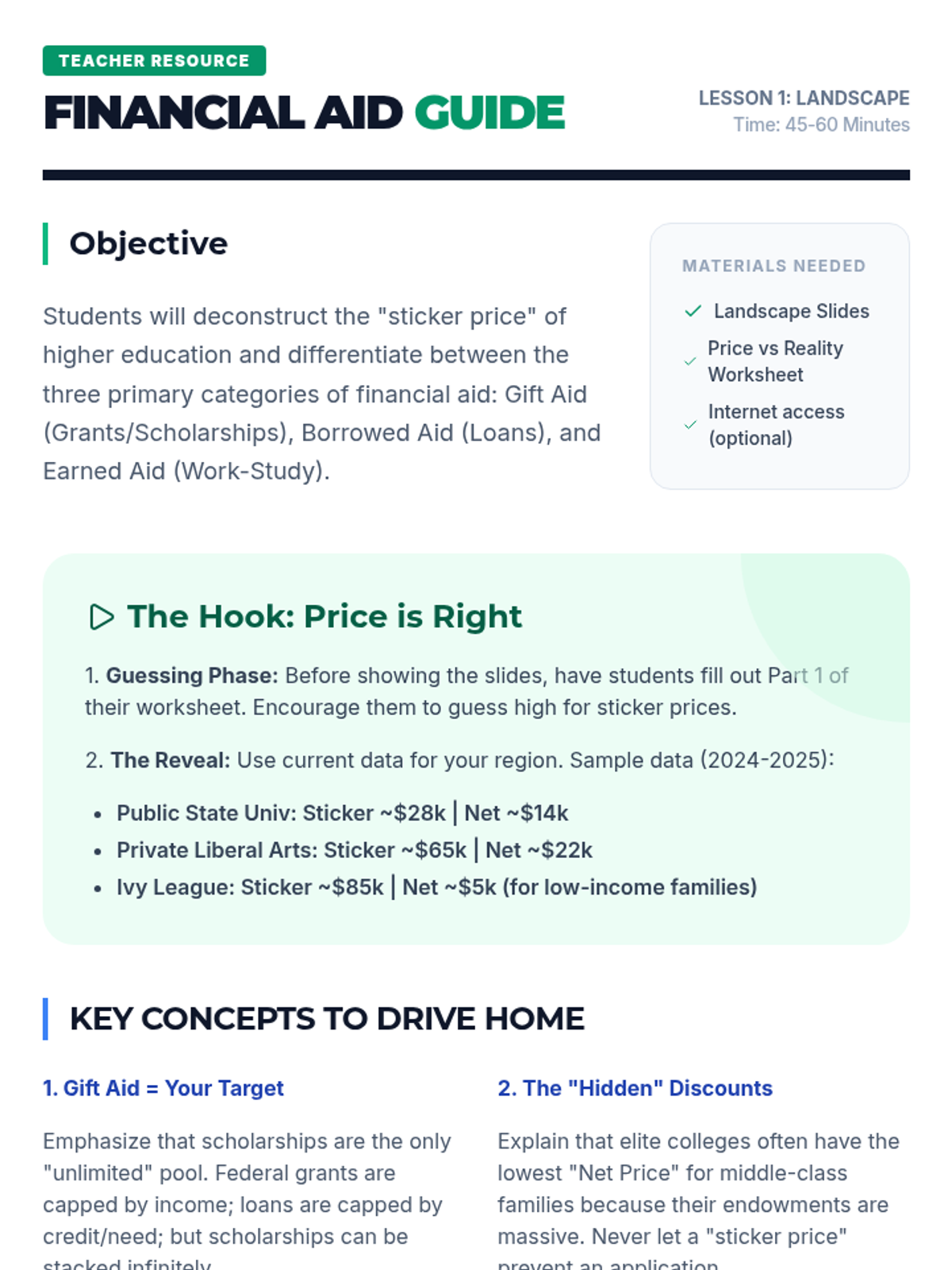
A teacher guide for the 'Financial Aid Landscape' lesson, including a walkthrough of the guessing activity, key concepts, and an answer key for the student worksheet.
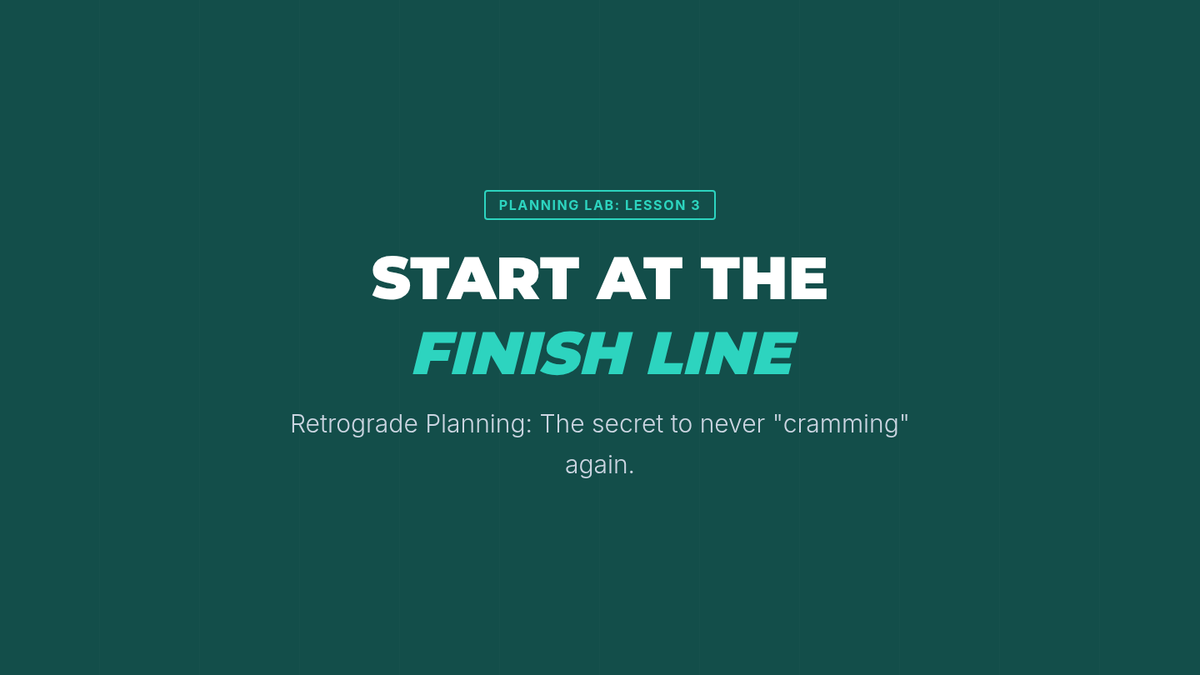
Introductory slides for Lesson 3, explaining the concept of retrograde planning (backward design) to manage time and schedule review intervals for exams.
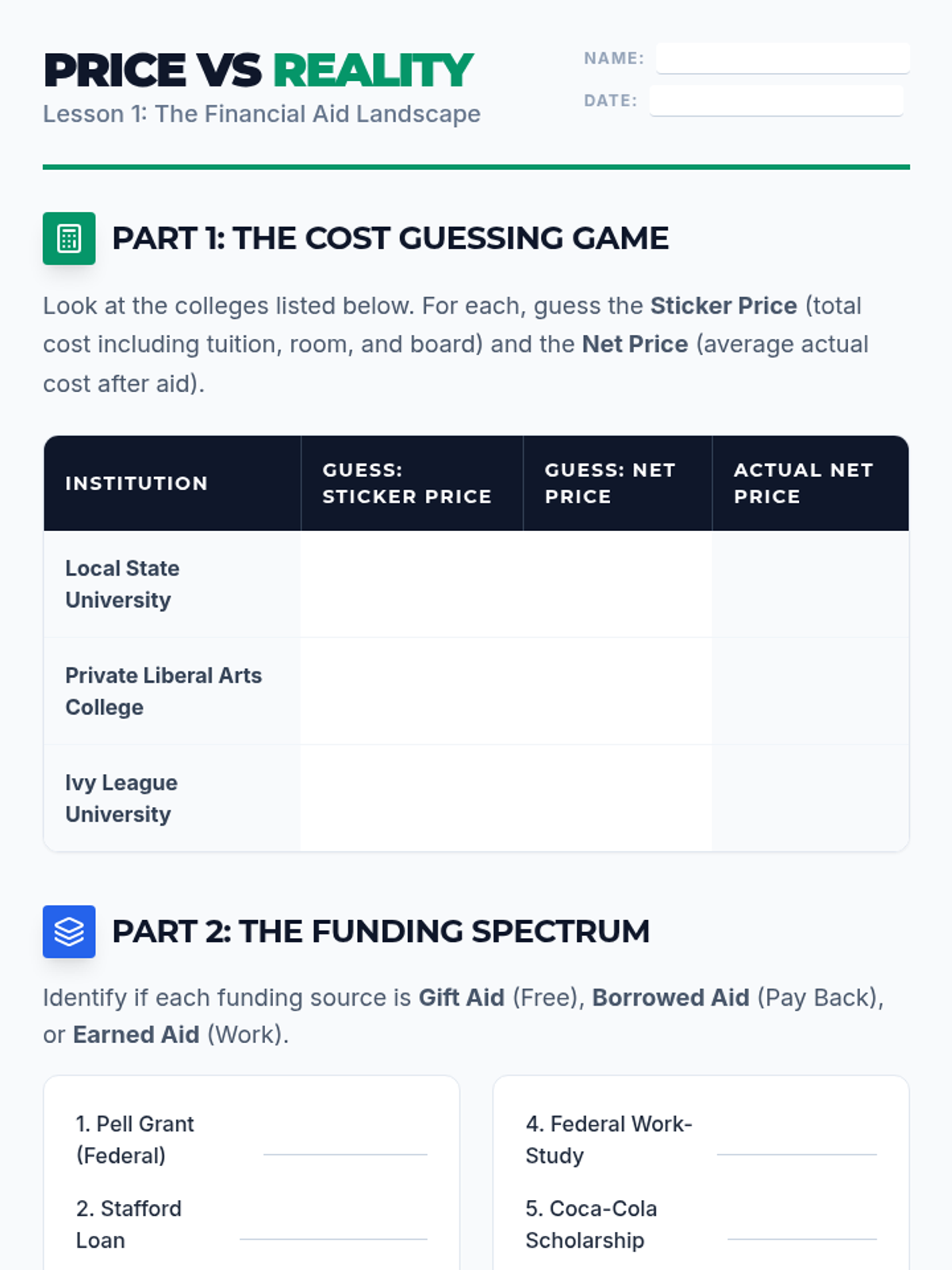
A student worksheet for the 'Financial Aid Landscape' lesson, including a guessing activity for college costs, aid categorization, and reflection questions.
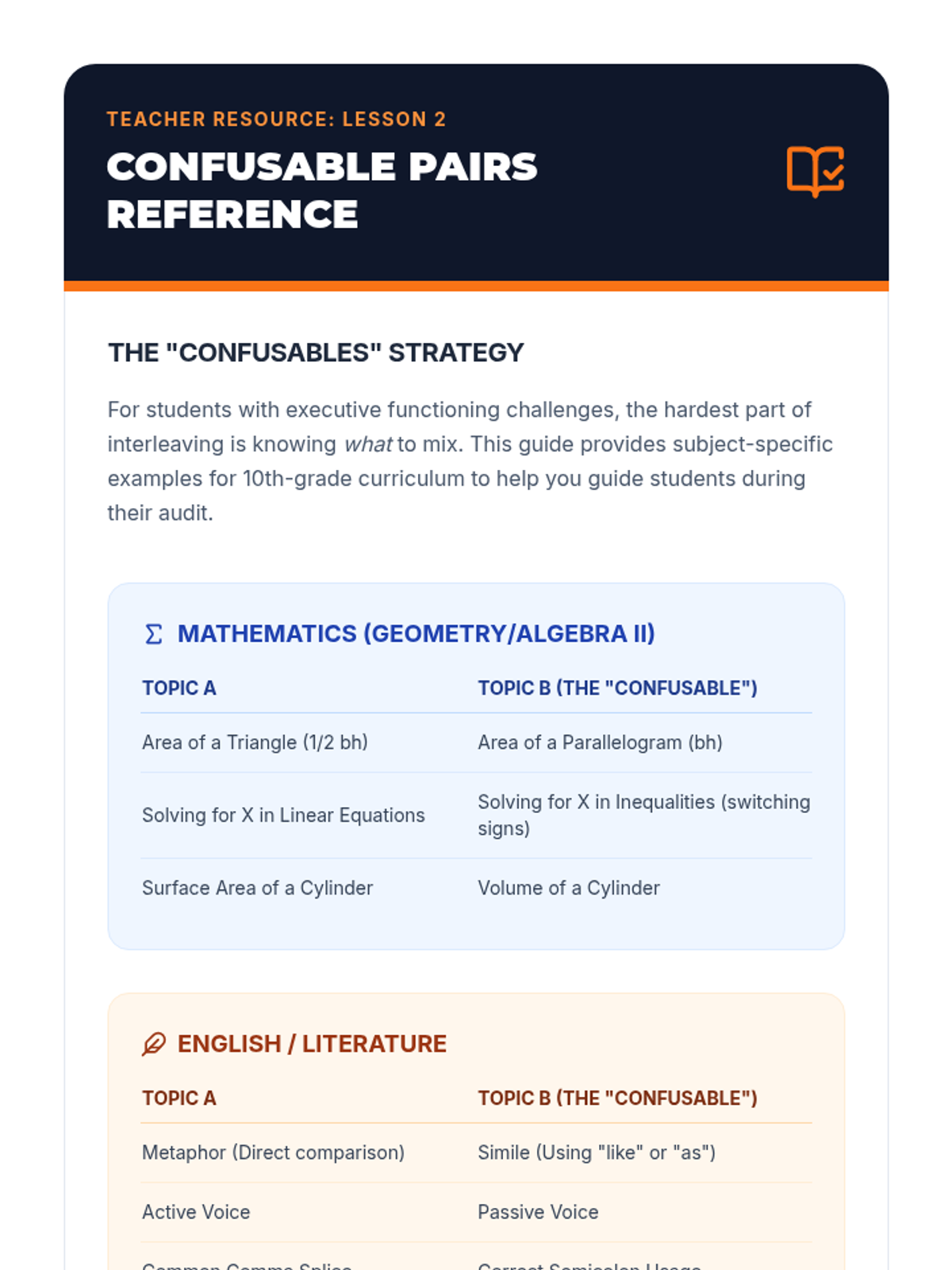
A reference guide for teachers to help students identify 'confusable' topic pairs across various 10th-grade subjects for effective interleaved practice.
An introductory slide deck for the 'Financial Aid Landscape' lesson, covering the types of financial aid (gift, borrowed, earned) and the importance of external scholarships.
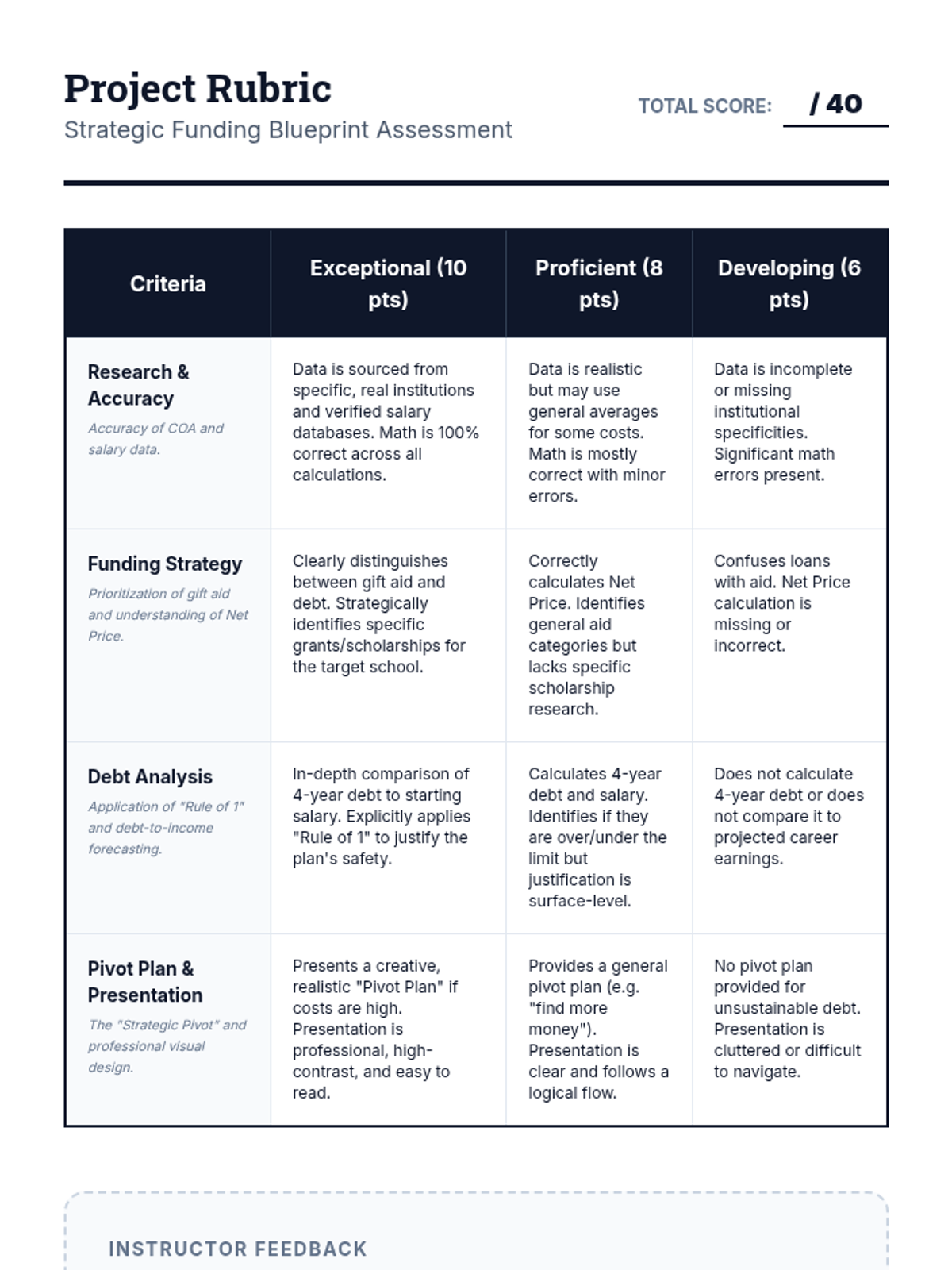
Assessment rubric for the Strategic Funding Blueprint project, focusing on data accuracy, funding strategy logic, and debt sustainability.
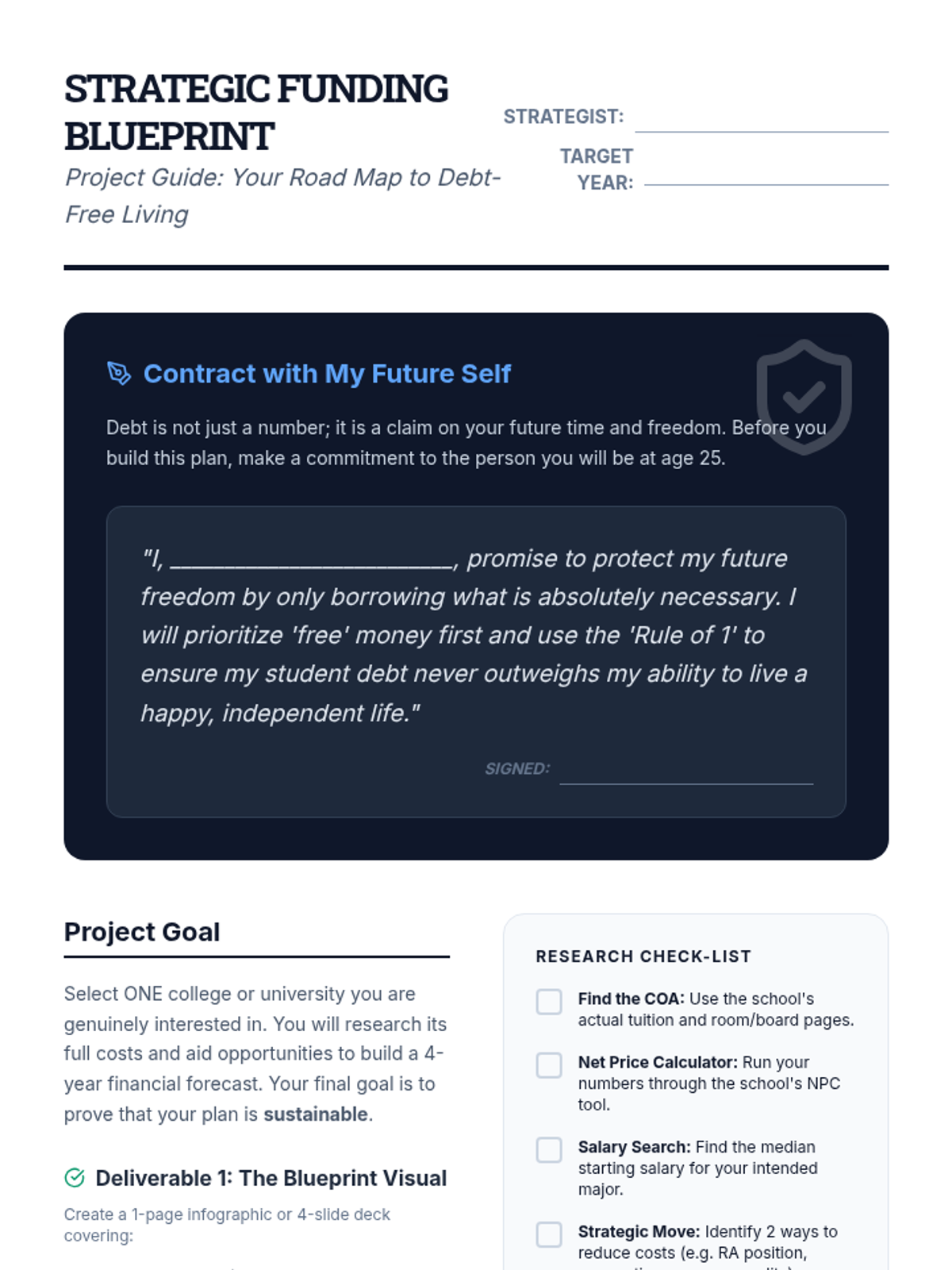
Student project guide for the final "Strategic Funding Blueprint" assessment, including the future-self contract and a data organizer for college research.
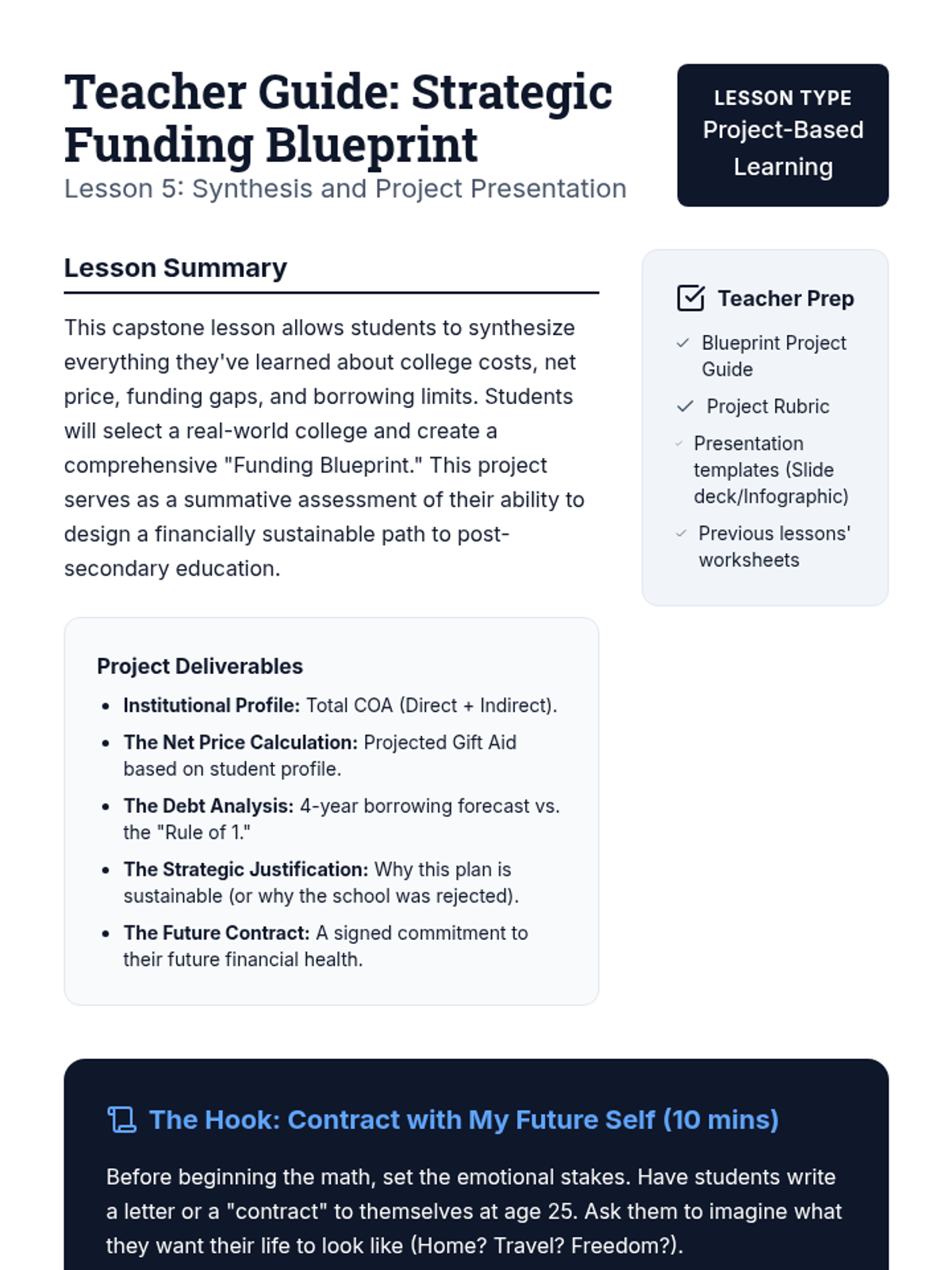
Teacher guide for the final project in Lesson 5, outlining the synthesis project requirements, the "Future Self" hook, and key assessment criteria for student funding plans.
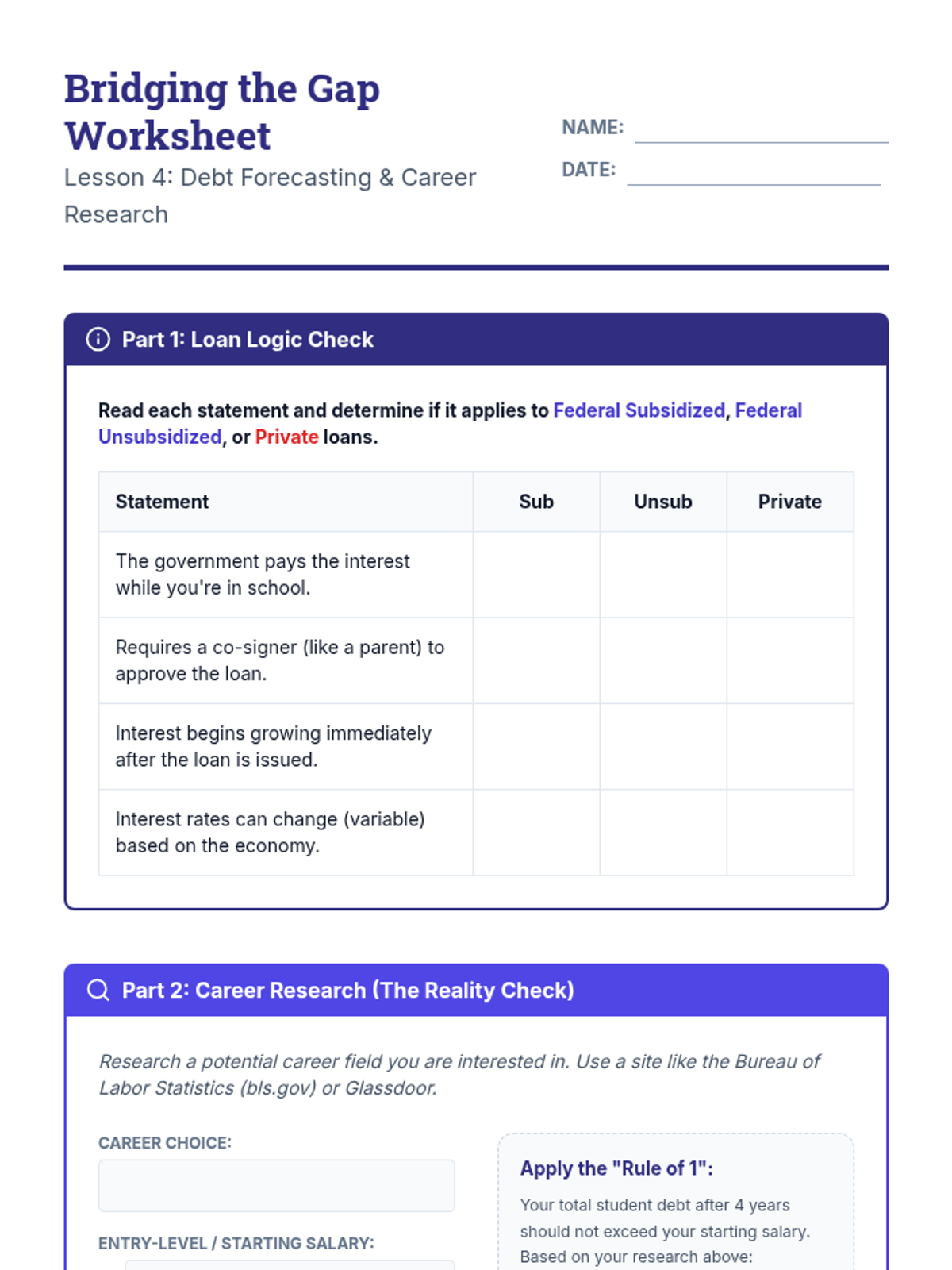
Student worksheet for Lesson 4 where students categorize loan types, research entry-level career salaries, and apply the "Rule of 1" to determine their safe borrowing ceiling.
Visual slide deck for Lesson 4, detailing federal loan limits, Subsidized vs. Unsubsidized distinctions, and the "Rule of 1" for sustainable borrowing.
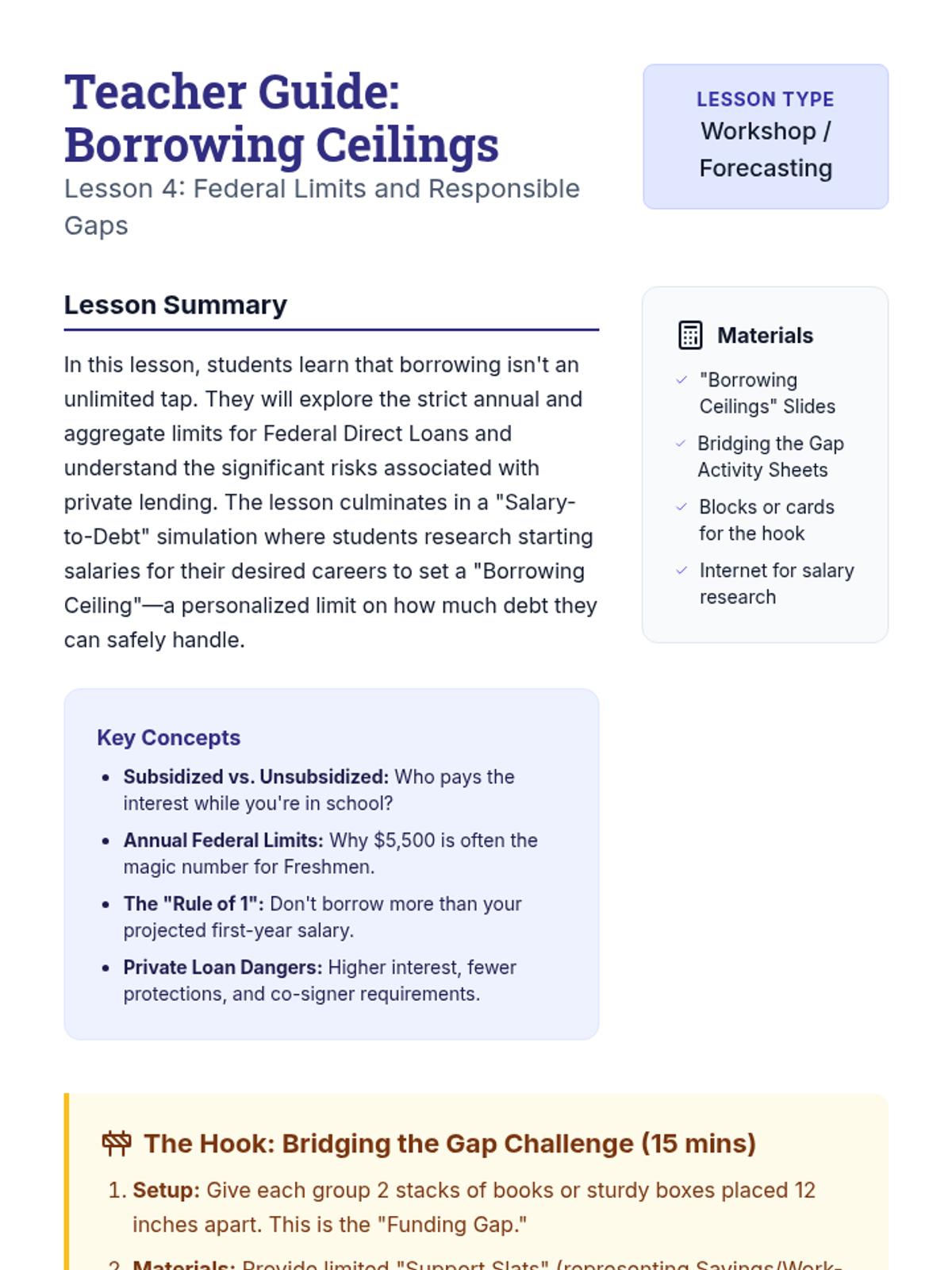
Teacher guide for Lesson 4, detailing federal loan limits, Subsidized vs. Unsubsidized distinctions, and the "Salary-to-Debt" simulation.
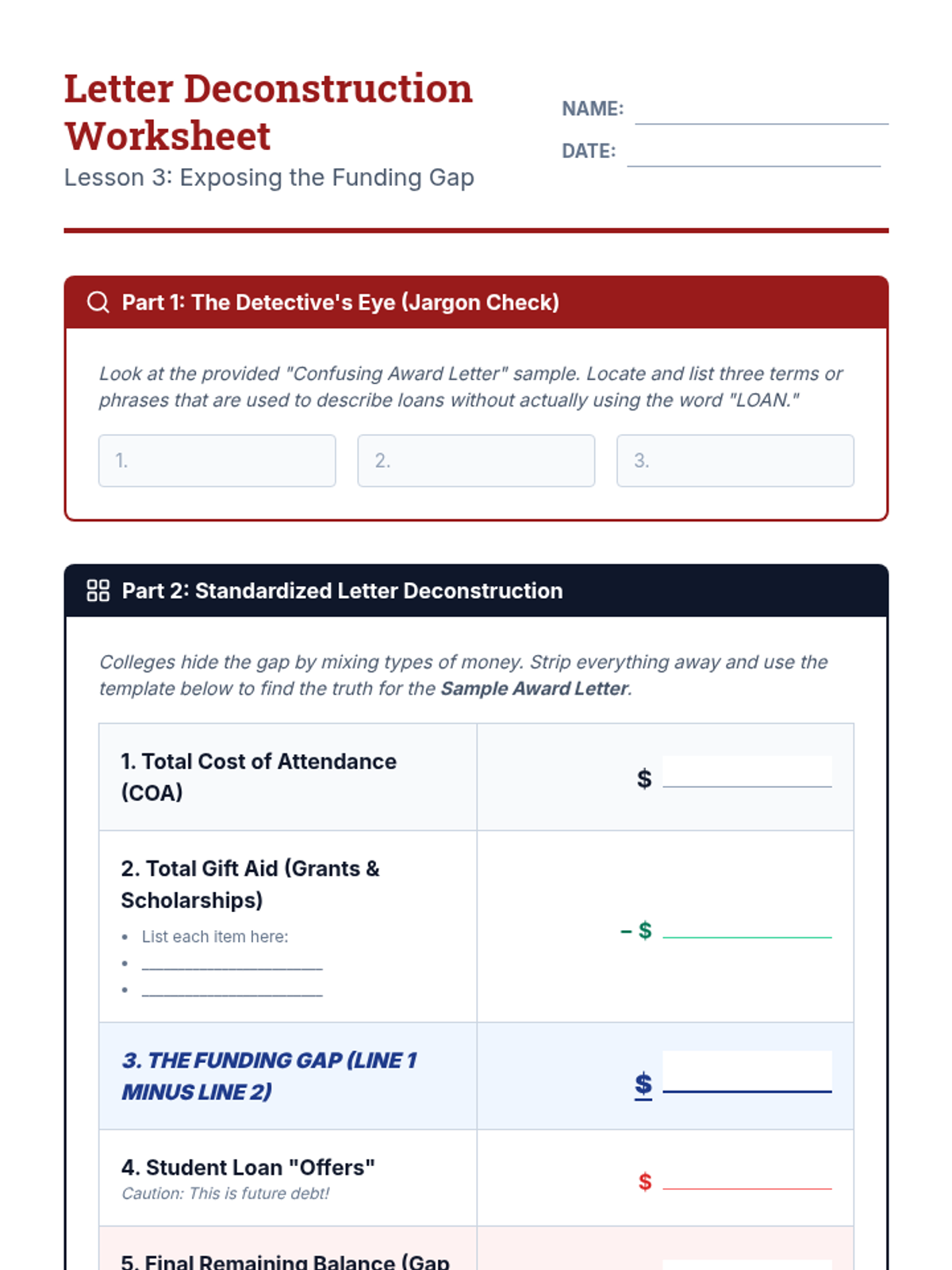
Student worksheet for Lesson 3, guiding students through the process of deconstructing a confusing financial aid letter to identify the true funding gap and misleading loan terminology.
Visual slide deck for Lesson 3, focusing on how to teach students to identify misleading formatting in financial aid letters and calculate the true funding gap.
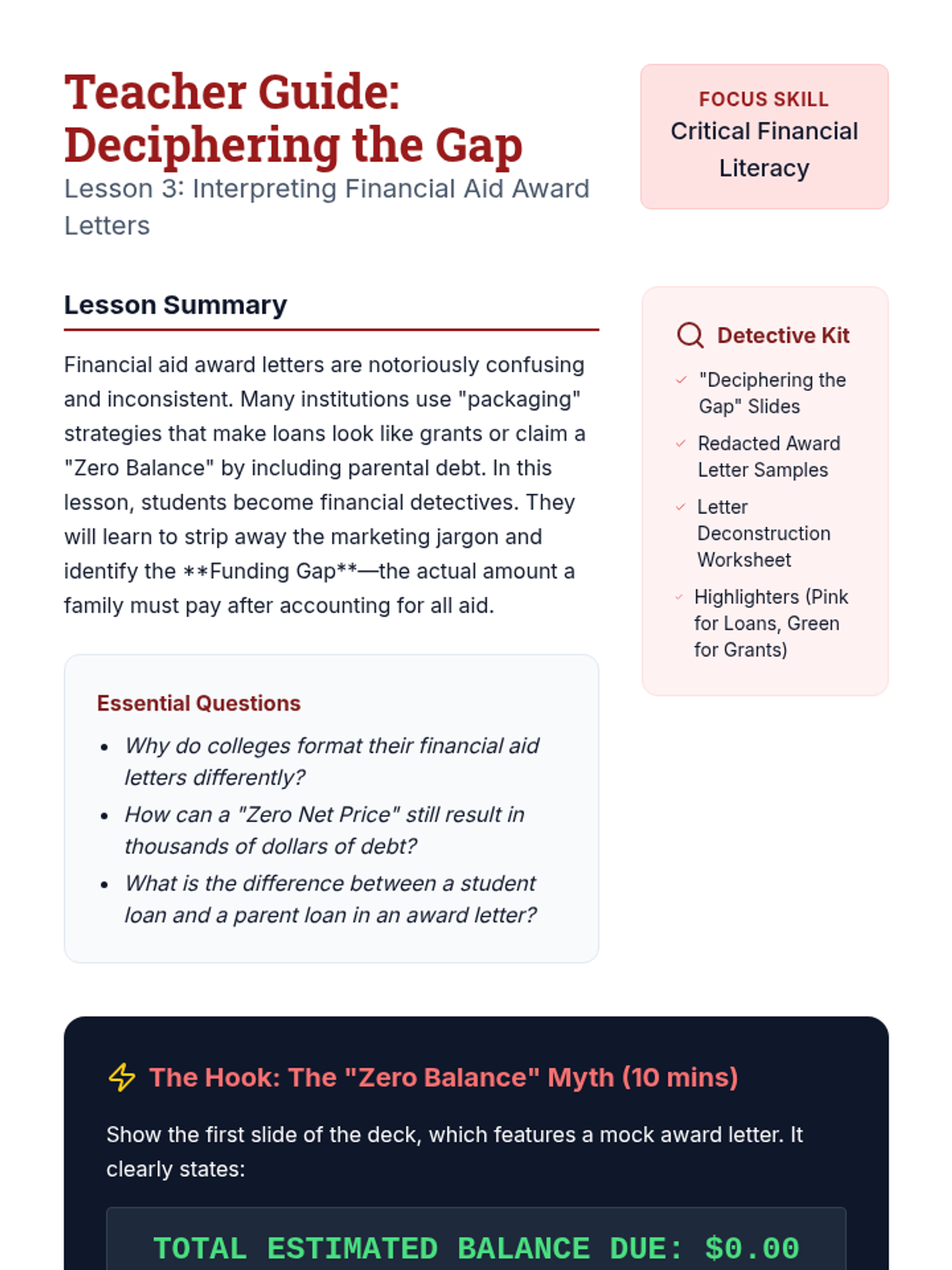
A teacher guide for Lesson 3, focusing on how to teach students to identify misleading formatting in financial aid letters and calculate the true funding gap.