The instructional guide for Session 2, focusing on cultural exchange, comparative activities, and building empathy through shared traditions.
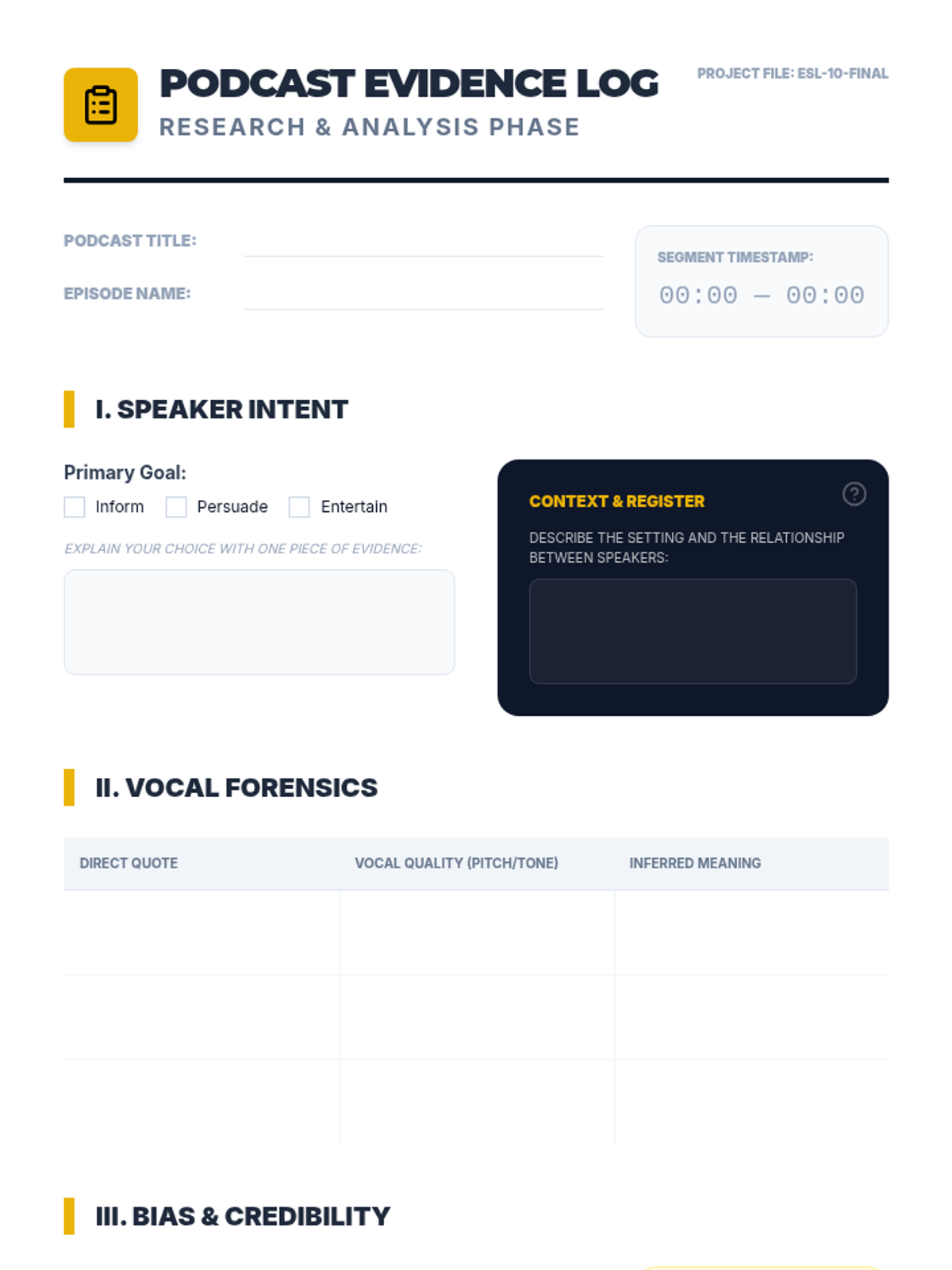
A detailed student evidence log for the final podcast project, providing sections for analyzing intent, vocal forensics, and bias check.
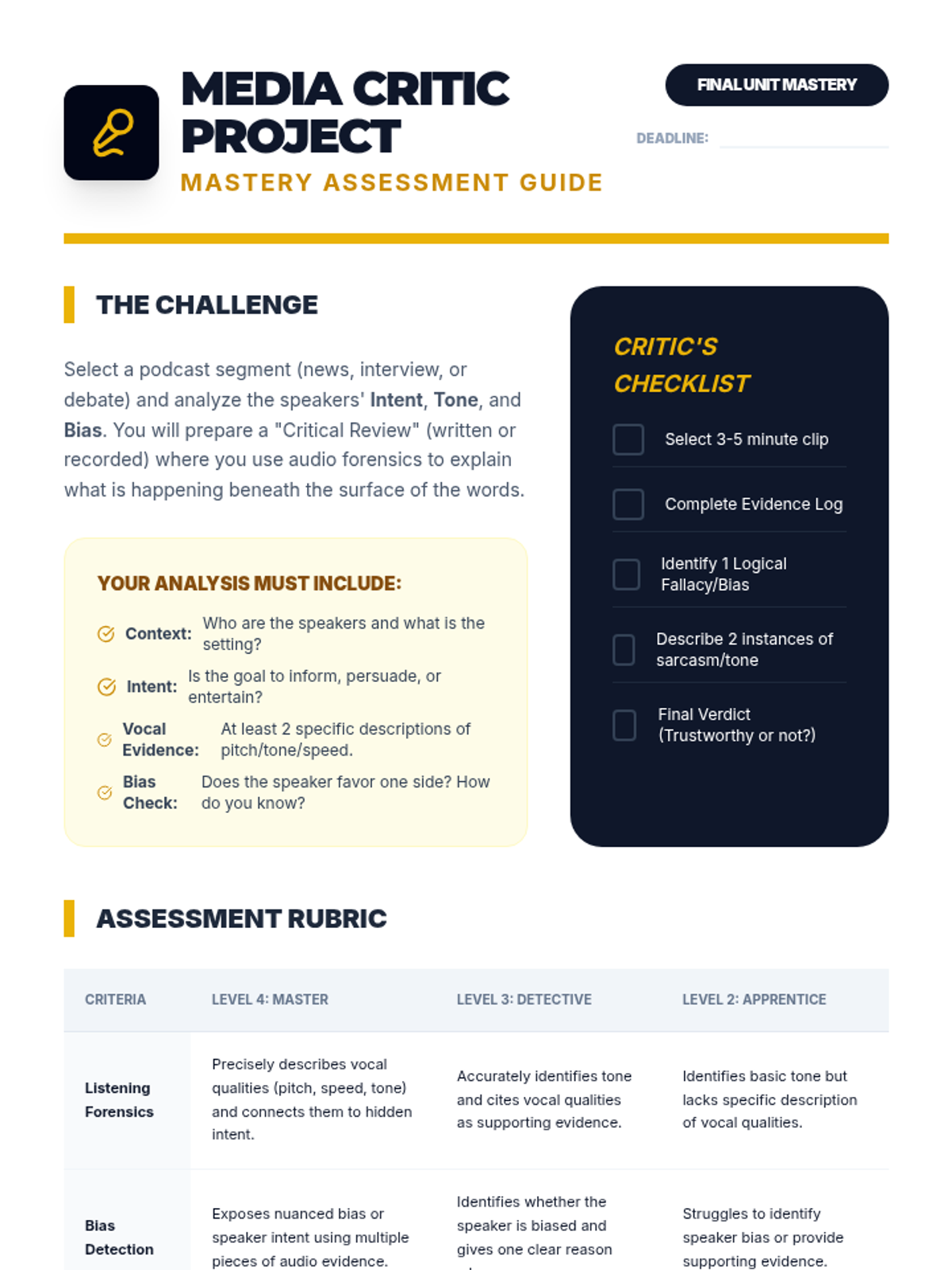
A guide for the final project where students select a podcast episode, analyze its intent and bias, and present their findings, including a checklist and a performance rubric.
Slides for the final project launch, introducing the media critic mission, criteria for analyzing podcasts, and methods for citing audio evidence.
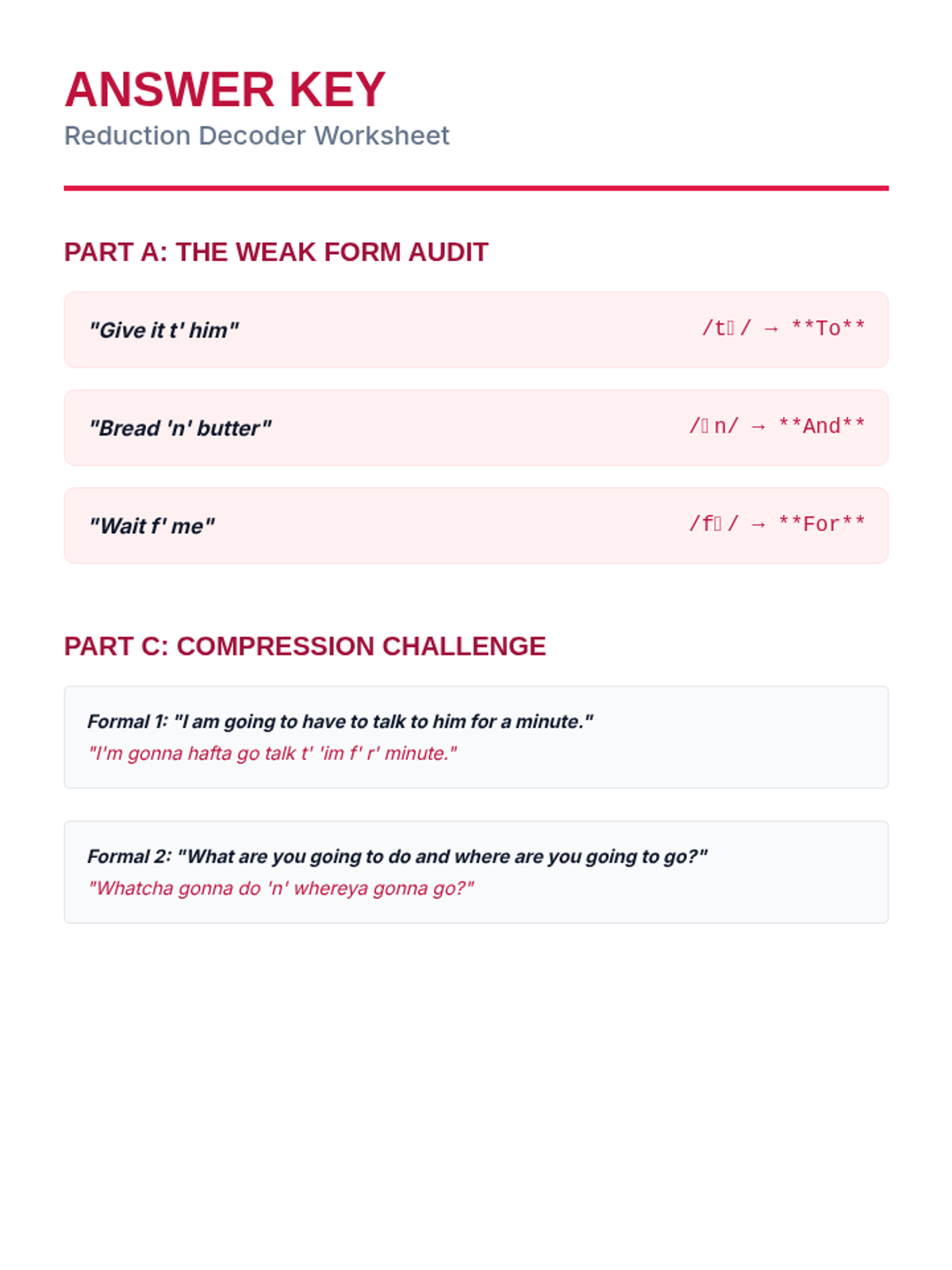
Answer key for the Lesson 4 worksheet on grammatical reductions.
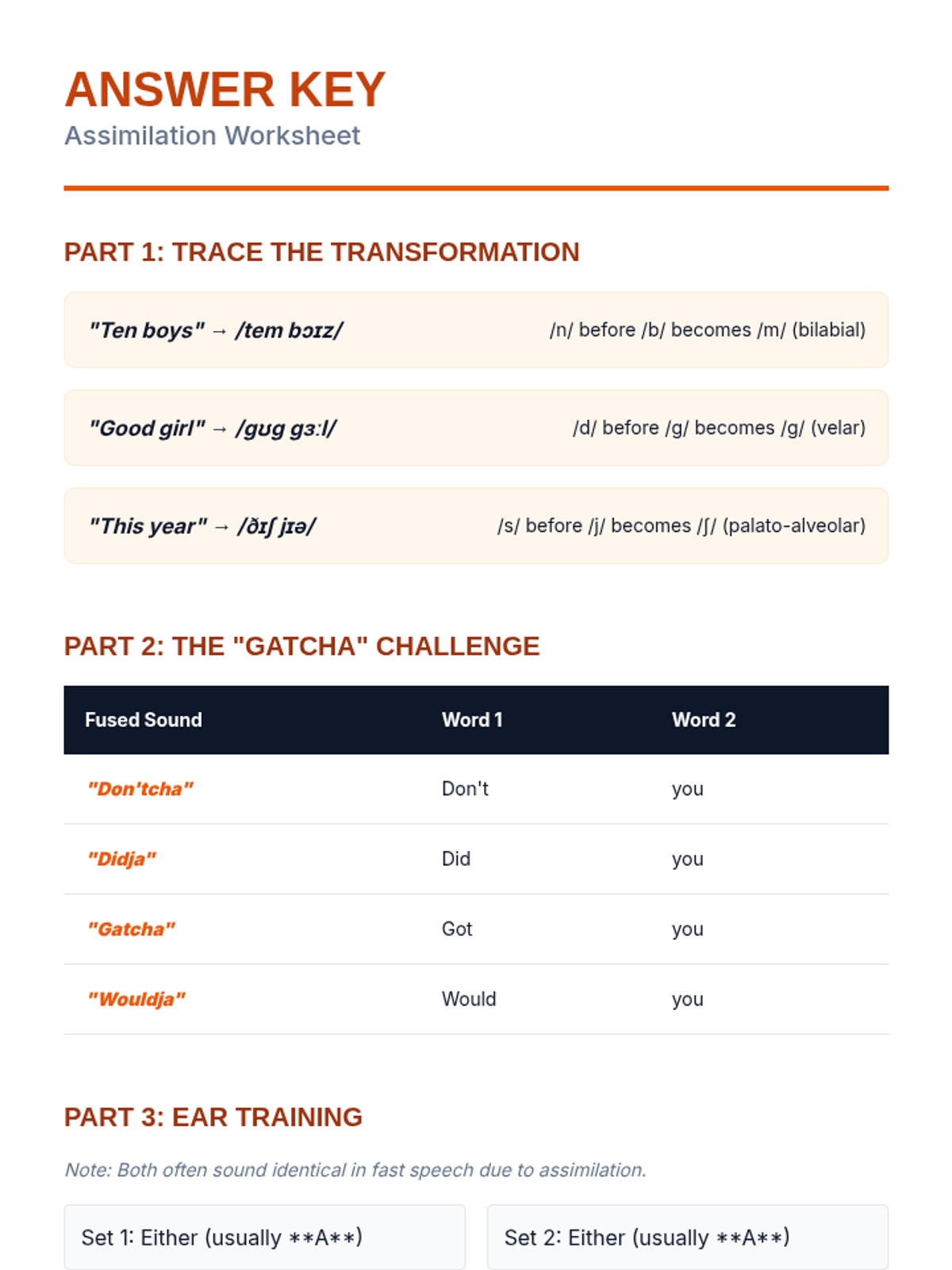
Answer key for the Lesson 3 worksheet on assimilation.
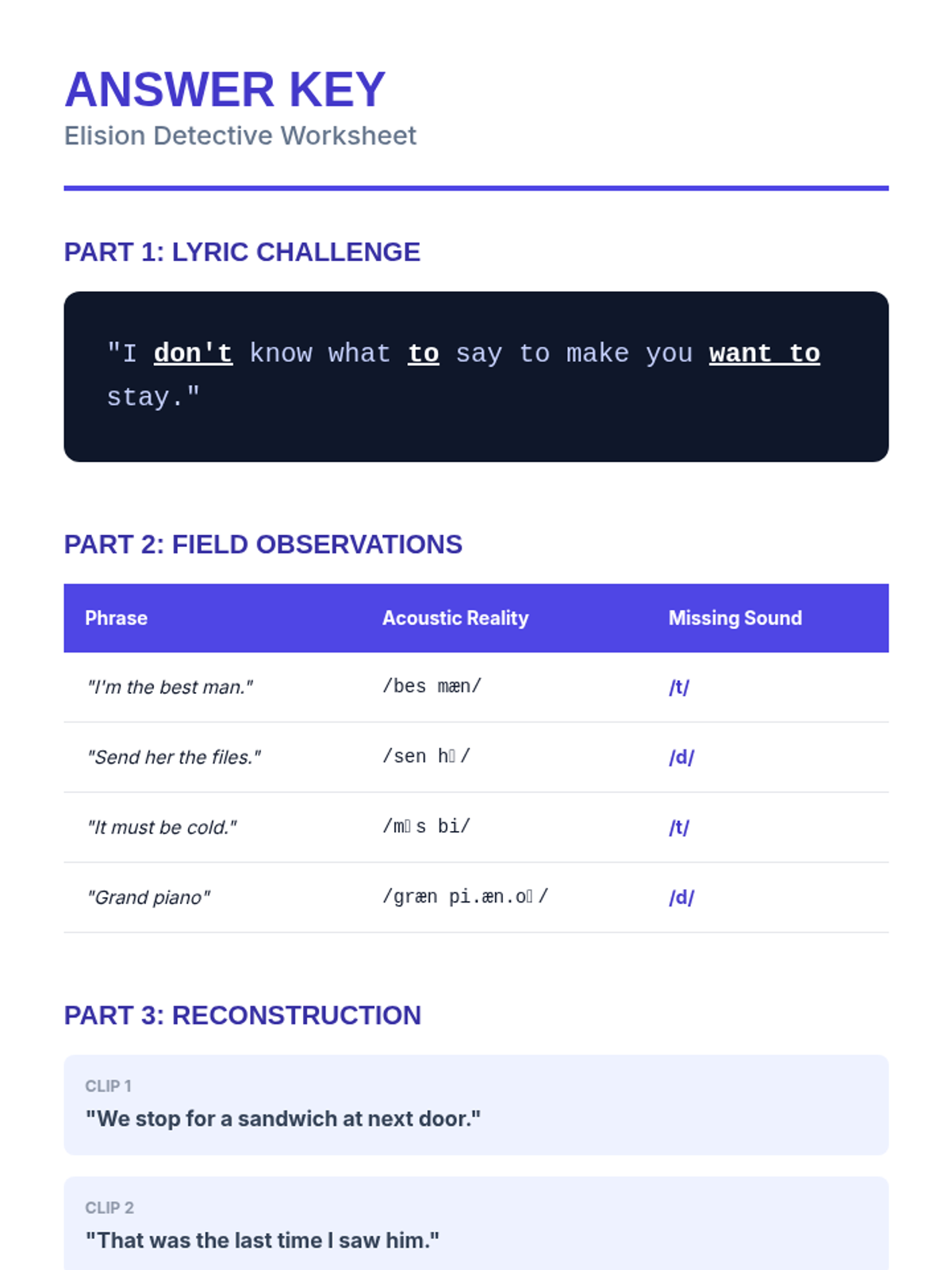
Answer key for the Lesson 2 worksheet on elision.
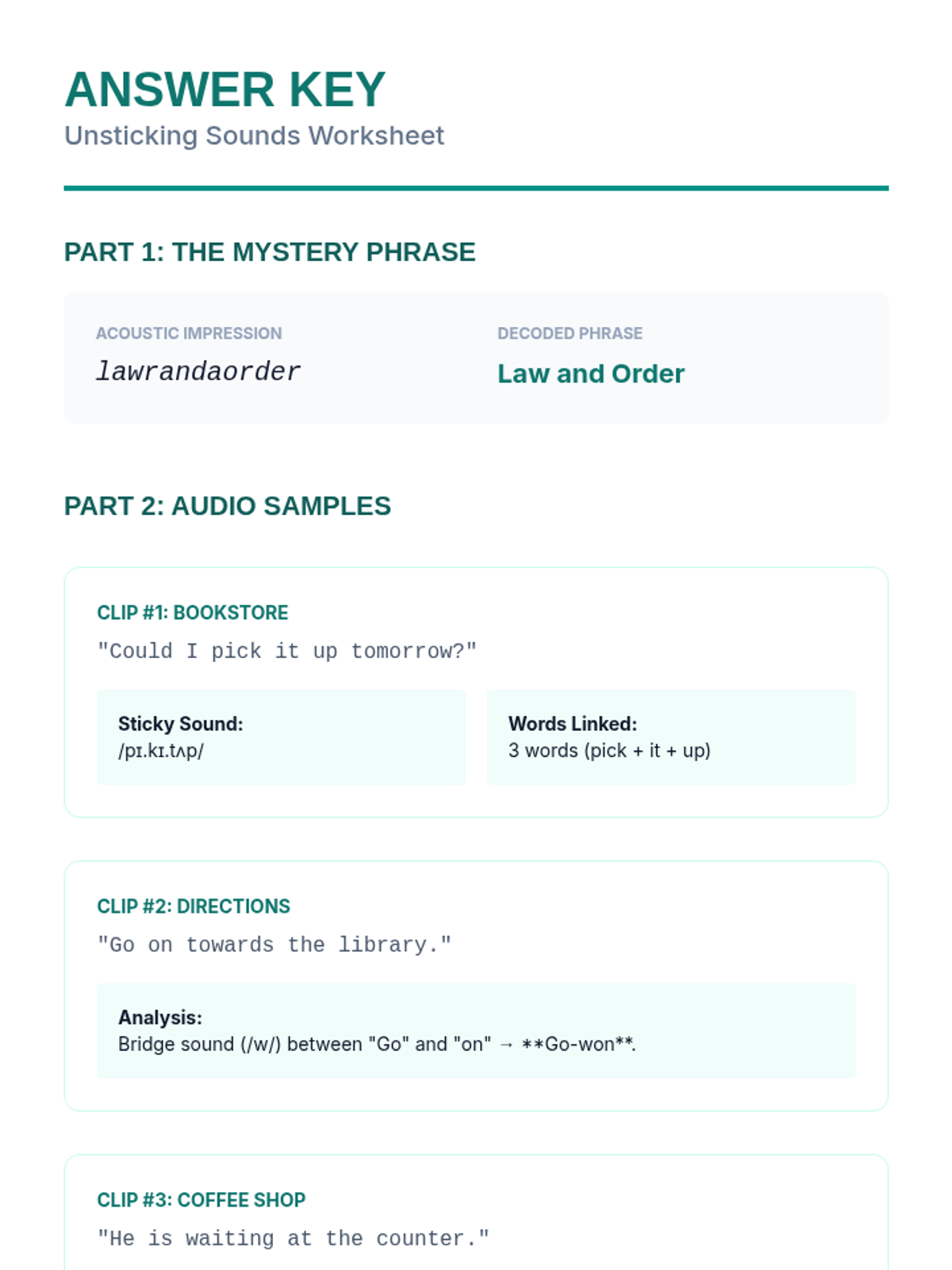
Answer key for the Lesson 1 worksheet on linking and intrusion.
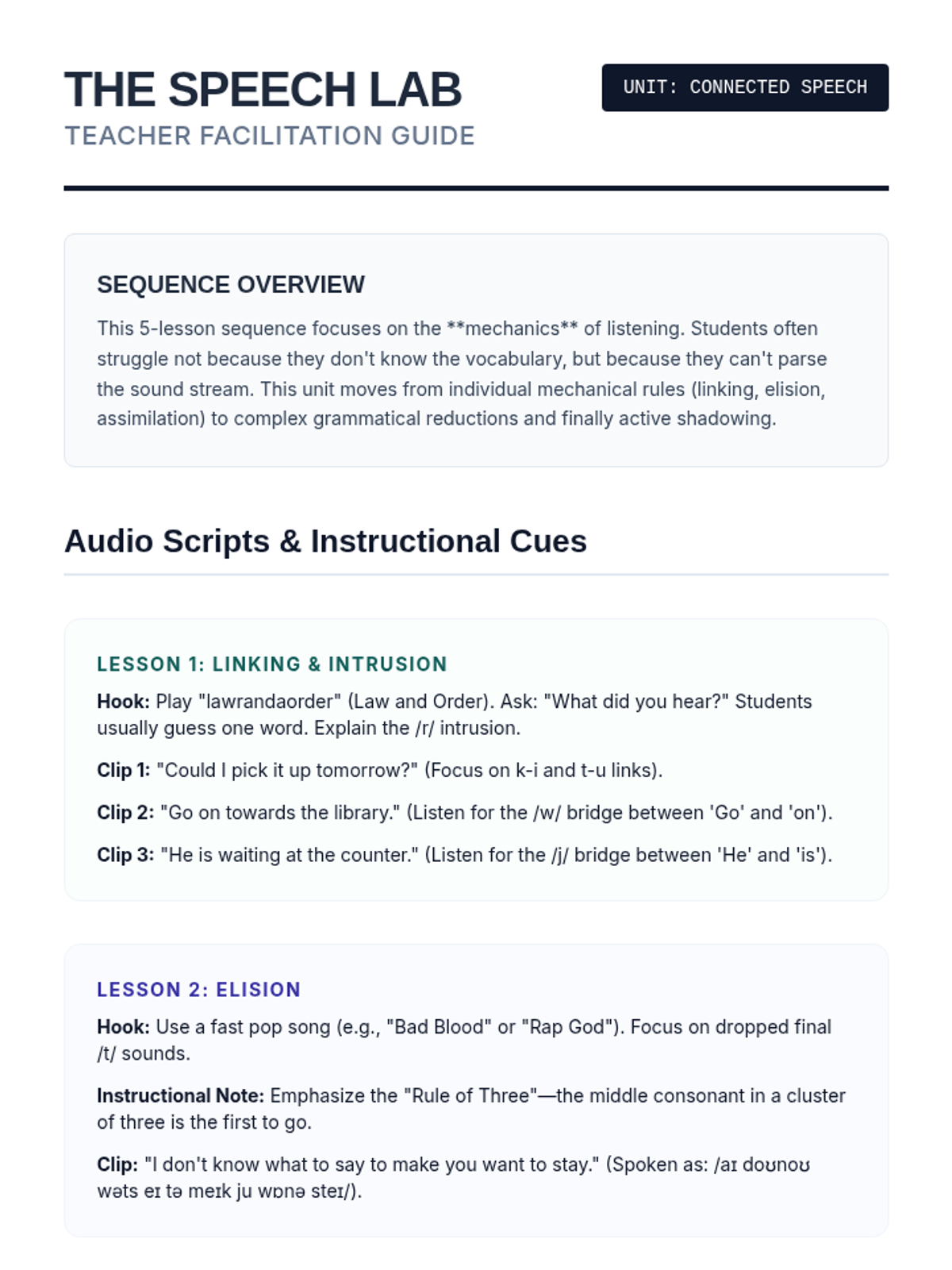
A comprehensive teacher guide for the Speech Lab sequence, including audio scripts, instructional cues, pacing, and differentiation strategies.
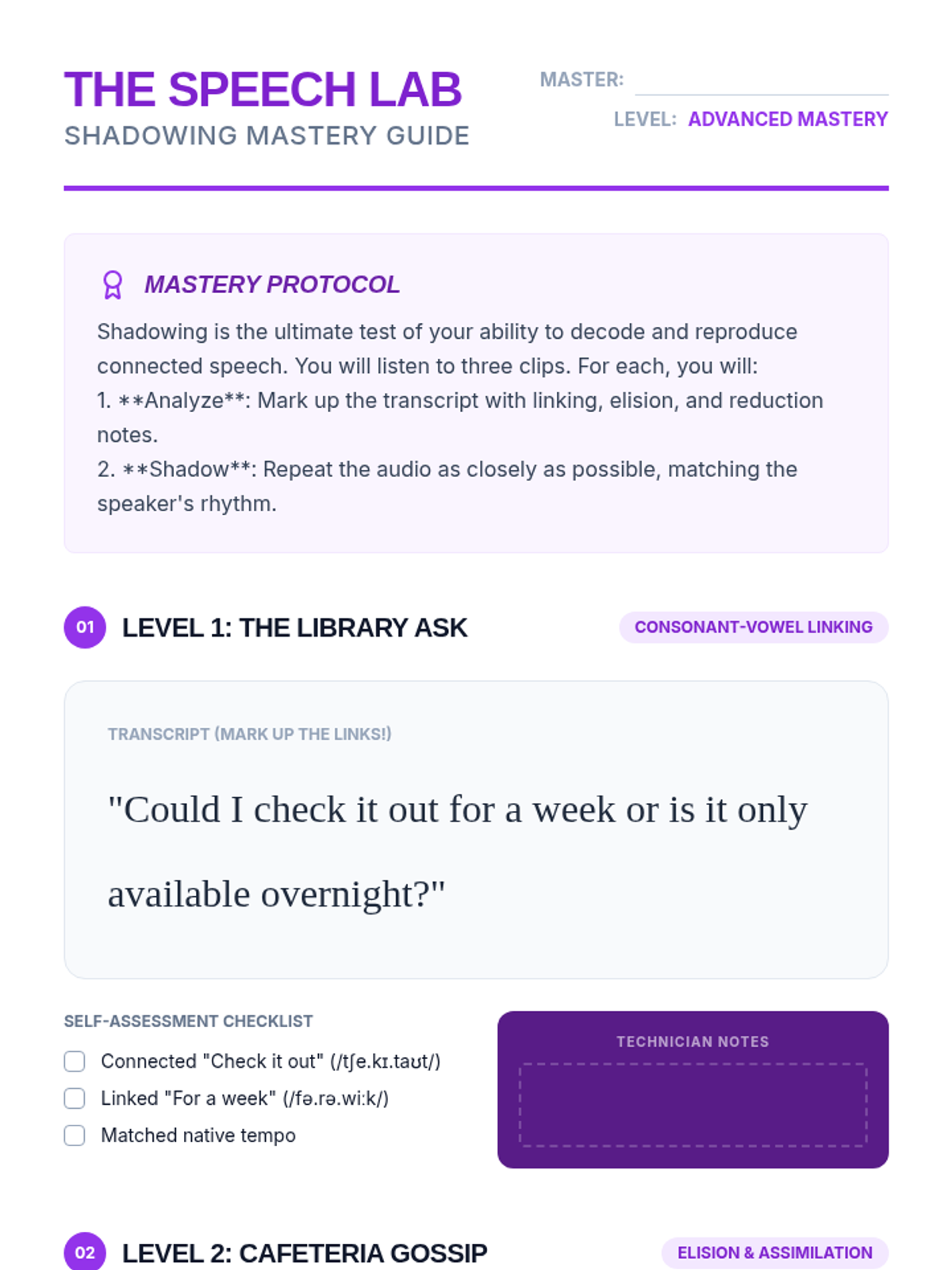
A student mastery guide for practicing shadowing techniques with transcript analysis of complex campus dialogues.
A slide deck for Lesson 5 on shadowing techniques, prosody, and the final mastery assessment of connected speech patterns.
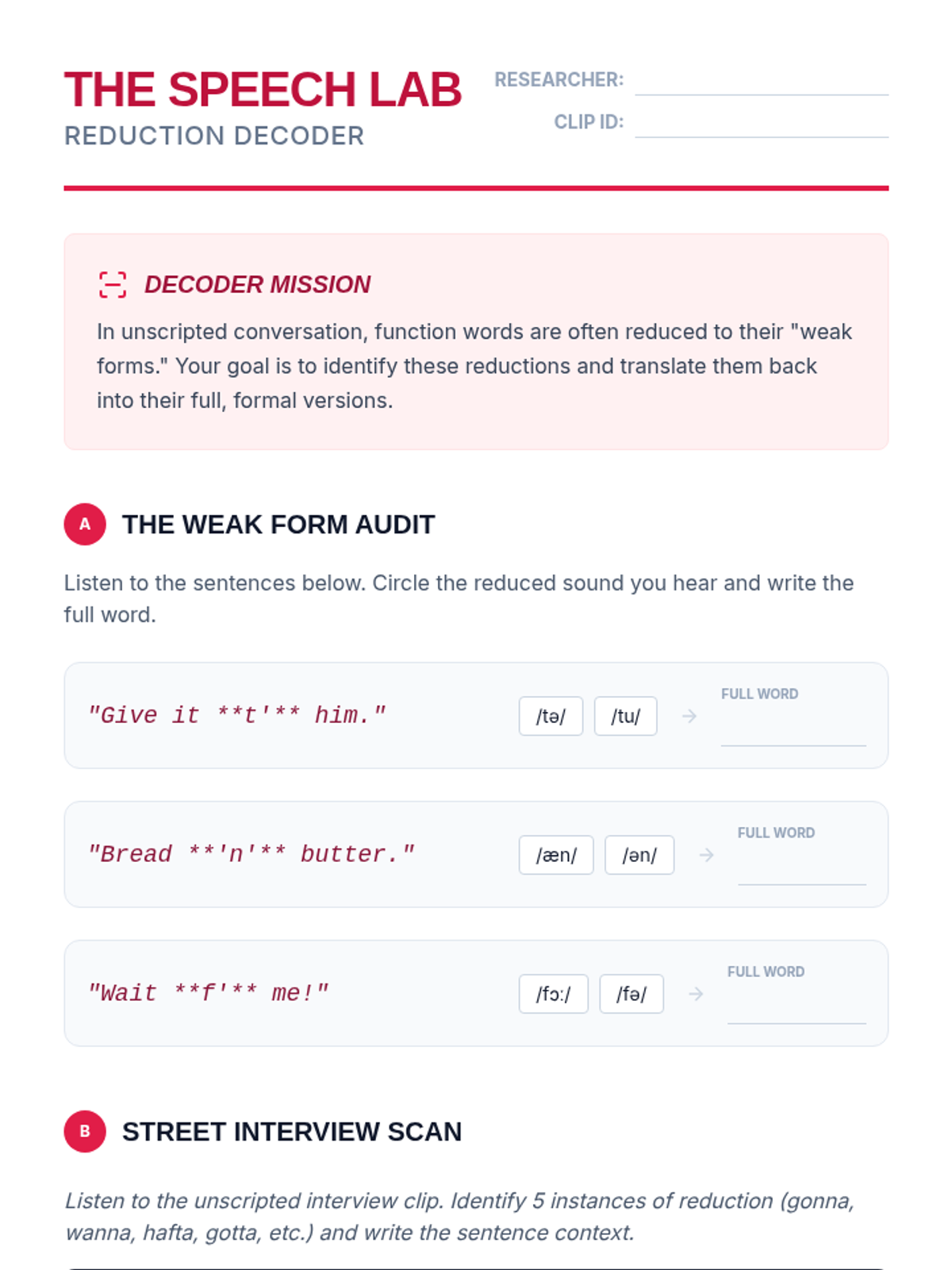
A student worksheet for identifying and translating grammatical reductions and weak forms in unscripted interviews.
A slide deck for Lesson 4 focusing on grammatical reductions and weak forms, using a high-contrast visual style to highlight the difference between formal and casual speech.
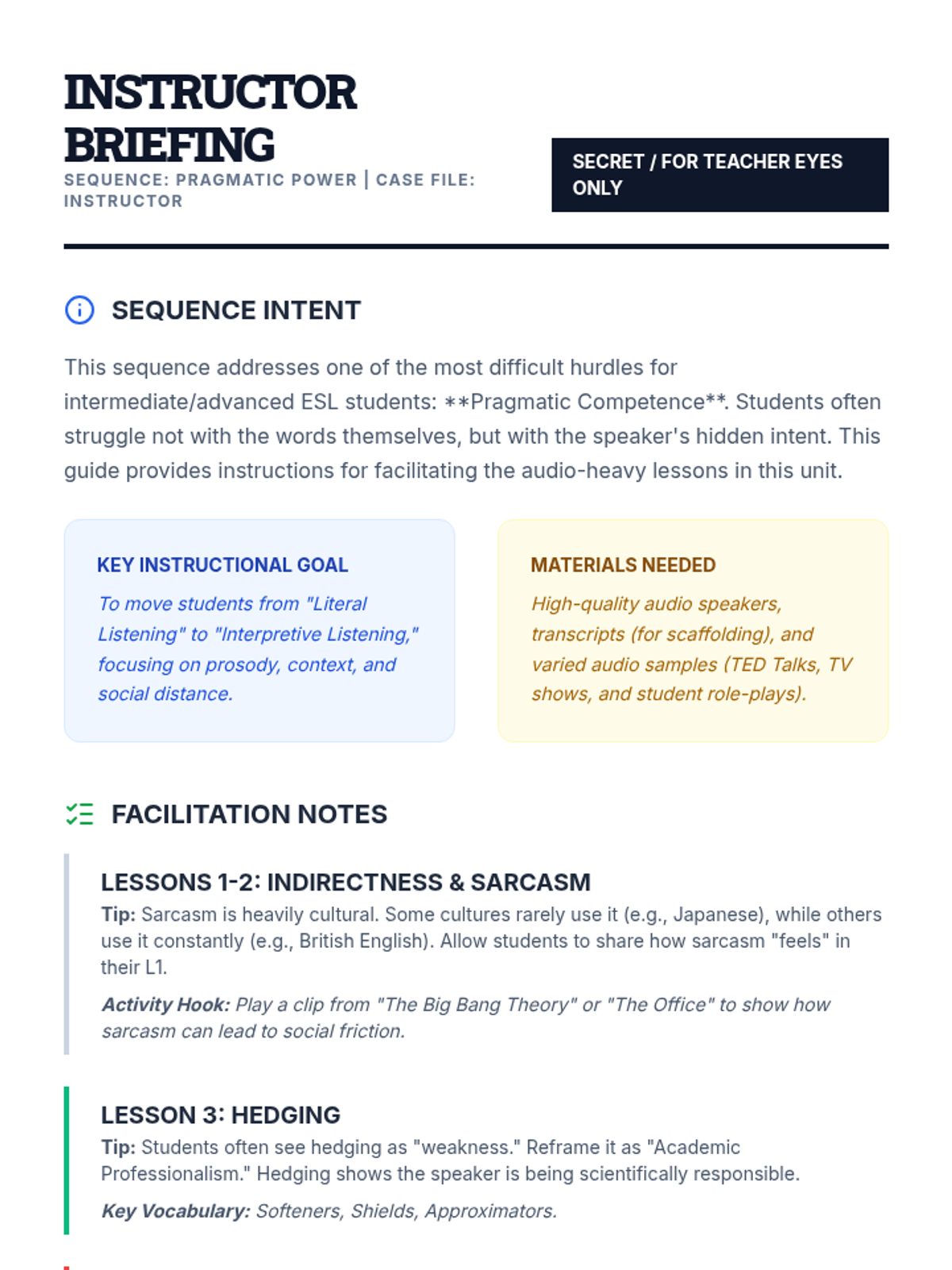
Instructor briefing and facilitation guide for the Pragmatic Power sequence, providing teaching tips, activity hooks, and assessment strategies for ESL instructors.
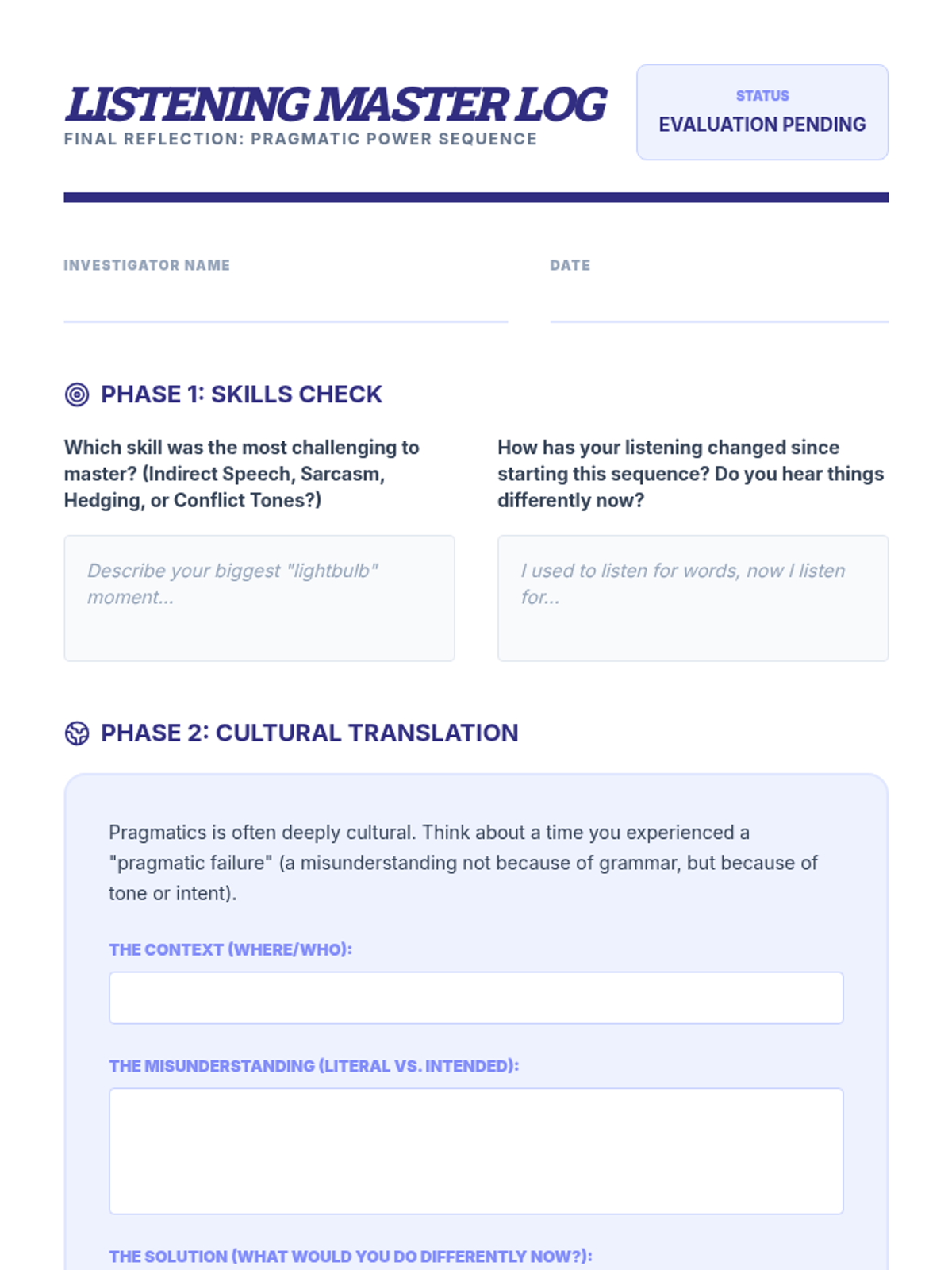
Final reflection worksheet and exit ticket for the sequence, allowing students to synthesize their learning about pragmatics and reflect on their own cultural communication experiences.
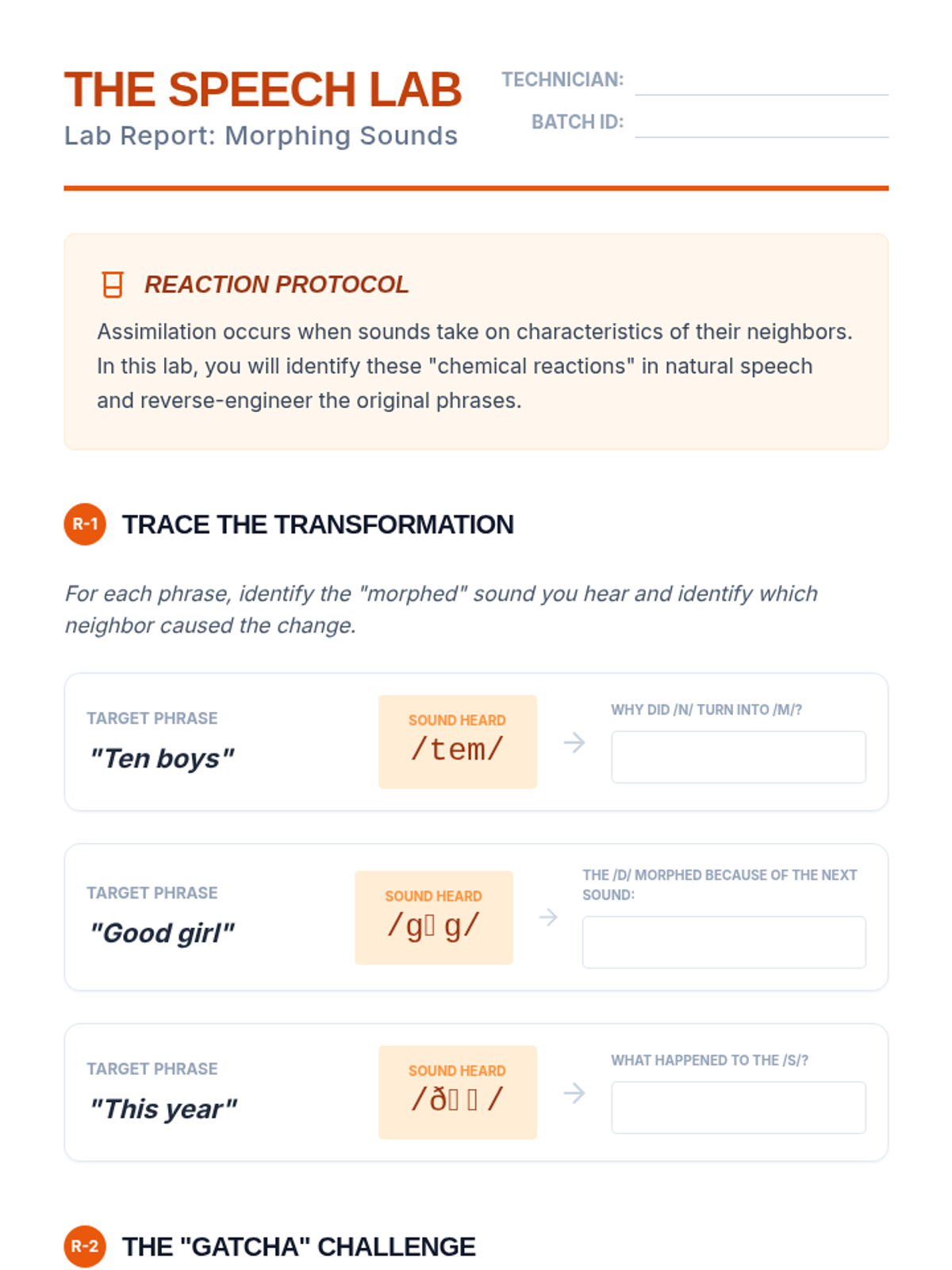
A student worksheet for identifying and reverse-engineering assimilated sounds in natural speech patterns.
Visual presentation for Lesson 5 exploring how cultural backgrounds influence pragmatic markers like silence, interruption, and backchanneling in global English.
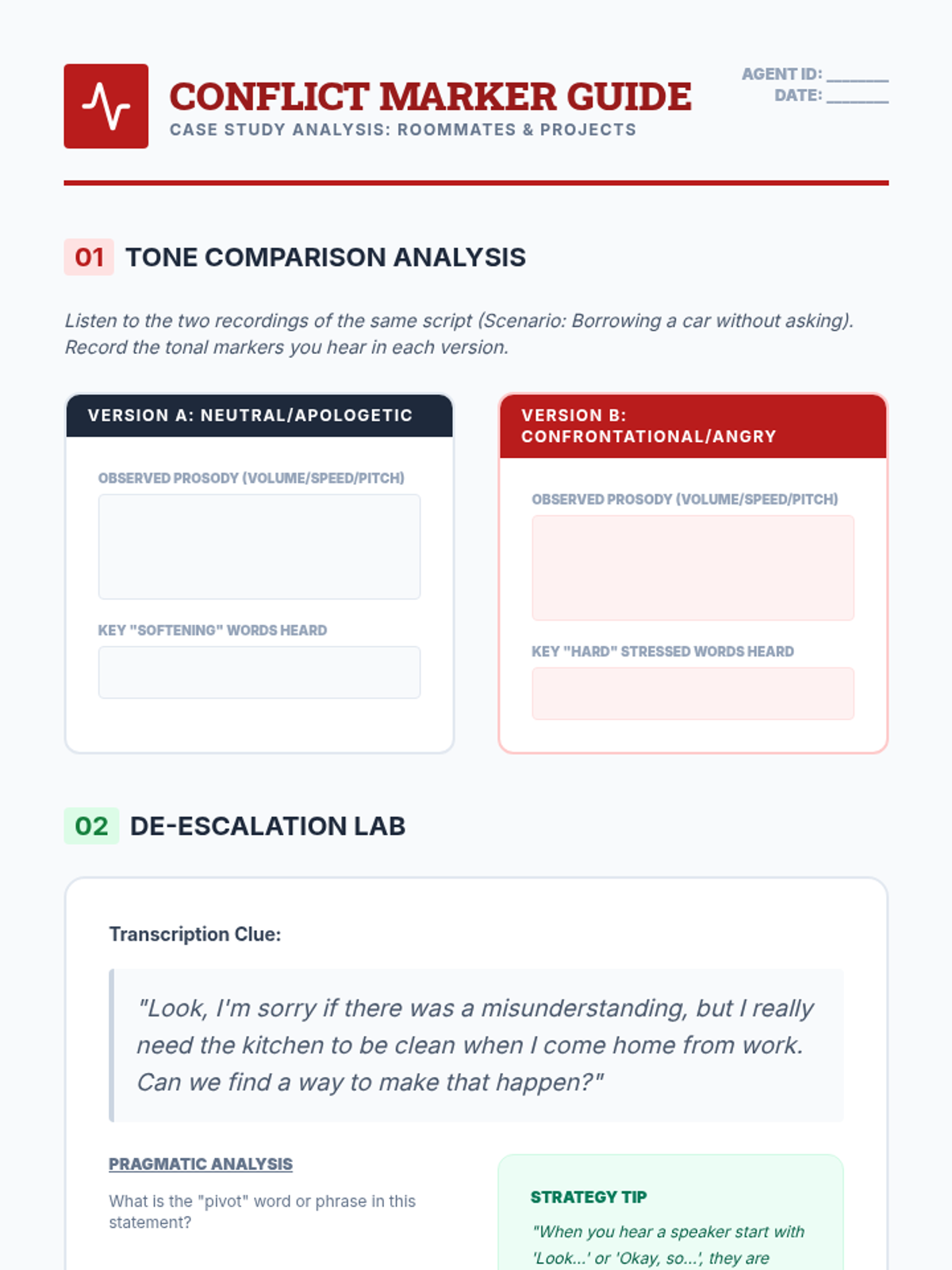
Student worksheet for Lesson 4 where students compare different tonal renditions of a script to identify markers of conflict and practice identifying de-escalation strategies.
A slide deck for Lesson 3 introducing assimilation, showing how sounds change based on their neighbors using a "chemical reaction" theme.
Visual presentation for Lesson 4 exploring the tonal and prosodic markers of conflict (escalation) and negotiation (de-escalation) in social and academic scenarios.
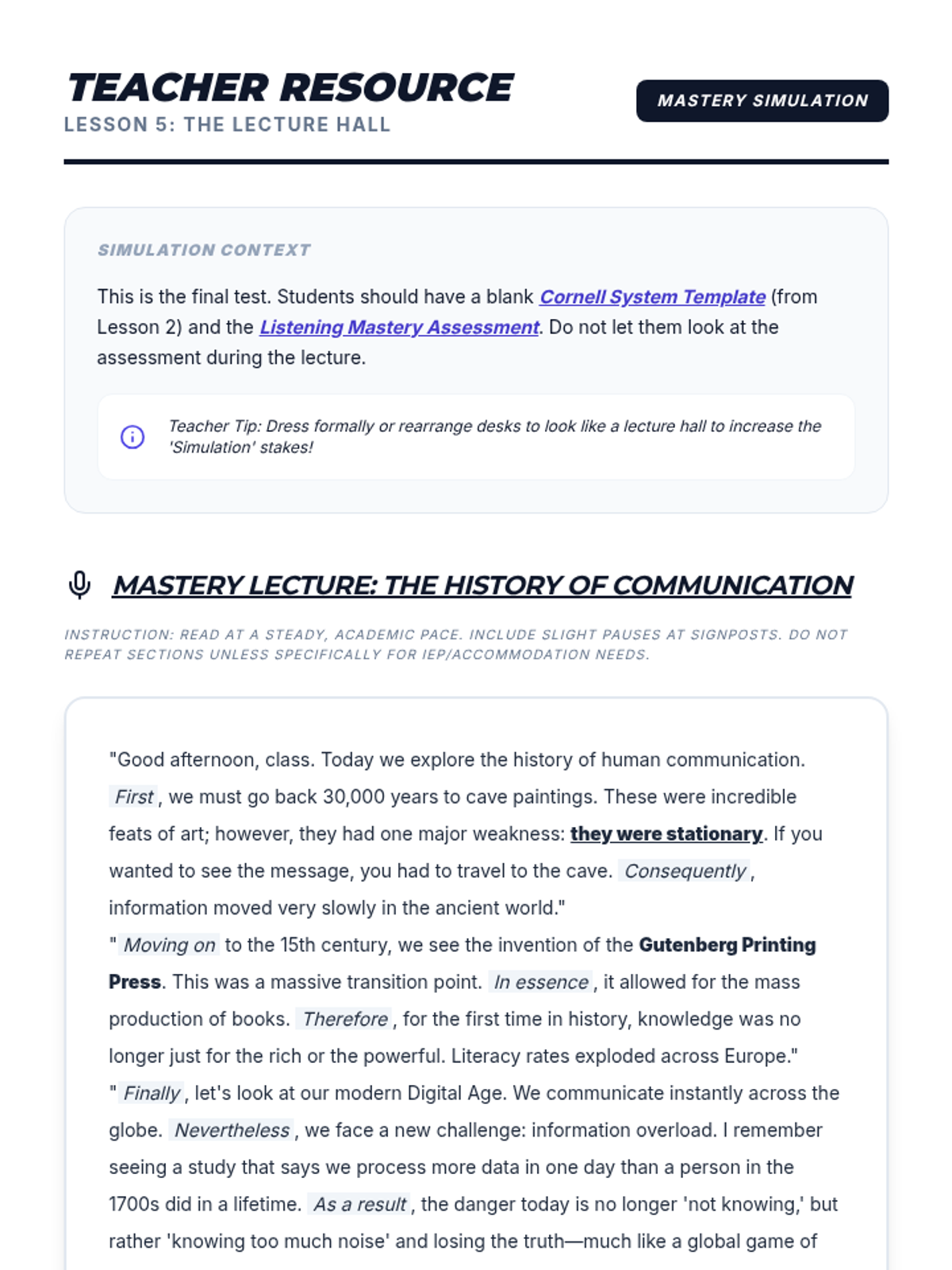
A comprehensive teacher resource for the final lesson, including the full script for "The History of Communication" and a detailed answer key for the mastery assessment, alongside sample Cornell note-taking cues for comparison.
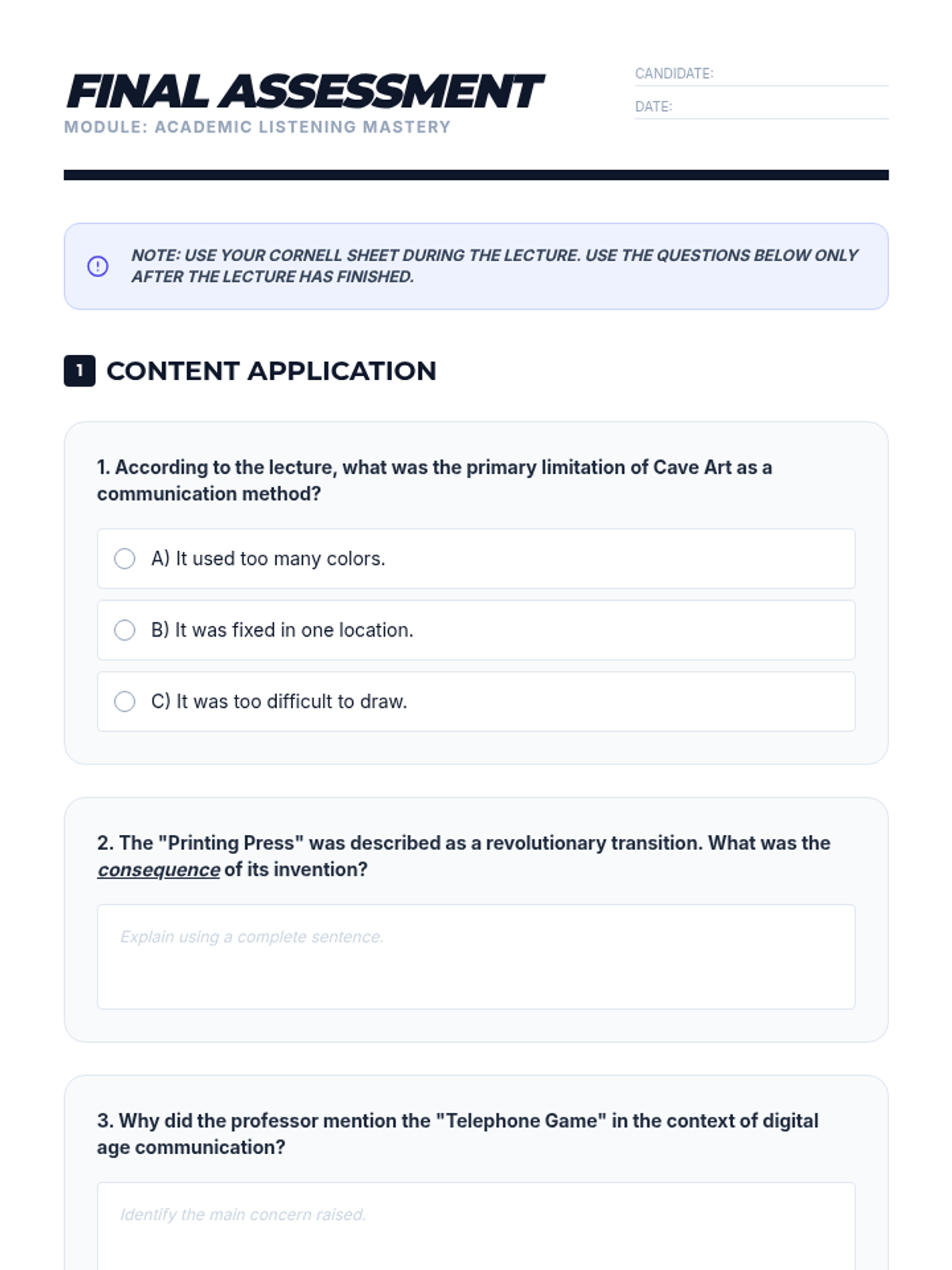
The final assessment for the unit, containing comprehension questions based on the mock lecture "The History of Communication" and a strategy reflection section where students self-evaluate their note-taking and filtering skills.
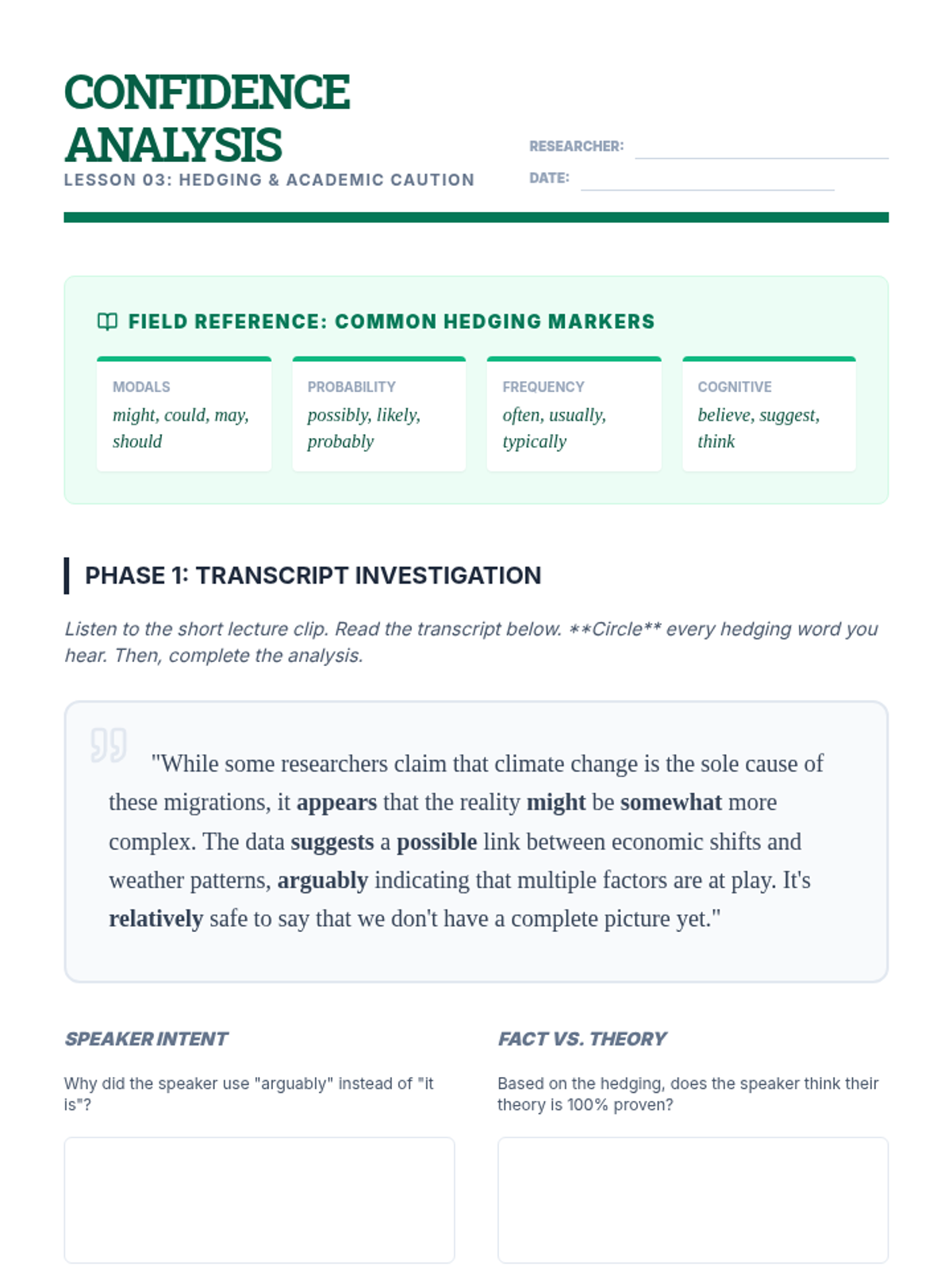
Worksheet for Lesson 3 where students identify hedging language in a transcript and evaluate the confidence level of different speakers based on their linguistic choices.
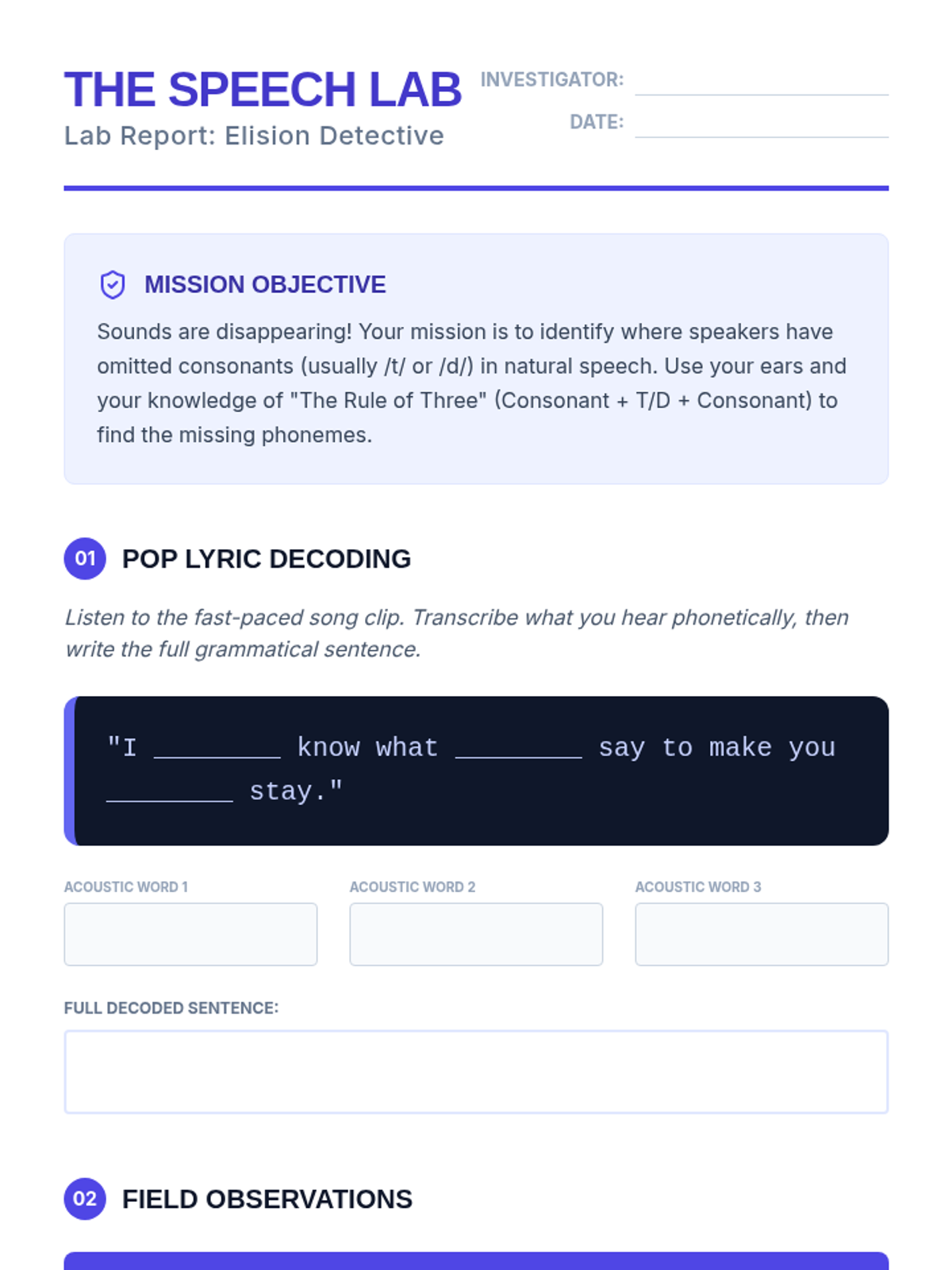
A student worksheet for identifying and reconstructing elided sounds (/t/ and /d/) in common phrases and lyrics.
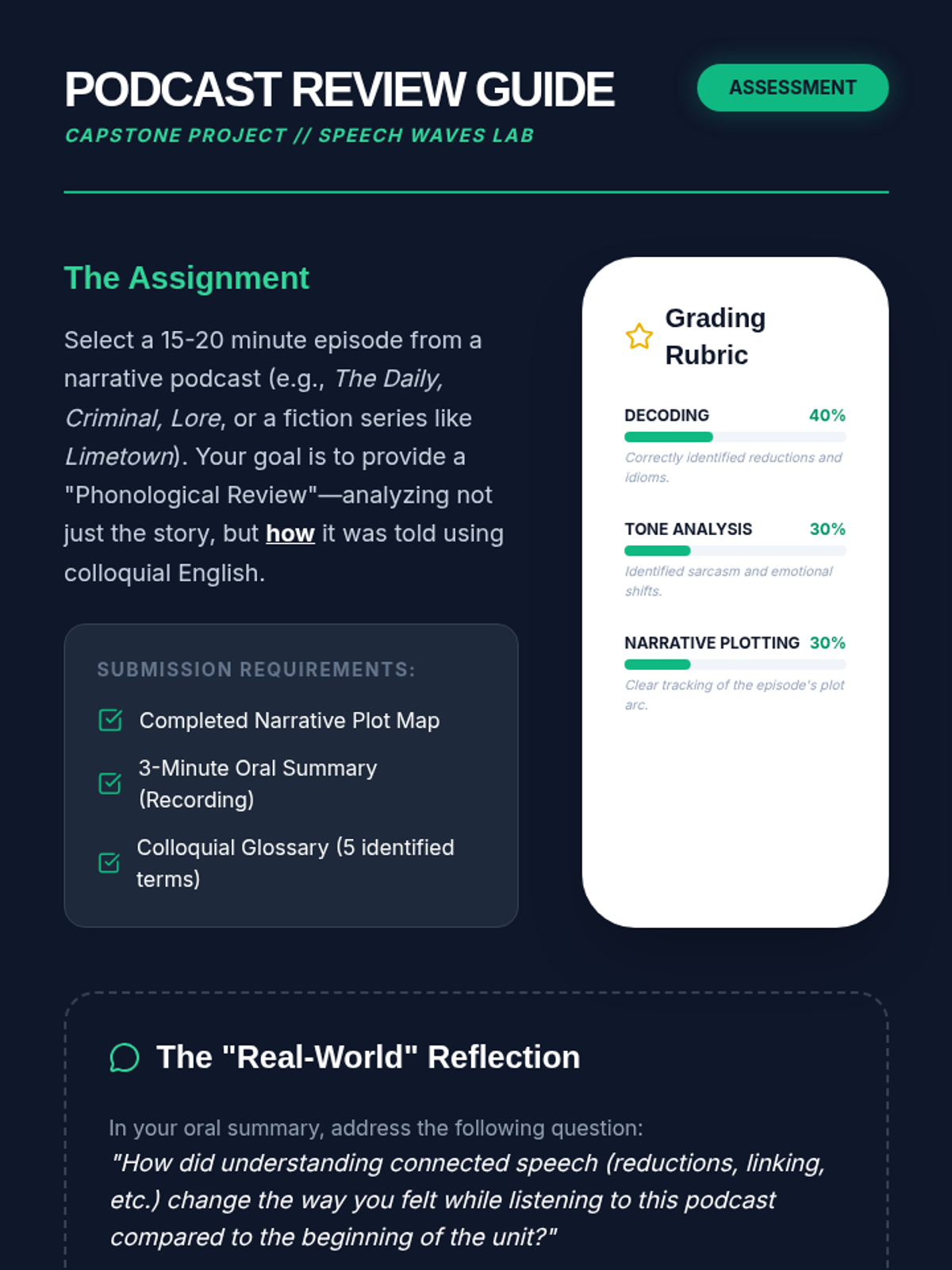
Final project guide and rubric for Lesson 5, where students conduct an independent listening analysis of a narrative podcast episode.
A slide deck for the culminating mock lecture simulation. It sets the formal university-style tone, outlines operational protocols for the assessment, and introduces the lecture topic: "The History of Communication."
Presentation for Lesson 3 focusing on hedging language in academic and formal English, teaching students to identify linguistic softeners that signal uncertainty or caution.
Slide presentation for Lesson 4 exploring how sentence stress and intonation change the meaning of words. Features interactive examples of pitch shifts and emotion detection.
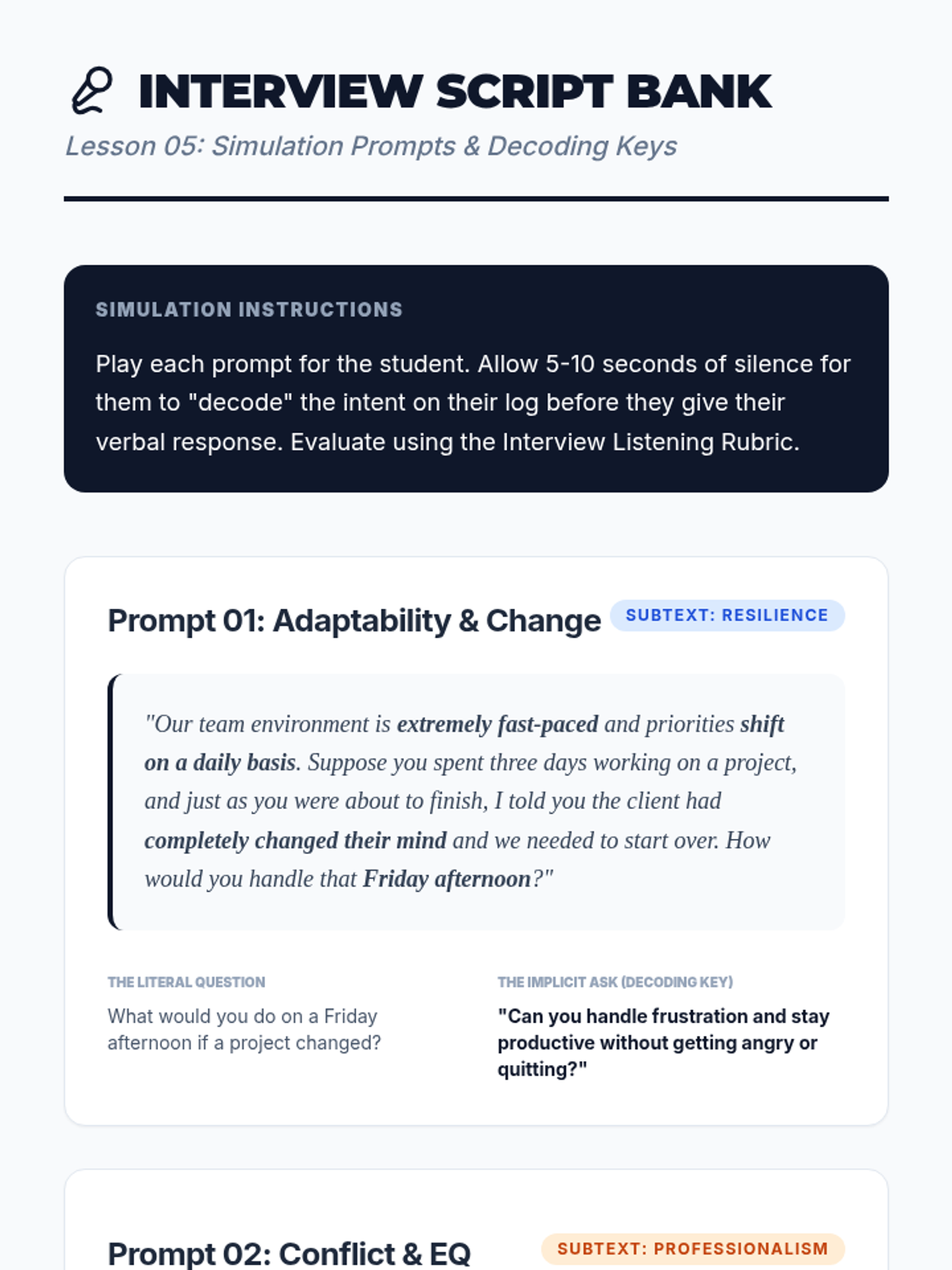
Teacher-facing scripts for the final lesson's interview simulation, featuring complex prompts with explicit vs. implicit intent decoding keys.
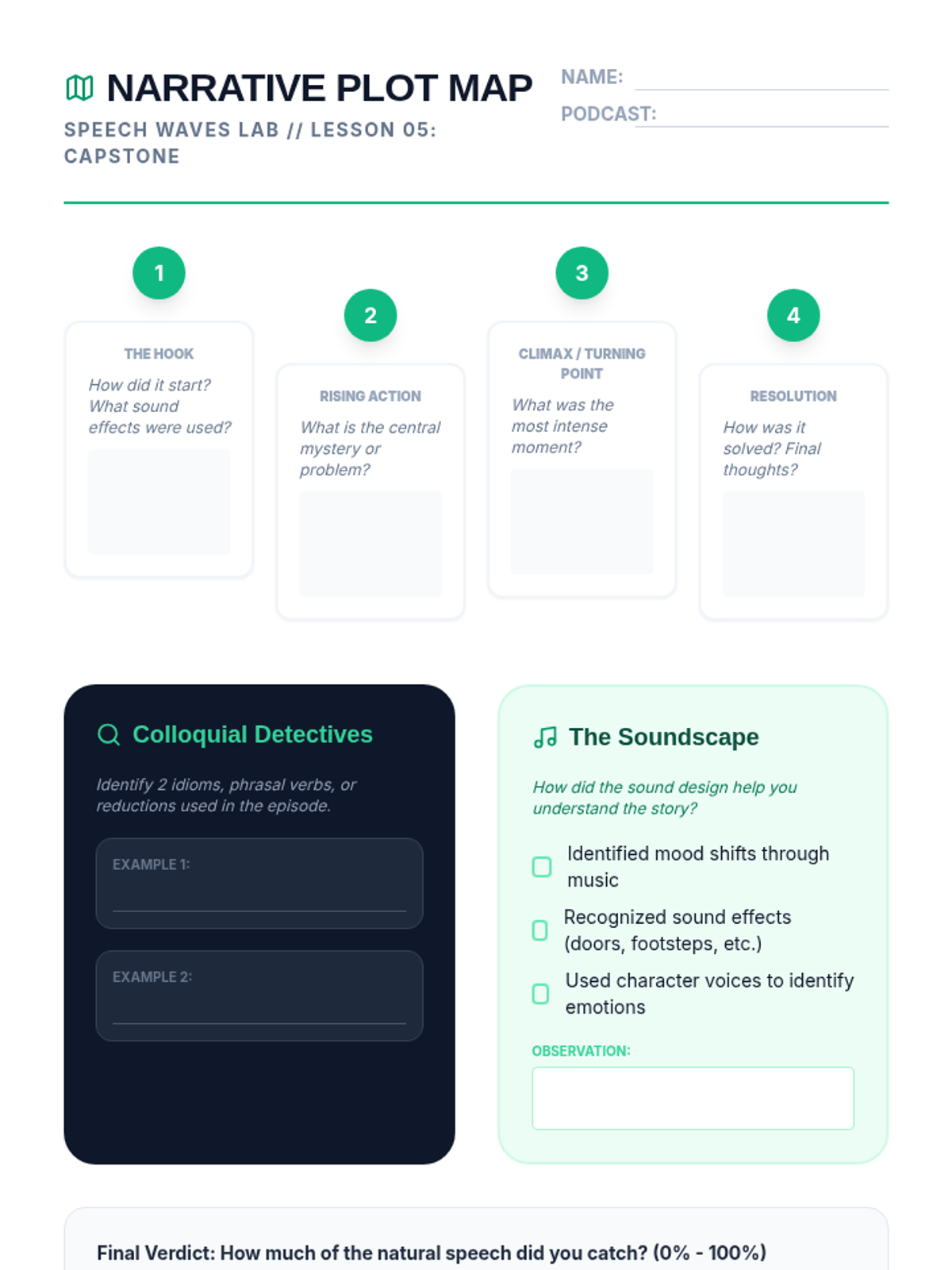
Worksheet for Lesson 5 where students map the plot of a podcast episode and identify colloquial language markers used in sustained storytelling.
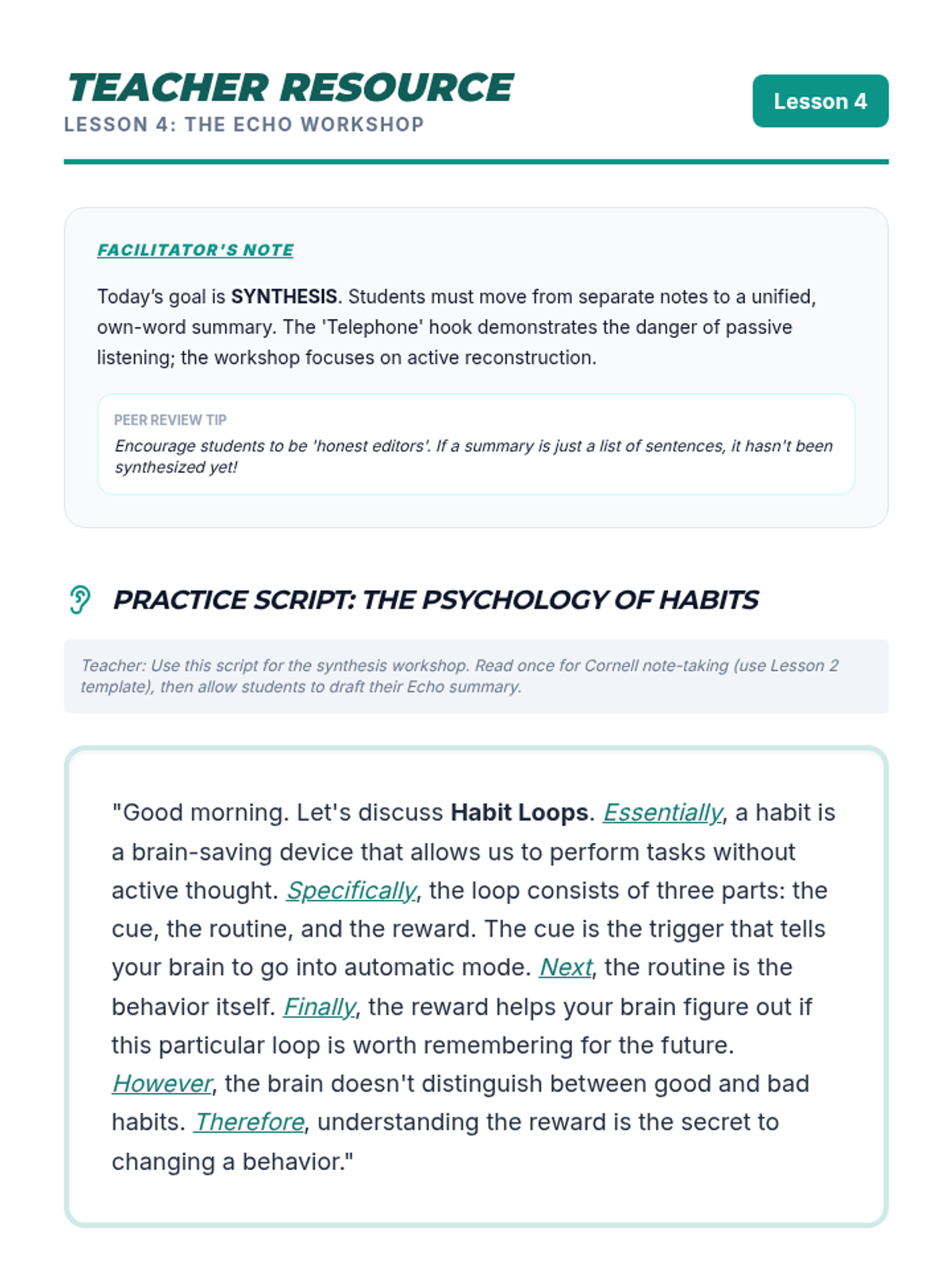
A teacher resource for Lesson 4, including a script on the psychology of habits for synthesis practice and a detailed exemplar summary to guide evaluation of student work.
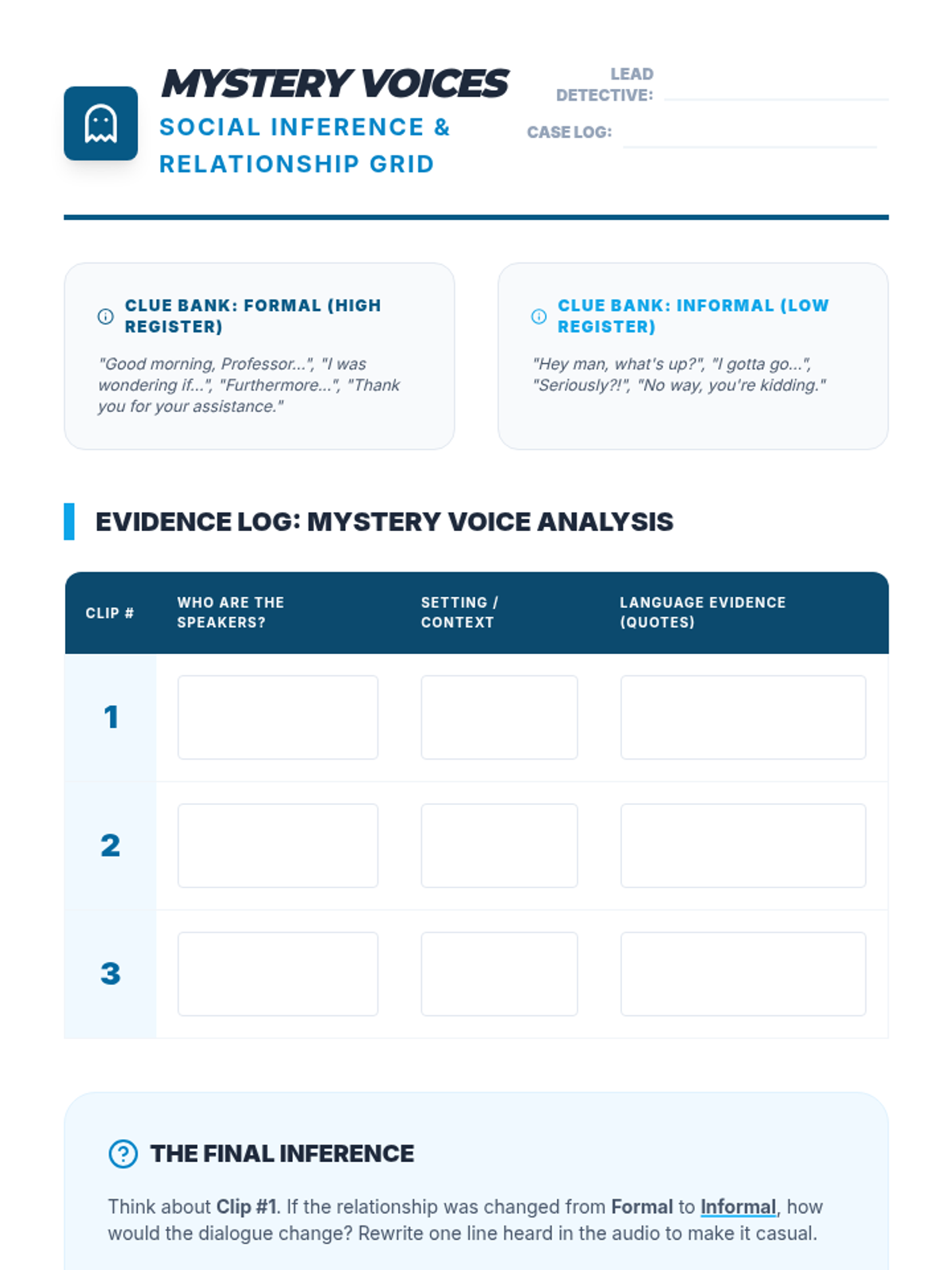
A student activity sheet for analyzing speaker relationships and social context, featuring a grid for recording inferences and a creative rewrite exercise for register shifts.
A slide deck for Lesson 2 focusing on elision, where sounds disappear in rapid speech, specifically highlighting /t/ and /d/ omissions.
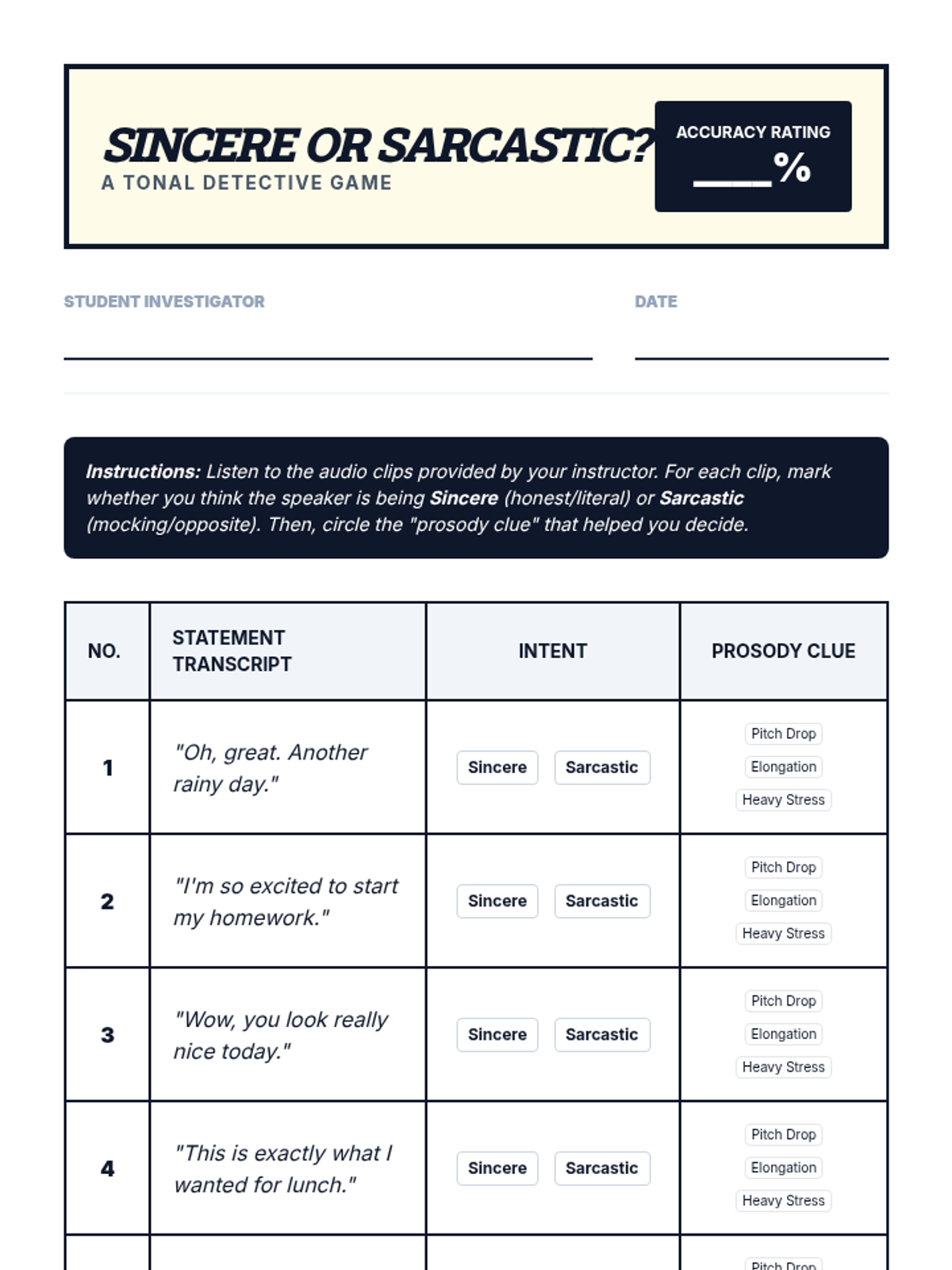
Game-based worksheet for Lesson 2 where students record their interpretations of audio clips to distinguish between sincere and sarcastic intent based on tonal prosody.
Introductory slides for Lesson 1, visually explaining the concept of the 'Speech Stream' and the mechanics of consonant-vowel linking. Includes visual metaphors and phonetic practice examples.
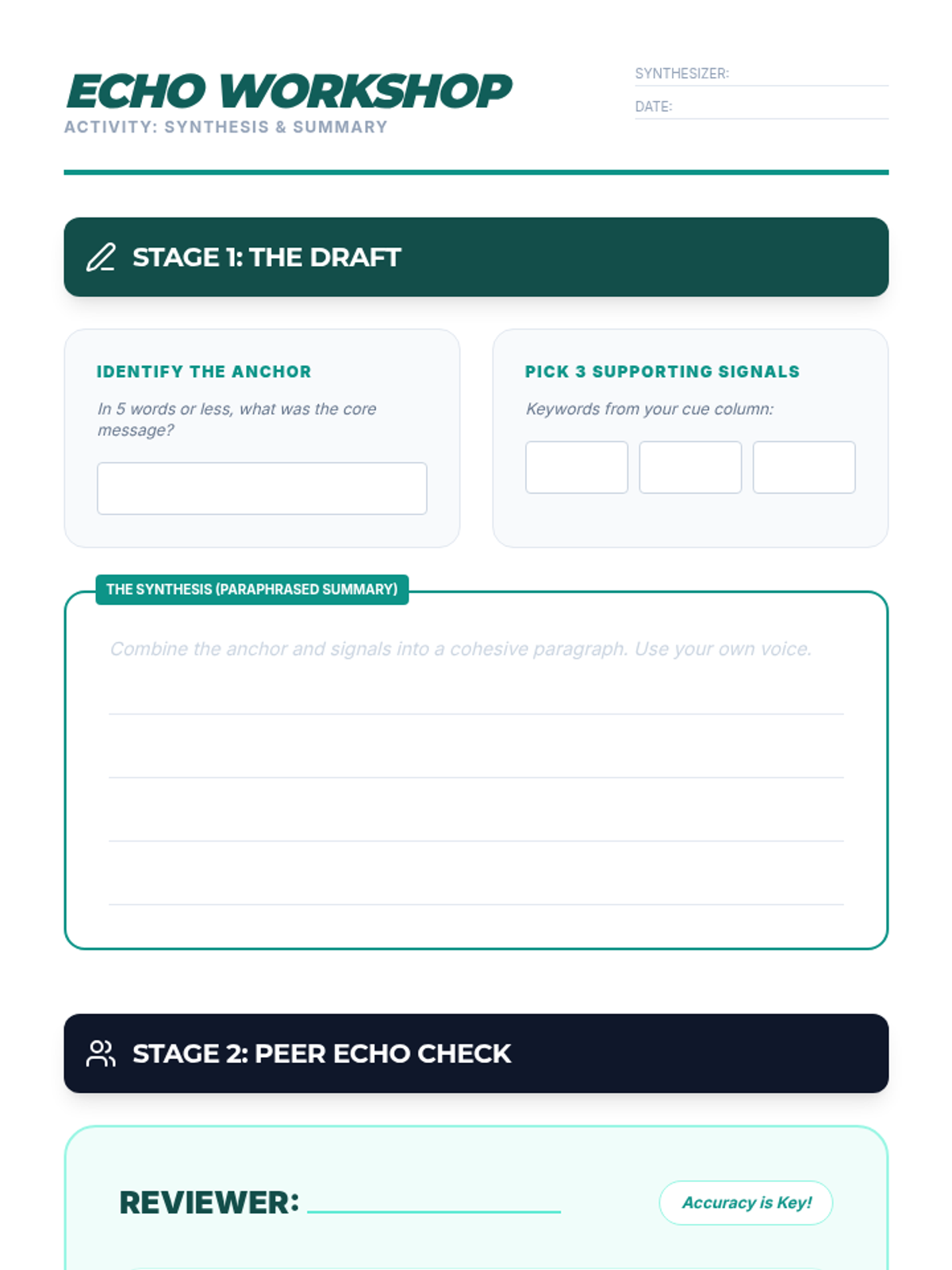
A worksheet for synthesizing audio content into a summary. It includes a draft stage with anchor and signal identification, a paraphrased summary section, and a detailed peer review checklist for accuracy and paraphrasing quality.
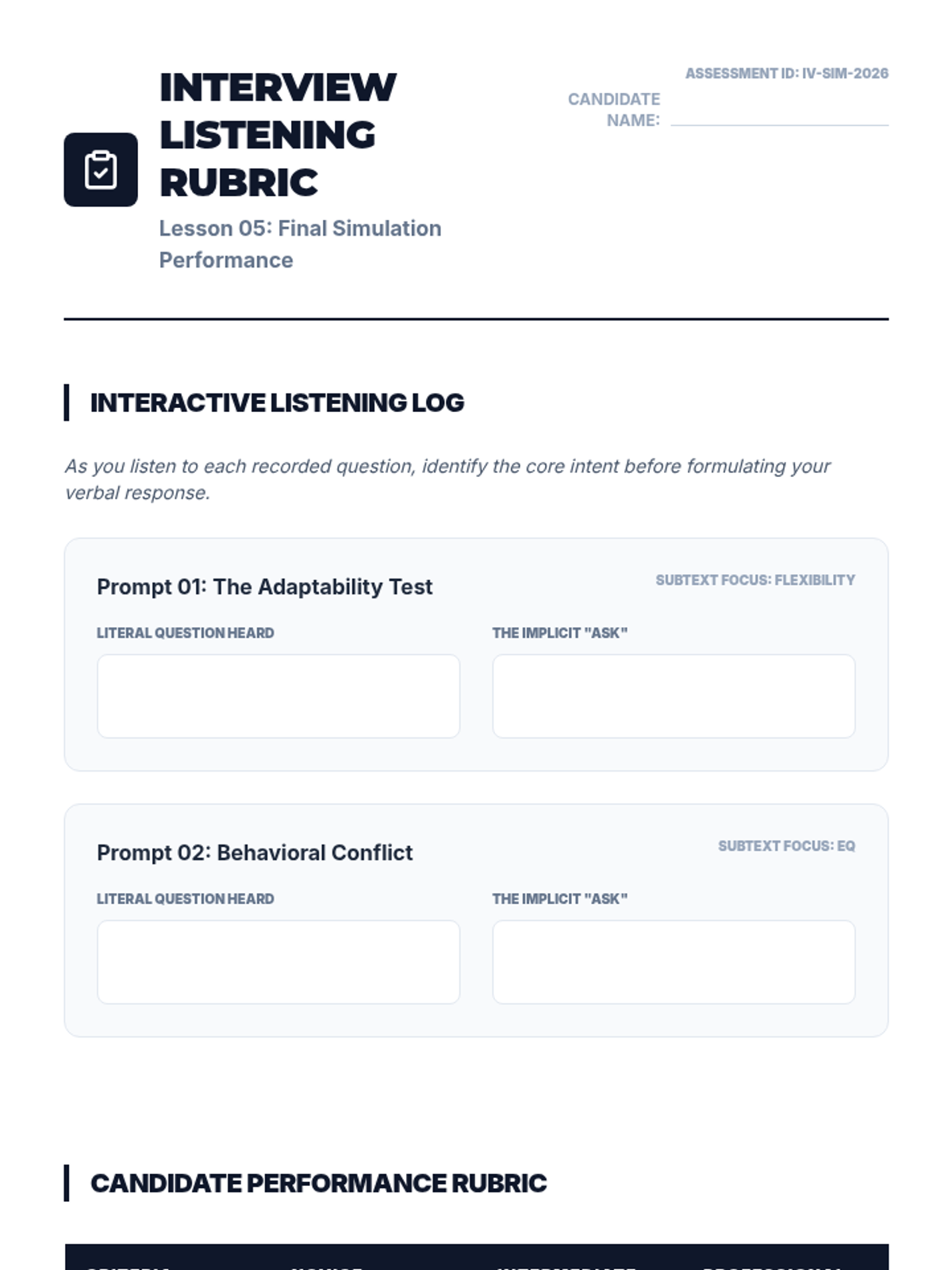
A student assessment rubric and listening log for the final interview simulation, focusing on decoding implicit intent and pragmatic clarity.
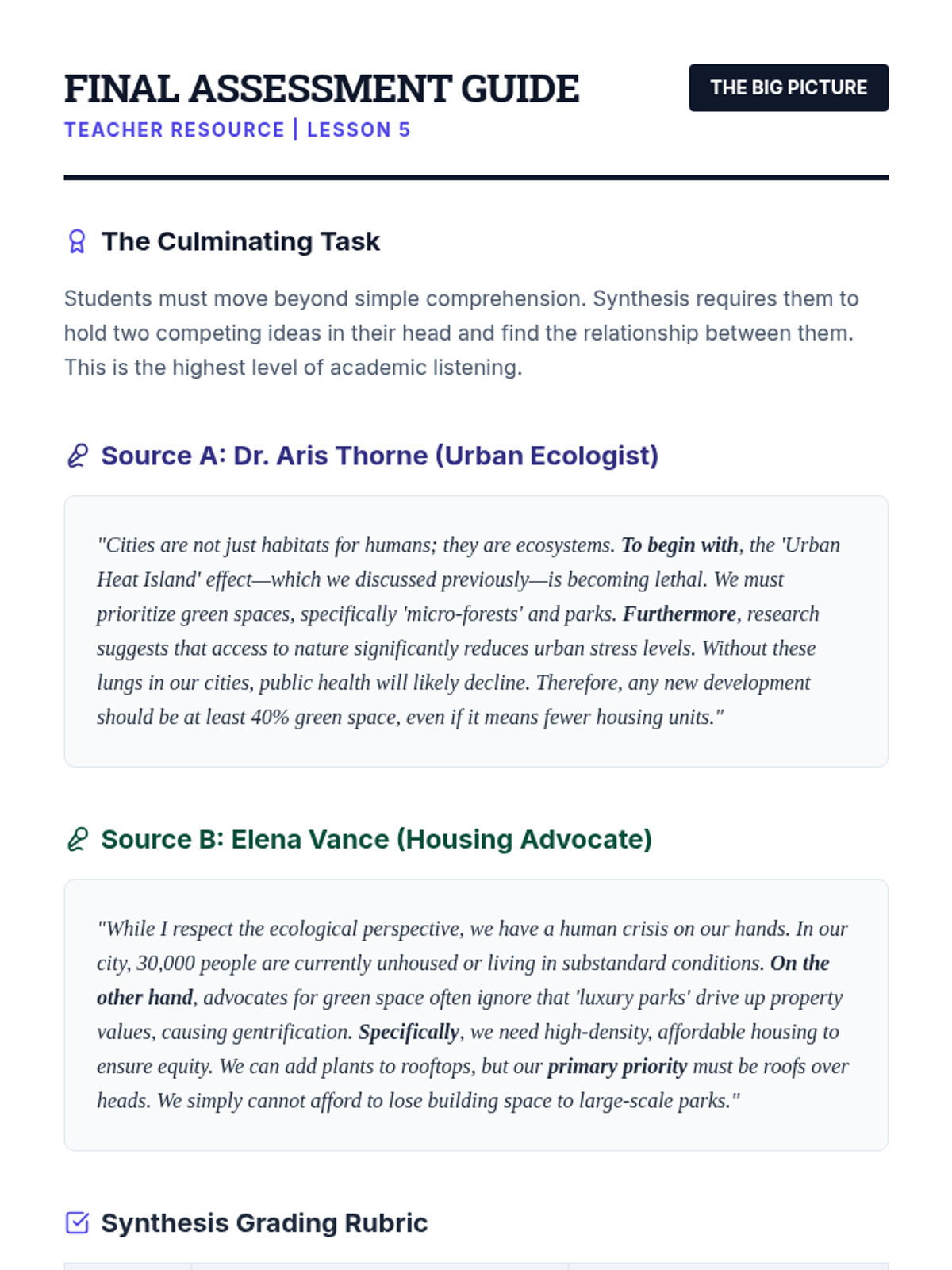
Teacher guide for Lesson 5, including scripts for two contrasting viewpoints and a grading rubric for the synthesis task.
Final slide deck for Lesson 5, guiding students through the process of analyzing sustained narrative podcasts using sound cues and story mapping.
Slides for the fourth lesson on social inference, exploring the concept of register (formal vs. informal) and providing clues for identifying speaker relationships through audio.
Visual presentation for Lesson 2 focusing on the vocal markers of sarcasm (pitch, elongation, stress) and the social contexts where irony is appropriate.
A slide deck focusing on synthesis and paraphrasing in listening. It introduces the "Telephone Trap," compares paraphrasing vs. regurgitating, and provides a 3-step protocol for creating accurate summaries from notes.
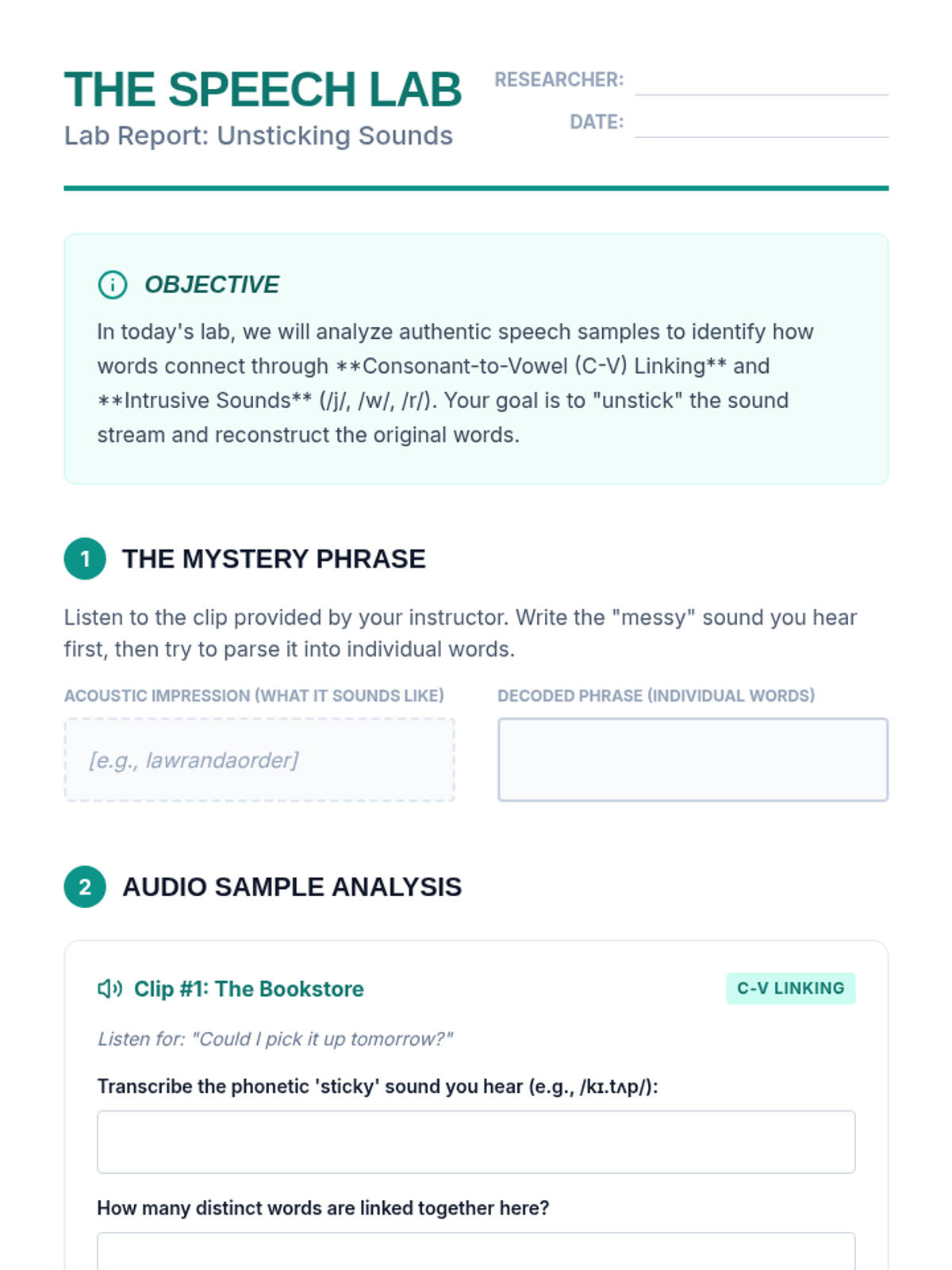
A student worksheet for analyzing audio samples, focusing on identifying consonant-vowel linking and intrusive sounds in campus-based scenarios.
A slide deck focusing on strategies for decoding complex interview questions and behavioral prompts, preparing students for the final simulation.
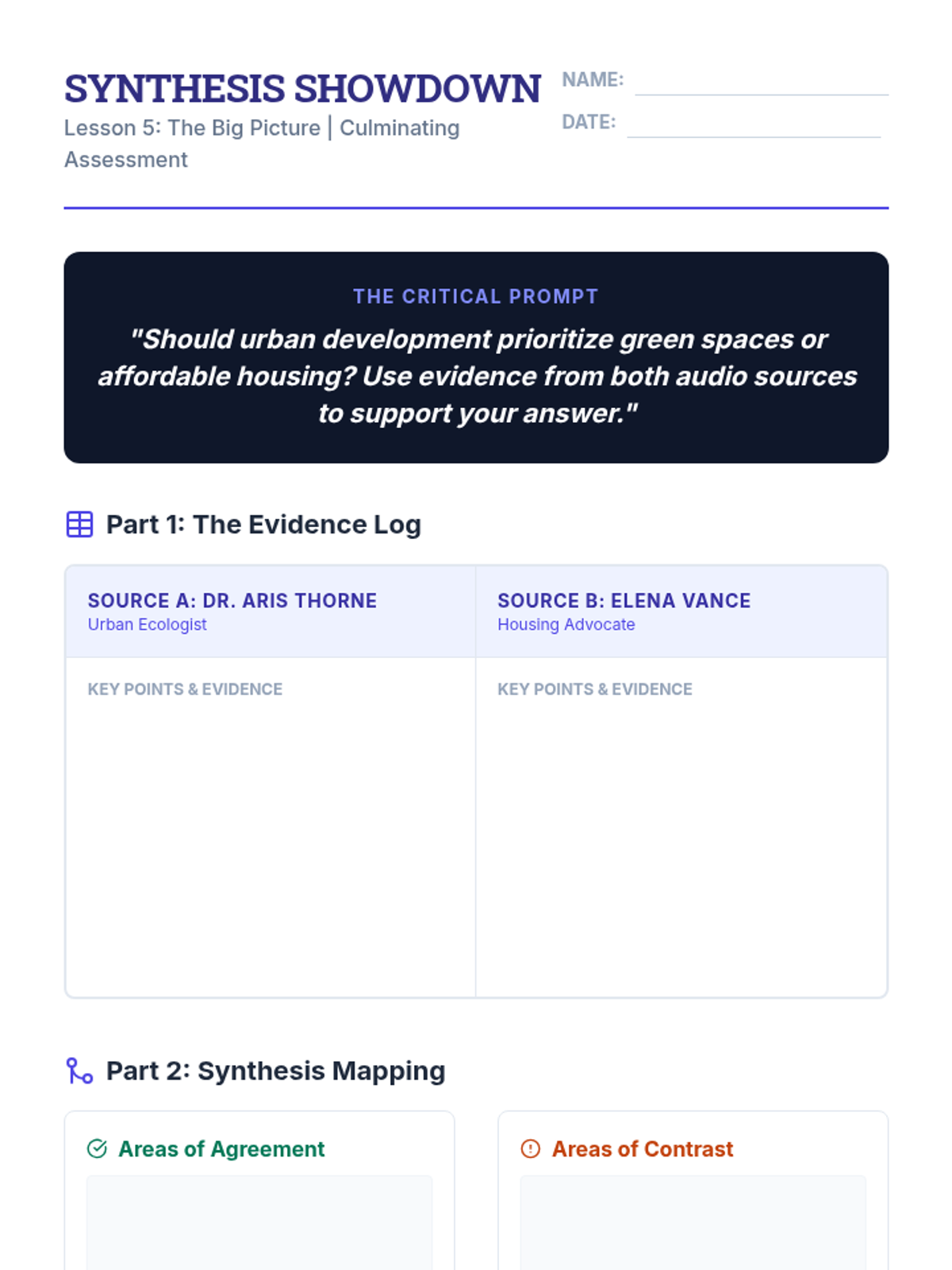
Student worksheet for Lesson 5 providing a comparison chart and space for synthesizing a final response from two audio sources.
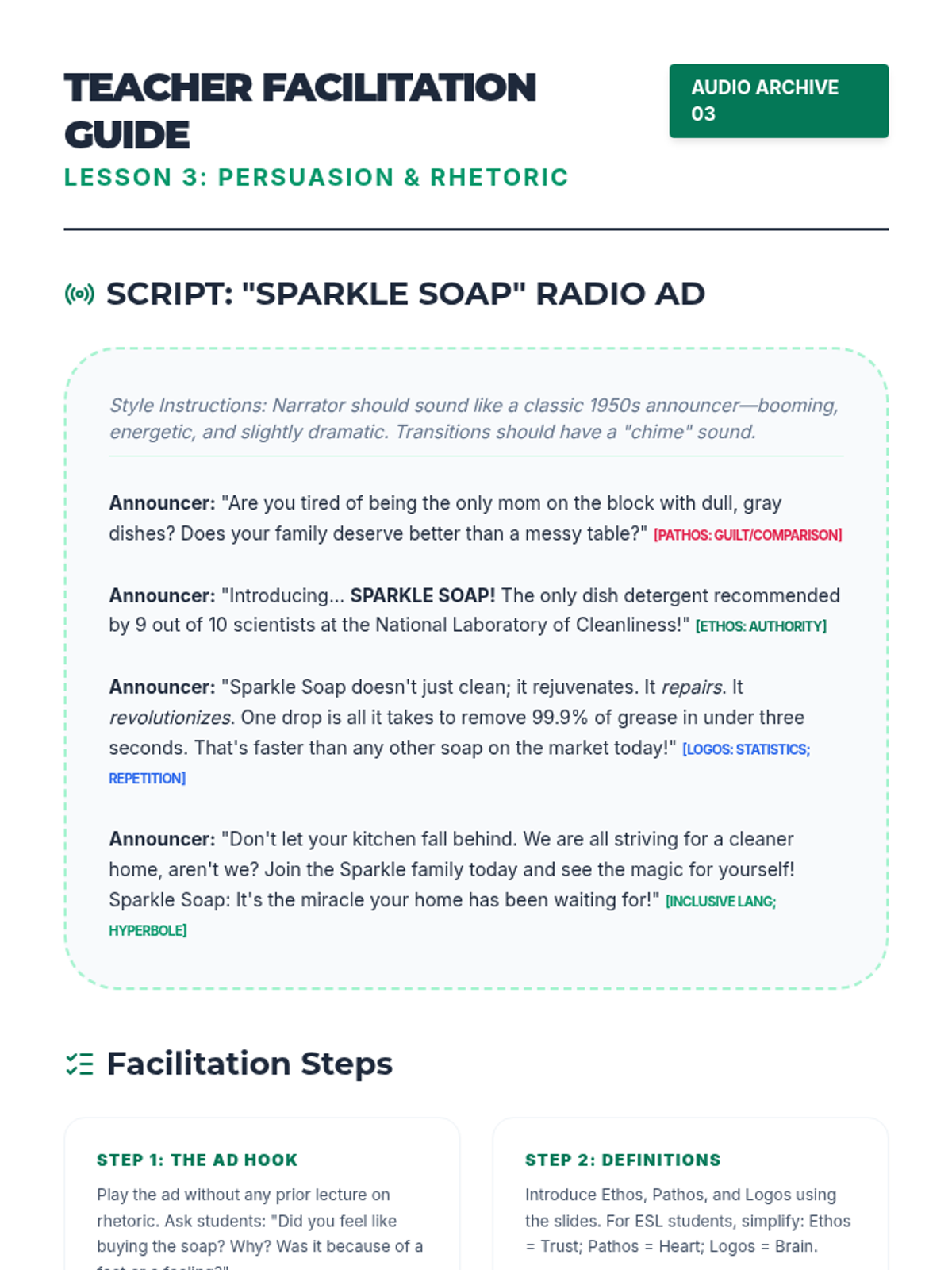
A teacher guide for Lesson 3 featuring a detailed radio advertisement script ("Sparkle Soap") annotated with rhetorical devices, facilitation steps, and common misconceptions for teaching rhetoric to ESL students.
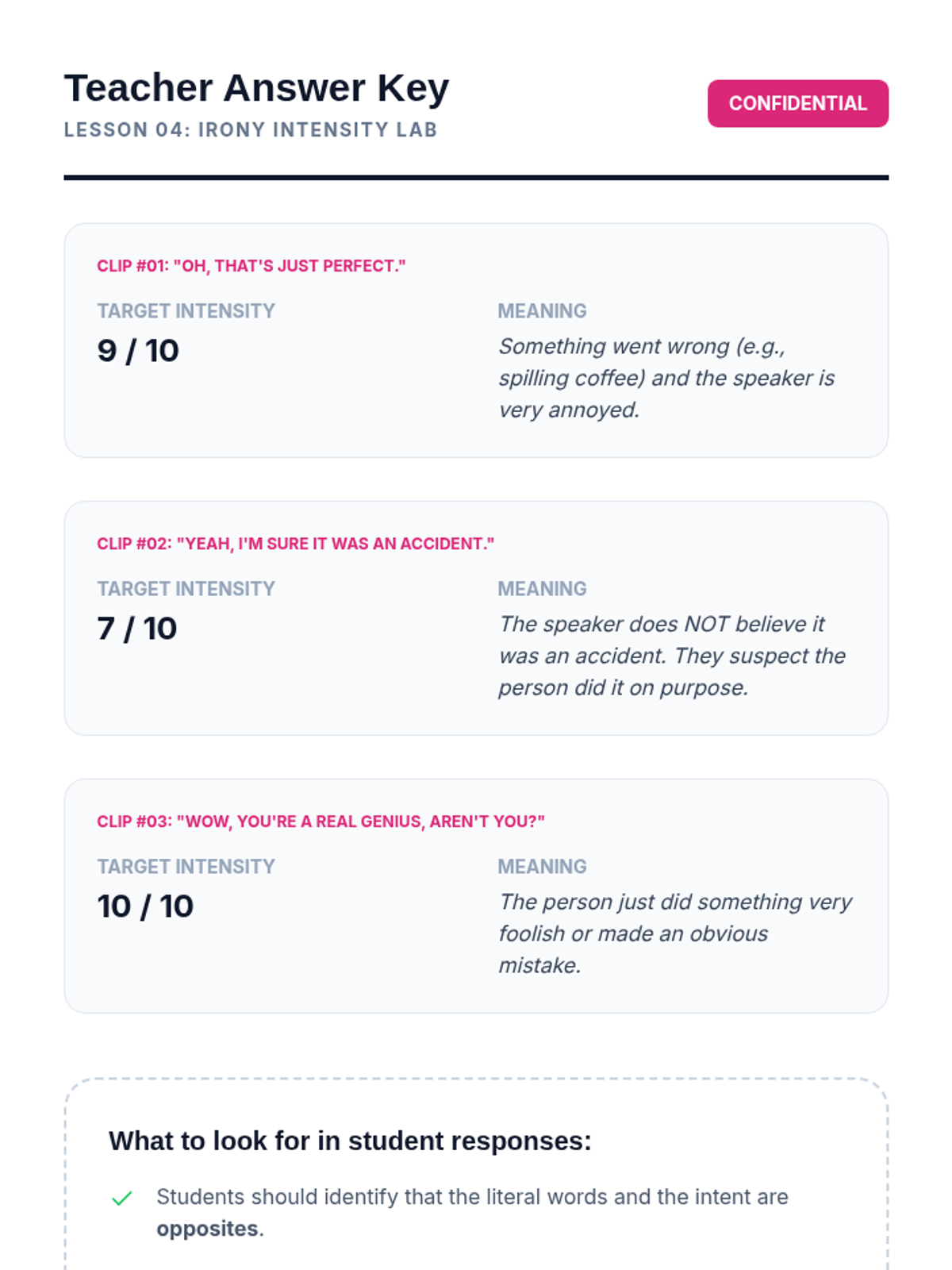
Answer key for Lesson 4 providing expected intensity ratings and literal meanings for the irony detection activity.
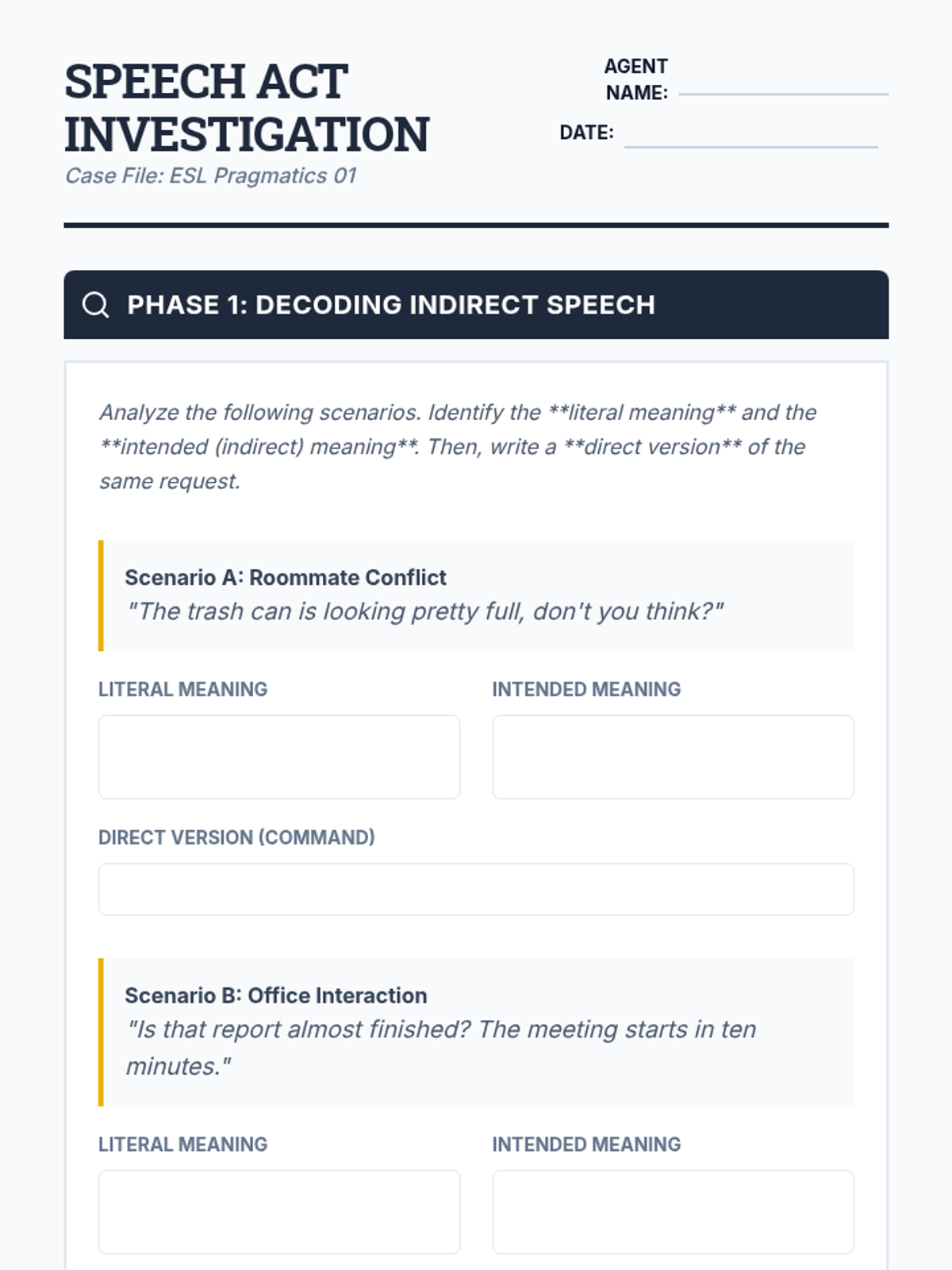
Student worksheet for Lesson 1 where students analyze scenarios to decode the difference between literal and intended meaning in indirect requests.
Slides for Lesson 5, introducing the concept of synthesis and providing transition phrases for comparative analysis.
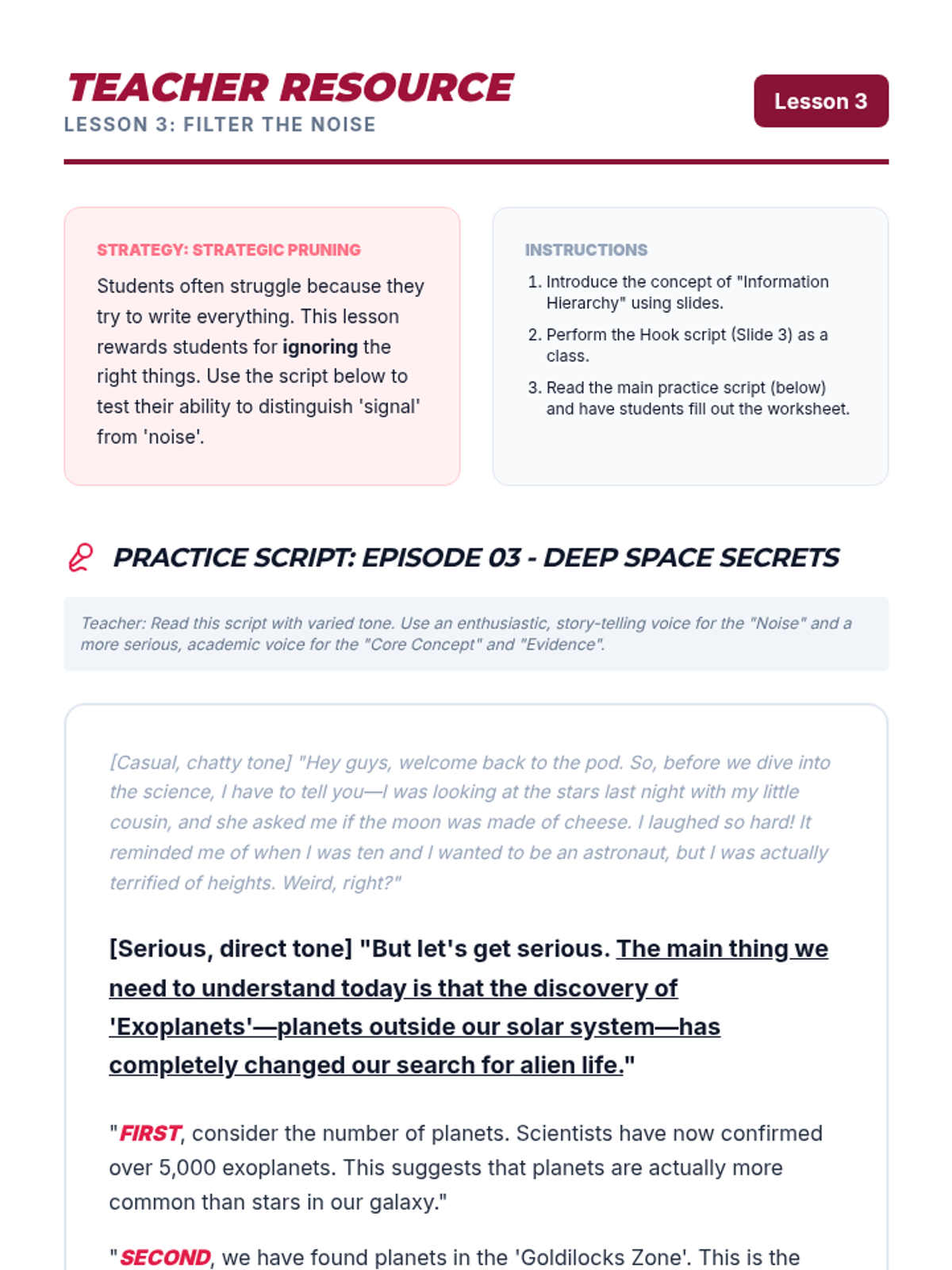
A teacher resource for Lesson 3, featuring a script for the "Deep Space Secrets" podcast episode with explicit instructions on how to vary tone to signal "noise" versus "core concepts." Includes a content key for the worksheet.
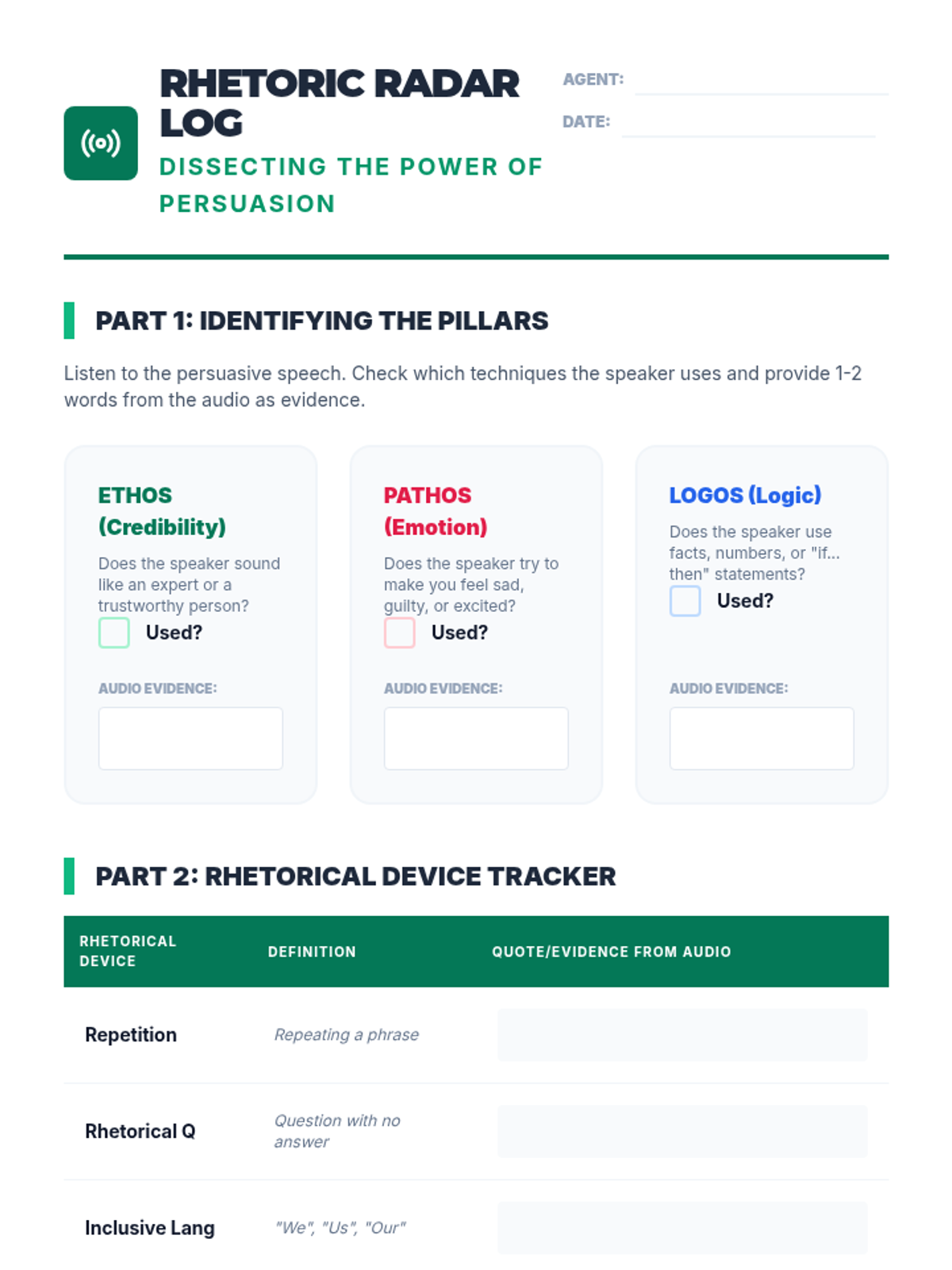
A comprehensive student log for identifying rhetorical pillars (Ethos, Pathos, Logos) and specific devices like repetition and hyperbole during listening exercises.