Assessment slide deck for 1st grade ESL students explaining the life cycle mini-book project and reviewing sequencing in stories.
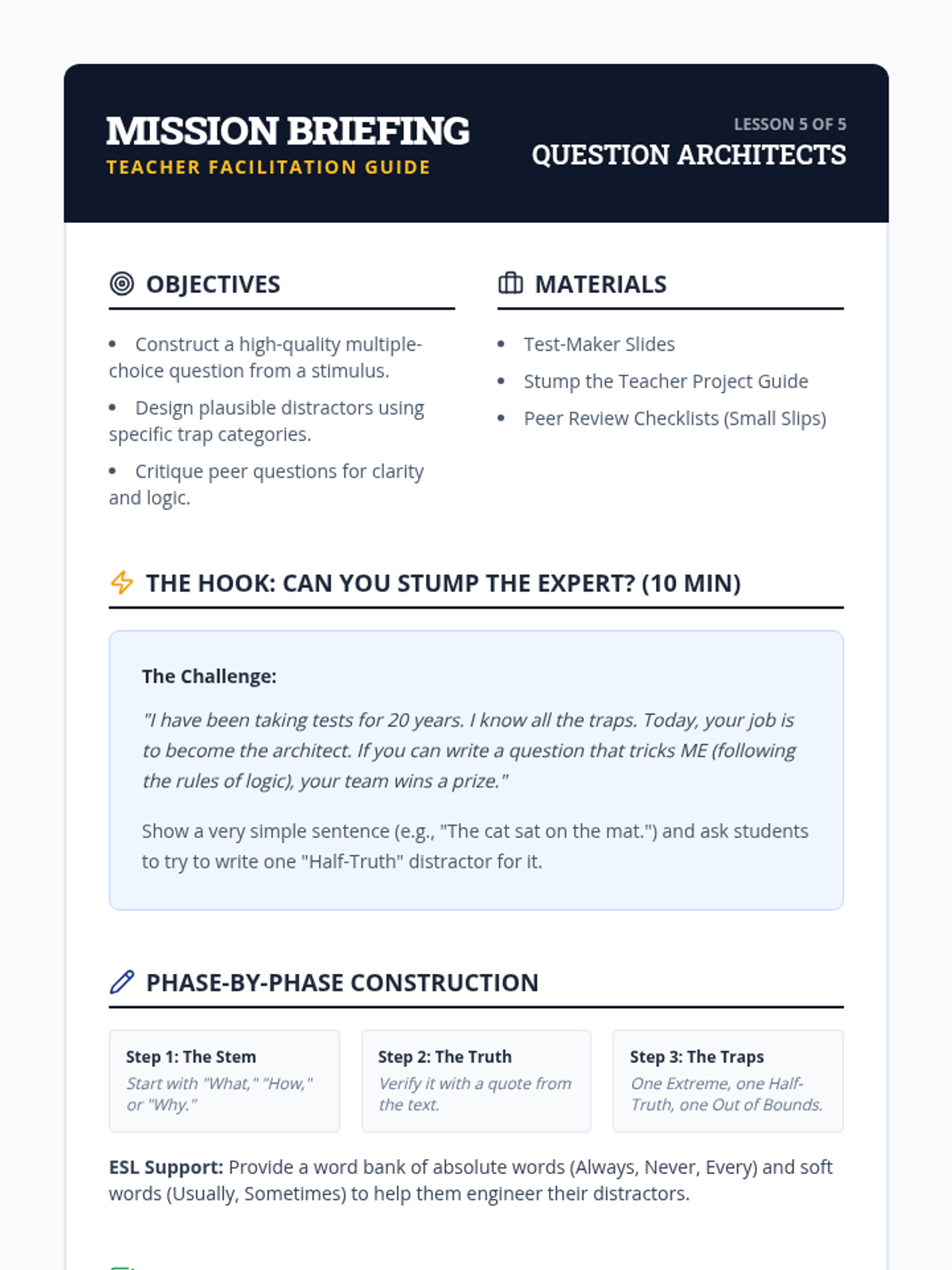
Facilitation guide for Lesson 5, including the "Stump the Expert" hook, phase-by-phase question construction steps, and a peer review protocol.
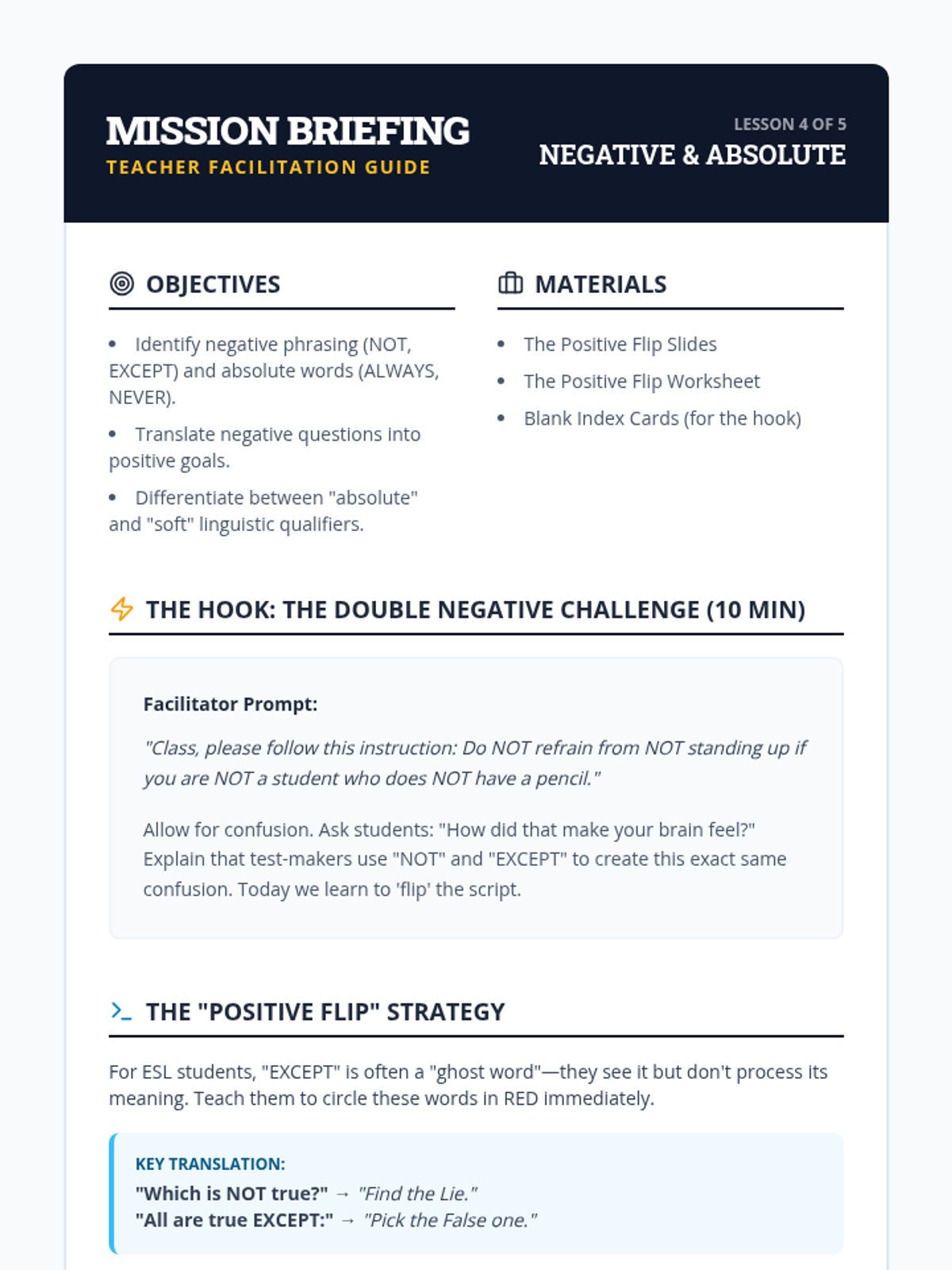
Facilitation guide for Lesson 4, including the "Double Negative Instructions" hook, translation strategies for "NOT" and "EXCEPT," and an answer key for the Positive Flip worksheet.
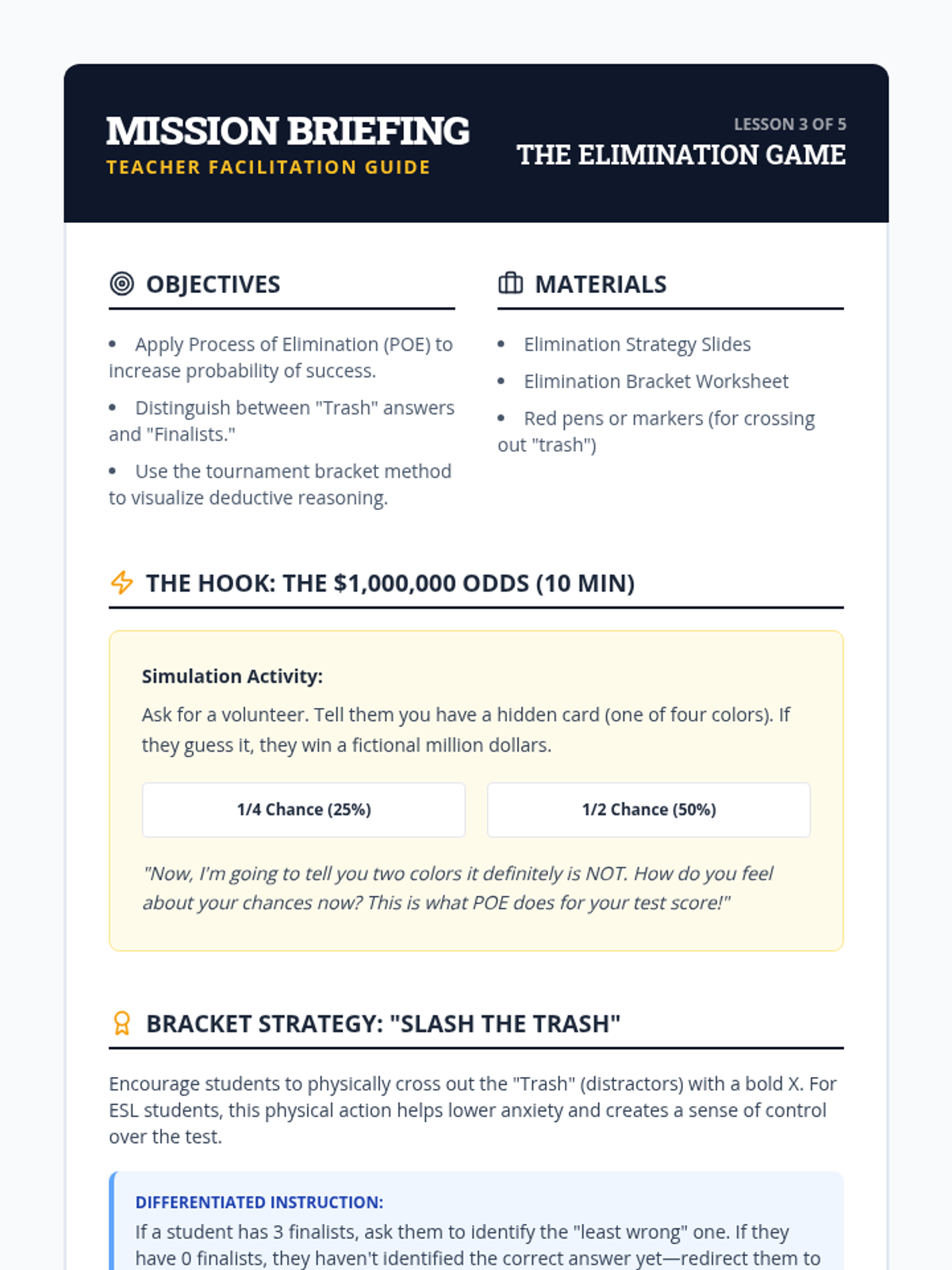
Facilitation guide for Lesson 3, including the odds simulation hook, the "Slash the Trash" technique, and an answer key for the Elimination Bracket worksheet.
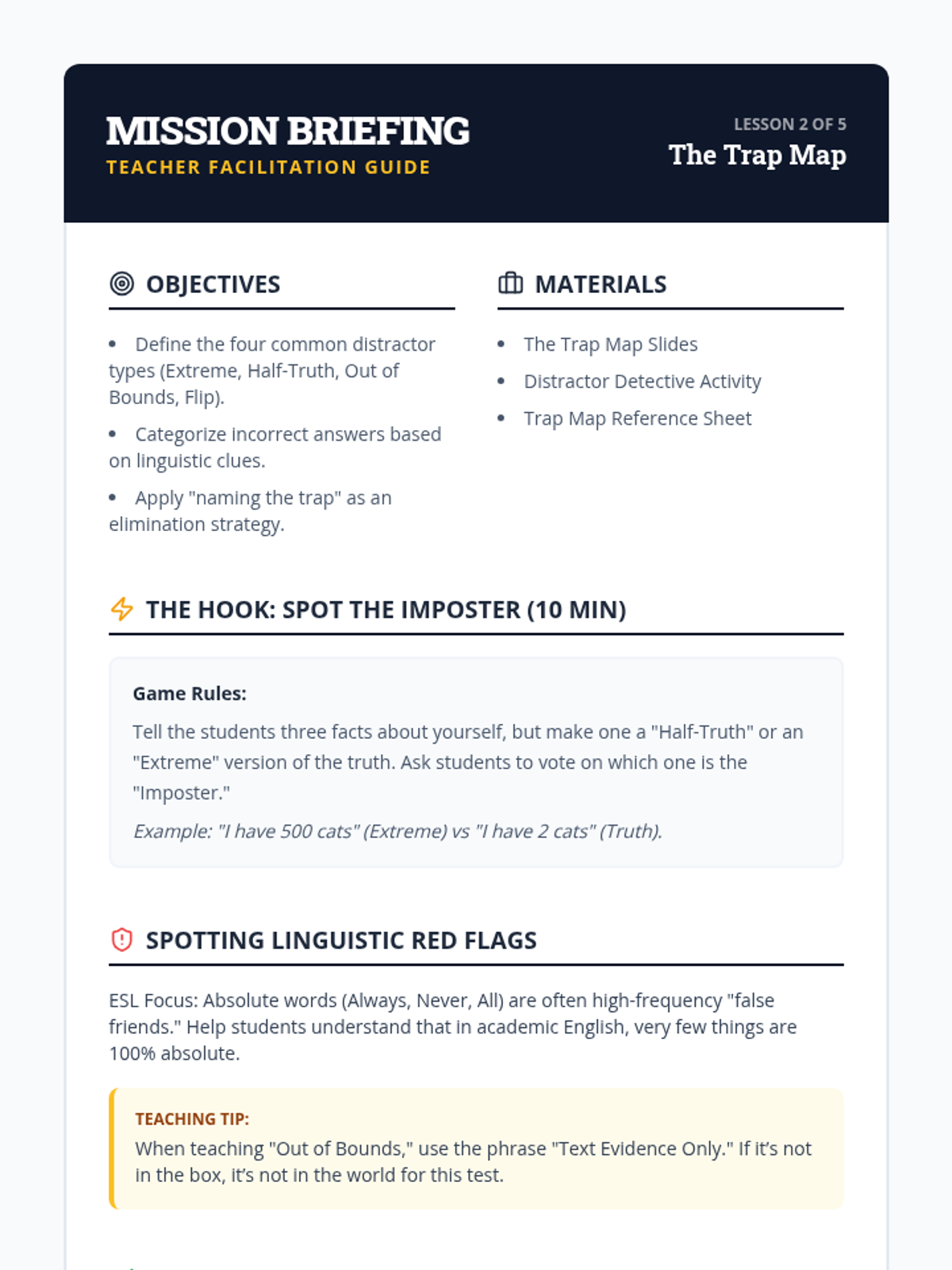
Facilitation guide for Lesson 2, including the 'Spot the Imposter' hook, linguistic red flags for ESL learners, and an answer key for the Distractor Detective activity.
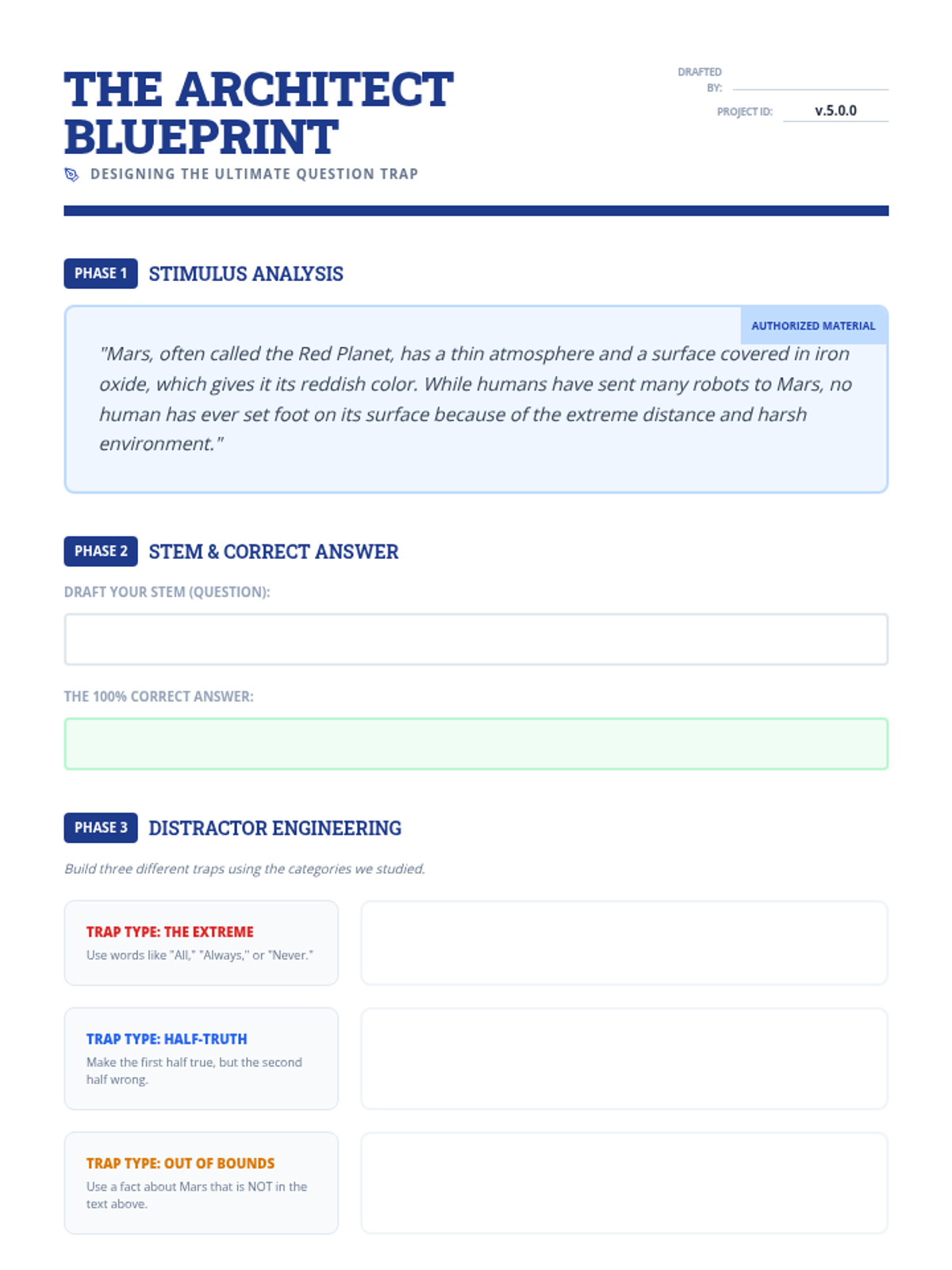
Worksheet for Lesson 5 where students switch roles and become the test-makers. They write their own multiple-choice questions based on a shared text, intentionally creating plausible distractors.
Introductory slide deck for Lesson 5, exploring the mindset of a test-maker and the steps needed to construct a plausible multiple-choice question.
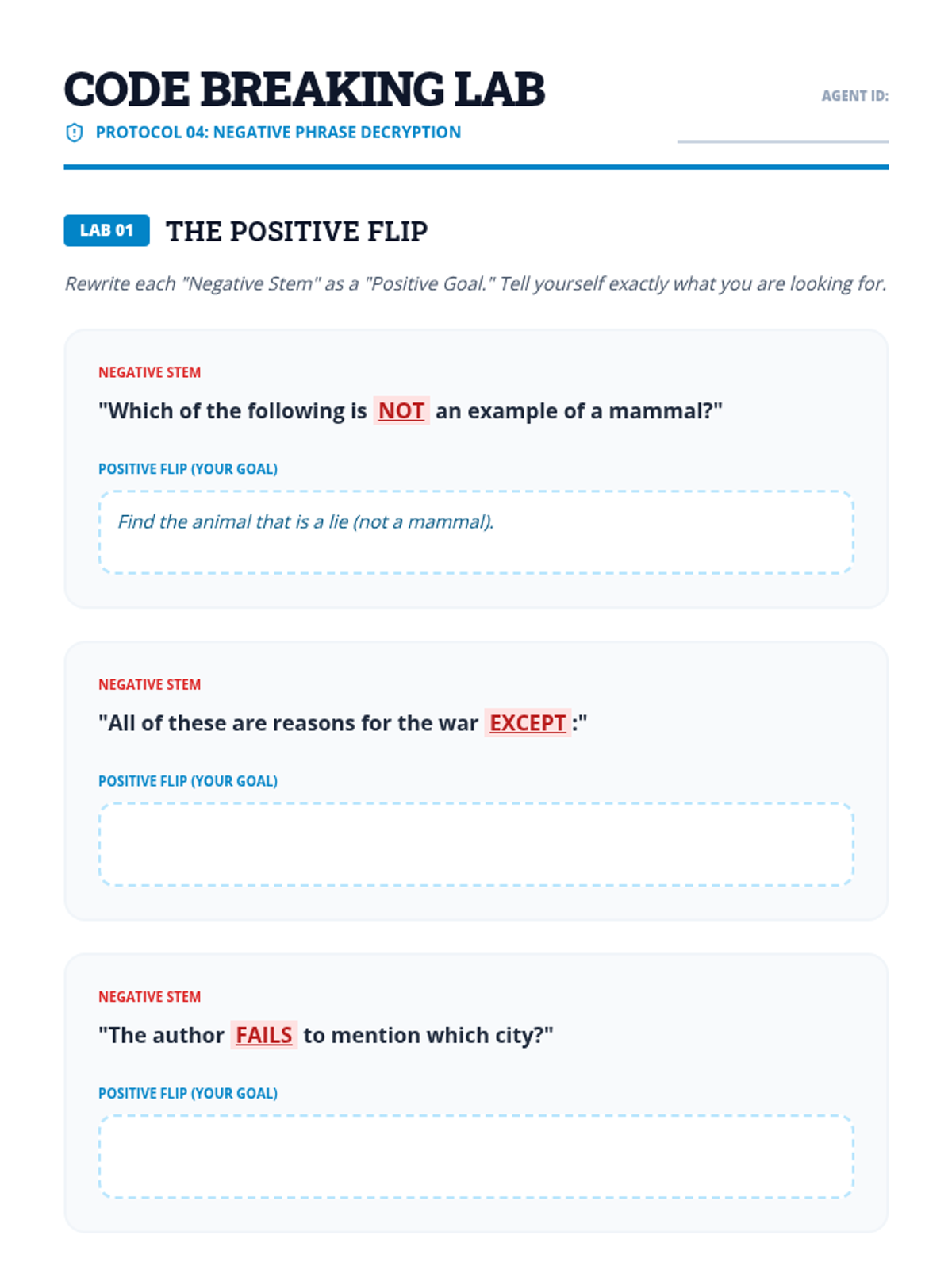
Worksheet for Lesson 4 where students specifically target questions using words like 'NOT,' 'EXCEPT,' 'ALWAYS,' or 'NEVER.' They rewrite these questions in positive terms to clarify meaning. Revised with a light theme for better printability.
Introductory slide deck for Lesson 4, using a code-breaking theme to teach students how to handle negative phrasing (NOT, EXCEPT) and absolute words (ALWAYS, NEVER) in test questions.
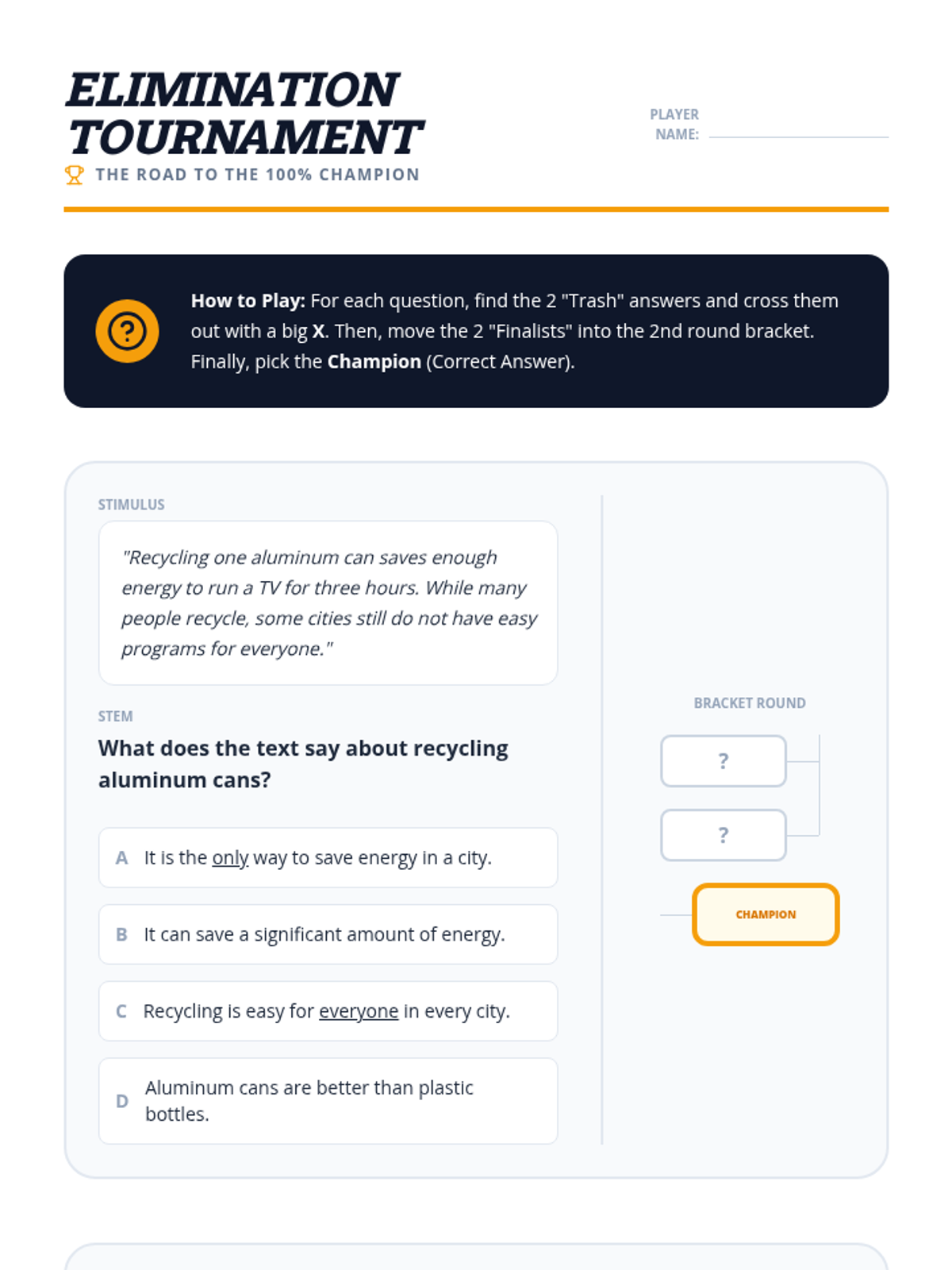
Worksheet for Lesson 3 where students use a "tournament bracket" visual to narrow down multiple-choice options by crossing out "trash" answers and selecting a champion.
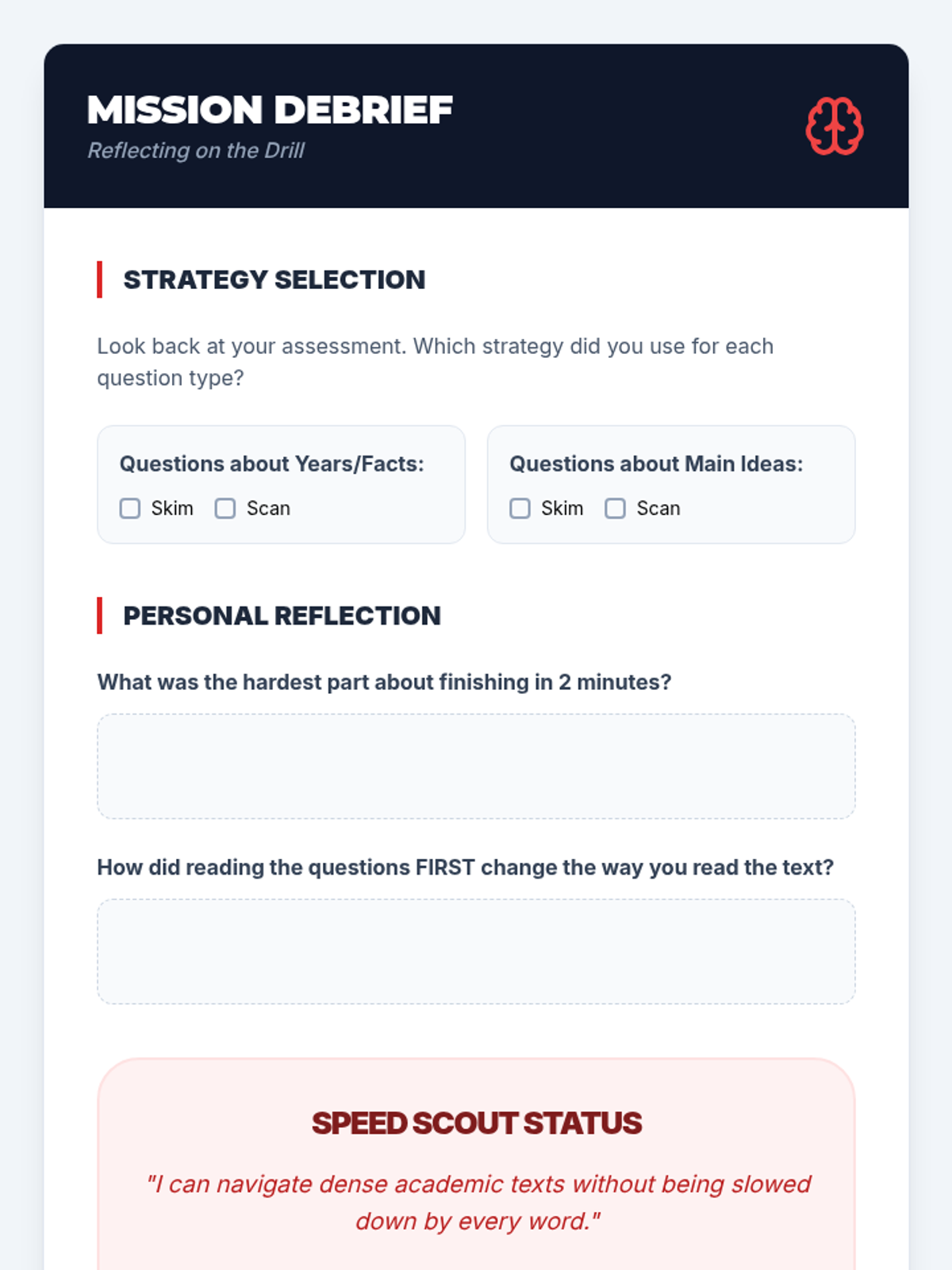
A metacognitive reflection sheet for students to evaluate their strategy use and performance after the timed assessment.
Introductory slide deck for Lesson 3, using a game-show theme to teach the Process of Elimination (POE) and how it increases the probability of choosing the correct answer.
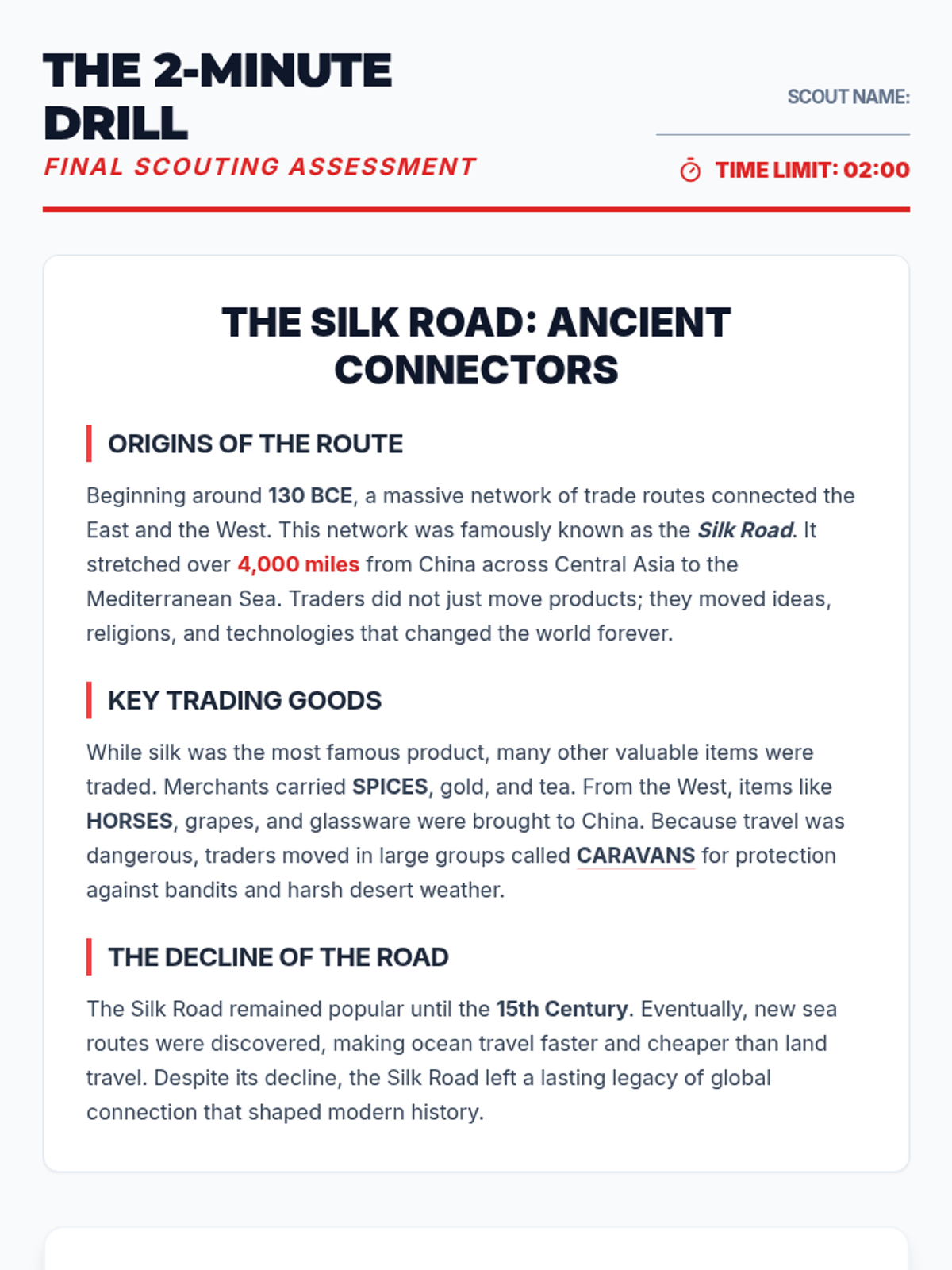
A timed reading comprehension challenge that requires students to apply skimming and scanning techniques to an academic passage about the Silk Road.
Culminating slide deck for the final assessment, providing a review of all strategies and the '2-Minute Drill' challenge instructions.
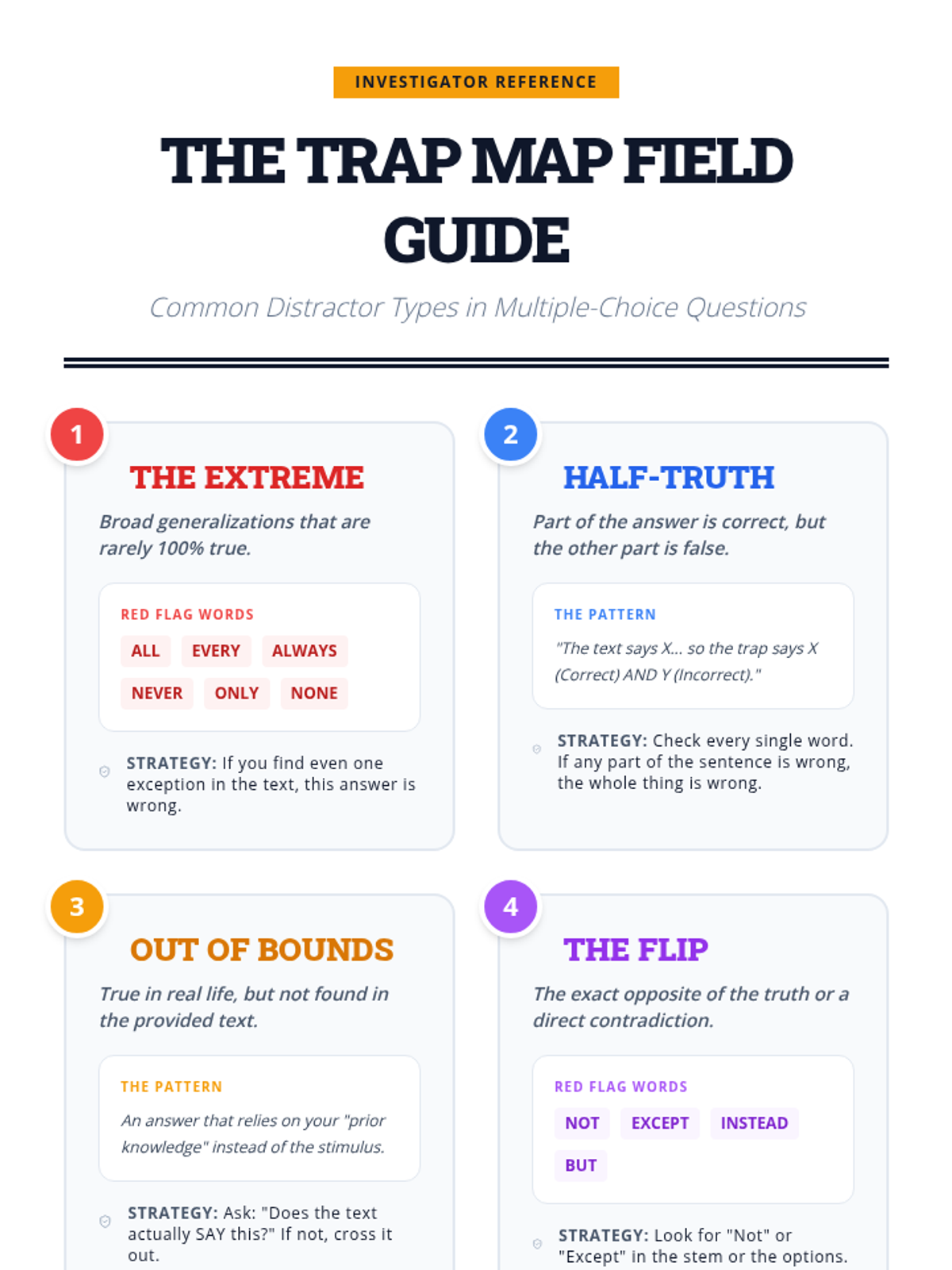
A student-facing reference sheet defining the four common types of distractors (The Extreme, Half-Truth, Out of Bounds, The Flip) with red flag words and elimination strategies.
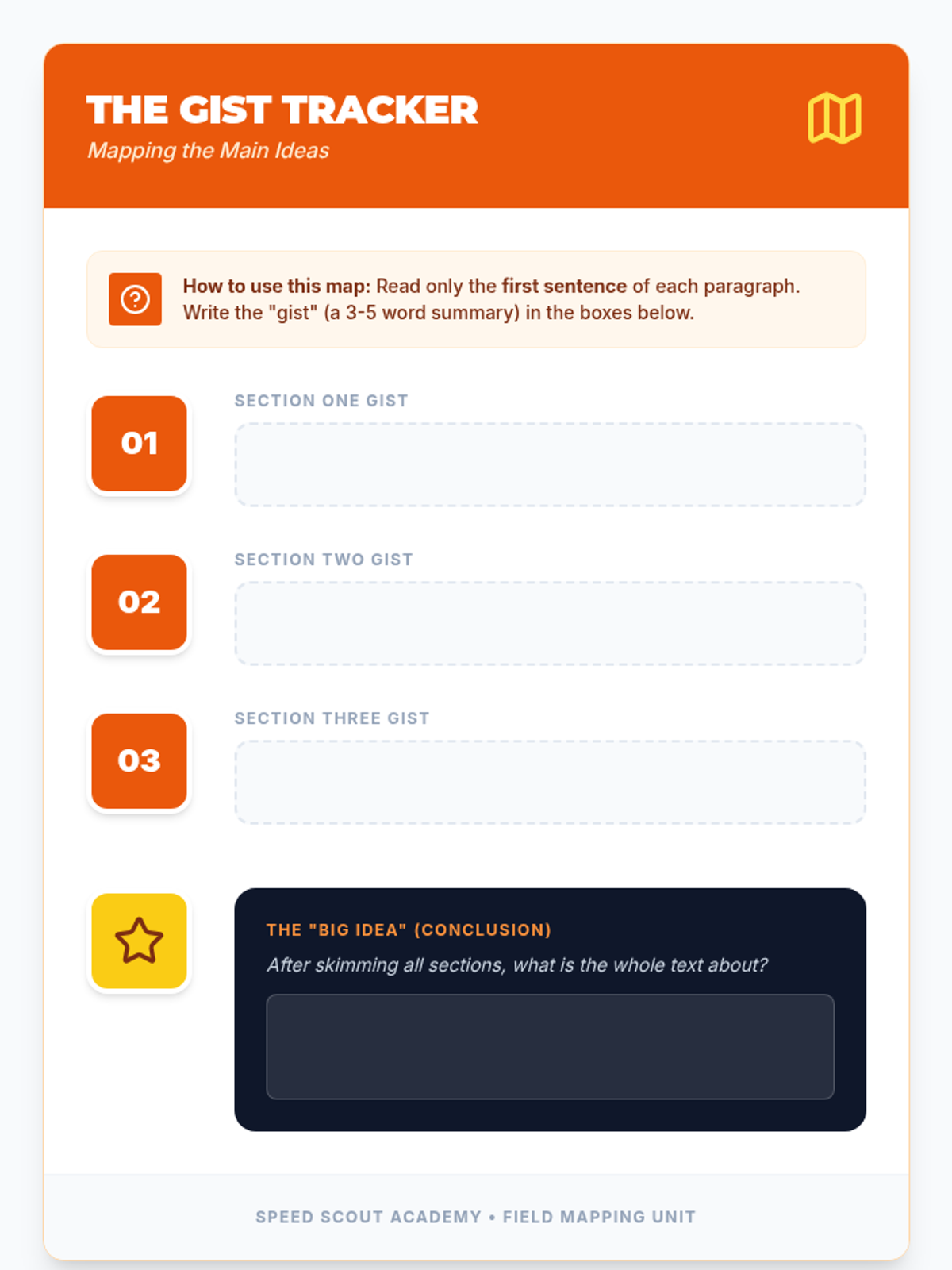
A graphic organizer (Gist Tracker) that scaffolds students in identifying and summarizing topic sentences from multiple paragraphs.
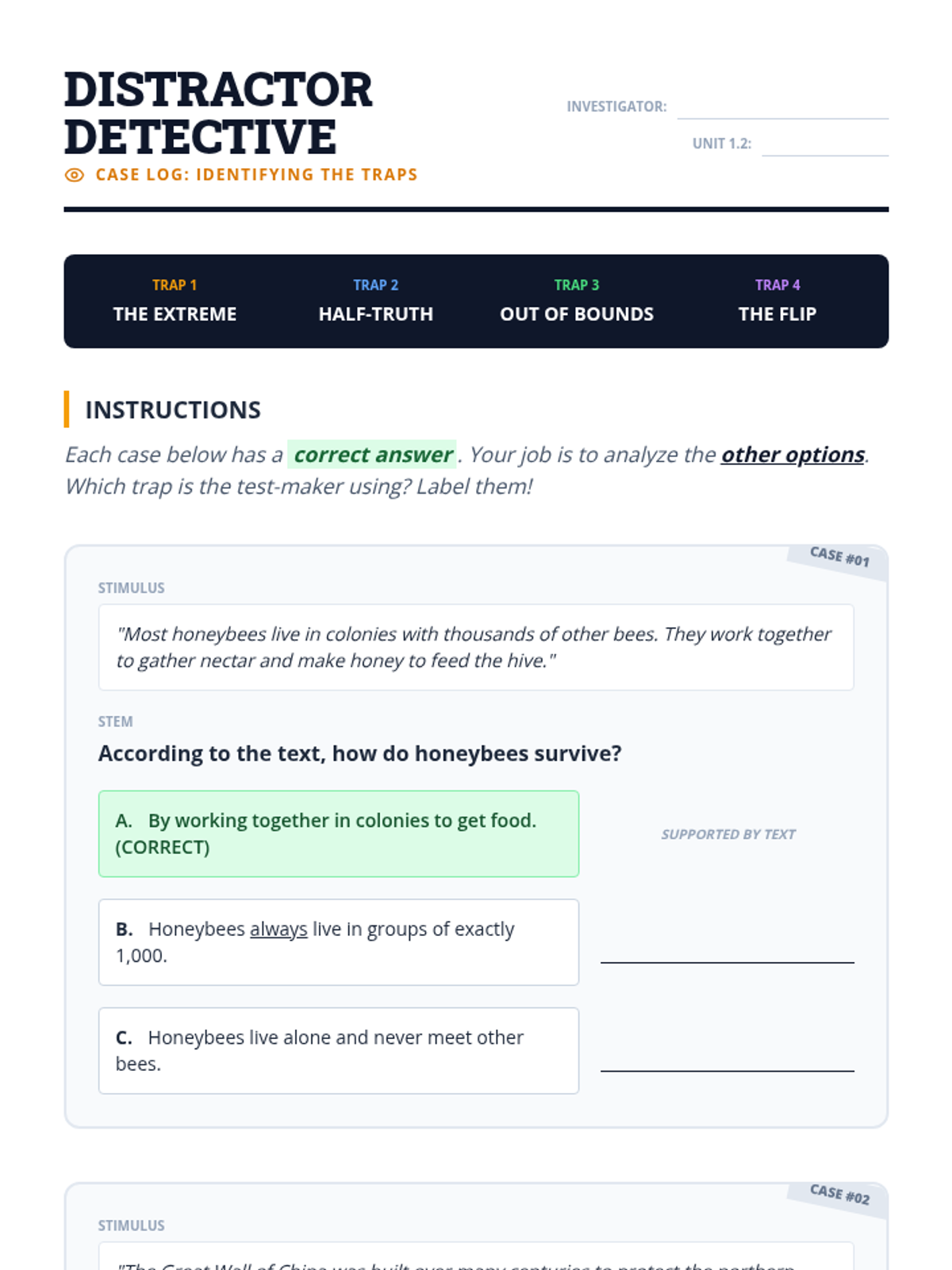
Worksheet for Lesson 2 where students identify which of the four common trap types (Extreme, Half-Truth, Out of Bounds, Flip) are being used in sample multiple-choice questions.
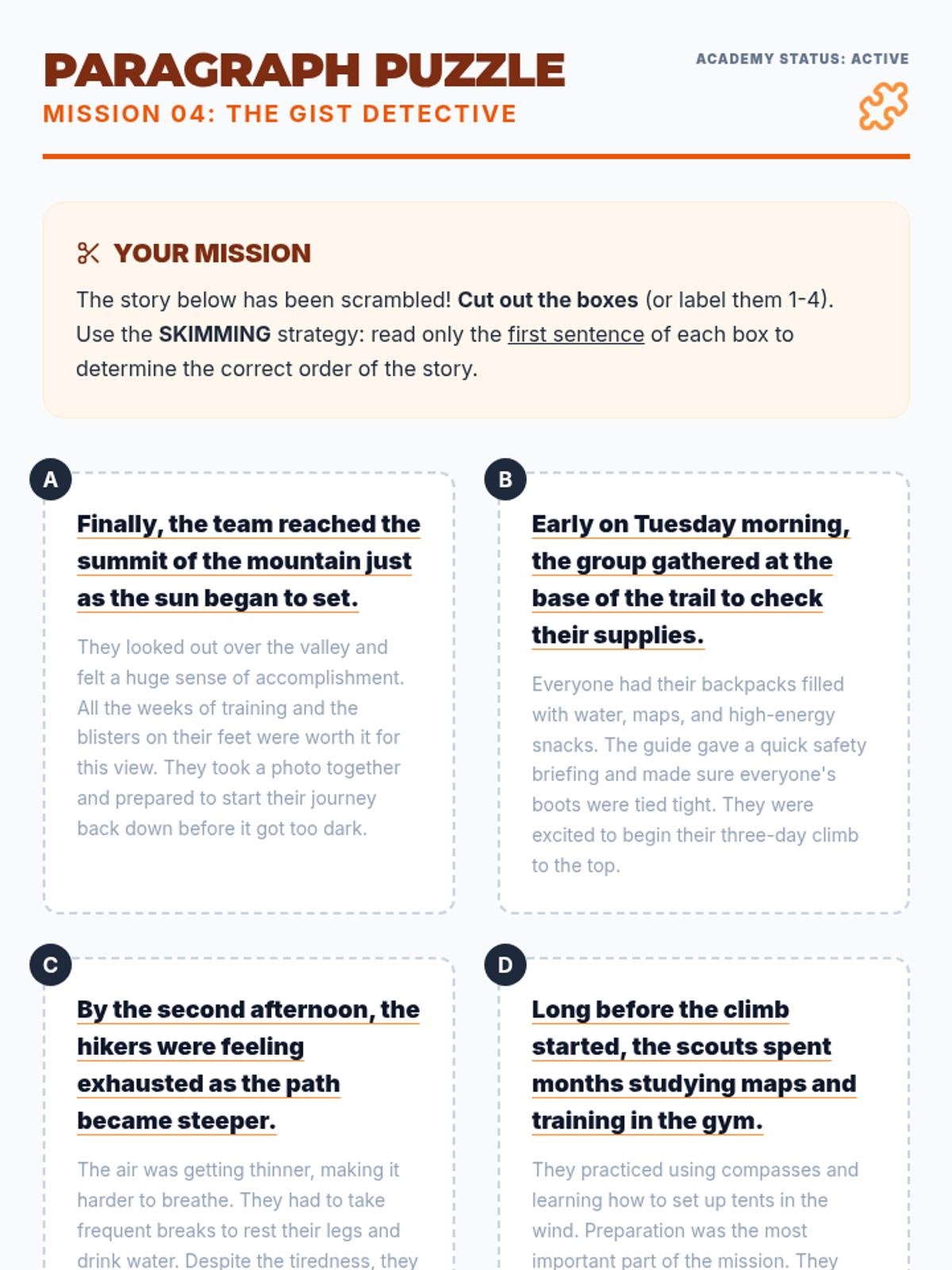
A student activity for arranging scrambled paragraphs in order by skimming only the first sentence of each section.
Visual presentation for Lesson 4, focusing on the 'first and last' strategy to identify main ideas and topic sentences, allowing students to map out the structure of a text quickly.
Introductory slide deck for Lesson 2, defining the four most common types of distractors (Too Extreme, Half-Truth, Out of Bounds, and The Flip) with examples and a detective theme.
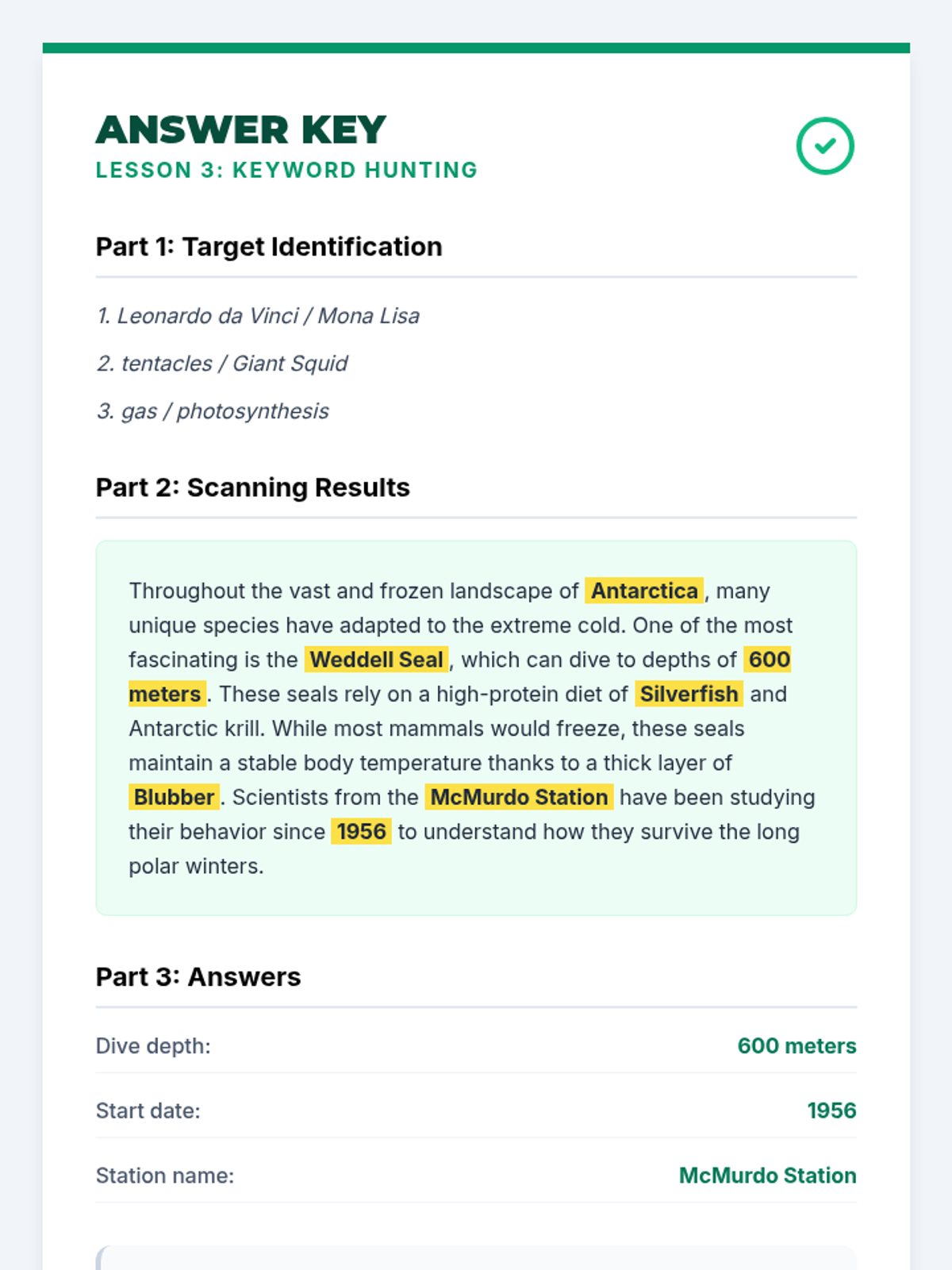
Answer key for the Target Practice worksheet, highlighting identified keywords and their locations within the text.
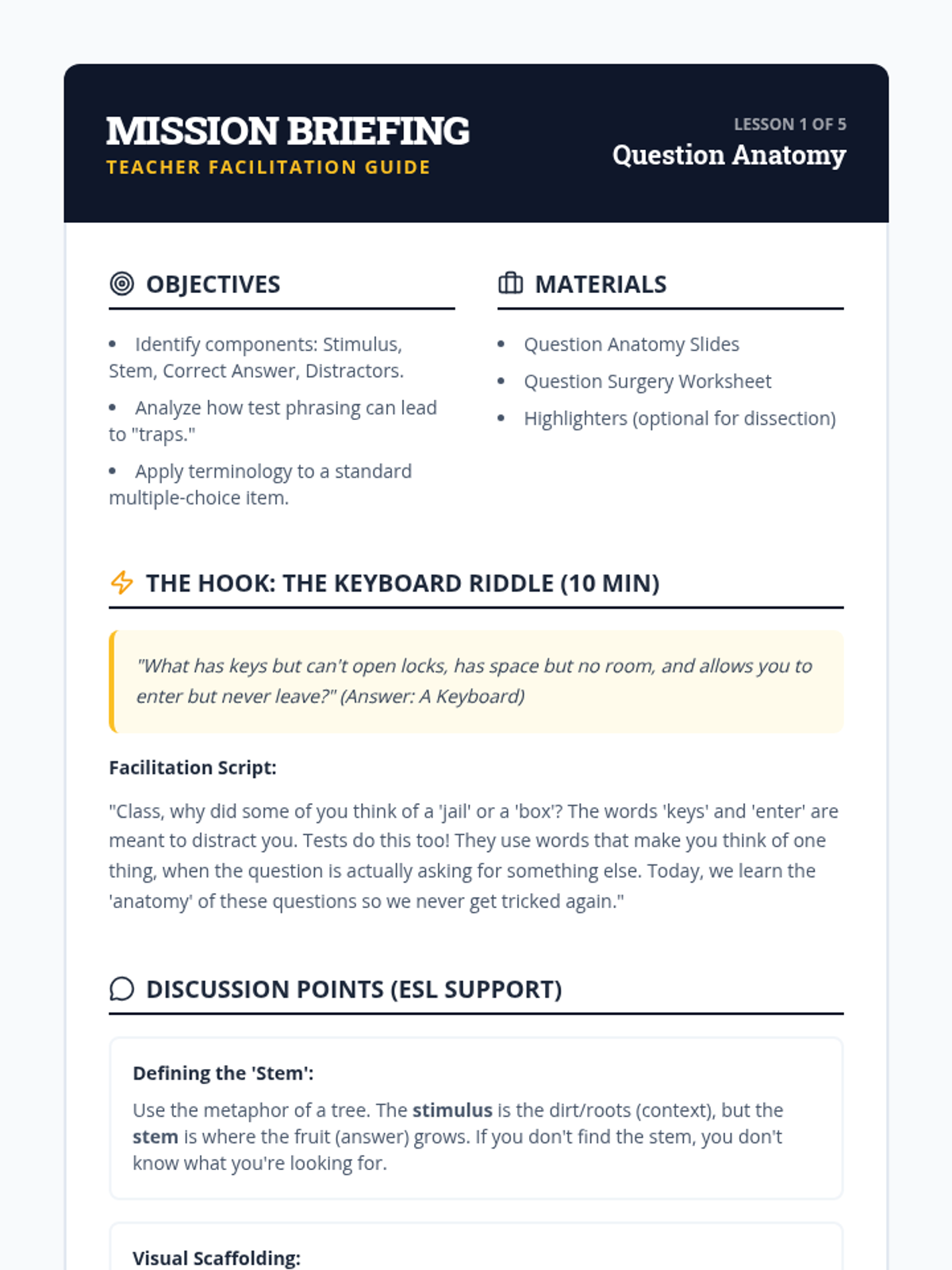
Facilitation guide for Lesson 1, including the riddle hook, discussion prompts for ESL students, a pacing guide, and an answer key for the Question Surgery Worksheet.
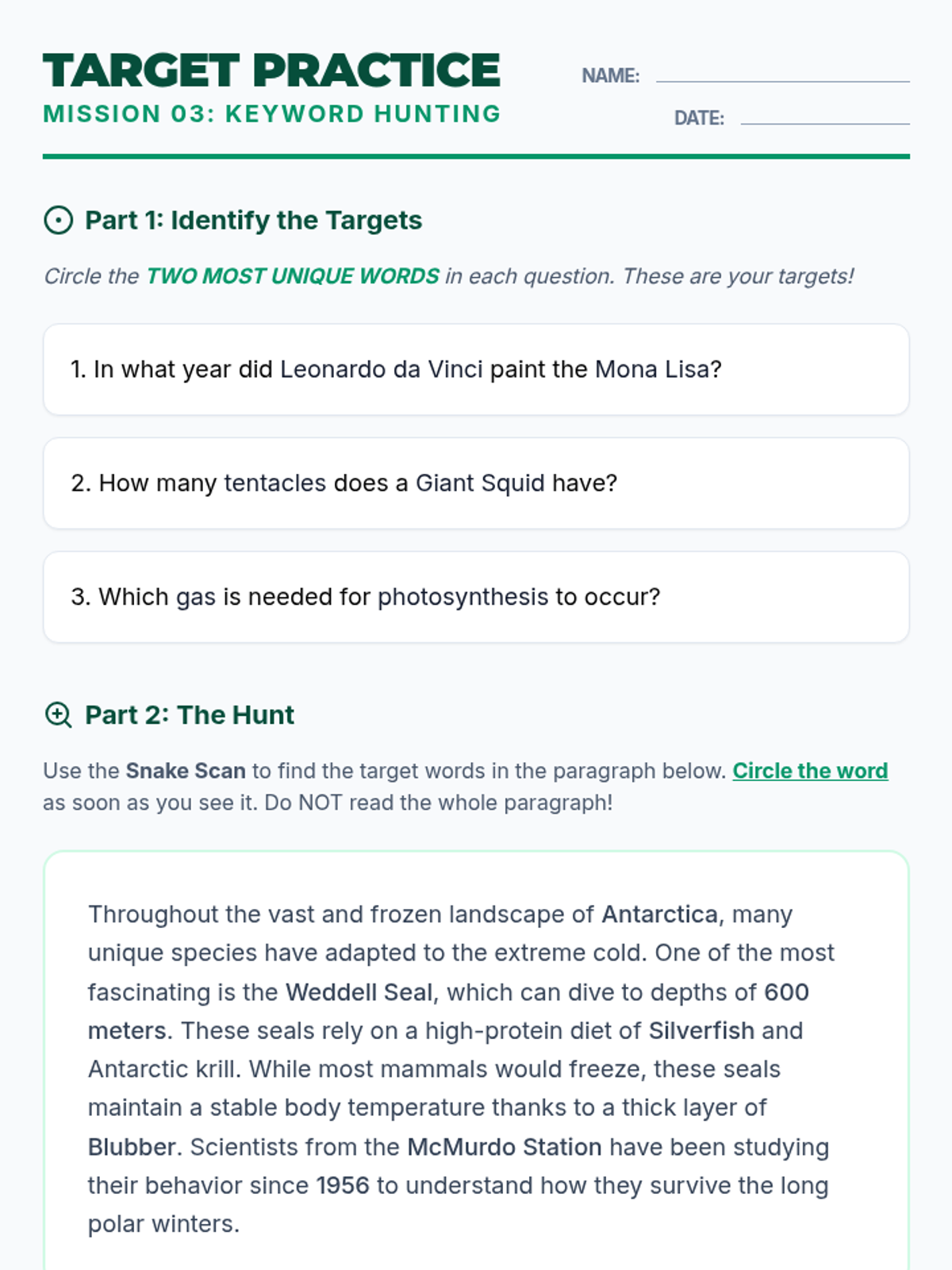
A student worksheet for practicing keyword identification in questions and scanning for those targets within a dense academic paragraph.
Visual presentation for Lesson 3, focusing on identifying the best keywords in questions and the 'Snake Scan' physical eye movement technique.
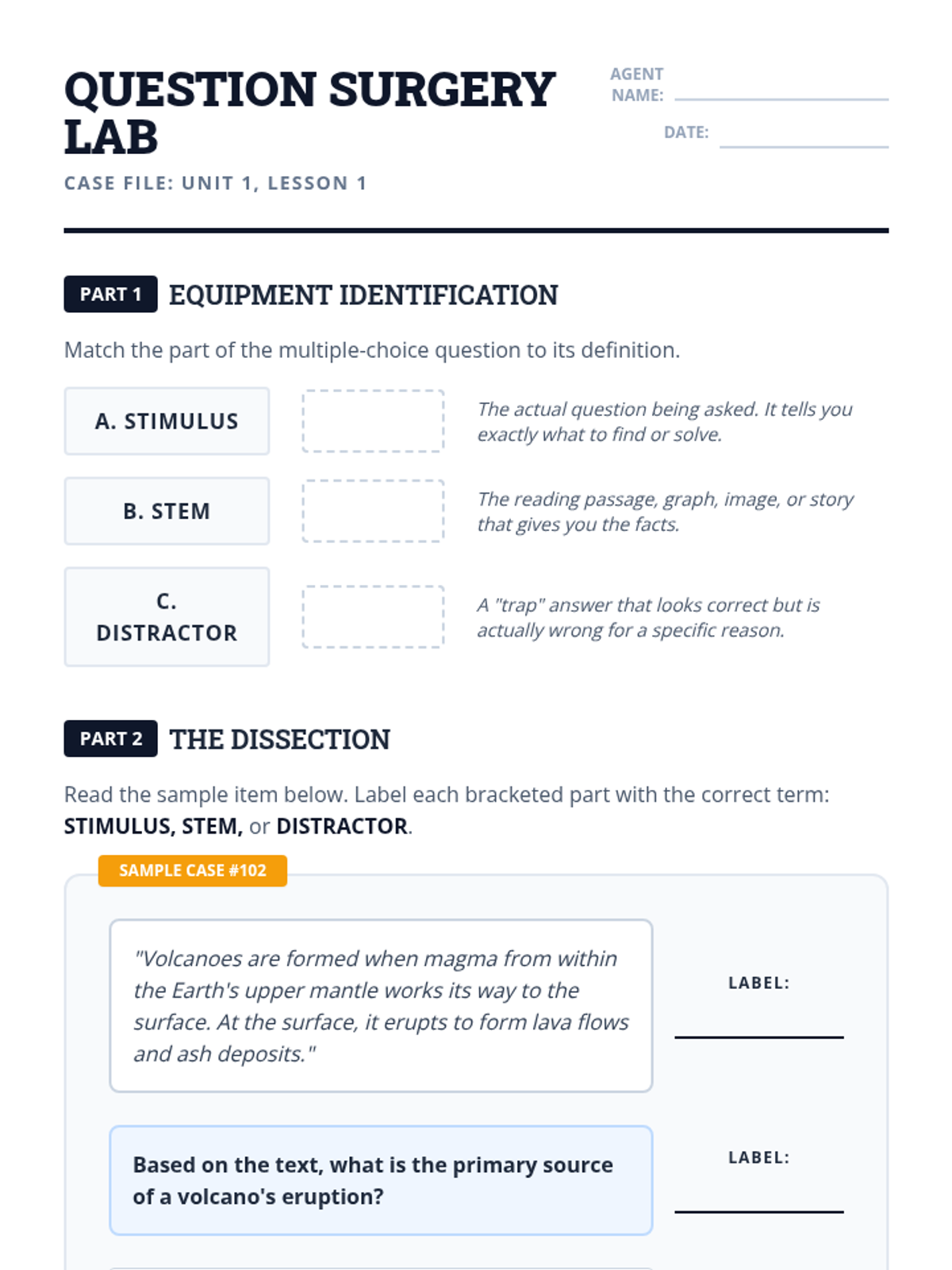
Worksheet for Lesson 1 where students practice identifying the components of a multiple-choice question (Stimulus, Stem, Distractor) through matching and labeling exercises.
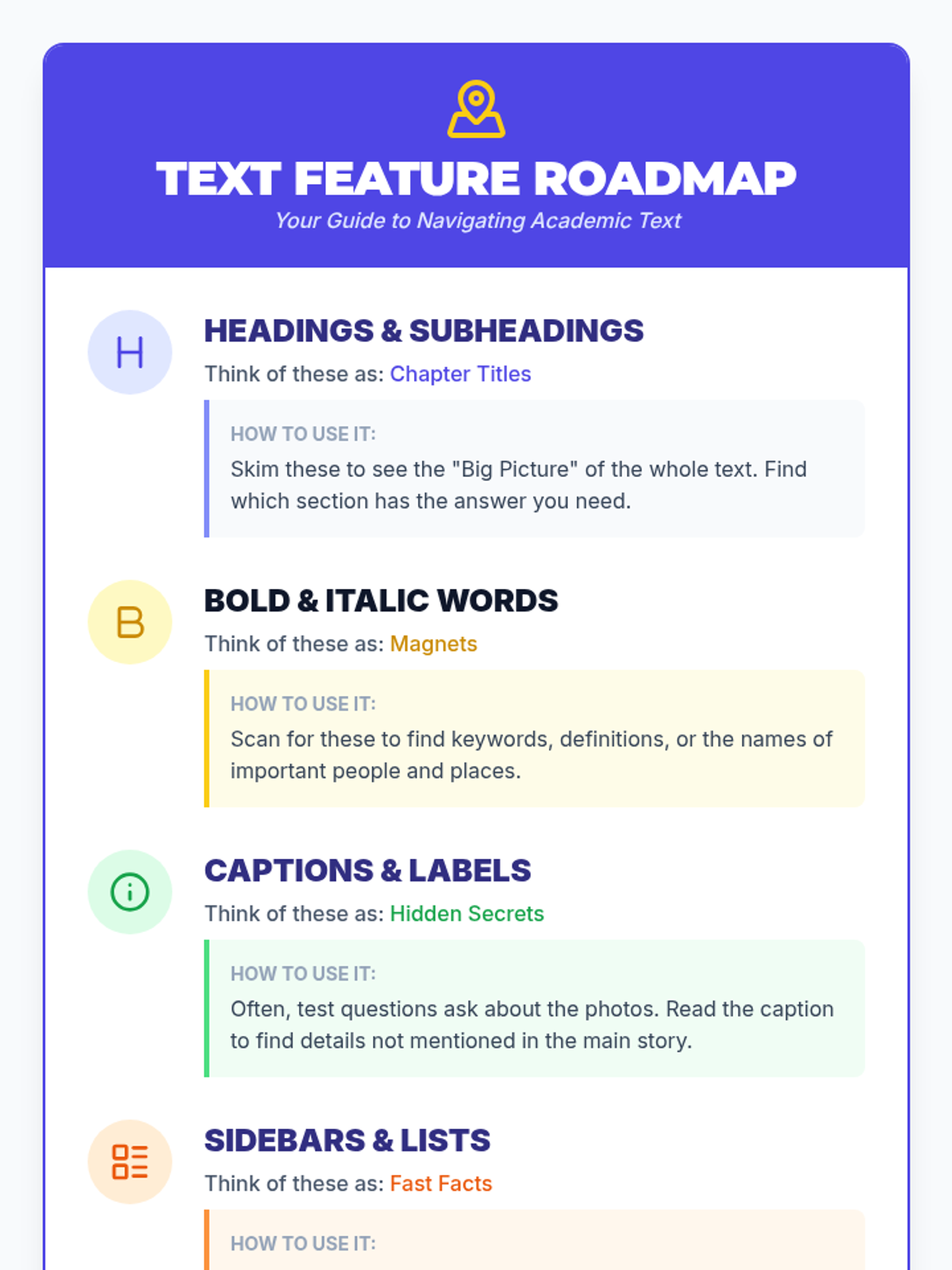
A visual reference sheet (anchor chart) that defines key text features and explains how to use each one for skimming and scanning.
Introductory slide deck for Lesson 1, introducing the terminology of multiple-choice questions (Stimulus, Stem, Correct Answer, Distractors) with a detective-themed aesthetic.
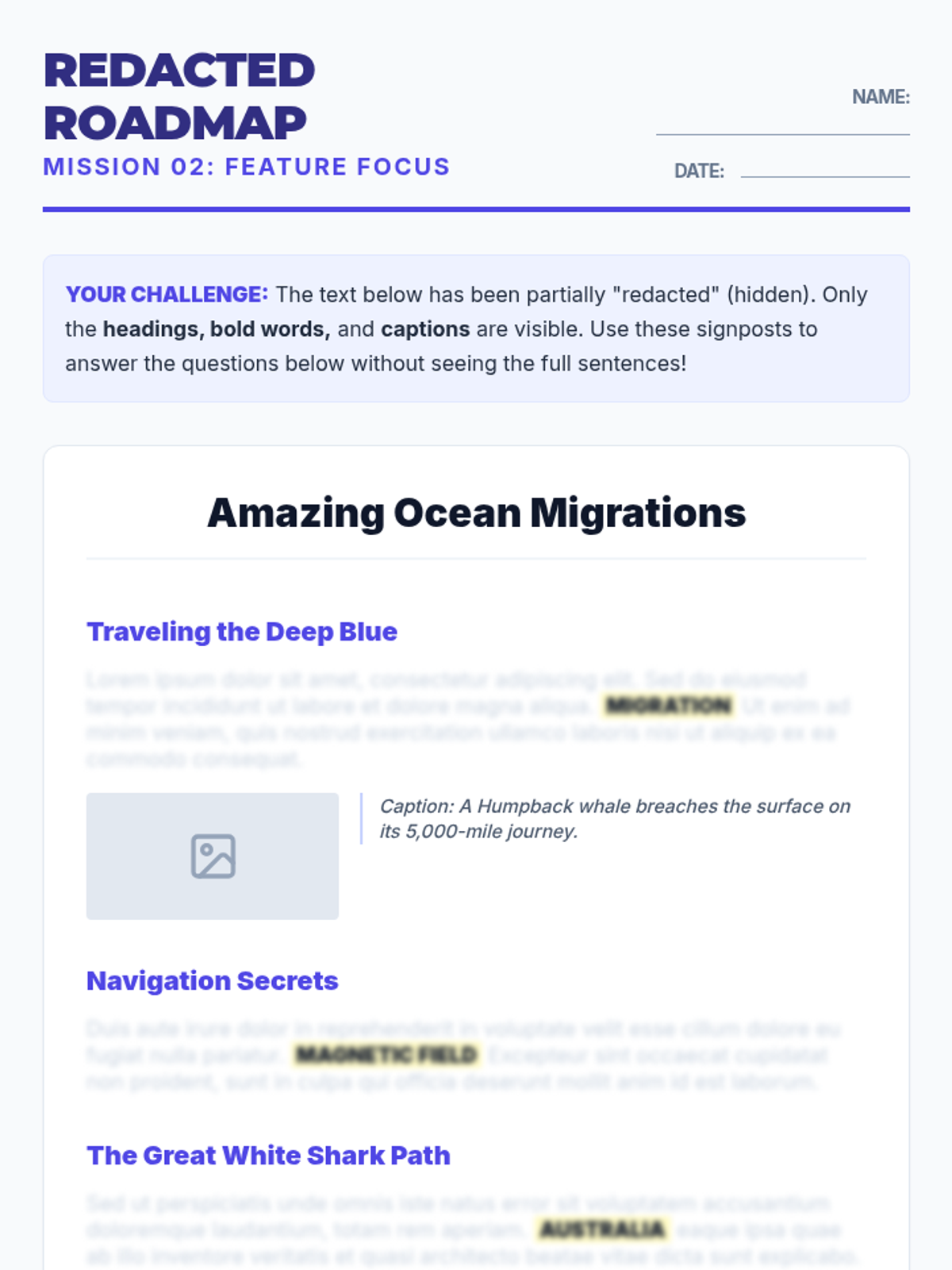
A student worksheet with partially redacted text that forces students to use headings, captions, and bold words to identify the main topic and find specific details.
Visual presentation for Lesson 2, teaching students to identify and use text features like headings, bold words, and captions to navigate academic texts.
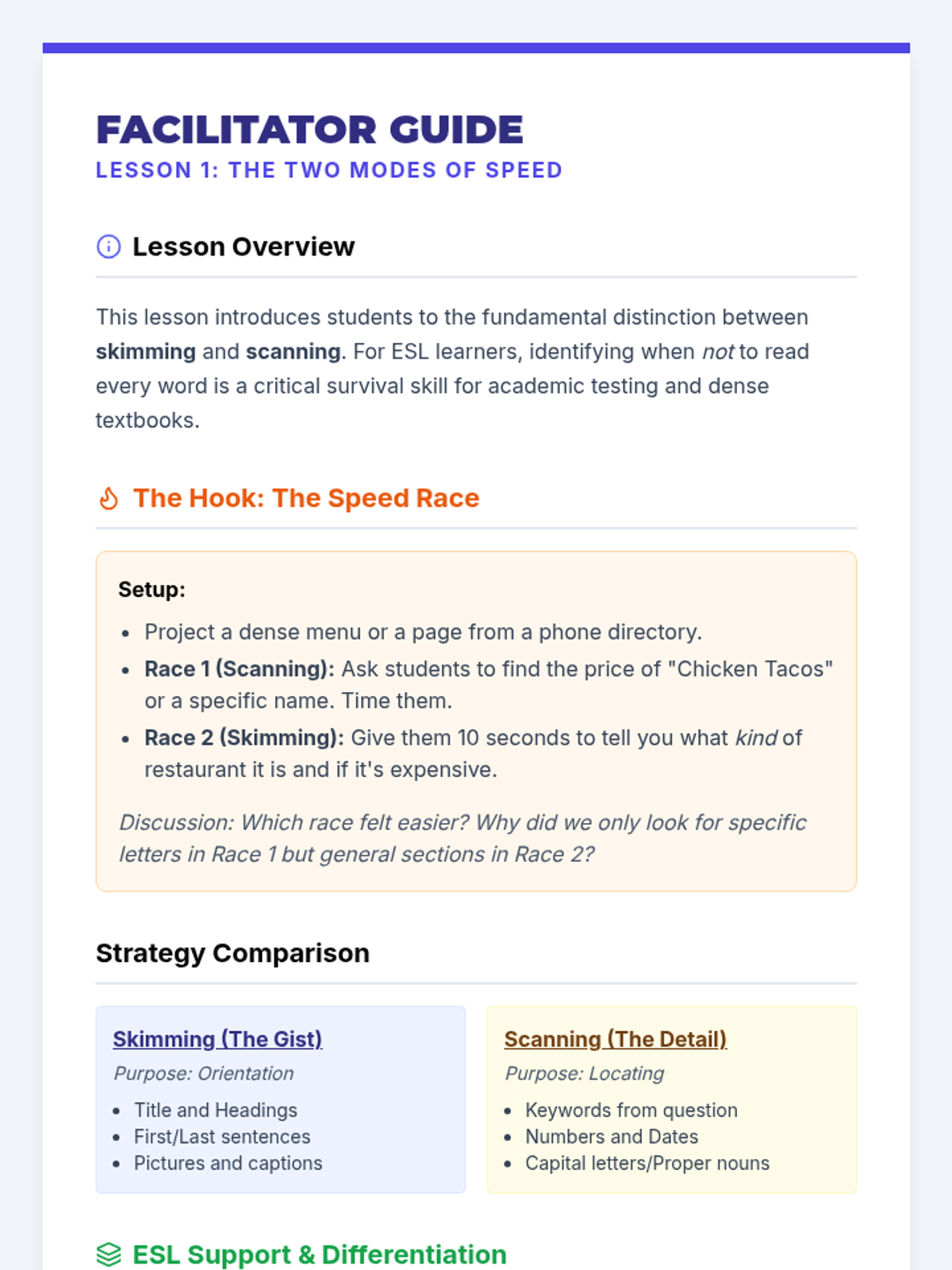
Teacher facilitation guide for Lesson 1, including hook instructions, ESL support strategies, and exit ticket prompts.
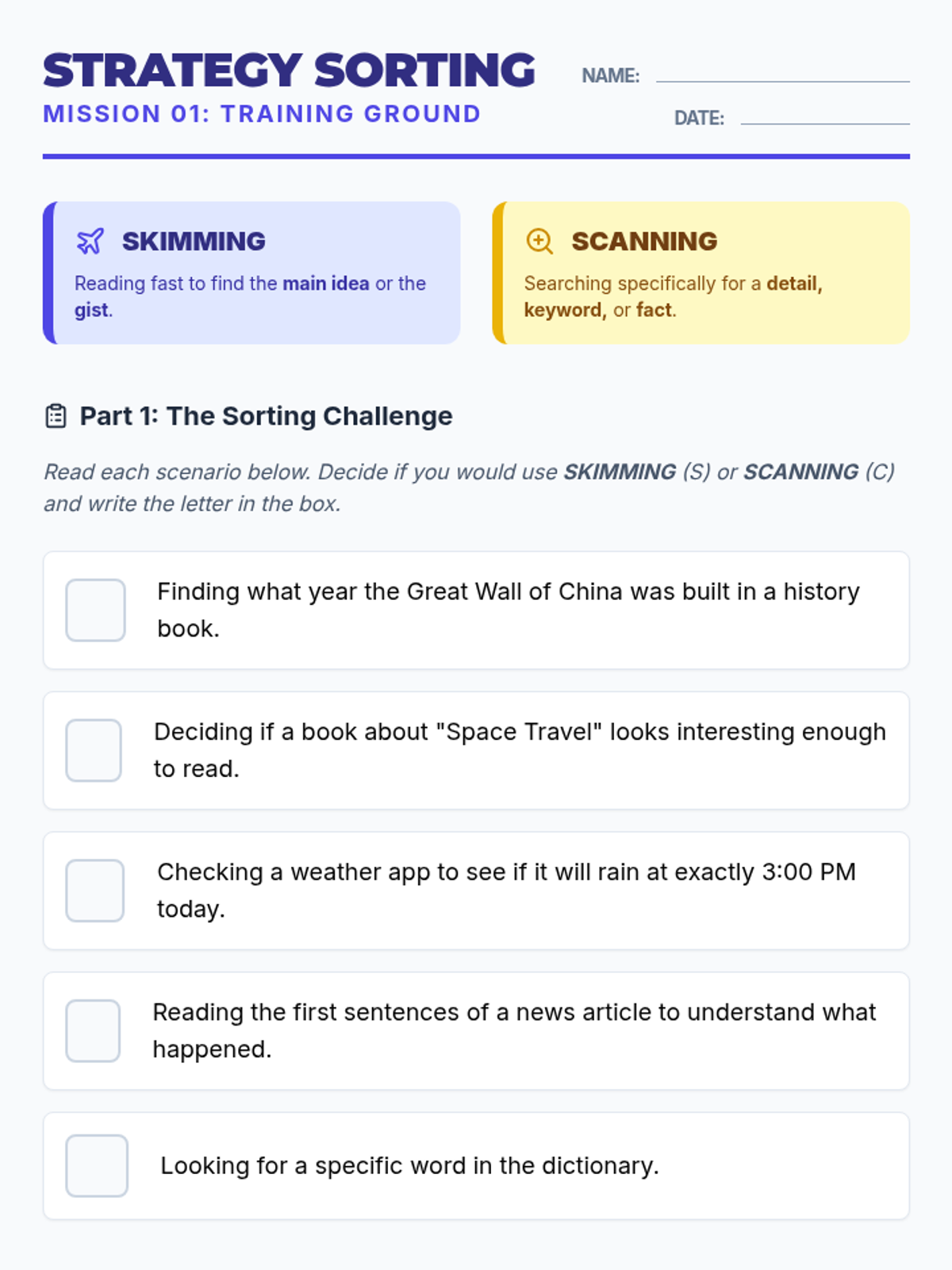
A student worksheet for sorting reading scenarios into skimming and scanning categories, reinforcing the conceptual difference.
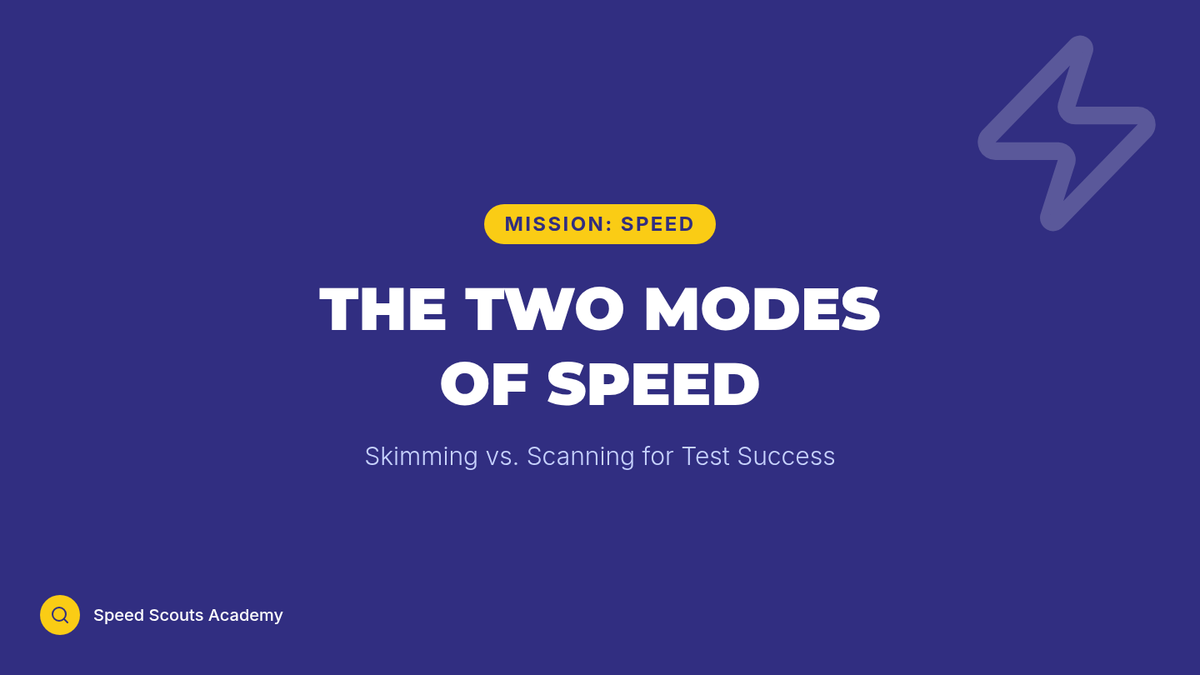
Introductory slide deck for Lesson 1, defining skimming and scanning with visual metaphors and interactive real-world examples.
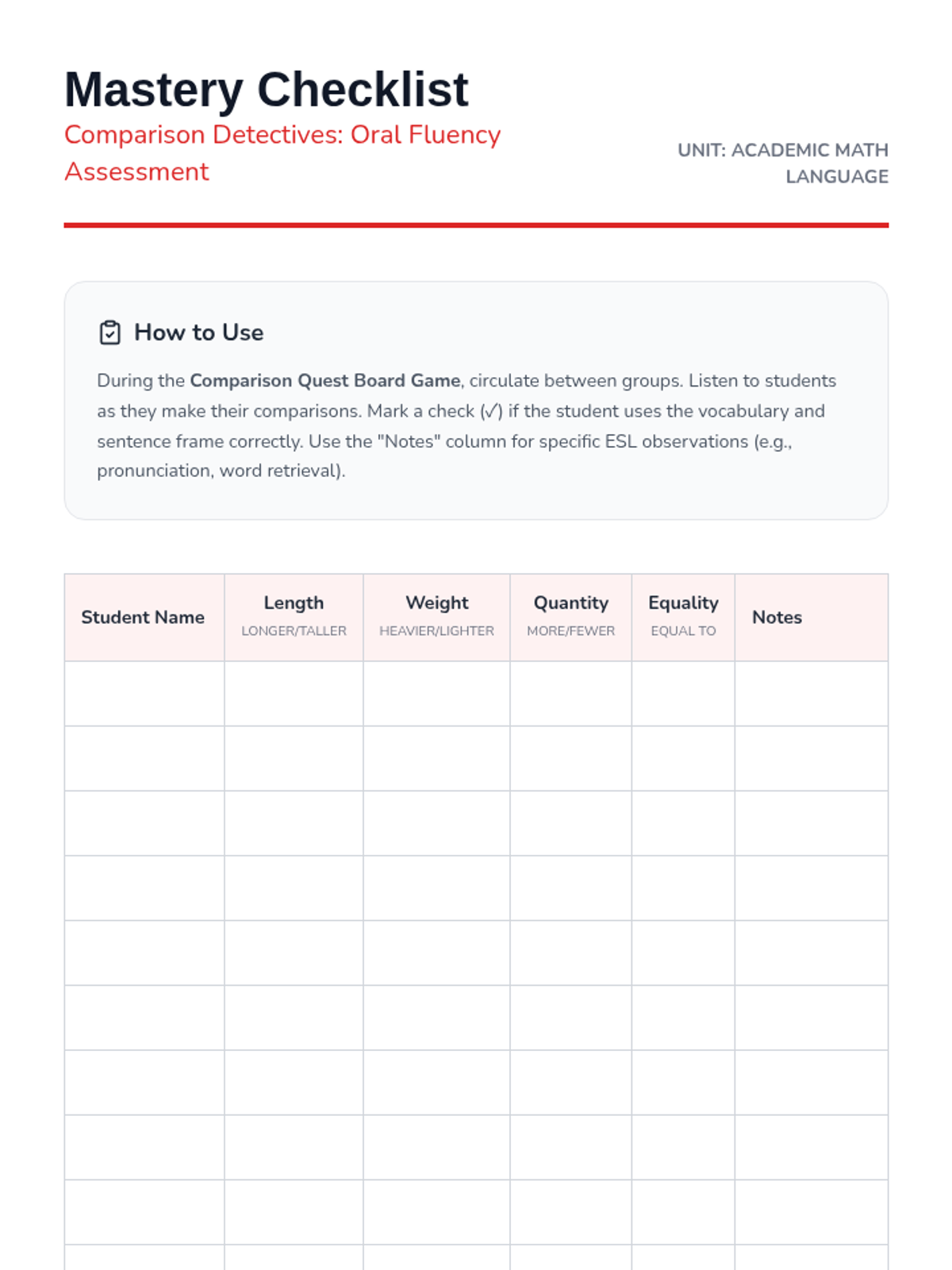
Teacher assessment tool for tracking student mastery of comparative math language during the review game.
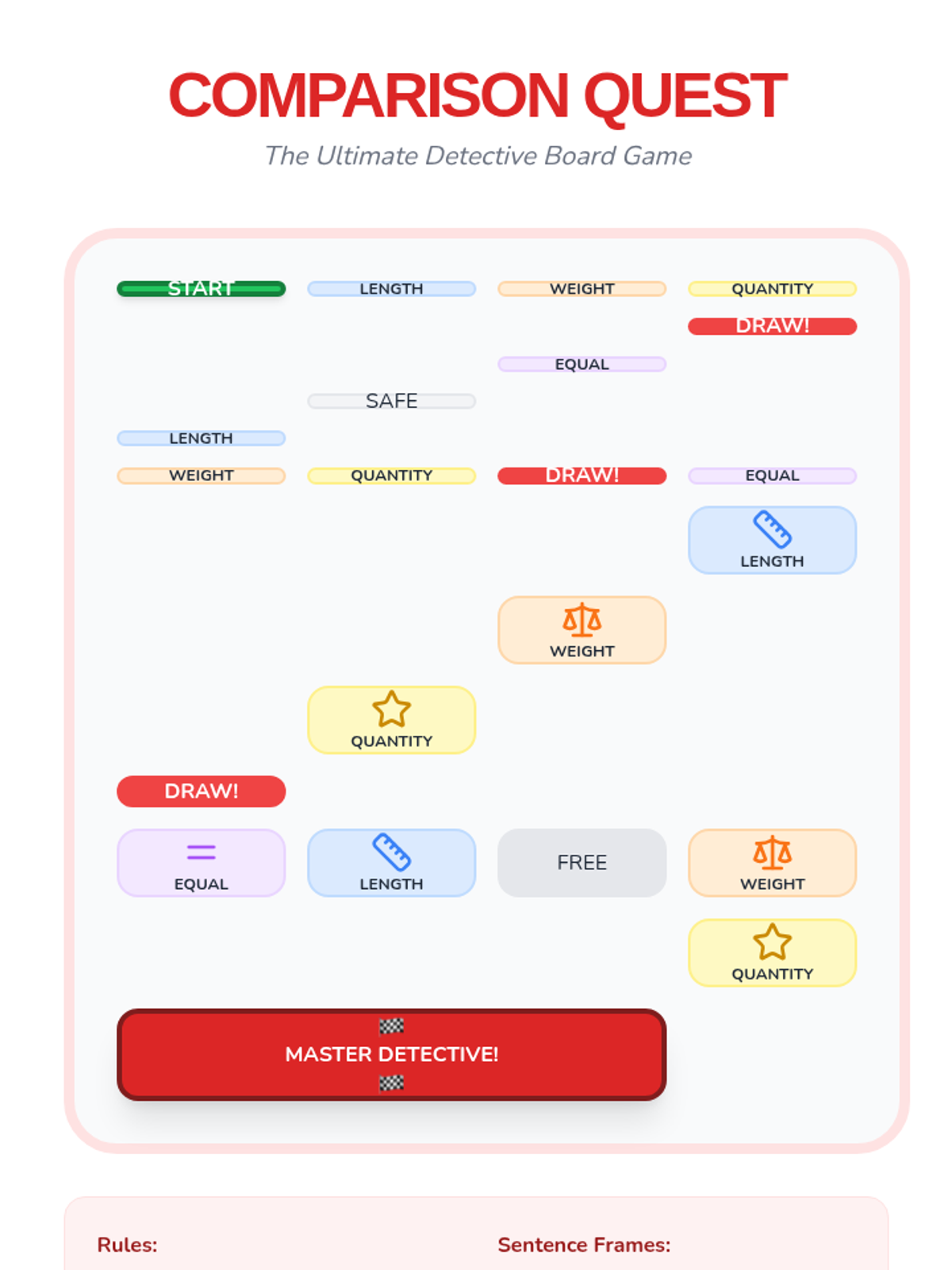
A board game for students to practice comparative language across all topics (length, weight, quantity).
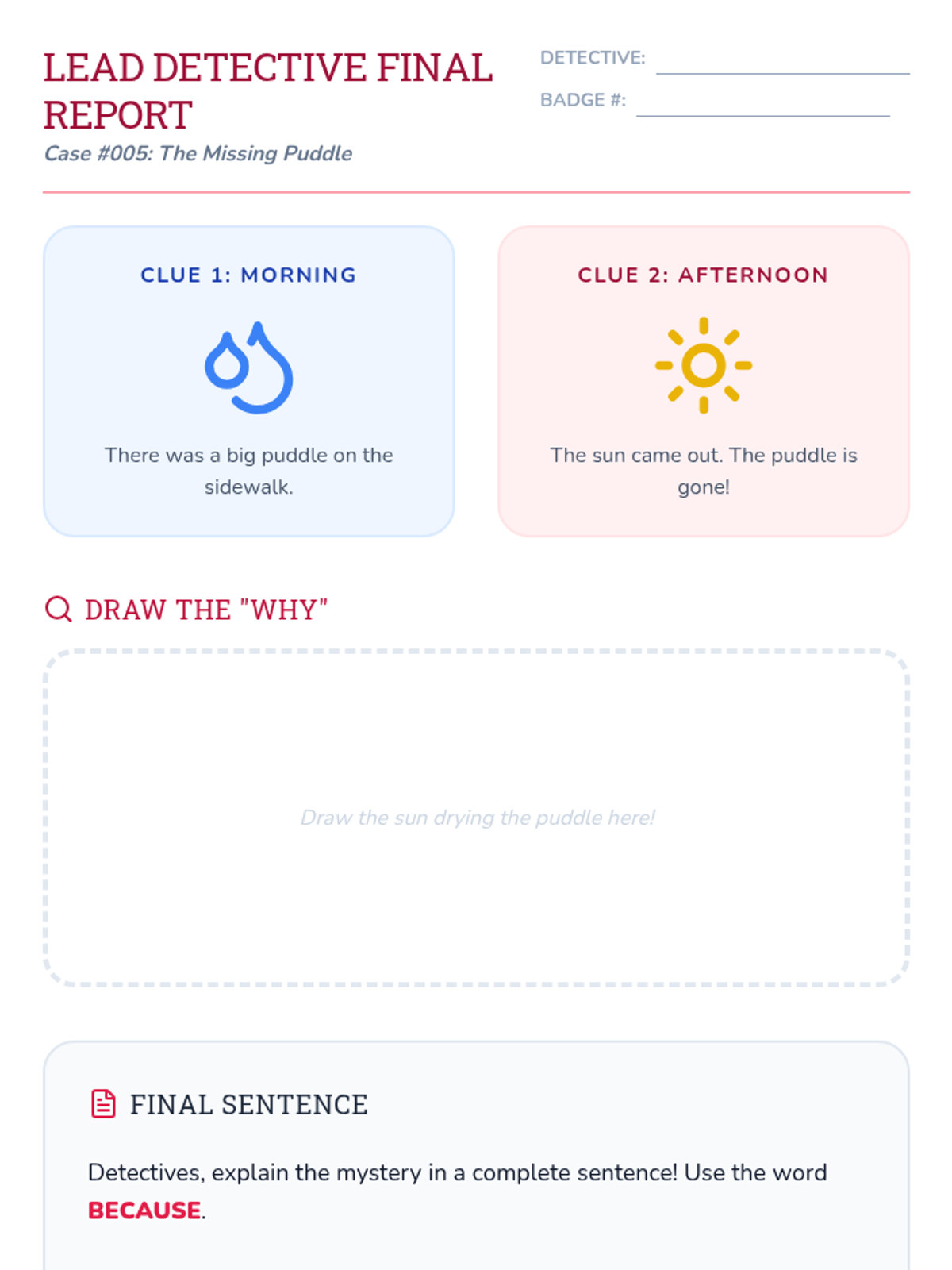
A student assessment worksheet for the final lesson where they explain the 'Missing Puddle' mystery using causal language.
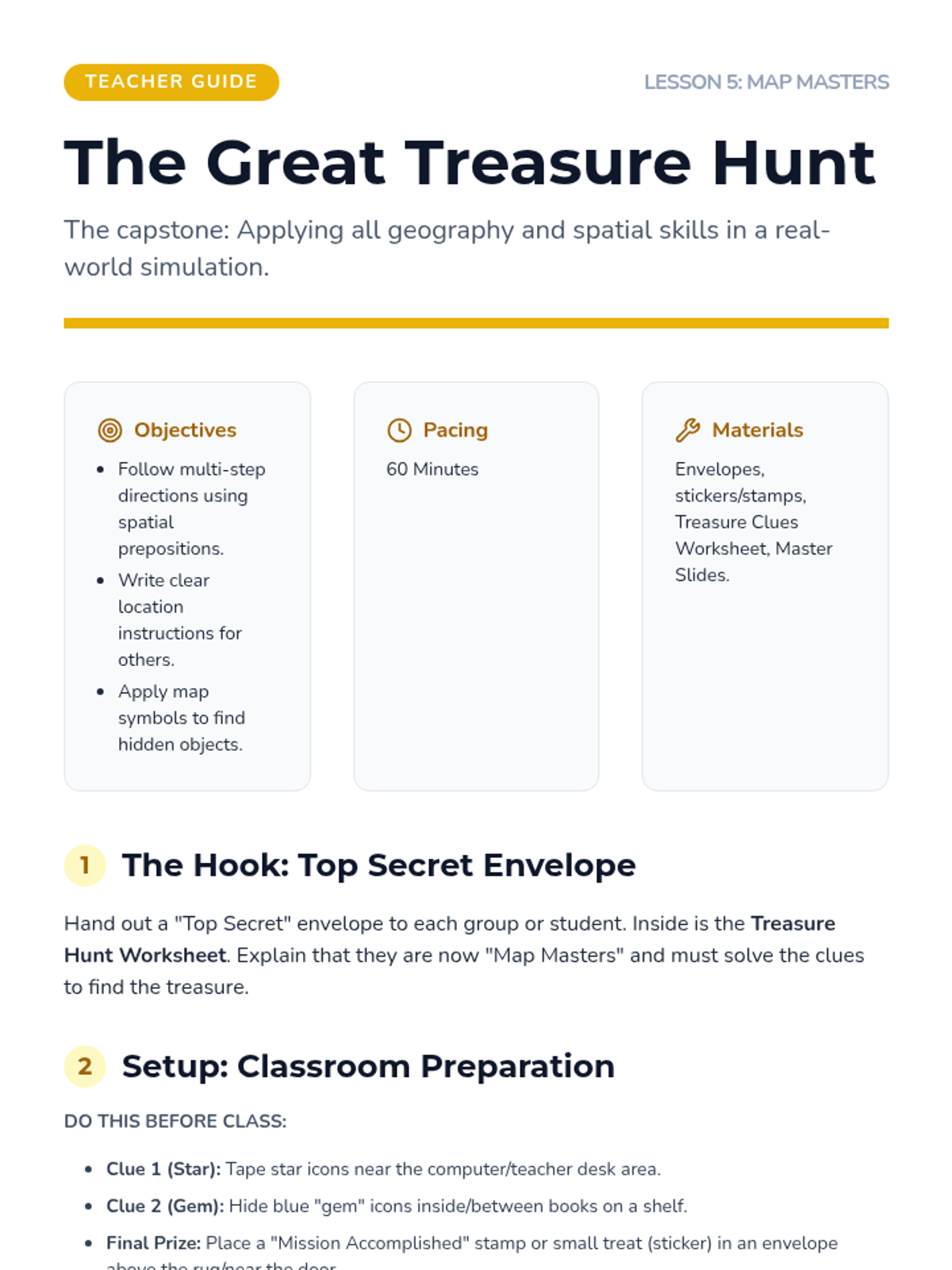
Teacher guide for Lesson 5, including setup instructions, clue management, and mastery task facilitation for the classroom treasure hunt.