Emotion recognition ranging from basic feelings to complex nuances and mixed states. Strengthens accurate self-assessment through identity exploration, strength identification, and values-based decision making.
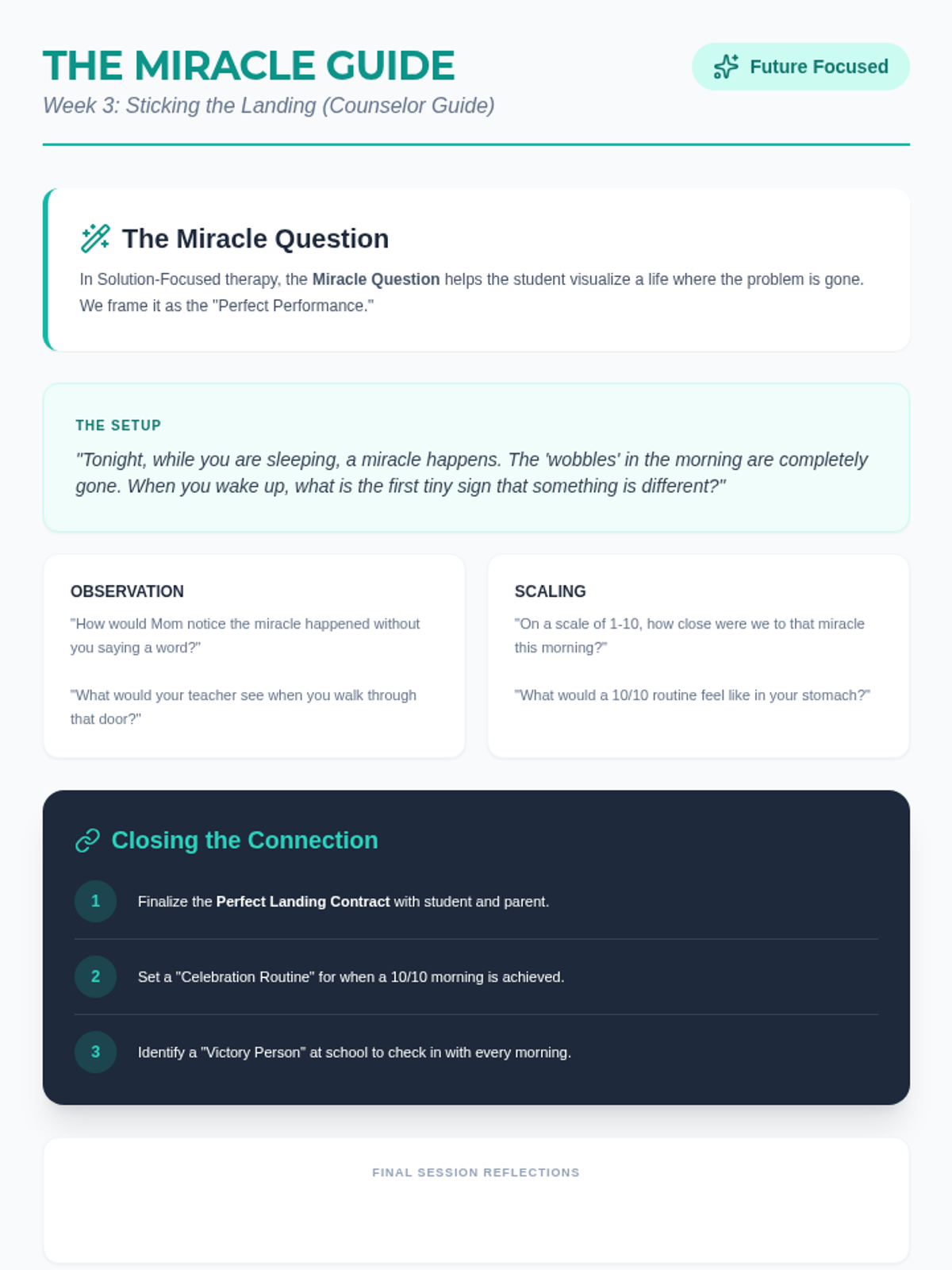
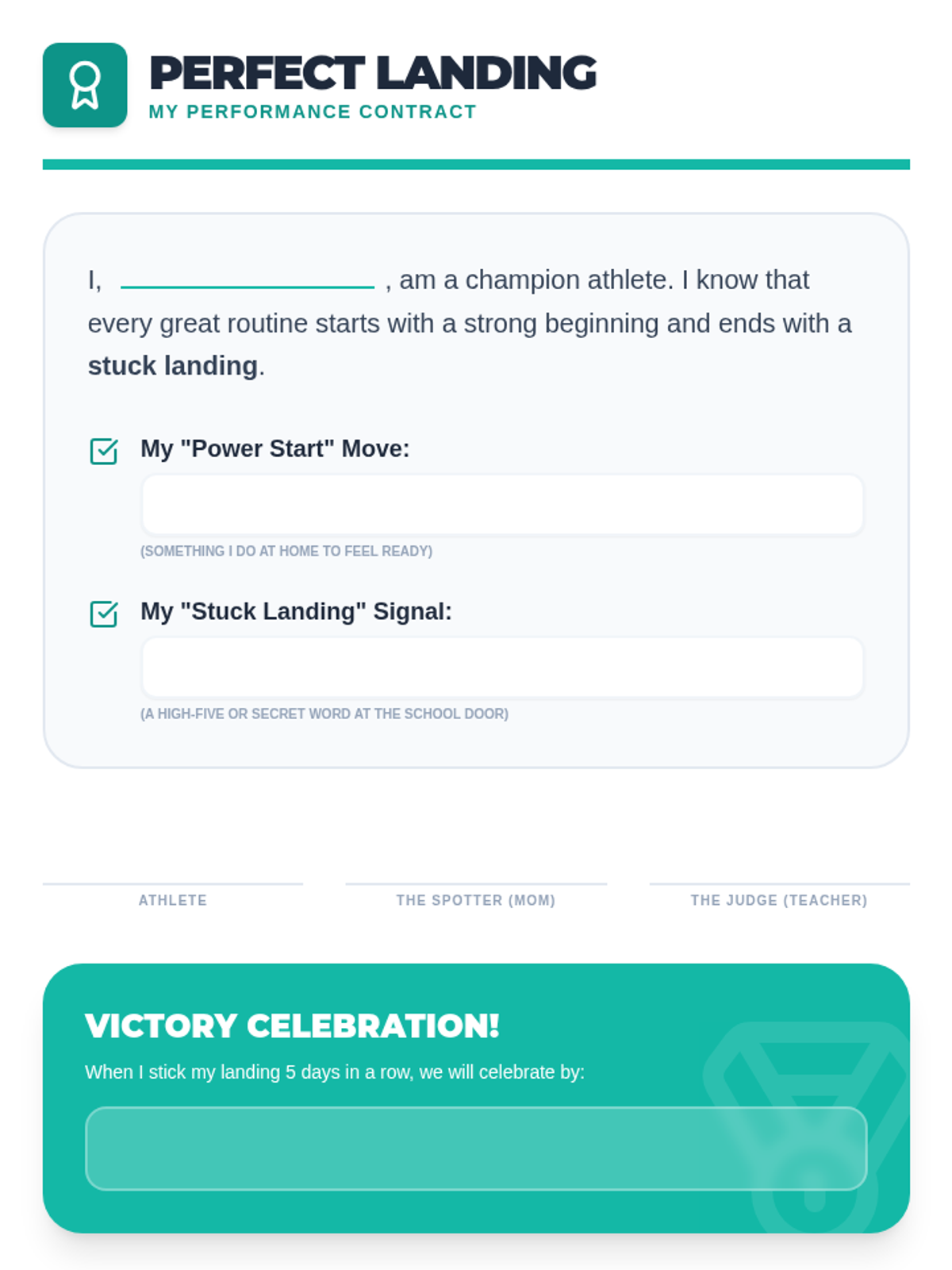
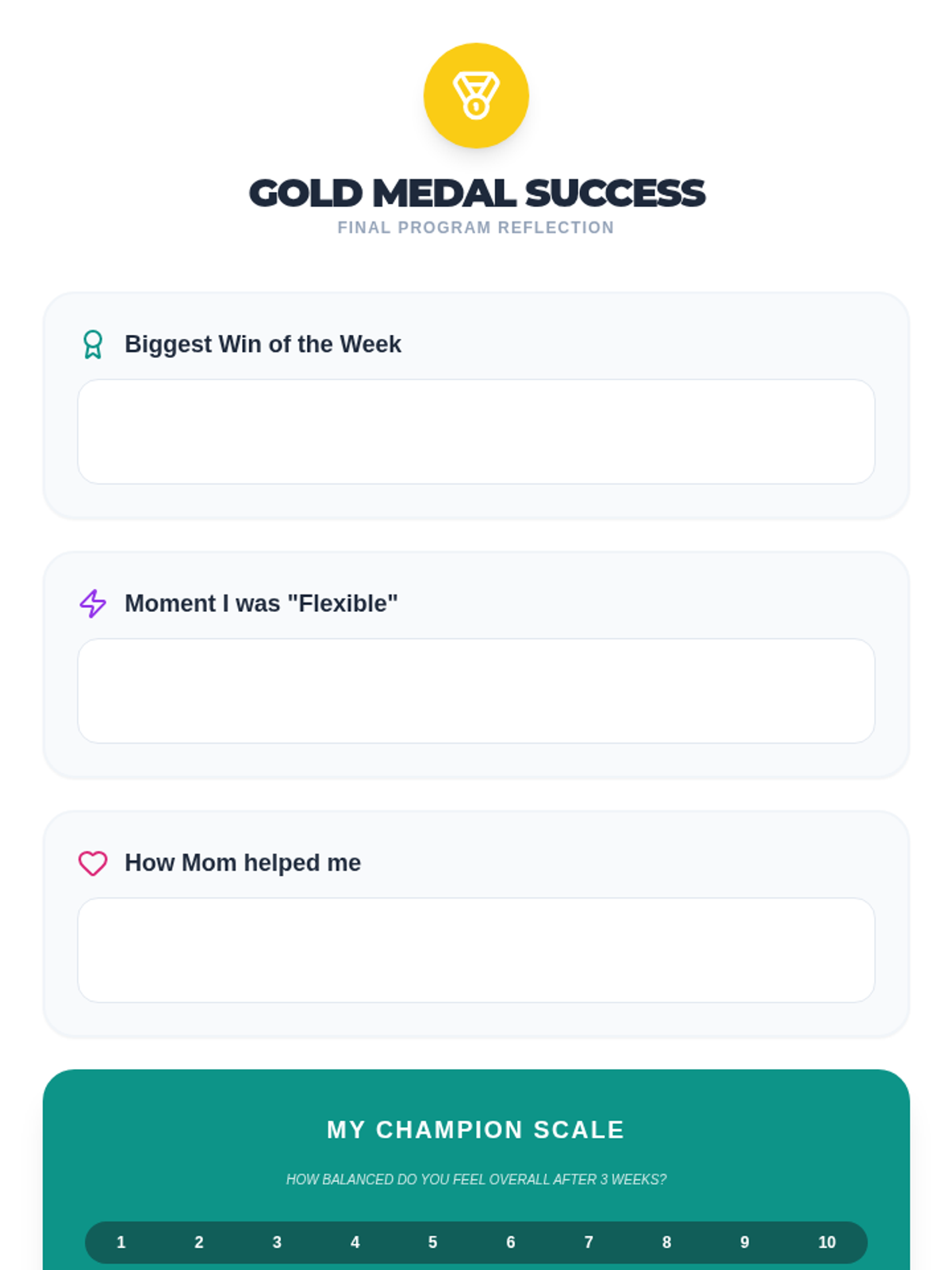
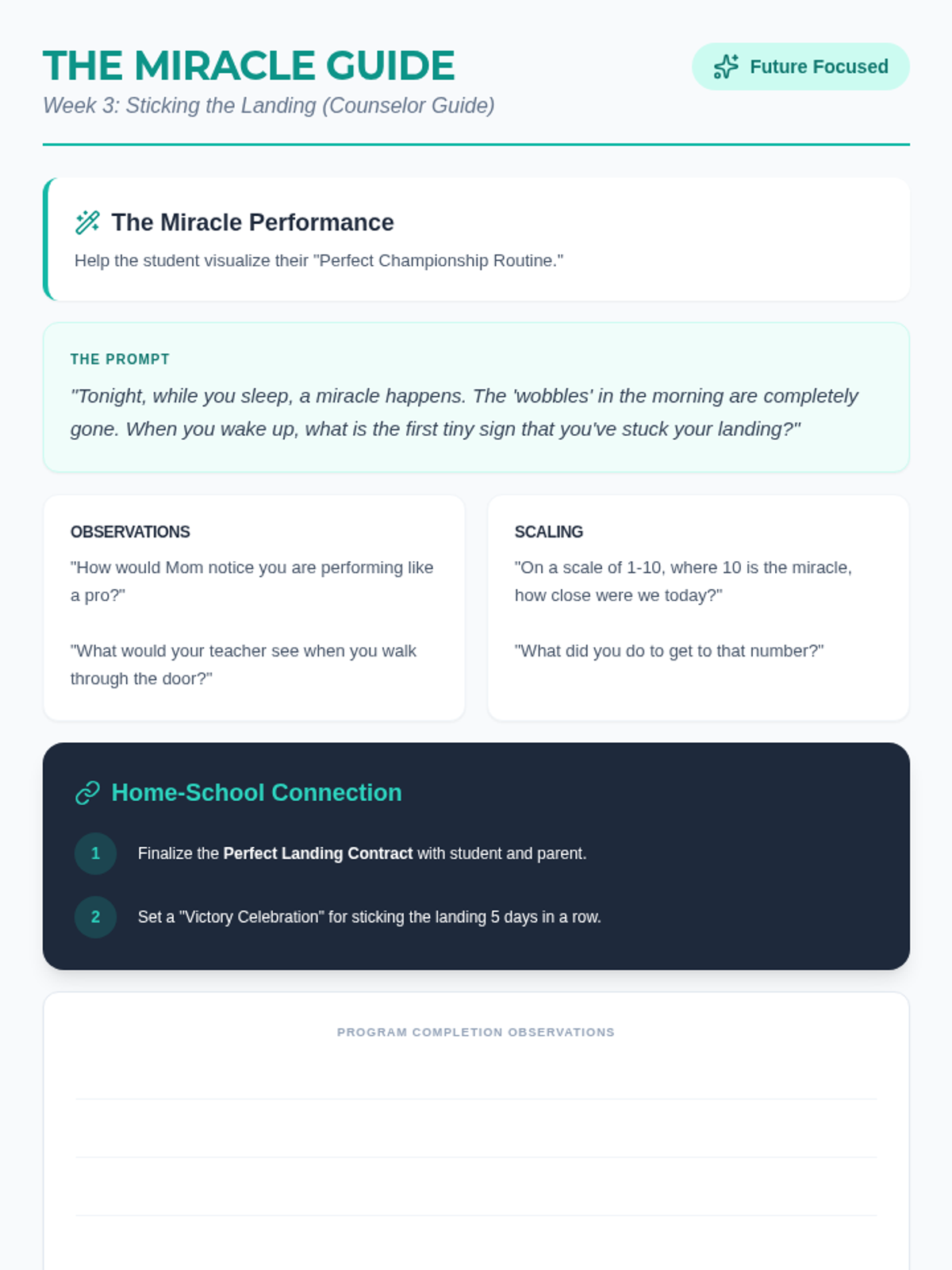
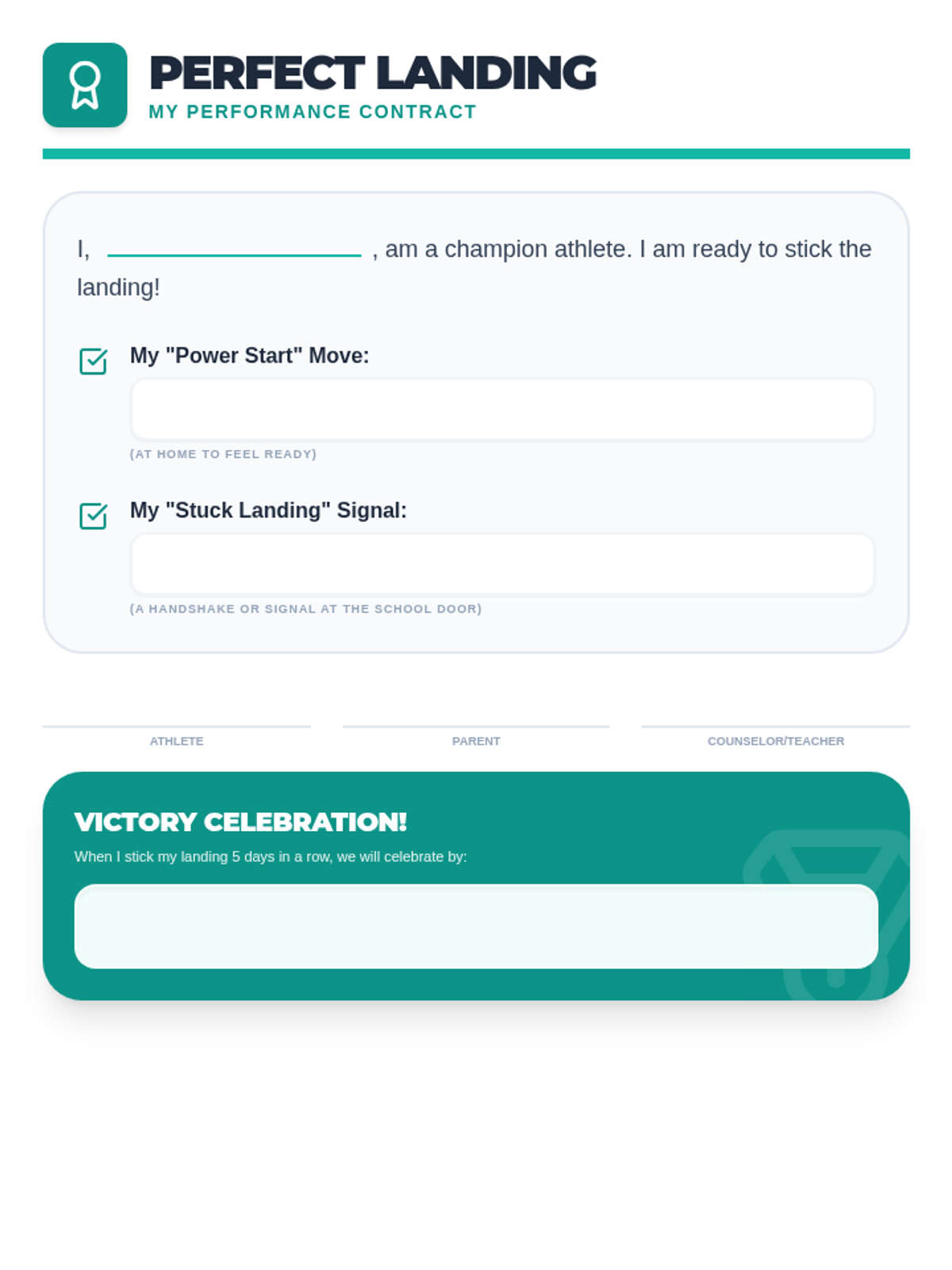
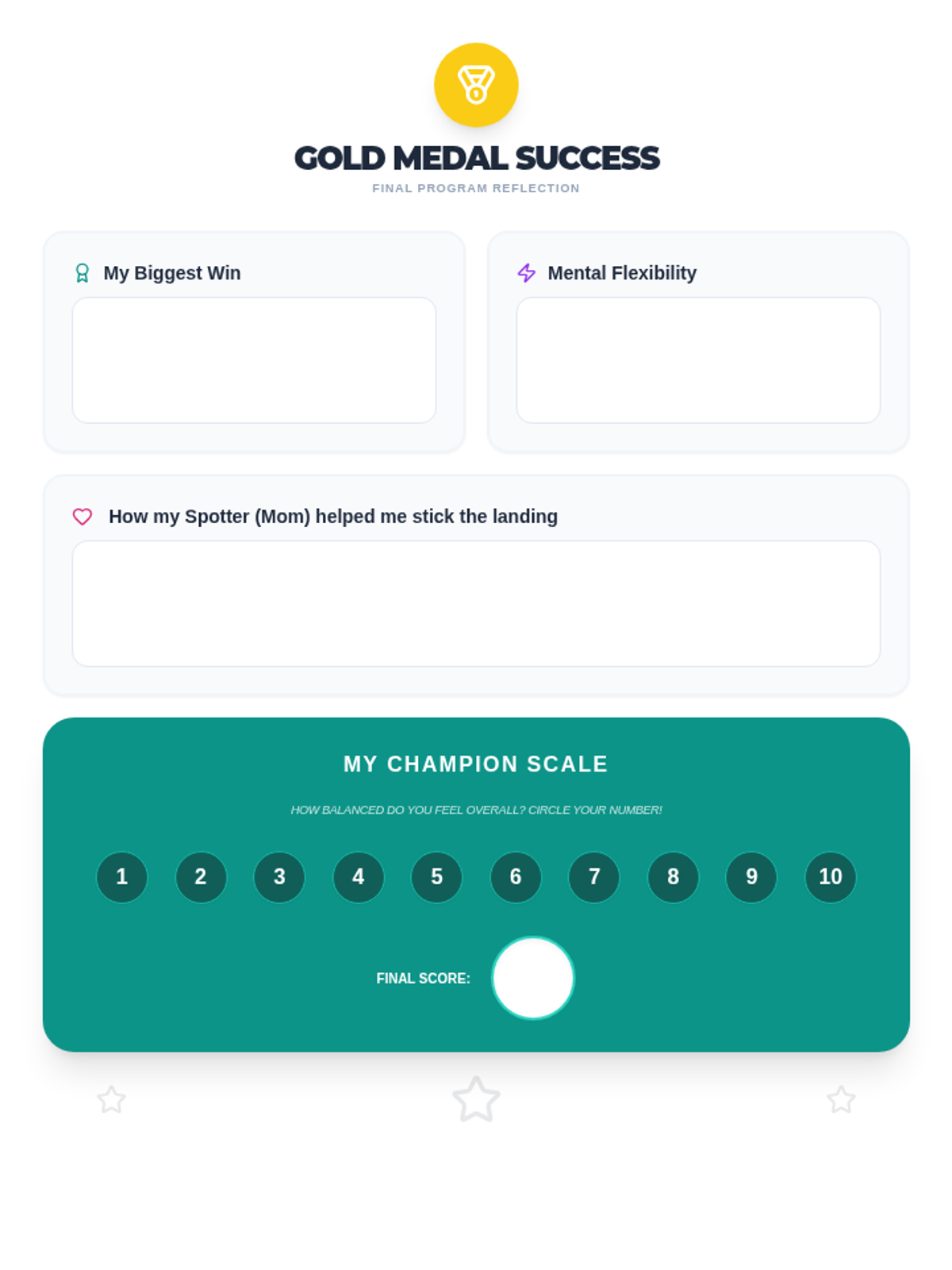
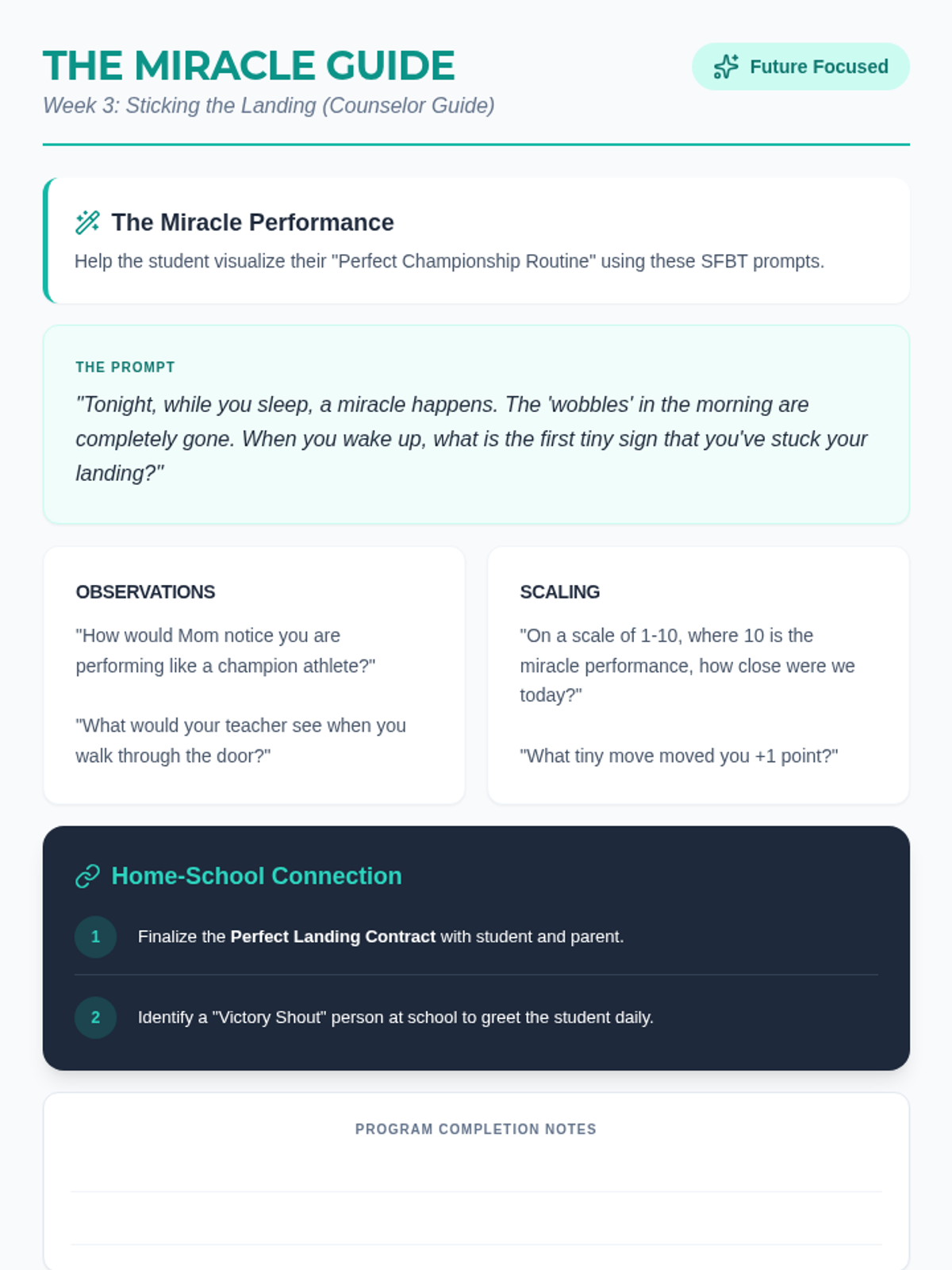
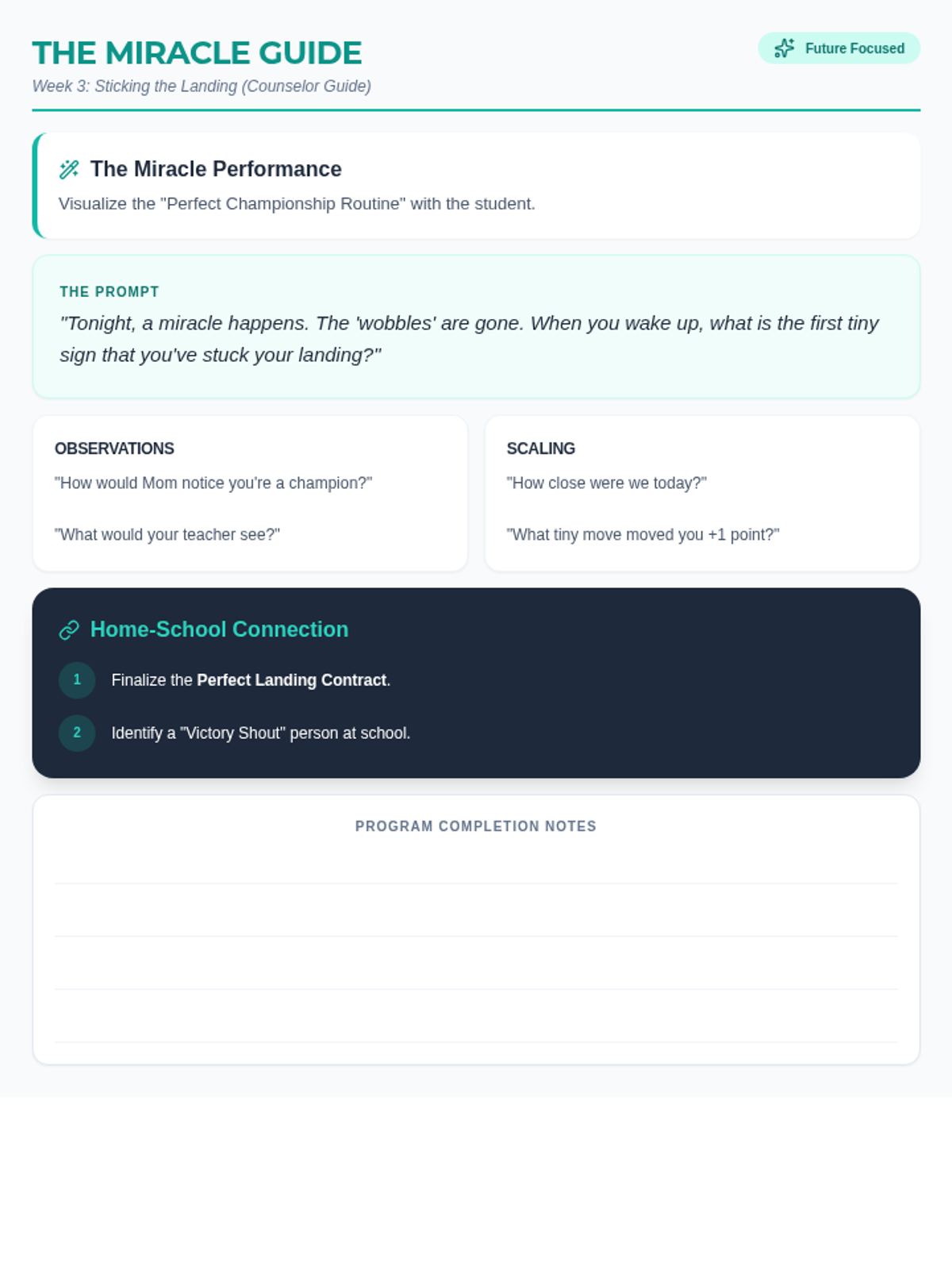
Focuses on future-oriented thinking and the "Miracle Morning." Solidifies the home-school connection and celebrates small wins with a "Gold Medal" mindset.
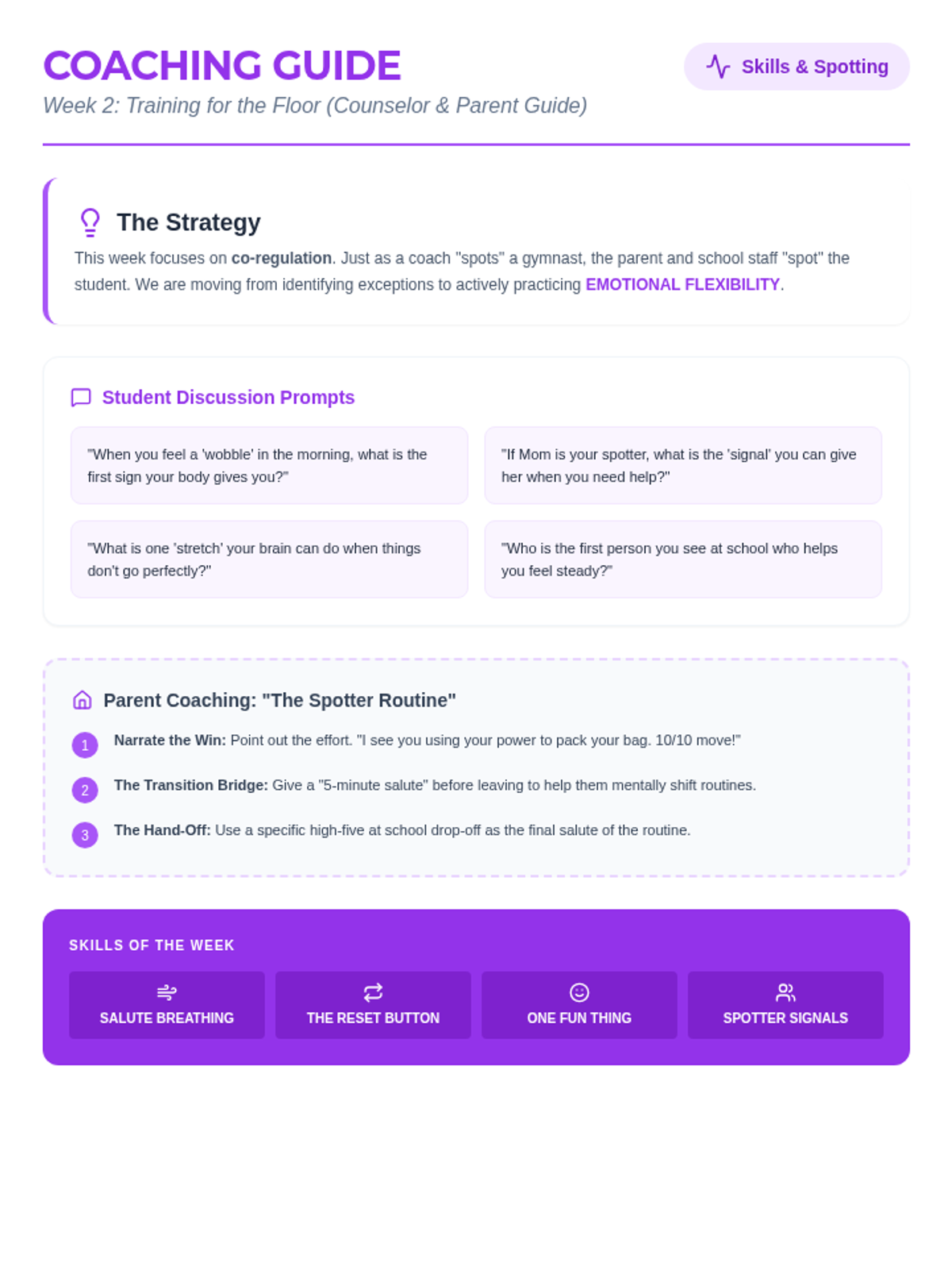
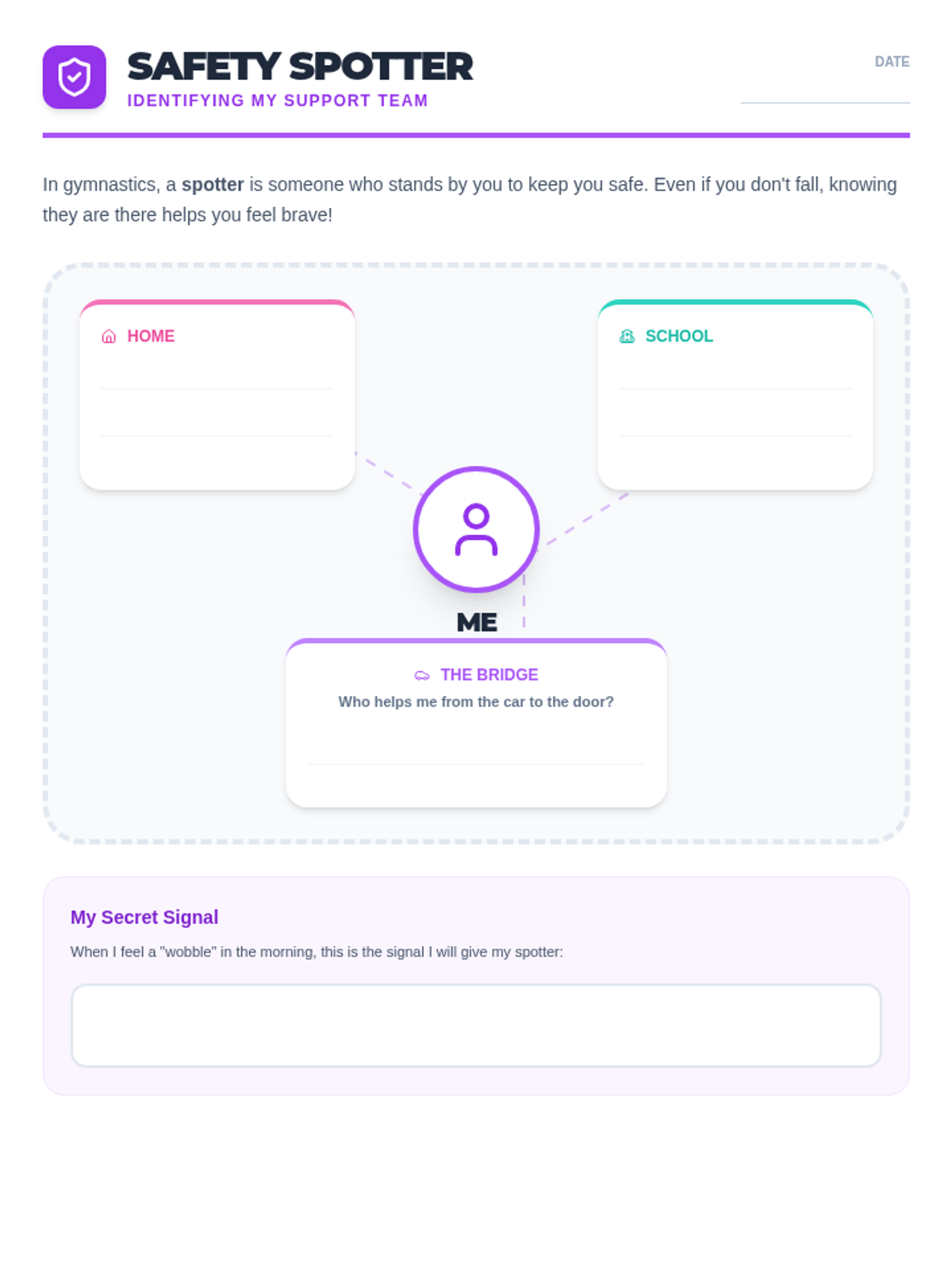
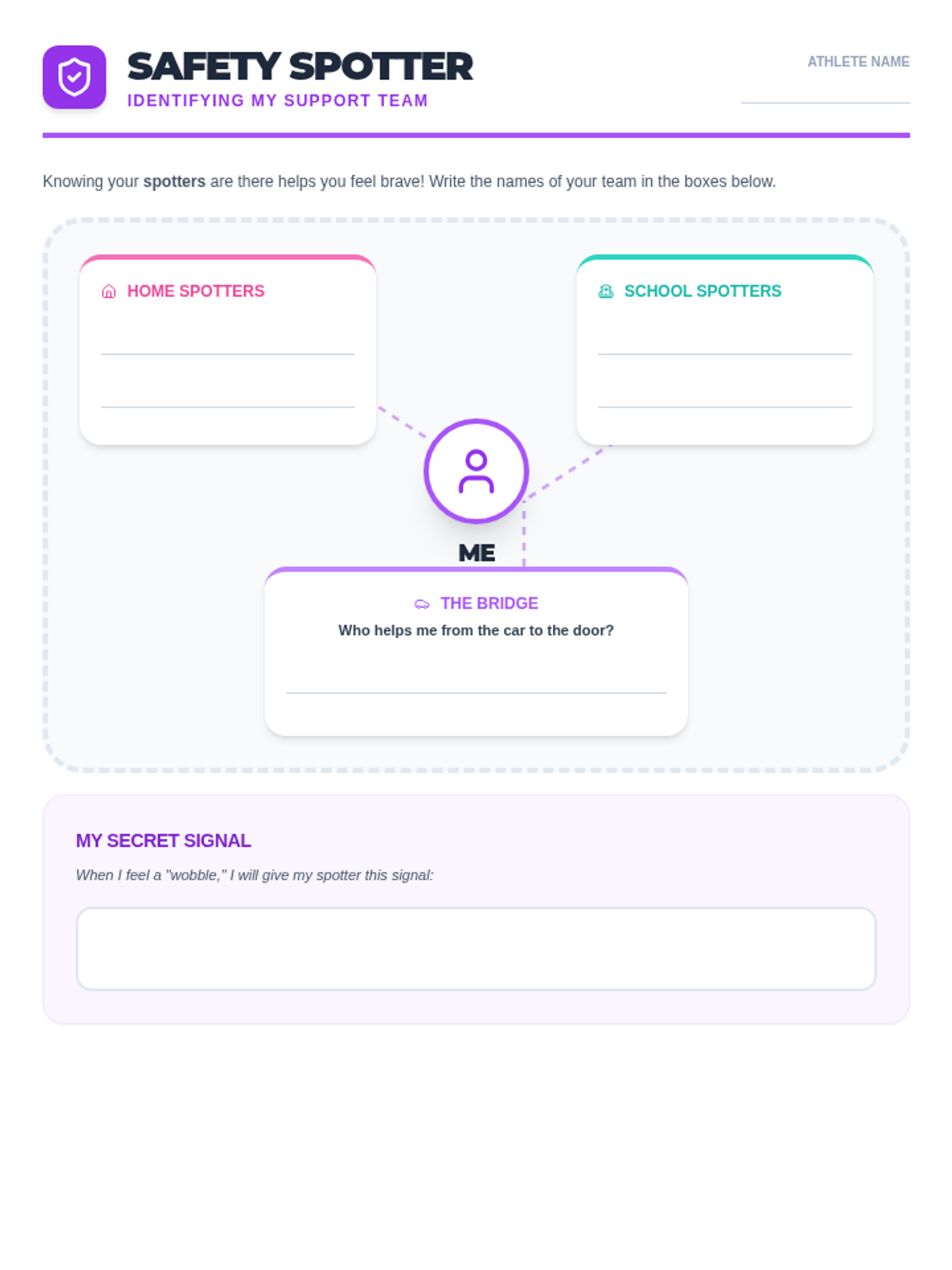
Focuses on developing specific coping skills and "routines" for the transition. Uses the metaphor of "spotting" and "flexibility" to manage big emotions in the morning.
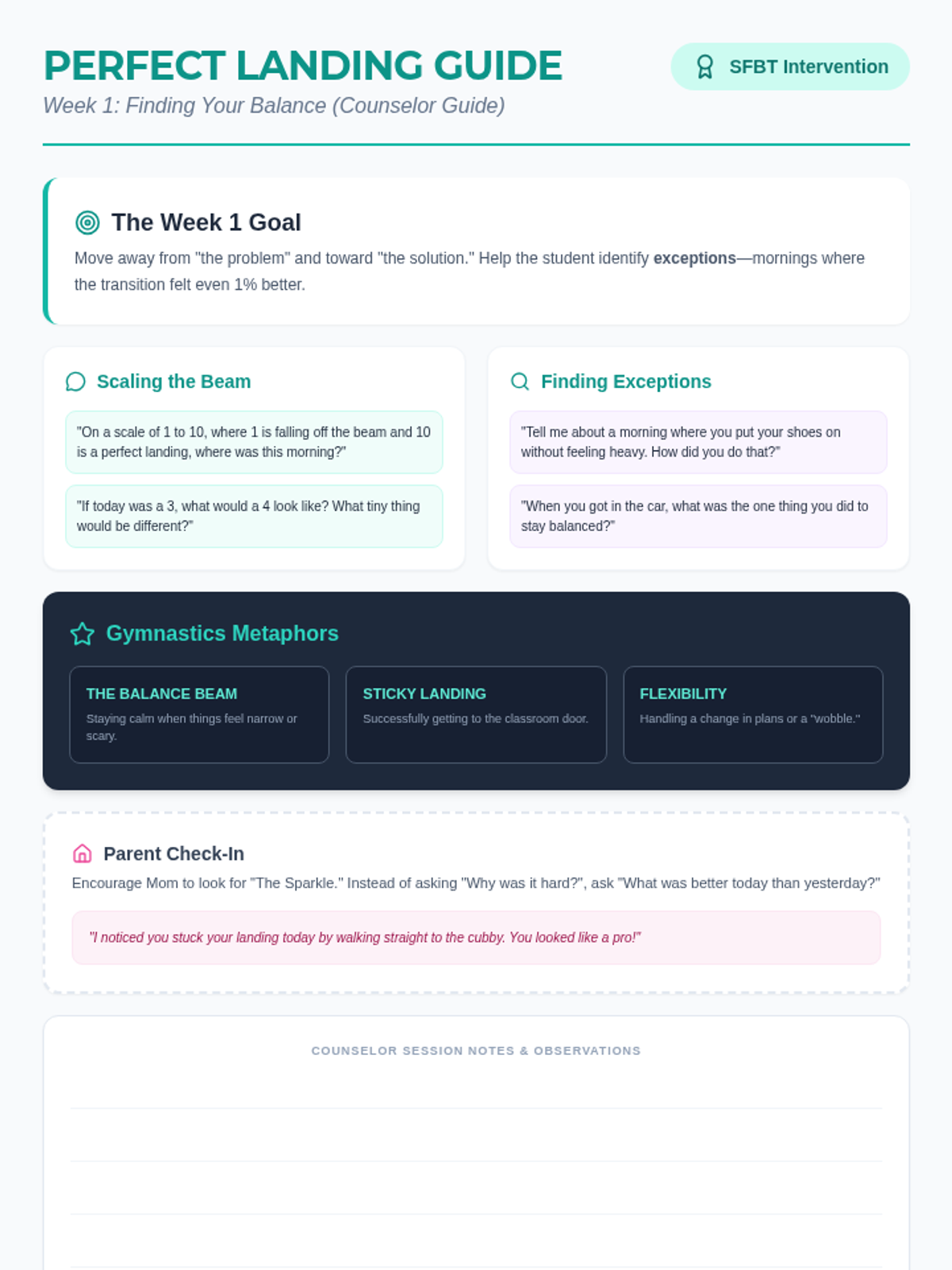
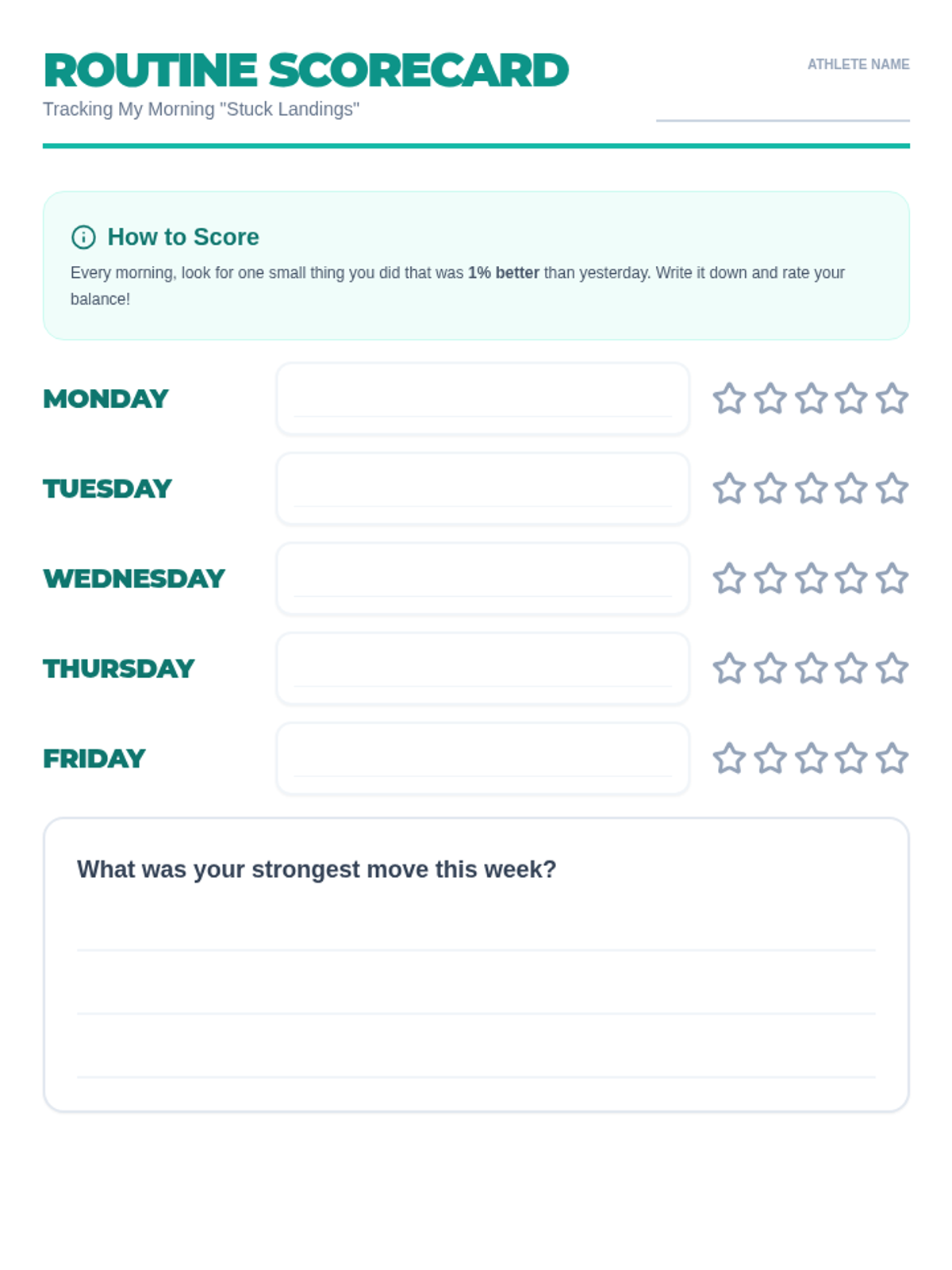
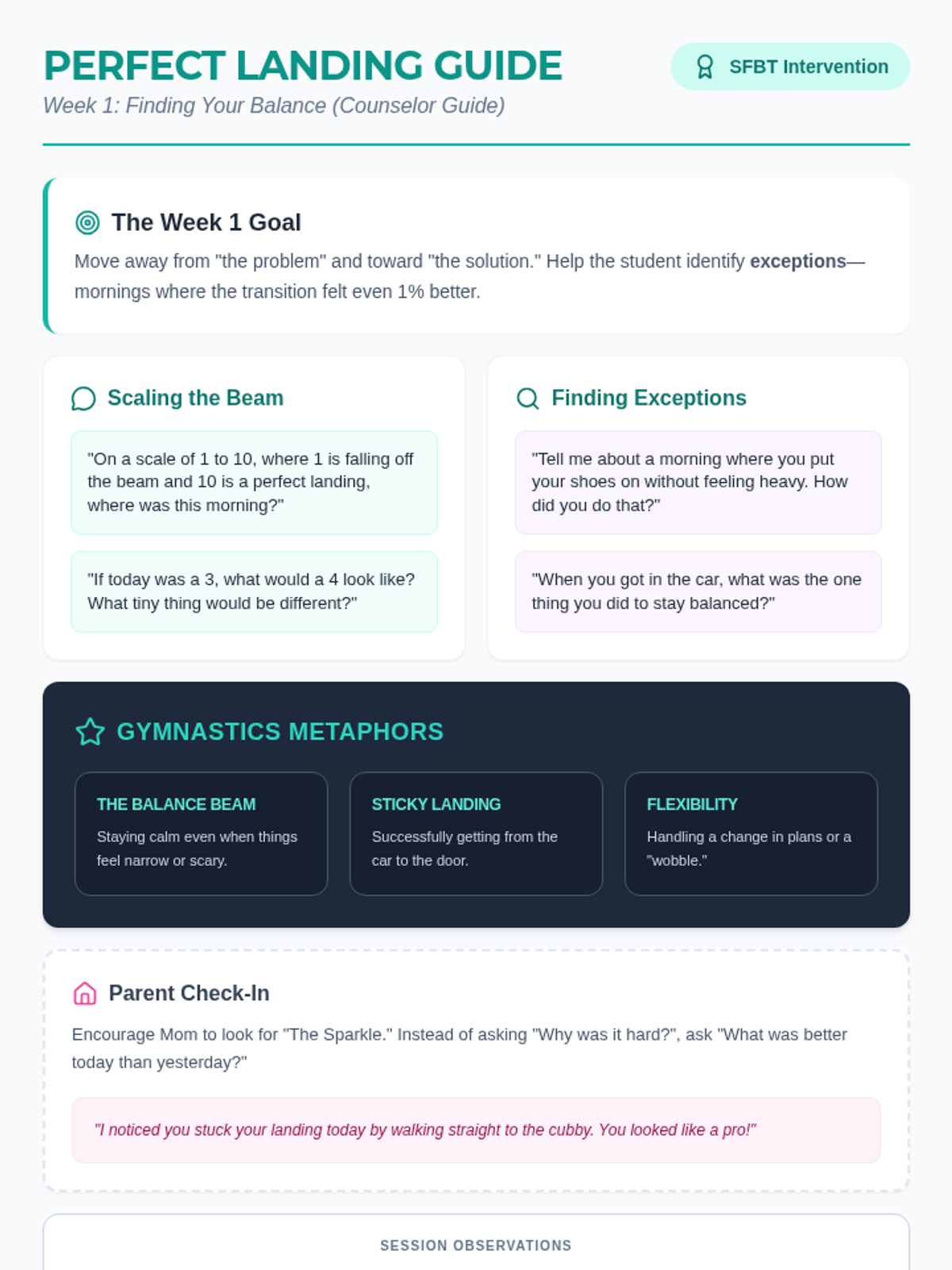
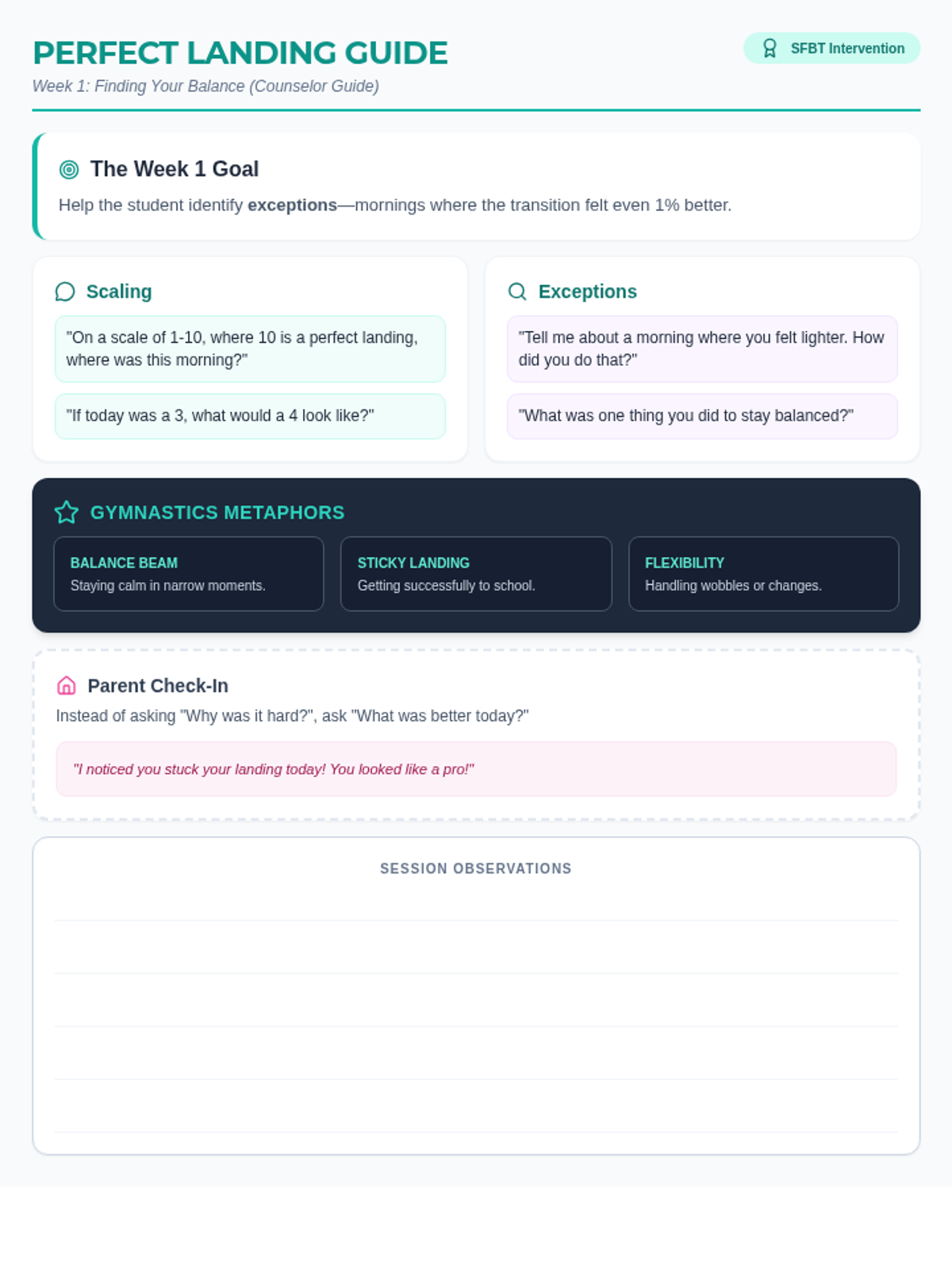
Focuses on identifying current challenges and finding "exceptions" to the morning struggle using the metaphor of a balance beam. Introduces scaling questions and strengths-based goal setting.
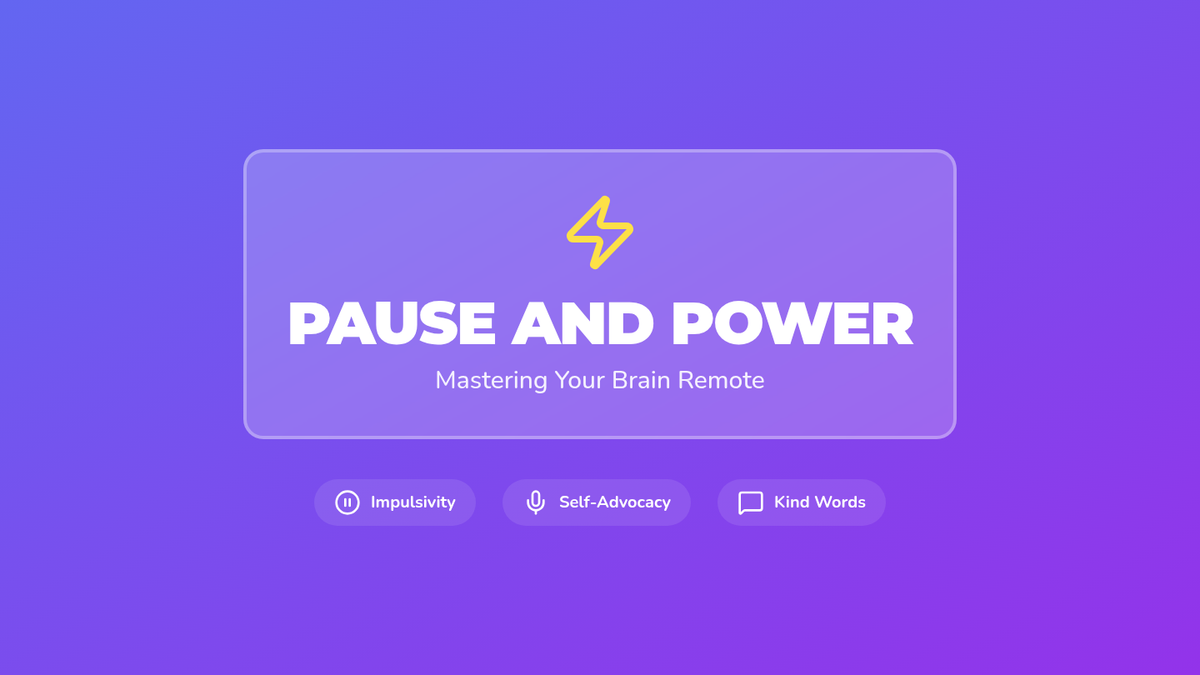
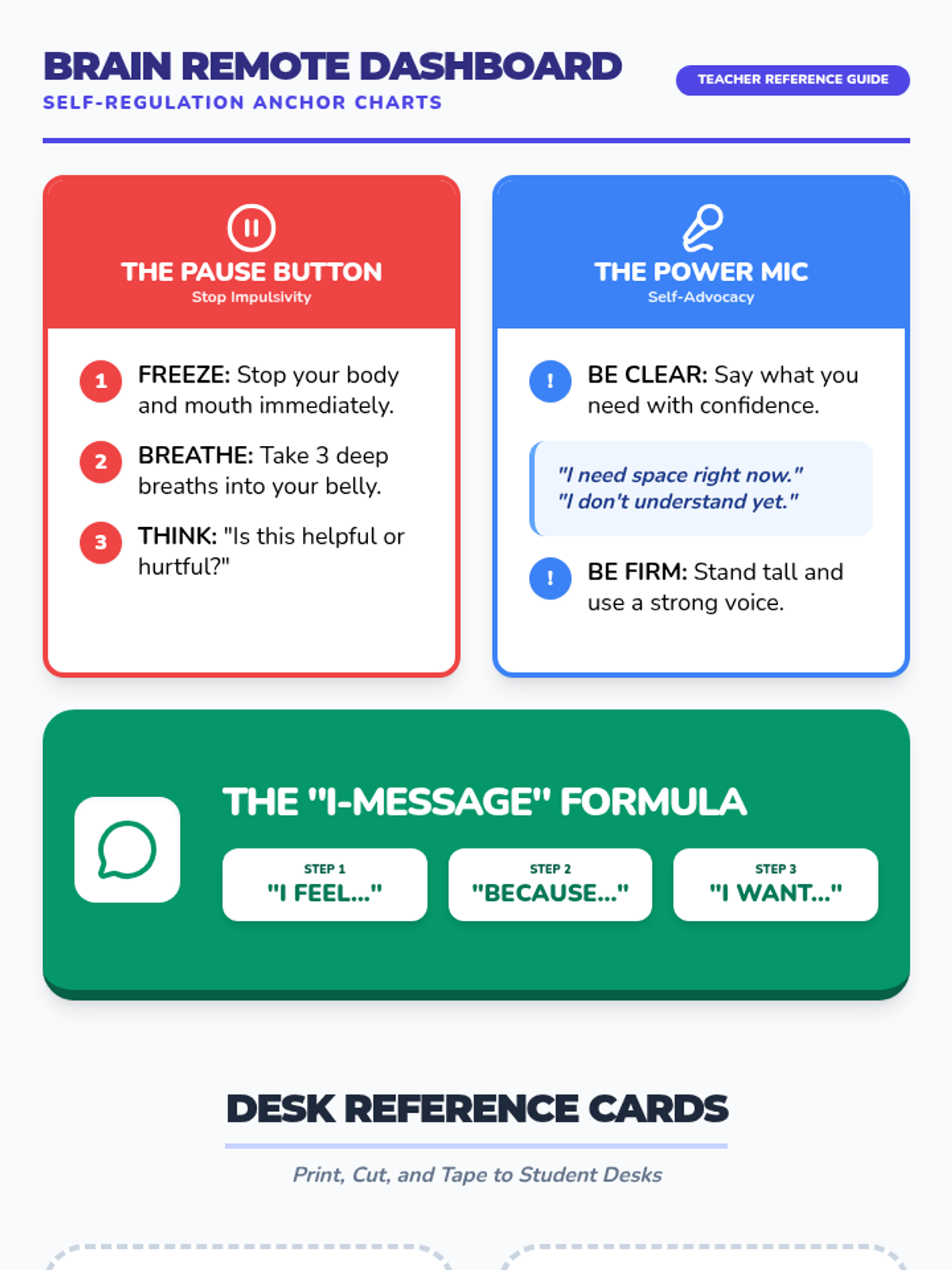
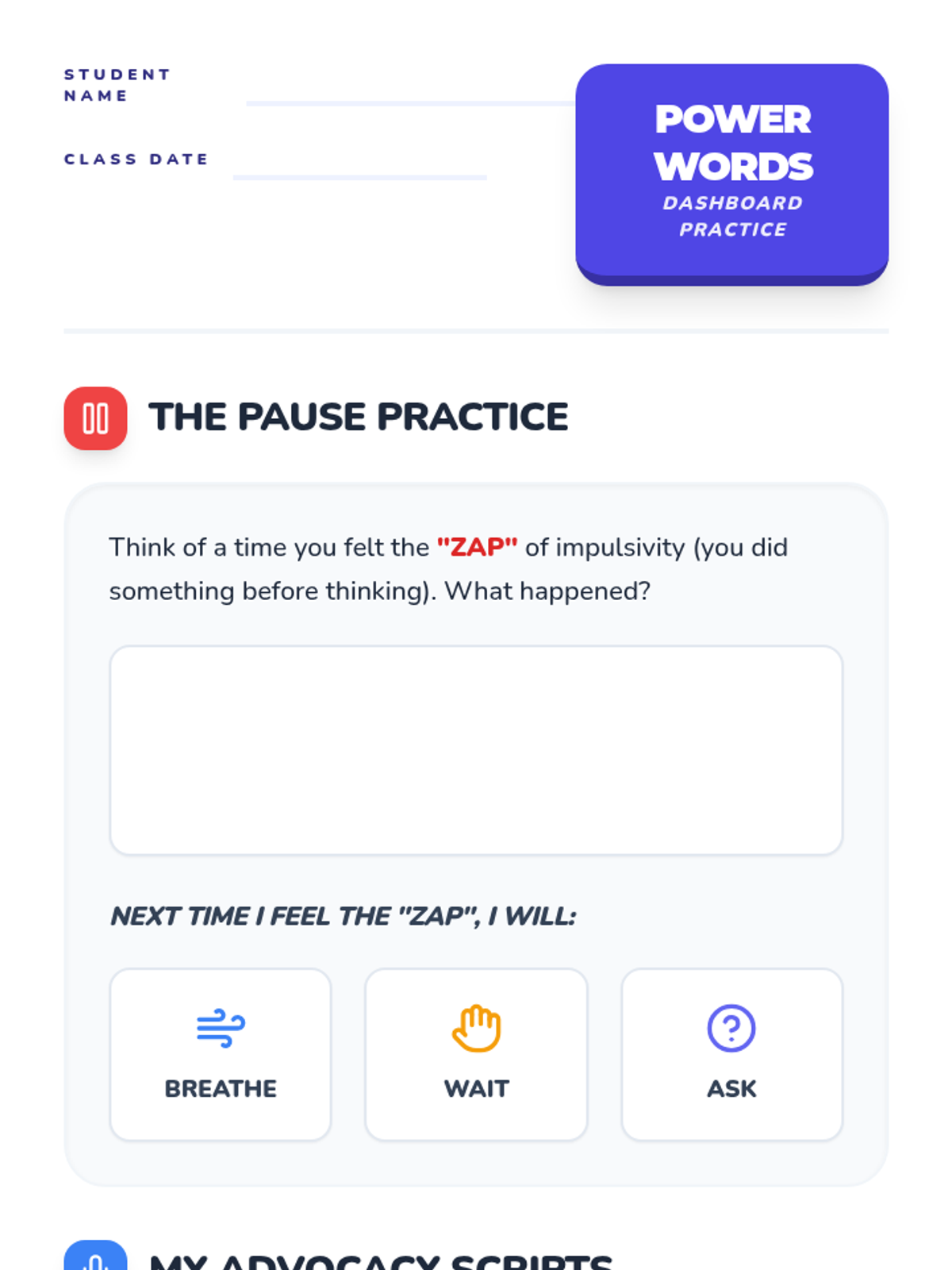
A comprehensive lesson exploring the 'Brain Remote' to manage impulsive urges and use 'Power Words' for self-advocacy and conflict resolution.
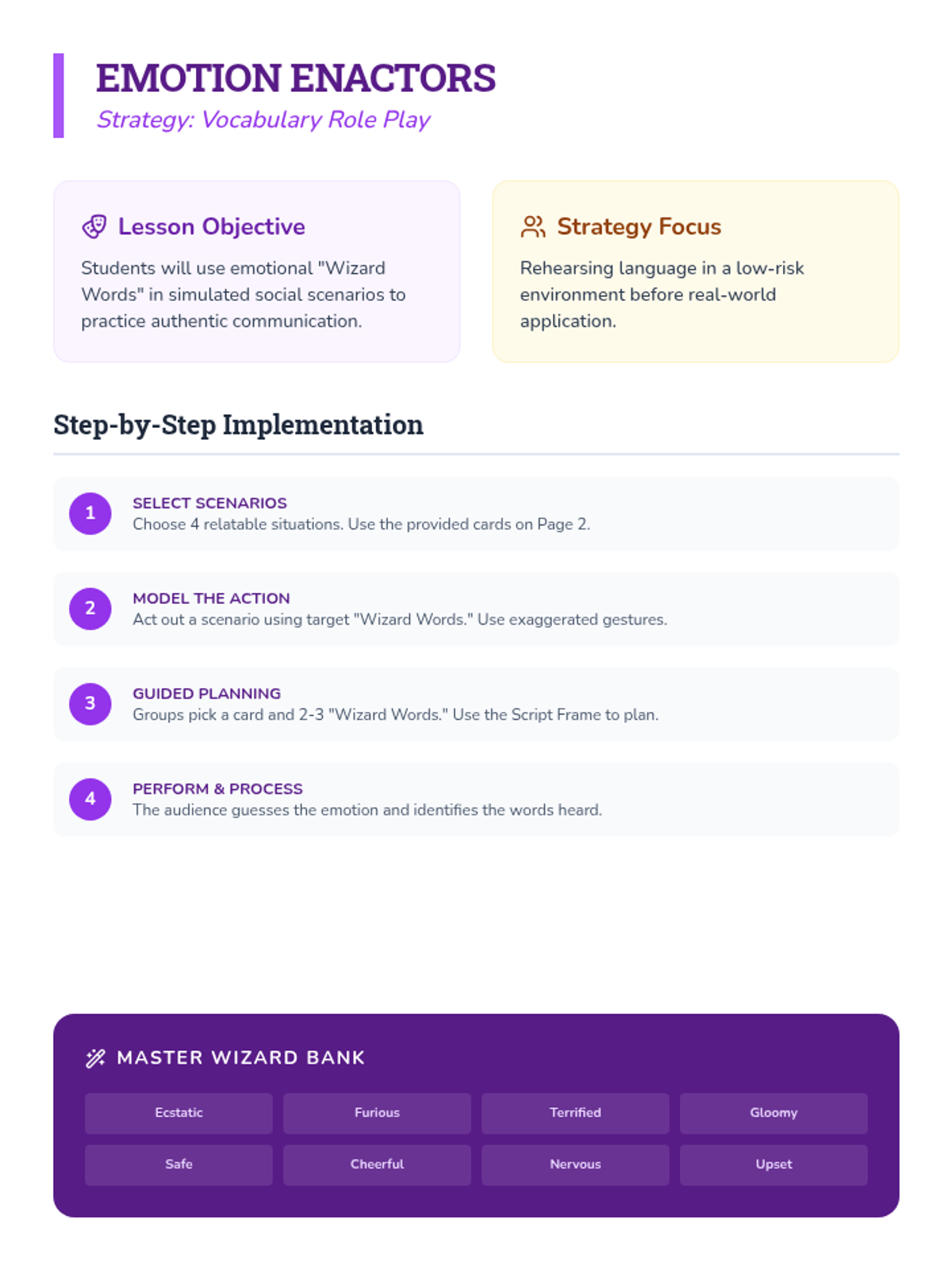
Students apply their expanded emotional vocabulary in simulated social situations, practicing the 'Vocabulary Role Play' strategy to solidify language acquisition through performance and interaction.
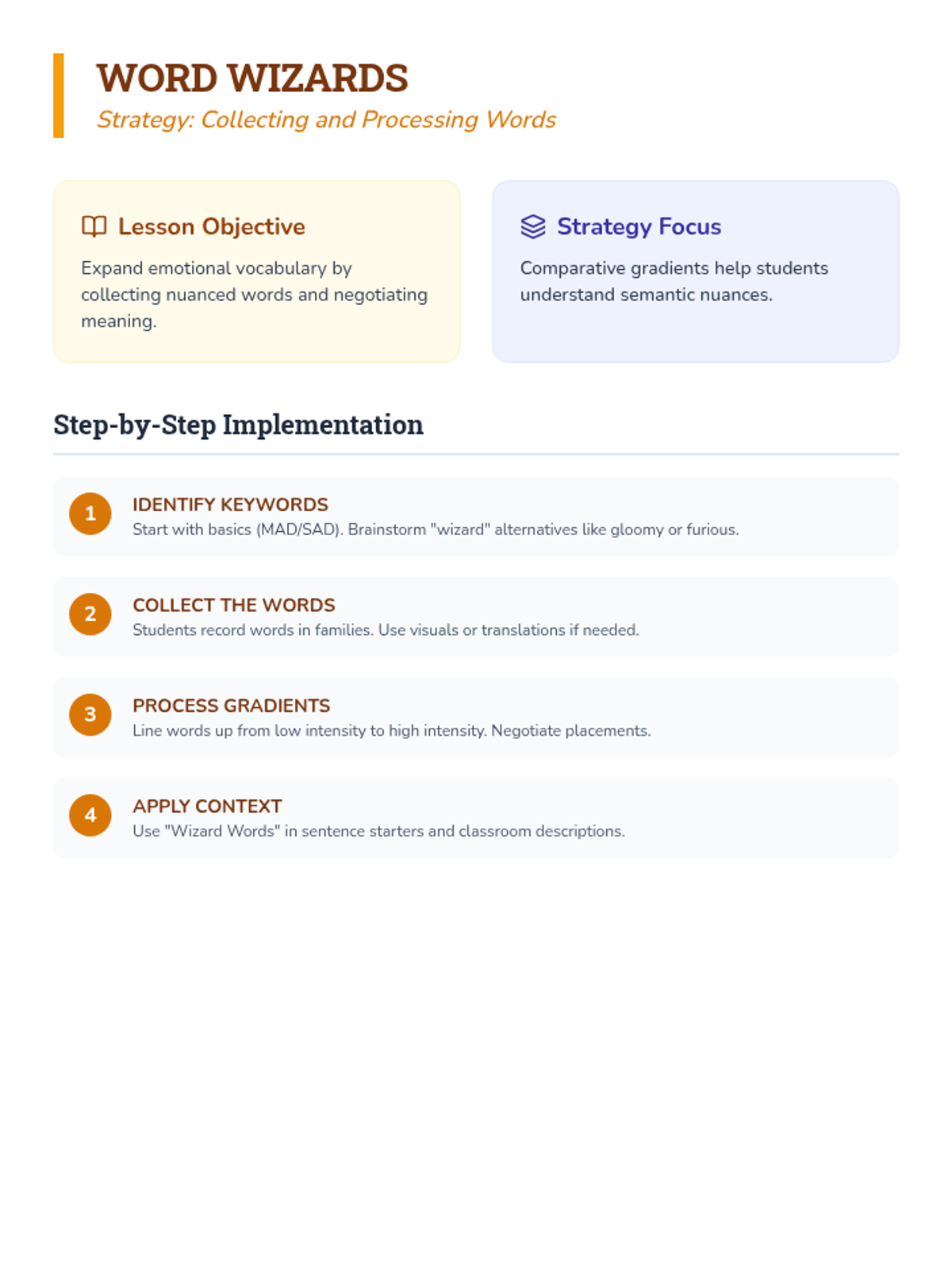
Builds a robust emotional vocabulary by systematically identifying, recording, and interacting with new words that describe complex feelings.
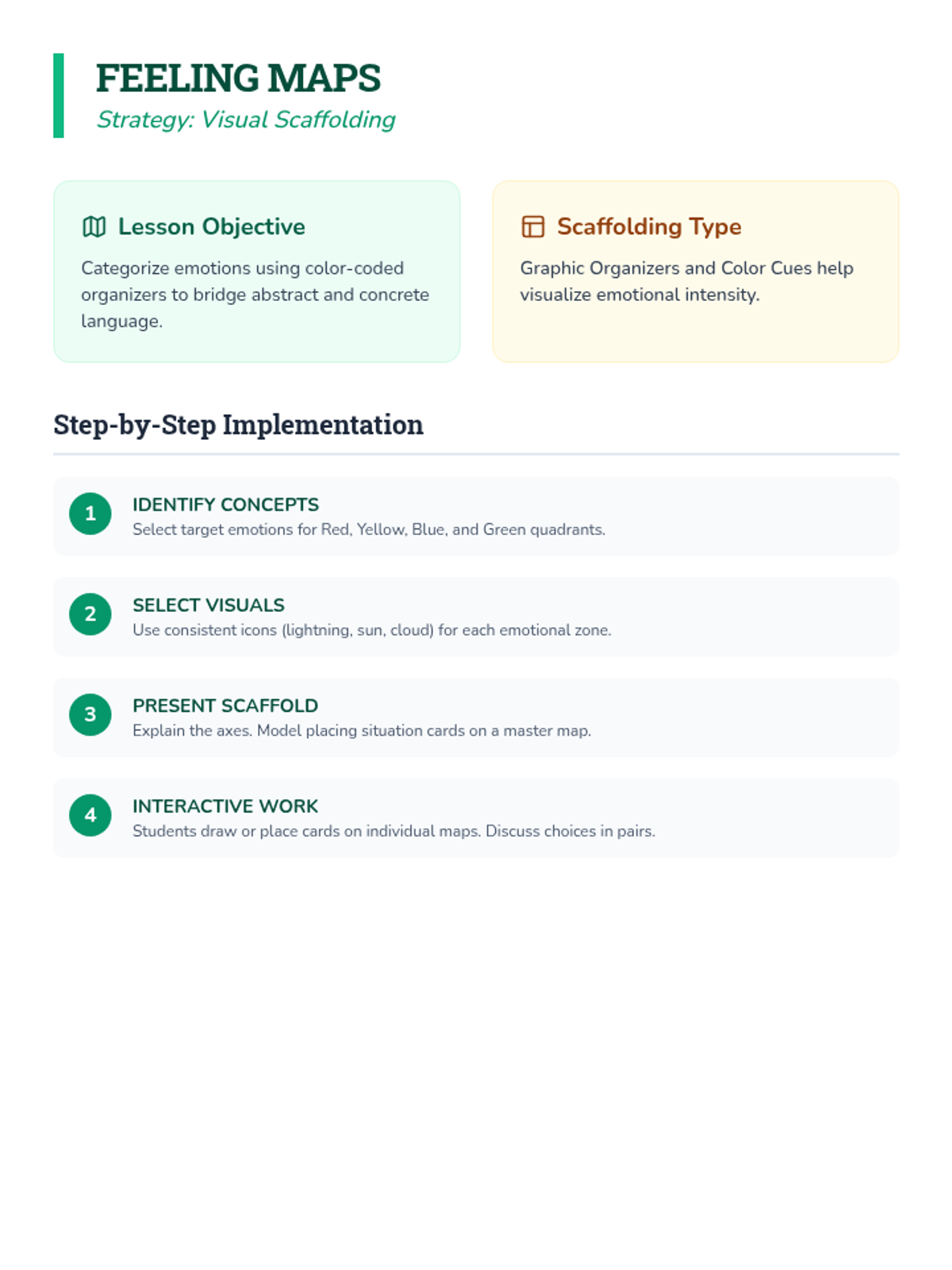
Employs graphic organizers, color-coding, and images to help students map the physical and situational connections to their feelings.
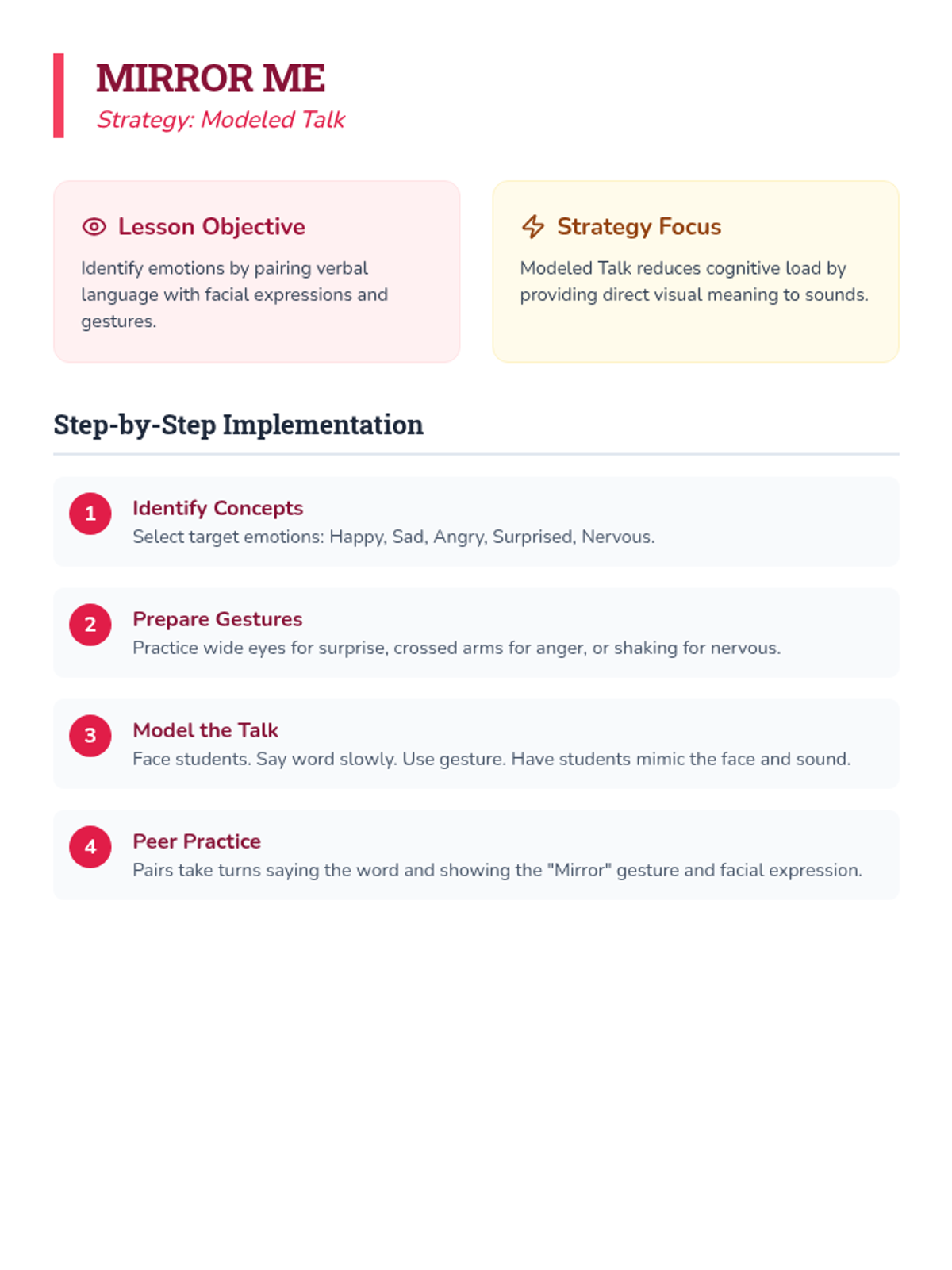
Uses gestures, facial expressions, and slowed speech to demonstrate emotional vocabulary and social interactions, making language comprehensible for ELLs.
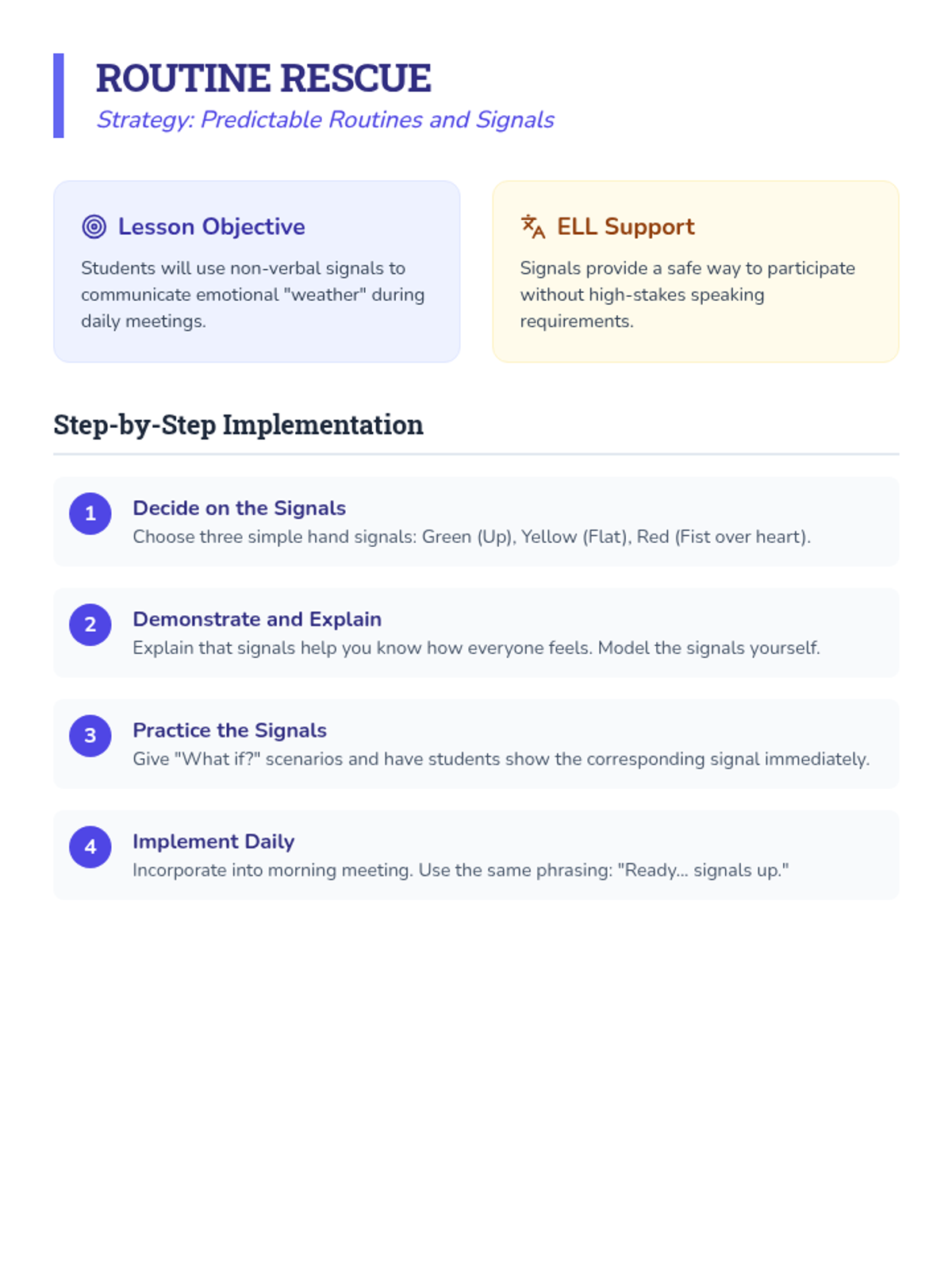
Establishes daily signals and routines for students to communicate their emotional state and readiness for learning, providing a safe and predictable classroom environment.
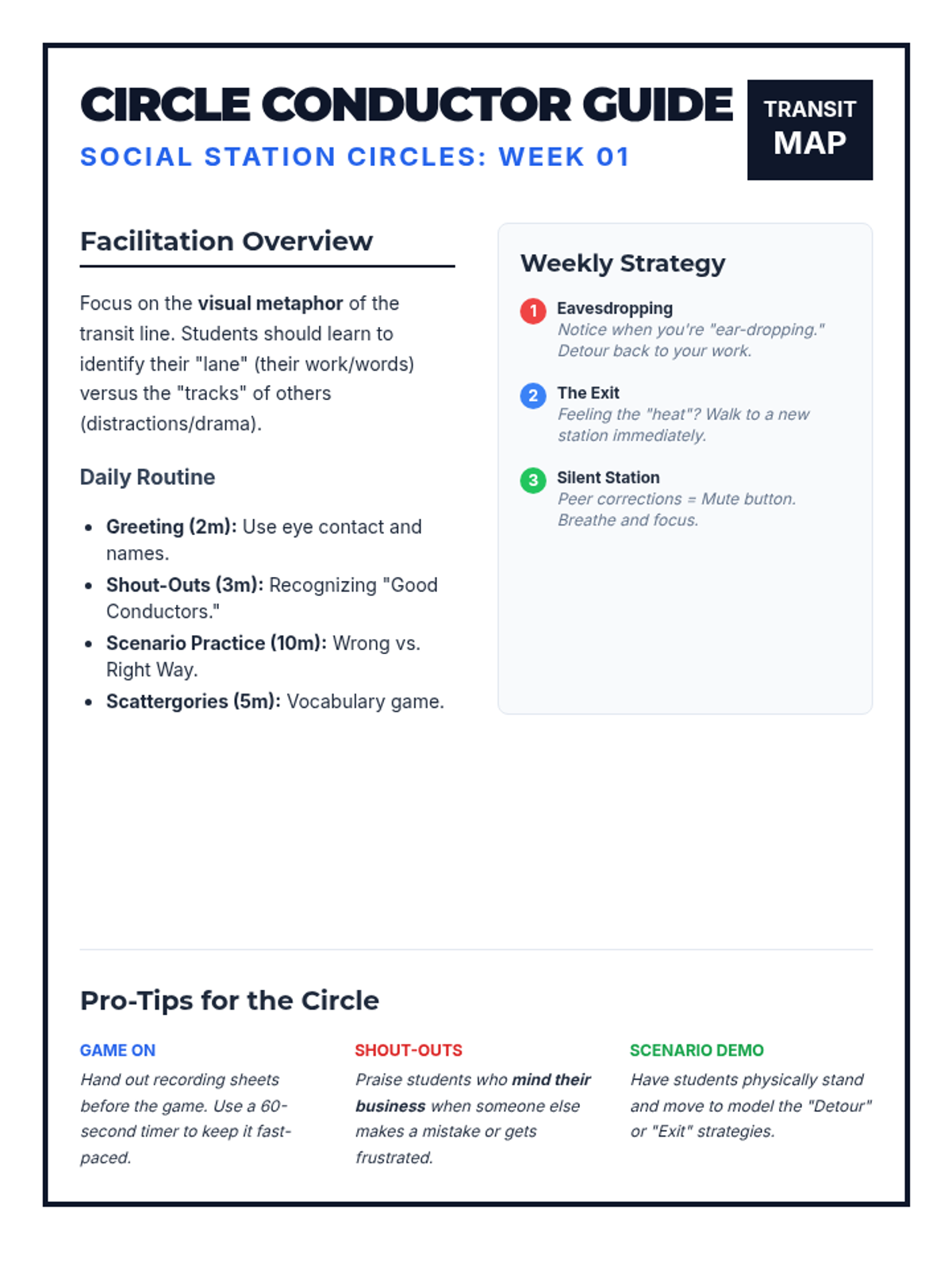
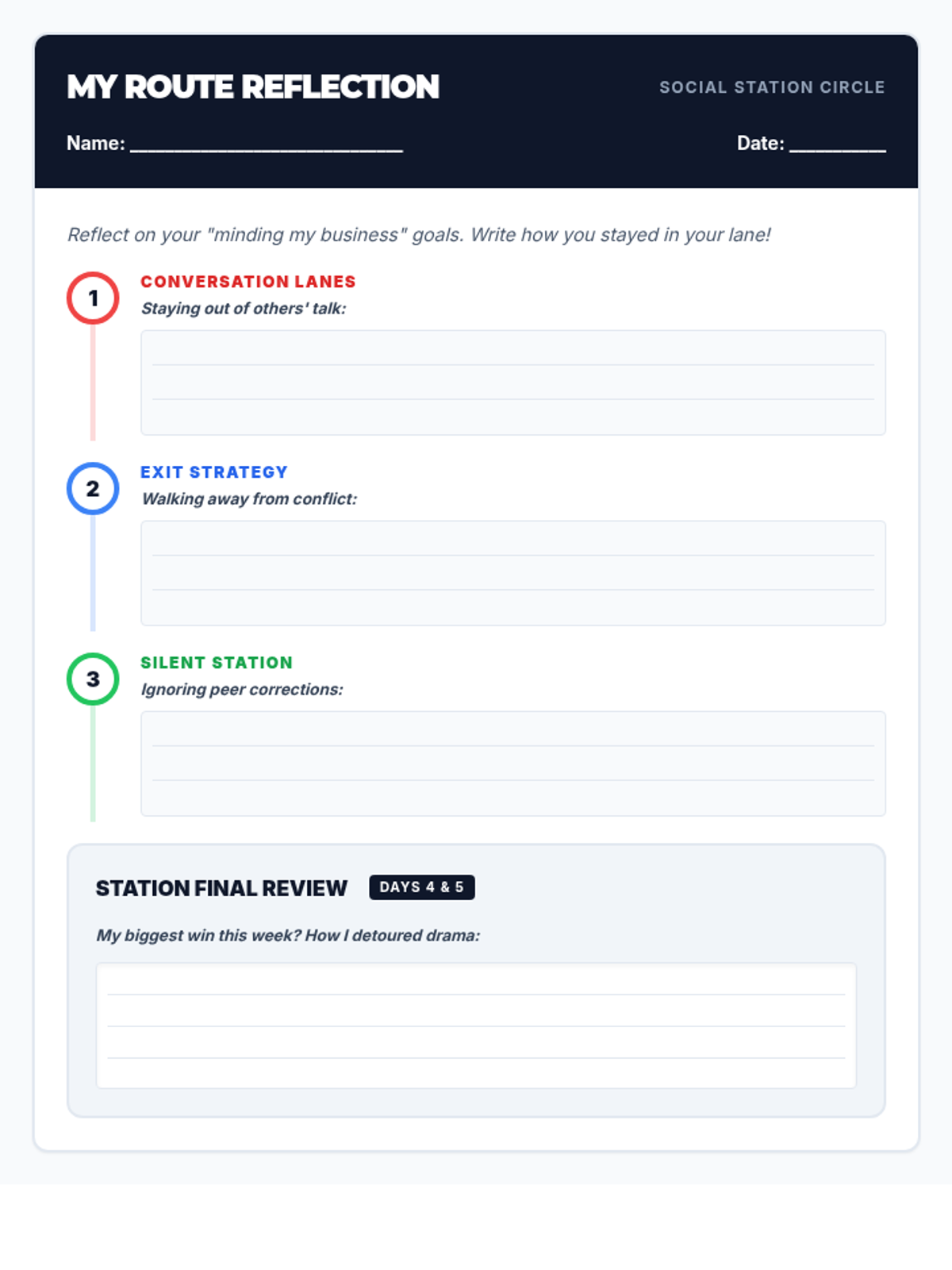
Day 5 covers staying focused and not contributing to classroom distractions.
Day 4 teaches students how to avoid drama and rumors by taking a 'detour'.
Day 3 addresses how to ignore peer corrections and focus on one's own work.
Day 2 focuses on the 'exit strategy' for walking away from rising conflict.
Day 1 focuses on staying out of others' conversations and 'ear-dropping' awareness.
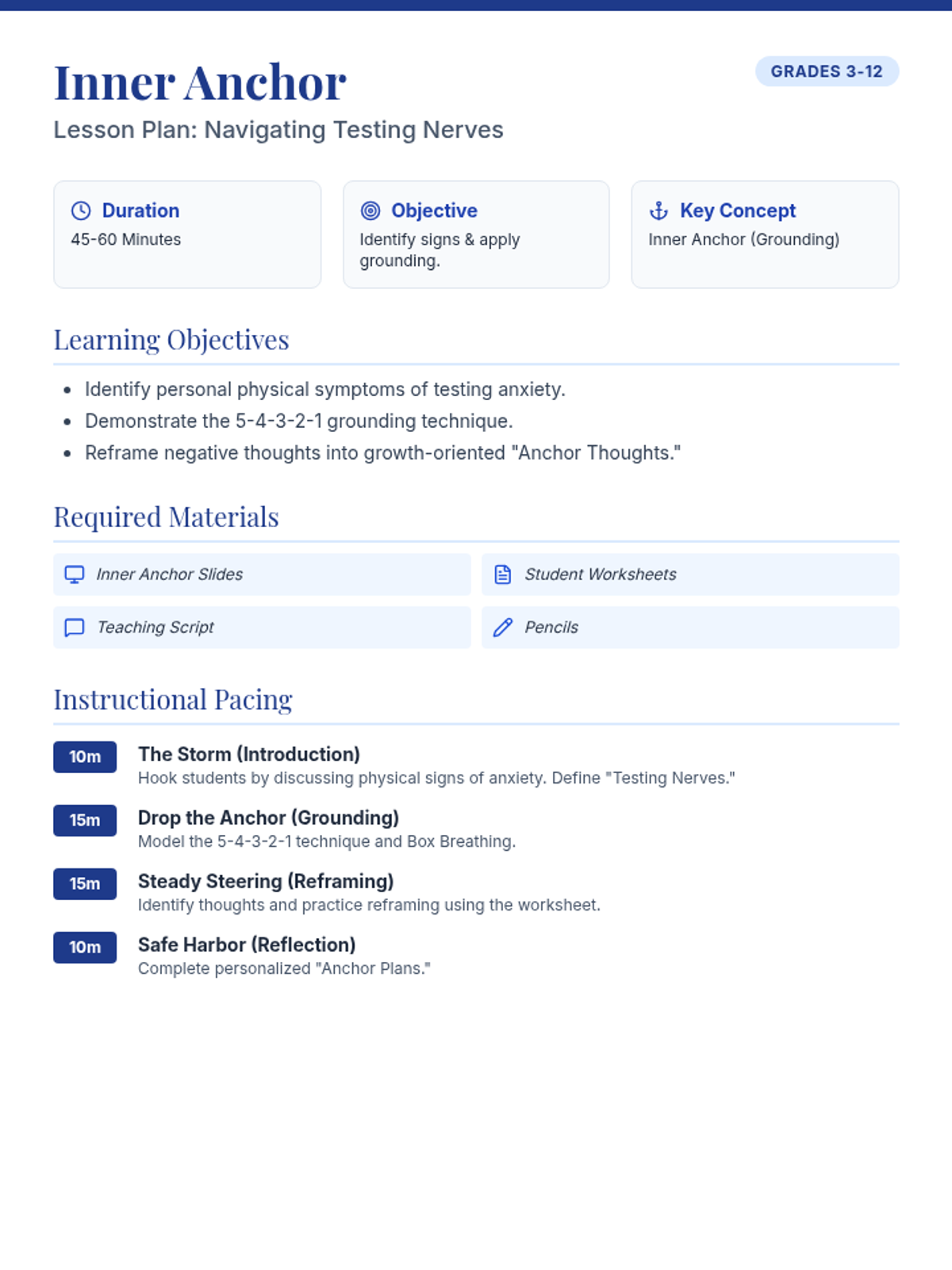
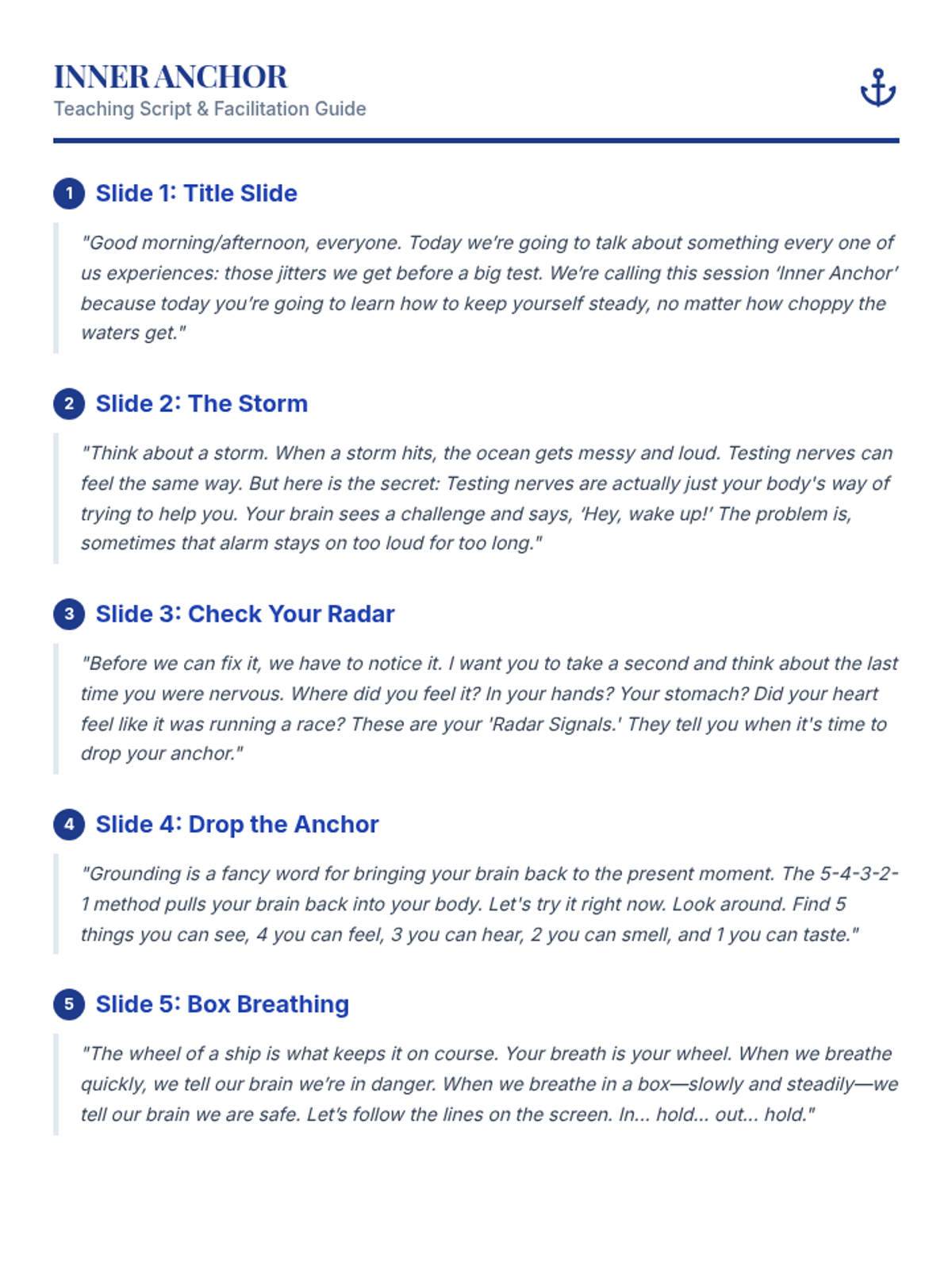
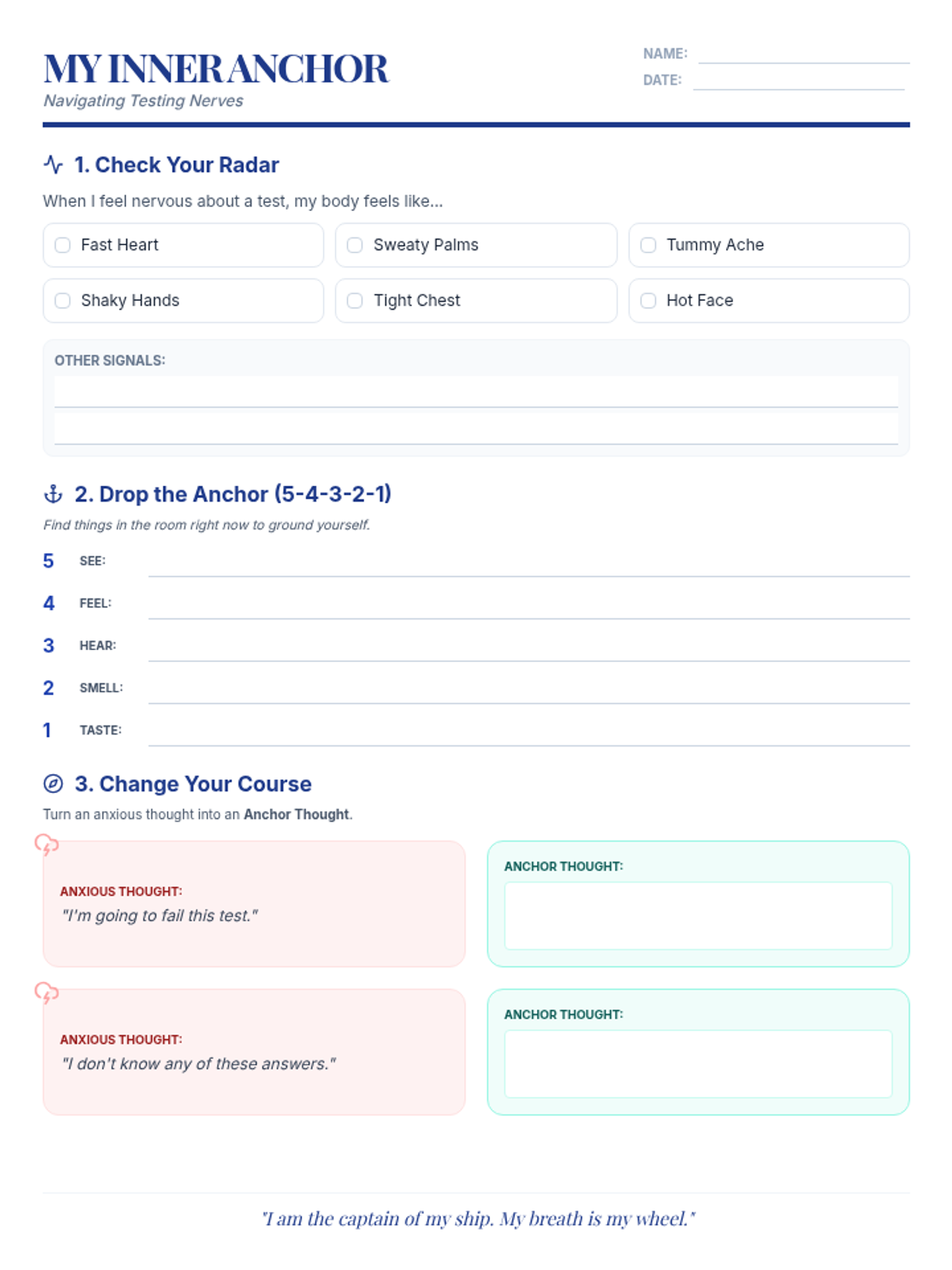
A comprehensive emotional regulation toolkit for students to manage testing anxiety using maritime-themed grounding techniques and cognitive reframing.
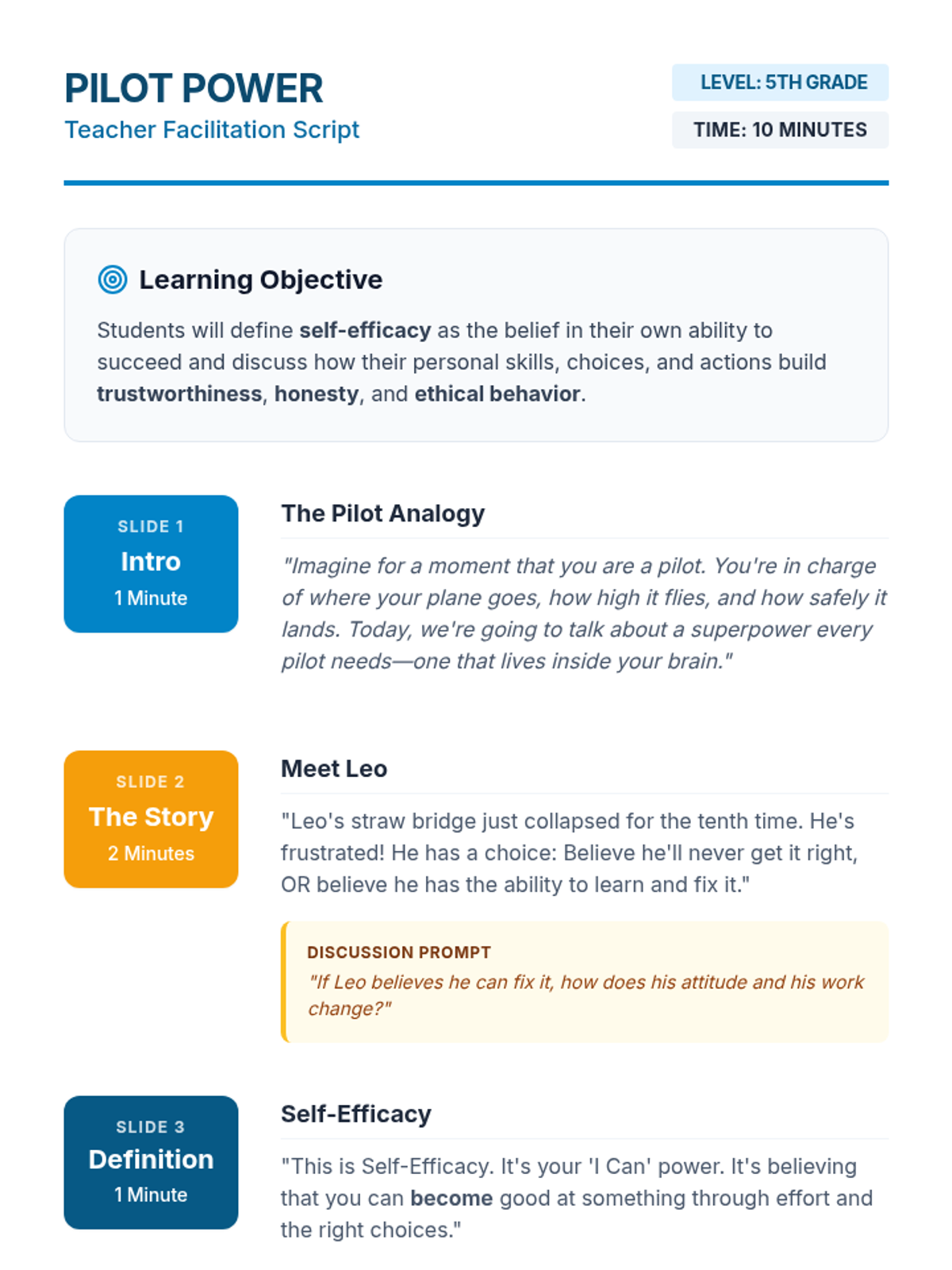
A 10-minute lesson for 5th graders on self-efficacy, focusing on how personal choices and actions build trustworthiness and ethics through a relatable story-based approach.
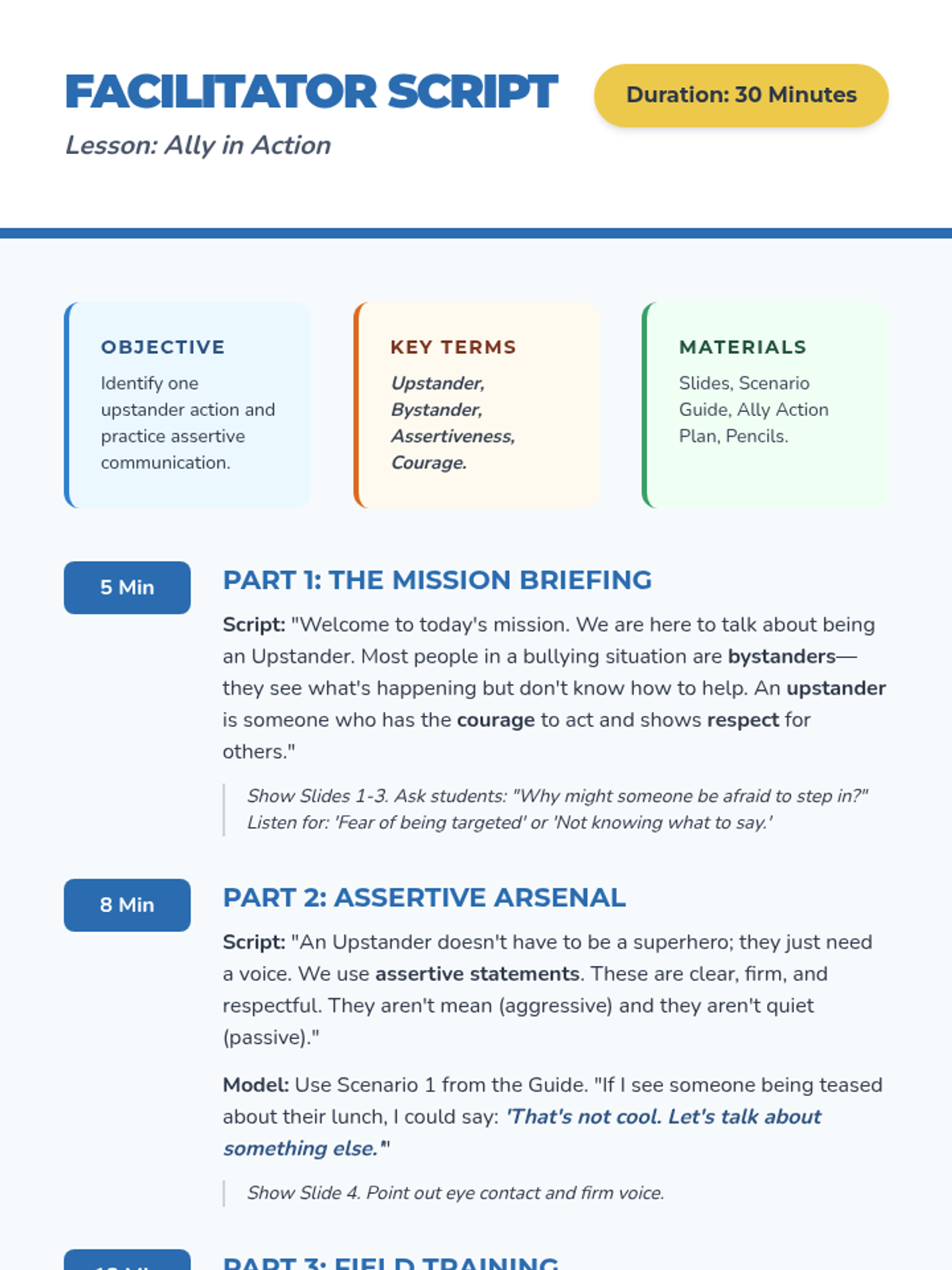
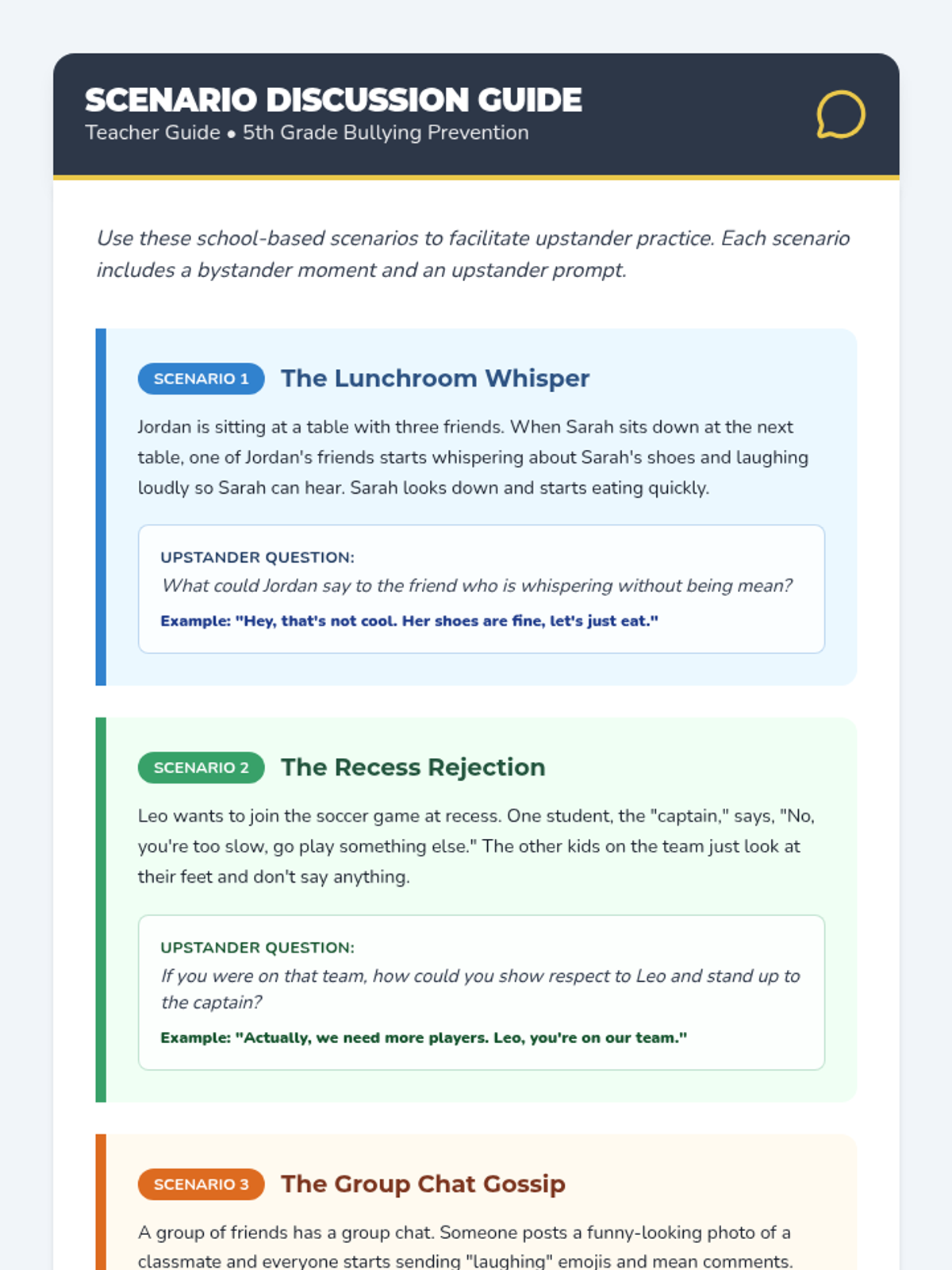
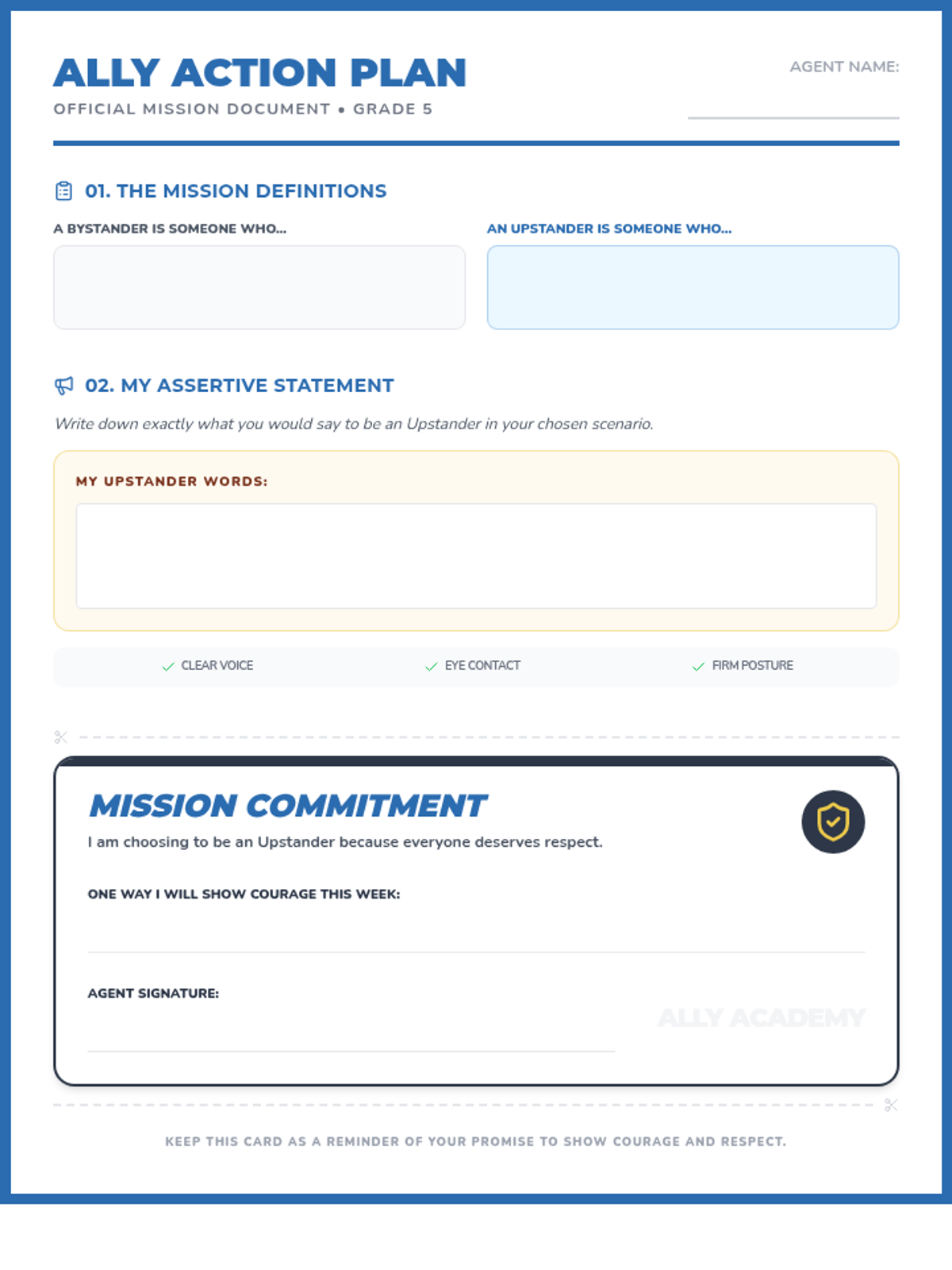
A 30-minute lesson for 5th graders focused on moving from a bystander to an upstander. Students learn to use assertive statements and create a personal action plan for showing courage and respect in bullying situations.
A reflection on what has been learned and a call to action to practice acceptance every day.
Practical skills for including neurodivergent peers in play and conversation, focusing on kindness and patience.
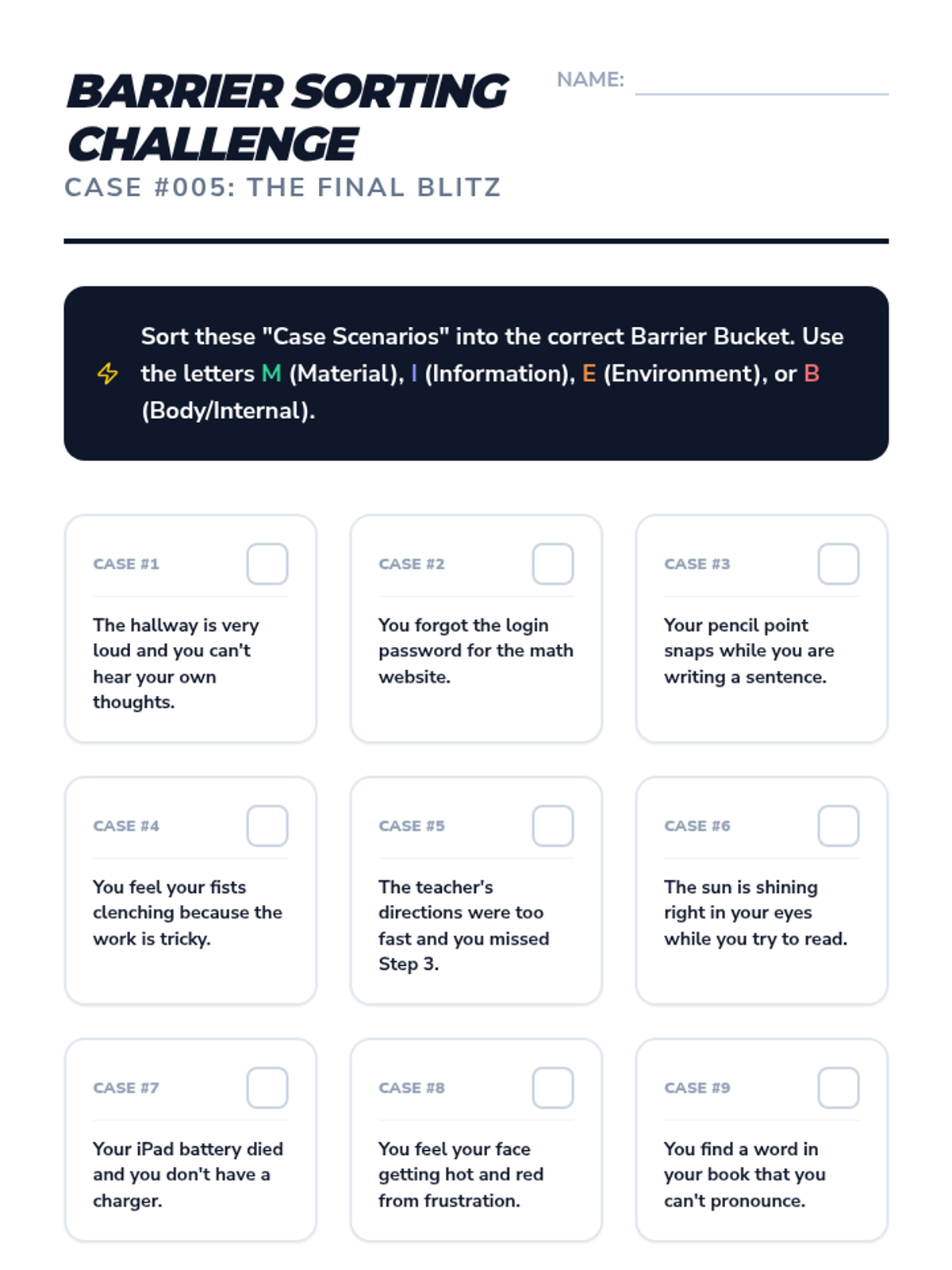
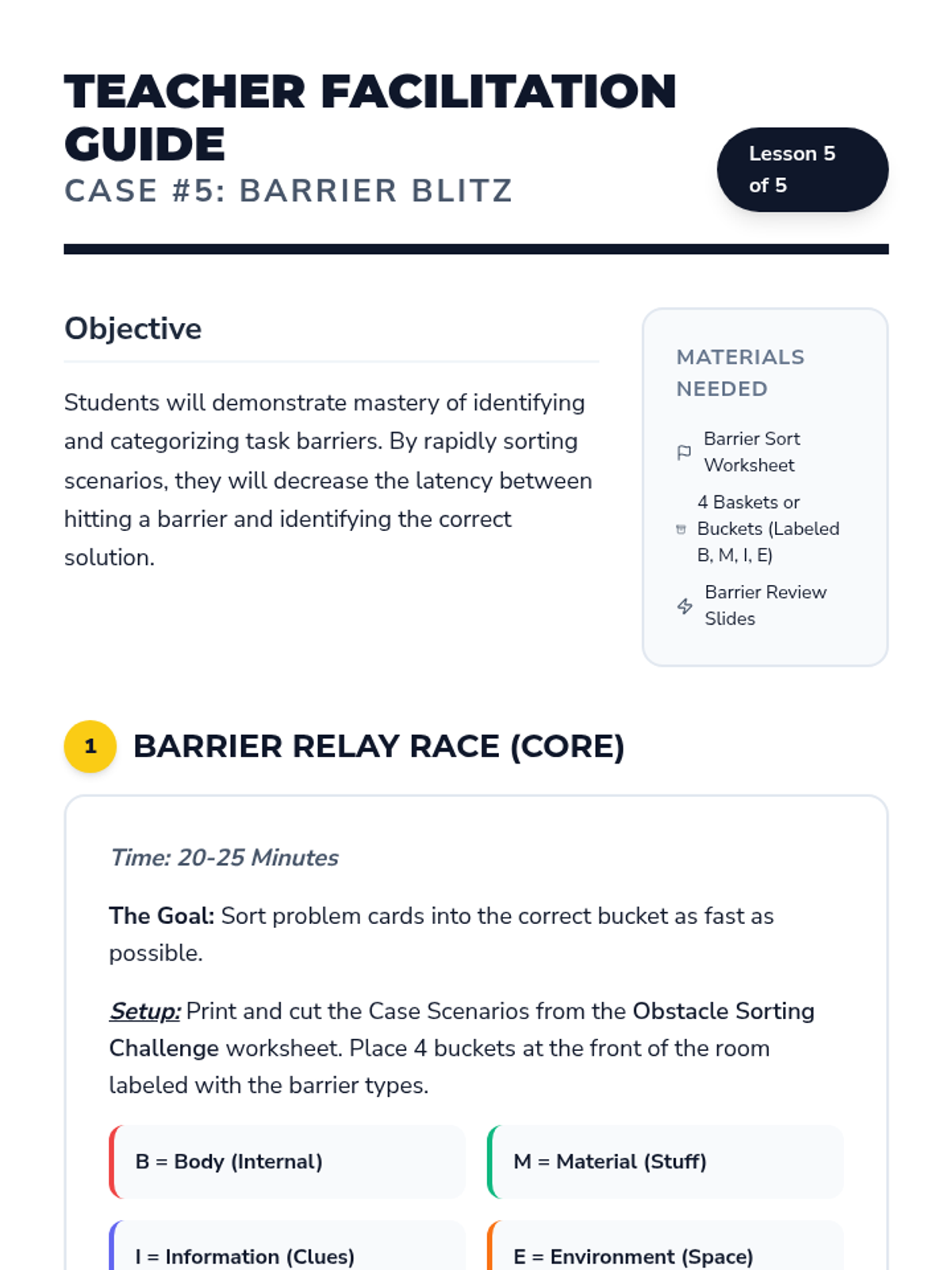
A culminating lesson where students rapidly sort various scenarios into barrier categories to reduce the time between hitting a wall and identifying the solution.
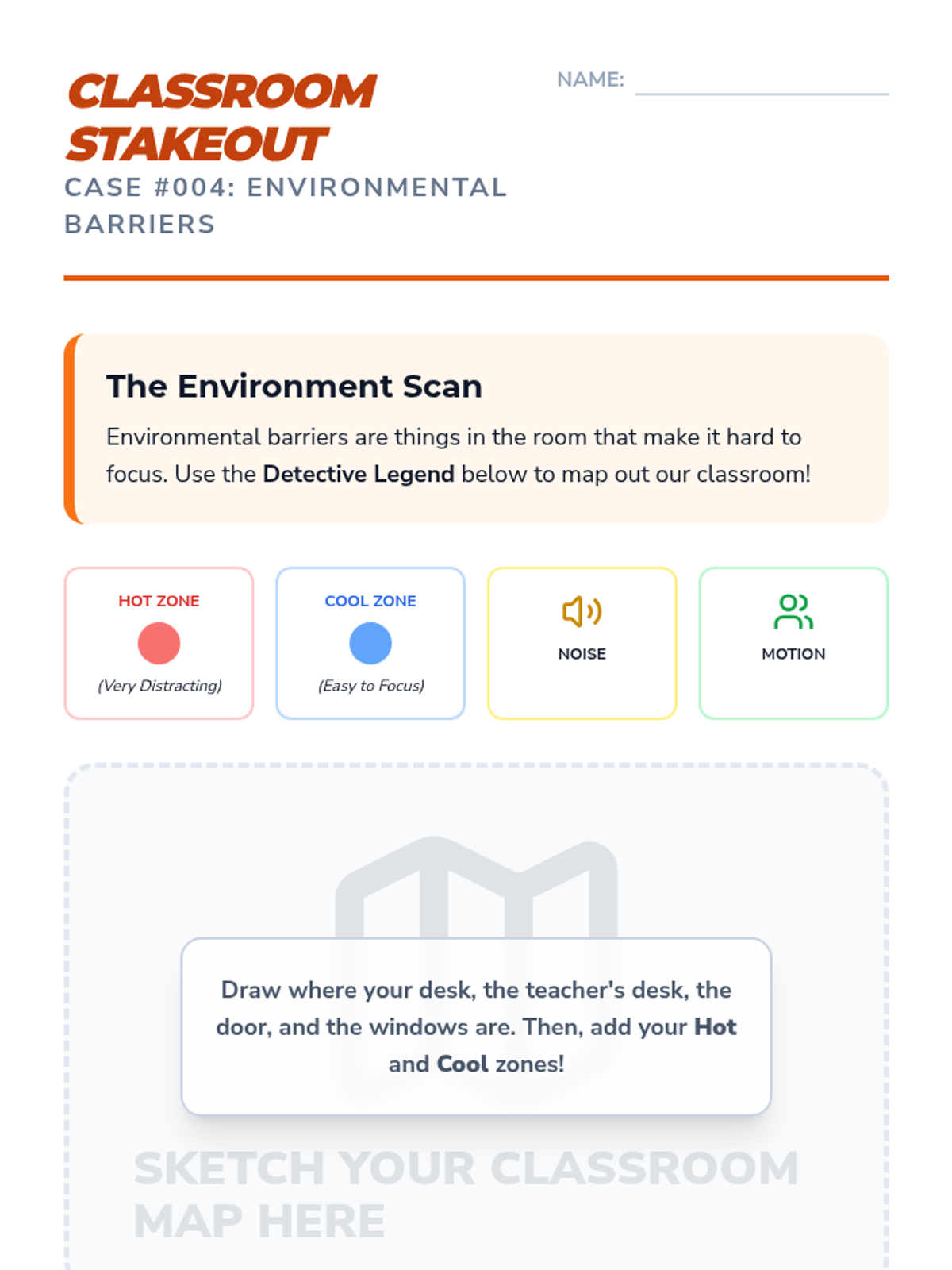
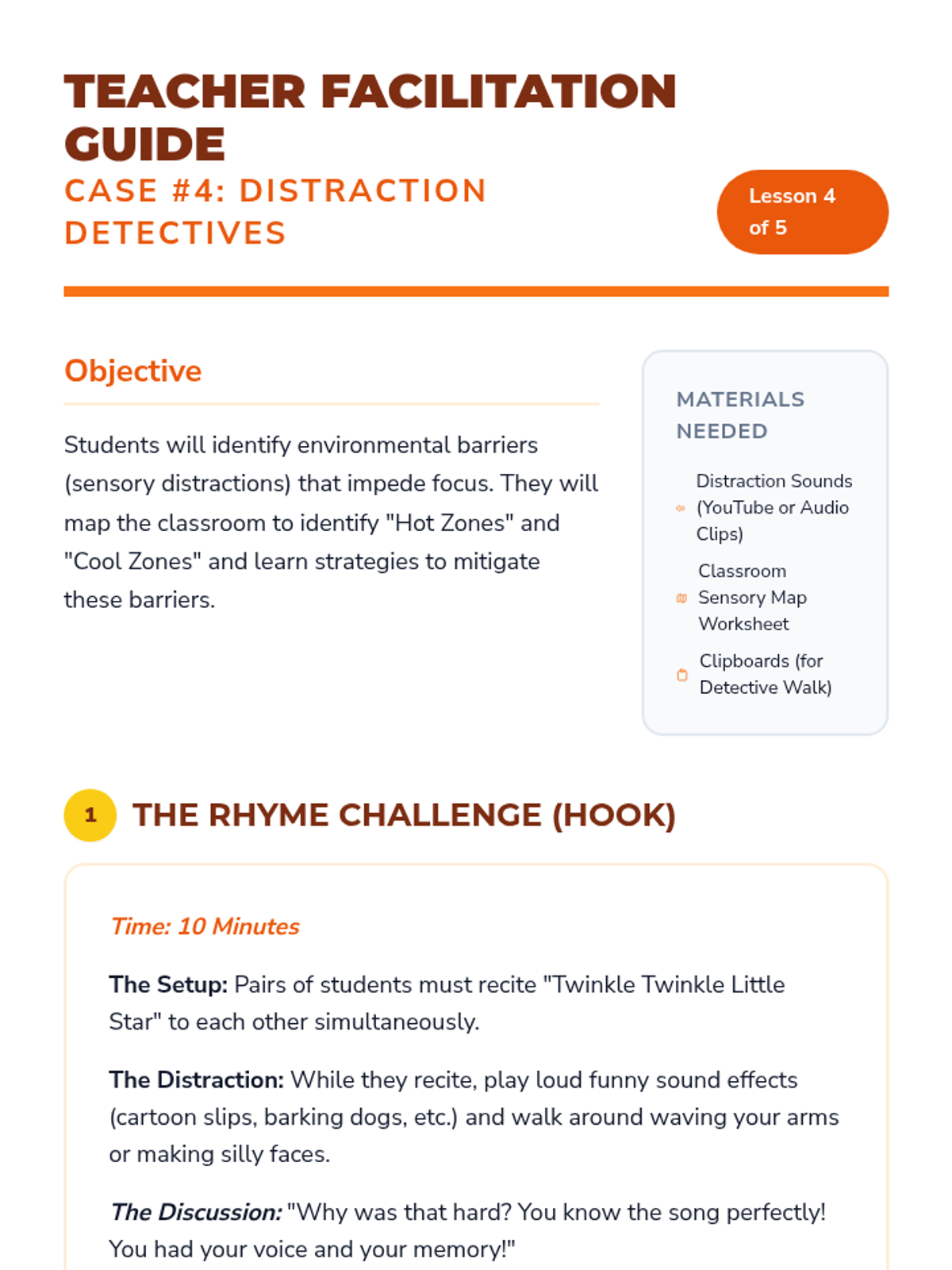
Investigates sensory and environmental barriers like noise or clutter, conducting a 'detective walk' to identify classroom distractions.
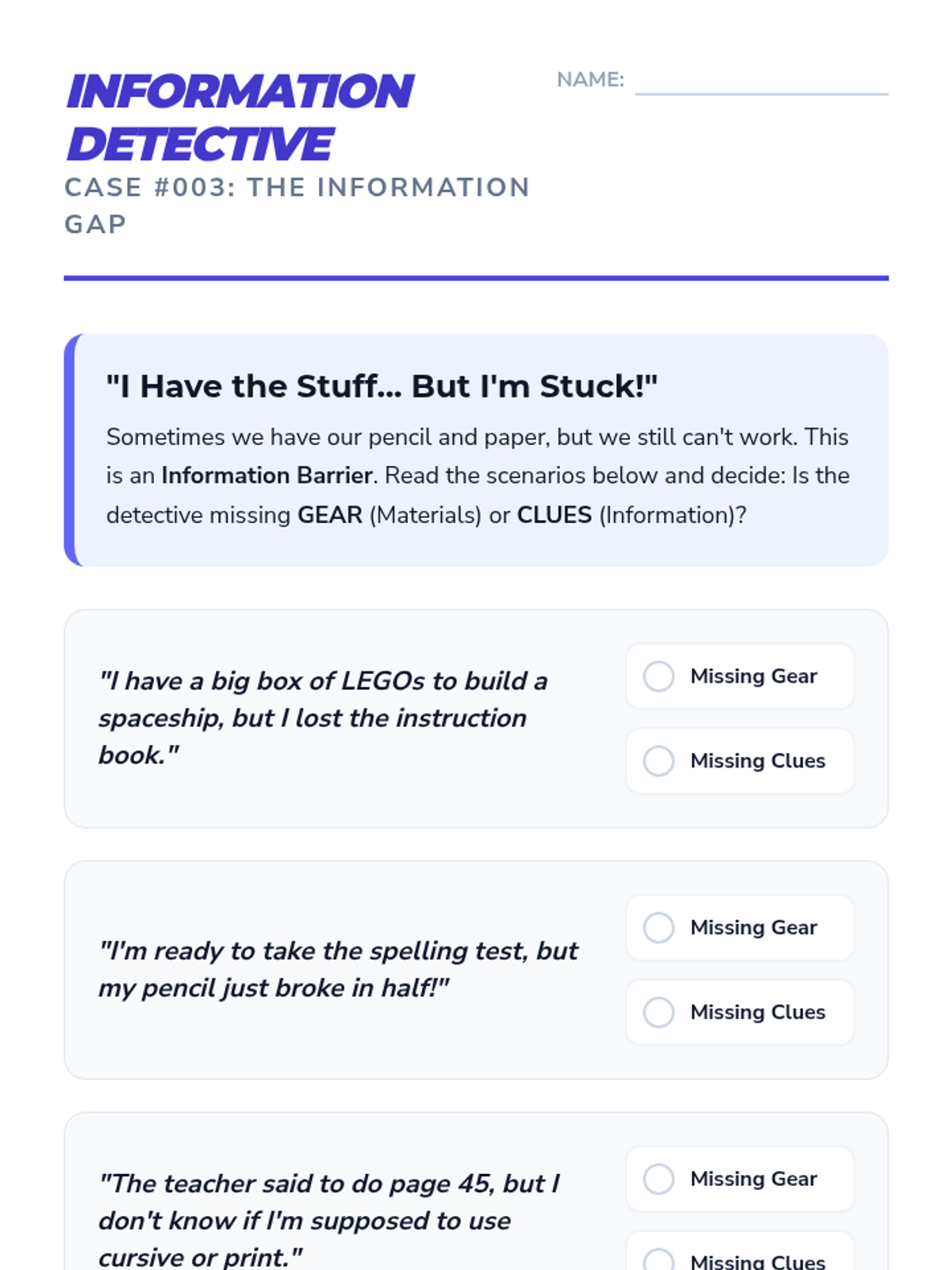
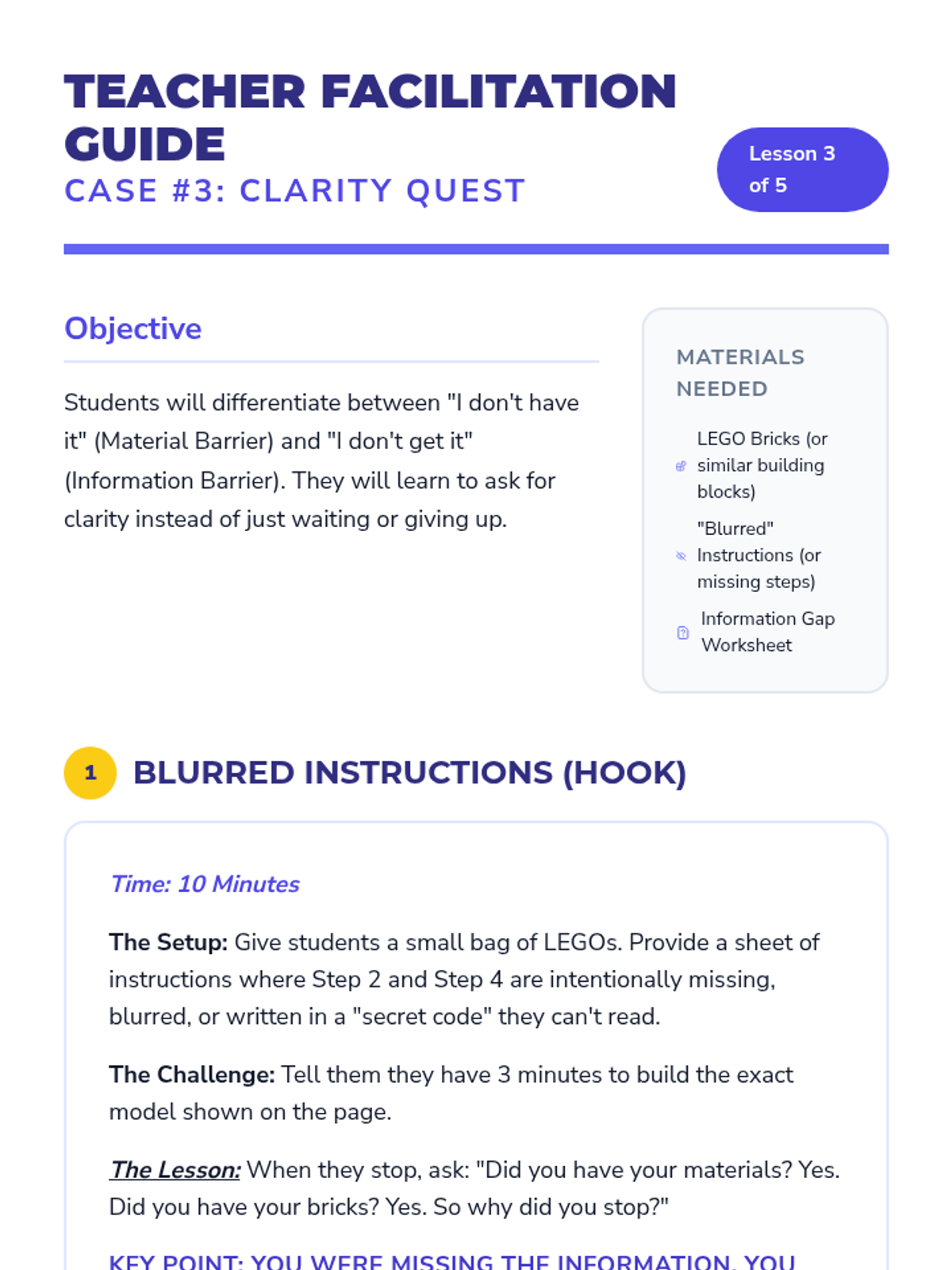
Teaches students to recognize when they are stuck due to a lack of clarity or understanding, differentiating between 'I don't have it' and 'I don't get it.'
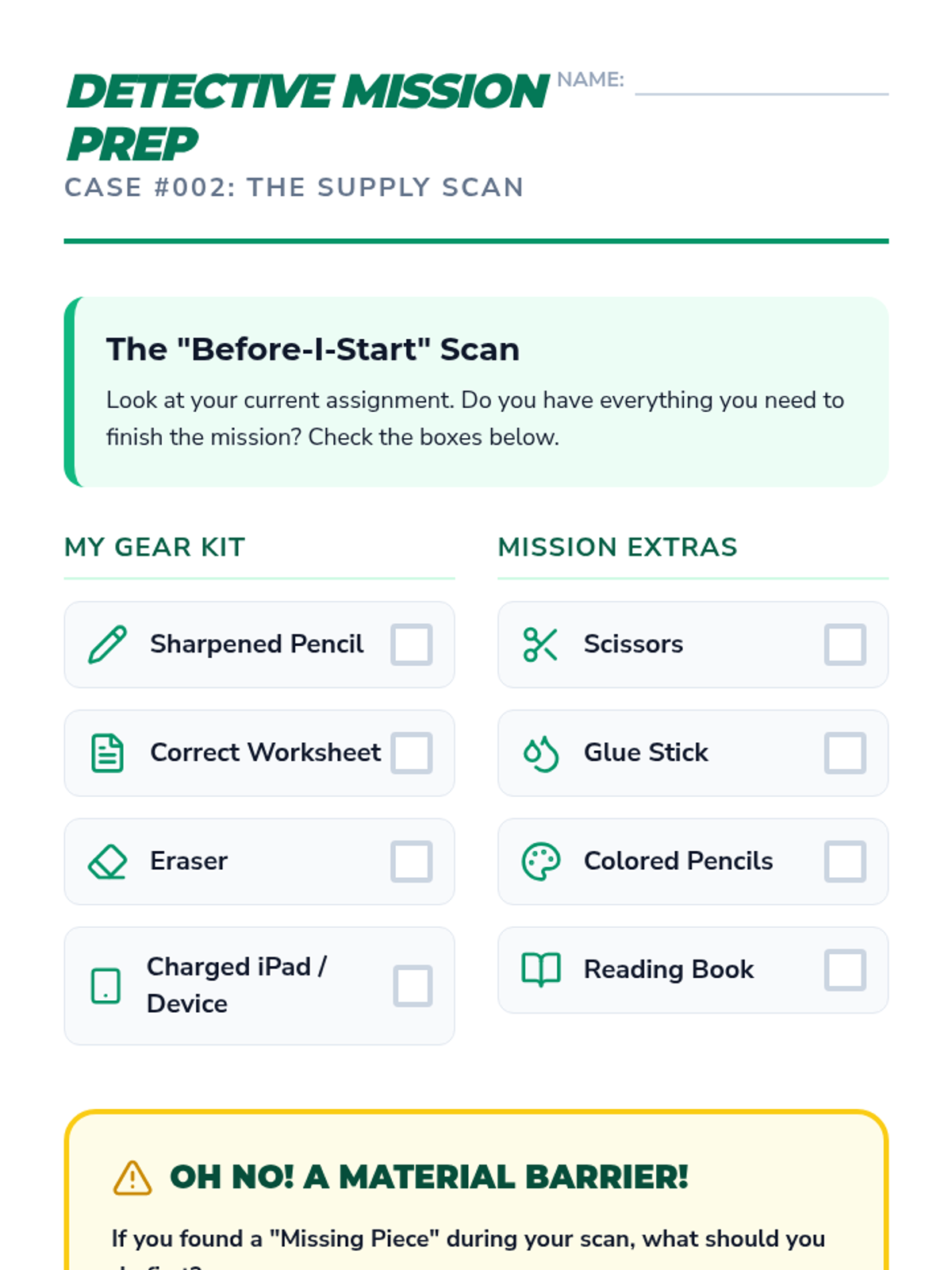
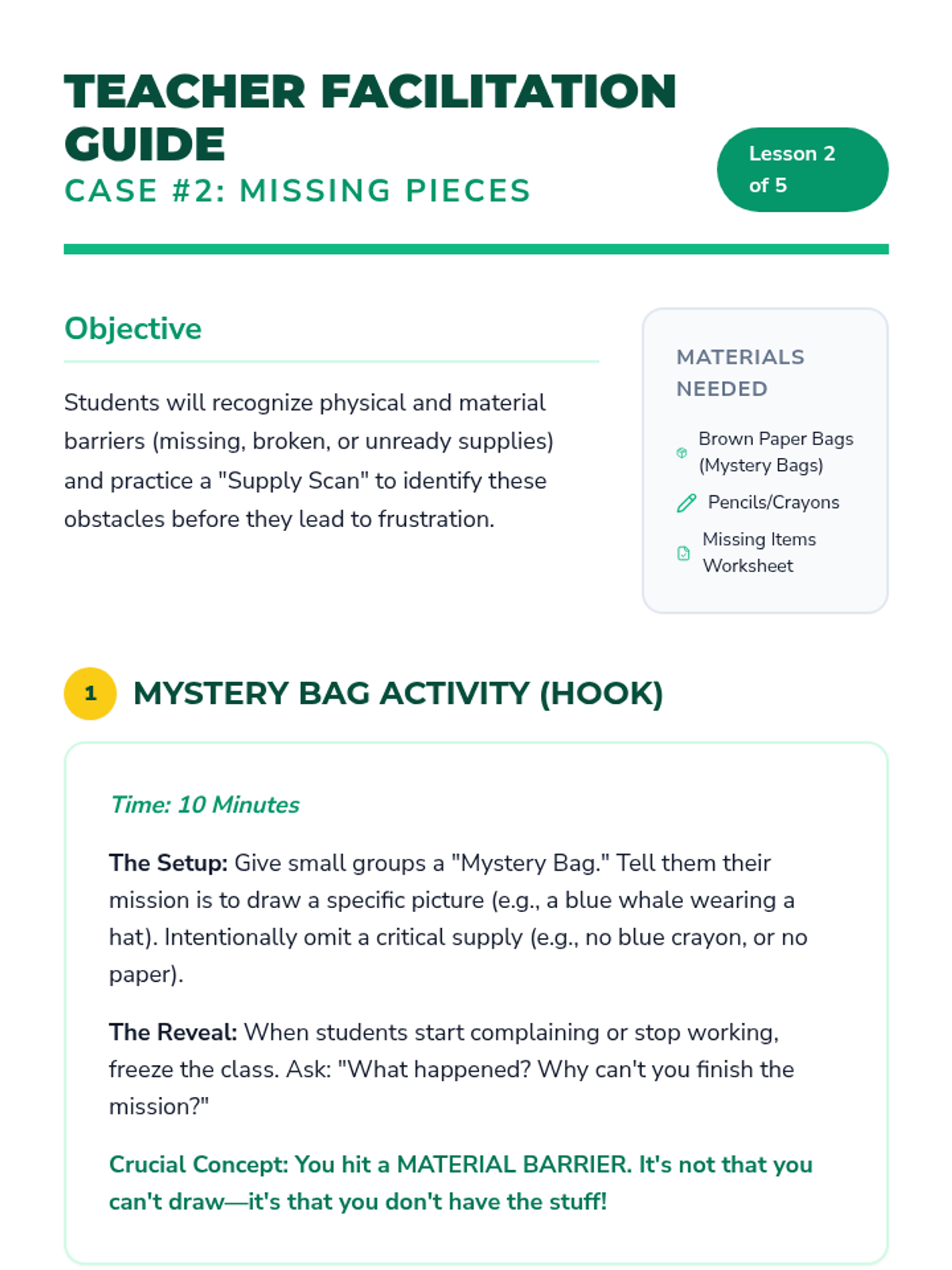
Focuses on tangible obstacles like broken tools or missing materials, teaching students to perform a 'supply scan' to identify what is physically missing.
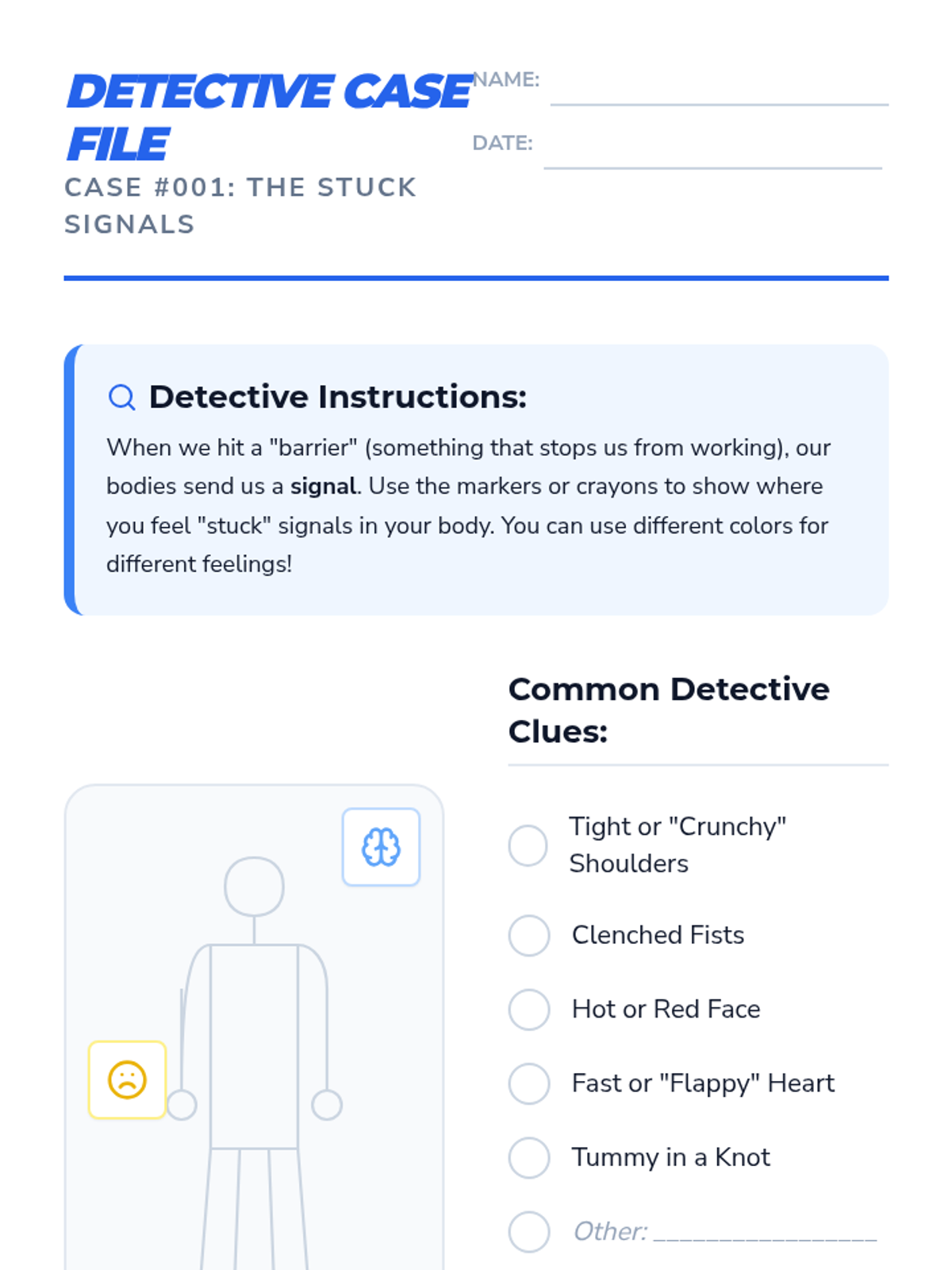
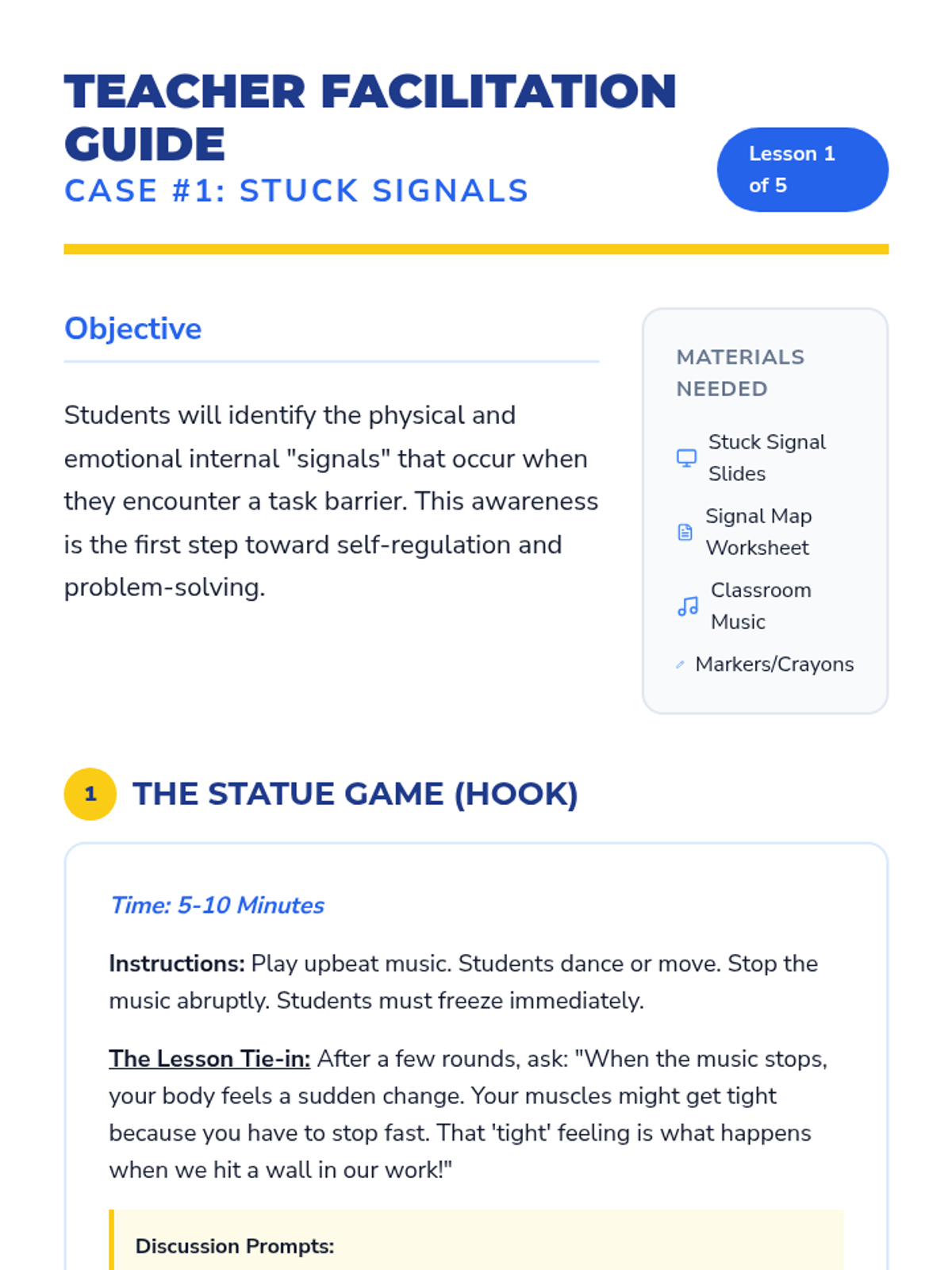
Students explore the physical and emotional sensations associated with hitting a task barrier, identifying what frustration feels like to recognize the moment they need to stop.
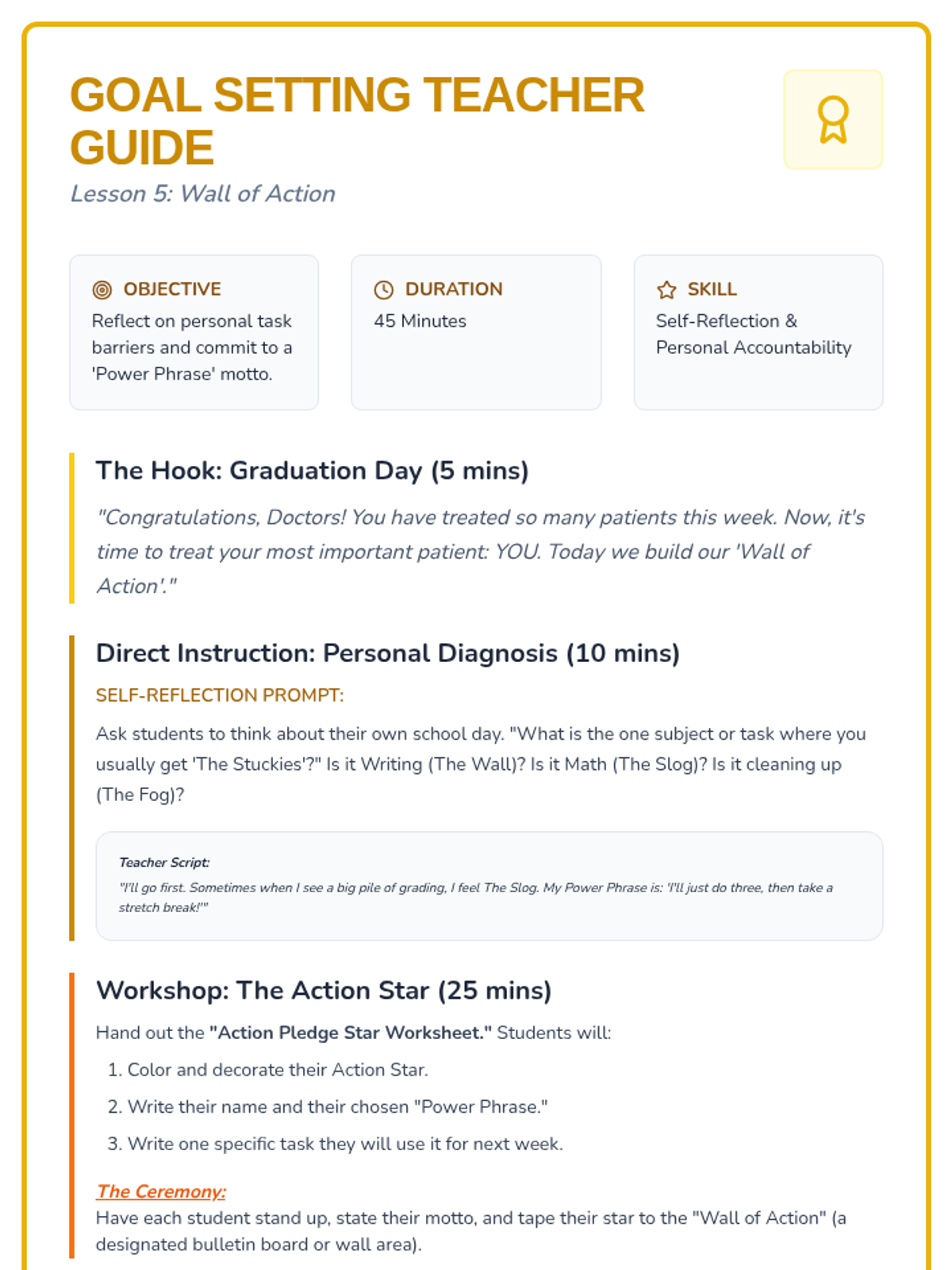
Students identify their own barriers to starting work and select a personal 'Power Phrase' motto for future tasks.
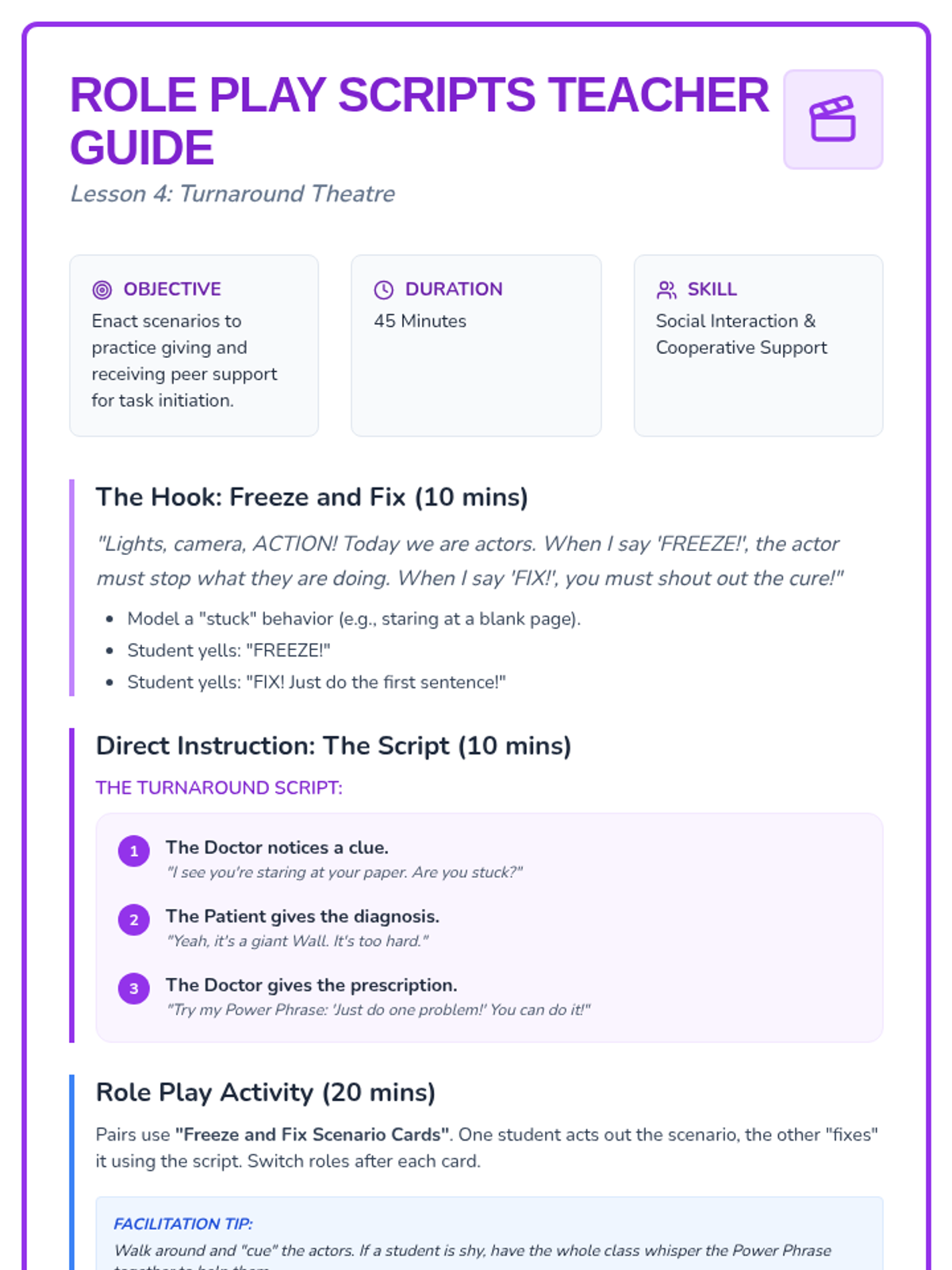
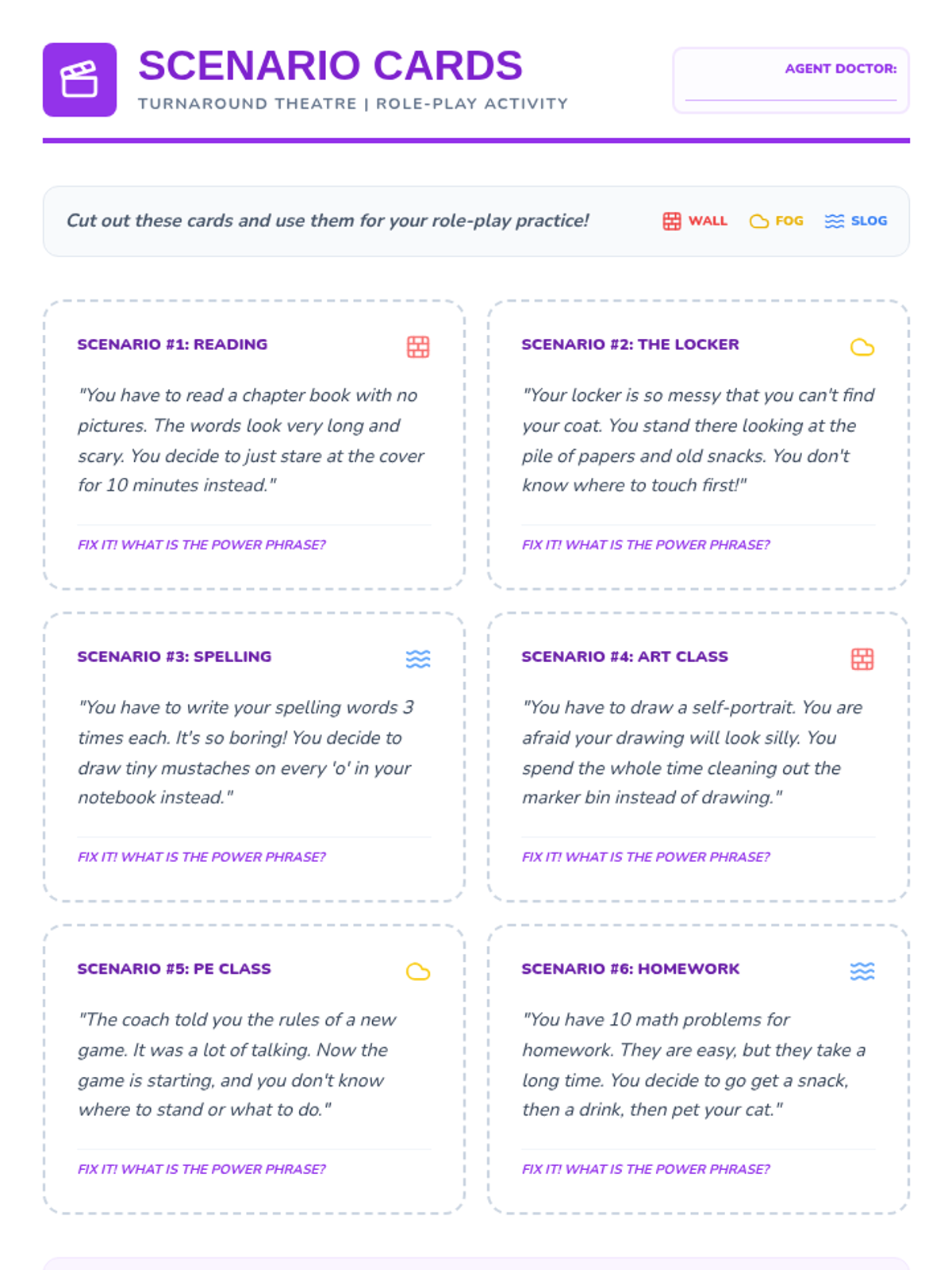
Students role-play scenarios where they help a peer get 'unstuck' using their self-talk prescriptions.
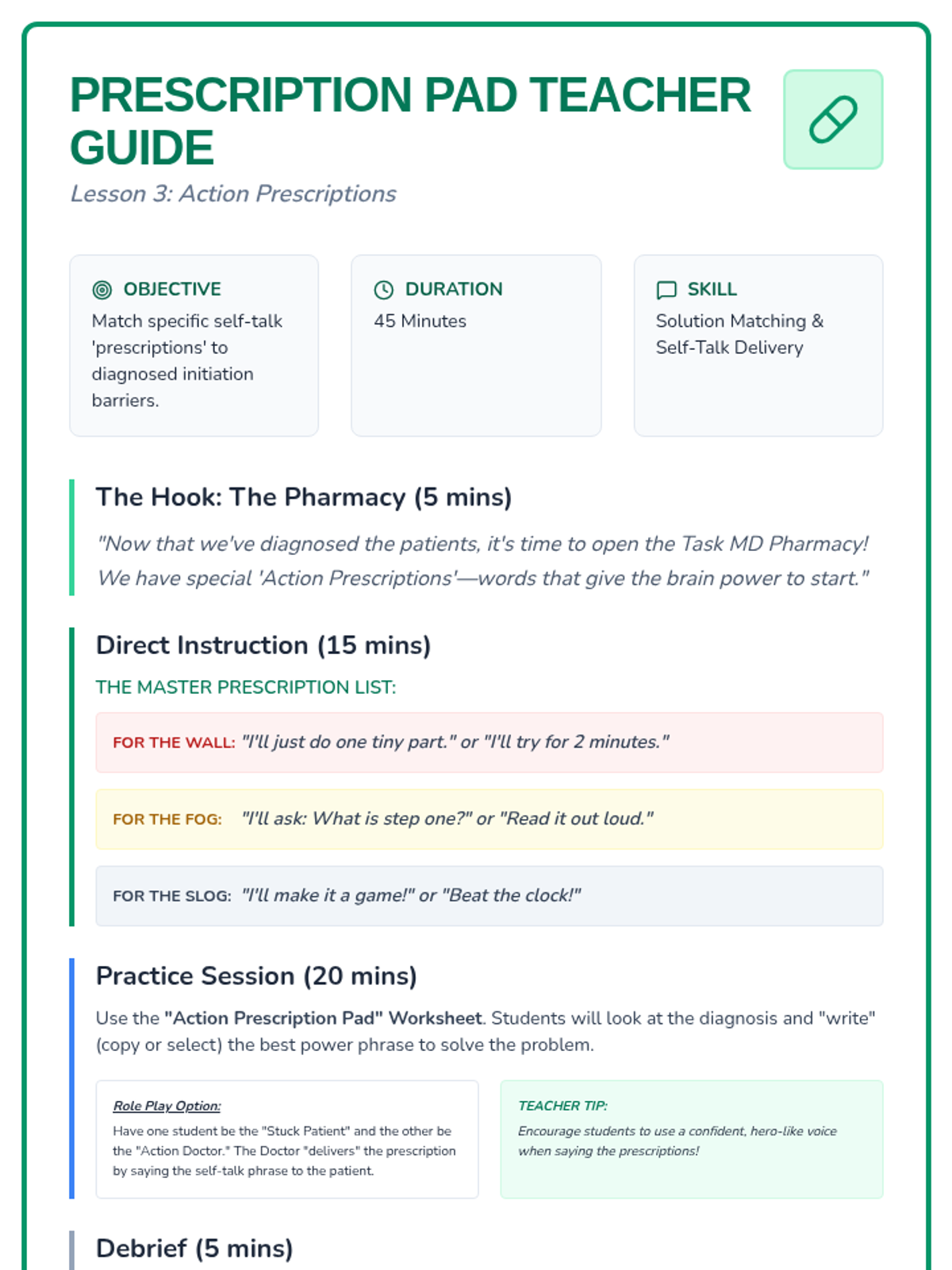
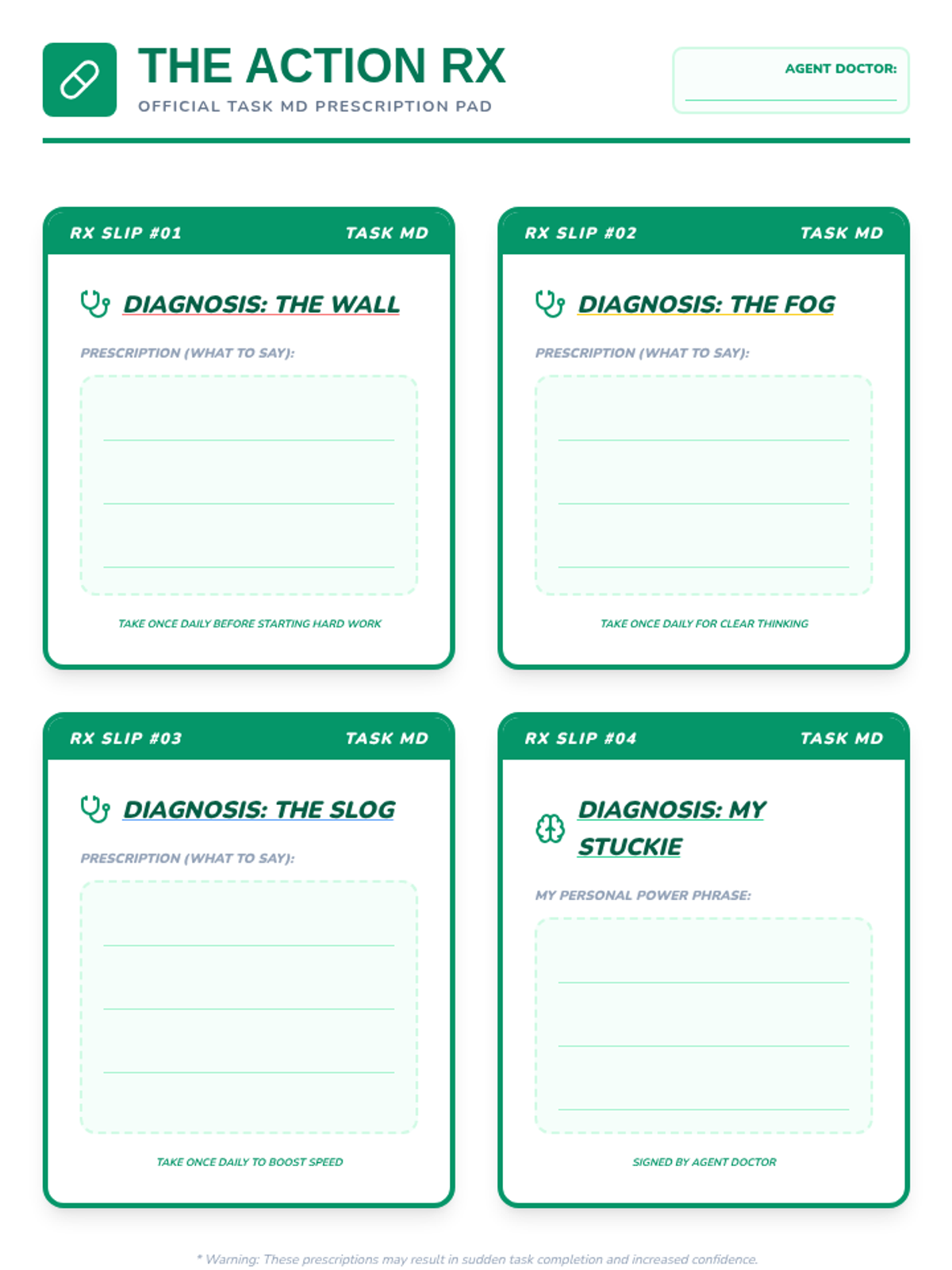
Students match specific self-talk 'prescriptions' to diagnosed problems and practice delivering these lines to characters.
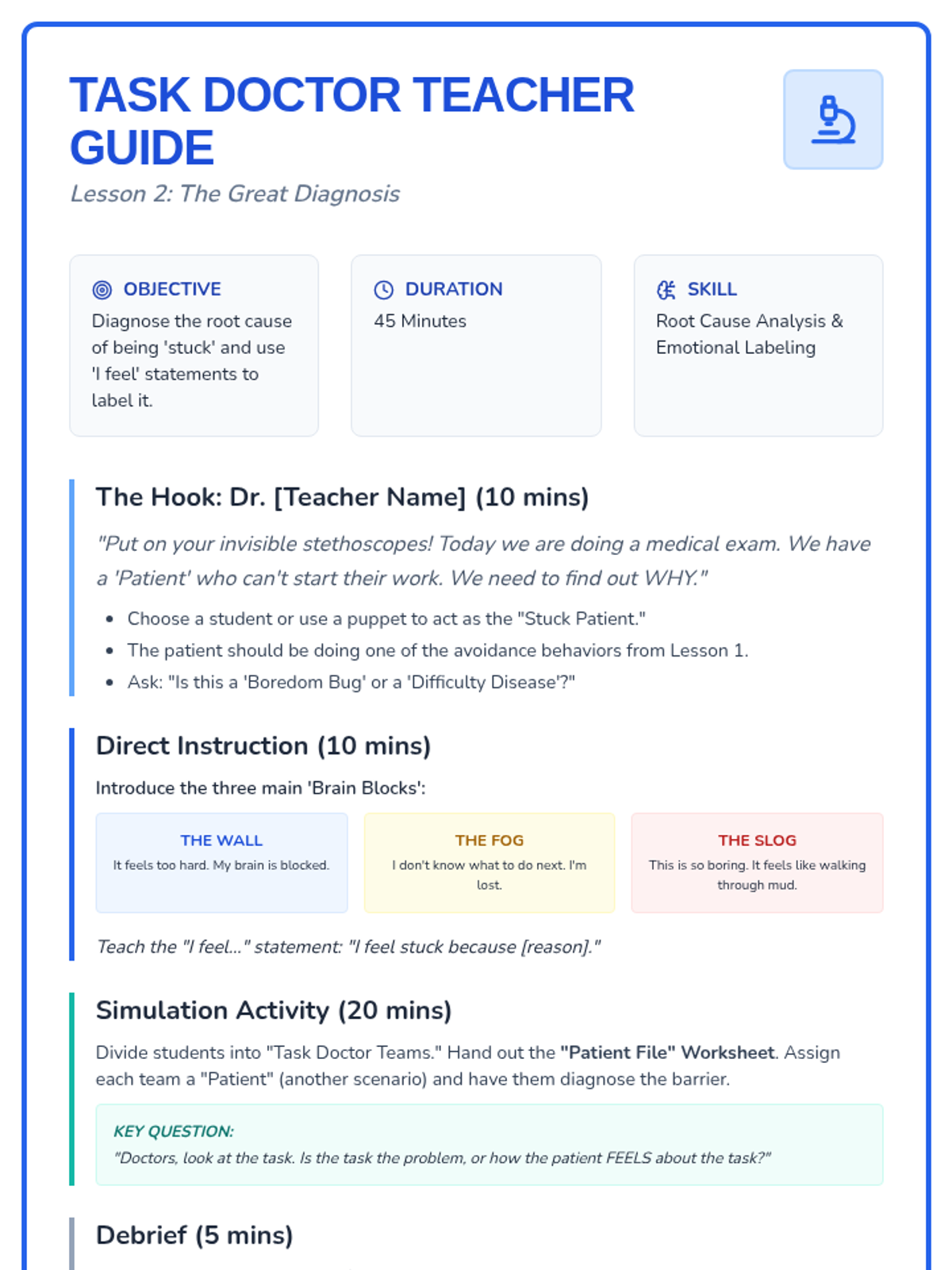
Students act as 'Task Doctors' to determine why a character is stuck (boredom, difficulty, fatigue) and practice labeling these emotions.
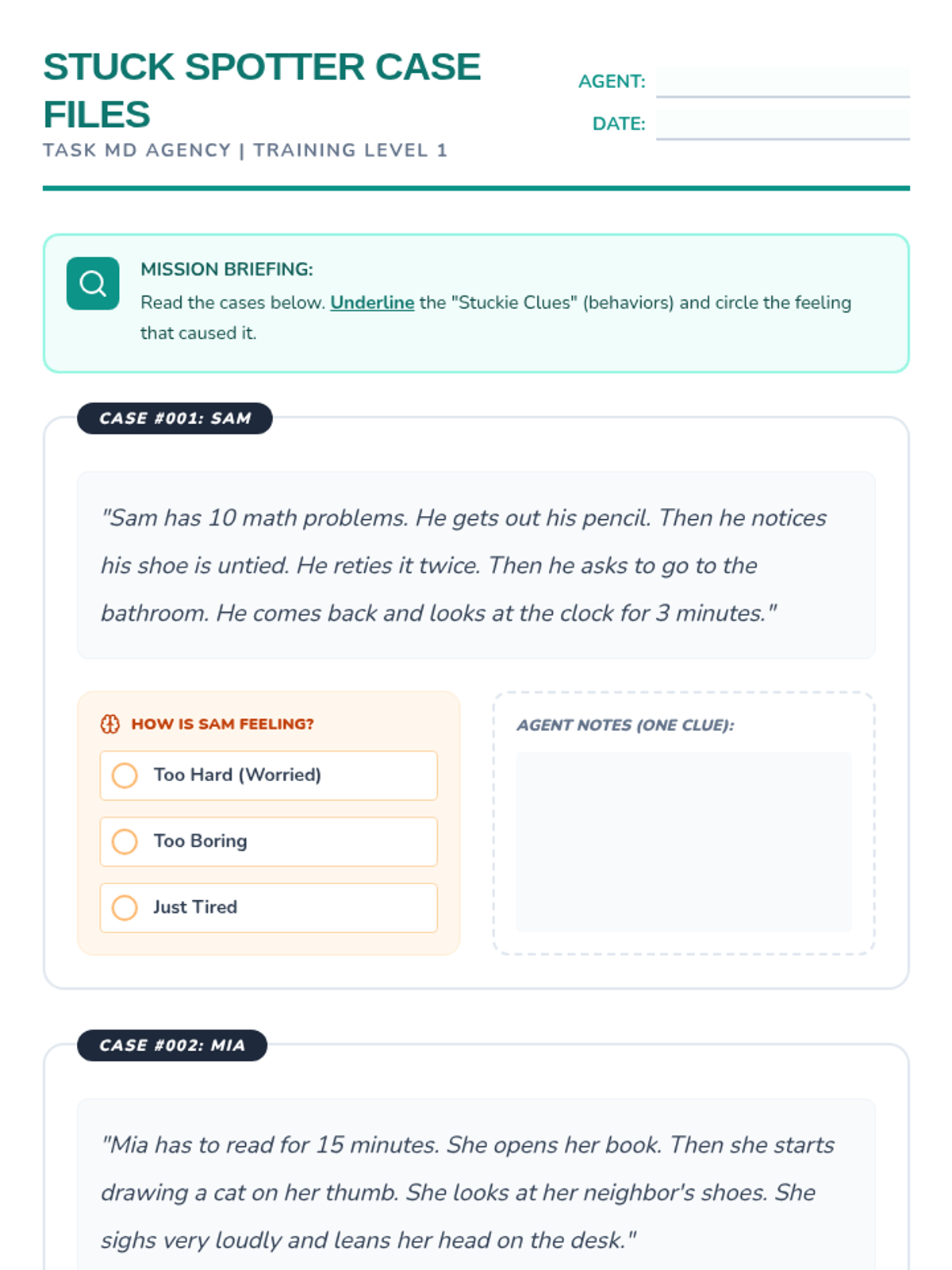
Students identify behaviors that show someone is avoiding work and brainstorm what emotions might be driving those behaviors through case studies.
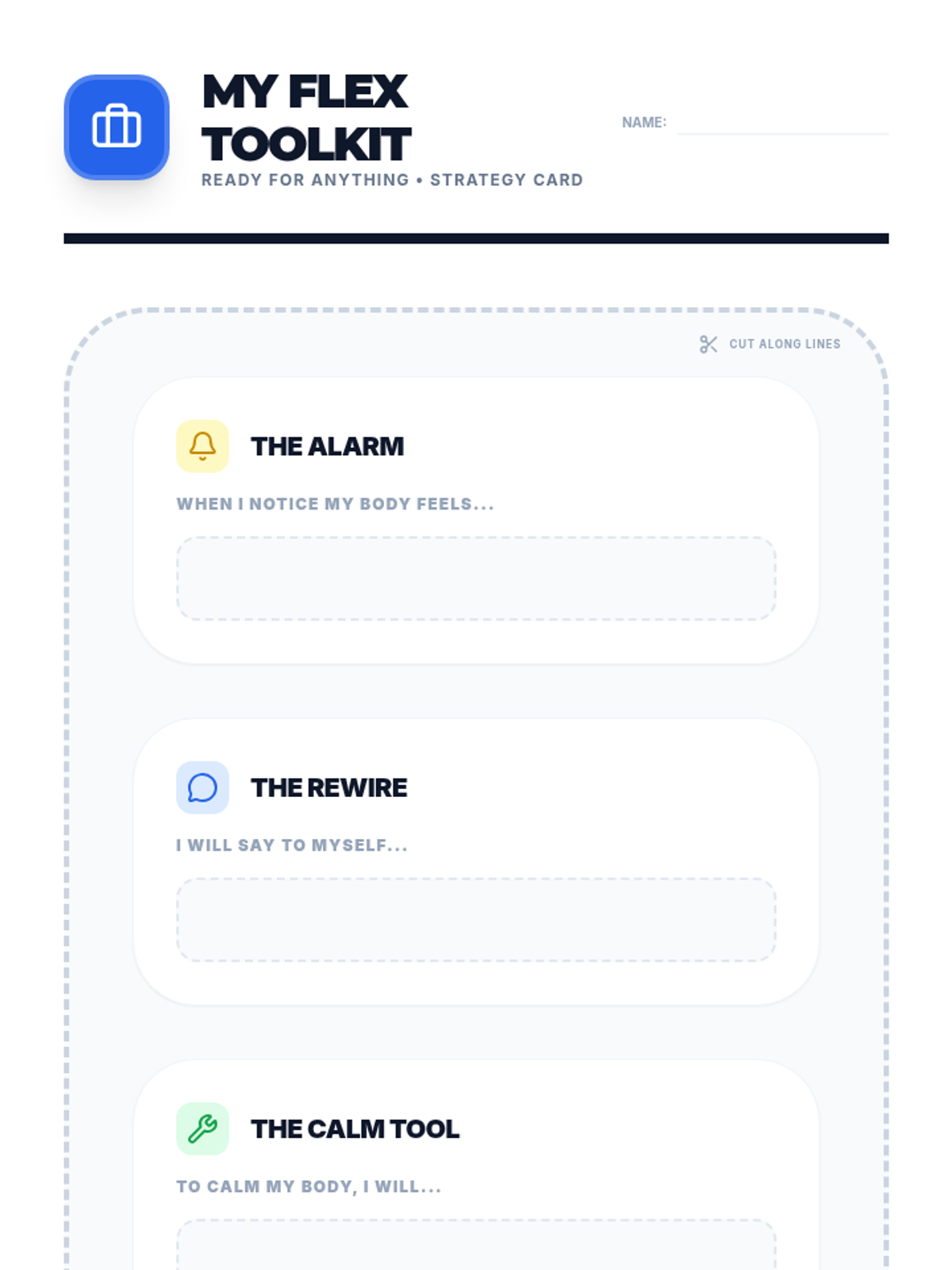
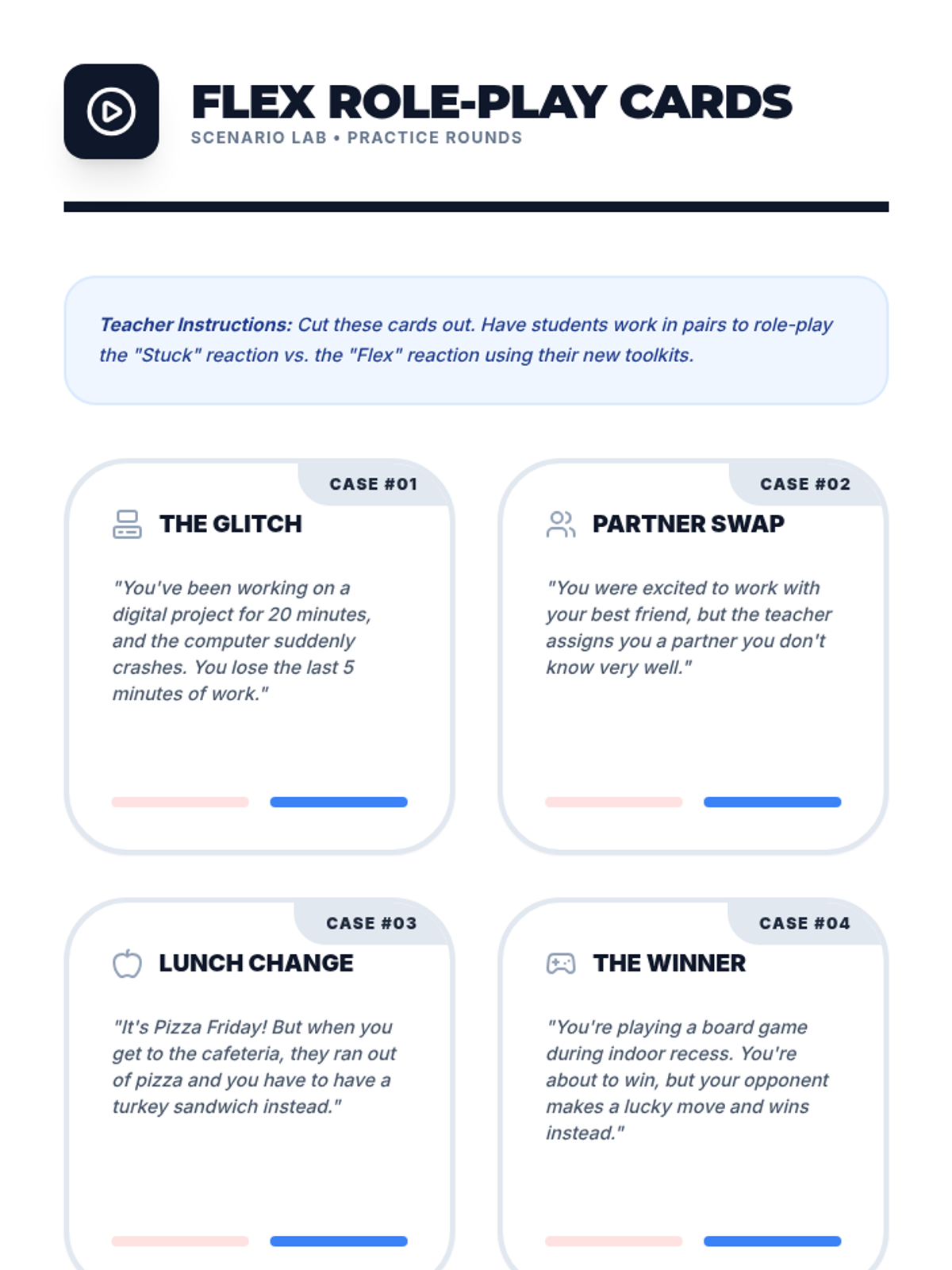
Students synthesize their learning by creating a personal flexibility toolkit card. They practice using their toolkit during role-played scenarios of common disruptions.
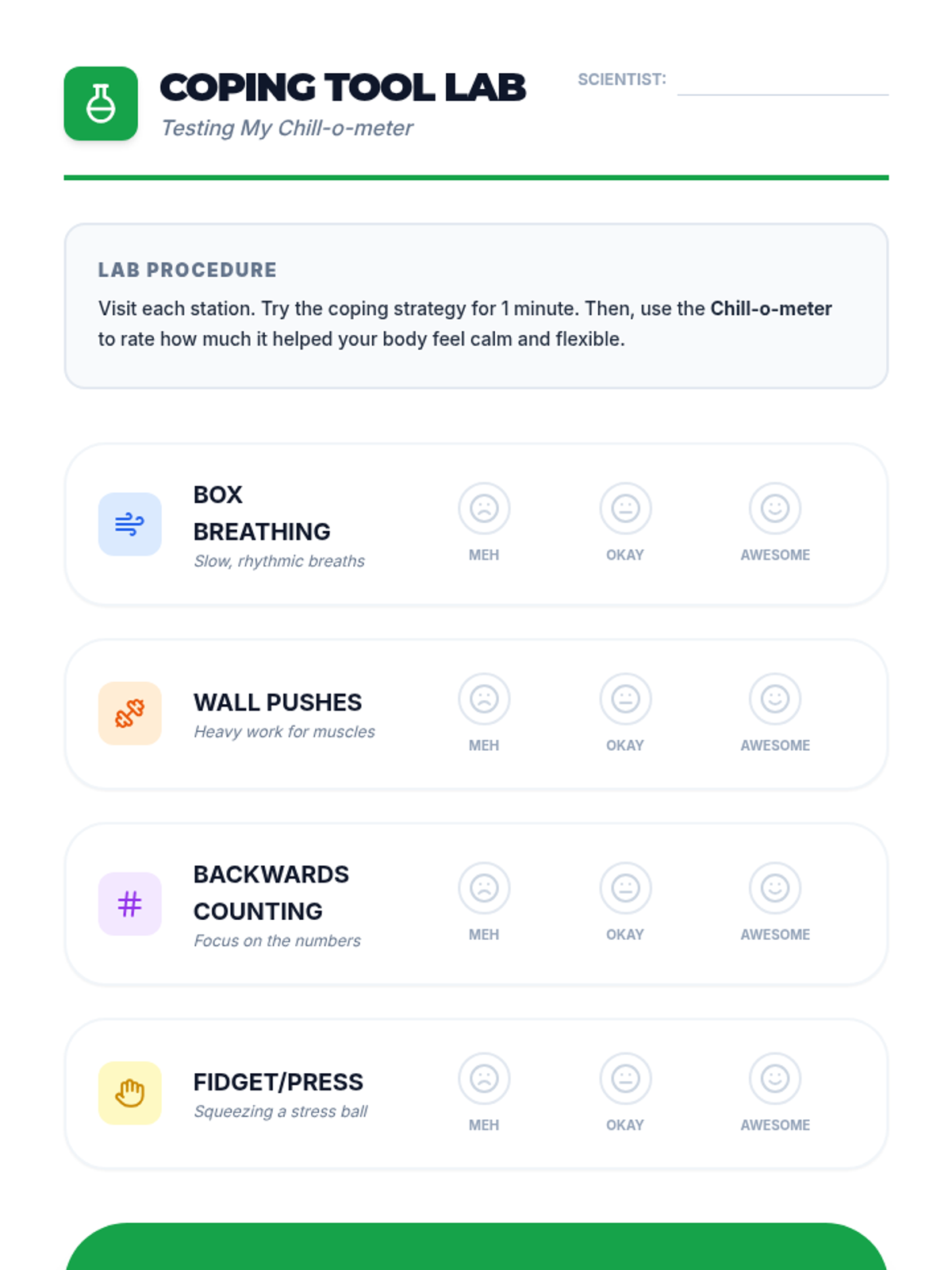
Students experiment with classroom-appropriate de-escalation strategies like deep breathing and heavy work. They rate the effectiveness of each strategy on a 'Chill-o-meter'.
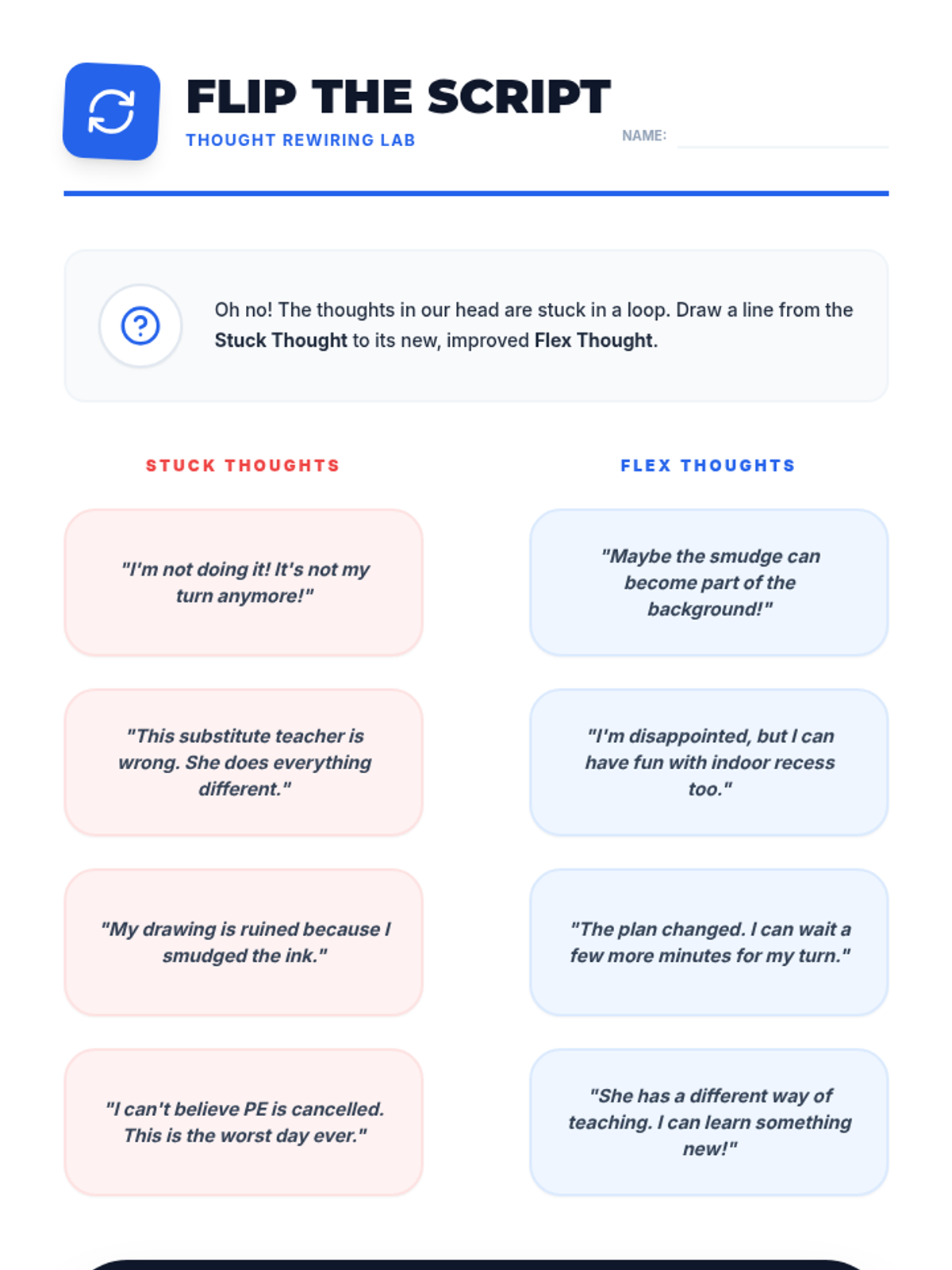
Students practice replacing negative internal scripts with neutral or positive coping statements. They engage in matching activities to pair common problems with appropriate self-talk solutions.
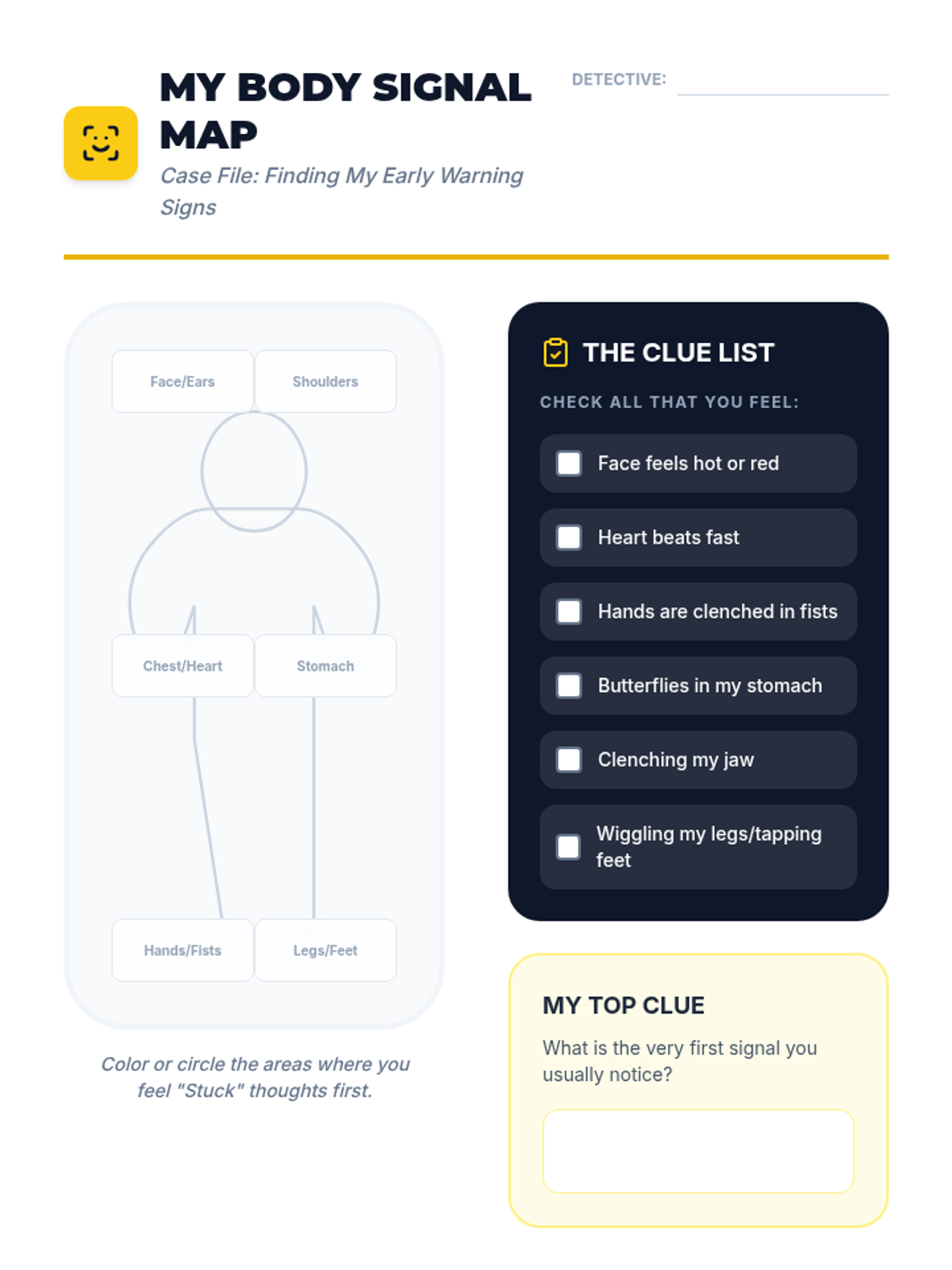
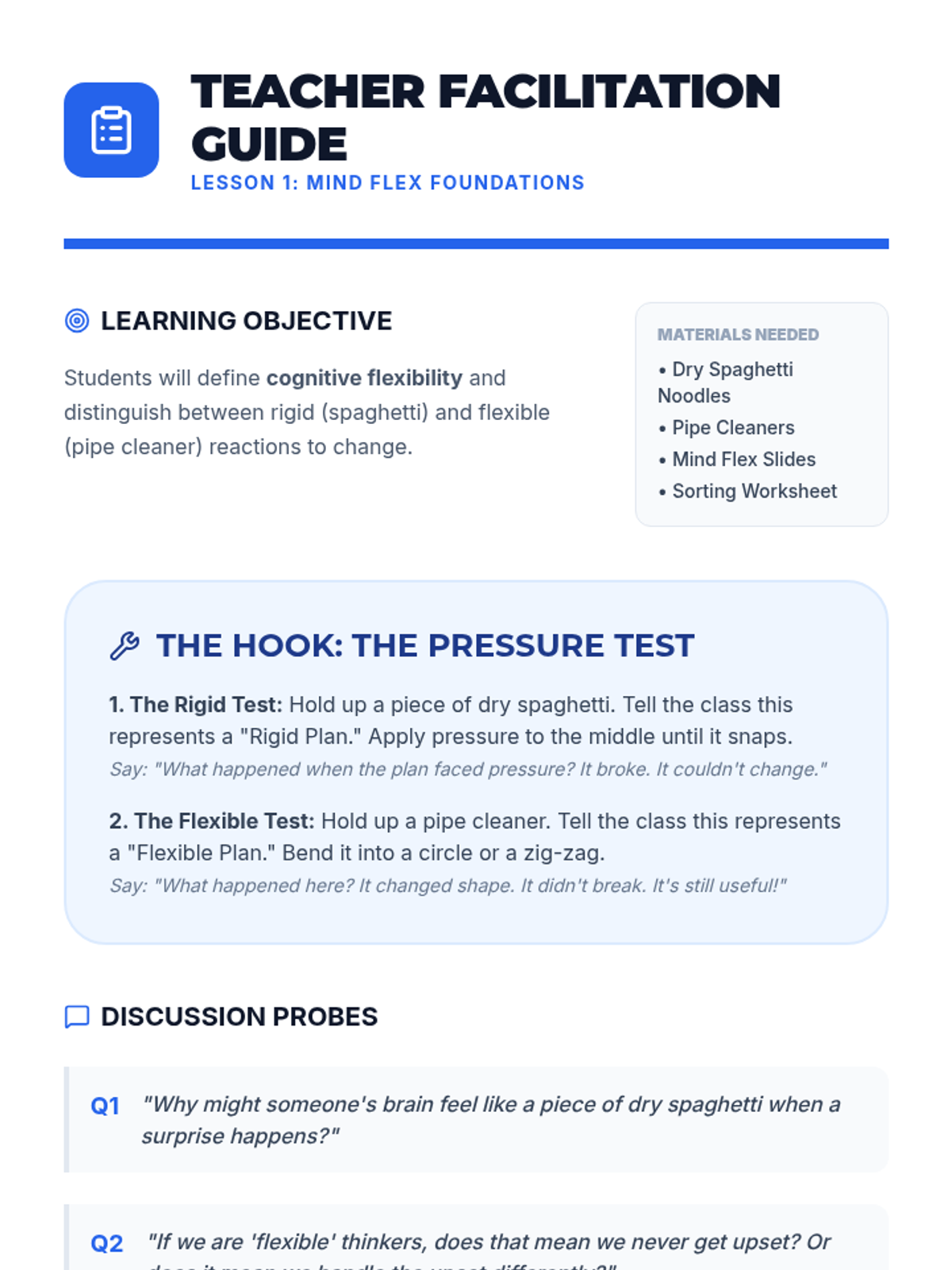
Students identify physical and emotional warning signs that occur when plans change. They create body maps to locate where they feel frustration, helping them interrupt potential meltdowns early.
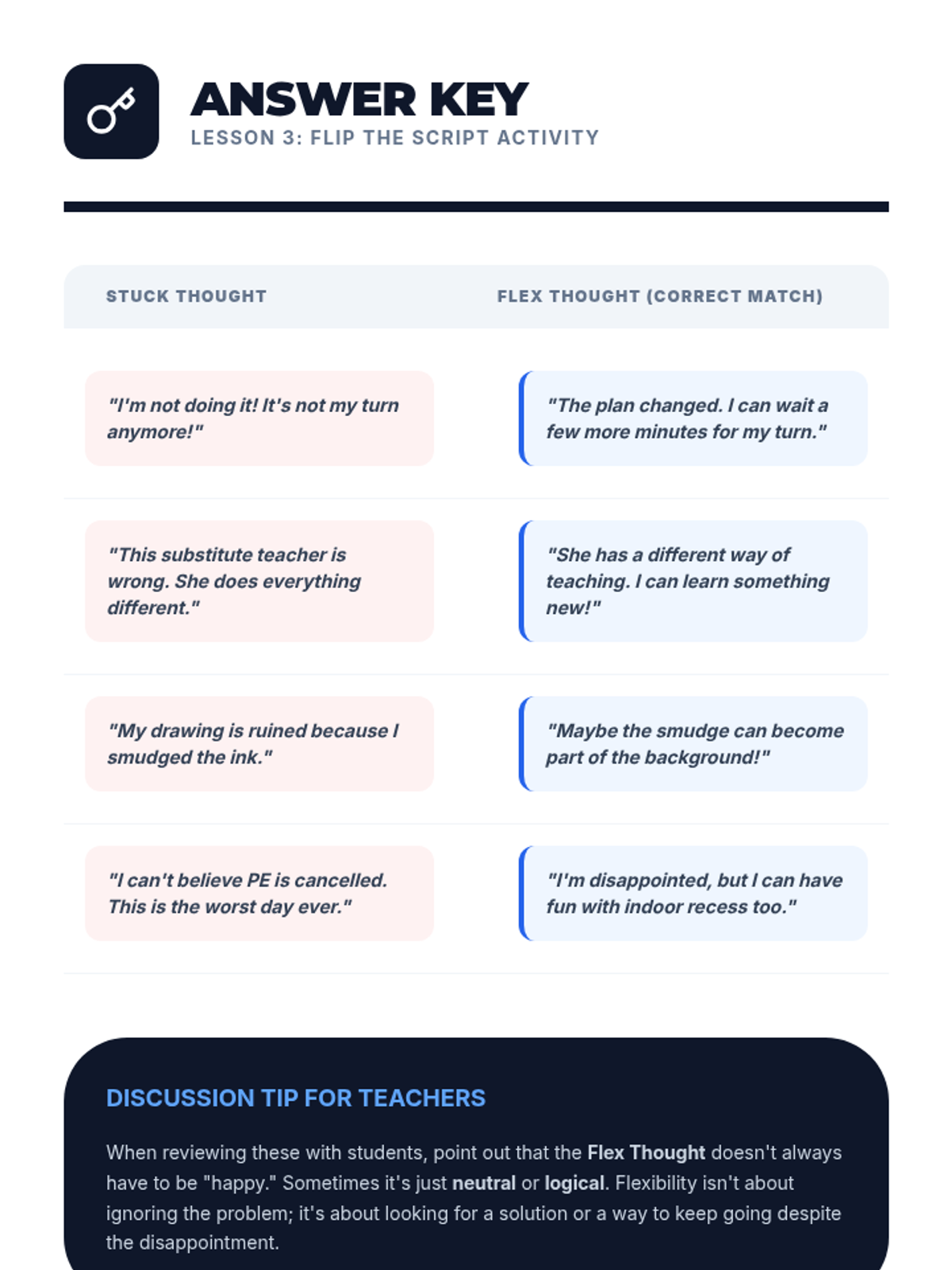
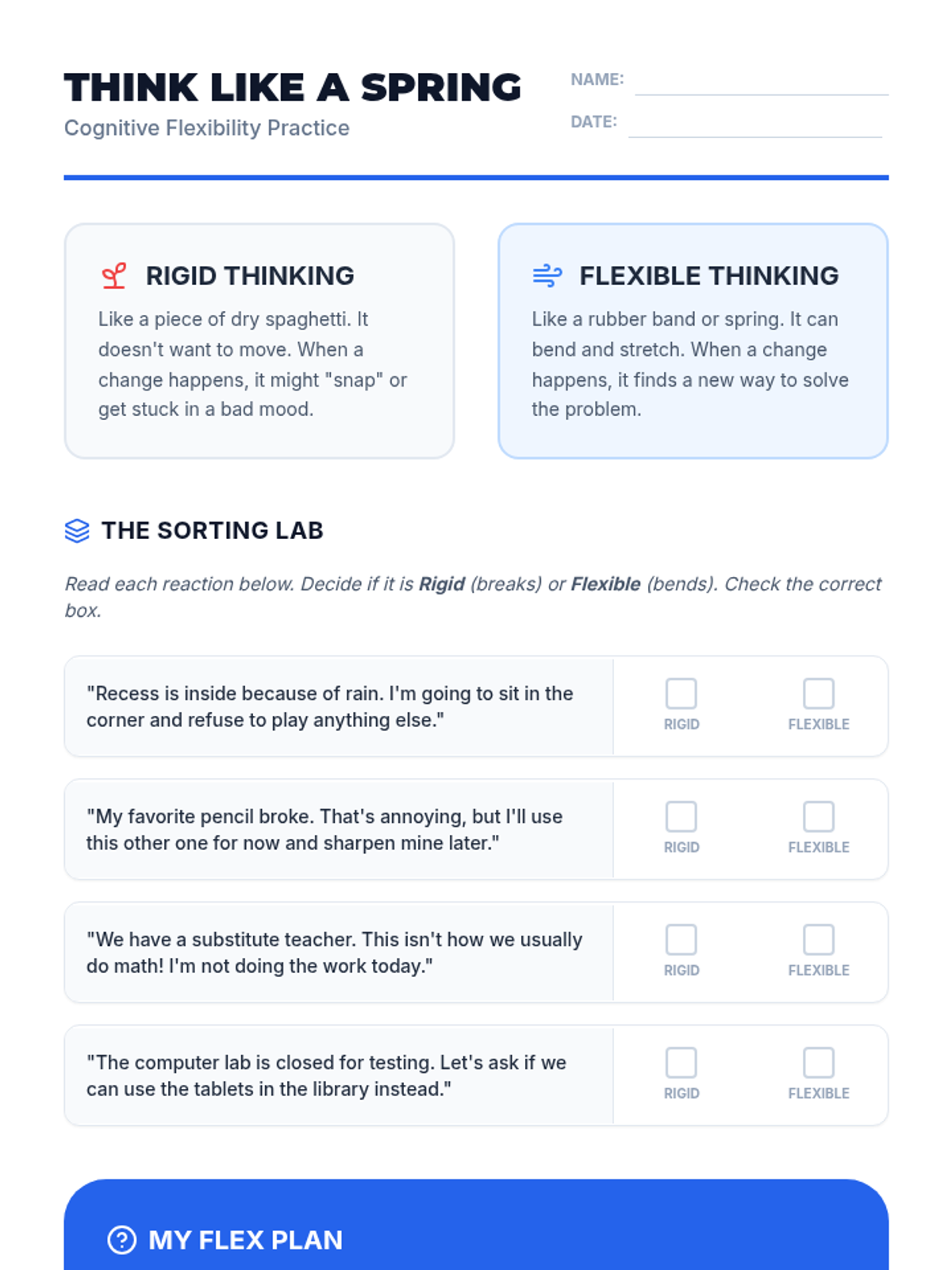
Students explore the difference between rigid (glass) and flexible (rubber) thinking through object lessons and analogies. They categorize reactions to problems as either 'stuck' or 'flexible' to build a shared vocabulary.
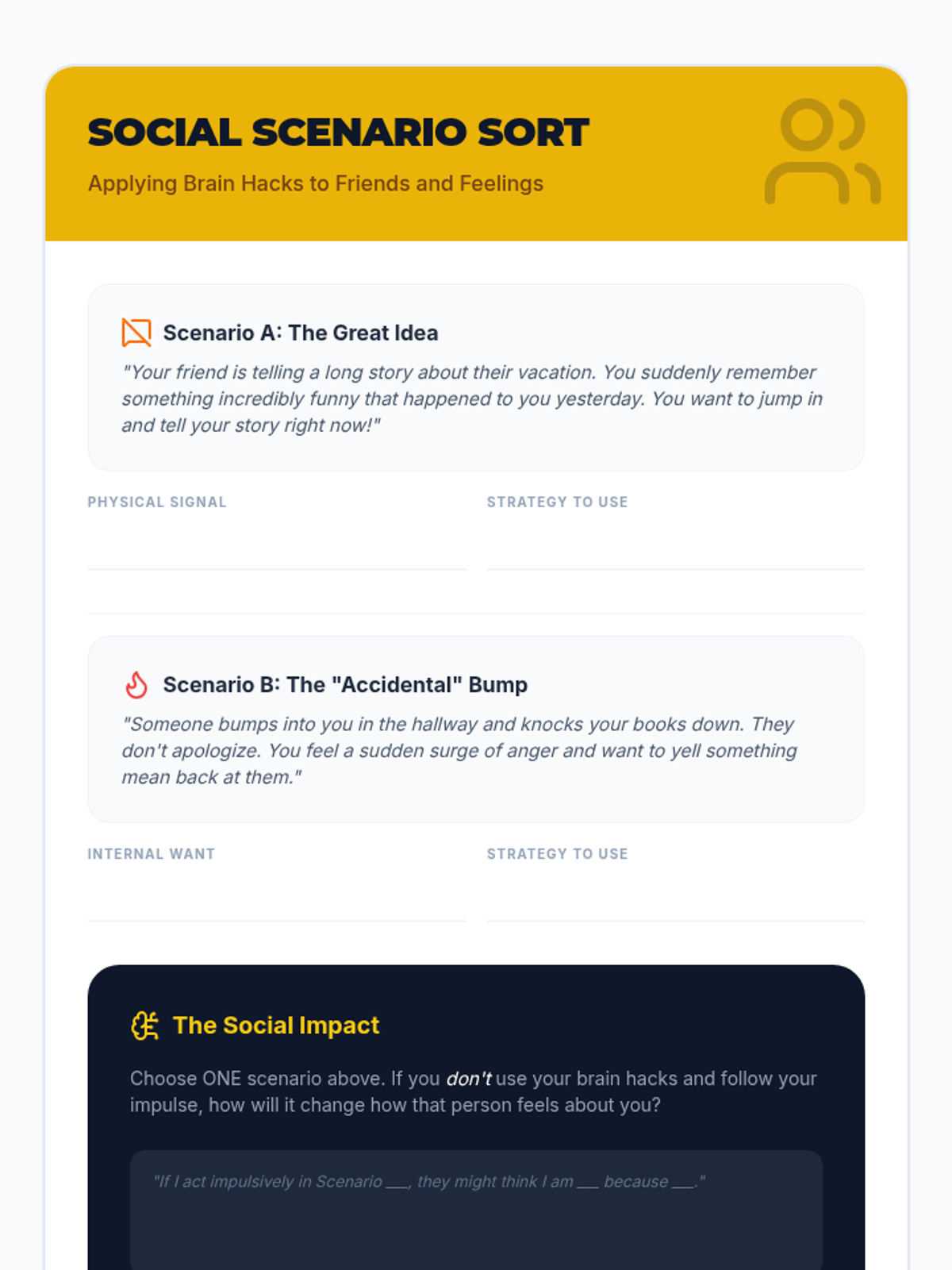
Culminating lesson where students apply their self-regulation strategies to social scenarios, such as peer pressure and interpersonal conflict, to build better relationships.
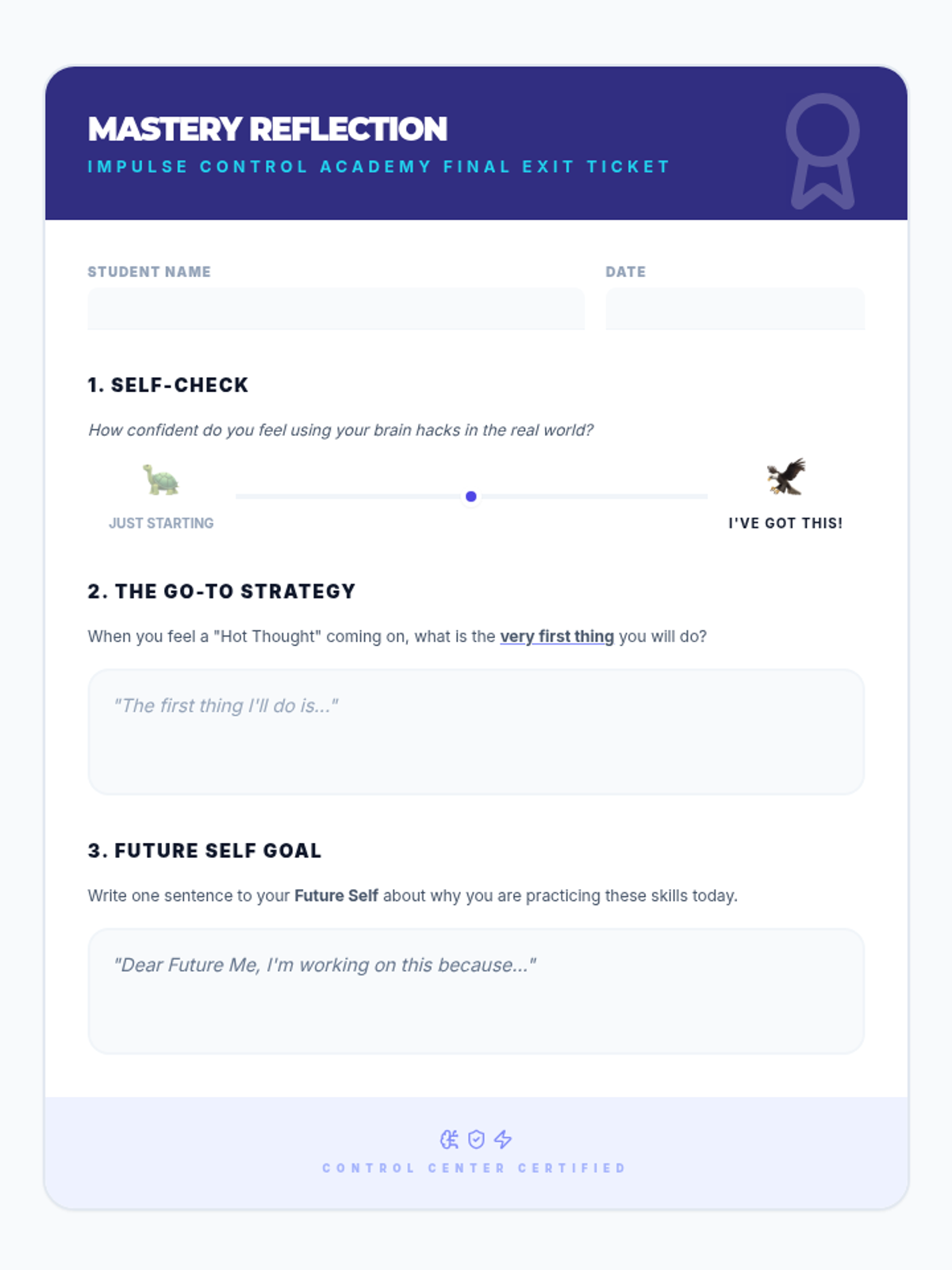
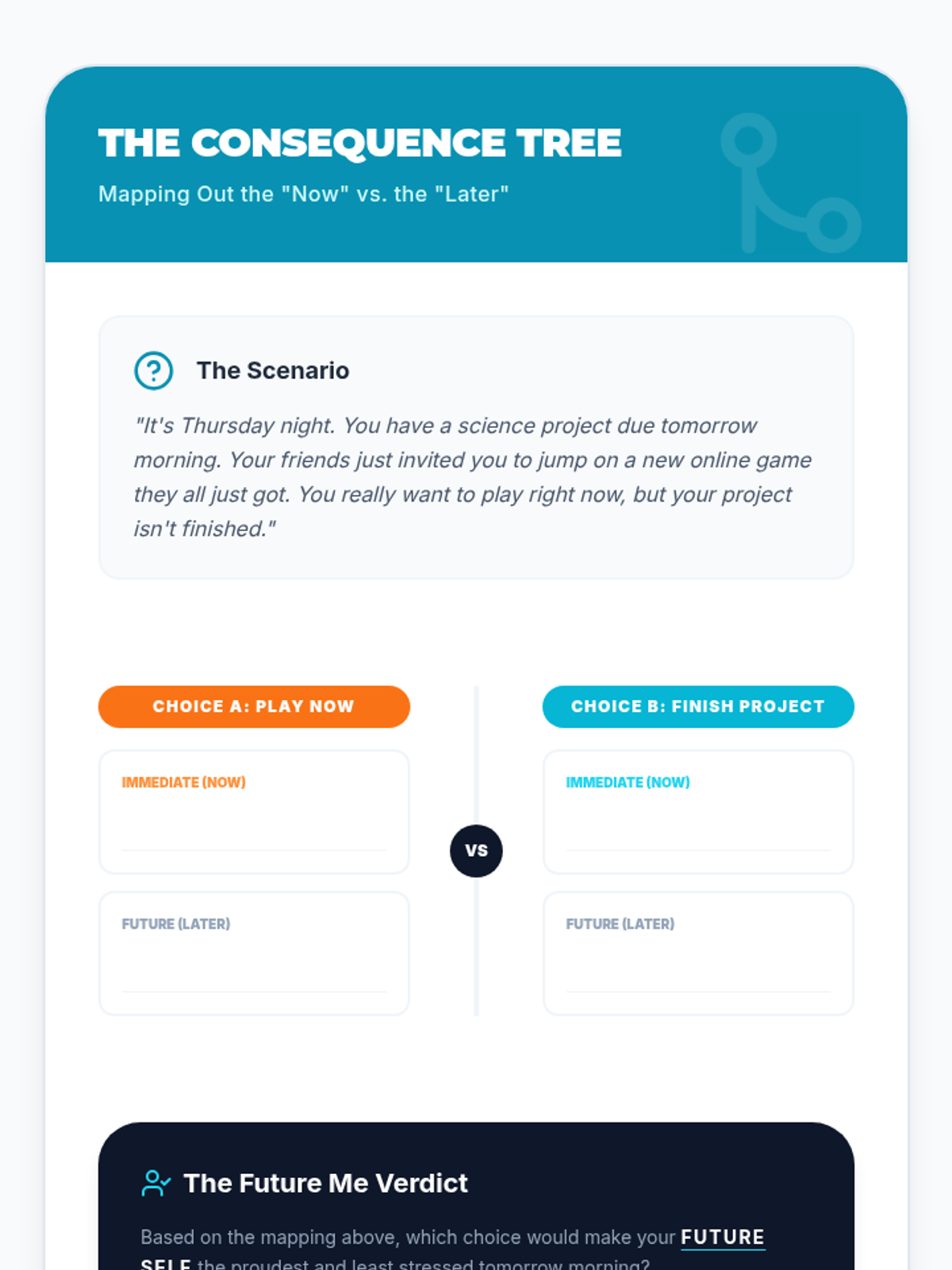
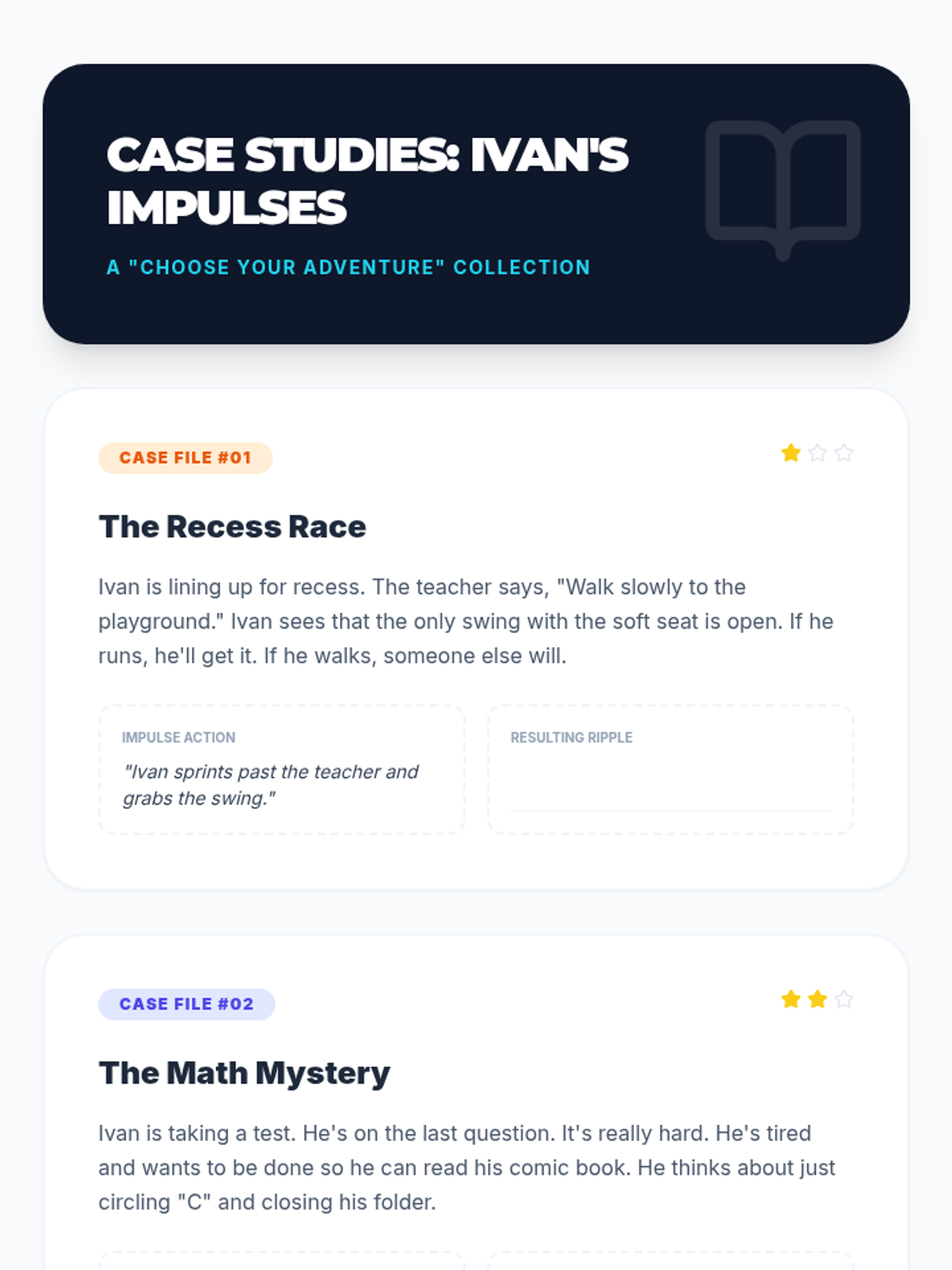
Students use decision trees and case studies to analyze the long-term consequences of impulsive choices versus patient ones, reinforcing the logical benefits of waiting.
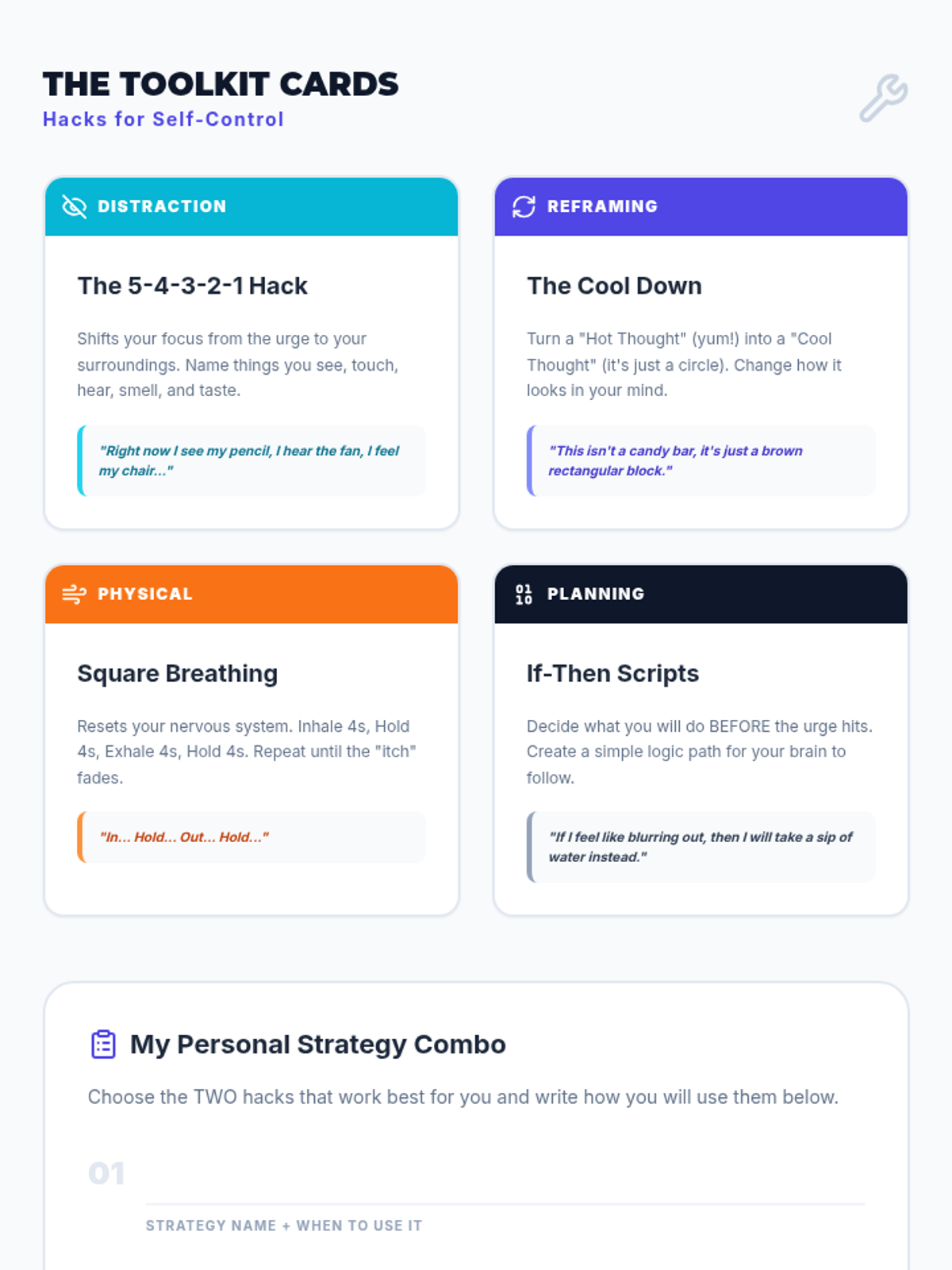
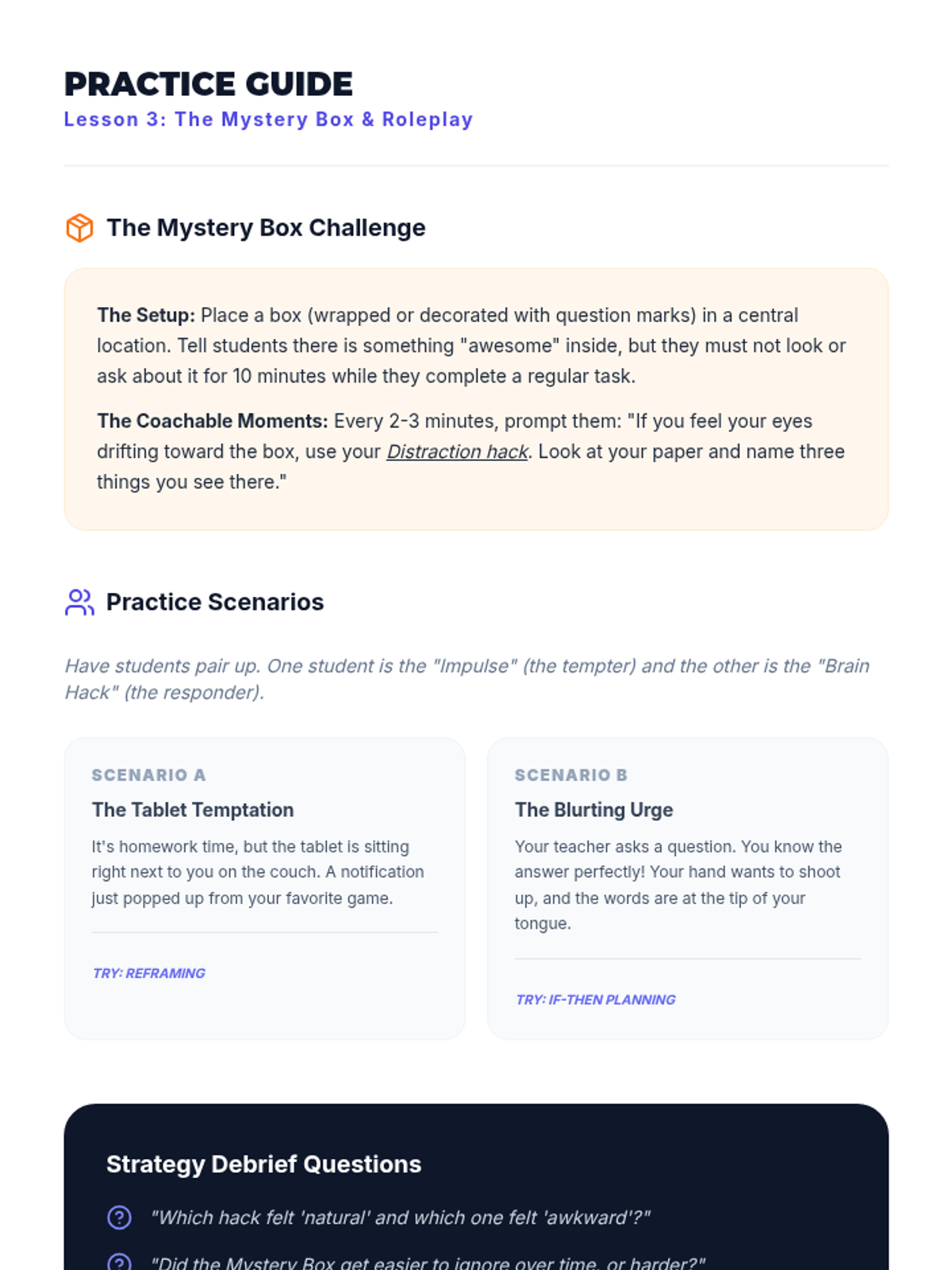
Focuses on practical strategies for bridging the gap between impulse and action. Students learn and practice distraction, cognitive reframing, and 'cool thoughts' vs. 'hot thoughts.'
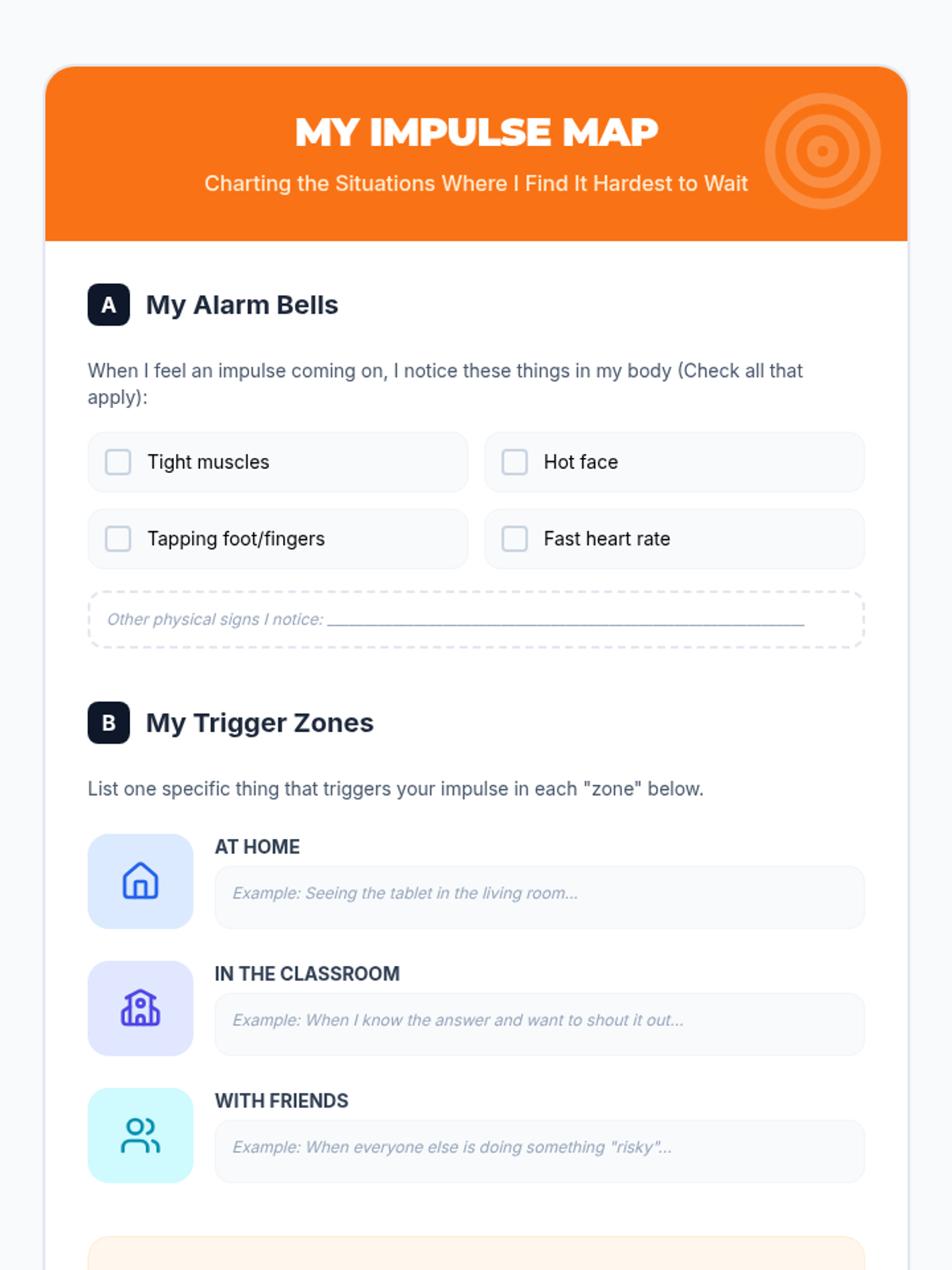
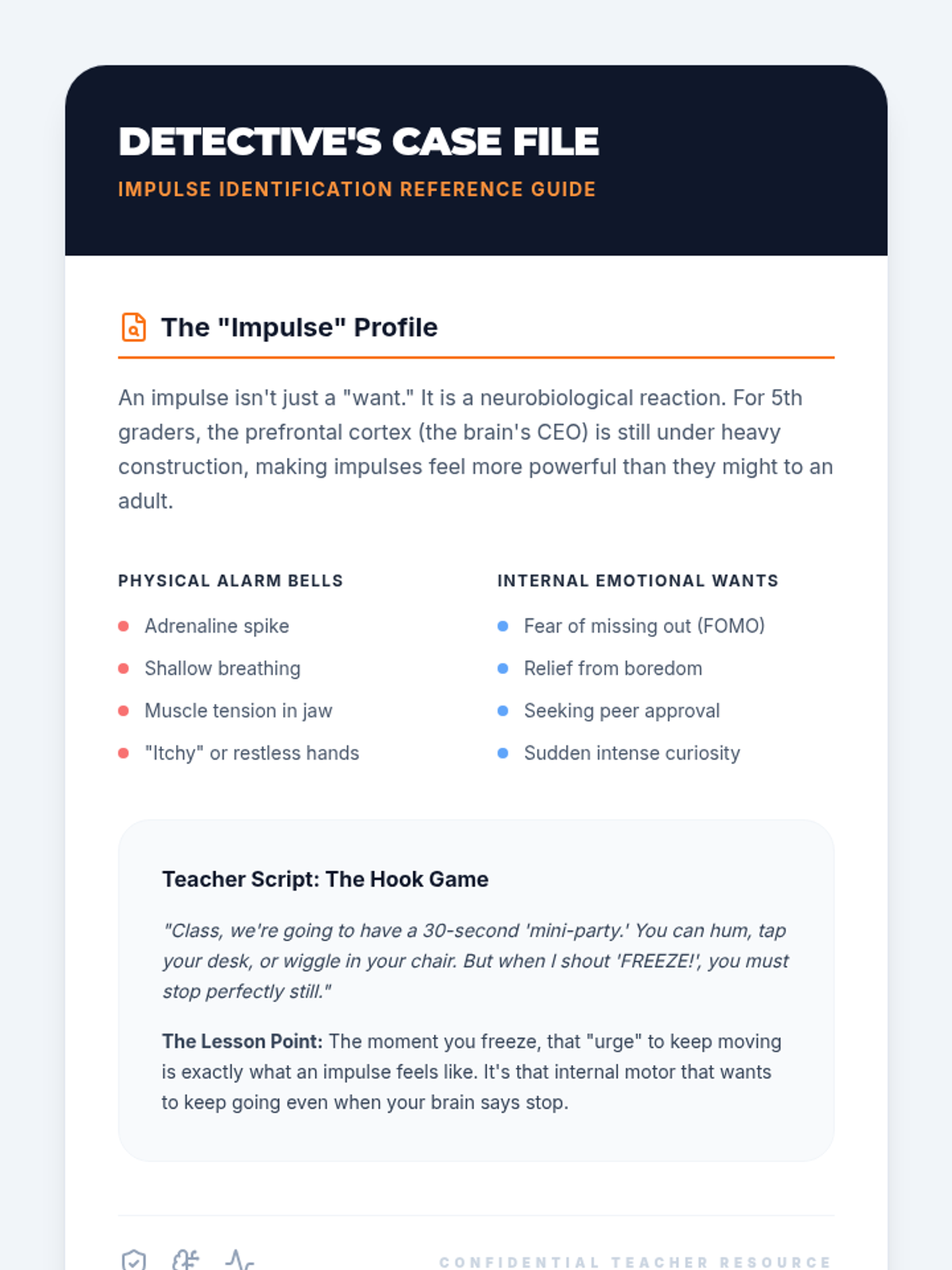
Students explore the physical and emotional cues of impulses. They identify their personal triggers and create 'Trigger Maps' to recognize high-risk situations for impulsive behavior.
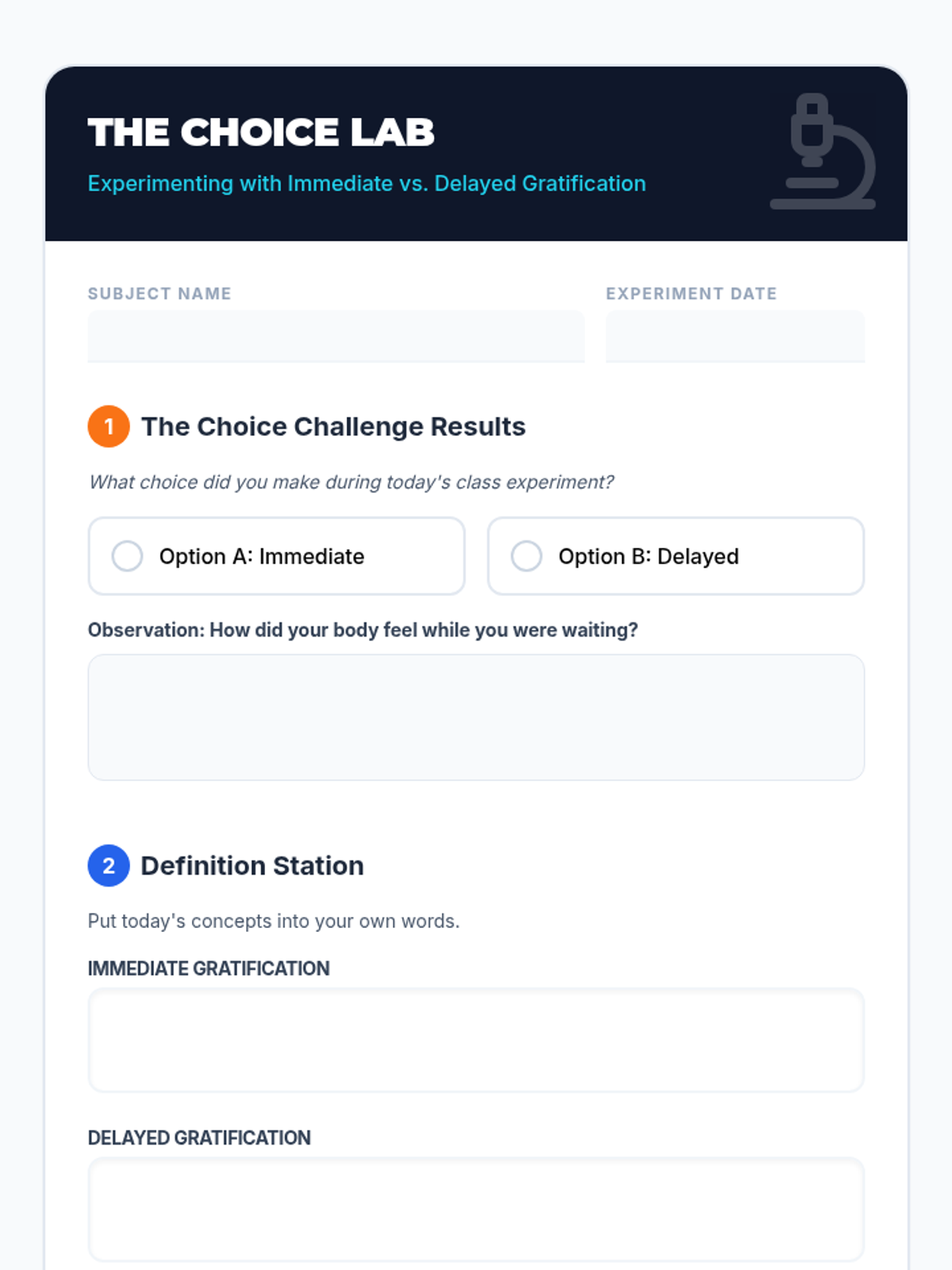
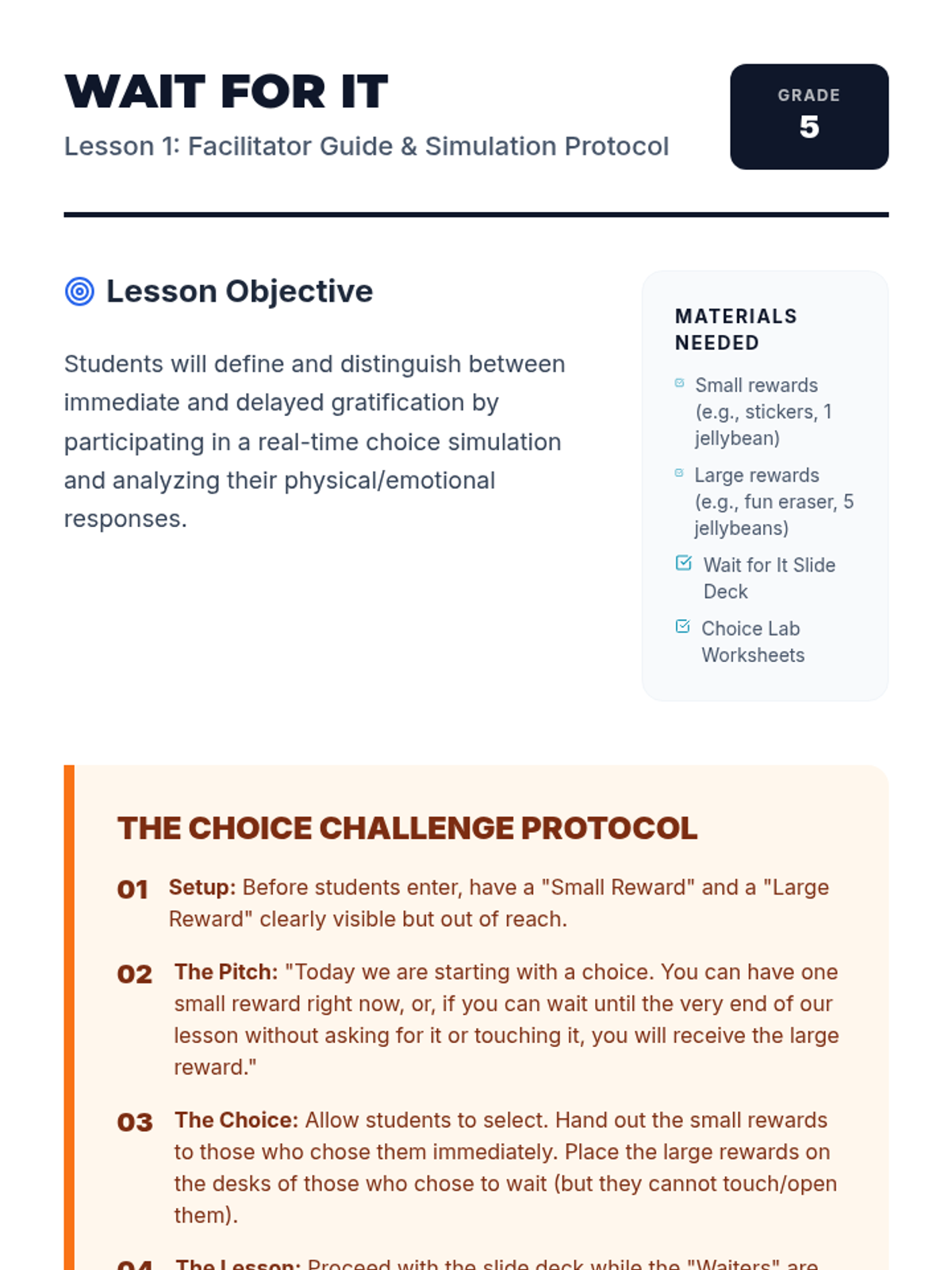
Introduces the concept of immediate versus delayed gratification through a hands-on reward simulation. Students define key vocabulary and reflect on the emotional experience of waiting.
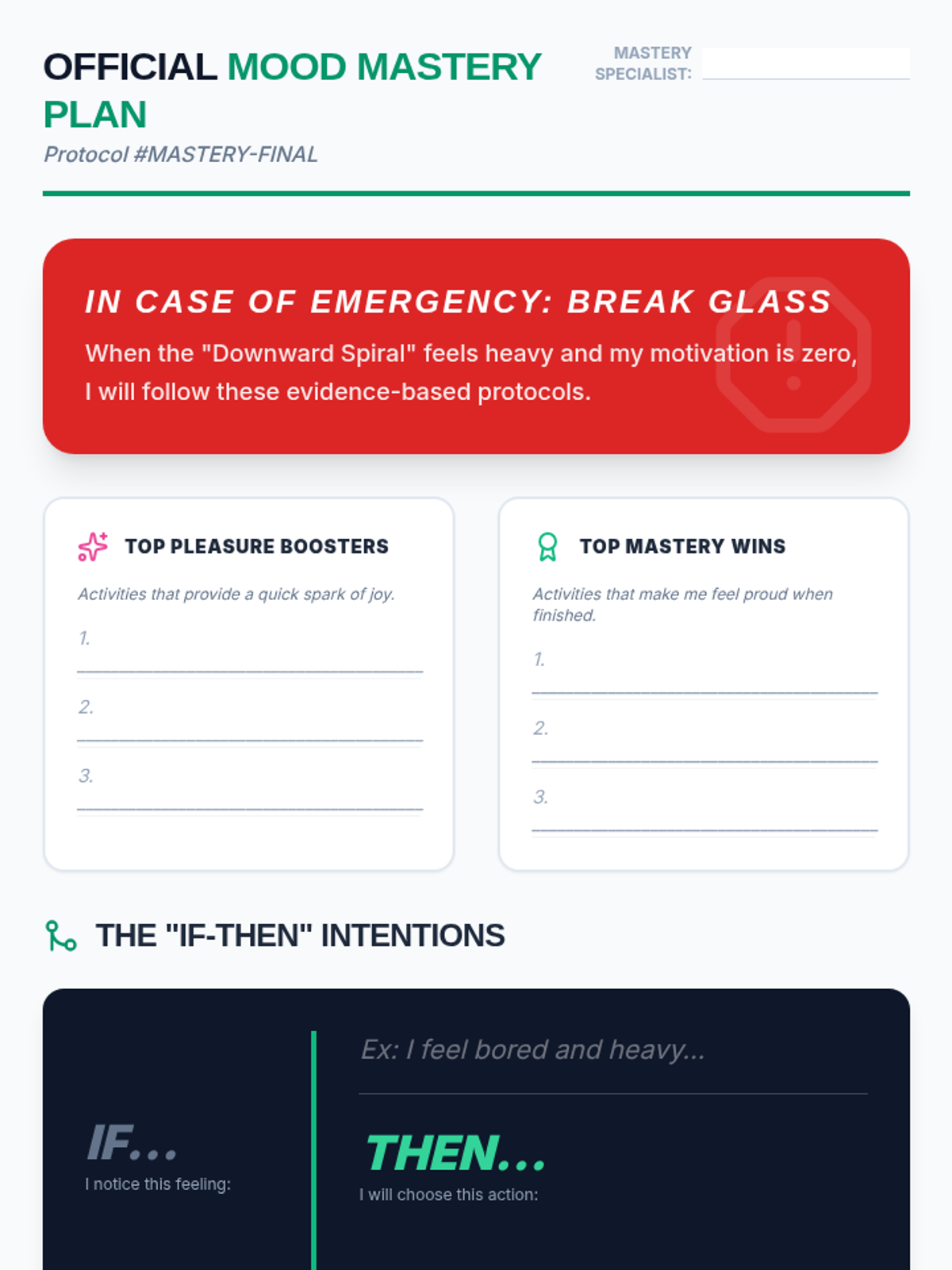
Synthesizing their learning, students create a 'Break the Glass' emergency plan for days when they feel low or anxious. They select their most effective pleasure and mastery activities and write specific implementation intentions (If I feel X, then I will do Y).
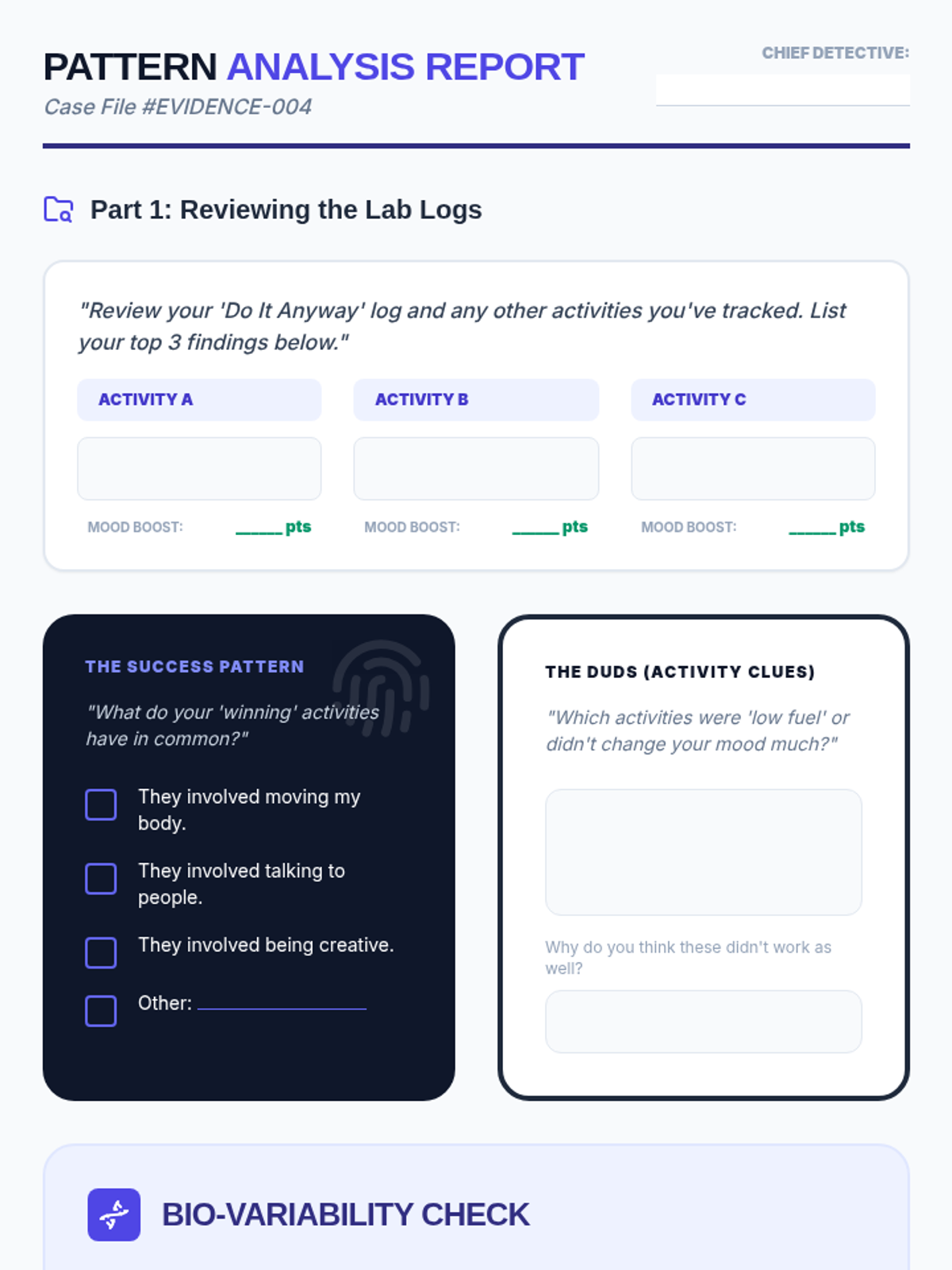
Students review the results of their personal experiments or case study data to identify patterns in how specific activities impact mood. They discuss the variability of results (what works for one person may not work for another) and begin curating their personal 'top hits' for mood improvement.
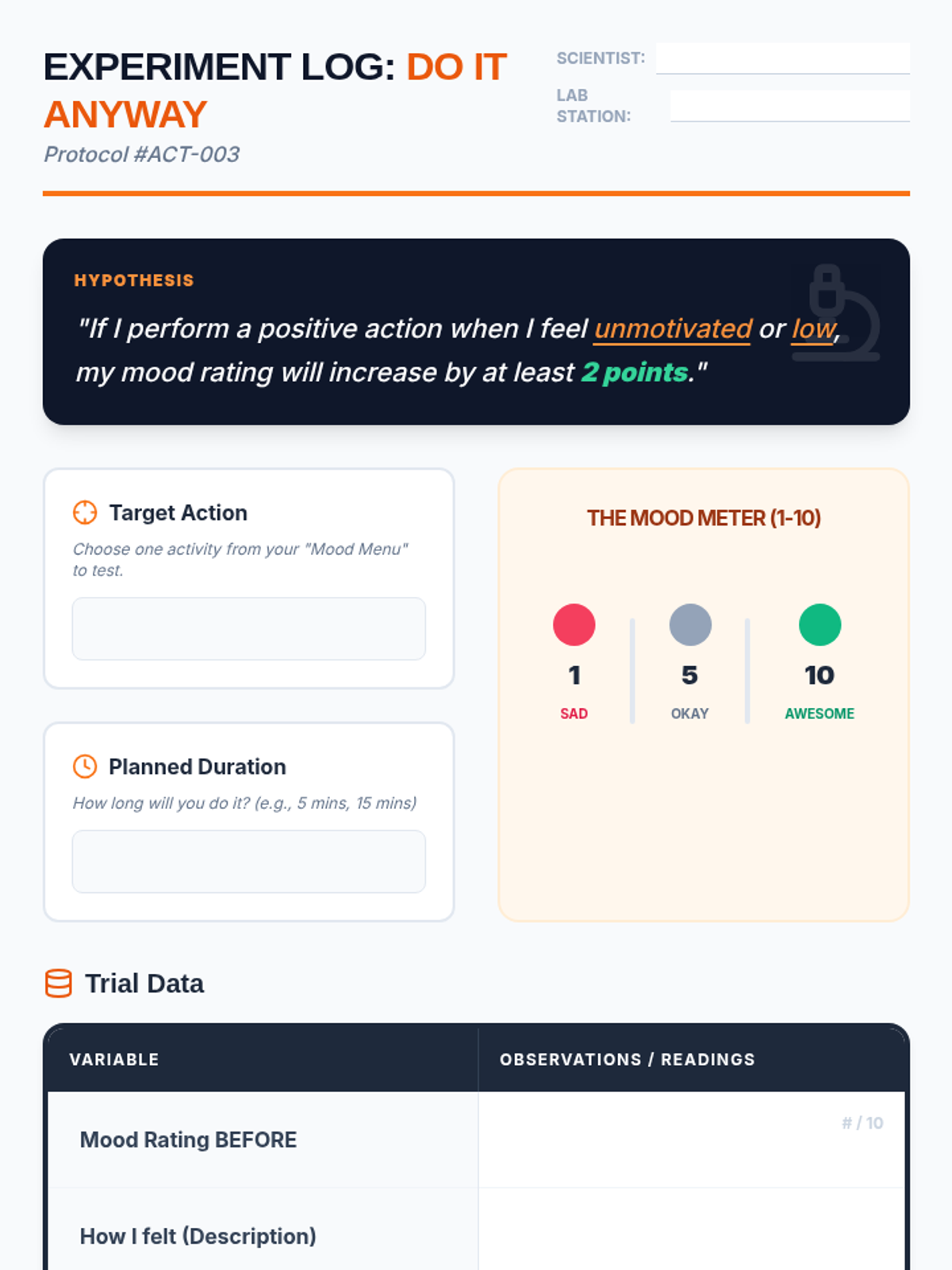
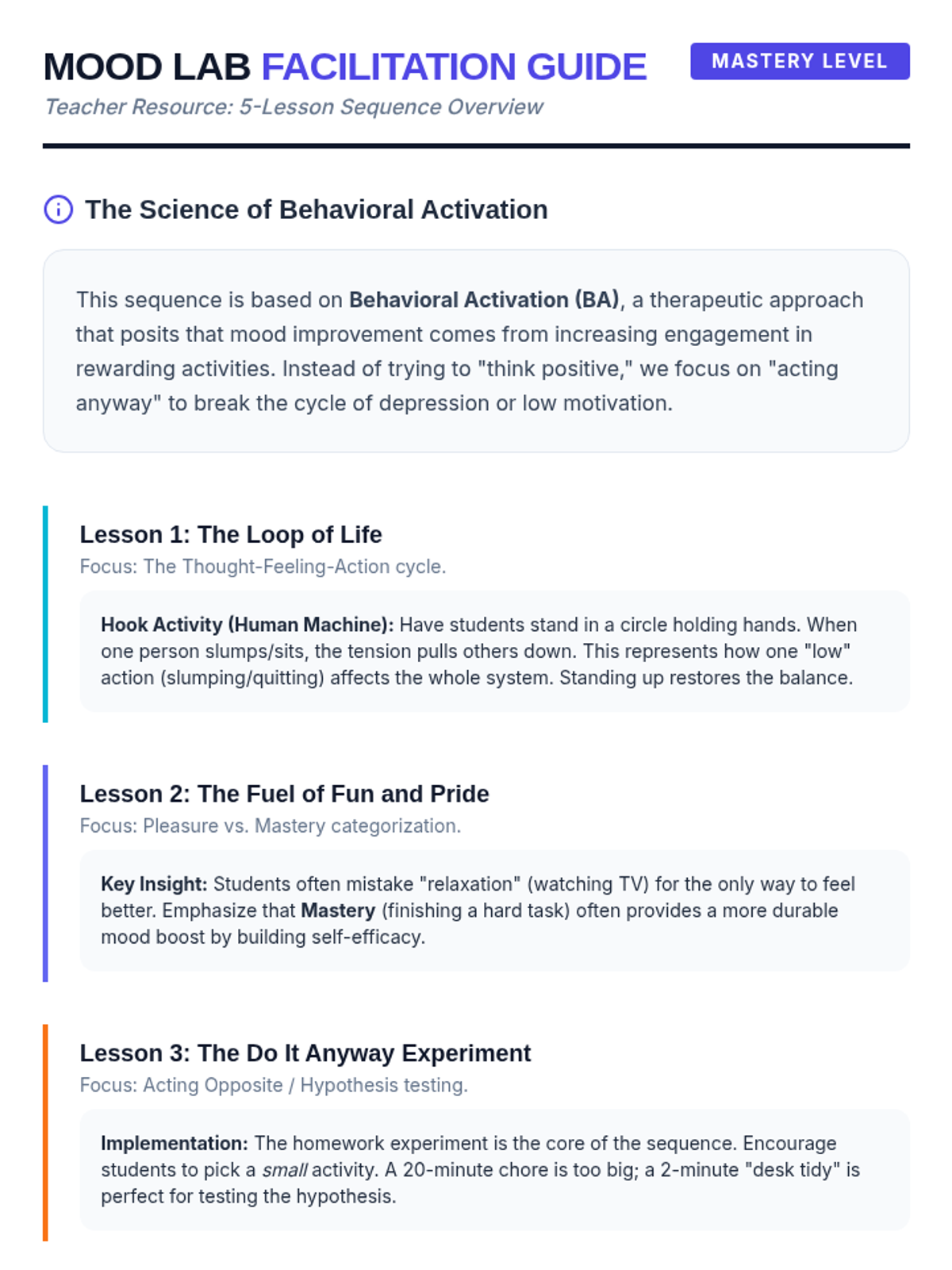
This lesson introduces the concept of 'acting opposite' to an emotion. Students design a short experiment to test the hypothesis that engaging in a positive activity—even when they don't feel like it—can improve their mood rating on a 1-10 scale. They prepare a data collection sheet for a homework experiment.
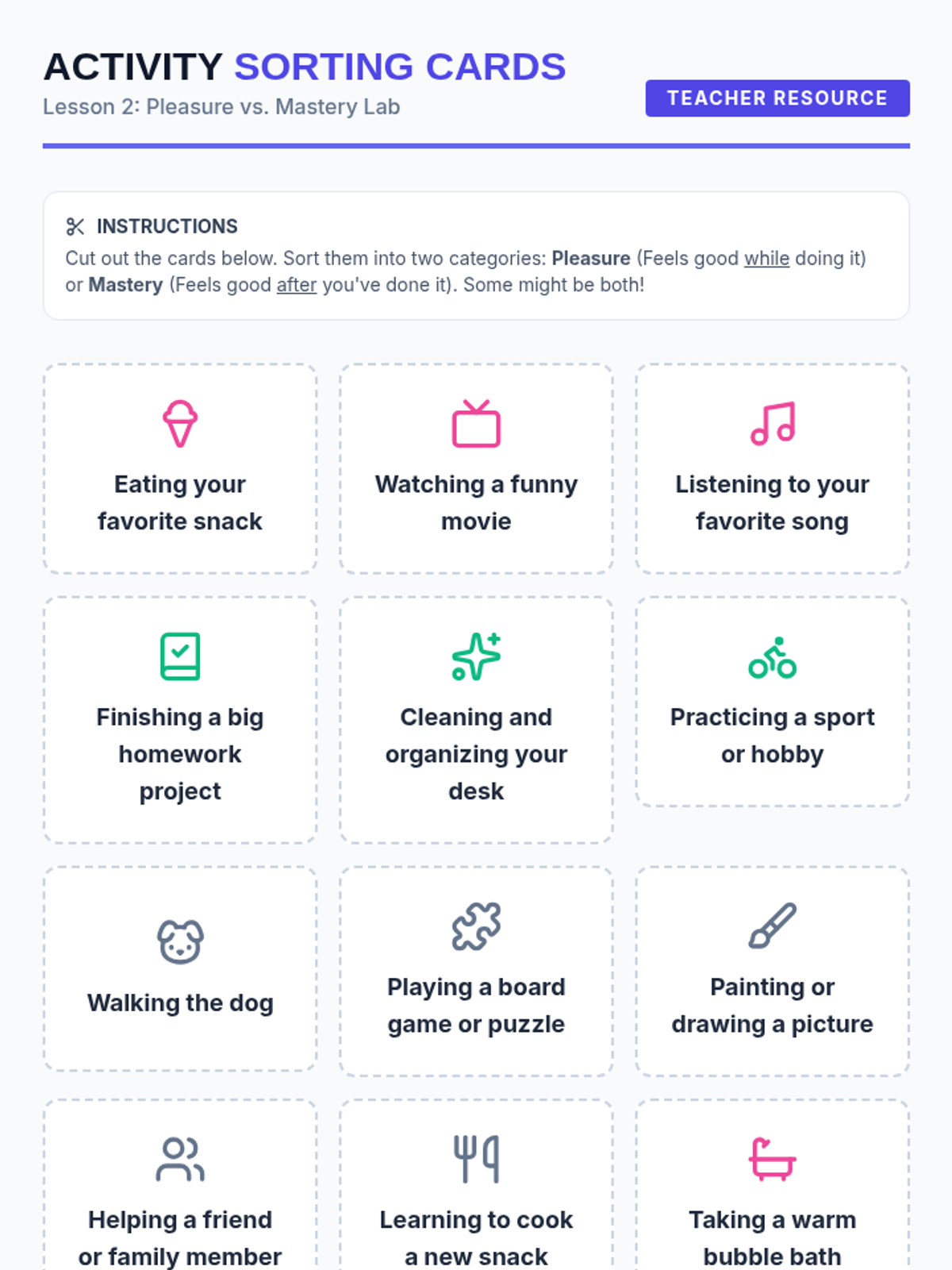
Students distinguish between activities that feel good in the moment (Pleasure) and those that make us feel accomplished (Mastery). Through a sorting workshop, they brainstorm examples for both categories, understanding that a balanced diet of experiences includes both fun and achievement.
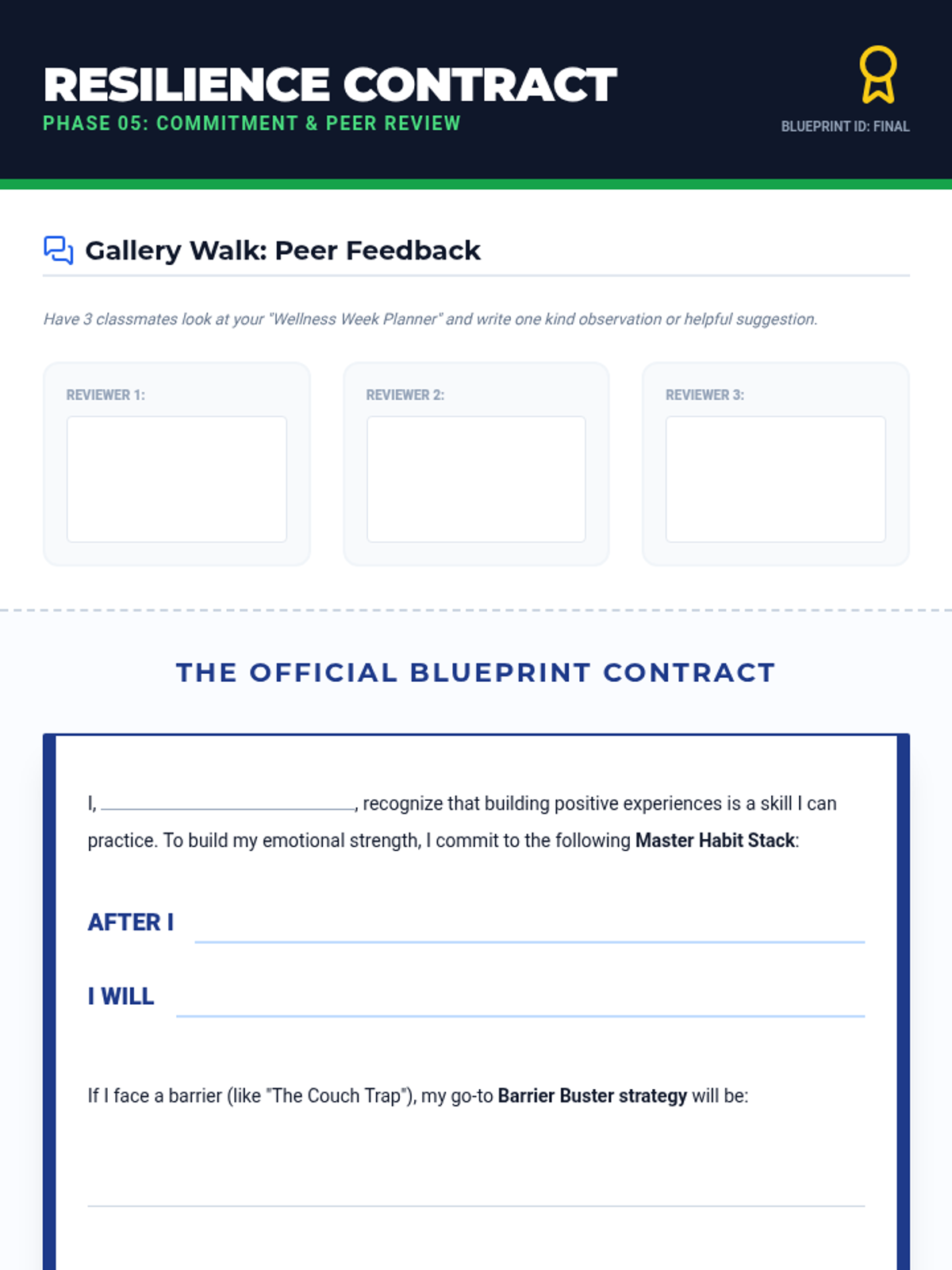
The culminating lesson where students present their wellness plans, engage in peer reviews, and set long-term goals for maintaining emotional strength.
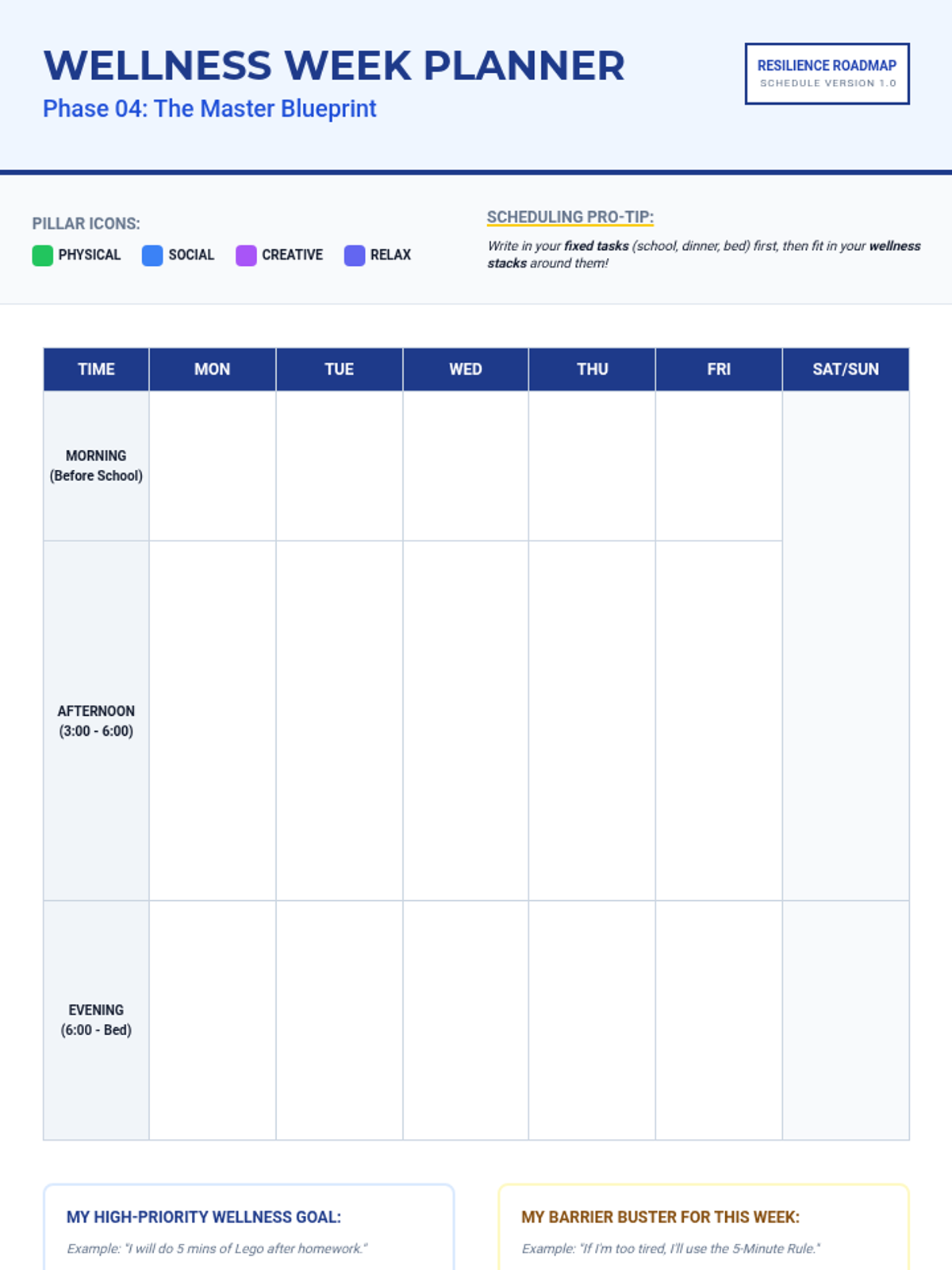
Students design a realistic weekly schedule that budgets time for school, chores, and 'scheduled joy' using a puzzle-like approach to time management.
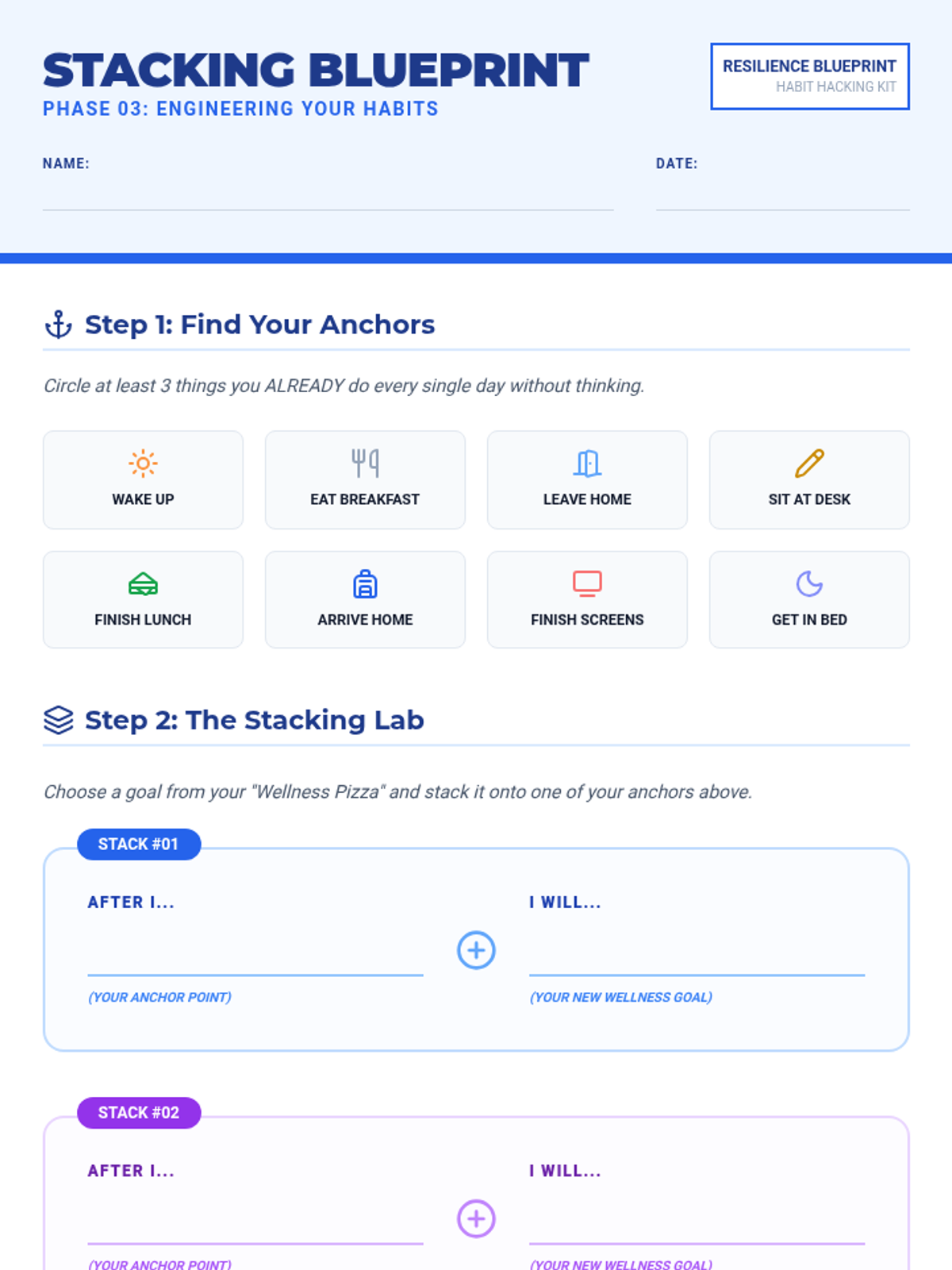
This lesson teaches the mechanics of habit formation, specifically how to 'stack' new positive behaviors onto existing daily 'anchor points' for lasting change.
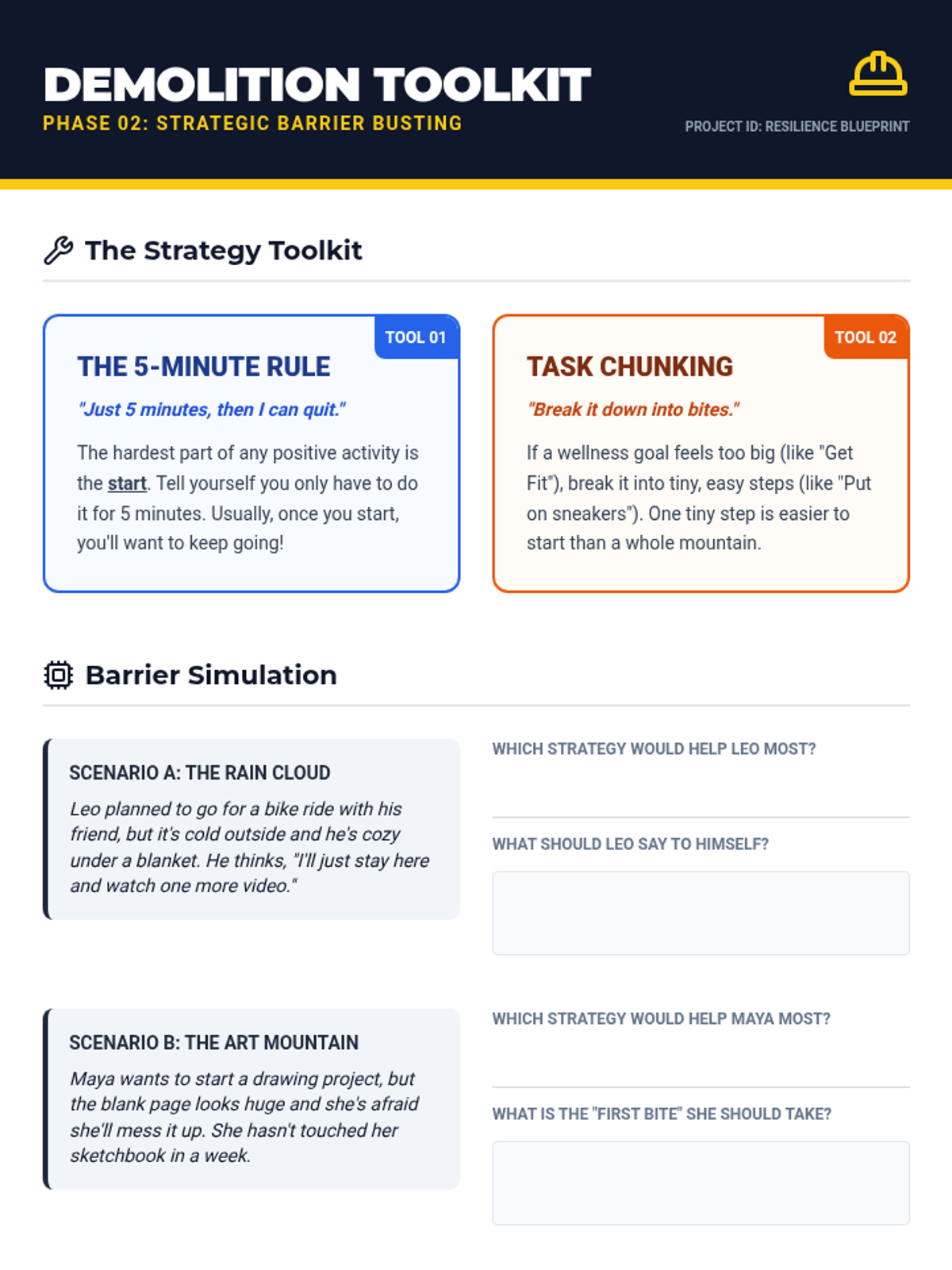
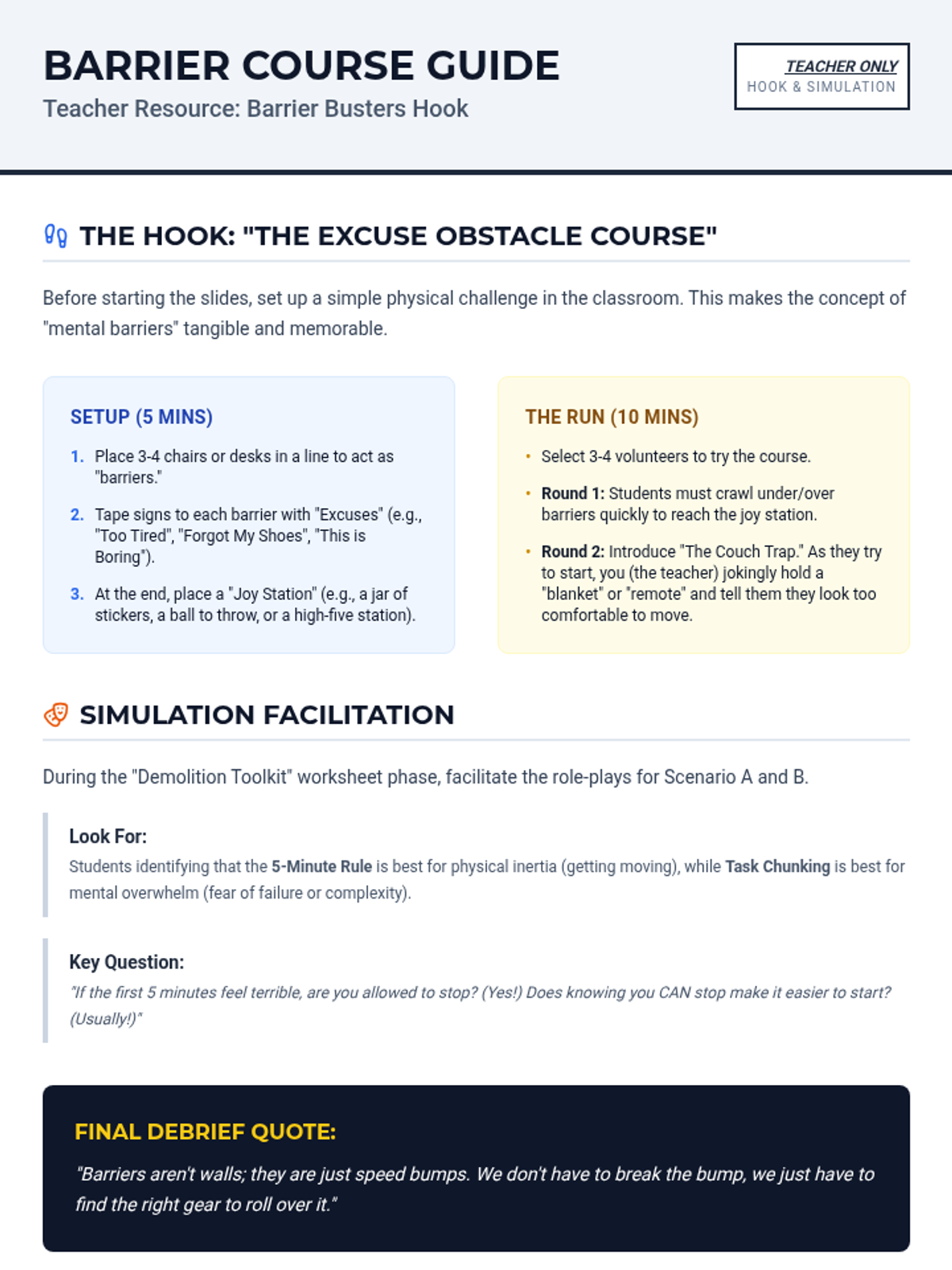
Students identify obstacles like 'The Couch Trap' and learn strategic 'barrier buster' techniques like the 5-Minute Rule to overcome inertia and engage in positive activities.
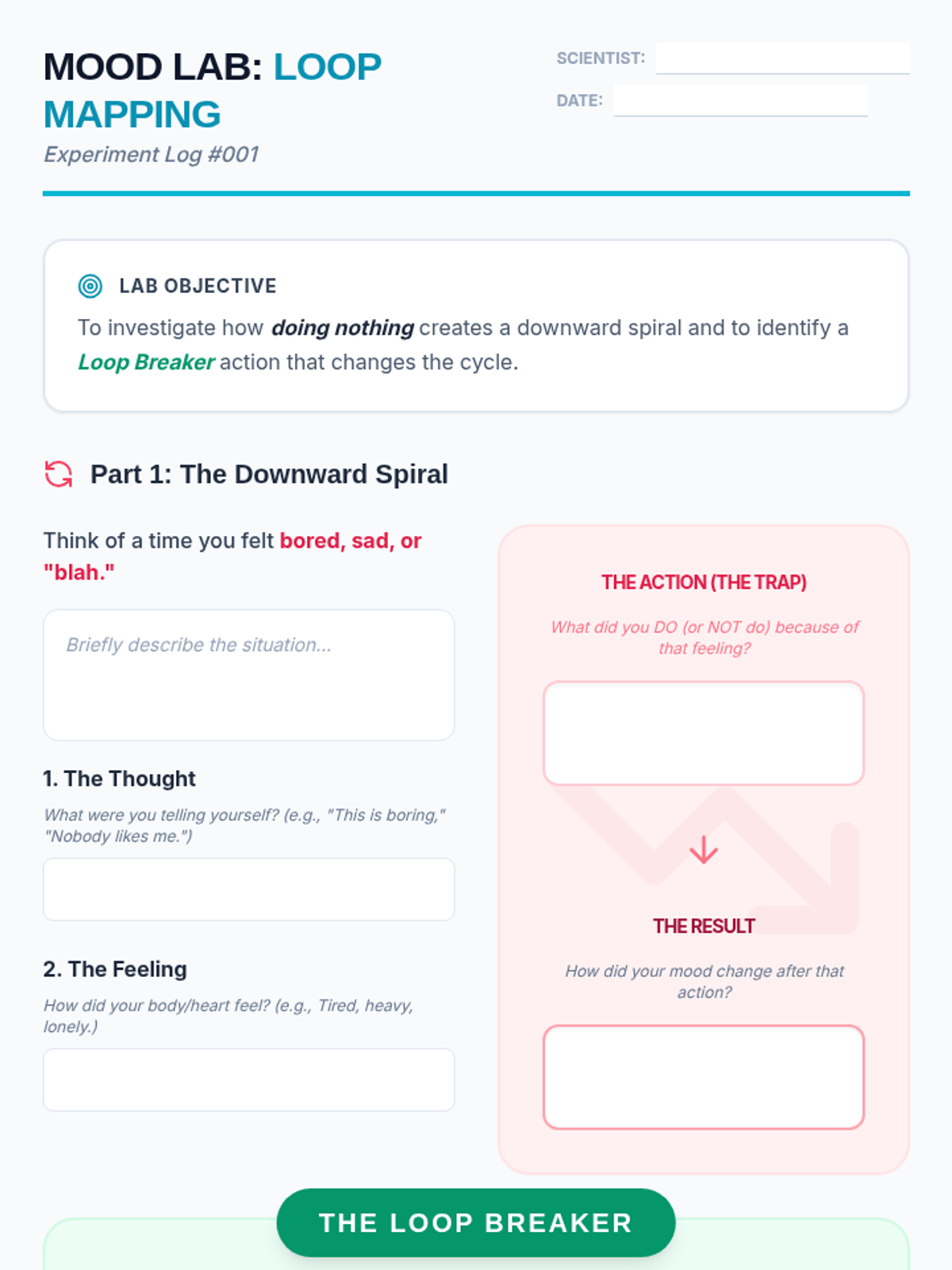
Students participate in a discussion and mapping activity to visualize the cycle between thoughts, feelings, and behaviors. They identify how doing nothing often leads to feeling worse (the downward spiral) and how small actions can reverse this.
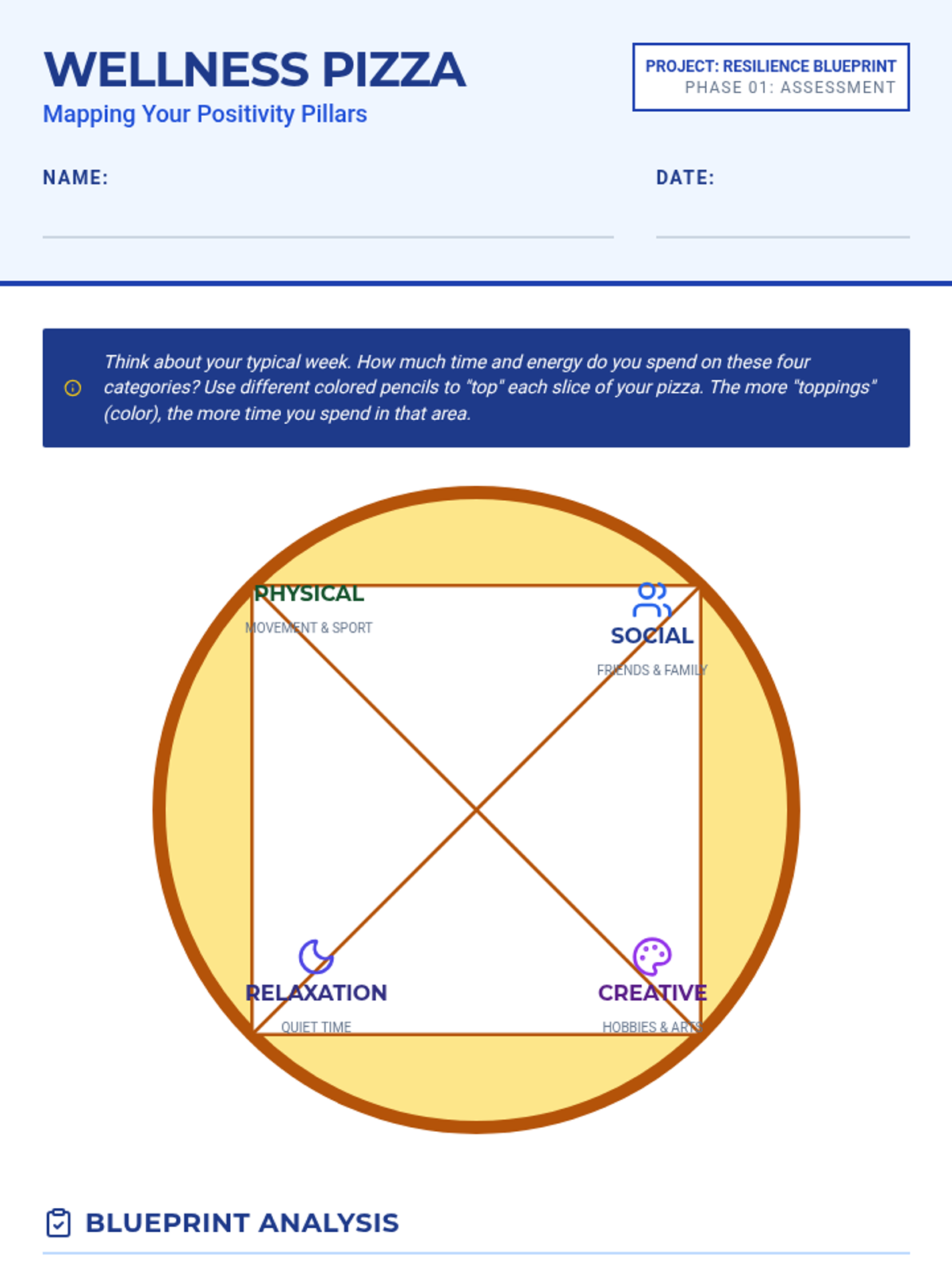
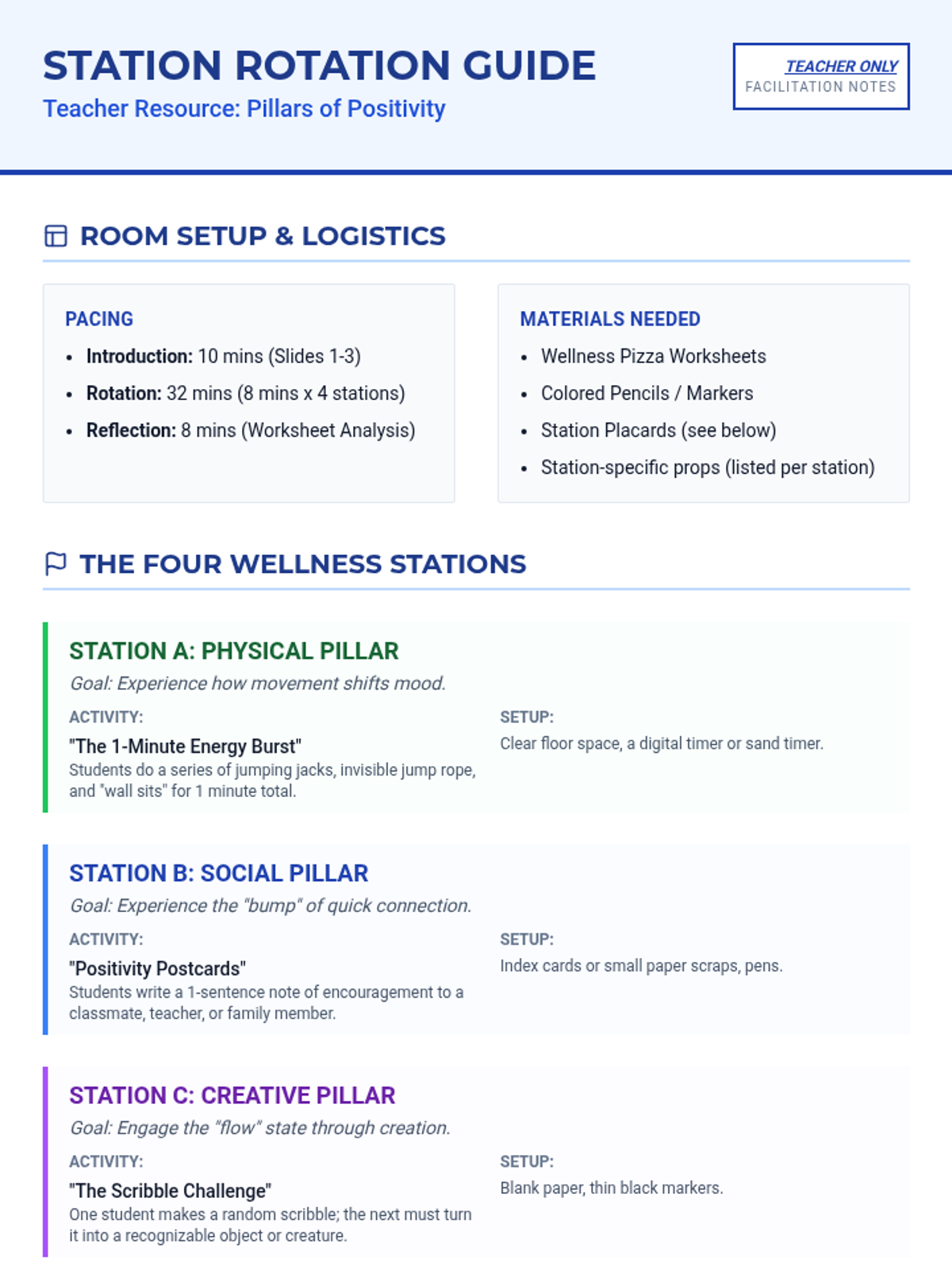
Students explore the four pillars of positive experience (Physical, Social, Creative, and Relaxation) and assess their current wellness balance using a 'Wellness Pizza' activity.
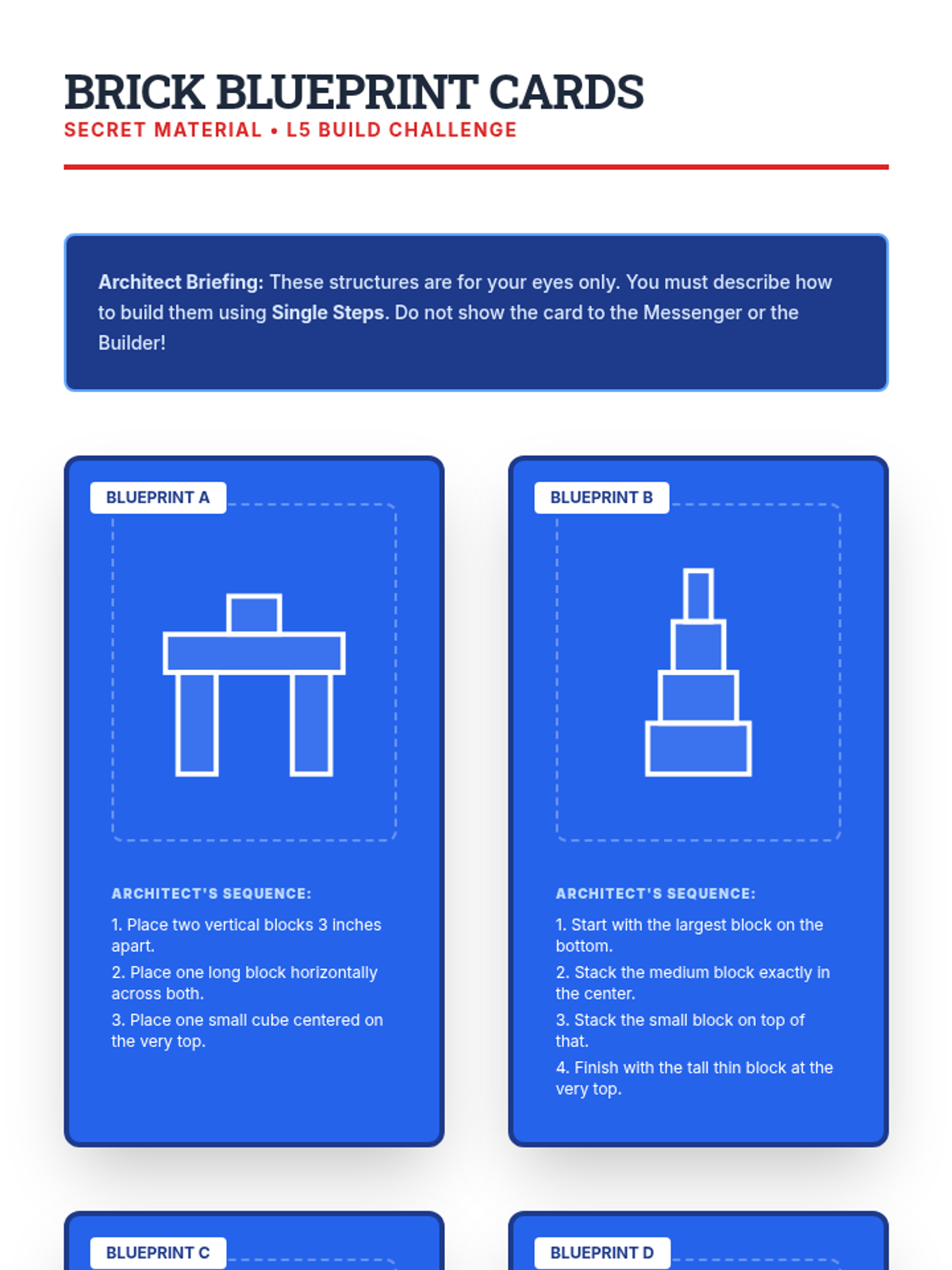
A final project-based challenge where groups of three must collaborate to build a structure, strictly adhering to single-step communication roles.
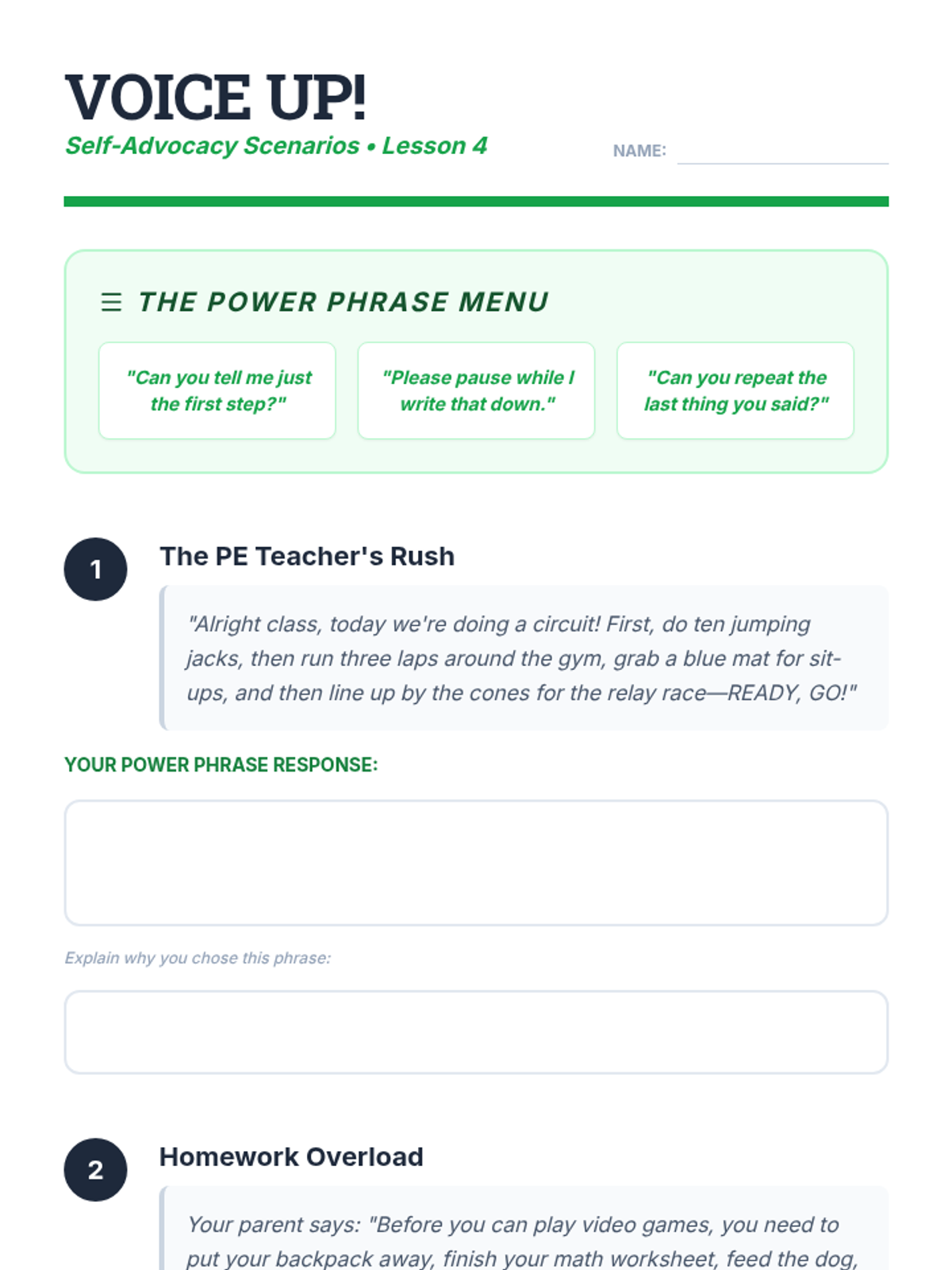
Students learn and practice self-advocacy phrases to use when instructions are too fast or complex, building social-emotional resilience and self-awareness.
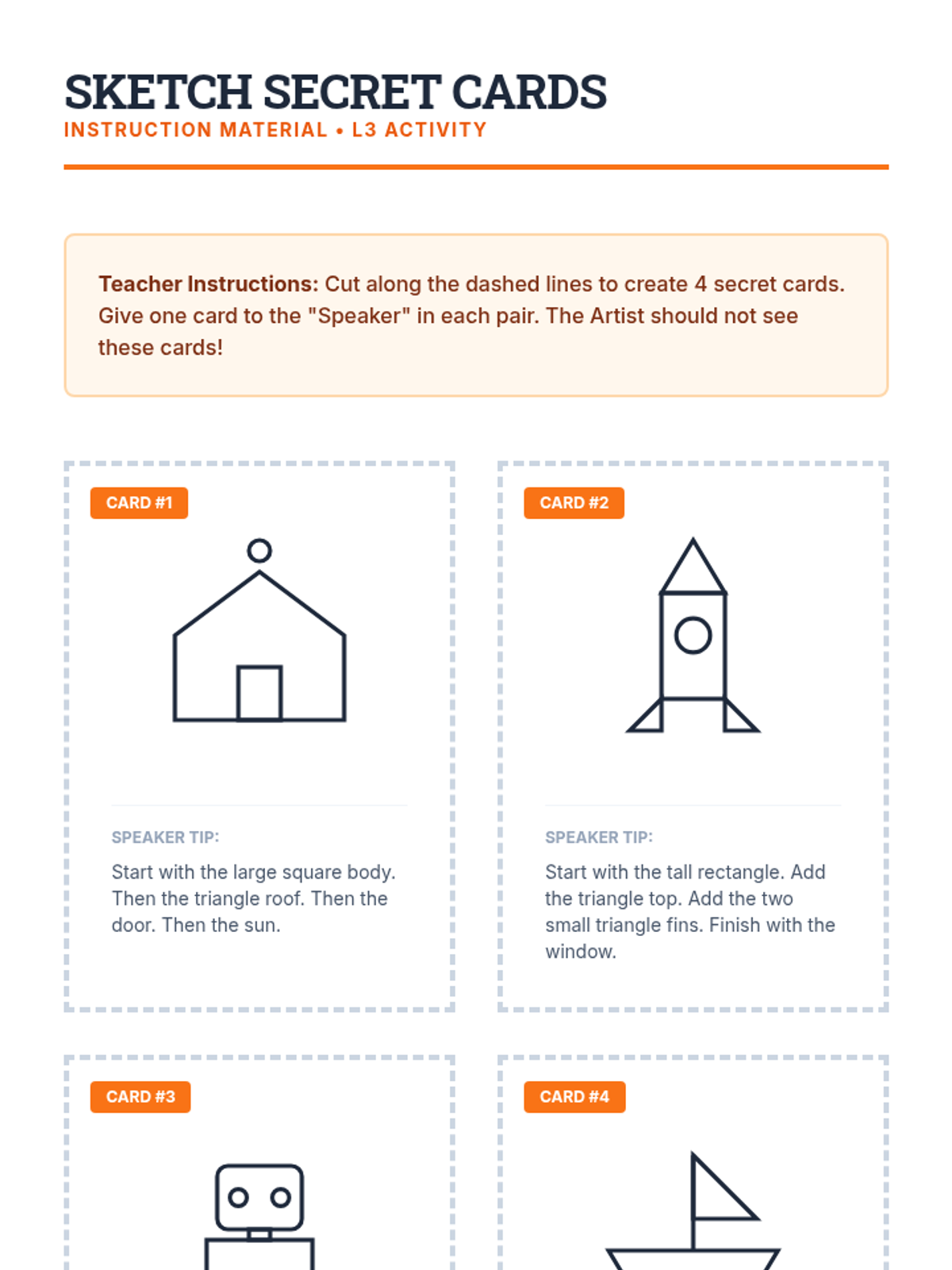
Pairs participate in a back-to-back drawing activity to experience how pacing and single-step instructions impact accuracy and success.
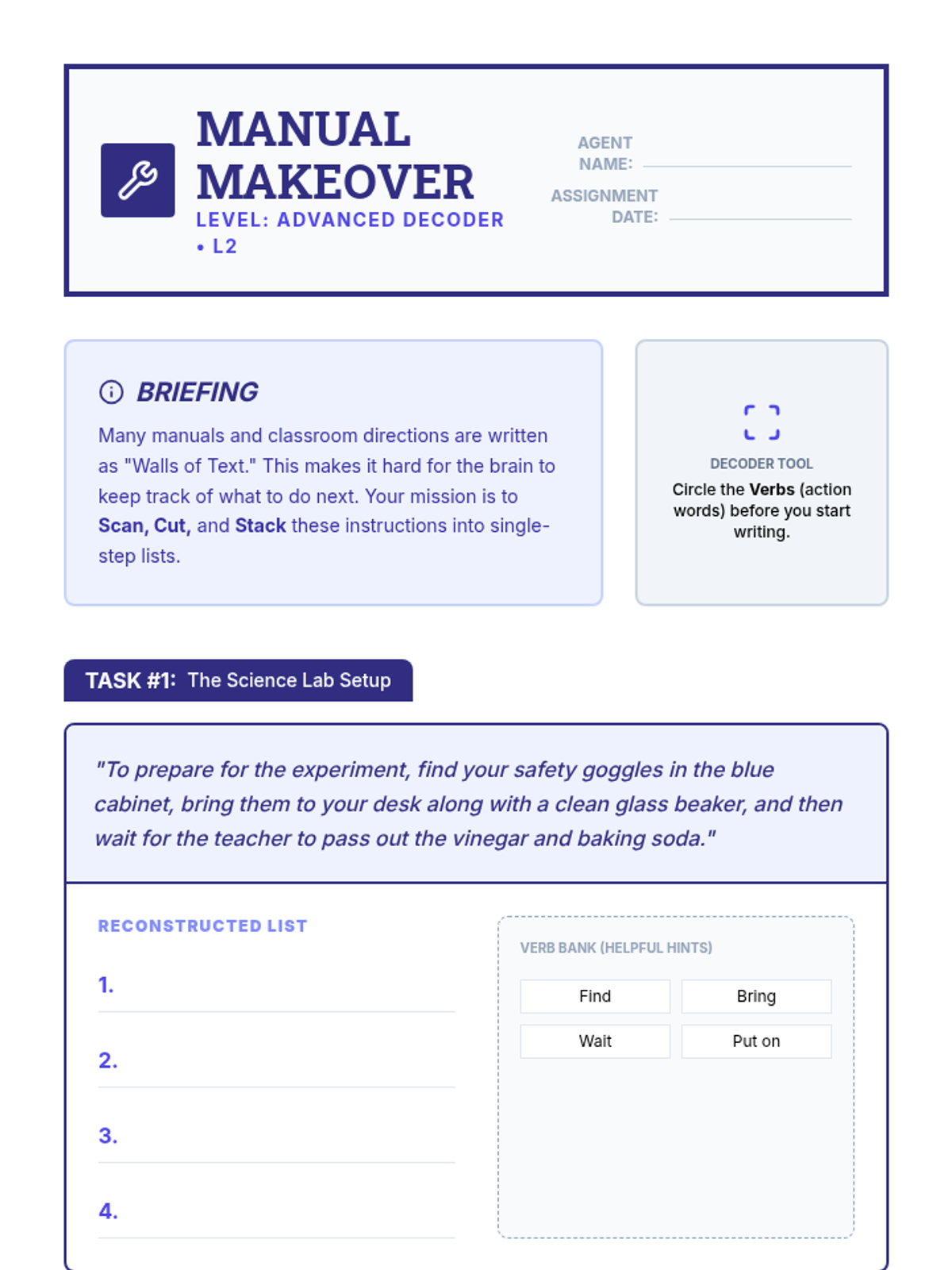
Students practice the skill of information synthesis by 'translating' complex, multi-step paragraphs into clear, numbered lists of single actions.
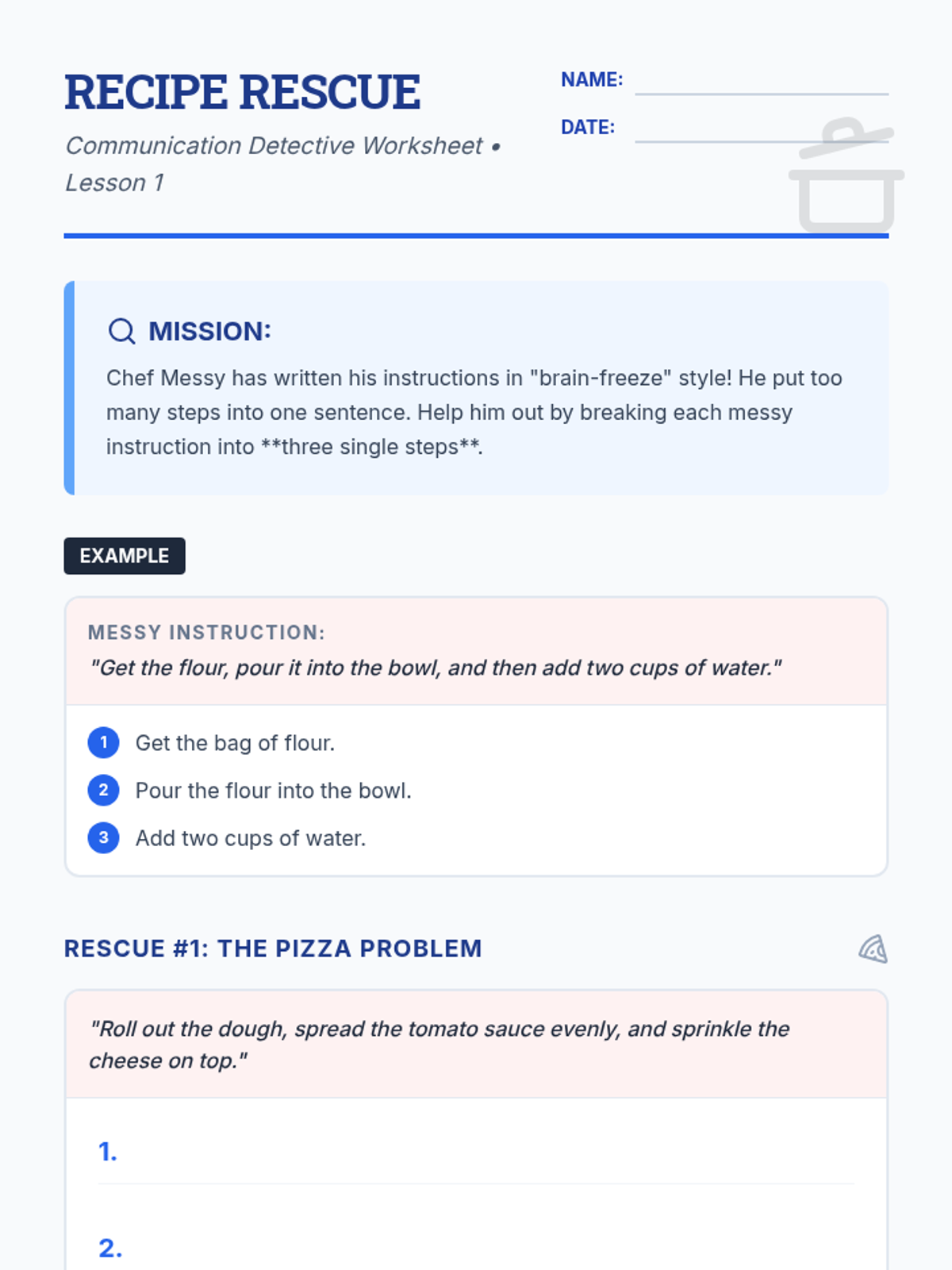
Students analyze a scenario where a cook fails due to overwhelming instructions, learning to identify 'cognitive overload' and rewrite multi-step directions into single, manageable steps.
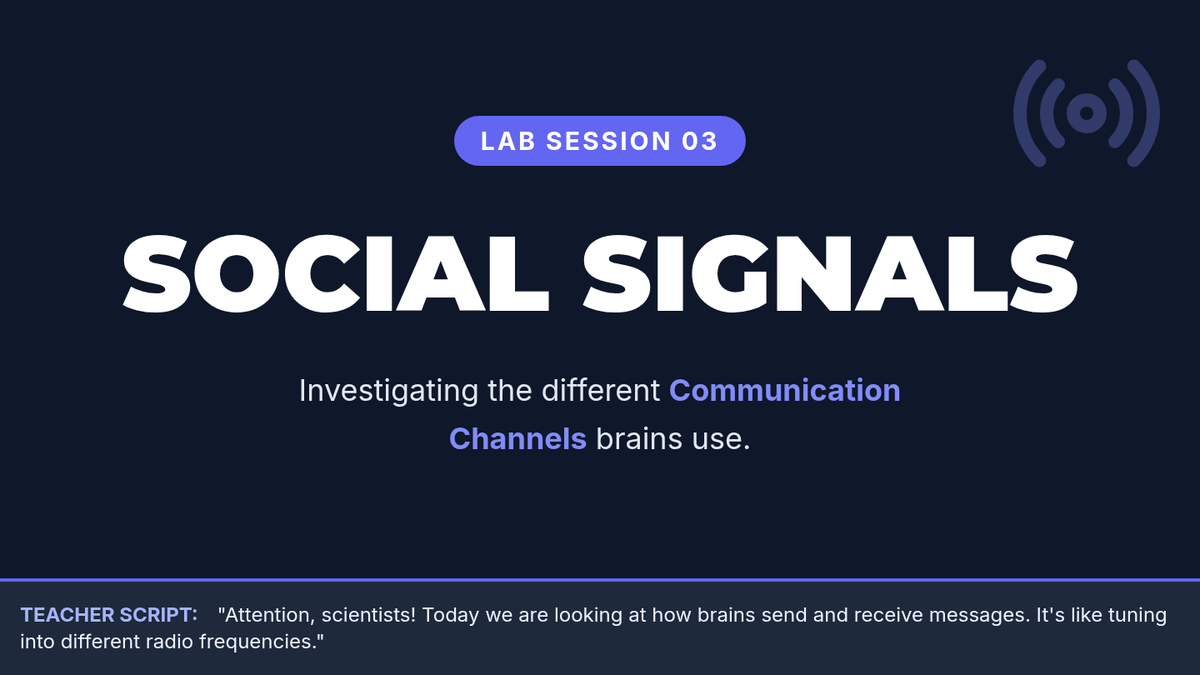
Understanding different communication styles and how to connect with others who may communicate in unique ways.
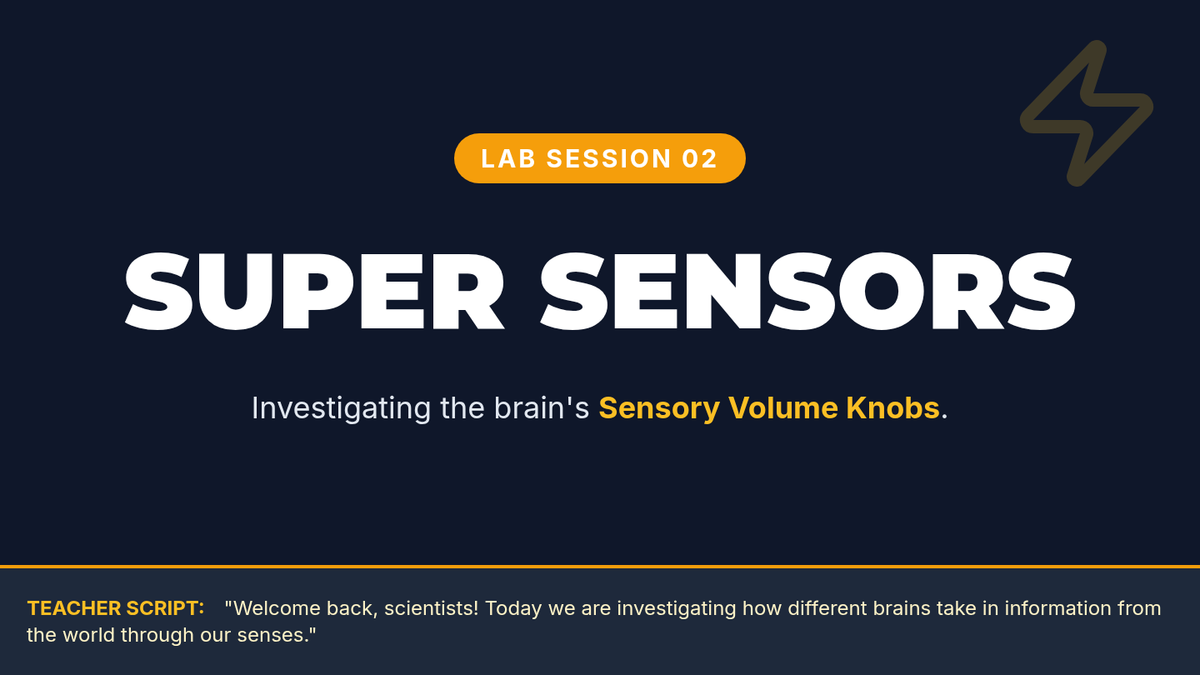
Exploring the five senses and beyond, focusing on how different brains process sensory information and the tools that help.
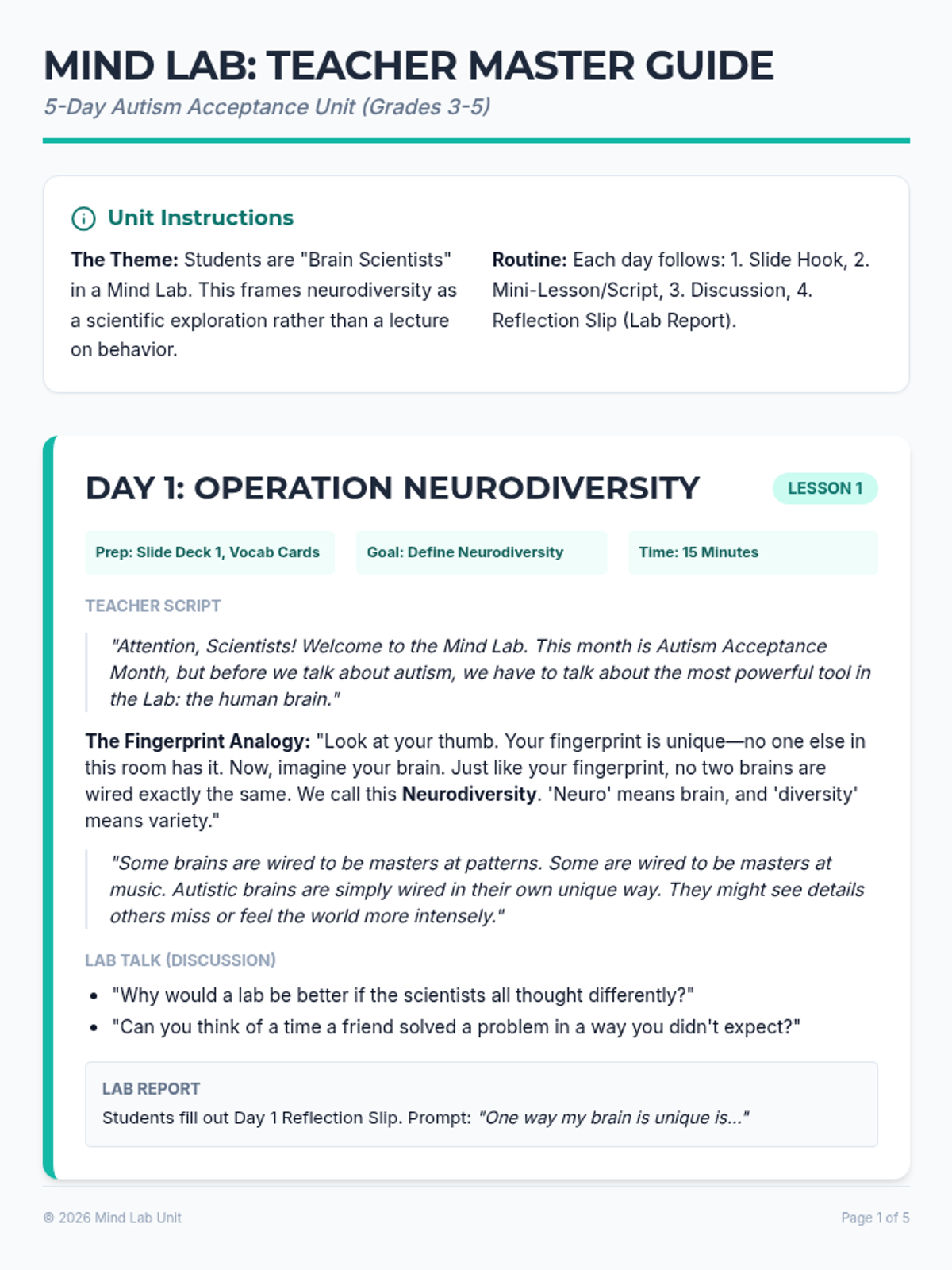
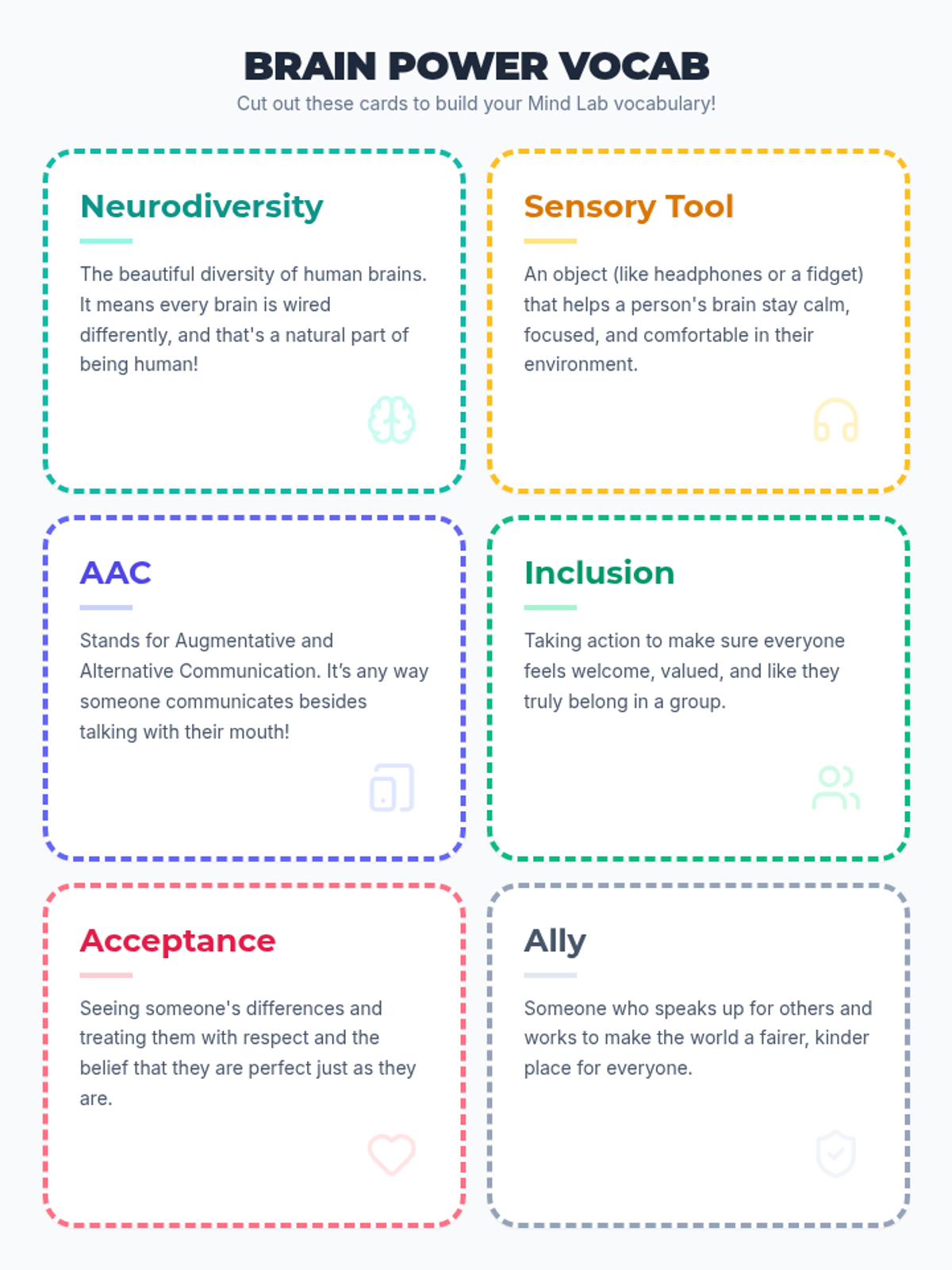
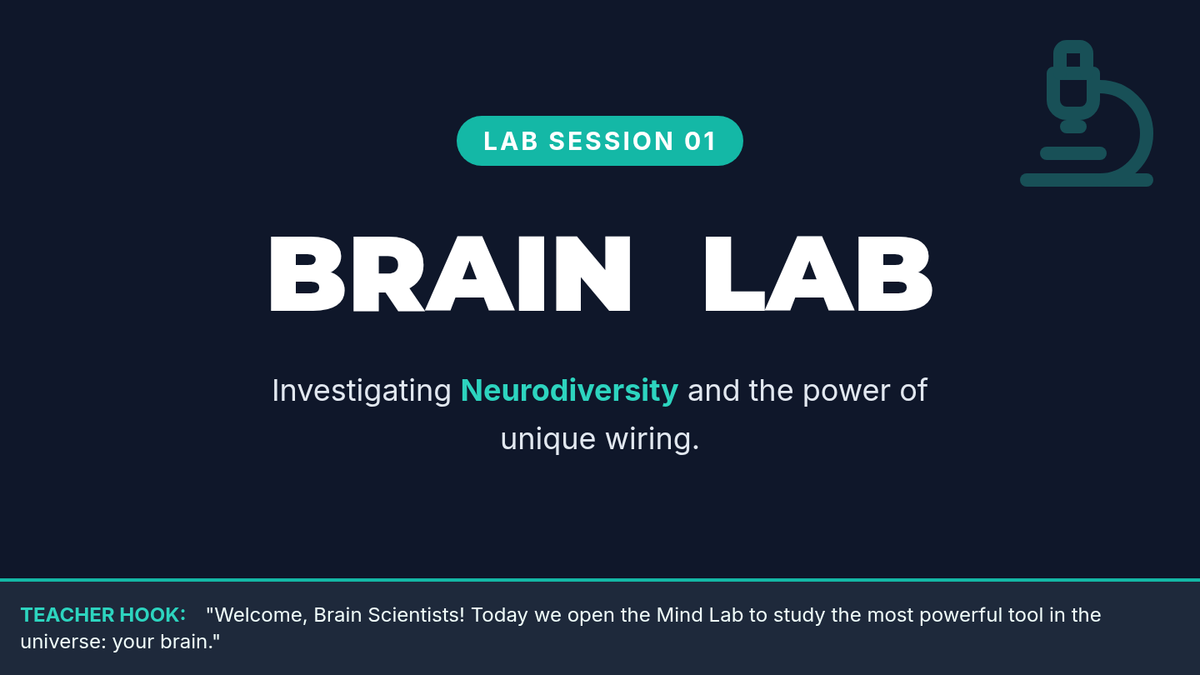
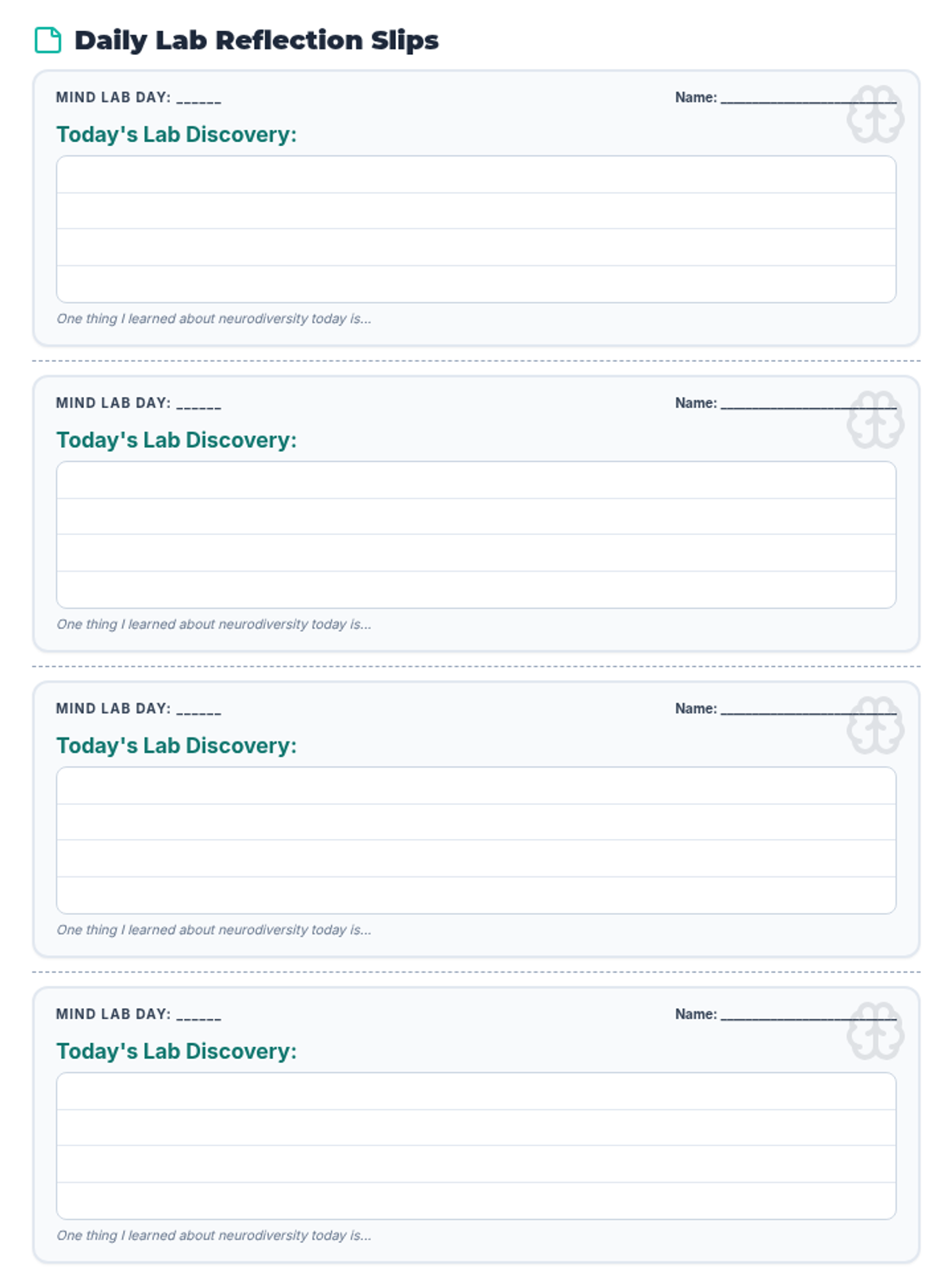
An introduction to neurodiversity, exploring how every brain is unique and wired differently, using the 'Brain Lab' concept.
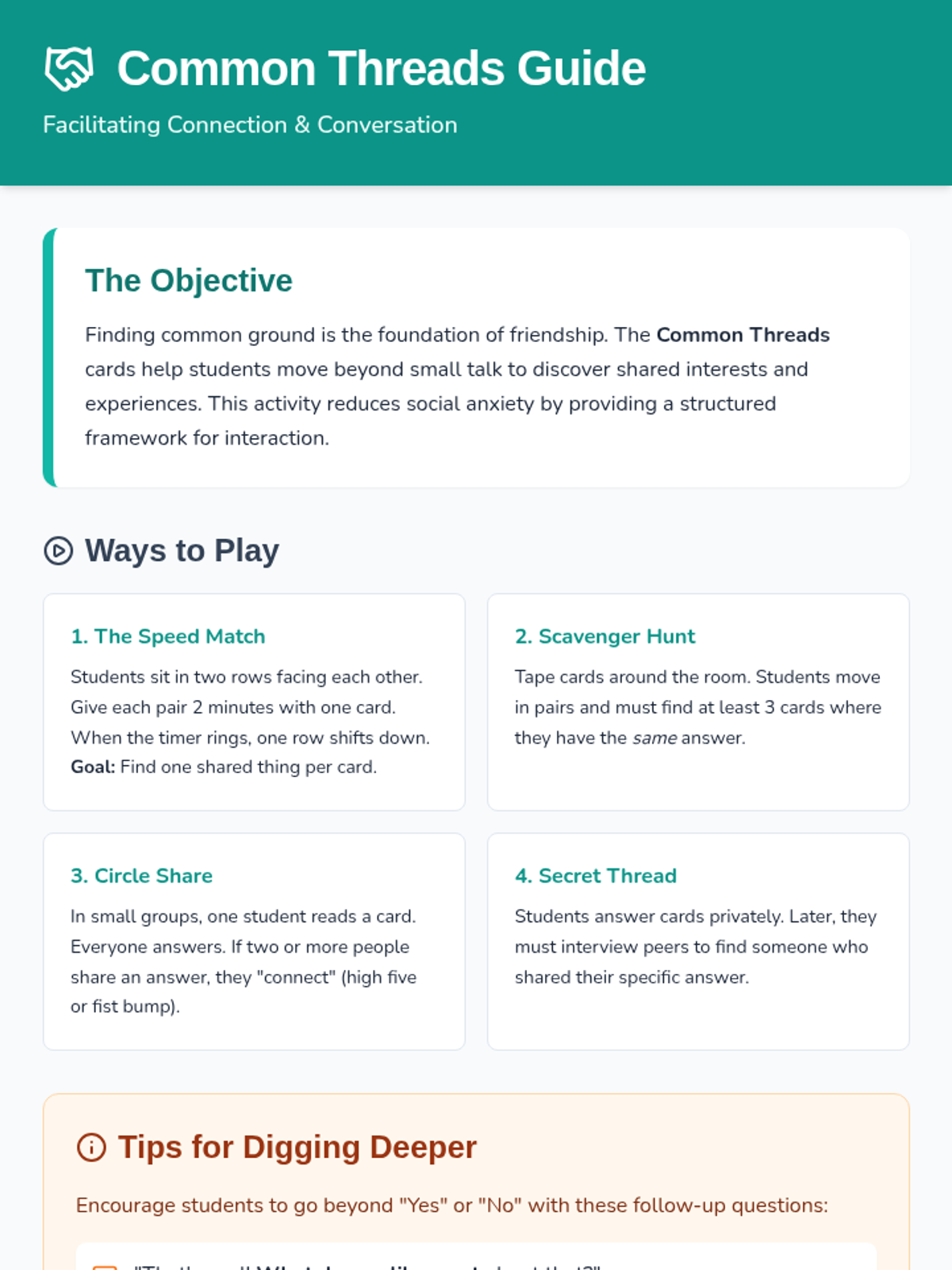
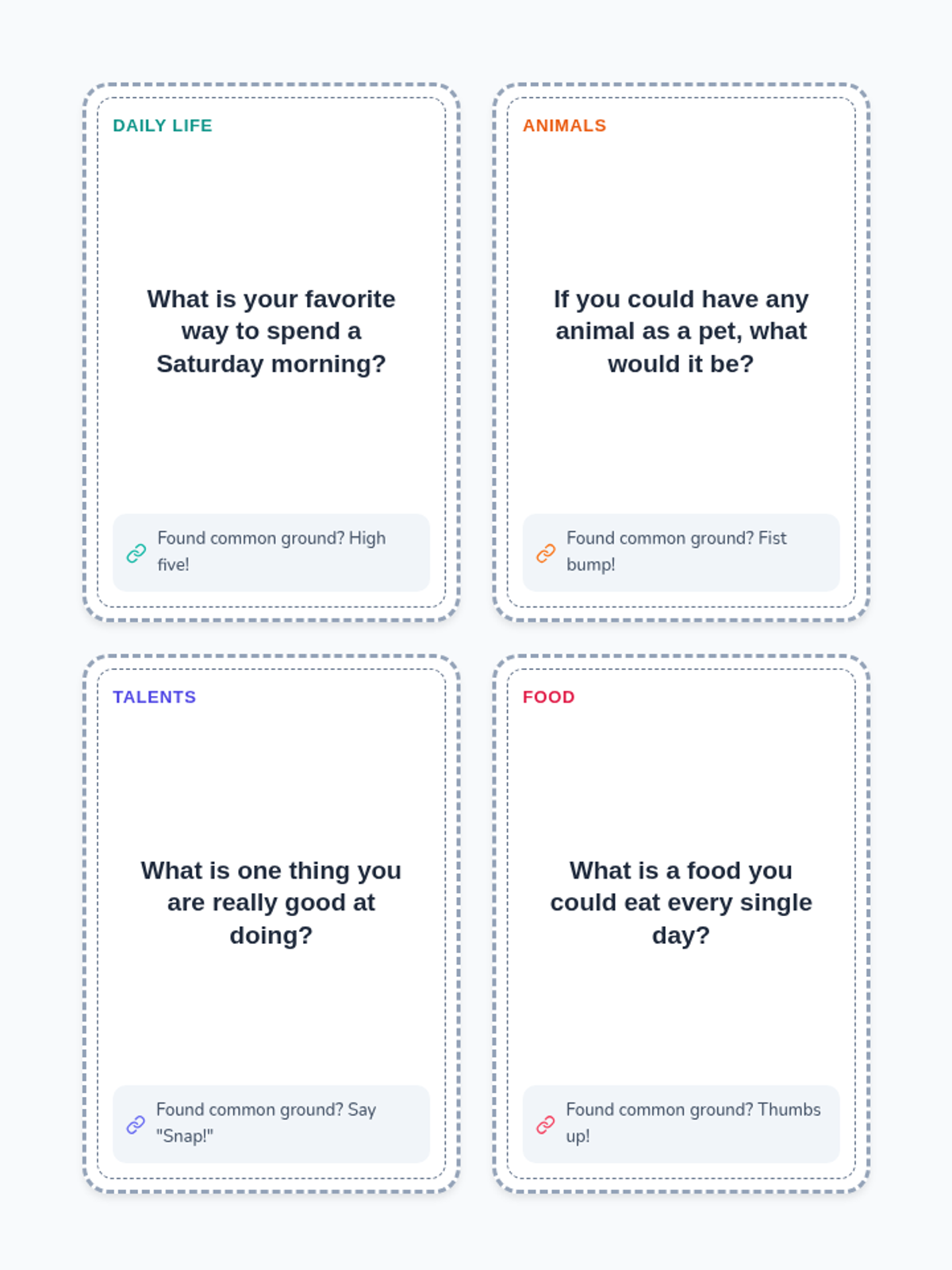
A social-emotional learning lesson focused on finding commonalities with peers through structured conversation. Students use conversation cards to discover shared interests and build connections.
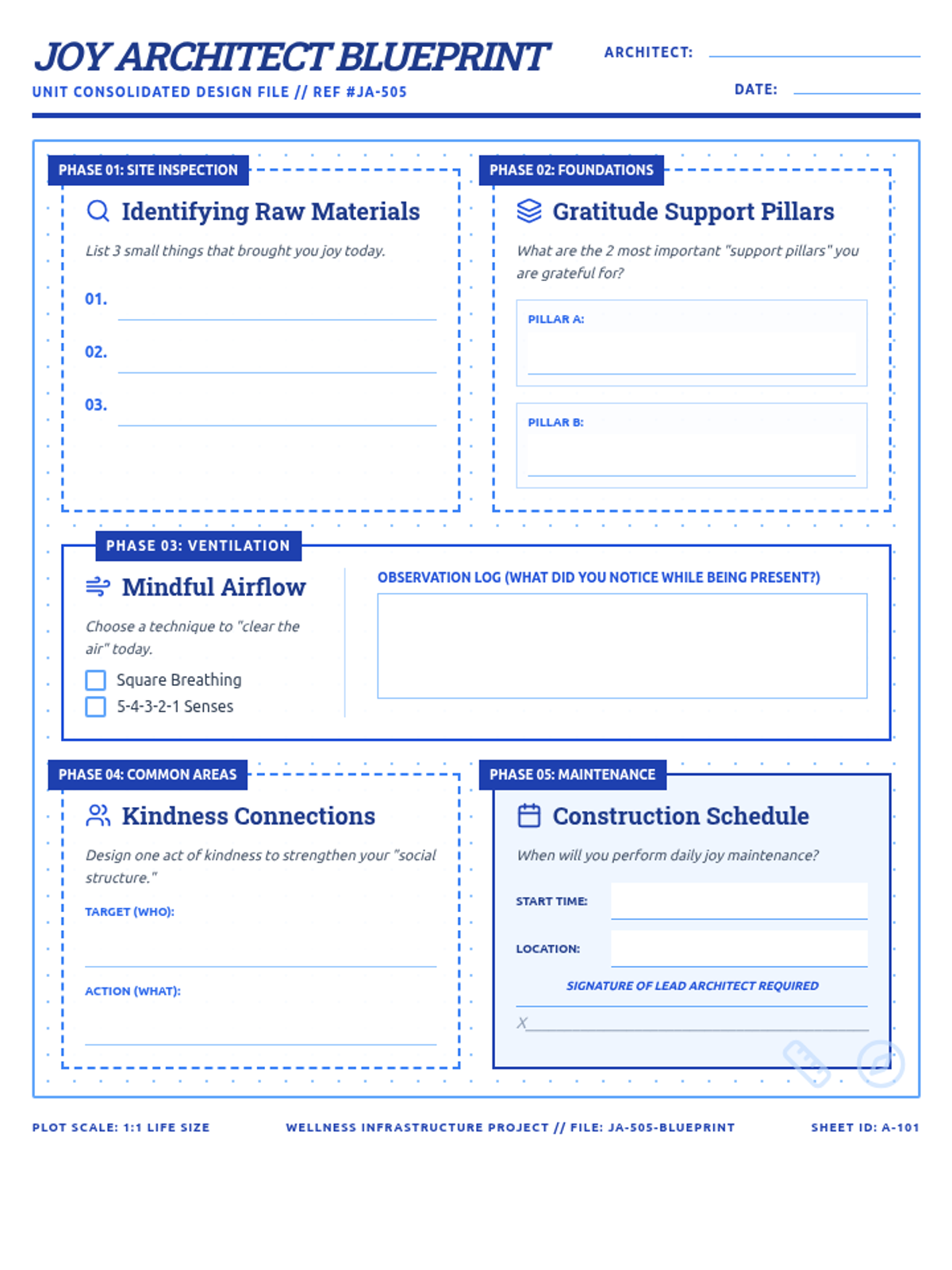
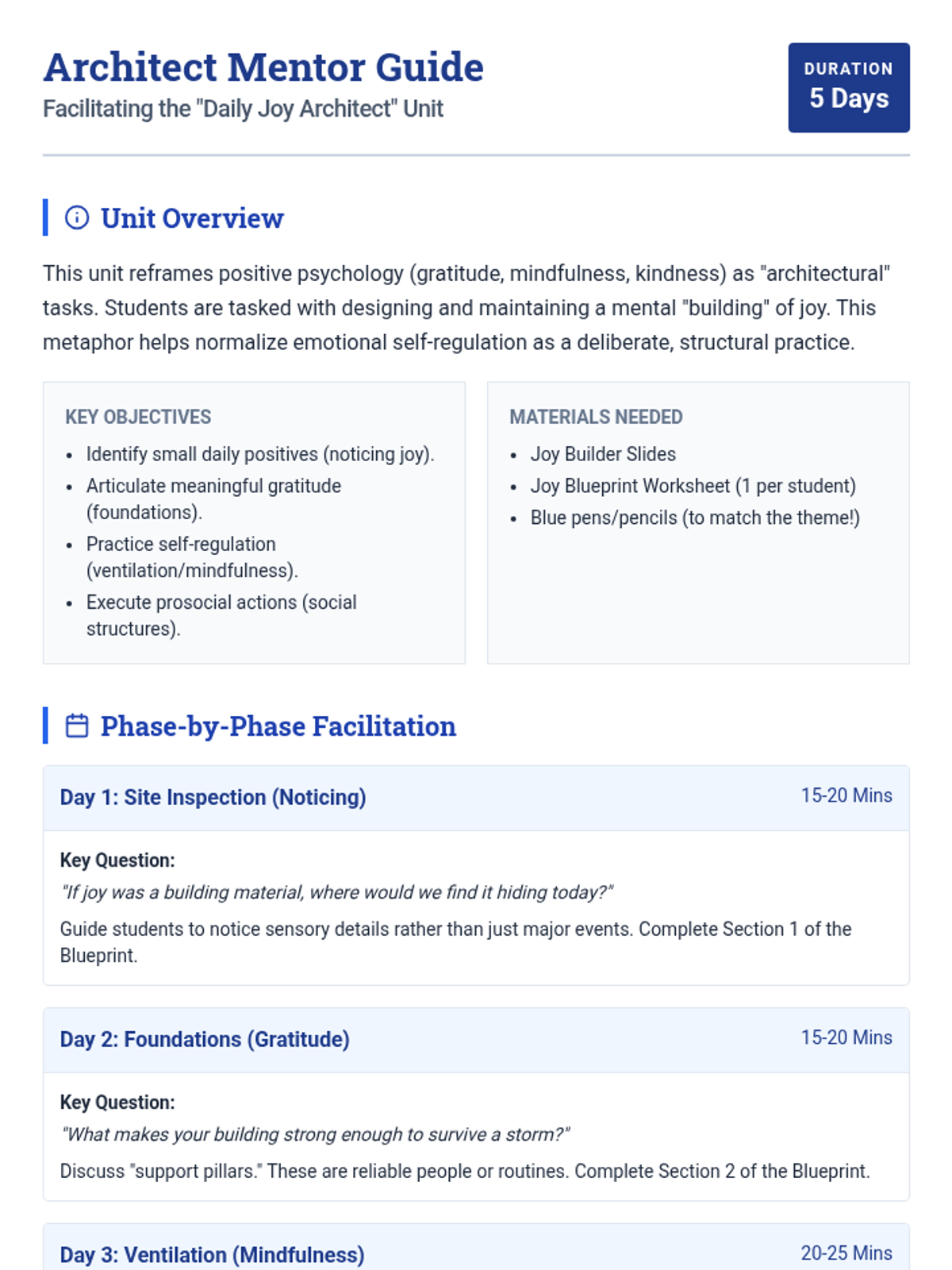
Finalizing the daily routine by creating a 'construction schedule' to keep the joy architecture maintained over time.
Students learn to identify 'raw materials' of joy—small, positive moments in their daily lives—and begin their joy site inspection.
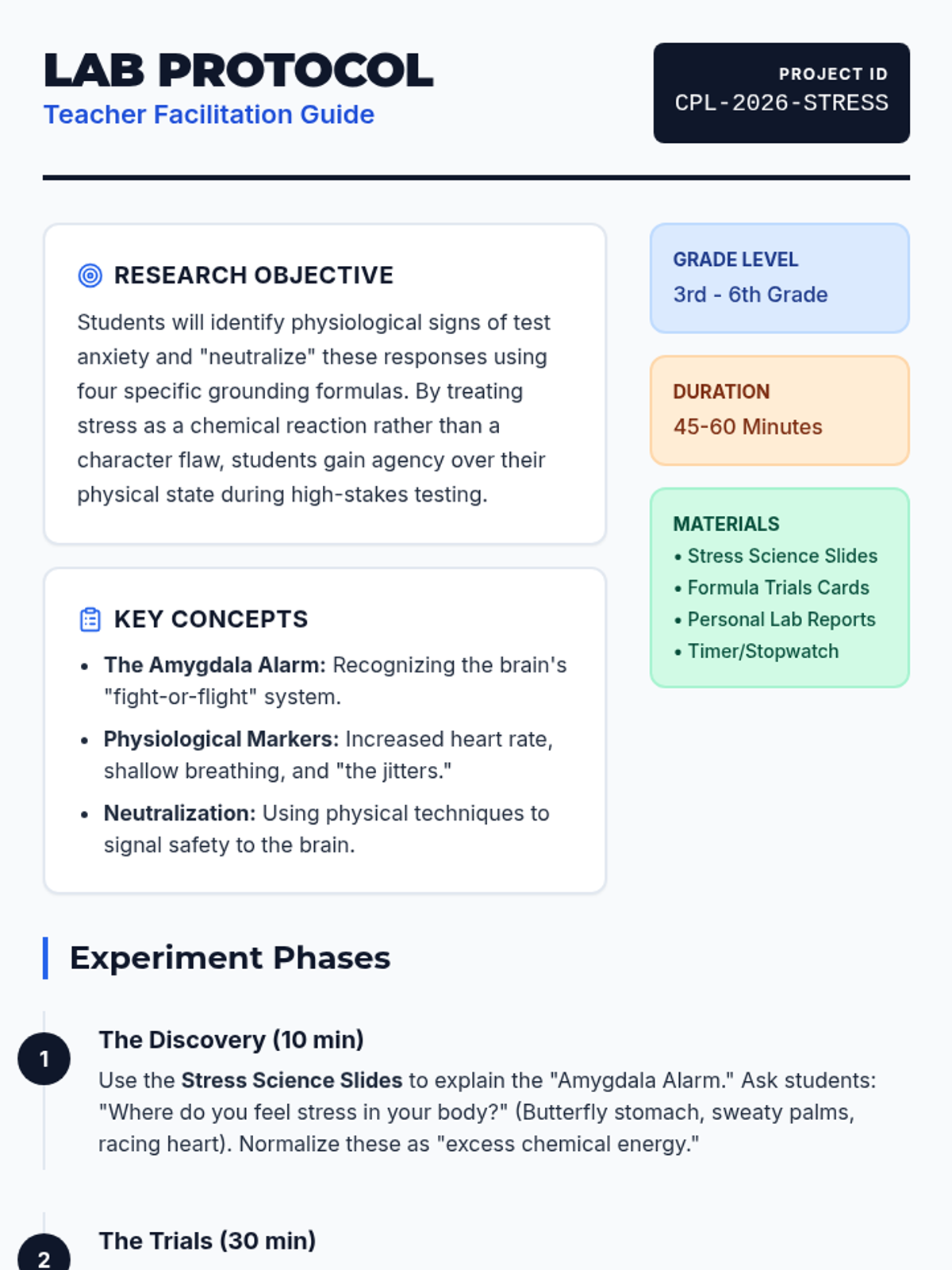
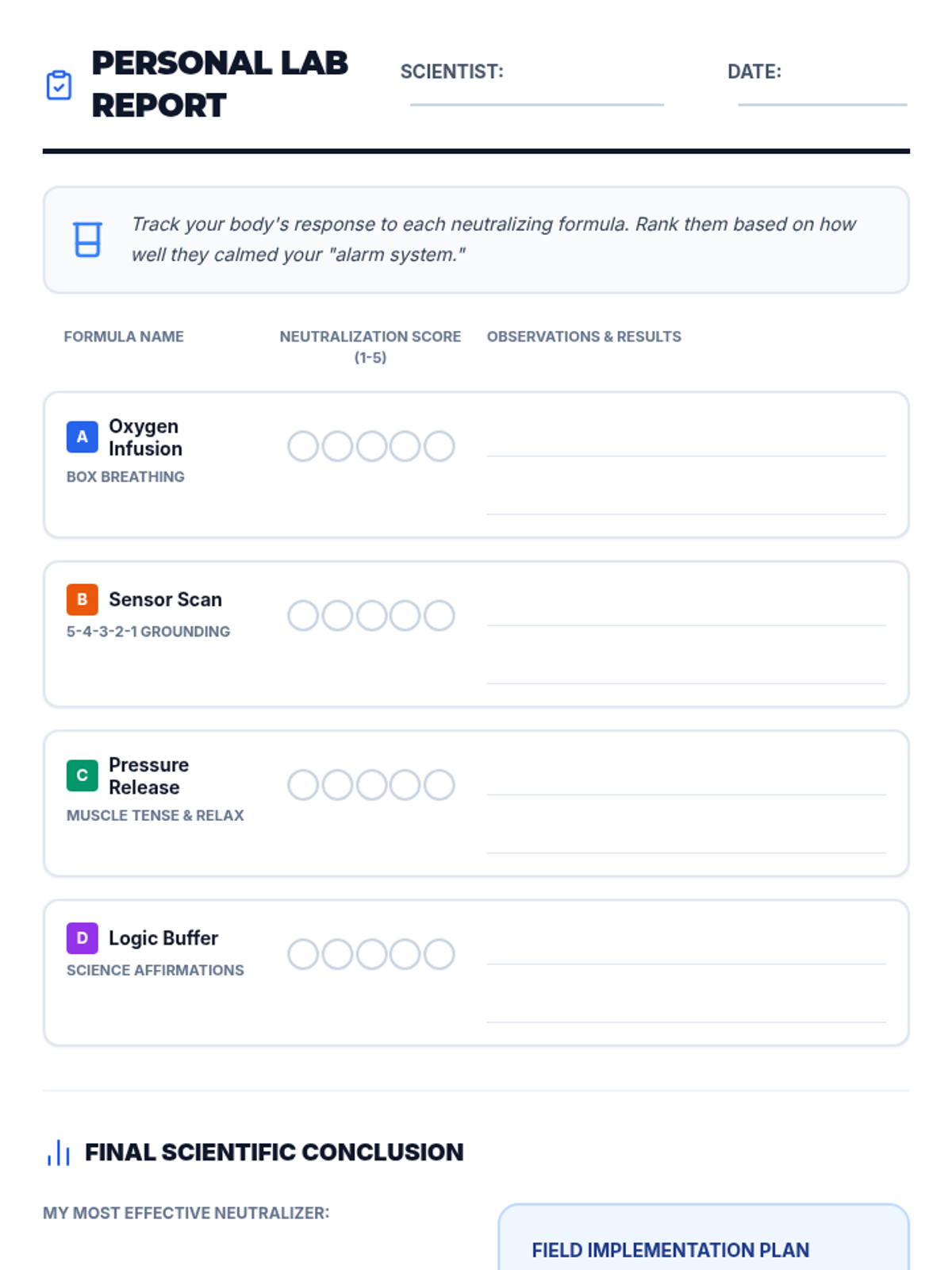
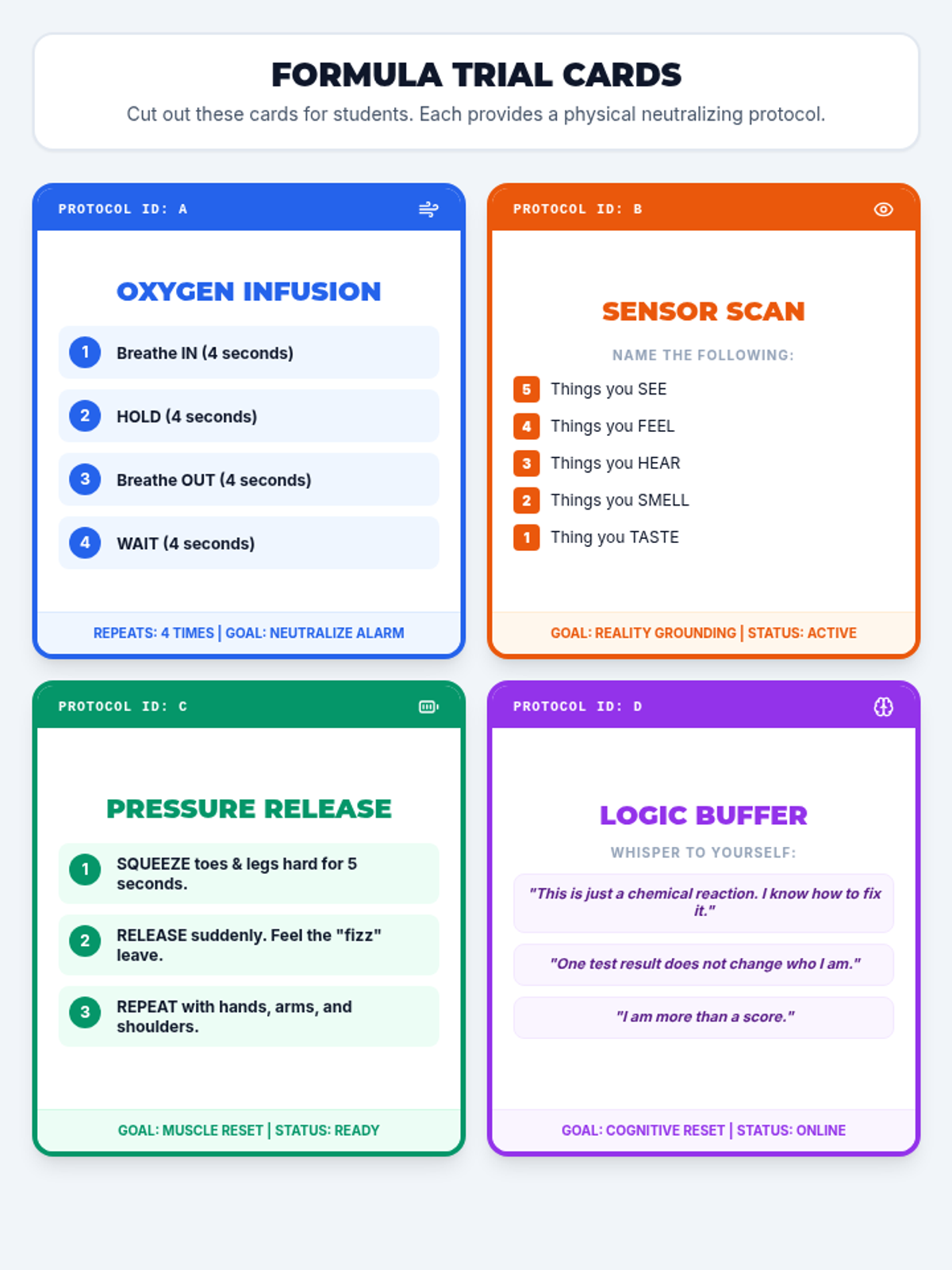
A science-themed lesson that teaches students to manage test anxiety by treating their physical stress responses as laboratory experiments, testing different 'calm-down formulas' to find their personal best stress-neutralizers.
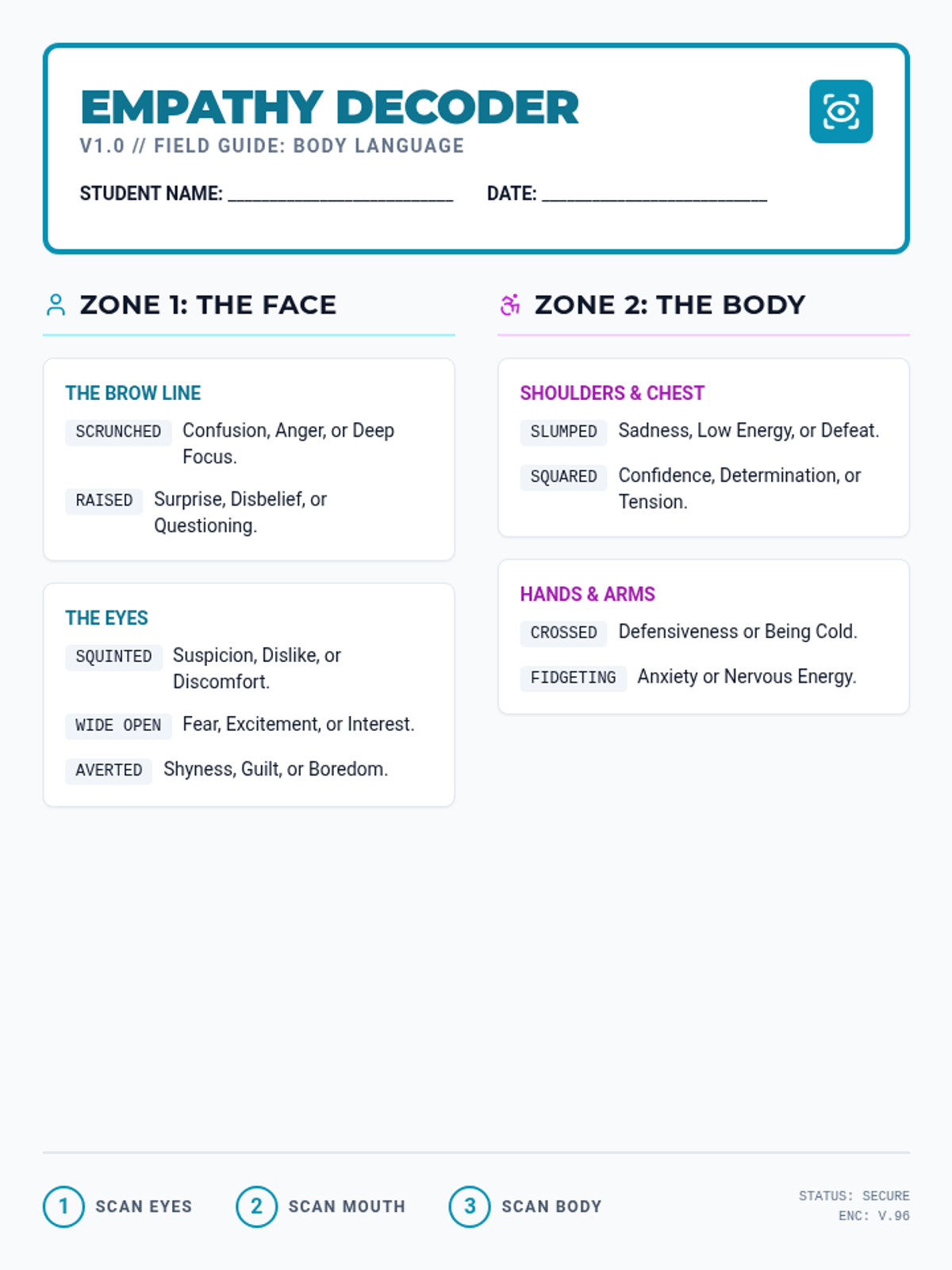
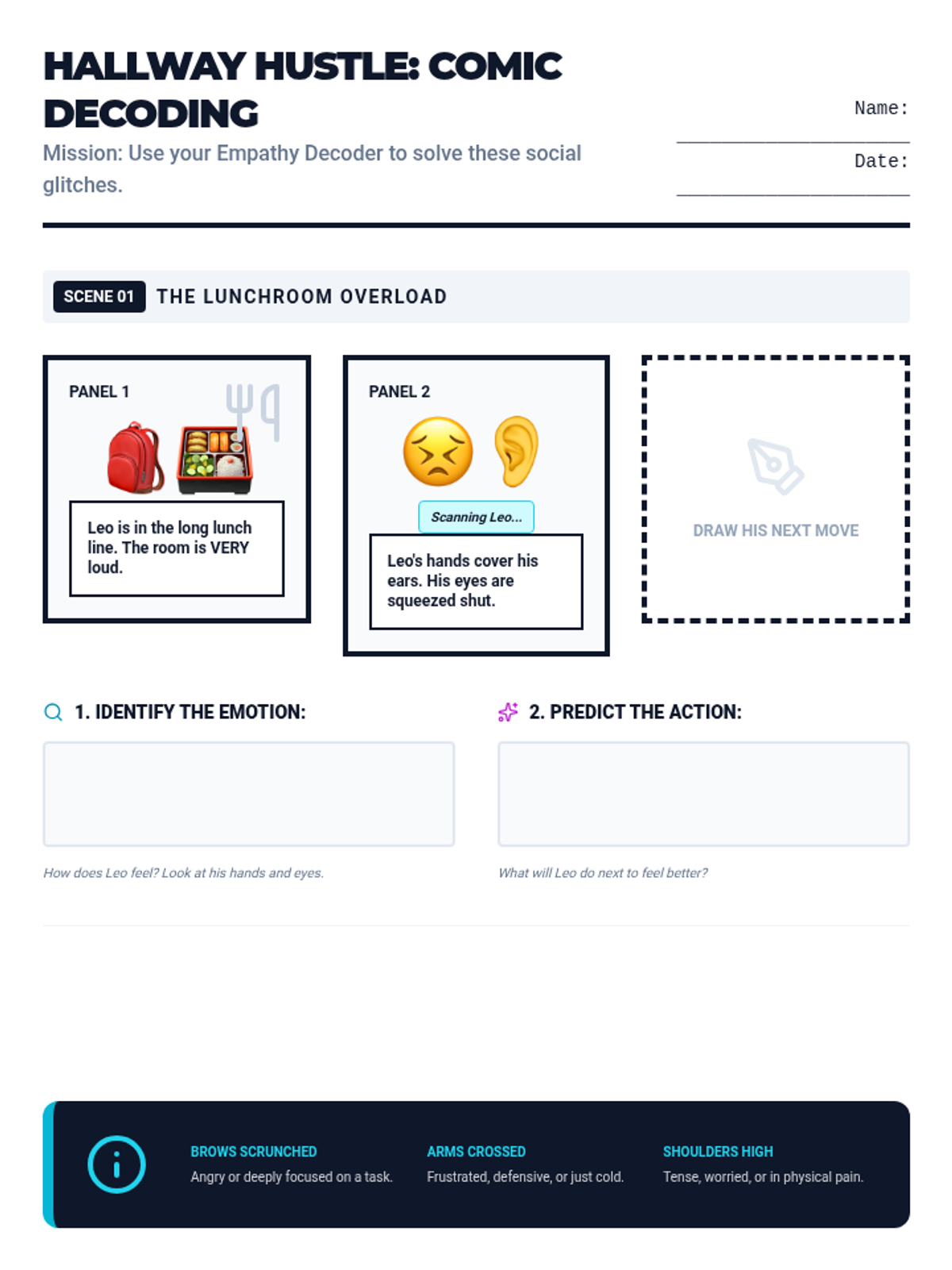
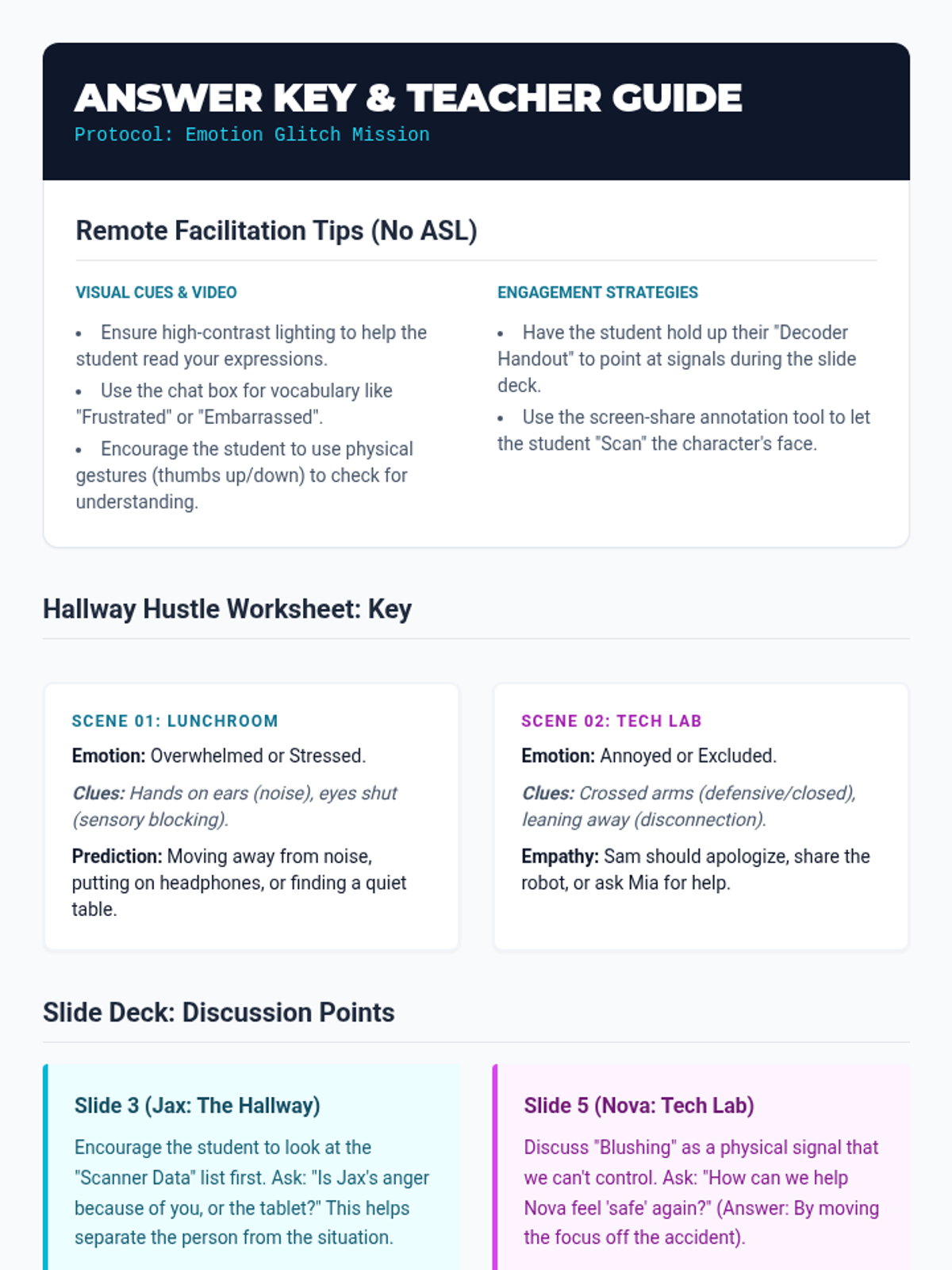
Students explore a futuristic high school hallway and tech lab to identify 'glitches' in social communication. They learn to decode body language and facial expressions in complex social situations.
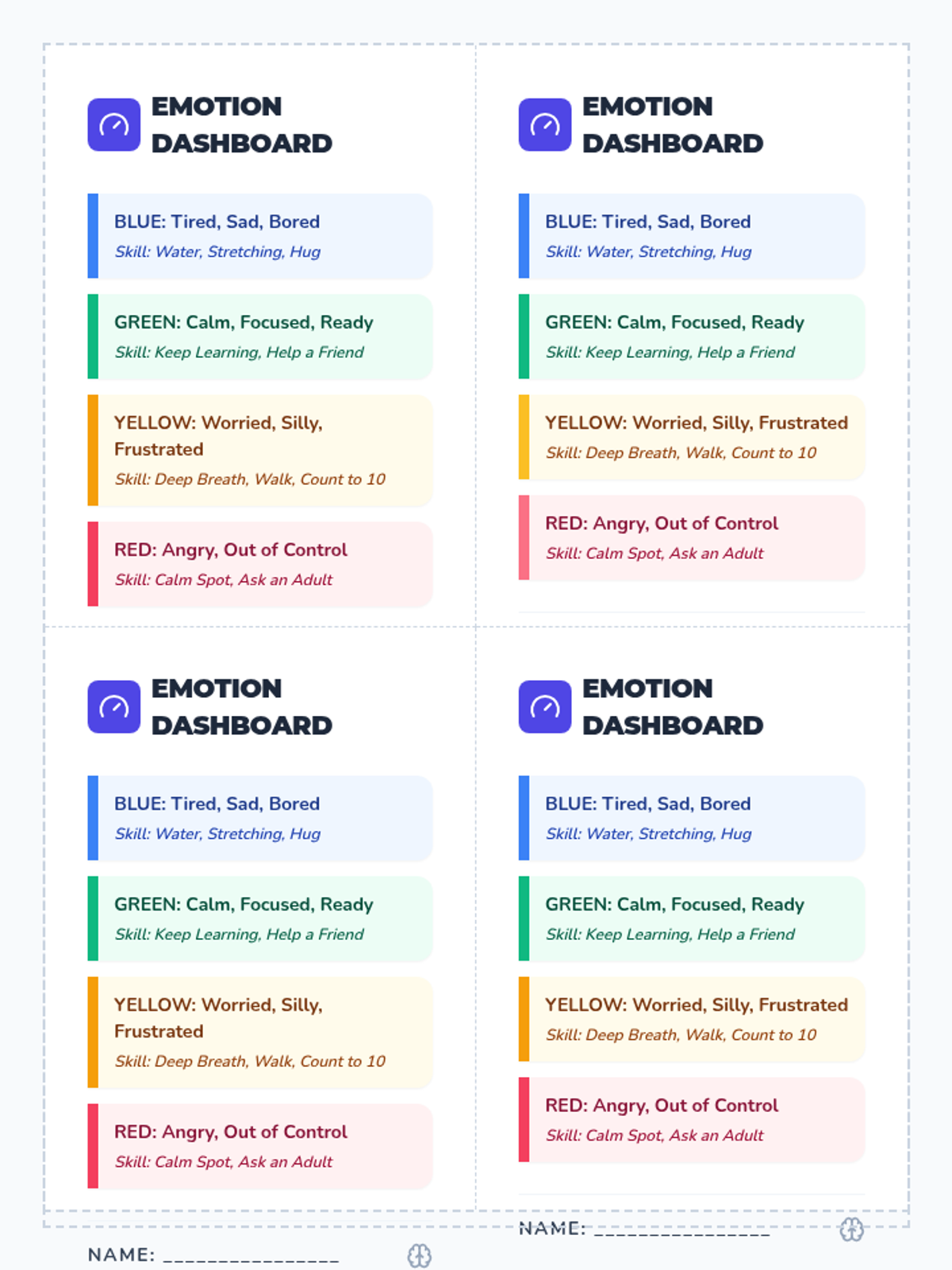
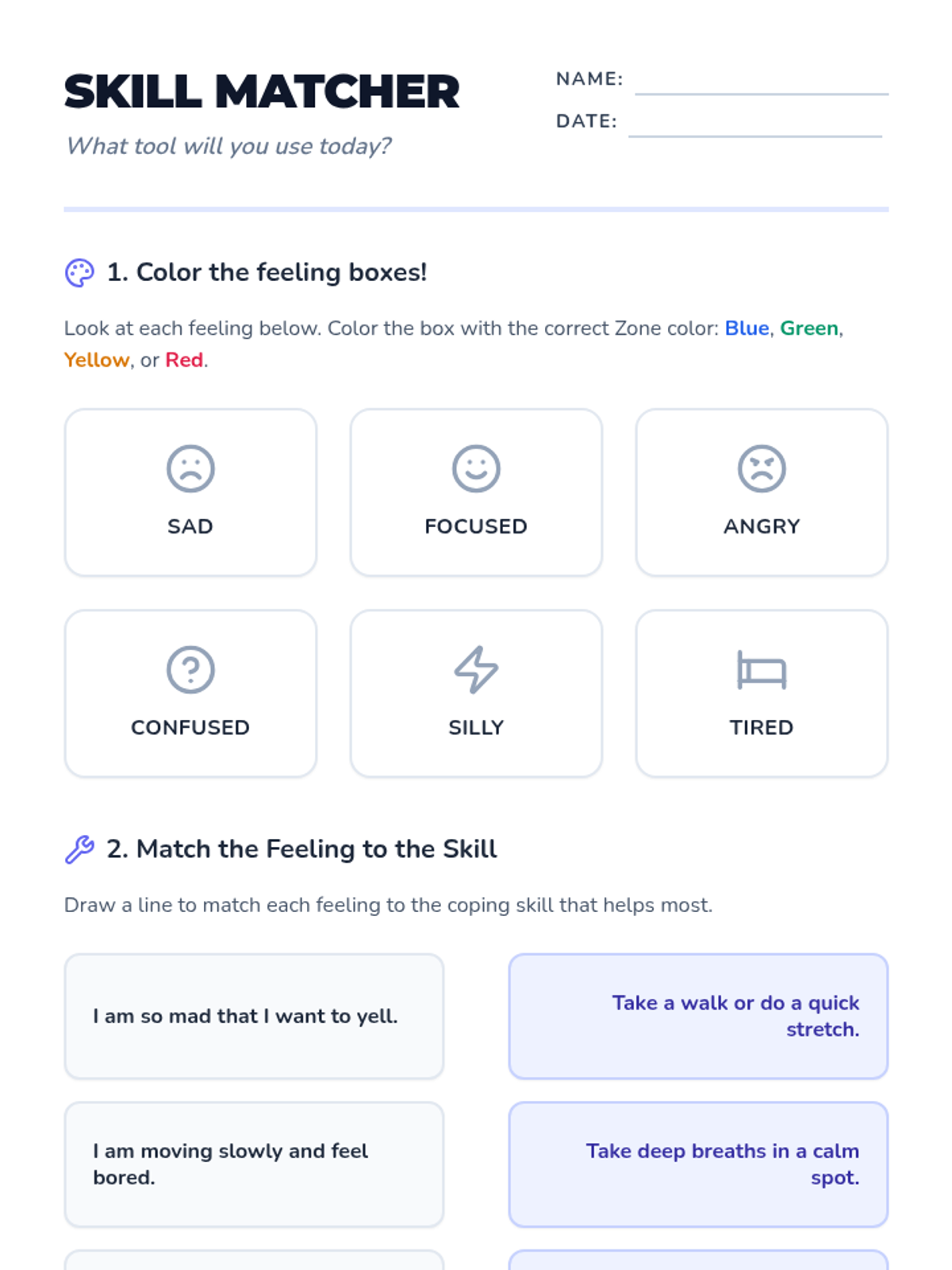
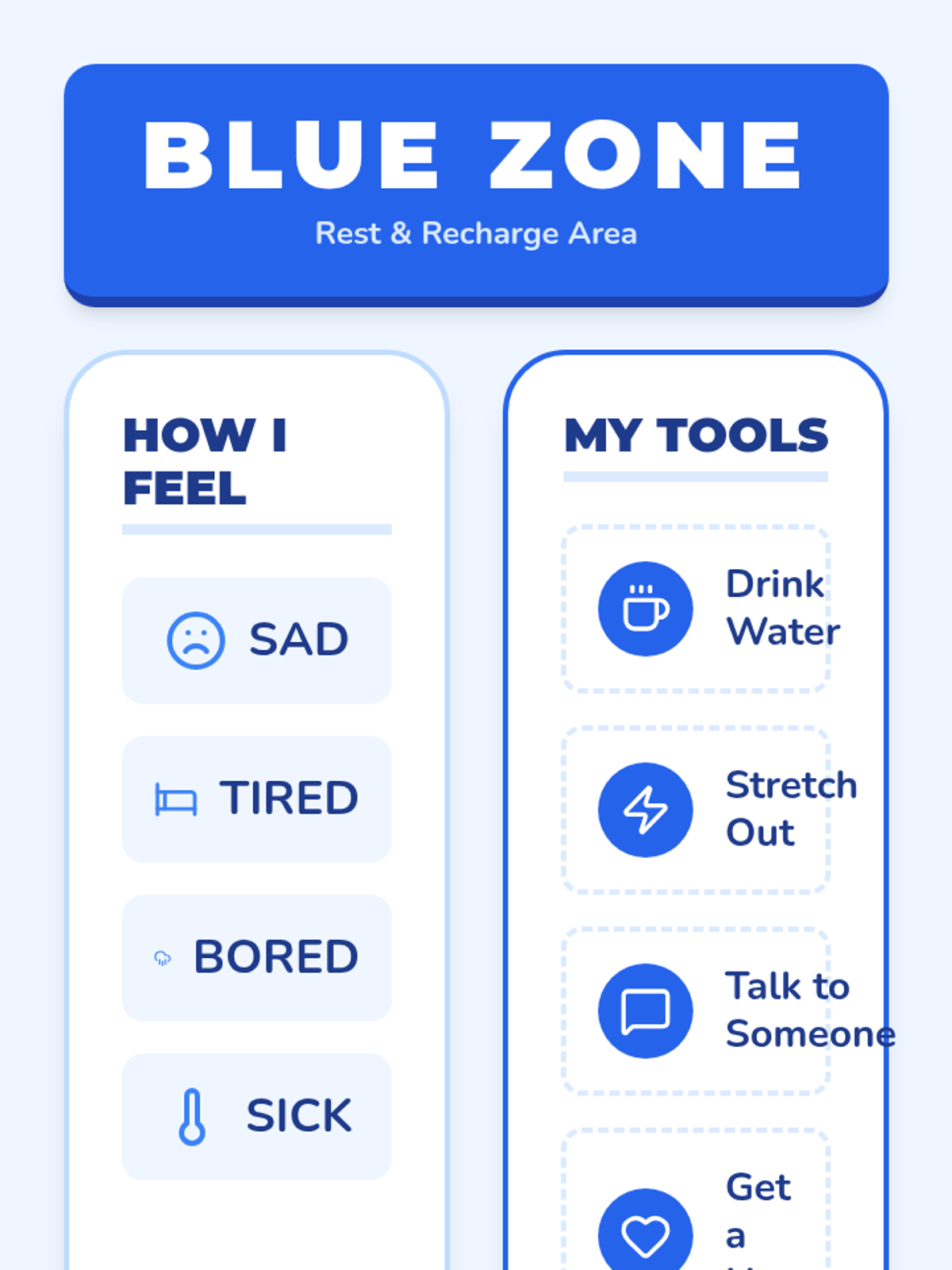
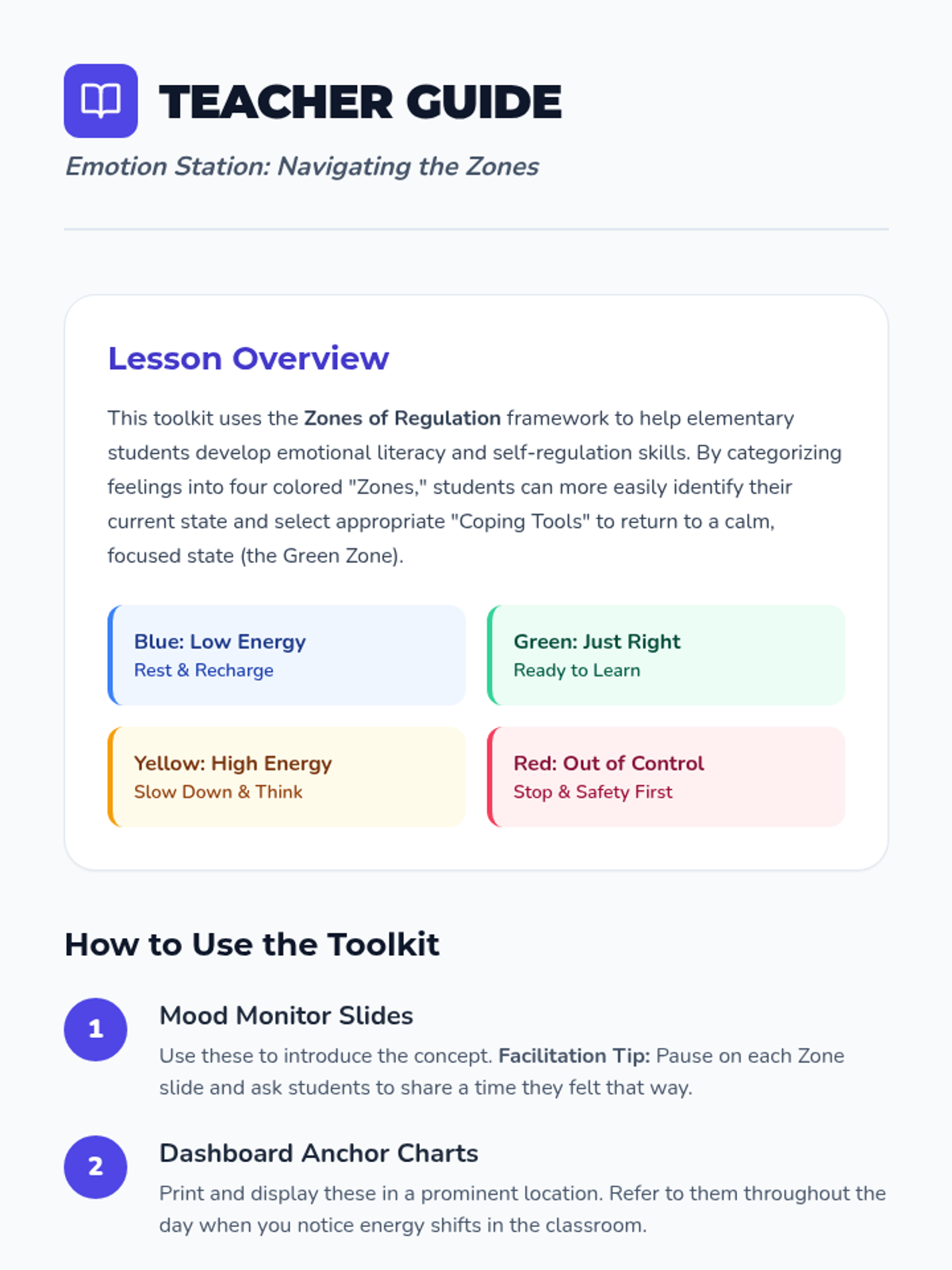
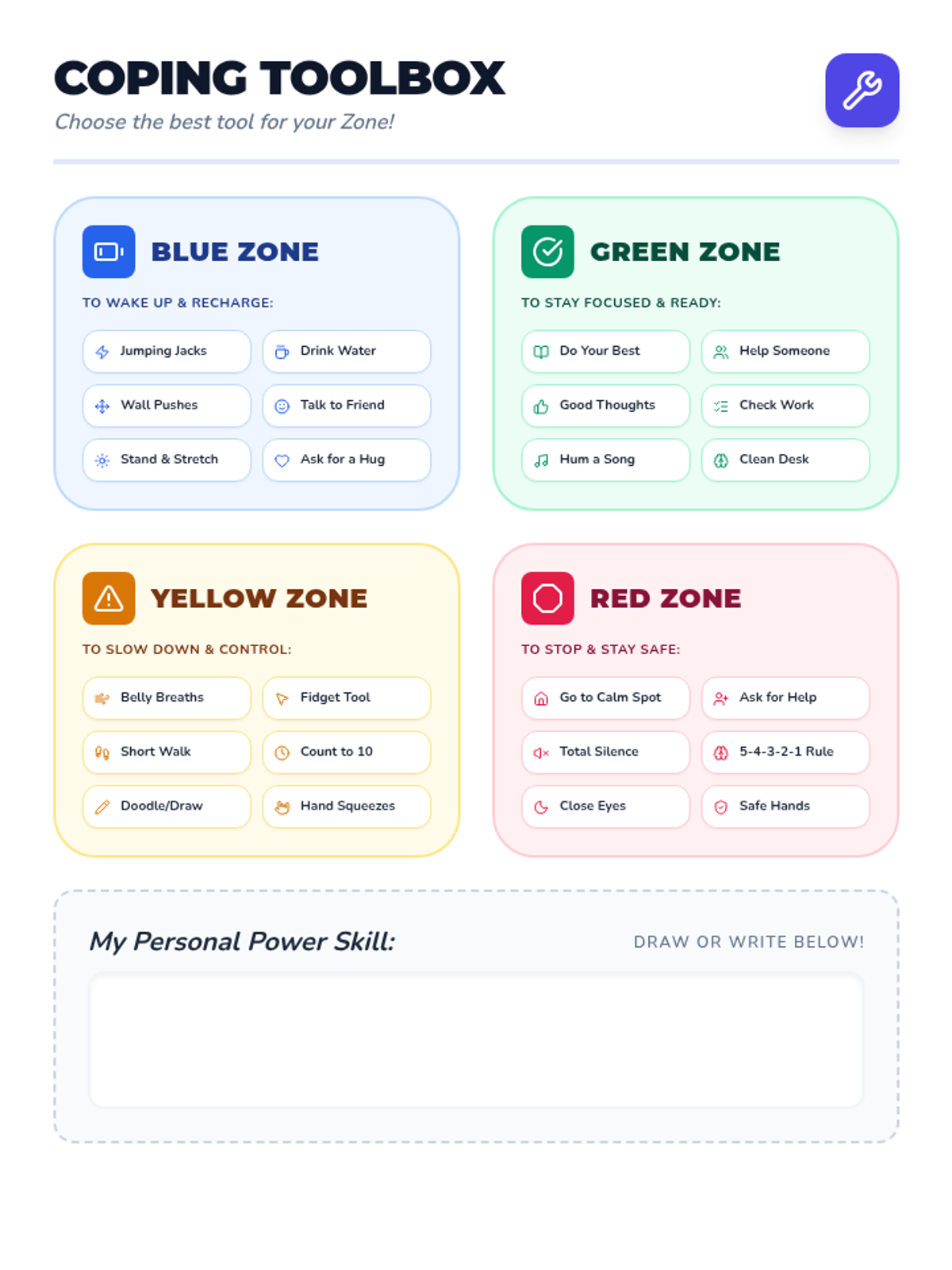
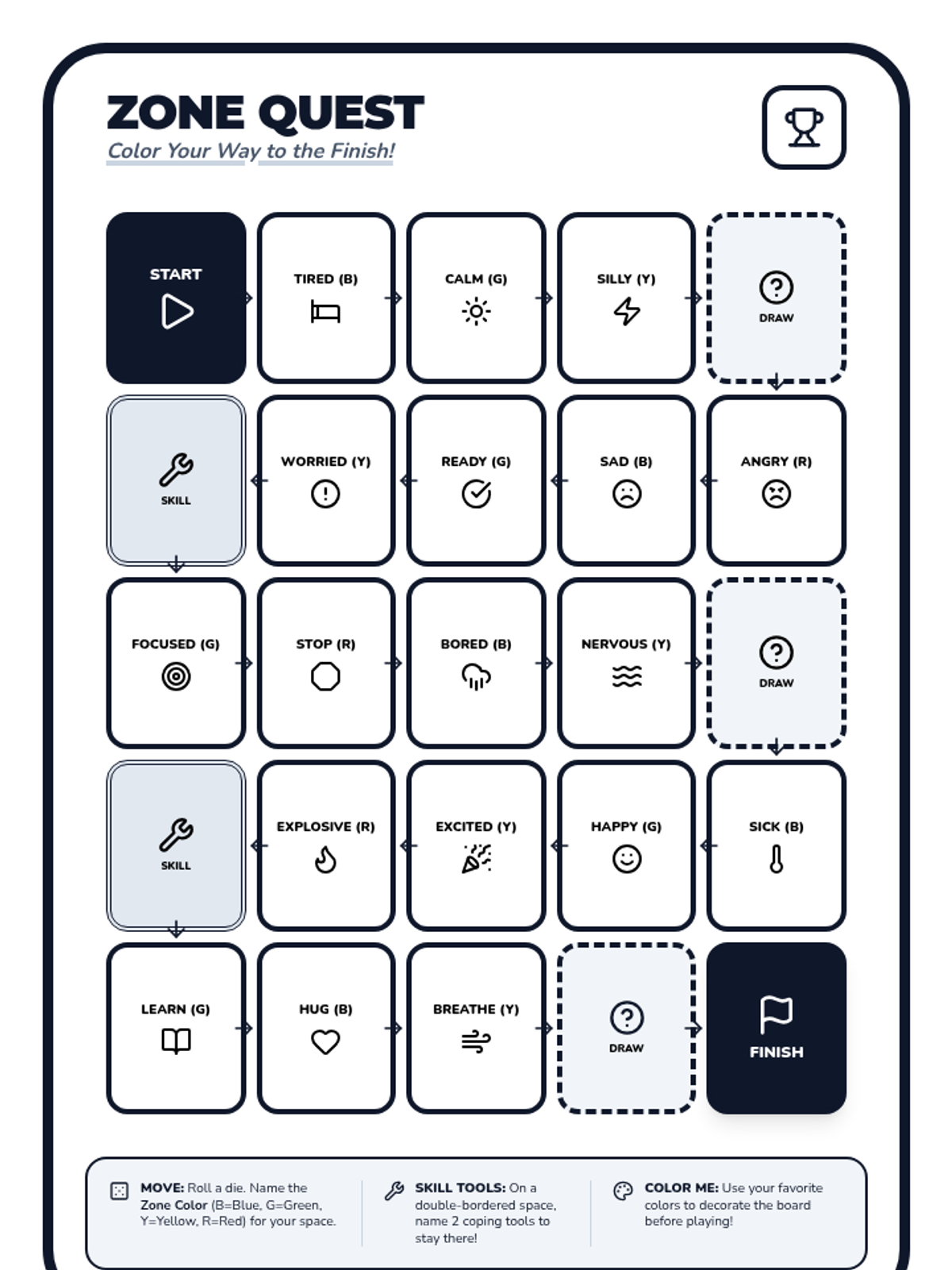
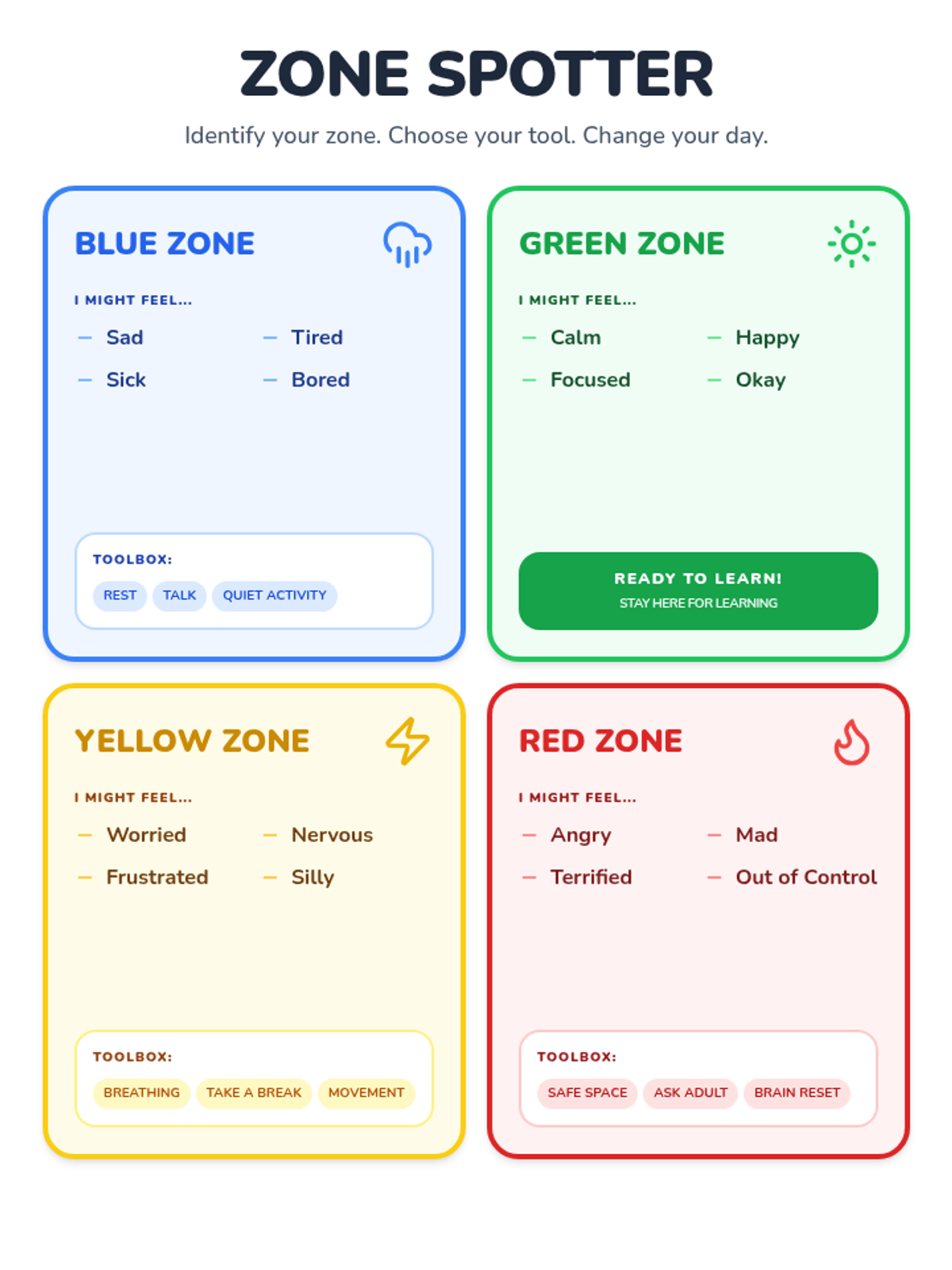
A comprehensive toolkit to help elementary students identify their emotional state using the Zones of Regulation framework and select appropriate coping strategies for each zone.
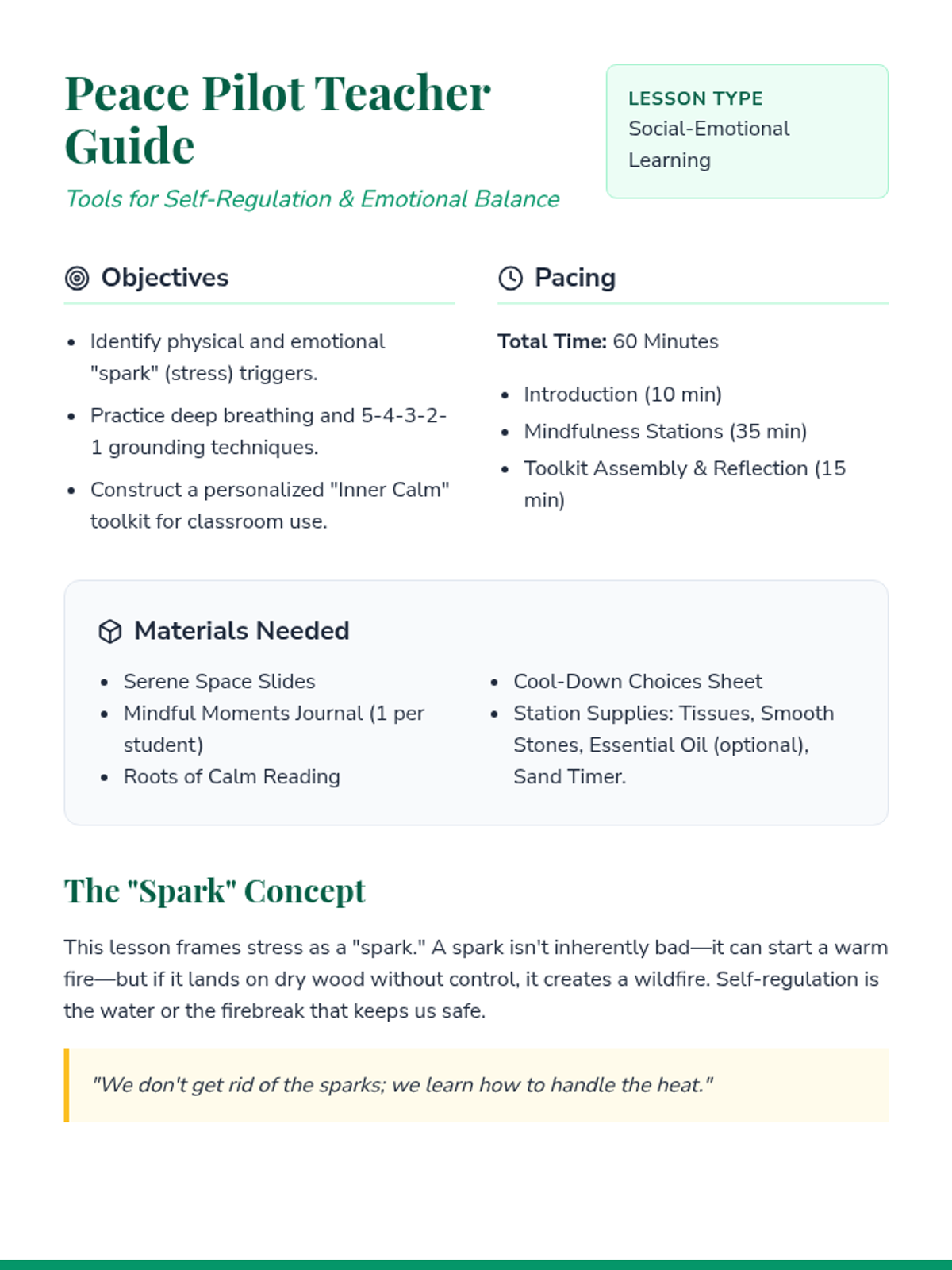
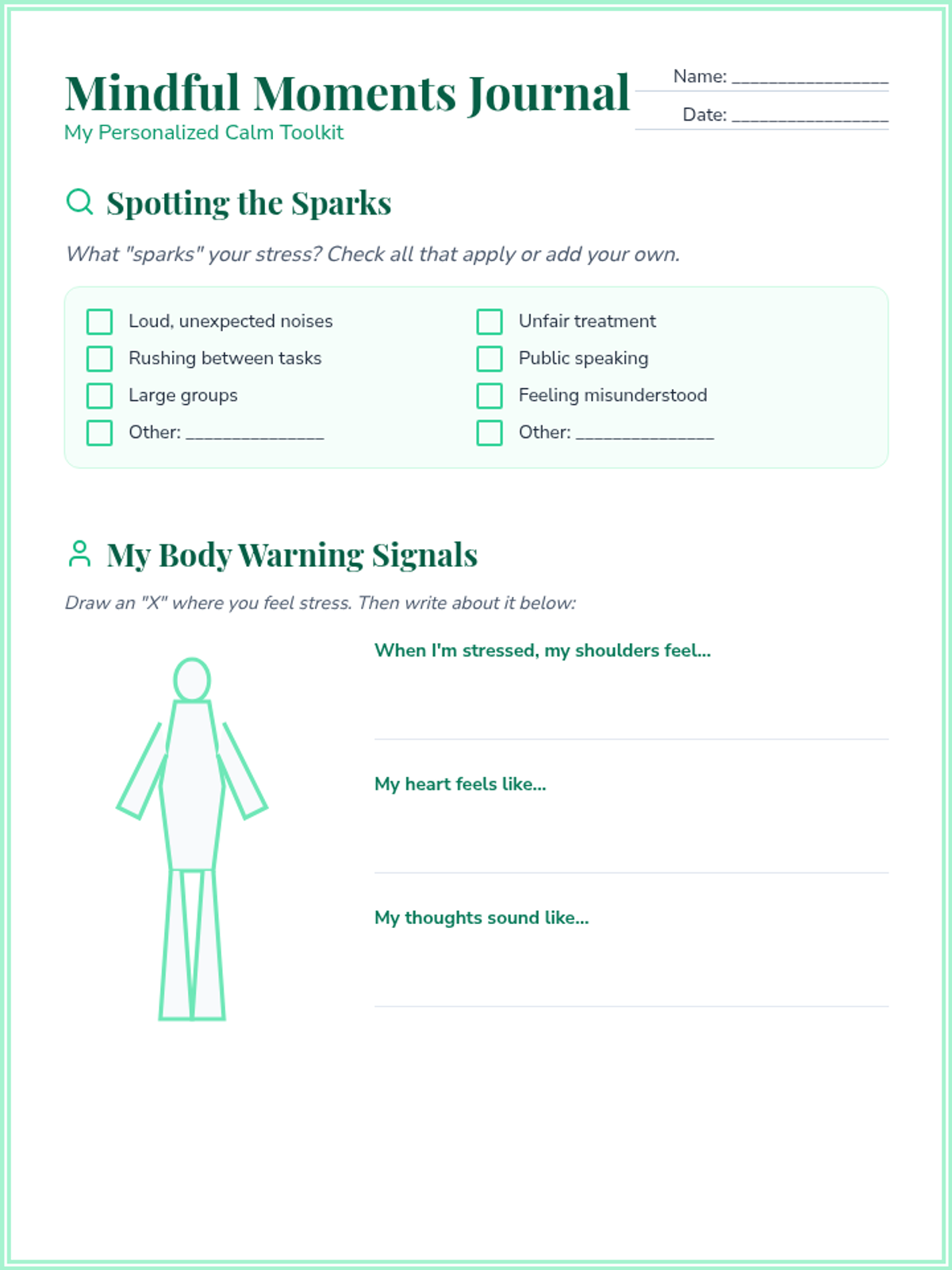
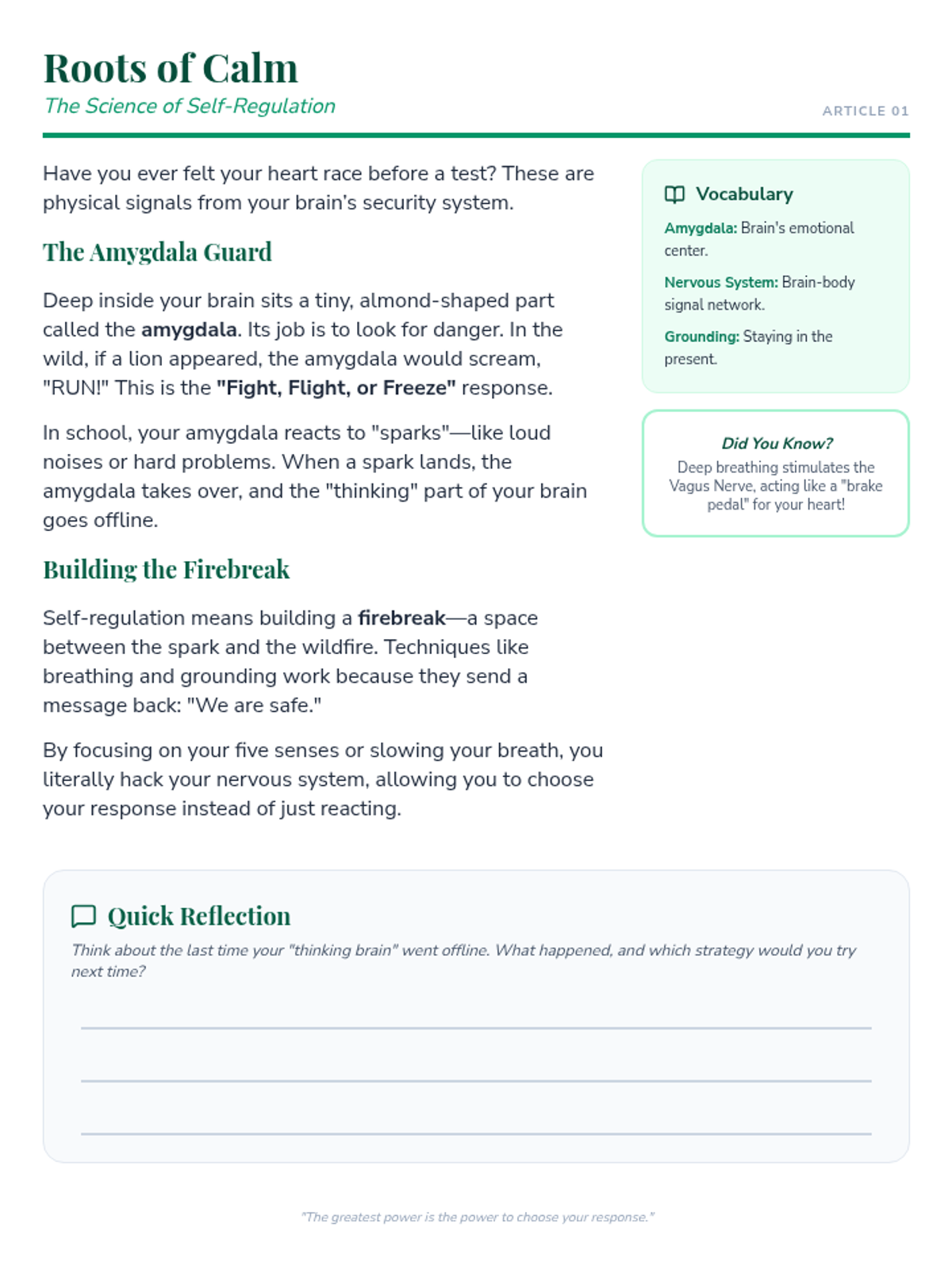
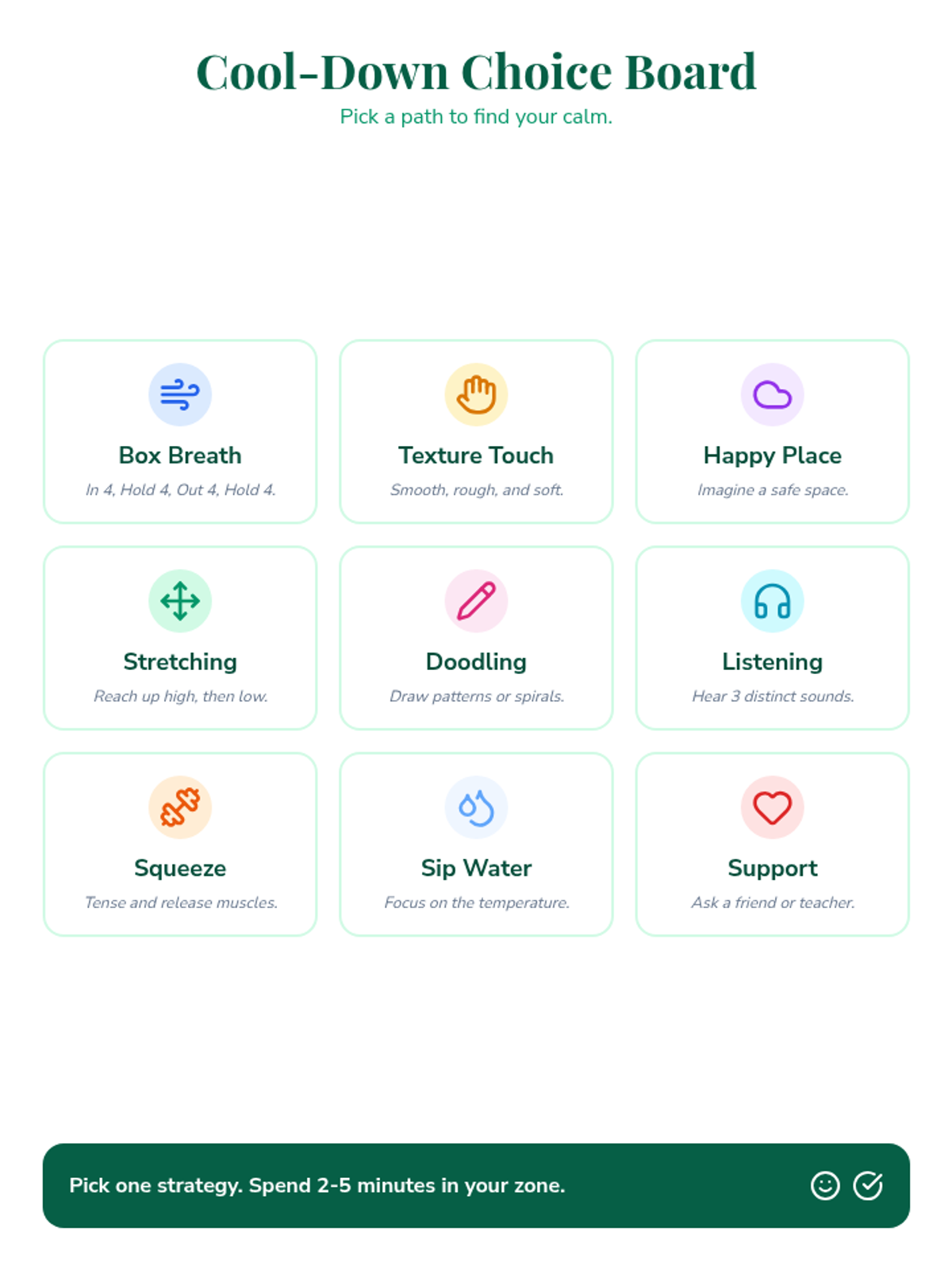
Students explore personal stress triggers and develop a personalized toolkit of mindfulness and grounding strategies through hands-on stations and reflective journaling.
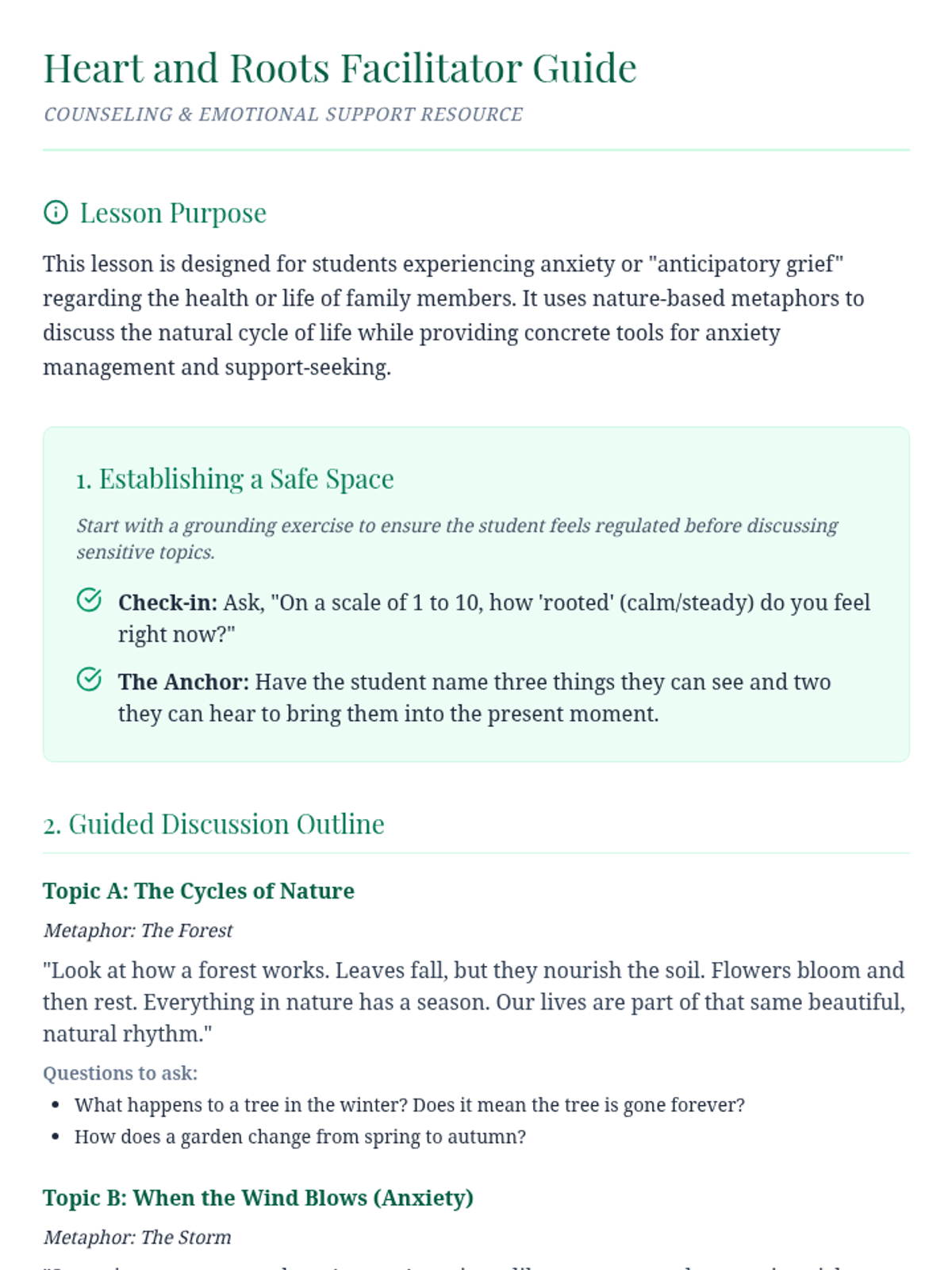
A sensitive and supportive lesson designed to help students navigate anxiety regarding the loss of loved ones through nature metaphors, expressive art, and identifying support systems.
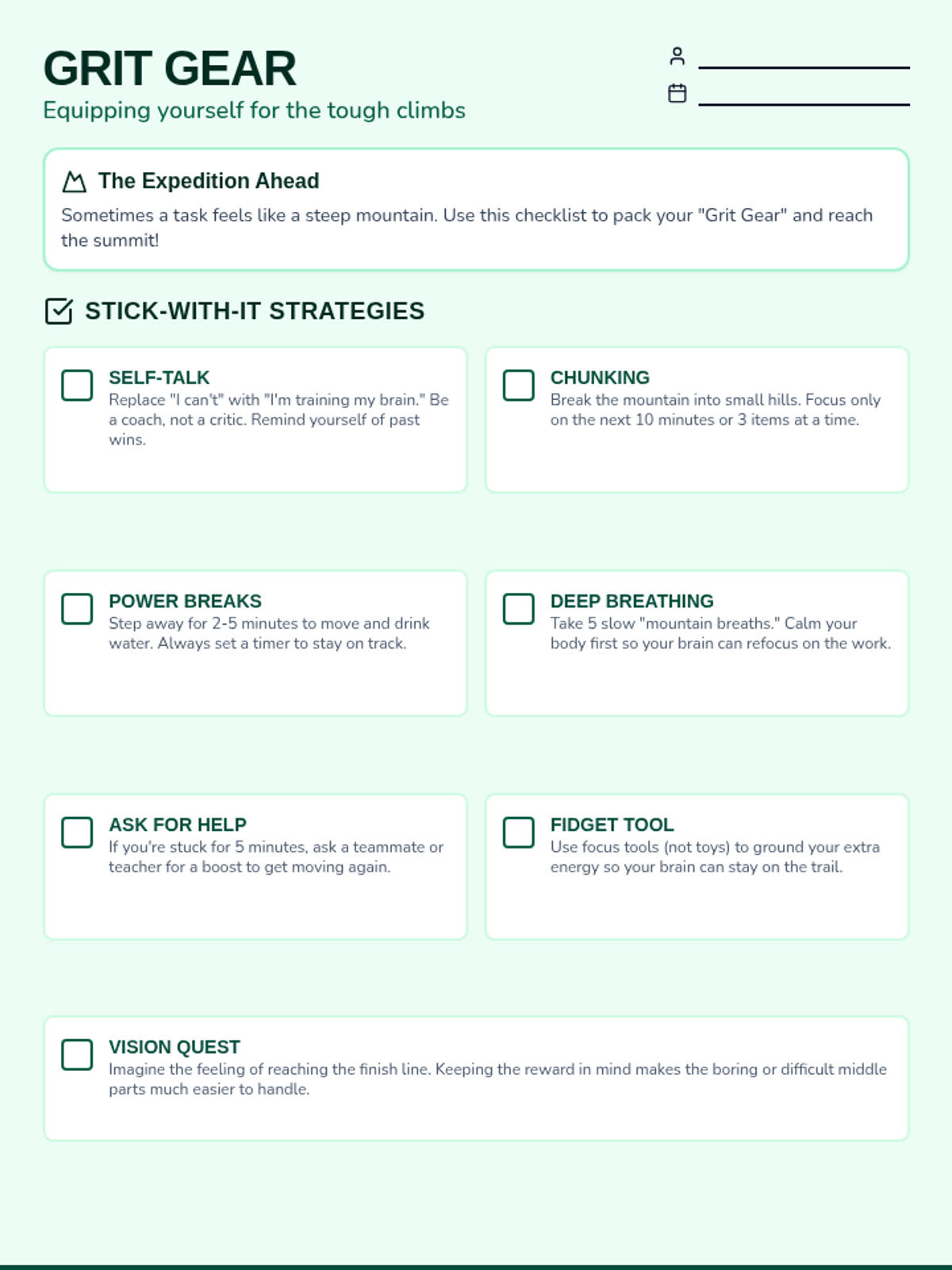
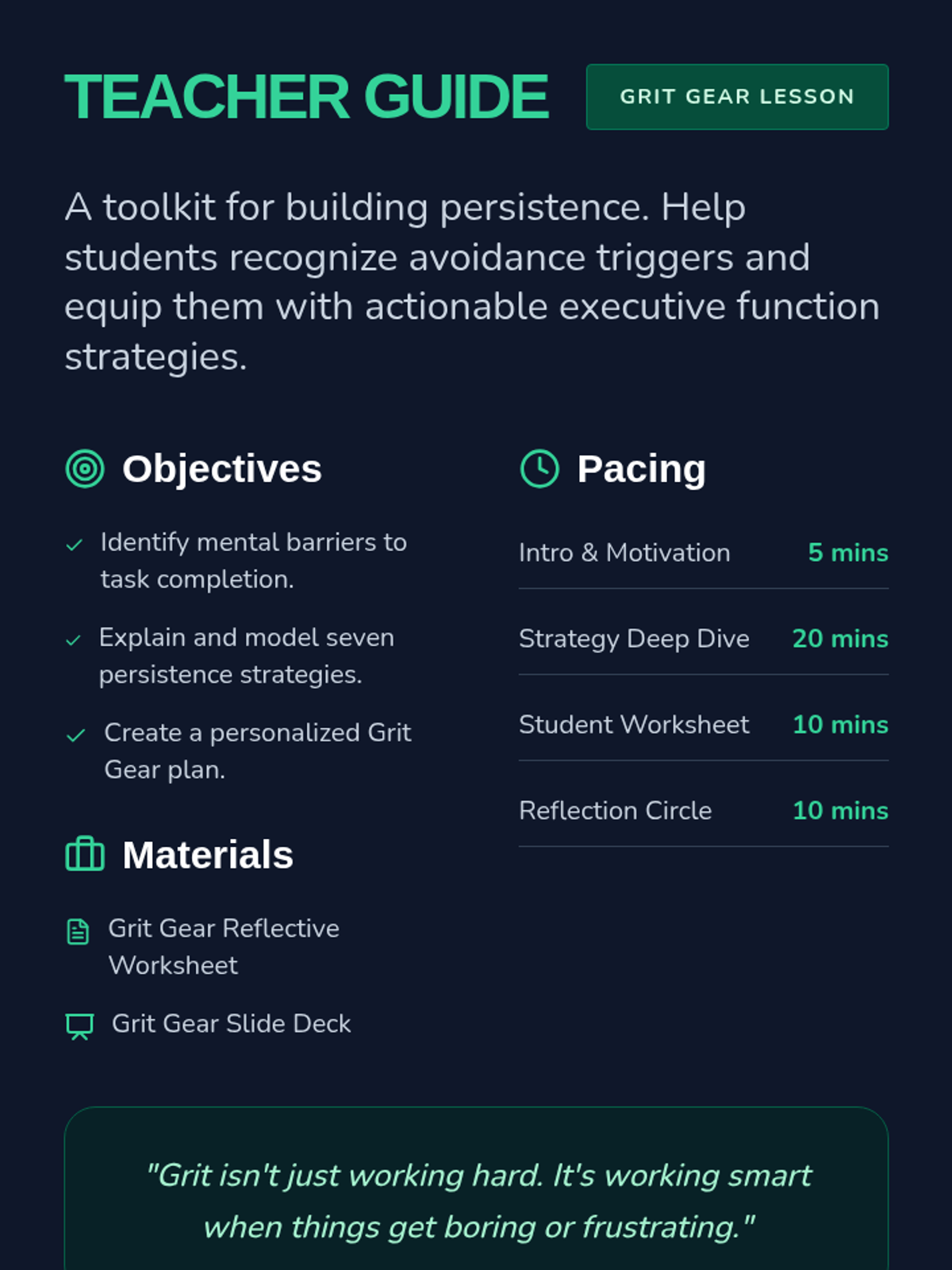
A lesson focused on equipping students with practical strategies to maintain focus and persistence during difficult or monotonous tasks.
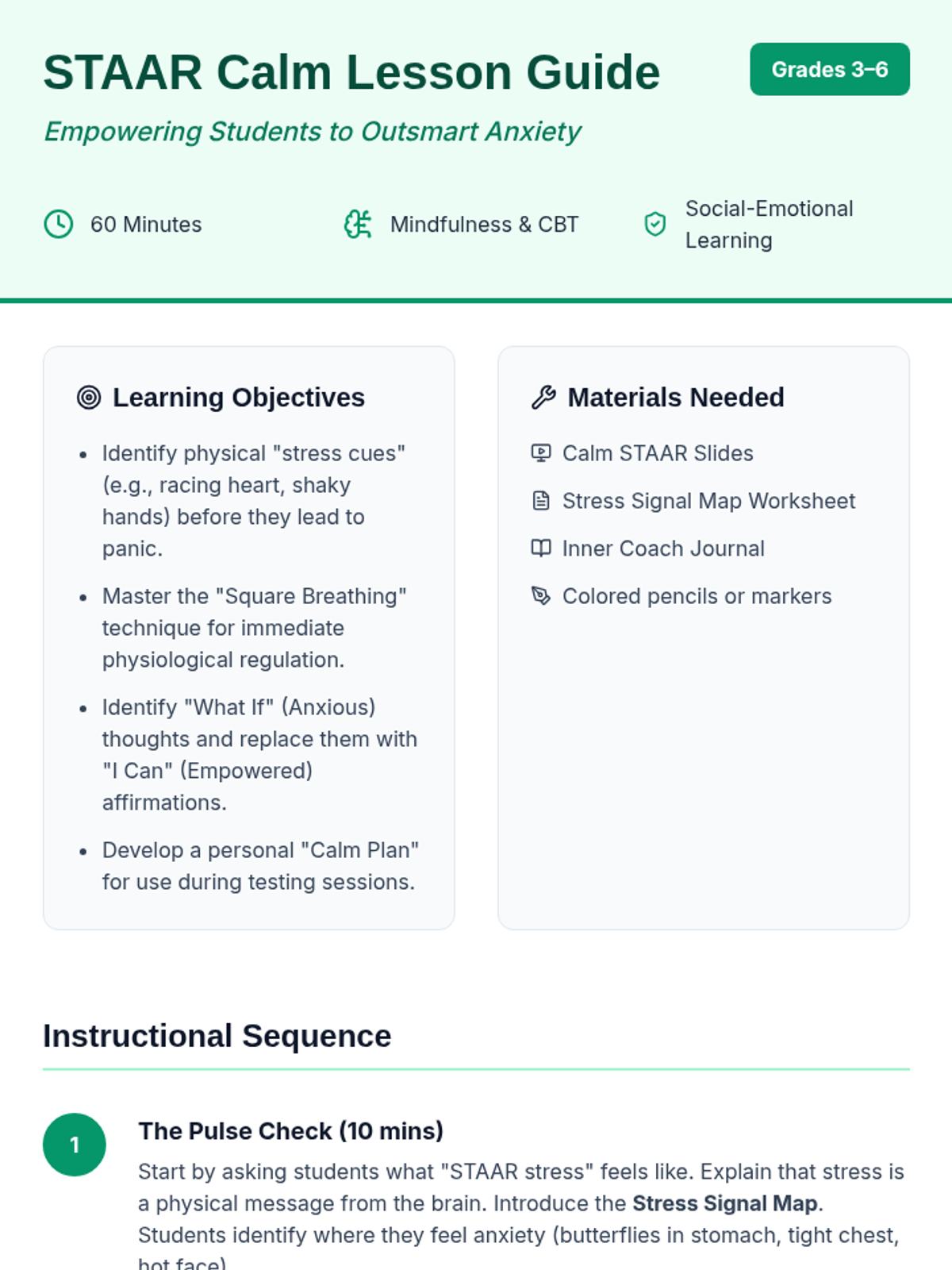
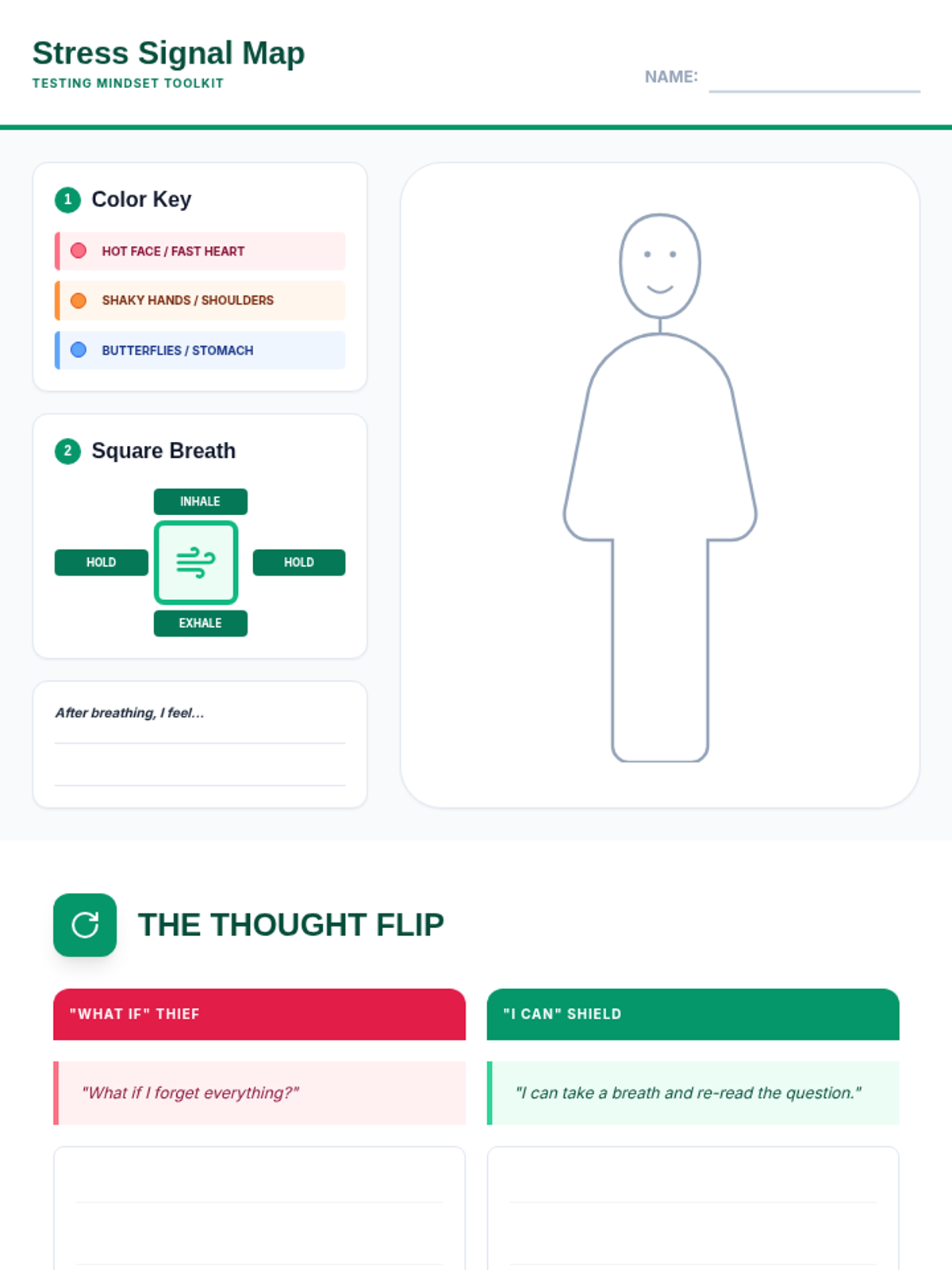
A comprehensive mindfulness workshop designed to equip 3rd-6th grade students with practical tools to manage testing anxiety, focusing on physiological awareness and cognitive reframing.
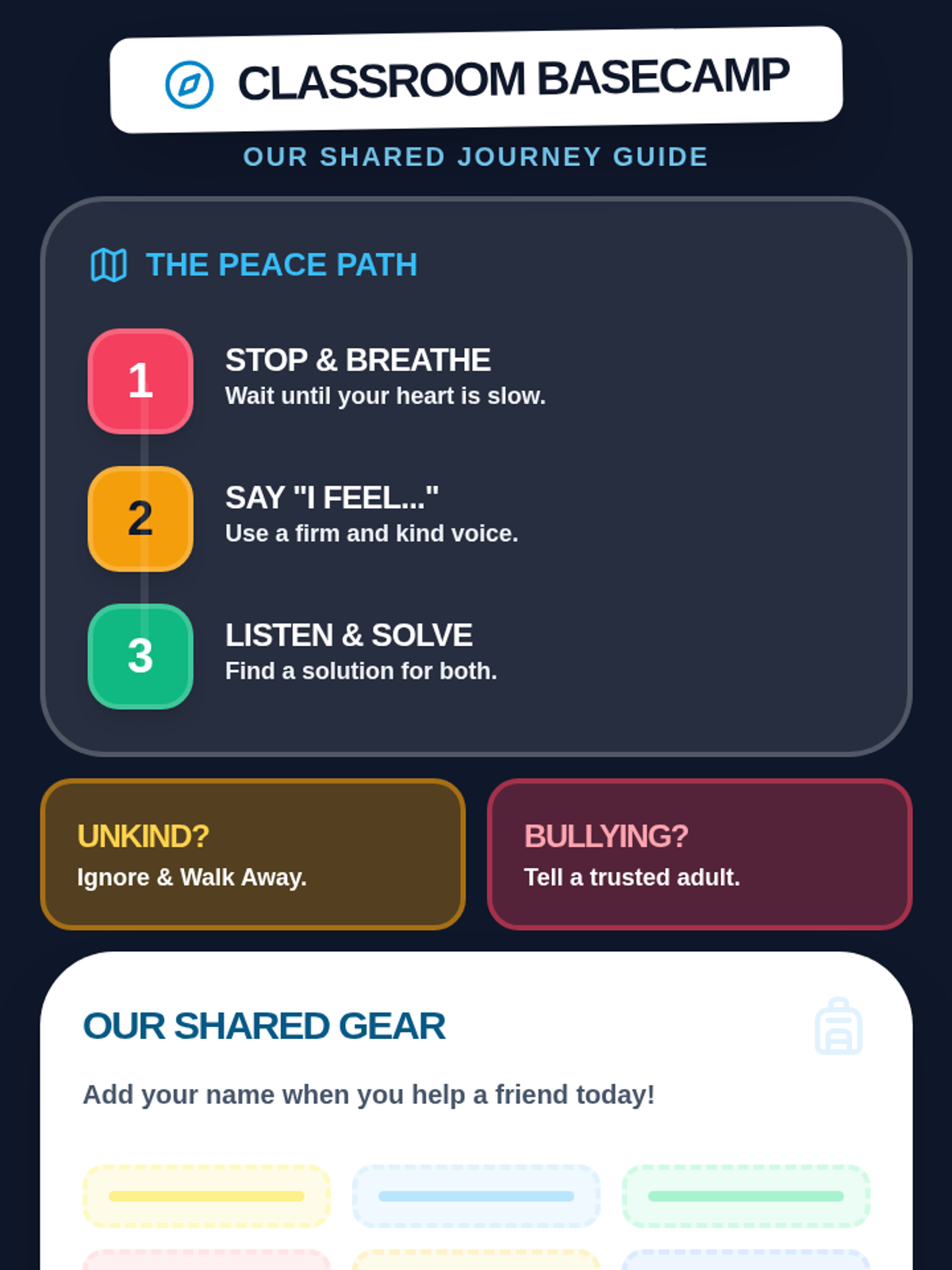
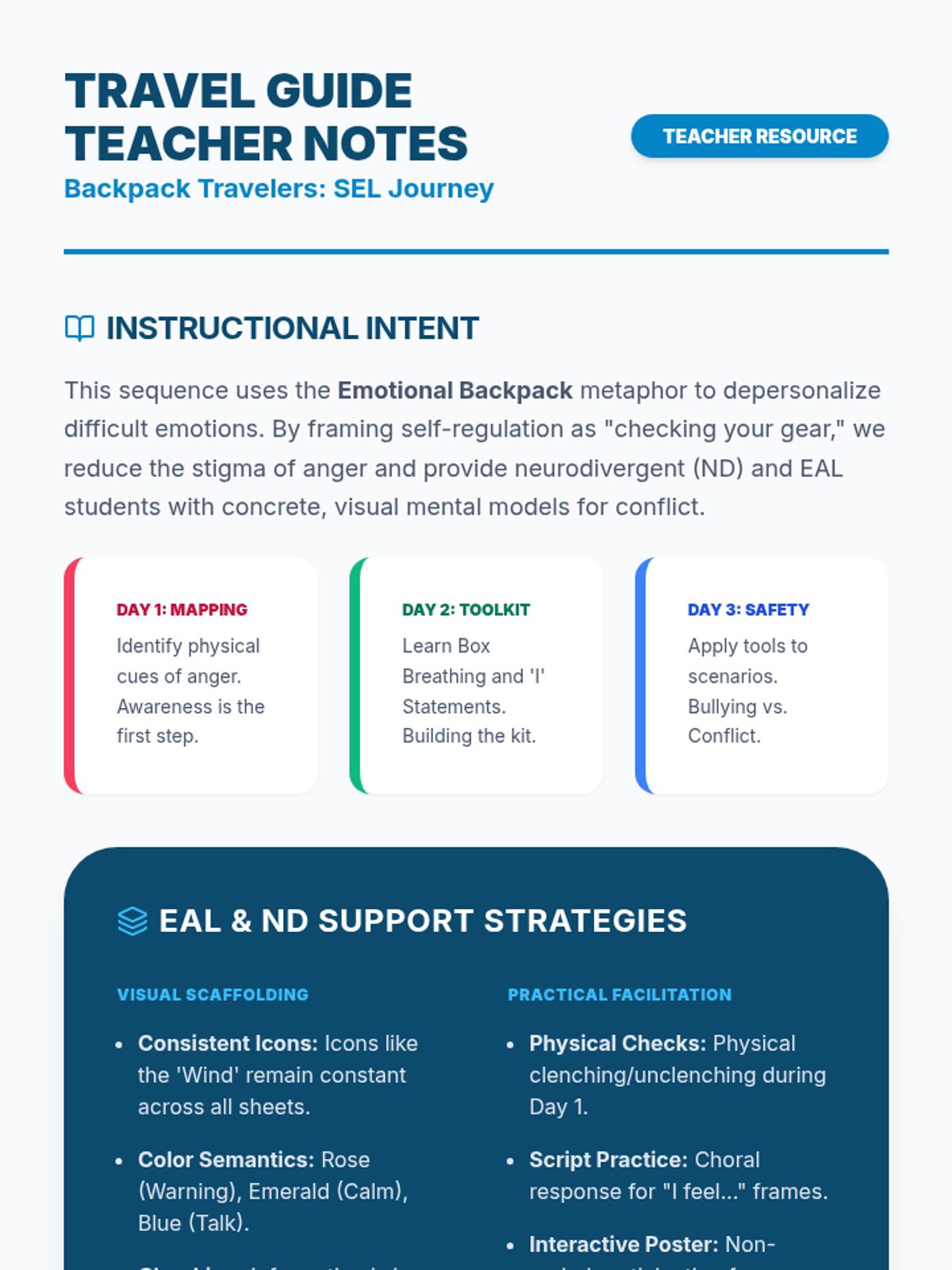
Applies regulation tools to social situations, including conflict resolution steps and handling unkind behavior or bullying.
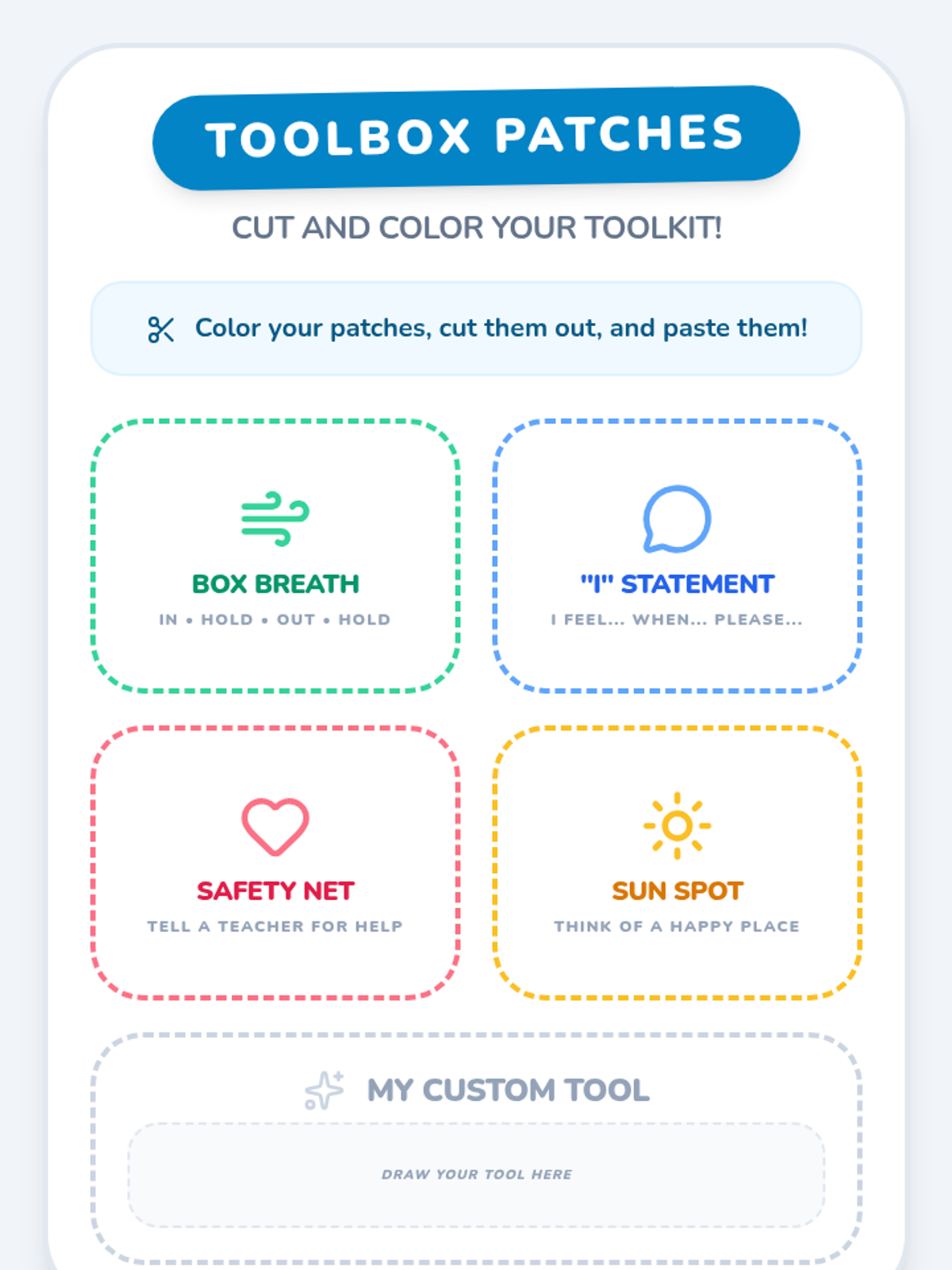
Focuses on practical tools for regulation: deep breathing, mindfulness, and the 'I' Statement tool.
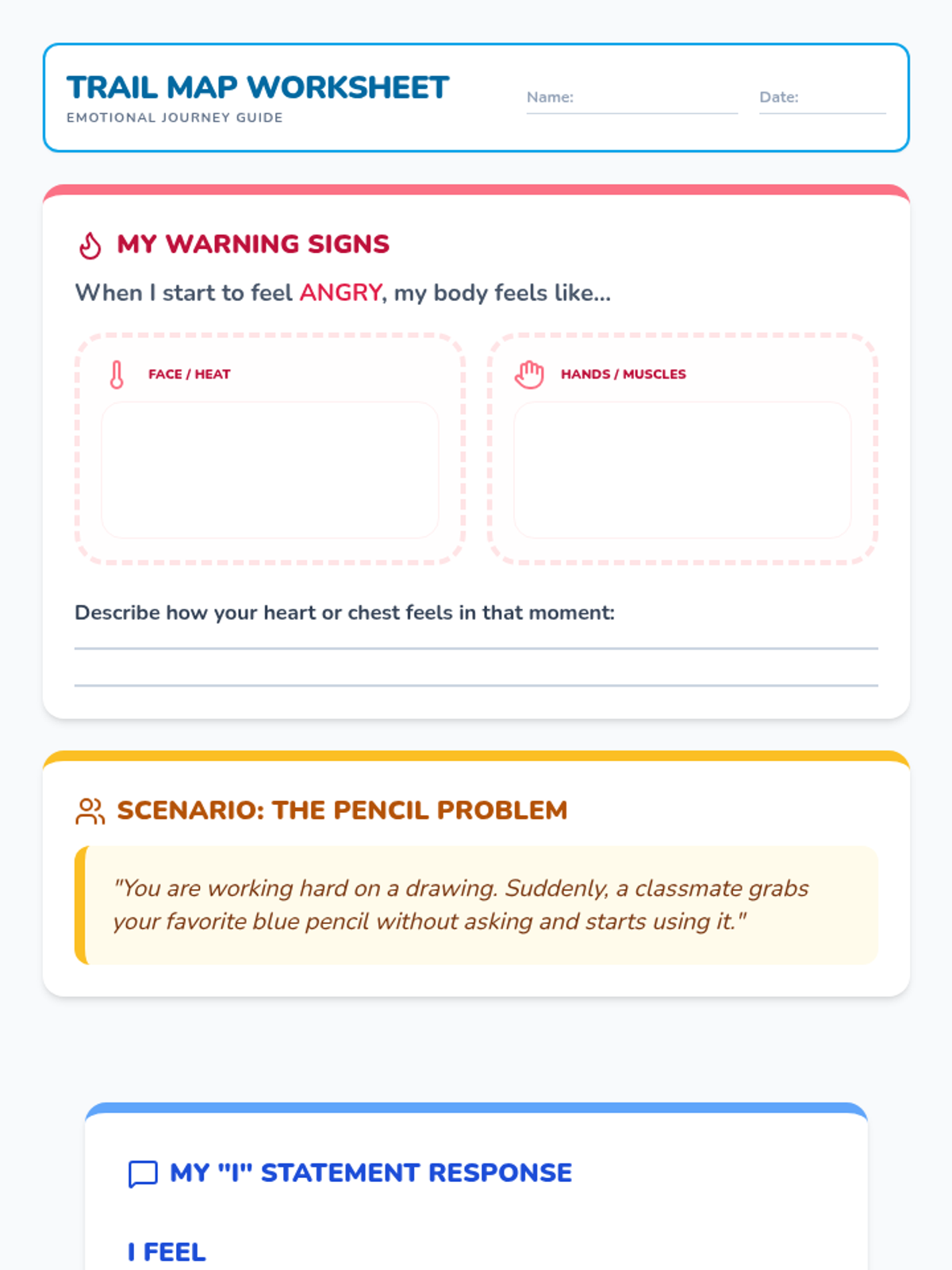
Students learn to identify physical signs of anger and use the 'Emotional Backpack' metaphor to understand that everyone carries feelings.
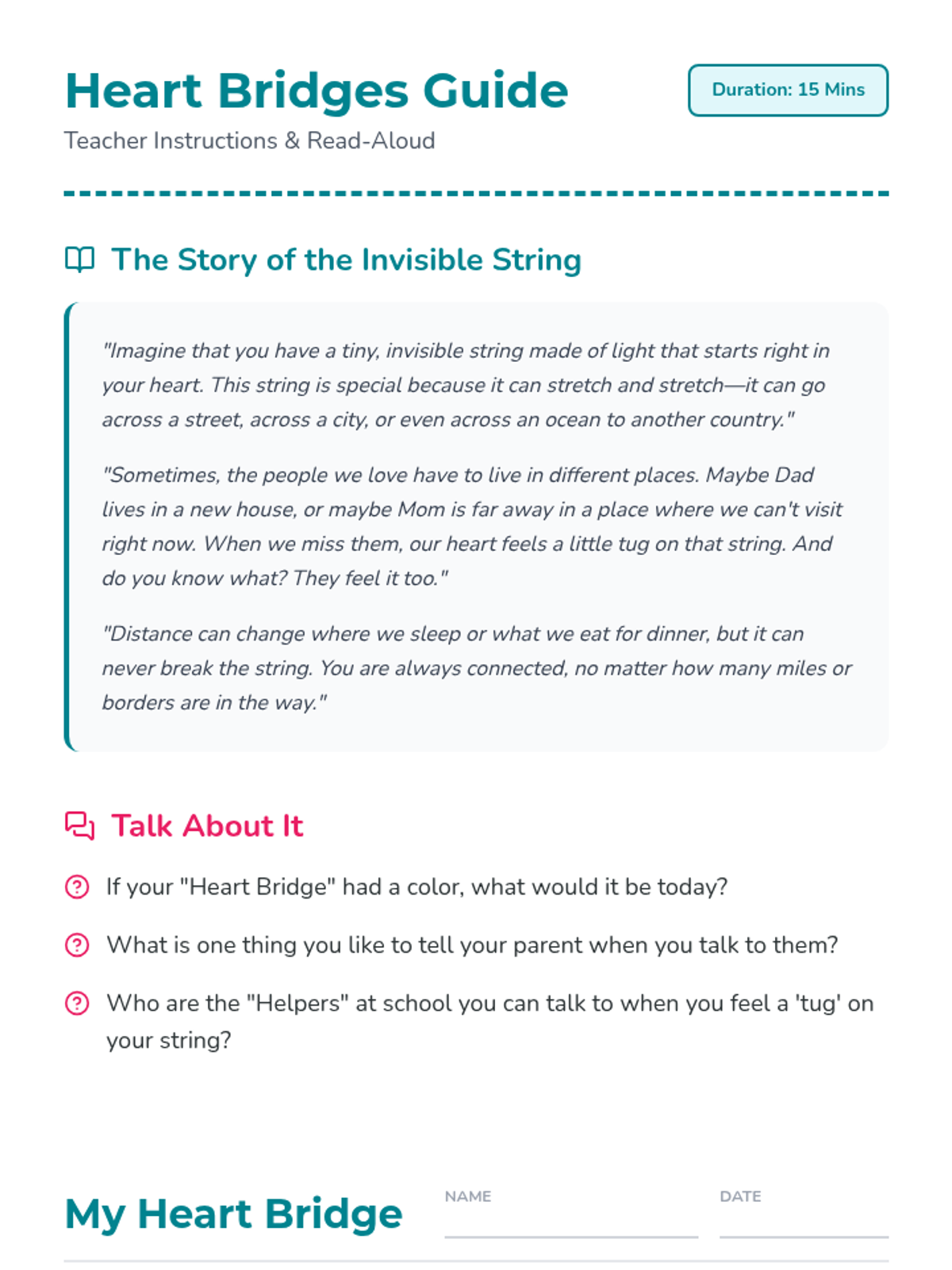
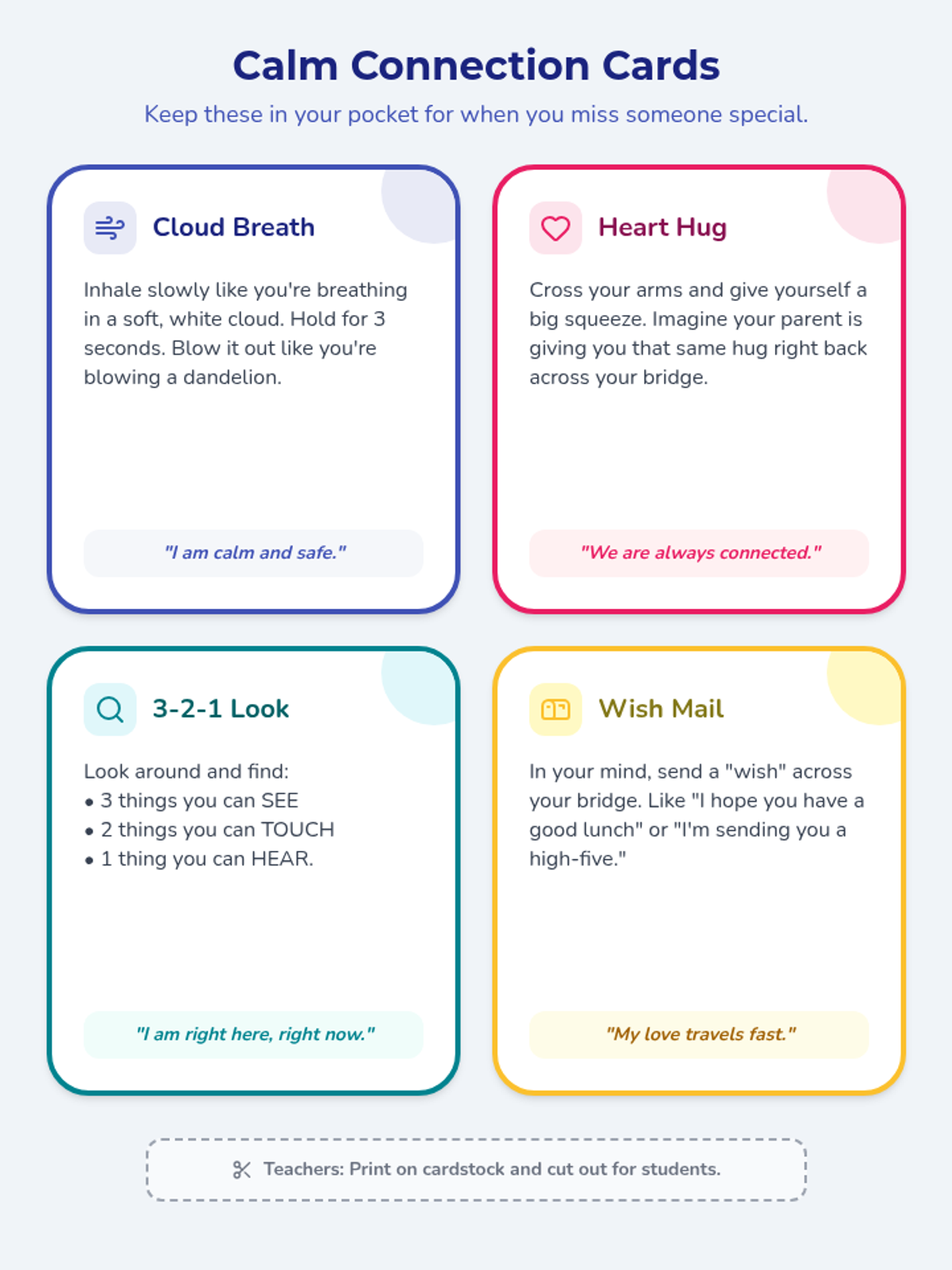
A gentle 15-minute lesson helping children navigate the big feelings of parental separation due to divorce or deportation, focusing on maintaining emotional connections.
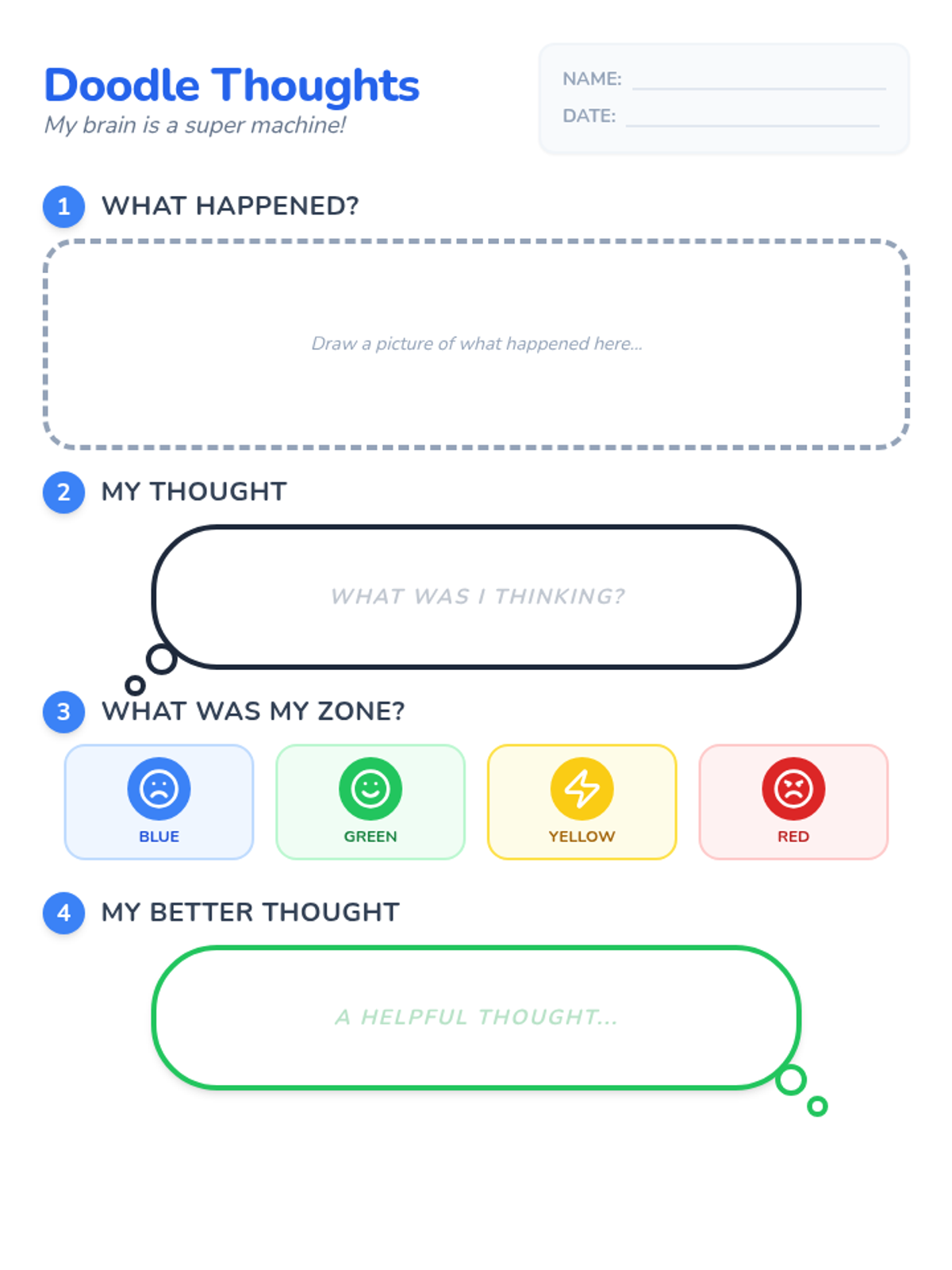
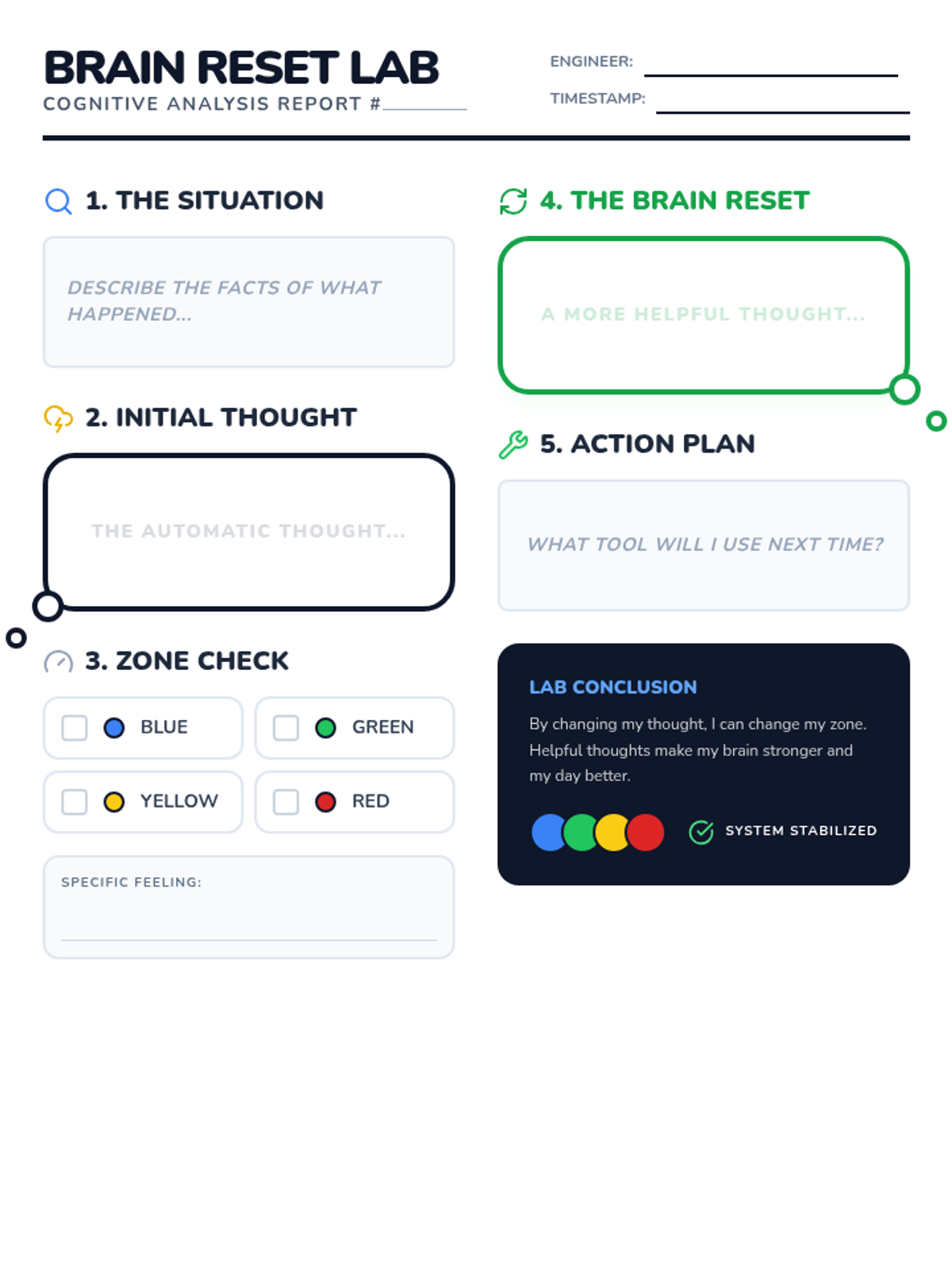
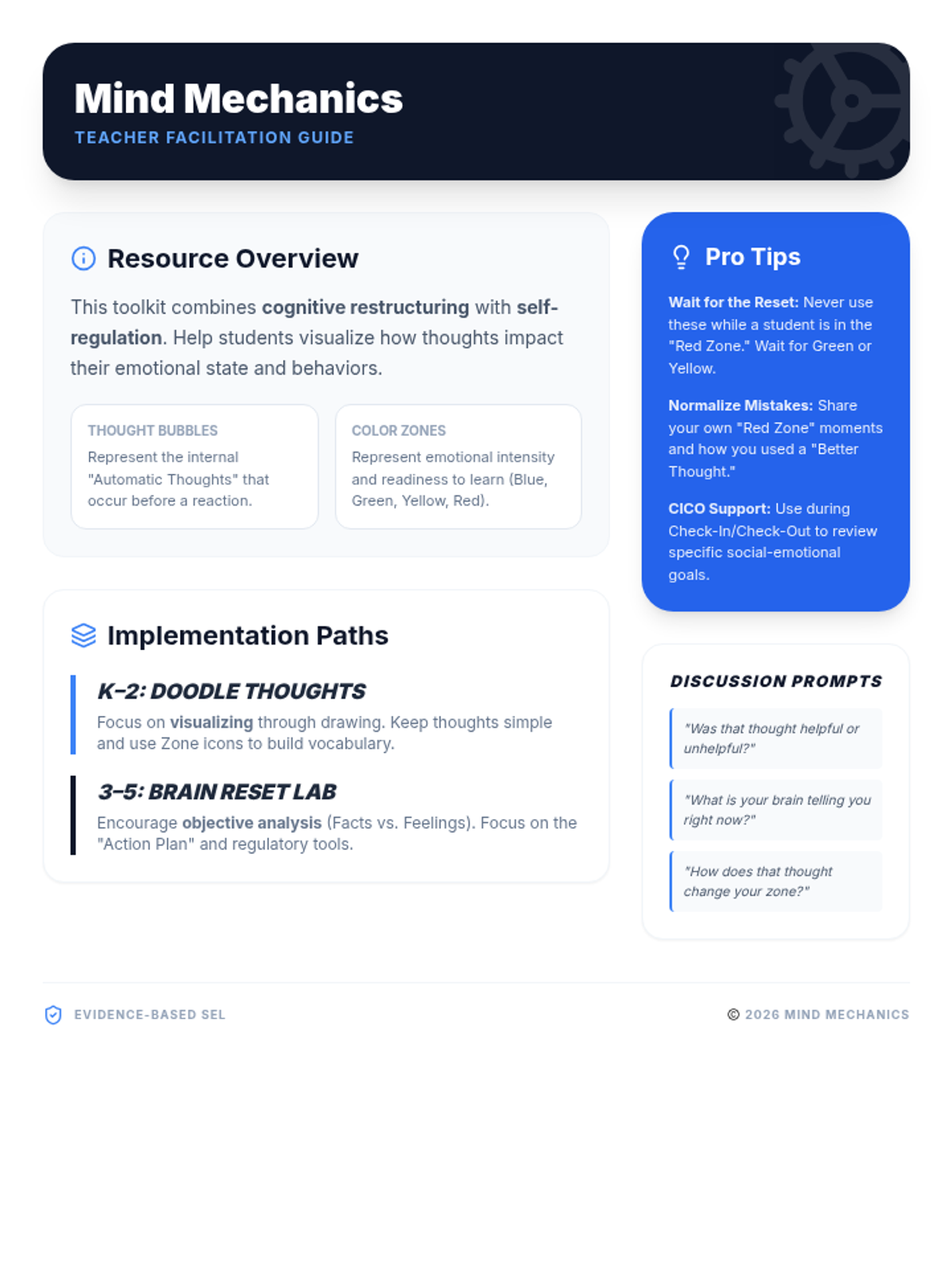
A collection of visual tools and worksheets designed to help students identify their emotional zones and practice cognitive restructuring through thought bubbles. Includes age-appropriate templates for K-2 and 3-5 students.
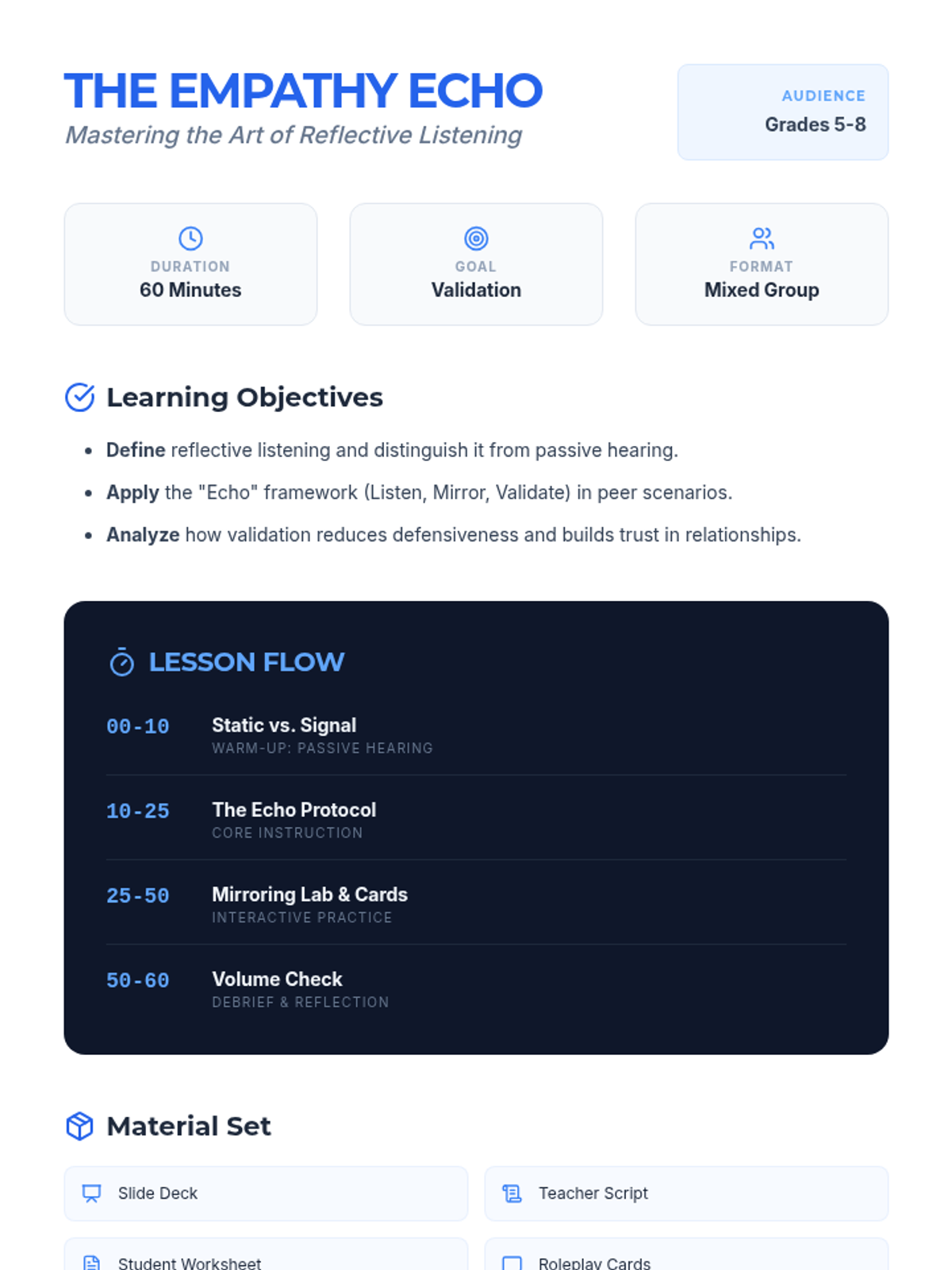
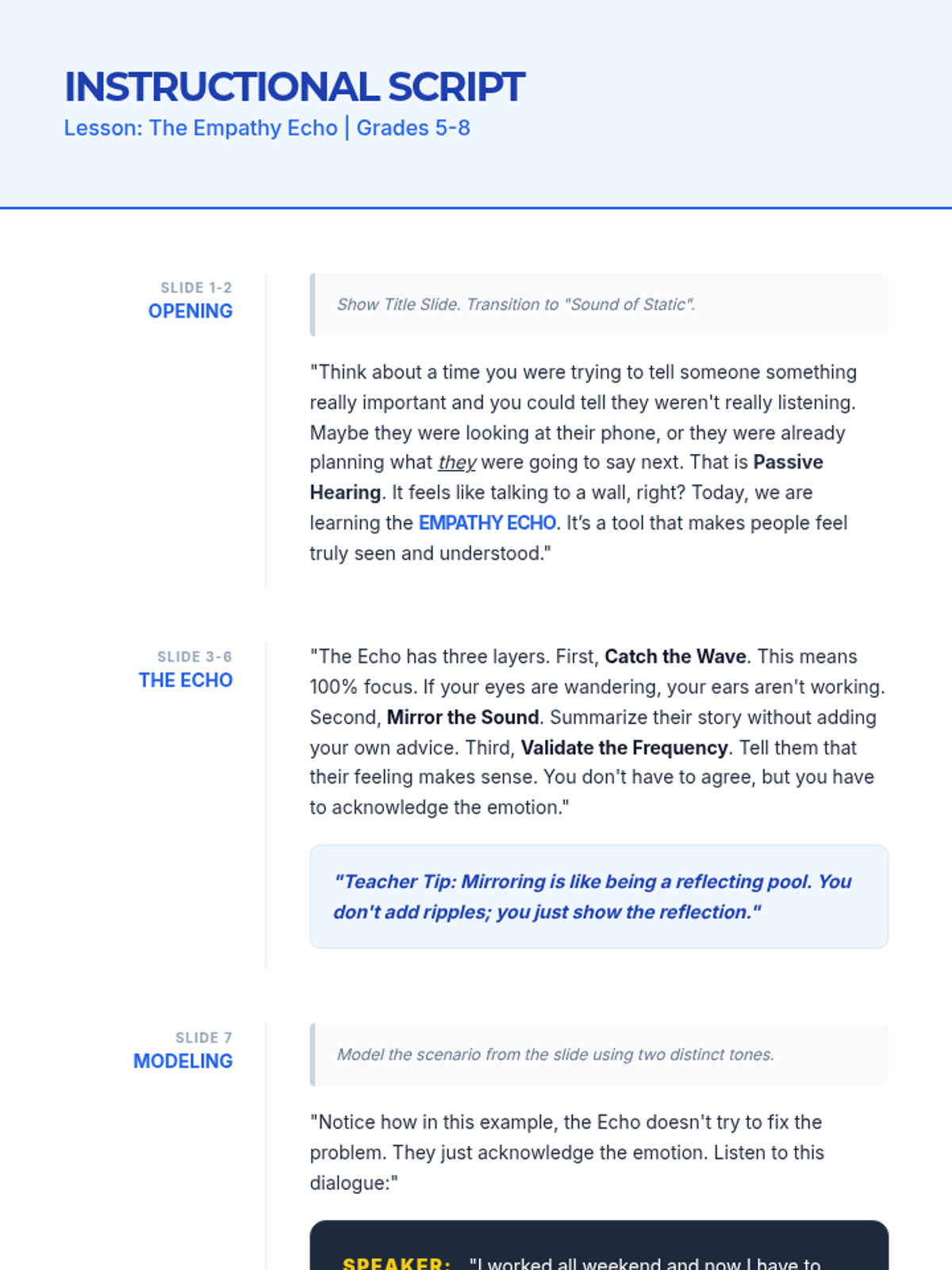
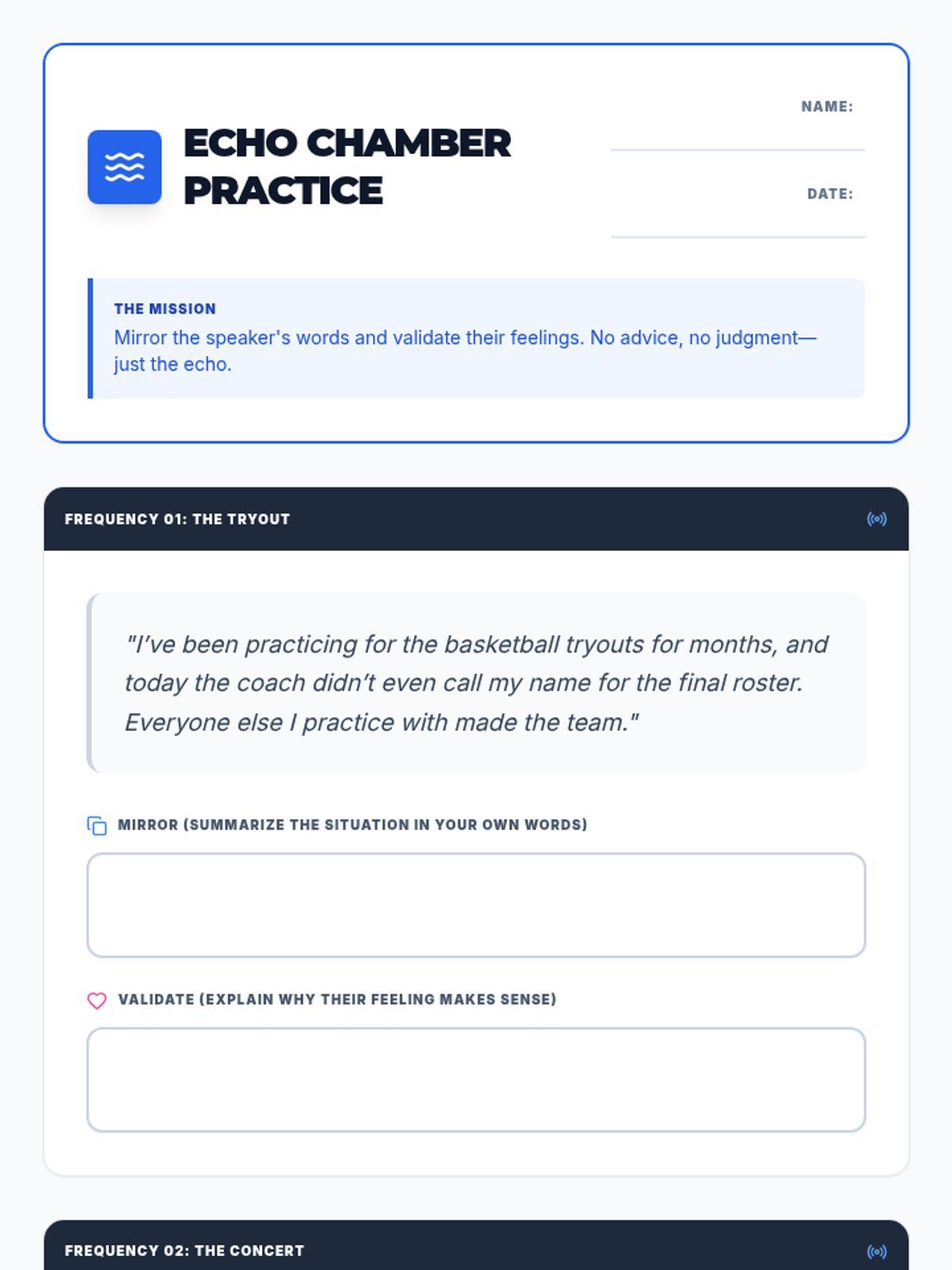
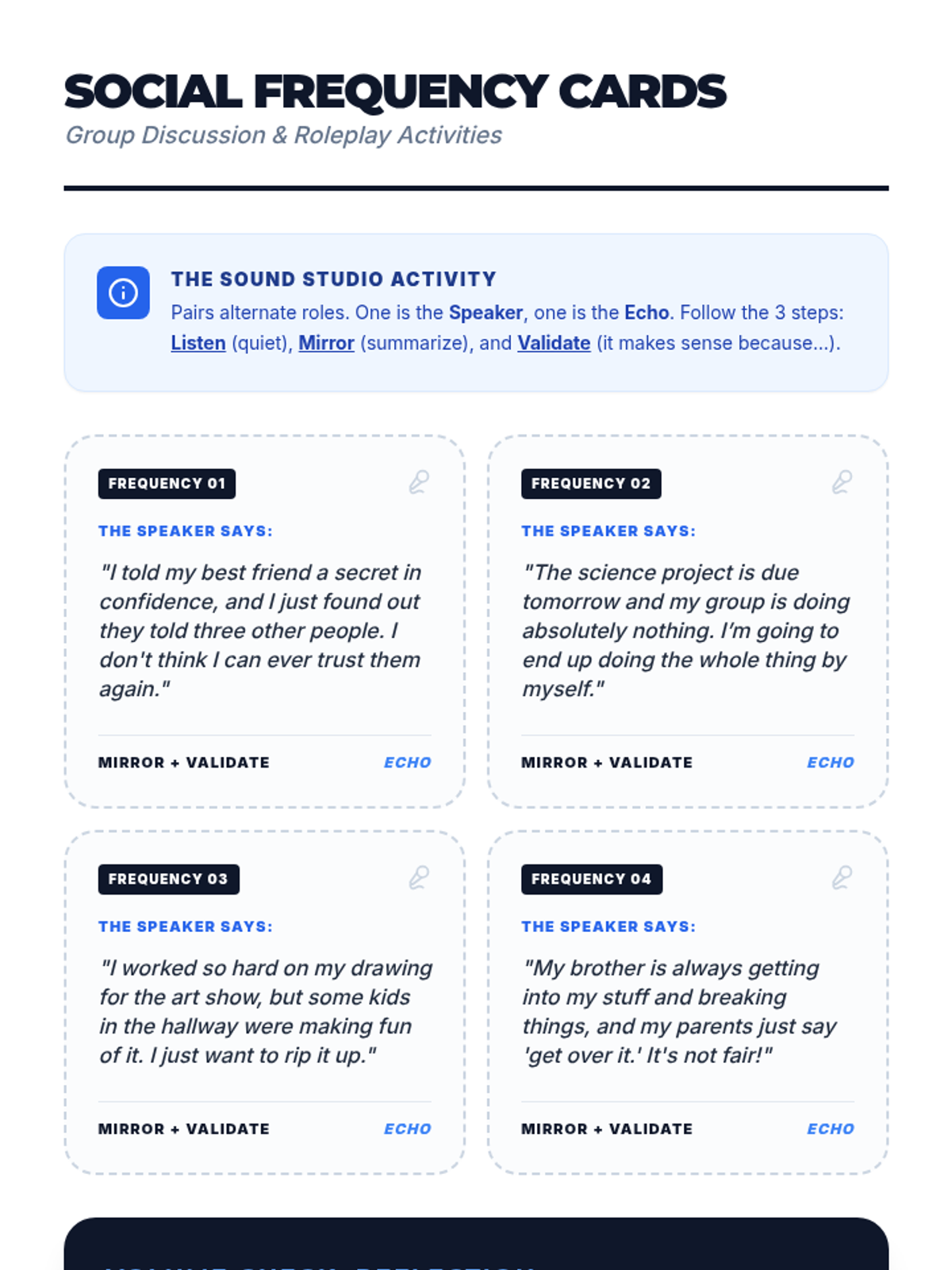
A communication-focused lesson for 5th-8th graders that teaches reflective listening and emotional validation through the 'Echo' technique. Students learn to listen, mirror, and validate peers to strengthen relationships and resolve conflicts.
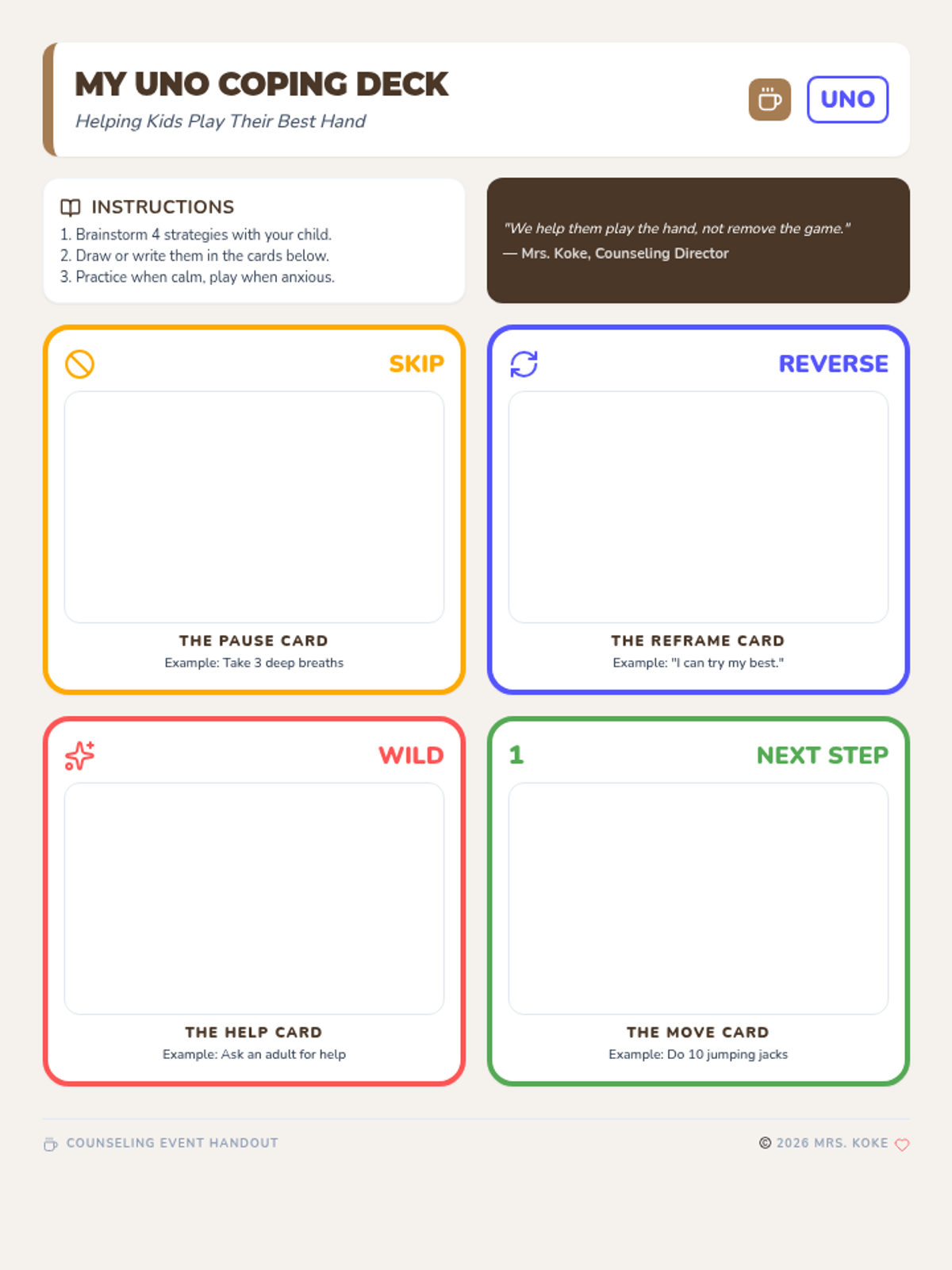
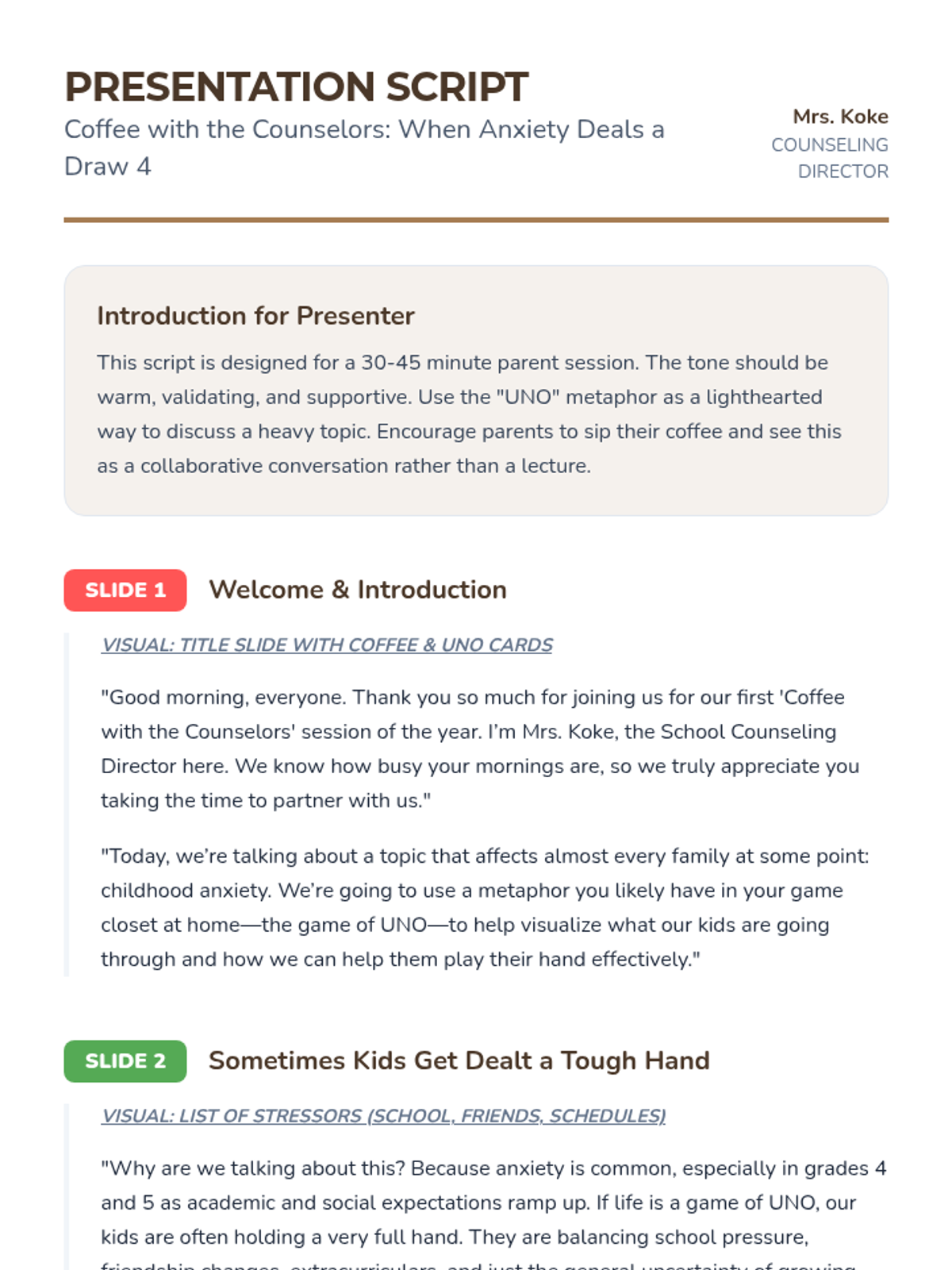
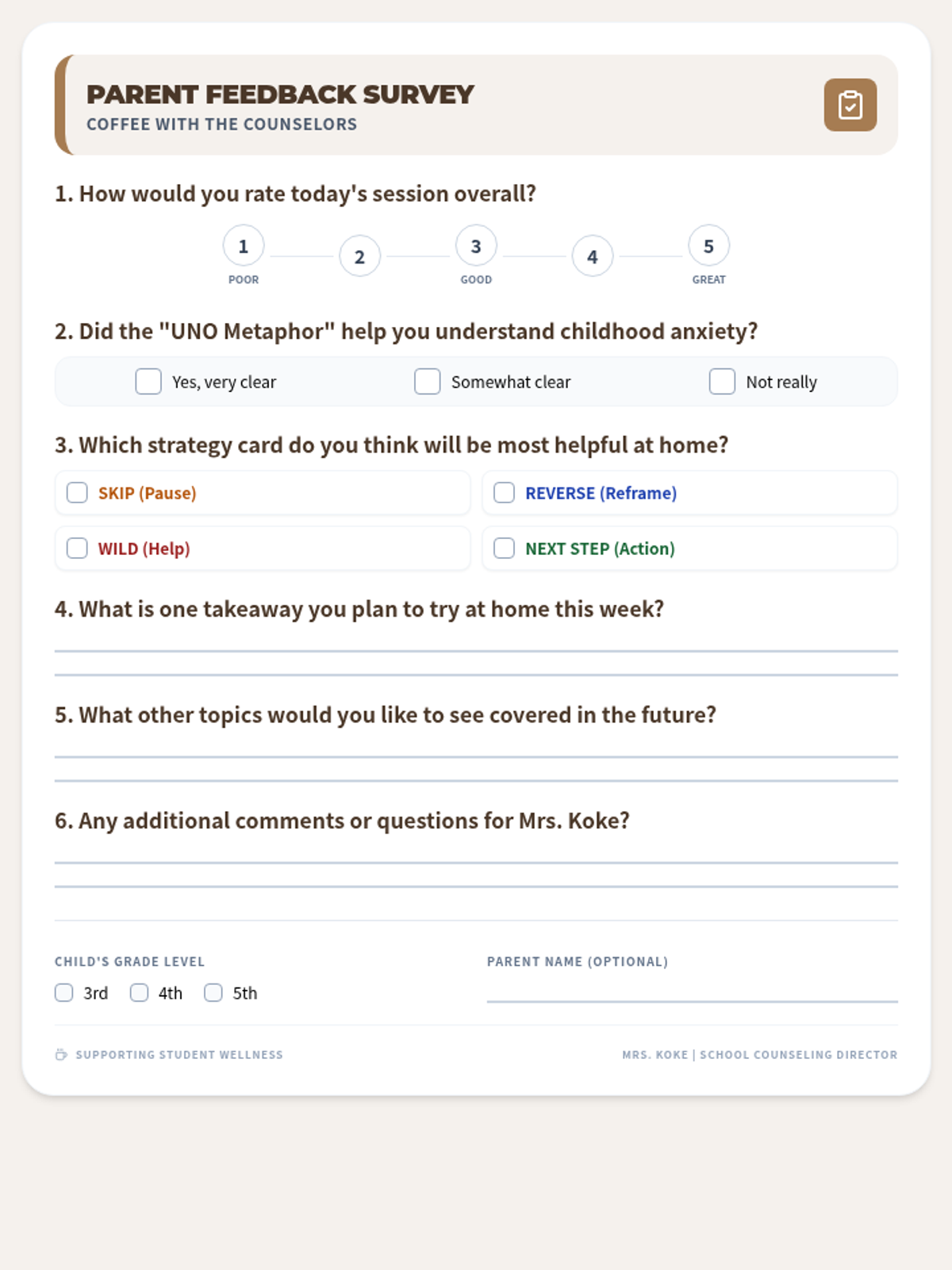
A comprehensive parent education session using a creative UNO card metaphor to help elementary families understand and manage childhood anxiety through school-home partnership.
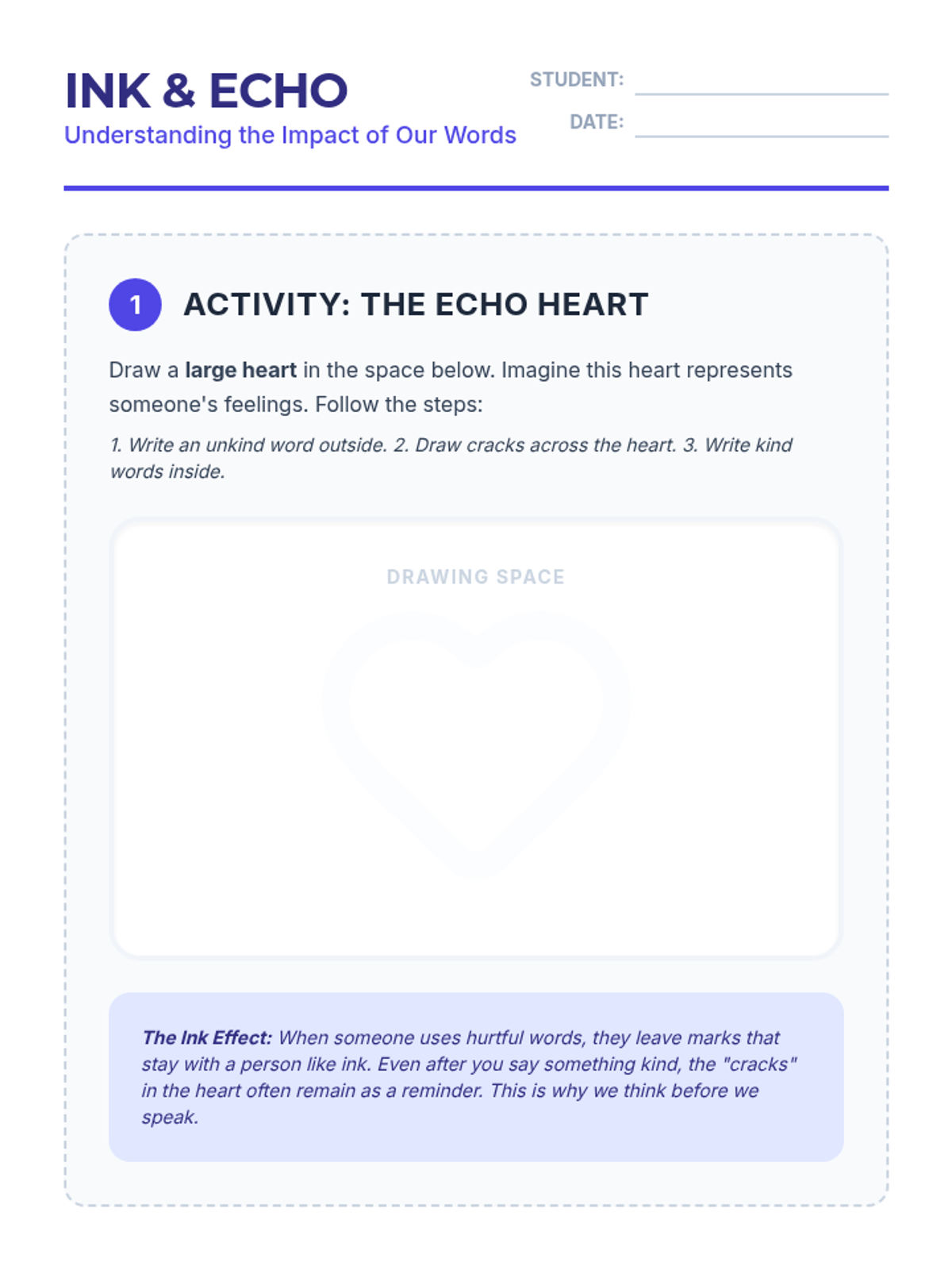
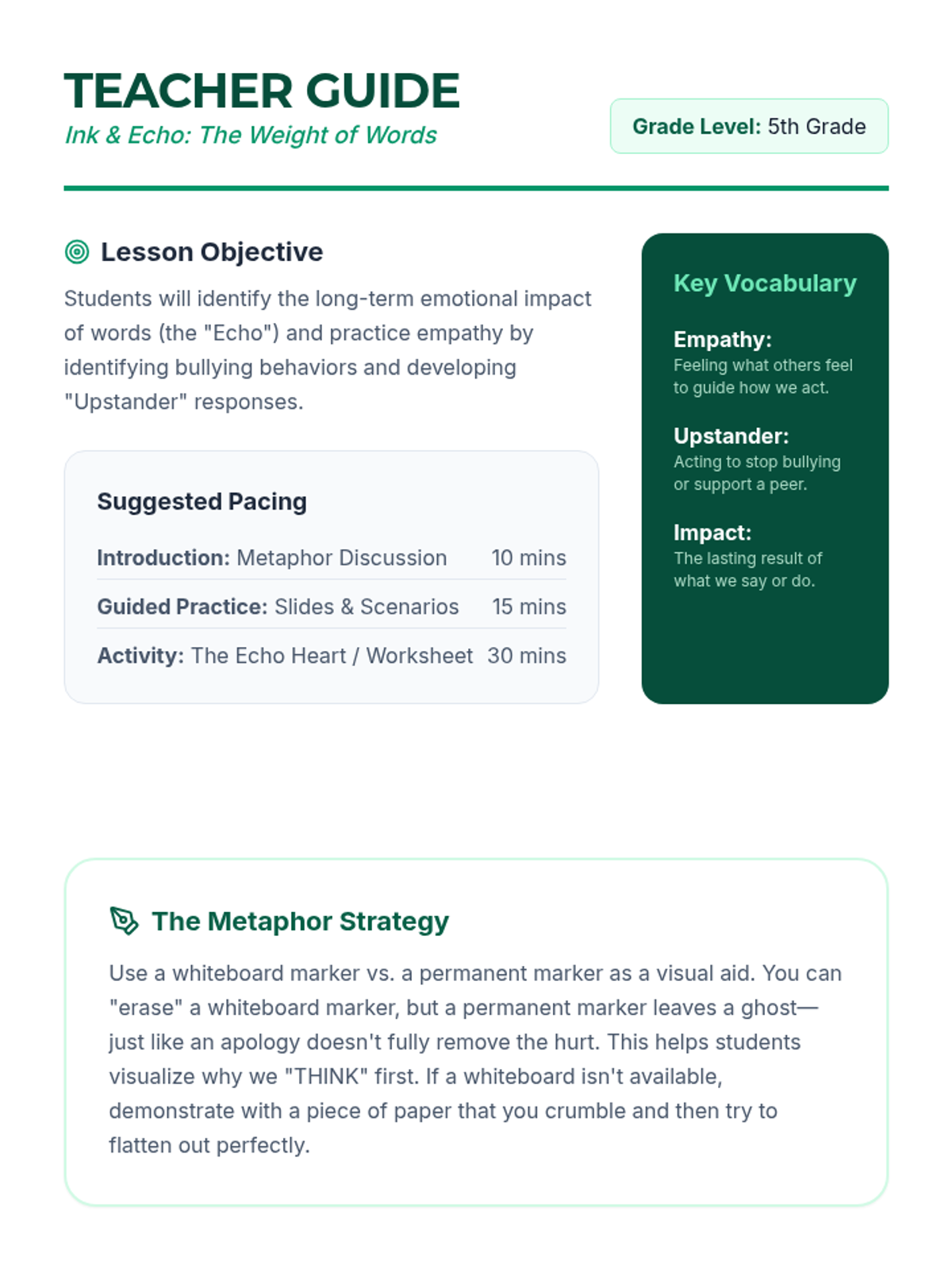
A social-emotional learning lesson for 5th graders focusing on the lasting impact of words, fostering empathy, and addressing bullying through the 'Ink and Echo' metaphor.
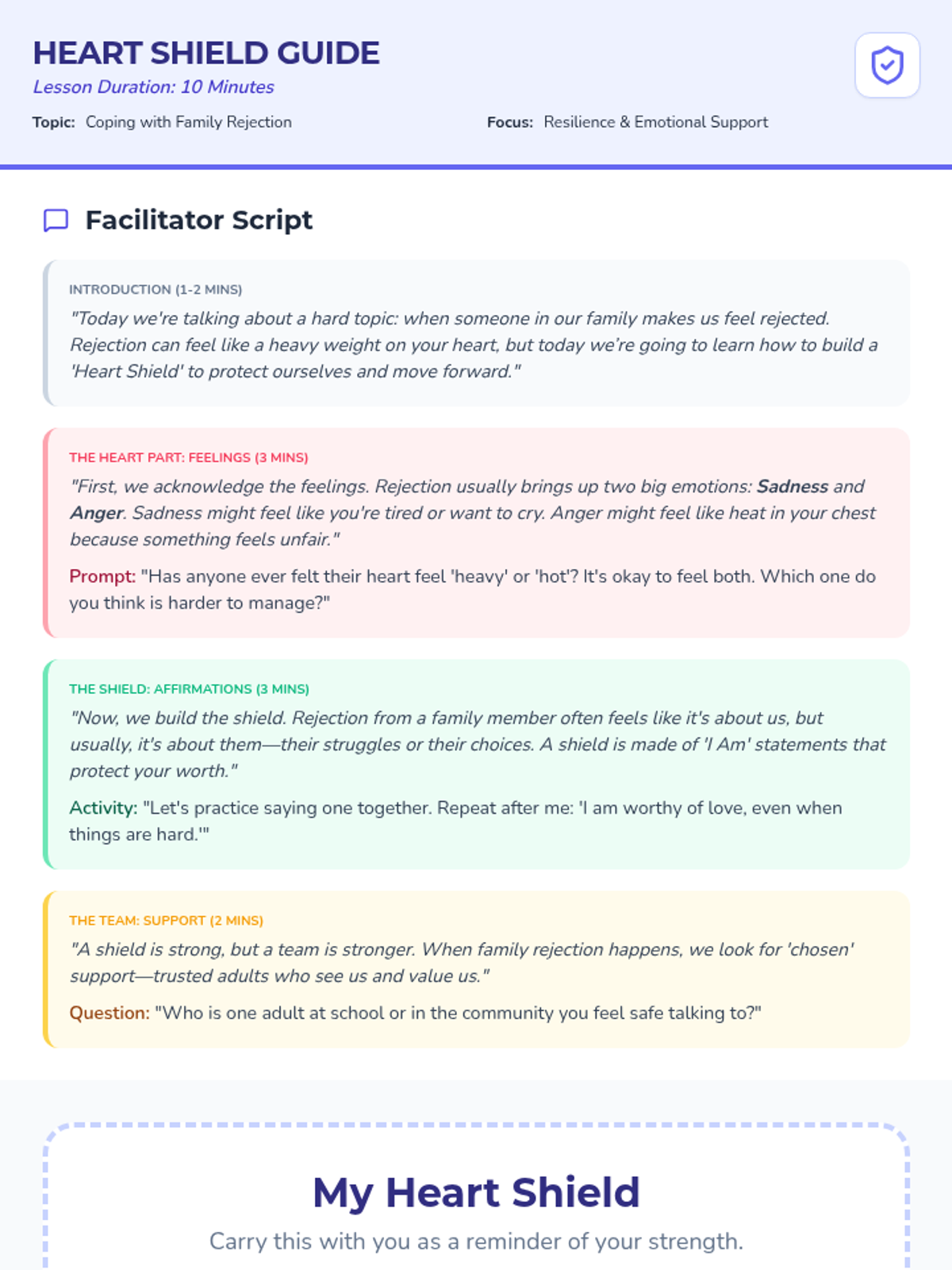
A brief, 10-minute social-emotional learning lesson focused on building resilience and processing emotions after experiencing rejection from a family member. Students learn to identify their feelings, use self-affirmations as a 'shield,' and identify a support network of trusted adults.
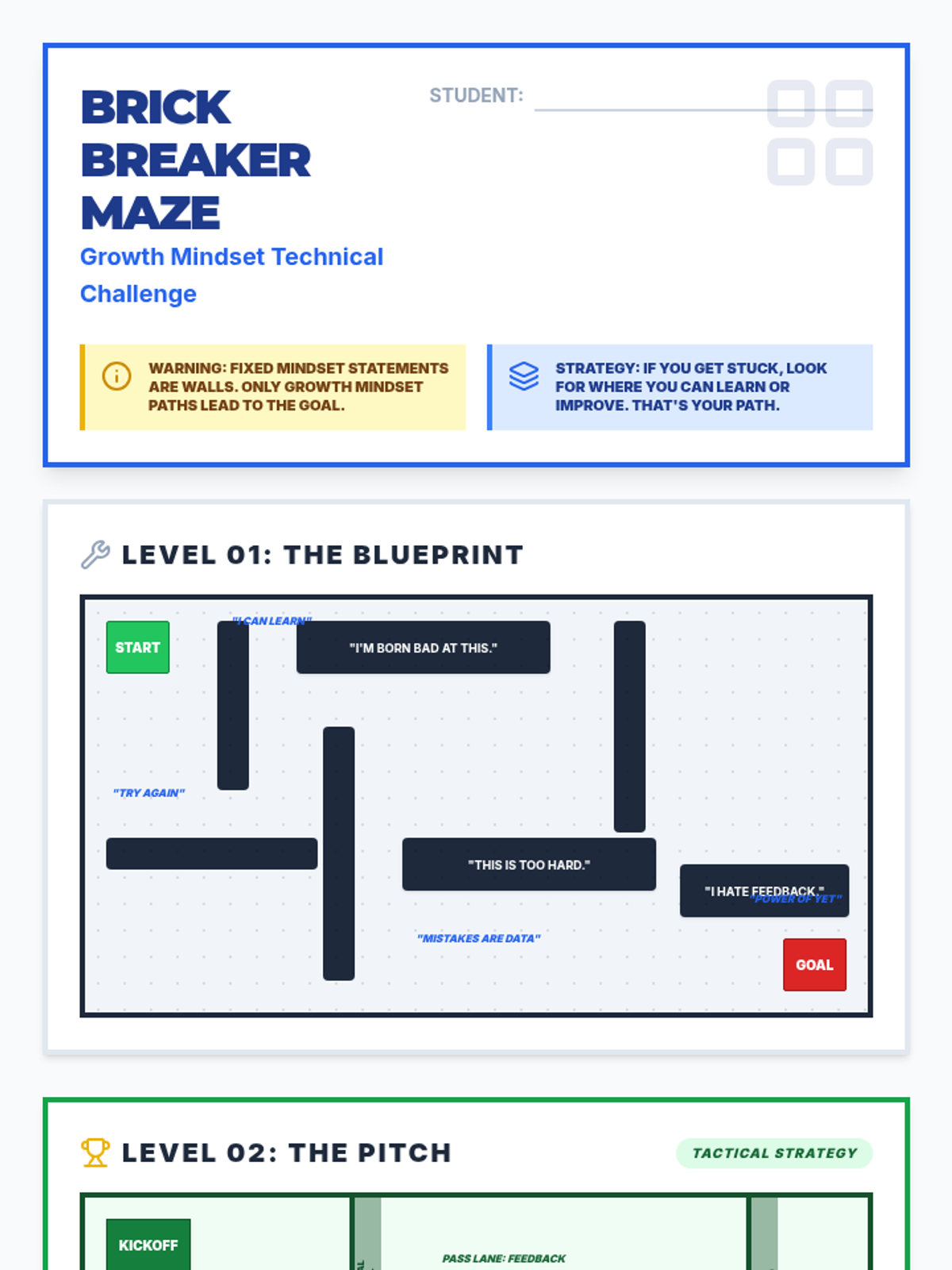
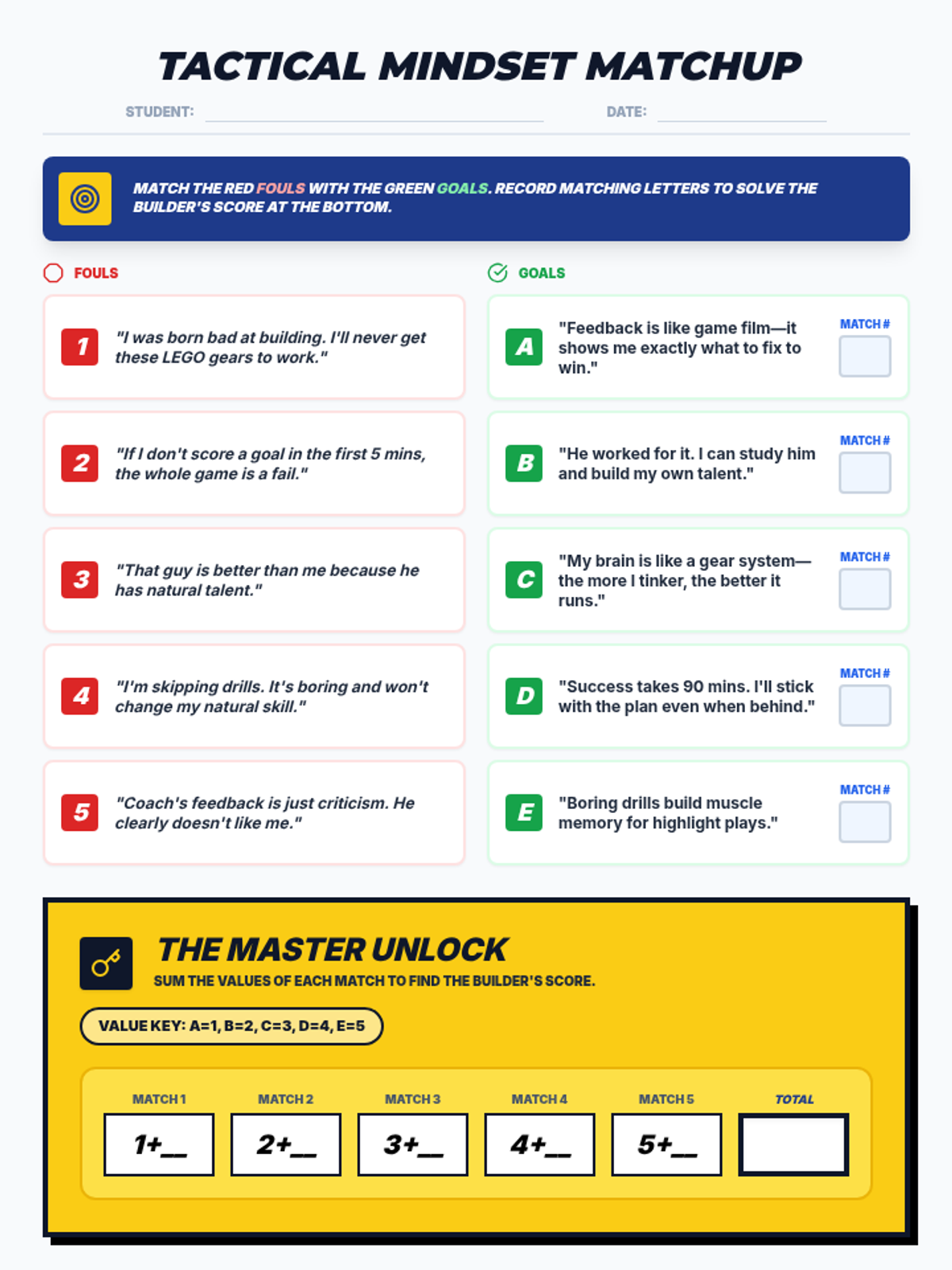
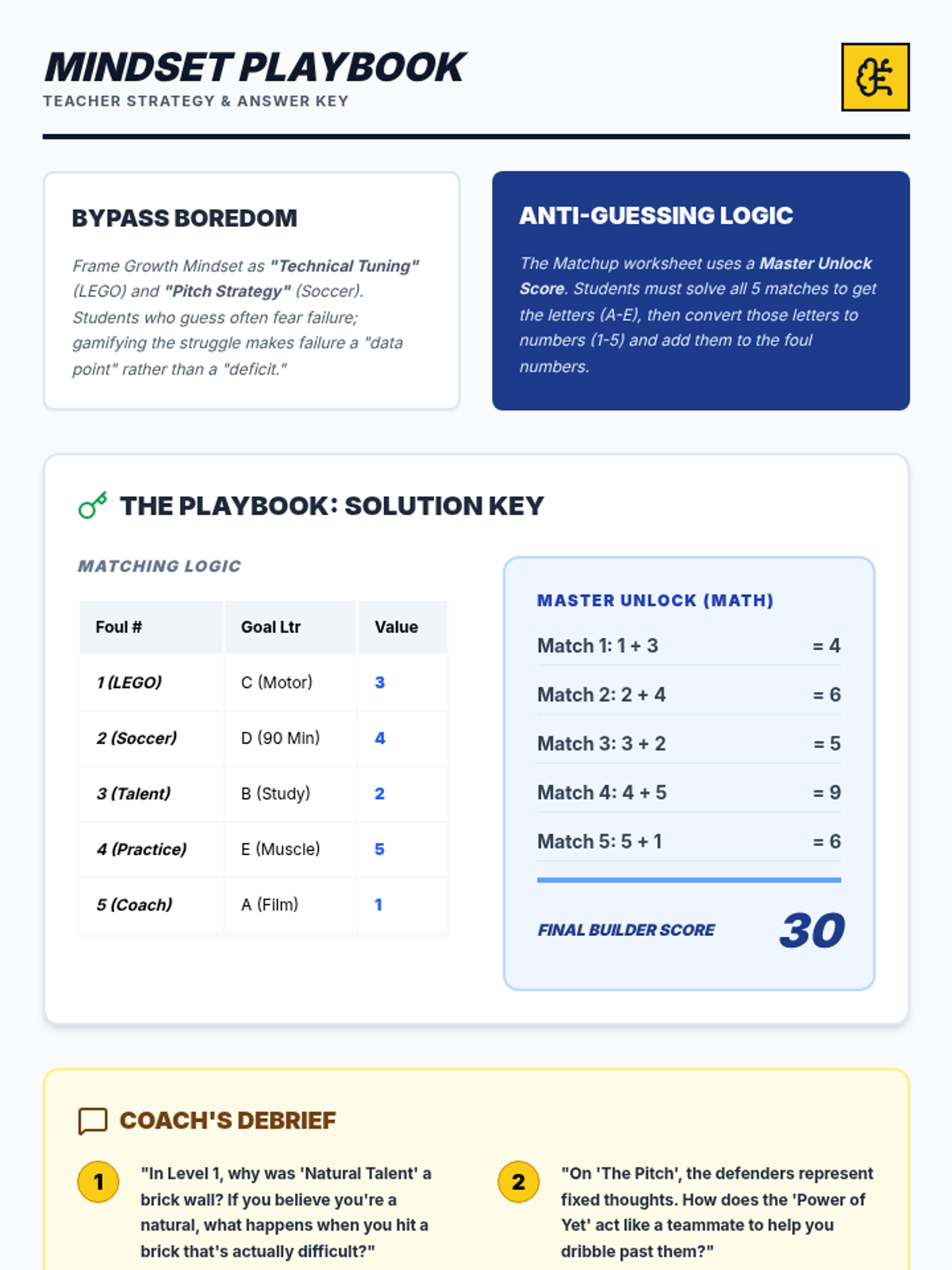
A high-engagement challenge pack for upper elementary and middle school students, using soccer and building themes to explore Growth vs. Fixed Mindset.
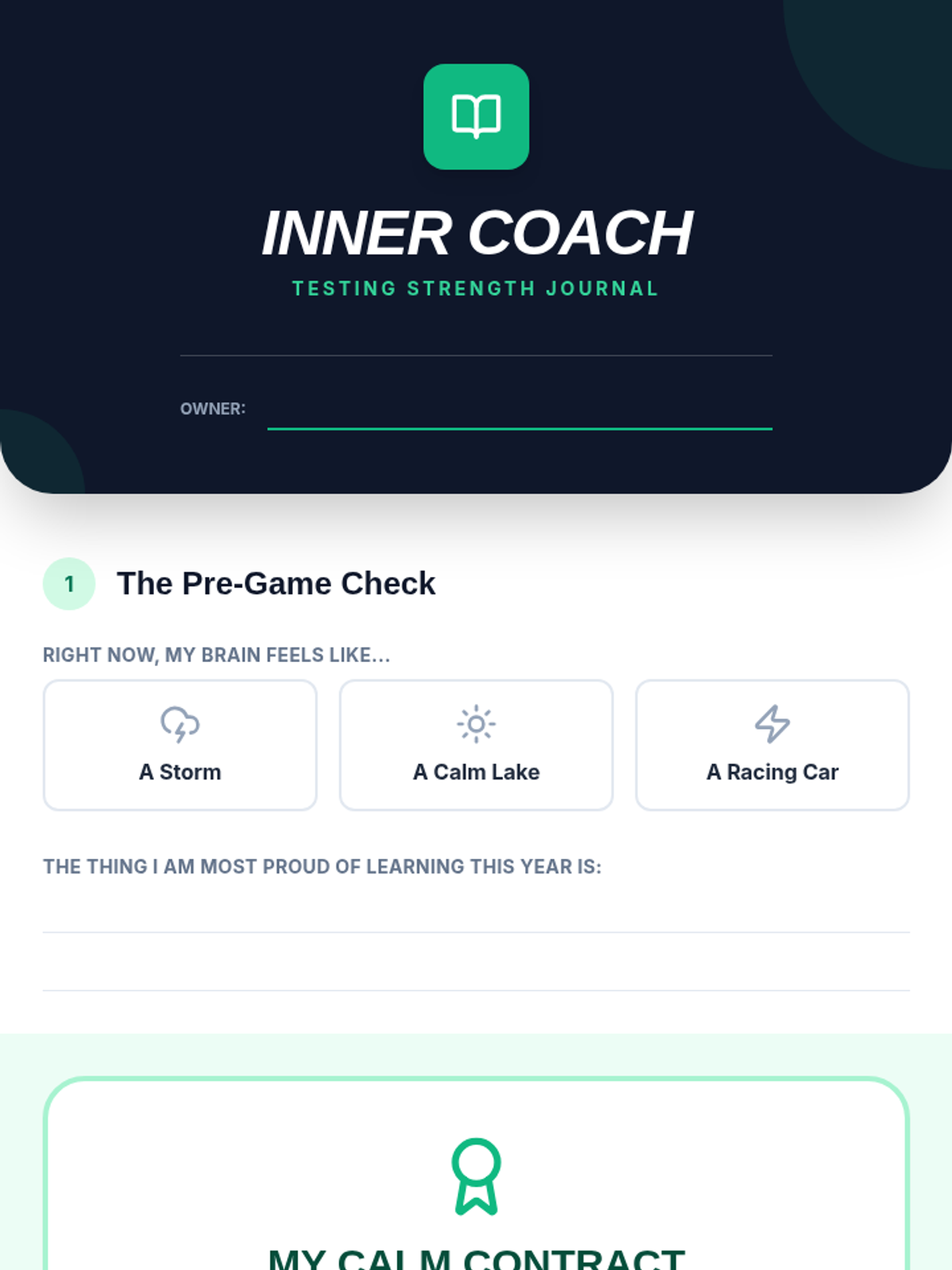
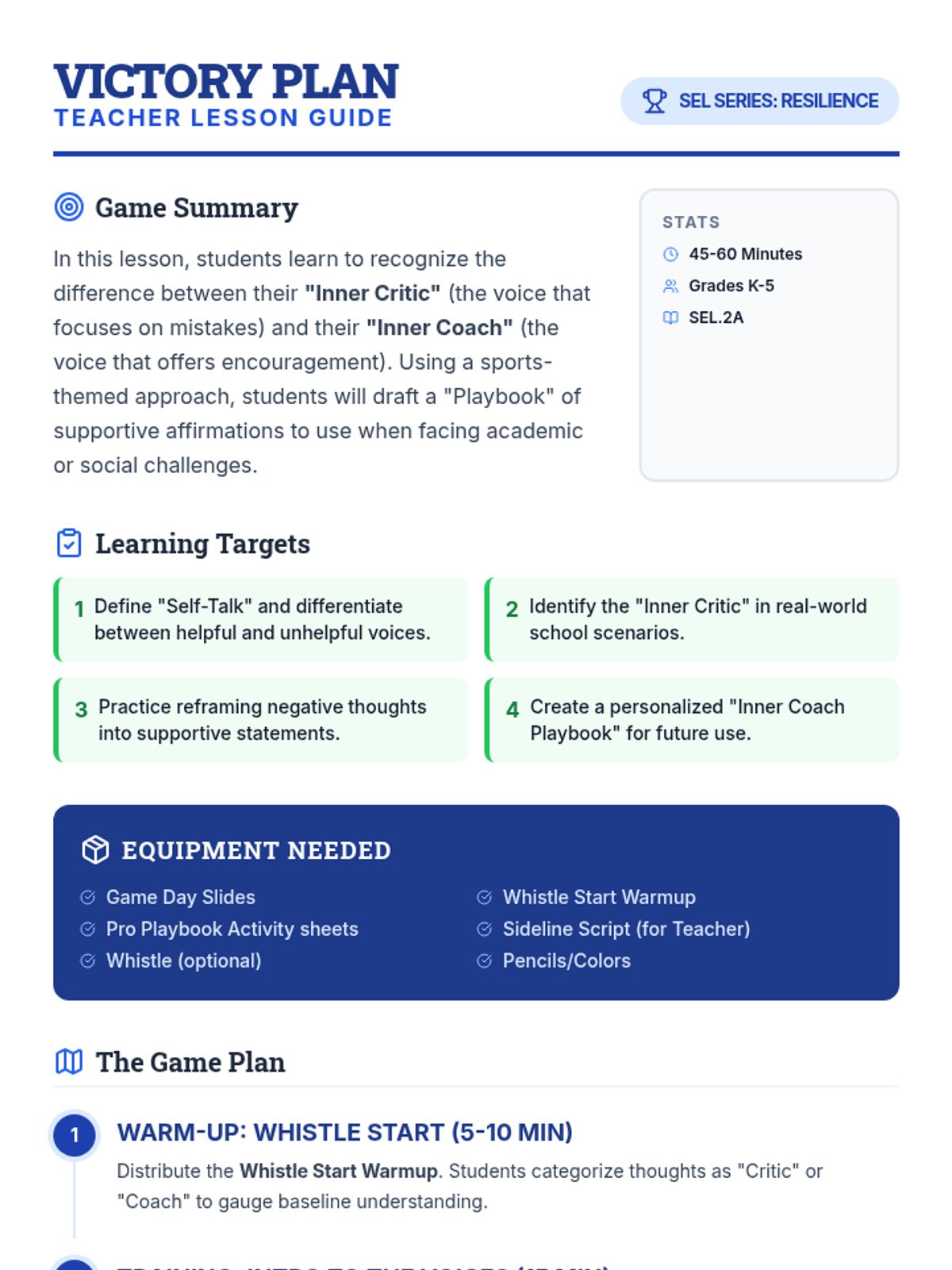
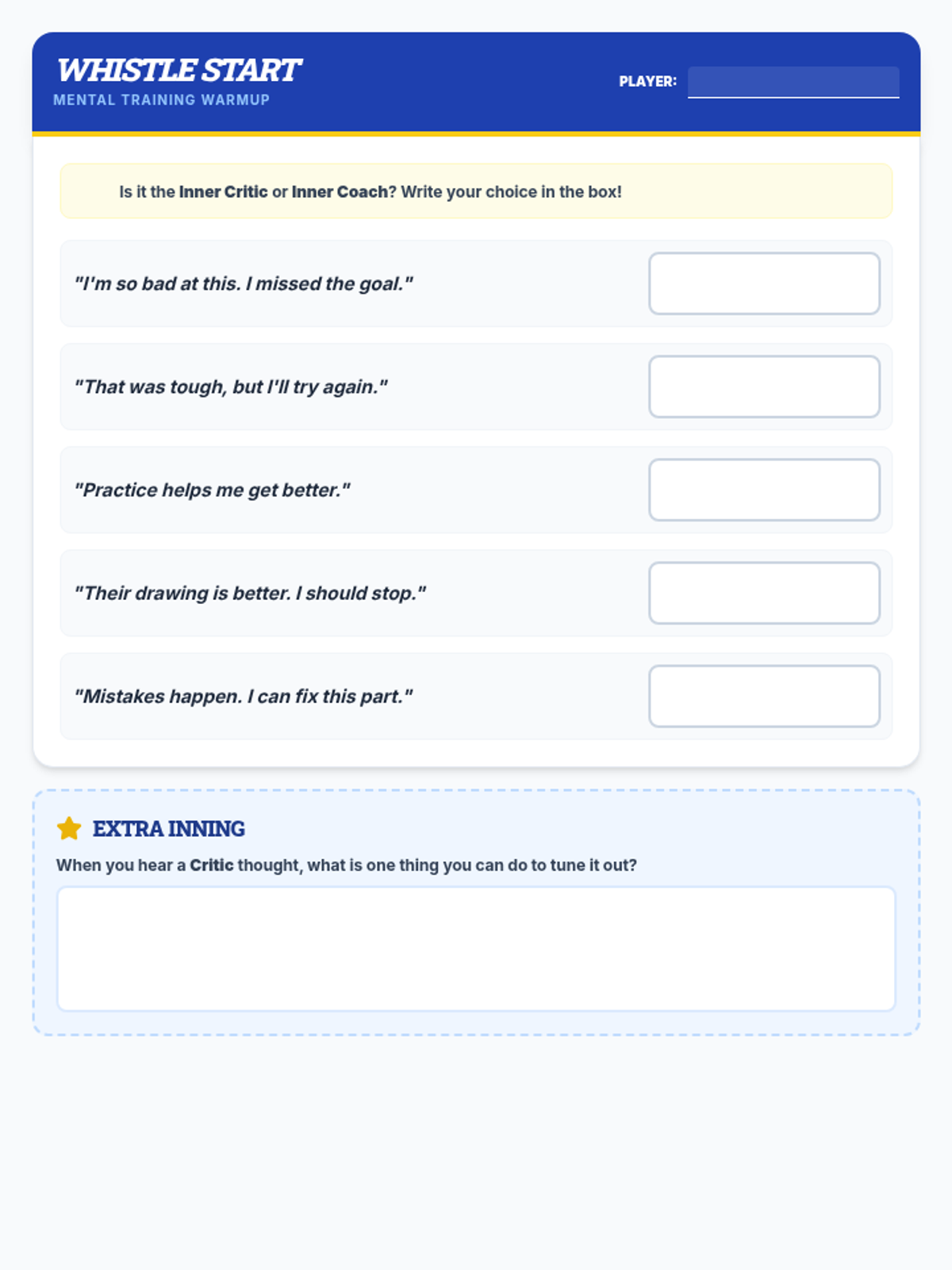
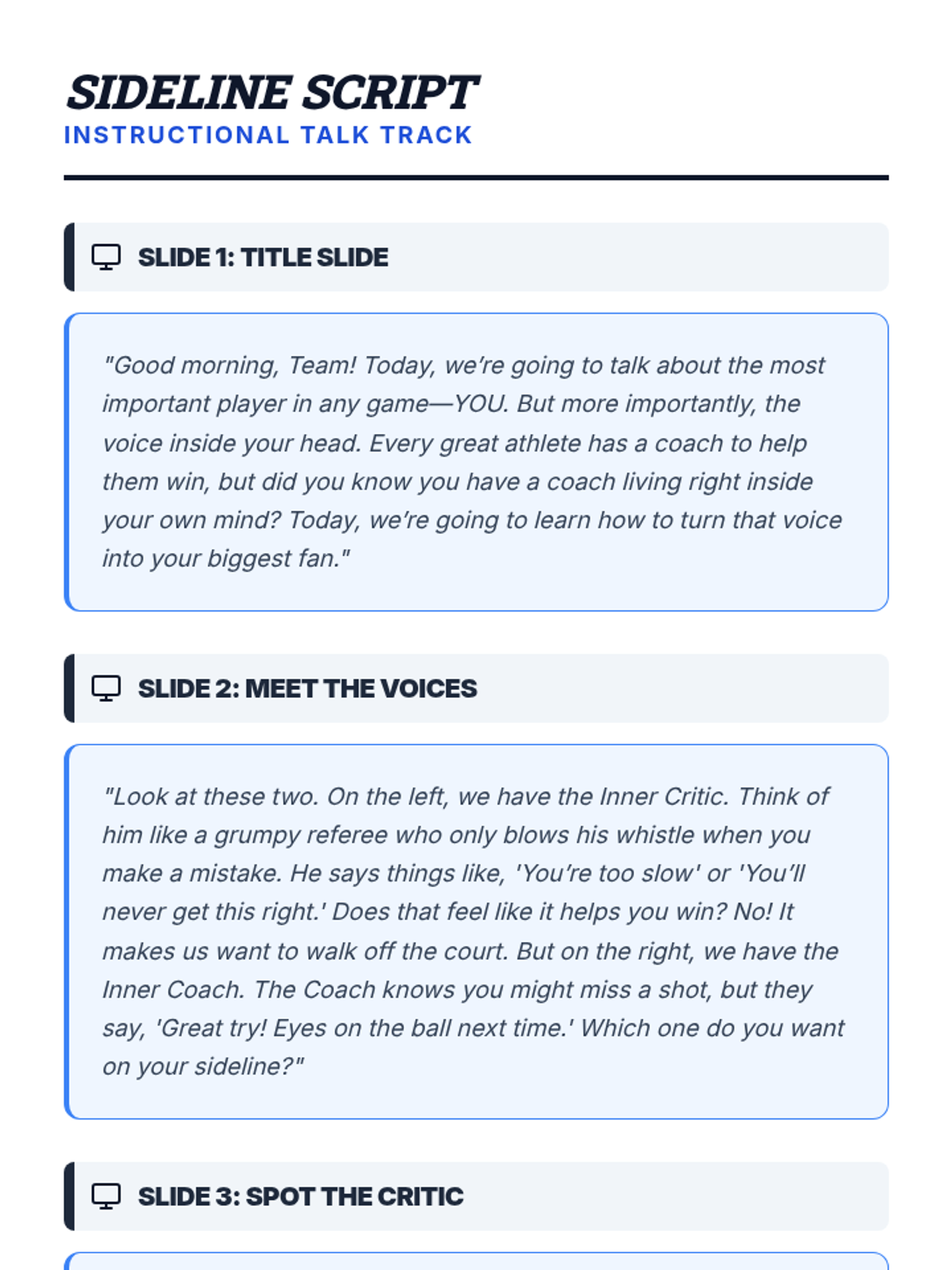
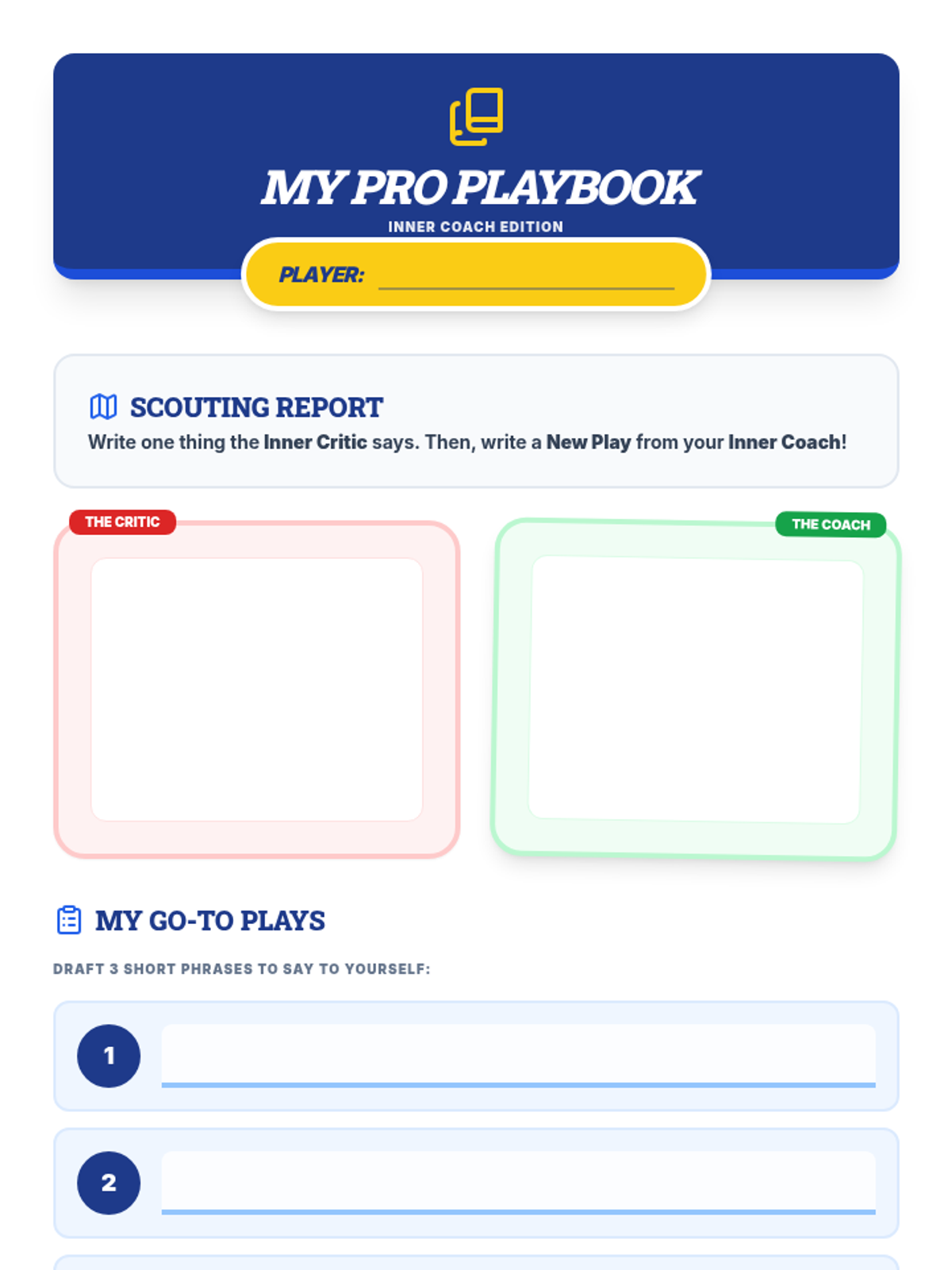
A SEL lesson for K-5 students using sports metaphors to transform negative self-talk into supportive affirmations. Students identify their 'Inner Critic' and build an 'Inner Coach' playbook for moments of self-doubt.
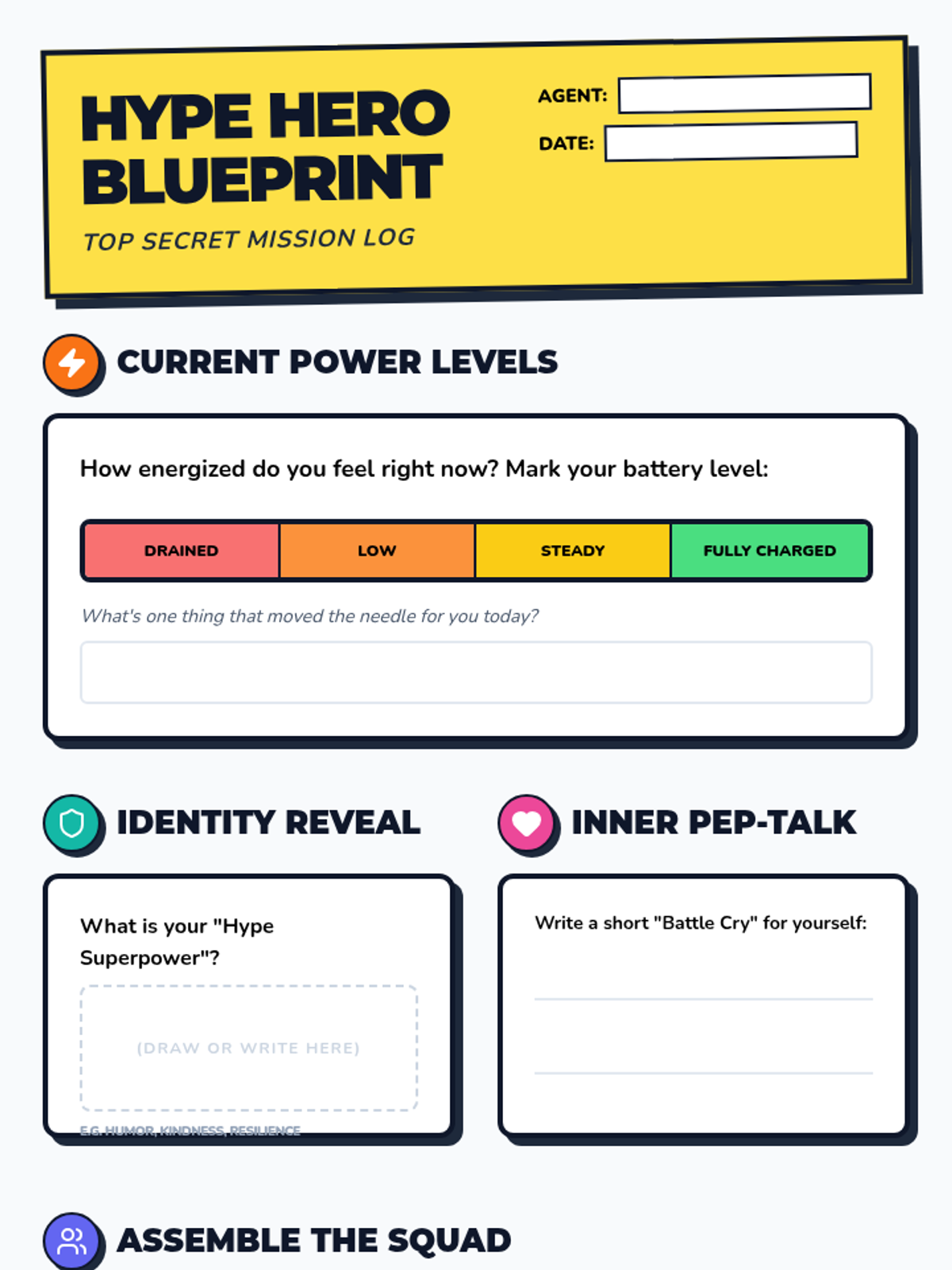
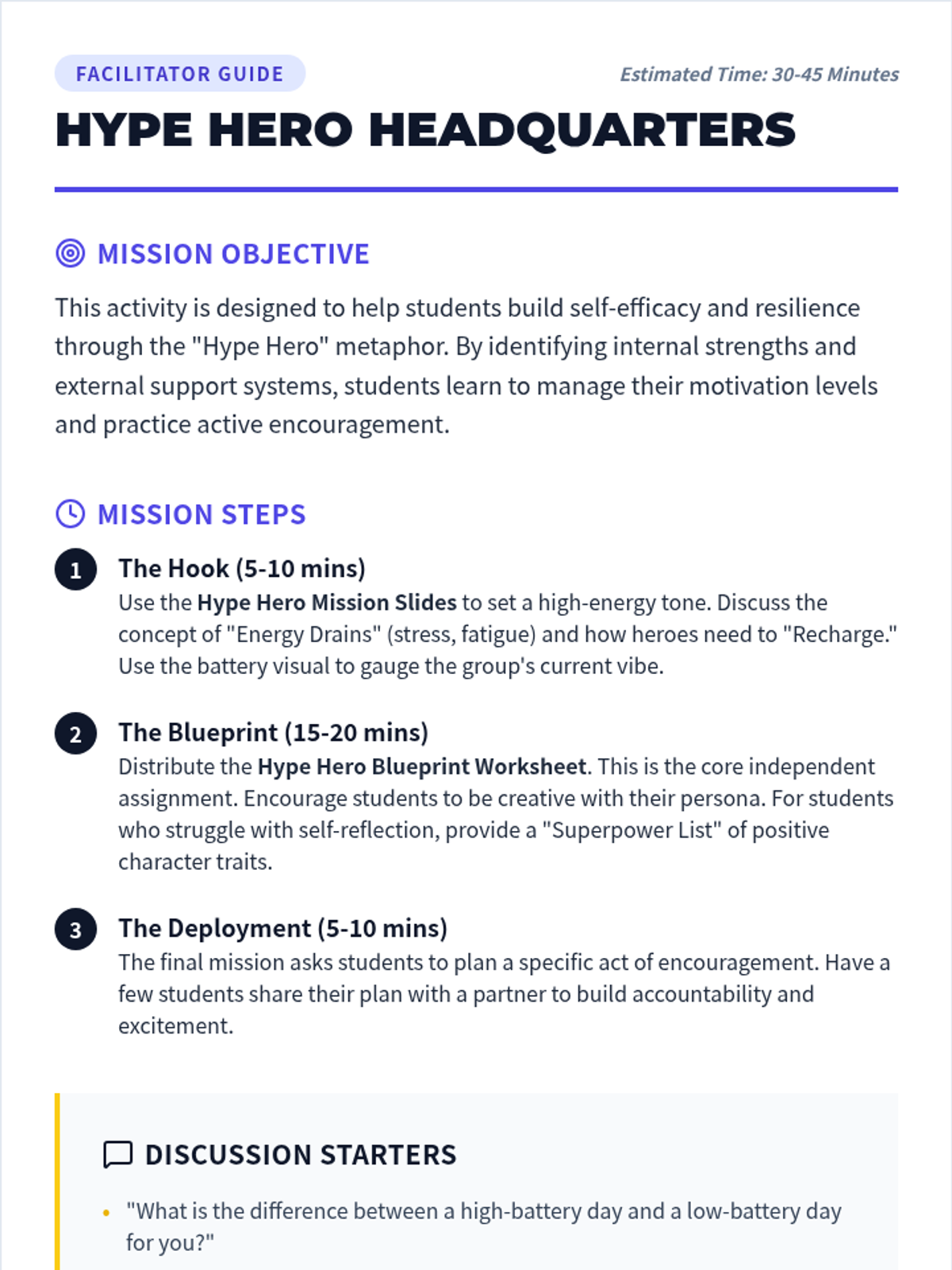
A high-energy lesson designed to boost student motivation and self-encouragement through a 'superhero' lens. Students identify their personal strengths and create a plan to stay 'pumped up' during challenges.
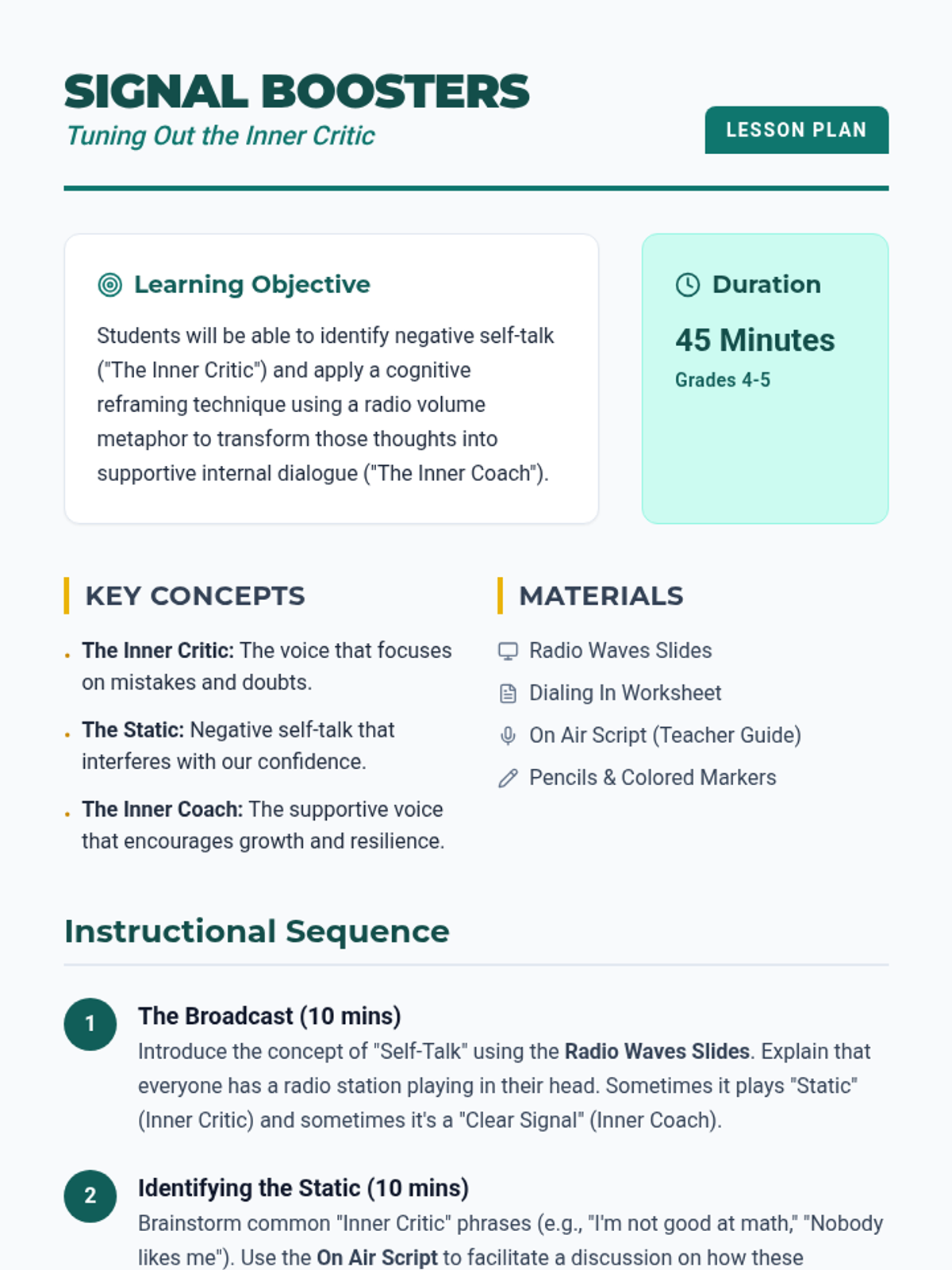
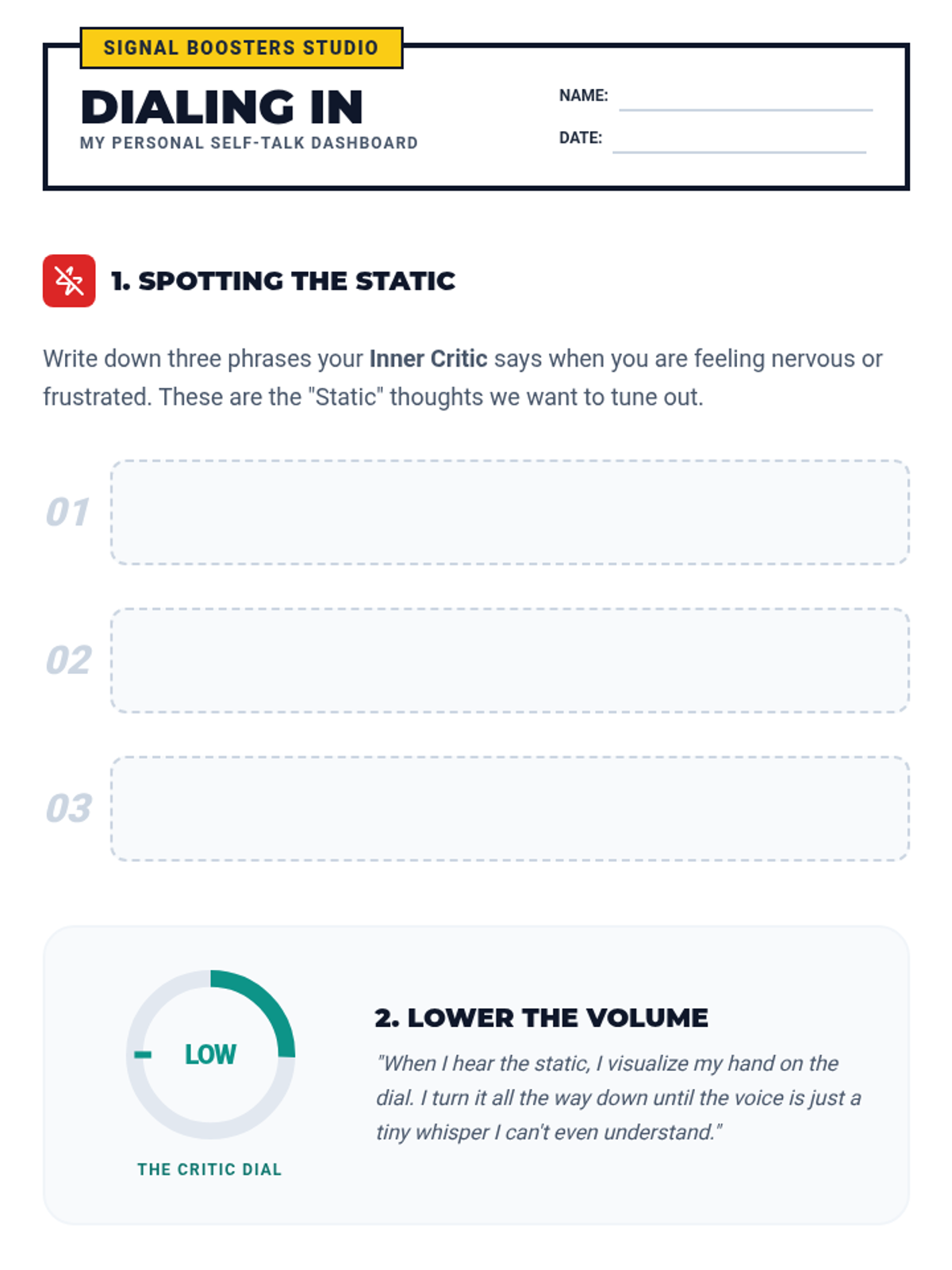
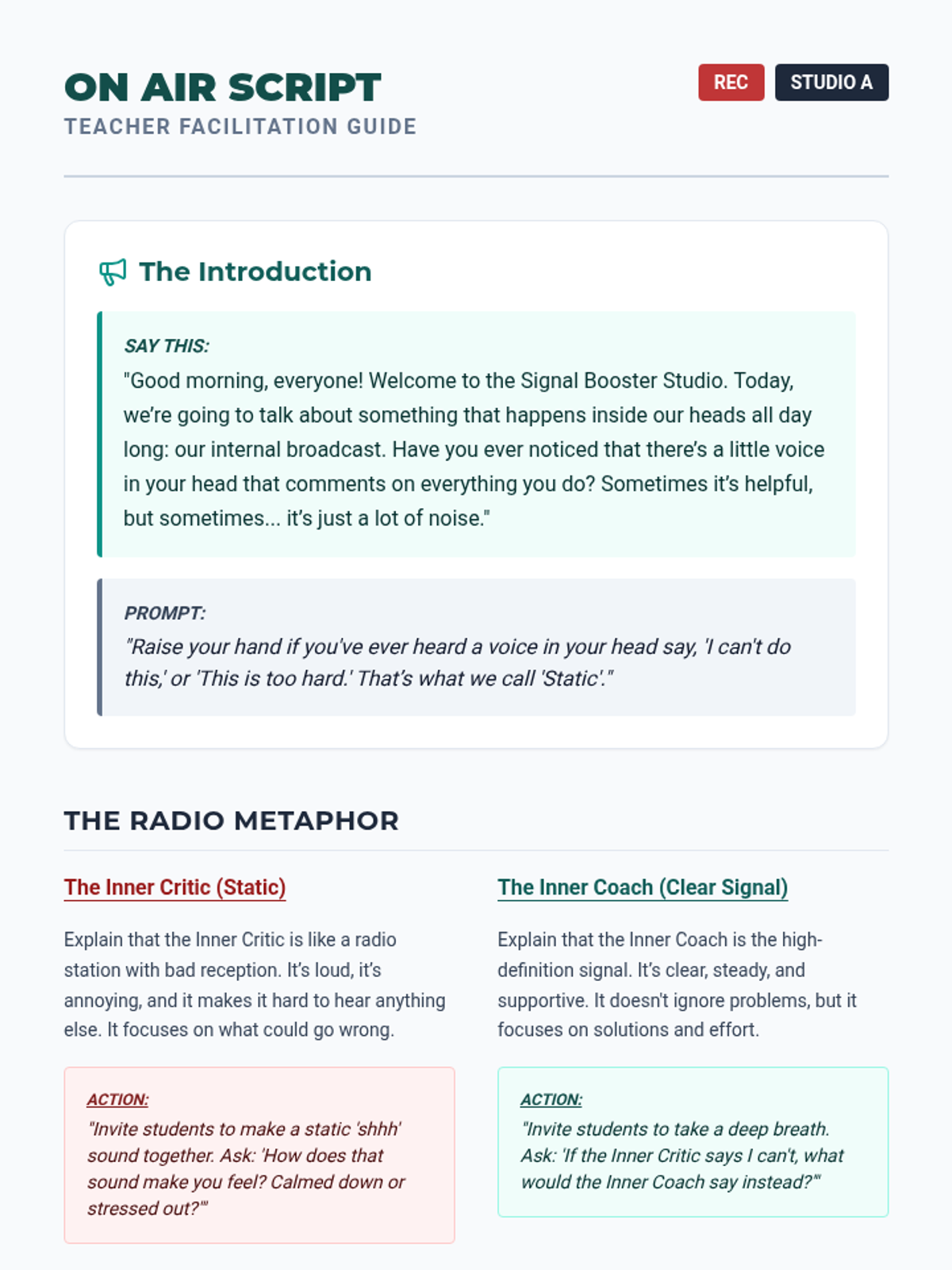
A social-emotional learning lesson for 4th and 5th graders to identify negative self-talk and transform it into supportive internal dialogue using a radio metaphor. Students learn to 'dial down' the static of self-criticism and 'boost the signal' of their inner coach.
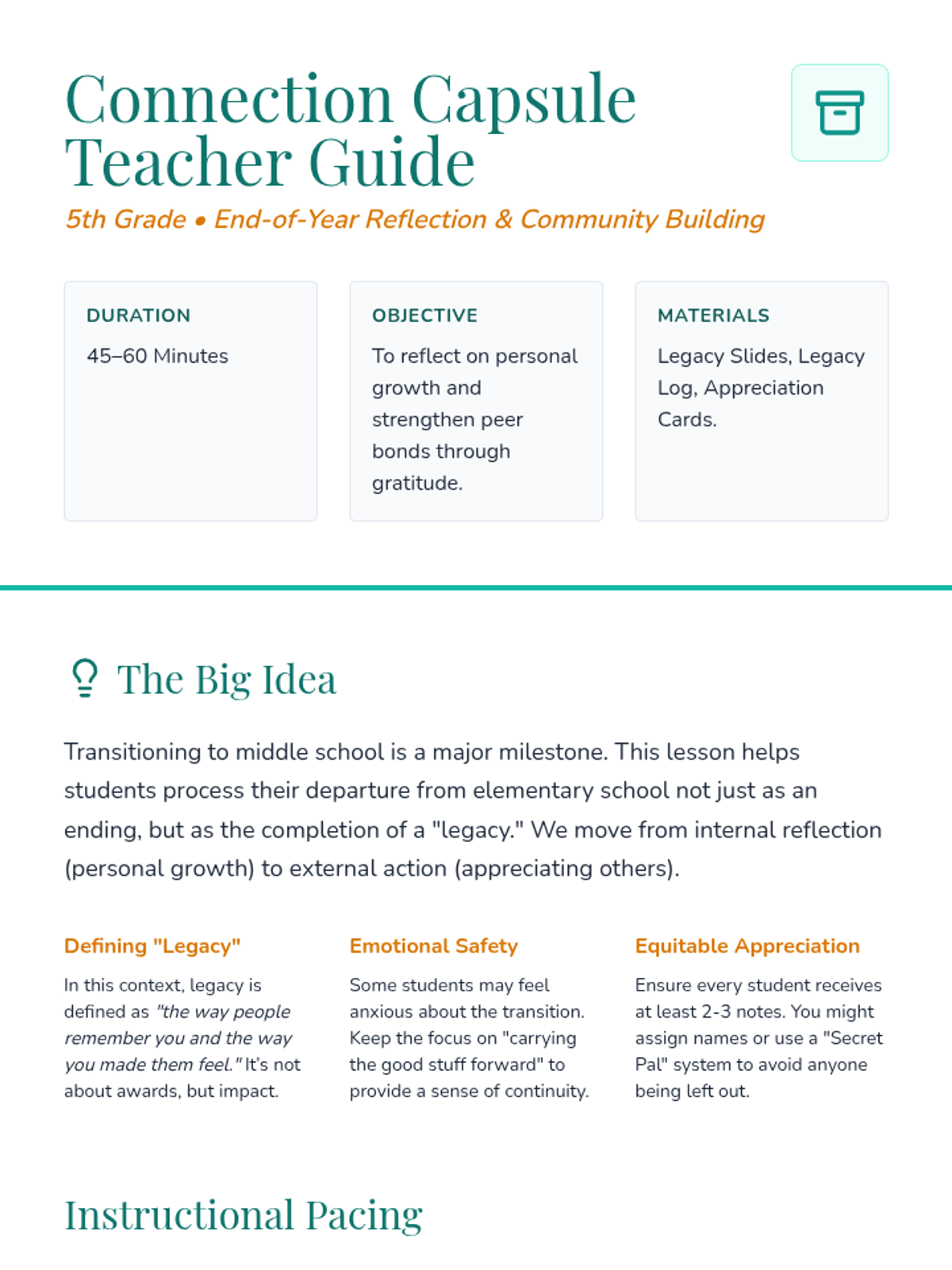
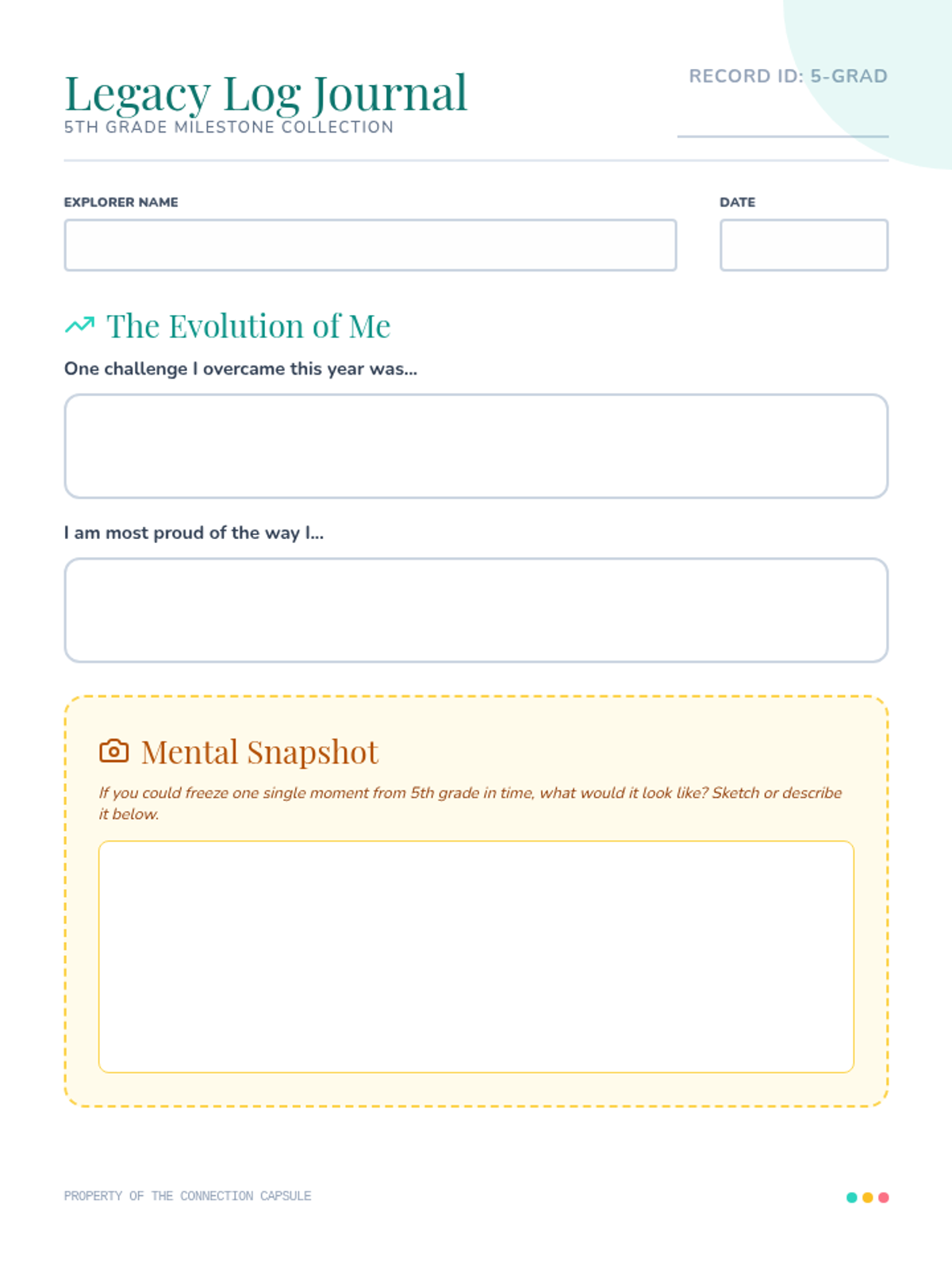
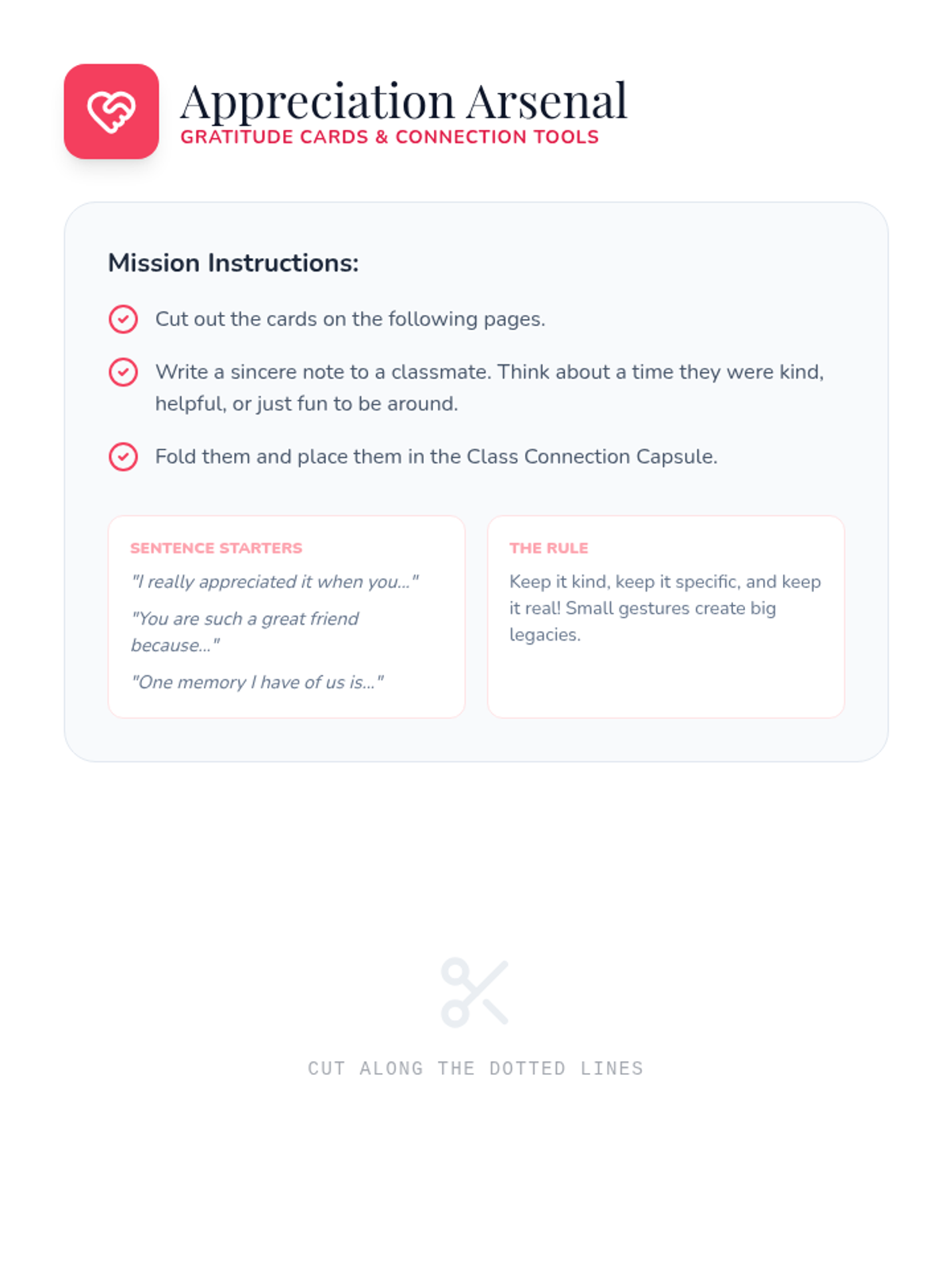
A 5th-grade lesson focused on end-of-year reflection, community building, and legacy-making through appreciation and gratitude. Students explore the concept of a 'legacy' and express appreciation for their peers as they prepare for middle school.
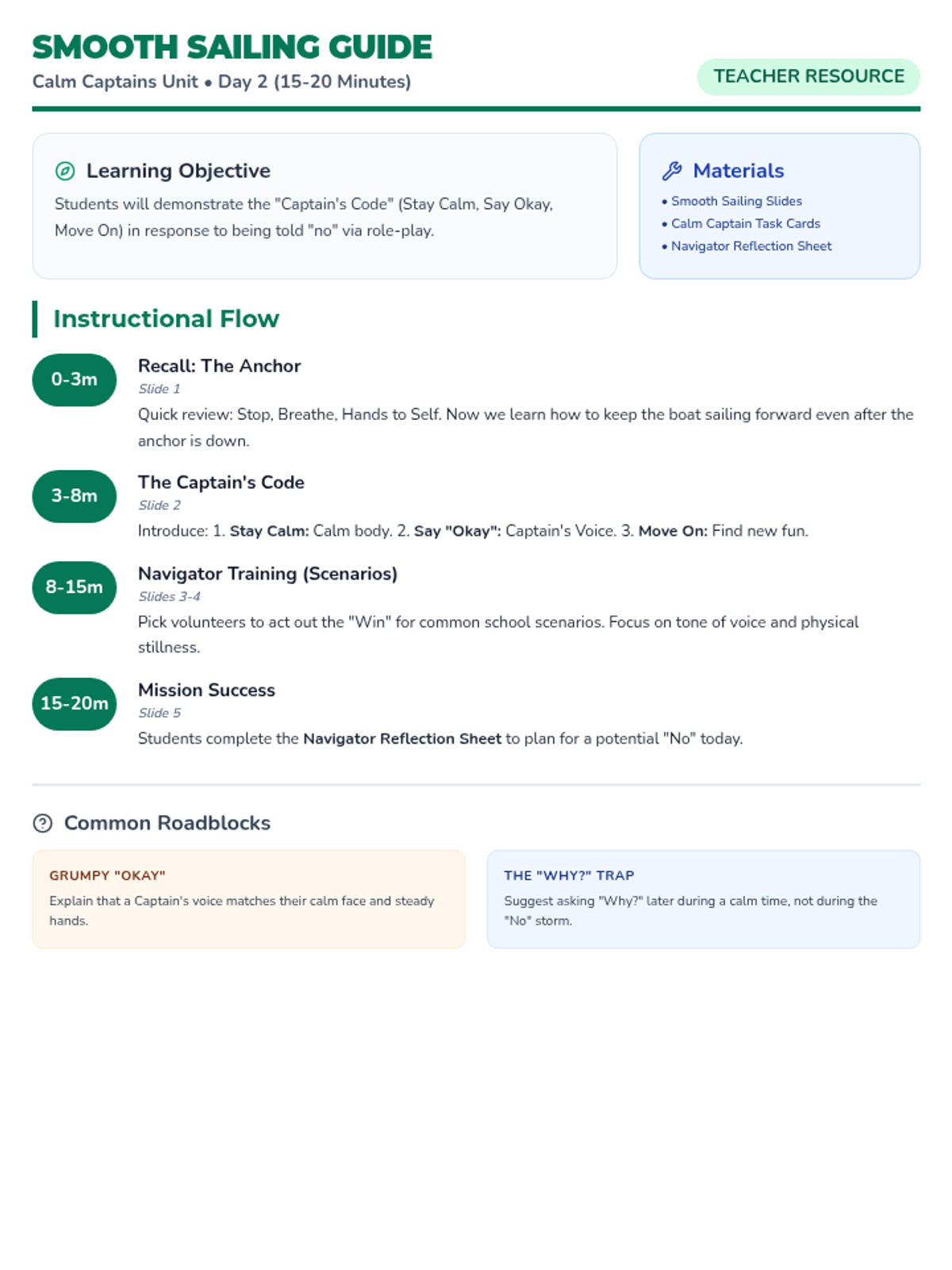
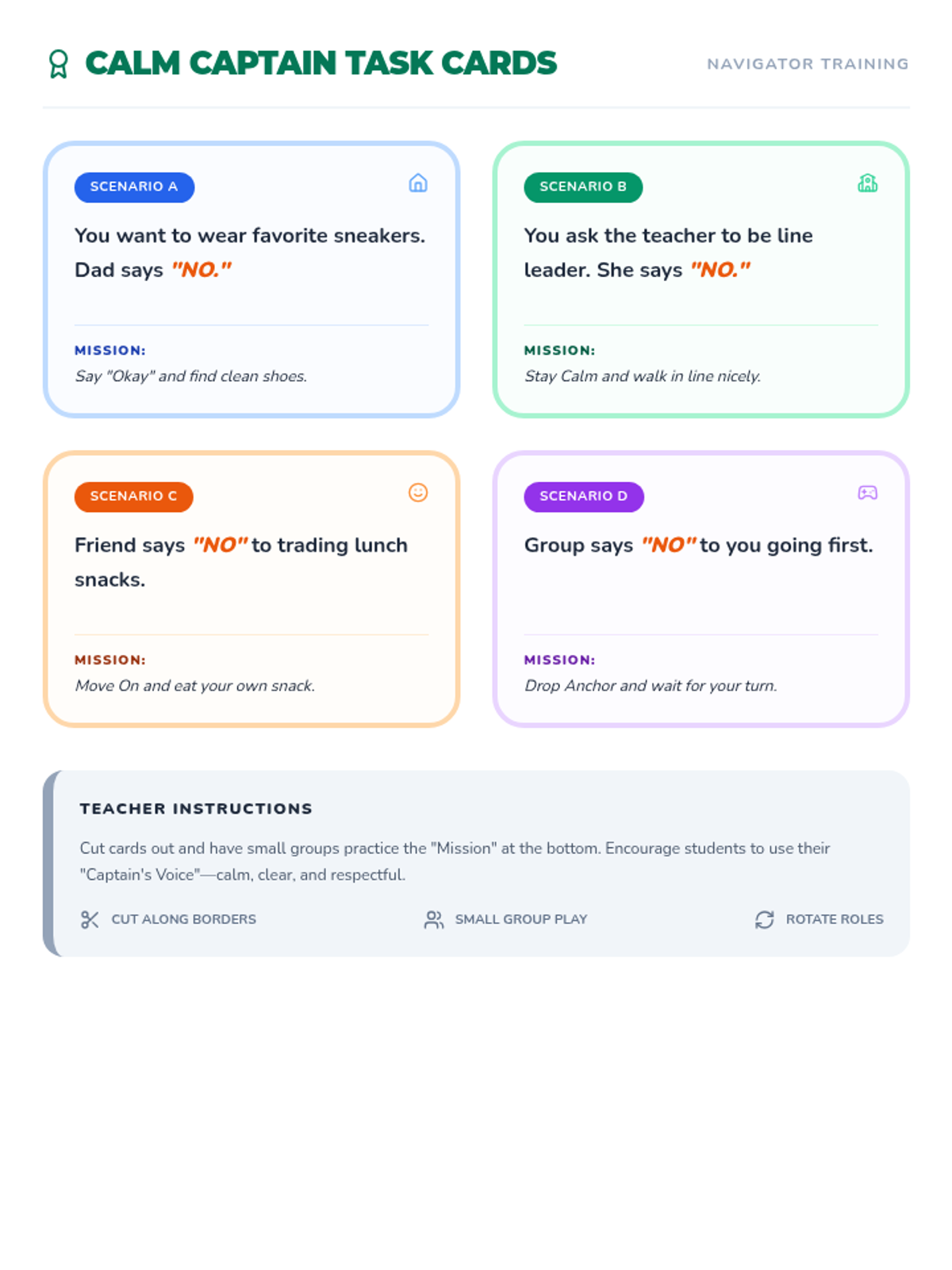
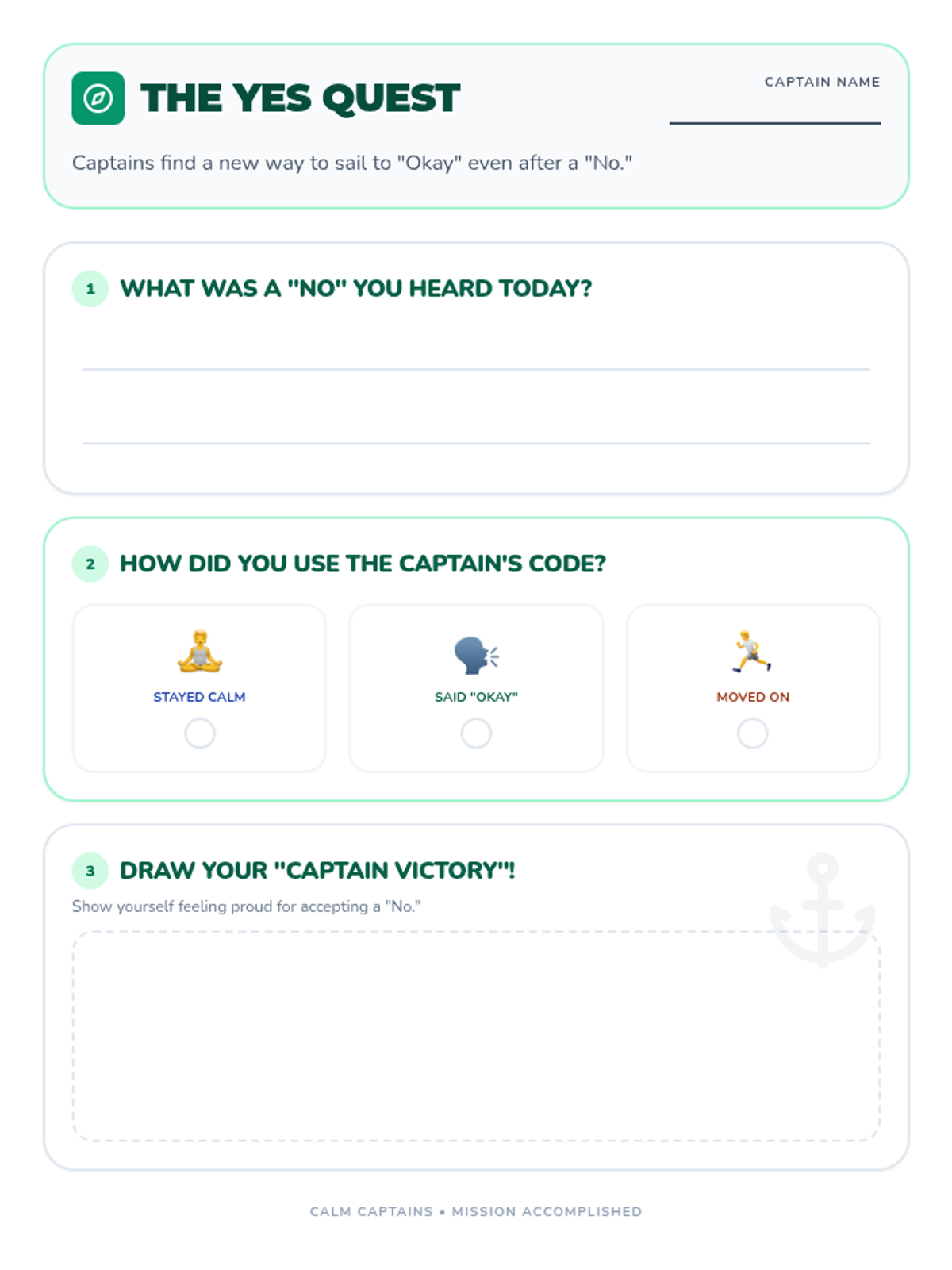
Students practice three specific strategies for accepting "no" (Stay Calm, Say Okay, Move On) through role-play and reflective activities.
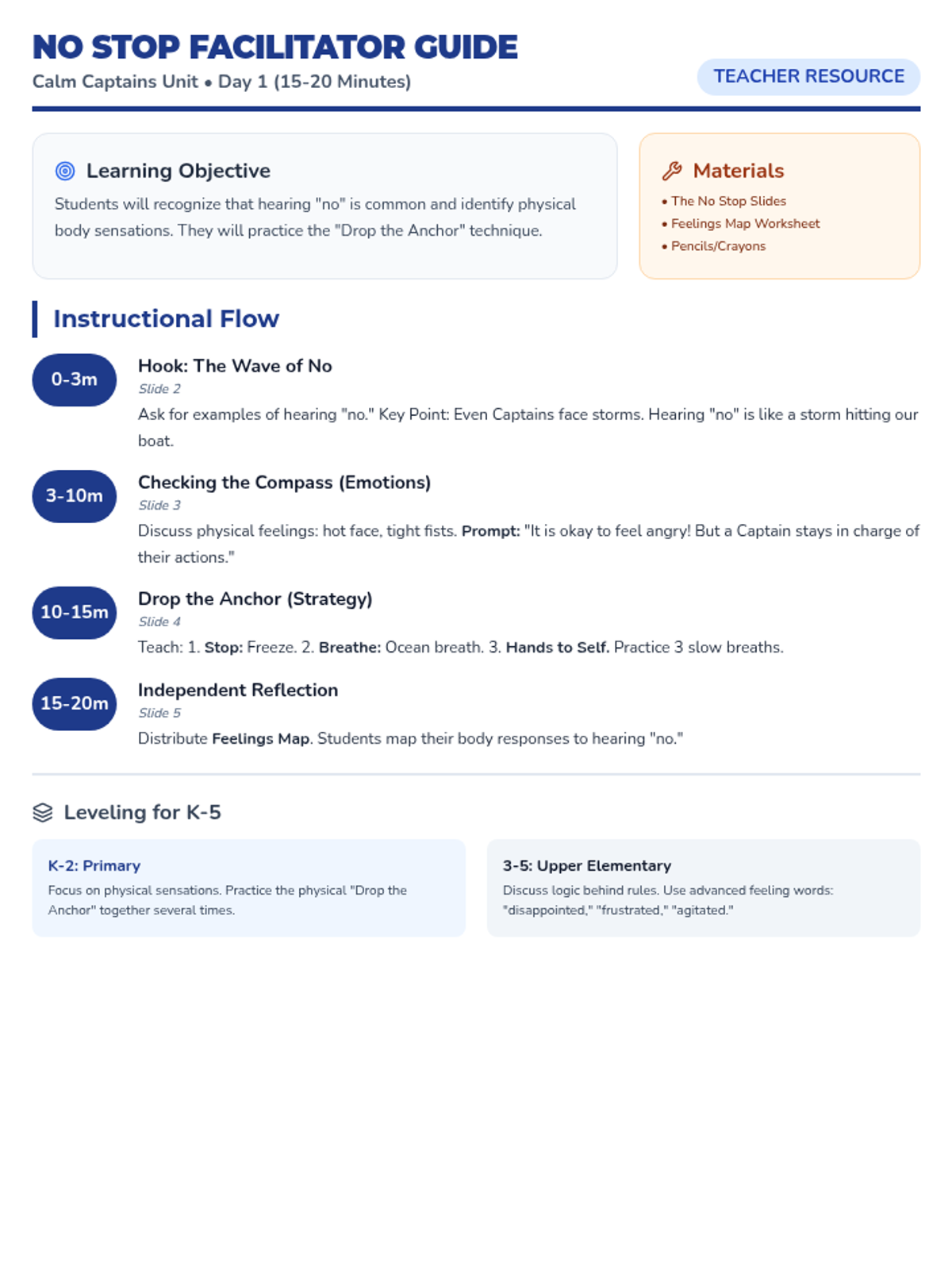
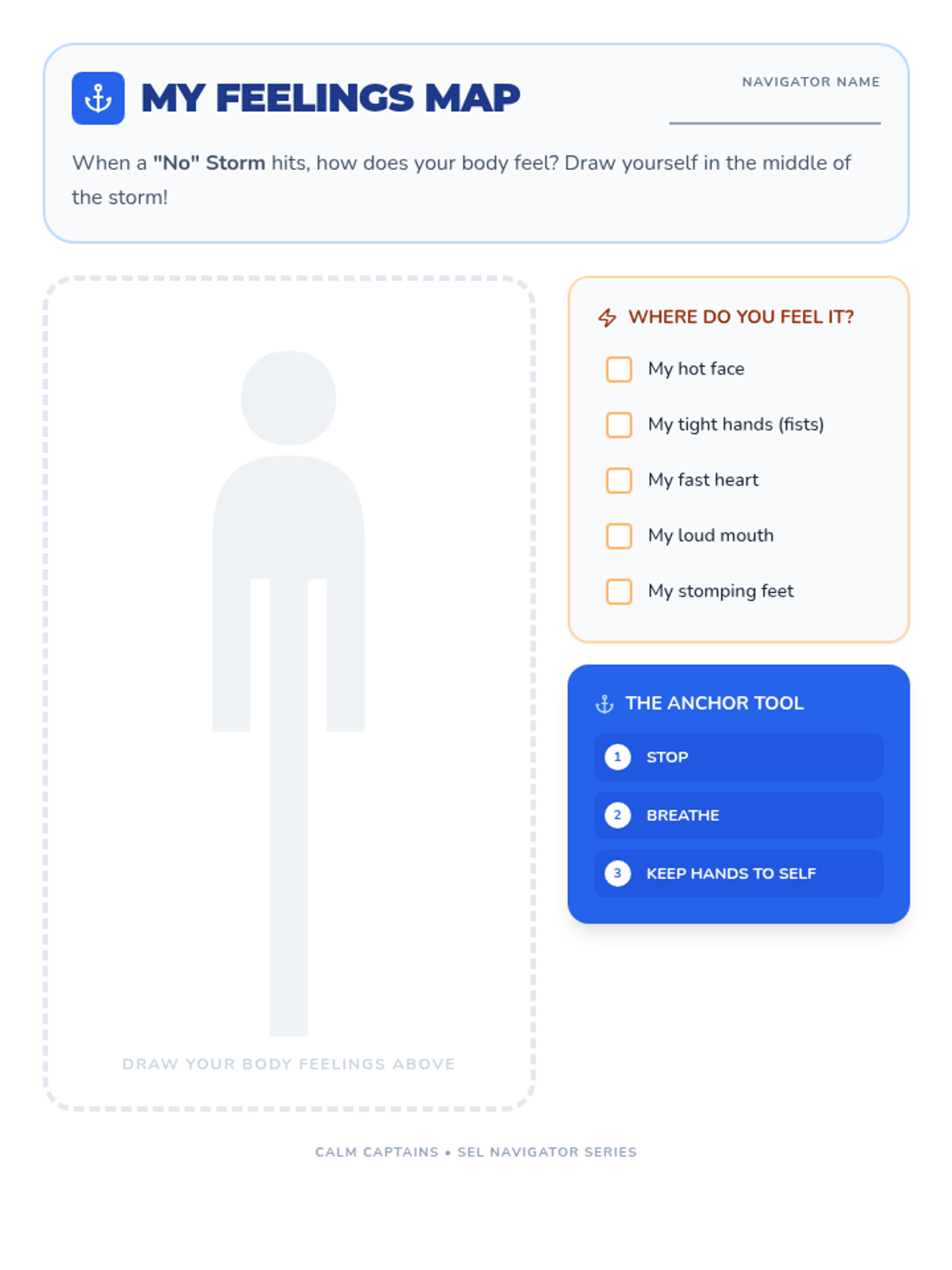
Students identify that hearing "no" is a common experience and explore the feelings that arise when they don't get what they want. They learn the 'Stop and Breathe' technique.
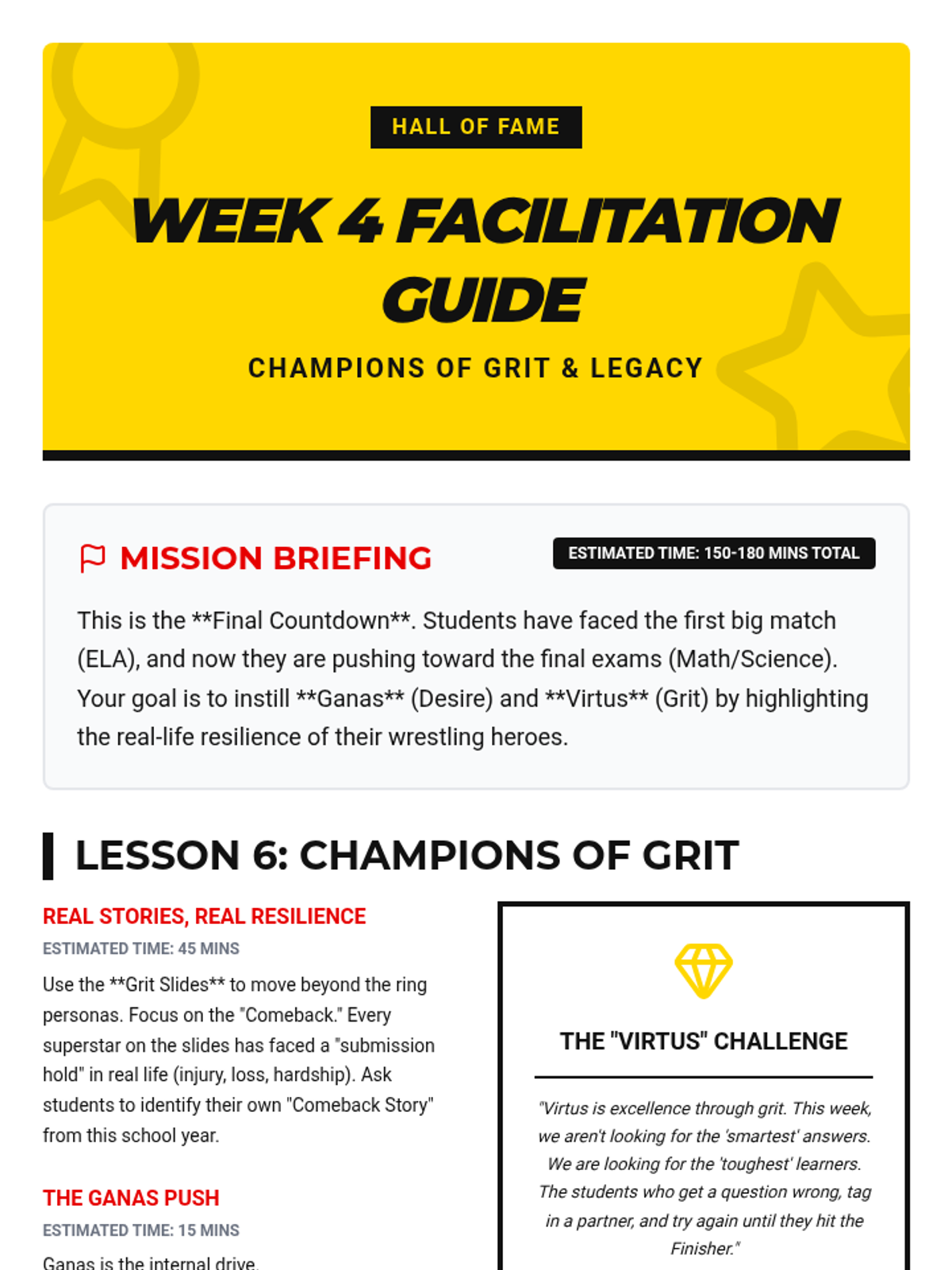
Examining real-life challenges faced by WWE stars to inspire resilience, grit, and the 'Ganas' required for the final push.
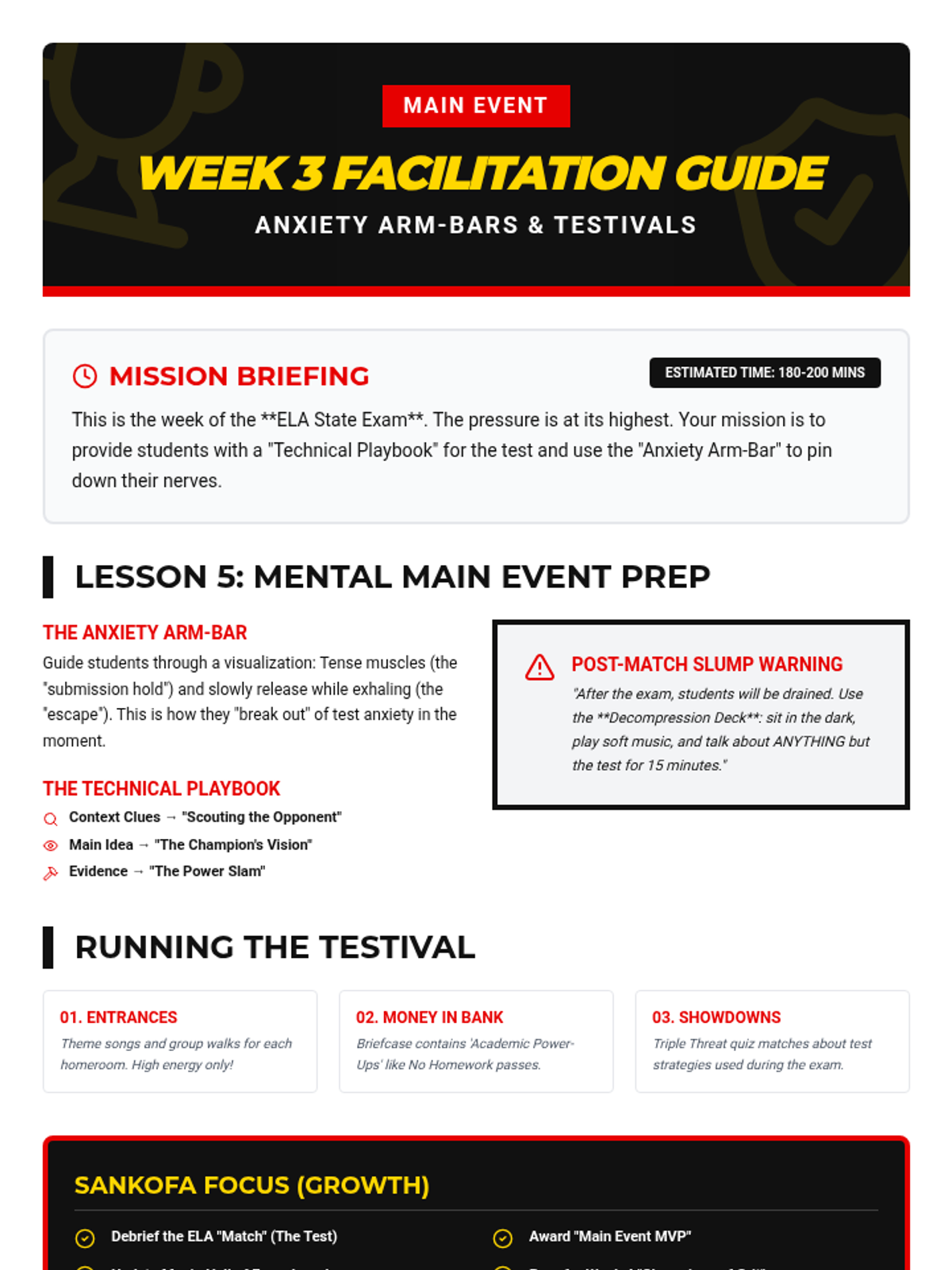
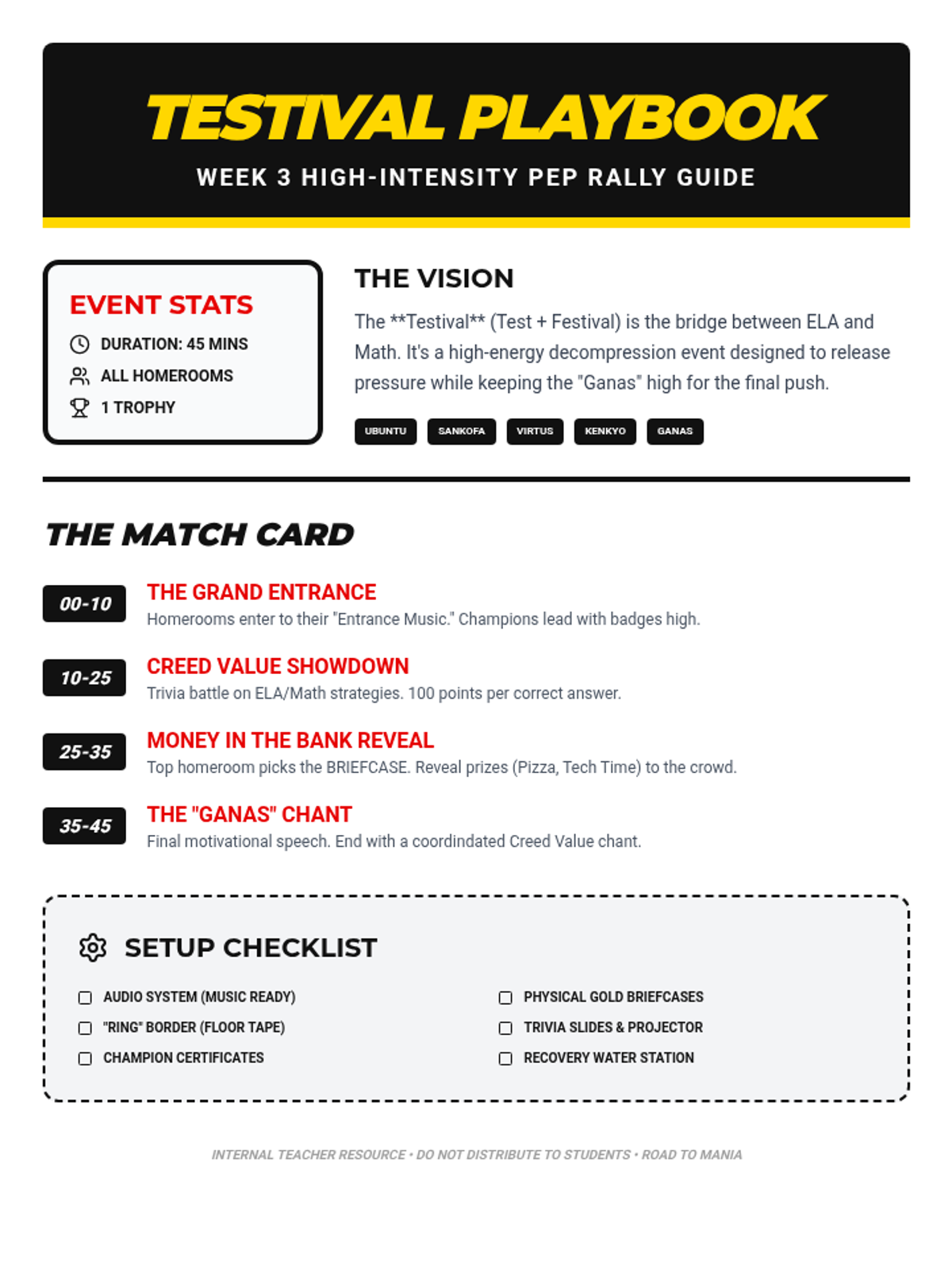
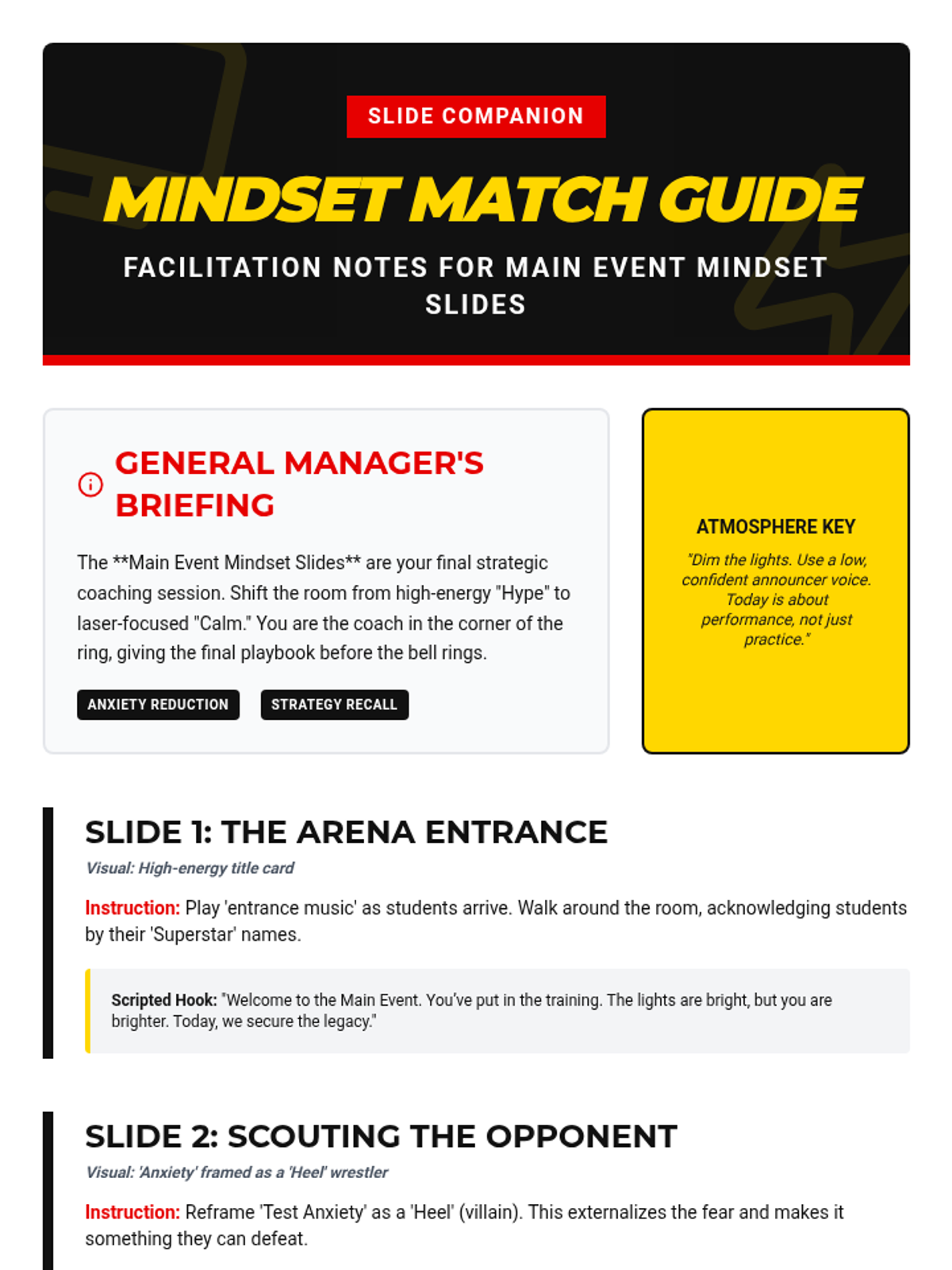
Addressing test anxiety and ELA state exam preparation, including decompression strategies to stay 'main event' ready.
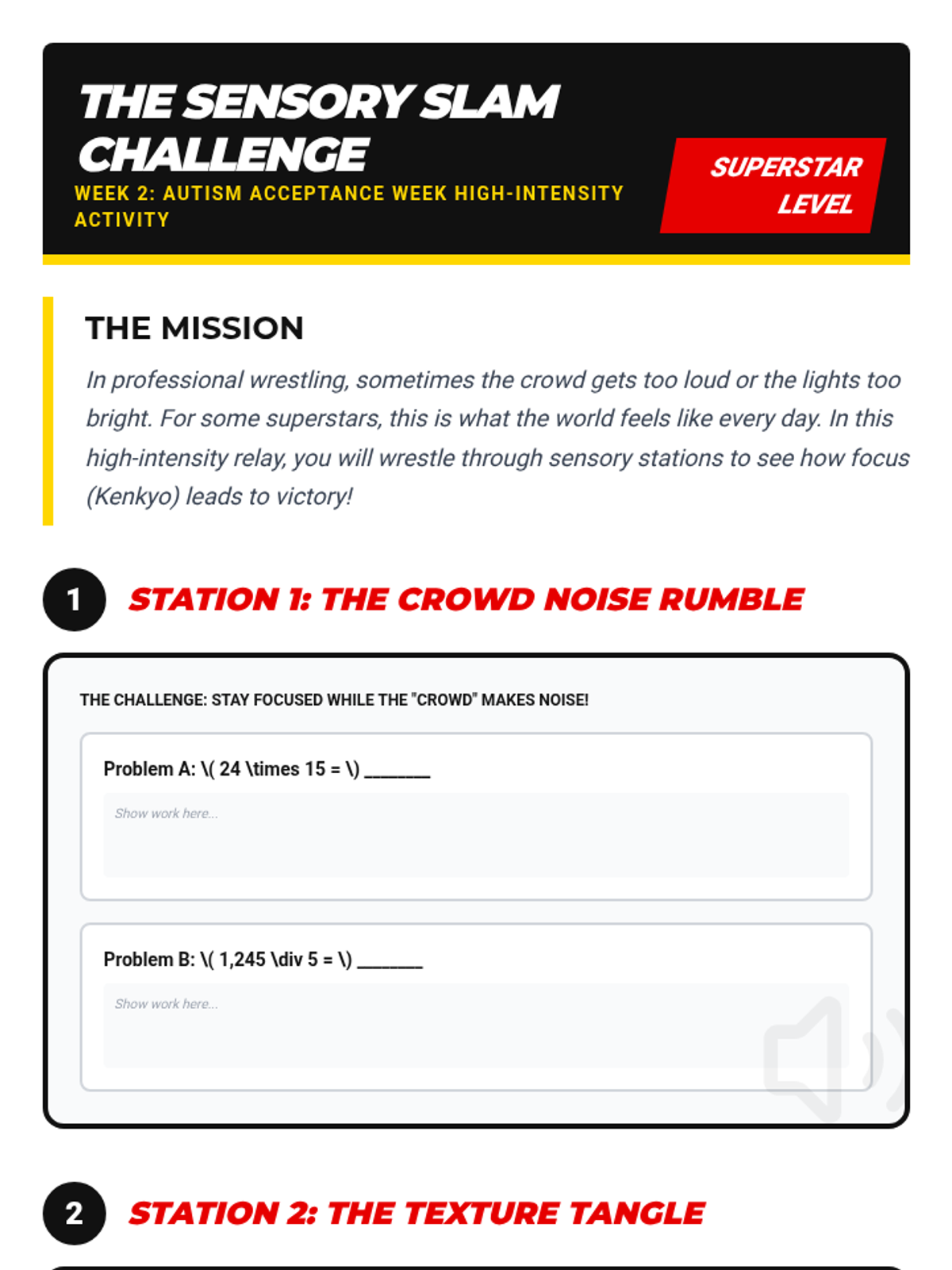
A high-energy activity focusing on inclusivity and celebrating different ways of thinking and 'wrestling' with challenges.
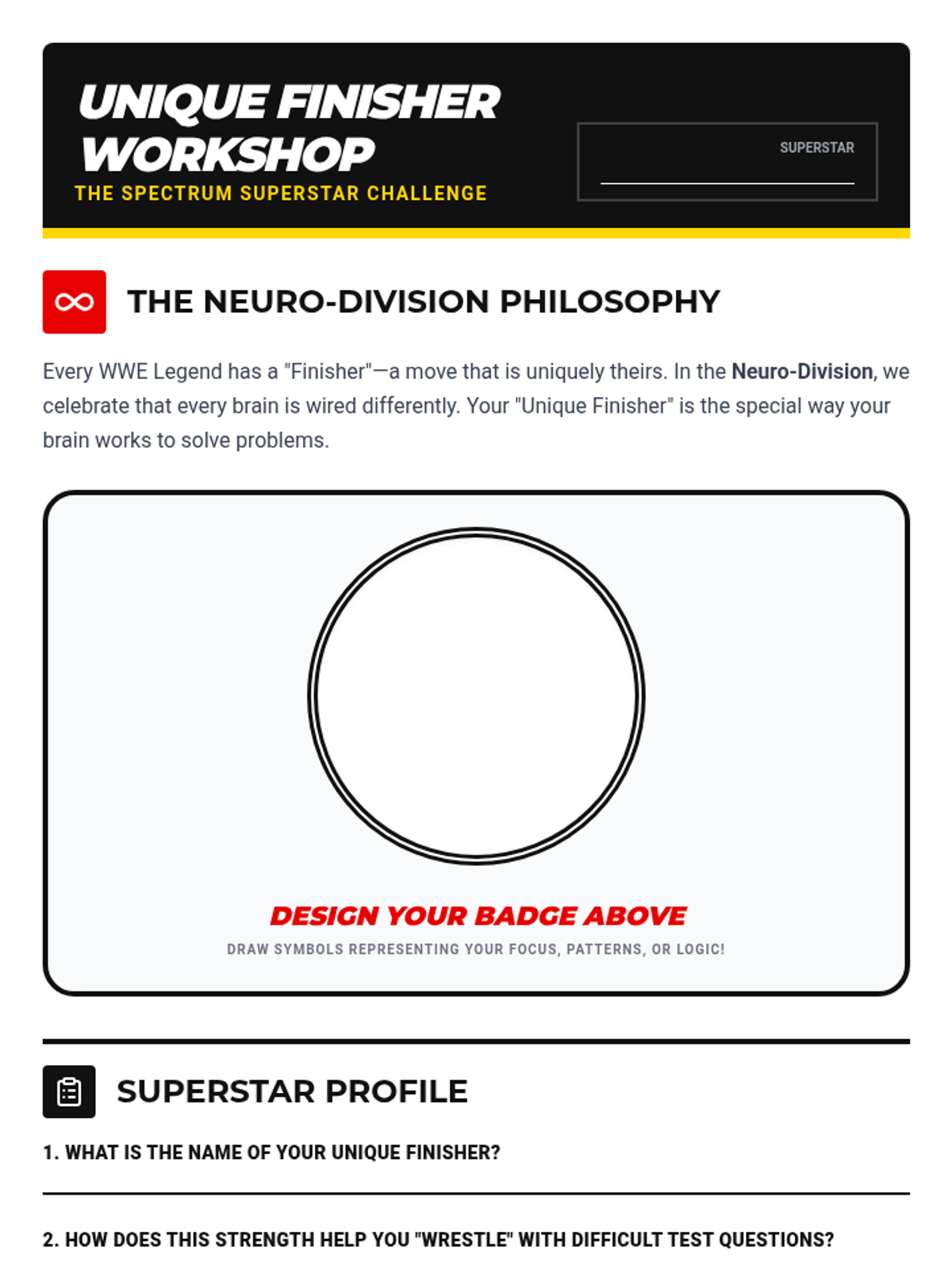
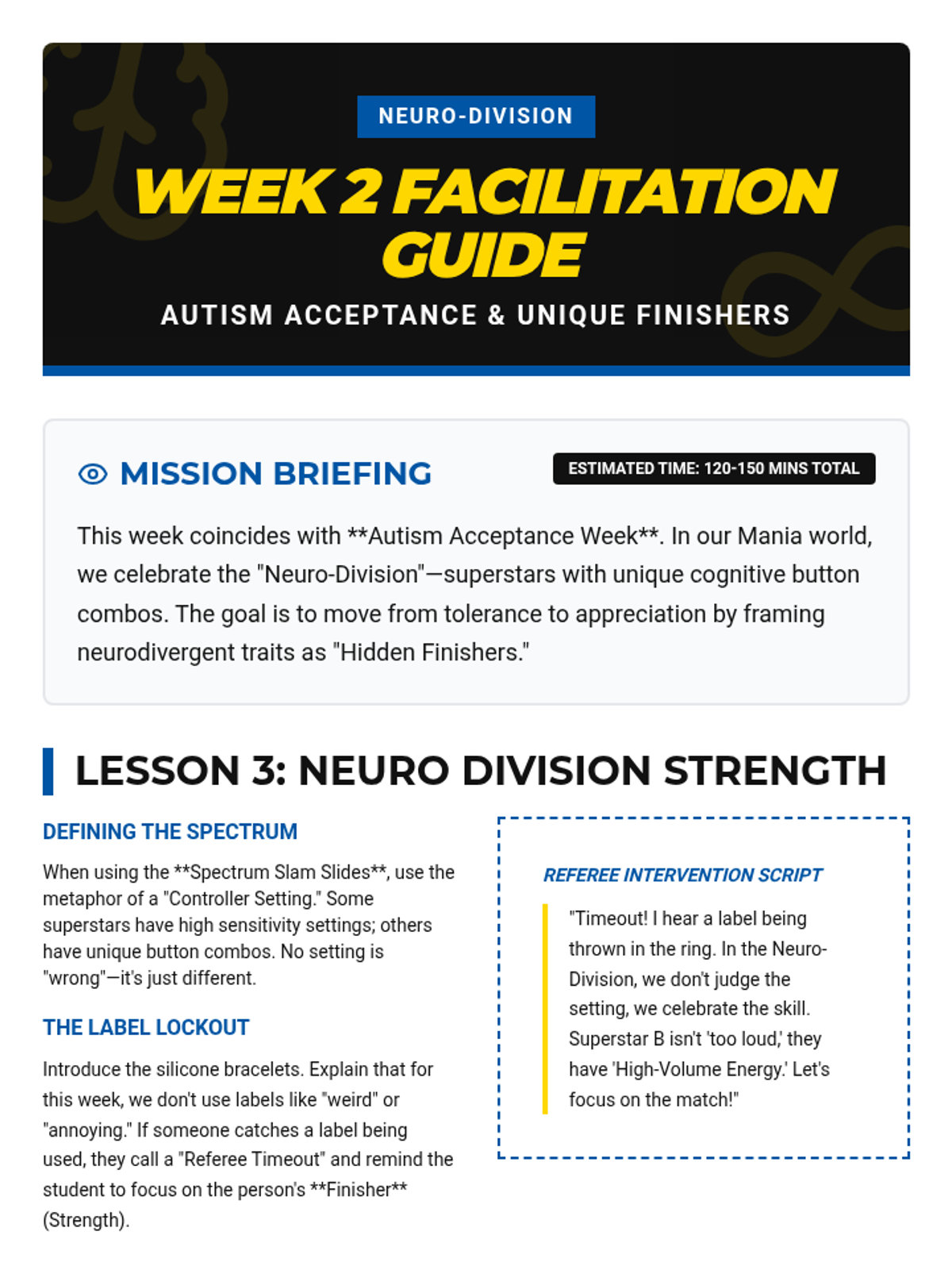
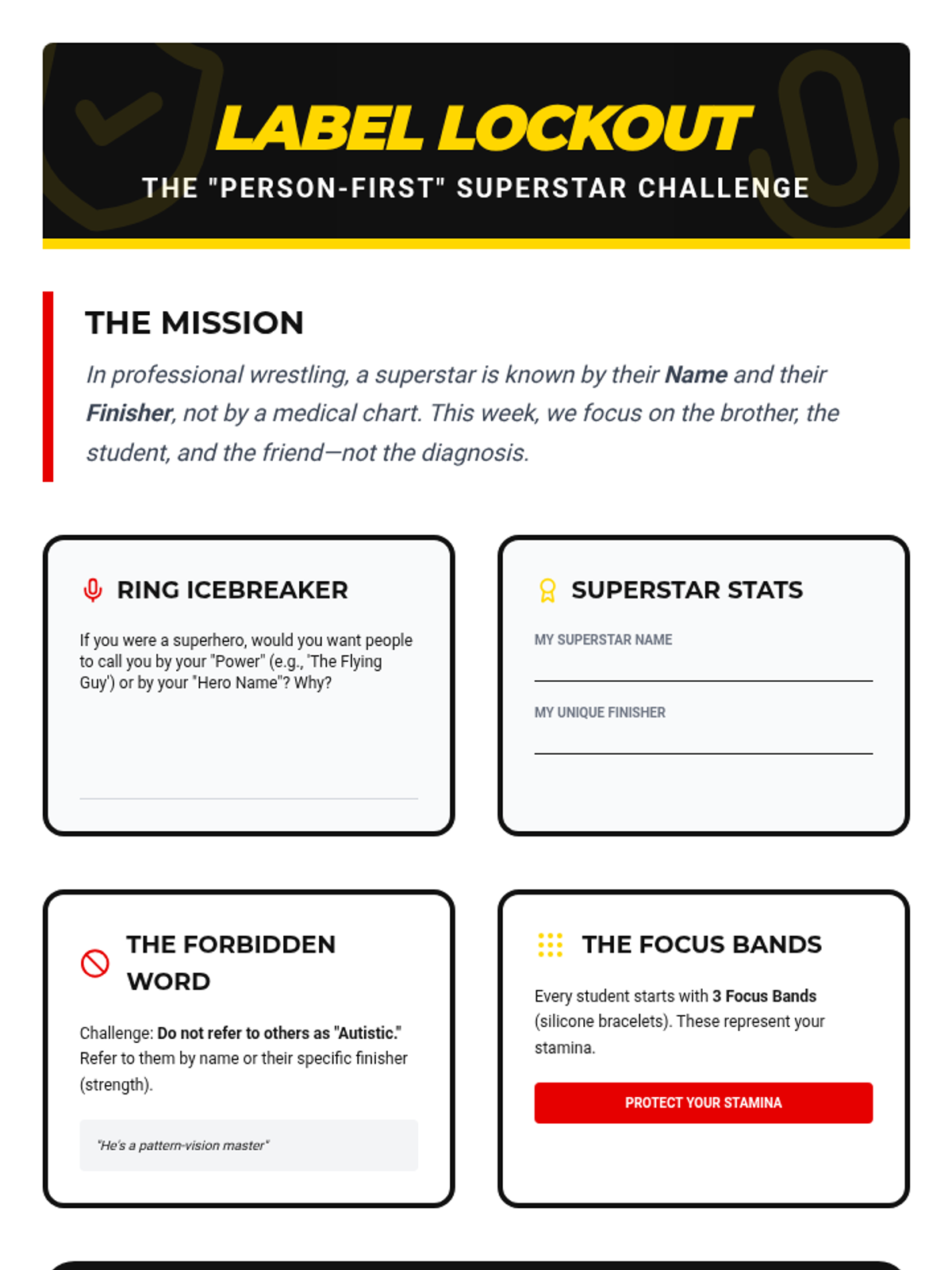
The first of two activities celebrating Autism Acceptance Week, highlighting the unique 'finishers' and strengths of neurodivergent individuals.
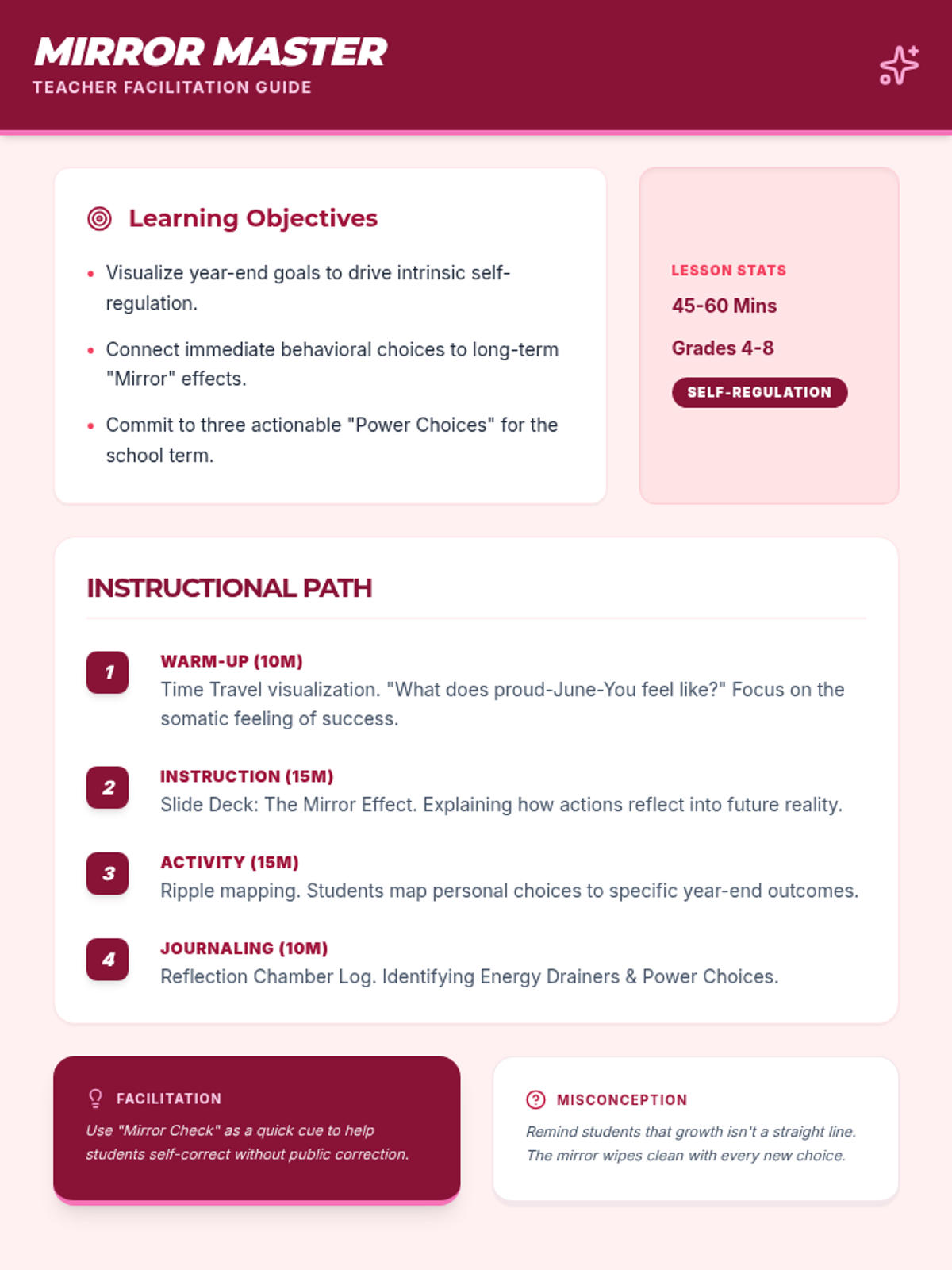
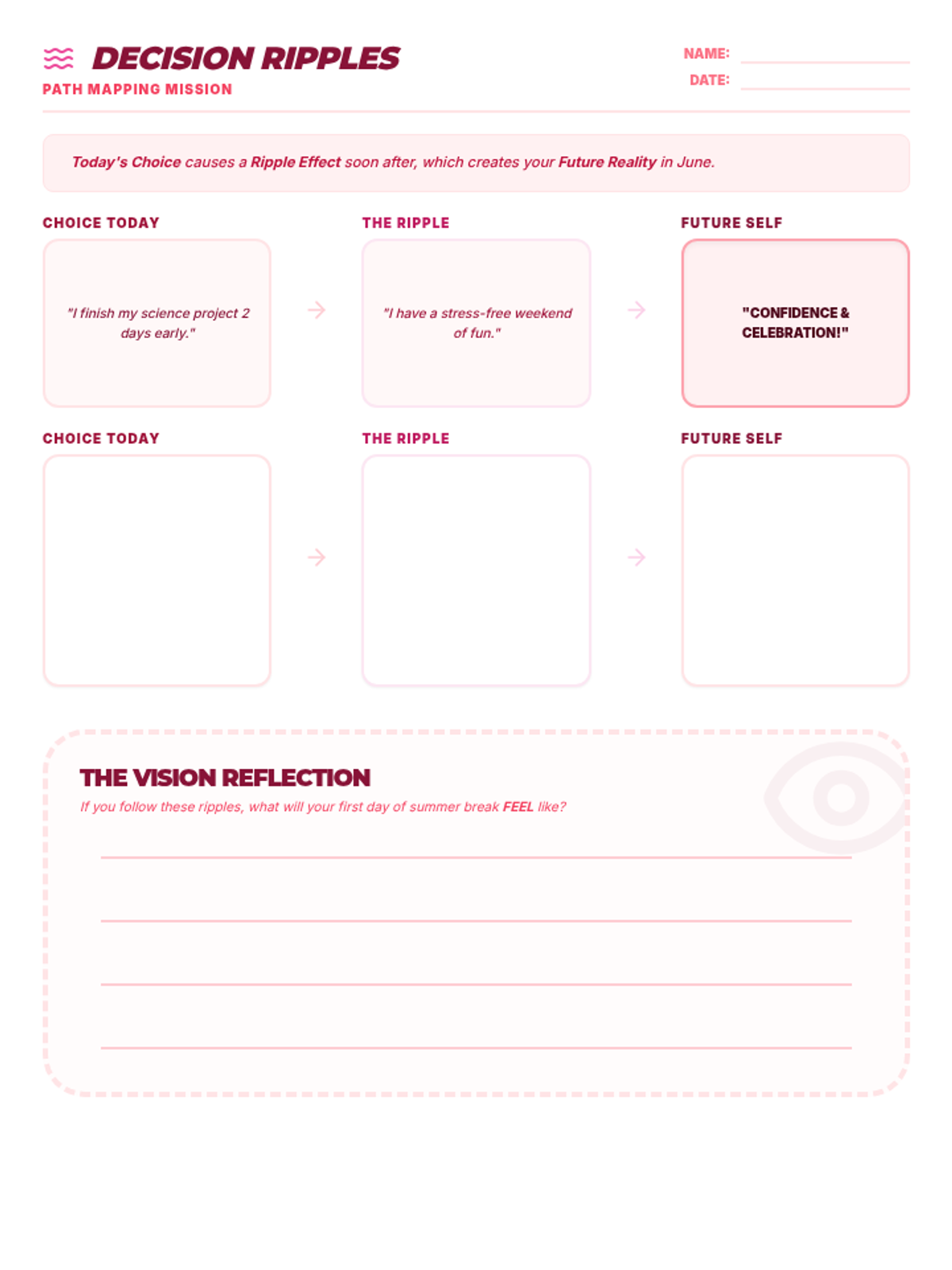
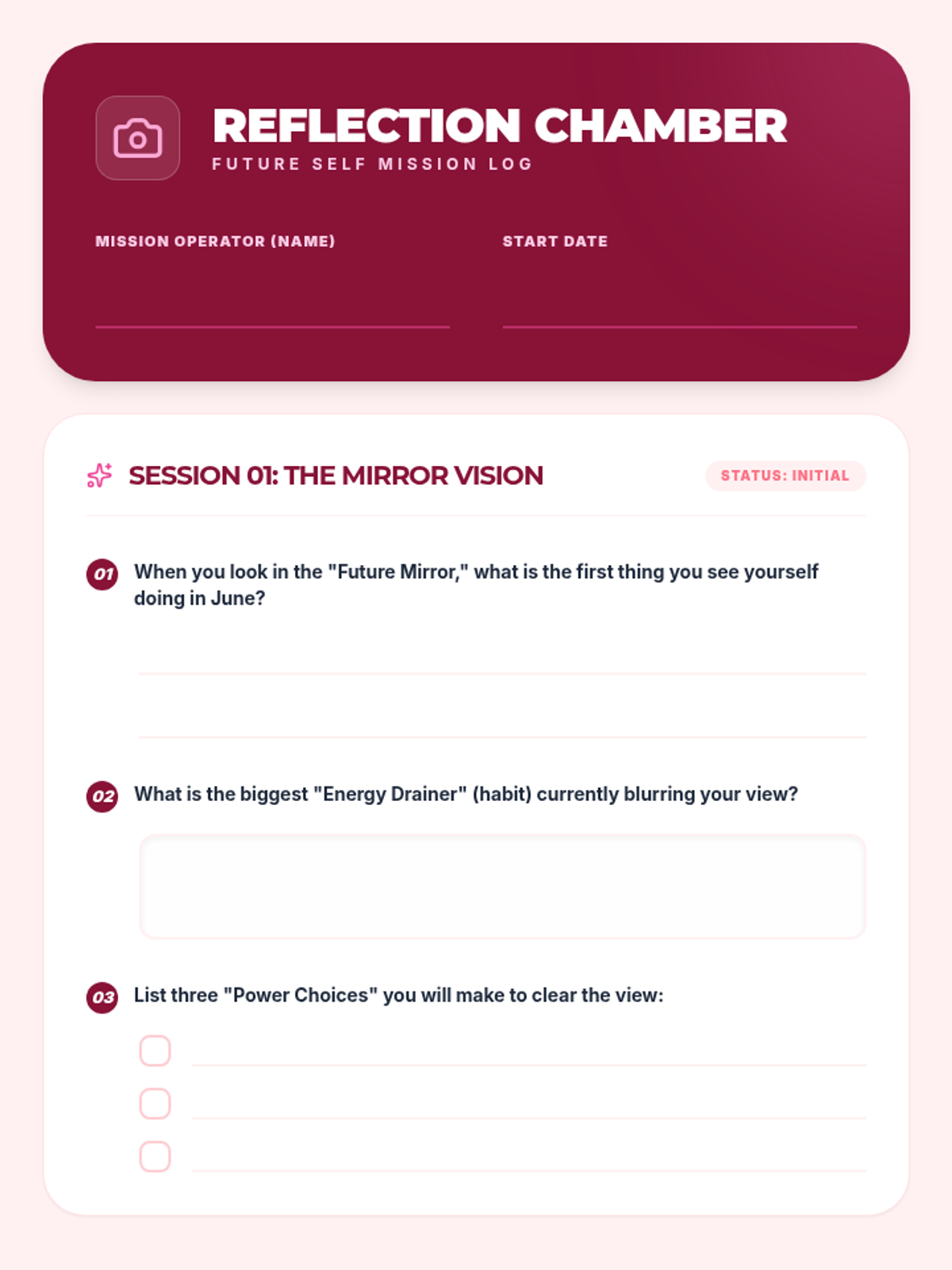
This lesson helps students visualize their future success to motivate self-regulation and goal-oriented decision-making in the present. Students explore the 'Mirror Effect,' connecting daily choices to long-term rewards like grade promotion and year-end celebrations.
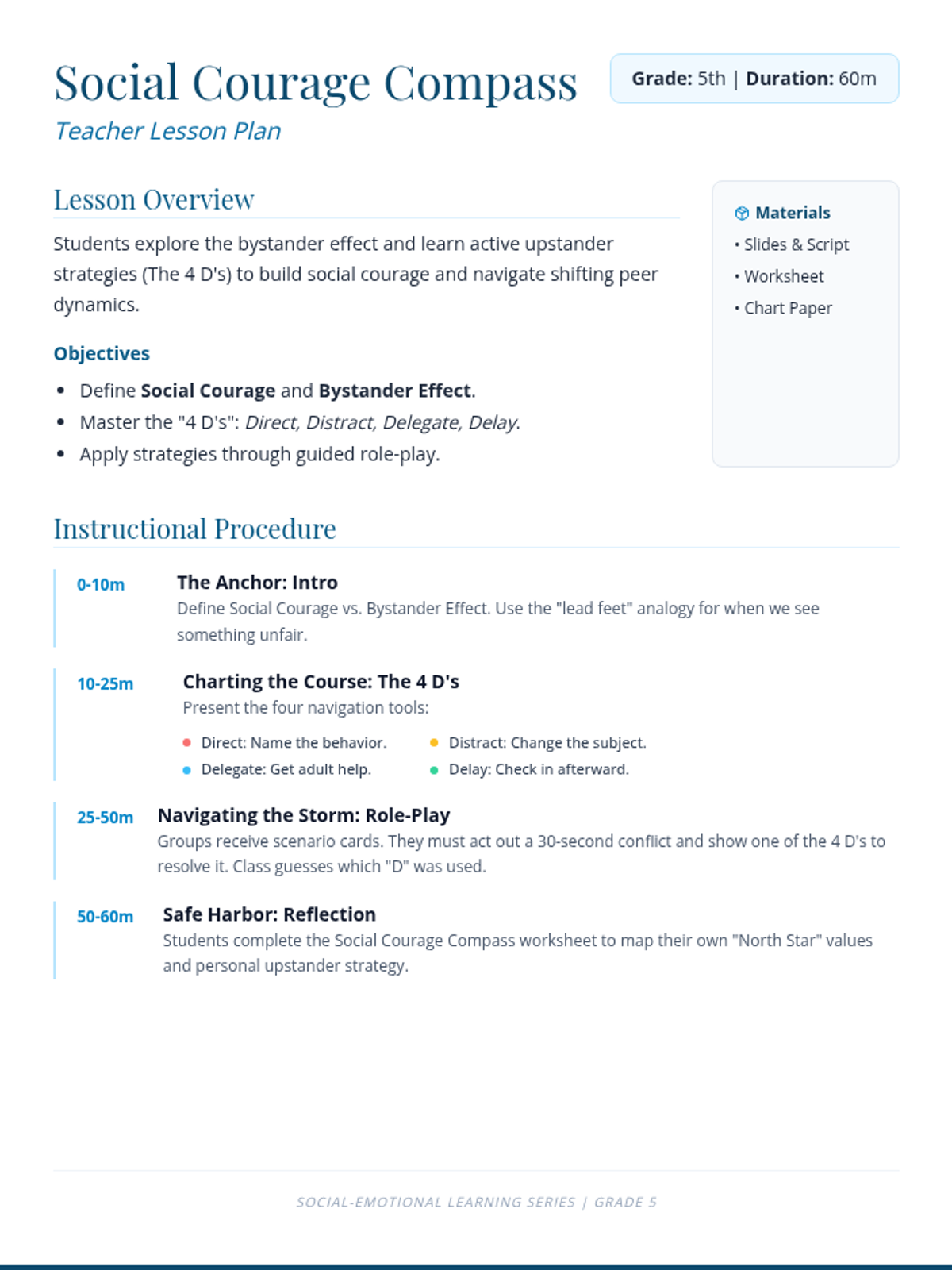
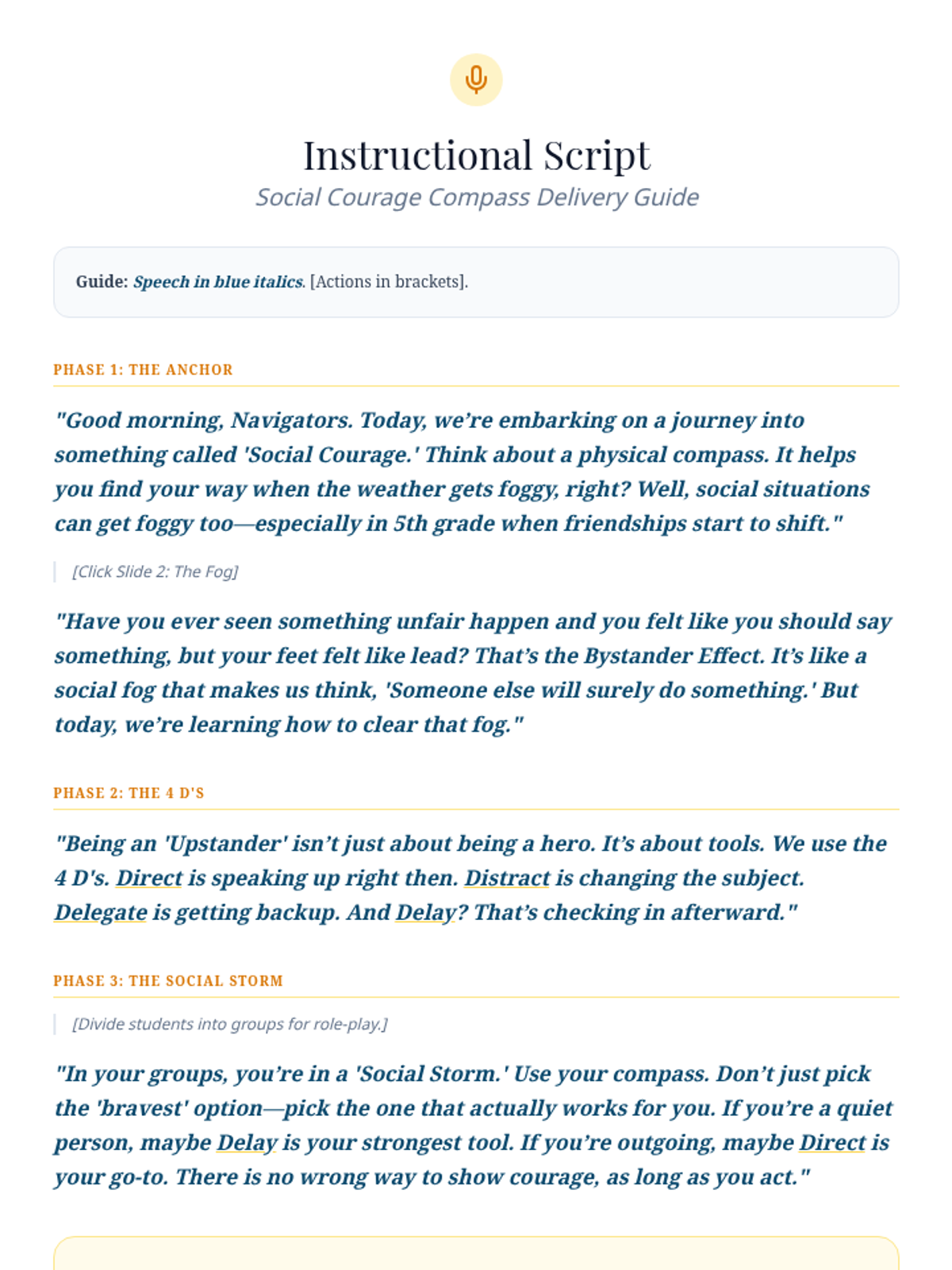
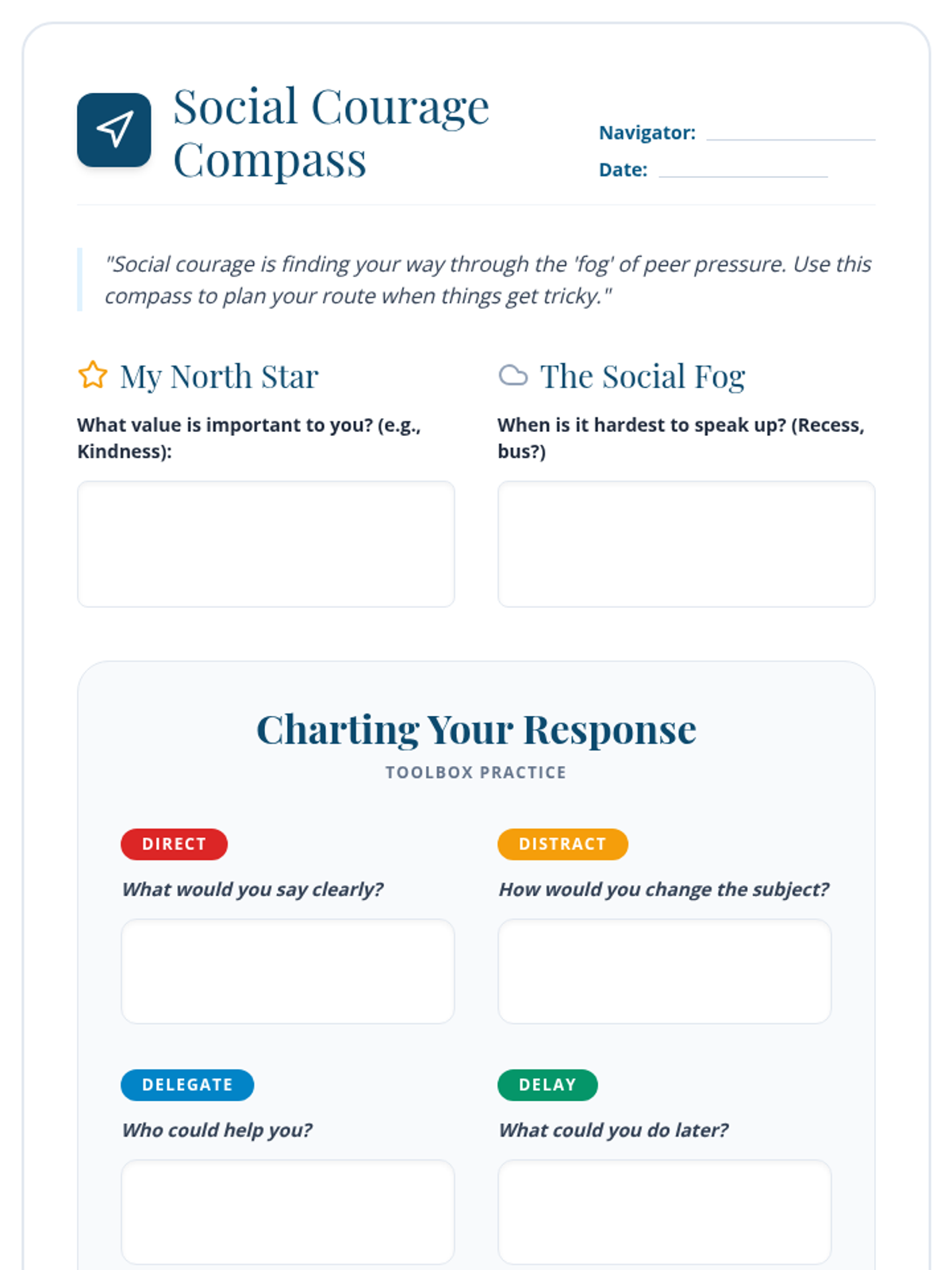
A social-emotional learning lesson for 5th graders focused on overcoming the bystander effect and developing 'upstander' strategies through the lens of social courage. Students will use the 4 D's (Direct, Distract, Delegate, Delay) to navigate common peer-pressure scenarios.
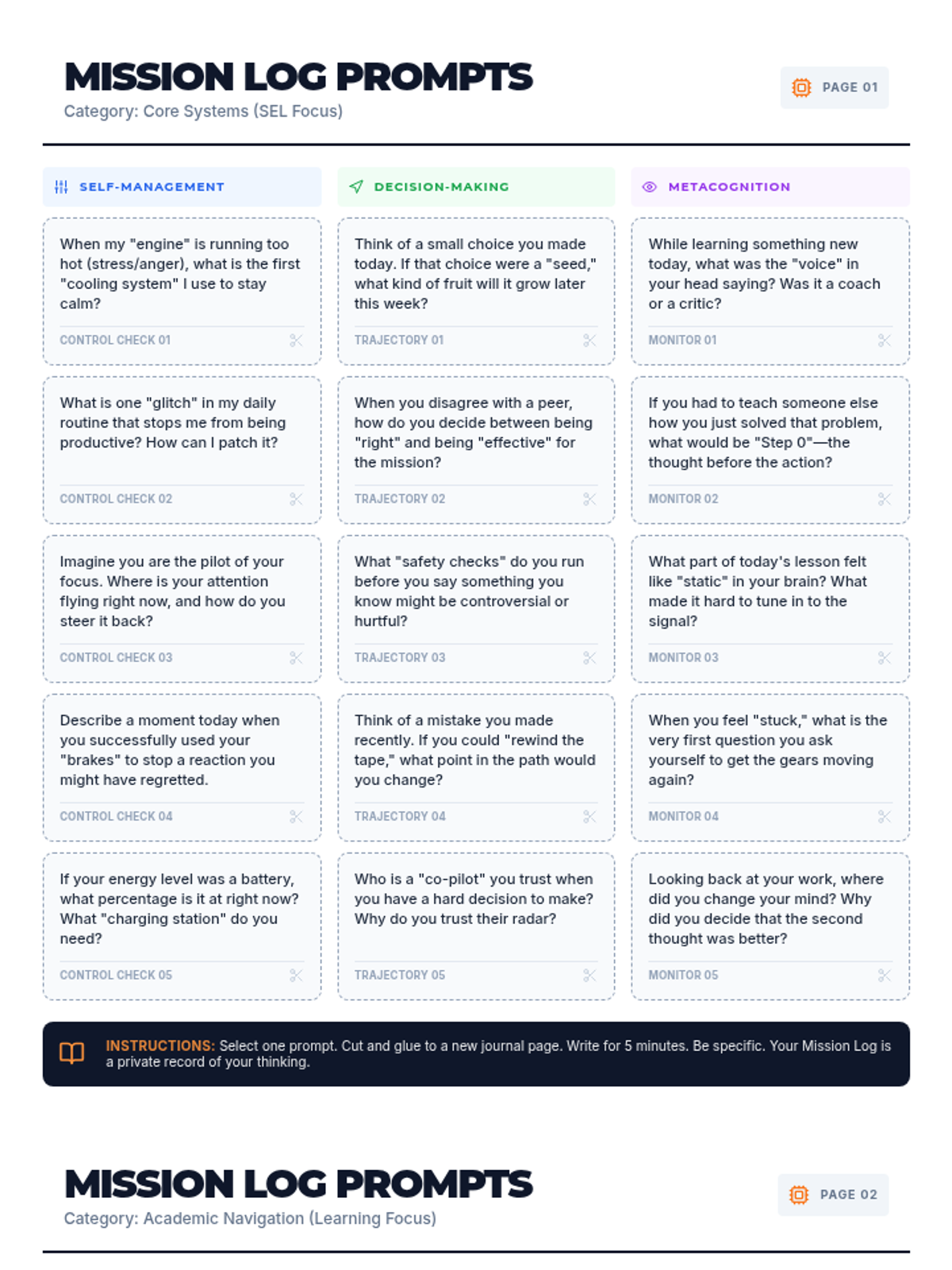
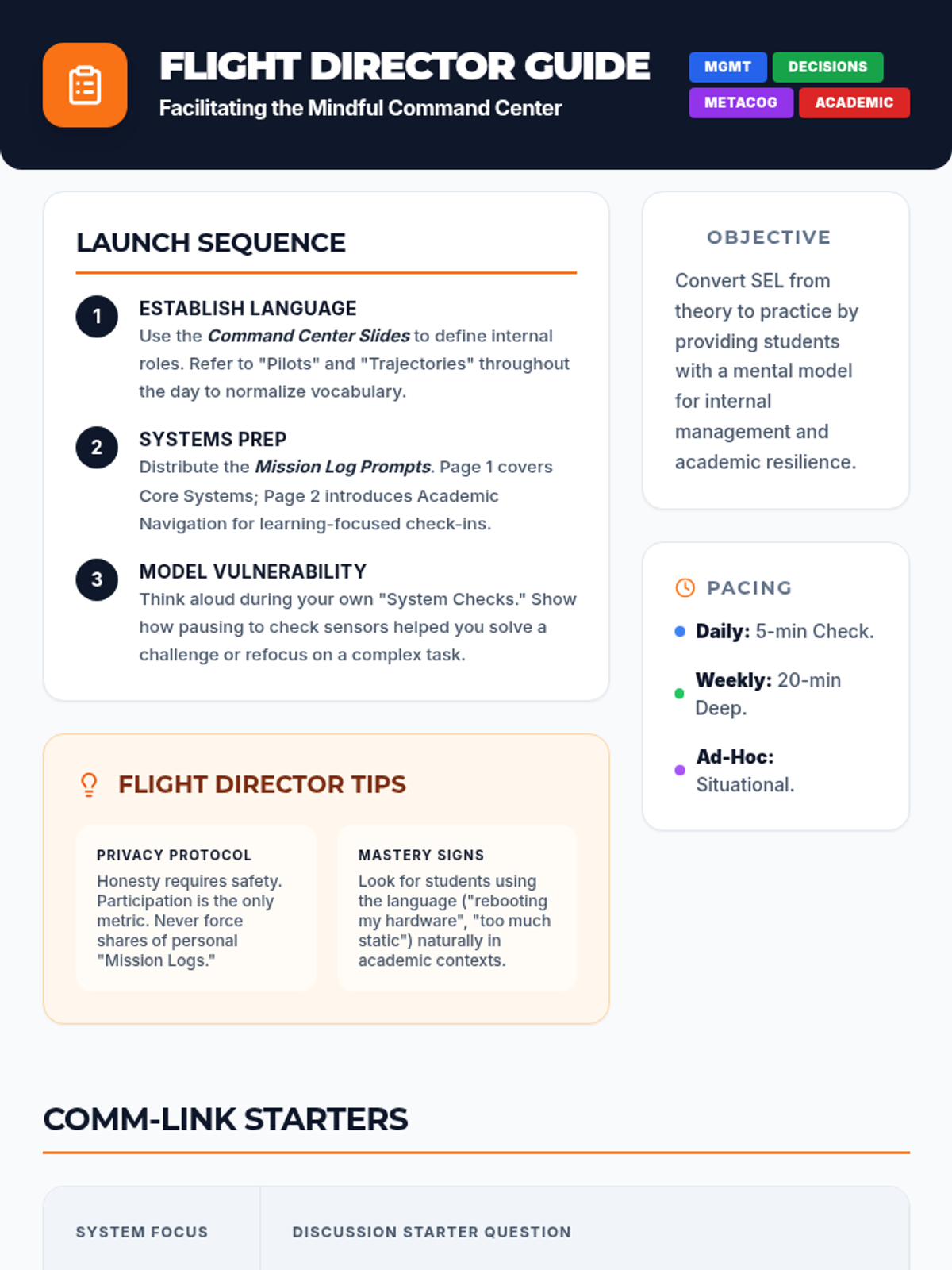
Students explore self-management, decision-making, and metacognition through a 'Command Center' metaphor. This lesson provides visual instruction and a set of reflection prompts for students to integrate into their personal journals.
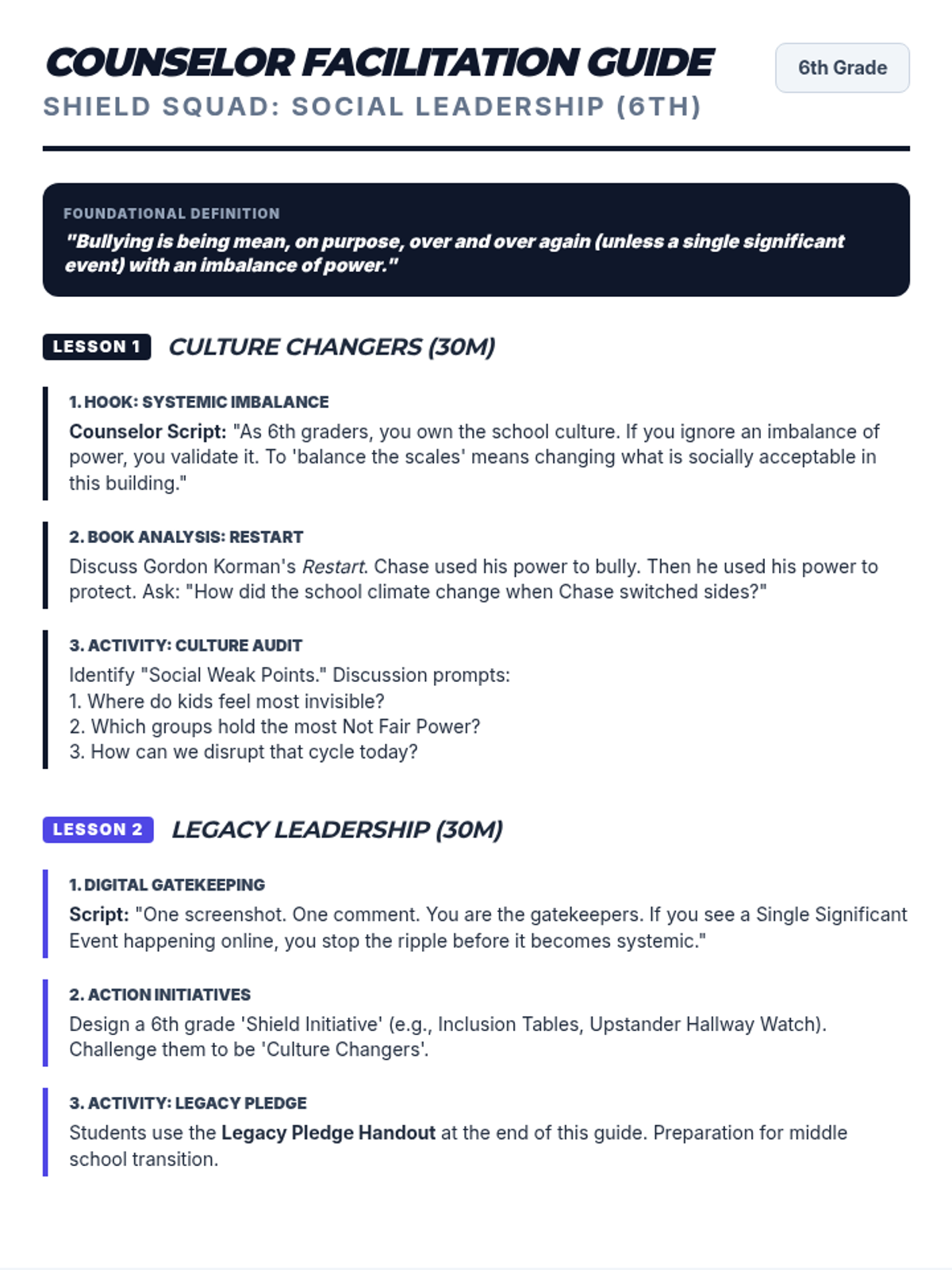
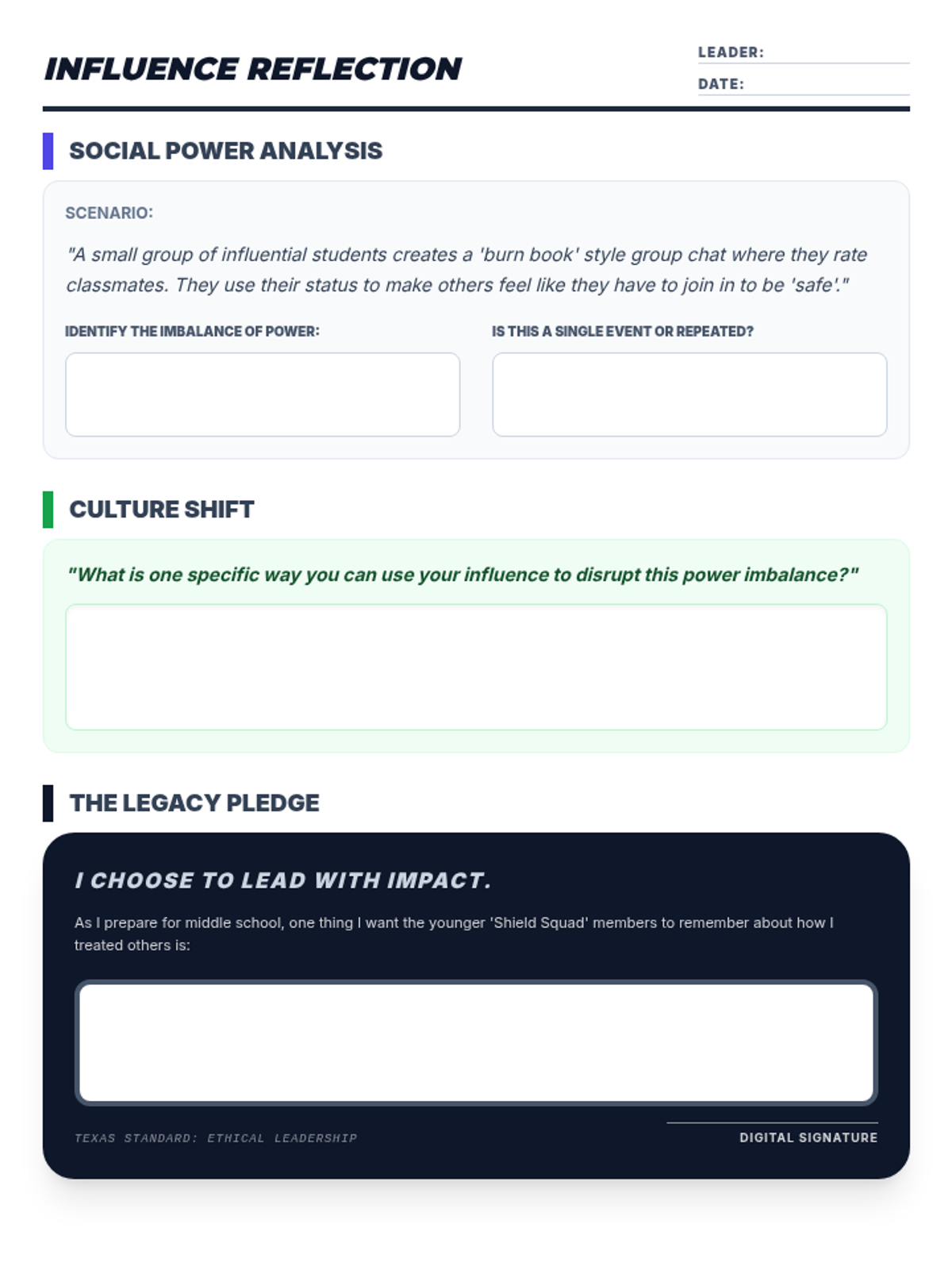
The first of two 30-minute sessions for 6th grade. Using 'Restart' by Gordon Korman, students analyze school culture, social leadership, and the concept of a 'Social Reset'.
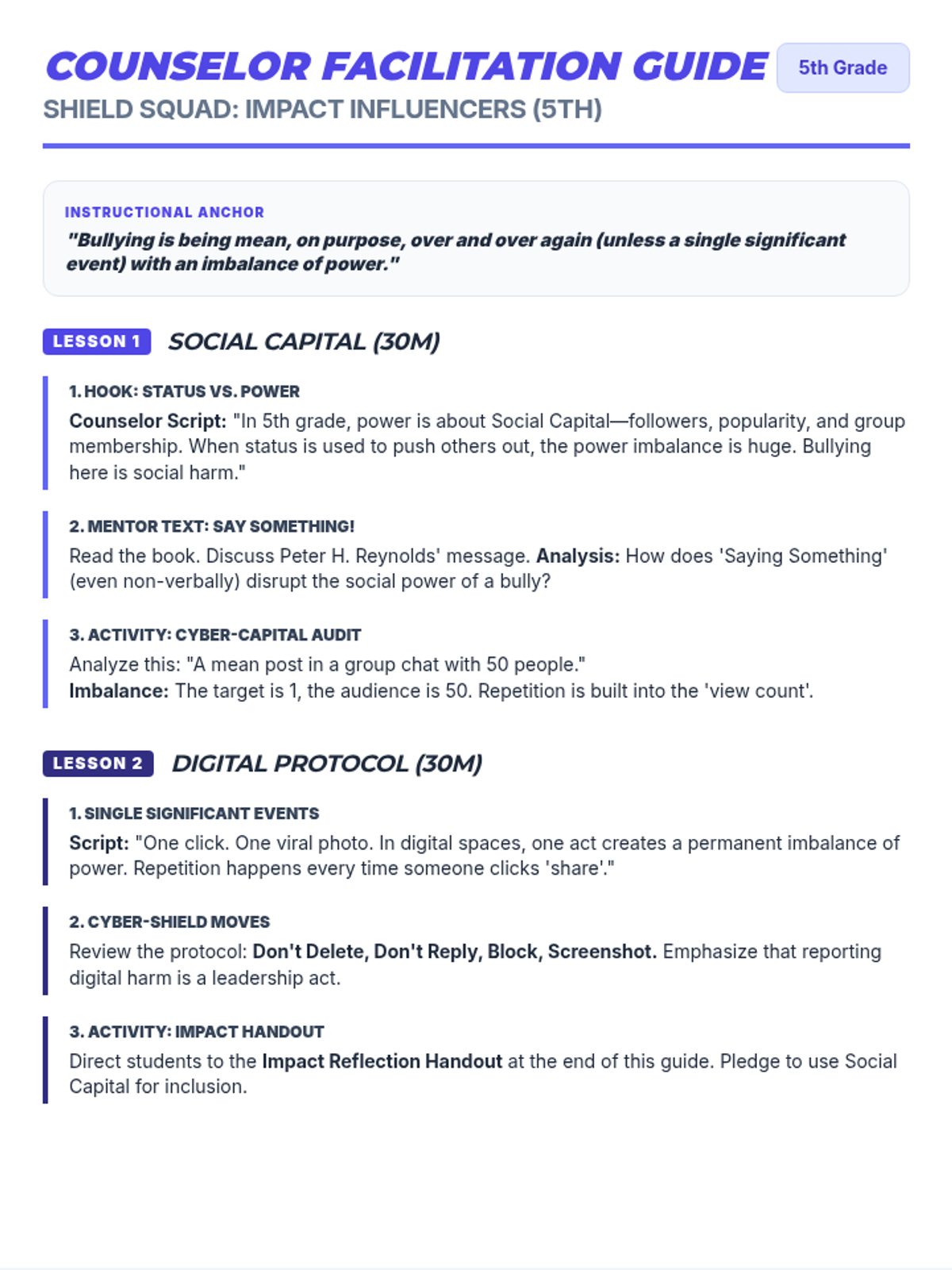
The first of two 30-minute sessions for 5th grade. Using 'Zero' by Kathryn Otoshi, students explore social capital as power and the specific dynamics of cyberbullying.
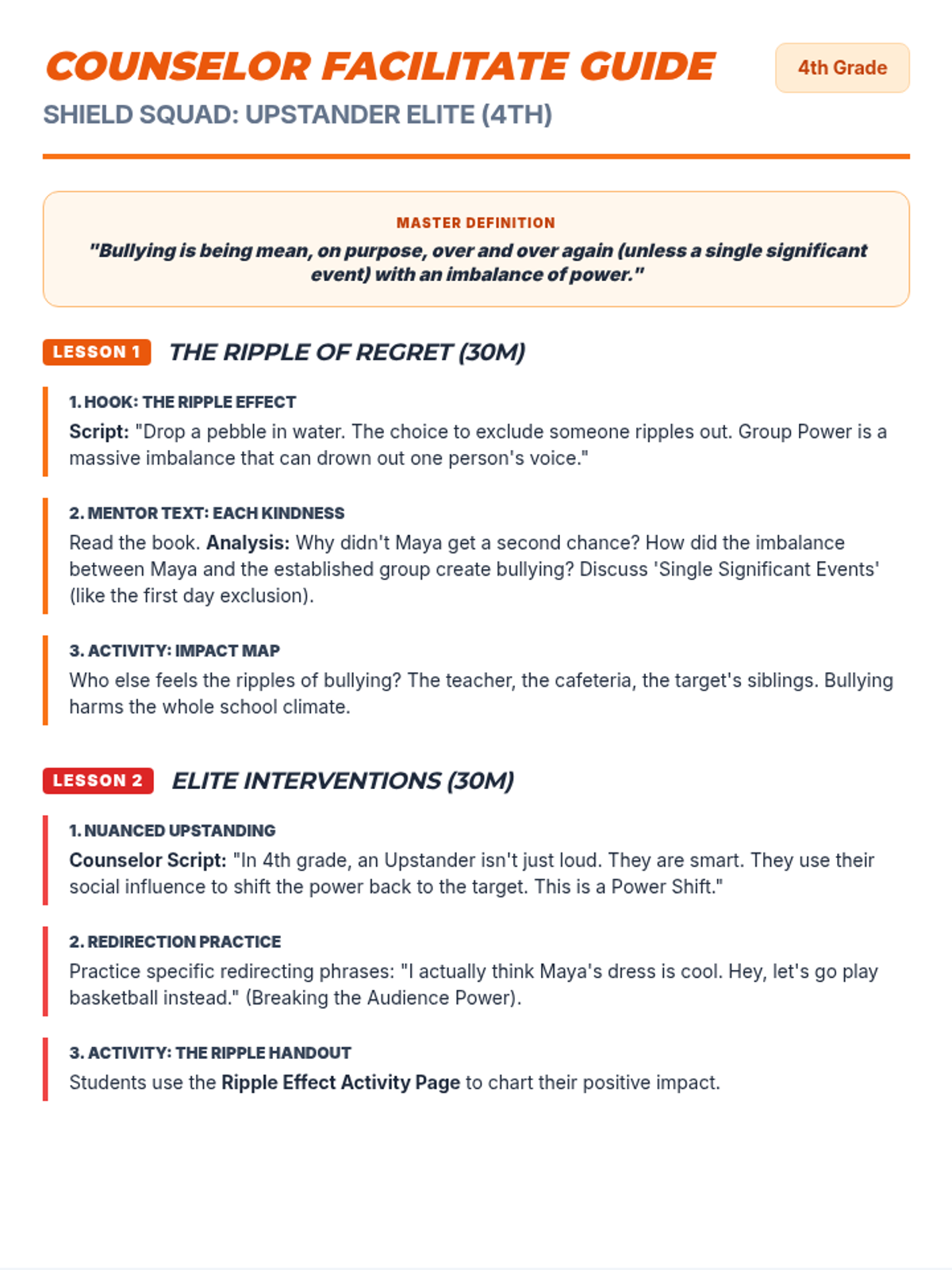
The first of two 30-minute sessions for 4th grade. Using 'Confessions of a Former Bully' by Trudy Ludwig, students understand the bullying circle and the roles people play in social dynamics.
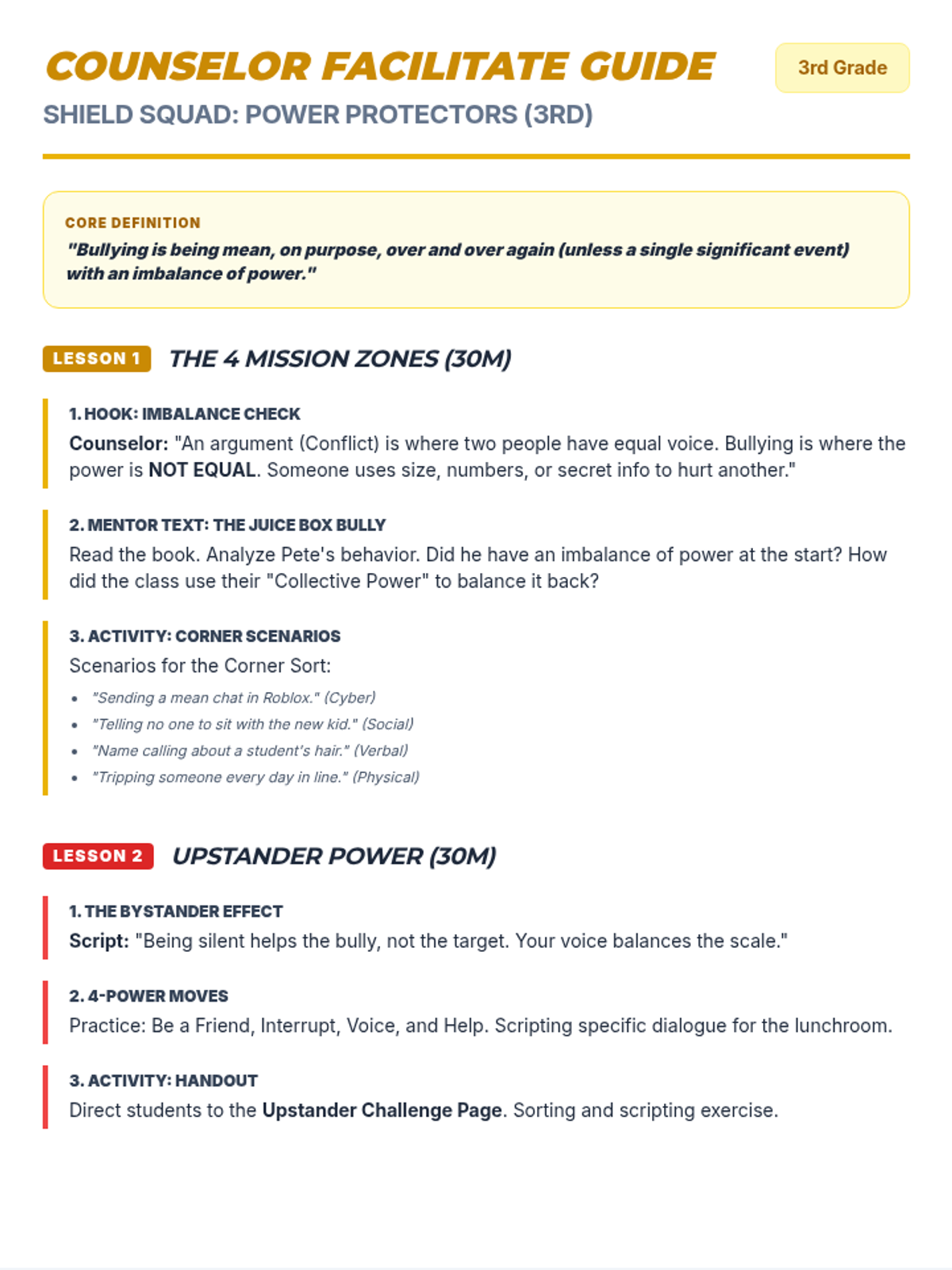
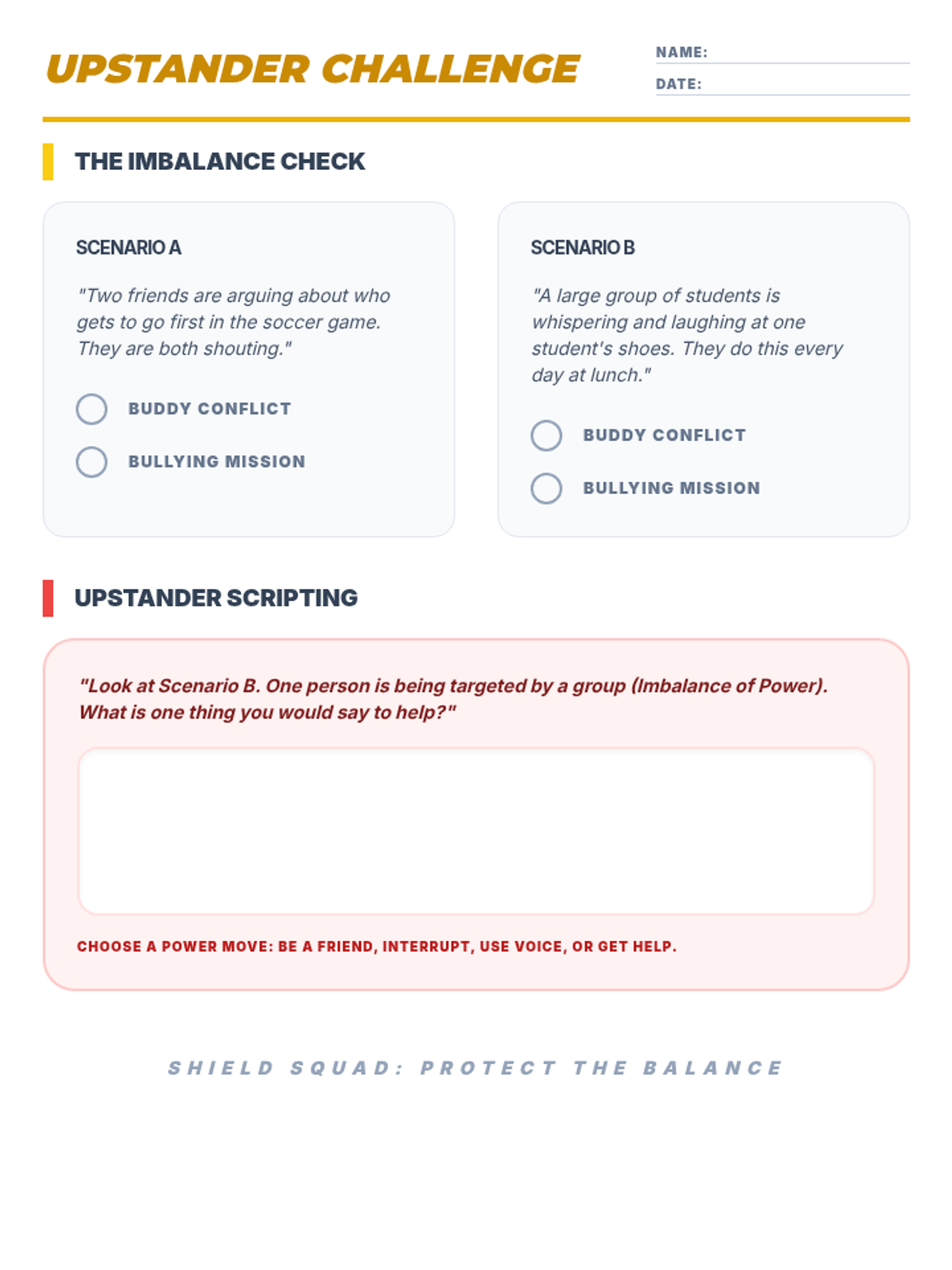
The first of two 30-minute sessions for 3rd grade. Using 'Tease Monster' by Julia Cook, students categorize behavior and analyze the 'Target' vs 'Bully' power gap.
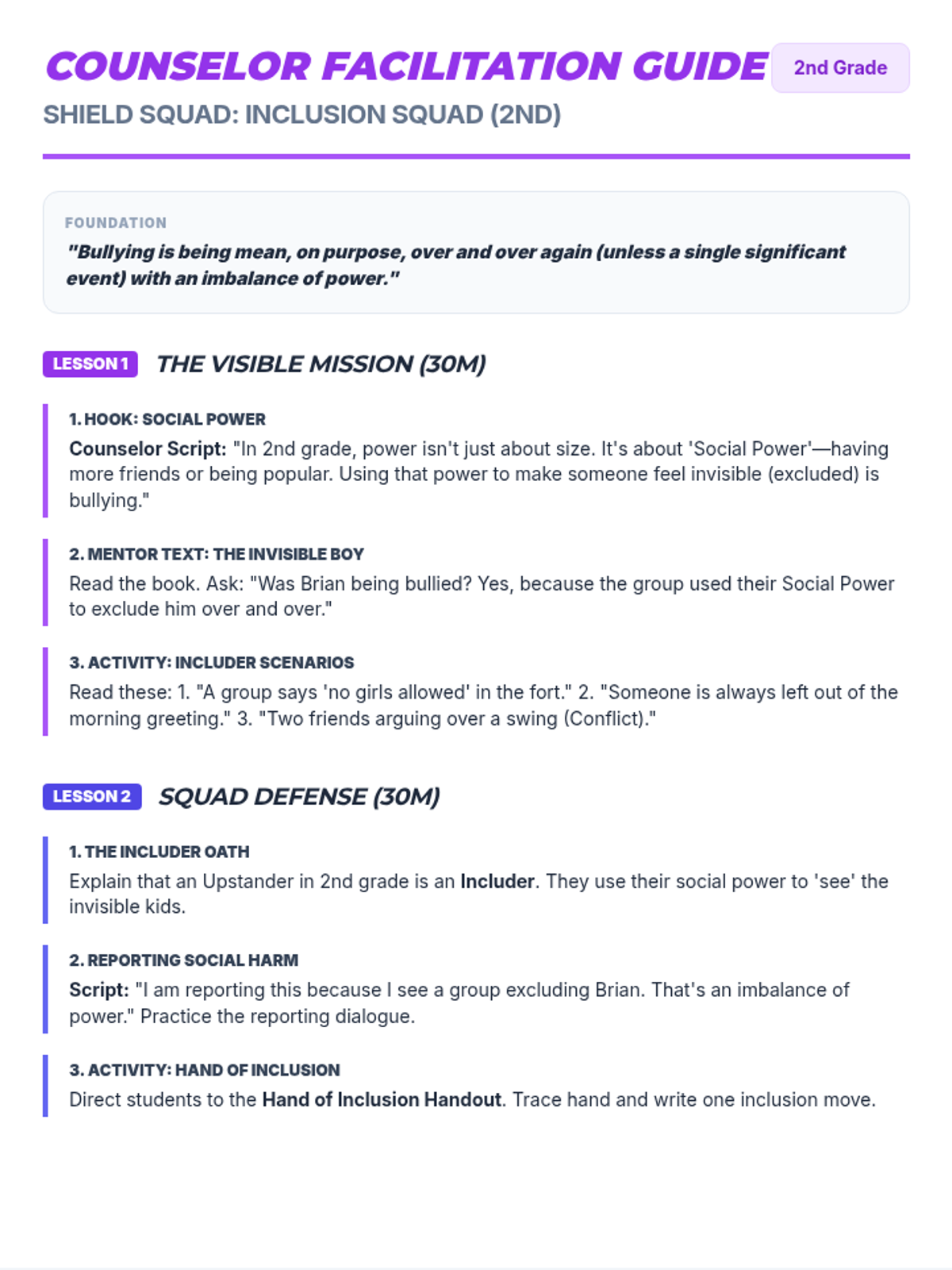
The first of two 30-minute sessions for 2nd grade. Using 'The Invisible Boy' by Trudy Ludwig, students explore social exclusion and the transition from a 'Buddy Conflict' to bullying.
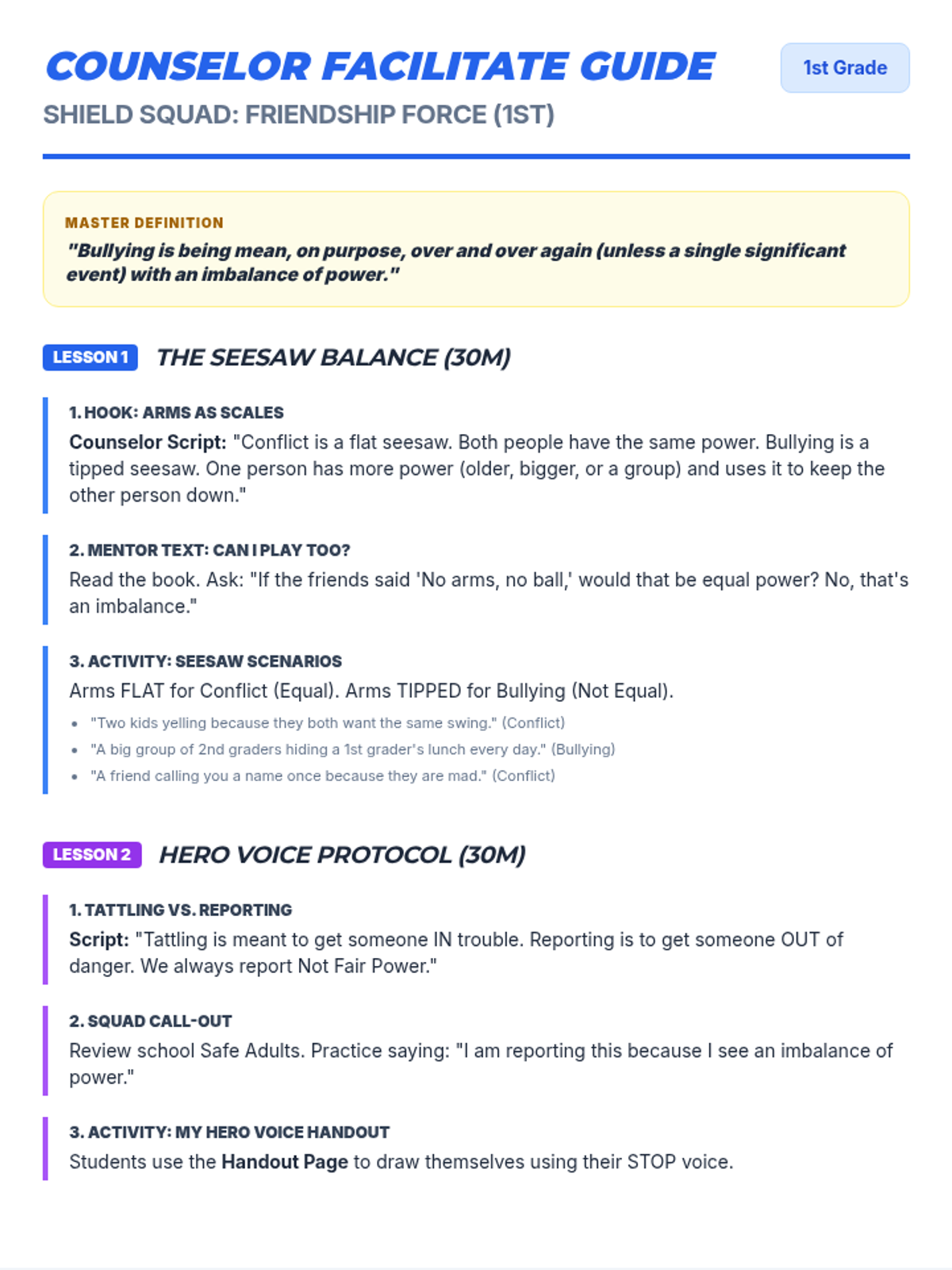
The first of two 30-minute sessions for 1st grade. Using 'Trouble Talk' by Trudy Ludwig, students explore verbal bullying and the 'Seesaw' model of unequal power.
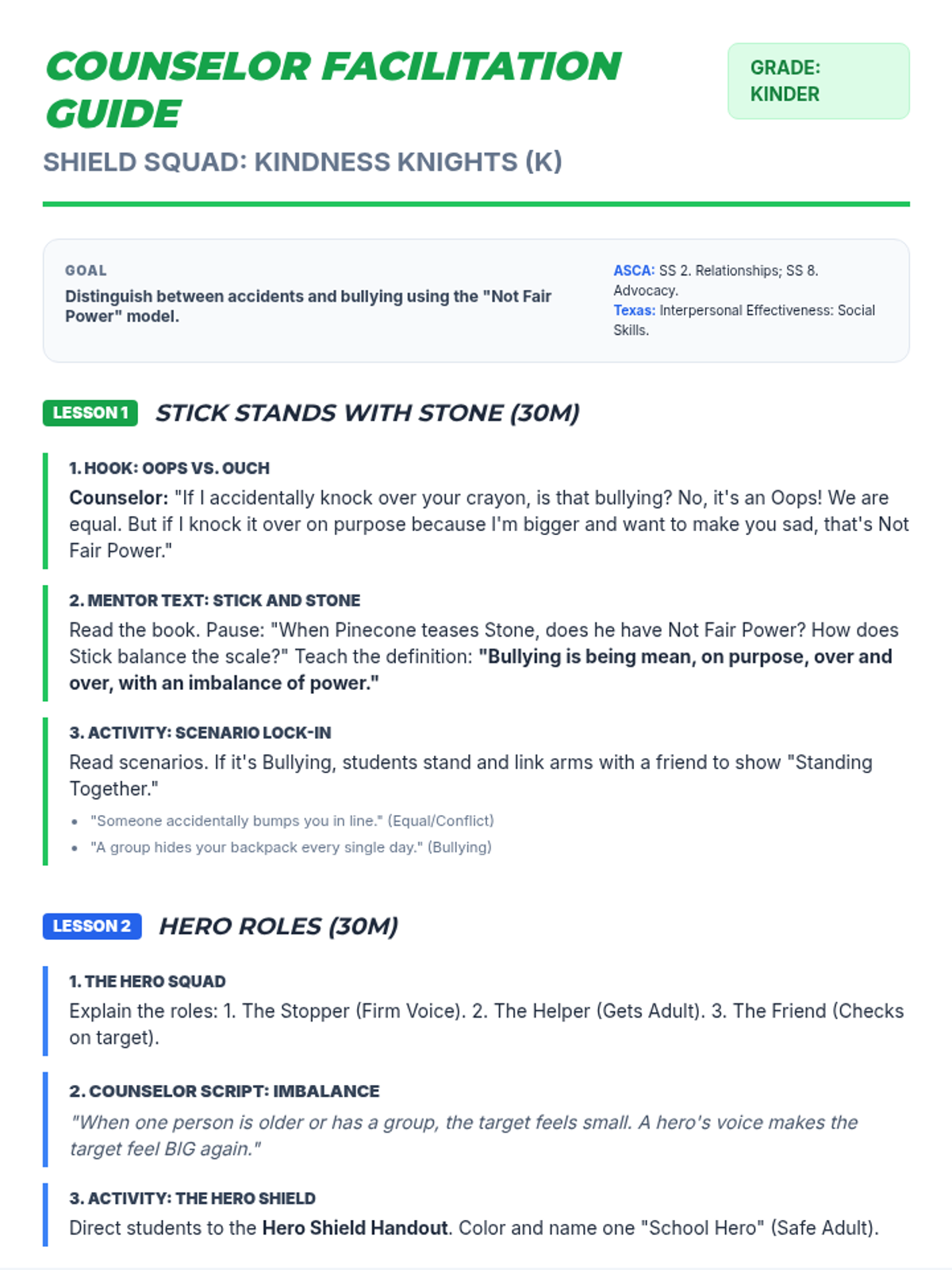
The first of two 30-minute sessions for Kindergarten. Using 'Bully B.E.A.N.S.' by Julia Cook, students learn to distinguish between accidents and bullying using the 'Purposeful' and 'Repeated' criteria.
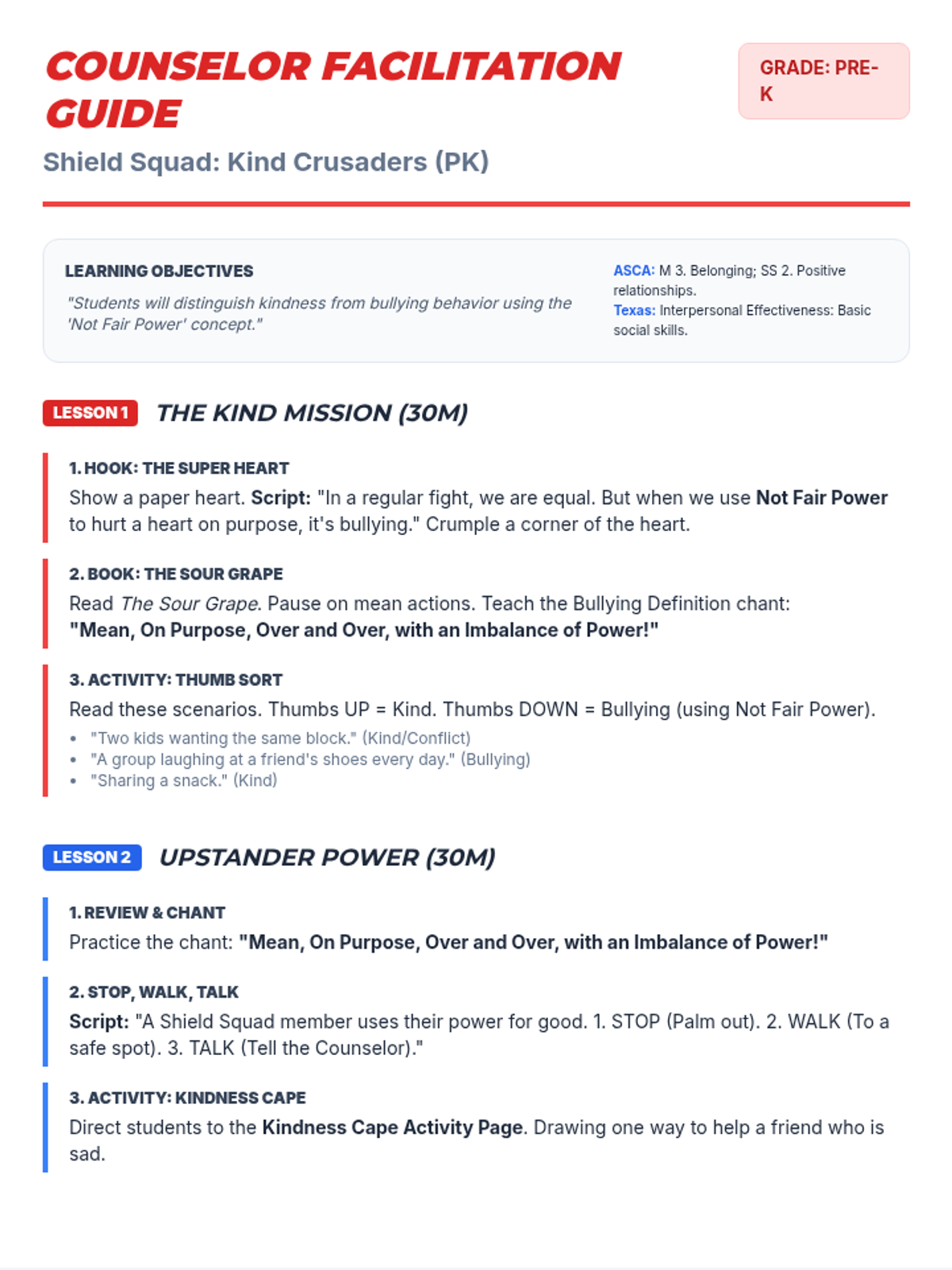
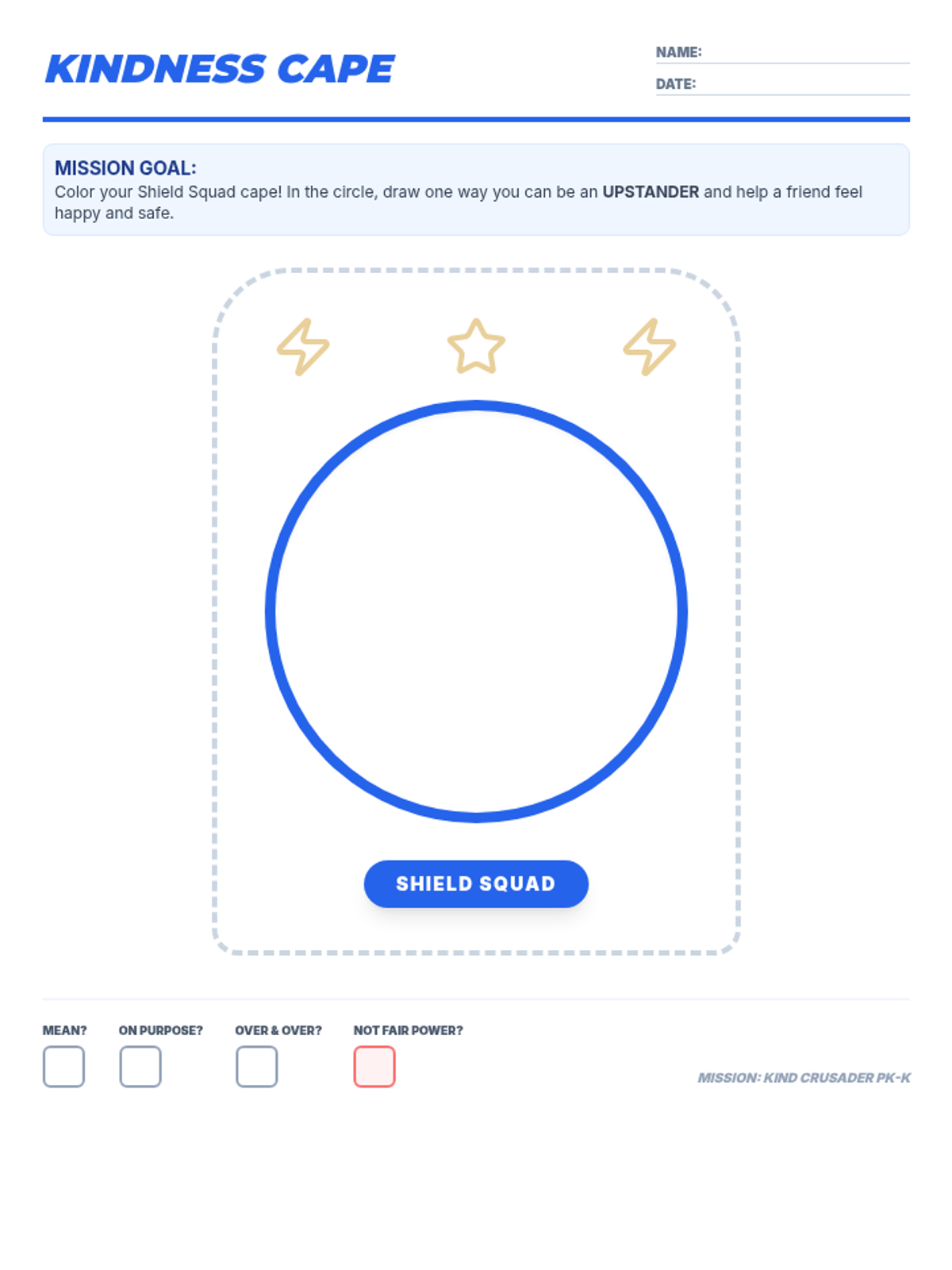
The first of two 30-minute sessions for PK. Using 'One' by Kathryn Otoshi, students are introduced to the 'Shield Squad' definition of bullying and the concept of 'Not Fair Power'.
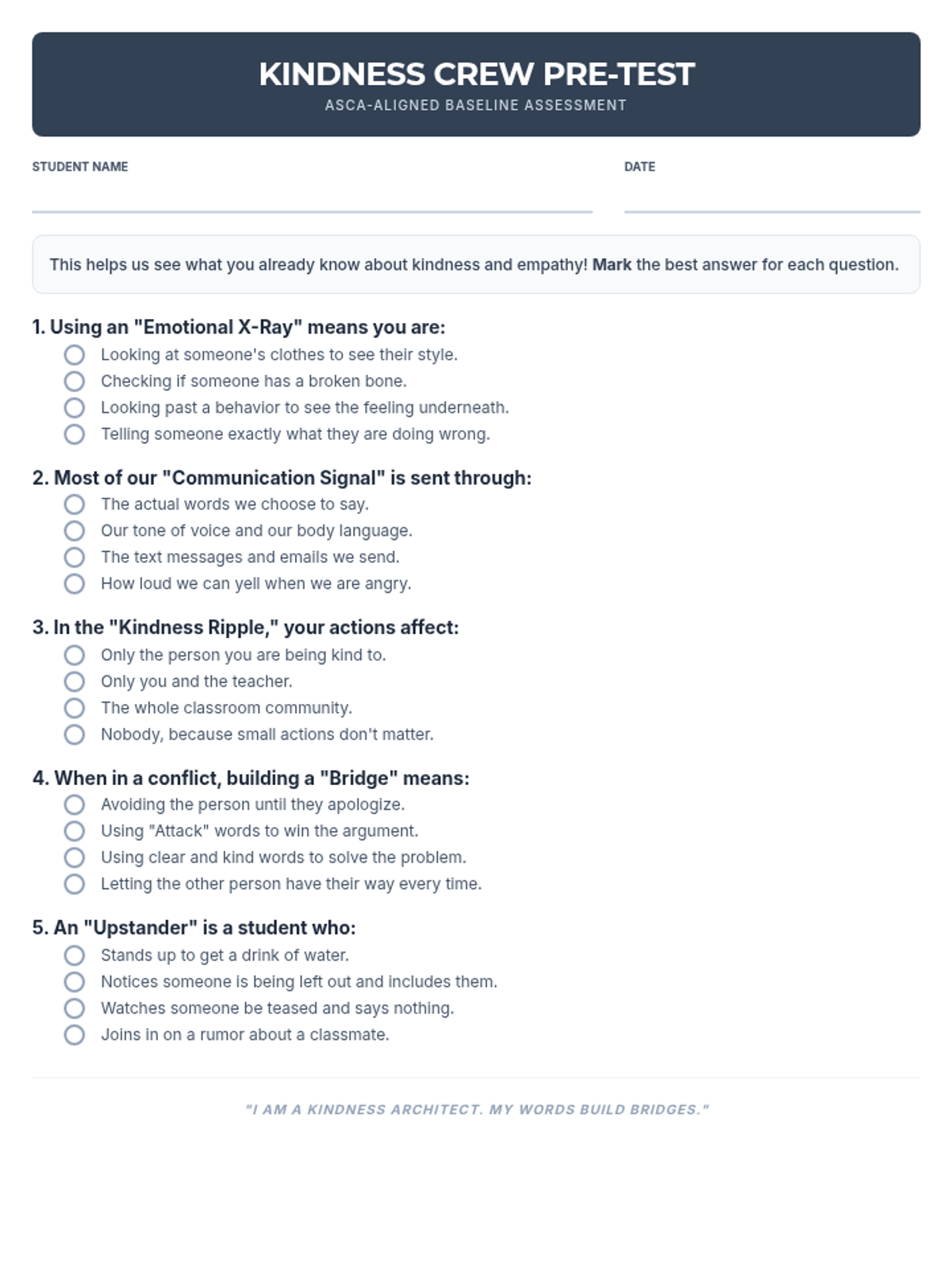
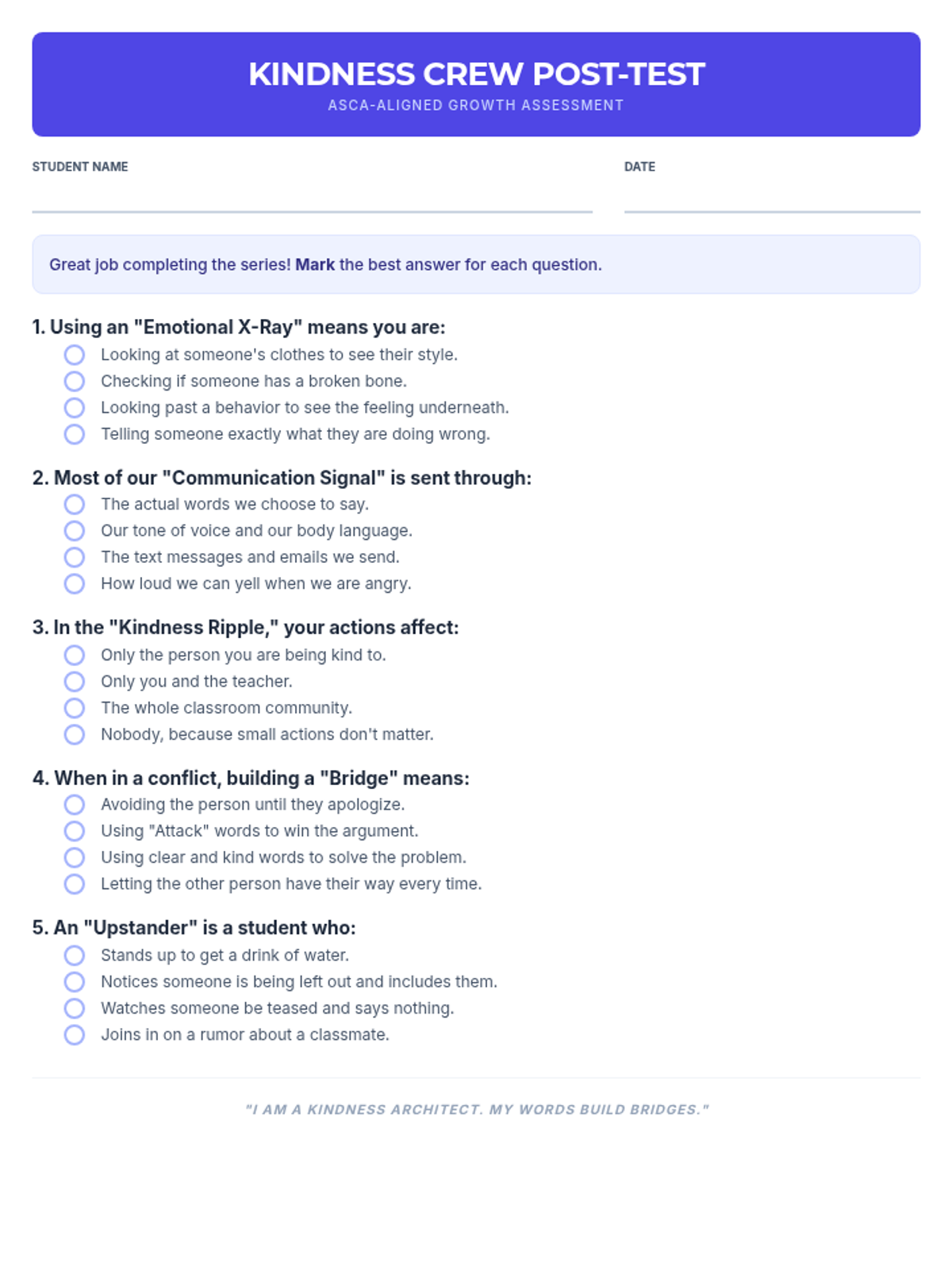
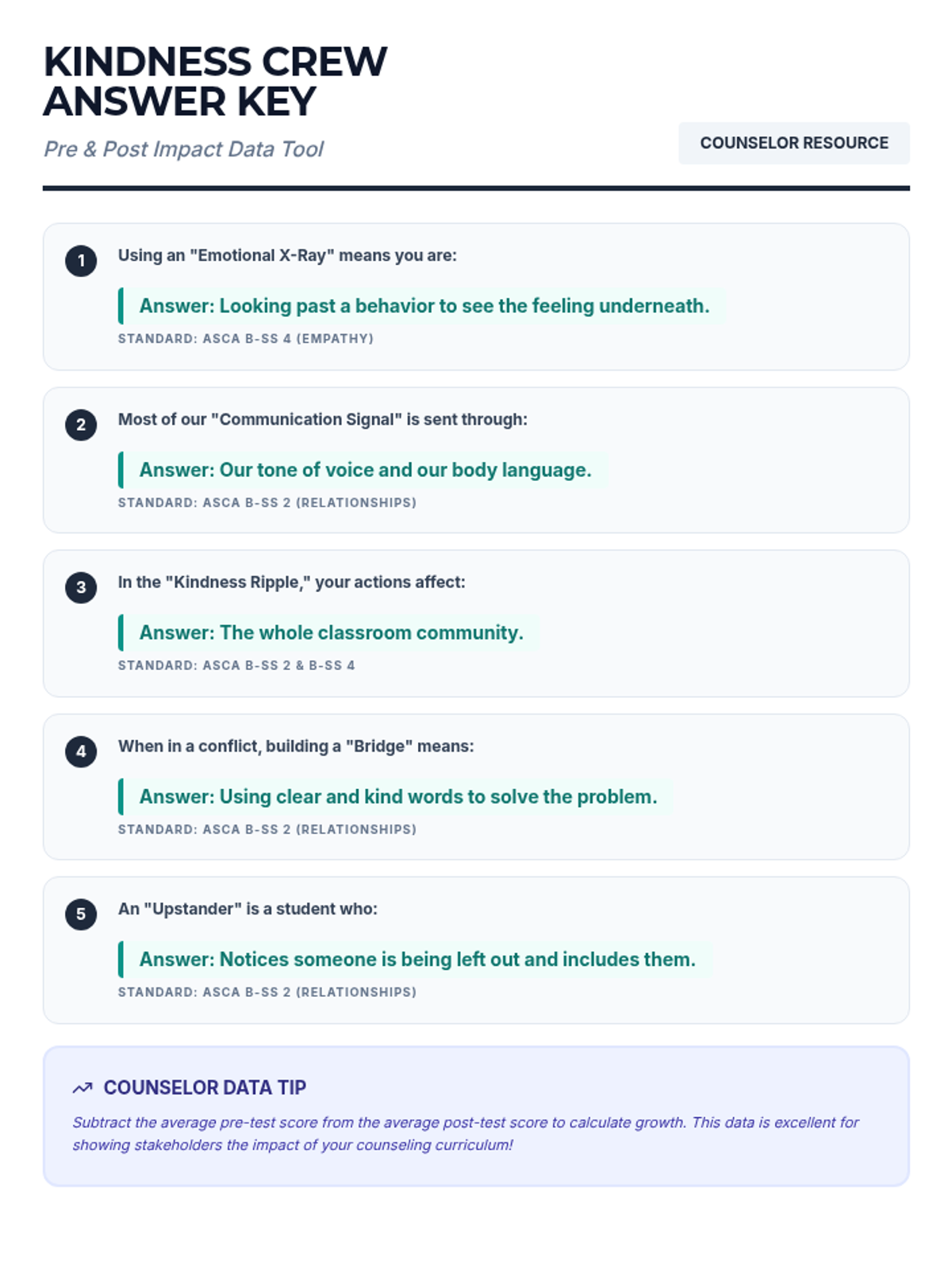
Assessment tools designed to measure student growth in empathy, communication, and relationship skills. Includes a 5-question pre-test and post-test aligned with ASCA standards to track program impact.
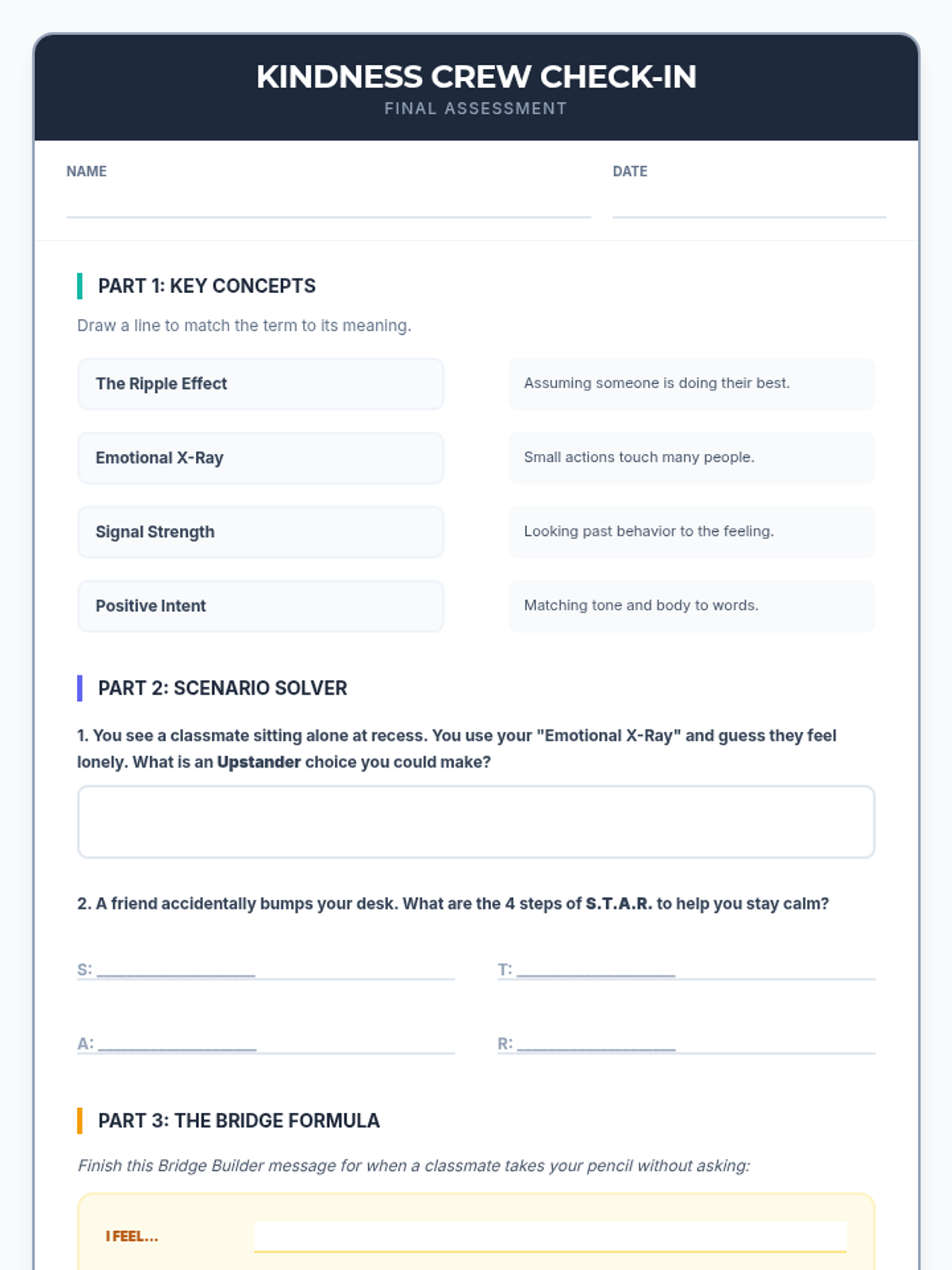
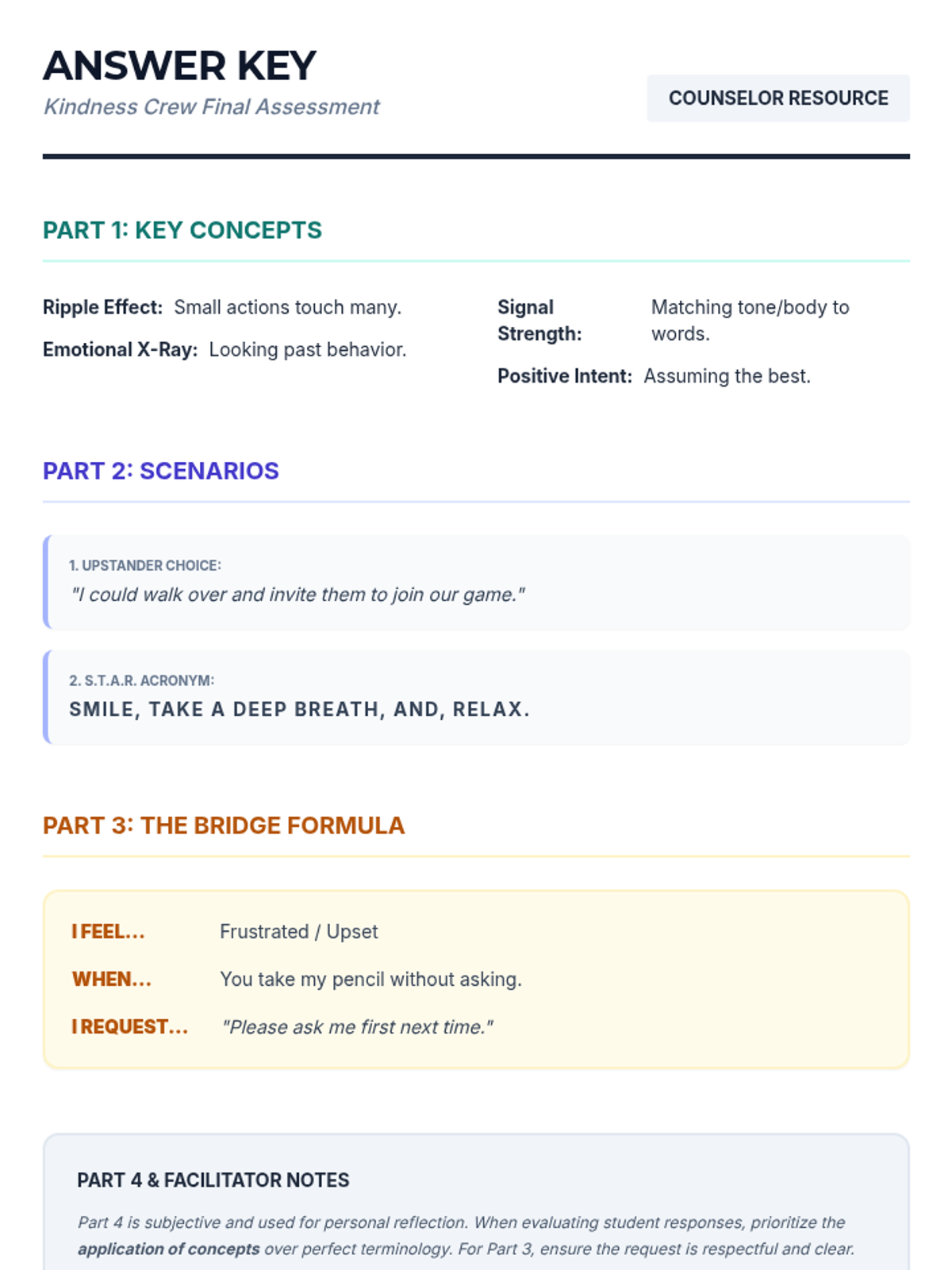
A final review and celebration session where students complete a comprehensive assessment of the 6-week Kindness Crew series. Focuses on reinforcing key terminology and reflecting on personal growth.
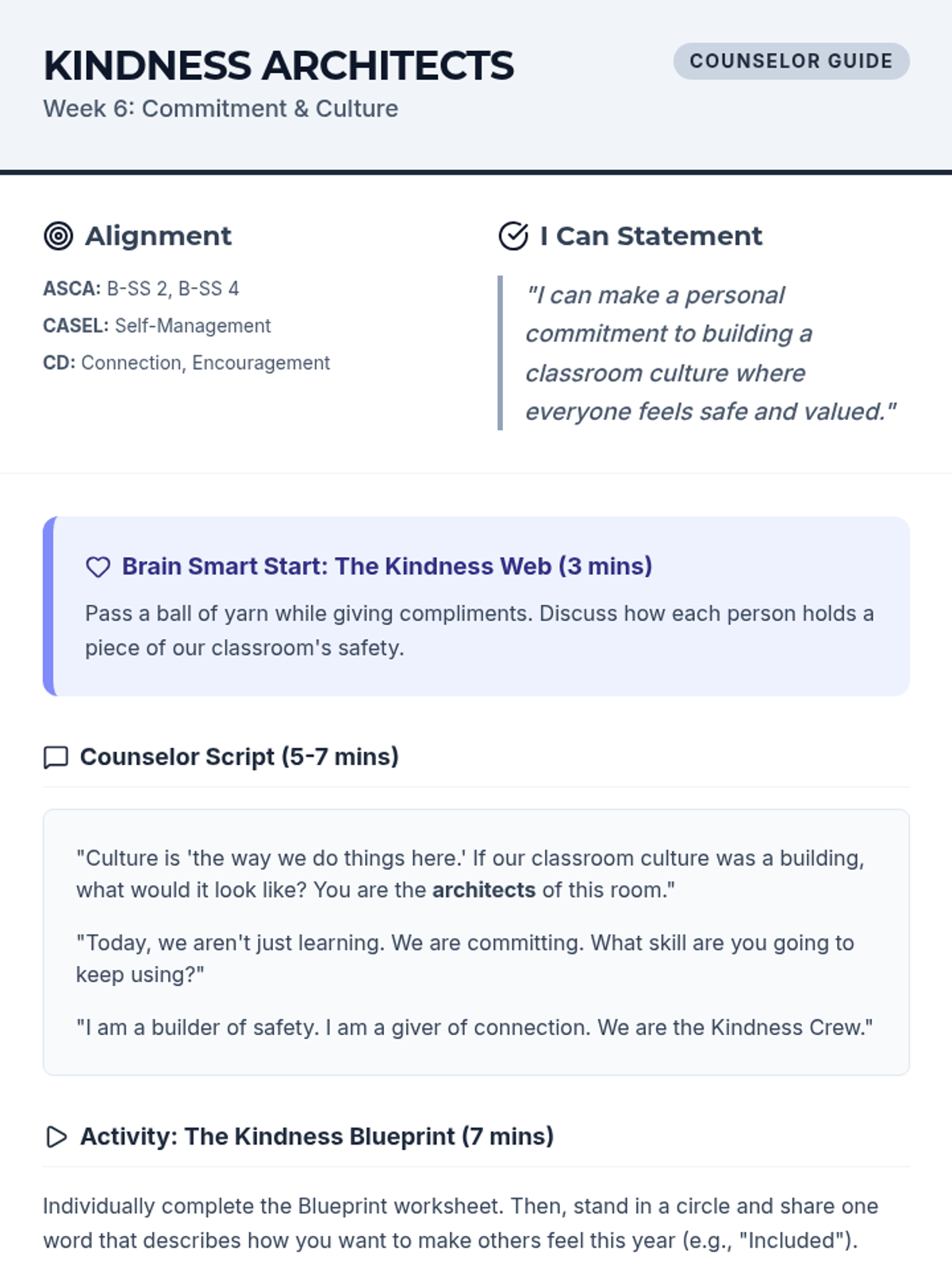
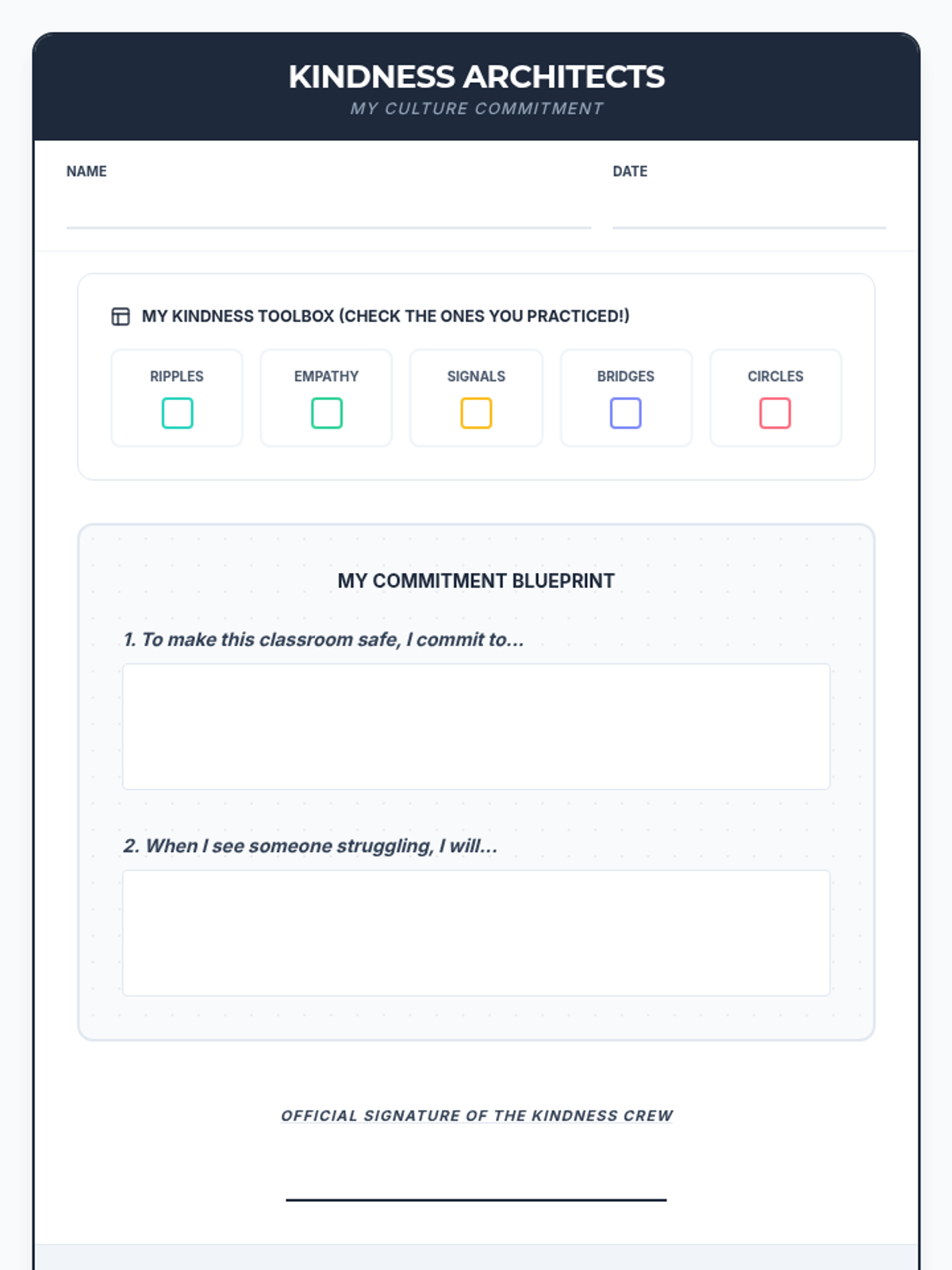
Synthesizes the previous five weeks into a personal commitment and a shared classroom vision. Students design a 'Culture of Kindness' blueprint and make a formal pledge to their community.
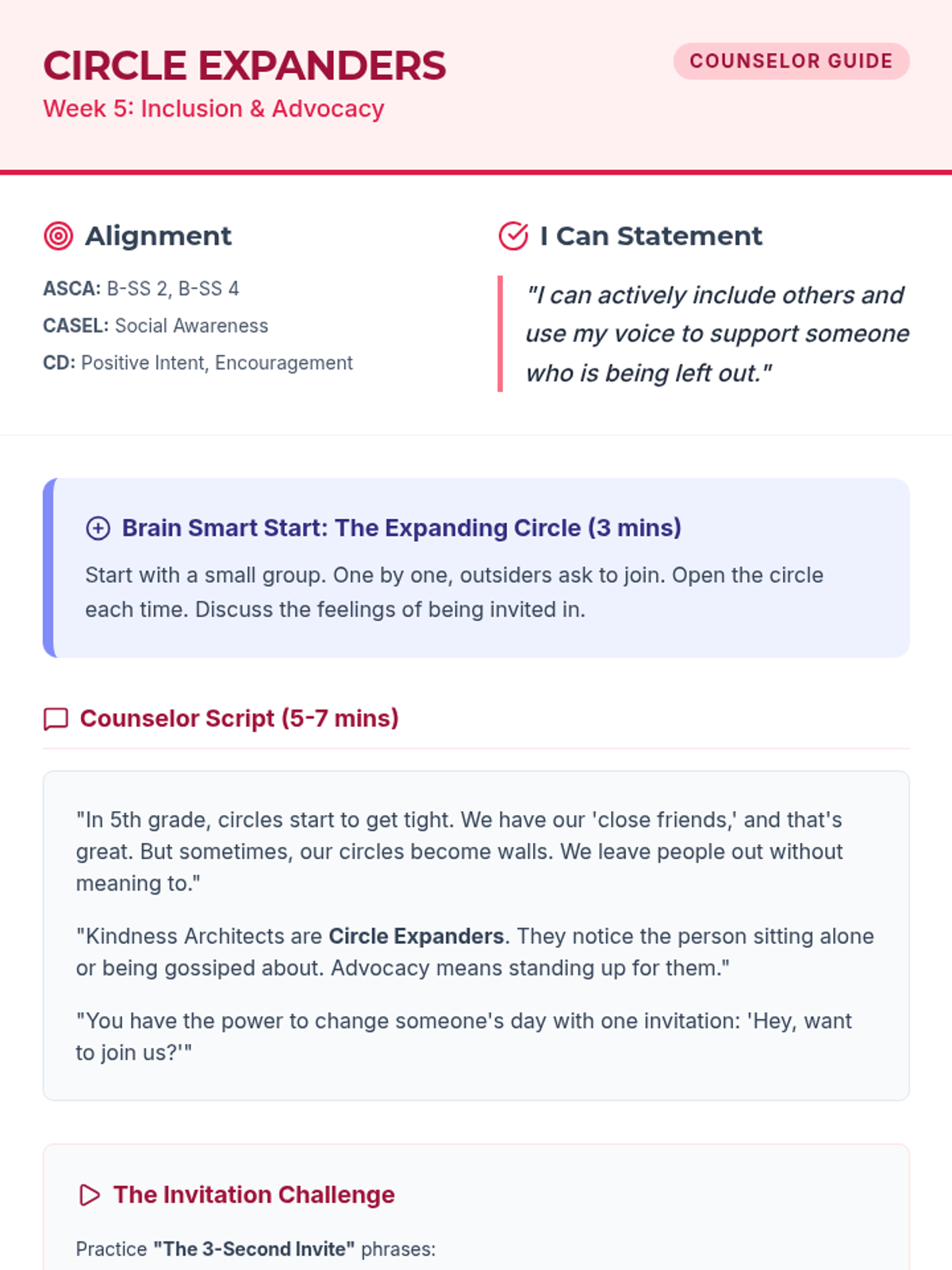
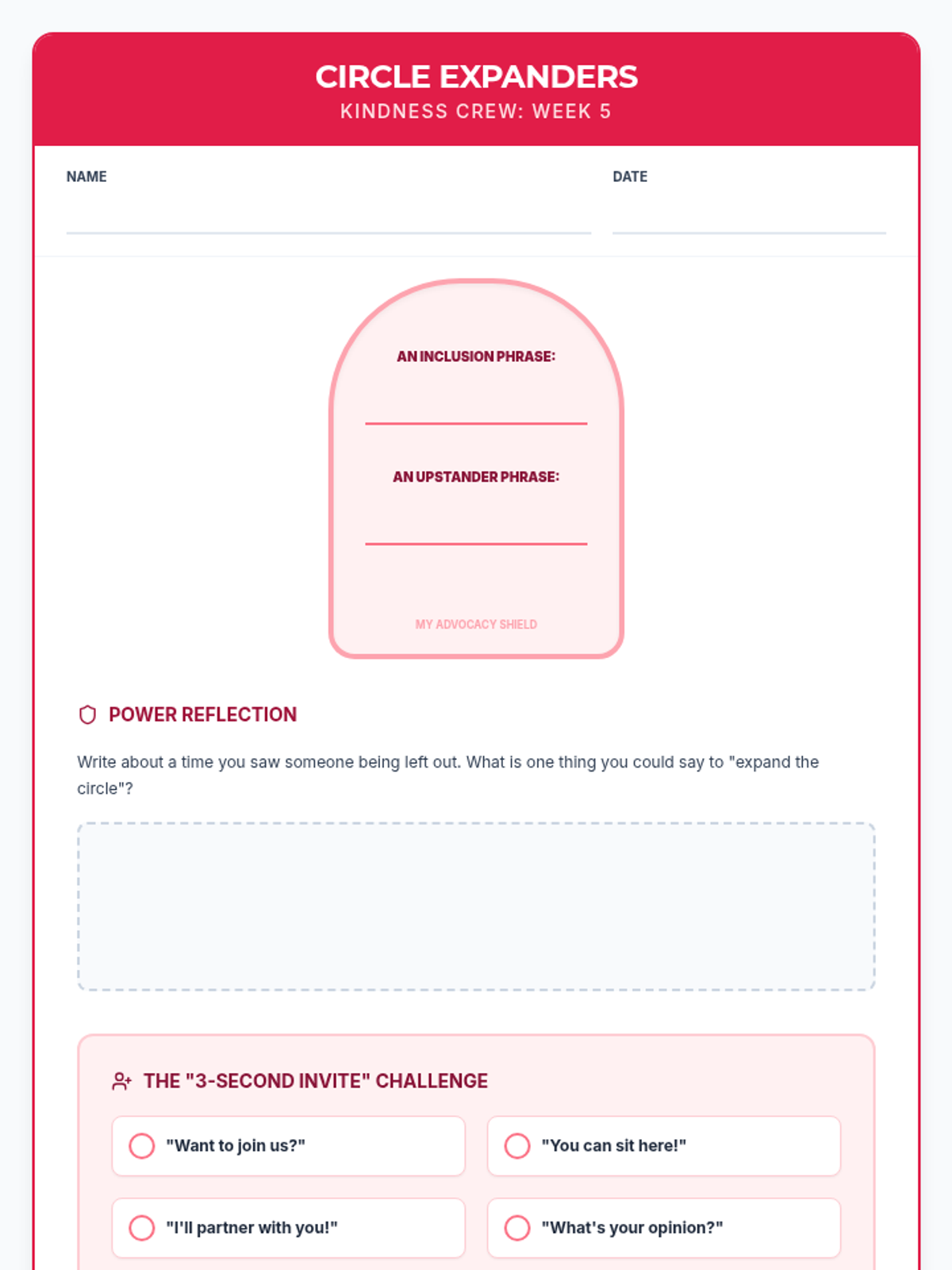
Moves from interpersonal kindness to community advocacy and inclusion. Students learn the difference between standing by and standing up, practicing ways to expand their social circles and support others.
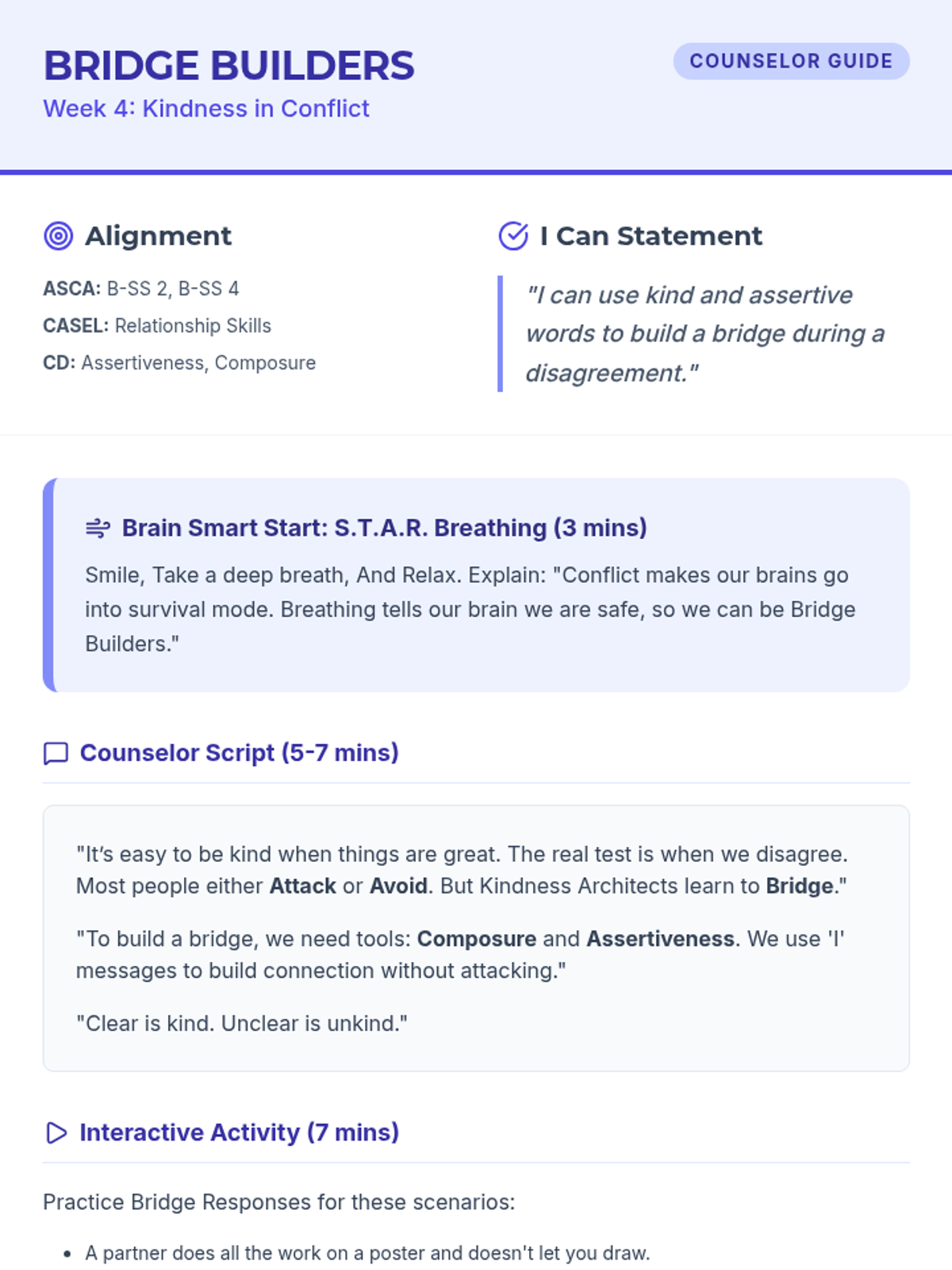
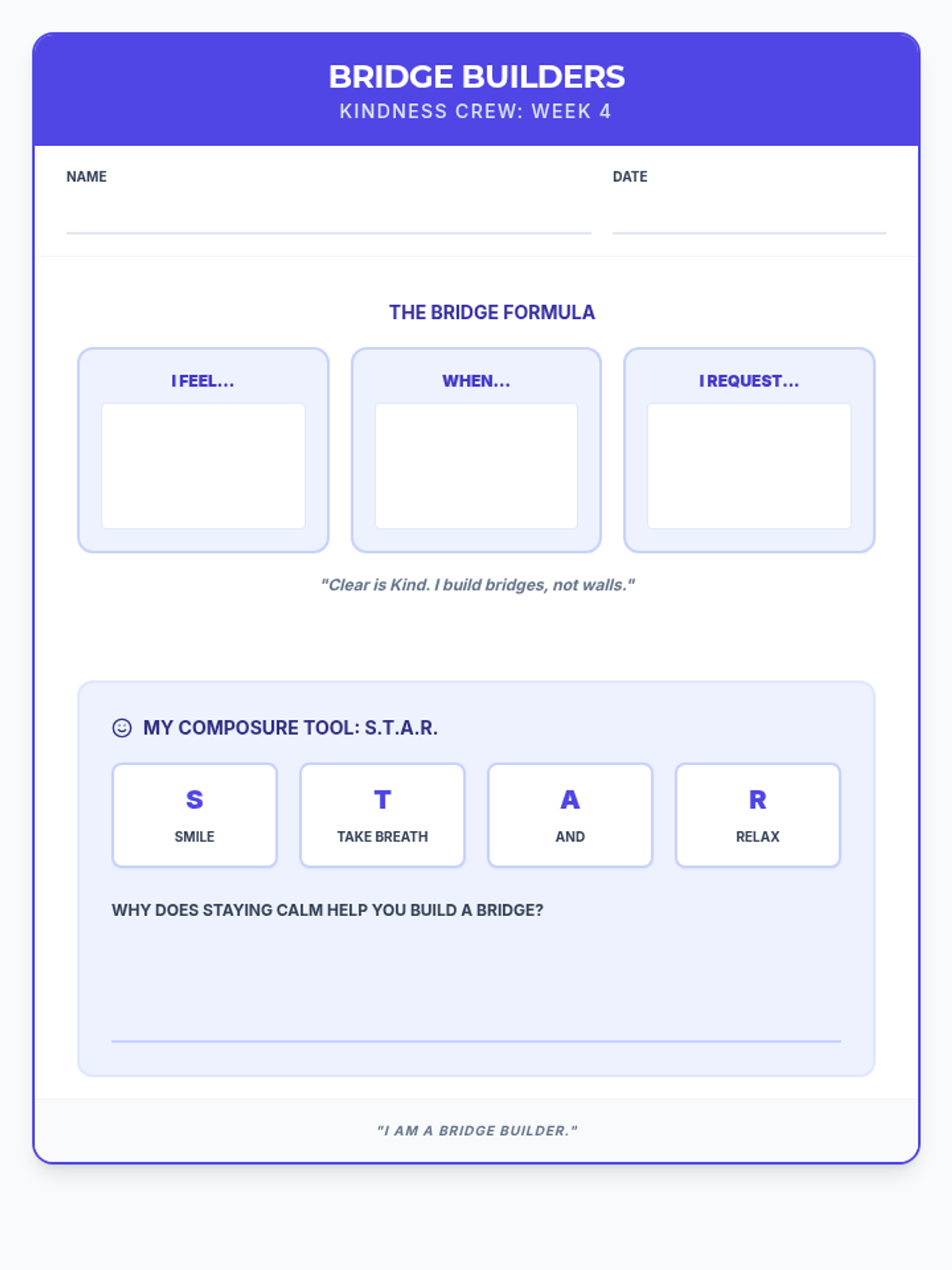
Teaches assertive communication and the principle of Positive Intent during disagreements. Students learn to use 'I' messages to bridge gaps and resolve conflicts without sacrificing kindness.
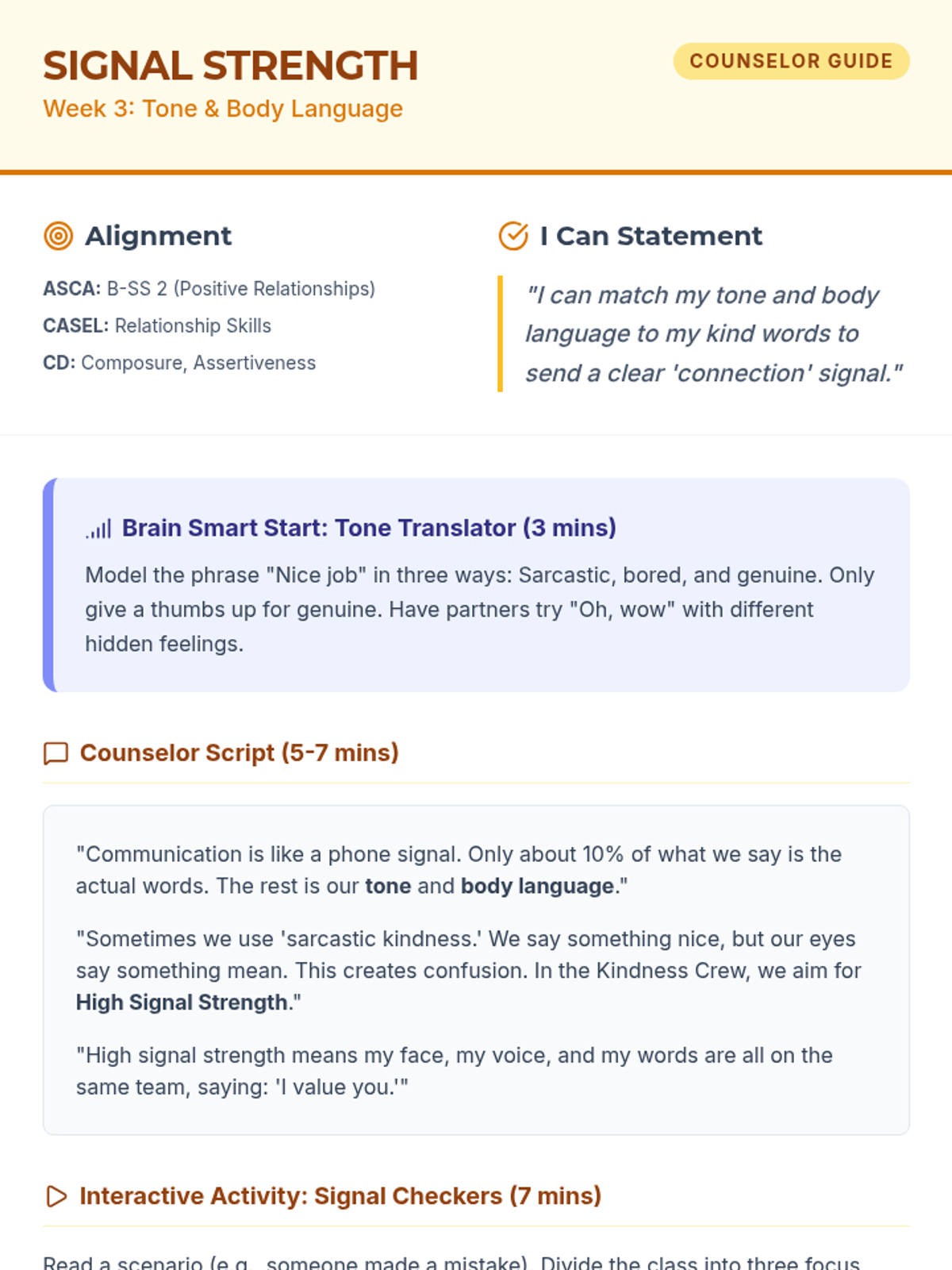
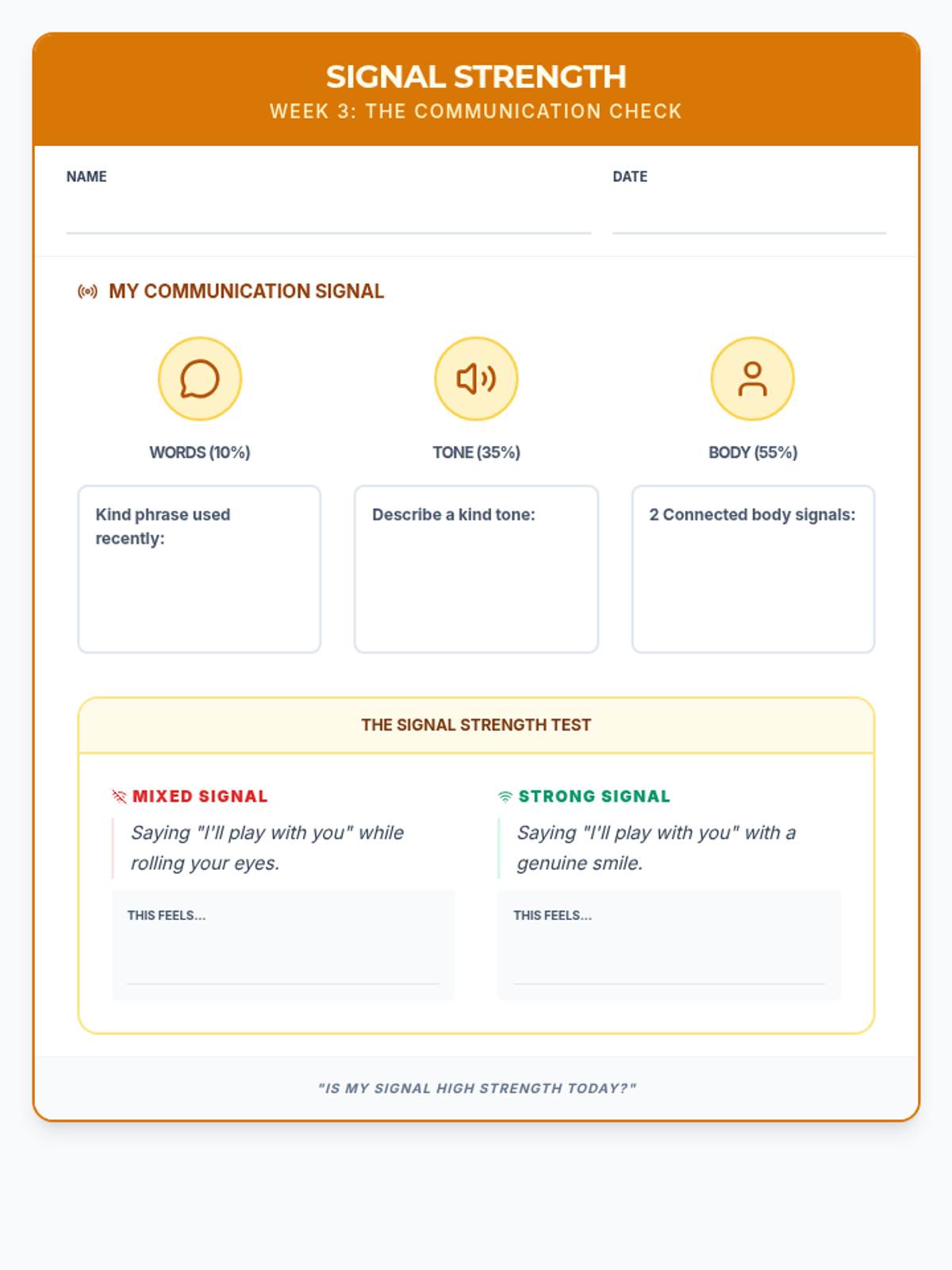
Explores the nuances of communication, including tone of voice and body language. Students learn that 'how' we say something is as important as 'what' we say in building connections.
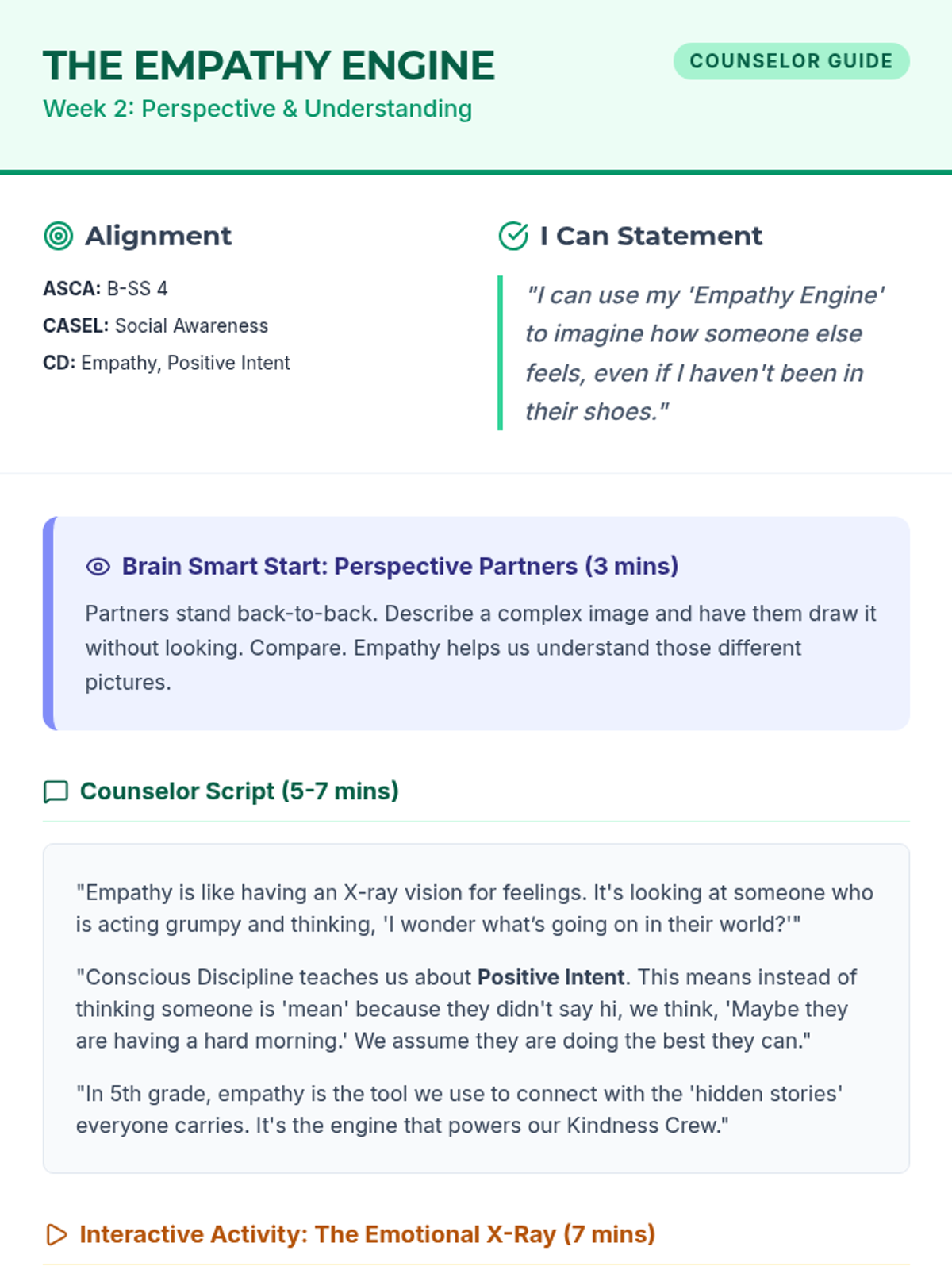
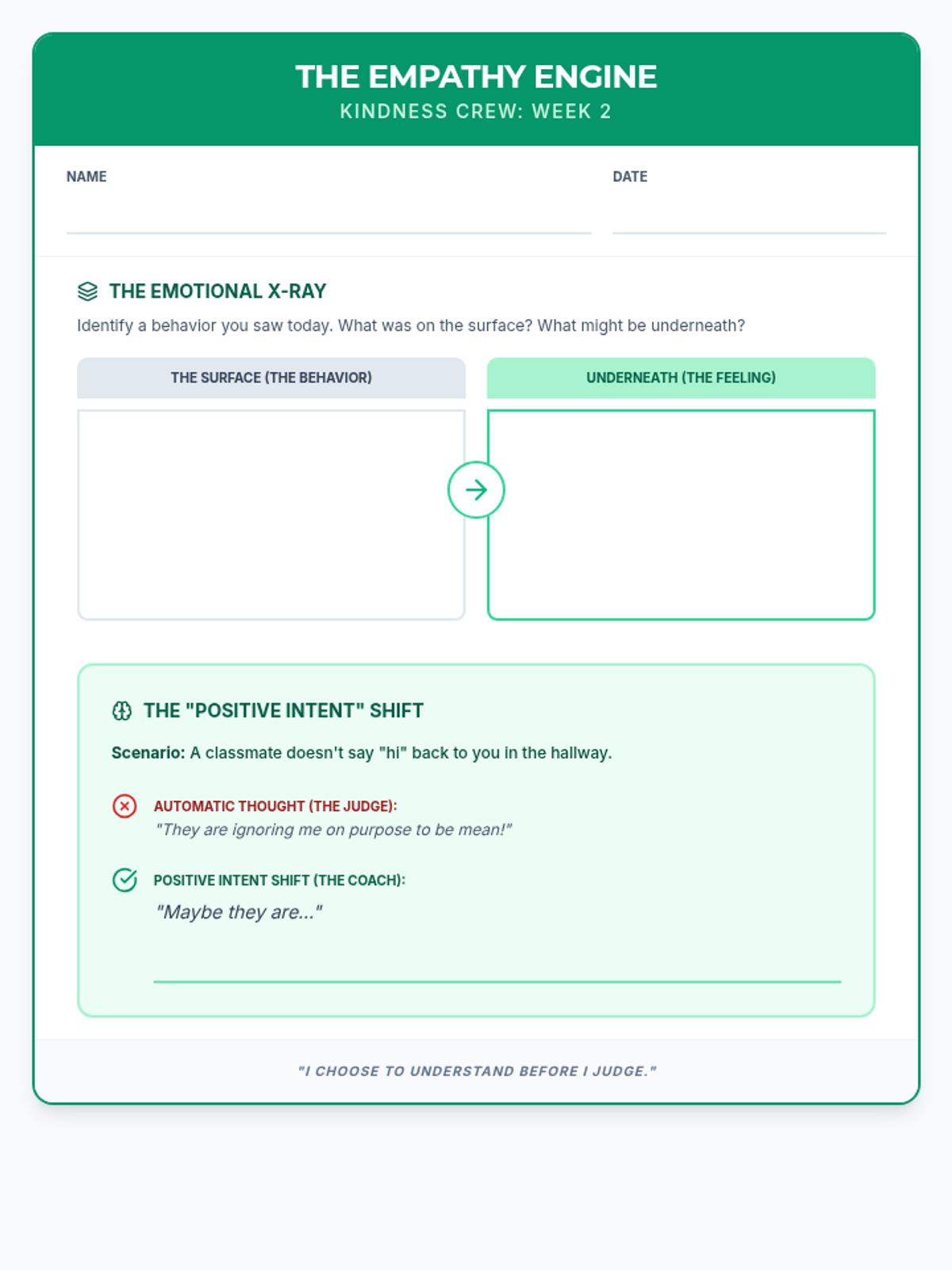
Focuses on empathy as the ability to see from another's perspective and understand their emotional state. Students practice the 'Emotional X-Ray' to look beneath surface behaviors to the feelings and needs underneath.
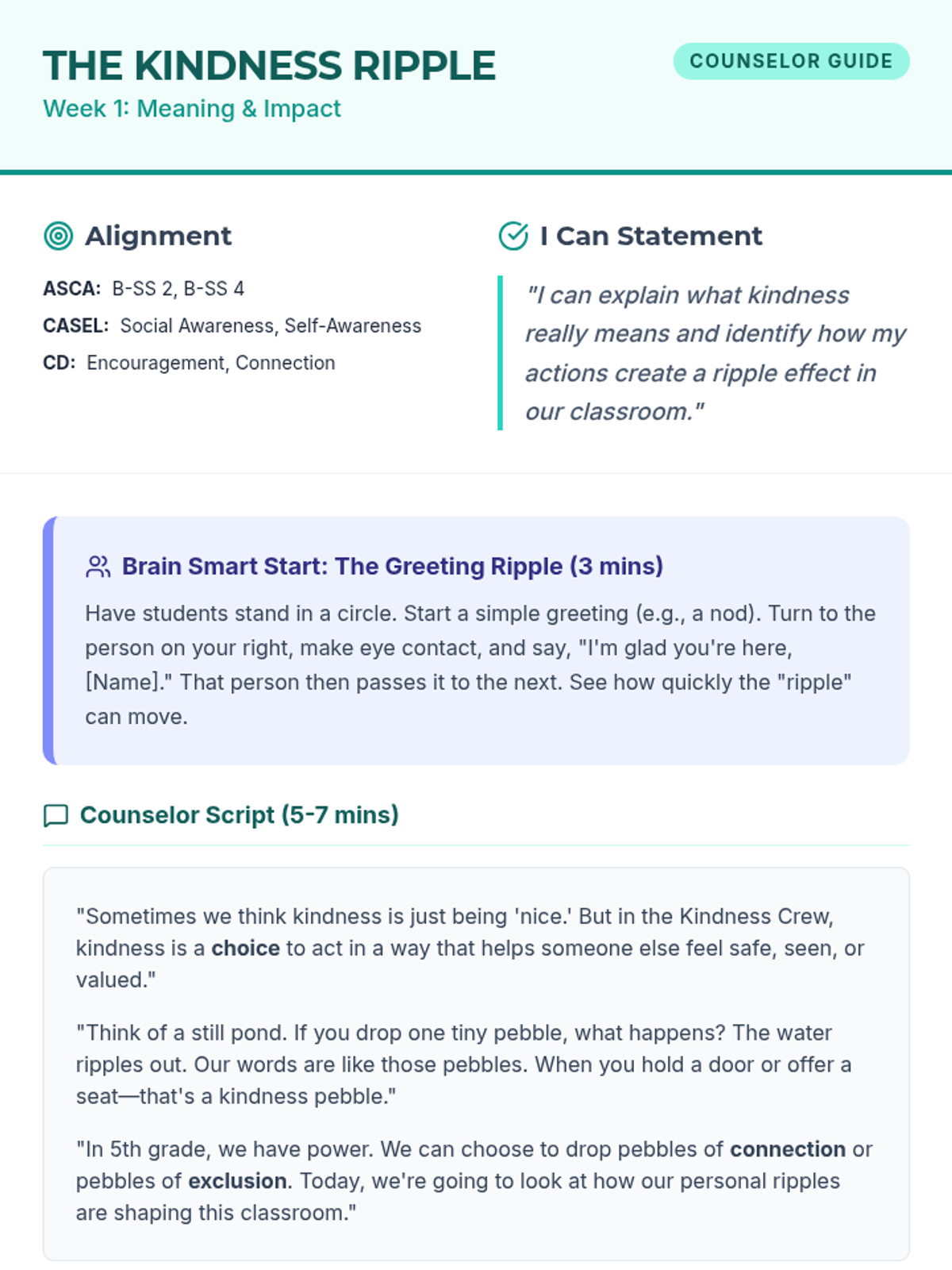
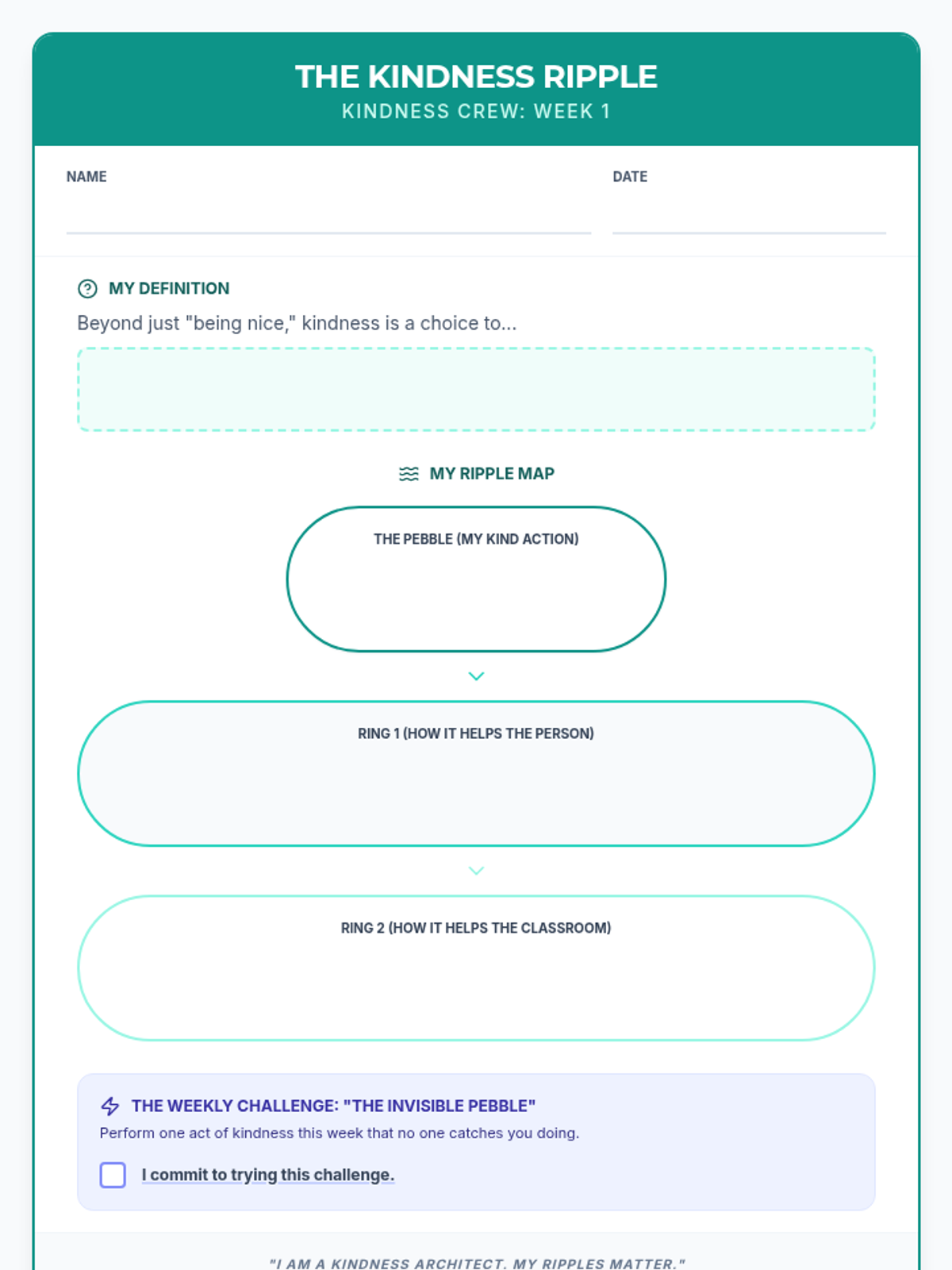
Introduces the concept of kindness as a deliberate choice and explores the 'Ripple Effect' of how small actions impact the wider community. Students define kindness beyond just 'being nice' and identify their role in the classroom social ecosystem.
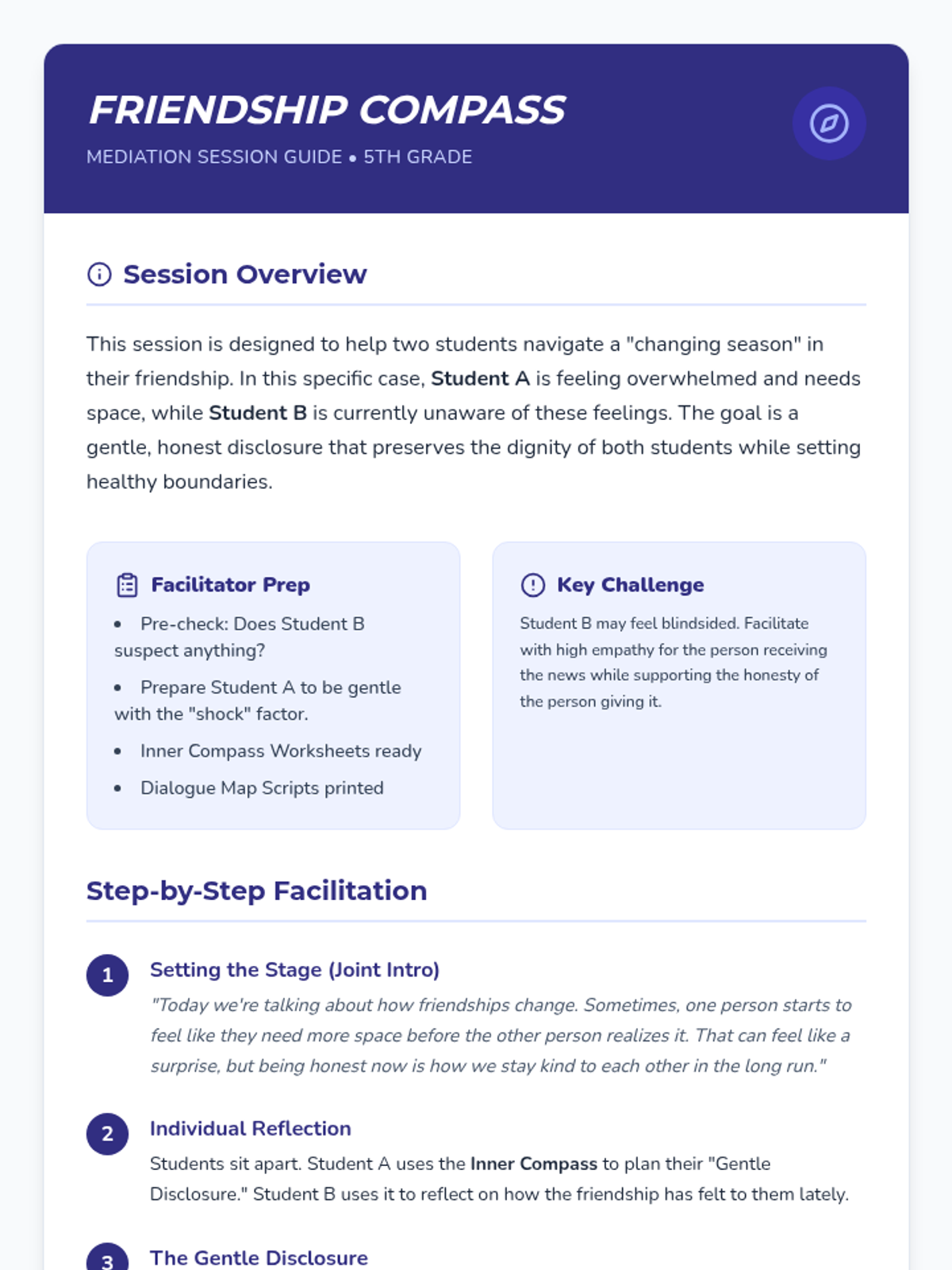
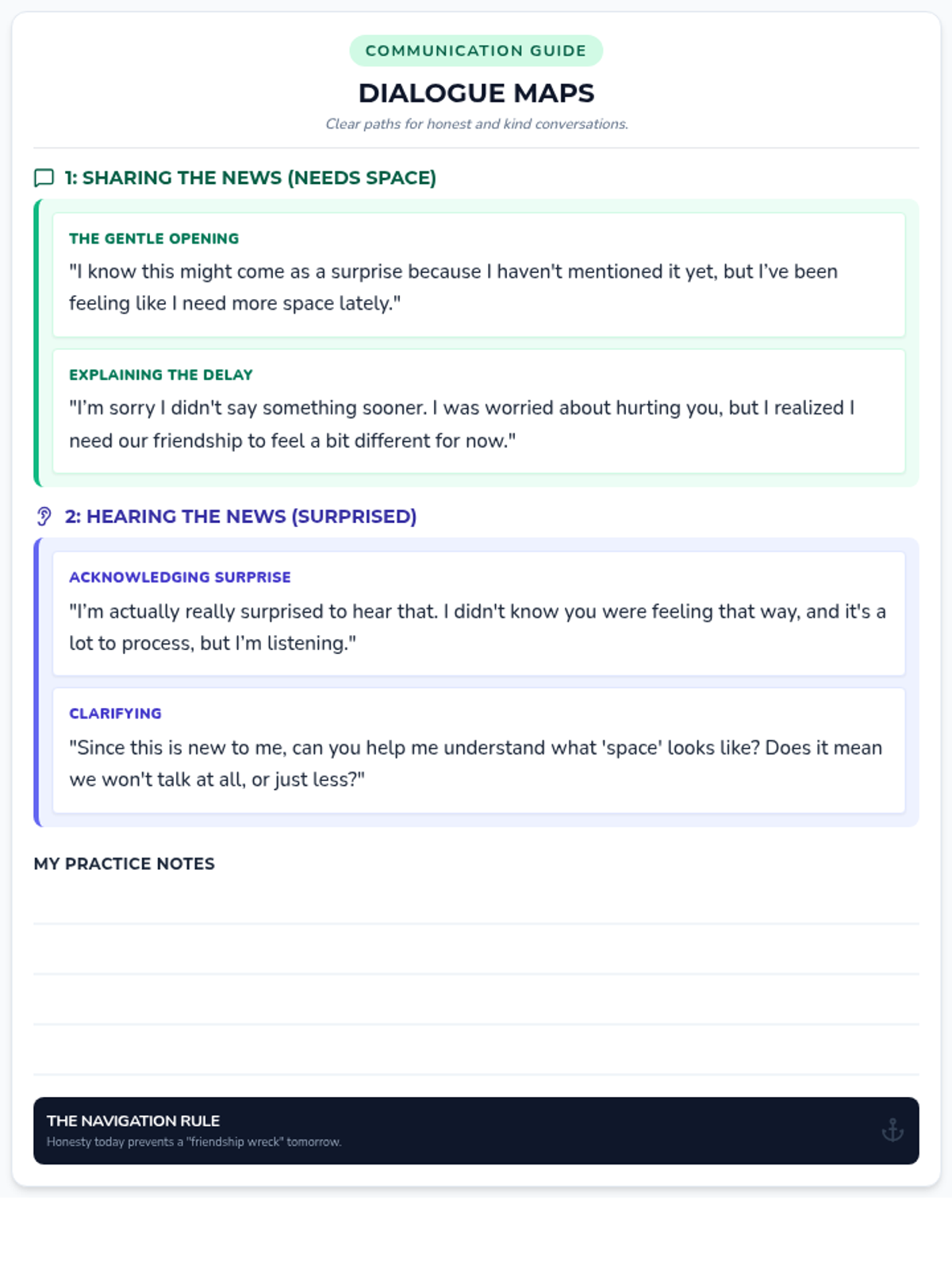
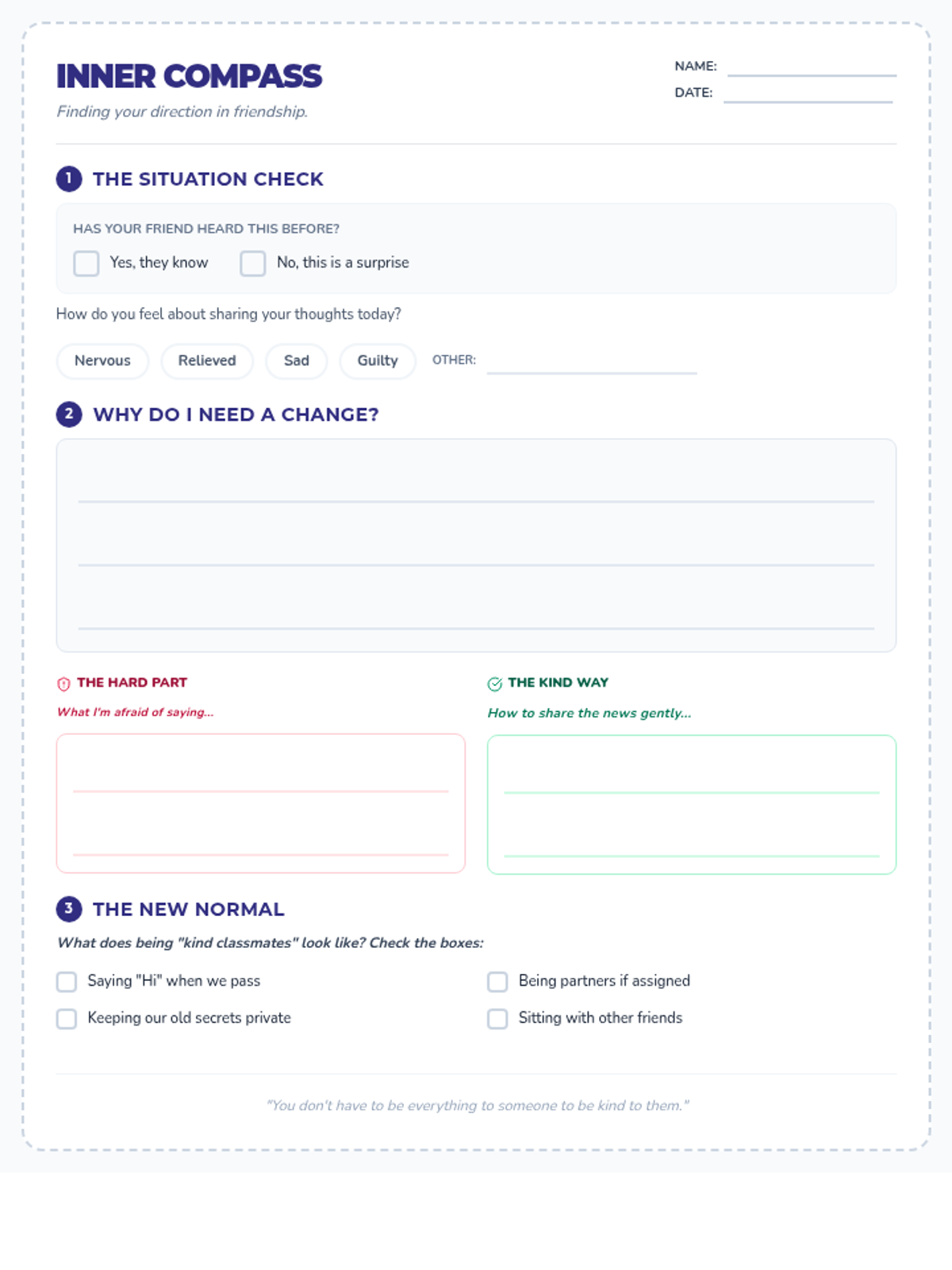
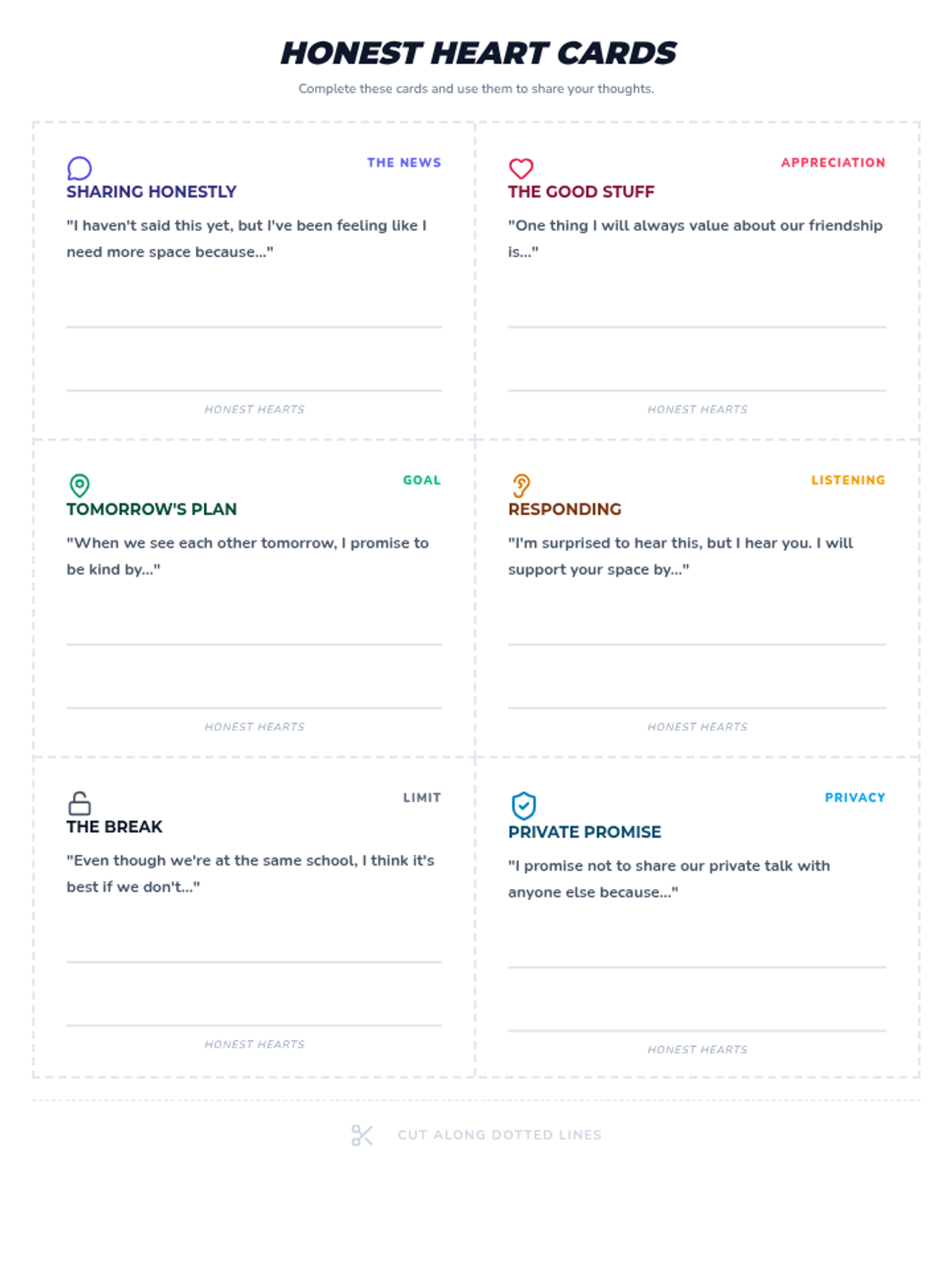
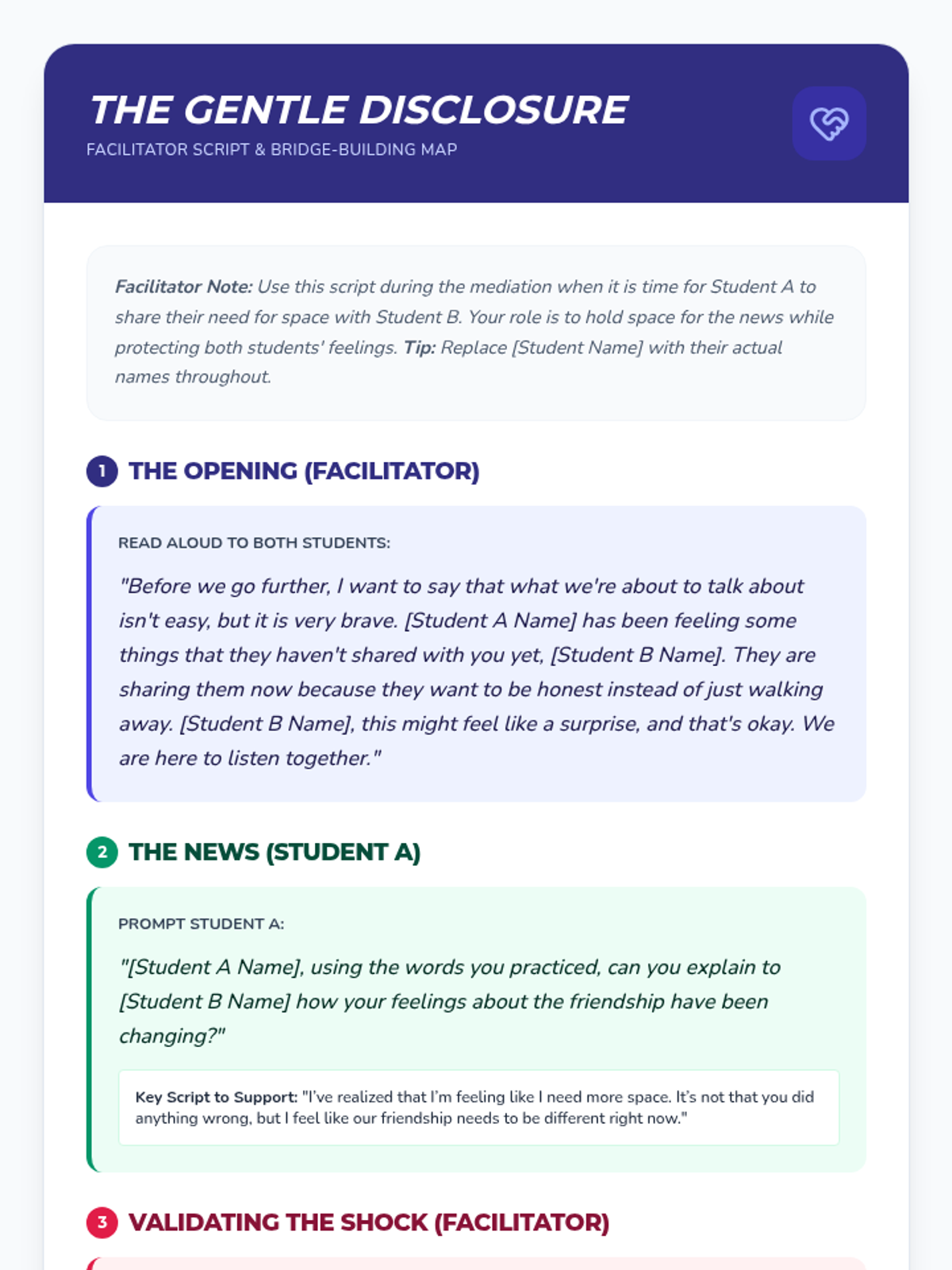
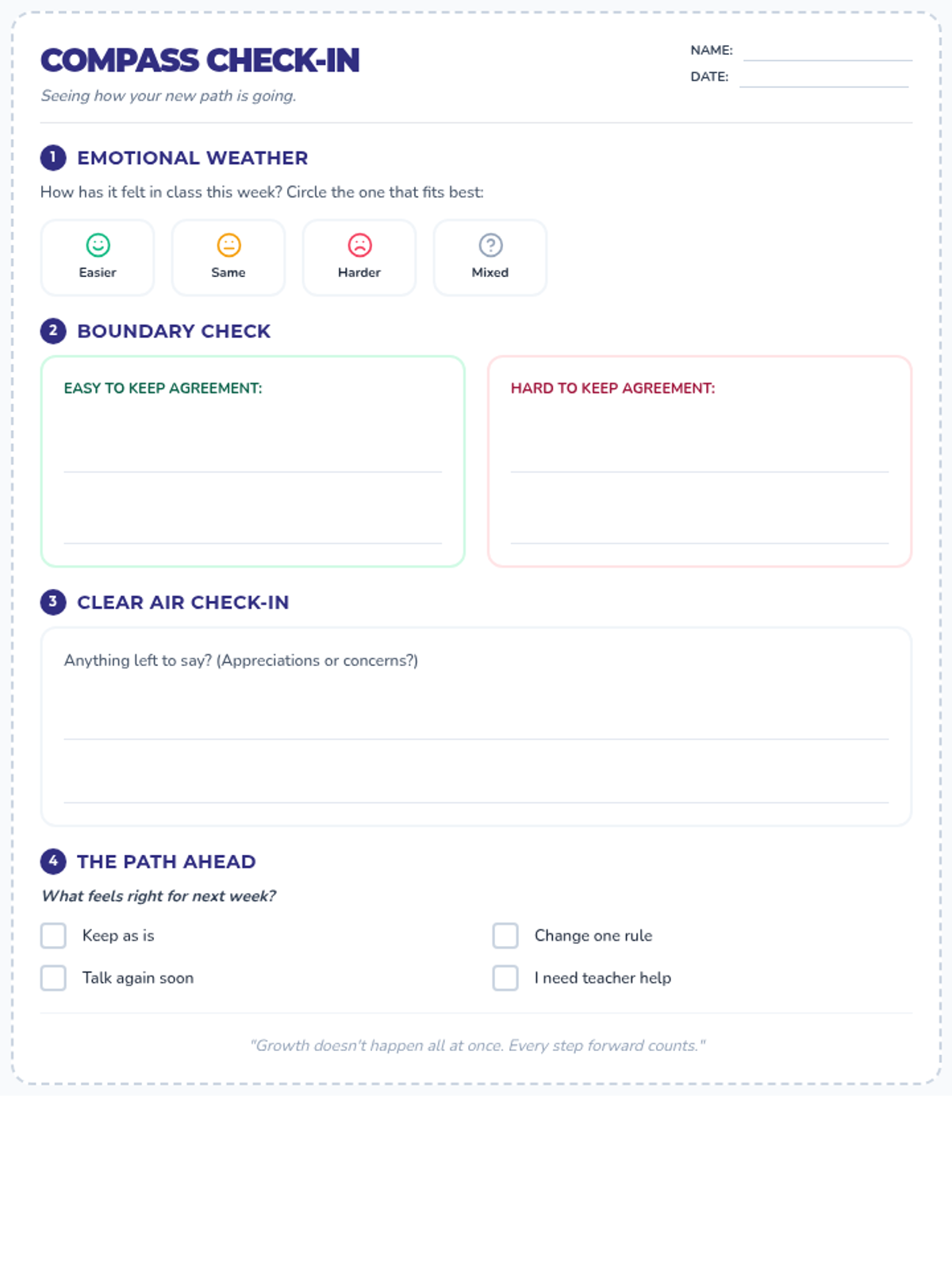
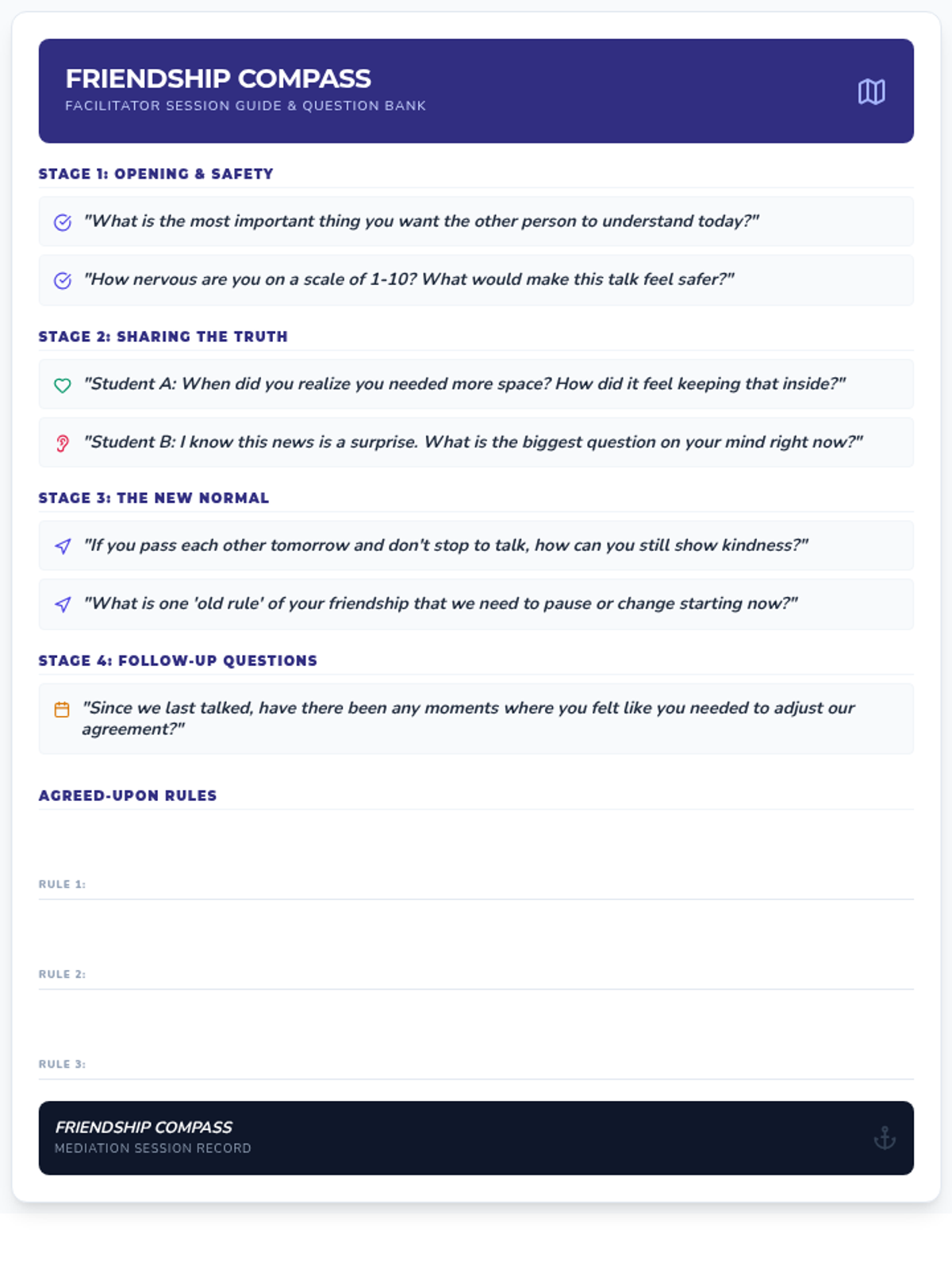
A supportive mediation lesson for 5th-grade students navigating changing friendships, focusing on setting boundaries with kindness and understanding that friendships can evolve.
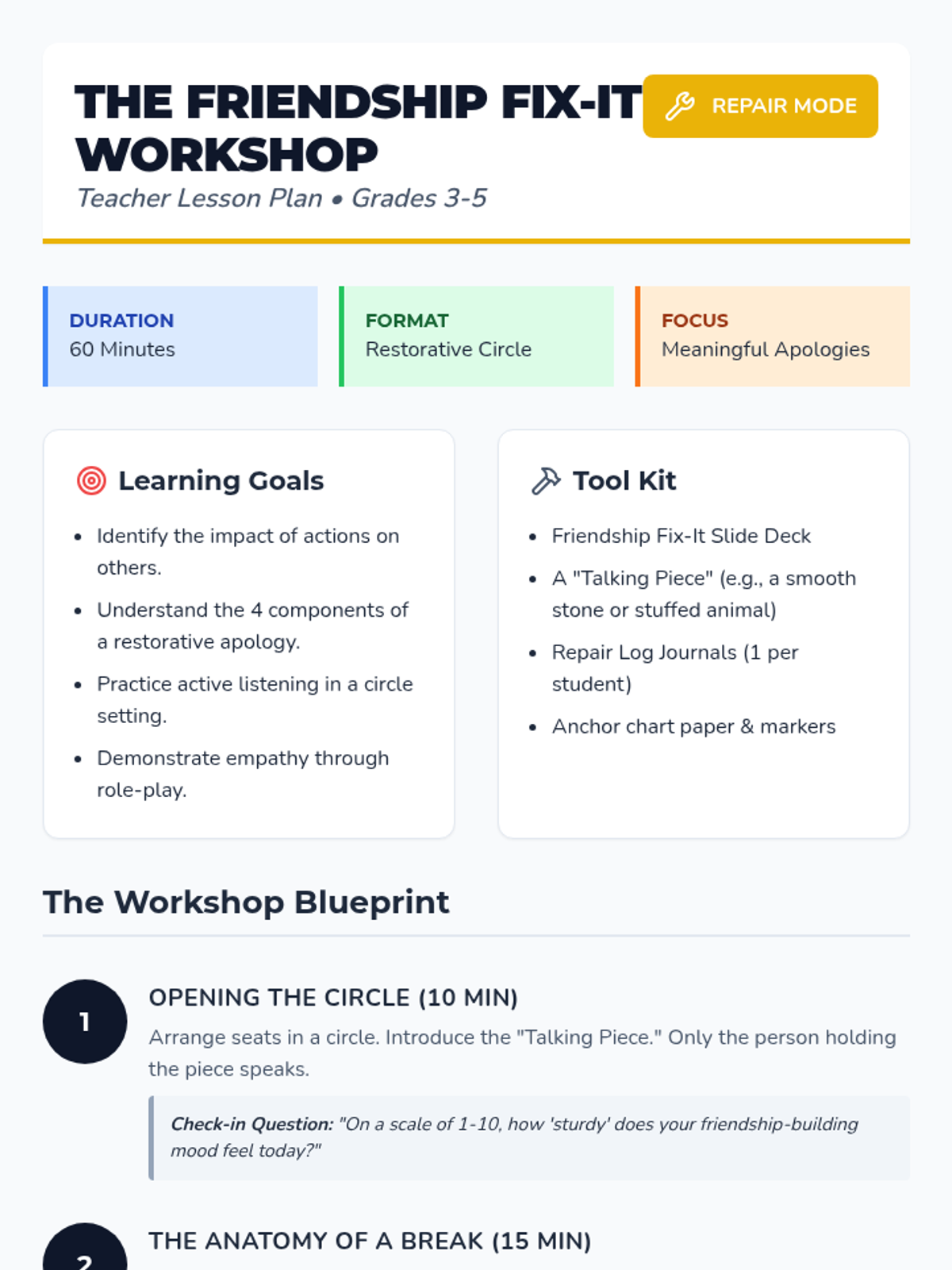
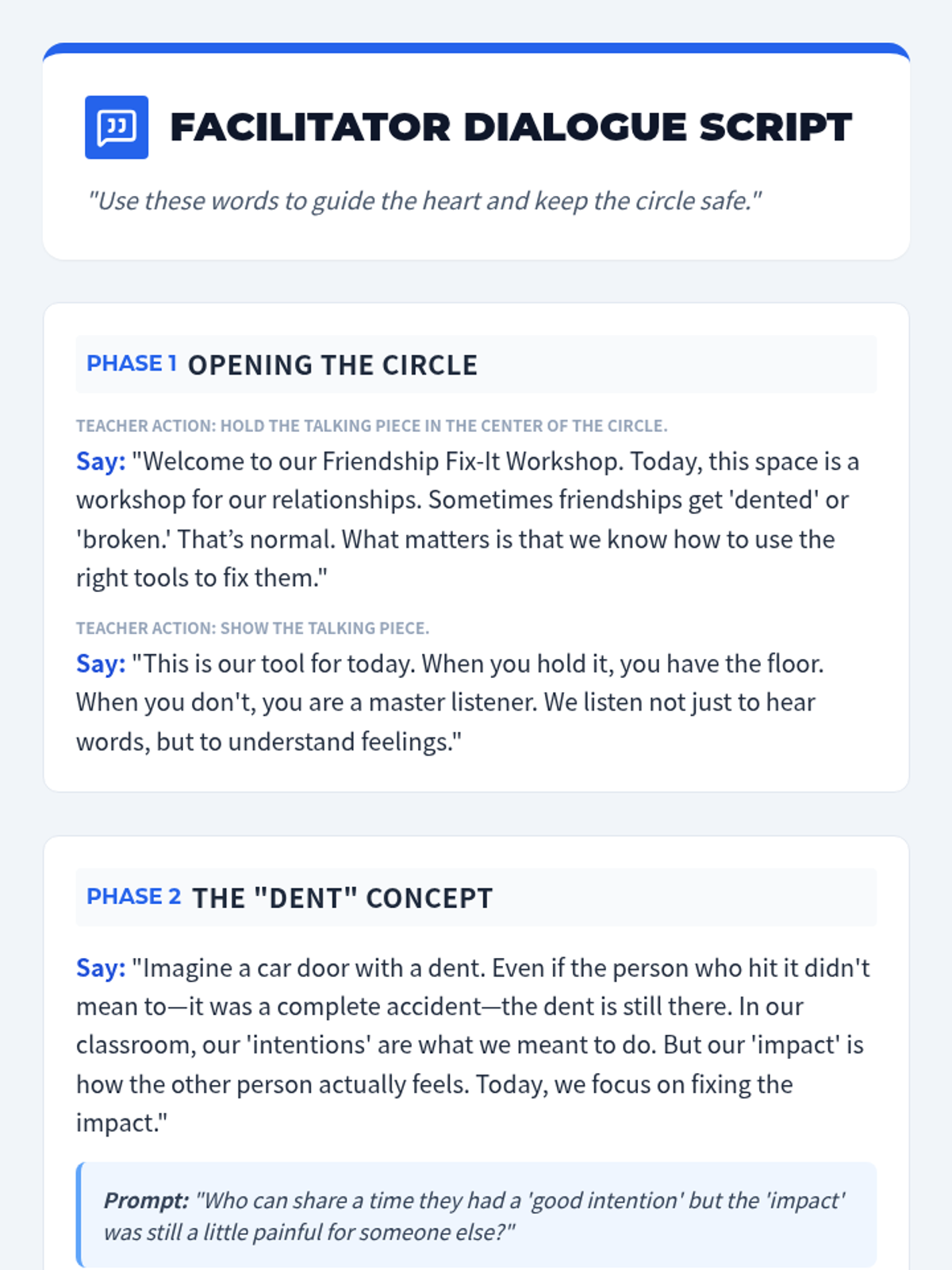
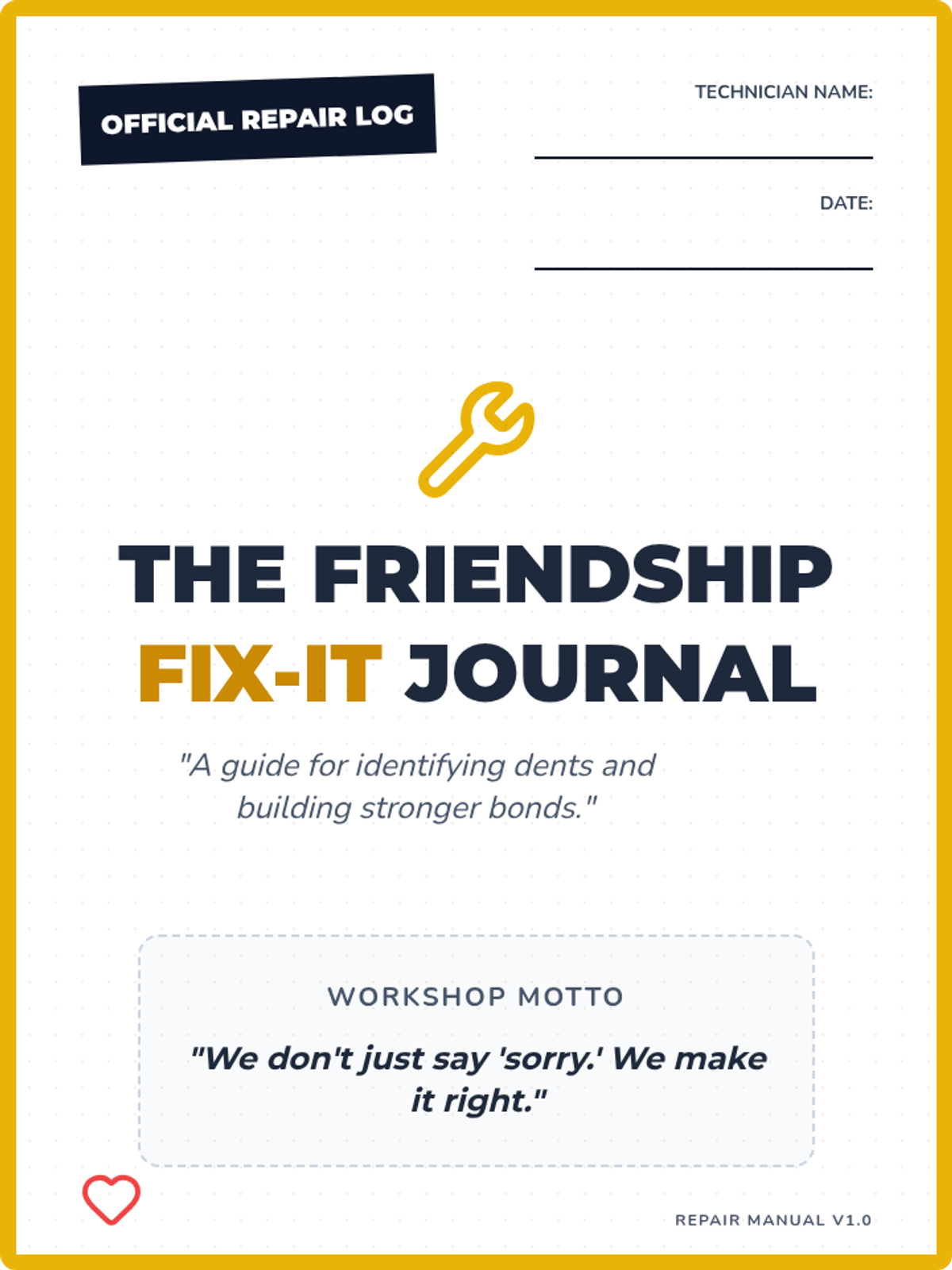
A restorative justice workshop for grades 3-5 focusing on conflict resolution through restorative circles and the art of the 4-part apology. Students learn to 'repair' relationships using practical social-emotional tools.