Students apply their understanding of tone and perspective by performing short scripts with assigned 'tone cards', using voice and body language to convey specific feelings.
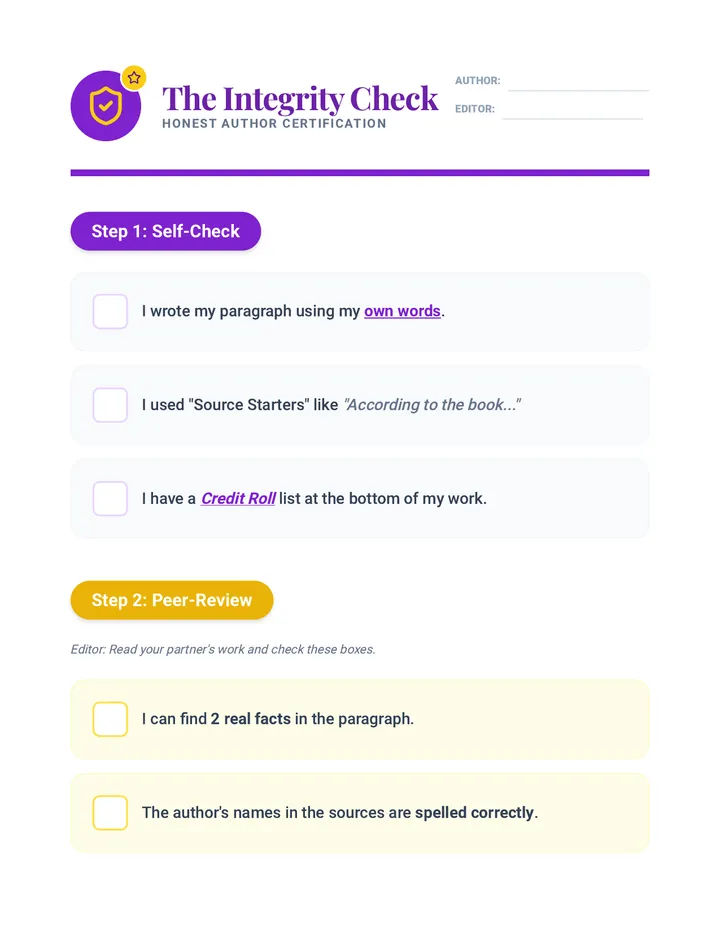
In the final phase, students use an 'Integrity Checklist' to peer-review their work for originality, accuracy, and proper sourcing.
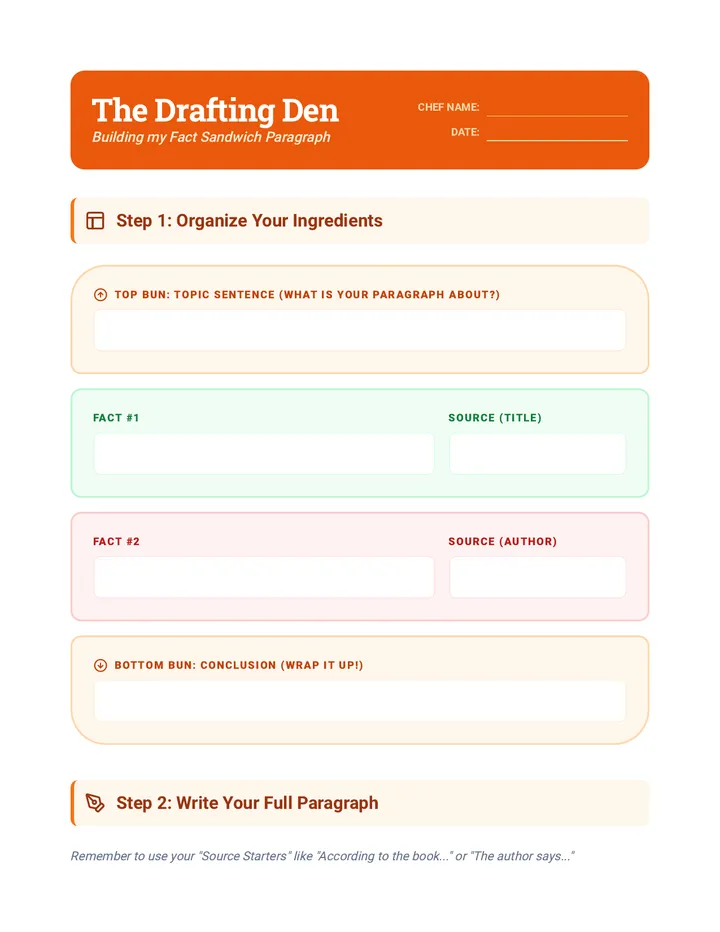
Students combine their research notes into a logical paragraph, using a 'Fact Sandwich' structure to organize their thoughts.
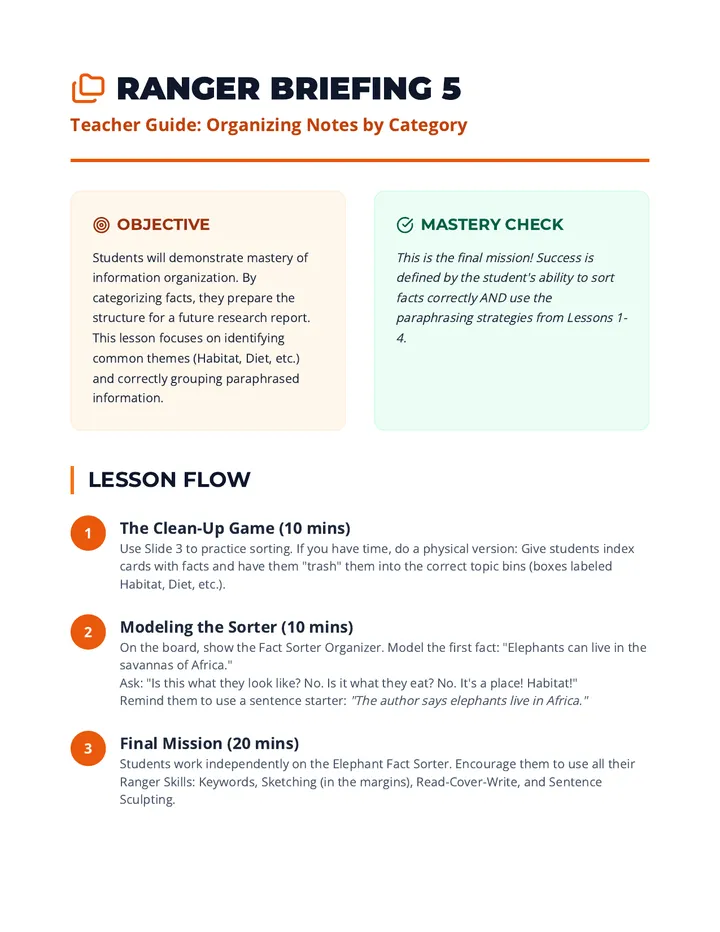
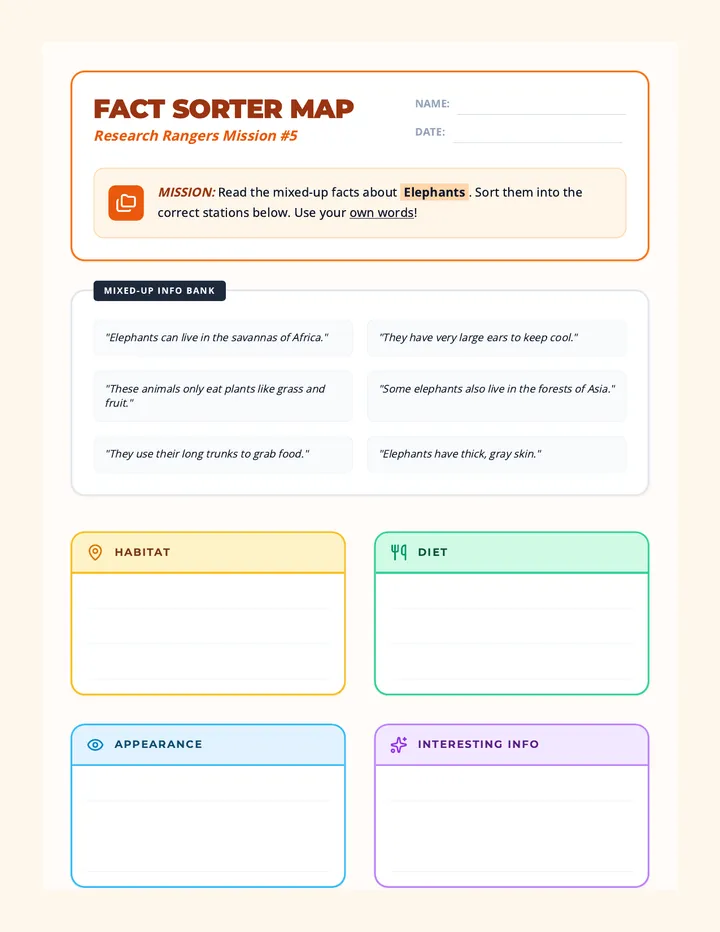
Students organize loose facts into logical categories using a graphic organizer. They learn to group information by topic to prepare for structured writing.
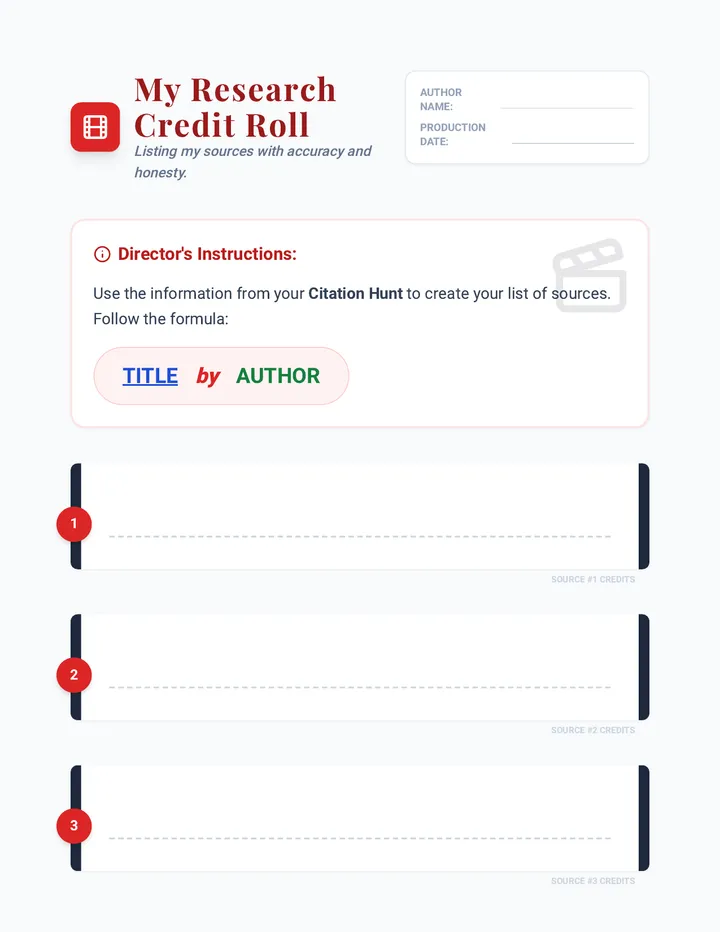
Students practice the mechanics of creating a simplified bibliography using the 'Title by Author' format to credit their sources.
Using keywords and visual notes, students use sentence frames to construct complete sentences in their own voice. They 'translate' complex text into simpler language.
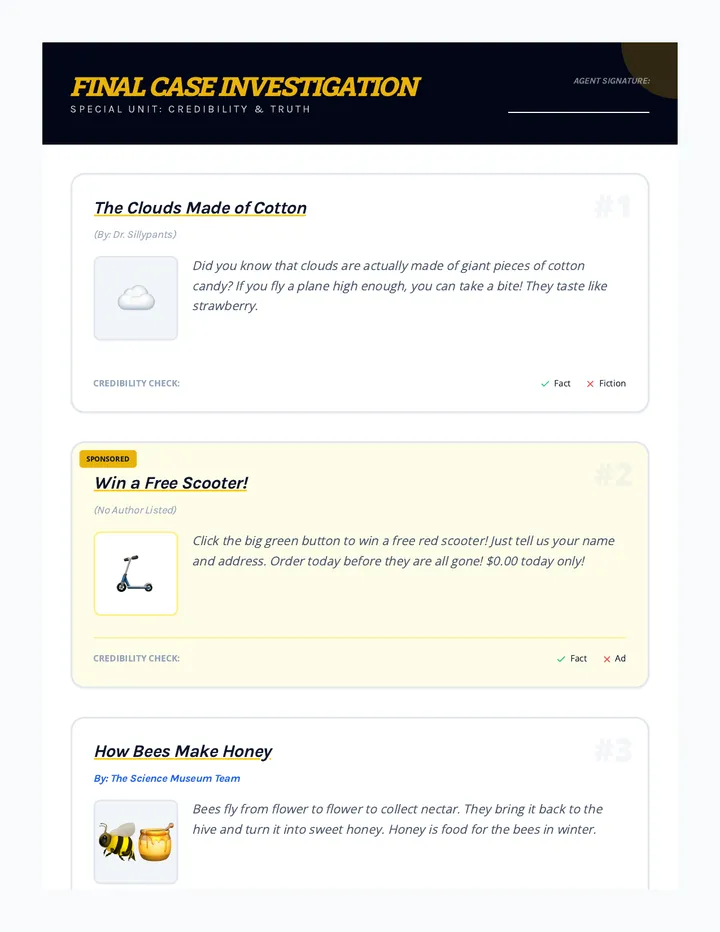
Students use a credibility checklist to investigate three suspect articles and determine which are true, earning their detective badges.
A hands-on exploration where students learn to identify and record key citation details like Title, Author, and Date from books and websites.
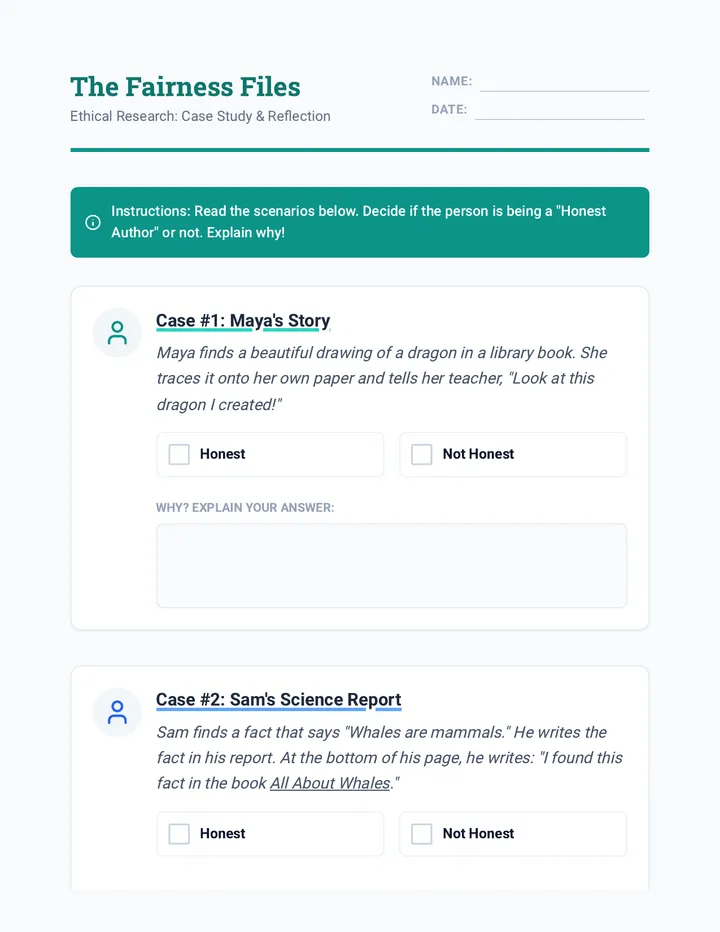
Students explore the concept of intellectual property through analogies of ownership and fairness, discussing the importance of acknowledging others' work.
Students learn the 'Read-Cover-Write' strategy to prevent plagiarism. They practice reading a sentence, covering it, and writing what they remember in their own words.
Students practice the 'Rule of Two' by finding the same fact in two different sources to verify its accuracy.
Students learn to differentiate between informational content and advertisements on websites, identifying visual markers that signal an ad.
Students take notes using only drawings and symbols to bypass language barriers and prevent copying. They practice oral retelling by explaining their sketches to a partner.
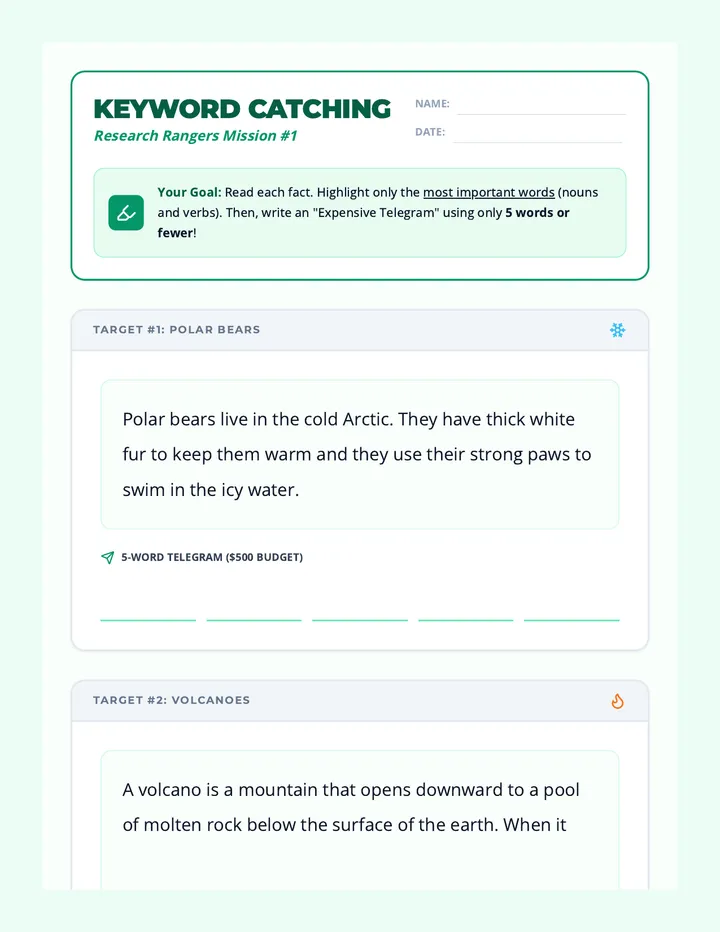
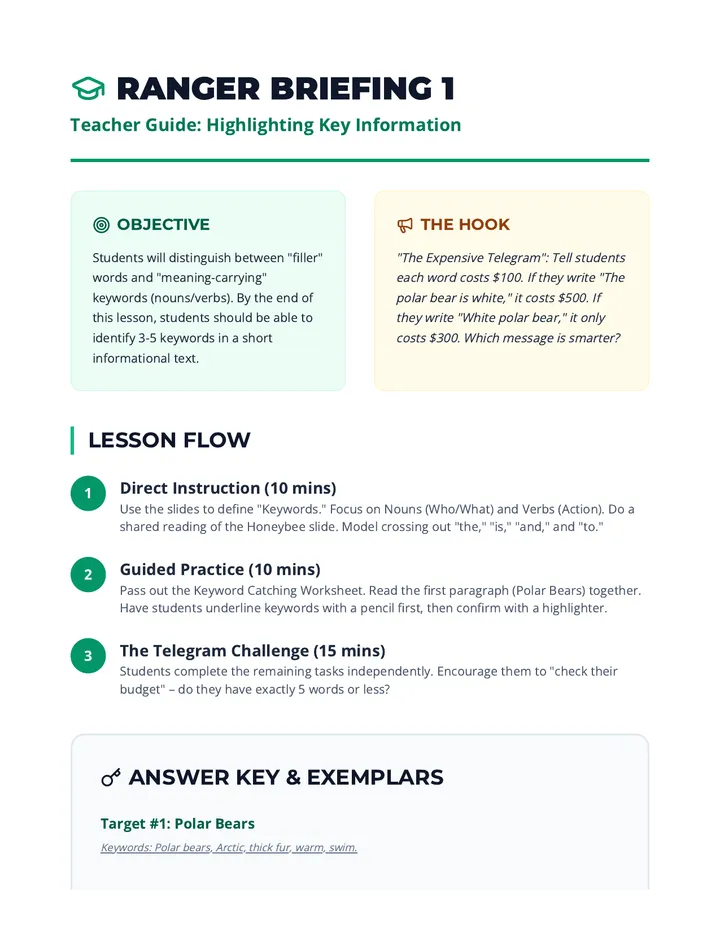
Students practice reading short paragraphs and highlighting only the most important words (nouns and verbs). They use the 'Expensive Telegram' game to learn how to summarize with a strict word limit.
Students learn to identify authors and 'About Us' sections to evaluate if a source is trustworthy, using a 'stranger vs. teacher' analogy.
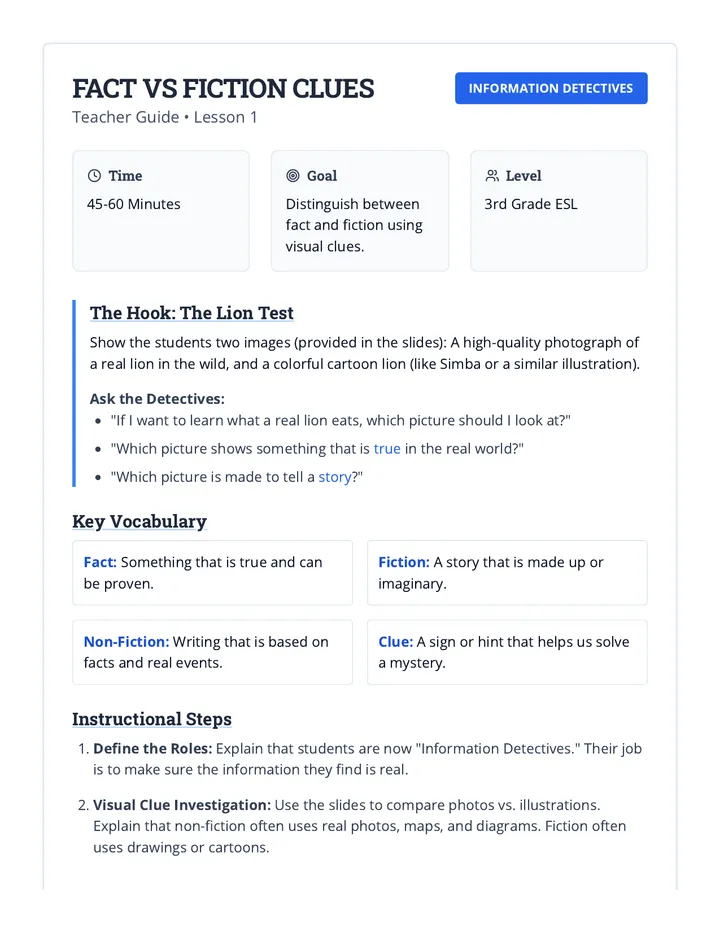
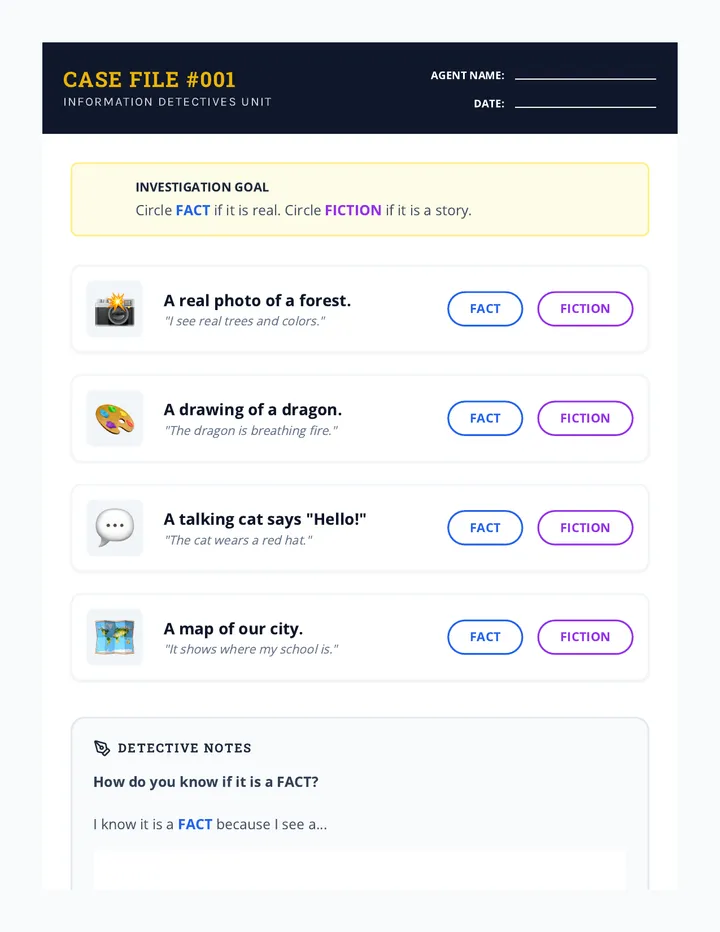
Students distinguish between 'Real/Non-Fiction' and 'Made-up/Fiction' by examining visual clues like photographs vs. illustrations and discussing the text's purpose.
Students evaluate simulated search results to choose the most appropriate digital sources based on titles and summaries.
Students practice sorting facts into relevant and irrelevant categories based on a specific research goal.
Students explore non-fiction text features like the Table of Contents, Index, and Glossary to locate information quickly.
Students learn to identify key nouns and verbs in research questions to create effective keyword search strings.
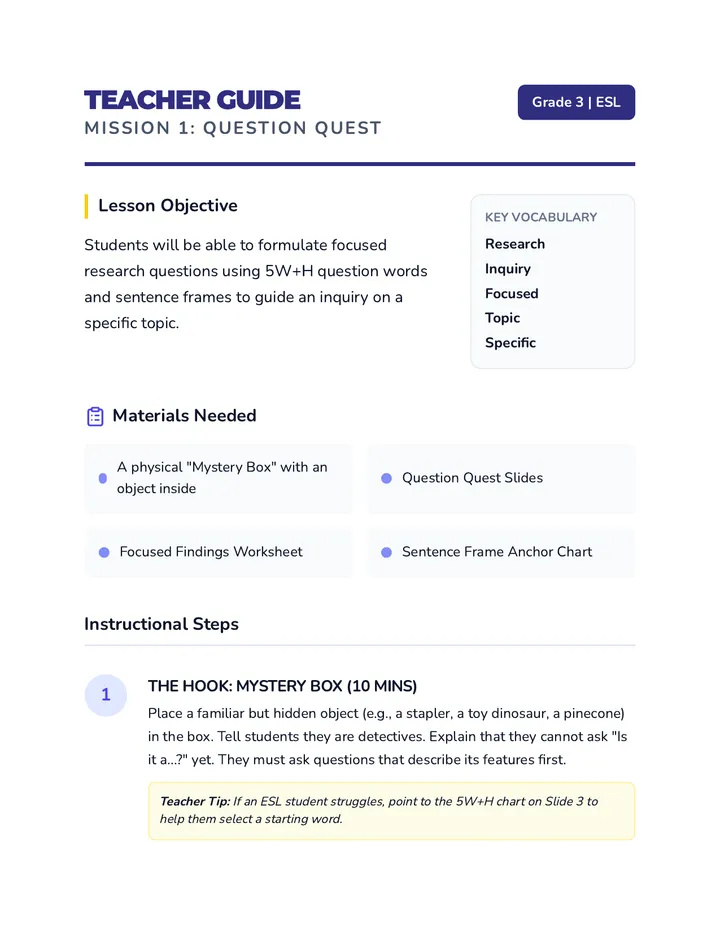
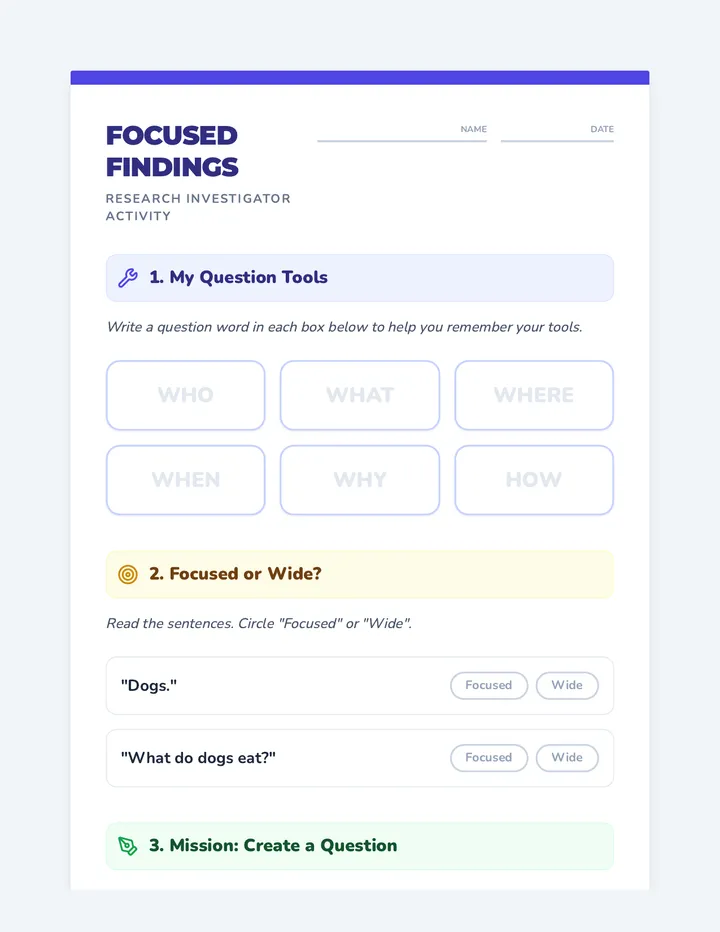
Students practice turning general topics into specific questions using 5W+H question words and sentence frames.
Synthesizing all learned strategies into a personalized 'Super Guide' for future test-taking success.
Practical simulation of bubble sheet mechanics to improve precision, tracking, and error reduction during assessments.
Strategies for interpreting non-text elements like diagrams and maps, and synthesizing that info with the reading passage.
Focusing on identifying the main idea of paragraphs using short summaries and 'hashtags' to create a mental map of the text.
Introduction to a simple symbol system for active reading to help students engage with text and track key information.
Students apply their full toolkit to a practice assessment, physically marking their elimination process and justifying their final choices.
Students use context clues to determine the 'vibe' (positive or negative) of unknown words to help eliminate unlikely answer choices.
Students master 'All of the Above' and 'None of the Above' options using logic puzzles and graphic organizers.
Students analyze 'almost right' distractors that use words from the text but contain incorrect details, focusing on full-sentence verification.
Students learn to identify 'impossible' distractors—options that are factually wrong or unrelated to the question—and practice crossing them out.
In this culminating lesson, students underline the specific part of the text that directly answers the question. They must prove their answer is correct by drawing a line connecting the question to the text evidence.
Students learn to cover the multiple-choice options and formulate their own answer based solely on the question and text. This prevents them from being swayed immediately by distractors.
Students practice rewriting complex test questions into simpler language to ensure comprehension. They work in pairs to translate 'test speak' into 'student speak' without changing the meaning.
This lesson introduces high-frequency academic command terms found in tests, such as 'identify', 'describe', 'compare', and 'select'. Students act out or draw definitions for these verbs to build academic vocabulary.
Students categorize questions based on the '5 Ws and H' to determine what kind of answer is required (e.g., a person, a time, a reason). They sort sample questions into buckets based on the expected answer type.
Students combine keyword identification with scanning techniques to answer multiple-choice questions. They follow a complete workflow from question analysis to evidence location.
Students learn to read the first and last sentence of paragraphs to grasp general meaning. They use headings to predict where specific information might be hidden.
Students practice rapid visual searching specifically for capital letters (names, places) and digits (dates, quantities). They engage in timed drills to increase visual processing speed.
This lesson focuses on reading questions first to identify the most important words like names, dates, and verbs. Students practice highlighting keywords to focus their search.
Students explore the difference between deep reading and rapid searching through a 'treasure hunt' activity. They learn to use their eyes to sweep across a page to find specific images or text features.
Students learn to use their annotations for comprehension by reading only highlighted words to determine the main gist of the story.
Combining both yellow and green highlighters, students act as 'Text Doctors' to diagnose and mark the core components of a short narrative paragraph.
Students add a second color (green) to identify actions and events, learning to distinguish between the character and what they are doing.
Introducing the 'Who' (characters) using yellow highlighters and 'spotlight' glasses to focus on specific naming words in simple sentences.
Students practice the foundational skill of categorization by sorting physical objects into colored zones, preparing them for the logic of color-coded text annotation.
Students switch roles and become the test-makers. They write their own multiple-choice questions based on a shared text, intentionally creating plausible distractors.
Students specifically target questions using words like 'NOT,' 'EXCEPT,' 'ALWAYS,' or 'NEVER.' They rewrite these questions in positive terms to clarify meaning.