7 items
A vocabulary and context-based exploration of Juror 8's arguments in '12 Angry Men', focusing on the concepts of infallibility and reasonable doubt.
This lesson focuses on the climactic resolution of the play, analyzing how logic and empathy eventually overcome prejudice in the jury room. Students will track the shifting momentum of the deliberation through a sequencing activity and reflective analysis.
A focused assessment on the pivotal witness testimony in Act II of 12 Angry Men, designed for accessibility and student success.
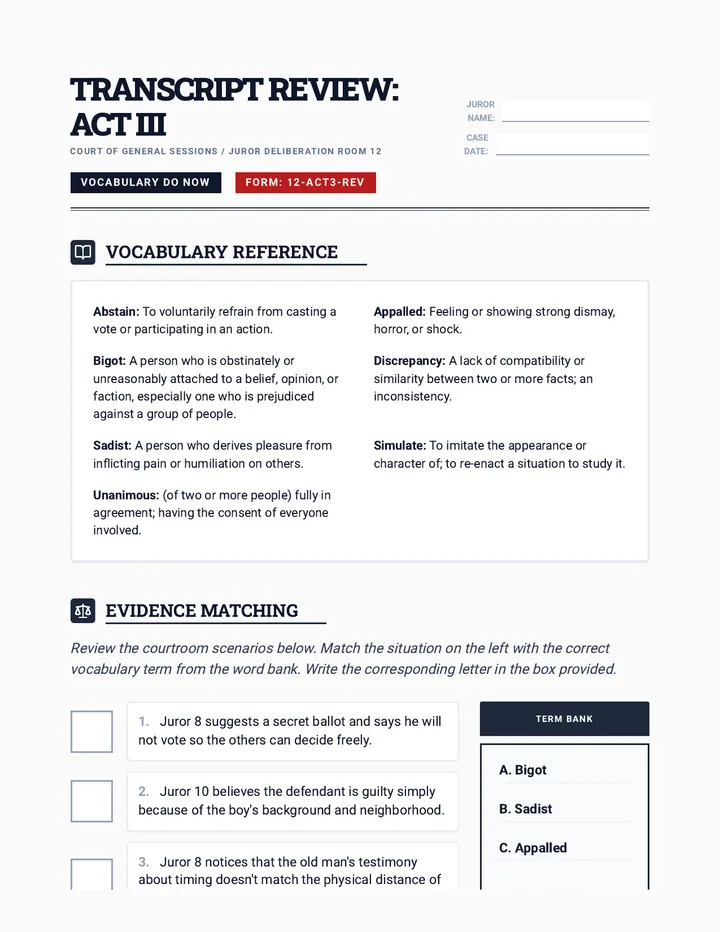
A vocabulary focused lesson for Act III of Twelve Angry Men, exploring the legal and emotional terminology of the play's climax.
This lesson helps 9th grade students distinguish between racial and class prejudice using Reginald Rose's '12 Angry Men' as a primary case study. Students will define key terms, compare features of bias, and analyze specific juror behaviors from the play.
A lesson focused on analyzing the deep-seated prejudices of Jurors 3, 4, 7, and 10 in Rose's '12 Angry Men'. Students will identify textual evidence and analyze how these biases obstruct the pursuit of justice.
A focused lesson on Act III of 12 Angry Men, centered on vocabulary application and character analysis during the final stages of jury deliberation.