Root cause analysis and brainstorming techniques for everyday problem-solving. Equips learners with ethical frameworks and risk-benefit evaluation skills to predict consequences and make informed choices.
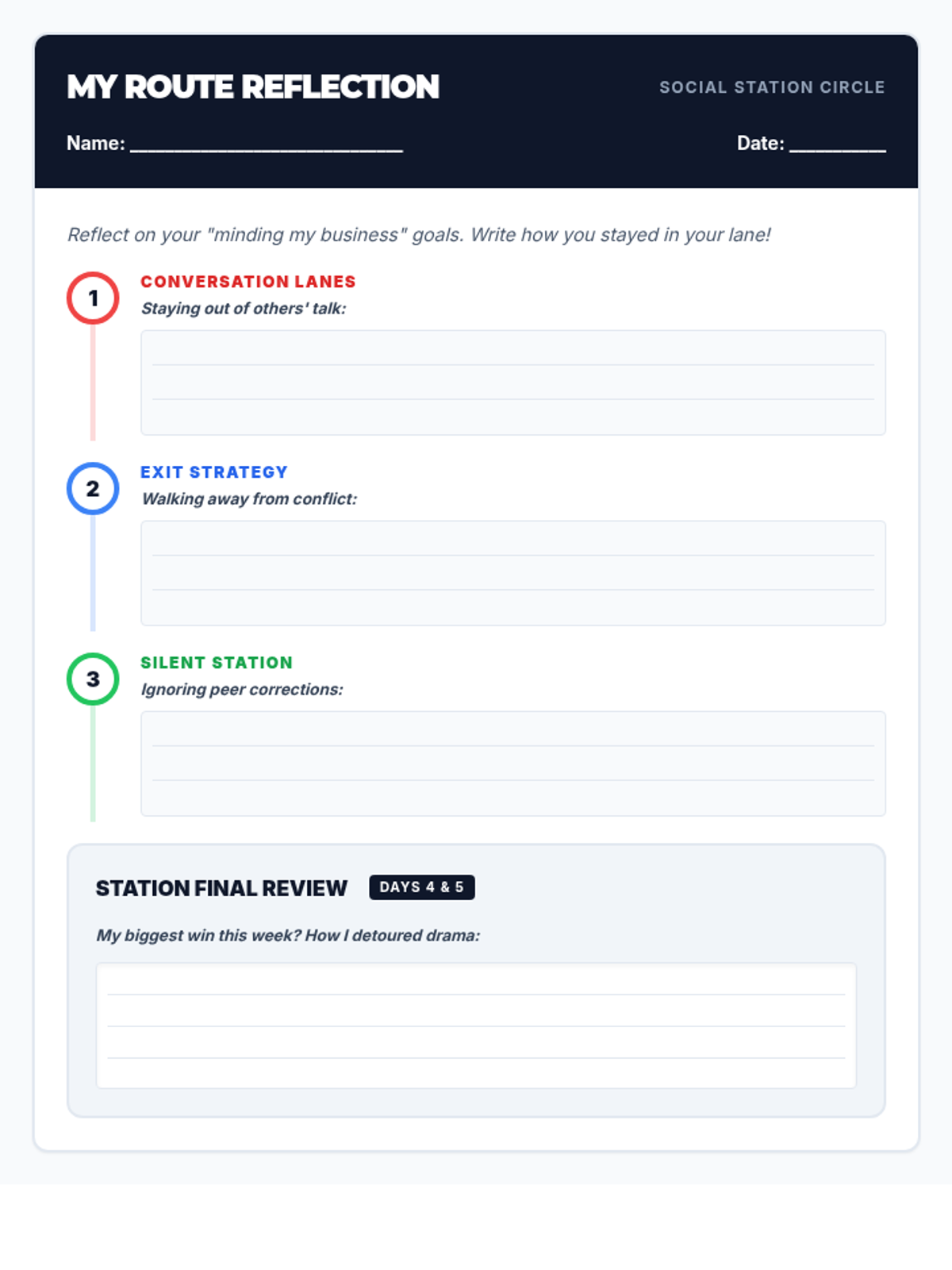
A student-facing reflection log for tracking daily progress on 'minding your business' social skills goals. Features large, readable text and guided writing lines. Fits on a single page.
Slide deck for Day 5 of community circles focusing on 'Focus Force' and avoiding distractions. Includes greeting, shout-outs, scenario practice, and Scattergories.
Slide deck for Day 4 of community circles focusing on 'Drama Detours' and avoiding rumors. Includes greeting, shout-outs, scenario practice, and Scattergories.
Slide deck for Day 3 of community circles focusing on 'The Silent Station' and ignoring peer corrections. Includes greeting, shout-outs, scenario practice, and Scattergories.
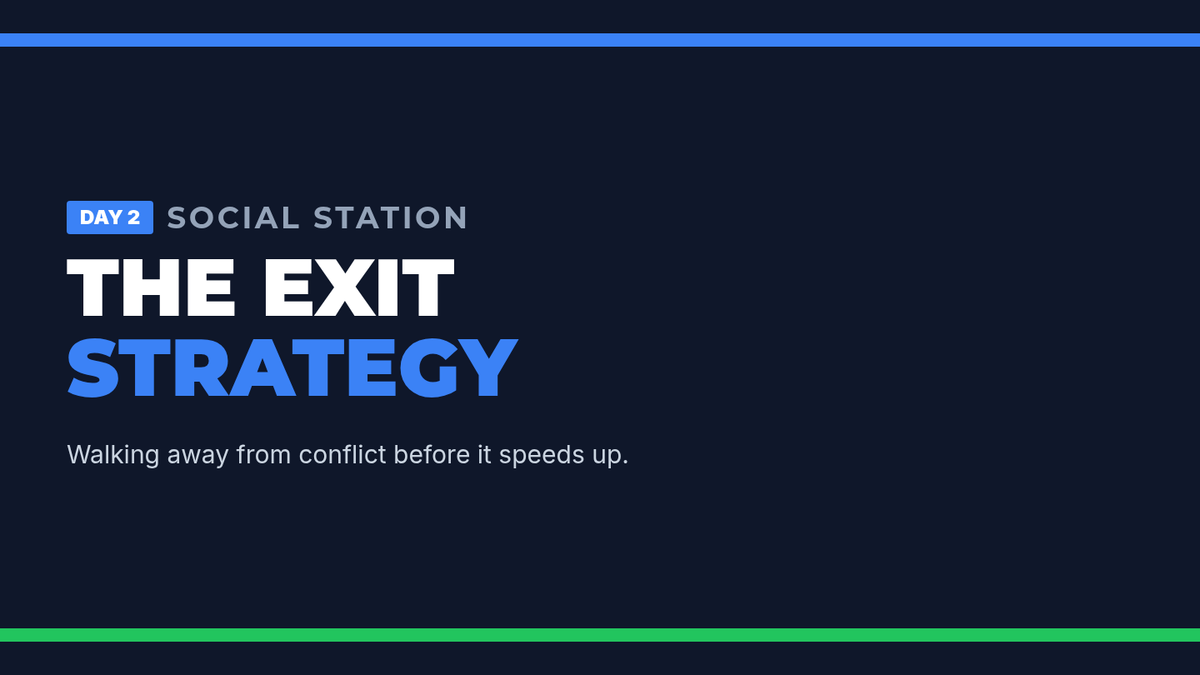
Slide deck for Day 2 of community circles focusing on 'The Exit Strategy' and walking away from conflict. Includes greeting, shout-outs, scenario practice, and Scattergories.
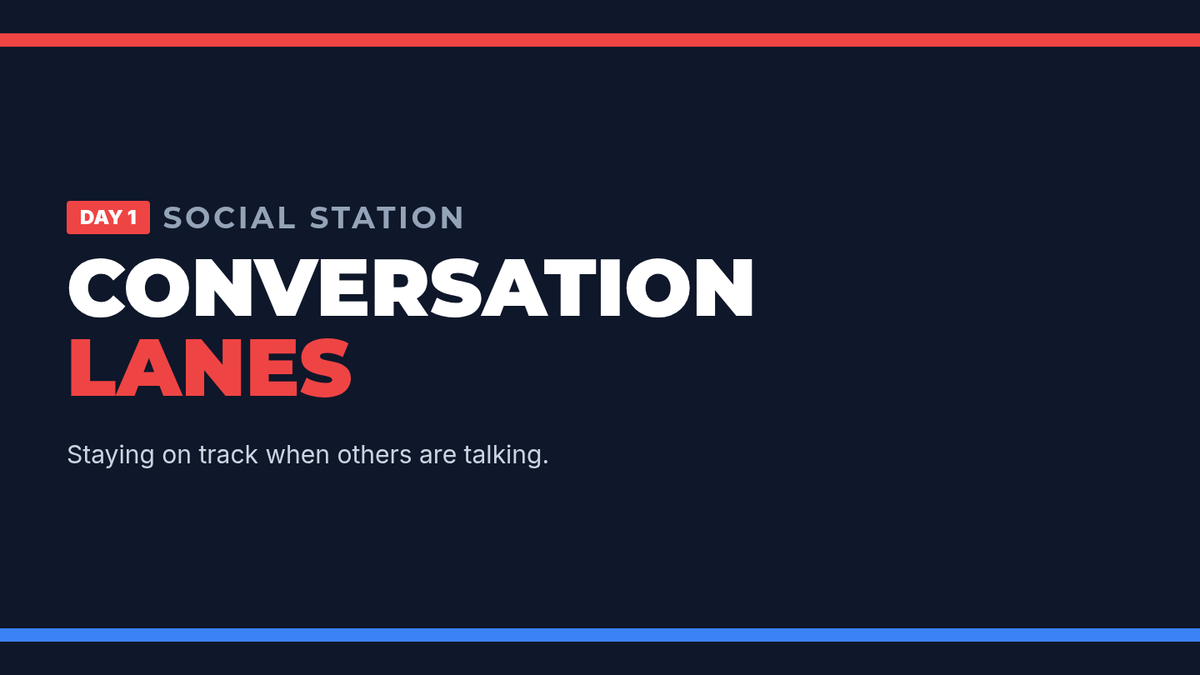
Slide deck for Day 1 of community circles focusing on 'Conversation Lanes' and staying out of others' talk. Includes greeting, shout-outs, scenario practice, and Scattergories.
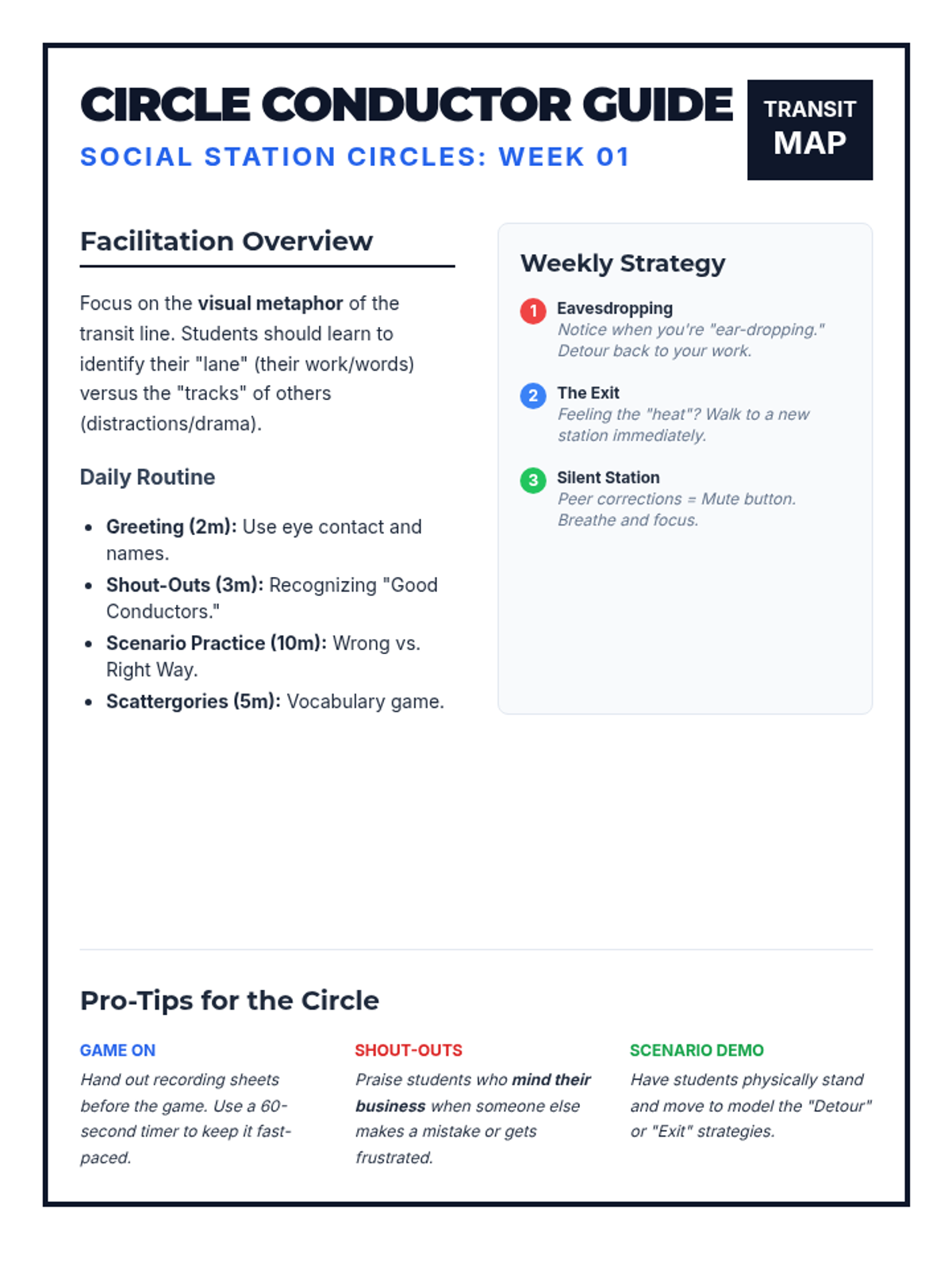
A comprehensive facilitation guide for the week of community circles, featuring instructional notes, scenario scripts for each day, and Scattergories master lists. Includes a student recording sheet.
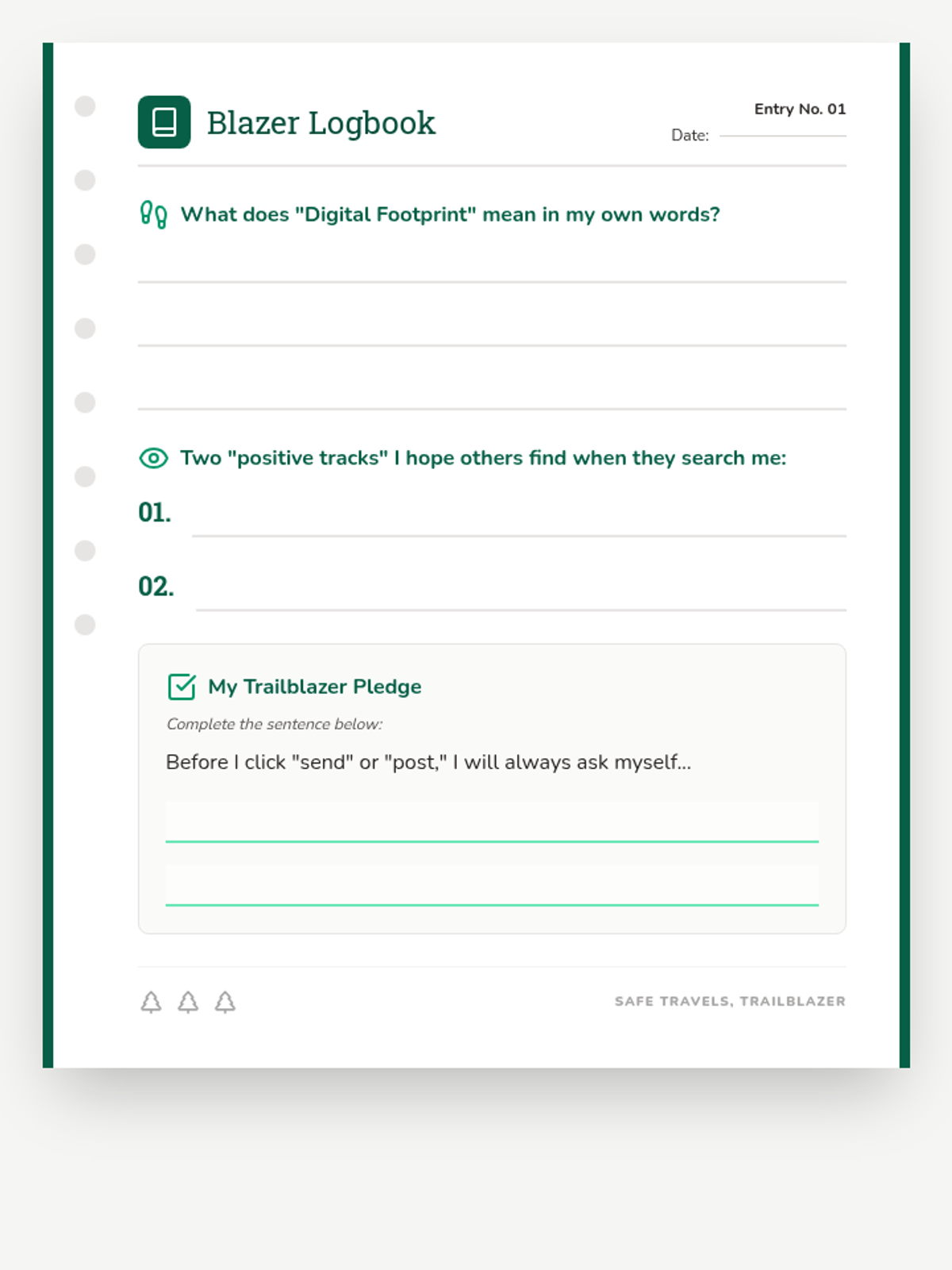
A reflection journal sheet for students to define their digital footprint and make a personal pledge to maintain a positive online trail.
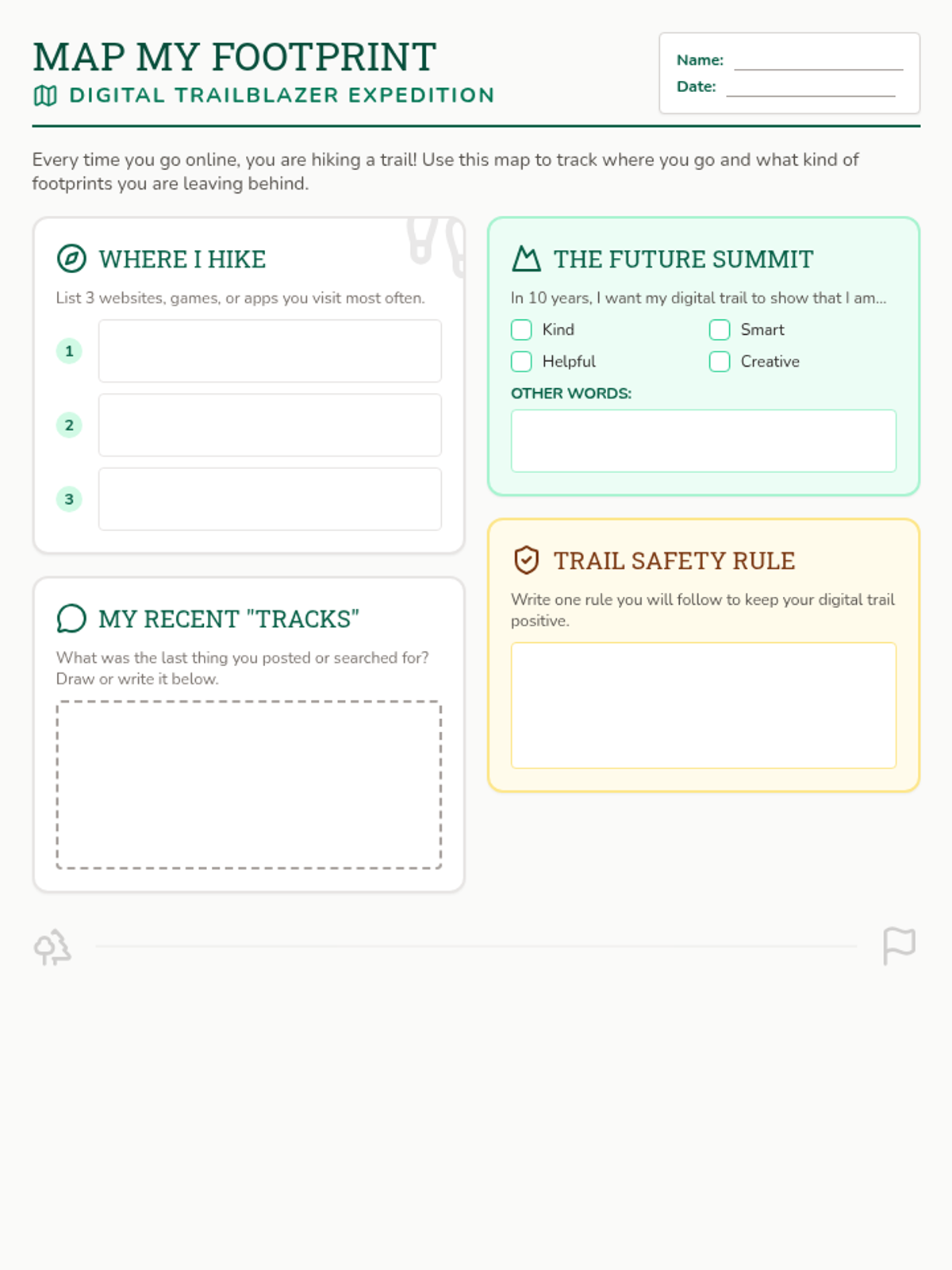
A student project sheet where children map their online activities, identify their "digital tracks," and set goals for a positive future online presence.
A dynamic 6-slide presentation for grades 3-5 that uses wilderness motifs to teach digital footprint concepts, permanence, and future impact.
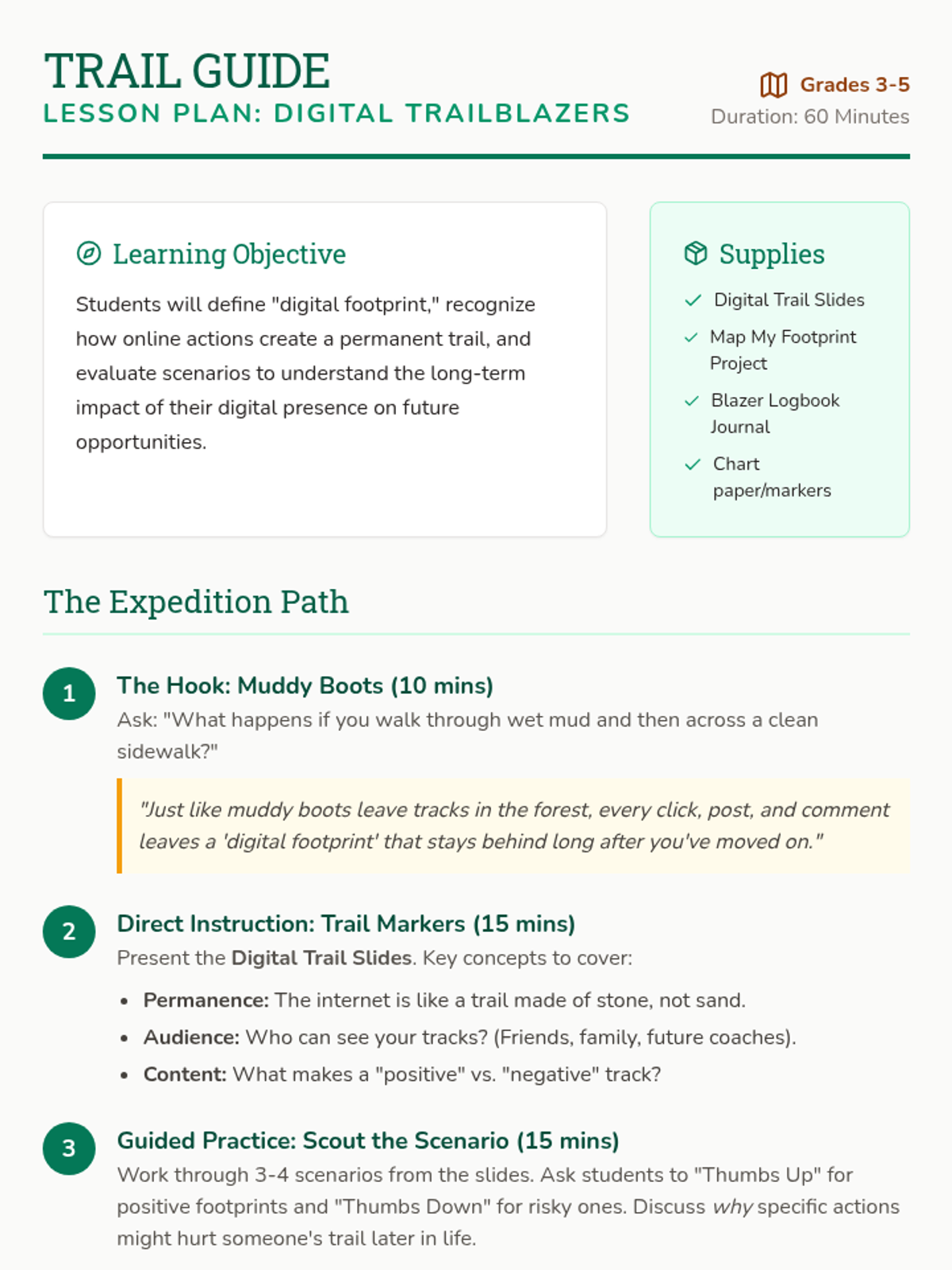
A comprehensive teacher's guide for the Digital Trailblazers lesson, featuring a wilderness-themed instructional path, learning objectives, and delivery tips for grades 3-5.
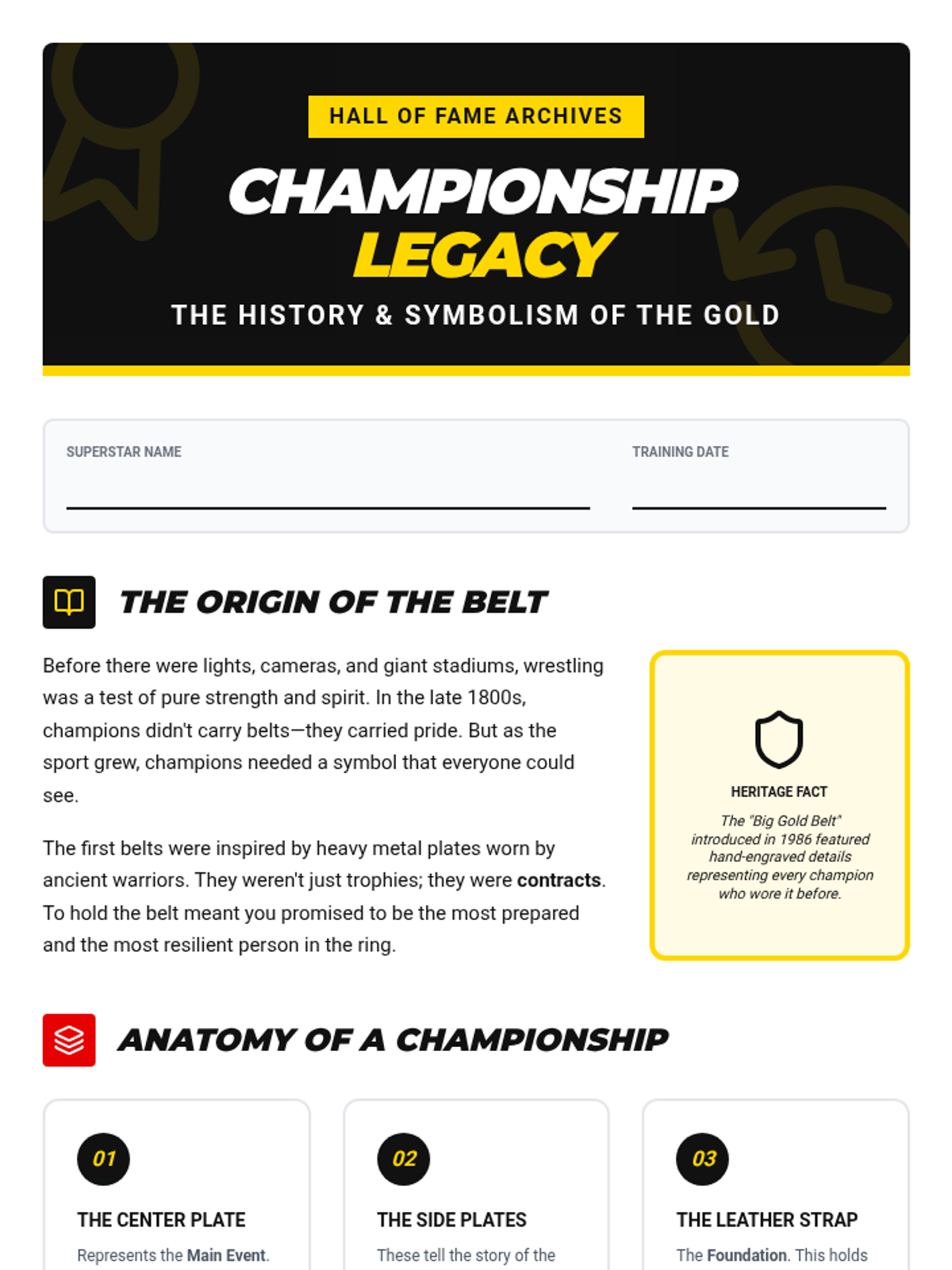
A student-facing reading and activity sheet exploring the history of wrestling championship belts, their symbolism, and how students can build their own academic legacy.
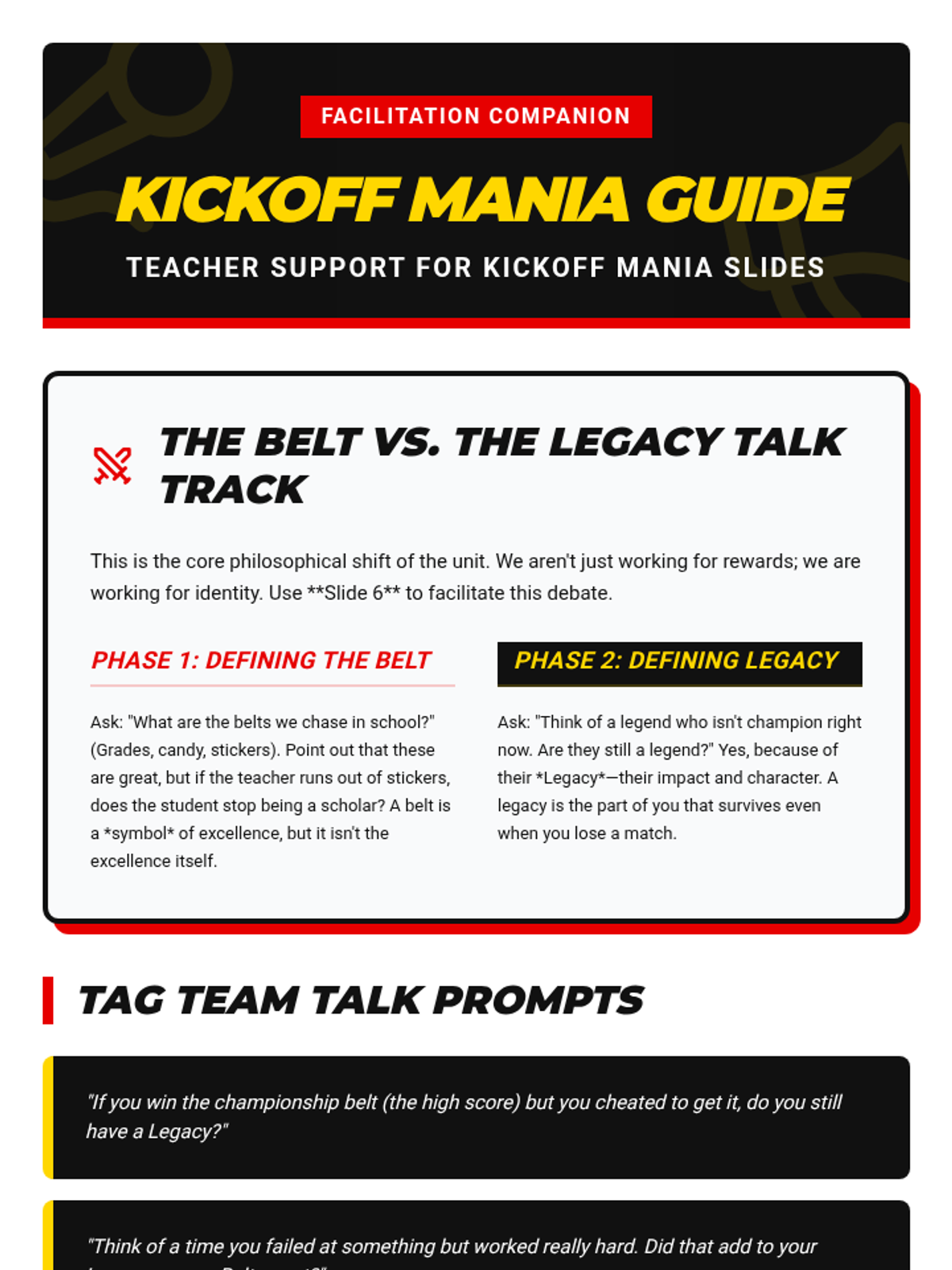
A detailed teacher facilitation companion for the Kickoff Mania slides, providing talk tracks for the 'Belt vs. Legacy' discussion, discussion prompts, and implementation steps for the Ubuntu mission.
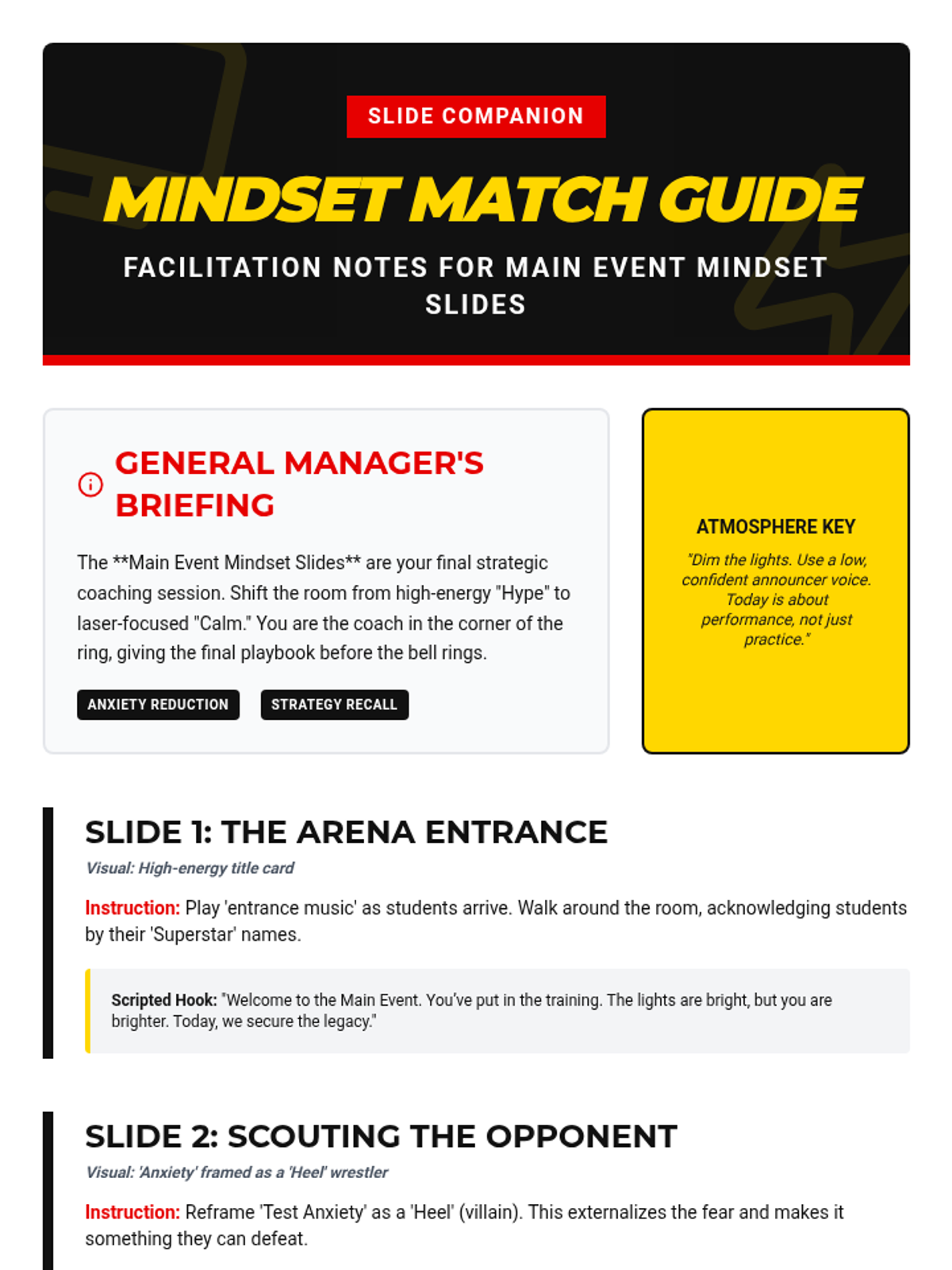
A teacher-facing companion guide for the 'Main Event Mindset' slides, providing slide-by-slide scripts, instructional instructions for managing test anxiety, and post-test decompression strategies.
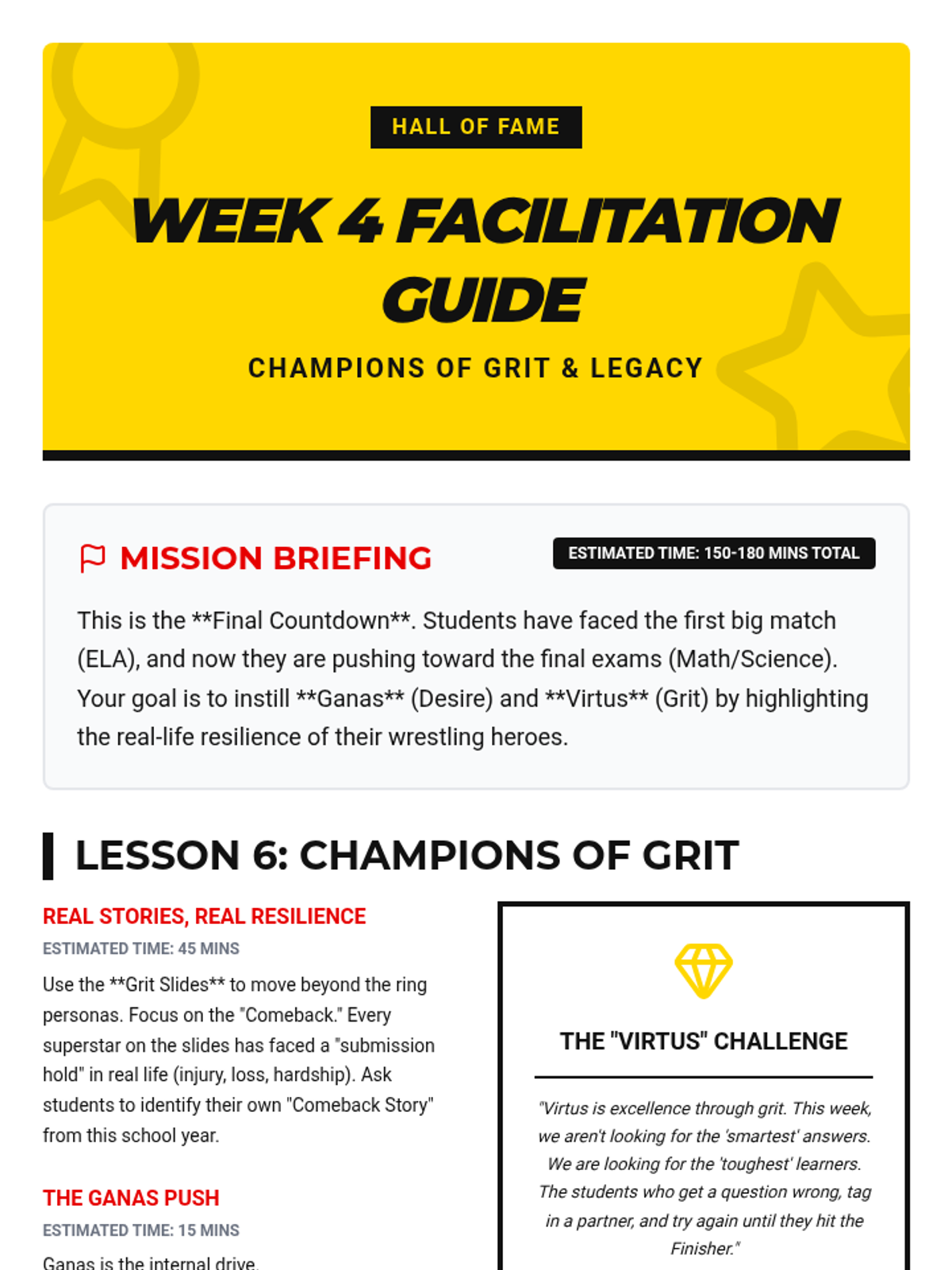
A detailed teacher facilitation guide for Week 4 of the 'Road to State Exam Mania' sequence, focusing on Ganas (drive) and Virtus (grit) for the final exam push and the 'Mania Gala' unit wrap-up.
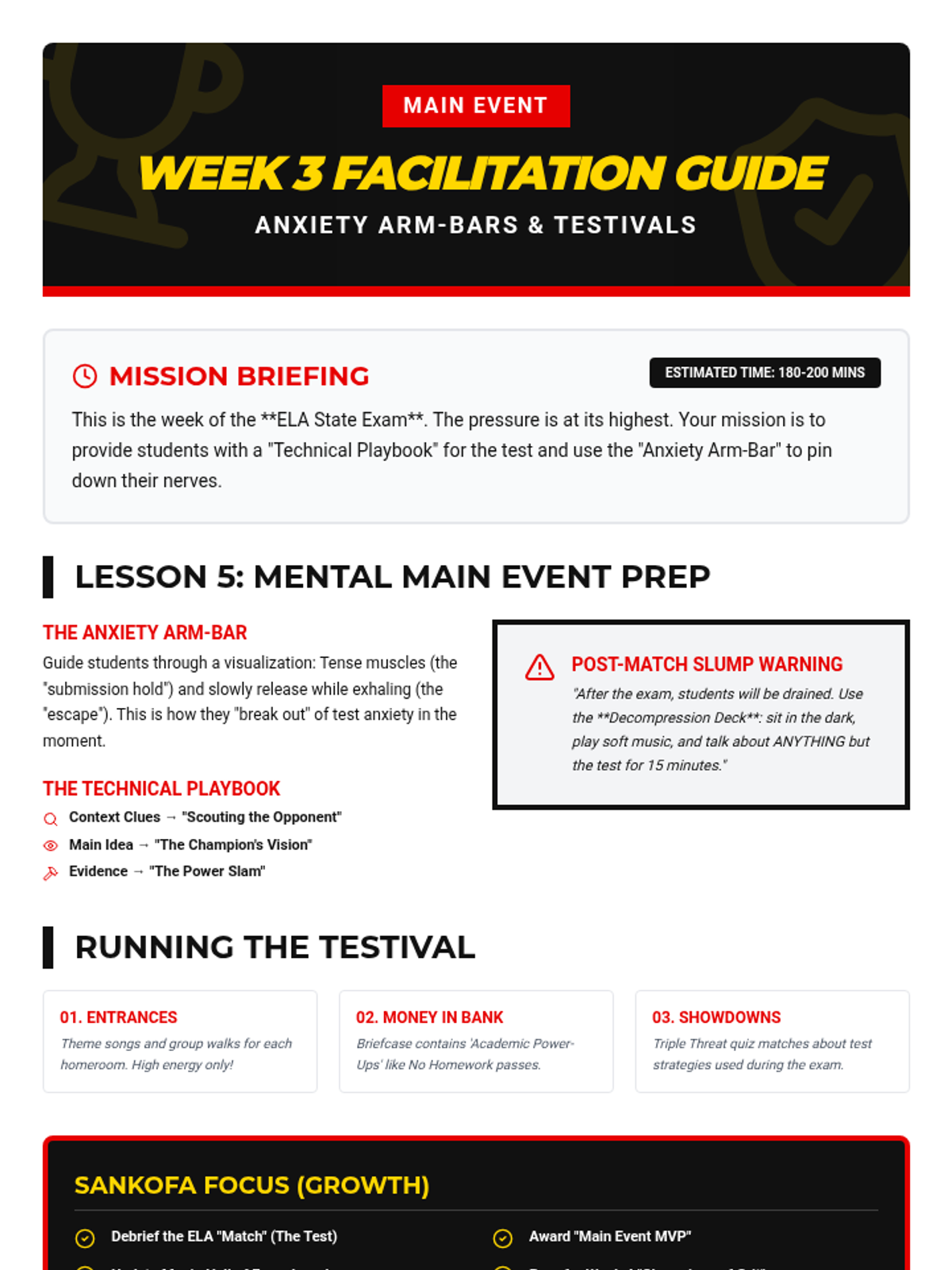
A detailed teacher facilitation guide for Week 3 of the 'Road to State Exam Mania' sequence, focusing on ELA state exam preparation and the 'Testival' pep rally.
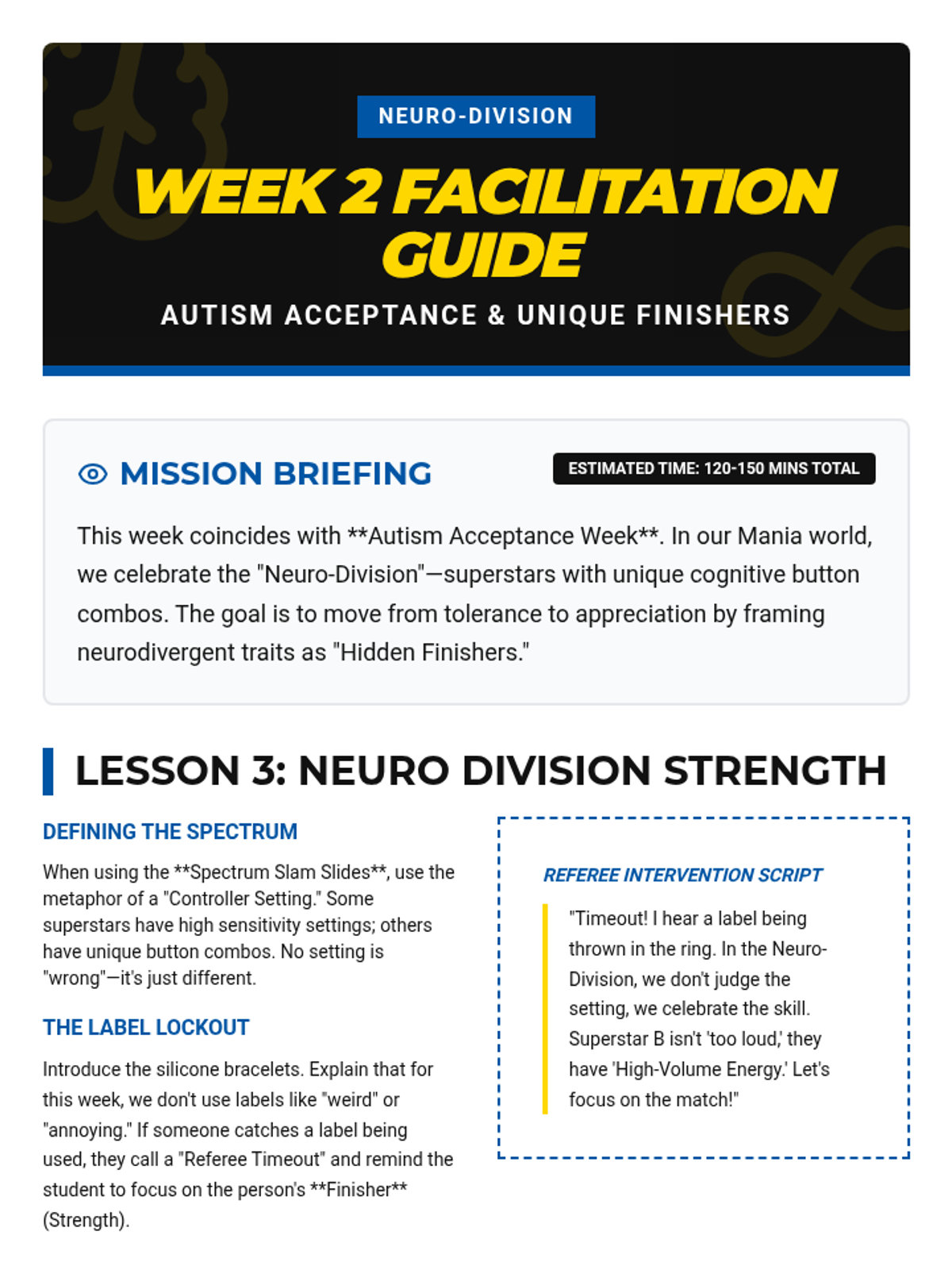
A detailed teacher facilitation guide for Week 2 of the 'Road to State Exam Mania' sequence, focusing on Autism Acceptance Week and celebrating neurodiversity.
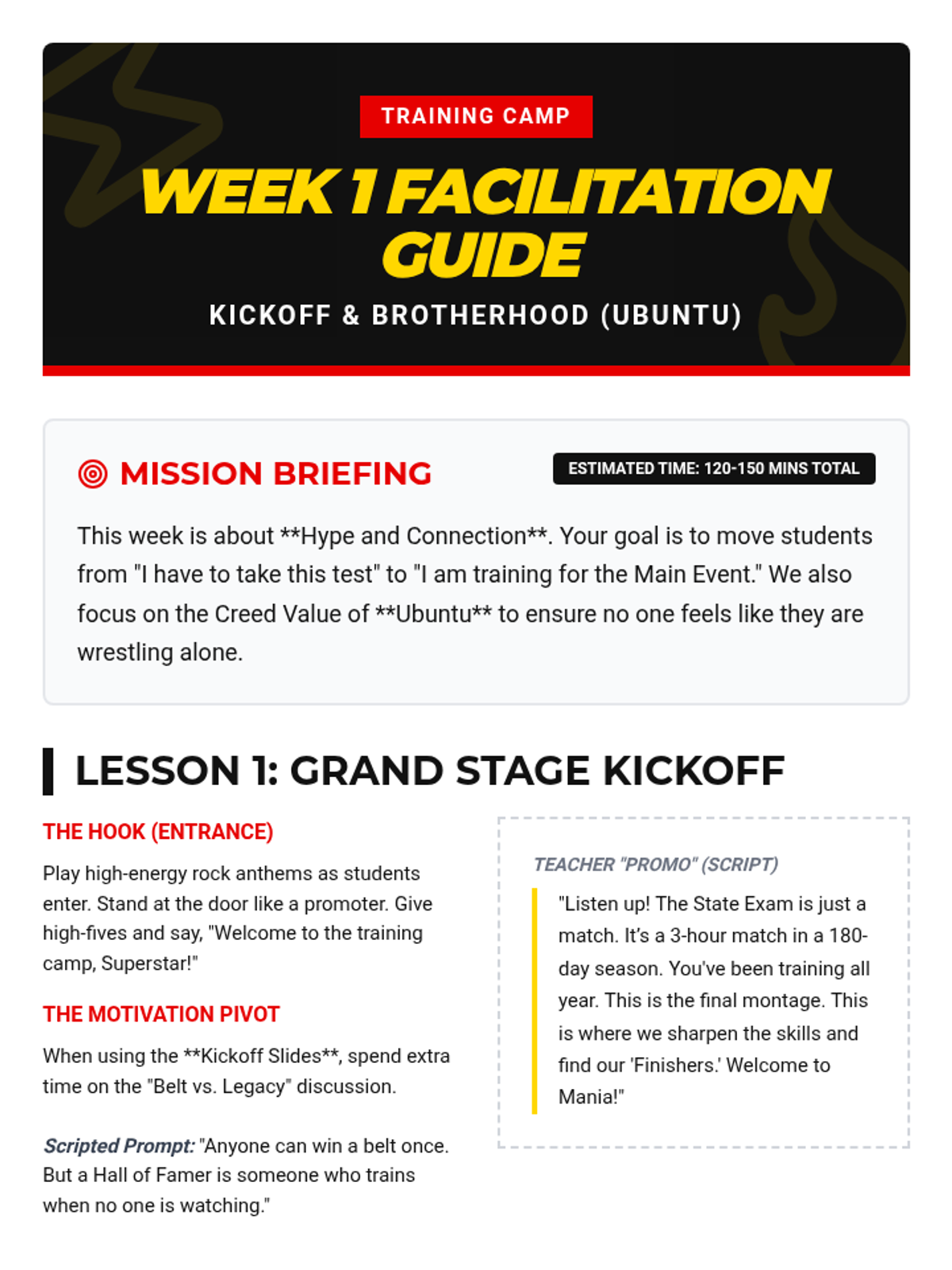
A detailed teacher facilitation guide for Week 1 of the 'Road to State Exam Mania' sequence, focusing on kickoff motivation and the Creed Value of Ubuntu.
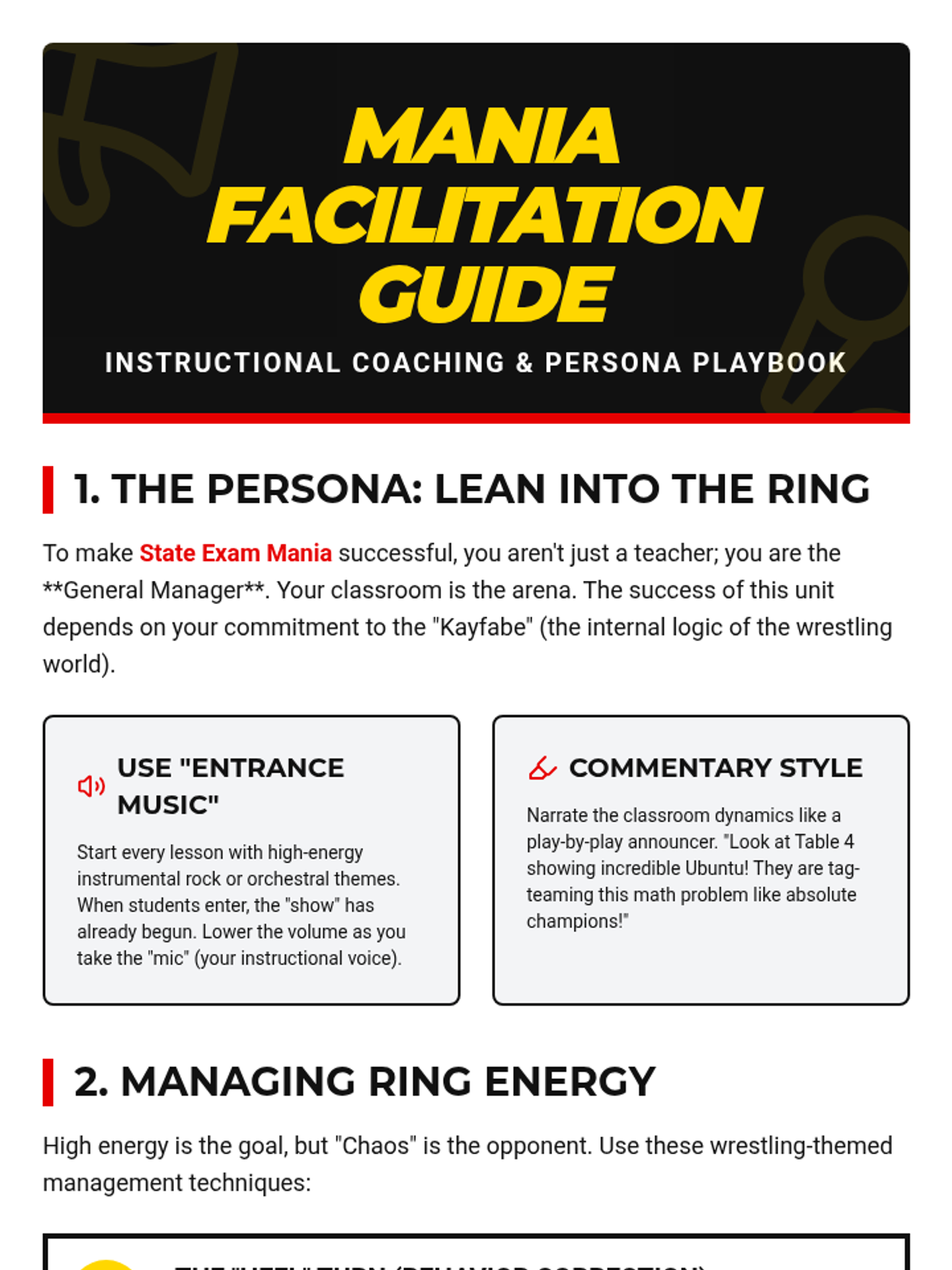
A comprehensive teacher facilitation guide for the 'Road to State Exam Mania' sequence, featuring persona coaching, behavior management strategies (using wrestling metaphors), lesson-specific tips, and a bank of discussion questions.
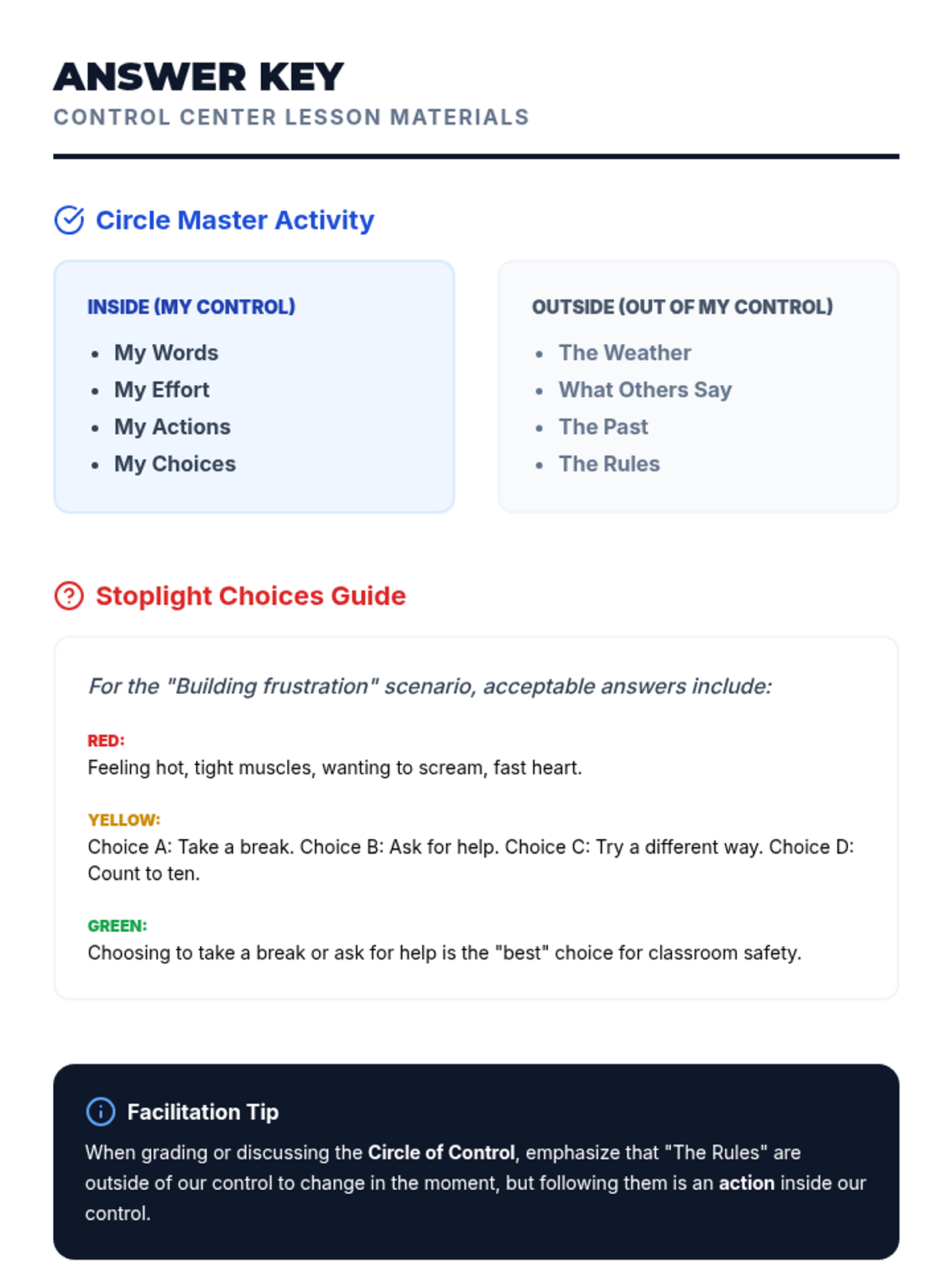
Revised Control Center Answer Key. Fixed page break issues for the facilitation tip, increased font sizes for scenario descriptions, and improved visual formatting for teacher readability. Optimized to fit on a single page.
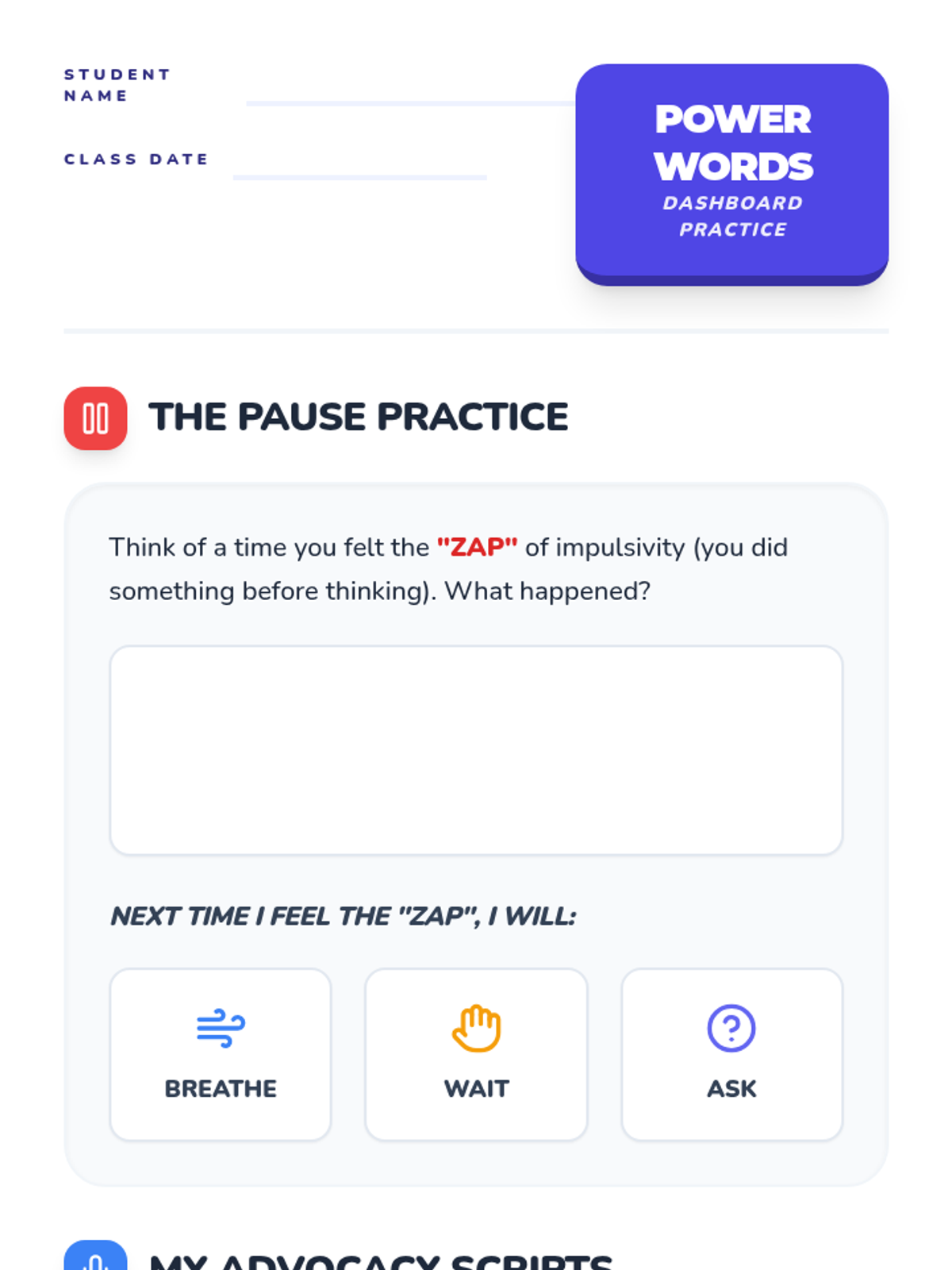
A student-facing worksheet for practicing self-advocacy scripts and reflecting on impulsive behaviors. It includes guided scenarios and creative spaces for students to develop their own 'Power Words'.
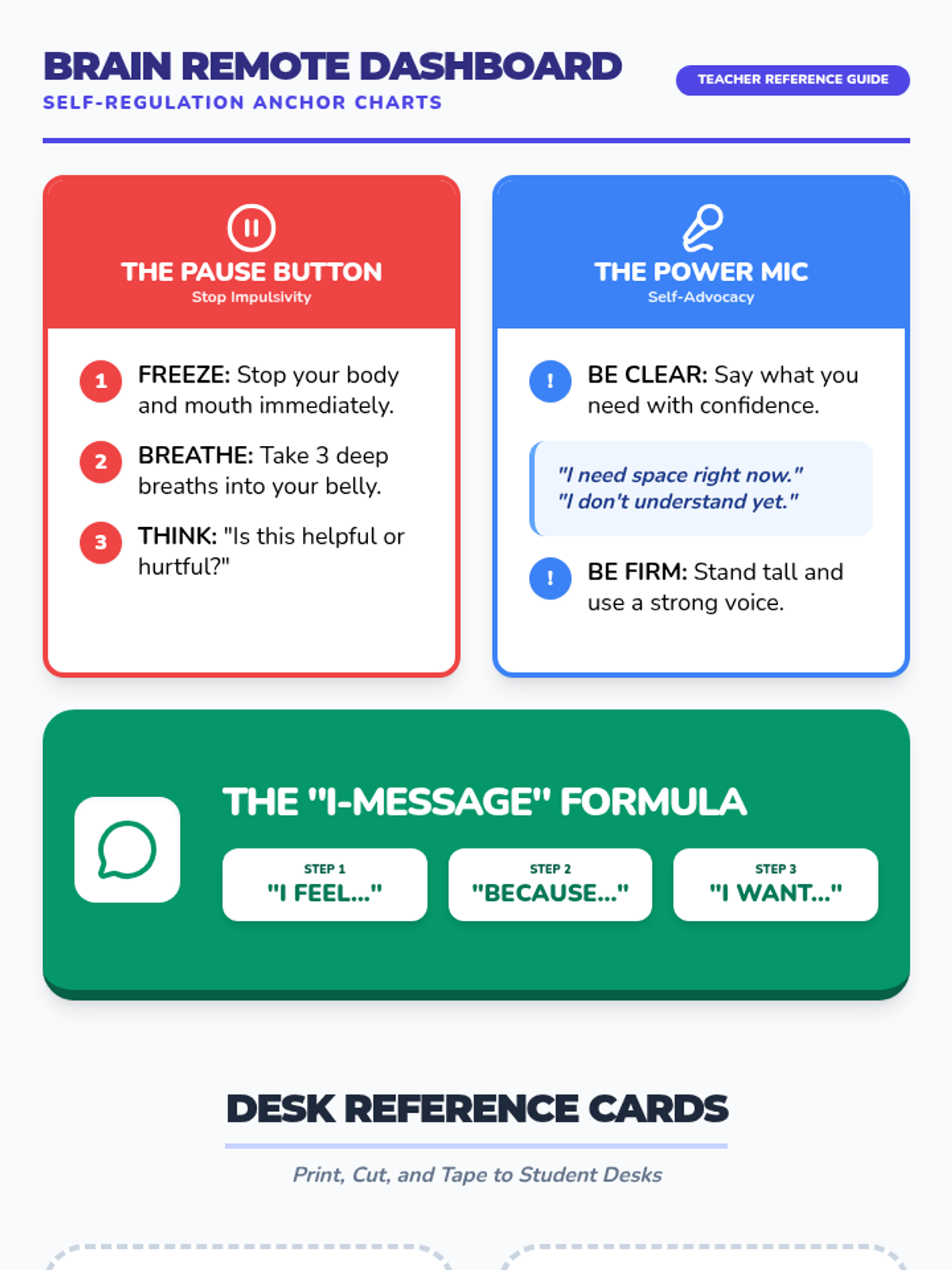
A set of visual anchor charts and desk reference cards featuring the 'Brain Remote' concept. It provides clear, actionable steps for students to manage impulsivity and use self-advocacy language.
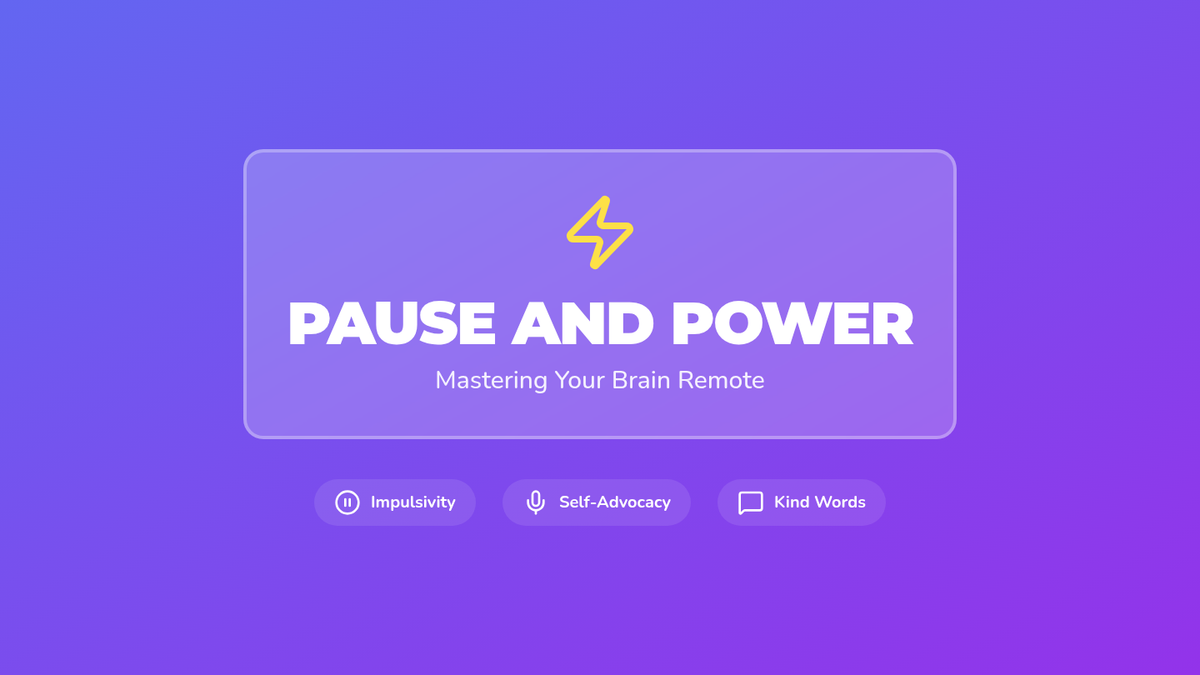
A vibrant, interactive slide deck designed for touchscreen displays. It uses the 'Brain Remote' metaphor to teach impulsivity control, conflict resolution, and self-advocacy through engaging visuals and prompts.
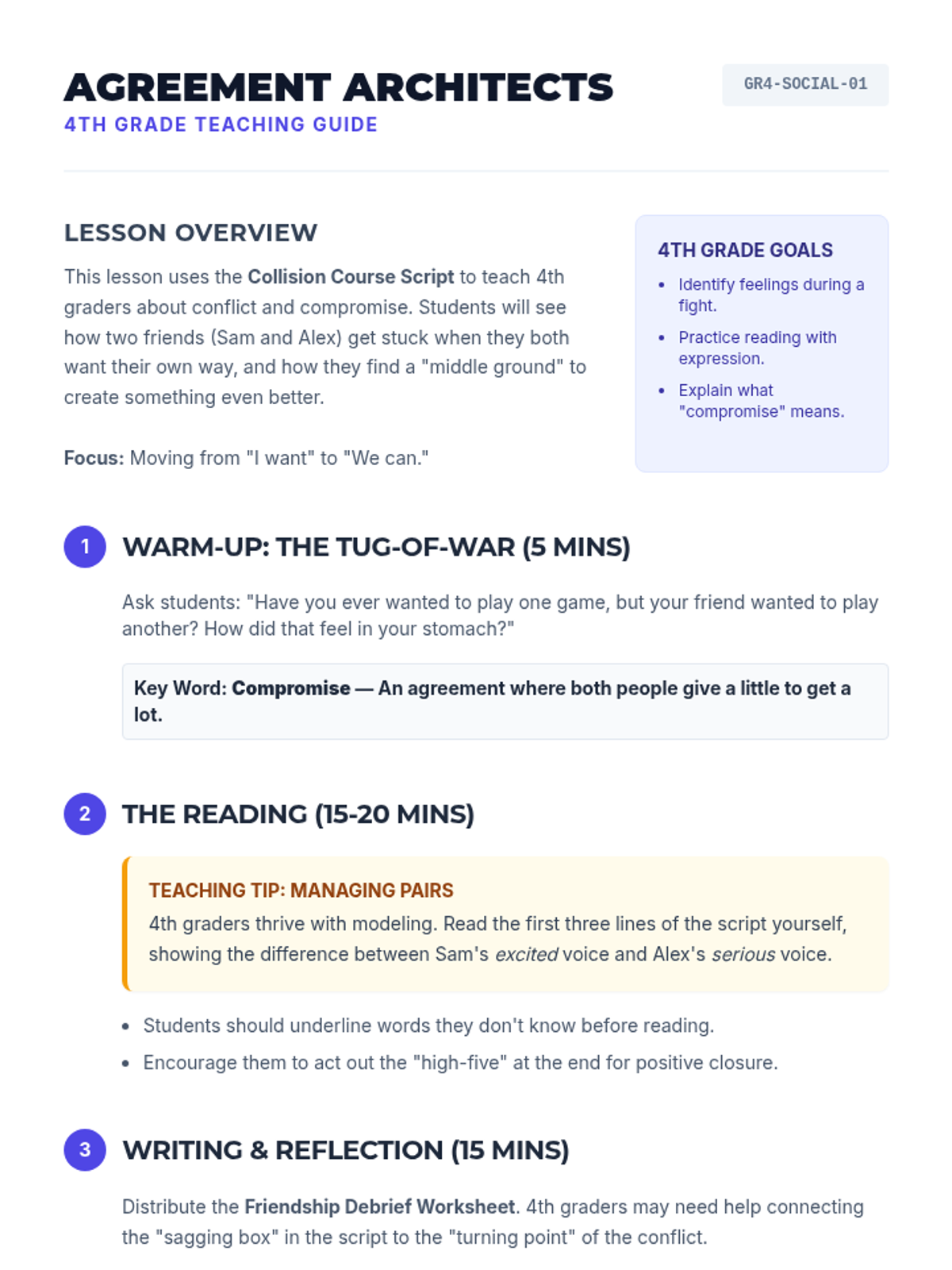
A comprehensive teacher guide for 4th grade, providing specific instructional strategies for social-emotional learning, reading fluency, and conflict resolution facilitation.
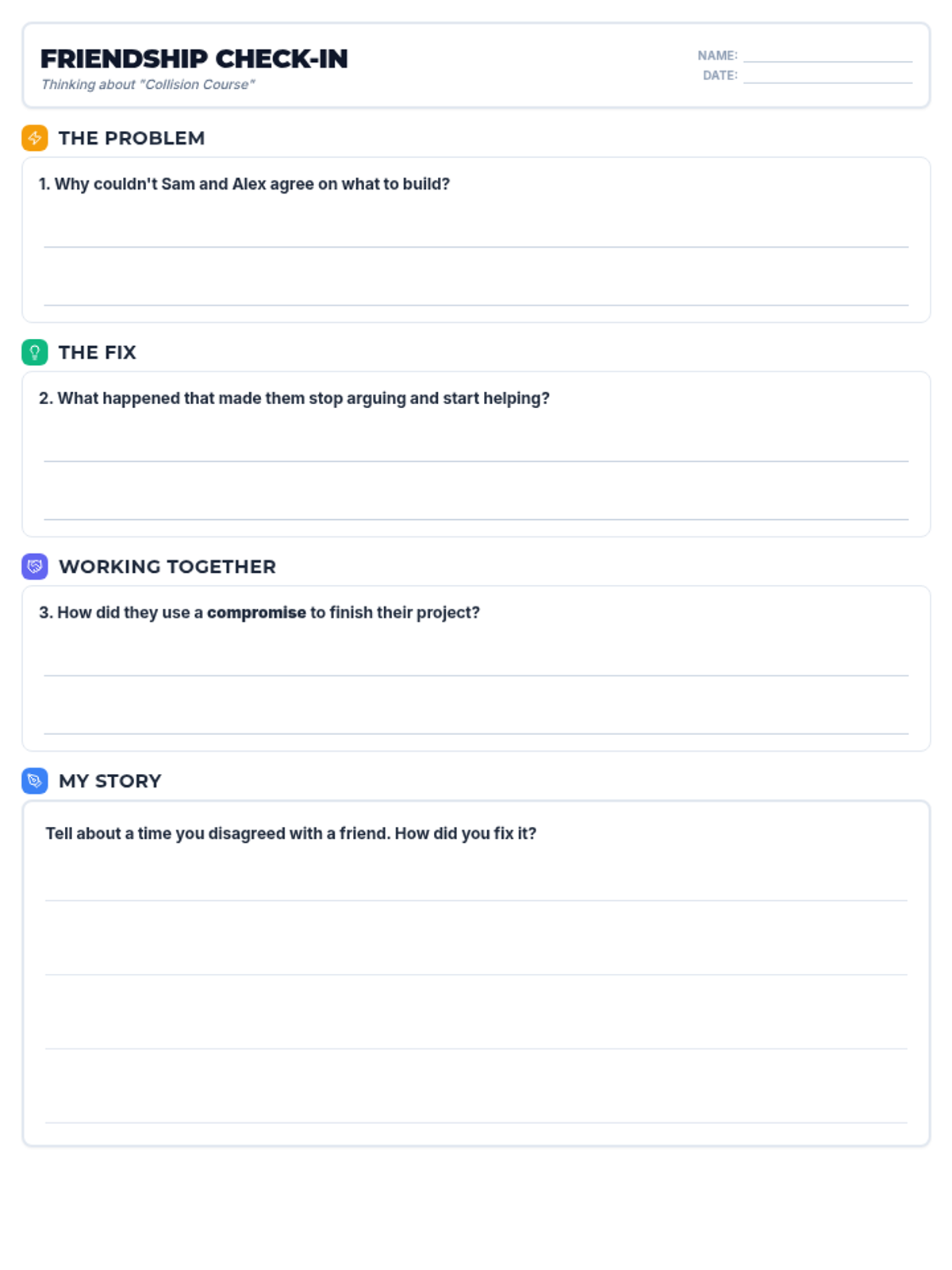
A reflection worksheet redesigned for 4th grade students to analyze conflict and compromise. Features larger writing spaces (taller lines) and simplified language. Consolidated to a single page for better usability.
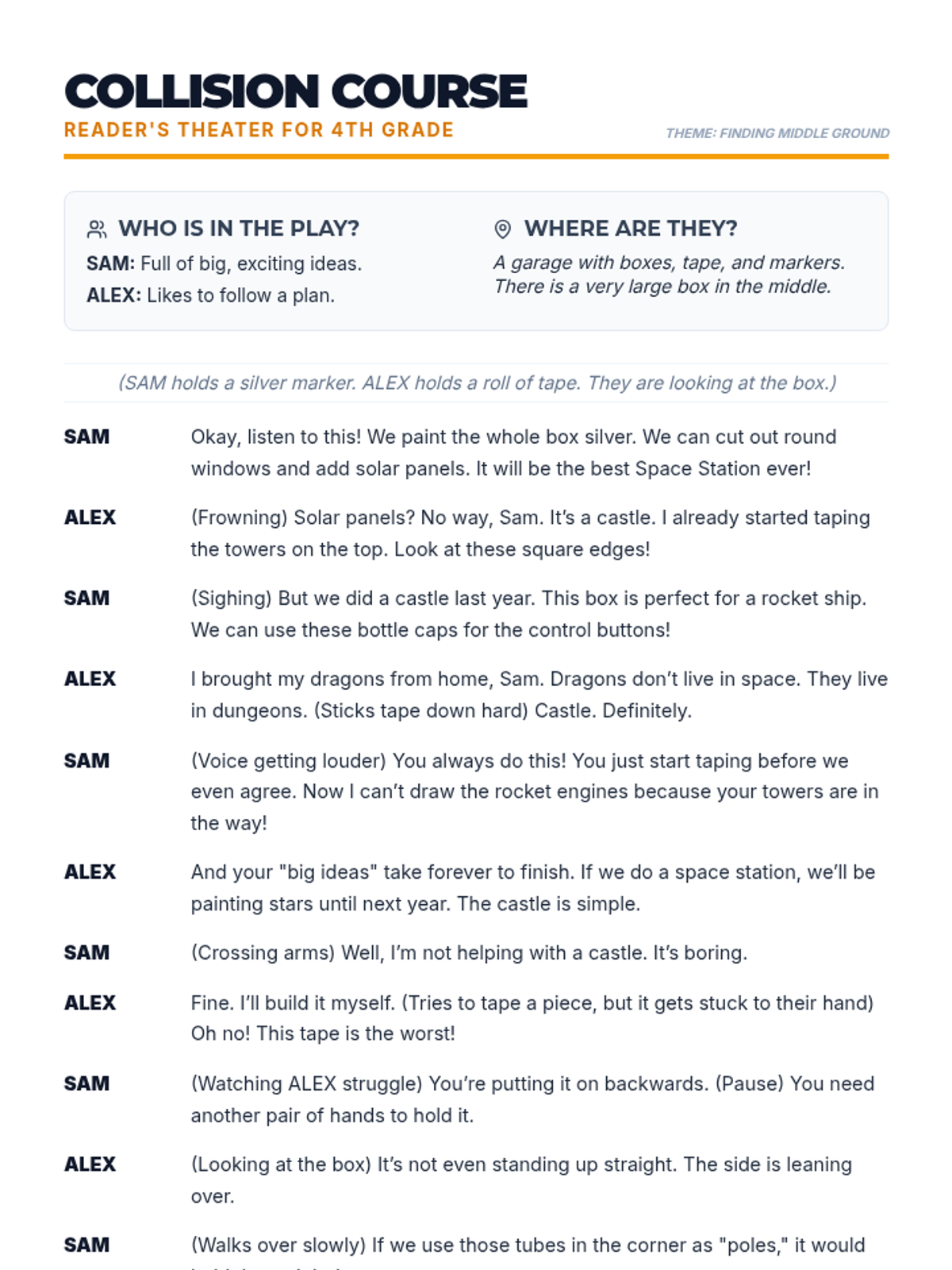
A two-person Reader's Theater script redesigned for 4th grade, focusing on a creative disagreement and the power of compromise between friends. Includes an integrated reflection section with simplified language. Layout optimized to fit on two pages.
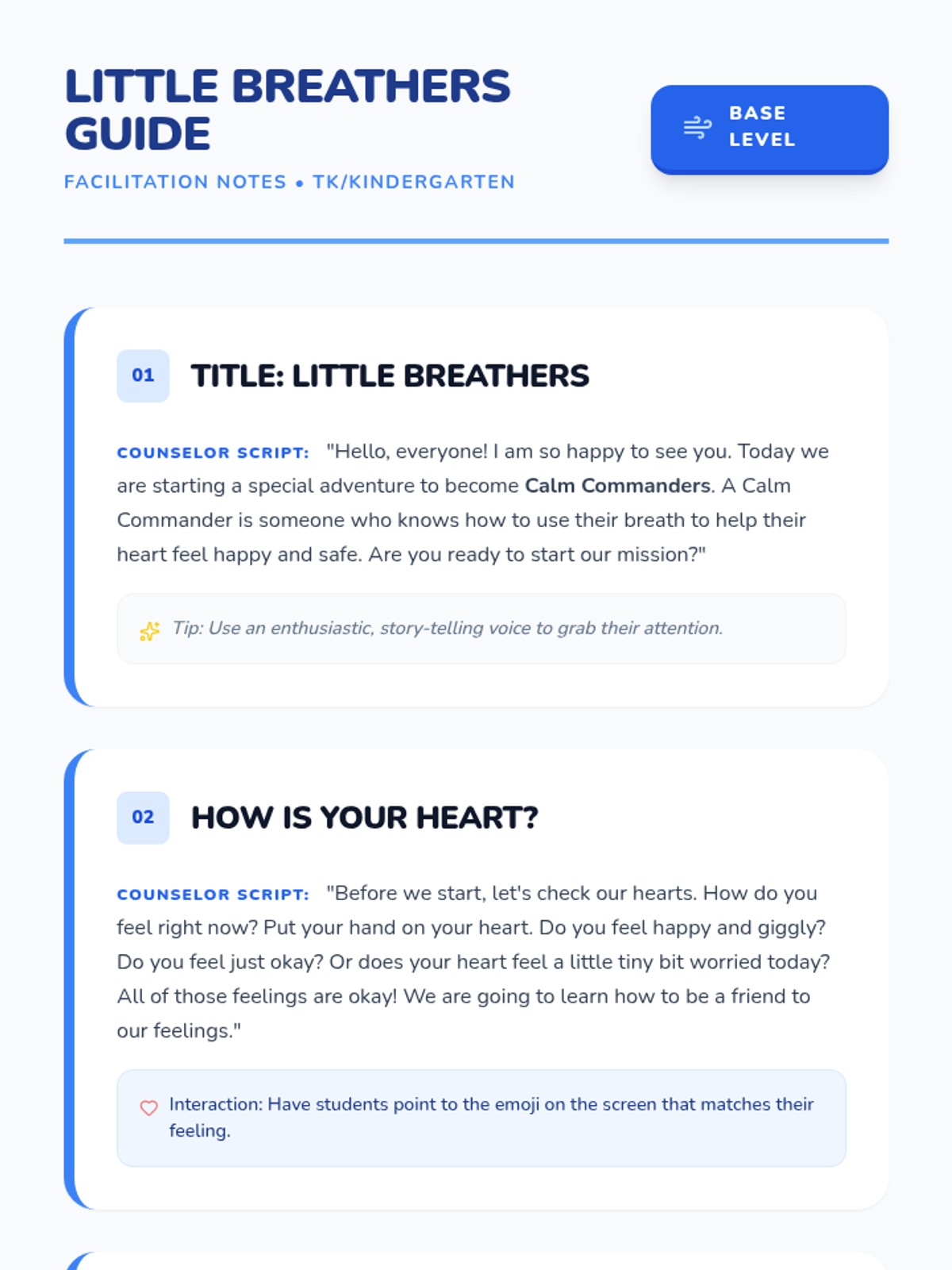
A detailed slide-by-slide facilitation guide for the TK/Kindergarten lesson 'Little Breathers'. Includes simple counselor scripts, child-friendly analogies for stress, and instructions for interactive breathing practice.
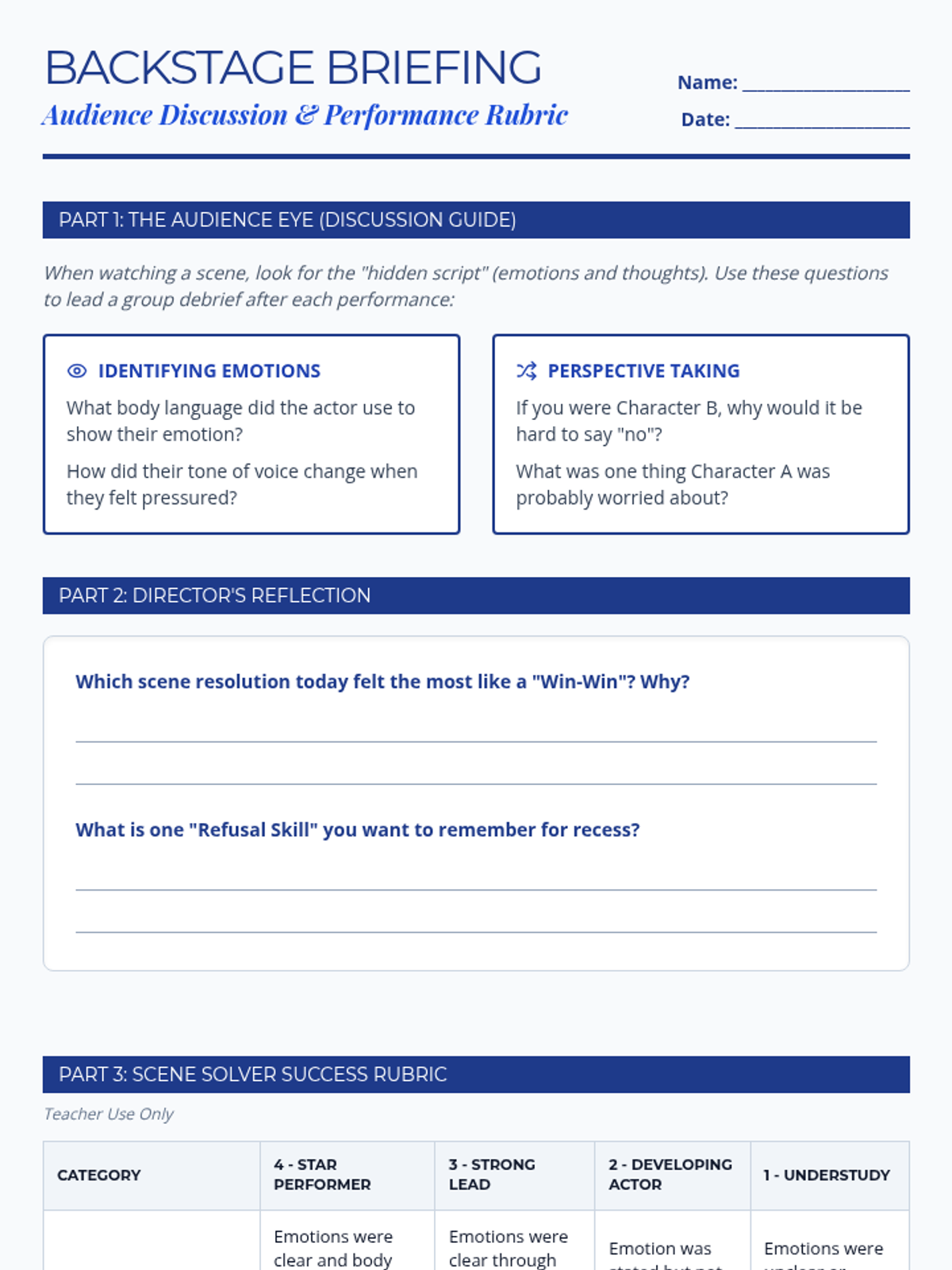
A double-sided student and teacher resource featuring audience discussion prompts, a written reflection area, and a 4-point drama rubric focusing on SEL skills.
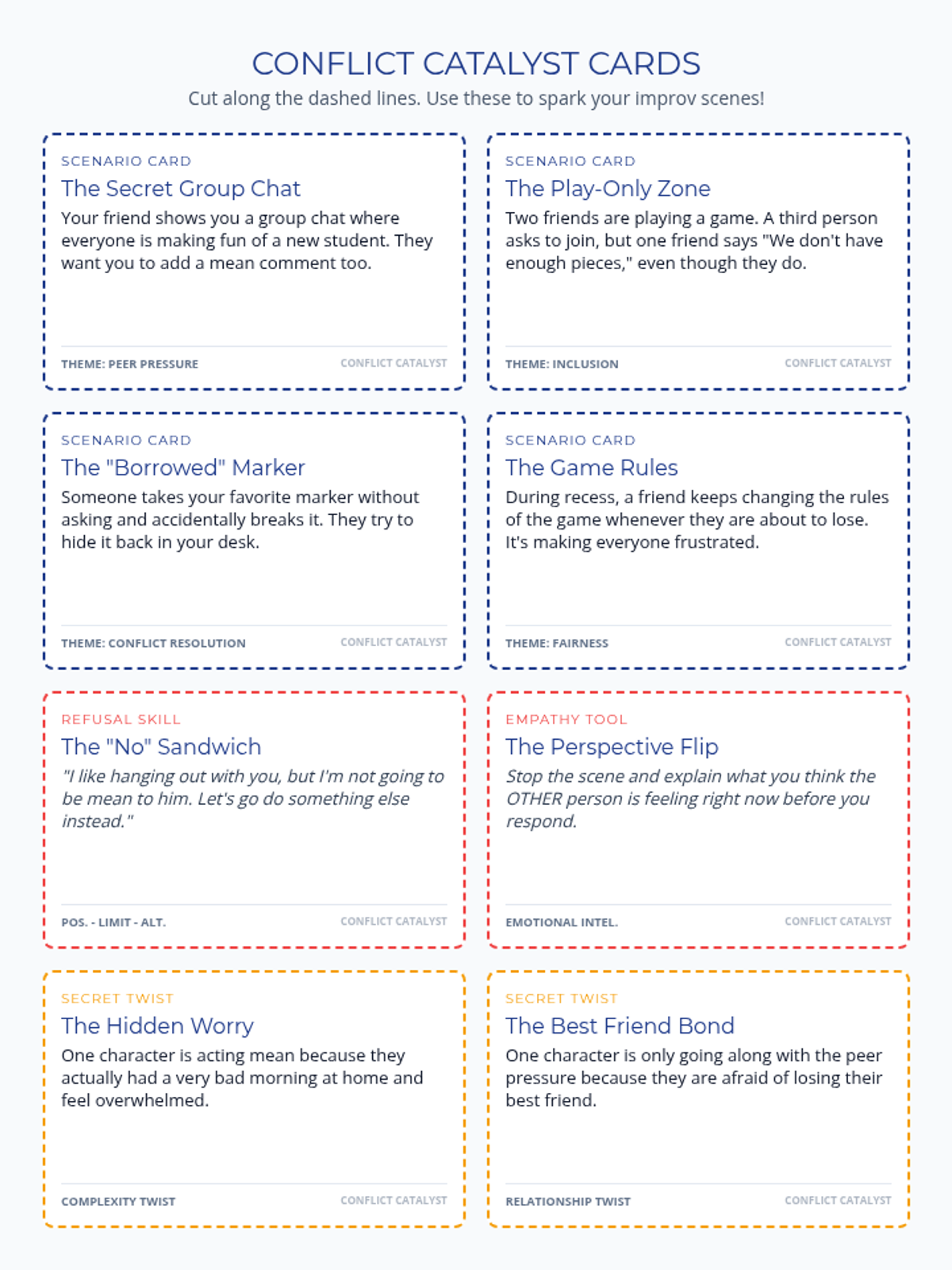
A set of printable prompt cards for drama class, featuring conflict scenarios, refusal skill models, and secret character twists to deepen empathy and perspective-taking.
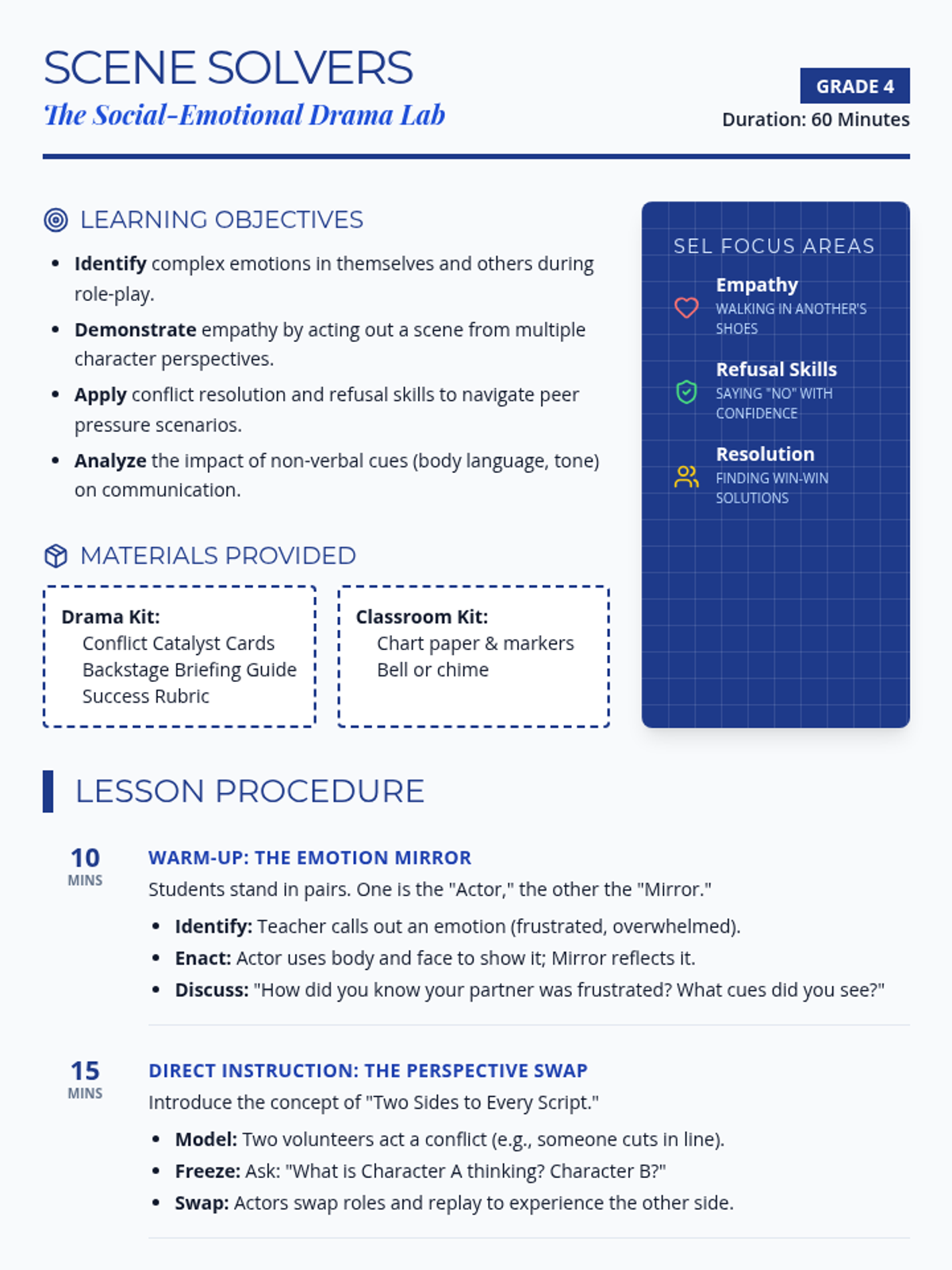
A comprehensive 60-minute lesson plan for 4th-grade drama, integrating SEL concepts like empathy and conflict resolution through warm-ups, direct instruction, and group improv.
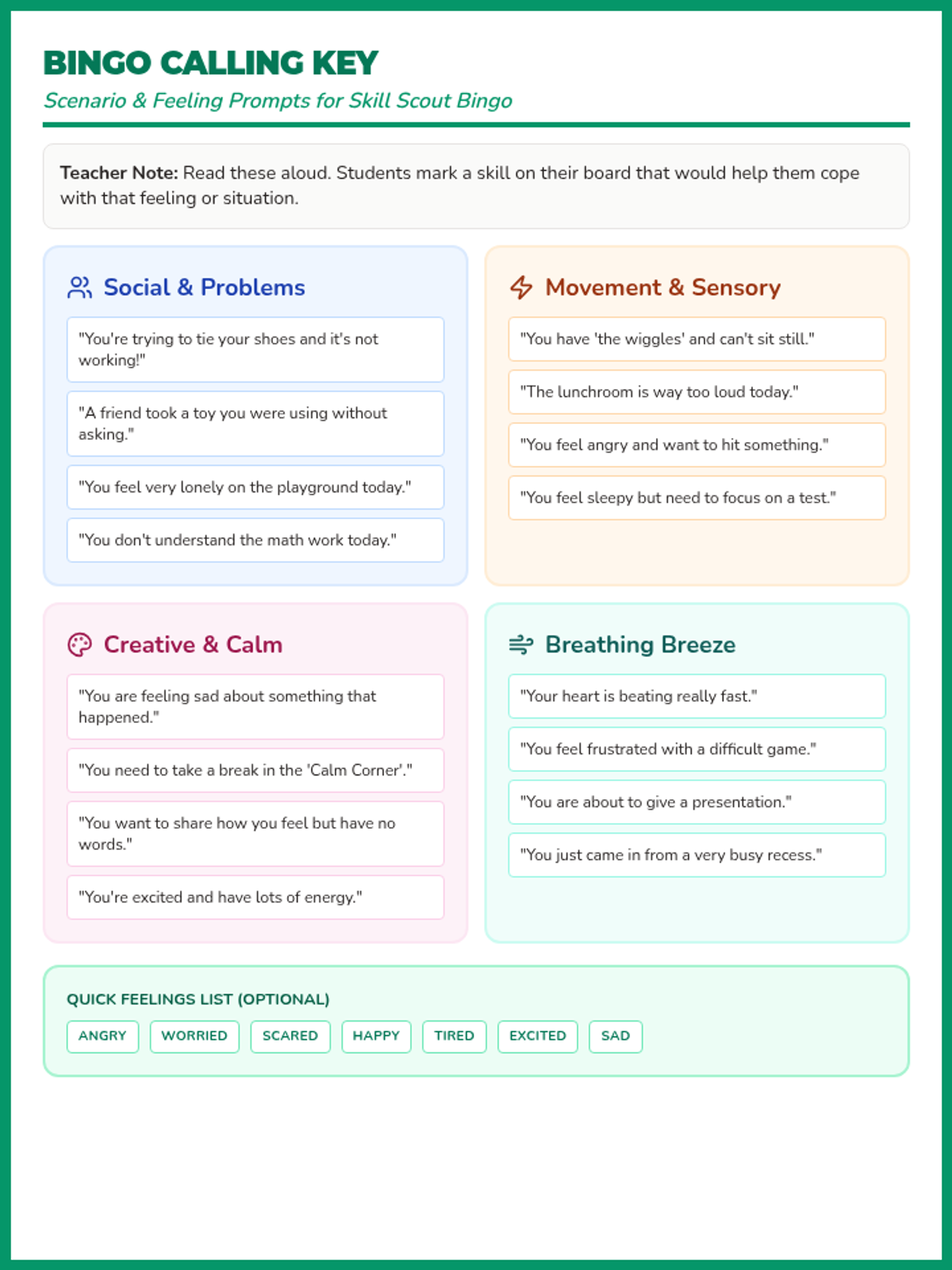
A teacher resource for the Skill Scout Bingo game, featuring various scenario and feeling prompts categorized by coping skill type to facilitate gameplay and discussion.
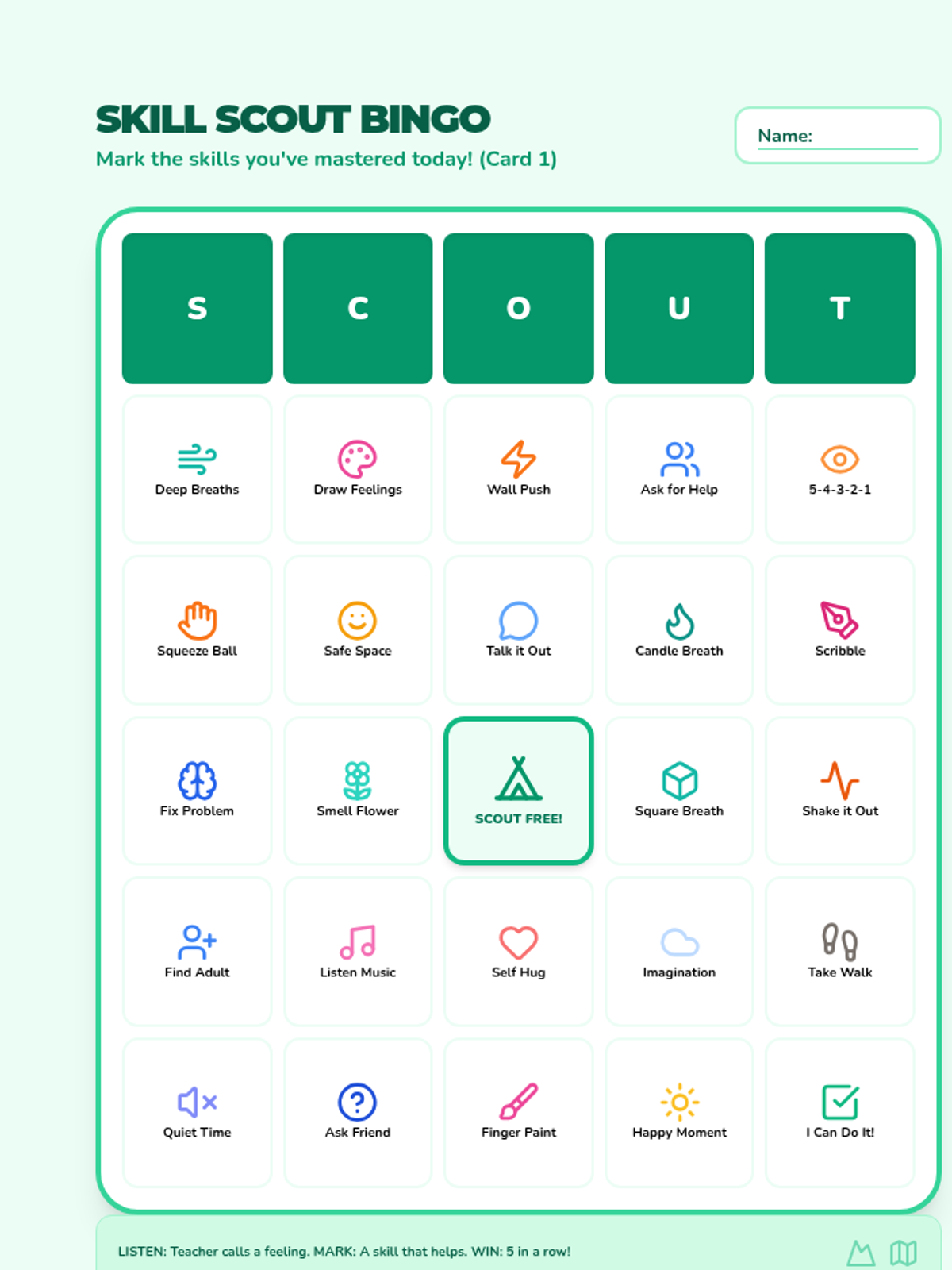
A collection of five unique 5x5 bingo cards featuring various coping skills categorized by movement, breathing, art, and social support. Each card is randomized to allow for group play. Designed for K-4th grade with clear icons and labels.
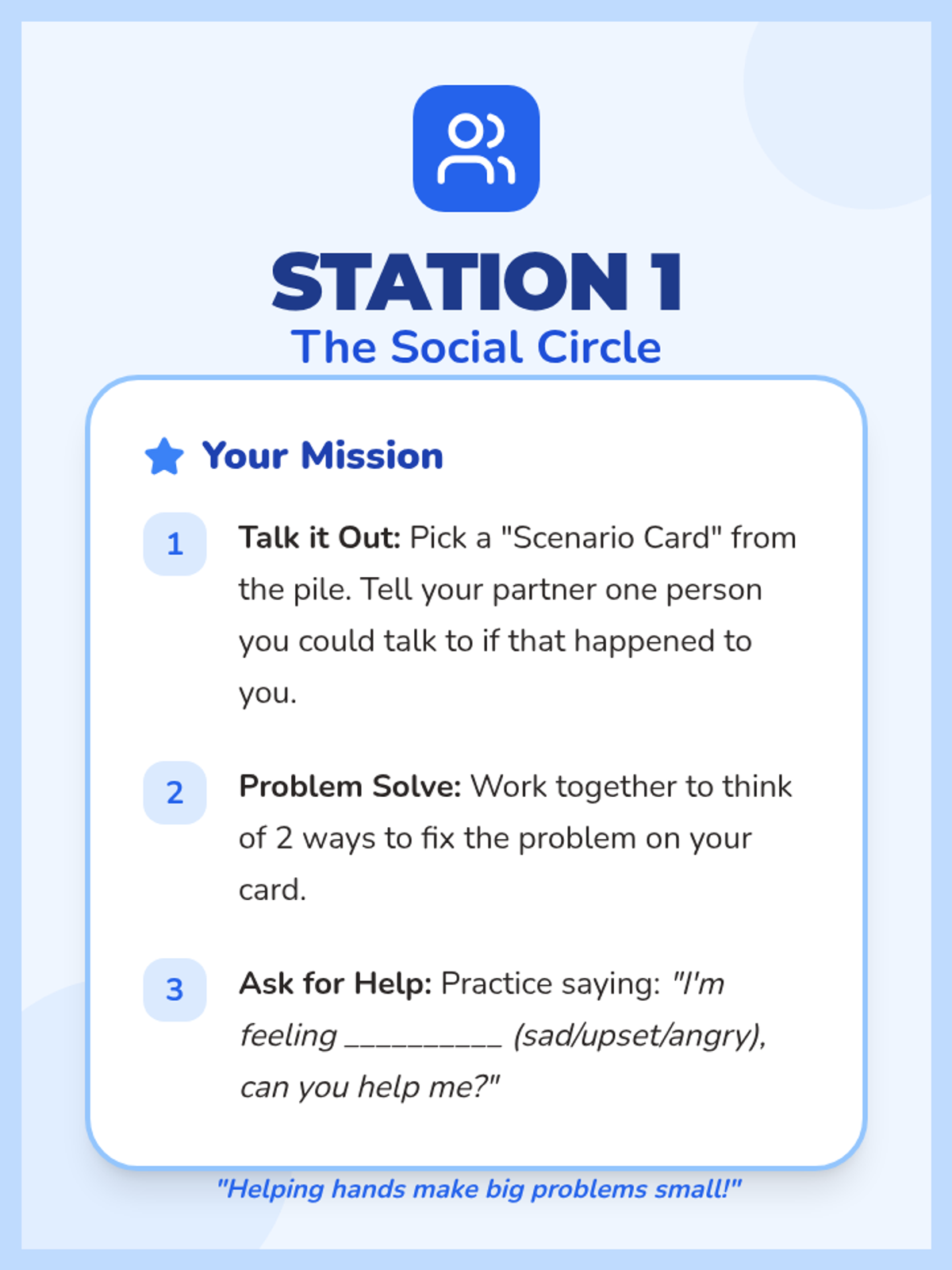
Large-format instruction cards for four coping skills stations: Social Circle (Problem Solving), Movement Grove (Physical/Sensory), Creative Studio (Art), and Breathing Breeze. Each card includes simple, numbered missions and a calming quote.
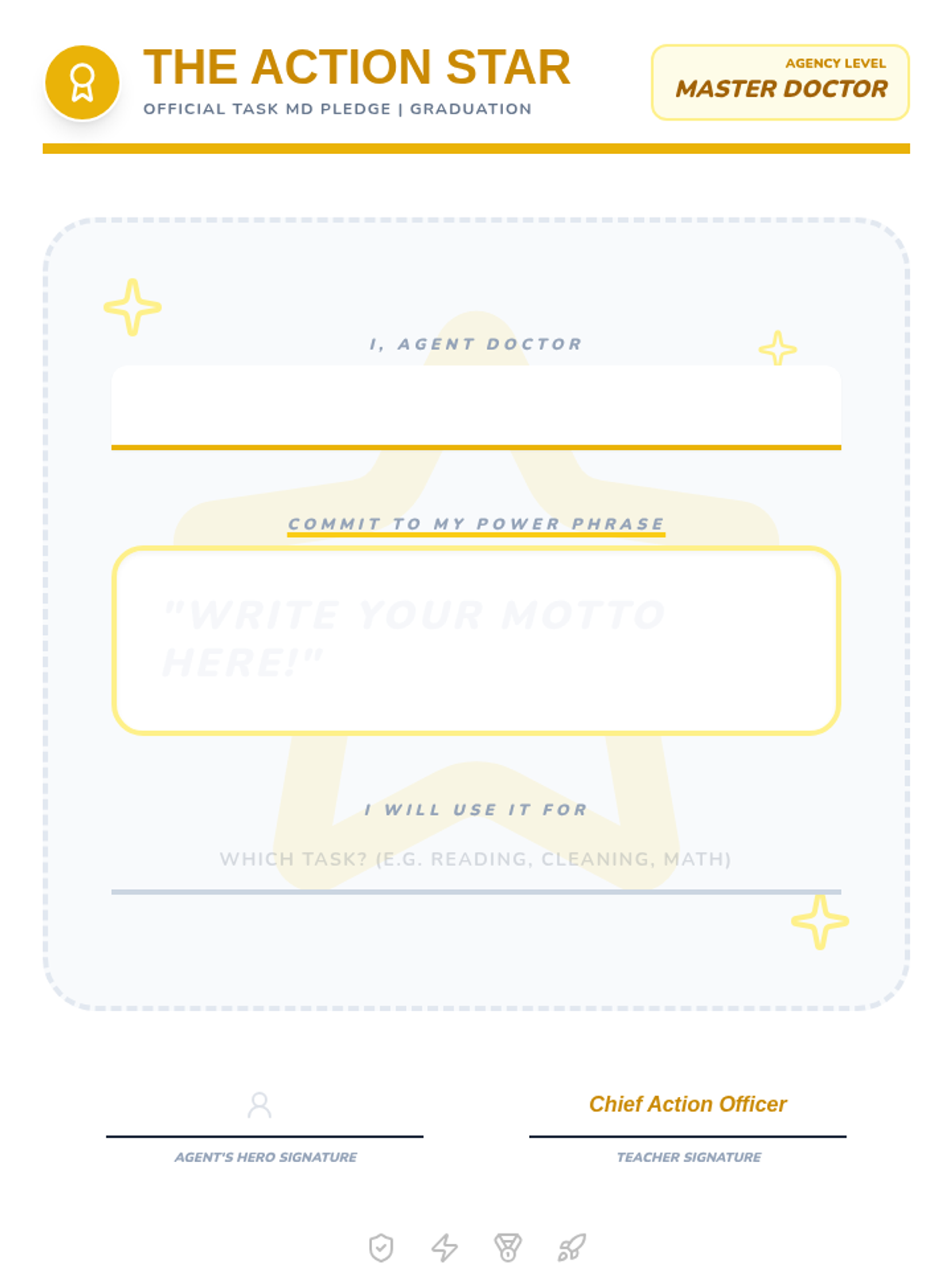
A student worksheet for the final lesson, where students write their personal 'Power Phrase' motto on a star-themed pledge sheet to be displayed on the 'Wall of Action'.
Engaging slides for Lesson 5 that guide the student self-reflection process and introduce the 'Wall of Action' graduation ceremony.
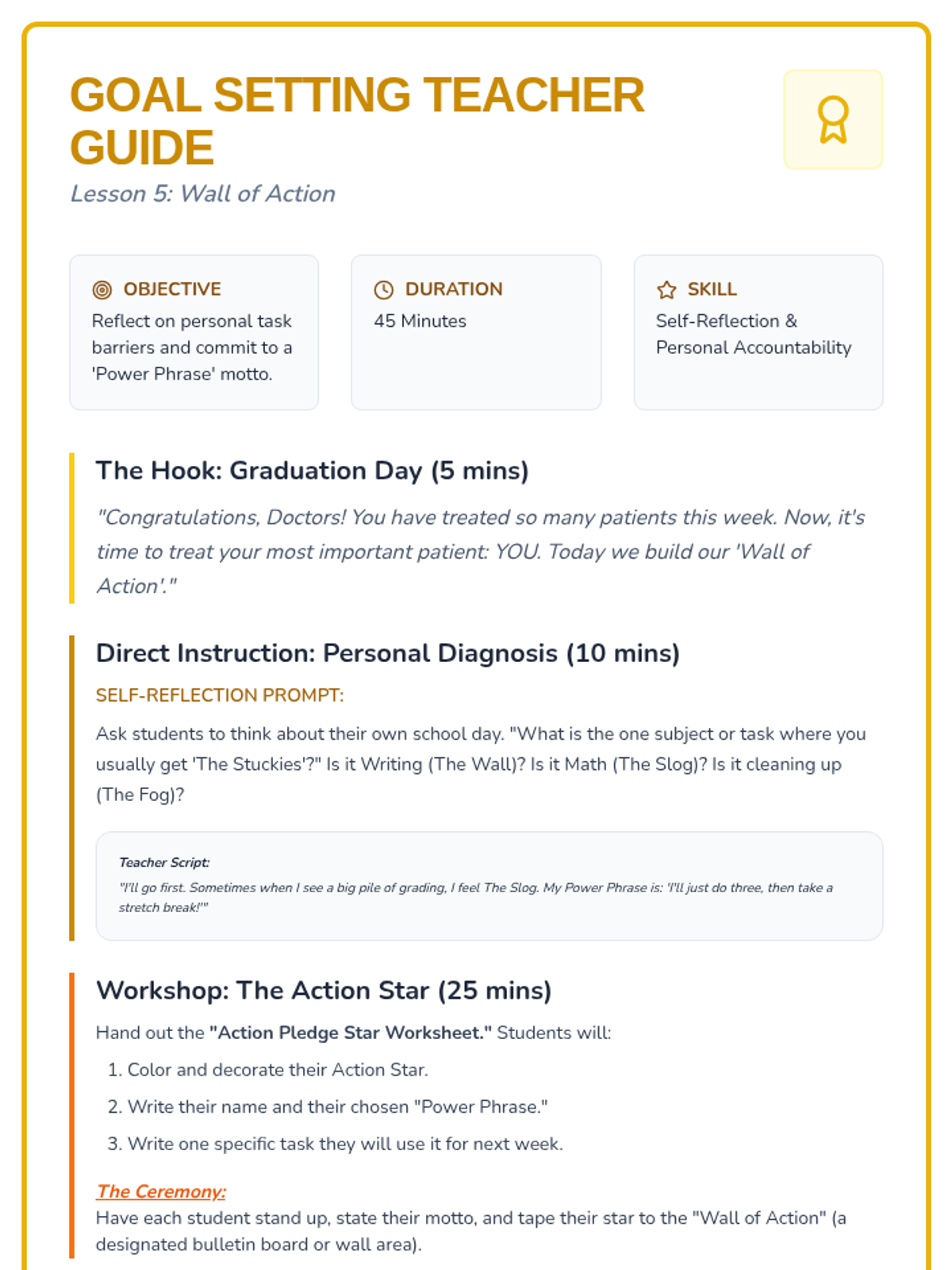
A comprehensive teacher's guide for the fifth lesson, focused on student self-reflection and creating a 'Wall of Action' with personal self-talk mottos.
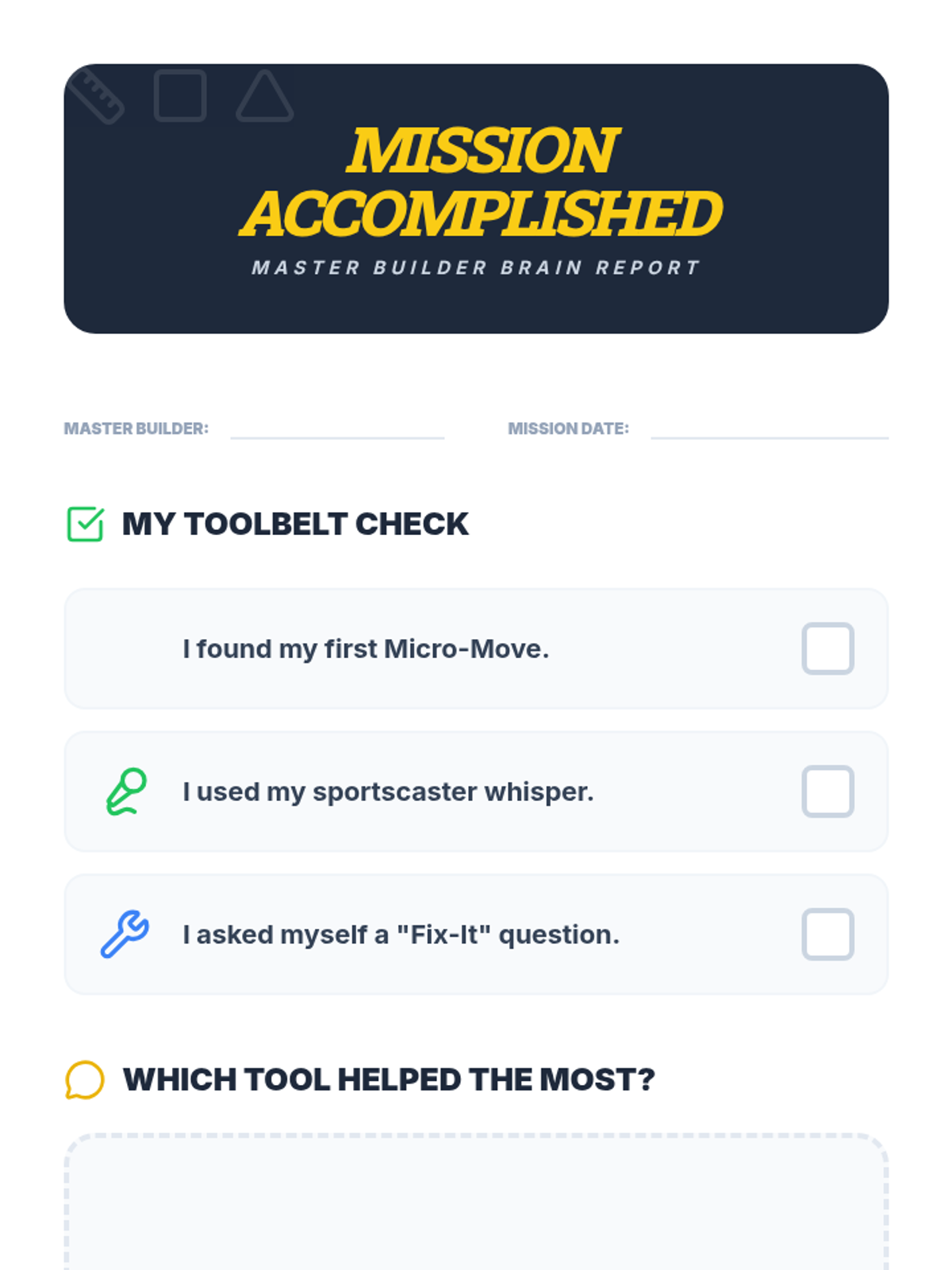
Student self-assessment and reflection worksheet for the final mission of the Builder Brain sequence.
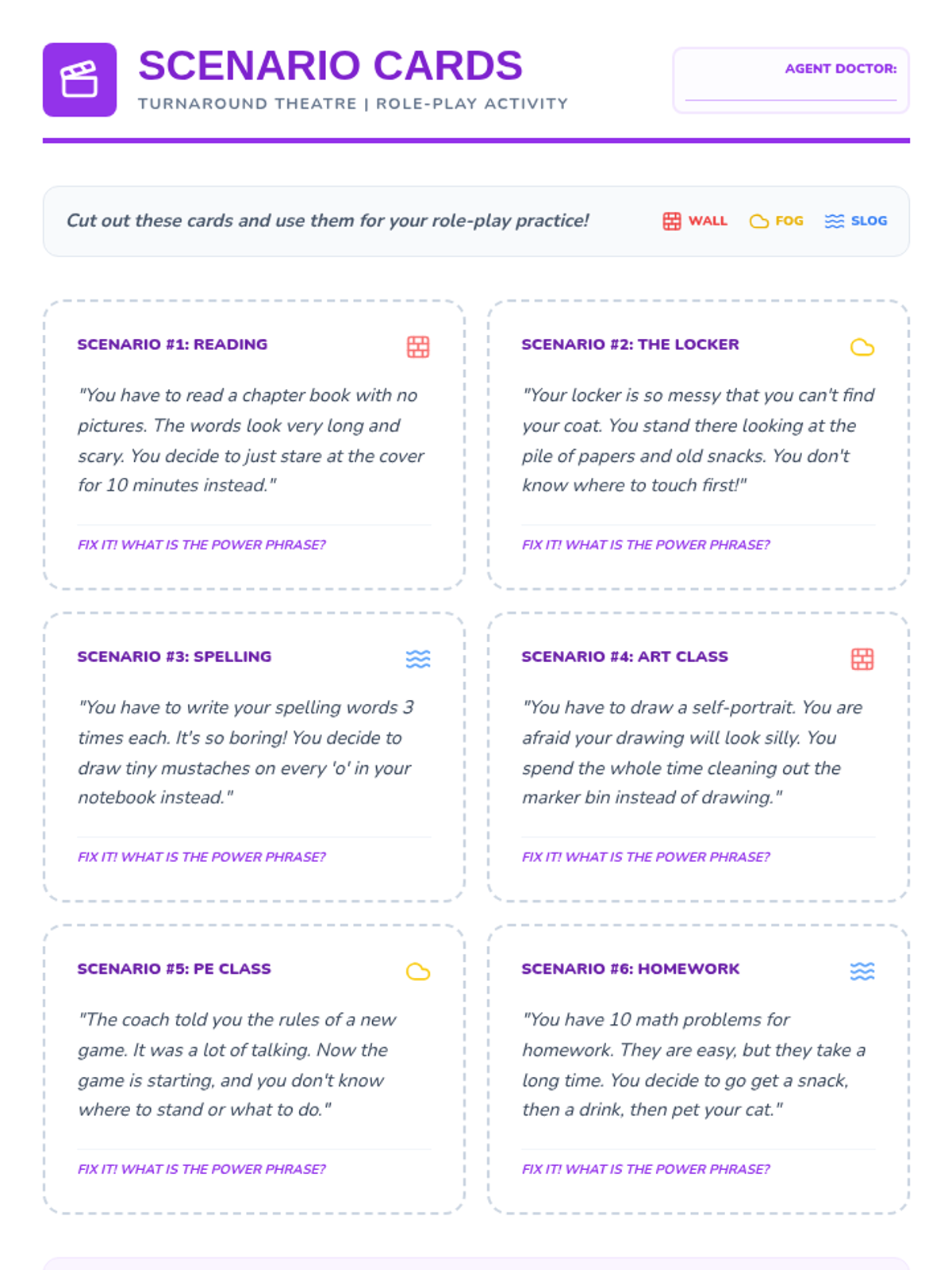
A set of role-play scenario cards for Lesson 4, allowing students to practice diagnosing barriers (Wall, Fog, Slog) and delivering self-talk prescriptions.
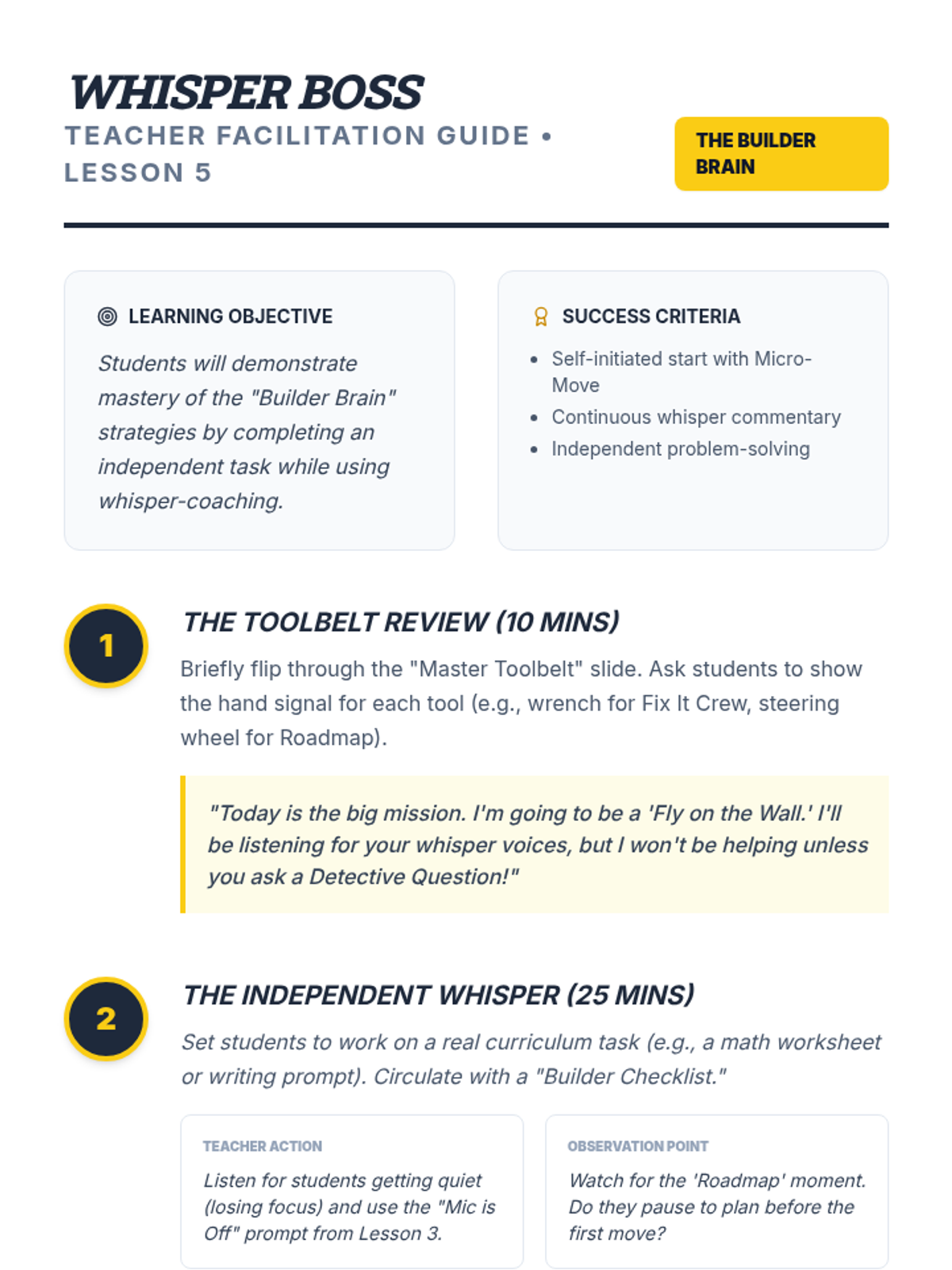
Teacher guide for Lesson 5: Master Builder, focusing on the culminating 'Whisper Challenge' and assessment of all self-talk strategies.
Engaging slides for Lesson 4 that guide the "Freeze and Fix" improvisational game and present role-play scenarios for students to practice self-talk solutions.
Visual presentation for Lesson 5: Master Builder, teaching students to apply all self-talk strategies to independent work.
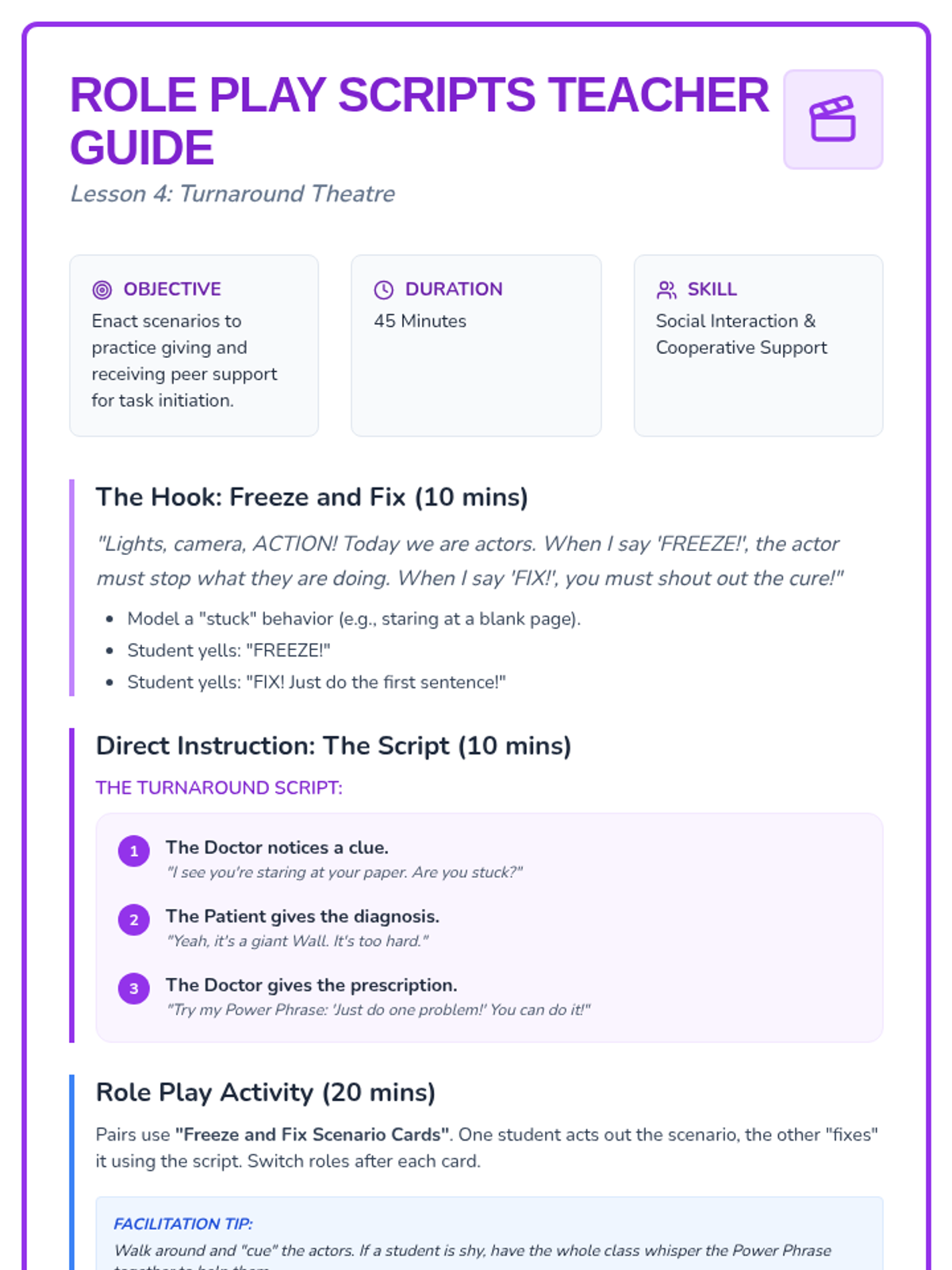
A comprehensive teacher's guide for the fourth lesson, outlining role-playing scripts and the "Freeze and Fix" improvisational activity.
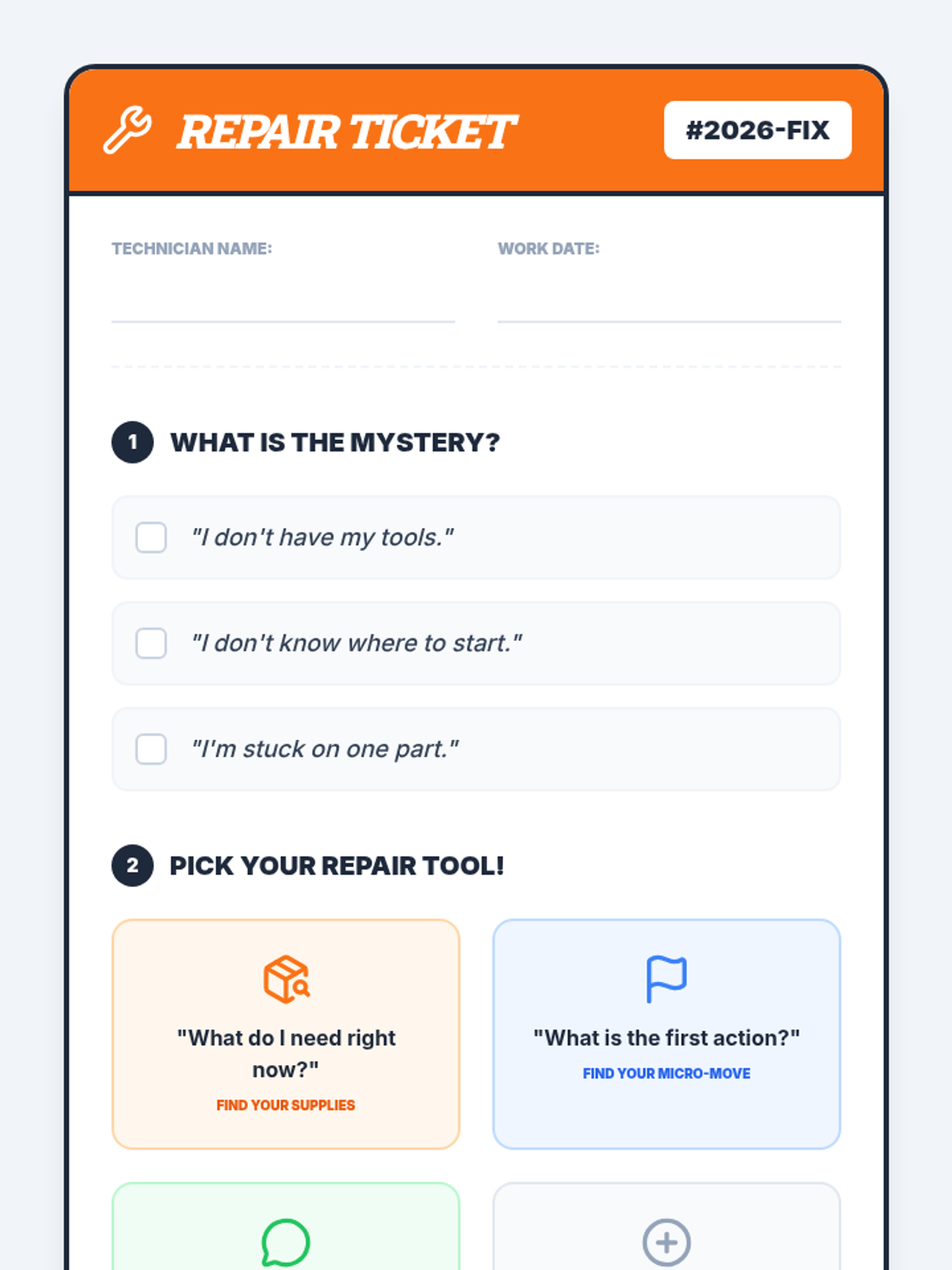
Student worksheet designed as a 'repair ticket' for choosing problem-solving questions when stuck on a task.
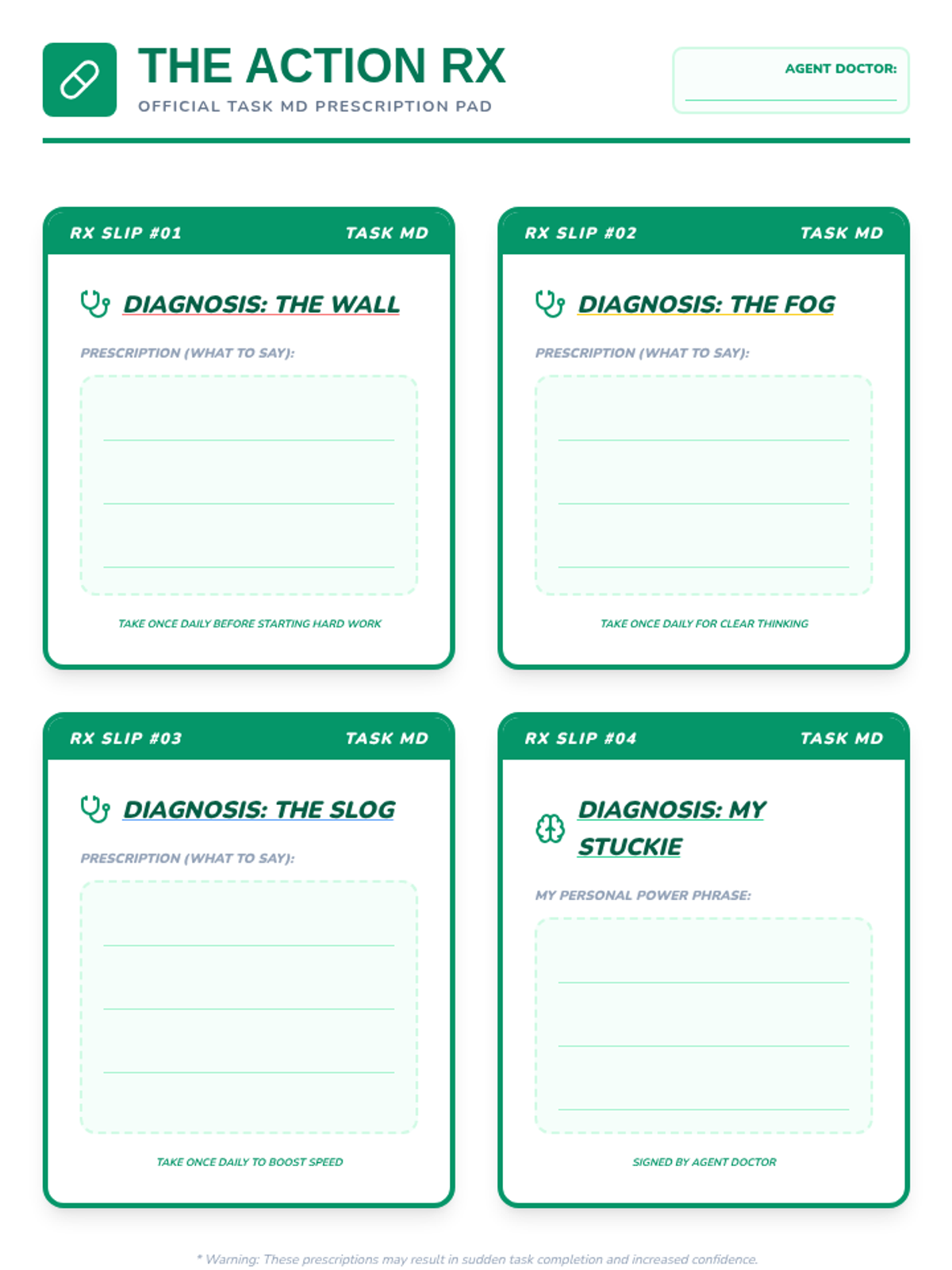
A student worksheet for the third lesson, using an oversized 'prescription pad' design to practice writing self-talk power phrases for different task barriers.
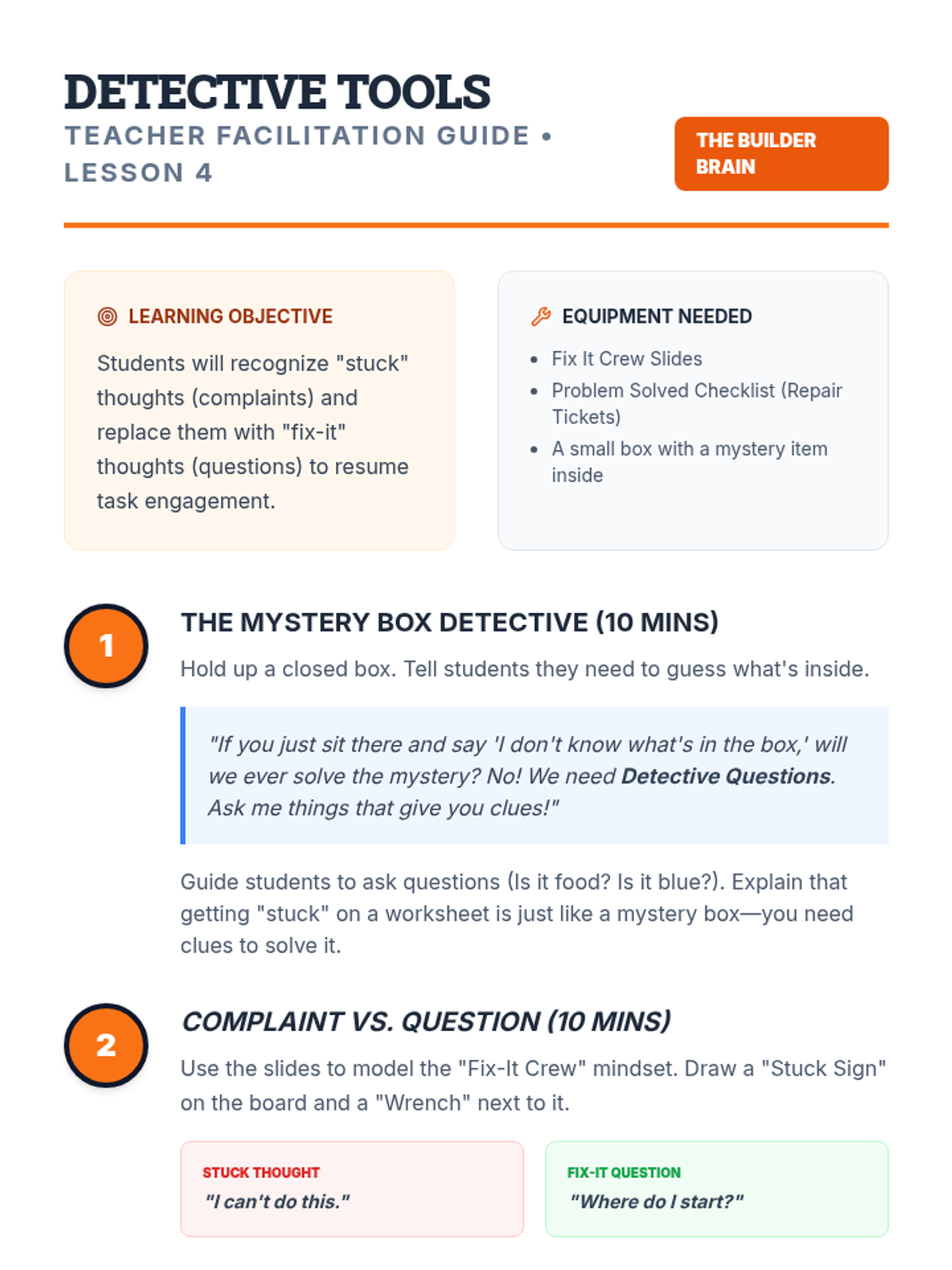
Teacher guide for Lesson 4: Fix It Crew, focusing on teaching students to ask themselves specific questions when they get stuck.
Visual presentation for Lesson 4: Fix It Crew, teaching students to ask themselves specific questions when they get stuck.
Engaging slides for Lesson 3 that match specific self-talk 'prescriptions' to diagnosed problems like boredom and difficulty.
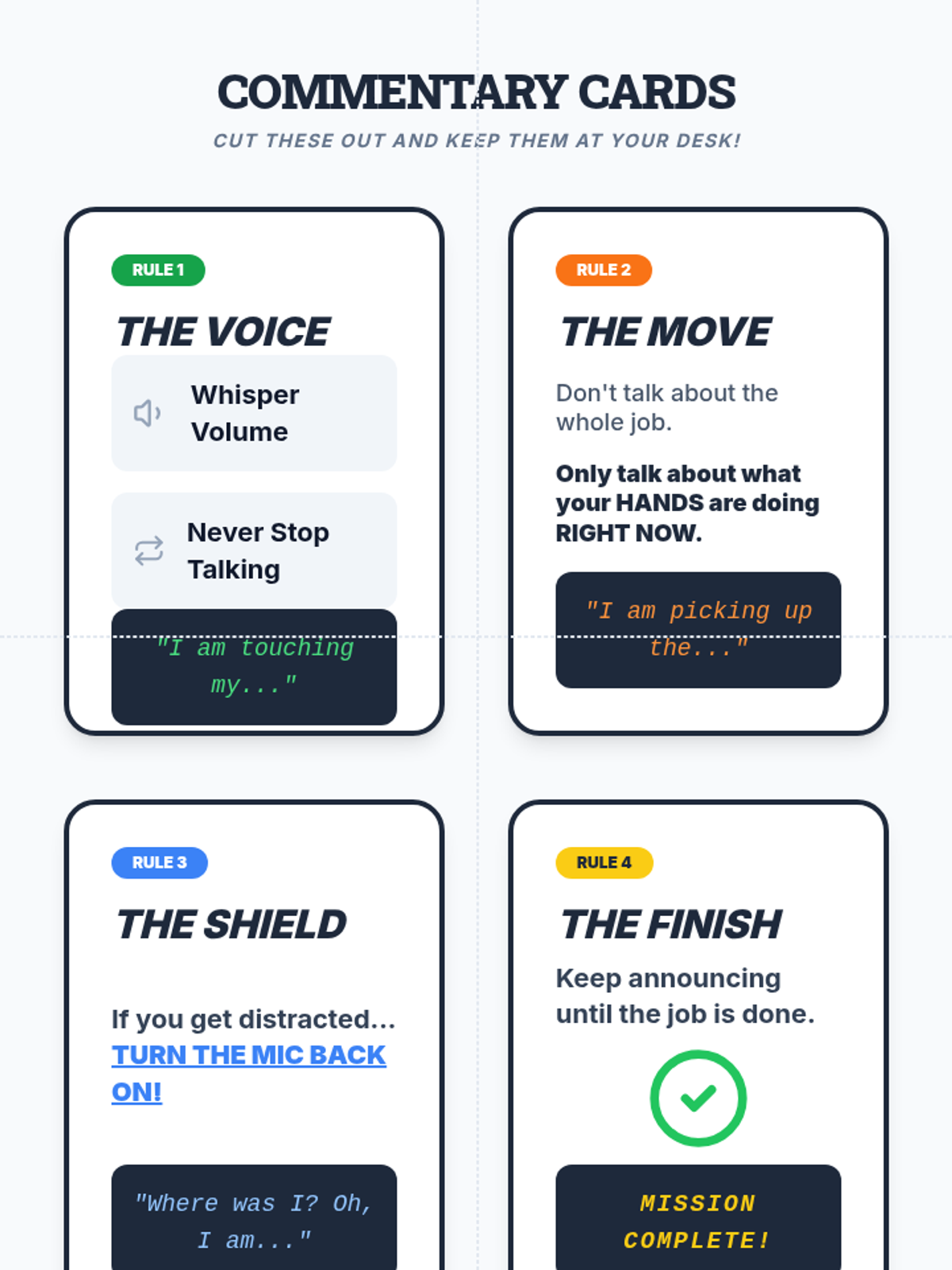
Student desk reference cards with rules and prompts for sportscasting actions during tasks.
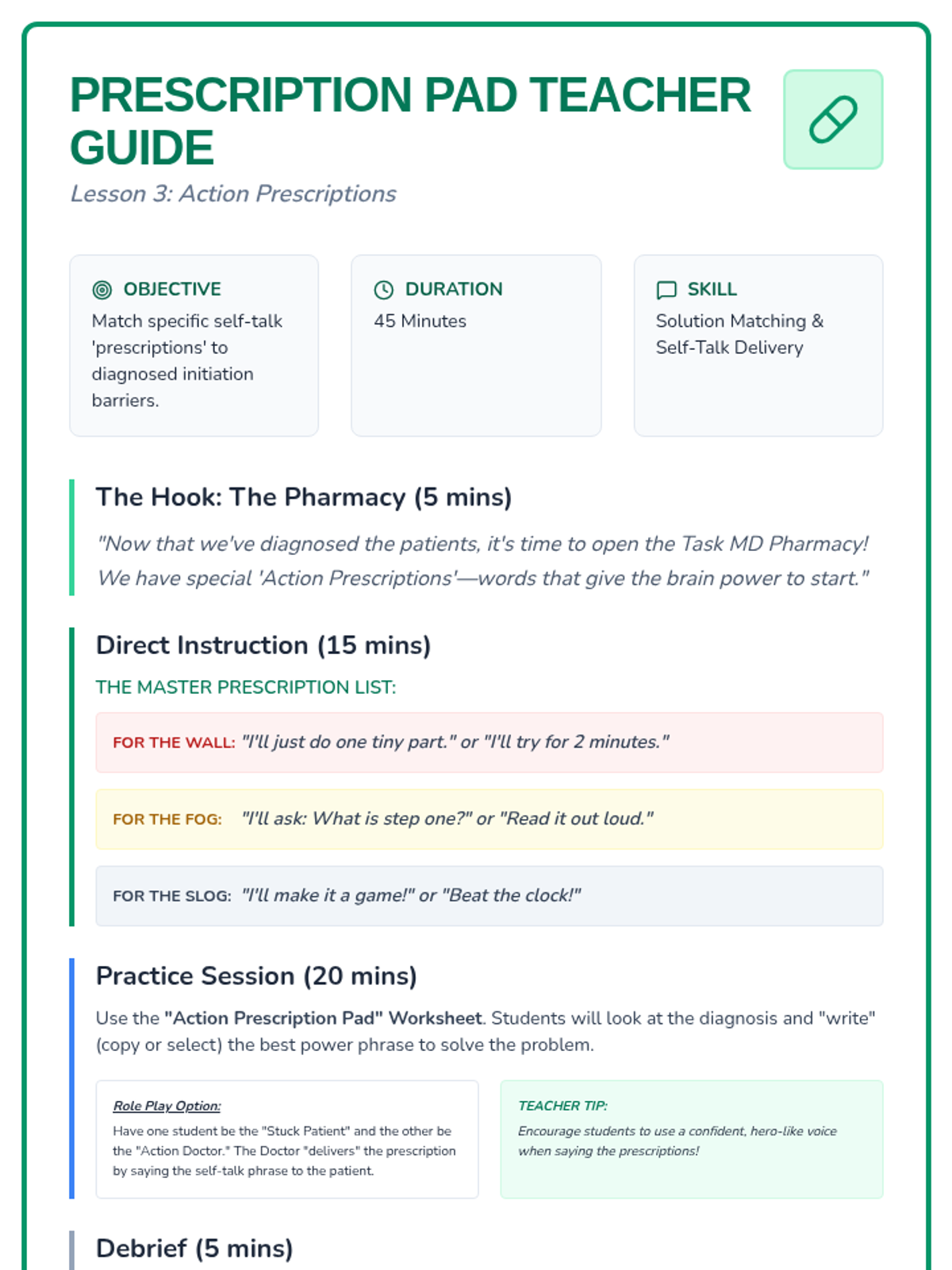
A comprehensive teacher's guide for the third lesson, matching specific self-talk 'prescriptions' to diagnosed problems like boredom and difficulty.
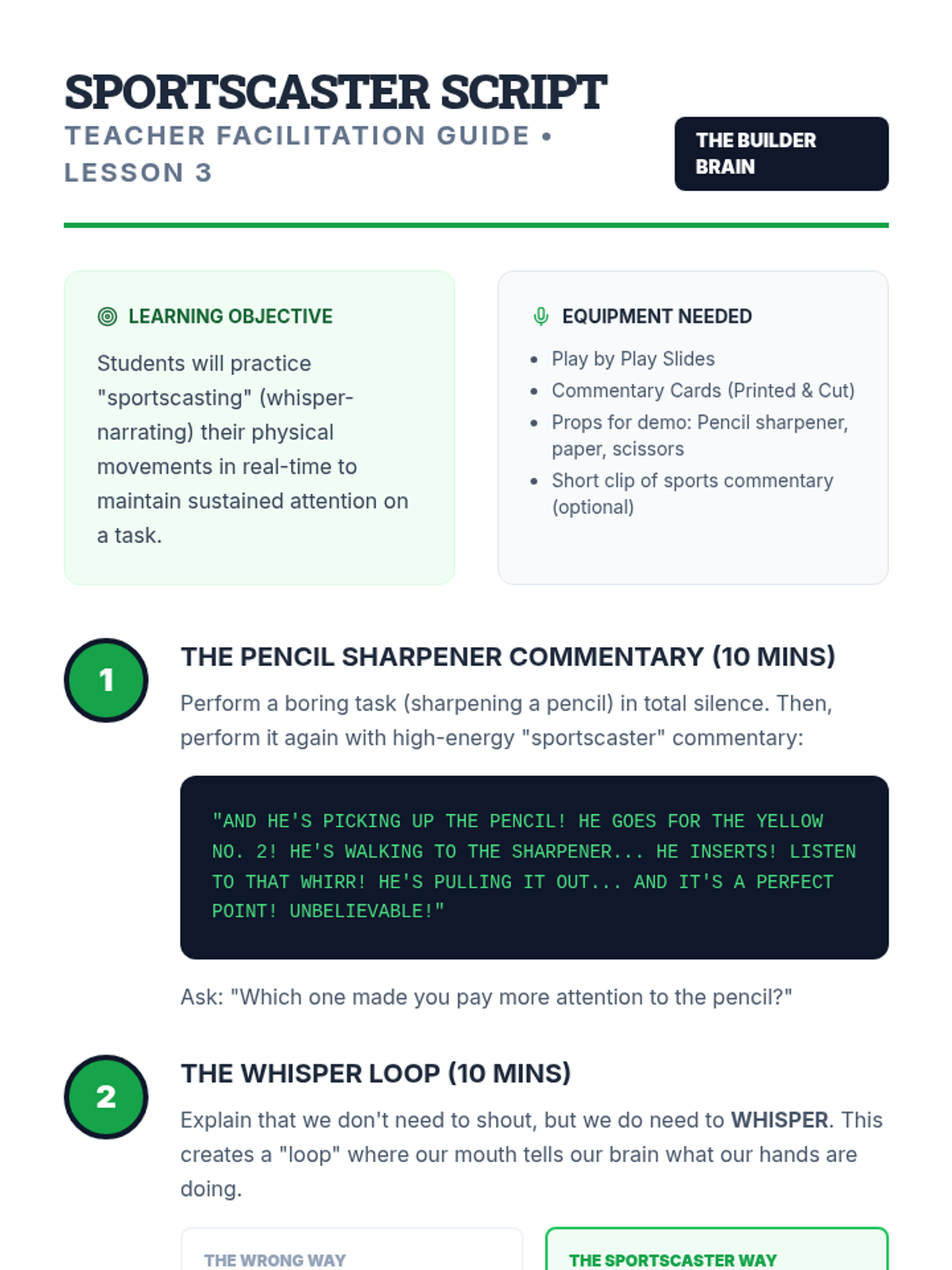
Teacher guide for Lesson 3: Play by Play, focusing on teaching students to verbally sequence their tasks using First, Next, and Then.
Visual presentation for Lesson 3: Play by Play, teaching students to narrate their own actions to maintain focus during tasks.
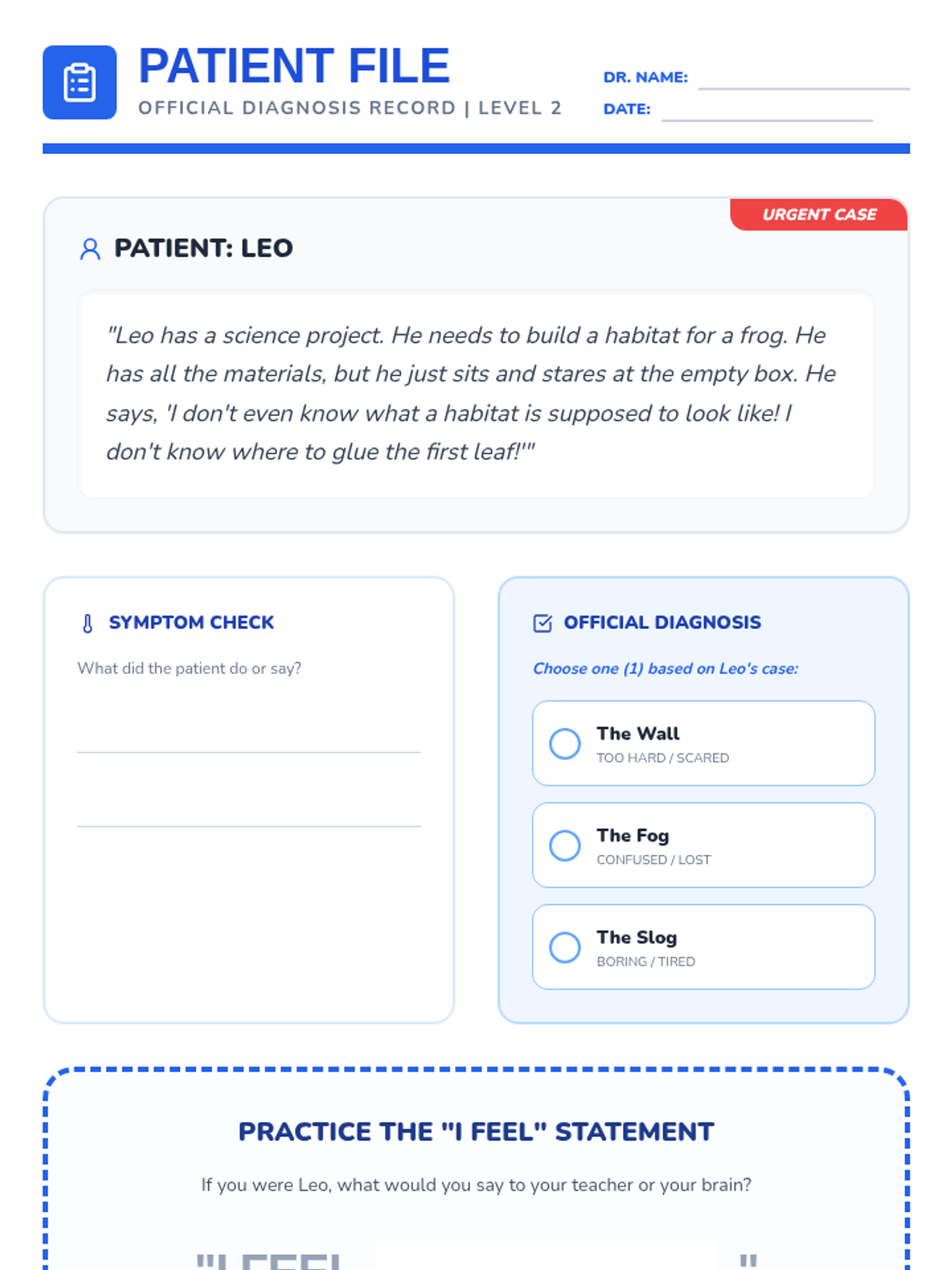
A student worksheet for the second lesson, acting as a 'Patient File' where students diagnose a character's barrier to task initiation and practice 'I feel' statements.
Engaging slides for Lesson 2 that introduce the metaphors of "The Wall," "The Fog," and "The Slog" to help students diagnose their task initiation barriers.
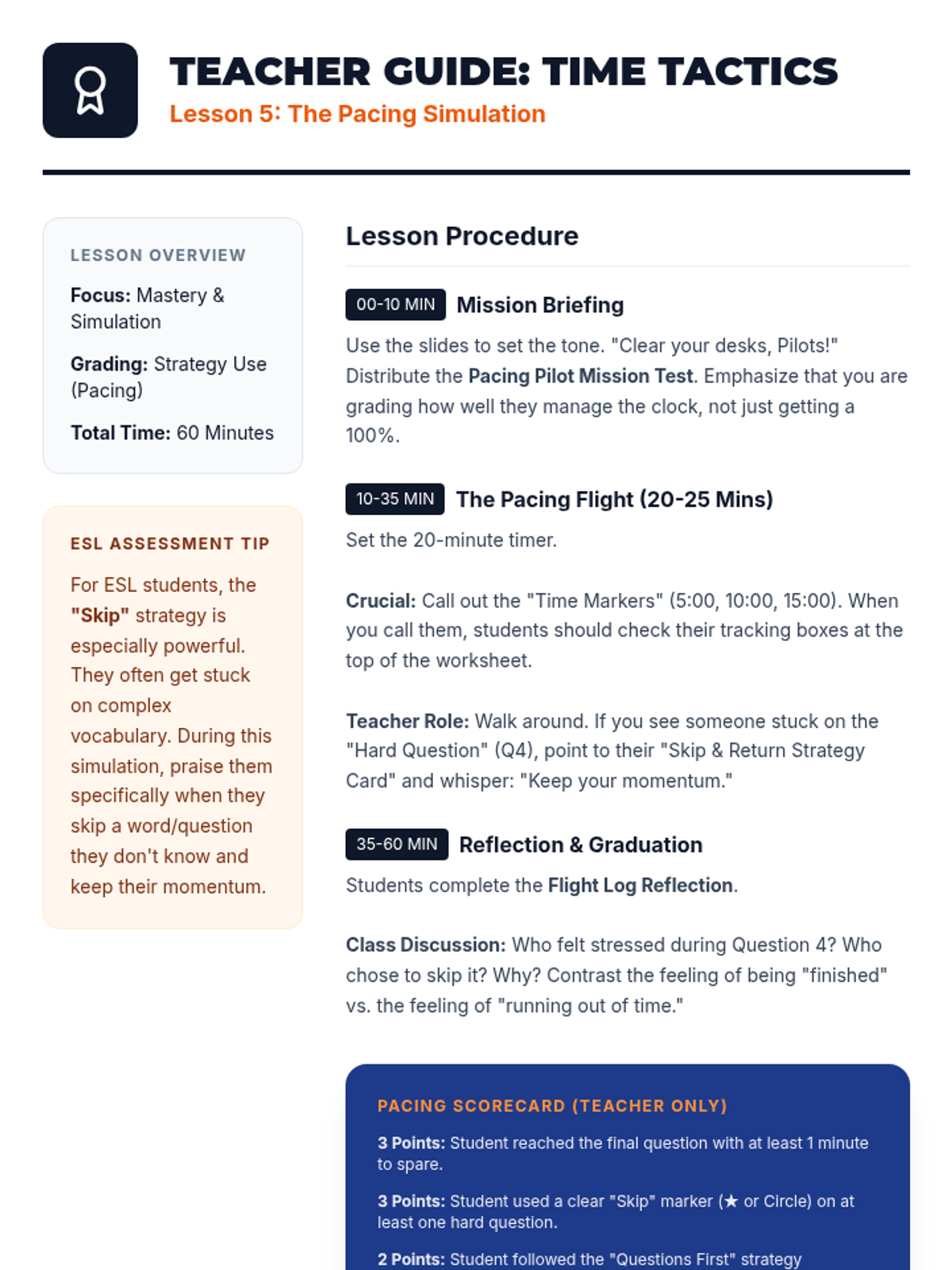
Teacher guidance for the Lesson 5 simulation, including timing calls, teacher observation tips, and a scoring rubric for student pacing behavior.
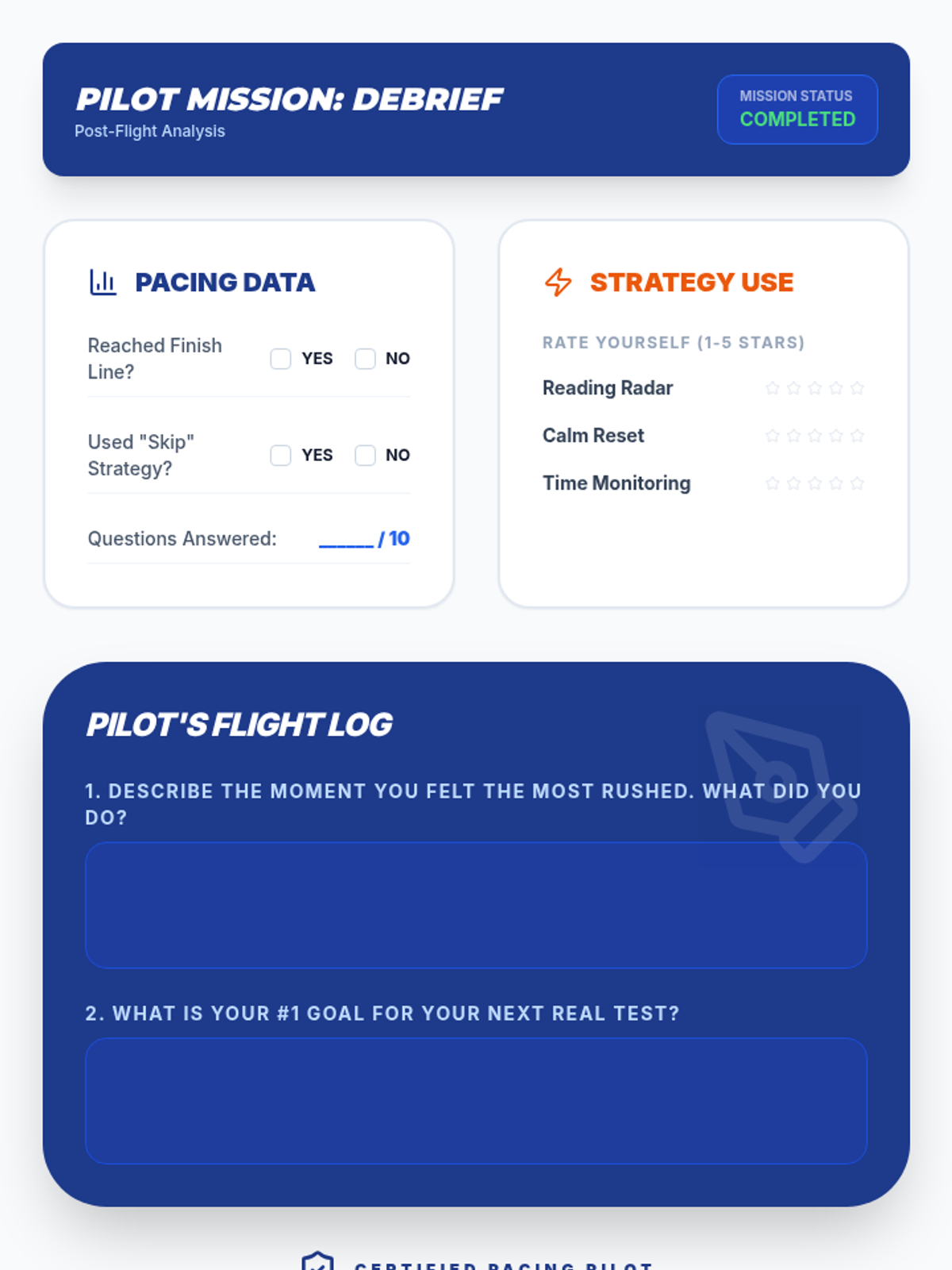
The Lesson 5 reflection and debrief worksheet where students analyze their performance during the simulation and rate their strategy use.
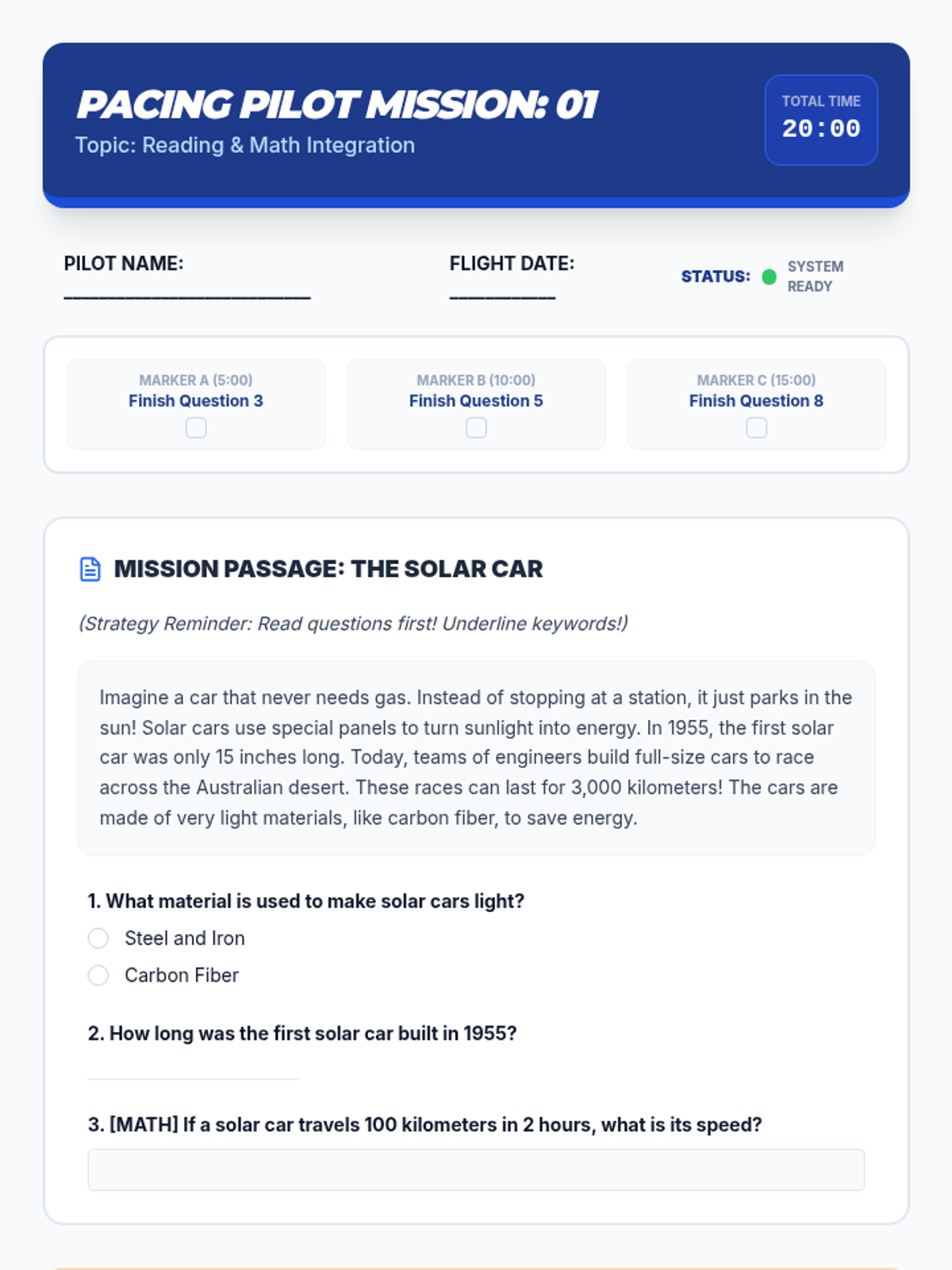
The first page of the Lesson 5 simulation test, designed to test pacing with a passage, integrated math, and a strategically 'hard' question to prompt skipping.
Final slide deck for Lesson 5, featuring the pacing simulation briefing, mission rules, and time markers for the practice test.
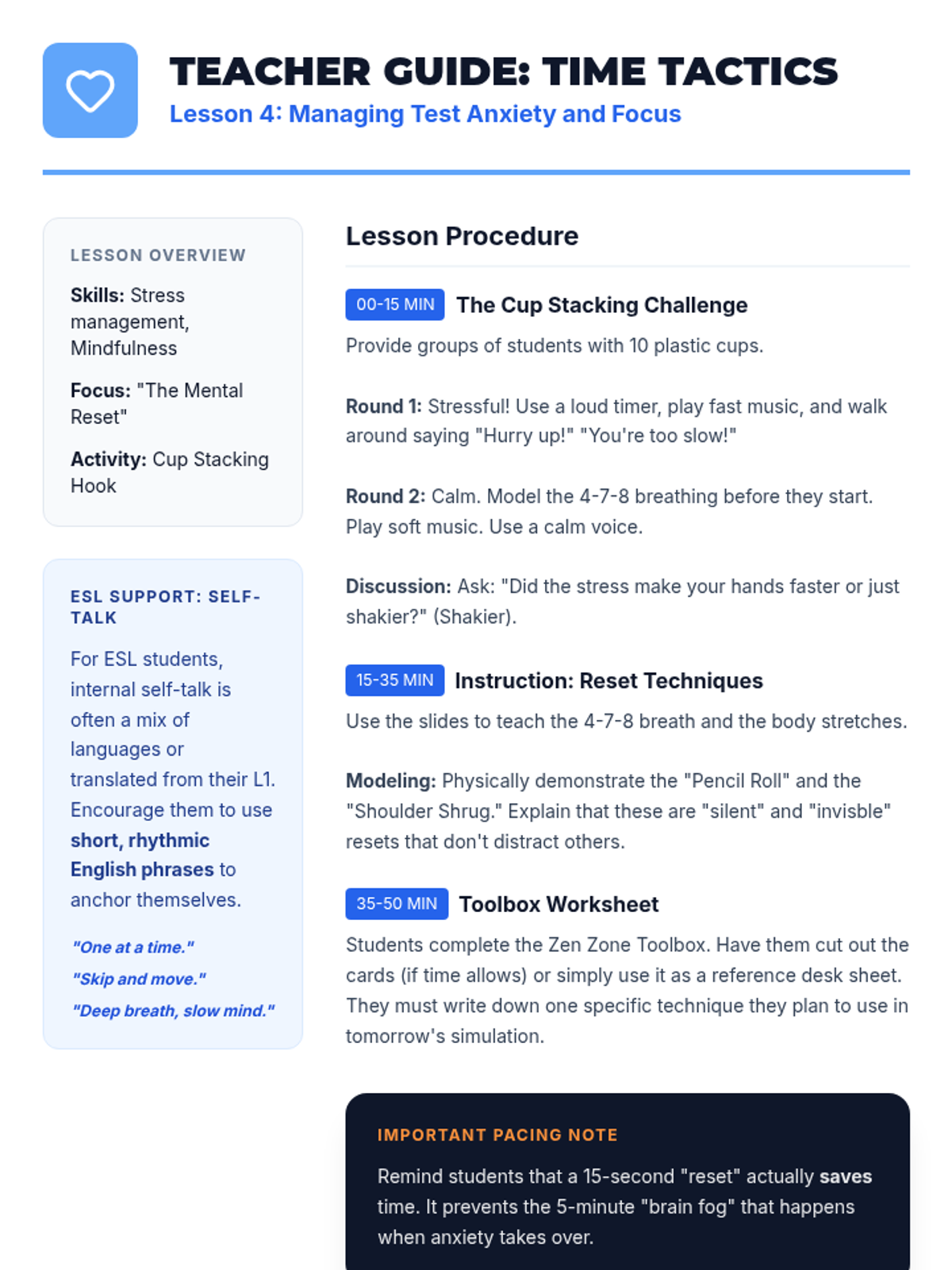
Teacher guidance for Lesson 4, including managing the cup-stacking challenge and modeling reset techniques for ESL students.
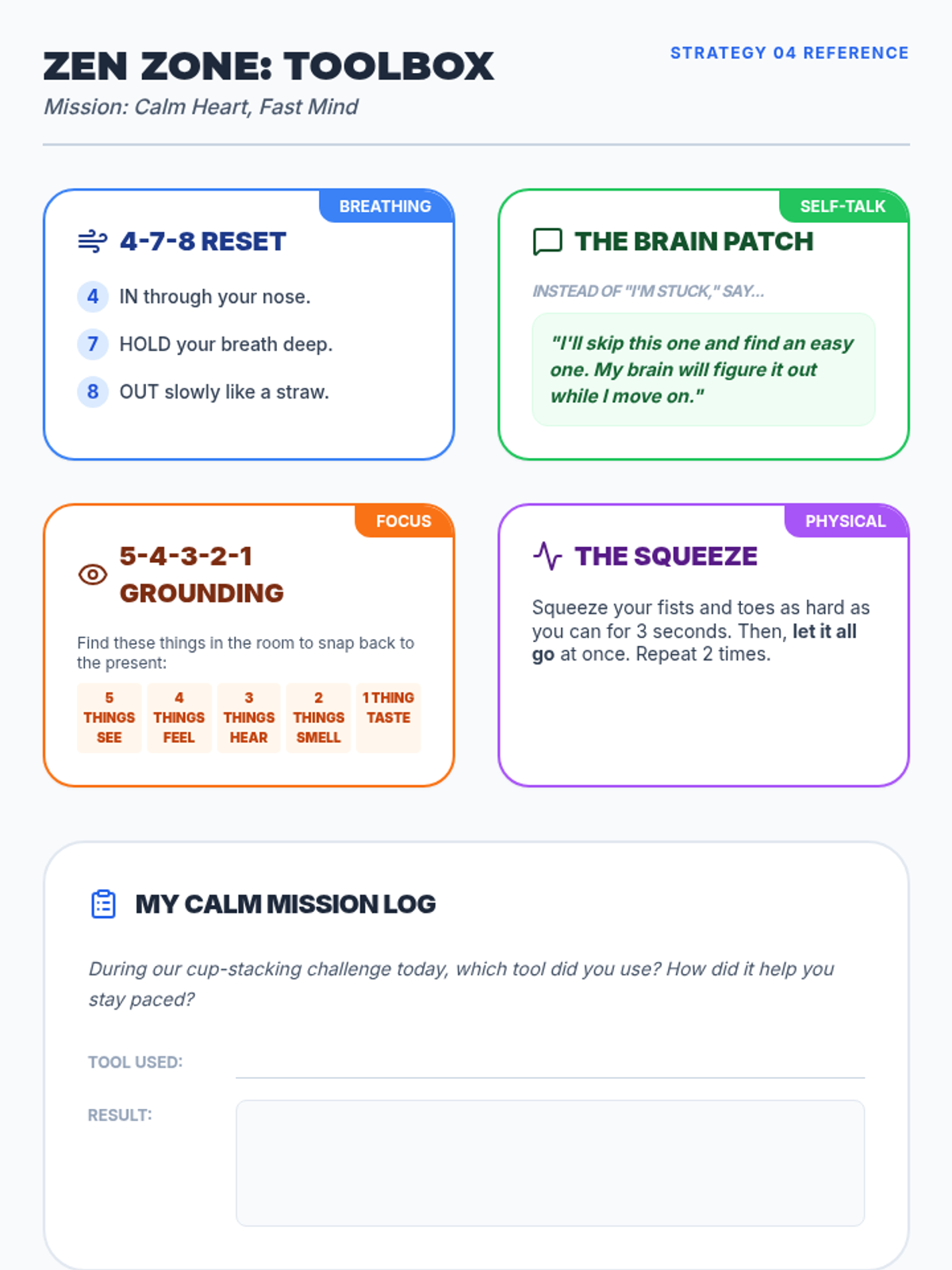
A resource sheet for Lesson 4 with 'Zen Zone' strategy cards (breathing, self-talk, grounding, physical reset) and a practice log for the cup-stacking activity.
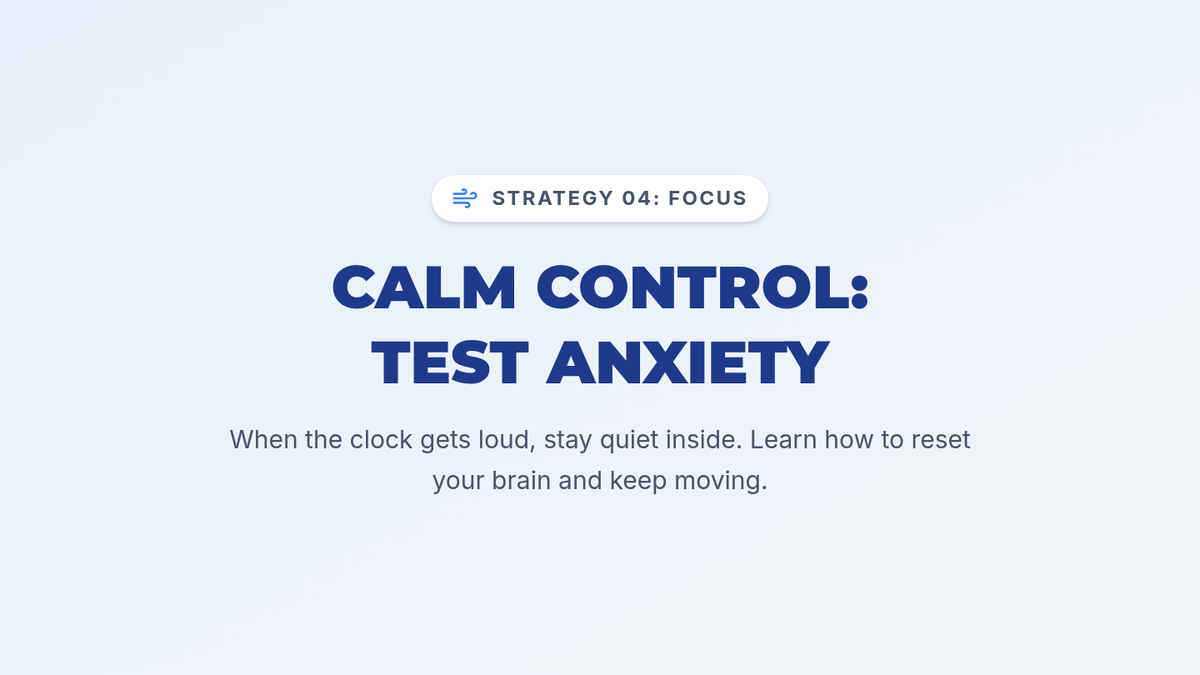
Slide deck for Lesson 4 on managing test anxiety, featuring breathing techniques, positive self-talk, and in-seat physical resets.
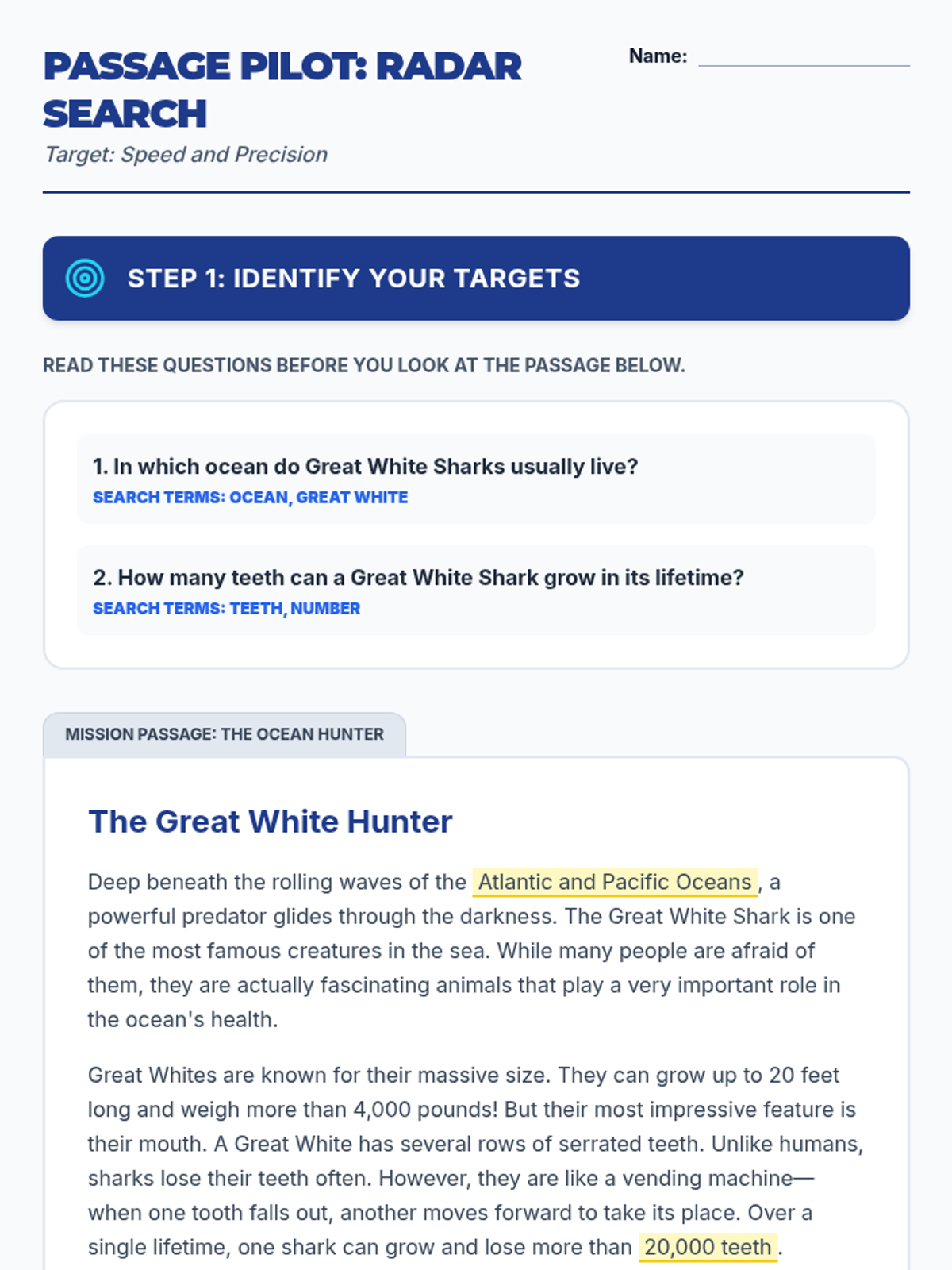
A practice worksheet for Lesson 3 that uses a short passage about sharks to help students practice the 'Questions First' and 'Keyword Search' strategies.
Slide deck for Lesson 3 on handling long passages, teaching the 'Questions First' strategy and skimming techniques to save time.
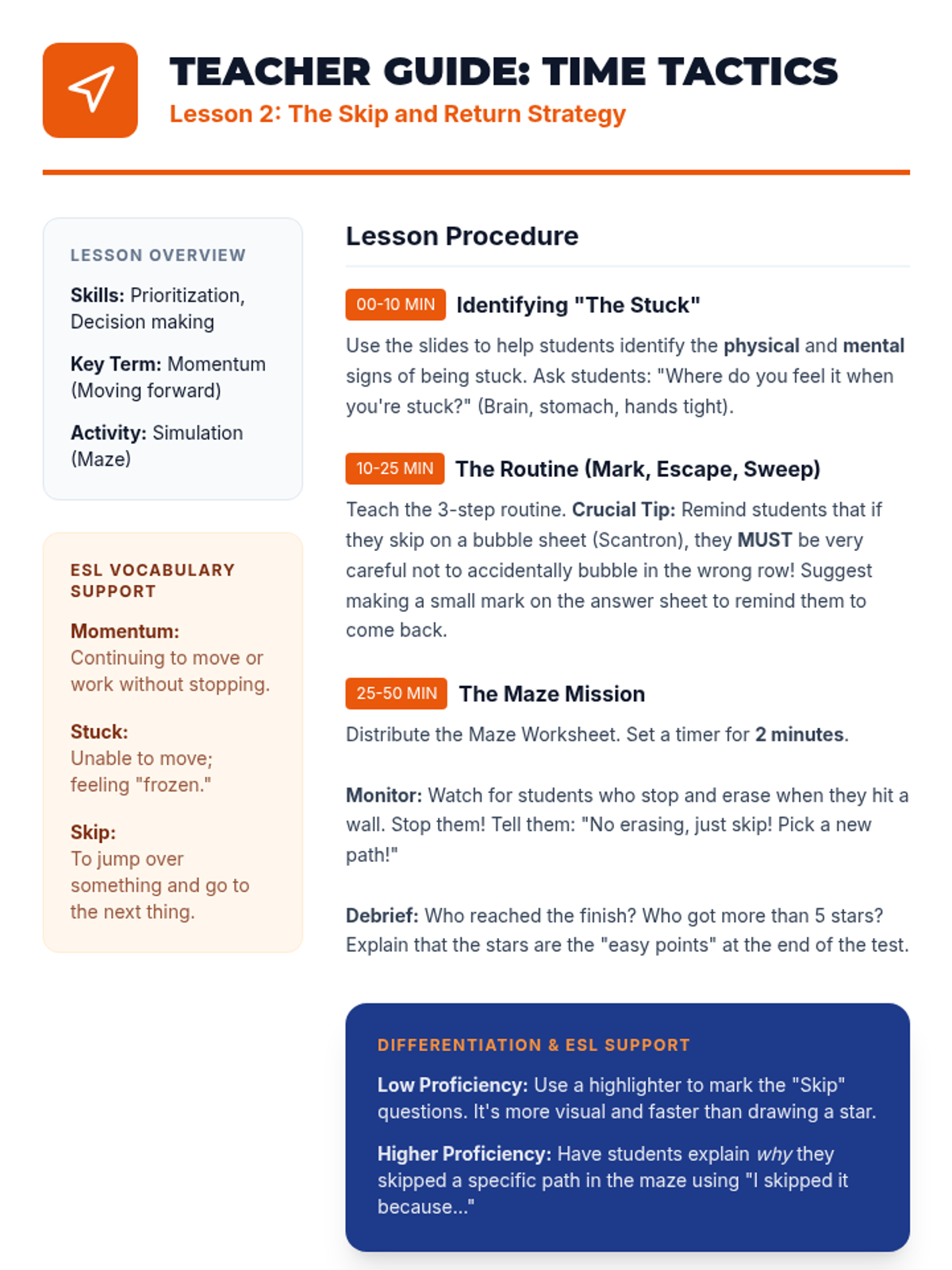
Teacher guidance for Lesson 2, including momentum concepts, ESL vocabulary support, and maze simulation management.
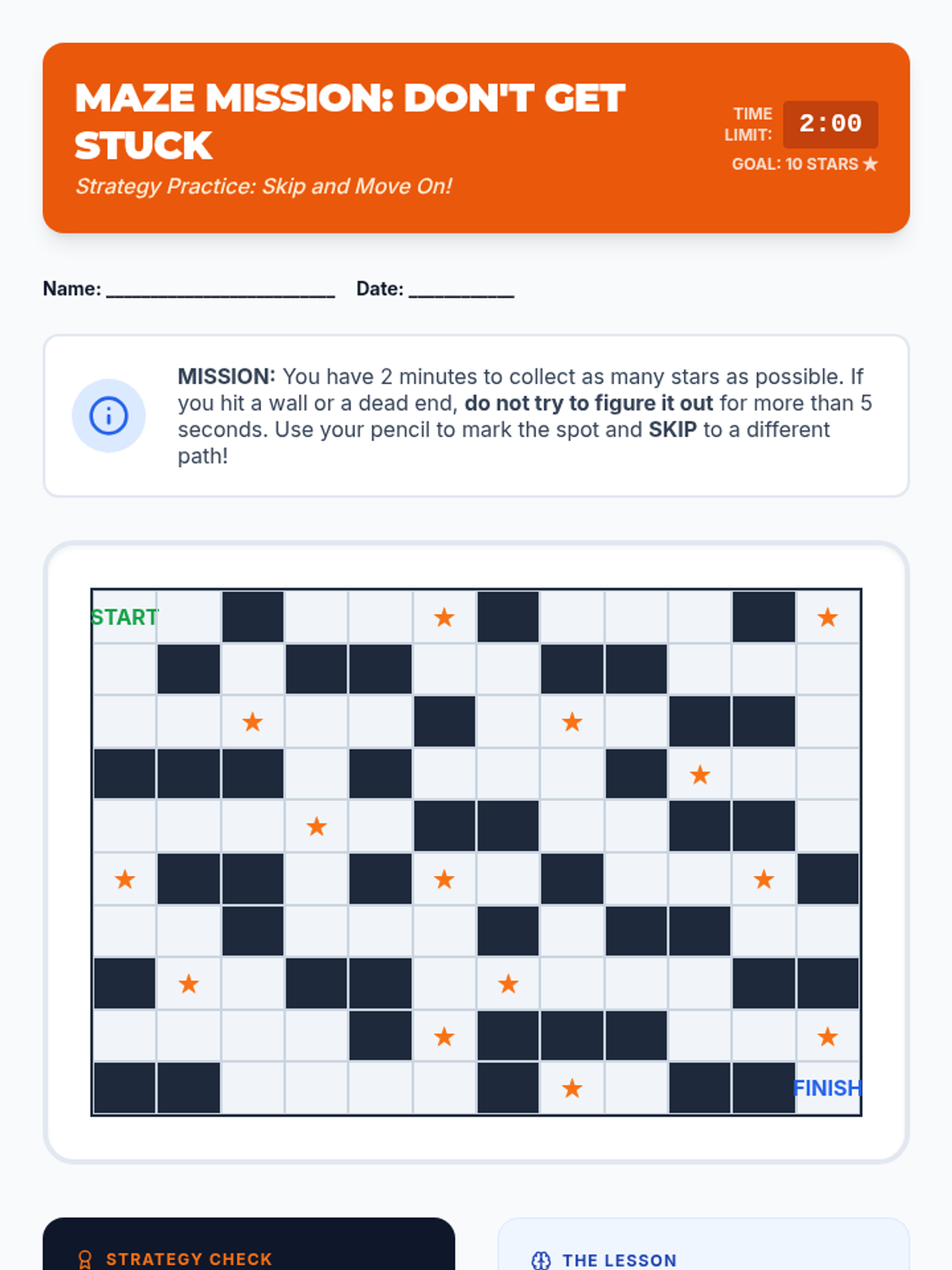
A timed maze activity for Lesson 2 that simulates the 'Skip and Return' strategy by forcing students to avoid dead ends to reach the goal.
Slide deck for Lesson 2 teaching the 'Skip and Return' strategy, focusing on recognizing when you're stuck and the benefits of skipping.
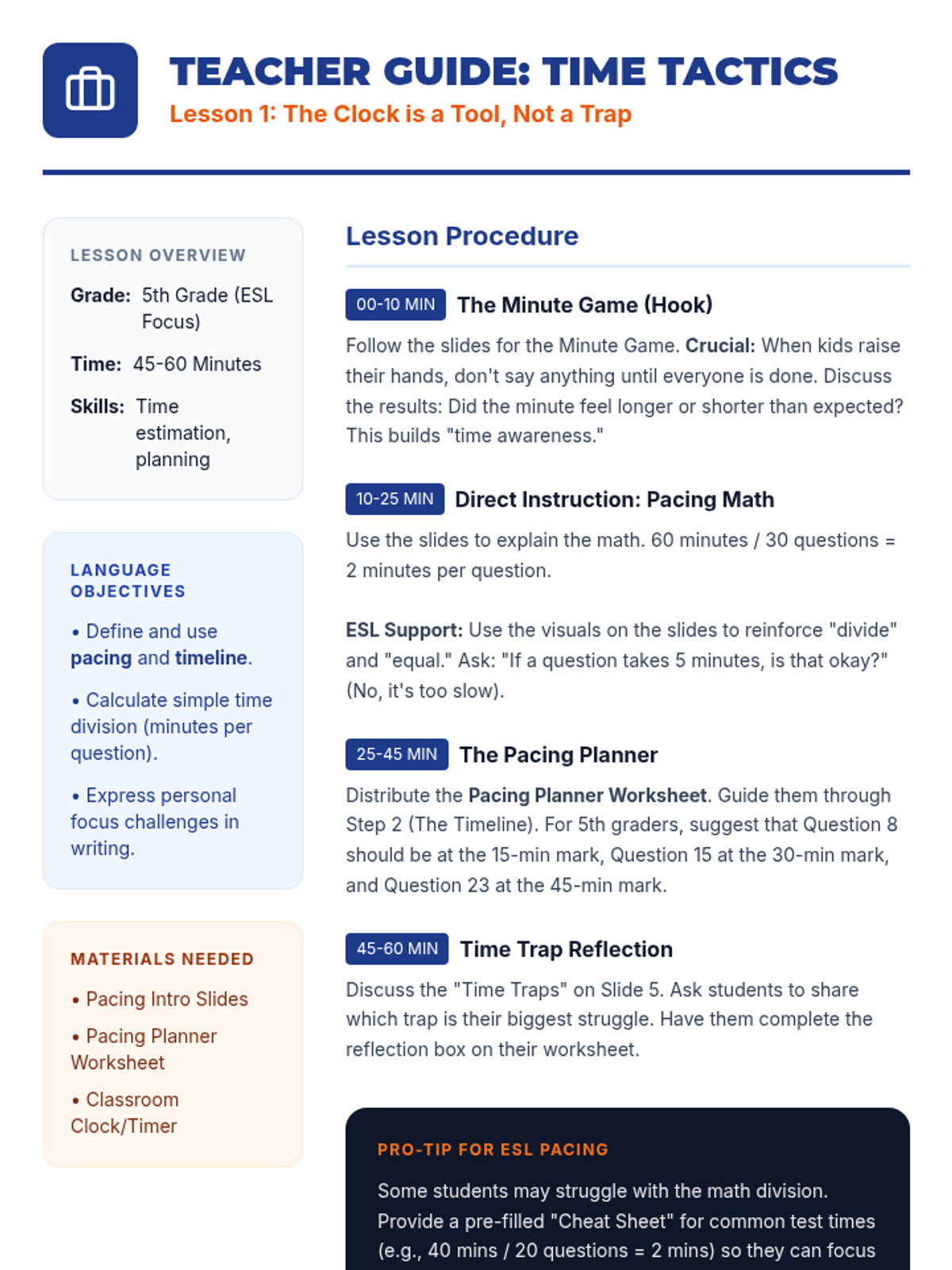
Teacher guidance for Lesson 1, including language objectives, step-by-step procedures, and ESL-specific instructional tips.
Introductory slide deck for Lesson 1 on pacing, featuring the 'Minute Game' hook, the math of pacing, and common time traps.
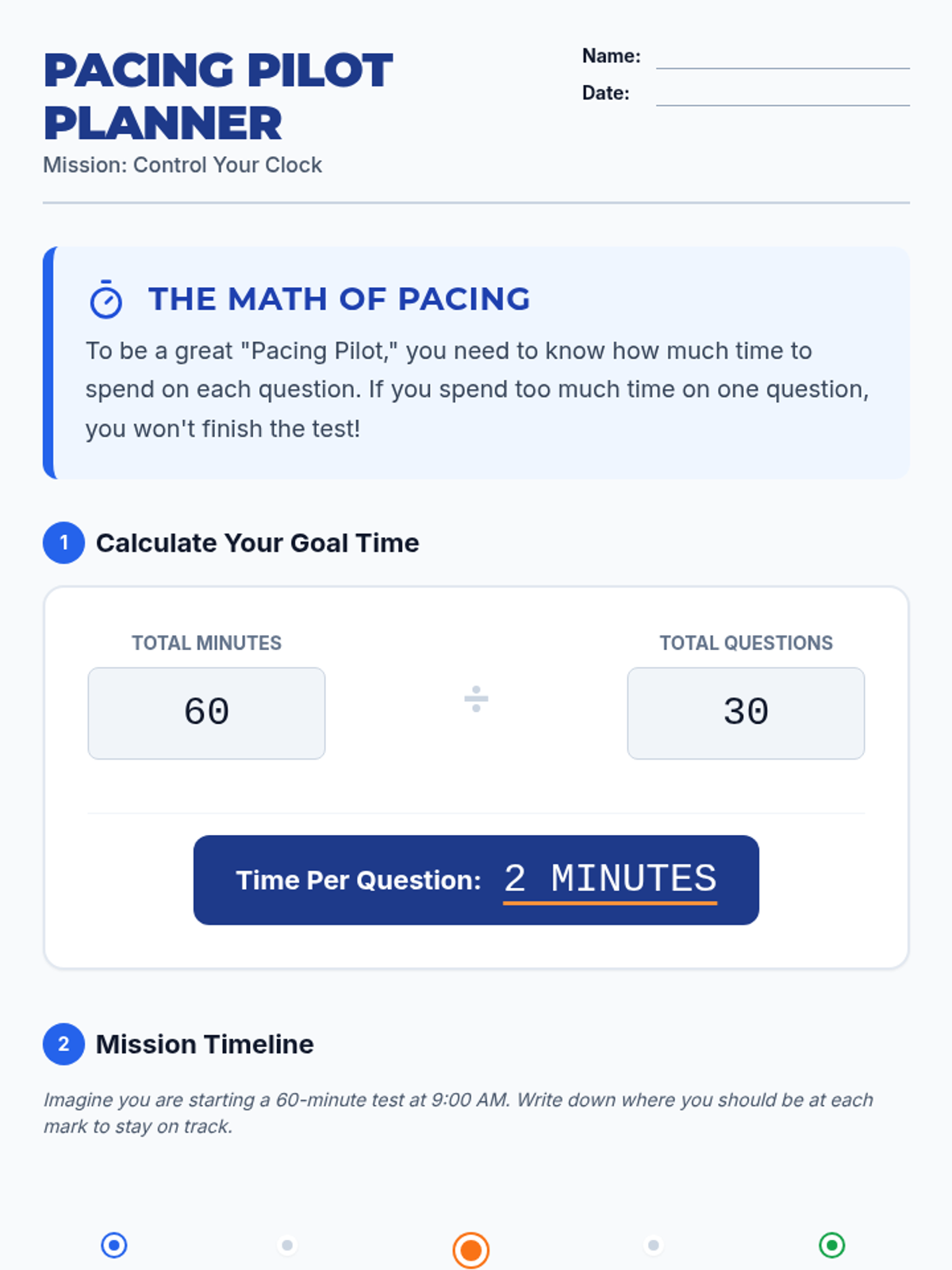
A visual pacing planner worksheet for Lesson 1, helping students calculate time per question and map out a test timeline.
Final slides for the task prioritization sequence, guiding students through gathering information and making their real-world plan.
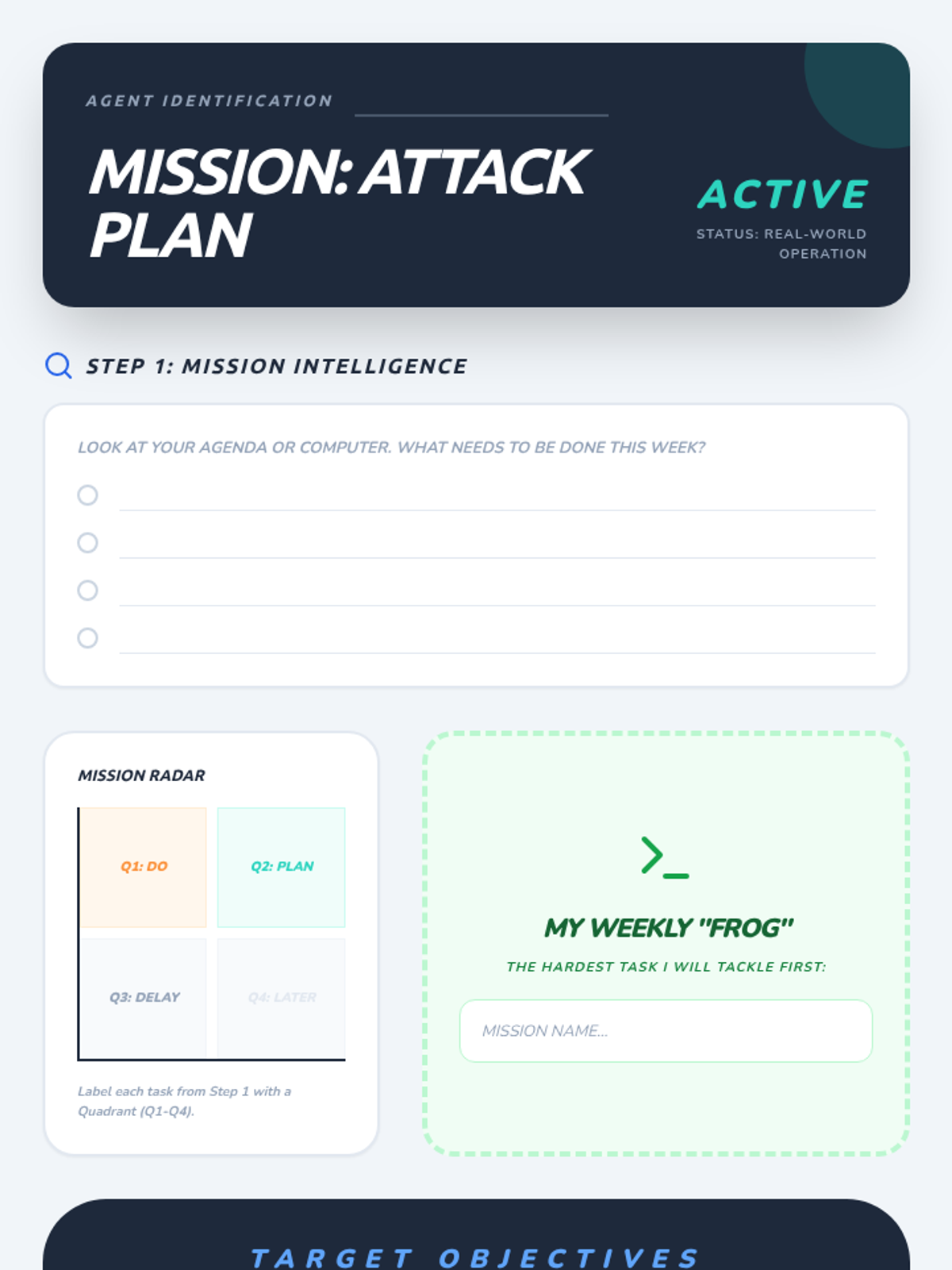
The final application worksheet where students list their actual weekly tasks, categorize them in the radar matrix, identify their "Frog," and rank their top 3 objectives.
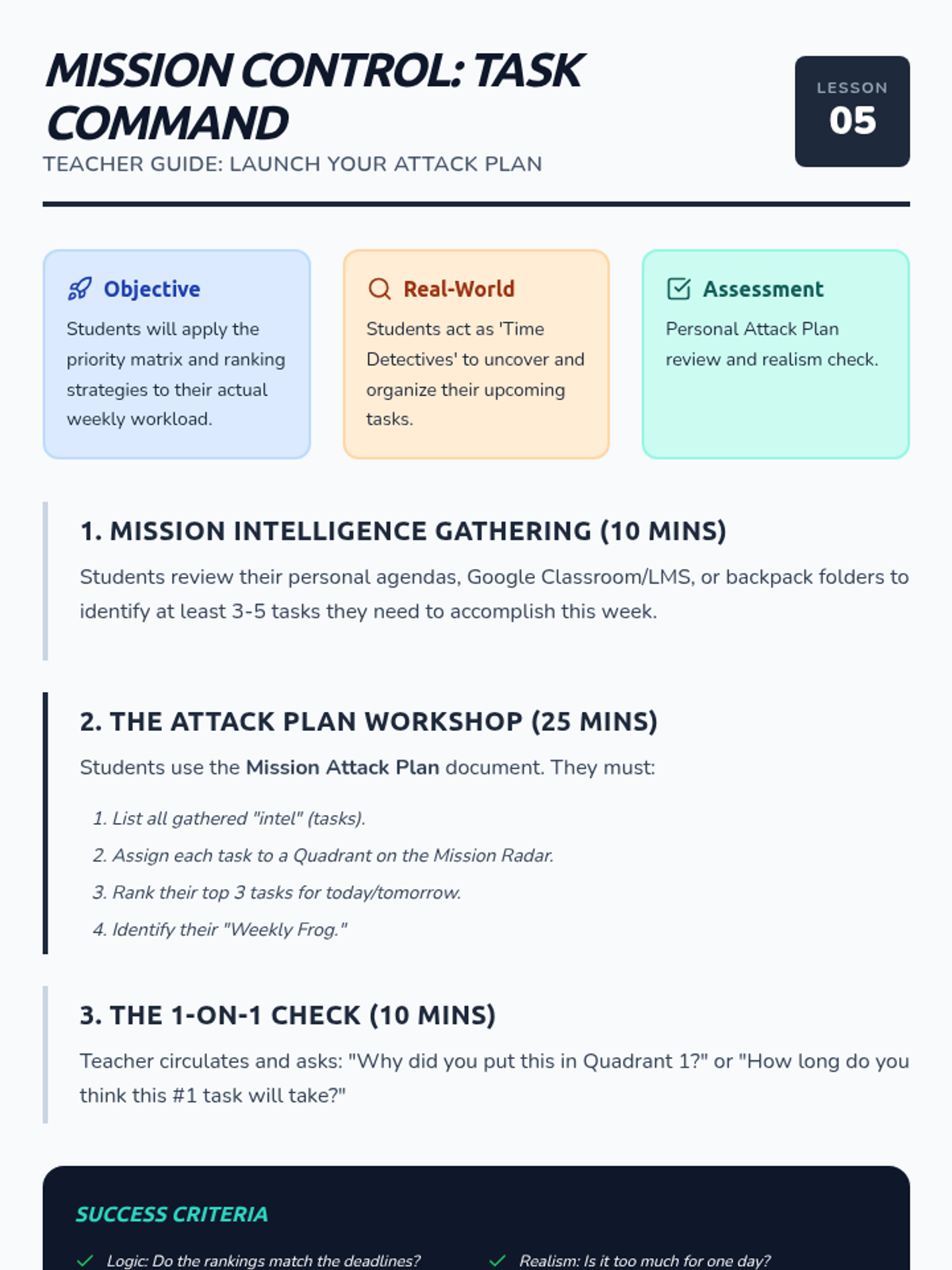
Teacher guide for the final lesson, where students apply all prioritization strategies to their own real-world academic tasks.
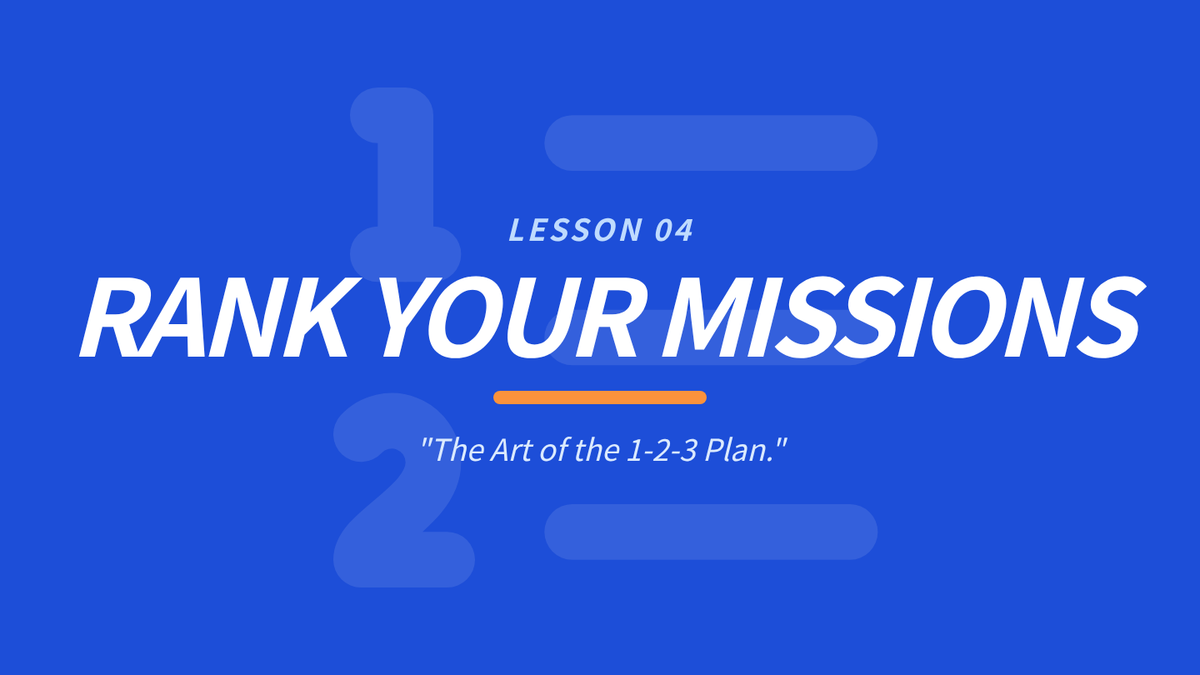
Visual presentation for Lesson 4, demonstrating the 1-2-3 ranking system and decision-making criteria.
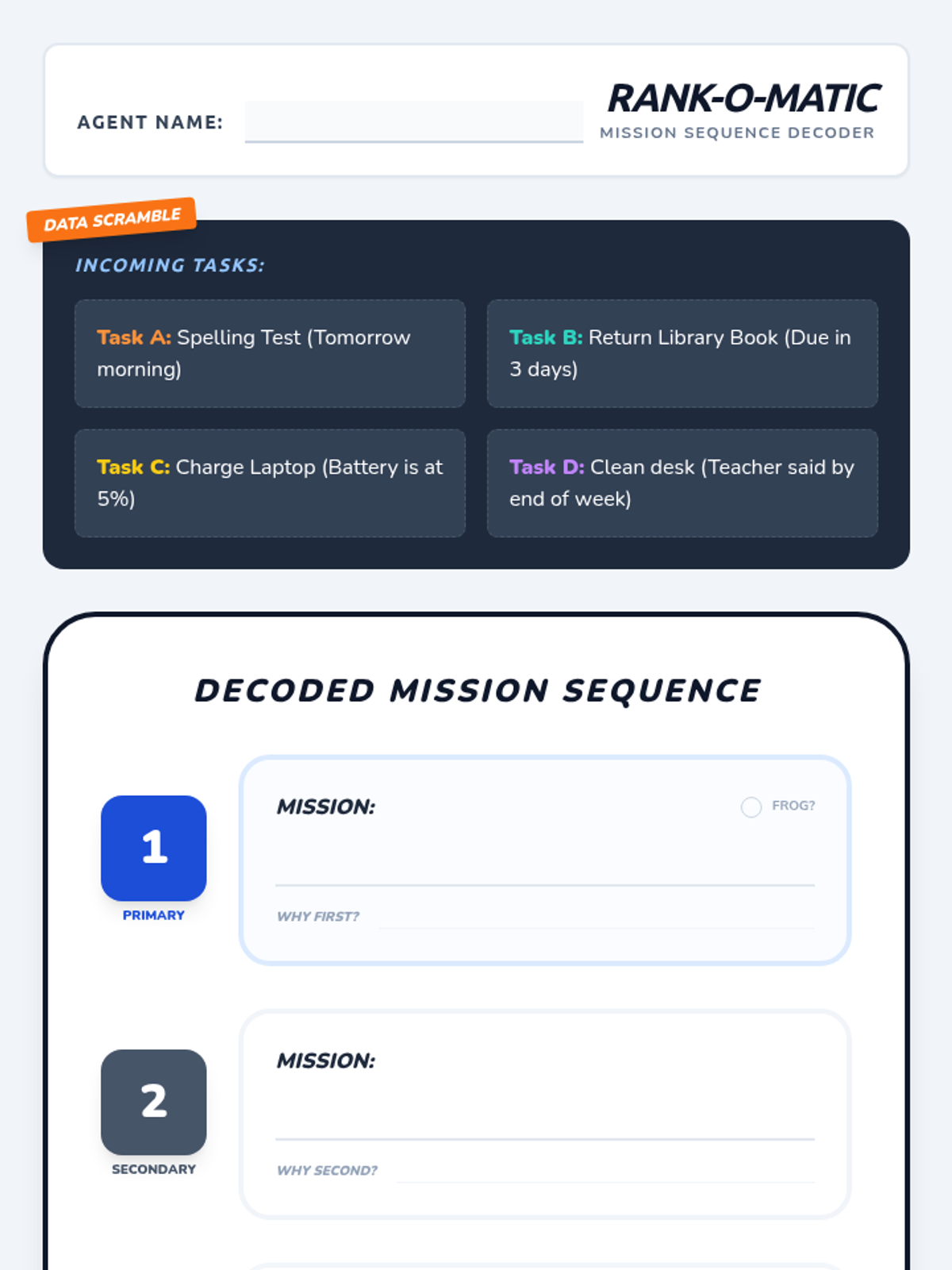
Worksheet for Lesson 4 where students practice ranking four provided tasks into a 1-2-3 sequence with justifications.
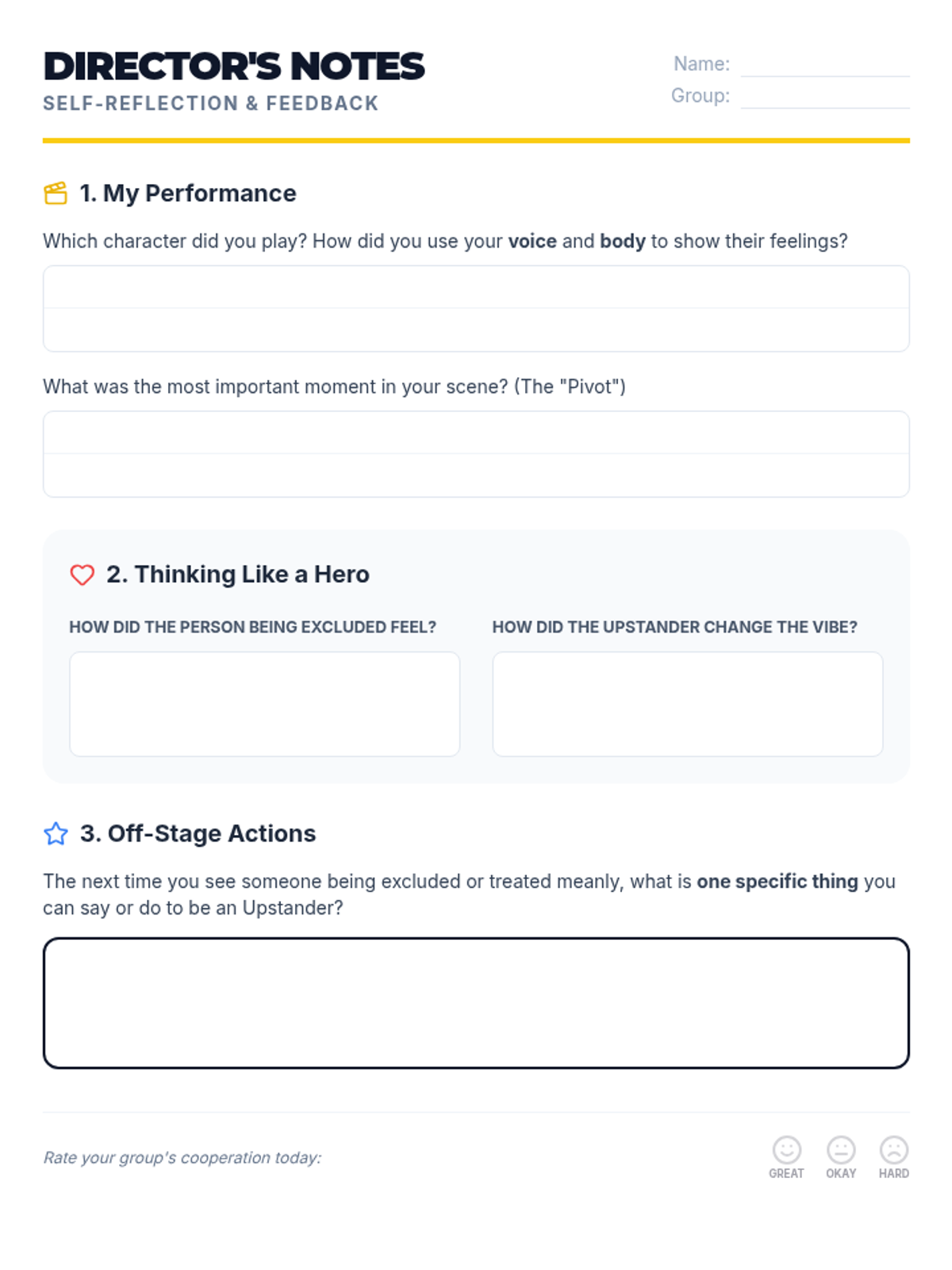
A reflection worksheet for students to process their roleplay experience, practice character empathy, and commit to upstander actions in real life. Features a clean 'Director's Notes' aesthetic.
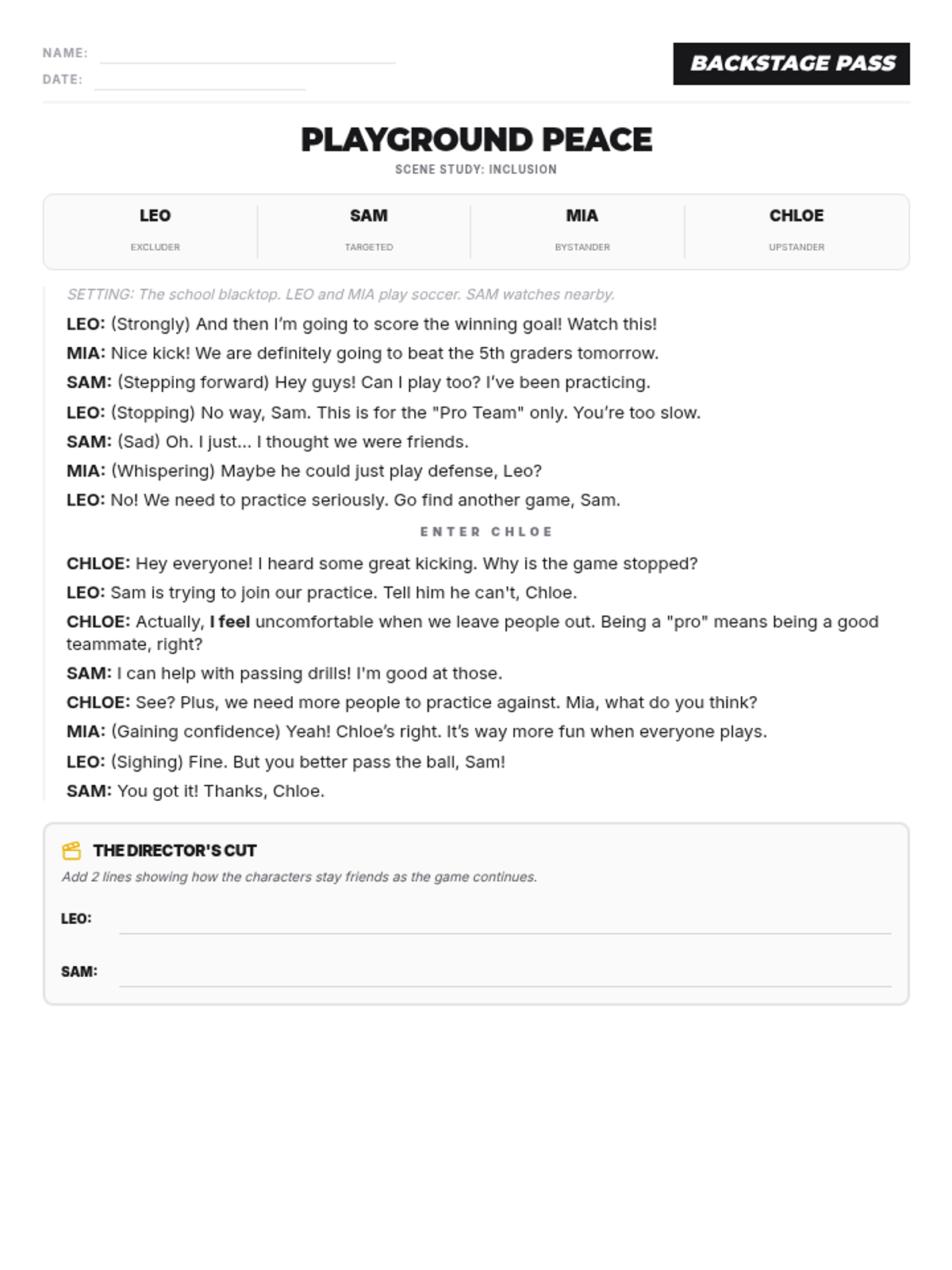
A student-facing script for a 4-person roleplay scene. Features clear character descriptions, stage directions, and a creative 'Director's Cut' challenge to encourage student writing and resolution thinking.
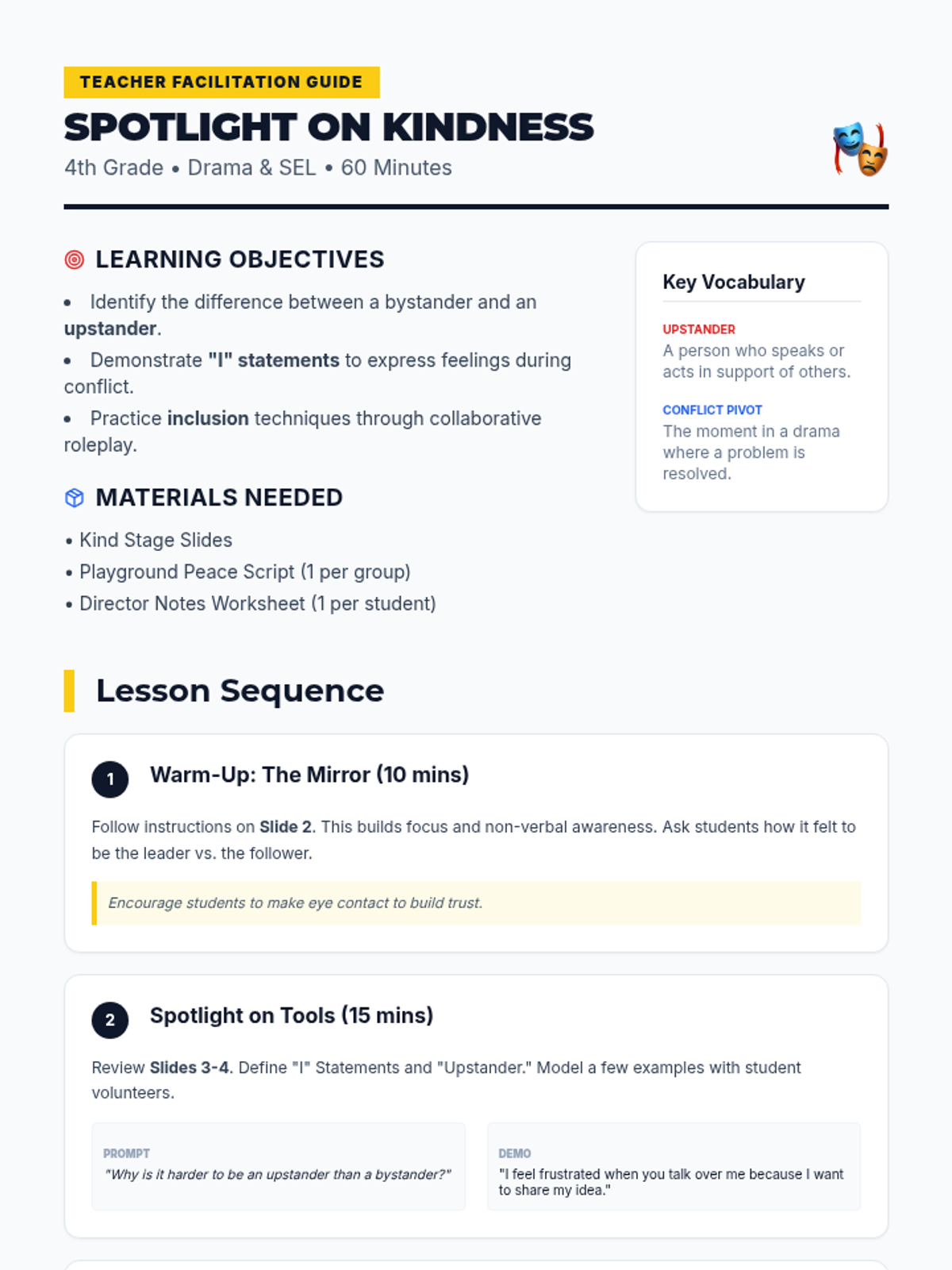
A comprehensive guide for teachers to lead a 60-minute drama and SEL lesson. Includes learning objectives, vocabulary, step-by-step facilitation instructions, and discussion prompts.
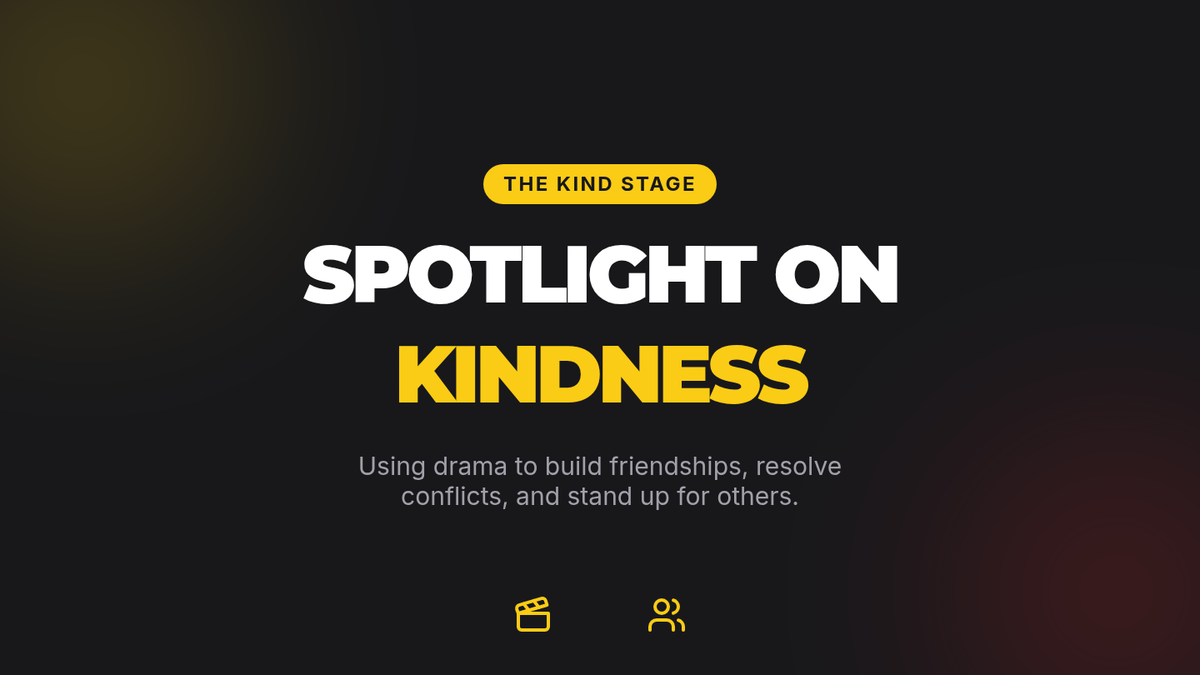
A vibrant, high-energy presentation using a theater theme to teach 4th graders about friendship, conflict resolution, and being an upstander. Includes clear action steps and performance etiquette.
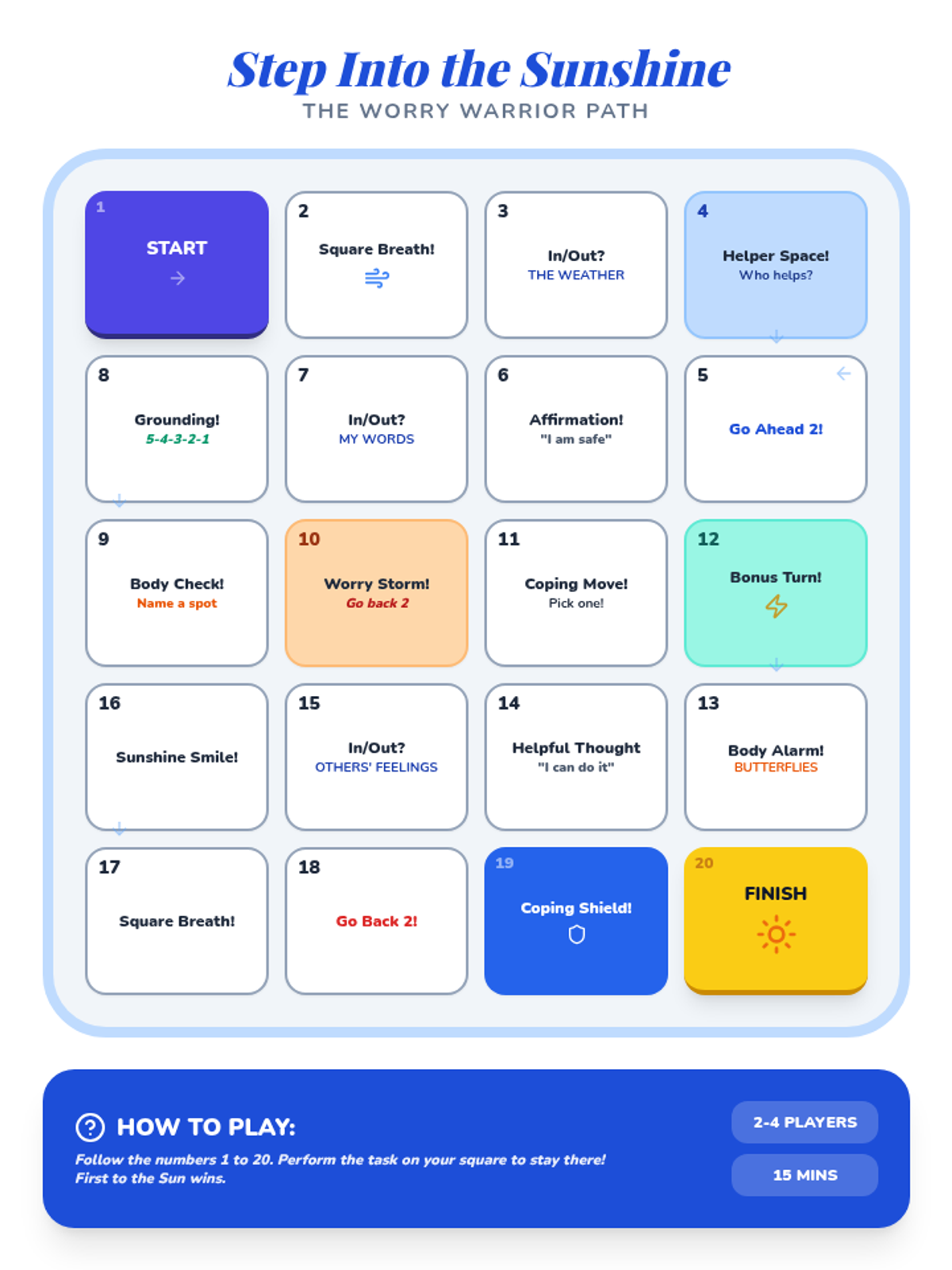
A simple printable board game where students move along a path, practicing coping skills and identifying control scenarios to reach the sunshine. Updated with a clearer path and larger text.
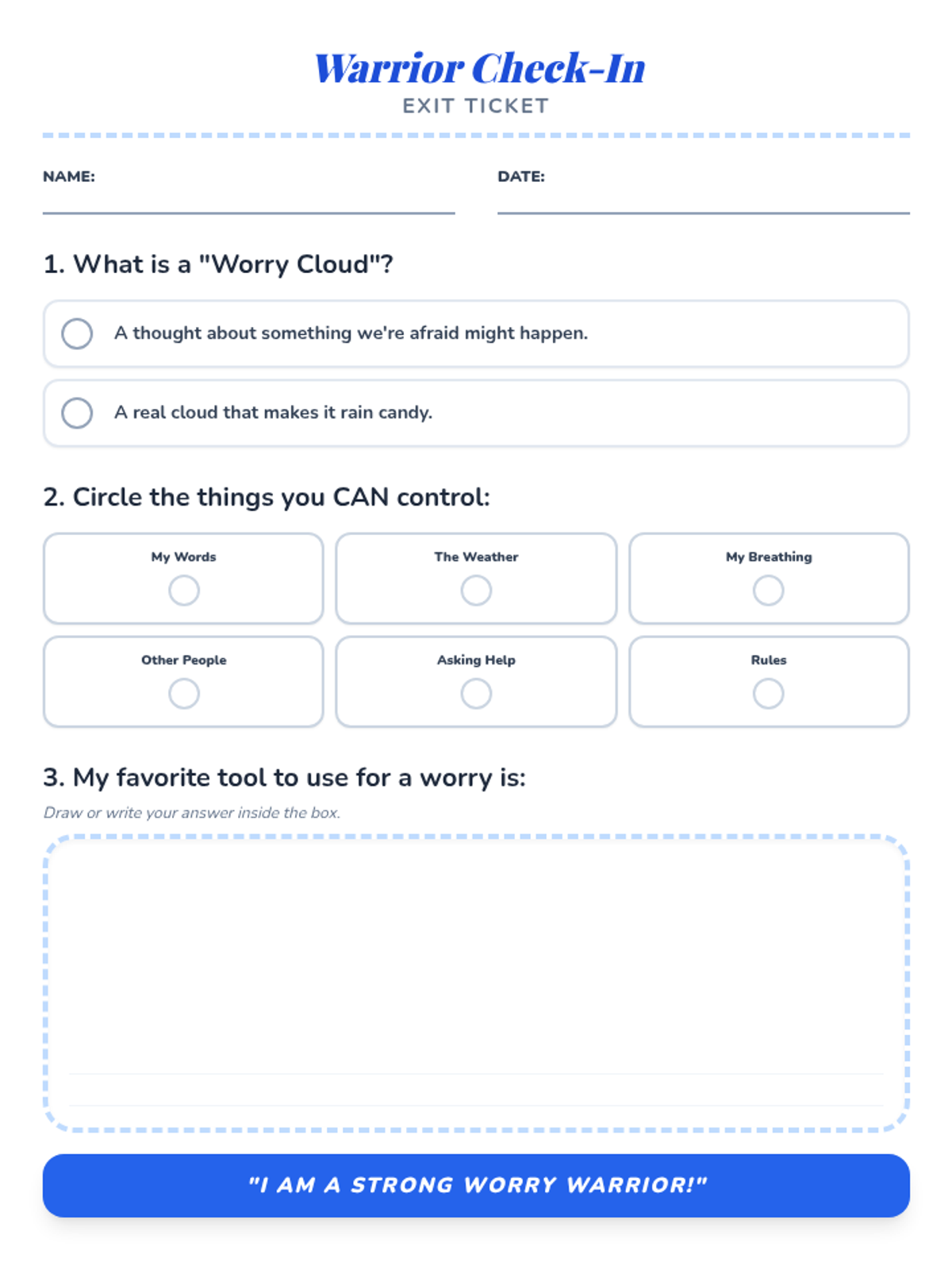
A quick formative assessment exit ticket to check student understanding of worries, the circle of control, and personal coping tools. Updated for uniformity and layout.
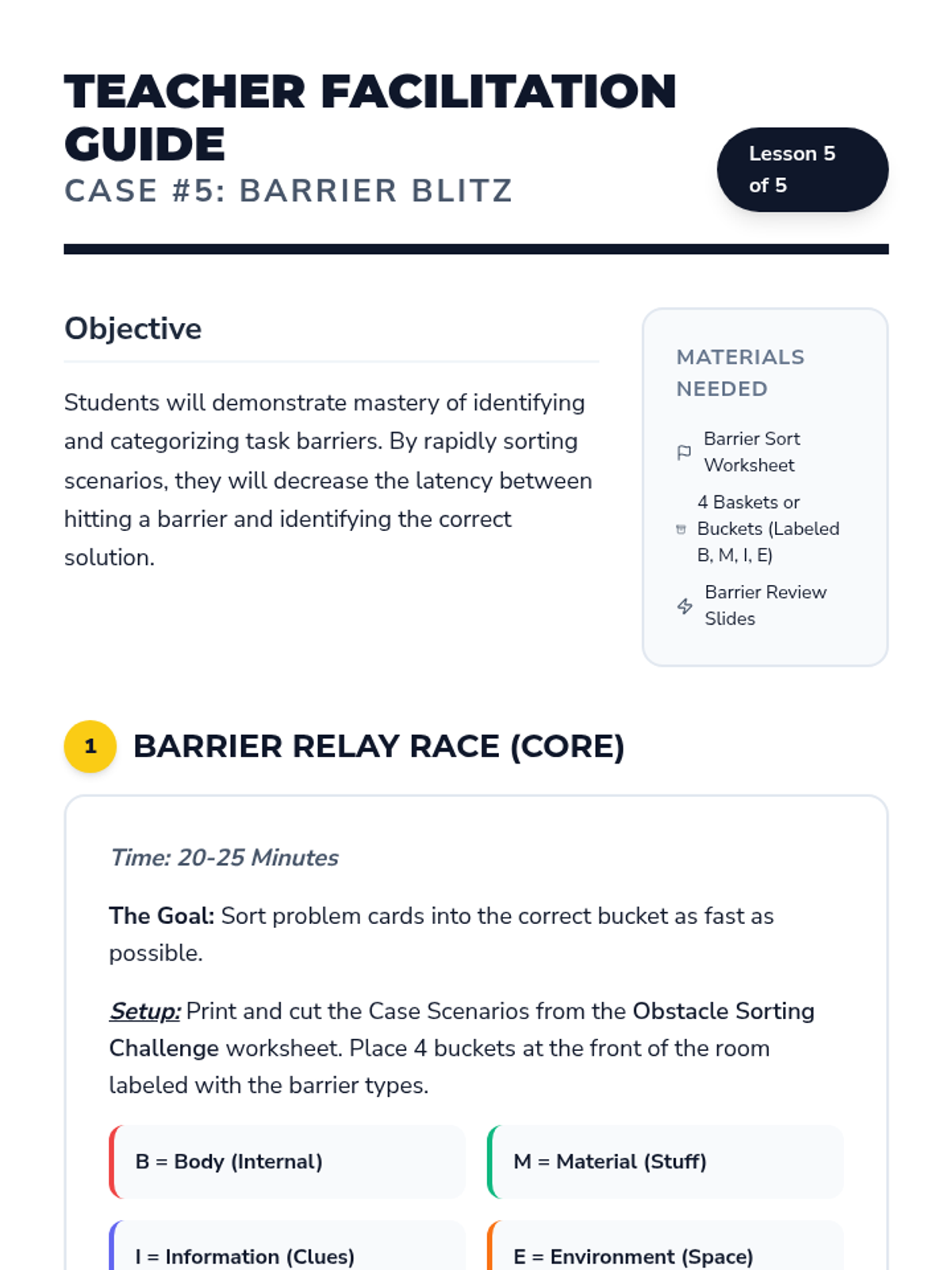
A teacher facilitation guide for Lesson 5, including instructions for the 'Barrier Relay Race' and a unit conclusion.
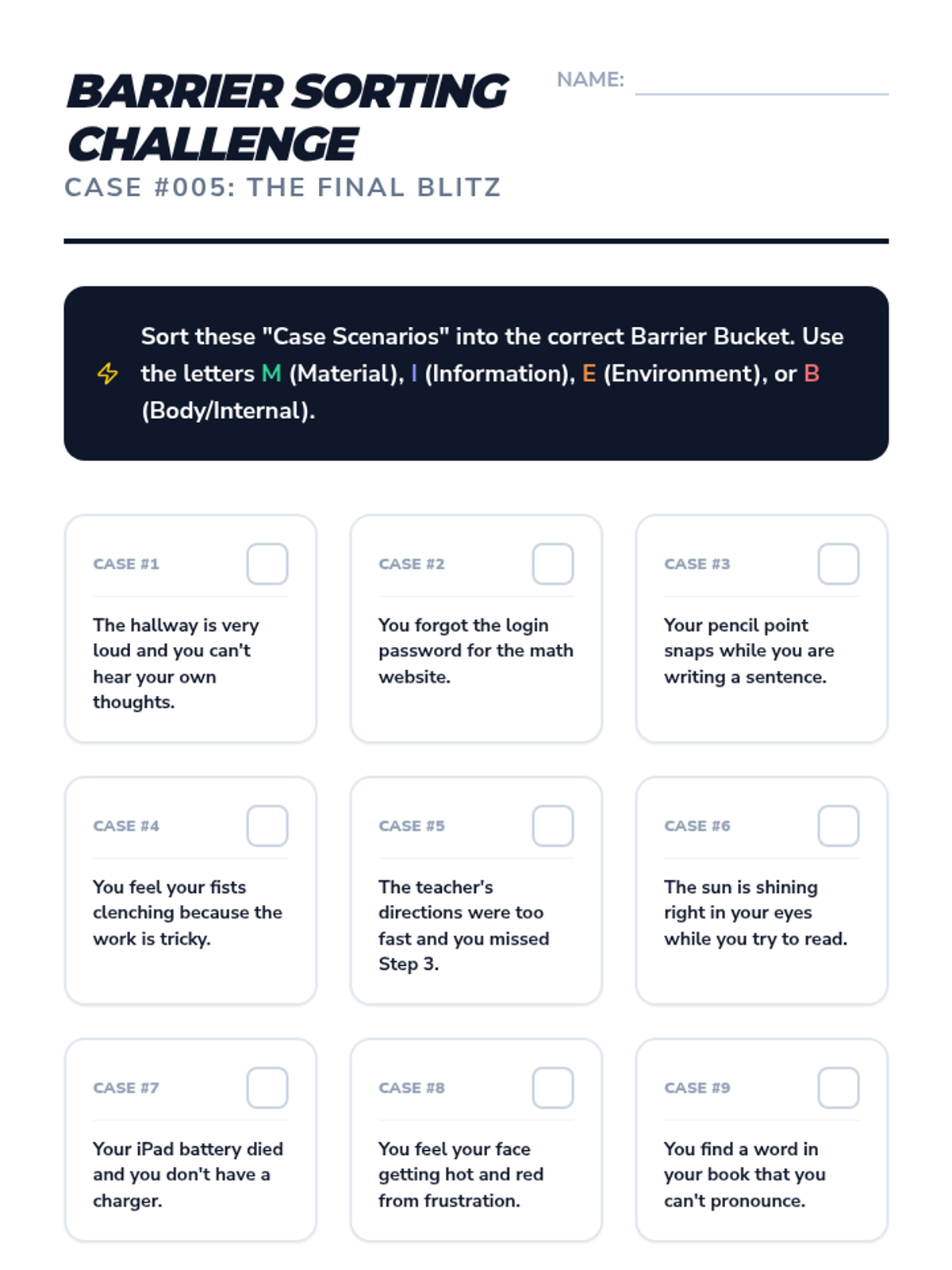
A culminating sorting activity where students categorize various problem scenarios into the four task barrier types.
A culminating slide deck for the 'Barrier Blitz' lesson, reviewing all 4 types of task barriers and preparing students for the final sorting activity.
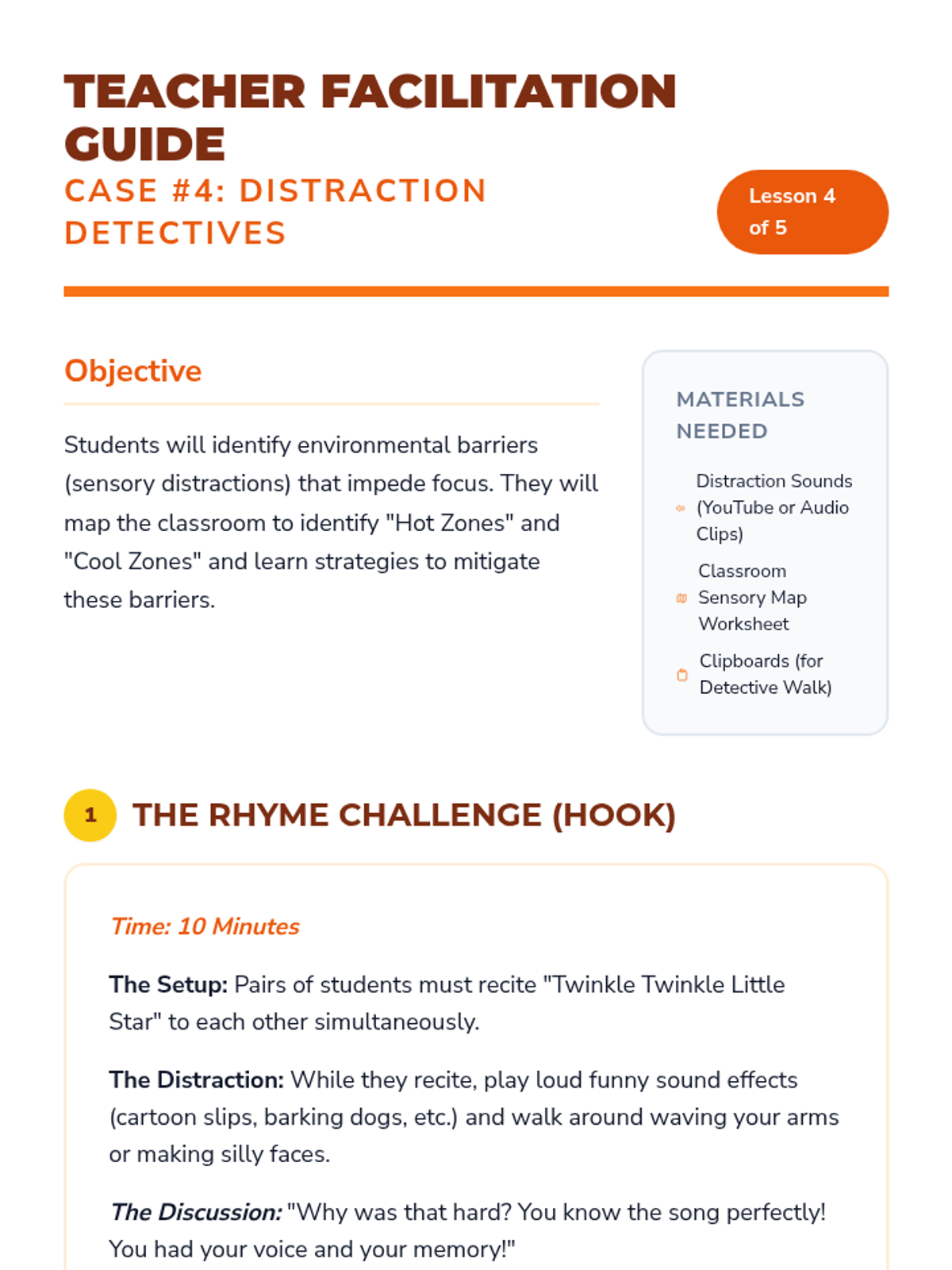
A teacher facilitation guide for Lesson 4, including instructions for the 'Stakeout Walk' and sensory mapping activity.
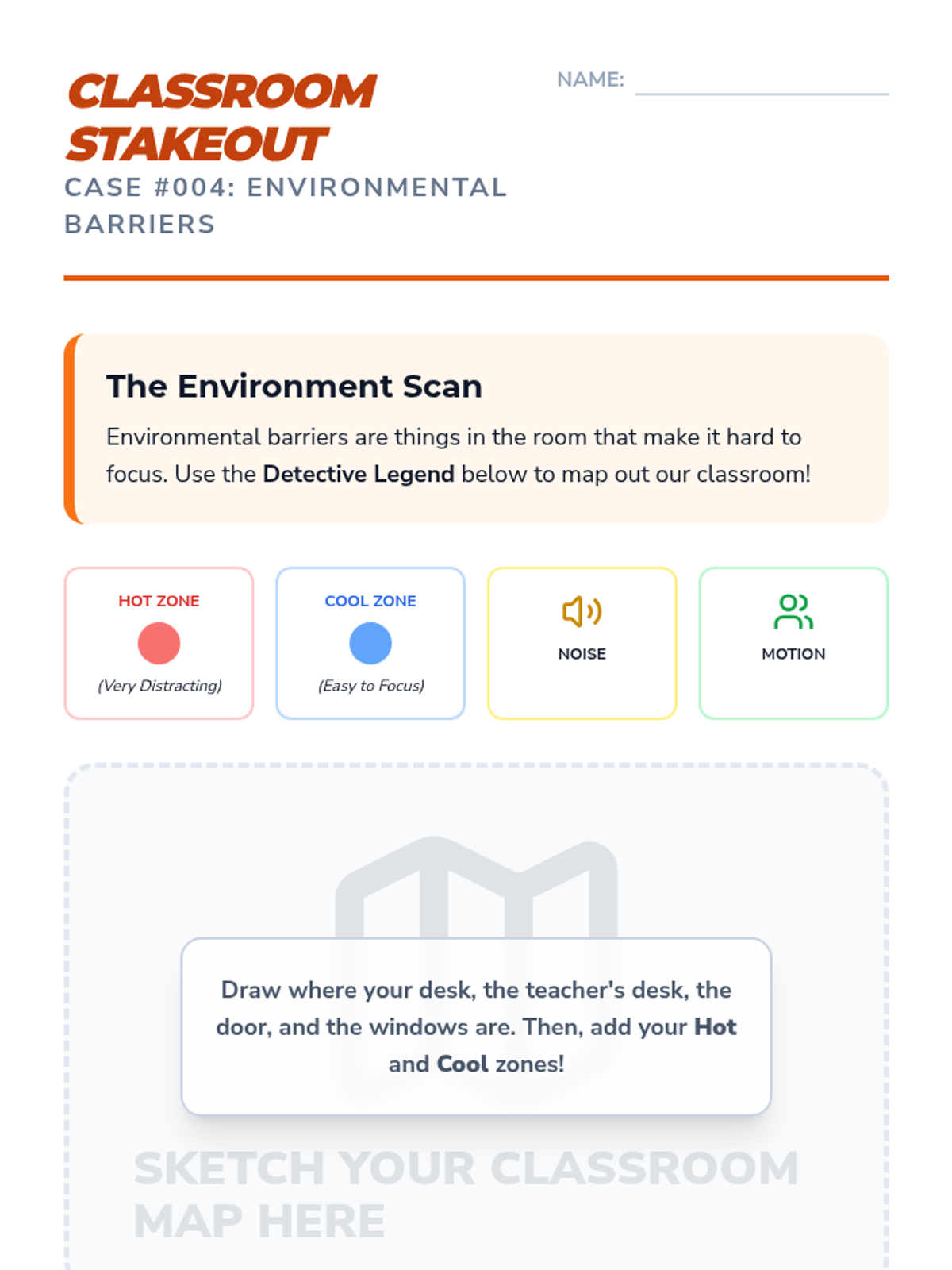
A mapping activity for students to identify 'Hot' and 'Cool' sensory zones in their classroom to manage environmental distractions.
A slide deck for Lesson 4 teaching students about sensory and environmental barriers to focus.
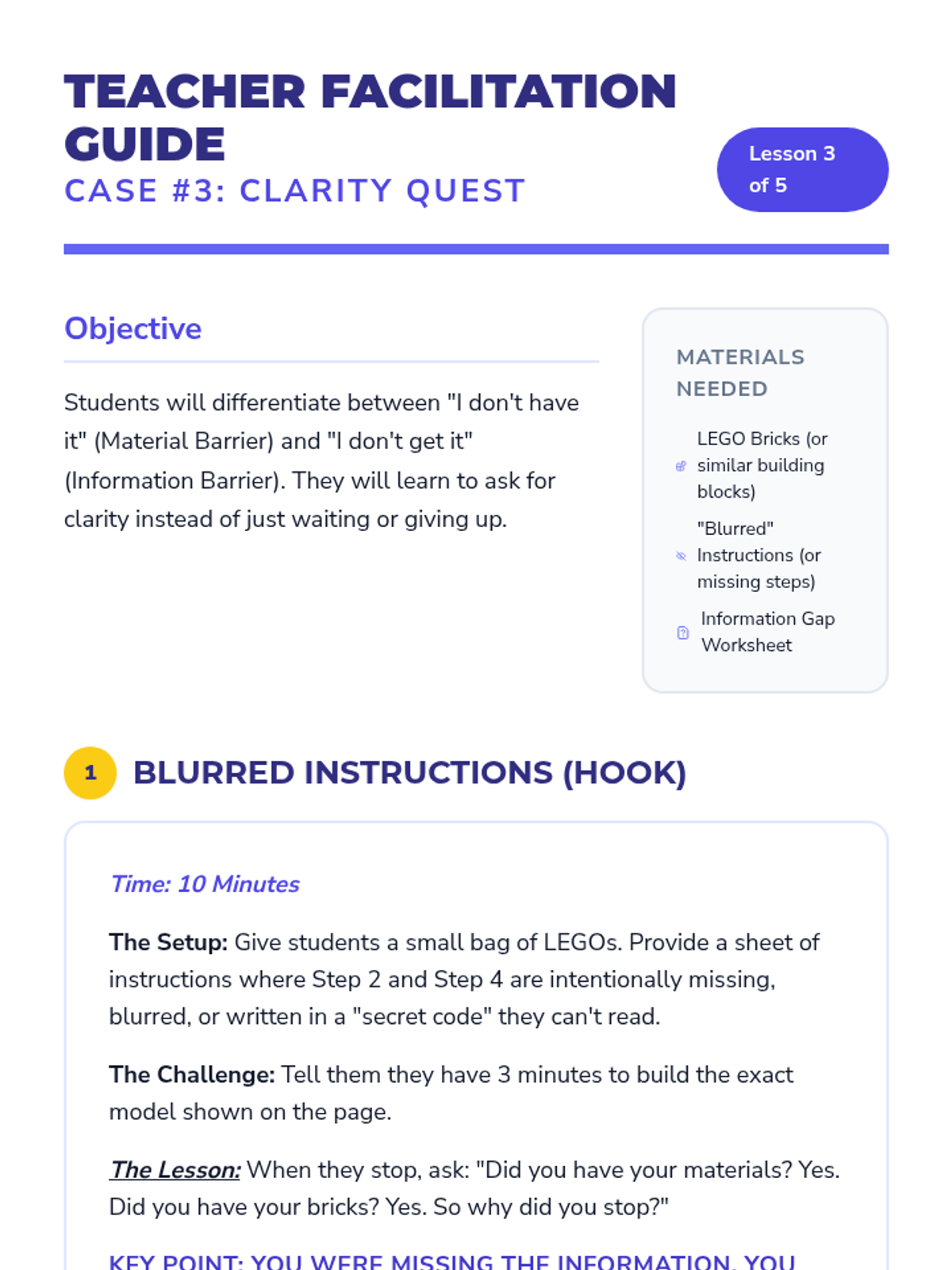
A teacher guide for Lesson 3, including instructions for the LEGO hook and advocacy scripting for students.
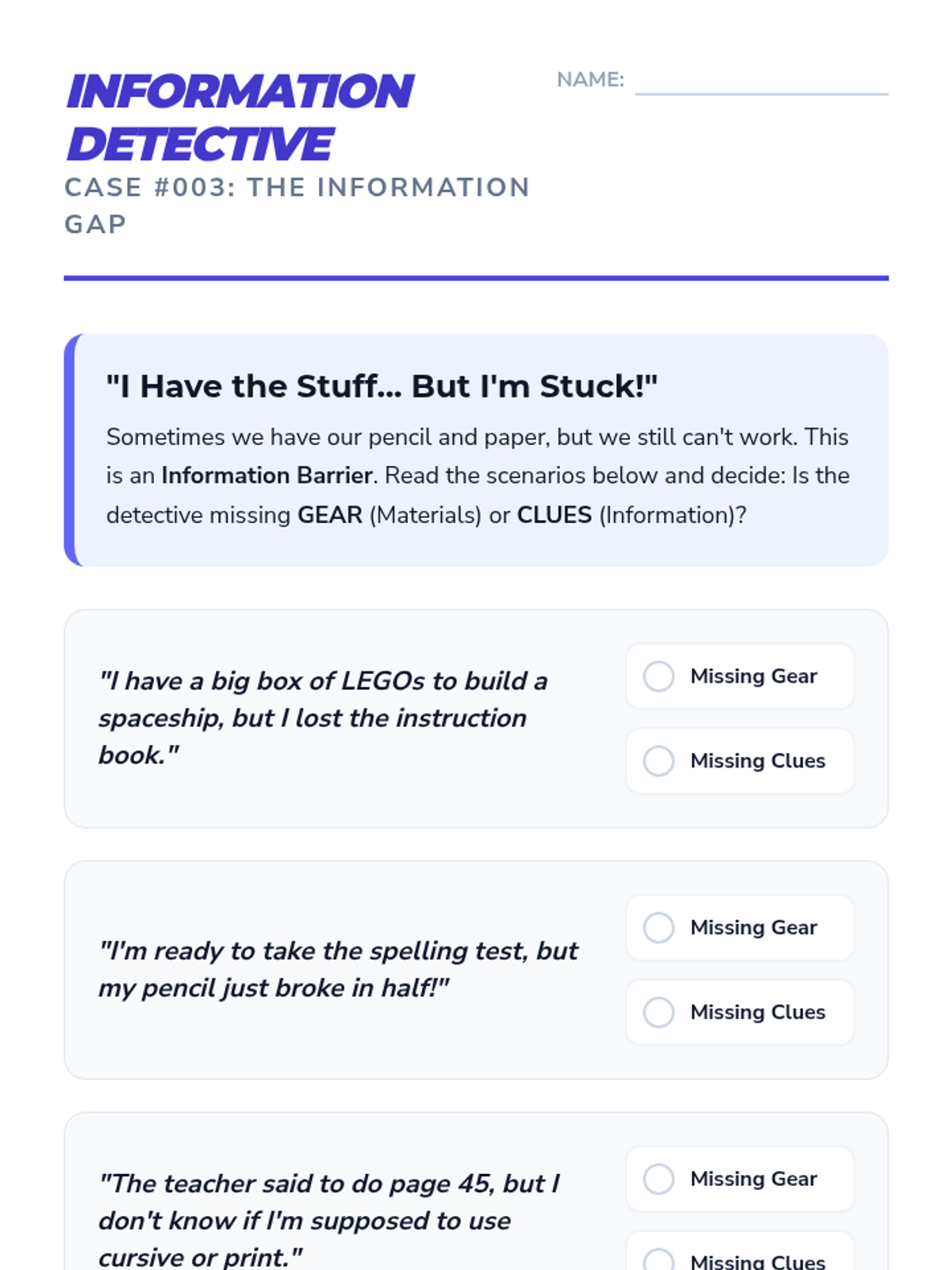
A worksheet for students to identify and differentiate between material barriers and information barriers in various classroom scenarios.
A slide deck teaching students how to identify information and clarity barriers, differentiating between 'I don't have it' and 'I don't get it.'
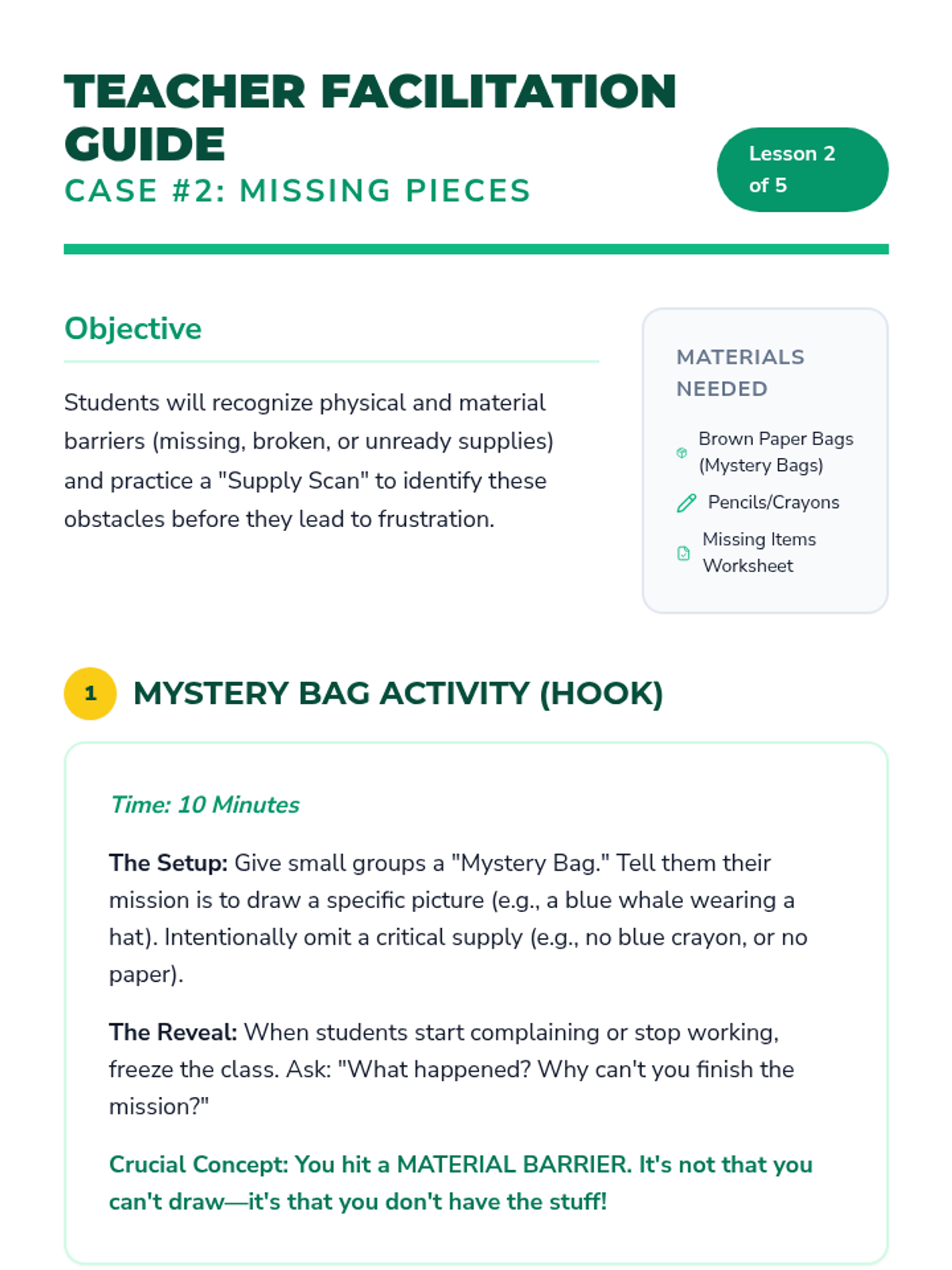
A teacher guide for Lesson 2, including instructions for the 'Mystery Bag' hook and how to facilitate a 'Supply Scan' in the classroom.
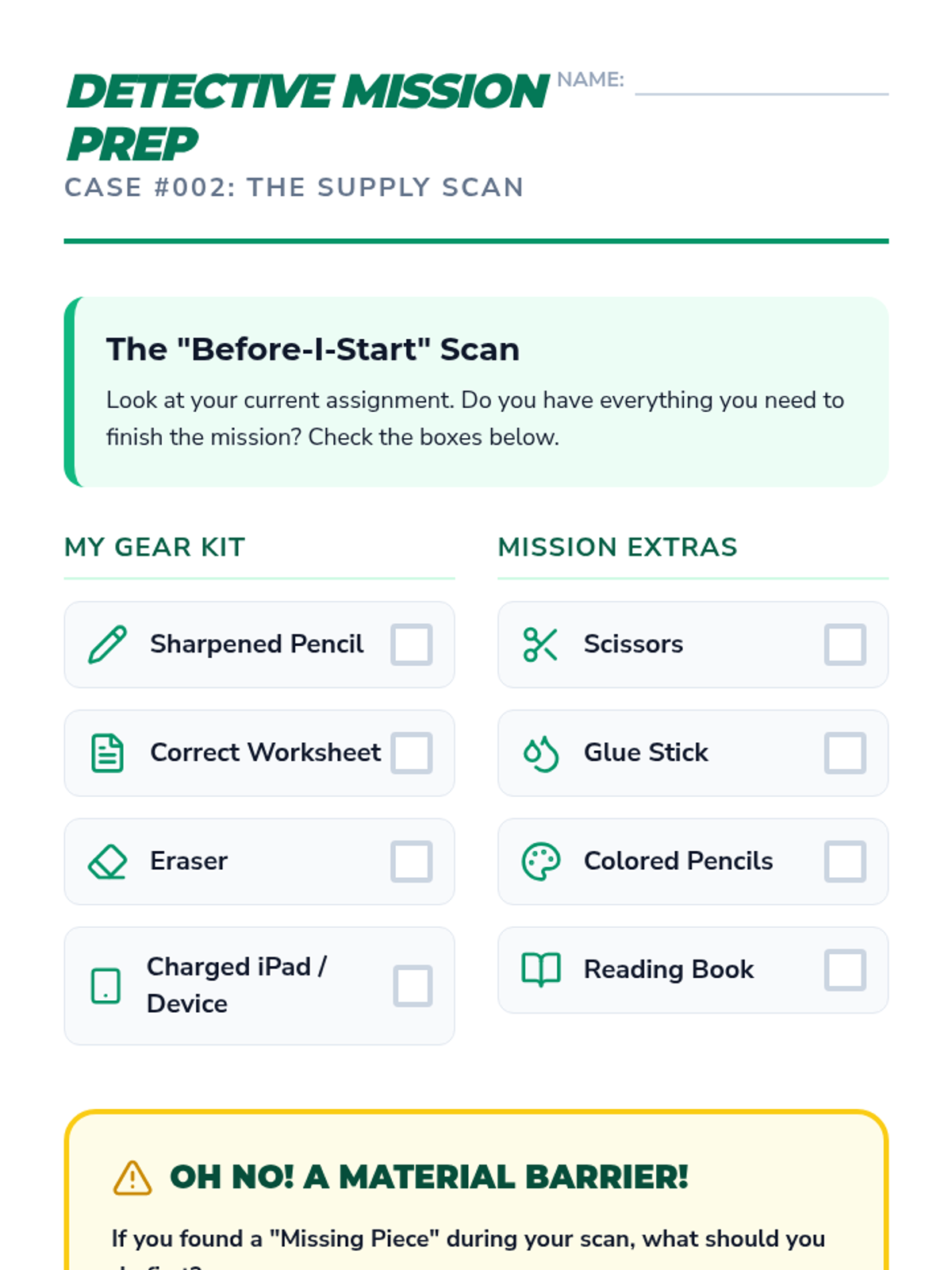
A worksheet for students to perform a 'Supply Scan' and identify physical materials needed for their tasks.
A slide deck teaching students about physical and material barriers, introducing the 'Supply Scan' technique.
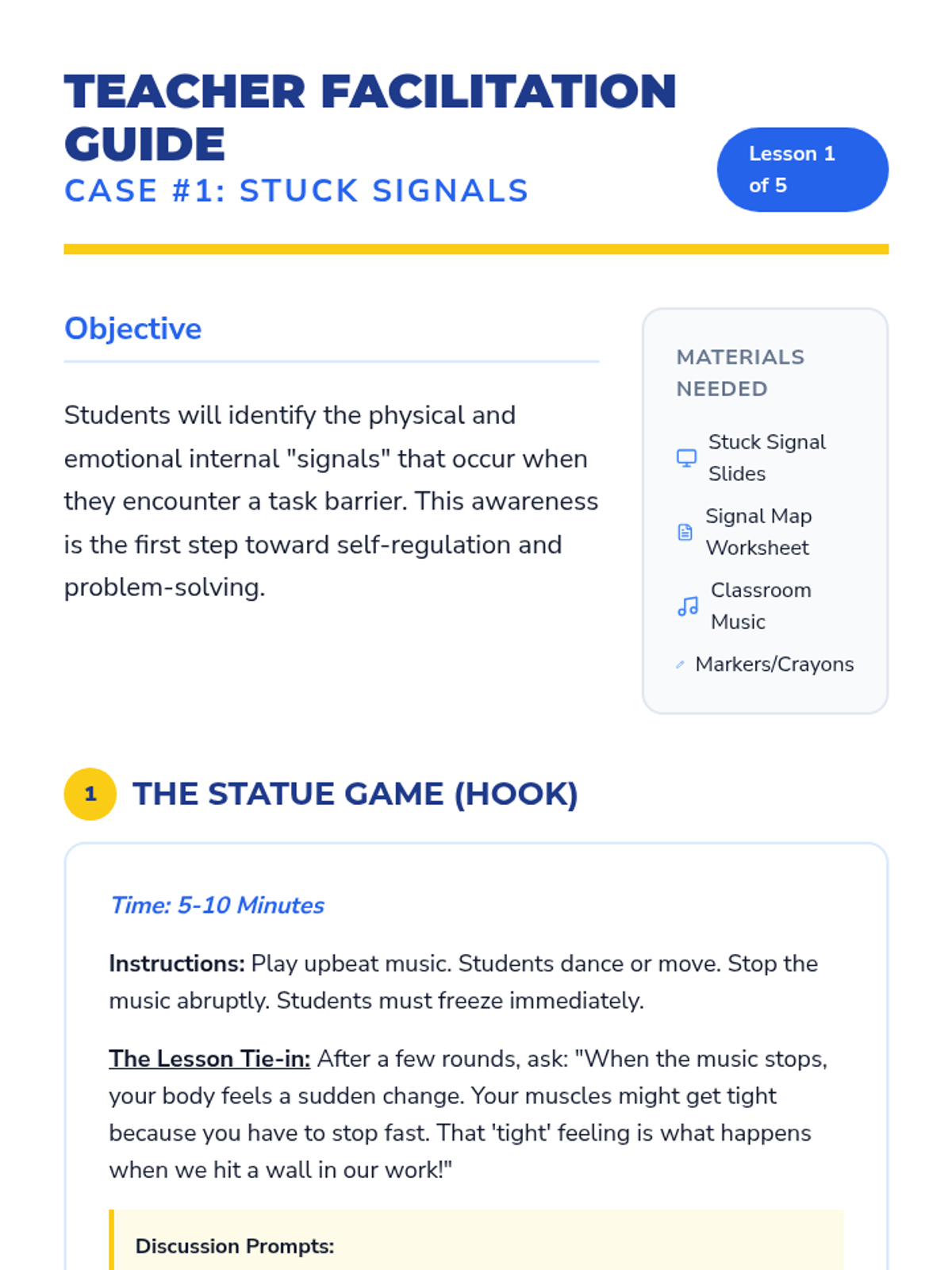
A teacher facilitation guide for Lesson 1, including instructions for the Statue Game hook and the Body Mapping core activity.
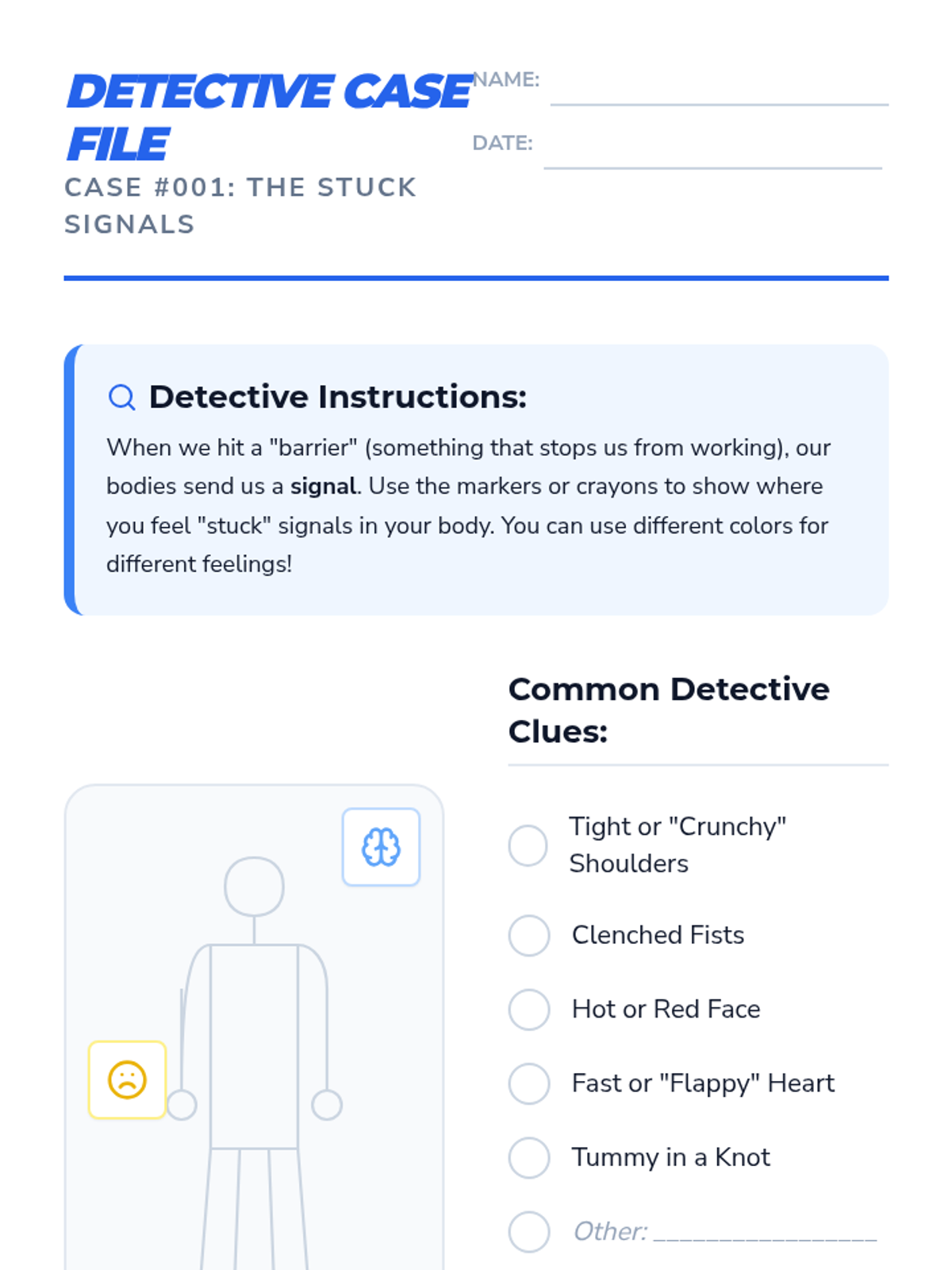
A worksheet for students to identify and map the physical signals of frustration and being 'stuck' in their own bodies.
An introductory slide deck for the 'Stuck Signals' lesson, using a Task Detective theme to help students recognize the physical and emotional sensations of being stuck.