Lenny LearningLenny
Create
Explore
Workspace
LoginSign up
MathEnglish Language ArtsScience & EngineeringSocial StudiesGlobal LanguagesHealth & Physical EducationSpecial EducationCounseling & Life SkillsArts & CreativityESL
Lenny LearningLenny
Lenny Learning
About
Training
Pricing
Support
Contact
© 2026 Lenny Learning Inc.

Geometry

SequencesLessonsMaterialsVideos
  1. Math

Geometry

SequencesLessonsMaterialsVideos

Geometric classification, measurement of area and volume, and the study of transformations and rigid motions. Builds toward complex proofs, trigonometry for general triangles, and the algebraic representation of conic sections.

MathNumbers & CountingCounting ObjectsNumber NamesComparing NumbersNumber OperationsCounting SequenceNumbers 0-10Place Value Understanding and SystemAdd and Subtract Within 20Addition and Subtraction ConceptsAddition and Subtraction EquationsAddition and Subtraction ProblemsFoundations for MultiplicationMultiplication and Division PropertiesMultiply and Divide Within 100Multiplication and Division ProblemsFactors and MultiplesProperties of OperationsPatterns and RelationshipsGenerate and Analyze PatternsMulti-Digit ArithmeticPlace Value OperationsMulti-Digit and Decimal OperationsNumerical ExpressionsFour Operations and PatternsFour Operations Problem SolvingMeasurement & DataMeasurable AttributesMeasuring LengthsMeasure and Estimate Lengths in Standard UnitsRelate Addition and Subtraction to LengthClassifying and Counting ObjectsTime and MoneyArea Concepts and MeasurementPerimeter and Area MeasuresAngle Concepts and MeasurementTime, Volume, and MassMeasurement Unit ConversionsGeometryIdentifying ShapesShapes and AttributesShape Attributes and ReasoningShapes and CompositionClassifying 2D FiguresGeometric Figures and RelationshipsLines, Angles, and ShapesAngle, Area, and VolumeGeometric MeasurementVolume of 3D ShapesCoordinate Plane ApplicationsTransformations in the PlaneCongruence and SimilarityUnderstand congruence in terms of rigid motionsSimilarity and TransformationsProve Theorems Involving SimilarityPythagorean TheoremTrigonometry for General TrianglesMake Geometric ConstructionsProve Geometric TheoremsTheorems About CirclesFind Arc Lengths And Areas of Sectors of CirclesVolume FormulasRelationships Between Two-Dimensional and Three-Dimensional ObjectsProve Simple Geometric Theorems AlgebraicallyTranslate Between Geometric Description and Equation for Conic SectionApply Geometric Concepts in Modeling SituationsFractions & DecimalsFractions as NumbersBuilding FractionsFraction Equivalence and OrderingAdding and Subtracting FractionsMultiplying and Dividing FractionsDividing FractionsDecimal FractionsMulti-Digit Computation and FactorsAdd, Subtract, Multiply, and Divide Rational NumbersRational Number SystemIrrational Numbers and ApproximationsRatiosRatios and ProportionsProportional RelationshipsUnit RateAlgebraAlgebraic ExpressionsGenerate Equivalent ExpressionsQuantitative RelationshipsProportional Relationships and Linear EquationsEquations and InequalitiesEquation Solving and ReasoningLinear Equations and SystemsGraph Equations and InequalitiesSystems of EquationsReal-World Algebraic ProblemsQuantitative Reasoning with UnitsExpression StructureEquivalent Expression FormsRadicals and Integer ExponentsRational ExponentsRational and Irrational NumbersPolynomial OperationsPolynomial IdentitiesPolynomial Zeros and FactorsRational ExpressionsComplex Number OperationsComplex Numbers in PolynomialsComplex Numbers on PlaneStatistics & ProbabilityRepresent and Interpret DataData DistributionsStatistical VariabilityProbability ModelsCompound Event ProbabilitiesStatistical SamplingInterpret Categorical and Quantitative DataBivariate Data PatternsInterpret Linear ModelsComparing Two PopulationsRandom Processes in StatisticsIndependence and Conditional ProbabilityExpected ValuesProbability-Based Decision MakingStatistical Inference and ConclusionsFunctionsFunction Concepts and NotationDefine and Compare FunctionsInterpret Functions in ContextAnalyze Function RepresentationsModel Relationships with FunctionsIdentify Linear vs Exponential GrowthDistinguish Between Function TypesCompare Growth RatesInterpret Function ExpressionsBuild Functions from RelationshipsConstruct and Model FunctionsTransform and Combine FunctionsModel Comparison and SelectionSolve Exponential EquationsTrigonometryTrigonometric Ratios Involving Right TrianglesTrigonometric Functions and Unit CircleModel with Trigonometric FunctionsTrigonometric IdentitiesVectors & MatricesIntroduction to Vectors and MatricesVector QuantitiesVector OperationsMatrix OperationsCalculusLimits and ContinuityDerivative Concepts and NotationDerivative Rules and TechniquesApplications of DerivativesOptimization ProblemsRelated RatesCurve Sketching and AnalysisIntegration Concepts and NotationAntiderivatives and Indefinite IntegralsDefinite Integrals and AreaFundamental Theorem of CalculusIntegration TechniquesApplications of IntegrationDifferential EquationsSequences and SeriesParametric and Polar FunctionsVector-Valued Functions
Shape Attributes and ReasoningIdentification of properties including sides, vertices, and angles in two-dimensional and three-dimensional shapes. Classifies and sorts objects based on shared attributes to build foundational geometric reasoning.
Geometric Figures and RelationshipsProperties of 2D and 3D shapes, including symmetry, congruence, and similarity. Develops spatial reasoning through the study of angles, lines, and coordinate transformations.
Angle, Area, and VolumeGeometric properties including angle measurement, area of polygons, and volume of three-dimensional solids. Applies formulas and theorems to solve spatial reasoning problems.
Geometric MeasurementArea, perimeter, and volume calculations for two- and three-dimensional figures. Develops spatial reasoning through the application of measurement formulas and unit conversions.
Volume of 3D ShapesFormulas and calculations for determining the capacity of prisms, pyramids, cylinders, cones, and spheres. Develops spatial reasoning through applications involving cubic units and composite solids.
Coordinate Plane ApplicationsQuadrant navigation, distance calculations between points, and area determinations for polygons. Applies coordinate geometry to mapping, reflections, and data visualization.
Volume FormulasGeometric calculations for three-dimensional shapes including prisms, cylinders, pyramids, cones, and spheres. Develops skills for solving missing dimensions and real-world capacity problems.
Relationships Between Two-Dimensional and Three-Dimensional ObjectsCross-sections of three-dimensional solids and the generation of solids of revolution from two-dimensional shapes. Connects planar geometry to spatial visualization through nets and surface area calculations.
Sequence
Unit Overview Resource

Math Intensive Lab

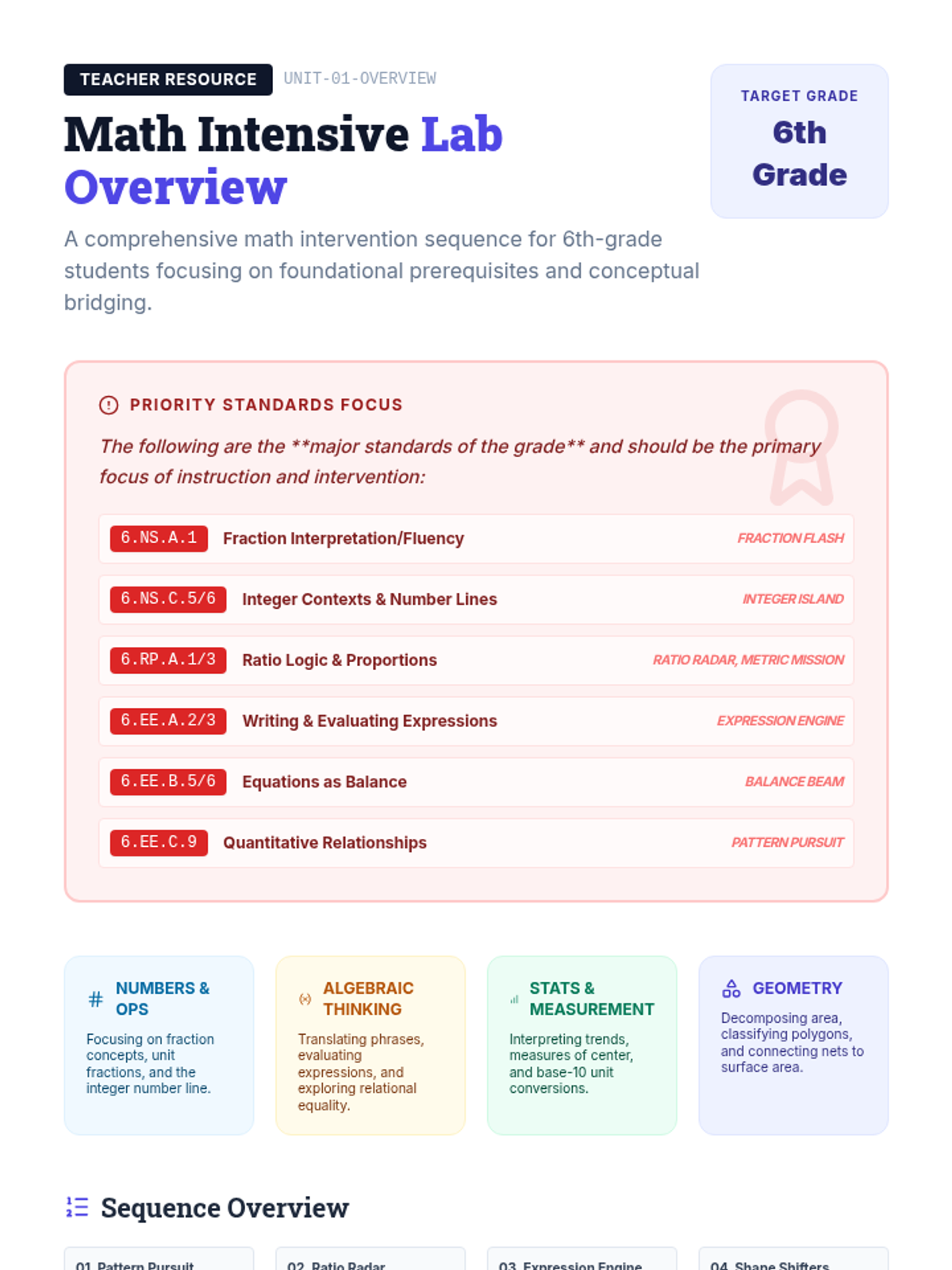
A comprehensive math intervention sequence for 6th-grade students, focusing on four key domains: Numbers & Operations, Algebraic Thinking, Measurement & Data, and Geometry. This sequence uses high-leverage strategies from the All Learners Network (ALN) and aligns with i-Ready prerequisite modules to bridge conceptual gaps.

D

dfredericks

Math Teacher
2/5
Sequence
Geometry Lab Slides
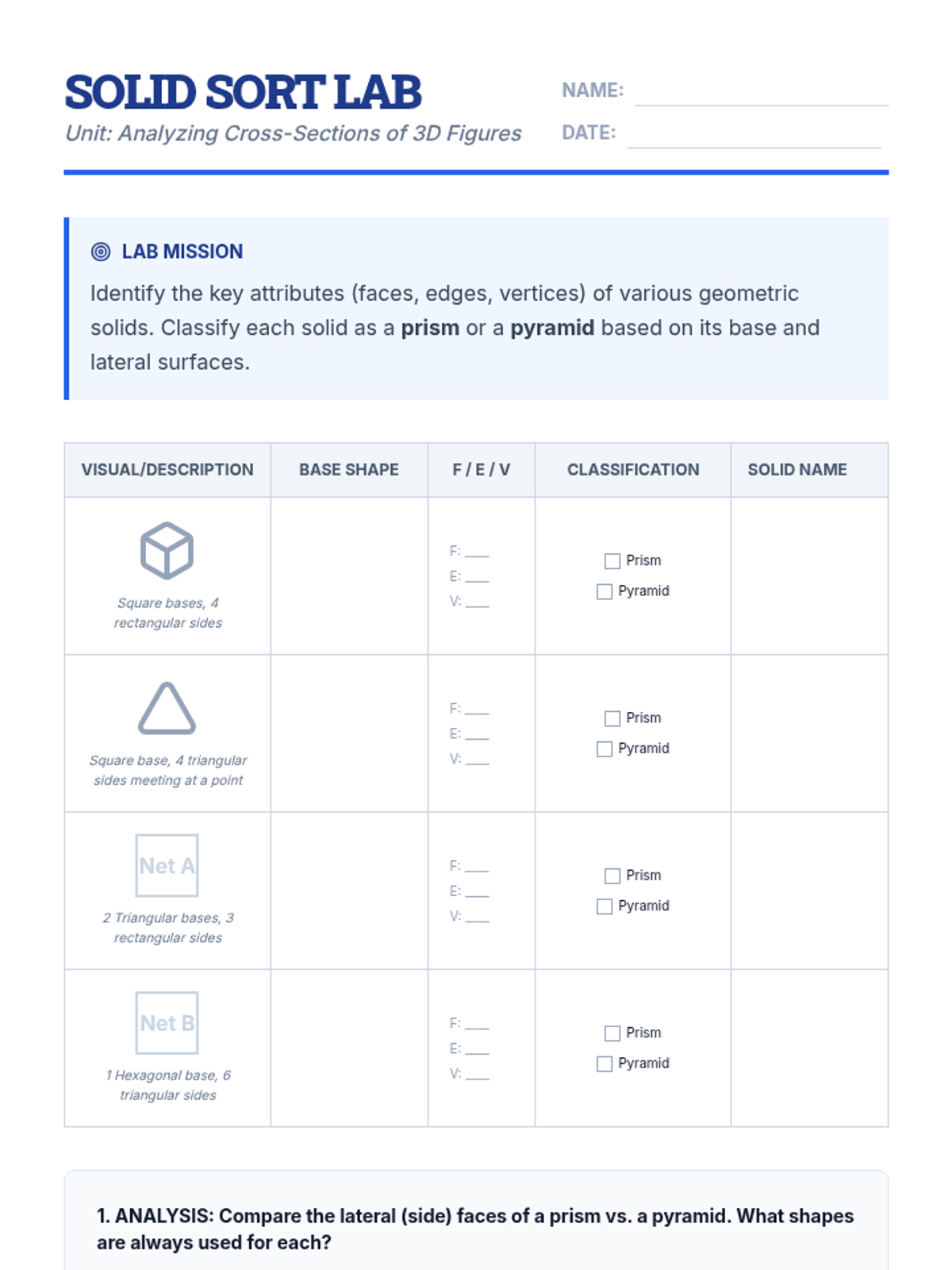
Solid Sort Worksheet

Shape Slice Lab

This hands-on sequence focuses on spatial visualization, specifically the relationship between three-dimensional solids and two-dimensional figures. Students explore how slicing 3D objects creates 2D cross-sections, progressing from basic classification to complex angled cuts and orthographic projections.

Lenny Avatar
Lenny
1/18
Sequence
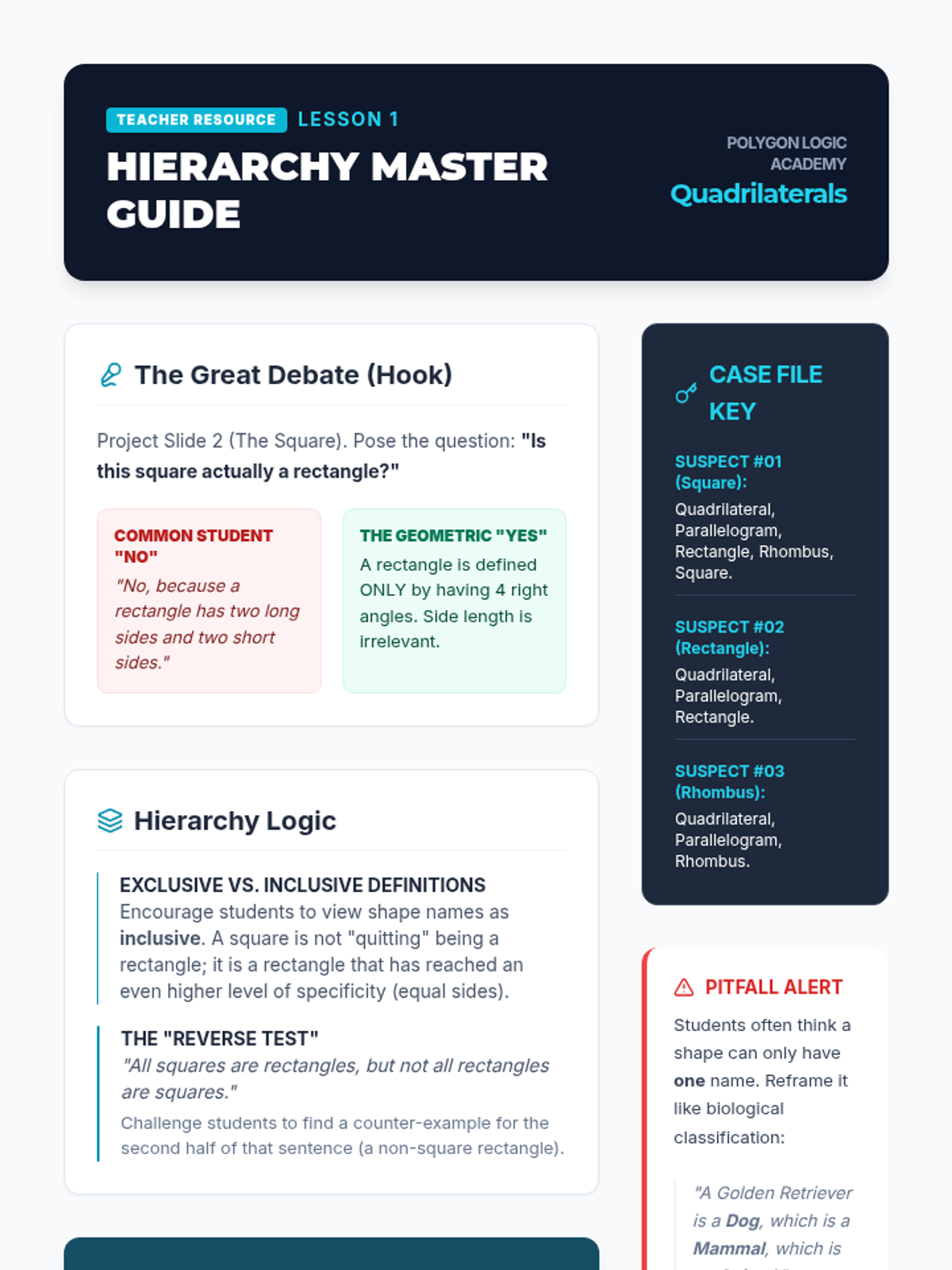
Quadrilateral Hierarchy Presentation
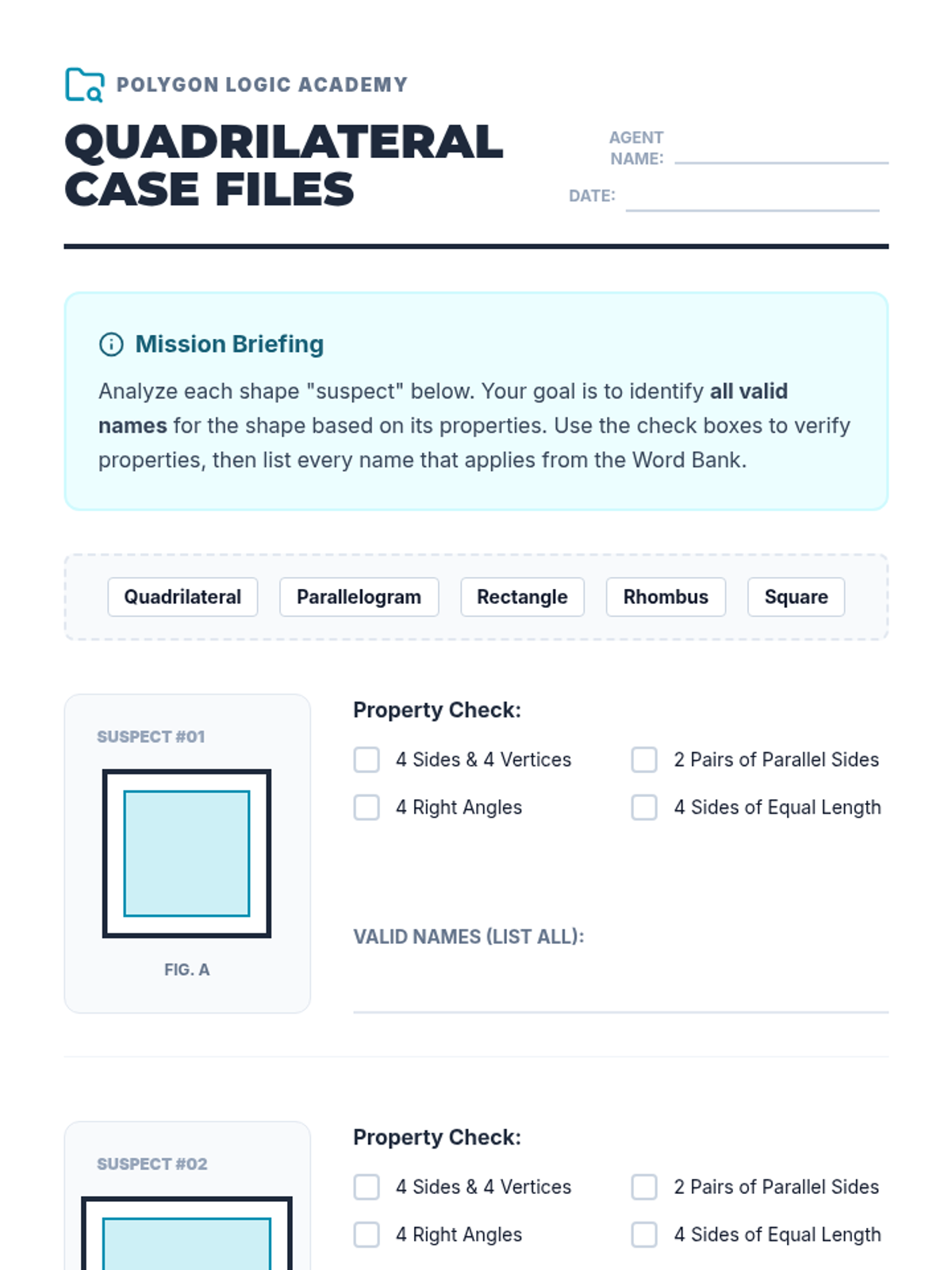
Quadrilateral Case Files Worksheet
Hierarchy Master Guide Resource

Polygon Logic Academy

A mastery-based sequence focusing on the logical hierarchy of geometric shapes, addressing complex classifications and property-based definitions through Venn diagrams and logic puzzles.

Lenny Avatar
Lenny
1/18
Sequence
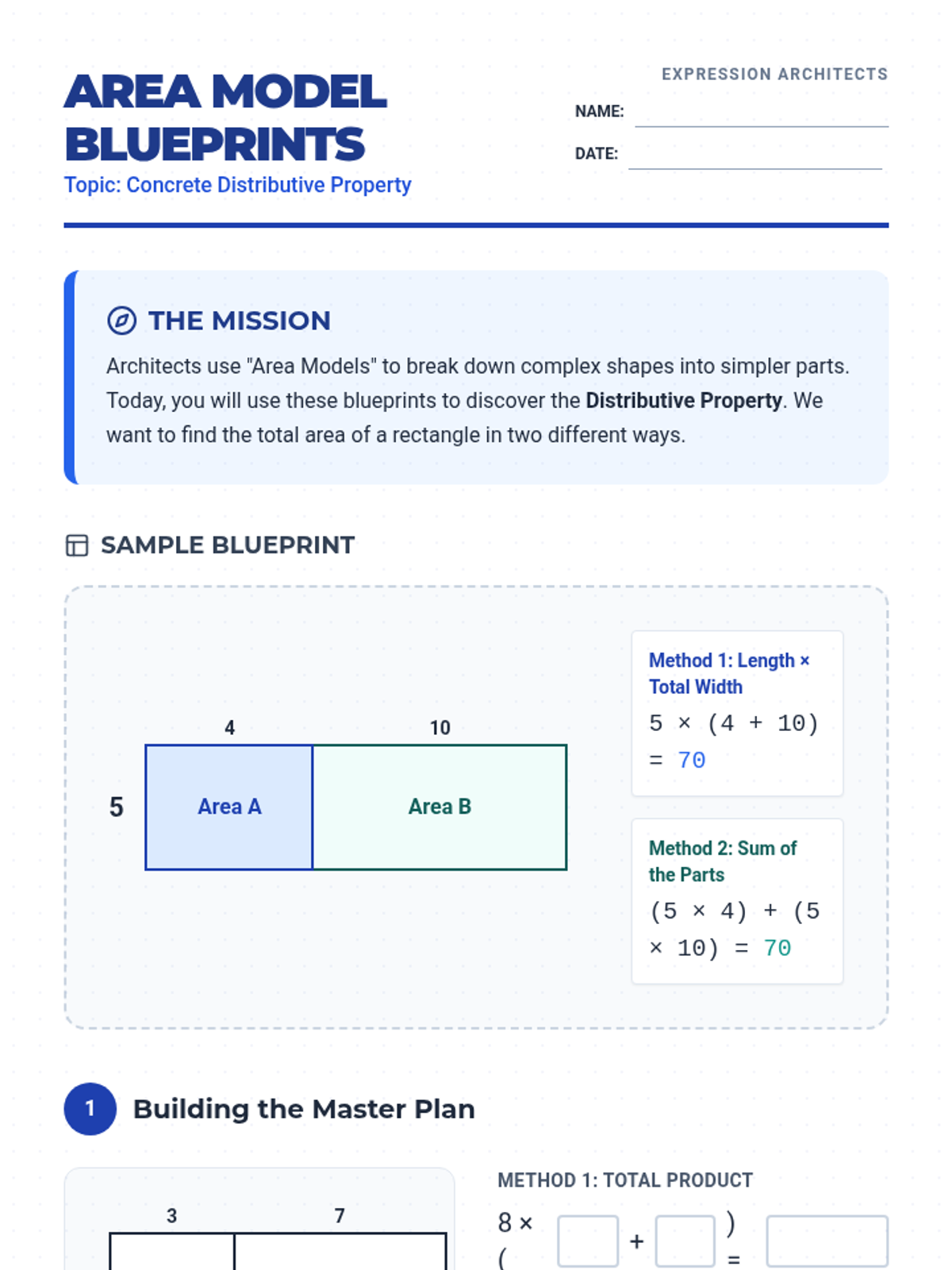
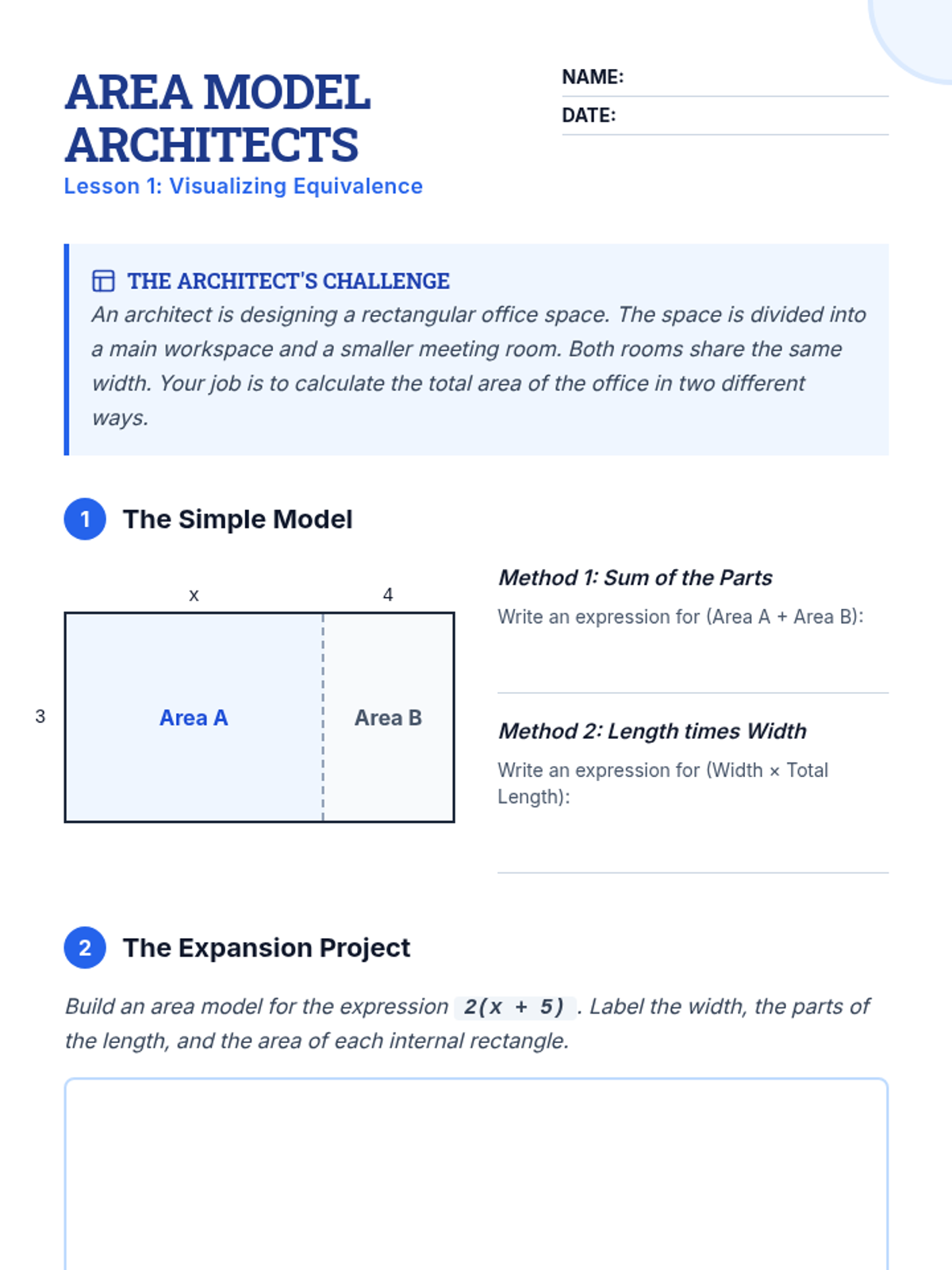
Area Model Blueprints Worksheet
Area Model Blueprints Slides
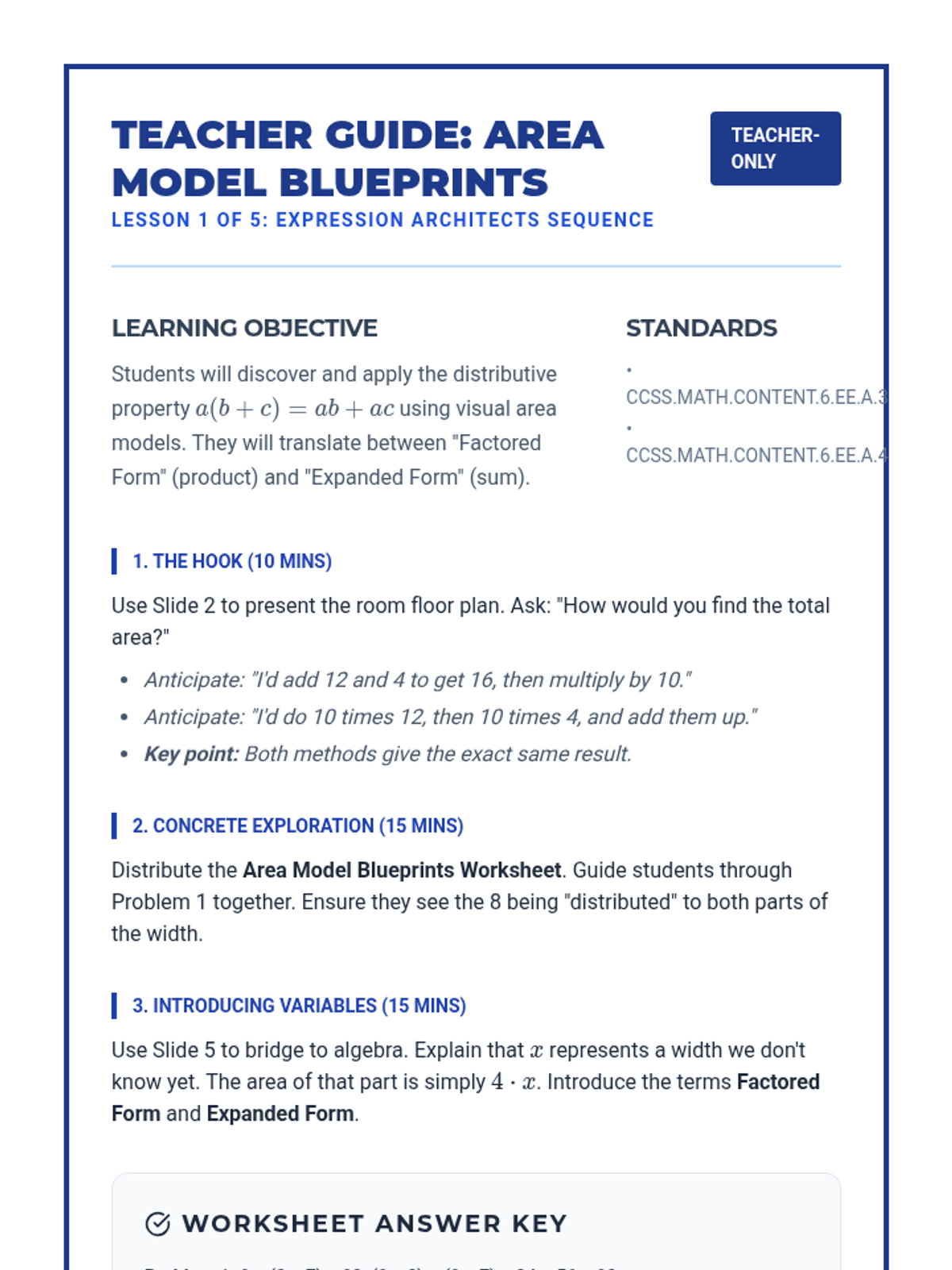
Area Model Blueprints Teacher Guide

Expression Architects

This sequence guides 6th-grade students through the conceptual and procedural mastery of the Distributive Property. Starting with concrete area models, students learn to expand and factor expressions, ultimately building a deep understanding of algebraic structure.

Lenny Avatar
Lenny
1/17
Sequence
Bingo Presentation Slides
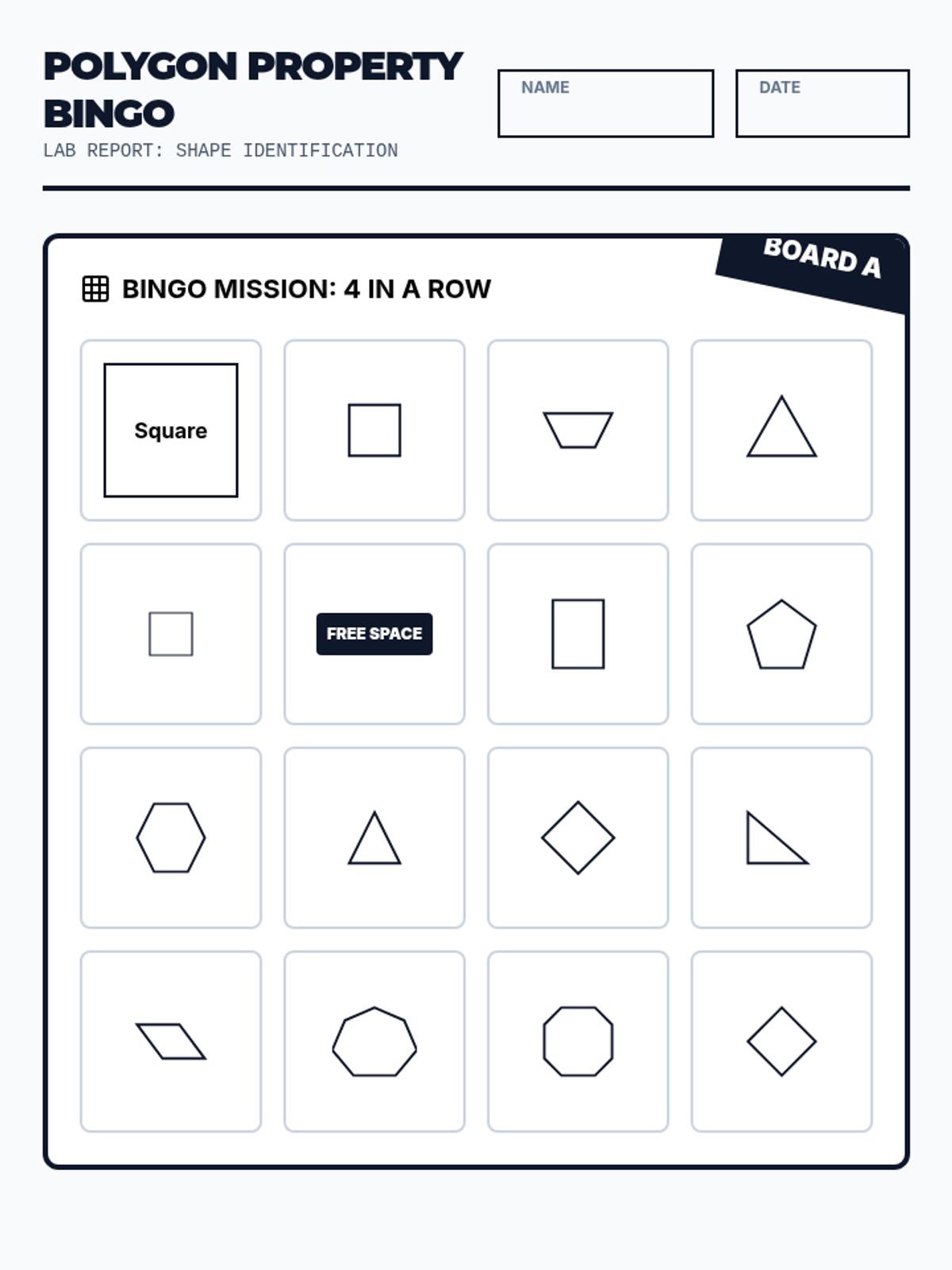
Polygon Bingo Boards
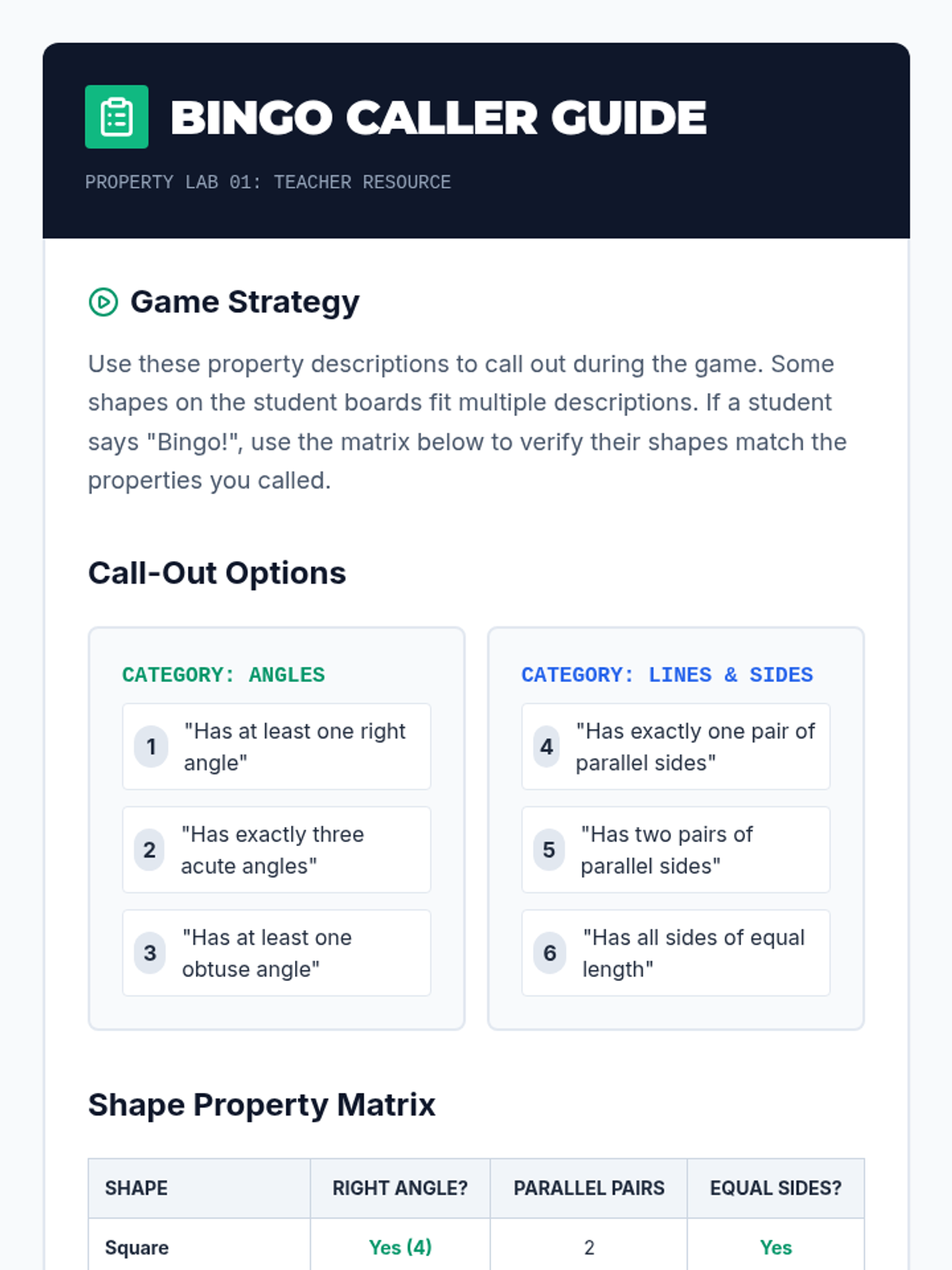
Bingo Caller Guide

Polygon Logic

A game-based sequence focused on rapid identification and logical deduction using polygon properties through bingo, riddles, and simulations. Students build fluency in identifying shapes and distinguishing between subtle differences.

Lenny Avatar
Lenny
1/17
Sequence
Net Navigators Presentation Slides
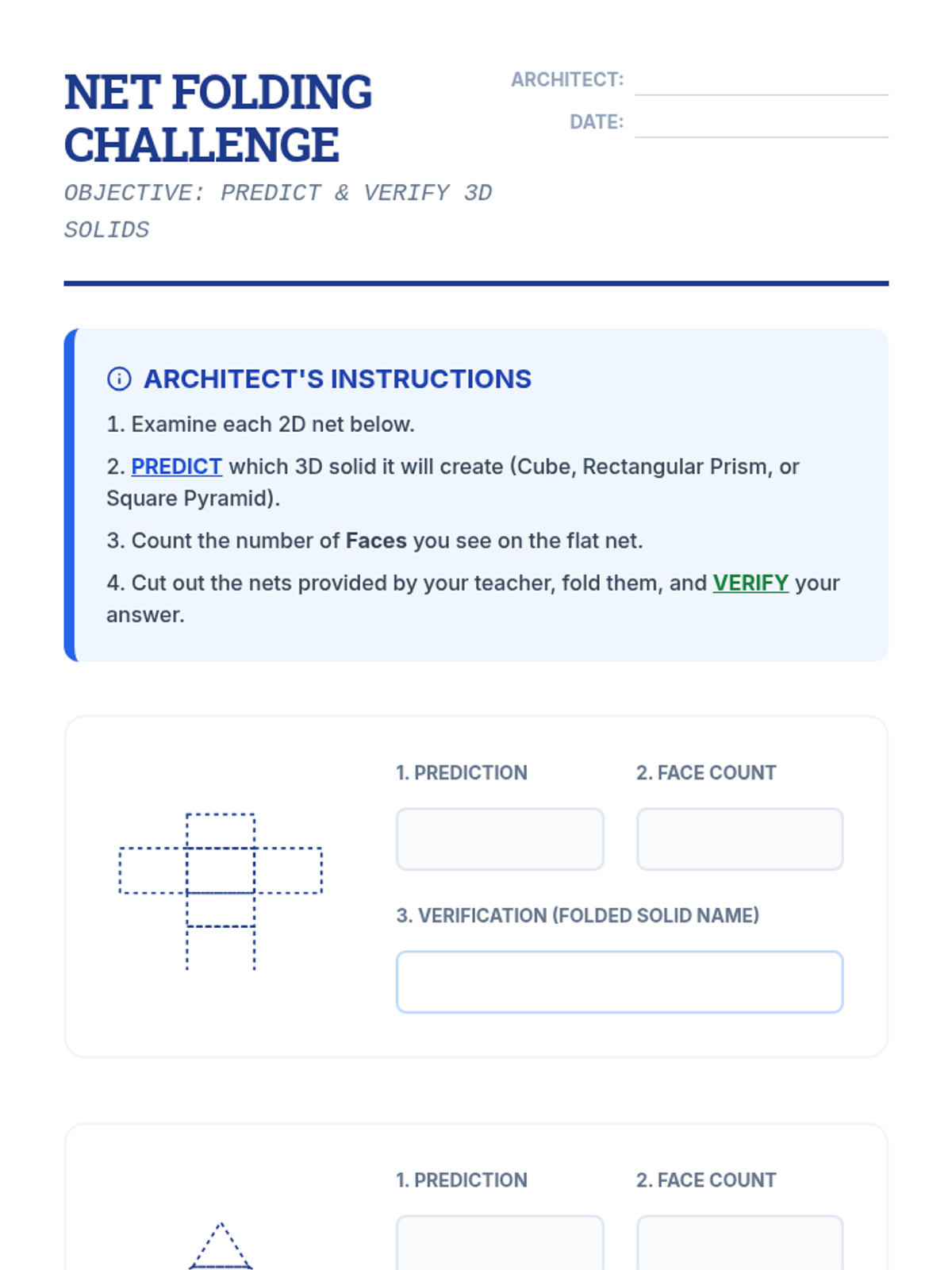
Net Folding Activity Worksheet

Shape Architects

This sequence explores the relationship between 2D shapes and 3D solids through hands-on construction, analysis of attributes, and cross-sectional investigations. Students apply their knowledge in a culminating engineering challenge to build stable structures using geometric properties.

Lenny Avatar
Lenny
1/17
Sequence
Unit Overview Resource

Math Intensive Lab

A comprehensive math intervention sequence for 6th-grade students, focusing on four key domains: Numbers & Operations, Algebraic Thinking, Measurement & Data, and Geometry. This sequence uses high-leverage strategies from the All Learners Network (ALN) and aligns with i-Ready prerequisite modules to bridge conceptual gaps.

D

dfredericks

Math Teacher
2/5
Sequence
Stronger Shapes Slides
Truss Tester Worksheet
Stronger Shapes Teacher Guide

Structural Geometry Engineering

This sequence bridges geometry and physics, investigating the structural properties of 2D and 3D shapes. Students analyze rigidity, tessellation, and surface area-to-volume ratios to understand how geometric attributes influence physical performance in engineering and nature.

Lenny Avatar
Lenny
1/18
Sequence
Cube Quest Slides
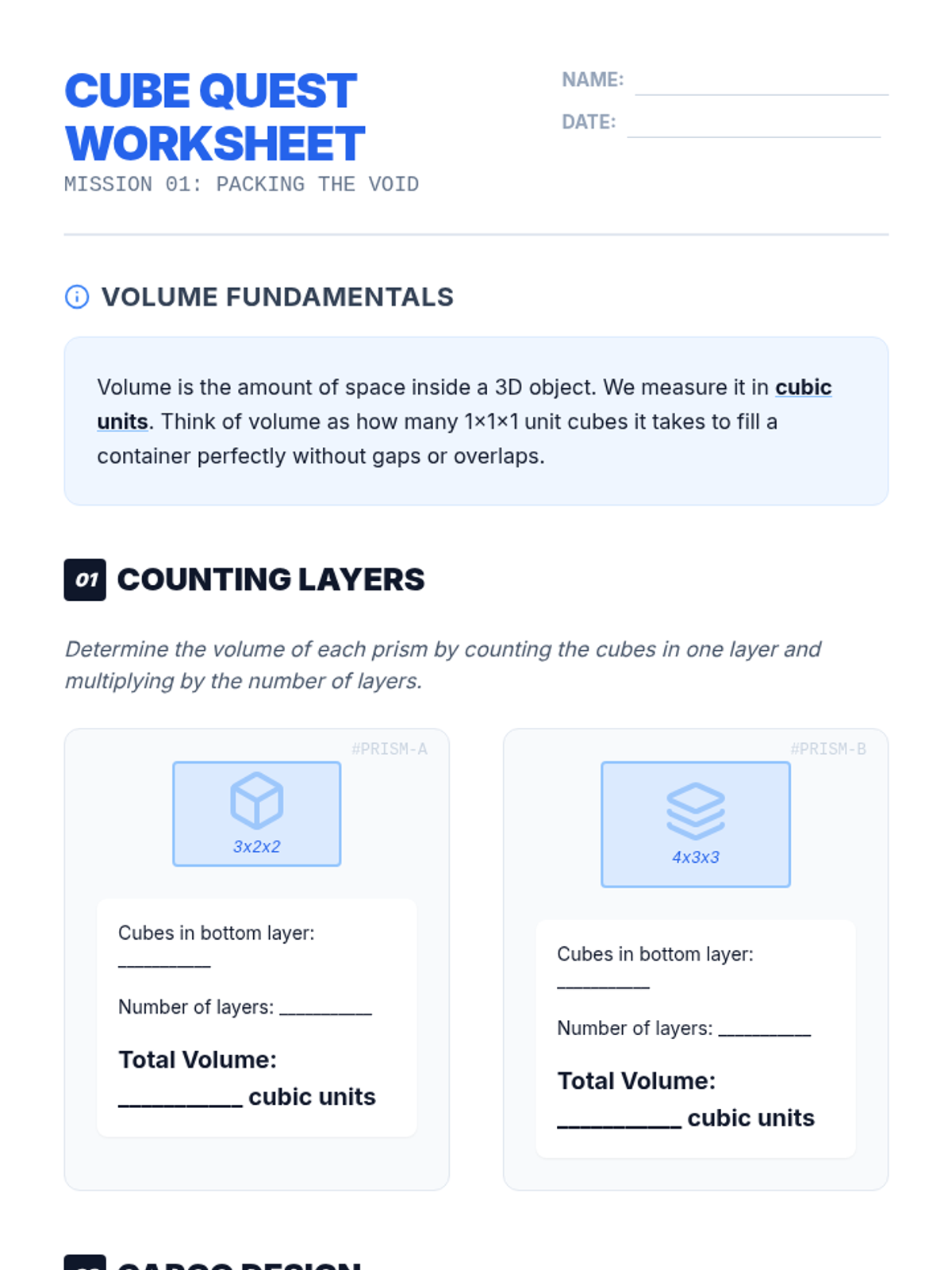
Cube Quest Worksheet
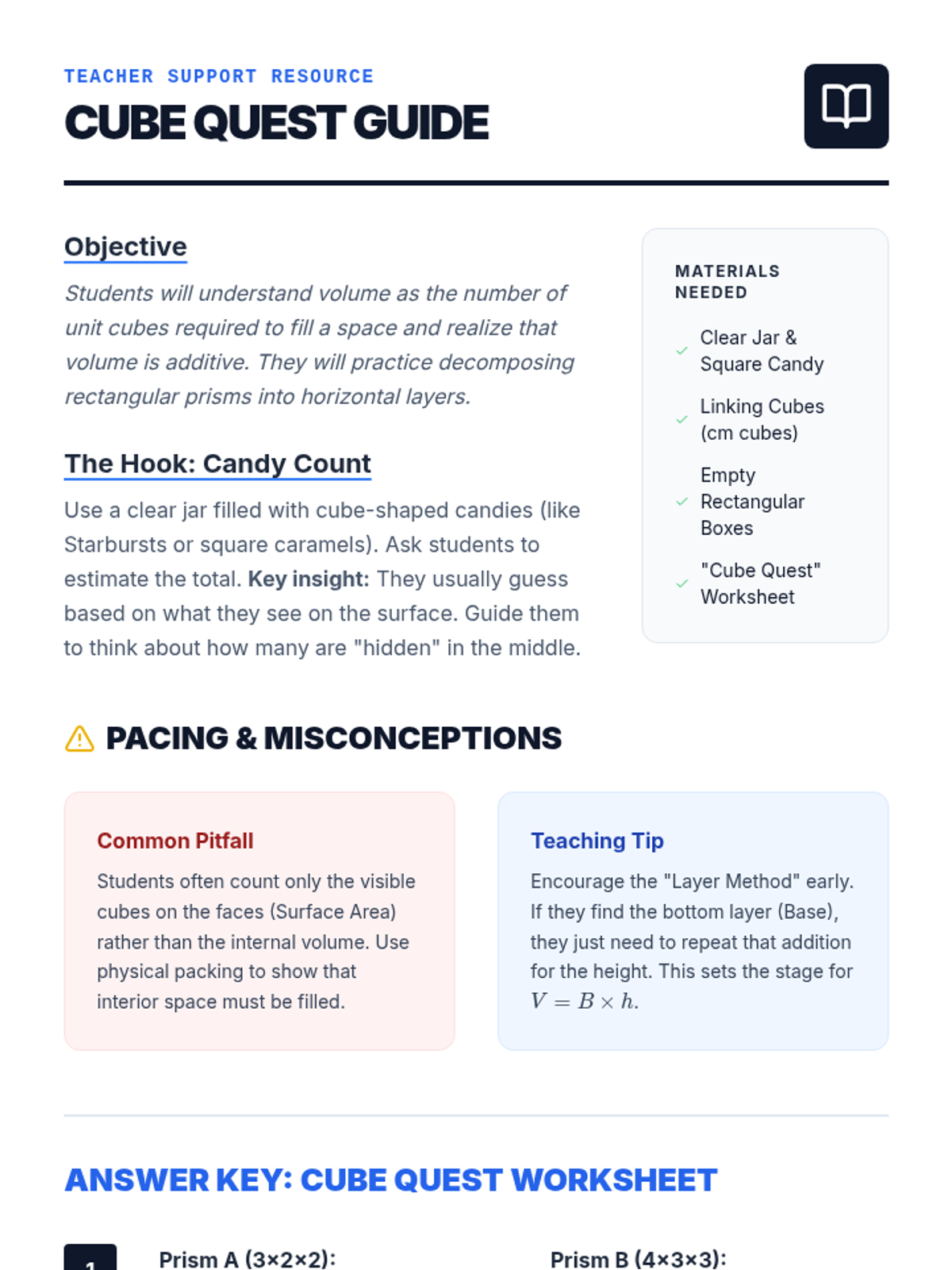
Cube Quest Teacher Guide

Volume Voyager Sequence

This sequence guides 6th-grade students through the conceptual and procedural aspects of calculating the volume of rectangular prisms. Starting with unit cubes and moving through fractional edge lengths and composite figures, students develop a deep understanding of 3D space measurement.

Lenny Avatar
Lenny
1/18
Sequence
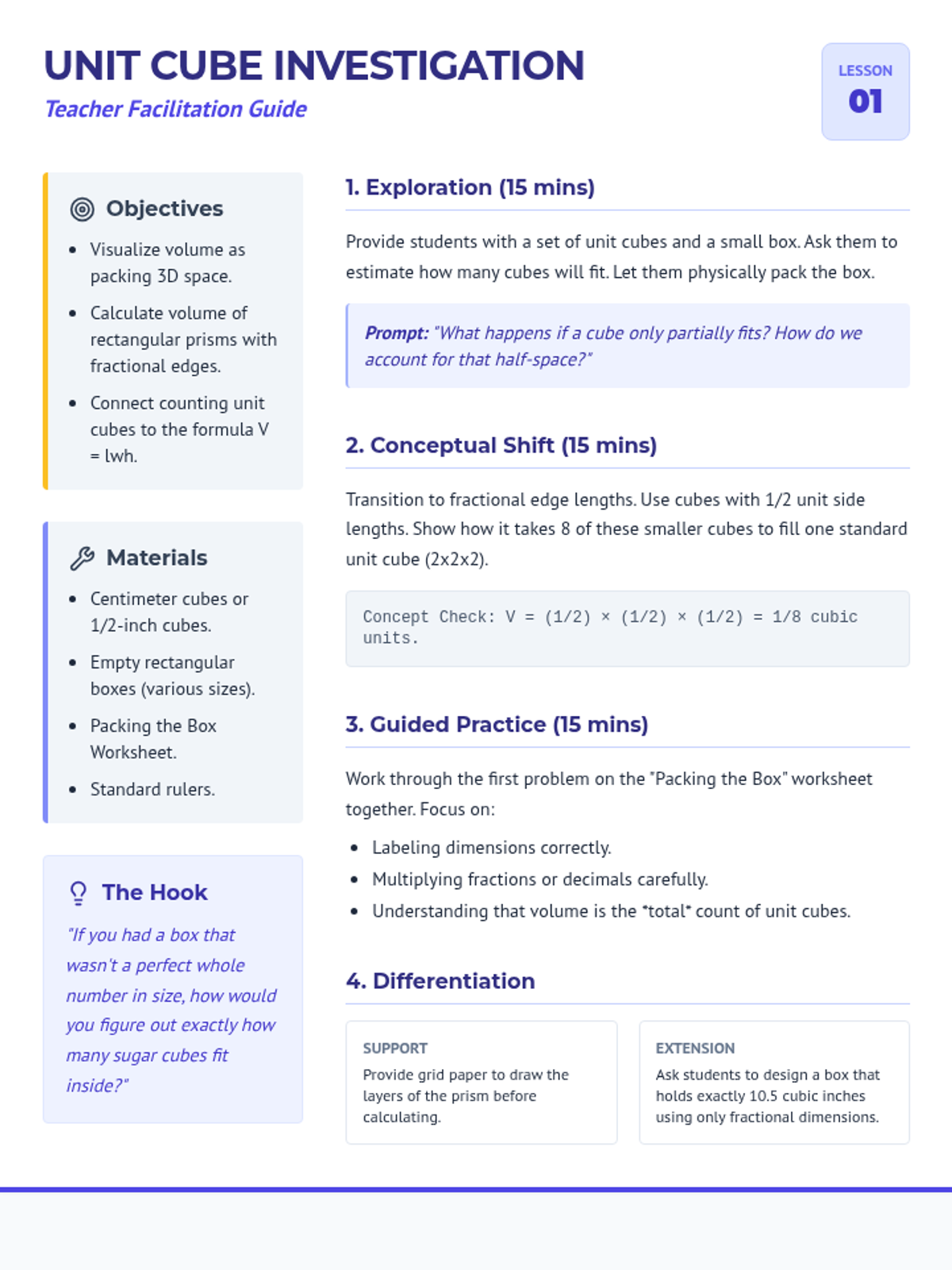
Unit Cube Investigation Teacher Guide
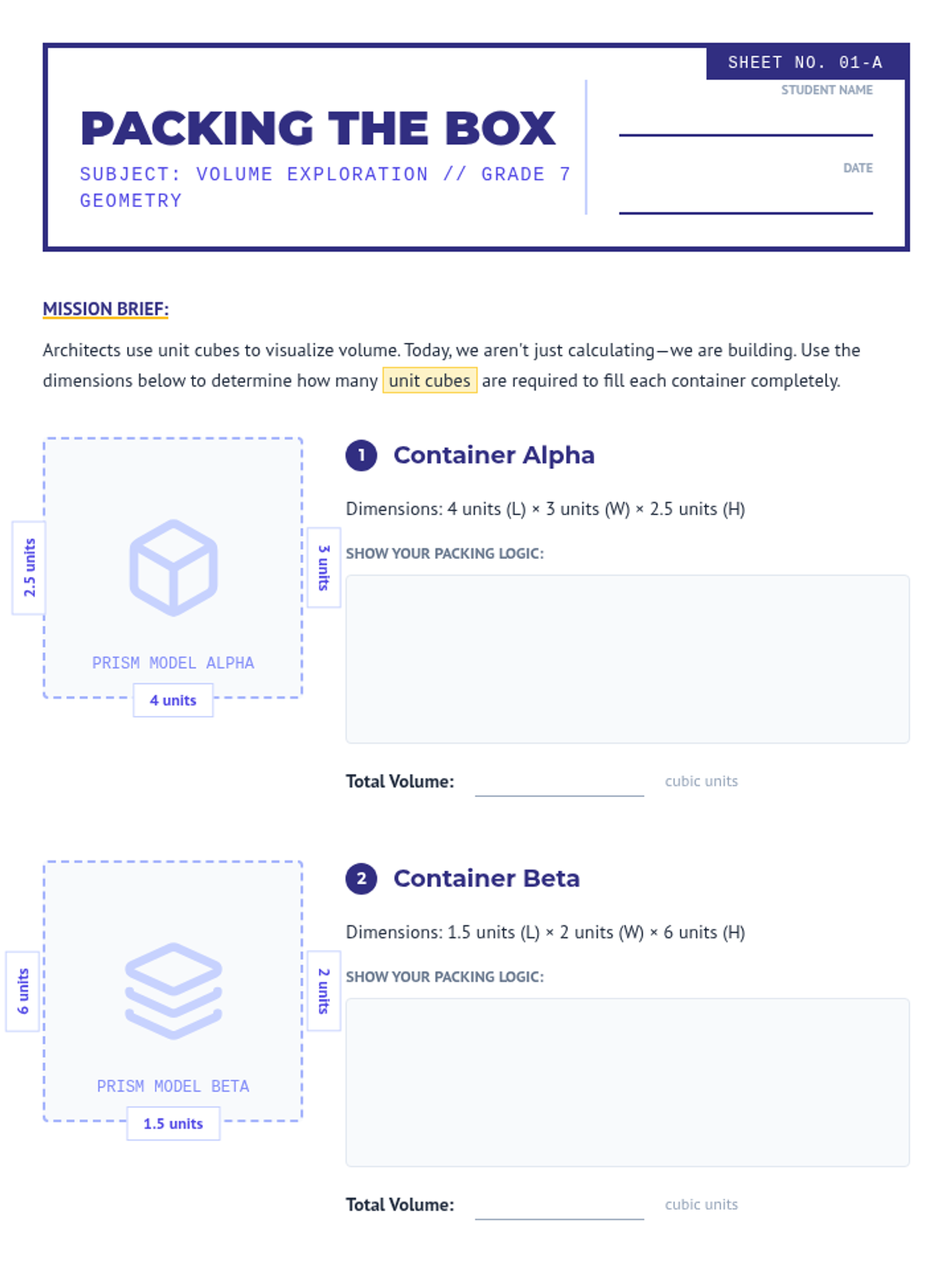
Packing the Box Worksheet
Cubic Capacity Slides
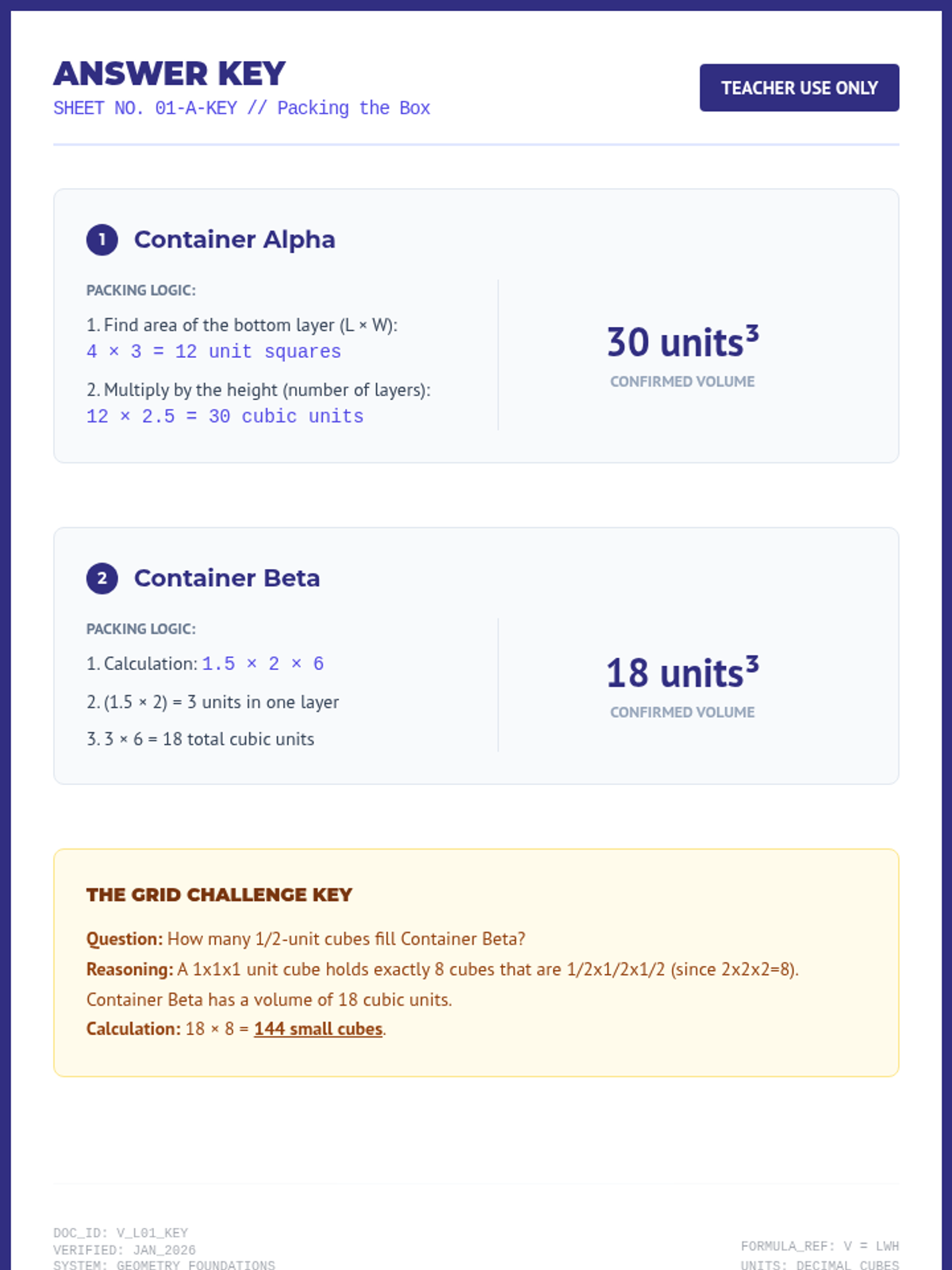
Packing the Box Answer Key

Understanding Volume Through Base Area and Height

This inquiry-based sequence establishes the foundational conceptual understanding of volume as the accumulation of two-dimensional layers. Students move from counting unit cubes to deriving the universal formula V = Bh for prisms by exploring rectangular and triangular shapes.

Lenny Avatar
Lenny
1/17
Sequence
Space Filling Slides
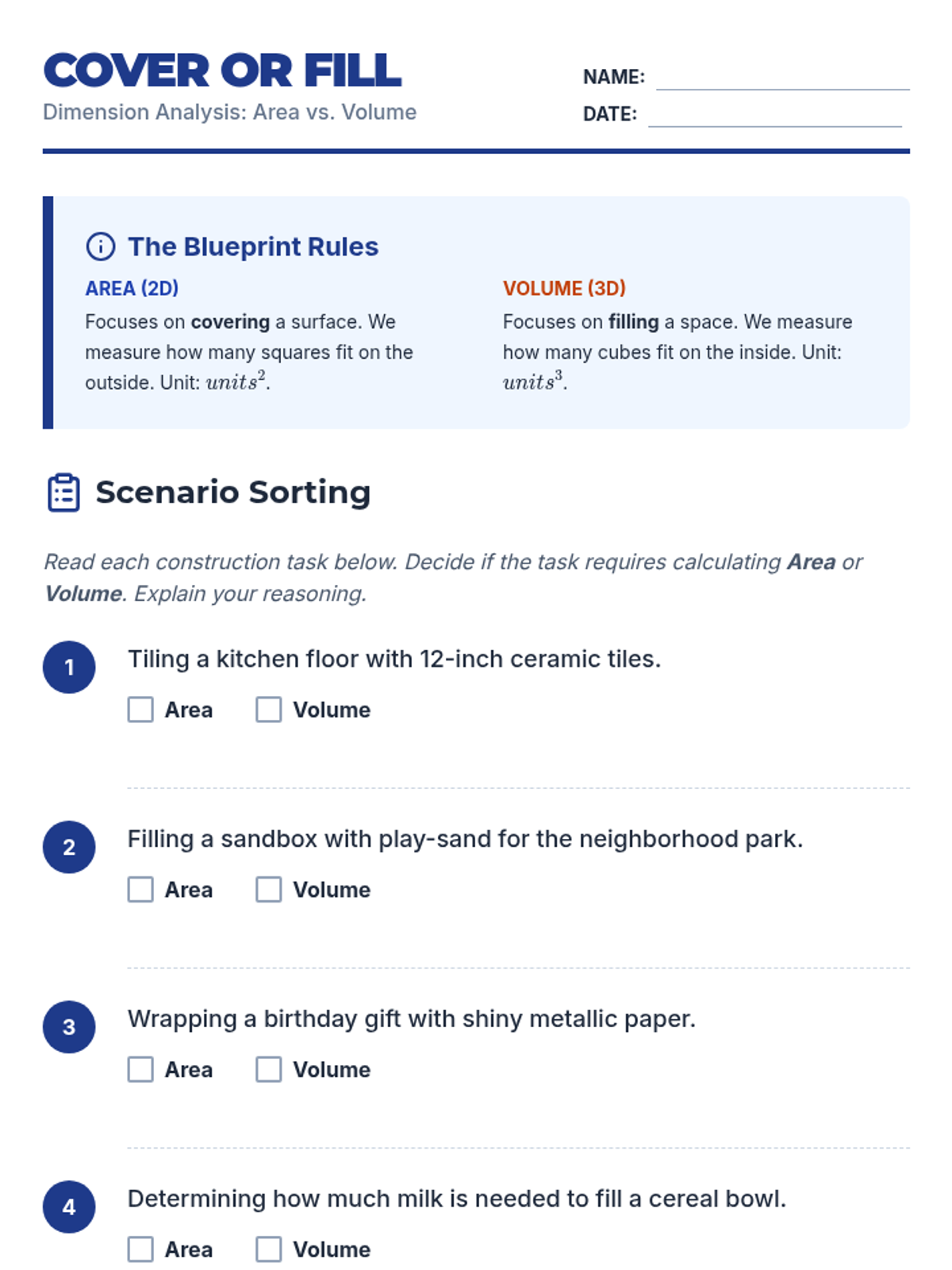
Cover or Fill Worksheet

Volume Blueprint

This sequence guides 6th-grade students through the conceptual derivation of volume formulas for rectangular prisms, moving from concrete unit cubes to abstract formulas. students explore the distinction between area and volume, discover the lwh formula through packing, and master the base-area method.

Lenny Avatar
Lenny
1/17
Sequence
Liquid Logic Slides
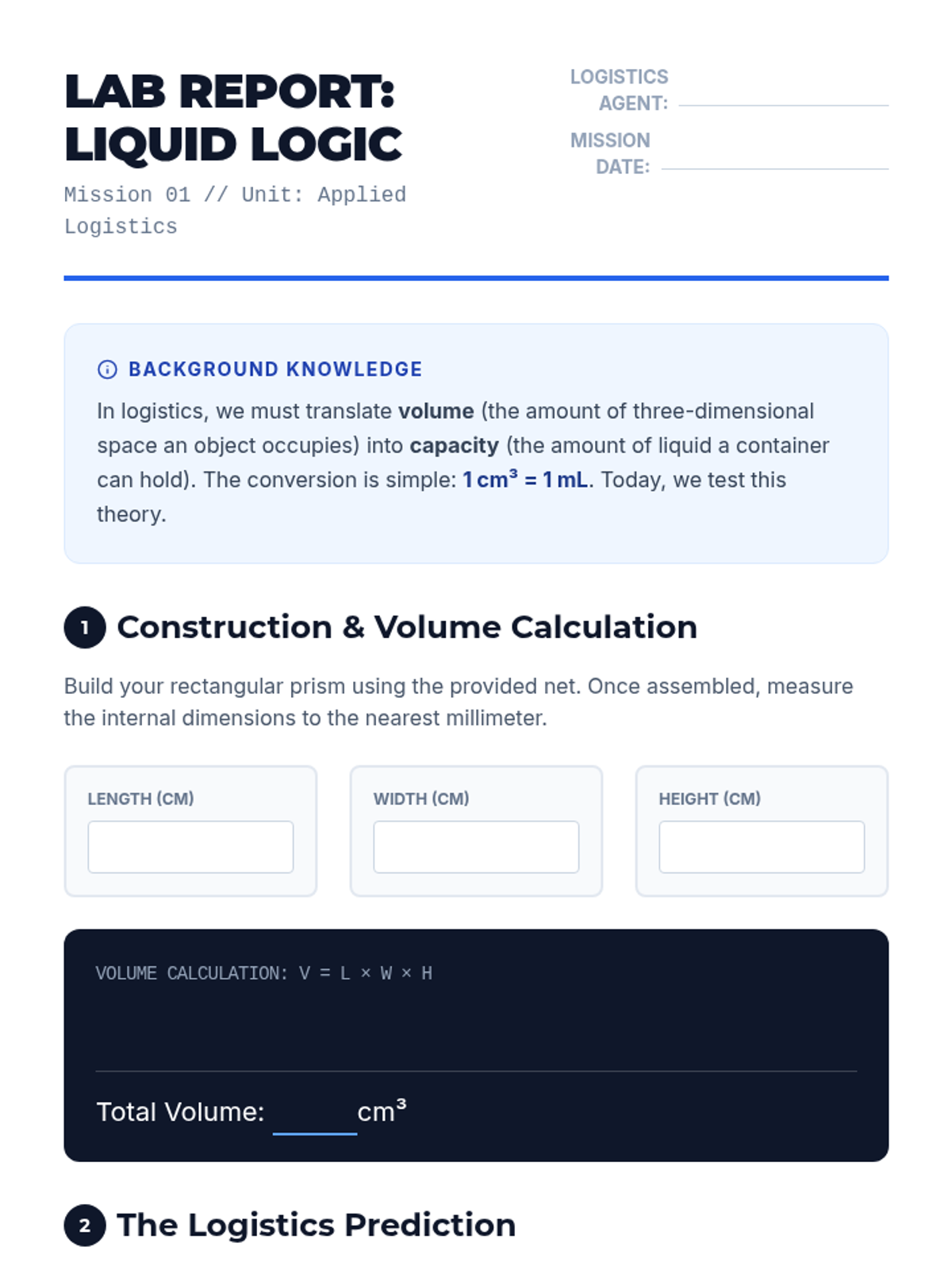
Liquid Logic Lab Report

Applied Volume and Capacity Logistics

A 6th-grade geometry unit exploring real-world applications of volume, capacity, and logistical optimization. Students solve problems involving liquid conversion, material efficiency, filling rates, and cost estimation through a logistics lens.

Lenny Avatar
Lenny
1/17
Sequence
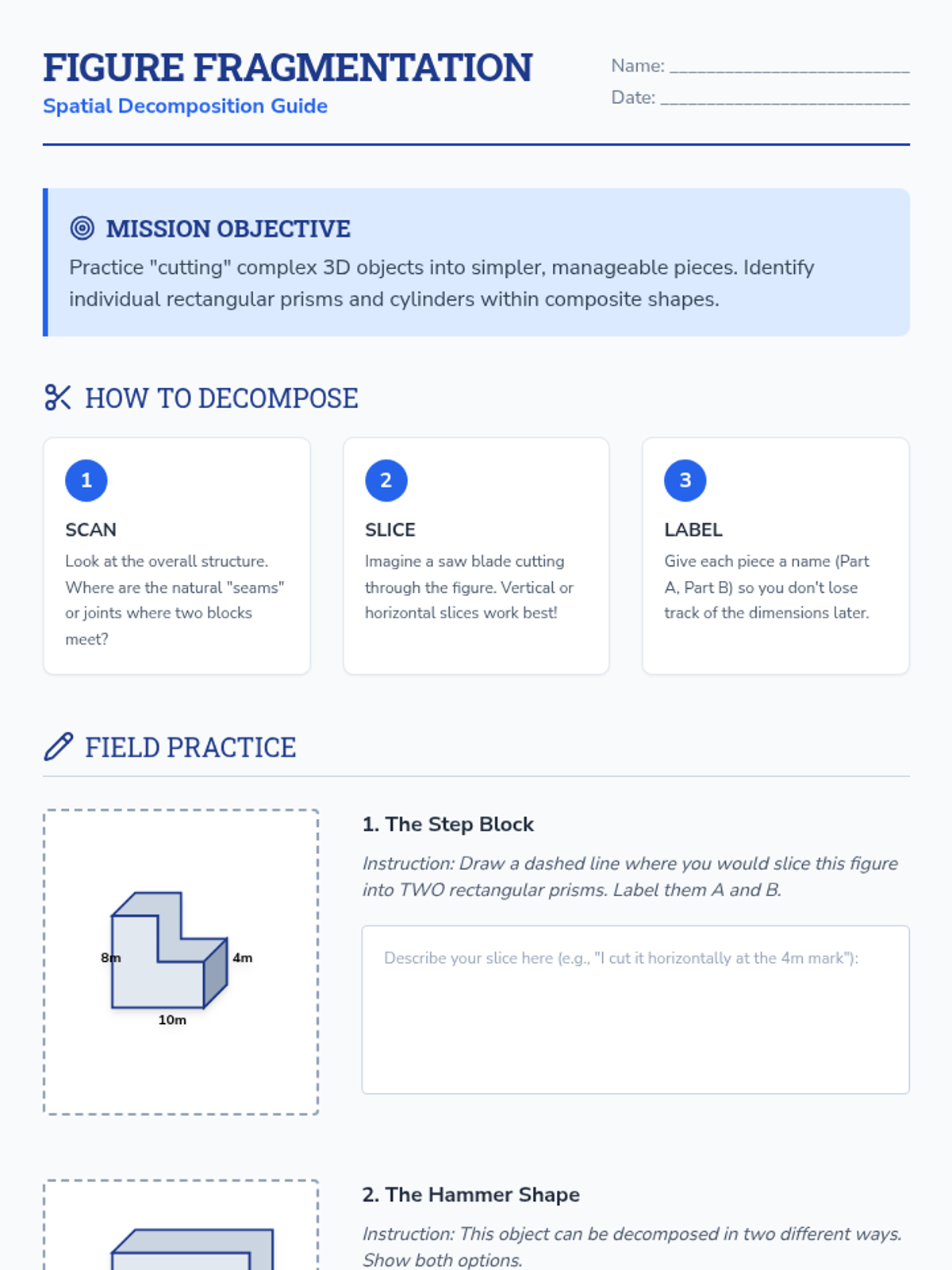
Figure Fragmentation Worksheet
Figure Fragmentation Slides
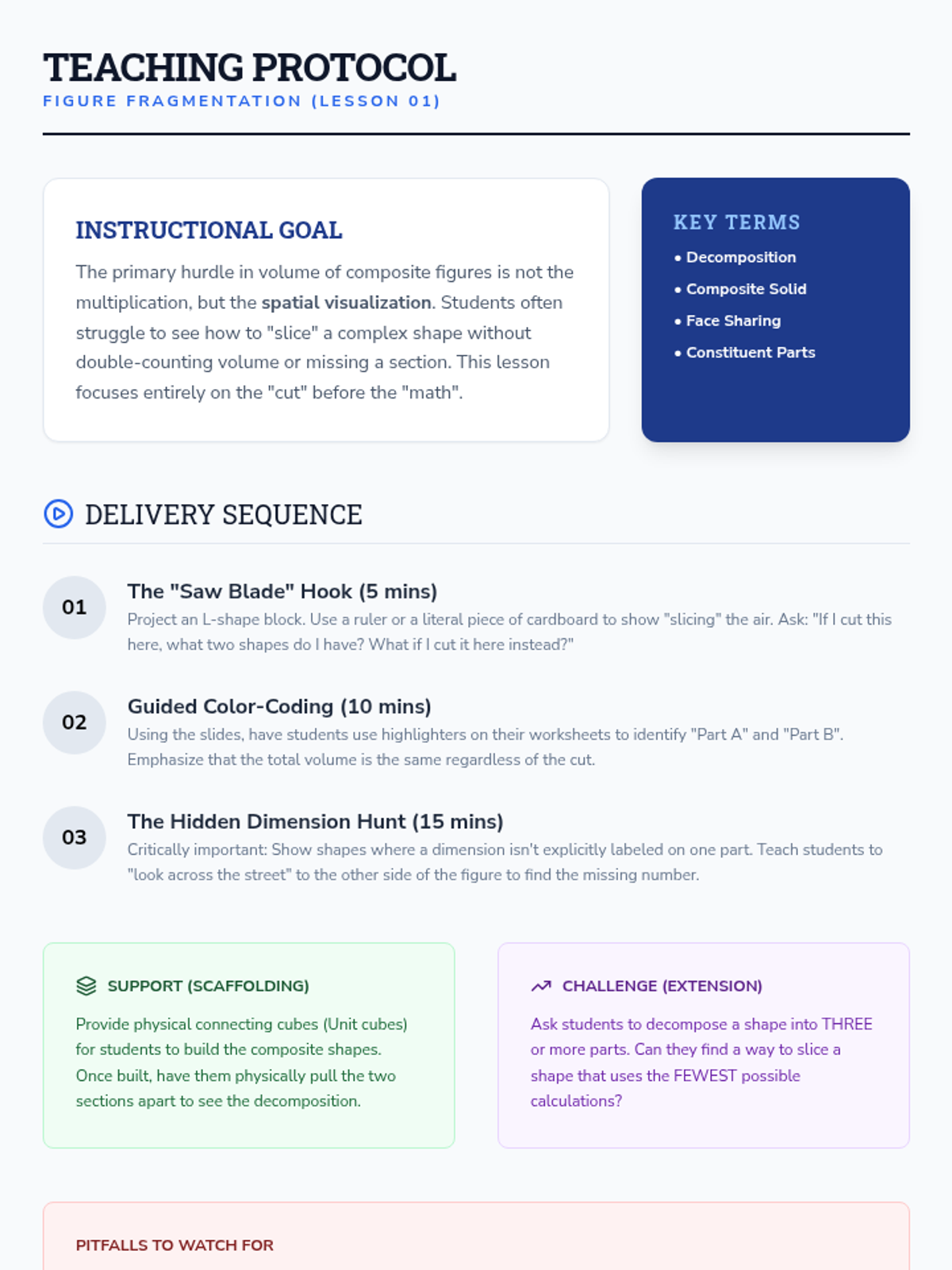
Spatial Skills Teacher Guide

Volume Analysis of Composite Figures

This sequence guides 6th-grade students through the process of analyzing and calculating the volume of composite 3D figures. Students progress from basic spatial decomposition to additive and subtractive volume strategies, culminating in a real-world design project for a custom aquarium.

Lenny Avatar
Lenny
1/17
Sequence
Slice and Scale Slides
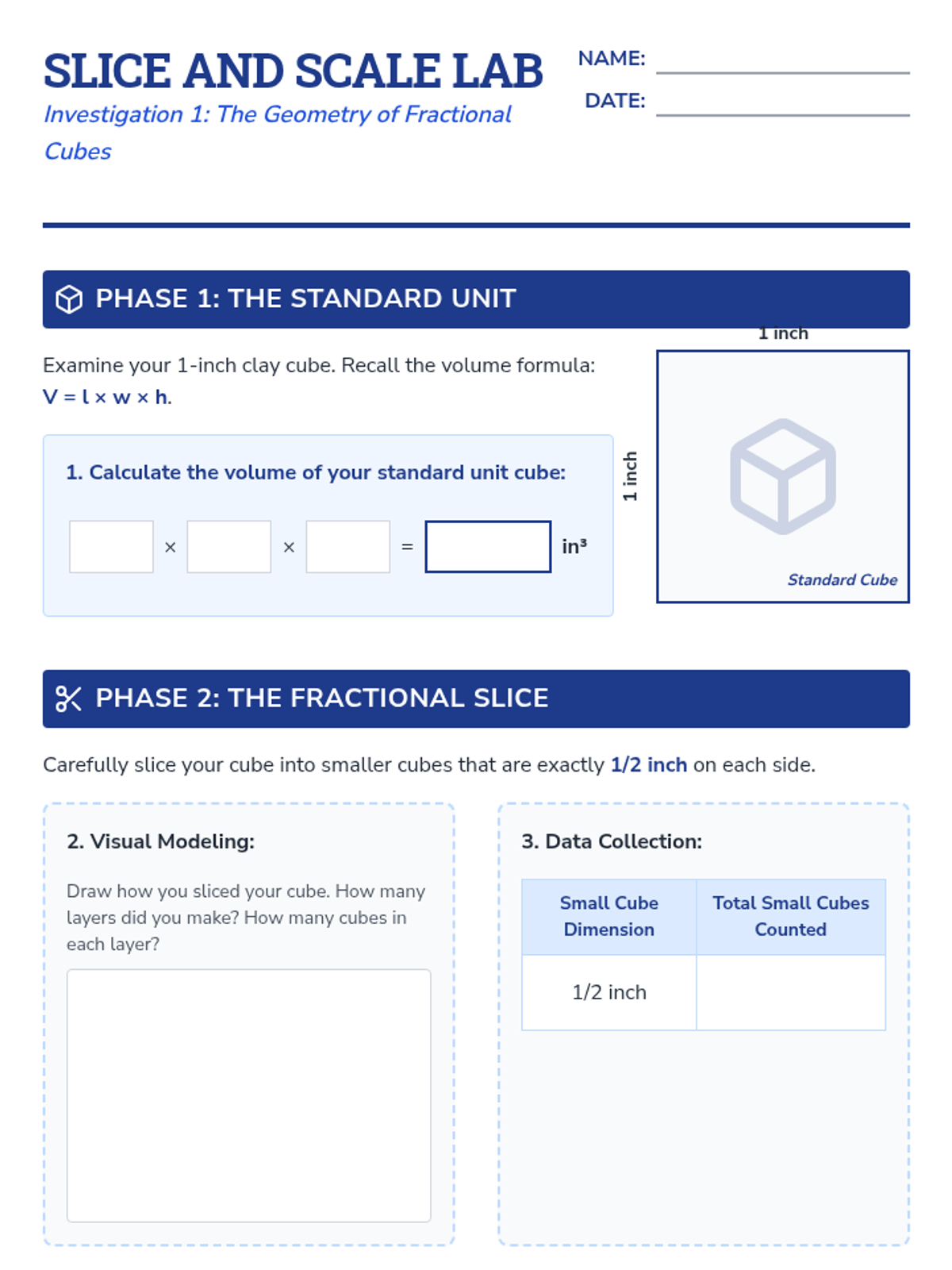
Slice and Scale Lab Worksheet

Volume Blueprint Workshop

A comprehensive 6th-grade geometry sequence exploring volume with fractional edge lengths. Students move from concrete visual modeling with unit cubes to abstract formula application and complex real-world packing problems.

Lenny Avatar
Lenny
1/17
Sequence
Base Blueprints Slides
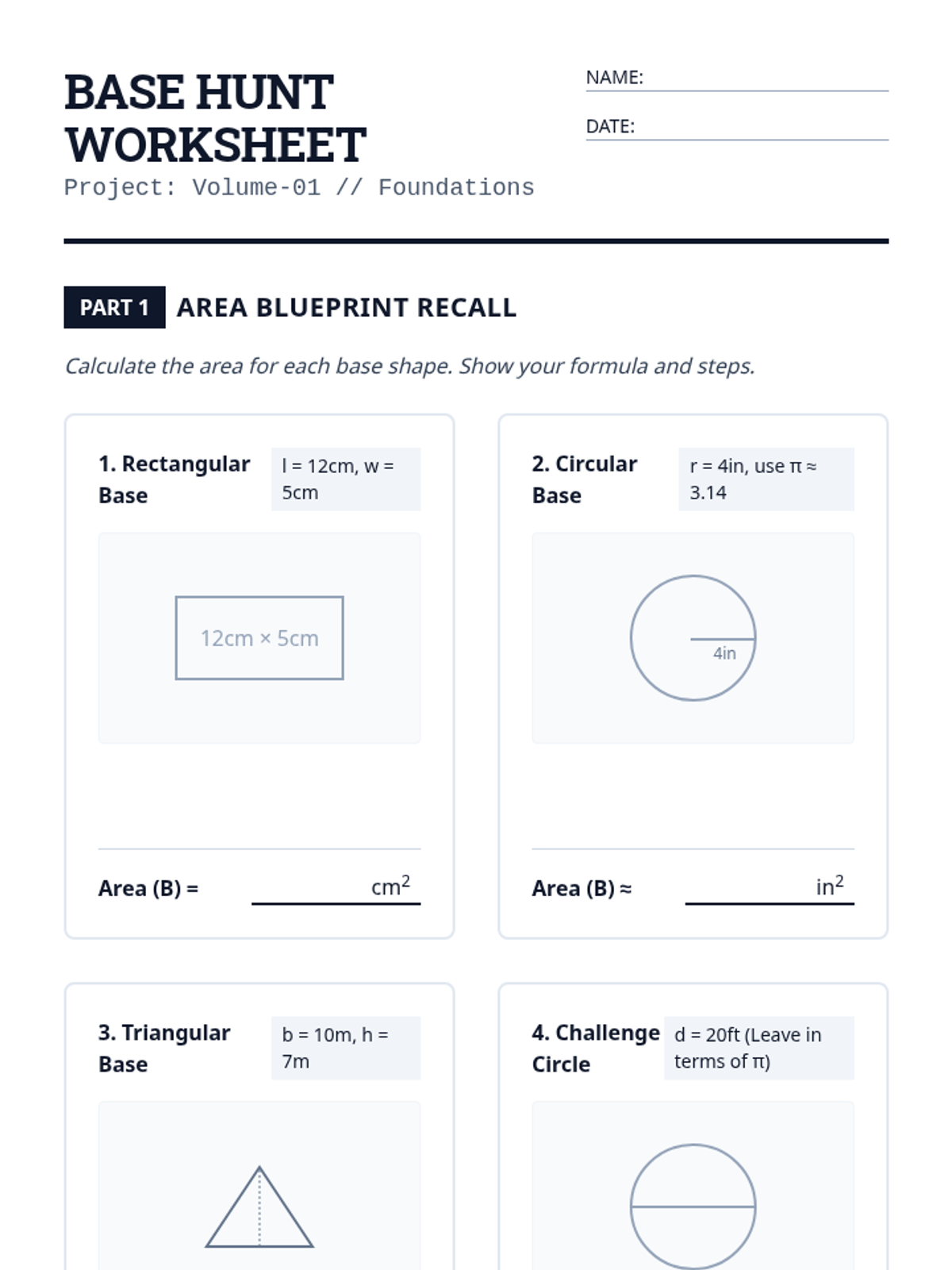
Base Hunt Worksheet
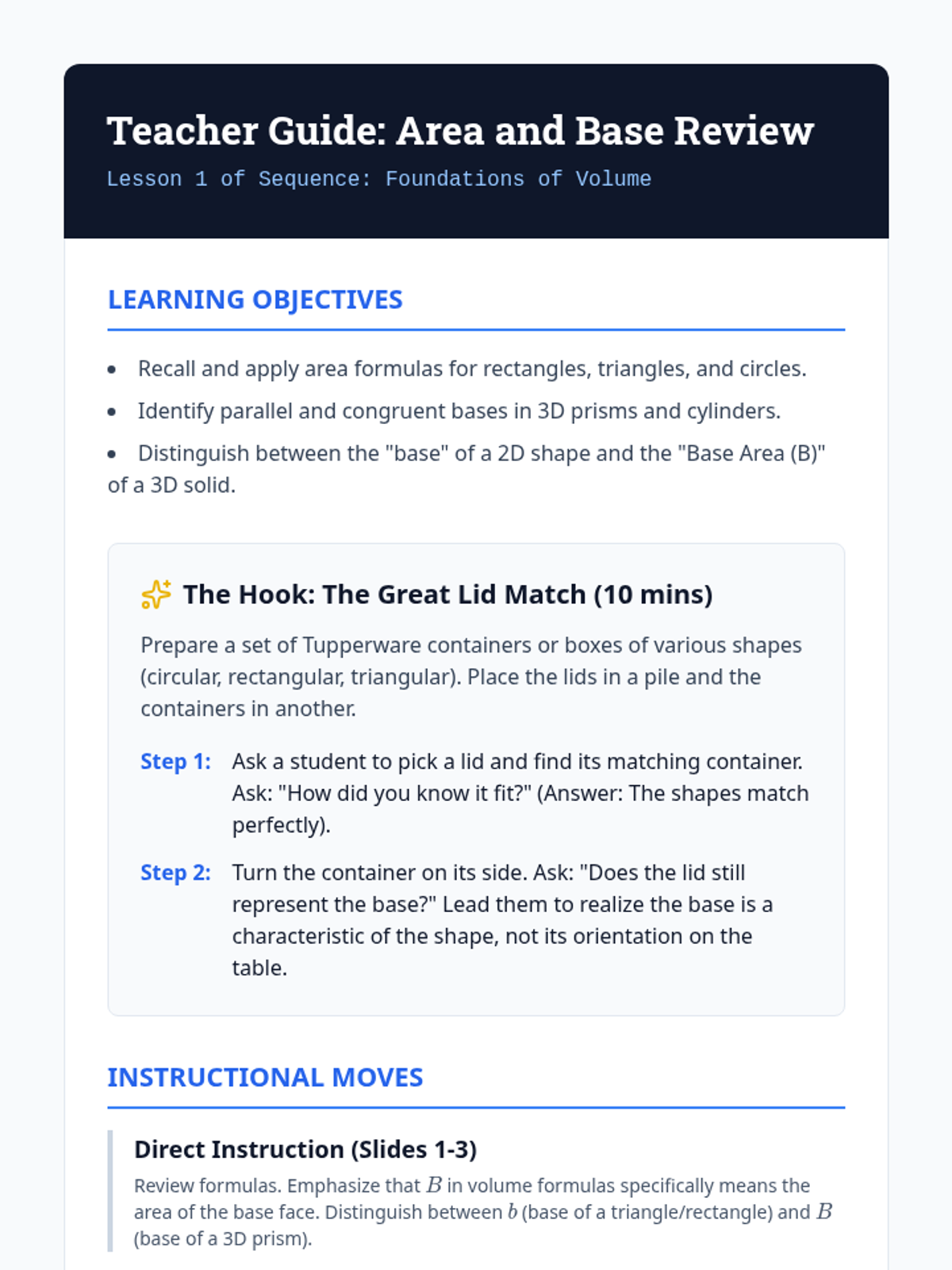
Base Review Teacher Guide

Foundations of Volume Prisms and Cylinders

This sequence explores the relationship between 2D base area and 3D volume for prisms and cylinders. Students build a deep conceptual understanding of the \(V = Bh\) formula through hands-on hooks, visual derivations, and real-world application problems.

Lenny Avatar
Lenny
1/17
Sequence
Solid Deconstruction Slides
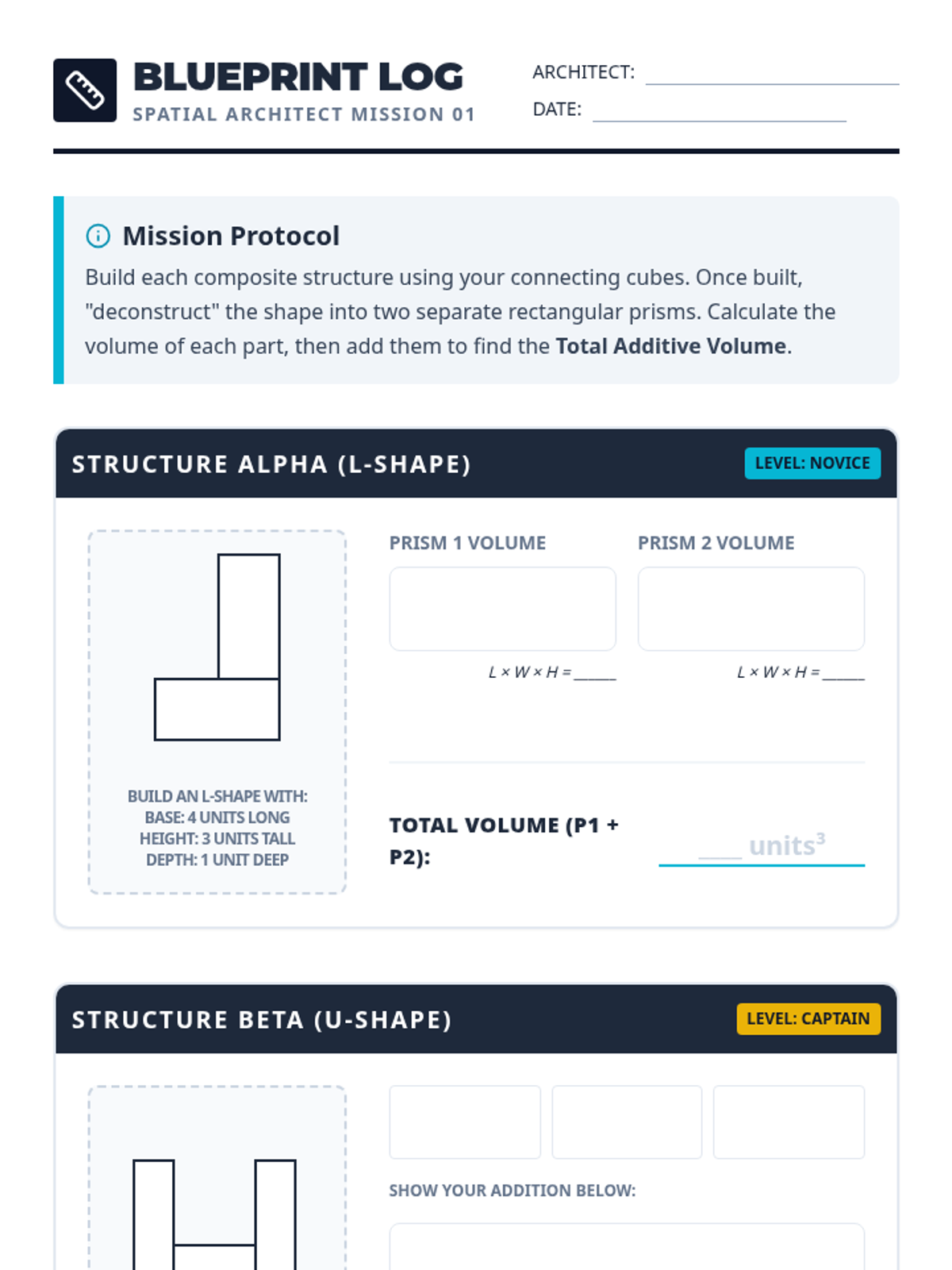
Blueprint Log Worksheet

Spatial Architects Additive Volume

A project-based exploration of additive volume where students act as spatial architects to decompose complex 3D structures and design their own volume-constrained modules.

Lenny Avatar
Lenny
1/17
Sequence
Formula Discovery Slides
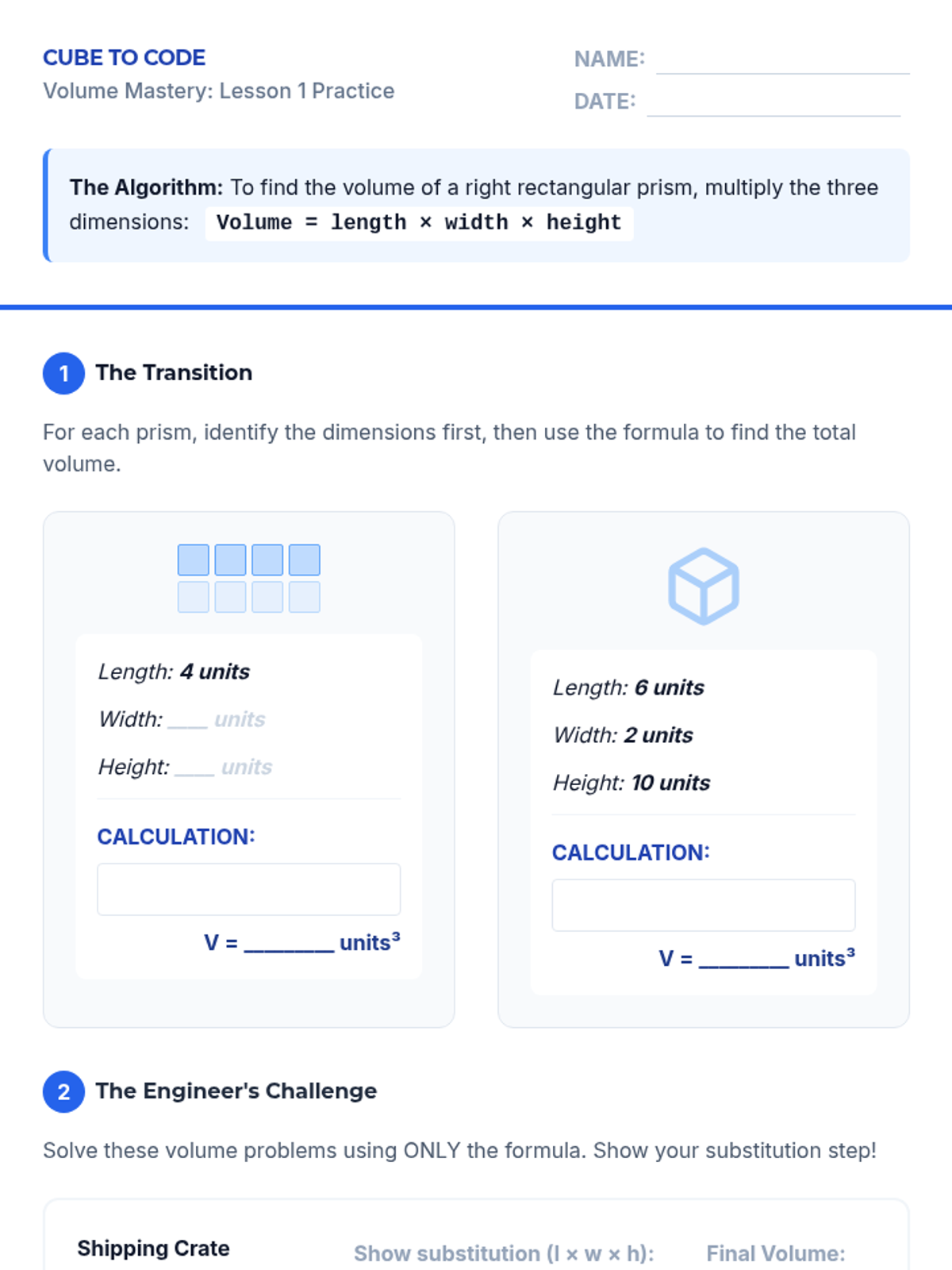
Cube to Code Worksheet
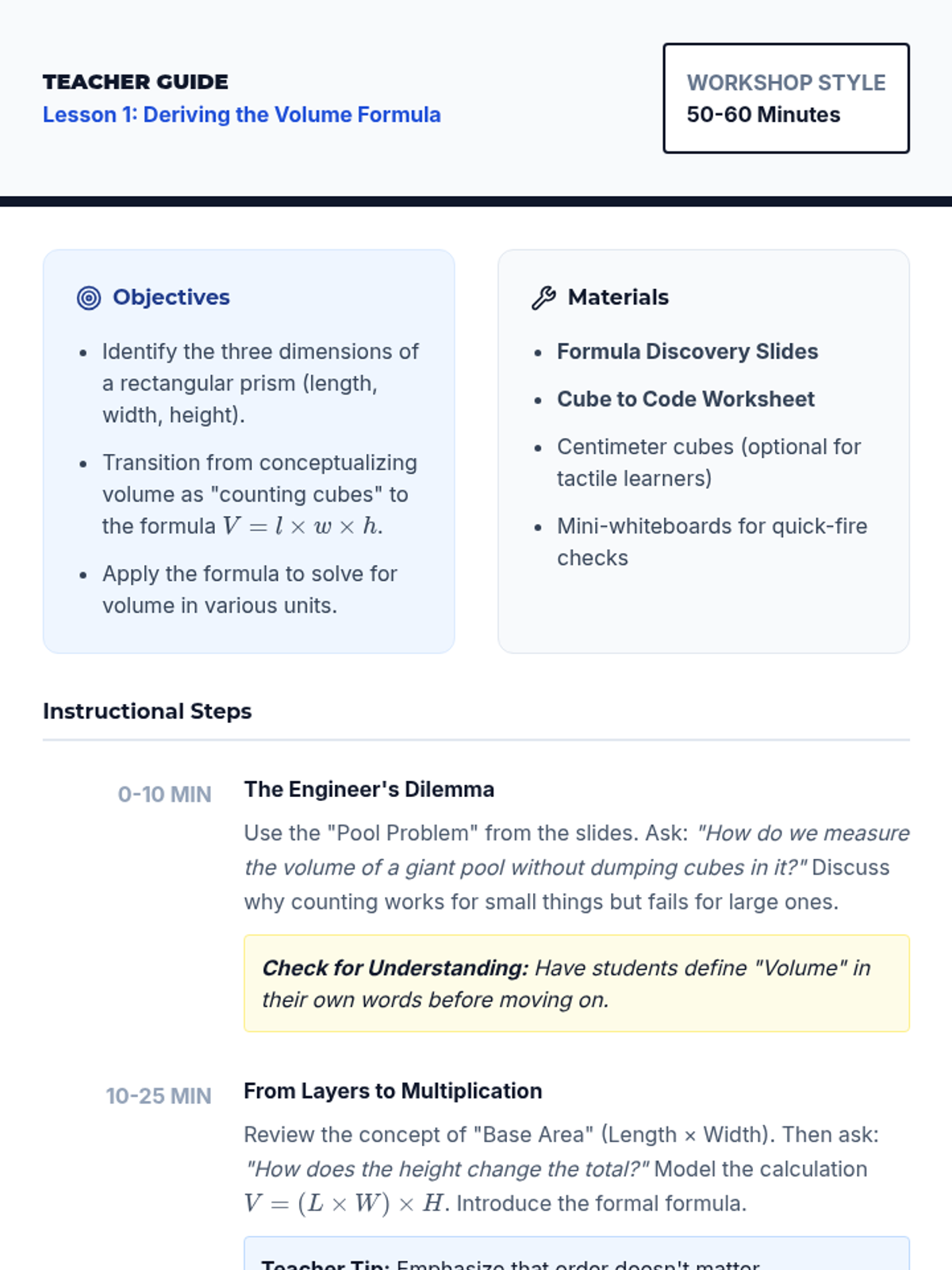
Volume Derivation Teacher Guide

Volume Formula Mastery

This workshop-style sequence transitions students from counting cubes to applying standard algorithms for calculating volume. Students derive and master the formulas V = l × w × h and V = B × h, progressing from straightforward calculations to solving for missing dimensions and complex real-world word problems.

Lenny Avatar
Lenny
1/17
Sequence
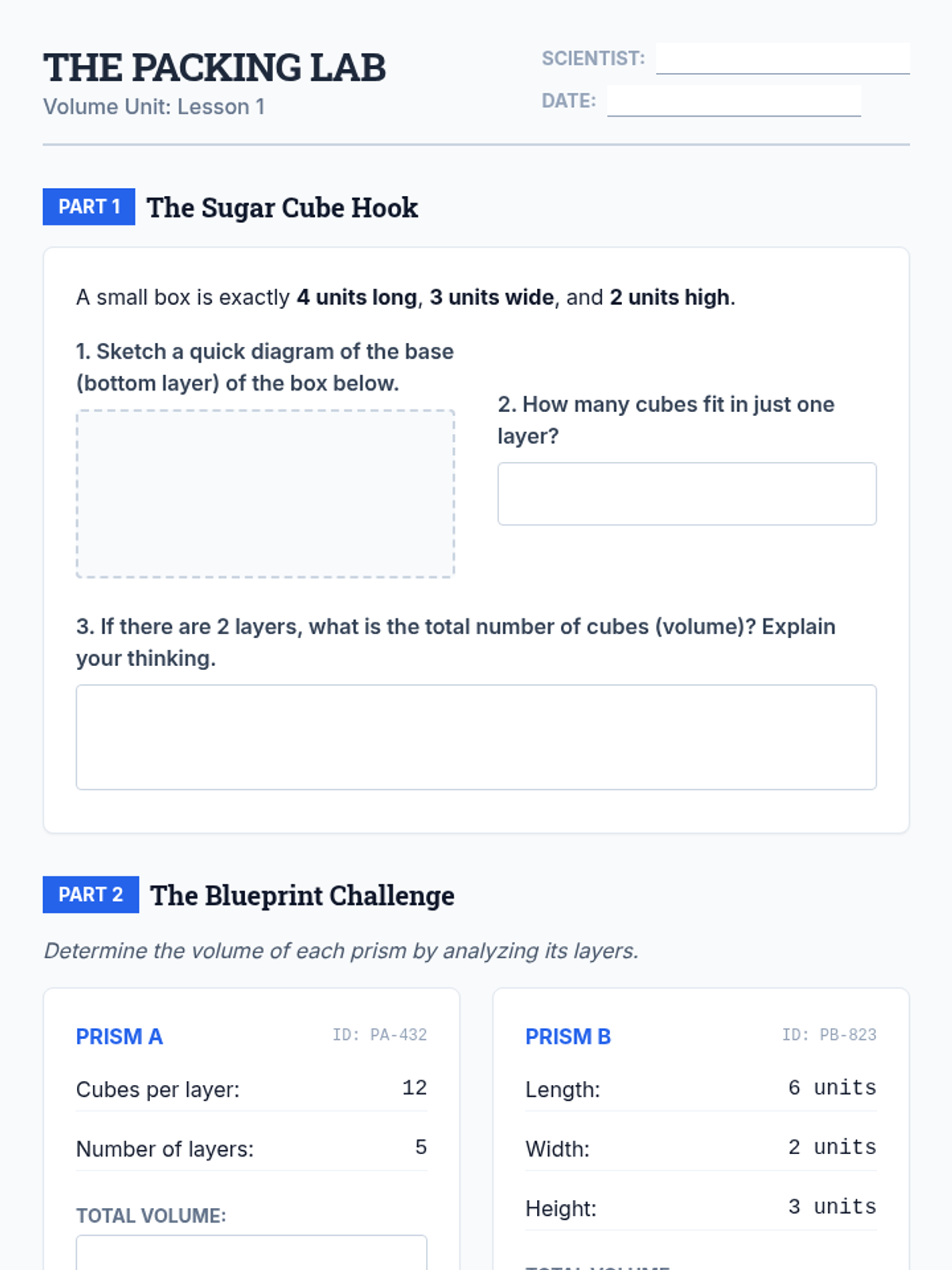
Packing Prisms Slides
Packing Prisms Worksheet
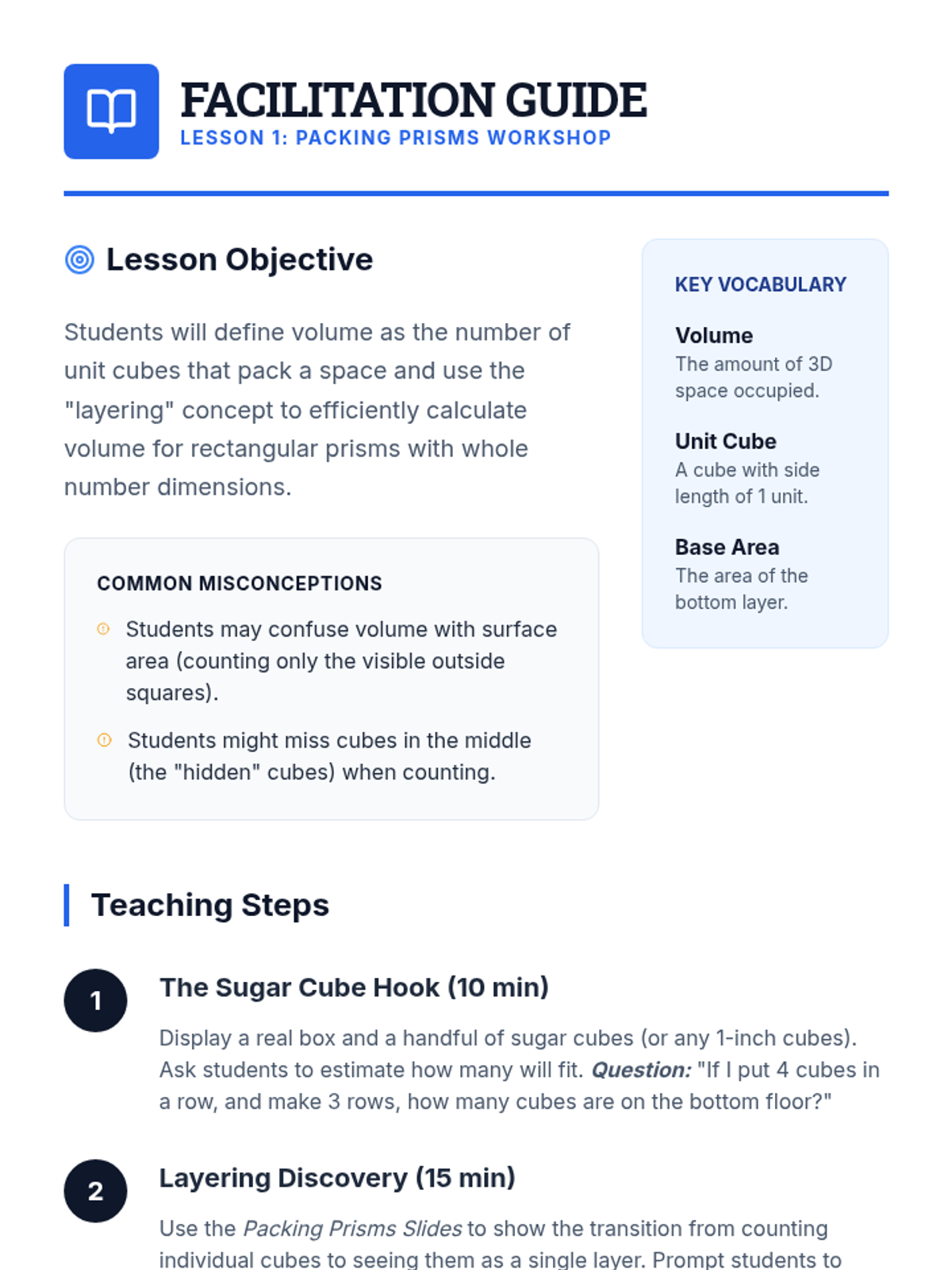
Packing Prisms Teacher Guide

Volume Mastery Workshop

Students transition from concrete unit cube packing to abstract volume formulas (V=lwh, V=Bh) with a specific focus on rectangular prisms with fractional edge lengths. The sequence culminates in real-world application through shipping logistics and a design challenge.

Lenny Avatar
Lenny
1/17
Sequence
Volume vs Capacity Slides
Container Conundrum Worksheet

Capacity and Volume Lab

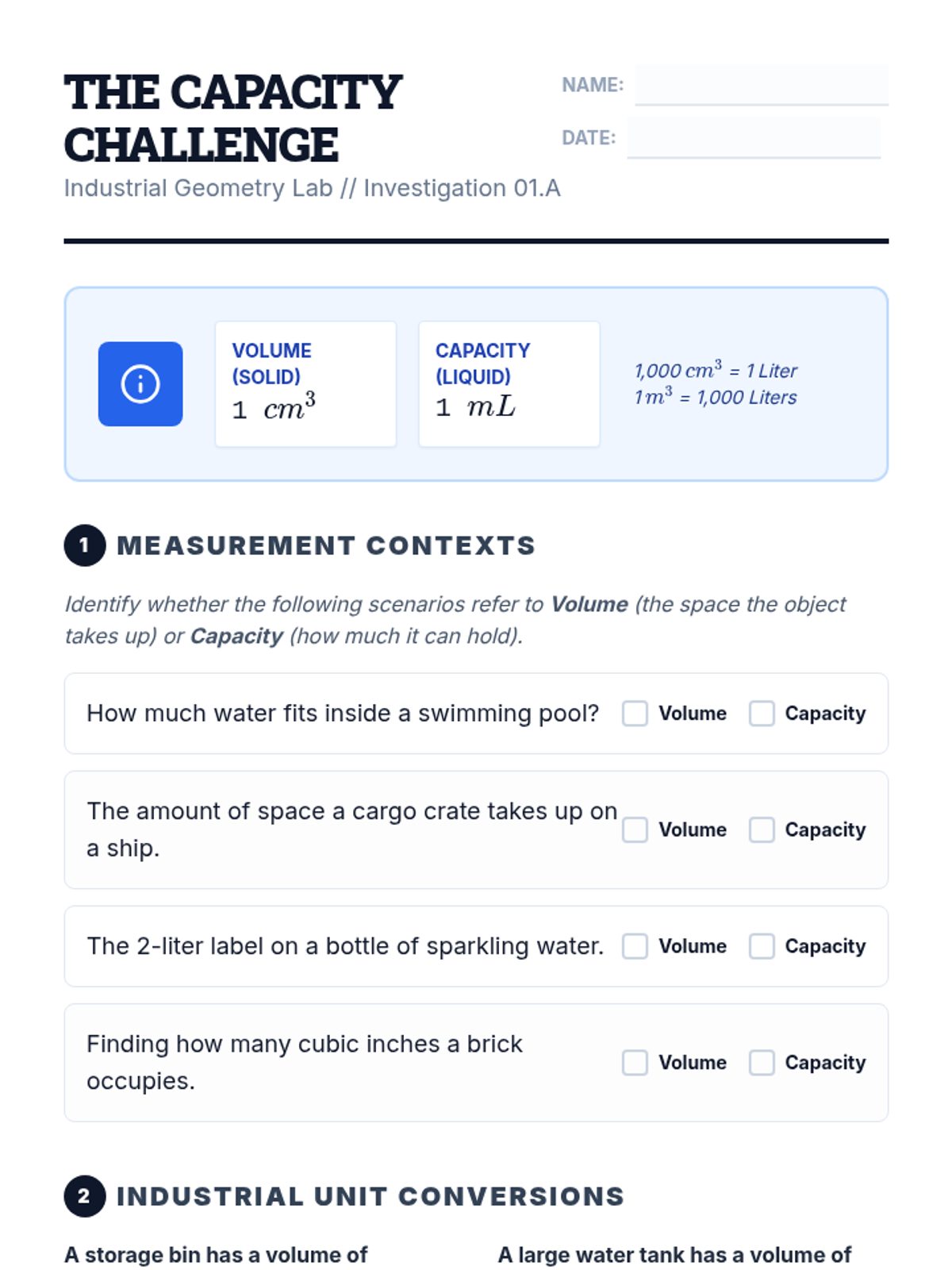
This sequence explores the practical applications of geometry through the lens of volume and capacity. Students investigate how space is measured in cubic units versus liquid units, solve real-world engineering problems involving aquariums and flow rates, and use displacement to find the volume of irregular objects.

Lenny Avatar
Lenny
1/17
Sequence
Blueprint Breakdown Slides
Blueprint Breakdown Worksheet

Structure Squad

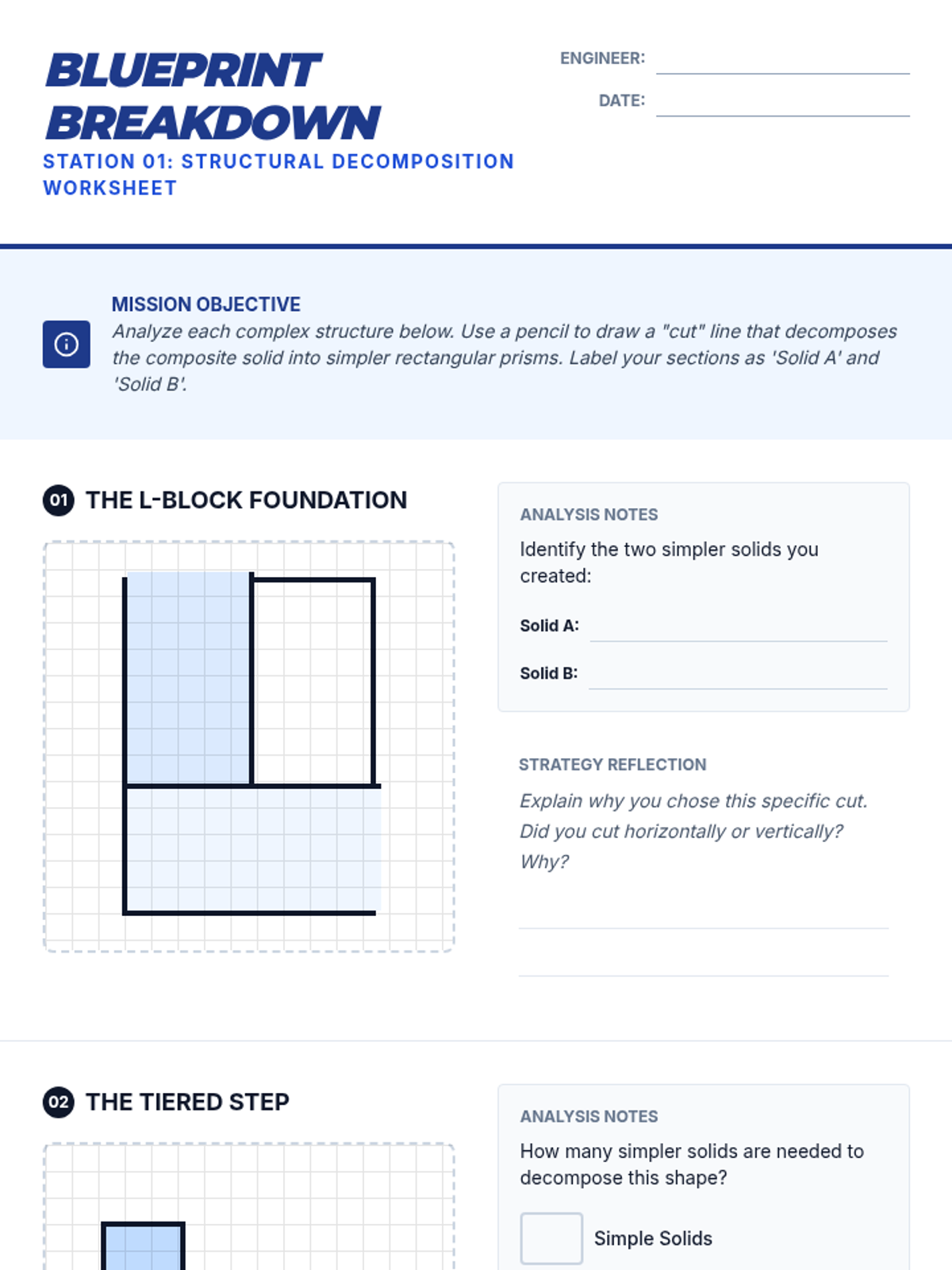
A project-based geometry unit where 6th-grade students act as structural engineers to decompose, calculate, and design complex composite 3D structures using additive and subtractive volume methods.

Lenny Avatar
Lenny
1/17
Sequence
Volume Voyagers Slides
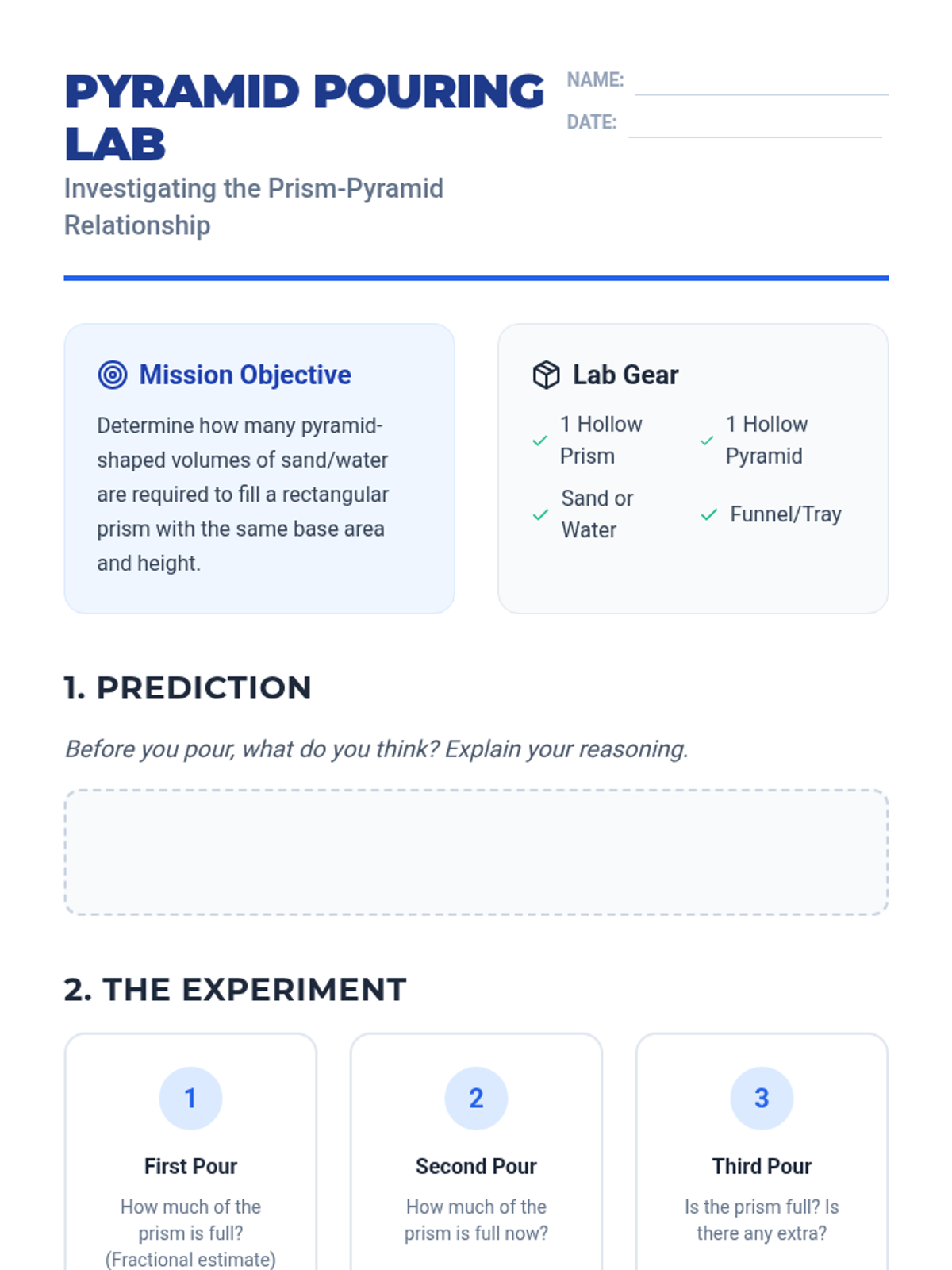
Pyramid Pouring Lab Sheet

Volume Architects

An inquiry-based exploration of the volume relationships between prisms, pyramids, cylinders, cones, and spheres. Students use hands-on simulations and visual derivations to master 3D geometry formulas.

Lenny Avatar
Lenny
1/17
Sequence
Triangular Taper Slides
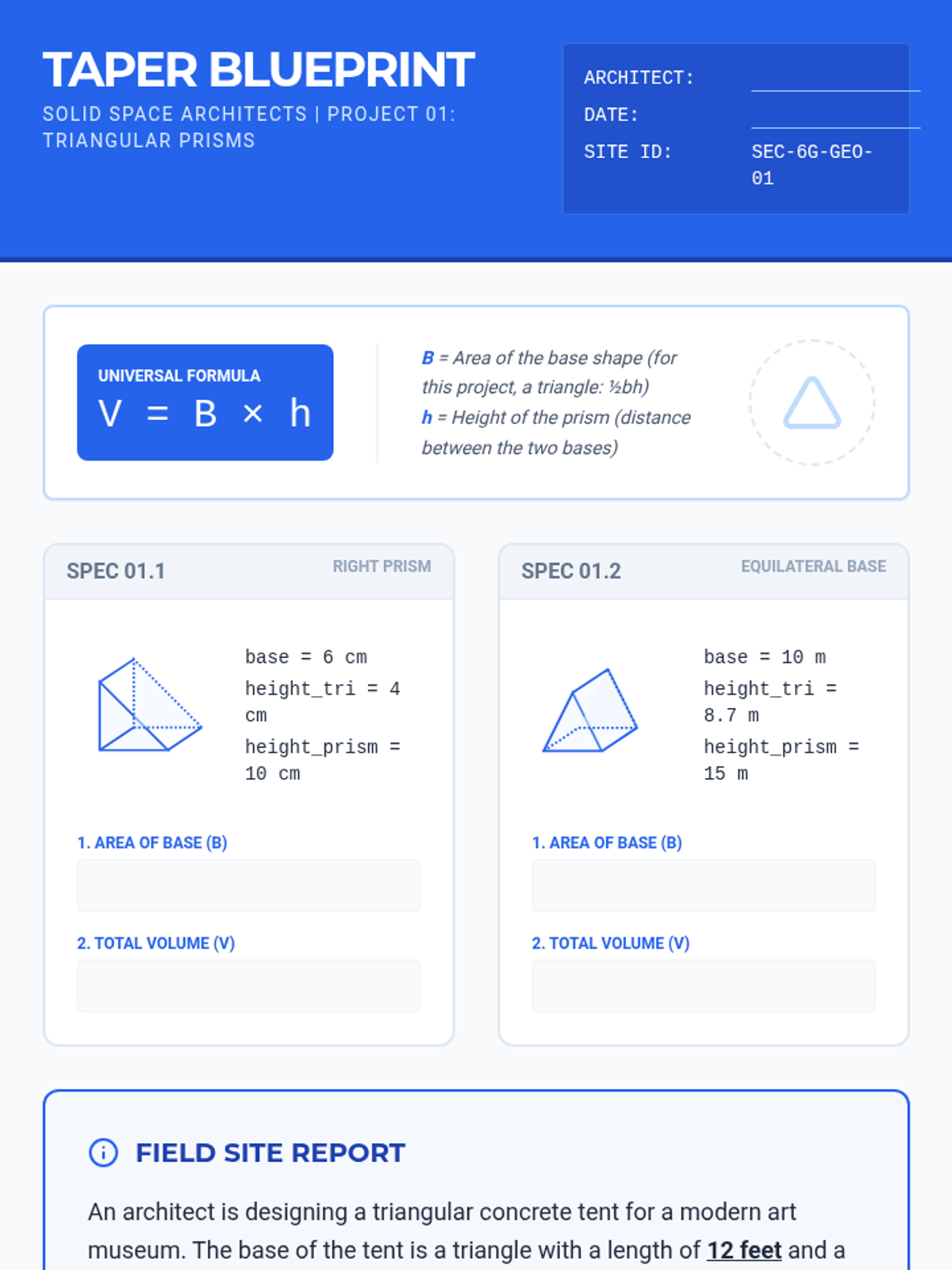
Taper Blueprint Worksheet

Solid Space Architects

Students become 'Solid Space Architects' as they generalize the volume formula V=Bh to various prisms and cylinders. They move from simple rectangles to triangles, circles, and complex polygons, exploring efficiency and real-world applications of 3D geometry.

Lenny Avatar
Lenny
1/17
Sequence
Cube Quest Slides
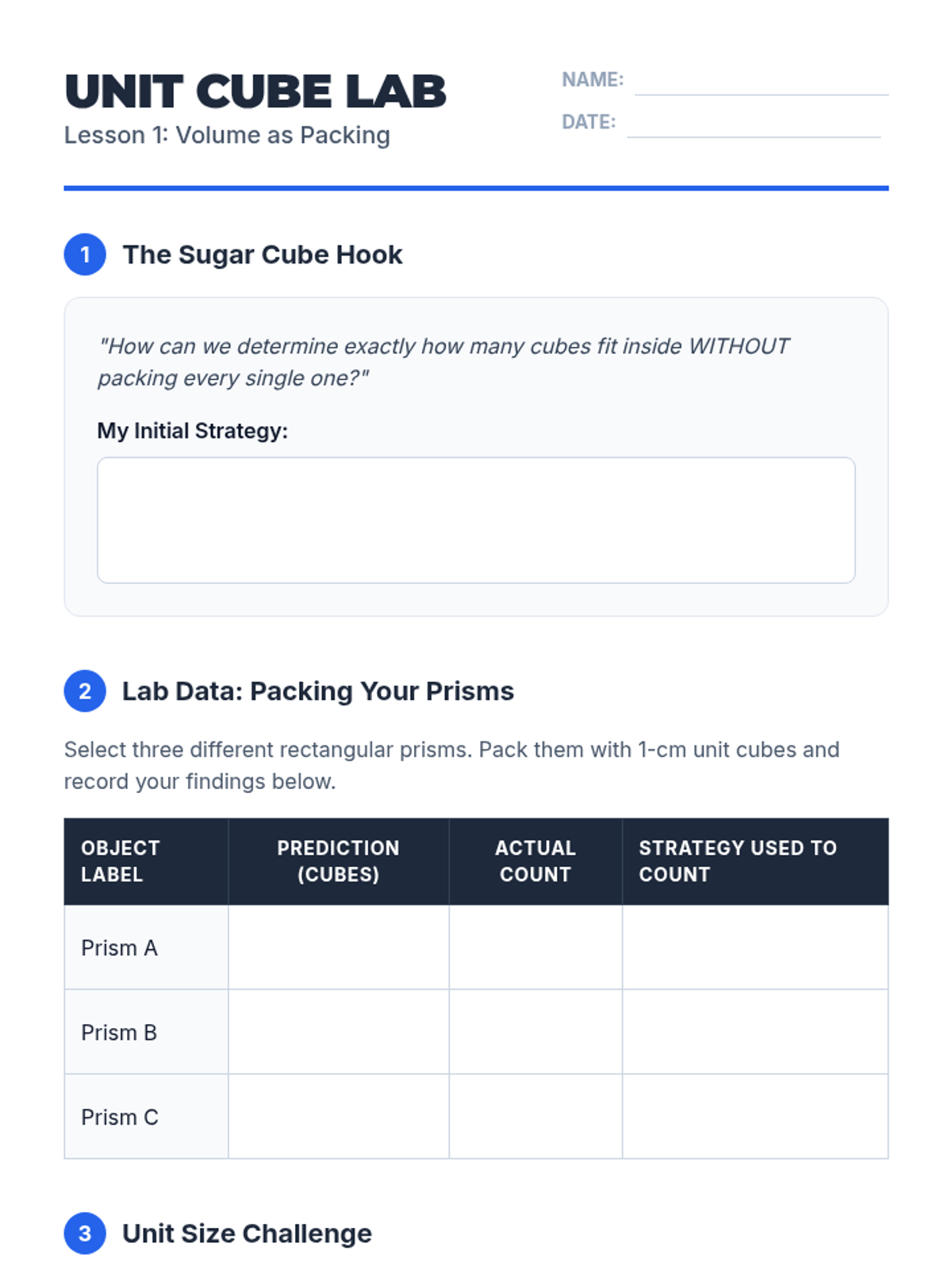
Unit Cube Lab Worksheet
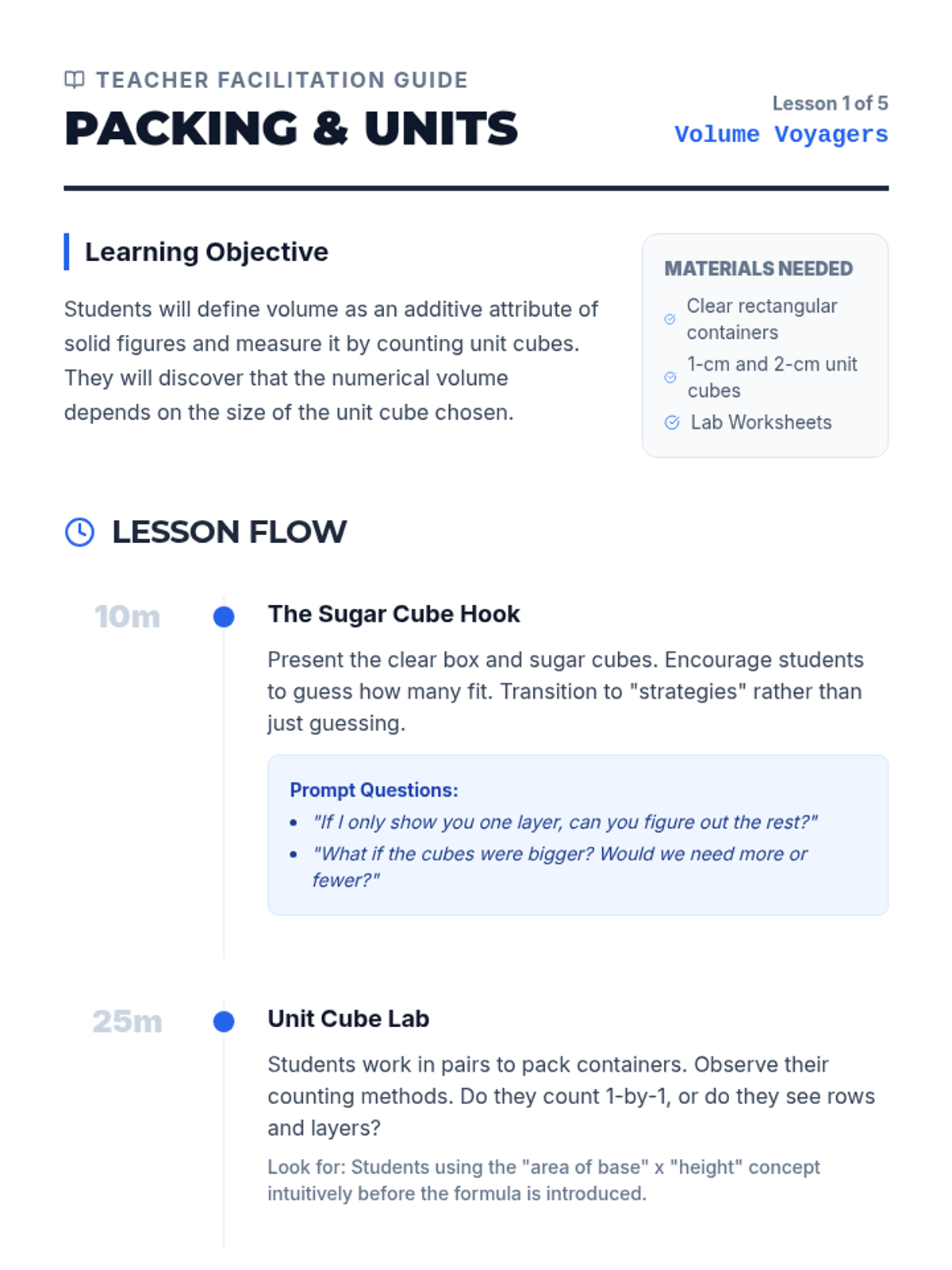
Packing Prisms Teacher Guide

Volume Voyagers

This sequence guides 6th-grade students from conceptualizing volume as counting unit cubes to deriving and applying volume formulas (V=lwh and V=Bh) with whole and fractional edge lengths. Students explore volume through inquiry, formalize their understanding, and solve real-world logistics challenges.

Lenny Avatar
Lenny
1/17
Sequence
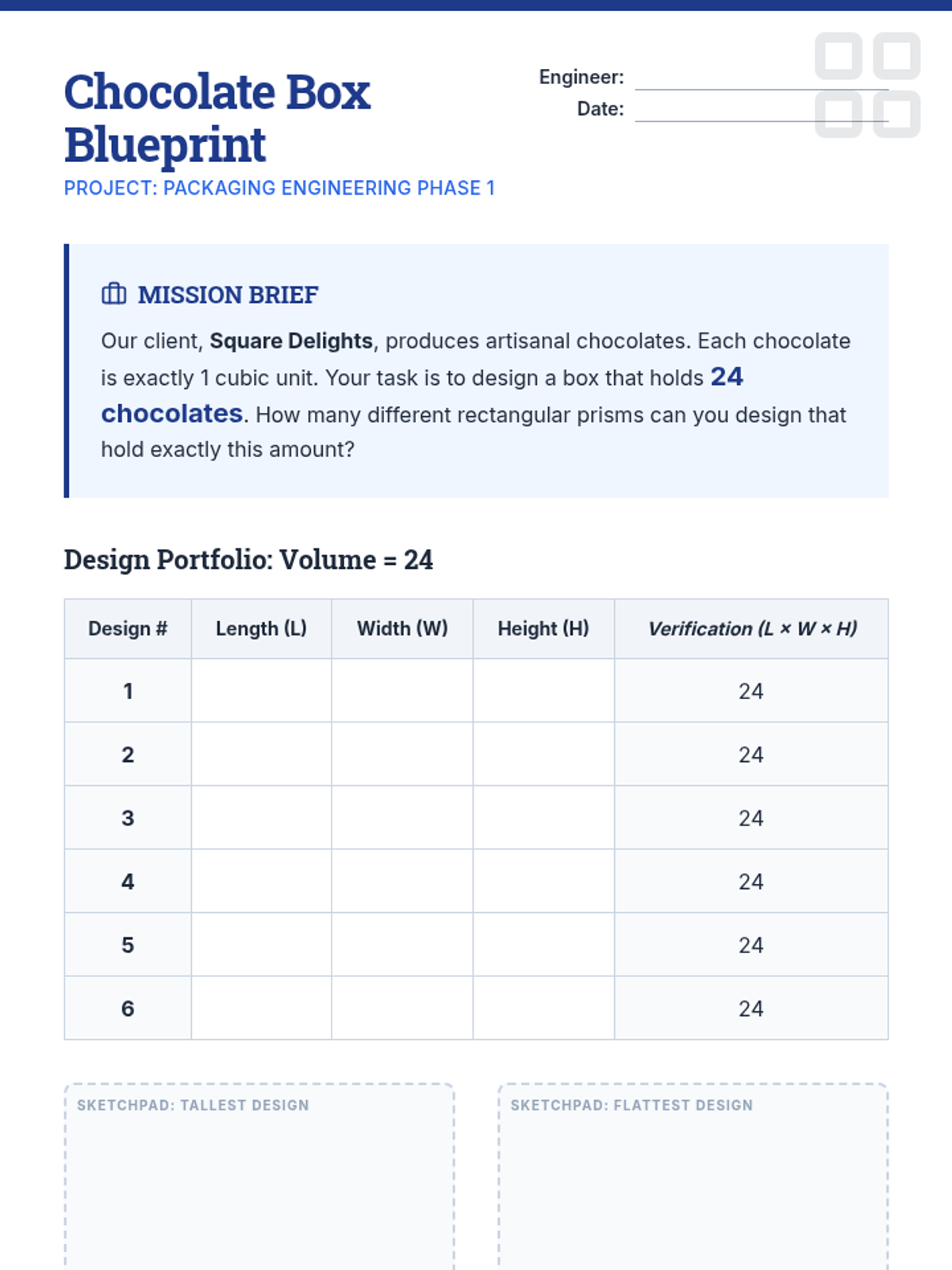
Chocolate Box Blueprint Worksheet
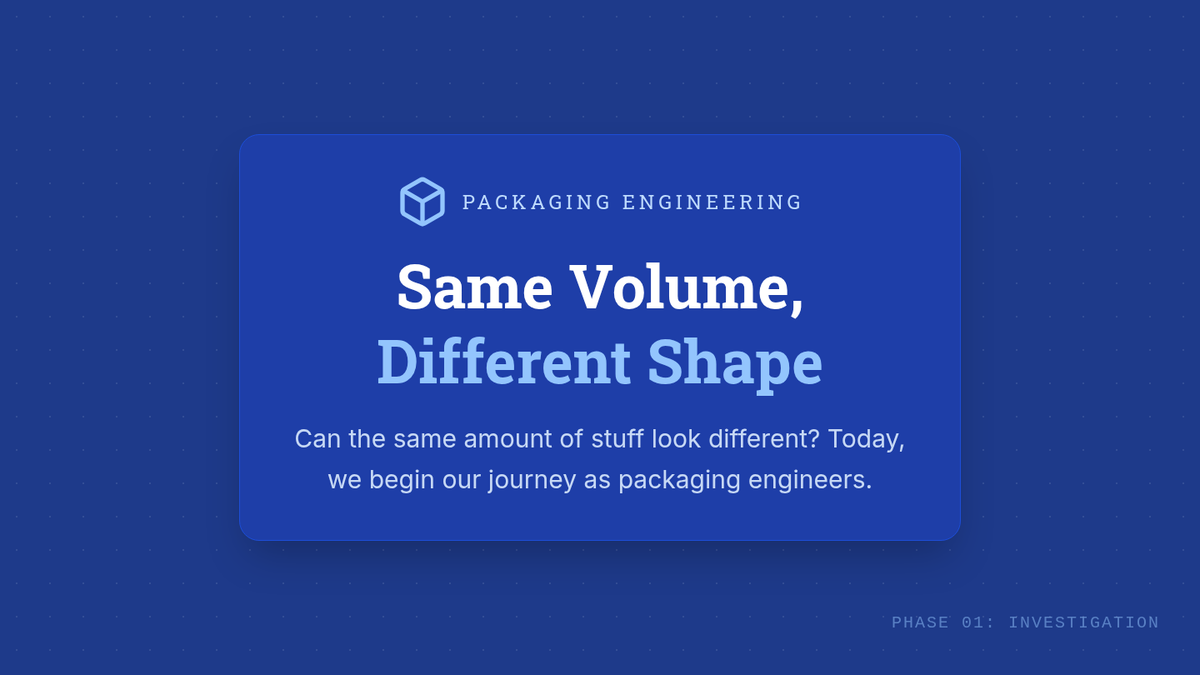
Packaging Engineer Intro Slides

Packaging Design and Optimization

A 5th-grade geometry sequence exploring volume and surface area through the lens of packaging engineering. Students investigate optimization, real-world constraints, and design prototypes.

Lenny Avatar
Lenny
1/17
Sequence
Formula Mastery Slides
Formula Mastery Worksheet
Formula Mastery Answer Key

Advanced Rectangular Volume

This sequence moves 5th-grade students from whole-number unit cubes to advanced calculation of rectangular prisms using formulas, algebraic thinking for missing dimensions, and proportional reasoning. Students explore how changing dimensions affects volume and apply their knowledge to complex real-world word problems.

Lenny Avatar
Lenny
1/17
Sequence
Gold Rush Math Quest Lesson Plan
Gold Rush Math Quest Slides
Gold Nugget Math Cards 6th Grade
Miner's Gold Tracker Sheet
Gold Nugget Math Cards 7th Grade
Gold Nugget Math Cards 8th Grade
Three Day Series Guide
Gold Rush Game Board

Gold Rush Math Quest

A comprehensive math sequence where students become prospectors to master arithmetic, word problems, geometry, and probability through engaging, game-based challenges.

KM

Katie McFarland

Counselor
6/12/25
Sequence
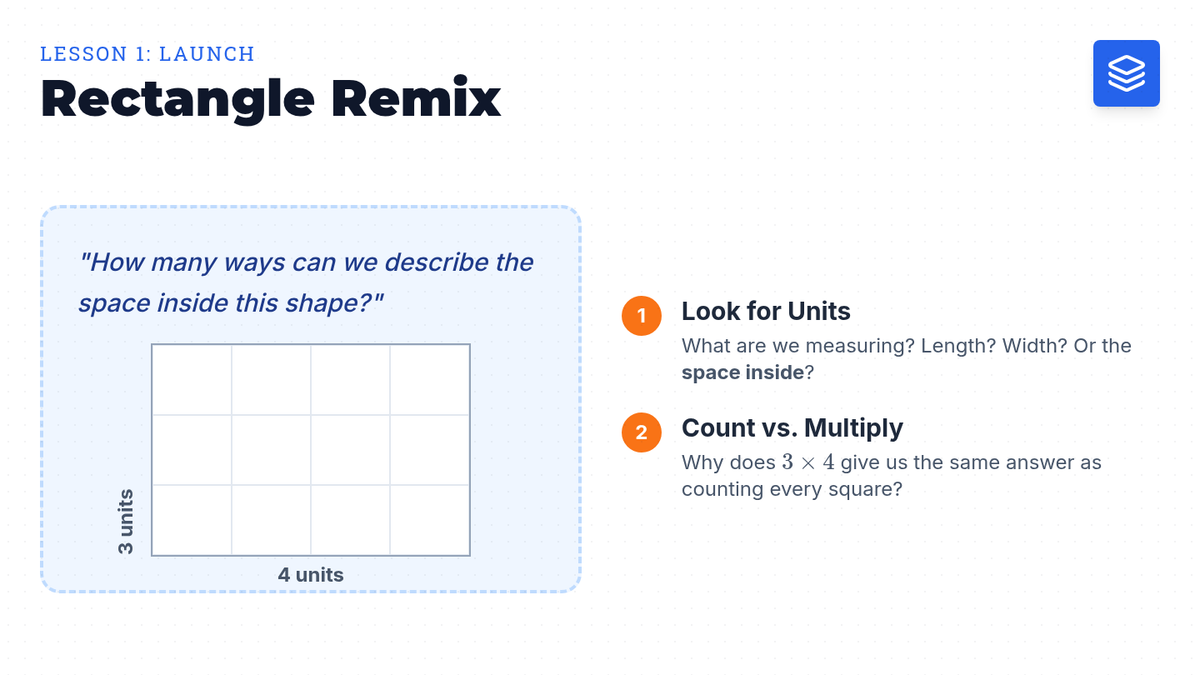
Rectangle Remix Slides
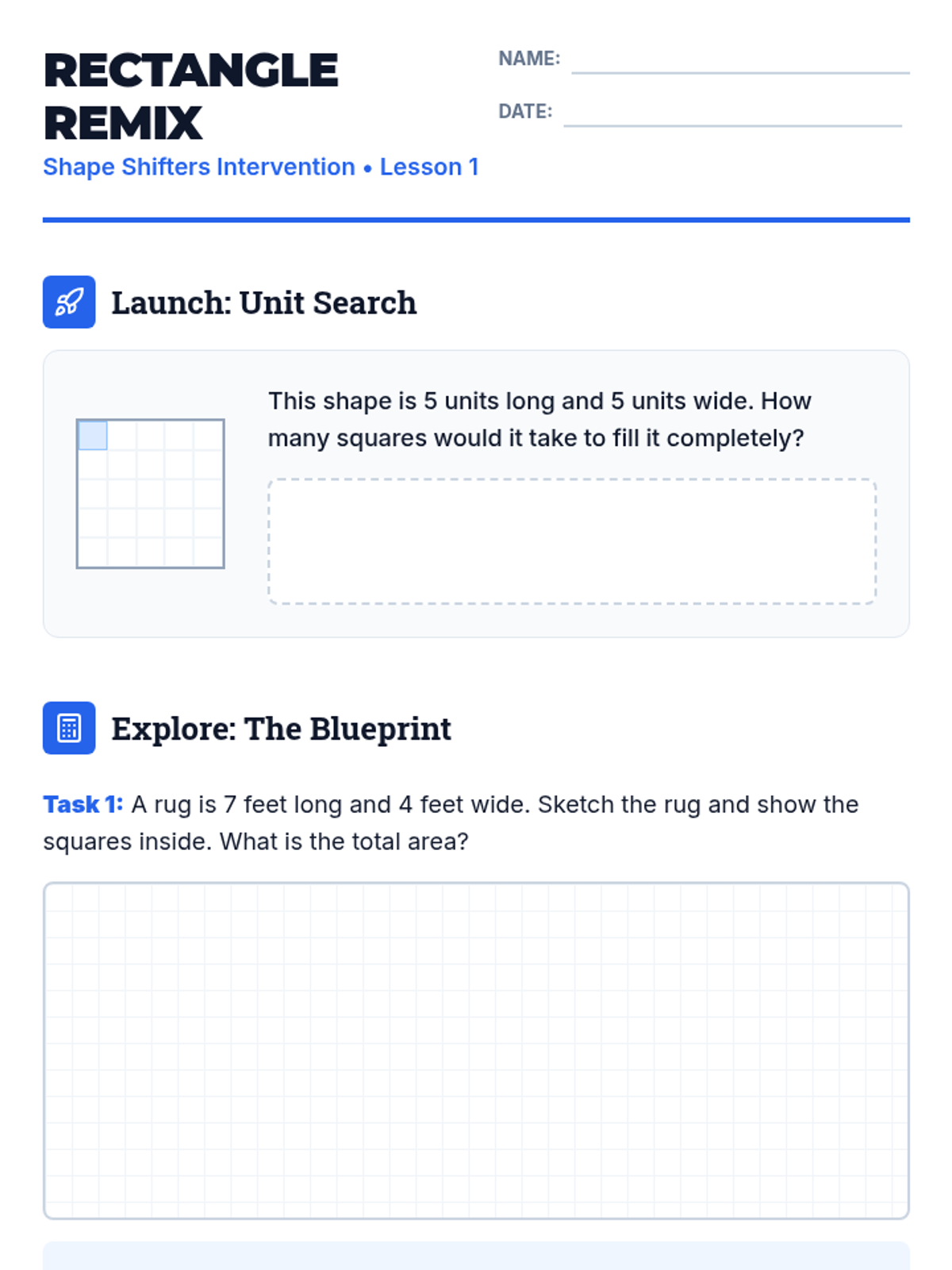
Rectangle Remix Worksheet
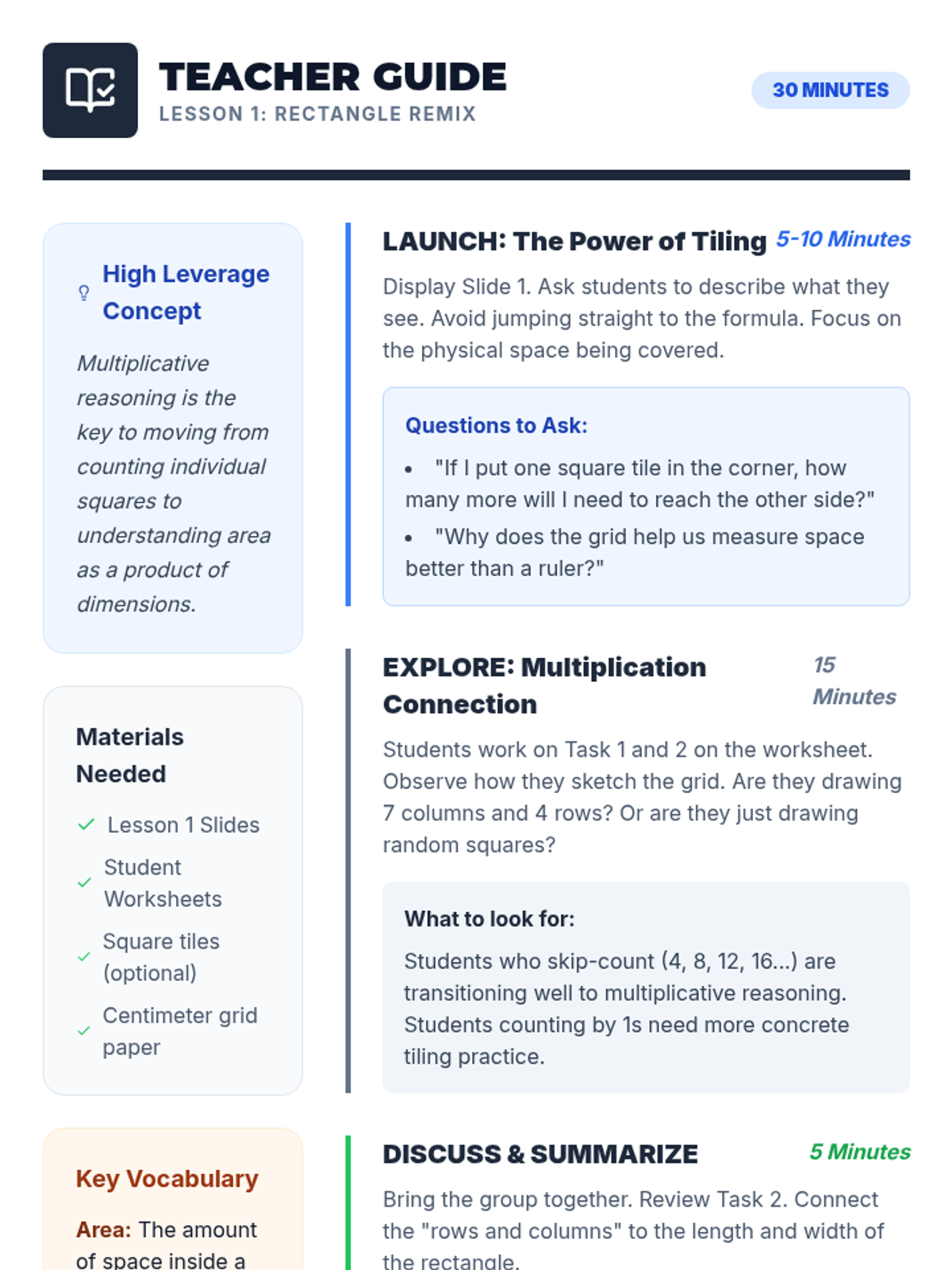
Rectangle Remix Teacher Guide

Shape Shifters Intervention

A 12-lesson Tier 2 intervention sequence focused on developing conceptual understanding of area and volume for 6th-grade students. Using the All Learners Network High Leverage Concepts, students move from concrete tiling to decomposing shapes and finally calculating volume with fractional edges and surface area with nets.

D

dfredericks

Math Teacher
2/6
Sequence
Unit Overview Resource

Math Intensive Lab

A comprehensive math intervention sequence for 6th-grade students, focusing on four key domains: Numbers & Operations, Algebraic Thinking, Measurement & Data, and Geometry. This sequence uses high-leverage strategies from the All Learners Network (ALN) and aligns with i-Ready prerequisite modules to bridge conceptual gaps.

D

dfredericks

Math Teacher
2/5
Sequence
Solid Scanners Slides
Parts of the Whole Worksheet
Solid Scanners Teacher Guide

Polyhedra Power

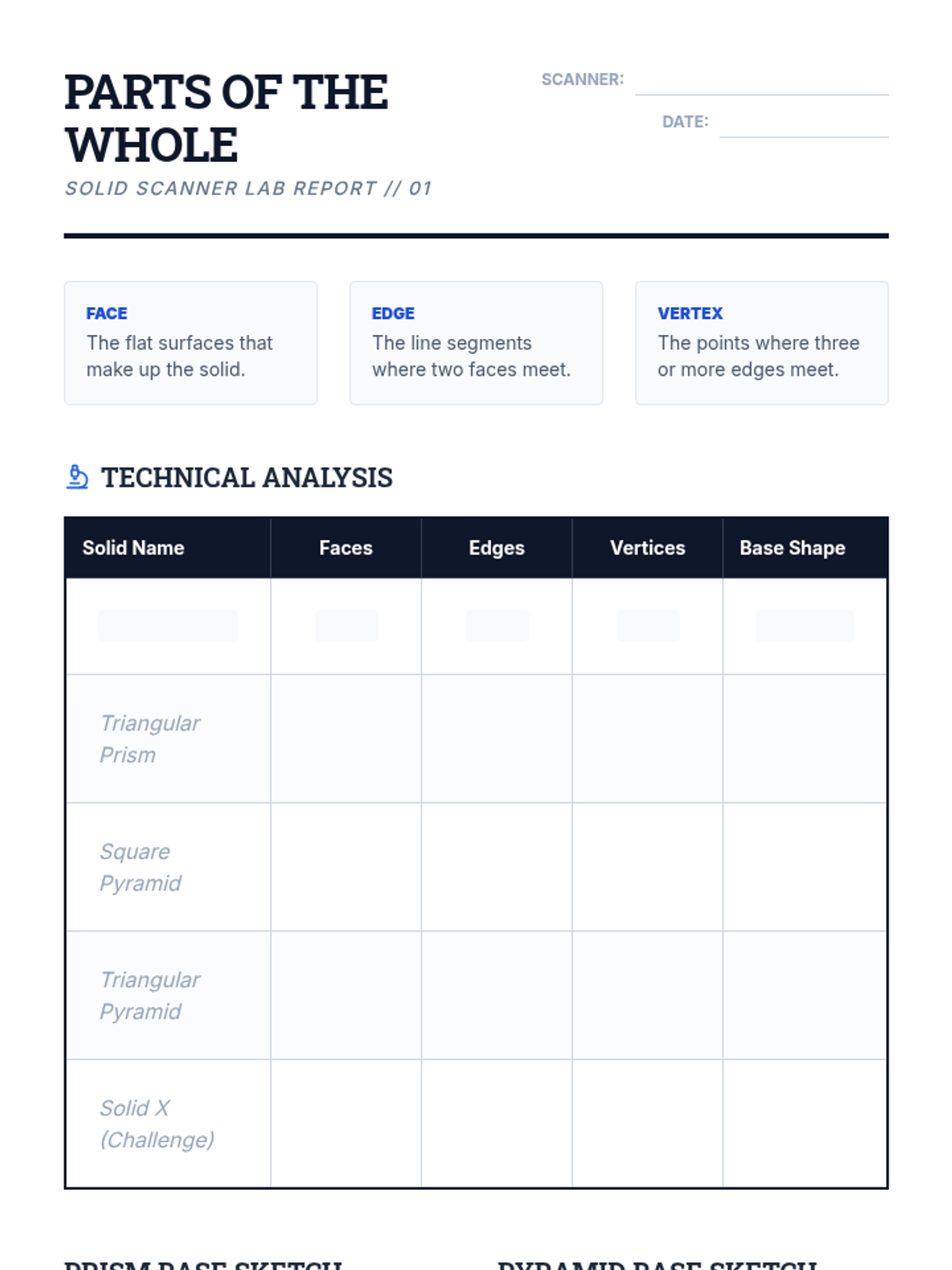
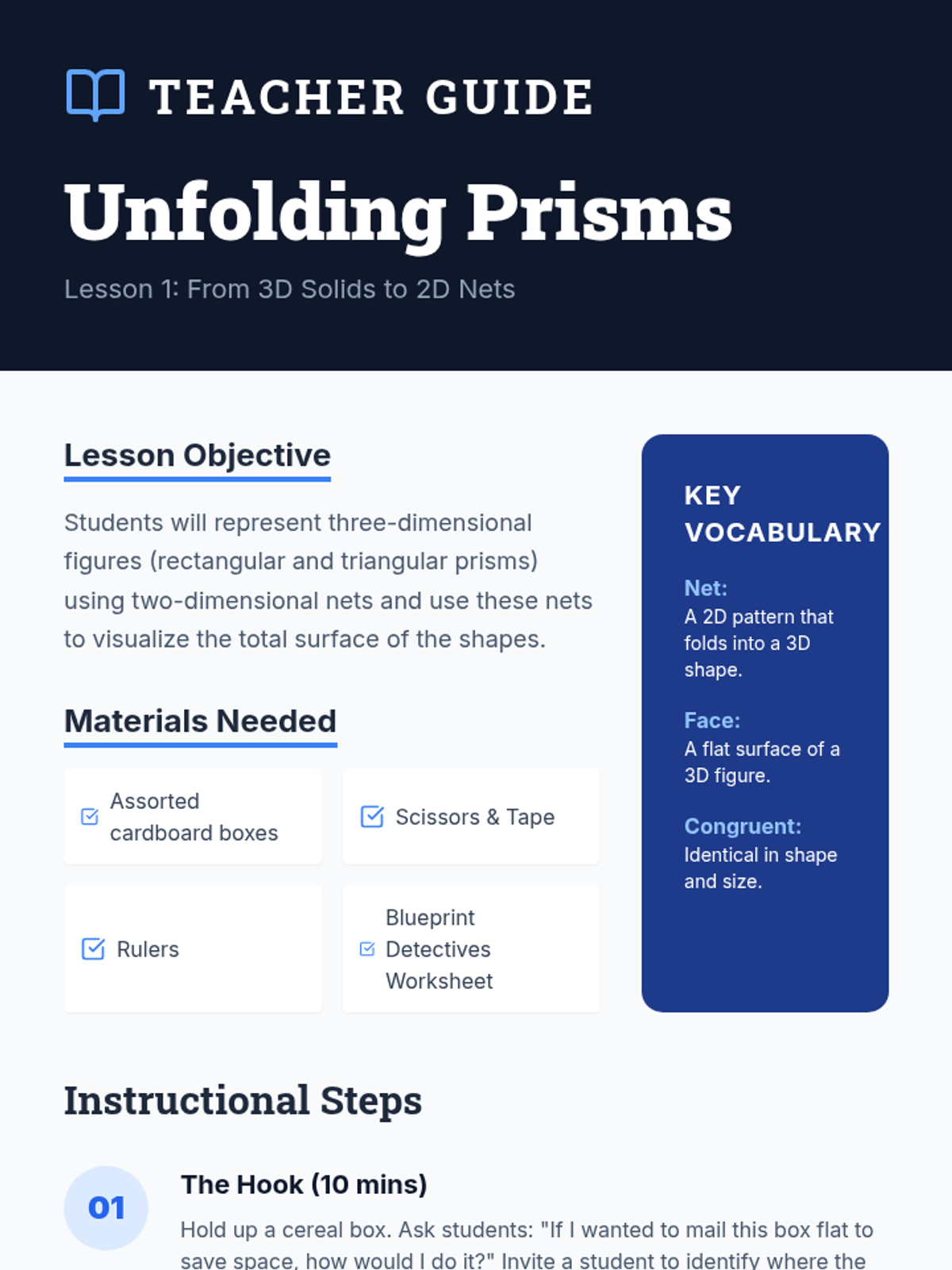
A comprehensive geometry and engineering sequence where 6th-grade students explore the relationship between 2D nets and 3D solids. Students progress from identifying geometric parts to calculating surface area for prisms and pyramids, culminating in a real-world packaging design challenge.

Lenny Avatar
Lenny
1/18
Sequence
Spin Master Slides
Circle Circuit Worksheet
Degrees Explained Teacher Guide

Angle Architects

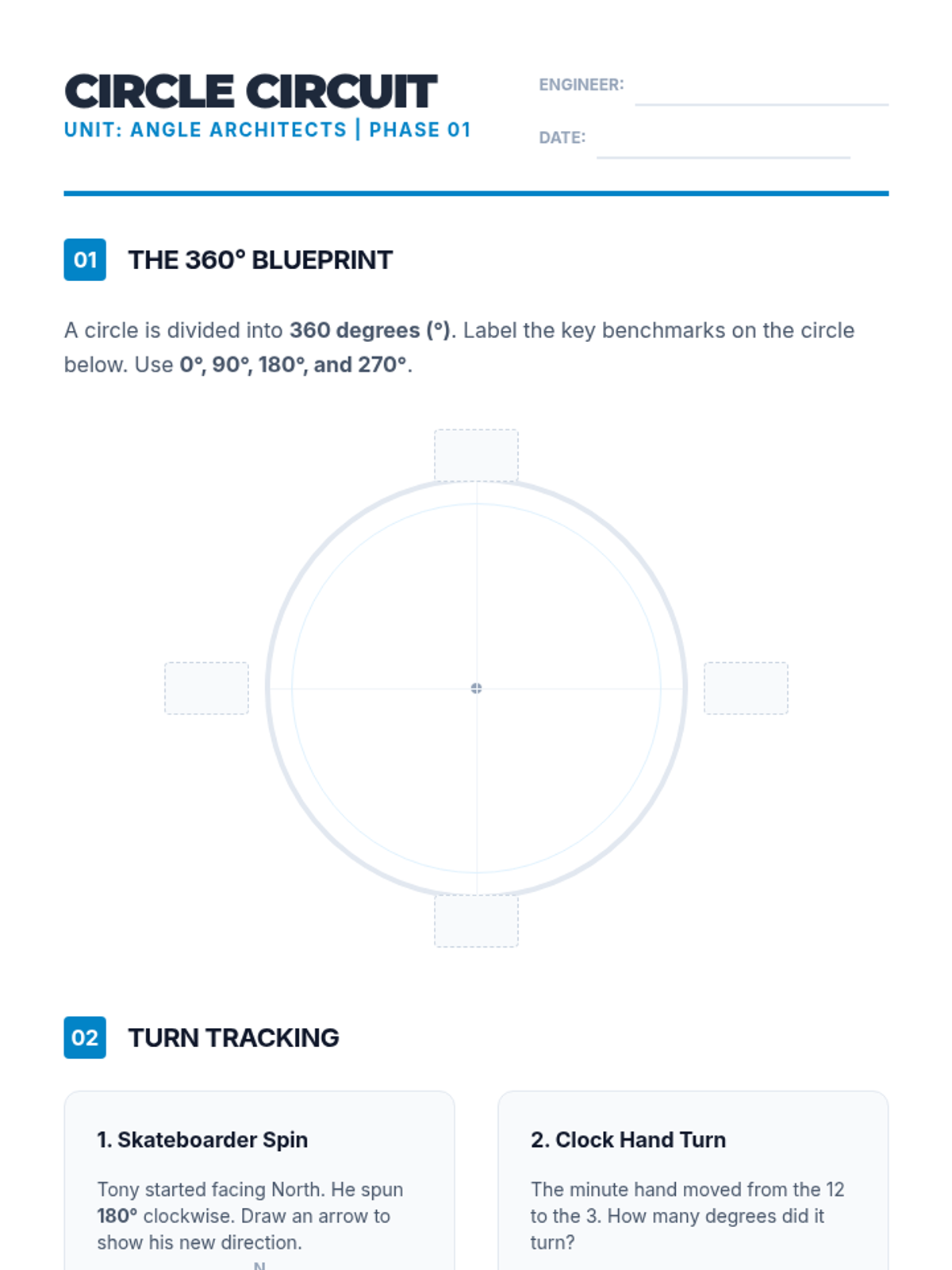
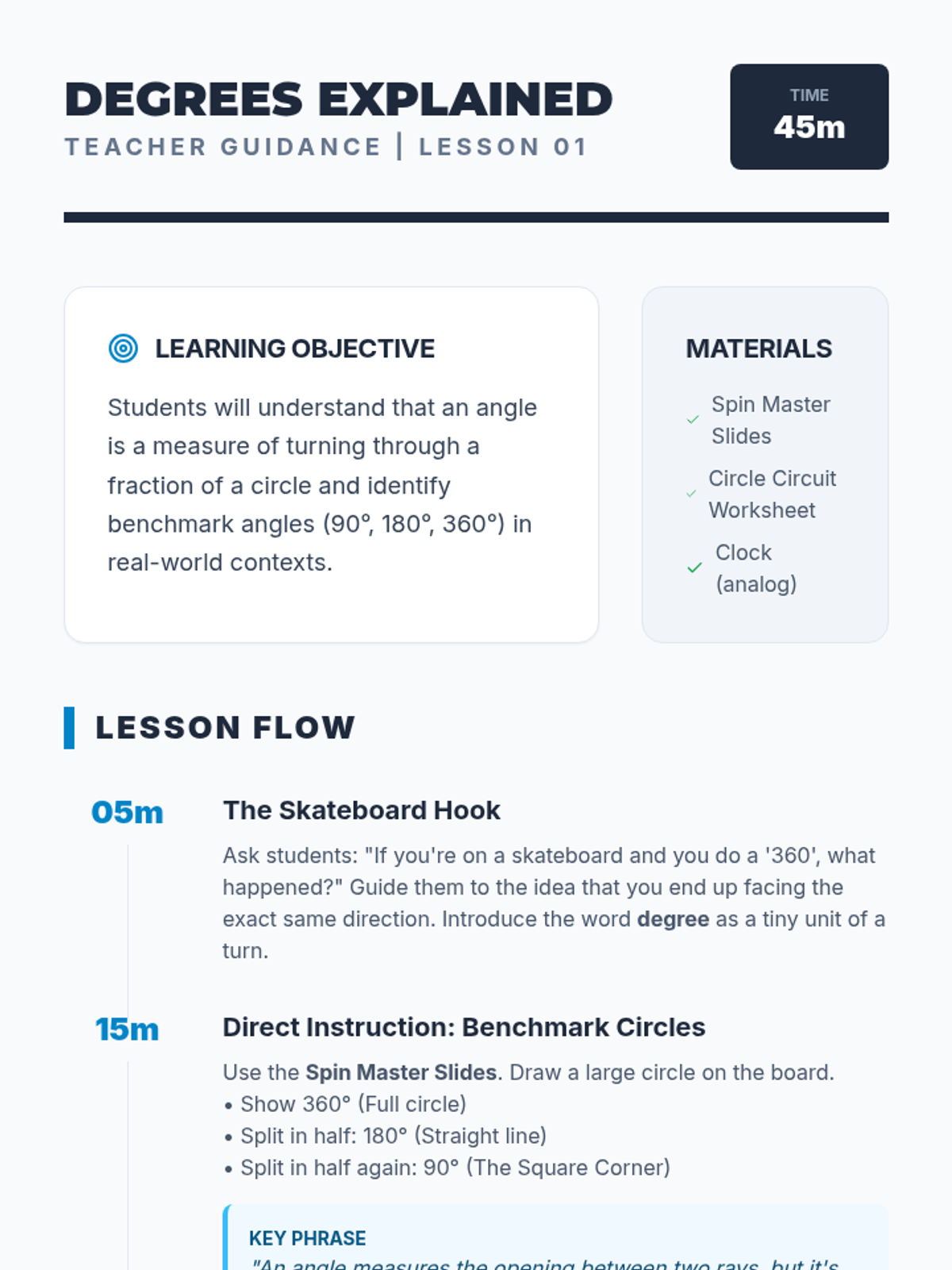
This workshop-style sequence transitions students from visual estimation to precise measurement using a protractor. Students learn the logic behind the 360-degree circle and how to align a protractor correctly to read measurements.

Lenny Avatar
Lenny
1/18
Sequence
Angle Architect Slides
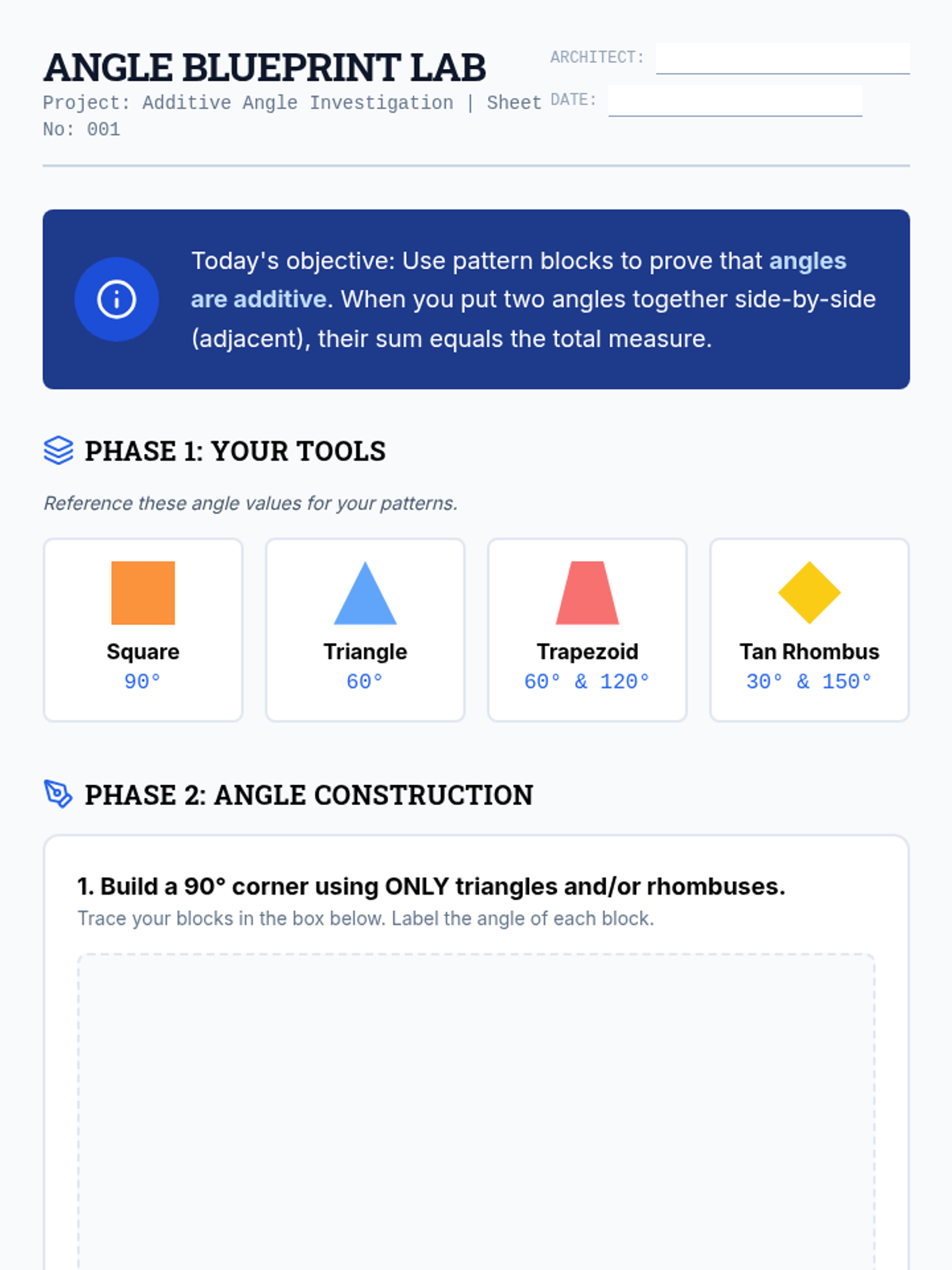
Angle Blueprint Lab Worksheet

Angle Relationships and Additive Properties

A 5th-grade geometry sequence exploring the additive nature of angles, straight angles, complementary relationships, and solving for unknown angles through logic and deduction. Students move from concrete measurement to abstract calculation in a mystery-solving context.

Lenny Avatar
Lenny
1/17
Sequence
Protractor Mechanics Slides
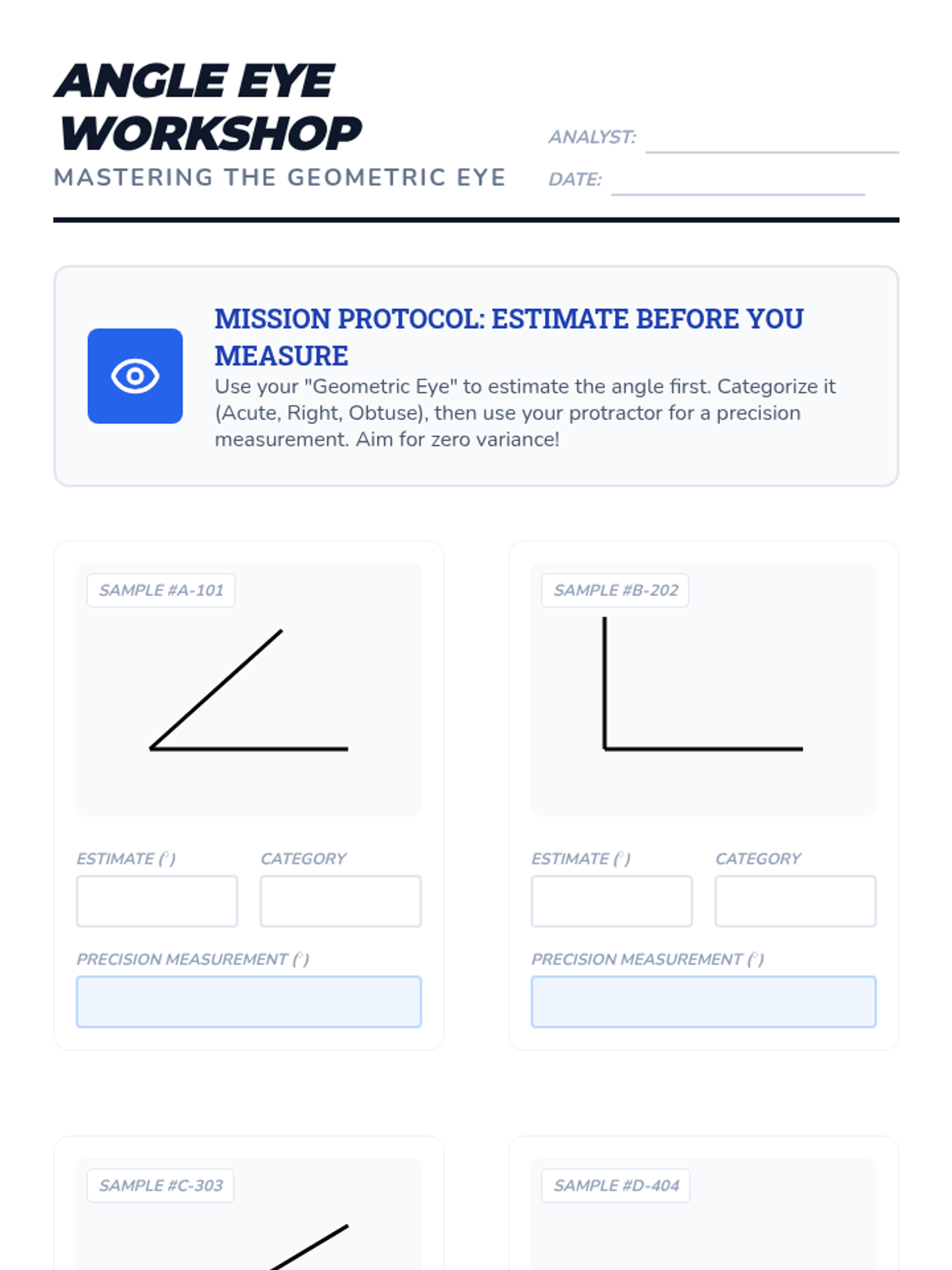
Angle Eye Workshop Worksheet
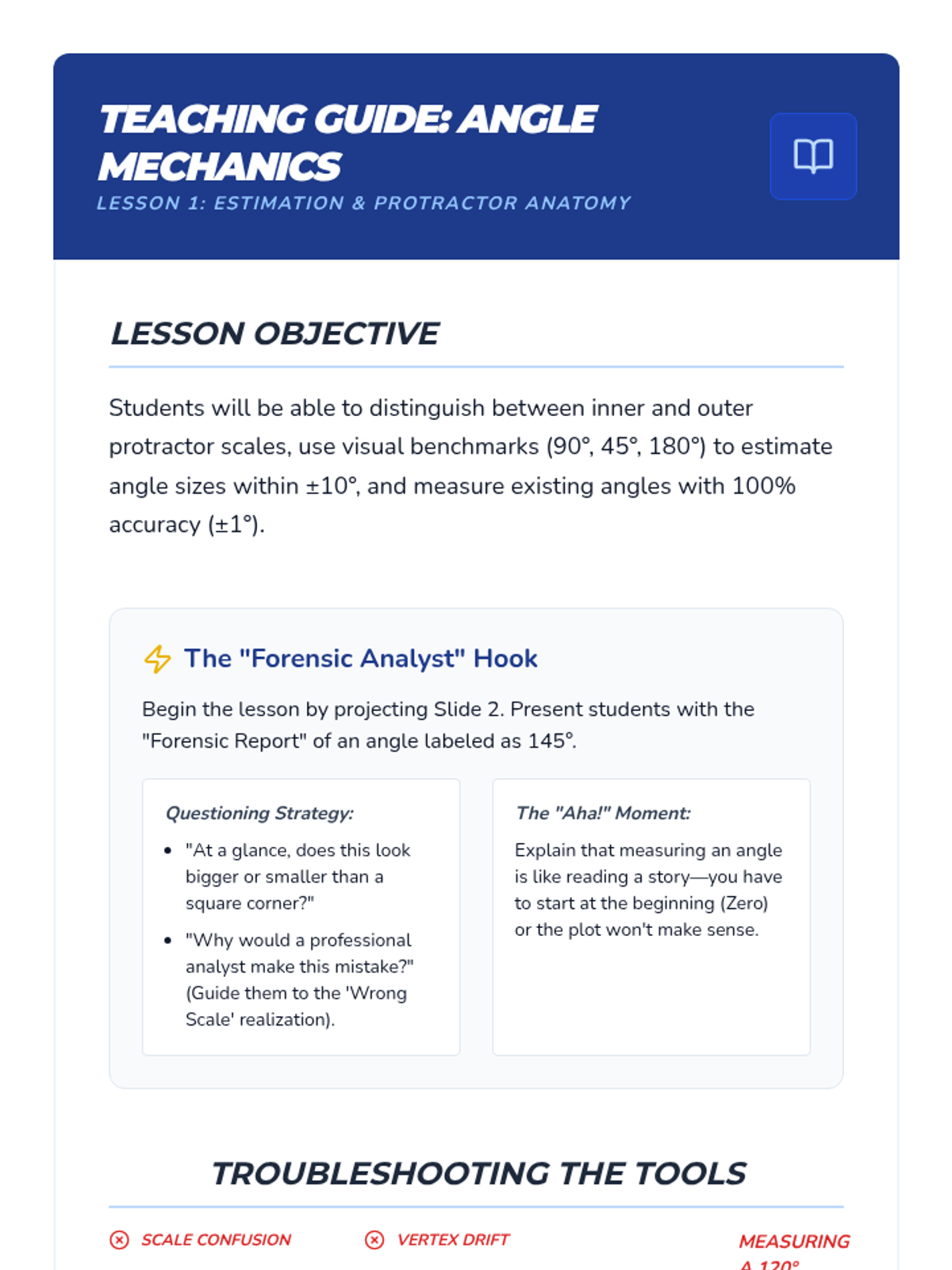
Angle Mechanics Teacher Guide

Precision Angles and Construction

This sequence focuses on the fundamental proficiency of using geometric tools to measure and construct angles with high precision. Students learn protractor mechanics, estimation techniques, construction procedures, and error analysis through an engineering and drafting lens.

Lenny Avatar
Lenny
1/17
Sequence
Missing Variable Slides
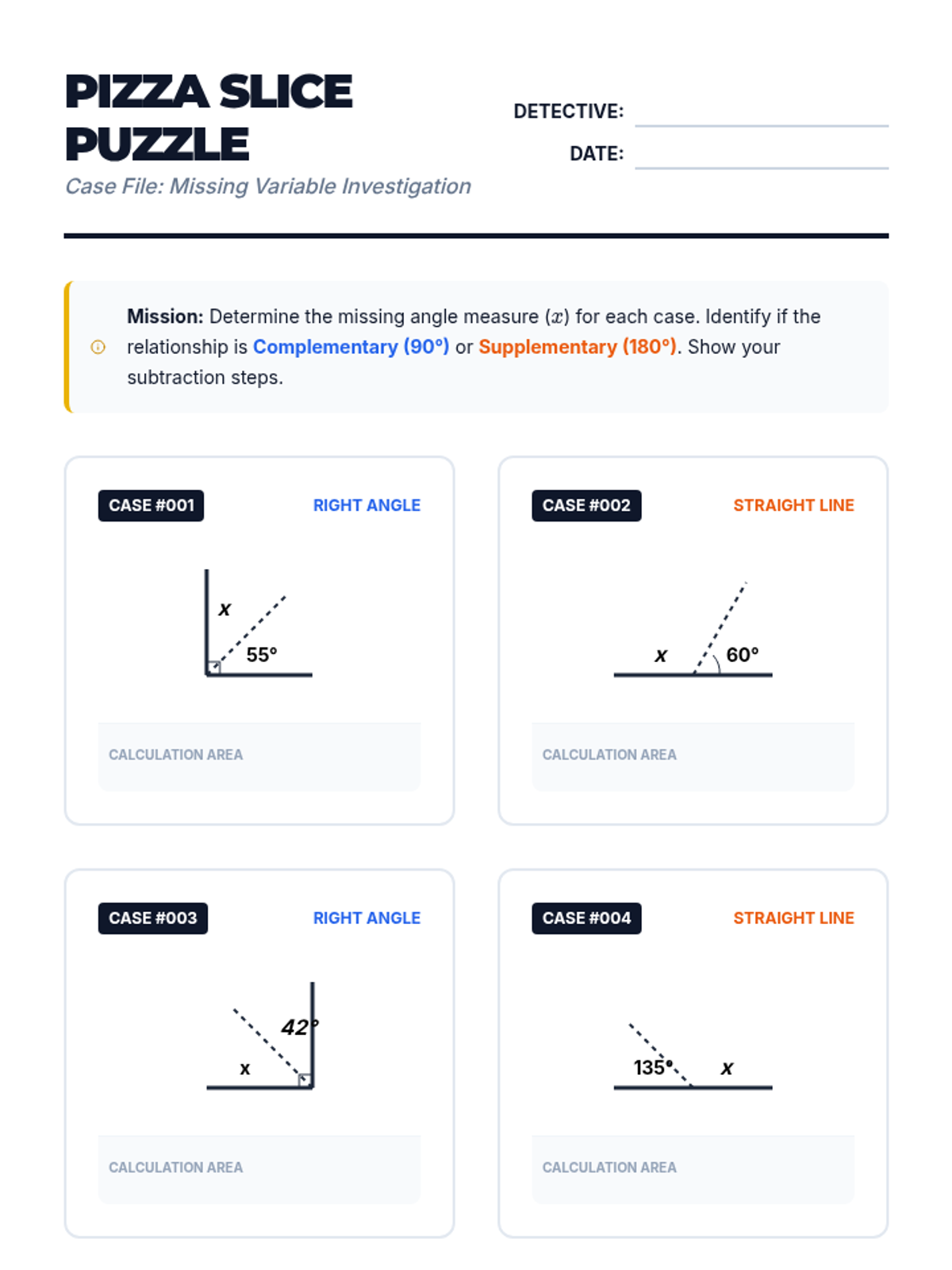
Pizza Slice Puzzle Worksheet
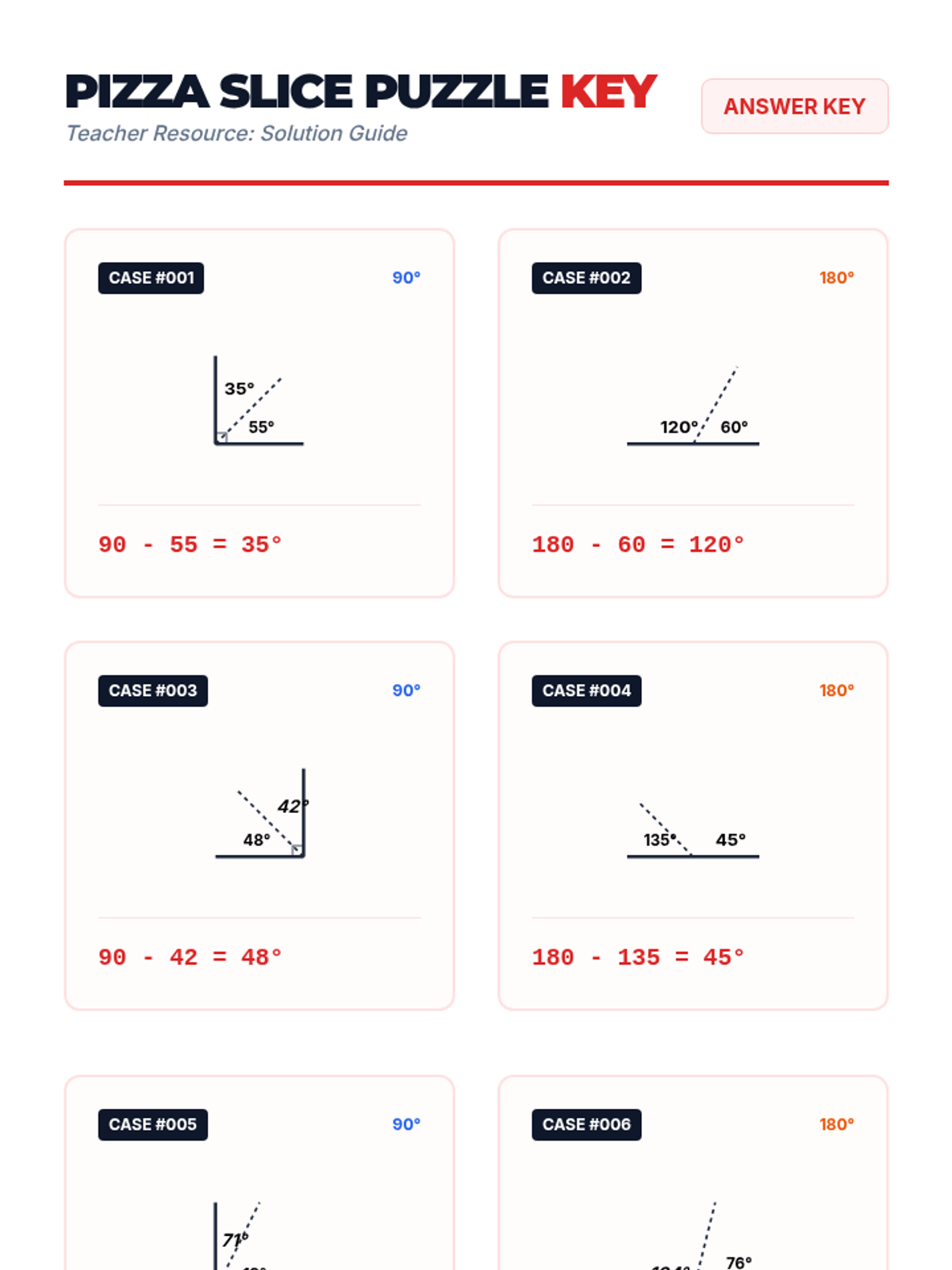
Pizza Slice Puzzle Key

Geometric Reasoning and Angle Relationships

A 5-lesson unit for 6th-grade students transitioning from basic angle measurement to algebraic reasoning. Students use deductive logic and geometric rules (complementary, supplementary, vertical) to solve 'case files' and 'puzzles', preparing them for advanced geometry.

Lenny Avatar
Lenny
1/17
Sequence
Extreme Angles Slides
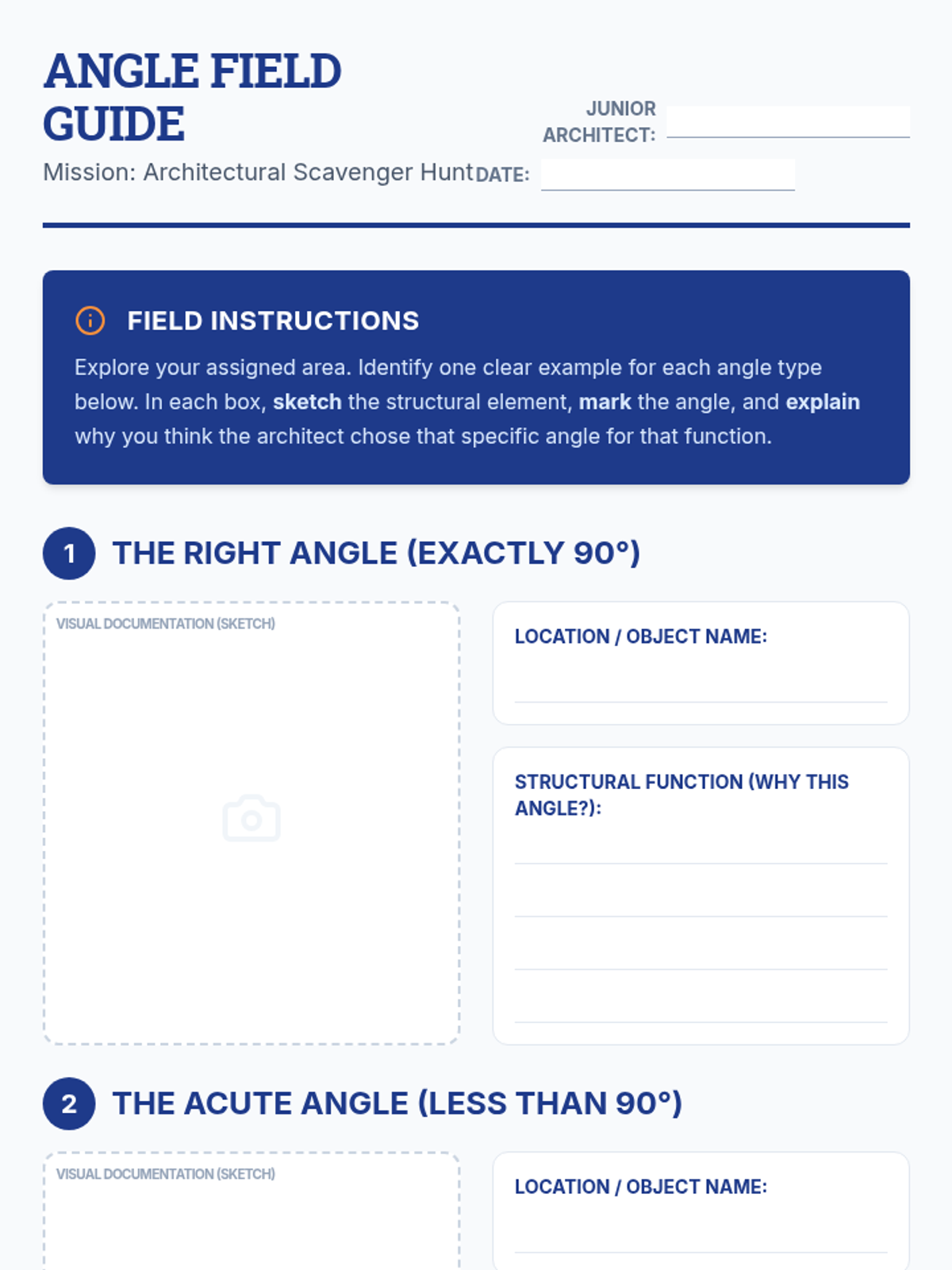
Angle Field Guide Worksheet

Applied Geometry in Architectural Design

A 5-lesson math sequence where students explore angle relationships through the lens of architectural design, moving from identifying angles in the environment to drafting their own structural blueprints.

Lenny Avatar
Lenny
1/17
Sequence
Angle Anatomy Slides
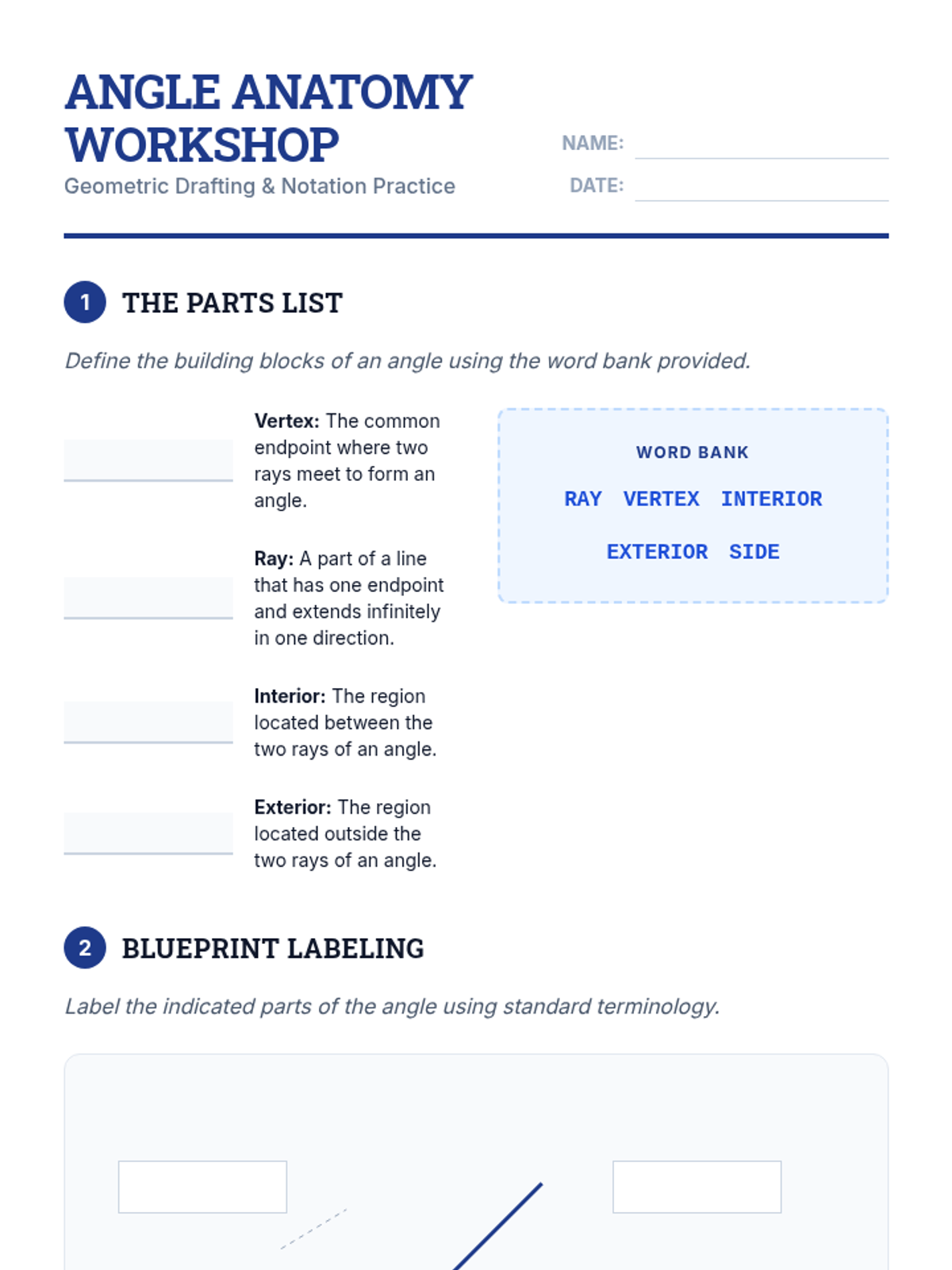
Angle Anatomy Workshop Worksheet

Angle Measurement Mastery

This sequence guides 6th-grade students through the mechanics of geometry, focusing on identifying, measuring, classifying, and constructing angles with precision. Students move from basic anatomy to mastery of the protractor and error analysis.

Lenny Avatar
Lenny
1/17
Sequence
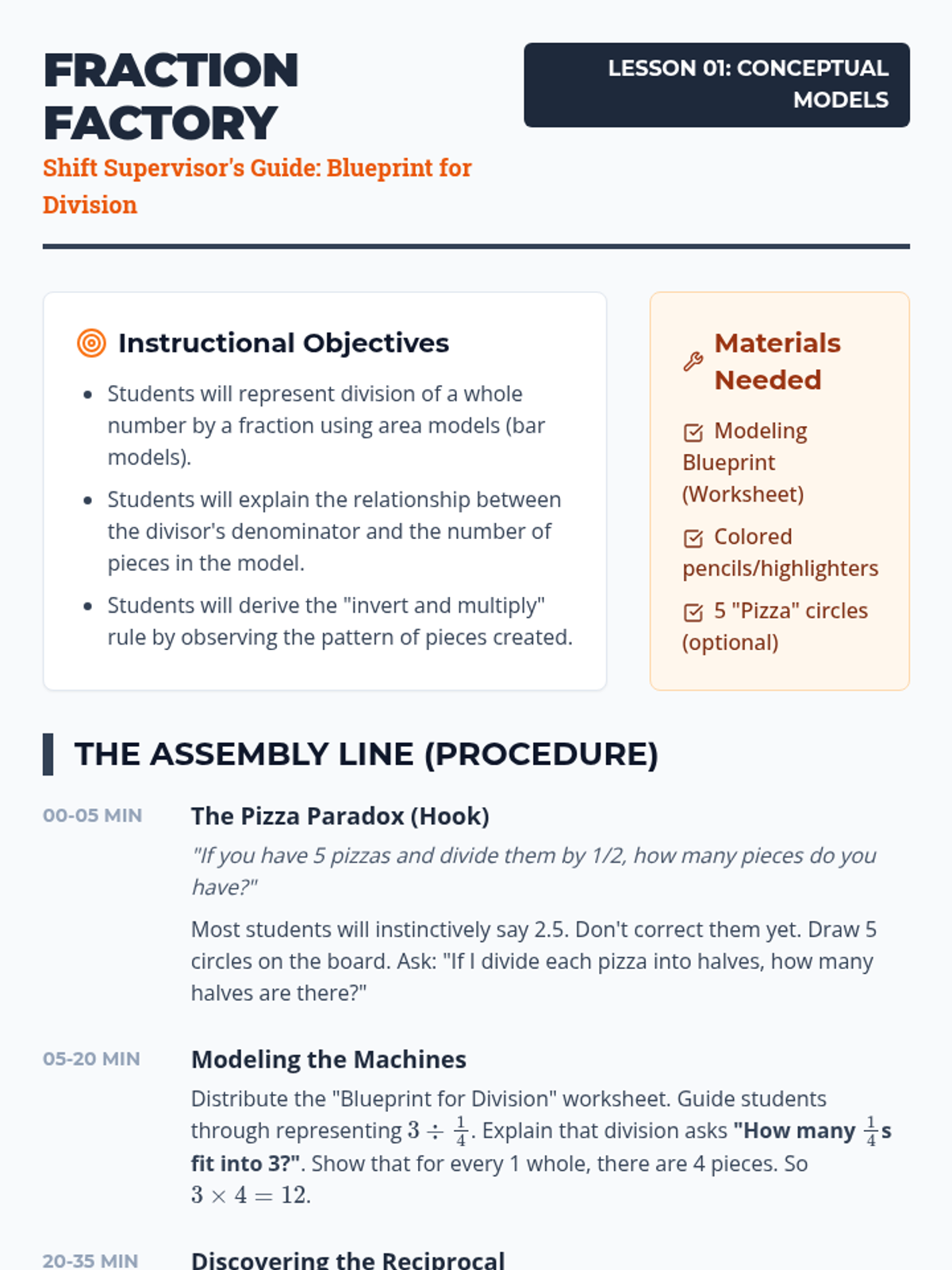
Blueprint for Division Teacher Guide
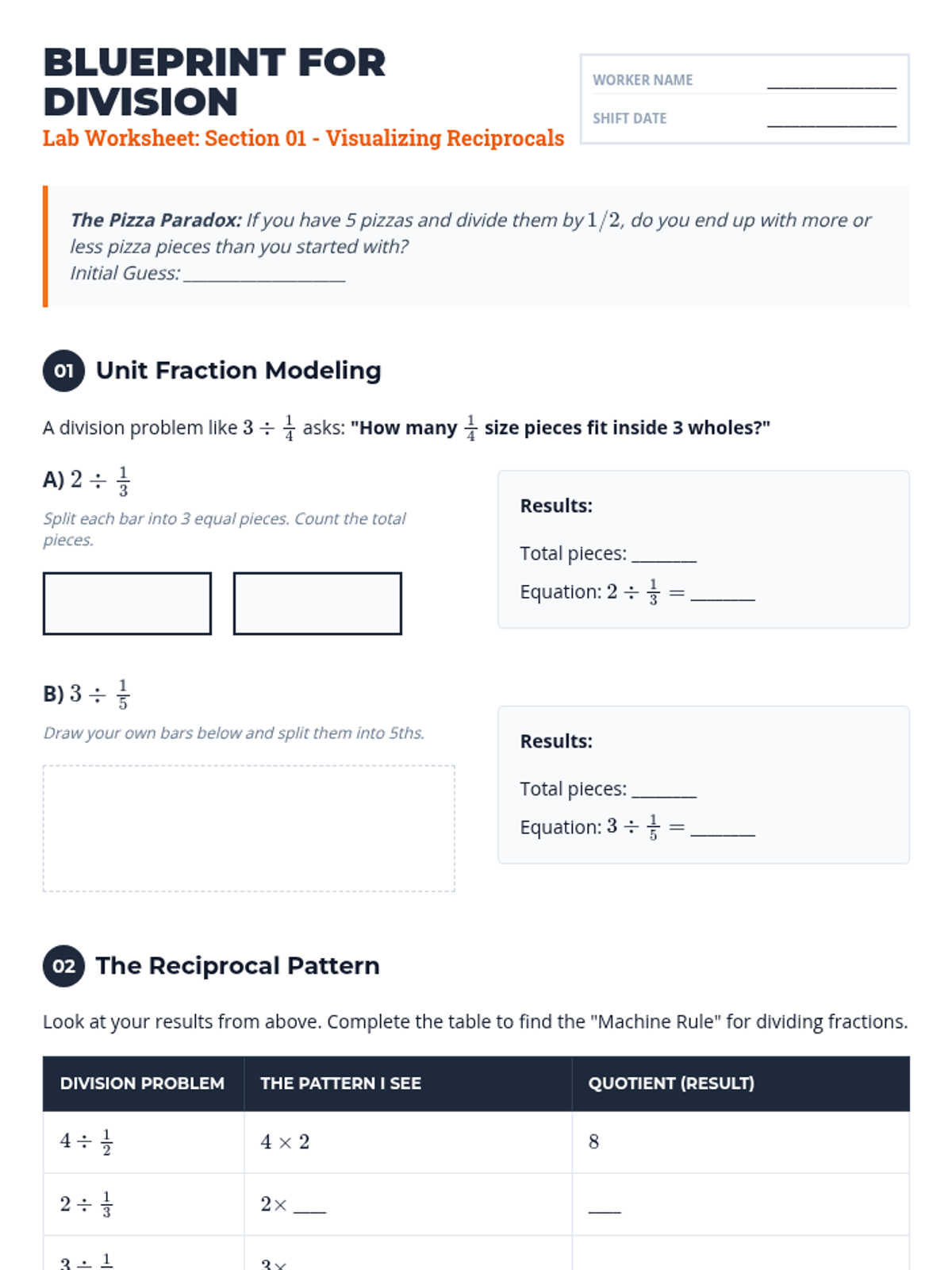
Blueprint for Division Worksheet
Blueprint for Division Slides

Fraction Factory Logistics

This sequence guides students from conceptual modeling of fraction division to applying the standard algorithm with mixed numbers in complex geometric and real-world contexts. Students will explore the 'why' behind the reciprocal before mastering the 'how' and applying it to find missing dimensions and unit rates.
Lenny Avatar
Lenny
1/17
Sequence
Blueprint Basics Slides
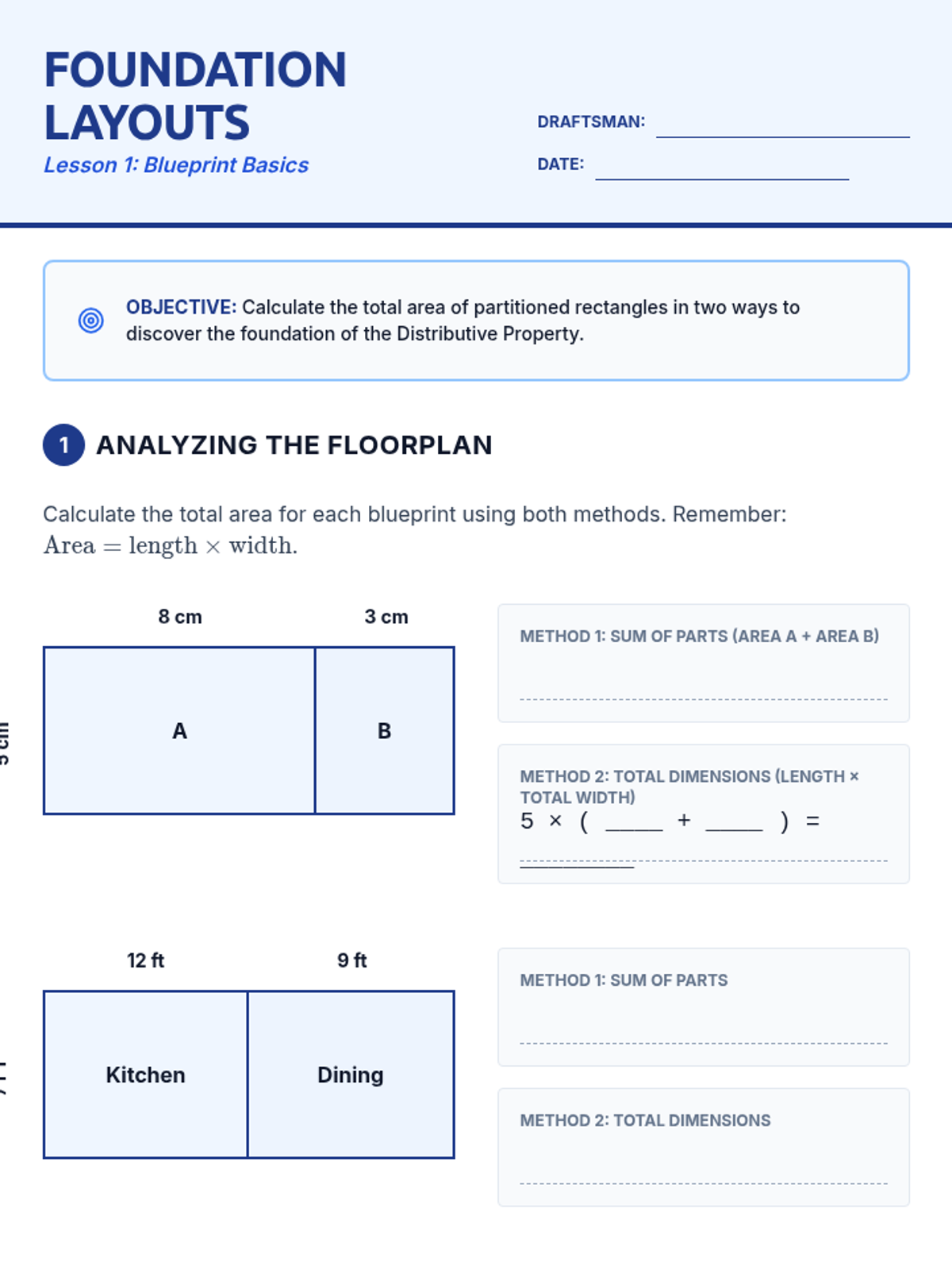
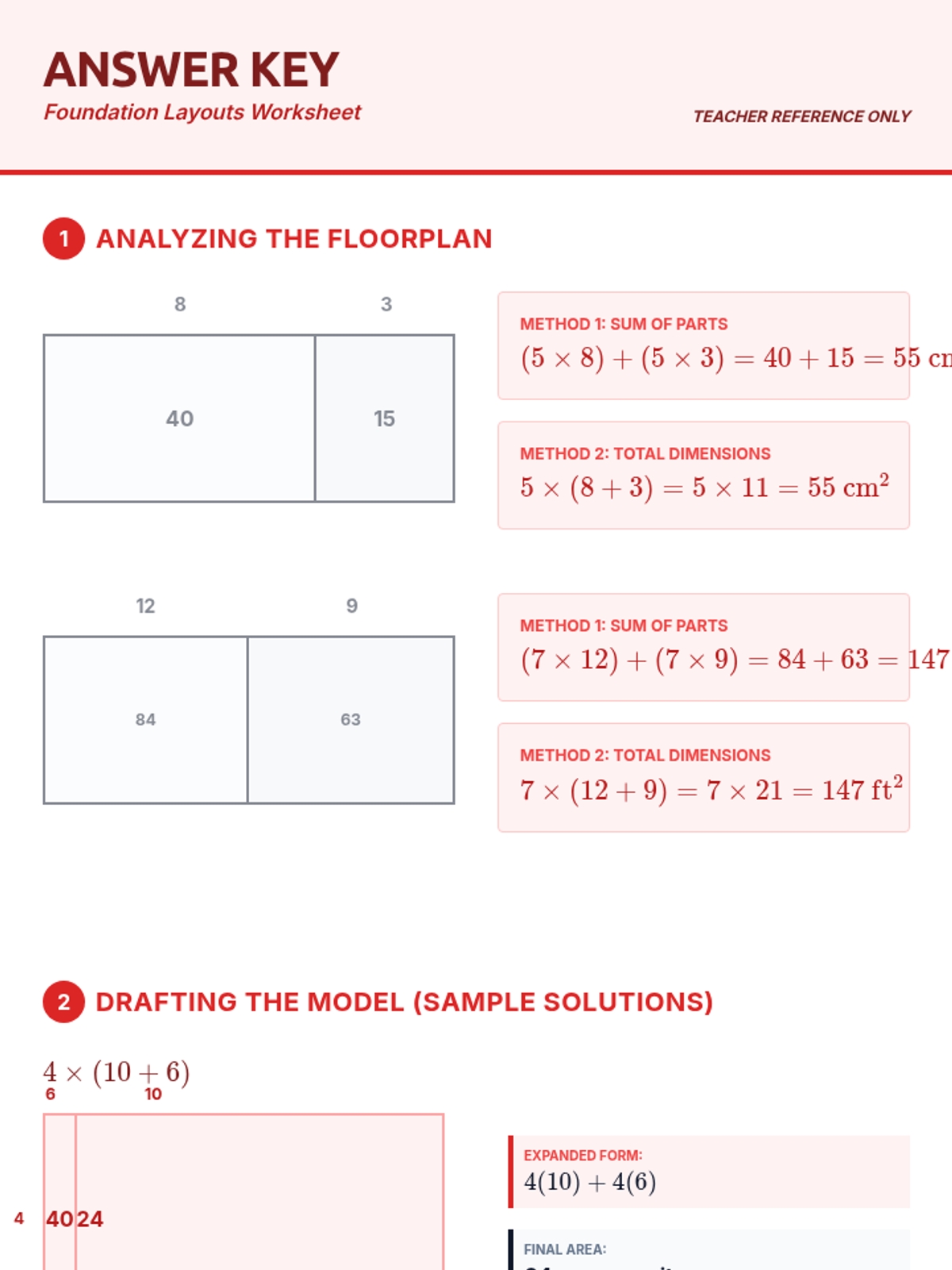
Foundation Layouts Worksheet
Foundation Layouts Answer Key

Geometric Modeling of the Distributive Property

This inquiry-based sequence utilizes geometric area models to conceptualize the distributive property. Students move from concrete arithmetic to abstract algebraic manipulation, eventually fluently expanding linear expressions with rational coefficients.

Lenny Avatar
Lenny
1/17
Sequence
Walking the Path Slides
Perimeter Patterns Worksheet

Equivalent Expression Geometry

A project-based math sequence for 6th grade where students explore equivalent algebraic expressions through the lens of geometric design, perimeter, and area. Students act as landscape architects to discover how different forms of the same expression can simplify calculations and reveal geometric properties.

Lenny Avatar
Lenny
1/17
Sequence
Space Filling Slides
Cover or Fill Worksheet

Volume Blueprint

This sequence guides 6th-grade students through the conceptual derivation of volume formulas for rectangular prisms, moving from concrete unit cubes to abstract formulas. students explore the distinction between area and volume, discover the lwh formula through packing, and master the base-area method.

Lenny Avatar
Lenny
1/17
Sequence
Slice and Scale Slides
Slice and Scale Lab Worksheet

Volume Blueprint Workshop

A comprehensive 6th-grade geometry sequence exploring volume with fractional edge lengths. Students move from concrete visual modeling with unit cubes to abstract formula application and complex real-world packing problems.

Lenny Avatar
Lenny
1/17
Sequence
Plotting Polygons Teacher Guide
Plotting Polygons Presentation Slides
Mystery Shape Worksheet

Grid Masters

A comprehensive 6th-grade geometry sequence focusing on the coordinate plane, integrating polygon construction, distance calculation, angle identification, and real-world spatial modeling. Students transition from basic plotting to designing a complex city map using geometric constraints.

Lenny Avatar
Lenny
1/17
Sequence
Unfolding Nets Slides
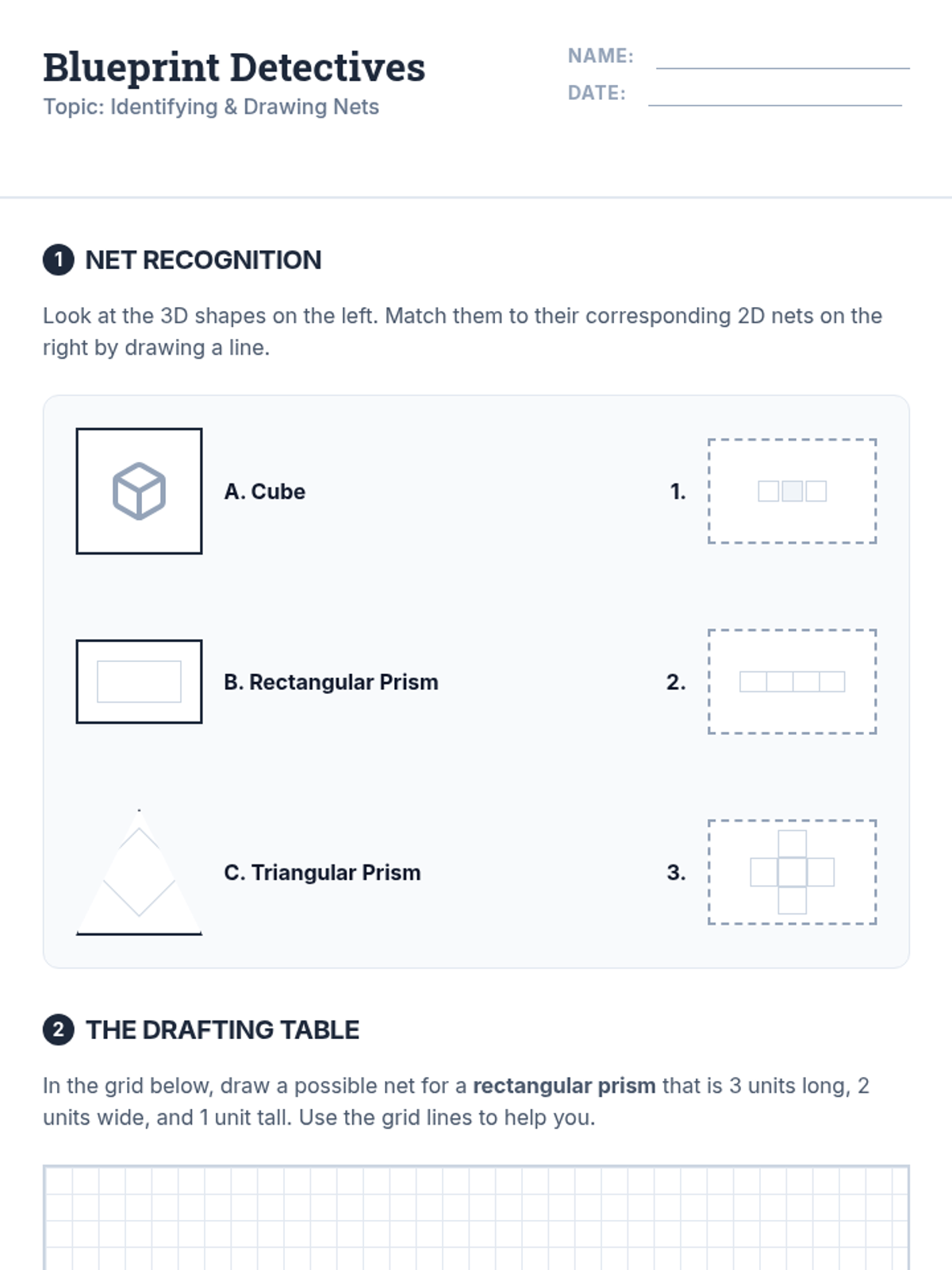
Blueprint Detectives Worksheet
Unfolding Nets Teacher Guide

Surface Area Analysis Using Nets

A 5-lesson geometry sequence for 6th grade exploring the connection between 2D nets and 3D surface area, culminating in a sustainable packaging project. Students learn to visualize, calculate, and optimize surface area for various prisms and pyramids.

Lenny Avatar
Lenny
1/17
Sequence
Parallelogram Patterns Presentation
Parallelogram Patterns Worksheet
Parallelogram Patterns Answer Key

Shape Shifting Area Architects

This sequence guides students through the geometric reasoning required to find the area of various polygons by decomposing them into simpler shapes. Students begin by establishing the relationship between rectangles and parallelograms, then progress to triangles, trapezoids, and finally complex composite figures. The journey emphasizes spatial visualization and the 'cut and rearrange' method over rote memorization of formulas.

Lenny Avatar
Lenny
1/17
Sequence
Unfolding Solids Slides
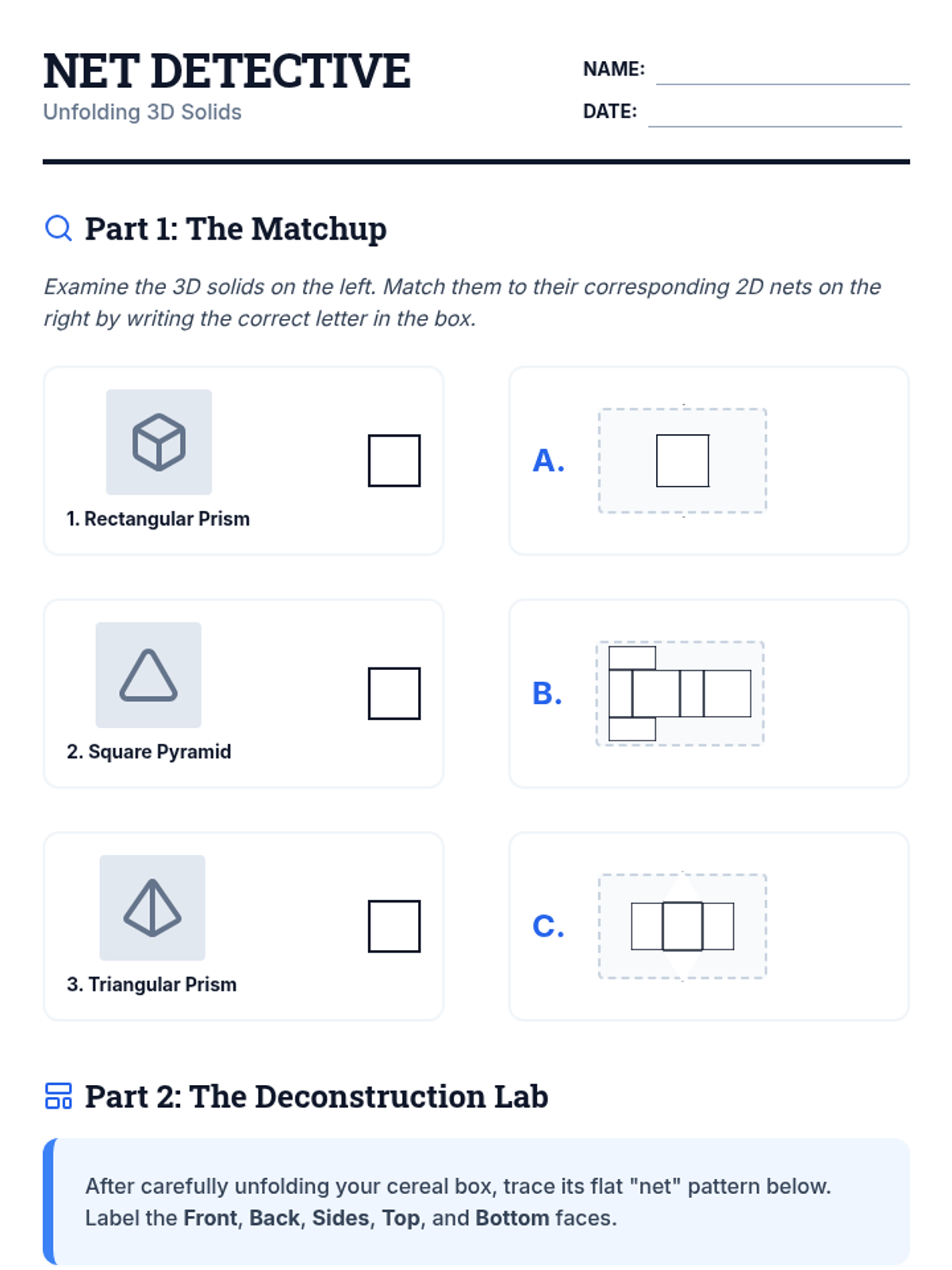
Net Detective Worksheet
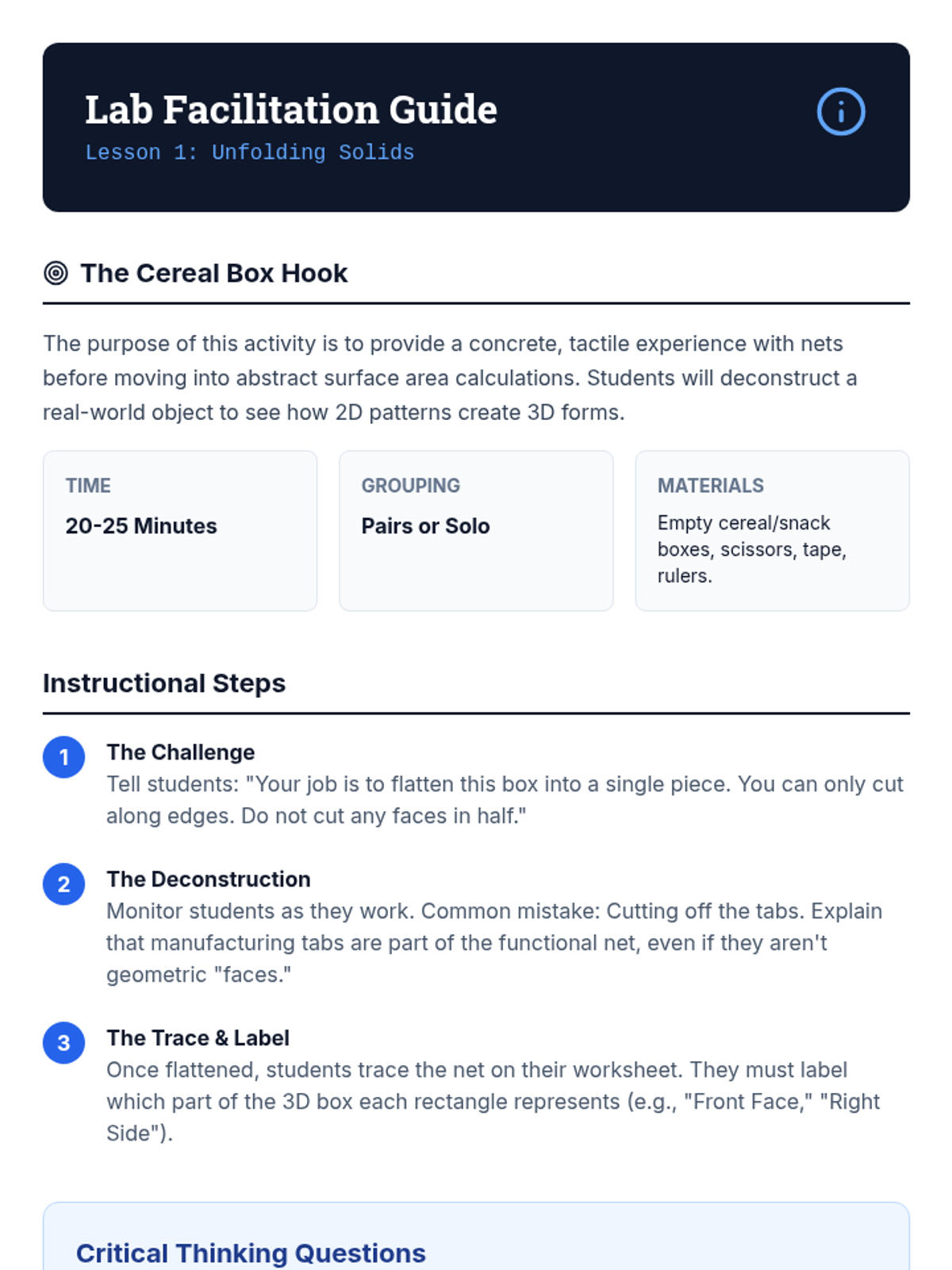
Cereal Box Lab Guide

Blueprint to Build

This sequence builds spatial reasoning by connecting 2D nets to 3D surface area. Students move from physical deconstruction of boxes to calculating surface area for rectangular prisms, triangular prisms, and pyramids, culminating in a packaging optimization challenge.

Lenny Avatar
Lenny
1/17
Sequence
Pi Pursuit Slides
Pi Pursuit Worksheet
Pi Pursuit Teacher Guide

Shape Shifters Project

Students investigate the properties of circles and polygons, discovering the constant Pi and mastering area and circumference calculations. The sequence culminates in a project-based learning experience where students design and budget for a community park using geometric decomposition.

Lenny Avatar
Lenny
1/17
Sequence
Volume vs Capacity Slides
Container Conundrum Worksheet

Capacity and Volume Lab

This sequence explores the practical applications of geometry through the lens of volume and capacity. Students investigate how space is measured in cubic units versus liquid units, solve real-world engineering problems involving aquariums and flow rates, and use displacement to find the volume of irregular objects.

Lenny Avatar
Lenny
1/17
Sequence
Le Bon Cadre Presentation
Le Bon Cadre Fiche Minute

L'Atelier Photo

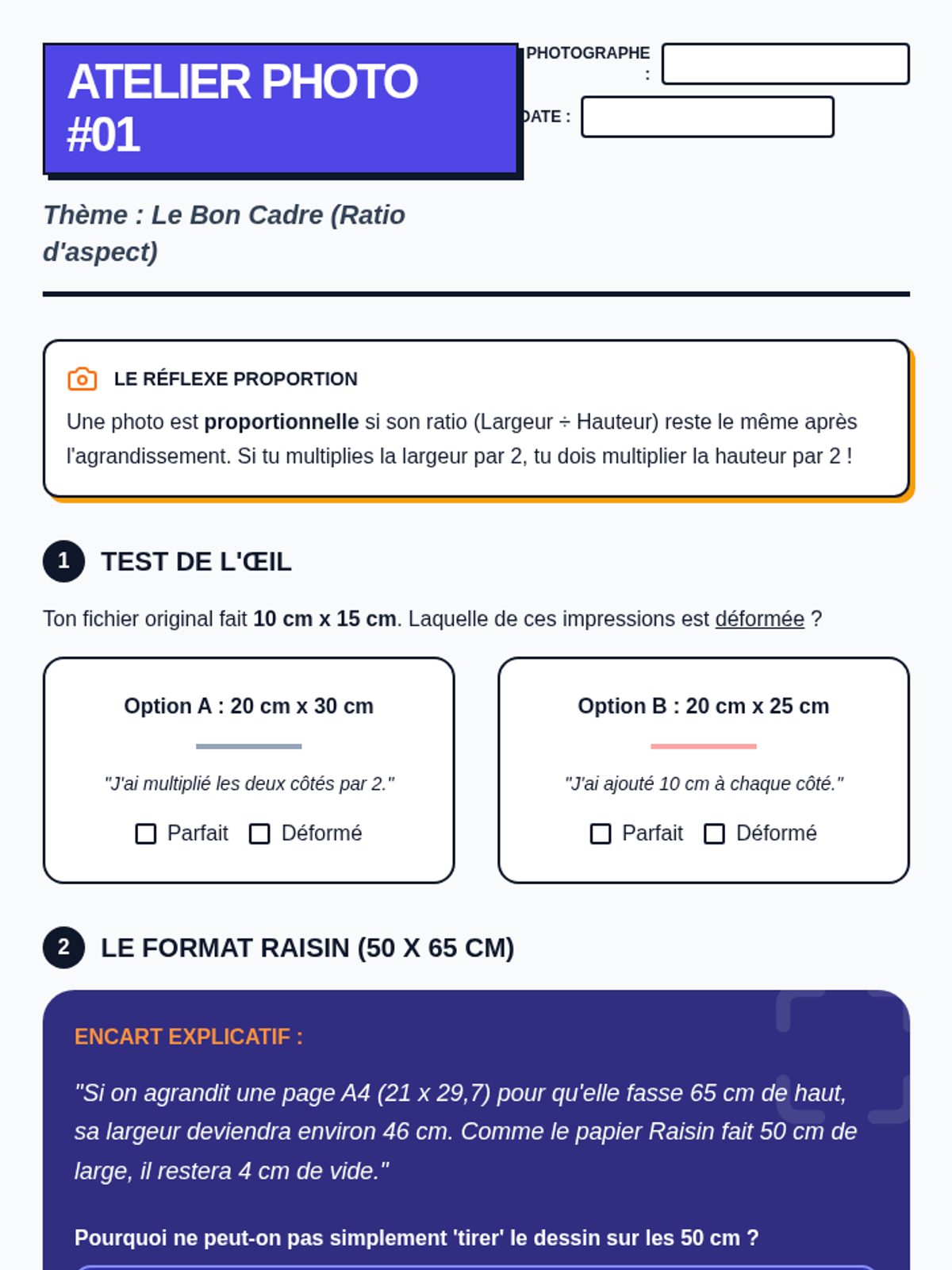
Une série de micro-leçons de 10 minutes centrée sur l'optimisation de l'espace papier. Les élèves apprennent à mettre à l'échelle une mise en page de 6 photos (format A4) vers le format Raisin (50x65 cm) en minimisant les chutes.

SB

saida bendaoud

Special Education Teacher
2/13
Sequence
Unit Overview Resource

Math Intensive Lab

A comprehensive math intervention sequence for 6th-grade students, focusing on four key domains: Numbers & Operations, Algebraic Thinking, Measurement & Data, and Geometry. This sequence uses high-leverage strategies from the All Learners Network (ALN) and aligns with i-Ready prerequisite modules to bridge conceptual gaps.

D

dfredericks

Math Teacher
2/5
Sequence
Stronger Shapes Slides
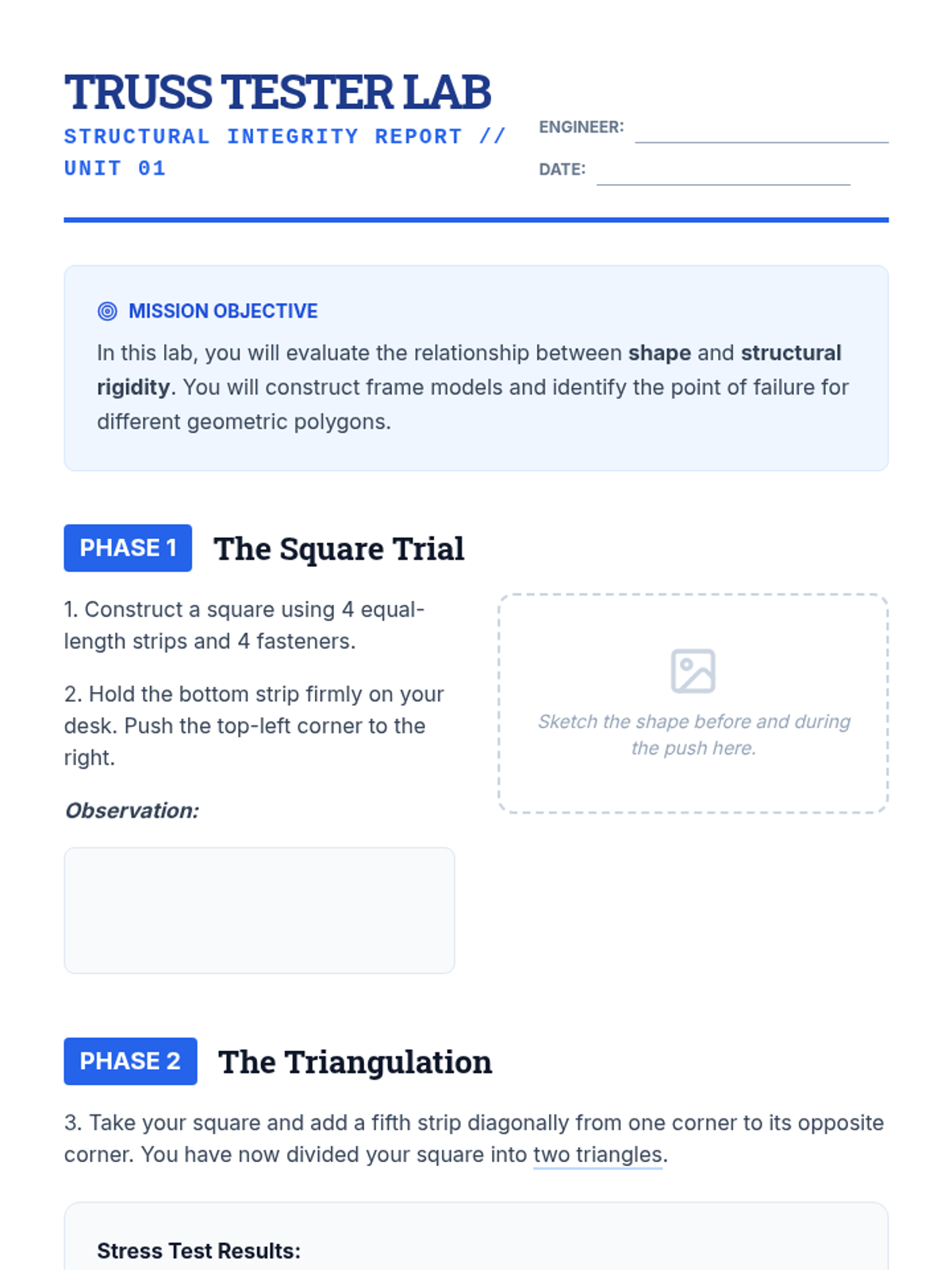
Truss Tester Worksheet
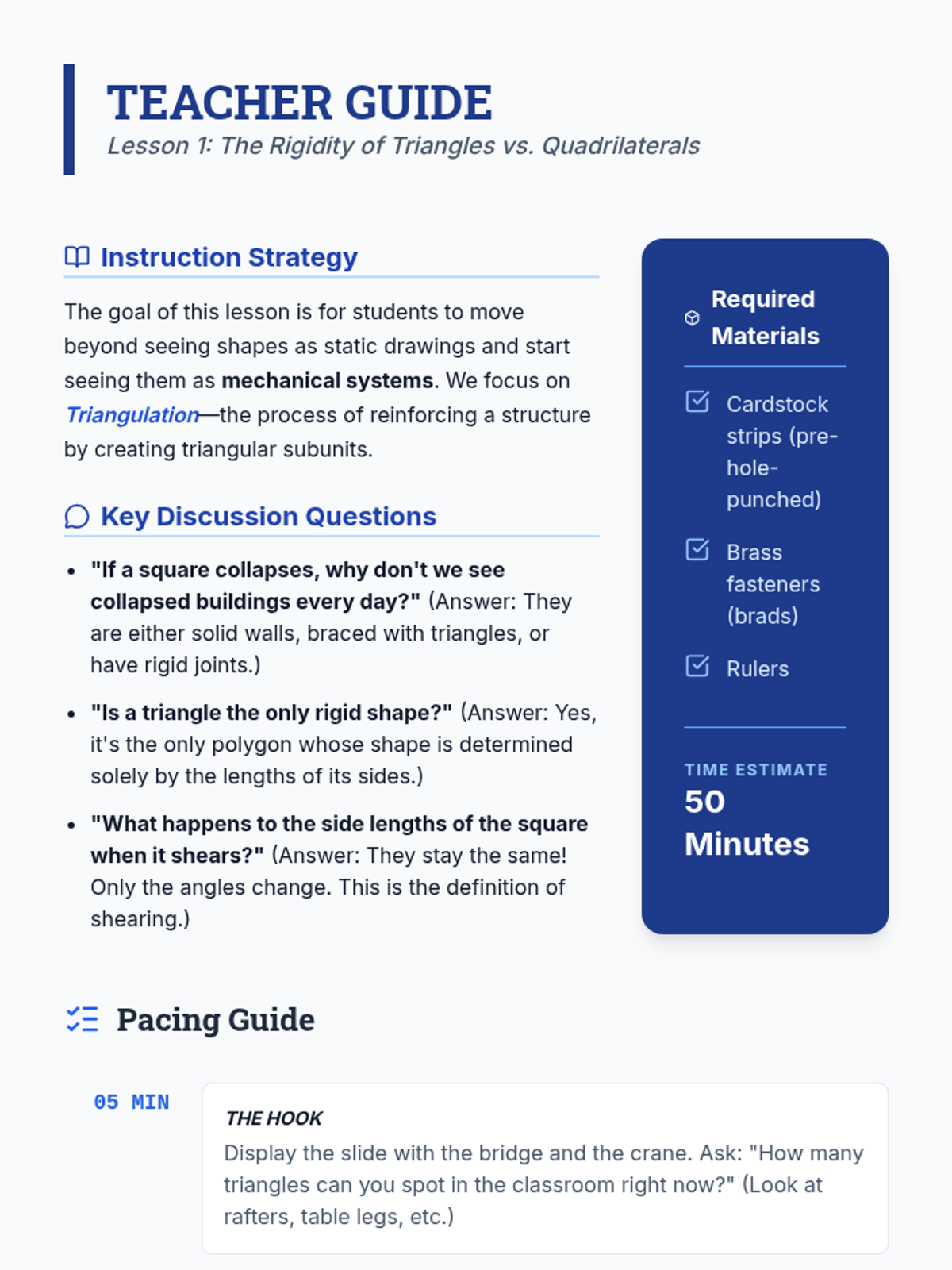
Stronger Shapes Teacher Guide

Structural Geometry Engineering

This sequence bridges geometry and physics, investigating the structural properties of 2D and 3D shapes. Students analyze rigidity, tessellation, and surface area-to-volume ratios to understand how geometric attributes influence physical performance in engineering and nature.

Lenny Avatar
Lenny
1/18
Sequence
Geometry Lab Slides
Solid Sort Worksheet

Shape Slice Lab

This hands-on sequence focuses on spatial visualization, specifically the relationship between three-dimensional solids and two-dimensional figures. Students explore how slicing 3D objects creates 2D cross-sections, progressing from basic classification to complex angled cuts and orthographic projections.

Lenny Avatar
Lenny
1/18
Sequence
Solid Scanners Slides
Parts of the Whole Worksheet
Solid Scanners Teacher Guide

Polyhedra Power

A comprehensive geometry and engineering sequence where 6th-grade students explore the relationship between 2D nets and 3D solids. Students progress from identifying geometric parts to calculating surface area for prisms and pyramids, culminating in a real-world packaging design challenge.

Lenny Avatar
Lenny
1/18
Sequence
Blueprint Basics Slides
Foundation Layouts Worksheet
Foundation Layouts Answer Key

Geometric Modeling of the Distributive Property

This inquiry-based sequence utilizes geometric area models to conceptualize the distributive property. Students move from concrete arithmetic to abstract algebraic manipulation, eventually fluently expanding linear expressions with rational coefficients.

Lenny Avatar
Lenny
1/17
Sequence
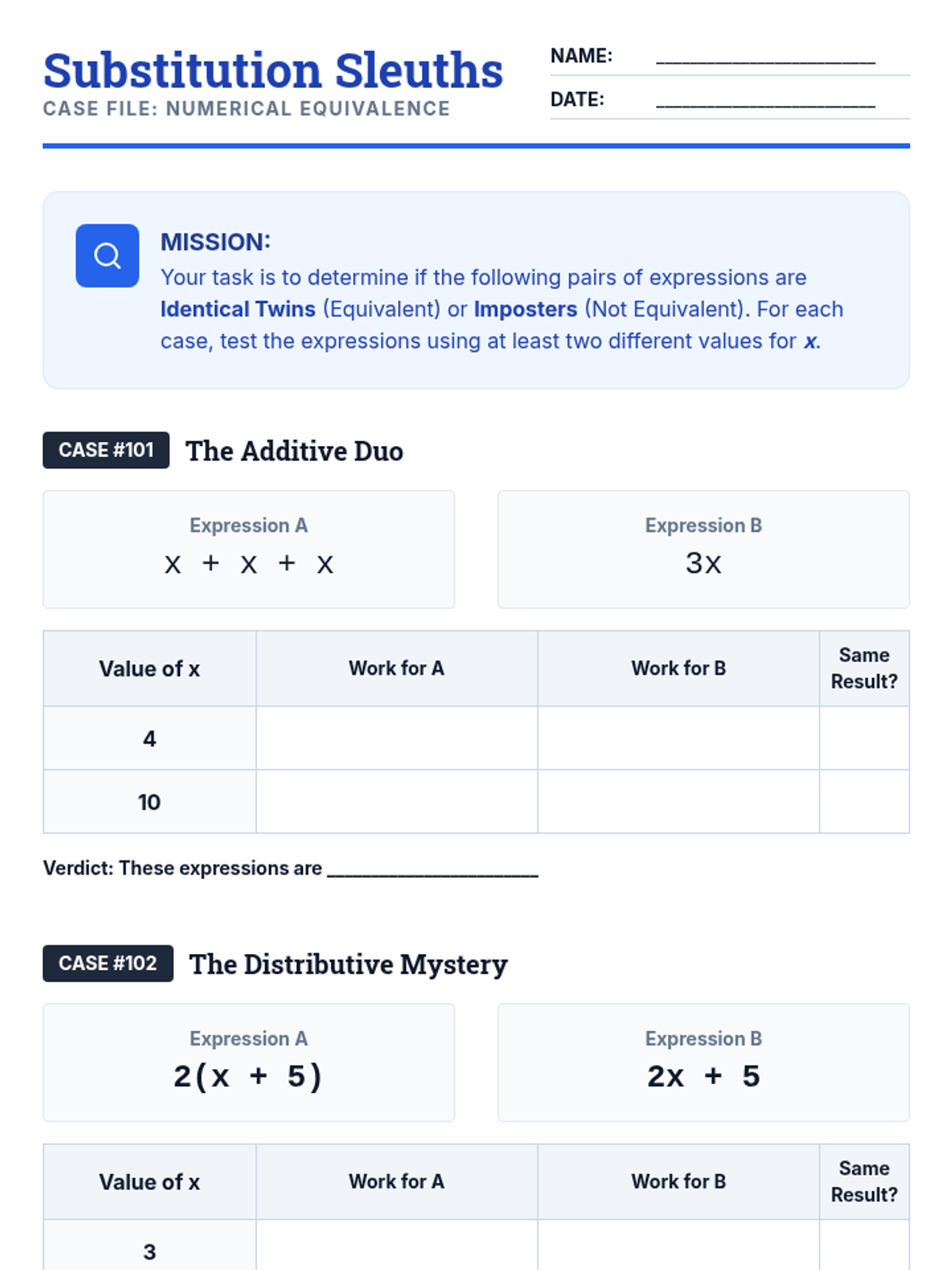
Substitution Sleuths Slides
Substitution Sleuths Worksheet
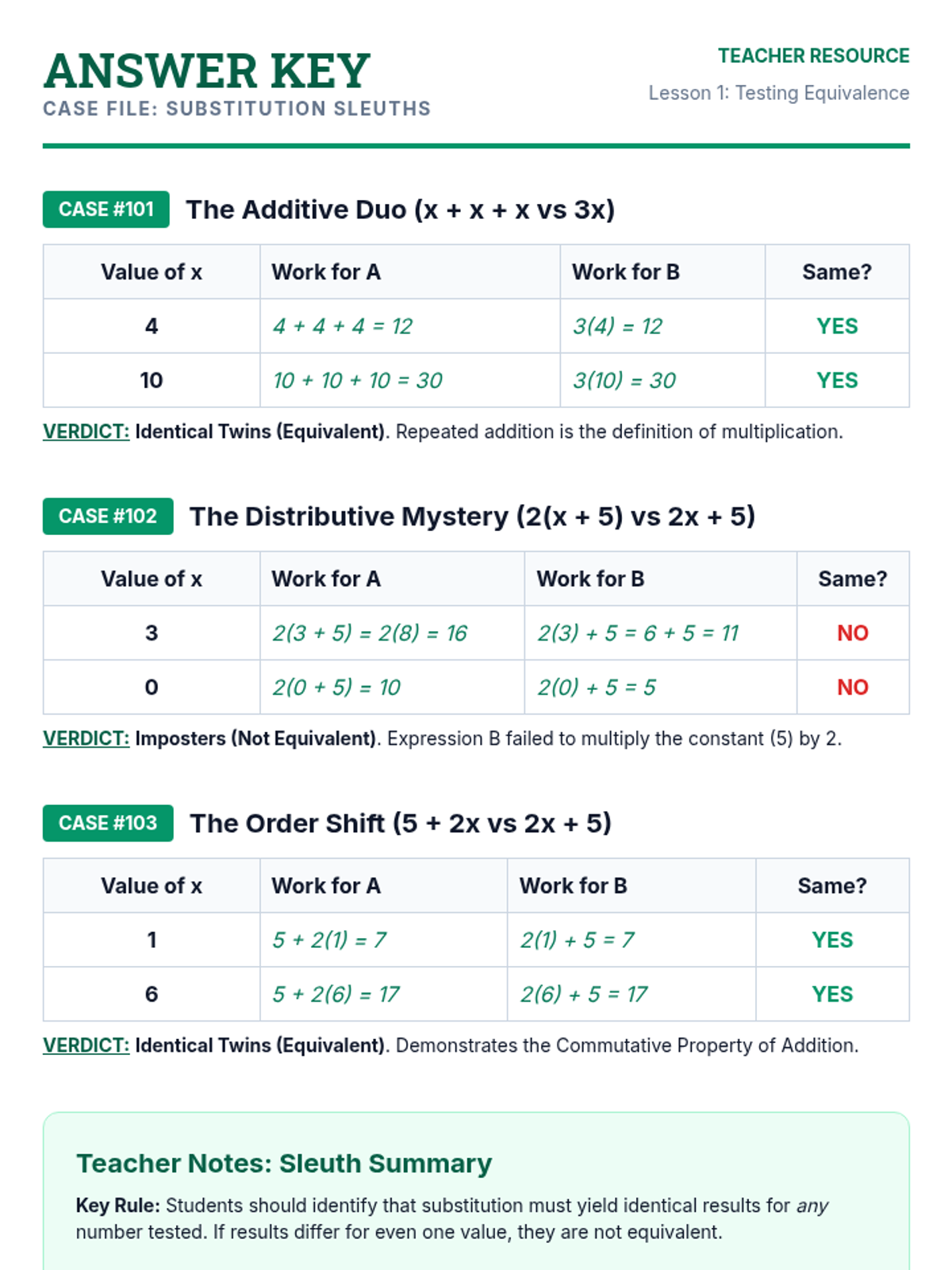
Substitution Sleuths Answer Key

Expression Twin Detectives

This inquiry-based sequence challenges 6th-grade students to determine when and why two different-looking expressions are equivalent. Students move from numerical verification via substitution to geometric visualization with area models, and finally to algebraic justification using properties of operations.

Lenny Avatar
Lenny
1/17
Sequence
Figure Fragmentation Worksheet
Figure Fragmentation Slides
Spatial Skills Teacher Guide

Volume Analysis of Composite Figures

This sequence guides 6th-grade students through the process of analyzing and calculating the volume of composite 3D figures. Students progress from basic spatial decomposition to additive and subtractive volume strategies, culminating in a real-world design project for a custom aquarium.

Lenny Avatar
Lenny
1/17
Sequence
Base Blueprints Slides
Base Hunt Worksheet
Base Review Teacher Guide

Foundations of Volume Prisms and Cylinders

This sequence explores the relationship between 2D base area and 3D volume for prisms and cylinders. Students build a deep conceptual understanding of the \(V = Bh\) formula through hands-on hooks, visual derivations, and real-world application problems.

Lenny Avatar
Lenny
1/17
Sequence
Solid Deconstruction Slides
Blueprint Log Worksheet

Spatial Architects Additive Volume

A project-based exploration of additive volume where students act as spatial architects to decompose complex 3D structures and design their own volume-constrained modules.

Lenny Avatar
Lenny
1/17
Sequence
Unfolding Nets Slides
Blueprint Detectives Worksheet
Unfolding Nets Teacher Guide

Surface Area Analysis Using Nets

A 5-lesson geometry sequence for 6th grade exploring the connection between 2D nets and 3D surface area, culminating in a sustainable packaging project. Students learn to visualize, calculate, and optimize surface area for various prisms and pyramids.

Lenny Avatar
Lenny
1/17
Sequence
Unfolding Solids Slides
Net Detective Worksheet
Cereal Box Lab Guide

Blueprint to Build

This sequence builds spatial reasoning by connecting 2D nets to 3D surface area. Students move from physical deconstruction of boxes to calculating surface area for rectangular prisms, triangular prisms, and pyramids, culminating in a packaging optimization challenge.

Lenny Avatar
Lenny
1/17
Sequence
Net Navigators Presentation Slides
Net Folding Activity Worksheet

Shape Architects

This sequence explores the relationship between 2D shapes and 3D solids through hands-on construction, analysis of attributes, and cross-sectional investigations. Students apply their knowledge in a culminating engineering challenge to build stable structures using geometric properties.

Lenny Avatar
Lenny
1/17
Sequence
Blueprint Breakdown Slides
Blueprint Breakdown Worksheet

Structure Squad

A project-based geometry unit where 6th-grade students act as structural engineers to decompose, calculate, and design complex composite 3D structures using additive and subtractive volume methods.

Lenny Avatar
Lenny
1/17
Sequence
Volume Voyagers Slides
Pyramid Pouring Lab Sheet

Volume Architects

An inquiry-based exploration of the volume relationships between prisms, pyramids, cylinders, cones, and spheres. Students use hands-on simulations and visual derivations to master 3D geometry formulas.

Lenny Avatar
Lenny
1/17
Sequence
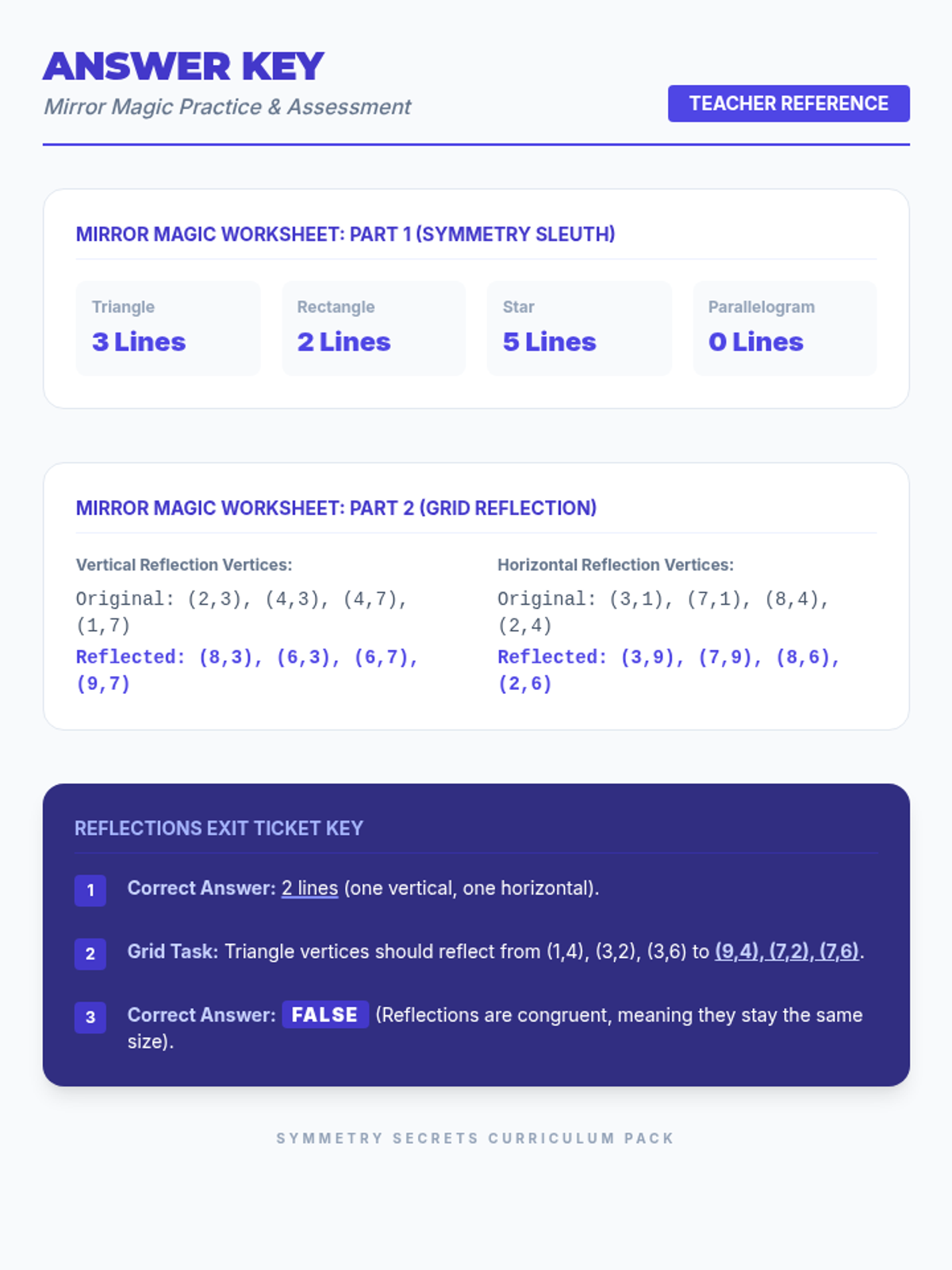
Symmetry Secrets Anchor Chart
Mirror Magic Teacher Guide
Mirror Magic Worksheet
Reflections Exit Ticket
Mirror Line Cheat Sheet
Mirror Magic Answer Key

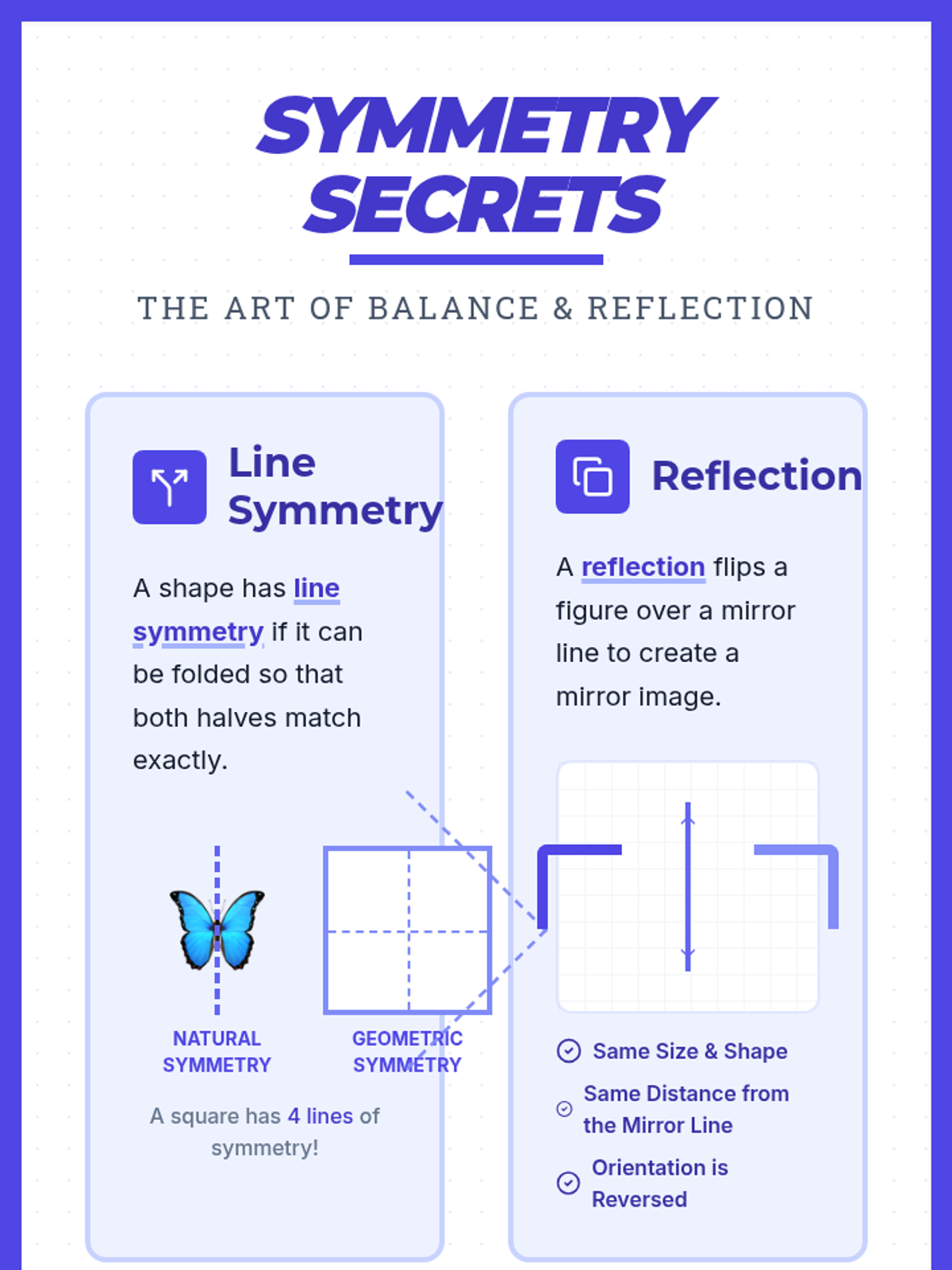
Symmetry Secrets

A deep dive into geometric transformations, starting with the foundational concepts of symmetry and reflection through hands-on exploration and visual practice.

KA

Kelise Antonio

Counselor
3/3
Sequence
Blueprint Basics Slides
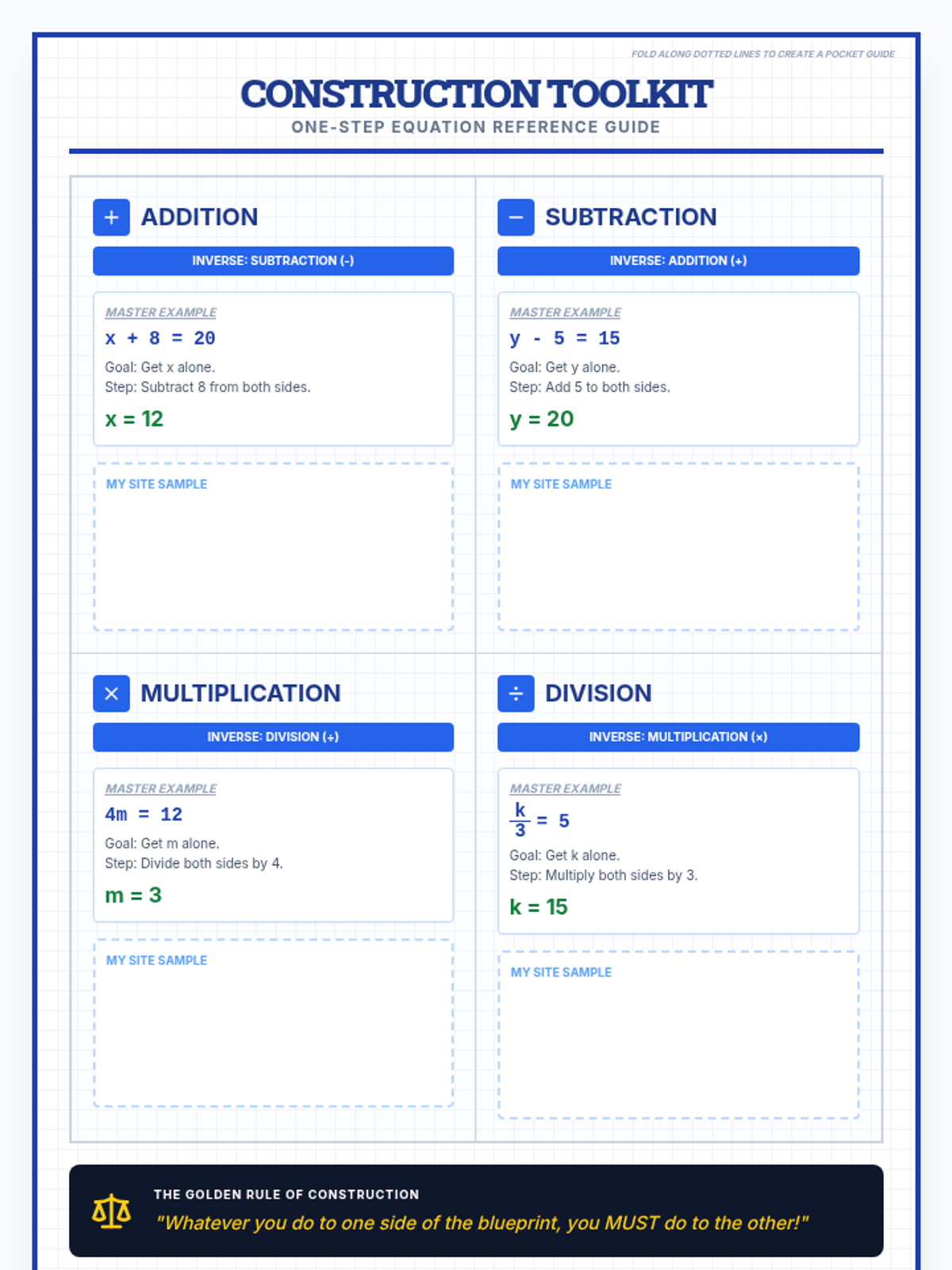
Blueprint Reference Kit
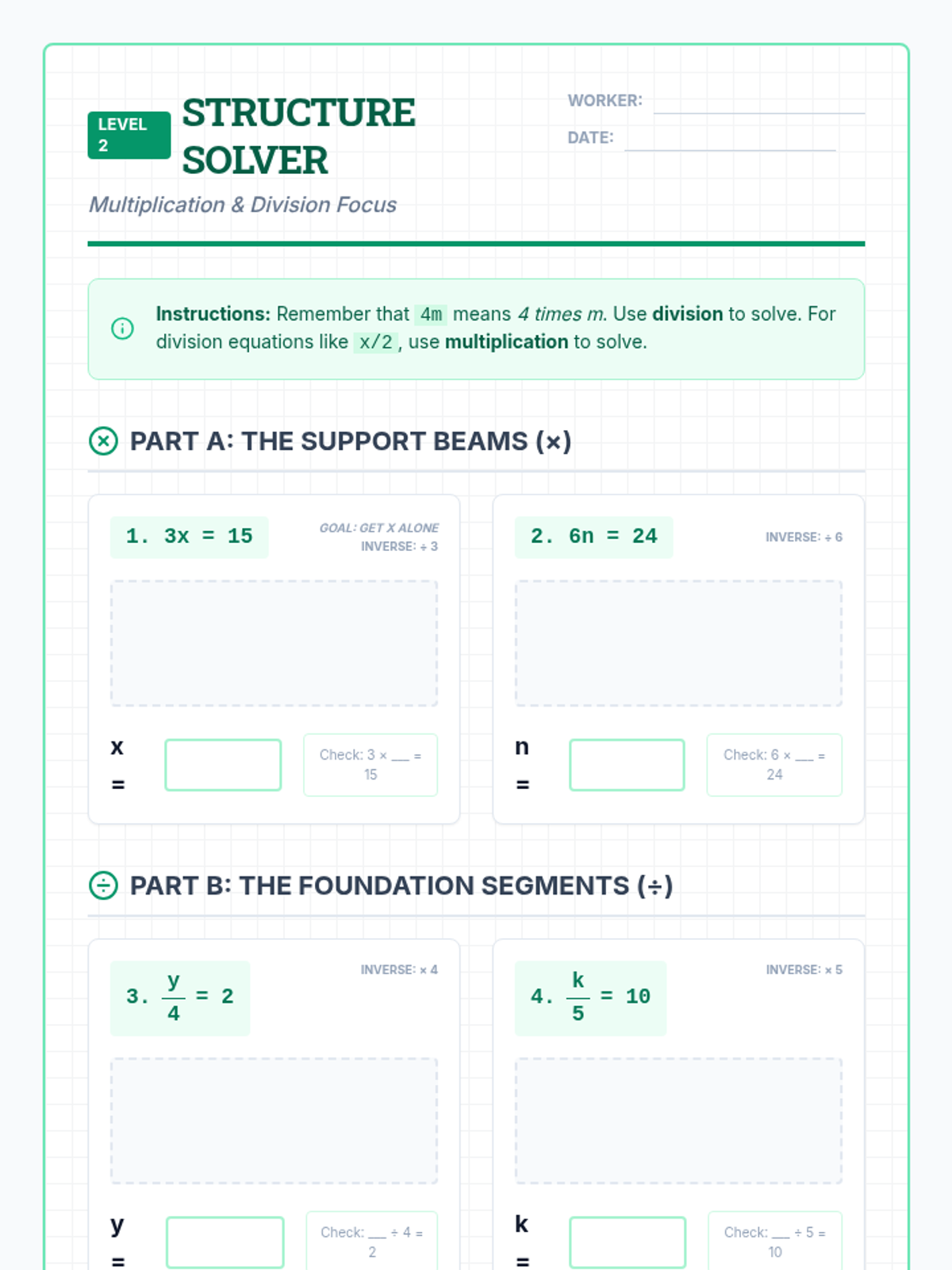
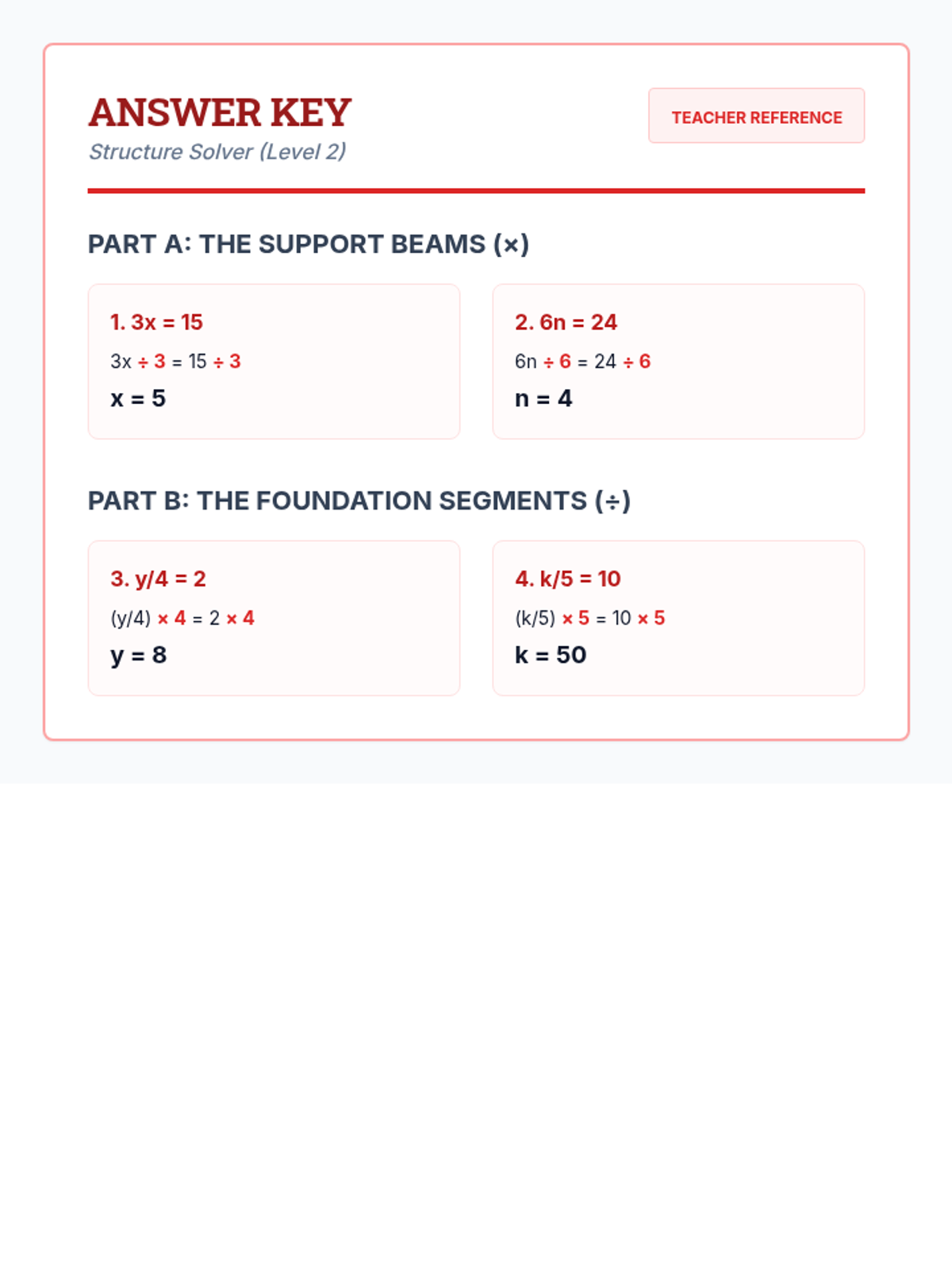
Structure Solver Worksheet
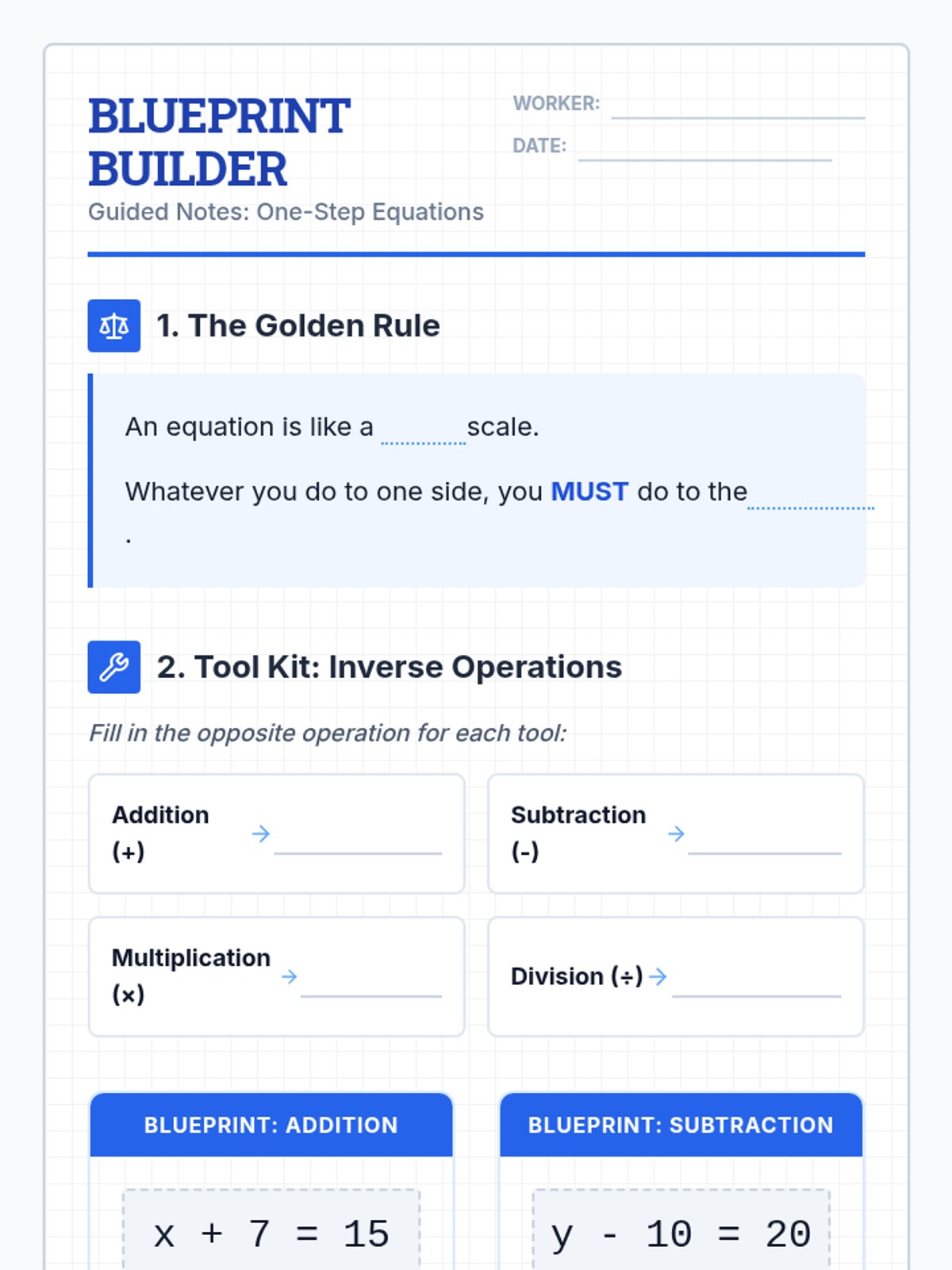
Blueprint Builder Notes
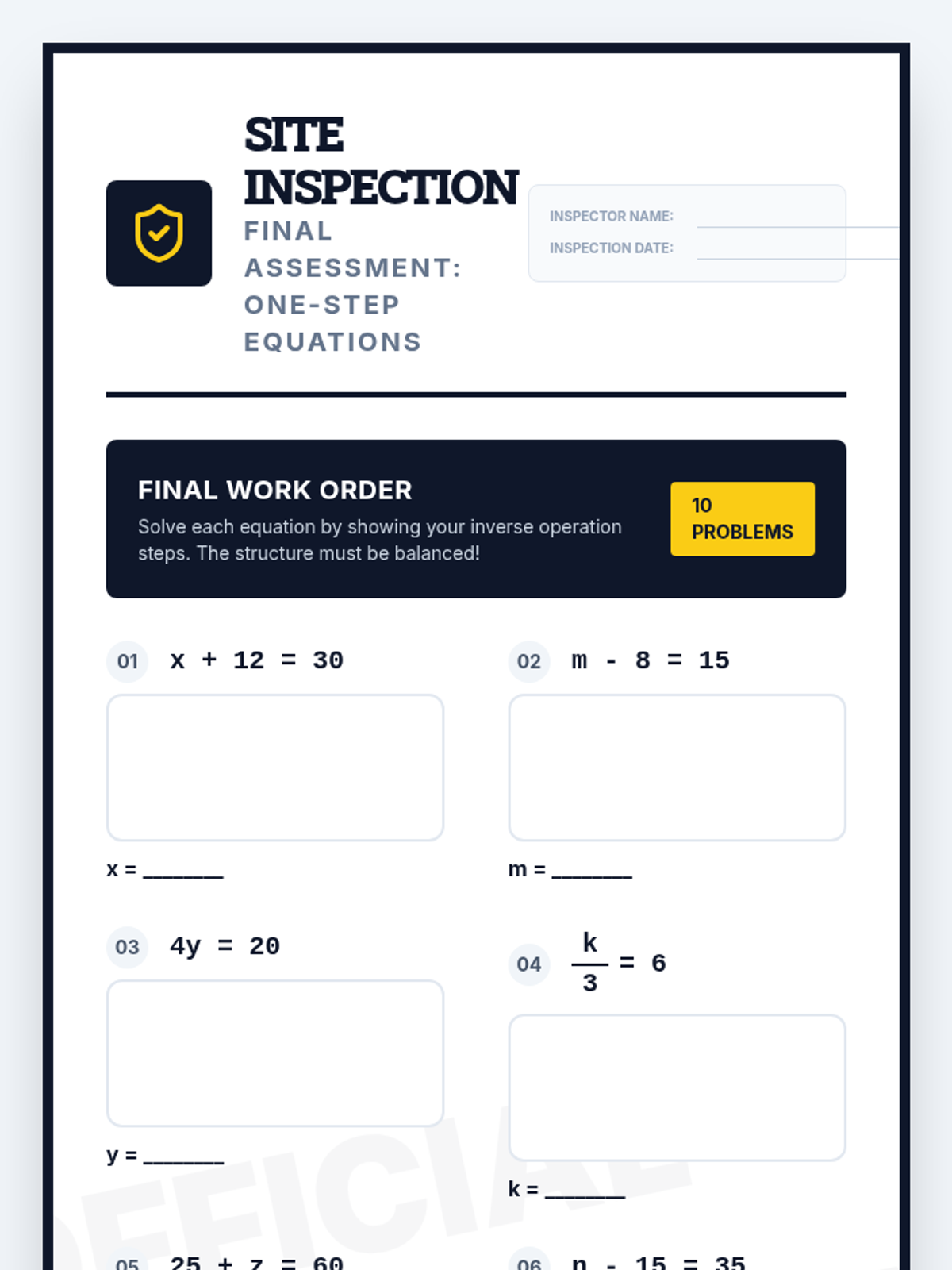
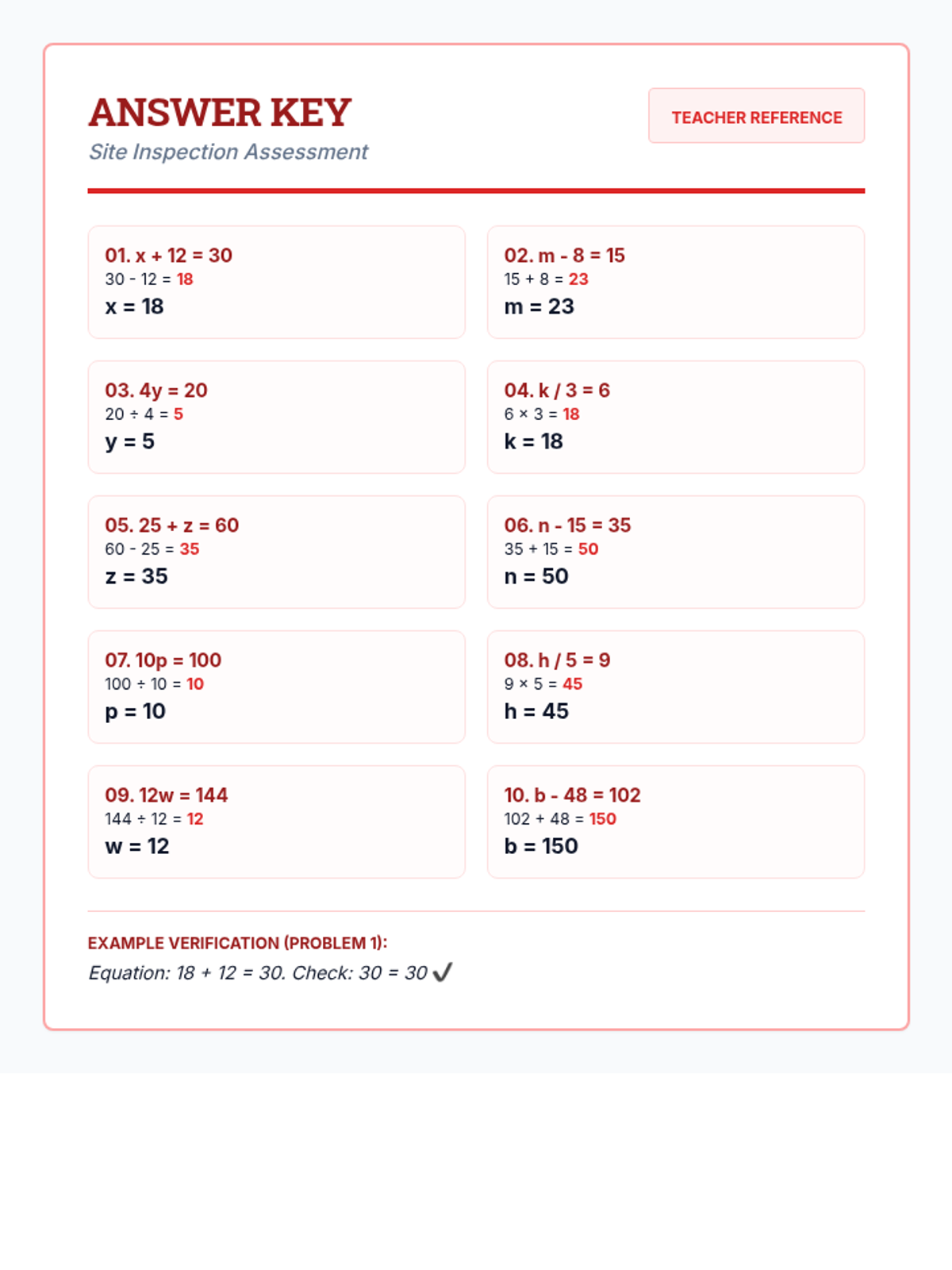
Site Inspection Assessment
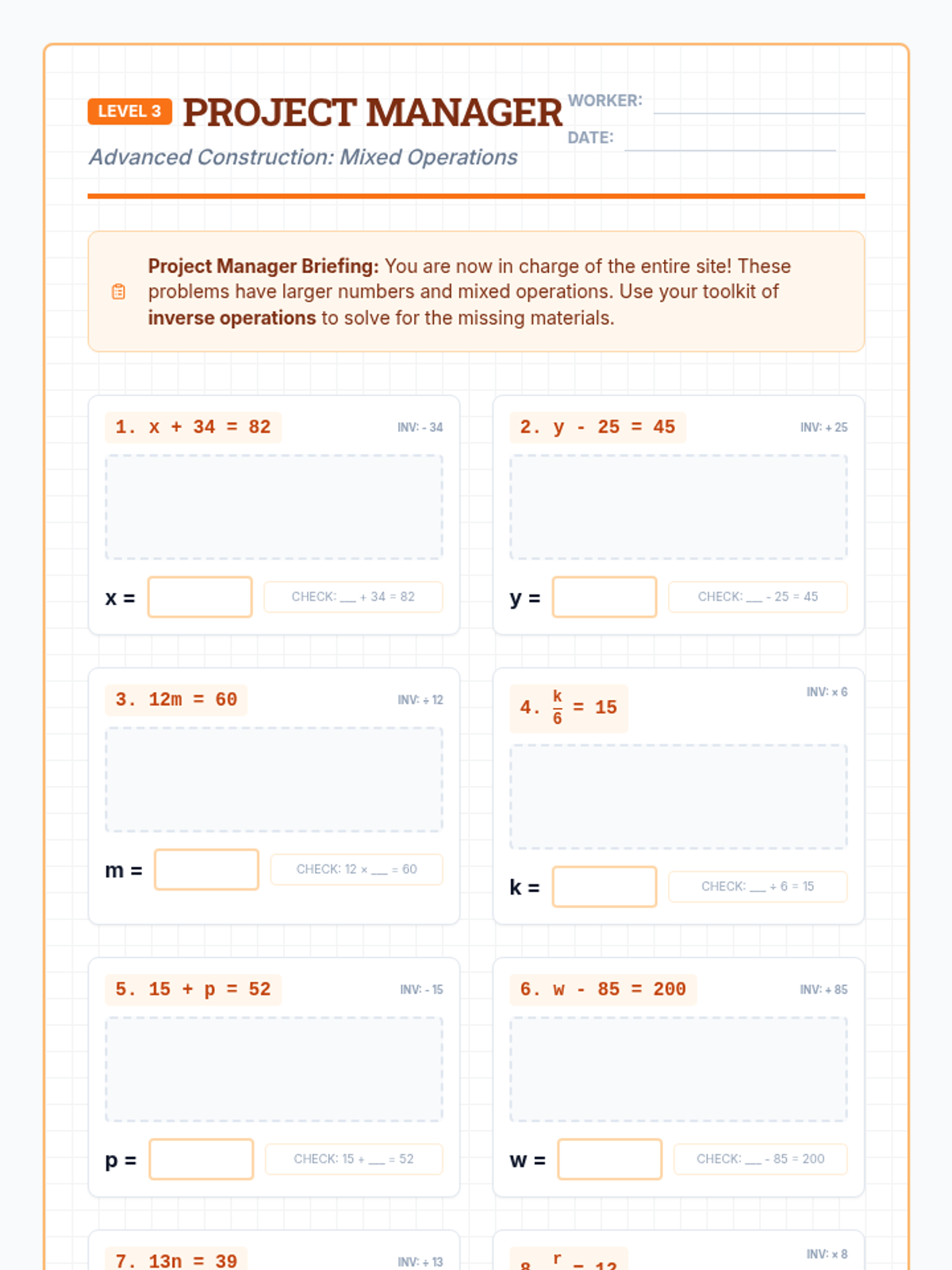
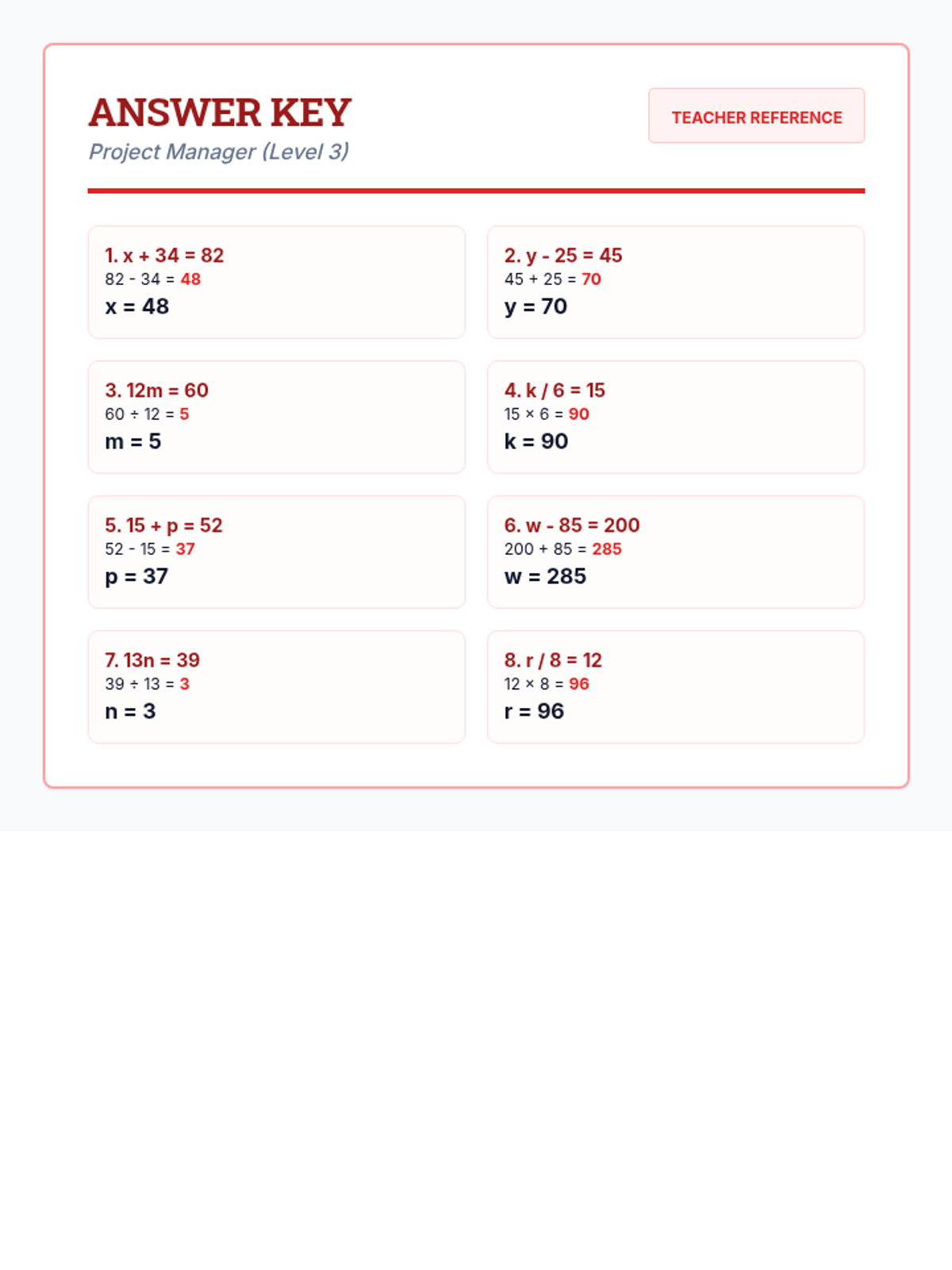
Project Manager Worksheet
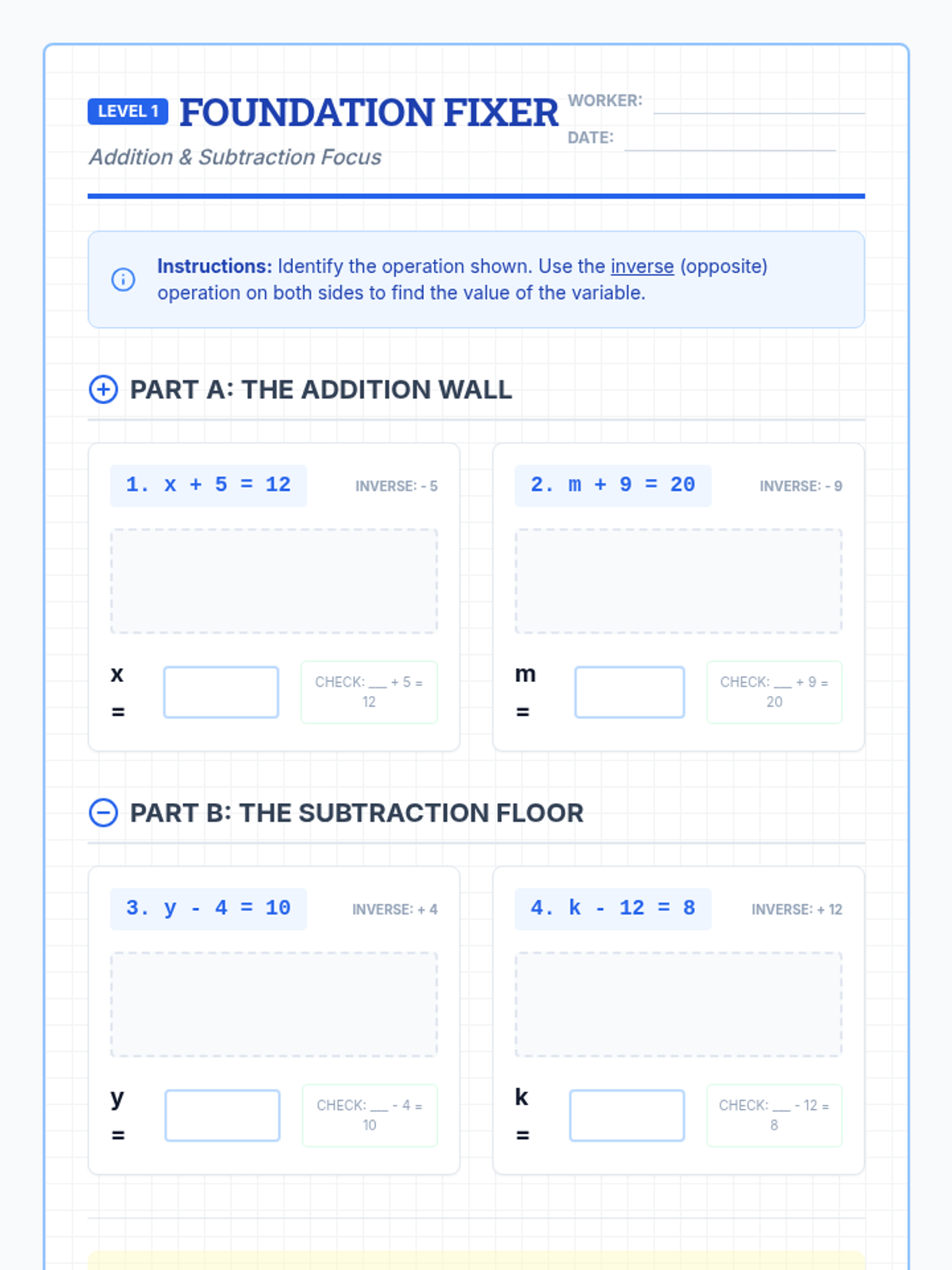
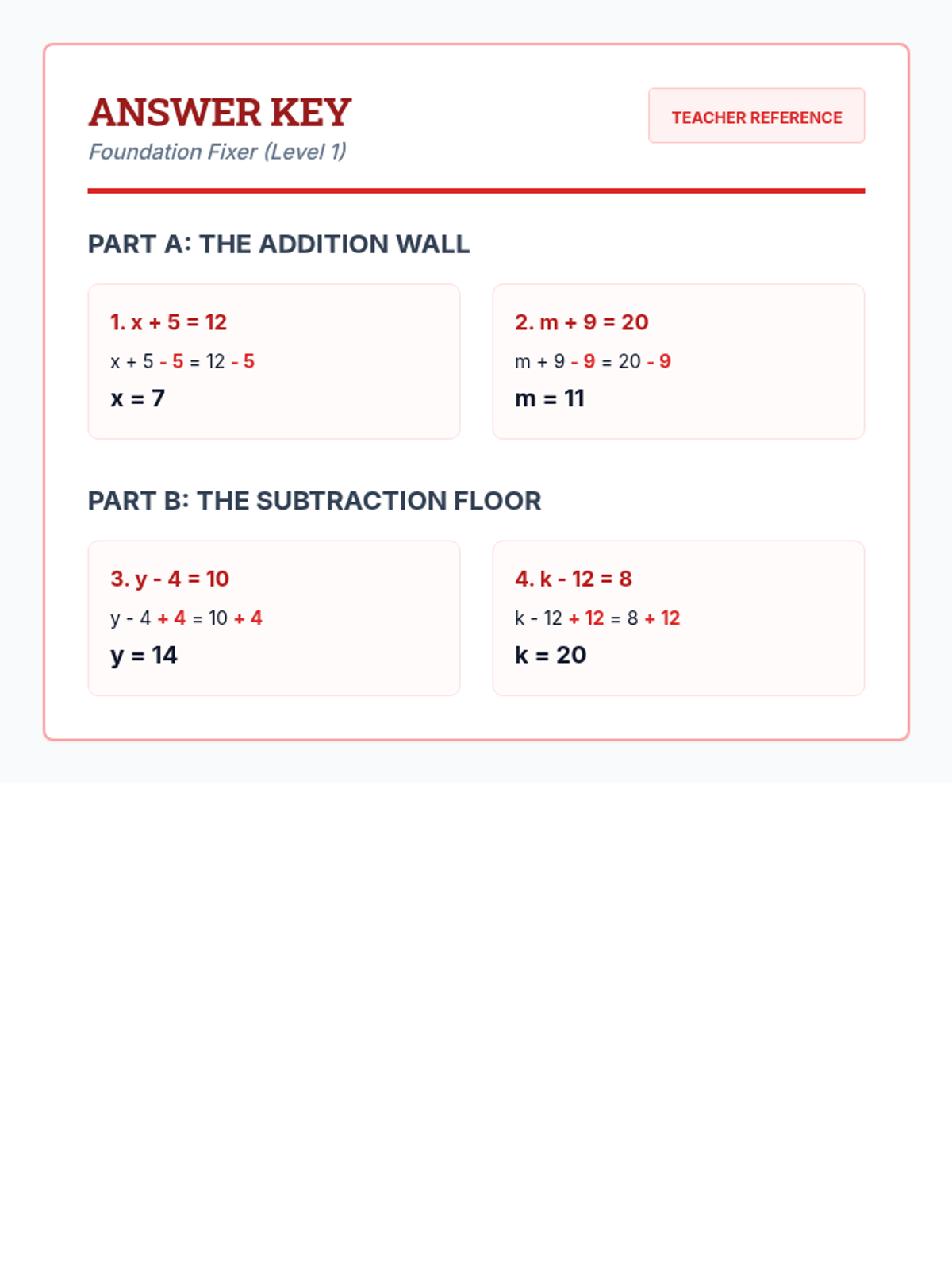
Foundation Fixer Worksheet
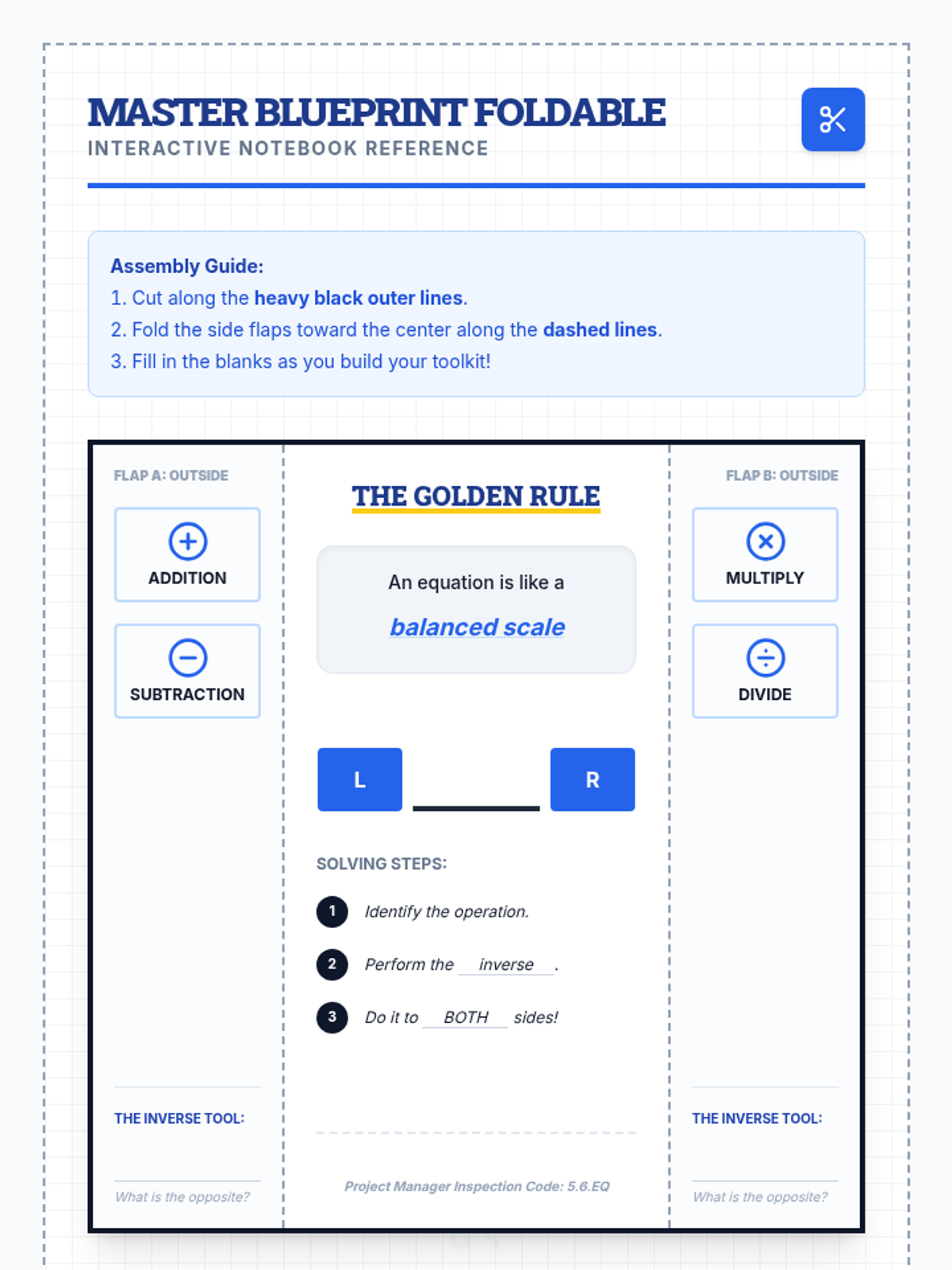
Master Blueprint Foldable
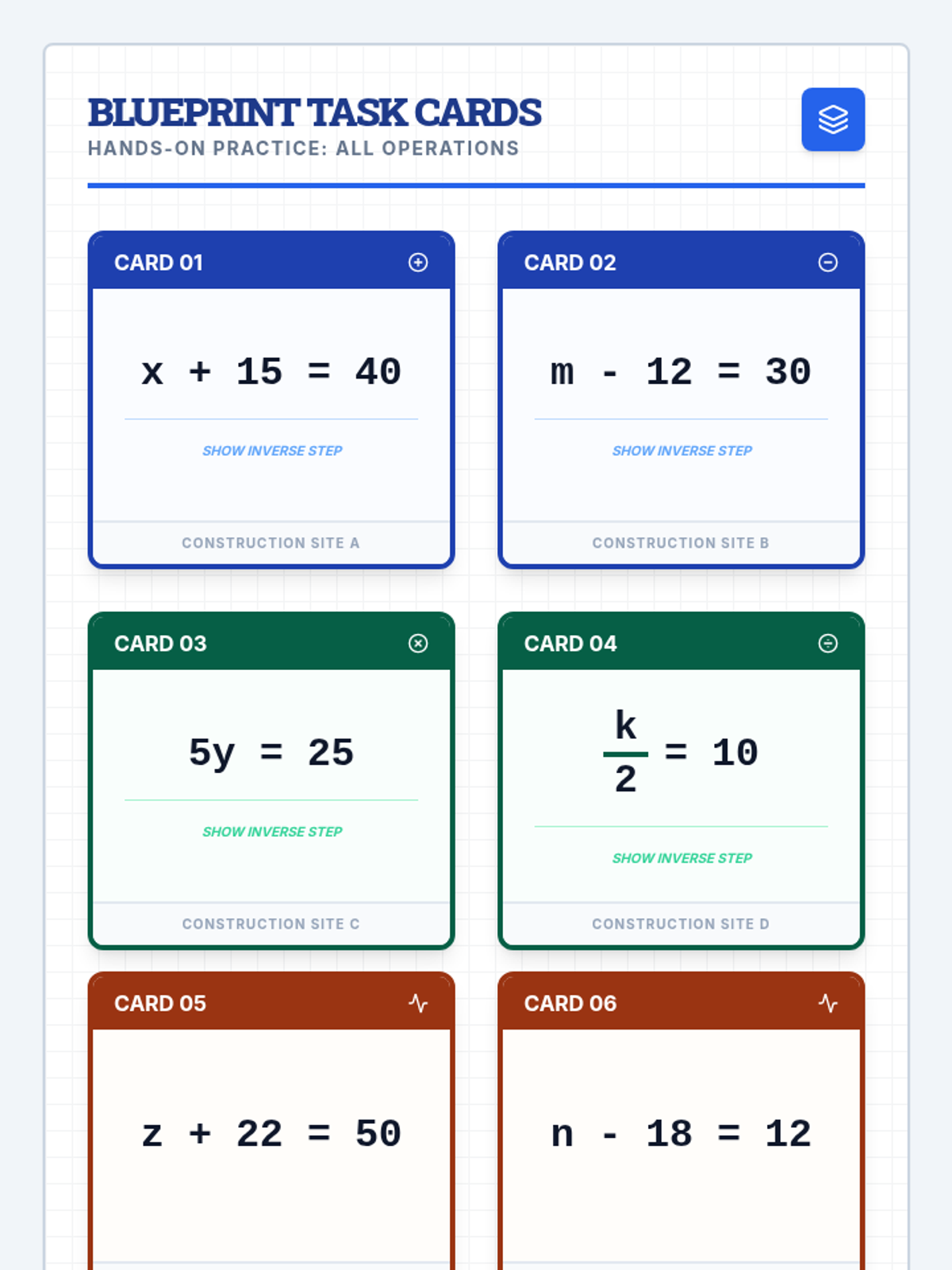
Blueprint Task Cards
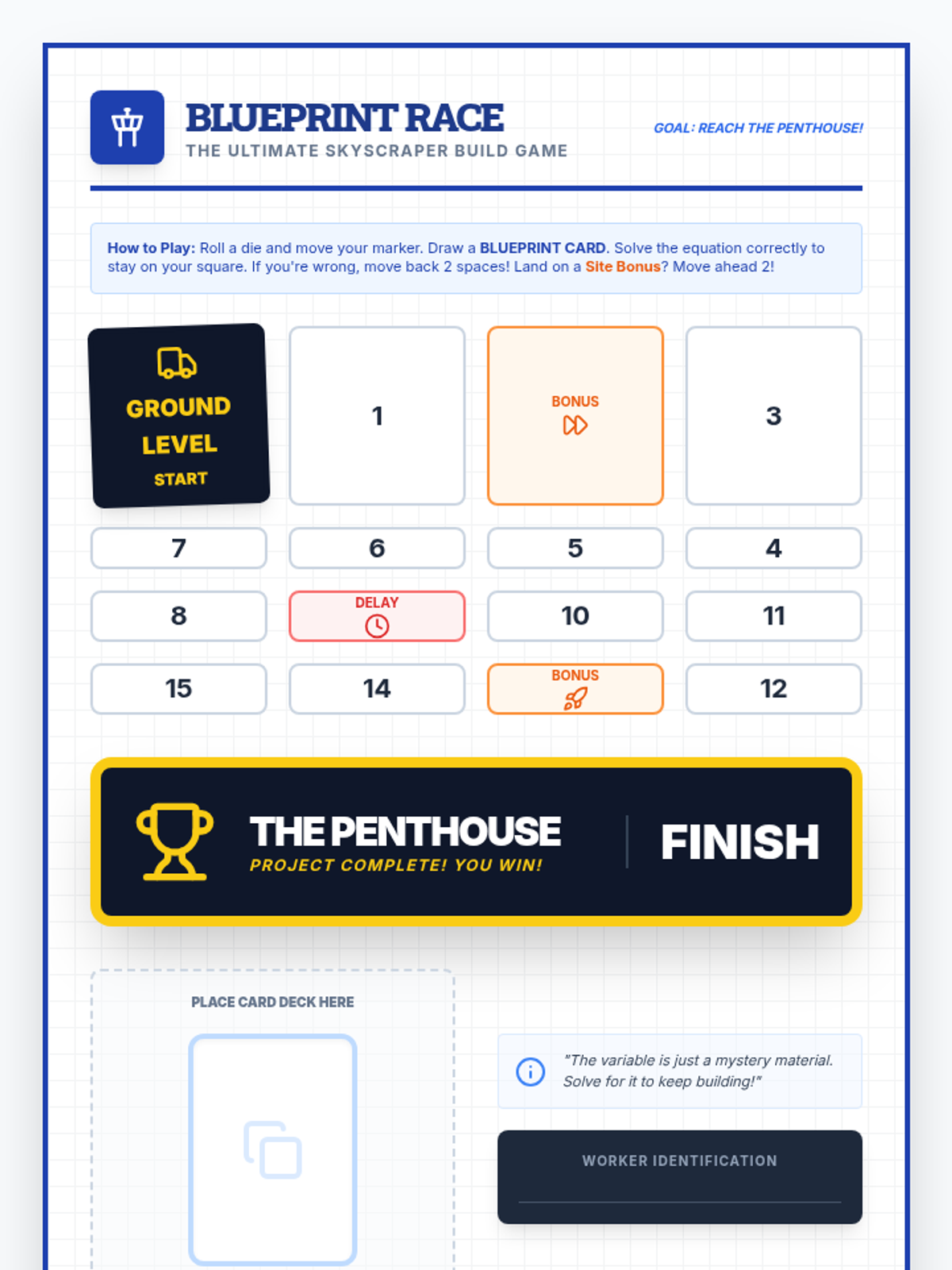
Blueprint Race Game
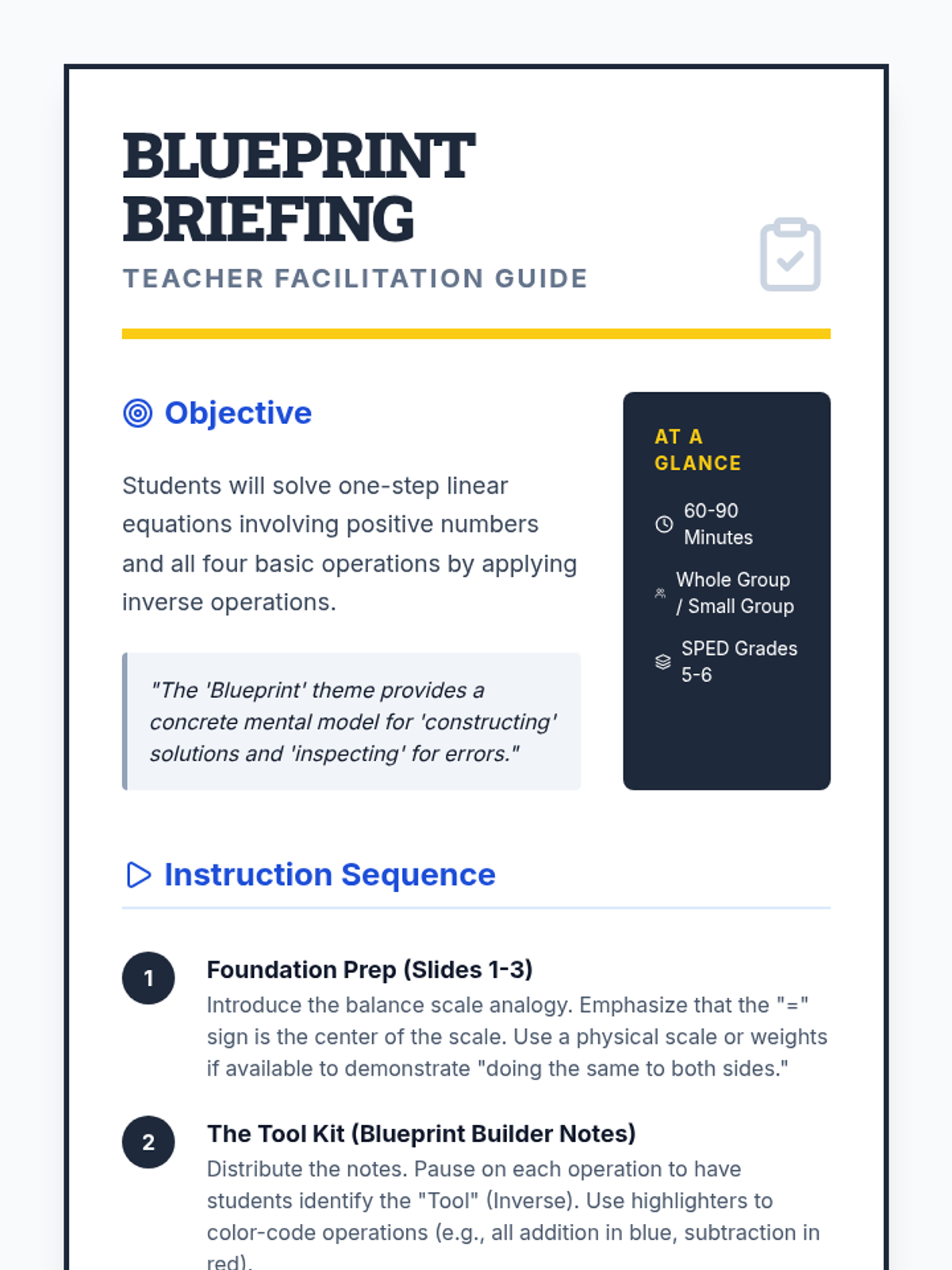
Blueprint Briefing Teacher Guide
Foundation Fixer Answer Key
Structure Solver Answer Key
Project Manager Answer Key
Site Inspection Answer Key
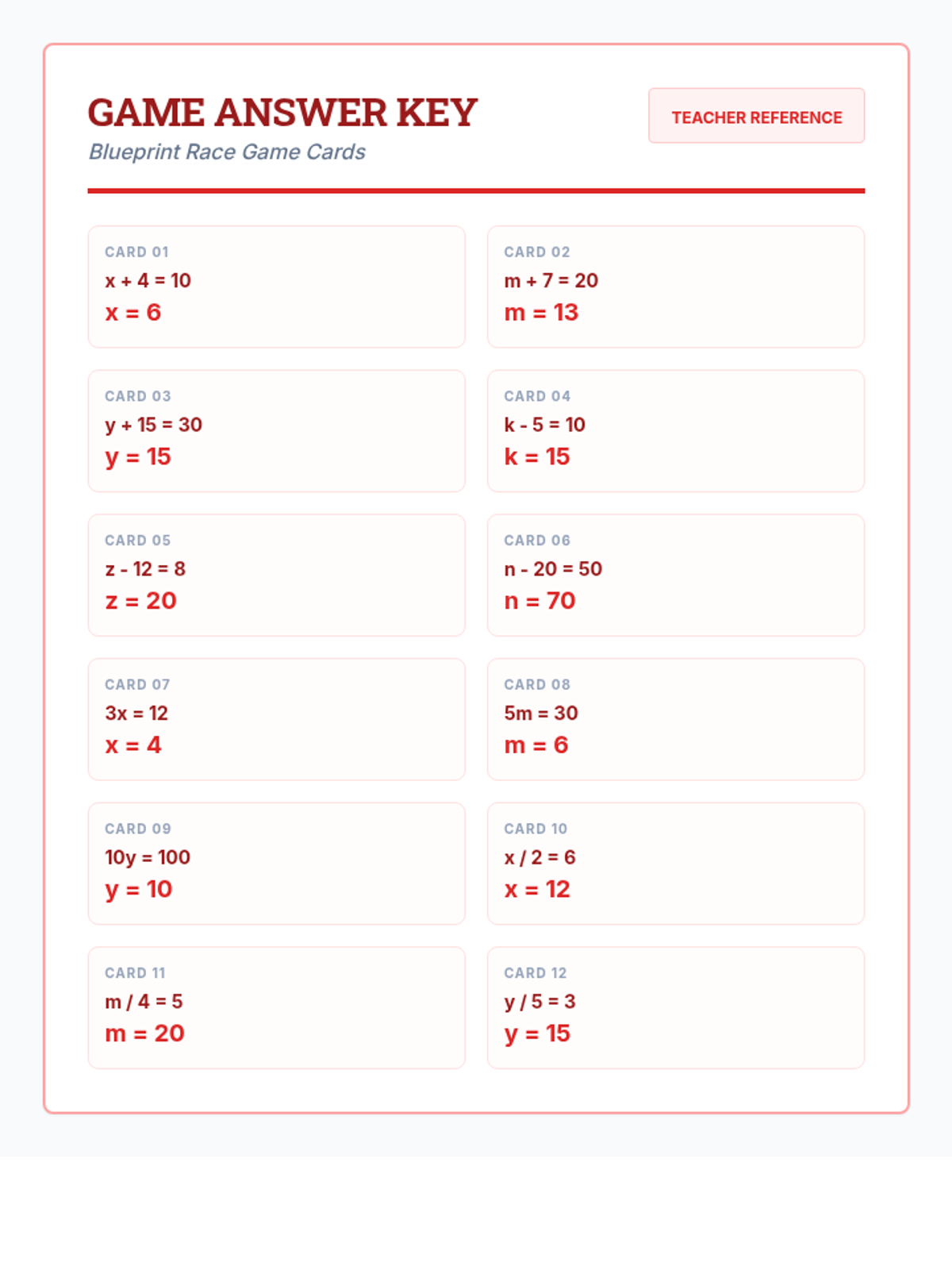
Blueprint Race Game Answer Key

Foundational Math Builders

A foundational math sequence for special education students (grades 5-6) focusing on algebraic thinking and spatial reasoning through highly visual, themed units.

JS

Janette Sullivan

Special Education Teacher
2/13
Sequence
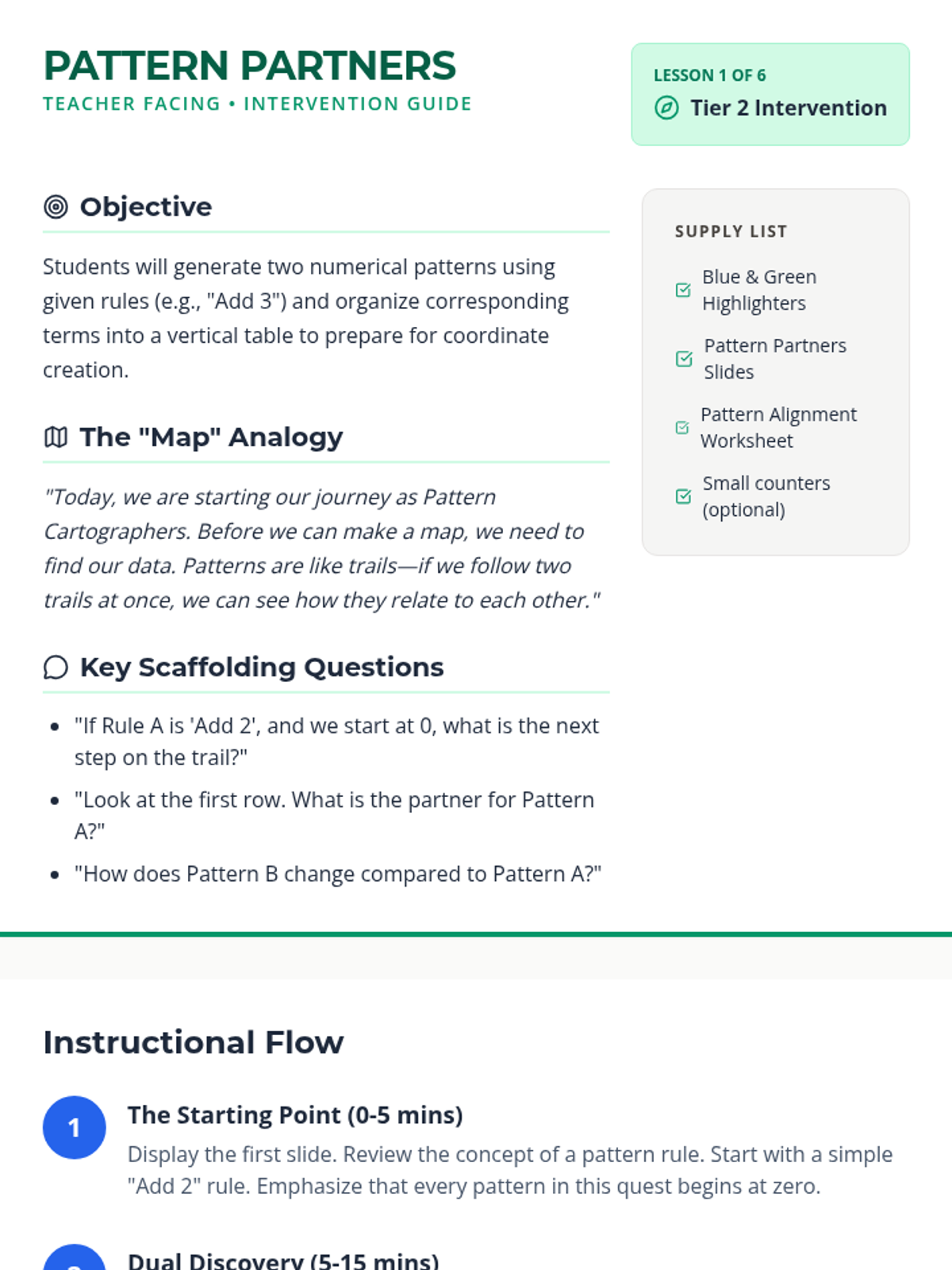
Pattern Partners Teacher Guide
Pattern Partners Slides
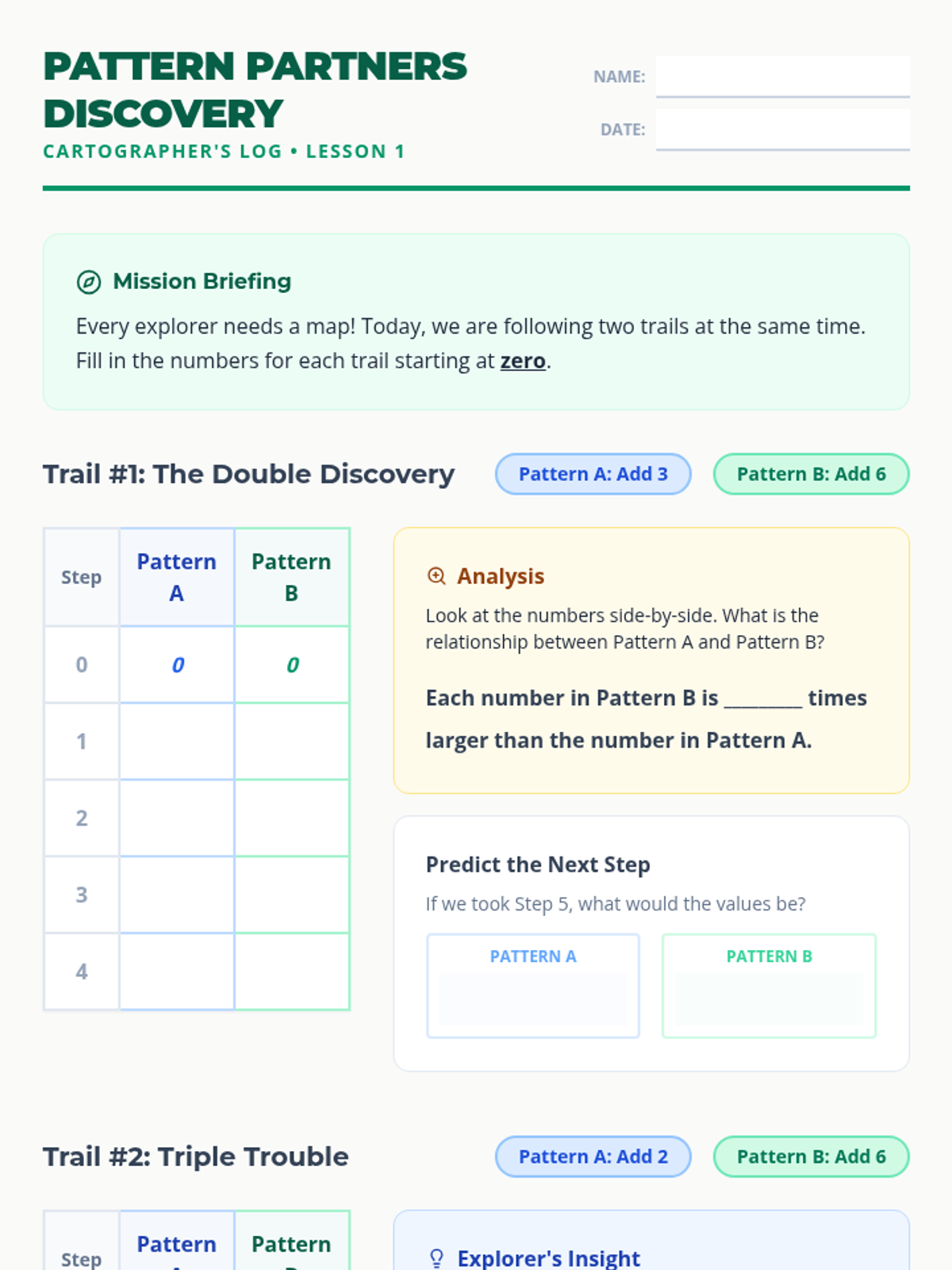
Pattern Partners Worksheet
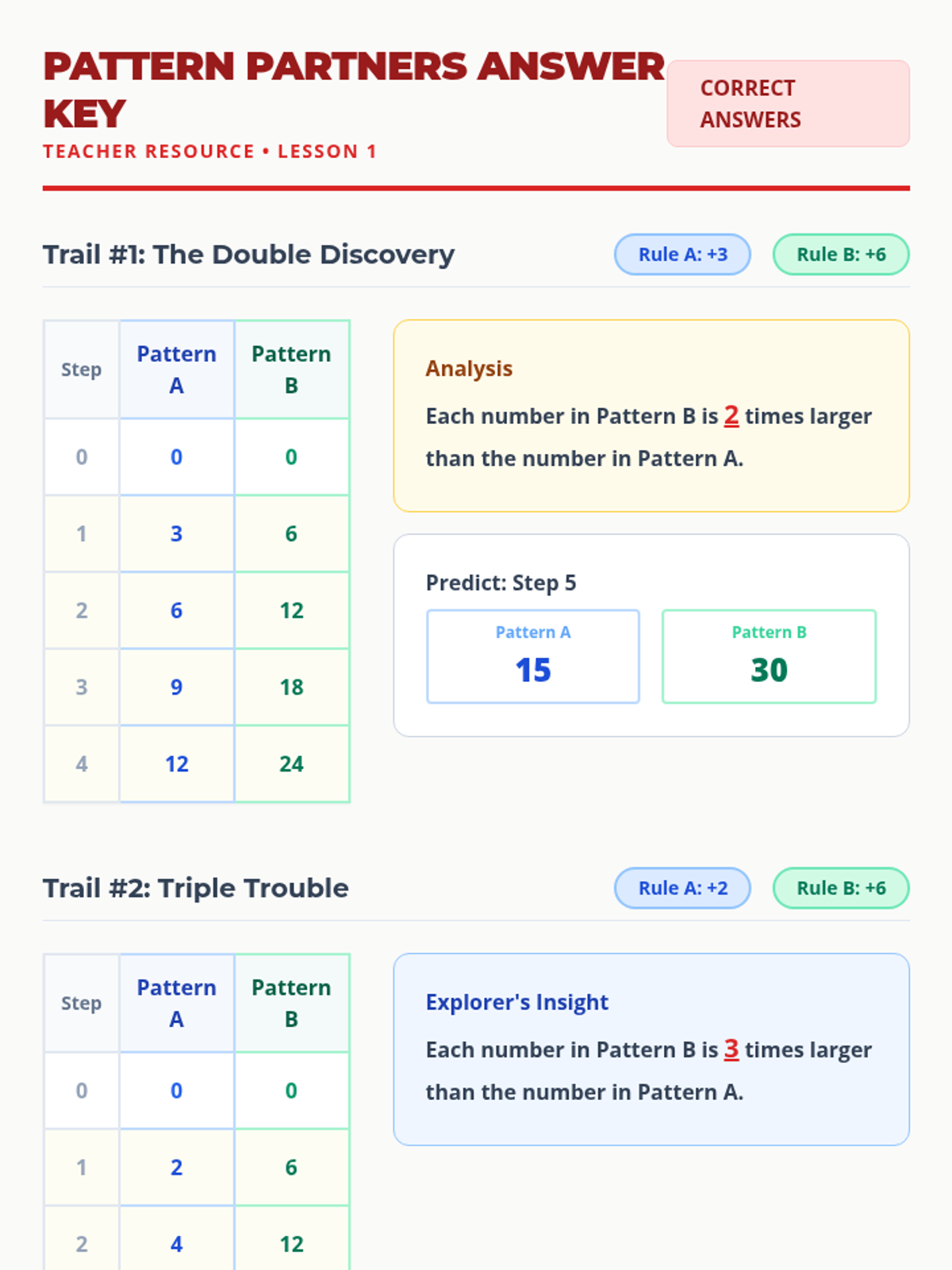
Pattern Partners Answer Key

Pattern Graphing Quest

A 6-lesson Tier 2 intervention designed to help students master the relationship between numerical patterns, converting them into ordered pairs, and graphing them on a coordinate plane using a cartography and exploration theme.

MG

Mo Godin

Counselor
2/11
Sequence
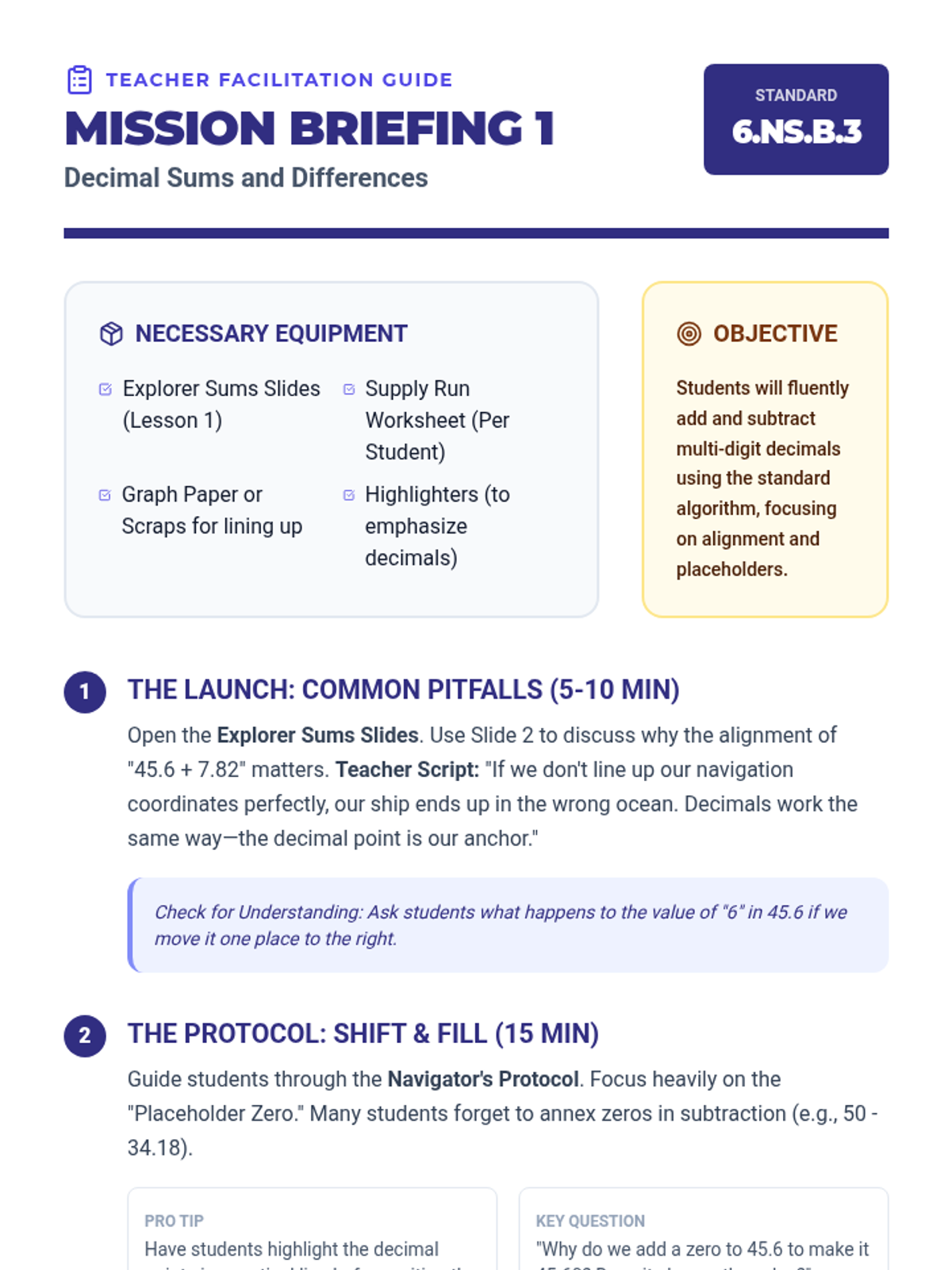
Sums and Differences Teacher Guide
Explorer Sums Slides
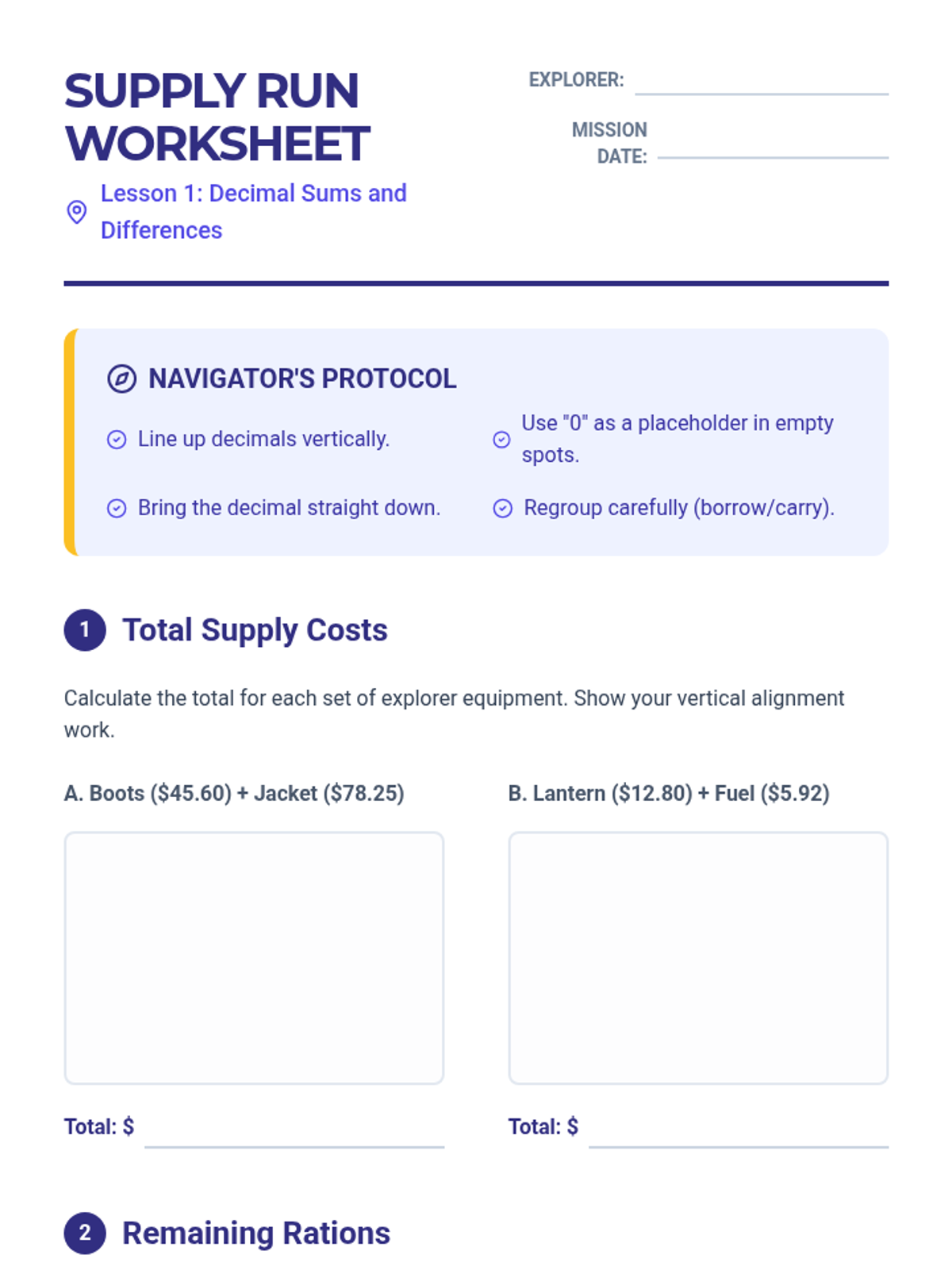
Supply Run Worksheet

Number Navigator Tier 2 Intervention

A 12-lesson Tier 2 intervention sequence for 6th-grade students focused on computational fluency with decimals and the system of rational numbers. The sequence follows the All Learner Network High Leverage Concepts, moving from multi-digit decimal operations to complex coordinate plane navigation.

D

dfredericks

Math Teacher
2/6
Sequence
Unit Overview Resource

Math Intensive Lab

A comprehensive math intervention sequence for 6th-grade students, focusing on four key domains: Numbers & Operations, Algebraic Thinking, Measurement & Data, and Geometry. This sequence uses high-leverage strategies from the All Learners Network (ALN) and aligns with i-Ready prerequisite modules to bridge conceptual gaps.

D

dfredericks

Math Teacher
2/5
Sequence
Solid Scanners Slides
Parts of the Whole Worksheet
Solid Scanners Teacher Guide

Polyhedra Power

A comprehensive geometry and engineering sequence where 6th-grade students explore the relationship between 2D nets and 3D solids. Students progress from identifying geometric parts to calculating surface area for prisms and pyramids, culminating in a real-world packaging design challenge.

Lenny Avatar
Lenny
1/18
Sequence
Quadrilateral Hierarchy Presentation
Quadrilateral Case Files Worksheet
Hierarchy Master Guide Resource

Polygon Logic Academy

A mastery-based sequence focusing on the logical hierarchy of geometric shapes, addressing complex classifications and property-based definitions through Venn diagrams and logic puzzles.

Lenny Avatar
Lenny
1/18
Sequence
Missing Variable Slides
Pizza Slice Puzzle Worksheet
Pizza Slice Puzzle Key

Geometric Reasoning and Angle Relationships

A 5-lesson unit for 6th-grade students transitioning from basic angle measurement to algebraic reasoning. Students use deductive logic and geometric rules (complementary, supplementary, vertical) to solve 'case files' and 'puzzles', preparing them for advanced geometry.

Lenny Avatar
Lenny
1/17
Sequence
Extreme Angles Slides
Angle Field Guide Worksheet

Applied Geometry in Architectural Design

A 5-lesson math sequence where students explore angle relationships through the lens of architectural design, moving from identifying angles in the environment to drafting their own structural blueprints.

Lenny Avatar
Lenny
1/17
Sequence
Angle Anatomy Slides
Angle Anatomy Workshop Worksheet

Angle Measurement Mastery

This sequence guides 6th-grade students through the mechanics of geometry, focusing on identifying, measuring, classifying, and constructing angles with precision. Students move from basic anatomy to mastery of the protractor and error analysis.

Lenny Avatar
Lenny
1/17
Sequence
Blueprint Basics Slides
Foundation Layouts Worksheet
Foundation Layouts Answer Key

Geometric Modeling of the Distributive Property

This inquiry-based sequence utilizes geometric area models to conceptualize the distributive property. Students move from concrete arithmetic to abstract algebraic manipulation, eventually fluently expanding linear expressions with rational coefficients.

Lenny Avatar
Lenny
1/17
Sequence
Area Model Architects Worksheet
Area Model Slides

Equivalent Expression Structures

An inquiry-based exploration of algebraic structures using area models, the distributive property, and combining like terms to understand mathematical equivalence.

Lenny Avatar
Lenny
1/17
Sequence
Expression Translator Slides
Math Telephone Teacher Guide
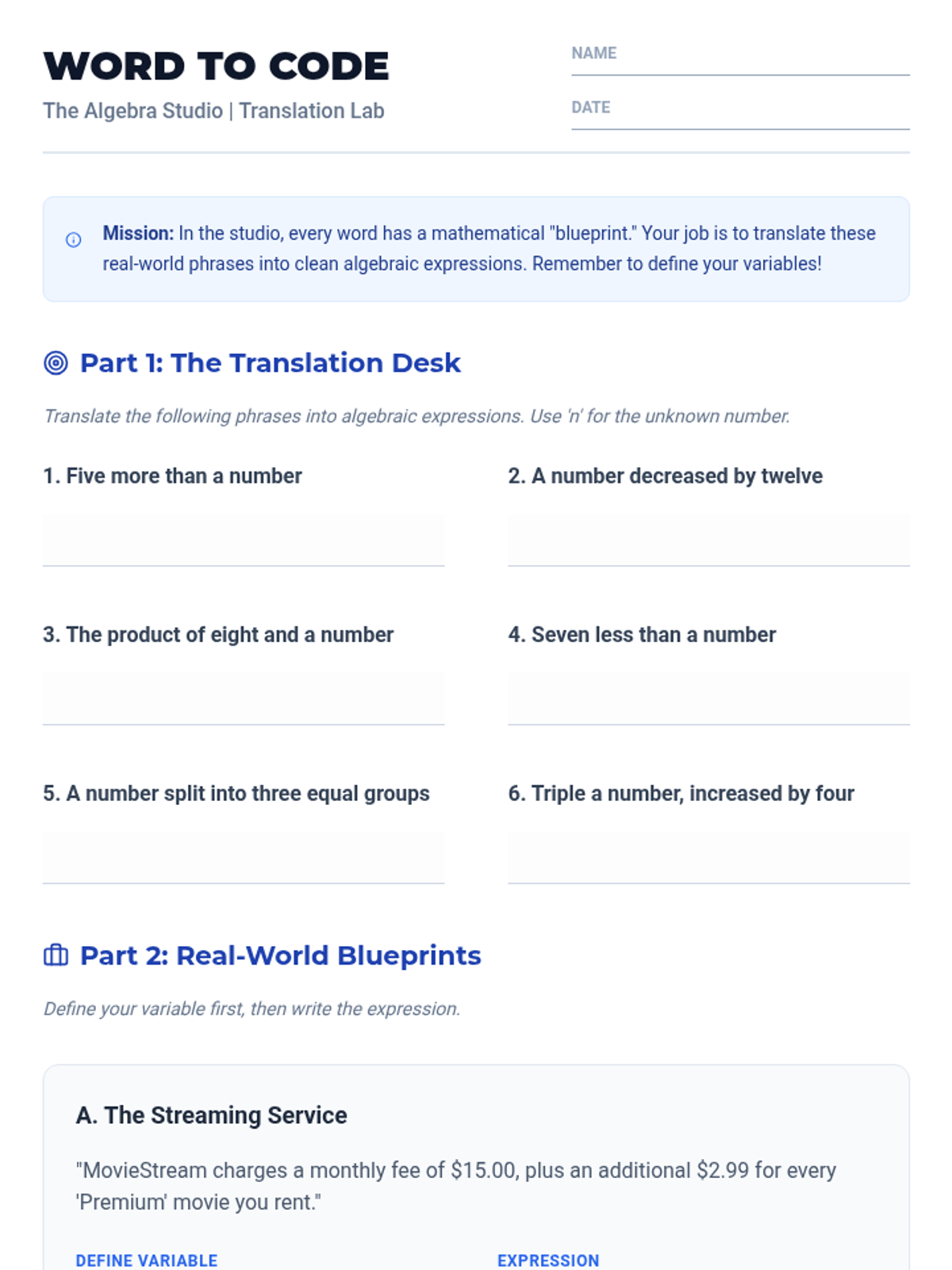
Word to Code Worksheet

The Algebra Studio

This sequence explores how different algebraic structures represent real-world scenarios, specifically focusing on percents, geometry, and financial modeling. Students learn to translate verbal descriptions, analyze equivalent expressions, and apply their knowledge to a final project as financial consultants.

Lenny Avatar
Lenny
1/17
Sequence
Unfolding Solids Slides
Net Detective Worksheet
Cereal Box Lab Guide

Blueprint to Build

This sequence builds spatial reasoning by connecting 2D nets to 3D surface area. Students move from physical deconstruction of boxes to calculating surface area for rectangular prisms, triangular prisms, and pyramids, culminating in a packaging optimization challenge.

Lenny Avatar
Lenny
1/17
Sequence
Bingo Presentation Slides
Polygon Bingo Boards
Bingo Caller Guide

Polygon Logic

A game-based sequence focused on rapid identification and logical deduction using polygon properties through bingo, riddles, and simulations. Students build fluency in identifying shapes and distinguishing between subtle differences.

Lenny Avatar
Lenny
1/17
Sequence
Line Detectives Presentation
Line Detective Log Worksheet
Line Detectives Teacher Guide

Geometry Architects Parallel and Perpendicular Constructions

Students explore geometric constructions focusing on parallel and perpendicular relationships using tools and folding techniques, culminating in a city grid design project.

Lenny Avatar
Lenny
1/17
Sequence
Skyscraper Secrets Slides
Geometry Walk Facilitation Guide
Structural Scout Field Notes

Geometric Structures

Students act as junior architects to apply geometric concepts (lines, angles, and shapes) to real-world architecture and urban planning. The sequence moves from observing existing structures to designing city maps and building facades, culminating in a geometric portfolio presentation.

Lenny Avatar
Lenny
1/17
Sequence
Le Bon Cadre Presentation
Le Bon Cadre Fiche Minute

L'Atelier Photo

Une série de micro-leçons de 10 minutes centrée sur l'optimisation de l'espace papier. Les élèves apprennent à mettre à l'échelle une mise en page de 6 photos (format A4) vers le format Raisin (50x65 cm) en minimisant les chutes.

SB

saida bendaoud

Special Education Teacher
2/13
Sequence
Rectangle Remix Slides
Rectangle Remix Worksheet
Rectangle Remix Teacher Guide

Shape Shifters Intervention

A 12-lesson Tier 2 intervention sequence focused on developing conceptual understanding of area and volume for 6th-grade students. Using the All Learners Network High Leverage Concepts, students move from concrete tiling to decomposing shapes and finally calculating volume with fractional edges and surface area with nets.

D

dfredericks

Math Teacher
2/6
Sequence
Unit Overview Resource

Math Intensive Lab

A comprehensive math intervention sequence for 6th-grade students, focusing on four key domains: Numbers & Operations, Algebraic Thinking, Measurement & Data, and Geometry. This sequence uses high-leverage strategies from the All Learners Network (ALN) and aligns with i-Ready prerequisite modules to bridge conceptual gaps.

D

dfredericks

Math Teacher
2/5
Sequence
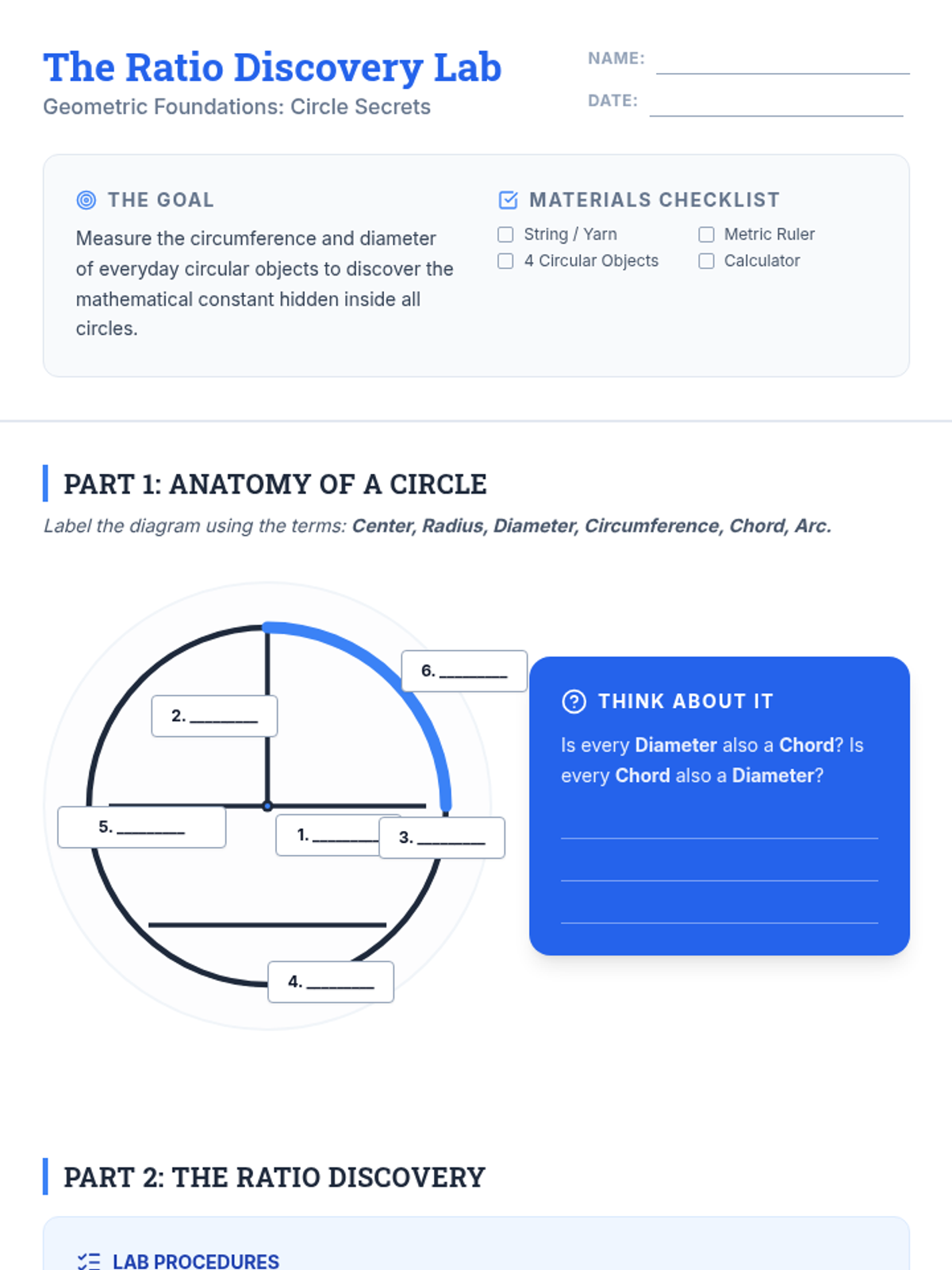
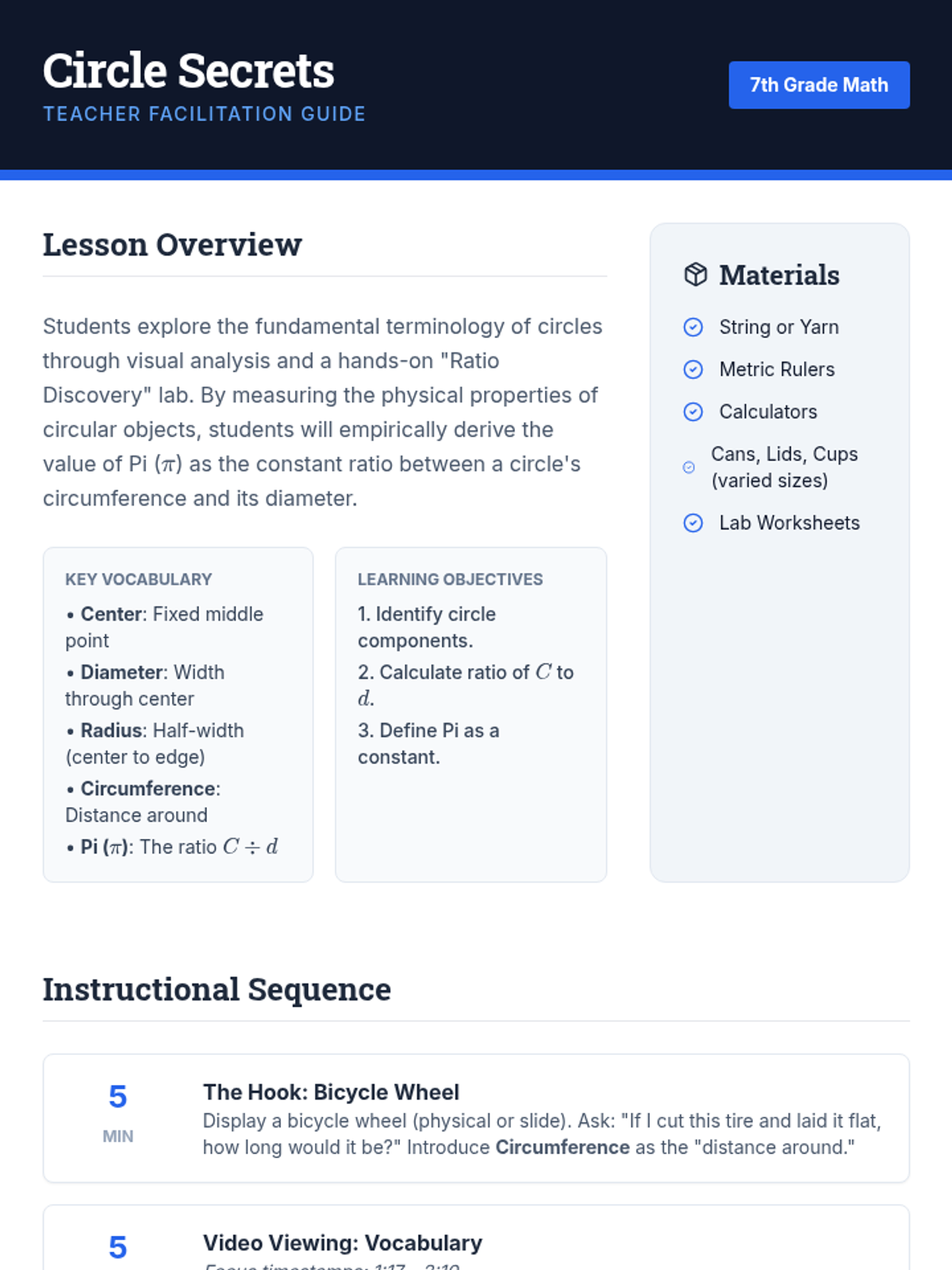
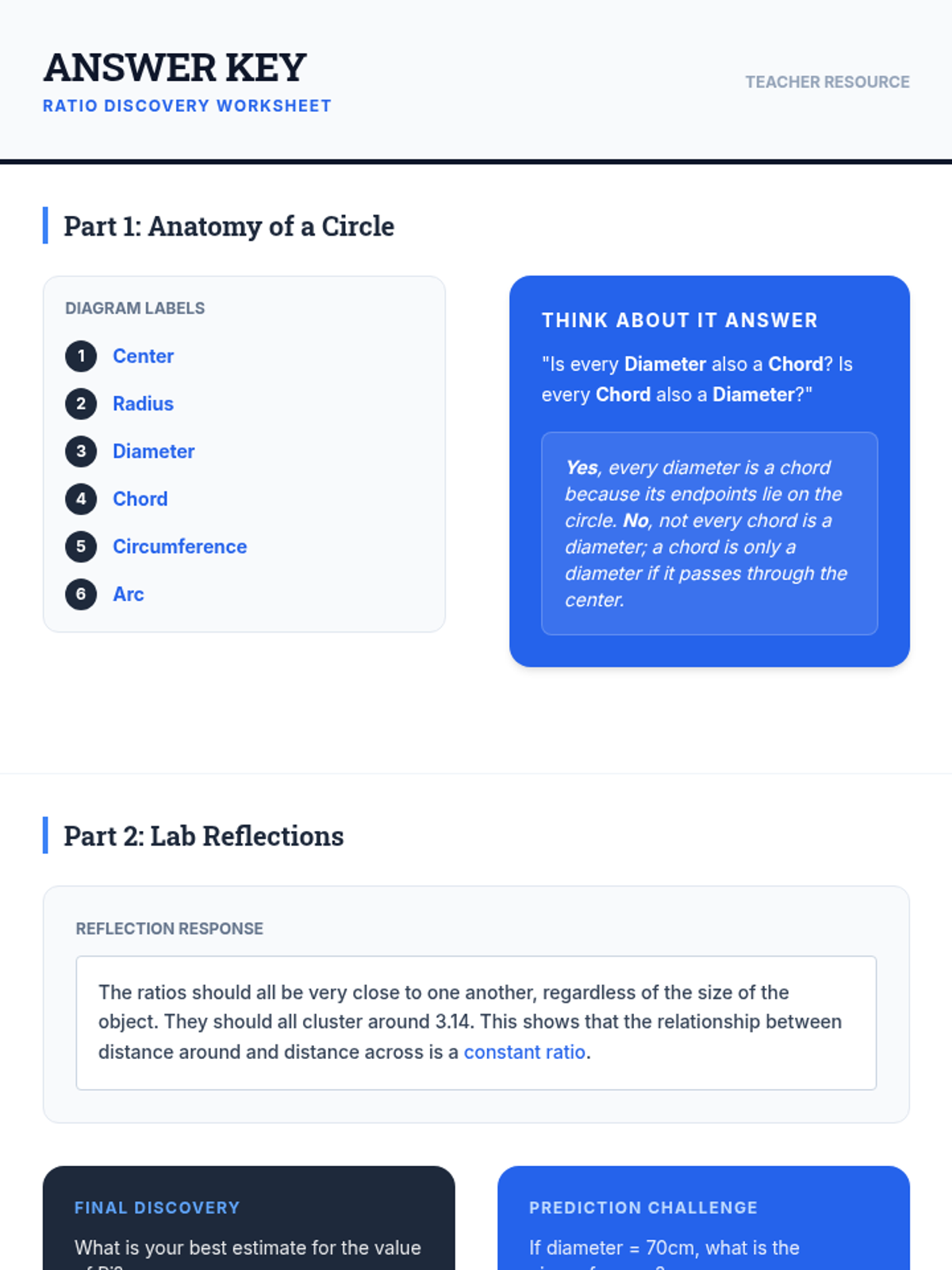
Circle Secrets Slides
Ratio Discovery Worksheet
Circle Secrets Teacher Guide
Ratio Discovery Answer Key

Geometric Foundations

A mathematics sequence focusing on geometry, circles, and the calculation of circumference and area for middle school students.

Lenny Avatar
Lenny
1/19
Sequence
Stronger Shapes Slides
Truss Tester Worksheet
Stronger Shapes Teacher Guide

Structural Geometry Engineering

This sequence bridges geometry and physics, investigating the structural properties of 2D and 3D shapes. Students analyze rigidity, tessellation, and surface area-to-volume ratios to understand how geometric attributes influence physical performance in engineering and nature.

Lenny Avatar
Lenny
1/18
Sequence
Radar Refresh Slides
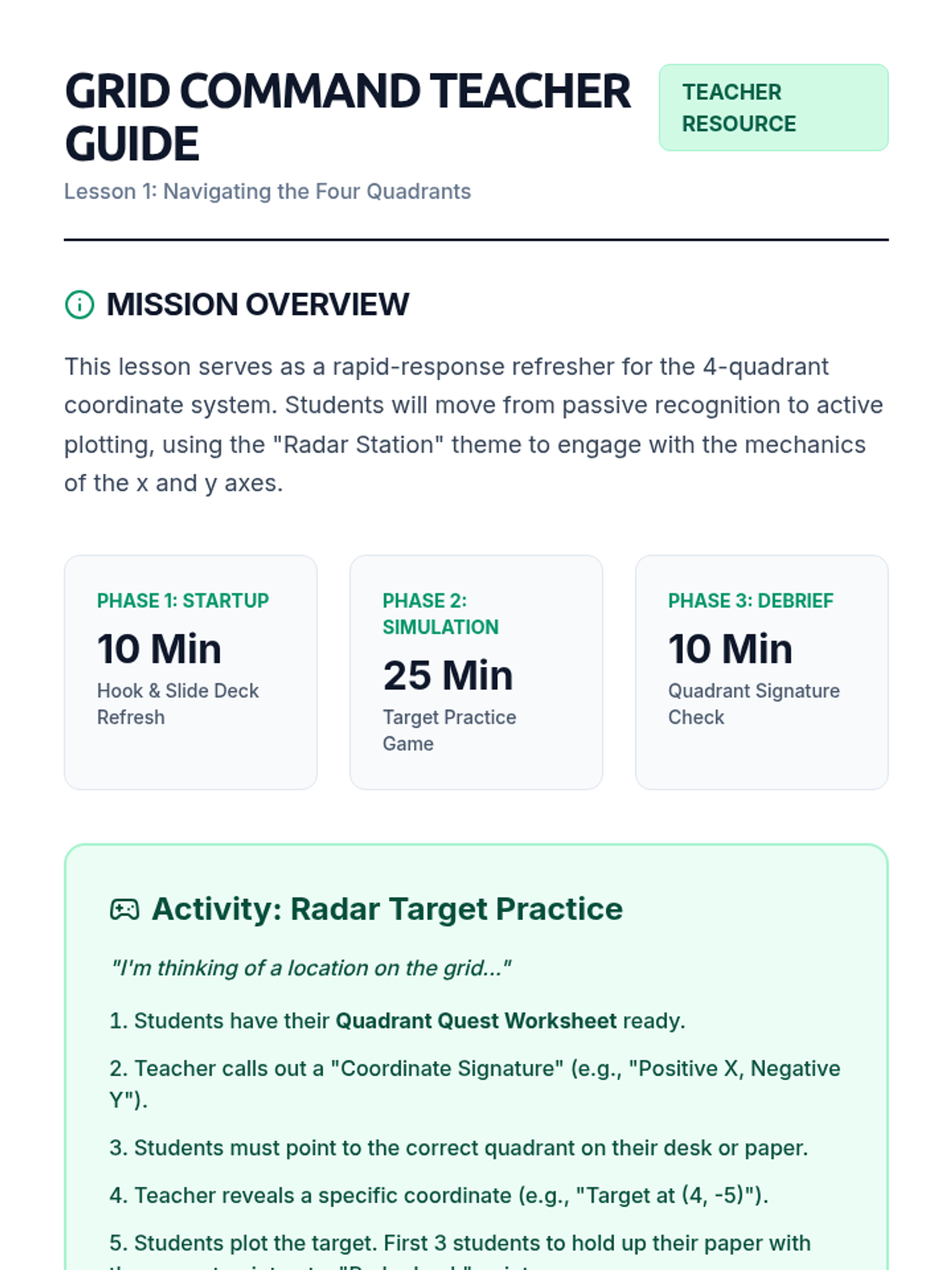
Grid Command Teacher Guide
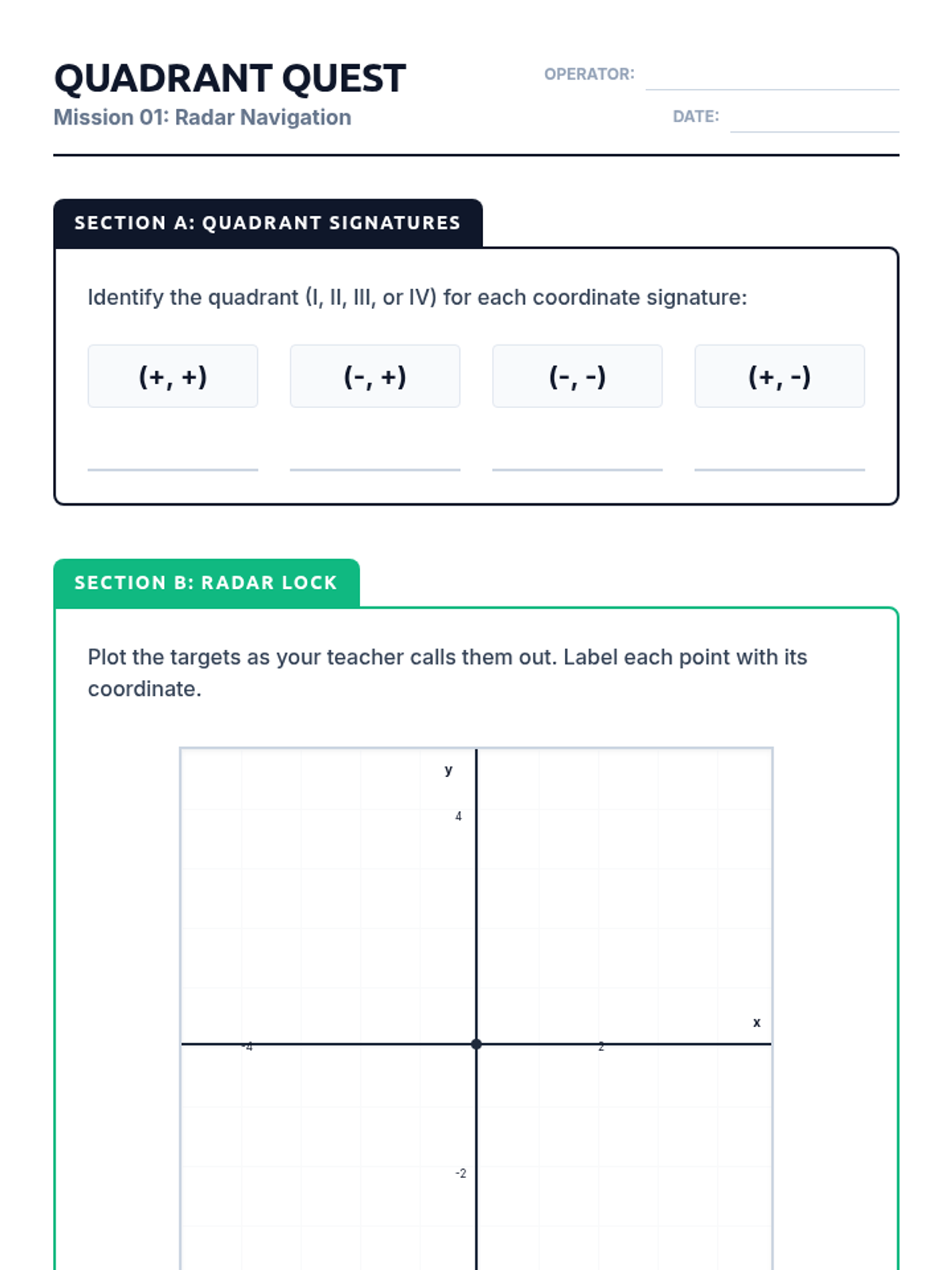
Quadrant Quest Worksheet

Coordinate Geometry Polygons

A game-based exploration of polygons on the coordinate plane. Students learn to plot, calculate distance, reflect shapes, and deduce geometric properties using coordinate data in all four quadrants.

Lenny Avatar
Lenny
1/18
Sequence
Cube Quest Slides
Cube Quest Worksheet
Cube Quest Teacher Guide

Volume Voyager Sequence

This sequence guides 6th-grade students through the conceptual and procedural aspects of calculating the volume of rectangular prisms. Starting with unit cubes and moving through fractional edge lengths and composite figures, students develop a deep understanding of 3D space measurement.

Lenny Avatar
Lenny
1/18
Sequence
Solid Scanners Slides
Parts of the Whole Worksheet
Solid Scanners Teacher Guide

Polyhedra Power

A comprehensive geometry and engineering sequence where 6th-grade students explore the relationship between 2D nets and 3D solids. Students progress from identifying geometric parts to calculating surface area for prisms and pyramids, culminating in a real-world packaging design challenge.

Lenny Avatar
Lenny
1/18
Sequence
Quad Quest Slides
Grid Navigator Worksheet
Human Battleship Guide

Shape Mapper Sequence

This sequence introduces 6th-grade students to the coordinate plane as a tool for geometric modeling, moving from basic point plotting to calculating area, perimeter, and distance of complex polygons within all four quadrants.

Lenny Avatar
Lenny
1/18
Sequence
Spin Master Slides
Circle Circuit Worksheet
Degrees Explained Teacher Guide

Angle Architects

This workshop-style sequence transitions students from visual estimation to precise measurement using a protractor. Students learn the logic behind the 360-degree circle and how to align a protractor correctly to read measurements.

Lenny Avatar
Lenny
1/18
Sequence
Protractor Mechanics Slides
Angle Eye Workshop Worksheet
Angle Mechanics Teacher Guide

Precision Angles and Construction

This sequence focuses on the fundamental proficiency of using geometric tools to measure and construct angles with high precision. Students learn protractor mechanics, estimation techniques, construction procedures, and error analysis through an engineering and drafting lens.

Lenny Avatar
Lenny
1/17
Sequence
Angle Anatomy Slides
Angle Anatomy Workshop Worksheet

Angle Measurement Mastery

This sequence guides 6th-grade students through the mechanics of geometry, focusing on identifying, measuring, classifying, and constructing angles with precision. Students move from basic anatomy to mastery of the protractor and error analysis.

Lenny Avatar
Lenny
1/17
Sequence
Metric Lab Slides
Metric Lab Sheet
Metric Lab Teacher Guide

Precision Power: Decimal Fractions in Action

This sequence connects abstract decimal fractions to tangible measurement and data analysis. Students act as scientists and analysts using metric tools, financial data, and sports timing to understand the necessity of precise decimal notation.

Lenny Avatar
Lenny
1/17
Sequence
Blueprint for Division Teacher Guide
Blueprint for Division Worksheet
Blueprint for Division Slides

Fraction Factory Logistics

This sequence guides students from conceptual modeling of fraction division to applying the standard algorithm with mixed numbers in complex geometric and real-world contexts. Students will explore the 'why' behind the reciprocal before mastering the 'how' and applying it to find missing dimensions and unit rates.
Lenny Avatar
Lenny
1/17
Sequence
Blueprint Basics Slides
Foundation Layouts Worksheet
Foundation Layouts Answer Key

Geometric Modeling of the Distributive Property

This inquiry-based sequence utilizes geometric area models to conceptualize the distributive property. Students move from concrete arithmetic to abstract algebraic manipulation, eventually fluently expanding linear expressions with rational coefficients.

Lenny Avatar
Lenny
1/17
Sequence
Walking the Path Slides
Perimeter Patterns Worksheet

Equivalent Expression Geometry

A project-based math sequence for 6th grade where students explore equivalent algebraic expressions through the lens of geometric design, perimeter, and area. Students act as landscape architects to discover how different forms of the same expression can simplify calculations and reveal geometric properties.
Lenny Avatar
Lenny
1/17
Sequence
Area Model Blueprints Worksheet
Area Model Blueprints Slides
Area Model Blueprints Teacher Guide

Expression Architects

This sequence guides 6th-grade students through the conceptual and procedural mastery of the Distributive Property. Starting with concrete area models, students learn to expand and factor expressions, ultimately building a deep understanding of algebraic structure.

Lenny Avatar
Lenny
1/17
Sequence
Substitution Sleuths Slides
Substitution Sleuths Worksheet
Substitution Sleuths Answer Key

Expression Twin Detectives

This inquiry-based sequence challenges 6th-grade students to determine when and why two different-looking expressions are equivalent. Students move from numerical verification via substitution to geometric visualization with area models, and finally to algebraic justification using properties of operations.
Lenny Avatar
Lenny
1/17
Sequence
Expression Translator Slides
Math Telephone Teacher Guide
Word to Code Worksheet

The Algebra Studio

This sequence explores how different algebraic structures represent real-world scenarios, specifically focusing on percents, geometry, and financial modeling. Students learn to translate verbal descriptions, analyze equivalent expressions, and apply their knowledge to a final project as financial consultants.
Lenny Avatar
Lenny
1/17
Sequence
Unit Cube Investigation Teacher Guide
Packing the Box Worksheet
Cubic Capacity Slides
Packing the Box Answer Key

Understanding Volume Through Base Area and Height

This inquiry-based sequence establishes the foundational conceptual understanding of volume as the accumulation of two-dimensional layers. Students move from counting unit cubes to deriving the universal formula V = Bh for prisms by exploring rectangular and triangular shapes.
Lenny Avatar
Lenny
1/17
Sequence
Cube Quest Slides
Cube Quest Worksheet
Cube Quest Teacher Guide

Volume Voyager Sequence

This sequence guides 6th-grade students through the conceptual and procedural aspects of calculating the volume of rectangular prisms. Starting with unit cubes and moving through fractional edge lengths and composite figures, students develop a deep understanding of 3D space measurement.
Lenny Avatar
Lenny
1/18
Sequence
Unit Cube Investigation Teacher Guide
Packing the Box Worksheet
Cubic Capacity Slides
Packing the Box Answer Key

Understanding Volume Through Base Area and Height

This inquiry-based sequence establishes the foundational conceptual understanding of volume as the accumulation of two-dimensional layers. Students move from counting unit cubes to deriving the universal formula V = Bh for prisms by exploring rectangular and triangular shapes.

Lenny Avatar
Lenny
1/17
Sequence
Space Filling Slides
Cover or Fill Worksheet

Volume Blueprint

This sequence guides 6th-grade students through the conceptual derivation of volume formulas for rectangular prisms, moving from concrete unit cubes to abstract formulas. students explore the distinction between area and volume, discover the lwh formula through packing, and master the base-area method.

Lenny Avatar
Lenny
1/17
Sequence
Liquid Logic Slides
Liquid Logic Lab Report

Applied Volume and Capacity Logistics

A 6th-grade geometry unit exploring real-world applications of volume, capacity, and logistical optimization. Students solve problems involving liquid conversion, material efficiency, filling rates, and cost estimation through a logistics lens.

Lenny Avatar
Lenny
1/17
Sequence
Figure Fragmentation Worksheet
Figure Fragmentation Slides
Spatial Skills Teacher Guide

Volume Analysis of Composite Figures

This sequence guides 6th-grade students through the process of analyzing and calculating the volume of composite 3D figures. Students progress from basic spatial decomposition to additive and subtractive volume strategies, culminating in a real-world design project for a custom aquarium.

Lenny Avatar
Lenny
1/17
Sequence
Slice and Scale Slides
Slice and Scale Lab Worksheet

Volume Blueprint Workshop

A comprehensive 6th-grade geometry sequence exploring volume with fractional edge lengths. Students move from concrete visual modeling with unit cubes to abstract formula application and complex real-world packing problems.

Lenny Avatar
Lenny
1/17
Sequence
Base Blueprints Slides
Base Hunt Worksheet
Base Review Teacher Guide

Foundations of Volume Prisms and Cylinders

This sequence explores the relationship between 2D base area and 3D volume for prisms and cylinders. Students build a deep conceptual understanding of the \(V = Bh\) formula through hands-on hooks, visual derivations, and real-world application problems.

Lenny Avatar
Lenny
1/17
Sequence
Solid Deconstruction Slides
Blueprint Log Worksheet

Spatial Architects Additive Volume

A project-based exploration of additive volume where students act as spatial architects to decompose complex 3D structures and design their own volume-constrained modules.

Lenny Avatar
Lenny
1/17
Sequence
Formula Discovery Slides
Cube to Code Worksheet
Volume Derivation Teacher Guide

Volume Formula Mastery

This workshop-style sequence transitions students from counting cubes to applying standard algorithms for calculating volume. Students derive and master the formulas V = l × w × h and V = B × h, progressing from straightforward calculations to solving for missing dimensions and complex real-world word problems.

Lenny Avatar
Lenny
1/17
Sequence
Packing Prisms Slides
Packing Prisms Worksheet
Packing Prisms Teacher Guide

Volume Mastery Workshop

Students transition from concrete unit cube packing to abstract volume formulas (V=lwh, V=Bh) with a specific focus on rectangular prisms with fractional edge lengths. The sequence culminates in real-world application through shipping logistics and a design challenge.

Lenny Avatar
Lenny
1/17
Sequence
Volume vs Capacity Slides
Container Conundrum Worksheet

Capacity and Volume Lab

This sequence explores the practical applications of geometry through the lens of volume and capacity. Students investigate how space is measured in cubic units versus liquid units, solve real-world engineering problems involving aquariums and flow rates, and use displacement to find the volume of irregular objects.

Lenny Avatar
Lenny
1/17
Sequence
Blueprint Breakdown Slides
Blueprint Breakdown Worksheet

Structure Squad

A project-based geometry unit where 6th-grade students act as structural engineers to decompose, calculate, and design complex composite 3D structures using additive and subtractive volume methods.

Lenny Avatar
Lenny
1/17
Sequence
Volume Voyagers Slides
Pyramid Pouring Lab Sheet

Volume Architects

An inquiry-based exploration of the volume relationships between prisms, pyramids, cylinders, cones, and spheres. Students use hands-on simulations and visual derivations to master 3D geometry formulas.

Lenny Avatar
Lenny
1/17
Sequence
Triangular Taper Slides
Taper Blueprint Worksheet

Solid Space Architects

Students become 'Solid Space Architects' as they generalize the volume formula V=Bh to various prisms and cylinders. They move from simple rectangles to triangles, circles, and complex polygons, exploring efficiency and real-world applications of 3D geometry.

Lenny Avatar
Lenny
1/17
Sequence
Cube Quest Slides
Unit Cube Lab Worksheet
Packing Prisms Teacher Guide

Volume Voyagers

This sequence guides 6th-grade students from conceptualizing volume as counting unit cubes to deriving and applying volume formulas (V=lwh and V=Bh) with whole and fractional edge lengths. Students explore volume through inquiry, formalize their understanding, and solve real-world logistics challenges.

Lenny Avatar
Lenny
1/17
Sequence
Chocolate Box Blueprint Worksheet
Packaging Engineer Intro Slides

Packaging Design and Optimization

A 5th-grade geometry sequence exploring volume and surface area through the lens of packaging engineering. Students investigate optimization, real-world constraints, and design prototypes.

Lenny Avatar
Lenny
1/17
Sequence
Formula Mastery Slides
Formula Mastery Worksheet
Formula Mastery Answer Key

Advanced Rectangular Volume

This sequence moves 5th-grade students from whole-number unit cubes to advanced calculation of rectangular prisms using formulas, algebraic thinking for missing dimensions, and proportional reasoning. Students explore how changing dimensions affects volume and apply their knowledge to complex real-world word problems.

Lenny Avatar
Lenny
1/17
Sequence
Blueprint Basics Slides
Blueprint Reference Kit
Structure Solver Worksheet
Blueprint Builder Notes
Site Inspection Assessment
Project Manager Worksheet
Foundation Fixer Worksheet
Master Blueprint Foldable
Blueprint Task Cards
Blueprint Race Game
Blueprint Briefing Teacher Guide
Foundation Fixer Answer Key
Structure Solver Answer Key
Project Manager Answer Key
Site Inspection Answer Key
Blueprint Race Game Answer Key

Foundational Math Builders

A foundational math sequence for special education students (grades 5-6) focusing on algebraic thinking and spatial reasoning through highly visual, themed units.

JS

Janette Sullivan

Special Education Teacher
2/13
Sequence
Mapping the Grid Slides
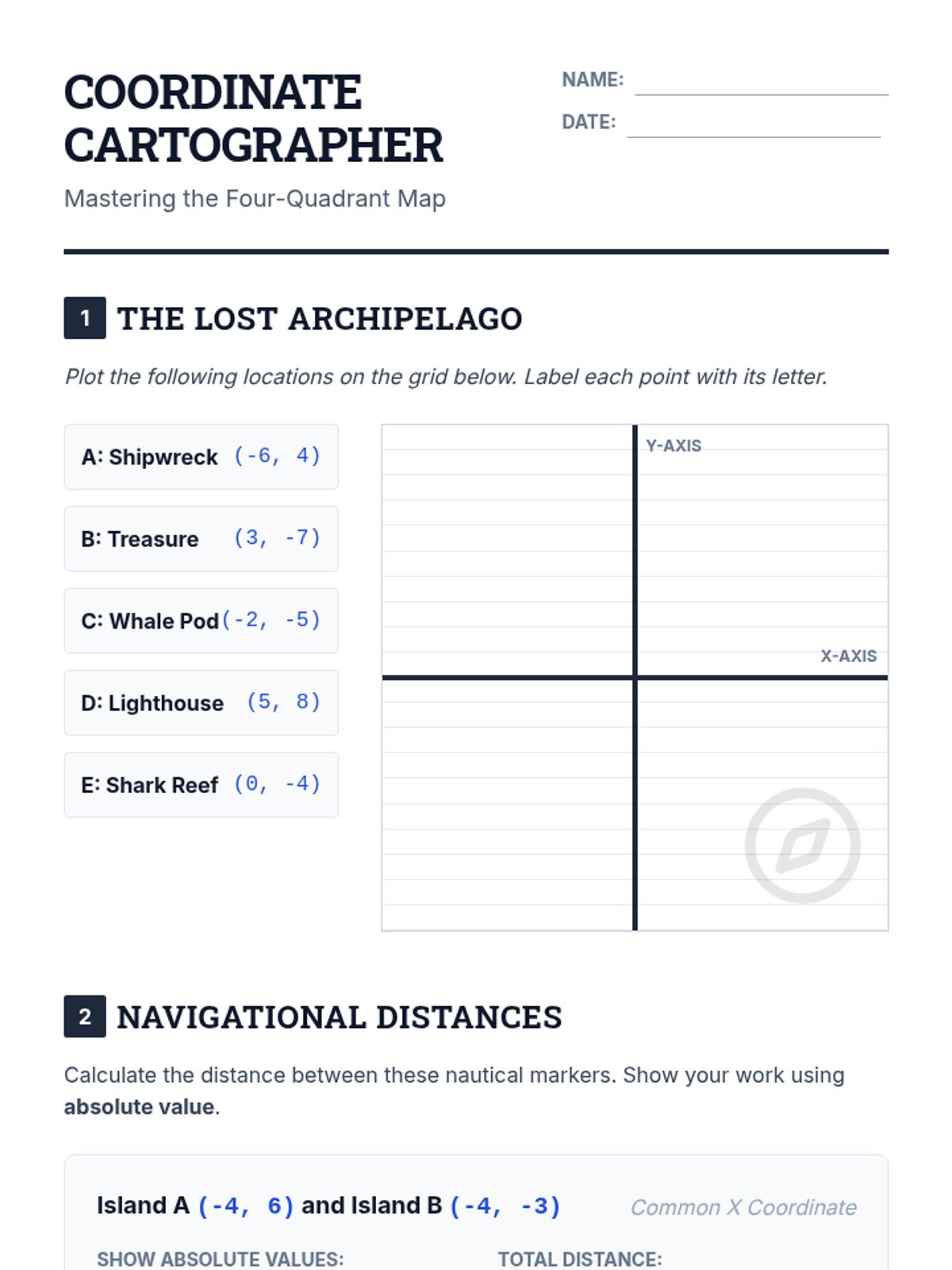
Coordinate Cartographer Worksheet
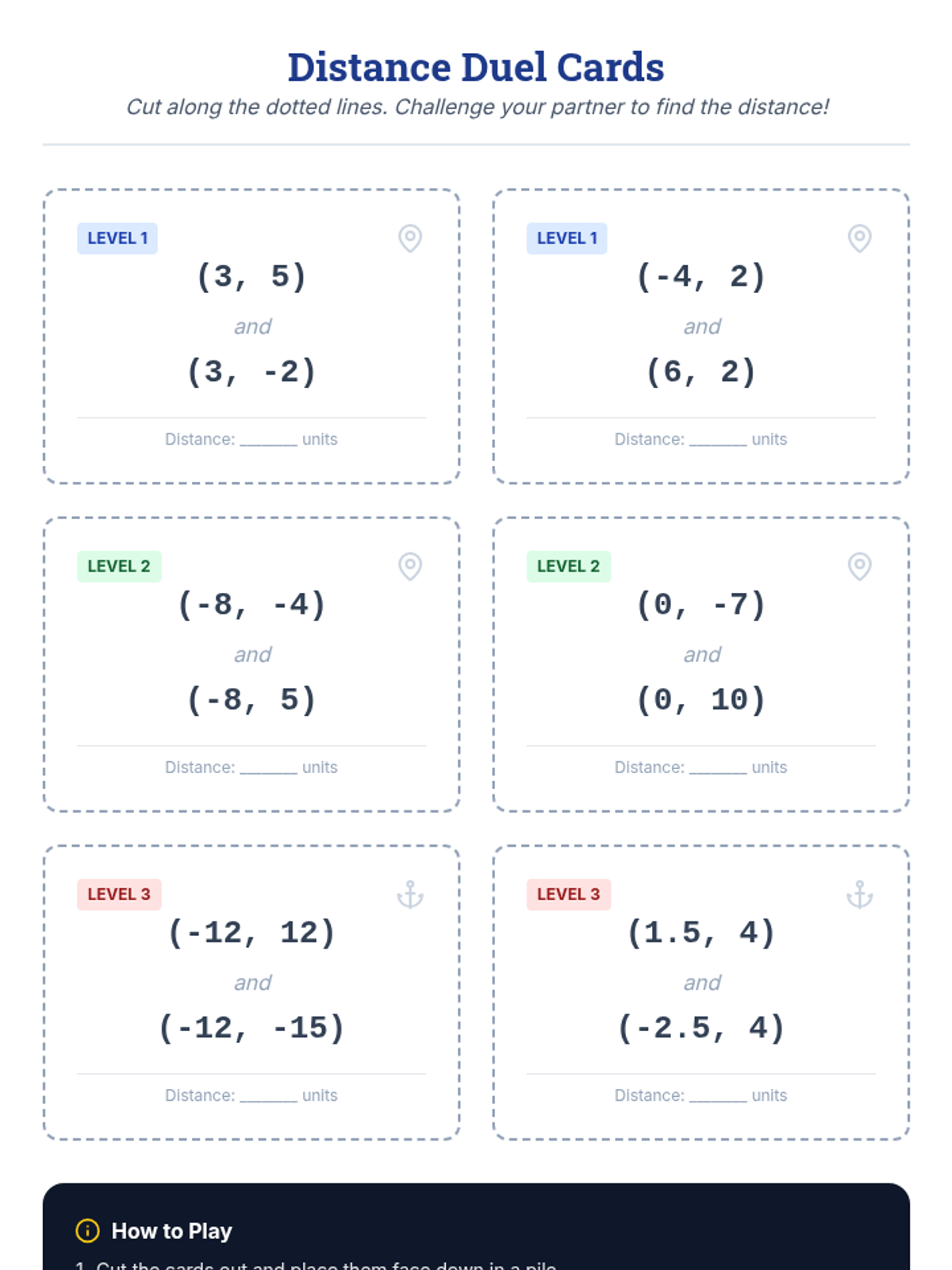
Distance Duel Cards
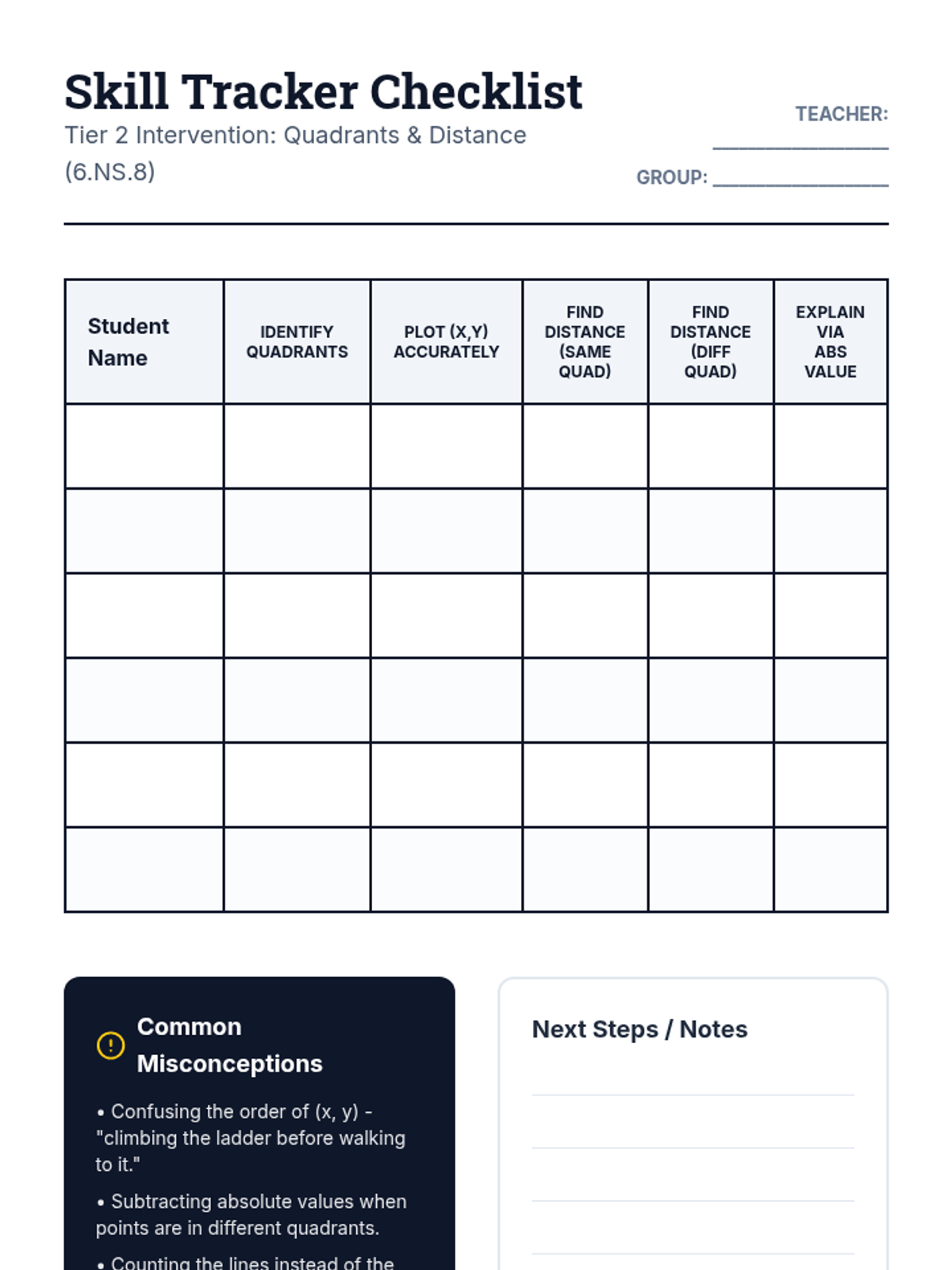
Skill Tracker Checklist
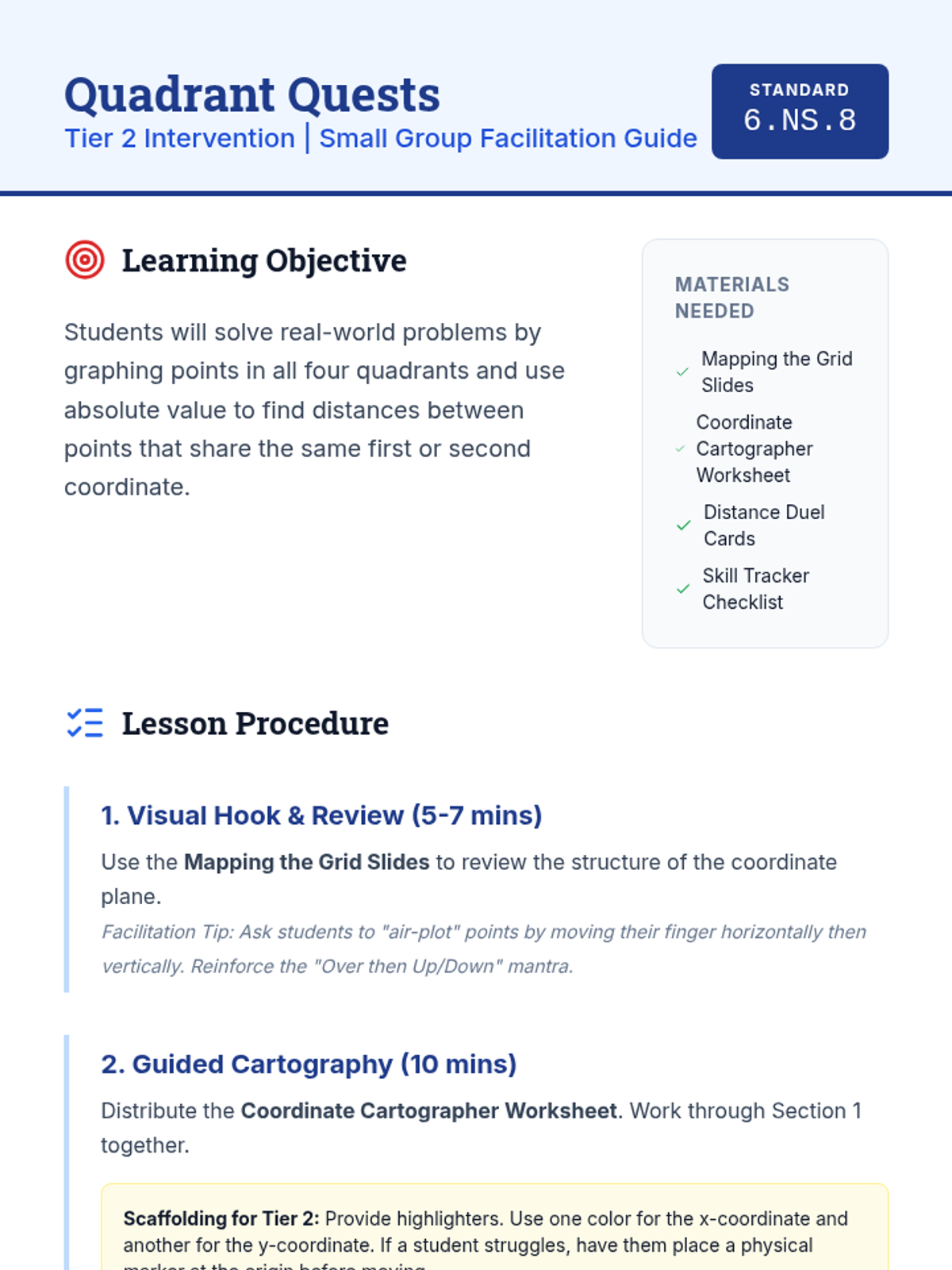
Quadrant Quests Lesson Guide

Quadrant Navigation Mastery

A Tier 2 intervention unit focused on mastering the four-quadrant coordinate plane and calculating distances between points using absolute value, aligned with Colorado standard 6.NS.8.

Lenny Avatar
Lenny
2/12
Sequence
Axis All-Stars Slides
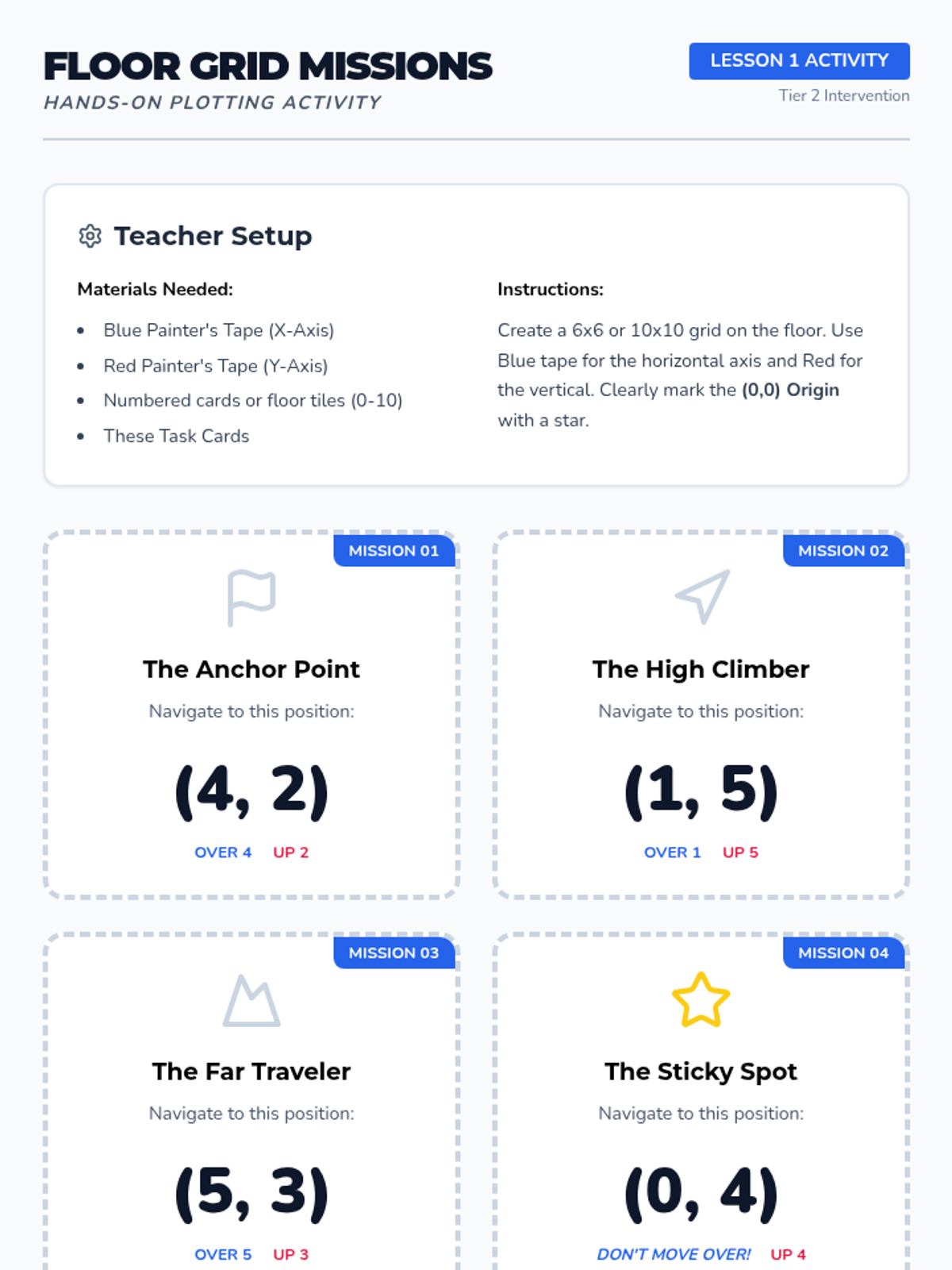
Floor Grid Missions Task Cards
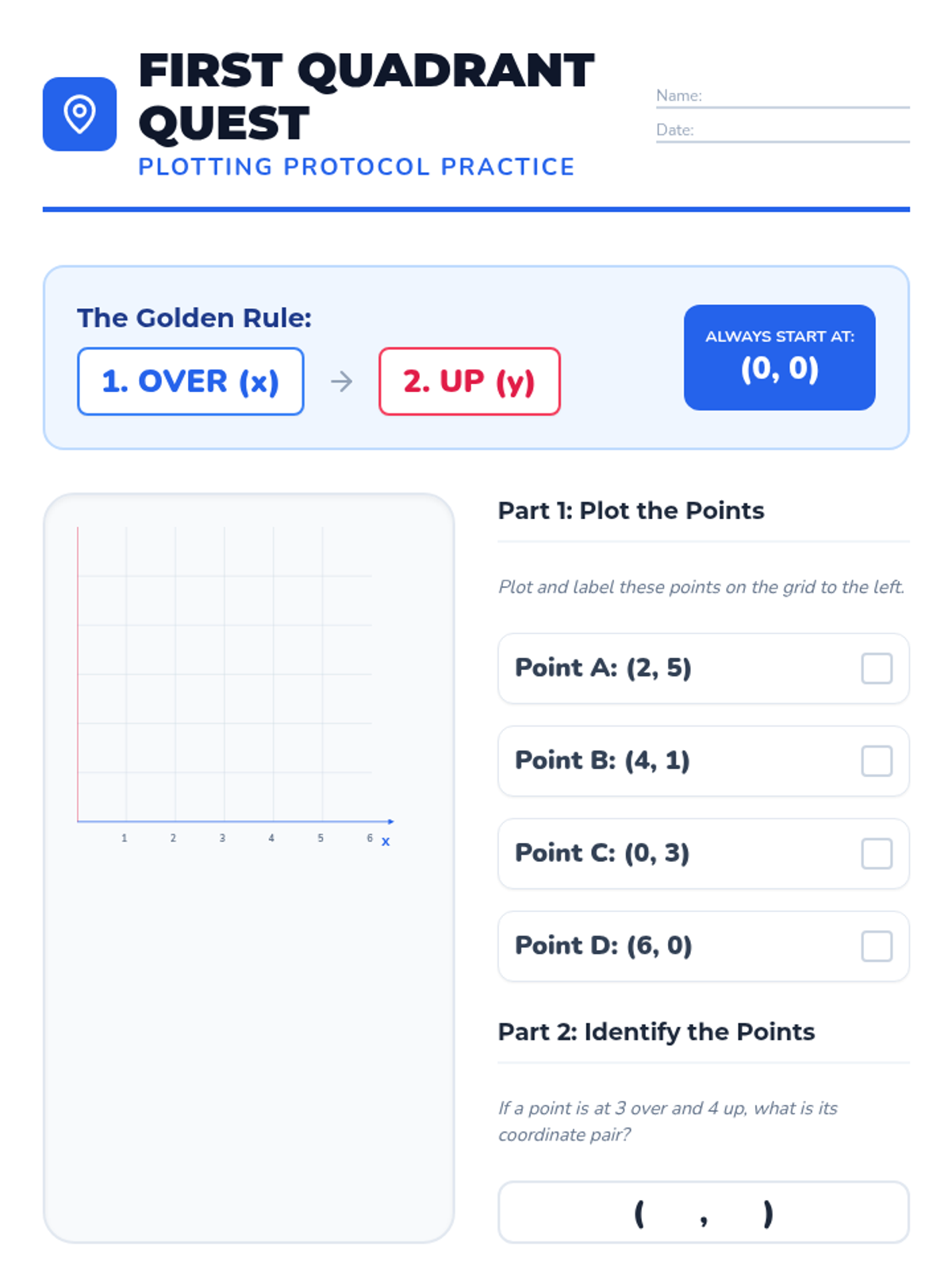
First Quadrant Quest Worksheet

Grid Guardians

A 2-lesson intervention sequence focused on mastering the first quadrant of the coordinate plane through hands-on exploration and pattern-based plotting. Students develop a strong foundation in the 'over, then up' protocol to bridge the gap between basic graphing and algebraic patterns.

MG

Mo Godin

Counselor
2/11
Sequence
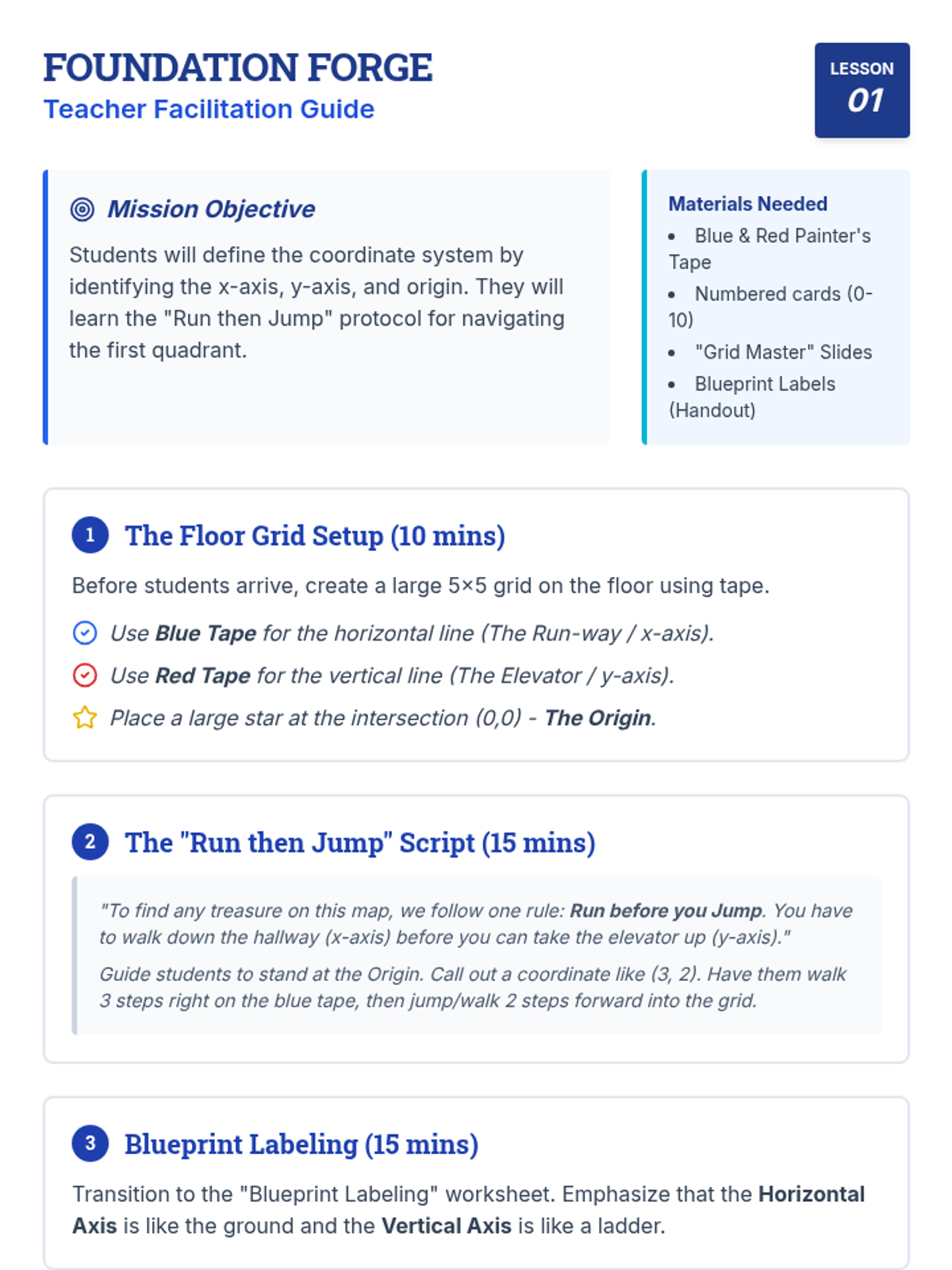
Foundation Forge Teacher Guide
Foundation Forge Slides
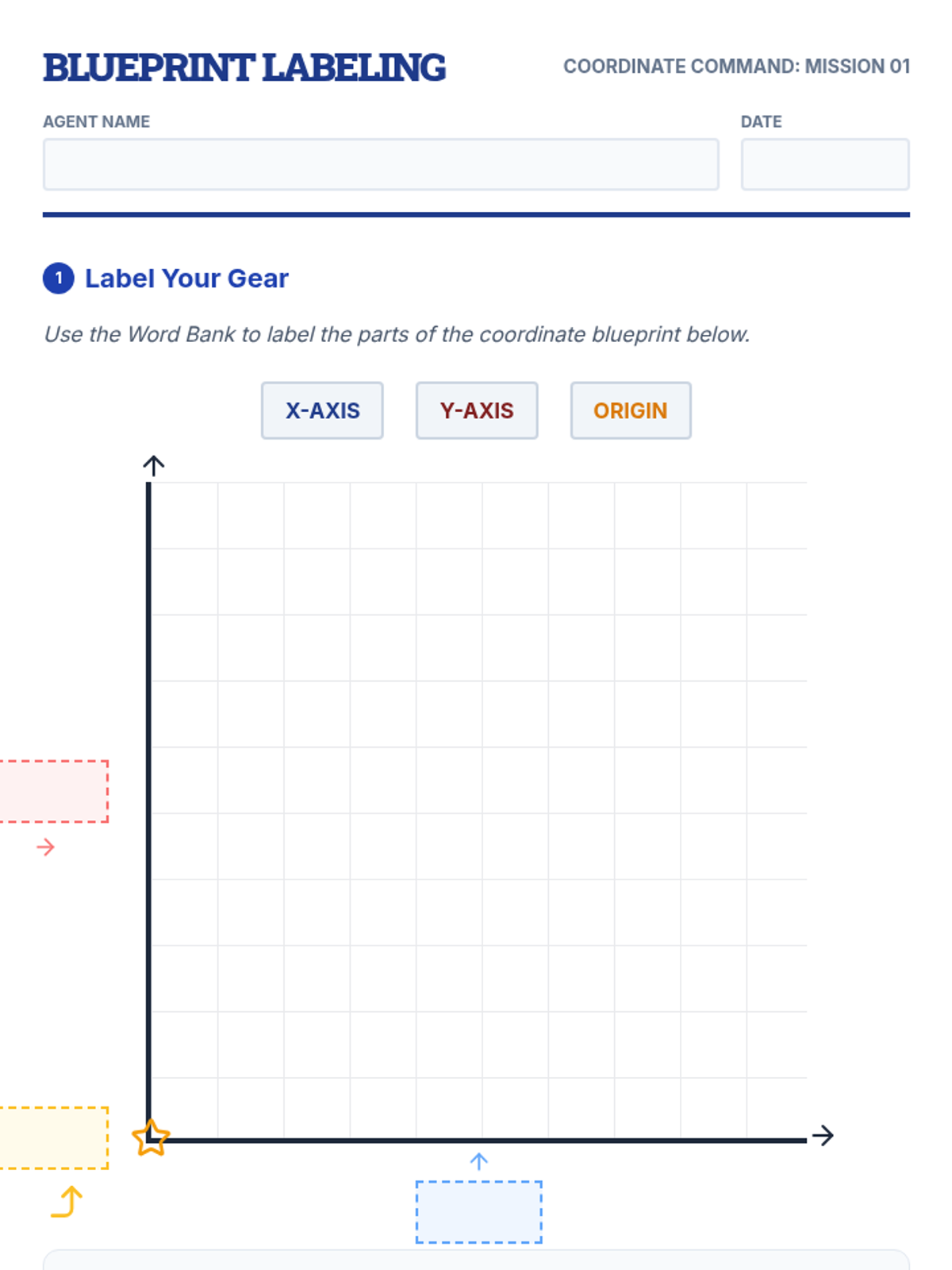
Blueprint Labeling Worksheet

Coordinate Command

A 4-lesson intervention sequence focused on the fundamentals of the coordinate plane, specifically the first quadrant. Students progress from identifying axes to plotting patterns from numerical rules using a consistent 'Run then Jump' protocol.

MG

Mo Godin

Counselor
2/11
Sequence
Pattern Partners Teacher Guide
Pattern Partners Slides
Pattern Partners Worksheet
Pattern Partners Answer Key

Pattern Graphing Quest

A 6-lesson Tier 2 intervention designed to help students master the relationship between numerical patterns, converting them into ordered pairs, and graphing them on a coordinate plane using a cartography and exploration theme.

MG

Mo Godin

Counselor
2/11
Sequence
Sums and Differences Teacher Guide
Explorer Sums Slides
Supply Run Worksheet

Number Navigator Tier 2 Intervention

A 12-lesson Tier 2 intervention sequence for 6th-grade students focused on computational fluency with decimals and the system of rational numbers. The sequence follows the All Learner Network High Leverage Concepts, moving from multi-digit decimal operations to complex coordinate plane navigation.

D

dfredericks

Math Teacher
2/6
Sequence
Decimal Dash Slides
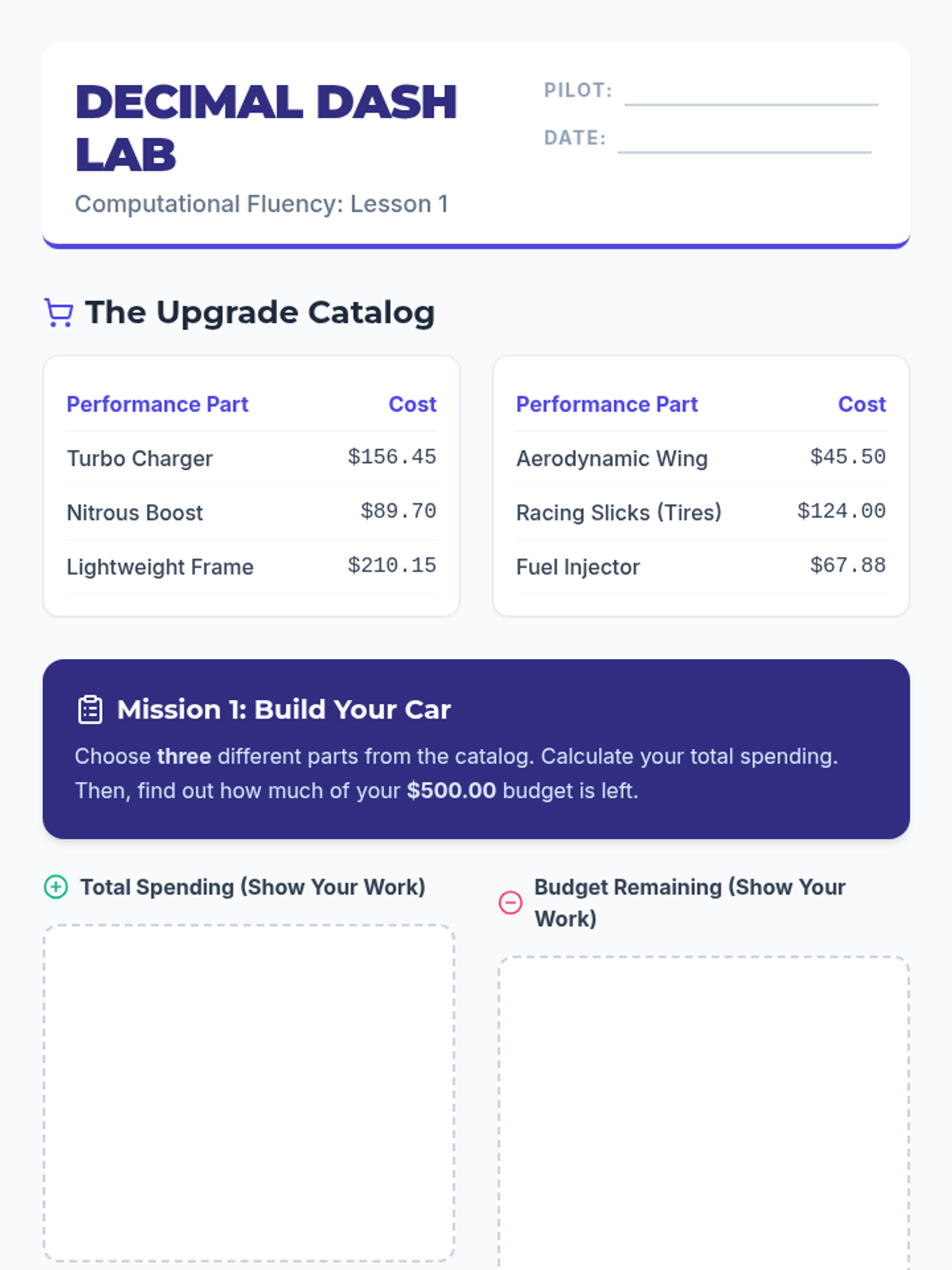
Decimal Dash Worksheet
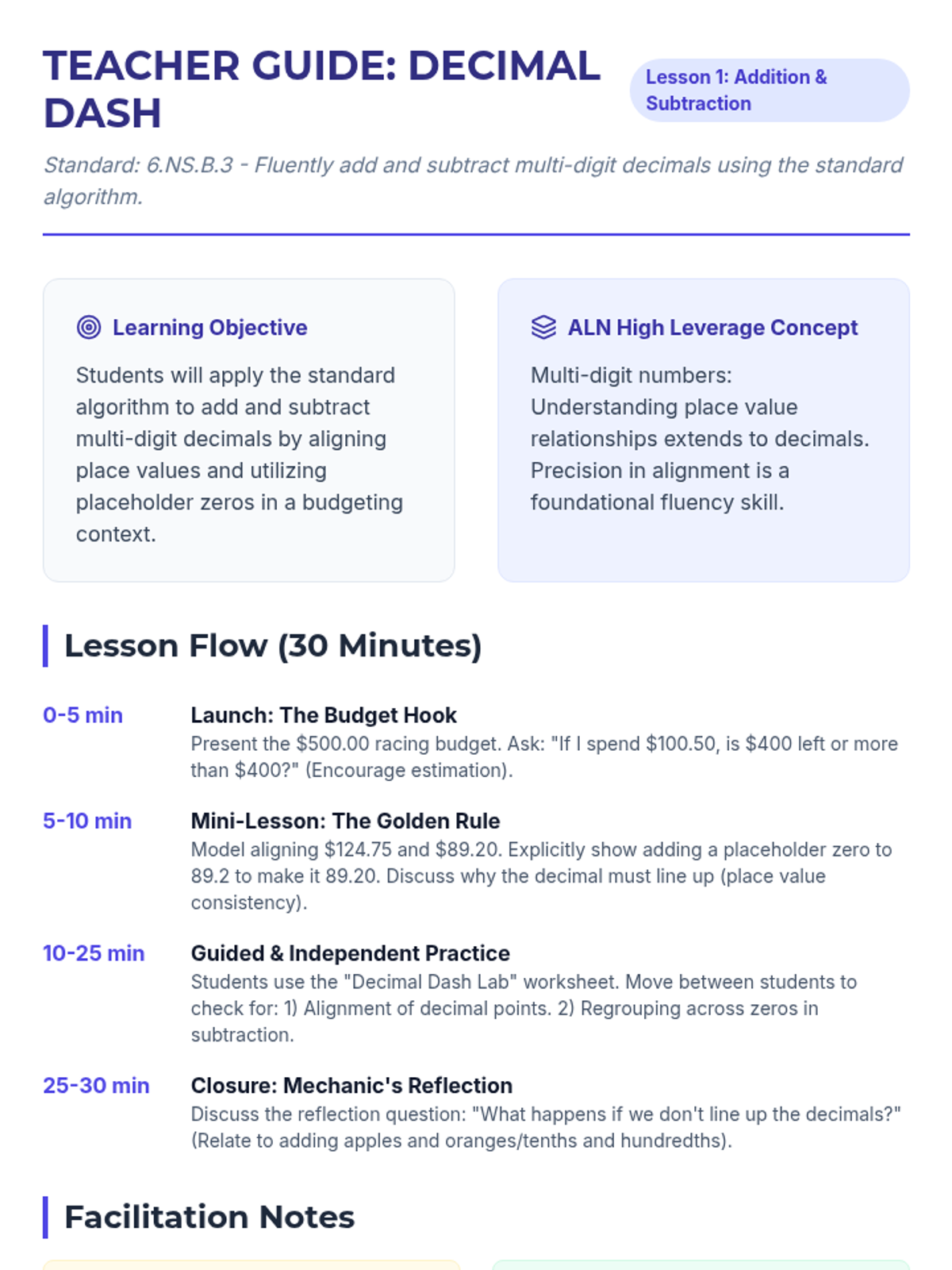
Decimal Dash Teacher Guide

Rational Number Fluency Labs

A 6-lesson intervention sequence for 6th-grade students focusing on multi-digit decimal operations and rational number concepts on the number line and coordinate plane. Designed for small-group instruction using High Leverage Concepts.

D

dfredericks

Math Teacher
2/6
Sequence
Rectangle Remix Slides
Rectangle Remix Worksheet
Rectangle Remix Teacher Guide

Shape Shifters Intervention

A 12-lesson Tier 2 intervention sequence focused on developing conceptual understanding of area and volume for 6th-grade students. Using the All Learners Network High Leverage Concepts, students move from concrete tiling to decomposing shapes and finally calculating volume with fractional edges and surface area with nets.

D

dfredericks

Math Teacher
2/6
Sequence
Unit Overview Resource

Math Intensive Lab

A comprehensive math intervention sequence for 6th-grade students, focusing on four key domains: Numbers & Operations, Algebraic Thinking, Measurement & Data, and Geometry. This sequence uses high-leverage strategies from the All Learners Network (ALN) and aligns with i-Ready prerequisite modules to bridge conceptual gaps.

D

dfredericks

Math Teacher
2/5
Sequence
Radar Refresh Slides
Grid Command Teacher Guide
Quadrant Quest Worksheet

Coordinate Geometry Polygons

A game-based exploration of polygons on the coordinate plane. Students learn to plot, calculate distance, reflect shapes, and deduce geometric properties using coordinate data in all four quadrants.

Lenny Avatar
Lenny
1/18
Sequence
Quad Quest Slides
Grid Navigator Worksheet
Human Battleship Guide

Shape Mapper Sequence

This sequence introduces 6th-grade students to the coordinate plane as a tool for geometric modeling, moving from basic point plotting to calculating area, perimeter, and distance of complex polygons within all four quadrants.

Lenny Avatar
Lenny
1/18
Sequence
Grid Galaxy Launch Slides
Star Map Navigator Worksheet

Grid Galaxy Navigation

A game-based introduction to coordinate geometry where students learn to navigate grids, plot points, and transform shapes within a space exploration theme. Students transition from basic location-finding to complex mapping and translations.

Lenny Avatar
Lenny
1/18
Sequence
Metric Lab Slides
Metric Lab Sheet
Metric Lab Teacher Guide

Precision Power: Decimal Fractions in Action

This sequence connects abstract decimal fractions to tangible measurement and data analysis. Students act as scientists and analysts using metric tools, financial data, and sports timing to understand the necessity of precise decimal notation.

Lenny Avatar
Lenny
1/17
Sequence
Ratio Table Blueprints Presentation Slides
Snack Deal Detective Worksheet
Ratio Table Blueprints Teacher Guide

Logic Lab Linear Relationships

A comprehensive 6th-grade math sequence focusing on the transition from ratio tables to linear equations. Students explore constant rates, coordinate graphing, the constant of proportionality, and algebraic modeling through real-world scenarios like snack pricing and ride-share algorithms.

Lenny Avatar
Lenny
1/17
Sequence
Plotting Polygons Teacher Guide
Plotting Polygons Presentation Slides
Mystery Shape Worksheet

Grid Masters

A comprehensive 6th-grade geometry sequence focusing on the coordinate plane, integrating polygon construction, distance calculation, angle identification, and real-world spatial modeling. Students transition from basic plotting to designing a complex city map using geometric constraints.

Lenny Avatar
Lenny
1/17
Sequence
Grid Navigator Worksheet
Quadrant Navigation Slides
Coordinate Battleship Activity

Graphing Equations and Inequalities

This sequence builds a foundational understanding of the coordinate plane as a tool for visualizing algebraic relationships. Students progress from navigating the four quadrants to graphing linear equations and inequalities, culminating in a mastery-based synthesis challenge.

Lenny Avatar
Lenny
1/17
Sequence
Grid Masters Worksheet
Rectangle Foundations Slides
Rectangle Foundations Teacher Guide

Deriving and Applying Area Formulas

This inquiry-based sequence guides 6th-grade students through the logical derivation of area formulas for common polygons. Students use grid paper, physical manipulatives, and decomposition strategies to understand why formulas work before applying them to complex shapes and coordinate planes.

Lenny Avatar
Lenny
1/17
Sequence
Codebreaker Slides
Secret Vault Worksheet
Vault Breaker Teacher Guide

Pattern Detectives

An inquiry-based unit where students investigate numerical patterns, generate sequences from rules, and represent these relationships on the coordinate plane. They will learn to compare patterns and analyze how different operations affect visual trends.

Lenny Avatar
Lenny
1/17
Sequence
Mapping the Grid Teacher Guide
Mapping the Grid Slides
Mapping the Grid Worksheet

Ratio Navigators

A 5-lesson unit for 6th grade math students exploring how to represent proportional relationships on the coordinate plane, emphasizing the transition from numerical tables to visual graphs.

Lenny Avatar
Lenny
1/17