Lenny LearningLenny
Create
Explore
Workspace
LoginSign up
MathEnglish Language ArtsScience & EngineeringSocial StudiesGlobal LanguagesHealth & Physical EducationSpecial EducationCounseling & Life SkillsArts & CreativityESL
Lenny LearningLenny
Lenny Learning
About
Training
Pricing
Support
Contact
© 2026 Lenny Learning Inc.
MathNumbers & CountingCounting ObjectsNumber NamesComparing NumbersNumber OperationsCounting SequenceNumbers 0-10Place Value Understanding and SystemAdd and Subtract Within 20Addition and Subtraction ConceptsAddition and Subtraction EquationsAddition and Subtraction ProblemsFoundations for MultiplicationMultiplication and Division PropertiesMultiply and Divide Within 100Multiplication and Division ProblemsFactors and MultiplesProperties of OperationsPatterns and RelationshipsGenerate and Analyze PatternsMulti-Digit ArithmeticPlace Value OperationsMulti-Digit and Decimal OperationsNumerical ExpressionsFour Operations and PatternsFour Operations Problem SolvingMeasurement & DataMeasurable AttributesMeasuring LengthsMeasure and Estimate Lengths in Standard UnitsRelate Addition and Subtraction to LengthClassifying and Counting ObjectsTime and MoneyArea Concepts and MeasurementPerimeter and Area MeasuresAngle Concepts and MeasurementTime, Volume, and MassMeasurement Unit ConversionsGeometryIdentifying ShapesShapes and AttributesShape Attributes and ReasoningShapes and CompositionClassifying 2D FiguresGeometric Figures and RelationshipsLines, Angles, and ShapesAngle, Area, and VolumeGeometric MeasurementVolume of 3D ShapesCoordinate Plane ApplicationsTransformations in the PlaneCongruence and SimilarityUnderstand congruence in terms of rigid motionsSimilarity and TransformationsProve Theorems Involving SimilarityPythagorean TheoremTrigonometry for General TrianglesMake Geometric ConstructionsProve Geometric TheoremsTheorems About CirclesFind Arc Lengths And Areas of Sectors of CirclesVolume FormulasRelationships Between Two-Dimensional and Three-Dimensional ObjectsProve Simple Geometric Theorems AlgebraicallyTranslate Between Geometric Description and Equation for Conic SectionApply Geometric Concepts in Modeling SituationsFractions & DecimalsFractions as NumbersBuilding FractionsFraction Equivalence and OrderingAdding and Subtracting FractionsMultiplying and Dividing FractionsDividing FractionsDecimal FractionsMulti-Digit Computation and FactorsAdd, Subtract, Multiply, and Divide Rational NumbersRational Number SystemIrrational Numbers and ApproximationsRatiosRatios and ProportionsProportional RelationshipsUnit RateAlgebraAlgebraic ExpressionsGenerate Equivalent ExpressionsQuantitative RelationshipsProportional Relationships and Linear EquationsEquations and InequalitiesEquation Solving and ReasoningLinear Equations and SystemsGraph Equations and InequalitiesSystems of EquationsReal-World Algebraic ProblemsQuantitative Reasoning with UnitsExpression StructureEquivalent Expression FormsRadicals and Integer ExponentsRational ExponentsRational and Irrational NumbersPolynomial OperationsPolynomial IdentitiesPolynomial Zeros and FactorsRational ExpressionsComplex Number OperationsComplex Numbers in PolynomialsComplex Numbers on PlaneStatistics & ProbabilityRepresent and Interpret DataData DistributionsStatistical VariabilityProbability ModelsCompound Event ProbabilitiesStatistical SamplingInterpret Categorical and Quantitative DataBivariate Data PatternsInterpret Linear ModelsComparing Two PopulationsRandom Processes in StatisticsIndependence and Conditional ProbabilityExpected ValuesProbability-Based Decision MakingStatistical Inference and ConclusionsFunctionsFunction Concepts and NotationDefine and Compare FunctionsInterpret Functions in ContextAnalyze Function RepresentationsModel Relationships with FunctionsIdentify Linear vs Exponential GrowthDistinguish Between Function TypesCompare Growth RatesInterpret Function ExpressionsBuild Functions from RelationshipsConstruct and Model FunctionsTransform and Combine FunctionsModel Comparison and SelectionSolve Exponential EquationsTrigonometryTrigonometric Ratios Involving Right TrianglesTrigonometric Functions and Unit CircleModel with Trigonometric FunctionsTrigonometric IdentitiesVectors & MatricesIntroduction to Vectors and MatricesVector QuantitiesVector OperationsMatrix OperationsCalculusLimits and ContinuityDerivative Concepts and NotationDerivative Rules and TechniquesApplications of DerivativesOptimization ProblemsRelated RatesCurve Sketching and AnalysisIntegration Concepts and NotationAntiderivatives and Indefinite IntegralsDefinite Integrals and AreaFundamental Theorem of CalculusIntegration TechniquesApplications of IntegrationDifferential EquationsSequences and SeriesParametric and Polar FunctionsVector-Valued Functions

Geometry

SequencesLessonsMaterialsVideos
  1. Math

Geometry

SequencesLessonsMaterialsVideos

Geometric classification, measurement of area and volume, and the study of transformations and rigid motions. Builds toward complex proofs, trigonometry for general triangles, and the algebraic representation of conic sections.

Shape Attributes and ReasoningIdentification of properties including sides, vertices, and angles in two-dimensional and three-dimensional shapes. Classifies and sorts objects based on shared attributes to build foundational geometric reasoning.
Geometric Figures and RelationshipsProperties of 2D and 3D shapes, including symmetry, congruence, and similarity. Develops spatial reasoning through the study of angles, lines, and coordinate transformations.
Angle, Area, and VolumeGeometric properties including angle measurement, area of polygons, and volume of three-dimensional solids. Applies formulas and theorems to solve spatial reasoning problems.
Geometric MeasurementArea, perimeter, and volume calculations for two- and three-dimensional figures. Develops spatial reasoning through the application of measurement formulas and unit conversions.
Volume of 3D ShapesFormulas and calculations for determining the capacity of prisms, pyramids, cylinders, cones, and spheres. Develops spatial reasoning through applications involving cubic units and composite solids.
Coordinate Plane ApplicationsQuadrant navigation, distance calculations between points, and area determinations for polygons. Applies coordinate geometry to mapping, reflections, and data visualization.
Volume FormulasGeometric calculations for three-dimensional shapes including prisms, cylinders, pyramids, cones, and spheres. Develops skills for solving missing dimensions and real-world capacity problems.
Relationships Between Two-Dimensional and Three-Dimensional ObjectsCross-sections of three-dimensional solids and the generation of solids of revolution from two-dimensional shapes. Connects planar geometry to spatial visualization through nets and surface area calculations.
Video
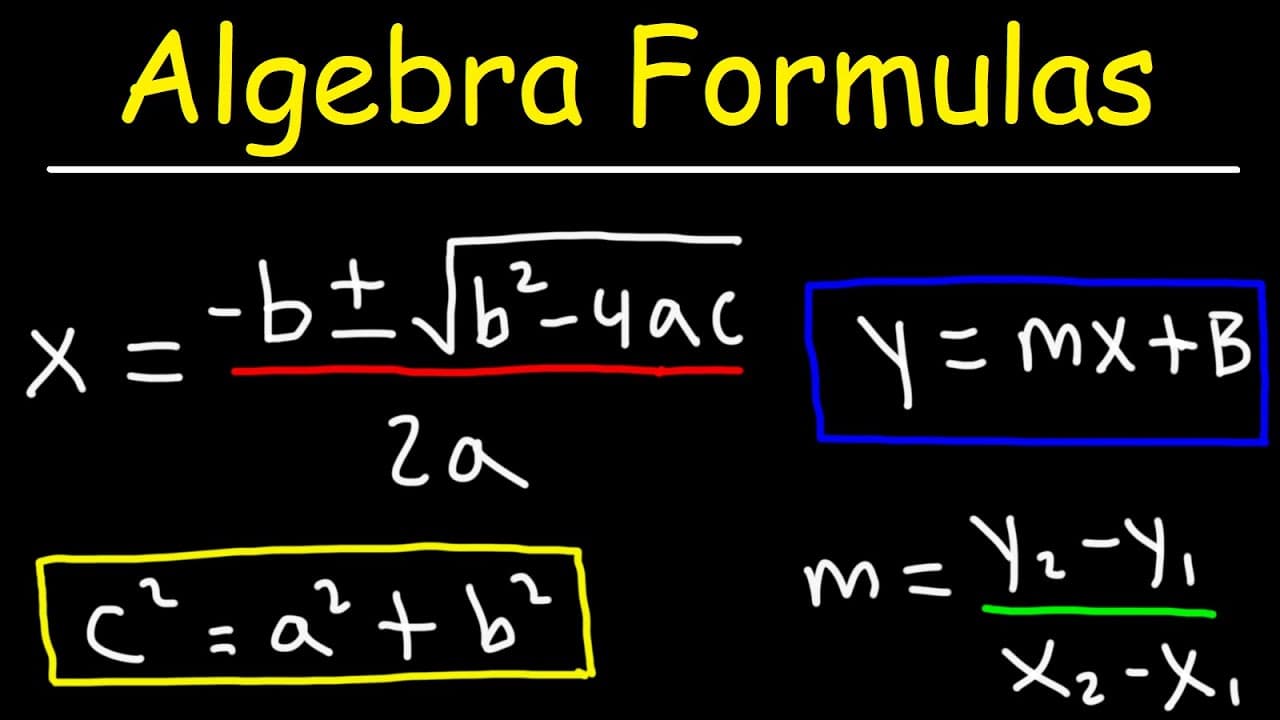
Mastering the Right Angle Theorem in Geometry

Mastering the Right Angle Theorem in Geometry

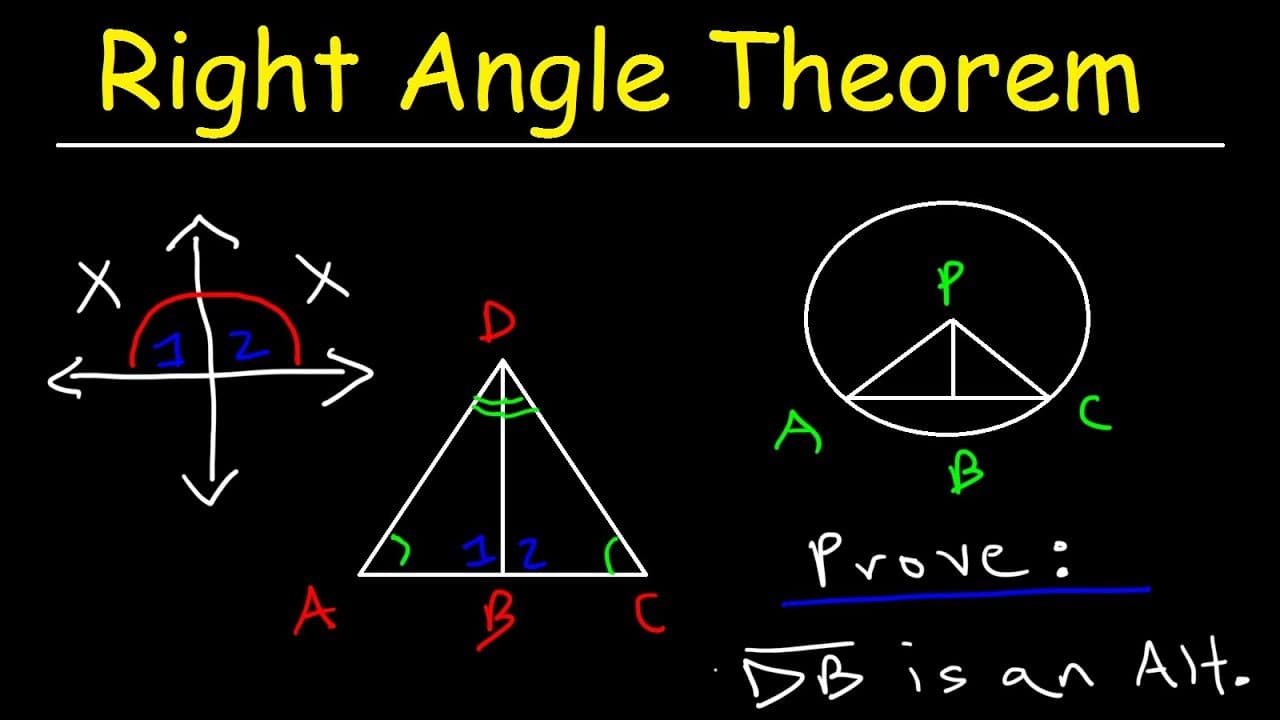
This comprehensive geometry tutorial breaks down the Right Angle Theorem, explaining that if two angles are both supplementary and congruent, they must be right angles. The video begins by establishing the logic behind the theorem using a simple algebraic proof ($x + x = 180$, therefore $x = 90$). It serves as an excellent resource for bridging the gap between algebraic reasoning and geometric properties. The core of the video is dedicated to practical application through three distinct examples: a two-column proof involving a circle and midpoints, a triangle proof demonstrating altitudes, and an algebraic problem involving systems of linear equations with intersecting lines. Each example is worked through step-by-step, modeling proper mathematical notation, logical sequencing (statements and reasons), and verification techniques. For educators, this video is a versatile tool that connects multiple math strands. It reinforces triangle congruence postulates (SSS, AAS), the use of CPCTC (Corresponding Parts of Congruent Triangles are Congruent), and the skill of solving systems of equations within a geometric context. It is ideal for scaffolding lessons on writing formal proofs or for reviewing how algebra supports geometric definitions.

The Organic Chemistry TutorThe Organic Chemistry Tutor

21mins 59s

Video
Calculating Unknown Angles on a Straight Line

Calculating Unknown Angles on a Straight Line

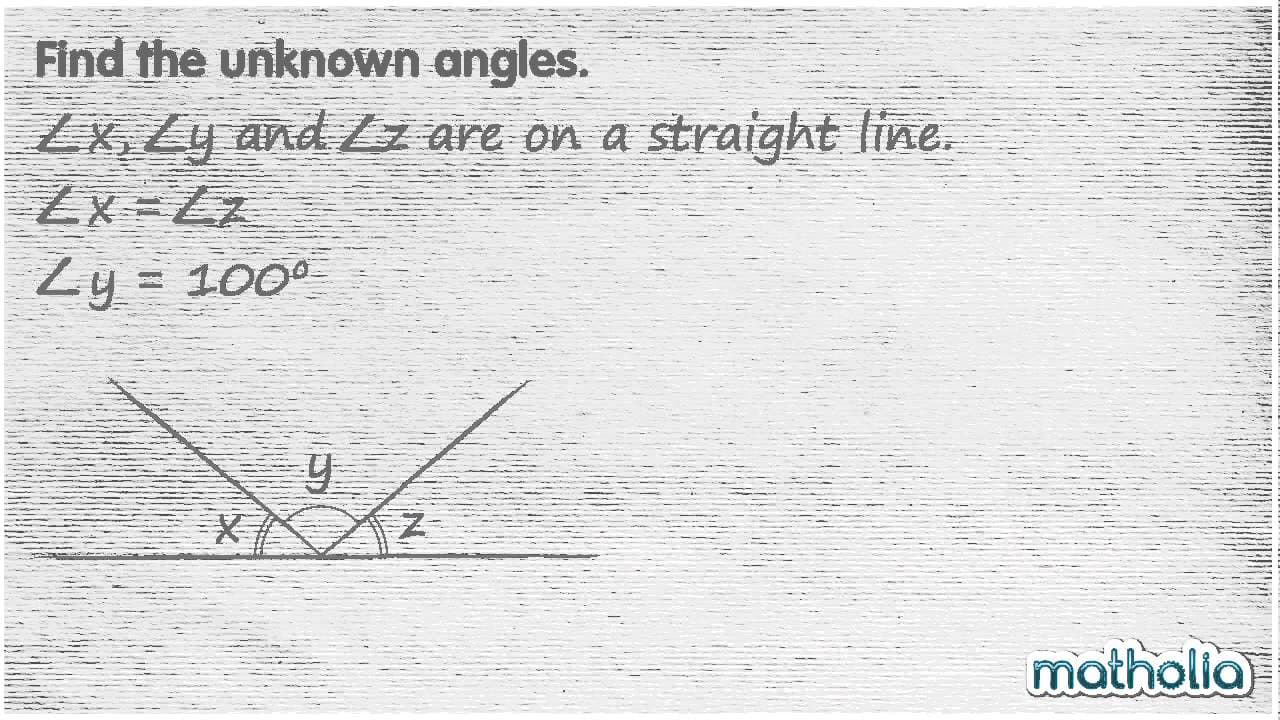
This educational video provides a clear, step-by-step tutorial on calculating unknown angles situated on a straight line. Using a clean, whiteboard-style animation, it visually demonstrates the fundamental geometric principle that angles on a straight line add up to 180 degrees. The video guides viewers through three distinct problem types: finding a single missing angle when a right angle is involved, solving for two equal unknown angles, and dividing a straight line into three equal angles. The content moves from concrete arithmetic to introductory algebraic thinking, helping students transition from simple subtraction to multi-step reasoning involving variables like x, y, and z. Each problem is broken down methodically: identifying known values, setting up the equation based on the 180-degree rule, and performing the necessary calculations to find the solution. The visual presentation reinforces the connection between the geometric figures and the mathematical equations used to solve them. Teachers can use this video to introduce or review the concept of supplementary angles and linear pairs without getting bogged down in complex terminology. It serves as an excellent model for setting up geometry problems, showing students how to organize their work and justify their steps. The clear pacing allows for pausing and student participation, making it a versatile tool for whole-class instruction, independent practice, or remediation for students struggling with basic geometric calculations.

MatholiaChannelMatholiaChannel

2mins 40s

Video
Understanding Angles and How to Draw Them in Standard Position

Understanding Angles and How to Draw Them in Standard Position

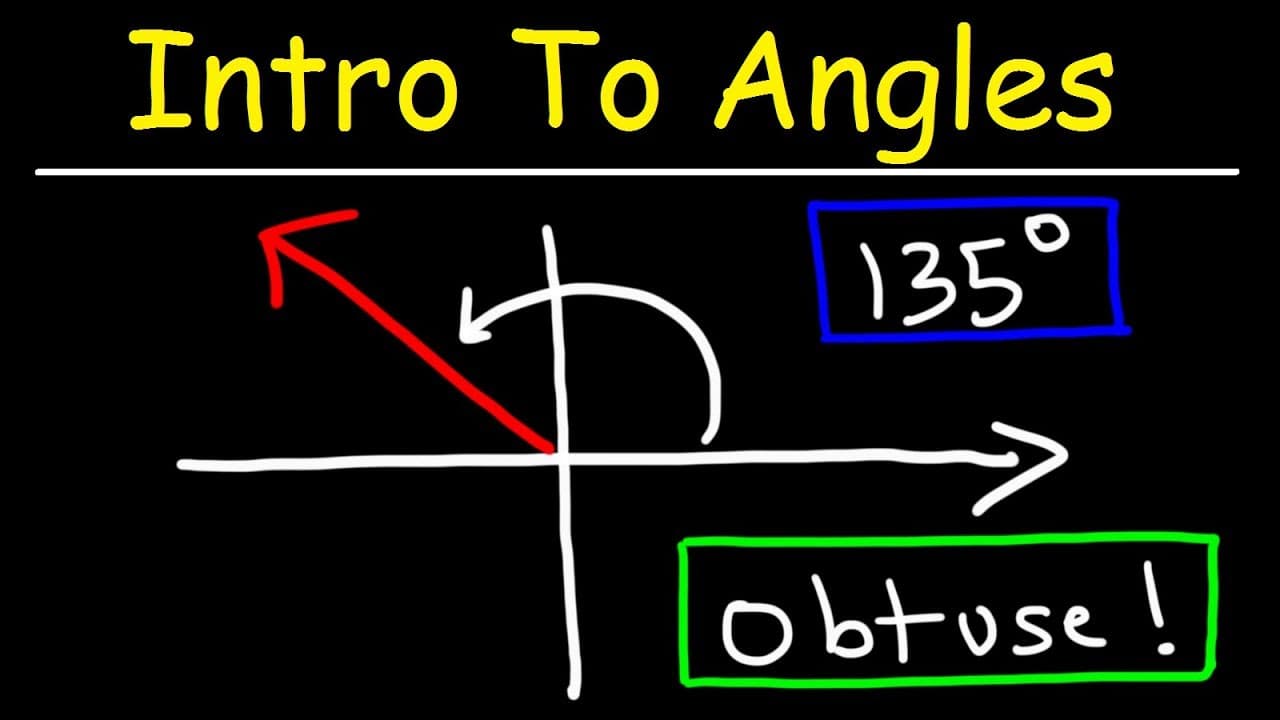
This educational video provides a comprehensive introduction to geometric angles, establishing the foundational concepts necessary for trigonometry. The instructor begins by clearly defining basic geometric elements—segments, rays, and lines—before explaining how an angle is formed by two rays sharing a common endpoint called the vertex. The video transitions into placing angles on a coordinate plane in "standard position," introducing the concepts of initial and terminal sides, and distinguishing between positive (counter-clockwise) and negative (clockwise) rotations. Key themes include geometric vocabulary, the properties of the Cartesian coordinate system (quadrants), and the classification of angles (acute, right, obtuse, straight). The instructor visually demonstrates how to determine angle measures based on their rotation and quadrant location. A significant portion of the video is dedicated to worked examples, showing step-by-step how to sketch both positive and negative angles given specific degree measures. For educators, this video serves as an excellent flipped classroom resource or review tool for Algebra II, Geometry, or Pre-Calculus students. It effectively bridges the gap between basic geometry and early trigonometry by visualizing angles as rotations rather than static shapes. Teachers can use the clear blackboard-style diagrams to help students visualize abstract concepts like negative degrees and coterminal angles.

The Organic Chemistry TutorThe Organic Chemistry Tutor

14mins 6s

Video
Finding the Side Length of a Square From Its Area

Finding the Side Length of a Square From Its Area

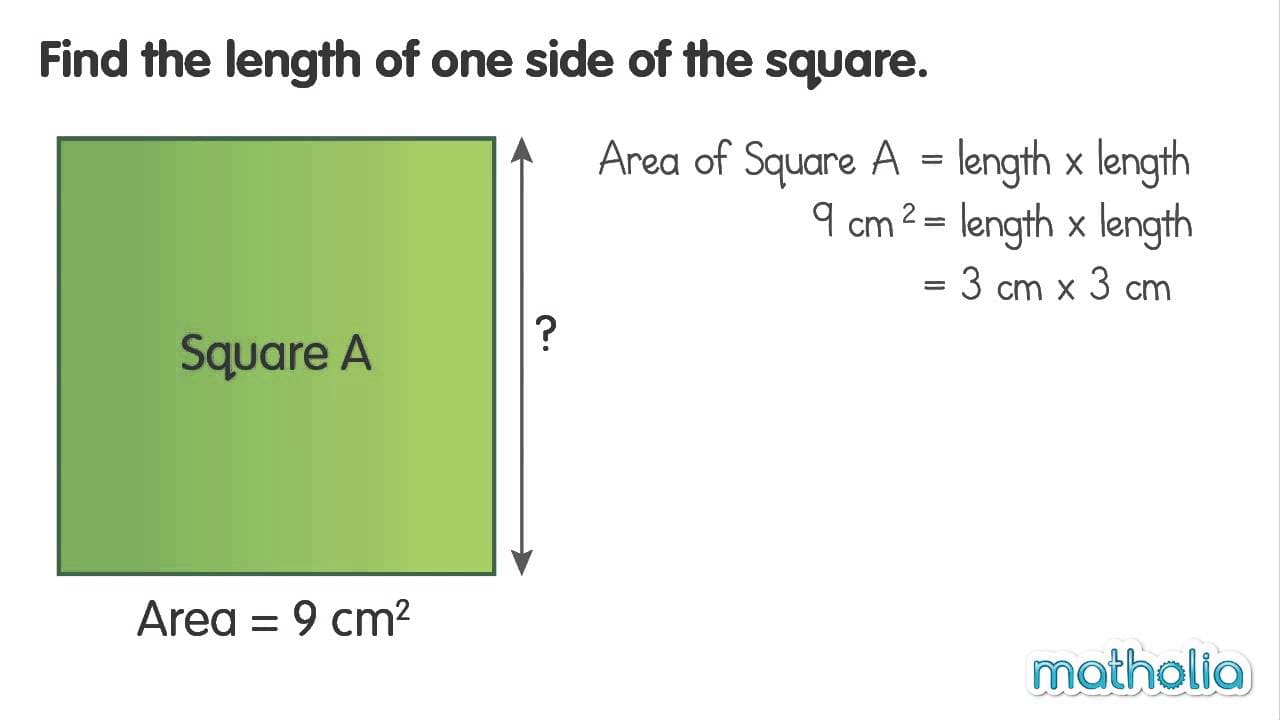
This video provides a clear, step-by-step tutorial on how to determine the side length of a square when the area is known. Through three distinct examples using different colors and units (cm² and m²), it guides viewers through the logic of inverse operations without explicitly introducing complex algebraic notation. The narrator explains that since a square's area is length multiplied by length, finding the side means identifying a number that multiplies by itself to equal the given area. The video explores key mathematical themes including geometry, measurement, and the relationship between multiplication and area. It reinforces the concept of "perfect squares" (9, 25, 64) and visually demonstrates how to use multiplication facts to solve for unknown dimensions. The repetitive structure serves to build confidence and fluency with the procedure, allowing students to practice the thinking process three separate times. For educators, this resource is an excellent tool for introducing the concept of square roots in a concrete, geometric context. It bridges the gap between basic multiplication and algebraic thinking. Teachers can use it to help students visualize why the inverse of squaring a number helps find geometric dimensions, making it suitable for lessons on area, perimeter, and pre-algebraic reasoning.

MatholiaChannelMatholiaChannel

3mins 5s

Video
How to Calculate Triangle Height Given Three Sides

How to Calculate Triangle Height Given Three Sides

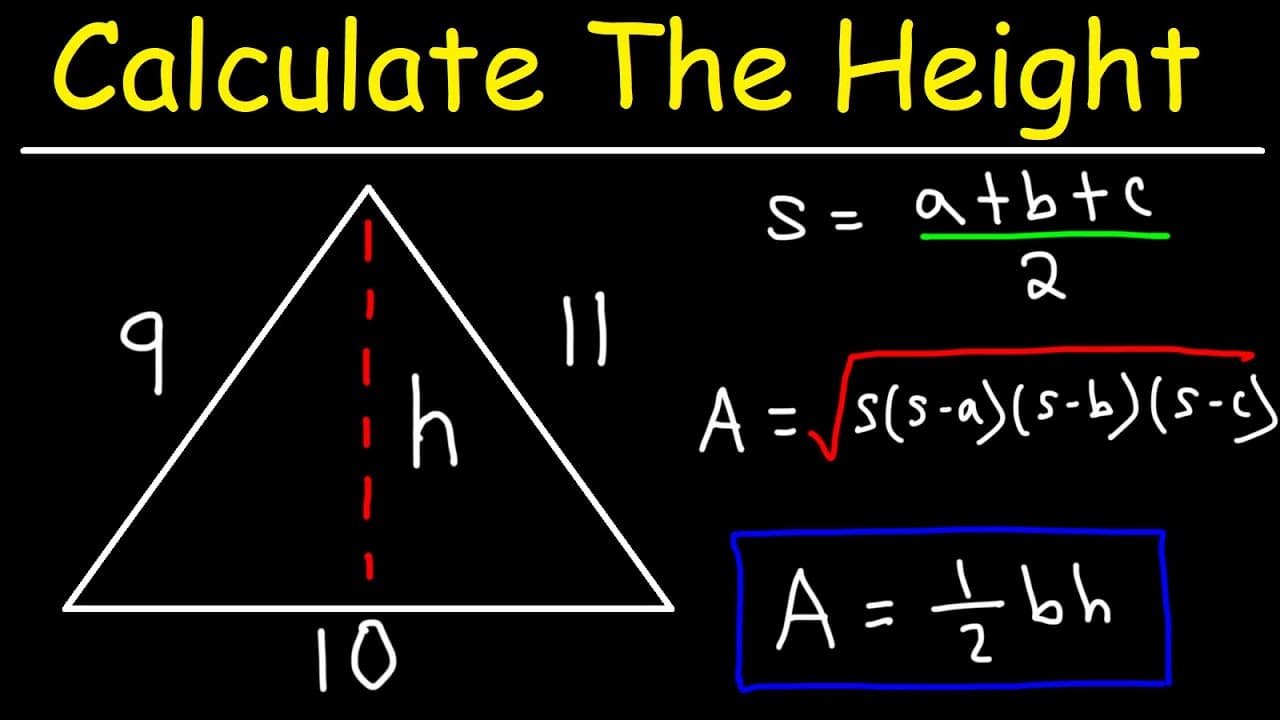
This educational mathematics tutorial demonstrates how to calculate the height of a triangle when only the lengths of its three sides are known. The video guides viewers through a two-step strategy: first using Heron's Formula to determine the total area of the scalene triangle, and then substituting that area into the standard triangle area formula to solve for the unknown height. The instructor uses a specific example with side lengths of 9, 10, and 11 to make the abstract concepts concrete. A significant portion of the video focuses on algebraic skills, specifically calculating the semi-perimeter and simplifying radicals without a calculator. The instructor breaks down complex square roots by factoring numbers to find perfect squares, demonstrating an efficient mental math technique. The video concludes by setting up an algebraic equation to isolate the height variable, providing both an exact radical answer and a decimal approximation. For educators, this video serves as an excellent bridge between geometry and algebra. It reinforces key concepts like substitution, solving for variables, and properties of radicals while teaching a specific geometric application. It is particularly useful for demonstrating that height can be found for non-right triangles without using trigonometry, making it a valuable resource for high school geometry and algebra curriculums.

The Organic Chemistry TutorThe Organic Chemistry Tutor

5mins 33s

Video
Understanding Circles: Area, Circumference, Arcs, and Angles

Understanding Circles: Area, Circumference, Arcs, and Angles

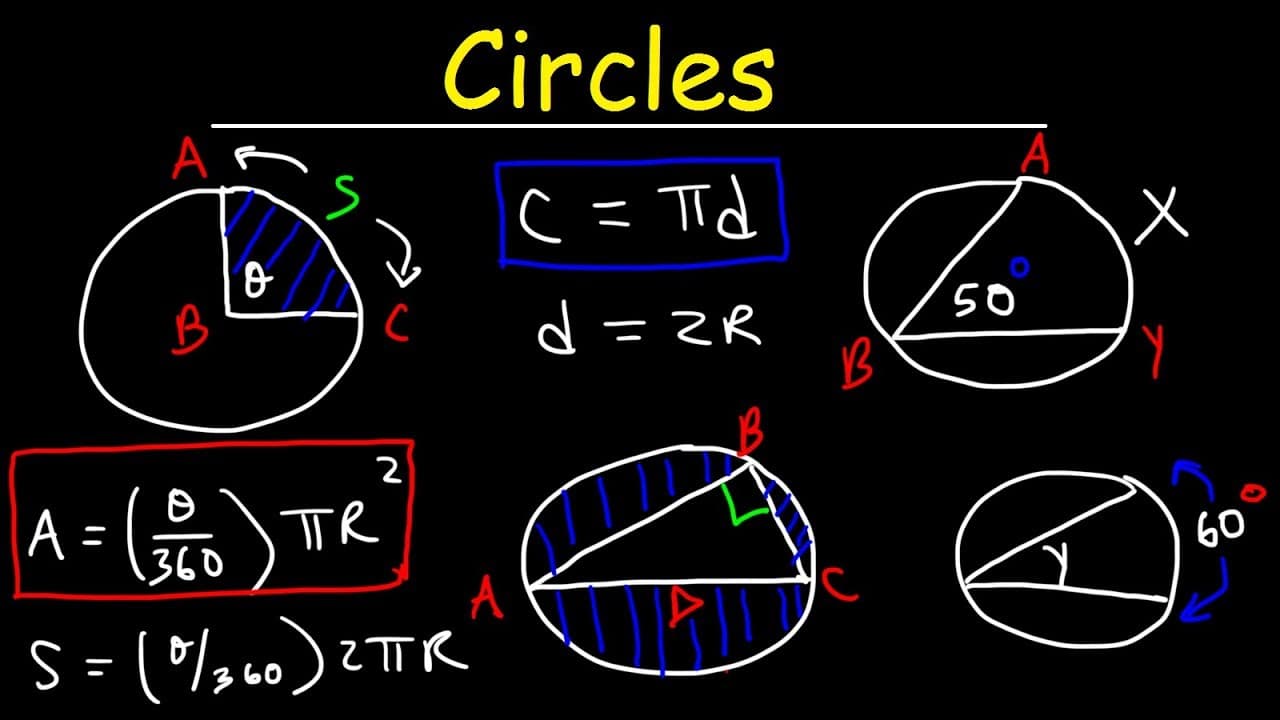
This comprehensive math tutorial provides an in-depth exploration of circle geometry, moving from basic definitions to complex problem-solving. The video begins by defining fundamental components such as the radius, diameter, circumference, and area, clearly establishing the relationship between these elements. It progresses to more advanced concepts including sectors, arc lengths, chords, and the theorems governing central and inscribed angles. The narration uses a blackboard style to visually demonstrate how formulas are derived and applied. Key themes include the distinction between central and inscribed angles, calculating the area of sectors and segments, and using the Pythagorean theorem within circle contexts. The video explicitly covers the Inscribed Angle Theorem—demonstrating that an inscribed angle is half the measure of its intercepted arc—and explores how to calculate arc lengths and sector areas using degrees. It concludes with multi-step word problems that require synthesizing multiple concepts, such as finding the area of a shaded region by subtracting a triangle's area from a circle's area. For educators, this video serves as an excellent instructional tool for high school geometry units. It can be used to introduce new vocabulary, demonstrate the application of formulas, or review for standardized tests. The step-by-step problem-solving sections allow teachers to pause and let students attempt calculations before seeing the solution, making it ideal for interactive classroom learning or independent study for students needing remediation on geometric concepts.

The Organic Chemistry TutorThe Organic Chemistry Tutor

18mins 7s

Video
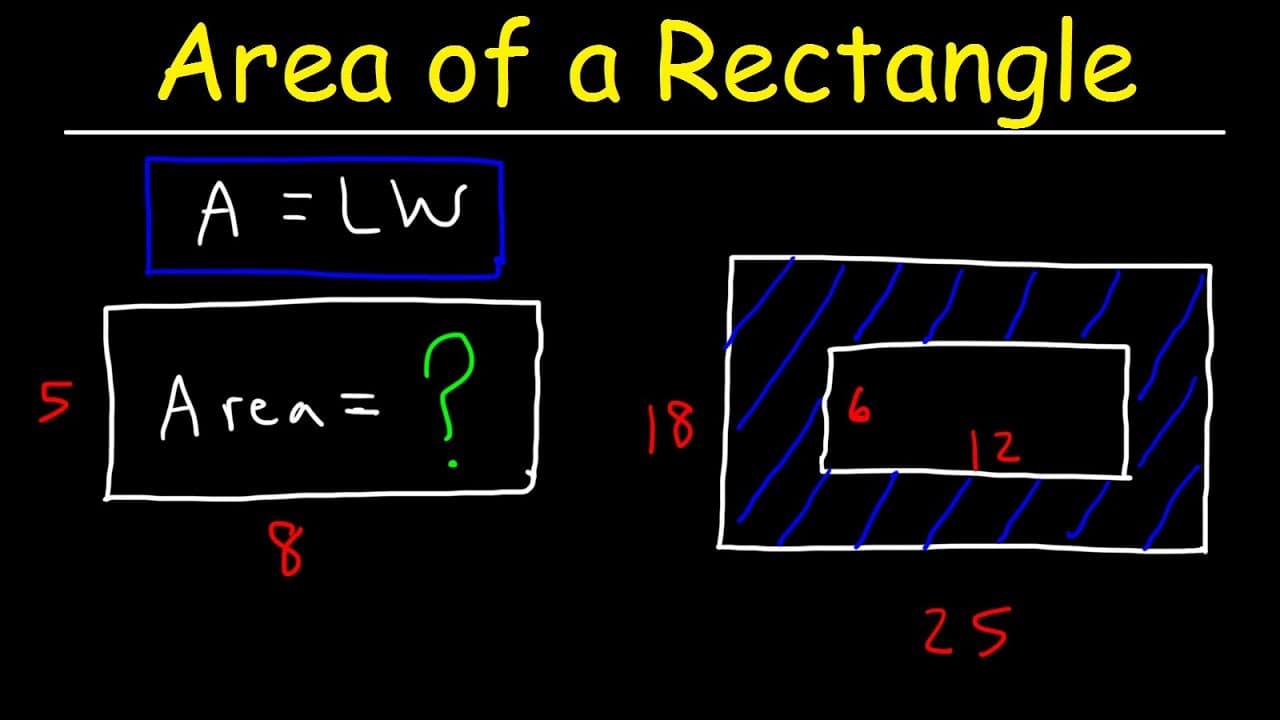
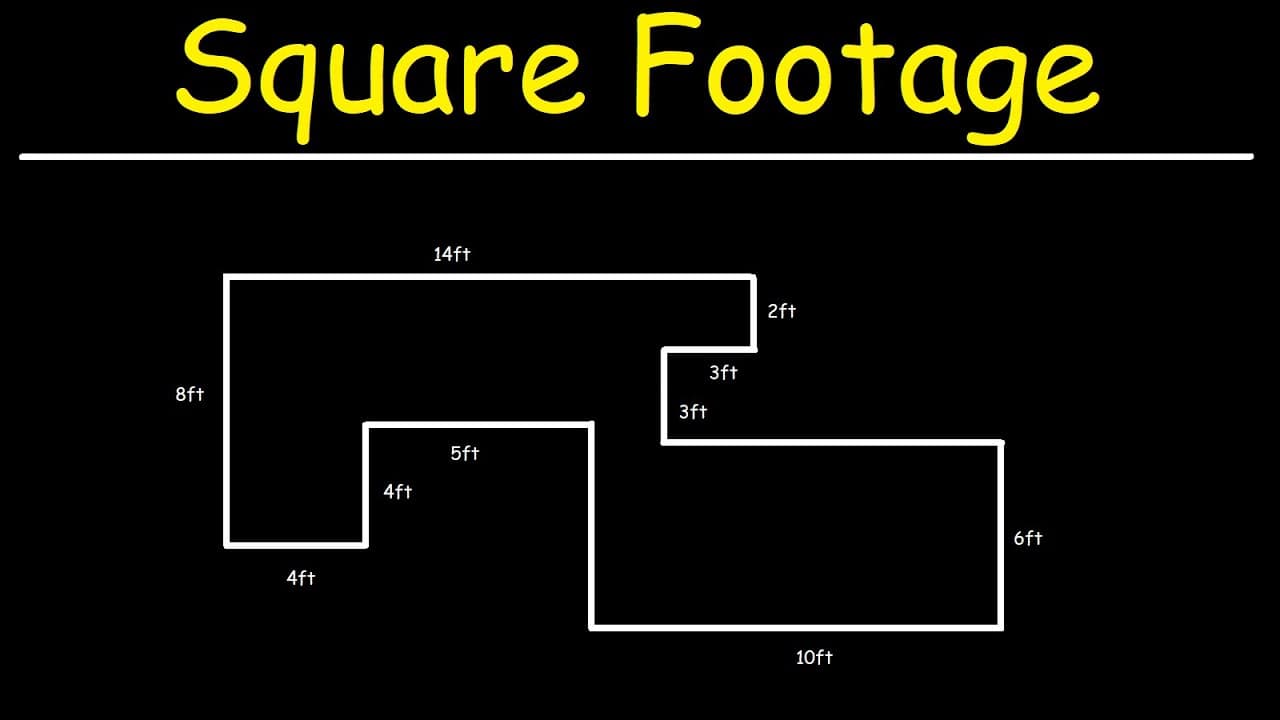
Finding Area of Composite Rectangles and Shapes

Finding Area of Composite Rectangles and Shapes

This educational video provides a comprehensive tutorial on calculating the area of rectangles and more complex composite figures. It begins with the fundamental formula for the area of a rectangle (Length × Width) and progresses to irregular polygon shapes that must be decomposed into simpler rectangles. The video demonstrates step-by-step problem-solving strategies, including how to deduce missing side lengths from given dimensions and how to break down complex shapes into manageable parts. The content covers three distinct types of area problems: (1) additive composite figures where areas are calculated separately and summed, (2) subtractive area problems involving shaded regions (e.g., a frame or border) where an inner area is subtracted from an outer area, and (3) algebraic word problems that require setting up and solving equations to find dimensions based on perimeter and relative side lengths. Each example is worked out in real-time with clear visual diagrams. This resource is highly valuable for mathematics classrooms as it bridges the gap between basic arithmetic geometry and algebraic reasoning. It models critical thinking skills, such as inferring missing information from a diagram and checking for logical consistency. Teachers can use this video to introduce composite figures, reinforce area formulas, or demonstrate how algebra is applied to solve geometric problems.

The Organic Chemistry TutorThe Organic Chemistry Tutor

11mins 38s

Video
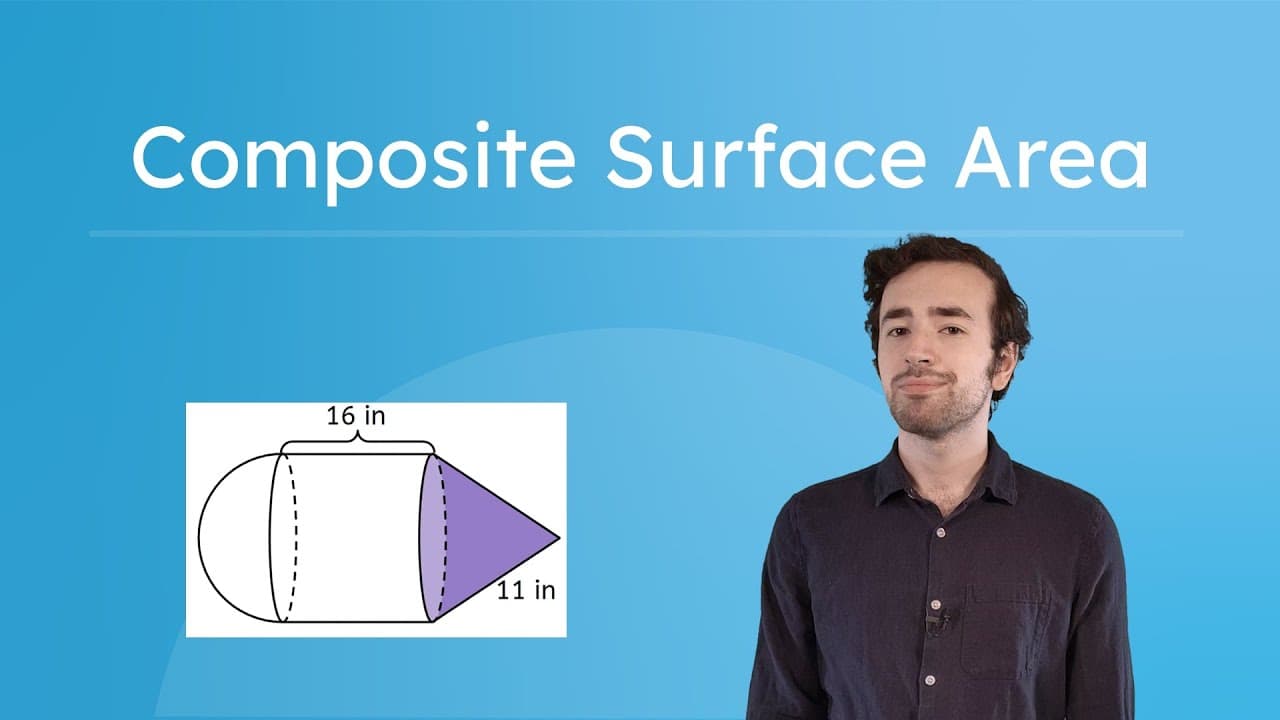
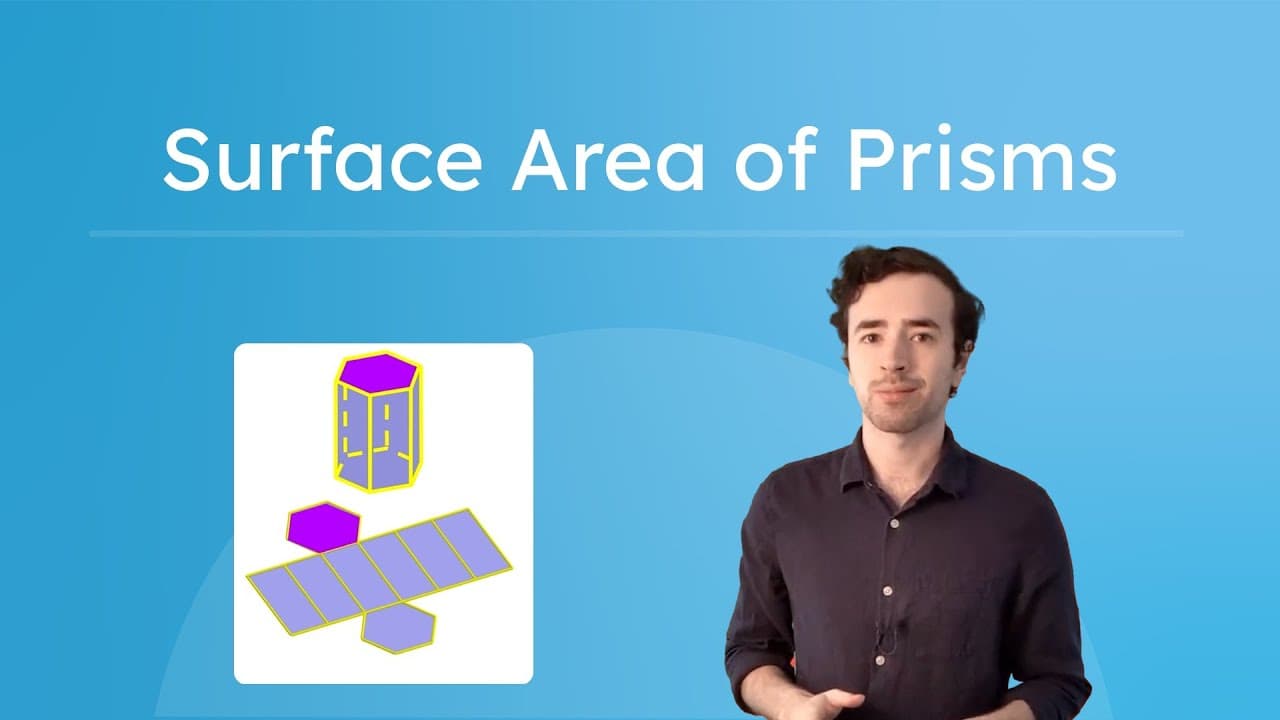
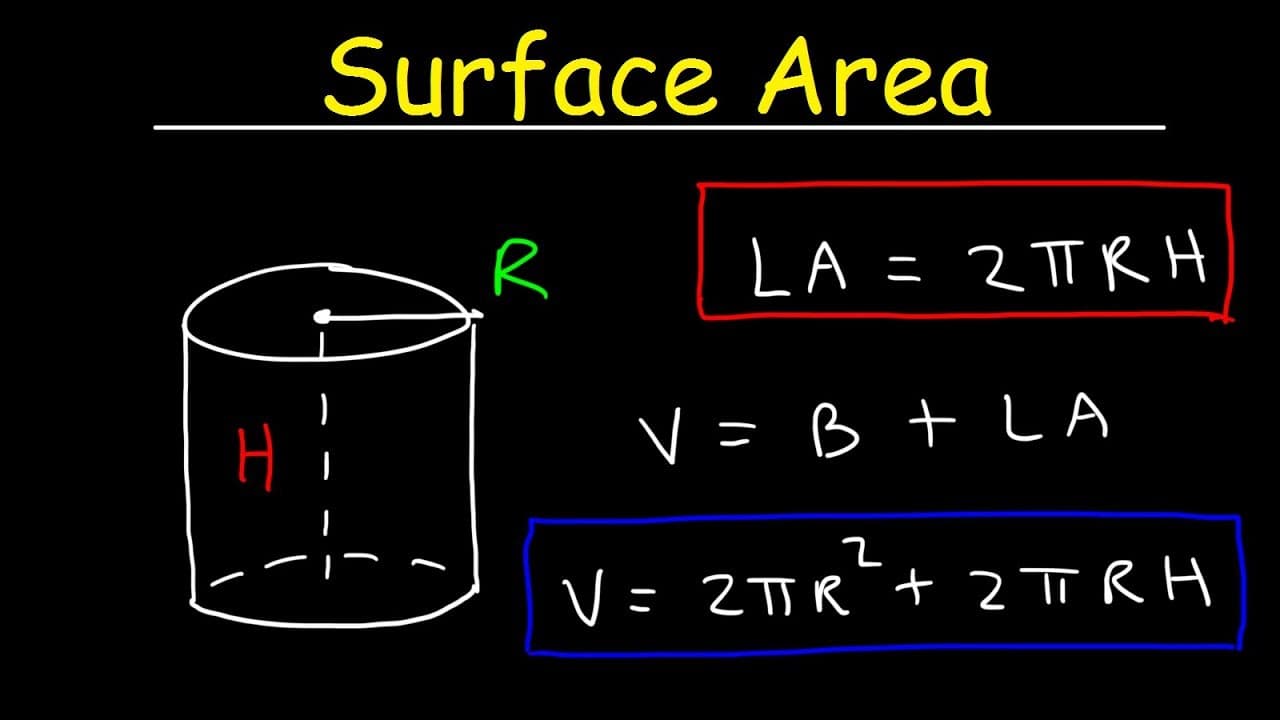
Mastering Surface Area of Composite 3D Figures

Mastering Surface Area of Composite 3D Figures

This educational video provides a clear, step-by-step guide to calculating the surface area of composite 3D figures—shapes created by combining or removing standard geometric solids like prisms, cylinders, pyramids, cones, and spheres. The instructor, Justin, moves beyond simple formula application to teach the conceptual understanding needed to determine which faces contribute to the total surface area and which are internal or removed. The lesson uses visual aids and specific examples to demonstrate that finding the surface area of a composite figure is not as simple as adding the total surface areas of its parts together. The video explores key geometric themes including spatial visualization, the decomposition of complex shapes, and the application of lateral versus total surface area formulas. It explicitly addresses the "hidden face" problem where two shapes join, using a "wrapping paper" analogy to help students visualize the exterior surface. Two detailed worked examples are provided: an additive figure combining a cylinder, cone, and hemisphere, and a subtractive figure where a pyramid is "removed" from a prism, creating a hollow indentation that paradoxically increases the total surface area. For educators, this video serves as an excellent instructional tool for middle and high school Geometry units. It effectively targets the common student misconception that calculating composite surface area involves simply summing the areas of individual shapes. By breaking down complex problems into manageable components and emphasizing the logic behind selecting specific parts of formulas (like using only lateral area), the video fosters critical thinking and precision in mathematical problem-solving.

Miacademy & MiaPrep Learning ChannelMiacademy & MiaPrep Learning Channel

14mins 45s

Video
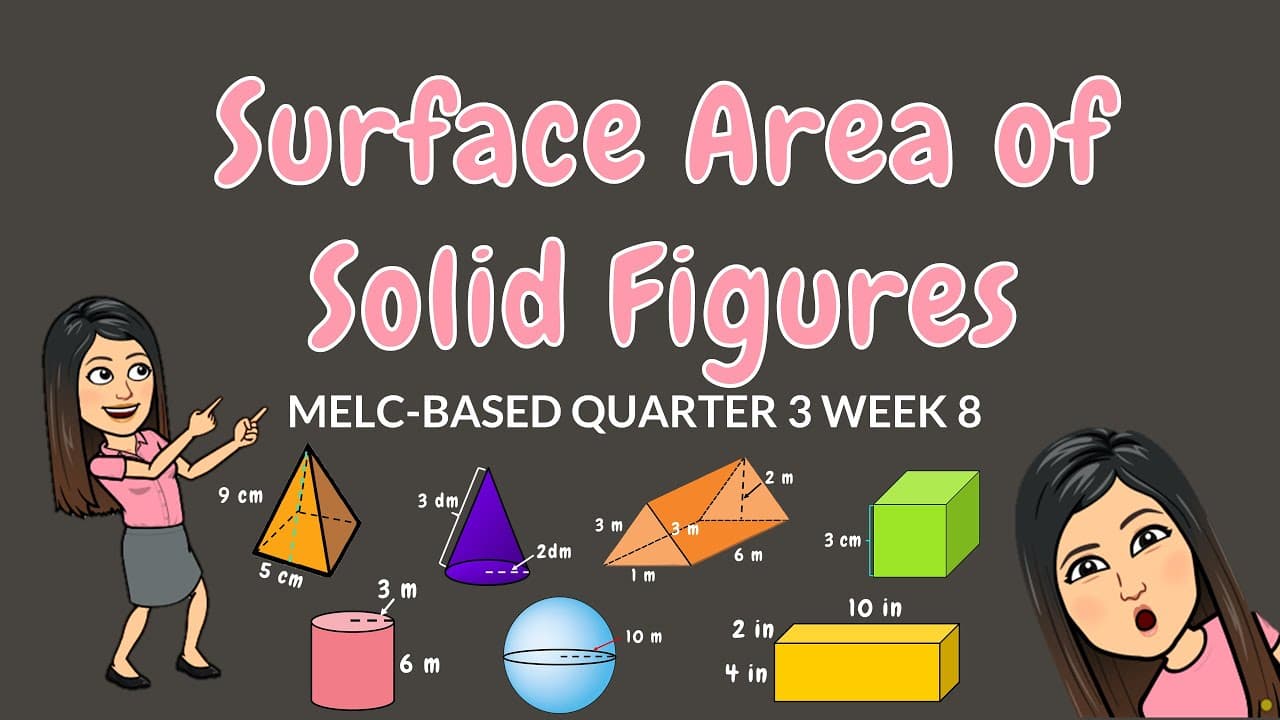
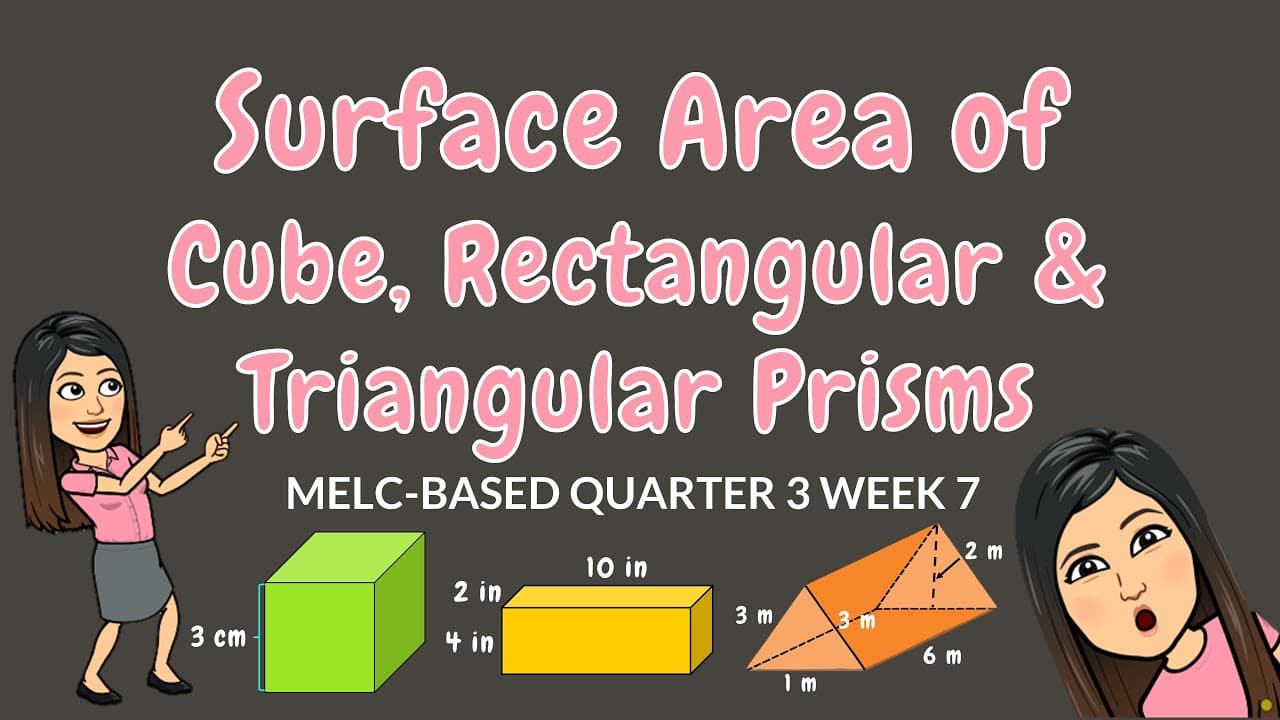
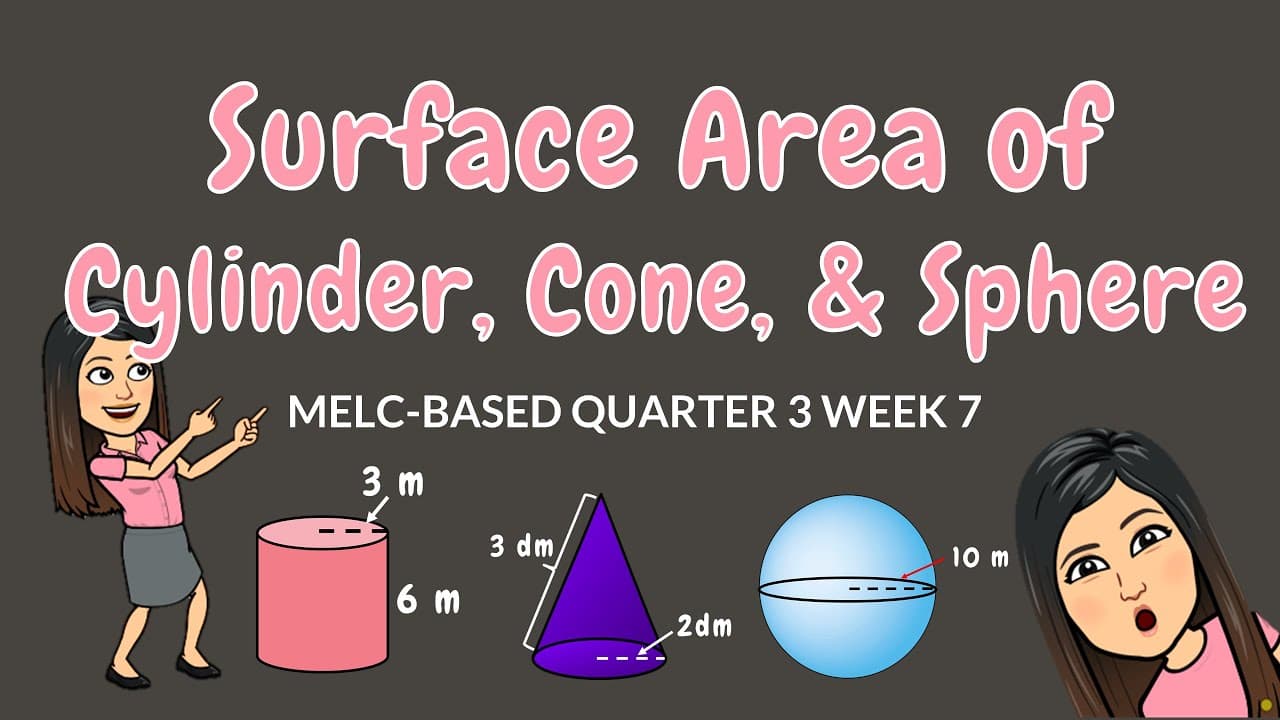
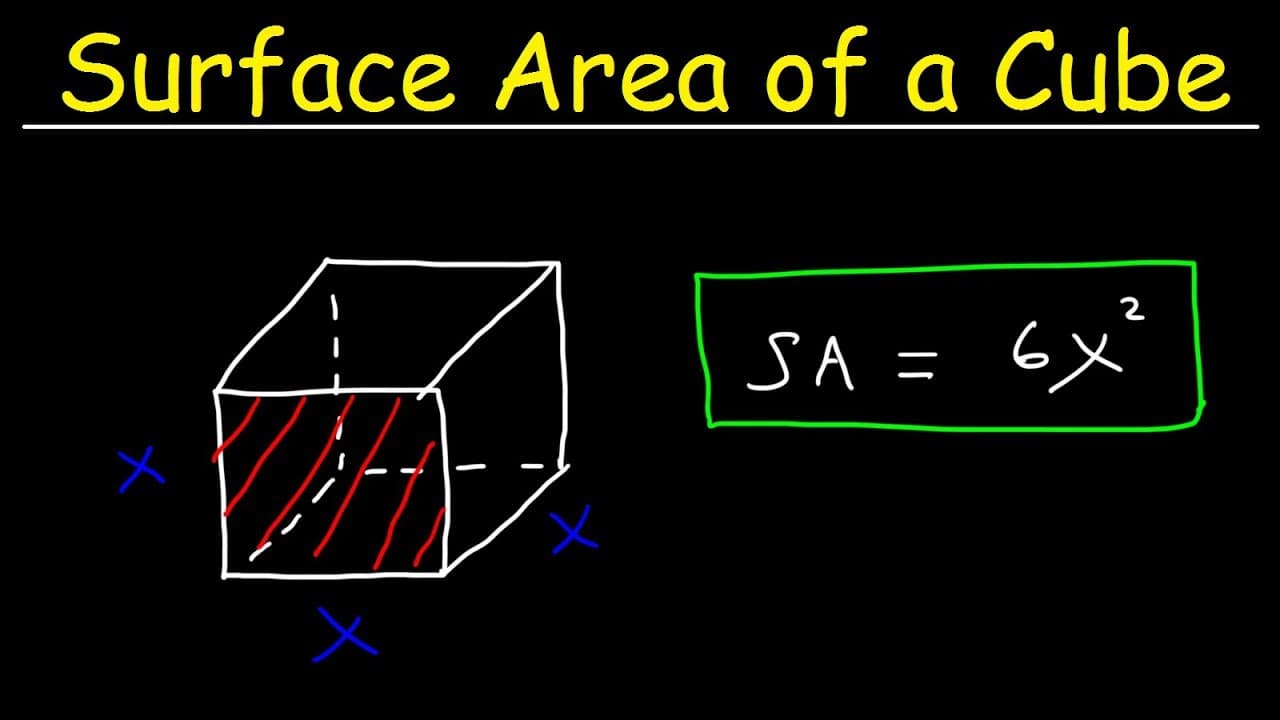
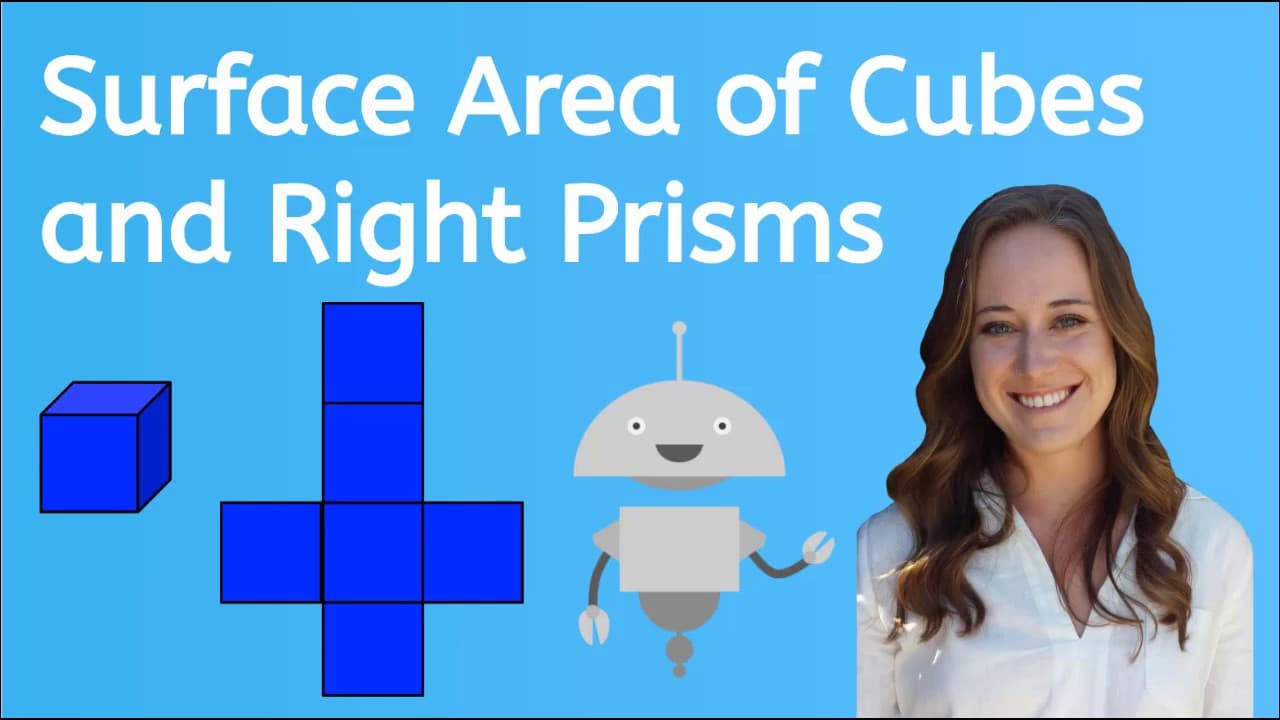
Calculating Surface Area of 3D Shapes

Calculating Surface Area of 3D Shapes

This educational math video provides a comprehensive, step-by-step tutorial on calculating the surface area of six common solid figures: a cube, rectangular prism, triangular prism, square pyramid, cylinder, cone, and sphere. Hosted by an animated teacher avatar in a digital classroom setting, the video introduces each 3D shape, identifies its key dimensions (such as length, width, height, radius, and slant height), presents the specific formula for its surface area, and then walks through a worked example using substitution and calculation. The video covers key geometry themes including identifying 3D shapes, understanding the difference between lateral and total surface area, and the practical application of algebraic formulas. It systematically breaks down complex formulas into manageable parts—calculating the area of specific faces or components (like the base versus the lateral faces) before summing them up for the final answer. The content emphasizes procedural fluency and the correct use of units (squared units for area). For teachers, this video serves as an excellent instructional aid or review tool for middle school geometry units. It can be paused after each shape is introduced to allow students to attempt the calculation before seeing the solution, or used as a reference guide for students working independently. The clear visual labeling of dimensions helps students map abstract variables in formulas to specific parts of a geometric figure, addressing a common hurdle in learning measurement geometry.

Sheena DoriaSheena Doria

9mins 11s

Video
How to Draw a 60-Degree Angle Using a Protractor

How to Draw a 60-Degree Angle Using a Protractor

This concise instructional video demonstrates the step-by-step process of constructing a specific acute angle (60 degrees) using standard geometric tools. The narration guides viewers through placing a ruler to draw a base ray, marking a vertex, correctly aligning a protractor, identifying the correct degree measurement on the scale, and connecting points to finalize the angle. The video emphasizes precision and proper tool handling, specifically highlighting how to align the protractor's center point and base line relative to the drawn line. The central themes are geometric construction, measurement precision, and the practical application of mathematical tools. It specifically focuses on the procedural knowledge required to create angles less than 90 degrees, serving as a foundational skill for more complex geometry tasks like constructing triangles or polygons. The visual simplicity allows learners to focus entirely on the technique without distraction. For educators, this video serves as an excellent model for explicit instruction. It effectively breaks down a physical task that is often difficult to demonstrate to a large group. Teachers can use this video to introduce the concept of using a protractor, as a refresher for students struggling with alignment, or as a self-paced guide during independent practice stations where students construct their own angles alongside the tutorial.

MatholiaChannelMatholiaChannel

1min 16s

Video
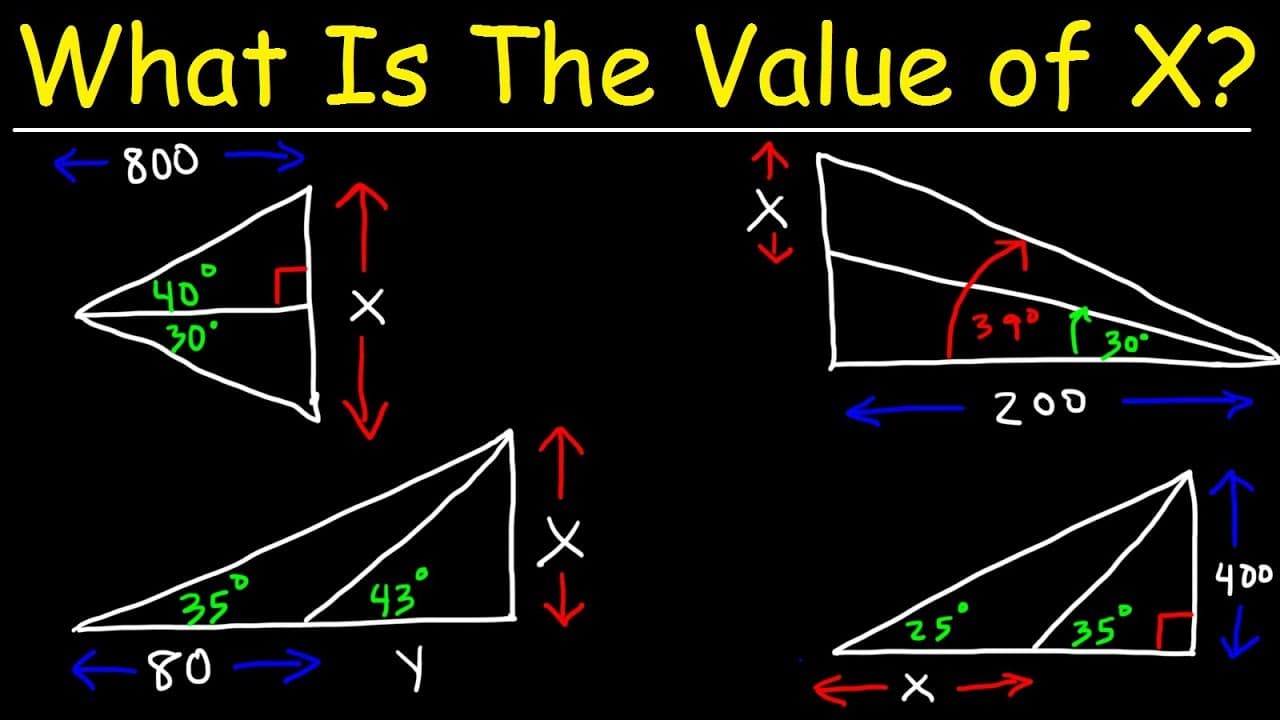
Solving Complex Problems with Two Right Triangles

Solving Complex Problems with Two Right Triangles

This comprehensive math tutorial guides students through solving complex trigonometry problems involving systems of two right triangles. The video progresses from simpler scenarios to more advanced applications, demonstrating how to break down composite figures into manageable right-angled triangles to find unknown side lengths. The narrator uses the tangent function extensively, showing how to calculate total heights by adding segments, find differences in heights by subtracting segments, and solve for unknowns when variables are on the denominator. The content covers four distinct problem types: (1) finding the total height of two stacked triangles given a base; (2) finding a segment of a vertical side involving nested triangles; (3) finding a segment of a horizontal base given a vertical height; and (4) the classic "two observation points" problem which requires setting up and solving a system of linear equations. Each problem is solved step-by-step with clear algebraic manipulation. This video is highly valuable for high school geometry and trigonometry classrooms. It bridges the gap between basic SOH CAH TOA applications and multi-step problem solving. It specifically addresses the algebraic skills needed for trigonometry, such as cross-multiplication, isolating variables, and substitution methods, making it an excellent resource for scaffolding complex word problems commonly found in standardized tests.

The Organic Chemistry TutorThe Organic Chemistry Tutor

15mins 14s

Video
Exploring Triangles and Quadrilaterals: Types and Angles

Exploring Triangles and Quadrilaterals: Types and Angles

This comprehensive math video serves as a detailed introduction to the fundamental properties, classifications, and angle rules of triangles and quadrilaterals. The lesson begins by defining triangles, demonstrating how to name their components (sides, vertices, angles), and categorizing them by angle type (right, acute, obtuse) and side length (equilateral, isosceles, scalene). It then transitions to quadrilaterals, introducing concepts such as parallel lines and congruence through familiar shapes like squares and parallelograms, while encouraging viewers to identify these properties visually. A central theme of the video is the calculation of interior angles. The narrator explains and visually proves that the sum of interior angles in a triangle is always 180 degrees, while in a quadrilateral it is 360 degrees. This concept is reinforced through a demonstration showing how a quadrilateral can be divided into two triangles. The video moves beyond theory into application by modeling how to set up and solve basic algebraic equations to find missing angles in both types of polygons. For the classroom, this video is an excellent resource for bridging geometry and early algebra. The clear, step-by-step examples of solving for 'x' provide a model for student work, while the visual quizzes on quadrilateral properties offer built-in opportunities for formative assessment. Teachers can use the pause points during calculation segments to allow students to practice independent problem-solving before revealing the answers, making it a highly interactive tool for 4th through 6th-grade math curriculums.

Miacademy & MiaPrep Learning ChannelMiacademy & MiaPrep Learning Channel

8mins 39s

Video
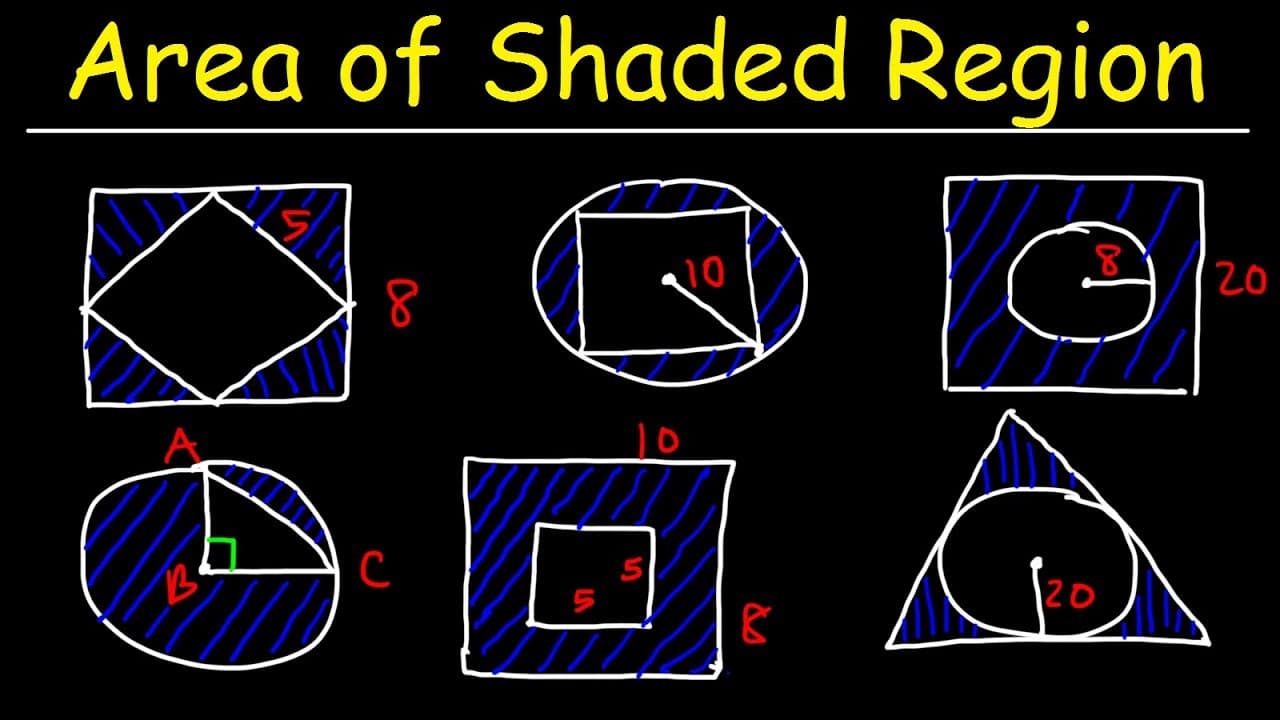
How to Calculate the Area of Shaded Regions in Geometry

How to Calculate the Area of Shaded Regions in Geometry

This educational video provides a comprehensive tutorial on calculating the area of shaded regions in geometry. The narrator guides viewers through six distinct problems, progressing from basic shapes to more complex composite figures. The core concept taught is the 'subtraction method,' where the area of a shaded region is determined by calculating the area of the larger outer shape and subtracting the area of the smaller inner shape (or unshaded region). The video covers a variety of geometric shapes including squares, rectangles, circles, triangles, and rhombuses. It reviews essential formulas for calculating the area of these figures. As the problems advance in difficulty, the video introduces and applies more sophisticated mathematical concepts such as the Pythagorean theorem and the properties of special right triangles (30-60-90 triangles) to find missing side lengths required for the area calculations. Teachers will find this video highly valuable for geometry units in middle and high school. It serves as excellent direct instruction or review material for helping students visualize geometric relationships and practice multi-step problem solving. The step-by-step walkthroughs model clear mathematical thinking, demonstrating how to break down complex diagrams into manageable components, label known values, and derive unknown values using geometric properties.

The Organic Chemistry TutorThe Organic Chemistry Tutor

13mins 36s

Video
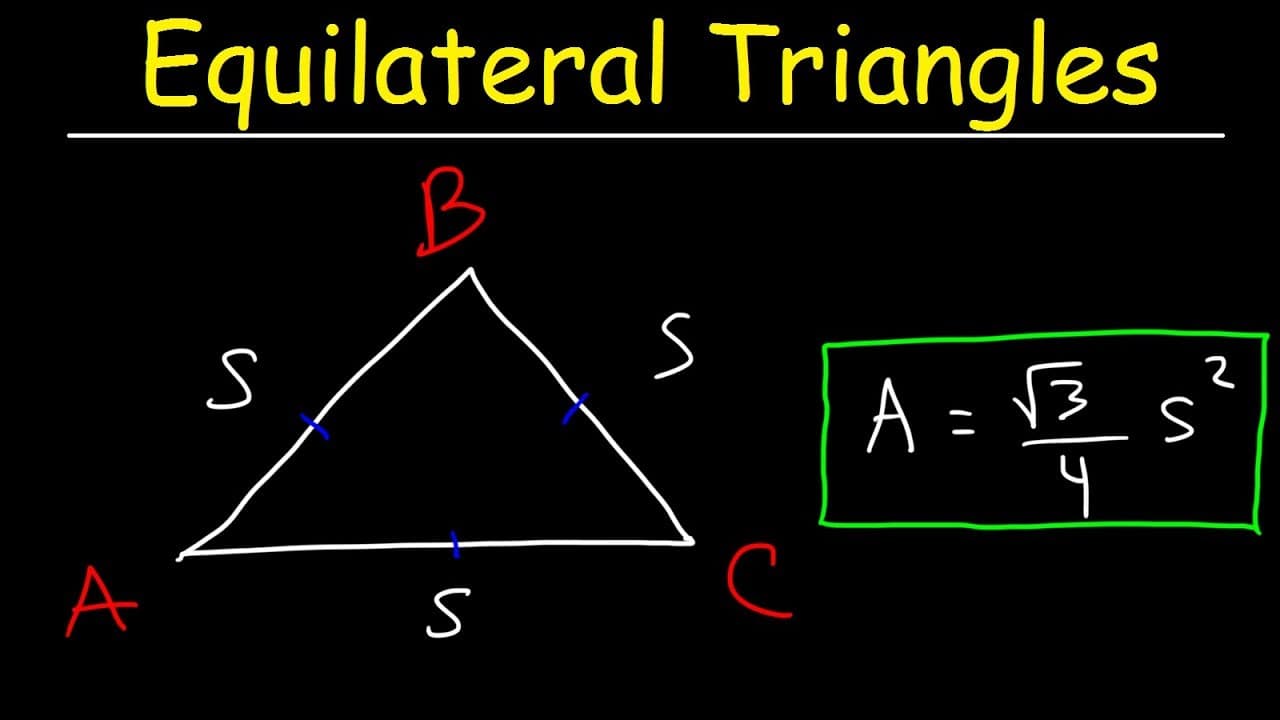
Calculating and Deriving the Area of an Equilateral Triangle

Calculating and Deriving the Area of an Equilateral Triangle

This educational math tutorial provides a comprehensive guide on how to find the area of an equilateral triangle. The video is divided into two distinct parts: first, it introduces the specific area formula for equilateral triangles and demonstrates a practical calculation using a side length of 10. Second, it guides viewers through the formal algebraic derivation of that formula, transitioning from rote memorization to deep conceptual understanding.

The Organic Chemistry TutorThe Organic Chemistry Tutor

5mins 26s

Video
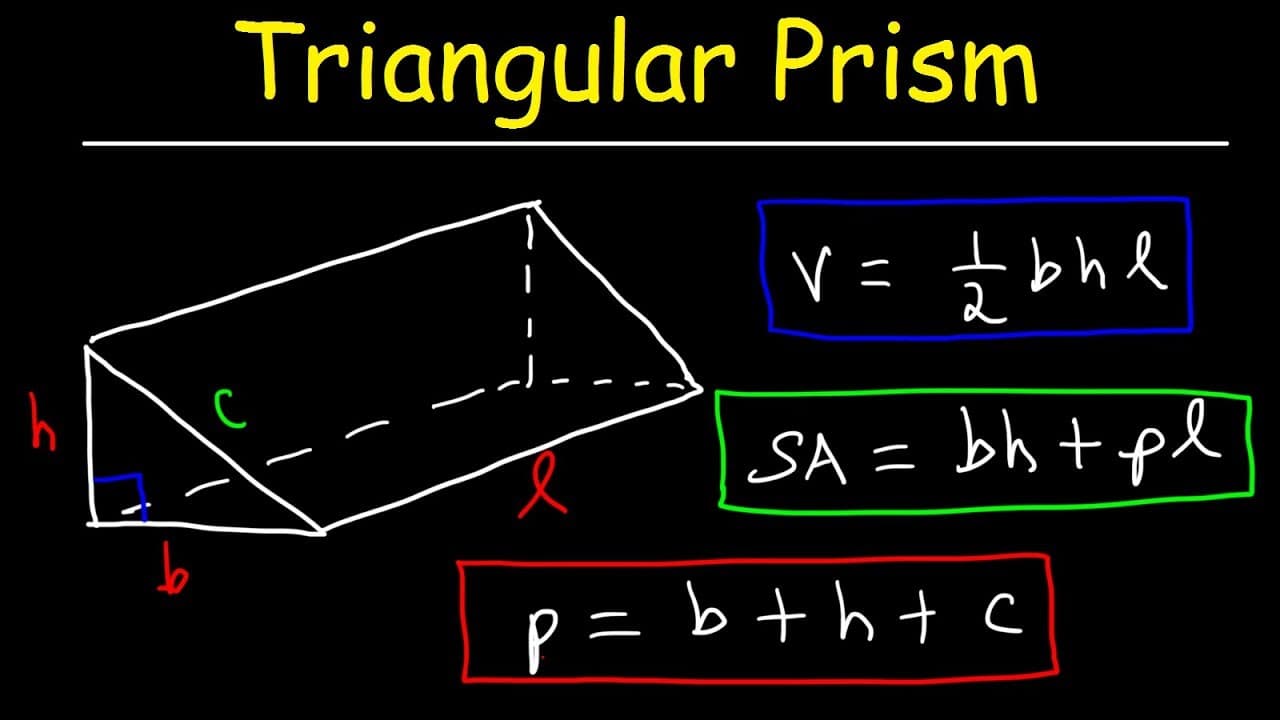
Calculating Volume and Surface Area of Triangular Prisms

Calculating Volume and Surface Area of Triangular Prisms

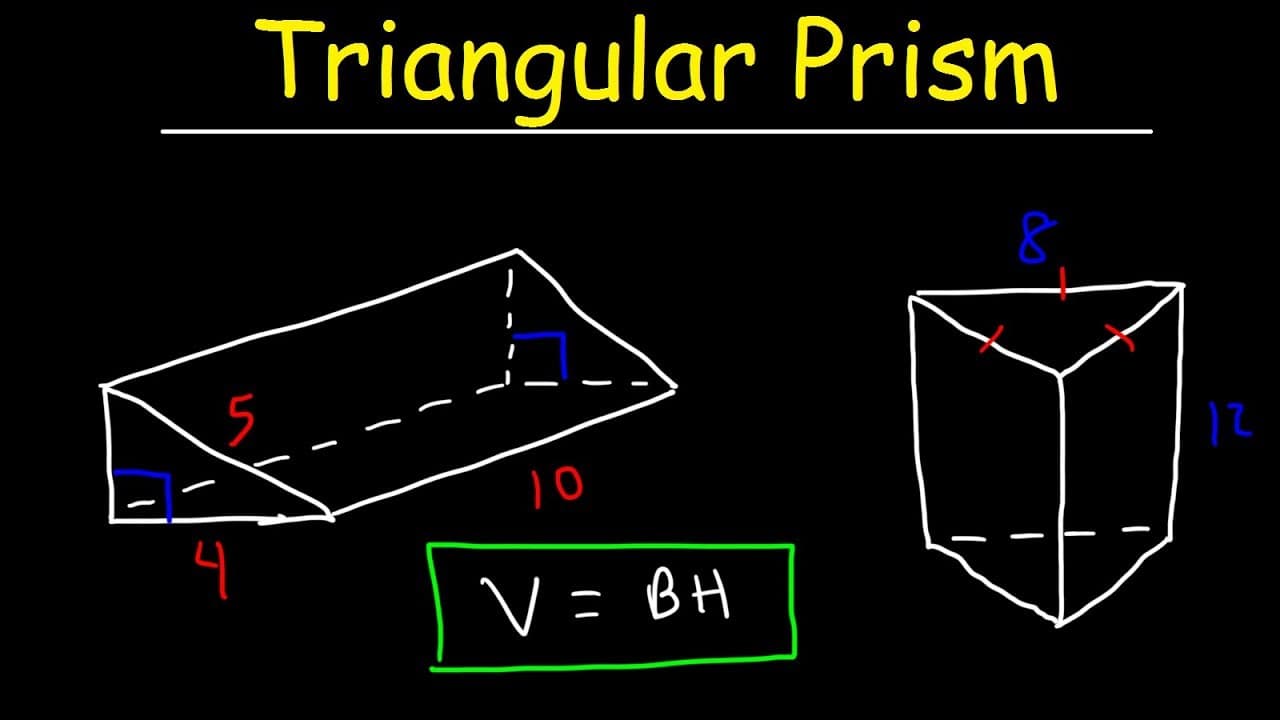
This comprehensive math tutorial provides a step-by-step guide to calculating the volume and surface area of triangular prisms. The video begins by conceptually linking triangular prisms to rectangular prisms, helping students understand the logic behind the formulas rather than just memorizing them. It breaks down the volume formula into simple terms ($V = \frac{1}{2} \times \text{base} \times \text{height} \times \text{length}$) and derives the surface area formula by analyzing the "net" of the shape—comprising two triangular bases and three rectangular faces. Key themes include geometric decomposition, formula derivation, and the application of the Pythagorean theorem. A significant portion of the video focuses on finding missing dimensions (like the height or hypotenuse of the triangular base) before performing area calculations. This reinforces 8th-grade standards regarding right triangles and connects algebraic solving with geometric application. The video is highly valuable for the classroom because it moves from simple direct application to more complex problem-solving. It includes multiple practice examples that require students to pause, calculate, and check their work. Teachers can use this video to introduce the topic, review before a test, or differentiate instruction for students who struggle with visualizing 3D shapes. The clear, dark background and color-coded annotations make the visual explanations easy to follow for all learners.

The Organic Chemistry TutorThe Organic Chemistry Tutor

27mins 41s

Video
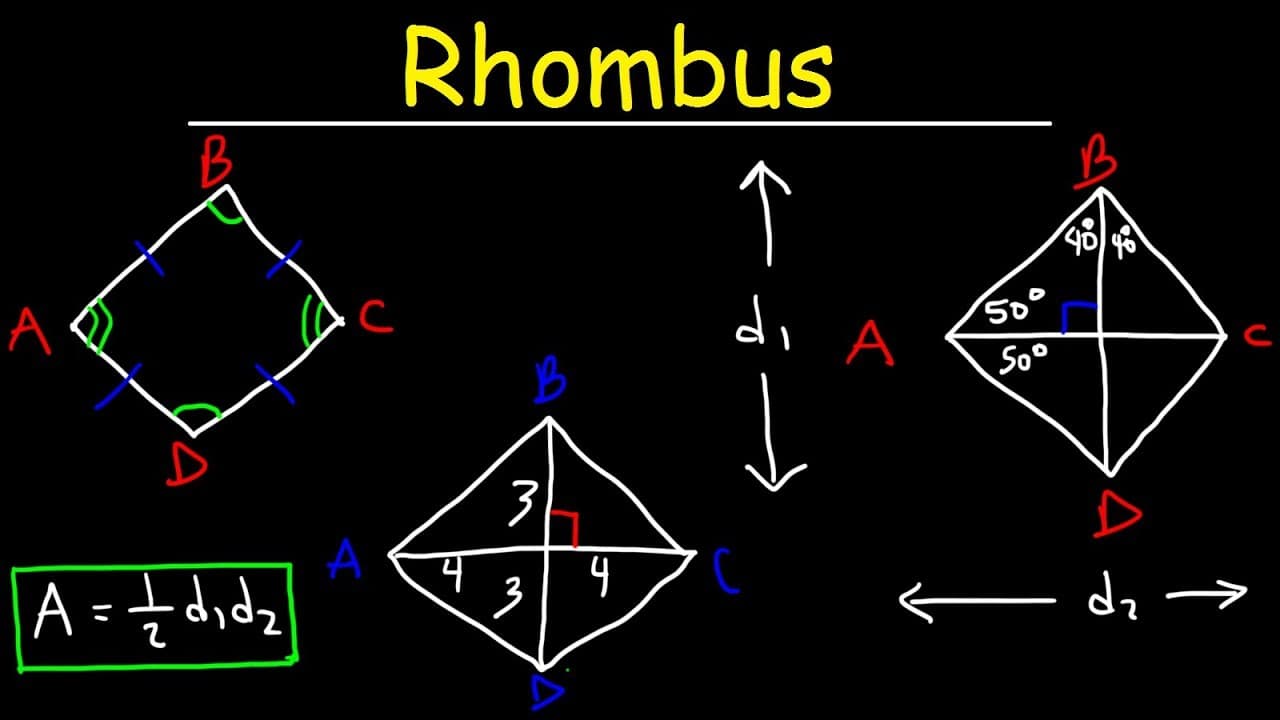
Mastering the Rhombus: Properties, Area, and Angles

Mastering the Rhombus: Properties, Area, and Angles

This comprehensive math tutorial provides a deep dive into the geometric properties of a rhombus, guiding students from basic definitions to complex algebraic applications. The video begins by defining a rhombus as a special quadrilateral and parallelogram, explaining core features such as congruent sides, parallel opposite sides, and angle relationships. It visualizes how diagonals bisect angles, bisect each other, and intersect at perpendicular right angles, forming the foundation for area and perimeter calculations. The content progresses through a series of five increasing difficult example problems. These examples demonstrate how to calculate area using diagonals, determine perimeter using the Pythagorean theorem, and solve for missing angles using triangle sum properties. Later sections integrate algebra, challenging students to solve linear and quadratic equations to find side lengths and angle measures. The video concludes with a complex problem involving infinite solutions, encouraging critical thinking about mathematical identities. For educators, this video serves as an excellent resource for a Geometry or Algebra unit. It connects geometric concepts with algebraic solving skills, reinforcing the importance of the Pythagorean theorem and factoring quadratics in geometric contexts. The clear, step-by-step walkthroughs make it suitable for introducing new concepts, guided practice, or independent review for students struggling with the properties of quadrilaterals.

The Organic Chemistry TutorThe Organic Chemistry Tutor

22mins 30s

Video
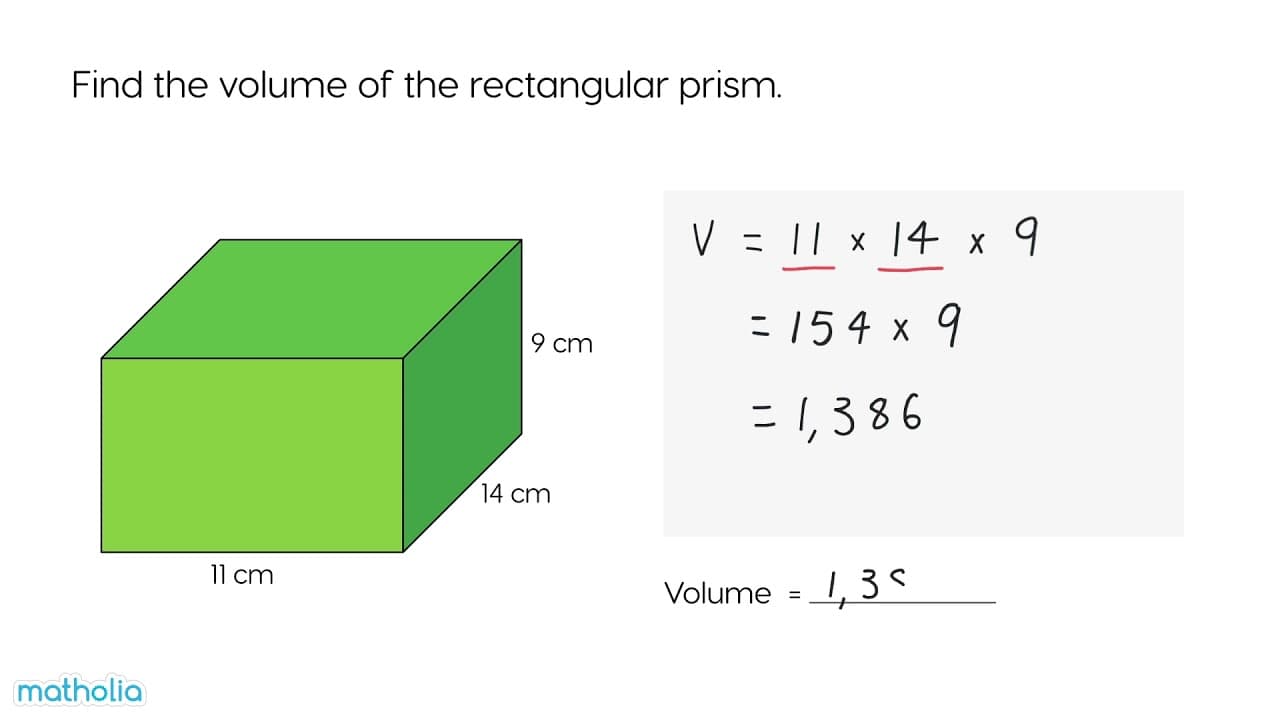
Calculating Capacity and Liquid Volume of Rectangular Tanks

Calculating Capacity and Liquid Volume of Rectangular Tanks

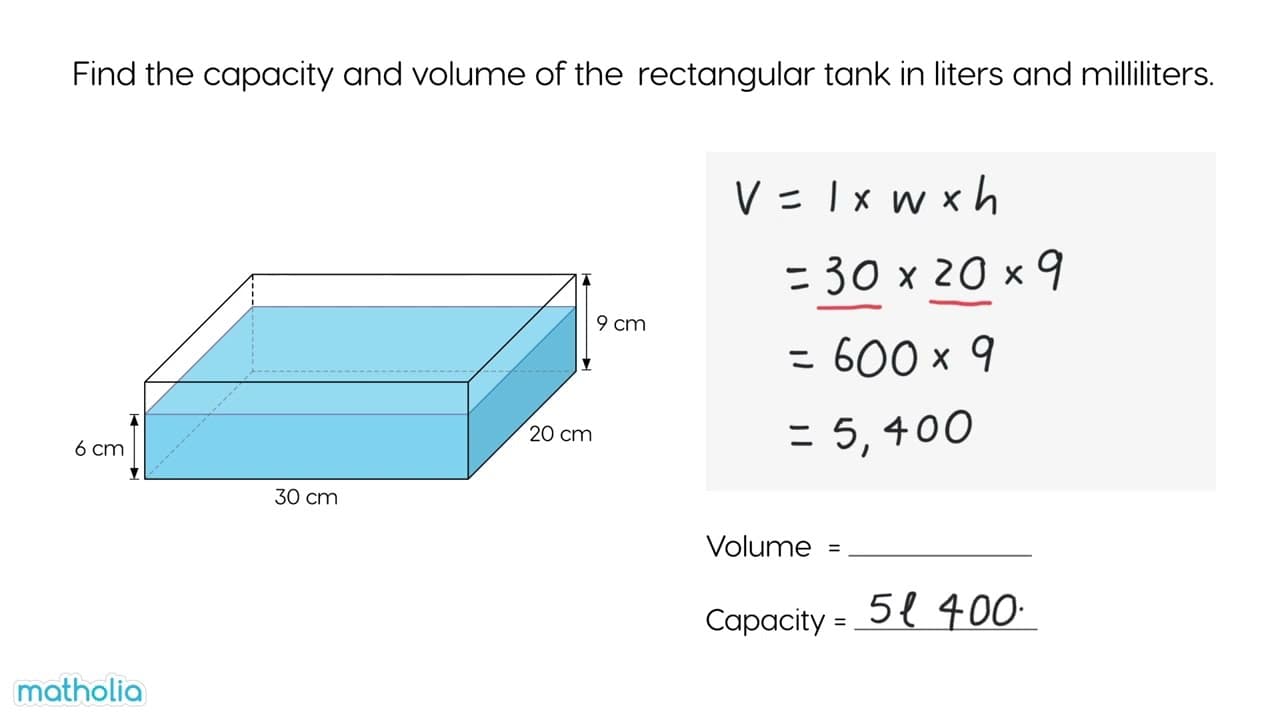
This educational math video provides a clear, step-by-step tutorial on calculating both the total capacity of rectangular containers and the volume of liquid inside them. Through two distinct examples, the video demonstrates the formula for volume (length × width × height) and explains the critical difference between the height of the container itself (capacity) and the height of the liquid level (volume). The content focuses on key geometry and measurement concepts, specifically working with 3D rectangular prisms. It reinforces the relationship between cubic centimeters and milliliters, explicitly teaching that 1 cm³ equals 1 ml. The video also covers metric unit conversions, demonstrating how to convert larger amounts of milliliters into liters and milliliters (e.g., 5,400 cm³ = 5L 400ml). This resource is highly valuable for upper elementary and middle school mathematics classrooms introducing volume. It offers a visual method for distinguishing between the space a container *can* hold versus what it *currently* holds—a common point of confusion for students. The step-by-step calculations shown on screen serve as excellent models for setting out math problems, and the inclusion of unit conversions connects geometry skills with measurement fluency.

MatholiaChannelMatholiaChannel

2mins 36s

Video
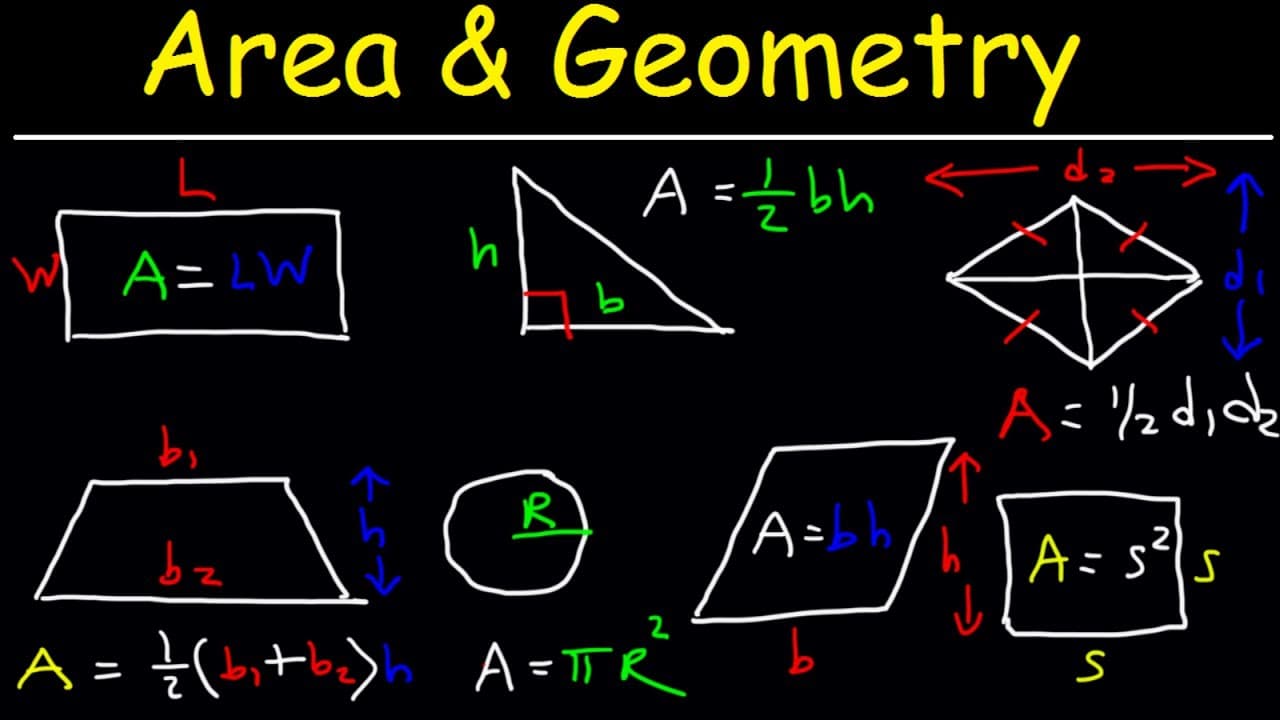
Mastering Area Formulas: From Rectangles to Complex Shapes

Mastering Area Formulas: From Rectangles to Complex Shapes

This comprehensive math tutorial provides a systematic breakdown of how to calculate the area for a wide variety of geometric shapes. The video moves from simple concepts to more complex applications, covering rectangles, triangles (including right, equilateral, and scalene), circles, sectors, parallelograms, trapezoids, rhombuses, and squares. It demonstrates not just the basic area formulas, but also how to use the Pythagorean theorem to derive missing dimensions like height or base length needed for calculation. Key themes include the application of specific area formulas, the importance of units (like square feet), and problem-solving strategies for composite shapes. The video introduces advanced techniques for high school geometry, such as finding the area of a triangle given two sides and an included angle (SAS) using sine, and finding the area of a scalene triangle given three sides (SSS) using Heron's Formula. It also addresses how to calculate the area of shaded regions by subtracting the area of one shape from another. This resource is highly valuable for middle and high school math classrooms as both an introduction and a review tool. Teachers can use specific segments to target individual shapes or use the entire video to show the progression of geometric concepts. The step-by-step walkthroughs clarify common stumbling blocks, such as distinguishing between slant height and vertical height, identifying the correct base in complex figures, and working with radicals in answers.

The Organic Chemistry TutorThe Organic Chemistry Tutor

20mins 35s

Video
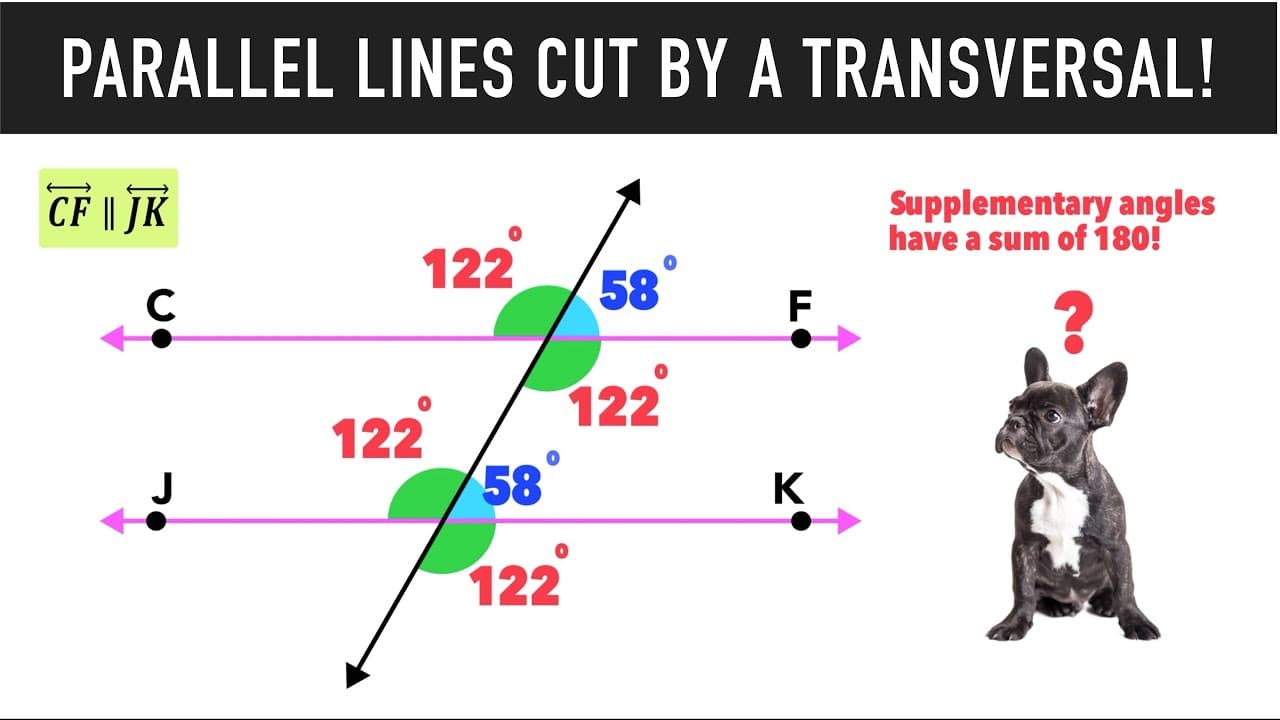
Understanding Angles in Parallel Lines and Transversals

Understanding Angles in Parallel Lines and Transversals

This educational video provides a comprehensive lesson on the geometric relationships created when a transversal line intersects two parallel lines. Building on prior knowledge of general transversals, the instructor guides students through identifying special angle pairs—such as alternate interior, alternate exterior, corresponding, and consecutive interior angles—and understanding their specific properties of congruence or supplementarity. The video uses visual animations to demonstrate why these relationships exist, showing how the intersections are identical when lines are parallel. The content covers key geometric theorems and applies them to solving mathematical problems. Students learn to determine unknown angle measurements by identifying relationships like vertical angles and linear pairs alongside the new parallel line theorems. The lesson progresses from basic arithmetic applications to more complex algebraic problems where students must set up and solve equations to find variables representing angle measures. This resource is highly valuable for geometry classrooms as it visualizes abstract concepts through color-coding and animations, making the "why" behind the theorems clear. It offers a structured approach to learning, starting with conceptual understanding, moving to theorem definitions, and concluding with guided practice problems. The integration of algebra also helps reinforce cross-disciplinary math skills, making it an excellent tool for standard instruction or review.

Miacademy & MiaPrep Learning ChannelMiacademy & MiaPrep Learning Channel

12mins 1s

Video
Mastering Area: Rectangles and Triangles

Mastering Area: Rectangles and Triangles

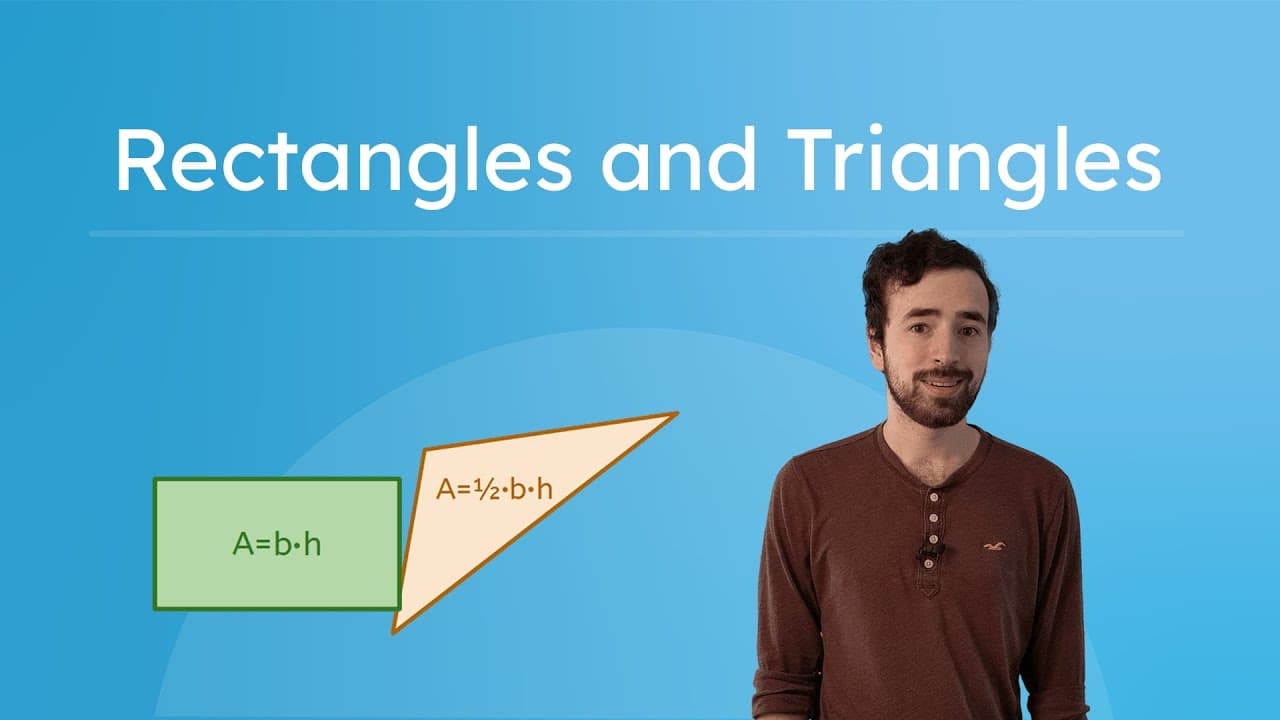
This educational video provides a clear and comprehensive guide to calculating the area of rectangles and triangles. Narrated by Justin, the lesson begins by revisiting the familiar area formula for rectangles ($A = l \times w$) and upgrading the terminology to "base times height" ($A = b \times h$) to allow for broader application across different polygons. The video then transitions to triangles, explaining the formula $A = \frac{1}{2} b \times h$ and demonstrating how to correctly identify the base and corresponding height (altitude) for acute, right, and obtuse triangles. Key themes explored include the importance of precise mathematical vocabulary, specifically the definition of height as the perpendicular distance from the base to the opposite vertex. The video visually demonstrates how height changes position relative to the shape depending on the type of triangle. It also integrates higher-level concepts by solving a complex example problem that requires using the Pythagorean theorem to find a missing height before calculating the area. For educators, this video serves as an excellent bridge between basic geometry and more advanced application. It is particularly useful for reinforcing the concept that "base" does not always mean "bottom" and for demonstrating multi-step problem solving. The step-by-step walkthroughs of finding a missing side length in a rectangle and calculating the area of a composite triangle make it a valuable resource for instruction, review, or flipped classroom assignments.

Miacademy & MiaPrep Learning ChannelMiacademy & MiaPrep Learning Channel

10mins 9s

Video
Parallel Lines and Transversals: From NYC Streets to Algebra

Parallel Lines and Transversals: From NYC Streets to Algebra

This engaging geometry lesson bridges the real world and abstract mathematics by introducing parallel lines and transversals through the lens of New York City's street grid. Starting with a Google Earth tour of Manhattan, students visualize how Avenues and Streets act as parallel and perpendicular lines, with Broadway serving as a famous real-world transversal. This concrete hook helps ground the subsequent theoretical concepts in a familiar context. The video then transitions to abstract geometric proofs, demonstrating why corresponding angles are congruent by visually sliding parallel lines on top of one another. It covers essential vocabulary including corresponding angles, vertical angles, and linear pairs (supplementary angles). A unique "X's and O's" visualization strategy is introduced to help students quickly identify congruent and supplementary relationships without getting bogged down in complex terminology, making the content accessible for diverse learners. Finally, the lesson connects geometry to algebra by modeling how to solve for unknown variables within angle measures. Students walk through a step-by-step problem solving process: identifying the angle relationship, setting up the algebraic equation (either setting expressions equal or summing to 180), solving for x, and substituting back to find the actual degrees. This video is an excellent resource for introduction, review, or remediation of angle relationships.

Mashup MathMashup Math

9mins 35s

Video
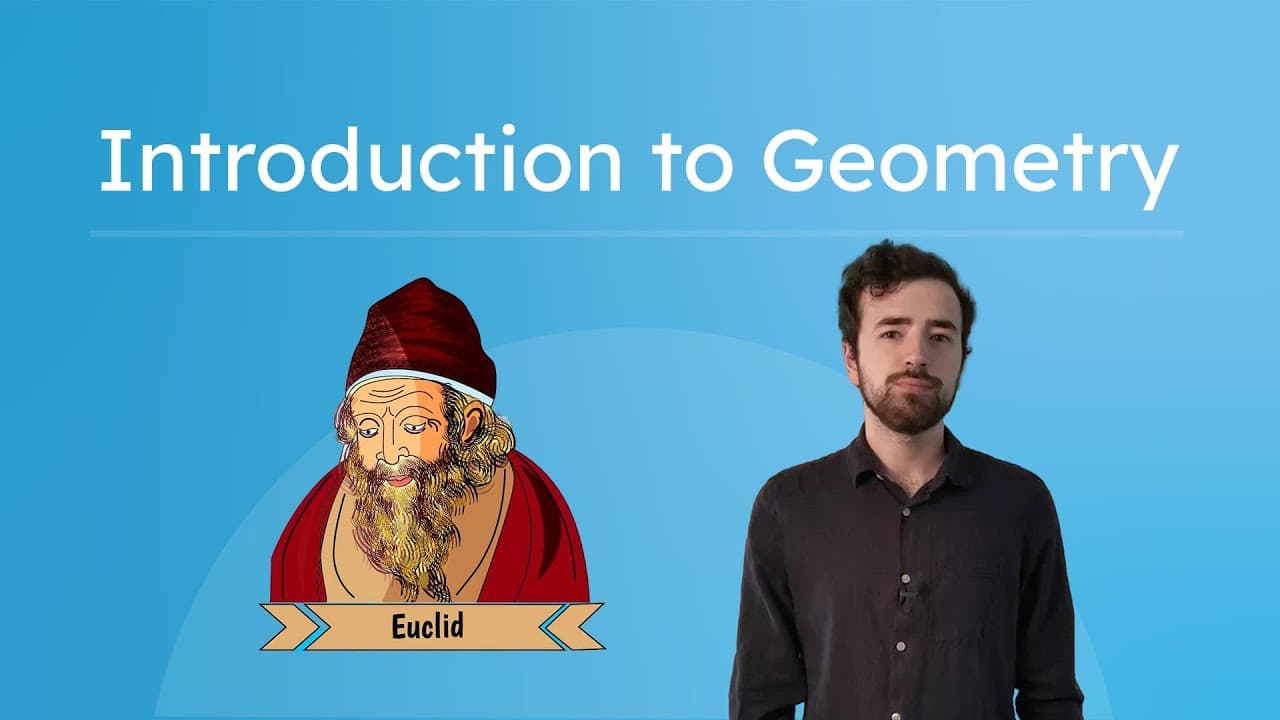
Introduction to Geometry: Euclid's World and Study Skills

Introduction to Geometry: Euclid's World and Study Skills

This video serves as a dual-purpose introduction: it first establishes the historical and conceptual foundations of Euclidean geometry, and then transitions into a guide on effective study habits for mathematics students. The video begins by introducing Euclid of Alexandria and his work in 300 BC, visually demonstrating how zero-dimensional points evolve into one-dimensional lines, two-dimensional shapes, and three-dimensional figures. It connects these abstract concepts to the measurement of area and volume, framing geometry as the study of the rules that govern space. The second half of the video functions as a course orientation, detailing the structure of learning units (lessons, wrap-ups, and projects) while emphasizing metacognitive strategies. The narrator provides specific advice on the importance of taking durable notes, using rubrics to understand expectations, and the necessity of reviewing material rather than rushing through it. It stresses that learning is about long-term retention rather than just passing an immediate assessment. For educators, this video is a valuable tool for the start of a geometry semester. It can be used to humanize the subject by introducing its ancient roots and to scaffold executive functioning skills. The segment on real-world applications—connecting geometry to computer screens, architecture, and molecular structures—helps answer the perennial student question, "When will I use this?" by framing geometry as the "laws of nature."

Miacademy & MiaPrep Learning ChannelMiacademy & MiaPrep Learning Channel

6mins 46s

Video
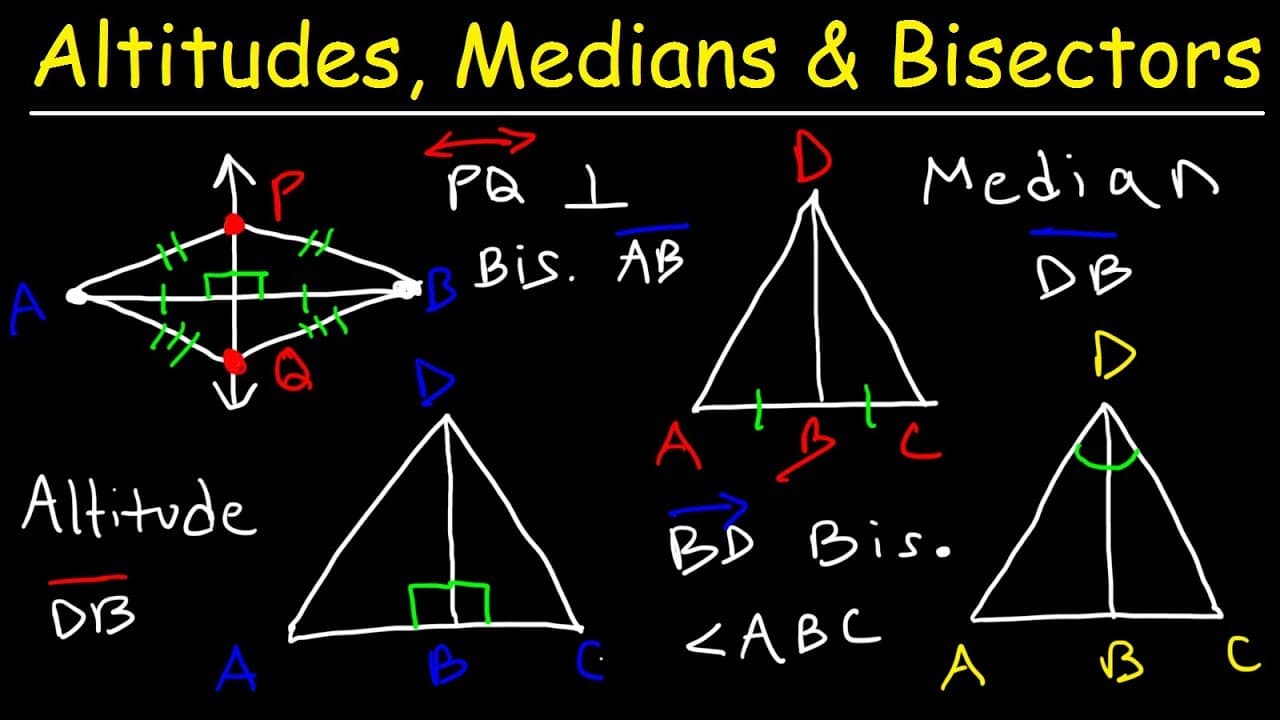
Identifying Medians, Altitudes, and Bisectors in Triangles

Identifying Medians, Altitudes, and Bisectors in Triangles

This comprehensive geometry tutorial breaks down the specific definitions and properties of four critical line segments associated with triangles: the median, altitude, perpendicular bisector, and angle bisector. Using clear, hand-drawn diagrams, the narrator explains the unique characteristics of each segment, such as how a median connects to a midpoint while an altitude forms a right angle. The video carefully distinguishes between often-confused terms by highlighting visual markers like tick marks for congruence and squares for right angles.

The Organic Chemistry TutorThe Organic Chemistry Tutor

10mins 18s

Video
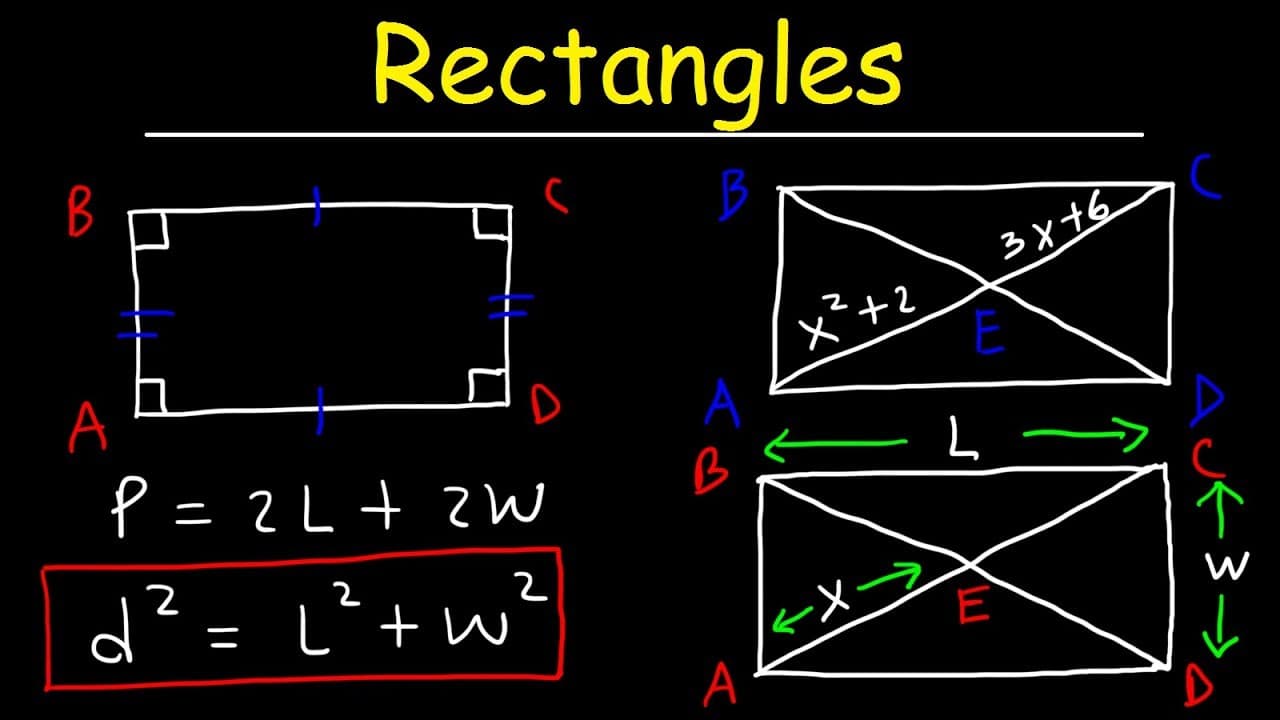
Understanding Rectangles: Properties and Problem Solving

Understanding Rectangles: Properties and Problem Solving

This educational video provides a comprehensive overview of rectangles, blending geometric theory with algebraic application. It begins by defining a rectangle as a specific type of quadrilateral and parallelogram, detailing essential properties such as parallel opposite sides, congruent opposite sides, and four right angles. The narrator explains the unique properties of diagonals in a rectangle, including congruency and bisection, before moving on to fundamental formulas for area, perimeter, and calculating diagonal length using the Pythagorean theorem. The video progresses from basic concepts to advanced problem-solving, demonstrating how to apply algebraic skills within a geometric context. Two complex example problems are worked through in real-time. The first involves setting up and solving a quadratic equation derived from diagonal properties to find segment lengths. The second presents a scenario where students must calculate a segment length given only the area and perimeter, requiring the creation and solution of a system of equations involving substitution and factoring. For educators, this video serves as an excellent bridge between geometry and algebra. It goes beyond simple shape identification, challenging students to use deductive reasoning and rigorous calculation. It is particularly useful for demonstrating how multiple mathematical concepts—such as systems of equations, factoring quadratics, and geometric theorems—converge in a single problem, making it a valuable resource for high school geometry or algebra curriculums.

The Organic Chemistry TutorThe Organic Chemistry Tutor

12mins 26s

Video
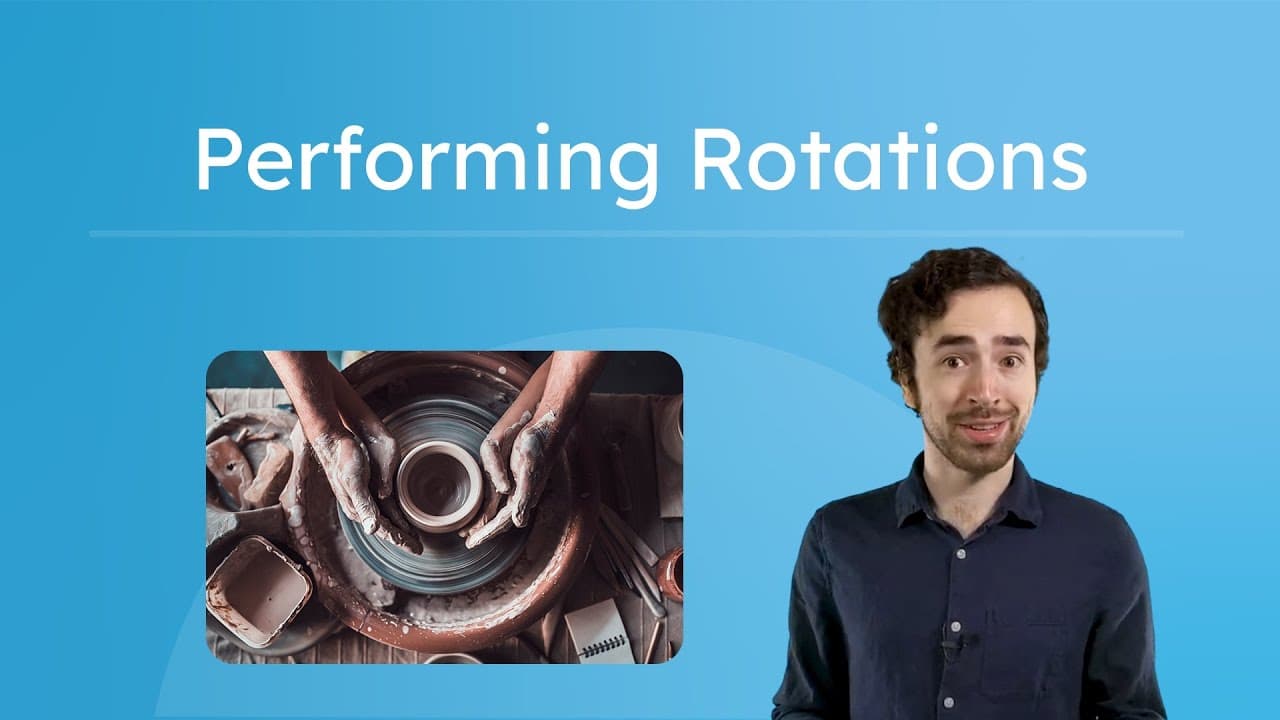
How to Perform Rotations About the Origin

How to Perform Rotations About the Origin

This video provides a comprehensive tutorial on performing geometric rotations of shapes on a coordinate plane. The instructor, Justin, guides viewers through the core concepts of rotation, specifically focusing on rotating figures 90, 180, and 270 degrees about the origin. The video utilizes a clever "paper turning" technique to help students visualize how coordinates change during rotation without needing to memorize complex algebraic rules immediately. The content covers essential vocabulary such as "center of rotation," "clockwise (CW)," "counterclockwise (CCW)," "preimage," "image," "isometry," and "invariant points." It clarifies standard mathematical conventions, such as the default direction of rotation being counterclockwise when not specified. Through three distinct examples, the video demonstrates the equivalence between different rotations (e.g., 90° CCW is the same as 270° CW) and explores special cases where points located on the center of rotation remain fixed. This resource is highly valuable for middle and high school geometry classrooms. It bridges the gap between physical manipulation and abstract coordinate geometry. Teachers can use this video to introduce the concept of transformations or as a remediation tool for students struggling to visualize rotations. The step-by-step guided practice format allows for active participation, making it ideal for a flipped classroom model or independent study station.

Miacademy & MiaPrep Learning ChannelMiacademy & MiaPrep Learning Channel

11mins 23s

Video
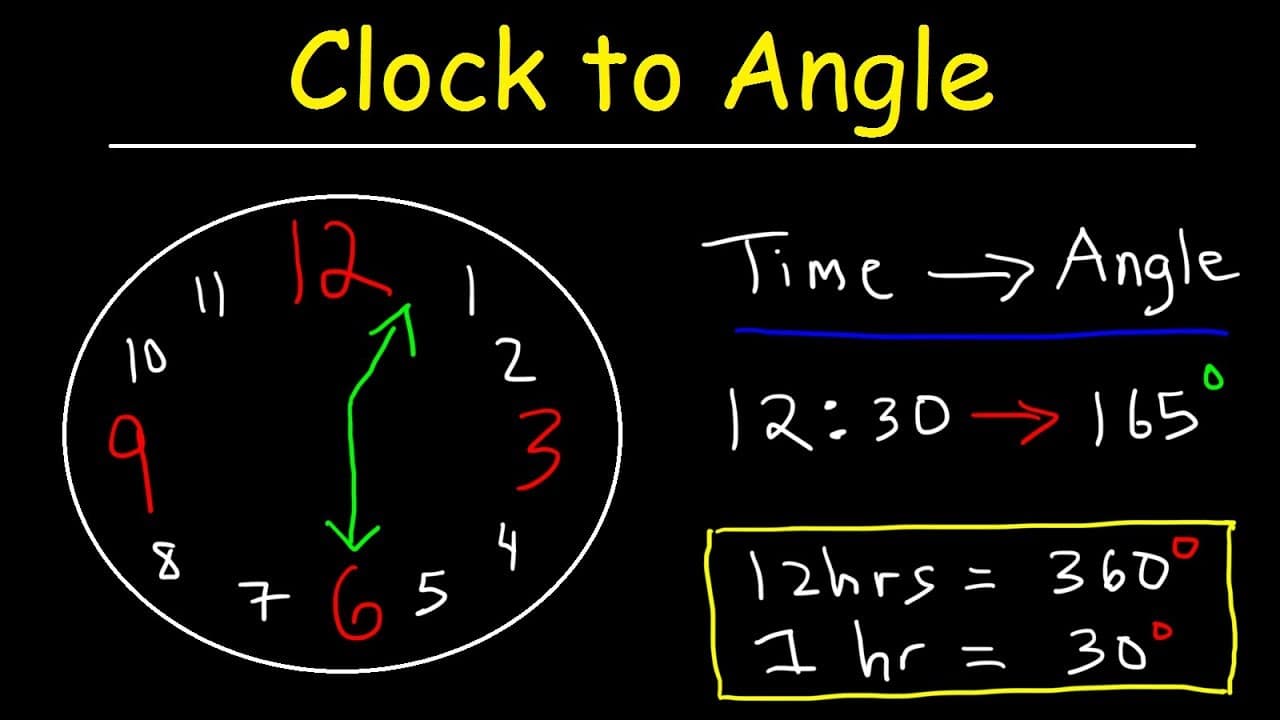
Calculating Angles on a Clock Face

Calculating Angles on a Clock Face

This math tutorial provides a step-by-step guide on how to calculate the precise angle between the hour and minute hands of an analog clock at specific times. The instructor uses clear visual diagrams and algebraic logic to demonstrate how to convert time into geometric degrees, breaking down the clock face into 30-degree sectors corresponding to each hour. The video covers four distinct examples—12:30, 1:20, 11:15, and 10:25—progressing from simpler half-hour calculations to more complex minute intervals involving fractions and decimals. Key themes include the geometry of circles (360 degrees), ratios and proportions (converting minutes to fractions of an hour), and critical thinking in determining determining angles based on relative positions. The video emphasizes that the hour hand is not static but moves proportionally as minutes pass, a common misconception that students often overlook when solving these types of problems. For educators, this video serves as an excellent resource for middle and high school geometry or algebra lessons. It bridges the gap between abstract concepts of degrees and fractions with a tangible, real-world object. Teachers can use the "Your Turn" segment to facilitate active learning and check for understanding before revealing the solution, making it a versatile tool for direct instruction, review, or enrichment activities.

The Organic Chemistry TutorThe Organic Chemistry Tutor

12mins 19s

Video
Understanding Angles in Parallel Lines and Transversals

Understanding Angles in Parallel Lines and Transversals

This educational video provides a comprehensive lesson on the geometric relationships created when a transversal line intersects two parallel lines. Building on prior knowledge of general transversals, the instructor guides students through identifying special angle pairs—such as alternate interior, alternate exterior, corresponding, and consecutive interior angles—and understanding their specific properties of congruence or supplementarity. The video uses visual animations to demonstrate why these relationships exist, showing how the intersections are identical when lines are parallel. The content covers key geometric theorems and applies them to solving mathematical problems. Students learn to determine unknown angle measurements by identifying relationships like vertical angles and linear pairs alongside the new parallel line theorems. The lesson progresses from basic arithmetic applications to more complex algebraic problems where students must set up and solve equations to find variables representing angle measures. This resource is highly valuable for geometry classrooms as it visualizes abstract concepts through color-coding and animations, making the "why" behind the theorems clear. It offers a structured approach to learning, starting with conceptual understanding, moving to theorem definitions, and concluding with guided practice problems. The integration of algebra also helps reinforce cross-disciplinary math skills, making it an excellent tool for standard instruction or review.

Miacademy & MiaPrep Learning ChannelMiacademy & MiaPrep Learning Channel

12mins 1s

Video
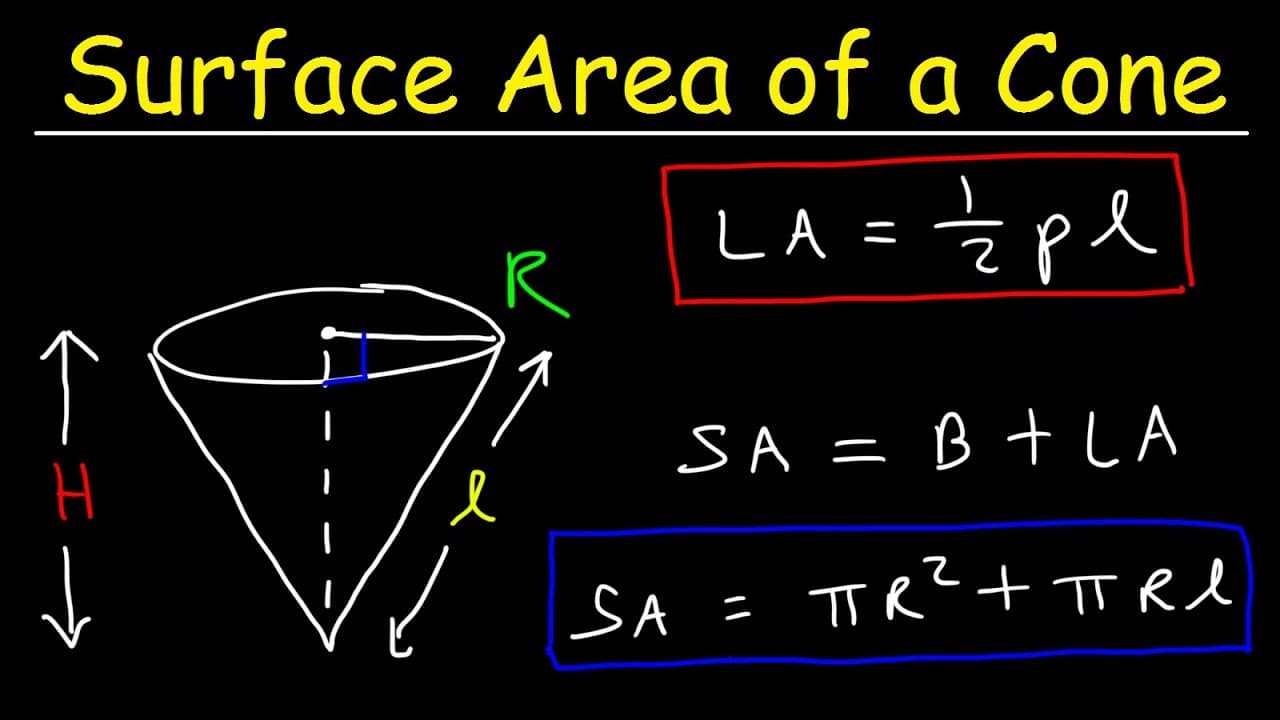
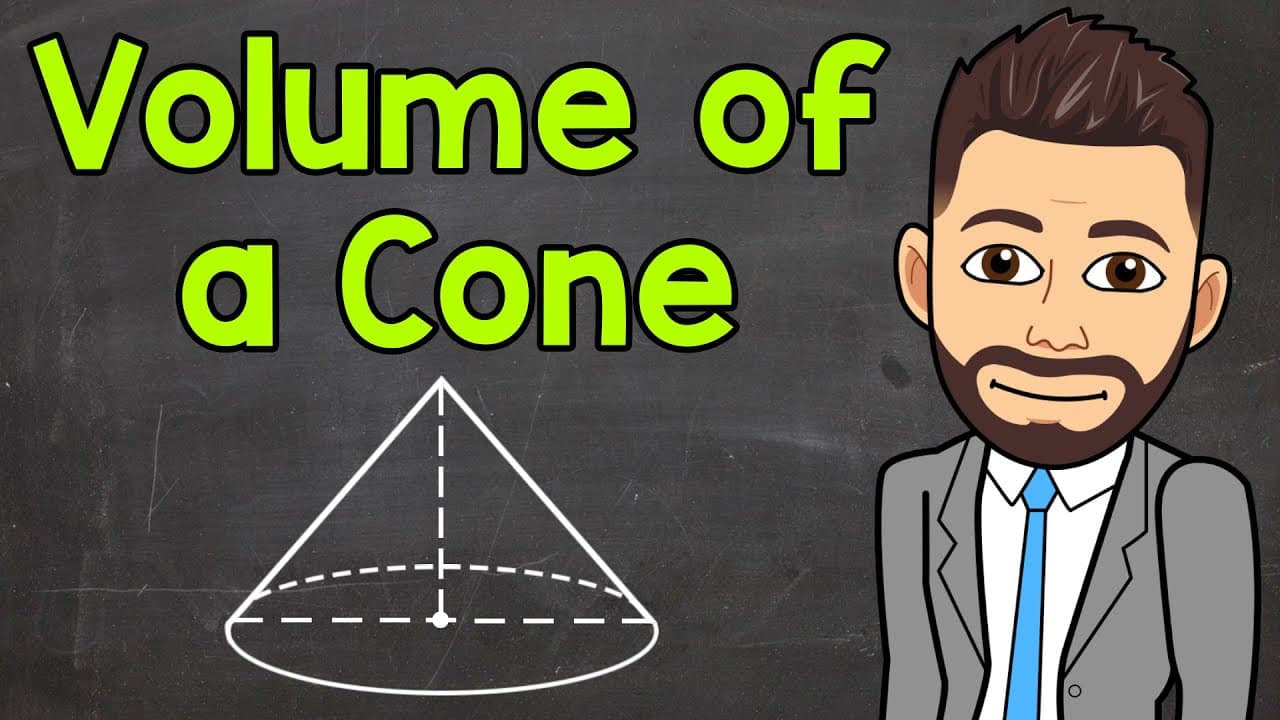
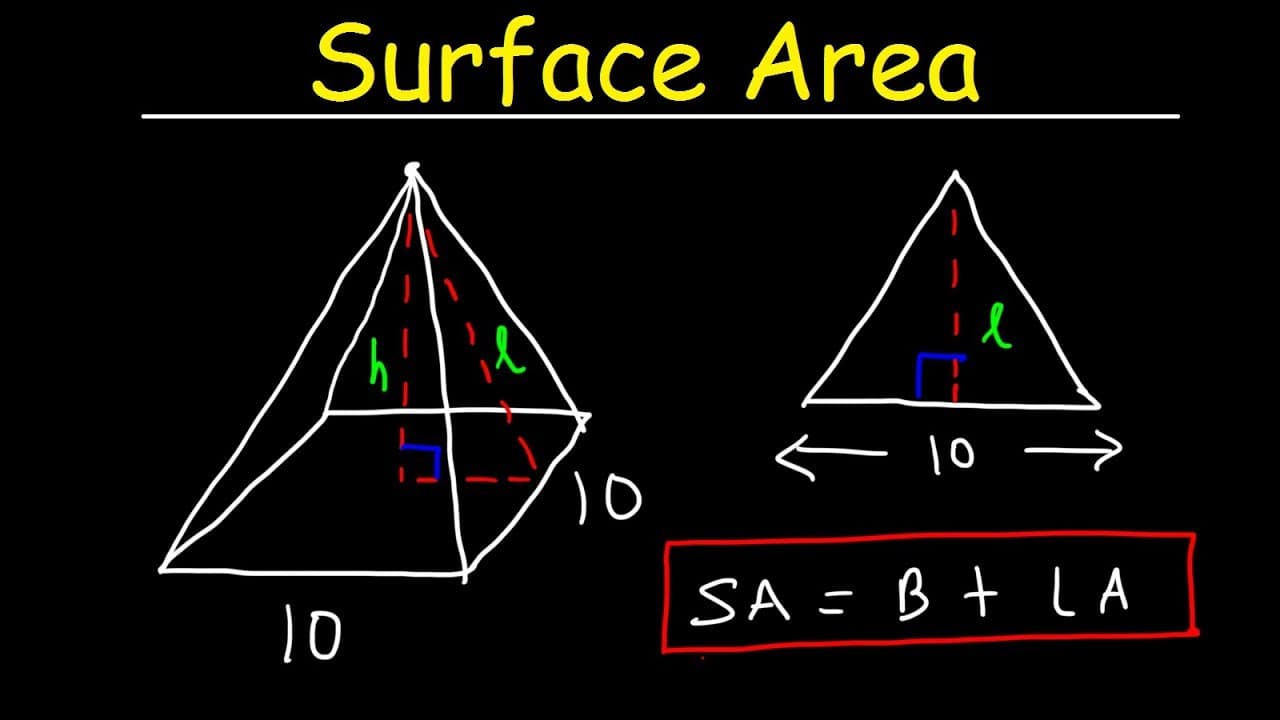
Calculating the Lateral and Total Surface Area of a Cone

Calculating the Lateral and Total Surface Area of a Cone

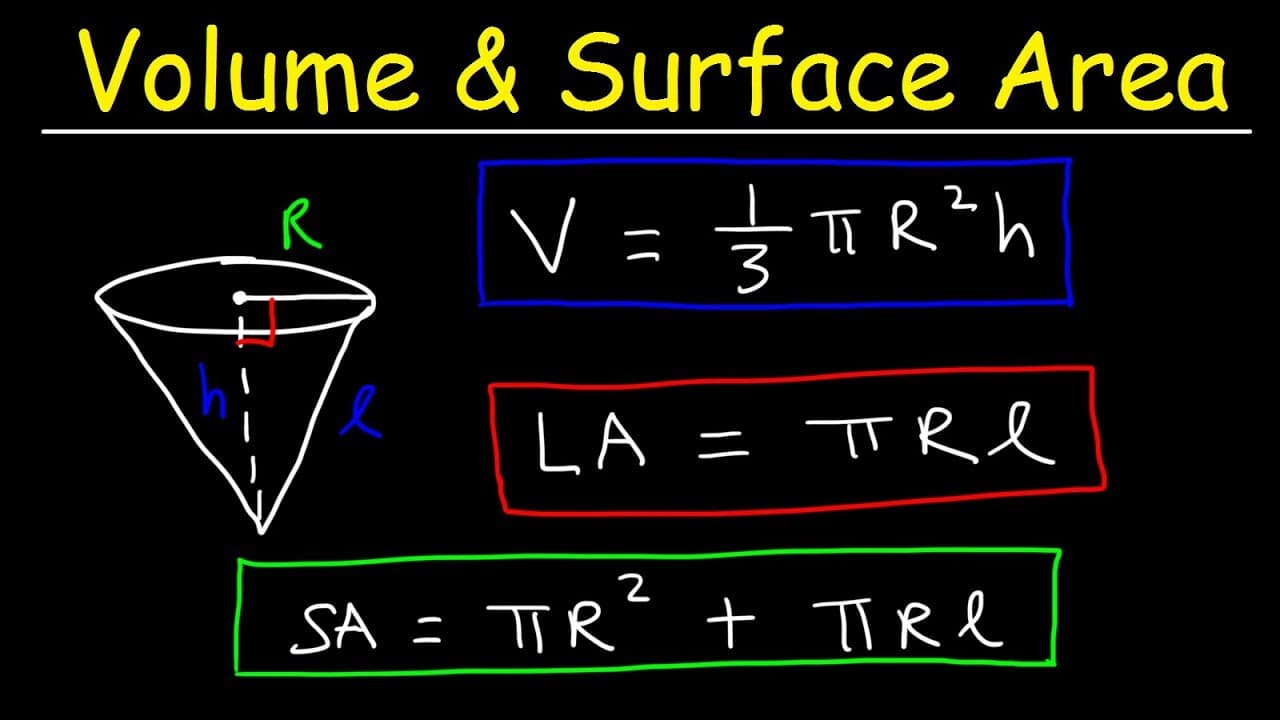
This math tutorial provides a step-by-step demonstration of how to calculate both the lateral area and total surface area of a cone. Using a specific example with a radius of 5 inches and a height of 12 inches, the narrator guides viewers through the necessary formulas and calculations. The video visualizes the geometry by drawing a cone and labeling the key dimensions, making abstract formulas concrete. A key component of this lesson is the integration of the Pythagorean theorem. Since the problem provides the vertical height rather than the slant height, the narrator shows how to identify the right triangle within the cone to solve for the missing slant height dimension. This connects 2D triangle geometry concepts with 3D solid geometry. The video then proceeds to substitute these values into the standard formulas for lateral area ($\pi rl$) and total surface area (Base Area + Lateral Area). For educators, this video serves as an excellent model for solving multi-step geometry problems. It reinforces the importance of distinguishing between height and slant height—a common student error. The clear, handwritten derivations allow students to follow the logic line-by-line, making it suitable for introducing the concept, reviewing for exams, or providing support for homework assignments involving 3D geometric measurements.

The Organic Chemistry TutorThe Organic Chemistry Tutor

3mins 2s

Video
How to Solve Parallelogram Problems in Geometry

How to Solve Parallelogram Problems in Geometry

A comprehensive geometry tutorial focused on the properties and applications of parallelograms. The video begins by defining a parallelogram and outlining its four core properties: opposite sides are parallel, opposite sides are congruent, opposite angles are congruent, and diagonals bisect each other. The narrator uses clear diagrams and visual markings to demonstrate these concepts before moving into practical applications. The core of the video consists of five detailed example problems that increase in complexity. These problems require students to apply geometric properties to set up algebraic equations. The examples cover a wide range of skills, including solving linear equations involving angle measures, using quadratic equations to find unknown angles and diagonal lengths, and factoring trinomials when leading coefficients are greater than one. The final example integrates multiple variables to calculate perimeter. This resource is highly valuable for high school geometry classrooms as it bridges the gap between geometric concepts and algebraic calculation. It is excellent for teaching students how to translate visual geometric information into solvable equations. The step-by-step walkthroughs of factoring quadratics within a geometry context provide essential reinforcement of Algebra 1 skills, making this a dual-purpose tool for both geometry instruction and algebra review.

The Organic Chemistry TutorThe Organic Chemistry Tutor

23mins 7s

Video
How to Identify Parallel, Perpendicular, and Neither Lines

How to Identify Parallel, Perpendicular, and Neither Lines

This math tutorial provides a clear, step-by-step guide on how to use linear equations to determine the relationship between two lines. Using the slope-intercept form (y = mx + b), the narrator demonstrates how to identify the slope in an equation and compare it to another to classify lines as parallel, perpendicular, or neither. The video uses a blackboard-style format with handwritten text to walk through specific numerical examples for each scenario. The content focuses on two core geometric concepts linked to algebra: parallel lines have identical slopes, while perpendicular lines have slopes that are negative reciprocals of one another. The video also covers the visual properties of these lines, explaining that parallel lines never touch and perpendicular lines intersect at 90-degree angles. It concludes with an example of lines that fit neither category, ensuring students understand how to rule out the special cases. This resource is highly valuable for Algebra I and Geometry classrooms. It bridges the gap between algebraic equations and geometric properties, offering a concrete method for analyzing linear relationships without needing to graph them first. Teachers can use this video to introduce the concept of negative reciprocals, reinforce slope identification skills, or as a review tool before a unit on coordinate geometry proofs.

The Organic Chemistry TutorThe Organic Chemistry Tutor

3mins 59s

Video
Proving Parallel Lines Using Angle Theorems and Geometry Proofs

Proving Parallel Lines Using Angle Theorems and Geometry Proofs

This educational video provides a comprehensive tutorial on geometry concepts focused on proving that lines are parallel. The instructor uses digital handwriting on a blackboard style background to visually demonstrate theorems involving transversals, including Alternate Interior Angles, Alternate Exterior Angles, Corresponding Angles, and Same-Side Interior Angles. The video clearly distinguishes between the forward theorems (if lines are parallel, then angles are congruent) and their converses (if angles are congruent, then lines are parallel), which is the focus of this lesson.

The Organic Chemistry TutorThe Organic Chemistry Tutor

10mins 26s

Video
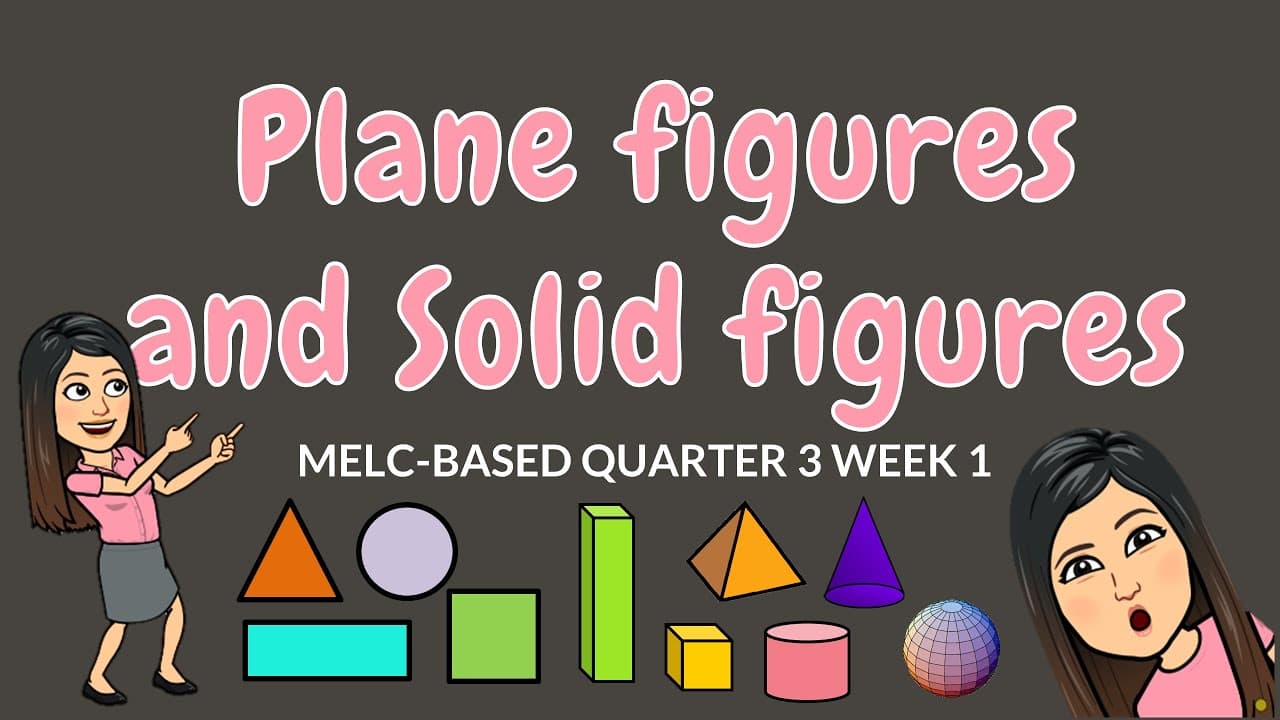
From Polygons to 3D Shapes: A Visual Guide

From Polygons to 3D Shapes: A Visual Guide

This educational video provides a clear and concise progression from basic two-dimensional polygons to three-dimensional solids. The presenter begins by reviewing quadrilaterals and introducing 5-sided (pentagon) and 6-sided (hexagon) shapes, briefly mentioning polygons with even more sides. The lesson then shifts focus to curved shapes, defining a circle through the concept of equidistant points from a center. Key themes explored include geometric vocabulary (vertices, edges, faces), the etymology of shape names (penta, hexa), and spatial reasoning. A major focus is the conceptual relationship between dimensions; the narrator encourages viewers to visualize "pulling" 2D shapes out of the whiteboard to create 3D forms, such as extending a square into a cube or a circle into a cylinder. For educators, this video serves as an excellent bridge for students moving from simple shape identification to understanding geometric properties and spatial depth. The visual demonstrations on the whiteboard—particularly the comprehensive summary chart visible at the end—offer a valuable reference for classifying lines, angles, triangles, and solids. It helps students understand not just what shapes are called, but how they are constructed and related to one another.

Miacademy & MiaPrep Learning ChannelMiacademy & MiaPrep Learning Channel

2mins 44s

Video
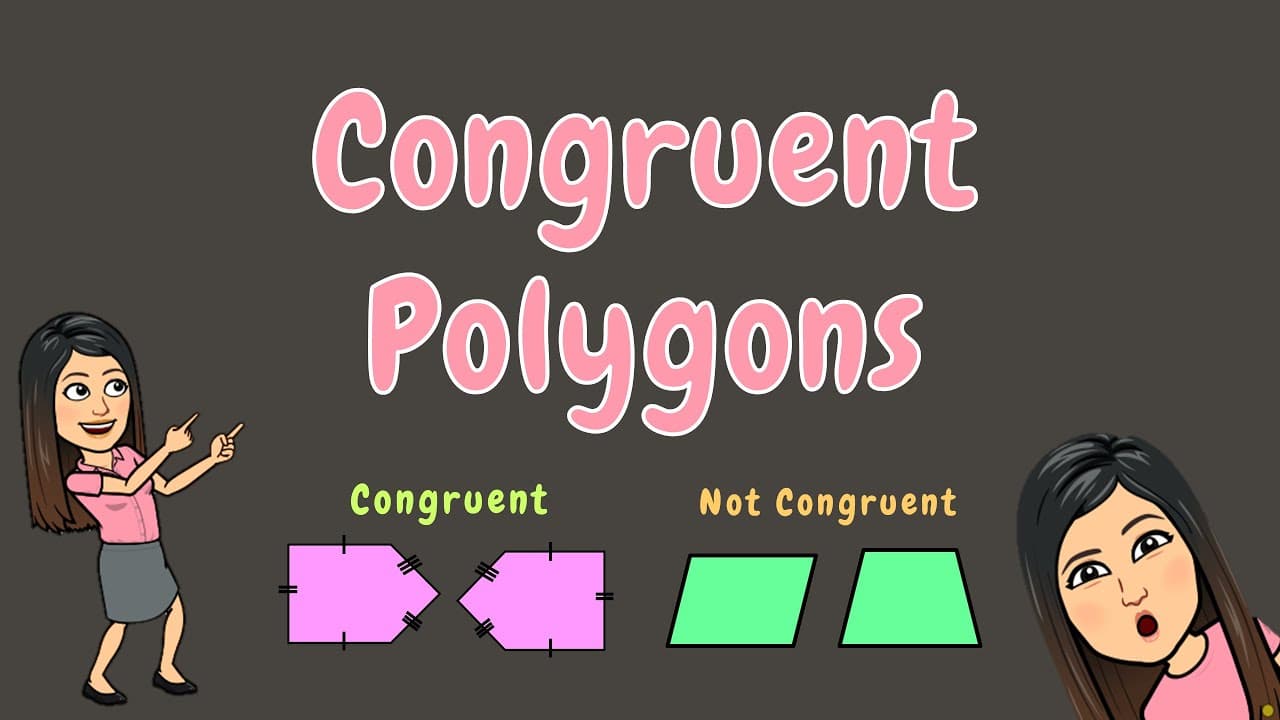
How to Identify Congruent Polygons

How to Identify Congruent Polygons

This instructional video provides a clear and visually supported explanation of congruent polygons, targeted specifically at upper elementary students. The narrator introduces the core concept that congruent polygons must have both corresponding sides that are equal in length and corresponding angles that are equal in measure. Through a series of side-by-side comparisons, the video demonstrates how to identify congruence even when shapes are rotated or flipped, emphasizing that orientation does not change a shape's properties. The content covers key geometric vocabulary including "congruent," "polygons," "corresponding sides," and "corresponding angles." It explicitly addresses the common misconception that shapes with the same angles are always congruent (similarity vs. congruence) by showing two triangles with identical angles but different side lengths. The video uses clear visual markers like tick marks for sides and arc marks for angles to help students learn how to read geometric diagrams. For educators, this video serves as an excellent introduction or review of geometry standards regarding congruence. It effectively scaffolds learning by starting with visual intuition ("same shape, same size") and moving to formal mathematical definitions. The distinct examples—including non-examples and rotated figures—provide perfect opportunities for pausing the video to check for student understanding and encourage classroom discussion about what makes shapes "twins" in geometry.

Sheena DoriaSheena Doria

4mins 7s

Video
Calculating Circumference Given the Diameter

Calculating Circumference Given the Diameter

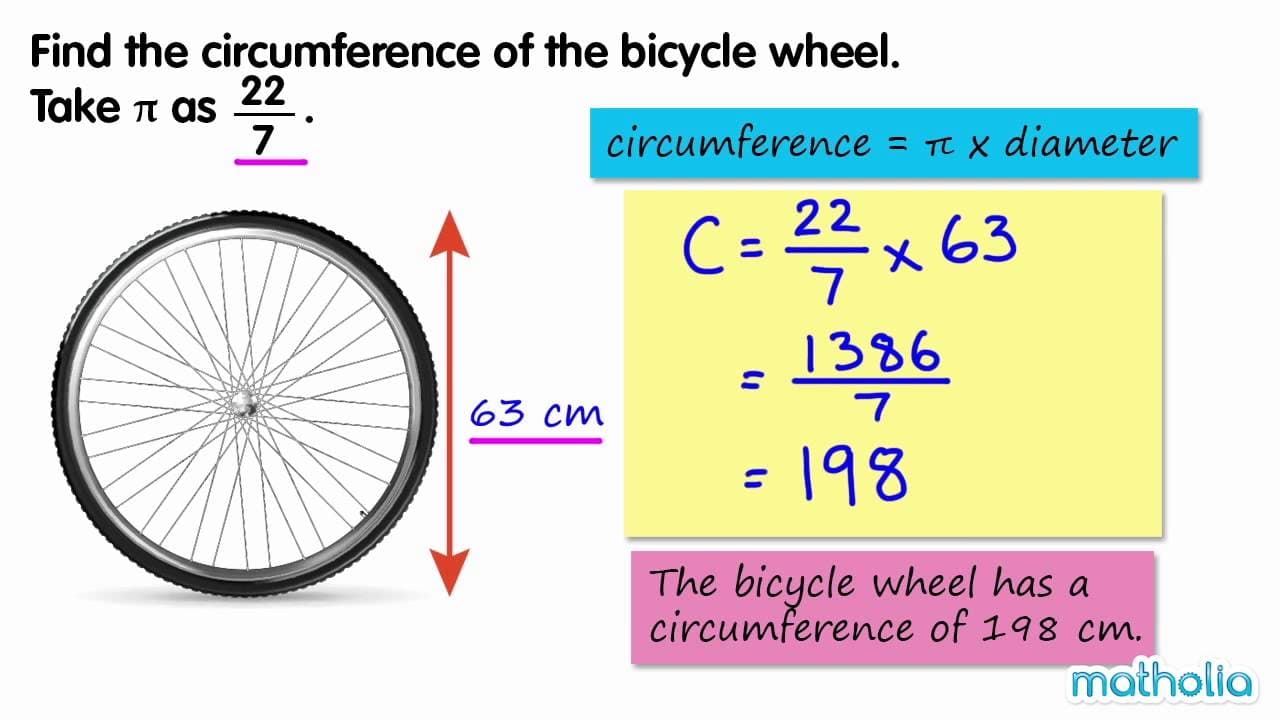
This educational video provides a clear, step-by-step demonstration of how to calculate the circumference of a circle when the diameter is known. It presents two distinct examples: one involving a real-world object (a bicycle wheel) using the fractional approximation of pi (22/7), and another involving an abstract circle using the decimal approximation of pi (3.14). The narration guides students through selecting the correct formula, substituting values, and performing the necessary calculations to find the final answer with appropriate units. The core themes explored include the geometric relationship between diameter and circumference, the application of the formula C = πd, and the flexibility of using different approximations for pi based on the problem's context. The video reinforces the importance of showing mathematical working, including writing the formula, substitution, calculation, and stating the final answer clearly with units. For educators, this video serves as an excellent model for direct instruction or review. It visually demonstrates the specific procedural steps students are expected to follow when solving geometry problems. The contrast between using 22/7 and 3.14 helps students understand that pi can be represented in different ways depending on the instructions or the numbers involved (e.g., using 22/7 when the diameter is a multiple of 7). It is particularly useful for transitioning students from concrete measurements to using abstract formulas.

MatholiaChannelMatholiaChannel

1min 24s

Video
Mastering Triangle Angle Problems with Step-by-Step Solutions

Mastering Triangle Angle Problems with Step-by-Step Solutions

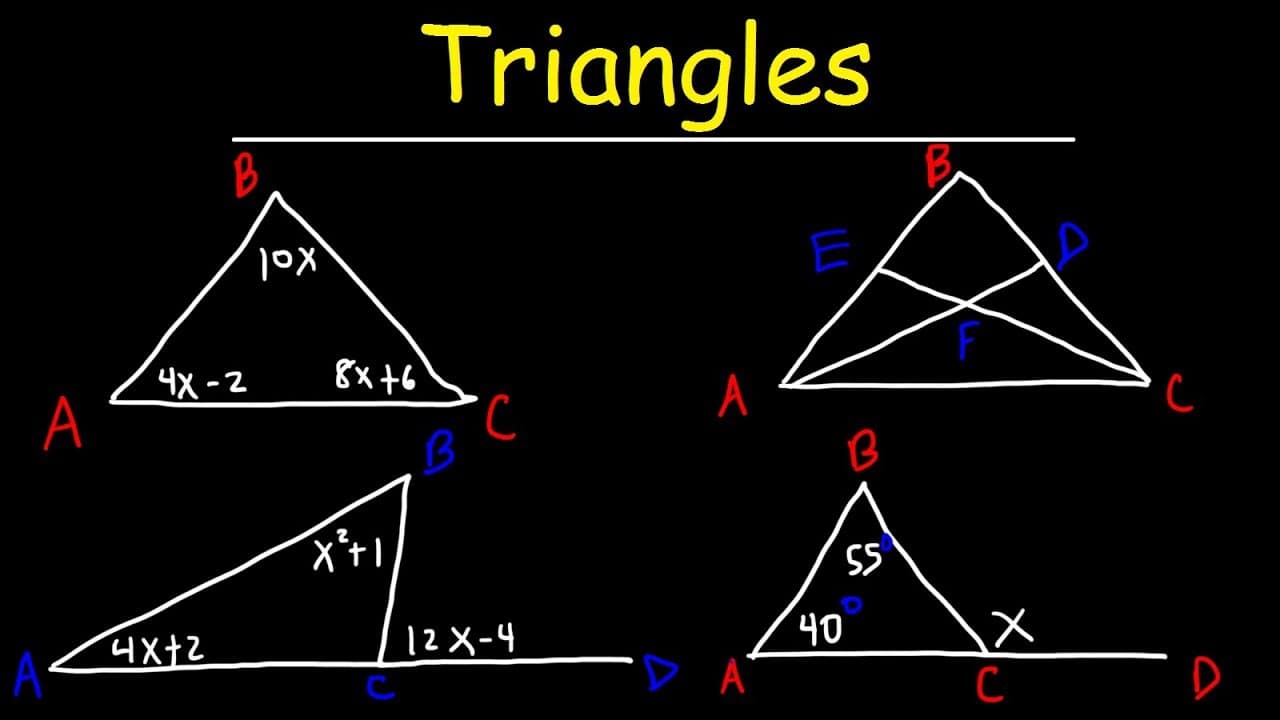
This comprehensive math tutorial guides students through ten distinct geometry problems involving triangles, progressively increasing in complexity. The video covers fundamental concepts such as the Triangle Angle Sum Theorem, properties of isosceles triangles, linear pairs, and the Exterior Angle Theorem. It also delves into more advanced topics like the Triangle Midsegment Theorem, analyzing transversal lines, calculating angles with altitudes, and solving geometric problems using quadratic equations. The central theme of the video is the application of algebraic skills to solve geometric problems. Students learn not just to find missing angles, but to set up and solve linear and quadratic equations based on geometric properties. The video demonstrates multiple methods for checking answers, reinforcing the interconnectedness of different geometric theorems (e.g., using quadrilateral angle sums vs. triangle angle sums). For educators, this video serves as an excellent resource for a Geometry or Algebra II unit review. It effectively scaffolds learning by starting with basic arithmetic calculations and moving toward multi-step algebraic proofs. Teachers can use specific segments to target particular skills—such as ratios in geometry or factoring quadratics to find angle measures—making it a versatile tool for differentiated instruction, homework support, or test preparation.

The Organic Chemistry TutorThe Organic Chemistry Tutor

23mins 2s

Video
Points, Lines, and Angles: Geometry Basics Explained

Points, Lines, and Angles: Geometry Basics Explained

This educational video serves as a comprehensive introduction to the fundamental building blocks of geometry. Hosted by a clear and engaging narrator, the lesson breaks down abstract spatial concepts into digestible definitions, visuals, and naming conventions. It systematically covers points, lines, rays, line segments, intersecting lines, parallel lines, and angles, providing a solid foundation for further mathematical study. The video emphasizes three core aspects for each figure: what it looks like visually, its formal mathematical definition, and specifically how to write its name using proper geometric notation. Key themes include the distinction between finite and infinite figures, the relationship between lines in space (intersecting vs. parallel), and the precise vocabulary required to communicate mathematical ideas effectively. For teachers, this video is an excellent tool for introducing geometry units in upper elementary or early middle school. It directly addresses the common student struggle of mastering geometric notation (such as when to use a ray symbol versus a line symbol). The clear visual examples make it perfect for pausing to allow students to take notes, draw diagrams, or practice writing symbols alongside the video.

Miacademy & MiaPrep Learning ChannelMiacademy & MiaPrep Learning Channel

4mins 45s

Video
How to Graph a Line Using Point-Slope Form

How to Graph a Line Using Point-Slope Form

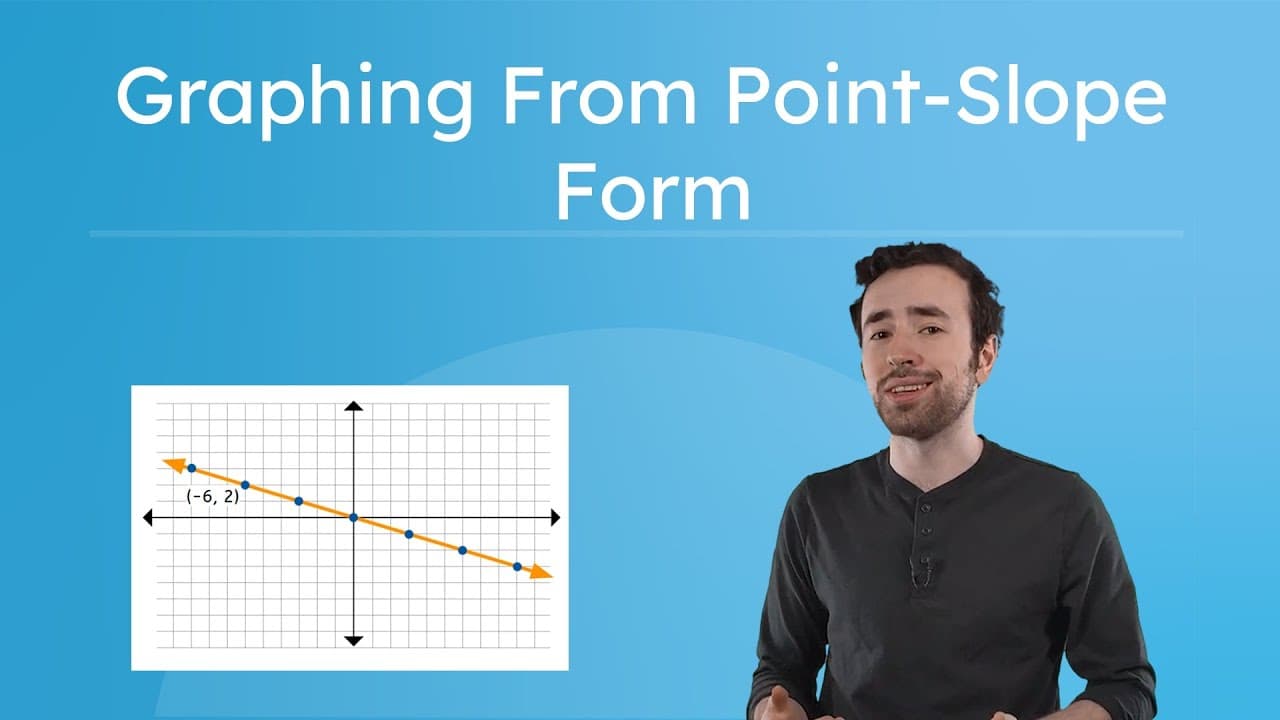
This educational math video teaches students how to graph linear equations directly from point-slope form without converting to other forms first. The narrator guides viewers through the process of reverse-engineering the equation $y - y_1 = m(x - x_1)$ to identify the slope ($m$) and a specific coordinate point $(x_1, y_1)$ on the line. Special emphasis is placed on interpreting positive and negative signs correctly within the equation parentheses. The video explores key themes of algebraic structure, coordinate geometry, and visual graphing techniques. It specifically breaks down the cognitive steps needed to extract numerical values from an algebraic formula, focusing on the common student stumbling block of recognizing that $(x + 6)$ implies an x-coordinate of $-6$. The lesson includes a guided example followed by an independent practice problem where students pause the video to test their understanding. For classroom application, this video is an excellent resource for Algebra 1 units on linear functions. It provides a procedural scaffold for students who struggle with multi-step algebraic manipulations, offering them a direct method to visualize equations. Teachers can use this to differentiate instruction, helping visual learners connect abstract formulas to concrete graphical representations.

Miacademy & MiaPrep Learning ChannelMiacademy & MiaPrep Learning Channel

5mins 3s

Video
Understanding and Applying the Properties of Parallelograms

Understanding and Applying the Properties of Parallelograms

This comprehensive geometry lesson explores the definition and essential properties of parallelograms. The video begins by breaking down the etymology of the word "parallelogram" to explain its defining feature—parallel opposite sides—before expanding into six specific properties related to sides, angles, and diagonals. It uses visual animations and logical proofs involving transversal lines to demonstrate why these properties hold true. The content covers three main categories of properties: sides (opposite sides are parallel and congruent), angles (consecutive angles are supplementary and opposite angles are congruent), and diagonals (they bisect each other and create congruent triangles). The narrator methodically proves these relationships using prior knowledge of parallel line theorems and algebraic substitution, making it an excellent resource for bridging geometric concepts with algebraic applications. Ideal for high school geometry classes, this video moves beyond simple definitions to rigorous application. It features two detailed practice problems where students must set up and solve algebraic equations based on geometric properties. This makes it highly useful for teachers looking to demonstrate how to solve for unknown variables (x, y, k, r) within geometric figures, reinforcing both geometry and algebra skills simultaneously.

Miacademy & MiaPrep Learning ChannelMiacademy & MiaPrep Learning Channel

12mins 9s

Video
Understanding Vectors in the Coordinate Plane

Understanding Vectors in the Coordinate Plane

This video serves as a comprehensive introduction to vectors in the coordinate plane, specifically tailored for a precalculus curriculum. The lesson begins with a relatable skit about giving directions, illustrating why both distance and direction are necessary to reach a destination, which naturally leads into the definition of a vector. The video then transitions into formal mathematical definitions, explaining vectors as directed line segments with an initial and terminal point. It covers essential concepts such as component form, position vectors, magnitude, and direction, using visual graphs and clear animations to demonstrate how these properties are calculated and represented.

Miacademy & MiaPrep Learning ChannelMiacademy & MiaPrep Learning Channel

16mins 22s

Video
How to Find Exact Trig Values for 30, 45, and 60 Degrees

How to Find Exact Trig Values for 30, 45, and 60 Degrees

This educational video provides a step-by-step tutorial on how to derive the specific trigonometric values for the first quadrant angles of 30, 45, and 60 degrees. Building upon previous knowledge of special right triangles (45-45-90 and 30-60-90), the narrator demonstrates how to calculate the sine, cosine, and tangent ratios for each angle. The video emphasizes the process of identifying opposite and adjacent sides relative to a specific angle and covers the algebraic steps needed to rationalize denominators when square roots appear in the bottom of a fraction. The central theme is the connection between geometry and trigonometry. The video explores how the fixed ratios of special right triangles translate directly into the constant trigonometric values used in higher-level math. It specifically addresses the mnemonic SOH CAH TOA and the importance of perspective—showing how the "opposite" and "adjacent" sides swap when switching from a 30-degree reference angle to a 60-degree reference angle within the same triangle. For educators, this video is an excellent tool for moving students from rote memorization of the unit circle to a conceptual understanding of where those values come from. It is particularly useful for Geometry students first encountering trigonometry or Algebra II/Pre-Calculus students needing a refresher on exact values. The video includes a humorous animated skit to reinforce the concept of relative side positions and provides built-in pause points for student practice, making it ready-to-use for interactive classroom instruction.

Miacademy & MiaPrep Learning ChannelMiacademy & MiaPrep Learning Channel

7mins 54s

Video
Learning Positional Words: On, Under, Above, and More

Learning Positional Words: On, Under, Above, and More

This animated video provides a clear and engaging introduction to positional words (prepositions of place) for early learners. Set in a child's bedroom, the video follows a character named Hallie and asks viewers to identify the location of various objects like books, a ukulele, a toy rabbit, and a school bag. By isolating these objects and pairing them with clear text labels, the video visually demonstrates spatial relationships. The content focuses on key vocabulary concepts including "on," "below," "under," "in front of," "behind," and "above." Each term is introduced through a question-and-answer format, where the narrator asks for the location of an object, pauses, and then provides the answer while displaying the specific word on screen. This repetition helps reinforce the connection between the object's physical placement and the vocabulary word used to describe it. For educators, this video serves as an excellent visual aid for teaching spatial awareness in math or prepositions in language arts. The clean animation and isolation of objects make it easy for students to focus on the specific spatial relationship being demonstrated. It is particularly useful for establishing the foundational vocabulary needed for geometry, following directions, and describing scenes.

MatholiaChannelMatholiaChannel

2mins 5s

Video
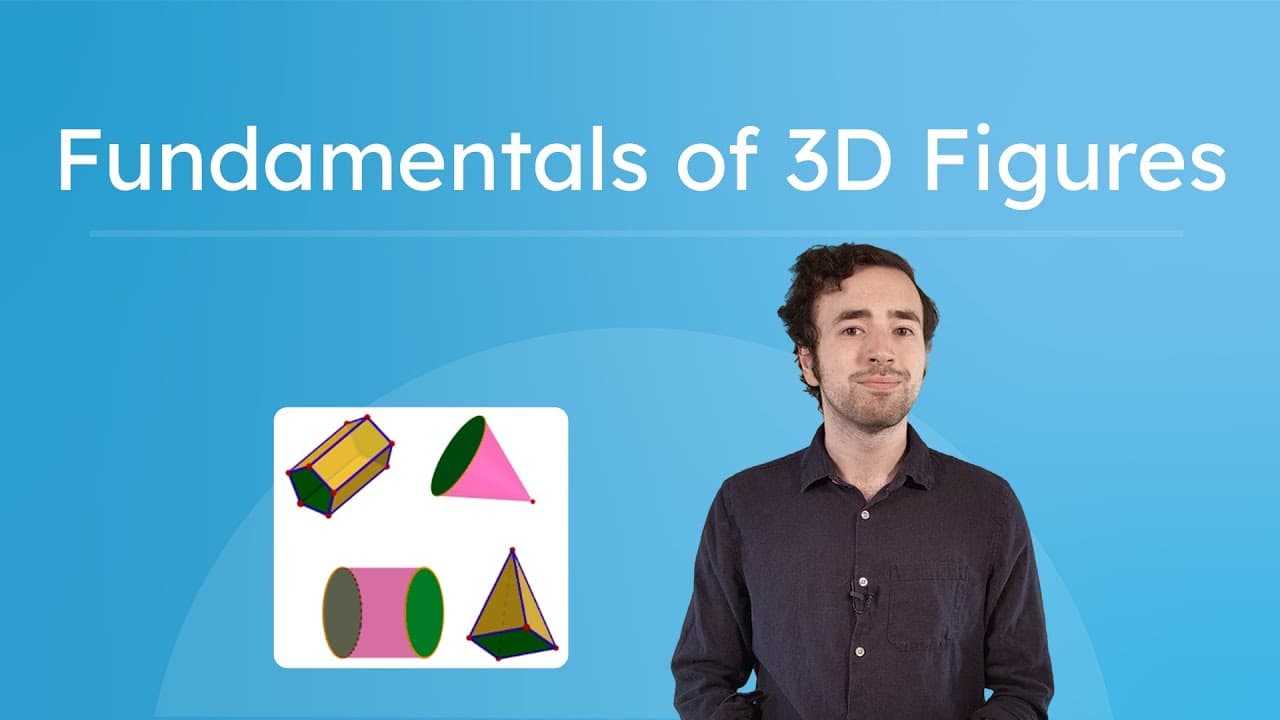
Exploring the Fundamentals of 3D Figures

Exploring the Fundamentals of 3D Figures

This educational video provides a comprehensive overview of the fundamental properties of three-dimensional figures, specifically focusing on prisms, cylinders, pyramids, cones, and spheres. Hosted by a friendly presenter named Justin, the lesson breaks down complex geometric vocabulary into digestible concepts, teaching students how to identify shapes based on their specific features such as bases, faces, vertices, edges, and curved surfaces. The video emphasizes distinguishing between similar shapes and clarifies specific rules regarding the bases of prisms and cylinders versus pyramids and cones. A significant portion of the video addresses common misconceptions in geometry, particularly the idea that a shape's base must always be on the bottom. Through clear visual examples and rotations of figures like rectangular prisms and triangular pyramids, the content demonstrates that spatial orientation does not define a shape's properties. The video creates a solid foundation for spatial reasoning by explaining exceptions to general rules, such as how any face of a rectangular prism or triangular pyramid can serve as a base. This resource is highly valuable for upper elementary and middle school mathematics classrooms introducing or reviewing geometry concepts. It supports learning by moving beyond simple identification to a deeper understanding of geometric properties, preparing students for more advanced topics like surface area and volume. The clear definitions and visual aids make it an excellent tool for front-loading vocabulary or reinforcing concepts after hands-on exploration with geometric solids.

Miacademy & MiaPrep Learning ChannelMiacademy & MiaPrep Learning Channel

5mins 29s

Video
From Polygons to 3D Shapes: A Visual Guide

From Polygons to 3D Shapes: A Visual Guide

This educational video provides a clear and concise progression from basic two-dimensional polygons to three-dimensional solids. The presenter begins by reviewing quadrilaterals and introducing 5-sided (pentagon) and 6-sided (hexagon) shapes, briefly mentioning polygons with even more sides. The lesson then shifts focus to curved shapes, defining a circle through the concept of equidistant points from a center. Key themes explored include geometric vocabulary (vertices, edges, faces), the etymology of shape names (penta, hexa), and spatial reasoning. A major focus is the conceptual relationship between dimensions; the narrator encourages viewers to visualize "pulling" 2D shapes out of the whiteboard to create 3D forms, such as extending a square into a cube or a circle into a cylinder. For educators, this video serves as an excellent bridge for students moving from simple shape identification to understanding geometric properties and spatial depth. The visual demonstrations on the whiteboard—particularly the comprehensive summary chart visible at the end—offer a valuable reference for classifying lines, angles, triangles, and solids. It helps students understand not just what shapes are called, but how they are constructed and related to one another.

Miacademy & MiaPrep Learning ChannelMiacademy & MiaPrep Learning Channel

2mins 44s

Video
Learning Solid Shapes: Names, Properties, and Real-World Examples

Learning Solid Shapes: Names, Properties, and Real-World Examples

This educational video provides a clear and structured introduction to six common solid (3D) shapes: the cube, cuboid, cylinder, cone, sphere, and pyramid. Following a consistent pattern, the video presents each geometric form, highlights its defining properties such as the number and type of faces (flat or curved), and explicitly names the shape using on-screen text.

MatholiaChannelMatholiaChannel

2mins 3s

Video
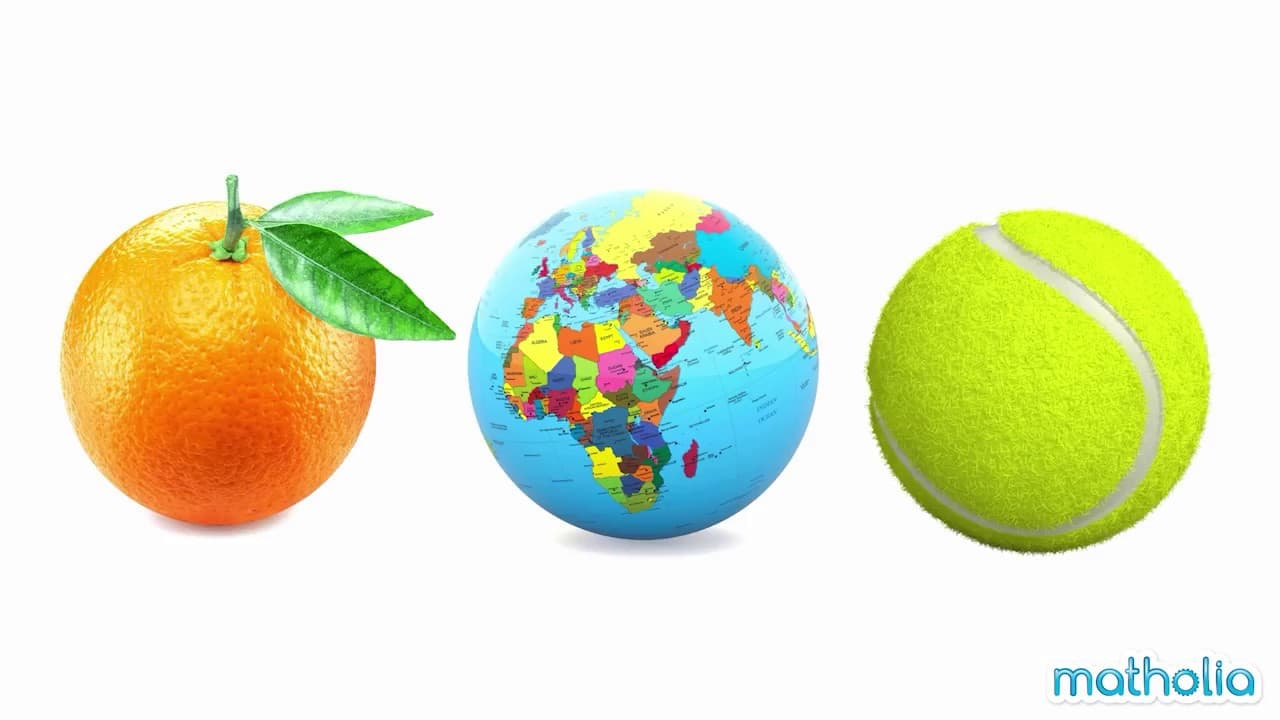
What Is a Circle?

What Is a Circle?

A concise and engaging animated introduction to the geometric concept of a circle, featuring Sandy the dingo from Khan Academy Kids. The video provides a clear, age-appropriate definition of a circle as a continuous line with no corners, making abstract geometry accessible for early learners. The content focuses on identifying 2D shapes and connecting mathematical concepts to the real world. By defining a circle by its attributes—specifically the lack of corners and the continuous round nature—it helps build the foundation for geometric reasoning and shape classification. This resource is highly valuable for Pre-K and Kindergarten classrooms as a quick hook or review. Its simple visual demonstration and connection to a familiar object (a tennis ball) allow teachers to easily pivot into activities involving shape hunting, sorting, or drawing. The short duration matches the attention span of the target age group perfectly.

Khan Academy KidsKhan Academy Kids

27s

Video
Virtual Manipulatives for Singapore Mathematics

Virtual Manipulatives for Singapore Mathematics

This video provides an overview of virtual manipulatives designed to support the Singapore Mathematics curriculum, specifically focusing on the Concrete-Pictorial-Abstract (CPA) pedagogical approach. It demonstrates a wide variety of digital tools that replicate physical math manipulatives, such as number bonds, linking cubes, bar models, and place value discs, showing how they can bridge the gap between hands-on learning and abstract conceptual understanding. The content highlights how these digital resources can be integrated into different learning environments, including traditional classroom instruction, flipped classroom models, and autonomous home learning. It emphasizes the versatility of the tools in supporting visual modeling for concepts ranging from basic arithmetic to geometry and measurement, catering to various international currencies and measurement systems. For educators and parents, this video serves as a professional development resource introducing the rationale behind using digital manipulatives. It explains how visual models help students deepen their abstract understanding of concepts like multiplication, fractions, and word problems. The video demonstrates specific software tools that teachers can incorporate into lesson plans to enhance student engagement and conceptual clarity.

MatholiaChannelMatholiaChannel

2mins 3s

Video
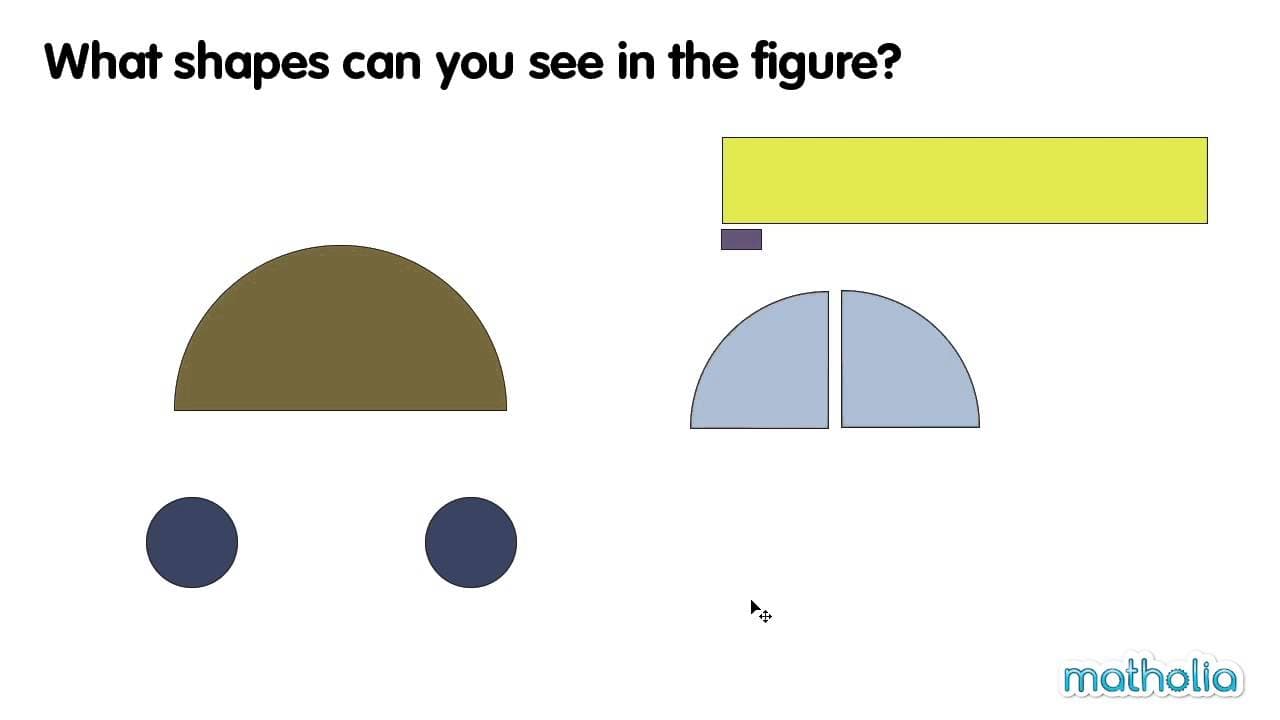
Finding Shapes Within Pictures

Finding Shapes Within Pictures

This educational video introduces young students to the concept of composite shapes—figures made up of smaller, distinct geometric shapes. Through clear, animated examples, it demonstrates how complex images like a car and a castle can be deconstructed into basic components such as rectangles, circles, semi-circles, and triangles. The video uses a slow, deliberate pace that allows students to visually track each shape as it is isolated from the main image and then returned to its place. The content focuses on key geometry topics including shape identification, spatial reasoning, and part-whole relationships. It explicitly names 2D shapes (rectangle, square, triangle, circle) and introduces more specific terms like 'semi-circle' and 'quarter circle,' helping to expand students' mathematical vocabulary beyond the basics. For the classroom, this video serves as an excellent hook for lessons on geometry or art. It encourages students to look at the world with a 'mathematical eye,' identifying geometric structures in everyday objects. Teachers can use this as a model for hands-on activities where students build their own figures using pattern blocks or paper cutouts, bridging the gap between abstract geometric concepts and tangible application.

MatholiaChannelMatholiaChannel

1min 29s

Video
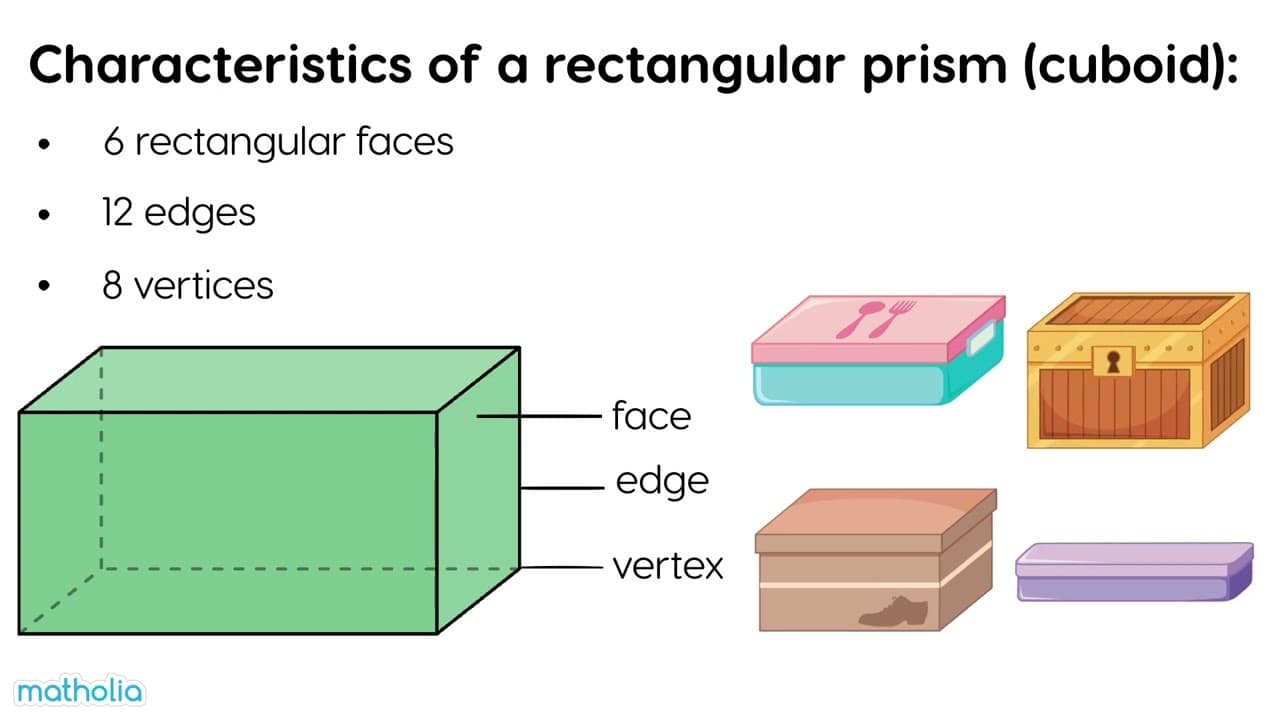
Exploring Properties of 3D Shapes: Faces, Edges, and Vertices

Exploring Properties of 3D Shapes: Faces, Edges, and Vertices

This educational video serves as a clear, step-by-step introduction to the geometric properties of five common 3D shapes: the cube, rectangular prism (cuboid), sphere, cone, and cylinder. For each shape, the narration systematically defines its structure by counting its faces, edges, and vertices. Visual animations highlight these specific parts on the geometric models as they are counted, helping students connect the abstract vocabulary to the physical attributes of the shape.

MatholiaChannelMatholiaChannel

2mins 43s

Video
Prefixes and Polygons: Naming Shapes by Number of Sides

Prefixes and Polygons: Naming Shapes by Number of Sides

A high-energy, animated musical lesson that teaches students how to identify and name polygons based on their number of sides. The video uses a catchy hip-hop song to introduce Greek prefixes (Tri-, Quad-, Penta-, etc.) and connects each shape to real-world objects, such as a sailboat, a door, and a stop sign. It covers shapes ranging from triangles (3 sides) to decagons (10 sides). The video reinforces the relationship between the prefix and the number of sides, helping students memorize geometric vocabulary through rhyme and repetition. It features a "call and response" quiz section where viewers are asked to identify shapes, as well as a visual counting sequence that highlights the sides of each polygon as they are counted. In addition to naming shapes, the video explicitly defines the rules of what constitutes a polygon: it must be a closed shape and must have straight sides. This resource is excellent for introducing geometry units, reviewing vocabulary, or helping students understand the linguistic roots of mathematical terms.

Math Songs by NUMBEROCKMath Songs by NUMBEROCK

3mins 41s

Video
Exploring Triangles and Quadrilaterals: Types and Angles

Exploring Triangles and Quadrilaterals: Types and Angles

This comprehensive math video serves as a detailed introduction to the fundamental properties, classifications, and angle rules of triangles and quadrilaterals. The lesson begins by defining triangles, demonstrating how to name their components (sides, vertices, angles), and categorizing them by angle type (right, acute, obtuse) and side length (equilateral, isosceles, scalene). It then transitions to quadrilaterals, introducing concepts such as parallel lines and congruence through familiar shapes like squares and parallelograms, while encouraging viewers to identify these properties visually. A central theme of the video is the calculation of interior angles. The narrator explains and visually proves that the sum of interior angles in a triangle is always 180 degrees, while in a quadrilateral it is 360 degrees. This concept is reinforced through a demonstration showing how a quadrilateral can be divided into two triangles. The video moves beyond theory into application by modeling how to set up and solve basic algebraic equations to find missing angles in both types of polygons. For the classroom, this video is an excellent resource for bridging geometry and early algebra. The clear, step-by-step examples of solving for 'x' provide a model for student work, while the visual quizzes on quadrilateral properties offer built-in opportunities for formative assessment. Teachers can use the pause points during calculation segments to allow students to practice independent problem-solving before revealing the answers, making it a highly interactive tool for 4th through 6th-grade math curriculums.

Miacademy & MiaPrep Learning ChannelMiacademy & MiaPrep Learning Channel

8mins 39s

Video
What Makes a Shape a Rectangle?

What Makes a Shape a Rectangle?

This concise educational video introduces the defining geometric characteristics of a rectangle. Through clear animations and step-by-step narration, viewers learn the four specific rules that make a shape a rectangle: having four sides, opposite sides of equal length, opposite sides being parallel, and the presence of four right angles.

MatholiaChannelMatholiaChannel

53s

Video
Classifying Quadrilaterals and Finding Unknown Angles

Classifying Quadrilaterals and Finding Unknown Angles

This comprehensive math video provides a clear and engaging introduction to quadrilaterals, a specific family of polygons with four sides and four angles. Using dynamic animations, the narrator starts with a basic square and systematically modifies its properties—such as side lengths and angle measures—to introduce related shapes like rectangles, rhombuses, and parallelograms. This visual approach helps students understand the hierarchical relationships between these shapes rather than seeing them as isolated definitions.

mathanticsmathantics

9mins 50s

Video
Identifying and Describing Basic 2D Shapes

Identifying and Describing Basic 2D Shapes

This educational video introduces young learners to the fundamental properties of basic two-dimensional shapes. Through clear narration and simple animations, the video defines a square, rectangle, and triangle by counting their specific attributes—corners and sides. It then explores circular shapes, defining a standard circle before visually demonstrating how dividing a circle creates a semicircle, and dividing that further creates a quarter circle. The content focuses on the geometric language necessary for early math proficiency, specifically the terms "sides," "corners," and the names of the shapes themselves. It highlights the critical distinction between squares and rectangles based on side length equality, a common point of confusion for early learners. The video also subtly introduces fractional thinking by showing the part-whole relationship between circles, semicircles, and quarter circles. Teachers can use this video as a core instructional tool for introducing geometry units in early elementary classrooms. Its step-by-step pacing allows for interactive viewing where students can count along with the narrator. The visual cues—highlighting specific corners and sides—make it an excellent resource for helping students visualize abstract geometric definitions, moving beyond simple recognition to analytical description.

MatholiaChannelMatholiaChannel

1min 59s

Video
Calculating Volume and Surface Area of 3D Shapes

Calculating Volume and Surface Area of 3D Shapes

This comprehensive math tutorial provides a detailed overview of essential three-dimensional geometric figures, specifically focusing on how to calculate their volume and surface area. The video systematically covers seven key shapes: spheres, cylinders, cones, rectangular prisms, triangular prisms, square pyramids, and cubes. For each shape, the narrator sketches the figure, identifies its key components (like radius, height, slant height, length, and width), and clearly presents the specific formulas needed for calculations. Special attention is given to distinguishing between lateral area and total surface area, as well as deriving values like slant height using the Pythagorean theorem. The video explores fundamental geometric concepts including the relationship between 2D bases and 3D solids. It demonstrates how complex surface area formulas are built by adding the areas of individual faces, helping students understand the logic behind the equations rather than just memorizing them. The tutorial also introduces Euler's Formula for polyhedra, teaching viewers how to count and verify the relationship between faces, vertices, and edges for shapes like cubes and triangular prisms. This resource is highly valuable for middle and high school geometry classrooms. It serves as an excellent reference guide for students learning to navigate geometric formulas. Teachers can use this video to introduce new shapes, review for assessments, or support students who struggle with visualizing 3D objects. The step-by-step breakdown of how to determine components like the diagonal of a prism or the slant height of a pyramid provides the scaffolding necessary for solving higher-level geometry problems.

The Organic Chemistry TutorThe Organic Chemistry Tutor

30mins 18s

Video
How to Identify Basic 2D Shapes

How to Identify Basic 2D Shapes

This educational video provides a clear and structured introduction to four fundamental two-dimensional shapes: the square, circle, triangle, and rectangle. Through a repetitive and paced narrative, the video guides young learners in identifying each shape by examining its defining attributes—specifically counting the number of corners and sides. The clear audio and simple visual cues help students connect the visual form with the mathematical properties and the shape's name. The content focuses on early geometry concepts, specifically the identification of 2D shapes and the vocabulary of "sides" and "corners" (vertices). For each shape, the video follows a distinct pattern: identifying the attributes, naming the shape, and then displaying a variety of examples in different colors, sizes, and orientations to reinforce that a shape's identity remains constant regardless of these variables. For educators, this video serves as an excellent foundational tool for Pre-K through 1st-grade mathematics. It allows teachers to pause and count along with the narrator, making it an interactive experience. The segment showing various examples of each shape is particularly useful for preventing the common misconception that shapes must always look a certain way (e.g., that a triangle must always have a flat bottom). The video concludes with a summary screen perfect for a quick formative assessment or review.

MatholiaChannelMatholiaChannel

3mins 17s

Video
Exploring Plane and Solid Figures: A Guide to 2D and 3D Geometry

Exploring Plane and Solid Figures: A Guide to 2D and 3D Geometry

This educational video provides a comprehensive introduction to geometry by distinguishing between plane figures (2D) and solid figures (3D). Through animated examples and real-world objects, the narrator explains the defining characteristics of each category, moving from basic shapes like rectangles and circles to complex solids like prisms and pyramids. The video uses a "treasure hunt" theme to introduce items that represent these mathematical concepts, making abstract definitions concrete for students. The content dives deep into the specific attributes of geometric figures. It covers the anatomy of solid figures—defining and counting edges, vertices, and faces (including lateral faces and bases). It further classifies solid figures into polyhedrons (like cubes and pyramids) and non-polyhedrons (like cylinders, cones, and spheres), explaining the rules for naming pyramids based on their bases. Vocabulary such as "congruent," "parallel," and "dimensions" is integrated throughout. For educators, this video serves as an excellent visual aid for introducing or reinforcing geometry units in upper elementary grades. It is particularly useful for teaching the specific vocabulary required to describe geometric solids and for visualizing the difference between 2D and 3D space. The clear visual breakdown of vertices, edges, and faces allows for pause-and-discuss moments where students can practice counting these attributes along with the video.

Sheena DoriaSheena Doria

11mins 16s

Video
How to Classify Triangles by Sides and Angles

How to Classify Triangles by Sides and Angles

A high-energy, musical educational animation that teaches students how to classify triangles based on their sides and angles. Through a catchy rock song, the video introduces key geometry vocabulary including isosceles, scalene, equilateral, acute, obtuse, and right triangles, while also reinforcing the concept that the sum of interior angles in any triangle equals 180 degrees. The content breaks down classification into clear sections: first connecting side lengths to visual metaphors (like mountains and road signs), then examining angle measurements within those same shapes. It visually demonstrates the angle sum theorem by animating the angles of a triangle coming together to form a straight line (semicircle). This video is an excellent resource for 3rd through 5th-grade math classrooms. It serves as an engaging hook to introduce geometry units or a memorable review tool. Teachers can use the song's real-world examples—such as boat sails, skateboard ramps, and billiard racks—to help students recognize geometric shapes in their environment.

Math Songs by NUMBEROCKMath Songs by NUMBEROCK

1min 54s

Video
Learning the Properties of Rectangles

Learning the Properties of Rectangles

In this engaging animated video, Sandy the dingo from Khan Academy Kids introduces young learners to the geometric concept of a rectangle. Through clear visual demonstrations, Sandy breaks down the defining attributes of the shape, including its side counts, corners, and the relationship between opposite sides. The video uses a friendly character-driven approach to make abstract geometry concrete. The content focuses on key geometric vocabulary and properties, specifically identifying that rectangles have four sides and four corners, with opposite sides being parallel. It distinguishes rectangles from other quadrilaterals by noting they usually have two longer sides and two shorter sides. The lesson bridges the gap between geometry and the real world by transforming the abstract shape into a common object—a door. This video is an excellent resource for early childhood and lower elementary classrooms introducing 2D shapes. It provides a concise, visual definition that helps students move beyond simple shape recognition to understanding specific attributes. Teachers can use it to spark 'shape hunts' in the classroom or as a primer for lessons on sides, vertices, and parallel lines.

Khan Academy KidsKhan Academy Kids

37s

Video
Learning Shapes: What Is a Triangle?

Learning Shapes: What Is a Triangle?

This engaging animated video introduces young learners to the concept of a triangle through a friendly character named Sandy the Dingo. The video provides a clear, visual definition of the shape by identifying its defining properties: having exactly three sides and three corners. Through simple narration and on-screen counting, students are guided to recognize these features on a geometric diagram. The content bridges abstract geometry and the real world by transforming the triangle outline into an illustration of a mountain, specifically referencing Mount Fuji. This helps children understand that geometric shapes exist in their everyday environment and nature. The pacing is deliberate and slow, allowing time for viewers to count along and visually track the highlighted attributes. Ideally suited for early childhood education, this video serves as an excellent hook for lessons on 2D shapes and geometry. Teachers can use it to introduce vocabulary like "sides" and "corners" or as a prompt for shape-hunting activities. Its brevity makes it perfect for quick reinforcement or as a transition activity in Pre-K through 1st-grade classrooms.

Khan Academy KidsKhan Academy Kids

30s

Video
Understanding Angles as a Measure of Turn

Understanding Angles as a Measure of Turn

This educational video introduces the geometric concept of angles through a clear, visual demonstration using everyday objects. It defines an angle specifically as a "measure of turn" between two straight lines, moving beyond static shape recognition to help students understand the dynamic nature of how angles are formed. Using animated ice cream sticks joined at a pivot point, the video visually demonstrates how the amount of rotation determines the size of the angle. The content progresses from a basic definition to a comparative analysis. It shows side-by-side comparisons of different angles, labeled as Angle A and Angle B, to teach students how to distinguish between smaller and larger angles based on the degree of the opening. The video explicitly connects the concept of "turning a little" versus "turning a lot" to the resulting angle size, providing concrete language for young learners to describe geometry. The final segment of the video applies this knowledge through an interactive sorting exercise. Viewers are asked to observe three distinct angles with different orientations and arrange them from greatest to smallest. This supports critical thinking and spatial reasoning skills, making the video an excellent tool for introducing geometry units in lower elementary classrooms.

MatholiaChannelMatholiaChannel

1min 35s

Video
How to Calculate the Perimeter of a Square

How to Calculate the Perimeter of a Square

This educational video provides a clear, step-by-step tutorial on how to calculate the perimeter of a square. It begins by defining perimeter as the total distance around a figure and reviewing the key property of a square: that all four sides are of equal length. This foundational knowledge is used to derive the formula for the perimeter of a square (4 × length) as a more efficient alternative to repeated addition.

MatholiaChannelMatholiaChannel

1min 55s

Video
Calculating Area by Decomposing Irregular Shapes

Calculating Area by Decomposing Irregular Shapes

This educational video provides a step-by-step tutorial on how to calculate the area (square footage) of an irregular, composite polygon. The instructor uses a clear, high-contrast digital whiteboard to demonstrate the concept of decomposing a complex shape into simpler, manageable rectangles. The lesson begins with a review of the basic area formula for a rectangle before diving into a complex problem involving missing side lengths and multiple subsections. The core theme is the strategy of decomposition—breaking a difficult problem into smaller, solvable parts. The video covers identifying distinct rectangular sections within an irregular shape, deducing missing side lengths using addition and subtraction of parallel sides, and calculating individual areas. It concludes by summing these partial areas to find the total square footage, reinforcing the additive property of area. This resource is highly valuable for upper elementary and middle school mathematics classrooms. It addresses the common student struggle of finding derived dimensions (missing side lengths) on composite figures. Teachers can use this video to model problem-solving strategies for geometry standards related to area, or as a flipped classroom resource for students to review the mechanics of decomposition and area calculation at their own pace.

The Organic Chemistry TutorThe Organic Chemistry Tutor

6mins 9s

Video
Calculating the Lateral and Total Surface Area of a Cone

Calculating the Lateral and Total Surface Area of a Cone

This math tutorial provides a step-by-step demonstration of how to calculate both the lateral area and total surface area of a cone. Using a specific example with a radius of 5 inches and a height of 12 inches, the narrator guides viewers through the necessary formulas and calculations. The video visualizes the geometry by drawing a cone and labeling the key dimensions, making abstract formulas concrete. A key component of this lesson is the integration of the Pythagorean theorem. Since the problem provides the vertical height rather than the slant height, the narrator shows how to identify the right triangle within the cone to solve for the missing slant height dimension. This connects 2D triangle geometry concepts with 3D solid geometry. The video then proceeds to substitute these values into the standard formulas for lateral area ($\pi rl$) and total surface area (Base Area + Lateral Area). For educators, this video serves as an excellent model for solving multi-step geometry problems. It reinforces the importance of distinguishing between height and slant height—a common student error. The clear, handwritten derivations allow students to follow the logic line-by-line, making it suitable for introducing the concept, reviewing for exams, or providing support for homework assignments involving 3D geometric measurements.

The Organic Chemistry TutorThe Organic Chemistry Tutor

3mins 2s

Video
Understanding Angles, Degrees, and How to Measure Them

Understanding Angles, Degrees, and How to Measure Them

This engaging educational video introduces students to the fundamental concepts of measuring angles using degrees. It clarifies the distinction between measuring length with rulers and measuring rotation with degrees, using clear visual animations to demonstrate how an angle is formed by rotating a ray around an axis. The video takes viewers on a journey from 0 to 360 degrees, stopping to identify and define critical angle types including acute, right, obtuse, and straight angles. The content covers essential geometric vocabulary and measurement techniques. It explains the degree symbol, demonstrates how a protractor is used to measure unknown angles, and visually defines the four quadrants of rotation. Special emphasis is placed on memorizing key benchmarks like 90 degrees (right angle) and 180 degrees (straight angle). The video concludes with practical application problems, showing students how to calculate unknown angle measurements using the properties of complementary and supplementary angles. For educators, this video serves as an excellent primary resource for introducing geometry units or reinforcing measurement skills. The clear, step-by-step animations make abstract concepts concrete, while the inclusion of humor (comparing temperature degrees to geometric degrees) helps maintain student engagement. The final segment connecting angle properties to basic algebraic thinking provides a natural bridge for middle school math curriculums.

mathanticsmathantics

9mins 17s

Video
How to Find Area by Counting Square Tiles

How to Find Area by Counting Square Tiles

This educational video provides a clear, step-by-step introduction to the concept of area using counting methods. It demonstrates how to determine the area of various 2D shapes by counting the number of unit square tiles they contain. The video progresses from simple rectangles to irregular polygons, building foundational understanding of measurement. The content covers two primary skills: finding area by counting whole square units and calculating area for shapes that include half-square (triangular) units. Through four distinct examples (Figures A, B, C, and D), the video visually scaffolds the learning process, starting with basic counting and advancing to the concept that two half-units equal one whole unit. This resource is highly valuable for early elementary mathematics classrooms introducing geometry and measurement. It visualizes the abstract concept of "area" as the amount of space a shape covers, providing a concrete strategy for students before they move on to using multiplication formulas. The inclusion of composite shapes helps prevent the misconception that area is only length times width.

MatholiaChannelMatholiaChannel

2mins

Video
Finding the Side Length of a Square From Its Area

Finding the Side Length of a Square From Its Area

This video provides a clear, step-by-step tutorial on how to determine the side length of a square when the area is known. Through three distinct examples using different colors and units (cm² and m²), it guides viewers through the logic of inverse operations without explicitly introducing complex algebraic notation. The narrator explains that since a square's area is length multiplied by length, finding the side means identifying a number that multiplies by itself to equal the given area. The video explores key mathematical themes including geometry, measurement, and the relationship between multiplication and area. It reinforces the concept of "perfect squares" (9, 25, 64) and visually demonstrates how to use multiplication facts to solve for unknown dimensions. The repetitive structure serves to build confidence and fluency with the procedure, allowing students to practice the thinking process three separate times. For educators, this resource is an excellent tool for introducing the concept of square roots in a concrete, geometric context. It bridges the gap between basic multiplication and algebraic thinking. Teachers can use it to help students visualize why the inverse of squaring a number helps find geometric dimensions, making it suitable for lessons on area, perimeter, and pre-algebraic reasoning.

MatholiaChannelMatholiaChannel

3mins 5s

Video
Practicing Volume of Rectangular Prisms

Practicing Volume of Rectangular Prisms

This video serves as a practical "Mastery Check" for students learning to calculate the volume of rectangular prisms. Designed as an interactive practice session, the video presents four distinct geometry problems involving 3D shapes with labeled dimensions. The narrator guides students through the process of pausing the video to solve the problems independently before revealing the step-by-step solutions for each one. The problems increase in complexity, starting with basic application of the volume formula and culminating in a challenging problem requiring unit conversion. The content focuses heavily on the application of the volume formula ($V = l \times w \times h$) and the importance of labeling answers with correct cubic units (e.g., cubic feet, cubic inches). A significant portion of the educational value lies in the fourth problem, which introduces the critical concept of dimensional consistency—teaching students that they cannot simply multiply numbers with different units (feet vs. inches) without converting them first. This addresses a common student error in measurement geometry. For teachers, this resource is an ideal formative assessment tool or independent practice station. It allows educators to quickly gauge whether students have moved beyond the initial acquisition of the volume concept and can apply it accurately. The clear, chalkboard-style visual presentation makes it easy for students to follow along, and the "pause and practice" format encourages active participation rather than passive viewing. It effectively bridges the gap between learning a formula and using it correctly in varied contexts.

Math with Mr. JMath with Mr. J

4mins 25s

Video
Calculating Surface Area of 3D Shapes

Calculating Surface Area of 3D Shapes

This educational math video provides a comprehensive, step-by-step tutorial on calculating the surface area of six common solid figures: a cube, rectangular prism, triangular prism, square pyramid, cylinder, cone, and sphere. Hosted by an animated teacher avatar in a digital classroom setting, the video introduces each 3D shape, identifies its key dimensions (such as length, width, height, radius, and slant height), presents the specific formula for its surface area, and then walks through a worked example using substitution and calculation. The video covers key geometry themes including identifying 3D shapes, understanding the difference between lateral and total surface area, and the practical application of algebraic formulas. It systematically breaks down complex formulas into manageable parts—calculating the area of specific faces or components (like the base versus the lateral faces) before summing them up for the final answer. The content emphasizes procedural fluency and the correct use of units (squared units for area). For teachers, this video serves as an excellent instructional aid or review tool for middle school geometry units. It can be paused after each shape is introduced to allow students to attempt the calculation before seeing the solution, or used as a reference guide for students working independently. The clear visual labeling of dimensions helps students map abstract variables in formulas to specific parts of a geometric figure, addressing a common hurdle in learning measurement geometry.

Sheena DoriaSheena Doria

9mins 11s

Video
Finding Area of Composite Rectangles and Shapes

Finding Area of Composite Rectangles and Shapes

This educational video provides a comprehensive tutorial on calculating the area of rectangles and more complex composite figures. It begins with the fundamental formula for the area of a rectangle (Length × Width) and progresses to irregular polygon shapes that must be decomposed into simpler rectangles. The video demonstrates step-by-step problem-solving strategies, including how to deduce missing side lengths from given dimensions and how to break down complex shapes into manageable parts. The content covers three distinct types of area problems: (1) additive composite figures where areas are calculated separately and summed, (2) subtractive area problems involving shaded regions (e.g., a frame or border) where an inner area is subtracted from an outer area, and (3) algebraic word problems that require setting up and solving equations to find dimensions based on perimeter and relative side lengths. Each example is worked out in real-time with clear visual diagrams. This resource is highly valuable for mathematics classrooms as it bridges the gap between basic arithmetic geometry and algebraic reasoning. It models critical thinking skills, such as inferring missing information from a diagram and checking for logical consistency. Teachers can use this video to introduce composite figures, reinforce area formulas, or demonstrate how algebra is applied to solve geometric problems.

The Organic Chemistry TutorThe Organic Chemistry Tutor

11mins 38s

Video
Calculating the Area of Triangles Using Base and Height

Calculating the Area of Triangles Using Base and Height

This educational video provides a clear, step-by-step guide to understanding and calculating the area of triangles. It begins by conceptually grounding the formula in prior knowledge about parallelograms, visually demonstrating how a diagonal line divides a parallelogram into two identical triangles. This derivation helps students understand *why* the formula requires dividing by two, rather than just memorizing the algorithm.

Miacademy & MiaPrep Learning ChannelMiacademy & MiaPrep Learning Channel

3mins 52s

Video
The Ultimate Guide to Essential Algebra Formulas

The Ultimate Guide to Essential Algebra Formulas

This video provides a comprehensive and fast-paced review of essential formulas encountered in high school algebra courses. It serves as an excellent summary tool, covering a wide breadth of topics ranging from basic coordinate geometry to more advanced concepts like logarithms and sequences. The narrator systematically writes out and explains formulas for distance, linear equations, quadratics, geometric shapes, exponents, and variation, often providing quick numerical examples to illustrate how variables are substituted.

The Organic Chemistry TutorThe Organic Chemistry Tutor

18mins 37s

Video
How to Calculate the Area of Basic Geometric Shapes

How to Calculate the Area of Basic Geometric Shapes

This instructional video provides a comprehensive guide to calculating the area of basic plane figures, specifically squares, rectangles, triangles, circles, and semicircles. Using a friendly animated teacher avatar, the video begins by defining area conceptually as the number of "square units" needed to cover a surface. It systematically progresses from simple shapes like squares and rectangles, using visual grid overlays to demonstrate why the formulas ($side \times side$ and $length \times width$) work, before moving to more complex shapes like triangles and circles. The content emphasizes the logical derivation of formulas rather than rote memorization. For example, it visually demonstrates how a triangle's area is exactly half of a corresponding rectangle, justifying the division by two in the formula. It also addresses the geometry of circles, explaining key terms like radius and diameter, and demonstrating how to calculate the area of both full circles and semicircles using $\pi \approx 3.14$. For educators, this video serves as an excellent bridge between conceptual understanding and procedural fluency. The use of grid overlays helps students visualize abstract measurements, making it particularly useful for introducing area or remediating misconceptions about why area is measured in "squared" units. The step-by-step solved examples provide clear models for student practice.

Sheena DoriaSheena Doria

10mins 15s

Video
Mastering Surface Area of Composite 3D Figures

Mastering Surface Area of Composite 3D Figures

This educational video provides a clear, step-by-step guide to calculating the surface area of composite 3D figures—shapes created by combining or removing standard geometric solids like prisms, cylinders, pyramids, cones, and spheres. The instructor, Justin, moves beyond simple formula application to teach the conceptual understanding needed to determine which faces contribute to the total surface area and which are internal or removed. The lesson uses visual aids and specific examples to demonstrate that finding the surface area of a composite figure is not as simple as adding the total surface areas of its parts together. The video explores key geometric themes including spatial visualization, the decomposition of complex shapes, and the application of lateral versus total surface area formulas. It explicitly addresses the "hidden face" problem where two shapes join, using a "wrapping paper" analogy to help students visualize the exterior surface. Two detailed worked examples are provided: an additive figure combining a cylinder, cone, and hemisphere, and a subtractive figure where a pyramid is "removed" from a prism, creating a hollow indentation that paradoxically increases the total surface area. For educators, this video serves as an excellent instructional tool for middle and high school Geometry units. It effectively targets the common student misconception that calculating composite surface area involves simply summing the areas of individual shapes. By breaking down complex problems into manageable components and emphasizing the logic behind selecting specific parts of formulas (like using only lateral area), the video fosters critical thinking and precision in mathematical problem-solving.

Miacademy & MiaPrep Learning ChannelMiacademy & MiaPrep Learning Channel

14mins 45s

Video
Algebra 1 Final Exam Review: Part 1

Algebra 1 Final Exam Review: Part 1

This comprehensive video serves as a targeted review for students preparing for an Algebra 1 final exam. It systematically walks through 15 distinct problem types commonly found on end-of-course assessments, covering a wide range of algebraic concepts. The video format functions as a digital tutor, presenting a problem, allowing the viewer to pause and attempt it, and then providing a detailed, step-by-step walkthrough of the solution. The instructor uses clear visual annotations on a blackboard style background to demonstrate the mechanics of each operation. Key algebraic themes explored include operations with polynomials (multiplying binomials, subtracting polynomials), linear functions (finding slope, graphing lines, matching equations to graphs), and factoring techniques (difference of squares, trinomials, difference of cubes). The video also covers solving various types of equations, including linear, quadratic, rational, and systems of equations. Additionally, it addresses exponent rules, the order of operations, and applying algebraic concepts to geometric word problems involving area and perimeter. For educators, this video is a valuable resource for review sessions, flipped classroom assignments, or differentiated instruction. It allows students to self-pace their review, focusing on areas where they need the most support. The clear explanations of multiple methods (e.g., solving quadratics by factoring vs. the quadratic formula) help reinforce conceptual understanding rather than just rote memorization. Teachers can use specific segments to reteach difficult concepts or assign the entire video as a comprehensive study guide before major assessments.

The Organic Chemistry TutorThe Organic Chemistry Tutor

55mins 8s

Video
How to Find Area by Subtracting Shapes

How to Find Area by Subtracting Shapes

This animated math video presents a practical geometry word problem featuring a character named Ethan who is creating a mask for a party. It guides viewers through a multi-step problem involving calculating the area of a square piece of cardboard and then subtracting the areas of cut-out shapes—specifically a rectangle for the mouth and two right-angled triangles for the eyes. The video visually demonstrates the transition from a real-world scenario to a mathematical model. The core themes explored include calculating the area of basic geometric shapes (squares, rectangles, and triangles) and the strategy of finding the area of composite figures through subtraction. It emphasizes identifying relevant dimensions from text, setting up a comprehensive equation, and performing the order of operations to solve for the final area. The visual representation clearly distinguishes between the initial material and the removed sections. For educators, this video serves as an excellent model for teaching "area of shaded region" problems or composite area. It helps students visualize why subtraction is necessary when shapes are removed, rather than added. The step-by-step solution provides a clear scaffold for setting up similar problems, making it a valuable resource for upper elementary and middle school geometry lessons focused on application and problem-solving skills.

MatholiaChannelMatholiaChannel

1min 43s

Video
How to Calculate the Area of Shaded Regions in Geometry

How to Calculate the Area of Shaded Regions in Geometry

This educational video provides a comprehensive tutorial on calculating the area of shaded regions in geometry. The narrator guides viewers through six distinct problems, progressing from basic shapes to more complex composite figures. The core concept taught is the 'subtraction method,' where the area of a shaded region is determined by calculating the area of the larger outer shape and subtracting the area of the smaller inner shape (or unshaded region). The video covers a variety of geometric shapes including squares, rectangles, circles, triangles, and rhombuses. It reviews essential formulas for calculating the area of these figures. As the problems advance in difficulty, the video introduces and applies more sophisticated mathematical concepts such as the Pythagorean theorem and the properties of special right triangles (30-60-90 triangles) to find missing side lengths required for the area calculations. Teachers will find this video highly valuable for geometry units in middle and high school. It serves as excellent direct instruction or review material for helping students visualize geometric relationships and practice multi-step problem solving. The step-by-step walkthroughs model clear mathematical thinking, demonstrating how to break down complex diagrams into manageable components, label known values, and derive unknown values using geometric properties.

The Organic Chemistry TutorThe Organic Chemistry Tutor

13mins 36s

Video
Mastering Area: Rectangles and Triangles

Mastering Area: Rectangles and Triangles

This educational video provides a clear and comprehensive guide to calculating the area of rectangles and triangles. Narrated by Justin, the lesson begins by revisiting the familiar area formula for rectangles ($A = l \times w$) and upgrading the terminology to "base times height" ($A = b \times h$) to allow for broader application across different polygons. The video then transitions to triangles, explaining the formula $A = \frac{1}{2} b \times h$ and demonstrating how to correctly identify the base and corresponding height (altitude) for acute, right, and obtuse triangles. Key themes explored include the importance of precise mathematical vocabulary, specifically the definition of height as the perpendicular distance from the base to the opposite vertex. The video visually demonstrates how height changes position relative to the shape depending on the type of triangle. It also integrates higher-level concepts by solving a complex example problem that requires using the Pythagorean theorem to find a missing height before calculating the area. For educators, this video serves as an excellent bridge between basic geometry and more advanced application. It is particularly useful for reinforcing the concept that "base" does not always mean "bottom" and for demonstrating multi-step problem solving. The step-by-step walkthroughs of finding a missing side length in a rectangle and calculating the area of a composite triangle make it a valuable resource for instruction, review, or flipped classroom assignments.

Miacademy & MiaPrep Learning ChannelMiacademy & MiaPrep Learning Channel

10mins 9s

Video
Calculating Circumference Given the Diameter

Calculating Circumference Given the Diameter

This educational video provides a clear, step-by-step demonstration of how to calculate the circumference of a circle when the diameter is known. It presents two distinct examples: one involving a real-world object (a bicycle wheel) using the fractional approximation of pi (22/7), and another involving an abstract circle using the decimal approximation of pi (3.14). The narration guides students through selecting the correct formula, substituting values, and performing the necessary calculations to find the final answer with appropriate units. The core themes explored include the geometric relationship between diameter and circumference, the application of the formula C = πd, and the flexibility of using different approximations for pi based on the problem's context. The video reinforces the importance of showing mathematical working, including writing the formula, substitution, calculation, and stating the final answer clearly with units. For educators, this video serves as an excellent model for direct instruction or review. It visually demonstrates the specific procedural steps students are expected to follow when solving geometry problems. The contrast between using 22/7 and 3.14 helps students understand that pi can be represented in different ways depending on the instructions or the numbers involved (e.g., using 22/7 when the diameter is a multiple of 7). It is particularly useful for transitioning students from concrete measurements to using abstract formulas.

MatholiaChannelMatholiaChannel

1min 24s

Video
Mastering the Rhombus: Properties, Area, and Angles

Mastering the Rhombus: Properties, Area, and Angles

This comprehensive math tutorial provides a deep dive into the geometric properties of a rhombus, guiding students from basic definitions to complex algebraic applications. The video begins by defining a rhombus as a special quadrilateral and parallelogram, explaining core features such as congruent sides, parallel opposite sides, and angle relationships. It visualizes how diagonals bisect angles, bisect each other, and intersect at perpendicular right angles, forming the foundation for area and perimeter calculations. The content progresses through a series of five increasing difficult example problems. These examples demonstrate how to calculate area using diagonals, determine perimeter using the Pythagorean theorem, and solve for missing angles using triangle sum properties. Later sections integrate algebra, challenging students to solve linear and quadratic equations to find side lengths and angle measures. The video concludes with a complex problem involving infinite solutions, encouraging critical thinking about mathematical identities. For educators, this video serves as an excellent resource for a Geometry or Algebra unit. It connects geometric concepts with algebraic solving skills, reinforcing the importance of the Pythagorean theorem and factoring quadratics in geometric contexts. The clear, step-by-step walkthroughs make it suitable for introducing new concepts, guided practice, or independent review for students struggling with the properties of quadrilaterals.

The Organic Chemistry TutorThe Organic Chemistry Tutor

22mins 30s

Video
How to Calculate the Volume of a Triangular Prism

How to Calculate the Volume of a Triangular Prism

This math tutorial provides a clear, step-by-step guide on how to calculate the volume of a triangular prism. The instructor, Mr. J, begins by defining volume and introducing the general formula for finding the volume of any prism (V = Bh), before specifically breaking down how this applies to triangular prisms where the base is a triangle. The video distinguishes between the height of the triangular base and the height of the prism itself, a common point of confusion for students. The content covers key geometric concepts including identifying the base of a 3D object, calculating the area of a triangle, and understanding 3D spatial dimensions. Two distinct example problems are worked through in real-time, demonstrating how to substitute values into the formula and solve using mental math or scratchpad calculations. The visual style uses a digital blackboard with clear labeling to help students track the different dimensions. For educators, this video serves as an excellent instructional tool for middle school geometry units. It can be used to introduce the concept of volume for non-rectangular prisms or as a remediation tool for students struggling to differentiate between the various 'heights' found in prism problems. The pacing allows for natural pauses where students can attempt calculations before seeing the solution, making it interactive and practical for classroom use.

Math with Mr. JMath with Mr. J

5mins 37s

Video
How to Calculate Matrix Determinants and Find Area

How to Calculate Matrix Determinants and Find Area

This comprehensive math lesson introduces students to the concept of the determinant of a matrix, a fundamental tool in linear algebra and precalculus. The video begins by defining what a determinant is—a scalar value calculated from a square matrix—and explains its significance in understanding matrix properties like invertibility and spatial transformations. It progresses step-by-step through the calculation methods for 2x2 matrices using the standard "ad-bc" formula, ensuring students grasp the basics before moving to more complex concepts. The lesson then advances to 3x3 matrices, demonstrating two distinct methods for calculation: the formal Cofactor Expansion method (using minor matrices and checkerboard signs) and the visual "Shortcut" method (often known as the Rule of Sarrus) involving diagonal multiplication. Clear, color-coded animations help visualize these algorithmic processes, making abstract calculations accessible and easier to memorize. Detailed examples are worked through for each method to reinforce understanding. Finally, the video bridges abstract algebra with geometry by applying determinants to find the area of polygons in the coordinate plane. It demonstrates how to interpret vectors from vertices and use the determinant to calculate the area of parallelograms and triangles. This application connects algebraic computation with geometric properties, providing a practical context for why determinants are a powerful mathematical tool.

Miacademy & MiaPrep Learning ChannelMiacademy & MiaPrep Learning Channel

21mins 51s

Video
Mastering Math with the Desmos Online Graphing Calculator

Mastering Math with the Desmos Online Graphing Calculator

This comprehensive tutorial introduces students and educators to the Desmos online graphing calculator, a powerful and free tool for visualizing mathematics. The video begins with the basics of accessing the site and graphing simple functions like lines and parabolas, then progressively moves to more advanced topics including trigonometry, polar coordinates, and calculus operations. The narrator demonstrates not just how to plot graphs, but how to use the tool to solve equations, factor quadratics, and visualize systems of inequalities. Key mathematical themes include function families (linear, quadratic, cubic, absolute value, exponential, logarithmic), systems of equations and inequalities, trigonometry (degrees vs. radians), and statistical analysis (mean, standard deviation). The video also highlights the calculator's computational abilities, such as evaluating definite integrals, summations, and permutations, making it a versatile utility for various levels of math. For the classroom, this video serves as an excellent training resource for students transitioning from handheld calculators to computer-based tools. It allows teachers to show students how to verify their algebraic work visually, such as checking factors by looking at x-intercepts or solving systems by finding intersection points. The visual nature of the tool helps bridge the gap between abstract algebraic manipulation and concrete graphical understanding.

The Organic Chemistry TutorThe Organic Chemistry Tutor

13mins 58s

Video
The Ultimate Guide to Essential Algebra Formulas

The Ultimate Guide to Essential Algebra Formulas

This video provides a comprehensive and fast-paced review of essential formulas encountered in high school algebra courses. It serves as an excellent summary tool, covering a wide breadth of topics ranging from basic coordinate geometry to more advanced concepts like logarithms and sequences. The narrator systematically writes out and explains formulas for distance, linear equations, quadratics, geometric shapes, exponents, and variation, often providing quick numerical examples to illustrate how variables are substituted.

The Organic Chemistry TutorThe Organic Chemistry Tutor

18mins 37s

Video
Writing Equations of Lines from Graphs and Converting Forms

Writing Equations of Lines from Graphs and Converting Forms

This instructional video provides a comprehensive tutorial on determining the equation of a line directly from a graph. The narrator guides viewers through the process of identifying the necessary components of a linear equation—specifically the slope (m) and the y-intercept (b)—to construct the equation in slope-intercept form (y = mx + b). The video uses three distinct examples (color-coded red, blue, and green lines) on a coordinate plane to demonstrate how to visually identify the y-intercept and calculate the slope using the "rise over run" method. Key themes include linear functions, coordinate geometry, and algebraic manipulation. Beyond basic graphing, the video advances to more complex concepts by demonstrating how to convert linear equations from slope-intercept form into standard form and point-slope form. This covers essential algebraic skills required for standardized testing where answer choices may be presented in various formats. For educators, this video serves as an excellent direct instruction tool or review resource for Algebra 1 units on linear equations. The clear, step-by-step visual breakdown allows students to see the connection between the geometric representation of a line and its algebraic equation. The inclusion of form conversion (slope-intercept to standard and point-slope) makes it particularly useful for differentiated instruction, catering to students ready for advanced formatting while solidifying basics for others.

The Organic Chemistry TutorThe Organic Chemistry Tutor

10mins 5s

Video
How to Calculate the Distance Between a Point and a Line

How to Calculate the Distance Between a Point and a Line

This video provides a step-by-step tutorial on calculating the perpendicular distance between a point and a linear graph in both two-dimensional and three-dimensional space. The narrator walks through three specific examples: a standard 2D line equation, a 2D line equation involving fractions that requires conversion to standard form, and a 3D equation (representing a plane) involving x, y, and z coordinates. The tutorial emphasizes using the specific distance formula involving absolute values and square roots. The key themes explored include understanding the standard form of linear equations ($Ax + By + C = 0$), identifying coefficients, and substituting values into the distance formula. The video demonstrates algebraic manipulation skills, such as clearing fractions from an equation to simplify the coefficients before calculation. It also bridges the gap between 2D geometry and 3D coordinate geometry by showing how the distance formula extends naturally by adding a $z$-term. For educators, this video is an excellent resource for Algebra II, Pre-Calculus, or Geometry classrooms. It can be used to introduce the concept of distance beyond simple point-to-point calculations, reinforcing the geometric interpretation of algebraic equations. The clear, worked-out examples serve as models for students to follow, helping them master the procedural aspects of these calculations while visualizing the concept of perpendicular distance.

The Organic Chemistry TutorThe Organic Chemistry Tutor

11mins 6s

Video
Zero vs. Undefined: Calculating Slope for Horizontal and Vertical Lines

Zero vs. Undefined: Calculating Slope for Horizontal and Vertical Lines

This educational video provides a clear and methodical explanation of how to determine the slope of horizontal and vertical lines on a coordinate plane. The instructor, Justin, guides viewers through the process of plotting points, using the rise-over-run method, and applying the slope formula to mathematically prove why horizontal lines have a slope of zero while vertical lines have an undefined slope. The video specifically addresses the mathematical impossibility of dividing by zero in the context of vertical lines.

Miacademy & MiaPrep Learning ChannelMiacademy & MiaPrep Learning Channel

4mins 27s

Video
Mastering the Complex Plane: Plotting, Modulus, and Polar Form

Mastering the Complex Plane: Plotting, Modulus, and Polar Form

This educational video provides a comprehensive introduction to the complex plane, a fundamental concept in Pre-Calculus and advanced algebra. It begins by grounding the topic in history with Gerolamo Cardano and Jean-Robert Argand before diving into the practical mechanics of visualizing complex numbers. The video explains how the two-dimensional plane is structured with real and imaginary axes, distinct from the traditional Cartesian X-Y plane, though operating on similar coordinate principles. The content covers three main technical skills: plotting complex numbers as coordinates, calculating the modulus (absolute value) using the distance formula/Pythagorean theorem, and converting complex numbers from rectangular form to polar form. It explicitly connects these new concepts to prior student knowledge of polar coordinates and trigonometry, making the transition to complex number operations smoother. For educators, this resource serves as an excellent core lesson for introducing the geometric representation of complex numbers. It includes worked examples with pause points for student practice, specifically addressing common sticking points like quadrant-specific angle adjustments when finding theta. The video effectively bridges the gap between algebraic manipulation of imaginary numbers and their geometric properties.

Miacademy & MiaPrep Learning ChannelMiacademy & MiaPrep Learning Channel

11mins 47s

Video
Graphing Parabolas from Standard Form Equations

Graphing Parabolas from Standard Form Equations

This educational video provides a comprehensive guide on how to graph parabolas starting from their standard form quadratic equations. It emphasizes the importance of precision over guesswork, demonstrating why simply plotting random points often leads to inaccurate graphs. The video introduces a systematic "5-point method," which involves identifying the vertex, the axis of symmetry, and corresponding points on either side to construct a mathematically accurate parabolic curve. The content breaks down the step-by-step process of finding these critical features. It explains how to calculate the axis of symmetry by finding the midpoint between x-intercepts and how to determine the vertex coordinates by substituting the axis value back into the equation. The video also covers different scenarios, including standard problems with two x-intercepts and special cases where the parabola touches the x-axis at only one point, meaning the intercept and vertex are the same. Designed for Algebra students, this resource is highly applicable for classroom instruction on quadratic functions. It moves beyond simple computation to visual understanding, helping students grasp the relationship between algebraic equations and their geometric representations. The included practice problems and pause-points allow for active participation, making it an excellent tool for introducing graphing concepts or reinforcing skills before more complex quadratic applications.

Miacademy & MiaPrep Learning ChannelMiacademy & MiaPrep Learning Channel

14mins 16s

Video
How to Graph a Line Using Point-Slope Form

How to Graph a Line Using Point-Slope Form

This educational math video teaches students how to graph linear equations directly from point-slope form without converting to other forms first. The narrator guides viewers through the process of reverse-engineering the equation $y - y_1 = m(x - x_1)$ to identify the slope ($m$) and a specific coordinate point $(x_1, y_1)$ on the line. Special emphasis is placed on interpreting positive and negative signs correctly within the equation parentheses. The video explores key themes of algebraic structure, coordinate geometry, and visual graphing techniques. It specifically breaks down the cognitive steps needed to extract numerical values from an algebraic formula, focusing on the common student stumbling block of recognizing that $(x + 6)$ implies an x-coordinate of $-6$. The lesson includes a guided example followed by an independent practice problem where students pause the video to test their understanding. For classroom application, this video is an excellent resource for Algebra 1 units on linear functions. It provides a procedural scaffold for students who struggle with multi-step algebraic manipulations, offering them a direct method to visualize equations. Teachers can use this to differentiate instruction, helping visual learners connect abstract formulas to concrete graphical representations.

Miacademy & MiaPrep Learning ChannelMiacademy & MiaPrep Learning Channel

5mins 3s

Video
How to Use the Distance Formula on the Coordinate Plane

How to Use the Distance Formula on the Coordinate Plane

This educational math video provides a clear, step-by-step introduction to the Distance Formula. It begins by defining distance conceptually using real-world analogies like a 100-meter dash and GPS navigation, helping students transition from physical measurements to abstract coordinates. The video then explicitly demonstrates how to calculate the distance between two points on a coordinate plane using the formula derived from the Pythagorean Theorem. The content focuses on two distinct examples of varying complexity. The first example involves positive coordinates that result in a perfect square, allowing for a clean integer answer. It also visually connects the distance formula back to the Pythagorean Theorem by overlaying a right triangle on the graph. The second example introduces negative coordinates and finding the length of a diagonal within a polygon, requiring students to handle double negatives and round an irrational square root to the nearest tenth. Teachers can use this video to introduce the concept of distance in coordinate geometry or to reinforce algebraic substitution skills. The visual highlighting of coordinates during the substitution phase is particularly helpful for scaffolding the learning process for students who struggle with tracking variables. The video serves as an excellent bridge between geometry and algebra, making it highly relevant for middle school and early high school math curriculums.

Mashup MathMashup Math

5mins 21s

Video
How to Calculate Distance in 3D Space

How to Calculate Distance in 3D Space

This educational video provides a comprehensive tutorial on calculating the distance between two points in three-dimensional space. The lesson begins by introducing the 3D distance formula and applying it to a specific problem with given coordinates. The narrator then transitions from simple calculation to geometric visualization, plotting the points on a 3D coordinate system (x, y, z axes) to show exactly where they sit in space. This visual approach helps students understand the spatial relationship between the points rather than just crunching numbers. The video explores key mathematical themes including 3D coordinate geometry, the application of the Pythagorean Theorem in multiple dimensions, and algebraic derivation. A significant portion of the video is dedicated to deriving the distance formula from scratch. By constructing right triangles within a 3D rectangular prism, the narrator demonstrates how the 3D formula is essentially the Pythagorean Theorem applied twice—first to find the diagonal of the base, and second to find the diagonal through space. For educators, this video is an excellent resource for bridging the gap between 2D and 3D geometry. It addresses the common student struggle of visualizing three-dimensional problems on a two-dimensional surface. The step-by-step derivation is particularly valuable for higher-level math classes, as it moves beyond rote memorization to foster a deep conceptual understanding of *why* the formula works. Teachers can use this video to introduce 3D vectors, prepare for calculus concepts, or reinforce algebra skills through geometric proofs.

The Organic Chemistry TutorThe Organic Chemistry Tutor

10mins 58s

Video
Mastering Coordinate Notation for Geometric Translations

Mastering Coordinate Notation for Geometric Translations

This instructional video guides students through the process of using coordinate notation to describe geometric translations. The lesson bridges the gap between visual transformations on a graph and algebraic rules, teaching students how to quantify shifts in position. It begins by reviewing previous examples to derive rules based on how x and y values change during a translation, then advances to applying these rules to find specific coordinates. The content focuses on four key examples that increase in complexity. First, students analyze graphed shapes to determine the change in coordinates (e.g., $(x-2, y-4)$). Then, they move to purely algebraic problems where they must calculate new image coordinates given a rule, and finally, work backward to find original preimage coordinates given the image and the rule. This progression strengthens algebraic solving skills within a geometric context. For educators, this video is an excellent resource for connecting geometry and algebra. It helps clarify the relationship between directional movement (left/right, up/down) and arithmetic operations (addition/subtraction). The clear, step-by-step breakdown makes it suitable for introducing the concept or for remediation, allowing students to visualize the 'why' behind the algebraic formulas used in transformations.

Miacademy & MiaPrep Learning ChannelMiacademy & MiaPrep Learning Channel

6mins 57s

Video
How to Use Slope to Graph Parallel and Perpendicular Lines

How to Use Slope to Graph Parallel and Perpendicular Lines

This instructional video provides a clear, step-by-step guide on how to graph parallel and perpendicular lines on a coordinate plane using the concept of slope. The narrator breaks down the geometric definitions of these lines into algebraic rules: parallel lines share the same slope, while perpendicular lines have slopes that are negative reciprocals (described catchily as "flip and switch"). The visual format uses color-coded lines and clear grid overlays to demonstrate how 'rise over run' is calculated and applied. The content covers two main sections: first defining the slope relationships, and then applying them in two distinct construction problems. In the first problem, viewers learn to construct a line parallel to a given line through a specific point. In the second, they learn to construct a line perpendicular to a given line through a specific point. Each step—calculating the original slope, determining the new slope, and plotting the new line—is animated clearly. For educators, this video serves as an excellent resource for Algebra I and Geometry units on linear equations. It bridges the gap between visual geometry and algebraic calculation. The "flip and switch" mnemonic provides a memorable hook for students struggling with negative reciprocals. The video is ideal for flipped classroom models, remediation for students who missed the lecture, or as a visual anchor during a lesson on coordinate geometry.

Mashup MathMashup Math

5mins 7s

Video
How to Graph Ordered Pairs and Determine Domain and Range

How to Graph Ordered Pairs and Determine Domain and Range

This comprehensive math tutorial introduces the fundamentals of the coordinate plane, guiding students through the essential skills of graphing ordered pairs and understanding mathematical relations. The video begins by breaking down the anatomy of a coordinate system, identifying the X and Y axes, the origin, and how these number lines intersect to create a grid for locating points. Viewers are shown step-by-step how to plot positive and negative integers across all four quadrants, as well as how to reverse the process by identifying the coordinates of pre-plotted points. The content progresses from simple graphing to the concept of "relations" in algebra. It demonstrates how relations can be represented in three distinct formats: as a set of ordered pairs, a data table, and a graphical plot. Through clear examples, the narrator explains how to translate information between these formats, ensuring students understand that a table, a list, and a graph can all represent the same data set. A key focus of the latter half is defining and identifying "Domain" and "Range." The video provides concrete methods for extracting the domain (all x-values) and range (all y-values) from sets, tables, and graphs. This is an excellent resource for introducing pre-algebra and algebra students to function basics, helping them visualize abstract concepts and build the vocabulary necessary for advanced mathematical study.

The Organic Chemistry TutorThe Organic Chemistry Tutor

12mins 39s

Video
Visualizing Linear Systems: One, None, or Infinite Solutions

Visualizing Linear Systems: One, None, or Infinite Solutions

This engaging math tutorial visually explains how to find the solution to a system of linear equations by graphing. Using a clear "lightsaber" analogy to introduce the concept of intersecting lines, the video breaks down the three possible outcomes when solving systems: one solution, no solution, and infinitely many solutions. It walks viewers through three distinct examples, demonstrating not only how to graph the lines but also how to verify the solution algebraically and recognize parallel or identical lines. Key themes include graphing linear equations in slope-intercept form, manipulating equations to isolate y, and understanding the geometric relationship between two lines on a coordinate plane. The video specifically highlights the relationship between slopes and solution types—showing that different slopes yield one intersection, same slopes with different intercepts yield parallel lines (no solution), and identical equations yield the same line (infinite solutions). Ideally suited for Algebra 1 and 8th-grade math classrooms, this video serves as an excellent visual anchor for introducing systems of equations. Its step-by-step approach to algebraic verification reinforces the concept that a solution is a coordinate pair that makes both equations true. Teachers can use this resource to help students visualize abstract algebraic concepts and practice the procedural skills of graphing and checking work.

Mashup MathMashup Math

4mins 49s

Video
Calculating Distance Between Points on a Coordinate Plane

Calculating Distance Between Points on a Coordinate Plane

This instructional video provides a clear, step-by-step tutorial on how to use the distance formula to find the length of a segment between two points on a coordinate plane. The narrator begins by introducing the formula itself, explaining the variables $x_1, y_1$ and $x_2, y_2$, and demonstrating how to label coordinates correctly to avoid errors. The video progresses from a standard example with positive integers to a more complex problem involving negative coordinates, highlighting the importance of paying attention to signs when subtracting negative numbers. The content covers key algebraic and geometric concepts, including substitution, order of operations, squaring binomial differences, and simplifying square roots. A significant portion of the video is dedicated to a practical application problem: calculating the area of a circle given its center and a point on its edge. This connects the distance formula to the concept of a radius and the area formula for circles ($A = \pi r^2$). For educators, this video serves as an excellent direct instruction tool or review resource for Algebra 1 and Geometry students. It is particularly useful for scaffolding learning, as it moves from procedural fluency (plugging in numbers) to conceptual application (finding circle area). The visual presentation—handwritten notes on a black background—focuses student attention strictly on the mathematical process, making it ideal for classroom demonstrations or independent study stations.

The Organic Chemistry TutorThe Organic Chemistry Tutor

6mins 32s

Video
How to Graph Horizontal and Vertical Lines

How to Graph Horizontal and Vertical Lines

This concise mathematics tutorial demonstrates the specific rules for graphing horizontal and vertical lines on a coordinate plane. The narrator clarifies the difference between equations starting with "x =" versus "y =", using visual examples to show how constant values translate into straight lines. The video moves from explanation to verification using coordinate points, helping students understand the logic behind the rules rather than just memorizing them. The content focuses on two key themes: understanding the geometric representation of constant variables (x = c as vertical, y = c as horizontal) and verifying these graphs using coordinate pairs. By plotting specific points like (3,0), (3,2), and (3,5), the video reinforces the concept that a vertical line represents a set of points where the x-value remains unchanged regardless of the y-value. For educators, this video is an excellent tool for introducing or reviewing special linear equations in Algebra I or Pre-Algebra. It addresses the common student confusion between the axis direction (x-axis is horizontal) and the line direction (x = number is vertical). The clear, high-contrast visuals and inclusion of practice problems make it suitable for direct instruction, homework support, or a quick refresher before a graphing unit.

The Organic Chemistry TutorThe Organic Chemistry Tutor

1min 56s

Video
How to Read and Use the Unit Circle

How to Read and Use the Unit Circle

This educational video serves as a comprehensive introduction to the unit circle, a fundamental concept in trigonometry. The narrator explains the definition of a unit circle—a circle centered at the origin of a coordinate plane with a radius of one—and demonstrates how it interacts with the X and Y axes. The video transitions from basic definitions to the geometry behind the circle, showing students how to locate and label key points such as (1, 0) and (0, 1), and explains the concept of "standard position" for angles measured counter-clockwise from the positive x-axis.

Miacademy & MiaPrep Learning ChannelMiacademy & MiaPrep Learning Channel

12mins

Video
How to Graph Linear Equations Using Standard Form

How to Graph Linear Equations Using Standard Form

This educational video introduces Algebra students to the Standard Form of linear equations ($Ax + By = C$), identifying it as the third major form alongside Slope-Intercept and Point-Slope forms. The narrator, Justin, outlines the specific syntactic rules for this format, emphasizing that coefficients $A$, $B$, and $C$ must be integers and that $A$ typically must be non-negative. The video uses a friendly, animated style with clear on-screen text to define these parameters before moving into practical application. The core of the lesson demonstrates the primary advantage of Standard Form: the ease of finding x- and y-intercepts for graphing. Through step-by-step examples, the video shows how substituting zero for one variable allows for quick calculation of the other, resulting in two coordinate points that can be plotted to draw the line. This "intercept method" is presented as a faster, more efficient alternative to converting equations into Slope-Intercept form when specific conditions are met. Finally, the video addresses complex cases involving fractional coefficients, teaching students how to manipulate equations to satisfy Standard Form rules. By multiplying the entire equation by the denominator, the narrator demonstrates how to "clear fractions" to create clean integer coefficients. This video is an excellent resource for Algebra 1 classrooms, serving as both a conceptual introduction to linear forms and a procedural guide for graphing strategies and algebraic manipulation.

Miacademy & MiaPrep Learning ChannelMiacademy & MiaPrep Learning Channel

3mins 53s

Video
Mastering Coordinate Geometry: 9 Key Problem Types Solved

Mastering Coordinate Geometry: 9 Key Problem Types Solved

This comprehensive tutorial video guides students through nine distinct coordinate geometry problems, covering a wide range of high school math concepts. The video progresses from basic coordinate identification to more advanced topics like 3D coordinates and equations of lines within triangles. Each problem is presented clearly with a black background and colored diagrams, followed by a step-by-step walkthrough of the solution using algebraic and geometric principles. The video explores key themes including the distance and midpoint formulas, equations of circles and tangent lines, calculating areas of polygons defined by linear equations, and working with 3D coordinate systems. It also delves into advanced triangle properties, specifically teaching how to find the equations for medians, perpendicular bisectors, and altitudes. Specific formulas like the point-to-line distance formula and the area of an equilateral triangle are introduced and applied. For educators, this video serves as an excellent resource for scaffolding instruction or reviewing for a unit test. The segmented nature of the video allows teachers to assign specific problems that align with their current lesson—for example, using the circle segment when teaching conics, or the triangle segment when discussing centroids and orthocenters. The visual demonstrations help demystify abstract formulas by connecting them directly to graphical representations.

The Organic Chemistry TutorThe Organic Chemistry Tutor

33mins 2s

Video
Practicing Volume of Rectangular Prisms

Practicing Volume of Rectangular Prisms

This video serves as a practical "Mastery Check" for students learning to calculate the volume of rectangular prisms. Designed as an interactive practice session, the video presents four distinct geometry problems involving 3D shapes with labeled dimensions. The narrator guides students through the process of pausing the video to solve the problems independently before revealing the step-by-step solutions for each one. The problems increase in complexity, starting with basic application of the volume formula and culminating in a challenging problem requiring unit conversion. The content focuses heavily on the application of the volume formula ($V = l \times w \times h$) and the importance of labeling answers with correct cubic units (e.g., cubic feet, cubic inches). A significant portion of the educational value lies in the fourth problem, which introduces the critical concept of dimensional consistency—teaching students that they cannot simply multiply numbers with different units (feet vs. inches) without converting them first. This addresses a common student error in measurement geometry. For teachers, this resource is an ideal formative assessment tool or independent practice station. It allows educators to quickly gauge whether students have moved beyond the initial acquisition of the volume concept and can apply it accurately. The clear, chalkboard-style visual presentation makes it easy for students to follow along, and the "pause and practice" format encourages active participation rather than passive viewing. It effectively bridges the gap between learning a formula and using it correctly in varied contexts.

Math with Mr. JMath with Mr. J

4mins 25s

Video
How to Calculate the Volume of a Cone Step by Step

How to Calculate the Volume of a Cone Step by Step

This instructional video provides a clear, step-by-step guide on how to calculate the volume of a cone. Mr. J introduces the specific formula for cone volume, explaining each variable including the radius, height, and the constant one-third. The video walks through two distinct examples: one where the radius is given directly, and a second more complex problem where students must first determine the radius from a given diameter. Additionally, the narrator provides a conceptual explanation for the formula by visually demonstrating the relationship between a cone and a cylinder of the same dimensions. Key themes include applying geometric formulas, understanding the relationship between three-dimensional shapes, and performing calculations involving Pi. The video emphasizes the difference between leaving an answer "in terms of Pi" versus calculating a decimal approximation. It also highlights the critical step of distinguishing between radius and diameter, a common pitfall for students in geometry. For educators, this video serves as an excellent tool for both introducing the concept of cone volume and providing guided practice. The clear visual breakdown of the calculations makes it accessible for middle school and early high school students. The conceptual interlude explaining that a cone is exactly one-third the volume of a corresponding cylinder offers a powerful "aha" moment that moves beyond rote memorization, making it valuable for deepening conceptual understanding in geometry units.

Math with Mr. JMath with Mr. J

9mins 59s

Video
The Ultimate Guide to Essential Algebra Formulas

The Ultimate Guide to Essential Algebra Formulas

This video provides a comprehensive and fast-paced review of essential formulas encountered in high school algebra courses. It serves as an excellent summary tool, covering a wide breadth of topics ranging from basic coordinate geometry to more advanced concepts like logarithms and sequences. The narrator systematically writes out and explains formulas for distance, linear equations, quadratics, geometric shapes, exponents, and variation, often providing quick numerical examples to illustrate how variables are substituted.

The Organic Chemistry TutorThe Organic Chemistry Tutor

18mins 37s

Video
Mastering Surface Area of Composite 3D Figures

Mastering Surface Area of Composite 3D Figures

This educational video provides a clear, step-by-step guide to calculating the surface area of composite 3D figures—shapes created by combining or removing standard geometric solids like prisms, cylinders, pyramids, cones, and spheres. The instructor, Justin, moves beyond simple formula application to teach the conceptual understanding needed to determine which faces contribute to the total surface area and which are internal or removed. The lesson uses visual aids and specific examples to demonstrate that finding the surface area of a composite figure is not as simple as adding the total surface areas of its parts together. The video explores key geometric themes including spatial visualization, the decomposition of complex shapes, and the application of lateral versus total surface area formulas. It explicitly addresses the "hidden face" problem where two shapes join, using a "wrapping paper" analogy to help students visualize the exterior surface. Two detailed worked examples are provided: an additive figure combining a cylinder, cone, and hemisphere, and a subtractive figure where a pyramid is "removed" from a prism, creating a hollow indentation that paradoxically increases the total surface area. For educators, this video serves as an excellent instructional tool for middle and high school Geometry units. It effectively targets the common student misconception that calculating composite surface area involves simply summing the areas of individual shapes. By breaking down complex problems into manageable components and emphasizing the logic behind selecting specific parts of formulas (like using only lateral area), the video fosters critical thinking and precision in mathematical problem-solving.

Miacademy & MiaPrep Learning ChannelMiacademy & MiaPrep Learning Channel

14mins 45s

Video
Calculating the Volume of Rectangular Prisms with Examples

Calculating the Volume of Rectangular Prisms with Examples

This educational video provides a clear, step-by-step tutorial on calculating the volume of rectangular prisms. The video demonstrates the application of the standard volume formula (Volume = Length × Width × Height) through three distinct examples involving different dimensions. Each example is visually represented with a 3D diagram labeled with measurements in centimeters. The content focuses on the core themes of geometry, measurement, and multi-digit multiplication. It reinforces the concept that volume is a three-dimensional measure found by multiplying three spatial dimensions. The video also models the arithmetic process, showing intermediate products when multiplying three numbers sequentially (e.g., first multiplying length by width, then that product by the height). For educators, this video serves as an excellent modeled instruction tool or review resource for 5th and 6th-grade math students. It can be used to introduce the concept of volume calculation or to support students who need repeated exposure to the procedural steps. The consistent format of the problems helps scaffold learning, allowing students to predict the next step in the process and practice their multiplication skills alongside the video.

MatholiaChannelMatholiaChannel

2mins 6s

Video
ACT Math Practice Test: Review of Algebra, Geometry, and Trig Concepts

ACT Math Practice Test: Review of Algebra, Geometry, and Trig Concepts

This comprehensive video tutorial serves as an intensive review for the ACT Math section, covering a wide array of topics crucial for high school students preparing for college entrance exams. The content is structured as a series of 31 practice problems that mimic the style and difficulty of actual ACT questions. It progresses through various mathematical domains including pre-algebra, elementary algebra, intermediate algebra, coordinate geometry, plane geometry, and trigonometry. The video adopts a pause-and-practice format, encouraging active participation where viewers attempt each problem before watching the detailed step-by-step solution. Key themes explored in this review include solving linear and quadratic equations, working with functions, understanding geometric properties of polygons and circles, applying trigonometric ratios (SOH CAH TOA) and identities, and analyzing statistical data. The video also places a strong emphasis on real-world application problems involving percentages, sales tax, discounts, and unit conversions. Particular attention is given to algebraic manipulation strategies, such as solving systems of equations and simplifying complex expressions, as well as test-taking tactics like identifying key information in word problems. For educators and students, this video is a valuable resource for standardized test preparation. It allows teachers to identify specific areas of weakness in student understanding by isolating problem types (e.g., if a student struggles with problem 10, they need more support with circle geometry). The step-by-step explanations model clear mathematical reasoning, demonstrating not just *how* to get the right answer, but *why* specific methods work. This makes it an excellent tool for flipped classrooms, homework support, or intensive boot-camp style review sessions prior to test dates.

The Organic Chemistry TutorThe Organic Chemistry Tutor

20mins 33s

Video
How to Calculate the Volume of a Triangular Prism

How to Calculate the Volume of a Triangular Prism

This math tutorial provides a clear, step-by-step guide on how to calculate the volume of a triangular prism. The instructor, Mr. J, begins by defining volume and introducing the general formula for finding the volume of any prism (V = Bh), before specifically breaking down how this applies to triangular prisms where the base is a triangle. The video distinguishes between the height of the triangular base and the height of the prism itself, a common point of confusion for students. The content covers key geometric concepts including identifying the base of a 3D object, calculating the area of a triangle, and understanding 3D spatial dimensions. Two distinct example problems are worked through in real-time, demonstrating how to substitute values into the formula and solve using mental math or scratchpad calculations. The visual style uses a digital blackboard with clear labeling to help students track the different dimensions. For educators, this video serves as an excellent instructional tool for middle school geometry units. It can be used to introduce the concept of volume for non-rectangular prisms or as a remediation tool for students struggling to differentiate between the various 'heights' found in prism problems. The pacing allows for natural pauses where students can attempt calculations before seeing the solution, making it interactive and practical for classroom use.

Math with Mr. JMath with Mr. J

5mins 37s

Video
How to Calculate the Volume of Common 3D Shapes

How to Calculate the Volume of Common 3D Shapes

In this engaging mathematics lesson, Rob from Math Antics demystifies the concept of volume, starting from the very basics of dimensions. The video builds a clear conceptual foundation by visually demonstrating how a one-dimensional line extends to form a two-dimensional square, which then extends to form a three-dimensional cube. This progression helps students grasp why volume is measured in "cubic" units compared to "square" units for area. The lesson clearly distinguishes between volume (the space inside an object) and surface area (the outer boundary), using a helpful analogy involving a box filled with ice.

mathanticsmathantics

12mins 36s

Video
How to Calculate the Volume of a Cube

How to Calculate the Volume of a Cube

This educational video provides a clear, step-by-step demonstration of how to calculate the volume of a cube. Through two distinct examples, the narrator guides viewers on using the formula 'length times length times length' to determine the volume of three-dimensional shapes. The video utilizes simple visual aids, including 3D cube diagrams and an on-screen notepad, to make the abstract concept of volume concrete and easy to follow. The content focuses on the core mathematical skills of geometry and measurement. It specifically highlights the importance of identifying side lengths and paying close attention to units of measurement—transitioning from centimeters in the first example to meters in the second. The video explicitly addresses the common student error of ignoring units, reinforcing that the final answer must be expressed in cubic units (e.g., cubic centimeters or cubic meters). For educators, this video serves as an excellent direct instruction tool for introducing or reviewing volume formulas in upper elementary and middle school mathematics. Its paced delivery and clear visual working-out make it suitable for whole-class instruction, independent review stations, or as a reference for homework support. The dual examples allow students to see the procedure applied consistently, reinforcing procedural fluency.

MatholiaChannelMatholiaChannel

1min 8s

Video
How to Find the Volume and Surface Area of Pyramids

How to Find the Volume and Surface Area of Pyramids

This comprehensive math tutorial guides students through the process of calculating the volume and surface area for both square-based and triangular pyramids. The video breaks down complex geometric concepts into clear, manageable steps, starting with basic volume formulas and progressing to more advanced surface area calculations that require finding the slant height. Through a series of hand-drawn diagrams and step-by-step practice problems, viewers learn how to distinguish between the actual height and slant height of a pyramid—a common source of confusion for students. The video explores key themes in geometry, including the application of the Pythagorean theorem to find missing dimensions in 3D shapes. It covers the specific formulas for square and equilateral triangular bases, demonstrating how lateral area is derived from the sum of the triangular faces. The instructor uses multiple examples with varying known variables (e.g., being given height vs. slant height) to ensure students are prepared for different types of problem scenarios they might encounter in exams. For educators, this video serves as an excellent instructional tool for 7th through 10th-grade geometry units. It addresses specific misconceptions, such as confusing base height with pyramid height, and provides natural pause points for students to attempt calculations independently. The visual demonstration of breaking down surface area into "base plus lateral area" helps students conceptually understand the formulas rather than just memorizing them, promoting deeper mathematical reasoning.

The Organic Chemistry TutorThe Organic Chemistry Tutor

29mins 41s

Video
Calculating the Volume of a Sphere Given the Radius

Calculating the Volume of a Sphere Given the Radius

This educational math tutorial provides a clear, step-by-step demonstration of how to calculate the volume of a sphere. Using a digital whiteboard format, the instructor guides viewers through the entire process, starting with visualizing the shape and defining the radius. The video explicitly introduces the standard volume formula for spheres ($V = \frac{4}{3}\pi r^3$) and models proper substitution of values into the equation. The core themes explored include geometry, algebraic substitution, order of operations with exponents, and the distinction between exact answers (in terms of Pi) versus approximate decimal answers. The video effectively breaks down the calculation into manageable chunks: cubing the radius, multiplying by the fraction, and handling the unit of measurement (cubic inches). It emphasizes the importance of following mathematical conventions to arrive at an accurate result. For educators, this video serves as an excellent model for direct instruction or a review tool for students learning 3D geometry. It is particularly useful for scaffolding the transition from memorizing formulas to applying them in specific problems. Teachers can use this clip to illustrate the difference between leaving an answer in terms of Pi versus calculating a rounded decimal value, a common point of confusion for students in middle and high school geometry courses.

The Organic Chemistry TutorThe Organic Chemistry Tutor

1min 27s

Video
How to Calculate the Volume of a Cuboid

How to Calculate the Volume of a Cuboid

This educational video provides a clear, step-by-step demonstration on how to calculate the volume of a cuboid (also known as a rectangular prism). The video introduces the fundamental formula for volume—Length × Breadth × Height—and applies it to two distinct examples. By using clear visuals, the video helps students transition from understanding volume as counting unit cubes to calculating it efficiently using multiplication. The content covers two practice problems with different units of measurement to ensure comprehensive understanding. The first example features a smaller object measured in centimeters, resulting in a volume in cubic centimeters (cm³). The second example presents a larger object measured in meters, emphasizing the importance of tracking units to find a result in cubic meters (m³). The narration carefully identifies each dimension on the 3D figures before substituting the values into the formula. For classroom application, this video is an excellent resource for introducing the volume formula or reviewing geometry concepts in upper elementary and middle school grades. The visual layout, which separates the geometric figure from the calculation steps, models good student workflow. Teachers can use this video to scaffold instruction, starting with identifying dimensions and progressing to multi-digit multiplication and unit labeling.

MatholiaChannelMatholiaChannel

1min 11s

Video
How To Calculate Volume and Surface Area of Hexagonal Prisms

How To Calculate Volume and Surface Area of Hexagonal Prisms

This educational video provides a comprehensive tutorial on calculating the geometric properties of a hexagonal prism. The instructor guides viewers through two distinct examples: one where all necessary dimensions (including the apothem) are provided, and a more complex scenario where students must derive the apothem using properties of special right triangles. The video covers three main calculations: Volume ($V$), Lateral Area ($LA$), and Total Surface Area ($SA$), emphasizing the foundational formulas $V = Bh$, $LA = ph$, and $SA = 2B + LA$. Key themes include 3D geometry, area and perimeter of regular polygons, and the application of 30-60-90 triangle rules. The video explicitly demonstrates how to decompose a regular hexagon into six equilateral triangles to find the central angle and apothem. It also reinforces algebraic manipulation with radicals, as answers are kept in exact form involving square roots rather than decimal approximations until the very end. For educators, this video serves as an excellent resource for high school geometry units on solids. It bridges the gap between 2D polygon properties and 3D measurements. The step-by-step problem-solving approach models clear mathematical thinking, making it ideal for direct instruction, remediation for struggling students, or as a reference for homework support. The inclusion of a problem requiring trigonometric derivation adds depth suitable for advanced learners.

The Organic Chemistry TutorThe Organic Chemistry Tutor

11mins 13s

Video
Calculating Volume and Surface Area of 3D Shapes

Calculating Volume and Surface Area of 3D Shapes

This comprehensive math tutorial provides a detailed overview of essential three-dimensional geometric figures, specifically focusing on how to calculate their volume and surface area. The video systematically covers seven key shapes: spheres, cylinders, cones, rectangular prisms, triangular prisms, square pyramids, and cubes. For each shape, the narrator sketches the figure, identifies its key components (like radius, height, slant height, length, and width), and clearly presents the specific formulas needed for calculations. Special attention is given to distinguishing between lateral area and total surface area, as well as deriving values like slant height using the Pythagorean theorem. The video explores fundamental geometric concepts including the relationship between 2D bases and 3D solids. It demonstrates how complex surface area formulas are built by adding the areas of individual faces, helping students understand the logic behind the equations rather than just memorizing them. The tutorial also introduces Euler's Formula for polyhedra, teaching viewers how to count and verify the relationship between faces, vertices, and edges for shapes like cubes and triangular prisms. This resource is highly valuable for middle and high school geometry classrooms. It serves as an excellent reference guide for students learning to navigate geometric formulas. Teachers can use this video to introduce new shapes, review for assessments, or support students who struggle with visualizing 3D objects. The step-by-step breakdown of how to determine components like the diagonal of a prism or the slant height of a pyramid provides the scaffolding necessary for solving higher-level geometry problems.

The Organic Chemistry TutorThe Organic Chemistry Tutor

30mins 18s

Video
How to Calculate Volume and Surface Area of a Cone

How to Calculate Volume and Surface Area of a Cone

This educational video provides a step-by-step tutorial on calculating the volume, lateral area, and total surface area of a cone. The instructor begins by defining the geometric properties of a cone, including radius, height, and slant height, and explains the mathematical relationship between these dimensions using the Pythagorean theorem. The video clearly derives and lists the specific formulas required for each calculation: V = (1/3)πr²h for volume, LA = πrl for lateral area, and SA = πr² + πrl for surface area. The content progresses through three distinct practice problems that increase in complexity. The first example is a straightforward application where the radius and height are given, requiring students to find the slant height first. The second example provides the radius and slant height, challenging students to work backward to find the height before calculating volume. The final example introduces diameter, requiring students to first determine the radius. Each problem emphasizes proper unit notation (cubic units for volume vs. square units for area). This video is an excellent resource for geometry students learning to work with 3D solids. It is particularly useful for teachers to assign as a flipped classroom lesson or for students needing remediation on using the Pythagorean theorem within 3D contexts. The clear, handwritten demonstration style allows students to follow the procedural logic of substituting values into formulas and solving algebraic equations step-by-step.

The Organic Chemistry TutorThe Organic Chemistry Tutor

13mins 47s

Video
Mastering Volume and Surface Area of Cylinders

Mastering Volume and Surface Area of Cylinders

A comprehensive mathematics tutorial that guides students through the principles and calculations for finding the volume and surface area of cylinders. The video begins by conceptually deriving the formulas, using visual sketches to explain how the area of a circle relates to volume and how unrolling a cylinder reveals its surface area components. This conceptual foundation helps students understand the 'why' behind the math rather than just memorizing equations. The instructor then moves into practical application by solving four distinct word problems that increase in complexity. These examples cover standard calculations, distinguishing between cubic and square units, algebraic manipulation to find missing dimensions when given the volume, and handling unit conversions between feet and inches. The clear, step-by-step handwriting on a blackboard style background makes the procedures easy to follow. For educators, this resource serves as an excellent instructional tool for Geometry or Pre-Algebra units. It effectively addresses common student sticking points, such as the difference between lateral and total surface area, and the importance of unit consistency. The video's structure allows teachers to pause after each problem prompt for independent student practice before revealing the solution, making it highly interactive for classroom use.

The Organic Chemistry TutorThe Organic Chemistry Tutor

11mins 14s

Video
Calculating Capacity and Liquid Volume of Rectangular Tanks

Calculating Capacity and Liquid Volume of Rectangular Tanks

This educational math video provides a clear, step-by-step tutorial on calculating both the total capacity of rectangular containers and the volume of liquid inside them. Through two distinct examples, the video demonstrates the formula for volume (length × width × height) and explains the critical difference between the height of the container itself (capacity) and the height of the liquid level (volume). The content focuses on key geometry and measurement concepts, specifically working with 3D rectangular prisms. It reinforces the relationship between cubic centimeters and milliliters, explicitly teaching that 1 cm³ equals 1 ml. The video also covers metric unit conversions, demonstrating how to convert larger amounts of milliliters into liters and milliliters (e.g., 5,400 cm³ = 5L 400ml). This resource is highly valuable for upper elementary and middle school mathematics classrooms introducing volume. It offers a visual method for distinguishing between the space a container *can* hold versus what it *currently* holds—a common point of confusion for students. The step-by-step calculations shown on screen serve as excellent models for setting out math problems, and the inclusion of unit conversions connects geometry skills with measurement fluency.

MatholiaChannelMatholiaChannel

2mins 36s

Video
How to Calculate the Volume of Solid Figures

How to Calculate the Volume of Solid Figures

This educational video serves as a comprehensive guide to calculating the volume of common three-dimensional geometric figures. It covers rectangular prisms, pyramids, cubes, cylinders, cones, and spheres. The narrator systematically breaks down each shape, defining volume as the amount of space inside a solid figure and distinguishing it from area. The video uses a clear, step-by-step approach to derive formulas, often showing the relationship between shapes, such as how three pyramids fit inside a prism of equal dimensions. The core themes of the video are geometric measurement, formula application, and spatial reasoning. It emphasizes the concept of "cubic units" as the building blocks of volume, providing a visual demonstration where unit cubes are stacked to fill a rectangular prism. This visualization helps bridge the gap between abstract formulas and concrete understanding. The video also highlights the mathematical relationships between corresponding shapes (prisms vs. pyramids, cylinders vs. cones), helping students memorize formulas through logical connection rather than rote memorization. For educators, this video is an excellent resource for middle school math geometry units. It models the precise procedure for substituting values into variables (length, width, height, radius) and solving equations using the correct order of operations. The clear visual aids, including 3D animations and color-coded dimensions, make it suitable for introducing new concepts or reinforcing prior learning. It can be used as a flipped classroom resource, a review tool before a test, or a direct instructional aid during a lesson on 3D measurement.

Sheena DoriaSheena Doria

10mins 7s

Video
How to Calculate the Volume of Triangular Prisms: 4 Methods

How to Calculate the Volume of Triangular Prisms: 4 Methods

This educational video provides a comprehensive tutorial on calculating the volume of triangular prisms, progressing from basic to advanced scenarios. The instructor demonstrates that the fundamental formula for volume is the area of the base multiplied by the height of the prism (V = Bh), but emphasizes that finding the area of the base triangle can require different mathematical methods depending on the information given. The video works through four distinct example problems, each introducing a new level of complexity involving different geometric concepts. The tutorial covers four specific methods for finding the triangular base area: (1) using the standard 1/2 * base * height formula; (2) using the Pythagorean theorem to find a missing height in a right triangle; (3) using the special area formula for equilateral triangles involving square roots; and (4) applying Heron's Formula when only the three side lengths of the triangle are known. The instructor uses a digital whiteboard to draw diagrams and write out calculations step-by-step. This resource is highly valuable for middle and high school geometry classrooms as it connects multiple mathematical concepts into single problems. It reinforces not just volume calculation, but also the Pythagorean theorem, properties of special triangles, and advanced area formulas like Heron's Formula. Teachers can use this video to differentiate instruction, assigning specific segments to students based on their readiness level, or use the advanced examples as extension activities for students who have mastered the basics.

The Organic Chemistry TutorThe Organic Chemistry Tutor

10mins 36s

Video
How to Calculate the Volume of a Pyramid

How to Calculate the Volume of a Pyramid

This educational video provides a clear, step-by-step tutorial on how to calculate the volume of a pyramid. Presented by Mr. J, the lesson begins by defining volume and introducing two equivalent formulas for finding the volume of a pyramid: V = (1/3)Bh and V = Bh/3. The video breaks down the meaning of the variable 'B' (area of the base) versus a simple side length, a critical distinction for students new to geometry formulas. The content covers two distinct examples. The first example features a pyramid with a square base, demonstrating how to square the side length to find the base area before applying the volume formula. The narrator solves this problem using both formula variations to prove they yield the same result. A significant portion of the video is dedicated to the conceptual understanding of *why* the formula includes a 1/3 fraction, using a visual demonstration of a pyramid fitting inside a prism of equal dimensions. The final section tackles a slightly more complex problem involving a rectangular base and a result requiring decimal rounding. This video is highly valuable for middle school math classrooms as it moves beyond rote memorization, encouraging students to understand the geometric relationship between prisms and pyramids while reinforcing procedural fluency in calculation and unit application.

Math with Mr. JMath with Mr. J

7mins 44s

Video
How to Calculate the Volume of a Cone Step by Step

How to Calculate the Volume of a Cone Step by Step

This instructional video provides a clear, step-by-step guide on how to calculate the volume of a cone. Mr. J introduces the specific formula for cone volume, explaining each variable including the radius, height, and the constant one-third. The video walks through two distinct examples: one where the radius is given directly, and a second more complex problem where students must first determine the radius from a given diameter. Additionally, the narrator provides a conceptual explanation for the formula by visually demonstrating the relationship between a cone and a cylinder of the same dimensions. Key themes include applying geometric formulas, understanding the relationship between three-dimensional shapes, and performing calculations involving Pi. The video emphasizes the difference between leaving an answer "in terms of Pi" versus calculating a decimal approximation. It also highlights the critical step of distinguishing between radius and diameter, a common pitfall for students in geometry. For educators, this video serves as an excellent tool for both introducing the concept of cone volume and providing guided practice. The clear visual breakdown of the calculations makes it accessible for middle school and early high school students. The conceptual interlude explaining that a cone is exactly one-third the volume of a corresponding cylinder offers a powerful "aha" moment that moves beyond rote memorization, making it valuable for deepening conceptual understanding in geometry units.

Math with Mr. JMath with Mr. J

9mins 59s

Video
How to Calculate the Volume of a Cube

How to Calculate the Volume of a Cube

This educational video provides a clear, step-by-step demonstration of how to calculate the volume of a cube. Through two distinct examples, the narrator guides viewers on using the formula 'length times length times length' to determine the volume of three-dimensional shapes. The video utilizes simple visual aids, including 3D cube diagrams and an on-screen notepad, to make the abstract concept of volume concrete and easy to follow. The content focuses on the core mathematical skills of geometry and measurement. It specifically highlights the importance of identifying side lengths and paying close attention to units of measurement—transitioning from centimeters in the first example to meters in the second. The video explicitly addresses the common student error of ignoring units, reinforcing that the final answer must be expressed in cubic units (e.g., cubic centimeters or cubic meters). For educators, this video serves as an excellent direct instruction tool for introducing or reviewing volume formulas in upper elementary and middle school mathematics. Its paced delivery and clear visual working-out make it suitable for whole-class instruction, independent review stations, or as a reference for homework support. The dual examples allow students to see the procedure applied consistently, reinforcing procedural fluency.

MatholiaChannelMatholiaChannel

1min 8s

Video
Practicing Volume of Rectangular Prisms

Practicing Volume of Rectangular Prisms

This video serves as a practical "Mastery Check" for students learning to calculate the volume of rectangular prisms. Designed as an interactive practice session, the video presents four distinct geometry problems involving 3D shapes with labeled dimensions. The narrator guides students through the process of pausing the video to solve the problems independently before revealing the step-by-step solutions for each one. The problems increase in complexity, starting with basic application of the volume formula and culminating in a challenging problem requiring unit conversion. The content focuses heavily on the application of the volume formula ($V = l \times w \times h$) and the importance of labeling answers with correct cubic units (e.g., cubic feet, cubic inches). A significant portion of the educational value lies in the fourth problem, which introduces the critical concept of dimensional consistency—teaching students that they cannot simply multiply numbers with different units (feet vs. inches) without converting them first. This addresses a common student error in measurement geometry. For teachers, this resource is an ideal formative assessment tool or independent practice station. It allows educators to quickly gauge whether students have moved beyond the initial acquisition of the volume concept and can apply it accurately. The clear, chalkboard-style visual presentation makes it easy for students to follow along, and the "pause and practice" format encourages active participation rather than passive viewing. It effectively bridges the gap between learning a formula and using it correctly in varied contexts.

Math with Mr. JMath with Mr. J

4mins 25s

Video
How to Calculate the Volume of a Pyramid

How to Calculate the Volume of a Pyramid

This educational video provides a clear, step-by-step tutorial on how to calculate the volume of a pyramid. Presented by Mr. J, the lesson begins by defining volume and introducing two equivalent formulas for finding the volume of a pyramid: V = (1/3)Bh and V = Bh/3. The video breaks down the meaning of the variable 'B' (area of the base) versus a simple side length, a critical distinction for students new to geometry formulas. The content covers two distinct examples. The first example features a pyramid with a square base, demonstrating how to square the side length to find the base area before applying the volume formula. The narrator solves this problem using both formula variations to prove they yield the same result. A significant portion of the video is dedicated to the conceptual understanding of *why* the formula includes a 1/3 fraction, using a visual demonstration of a pyramid fitting inside a prism of equal dimensions. The final section tackles a slightly more complex problem involving a rectangular base and a result requiring decimal rounding. This video is highly valuable for middle school math classrooms as it moves beyond rote memorization, encouraging students to understand the geometric relationship between prisms and pyramids while reinforcing procedural fluency in calculation and unit application.

Math with Mr. JMath with Mr. J

7mins 44s

Video
Calculating the Volume of Common 3D Geometric Shapes

Calculating the Volume of Common 3D Geometric Shapes

This educational video provides a comprehensive tutorial on calculating the volume of five distinct three-dimensional geometric shapes: cylinders, spheres, cones, rectangular prisms, and cubes. Through a series of step-by-step practice problems, the narrator demonstrates how to apply specific volume formulas, substitute given values, and solve for unknowns using algebraic principles. The video progresses from straightforward direct substitution problems to more complex multi-step questions that require working backward from surface area or diagonal length to find the necessary dimensions. The content explores key geometric themes including spatial reasoning, formula application, and the relationship between different measurements of a shape (such as radius, height, and diagonal length). It covers essential formulas for volume ($V = \pi r^2h$, $V = \frac{4}{3}\pi r^3$, etc.) and reinforces algebraic skills like solving for variables and working with square roots. The video also touches on the derivation of the formula for the diagonal of a cube using the Pythagorean theorem, bridging 2D and 3D geometry concepts. For educators, this video serves as an excellent instructional resource for introducing or reviewing volume calculations in middle and high school geometry classes. Its clear, handwritten visual style mimics a classroom whiteboard, making it easy for students to follow along with note-taking. The variety of problem types—ranging from basic to advanced—allows for differentiated instruction, enabling teachers to scaffold learning from simple computation to higher-order problem solving involving derived dimensions.

The Organic Chemistry TutorThe Organic Chemistry Tutor

12mins 11s

Video
Mastering Surface Area of Composite 3D Figures

Mastering Surface Area of Composite 3D Figures

This educational video provides a clear, step-by-step guide to calculating the surface area of composite 3D figures—shapes created by combining or removing standard geometric solids like prisms, cylinders, pyramids, cones, and spheres. The instructor, Justin, moves beyond simple formula application to teach the conceptual understanding needed to determine which faces contribute to the total surface area and which are internal or removed. The lesson uses visual aids and specific examples to demonstrate that finding the surface area of a composite figure is not as simple as adding the total surface areas of its parts together. The video explores key geometric themes including spatial visualization, the decomposition of complex shapes, and the application of lateral versus total surface area formulas. It explicitly addresses the "hidden face" problem where two shapes join, using a "wrapping paper" analogy to help students visualize the exterior surface. Two detailed worked examples are provided: an additive figure combining a cylinder, cone, and hemisphere, and a subtractive figure where a pyramid is "removed" from a prism, creating a hollow indentation that paradoxically increases the total surface area. For educators, this video serves as an excellent instructional tool for middle and high school Geometry units. It effectively targets the common student misconception that calculating composite surface area involves simply summing the areas of individual shapes. By breaking down complex problems into manageable components and emphasizing the logic behind selecting specific parts of formulas (like using only lateral area), the video fosters critical thinking and precision in mathematical problem-solving.

Miacademy & MiaPrep Learning ChannelMiacademy & MiaPrep Learning Channel

14mins 45s

Video
Calculating Volume and Surface Area of Triangular Prisms

Calculating Volume and Surface Area of Triangular Prisms

This comprehensive math tutorial provides a step-by-step guide to calculating the volume and surface area of triangular prisms. The video begins by conceptually linking triangular prisms to rectangular prisms, helping students understand the logic behind the formulas rather than just memorizing them. It breaks down the volume formula into simple terms ($V = \frac{1}{2} \times \text{base} \times \text{height} \times \text{length}$) and derives the surface area formula by analyzing the "net" of the shape—comprising two triangular bases and three rectangular faces. Key themes include geometric decomposition, formula derivation, and the application of the Pythagorean theorem. A significant portion of the video focuses on finding missing dimensions (like the height or hypotenuse of the triangular base) before performing area calculations. This reinforces 8th-grade standards regarding right triangles and connects algebraic solving with geometric application. The video is highly valuable for the classroom because it moves from simple direct application to more complex problem-solving. It includes multiple practice examples that require students to pause, calculate, and check their work. Teachers can use this video to introduce the topic, review before a test, or differentiate instruction for students who struggle with visualizing 3D shapes. The clear, dark background and color-coded annotations make the visual explanations easy to follow for all learners.

The Organic Chemistry TutorThe Organic Chemistry Tutor

27mins 41s

Video
How to Calculate the Volume of a Cuboid

How to Calculate the Volume of a Cuboid

This educational video provides a clear, step-by-step demonstration on how to calculate the volume of a cuboid (also known as a rectangular prism). The video introduces the fundamental formula for volume—Length × Breadth × Height—and applies it to two distinct examples. By using clear visuals, the video helps students transition from understanding volume as counting unit cubes to calculating it efficiently using multiplication. The content covers two practice problems with different units of measurement to ensure comprehensive understanding. The first example features a smaller object measured in centimeters, resulting in a volume in cubic centimeters (cm³). The second example presents a larger object measured in meters, emphasizing the importance of tracking units to find a result in cubic meters (m³). The narration carefully identifies each dimension on the 3D figures before substituting the values into the formula. For classroom application, this video is an excellent resource for introducing the volume formula or reviewing geometry concepts in upper elementary and middle school grades. The visual layout, which separates the geometric figure from the calculation steps, models good student workflow. Teachers can use this video to scaffold instruction, starting with identifying dimensions and progressing to multi-digit multiplication and unit labeling.

MatholiaChannelMatholiaChannel

1min 11s

Video
Calculating Volume, Surface Area, and Diagonals of Rectangular Prisms

Calculating Volume, Surface Area, and Diagonals of Rectangular Prisms

This educational video provides a comprehensive tutorial on mastering the fundamental calculations for rectangular prisms. The instructor guides viewers through three distinct example problems, each focusing on a different property: calculating volume, determining surface area, and finding the length of the space diagonal. The video uses a digital whiteboard format to visually demonstrate how to sketch the shapes, label dimensions, and apply the correct formulas step-by-step. Themes explored include solid geometry, spatial visualization, and algebraic substitution. The video breaks down complex 3D concepts into manageable 2D components, such as decomposing surface area into pairs of rectangular faces and using the Pythagorean theorem in two steps to derive the space diagonal formula. It emphasizes the importance of units (cubic vs. square) and logical checking of answers. For educators, this video serves as an excellent instructional tool for middle and high school geometry units. It can be used to introduce new concepts, reinforce formula application, or support students who struggle with visualizing 3D space. The clear, procedural walkthroughs make it valuable for flipping the classroom or as a review resource before assessments on geometric measurement.

The Organic Chemistry TutorThe Organic Chemistry Tutor

13mins 18s

Video
How to Calculate the Volume of a Triangular Prism

How to Calculate the Volume of a Triangular Prism

This math tutorial provides a clear, step-by-step guide on how to calculate the volume of a triangular prism. The instructor, Mr. J, begins by defining volume and introducing the general formula for finding the volume of any prism (V = Bh), before specifically breaking down how this applies to triangular prisms where the base is a triangle. The video distinguishes between the height of the triangular base and the height of the prism itself, a common point of confusion for students. The content covers key geometric concepts including identifying the base of a 3D object, calculating the area of a triangle, and understanding 3D spatial dimensions. Two distinct example problems are worked through in real-time, demonstrating how to substitute values into the formula and solve using mental math or scratchpad calculations. The visual style uses a digital blackboard with clear labeling to help students track the different dimensions. For educators, this video serves as an excellent instructional tool for middle school geometry units. It can be used to introduce the concept of volume for non-rectangular prisms or as a remediation tool for students struggling to differentiate between the various 'heights' found in prism problems. The pacing allows for natural pauses where students can attempt calculations before seeing the solution, making it interactive and practical for classroom use.

Math with Mr. JMath with Mr. J

5mins 37s

Video
How to Calculate the Volume of Common 3D Shapes

How to Calculate the Volume of Common 3D Shapes

In this engaging mathematics lesson, Rob from Math Antics demystifies the concept of volume, starting from the very basics of dimensions. The video builds a clear conceptual foundation by visually demonstrating how a one-dimensional line extends to form a two-dimensional square, which then extends to form a three-dimensional cube. This progression helps students grasp why volume is measured in "cubic" units compared to "square" units for area. The lesson clearly distinguishes between volume (the space inside an object) and surface area (the outer boundary), using a helpful analogy involving a box filled with ice.

mathanticsmathantics

12mins 36s

Video
How to Find the Volume and Surface Area of Pyramids

How to Find the Volume and Surface Area of Pyramids

This comprehensive math tutorial guides students through the process of calculating the volume and surface area for both square-based and triangular pyramids. The video breaks down complex geometric concepts into clear, manageable steps, starting with basic volume formulas and progressing to more advanced surface area calculations that require finding the slant height. Through a series of hand-drawn diagrams and step-by-step practice problems, viewers learn how to distinguish between the actual height and slant height of a pyramid—a common source of confusion for students. The video explores key themes in geometry, including the application of the Pythagorean theorem to find missing dimensions in 3D shapes. It covers the specific formulas for square and equilateral triangular bases, demonstrating how lateral area is derived from the sum of the triangular faces. The instructor uses multiple examples with varying known variables (e.g., being given height vs. slant height) to ensure students are prepared for different types of problem scenarios they might encounter in exams. For educators, this video serves as an excellent instructional tool for 7th through 10th-grade geometry units. It addresses specific misconceptions, such as confusing base height with pyramid height, and provides natural pause points for students to attempt calculations independently. The visual demonstration of breaking down surface area into "base plus lateral area" helps students conceptually understand the formulas rather than just memorizing them, promoting deeper mathematical reasoning.

The Organic Chemistry TutorThe Organic Chemistry Tutor

29mins 41s

Video
Calculating Capacity and Liquid Volume of Rectangular Tanks

Calculating Capacity and Liquid Volume of Rectangular Tanks

This educational math video provides a clear, step-by-step tutorial on calculating both the total capacity of rectangular containers and the volume of liquid inside them. Through two distinct examples, the video demonstrates the formula for volume (length × width × height) and explains the critical difference between the height of the container itself (capacity) and the height of the liquid level (volume). The content focuses on key geometry and measurement concepts, specifically working with 3D rectangular prisms. It reinforces the relationship between cubic centimeters and milliliters, explicitly teaching that 1 cm³ equals 1 ml. The video also covers metric unit conversions, demonstrating how to convert larger amounts of milliliters into liters and milliliters (e.g., 5,400 cm³ = 5L 400ml). This resource is highly valuable for upper elementary and middle school mathematics classrooms introducing volume. It offers a visual method for distinguishing between the space a container *can* hold versus what it *currently* holds—a common point of confusion for students. The step-by-step calculations shown on screen serve as excellent models for setting out math problems, and the inclusion of unit conversions connects geometry skills with measurement fluency.

MatholiaChannelMatholiaChannel

2mins 36s

Video
Visualizing Volume: How Solid Figures Relate

Visualizing Volume: How Solid Figures Relate

This educational video provides a comprehensive visual guide to understanding the relationships between the volumes of various 3D solid figures. It moves beyond simple rote memorization of formulas by demonstrating the geometric connections between rectangular prisms and pyramids, cylinders and cones, and cylinders and spheres. Through a mix of animation and real-world demonstrations involving pouring liquids and sand, students can visualize exactly how these shapes relate to one another spatially. The content begins by defining volume and cubic units, establishing a solid foundation before moving into formula derivation. The video systematically proves that a pyramid is one-third the volume of a corresponding prism, and a cone is one-third the volume of a corresponding cylinder. It culminates in a more advanced derivation of the volume of a sphere, showing it as two-thirds of a cylinder with the same height and radius. For educators, this resource serves as an excellent bridge between concrete observation and abstract algebraic thinking. By showing the "why" behind standard geometric formulas, it supports conceptual understanding in middle school geometry. The combination of clear on-screen calculations and physical experiments makes it valuable for diverse learners, particularly those who struggle to visualize spatial concepts from textbooks alone.

Sheena DoriaSheena Doria

10mins 19s

Video
How To Calculate Volume and Surface Area of Hexagonal Prisms

How To Calculate Volume and Surface Area of Hexagonal Prisms

This educational video provides a comprehensive tutorial on calculating the geometric properties of a hexagonal prism. The instructor guides viewers through two distinct examples: one where all necessary dimensions (including the apothem) are provided, and a more complex scenario where students must derive the apothem using properties of special right triangles. The video covers three main calculations: Volume ($V$), Lateral Area ($LA$), and Total Surface Area ($SA$), emphasizing the foundational formulas $V = Bh$, $LA = ph$, and $SA = 2B + LA$. Key themes include 3D geometry, area and perimeter of regular polygons, and the application of 30-60-90 triangle rules. The video explicitly demonstrates how to decompose a regular hexagon into six equilateral triangles to find the central angle and apothem. It also reinforces algebraic manipulation with radicals, as answers are kept in exact form involving square roots rather than decimal approximations until the very end. For educators, this video serves as an excellent resource for high school geometry units on solids. It bridges the gap between 2D polygon properties and 3D measurements. The step-by-step problem-solving approach models clear mathematical thinking, making it ideal for direct instruction, remediation for struggling students, or as a reference for homework support. The inclusion of a problem requiring trigonometric derivation adds depth suitable for advanced learners.

The Organic Chemistry TutorThe Organic Chemistry Tutor

11mins 13s

Video
How to Calculate Volume and Surface Area of a Cone

How to Calculate Volume and Surface Area of a Cone

This educational video provides a step-by-step tutorial on calculating the volume, lateral area, and total surface area of a cone. The instructor begins by defining the geometric properties of a cone, including radius, height, and slant height, and explains the mathematical relationship between these dimensions using the Pythagorean theorem. The video clearly derives and lists the specific formulas required for each calculation: V = (1/3)πr²h for volume, LA = πrl for lateral area, and SA = πr² + πrl for surface area. The content progresses through three distinct practice problems that increase in complexity. The first example is a straightforward application where the radius and height are given, requiring students to find the slant height first. The second example provides the radius and slant height, challenging students to work backward to find the height before calculating volume. The final example introduces diameter, requiring students to first determine the radius. Each problem emphasizes proper unit notation (cubic units for volume vs. square units for area). This video is an excellent resource for geometry students learning to work with 3D solids. It is particularly useful for teachers to assign as a flipped classroom lesson or for students needing remediation on using the Pythagorean theorem within 3D contexts. The clear, handwritten demonstration style allows students to follow the procedural logic of substituting values into formulas and solving algebraic equations step-by-step.

The Organic Chemistry TutorThe Organic Chemistry Tutor

13mins 47s

Video
How to Calculate the Volume of Prisms and Cubes

How to Calculate the Volume of Prisms and Cubes

This educational video provides a clear, step-by-step guide to calculating the volume of 3D shapes, specifically cubes, rectangular prisms, and triangular prisms. The narrator, Cayley, begins by defining volume conceptually as the amount of space inside a container, contrasting it with area. The video transitions from the basic method of counting individual unit cubes to deriving the efficient mathematical formula: Volume = Area of Base × Height ($V = B \times h$). The content explores the difference between square units (for area) and cubic units (for volume), providing a solid foundation for understanding dimensional measurement. Detailed visual animations demonstrate the "stacking" concept, where the base area is repeated upwards to create height. This visualization helps students grasp why the formula works, rather than just memorizing it. The video specifically addresses the more complex case of triangular prisms, teaching students how to correctly identify the triangular face as the "base" even when the prism is resting on a rectangular side. For educators, this resource is highly valuable for bridging the gap between 2D and 3D geometry. It effectively scaffolds learning by starting with simple counting, moving to rectangular prisms, and challenging students with triangular prisms. The visual emphasis on identifying the "Base" (capital B) versus a side length helps clarify a common point of confusion for middle school students. It is an excellent tool for introducing volume formulas or for remediation with students struggling to visualize spatial relationships.

Miacademy & MiaPrep Learning ChannelMiacademy & MiaPrep Learning Channel

6mins 55s

Video
Deriving and Calculating Surface Area for Pyramids and Cones

Deriving and Calculating Surface Area for Pyramids and Cones

This video provides a comprehensive guide to calculating the surface area of regular pyramids and cones. It begins by deriving the formula conceptually using "nets"—2D patterns that fold into 3D shapes—demonstrating how the lateral area of a pyramid relates to a prism with the same base. This visual approach helps students understand the "why" behind the formula rather than just memorizing it. The narrator distinguishes between the height of the figure and the "slant height," a critical concept for accurate surface area calculations. The content covers key geometric vocabulary including bases, lateral faces, congruent figures, regular polygons, apothems, and slant height. The video explicitly addresses common student errors, such as confusing altitude with slant height, and provides strategies for identifying necessary versus extraneous information in word problems. It transitions from polygonal pyramids to cones, explaining how the formula remains consistent when applied to circular bases. For educators, this resource serves as both a conceptual introduction and a procedural tutorial. It includes opportunities for hands-on learning via printable nets and guided practice with complex examples involving pentagonal bases and distractors. The clear, step-by-step walkthroughs of calculations make it an excellent tool for introducing the topic or for remediation with students struggling to differentiate between volume and surface area dimensions.

Miacademy & MiaPrep Learning ChannelMiacademy & MiaPrep Learning Channel

13mins 12s

Video
Calculating Volume and Surface Area of 3D Shapes

Calculating Volume and Surface Area of 3D Shapes

This comprehensive math tutorial provides a detailed overview of essential three-dimensional geometric figures, specifically focusing on how to calculate their volume and surface area. The video systematically covers seven key shapes: spheres, cylinders, cones, rectangular prisms, triangular prisms, square pyramids, and cubes. For each shape, the narrator sketches the figure, identifies its key components (like radius, height, slant height, length, and width), and clearly presents the specific formulas needed for calculations. Special attention is given to distinguishing between lateral area and total surface area, as well as deriving values like slant height using the Pythagorean theorem. The video explores fundamental geometric concepts including the relationship between 2D bases and 3D solids. It demonstrates how complex surface area formulas are built by adding the areas of individual faces, helping students understand the logic behind the equations rather than just memorizing them. The tutorial also introduces Euler's Formula for polyhedra, teaching viewers how to count and verify the relationship between faces, vertices, and edges for shapes like cubes and triangular prisms. This resource is highly valuable for middle and high school geometry classrooms. It serves as an excellent reference guide for students learning to navigate geometric formulas. Teachers can use this video to introduce new shapes, review for assessments, or support students who struggle with visualizing 3D objects. The step-by-step breakdown of how to determine components like the diagonal of a prism or the slant height of a pyramid provides the scaffolding necessary for solving higher-level geometry problems.

The Organic Chemistry TutorThe Organic Chemistry Tutor

30mins 18s

Video
How to Calculate the Volume of Pyramids and Cones

How to Calculate the Volume of Pyramids and Cones

This educational video guides students through the derivation and application of volume formulas for pyramids and cones by comparing them to prisms and cylinders. The narrator, Justin, uses visual animations to demonstrate that a pyramid or cone holds exactly one-third the volume of a prism or cylinder with the same base area and height. This visual proof helps students move beyond simple memorization to a conceptual understanding of why the "one-third" fraction appears in these geometric formulas. The content covers key geometric concepts including base area (represented as 'Big B'), height versus slant height, and volume calculation. A significant portion of the video is dedicated to distinguishing between the perpendicular height needed for calculations and the slant height, a common source of student errors. The lesson progresses from conceptual theory to a practical application problem where students must select the correct dimensions to calculate the volume of a specific cone. For educators, this video serves as an excellent bridge between 2D area concepts and 3D volume applications. It is particularly useful for introducing the volume formulas for pyramids and cones, as the water-filling animation provides a memorable visual anchor for the 1:3 ratio. The step-by-step walkthrough of an example problem also provides a model for student work, emphasizing the importance of identifying the correct variables and avoiding distractors like slant height.

Miacademy & MiaPrep Learning ChannelMiacademy & MiaPrep Learning Channel

7mins 6s

Video
Calculating Surface Area of 3D Shapes

Calculating Surface Area of 3D Shapes

This educational math video provides a comprehensive, step-by-step tutorial on calculating the surface area of six common solid figures: a cube, rectangular prism, triangular prism, square pyramid, cylinder, cone, and sphere. Hosted by an animated teacher avatar in a digital classroom setting, the video introduces each 3D shape, identifies its key dimensions (such as length, width, height, radius, and slant height), presents the specific formula for its surface area, and then walks through a worked example using substitution and calculation. The video covers key geometry themes including identifying 3D shapes, understanding the difference between lateral and total surface area, and the practical application of algebraic formulas. It systematically breaks down complex formulas into manageable parts—calculating the area of specific faces or components (like the base versus the lateral faces) before summing them up for the final answer. The content emphasizes procedural fluency and the correct use of units (squared units for area). For teachers, this video serves as an excellent instructional aid or review tool for middle school geometry units. It can be paused after each shape is introduced to allow students to attempt the calculation before seeing the solution, or used as a reference guide for students working independently. The clear visual labeling of dimensions helps students map abstract variables in formulas to specific parts of a geometric figure, addressing a common hurdle in learning measurement geometry.

Sheena DoriaSheena Doria

9mins 11s

Video
How to Read and Use the Unit Circle

How to Read and Use the Unit Circle

This educational video serves as a comprehensive introduction to the unit circle, a fundamental concept in trigonometry. The narrator explains the definition of a unit circle—a circle centered at the origin of a coordinate plane with a radius of one—and demonstrates how it interacts with the X and Y axes. The video transitions from basic definitions to the geometry behind the circle, showing students how to locate and label key points such as (1, 0) and (0, 1), and explains the concept of "standard position" for angles measured counter-clockwise from the positive x-axis.

Miacademy & MiaPrep Learning ChannelMiacademy & MiaPrep Learning Channel

12mins

Video
How to Calculate Distance in 3D Space

How to Calculate Distance in 3D Space

This educational video provides a comprehensive tutorial on calculating the distance between two points in three-dimensional space. The lesson begins by introducing the 3D distance formula and applying it to a specific problem with given coordinates. The narrator then transitions from simple calculation to geometric visualization, plotting the points on a 3D coordinate system (x, y, z axes) to show exactly where they sit in space. This visual approach helps students understand the spatial relationship between the points rather than just crunching numbers. The video explores key mathematical themes including 3D coordinate geometry, the application of the Pythagorean Theorem in multiple dimensions, and algebraic derivation. A significant portion of the video is dedicated to deriving the distance formula from scratch. By constructing right triangles within a 3D rectangular prism, the narrator demonstrates how the 3D formula is essentially the Pythagorean Theorem applied twice—first to find the diagonal of the base, and second to find the diagonal through space. For educators, this video is an excellent resource for bridging the gap between 2D and 3D geometry. It addresses the common student struggle of visualizing three-dimensional problems on a two-dimensional surface. The step-by-step derivation is particularly valuable for higher-level math classes, as it moves beyond rote memorization to foster a deep conceptual understanding of *why* the formula works. Teachers can use this video to introduce 3D vectors, prepare for calculus concepts, or reinforce algebra skills through geometric proofs.
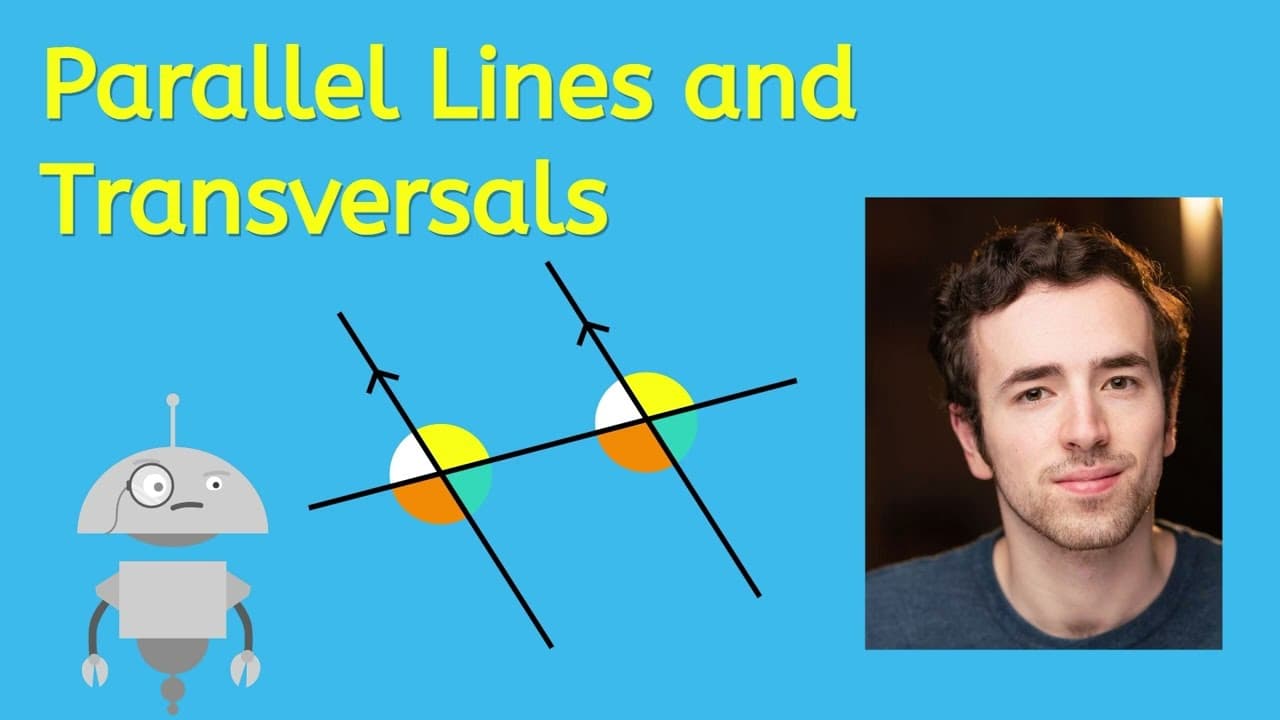
The Organic Chemistry TutorThe Organic Chemistry Tutor

10mins 58s

Video
Mastering Surface Area of Composite 3D Figures

Mastering Surface Area of Composite 3D Figures

This educational video provides a clear, step-by-step guide to calculating the surface area of composite 3D figures—shapes created by combining or removing standard geometric solids like prisms, cylinders, pyramids, cones, and spheres. The instructor, Justin, moves beyond simple formula application to teach the conceptual understanding needed to determine which faces contribute to the total surface area and which are internal or removed. The lesson uses visual aids and specific examples to demonstrate that finding the surface area of a composite figure is not as simple as adding the total surface areas of its parts together. The video explores key geometric themes including spatial visualization, the decomposition of complex shapes, and the application of lateral versus total surface area formulas. It explicitly addresses the "hidden face" problem where two shapes join, using a "wrapping paper" analogy to help students visualize the exterior surface. Two detailed worked examples are provided: an additive figure combining a cylinder, cone, and hemisphere, and a subtractive figure where a pyramid is "removed" from a prism, creating a hollow indentation that paradoxically increases the total surface area. For educators, this video serves as an excellent instructional tool for middle and high school Geometry units. It effectively targets the common student misconception that calculating composite surface area involves simply summing the areas of individual shapes. By breaking down complex problems into manageable components and emphasizing the logic behind selecting specific parts of formulas (like using only lateral area), the video fosters critical thinking and precision in mathematical problem-solving.
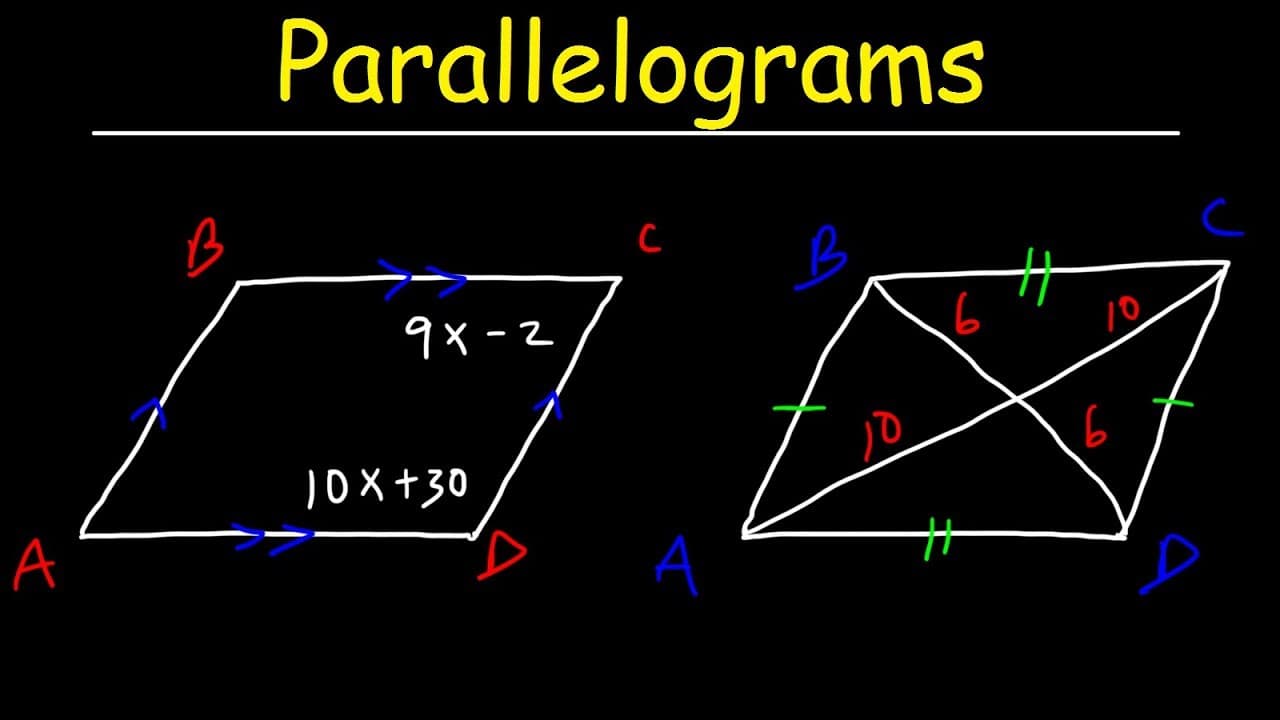
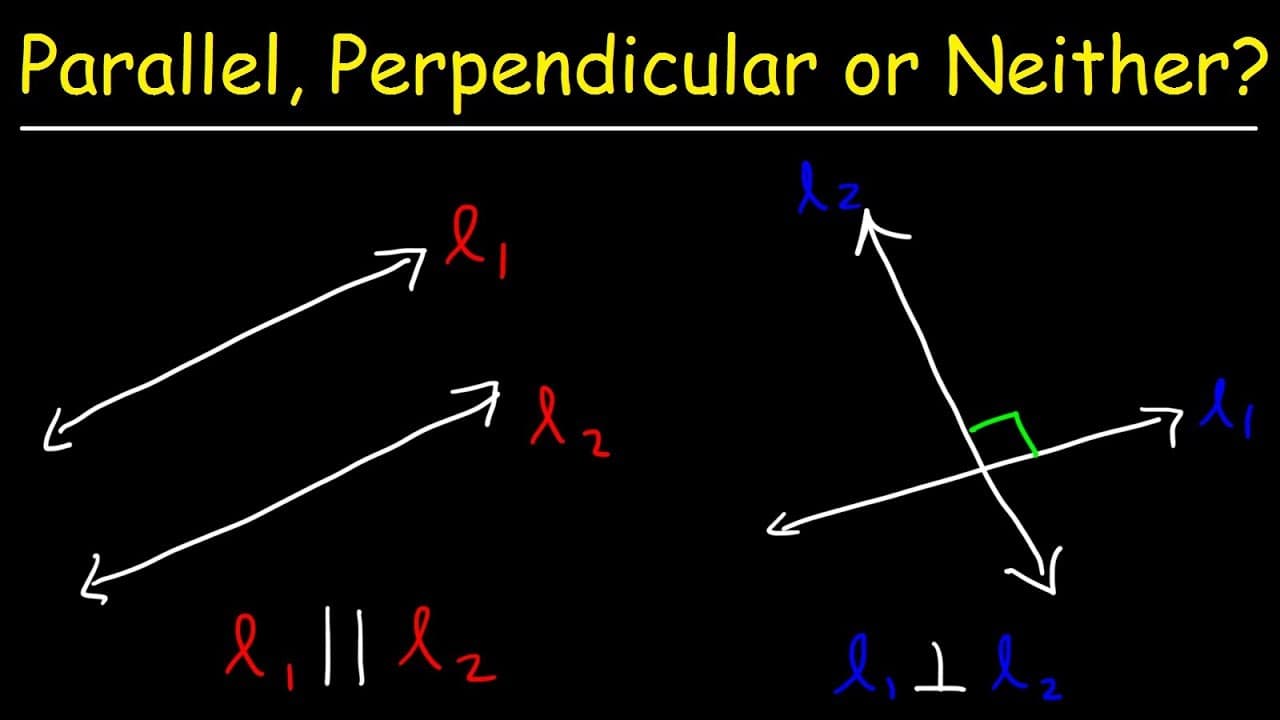
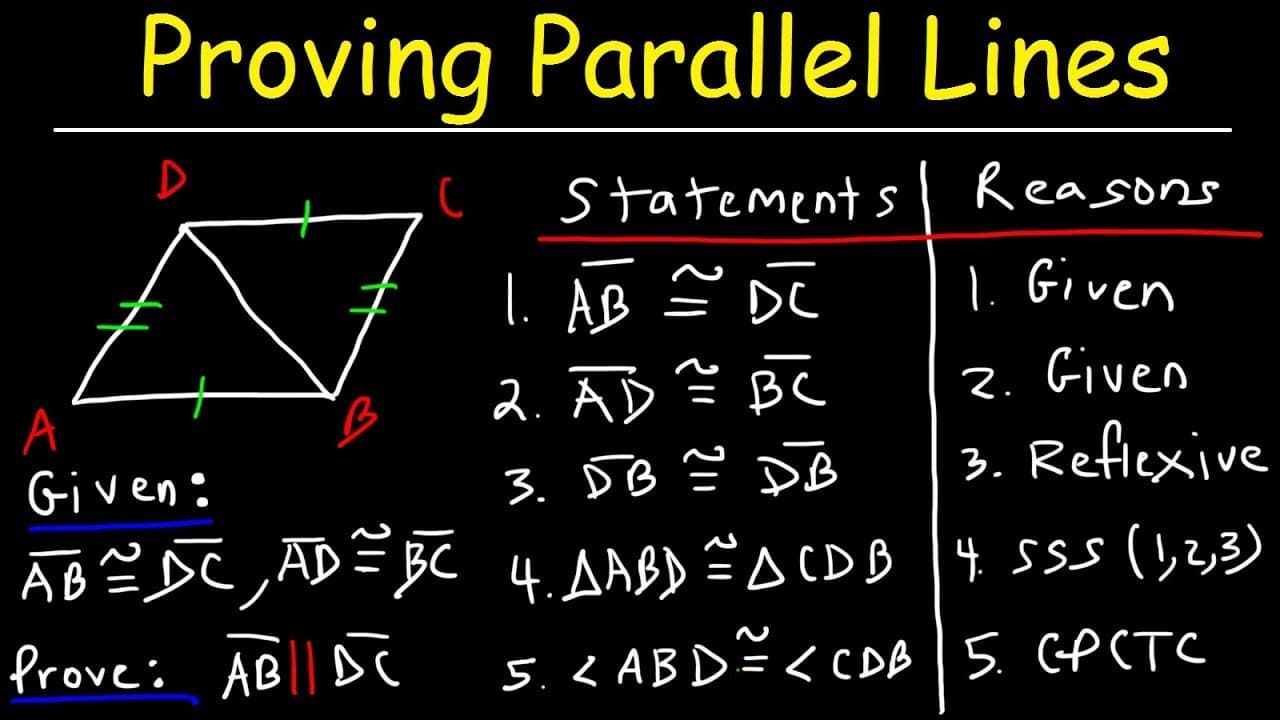
Miacademy & MiaPrep Learning ChannelMiacademy & MiaPrep Learning Channel

14mins 45s

Video
Mastering Volume and Surface Area of Cylinders

Mastering Volume and Surface Area of Cylinders

A comprehensive mathematics tutorial that guides students through the principles and calculations for finding the volume and surface area of cylinders. The video begins by conceptually deriving the formulas, using visual sketches to explain how the area of a circle relates to volume and how unrolling a cylinder reveals its surface area components. This conceptual foundation helps students understand the 'why' behind the math rather than just memorizing equations. The instructor then moves into practical application by solving four distinct word problems that increase in complexity. These examples cover standard calculations, distinguishing between cubic and square units, algebraic manipulation to find missing dimensions when given the volume, and handling unit conversions between feet and inches. The clear, step-by-step handwriting on a blackboard style background makes the procedures easy to follow. For educators, this resource serves as an excellent instructional tool for Geometry or Pre-Algebra units. It effectively addresses common student sticking points, such as the difference between lateral and total surface area, and the importance of unit consistency. The video's structure allows teachers to pause after each problem prompt for independent student practice before revealing the solution, making it highly interactive for classroom use.
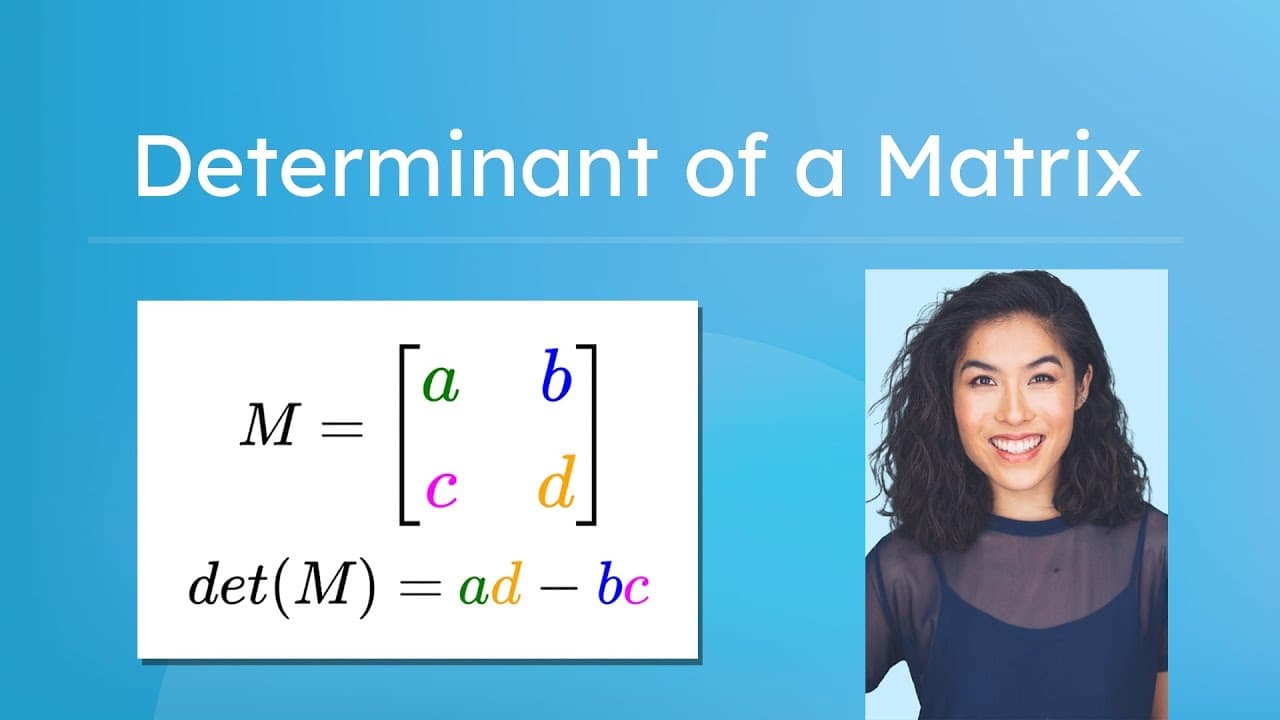
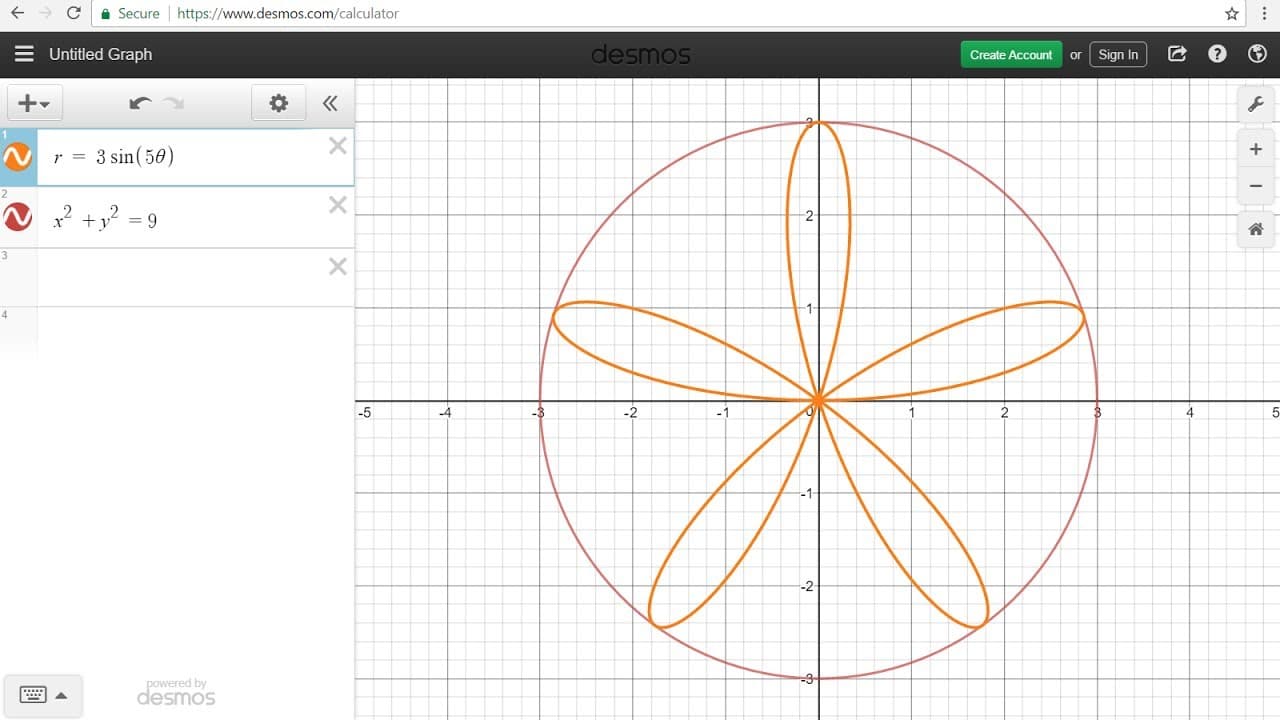
The Organic Chemistry TutorThe Organic Chemistry Tutor

11mins 14s

Video
From Polygons to 3D Shapes: A Visual Guide

From Polygons to 3D Shapes: A Visual Guide

This educational video provides a clear and concise progression from basic two-dimensional polygons to three-dimensional solids. The presenter begins by reviewing quadrilaterals and introducing 5-sided (pentagon) and 6-sided (hexagon) shapes, briefly mentioning polygons with even more sides. The lesson then shifts focus to curved shapes, defining a circle through the concept of equidistant points from a center. Key themes explored include geometric vocabulary (vertices, edges, faces), the etymology of shape names (penta, hexa), and spatial reasoning. A major focus is the conceptual relationship between dimensions; the narrator encourages viewers to visualize "pulling" 2D shapes out of the whiteboard to create 3D forms, such as extending a square into a cube or a circle into a cylinder. For educators, this video serves as an excellent bridge for students moving from simple shape identification to understanding geometric properties and spatial depth. The visual demonstrations on the whiteboard—particularly the comprehensive summary chart visible at the end—offer a valuable reference for classifying lines, angles, triangles, and solids. It helps students understand not just what shapes are called, but how they are constructed and related to one another.

Miacademy & MiaPrep Learning ChannelMiacademy & MiaPrep Learning Channel

2mins 44s

Video
How to Find the Surface Area of Cylinders

How to Find the Surface Area of Cylinders

This instructional video guides students through the process of calculating the surface area of cylinders by connecting the concept to their prior knowledge of prisms. The lesson begins by reviewing the general surface area formula for prisms ($S = 2B + PH$) and demonstrates through a visual animation of a cylinder unfolding into a net that this same conceptual framework applies to cylinders. The video clearly illustrates how the lateral surface of a cylinder unrolls into a rectangle, where the length corresponds to the circumference of the circular base. The content covers key geometric concepts including the area of a circle ($\pi r^2$), the circumference of a circle ($2\pi r$), and how these components combine to form the total surface area. Detailed graphics help students visualize the relationship between 3D shapes and their 2D nets, making abstract formulas more concrete. The video encourages students to derive understanding rather than just memorizing a specific formula for cylinders. This resource is highly valuable for middle and high school geometry classrooms. It emphasizes precision in calculation by advising students to enter the entire expression into a calculator at once to avoid rounding errors. The step-by-step example problem provides a clear model for students to follow, making it an excellent tool for introducing the topic or for remediation for students struggling with geometric formulas.

Miacademy & MiaPrep Learning ChannelMiacademy & MiaPrep Learning Channel

6mins 9s

Video
Calculating Volume and Surface Area of Triangular Prisms

Calculating Volume and Surface Area of Triangular Prisms

This comprehensive math tutorial provides a step-by-step guide to calculating the volume and surface area of triangular prisms. The video begins by conceptually linking triangular prisms to rectangular prisms, helping students understand the logic behind the formulas rather than just memorizing them. It breaks down the volume formula into simple terms ($V = \frac{1}{2} \times \text{base} \times \text{height} \times \text{length}$) and derives the surface area formula by analyzing the "net" of the shape—comprising two triangular bases and three rectangular faces. Key themes include geometric decomposition, formula derivation, and the application of the Pythagorean theorem. A significant portion of the video focuses on finding missing dimensions (like the height or hypotenuse of the triangular base) before performing area calculations. This reinforces 8th-grade standards regarding right triangles and connects algebraic solving with geometric application. The video is highly valuable for the classroom because it moves from simple direct application to more complex problem-solving. It includes multiple practice examples that require students to pause, calculate, and check their work. Teachers can use this video to introduce the topic, review before a test, or differentiate instruction for students who struggle with visualizing 3D shapes. The clear, dark background and color-coded annotations make the visual explanations easy to follow for all learners.

The Organic Chemistry TutorThe Organic Chemistry Tutor

27mins 41s

Video
Calculating the Surface Area of a Sphere

Calculating the Surface Area of a Sphere

This educational video provides a clear, step-by-step guide to calculating the surface area of spheres. It begins by addressing a common conceptual challenge—the inability to create a flat 2D net for a sphere—using a relatable real-world analogy of trying to wrap a round gift. This establishes why a specific algebraic formula is necessary rather than the additive area methods used for prisms or pyramids. The core of the lesson focuses on the formula S = 4πr², breaking down each variable and explaining the relationship between radius and diameter. The narrator, Justin, walks viewers through a complete example problem where only the diameter is given, demonstrating the critical intermediate step of dividing the diameter by two to find the radius before substituting values into the equation. Ideally suited for middle and high school geometry students, this video connects abstract formulas to tangible applications like painting an object. It emphasizes procedural fluency, proper rounding techniques, and the importance of using correct units (units squared) for area, making it an excellent resource for introducing or reviewing spherical geometry concepts.

Miacademy & MiaPrep Learning ChannelMiacademy & MiaPrep Learning Channel

4mins 24s

Video
Calculating the Volume of Composite 3D Figures

Calculating the Volume of Composite 3D Figures

This educational video provides a clear and structured guide to calculating the volume of composite 3D figures—shapes formed by combining or removing simpler geometric figures like prisms, cylinders, pyramids, cones, and spheres. The narrator, Justin, walks students through the conceptual framework of decomposing complex shapes into familiar parts, emphasizing that volume calculation is simply a matter of managing these smaller components through addition or subtraction.

Miacademy & MiaPrep Learning ChannelMiacademy & MiaPrep Learning Channel

7mins

Video
How to Calculate the Volume of Common 3D Shapes

How to Calculate the Volume of Common 3D Shapes

In this engaging mathematics lesson, Rob from Math Antics demystifies the concept of volume, starting from the very basics of dimensions. The video builds a clear conceptual foundation by visually demonstrating how a one-dimensional line extends to form a two-dimensional square, which then extends to form a three-dimensional cube. This progression helps students grasp why volume is measured in "cubic" units compared to "square" units for area. The lesson clearly distinguishes between volume (the space inside an object) and surface area (the outer boundary), using a helpful analogy involving a box filled with ice.

mathanticsmathantics

12mins 36s

Video
How to Calculate the Diagonal Length of a Cube

How to Calculate the Diagonal Length of a Cube

This concise mathematics tutorial demonstrates how to calculate the length of the space diagonal of a cube. Using a step-by-step derivation, the narrator applies the Pythagorean theorem in three dimensions to create a general formula. The video begins by drawing a cube and defining the problem, then breaks the 3D problem into two 2D triangles to solve for the unknown length. The core of the lesson focuses on deriving the formula $d = x\sqrt{3}$, where $x$ is the side length. The narrator first calculates the face diagonal of the cube's base using two side lengths. This result is then used as the base of a secondary right triangle inside the cube, allowing for the calculation of the final space diagonal. The method highlights the utility of algebraic substitution in geometry. This video is highly valuable for high school geometry classes as it connects algebraic manipulation with spatial reasoning. It moves beyond rote memorization of formulas by showing the logical proof behind them. Teachers can use this to introduce 3D coordinate geometry, reinforce the Pythagorean theorem, or as a practical example of working with radicals and square roots.

The Organic Chemistry TutorThe Organic Chemistry Tutor

2mins 48s

Video
How to Find the Surface Area of Prisms

How to Find the Surface Area of Prisms

This educational video provides a comprehensive guide on understanding and calculating the surface area of prisms. It begins by defining surface area using a clear analogy—wrapping paper versus the contents of a box—to distinguish it from volume. The video introduces the concept of prisms, identifying their components such as congruent bases and lateral faces, and explains that surface area is a two-dimensional measurement expressed in square units.

Miacademy & MiaPrep Learning ChannelMiacademy & MiaPrep Learning Channel

13mins 38s

Video
Visualizing Volume: How Solid Figures Relate

Visualizing Volume: How Solid Figures Relate

This educational video provides a comprehensive visual guide to understanding the relationships between the volumes of various 3D solid figures. It moves beyond simple rote memorization of formulas by demonstrating the geometric connections between rectangular prisms and pyramids, cylinders and cones, and cylinders and spheres. Through a mix of animation and real-world demonstrations involving pouring liquids and sand, students can visualize exactly how these shapes relate to one another spatially. The content begins by defining volume and cubic units, establishing a solid foundation before moving into formula derivation. The video systematically proves that a pyramid is one-third the volume of a corresponding prism, and a cone is one-third the volume of a corresponding cylinder. It culminates in a more advanced derivation of the volume of a sphere, showing it as two-thirds of a cylinder with the same height and radius. For educators, this resource serves as an excellent bridge between concrete observation and abstract algebraic thinking. By showing the "why" behind standard geometric formulas, it supports conceptual understanding in middle school geometry. The combination of clear on-screen calculations and physical experiments makes it valuable for diverse learners, particularly those who struggle to visualize spatial concepts from textbooks alone.

Sheena DoriaSheena Doria

10mins 19s

Video
How to Calculate Surface Area of a Square Pyramid Using Slant Height

How to Calculate Surface Area of a Square Pyramid Using Slant Height

A clear, step-by-step mathematics tutorial demonstrating how to calculate the total surface area of a square-based pyramid. The video specifically addresses the more complex scenario where the vertical height is known, but the slant height must be derived first. The narrator uses a digital blackboard to sketch the figure, label dimensions, and work through the calculations in real-time.

The Organic Chemistry TutorThe Organic Chemistry Tutor

3mins 28s

Video
Calculating Surface Area: Cubes, Rectangular and Triangular Prisms

Calculating Surface Area: Cubes, Rectangular and Triangular Prisms

This comprehensive math tutorial guides students through the process of calculating the surface area for three specific 3D shapes: cubes, rectangular prisms, and triangular prisms. The video utilizes a clear, step-by-step approach that relies heavily on the concept of "nets"—unfolding a 3D object into its 2D faces—to help students visualize exactly what surface area represents. By decomposing complex 3D shapes into familiar 2D polygons (squares, rectangles, and triangles), the video makes the derivation of surface area formulas accessible and logical.

Sheena DoriaSheena Doria

14mins 39s

Video
How to Calculate the Surface Area of Cylinders, Cones, and Spheres

How to Calculate the Surface Area of Cylinders, Cones, and Spheres

This instructional video provides a comprehensive tutorial on calculating the surface area of three specific three-dimensional geometric figures: cylinders, cones, and spheres. The video uses a step-by-step approach, starting with the conceptual understanding of how these 3D shapes "unfold" into 2D nets to derive their respective formulas. This pedagogical choice helps students understand the logic behind the math rather than simply memorizing equations. The content covers key geometry themes including identifying lateral faces and bases, understanding the relationship between the circumference of a base and the length of a lateral face, and performing calculations using Pi (approximated as 3.14). It breaks down complex shapes into simpler components—rectangles, circles, and sectors—and demonstrates how to sum these areas to find the total surface area. This resource is highly valuable for middle and high school geometry classrooms. It serves as both a conceptual introduction and a procedural guide. Teachers can use the video's clear animations to visualize the abstraction of nets, and the worked-out examples provide excellent opportunities for guided practice where students can pause, calculate, and check their work against the video's solutions.

Sheena DoriaSheena Doria

12mins 17s

Video
Calculating the Lateral and Total Surface Area of a Cylinder

Calculating the Lateral and Total Surface Area of a Cylinder

This concise mathematics tutorial provides a step-by-step demonstration on how to calculate both the lateral area and total surface area of a cylinder. Using a clear, handwritten visual style on a blackboard, the narrator guides viewers through a specific problem involving a cylinder with a radius of 8 inches and a height of 12 inches. The video focuses on key geometric concepts, distinguishing between lateral area (the area of the curved surface only) and total surface area (which includes the top and bottom circular bases). It explicitly breaks down the formulas involved, deriving the lateral area formula from the perimeter (circumference) of the base multiplied by the height, and building the total surface area by adding the two base areas to the lateral area. For educators, this video serves as an excellent model for solving geometry problems involving 3D shapes. It is particularly useful for visual learners who benefit from seeing the problem setup and the step-by-step algebraic substitution. The video can be used to introduce the concept, reinforce understanding of the formulas, or as a reference for students working on independent practice problems.

The Organic Chemistry TutorThe Organic Chemistry Tutor

2mins 29s

Video
How to Calculate the Surface Area of a Cube

How to Calculate the Surface Area of a Cube

This educational video provides a step-by-step tutorial on calculating the surface area of a cube. It begins by conceptually breaking down the 3D shape into its component 2D faces, deriving the general formula based on the properties of a square. The narrator explains that since a cube has six identical square faces, the total surface area is six times the area of a single face ($6x^2$). The video covers key themes in geometry including identifying 2D shapes within 3D objects, deriving algebraic formulas from geometric properties, and performing substitution to solve for specific values. It clearly distinguishes between the length of a side and the calculated area of a face, using color-coding to help viewers visualize the specific parts of the cube being discussed. For educators, this video serves as an excellent bridge between 2D area concepts and 3D surface area measurement. It is particularly useful for moving students away from rote memorization of formulas toward conceptual understanding. The clear, handwritten demonstration makes it easy for students to follow along, take notes, and apply the logic to their own geometry problems involving surface area.

The Organic Chemistry TutorThe Organic Chemistry Tutor

1min 42s

Video
Calculating Surface Area with Nets: Cubes and Prisms

Calculating Surface Area with Nets: Cubes and Prisms

This instructional video provides a clear, step-by-step guide to calculating the surface area of three-dimensional figures, specifically focusing on cubes, rectangular prisms, and triangular prisms. The narrator, Kaylee, transitions students from understanding area in 2D to visualizing surface area in 3D by defining it as the sum of the areas of all faces on a solid figure. The video emphasizes visualization techniques to help students grasp the concept of hidden faces.

Miacademy & MiaPrep Learning ChannelMiacademy & MiaPrep Learning Channel

7mins 43s