Lenny LearningLenny
Create
Explore
Workspace
LoginSign up
MathEnglish Language ArtsScience & EngineeringSocial StudiesGlobal LanguagesHealth & Physical EducationSpecial EducationCounseling & Life SkillsArts & CreativityESL
Lenny LearningLenny
Lenny Learning
About
Training
Pricing
Support
Contact
© 2026 Lenny Learning Inc.

Statistics & Probability

SequencesLessonsMaterialsVideos
  1. Math

Statistics & Probability

SequencesLessonsMaterialsVideos

Data representation, distributions, and statistical variability using sampling and inference techniques. Integrates probability models, compound events, bivariate patterns, and linear models to guide data-driven decision making.

Data DistributionsAnalyzes the shape, center, and spread of numerical datasets using histograms, box plots, and dot plots. Examines measures of central tendency and variability to interpret data consistency and skewness.
Statistical VariabilityAnalysis of data spread using range, interquartile range, and mean absolute deviation. Examines how individual data points differ from the center and from each other within a distribution.
Interpret Categorical and Quantitative DataStatistical analysis techniques for summarizing and visualizing numerical and non-numerical data sets. Emphasizes shape, center, spread, and the impact of outliers on data interpretation through dot plots, histograms, and box plots.
MathNumbers & CountingCounting ObjectsNumber NamesComparing NumbersNumber OperationsCounting SequenceNumbers 0-10Place Value Understanding and SystemAdd and Subtract Within 20Addition and Subtraction ConceptsAddition and Subtraction EquationsAddition and Subtraction ProblemsFoundations for MultiplicationMultiplication and Division PropertiesMultiply and Divide Within 100Multiplication and Division ProblemsFactors and MultiplesProperties of OperationsPatterns and RelationshipsGenerate and Analyze PatternsMulti-Digit ArithmeticPlace Value OperationsMulti-Digit and Decimal OperationsNumerical ExpressionsFour Operations and PatternsFour Operations Problem SolvingMeasurement & DataMeasurable AttributesMeasuring LengthsMeasure and Estimate Lengths in Standard UnitsRelate Addition and Subtraction to LengthClassifying and Counting ObjectsTime and MoneyArea Concepts and MeasurementPerimeter and Area MeasuresAngle Concepts and MeasurementTime, Volume, and MassMeasurement Unit ConversionsGeometryIdentifying ShapesShapes and AttributesShape Attributes and ReasoningShapes and CompositionClassifying 2D FiguresGeometric Figures and RelationshipsLines, Angles, and ShapesAngle, Area, and VolumeGeometric MeasurementVolume of 3D ShapesCoordinate Plane ApplicationsTransformations in the PlaneCongruence and SimilarityUnderstand congruence in terms of rigid motionsSimilarity and TransformationsProve Theorems Involving SimilarityPythagorean TheoremTrigonometry for General TrianglesMake Geometric ConstructionsProve Geometric TheoremsTheorems About CirclesFind Arc Lengths And Areas of Sectors of CirclesVolume FormulasRelationships Between Two-Dimensional and Three-Dimensional ObjectsProve Simple Geometric Theorems AlgebraicallyTranslate Between Geometric Description and Equation for Conic SectionApply Geometric Concepts in Modeling SituationsFractions & DecimalsFractions as NumbersBuilding FractionsFraction Equivalence and OrderingAdding and Subtracting FractionsMultiplying and Dividing FractionsDividing FractionsDecimal FractionsMulti-Digit Computation and FactorsAdd, Subtract, Multiply, and Divide Rational NumbersRational Number SystemIrrational Numbers and ApproximationsRatiosRatios and ProportionsProportional RelationshipsUnit RateAlgebraAlgebraic ExpressionsGenerate Equivalent ExpressionsQuantitative RelationshipsProportional Relationships and Linear EquationsEquations and InequalitiesEquation Solving and ReasoningLinear Equations and SystemsGraph Equations and InequalitiesSystems of EquationsReal-World Algebraic ProblemsQuantitative Reasoning with UnitsExpression StructureEquivalent Expression FormsRadicals and Integer ExponentsRational ExponentsRational and Irrational NumbersPolynomial OperationsPolynomial IdentitiesPolynomial Zeros and FactorsRational ExpressionsComplex Number OperationsComplex Numbers in PolynomialsComplex Numbers on PlaneStatistics & ProbabilityRepresent and Interpret DataData DistributionsStatistical VariabilityProbability ModelsCompound Event ProbabilitiesStatistical SamplingInterpret Categorical and Quantitative DataBivariate Data PatternsInterpret Linear ModelsComparing Two PopulationsRandom Processes in StatisticsIndependence and Conditional ProbabilityExpected ValuesProbability-Based Decision MakingStatistical Inference and ConclusionsFunctionsFunction Concepts and NotationDefine and Compare FunctionsInterpret Functions in ContextAnalyze Function RepresentationsModel Relationships with FunctionsIdentify Linear vs Exponential GrowthDistinguish Between Function TypesCompare Growth RatesInterpret Function ExpressionsBuild Functions from RelationshipsConstruct and Model FunctionsTransform and Combine FunctionsModel Comparison and SelectionSolve Exponential EquationsTrigonometryTrigonometric Ratios Involving Right TrianglesTrigonometric Functions and Unit CircleModel with Trigonometric FunctionsTrigonometric IdentitiesVectors & MatricesIntroduction to Vectors and MatricesVector QuantitiesVector OperationsMatrix OperationsCalculusLimits and ContinuityDerivative Concepts and NotationDerivative Rules and TechniquesApplications of DerivativesOptimization ProblemsRelated RatesCurve Sketching and AnalysisIntegration Concepts and NotationAntiderivatives and Indefinite IntegralsDefinite Integrals and AreaFundamental Theorem of CalculusIntegration TechniquesApplications of IntegrationDifferential EquationsSequences and SeriesParametric and Polar FunctionsVector-Valued Functions
Video
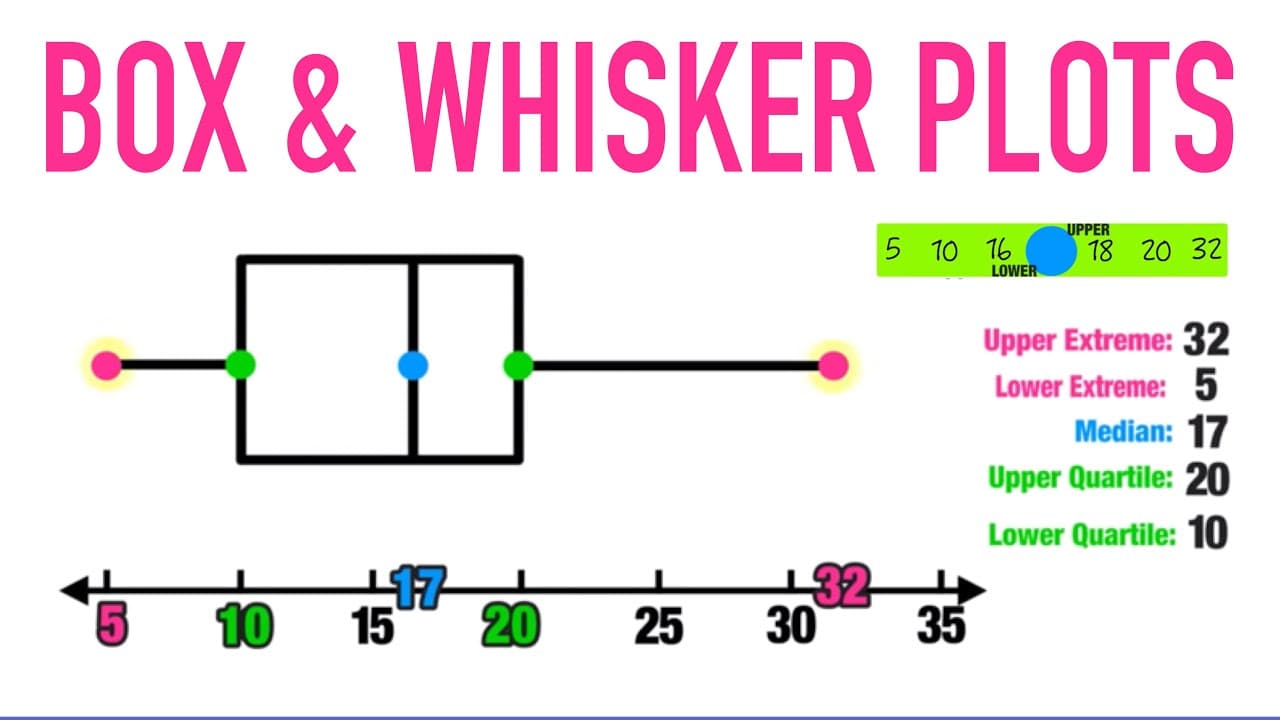
Constructing Box and Whisker Plots Step-by-Step

Constructing Box and Whisker Plots Step-by-Step

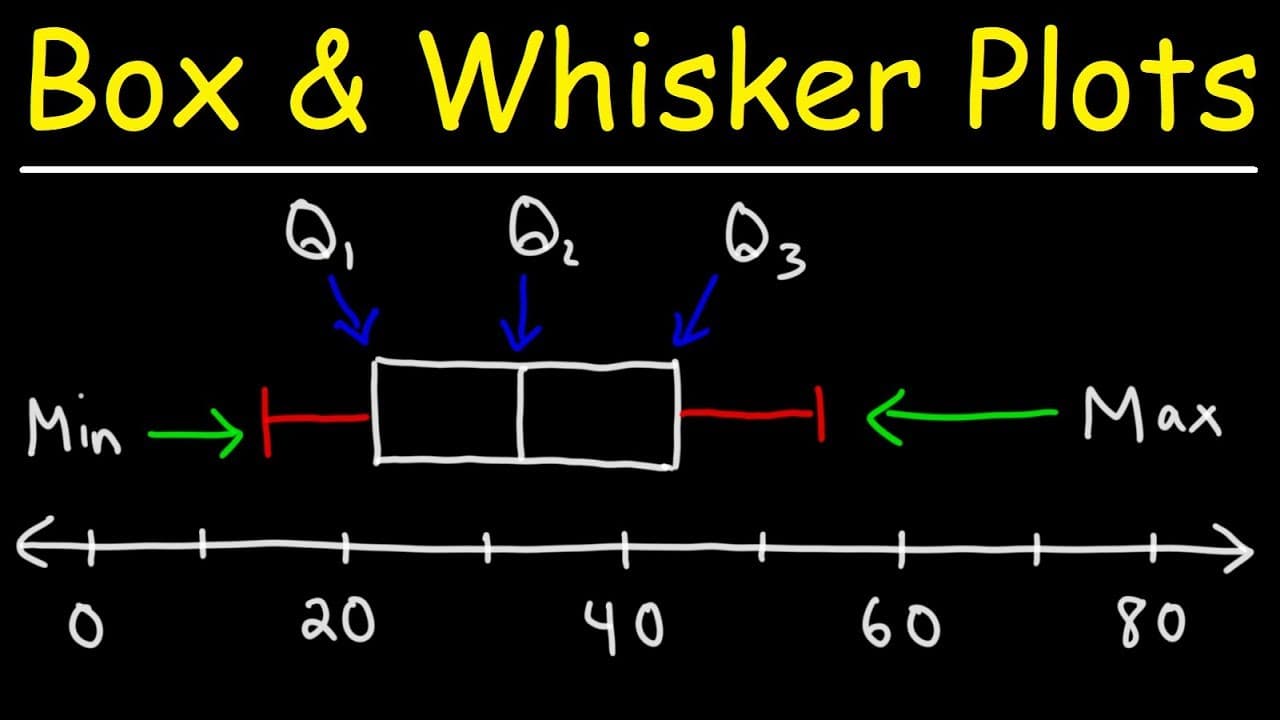
This educational video provides a comprehensive, step-by-step tutorial on how to construct box and whisker plots (also known as box plots). The narrator guides viewers through identifying the five-number summary required to draw the plot: minimum, first quartile (Q1), median (second quartile/Q2), third quartile (Q3), and maximum. The video uses clear, handwritten visualizations on a blackboard style background to demonstrate the process of organizing raw data, calculating quartiles, and mapping these points onto a number line.

The Organic Chemistry TutorThe Organic Chemistry Tutor

13mins 56s

Video
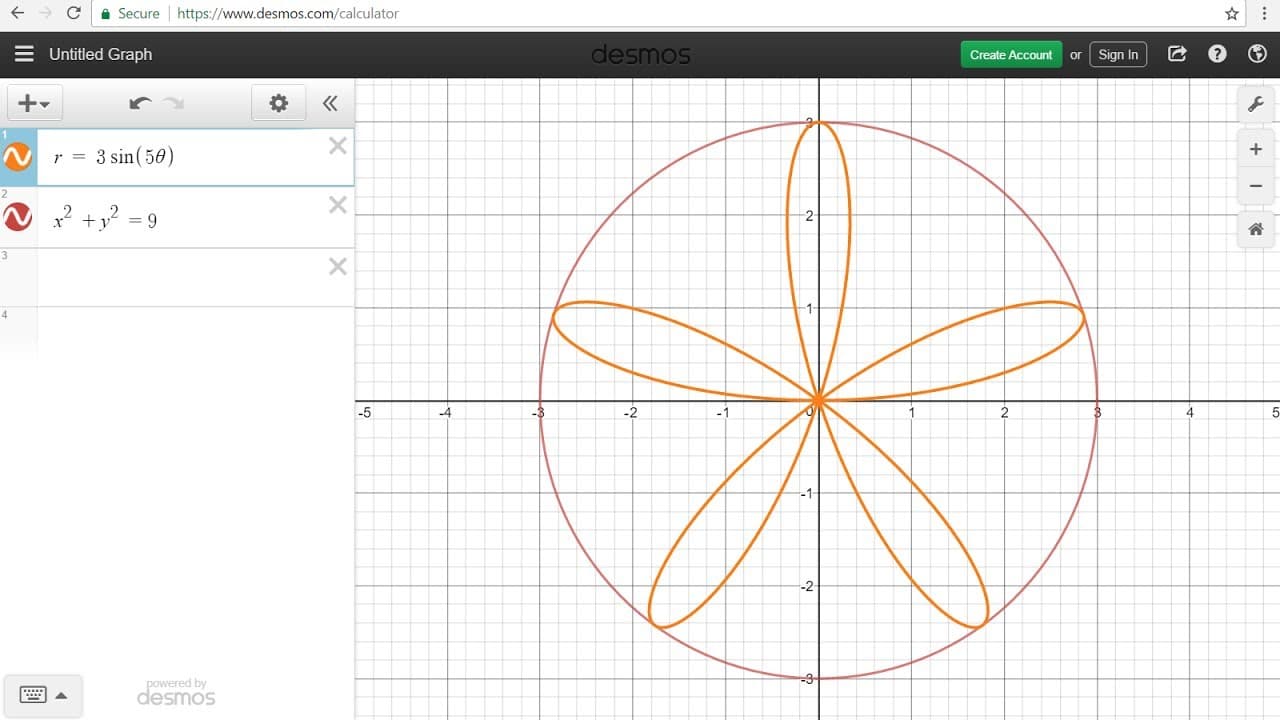
Mastering Math with the Desmos Online Graphing Calculator

Mastering Math with the Desmos Online Graphing Calculator

This comprehensive tutorial introduces students and educators to the Desmos online graphing calculator, a powerful and free tool for visualizing mathematics. The video begins with the basics of accessing the site and graphing simple functions like lines and parabolas, then progressively moves to more advanced topics including trigonometry, polar coordinates, and calculus operations. The narrator demonstrates not just how to plot graphs, but how to use the tool to solve equations, factor quadratics, and visualize systems of inequalities. Key mathematical themes include function families (linear, quadratic, cubic, absolute value, exponential, logarithmic), systems of equations and inequalities, trigonometry (degrees vs. radians), and statistical analysis (mean, standard deviation). The video also highlights the calculator's computational abilities, such as evaluating definite integrals, summations, and permutations, making it a versatile utility for various levels of math. For the classroom, this video serves as an excellent training resource for students transitioning from handheld calculators to computer-based tools. It allows teachers to show students how to verify their algebraic work visually, such as checking factors by looking at x-intercepts or solving systems by finding intersection points. The visual nature of the tool helps bridge the gap between abstract algebraic manipulation and concrete graphical understanding.

The Organic Chemistry TutorThe Organic Chemistry Tutor

13mins 58s

Video
How to Calculate Quartiles, Deciles, and Percentiles

How to Calculate Quartiles, Deciles, and Percentiles

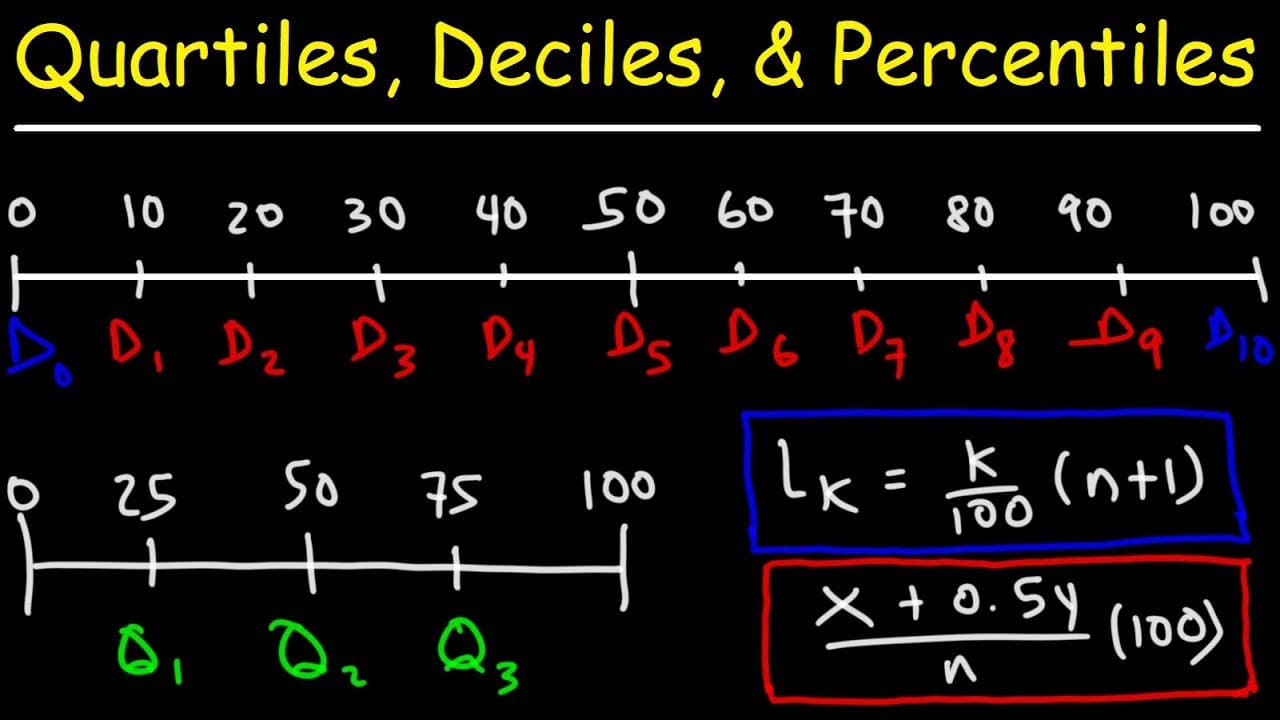
This comprehensive math tutorial provides a deep dive into statistical measures of position: quartiles, deciles, and percentiles. It begins by defining each term and visualizing their relationships on a number line, establishing a clear conceptual foundation before moving into calculations. The video demonstrates how to calculate these values for both odd and even datasets using two distinct methods: finding the median physically by eliminating outer numbers, and using the position formula $L = \frac{k}{100}(n+1)$. A significant portion of the video focuses on the nuances of calculation, specifically how to handle results when the position formula yields a decimal. It explains the process of averaging the two surrounding data points to find the precise value. Furthermore, the video introduces a formula for finding the percentile rank of a specific data point, which is useful for standardized testing contexts. Finally, it guides viewers through constructing a cumulative relative frequency table and using it to determine deciles efficiently. This resource is highly valuable for algebra and statistics classrooms. It addresses common points of confusion, such as the difference between a percentile's "position" and its "value," and how to handle data that falls between two values. Teachers can use this video to introduce new concepts, reinforce calculation methods, or provide a refresher on reading cumulative frequency tables. The step-by-step examples with varying dataset sizes make it an excellent reference for students mastering data analysis.

The Organic Chemistry TutorThe Organic Chemistry Tutor

35mins 13s

Video
Constructing Frequency Tables and Dot Plots

Constructing Frequency Tables and Dot Plots

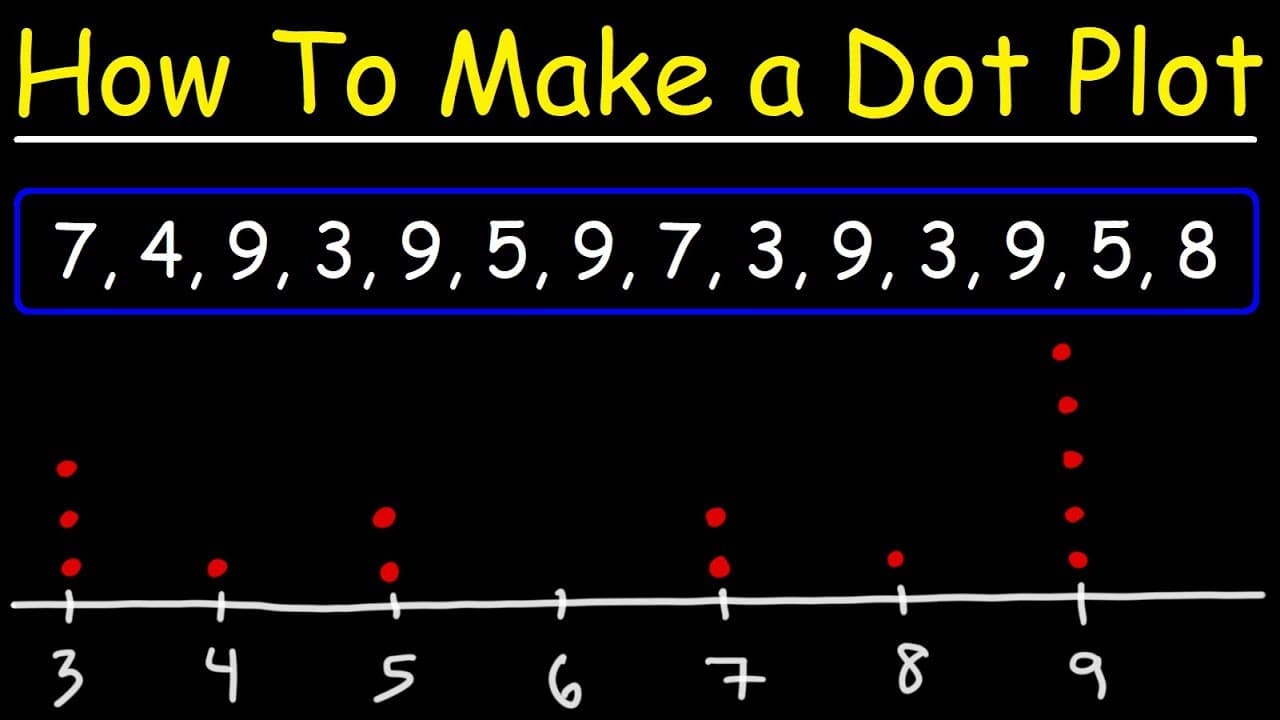
This educational video provides a clear, step-by-step tutorial on how to organize raw data into frequency tables and translate that data into dot plots. The narrator demonstrates the process using a specific set of numbers, showing how to systematically count occurrences to build a frequency table, ensuring accuracy by crossing off numbers as they are counted. The video further bridges the gap between tabular data and visual representation by constructing a dot plot on a number line based on the frequency table values. Key themes include data organization, statistical visualization, and measures of central tendency. Beyond simple construction, the video teaches students how to analyze the resulting dot plot to identify the mode (the most frequent value) and the median (the middle value). A visual method for finding the median—canceling out dots from the left and right extremes—is explicitly demonstrated, including how to handle a data set with an even number of values by averaging the two middle numbers. This resource is highly valuable for introducing or reinforcing 6th-grade statistics concepts. It models procedural fluency and organization, skills critical for avoiding errors in data analysis. Teachers can use this video to scaffold lessons on data display, moving students from messy lists of numbers to organized tables and finally to clear visual graphs that allow for easier interpretation of data trends.

The Organic Chemistry TutorThe Organic Chemistry Tutor

5mins 35s

Video
Mastering Mean, Median, Mode, and Range

Mastering Mean, Median, Mode, and Range

This instructional video provides a clear, step-by-step guide on how to calculate the four primary statistical measures of central tendency and variability: mean, median, mode, and range. Using a digital blackboard format, the narrator walks viewers through four distinct practice problems that increase in complexity. The video covers scenarios with both odd and even numbered data sets, demonstrating specific rules for finding the median when there are two middle numbers and how to identify data sets with no mode versus a single mode. Key themes include data organization, arithmetic operations, and statistical analysis. The video emphasizes the importance of ordering numbers from least to greatest before attempting to find the median or range, a critical step often missed by students. It also distinguishes between the arithmetic mean (average) and the median (middle value), helping to clarify common points of confusion in introductory statistics. For educators, this video serves as an excellent direct instruction tool or review resource for math classrooms. It is particularly useful for scaffolding learning, as it moves from simple integer data sets to those requiring decimal answers and multi-step median calculations. The pause-and-practice format encouraged by the narrator makes it ideal for interactive classroom viewing or independent student practice/remediation.

The Organic Chemistry TutorThe Organic Chemistry Tutor

11mins 38s

Video
Calculating and Comparing Mean, Median, and Mode

Calculating and Comparing Mean, Median, and Mode

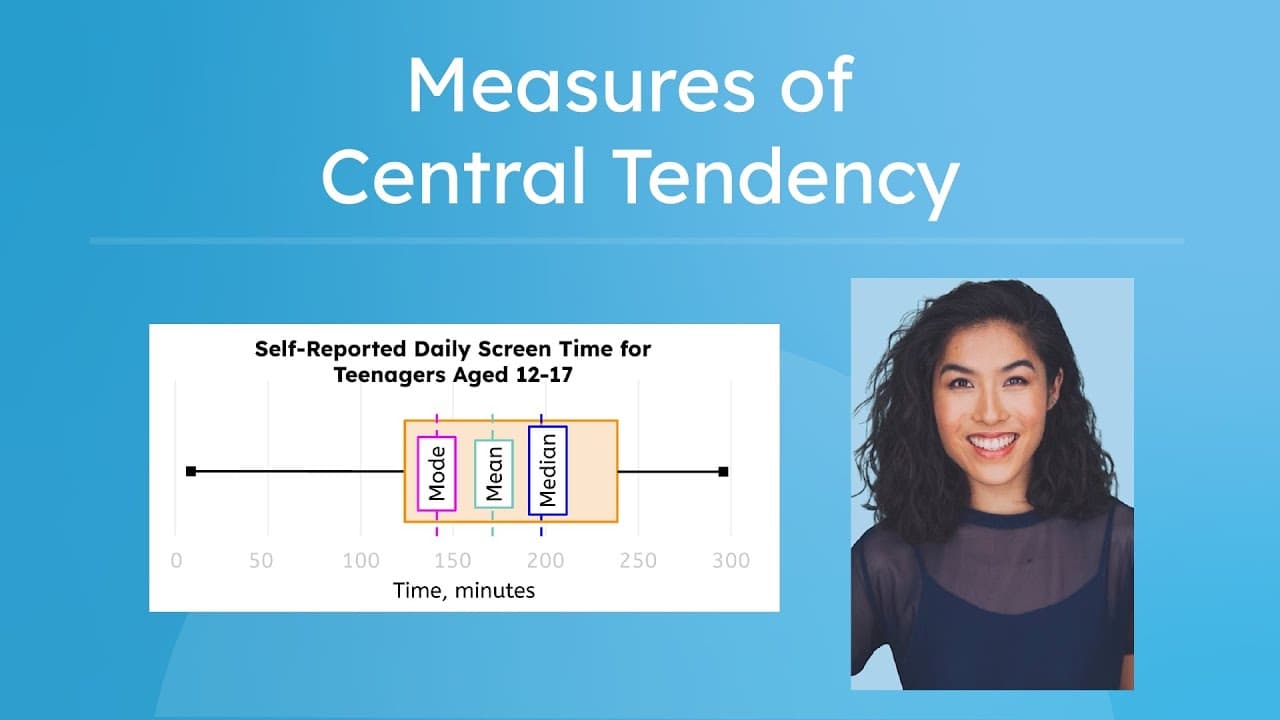
This educational video provides a comprehensive introduction to the three primary measures of central tendency: mean, median, and mode. Through clear definitions and real-world examples, it explains how statisticians and everyday people use these tools to find the "center" or typical value of a dataset. The video uses a relatable running example of tracking daily screen time to demonstrate how to calculate each measure and compares how they behave differently, particularly when outliers are present. The lesson goes beyond simple calculation by visualizing data using histograms and box-and-whisker plots. It explores complex concepts such as data distribution, quartiles, and the impact of skewed data on the mean versus the median. The video also distinguishes between numerical and categorical data, explaining why mode is unique in its application to non-numerical preferences. For educators, this resource serves as an excellent core lesson for a statistics unit in middle or high school math. It directly addresses the critical critical thinking skill of choosing the *right* measure to represent data, rather than just calculating all three blindly. The included pauses for calculation and reflection make it an interactive tool for flipped classrooms or guided whole-group instruction.

Miacademy & MiaPrep Learning ChannelMiacademy & MiaPrep Learning Channel

9mins 13s

Video
ACT Math Practice Test: Review of Algebra, Geometry, and Trig Concepts

ACT Math Practice Test: Review of Algebra, Geometry, and Trig Concepts

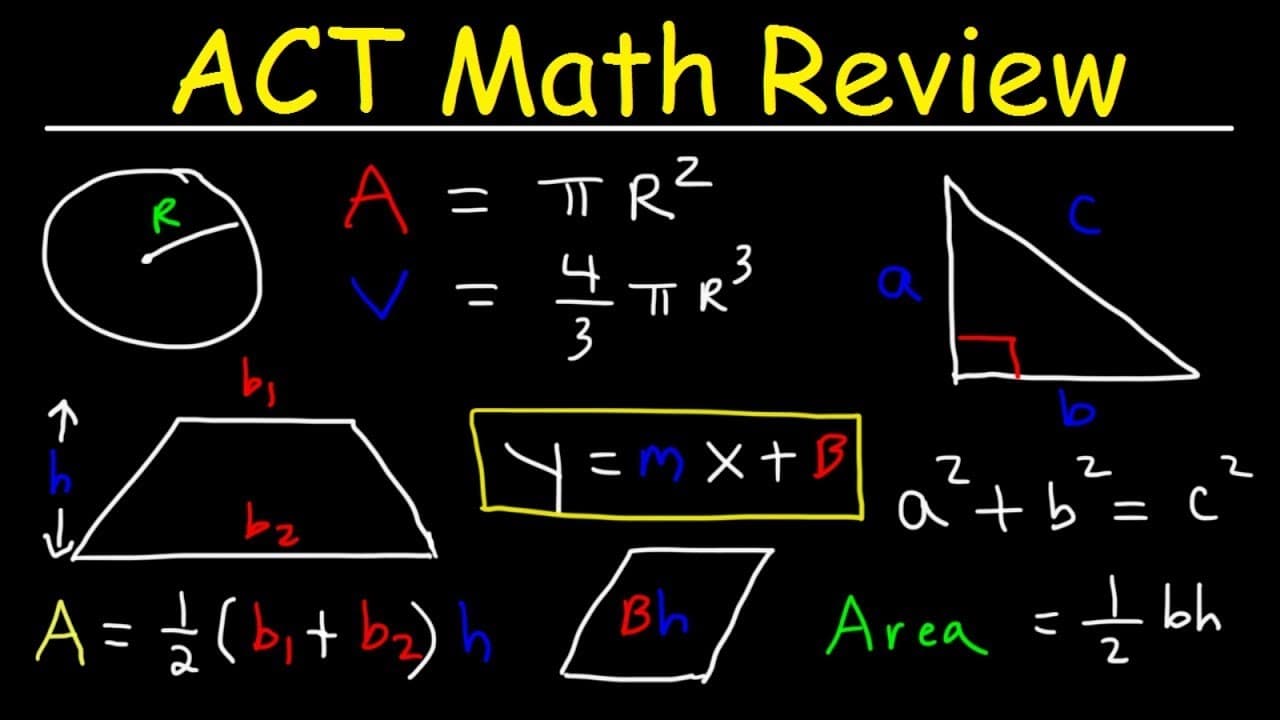
This comprehensive video tutorial serves as an intensive review for the ACT Math section, covering a wide array of topics crucial for high school students preparing for college entrance exams. The content is structured as a series of 31 practice problems that mimic the style and difficulty of actual ACT questions. It progresses through various mathematical domains including pre-algebra, elementary algebra, intermediate algebra, coordinate geometry, plane geometry, and trigonometry. The video adopts a pause-and-practice format, encouraging active participation where viewers attempt each problem before watching the detailed step-by-step solution. Key themes explored in this review include solving linear and quadratic equations, working with functions, understanding geometric properties of polygons and circles, applying trigonometric ratios (SOH CAH TOA) and identities, and analyzing statistical data. The video also places a strong emphasis on real-world application problems involving percentages, sales tax, discounts, and unit conversions. Particular attention is given to algebraic manipulation strategies, such as solving systems of equations and simplifying complex expressions, as well as test-taking tactics like identifying key information in word problems. For educators and students, this video is a valuable resource for standardized test preparation. It allows teachers to identify specific areas of weakness in student understanding by isolating problem types (e.g., if a student struggles with problem 10, they need more support with circle geometry). The step-by-step explanations model clear mathematical reasoning, demonstrating not just *how* to get the right answer, but *why* specific methods work. This makes it an excellent tool for flipped classrooms, homework support, or intensive boot-camp style review sessions prior to test dates.
The Organic Chemistry TutorThe Organic Chemistry Tutor

20mins 33s

Video
How to Visualize Data with Stem-and-Leaf, Scatter, Histogram, and Box Plots

How to Visualize Data with Stem-and-Leaf, Scatter, Histogram, and Box Plots

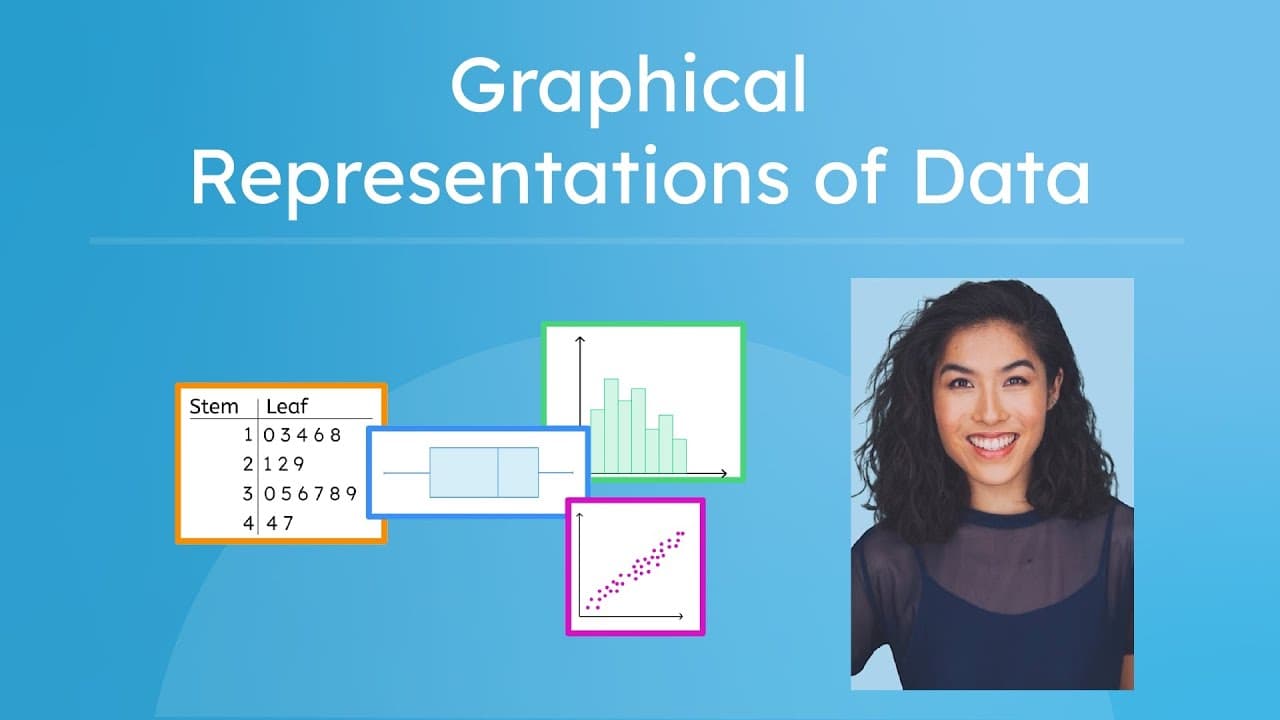
This comprehensive educational video guides students through four essential methods of graphical data representation: stem-and-leaf plots, scatter plots, histograms, and box-and-whisker plots. Using a relatable running example of a science teacher's class test scores, the lesson demonstrates how to construct each graph from raw data and, more importantly, how to interpret the results to find meaningful patterns. The video transitions from a live-action introduction using a library analogy to a slide-based lecture narrated with clear visual aids and an animated robot character. The content covers key statistical concepts including organizing numerical data, identifying correlations (positive, negative, and no correlation), spotting outliers, understanding frequency distributions, and calculating the five-number summary (minimum, quartiles, median, maximum). Special attention is given to the nuances of each graph type, such as the difference between bar charts and histograms, how bin sizes affect interpretation, and how box plots allow for easy comparison between two different data sets. Teachers can use this video as a core instructional tool for a unit on statistics and data analysis. The video is designed with built-in "pause points" where students are encouraged to stop and complete guided notes or try constructing graphs themselves before seeing the solution. This interactive format makes it ideal for a flipped classroom model or a guided in-class activity where students actively engage with the data rather than passively watching.

Miacademy & MiaPrep Learning ChannelMiacademy & MiaPrep Learning Channel

19mins 7s

Video
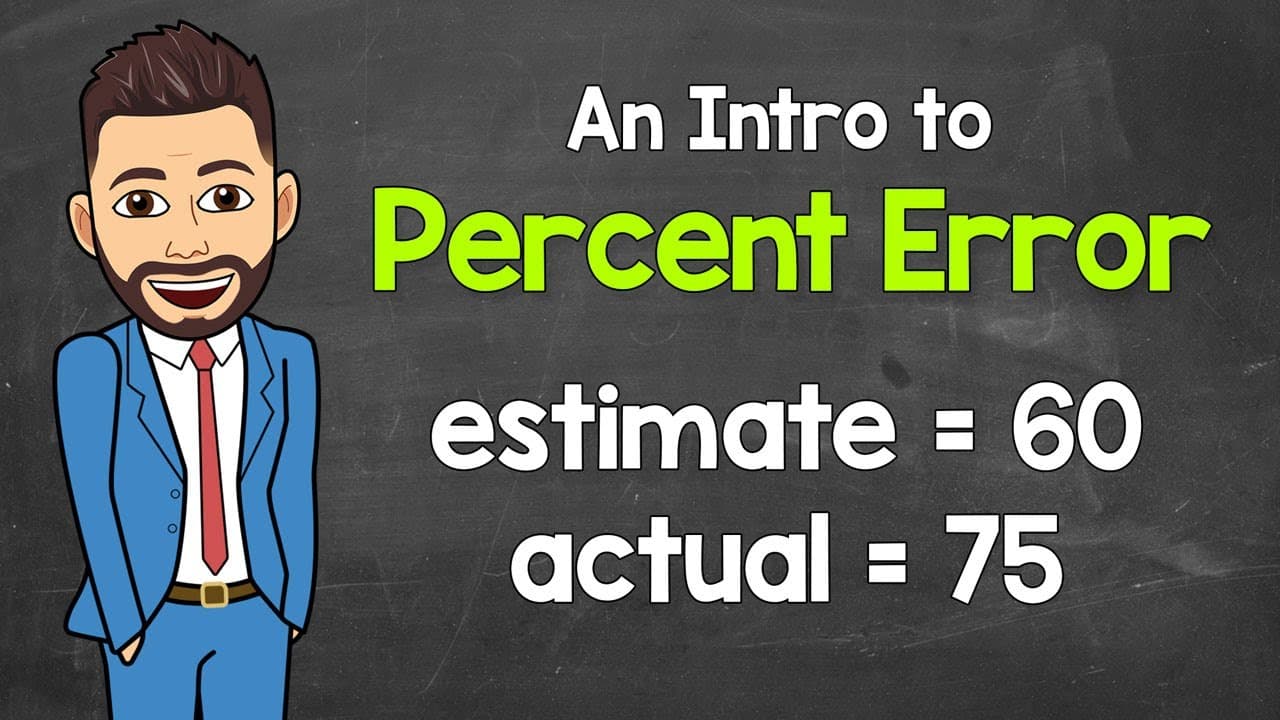
How to Calculate and Understand Percent Error

How to Calculate and Understand Percent Error

This instructional math video introduces students to the concept of percent error, a critical statistical tool used to determine the accuracy of an estimate or measurement relative to an actual value. The narrator, Mr. J, clearly defines percent error and breaks down the formula step-by-step, including calculating the difference, taking the absolute value, dividing by the actual value, and converting the resulting decimal to a percentage. The video explores key themes such as the difference between absolute error (raw numbers) and relative error (percentages). Through four distinct examples, the video demonstrates how a small absolute error can result in a large percent error when dealing with small numbers, while a large absolute error might result in a tiny percent error when dealing with massive numbers. This helps students understand why context and magnitude matter in data analysis. This resource is highly valuable for middle and high school math classrooms as it moves beyond simple calculation into statistical reasoning. Teachers can use this video to bridge the gap between simple arithmetic and data interpretation. It serves as an excellent primer for science labs where experimental error is calculated, or for math units dealing with ratios, proportions, and real-world estimation.

Math with Mr. JMath with Mr. J

12mins 38s

Video
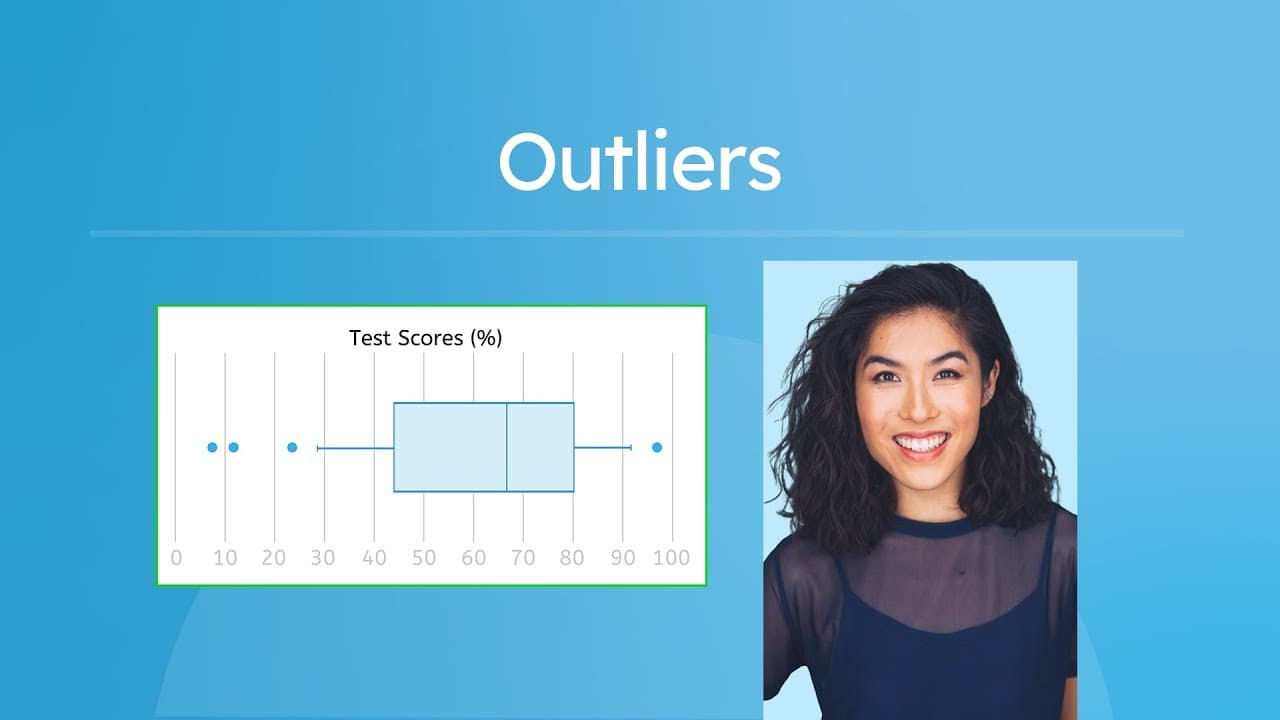
Identifying and Handling Outliers in Data

Identifying and Handling Outliers in Data

This comprehensive statistics lesson explores the concept of outliers—data points that differ significantly from other observations in a dataset. The video provides a clear definition of outliers and demonstrates multiple methods for identifying them, ranging from visual inspection of scatter plots and box plots to precise mathematical calculation using the Interquartile Range (IQR) method. It walks students through step-by-step examples of calculating lower and upper bounds to mathematically pinpoint specific outlier values. Beyond identification, the video delves into the statistical impact of outliers. It compares how different measures of central tendency (mean, median, mode) and measures of dispersion (range, standard deviation) are affected when outliers are present versus when they are removed. This section emphasizes why the median is often a more robust measure than the mean in skewed datasets. Finally, the video discusses strategies for handling outliers in data analysis, presenting the pros and cons of removing them versus replacing them with other values like the mean or median. This critical thinking component encourages students to consider the context of the data—whether an outlier represents an error or a significant extreme case—before deciding how to treat it, making it an excellent resource for high school statistics and data science units.

Miacademy & MiaPrep Learning ChannelMiacademy & MiaPrep Learning Channel

11mins 59s

Video
Calculating Sample Standard Deviation Step-by-Step

Calculating Sample Standard Deviation Step-by-Step

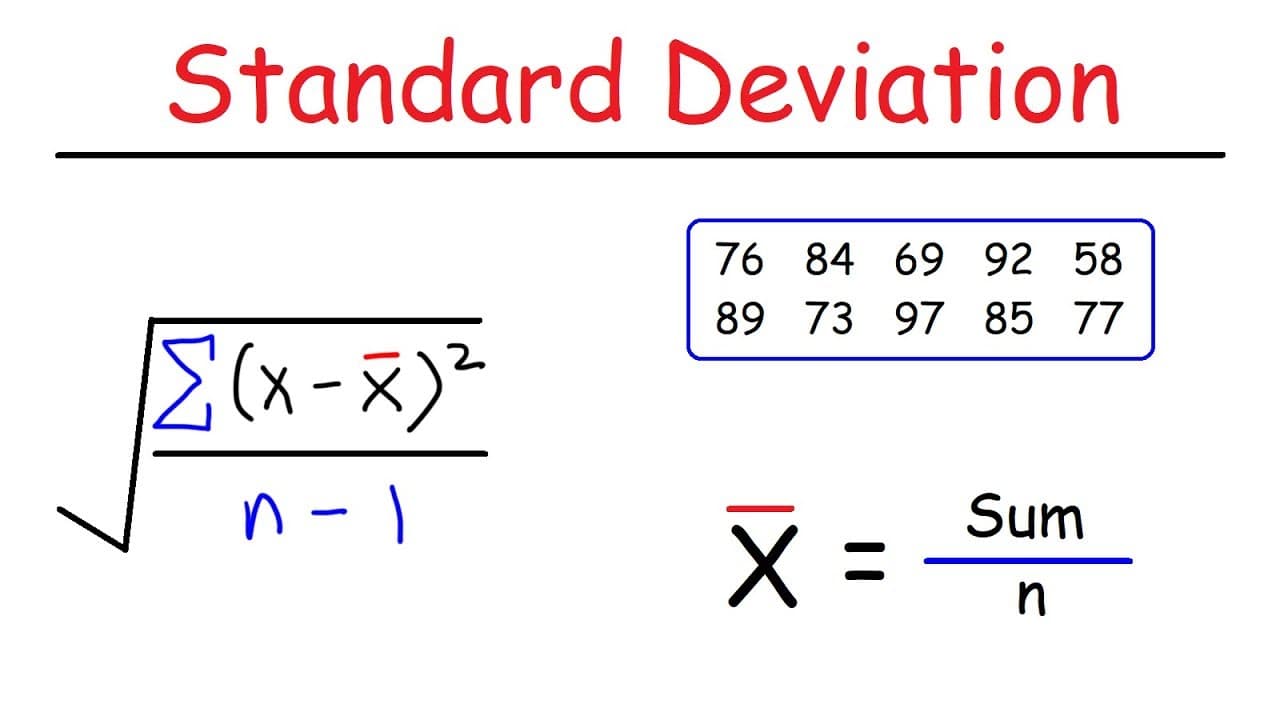
This educational video provides a clear, step-by-step tutorial on how to calculate the sample standard deviation for a set of numbers. The instructor uses a digital whiteboard to demonstrate the process manually, breaking down the complex statistical formula into manageable arithmetic steps. The video covers two distinct examples: a smaller data set with five numbers to introduce the concept, and a larger data set with ten numbers to reinforce the process and demonstrate how to handle more data points. The content focuses on key statistical concepts including calculating the arithmetic mean (average), determining sample size (n), calculating the differences between data points and the mean, squaring those differences, and applying the specific formula for sample standard deviation which requires dividing by n-1. The instructor emphasizes the order of operations and provides practical tips for organizing calculations to avoid errors. This resource is highly valuable for high school and introductory college statistics classrooms. It demystifies a formula that often intimidates students by showing the mechanical logic behind it. Teachers can use this video to support flipped classroom models, providing students with a procedural reference for homework, or as a remediation tool for students struggling with the multi-step calculation process of finding measures of spread.

The Organic Chemistry TutorThe Organic Chemistry Tutor

7mins 14s

Video
Exploring Five Types of Mathematical Means

Exploring Five Types of Mathematical Means

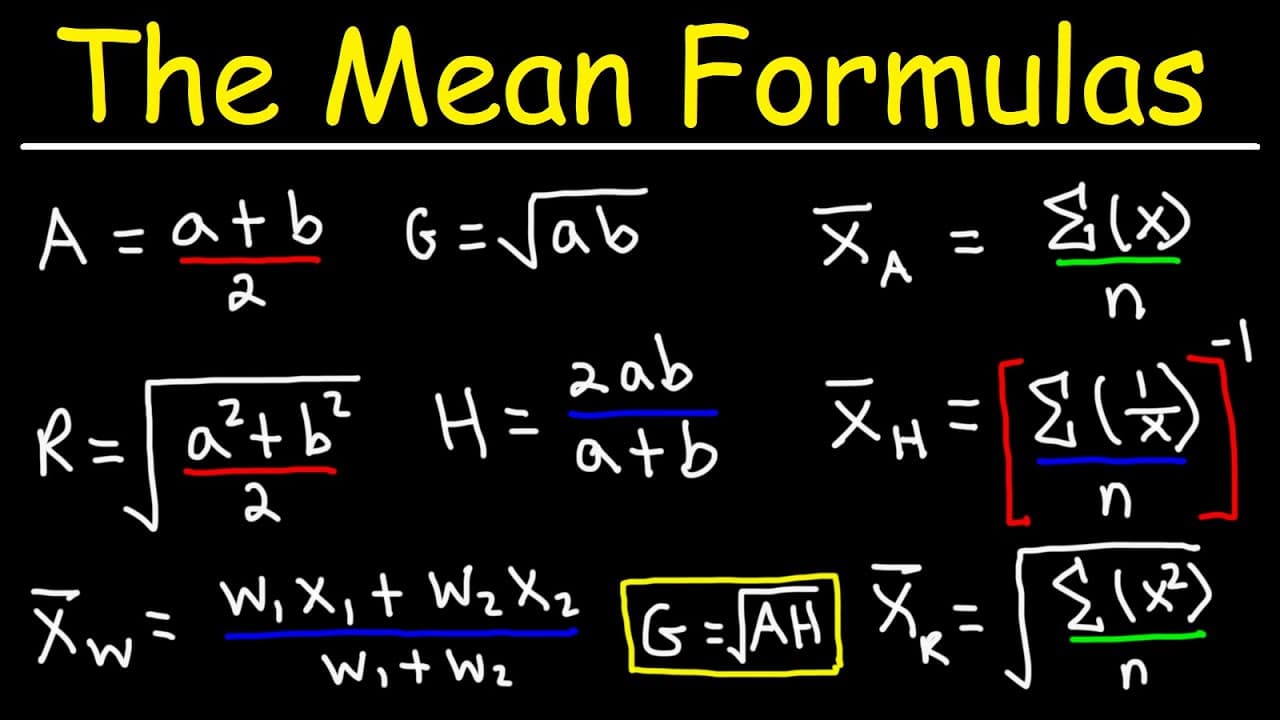
This comprehensive math tutorial explores five distinct types of statistical means: the Arithmetic Mean, Geometric Mean, Weighted Mean, Harmonic Mean, and Root Mean Square (RMS). The video breaks down the specific formulas for each, explains their relationship to mathematical sequences, and demonstrates how to calculate them using step-by-step examples involving various data sets. Key themes include the relationship between means and sequences (arithmetic, geometric, and harmonic), the importance of weighting in real-world scenarios, and common misconceptions in calculating averages. A significant portion of the video is dedicated to solving a classic average speed word problem, illustrating why the harmonic mean—rather than the arithmetic mean—is necessary when calculating average rates over equal distances. This resource is highly valuable for high school and college math students, particularly those in Algebra 2, Pre-Calculus, and Statistics. It provides clear, actionable methods for solving mixture problems and physics-based rate problems. Teachers can use the specific examples to demonstrate why "average" can mean different things in different contexts and helping students avoid common pitfalls when analyzing data.

The Organic Chemistry TutorThe Organic Chemistry Tutor

52mins 44s

Video
Using Measures of Dispersion to Choose a Basketball Champion

Using Measures of Dispersion to Choose a Basketball Champion

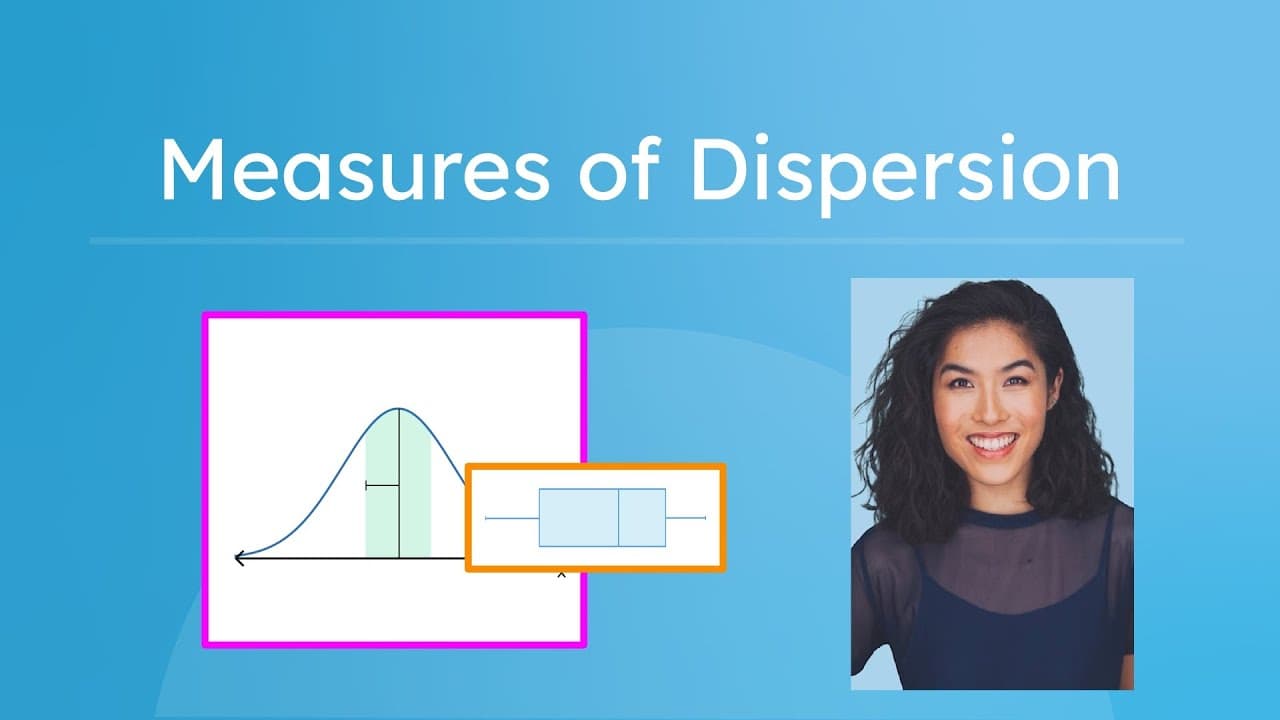
This educational video introduces advanced statistics students to measures of dispersion—statistical tools used to describe the spread or variability of a dataset. Using a practical scenario where a basketball coach must choose a free-throw shooter for a championship game, the video demonstrates why the mean (average) alone is often insufficient for making informed decisions. It guides viewers through three key players who all share the same shooting average but have vastly different consistency levels.

Miacademy & MiaPrep Learning ChannelMiacademy & MiaPrep Learning Channel

13mins 5s

Video
How to Construct and Analyze Box-and-Whisker Plots

How to Construct and Analyze Box-and-Whisker Plots

This comprehensive math tutorial introduces students to Box-and-Whisker Plots, a statistical tool used to visualize data distribution. The video guides viewers through the entire process of creating these plots, starting from raw data sets and moving through the calculation of key statistical markers. It uses two distinct real-world scenarios—a basketball player's scoring record and a coffee shop's daily espresso sales—to demonstrate how to handle both odd and even numbered data sets, ensuring students learn the nuances of finding medians and quartiles in different situations. Key statistical concepts explored include the five-number summary: lower extreme (minimum), lower quartile (Q1), median (Q2), upper quartile (Q3), and upper extreme (maximum). The video explicitly teaches the algorithm for organizing data, finding the median, splitting data into upper and lower regions to find quartiles, and mapping these points onto a number line. It also introduces the concept of the Interquartile Range (IQR) as a measure of consistency, explaining how the "box" represents the middle 50% of the data. For educators, this video is an excellent instructional resource for middle school statistics units. It visualizes abstract definitions, making them accessible and concrete. The step-by-step walkthroughs allow teachers to pause and let students calculate ahead of the reveal, functioning as a guided practice tool. The dual examples are particularly valuable for addressing the common student confusion regarding how to calculate medians and quartiles when the data set size is even versus odd.

Mashup MathMashup Math

6mins 33s

Video
Analyzing Data Distribution: Symmetry and Skewness

Analyzing Data Distribution: Symmetry and Skewness

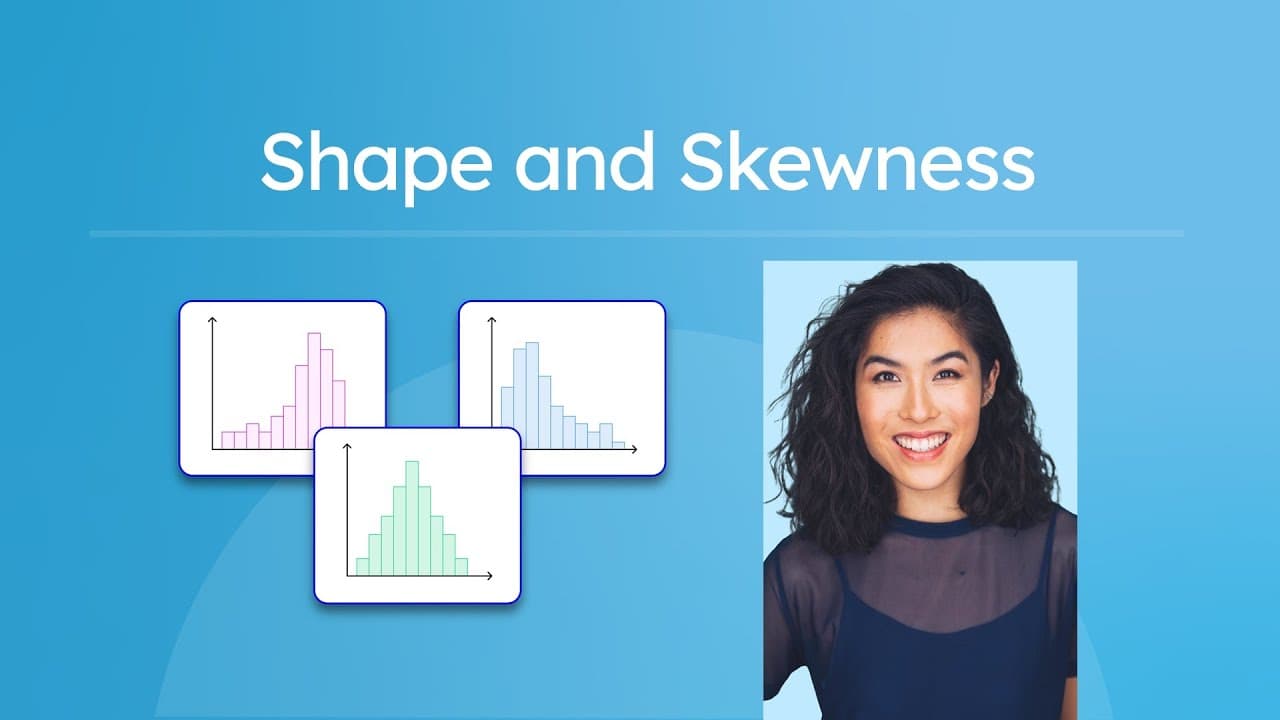
This educational video provides a clear and comprehensive introduction to analyzing the shape of data distributions in statistics. It moves beyond simple statistical values to examine the visual structure of data, specifically focusing on symmetry and skewness. Through the use of histograms and box-and-whisker plots, the video demonstrates how to identify whether data is symmetrical, right-skewed, or left-skewed based on the position of the "tail" and the concentration of data points.

Miacademy & MiaPrep Learning ChannelMiacademy & MiaPrep Learning Channel

9mins 28s

Video
How to Construct and Analyze Box-and-Whisker Plots

How to Construct and Analyze Box-and-Whisker Plots

This comprehensive math tutorial introduces students to Box-and-Whisker Plots, a statistical tool used to visualize data distribution. The video guides viewers through the entire process of creating these plots, starting from raw data sets and moving through the calculation of key statistical markers. It uses two distinct real-world scenarios—a basketball player's scoring record and a coffee shop's daily espresso sales—to demonstrate how to handle both odd and even numbered data sets, ensuring students learn the nuances of finding medians and quartiles in different situations. Key statistical concepts explored include the five-number summary: lower extreme (minimum), lower quartile (Q1), median (Q2), upper quartile (Q3), and upper extreme (maximum). The video explicitly teaches the algorithm for organizing data, finding the median, splitting data into upper and lower regions to find quartiles, and mapping these points onto a number line. It also introduces the concept of the Interquartile Range (IQR) as a measure of consistency, explaining how the "box" represents the middle 50% of the data. For educators, this video is an excellent instructional resource for middle school statistics units. It visualizes abstract definitions, making them accessible and concrete. The step-by-step walkthroughs allow teachers to pause and let students calculate ahead of the reveal, functioning as a guided practice tool. The dual examples are particularly valuable for addressing the common student confusion regarding how to calculate medians and quartiles when the data set size is even versus odd.

Mashup MathMashup Math

6mins 33s

Video
Analyzing Data Distribution: Symmetry and Skewness

Analyzing Data Distribution: Symmetry and Skewness

This educational video provides a clear and comprehensive introduction to analyzing the shape of data distributions in statistics. It moves beyond simple statistical values to examine the visual structure of data, specifically focusing on symmetry and skewness. Through the use of histograms and box-and-whisker plots, the video demonstrates how to identify whether data is symmetrical, right-skewed, or left-skewed based on the position of the "tail" and the concentration of data points.

Miacademy & MiaPrep Learning ChannelMiacademy & MiaPrep Learning Channel

9mins 28s

Video
Calculating and Comparing Mean, Median, and Mode

Calculating and Comparing Mean, Median, and Mode

This educational video provides a comprehensive introduction to the three primary measures of central tendency: mean, median, and mode. Through clear definitions and real-world examples, it explains how statisticians and everyday people use these tools to find the "center" or typical value of a dataset. The video uses a relatable running example of tracking daily screen time to demonstrate how to calculate each measure and compares how they behave differently, particularly when outliers are present. The lesson goes beyond simple calculation by visualizing data using histograms and box-and-whisker plots. It explores complex concepts such as data distribution, quartiles, and the impact of skewed data on the mean versus the median. The video also distinguishes between numerical and categorical data, explaining why mode is unique in its application to non-numerical preferences. For educators, this resource serves as an excellent core lesson for a statistics unit in middle or high school math. It directly addresses the critical critical thinking skill of choosing the *right* measure to represent data, rather than just calculating all three blindly. The included pauses for calculation and reflection make it an interactive tool for flipped classrooms or guided whole-group instruction.

Miacademy & MiaPrep Learning ChannelMiacademy & MiaPrep Learning Channel

9mins 13s

Video
How to Calculate Quartiles, Deciles, and Percentiles

How to Calculate Quartiles, Deciles, and Percentiles

This comprehensive math tutorial provides a deep dive into statistical measures of position: quartiles, deciles, and percentiles. It begins by defining each term and visualizing their relationships on a number line, establishing a clear conceptual foundation before moving into calculations. The video demonstrates how to calculate these values for both odd and even datasets using two distinct methods: finding the median physically by eliminating outer numbers, and using the position formula $L = \frac{k}{100}(n+1)$. A significant portion of the video focuses on the nuances of calculation, specifically how to handle results when the position formula yields a decimal. It explains the process of averaging the two surrounding data points to find the precise value. Furthermore, the video introduces a formula for finding the percentile rank of a specific data point, which is useful for standardized testing contexts. Finally, it guides viewers through constructing a cumulative relative frequency table and using it to determine deciles efficiently. This resource is highly valuable for algebra and statistics classrooms. It addresses common points of confusion, such as the difference between a percentile's "position" and its "value," and how to handle data that falls between two values. Teachers can use this video to introduce new concepts, reinforce calculation methods, or provide a refresher on reading cumulative frequency tables. The step-by-step examples with varying dataset sizes make it an excellent reference for students mastering data analysis.

The Organic Chemistry TutorThe Organic Chemistry Tutor

35mins 13s

Video
Constructing Box and Whisker Plots Step-by-Step

Constructing Box and Whisker Plots Step-by-Step

This educational video provides a comprehensive, step-by-step tutorial on how to construct box and whisker plots (also known as box plots). The narrator guides viewers through identifying the five-number summary required to draw the plot: minimum, first quartile (Q1), median (second quartile/Q2), third quartile (Q3), and maximum. The video uses clear, handwritten visualizations on a blackboard style background to demonstrate the process of organizing raw data, calculating quartiles, and mapping these points onto a number line.

The Organic Chemistry TutorThe Organic Chemistry Tutor

13mins 56s

Video
How to Visualize Data with Stem-and-Leaf, Scatter, Histogram, and Box Plots

How to Visualize Data with Stem-and-Leaf, Scatter, Histogram, and Box Plots

This comprehensive educational video guides students through four essential methods of graphical data representation: stem-and-leaf plots, scatter plots, histograms, and box-and-whisker plots. Using a relatable running example of a science teacher's class test scores, the lesson demonstrates how to construct each graph from raw data and, more importantly, how to interpret the results to find meaningful patterns. The video transitions from a live-action introduction using a library analogy to a slide-based lecture narrated with clear visual aids and an animated robot character. The content covers key statistical concepts including organizing numerical data, identifying correlations (positive, negative, and no correlation), spotting outliers, understanding frequency distributions, and calculating the five-number summary (minimum, quartiles, median, maximum). Special attention is given to the nuances of each graph type, such as the difference between bar charts and histograms, how bin sizes affect interpretation, and how box plots allow for easy comparison between two different data sets. Teachers can use this video as a core instructional tool for a unit on statistics and data analysis. The video is designed with built-in "pause points" where students are encouraged to stop and complete guided notes or try constructing graphs themselves before seeing the solution. This interactive format makes it ideal for a flipped classroom model or a guided in-class activity where students actively engage with the data rather than passively watching.

Miacademy & MiaPrep Learning ChannelMiacademy & MiaPrep Learning Channel

19mins 7s

Video
How to Create Stem and Leaf Plots: Integers, Large Numbers, and Decimals

How to Create Stem and Leaf Plots: Integers, Large Numbers, and Decimals

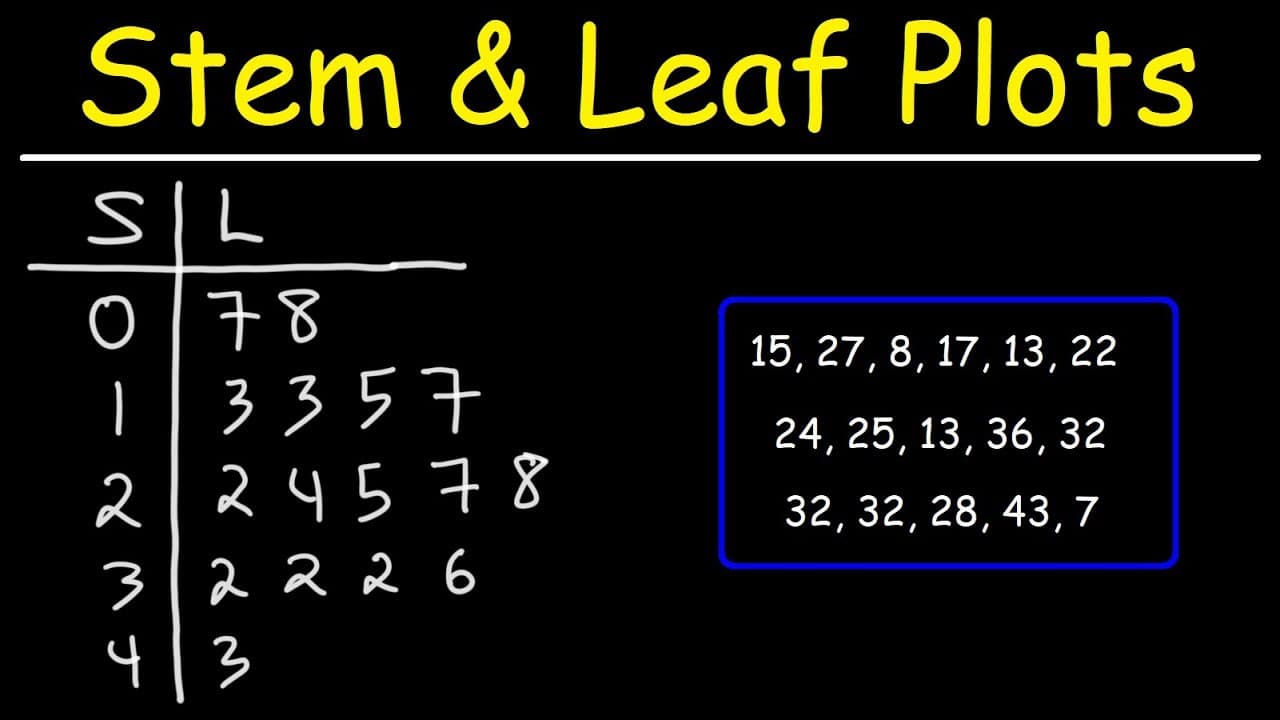
This instructional video provides a comprehensive tutorial on constructing stem and leaf plots, a common statistical tool for organizing data. The narrator guides viewers through three distinct examples of increasing complexity: a standard set of two-digit integers, a set containing three-digit numbers to demonstrate how to handle values over 100, and a final set involving decimal numbers. Each example is worked through step-by-step, from organizing the raw data to populating the chart. Key themes include data organization, place value recognition, and the importance of creating a "key" to interpret the plot correctly. The video emphasizes the strategy of grouping data in ascending order before plotting to ensure accuracy. It also addresses specific edge cases, such as how to handle empty intervals within a data range (gaps in data) and how to split numbers into stems and leaves when they exceed two digits. For educators, this video serves as an excellent direct instruction tool or review resource for middle school statistics units. It visually demonstrates the mechanics of the plot, allowing teachers to pause and have students predict the placement of numbers. The progression from simple integers to decimals makes it versatile for different proficiency levels, ensuring students understand that stem and leaf plots can handle various data types beyond just simple whole numbers.

The Organic Chemistry TutorThe Organic Chemistry Tutor

7mins 47s

Video
Exploring Five Types of Mathematical Means

Exploring Five Types of Mathematical Means

This comprehensive math tutorial explores five distinct types of statistical means: the Arithmetic Mean, Geometric Mean, Weighted Mean, Harmonic Mean, and Root Mean Square (RMS). The video breaks down the specific formulas for each, explains their relationship to mathematical sequences, and demonstrates how to calculate them using step-by-step examples involving various data sets. Key themes include the relationship between means and sequences (arithmetic, geometric, and harmonic), the importance of weighting in real-world scenarios, and common misconceptions in calculating averages. A significant portion of the video is dedicated to solving a classic average speed word problem, illustrating why the harmonic mean—rather than the arithmetic mean—is necessary when calculating average rates over equal distances. This resource is highly valuable for high school and college math students, particularly those in Algebra 2, Pre-Calculus, and Statistics. It provides clear, actionable methods for solving mixture problems and physics-based rate problems. Teachers can use the specific examples to demonstrate why "average" can mean different things in different contexts and helping students avoid common pitfalls when analyzing data.

The Organic Chemistry TutorThe Organic Chemistry Tutor

52mins 44s

Video
Identifying and Handling Outliers in Data

Identifying and Handling Outliers in Data

This comprehensive statistics lesson explores the concept of outliers—data points that differ significantly from other observations in a dataset. The video provides a clear definition of outliers and demonstrates multiple methods for identifying them, ranging from visual inspection of scatter plots and box plots to precise mathematical calculation using the Interquartile Range (IQR) method. It walks students through step-by-step examples of calculating lower and upper bounds to mathematically pinpoint specific outlier values. Beyond identification, the video delves into the statistical impact of outliers. It compares how different measures of central tendency (mean, median, mode) and measures of dispersion (range, standard deviation) are affected when outliers are present versus when they are removed. This section emphasizes why the median is often a more robust measure than the mean in skewed datasets. Finally, the video discusses strategies for handling outliers in data analysis, presenting the pros and cons of removing them versus replacing them with other values like the mean or median. This critical thinking component encourages students to consider the context of the data—whether an outlier represents an error or a significant extreme case—before deciding how to treat it, making it an excellent resource for high school statistics and data science units.

Miacademy & MiaPrep Learning ChannelMiacademy & MiaPrep Learning Channel

11mins 59s

Video
Mastering Mean, Median, Mode, and Range

Mastering Mean, Median, Mode, and Range

This instructional video provides a clear, step-by-step guide on how to calculate the four primary statistical measures of central tendency and variability: mean, median, mode, and range. Using a digital blackboard format, the narrator walks viewers through four distinct practice problems that increase in complexity. The video covers scenarios with both odd and even numbered data sets, demonstrating specific rules for finding the median when there are two middle numbers and how to identify data sets with no mode versus a single mode. Key themes include data organization, arithmetic operations, and statistical analysis. The video emphasizes the importance of ordering numbers from least to greatest before attempting to find the median or range, a critical step often missed by students. It also distinguishes between the arithmetic mean (average) and the median (middle value), helping to clarify common points of confusion in introductory statistics. For educators, this video serves as an excellent direct instruction tool or review resource for math classrooms. It is particularly useful for scaffolding learning, as it moves from simple integer data sets to those requiring decimal answers and multi-step median calculations. The pause-and-practice format encouraged by the narrator makes it ideal for interactive classroom viewing or independent student practice/remediation.

The Organic Chemistry TutorThe Organic Chemistry Tutor

11mins 38s

Video
Constructing Frequency Tables and Dot Plots

Constructing Frequency Tables and Dot Plots

This educational video provides a clear, step-by-step tutorial on how to organize raw data into frequency tables and translate that data into dot plots. The narrator demonstrates the process using a specific set of numbers, showing how to systematically count occurrences to build a frequency table, ensuring accuracy by crossing off numbers as they are counted. The video further bridges the gap between tabular data and visual representation by constructing a dot plot on a number line based on the frequency table values. Key themes include data organization, statistical visualization, and measures of central tendency. Beyond simple construction, the video teaches students how to analyze the resulting dot plot to identify the mode (the most frequent value) and the median (the middle value). A visual method for finding the median—canceling out dots from the left and right extremes—is explicitly demonstrated, including how to handle a data set with an even number of values by averaging the two middle numbers. This resource is highly valuable for introducing or reinforcing 6th-grade statistics concepts. It models procedural fluency and organization, skills critical for avoiding errors in data analysis. Teachers can use this video to scaffold lessons on data display, moving students from messy lists of numbers to organized tables and finally to clear visual graphs that allow for easier interpretation of data trends.

The Organic Chemistry TutorThe Organic Chemistry Tutor

5mins 35s

Video
Using Measures of Dispersion to Choose a Basketball Champion

Using Measures of Dispersion to Choose a Basketball Champion

This educational video introduces advanced statistics students to measures of dispersion—statistical tools used to describe the spread or variability of a dataset. Using a practical scenario where a basketball coach must choose a free-throw shooter for a championship game, the video demonstrates why the mean (average) alone is often insufficient for making informed decisions. It guides viewers through three key players who all share the same shooting average but have vastly different consistency levels.

Miacademy & MiaPrep Learning ChannelMiacademy & MiaPrep Learning Channel

13mins 5s

Video
How to Calculate Quartiles, Deciles, and Percentiles

How to Calculate Quartiles, Deciles, and Percentiles

This comprehensive math tutorial provides a deep dive into statistical measures of position: quartiles, deciles, and percentiles. It begins by defining each term and visualizing their relationships on a number line, establishing a clear conceptual foundation before moving into calculations. The video demonstrates how to calculate these values for both odd and even datasets using two distinct methods: finding the median physically by eliminating outer numbers, and using the position formula $L = \frac{k}{100}(n+1)$. A significant portion of the video focuses on the nuances of calculation, specifically how to handle results when the position formula yields a decimal. It explains the process of averaging the two surrounding data points to find the precise value. Furthermore, the video introduces a formula for finding the percentile rank of a specific data point, which is useful for standardized testing contexts. Finally, it guides viewers through constructing a cumulative relative frequency table and using it to determine deciles efficiently. This resource is highly valuable for algebra and statistics classrooms. It addresses common points of confusion, such as the difference between a percentile's "position" and its "value," and how to handle data that falls between two values. Teachers can use this video to introduce new concepts, reinforce calculation methods, or provide a refresher on reading cumulative frequency tables. The step-by-step examples with varying dataset sizes make it an excellent reference for students mastering data analysis.

The Organic Chemistry TutorThe Organic Chemistry Tutor

35mins 13s

Video
Using Measures of Dispersion to Choose a Basketball Champion

Using Measures of Dispersion to Choose a Basketball Champion

This educational video introduces advanced statistics students to measures of dispersion—statistical tools used to describe the spread or variability of a dataset. Using a practical scenario where a basketball coach must choose a free-throw shooter for a championship game, the video demonstrates why the mean (average) alone is often insufficient for making informed decisions. It guides viewers through three key players who all share the same shooting average but have vastly different consistency levels.

Miacademy & MiaPrep Learning ChannelMiacademy & MiaPrep Learning Channel

13mins 5s

Video
Constructing Box and Whisker Plots Step-by-Step

Constructing Box and Whisker Plots Step-by-Step

This educational video provides a comprehensive, step-by-step tutorial on how to construct box and whisker plots (also known as box plots). The narrator guides viewers through identifying the five-number summary required to draw the plot: minimum, first quartile (Q1), median (second quartile/Q2), third quartile (Q3), and maximum. The video uses clear, handwritten visualizations on a blackboard style background to demonstrate the process of organizing raw data, calculating quartiles, and mapping these points onto a number line.

The Organic Chemistry TutorThe Organic Chemistry Tutor

13mins 56s

Video
ACT Math Practice Test: Review of Algebra, Geometry, and Trig Concepts

ACT Math Practice Test: Review of Algebra, Geometry, and Trig Concepts

This comprehensive video tutorial serves as an intensive review for the ACT Math section, covering a wide array of topics crucial for high school students preparing for college entrance exams. The content is structured as a series of 31 practice problems that mimic the style and difficulty of actual ACT questions. It progresses through various mathematical domains including pre-algebra, elementary algebra, intermediate algebra, coordinate geometry, plane geometry, and trigonometry. The video adopts a pause-and-practice format, encouraging active participation where viewers attempt each problem before watching the detailed step-by-step solution. Key themes explored in this review include solving linear and quadratic equations, working with functions, understanding geometric properties of polygons and circles, applying trigonometric ratios (SOH CAH TOA) and identities, and analyzing statistical data. The video also places a strong emphasis on real-world application problems involving percentages, sales tax, discounts, and unit conversions. Particular attention is given to algebraic manipulation strategies, such as solving systems of equations and simplifying complex expressions, as well as test-taking tactics like identifying key information in word problems. For educators and students, this video is a valuable resource for standardized test preparation. It allows teachers to identify specific areas of weakness in student understanding by isolating problem types (e.g., if a student struggles with problem 10, they need more support with circle geometry). The step-by-step explanations model clear mathematical reasoning, demonstrating not just *how* to get the right answer, but *why* specific methods work. This makes it an excellent tool for flipped classrooms, homework support, or intensive boot-camp style review sessions prior to test dates.
The Organic Chemistry TutorThe Organic Chemistry Tutor

20mins 33s

Video
How to Calculate Percent Error with a Real-World Example

How to Calculate Percent Error with a Real-World Example

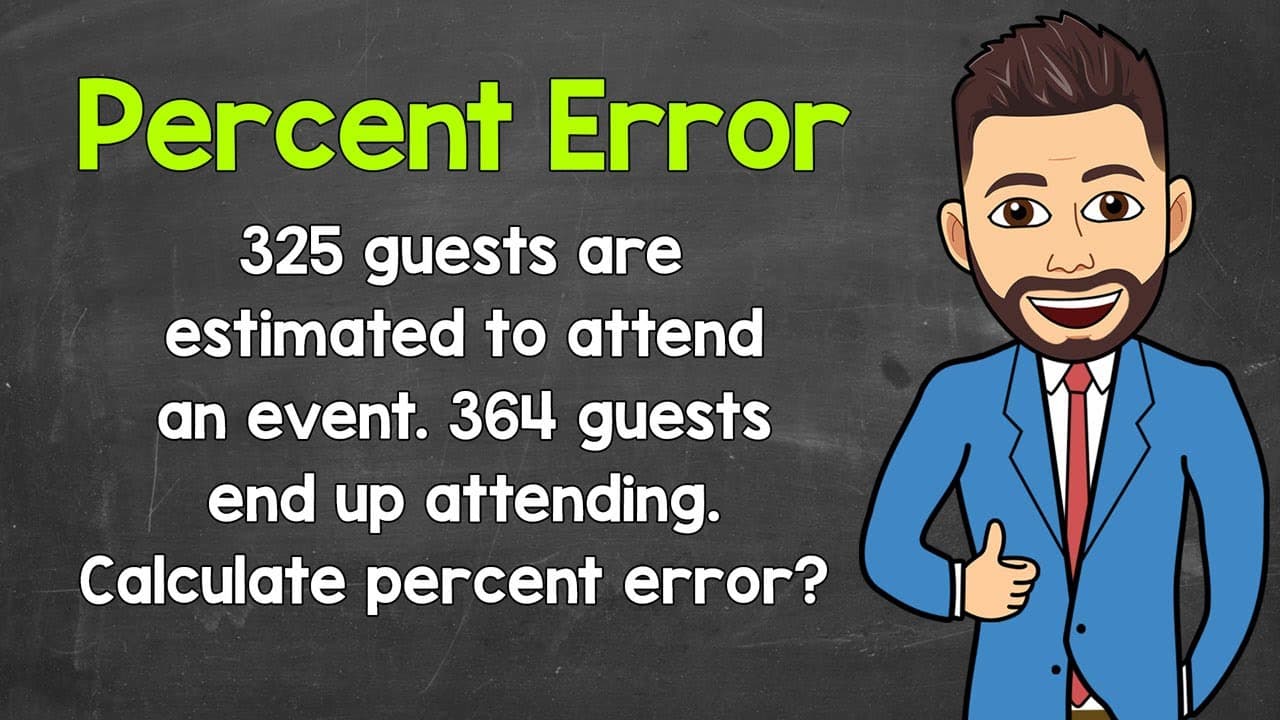
This instructional math video guides students through the process of calculating percent error, a critical concept for understanding accuracy in measurements and estimations. The video begins by defining percent error and presenting the standard formula involving absolute value. It then walks through a practical, real-world word problem involving an event planner who estimated 325 guests but had 364 actual attendees, demonstrating how to apply the formula to find the percentage of error in the estimation. The video covers several key mathematical themes, including the difference between estimated and actual values, the function of absolute value in determining error magnitude, and the procedural steps of converting decimals to percentages. It also explicitly demonstrates how to round the final result to the nearest whole percent, reinforcing rules of rounding in a practical context. The step-by-step breakdown ensures that viewers understand not just the calculation, but the logic behind comparing an estimate against reality. For educators, this resource serves as an excellent direct instruction tool or review aid for middle school math curriculums. It simplifies a multi-step process—subtraction, division, and multiplication—into manageable chunks. The use of a relatable scenario helps ground abstract statistics concepts in reality, making it useful for lessons on data analysis, scientific measurement, or financial literacy where prediction versus reality is a key metric.

Math with Mr. JMath with Mr. J

4mins 25s

Video
Calculating Sample Standard Deviation Step-by-Step

Calculating Sample Standard Deviation Step-by-Step

This educational video provides a clear, step-by-step tutorial on how to calculate the sample standard deviation for a set of numbers. The instructor uses a digital whiteboard to demonstrate the process manually, breaking down the complex statistical formula into manageable arithmetic steps. The video covers two distinct examples: a smaller data set with five numbers to introduce the concept, and a larger data set with ten numbers to reinforce the process and demonstrate how to handle more data points. The content focuses on key statistical concepts including calculating the arithmetic mean (average), determining sample size (n), calculating the differences between data points and the mean, squaring those differences, and applying the specific formula for sample standard deviation which requires dividing by n-1. The instructor emphasizes the order of operations and provides practical tips for organizing calculations to avoid errors. This resource is highly valuable for high school and introductory college statistics classrooms. It demystifies a formula that often intimidates students by showing the mechanical logic behind it. Teachers can use this video to support flipped classroom models, providing students with a procedural reference for homework, or as a remediation tool for students struggling with the multi-step calculation process of finding measures of spread.

The Organic Chemistry TutorThe Organic Chemistry Tutor

7mins 14s

Video
How to Calculate and Understand Percent Error

How to Calculate and Understand Percent Error

This instructional math video introduces students to the concept of percent error, a critical statistical tool used to determine the accuracy of an estimate or measurement relative to an actual value. The narrator, Mr. J, clearly defines percent error and breaks down the formula step-by-step, including calculating the difference, taking the absolute value, dividing by the actual value, and converting the resulting decimal to a percentage. The video explores key themes such as the difference between absolute error (raw numbers) and relative error (percentages). Through four distinct examples, the video demonstrates how a small absolute error can result in a large percent error when dealing with small numbers, while a large absolute error might result in a tiny percent error when dealing with massive numbers. This helps students understand why context and magnitude matter in data analysis. This resource is highly valuable for middle and high school math classrooms as it moves beyond simple calculation into statistical reasoning. Teachers can use this video to bridge the gap between simple arithmetic and data interpretation. It serves as an excellent primer for science labs where experimental error is calculated, or for math units dealing with ratios, proportions, and real-world estimation.

Math with Mr. JMath with Mr. J

12mins 38s

Video
Identifying and Handling Outliers in Data

Identifying and Handling Outliers in Data

This comprehensive statistics lesson explores the concept of outliers—data points that differ significantly from other observations in a dataset. The video provides a clear definition of outliers and demonstrates multiple methods for identifying them, ranging from visual inspection of scatter plots and box plots to precise mathematical calculation using the Interquartile Range (IQR) method. It walks students through step-by-step examples of calculating lower and upper bounds to mathematically pinpoint specific outlier values. Beyond identification, the video delves into the statistical impact of outliers. It compares how different measures of central tendency (mean, median, mode) and measures of dispersion (range, standard deviation) are affected when outliers are present versus when they are removed. This section emphasizes why the median is often a more robust measure than the mean in skewed datasets. Finally, the video discusses strategies for handling outliers in data analysis, presenting the pros and cons of removing them versus replacing them with other values like the mean or median. This critical thinking component encourages students to consider the context of the data—whether an outlier represents an error or a significant extreme case—before deciding how to treat it, making it an excellent resource for high school statistics and data science units.

Miacademy & MiaPrep Learning ChannelMiacademy & MiaPrep Learning Channel

11mins 59s

Video
How to Construct and Analyze Box-and-Whisker Plots

How to Construct and Analyze Box-and-Whisker Plots

This comprehensive math tutorial introduces students to Box-and-Whisker Plots, a statistical tool used to visualize data distribution. The video guides viewers through the entire process of creating these plots, starting from raw data sets and moving through the calculation of key statistical markers. It uses two distinct real-world scenarios—a basketball player's scoring record and a coffee shop's daily espresso sales—to demonstrate how to handle both odd and even numbered data sets, ensuring students learn the nuances of finding medians and quartiles in different situations. Key statistical concepts explored include the five-number summary: lower extreme (minimum), lower quartile (Q1), median (Q2), upper quartile (Q3), and upper extreme (maximum). The video explicitly teaches the algorithm for organizing data, finding the median, splitting data into upper and lower regions to find quartiles, and mapping these points onto a number line. It also introduces the concept of the Interquartile Range (IQR) as a measure of consistency, explaining how the "box" represents the middle 50% of the data. For educators, this video is an excellent instructional resource for middle school statistics units. It visualizes abstract definitions, making them accessible and concrete. The step-by-step walkthroughs allow teachers to pause and let students calculate ahead of the reveal, functioning as a guided practice tool. The dual examples are particularly valuable for addressing the common student confusion regarding how to calculate medians and quartiles when the data set size is even versus odd.

Mashup MathMashup Math

6mins 33s

Video
Mastering Mean, Median, Mode, and Range

Mastering Mean, Median, Mode, and Range

This instructional video provides a clear, step-by-step guide on how to calculate the four primary statistical measures of central tendency and variability: mean, median, mode, and range. Using a digital blackboard format, the narrator walks viewers through four distinct practice problems that increase in complexity. The video covers scenarios with both odd and even numbered data sets, demonstrating specific rules for finding the median when there are two middle numbers and how to identify data sets with no mode versus a single mode. Key themes include data organization, arithmetic operations, and statistical analysis. The video emphasizes the importance of ordering numbers from least to greatest before attempting to find the median or range, a critical step often missed by students. It also distinguishes between the arithmetic mean (average) and the median (middle value), helping to clarify common points of confusion in introductory statistics. For educators, this video serves as an excellent direct instruction tool or review resource for math classrooms. It is particularly useful for scaffolding learning, as it moves from simple integer data sets to those requiring decimal answers and multi-step median calculations. The pause-and-practice format encouraged by the narrator makes it ideal for interactive classroom viewing or independent student practice/remediation.

The Organic Chemistry TutorThe Organic Chemistry Tutor

11mins 38s