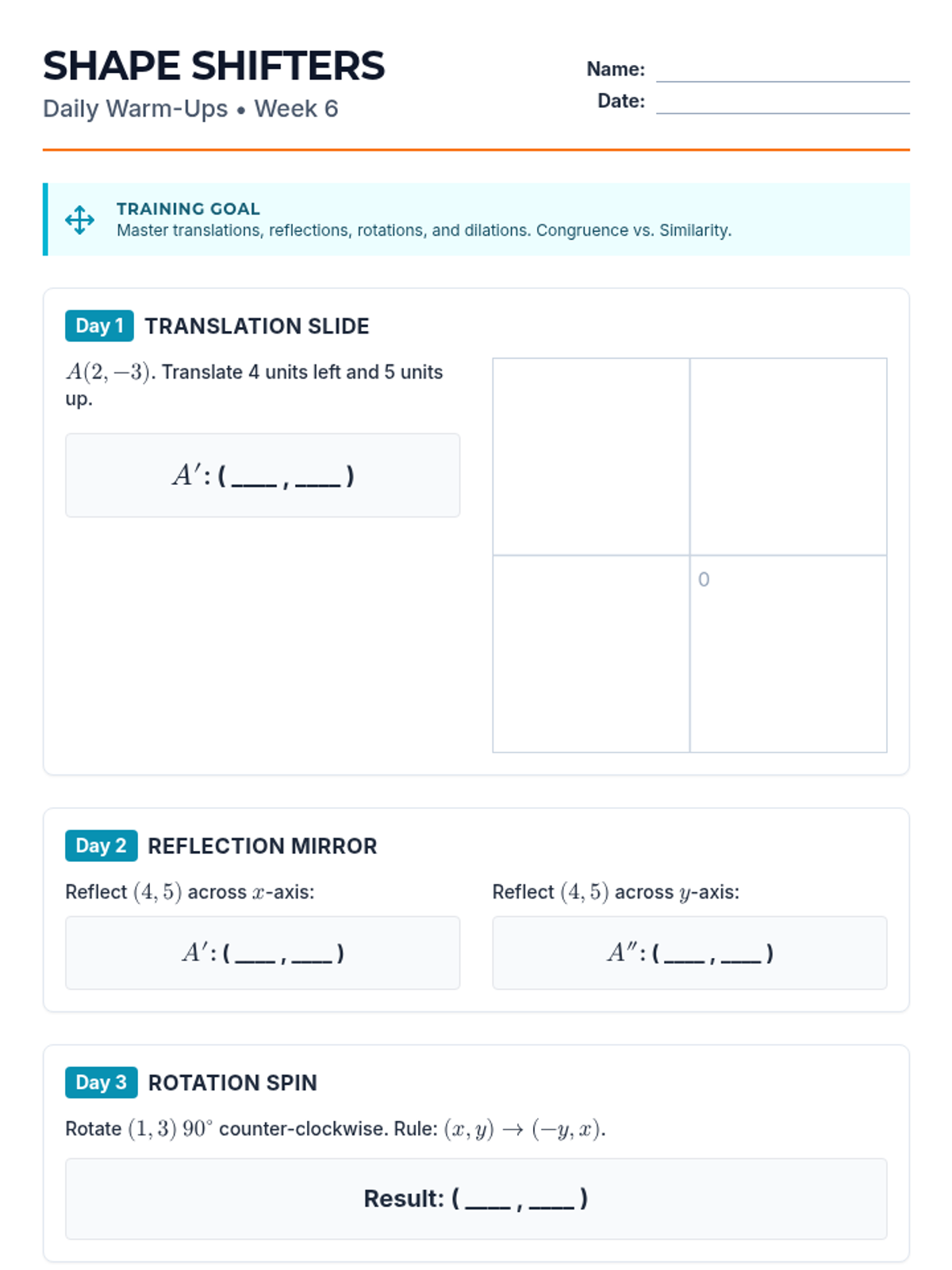
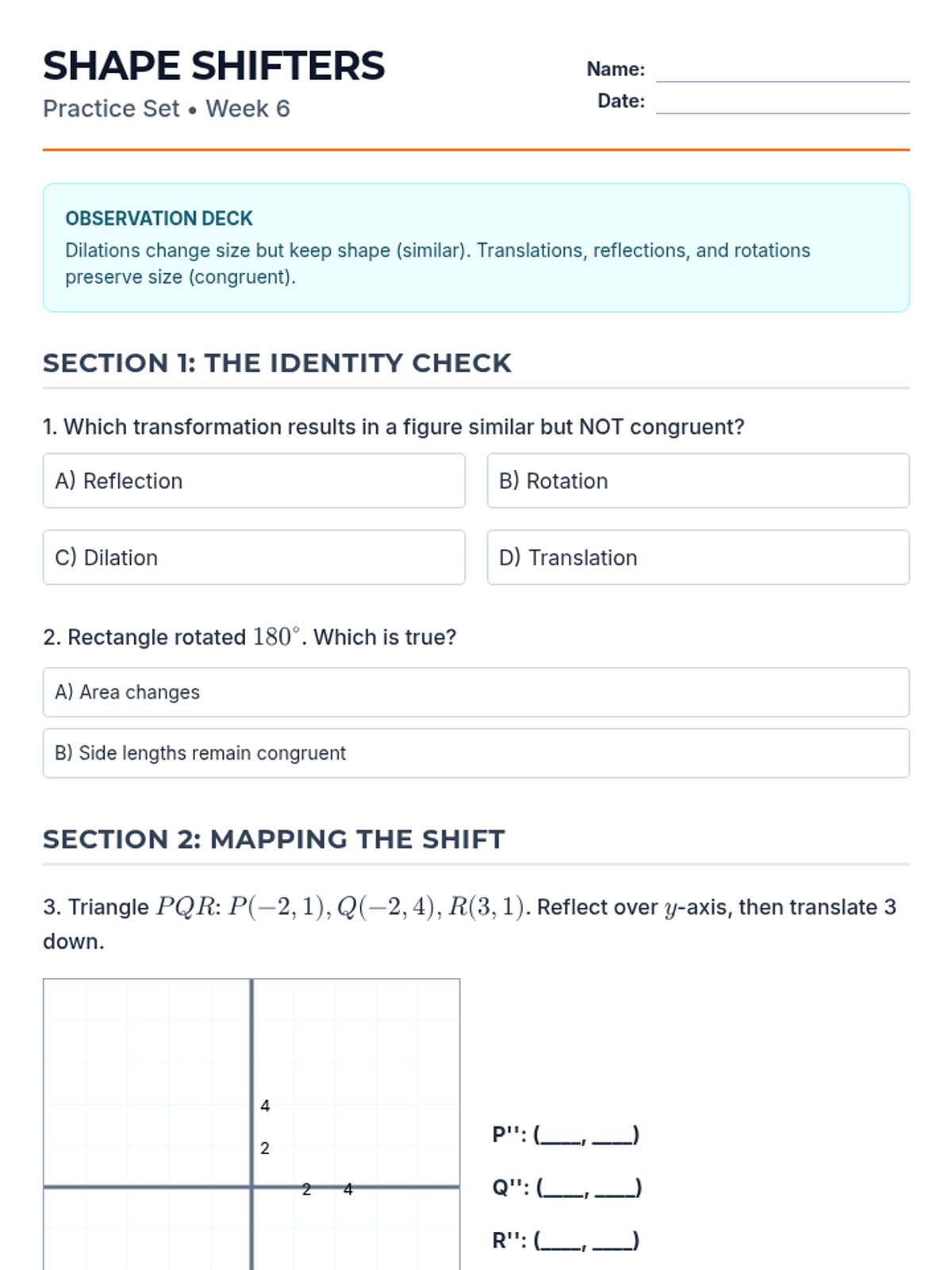
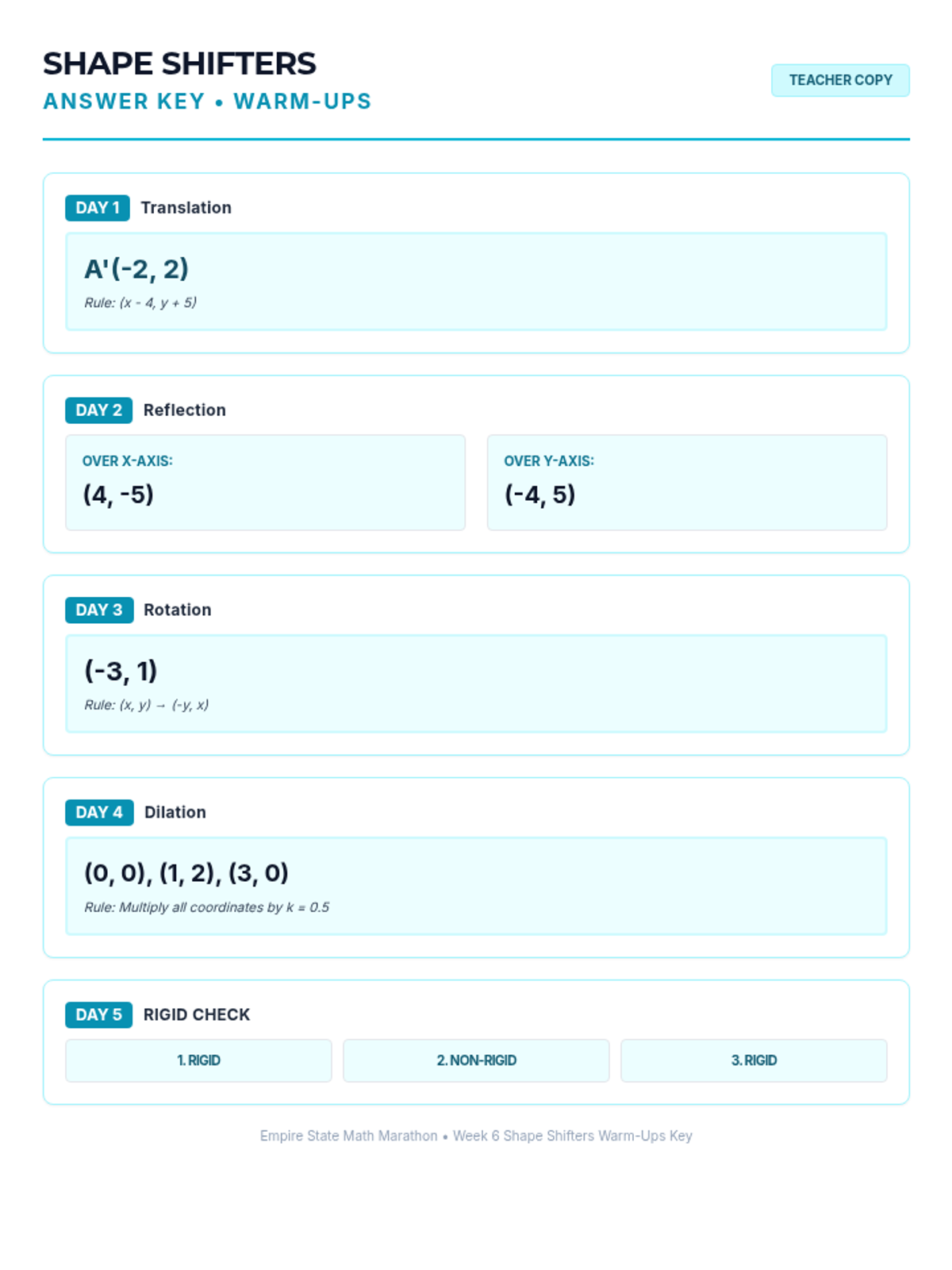
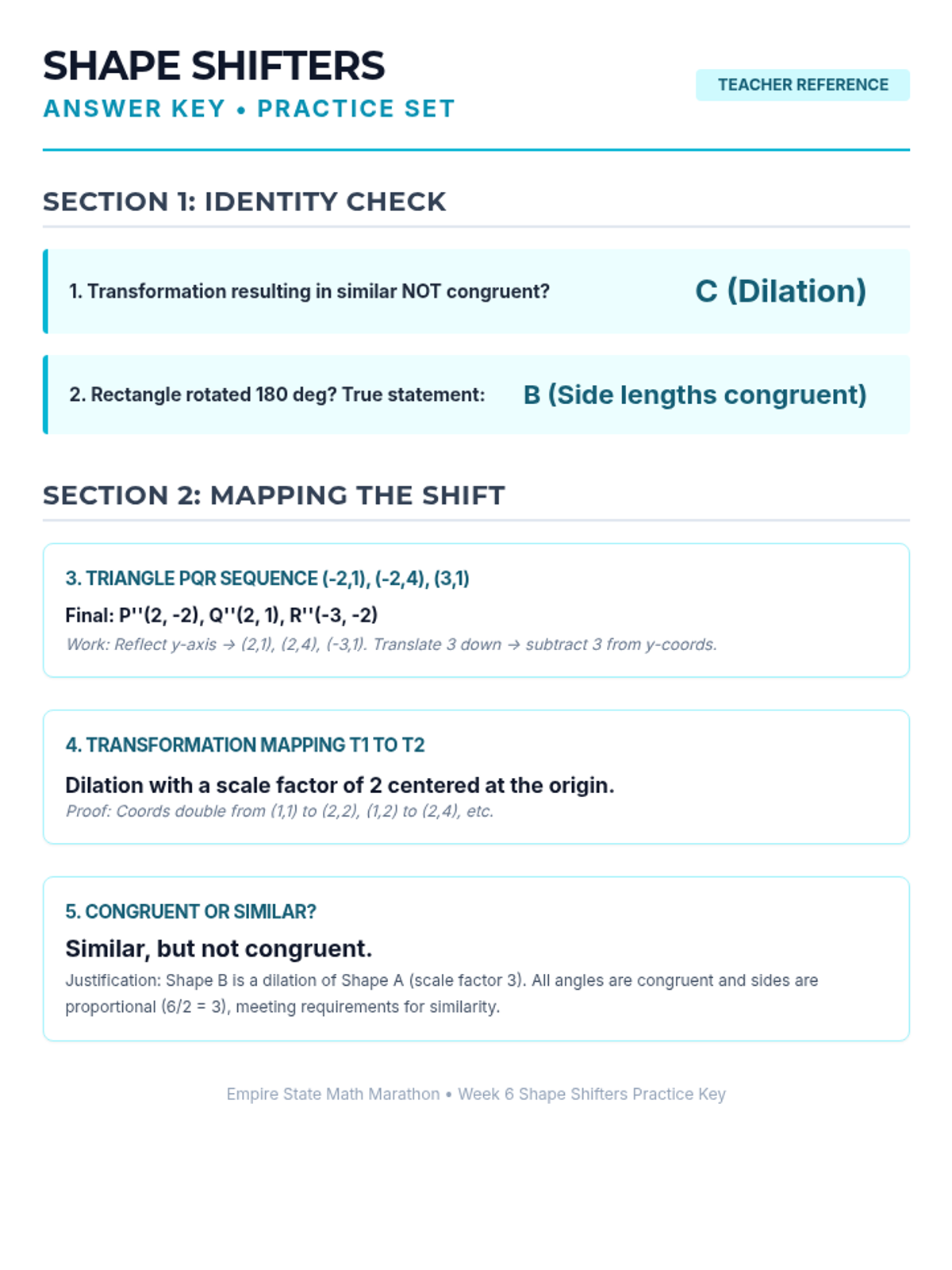
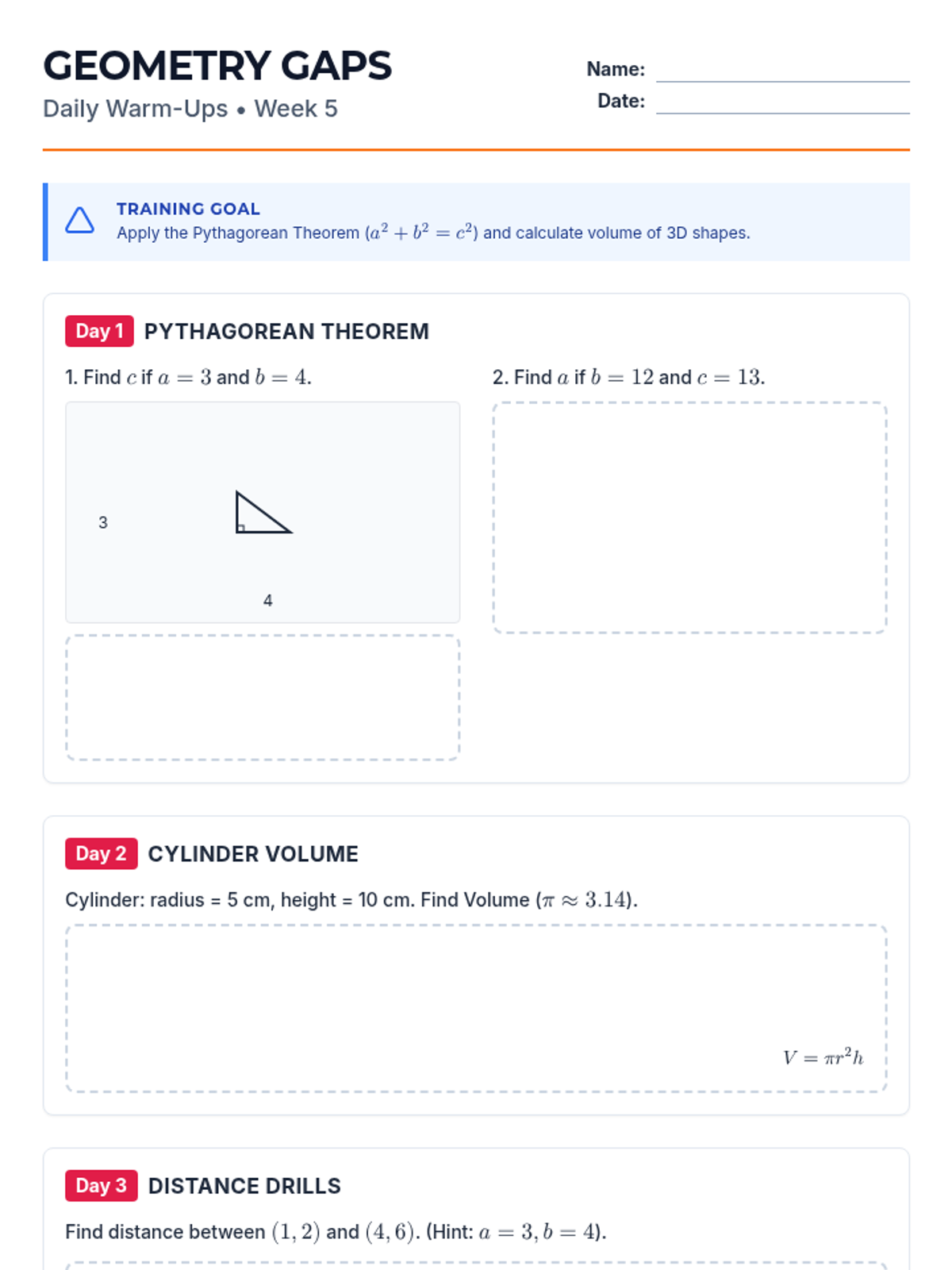
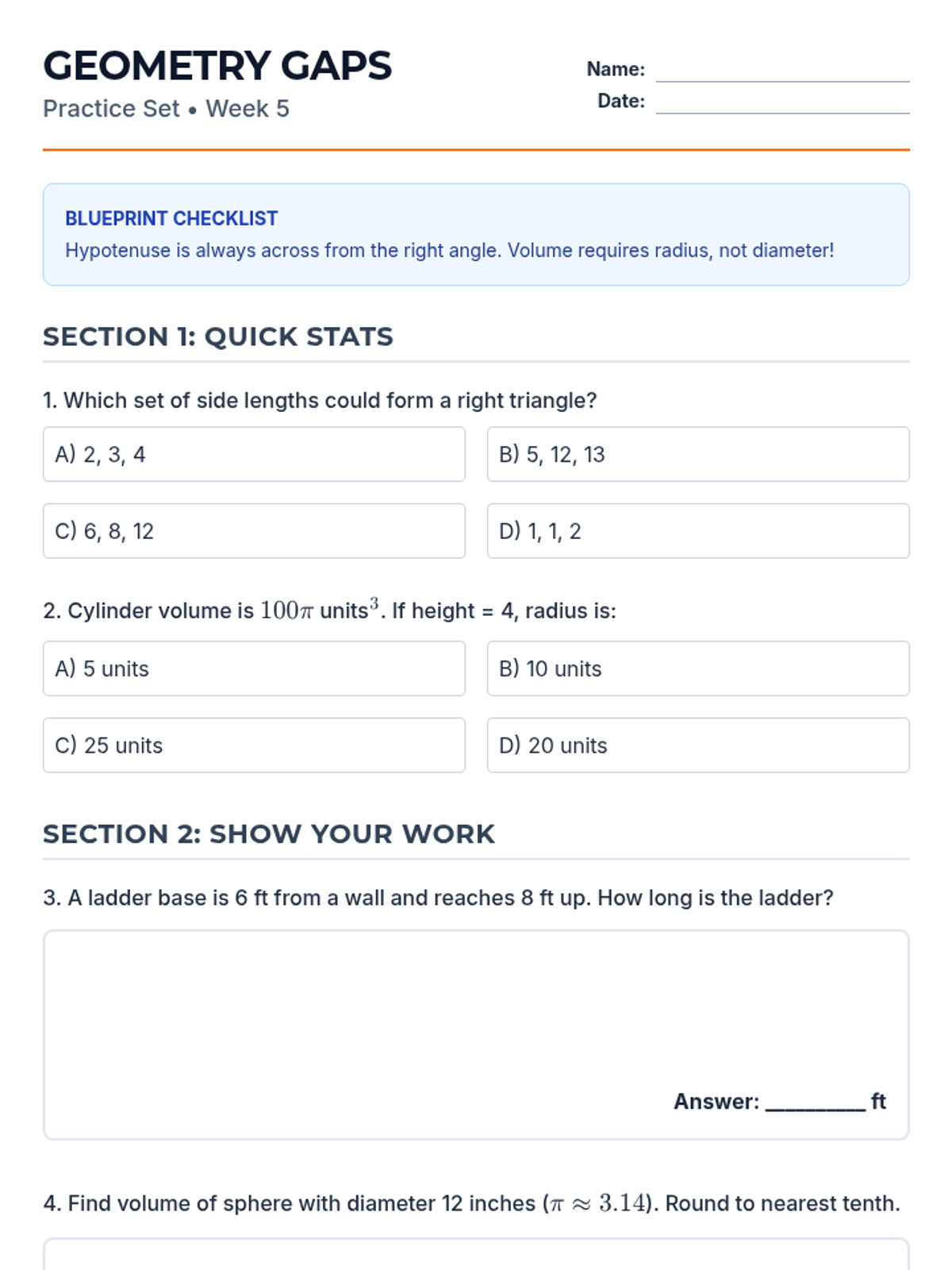
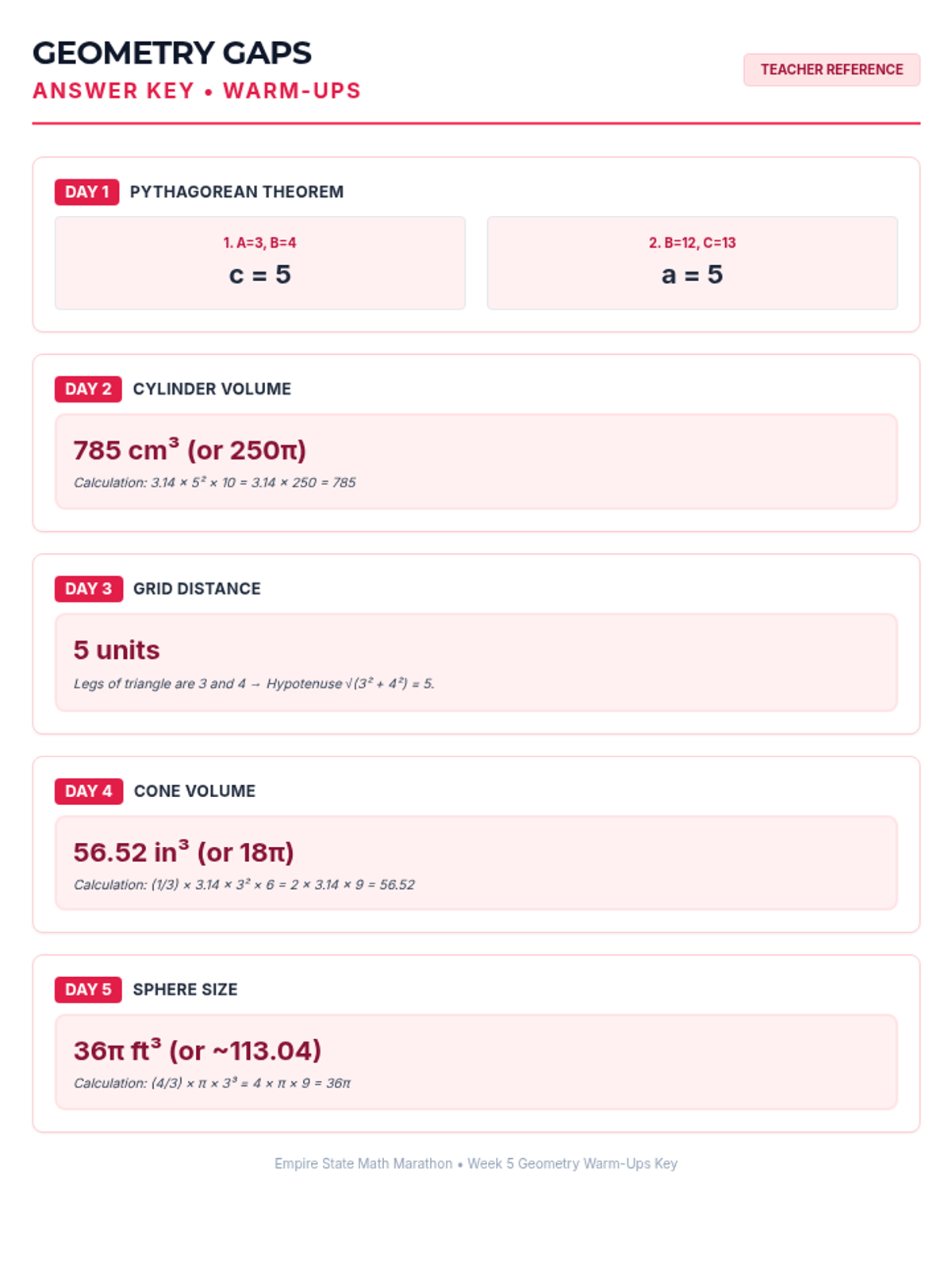
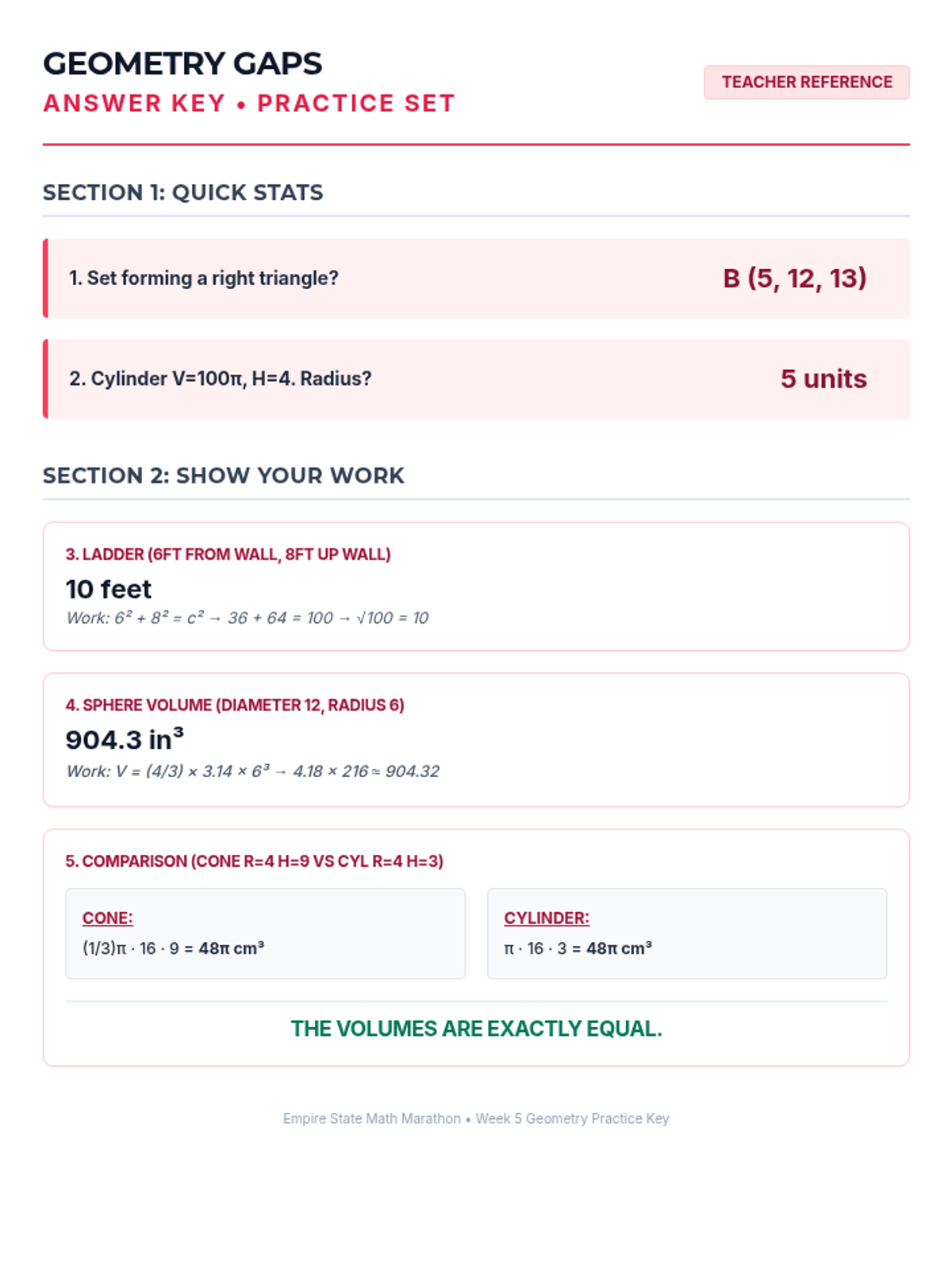
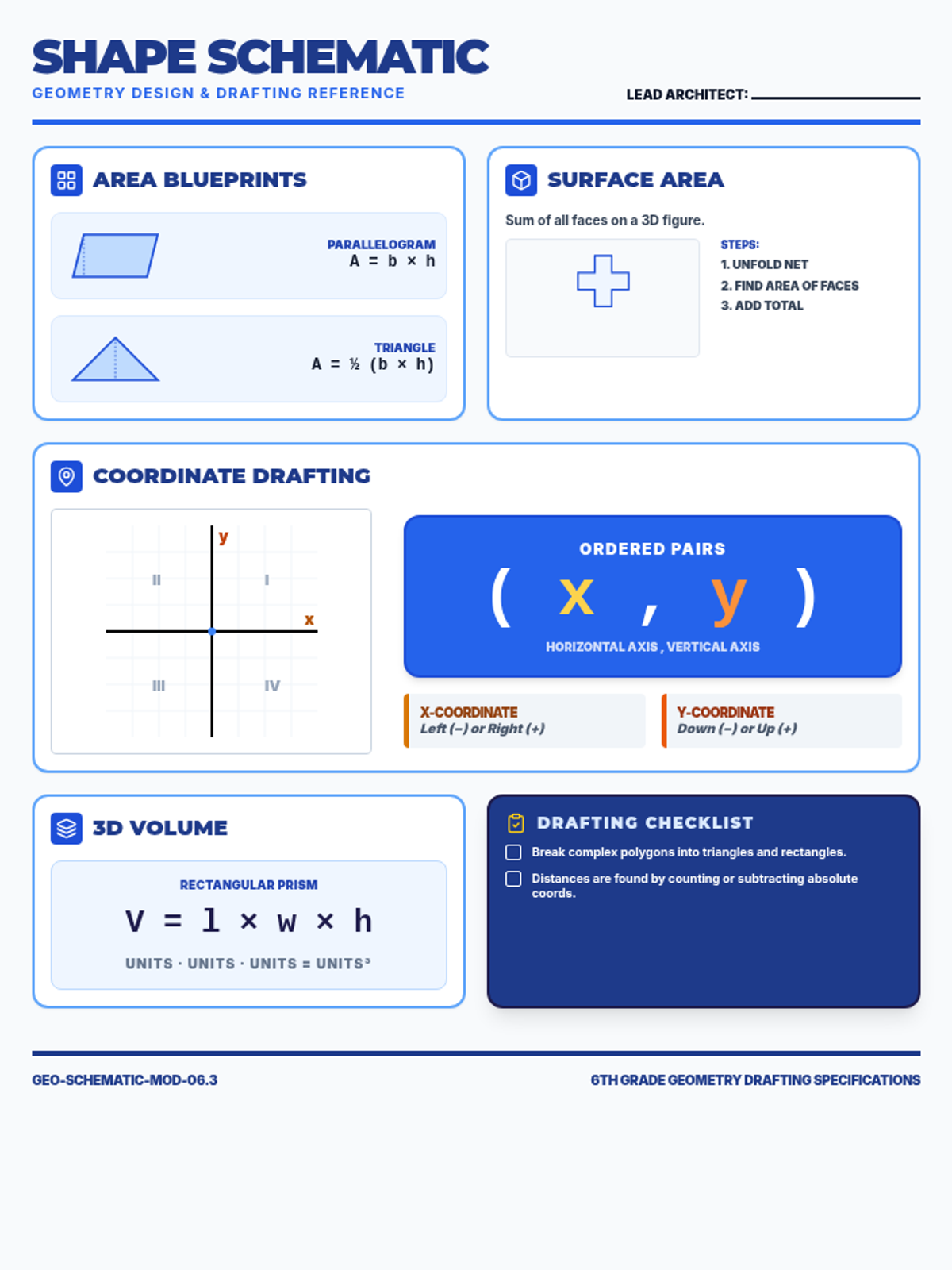
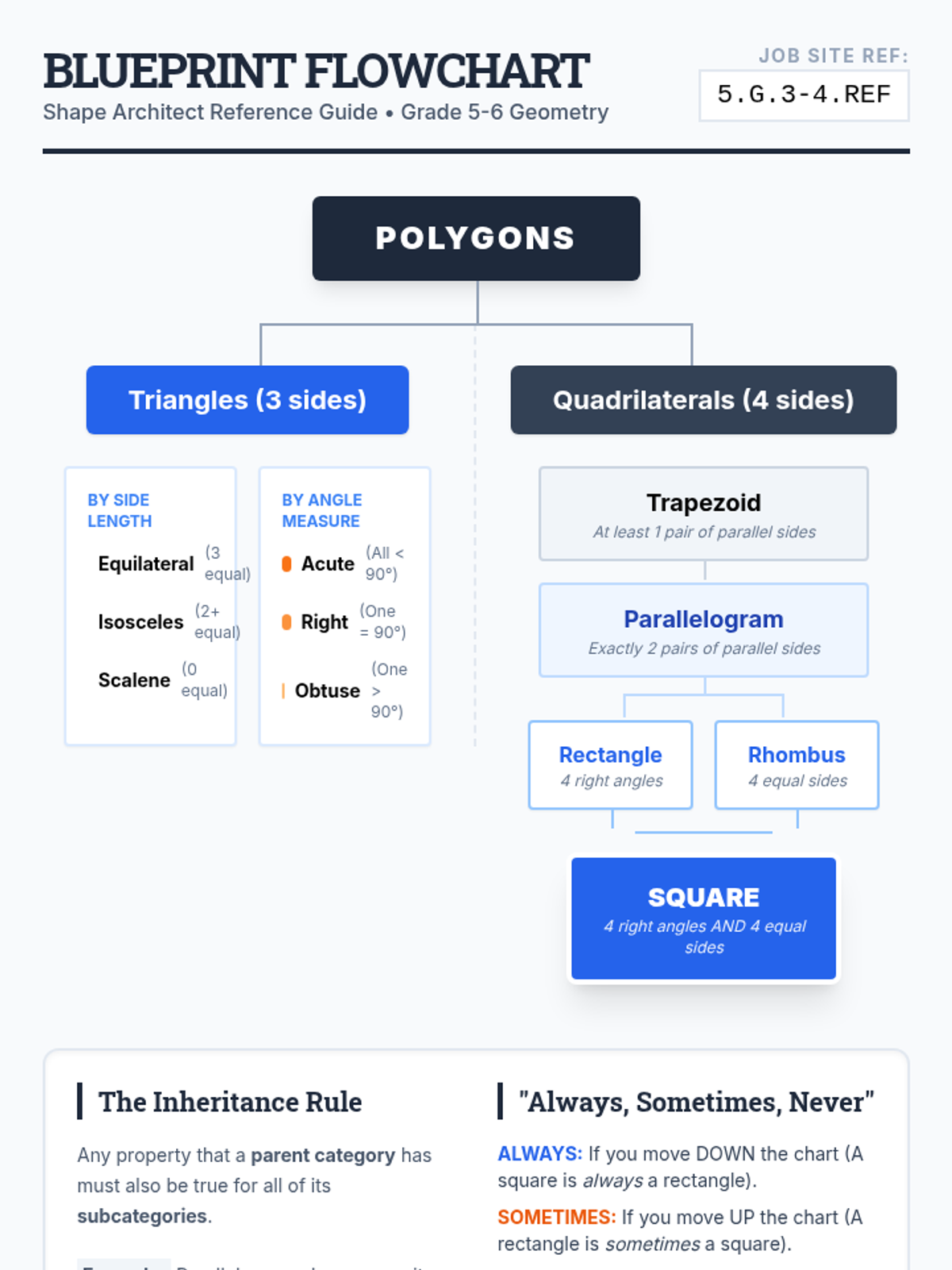
Geometric classification, measurement of area and volume, and the study of transformations and rigid motions. Builds toward complex proofs, trigonometry for general triangles, and the algebraic representation of conic sections.
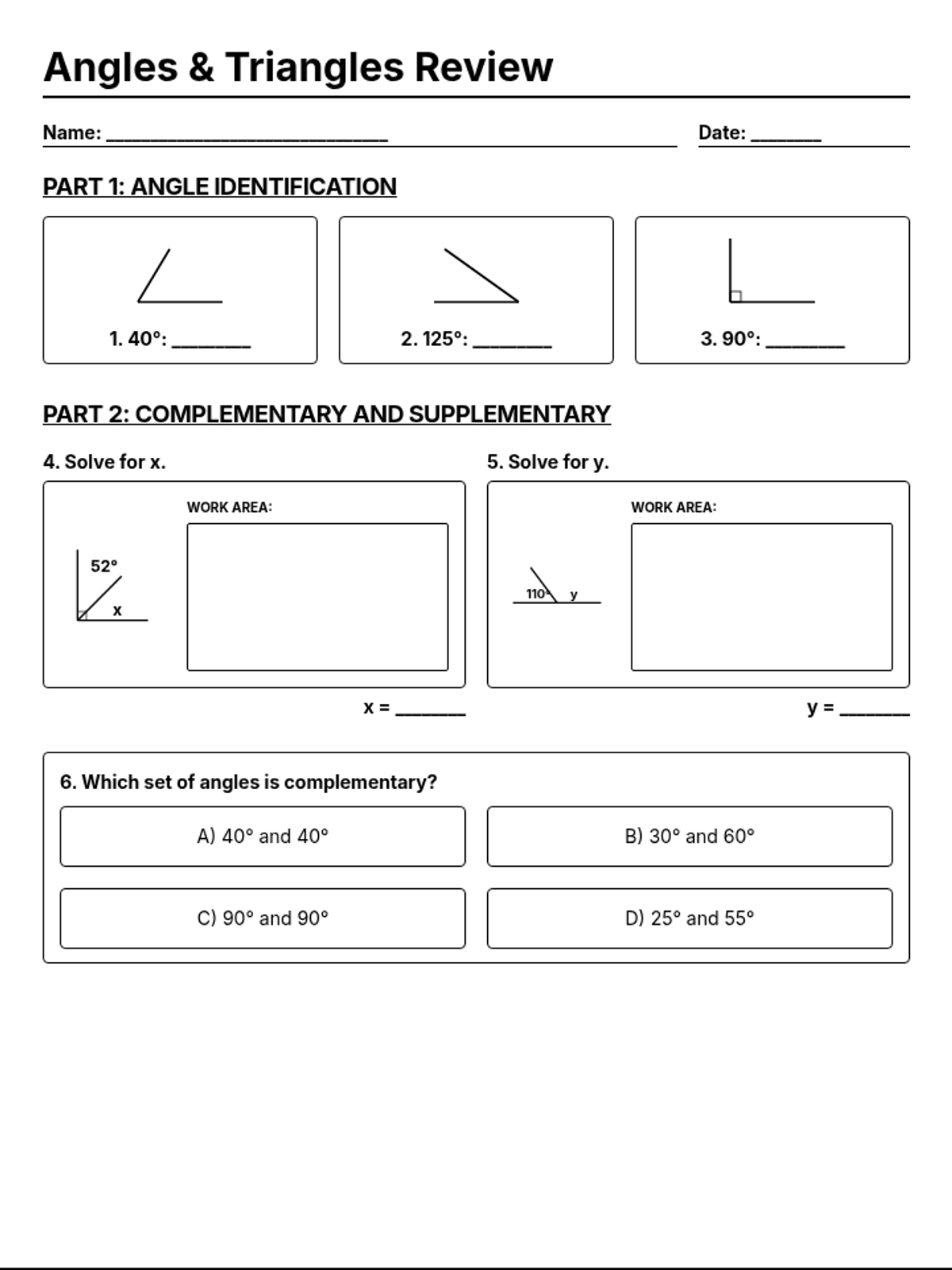
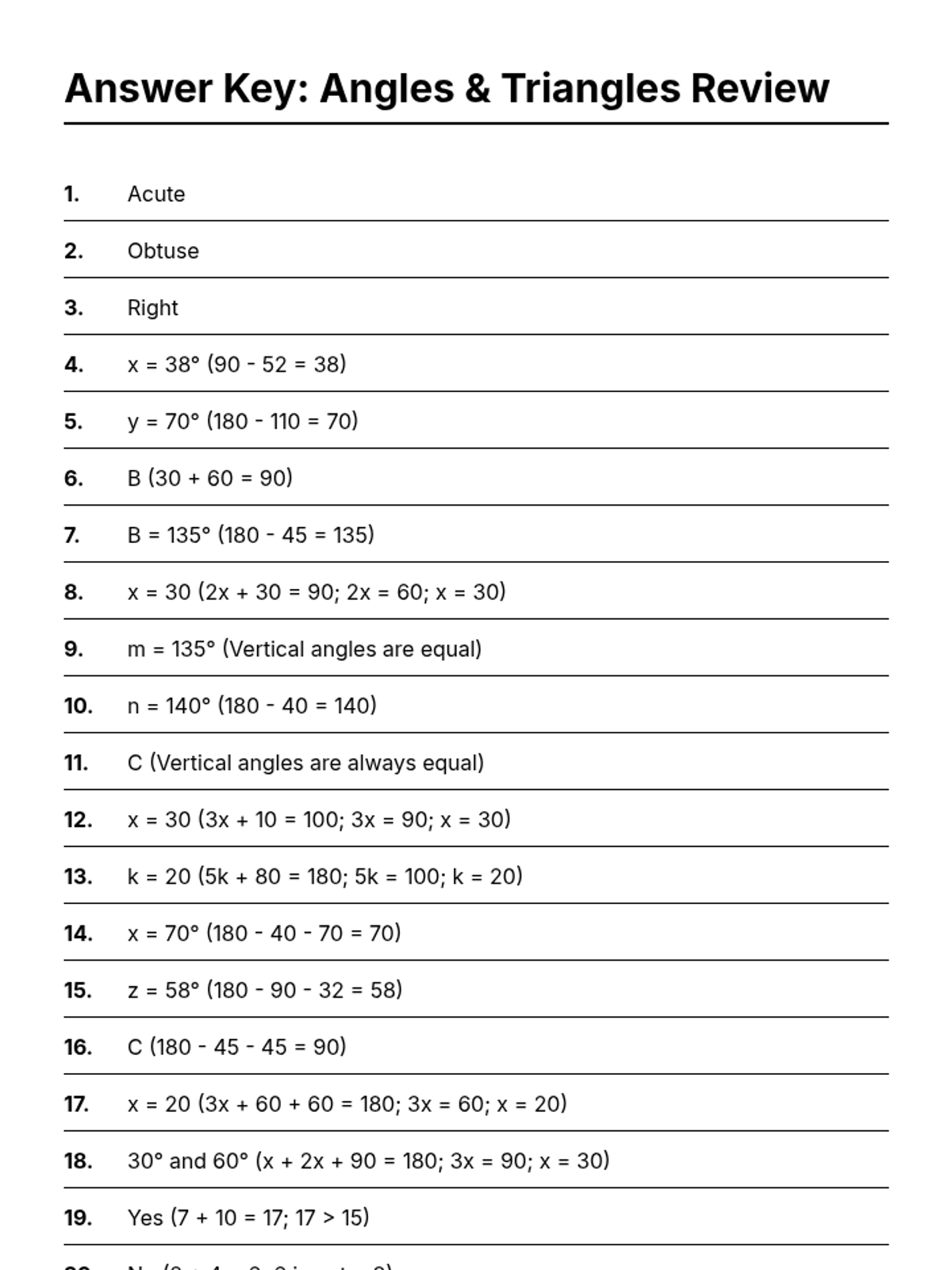
A hands-on exploration of volume for cubes and rectangular prisms, transitioning from counting unit cubes to applying the formula. Designed for diverse learners with visual aids, partner challenges, and blueprint-themed practice.
A focused lesson on solving one- and two-step word problems involving area, perimeter, and volume of rectangular shapes using whole numbers. Students apply measurement formulas to real-world architectural and design scenarios.
A Tier 2 intervention lesson focused on decomposing composite 3D figures and applying volume formulas (V = l x w x h and V = B x h). Students use a 'Slice and Solve' strategy to navigate complex rectangular prisms through building, sketching, and word problem application.
A Tier 2 small group intervention focused on understanding volume with fractional edge lengths through unit cube packing and formula application ($V = lwh$ and $V = Bh$). Students move from concrete packing models to abstract formula use.
A Tier 2 intervention lesson focusing on the volume of right rectangular prisms through a concrete-representational-abstract progression, moving from unit cube packing to formula application.
A Tier 2 intervention lesson focusing on finding the volume of rectangular prisms with fractional edge lengths using the CRA (Concrete-Representational-Abstract) sequence. Students progress from packing unit fraction cubes to applying the standard volume formula in real-world contexts.
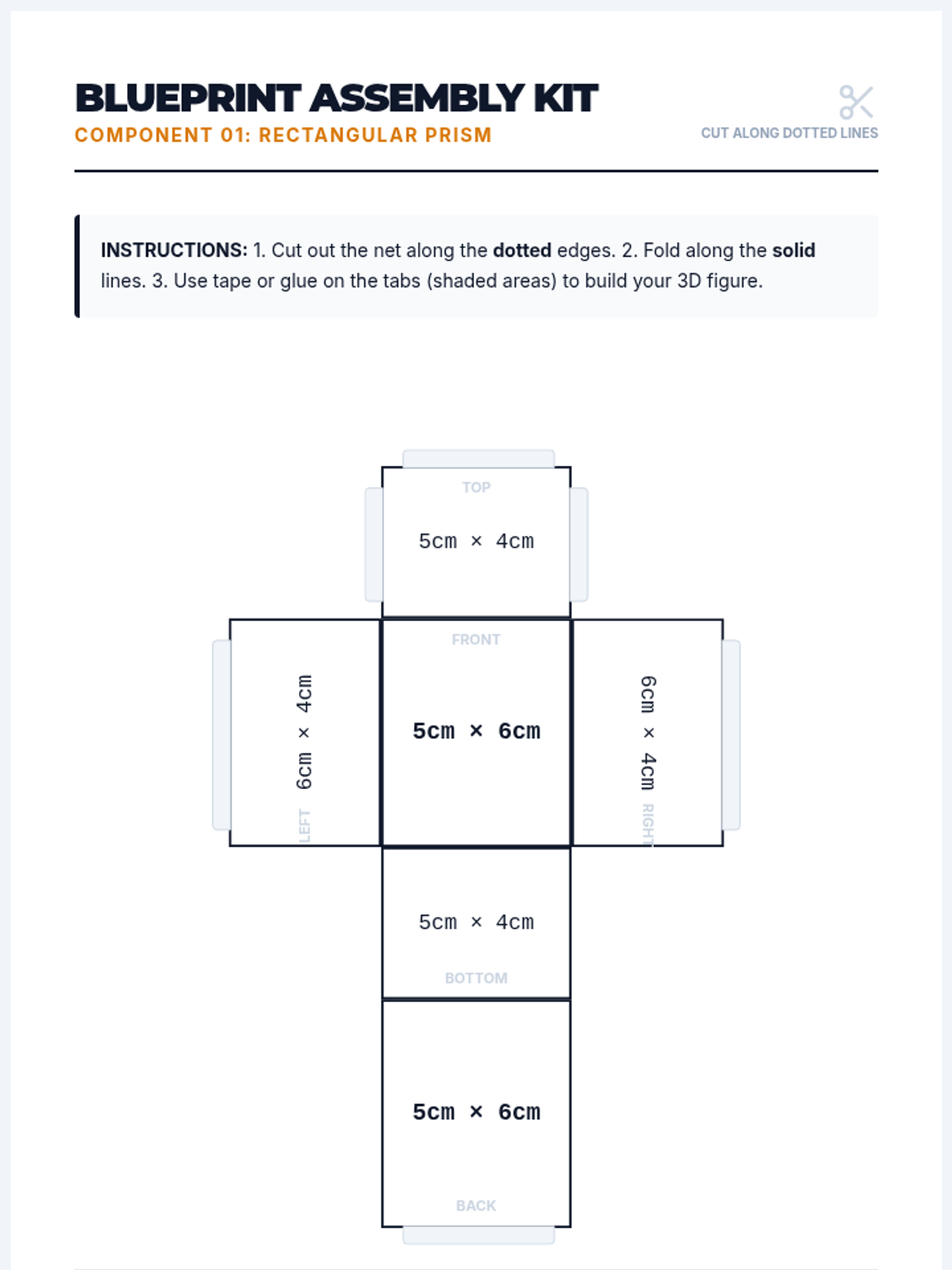
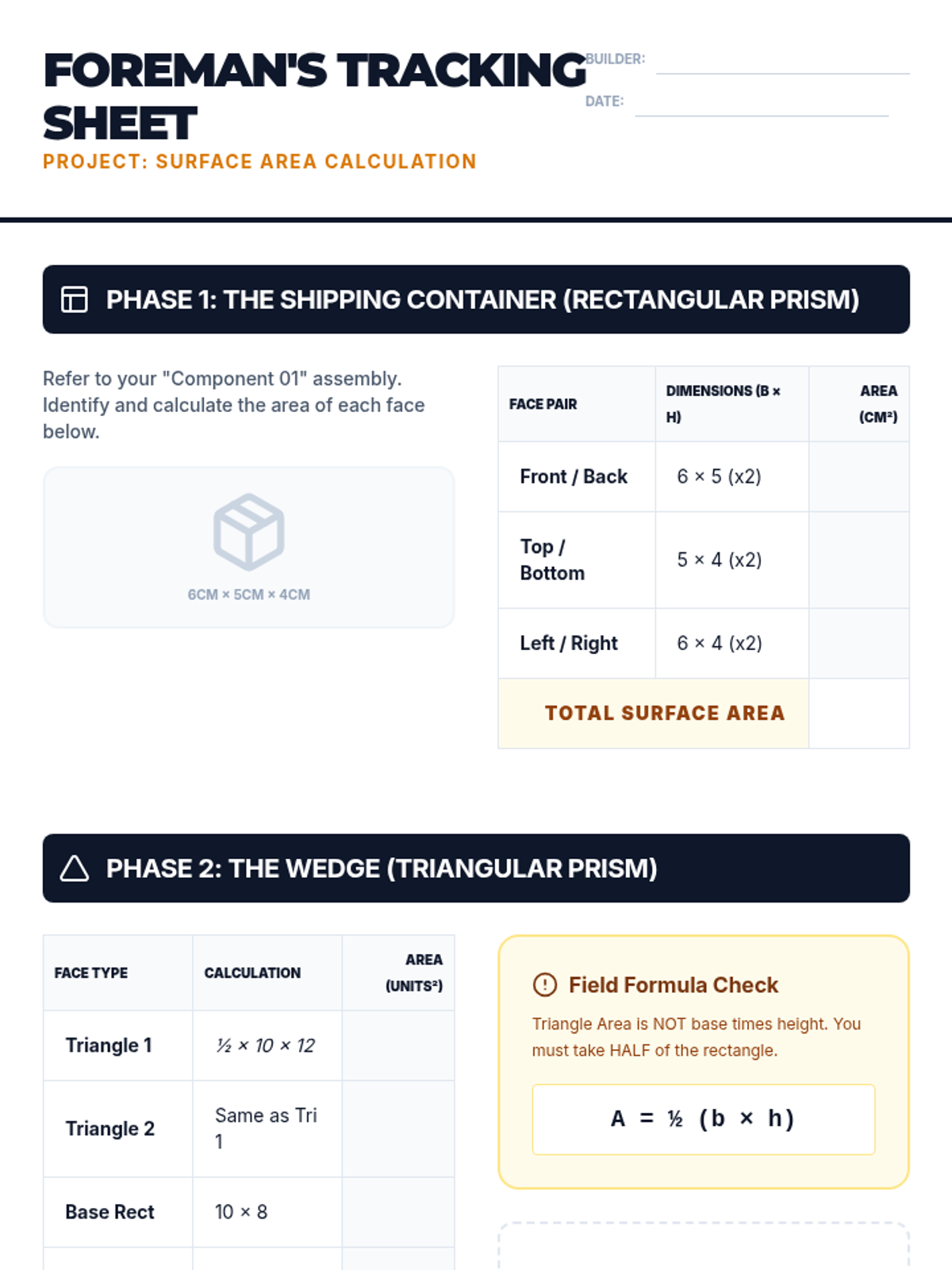
A targeted Tier 2 intervention lesson for 6th grade students on finding the surface area of prisms and pyramids by 'unfolding' them into nets. This lesson uses a construction blueprint theme to help students track and calculate the area of individual faces before summing them for the total surface area.
A targeted Tier 2 intervention lesson focusing on calculating the area, surface area, and volume of 2D and 3D composite shapes. This lesson uses hands-on building, visual formulas, and scaffolded practice to bridge gaps in geometric understanding.
A visual introduction to volume where students explore the concept of space by filling transparent boxes with cubes. They will learn to count unit cubes and compare volumes of different rectangular prisms.
A 6th-grade math lesson where students apply multi-digit multiplication to calculate volume and act as packaging engineers to design custom containers.
A lesson exploring how scaling dimensions affects the volume of rectangular prisms, focusing on fractional edge lengths and the factor of 8 volume shift.
A lesson for 6th-grade students connecting the geometric volume of a cube to exponential notation ($s^3$). Includes warm-up drills, video-guided instruction, a calculation activity, and a reflective journal entry.
A high-energy lesson where 6th-grade students master the volume of cubes through estimation challenges, a direct instruction video, and a fast-paced card game. Students practice mental math strategies and the formula \(V = s^3\) while competing to be the 'Volume War' champion.
A comprehensive lesson focusing on differentiating between linear, area, and volume units through the 'Unit Doctor' clinical theme. Includes interactive slides with a video focus and a diagnostic worksheet for student application.
A hands-on geometry lesson where students learn to calculate the volume of triangular pyramids by designing their own candy packaging with a specific volume target.
Students will apply the order of operations to solve complex geometric formulas for the volume of triangular pyramids. This lesson uses a comparative approach to explore equivalent formulas and reinforces fraction operations within a geometric context.
Students act as "Prism Architects" to design product packaging that minimizes surface area while maintaining a fixed volume. They apply surface area formulas to compare different geometric designs and identify the most cost-effective solution.
Students explore volume concepts for rectangular prisms, applying the associative property of multiplication and designing their own 3D containers with specific volume targets, including an extension into fractional edge lengths.
A 6th-grade geometry lesson where students 'reverse engineer' the volume formula to find missing dimensions of rectangular prisms. The lesson includes a warm-up, a video-based exploration of the standard formula, and a main activity focused on solving for unknown variables.
A hands-on geometry lesson for 6th graders to master the volume of rectangular prisms (cuboids) through video analysis and a classroom scavenger hunt. Students will measure real-world objects, apply the volume formula, and differentiate between metric units.
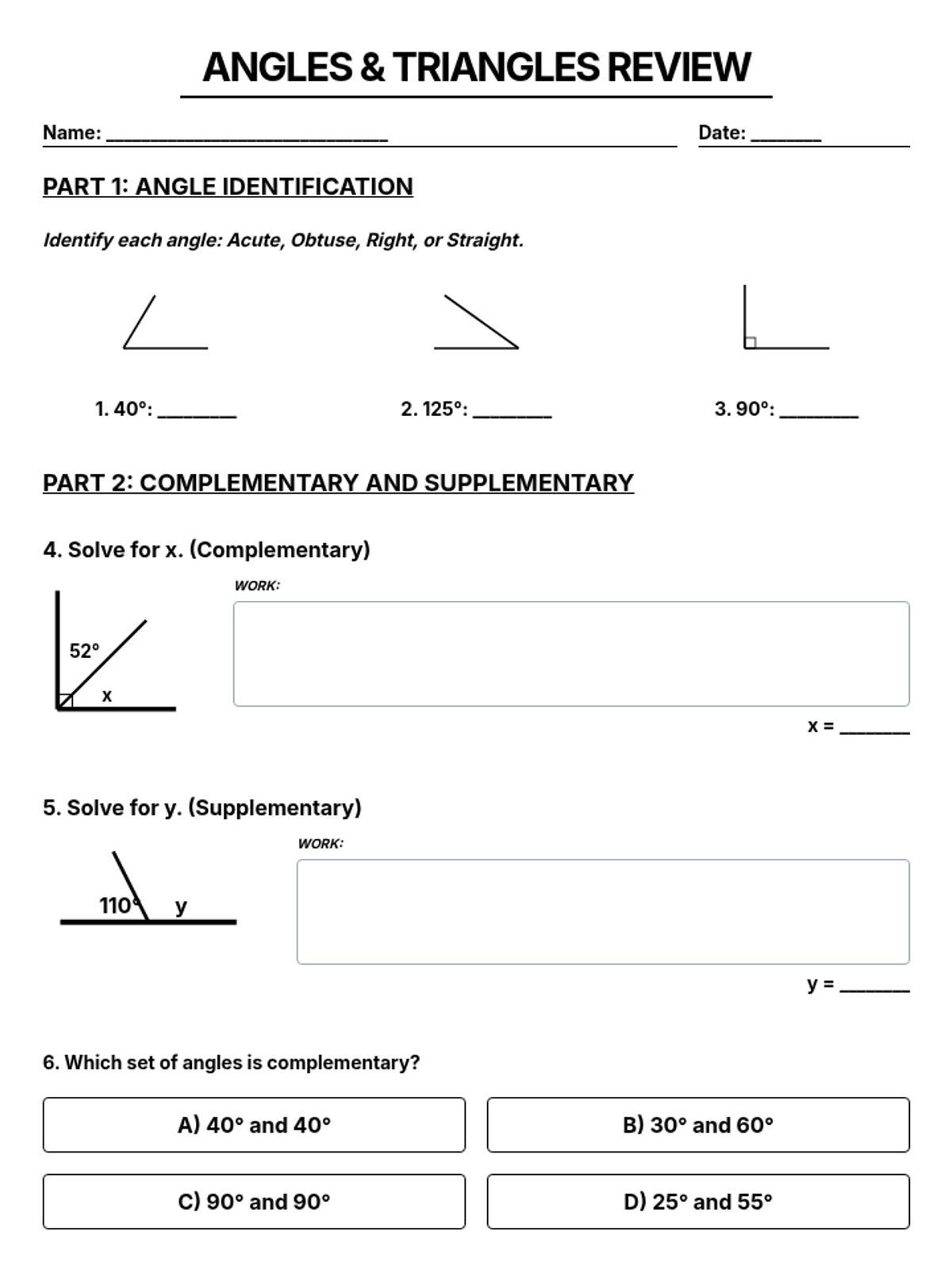
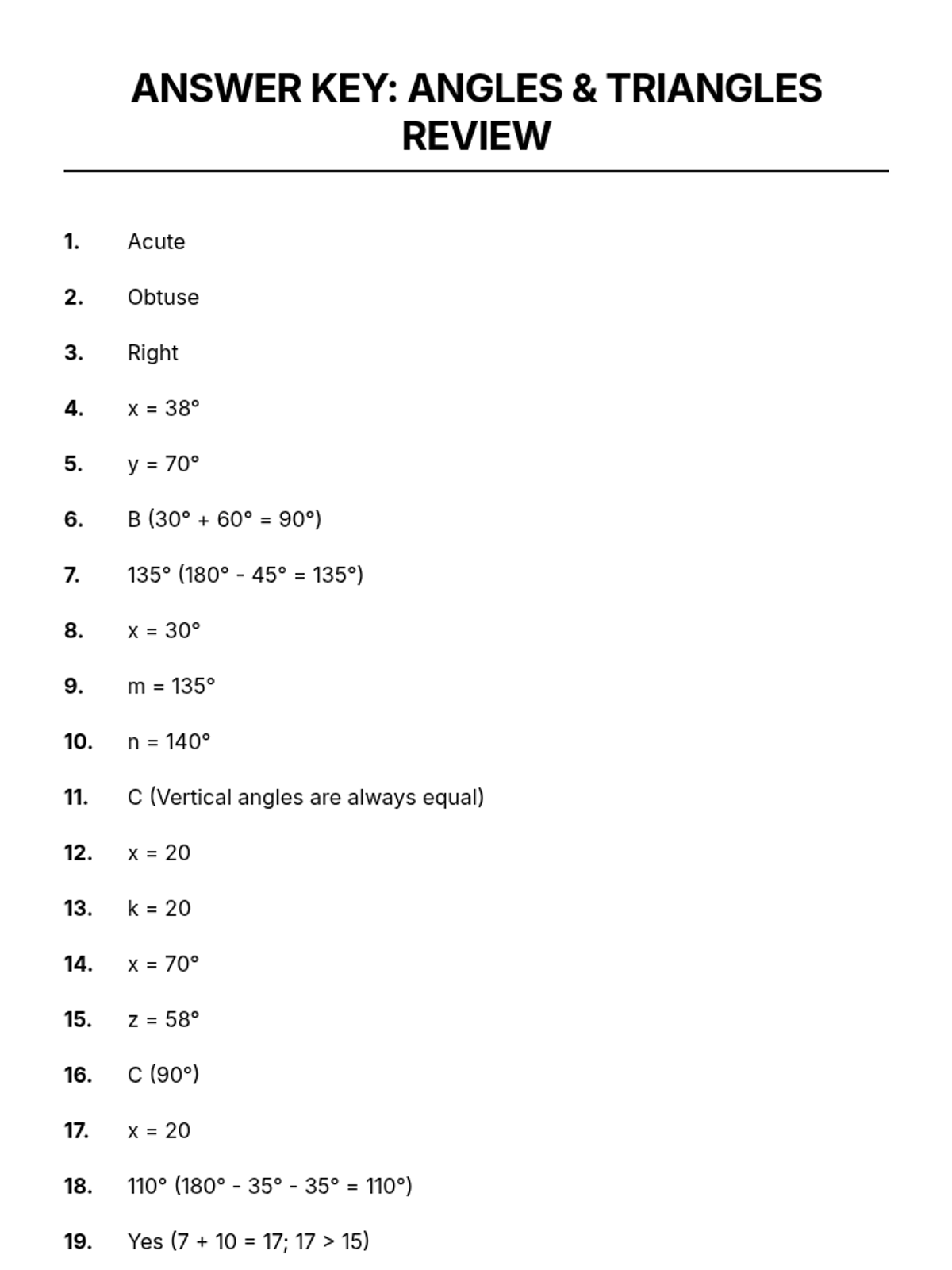
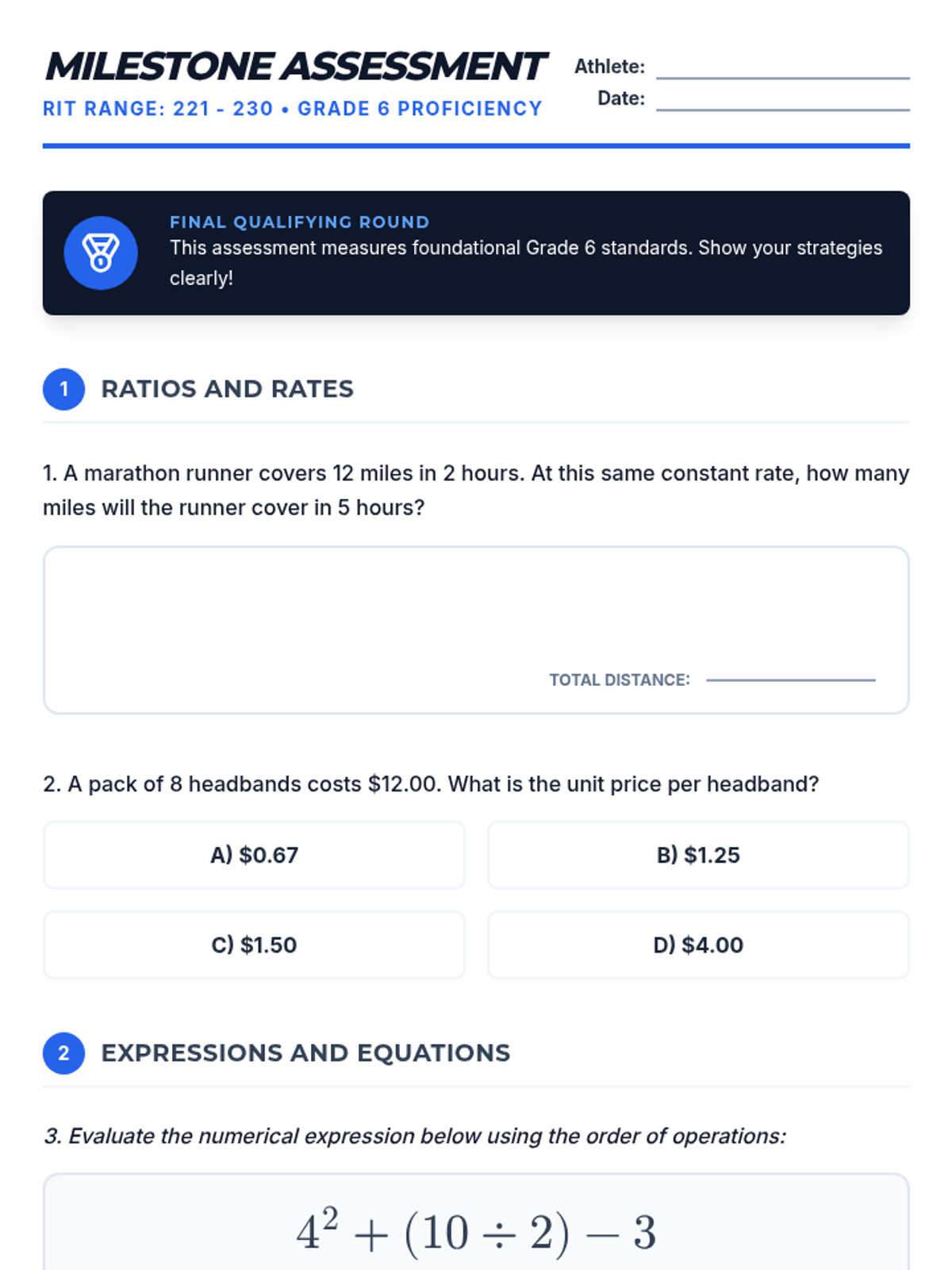
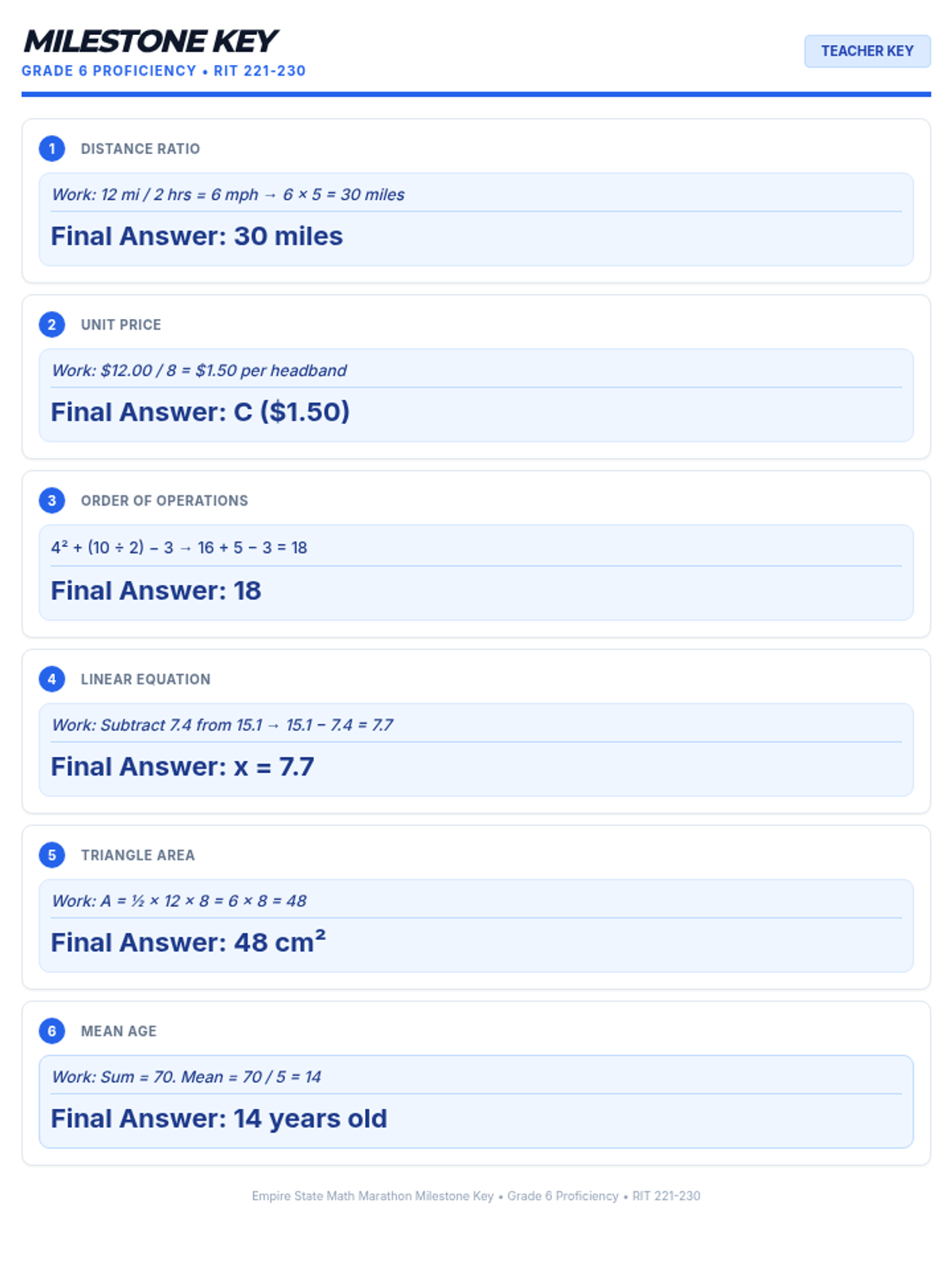
A high-energy, medical-themed 50-minute review of proportional relationships, equations, and geometry for middle school students, featuring error analysis and state-test style practice.
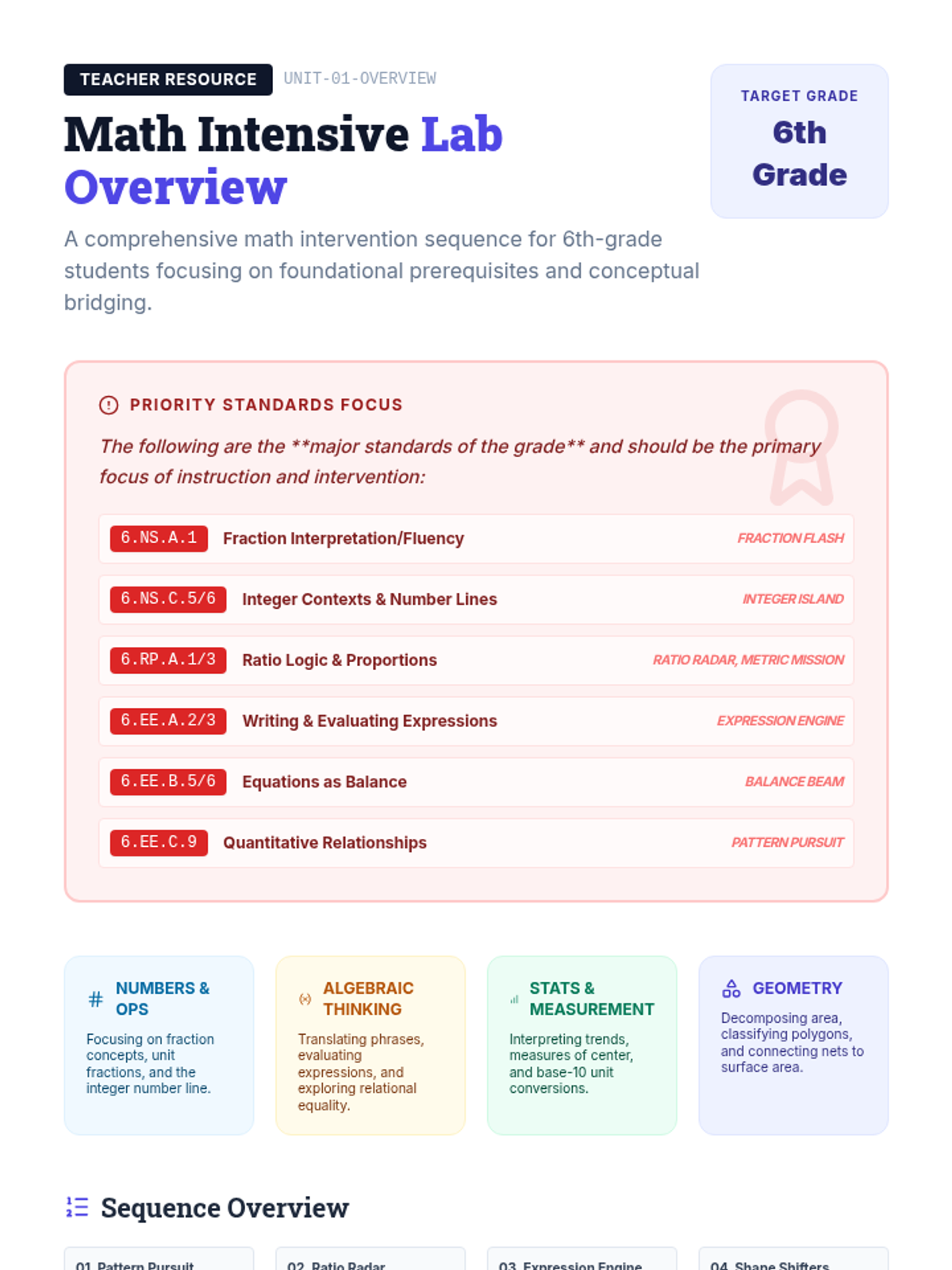
General administrative and planning resources for the Math Intensive Lab sequence, including the unit overview and sequence-wide instructional supports.
Connects 2D representations to 3D volumes by exploring nets of prisms and pyramids to calculate surface area conceptually.
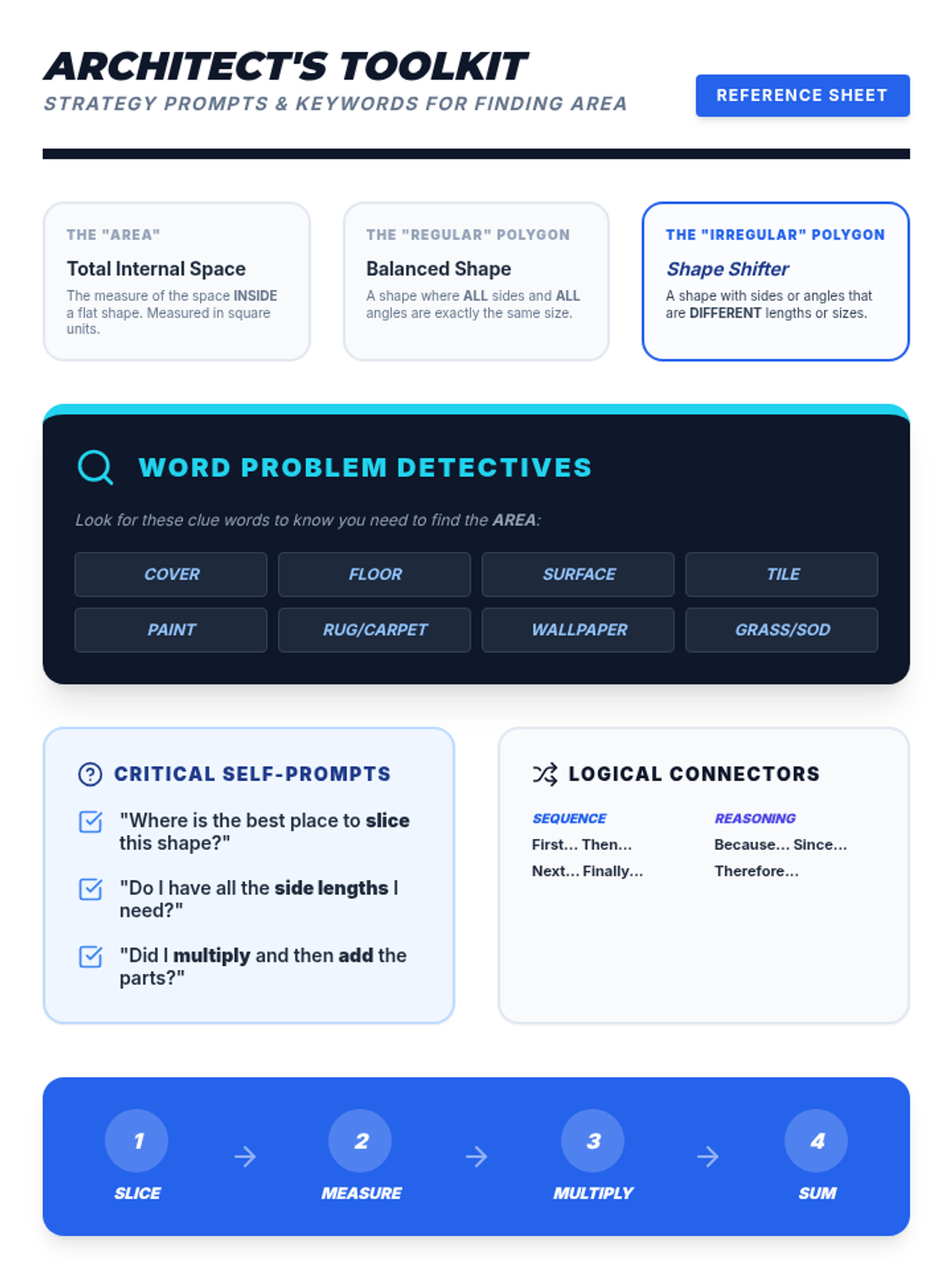
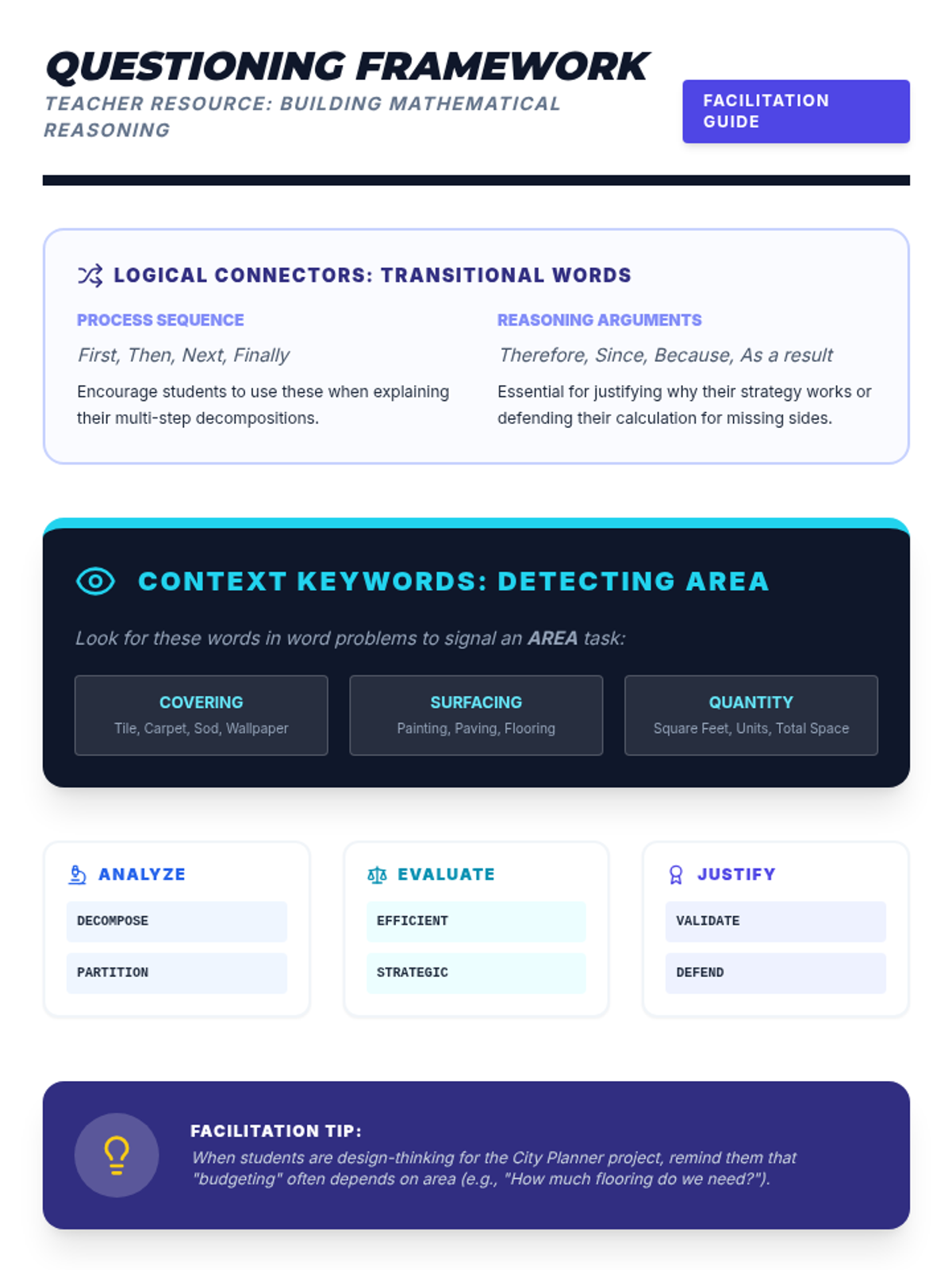
Deepens understanding of area by decomposing complex shapes into rectangles and triangles using grid-based visual tools.
Interprets measures of center (mean, median, mode) through data visualization and 'What's the Same? What's Different?' statistical talks.
Provides hands-on challenges to master unit conversions within the same system, focusing on the relationship between larger and smaller units.
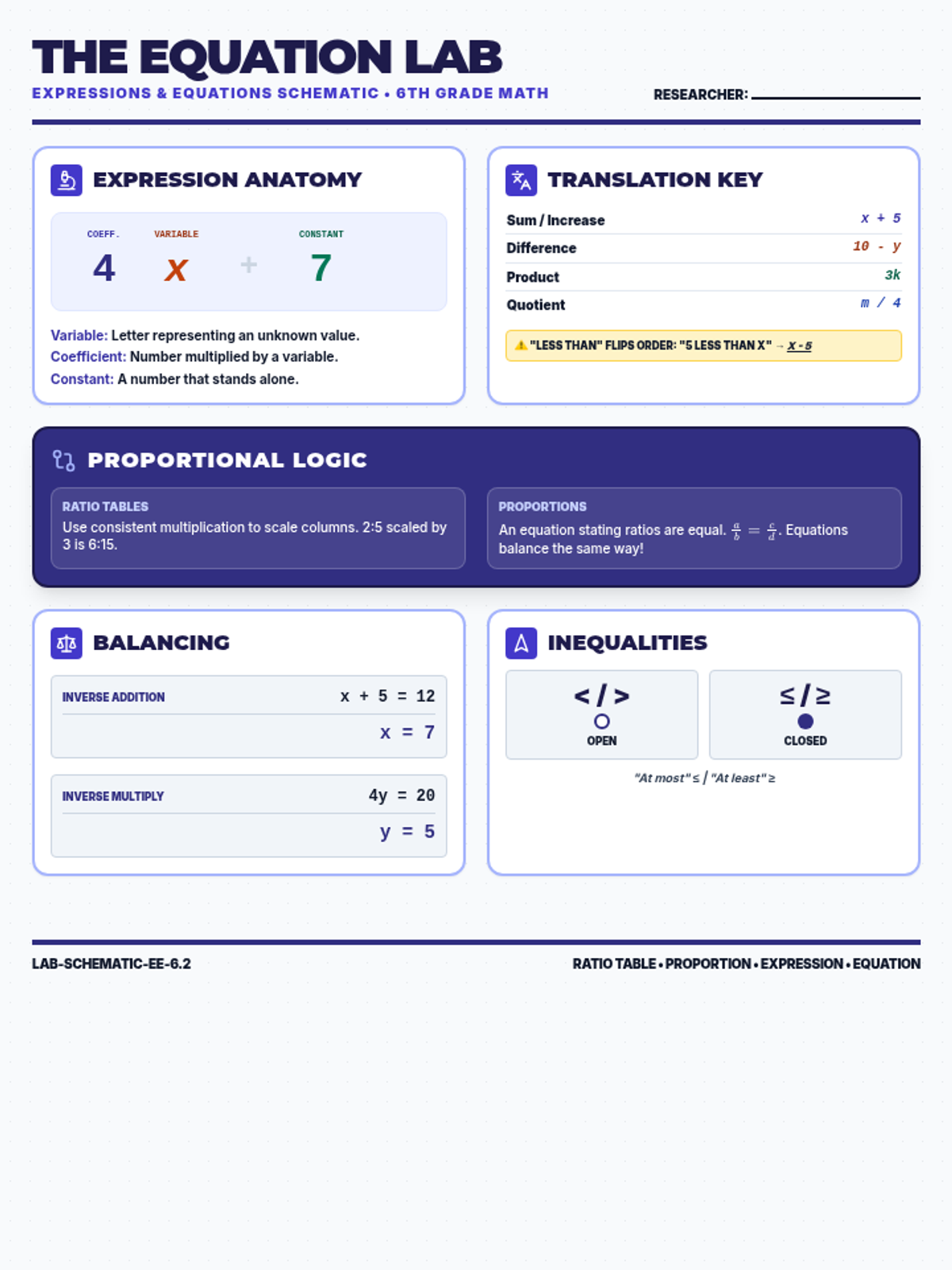
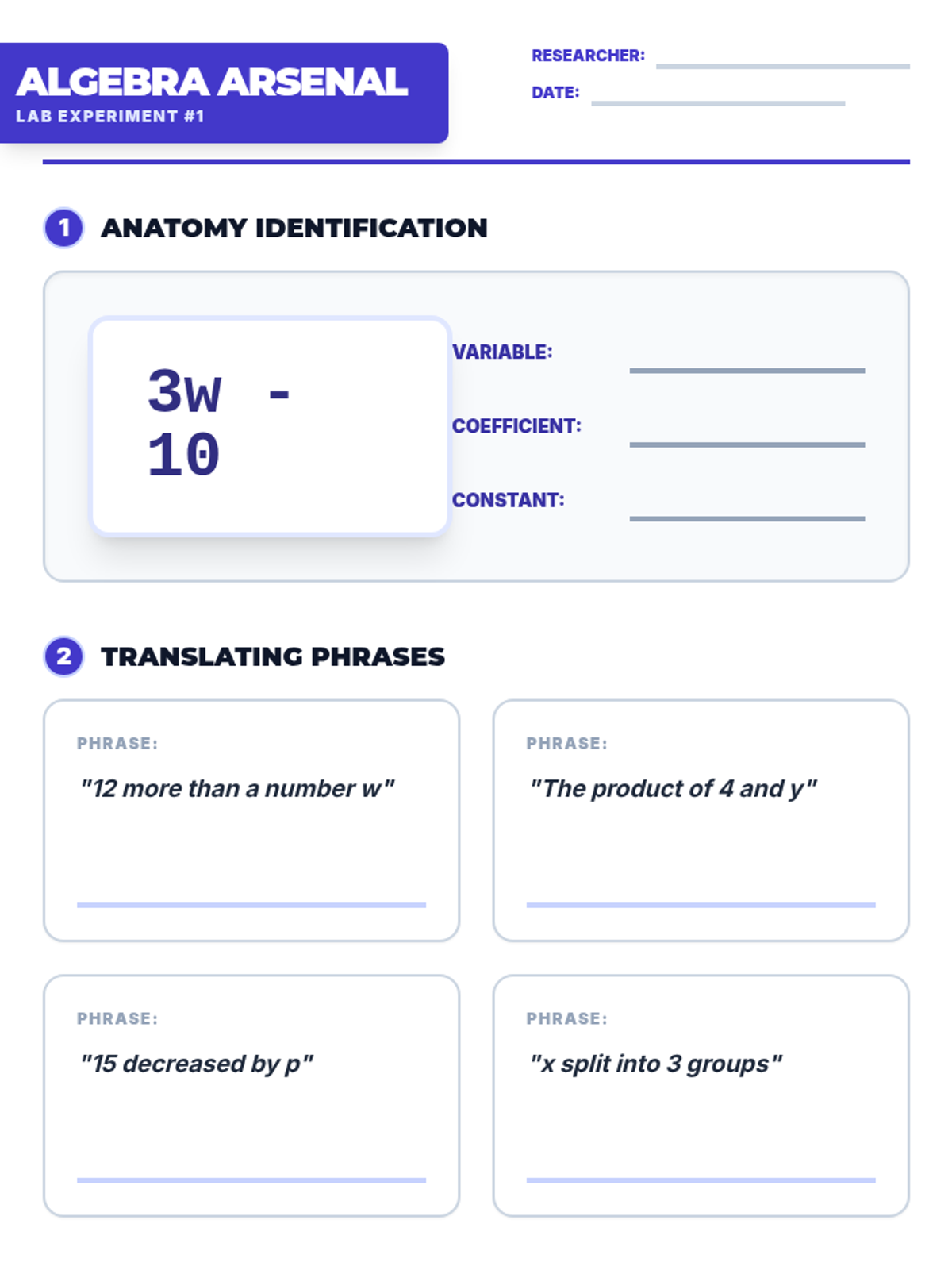
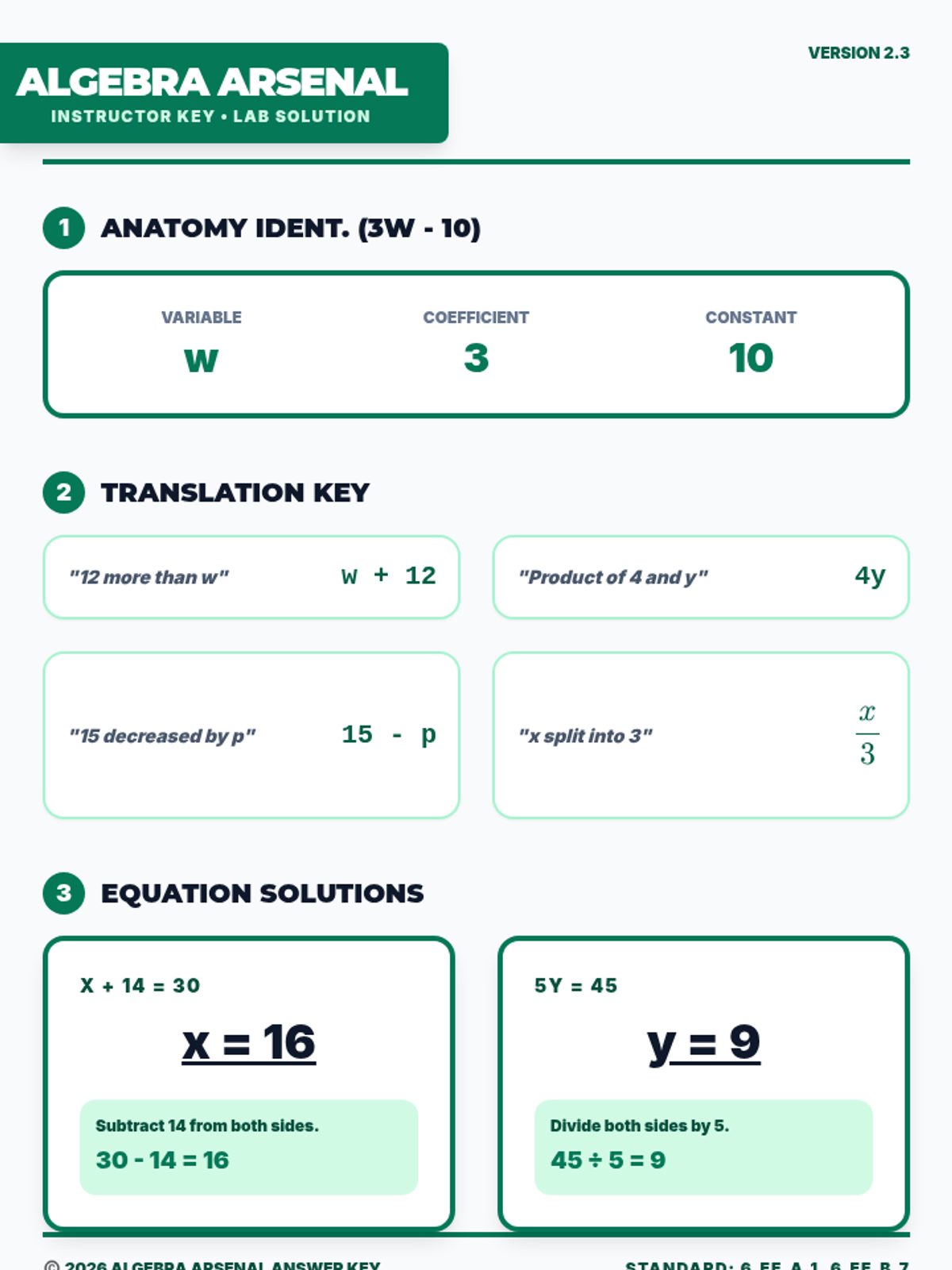
Focuses on translating real-world phrases into algebraic expressions and evaluating them using 'Contemplate then Calculate' strategies.
Uses visual sequences and function machines to help students identify, extend, and describe numerical patterns and rules.
Introduces integers and absolute value using 'Contextual Stories' and vertical number lines to build a visual understanding of numbers below zero.
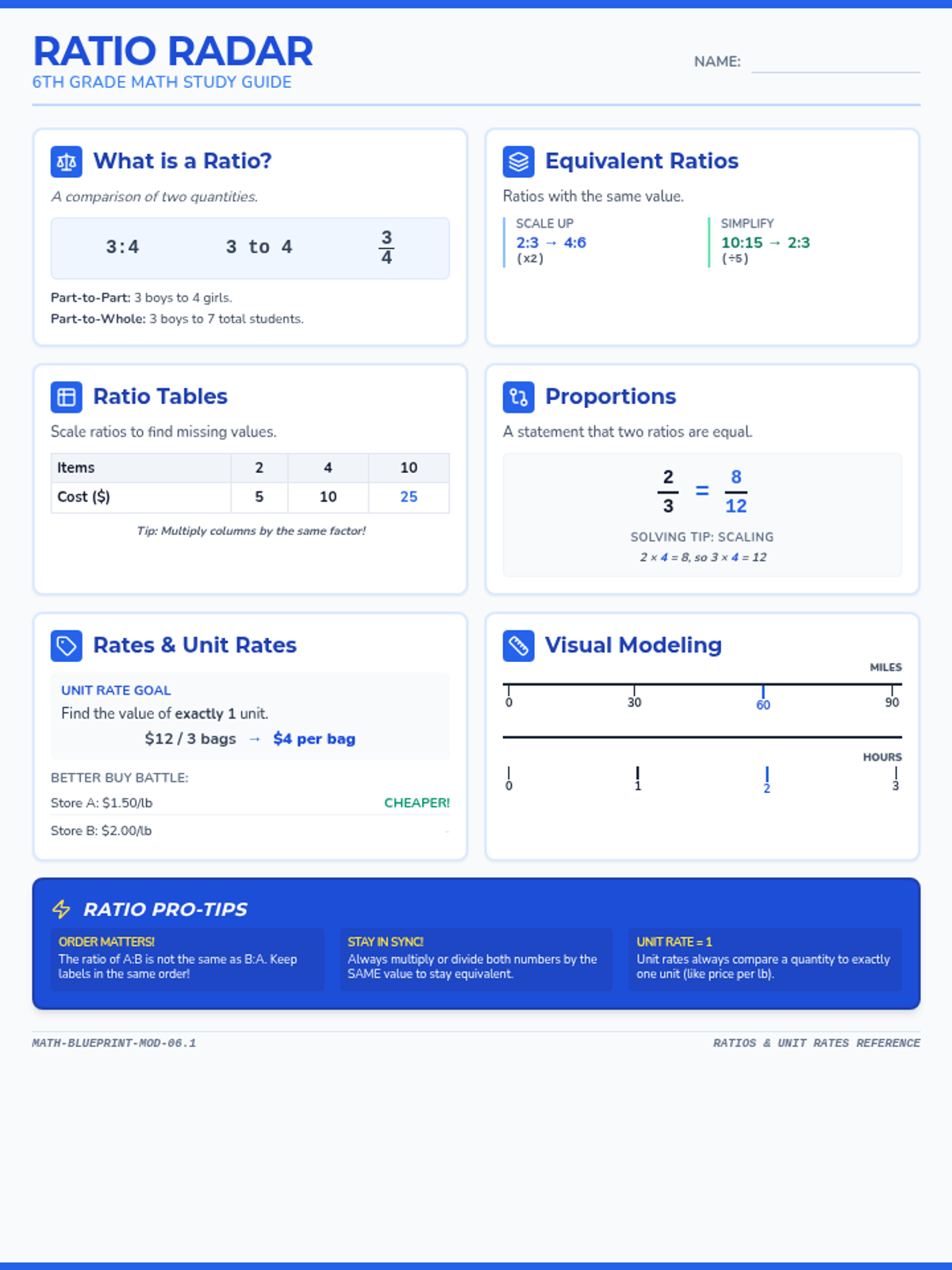
Explores the conceptual meaning of ratios and proportional relationships using 'Double Number Lines' and visual models to bridge i-Ready 6th grade gaps.
Strengthens geometric reasoning through 'Shape Sort' tasks, focusing on the properties and classification of polygons.
Develops data literacy through 'Story of a Graph' activities where students connect real-world scenarios to visual representations.
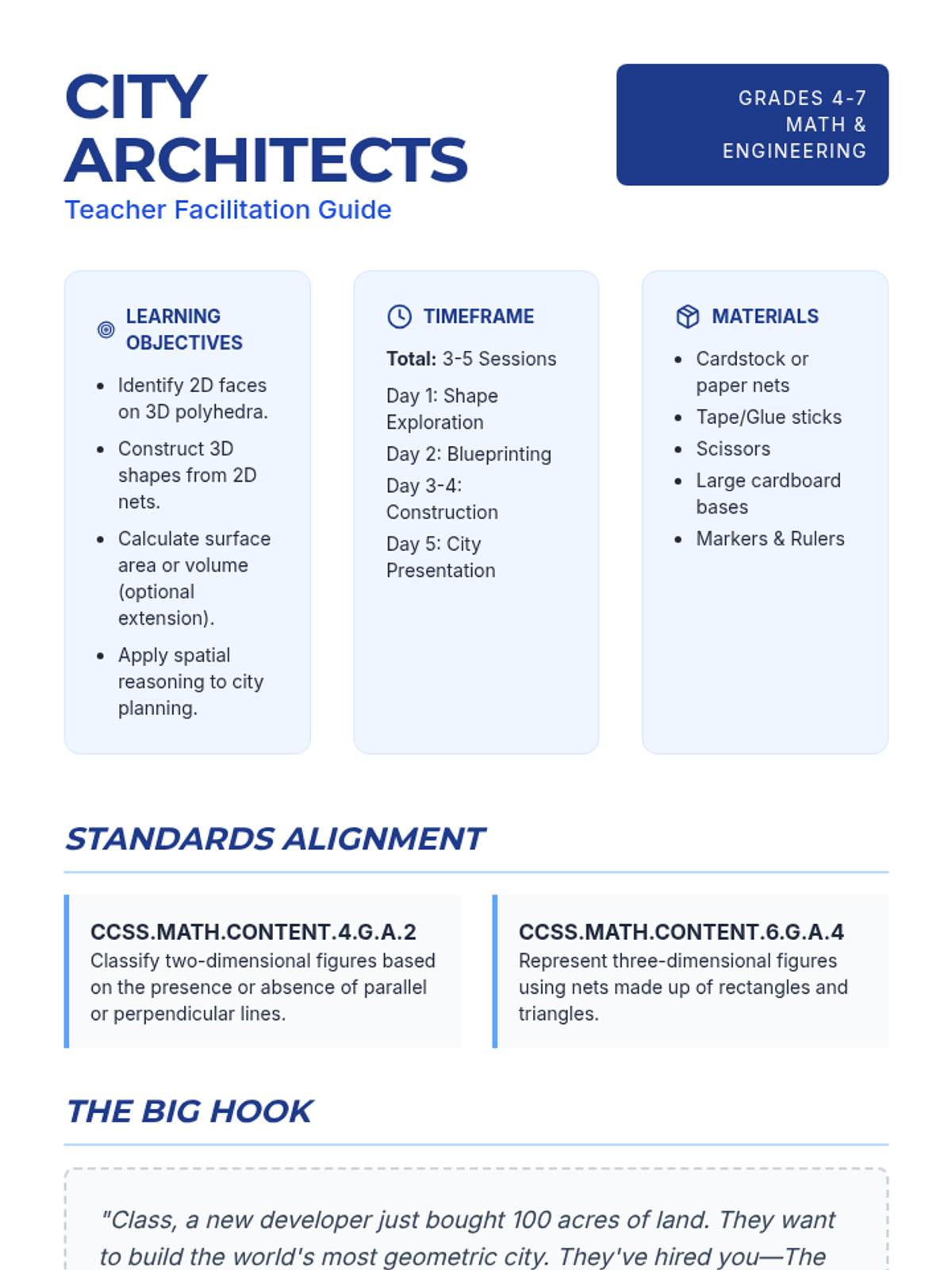
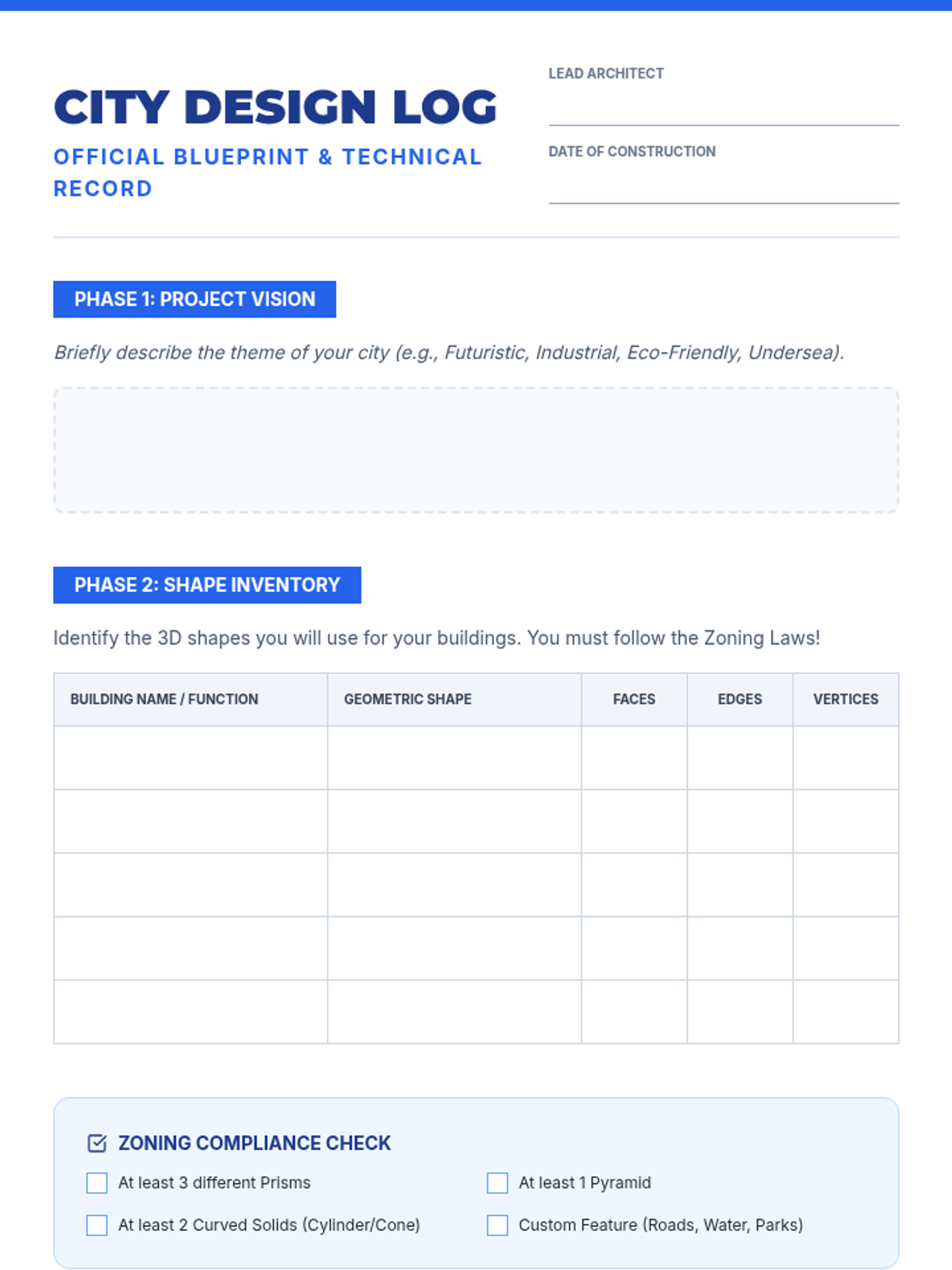
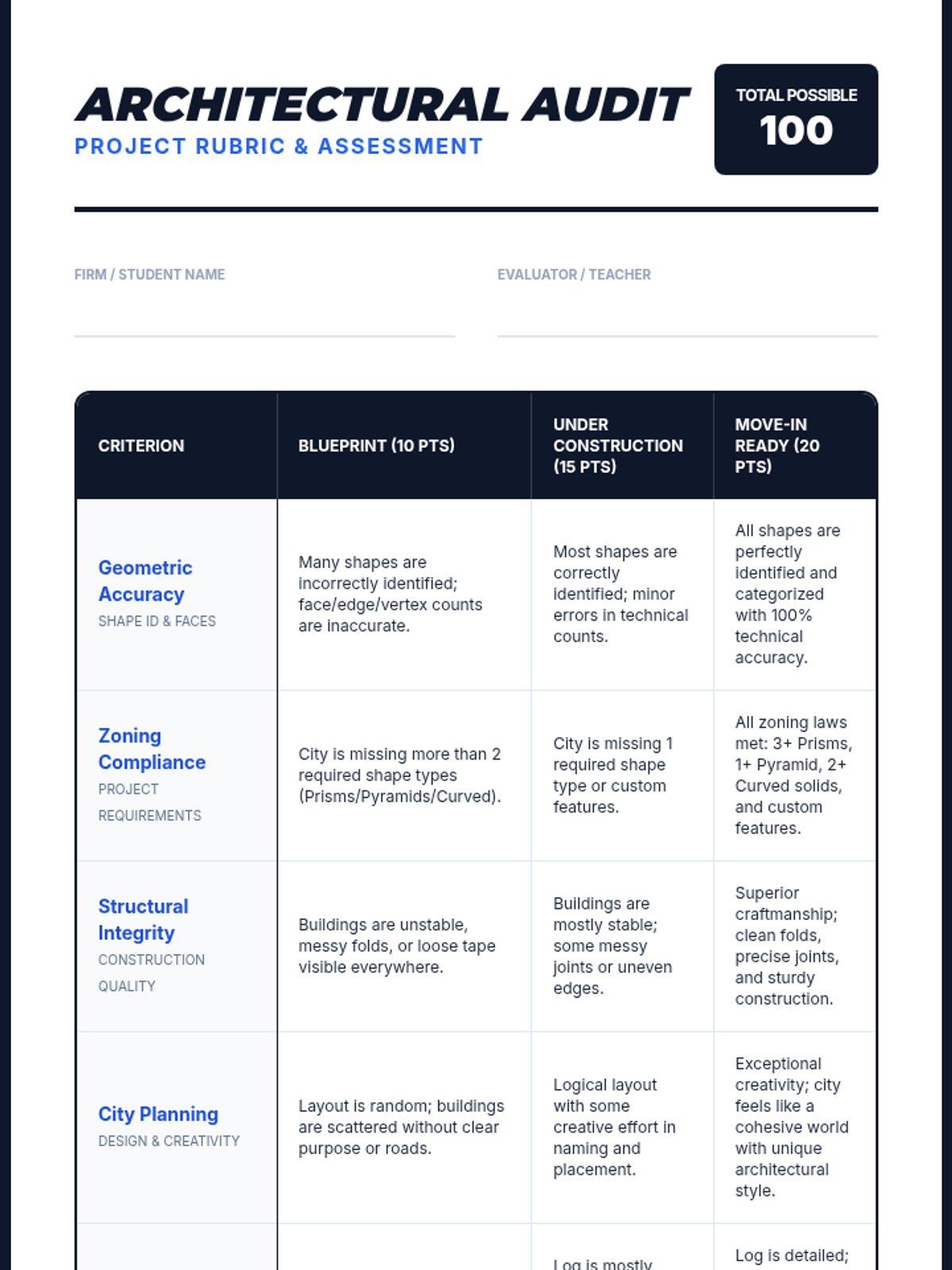
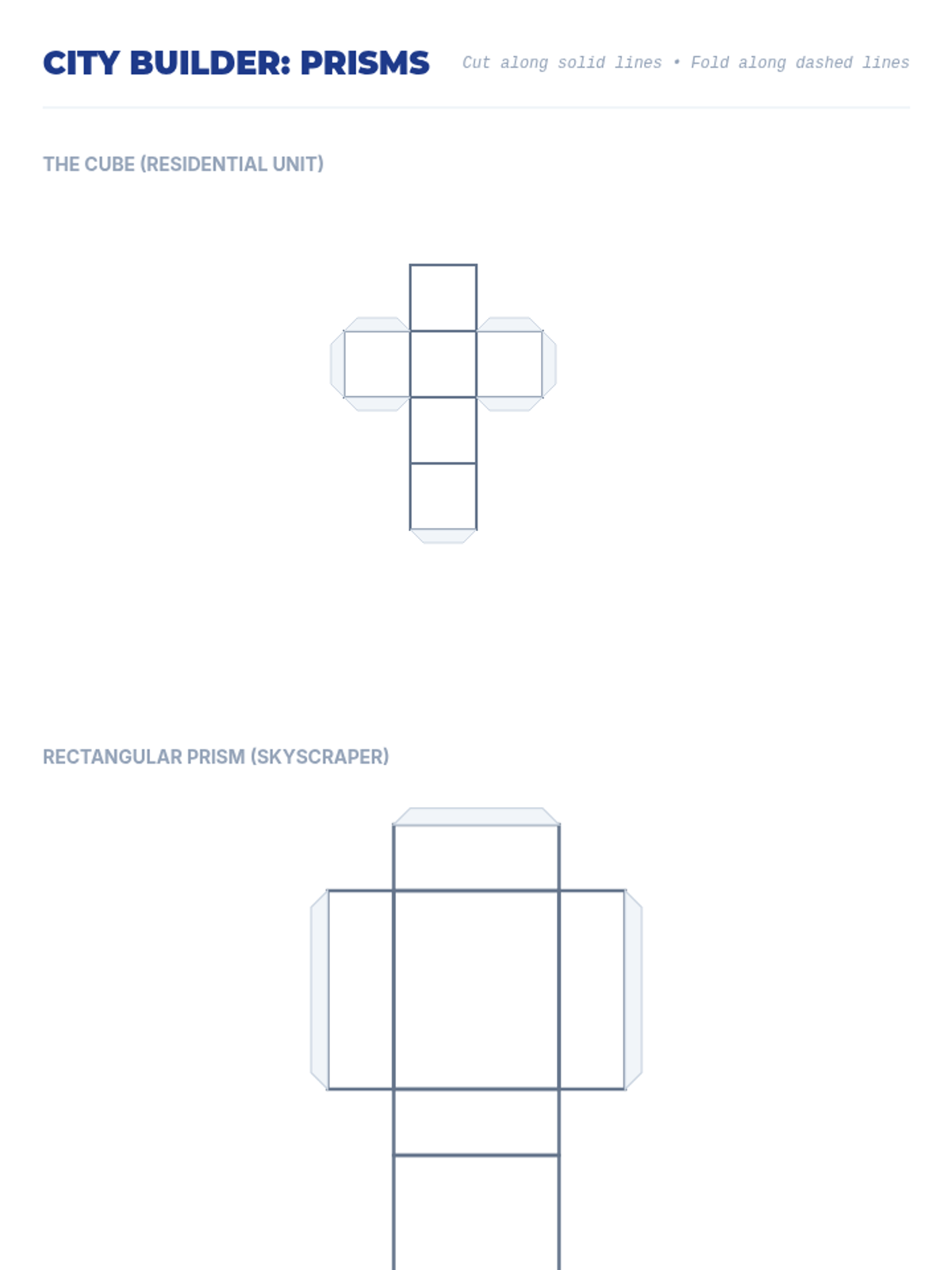
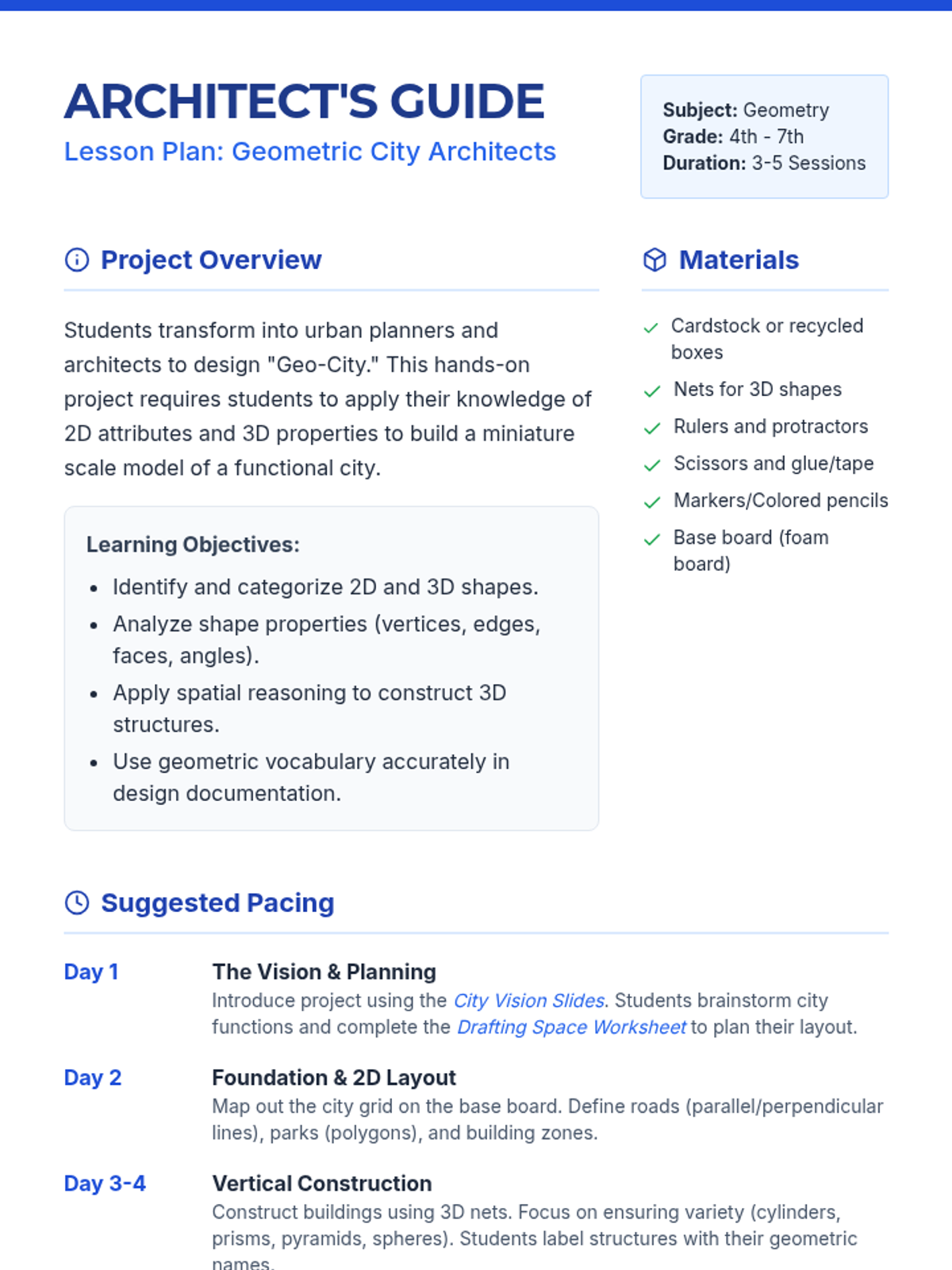
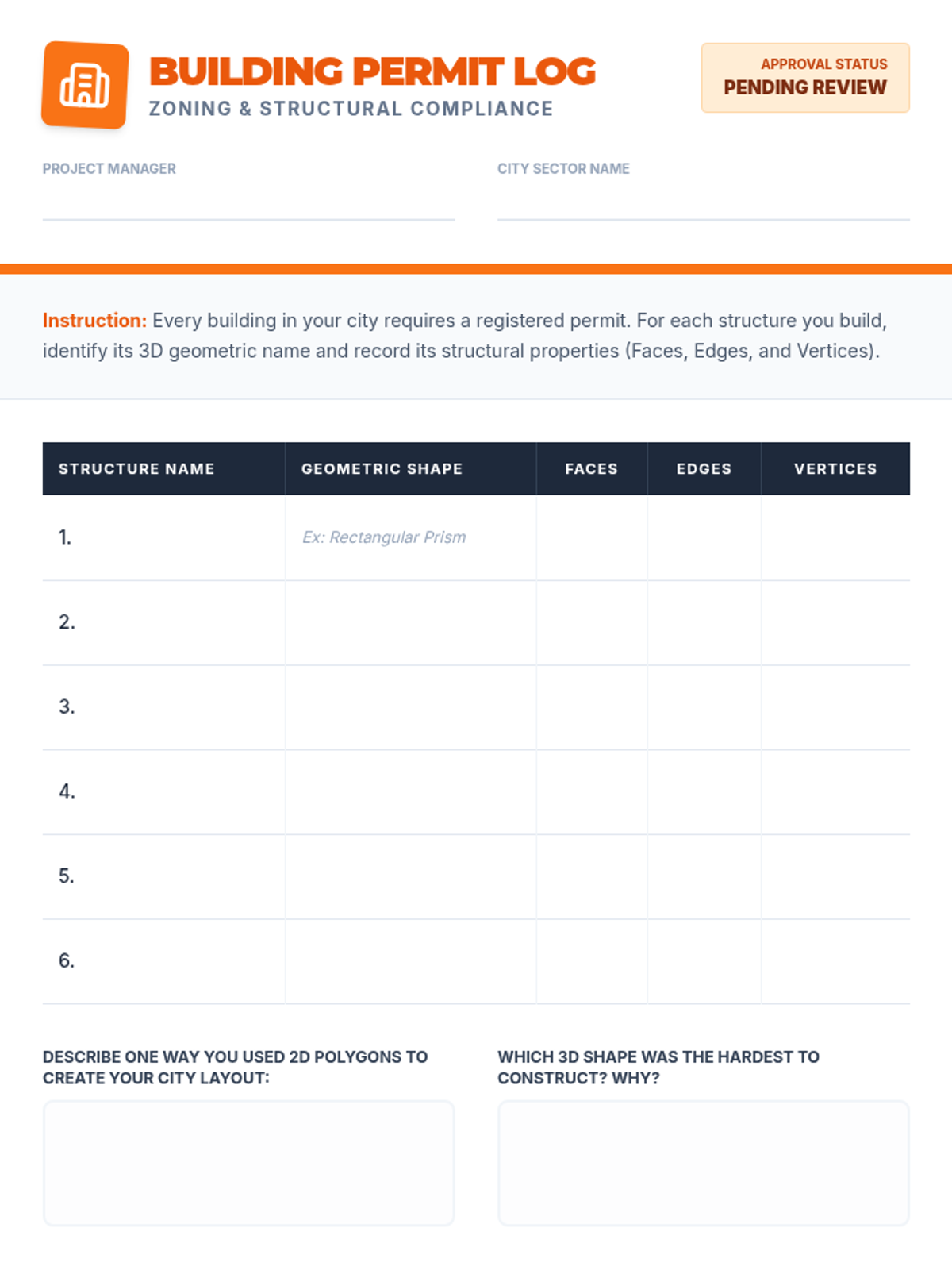
A project-based lesson where students apply geometry skills to design and build a 3D miniature city, focusing on polyhedra, volume, and spatial reasoning.
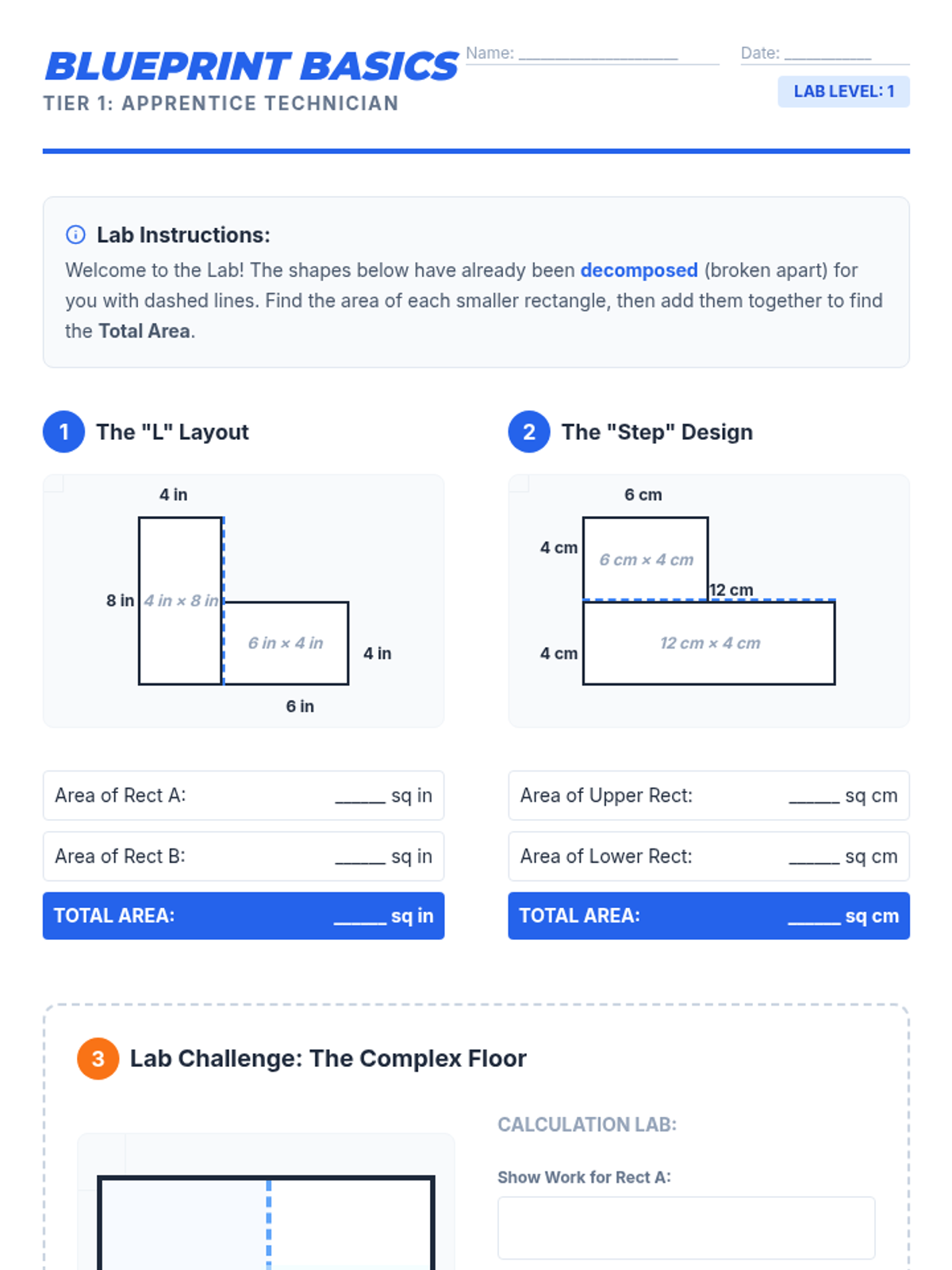
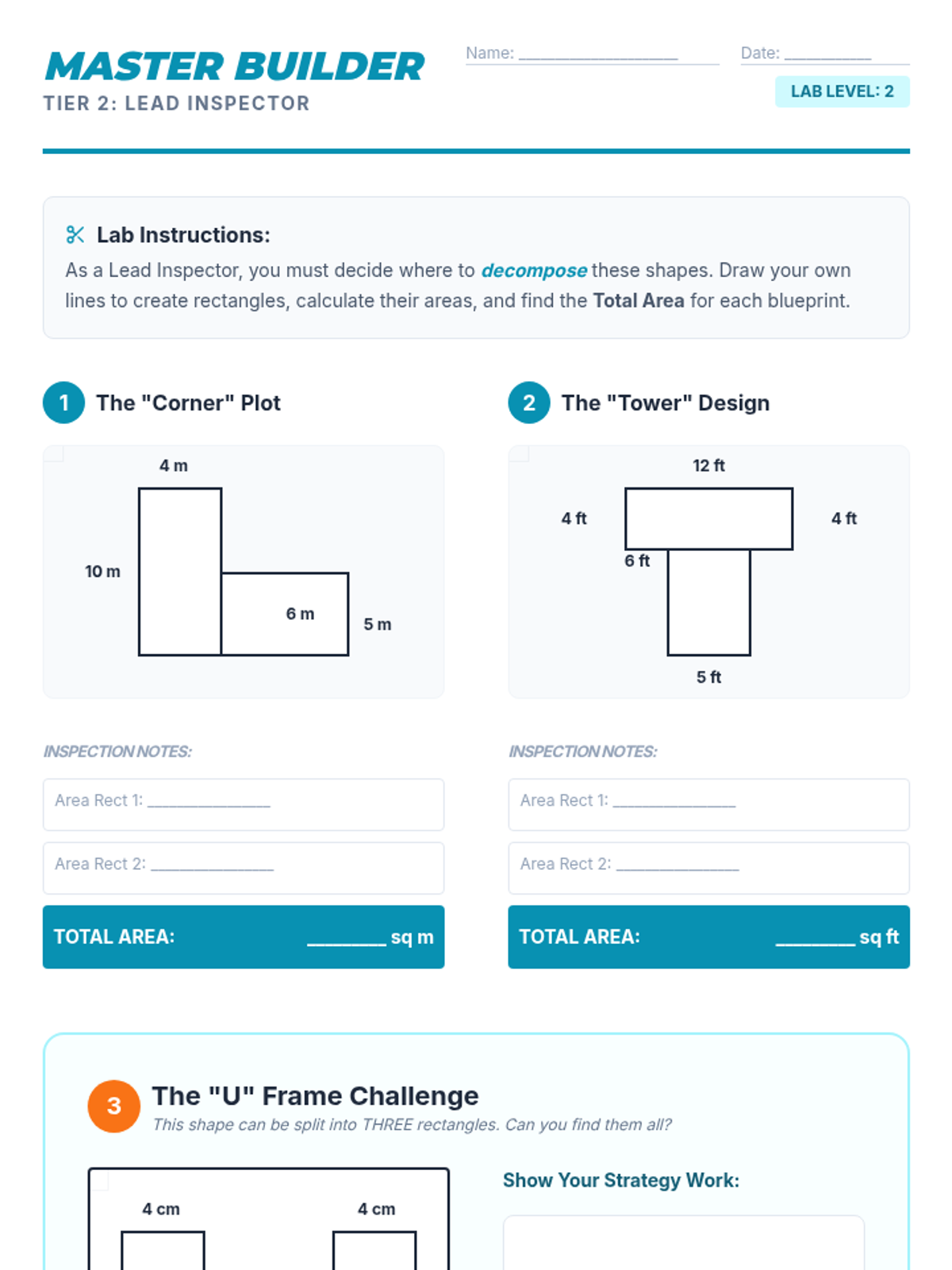
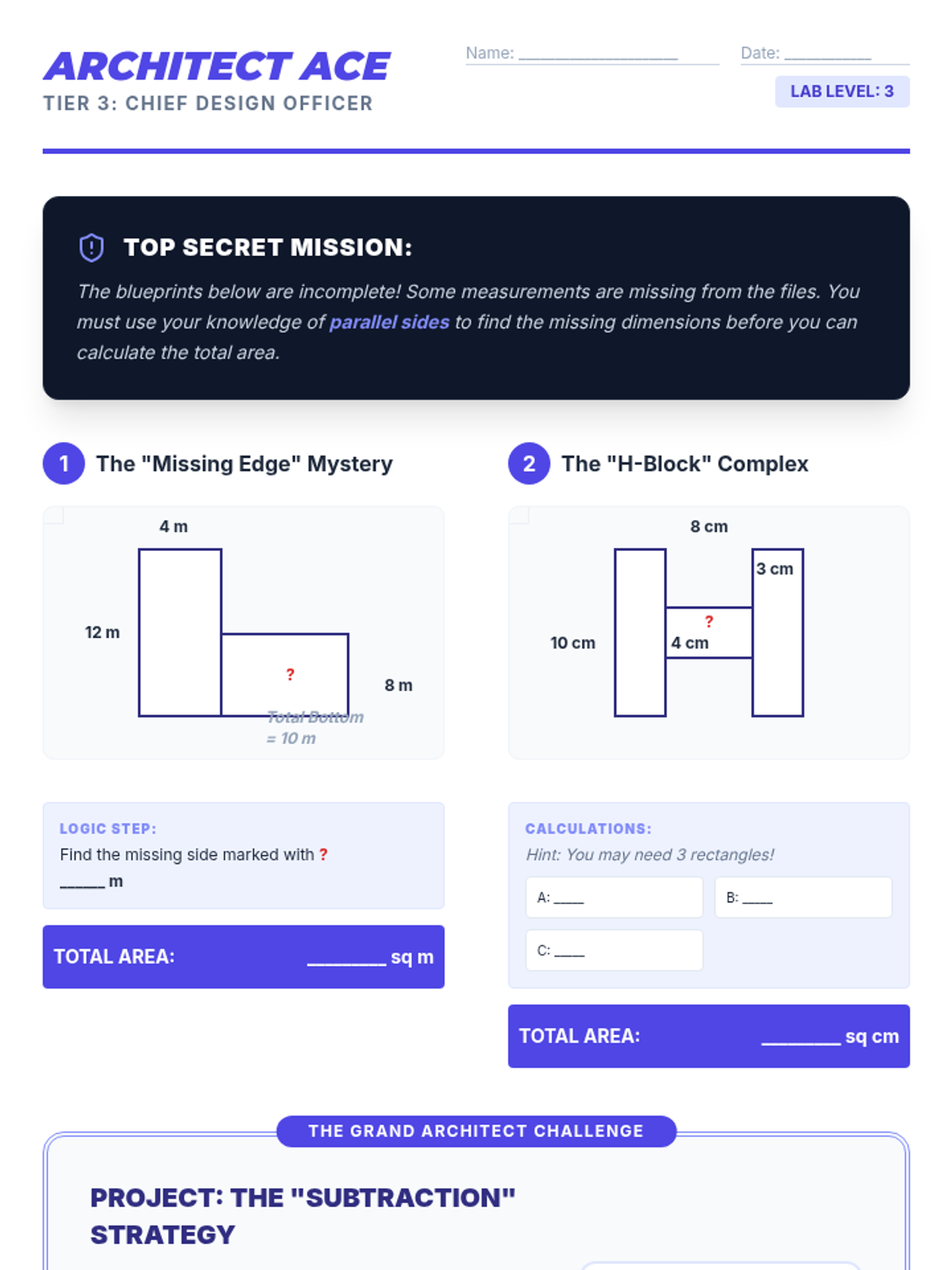
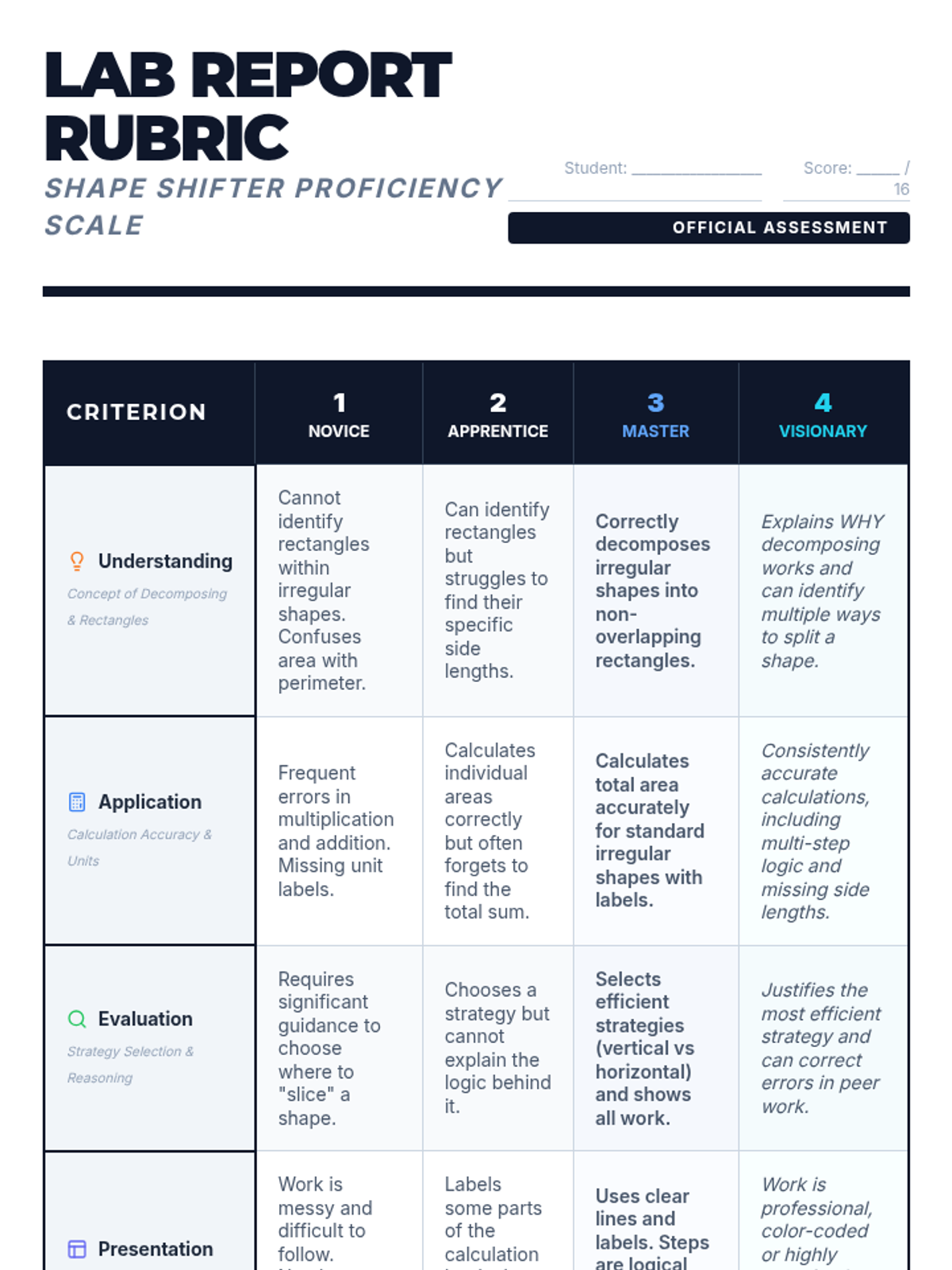
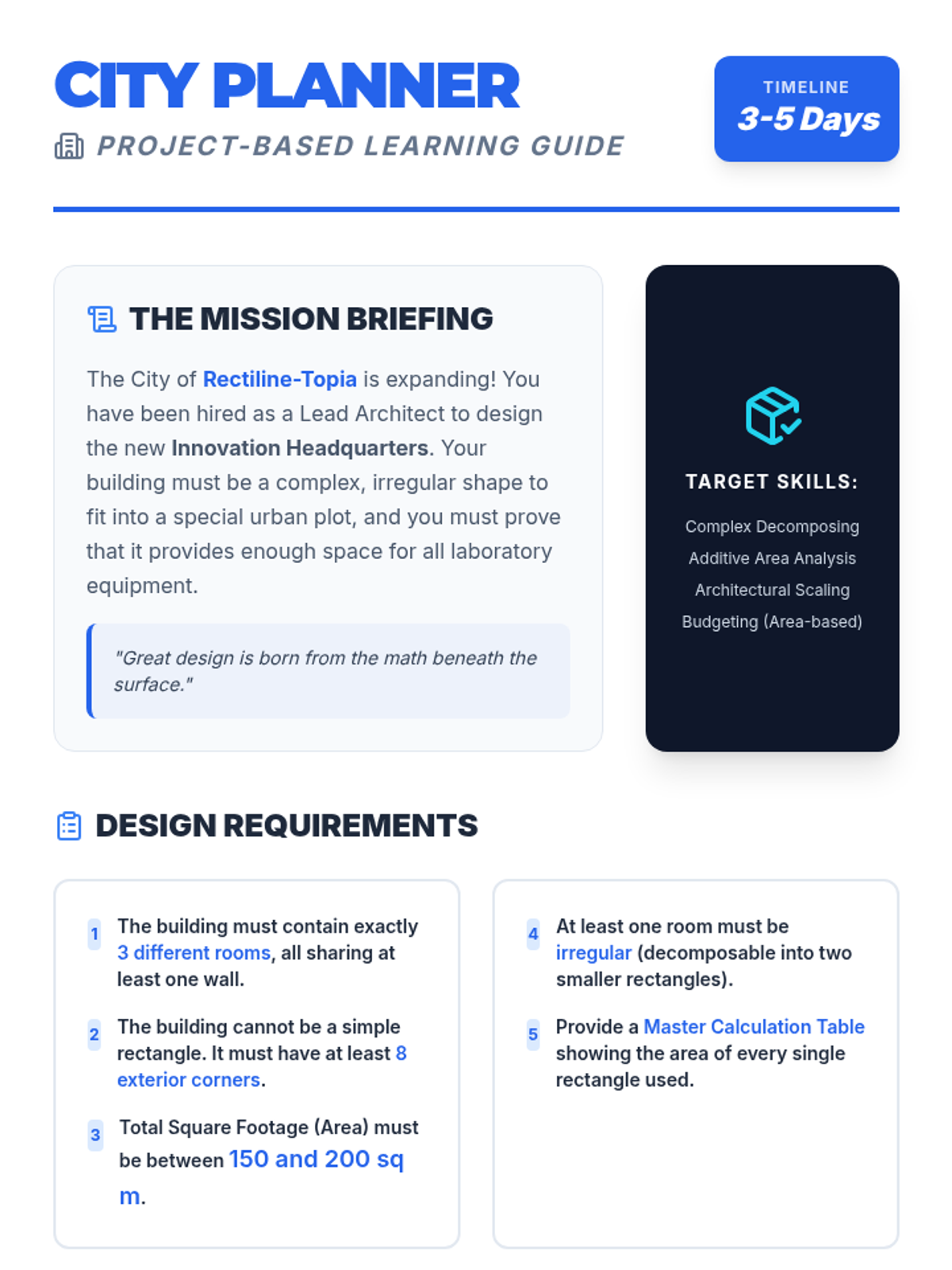
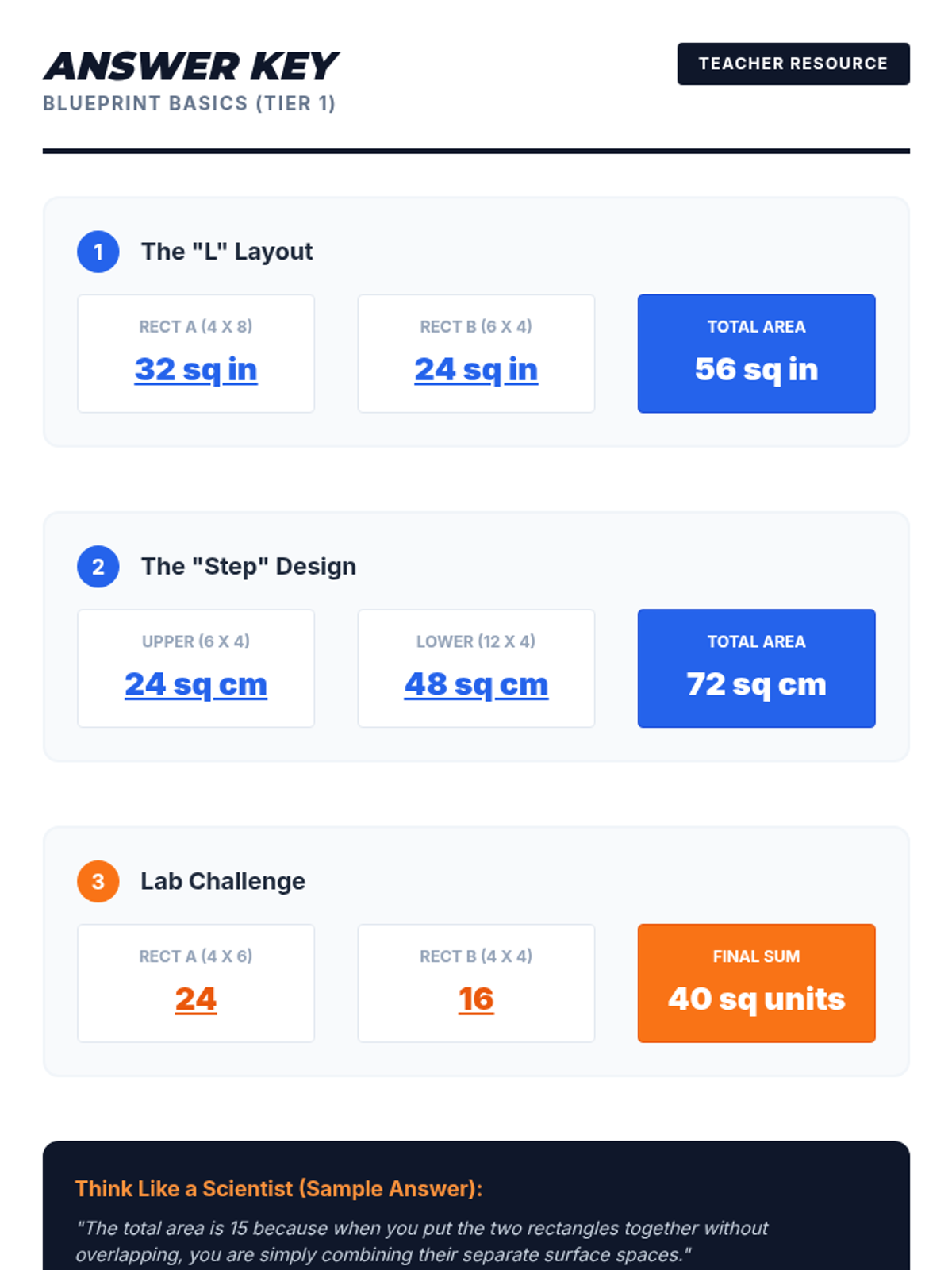
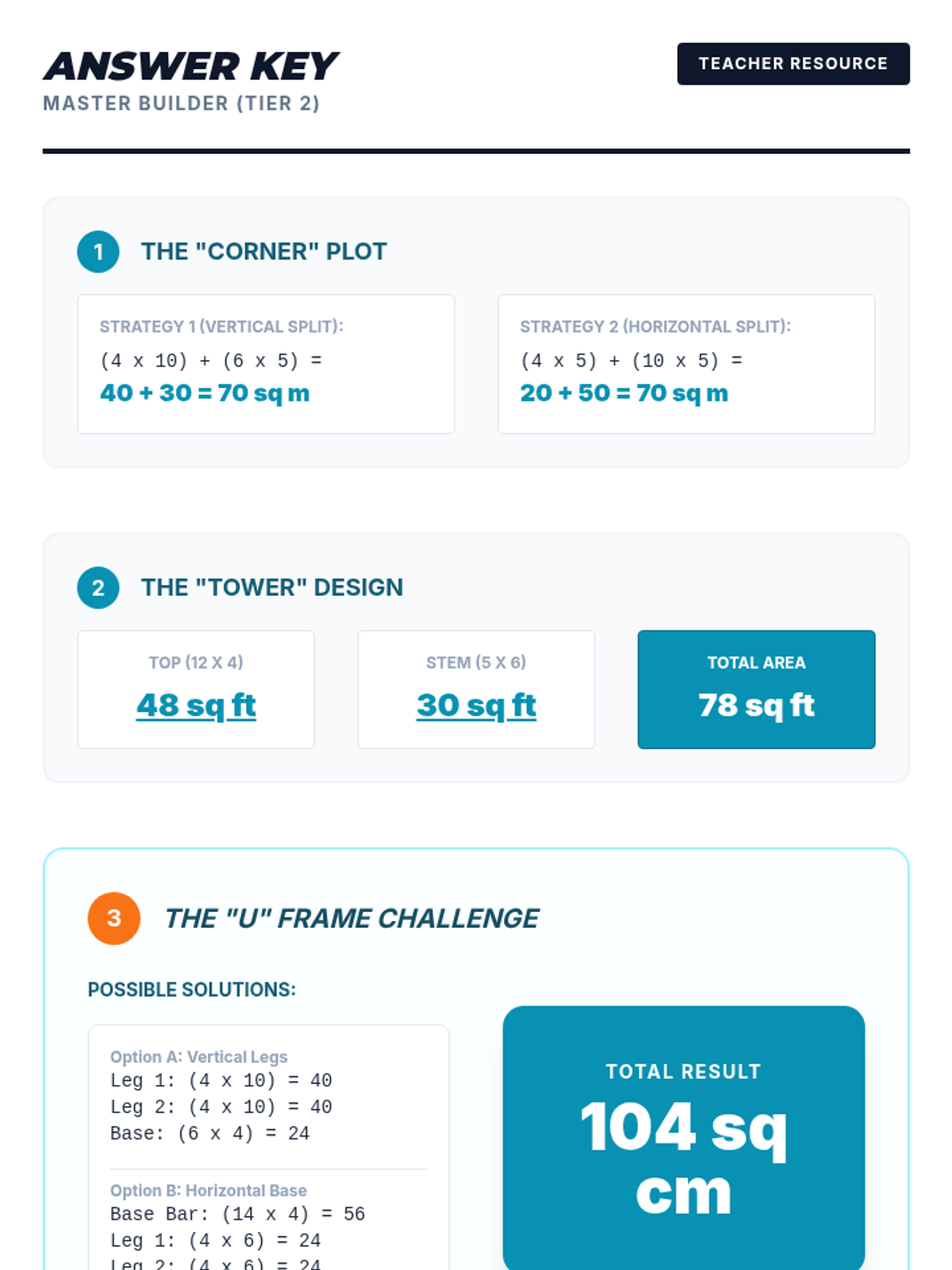
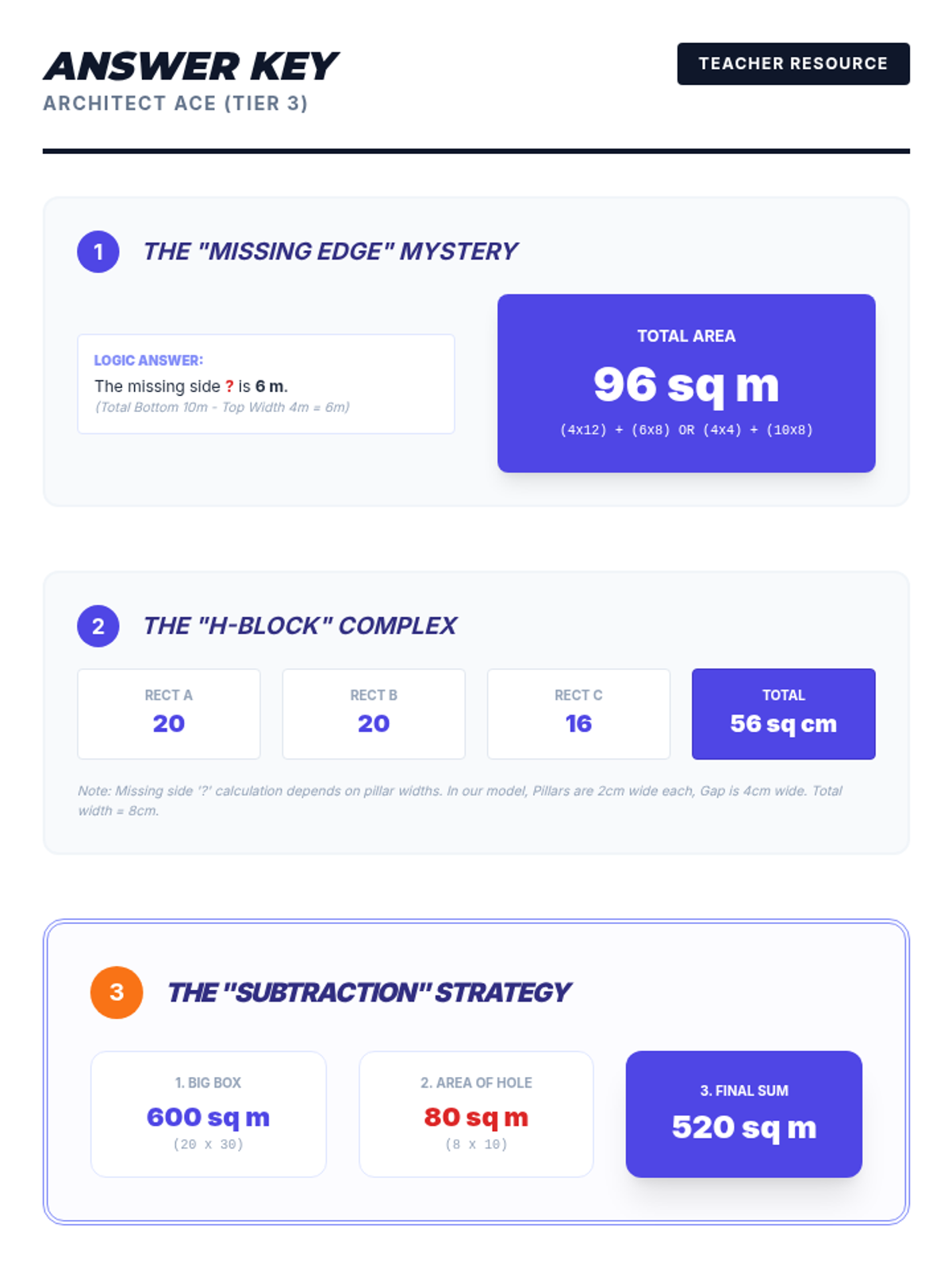
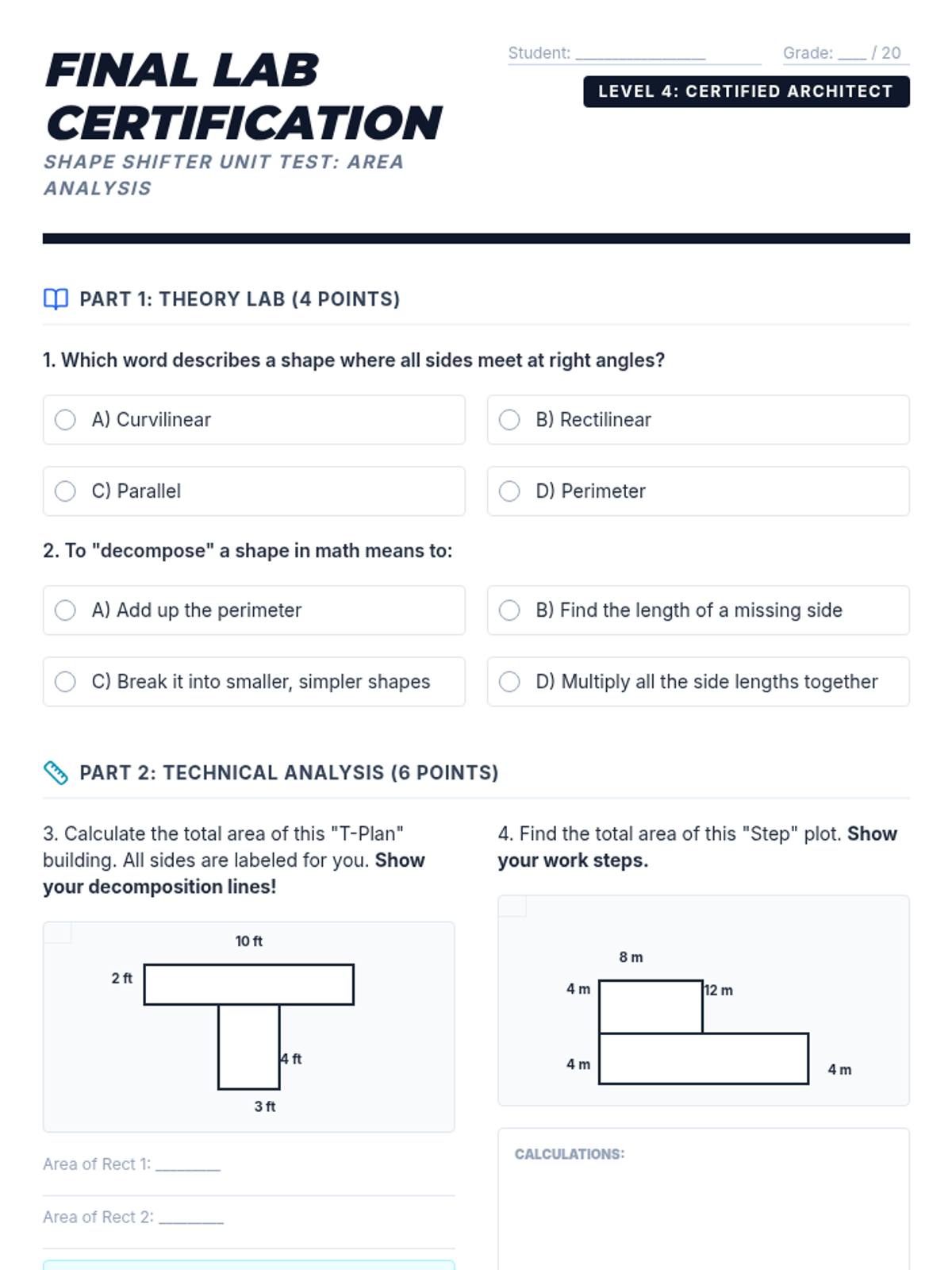
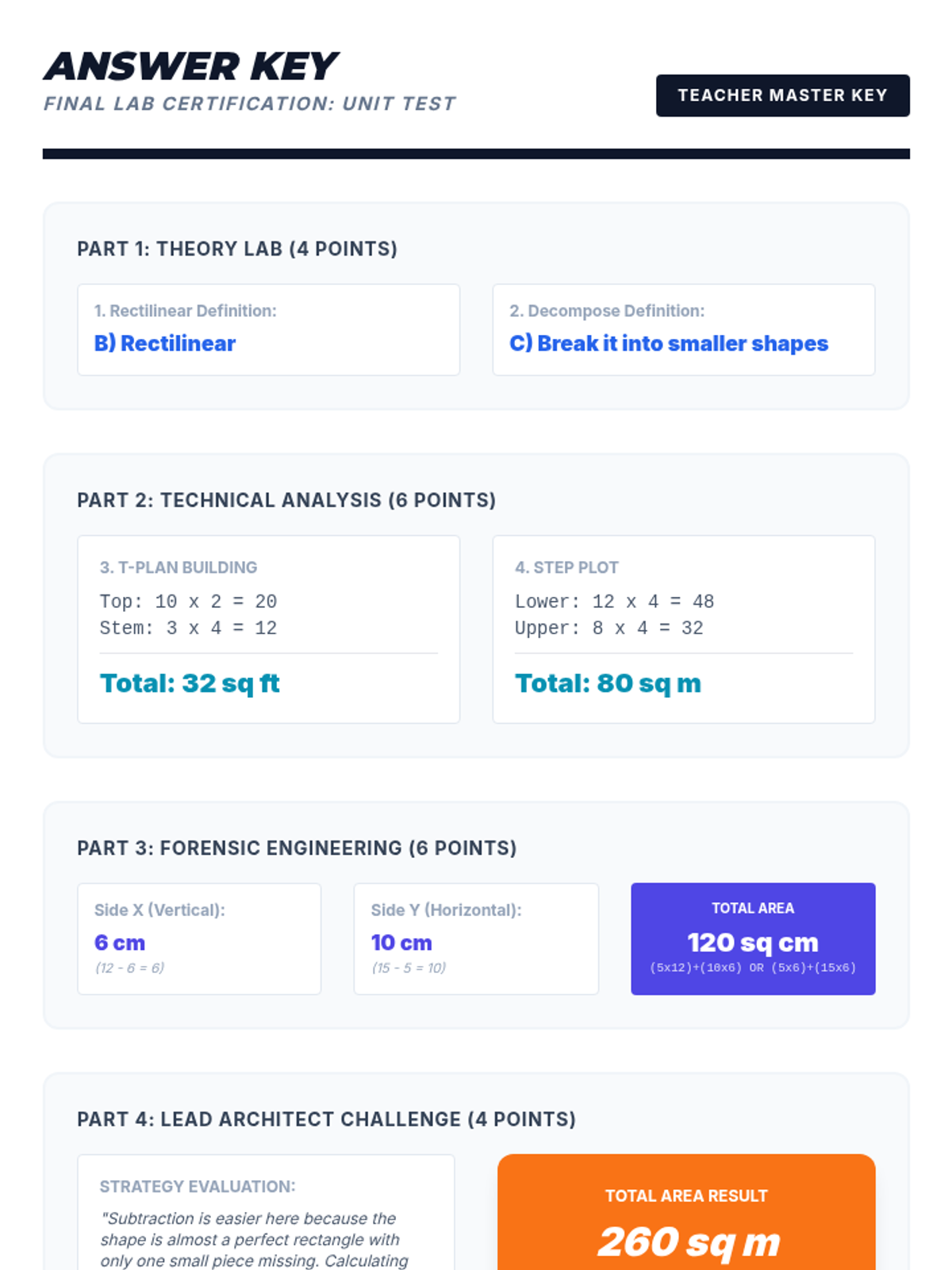
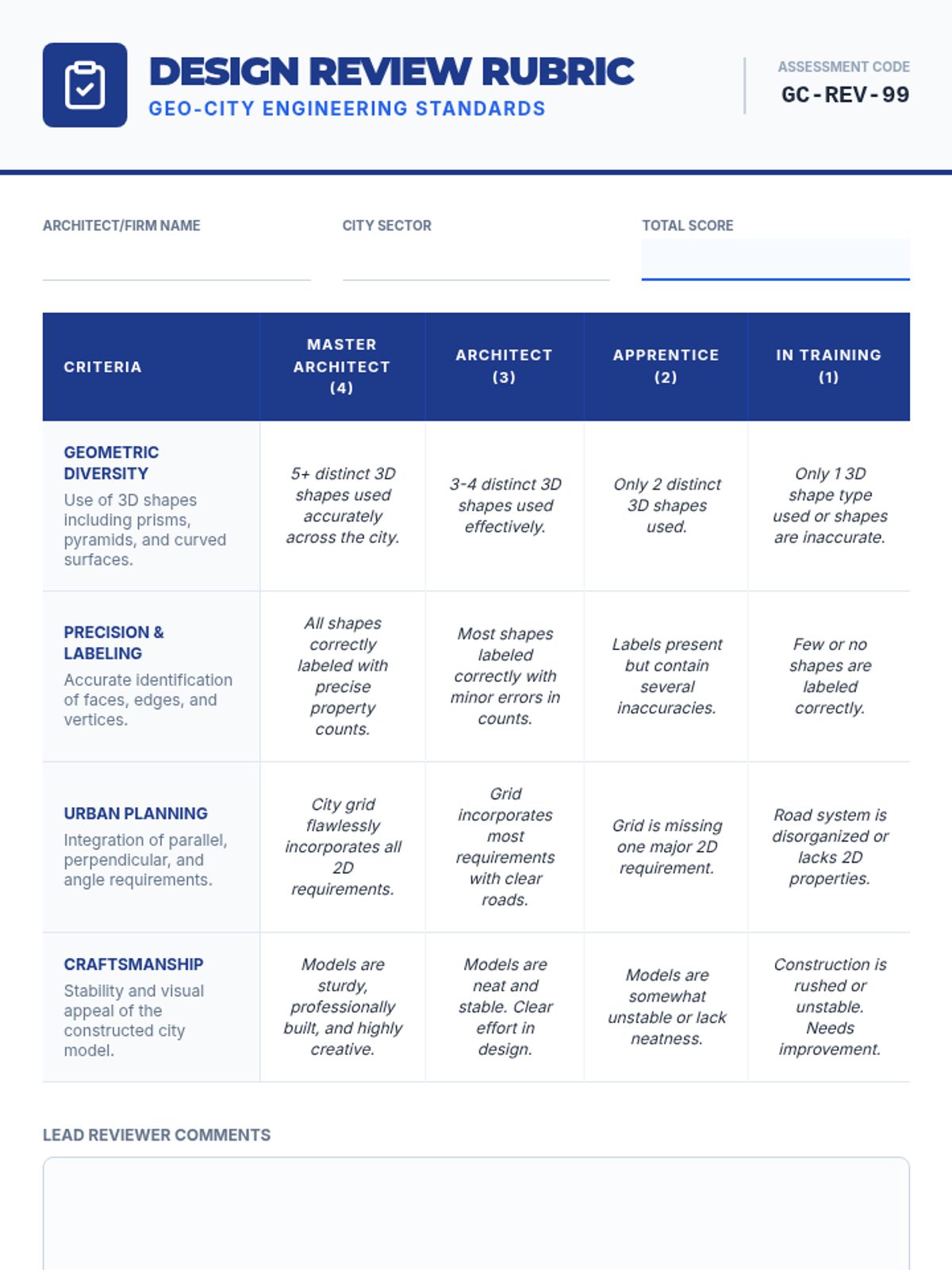
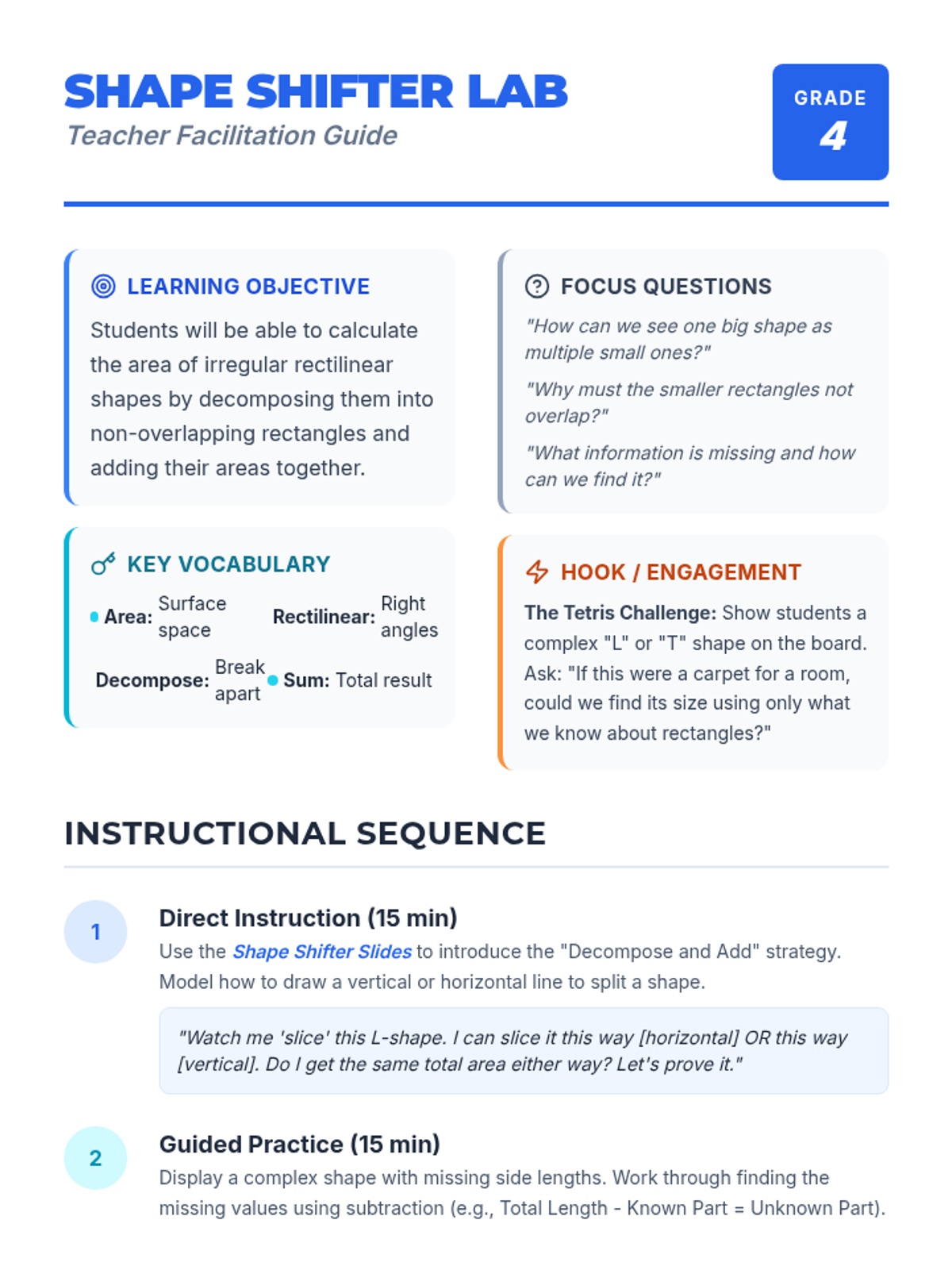
A comprehensive lesson on calculating the area of irregular rectilinear shapes by decomposing them into smaller rectangles. Includes tiered practice, a project-based learning guide, and a detailed assessment rubric.
A project-based learning lesson where students design a miniature city using 2D and 3D geometric shapes to master geometry vocabulary and spatial reasoning.
An interdisciplinary exploration of geometry in world-famous art and architecture, where students analyze symmetry and shape before creating their own geometric masterpieces.
A comprehensive geometry lesson that explores 2D and 3D shapes and angles through a space exploration lens, designed for 3rd and 5th-grade students. Students will navigate the 'Geometry Galaxy' to identify, classify, and build geometric figures using spatial reasoning.
Explores the meaning of the equals sign and balanced expressions using 'True/False Equations' to move students toward algebraic reasoning.
Focuses on fraction fluency and conceptual understanding using 'Quick Images' and 'Number Line Talks' to build a solid foundation in part-to-whole relationships.
Students explore 2D and 3D geometric concepts through physical movement and hands-on modeling. They will identify shape properties, symmetry, and angles by transforming their bodies and building physical structures.
A 15-25 minute exploration into how ancient navigators used fixed points (the North Star) and the repeating patterns of the universe (microcosms, macrocosms, and symmetry) to navigate without modern technology.
A 15-30 minute exploration of how ancient Phoenicians used the macrocosm of the stars to navigate the microcosm of their ships, featuring the root words micro/macro/cosmos and the mathematics of rotational symmetry.
A lesson on coordinate geometry transformations, focusing on translations and reflections over the axes. Students will learn to manipulate points on a coordinate plane using specific rules.
A quick starter activity for reviewing coordinate transformations, specifically translations and reflections, designed for accessibility.
A visual exploration of number patterns and input-output tables using an architectural design theme. Students learn to identify rules and extend sequences through scaffolded building floor plans.
A visual introduction to the coordinate plane (Quadrant I) focusing on plotting points and identifying coordinates through a city mapping theme. Designed for special education students with heavy scaffolding and spatial mnemonics.
A foundational lesson on solving one-step equations using the four basic operations, designed specifically for special education students with heavy visual scaffolding and a blueprint construction theme.
A Tier 2 intervention lesson focused on plotting ordered pairs in the first quadrant and interpreting their real-world meaning through a cartography theme. Students move from concrete tables to representational graphs and abstract interpretation.
A Tier 2 intervention lesson focused on mastering the coordinate plane through tactile floor activities and scaffolded grid work. Students will identify axes, the origin, and accurately plot points using ordered pairs.
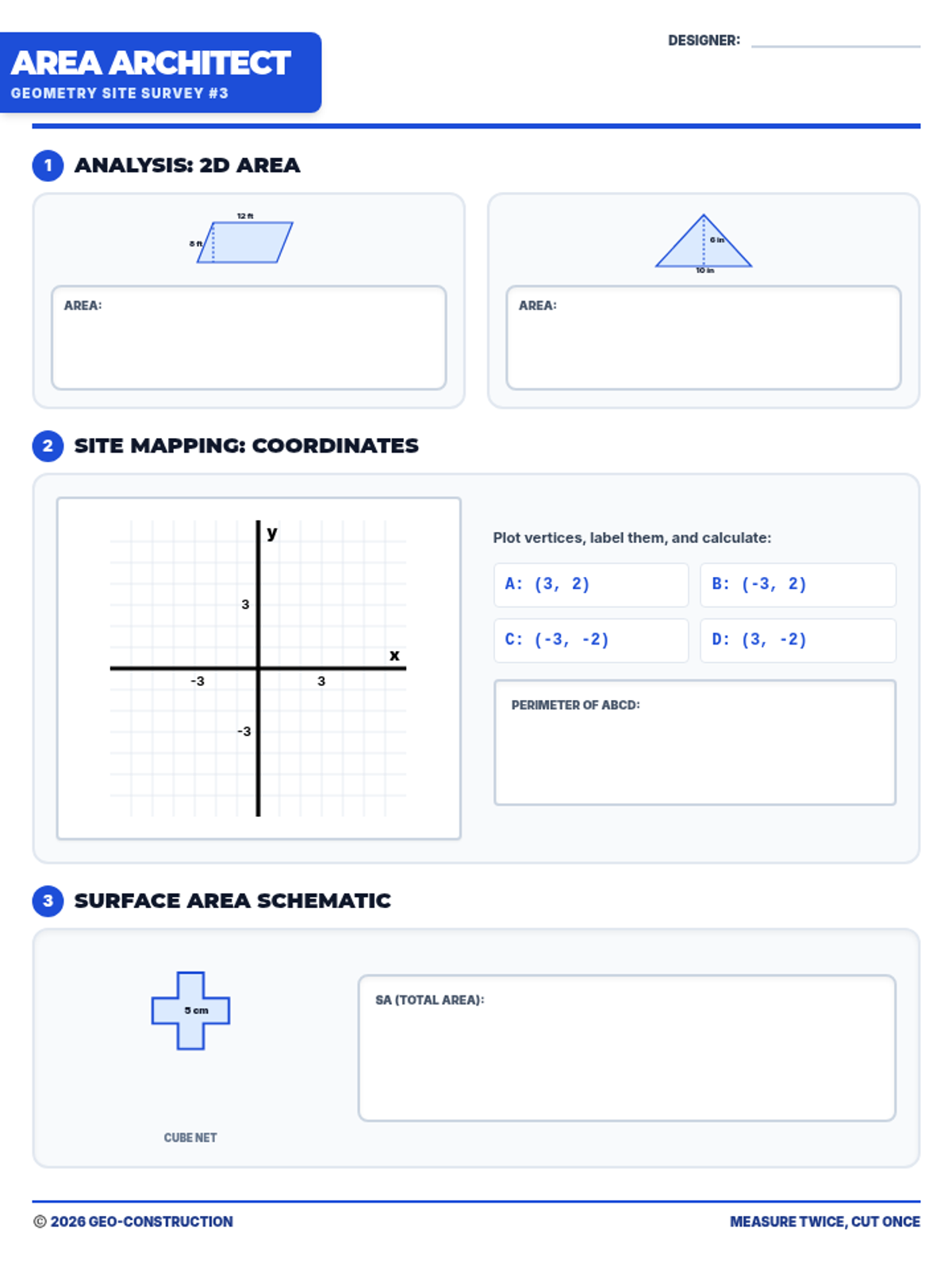
A Tier 2 intervention lesson focusing on plotting polygons in the coordinate plane and calculating side lengths using coordinates. Includes scaffolded steps for identifying same-coordinate pairs to determine distance.
A targeted Tier 2 intervention lesson focusing on plotting polygons in the coordinate plane and calculating side lengths using absolute value within a city planning context.
A Tier 2 intervention lesson focused on plotting vertices, drawing polygons, and calculating side lengths and perimeters on a coordinate plane. Designed for small group support with scaffolded steps and visual guides.
A small group intervention lesson focused on plotting points in all four quadrants and calculating horizontal and vertical distances.
A targeted intervention lesson focused on mastering the four-quadrant coordinate plane and calculating distances between points using absolute value. Designed for small groups, it includes visual aids, guided plotting, and step-by-step calculation support.
A targeted Tier 2 small group intervention focusing on representing rational numbers on number lines and the four-quadrant coordinate plane, including reflections across axes.
A targeted Tier 2 intervention lesson focusing on representing integers and their opposites on number lines and the coordinate plane. Includes hands-on counter activities, a treasure hunt, and scaffolded quadrant identification within a Deep Sea Discovery theme.
A targeted Tier 2 intervention lesson for 6th graders to master negative numbers on number lines and coordinate planes using a "Deep Sea Explorer" theme. Includes hands-on floor activities, scaffolded practice, and a formal assessment check.
A targeted Tier 2 intervention lesson focusing on graphing in all four quadrants and using absolute value to determine distances between points with the same first or second coordinate.
A Tier 2 small group intervention focused on connecting equivalent ratio tables to coordinate plane plotting. Students use color-coded cues to bridge the gap between numerical relationships and visual representations.
Connects coordinate graphing to numerical patterns by having students generate coordinate pairs from mathematical rules and plot them to visualize linear relationships.
Réaliser la mise à l'échelle complète d'un projet client : 6 photos, encarts de texte et calcul des dimensions finales sur format Raisin.
Calculer la surface de papier utilisée et la surface de "perte" (chutes). Sensibilisation à l'optimisation et au coût écologique du gâchis.
Calculer le facteur d'agrandissement maximal pour passer d'un modèle A4 au format Raisin (50x65 cm) sans dépasser les bords du papier.
Calculer les dimensions et l'espacement pour placer 6 photos sur une page A4. Utilisation de la division et de la multiplication pour une mise en page équilibrée.
Comprendre si une photo peut être agrandie sans être recadrée en comparant les ratios largeur/hauteur. Concept de proportionnalité appliqué à l'image.
A targeted Tier 2 intervention lesson focusing on finding area through the composition and decomposition of shapes. Students use manipulatives and grid paper to visualize how complex polygons relate to simple rectangles.
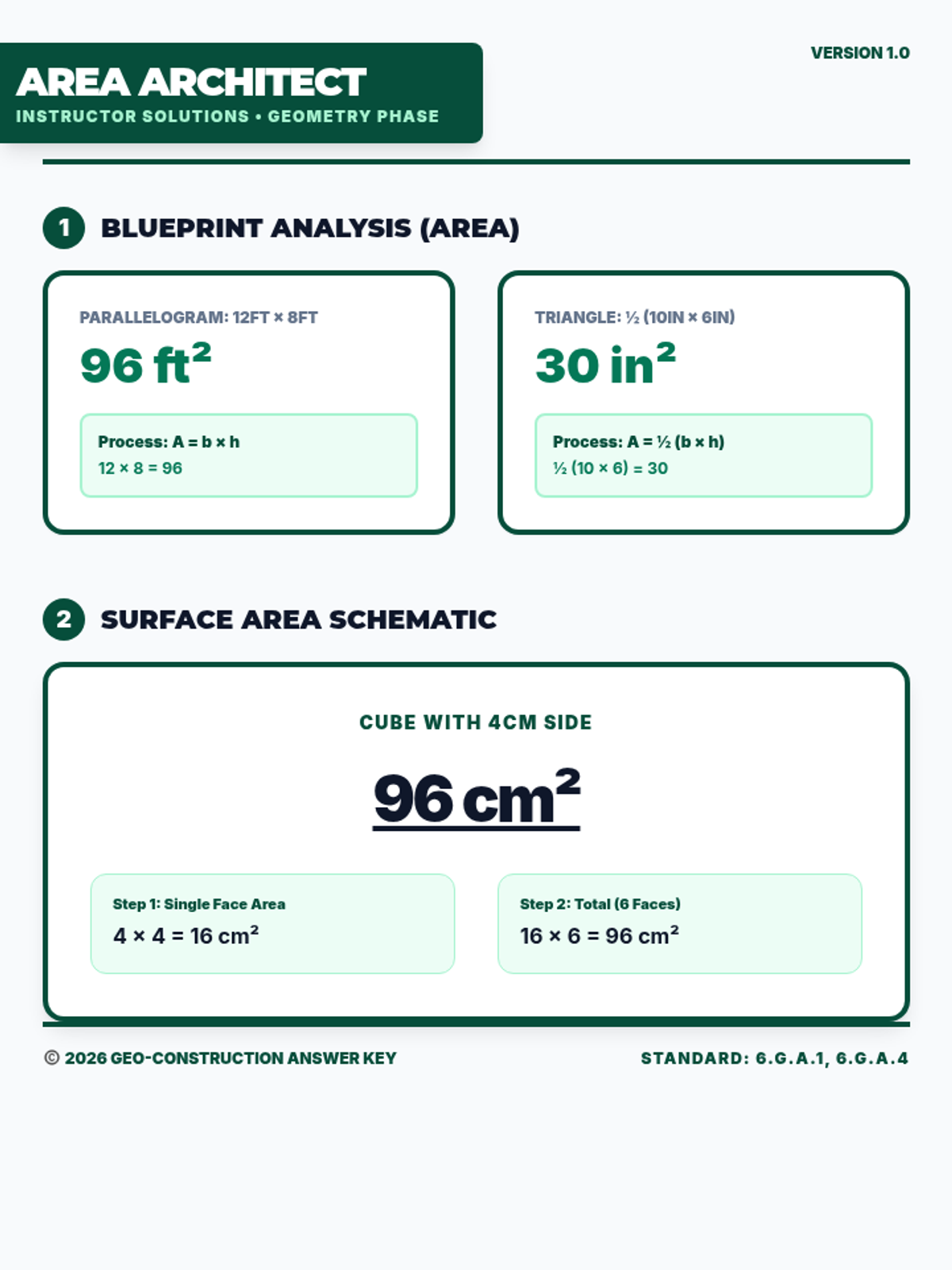
A targeted Tier 2 intervention lesson focusing on the relationship between 3D figures and their 2D nets. Students deconstruct real-world boxes to calculate surface area through face-by-face analysis and collaborative problem-solving.
A Tier 2 intervention lesson focused on hands-on exploration of 3D figures through nets, transitioning from folding physical models to calculating surface area in real-world contexts.
A lesson focused on calculating the area of composite rectilinear shapes by first determining a missing side length using the properties of rectangles.
Students will master calculating the area of rectangles with fractional and mixed number side lengths using tiling models and multiplication.
A focused lesson on calculating the area of a rectangle using fractional dimensions, emphasizing the requirement for step-by-step evidence in mathematical reasoning.
Una colección de evaluaciones interinas de sexto grado traducidas al español, cubriendo temas de historia y ciencias.
A hands-on geometry lesson where students apply area and perimeter concepts to design a functional and beautiful garden. Students calculate space for plants and fencing for various rectangular and composite garden beds.
A lesson focused on calculating the area of parallelograms and trapezoids through the lens of urban planning and city design. Students apply geometric formulas to real-world architectural shapes.
Cette leçon guide les élèves dans la conception d'une affiche publicitaire pour leur mini-entreprise, en se concentrant sur le passage du format A4 au format Raisin. Elle intègre des notions de français (titre, légendes) et de mathématiques (proportionnalité) dans un cadre professionnel immersif.
A Tier 2 intervention lesson focused on measuring and drawing angles using a protractor. Students explore benchmark angles (90, 180, 45) before progressing to more complex measurements through scaffolded practice and a collaborative partner activity.
A Tier 2 intervention lesson focusing on finding the area of triangles, quadrilaterals, and polygons by composing and decomposing shapes. Students use geoboards, hands-on cutting, and scaffolded blueprints to master area concepts.
A Tier 2 intervention lesson focusing on decomposing composite shapes into rectangles and triangles to find total area, using a blueprint and tangram-inspired approach.
A comprehensive introduction to reflection and symmetry, focusing on identifying lines of symmetry, performing reflections on a grid, and recognizing symmetry in nature and design.
A simplified introduction to geometric rotations on a coordinate plane, breaking down complex coordinate rules into manageable steps with visual supports and physical investigation.
A cumulative assessment and synthesis lesson where students generate patterns, create coordinates, and graph their findings to solve a 'hidden map' mystery.
Students connect plotted points to visualize the linear relationship and use sentence stems to describe how one pattern relates to the other.
Guided practice in plotting points on a coordinate grid, using the 'walk before you climb' mnemonic to ensure correct directional movement.
Introduces the coordinate plane structure, specifically the X-axis, Y-axis, and origin, through the lens of a map navigation system.
Focuses on the transition from horizontal tables to ordered pair notation, emphasizing the relationship between the first and second numerical patterns.
Students will learn to identify corresponding terms in two numerical patterns and organize them into structured tables using color-coded scaffolding.
A comprehensive review of computational fluency with decimals and rational number concepts.