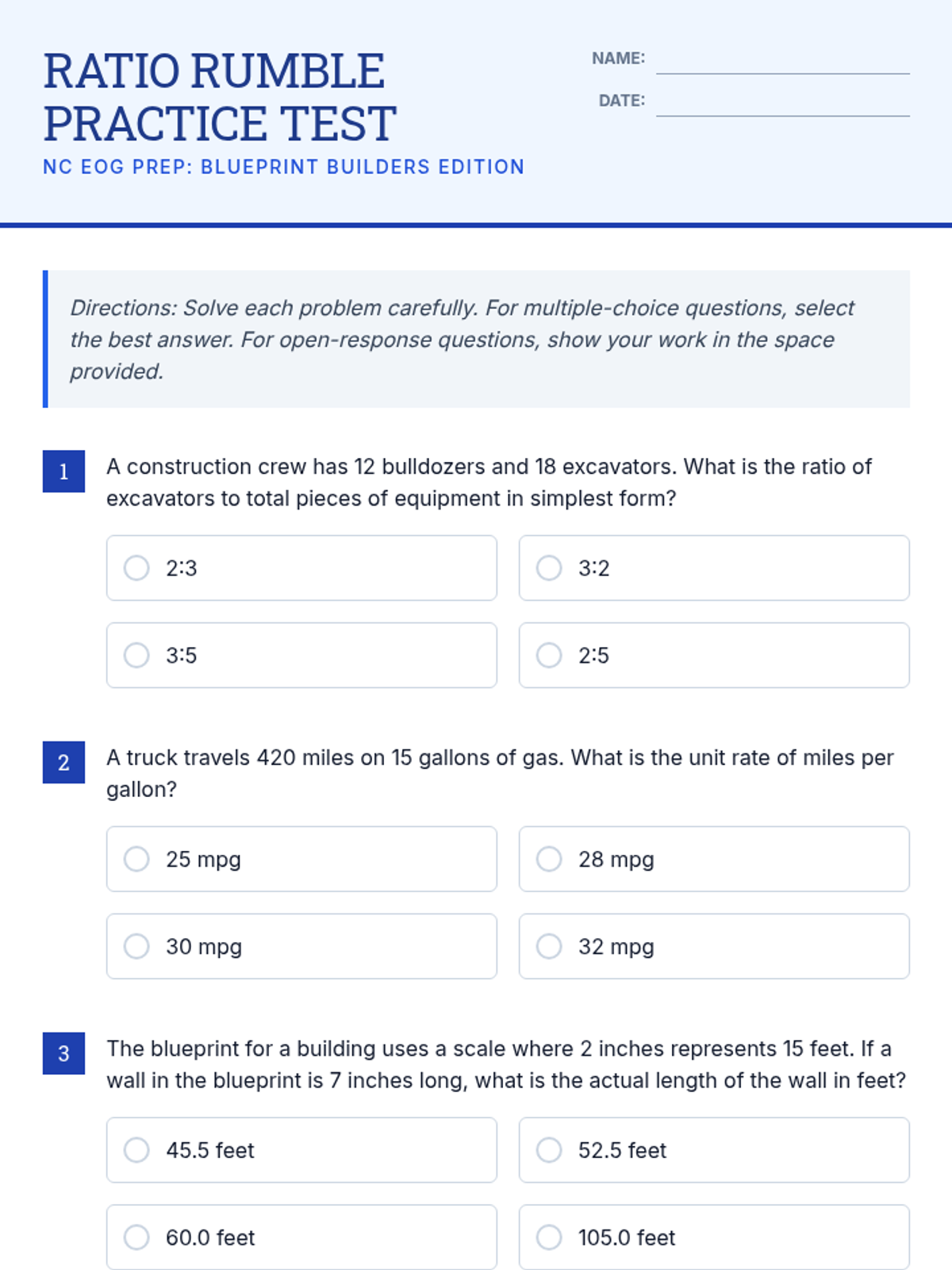
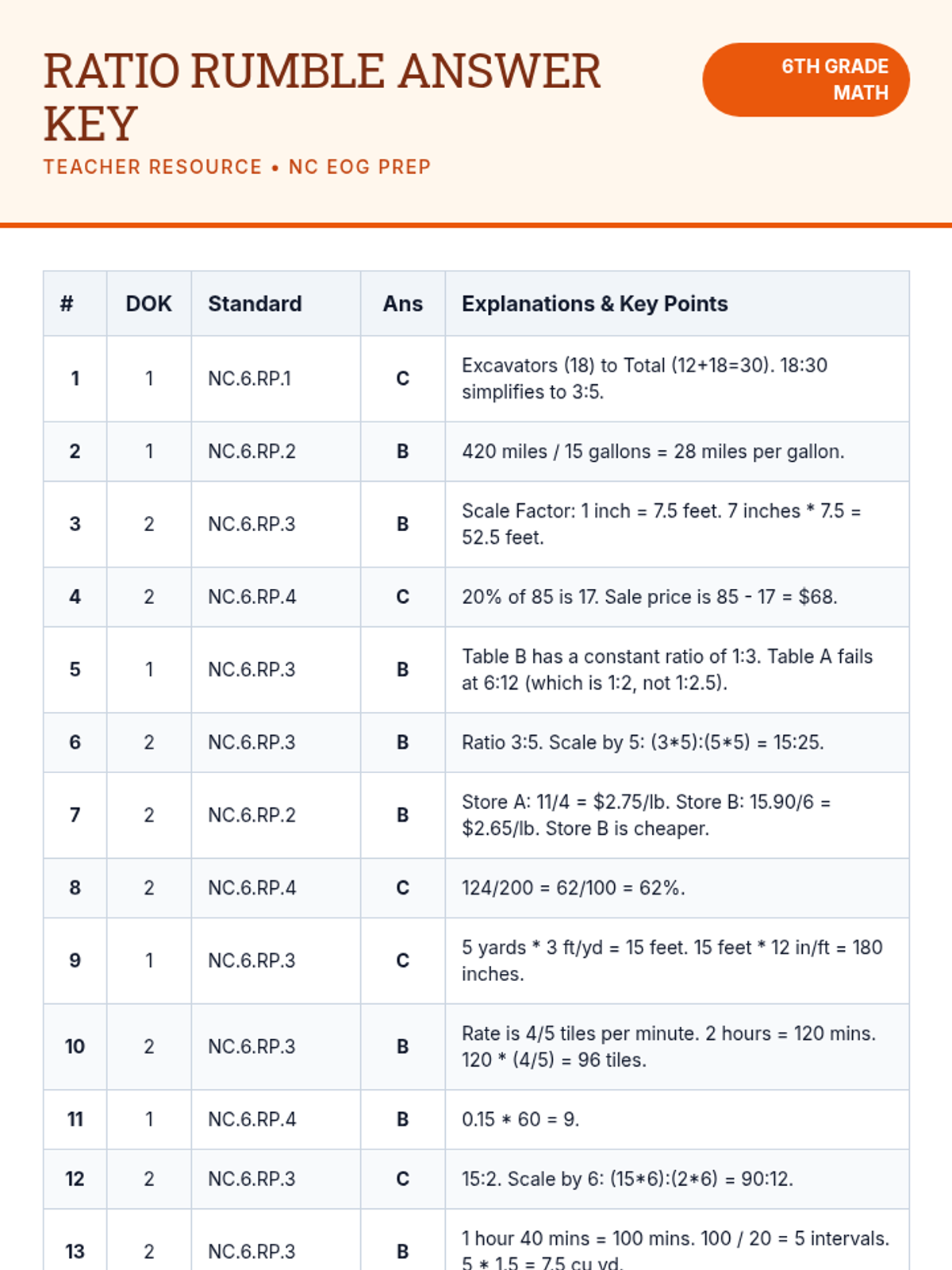
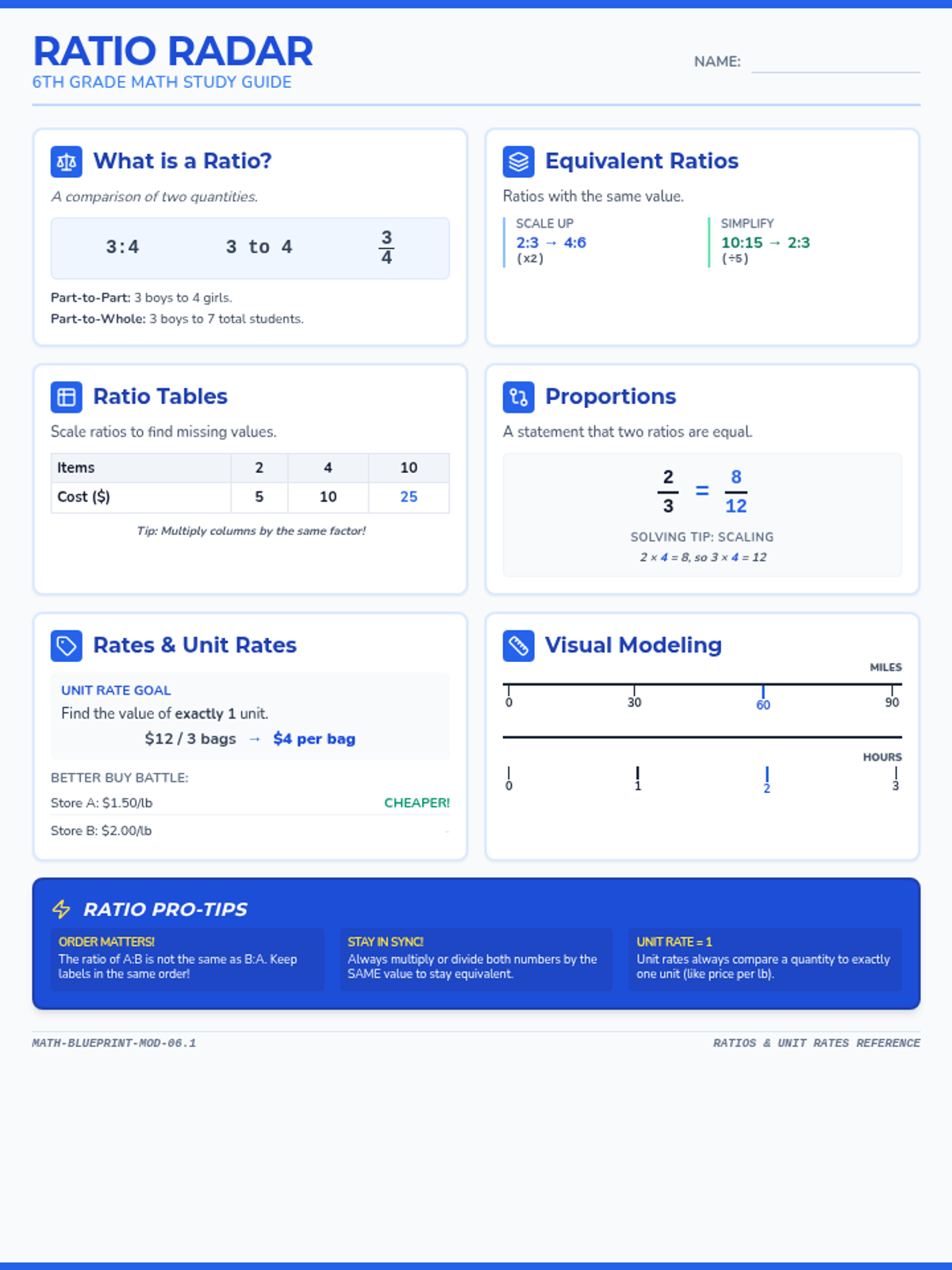
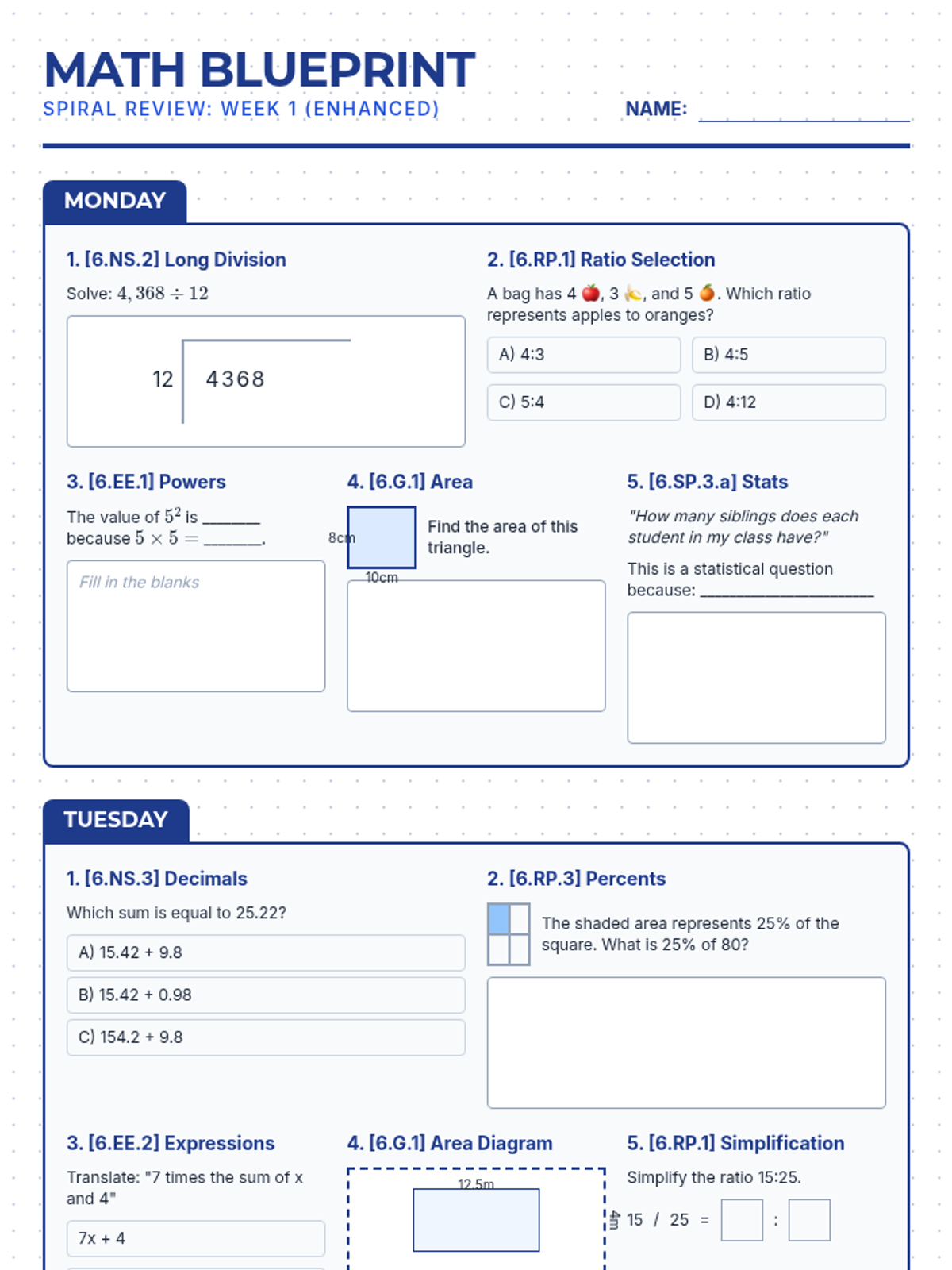
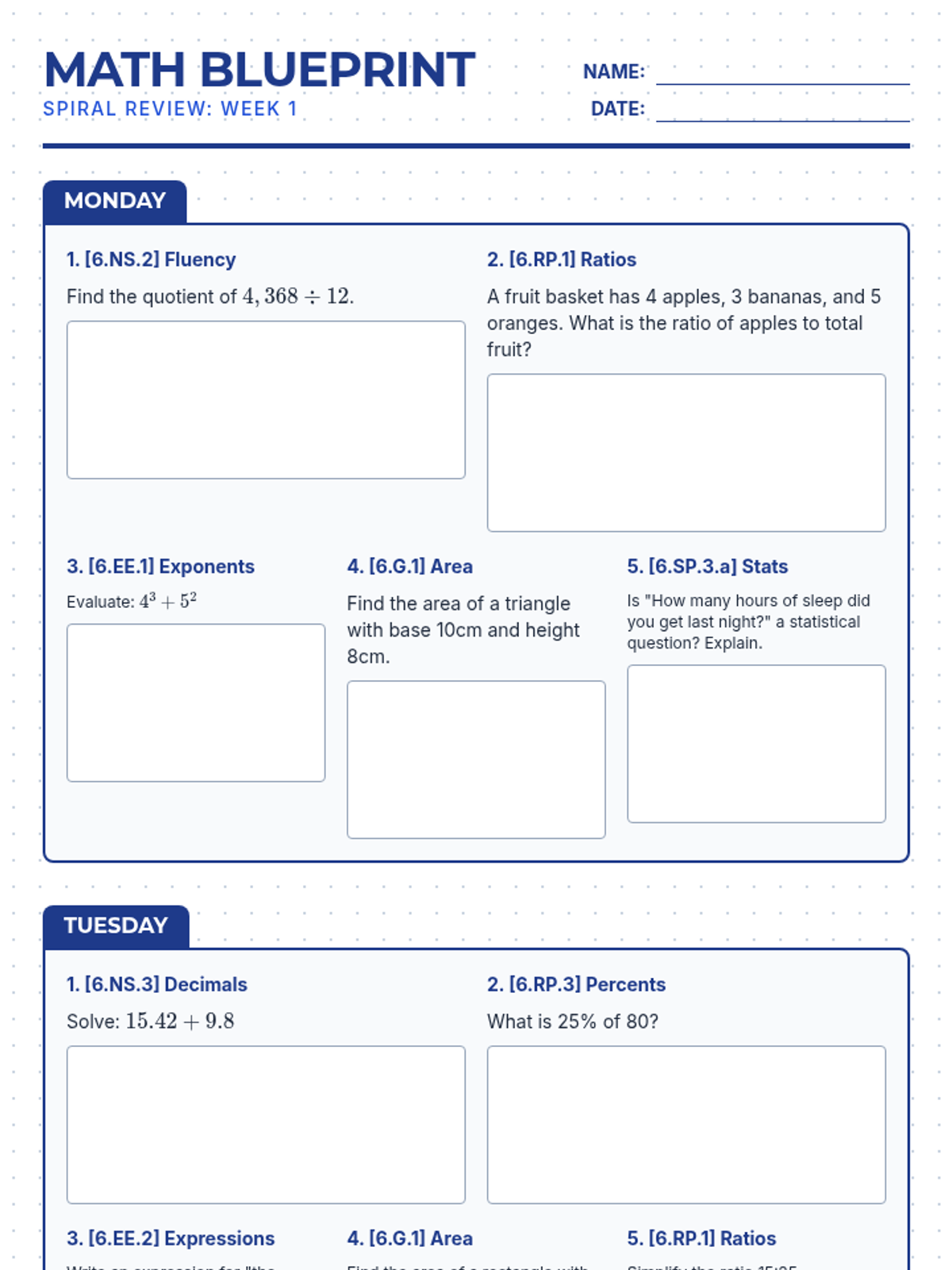
Comparisons of quantities using unit rates and proportional reasoning. Connects tables, graphs, and equations to represent constant rates of change.
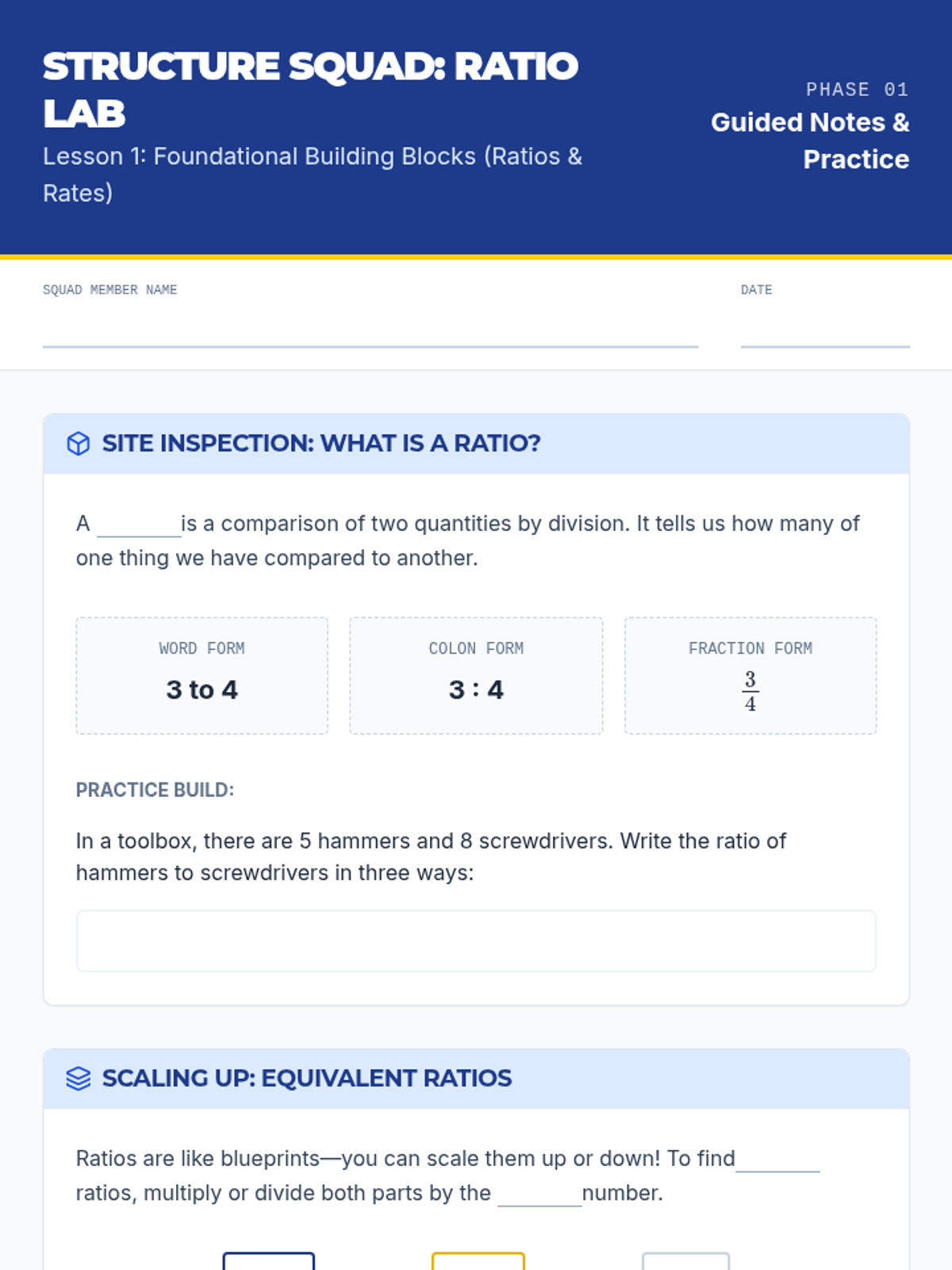
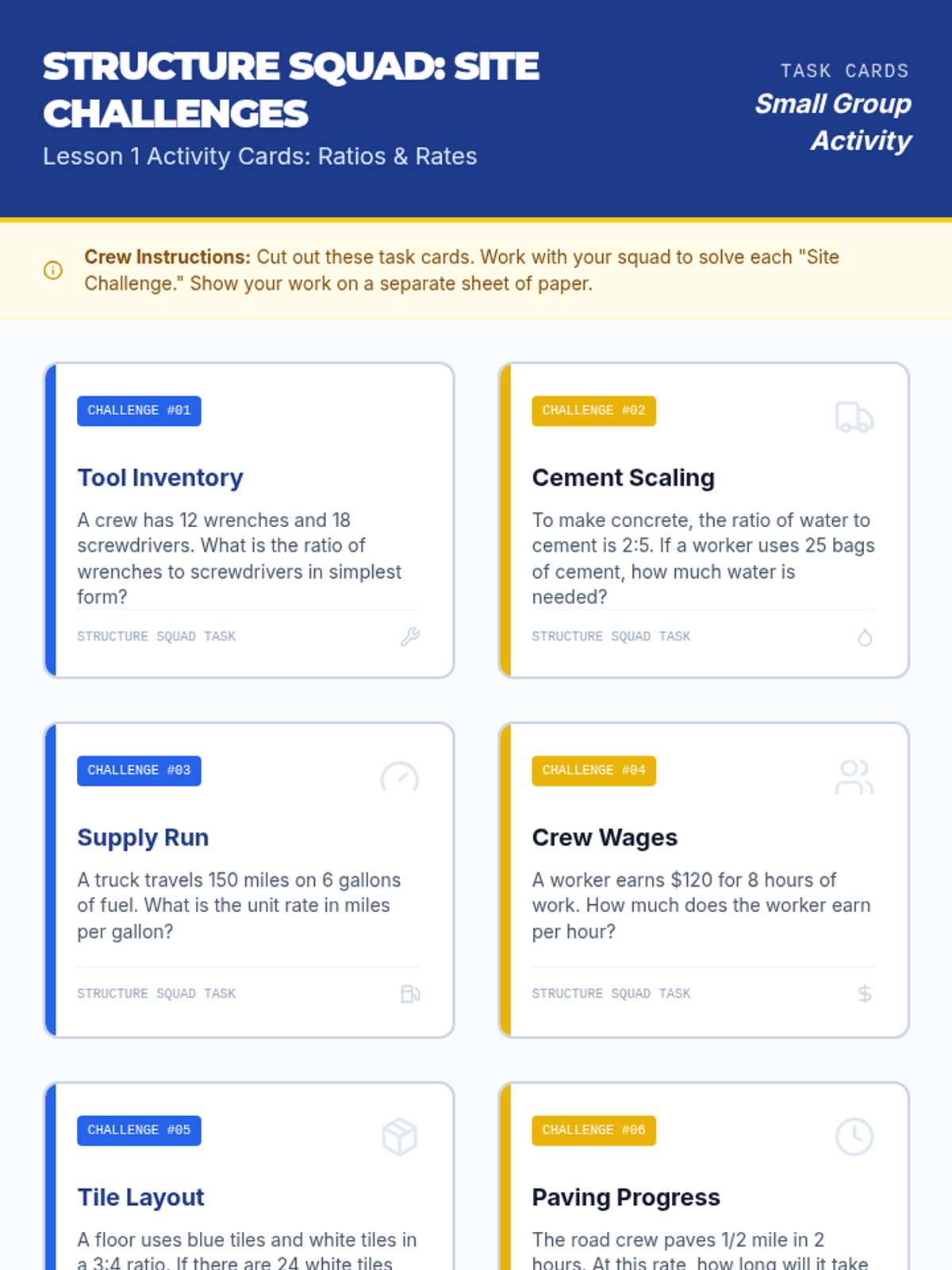
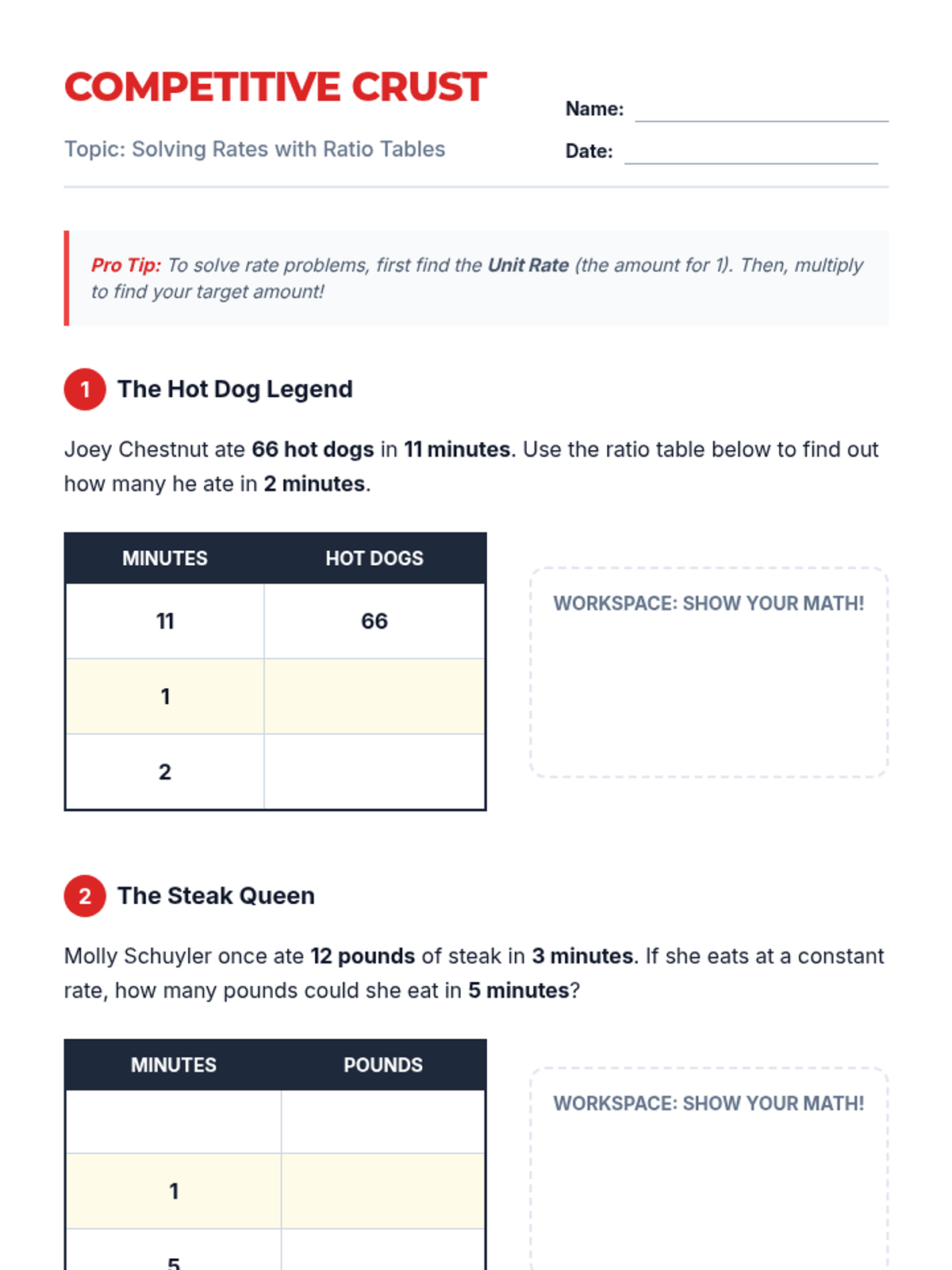
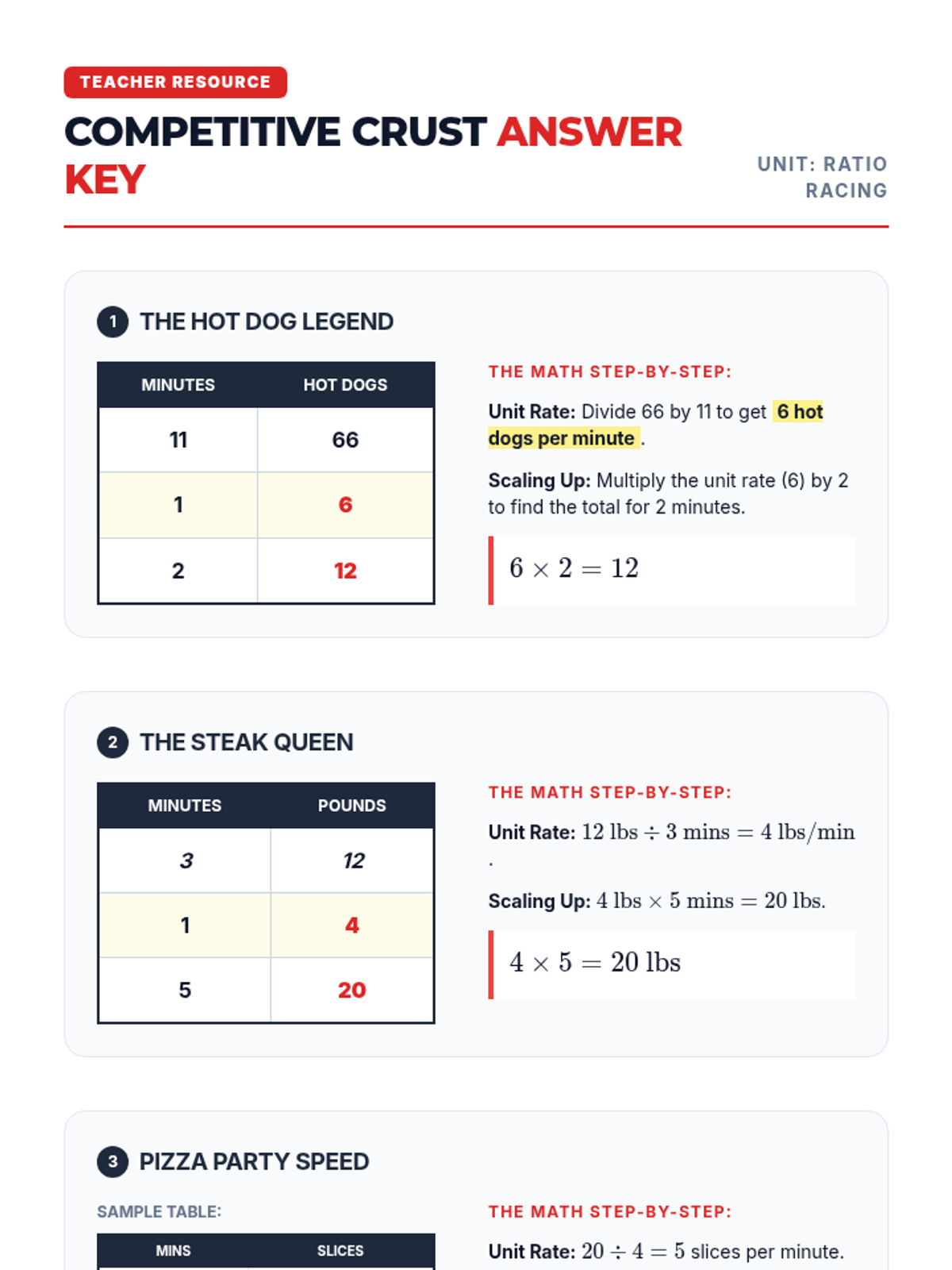
A unit exploring ratios, rates, and unit rates through engaging real-world scenarios and visual modeling techniques like ratio tables and double number lines.
A math unit focused on ratios and rates, using engaging real-world scenarios to teach students how to organize and manipulate proportional data.
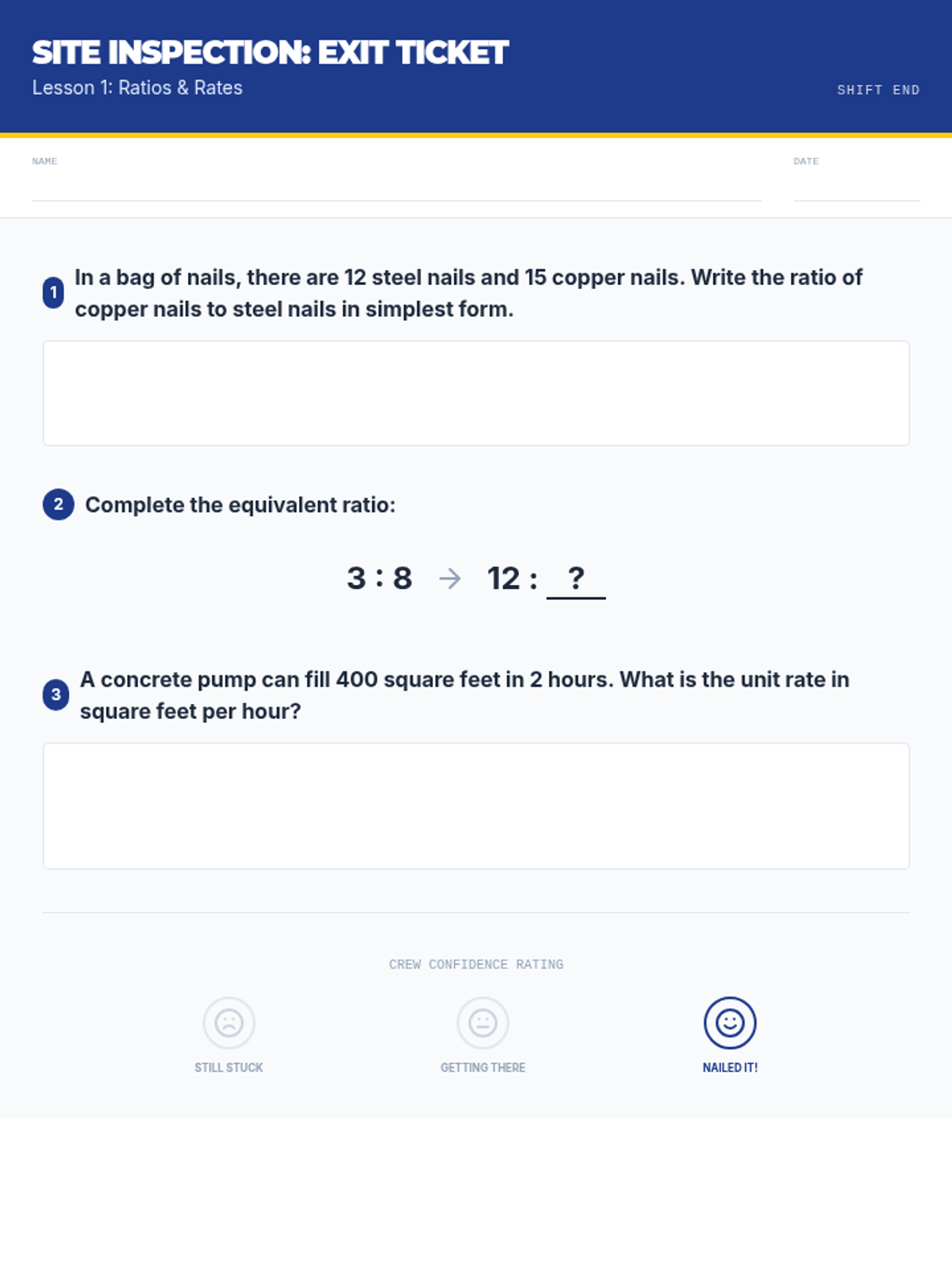
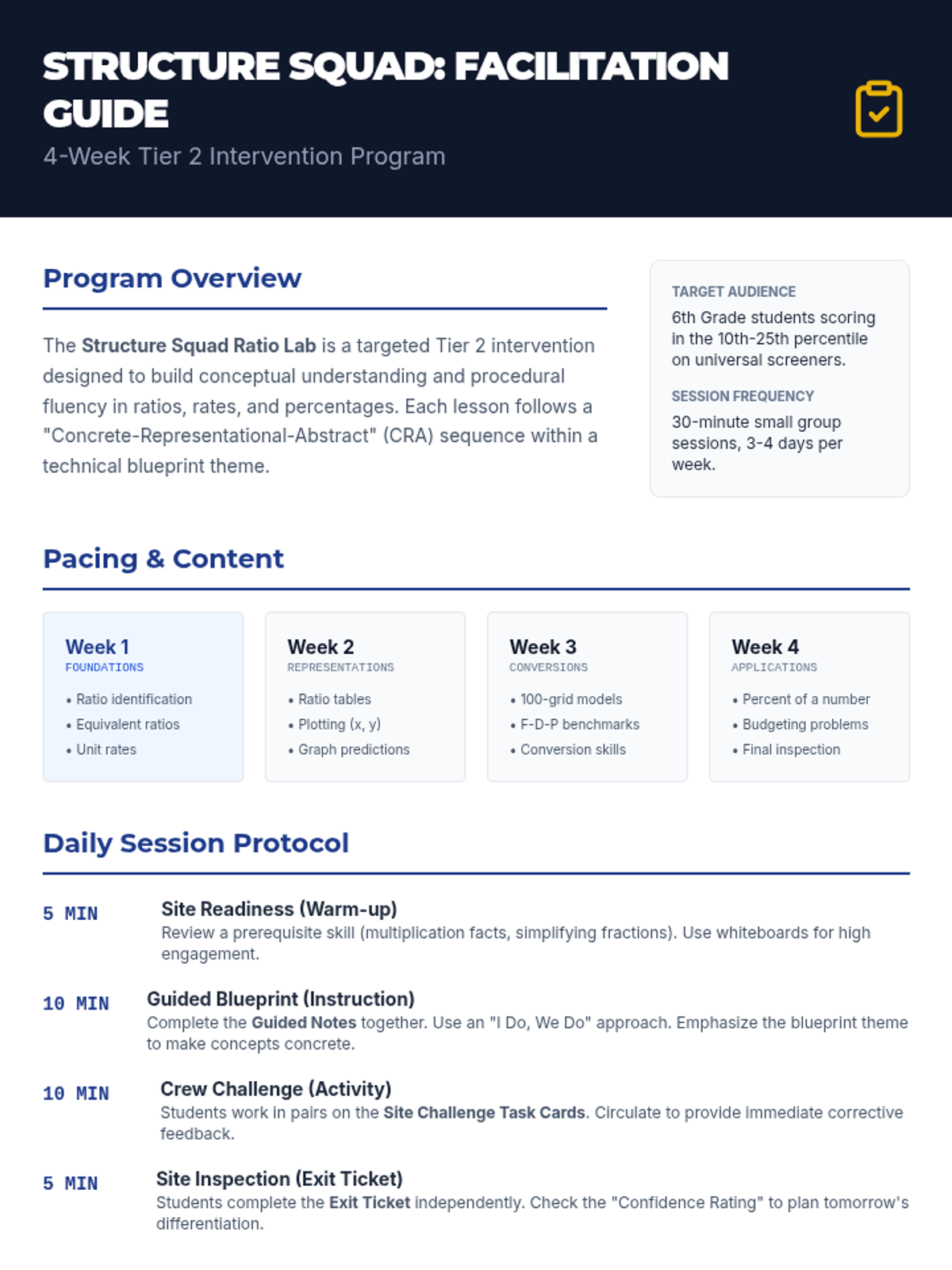
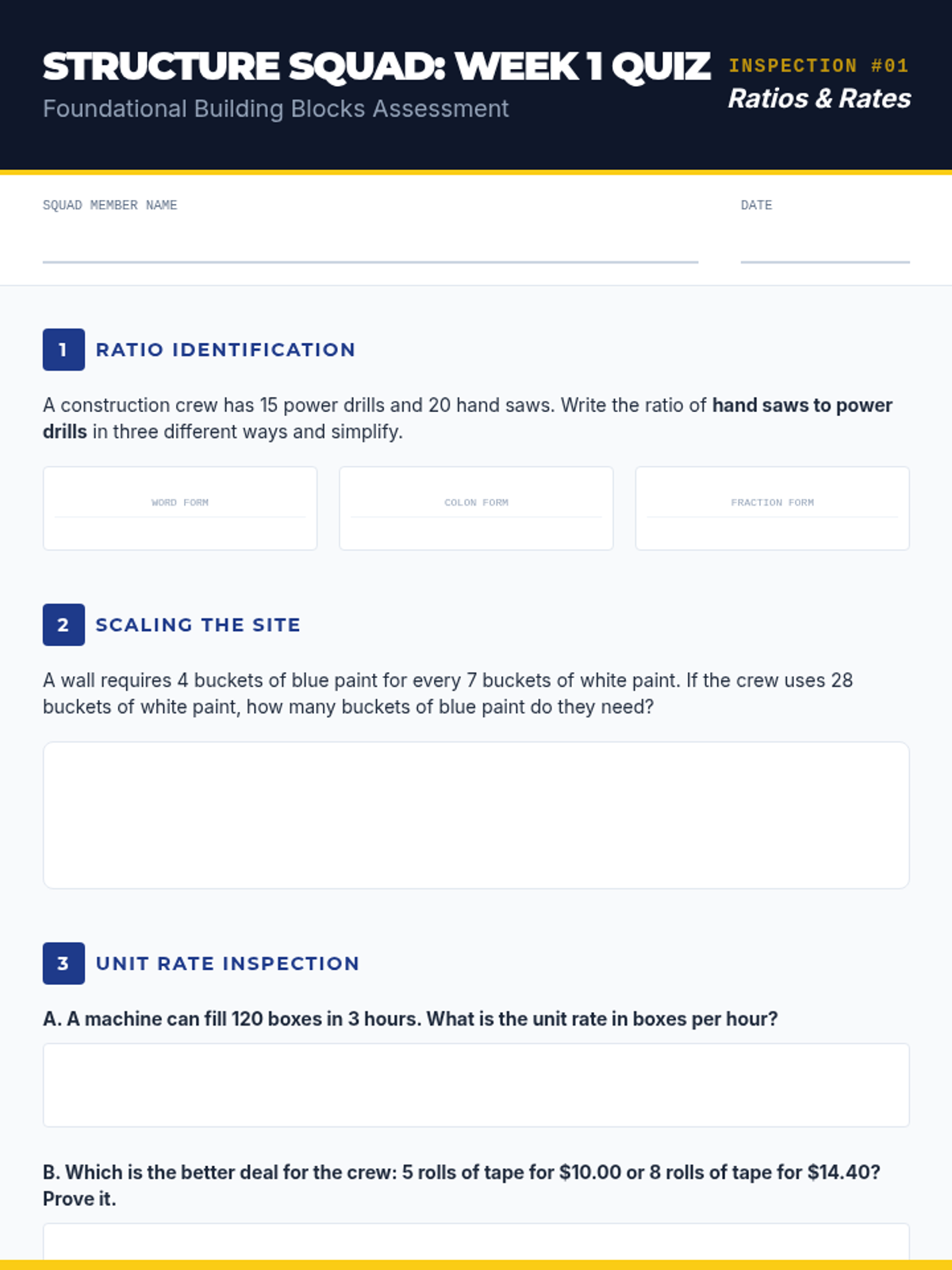
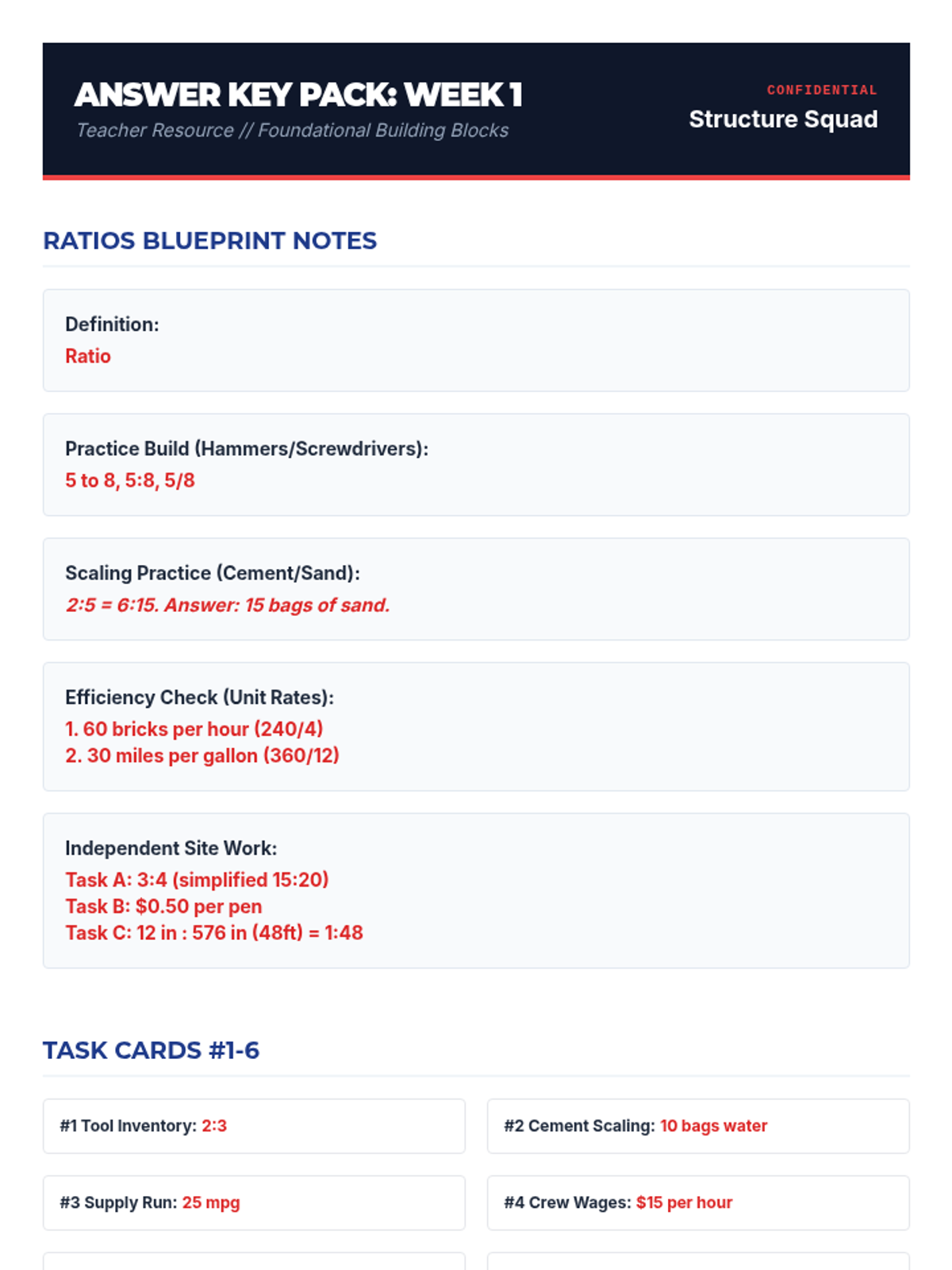
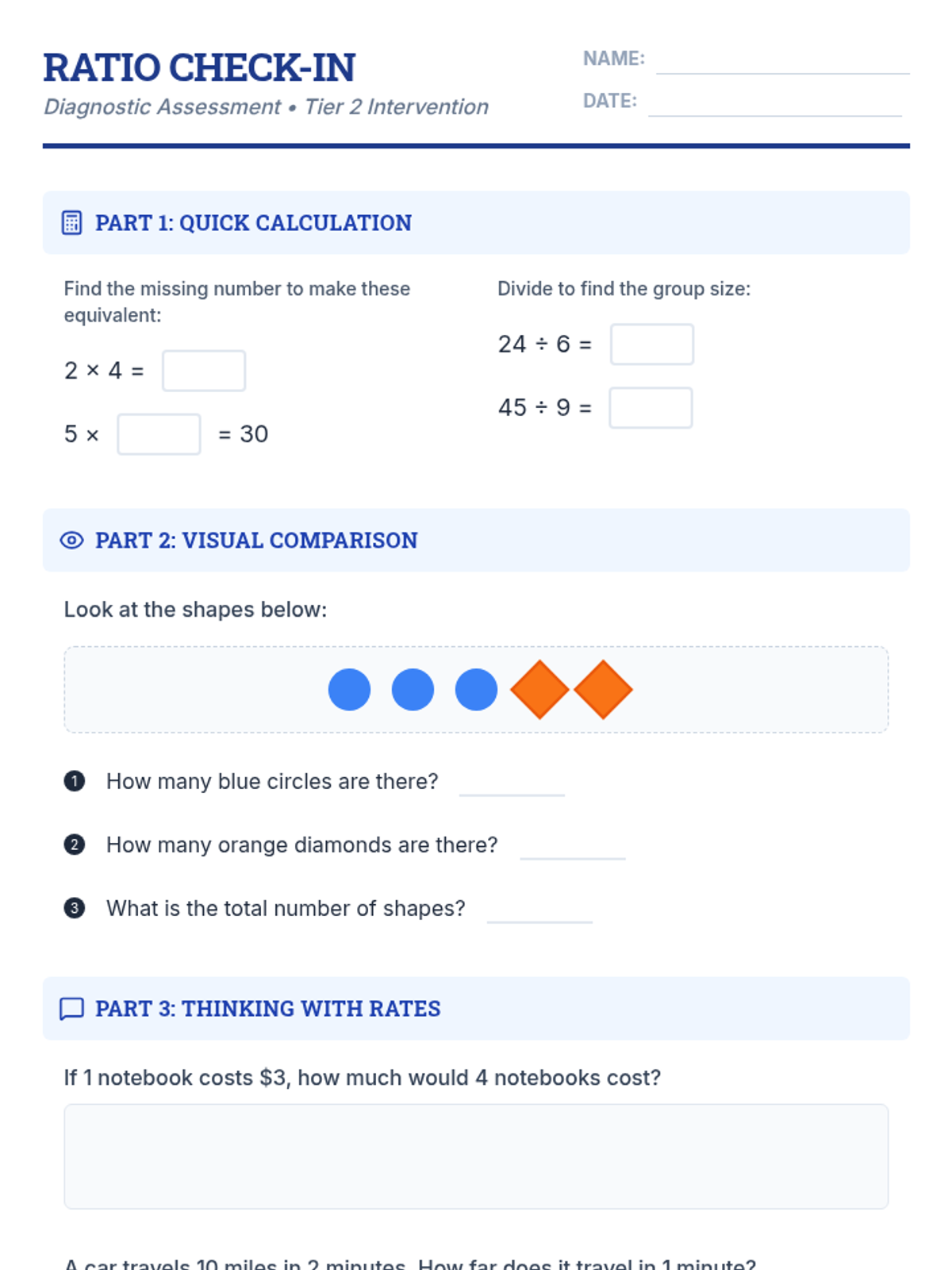
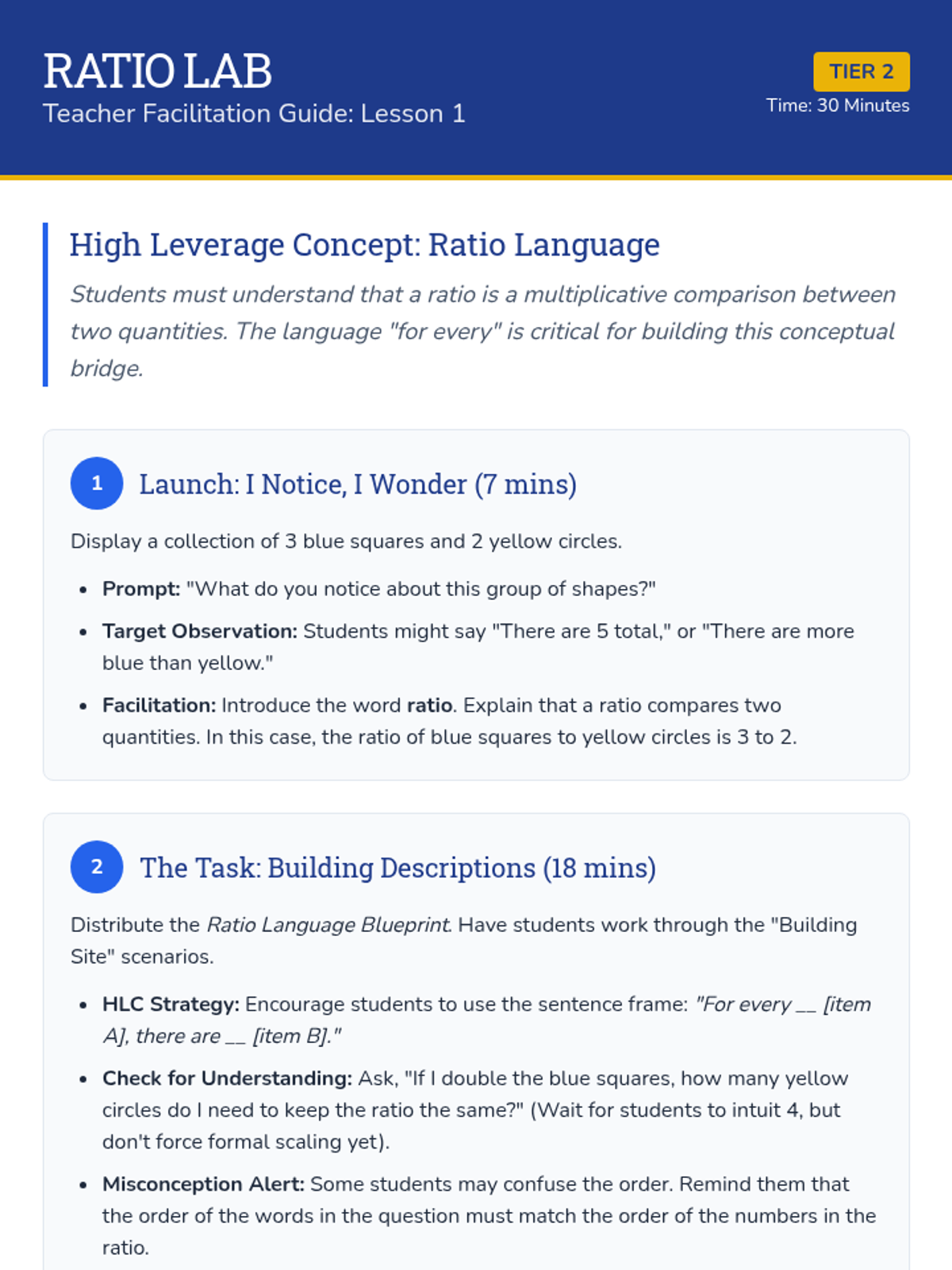
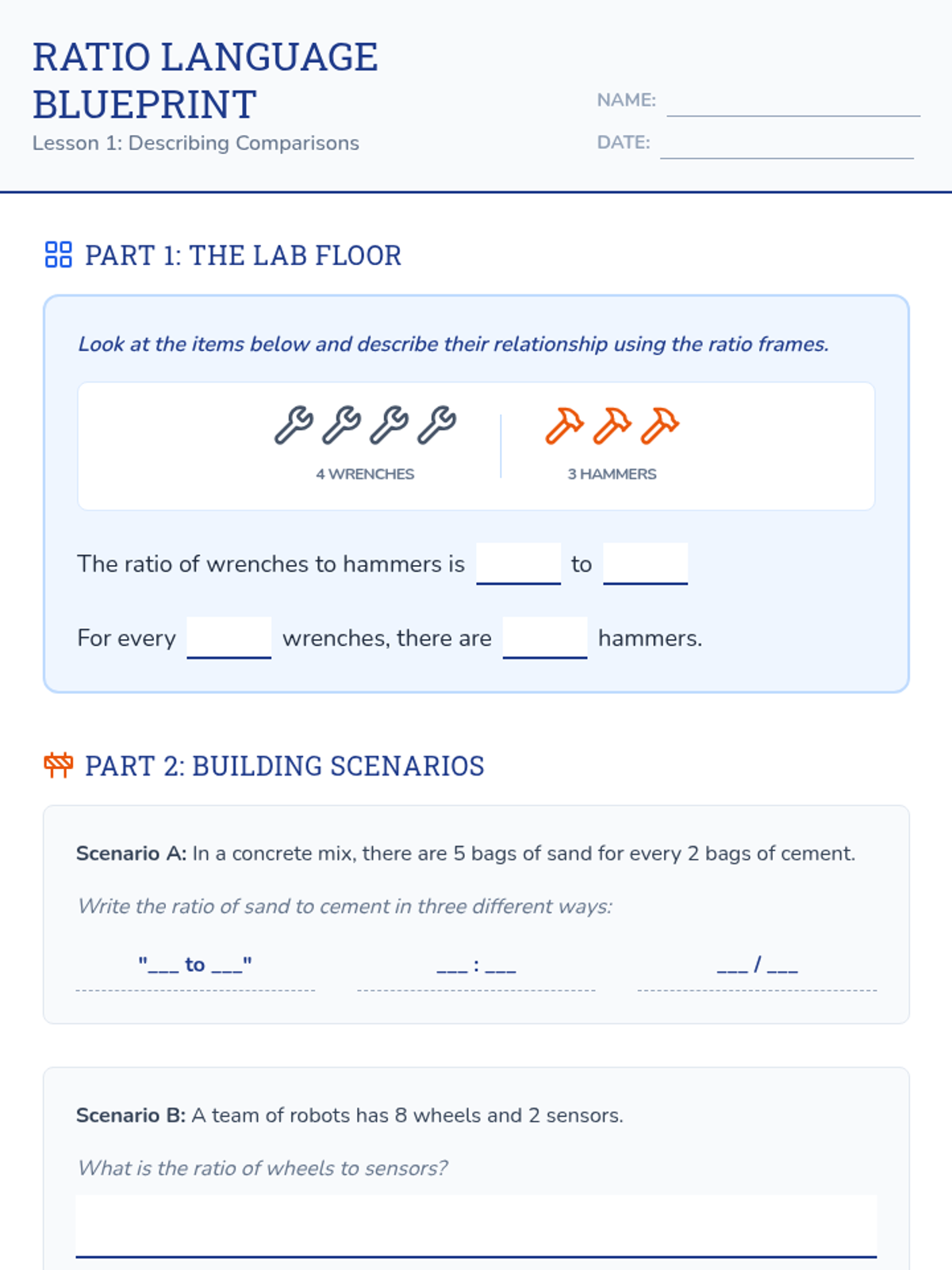
A comprehensive Tier 2 intervention sequence focused on building conceptual understanding of ratios, unit rates, and percents through visual models and real-world applications for 6th-grade students.
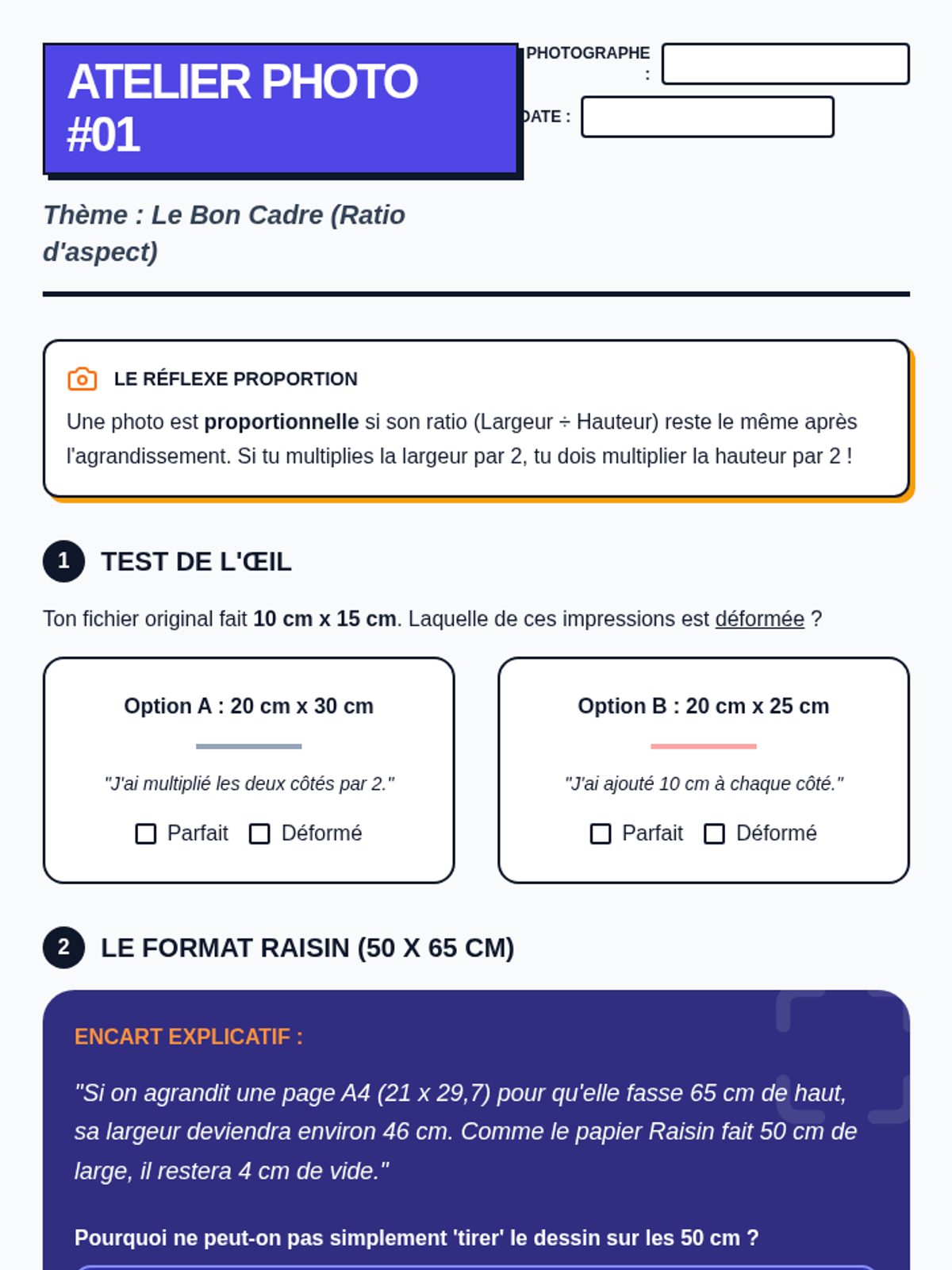
Une série de micro-leçons de 10 minutes centrée sur l'optimisation de l'espace papier. Les élèves apprennent à mettre à l'échelle une mise en page de 6 photos (format A4) vers le format Raisin (50x65 cm) en minimisant les chutes.
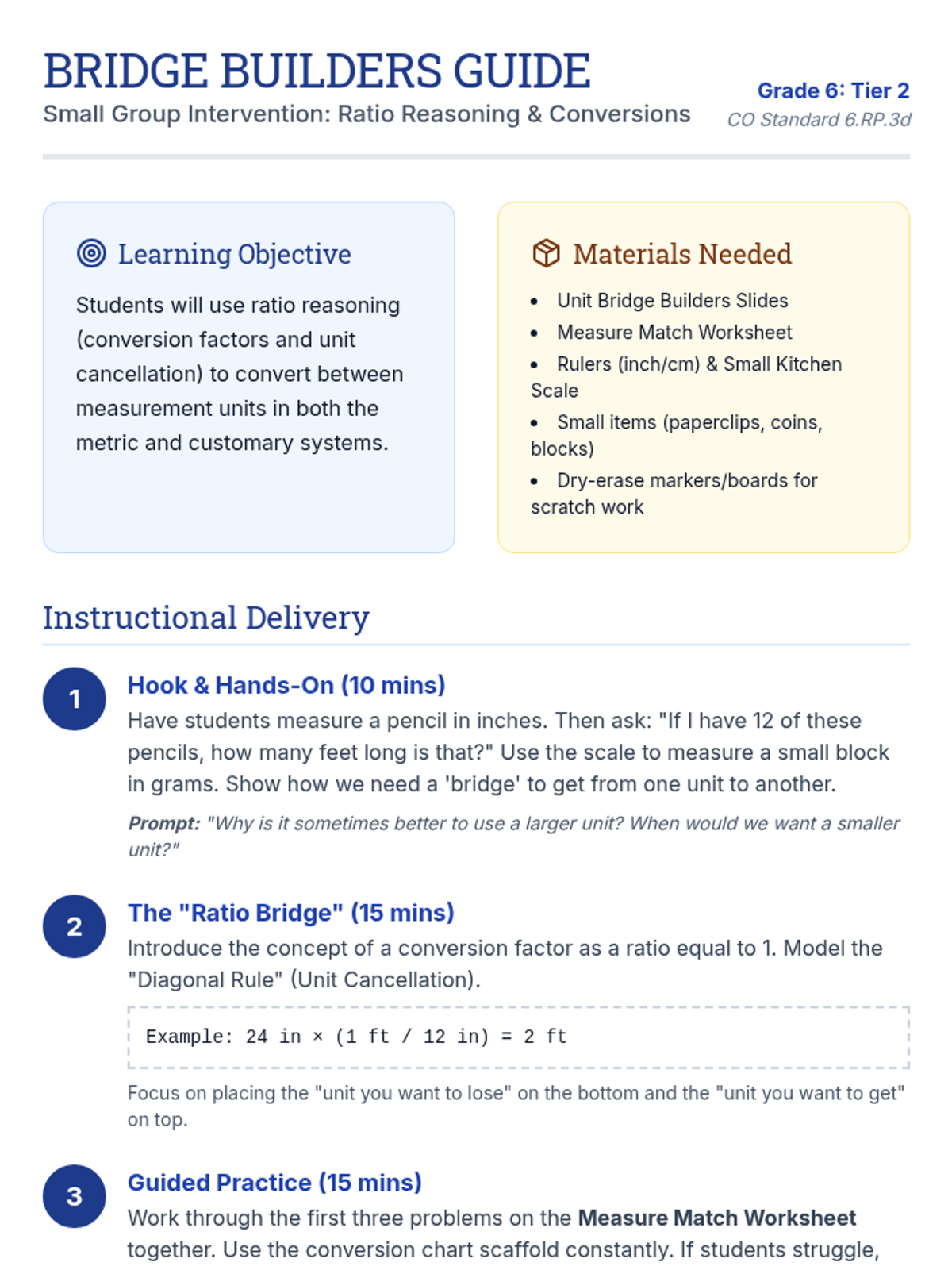
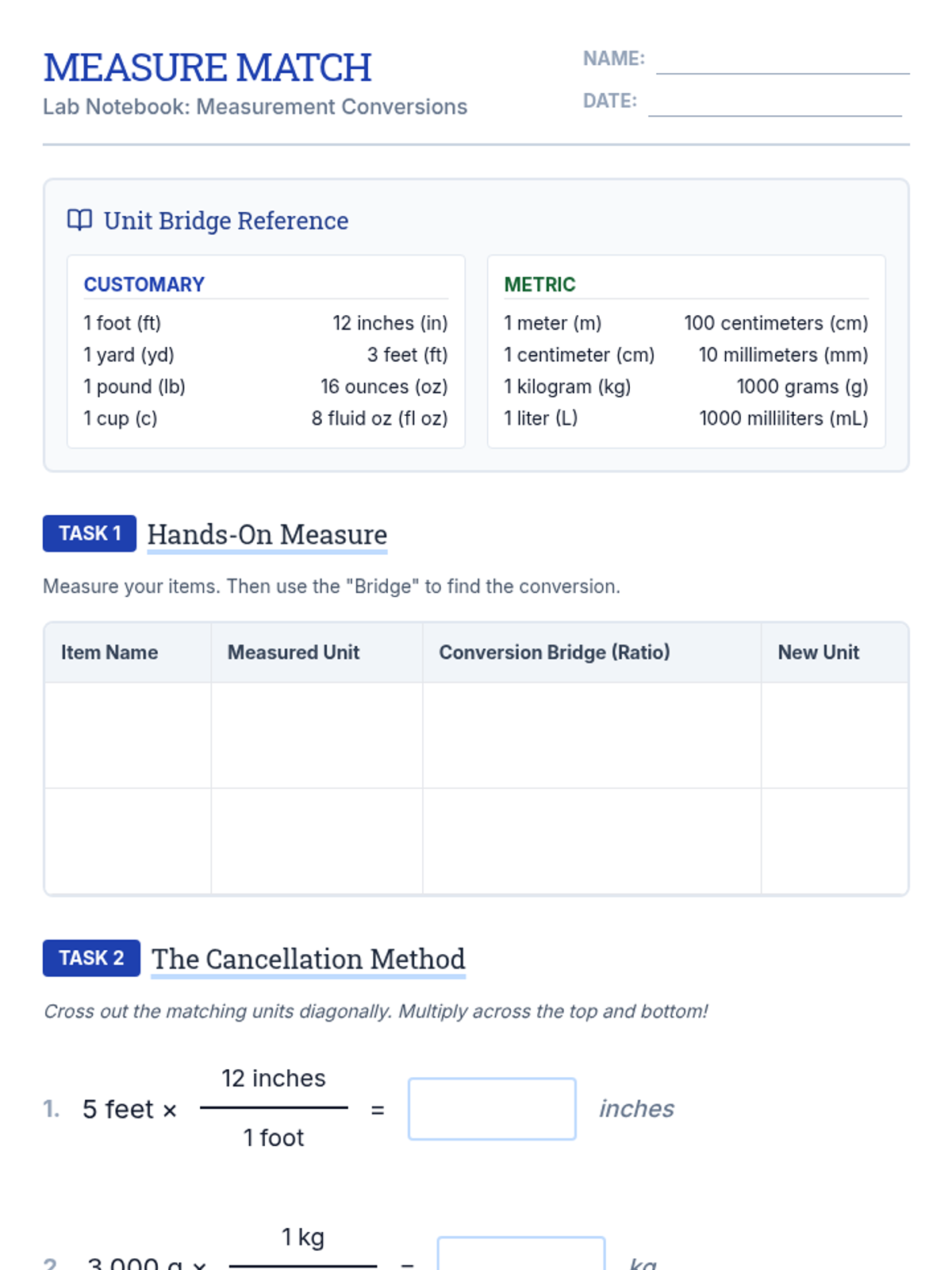
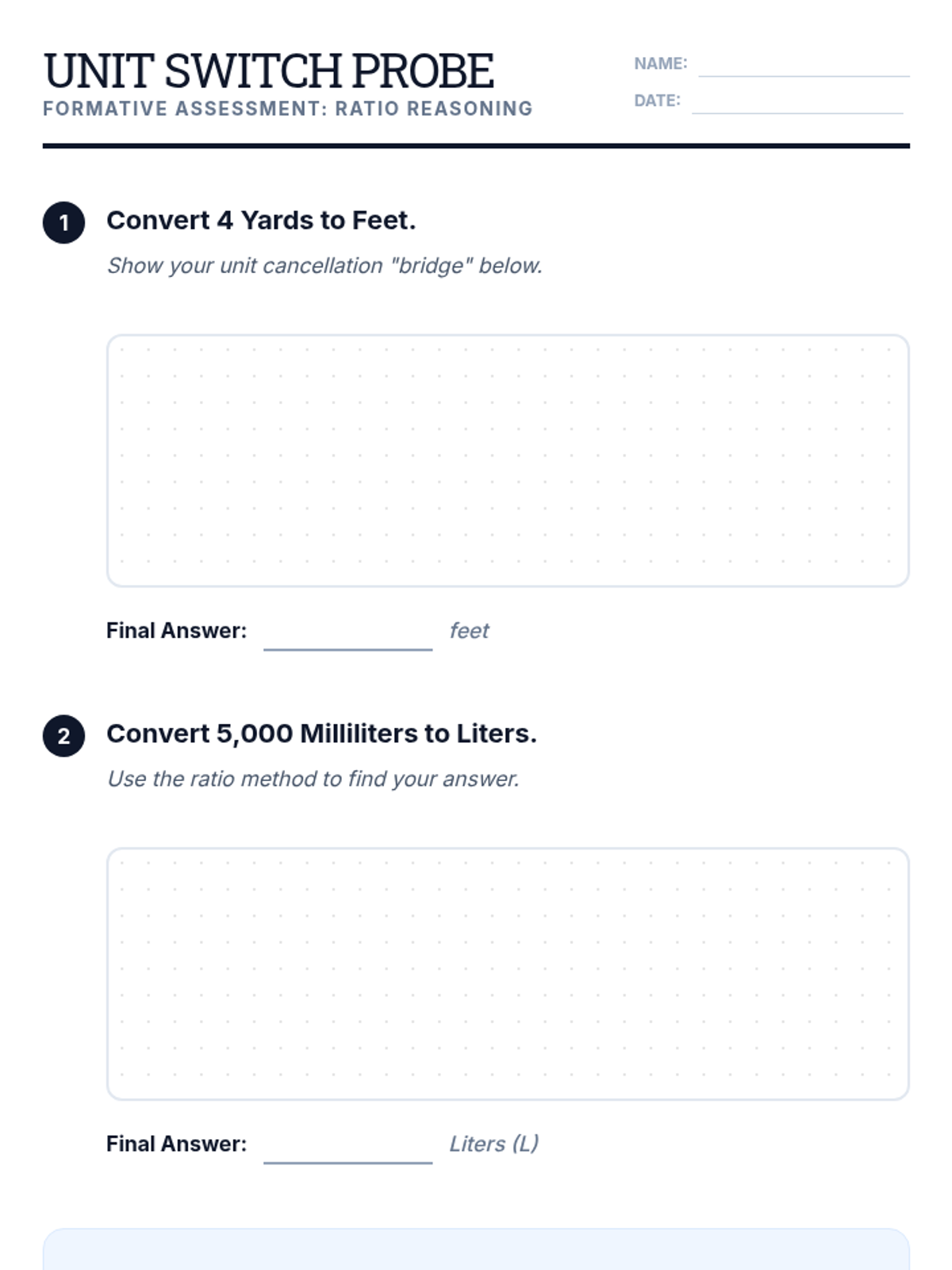
A targeted intervention sequence focusing on helping students master measurement conversions through ratio reasoning and unit cancellation.
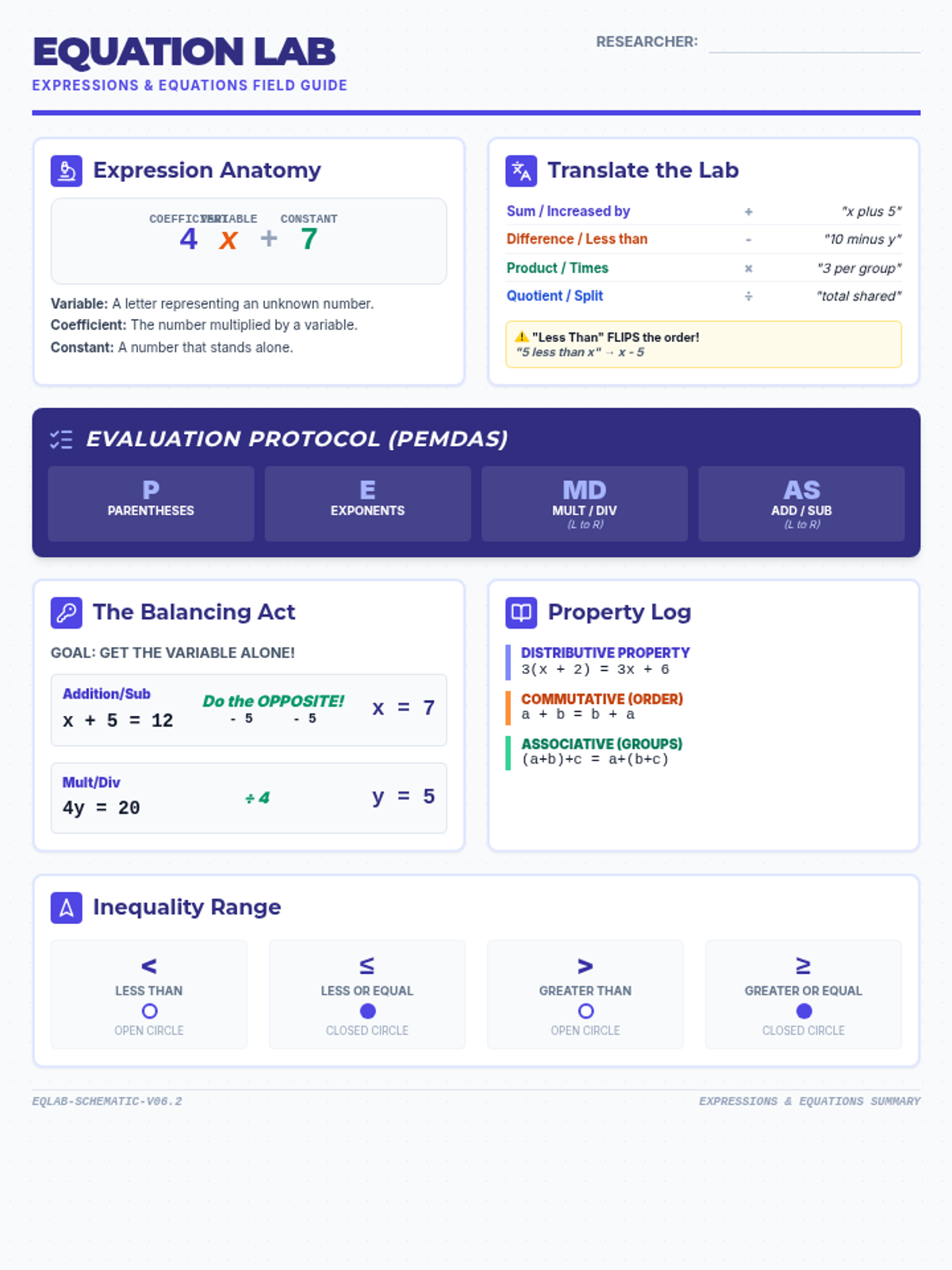
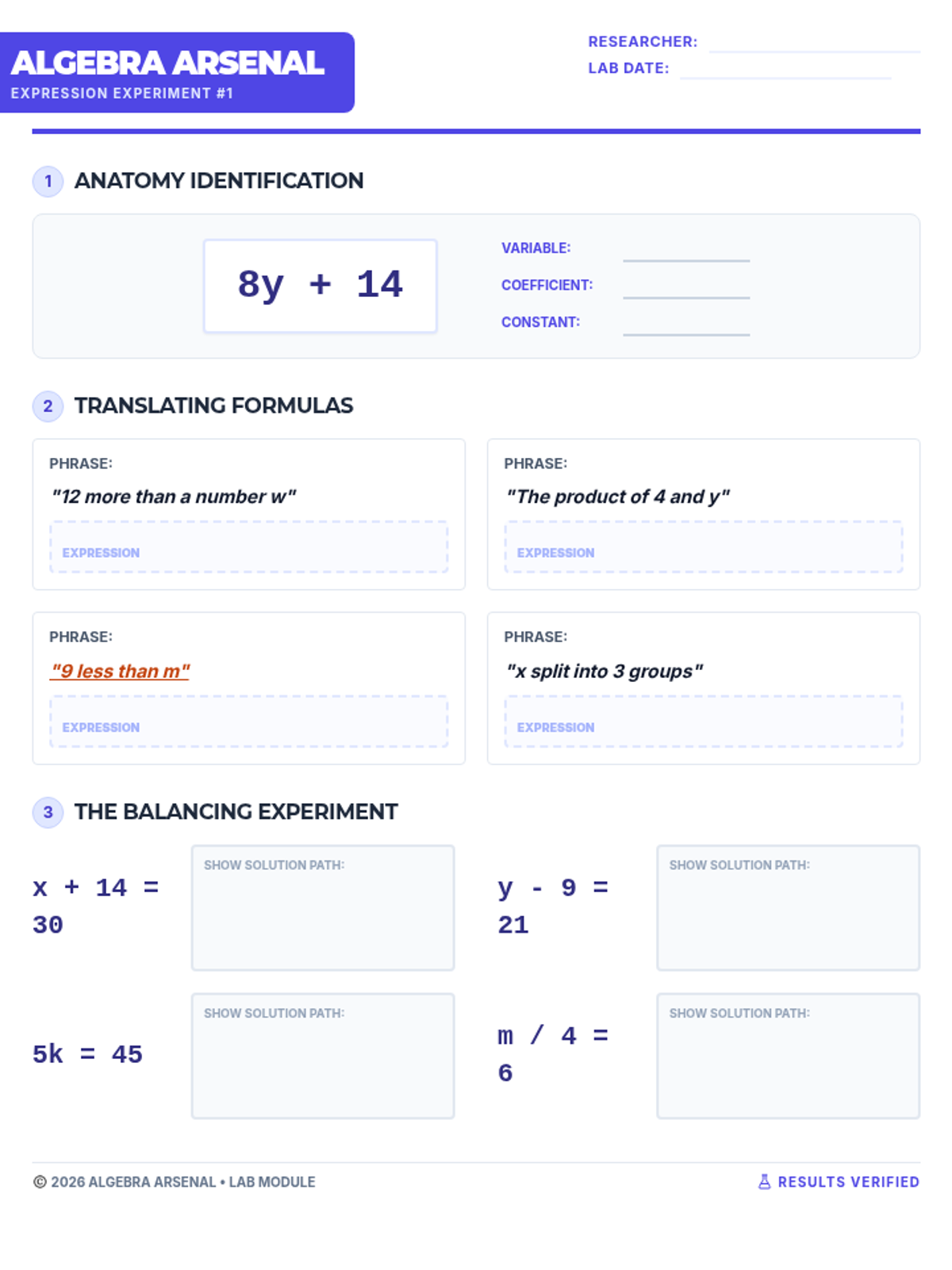
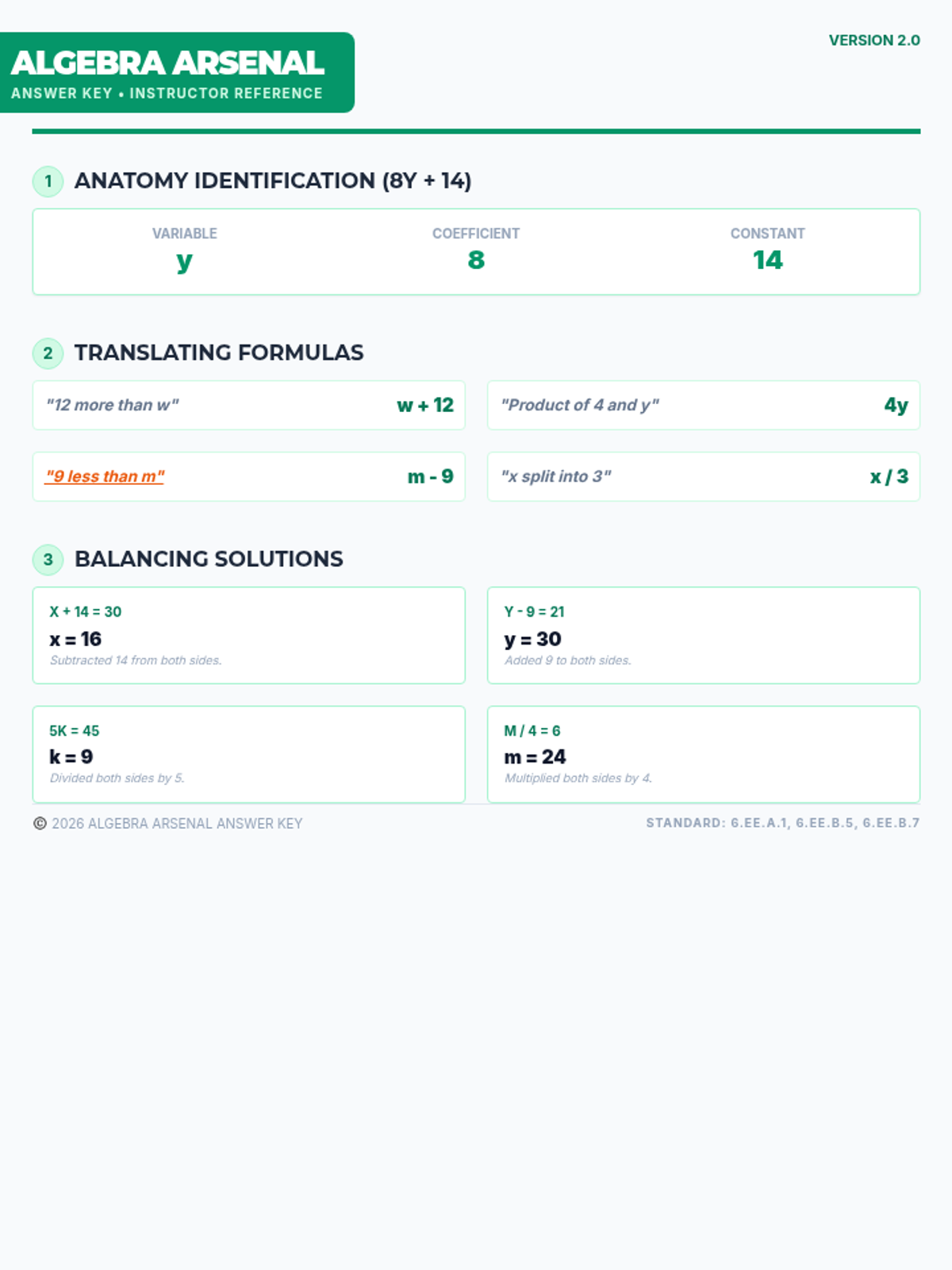
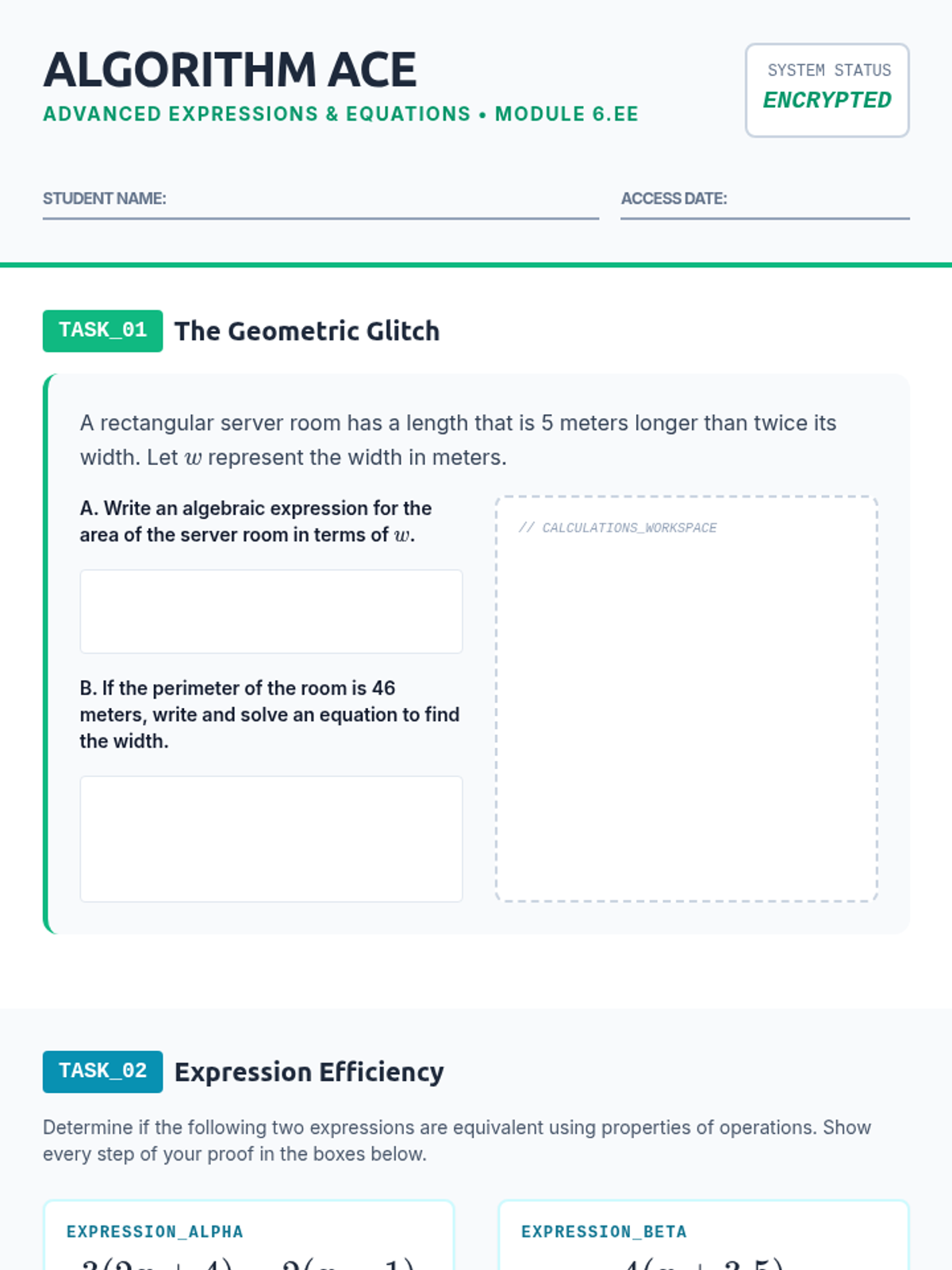
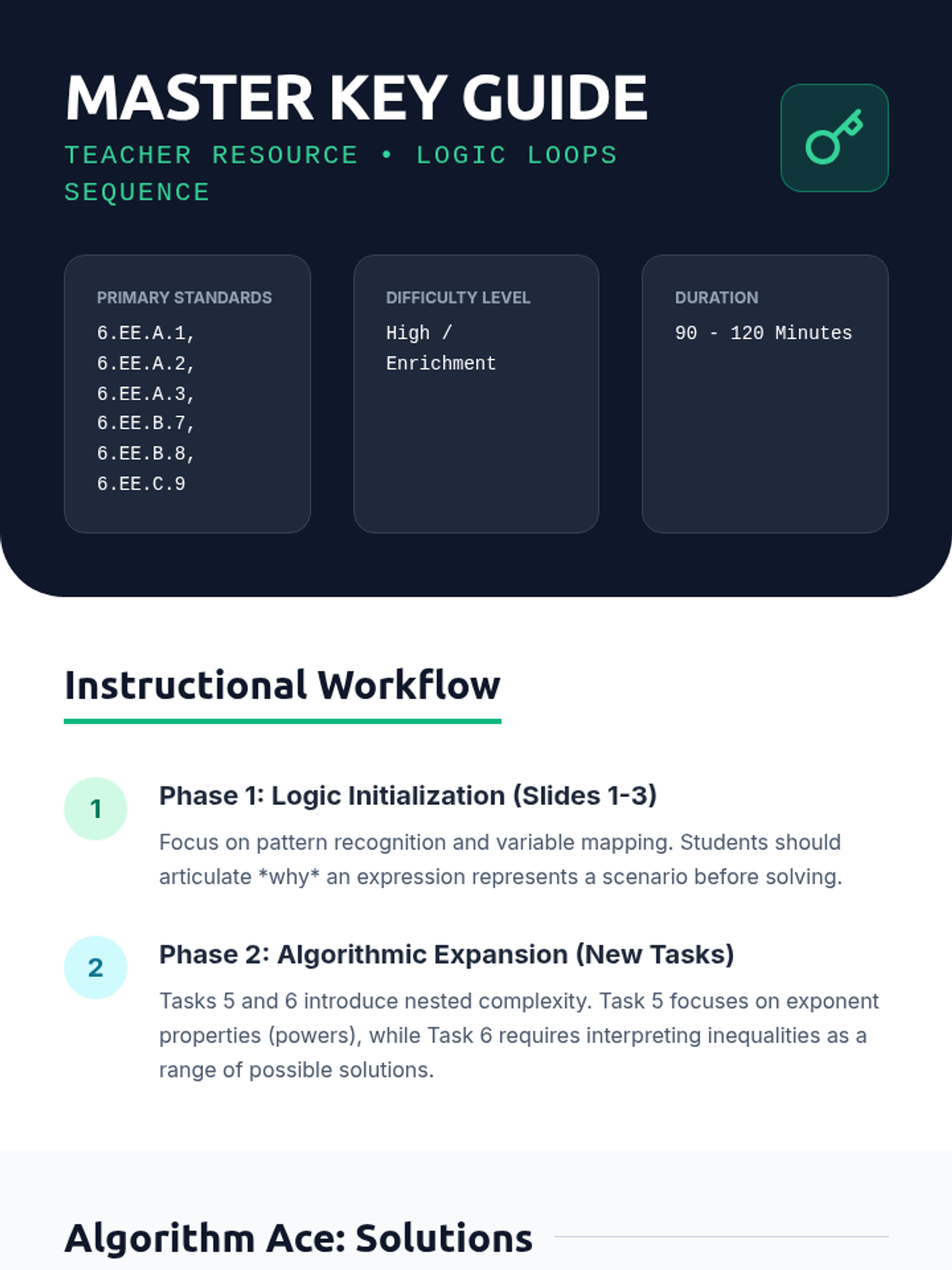
A series of high-level enrichment activities for 6th-grade students to master expressions and equations through logic puzzles and real-world modeling.
A comprehensive 12-lesson Tier 2 intervention sequence focused on 6th-grade ratio and proportion standards. Using High Leverage Concept strategies from the All Learners Network, this sequence moves from basic ratio language to complex unit rate and percent problems using visual models like tape diagrams and ratio tables.
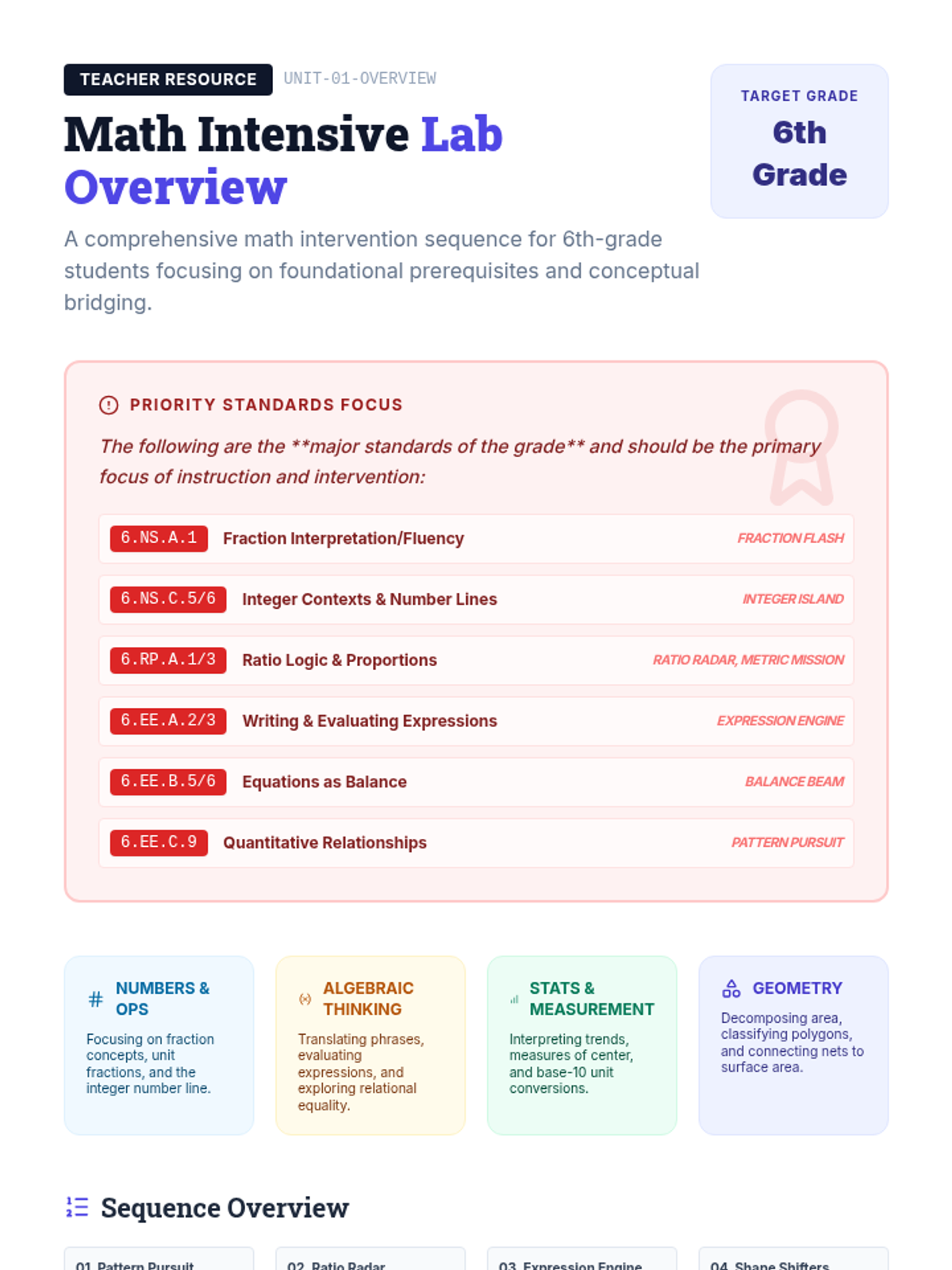
A comprehensive math intervention sequence for 6th-grade students, focusing on four key domains: Numbers & Operations, Algebraic Thinking, Measurement & Data, and Geometry. This sequence uses high-leverage strategies from the All Learners Network (ALN) and aligns with i-Ready prerequisite modules to bridge conceptual gaps.
A unit focused on applying percentages to real-world financial contexts, including discounts, markups, and interest.
This sequence guides students from conceptual modeling of fraction division to applying the standard algorithm with mixed numbers in complex geometric and real-world contexts. Students will explore the 'why' behind the reciprocal before mastering the 'how' and applying it to find missing dimensions and unit rates.
This financial literacy sequence for 6th-grade students focuses on consumer skills, specifically unit pricing, discount evaluation, brand comparison, and hidden costs. Students apply mathematical strategies to real-world shopping scenarios, culminating in a comprehensive grocery store simulation.
A comprehensive 6th-grade math sequence focusing on the transition from ratio tables to linear equations. Students explore constant rates, coordinate graphing, the constant of proportionality, and algebraic modeling through real-world scenarios like snack pricing and ride-share algorithms.
A 6th-grade geometry unit exploring real-world applications of volume, capacity, and logistical optimization. Students solve problems involving liquid conversion, material efficiency, filling rates, and cost estimation through a logistics lens.
This sequence explores the practical applications of geometry through the lens of volume and capacity. Students investigate how space is measured in cubic units versus liquid units, solve real-world engineering problems involving aquariums and flow rates, and use displacement to find the volume of irregular objects.
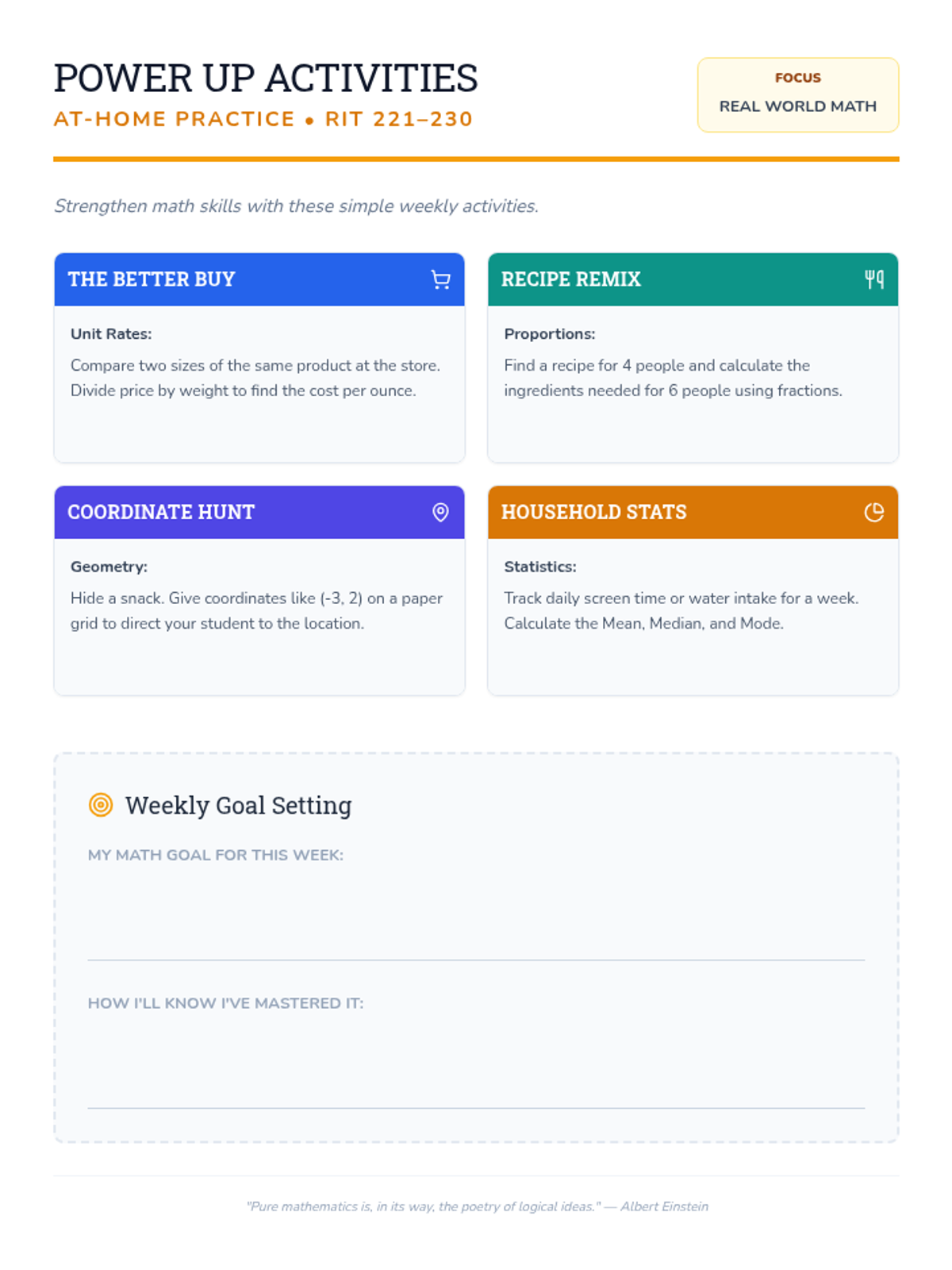
A 5-day intervention sequence for 6th-grade students to master foundational concepts of rates and percentages through daily 10-minute 'power-up' activities.
Students launch a mock catering company to explore ratios, equivalent ratios, unit rates, and proportional relationships through the lens of scaling recipes and calculating costs.
Students master dimensional analysis to convert between U.S. Customary and Metric systems through an international logistics simulation. They apply these skills to length, mass, volume, and complex rates to solve real-world shipping and travel problems.
A simulation-based unit where students act as logistics coordinators to master measurement conversions between customary and metric systems using ratio reasoning and dimensional analysis.
This project-based sequence guides students through the practical application of unit rates in financial and physical contexts. Students calculate basic unit prices, solve complex fraction rates, and analyze constant speed through graphing, culminating in a consumer analysis project.
A comprehensive 6th-grade math sequence on unit rates, taking students from conceptual understanding with visual models to real-world applications in shopping, travel, and budgeting. Students will master calculating 'the cost of one' and 'miles per hour' to make informed decisions.
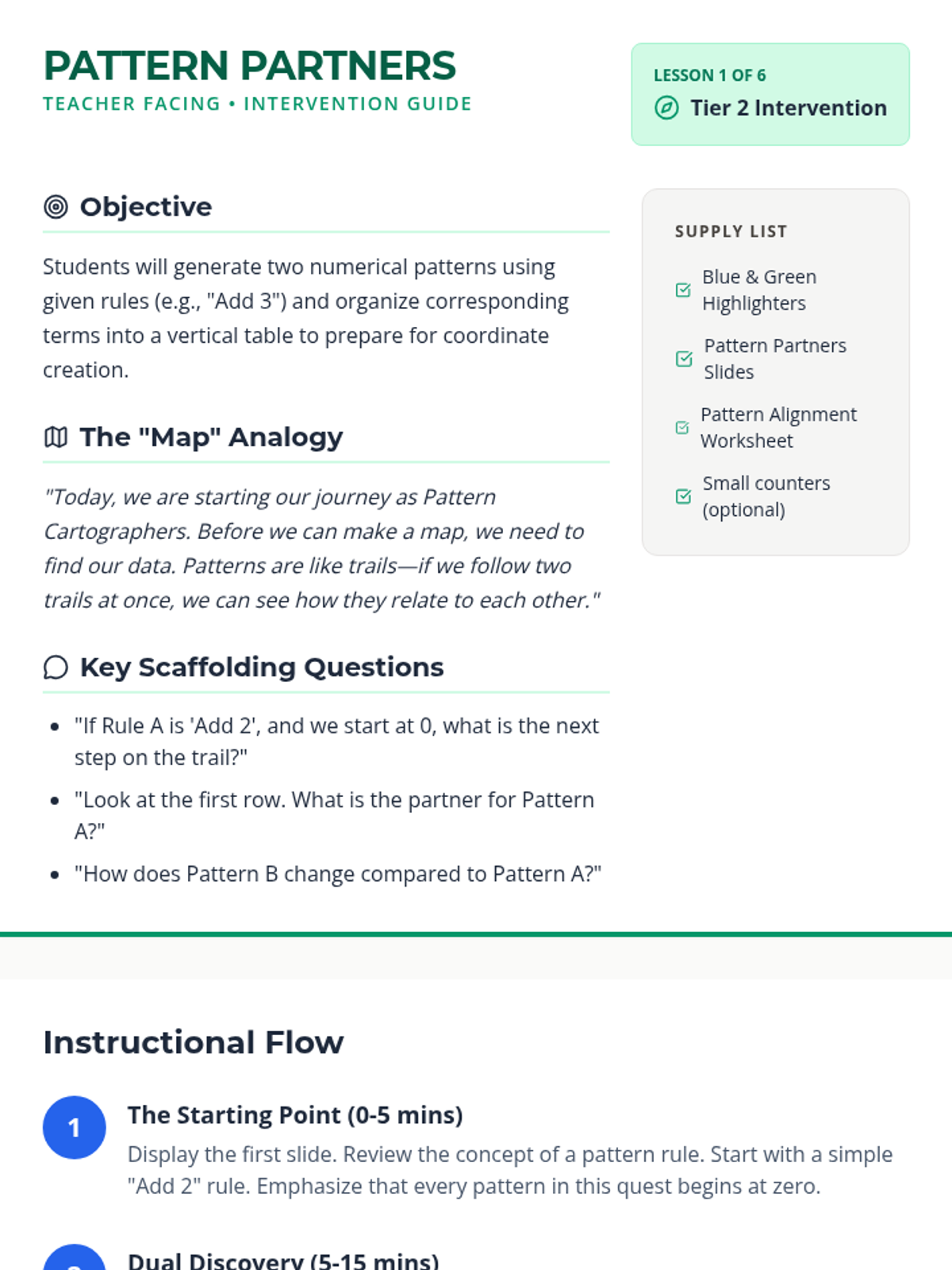
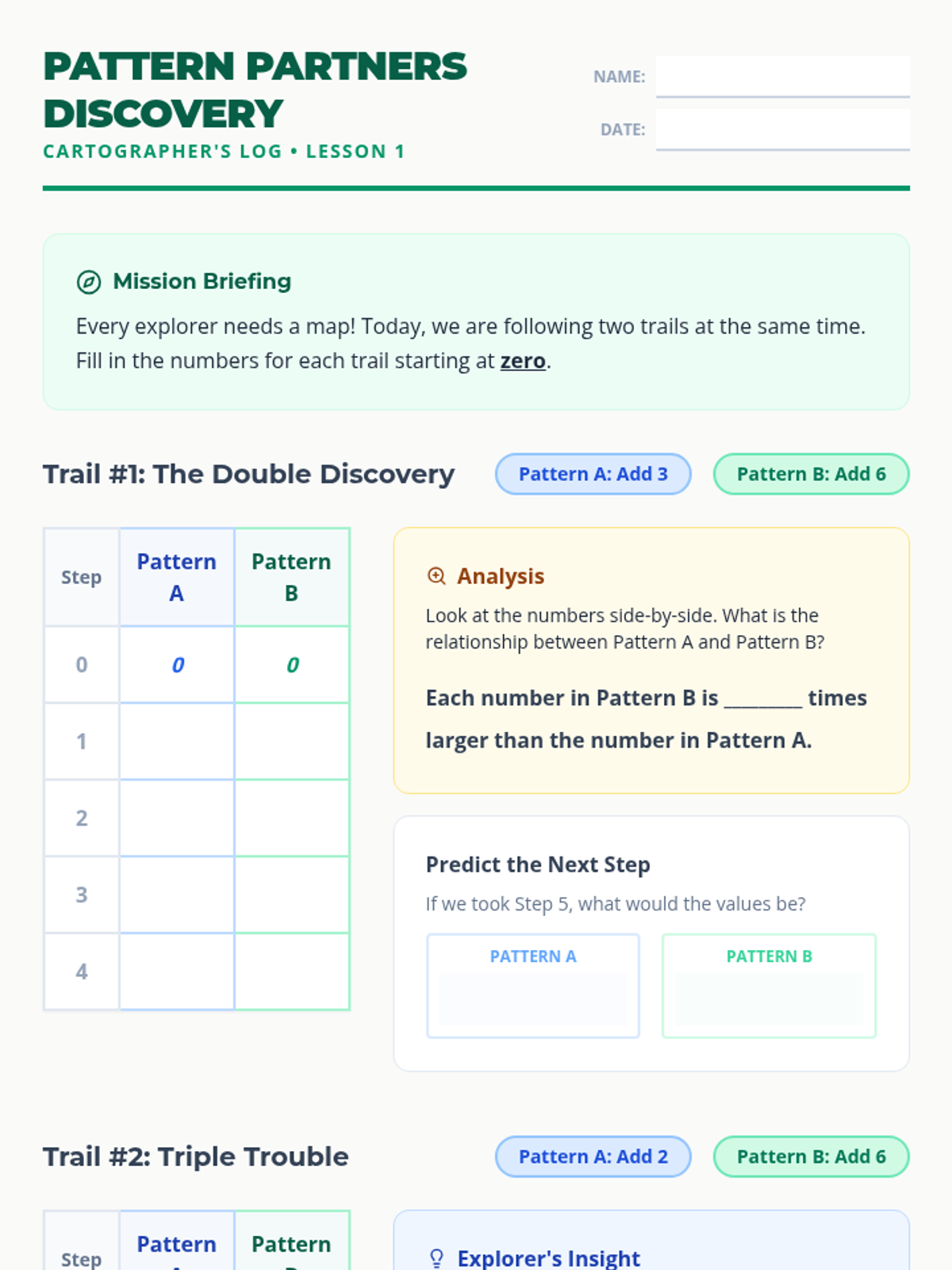
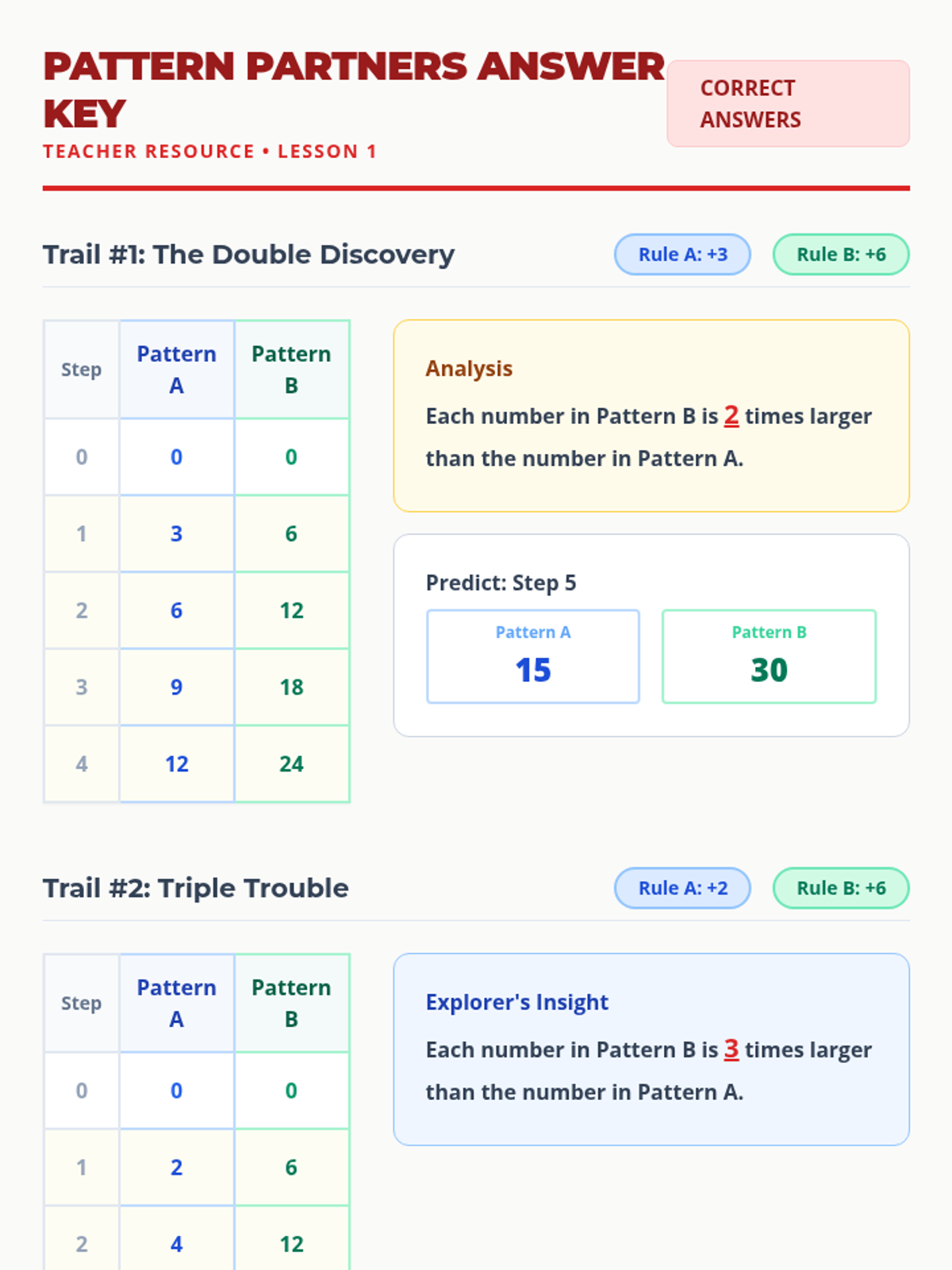
A 6-lesson Tier 2 intervention designed to help students master the relationship between numerical patterns, converting them into ordered pairs, and graphing them on a coordinate plane using a cartography and exploration theme.
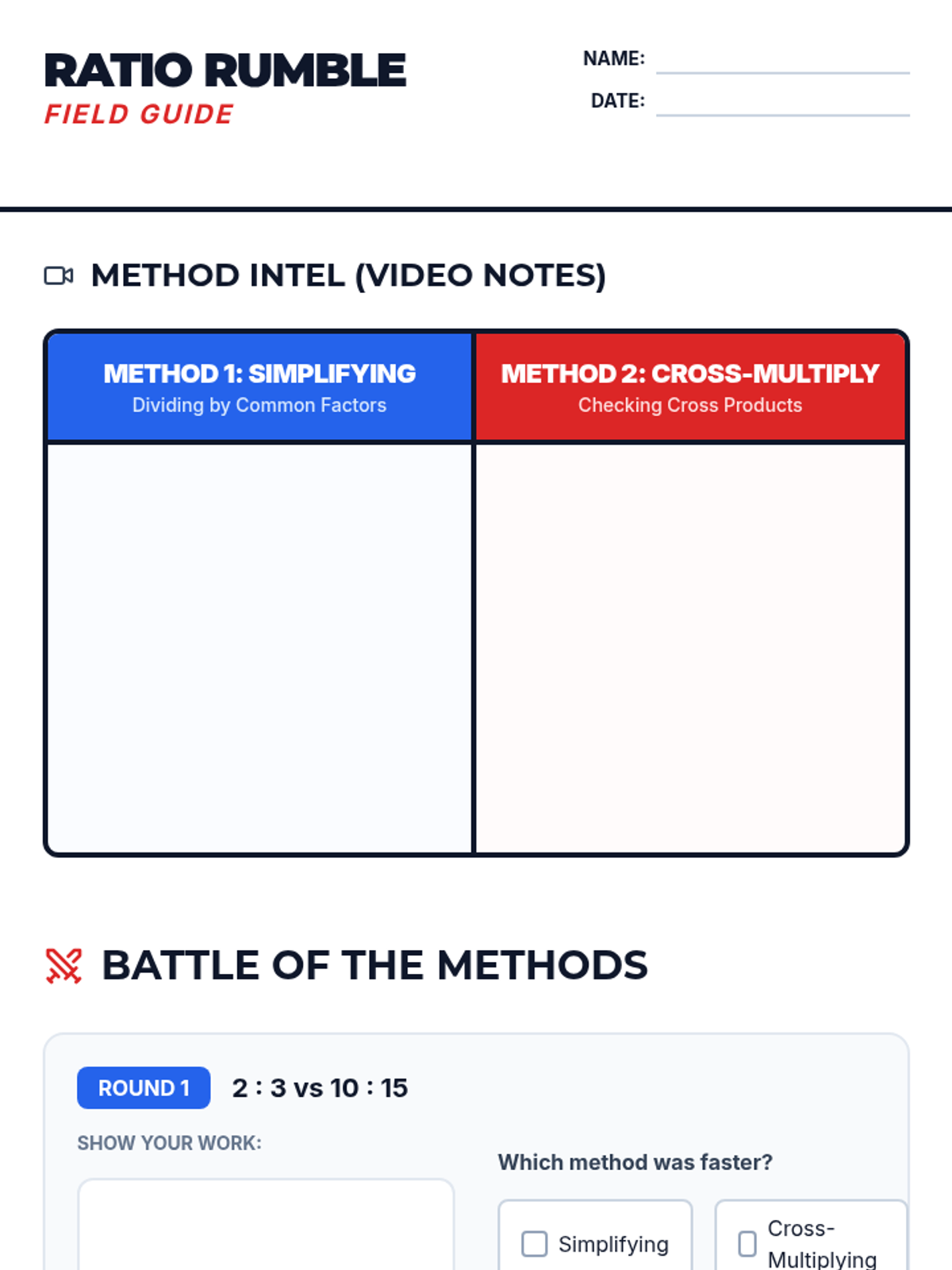
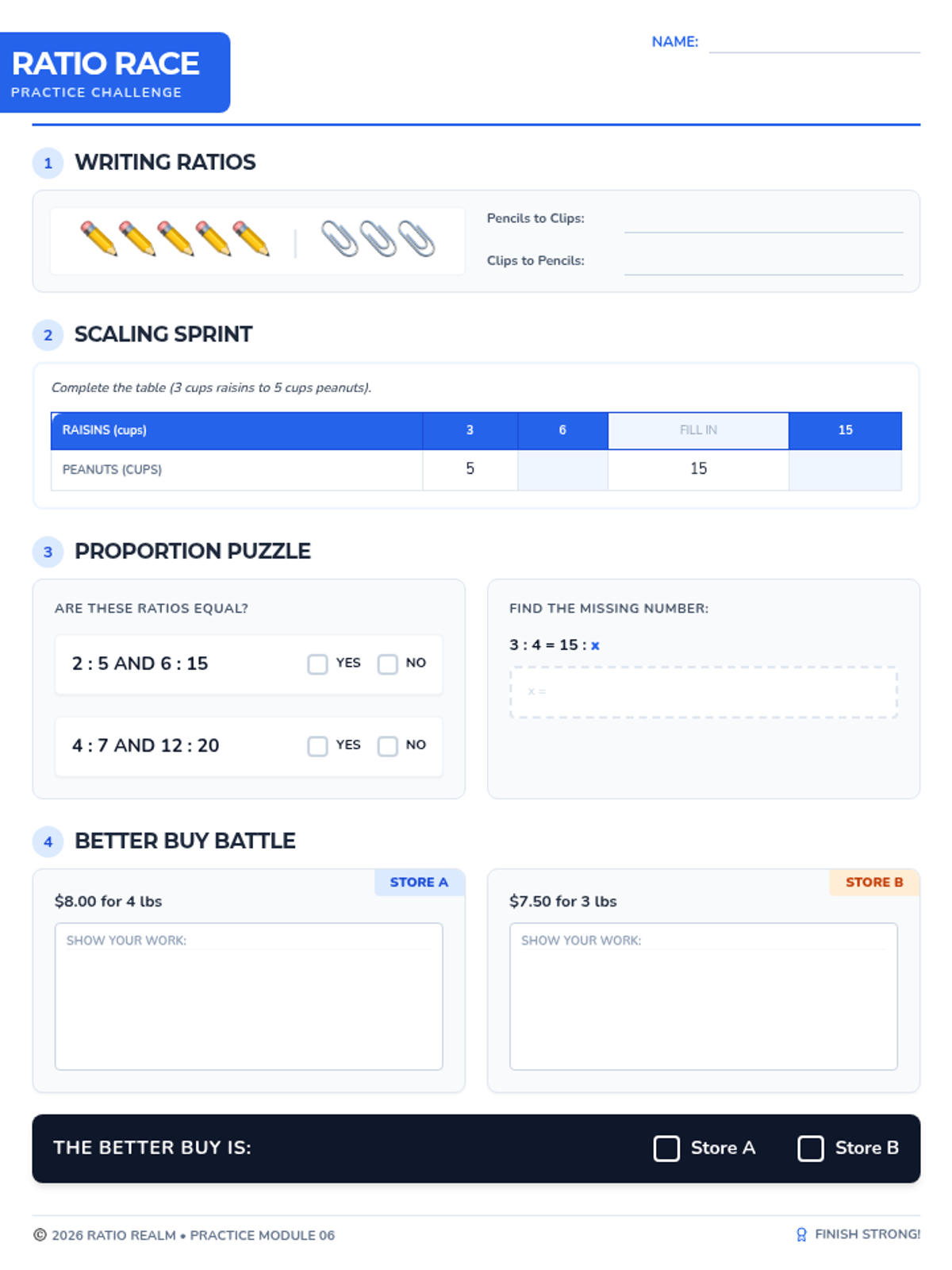
A math unit focused on understanding and applying ratios and proportions through visual methods, mental math strategies, and algorithmic problem-solving.
A mathematics sequence focusing on geometry, circles, and the calculation of circumference and area for middle school students.
A comprehensive sequence focused on using bar models (tape diagrams) to bridge the gap between arithmetic reasoning and algebraic abstraction. Students progress from simple part-whole relationships to complex equations with variables on both sides and the distributive property.
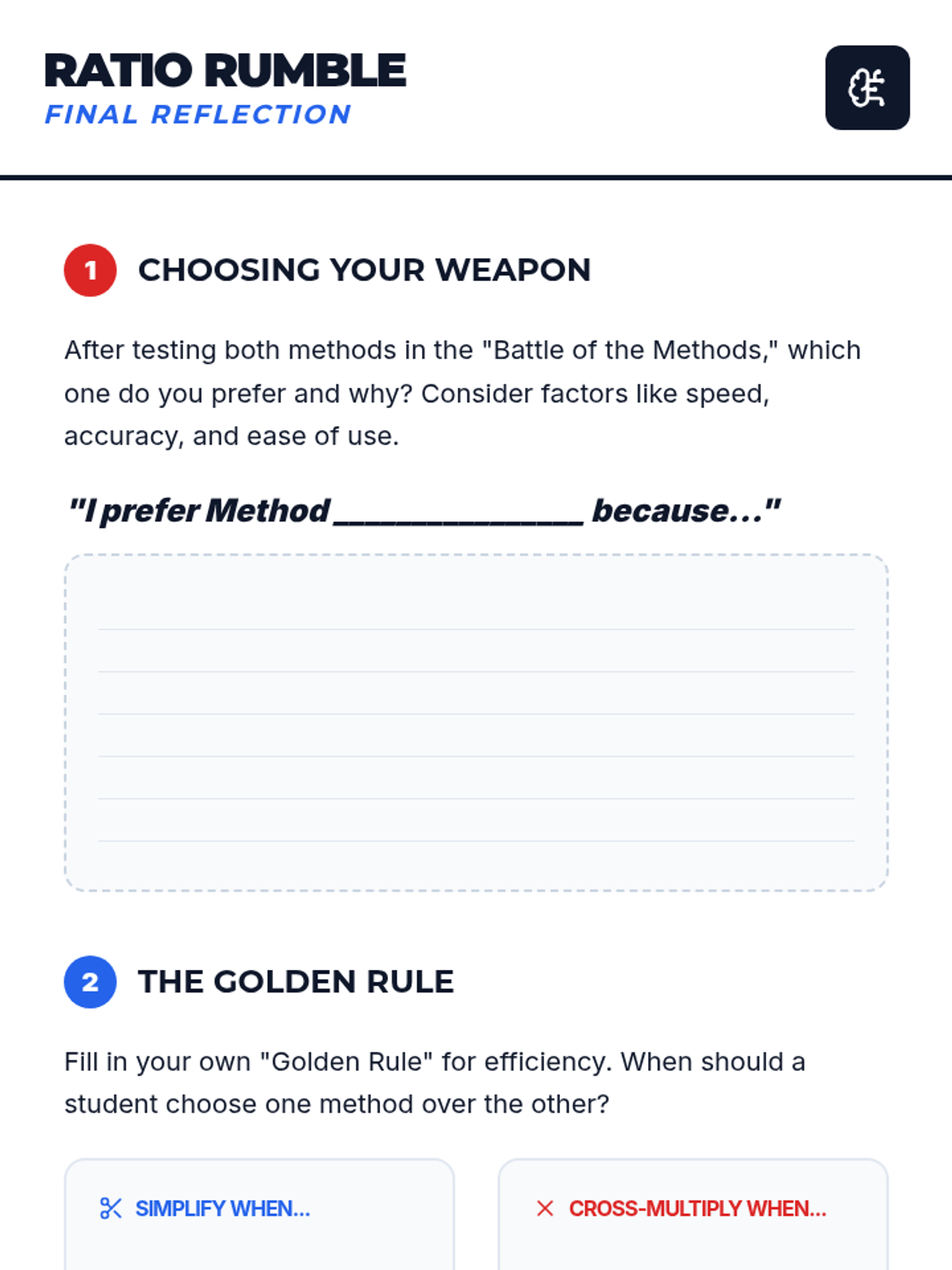
A comprehensive 6th-grade math sequence focused on visual modeling strategies for ratios. Students learn to use tape diagrams and double number lines to decode and solve complex word problems, moving from concrete representation to abstract application.
A game-based sequence where students use the Capture-Recapture method to estimate population sizes, progressing from physical simulations to proportional reasoning and real-world ecological analysis.
Students step into the role of interior designers to redesign a classroom or bedroom space. They apply measurement skills in both customary and metric systems to calculate perimeters, inventory furniture dimensions, and create scaled layout drafts.
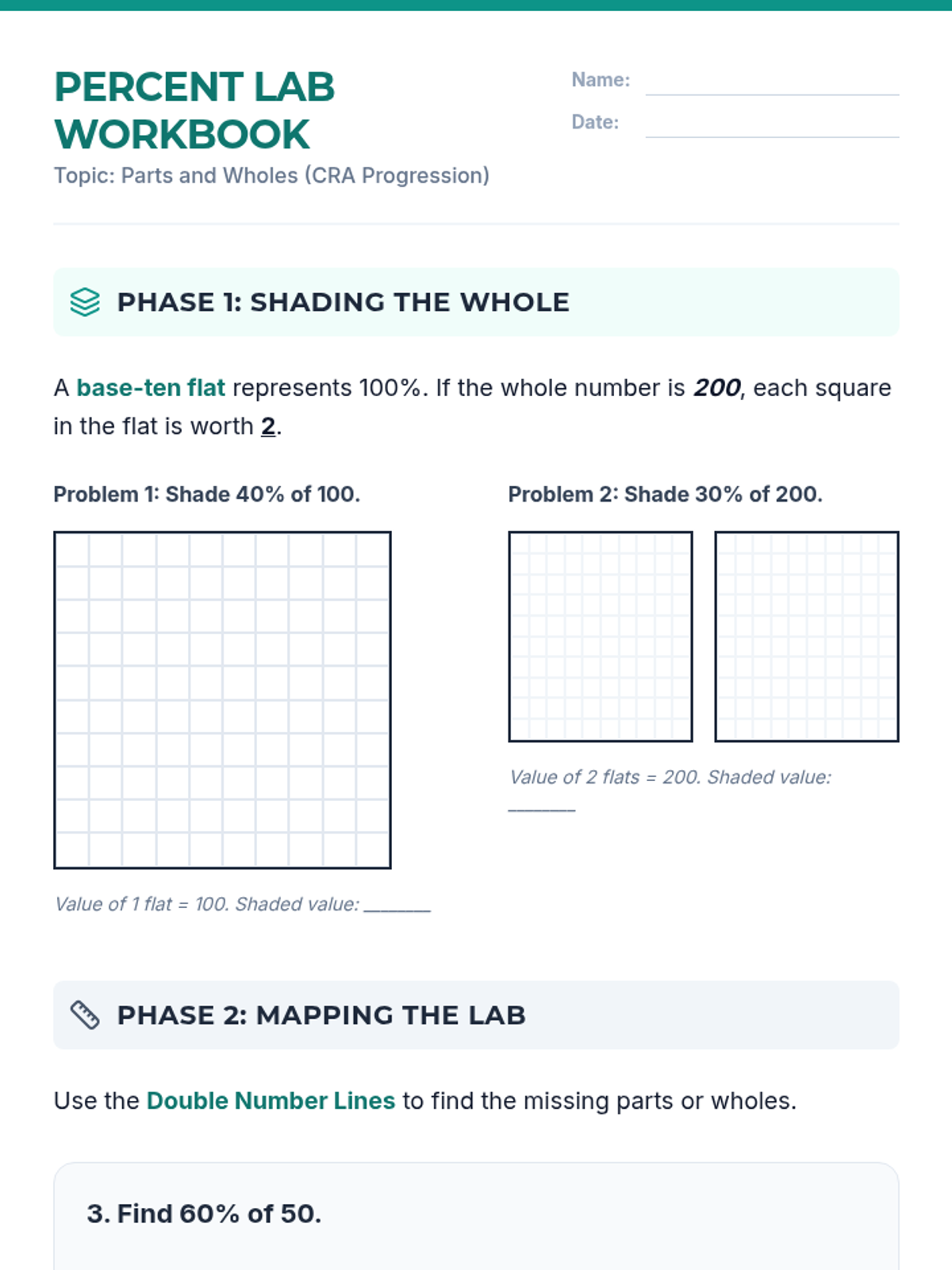
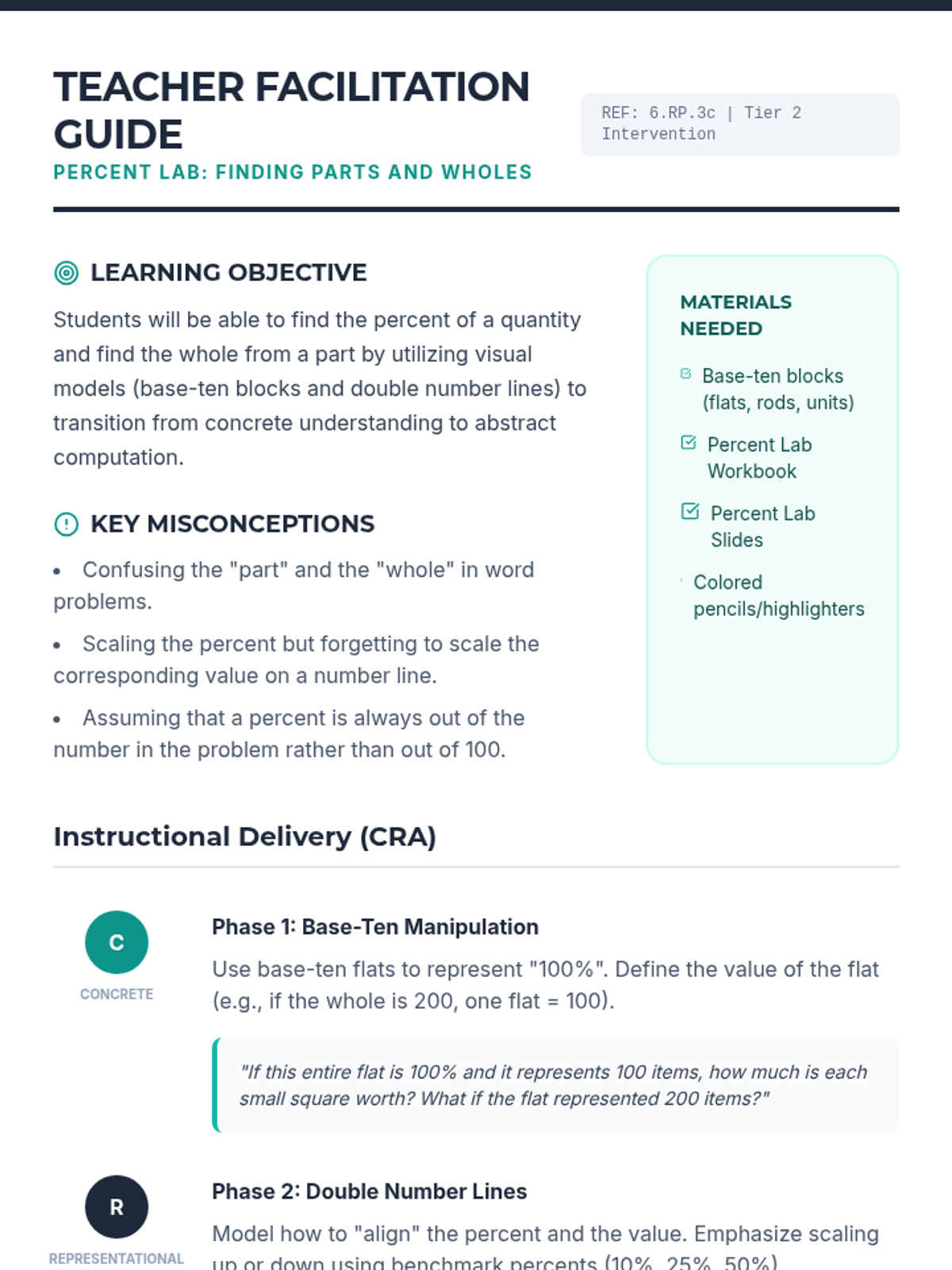
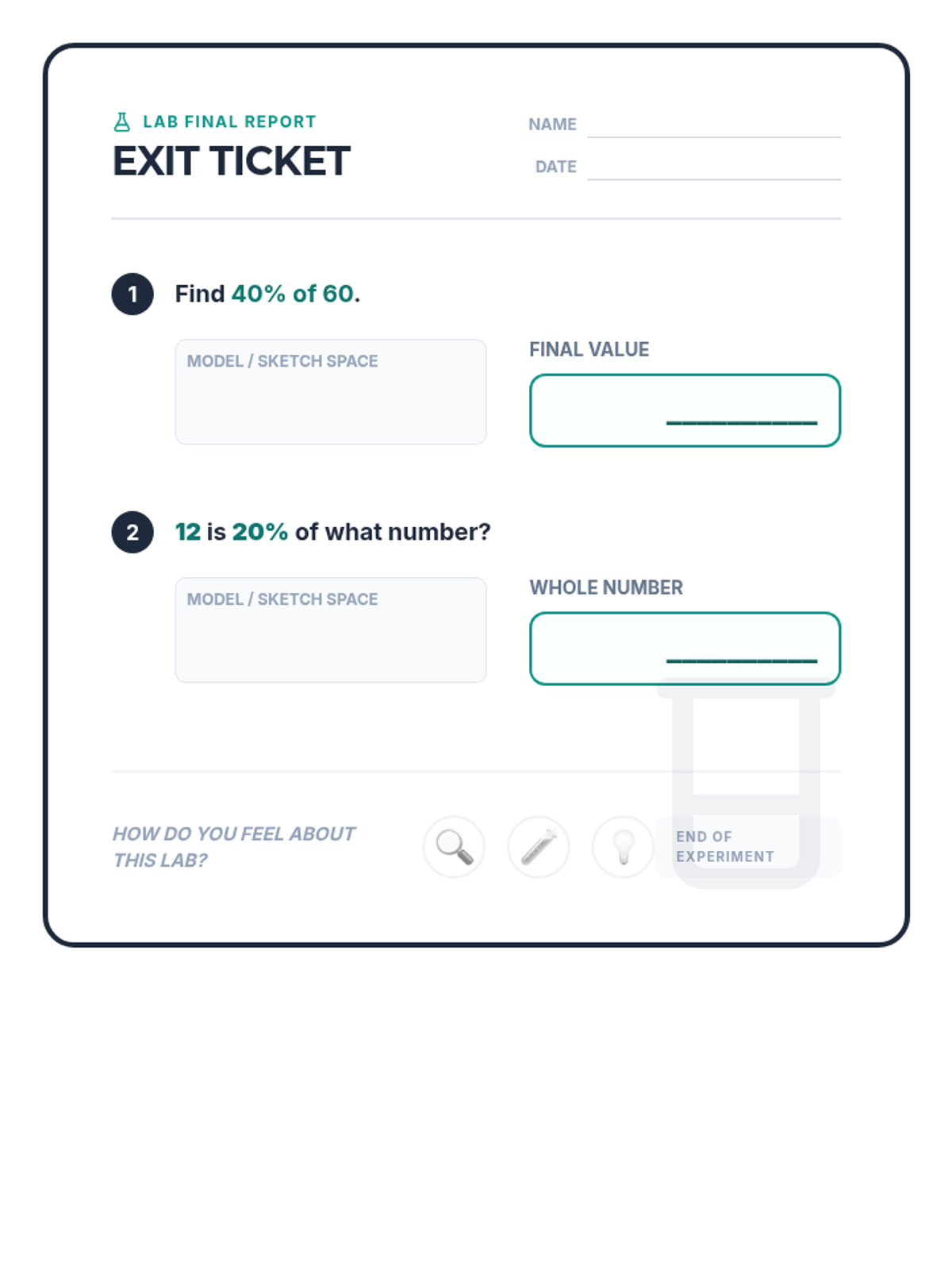
A targeted Tier 2 intervention sequence for 6th grade students focusing on understanding percents as rates per 100 and solving problems involving finding the part and the whole. The sequence utilizes a Concrete-Representational-Abstract (CRA) approach to build conceptual understanding before moving to procedural fluency.
A lesson sequence focusing on financial literacy and the practical application of percentage decrease through real-world shopping scenarios and discount calculations.
A sequence focused on the practical application of percent error in real-world scenarios, emphasizing accuracy and relative scale.
A 6th-grade math sequence exploring different strategies for calculating percentages of numbers, specifically comparing fractional and decimal methods.
This sequence introduces the tape diagram (or bar model) as a primary tool for making abstract ratio and rate problems concrete. Students move from physical blocks to drawn models, focusing on reducing cognitive load and organizing information visually to solve multi-step ratio problems.
A sequence focused on using bar models to visualize and solve complex math problems, specifically designed for students needing academic support in executive functioning and working memory. Students progress from concrete block representations to abstract multi-step problem decomposition.