Lenny LearningLenny
Create
Explore
Workspace
LoginSign up
MathEnglish Language ArtsScience & EngineeringSocial StudiesGlobal LanguagesHealth & Physical EducationSpecial EducationCounseling & Life SkillsArts & CreativityESL
Lenny LearningLenny
Lenny Learning
About
Training
Pricing
Support
Contact
© 2026 Lenny Learning Inc.

Grammar & Mechanics

SequencesLessonsMaterialsVideos
  1. English Language Arts

Grammar & Mechanics

SequencesLessonsMaterialsVideos

Sentence structure fundamentals, subject-verb agreement, and precise usage of parts of speech including pronouns, conjunctions, and adjectives. Targets technical accuracy through mastery of capitalization, punctuation, spelling, and verb mood.

English Language ArtsPhonics & Reading FoundationsLetter IdentificationLearn Letters A-ZLowercase and Uppercase LettersConsonants and VowelsLetter-Sound AssociationsLetter-Sound Associations: LowercaseLetter-Sound Associations: UppercaseBeginning and Ending SoundsRhymingBlending And SegmentingShort VowelsShort Vowel SoundsConsonant BlendsConsonant DigraphsBlends, Digraphs, and TrigraphsDigraphs, Blends, and Silent LettersLong Vowel SoundsLong Vowel PatternsShort and Long VowelsShort and Long Vowel PatternsSilent EVowel SoundsVowel TeamsR-Controlled VowelsDiphthongs: Oi, Oy, Ou, OwVariant VowelsVariant, Diphthong, And R Vowel PatternsSoft G And CSight WordsIrregular WordsWord RecognitionSyllablesSyllable TypesTwo-Syllable WordsMultisyllabic WordsPhoneme ManipulationDecodable TextsVocabularyAction WordsQuestion WordsNouns and AdjectivesClassify WordsCompound WordsSynonyms and AntonymsHomophonesHomophones and HomonymsShades of MeaningContext CluesPrefixes and SuffixesGreek and Latin RootsAnalogiesIdioms and AdagesForeign Words and ExpressionsWord Choice and UsageReference SkillsReading ComprehensionRead-Along Literary TextsRead-Along Informational TextsReality vs. FictionStory ElementsCharacterSequenceMain IdeaCause And EffectCompare And ContrastReading StrategiesText StructureAuthor's PurposeAuthor's Purpose And ToneAuthor's PerspectivePoint Of ViewThemeInference And ThemeInference And AnalysisPoetry ElementsLiterary DevicesAnalyzing LiteratureAnalyzing Informational TextsComparing TextsAudience, Purpose, And ToneBusiness DocumentsNovel StudyNonfiction Book StudyGrammar & MechanicsSentencesNounsVerbsAdjectivesPronounsCapitalizationPunctuationContractionsConjunctionsPrepositionsArticlesAdjectives And AdverbsVerb TypesVerb TensePronouns And AntecedentsPronoun TypesSubject-Verb AgreementDirect And Indirect ObjectsSentences, Fragments, And Run-OnsPhrases And ClausesCommasSemicolons, Colons, And CommasDashes, Hyphens, And EllipsesSpellingAbbreviationsFormattingVerb Tense And MoodMisplaced ModifiersWritingDescriptive DetailsCreative WritingOpinion WritingTopic SentencesOrganizing WritingLinking WordsSentence VarietyIntroductions And ConclusionsPersuasive And Opinion WritingExpository WritingPersuasive StrategiesDeveloping And Supporting ArgumentsTopic Sentences And Thesis StatementsSummarizingResearch SkillsEditing And RevisingActive And Passive Voice=Writing Clearly And ConciselyDebate & Public SpeakingPublic Speaking BasicsPersuasive TechniquesClaims and EvidenceTypes of ArgumentsReasoning TypesLogical FallaciesTopic ResearchOrganizing EvidenceDebate Speech OrganizationAttacking and Defending ArgumentsClash and EngagementImpact CalculusQuestioning and Cross-ExaminationCritical ThinkingInformal LogicFormal LogicInductive Reasoning
SentencesStructural foundations of simple, compound, and complex sentences. Addresses common errors like fragments and run-ons while establishing correct punctuation and subject-verb agreement.
NounsProper and common nouns, singular and plural forms, and possessive structures. Addresses concrete versus abstract categorization and collective noun usage in sentence construction.
VerbsIdentification and usage of various verb tenses, including simple, progressive, and perfect forms. Addresses subject-verb agreement and the distinction between action, linking, and helping verbs.
AdjectivesDescriptive word usage to modify nouns and pronouns, including comparative and superlative forms. Addresses proper sequencing and sensory language to enhance precision in writing.
PronounsPronoun-antecedent agreement and usage across personal, relative, and reflexive types. Targets consistency in case and number to improve writing clarity.
CapitalizationProper nouns, sentence beginnings, and standard conventions for formal writing. Targets specific categories including titles, geographical locations, and dates.
PunctuationCorrect application of end marks, commas, and semicolons to clarify meaning. Targets common errors in apostrophe usage and quotation mark placement within diverse sentence types.
ContractionsFormation of shortened word forms using apostrophes to replace omitted letters. Strengthens usage skills through identification of common pairs and differentiation from possessive nouns.
ConjunctionsCoordinating, subordinating, and correlative conjunctions used to link words, phrases, and clauses. Strengthens sentence structure and clarifies logical relationships between ideas.
PrepositionsIdentifies common prepositions and their roles in showing spatial, temporal, and logical relationships within sentences. Guides students in forming prepositional phrases and identifying the object of the preposition.
ArticlesDistinguishes between definite and indefinite articles while establishing rules for count and non-count nouns. Targets correct usage of 'a,' 'an,' and 'the' across varied sentence structures.
Adjectives And AdverbsIdentification and usage of modifiers to enhance sentence detail. Distinguishes between adjectives describing nouns and adverbs modifying verbs, adjectives, or other adverbs.
Verb TypesDistinctions between action, linking, and auxiliary verbs in various tenses. Examines subject-verb agreement and the functional role of transitive versus intransitive verbs.
Verb TensePast, present, and future verb forms including regular and irregular conjugations. Builds consistency in writing through tense shift correction and subject-verb agreement practice.
Pronouns And AntecedentsConnects pronouns to their specific antecedents while maintaining agreement in number, person, and gender. Addresses common errors like vague references and pronoun-antecedent disagreement.
Pronoun TypesIdentification and usage of personal, possessive, relative, and indefinite pronouns. Strengthens pronoun-antecedent agreement and clarity in complex sentence structures.
Subject-Verb AgreementMatching singular and plural subjects with their corresponding verb forms. Addresses complex scenarios involving collective nouns, compound subjects, and prepositional phrases.
Direct And Indirect ObjectsIdentification of nouns receiving actions and the recipients of those actions within various sentence structures. Distinguishes between direct and indirect objects to improve grammatical accuracy and sentence complexity.
Sentences, Fragments, And Run-OnsIdentification of subjects and predicates to differentiate complete sentences from fragments and run-ons. Focuses on correction techniques using punctuation and coordinating conjunctions.
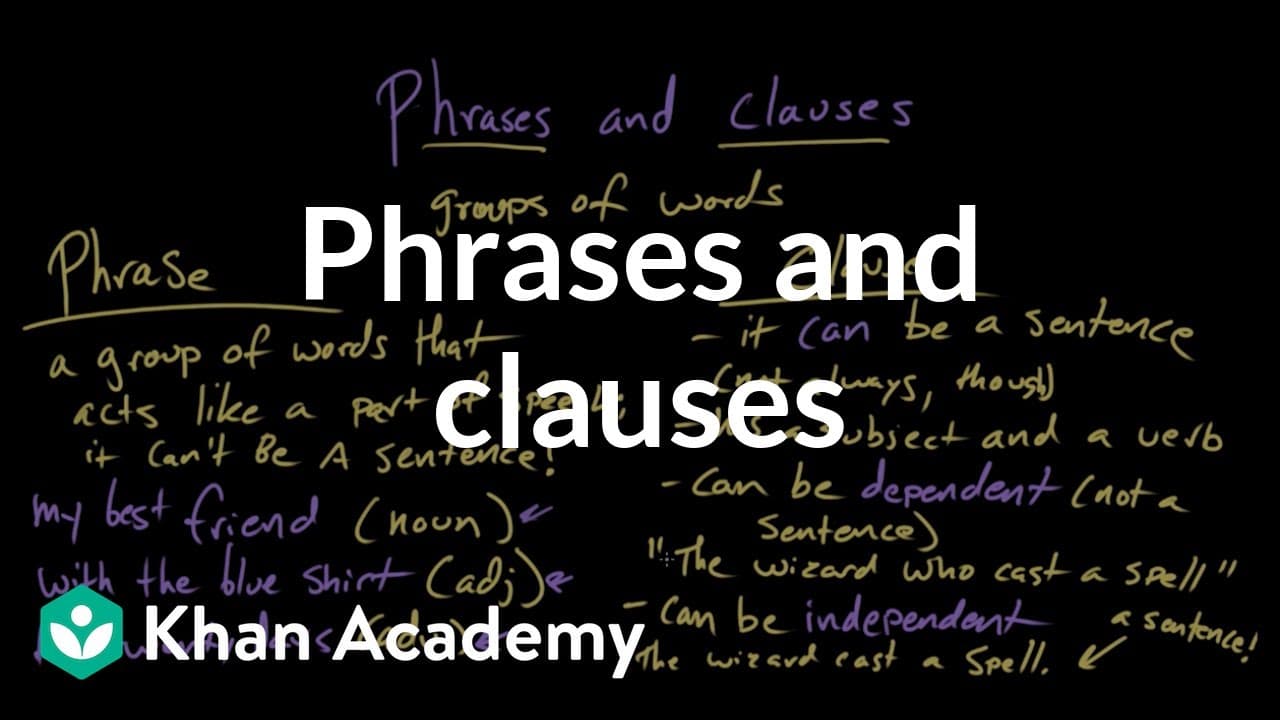
Phrases And ClausesDistinction between independent and dependent clauses alongside various phrase types to enhance sentence variety. Targets precise punctuation and the construction of complex grammatical structures.
CommasRules for lists, introductory phrases, and compound sentences. Develops precision in sentence structure while addressing common errors like comma splices.
Semicolons, Colons, And CommasDistinguishes between punctuation marks to clarify sentence structure and list formatting. Develops precision in connecting independent clauses and using introductory phrases.
Dashes, Hyphens, And EllipsesDistinguishes between em-dashes, en-dashes, and hyphens while applying rules for compound words and parenthetical information. Addresses the functional use of ellipses to signal omitted text or stylistic pauses.
SpellingPhonetic patterns, orthographic rules, and morphological structures like roots and affixes. Develops spelling accuracy through systematic word study and recognition of high-frequency terms.
AbbreviationsStandardized shorthand for titles, addresses, dates, and measurements alongside essential punctuation rules. Guides students in recognizing and applying shortened word forms correctly across various writing contexts.
FormattingStandardized conventions for capitalization, punctuation marks, and visual document layout. Addresses indentation, list structures, and typographical emphasis to enhance professional clarity.
Verb Tense And MoodIndicative, imperative, interrogative, conditional, and subjunctive moods alongside standard past, present, and future tenses. Targets precise communication by aligning action timing with the speaker's attitude or intent.
Misplaced ModifiersIdentification and correction of phrases or clauses separated from the words they describe. Develops sentence clarity by ensuring descriptors are positioned logically near their subjects.
Video
How to Make Words Ending in S Possessive

How to Make Words Ending in S Possessive

This concise grammar tutorial addresses a common point of confusion in English writing: how to form the possessive of singular nouns and names that already end in the letter 's'. The video features two narrators, David and Paige, who use handwritten examples on a blackboard to demonstrate that the standard rule—adding an apostrophe followed by an 's'—still applies to these words, just as it does for any other singular noun. The video explores key examples including proper names like "Jess" and "Texas," as well as common nouns like "bus." It visually breaks down the transformation from a phrase like "the air conditioning on this bus" to the possessive form "the bus's air conditioning." The narrators acknowledge that while the resulting words may look crowded with 's's, the additional letter is crucial for accurately representing how these possessives are pronounced in spoken English. For educators, this video serves as an excellent tool for clarifying a specific punctuation rule that students frequently misapply. It helps dismantle the misconception that an existing 's' at the end of a word precludes adding another one for possession. The clear, step-by-step visual examples make it easy to introduce or review this concept in upper elementary and middle school English Language Arts classrooms, supporting better mechanics in student writing.

Khan AcademyKhan Academy

1min 51s

Video
How to Use Apostrophes for Possession

How to Use Apostrophes for Possession

This educational video provides a clear and friendly introduction to the grammatical concept of the possessive. The narrators, David and Paige, define possession simply as "owning something" and demonstrate how the apostrophe-s ('s) is used to condense complex phrases like "the carrot that belonged to the rabbit" into efficient forms like "the rabbit's carrot." They explore how this rule applies to both common nouns and proper nouns, using whimsical examples to keep the content engaging. The video then pivots to a crucial exception that often trips up students: possessive pronouns. The narrators clarify that while nouns rely on apostrophes to show ownership, possessive pronouns (like his, hers, ours, and its) never take an apostrophe. They illustrate this with side-by-side comparisons to reinforce the difference between a noun's possessive form and a pronoun's possessive form. Teachers can use this video to introduce or review the mechanics of possession in writing. It is particularly valuable for addressing the common error of adding apostrophes to possessive pronouns (e.g., writing "her's" instead of "hers"). The video's visual style—simple handwriting on a black background—focuses student attention directly on the spelling and punctuation changes being discussed.

Khan AcademyKhan Academy

3mins 45s

Video
Concrete vs. Abstract Nouns: The Difference Between Objects and Ideas

Concrete vs. Abstract Nouns: The Difference Between Objects and Ideas

This video provides a clear and engaging explanation of the difference between concrete and abstract nouns, utilizing etymology to deepen student understanding. The narrator breaks down the Latin roots of both terms—"concrete" meaning "grown together" or physical, and "abstract" meaning "drawn away" or conceptual—to help students visualize the distinction. Through a digital whiteboard demonstration, the lesson contrasts tangible objects that can be sensed with intangible ideas, emotions, and states of being. The content focuses on key grammatical concepts including the definition of nouns as not just persons, places, and things, but also *ideas*. It explores how abstract nouns like "sadness," "freedom," and "permission" function grammatically (often using suffixes like "-ness") despite lacking physical form. The video specifically addresses the nuance between an abstract concept and its physical manifestations, using the example of "freedom" versus the "ice cream" one is free to eat. For educators, this resource offers a robust foundation for grammar instruction in upper elementary and middle school. It moves beyond simple memorization by providing a logic-based framework (the "physical vs. not physical" test) that students can apply to new vocabulary. The video is particularly useful for introducing abstract nouns, a concept that often challenges students transitioning from basic concrete noun identification, and can serve as a springboard for lessons on sensory imagery and descriptive writing.

Khan AcademyKhan Academy

3mins 43s

Video
How to Identify Direct Objects in Sentences

How to Identify Direct Objects in Sentences

This instructional video provides a clear, step-by-step guide to identifying direct objects within sentences. Through simple animations and relatable examples, the narrator breaks down the relationship between nouns, verbs, and the objects that receive the action. The video uses a consistent scaffolding method—identifying the subject first, then the action verb, and finally asking specific questions to locate the direct object. The content covers key grammatical concepts including the roles of nouns and proper nouns as subjects, the function of action verbs, and the definition of direct objects. It specifically addresses common pitfalls, such as distinguishing between a direct object and other nouns in a sentence (like objects of prepositions) that do not receive the action of the verb. This resource is highly valuable for elementary and middle school language arts classrooms. Its repetitive, logical structure allows students to practice along with the narrator, reinforcing the mental checklist needed to analyze sentence structure. The visual cues, such as circling and labeling parts of speech, make abstract grammatical rules concrete and accessible for learners.

GrammarSongs by MelissaGrammarSongs by Melissa

6mins 3s

Video
Identifying Nouns: People, Places, Things, and Ideas

Identifying Nouns: People, Places, Things, and Ideas

In this engaging grammar lesson, the narrator introduces the concept of the noun, one of the fundamental parts of speech in the English language. Moving beyond the traditional definition of "person, place, or thing," the video expands the definition to include "ideas," a crucial category often overlooked in early grammar instruction. Through the charming example of Raúl, a penguin from Argentina with big dreams, students see exactly how to identify nouns in sentences by asking if a word fits into one of four specific categories.

Khan AcademyKhan Academy

4mins 28s

Video
The Noun Song: Person, Place, and Thing

The Noun Song: Person, Place, and Thing

This catchy, upbeat song introduces students to the concept of nouns as a fundamental part of speech. Through a repetitive and memorable musical structure, the video breaks down the definition of a noun into three primary categories: people, places, and things. It provides concrete examples for each category, helping young learners distinguish between different types of nouns they encounter in their daily lives. The song explores a wide variety of vocabulary, listing specific examples like family members and occupations for 'people,' common locations like schools and stores for 'places,' and everyday objects and animals for 'things.' Notably, it also briefly touches upon abstract nouns by mentioning 'ideas in your mind' such as love and joy, offering a slightly deeper conceptual layer for students ready to move beyond concrete objects. Teachers can use this song as an engaging hook to start a grammar unit, a transition activity, or a tool for memorization. The clear structure—devoting a specific verse to each category—makes it excellent for sorting activities. Because the video features a static image with audio, it works particularly well as a listening exercise where students can move around the classroom or focus on a worksheet without needing to keep their eyes glued to a screen.

Have Fun TeachingHave Fun Teaching

3mins 4s

Video
How to Identify and Use Prepositional Phrases

How to Identify and Use Prepositional Phrases

This engaging educational video introduces students to the concept of prepositional phrases through a clear, memorable analogy of a bridge. The narrator explains that just as a bridge connects two pieces of land, a preposition connects a noun (the object) to the rest of a sentence. The video breaks down the specific components of a prepositional phrase—the starting preposition and the ending object—and demonstrates how to identify them within various sentence structures, including phrases at the beginning, middle, and end of sentences. The content covers key grammatical terminology, including "preposition," "noun," and "object of the preposition." It uses repetitive, step-by-step analysis of example sentences like "We went fishing with Ben" and "Outside the window, the birds are singing" to reinforce learning. Humor is woven throughout to maintain engagement, featuring interruptions from a confused cat named Mr. Whiskers and a tangent about the sounds pelicans make, ensuring the tone remains lighthearted and accessible for elementary students. For educators, this video serves as an excellent core resource for teaching parts of speech and sentence structure. It provides a visual and conceptual framework (the bridge) that helps concrete thinkers grasp abstract grammatical rules. The clear distinction between the preposition itself and the entire phrase makes it valuable for lessons on sentence diagramming, expanding sentences with details (time, place, movement), and improving writing complexity.

Homeschool PopHomeschool Pop

8mins 53s

Video
Defining and Using the Words Examine, Resource, and Pollution

Defining and Using the Words Examine, Resource, and Pollution

This educational video introduces and defines three specific vocabulary words: "examine," "resource," and "pollution." Using a "blackboard" style visual approach with colorful handwritten text and simple illustrations, the narrator breaks down each word by identifying its part of speech (verb or noun), providing a clear definition, and explaining its etymology or morphological structure (such as the suffix "-tion"). The video explores the meanings in depth before showing them in context. For example, it connects "examine" to the familiar concept of taking an "exam," expands the definition of "resource" from natural materials to school libraries, and breaks down "pollution" as the act of dirtying the environment. Each segment concludes with an illustrated sentence that demonstrates the word being used correctly in a real-world scenario. Teachers can use this video as a versatile tool for both English Language Arts and Science instruction. It serves as an excellent model for how to learn new vocabulary—by defining, connecting to known words, and using in context. Additionally, the specific words chosen bridge nicely into science units regarding scientific observation (examining), natural resources, and environmental stewardship (pollution).

Khan AcademyKhan Academy

2mins 59s

Video
Why the Plural of Ox Is Oxen but Box Is Boxes

Why the Plural of Ox Is Oxen but Box Is Boxes

This educational video explores the fascinating history behind irregular English plurals, specifically focusing on the rare "-en" ending found in words like "children" and "oxen." The narrator, David, breaks down why English grammar often feels unpredictable by explaining its roots as a Germanic language derived from Old English. He uses humor and clear handwriting to illustrate how historical regional variations eventually distilled into the standard English rules we use today. The video delves into etymology to explain common student questions, such as why the plural of "ox" is "oxen" while the plural of "box" is "boxes." By distinguishing between native Old English words and borrowed words from Greek or Latin, the lesson demystifies these apparent inconsistencies. The content encourages students to view English not as a rigid block of rules, but as a "lashed together raft" of history and diverse influences. Included as a bonus segment is a historical anecdote about William Caxton, the first English printer, and a 15th-century confusion between the words "eggs" and "eyren." This story vividly illustrates the concept of dialects and the evolution of language, making it an excellent resource for discussing how communication technologies like the printing press helped standardize the English language.

Khan AcademyKhan Academy

7mins 23s

Video
How to Identify Direct and Indirect Objects

How to Identify Direct and Indirect Objects

This animated grammar lesson provides a clear, step-by-step guide to understanding the difference between direct and indirect objects. Building upon previous knowledge of subjects and verbs, the video introduces the concept of indirect objects as the recipients of the direct object. Through a series of illustrated examples—ranging from a football player kicking a ball to a waitress serving coffee—the narrator breaks down sentences into their component parts to demonstrate exactly how to locate each element. Key grammatical themes explored include sentence structure, parts of speech (nouns, proper nouns, verbs, pronouns), and the specific syntactic pattern of Subject-Verb-Indirect Object-Direct Object (S-V-IO-DO). The video emphasizes the specific rule that an indirect object is always positioned between the verb and the direct object, offering students a reliable strategy for identification. For educators, this video is a valuable tool for scaffolding complex grammar instruction. The content uses a "pause-and-think" pacing strategy that allows teachers to stop the video and ask students to identify sentence parts before the answer is revealed. The visual coding of sentence parts and the humorous examples (like clarifying that a boy didn't throw a dog, but threw the dog a ball) make abstract grammatical concepts concrete and engaging for upper elementary and middle school students.

GrammarSongs by MelissaGrammarSongs by Melissa

5mins 37s

Video
Mastering the Mutant Plurals

Mastering the Mutant Plurals

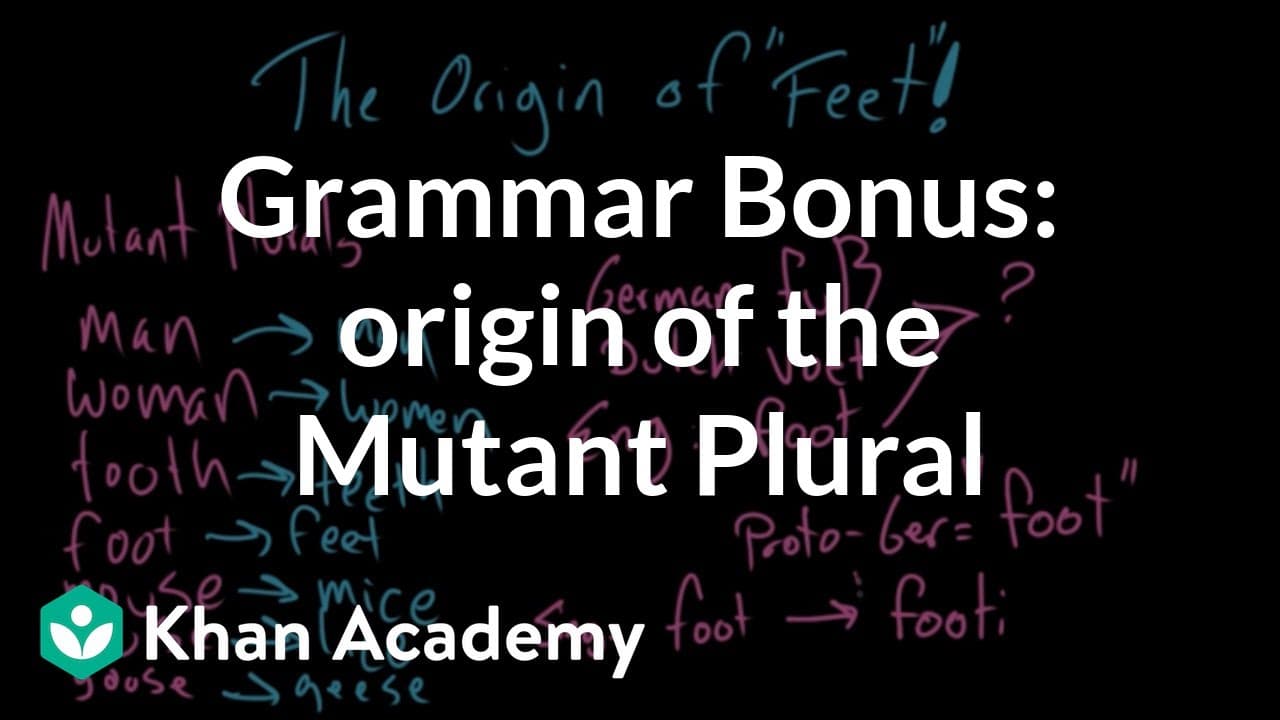
In this engaging grammar lesson, the narrator introduces a special class of irregular English nouns known as "Mutant Plurals." Unlike standard nouns that simply add an "s" to become plural, these seven unique words transform by changing their internal vowel sounds. The video frames these linguistic anomalies as words with "mutant superpowers," making a dry grammatical rule memorable and fun for students. The video systematically lists and charts the only seven words in the English language that follow this specific pattern: foot/feet, woman/women, man/men, tooth/teeth, goose/geese, mouse/mice, and louse/lice. The narrator highlights how the vowel sounds shift (such as "oo" becoming "ee") and points out the additional spelling quirk found in "mouse" and "louse," where the consonant sound also changes. This resource is highly valuable for elementary ELA classrooms as a memorization tool. By isolating these seven words as a closed group, it reduces student anxiety about irregular plurals. The "mutant" metaphor provides a sticky hook for recall, and the clear visual chart supports note-taking and visual learning. Teachers can use this to introduce the concept of morphology or simply to reinforce correct spelling and usage.

Khan AcademyKhan Academy

2mins 42s

Video
How to Identify Concrete and Abstract Nouns

How to Identify Concrete and Abstract Nouns

This educational video provides a clear and engaging explanation of the difference between concrete (tangible) and abstract (intangible) nouns. Using a whiteboard animation style, the narrator first reviews basic concrete nouns that can be perceived through the five senses. The video then introduces abstract nouns by categorizing them into events, emotions, and ideas/concepts, explaining that while these cannot be physically touched or seen, they are still nouns because they represent "things." The video explores three main categories of abstract nouns in depth. It distinguishes events (like parties or weddings) from the places they occur, defines emotions (like love or anger) as abstract nouns, and explains complex ideas (like friendship, freedom, or permission). The explanation uses concrete examples to anchor these abstract concepts, such as showing how specific symbols or people represent the idea of "freedom." The final segment of the video features an interactive guided practice session. The narrator walks students through analyzing two sentences to identify every noun. This "noun detective" work models a step-by-step process of elimination: first finding the concrete nouns that create mental images, and then questioning the remaining words to find abstract concepts, emotions, or events. This scaffolded approach makes the video an excellent tool for introducing or reviewing this grammar concept in upper elementary classrooms.

GrammarSongs by MelissaGrammarSongs by Melissa

6mins 41s

Video
Mastering the Three Uses of the Apostrophe

Mastering the Three Uses of the Apostrophe

This engaging grammar tutorial features narrators David and Paige exploring the three distinct functions of the apostrophe in English. Using a digital whiteboard format, they visually demonstrate how this "floating comma" operates to change the meaning of words. The lesson covers the two most common uses—contractions and possession—before carefully explaining a highly specific and rare exception regarding the pluralization of lowercase letters. The video focuses on core mechanics of standard English conventions, specifically punctuation rules that often trip up students. A significant portion of the video is dedicated to distinguishing between possessive nouns (which need apostrophes) and simple plural nouns (which do not), directly addressing a frequent student error. The narrators use memorable, slightly humorous examples like "David's cursed skull" to illustrate concepts. For educators, this resource provides a clear, concise method for teaching punctuation mechanics. It effectively targets the misconception that apostrophes are used to make words plural, offering a visual "non-example" to reinforce the rule. The conversational banter and step-by-step breakdown make abstract grammatical rules concrete and accessible, making it an excellent tool for introducing the concept or reviewing it with upper elementary and middle school students.

Khan AcademyKhan Academy

4mins 50s

Video
Mastering the Difference Between Affect and Effect

Mastering the Difference Between Affect and Effect

This video provides a clear and practical guide to distinguishing between the commonly confused words "affect" and "effect." Using a digital blackboard style, the narrator breaks down the primary rule that "affect" functions as a verb while "effect" functions as a noun. Through concrete examples involving a drought and crops, the video demonstrates how to identify which word is grammatically correct based on its role in the sentence as either an action or a result. The video delves deeper than simple definitions by addressing rare but grammatically correct exceptions to the general rule. It explains how "effect" can be used as a verb (meaning to bring about or create, as in "effect change") and how "affect" can be used as a noun (a psychology term describing personality or demeanor). The narrator offers stylistic advice on these exceptions, suggesting that while they are correct, they often cause confusion and might be best avoided in general writing. For educators, this resource serves as an excellent tool for grammar instruction and writing workshops. It demystifies a persistent trouble spot for students of all ages, offering a straightforward "TL;DR" rule for quick recall while acknowledging the nuance of advanced English usage. The content is valuable for strengthening proofreading skills, enhancing vocabulary precision, and helping students navigate the complexities of English homophones.

Khan AcademyKhan Academy

4mins 18s

Video
Exploring the Vocabulary Words Recently and Voyage

Exploring the Vocabulary Words Recently and Voyage

In this engaging vocabulary lesson, the narrator introduces students to two specific words: "recently" and "voyage." Through a blend of humor, storytelling, and simple illustrations, the video breaks down the definitions, parts of speech, and grammatical rules associated with each word. Specifically, it explains how the suffix "-ly" transforms adjectives into adverbs and how a single word like "voyage" can function as both a noun and a verb. The video explores key grammatical concepts in an accessible way. It defines "recently" as an adverb meaning "happening a short time ago" and demonstrates how adjectives like "happy" and "quick" become adverbs with the addition of "-ly." It then defines "voyage" as a long journey, providing examples of its use as a noun (taking a trip) and a verb (the act of traveling). The narrator uses humorous example sentences involving astronomers and astronauts craving tamales to solidify understanding. For educators, this video is a valuable tool for reinforcing parts of speech and expanding vocabulary. It can be used to introduce the concept of suffixes, specifically how word endings change grammatical function. The clear definitions and contextual examples make it an excellent resource for ELA lessons focused on grammar, reading comprehension, and creative writing, encouraging students to use new vocabulary in their own sentences.

Khan AcademyKhan Academy

2mins 29s

Video
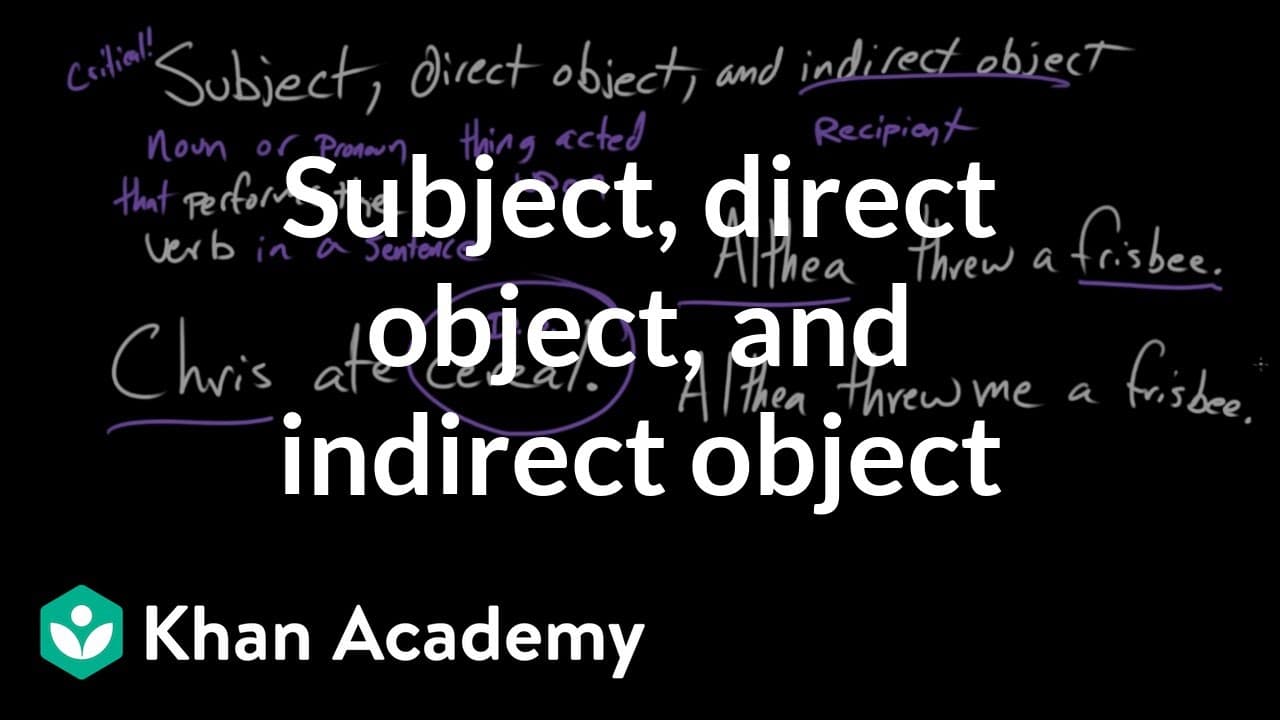
How to Find Subjects, Direct Objects, and Indirect Objects

How to Find Subjects, Direct Objects, and Indirect Objects

A clear and concise grammar tutorial that breaks down the components of a sentence: subjects, direct objects, and indirect objects. Through a casual dialogue between two narrators, the video uses handwritten examples on a digital whiteboard to visually map out sentence structures. The lesson moves from simple subject identification to the more complex relationship between direct and indirect objects, offering concrete tests to verify which is which. The video explores key grammatical themes including sentence analysis, the roles of nouns and pronouns, and the functional relationships between words. It specifically addresses how action verbs transfer energy to direct objects and how indirect objects function as the recipients of those actions. The narrators also demonstrate how to differentiate an indirect object from a prepositional phrase using a simple transposition test. This resource is highly valuable for English Language Arts classrooms introduced to sentence diagramming or syntax analysis. It clarifies a common point of confusion for students—distinguishing between the thing being acted upon and the recipient of that action. Teachers can use this video to introduce the concept of transitive verbs or as a remediation tool for students struggling with sentence structure and pronoun usage.

Khan AcademyKhan Academy

4mins 43s

Video
When to Use Less Versus Fewer: A Grammar Guide

When to Use Less Versus Fewer: A Grammar Guide

In this engaging grammar exploration, two narrators, David and Rosie, debate the rules surrounding the usage of "less" versus "fewer." While many people believe there is a strict rule separating the two, the video reveals a more nuanced reality involving count nouns and mass nouns. Rosie argues that while "fewer" is restricted to countable items, "less" has historically been used for both, challenging common grammar superstitions. The video dives into the technical definitions of count nouns (like grains of sand or hours) versus mass nouns (like sand or sun). Through clear examples written on a digital whiteboard, the narrators demonstrate how these noun types interact with the words less and fewer. The discussion highlights how native speakers naturally distinguish between these categories, even if they can't explicitly define them. Crucially, the lesson explores the historical origins of this grammar rule, tracing it back to a personal preference expressed by Robert Baker in 1770 rather than an inherent law of language. This historical context turns a dry grammar lesson into a fascinating discussion about how language evolves and how rules are made. It concludes with practical advice: while the strict rule might be arbitrary, adhering to it in formal writing remains a marker of "strictly proper" standard English.

Khan AcademyKhan Academy

7mins 12s

Video
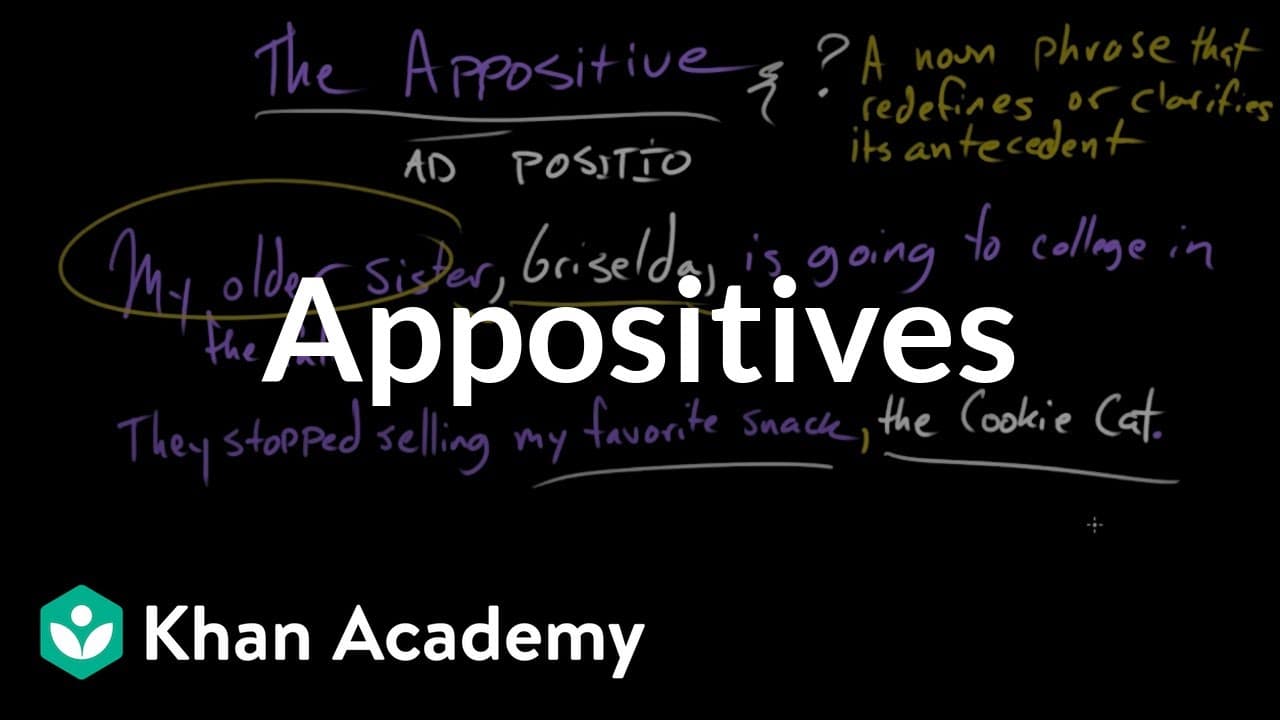
How to Use Appositives to Clarify Your Sentences

How to Use Appositives to Clarify Your Sentences

This educational video provides a clear and accessible introduction to the grammatical concept of the appositive. Hosted by two narrators, David and Paige, the lesson demystifies this complex-sounding term by breaking down its etymology and function. Using a digital whiteboard format, the hosts visually demonstrate how appositives serve as noun phrases that rename, redefine, or clarify an antecedent noun within a sentence. They specifically focus on the punctuation rules associated with appositives, showing how commas act as essential separators to set off this clarifying information from the rest of the sentence. The video explores two primary sentence structures: one where the appositive appears in the middle of a sentence, and another where it appears at the end. Through relatable examples—like describing a sister going to college or lamenting a discontinued snack called "Cookie Cat"—the narrators illustrate how appositives add detail without altering the core grammatical structure of the main clause. The visual component uses color-coding to distinguish the appositive phrase from the rest of the sentence, making the syntactic relationship clear for viewers. For educators, this video serves as an excellent tool for teaching sentence variety and punctuation. It addresses the common student struggle of knowing when to use commas, providing a concrete rule (the appositive) that students can apply immediately to their own writing. By mastering appositives, students can write more sophisticated sentences that combine ideas efficiently, moving beyond simple subject-verb-object structures to more complex, information-rich writing.

Khan AcademyKhan Academy

3mins

Video
Using Proper Nouns to Write Vivid Sentences

Using Proper Nouns to Write Vivid Sentences

This educational video provides a clear and engaging introduction to proper nouns, distinguishing them from basic common nouns. It begins by reviewing the definition of a noun as a person, place, or thing, and then defines proper nouns as the *specific* names for these categories. Through whiteboard-style animation, the narrator demonstrates how proper nouns must always be capitalized, reinforcing the grammatical rule alongside the conceptual understanding.

GrammarSongs by MelissaGrammarSongs by Melissa

3mins 26s

Video
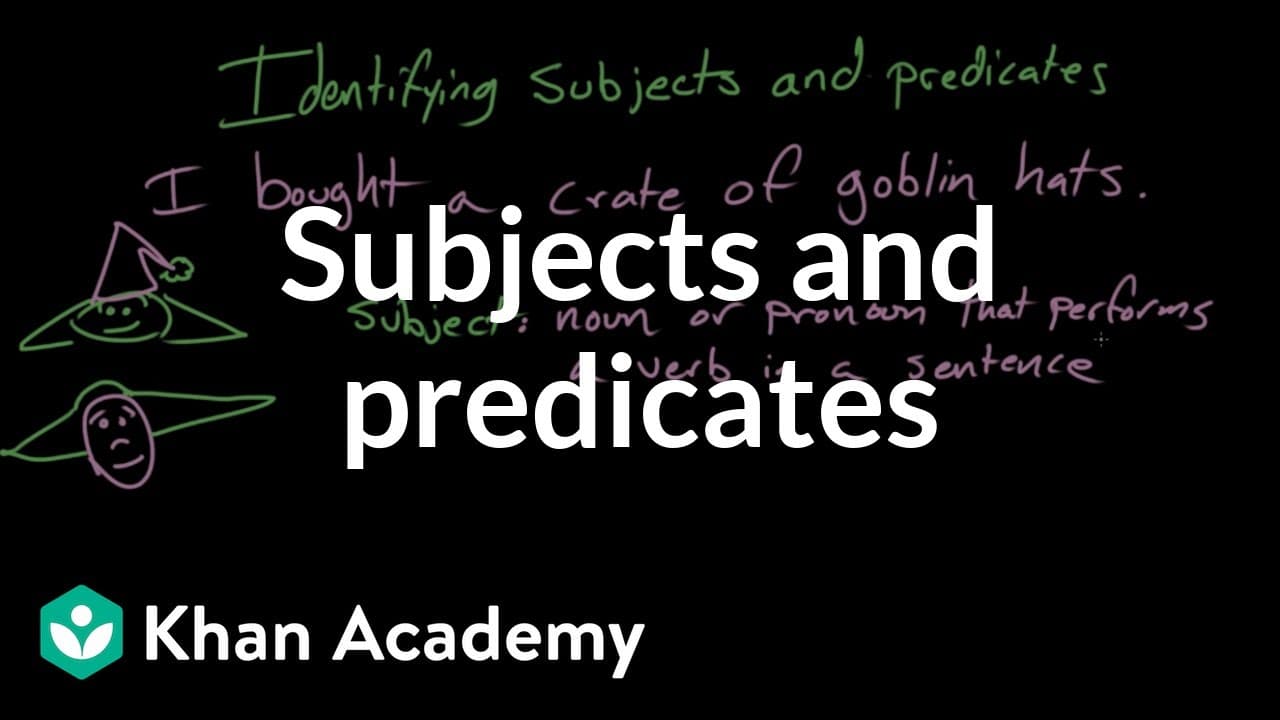
How to Identify the Subject and Predicate of a Sentence

How to Identify the Subject and Predicate of a Sentence

A lighthearted and clear introduction to the fundamental components of a sentence: the subject and the predicate. Through playful banter and humorous examples involving "goblin hats," the narrators break down sentence structure into easily digestible parts using analogies and visual aids. The video explicitly defines subjects as the actors and predicates as the actions (or states of being) plus their related details. The video covers key grammatical concepts including nouns, pronouns, action verbs, and state-of-being verbs. It specifically addresses the nuance that verbs aren't always physical actions (using the example "I am happy") and clarifies the common misconception that any noun in a sentence might be the subject. This resource is highly valuable for elementary and middle school language arts classrooms. It provides a non-intimidating entry point for sentence analysis, offering teachers a concrete metaphor (the car analogy) and a memorable catchphrase for predicates ("the verb and its pals"). It helps students move beyond guessing to systematically identifying sentence parts.

Khan AcademyKhan Academy

2mins 34s

Video
How Punctuation Marks Change Meaning

How Punctuation Marks Change Meaning

This animated video provides a clear and engaging introduction to three fundamental punctuation marks: the period, the exclamation mark, and the question mark. Through a series of simple sentences featuring a friendly Apple character, the video demonstrates how changing the punctuation mark at the end of a sentence drastically alters its meaning, tone, and the way it should be read aloud. The visual examples make abstract grammatical concepts concrete for early learners. The key themes explored include sentence structure, reading intonation, and the specific function of different punctuation marks. The video explores how a period indicates a statement or fact, an exclamation mark conveys excitement or strong emotion, and a question mark indicates an inquiry. It uses humor, such as a surprise monster appearance and a contradiction about being tired, to keep young viewers engaged. For educators, this video is an excellent hook for early literacy lessons on writing and reading fluency. It visually reinforces the connection between written symbols and spoken expression, helping students understand that punctuation provides the "instruction manual" for how to read a sentence. It serves as a perfect model for teaching intonation and can be easily paused for interactive guessing games about which punctuation mark fits different emotional scenarios.

Scratch GardenScratch Garden

1min 53s

Video
Understanding Simple and Compound Sentences

Understanding Simple and Compound Sentences

In this engaging grammar tutorial, David and Paige explain the structural differences between simple and compound sentences. Using a digital whiteboard, they break down the core components of sentence construction, defining a simple sentence as consisting of a single subject and predicate, while a compound sentence combines two or more independent clauses joined by a conjunction. The video dives into technical grammar terminology in an accessible way, introducing concepts like "independent clauses" and "predicates." A significant portion of the video is dedicated to a common point of confusion: the difference between a compound sentence (two complete thoughts joined together) and a simple sentence with a compound predicate (one subject doing two things). Through specific examples about buying candy and getting sunburned, the narrators visually diagram these differences. For educators, this resource serves as an excellent tool for improving student writing fluency. It moves beyond basic definitions to help students understand sentence variety and the mechanics of combining ideas. The visual diagramming of subjects and predicates provides a clear model for students to analyze their own writing, making it particularly useful for lessons on syntax, editing, and avoiding run-on sentences.

Khan AcademyKhan Academy

4mins 29s

Video
Mastering Language Register: Formal vs. Informal Writing

Mastering Language Register: Formal vs. Informal Writing

This engaging video lesson introduces students to the concept of "register" in language arts—the level of formality used in speaking and writing. Through a narrative involving a "Deportment Store" in Media Metropolis, the narrator explains the difference between formal and informal communication using relatable analogies like choosing the right outfit for an occasion. The video defines key terms like deportment and register, helping students understand that language choices depend heavily on the audience and context.

Miacademy & MiaPrep Learning ChannelMiacademy & MiaPrep Learning Channel

10mins 5s

Video
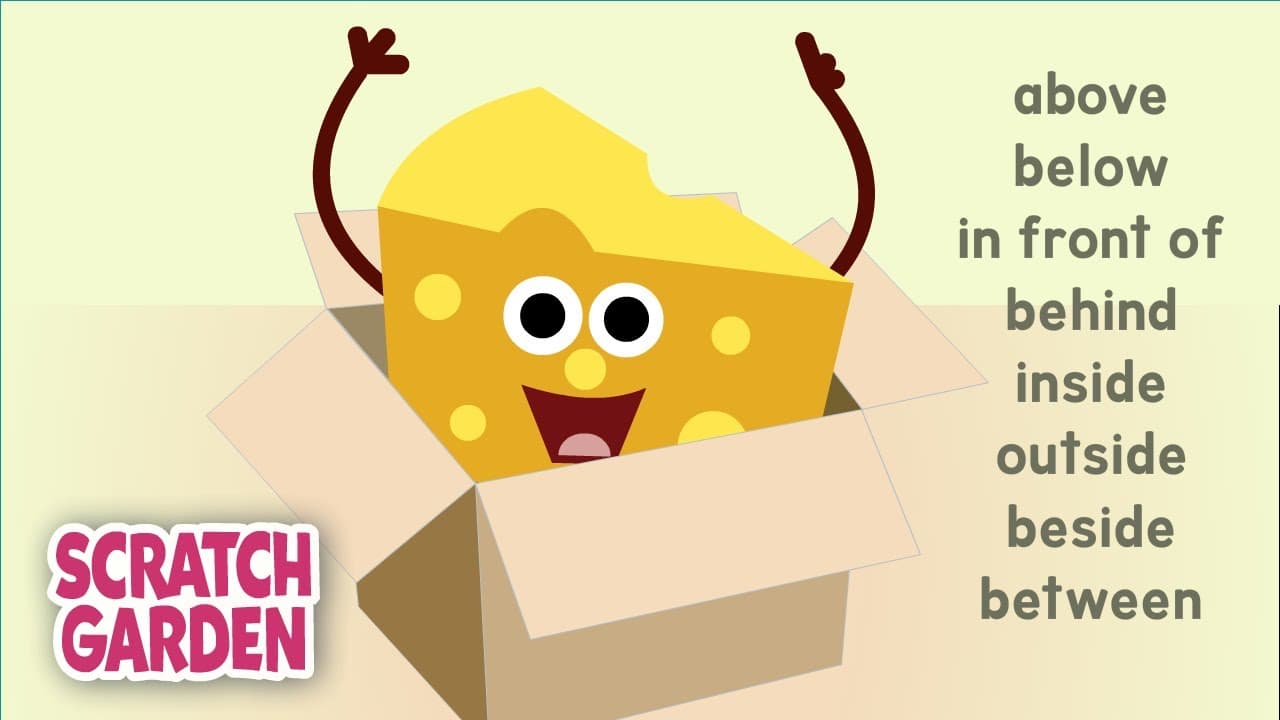
How to Build Better Sentences with Prepositional Phrases

How to Build Better Sentences with Prepositional Phrases

This educational video provides a clear and structured guide to understanding and using prepositional phrases to enhance sentence complexity. It begins by reviewing the basic building blocks of a complete sentence—the subject and the predicate—using the example "Superman caught the robber." The video then identifies a problem: simple sentences often lack specific details. To solve this, the narrator introduces prepositional phrases as tools to provide essential information about time, place, direction, and detail. Key themes include the definition and function of prepositions (words positioned "before" an object), the structure of a prepositional phrase (preposition + object), and the distinction between prepositions of time (e.g., "after," "during") and place (e.g., "behind," "under"). The video categorizes how these phrases function, showing examples of location, direction, time reference, and adding specific details. It emphasizes that a prepositional phrase never stands alone but works to modify the main sentence. For educators, this video is an excellent resource for bridging the gap between simple sentence construction and more descriptive writing. It features guided practice sessions where viewers pause to identify appropriate phrases to answer "when" and "where" questions. This makes it particularly useful for writing workshops focused on "expanding sentences" or grammar units dedicated to parts of speech. The visual style, utilizing hand-drawn text and cartoons on a green screen, helps visual learners deconstruct sentence parts effectively.

GrammarSongs by MelissaGrammarSongs by Melissa

6mins 26s

Video
Mastering Parallel Structure in Writing

Mastering Parallel Structure in Writing

This educational video provides a clear and engaging guide to understanding parallel structure in writing. Hosted by David, Rosie, and Paige, the lesson distinguishes parallel structure as a stylistic choice rather than a strict grammatical rule, emphasizing how it creates harmony and flow in sentences. Through handwritten visual examples on a blackboard, the instructors demonstrate how to align items in a list—whether they are nouns, verbs, or phrases—to ensure they match in form.

Khan AcademyKhan Academy

5mins 5s

Video
Using Commas with Introductory Elements

Using Commas with Introductory Elements

This educational video provides a clear and engaging guide to using commas with introductory elements in sentences. The narrators, David and Paige, break down complex grammatical concepts into easy-to-understand rules, specifically focusing on dependent clauses and sentence adverbs. Through handwritten examples and visual analogies, viewers learn exactly when a comma is required to separate an introduction from the main body of a sentence. The video explores three main scenarios: identifying dependent clauses at the start of sentences, understanding why commas aren't needed when the clause order is reversed, and how to punctuate sentence adverbs like "Initially" or "Basically." The narrators use color-coding to distinguish between clause types and provide memorable metaphors, such as comparing a dependent clause to a ladder leaning against a tree, helping students visualize the relationship between sentence parts. Teachers can use this video to introduce or reinforce specific punctuation rules within a writing curriculum. It is particularly valuable for helping students move beyond simple sentence structures to more complex, varied syntax. The conversational tone and clear visual aids make abstract grammar rules concrete, supporting students in editing their own writing for proper punctuation and clarity.

Khan AcademyKhan Academy

4mins 35s

Video
Mastering the Four Types of Sentences

Mastering the Four Types of Sentences

This animated educational video provides a comprehensive and engaging introduction to the four main types of sentences: interrogative, exclamatory, declarative, and imperative. Through the use of recurring characters like the narrator and a student named Terrence, the video breaks down each sentence type by defining its function—such as asking a question or giving a command—and identifying its corresponding punctuation mark. A catchy song and clear text visuals are used to reinforce the definitions of more complex terms like "interrogative." The video explores the specific characteristics of each sentence type. It explains that interrogative sentences ask questions, exclamatory sentences show strong emotion, declarative sentences simply state facts (and are noted as the most common type), and imperative sentences give commands. The content addresses potential points of confusion, such as how imperative sentences can end in either a period or an exclamation point depending on the delivery, and how to distinguish them from other types based on their function of telling someone to do something. For educators, this video serves as an excellent core resource for grammar instruction in elementary classrooms. It employs a "whole-part-whole" teaching strategy by introducing a complete paragraph containing all sentence types, breaking them down individually, and then reviewing them together. The video includes a built-in quiz segment and specific pause points for audience participation, making it ideal for interactive whiteboard lessons, introducing a writing unit, or reviewing punctuation rules.

Homeschool PopHomeschool Pop

8mins 16s

Video
How to Identify Direct and Indirect Objects

How to Identify Direct and Indirect Objects

This animated grammar lesson provides a clear, step-by-step guide to understanding the difference between direct and indirect objects. Building upon previous knowledge of subjects and verbs, the video introduces the concept of indirect objects as the recipients of the direct object. Through a series of illustrated examples—ranging from a football player kicking a ball to a waitress serving coffee—the narrator breaks down sentences into their component parts to demonstrate exactly how to locate each element. Key grammatical themes explored include sentence structure, parts of speech (nouns, proper nouns, verbs, pronouns), and the specific syntactic pattern of Subject-Verb-Indirect Object-Direct Object (S-V-IO-DO). The video emphasizes the specific rule that an indirect object is always positioned between the verb and the direct object, offering students a reliable strategy for identification. For educators, this video is a valuable tool for scaffolding complex grammar instruction. The content uses a "pause-and-think" pacing strategy that allows teachers to stop the video and ask students to identify sentence parts before the answer is revealed. The visual coding of sentence parts and the humorous examples (like clarifying that a boy didn't throw a dog, but threw the dog a ball) make abstract grammatical concepts concrete and engaging for upper elementary and middle school students.

GrammarSongs by MelissaGrammarSongs by Melissa

5mins 37s

Video
How to Identify and Fix Sentence Fragments

How to Identify and Fix Sentence Fragments

In this engaging grammar lesson, David and his teacher-cousin Beth break down the concept of sentence fragments using a simple, collaborative blackboard style. The video explains that a sentence fragment is an incomplete thought that mimics a sentence by ending with a period but fails to tell the "whole story." Through clear visual examples, the hosts demonstrate the two main causes of fragments: missing a subject (the "who") or missing a predicate (the "what happened"). The video explores three distinct types of fragments: those missing a predicate, those missing a subject, and phrases that lack both (like prepositional phrases standing alone). Using relatable examples like "The pancakes" and "Because of the snowstorm," David and Beth show exactly how to turn these fragments into complete sentences by combining subjects and predicates. The visual use of green and white handwriting on a black background helps distinguish between the naming part (subject) and the telling part (predicate). This resource is highly valuable for upper elementary and middle school language arts classrooms. It provides a non-intimidating entry point into sentence structure, helping students move beyond intuition to understanding the grammatical mechanics of why a sentence is complete. Teachers can use this video to introduce editing skills, support struggling writers who frequently use fragments, or reinforce the fundamental concepts of subject and predicate.

Khan AcademyKhan Academy

3mins 48s

Video
How to Identify Direct Objects in Sentences

How to Identify Direct Objects in Sentences

This instructional video provides a clear, step-by-step guide to identifying direct objects within sentences. Through simple animations and relatable examples, the narrator breaks down the relationship between nouns, verbs, and the objects that receive the action. The video uses a consistent scaffolding method—identifying the subject first, then the action verb, and finally asking specific questions to locate the direct object. The content covers key grammatical concepts including the roles of nouns and proper nouns as subjects, the function of action verbs, and the definition of direct objects. It specifically addresses common pitfalls, such as distinguishing between a direct object and other nouns in a sentence (like objects of prepositions) that do not receive the action of the verb. This resource is highly valuable for elementary and middle school language arts classrooms. Its repetitive, logical structure allows students to practice along with the narrator, reinforcing the mental checklist needed to analyze sentence structure. The visual cues, such as circling and labeling parts of speech, make abstract grammatical rules concrete and accessible for learners.

GrammarSongs by MelissaGrammarSongs by Melissa

6mins 3s

Video
How to Build Compound-Complex Sentences

How to Build Compound-Complex Sentences

This educational video provides a clear and structured explanation of compound-complex sentences, one of the most sophisticated sentence structures in English grammar. The instructors, Paige and Rosie, break down the definition by reviewing the components of simple, compound, and complex sentences before demonstrating how these elements combine. They use a digital whiteboard to visually map out the requirements: at least two independent clauses and at least one dependent clause. The video explores key grammatical themes including clause identification (independent vs. dependent), the use of coordinating conjunctions, and sentence variety. Through two distinct examples—one about picking flowers after a storm and a humorous narrative about a character named Alberto with a walnut allergy—the instructors demonstrate how to identify and construct these sentences. They also show how sentences can be expanded with additional clauses while maintaining their classification. For educators, this resource is an excellent tool for middle school English Language Arts classrooms. It demystifies a concept that often confuses students by visually isolating the parts of speech. Teachers can use this video to transition students from writing simple sentences to more nuanced, rhythmic prose. It serves as a perfect introduction to a lesson on sentence variety or as a remediation tool for students struggling with run-on sentences or fragments.

Khan AcademyKhan Academy

4mins 14s

Video
How to Identify the Subject and Predicate of a Sentence

How to Identify the Subject and Predicate of a Sentence

A lighthearted and clear introduction to the fundamental components of a sentence: the subject and the predicate. Through playful banter and humorous examples involving "goblin hats," the narrators break down sentence structure into easily digestible parts using analogies and visual aids. The video explicitly defines subjects as the actors and predicates as the actions (or states of being) plus their related details. The video covers key grammatical concepts including nouns, pronouns, action verbs, and state-of-being verbs. It specifically addresses the nuance that verbs aren't always physical actions (using the example "I am happy") and clarifies the common misconception that any noun in a sentence might be the subject. This resource is highly valuable for elementary and middle school language arts classrooms. It provides a non-intimidating entry point for sentence analysis, offering teachers a concrete metaphor (the car analogy) and a memorable catchphrase for predicates ("the verb and its pals"). It helps students move beyond guessing to systematically identifying sentence parts.

Khan AcademyKhan Academy

2mins 34s

Video
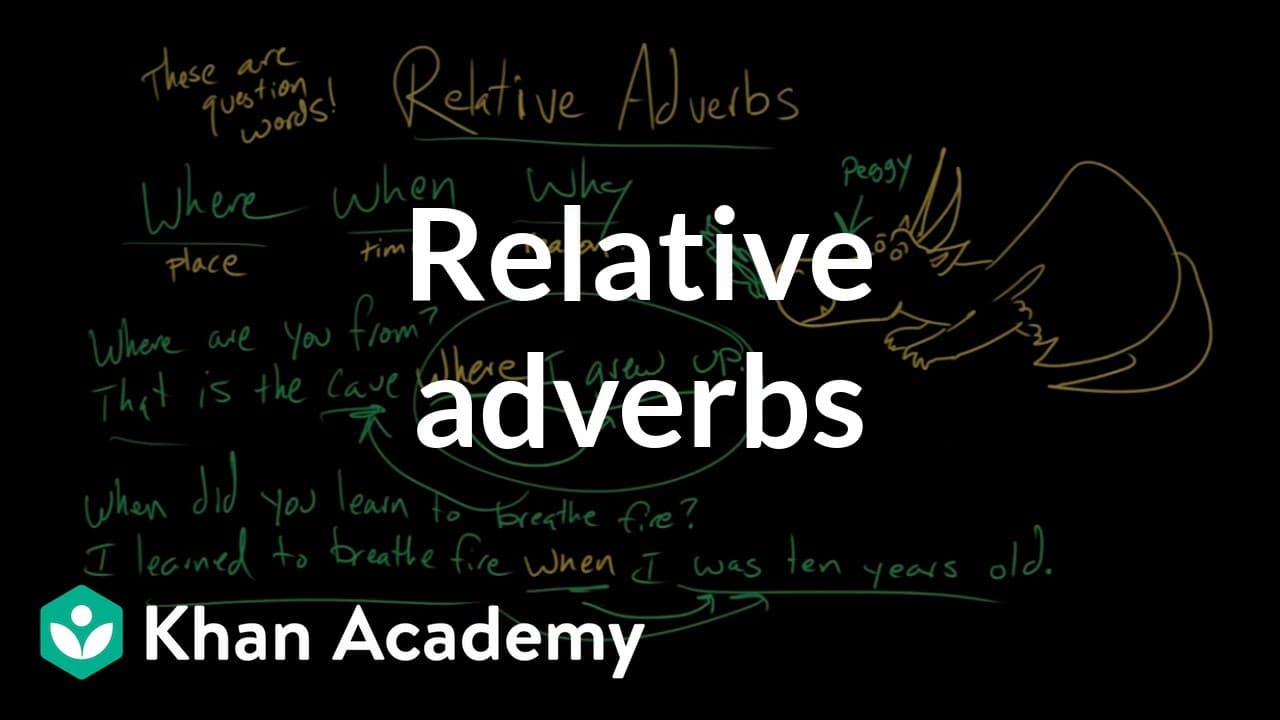
How to Use Where, When, and Why as Relative Adverbs

How to Use Where, When, and Why as Relative Adverbs

This educational video introduces students to the concept of relative adverbs—specifically focusing on the words "where," "when," and "why." Using a friendly illustrated character named Peggy the Dragon, the narrator demonstrates how these words function beyond their common role as question starters. The lesson distinguishes between asking a question (e.g., "Where are you from?") and using a relative adverb to connect two clauses and modify a noun (e.g., "That is the cave where I grew up"). The video explores three primary relationships: "where" relates to place, "when" relates to time, and "why" relates to reasons. Through humorous examples involving dragon traits like breathing fire and strange events like raining fish, the narrator explicitly maps how each adverb connects a dependent clause to the main sentence. The video concludes with a brief etymological expansion, discussing archaic forms like "whence" and clarifying the famous Shakespearean line "Wherefore art thou Romeo" to correct the common misconception that "wherefore" means "where." For educators, this resource serves as an excellent direct instruction tool for Common Core Language standards regarding relative adverbs (L.4.1.a). It effectively scaffolds learning by starting with prior knowledge (question words) and bridging to complex sentence structures. Teachers can use the video to launch lessons on sentence combining, complex sentence formation, and adding detail to writing. The clear visual distinction between the question examples and the relative clause examples helps visual learners grasp the syntactic shift required to use these words correctly.

Khan AcademyKhan Academy

3mins 23s

Video
How to Find Subjects, Direct Objects, and Indirect Objects

How to Find Subjects, Direct Objects, and Indirect Objects

A clear and concise grammar tutorial that breaks down the components of a sentence: subjects, direct objects, and indirect objects. Through a casual dialogue between two narrators, the video uses handwritten examples on a digital whiteboard to visually map out sentence structures. The lesson moves from simple subject identification to the more complex relationship between direct and indirect objects, offering concrete tests to verify which is which. The video explores key grammatical themes including sentence analysis, the roles of nouns and pronouns, and the functional relationships between words. It specifically addresses how action verbs transfer energy to direct objects and how indirect objects function as the recipients of those actions. The narrators also demonstrate how to differentiate an indirect object from a prepositional phrase using a simple transposition test. This resource is highly valuable for English Language Arts classrooms introduced to sentence diagramming or syntax analysis. It clarifies a common point of confusion for students—distinguishing between the thing being acted upon and the recipient of that action. Teachers can use this video to introduce the concept of transitive verbs or as a remediation tool for students struggling with sentence structure and pronoun usage.

Khan AcademyKhan Academy

4mins 43s

Video
Active vs. Passive Voice: A Grammar Adventure

Active vs. Passive Voice: A Grammar Adventure

This engaging language arts video introduces students to the concepts of active and passive voice through a narrative set in the fictional town of "Verbados." When the town's tourism industry suffers due to confusing grammar, the presenter steps in to help clarify the town's communication. By breaking down the roles of the subject and the verb, the video demonstrates how active voice portrays the subject performing an action, while passive voice shows the subject receiving the action. The lesson uses clear visual metaphors—such as an archer shooting a target—to illustrate the direction of action in a sentence. It provides multiple opportunities for interactive learning, asking viewers to pause and label sentences as active or passive, and later to rewrite sentences from one voice to the other. The content covers not just how to identify the voices, but the stylistic reasons for choosing one over the other, such as using active voice for persuasion and clarity, or passive voice for formality or when the actor is unknown. Ideal for upper elementary and middle school English classes, this video serves as an excellent introduction or review of sentence structure and style. Teachers can use it to help students strengthen their writing by making conscious choices about subject-verb relationships. The narrative approach helps contextualize abstract grammatical rules, showing students practical applications in advertising, official announcements, and storytelling.

Miacademy & MiaPrep Learning ChannelMiacademy & MiaPrep Learning Channel

11mins 29s

Video
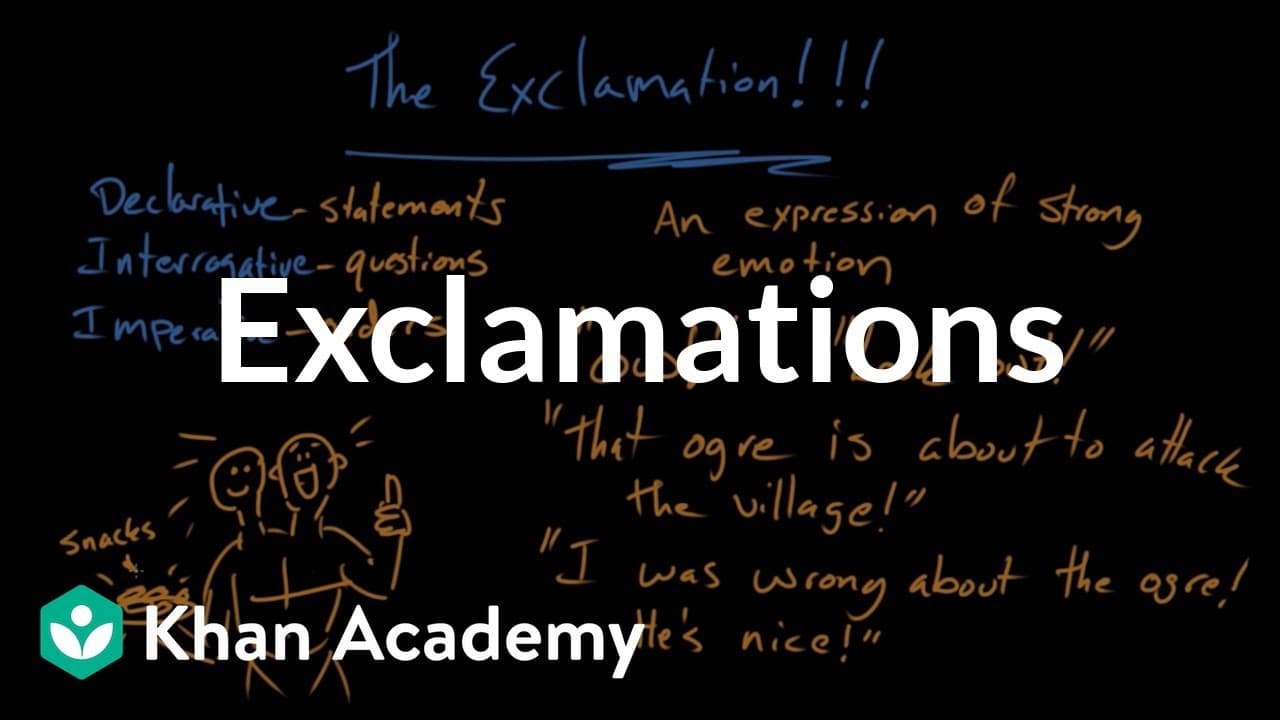
Understanding Exclamations and Strong Emotions

Understanding Exclamations and Strong Emotions

In this engaging grammar lesson, narrators David and Paige introduce the concept of exclamatory sentences, correcting a humorous "mistake" from a previous video where they omitted this sentence type. They define exclamations as expressions of strong emotion or high volume, distinguishing them from declarative (statements), interrogative (questions), and imperative (commands) sentences while acknowledging where these categories overlap. The video explores various examples of exclamations, ranging from simple interjections like "Ow!" to complex sentences involving an ogre attacking a village. It clarifies that exclamations can convey fear, excitement, or simply the need to be heard over a distance. Through the evolving story of a misunderstood ogre who is actually just bringing snacks, the lesson demonstrates how punctuation changes the tone and intent of a sentence. This video is highly useful for elementary language arts classrooms as it moves beyond simple punctuation rules to the communicative purpose of grammar. Teachers can use the humorous examples to help students understand voice, tone, and the specific function of the exclamation point in writing. It serves as an excellent bridge between basic sentence structure and more advanced creative writing skills involving dialogue and emotional expression.

Khan AcademyKhan Academy

2mins 50s

Video
How to Use Appositives to Clarify Your Sentences

How to Use Appositives to Clarify Your Sentences

This educational video provides a clear and accessible introduction to the grammatical concept of the appositive. Hosted by two narrators, David and Paige, the lesson demystifies this complex-sounding term by breaking down its etymology and function. Using a digital whiteboard format, the hosts visually demonstrate how appositives serve as noun phrases that rename, redefine, or clarify an antecedent noun within a sentence. They specifically focus on the punctuation rules associated with appositives, showing how commas act as essential separators to set off this clarifying information from the rest of the sentence. The video explores two primary sentence structures: one where the appositive appears in the middle of a sentence, and another where it appears at the end. Through relatable examples—like describing a sister going to college or lamenting a discontinued snack called "Cookie Cat"—the narrators illustrate how appositives add detail without altering the core grammatical structure of the main clause. The visual component uses color-coding to distinguish the appositive phrase from the rest of the sentence, making the syntactic relationship clear for viewers. For educators, this video serves as an excellent tool for teaching sentence variety and punctuation. It addresses the common student struggle of knowing when to use commas, providing a concrete rule (the appositive) that students can apply immediately to their own writing. By mastering appositives, students can write more sophisticated sentences that combine ideas efficiently, moving beyond simple subject-verb-object structures to more complex, information-rich writing.

Khan AcademyKhan Academy

3mins

Video
How to Identify Subjects and Predicates in Sentences

How to Identify Subjects and Predicates in Sentences

This educational whiteboard animation provides a clear, step-by-step guide to understanding the two fundamental parts of a complete sentence: the subject and the predicate. The video begins by defining these components, explaining that the subject is who or what the sentence is about, while the predicate tells what the subject does or is. It uses a friendly narrative style to break down grammatical concepts into digestible pieces, emphasizing the importance of complete sentences for effective communication. The video explores key grammatical themes including identifying nouns, proper nouns, and pronouns as subjects, and recognizing action verbs and linking verbs as the start of predicates. It employs a consistent "think-aloud" strategy where the narrator models the cognitive process of analyzing a sentence—asking specific questions to isolate the subject and then locating the verb to find the predicate. The video progresses from simple sentences to more complex examples involving compound subjects and linking verbs. For educators, this video is an excellent tool for introducing or reviewing sentence structure. The visual color-coding (subjects in red, predicates in yellow) helps students visually distinguish the parts of a sentence. The video effectively models metacognitive strategies, such as visualization ("I get a picture in my head"), which helps students move beyond rote memorization to genuine comprehension. It is particularly useful for addressing the common confusion between action verbs and state-of-being (linking) verbs.

GrammarSongs by MelissaGrammarSongs by Melissa

4mins 11s

Video
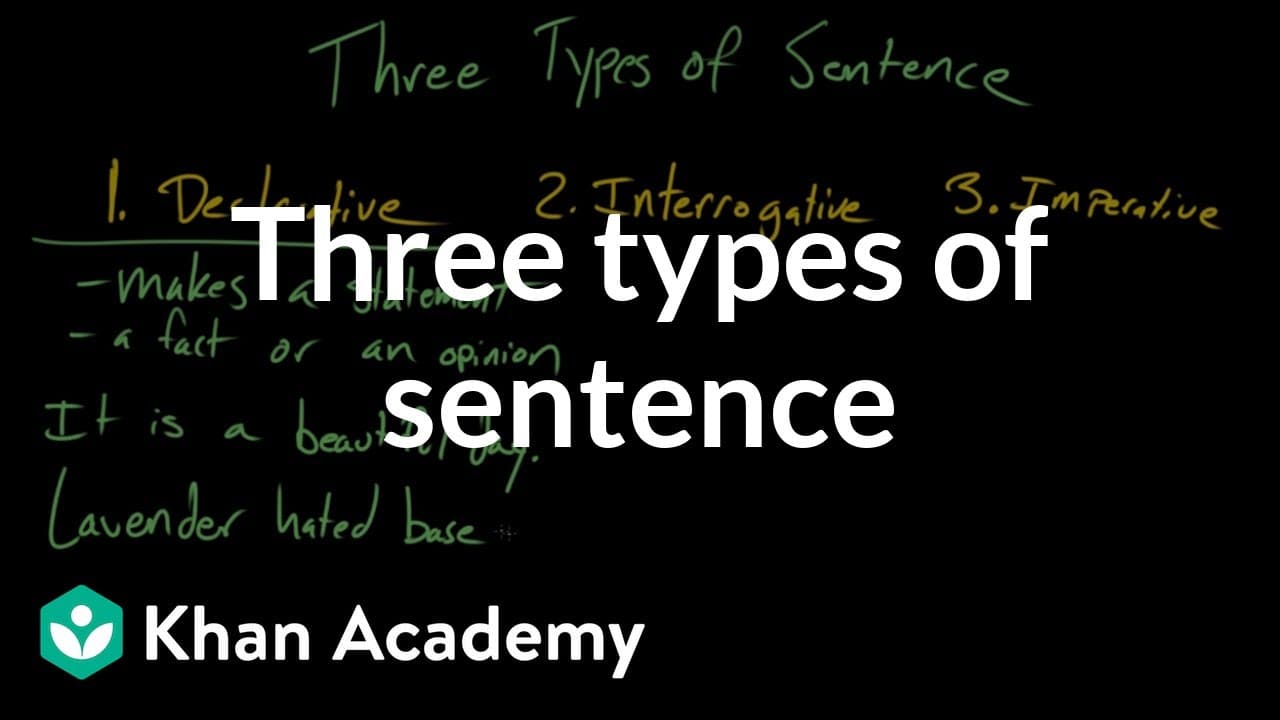
Three Types of Sentences Explained

Three Types of Sentences Explained

A lively and humorous grammar tutorial that introduces students to the three main types of sentences: declarative, interrogative, and imperative. Through a conversational dialogue between two instructors, David and Paige, the video defines each sentence type, provides clear examples, and explains their specific grammatical functions. The visual format uses a blackboard style where terms and examples are handwritten in real-time to reinforce the concepts. The video covers the specific definitions of each type: declarative sentences for making statements or conveying facts/opinions, interrogative sentences for asking questions, and imperative sentences for issuing commands. A key grammatical concept explored is the "implied subject" in imperative sentences, where the subject "you" is understood but not spoken. The instructors use memorable, sometimes silly examples involving lavender, baseball, cheese, and bunnies to keep engagement high. This resource is highly valuable for elementary and middle school English Language Arts classrooms. It demystifies complex-sounding terminology (like "interrogative") by connecting it to familiar words (like "interrogation"). Teachers can use this video to introduce sentence variety in writing, teach proper end punctuation, or explain the grammatical structure of commands. The final segment, which transforms a single slogan into all three sentence types, offers a perfect model for classroom practice activities.

Khan AcademyKhan Academy

3mins 32s

Video
Building Bridges: How to Use Transition Words

Building Bridges: How to Use Transition Words

Join an engaging adventure to the 'Desert of Description' where students learn to build 'Transitional Bridges' to connect their ideas. This video uses a narrative quest format featuring a presenter and a robot companion named Mia to explain the purpose and function of transition words in writing. It breaks down transition words into four key categories: Emphasis, Addition, Compare and Contrast, and Order. The video provides clear definitions and modeled examples for each category, using an ongoing story about a character named Finn stranded on a barren island. Through this story, students see exactly how transition words improve flow, clarify meaning, and add sophistication to a narrative. The content moves from identifying existing transition words to selecting the best words to fill in blanks, providing scaffolded practice within the video itself. This resource is an excellent tool for Language Arts classrooms focusing on narrative writing, sentence fluency, or revision strategies. It actively involves students by asking them to pause, think, and complete tasks, making it more than just a passive viewing experience. It addresses the common struggle of 'choppy' writing by visually demonstrating how these words act as bridges between isolated islands of thought.

Miacademy & MiaPrep Learning ChannelMiacademy & MiaPrep Learning Channel

10mins 51s

No videos found
There are no videos available for this topic yet.
Video
Mastering Prepositional Phrases and Their Functions

Mastering Prepositional Phrases and Their Functions

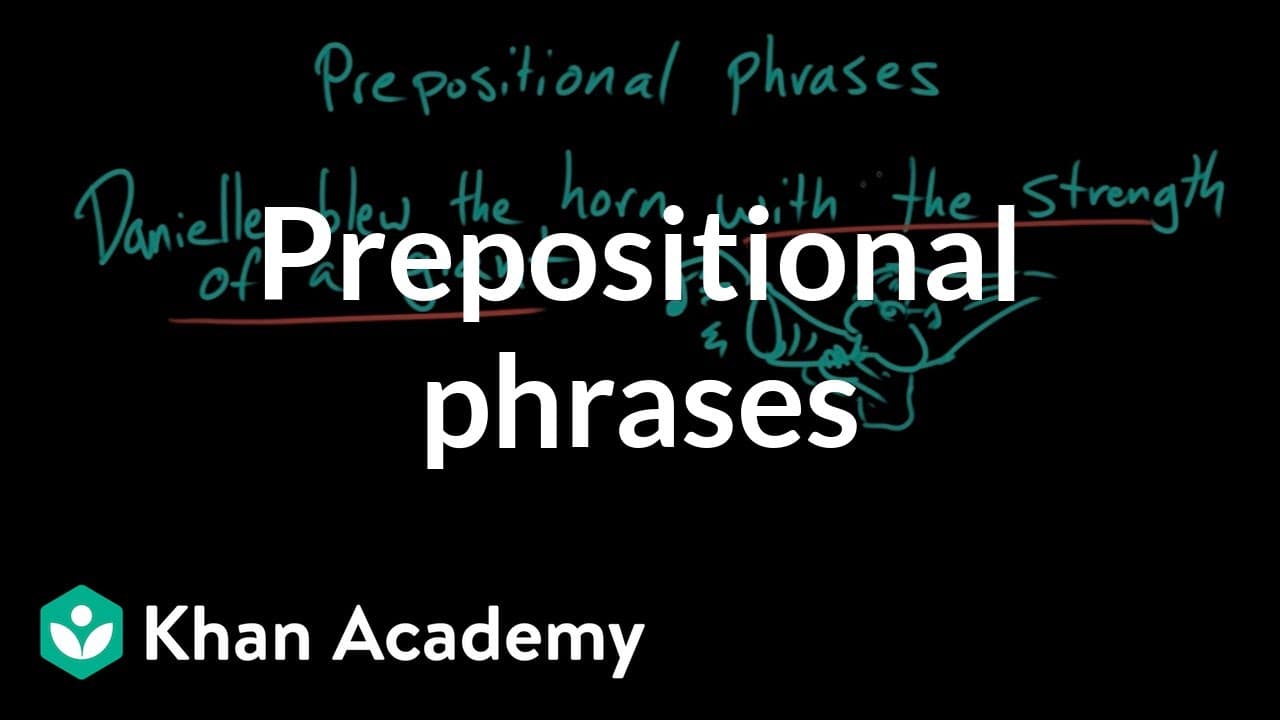
This educational video provides a comprehensive overview of prepositional phrases, defining them as word chunks that begin with a preposition. The narrator uses a digital whiteboard to diagram sentences, illustrating how these phrases function within a sentence structure. Through clear examples and real-time sketching, the video breaks down complex grammatical concepts into digestible parts, showing how a single sentence can contain nested prepositional phrases. The content explores the three primary roles prepositional phrases play: acting as nouns, adverbs, and adjectives. The narrator walks through distinct examples for each function, from simple sentences about blowing a horn to complex literary analysis of Shakespeare's Hamlet. Special attention is given to the potential for ambiguity in writing, using a classic joke to demonstrate how misplaced prepositional phrases can change the meaning of a sentence entirely. For educators, this video serves as an excellent tool for teaching sentence structure, parts of speech, and clarity in writing. It moves beyond basic identification to higher-level analysis of how phrases modify other words. The inclusion of the 'misplaced modifier' example offers a practical way to teach students the importance of word order, while the Shakespeare analysis bridges grammar instruction with literary study.

Khan AcademyKhan Academy

5mins 38s

Video
How to Identify and Fix Dangling Modifiers

How to Identify and Fix Dangling Modifiers

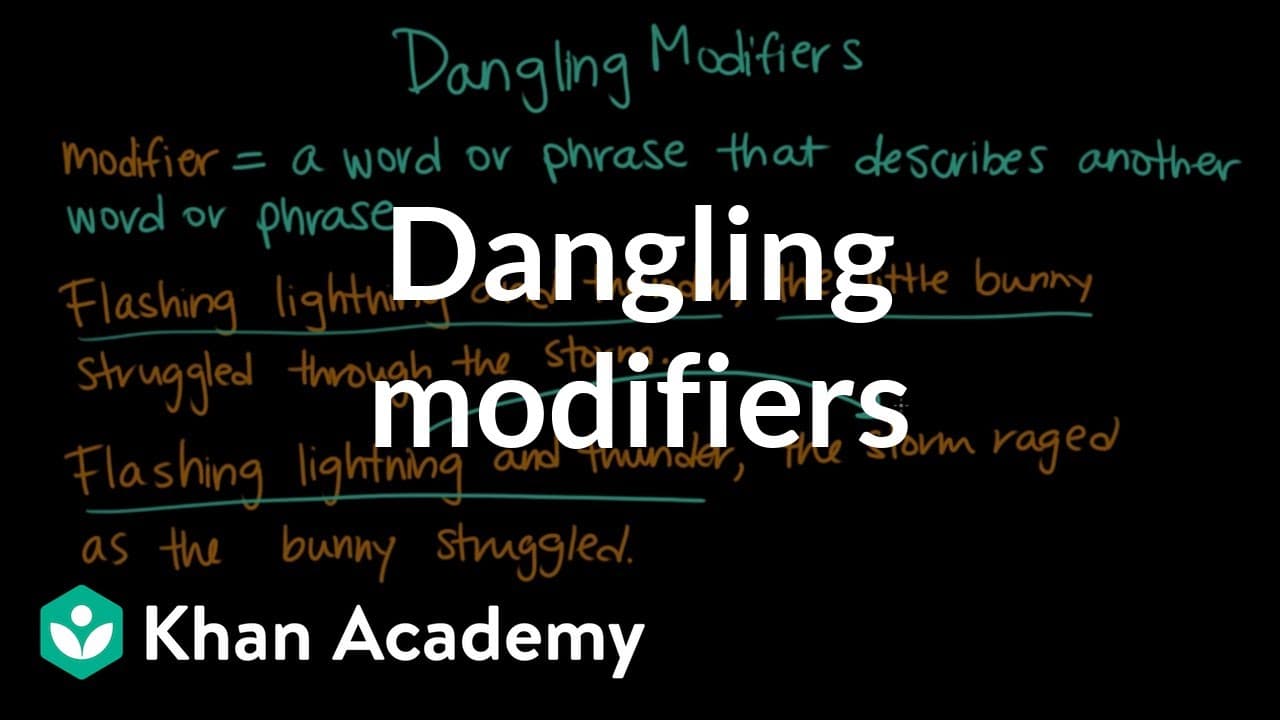
This educational video provides a clear and humorous explanation of dangling modifiers, a common grammatical error where a descriptive phrase is placed incorrectly within a sentence, leading to confusion or absurdity. Through a collaborative whiteboard-style presentation, two narrators, Paige and Rosie, define what a modifier is and demonstrate how "dangling" one creates a sentence where the subject being modified is unclear or incorrect. They use visual examples to show how sentence structure impacts meaning, emphasizing that a modifier must be placed immediately next to the noun it describes. The video explores two specific examples to illustrate the concept. First, a sentence about a storm implies a bunny is emitting lightning because of poor phrase placement. Second, a sentence about a hamster implies a human named Albert is running on a hamster wheel. In both cases, the narrators walk through the logic of why the sentence is incorrect and provide a rewritten, grammatically correct version. The visual aid of moving text and using arrows helps solidify the connection between the modifier and the noun. For educators, this video serves as an excellent introduction or review of sentence structure and editing skills. It moves beyond abstract rules by showing the "funny" consequences of grammar mistakes, making the learning process engaging. Teachers can use this to introduce a unit on editing, to support creative writing lessons, or as a specific remediation tool for students struggling with sentence clarity and complex sentence construction.

Khan AcademyKhan Academy

4mins 19s

Video
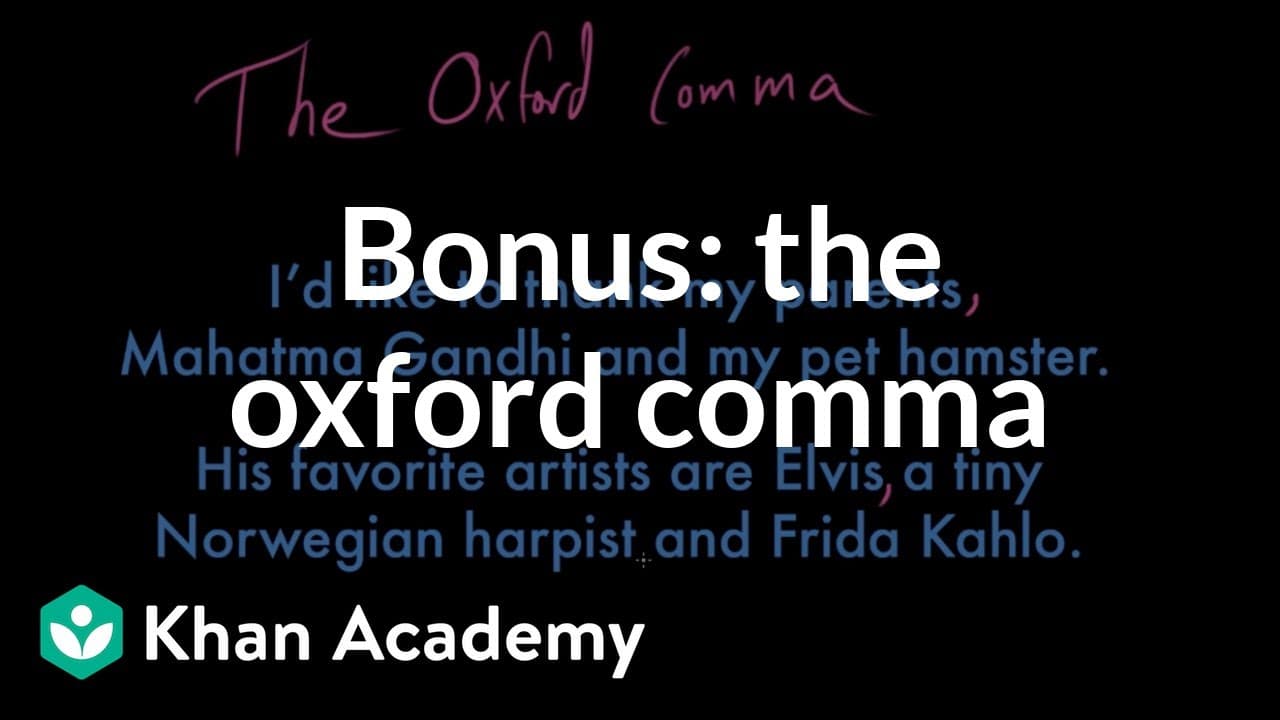
How the Oxford Comma Prevents Confusion

How the Oxford Comma Prevents Confusion

This engaging video explores the function and importance of the Oxford comma (also known as the serial comma) through humorous and memorable examples. Narrators David and Paige explain that while the comma placed before the conjunction in a list is optional in some style guides, its omission can lead to hilarious and confusing misunderstandings. They illustrate this with sentences implying one's parents are Mahatma Gandhi and a hamster, or that Elvis is a tiny Norwegian harpist. The video delves into the nuances of grammatical clarity versus stylistic choice, referencing major style guides like AP (which typically omits it) and Chicago (which includes it). It introduces the grammatical concept of "apposition" to explain why these specific misunderstandings occur. The narrators also offer a sophisticated counter-argument: that rewriting a sentence to change the word order is often a better solution for ambiguity than relying solely on punctuation. For educators, this video serves as an excellent hook for grammar lessons, demonstrating that punctuation is not just about following arbitrary rules but about ensuring clear communication. It provides a non-threatening entry point into complex topics like appositives, ambiguity, and style guides. The humorous examples stick in students' minds, making the concept of the serial comma easier to recall and apply in their own writing.

Khan AcademyKhan Academy

3mins 43s

Video
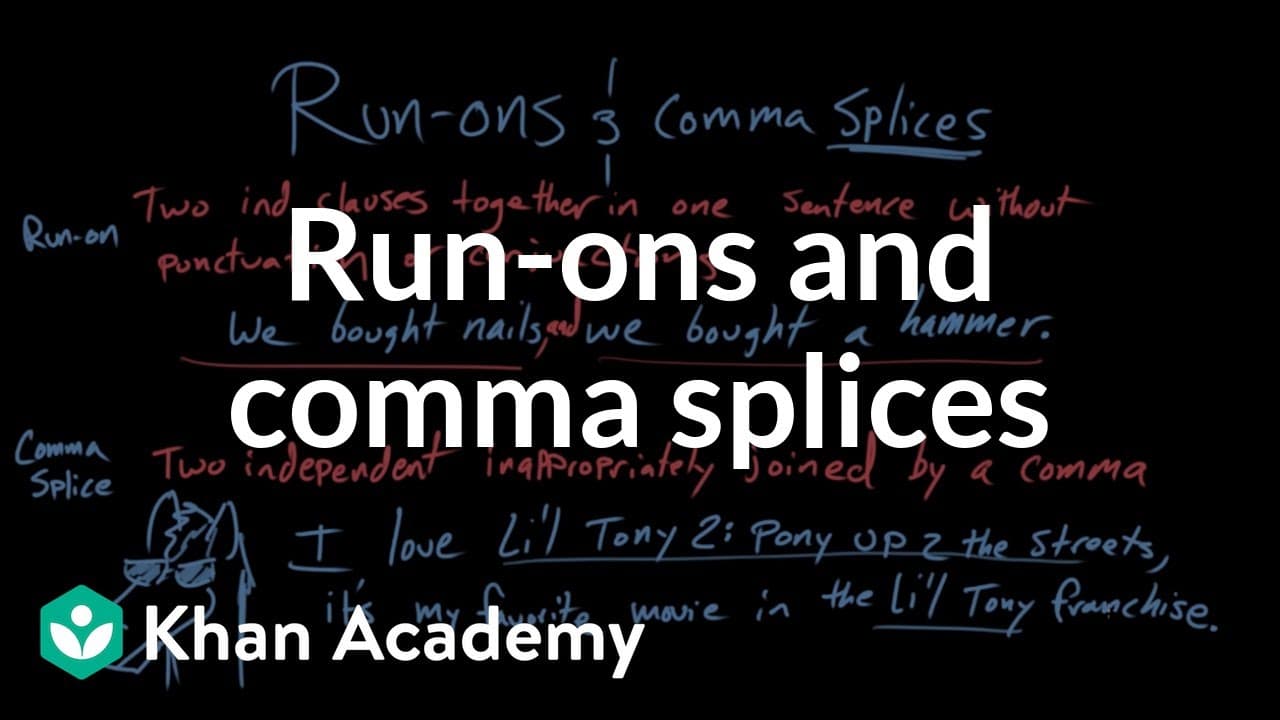
How to Identify and Fix Run-On Sentences

How to Identify and Fix Run-On Sentences

This educational video provides a clear and humorous guide to understanding and correcting run-on sentences and comma splices, two common grammatical errors. Through the use of a digital blackboard, the narrators, David and Rosie, visually break down the structure of these errors, defining them as issues arising from joining independent clauses incorrectly. They offer concrete analogies, such as the "runaway train" for run-ons and the nautical origin of "splicing," to help students conceptualize why these sentence structures are problematic. The video covers key grammatical themes including independent clauses, punctuation (specifically commas and semicolons), and coordinating conjunctions. It demonstrates two primary methods for fixing these errors: using a semicolon to separate related independent clauses, or using a comma followed by a conjunction (like "and"). The lesson distinguishes between a true run-on (no punctuation) and a comma splice (insufficient punctuation), clarifying a nuance that often confuses students. For educators, this video serves as an engaging tool to teach sentence mechanics and editing skills. The approachable tone, featuring a funny example about a fictional pony movie franchise, makes dry grammar concepts memorable. It is highly applicable for English Language Arts classrooms during writing workshops or grammar units, providing students with actionable strategies to improve the flow and accuracy of their writing.

Khan AcademyKhan Academy

4mins 38s

Video
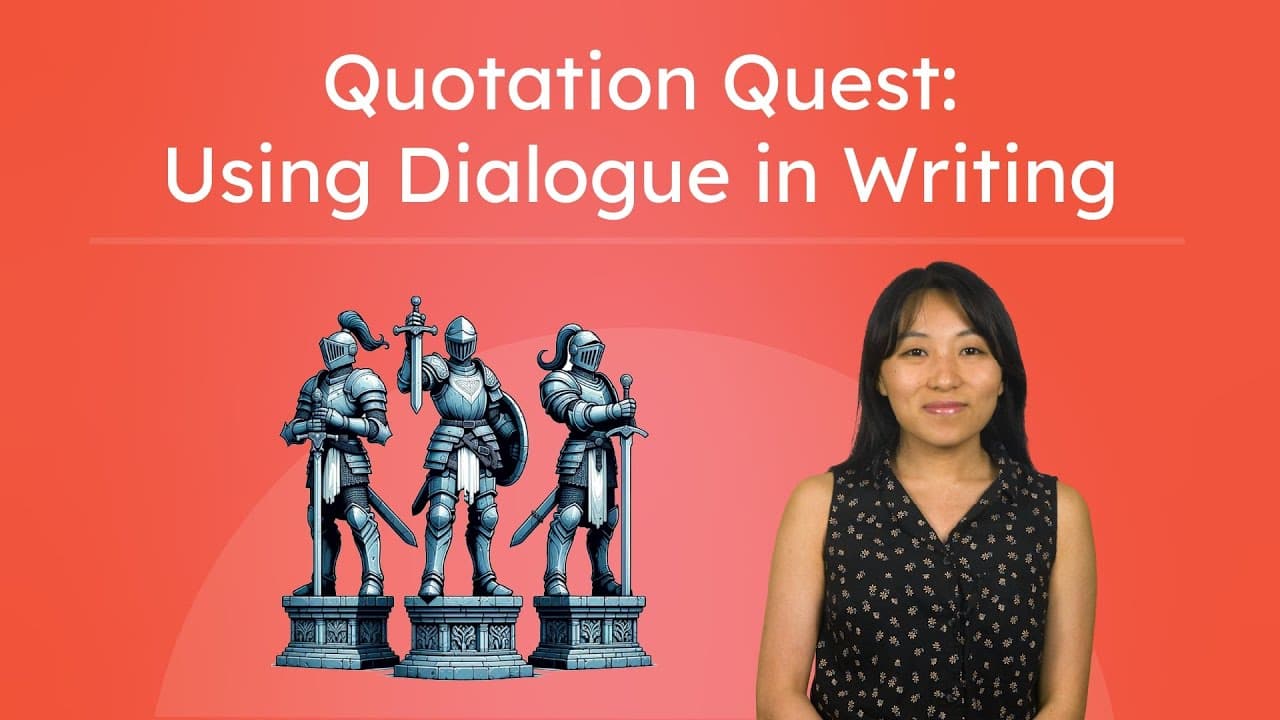
Mastering Dialogue: Formatting, Punctuation, and Tags

Mastering Dialogue: Formatting, Punctuation, and Tags

This engaging language arts video invites students into the "Whispering Hall" of Genre Land to master the mechanics of writing dialogue. Through a quest-based narrative featuring three knight statues, the host guides viewers through three distinct challenges: formatting, punctuation, and dialogue tags. The video contrasts confusing, unformatted blocks of text with properly structured dialogue to visually demonstrate the importance of these writing conventions. The content systematically breaks down the technical rules of dialogue writing. Key topics include when to start new paragraphs (paragraph breaks and indentation), how to use quotation marks and other punctuation within speech, capitalization rules for quoted sentences, and the proper use and placement of dialogue tags. It also distinguishes between valid tags (speaking verbs like "said" or "asked") and action beats (like "smiled" or "ran"), clarifying common grammatical errors. This video is an excellent resource for upper elementary and middle school writing workshops. It transforms dry grammar rules into a gamified editing mission, encouraging students to analyze text critically. Teachers can use the specific "bad vs. good" examples to model editing skills, while the clear breakdown of rules provides a solid foundation for narrative writing units. The step-by-step revision of a single story throughout the video offers a cohesive example of the writing process in action.

Miacademy & MiaPrep Learning ChannelMiacademy & MiaPrep Learning Channel

10mins 24s

Video
Mastering Dialogue: Formatting, Punctuation, and Tags

Mastering Dialogue: Formatting, Punctuation, and Tags

This engaging language arts video invites students into the "Whispering Hall" of Genre Land to master the mechanics of writing dialogue. Through a quest-based narrative featuring three knight statues, the host guides viewers through three distinct challenges: formatting, punctuation, and dialogue tags. The video contrasts confusing, unformatted blocks of text with properly structured dialogue to visually demonstrate the importance of these writing conventions. The content systematically breaks down the technical rules of dialogue writing. Key topics include when to start new paragraphs (paragraph breaks and indentation), how to use quotation marks and other punctuation within speech, capitalization rules for quoted sentences, and the proper use and placement of dialogue tags. It also distinguishes between valid tags (speaking verbs like "said" or "asked") and action beats (like "smiled" or "ran"), clarifying common grammatical errors. This video is an excellent resource for upper elementary and middle school writing workshops. It transforms dry grammar rules into a gamified editing mission, encouraging students to analyze text critically. Teachers can use the specific "bad vs. good" examples to model editing skills, while the clear breakdown of rules provides a solid foundation for narrative writing units. The step-by-step revision of a single story throughout the video offers a cohesive example of the writing process in action.

Miacademy & MiaPrep Learning ChannelMiacademy & MiaPrep Learning Channel

10mins 24s

Video
Using Proper Nouns to Write Vivid Sentences

Using Proper Nouns to Write Vivid Sentences

This educational video provides a clear and engaging introduction to proper nouns, distinguishing them from basic common nouns. It begins by reviewing the definition of a noun as a person, place, or thing, and then defines proper nouns as the *specific* names for these categories. Through whiteboard-style animation, the narrator demonstrates how proper nouns must always be capitalized, reinforcing the grammatical rule alongside the conceptual understanding.

GrammarSongs by MelissaGrammarSongs by Melissa

3mins 26s

Video
The Difference Between Common and Proper Nouns

The Difference Between Common and Proper Nouns

This concise grammar tutorial explains the fundamental difference between common and proper nouns using a clear visual chart and relatable examples. The narrator breaks down the concept into a simple distinction: common nouns refer to general things, while proper nouns act as specific names for those things. Through side-by-side comparisons like "city/Chicago" and "frog/Kermit," the video illustrates the continuum from generic to specific. The video also addresses the crucial mechanics of capitalization associated with these noun types. It explicitly demonstrates the rule that proper nouns are always capitalized, whereas common nouns are only capitalized when they begin a sentence. The narrator provides written sentence examples to show this rule in action, correcting capitalization errors in real-time to model proofreading skills. For educators, this resource serves as an excellent introduction or review of noun types and capitalization rules. It is visually simple, focusing the viewer's attention on the text and the concept of specific vs. general naming conventions. The video supports literacy development by linking grammar concepts to writing mechanics, helping students understand not just what nouns are, but how to treat them correctly in their own writing.

Khan AcademyKhan Academy

2mins 52s

Video
Learning the 4 Rules of Capitalization

Learning the 4 Rules of Capitalization

This engaging educational video introduces elementary students to the fundamental rules of capitalization in English grammar. Through a friendly narrator and a mix of animated characters and real-world photography, viewers learn exactly when and why to use upper-case letters. The video breaks down the concept into four primary rules, making abstract grammatical concepts concrete and easy to understand for young learners.

Homeschool PopHomeschool Pop

9mins 9s

Video
How to Revise and Edit Writing Using ARMS and CUPS

How to Revise and Edit Writing Using ARMS and CUPS

This educational video guides students through the final two stages of the writing process: revising and editing. Hosted in a whimsical "Fact Forest" setting, the narrator distinguishes between revising (improving content and structure) and editing (correcting mechanical errors). The video introduces two powerful mnemonic devices—ARMS (Add, Remove, Move, Substitute) for revision and CUPS (Capitalization, Usage, Punctuation, Spelling) for editing—to help young writers systematically improve their work. Key themes include the distinction between subjective improvements and objective corrections, the importance of audience awareness, and specific strategies for enhancing clarity and engagement. The video demonstrates these concepts using a sample paragraph about Antarctic exploration, modeling exactly how to replace vague words with specific vocabulary, improve sentence flow, and fix grammatical mistakes. It emphasizes that writing is a process that moves from "good to great" through careful review. For educators, this resource serves as an excellent anchor for a writing workshop. It provides concrete, memorable strategies that students can immediately apply to their own drafts. The step-by-step demonstration of correcting a paragraph offers a clear model for students to follow, demystifying the often-abstract concepts of "flow" and "voice." It encourages students to view writing as an iterative craft rather than a one-time task.

Miacademy & MiaPrep Learning ChannelMiacademy & MiaPrep Learning Channel

11mins 6s

Video
The Complete Guide to Grammar Basics

The Complete Guide to Grammar Basics

This comprehensive grammar compilation video serves as an extensive guide to the foundational rules of the English language for elementary students. Through a mix of animation, live-action clips, and humorous character interactions, the video breaks down complex grammatical concepts into digestible segments. It begins by introducing the four main types of sentences—interrogative, exclamatory, declarative, and imperative—helping students understand how punctuation and tone change meaning. It then moves into sentence structure, teaching students how to identify and fix common writing errors like sentence fragments and run-on sentences.

Homeschool PopHomeschool Pop

58mins 54s

Video
How to Identify and Fix Run-On Sentences

How to Identify and Fix Run-On Sentences

This engaging animated video introduces elementary students to the concept of run-on sentences using a humorous and clear approach. Narrated by an enthusiastic cartoon character, the video begins by defining what a proper sentence is—a group of words with a subject, a verb, and a complete thought. Through simple examples like "The dog plays catch," it establishes the baseline for correct sentence structure before introducing the "villain" of the lesson: the sneaky run-on sentence. The video characterizes run-on sentences as "greedy" and "sneaky" because they try to cram two complete thoughts into a single sentence without permission. Using visual metaphors like a character sneaking through a jungle and leaking pipes, the narrator explains that run-ons contain two sentences inside one. The video then transitions into a practical workshop mode, guiding viewers through three specific examples of run-on sentences. For each example, the narrator asks the viewer to identify the break point, pauses to allow for thinking time, and then demonstrates exactly how to split the run-on into two correct sentences using a period and a capital letter. Ideally suited for 2nd through 4th grade language arts classrooms, this resource is excellent for introducing editing skills and sentence structure. It simplifies the often-confusing concept of run-ons by limiting the solution to one method: splitting the sentence with a period. This makes it a perfect foundational lesson for young writers who are just beginning to write longer paragraphs and need to learn where one thought ends and the next begins.

Homeschool PopHomeschool Pop

7mins 35s

Video
The Difference Between Common and Proper Nouns

The Difference Between Common and Proper Nouns

This engaging animated video provides a clear and accessible introduction to the grammatical concepts of common and proper nouns. It begins by defining what a noun is—a person, place, or thing—before distinguishing between the two main types. Through a series of side-by-side examples (like "dog" vs. "Fido" and "city" vs. "Denver"), the narrator illustrates how common nouns name general items while proper nouns provide specific names for those items. A key focus of the video is the capitalization rule associated with proper nouns. The narrator explicitly points out that while common nouns generally start with lowercase letters, proper nouns always begin with a capital letter because they are specific names. This visual cue is reinforced throughout the examples, helping students identify proper nouns not just by meaning, but by their orthography. The video concludes with an interactive "Common or Proper?" game show segment that encourages active participation. This structure makes the video highly valuable for the classroom, as it moves from direct instruction to guided practice and finally to assessment. Teachers can use it to introduce the topic, reinforce the capitalization rule, or review concepts before a writing activity.

Homeschool PopHomeschool Pop

12mins 13s

Video
How to Identify and Use Prepositional Phrases

How to Identify and Use Prepositional Phrases

This engaging educational video introduces students to the concept of prepositional phrases through a clear, memorable analogy of a bridge. The narrator explains that just as a bridge connects two pieces of land, a preposition connects a noun (the object) to the rest of a sentence. The video breaks down the specific components of a prepositional phrase—the starting preposition and the ending object—and demonstrates how to identify them within various sentence structures, including phrases at the beginning, middle, and end of sentences. The content covers key grammatical terminology, including "preposition," "noun," and "object of the preposition." It uses repetitive, step-by-step analysis of example sentences like "We went fishing with Ben" and "Outside the window, the birds are singing" to reinforce learning. Humor is woven throughout to maintain engagement, featuring interruptions from a confused cat named Mr. Whiskers and a tangent about the sounds pelicans make, ensuring the tone remains lighthearted and accessible for elementary students. For educators, this video serves as an excellent core resource for teaching parts of speech and sentence structure. It provides a visual and conceptual framework (the bridge) that helps concrete thinkers grasp abstract grammatical rules. The clear distinction between the preposition itself and the entire phrase makes it valuable for lessons on sentence diagramming, expanding sentences with details (time, place, movement), and improving writing complexity.

Homeschool PopHomeschool Pop

8mins 53s

Video
How to Identify Direct and Indirect Objects

How to Identify Direct and Indirect Objects

This animated grammar lesson provides a clear, step-by-step guide to understanding the difference between direct and indirect objects. Building upon previous knowledge of subjects and verbs, the video introduces the concept of indirect objects as the recipients of the direct object. Through a series of illustrated examples—ranging from a football player kicking a ball to a waitress serving coffee—the narrator breaks down sentences into their component parts to demonstrate exactly how to locate each element. Key grammatical themes explored include sentence structure, parts of speech (nouns, proper nouns, verbs, pronouns), and the specific syntactic pattern of Subject-Verb-Indirect Object-Direct Object (S-V-IO-DO). The video emphasizes the specific rule that an indirect object is always positioned between the verb and the direct object, offering students a reliable strategy for identification. For educators, this video is a valuable tool for scaffolding complex grammar instruction. The content uses a "pause-and-think" pacing strategy that allows teachers to stop the video and ask students to identify sentence parts before the answer is revealed. The visual coding of sentence parts and the humorous examples (like clarifying that a boy didn't throw a dog, but threw the dog a ball) make abstract grammatical concepts concrete and engaging for upper elementary and middle school students.

GrammarSongs by MelissaGrammarSongs by Melissa

5mins 37s

Video
How to Identify Direct Objects in Sentences

How to Identify Direct Objects in Sentences

This instructional video provides a clear, step-by-step guide to identifying direct objects within sentences. Through simple animations and relatable examples, the narrator breaks down the relationship between nouns, verbs, and the objects that receive the action. The video uses a consistent scaffolding method—identifying the subject first, then the action verb, and finally asking specific questions to locate the direct object. The content covers key grammatical concepts including the roles of nouns and proper nouns as subjects, the function of action verbs, and the definition of direct objects. It specifically addresses common pitfalls, such as distinguishing between a direct object and other nouns in a sentence (like objects of prepositions) that do not receive the action of the verb. This resource is highly valuable for elementary and middle school language arts classrooms. Its repetitive, logical structure allows students to practice along with the narrator, reinforcing the mental checklist needed to analyze sentence structure. The visual cues, such as circling and labeling parts of speech, make abstract grammatical rules concrete and accessible for learners.

GrammarSongs by MelissaGrammarSongs by Melissa

6mins 3s

Video
How to Find Subjects, Direct Objects, and Indirect Objects

How to Find Subjects, Direct Objects, and Indirect Objects

A clear and concise grammar tutorial that breaks down the components of a sentence: subjects, direct objects, and indirect objects. Through a casual dialogue between two narrators, the video uses handwritten examples on a digital whiteboard to visually map out sentence structures. The lesson moves from simple subject identification to the more complex relationship between direct and indirect objects, offering concrete tests to verify which is which. The video explores key grammatical themes including sentence analysis, the roles of nouns and pronouns, and the functional relationships between words. It specifically addresses how action verbs transfer energy to direct objects and how indirect objects function as the recipients of those actions. The narrators also demonstrate how to differentiate an indirect object from a prepositional phrase using a simple transposition test. This resource is highly valuable for English Language Arts classrooms introduced to sentence diagramming or syntax analysis. It clarifies a common point of confusion for students—distinguishing between the thing being acted upon and the recipient of that action. Teachers can use this video to introduce the concept of transitive verbs or as a remediation tool for students struggling with sentence structure and pronoun usage.

Khan AcademyKhan Academy

4mins 43s

Video
Mastering Subject and Object Pronouns

Mastering Subject and Object Pronouns

This educational video provides a clear and accessible introduction to the grammatical concepts of subject and object pronouns. The narrator, David, uses a digital blackboard style to visually map out sentence structures, explaining that subjects are the "doers" of actions while objects are the things "acted upon." Through a series of concrete examples, the video demonstrates how nouns can be replaced by specific pronouns depending on their role in the sentence. The content focuses on the mechanics of swapping pronouns like "I/me," "she/her," "he/him," and "they/them." It visually illustrates the "switcheroo" technique—flipping the subject and object of a sentence to show how the pronouns must morph to fit their new grammatical function. The lesson also highlights the exceptions of "you" and "it," which remain constant regardless of their placement. For educators, this video serves as an excellent foundational tool for teaching sentence structure and proper pronoun usage. It simplifies abstract grammatical rules into a visual logic puzzle, making it easier for students to grasp why we say "She gave it to me" rather than "Her gave it to I." It is particularly useful for upper elementary students learning parts of speech or for English Language Learners grappling with case distinctions.

Khan AcademyKhan Academy

5mins 34s

Video
How to Choose Between Who and Whom

How to Choose Between Who and Whom

This video provides a nuanced explanation of the grammatical difference between "who" and "whom," moving beyond rigid rules to explore how these pronouns are actually used in modern English. The narrator explains the traditional distinction—that "who" is for subjects (like "he" or "she") and "whom" is for objects (like "him" or "her")—using the memorable example of "The spy who loved me." The lesson uses simple sentence diagrams to visualize the subject-object relationship. The content goes deeper by introducing the concept of linguistic evolution, describing the rule as a "one-way street." It explains that while "whom" is strictly an object pronoun, "who" has expanded to function as both subject and object in casual usage. The video draws a fascinating parallel to the archaic pronoun "whoso," illustrating how language naturally sheds complex forms over time, and predicts that "whom" may eventually disappear entirely from the language. For educators, this resource is valuable because it distinguishes between technical correctness and social acceptability (register). It empowers students to understand that language rules change and helps them navigate the choice between "who" and "whom" based on the desired tone—formal vs. informal—rather than just memorizing a binary rule. It creates a comfortable space for students who find grammar intimidating by validating their natural speech patterns while teaching them the formal structures needed for academic writing.

Khan AcademyKhan Academy

4mins 47s

Video
How to Use Definite and Indefinite Articles

How to Use Definite and Indefinite Articles

This educational video provides a clear and accessible breakdown of English articles, specifically focusing on the differences between the definite article "the" and the indefinite articles "a" and "an." Using a digital whiteboard format, the narrator visually maps out the rules regarding specificity, number (singular vs. plural), and phonetic sounds. The video uses simple examples like requesting an orange to illustrate how word choice changes meaning based on whether the speaker wants *any* item or a *specific* item. The content explores three main grammatical rules: the distinction between definite (specific) and indefinite (non-specific) references, the constraints of singular versus plural nouns, and the phonetic rule for choosing between "a" and "an." A significant portion of the video is dedicated to the nuance of vowel *sounds* versus vowel *letters*, using tricky examples like "union" vs. "underwater" to explain why the sound determines the article rather than the spelling. For educators, this resource serves as an excellent tool for teaching grammar fundamentals to elementary students or English Language Learners (ELLs). It addresses common errors in student writing, such as mismatching articles with plural nouns (e.g., "an oranges") or using the wrong indefinite article before vowel sounds. The visual diagramming helps abstract grammatical terms become concrete, making it a valuable asset for writing workshops and grammar mini-lessons.

Khan AcademyKhan Academy

4mins 14s

Video
The Tale of Two Elephants: Definite vs Indefinite Articles

The Tale of Two Elephants: Definite vs Indefinite Articles

A clear and engaging introduction to grammatical articles using a simple visual analogy of two elephants. The video defines articles as a type of adjective or determiner that signals how specific a noun is. It distinguishes between the 'definite' article (the) and 'indefinite' articles (a/an) through a side-by-side comparison. Using the 'Tale of Two Elephants,' the narrator explains the core concept of specificity. One elephant is identified as a specific individual ('The Queen of the Elephants'), illustrating the use of the definite article. The other is described as 'any ol' elephant,' illustrating the use of indefinite articles. This concrete example helps students grasp abstract grammatical terminology. This video is excellent for introducing parts of speech in elementary language arts classrooms. It simplifies the often-confusing choice between 'a/an' and 'the' for both native speakers and English language learners. Teachers can use the 'specific vs. not specific' framework to help students improve precision in their writing and speaking.

Khan AcademyKhan Academy

2mins 48s

Video
How to Use A, An, and The Correctly

How to Use A, An, and The Correctly

This engaging animated lesson provides a clear and humorous introduction to the three grammatical articles in the English language: "a", "an", and "the". The video distinguishes these from "news articles" and dives straight into mechanics, using a friendly narrator to explain the difference between "indefinite" articles (general items) and the "definite" article (specific items). Through a series of relatable examples involving cookies, dogs, and toothbrushes, viewers learn that "indefinite" means non-specific, while "definite" implies a specific object known to both the speaker and listener. The content covers the specific rules for usage, breaking down the vowel sound rule for choosing between "a" and "an". It reviews the vowels (A, E, I, O, U) and demonstrates how words starting with these letters require "an" to flow correctly. The video then contrasts these with "the", using dramatic and funny scenarios—like eating the last donut or losing a specific key—to illustrate how using "the" changes the urgency and meaning of a sentence compared to using "a". This video is an excellent resource for early elementary literacy lessons or English Language Learners (ELL) of various ages. It simplifies abstract grammatical terminology like "indefinite article" by anchoring it in concrete visual examples. Teachers can use this video to introduce the concept of articles, practice identifying vowels versus consonants, or spark writing activities where students must choose the correct article to convey specific meanings.

Homeschool PopHomeschool Pop

10mins 9s

Video
The Secret Order of Adjectives in English

The Secret Order of Adjectives in English

This educational video unveils the hidden rules governing the order of adjectives in English sentences. While native speakers naturally intuit that "old white French house" sounds correct while "French old white house" does not, this lesson explicitly breaks down the hierarchy of categories—from quantity and opinion to origin and material—that dictates this sequence. The narrator introduces a memorable and humorous mnemonic device, "DOSA-SCOMP," to help learners recall the correct order. The video covers key grammatical concepts including the specific categorization of adjectives (Determiner, Opinion, Size, Age, Shape, Color, Origin, Material, Purpose) and the distinction between cumulative adjectives (which follow a set order without commas) and coordinate adjectives (which come from the same category and require commas). It uses clear, handwritten visual examples to demonstrate how these rules apply to complex noun phrases. For educators, this resource provides an engaging tool for teaching syntax and descriptive writing. It is particularly valuable for English Language Learners (ELLs) who cannot rely on "what sounds right" and need concrete rules to master sentence structure. The lesson encourages students to play with language by constructing absurdly long descriptive phrases, making the dry mechanics of grammar fun and accessible.

Khan AcademyKhan Academy

5mins 49s

Video
The Complete Guide to Grammar Basics

The Complete Guide to Grammar Basics

This comprehensive grammar compilation video serves as an extensive guide to the foundational rules of the English language for elementary students. Through a mix of animation, live-action clips, and humorous character interactions, the video breaks down complex grammatical concepts into digestible segments. It begins by introducing the four main types of sentences—interrogative, exclamatory, declarative, and imperative—helping students understand how punctuation and tone change meaning. It then moves into sentence structure, teaching students how to identify and fix common writing errors like sentence fragments and run-on sentences.

Homeschool PopHomeschool Pop

58mins 54s

Video
How and When to Use Dashes in Writing

How and When to Use Dashes in Writing

In this engaging grammar tutorial, Khan Academy educators David and Paige explore the versatile world of dashes. The video clearly distinguishes the dash from the hyphen and outlines its four primary functions in English writing: marking interruptions in sentence structure, acting as parenthetical pairs, serving as a substitute for a colon to introduce ideas, and indicating abrupt interruptions in speech. through handwritten examples and conversational dialogue, the hosts demonstrate how dashes can change the "flavor" or pacing of a sentence compared to other punctuation marks. Key themes include the nuance of punctuation, sentence structure, and the stylistic choices writers make. The video introduces the concept of the dash as a dramatic "actor" that can perform the roles of commas, parentheses, and colons, but with a more emphatic or abrupt tone. It also touches briefly on formatting conventions, such as spacing rules according to style guides like the Chicago Manual of Style. This video is highly valuable for English Language Arts classrooms as it moves beyond basic punctuation rules to discuss style and voice. It provides clear, concrete examples that help students understand not just *how* to use a dash, but *why* they might choose it over other options to create specific effects like suspense, emphasis, or naturalistic dialogue. It is an excellent resource for refining student writing and encouraging more complex sentence structures.

Khan AcademyKhan Academy

6mins 20s

Video
How to Use Hyphens to Connect Words

How to Use Hyphens to Connect Words

This educational video provides a clear and engaging overview of how to properly use hyphens in English grammar. Hosted by David and Paige, the lesson distinguishes the hyphen from the longer dash, explaining their different functions—specifically that hyphens join words while dashes separate ideas. Through visual examples written on a blackboard, the hosts demonstrate how hyphens combine two words into a single concept, such as "yellow-green," and contrast this with sentences where a dash acts more like a semicolon.

Khan AcademyKhan Academy

4mins 51s

Video
How to Use Ellipses in Writing and Speech

How to Use Ellipses in Writing and Speech

This educational video from Khan Academy explores the definition and proper usage of the ellipsis, a punctuation mark consisting of three periods. The hosts, David and Paige, break down the two primary functions of ellipses: indicating a pause or hesitation in speech, and showing where words have been omitted from a direct quote. Through clear handwritten examples on a digital whiteboard, they demonstrate how these small dots can significantly alter the pacing of dialogue or condense information in academic writing. A major theme of the video is the ethical responsibility involved in quoting sources. Using a famous quote from Albus Dumbledore, the narrators demonstrate how removing words without using ellipses—or removing the wrong words—can completely change the speaker's intended meaning. They provide a humorous example of how unethical editing could twist Dumbledore's words into a meaningless statement, emphasizing that writers must preserve the original intent of the source material. For the classroom, this video is an excellent resource for English Language Arts units on punctuation, creative writing, and research skills. It clarifies the often-confusing rules around spacing and terminal punctuation (when to use four dots). Furthermore, the discussion on misrepresentation provides a perfect launchpad for lessons on media literacy and the importance of context, moving beyond simple grammar mechanics into critical thinking about information integrity.

Khan AcademyKhan Academy

5mins 12s

Video
How to Use Apostrophes for Possession

How to Use Apostrophes for Possession

This educational video provides a clear and friendly introduction to the grammatical concept of the possessive. The narrators, David and Paige, define possession simply as "owning something" and demonstrate how the apostrophe-s ('s) is used to condense complex phrases like "the carrot that belonged to the rabbit" into efficient forms like "the rabbit's carrot." They explore how this rule applies to both common nouns and proper nouns, using whimsical examples to keep the content engaging. The video then pivots to a crucial exception that often trips up students: possessive pronouns. The narrators clarify that while nouns rely on apostrophes to show ownership, possessive pronouns (like his, hers, ours, and its) never take an apostrophe. They illustrate this with side-by-side comparisons to reinforce the difference between a noun's possessive form and a pronoun's possessive form. Teachers can use this video to introduce or review the mechanics of possession in writing. It is particularly valuable for addressing the common error of adding apostrophes to possessive pronouns (e.g., writing "her's" instead of "hers"). The video's visual style—simple handwriting on a black background—focuses student attention directly on the spelling and punctuation changes being discussed.

Khan AcademyKhan Academy

3mins 45s

Video
Understanding Grammatical Number and Pronoun Agreement

Understanding Grammatical Number and Pronoun Agreement

This video provides a clear and engaging introduction to the concept of grammatical number in English, specifically focusing on the distinction between singular (one) and plural (more than one). The narrator uses handwritten text and simple drawings to visualize how nouns and pronouns must agree in number, explaining that "singular" refers to one thing while "plural" refers to multiple things. The video highlights how this concept is encoded into the language, particularly within pronouns like "me" versus "us." Key themes include pronoun-antecedent agreement, the importance of consistency in writing to avoid confusion, and specific exceptions to standard rules. The narrator uses humorous and memorable examples—such as a sci-fi cloning machine to explain the shift from "me" to "us," and a confusing scenario about sharing a single watch to illustrate agreement errors. The video also briefly touches upon "you" and "they" as flexible pronouns that can function as both singular and plural. For educators, this resource is excellent for introducing or reviewing the mechanics of pronoun usage and sentence structure. It moves beyond rote memorization by providing context for *why* grammar rules exist: to prevent ambiguity. Teachers can use the video's specific examples, like the "cantaloupe" test at the end, to help students identify antecedents and ensure their own writing maintains logical consistency between subjects and pronouns.

Khan AcademyKhan Academy

5mins 18s

Video
Mastering the Difference Between There, Their, and They're

Mastering the Difference Between There, Their, and They're

This video provides a clear and practical guide to mastering one of the most common confusion points in the English language: the difference between the homophones "there," "their," and "they're." Using a digital whiteboard format, the narrator visually breaks down each word's specific grammatical function—location, possession, and contraction—assigning a distinct color to each to aid memory retention. The lesson explores distinct strategies for identifying the correct word choice. For "there," the narrator demonstrates a "T to W" replacement trick to connect it to the question "Where?". For "their," the focus is placed on ownership and the question "Who does it belong to?". Finally, "they're" is explained through the mechanics of contractions, showing how it simply replaces "they are." Practical sentence examples are diagrammed on screen to reinforce these rules in context. This resource is highly valuable for English Language Arts classrooms ranging from upper elementary to middle school. It addresses a persistent writing error that affects students of all ages. Teachers can use this video as a hook for a grammar unit, a remediation tool for students struggling with mechanics, or a quick refresher before a writing assignment to encourage self-editing skills.

Khan AcademyKhan Academy

3mins 21s

Video
How to Choose Between It's and Its

How to Choose Between It's and Its

This concise grammar tutorial clarifies the difference between the commonly confused homophones "it's" and "its." Using a digital whiteboard, hosts David and Paige visually separate the two terms, defining "it's" (with an apostrophe) strictly as a contraction for "it is" or "it has," and "its" (without an apostrophe) as a possessive pronoun. The video utilizes humor, such as referencing popular song lyrics and drawing quirky illustrations, to make the definitions stick. The content explores key grammatical themes including the function of apostrophes in contractions versus their absence in possessive pronouns. It addresses the common misconception that all possessive words require apostrophes, explaining that pronouns like "his," "hers," and "its" are exceptions to the general rule used for nouns. A practical "substitution test" is introduced to help learners verify their word choice. For the classroom, this video serves as an engaging hook or review tool for writing and editing units. It provides students with a concrete strategy—replacing "its" with "his" or "her" to check for ownership—that they can immediately apply to their own writing. The conversational style and clear visual distinction between the two forms make it accessible for students struggling with these specific mechanics.

Khan AcademyKhan Academy

2mins 31s

Video
Matching Subjects and Verbs Correctly

Matching Subjects and Verbs Correctly

This educational video provides a clear and accessible explanation of subject-verb agreement, a fundamental concept in English grammar. The narrator uses the analogy of a "square peg in a square hole" to illustrate the necessity of matching sentence parts correctly. The video breaks down the differences between singular and plural subjects and how they dictate the form of the verb, specifically highlighting the counter-intuitive rule that while plural nouns often end in "s," third-person singular verbs also end in "s." The video explores key grammatical themes including conjugation, singular versus plural forms, and the specific rules governing third-person singular verbs. It directly addresses the common confusion students face regarding why an "s" is added to verbs for singular subjects (e.g., "The dog barks") but removed for plural subjects (e.g., "The dogs bark"). Additionally, the video touches upon indefinite pronouns like "anyone," explaining why they are treated as singular subjects despite implying a group context. For educators, this video serves as an excellent tool for introducing or reinforcing grammar rules in upper elementary and middle school classrooms. The step-by-step strategy provided—finding the subject, determining if it is singular or plural, and checking for the "s"—gives students a practical method for self-editing. The visual use of a blackboard with clear color-coded text helps visual learners grasp the patterns of agreement, making it a valuable resource for writing workshops and grammar mini-lessons.

Khan AcademyKhan Academy

4mins 53s

Video
How Pronouns and Antecedents Work Together

How Pronouns and Antecedents Work Together

This educational video provides a clear and accessible introduction to pronoun-antecedent agreement, a fundamental concept in English grammar. The narrators, David and Beth, begin by breaking down the etymology of the word "antecedent" to help students understand its meaning as "something that goes before." Through a digital whiteboard demonstration, they illustrate how pronouns function as stand-ins for nouns and why they must align logically with the words they replace. The video explores two primary types of agreement: gender and number. Using the example of a character named Jillian, the lesson demonstrates how to select the correct gendered pronouns (she/her) to avoid confusion. It then moves to a plural example involving snowballs and monkeys to explain number agreement, showing why "they" is the correct pronoun for a plural noun while "it" would be incorrect. The narrators use humor and simple illustrations to make these abstract grammatical rules concrete and memorable. For educators, this resource serves as an excellent tool for introducing or reviewing sentence structure and mechanics. It addresses common student errors in writing, particularly the mismatch between singular nouns and plural pronouns or vice versa. The visual nature of the explanation, where words are highlighted and connected with arrows on screen, provides a strong scaffold for visual learners to grasp the relationship between different parts of speech.

Khan AcademyKhan Academy

4mins 7s

Video
How to Find Subjects, Direct Objects, and Indirect Objects

How to Find Subjects, Direct Objects, and Indirect Objects

A clear and concise grammar tutorial that breaks down the components of a sentence: subjects, direct objects, and indirect objects. Through a casual dialogue between two narrators, the video uses handwritten examples on a digital whiteboard to visually map out sentence structures. The lesson moves from simple subject identification to the more complex relationship between direct and indirect objects, offering concrete tests to verify which is which. The video explores key grammatical themes including sentence analysis, the roles of nouns and pronouns, and the functional relationships between words. It specifically addresses how action verbs transfer energy to direct objects and how indirect objects function as the recipients of those actions. The narrators also demonstrate how to differentiate an indirect object from a prepositional phrase using a simple transposition test. This resource is highly valuable for English Language Arts classrooms introduced to sentence diagramming or syntax analysis. It clarifies a common point of confusion for students—distinguishing between the thing being acted upon and the recipient of that action. Teachers can use this video to introduce the concept of transitive verbs or as a remediation tool for students struggling with sentence structure and pronoun usage.

Khan AcademyKhan Academy

4mins 43s

Video
How to Use Reflexive Pronouns Correctly: Me vs. Myself

How to Use Reflexive Pronouns Correctly: Me vs. Myself

This video provides a clear and practical guide to understanding and correctly using reflexive pronouns in English grammar. The narrator, David, breaks down the difference between personal pronouns (like 'me', 'us', 'him') and reflexive pronouns (like 'myself', 'ourselves', 'himself') by creating a visual chart comparing the two forms across first, second, and third-person perspectives. He explains the fundamental rule that reflexive pronouns are only used when the subject and the object of a sentence refer to the same person or thing. The content explores key grammatical themes including subject-verb-object agreement, the function of object pronouns in the predicate, and the distinction between singular and plural forms (e.g., 'yourself' vs. 'yourselves'). Through specific examples involving characters like Janelle and Roderick, the video illustrates how changing the object of a sentence from a different person to the subject itself necessitates the switch to a reflexive pronoun. It clarifies that these words are 'do-ees' (receivers of action) rather than 'do-ers'. For the classroom, this video is highly valuable for addressing common writing pitfalls, particularly the misuse of reflexive pronouns in compound objects (e.g., 'Talk to Vidya or myself'). The narrator offers a simple, foolproof 'substitution test' that students can use to check their own writing. This makes it an excellent resource for upper elementary and middle school language arts lessons focused on sentence structure, editing skills, and formal standard English usage.

Khan AcademyKhan Academy

5mins 10s

Video
How to Use That vs. Which Correctly

How to Use That vs. Which Correctly

This educational video clarifies the often-confusing grammatical distinction between the relative pronouns "that" and "which." It begins by framing the discussion within the broader linguistic debate between prescriptivists, who value strict adherence to rules, and descriptivists, who observe how language is actually used. The narrator positions himself in the middle, offering a practical synthesis to help writers make the right choice. The video explores two primary distinctions to guide usage. First, it demonstrates how "that" functions with restrictive clauses and explains why it should generally not be used with commas (non-restrictive clauses), using clear sentence examples about a carrot. Second, it uses a memorable mnemonic involving a cranky "witch" to explain why "which" should not be used when referring to people. The content covers restrictive vs. non-restrictive clauses, comma usage, and pronoun-antecedent agreement. For educators, this video provides an accessible tool for teaching complex grammar mechanics without getting bogged down in overly technical jargon. It is excellent for middle and high school English classes, particularly during writing workshops or editing phases. The visual examples and humorous mnemonics make abstract grammatical rules concrete and easier for students to retain and apply in their own writing.

Khan AcademyKhan Academy

5mins 41s

Video
Linking Ideas with Relative Pronouns

Linking Ideas with Relative Pronouns

In this concise grammar tutorial, the narrator introduces relative pronouns—who, whom, whose, that, and which—and explains their primary function: linking independent and dependent clauses. The video breaks down the specific usage rules for each pronoun, distinguishing between those used for people (who, whom, whose, that) and those used for inanimate objects or concepts (whose, that, which). Key grammatical rules are demonstrated through clear, handwritten examples on a blackboard style background. The video specifically highlights the flexibility of the word "that" (usable for both people and things) while cautioning against the common error of using "which" to refer to people. Through examples like "The man who sold the world" and "The salad that I bought," viewers see practical applications of these rules in sentence construction. This resource is highly valuable for English Language Arts classrooms as it addresses a specific, common pain point in student writing: sentence variety and correct pronoun usage. It provides a foundational understanding that helps students combine simple sentences into complex ones, improving the flow and sophistication of their writing while clarifying the often-confused distinction between "who," "that," and "which."

Khan AcademyKhan Academy

1min 56s

Video
Using Emphatic Pronouns to Intensify Your Writing

Using Emphatic Pronouns to Intensify Your Writing

This educational video provides a clear and concise explanation of emphatic pronouns, also known as intensive pronouns. The narrator begins by reviewing reflexive pronouns to establish a baseline, explaining how they are used when a subject performs an action on themselves. He then pivots to the main topic, demonstrating how the same words (myself, himself, herself) function differently when used for emphasis rather than as essential grammatical objects.

Khan AcademyKhan Academy

2mins 55s

Video
How to Use Possessive Pronouns Correctly

How to Use Possessive Pronouns Correctly

This educational video provides a clear and structured explanation of possessive pronouns, distinguishing between those that function as adjectives and those that function as nouns. The narrator, David, uses a blackboard style presentation to visually categorize common pronouns like 'my/mine,' 'our/ours,' and 'your/yours' into a helpful T-chart, demonstrating how their usage changes based on sentence structure.

Khan AcademyKhan Academy

4mins 52s

Video
How Pronouns Work in Sentences

How Pronouns Work in Sentences

This engaging animated video introduces students to the concept of pronouns through clear definitions, relatable metaphors, and step-by-step examples. The narrator uses the analogy of a "pit crew" of professional mechanics to explain how pronouns are "professional words" that step in to do the job of replacing nouns. The video covers subject pronouns (he, she, they), object pronouns (it), and introduces first and second-person pronouns (I, you, we) in a way that is accessible for young learners. The content systematically builds complexity, starting with simple singular replacements (Betty -> She), moving to object replacements (book -> it), and finally addressing plural nouns (Rachel and Amy -> They) and compound subjects (Dad and I -> We). Visual cues, including stock footage and on-screen text, reinforce the transformation of sentences as pronouns are applied. For educators, this video serves as an excellent foundational tool for teaching parts of speech and sentence structure. It helps students understand not just what a pronoun is, but *why* we use them (to simplify sentences and avoid repetition). The video creates natural pause points for teachers to ask students to predict the correct pronoun before it is revealed.

Homeschool PopHomeschool Pop

9mins 15s

Video
How to Choose Between Who and Whom

How to Choose Between Who and Whom

This video provides a nuanced explanation of the grammatical difference between "who" and "whom," moving beyond rigid rules to explore how these pronouns are actually used in modern English. The narrator explains the traditional distinction—that "who" is for subjects (like "he" or "she") and "whom" is for objects (like "him" or "her")—using the memorable example of "The spy who loved me." The lesson uses simple sentence diagrams to visualize the subject-object relationship. The content goes deeper by introducing the concept of linguistic evolution, describing the rule as a "one-way street." It explains that while "whom" is strictly an object pronoun, "who" has expanded to function as both subject and object in casual usage. The video draws a fascinating parallel to the archaic pronoun "whoso," illustrating how language naturally sheds complex forms over time, and predicts that "whom" may eventually disappear entirely from the language. For educators, this resource is valuable because it distinguishes between technical correctness and social acceptability (register). It empowers students to understand that language rules change and helps them navigate the choice between "who" and "whom" based on the desired tone—formal vs. informal—rather than just memorizing a binary rule. It creates a comfortable space for students who find grammar intimidating by validating their natural speech patterns while teaching them the formal structures needed for academic writing.

Khan AcademyKhan Academy

4mins 47s

Video
How to Identify the Subject and Predicate of a Sentence

How to Identify the Subject and Predicate of a Sentence

A lighthearted and clear introduction to the fundamental components of a sentence: the subject and the predicate. Through playful banter and humorous examples involving "goblin hats," the narrators break down sentence structure into easily digestible parts using analogies and visual aids. The video explicitly defines subjects as the actors and predicates as the actions (or states of being) plus their related details. The video covers key grammatical concepts including nouns, pronouns, action verbs, and state-of-being verbs. It specifically addresses the nuance that verbs aren't always physical actions (using the example "I am happy") and clarifies the common misconception that any noun in a sentence might be the subject. This resource is highly valuable for elementary and middle school language arts classrooms. It provides a non-intimidating entry point for sentence analysis, offering teachers a concrete metaphor (the car analogy) and a memorable catchphrase for predicates ("the verb and its pals"). It helps students move beyond guessing to systematically identifying sentence parts.

Khan AcademyKhan Academy

2mins 34s

Video
Mastering Personal Pronouns for Better Writing

Mastering Personal Pronouns for Better Writing

This educational video provides a clear and engaging introduction to personal (subject) pronouns, explaining their function as substitutes for nouns. Through a whiteboard animation style, the narrator reviews the difference between common nouns and proper nouns before introducing pronouns as a tool to make writing flow more naturally. The video breaks down the etymology of the word (prefix "pro" meaning "for") and demonstrates how pronouns prevent repetitive, choppy sentences. The content highlights the seven main subject pronouns: I, you, he, she, it, we, and they. A central segment uses a practical writing example—a paragraph about a cat named "Stripes"—to show how repetitive using a proper noun can become, and how swapping in the pronoun "he" transforms the text. It further categorizes pronouns by gender (he/she), inanimate objects (it), and grouping (we vs. they), illustrating each with distinct visual scenarios. Teachers can use this video to introduce parts of speech or as a specific intervention for students who write repetitive sentences. The visual examples effectively demonstrate the mechanics of substitution, making abstract grammar concepts concrete. The video is particularly useful for teaching the "why" behind grammar rules—showing students that pronouns aren't just a rule to memorize, but a tool to make their communication clearer and less redundant.

GrammarSongs by MelissaGrammarSongs by Melissa

5mins 12s

Video
Mastering Subject and Object Pronouns

Mastering Subject and Object Pronouns

This educational video provides a clear and accessible introduction to the grammatical concepts of subject and object pronouns. The narrator, David, uses a digital blackboard style to visually map out sentence structures, explaining that subjects are the "doers" of actions while objects are the things "acted upon." Through a series of concrete examples, the video demonstrates how nouns can be replaced by specific pronouns depending on their role in the sentence. The content focuses on the mechanics of swapping pronouns like "I/me," "she/her," "he/him," and "they/them." It visually illustrates the "switcheroo" technique—flipping the subject and object of a sentence to show how the pronouns must morph to fit their new grammatical function. The lesson also highlights the exceptions of "you" and "it," which remain constant regardless of their placement. For educators, this video serves as an excellent foundational tool for teaching sentence structure and proper pronoun usage. It simplifies abstract grammatical rules into a visual logic puzzle, making it easier for students to grasp why we say "She gave it to me" rather than "Her gave it to I." It is particularly useful for upper elementary students learning parts of speech or for English Language Learners grappling with case distinctions.

Khan AcademyKhan Academy

5mins 34s

Video
Pronoun Consistency and Grammatical Person Explained

Pronoun Consistency and Grammatical Person Explained

This video provides a clear and engaging explanation of grammatical person in English, breaking down the distinctions between first, second, and third person pronouns. The narrator uses a digital whiteboard to visually categorize pronouns into three columns: "me" (first person), "you" (second person), and "everybody else" (third person), making abstract grammatical concepts concrete and easier to visualize.

Khan AcademyKhan Academy

4mins 39s

Video
Mastering the Rules of Subject-Verb Agreement

Mastering the Rules of Subject-Verb Agreement

In this engaging Language Arts lesson, students visit the fictional kingdom of Harmony Island, where communication has broken down because the subjects cannot agree on which verbs to use. The host and her robot companion, Mia, help King Graham R. Whiz establish official laws for subject-verb agreement to restore order. Through this narrative framework, the video systematically breaks down complex grammar rules into four clear, manageable guidelines.

Miacademy & MiaPrep Learning ChannelMiacademy & MiaPrep Learning Channel

11mins 16s

Video
How Subject Pronouns Replace Nouns

How Subject Pronouns Replace Nouns

This educational video provides a clear and comprehensive introduction to personal subject pronouns, explaining their function as substitutes for nouns to improve writing flow. It begins by reviewing the difference between common nouns and proper nouns before introducing the concept that pronouns stand "for" nouns. The video categorizes subject pronouns into singular (I, you, he, she, it) and plural (we, you, they) forms, using visual examples to demonstrate how to select the correct pronoun based on number and gender. The content moves beyond simple definitions to practical application, demonstrating how repetitive writing (using the same noun over and over) can be improved by substituting pronouns. Through a specific example about a bunny named Fluffy, students see how a paragraph transforms from choppy to fluent. The video concludes with guided practice exercises where viewers determine the correct pronoun for specific subjects like "a football player" and "my family," reinforcing the rules of substitution. For educators, this video serves as an excellent foundational lesson for English Language Arts. It effectively visualizes abstract grammar concepts using whiteboard-style animation, making it accessible for elementary students. The clear distinction between singular and plural pronouns, along with the specific focus on the "we" vs. "they" confusion (group including self vs. group excluding self), addresses common student errors in early writing.

GrammarSongs by MelissaGrammarSongs by Melissa

6mins 10s

Video
Using Adjectives to Create Vivid Mental Images

Using Adjectives to Create Vivid Mental Images

This educational video provides a clear and engaging introduction to adjectives and their role in grammar and writing. It defines adjectives as words that "modify" or change nouns, explaining this concept through visual demonstrations of how descriptive language alters mental images. The narrator uses a step-by-step approach, starting with a basic sentence ("The dog ran") and showing how adding different adjectives (e.g., "brown," "sneaky," "thirsty") completely transforms the reader's visualization of the event.

GrammarSongs by MelissaGrammarSongs by Melissa

3mins 42s

Video
Mastering Parallel Structure in Writing

Mastering Parallel Structure in Writing

This educational video provides a clear and engaging guide to understanding parallel structure in writing. Hosted by David, Rosie, and Paige, the lesson distinguishes parallel structure as a stylistic choice rather than a strict grammatical rule, emphasizing how it creates harmony and flow in sentences. Through handwritten visual examples on a blackboard, the instructors demonstrate how to align items in a list—whether they are nouns, verbs, or phrases—to ensure they match in form.

Khan AcademyKhan Academy

5mins 5s

Video
How to Form Comparative and Superlative Adjectives

How to Form Comparative and Superlative Adjectives

This video provides a clear, step-by-step guide on how to form comparative and superlative adjectives in English. Using a digital whiteboard, the narrator constructs a reference table that categorizes adjectives based on their spelling and syllable count—such as one-syllable words ending in 'e', words ending in 'y', and longer multi-syllable words. Specific spelling rules, like doubling consonants or changing 'y' to 'i', are explained visually and phonetically. The content covers five distinct categories of adjectives: (1) one syllable ending in 'e' (cute); (2) one syllable with one vowel and one consonant (big); (3) short words with two vowels or ending in two consonants (sweet, short); (4) two-syllable words ending in 'y' (shiny); and (5) long words (magnificent). The video concludes with a humorous application of these rules to a nonsense word, "blarfy," demonstrating how internalizing these patterns allows students to conjugate even unfamiliar vocabulary. This resource is highly valuable for English Language Arts and ESL classrooms. It breaks down complex spelling conventions into manageable rules, making it an excellent tool for introducing or reviewing adjective morphology. Teachers can use the final "blarfy" segment to test students' ability to transfer these rules to new or made-up words, fostering a deeper understanding of English structural patterns rather than just rote memorization.

Khan AcademyKhan Academy

7mins 40s

Video
Mastering the Difference Between There, Their, and They're

Mastering the Difference Between There, Their, and They're

This video provides a clear and practical guide to mastering one of the most common confusion points in the English language: the difference between the homophones "there," "their," and "they're." Using a digital whiteboard format, the narrator visually breaks down each word's specific grammatical function—location, possession, and contraction—assigning a distinct color to each to aid memory retention. The lesson explores distinct strategies for identifying the correct word choice. For "there," the narrator demonstrates a "T to W" replacement trick to connect it to the question "Where?". For "their," the focus is placed on ownership and the question "Who does it belong to?". Finally, "they're" is explained through the mechanics of contractions, showing how it simply replaces "they are." Practical sentence examples are diagrammed on screen to reinforce these rules in context. This resource is highly valuable for English Language Arts classrooms ranging from upper elementary to middle school. It addresses a persistent writing error that affects students of all ages. Teachers can use this video as a hook for a grammar unit, a remediation tool for students struggling with mechanics, or a quick refresher before a writing assignment to encourage self-editing skills.

Khan AcademyKhan Academy

3mins 21s

Video
How Adjectives Modify and Describe Nouns

How Adjectives Modify and Describe Nouns

This video provides a clear and engaging introduction to adjectives, defining them as words that "change stuff" or modify nouns. Through simple illustrations and sentence examples, the narrator explains how adjectives function within the larger category of modifiers to describe specific qualities like color, personality, and size. The content moves from a visual demonstration involving a sketched bear to analyzing specific sentences to identify adjectives. It differentiates between general nouns (like "bear") and specific descriptions (like "friendly bear" or "blue bear"), helping students understand how these words refine meaning. The video also briefly explores the Latin etymology of the word "adjective" to explain its function as something "thrown on top" of a sentence. Teachers can use this video to introduce parts of speech, specifically the role of adjectives in descriptive writing. It is particularly useful for visualizing how modifiers alter the mental image of a noun and for demonstrating that while sentences can function grammatically without adjectives, these words are essential for adding necessary detail and color to language.

Khan AcademyKhan Academy

3mins 32s

Video
Adjectives: The Words That Describe Nouns

Adjectives: The Words That Describe Nouns

This engaging educational video introduces students to the concept of adjectives as part of speech. It begins by reviewing nouns (people, places, and things) to establish a foundation, then defines adjectives as words that describe nouns or tell us more about them. The narrator uses clear, illustrated examples—such as a "tall, smart" doctor and a "clean, tan" desk—to demonstrate how adjectives function in a sentence. The video progresses through a series of practice scenarios using real-world images, challenging viewers to identify descriptive words for colorful faces, angry toys, tall forests, and splashing water. This visual approach helps students connect the abstract grammatical concept to tangible observations they can make about the world around them. Key vocabulary includes descriptive terms related to size, emotion, cleanliness, and color. Finally, the lesson concludes with an interactive "Adjective Game," a multiple-choice style quiz where students identify the adjective in a given sentence. This video is an excellent resource for early elementary classrooms to introduce grammar concepts, support descriptive writing skills, and encourage vocabulary development through interactive participation.

Homeschool PopHomeschool Pop

8mins 33s

Video
When to Put Commas Between Adjectives

When to Put Commas Between Adjectives

In this engaging grammar lesson, two narrators, David and Paige, tackle a common punctuation dilemma through a relatable scenario involving a "mushy, sticky" apple. David wants to write a complaint letter to a grocery store but gets stuck on whether to include a comma between two adjectives describing the apple. This real-world writing problem serves as the hook to introduce specific grammatical rules regarding adjective order and punctuation.

Khan AcademyKhan Academy

3mins 50s

Video
The Secret Order of Adjectives in English

The Secret Order of Adjectives in English

This educational video unveils the hidden rules governing the order of adjectives in English sentences. While native speakers naturally intuit that "old white French house" sounds correct while "French old white house" does not, this lesson explicitly breaks down the hierarchy of categories—from quantity and opinion to origin and material—that dictates this sequence. The narrator introduces a memorable and humorous mnemonic device, "DOSA-SCOMP," to help learners recall the correct order. The video covers key grammatical concepts including the specific categorization of adjectives (Determiner, Opinion, Size, Age, Shape, Color, Origin, Material, Purpose) and the distinction between cumulative adjectives (which follow a set order without commas) and coordinate adjectives (which come from the same category and require commas). It uses clear, handwritten visual examples to demonstrate how these rules apply to complex noun phrases. For educators, this resource provides an engaging tool for teaching syntax and descriptive writing. It is particularly valuable for English Language Learners (ELLs) who cannot rely on "what sounds right" and need concrete rules to master sentence structure. The lesson encourages students to play with language by constructing absurdly long descriptive phrases, making the dry mechanics of grammar fun and accessible.

Khan AcademyKhan Academy

5mins 49s

Video
Comparing Adjectives with Three Happy Penguins

Comparing Adjectives with Three Happy Penguins

In this engaging grammar lesson, three distinct penguins—Ra'ul, C'esar, and Gabriella—help demonstrate the difference between comparative and superlative adjectives. The video uses the concept of "happiness" to visually and linguistically model how English speakers compare two nouns versus a group of nouns. Through simple drawings and mathematical analogies, the narrator clarifies when to use forms like "happier" versus "happiest." The video covers the core grammatical rules for comparing qualities. It defines "comparative" as a relationship between two items (more/less) and "superlative" as the extreme degree within a group (most/least). Using the penguins as constant characters, the narrator maps these concepts to symbols, showing how Ra'ul is happier (>) than C'esar, but Gabriella is the happiest (>>>) of all. It also touches upon negative comparisons using "less" and "least." Ideally suited for elementary and middle grade language arts classrooms, this resource simplifies abstract grammatical terms into concrete examples. Teachers can use this video to introduce the topic of adjectives, reinforce proper suffix usage (-er vs -est), or support students who struggle with distinguishing between comparing two items versus three or more. The playful tone and clear handwriting make it an accessible entry point for grammar instruction.

Khan AcademyKhan Academy

4mins 11s

Video
Using Adjectives to Describe Nouns

Using Adjectives to Describe Nouns

A high-energy educational rock song that defines adjectives and explains their function in grammar. The video features a catchy musical arrangement that helps students memorize that adjectives modify nouns (persons, places, or things) to provide more information or make them unique.

Have Fun TeachingHave Fun Teaching

3mins 11s

Video
How to Master Frequently Confused Words: Advice, Allowed, Break, and Bear

How to Master Frequently Confused Words: Advice, Allowed, Break, and Bear

This instructional video guides viewers through four sets of frequently confused words in the English language: advice/advise, aloud/allowed, break/brake, and bear/bare. Through a collaborative narration by David and Iman, the video breaks down the grammatical differences (such as noun versus verb forms) and spelling variations that distinguish these tricky pairings. Each set is accompanied by clear definitions, sentence examples, and visual demonstrations on a blackboard-style background. Key themes include homophones, parts of speech identification, and the use of mnemonic devices to aid memory. The video specifically highlights how slight changes in spelling—like the placement of the letter 'e' in 'break' versus 'brake'—can drastically alter a word's meaning. It also explores pronunciation nuances, such as the soft 's' in advice versus the 'z' sound in advise, helping students connect auditory cues to spelling rules. This video is a valuable resource for English Language Arts classrooms focusing on spelling, vocabulary, and writing mechanics. Teachers can use it to introduce these specific confusing words or as a remediation tool for students struggling with homophones in their writing. The explicit teaching of mnemonic strategies provides students with practical, metacognitive tools they can independently apply during writing and editing tasks.

Khan AcademyKhan Academy

6mins 11s

Video
Unlocking Word Meanings with Suffixes

Unlocking Word Meanings with Suffixes

In this engaging vocabulary lesson, the narrator, David, leads viewers on a quest to defeat the "greatest enemy: Not Knowing Stuff" by mastering three specific words: courageous, description, and mythology. Using a digital blackboard style with colorful handwriting and whimsical illustrations, the video breaks down each word's definition, part of speech, and etymology. The lesson places a strong emphasis on morphology, specifically how suffixes like -ous, -tion, and -logy attach to base words to transform their meanings and grammatical functions. The video explores key grammatical concepts including the difference between adjectives, nouns, and verbs. It demonstrates how adding "-ous" changes a noun (courage) into an adjective (courageous), how "-tion" turns a verb (describe) into a noun (description), and how "-logy" denotes a field of study. Humorous illustrated examples—such as a brave girl facing an "Onion Beast" and a disappointed online shopper buying a "magic sword"—reinforce the definitions in memorable contexts. For educators, this video is an excellent tool for introducing or reviewing morphology and word analysis skills. It moves beyond simple rote memorization by teaching students how to deconstruct words to understand their building blocks. The playful tone and clear visual explanations make abstract grammatical concepts accessible for upper elementary students, providing a model for how to figure out unfamiliar vocabulary by looking at word parts and context clues.

Khan AcademyKhan Academy

3mins 46s

Video
Exploring Suffixes Through Heroes and Villains

Exploring Suffixes Through Heroes and Villains

In this engaging animated lesson, "Vocabulary Man" (the narrator) dons a cape to teach viewers three specific vocabulary words: "ability," "heroic," and "villain." The video breaks down each word's definition, part of speech (noun or adjective), and usage. It then delves deeper into morphology by explaining how the suffixes "-ity" and "-ic" function to transform words from one part of speech to another, such as changing the adjective "able" into the noun "ability" or the noun "hero" into the adjective "heroic." The video explores key themes of grammar and morphology, specifically focusing on how suffixes modify word meaning and grammatical function. It connects these linguistic concepts to a fun superhero narrative, using examples like "Icicle Girl" and "Dr. Split-Ends" to contextualize the vocabulary. The contrast between heroes and villains serves as a thematic anchor to help students remember the definitions and the specific suffixes associated with describing qualities versus entities. For educators, this video provides a high-energy, visual method for introducing or reviewing suffixes and parts of speech. The simple whiteboard-style animation and humorous character examples make abstract grammatical concepts concrete and memorable. It is particularly useful for lessons on word study, vocabulary building, and narrative writing, offering a clear model for how to manipulate language to create more precise descriptions and characters.

Khan AcademyKhan Academy

3mins 16s

Video
Comparing Things Using Superlative Adjectives

Comparing Things Using Superlative Adjectives

This engaging animated video introduces students to superlative adjectives through a humorous variety show format hosted by colorful monsters. It systematically breaks down the rules for forming superlatives, starting with the basic addition of "-est" for short words and progressing to more complex rules like changing "y" to "i" and using "most" for longer adjectives. The video also explicitly addresses irregular adjectives that break standard rules, using memorable skits to reinforce these exceptions. Key themes include grammar rules for comparison, spelling changes when adding suffixes, and identifying irregular adjectives. The video uses a mix of animation, live-action skits, and interactive quizzes to maintain student attention while covering essential English Language Arts standards regarding adjectival forms. For educators, this resource serves as an excellent hook or review tool for a grammar unit on comparisons. The video's segmented structure allow for pausing and discussion after each rule is introduced. It provides clear visual text supports for spelling changes and includes a built-in assessment quiz at the end, making it a complete mini-lesson package for introducing or reinforcing how to describe the "most" of something.

Scratch GardenScratch Garden

6mins 38s

Video
Using the Five Senses to Identify Adjectives

Using the Five Senses to Identify Adjectives

This educational video provides a clear and accessible introduction to adjectives, defining them as words that modify or change nouns. The narration explains that while nouns name people, places, and things, adjectives are necessary to clarify the mental image a reader forms. Using simple animated examples, the video demonstrates the difference between a vague sentence like "The dog ran" and a specific one like "The short, furry dog ran," highlighting how adjectives serve as crucial descriptive tools for effective communication. A central theme of the video is using the five senses—sight, sound, smell, touch, and taste—as a framework for identifying and selecting adjectives. Through the detailed example of an apple, the narrator explores how an object can be described using various sensory attributes (e.g., red, crunchy, smooth, sweet). This sensory approach gives students a concrete method for brainstorming descriptive words rather than relying on abstract definitions. For classroom application, this video is an excellent resource for introductory grammar lessons or descriptive writing workshops. It includes guided practice where viewers are asked to identify nouns first, then locate the adjectives modifying them within sentences. This two-step process—finding the noun, then finding the descriptor—provides a practical strategy for students to analyze sentence structure. The content effectively bridges the gap between grammar rules and creative writing, encouraging students to paint clearer pictures with their words.

GrammarSongs by MelissaGrammarSongs by Melissa

5mins 44s

Video
Learning Storytelling Vocabulary: Traditional, Oral, and Narrator

Learning Storytelling Vocabulary: Traditional, Oral, and Narrator

This educational video serves as a vocabulary mini-lesson focused on three specific terms: "traditional," "oral," and "narrator." Set against the backdrop of a virtual "vocabulary circle" campfire, the narrator breaks down each word by examining its part of speech, definition, and etymological structure. The lesson specifically highlights how suffixes like "-al" and "-or" function to change a word's meaning or grammatical category, such as transforming the noun "tradition" into the adjective "traditional." Key themes explored include morphology (how words change forms), parts of speech, and storytelling concepts. The video provides concrete examples for each term, including a personal anecdote about naming pets after literary detectives, a humorous linguistic mix-up involving Spanish vocabulary, and a scene depicting a thief in ancient Greece to illustrate the role of a narrator. These examples help contextualize abstract definitions into relatable scenarios. For educators, this video is a valuable tool for English Language Arts instruction, particularly for building vocabulary and teaching structural analysis of words. It can be used to introduce a unit on storytelling, to reinforce understanding of suffixes and root words, or to spark discussions about family traditions and oral histories. The engaging, informal tone makes complex grammatical concepts accessible and memorable for elementary and middle school students.

Khan AcademyKhan Academy

3mins 33s

Video
Mastering Vocabulary: Diverse and Similar

Mastering Vocabulary: Diverse and Similar

This educational video provides a clear and engaging definition of two important vocabulary words: "diverse" and "similar." The narrator explains the meaning of each adjective, introduces their corresponding noun forms ("diversity" and "similarity"), and teaches the grammatical function of the suffix "-ity" in transforming adjectives into nouns. The presentation uses a "chalkboard" style with handwritten text and simple illustrations to help visualization. The video explores key themes of language arts and grammar, specifically focusing on word definitions, parts of speech, and morphology (suffixes). It connects these linguistic concepts to real-world examples, such as the diversity of snacks or neighborhoods, the similarities between board games, and biological concepts like coral reef biodiversity. The video concludes with a humorous narrative application of the word "similar" involving a hiker getting lost. For educators, this video serves as an excellent tool for introducing or reinforcing vocabulary and grammar concepts. It addresses the nuance between "similar" and "same," provides a concrete rule for word formation using suffixes, and models how to use new vocabulary in complex sentences. The content is versatile, suitable for direct instruction in ELA blocks or as a cross-curricular connection to science lessons on biodiversity.

Khan AcademyKhan Academy

3mins 5s

Video
When to Use Less Versus Fewer: A Grammar Guide

When to Use Less Versus Fewer: A Grammar Guide

In this engaging grammar exploration, two narrators, David and Rosie, debate the rules surrounding the usage of "less" versus "fewer." While many people believe there is a strict rule separating the two, the video reveals a more nuanced reality involving count nouns and mass nouns. Rosie argues that while "fewer" is restricted to countable items, "less" has historically been used for both, challenging common grammar superstitions. The video dives into the technical definitions of count nouns (like grains of sand or hours) versus mass nouns (like sand or sun). Through clear examples written on a digital whiteboard, the narrators demonstrate how these noun types interact with the words less and fewer. The discussion highlights how native speakers naturally distinguish between these categories, even if they can't explicitly define them. Crucially, the lesson explores the historical origins of this grammar rule, tracing it back to a personal preference expressed by Robert Baker in 1770 rather than an inherent law of language. This historical context turns a dry grammar lesson into a fascinating discussion about how language evolves and how rules are made. It concludes with practical advice: while the strict rule might be arbitrary, adhering to it in formal writing remains a marker of "strictly proper" standard English.

Khan AcademyKhan Academy

7mins 12s

Video
Mastering Adjectives and Adverbs in the Desert of Description

Mastering Adjectives and Adverbs in the Desert of Description

This engaging educational video takes students on a narrative adventure into the "Desert of Description," where a character named Caroline and her robot companion, Mia, must solve riddles posed by a Sphinx to survive. The video creatively integrates grammar instruction within this storyline, focusing specifically on the definitions and applications of adjectives and adverbs. Through the narrative of passing the Sphinx's trials, viewers learn how these parts of speech modify nouns, verbs, and even other adjectives to create more vivid and precise language. The content covers key grammatical concepts, starting with basic definitions of adjectives as words that describe nouns (people, places, things) and adverbs as words that describe actions (verbs) or qualities (adjectives). The video provides clear visual examples and sentences to demonstrate how adding these modifiers changes the meaning and depth of a sentence. It distinguishes between adverbs modifying verbs (e.g., "drinks quickly") and adverbs modifying adjectives (e.g., "incredibly clear"), a nuance often missed in introductory lessons. Ideally suited for elementary and middle school language arts classrooms, this video serves as both an introduction and a practice session for descriptive writing. It includes built-in pause points for student participation, asking them to solve riddles, predict definitions, and craft their own sentences using specific constraints. Teachers can use this video to launch a unit on descriptive writing, reinforce grammar rules, or as an interactive activity where students write alongside the characters to complete the quest.

Miacademy & MiaPrep Learning ChannelMiacademy & MiaPrep Learning Channel

9mins 7s

Video
How to Use Descriptive Language to Bring Stories to Life

How to Use Descriptive Language to Bring Stories to Life

This engaging educational video teaches students how to elevate their writing using descriptive language. Set within a gamified narrative, the host and her robot companion arrive at 'Palette Plains,' a world that has lost its color and turned gray. To restore the vibrancy of the land and earn a 'Crystal Quill fragment,' the viewer must transform a dull, factual paragraph into a vivid, descriptive scene using adjectives, adverbs, and sensory details. The video breaks down the writing process into actionable strategies. It first reviews the roles of adjectives and adverbs before introducing two key techniques: 'Sensory Language' (appealing to the five senses) and 'Emotional Language' (establishing mood and feeling). Through clear examples—such as comparing a boring description of a beach to a vivid one—the narrator demonstrates how specific word choices help readers visualize a setting. The video also models close reading by analyzing a text to find descriptive elements. Ideally suited for upper elementary and middle school English Language Arts classrooms, this resource combines direct instruction with interactive practice. It includes specific pause points where students are prompted to complete tasks in a companion PDF (or on paper), such as matching definitions, analyzing a text, planning sensory details, and rewriting a paragraph. Teachers can use this video to introduce a descriptive writing unit, reinforce the concept of 'showing not telling,' or as a self-paced revision workshop.

Miacademy & MiaPrep Learning ChannelMiacademy & MiaPrep Learning Channel

10mins 4s

Video
How to Form the Future Tense

How to Form the Future Tense

In this engaging grammar tutorial, David introduces students to the future tense, focusing specifically on how to use the auxiliary verb "will." The video uses a blackboard-style animation to visually demonstrate how sentences change from the present tense to the future tense. Through humorous examples involving cupcakes and triceratops, the narrator simplifies the concept of time in language, distinguishing between what happens now versus what happens later.

Khan AcademyKhan Academy

2mins 50s

Video
Understanding Modal Verbs: Ability, Permission, and Obligation

Understanding Modal Verbs: Ability, Permission, and Obligation

This educational video provides a clear and engaging introduction to modal verbs, a special class of auxiliary or "helper" verbs in the English language. Narrated by David, the video defines modality as the expression of conditions—such as likelihood, ability, permission, and obligation—and introduces the core list of modal verbs including may, might, must, can, could, shall, should, will, and would. The narrator uses a digital whiteboard to visually map out these concepts, making abstract grammar rules concrete and accessible. The content breaks down the three unique grammatical properties of modal verbs that distinguish them from regular verbs. First, they "agree with everything," meaning they do not change form based on the subject (e.g., no adding 's' for third-person singular). Second, they lack an infinitive form (one cannot say "to can" or "to must"). Third, they indicate specific modalities. Through humorous and relatable examples—like a detective deducing clues or a height requirement for a "Doom-coaster"—the video illustrates how these verbs function in everyday sentences. For educators, this video serves as an excellent foundational tool for teaching parts of speech and sentence structure. It effectively clarifies common student errors, such as incorrect conjugation or using modals as infinitives. The clear visual text and distinct color-coding aid in retention, while the diverse examples provide readymade sentences for classroom analysis. It is particularly useful for upper elementary and middle school English Language Arts curriculums, as well as for English Language Learners (ELLs) mastering the nuances of English verb structures.
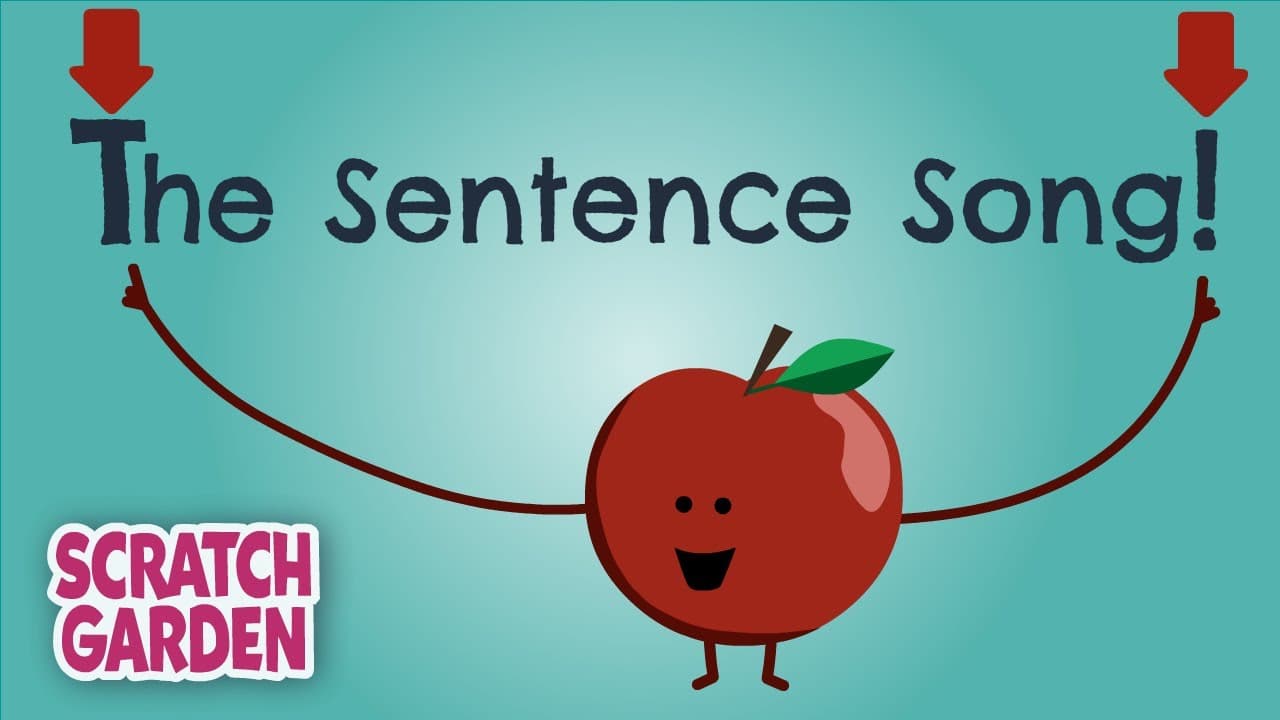
Khan AcademyKhan Academy

4mins 53s

Video
Active vs. Passive Voice: A Grammar Adventure

Active vs. Passive Voice: A Grammar Adventure

This engaging language arts video introduces students to the concepts of active and passive voice through a narrative set in the fictional town of "Verbados." When the town's tourism industry suffers due to confusing grammar, the presenter steps in to help clarify the town's communication. By breaking down the roles of the subject and the verb, the video demonstrates how active voice portrays the subject performing an action, while passive voice shows the subject receiving the action. The lesson uses clear visual metaphors—such as an archer shooting a target—to illustrate the direction of action in a sentence. It provides multiple opportunities for interactive learning, asking viewers to pause and label sentences as active or passive, and later to rewrite sentences from one voice to the other. The content covers not just how to identify the voices, but the stylistic reasons for choosing one over the other, such as using active voice for persuasion and clarity, or passive voice for formality or when the actor is unknown. Ideal for upper elementary and middle school English classes, this video serves as an excellent introduction or review of sentence structure and style. Teachers can use it to help students strengthen their writing by making conscious choices about subject-verb relationships. The narrative approach helps contextualize abstract grammatical rules, showing students practical applications in advertising, official announcements, and storytelling.

Miacademy & MiaPrep Learning ChannelMiacademy & MiaPrep Learning Channel

11mins 29s

Video
Introduction to Verb Aspect and Tense Nuance

Introduction to Verb Aspect and Tense Nuance

In this concise grammar lesson, David introduces the concept of verb aspect, distinguishing it from basic verb tense. While tense places an action in the past, present, or future, aspect adds nuance to these actions, describing their nature—such as whether they are ongoing, completed, or repetitive. The video uses a clear timeline visualization to demonstrate how aspect functions as a tool to expand expression. The key themes explored include the relationship between time and language, the structure of English verbs, and the idea of grammatical "nuance." Specifically, it introduces the four variations (aspects) that exist within the present tense: simple (I walk), continuous (I am walking), perfect (I have walked), and perfect continuous (I have been walking), referring to them playfully as "mini-tenses." For educators, this video serves as an excellent foundational hook for a unit on advanced verb forms. It moves students beyond simple conjugation into understanding the subtle differences in meaning conveyed by different verb structures. By visualizing these concepts on a timeline, it helps visual learners grasp abstract grammatical rules, setting the stage for more complex writing and analysis tasks.

Khan AcademyKhan Academy

1min 50s

Video
Understanding the Perfect Verb Aspect

Understanding the Perfect Verb Aspect

This video provides a clear and concise explanation of the "perfect aspect" in English grammar. The narrator clarifies that in grammatical terms, "perfect" means "complete" rather than flawless. Using a visual timeline, the video demonstrates how this aspect is used to describe actions that are finished prior to a specific reference point in time—whether that point is in the past, present, or future. The content breaks down the structure of perfect tenses, specifically highlighting the formula: helper verb (have/had/will have) + the past participle of the main verb. Through the specific example of "washing dishes," the narrator illustrates the Present Perfect ("have washed"), Past Perfect ("had washed"), and Future Perfect ("will have washed"), showing how only the helper verb changes while the main verb remains constant. For educators, this resource is an excellent tool for demystifying complex verb tenses. The visual timeline offers a concrete mental model for students who struggle with the abstract concept of time in language. It effectively separates the idea of "tense" (when we are speaking) from "aspect" (the status of the action), making it a valuable asset for middle and high school English Language Arts lessons and ESL/ELL instruction.

Khan AcademyKhan Academy

2mins 31s

Video
Three Types of Sentences Explained

Three Types of Sentences Explained

A lively and humorous grammar tutorial that introduces students to the three main types of sentences: declarative, interrogative, and imperative. Through a conversational dialogue between two instructors, David and Paige, the video defines each sentence type, provides clear examples, and explains their specific grammatical functions. The visual format uses a blackboard style where terms and examples are handwritten in real-time to reinforce the concepts. The video covers the specific definitions of each type: declarative sentences for making statements or conveying facts/opinions, interrogative sentences for asking questions, and imperative sentences for issuing commands. A key grammatical concept explored is the "implied subject" in imperative sentences, where the subject "you" is understood but not spoken. The instructors use memorable, sometimes silly examples involving lavender, baseball, cheese, and bunnies to keep engagement high. This resource is highly valuable for elementary and middle school English Language Arts classrooms. It demystifies complex-sounding terminology (like "interrogative") by connecting it to familiar words (like "interrogation"). Teachers can use this video to introduce sentence variety in writing, teach proper end punctuation, or explain the grammatical structure of commands. The final segment, which transforms a single slogan into all three sentence types, offers a perfect model for classroom practice activities.

Khan AcademyKhan Academy

3mins 32s

Video
Identifying and Understanding Helping Verbs

Identifying and Understanding Helping Verbs

This educational video provides a clear, step-by-step guide to understanding, identifying, and using helping verbs (also known as auxiliary verbs). It begins by reviewing action and linking verbs before introducing helping verbs as words that support the main verb to indicate time, mood, or tone. The video acknowledges that memorizing a list of verbs can be overwhelming and instead offers a logical three-step process for identifying them within sentences: find the subject, find the main verb, and look at the words in between. Through illustrated examples, the narrator demonstrates how changing or removing helping verbs drastically alters the meaning of a sentence. For instance, the difference between "Sam cleaned his room" and "Sam should have cleaned his room" is explored to show how helping verbs convey obligation and past tense. Similarly, the difference between playing games and "might" play games illustrates the concept of uncertainty. This resource is highly valuable for elementary and middle school language arts instruction. It moves beyond simple definition to practical application, helping students understand not just what helping verbs are, but why they matter in communication. The visual "hand-drawn" style keeps students engaged, while the repetitive application of the three-step identification method provides a scaffolded learning experience ideal for grammar lessons.

GrammarSongs by MelissaGrammarSongs by Melissa

6mins 11s

Video
How to Identify and Use the Present Tense

How to Identify and Use the Present Tense

This concise educational video introduces students to the concept of the present tense in English grammar. The narrator defines the present tense as actions or states that are happening "right now," offering a simple mental check students can use to verify if a verb is in the present tense by adding the phrase "right now" to the end of a sentence. Through clear, handwritten examples on a blackboard style background, the video demonstrates how this rule applies to various sentence structures. The video explores key themes of verb tenses, sentence construction, and temporal awareness in language. It specifically covers standard present tense verbs (like "eat" and "is") as well as present continuous forms (constructions using "is + -ing"), explaining that both forms describe current actions. The examples range from simple statements about eating donuts to more whimsical sentences about catapults, keeping the tone light and engaging. For classroom application, this video serves as an excellent introduction or review of verb tenses for early elementary students or English language learners. It provides a concrete, actionable strategy (the "right now" test) that students can immediately apply to their own writing and speaking. Teachers can use this video to anchor lessons on subject-verb agreement, narrative timing, or the difference between past, present, and future events.

Khan AcademyKhan Academy

2mins 1s

Video
Understanding the Simple Verb Aspect

Understanding the Simple Verb Aspect

This educational video from Khan Academy explores the concept of the "Simple Aspect" in English grammar. The narrator, David, breaks down the often-confusing term "aspect" by defining it as a way to situate verbs more precisely in time—described metaphorically as "tenses for tenses." Using a visual timeline, the video demonstrates that the simple aspect is essentially the "bare tense" of a verb, devoid of complex helper verbs that might indicate whether an action is ongoing or completed. The video focuses on three primary examples plotted on a timeline: the past ("I walked"), the present ("I walk"), and the future ("I will walk"). Key themes include distinguishing between tense and aspect, recognizing verb conjugations, and identifying helper verbs (or the lack thereof). The content emphasizes that the simple aspect is the most basic form of expression required to convey an idea in a specific timeframe. For educators, this video serves as an excellent tool for demystifying abstract grammatical terminology. It moves beyond simple rote memorization of tenses to help students understand the *function* of verb forms. The visual timeline provides a concrete scaffolding for visual learners to grasp abstract temporal concepts. It is particularly useful for bridging the gap between elementary grammar (identifying verbs) and middle school grammar (analyzing verb structures and nuancing writing).

Khan AcademyKhan Academy

1min 32s

Video
How to Use the Progressive Verb Aspect

How to Use the Progressive Verb Aspect

This video provides a clear and visual explanation of the progressive aspect in English grammar, often referred to as continuous tenses. The narrator distinguishes the progressive aspect from the simple aspect by using a timeline to demonstrate that progressive verbs describe actions that are "ongoing" or happening continuously within a specific moment. The lesson covers how to conjugate verbs into the present progressive ("I am walking"), past progressive ("I was walking"), and future progressive ("I will be walking"). Key grammatical themes include the structure of verb phrases using the auxiliary verb "to be" combined with a main verb ending in "-ing." The video emphasizes that while the main verb form remains constant (e.g., "walking"), the helping verb changes to reflect the time of the action. A mnemonic device—"Always Be Conjugating" (ABC)—is introduced to help students remember the necessity of the "be" verb and the "-ing" ending. For educators, this resource is an excellent tool for visualizing abstract grammar concepts. The use of a color-coded timeline helps students spatially understand the difference between a completed action and an ongoing one. It effectively demystifies the technical term "aspect" by connecting it to the familiar concept of "tense," making it a practical addition to lessons on verb forms, narrative writing, and sentence structure.

Khan AcademyKhan Academy

2mins 45s

Video
Introduction to Verbs as Action Words

Introduction to Verbs as Action Words

This concise animated video introduces the concept of verbs as a fundamental part of speech in English grammar. Using a simple "digital chalkboard" aesthetic, the narrator explains that while verbs serve many functions, their primary role is to express or show action. The lesson uses a recurring character—a sketched bear—to demonstrate how verbs function within sentences. The video explores key grammatical themes including the definition of a verb, the relationship between verbs and actions, and the essential rule that every complete sentence must contain at least one verb. The narrator provides clear, isolated examples of action verbs like "roars," "runs," and "sleeps" to illustrate how these words bring subjects to life. For educators, this resource serves as an excellent introductory hook for grammar lessons in early elementary grades. Its visual simplicity focuses student attention directly on the concept of "action words" without distraction. Teachers can use the video's examples to launch activities like "verb charades" or sentence-building workshops, helping students identify verbs in their own reading and writing.

Khan AcademyKhan Academy

1min 26s

Video
Exploring the Truly Irregular Verbs in English

Exploring the Truly Irregular Verbs in English

This educational video dives deep into the most unusual and unpredictable irregular verbs in the English language—verbs that don't follow even the standard patterns of irregularity. The narrator, David, categorizes these "truly irregular" verbs into four distinct groups: those ending in "-ught," those with a vowel shift plus a "d" sound, verbs that do not change at all between present and past tense, and the unique modal auxiliary verbs. The video systematically breaks down confusing verb transformations like "teach" to "taught" and "flee" to "fled," while clarifying the pronunciation quirks of words like "said." It also highlights a fascinating group of verbs where "time does not exist" (like "bet" and "hurt"), and explains the silent "l" found in modal verbs like "could," "should," and "would." For educators, this resource is an excellent tool for tackling the rote memorization required for these specific verbs. It provides a logical framework for grouping otherwise random words, making them easier for students to recall. The humorous and encouraging tone helps demystify complex grammar rules, making it perfect for upper elementary students mastering past tense or English Language Learners refining their mechanics.

Khan AcademyKhan Academy

2mins 53s

Video
Mental vs. Physical Action Verbs Explained

Mental vs. Physical Action Verbs Explained

This educational video clarifies the distinction between physical action verbs and mental action verbs through clear examples and engaging whiteboard animations. It begins by reviewing physical verbs that can be seen, such as "bounce" or "hop," before introducing the concept that not all actions are visible to the eye. The narrator explains that actions performed by the brain—like thinking, dreaming, or remembering—are just as valid as physical movements, providing a crucial bridge for students moving from concrete to abstract grammatical concepts. The content explores key themes in grammar and parts of speech, specifically focusing on the relationship between nouns and verbs. It emphasizes that a noun (even a superhero) cannot function without a verb to provide action. The video lists common mental action verbs including "understand," "believe," "discover," and "love," and demonstrates how to identify these invisible actions within sentences by visualizing the scenario and asking what is happening inside the subject's mind. For educators, this video serves as an excellent tool to deepen student understanding of verbs beyond simple movement words. It is particularly useful for helping students identify verbs in more complex sentences where the action isn't physically demonstrated. Teachers can use this resource to support lessons on sentence structure, help students expand their writing vocabulary with more precise internal verbs, and clarify misconceptions that verbs must always be movements you can see.

GrammarSongs by MelissaGrammarSongs by Melissa

3mins 32s

Video
How to Form and Use the Perfect Progressive Aspect

How to Form and Use the Perfect Progressive Aspect

This educational video provides a clear and concise explanation of the Perfect Progressive aspect in English grammar. The narrator, David, builds upon previous knowledge of the simple, perfect, and progressive aspects to explain how this fourth aspect functions as a combination of the latter two. He defines the specific utility of this aspect—expressing actions that have been ongoing for a duration or were ongoing until a certain point—and visually demonstrates its placement on a timeline. The video breaks down the grammatical formula for constructing the perfect progressive: using the auxiliary verb "to have" (which changes based on tense), combined with "been," and followed by the main verb with an "-ing" ending. Through specific examples set in the past, present, and future tenses, the video illustrates how the structure shifts slightly while maintaining the core meaning of continuous action over time. For educators, this resource serves as an excellent tool for demystifying complex verb structures. The use of a visual timeline helps students conceptualize abstract temporal relationships, while the humorous example of "eating cookies" makes the repetitive drill of verb conjugation more engaging. It is particularly useful for visual learners who struggle to understand when to apply complex verb phrases versus simple tenses.

Khan AcademyKhan Academy

2mins 11s

Video
Defining and Using the Words Examine, Resource, and Pollution

Defining and Using the Words Examine, Resource, and Pollution

This educational video introduces and defines three specific vocabulary words: "examine," "resource," and "pollution." Using a "blackboard" style visual approach with colorful handwritten text and simple illustrations, the narrator breaks down each word by identifying its part of speech (verb or noun), providing a clear definition, and explaining its etymology or morphological structure (such as the suffix "-tion"). The video explores the meanings in depth before showing them in context. For example, it connects "examine" to the familiar concept of taking an "exam," expands the definition of "resource" from natural materials to school libraries, and breaks down "pollution" as the act of dirtying the environment. Each segment concludes with an illustrated sentence that demonstrates the word being used correctly in a real-world scenario. Teachers can use this video as a versatile tool for both English Language Arts and Science instruction. It serves as an excellent model for how to learn new vocabulary—by defining, connecting to known words, and using in context. Additionally, the specific words chosen bridge nicely into science units regarding scientific observation (examining), natural resources, and environmental stewardship (pollution).

Khan AcademyKhan Academy

2mins 59s

Video
Mastering Confusing Words: Hear vs. Here and Accept vs. Except

Mastering Confusing Words: Hear vs. Here and Accept vs. Except

This educational video provides a clear and engaging guide to mastering two sets of frequently confused words: "hear" vs. "here" and "accept" vs. "except." The narrator, David, breaks down these homophones (or near-homophones) by defining their parts of speech and meanings, ensuring students understand not just how to spell them, but how they function grammatically within a sentence. The video explores key themes of spelling, grammar, and mnemonic strategies. For each word pair, the narrator provides specific memory aids: finding the word "ear" inside "hear," rhyming "here" with "near," linking the "ex" in "except" to "exclude," and connecting the "ac" in "accept" to "access." These cognitive hooks are designed to help learners permanently distinguish between the spellings. For educators, this video is an excellent resource for strengthening vocabulary and writing skills. It directly addresses common pitfalls in student writing and offers practical, visual tools for self-correction. The content is versatile enough to be used as a flipped classroom assignment, a review before a spelling test, or a reference tool for editing workshops, empowering students to proofread their work with greater confidence.

Khan AcademyKhan Academy

3mins 14s

Video
Mastering Parallel Structure in Writing

Mastering Parallel Structure in Writing

This educational video provides a clear and engaging guide to understanding parallel structure in writing. Hosted by David, Rosie, and Paige, the lesson distinguishes parallel structure as a stylistic choice rather than a strict grammatical rule, emphasizing how it creates harmony and flow in sentences. Through handwritten visual examples on a blackboard, the instructors demonstrate how to align items in a list—whether they are nouns, verbs, or phrases—to ensure they match in form.

Khan AcademyKhan Academy

5mins 5s

Video
How to Form the Future Tense

How to Form the Future Tense

In this engaging grammar tutorial, David introduces students to the future tense, focusing specifically on how to use the auxiliary verb "will." The video uses a blackboard-style animation to visually demonstrate how sentences change from the present tense to the future tense. Through humorous examples involving cupcakes and triceratops, the narrator simplifies the concept of time in language, distinguishing between what happens now versus what happens later.

Khan AcademyKhan Academy

2mins 50s

Video
Identifying and Understanding Helping Verbs

Identifying and Understanding Helping Verbs

This educational video provides a clear, step-by-step guide to understanding, identifying, and using helping verbs (also known as auxiliary verbs). It begins by reviewing action and linking verbs before introducing helping verbs as words that support the main verb to indicate time, mood, or tone. The video acknowledges that memorizing a list of verbs can be overwhelming and instead offers a logical three-step process for identifying them within sentences: find the subject, find the main verb, and look at the words in between. Through illustrated examples, the narrator demonstrates how changing or removing helping verbs drastically alters the meaning of a sentence. For instance, the difference between "Sam cleaned his room" and "Sam should have cleaned his room" is explored to show how helping verbs convey obligation and past tense. Similarly, the difference between playing games and "might" play games illustrates the concept of uncertainty. This resource is highly valuable for elementary and middle school language arts instruction. It moves beyond simple definition to practical application, helping students understand not just what helping verbs are, but why they matter in communication. The visual "hand-drawn" style keeps students engaged, while the repetitive application of the three-step identification method provides a scaffolded learning experience ideal for grammar lessons.

GrammarSongs by MelissaGrammarSongs by Melissa

6mins 11s

Video
Action Verbs Explained: What Nouns Do

Action Verbs Explained: What Nouns Do

This engaging educational video introduces students to action verbs by defining them as "words that tell you what nouns do." It begins by reviewing the concept of nouns (person, place, or thing) to build a solid foundation before introducing verbs. Through clear narration and animated examples, the video demonstrates how specific nouns like a teacher, a gas station, and an alarm clock perform actions like "teaches," "fuels," and "rings." The video progresses from animated diagrams to real-world photographic examples, asking viewers to identify the action in pictures of a rat eating, a dog running, a woman reading, and a man swimming. This visual scaffolding helps move students from abstract definitions to concrete recognition of actions in the real world. The pacing is deliberate and enthusiastic, designed to keep young learners focused. Finally, the video features an interactive "Action Verb Game" where simple sentences are displayed, and students are challenged to identify the action verb before the answer is revealed. This interactive component makes the video an excellent tool for direct instruction or review in the classroom, allowing for immediate formative assessment as students call out or write down their answers.

Homeschool PopHomeschool Pop

7mins 51s

Video
How to Identify Direct and Indirect Objects

How to Identify Direct and Indirect Objects

This animated grammar lesson provides a clear, step-by-step guide to understanding the difference between direct and indirect objects. Building upon previous knowledge of subjects and verbs, the video introduces the concept of indirect objects as the recipients of the direct object. Through a series of illustrated examples—ranging from a football player kicking a ball to a waitress serving coffee—the narrator breaks down sentences into their component parts to demonstrate exactly how to locate each element. Key grammatical themes explored include sentence structure, parts of speech (nouns, proper nouns, verbs, pronouns), and the specific syntactic pattern of Subject-Verb-Indirect Object-Direct Object (S-V-IO-DO). The video emphasizes the specific rule that an indirect object is always positioned between the verb and the direct object, offering students a reliable strategy for identification. For educators, this video is a valuable tool for scaffolding complex grammar instruction. The content uses a "pause-and-think" pacing strategy that allows teachers to stop the video and ask students to identify sentence parts before the answer is revealed. The visual coding of sentence parts and the humorous examples (like clarifying that a boy didn't throw a dog, but threw the dog a ball) make abstract grammatical concepts concrete and engaging for upper elementary and middle school students.

GrammarSongs by MelissaGrammarSongs by Melissa

5mins 37s

Video
Understanding Modal Verbs: Ability, Permission, and Obligation

Understanding Modal Verbs: Ability, Permission, and Obligation

This educational video provides a clear and engaging introduction to modal verbs, a special class of auxiliary or "helper" verbs in the English language. Narrated by David, the video defines modality as the expression of conditions—such as likelihood, ability, permission, and obligation—and introduces the core list of modal verbs including may, might, must, can, could, shall, should, will, and would. The narrator uses a digital whiteboard to visually map out these concepts, making abstract grammar rules concrete and accessible. The content breaks down the three unique grammatical properties of modal verbs that distinguish them from regular verbs. First, they "agree with everything," meaning they do not change form based on the subject (e.g., no adding 's' for third-person singular). Second, they lack an infinitive form (one cannot say "to can" or "to must"). Third, they indicate specific modalities. Through humorous and relatable examples—like a detective deducing clues or a height requirement for a "Doom-coaster"—the video illustrates how these verbs function in everyday sentences. For educators, this video serves as an excellent foundational tool for teaching parts of speech and sentence structure. It effectively clarifies common student errors, such as incorrect conjugation or using modals as infinitives. The clear visual text and distinct color-coding aid in retention, while the diverse examples provide readymade sentences for classroom analysis. It is particularly useful for upper elementary and middle school English Language Arts curriculums, as well as for English Language Learners (ELLs) mastering the nuances of English verb structures.
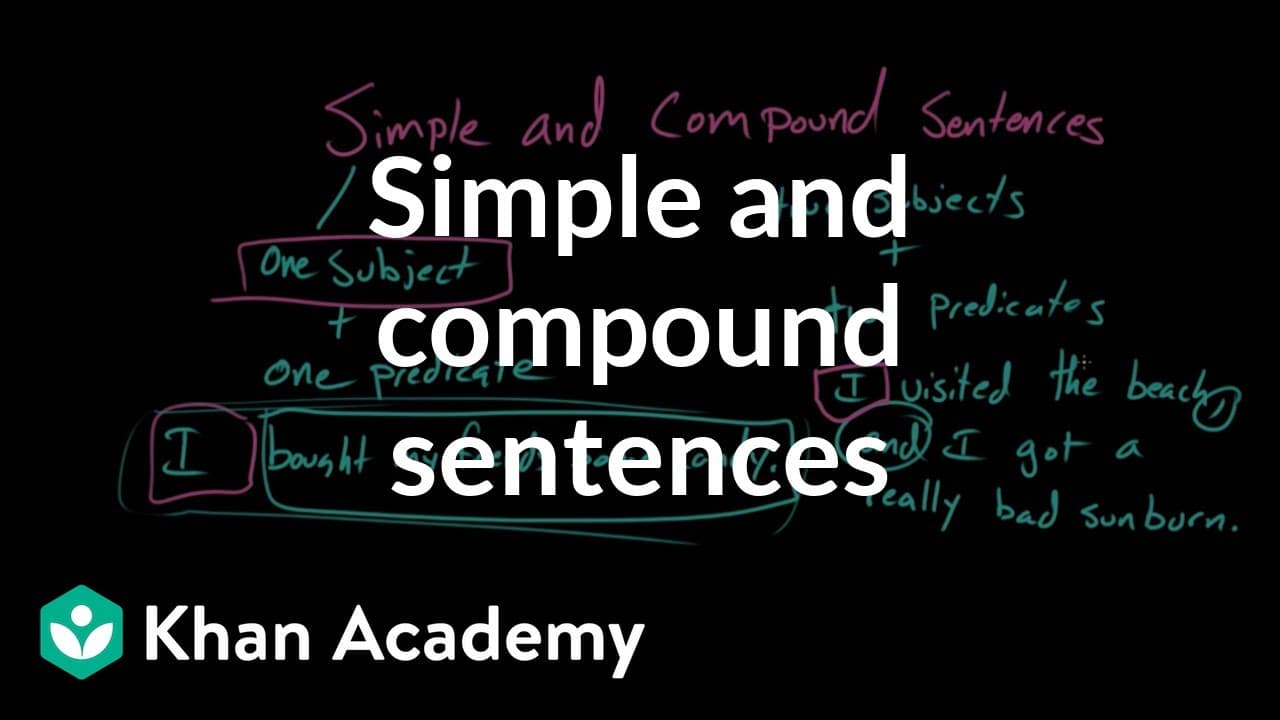
Khan AcademyKhan Academy

4mins 53s

Video
Understanding Helping Verbs and How to Use Them

Understanding Helping Verbs and How to Use Them

This engaging animated video introduces students to the concept of helping verbs through a relatable analogy of friendship and teamwork. Narrated by an energetic character alongside his silent friend Bob, the video explains that just as people sometimes need a buddy to get things done, main verbs sometimes need a "helper" to fully express an action or state. The content breaks down the distinct roles of main verbs versus helping verbs, emphasizing that helping verbs work together with main verbs to complete a sentence's meaning. The video covers key grammatical rules, specifically focusing on the sentence structure rule that helping verbs always appear immediately before the main verb. Through five clear, illustrated examples ranging from "The park has opened" to "I am driving," the narrator guides viewers through the process of identifying both the action (main verb) and the helper. The latter half of the video transitions into an interactive format, asking viewers to identify the verbs before revealing the answer, making it an active learning experience. Ideally suited for elementary language arts instruction, this resource simplifies abstract grammar rules into visual and social concepts students can easily grasp. It addresses the common confusion between different types of verbs and provides a fool-proof strategy for spotting them in sentences. Teachers can use this video to introduce verb phrases, teaching sentence structure, or as a review tool for identifying parts of speech.

Homeschool PopHomeschool Pop

7mins 24s

Video
How to Write Clear Technical Instructions

How to Write Clear Technical Instructions

This engaging video introduces students to the fundamentals of technical writing through a relatable and humorous scenario: a failed attempt at making spaghetti using a poorly written recipe. The narrator uses this "kitchen disaster" to illustrate why clarity, precision, and structure are essential when giving instructions. By analyzing the flaws in "Aunt Jane's" vague recipe, the video breaks down complex writing concepts into tangible, easy-to-understand examples. The lesson explores key pillars of effective technical writing, including specificity, conciseness, chronological ordering, and being action-oriented. It introduces advanced grammatical concepts such as nominalization—the habit of turning verbs into nouns—and demonstrates how to replace weak nouns with strong, active verbs to improve readability. The video also provides practical strategies for revision, such as asking specific questions (How many? Which kind? When?) to identify gaps in information. For educators, this video serves as an excellent launchpad for units on expository or instructional writing. It moves beyond abstract grammar rules by showing real-world consequences of poor communication (like having to scrape spaghetti off a cold plate). It includes built-in pause points for student reflection and guided note-taking, making it a ready-made interactive lesson that helps students transition from creative narrative writing to the functional, objective style required in professional and academic contexts.

Miacademy & MiaPrep Learning ChannelMiacademy & MiaPrep Learning Channel

8mins 44s

Video
Action vs. Linking Verbs: What's the Difference?

Action vs. Linking Verbs: What's the Difference?

This educational video provides a clear and engaging introduction to the difference between action verbs and linking verbs (also known as state-of-being verbs). Through the use of simple hand-drawn visuals and a recurring character—a bear—the narrator illustrates how verbs function differently within sentences. The lesson begins by reviewing the forms of the verb "to be" and then proceeds to split the screen to contrast what a subject "does" (action) versus what a subject "is" (linking). Key grammatical themes explored include the identification of "to be" verbs (am, is, are, was, were, etc.) and the concept that some verbs can function as either action or linking verbs depending on context. The video uses sensory verbs like "look" and "smell" to demonstrate this nuance, showing how "the bear looked at me" differs grammatically from "the bear looked lonely." For educators, this video serves as an excellent foundational tool for teaching parts of speech and sentence structure. It demystifies abstract grammatical concepts by grounding them in concrete examples, making it easier for students to distinguish between describing an action and describing a state or quality. The clear visual separation of concepts helps visual learners grasp the function of linking verbs as connectors rather than doers.

Khan AcademyKhan Academy

3mins 2s

Video
Mastering the Difference Between Affect and Effect

Mastering the Difference Between Affect and Effect

This video provides a clear and practical guide to distinguishing between the commonly confused words "affect" and "effect." Using a digital blackboard style, the narrator breaks down the primary rule that "affect" functions as a verb while "effect" functions as a noun. Through concrete examples involving a drought and crops, the video demonstrates how to identify which word is grammatically correct based on its role in the sentence as either an action or a result. The video delves deeper than simple definitions by addressing rare but grammatically correct exceptions to the general rule. It explains how "effect" can be used as a verb (meaning to bring about or create, as in "effect change") and how "affect" can be used as a noun (a psychology term describing personality or demeanor). The narrator offers stylistic advice on these exceptions, suggesting that while they are correct, they often cause confusion and might be best avoided in general writing. For educators, this resource serves as an excellent tool for grammar instruction and writing workshops. It demystifies a persistent trouble spot for students of all ages, offering a straightforward "TL;DR" rule for quick recall while acknowledging the nuance of advanced English usage. The content is valuable for strengthening proofreading skills, enhancing vocabulary precision, and helping students navigate the complexities of English homophones.

Khan AcademyKhan Academy

4mins 18s

Video
Matching Subjects and Verbs Correctly

Matching Subjects and Verbs Correctly

This educational video provides a clear and accessible explanation of subject-verb agreement, a fundamental concept in English grammar. The narrator uses the analogy of a "square peg in a square hole" to illustrate the necessity of matching sentence parts correctly. The video breaks down the differences between singular and plural subjects and how they dictate the form of the verb, specifically highlighting the counter-intuitive rule that while plural nouns often end in "s," third-person singular verbs also end in "s." The video explores key grammatical themes including conjugation, singular versus plural forms, and the specific rules governing third-person singular verbs. It directly addresses the common confusion students face regarding why an "s" is added to verbs for singular subjects (e.g., "The dog barks") but removed for plural subjects (e.g., "The dogs bark"). Additionally, the video touches upon indefinite pronouns like "anyone," explaining why they are treated as singular subjects despite implying a group context. For educators, this video serves as an excellent tool for introducing or reinforcing grammar rules in upper elementary and middle school classrooms. The step-by-step strategy provided—finding the subject, determining if it is singular or plural, and checking for the "s"—gives students a practical method for self-editing. The visual use of a blackboard with clear color-coded text helps visual learners grasp the patterns of agreement, making it a valuable resource for writing workshops and grammar mini-lessons.

Khan AcademyKhan Academy

4mins 53s

Video
Active vs. Passive Voice: A Grammar Adventure

Active vs. Passive Voice: A Grammar Adventure

This engaging language arts video introduces students to the concepts of active and passive voice through a narrative set in the fictional town of "Verbados." When the town's tourism industry suffers due to confusing grammar, the presenter steps in to help clarify the town's communication. By breaking down the roles of the subject and the verb, the video demonstrates how active voice portrays the subject performing an action, while passive voice shows the subject receiving the action. The lesson uses clear visual metaphors—such as an archer shooting a target—to illustrate the direction of action in a sentence. It provides multiple opportunities for interactive learning, asking viewers to pause and label sentences as active or passive, and later to rewrite sentences from one voice to the other. The content covers not just how to identify the voices, but the stylistic reasons for choosing one over the other, such as using active voice for persuasion and clarity, or passive voice for formality or when the actor is unknown. Ideal for upper elementary and middle school English classes, this video serves as an excellent introduction or review of sentence structure and style. Teachers can use it to help students strengthen their writing by making conscious choices about subject-verb relationships. The narrative approach helps contextualize abstract grammatical rules, showing students practical applications in advertising, official announcements, and storytelling.

Miacademy & MiaPrep Learning ChannelMiacademy & MiaPrep Learning Channel

11mins 29s

Video
Mastering the Difference Between There, Their, and They're

Mastering the Difference Between There, Their, and They're

This video provides a clear and practical guide to mastering one of the most common confusion points in the English language: the difference between the homophones "there," "their," and "they're." Using a digital whiteboard format, the narrator visually breaks down each word's specific grammatical function—location, possession, and contraction—assigning a distinct color to each to aid memory retention. The lesson explores distinct strategies for identifying the correct word choice. For "there," the narrator demonstrates a "T to W" replacement trick to connect it to the question "Where?". For "their," the focus is placed on ownership and the question "Who does it belong to?". Finally, "they're" is explained through the mechanics of contractions, showing how it simply replaces "they are." Practical sentence examples are diagrammed on screen to reinforce these rules in context. This resource is highly valuable for English Language Arts classrooms ranging from upper elementary to middle school. It addresses a persistent writing error that affects students of all ages. Teachers can use this video as a hook for a grammar unit, a remediation tool for students struggling with mechanics, or a quick refresher before a writing assignment to encourage self-editing skills.

Khan AcademyKhan Academy

3mins 21s

Video
How to Read and Write Contractions

How to Read and Write Contractions

This engaging animated video introduces students to the concept of contractions in the English language, explaining how two words can be combined into one using an apostrophe. Through clear visual demonstrations, it defines what contractions are and shows how specific letters are removed and replaced by an apostrophe to shorten words without changing their meaning. The video systematically guides viewers through identifying contractions in reading and forming them in writing. It breaks down common examples like "didn't" (did not), "she's" (she is), "couldn't" (could not), "I'm" (I am), and "I'll" (I will). The content emphasizes looking for clues in the remaining letters to decode the original words, helping students understand the author's message. Ideal for elementary language arts instruction, this resource serves as both an introduction and a practice tool. It uses relatable scenarios—like pirates searching for treasure or writing a letter to a friend—to contextualize grammar. Teachers can use this video to model how to mechanically construct contractions and to facilitate discussions about why we use them in everyday speech and writing.

GrammarSongs by MelissaGrammarSongs by Melissa

5mins 40s

Video
Mastering Contractions in Reading and Writing

Mastering Contractions in Reading and Writing

This educational video provides a comprehensive introduction to contractions, explaining what they are, how they are formed, and how to use them correctly in both reading and writing. Using a clear whiteboard animation style, the narrator demonstrates how two words can be combined into one by removing specific letters and replacing them with an apostrophe. The video uses a recurring "monster" character to visualize the concept of the apostrophe "eating" the missing letters, making the abstract grammatical rule concrete and memorable for young learners. The content covers key grammatical themes including the function of the apostrophe, the preservation of meaning when using contractions, and the distinction between formal writing (without contractions) and informal writing (with contractions). It systematically breaks down common examples like "she is" to "she's," "did not" to "didn't," and "I am" to "I'm." A significant portion of the video focuses on a practical application where a character named Sasha writes a letter inviting a friend to a slumber party, allowing viewers to see how editing a text to include contractions can make writing sound more natural. For educators, this video serves as an excellent instructional tool for 2nd and 3rd-grade language arts curriculums. The visual metaphor of the "hungry apostrophe" provides a sticky learning hook for students struggling with punctuation placement. The step-by-step editing process shown in the letter-writing segment offers a perfect model for classroom editing activities, helping students move from simply identifying contractions to actively using them to improve sentence flow in their own writing.

GrammarSongs by MelissaGrammarSongs by Melissa

4mins 53s

Video
Mastering the Three Uses of the Apostrophe

Mastering the Three Uses of the Apostrophe

This engaging grammar tutorial features narrators David and Paige exploring the three distinct functions of the apostrophe in English. Using a digital whiteboard format, they visually demonstrate how this "floating comma" operates to change the meaning of words. The lesson covers the two most common uses—contractions and possession—before carefully explaining a highly specific and rare exception regarding the pluralization of lowercase letters. The video focuses on core mechanics of standard English conventions, specifically punctuation rules that often trip up students. A significant portion of the video is dedicated to distinguishing between possessive nouns (which need apostrophes) and simple plural nouns (which do not), directly addressing a frequent student error. The narrators use memorable, slightly humorous examples like "David's cursed skull" to illustrate concepts. For educators, this resource provides a clear, concise method for teaching punctuation mechanics. It effectively targets the misconception that apostrophes are used to make words plural, offering a visual "non-example" to reinforce the rule. The conversational banter and step-by-step breakdown make abstract grammatical rules concrete and accessible, making it an excellent tool for introducing the concept or reviewing it with upper elementary and middle school students.

Khan AcademyKhan Academy

4mins 50s

Video
How to Choose Between It's and Its

How to Choose Between It's and Its

This concise grammar tutorial clarifies the difference between the commonly confused homophones "it's" and "its." Using a digital whiteboard, hosts David and Paige visually separate the two terms, defining "it's" (with an apostrophe) strictly as a contraction for "it is" or "it has," and "its" (without an apostrophe) as a possessive pronoun. The video utilizes humor, such as referencing popular song lyrics and drawing quirky illustrations, to make the definitions stick. The content explores key grammatical themes including the function of apostrophes in contractions versus their absence in possessive pronouns. It addresses the common misconception that all possessive words require apostrophes, explaining that pronouns like "his," "hers," and "its" are exceptions to the general rule used for nouns. A practical "substitution test" is introduced to help learners verify their word choice. For the classroom, this video serves as an engaging hook or review tool for writing and editing units. It provides students with a concrete strategy—replacing "its" with "his" or "her" to check for ownership—that they can immediately apply to their own writing. The conversational style and clear visual distinction between the two forms make it accessible for students struggling with these specific mechanics.

Khan AcademyKhan Academy

2mins 31s

Video
The Apostrophe and the Principle of Least Effort

The Apostrophe and the Principle of Least Effort

This educational video provides a clear and engaging introduction to contractions in English grammar, focusing on the role of the apostrophe. Two narrators, David and Paige, explore the linguistic concept known as the "principle of least effort," explaining that humans naturally shorten language to be more efficient—or "lazy"—when speaking. Through this lens, they demonstrate how two words combine into one, with the apostrophe acting as a placeholder for the missing letters. The video visually demonstrates several common contraction patterns using modal verbs and pronouns, such as "I will" becoming "I'll" and "he is" becoming "he's." It also addresses irregular contractions that don't follow standard rules, specifically highlighting the transformation of "will not" into "won't." The narrators use humor and visual aids to make the abstract rules of punctuation concrete and memorable. For educators, this resource serves as an excellent conceptual anchor for lessons on punctuation and writing flow. It moves beyond simple memorization by providing a "why" for contractions—efficiency in communication. This helps students understand that contractions are not just random rules but tools for natural-sounding speech and writing. It is particularly useful for visual learners who benefit from seeing letters literally disappear and be replaced by apostrophes on screen.

Khan AcademyKhan Academy

3mins 36s

Video
How the Possessive Apostrophe Evolved From Old English

How the Possessive Apostrophe Evolved From Old English

This educational video explores the fascinating linguistic history behind one of English grammar's most common yet confusing features: the possessive apostrophe (e.g., "King's hat"). Through a casual, conversational lecture accompanied by blackboard-style illustrations, the narrators trace the evolution of English from a complex, gendered language with case endings (Old English) to the simplified Modern English we speak today. The video specifically examines how the Old English genitive ending "-es" survived while others vanished, and how a historical misunderstanding involving the phrase "his hat" likely cemented the use of the apostrophe. The content covers key linguistic concepts including grammatical gender (masculine, feminine, neuter), case endings (specifically the genitive case), the impact of the Norman Invasion on English grammar, and the "Saxon Possessive." It also delves into comparative linguistics, contrasting English usage with its cousin languages—Dutch, German, and Danish—to show how related languages handled similar grammatical evolutions differently. For educators, this video serves as an excellent tool to demystify arbitrary-seeming grammar rules by providing historical context. It helps students understand that language is fluid and evolving rather than static. Classroom applications include units on the history of the English language, etymology, comparative linguistics, or advanced grammar lessons focused on understanding the "why" behind punctuation rules rather than just memorizing them.

Khan AcademyKhan Academy

10mins 57s

Video
Understanding Formal and Informal Language Registers

Understanding Formal and Informal Language Registers

This Khan Academy video explores the concept of language register, specifically focusing on the spectrum between formal and informal language. Through humorous and clear examples, the narrators demonstrate how mismatched tones—such as using slang to describe a corporate chairman or overly flowery language for a toddler's birthday party—can disrupt effective communication. The video breaks down specific linguistic markers that define formality, including vocabulary choice, sentence structure, and forms of address. The content highlights key themes of audience awareness and context. It introduces the term "register" as a critical concept for writers and speakers, emphasizing that neither formal nor informal language is inherently "better"; rather, success depends on matching the style to the occasion. The video provides a visual spectrum to help students conceptualize where different types of communication fall, from text messages to official decrees. For educators, this resource serves as an excellent introduction to tone and style in writing. It is particularly useful for preparing students for standardized tests like the SAT, where recognizing appropriate word choice is often tested. However, its broader application lies in teaching social-emotional learning and life skills, helping students navigate the nuances of emailing teachers, writing essays, or chatting with peers by choosing the "outfit" of language that fits the setting.

Khan AcademyKhan Academy

8mins 14s

Video
The History and Origin of the Apostrophe

The History and Origin of the Apostrophe

This educational video explores the fascinating history and etymology of the apostrophe, tracing its journey from a Greek rhetorical device to a common English punctuation mark. The narrators explain the word's Greek roots meaning "turning away" and how it originally described a figure of speech where a speaker addresses an absent person or inanimate object. The video then moves into the historical introduction of the symbol itself, credited to the French humanist Geoffroy Tory in the 16th century. It explains how the mark was used to indicate omitted letters (elision) in French before migrating to the English language following centuries of French linguistic influence after the Norman Conquest. Teachers can use this video to deepen student understanding of punctuation by providing historical context, making grammar rules feel less arbitrary. It connects English Language Arts with history and foreign languages, demonstrating how English has evolved through cultural exchange and offering a logical explanation for why apostrophes are used in contractions to replace missing letters.

Khan AcademyKhan Academy

5mins 40s

Video
Mastering Language Register: Formal vs. Informal Writing

Mastering Language Register: Formal vs. Informal Writing

This engaging video lesson introduces students to the concept of "register" in language arts—the level of formality used in speaking and writing. Through a narrative involving a "Deportment Store" in Media Metropolis, the narrator explains the difference between formal and informal communication using relatable analogies like choosing the right outfit for an occasion. The video defines key terms like deportment and register, helping students understand that language choices depend heavily on the audience and context.

Miacademy & MiaPrep Learning ChannelMiacademy & MiaPrep Learning Channel

10mins 5s

Video
How to Form and Use Contractions

How to Form and Use Contractions

This educational video provides a clear and visually engaging introduction to grammatical contractions in the English language. Using a whiteboard animation style on a bright yellow background, the narrator explains the definition of a contraction as two words shortened into one, with an apostrophe replacing the missing letters. The video demonstrates the mechanics of forming contractions through three specific examples: "I am" to "I'm," "did not" to "didn't," and "she is" to "she's." The video focuses on key themes of grammar, punctuation mechanics, and reading fluency. It emphasizes the visual rule that an apostrophe takes the place of removed letters, a concept often difficult for young learners to visualize. It also distinguishes contractions from other words that might contain apostrophes, though it focuses primarily on the formation of common contractions used in daily speech and writing. For educators, this resource is an excellent visual aid for introducing or reviewing apostrophe usage. The step-by-step animation of crossing out letters and inserting the apostrophe acts as a perfect model for "contraction surgery" activities. The rapid-fire list of examples at the end provides a built-in reading list for choral practice, making this a versatile tool for 1st through 3rd-grade language arts instruction.

GrammarSongs by MelissaGrammarSongs by Melissa

2mins 30s

Video
Learning Common Contractions with a Cat

Learning Common Contractions with a Cat

This engaging animated video introduces young learners to English contractions through a humorous series of vignettes featuring an orange cat and construction machinery. The video explicitly demonstrates how two words combine to form a contraction, using visual metaphors like a pile driver smashing words together to physically represent the removal of letters and the insertion of an apostrophe. The content covers four specific high-frequency contractions: "I am" to "I'm", "does not" to "doesn't", "where is" to "where's", and "there is" to "there's". Each example is presented first in its full form, then visually transformed into the contracted form, followed by a clear pronunciation of both versions to reinforce the auditory difference. Ideal for early elementary literacy lessons, this video serves as an excellent introduction or review of apostrophe usage and word shortening. The visual nature of the "word smashing" helps students conceptually understand that contractions are formed by squeezing words together and replacing missing letters with an apostrophe, making abstract grammar rules concrete and memorable.

Scratch GardenScratch Garden

2mins 52s

Video
Understanding Simple and Compound Sentences

Understanding Simple and Compound Sentences

In this engaging grammar tutorial, David and Paige explain the structural differences between simple and compound sentences. Using a digital whiteboard, they break down the core components of sentence construction, defining a simple sentence as consisting of a single subject and predicate, while a compound sentence combines two or more independent clauses joined by a conjunction. The video dives into technical grammar terminology in an accessible way, introducing concepts like "independent clauses" and "predicates." A significant portion of the video is dedicated to a common point of confusion: the difference between a compound sentence (two complete thoughts joined together) and a simple sentence with a compound predicate (one subject doing two things). Through specific examples about buying candy and getting sunburned, the narrators visually diagram these differences. For educators, this resource serves as an excellent tool for improving student writing fluency. It moves beyond basic definitions to help students understand sentence variety and the mechanics of combining ideas. The visual diagramming of subjects and predicates provides a clear model for students to analyze their own writing, making it particularly useful for lessons on syntax, editing, and avoiding run-on sentences.

Khan AcademyKhan Academy

4mins 29s

Video
Mastering Confusing Words: Hear vs. Here and Accept vs. Except

Mastering Confusing Words: Hear vs. Here and Accept vs. Except

This educational video provides a clear and engaging guide to mastering two sets of frequently confused words: "hear" vs. "here" and "accept" vs. "except." The narrator, David, breaks down these homophones (or near-homophones) by defining their parts of speech and meanings, ensuring students understand not just how to spell them, but how they function grammatically within a sentence. The video explores key themes of spelling, grammar, and mnemonic strategies. For each word pair, the narrator provides specific memory aids: finding the word "ear" inside "hear," rhyming "here" with "near," linking the "ex" in "except" to "exclude," and connecting the "ac" in "accept" to "access." These cognitive hooks are designed to help learners permanently distinguish between the spellings. For educators, this video is an excellent resource for strengthening vocabulary and writing skills. It directly addresses common pitfalls in student writing and offers practical, visual tools for self-correction. The content is versatile enough to be used as a flipped classroom assignment, a review before a spelling test, or a reference tool for editing workshops, empowering students to proofread their work with greater confidence.

Khan AcademyKhan Academy

3mins 14s

Video
How to Build Compound-Complex Sentences

How to Build Compound-Complex Sentences

This educational video provides a clear and structured explanation of compound-complex sentences, one of the most sophisticated sentence structures in English grammar. The instructors, Paige and Rosie, break down the definition by reviewing the components of simple, compound, and complex sentences before demonstrating how these elements combine. They use a digital whiteboard to visually map out the requirements: at least two independent clauses and at least one dependent clause. The video explores key grammatical themes including clause identification (independent vs. dependent), the use of coordinating conjunctions, and sentence variety. Through two distinct examples—one about picking flowers after a storm and a humorous narrative about a character named Alberto with a walnut allergy—the instructors demonstrate how to identify and construct these sentences. They also show how sentences can be expanded with additional clauses while maintaining their classification. For educators, this resource is an excellent tool for middle school English Language Arts classrooms. It demystifies a concept that often confuses students by visually isolating the parts of speech. Teachers can use this video to transition students from writing simple sentences to more nuanced, rhythmic prose. It serves as a perfect introduction to a lesson on sentence variety or as a remediation tool for students struggling with run-on sentences or fragments.

Khan AcademyKhan Academy

4mins 14s

Video
How Subordinating Conjunctions Connect Independent and Dependent Clauses

How Subordinating Conjunctions Connect Independent and Dependent Clauses

This educational video provides a clear and comprehensive introduction to subordinating conjunctions and their role in sentence structure. The narrator breaks down the fundamental difference between independent and dependent clauses, explaining that while all sentences are clauses, not all clauses are sentences. Using the helpful analogy of a tree (independent clause) and a ladder (dependent clause), the video demonstrates how subordinating conjunctions function to connect these two types of clauses to add context and detail to writing. The content covers key grammatical concepts including the definition of a clause (subject plus verb), the identifying features of sentence fragments, and the distinction between coordinating conjunctions (FANBOYS) and subordinating conjunctions. Through humorous example sentences involving characters like Herbert and Sir Reginald, viewers learn practical tests—such as the "Yeah? So what?" test—to identify dependent clauses and determine if a sentence is grammatically complete. For educators, this video is an excellent resource for teaching complex sentence structure and helping students avoid sentence fragments. It simplifies abstract grammatical terms into tangible concepts using visual aids and memorable analogies. The video concludes with a comprehensive list of common subordinating conjunctions, making it a useful reference tool for students looking to add variety and sophistication to their writing.

Khan AcademyKhan Academy

5mins 27s

Video
Mastering Coordinating Conjunctions with FANBOYS

Mastering Coordinating Conjunctions with FANBOYS

This engaging grammar lesson introduces students to coordinating conjunctions, the words that glue sentences together. The narrator, David from Khan Academy, defines conjunctions as parts of speech that unite words, phrases, and clauses, providing simple initial examples like "peanut butter and jelly" and "sad but true." The core of the video is the introduction of the mnemonic device "FANBOYS," which helps students remember the seven coordinating conjunctions: For, And, Nor, But, Or, Yet, and So. The video systematically breaks down each of the seven conjunctions, explaining their specific functions and providing humorous, memorable example sentences. From a kangaroo robbing a bank to an angry tree spirit refusing to speak to humans, the quirky examples help illustrate how each conjunction creates different relationships between ideas, such as causality, addition, choice, contrast, or consequence. This resource is highly valuable for ELA classrooms as it transforms a dry grammar topic into an accessible concept through humor and clear visual aids. It is particularly useful for teaching sentence variety, correcting run-on sentences, and helping students understand the logical relationships between clauses. The "FANBOYS" acronym provides a lasting mental hook that students can rely on for years to come.

Khan AcademyKhan Academy

4mins 33s

Video
Mastering Correlative Conjunctions and Matched Word Pairs

Mastering Correlative Conjunctions and Matched Word Pairs

This educational video provides a clear and engaging introduction to correlative conjunctions, breaking down the intimidating terminology into simple, manageable concepts. The narrator, David, uses etymology to explain that "correlative" simply means "related together," defining these conjunctions as matching sets used to connect sentence parts. Through five distinct examples—either/or, neither/nor, both/and, as/so, and whether/or—the video demonstrates how these pairs function within sentences to create balance and establish relationships between ideas. The video explores key grammatical themes such as sentence structure, parallel construction, and the specific nuances of different conjunction pairs. It covers the difference between positive choices (either/or), negative rejection (neither/nor), inclusion (both/and), formal consequence (as/so), and possibilities (whether/or). The lesson also briefly touches upon pronunciation variations (e.g., ee-ther vs. eye-ther) and uses memorable, sometimes humorous examples involving famous quotes and fictional characters to illustrate usage. For educators, this video serves as an excellent tool for teaching intermediate grammar and writing skills. It transforms abstract grammatical rules into concrete patterns that students can recognize and apply. The breakdown of etymology promotes critical thinking about vocabulary, while the distinct examples provide a template for students to model their own writing. It is particularly useful for lessons on sentence variety, improving writing flow, and understanding the logic behind connecting clauses.

Khan AcademyKhan Academy

3mins 12s

Video
Why You Can Start Sentences With Conjunctions

Why You Can Start Sentences With Conjunctions

This video debunks the common grammatical myth that starting sentences with conjunctions is incorrect. The narrator, David, explains that while many students are taught this "superstition," professional writers and grammarians agree that starting a sentence with a coordinating conjunction like "and" or "but" is grammatically sound. He illustrates how this technique can add dramatic tension and improve the flow of writing, citing style manuals and historical usage to support the argument. The video distinguishes between coordinating conjunctions (FANBOYS) and subordinating conjunctions (like "because"), identifying where the confusion often lies. Through a visual analogy of a tree and a ladder, the narrator explains the difference between independent and dependent clauses. He clarifies that while starting with "because" often leads to sentence fragments in student writing, it is permissible as long as the dependent clause is attached to an independent one. For educators, this resource is excellent for upper elementary and middle school writing instruction. It helps move students beyond rigid beginner rules toward more sophisticated sentence variation. Teachers can use this video to address sentence fragments, teach the function of different types of clauses, and encourage students to use sentence-initial conjunctions intentionally for rhetorical effect rather than avoiding them out of fear.

Khan AcademyKhan Academy

6mins 8s

Video
Building Bridges: How to Use Transition Words

Building Bridges: How to Use Transition Words

Join an engaging adventure to the 'Desert of Description' where students learn to build 'Transitional Bridges' to connect their ideas. This video uses a narrative quest format featuring a presenter and a robot companion named Mia to explain the purpose and function of transition words in writing. It breaks down transition words into four key categories: Emphasis, Addition, Compare and Contrast, and Order. The video provides clear definitions and modeled examples for each category, using an ongoing story about a character named Finn stranded on a barren island. Through this story, students see exactly how transition words improve flow, clarify meaning, and add sophistication to a narrative. The content moves from identifying existing transition words to selecting the best words to fill in blanks, providing scaffolded practice within the video itself. This resource is an excellent tool for Language Arts classrooms focusing on narrative writing, sentence fluency, or revision strategies. It actively involves students by asking them to pause, think, and complete tasks, making it more than just a passive viewing experience. It addresses the common struggle of 'choppy' writing by visually demonstrating how these words act as bridges between isolated islands of thought.

Miacademy & MiaPrep Learning ChannelMiacademy & MiaPrep Learning Channel

10mins 51s

Video
Using FANBOYS to Connect Ideas

Using FANBOYS to Connect Ideas

This educational video provides a clear and structured introduction to coordinating conjunctions, a fundamental part of English grammar. Utilizing a whiteboard animation style, the narrator defines what a conjunction is and specifically focuses on the seven coordinating conjunctions used to connect words, phrases, and clauses. The video introduces the popular mnemonic device "FANBOYS" to help students memorize the list: For, And, Nor, But, Or, Yet, and So. The video breaks down each of the seven conjunctions individually, explaining their specific functions—such as showing cause, combining ideas, or expressing contrast—and providing sentence examples for each. It further demonstrates how these conjunctions operate at different levels of sentence structure, showing how they can join simple words (e.g., "chocolate or vanilla"), phrases (e.g., "down the slide and over the fence"), and complete sentences (independent clauses). Ideally suited for upper elementary students, this resource is excellent for language arts instruction focused on sentence fluency and writing mechanics. Teachers can use this video to introduce the concept of compound sentences, help students move beyond simple sentence structures, and provide a memorable tool for self-editing their writing to make it less "choppy."

GrammarSongs by MelissaGrammarSongs by Melissa

4mins 30s

Video
Building Complex Sentences with Independent and Dependent Clauses

Building Complex Sentences with Independent and Dependent Clauses

In this engaging grammar tutorial, Paige and Rosie break down the structure of complex sentences, explaining how they differ from simple and compound sentences. The video uses clear handwritten examples to demonstrate how complex sentences are built by combining one independent clause with at least one dependent clause. Through color-coded sentence analysis, the narrators visually distinguish between the parts of a sentence that can stand alone and those that rely on additional information to be complete. The video explores key grammatical concepts including subjects, verbs, and the critical role of subordinating conjunctions like "when," "although," and "because." By analyzing examples involving birthday cakes and camping trips, the narrators show how these conjunctions transform an independent clause into a dependent one. They also demonstrate flexibility in sentence structure, showing that dependent clauses can appear at the beginning or end of a sentence, and that a single complex sentence can contain multiple dependent clauses. This resource is highly valuable for upper elementary and middle school classrooms as it moves beyond basic sentence identification into more sophisticated writing structures. It provides a clear, visual method for students to check their own writing for fragments and run-ons. Teachers can use this video to introduce subordinating conjunctions, practice identifying sentence components, and encourage students to vary their sentence fluency by combining simple ideas into more nuanced complex sentences.

Khan AcademyKhan Academy

5mins 7s

Video
Sing, Spell, and Use the Sight Word "But"

Sing, Spell, and Use the Sight Word "But"

This energetic music video focuses on teaching early readers the high-frequency sight word "but." Through a catchy, rhythmic song, students are guided to recognize, spell, and understand the usage of this common conjunction. The video employs a simple visual style with clear text on a contrasting background to minimize distractions and focus attention on literacy acquisition. The content is structured around three key learning modalities: recognition, spelling, and context. The song repeatedly introduces the word "but" visually and auditorily, breaks it down into its constituent letters (B-U-T) for spelling practice, and then integrates it into complete sentences. The sentence examples specifically demonstrate the word's grammatical function as a conjunction that introduces a contrast or exception (e.g., wanting to go somewhere vs. not being able to go). For educators, this video serves as an engaging tool for phonics and sight word instruction in early elementary classrooms. It is particularly useful for introducing the concept of conjunctions to young learners, modeling proper sentence structure, and building reading fluency through repetition. The song's steady beat makes it ideal for whole-class participation, where students can chant along, clap to the rhythm of the spelling, or practice reading the sentences aloud as they appear on screen.

Have Fun TeachingHave Fun Teaching

2mins 18s

Video
The FANBOYS Song: Mastering Coordinating Conjunctions

The FANBOYS Song: Mastering Coordinating Conjunctions

This engaging animated music video introduces students to the mnemonic "FANBOYS" to help them memorize the seven coordinating conjunctions in English grammar. Through a catchy song and whimsical storytelling, the video personifies the concept as a group of boys who carry a giant fan, leading viewers through a narrative that eventually pivots to a direct grammar lesson. The distinct visual style features neon-colored hand-drawn animations against a black background, making it visually striking and easy to follow. The video weaves a humorous tale involving a train ride to Laredo, an encounter with bandits, and a decree by a magistrate, all to set up the memorable acronym. Key themes include the function of conjunctions to unite words, phrases, and clauses, and the power of language tools to improve writing structure. The song reinforces the list: For, And, Nor, But, Or, Yet, So. For educators, this video serves as an excellent hook or review tool for English Language Arts lessons on sentence structure and parts of speech. It effectively transforms a dry grammatical list into an earworm that aids long-term retention. Teachers can use this video to transition from identifying conjunctions to using them for combining sentences, correcting run-on sentences, and adding variety to student writing.

Khan AcademyKhan Academy

2mins 54s

Video
How to Identify and Fix Run-On Sentences

How to Identify and Fix Run-On Sentences

This educational video provides a clear and humorous guide to understanding and correcting run-on sentences and comma splices, two common grammatical errors. Through the use of a digital blackboard, the narrators, David and Rosie, visually break down the structure of these errors, defining them as issues arising from joining independent clauses incorrectly. They offer concrete analogies, such as the "runaway train" for run-ons and the nautical origin of "splicing," to help students conceptualize why these sentence structures are problematic. The video covers key grammatical themes including independent clauses, punctuation (specifically commas and semicolons), and coordinating conjunctions. It demonstrates two primary methods for fixing these errors: using a semicolon to separate related independent clauses, or using a comma followed by a conjunction (like "and"). The lesson distinguishes between a true run-on (no punctuation) and a comma splice (insufficient punctuation), clarifying a nuance that often confuses students. For educators, this video serves as an engaging tool to teach sentence mechanics and editing skills. The approachable tone, featuring a funny example about a fictional pony movie franchise, makes dry grammar concepts memorable. It is highly applicable for English Language Arts classrooms during writing workshops or grammar units, providing students with actionable strategies to improve the flow and accuracy of their writing.

Khan AcademyKhan Academy

4mins 38s

Video
Understanding Independent and Dependent Clauses

Understanding Independent and Dependent Clauses

This video provides a comprehensive grammar lesson on the fundamental differences between independent and dependent clauses. Through clear examples and real-time handwriting on a blackboard, the narrators explain that while both clause types contain a subject and a verb, only independent clauses can stand alone as complete sentences. The lesson breaks down the structure of a clause and demonstrates how adding elements like subordinating conjunctions transforms a complete sentence into a dependent fragment. The content explores specific grammatical markers that create dependency, such as the words "because," "although," "while," and "unless." It addresses the nuance between spoken English, where fragments are common and understood, and formal written English, which requires complete sentences. The video uses side-by-side comparisons to show how dependent clauses often act as background information or descriptors that must "lean" on an independent clause to make sense. For educators, this resource is excellent for tackling the common student problem of sentence fragments in writing. By explaining the "why" behind the rules—specifically looking at how subordinating conjunctions function—it moves beyond rote memorization to conceptual understanding. It is particularly useful for writing workshops, grammar instruction, and editing sessions to help students construct more complex, varied sentences with "vim and vigor."

Khan AcademyKhan Academy

7mins 4s

Video
Exploring Prepositions of Space: In, On, At, and More

Exploring Prepositions of Space: In, On, At, and More

In this engaging grammar tutorial, the narrator explores the function of spatial prepositions within the English language. Using simple hand-drawn illustrations and diagrams, the video breaks down how specific words like "at," "by," "in," "on," and "to" establish relationships between objects in space. The narrator clarifies the subtle nuances between similar prepositions, such as the difference between being "on" a surface versus "in" an enclosed area, and how their opposites ("off" and "out") function correspondingly. Key themes include the definitions of common spatial prepositions, the distinction between point/location and direction, and the concept of prepositions as a "closed group" in grammar. The video uses memorable, slightly humorous examples involving "spooky" elements like goblins, haunted houses, and creatures to keep viewers engaged while demonstrating sentence structure. This resource is highly valuable for elementary and middle school English Language Arts classrooms, particularly for teaching parts of speech and writing skills. It provides visual models that help students conceptualize abstract spatial relationships, making it an excellent tool for visual learners and students struggling to select the correct preposition for their writing.

Khan AcademyKhan Academy

5mins 10s

Video
How to Build Better Sentences with Prepositional Phrases

How to Build Better Sentences with Prepositional Phrases

This educational video provides a clear and structured guide to understanding and using prepositional phrases to enhance sentence complexity. It begins by reviewing the basic building blocks of a complete sentence—the subject and the predicate—using the example "Superman caught the robber." The video then identifies a problem: simple sentences often lack specific details. To solve this, the narrator introduces prepositional phrases as tools to provide essential information about time, place, direction, and detail. Key themes include the definition and function of prepositions (words positioned "before" an object), the structure of a prepositional phrase (preposition + object), and the distinction between prepositions of time (e.g., "after," "during") and place (e.g., "behind," "under"). The video categorizes how these phrases function, showing examples of location, direction, time reference, and adding specific details. It emphasizes that a prepositional phrase never stands alone but works to modify the main sentence. For educators, this video is an excellent resource for bridging the gap between simple sentence construction and more descriptive writing. It features guided practice sessions where viewers pause to identify appropriate phrases to answer "when" and "where" questions. This makes it particularly useful for writing workshops focused on "expanding sentences" or grammar units dedicated to parts of speech. The visual style, utilizing hand-drawn text and cartoons on a green screen, helps visual learners deconstruct sentence parts effectively.

GrammarSongs by MelissaGrammarSongs by Melissa

6mins 26s

Video
Why Ending Sentences with Prepositions Is Actually Okay

Why Ending Sentences with Prepositions Is Actually Okay

This engaging video debunks the persistent grammar myth that ending a sentence with a preposition is incorrect. Through a blend of linguistic history and humor, the narrator explains that this rule is actually a stylistic preference rather than a grammatical necessity, tracing its origins back to 18th-century attempts to force English to behave like Latin. The video explores the history of the English language, highlighting the influence of Bishop Robert Lowth and the "Latinization" of English grammar rules. It uses clear examples to demonstrate how avoiding terminal prepositions often leads to awkward, unnatural phrasing, famously illustrated by a quote attributed to Winston Churchill regarding "up with which I will not put." For educators, this resource serves as an excellent tool for teaching the difference between grammar and style, the history of the English language, and the importance of natural syntax. It encourages students to think critically about language rules and empowers them to write with greater clarity and confidence, moving away from archaic prescriptions that don't fit the Germanic roots of English.

Khan AcademyKhan Academy

6mins 44s

Video
How to Identify and Use Prepositional Phrases

How to Identify and Use Prepositional Phrases

This engaging educational video introduces students to the concept of prepositional phrases through a clear, memorable analogy of a bridge. The narrator explains that just as a bridge connects two pieces of land, a preposition connects a noun (the object) to the rest of a sentence. The video breaks down the specific components of a prepositional phrase—the starting preposition and the ending object—and demonstrates how to identify them within various sentence structures, including phrases at the beginning, middle, and end of sentences. The content covers key grammatical terminology, including "preposition," "noun," and "object of the preposition." It uses repetitive, step-by-step analysis of example sentences like "We went fishing with Ben" and "Outside the window, the birds are singing" to reinforce learning. Humor is woven throughout to maintain engagement, featuring interruptions from a confused cat named Mr. Whiskers and a tangent about the sounds pelicans make, ensuring the tone remains lighthearted and accessible for elementary students. For educators, this video serves as an excellent core resource for teaching parts of speech and sentence structure. It provides a visual and conceptual framework (the bridge) that helps concrete thinkers grasp abstract grammatical rules. The clear distinction between the preposition itself and the entire phrase makes it valuable for lessons on sentence diagramming, expanding sentences with details (time, place, movement), and improving writing complexity.

Homeschool PopHomeschool Pop

8mins 53s

Video
Learning Spatial Prepositions: Above, Below, Inside, and Outside

Learning Spatial Prepositions: Above, Below, Inside, and Outside

This engaging animated music video introduces young learners to fundamental spatial prepositions through catchy rhymes and clear visual demonstrations. Hosted by a friendly cheese character, the video uses a cast of colorful animals (a cat, bat, rat, and fox) and simple props like boxes and blocks to illustrate pairs of positional words including above/below, in front of/behind, inside/outside, and beside/between. The content is structured into two main musical verses, each followed by an interactive "sing with me" section that encourages active participation. The first half focuses on relative vertical and horizontal positioning (above, below, in front, behind), while the second half explores containment and proximity (inside, outside, beside, between). The repetitive nature of the song reinforces memory retention of these vocabulary terms. This video is an excellent resource for early childhood classrooms, ESL/ELL instruction, and special education settings to teach spatial awareness and basic grammar. Teachers can use it as a high-energy hook to start a lesson, a movement break where students act out the positions, or a review tool for positional vocabulary. The clear isolation of concepts against simple backgrounds makes it easy for students to focus on the specific spatial relationships being demonstrated.

Scratch GardenScratch Garden

2mins 20s

Video
Learning Position Words: The Prepositions Song

Learning Position Words: The Prepositions Song

This engaging animated music video introduces young learners to common prepositions of place through a catchy, repetitive song. Featuring a cast of quirky characters—including an enthusiastic slice of cheese, a frog, a fly, a goose, and a herd of moose—the video visually demonstrates spatial relationships in a way that is easy for children to understand and remember. The simple, colorful animation isolates specific actions to clearly define the meaning of each prepositional phrase. The content covers two main sets of prepositions. The first set focuses on immediate physical contact or position relative to an object: "over," "under," "against," and "on." The second set explores distance and grouping: "far from," "near," "next to," and "among." Each term is reinforced through multiple repetitions, first by a narrator and then by the characters themselves, culminating in a rapid-fire review sequence. For educators, this video serves as an excellent hook or review tool for grammar and vocabulary lessons. The clear pairing of auditory labels with visual demonstrations makes it particularly effective for visual learners and English Language Learners (ELLs). Teachers can use the song to encourage physical movement in the classroom (TPR), have students replicate the positions with manipulatives, or use the catchy melody to help students memorize these essential vocabulary words.

Scratch GardenScratch Garden

2mins 22s

Video
Mastering Prepositional Phrases and Their Functions

Mastering Prepositional Phrases and Their Functions

This educational video provides a comprehensive overview of prepositional phrases, defining them as word chunks that begin with a preposition. The narrator uses a digital whiteboard to diagram sentences, illustrating how these phrases function within a sentence structure. Through clear examples and real-time sketching, the video breaks down complex grammatical concepts into digestible parts, showing how a single sentence can contain nested prepositional phrases. The content explores the three primary roles prepositional phrases play: acting as nouns, adverbs, and adjectives. The narrator walks through distinct examples for each function, from simple sentences about blowing a horn to complex literary analysis of Shakespeare's Hamlet. Special attention is given to the potential for ambiguity in writing, using a classic joke to demonstrate how misplaced prepositional phrases can change the meaning of a sentence entirely. For educators, this video serves as an excellent tool for teaching sentence structure, parts of speech, and clarity in writing. It moves beyond basic identification to higher-level analysis of how phrases modify other words. The inclusion of the 'misplaced modifier' example offers a practical way to teach students the importance of word order, while the Shakespeare analysis bridges grammar instruction with literary study.

Khan AcademyKhan Academy

5mins 38s

Video
Mastering the Homophones To, Two, and Too

Mastering the Homophones To, Two, and Too

This engaging grammar tutorial tackles one of the most common writing mistakes: the confusion between the homophones "to," "two," and "too." Using a clear, color-coded visual style on a blackboard, the narrator breaks down the specific grammatical function of each word—preposition, number, and adverb. To make the concepts stick, the video uses a consistent "pizza" theme throughout all examples, helping students visualize the context for each spelling. The video systematically explores each word's definition and usage. "To" is explained as a preposition indicating movement toward a location; "two" is identified simply as the number; and "too" is distinguished with its dual meanings of "excessive amount" or "also/in addition." The narrator provides humorous sentences for each, such as ordering two pizzas or eating too much pizza, which helps distinguish the nuances of the adverb form in particular. For educators, this resource is an excellent tool for introducing or reviewing homophones in elementary language arts. It directly addresses a high-frequency error in student writing with a memorable mnemonic strategy. The video's step-by-step pacing makes it suitable for pausing during a lesson to allow students to generate their own sentences, and the final summary screen serves as a perfect reference for creating classroom anchor charts.

Khan AcademyKhan Academy

3mins 19s

Video
Prepositions: The Bridge Words of Grammar

Prepositions: The Bridge Words of Grammar

This educational video introduces students to the concept of prepositions through a powerful and accessible analogy: the bridge. By comparing prepositions to bridges, the narrator explains how these specific words connect nouns or pronouns to the rest of a sentence, bridging the gap between ideas. The video breaks down the function of prepositions step-by-step, starting with basic definitions and moving into specific categories including place, time, and movement. The content is structured around clear examples that first show a sentence with a confusing gap, demonstrating the necessity of a connecting word. It then visually inserts a "preposition bridge" to complete the thought. Examples include "I put my book IN my backpack" and "Beth enjoys skating AROUND the lake." The video also addresses more abstract prepositions like "of" and clarifies that prepositions can appear at the beginning of sentences, provided they still connect a noun to the main idea. This resource is highly valuable for elementary language arts instruction as it transforms an abstract grammatical concept into a concrete visual model. Teachers can use the bridge metaphor to help students visualize sentence structure. The video's categorization of prepositions (place, time, movement) helps students organize their vocabulary, while the "gap-fill" format of the examples provides excellent opportunities for interactive learning and prediction during class viewing.

Homeschool PopHomeschool Pop

10mins 5s

Video
Learning Prepositions of Movement Through Song

Learning Prepositions of Movement Through Song

This energetic animated music video introduces students to eight essential prepositions of movement through a catchy, repetitive song. Hosted by a cheerful cheese character, the video uses clear, high-contrast animations to visually demonstrate spatial relationships and directionality. The content is broken down into two distinct segments, allowing learners to master four concepts at a time before combining them for a comprehensive review. The video explores two sets of vocabulary. The first set—"into, out of, through, around"—is illustrated by a superhero mouse interacting with a house. The second set—"toward, past, up, down"—features a purple square walking near a chair and a bear navigating stairs. Each segment is presented twice: first for listening and watching, and second for singing along with on-screen text reinforcing literacy skills. For educators, this resource is an excellent tool for multi-sensory learning in early childhood and ELL classrooms. It combines auditory rhythm, visual modeling, and reading practice to cement understanding of abstract positional concepts. The clear pacing and distinct

Scratch GardenScratch Garden

2mins 24s

Video
Using Prepositions to Show Relationships

Using Prepositions to Show Relationships

This engaging grammar video introduces students to prepositions using a simple, humorous visual analogy involving a hand-drawn hamster and a box. The narrator breaks down the complex function of prepositions into three understandable categories: showing where things are (spatial), when things happen (temporal), and how things relate (purpose/possession). By animating the drawings to physically demonstrate concepts like "under," "over," "before," and "after," the abstract rules of grammar become concrete and memorable. The video explores key grammatical themes centered on how prepositions establish relationships between nouns and other parts of a sentence. It specifically covers spatial relationships (place), temporal relationships (time), and abstract relationships (usage and possession). The narrator moves from concrete examples like physical location to more abstract concepts like time and purpose, scaffolding the learning effectively for young students. For educators, this video serves as an excellent hook or foundational lesson for a unit on parts of speech. The "hamster and box" model provides a tangible mental anchor that teachers can physically replicate in the classroom using a stuffed animal and a box to reinforce learning. It effectively simplifies the definition of prepositions beyond just "location words" to include their critical role in describing time and logical connections.

Khan AcademyKhan Academy

3mins 49s

Video
Mastering Prepositions of Time

Mastering Prepositions of Time

This engaging grammar lesson transforms students into "Time Wizards" by exploring English prepositions of time. The narrator explains how words like "after," "before," "at," "by," "for," "in," "on," "since," and "until" function to establish temporal relationships in sentences. The video utilizes a humorous and informal tone, featuring doodles of wizards, vampires, and bat-clocks to make abstract grammatical rules memorable and accessible.

Khan AcademyKhan Academy

5mins 16s

Video
Understanding Abstract Prepositions: Agency, Purpose, and Belonging

Understanding Abstract Prepositions: Agency, Purpose, and Belonging

This video explores a specific subset of English prepositions that do not fall strictly into the categories of time or space. The narrator, David, introduces five common abstract prepositions—About, By, For, Of, and With—and explains the unique grammatical relationships they establish, such as agency, use, and belonging. Using a digital whiteboard, he provides clear examples and definitions for each term to illustrate how they function within sentences. The video covers key grammatical concepts including "agency" (who is responsible for an action), "use" (purpose), and logical groupings. It breaks down abstract linguistic ideas into concrete examples, such as a book written "by" someone or a woodchipper used "for" chipping wood. The lesson concludes by reassuring students that while prepositions are complex, they form a "closed group," meaning there is a limited number to memorize. For educators, this resource is excellent for upper elementary and middle school English Language Arts classes, as well as ESL/ELL instruction. It moves beyond basic spatial prepositions (on, under, behind) to discuss more abstract functional grammar. Teachers can use this video to introduce the nuanced meanings of these common words, helping students improve sentence structure and reading comprehension.

Khan AcademyKhan Academy

2mins 36s

Video
Mastering Confusing Words: Hear vs. Here and Accept vs. Except

Mastering Confusing Words: Hear vs. Here and Accept vs. Except

This educational video provides a clear and engaging guide to mastering two sets of frequently confused words: "hear" vs. "here" and "accept" vs. "except." The narrator, David, breaks down these homophones (or near-homophones) by defining their parts of speech and meanings, ensuring students understand not just how to spell them, but how they function grammatically within a sentence. The video explores key themes of spelling, grammar, and mnemonic strategies. For each word pair, the narrator provides specific memory aids: finding the word "ear" inside "hear," rhyming "here" with "near," linking the "ex" in "except" to "exclude," and connecting the "ac" in "accept" to "access." These cognitive hooks are designed to help learners permanently distinguish between the spellings. For educators, this video is an excellent resource for strengthening vocabulary and writing skills. It directly addresses common pitfalls in student writing and offers practical, visual tools for self-correction. The content is versatile enough to be used as a flipped classroom assignment, a review before a spelling test, or a reference tool for editing workshops, empowering students to proofread their work with greater confidence.

Khan AcademyKhan Academy

3mins 14s

Video
Understanding Modal Verbs: Ability, Permission, and Obligation

Understanding Modal Verbs: Ability, Permission, and Obligation

This educational video provides a clear and engaging introduction to modal verbs, a special class of auxiliary or "helper" verbs in the English language. Narrated by David, the video defines modality as the expression of conditions—such as likelihood, ability, permission, and obligation—and introduces the core list of modal verbs including may, might, must, can, could, shall, should, will, and would. The narrator uses a digital whiteboard to visually map out these concepts, making abstract grammar rules concrete and accessible. The content breaks down the three unique grammatical properties of modal verbs that distinguish them from regular verbs. First, they "agree with everything," meaning they do not change form based on the subject (e.g., no adding 's' for third-person singular). Second, they lack an infinitive form (one cannot say "to can" or "to must"). Third, they indicate specific modalities. Through humorous and relatable examples—like a detective deducing clues or a height requirement for a "Doom-coaster"—the video illustrates how these verbs function in everyday sentences. For educators, this video serves as an excellent foundational tool for teaching parts of speech and sentence structure. It effectively clarifies common student errors, such as incorrect conjugation or using modals as infinitives. The clear visual text and distinct color-coding aid in retention, while the diverse examples provide readymade sentences for classroom analysis. It is particularly useful for upper elementary and middle school English Language Arts curriculums, as well as for English Language Learners (ELLs) mastering the nuances of English verb structures.

Khan AcademyKhan Academy

4mins 53s

Video
Matching Subjects and Verbs Correctly

Matching Subjects and Verbs Correctly

This educational video provides a clear and accessible explanation of subject-verb agreement, a fundamental concept in English grammar. The narrator uses the analogy of a "square peg in a square hole" to illustrate the necessity of matching sentence parts correctly. The video breaks down the differences between singular and plural subjects and how they dictate the form of the verb, specifically highlighting the counter-intuitive rule that while plural nouns often end in "s," third-person singular verbs also end in "s." The video explores key grammatical themes including conjugation, singular versus plural forms, and the specific rules governing third-person singular verbs. It directly addresses the common confusion students face regarding why an "s" is added to verbs for singular subjects (e.g., "The dog barks") but removed for plural subjects (e.g., "The dogs bark"). Additionally, the video touches upon indefinite pronouns like "anyone," explaining why they are treated as singular subjects despite implying a group context. For educators, this video serves as an excellent tool for introducing or reinforcing grammar rules in upper elementary and middle school classrooms. The step-by-step strategy provided—finding the subject, determining if it is singular or plural, and checking for the "s"—gives students a practical method for self-editing. The visual use of a blackboard with clear color-coded text helps visual learners grasp the patterns of agreement, making it a valuable resource for writing workshops and grammar mini-lessons.

Khan AcademyKhan Academy

4mins 53s

Video
How Subjects and Verbs Agree

How Subjects and Verbs Agree

This video provides an engaging introduction to the concept of subject-verb agreement in English grammar, specifically focusing on the relationship between singular/plural nouns and present tense verbs. The narrator uses a blackboard style to visually demonstrate how the letter "s" tends to "migrate" between the subject and the verb. Through clear examples like "The dog barks" versus "The dogs bark," the video illustrates the general rule that singular subjects often take a verb ending in "s," while plural subjects take a base verb form. A key highlight of the explanation is the "Gollum Test," a humorous analogy drawing on the character from *The Lord of the Rings*. The narrator explains that adding an "s" to a verb when the subject is already plural (e.g., "We bakes") sounds like the character Gollum ("We hates it"). This pop culture reference serves as a memorable mnemonic device for students to self-correct their writing by listening to how their sentences sound. For educators, this video is an excellent tool for simplifying a grammar rule that often confuses young writers. It moves beyond rote memorization by offering visual and auditory hooks—the "migrating s" and the "Gollum voice"—that help students internalize the pattern. It is particularly useful for introduction in upper elementary grades or remediation in middle school, helping students identify and fix common agreement errors in their own writing.

Khan AcademyKhan Academy

3mins 34s

Video
How to Revise and Edit Writing Using ARMS and CUPS

How to Revise and Edit Writing Using ARMS and CUPS

This educational video guides students through the final two stages of the writing process: revising and editing. Hosted in a whimsical "Fact Forest" setting, the narrator distinguishes between revising (improving content and structure) and editing (correcting mechanical errors). The video introduces two powerful mnemonic devices—ARMS (Add, Remove, Move, Substitute) for revision and CUPS (Capitalization, Usage, Punctuation, Spelling) for editing—to help young writers systematically improve their work. Key themes include the distinction between subjective improvements and objective corrections, the importance of audience awareness, and specific strategies for enhancing clarity and engagement. The video demonstrates these concepts using a sample paragraph about Antarctic exploration, modeling exactly how to replace vague words with specific vocabulary, improve sentence flow, and fix grammatical mistakes. It emphasizes that writing is a process that moves from "good to great" through careful review. For educators, this resource serves as an excellent anchor for a writing workshop. It provides concrete, memorable strategies that students can immediately apply to their own drafts. The step-by-step demonstration of correcting a paragraph offers a clear model for students to follow, demystifying the often-abstract concepts of "flow" and "voice." It encourages students to view writing as an iterative craft rather than a one-time task.

Miacademy & MiaPrep Learning ChannelMiacademy & MiaPrep Learning Channel

11mins 6s

Video
Mastering the Rules of Subject-Verb Agreement

Mastering the Rules of Subject-Verb Agreement

In this engaging Language Arts lesson, students visit the fictional kingdom of Harmony Island, where communication has broken down because the subjects cannot agree on which verbs to use. The host and her robot companion, Mia, help King Graham R. Whiz establish official laws for subject-verb agreement to restore order. Through this narrative framework, the video systematically breaks down complex grammar rules into four clear, manageable guidelines.

Miacademy & MiaPrep Learning ChannelMiacademy & MiaPrep Learning Channel

11mins 16s

Video
Three Cool Things About Indefinite Pronouns

Three Cool Things About Indefinite Pronouns

This video provides a clear and engaging overview of indefinite pronouns, a specific category of pronouns used when referring to unspecified people or things. The narrator, David, breaks down the concept by explaining the literal meaning of "indefinite" and offering common examples like "anybody," "each," and "everyone." He uses a catchy song reference to help viewers remember the category and establishes a friendly, accessible tone for learning complex grammatical rules. The content focuses on three main "cool things" or rules regarding indefinite pronouns: their flexibility to function as either subjects or objects, the unique "dual" nature of words like "both," "neither," and "either," and the tricky rule that they are usually treated as singular verbs. The video delves into the nuance of subject-verb agreement, addressing the common confusion students face when words implying a group (like "everyone") require singular verbs (like "is"). For educators, this video serves as an excellent tool for teaching parts of speech and sentence structure. It goes beyond basic definitions by discussing linguistic evolution and the conflict between strict grammar rules and modern usage, specifically how context can sometimes override grammatical number. This makes it suitable for discussing prescriptive versus descriptive grammar with older students while remaining simple enough for introducing the basics of pronoun agreement.

Khan AcademyKhan Academy

5mins 2s

Video
Why Sheep and Fish Don't Add 'S' for Plural

Why Sheep and Fish Don't Add 'S' for Plural

In this engaging grammar lesson, the narrator introduces the concept of "base plurals," a specific type of irregular plural noun where the singular and plural forms are identical. Using the classic example of "sheep," the video illustrates how standard pluralization rules (adding an "s") do not apply to this unique class of words. The narrator demonstrates that instead of changing the noun, we rely on context clues—specifically subject-verb agreement—to determine whether the subject is singular or plural. The video expands beyond sheep to explore other common base plurals like "fish" and "bison," showing how verbs change (e.g., "migrate" vs. "migrates") to indicate number while the noun remains static. A key segment addresses the nuanced exception of the word "fishes," clarifying that while "fish" is the standard plural for a group of individual fish, "fishes" is technically correct only when referring to multiple distinct species, a distinction often used in scientific contexts. For educators, this video is an excellent resource for teaching upper elementary and middle school students about the complexities of English pluralization. It moves beyond simple memorization by encouraging students to look at sentence structure and verb conjugation to understand meaning. The clear visual examples and the specific "fish vs. fishes" distinction make it particularly useful for bridging grammar instruction with scientific writing standards.

Khan AcademyKhan Academy

5mins 7s

Video
Understanding Simple and Compound Sentences

Understanding Simple and Compound Sentences

In this engaging grammar tutorial, David and Paige explain the structural differences between simple and compound sentences. Using a digital whiteboard, they break down the core components of sentence construction, defining a simple sentence as consisting of a single subject and predicate, while a compound sentence combines two or more independent clauses joined by a conjunction. The video dives into technical grammar terminology in an accessible way, introducing concepts like "independent clauses" and "predicates." A significant portion of the video is dedicated to a common point of confusion: the difference between a compound sentence (two complete thoughts joined together) and a simple sentence with a compound predicate (one subject doing two things). Through specific examples about buying candy and getting sunburned, the narrators visually diagram these differences. For educators, this resource serves as an excellent tool for improving student writing fluency. It moves beyond basic definitions to help students understand sentence variety and the mechanics of combining ideas. The visual diagramming of subjects and predicates provides a clear model for students to analyze their own writing, making it particularly useful for lessons on syntax, editing, and avoiding run-on sentences.

Khan AcademyKhan Academy

4mins 29s

Video
Understanding Independent and Dependent Clauses

Understanding Independent and Dependent Clauses

This video provides a comprehensive grammar lesson on the fundamental differences between independent and dependent clauses. Through clear examples and real-time handwriting on a blackboard, the narrators explain that while both clause types contain a subject and a verb, only independent clauses can stand alone as complete sentences. The lesson breaks down the structure of a clause and demonstrates how adding elements like subordinating conjunctions transforms a complete sentence into a dependent fragment. The content explores specific grammatical markers that create dependency, such as the words "because," "although," "while," and "unless." It addresses the nuance between spoken English, where fragments are common and understood, and formal written English, which requires complete sentences. The video uses side-by-side comparisons to show how dependent clauses often act as background information or descriptors that must "lean" on an independent clause to make sense. For educators, this resource is excellent for tackling the common student problem of sentence fragments in writing. By explaining the "why" behind the rules—specifically looking at how subordinating conjunctions function—it moves beyond rote memorization to conceptual understanding. It is particularly useful for writing workshops, grammar instruction, and editing sessions to help students construct more complex, varied sentences with "vim and vigor."

Khan AcademyKhan Academy

7mins 4s

Video
The Core Components of a Sentence: Subject and Predicate

The Core Components of a Sentence: Subject and Predicate

This video provides a fundamental overview of sentence structure, defining a sentence as a "grammatically complete idea" composed of specific functional parts. Narrators David and Paige introduce the concept of syntax—the ordering of language—and break down the two essential components found in every sentence: the subject (the noun or pronoun part) and the predicate (the verb part). Using clear handwritten examples on a digital blackboard, the lesson explores various types of sentences to illustrate these concepts in action. The video analyzes a standard descriptive sentence ("The great big dog licked my face"), a minimal two-word sentence ("I am"), and an imperative command ("Pick up that muffin!") to demonstrate how subjects can sometimes be implied rather than explicitly stated. This resource is highly valuable for English Language Arts classrooms as it demystifies core grammatical terminology. By visually separating subjects and predicates and addressing tricky cases like commands, it helps students understand not just what a sentence looks like, but how it functions. This foundational knowledge supports better writing skills, reading comprehension, and the ability to distinguish complete sentences from fragments.

Khan AcademyKhan Academy

4mins 34s

Video
How to Identify and Fix Run-On Sentences

How to Identify and Fix Run-On Sentences

This engaging animated video introduces elementary students to the concept of run-on sentences using a humorous and clear approach. Narrated by an enthusiastic cartoon character, the video begins by defining what a proper sentence is—a group of words with a subject, a verb, and a complete thought. Through simple examples like "The dog plays catch," it establishes the baseline for correct sentence structure before introducing the "villain" of the lesson: the sneaky run-on sentence. The video characterizes run-on sentences as "greedy" and "sneaky" because they try to cram two complete thoughts into a single sentence without permission. Using visual metaphors like a character sneaking through a jungle and leaking pipes, the narrator explains that run-ons contain two sentences inside one. The video then transitions into a practical workshop mode, guiding viewers through three specific examples of run-on sentences. For each example, the narrator asks the viewer to identify the break point, pauses to allow for thinking time, and then demonstrates exactly how to split the run-on into two correct sentences using a period and a capital letter. Ideally suited for 2nd through 4th grade language arts classrooms, this resource is excellent for introducing editing skills and sentence structure. It simplifies the often-confusing concept of run-ons by limiting the solution to one method: splitting the sentence with a period. This makes it a perfect foundational lesson for young writers who are just beginning to write longer paragraphs and need to learn where one thought ends and the next begins.

Homeschool PopHomeschool Pop

7mins 35s

Video
How Subordinating Conjunctions Connect Independent and Dependent Clauses

How Subordinating Conjunctions Connect Independent and Dependent Clauses

This educational video provides a clear and comprehensive introduction to subordinating conjunctions and their role in sentence structure. The narrator breaks down the fundamental difference between independent and dependent clauses, explaining that while all sentences are clauses, not all clauses are sentences. Using the helpful analogy of a tree (independent clause) and a ladder (dependent clause), the video demonstrates how subordinating conjunctions function to connect these two types of clauses to add context and detail to writing. The content covers key grammatical concepts including the definition of a clause (subject plus verb), the identifying features of sentence fragments, and the distinction between coordinating conjunctions (FANBOYS) and subordinating conjunctions. Through humorous example sentences involving characters like Herbert and Sir Reginald, viewers learn practical tests—such as the "Yeah? So what?" test—to identify dependent clauses and determine if a sentence is grammatically complete. For educators, this video is an excellent resource for teaching complex sentence structure and helping students avoid sentence fragments. It simplifies abstract grammatical terms into tangible concepts using visual aids and memorable analogies. The video concludes with a comprehensive list of common subordinating conjunctions, making it a useful reference tool for students looking to add variety and sophistication to their writing.

Khan AcademyKhan Academy

5mins 27s

Video
How to Identify and Fix Sentence Fragments

How to Identify and Fix Sentence Fragments

In this engaging grammar lesson, David and his teacher-cousin Beth break down the concept of sentence fragments using a simple, collaborative blackboard style. The video explains that a sentence fragment is an incomplete thought that mimics a sentence by ending with a period but fails to tell the "whole story." Through clear visual examples, the hosts demonstrate the two main causes of fragments: missing a subject (the "who") or missing a predicate (the "what happened"). The video explores three distinct types of fragments: those missing a predicate, those missing a subject, and phrases that lack both (like prepositional phrases standing alone). Using relatable examples like "The pancakes" and "Because of the snowstorm," David and Beth show exactly how to turn these fragments into complete sentences by combining subjects and predicates. The visual use of green and white handwriting on a black background helps distinguish between the naming part (subject) and the telling part (predicate). This resource is highly valuable for upper elementary and middle school language arts classrooms. It provides a non-intimidating entry point into sentence structure, helping students move beyond intuition to understanding the grammatical mechanics of why a sentence is complete. Teachers can use this video to introduce editing skills, support struggling writers who frequently use fragments, or reinforce the fundamental concepts of subject and predicate.

Khan AcademyKhan Academy

3mins 48s

Video
Why You Can Start Sentences With Conjunctions

Why You Can Start Sentences With Conjunctions

This video debunks the common grammatical myth that starting sentences with conjunctions is incorrect. The narrator, David, explains that while many students are taught this "superstition," professional writers and grammarians agree that starting a sentence with a coordinating conjunction like "and" or "but" is grammatically sound. He illustrates how this technique can add dramatic tension and improve the flow of writing, citing style manuals and historical usage to support the argument. The video distinguishes between coordinating conjunctions (FANBOYS) and subordinating conjunctions (like "because"), identifying where the confusion often lies. Through a visual analogy of a tree and a ladder, the narrator explains the difference between independent and dependent clauses. He clarifies that while starting with "because" often leads to sentence fragments in student writing, it is permissible as long as the dependent clause is attached to an independent one. For educators, this resource is excellent for upper elementary and middle school writing instruction. It helps move students beyond rigid beginner rules toward more sophisticated sentence variation. Teachers can use this video to address sentence fragments, teach the function of different types of clauses, and encourage students to use sentence-initial conjunctions intentionally for rhetorical effect rather than avoiding them out of fear.

Khan AcademyKhan Academy

6mins 8s

Video
Building Bridges: How to Use Transition Words

Building Bridges: How to Use Transition Words

Join an engaging adventure to the 'Desert of Description' where students learn to build 'Transitional Bridges' to connect their ideas. This video uses a narrative quest format featuring a presenter and a robot companion named Mia to explain the purpose and function of transition words in writing. It breaks down transition words into four key categories: Emphasis, Addition, Compare and Contrast, and Order. The video provides clear definitions and modeled examples for each category, using an ongoing story about a character named Finn stranded on a barren island. Through this story, students see exactly how transition words improve flow, clarify meaning, and add sophistication to a narrative. The content moves from identifying existing transition words to selecting the best words to fill in blanks, providing scaffolded practice within the video itself. This resource is an excellent tool for Language Arts classrooms focusing on narrative writing, sentence fluency, or revision strategies. It actively involves students by asking them to pause, think, and complete tasks, making it more than just a passive viewing experience. It addresses the common struggle of 'choppy' writing by visually demonstrating how these words act as bridges between isolated islands of thought.

Miacademy & MiaPrep Learning ChannelMiacademy & MiaPrep Learning Channel

10mins 51s

Video
Learning Subjects and Predicates Through Song

Learning Subjects and Predicates Through Song

A catchy, acoustic pop-style song that defines and explains the two fundamental parts of a complete sentence: the subject and the predicate. Through simple, repetitive lyrics set to an upbeat melody, the video provides an auditory mnemonic device to help students remember that the subject tells "who or what" the sentence is about, while the predicate tells "something about the subject." The content focuses specifically on English grammar and syntax. It reinforces key grammatical rules, such as the subject containing the noun and the predicate containing the verb. The chorus emphasizes the concept that combining these two distinct parts creates a sentence that is "complete," effectively teaching the formula for sentence structure. This resource is particularly useful for auditory learners in elementary language arts classrooms. It serves as an excellent "hook" to start a grammar lesson, a background track for sentence-building activities, or a memorization tool for students struggling to differentiate between sentence parts. While the visual is static, the clear audio definitions make it a valuable listening resource.

Have Fun TeachingHave Fun Teaching

2mins 11s

Video
Building Complex Sentences with Independent and Dependent Clauses

Building Complex Sentences with Independent and Dependent Clauses

In this engaging grammar tutorial, Paige and Rosie break down the structure of complex sentences, explaining how they differ from simple and compound sentences. The video uses clear handwritten examples to demonstrate how complex sentences are built by combining one independent clause with at least one dependent clause. Through color-coded sentence analysis, the narrators visually distinguish between the parts of a sentence that can stand alone and those that rely on additional information to be complete. The video explores key grammatical concepts including subjects, verbs, and the critical role of subordinating conjunctions like "when," "although," and "because." By analyzing examples involving birthday cakes and camping trips, the narrators show how these conjunctions transform an independent clause into a dependent one. They also demonstrate flexibility in sentence structure, showing that dependent clauses can appear at the beginning or end of a sentence, and that a single complex sentence can contain multiple dependent clauses. This resource is highly valuable for upper elementary and middle school classrooms as it moves beyond basic sentence identification into more sophisticated writing structures. It provides a clear, visual method for students to check their own writing for fragments and run-ons. Teachers can use this video to introduce subordinating conjunctions, practice identifying sentence components, and encourage students to vary their sentence fluency by combining simple ideas into more nuanced complex sentences.

Khan AcademyKhan Academy

5mins 7s

Video
How to Identify the Subject and Predicate of a Sentence

How to Identify the Subject and Predicate of a Sentence

A lighthearted and clear introduction to the fundamental components of a sentence: the subject and the predicate. Through playful banter and humorous examples involving "goblin hats," the narrators break down sentence structure into easily digestible parts using analogies and visual aids. The video explicitly defines subjects as the actors and predicates as the actions (or states of being) plus their related details. The video covers key grammatical concepts including nouns, pronouns, action verbs, and state-of-being verbs. It specifically addresses the nuance that verbs aren't always physical actions (using the example "I am happy") and clarifies the common misconception that any noun in a sentence might be the subject. This resource is highly valuable for elementary and middle school language arts classrooms. It provides a non-intimidating entry point for sentence analysis, offering teachers a concrete metaphor (the car analogy) and a memorable catchphrase for predicates ("the verb and its pals"). It helps students move beyond guessing to systematically identifying sentence parts.

Khan AcademyKhan Academy

2mins 34s

Video
Identifying Sentence Fragments and Complete Sentences

Identifying Sentence Fragments and Complete Sentences

This humorous and engaging animated video introduces students to the concept of sentence fragments versus complete sentences. Through a series of quirky scenarios featuring a narrator who loves his shopping cart, the video explains that a complete sentence requires both a subject and a verb to express a complete thought. It uses clear visual aids and text overlays to demonstrate how to identify these essential components in simple sentences like "The dog plays catch." The video contrasts complete sentences with sentence fragments, providing examples of groups of words that lack either a subject or a verb. It breaks down examples such as "The book under the table" (missing a verb) and "Ran to school" (missing a subject) to show why these are incomplete thoughts. The narrator's comedic commentary on the confusion caused by fragments helps emphasize the importance of clarity in writing. Ideally suited for elementary English Language Arts classrooms, this resource simplifies abstract grammar rules into concrete examples. It is perfect for introducing sentence structure, reviewing the roles of subjects and verbs, or helping students who struggle with run-on sentences and fragments in their own writing. The memorable examples and repetition make it an effective tool for visual and auditory learners alike.

Homeschool PopHomeschool Pop

8mins 3s

Video
How to Identify and Fix Run-On Sentences

How to Identify and Fix Run-On Sentences

This educational video provides a clear and humorous guide to understanding and correcting run-on sentences and comma splices, two common grammatical errors. Through the use of a digital blackboard, the narrators, David and Rosie, visually break down the structure of these errors, defining them as issues arising from joining independent clauses incorrectly. They offer concrete analogies, such as the "runaway train" for run-ons and the nautical origin of "splicing," to help students conceptualize why these sentence structures are problematic. The video covers key grammatical themes including independent clauses, punctuation (specifically commas and semicolons), and coordinating conjunctions. It demonstrates two primary methods for fixing these errors: using a semicolon to separate related independent clauses, or using a comma followed by a conjunction (like "and"). The lesson distinguishes between a true run-on (no punctuation) and a comma splice (insufficient punctuation), clarifying a nuance that often confuses students. For educators, this video serves as an engaging tool to teach sentence mechanics and editing skills. The approachable tone, featuring a funny example about a fictional pony movie franchise, makes dry grammar concepts memorable. It is highly applicable for English Language Arts classrooms during writing workshops or grammar units, providing students with actionable strategies to improve the flow and accuracy of their writing.

Khan AcademyKhan Academy

4mins 38s

Video
How to Revise and Edit Creative Writing

How to Revise and Edit Creative Writing

This engaging video uses a humorous reality TV show parody called "Write on the Money" to teach students the critical differences between revising and editing. Through the story of a contestant named Justin who must polish his creative nonfiction piece for the grand finale, viewers learn that writing is a process that extends far beyond the first draft. The video clearly distinguishes between the "big picture" work of revision (structure, content, style) and the sentence-level mechanics of editing (grammar, spelling, punctuation). The content breaks down specific, actionable strategies for both stages of the writing process. For revision, it explores reading aloud, seeking feedback, and reverse outlining to improve flow and organization. For editing, it demonstrates using digital tools, reading text backward to isolate sentence errors, and deliberate proofreading. Visual examples show text transforming from a rough draft to a polished final product, highlighting how specific changes improve imagery and clarity. This resource is highly valuable for English Language Arts classrooms as it tackles the common student misconception that revising and editing are the same thing. By providing concrete techniques like reverse outlining and reading backward, it equips students with a toolkit to independently assess and improve their own writing. The entertaining narrative format keeps students engaged while delivering rigorous content about the writing process.

Miacademy & MiaPrep Learning ChannelMiacademy & MiaPrep Learning Channel

9mins 5s

Video
Understanding Exclamations and Strong Emotions

Understanding Exclamations and Strong Emotions

In this engaging grammar lesson, narrators David and Paige introduce the concept of exclamatory sentences, correcting a humorous "mistake" from a previous video where they omitted this sentence type. They define exclamations as expressions of strong emotion or high volume, distinguishing them from declarative (statements), interrogative (questions), and imperative (commands) sentences while acknowledging where these categories overlap. The video explores various examples of exclamations, ranging from simple interjections like "Ow!" to complex sentences involving an ogre attacking a village. It clarifies that exclamations can convey fear, excitement, or simply the need to be heard over a distance. Through the evolving story of a misunderstood ogre who is actually just bringing snacks, the lesson demonstrates how punctuation changes the tone and intent of a sentence. This video is highly useful for elementary language arts classrooms as it moves beyond simple punctuation rules to the communicative purpose of grammar. Teachers can use the humorous examples to help students understand voice, tone, and the specific function of the exclamation point in writing. It serves as an excellent bridge between basic sentence structure and more advanced creative writing skills involving dialogue and emotional expression.

Khan AcademyKhan Academy

2mins 50s

Video
The Complete Guide to Grammar Basics

The Complete Guide to Grammar Basics

This comprehensive grammar compilation video serves as an extensive guide to the foundational rules of the English language for elementary students. Through a mix of animation, live-action clips, and humorous character interactions, the video breaks down complex grammatical concepts into digestible segments. It begins by introducing the four main types of sentences—interrogative, exclamatory, declarative, and imperative—helping students understand how punctuation and tone change meaning. It then moves into sentence structure, teaching students how to identify and fix common writing errors like sentence fragments and run-on sentences.

Homeschool PopHomeschool Pop

58mins 54s

Video
How the Oxford Comma Prevents Confusion

How the Oxford Comma Prevents Confusion

This engaging video explores the function and importance of the Oxford comma (also known as the serial comma) through humorous and memorable examples. Narrators David and Paige explain that while the comma placed before the conjunction in a list is optional in some style guides, its omission can lead to hilarious and confusing misunderstandings. They illustrate this with sentences implying one's parents are Mahatma Gandhi and a hamster, or that Elvis is a tiny Norwegian harpist. The video delves into the nuances of grammatical clarity versus stylistic choice, referencing major style guides like AP (which typically omits it) and Chicago (which includes it). It introduces the grammatical concept of "apposition" to explain why these specific misunderstandings occur. The narrators also offer a sophisticated counter-argument: that rewriting a sentence to change the word order is often a better solution for ambiguity than relying solely on punctuation. For educators, this video serves as an excellent hook for grammar lessons, demonstrating that punctuation is not just about following arbitrary rules but about ensuring clear communication. It provides a non-threatening entry point into complex topics like appositives, ambiguity, and style guides. The humorous examples stick in students' minds, making the concept of the serial comma easier to recall and apply in their own writing.

Khan AcademyKhan Academy

3mins 43s

Video
How to Make Words Ending in S Possessive

How to Make Words Ending in S Possessive

This concise grammar tutorial addresses a common point of confusion in English writing: how to form the possessive of singular nouns and names that already end in the letter 's'. The video features two narrators, David and Paige, who use handwritten examples on a blackboard to demonstrate that the standard rule—adding an apostrophe followed by an 's'—still applies to these words, just as it does for any other singular noun. The video explores key examples including proper names like "Jess" and "Texas," as well as common nouns like "bus." It visually breaks down the transformation from a phrase like "the air conditioning on this bus" to the possessive form "the bus's air conditioning." The narrators acknowledge that while the resulting words may look crowded with 's's, the additional letter is crucial for accurately representing how these possessives are pronounced in spoken English. For educators, this video serves as an excellent tool for clarifying a specific punctuation rule that students frequently misapply. It helps dismantle the misconception that an existing 's' at the end of a word precludes adding another one for possession. The clear, step-by-step visual examples make it easy to introduce or review this concept in upper elementary and middle school English Language Arts classrooms, supporting better mechanics in student writing.

Khan AcademyKhan Academy

1min 51s

Video
Mastering Language Register: Formal vs. Informal Writing

Mastering Language Register: Formal vs. Informal Writing

This engaging video lesson introduces students to the concept of "register" in language arts—the level of formality used in speaking and writing. Through a narrative involving a "Deportment Store" in Media Metropolis, the narrator explains the difference between formal and informal communication using relatable analogies like choosing the right outfit for an occasion. The video defines key terms like deportment and register, helping students understand that language choices depend heavily on the audience and context.

Miacademy & MiaPrep Learning ChannelMiacademy & MiaPrep Learning Channel

10mins 5s

Video
Mastering Parallel Structure in Writing

Mastering Parallel Structure in Writing

This educational video provides a clear and engaging guide to understanding parallel structure in writing. Hosted by David, Rosie, and Paige, the lesson distinguishes parallel structure as a stylistic choice rather than a strict grammatical rule, emphasizing how it creates harmony and flow in sentences. Through handwritten visual examples on a blackboard, the instructors demonstrate how to align items in a list—whether they are nouns, verbs, or phrases—to ensure they match in form.

Khan AcademyKhan Academy

5mins 5s

Video
How and When to Use Parentheses

How and When to Use Parentheses

In this engaging grammar tutorial, David and Paige break down the proper usage of parentheses, starting with the word's Greek origins meaning "placed beside." The video utilizes a clear, handwritten visual style to demonstrate the difference between the singular "parenthesis" and the plural "parentheses." The instructors define the primary function of this punctuation mark: to separate technically unnecessary information, or "asides," from the rest of a sentence without destroying the sentence's grammatical integrity. The lesson categorizes the utility of parentheses into three distinct functions: indicating additional remarks by a writer, specifying a definition or reference (citation), and showing interruptions in transcribed speech. Through specific examples—such as adding details about a warm cookie, citing a page number from a fictional autobiography, and noting a cough during a speech—the video illustrates how parentheses hold information that can be removed without altering the core meaning of the text. For educators, this resource is an excellent tool for teaching sentence structure and editing skills. It helps students distinguish between essential and non-essential clauses, a critical skill for developing sentence fluency. The video also introduces the concept of citations and transcription conventions in a low-stakes, humorous way, making it valuable for middle school English Language Arts units on mechanics, research writing, and narrative voice.

Khan AcademyKhan Academy

4mins 9s

Video
Using Commas in Letters and Emails

Using Commas in Letters and Emails

This video provides a clear and concise grammar lesson on how to correctly use commas in correspondence, specifically within letters and emails. The narrators, David and Paige, demonstrate the proper placement of commas in two key areas: the greeting (salutation) and the closing (valediction). Using handwritten examples on a digital whiteboard, they visually break down the structure of a standard letter to show exactly where punctuation belongs. The lesson explores the mechanics of separating introductory phrases from the body of a message and closing phrases from a signature. Beyond just the punctuation rules, the video introduces specific terminology—"salutation" and "valediction"—and briefly touches on their etymological roots, connecting them to concepts of saying "hello" and "goodbye." For educators, this resource serves as an excellent primer or review for units on letter writing or functional writing skills. It is particularly useful for teaching students the structural conventions of formal and informal communication, ensuring they can compose professional and grammatically correct emails and letters. The visual annotations make the abstract rules concrete and easy to follow for learners.

Khan AcademyKhan Academy

2mins 18s

Video
Using Quotation Marks for Dialogue and Titles

Using Quotation Marks for Dialogue and Titles

This educational video provides a clear and humorous guide to using quotation marks correctly in English grammar. The narrators, David and Paige, explore the two primary functions of quotation marks: indicating direct speech (dialogue) and formatting titles of shorter works like songs, poems, and articles. The video breaks down the potentially confusing rules about when to use quotation marks versus underlining or italics for titles. Through engaging examples involving music albums and a fictional book of "bread poetry," the hosts demonstrate the "container" rule: larger works (albums, books, newspapers) get underlined or italicized, while the smaller works inside them (songs, poems, articles) get quotation marks. Teachers can use this video to introduce or reinforce punctuation rules for creative writing and citations. The visual examples on the digital whiteboard make the distinction between "big things" and "small things" easy to visualize, while the lighthearted banter keeps students engaged with what can otherwise be a dry topic.

Khan AcademyKhan Academy

3mins 13s

Video
Mastering the Three Uses of the Apostrophe

Mastering the Three Uses of the Apostrophe

This engaging grammar tutorial features narrators David and Paige exploring the three distinct functions of the apostrophe in English. Using a digital whiteboard format, they visually demonstrate how this "floating comma" operates to change the meaning of words. The lesson covers the two most common uses—contractions and possession—before carefully explaining a highly specific and rare exception regarding the pluralization of lowercase letters. The video focuses on core mechanics of standard English conventions, specifically punctuation rules that often trip up students. A significant portion of the video is dedicated to distinguishing between possessive nouns (which need apostrophes) and simple plural nouns (which do not), directly addressing a frequent student error. The narrators use memorable, slightly humorous examples like "David's cursed skull" to illustrate concepts. For educators, this resource provides a clear, concise method for teaching punctuation mechanics. It effectively targets the misconception that apostrophes are used to make words plural, offering a visual "non-example" to reinforce the rule. The conversational banter and step-by-step breakdown make abstract grammatical rules concrete and accessible, making it an excellent tool for introducing the concept or reviewing it with upper elementary and middle school students.

Khan AcademyKhan Academy

4mins 50s

Video
The Secret Order of Adjectives in English

The Secret Order of Adjectives in English

This educational video unveils the hidden rules governing the order of adjectives in English sentences. While native speakers naturally intuit that "old white French house" sounds correct while "French old white house" does not, this lesson explicitly breaks down the hierarchy of categories—from quantity and opinion to origin and material—that dictates this sequence. The narrator introduces a memorable and humorous mnemonic device, "DOSA-SCOMP," to help learners recall the correct order. The video covers key grammatical concepts including the specific categorization of adjectives (Determiner, Opinion, Size, Age, Shape, Color, Origin, Material, Purpose) and the distinction between cumulative adjectives (which follow a set order without commas) and coordinate adjectives (which come from the same category and require commas). It uses clear, handwritten visual examples to demonstrate how these rules apply to complex noun phrases. For educators, this resource provides an engaging tool for teaching syntax and descriptive writing. It is particularly valuable for English Language Learners (ELLs) who cannot rely on "what sounds right" and need concrete rules to master sentence structure. The lesson encourages students to play with language by constructing absurdly long descriptive phrases, making the dry mechanics of grammar fun and accessible.

Khan AcademyKhan Academy

5mins 49s

Video
How to Revise and Edit Writing Using ARMS and CUPS

How to Revise and Edit Writing Using ARMS and CUPS

This educational video guides students through the final two stages of the writing process: revising and editing. Hosted in a whimsical "Fact Forest" setting, the narrator distinguishes between revising (improving content and structure) and editing (correcting mechanical errors). The video introduces two powerful mnemonic devices—ARMS (Add, Remove, Move, Substitute) for revision and CUPS (Capitalization, Usage, Punctuation, Spelling) for editing—to help young writers systematically improve their work. Key themes include the distinction between subjective improvements and objective corrections, the importance of audience awareness, and specific strategies for enhancing clarity and engagement. The video demonstrates these concepts using a sample paragraph about Antarctic exploration, modeling exactly how to replace vague words with specific vocabulary, improve sentence flow, and fix grammatical mistakes. It emphasizes that writing is a process that moves from "good to great" through careful review. For educators, this resource serves as an excellent anchor for a writing workshop. It provides concrete, memorable strategies that students can immediately apply to their own drafts. The step-by-step demonstration of correcting a paragraph offers a clear model for students to follow, demystifying the often-abstract concepts of "flow" and "voice." It encourages students to view writing as an iterative craft rather than a one-time task.

Miacademy & MiaPrep Learning ChannelMiacademy & MiaPrep Learning Channel

11mins 6s

Video
The History and Proper Use of Italics

The History and Proper Use of Italics

This educational video provides a concise history and practical guide to using italics in the English language. Hosted by David and Paige, the lesson begins by introducing Aldus Manutius, the Venetian printer credited with inventing the italic typeface around 1500. The narrators explain the etymology of the word "italic" (coming from Italy) and visually demonstrate the difference between "Roman" (upright) and "Italic" (slanted) type styles. The core of the lesson focuses on the two primary grammatical uses for italics: emphasis and titling. Through clear handwritten examples on a digital whiteboard, the hosts show how italics affect the tone of a sentence (e.g., emphasizing the spice level of a pepper). They then move to a detailed explanation of when to italicize titles, specifically distinguishing "full works" like books, movies, and albums from shorter works like chapters or songs. Finally, the video addresses a common student struggle: how to represent italics when writing by hand. The hosts explain the convention of underlining as the handwritten equivalent of italics. This resource is highly valuable for English Language Arts classrooms as it clarifies specific formatting rules that students often confuse, particularly the distinction between italicizing/underlining large works versus using quotation marks for smaller ones (though quotation marks are implied by the "full works" distinction).

Khan AcademyKhan Academy

4mins 18s

Video
How to Revise and Edit Creative Writing

How to Revise and Edit Creative Writing

This engaging video uses a humorous reality TV show parody called "Write on the Money" to teach students the critical differences between revising and editing. Through the story of a contestant named Justin who must polish his creative nonfiction piece for the grand finale, viewers learn that writing is a process that extends far beyond the first draft. The video clearly distinguishes between the "big picture" work of revision (structure, content, style) and the sentence-level mechanics of editing (grammar, spelling, punctuation). The content breaks down specific, actionable strategies for both stages of the writing process. For revision, it explores reading aloud, seeking feedback, and reverse outlining to improve flow and organization. For editing, it demonstrates using digital tools, reading text backward to isolate sentence errors, and deliberate proofreading. Visual examples show text transforming from a rough draft to a polished final product, highlighting how specific changes improve imagery and clarity. This resource is highly valuable for English Language Arts classrooms as it tackles the common student misconception that revising and editing are the same thing. By providing concrete techniques like reverse outlining and reading backward, it equips students with a toolkit to independently assess and improve their own writing. The entertaining narrative format keeps students engaged while delivering rigorous content about the writing process.

Miacademy & MiaPrep Learning ChannelMiacademy & MiaPrep Learning Channel

9mins 5s

Video
Understanding Formal and Informal Language Registers

Understanding Formal and Informal Language Registers

This Khan Academy video explores the concept of language register, specifically focusing on the spectrum between formal and informal language. Through humorous and clear examples, the narrators demonstrate how mismatched tones—such as using slang to describe a corporate chairman or overly flowery language for a toddler's birthday party—can disrupt effective communication. The video breaks down specific linguistic markers that define formality, including vocabulary choice, sentence structure, and forms of address. The content highlights key themes of audience awareness and context. It introduces the term "register" as a critical concept for writers and speakers, emphasizing that neither formal nor informal language is inherently "better"; rather, success depends on matching the style to the occasion. The video provides a visual spectrum to help students conceptualize where different types of communication fall, from text messages to official decrees. For educators, this resource serves as an excellent introduction to tone and style in writing. It is particularly useful for preparing students for standardized tests like the SAT, where recognizing appropriate word choice is often tested. However, its broader application lies in teaching social-emotional learning and life skills, helping students navigate the nuances of emailing teachers, writing essays, or chatting with peers by choosing the "outfit" of language that fits the setting.

Khan AcademyKhan Academy

8mins 14s

Video
Learning the 4 Rules of Capitalization

Learning the 4 Rules of Capitalization

This engaging educational video introduces elementary students to the fundamental rules of capitalization in English grammar. Through a friendly narrator and a mix of animated characters and real-world photography, viewers learn exactly when and why to use upper-case letters. The video breaks down the concept into four primary rules, making abstract grammatical concepts concrete and easy to understand for young learners.

Homeschool PopHomeschool Pop

9mins 9s

Video
Mastering Dialogue: Formatting, Punctuation, and Tags

Mastering Dialogue: Formatting, Punctuation, and Tags

This engaging language arts video invites students into the "Whispering Hall" of Genre Land to master the mechanics of writing dialogue. Through a quest-based narrative featuring three knight statues, the host guides viewers through three distinct challenges: formatting, punctuation, and dialogue tags. The video contrasts confusing, unformatted blocks of text with properly structured dialogue to visually demonstrate the importance of these writing conventions. The content systematically breaks down the technical rules of dialogue writing. Key topics include when to start new paragraphs (paragraph breaks and indentation), how to use quotation marks and other punctuation within speech, capitalization rules for quoted sentences, and the proper use and placement of dialogue tags. It also distinguishes between valid tags (speaking verbs like "said" or "asked") and action beats (like "smiled" or "ran"), clarifying common grammatical errors. This video is an excellent resource for upper elementary and middle school writing workshops. It transforms dry grammar rules into a gamified editing mission, encouraging students to analyze text critically. Teachers can use the specific "bad vs. good" examples to model editing skills, while the clear breakdown of rules provides a solid foundation for narrative writing units. The step-by-step revision of a single story throughout the video offers a cohesive example of the writing process in action.

Miacademy & MiaPrep Learning ChannelMiacademy & MiaPrep Learning Channel

10mins 24s

Video
How and When to Use Dashes in Writing

How and When to Use Dashes in Writing

In this engaging grammar tutorial, Khan Academy educators David and Paige explore the versatile world of dashes. The video clearly distinguishes the dash from the hyphen and outlines its four primary functions in English writing: marking interruptions in sentence structure, acting as parenthetical pairs, serving as a substitute for a colon to introduce ideas, and indicating abrupt interruptions in speech. through handwritten examples and conversational dialogue, the hosts demonstrate how dashes can change the "flavor" or pacing of a sentence compared to other punctuation marks. Key themes include the nuance of punctuation, sentence structure, and the stylistic choices writers make. The video introduces the concept of the dash as a dramatic "actor" that can perform the roles of commas, parentheses, and colons, but with a more emphatic or abrupt tone. It also touches briefly on formatting conventions, such as spacing rules according to style guides like the Chicago Manual of Style. This video is highly valuable for English Language Arts classrooms as it moves beyond basic punctuation rules to discuss style and voice. It provides clear, concrete examples that help students understand not just *how* to use a dash, but *why* they might choose it over other options to create specific effects like suspense, emphasis, or naturalistic dialogue. It is an excellent resource for refining student writing and encouraging more complex sentence structures.

Khan AcademyKhan Academy

6mins 20s

Video
How Pronouns and Antecedents Work Together

How Pronouns and Antecedents Work Together

This educational video provides a clear and accessible introduction to pronoun-antecedent agreement, a fundamental concept in English grammar. The narrators, David and Beth, begin by breaking down the etymology of the word "antecedent" to help students understand its meaning as "something that goes before." Through a digital whiteboard demonstration, they illustrate how pronouns function as stand-ins for nouns and why they must align logically with the words they replace. The video explores two primary types of agreement: gender and number. Using the example of a character named Jillian, the lesson demonstrates how to select the correct gendered pronouns (she/her) to avoid confusion. It then moves to a plural example involving snowballs and monkeys to explain number agreement, showing why "they" is the correct pronoun for a plural noun while "it" would be incorrect. The narrators use humor and simple illustrations to make these abstract grammatical rules concrete and memorable. For educators, this resource serves as an excellent tool for introducing or reviewing sentence structure and mechanics. It addresses common student errors in writing, particularly the mismatch between singular nouns and plural pronouns or vice versa. The visual nature of the explanation, where words are highlighted and connected with arrows on screen, provides a strong scaffold for visual learners to grasp the relationship between different parts of speech.

Khan AcademyKhan Academy

4mins 7s

Video
Understanding Grammatical Number and Pronoun Agreement

Understanding Grammatical Number and Pronoun Agreement

This video provides a clear and engaging introduction to the concept of grammatical number in English, specifically focusing on the distinction between singular (one) and plural (more than one). The narrator uses handwritten text and simple drawings to visualize how nouns and pronouns must agree in number, explaining that "singular" refers to one thing while "plural" refers to multiple things. The video highlights how this concept is encoded into the language, particularly within pronouns like "me" versus "us." Key themes include pronoun-antecedent agreement, the importance of consistency in writing to avoid confusion, and specific exceptions to standard rules. The narrator uses humorous and memorable examples—such as a sci-fi cloning machine to explain the shift from "me" to "us," and a confusing scenario about sharing a single watch to illustrate agreement errors. The video also briefly touches upon "you" and "they" as flexible pronouns that can function as both singular and plural. For educators, this resource is excellent for introducing or reviewing the mechanics of pronoun usage and sentence structure. It moves beyond rote memorization by providing context for *why* grammar rules exist: to prevent ambiguity. Teachers can use the video's specific examples, like the "cantaloupe" test at the end, to help students identify antecedents and ensure their own writing maintains logical consistency between subjects and pronouns.

Khan AcademyKhan Academy

5mins 18s

Video
How to Use That vs. Which Correctly

How to Use That vs. Which Correctly

This educational video clarifies the often-confusing grammatical distinction between the relative pronouns "that" and "which." It begins by framing the discussion within the broader linguistic debate between prescriptivists, who value strict adherence to rules, and descriptivists, who observe how language is actually used. The narrator positions himself in the middle, offering a practical synthesis to help writers make the right choice. The video explores two primary distinctions to guide usage. First, it demonstrates how "that" functions with restrictive clauses and explains why it should generally not be used with commas (non-restrictive clauses), using clear sentence examples about a carrot. Second, it uses a memorable mnemonic involving a cranky "witch" to explain why "which" should not be used when referring to people. The content covers restrictive vs. non-restrictive clauses, comma usage, and pronoun-antecedent agreement. For educators, this video provides an accessible tool for teaching complex grammar mechanics without getting bogged down in overly technical jargon. It is excellent for middle and high school English classes, particularly during writing workshops or editing phases. The visual examples and humorous mnemonics make abstract grammatical rules concrete and easier for students to retain and apply in their own writing.

Khan AcademyKhan Academy

5mins 41s

Video
How to Use Reflexive Pronouns Correctly: Me vs. Myself

How to Use Reflexive Pronouns Correctly: Me vs. Myself

This video provides a clear and practical guide to understanding and correctly using reflexive pronouns in English grammar. The narrator, David, breaks down the difference between personal pronouns (like 'me', 'us', 'him') and reflexive pronouns (like 'myself', 'ourselves', 'himself') by creating a visual chart comparing the two forms across first, second, and third-person perspectives. He explains the fundamental rule that reflexive pronouns are only used when the subject and the object of a sentence refer to the same person or thing. The content explores key grammatical themes including subject-verb-object agreement, the function of object pronouns in the predicate, and the distinction between singular and plural forms (e.g., 'yourself' vs. 'yourselves'). Through specific examples involving characters like Janelle and Roderick, the video illustrates how changing the object of a sentence from a different person to the subject itself necessitates the switch to a reflexive pronoun. It clarifies that these words are 'do-ees' (receivers of action) rather than 'do-ers'. For the classroom, this video is highly valuable for addressing common writing pitfalls, particularly the misuse of reflexive pronouns in compound objects (e.g., 'Talk to Vidya or myself'). The narrator offers a simple, foolproof 'substitution test' that students can use to check their own writing. This makes it an excellent resource for upper elementary and middle school language arts lessons focused on sentence structure, editing skills, and formal standard English usage.

Khan AcademyKhan Academy

5mins 10s

Video
How to Choose Between Who and Whom

How to Choose Between Who and Whom

This video provides a nuanced explanation of the grammatical difference between "who" and "whom," moving beyond rigid rules to explore how these pronouns are actually used in modern English. The narrator explains the traditional distinction—that "who" is for subjects (like "he" or "she") and "whom" is for objects (like "him" or "her")—using the memorable example of "The spy who loved me." The lesson uses simple sentence diagrams to visualize the subject-object relationship. The content goes deeper by introducing the concept of linguistic evolution, describing the rule as a "one-way street." It explains that while "whom" is strictly an object pronoun, "who" has expanded to function as both subject and object in casual usage. The video draws a fascinating parallel to the archaic pronoun "whoso," illustrating how language naturally sheds complex forms over time, and predicts that "whom" may eventually disappear entirely from the language. For educators, this resource is valuable because it distinguishes between technical correctness and social acceptability (register). It empowers students to understand that language rules change and helps them navigate the choice between "who" and "whom" based on the desired tone—formal vs. informal—rather than just memorizing a binary rule. It creates a comfortable space for students who find grammar intimidating by validating their natural speech patterns while teaching them the formal structures needed for academic writing.

Khan AcademyKhan Academy

4mins 47s

Video
Mastering Personal Pronouns for Better Writing

Mastering Personal Pronouns for Better Writing

This educational video provides a clear and engaging introduction to personal (subject) pronouns, explaining their function as substitutes for nouns. Through a whiteboard animation style, the narrator reviews the difference between common nouns and proper nouns before introducing pronouns as a tool to make writing flow more naturally. The video breaks down the etymology of the word (prefix "pro" meaning "for") and demonstrates how pronouns prevent repetitive, choppy sentences. The content highlights the seven main subject pronouns: I, you, he, she, it, we, and they. A central segment uses a practical writing example—a paragraph about a cat named "Stripes"—to show how repetitive using a proper noun can become, and how swapping in the pronoun "he" transforms the text. It further categorizes pronouns by gender (he/she), inanimate objects (it), and grouping (we vs. they), illustrating each with distinct visual scenarios. Teachers can use this video to introduce parts of speech or as a specific intervention for students who write repetitive sentences. The visual examples effectively demonstrate the mechanics of substitution, making abstract grammar concepts concrete. The video is particularly useful for teaching the "why" behind grammar rules—showing students that pronouns aren't just a rule to memorize, but a tool to make their communication clearer and less redundant.

GrammarSongs by MelissaGrammarSongs by Melissa

5mins 12s

Video
How Pronouns Work in Sentences

How Pronouns Work in Sentences

This engaging animated video introduces students to the concept of pronouns through clear definitions, relatable metaphors, and step-by-step examples. The narrator uses the analogy of a "pit crew" of professional mechanics to explain how pronouns are "professional words" that step in to do the job of replacing nouns. The video covers subject pronouns (he, she, they), object pronouns (it), and introduces first and second-person pronouns (I, you, we) in a way that is accessible for young learners. The content systematically builds complexity, starting with simple singular replacements (Betty -> She), moving to object replacements (book -> it), and finally addressing plural nouns (Rachel and Amy -> They) and compound subjects (Dad and I -> We). Visual cues, including stock footage and on-screen text, reinforce the transformation of sentences as pronouns are applied. For educators, this video serves as an excellent foundational tool for teaching parts of speech and sentence structure. It helps students understand not just what a pronoun is, but *why* we use them (to simplify sentences and avoid repetition). The video creates natural pause points for teachers to ask students to predict the correct pronoun before it is revealed.

Homeschool PopHomeschool Pop

9mins 15s

Video
Pronoun Consistency and Grammatical Person Explained

Pronoun Consistency and Grammatical Person Explained

This video provides a clear and engaging explanation of grammatical person in English, breaking down the distinctions between first, second, and third person pronouns. The narrator uses a digital whiteboard to visually categorize pronouns into three columns: "me" (first person), "you" (second person), and "everybody else" (third person), making abstract grammatical concepts concrete and easier to visualize.

Khan AcademyKhan Academy

4mins 39s

Video
How Subject Pronouns Replace Nouns

How Subject Pronouns Replace Nouns

This educational video provides a clear and comprehensive introduction to personal subject pronouns, explaining their function as substitutes for nouns to improve writing flow. It begins by reviewing the difference between common nouns and proper nouns before introducing the concept that pronouns stand "for" nouns. The video categorizes subject pronouns into singular (I, you, he, she, it) and plural (we, you, they) forms, using visual examples to demonstrate how to select the correct pronoun based on number and gender. The content moves beyond simple definitions to practical application, demonstrating how repetitive writing (using the same noun over and over) can be improved by substituting pronouns. Through a specific example about a bunny named Fluffy, students see how a paragraph transforms from choppy to fluent. The video concludes with guided practice exercises where viewers determine the correct pronoun for specific subjects like "a football player" and "my family," reinforcing the rules of substitution. For educators, this video serves as an excellent foundational lesson for English Language Arts. It effectively visualizes abstract grammar concepts using whiteboard-style animation, making it accessible for elementary students. The clear distinction between singular and plural pronouns, along with the specific focus on the "we" vs. "they" confusion (group including self vs. group excluding self), addresses common student errors in early writing.

GrammarSongs by MelissaGrammarSongs by Melissa

6mins 10s

Video
The History and Logic of Singular 'They'

The History and Logic of Singular 'They'

This video explores the grammatical history and validity of the "singular they" pronoun. It begins by acknowledging the recent adoption of the term by major style guides like The Washington Post and The Economist, contrasting this with traditional grammar rules that often penalized its use. The narrator explains that while "they" is traditionally a plural third-person pronoun, its use as a singular pronoun for indefinite antecedents (like "anyone" or "a journalist") has a long history in the English language.

Khan AcademyKhan Academy

9mins 3s

Video
Linking Ideas with Relative Pronouns

Linking Ideas with Relative Pronouns

In this concise grammar tutorial, the narrator introduces relative pronouns—who, whom, whose, that, and which—and explains their primary function: linking independent and dependent clauses. The video breaks down the specific usage rules for each pronoun, distinguishing between those used for people (who, whom, whose, that) and those used for inanimate objects or concepts (whose, that, which). Key grammatical rules are demonstrated through clear, handwritten examples on a blackboard style background. The video specifically highlights the flexibility of the word "that" (usable for both people and things) while cautioning against the common error of using "which" to refer to people. Through examples like "The man who sold the world" and "The salad that I bought," viewers see practical applications of these rules in sentence construction. This resource is highly valuable for English Language Arts classrooms as it addresses a specific, common pain point in student writing: sentence variety and correct pronoun usage. It provides a foundational understanding that helps students combine simple sentences into complex ones, improving the flow and sophistication of their writing while clarifying the often-confused distinction between "who," "that," and "which."

Khan AcademyKhan Academy

1min 56s

Video
Three Cool Things About Indefinite Pronouns

Three Cool Things About Indefinite Pronouns

This video provides a clear and engaging overview of indefinite pronouns, a specific category of pronouns used when referring to unspecified people or things. The narrator, David, breaks down the concept by explaining the literal meaning of "indefinite" and offering common examples like "anybody," "each," and "everyone." He uses a catchy song reference to help viewers remember the category and establishes a friendly, accessible tone for learning complex grammatical rules. The content focuses on three main "cool things" or rules regarding indefinite pronouns: their flexibility to function as either subjects or objects, the unique "dual" nature of words like "both," "neither," and "either," and the tricky rule that they are usually treated as singular verbs. The video delves into the nuance of subject-verb agreement, addressing the common confusion students face when words implying a group (like "everyone") require singular verbs (like "is"). For educators, this video serves as an excellent tool for teaching parts of speech and sentence structure. It goes beyond basic definitions by discussing linguistic evolution and the conflict between strict grammar rules and modern usage, specifically how context can sometimes override grammatical number. This makes it suitable for discussing prescriptive versus descriptive grammar with older students while remaining simple enough for introducing the basics of pronoun agreement.

Khan AcademyKhan Academy

5mins 2s

Video
Introduction to Pronouns: Replacing Nouns to Avoid Repetition

Introduction to Pronouns: Replacing Nouns to Avoid Repetition

This concise grammar tutorial introduces the concept of pronouns and their primary function in the English language. Through clear handwritten demonstrations, the narrator explains that pronouns are words used to stand in for other words (nouns) to avoid clunky repetition. The video uses two specific examples—one about a girl named Emma and another about a boy named Zach—to visually demonstrate how sentences become smoother and more natural when repetitive nouns are replaced with pronouns like "she," "he," and "it." The key themes explored include parts of speech, sentence fluency, and the mechanics of writing. The video specifically focuses on the relationship between a noun (the antecedent) and its corresponding pronoun, illustrating that listeners and readers can track who is being talked about without needing the name repeated constantly. It touches on the idea of attention span and efficient communication as the reasoning behind using these words. For educators, this video serves as an excellent hook or introduction to a unit on parts of speech. It simplifies the definition of a pronoun to a single, memorable function: substituting for a noun. Teachers can use this to model sentence editing, showing students practically how to revise their own writing to be less repetitive. It provides a foundational understanding before moving into more complex pronoun types.

Khan AcademyKhan Academy

2mins

Video
Understanding Pronouns and Antecedents

Understanding Pronouns and Antecedents

A clear and engaging animated lesson that explains the relationship between pronouns and their antecedents using visual examples and humor. The video breaks down complex grammar terminology into digestible concepts, starting with the definition of a pronoun as a word that stands in "for" a noun, and introducing the term "antecedent" as the original noun being replaced. Through step-by-step examples, it demonstrates how pronouns function to make writing less repetitive and more fluid. The video explores two primary examples in detail: a girl named Sasha reading a book, and a puppy hiding a bone. In both instances, the narrator illustrates what sentences would sound like without pronouns—highlighting the awkwardness of repeating names like "Sasha" or "the puppy" multiple times. This contrast effectively teaches students the "why" behind grammar rules, not just the "how." The content also covers essential rules of agreement, showing how pronouns must match their antecedents in gender (masculine/feminine) and number (singular/plural). This resource is highly valuable for elementary and middle school English Language Arts classrooms. It addresses the common student struggle of vague pronoun usage and helps build foundational writing skills. Teachers can use this video to introduce the concept of antecedents, reinforce rules about pronoun-antecedent agreement, or as a remediation tool for students who struggle with repetitive sentence structures. The visual cues, such as arrows connecting pronouns to nouns and handshake icons representing their relationship, provide strong scaffolding for visual learners.

GrammarSongs by MelissaGrammarSongs by Melissa

5mins 2s

Video
Understanding First, Second, and Third Person Point of View

Understanding First, Second, and Third Person Point of View

This educational video provides a clear and engaging introduction to the literary concept of Point of View (POV). Using a digital blackboard style, the narrator breaks down the three primary modes of storytelling: First Person, Second Person, and Third Person. The video explains the grammatical indicators for each (pronouns like I, You, He/She) and the narrative implications of who is telling the story, such as the limitations of a narrator's knowledge. The content explores key themes of perspective, narration, and reader engagement. It uses distinct examples for each type of POV—an exciting morning for First Person, a guided meditation for Second Person, and a humorous sibling prank for Third Person. The video highlights how changing the POV changes the information available to the reader, demonstrating that a First Person narrator can only share what they personally experience, while a Third Person narrator can often see into the minds of multiple characters. For educators, this video is an excellent tool for English Language Arts lessons focused on reading comprehension and creative writing. It serves as a perfect primer for discussions about how an author's choice of narrator shapes a story. Teachers can use the specific examples provided to model how to identify POV in literature or as a prompt for writing exercises where students rewrite a scene from different perspectives to understand character bias and narrative distance.

Khan AcademyKhan Academy

3mins 43s

Video
Using Subject Pronouns and Antecedents for Clear Writing

Using Subject Pronouns and Antecedents for Clear Writing

This animated grammar lesson explains the relationship between subject pronouns and their antecedents, helping students understand how to use them correctly for clearer communication. The video breaks down complex grammatical terms like "antecedent" into simple definitions, using clear examples to demonstrate how pronouns substitute for nouns while needing to agree in both gender and number. Key themes include the mechanics of subject pronouns (I, you, he, she, it, we, they), the definition and identification of antecedents, and the importance of subject-pronoun agreement. The video also highlights the practical application of these rules in both writing—to avoid repetition without causing confusion—and speaking, ensuring listeners know exactly who or what is being discussed. For educators, this video serves as an excellent bridge between learning parts of speech and applying them in composition. It directly addresses the common student writing struggle of repetitive sentence structures ("The dog ran. The dog barked.") versus ambiguous pronoun usage ("He did it."). By providing concrete examples of how to balance specific nouns with pronouns, it offers a practical model for improving sentence fluency and clarity in student writing.

GrammarSongs by MelissaGrammarSongs by Melissa

5mins 41s

Video
How the Oxford Comma Prevents Confusion

How the Oxford Comma Prevents Confusion

This engaging video explores the function and importance of the Oxford comma (also known as the serial comma) through humorous and memorable examples. Narrators David and Paige explain that while the comma placed before the conjunction in a list is optional in some style guides, its omission can lead to hilarious and confusing misunderstandings. They illustrate this with sentences implying one's parents are Mahatma Gandhi and a hamster, or that Elvis is a tiny Norwegian harpist. The video delves into the nuances of grammatical clarity versus stylistic choice, referencing major style guides like AP (which typically omits it) and Chicago (which includes it). It introduces the grammatical concept of "apposition" to explain why these specific misunderstandings occur. The narrators also offer a sophisticated counter-argument: that rewriting a sentence to change the word order is often a better solution for ambiguity than relying solely on punctuation. For educators, this video serves as an excellent hook for grammar lessons, demonstrating that punctuation is not just about following arbitrary rules but about ensuring clear communication. It provides a non-threatening entry point into complex topics like appositives, ambiguity, and style guides. The humorous examples stick in students' minds, making the concept of the serial comma easier to recall and apply in their own writing.

Khan AcademyKhan Academy

3mins 43s

Video
Using Commas in Tag Questions and Direct Address

Using Commas in Tag Questions and Direct Address

In this engaging grammar lesson, grammarians David and Paige explore three specific and common uses for commas in everyday writing and dialogue. Using a conversational teaching style with digital whiteboard illustrations, the duo breaks down the mechanics of "tag questions" (turning a statement into a question), "direct address" (speaking to a specific person), and "yes or no" responses. The video uses humorous, memorable examples centering on a mutual love of cheese to demonstrate how commas function as necessary separators in these sentence structures. Key themes include the structural logic of tag questions—specifically the relationship between positive assertions and negative tags (and vice versa)—and the "separating function" of the comma. The video details how to punctuate sentences where a speaker names the person they are talking to, and how to properly set off introductory affirmations or negations at the start of a sentence. The visual use of different colors helps distinguish between the different parts of speech being separated. This video is highly valuable for upper elementary and middle school English Language Arts classrooms, particularly for units on punctuation mechanics and dialogue writing. Teachers can use this resource to help students correct run-on sentences in creative writing or to clarify the often-missed comma rules in conversational text. The clear, isolated examples make it easy for students to visualize where the pauses—and thus the punctuation—belong in their own writing.

Khan AcademyKhan Academy

3mins 24s

Video
Mastering Dialogue: Formatting, Punctuation, and Tags

Mastering Dialogue: Formatting, Punctuation, and Tags

This engaging language arts video invites students into the "Whispering Hall" of Genre Land to master the mechanics of writing dialogue. Through a quest-based narrative featuring three knight statues, the host guides viewers through three distinct challenges: formatting, punctuation, and dialogue tags. The video contrasts confusing, unformatted blocks of text with properly structured dialogue to visually demonstrate the importance of these writing conventions. The content systematically breaks down the technical rules of dialogue writing. Key topics include when to start new paragraphs (paragraph breaks and indentation), how to use quotation marks and other punctuation within speech, capitalization rules for quoted sentences, and the proper use and placement of dialogue tags. It also distinguishes between valid tags (speaking verbs like "said" or "asked") and action beats (like "smiled" or "ran"), clarifying common grammatical errors. This video is an excellent resource for upper elementary and middle school writing workshops. It transforms dry grammar rules into a gamified editing mission, encouraging students to analyze text critically. Teachers can use the specific "bad vs. good" examples to model editing skills, while the clear breakdown of rules provides a solid foundation for narrative writing units. The step-by-step revision of a single story throughout the video offers a cohesive example of the writing process in action.

Miacademy & MiaPrep Learning ChannelMiacademy & MiaPrep Learning Channel

10mins 24s

Video
How to Use Commas in Dialogue

How to Use Commas in Dialogue

This video provides a clear and engaging explanation of how to properly use commas when writing dialogue. Using a helpful "runway" metaphor, the narrators demonstrate the mechanics of punctuating speech in two common scenarios: when the speaker tag comes before the quote, and when the speaker tag follows the quote. The video uses specific sentence examples involving characters Guillermo and Roxane to visually illustrate where commas, periods, and quotation marks belong. The content focuses on the specific grammatical rules of "reported speech" or dialogue tags. Key themes include the function of commas as separators between narration and speech, the correct placement of punctuation inside or outside quotation marks, and the exceptions for question marks and exclamation points. The visual metaphor of an airplane taking off and landing helps solidify the concept of ramping up to or winding down from spoken words. For educators, this video serves as an excellent tool for teaching writing mechanics and editing skills. It simplifies a rule that often confuses students—specifically the counter-intuitive requirement to use a comma instead of a period at the end of a spoken sentence when a dialogue tag follows. Teachers can use this resource to introduce dialogue punctuation in creative writing units, support students during the editing phase of the writing process, or as a remediation tool for students struggling with writing mechanics.

Khan AcademyKhan Academy

3mins

Video
Using Commas in Letters and Emails

Using Commas in Letters and Emails

This video provides a clear and concise grammar lesson on how to correctly use commas in correspondence, specifically within letters and emails. The narrators, David and Paige, demonstrate the proper placement of commas in two key areas: the greeting (salutation) and the closing (valediction). Using handwritten examples on a digital whiteboard, they visually break down the structure of a standard letter to show exactly where punctuation belongs. The lesson explores the mechanics of separating introductory phrases from the body of a message and closing phrases from a signature. Beyond just the punctuation rules, the video introduces specific terminology—"salutation" and "valediction"—and briefly touches on their etymological roots, connecting them to concepts of saying "hello" and "goodbye." For educators, this resource serves as an excellent primer or review for units on letter writing or functional writing skills. It is particularly useful for teaching students the structural conventions of formal and informal communication, ensuring they can compose professional and grammatically correct emails and letters. The visual annotations make the abstract rules concrete and easy to follow for learners.

Khan AcademyKhan Academy

2mins 18s

Video
Using Commas in Addresses and Dates

Using Commas in Addresses and Dates

This educational video from Khan Academy features grammar experts David and Paige explaining the specific rules for using commas when writing addresses and dates. Dubbed "Commas in Space and Time," the lesson breaks down the punctuation conventions needed to separate elements of a physical location (street, city, state) and elements of a specific date (day of week, month/day, year). The video uses a digital whiteboard format where the narrators handwrite examples in real-time while explaining the logic behind the punctuation. They provide clear, concrete examples including a fictional address for detective Nero Wolfe and a humorous sentence involving eating a cricket on a specific date in 2010. The visual demonstration helps students see exactly where commas are placed relative to the words. This resource is highly valuable for elementary and middle school English Language Arts classrooms focusing on writing mechanics and grammar conventions. It simplifies a rule that students often forget—specifically the need to place a comma *after* the year or state when the sentence continues. Teachers can use this to introduce the topic or as a quick refresher before a letter-writing unit or biography project.

Khan AcademyKhan Academy

3mins 19s

Video
Introduction to Commas: Separating Sentence Elements

Introduction to Commas: Separating Sentence Elements

In this engaging grammar tutorial, narrators David and Paige introduce students to the comma, framing it as a "superhero" of punctuation due to its versatility and power. Using a friendly, conversational tone accompanied by real-time handwriting animations on a blackboard, they distill the comma's primary function down to a single, memorable concept: separating sentence elements. The video visually demonstrates how this "super power" applies to various scenarios, including items in a list, dates, and introductory phrases. The content covers three specific use cases for commas: separating items in a series (with a humorous lunch menu example), separating parts of a date (referencing "National Blueberry Muffin Day"), and setting off introductory words at the start of a sentence. Crucially, the video also addresses non-examples, explicitly showing what a comma cannot do—specifically, that it cannot act as a terminal punctuation mark like a period. The visual aid of crossing out incorrect usage helps reinforce the rule that commas must exist "in the middle" of things. This video is highly valuable for elementary and middle school English Language Arts classrooms as it simplifies complex punctuation rules into digestible segments. It provides a perfect visual anchor for lessons on sentence structure and mechanics. Teachers can use the specific examples provided (like the "Tofu, spam, and seaweed" list) to spark creative writing exercises, while the clear "do's and don'ts" format serves as an excellent reference point for editing and revision workshops.

Khan AcademyKhan Academy

3mins 59s

Video
When to Put Commas Between Adjectives

When to Put Commas Between Adjectives

In this engaging grammar lesson, two narrators, David and Paige, tackle a common punctuation dilemma through a relatable scenario involving a "mushy, sticky" apple. David wants to write a complaint letter to a grocery store but gets stuck on whether to include a comma between two adjectives describing the apple. This real-world writing problem serves as the hook to introduce specific grammatical rules regarding adjective order and punctuation.

Khan AcademyKhan Academy

3mins 50s

Video
The Secret Order of Adjectives in English

The Secret Order of Adjectives in English

This educational video unveils the hidden rules governing the order of adjectives in English sentences. While native speakers naturally intuit that "old white French house" sounds correct while "French old white house" does not, this lesson explicitly breaks down the hierarchy of categories—from quantity and opinion to origin and material—that dictates this sequence. The narrator introduces a memorable and humorous mnemonic device, "DOSA-SCOMP," to help learners recall the correct order. The video covers key grammatical concepts including the specific categorization of adjectives (Determiner, Opinion, Size, Age, Shape, Color, Origin, Material, Purpose) and the distinction between cumulative adjectives (which follow a set order without commas) and coordinate adjectives (which come from the same category and require commas). It uses clear, handwritten visual examples to demonstrate how these rules apply to complex noun phrases. For educators, this resource provides an engaging tool for teaching syntax and descriptive writing. It is particularly valuable for English Language Learners (ELLs) who cannot rely on "what sounds right" and need concrete rules to master sentence structure. The lesson encourages students to play with language by constructing absurdly long descriptive phrases, making the dry mechanics of grammar fun and accessible.

Khan AcademyKhan Academy

5mins 49s

Video
How to Use That vs. Which Correctly

How to Use That vs. Which Correctly

This educational video clarifies the often-confusing grammatical distinction between the relative pronouns "that" and "which." It begins by framing the discussion within the broader linguistic debate between prescriptivists, who value strict adherence to rules, and descriptivists, who observe how language is actually used. The narrator positions himself in the middle, offering a practical synthesis to help writers make the right choice. The video explores two primary distinctions to guide usage. First, it demonstrates how "that" functions with restrictive clauses and explains why it should generally not be used with commas (non-restrictive clauses), using clear sentence examples about a carrot. Second, it uses a memorable mnemonic involving a cranky "witch" to explain why "which" should not be used when referring to people. The content covers restrictive vs. non-restrictive clauses, comma usage, and pronoun-antecedent agreement. For educators, this video provides an accessible tool for teaching complex grammar mechanics without getting bogged down in overly technical jargon. It is excellent for middle and high school English classes, particularly during writing workshops or editing phases. The visual examples and humorous mnemonics make abstract grammatical rules concrete and easier for students to retain and apply in their own writing.

Khan AcademyKhan Academy

5mins 41s

Video
How to Use Appositives to Clarify Your Sentences

How to Use Appositives to Clarify Your Sentences

This educational video provides a clear and accessible introduction to the grammatical concept of the appositive. Hosted by two narrators, David and Paige, the lesson demystifies this complex-sounding term by breaking down its etymology and function. Using a digital whiteboard format, the hosts visually demonstrate how appositives serve as noun phrases that rename, redefine, or clarify an antecedent noun within a sentence. They specifically focus on the punctuation rules associated with appositives, showing how commas act as essential separators to set off this clarifying information from the rest of the sentence. The video explores two primary sentence structures: one where the appositive appears in the middle of a sentence, and another where it appears at the end. Through relatable examples—like describing a sister going to college or lamenting a discontinued snack called "Cookie Cat"—the narrators illustrate how appositives add detail without altering the core grammatical structure of the main clause. The visual component uses color-coding to distinguish the appositive phrase from the rest of the sentence, making the syntactic relationship clear for viewers. For educators, this video serves as an excellent tool for teaching sentence variety and punctuation. It addresses the common student struggle of knowing when to use commas, providing a concrete rule (the appositive) that students can apply immediately to their own writing. By mastering appositives, students can write more sophisticated sentences that combine ideas efficiently, moving beyond simple subject-verb-object structures to more complex, information-rich writing.

Khan AcademyKhan Academy

3mins

Video
How to Use Commas to Separate List Items

How to Use Commas to Separate List Items

In this engaging grammar lesson, David and Paige explore the importance of using commas to punctuate lists through a humorous misunderstanding involving a grocery list. What begins as a confusion over whether David wants "squid pickles" (a strange hybrid food) or "squid and pickles" (two separate items) becomes a clear demonstration of how punctuation acts as a necessary divider to preserve meaning. The video covers two primary examples: a simple list of nouns and a more complex list of verb phrases. By visually inserting commas on screen, the narrators show how these small marks separate elements, preventing words from blending together into nonsensical phrases like "run read." The lesson emphasizes that commas are not just for pauses, but are structural tools that define where one idea ends and another begins. This video is an excellent resource for upper elementary students learning sentence mechanics. The humor serves a pedagogical purpose, making abstract grammar rules concrete by visualizing the absurd consequences of ignoring them. Teachers can use this to introduce commas in a series, reinforcing that clarity in writing often depends on correct punctuation.

Khan AcademyKhan Academy

1min 51s

Video
How to Revise and Edit Writing Using ARMS and CUPS

How to Revise and Edit Writing Using ARMS and CUPS

This educational video guides students through the final two stages of the writing process: revising and editing. Hosted in a whimsical "Fact Forest" setting, the narrator distinguishes between revising (improving content and structure) and editing (correcting mechanical errors). The video introduces two powerful mnemonic devices—ARMS (Add, Remove, Move, Substitute) for revision and CUPS (Capitalization, Usage, Punctuation, Spelling) for editing—to help young writers systematically improve their work. Key themes include the distinction between subjective improvements and objective corrections, the importance of audience awareness, and specific strategies for enhancing clarity and engagement. The video demonstrates these concepts using a sample paragraph about Antarctic exploration, modeling exactly how to replace vague words with specific vocabulary, improve sentence flow, and fix grammatical mistakes. It emphasizes that writing is a process that moves from "good to great" through careful review. For educators, this resource serves as an excellent anchor for a writing workshop. It provides concrete, memorable strategies that students can immediately apply to their own drafts. The step-by-step demonstration of correcting a paragraph offers a clear model for students to follow, demystifying the often-abstract concepts of "flow" and "voice." It encourages students to view writing as an iterative craft rather than a one-time task.

Miacademy & MiaPrep Learning ChannelMiacademy & MiaPrep Learning Channel

11mins 6s

Video
Meeting the Punctuation Marks

Meeting the Punctuation Marks

This animated video introduces young learners to four essential punctuation marks: the period, question mark, exclamation mark, and comma. Through personification, each punctuation mark explains its specific function in writing, demonstrating its use with clear spoken examples and on-screen text. The characters define themselves not just by rules, but by the 'voice' or emotion they represent—calmness for periods, curiosity for question marks, excitement for exclamation marks, and pausing for commas. The video covers key literacy concepts including ending complete thoughts, indicating inquiries, expressing strong emotions, and separating items in a list. The visual presentation reinforces these concepts by showing the punctuation marks as living characters that interact with the sentences they punctuate. A review section at the end combines the characters to test the viewer's understanding in a dynamic context. Teachers can use this video as an engaging hook to introduce a punctuation unit or as a quick refresher for early writers. The clear audio cues (inflection changes) and visual cues (a pointer stick highlighting the mark's position) make it an excellent tool for multi-sensory learning. It effectively demonstrates how punctuation changes the way we read a sentence aloud, bridging the gap between written text and spoken language.

Scratch GardenScratch Garden

1min 39s

Video
How to Identify and Fix Run-On Sentences

How to Identify and Fix Run-On Sentences

This educational video provides a clear and humorous guide to understanding and correcting run-on sentences and comma splices, two common grammatical errors. Through the use of a digital blackboard, the narrators, David and Rosie, visually break down the structure of these errors, defining them as issues arising from joining independent clauses incorrectly. They offer concrete analogies, such as the "runaway train" for run-ons and the nautical origin of "splicing," to help students conceptualize why these sentence structures are problematic. The video covers key grammatical themes including independent clauses, punctuation (specifically commas and semicolons), and coordinating conjunctions. It demonstrates two primary methods for fixing these errors: using a semicolon to separate related independent clauses, or using a comma followed by a conjunction (like "and"). The lesson distinguishes between a true run-on (no punctuation) and a comma splice (insufficient punctuation), clarifying a nuance that often confuses students. For educators, this video serves as an engaging tool to teach sentence mechanics and editing skills. The approachable tone, featuring a funny example about a fictional pony movie franchise, makes dry grammar concepts memorable. It is highly applicable for English Language Arts classrooms during writing workshops or grammar units, providing students with actionable strategies to improve the flow and accuracy of their writing.

Khan AcademyKhan Academy

4mins 38s

Video
Using Commas with Introductory Elements

Using Commas with Introductory Elements

This educational video provides a clear and engaging guide to using commas with introductory elements in sentences. The narrators, David and Paige, break down complex grammatical concepts into easy-to-understand rules, specifically focusing on dependent clauses and sentence adverbs. Through handwritten examples and visual analogies, viewers learn exactly when a comma is required to separate an introduction from the main body of a sentence. The video explores three main scenarios: identifying dependent clauses at the start of sentences, understanding why commas aren't needed when the clause order is reversed, and how to punctuate sentence adverbs like "Initially" or "Basically." The narrators use color-coding to distinguish between clause types and provide memorable metaphors, such as comparing a dependent clause to a ladder leaning against a tree, helping students visualize the relationship between sentence parts. Teachers can use this video to introduce or reinforce specific punctuation rules within a writing curriculum. It is particularly valuable for helping students move beyond simple sentence structures to more complex, varied syntax. The conversational tone and clear visual aids make abstract grammar rules concrete, supporting students in editing their own writing for proper punctuation and clarity.

Khan AcademyKhan Academy

4mins 35s

Video
Understanding the Simple Verb Aspect

Understanding the Simple Verb Aspect

This educational video from Khan Academy explores the concept of the "Simple Aspect" in English grammar. The narrator, David, breaks down the often-confusing term "aspect" by defining it as a way to situate verbs more precisely in time—described metaphorically as "tenses for tenses." Using a visual timeline, the video demonstrates that the simple aspect is essentially the "bare tense" of a verb, devoid of complex helper verbs that might indicate whether an action is ongoing or completed. The video focuses on three primary examples plotted on a timeline: the past ("I walked"), the present ("I walk"), and the future ("I will walk"). Key themes include distinguishing between tense and aspect, recognizing verb conjugations, and identifying helper verbs (or the lack thereof). The content emphasizes that the simple aspect is the most basic form of expression required to convey an idea in a specific timeframe. For educators, this video serves as an excellent tool for demystifying abstract grammatical terminology. It moves beyond simple rote memorization of tenses to help students understand the *function* of verb forms. The visual timeline provides a concrete scaffolding for visual learners to grasp abstract temporal concepts. It is particularly useful for bridging the gap between elementary grammar (identifying verbs) and middle school grammar (analyzing verb structures and nuancing writing).

Khan AcademyKhan Academy

1min 32s

Video
How to Use the Progressive Verb Aspect

How to Use the Progressive Verb Aspect

This video provides a clear and visual explanation of the progressive aspect in English grammar, often referred to as continuous tenses. The narrator distinguishes the progressive aspect from the simple aspect by using a timeline to demonstrate that progressive verbs describe actions that are "ongoing" or happening continuously within a specific moment. The lesson covers how to conjugate verbs into the present progressive ("I am walking"), past progressive ("I was walking"), and future progressive ("I will be walking"). Key grammatical themes include the structure of verb phrases using the auxiliary verb "to be" combined with a main verb ending in "-ing." The video emphasizes that while the main verb form remains constant (e.g., "walking"), the helping verb changes to reflect the time of the action. A mnemonic device—"Always Be Conjugating" (ABC)—is introduced to help students remember the necessity of the "be" verb and the "-ing" ending. For educators, this resource is an excellent tool for visualizing abstract grammar concepts. The use of a color-coded timeline helps students spatially understand the difference between a completed action and an ongoing one. It effectively demystifies the technical term "aspect" by connecting it to the familiar concept of "tense," making it a practical addition to lessons on verb forms, narrative writing, and sentence structure.

Khan AcademyKhan Academy

2mins 45s

Video
Exploring the Truly Irregular Verbs in English

Exploring the Truly Irregular Verbs in English

This educational video dives deep into the most unusual and unpredictable irregular verbs in the English language—verbs that don't follow even the standard patterns of irregularity. The narrator, David, categorizes these "truly irregular" verbs into four distinct groups: those ending in "-ught," those with a vowel shift plus a "d" sound, verbs that do not change at all between present and past tense, and the unique modal auxiliary verbs. The video systematically breaks down confusing verb transformations like "teach" to "taught" and "flee" to "fled," while clarifying the pronunciation quirks of words like "said." It also highlights a fascinating group of verbs where "time does not exist" (like "bet" and "hurt"), and explains the silent "l" found in modal verbs like "could," "should," and "would." For educators, this resource is an excellent tool for tackling the rote memorization required for these specific verbs. It provides a logical framework for grouping otherwise random words, making them easier for students to recall. The humorous and encouraging tone helps demystify complex grammar rules, making it perfect for upper elementary students mastering past tense or English Language Learners refining their mechanics.

Khan AcademyKhan Academy

2mins 53s

Video
How to Form the Future Tense

How to Form the Future Tense

In this engaging grammar tutorial, David introduces students to the future tense, focusing specifically on how to use the auxiliary verb "will." The video uses a blackboard-style animation to visually demonstrate how sentences change from the present tense to the future tense. Through humorous examples involving cupcakes and triceratops, the narrator simplifies the concept of time in language, distinguishing between what happens now versus what happens later.

Khan AcademyKhan Academy

2mins 50s

Video
How to Form and Use the Perfect Progressive Aspect

How to Form and Use the Perfect Progressive Aspect

This educational video provides a clear and concise explanation of the Perfect Progressive aspect in English grammar. The narrator, David, builds upon previous knowledge of the simple, perfect, and progressive aspects to explain how this fourth aspect functions as a combination of the latter two. He defines the specific utility of this aspect—expressing actions that have been ongoing for a duration or were ongoing until a certain point—and visually demonstrates its placement on a timeline. The video breaks down the grammatical formula for constructing the perfect progressive: using the auxiliary verb "to have" (which changes based on tense), combined with "been," and followed by the main verb with an "-ing" ending. Through specific examples set in the past, present, and future tenses, the video illustrates how the structure shifts slightly while maintaining the core meaning of continuous action over time. For educators, this resource serves as an excellent tool for demystifying complex verb structures. The use of a visual timeline helps students conceptualize abstract temporal relationships, while the humorous example of "eating cookies" makes the repetitive drill of verb conjugation more engaging. It is particularly useful for visual learners who struggle to understand when to apply complex verb phrases versus simple tenses.

Khan AcademyKhan Academy

2mins 11s

Video
Matching Subjects and Verbs Correctly

Matching Subjects and Verbs Correctly

This educational video provides a clear and accessible explanation of subject-verb agreement, a fundamental concept in English grammar. The narrator uses the analogy of a "square peg in a square hole" to illustrate the necessity of matching sentence parts correctly. The video breaks down the differences between singular and plural subjects and how they dictate the form of the verb, specifically highlighting the counter-intuitive rule that while plural nouns often end in "s," third-person singular verbs also end in "s." The video explores key grammatical themes including conjugation, singular versus plural forms, and the specific rules governing third-person singular verbs. It directly addresses the common confusion students face regarding why an "s" is added to verbs for singular subjects (e.g., "The dog barks") but removed for plural subjects (e.g., "The dogs bark"). Additionally, the video touches upon indefinite pronouns like "anyone," explaining why they are treated as singular subjects despite implying a group context. For educators, this video serves as an excellent tool for introducing or reinforcing grammar rules in upper elementary and middle school classrooms. The step-by-step strategy provided—finding the subject, determining if it is singular or plural, and checking for the "s"—gives students a practical method for self-editing. The visual use of a blackboard with clear color-coded text helps visual learners grasp the patterns of agreement, making it a valuable resource for writing workshops and grammar mini-lessons.

Khan AcademyKhan Academy

4mins 53s

Video
Understanding the Perfect Verb Aspect

Understanding the Perfect Verb Aspect

This video provides a clear and concise explanation of the "perfect aspect" in English grammar. The narrator clarifies that in grammatical terms, "perfect" means "complete" rather than flawless. Using a visual timeline, the video demonstrates how this aspect is used to describe actions that are finished prior to a specific reference point in time—whether that point is in the past, present, or future. The content breaks down the structure of perfect tenses, specifically highlighting the formula: helper verb (have/had/will have) + the past participle of the main verb. Through the specific example of "washing dishes," the narrator illustrates the Present Perfect ("have washed"), Past Perfect ("had washed"), and Future Perfect ("will have washed"), showing how only the helper verb changes while the main verb remains constant. For educators, this resource is an excellent tool for demystifying complex verb tenses. The visual timeline offers a concrete mental model for students who struggle with the abstract concept of time in language. It effectively separates the idea of "tense" (when we are speaking) from "aspect" (the status of the action), making it a valuable asset for middle and high school English Language Arts lessons and ESL/ELL instruction.

Khan AcademyKhan Academy

2mins 31s

Video
Introduction to Verb Aspect and Tense Nuance

Introduction to Verb Aspect and Tense Nuance

In this concise grammar lesson, David introduces the concept of verb aspect, distinguishing it from basic verb tense. While tense places an action in the past, present, or future, aspect adds nuance to these actions, describing their nature—such as whether they are ongoing, completed, or repetitive. The video uses a clear timeline visualization to demonstrate how aspect functions as a tool to expand expression. The key themes explored include the relationship between time and language, the structure of English verbs, and the idea of grammatical "nuance." Specifically, it introduces the four variations (aspects) that exist within the present tense: simple (I walk), continuous (I am walking), perfect (I have walked), and perfect continuous (I have been walking), referring to them playfully as "mini-tenses." For educators, this video serves as an excellent foundational hook for a unit on advanced verb forms. It moves students beyond simple conjugation into understanding the subtle differences in meaning conveyed by different verb structures. By visualizing these concepts on a timeline, it helps visual learners grasp abstract grammatical rules, setting the stage for more complex writing and analysis tasks.

Khan AcademyKhan Academy

1min 50s

Video
How Subjects and Verbs Agree

How Subjects and Verbs Agree

This video provides an engaging introduction to the concept of subject-verb agreement in English grammar, specifically focusing on the relationship between singular/plural nouns and present tense verbs. The narrator uses a blackboard style to visually demonstrate how the letter "s" tends to "migrate" between the subject and the verb. Through clear examples like "The dog barks" versus "The dogs bark," the video illustrates the general rule that singular subjects often take a verb ending in "s," while plural subjects take a base verb form. A key highlight of the explanation is the "Gollum Test," a humorous analogy drawing on the character from *The Lord of the Rings*. The narrator explains that adding an "s" to a verb when the subject is already plural (e.g., "We bakes") sounds like the character Gollum ("We hates it"). This pop culture reference serves as a memorable mnemonic device for students to self-correct their writing by listening to how their sentences sound. For educators, this video is an excellent tool for simplifying a grammar rule that often confuses young writers. It moves beyond rote memorization by offering visual and auditory hooks—the "migrating s" and the "Gollum voice"—that help students internalize the pattern. It is particularly useful for introduction in upper elementary grades or remediation in middle school, helping students identify and fix common agreement errors in their own writing.

Khan AcademyKhan Academy

3mins 34s

Video
Understanding Irregular Verbs Through Vowel Shifts

Understanding Irregular Verbs Through Vowel Shifts

This educational video explores the linguistic patterns behind English irregular verbs, specifically focusing on vowel shifts. The narrator breaks down how the physical production of vowel sounds moves from the front to the back of the mouth (e.g., from 'i' to 'a' to 'u') and how this corresponds to the grammatical shift from Present to Past to Past Perfect tense. Key themes include English grammar, verb conjugation, phonetics, and the mechanics of speech. The video specifically examines common irregular patterns found in words like 'sing,' 'drink,' and 'begin,' providing a tangible, physical way to understand abstract grammatical rules. For the classroom, this video is an excellent resource for demystifying irregular verbs, which often seem random to students. By connecting grammar to the physical sensation of speaking, it provides a unique mnemonic device for visual and kinesthetic learners. Teachers can use this to introduce the Past Perfect tense or to deepen students' understanding of phonics and language structure.

Khan AcademyKhan Academy

3mins 11s

Video
Time Travel Grammar: Mastering Verb Tenses

Time Travel Grammar: Mastering Verb Tenses

This engaging educational video takes students on a narrative adventure through the "Clockwork Labyrinth" to master the literary element of verb tenses. Guided by a narrator and her robot companion, Mia, viewers encounter "glitches" in time that can only be solved by correctly identifying and using past, present, and future tenses. The video breaks down how to recognize these tenses in text, looking for specific verb clues like "swirled" (past), "smiles" (present), and "will continue" (future). A key focus of the lesson is the importance of maintaining consistent verb tenses within narrative writing. The video demonstrates how mixing tenses can confuse readers and provides clear examples of how to edit and revise writing for consistency. Students are encouraged to practice this skill by fixing paragraphs where the tense shifts inappropriately, ensuring that the narrative flow remains logical and clear regardless of the genre or setting. The video is highly interactive, featuring pause-and-play moments where students are tasked with specific challenges. These include identifying tenses in sample paragraphs, correcting verb errors in descriptive sentences, and creatively writing their own sentences based on visual prompts. By gamifying grammar instruction through a maze-navigation storyline, this resource makes the abstract concept of verb conjugation concrete and enjoyable for upper elementary and middle school students.

Miacademy & MiaPrep Learning ChannelMiacademy & MiaPrep Learning Channel

12mins 28s

Video
Mastering the 'Funky -ed' Pattern in Irregular Verbs

Mastering the 'Funky -ed' Pattern in Irregular Verbs

This video explores a specific pattern found within English irregular verbs, playfully dubbed "the funky -ed." While regular verbs form the past tense by adding "-ed," the narrator demonstrates how a significant group of irregular verbs instead shift to a "t" sound (and often spelling) to indicate the past. Using clear comparisons between regular verbs like "walked" and irregular ones like "slept," "kept," and "built," the lesson highlights the phonetic similarities despite the spelling differences. The video breaks down the concept into a clear visual chart, contrasting present and past tenses side-by-side. It lists common verbs that follow this pattern—such as sleep/slept, keep/kept, and leave/left—showing that even within irregularity, there are consistent rules students can learn. The narrator also playfully runs through a list of incorrect regular forms (like "sleeped" or "losed") to reinforce the correct irregular conjugations. For educators, this resource provides a targeted approach to teaching one of the most common irregular verb patterns. Rather than asking students to memorize verbs in isolation, it groups them by their phonetic behavior, making retention easier. It is particularly useful for helping students distinguish between the spelling of the past tense and the sound of the past tense, a common stumbling block in both writing and pronunciation.

Khan AcademyKhan Academy

1min 53s

Video
How Helping Verbs Change Sentence Meaning

How Helping Verbs Change Sentence Meaning

This educational video introduces the concept of helping verbs (also known as auxiliary verbs) as the third primary function of verbs, alongside showing actions and linking concepts. The narrator explains that helping verbs are typically inflected forms of "to have" and "to be" that work in conjunction with main verbs to establish specific facts about a sentence, particularly regarding when an action takes place in time.

Khan AcademyKhan Academy

2mins 54s

Video
Mastering Irregular Verbs with the -EN Ending

Mastering Irregular Verbs with the -EN Ending

This educational video provides a clear and engaging grammar lesson focused on a specific category of irregular verbs: those that end in "-en" in their past participle form. The narrator, David, uses a digital whiteboard to visually map out the conjugation patterns of various verbs, distinguishing between standard vowel-shifting verbs (like sing/sang/sung) and the specific group he calls "Taken for a Ride" (verbs like ride/rode/ridden and speak/spoke/spoken). The video explores key themes of verb conjugation, tenses, and pattern recognition in language. It breaks down the three forms of verbs—present, past, and past participle (often referred to as the past perfect form in the video)—and provides concrete examples for each. The narrator covers common irregular verbs including tear, show, prove, bite, ride, eat, speak, be, and go, demonstrating how even the most unusual verbs often follow underlying patterns. For educators, this video serves as an excellent tool for demystifying irregular verbs, which can often be a source of frustration for students. By visually grouping these verbs together based on their ending sound, the video helps students move beyond rote memorization to seeing structural similarities. It is particularly useful for introducing the past participle form and helping students understand the difference between simple past (e.g., "I ate") and perfect tenses (e.g., "I have eaten").

Khan AcademyKhan Academy

3mins 14s

Video
Introduction to Irregular Verbs: Be, Have, Do, and Say

Introduction to Irregular Verbs: Be, Have, Do, and Say

This video provides a clear and accessible introduction to irregular verbs in English grammar. The narrator distinguishes between regular verbs, which follow standard conjugation patterns (like adding "-ed" for past tense), and irregular verbs, which change form in unpredictable ways. Using specific examples like "talk" versus "run," the video illustrates the difference in a visual, easy-to-follow format. The core of the lesson focuses on four of the most common and important irregular verbs: "be," "have," "do," and "say." The narrator constructs a grid to map out these verbs across different tenses (present and past) and points of view (first person, third person singular, and plural). Special attention is given to pronunciation shifts, particularly with words like "says" and "does," which often confuse young learners. For educators, this resource is an excellent tool for demystifying English grammar. It breaks down abstract rules into a concrete visual table, making it ideal for visual learners and students struggling with conjugation. It is suitable for upper elementary grammar lessons, ESL/ELL instruction, and remediation for middle school students who need to solidify their understanding of foundational verb mechanics.

Khan AcademyKhan Academy

3mins 29s

Video
Forming the Past Tense by Adding -ed

Forming the Past Tense by Adding -ed

This educational video provides a clear and humorous introduction to the past tense, specifically focusing on regular verbs. The narrator explains the basic concept of the past tense as "stuff that has already happened" and demonstrates the primary rule for forming it in English: adding the suffix "-ed" to the base verb. Through handwritten visual examples on a blackboard style background, the video breaks down the transformation of present tense verbs into their past tense forms. Key themes include the timeline of events (now versus earlier), verb conjugation, and spelling patterns for regular verbs. The video uses the example "walk" extensively to show the difference between "I walk to the moon" (present) and "I walked to the moon" (past). It also briefly touches upon spelling variations, noting that words already ending in "e" (like "sneeze") only require the addition of a "d" rather than the full "-ed." This video is highly valuable for early elementary classrooms introducing grammar concepts. Its visual approach helps concrete learners see the structural changes in words, while the narrator's entertaining examples keep students engaged. Teachers can use this resource to introduce the concept of verb tenses, reinforce spelling rules for suffixes, or as a review tool for students struggling with consistent verb tense usage in their writing.

Khan AcademyKhan Academy

1min 59s

Video
Mastering Verb Tenses to Become a Time Wizard

Mastering Verb Tenses to Become a Time Wizard

In this engaging introduction to English grammar, the narrator uses a creative analogy to explain the concept of verb tenses. By comparing the ability to use different tenses to being a "Time Wizard," the video demonstrates how language allows us to mentally travel through time. The lesson breaks down the three fundamental tenses—past, present, and future—and defines them simply as events happening "then," "now," and "later." The video provides a clear visual demonstration using a blackboard style with neon text to categorize the tenses. It uses a single anchor verb, "to talk," to show how the form of the word changes across the three time periods (talked, talk, will talk). This serves as a foundational lesson for understanding how verbs function not just as action words, but as tools for situating events in a timeline. Teachers can use this video to introduce a unit on verb tenses or to help students visualize abstract grammatical concepts. The "Time Wizard" hook is particularly effective for capturing student interest and providing a memorable metaphor for why grammar matters. It simplifies the mechanics of conjugation into a straightforward framework that helps students begin crafting stories that span different points in time.

Khan AcademyKhan Academy

1min 46s

Video
How to Identify and Use the Present Tense

How to Identify and Use the Present Tense

This concise educational video introduces students to the concept of the present tense in English grammar. The narrator defines the present tense as actions or states that are happening "right now," offering a simple mental check students can use to verify if a verb is in the present tense by adding the phrase "right now" to the end of a sentence. Through clear, handwritten examples on a blackboard style background, the video demonstrates how this rule applies to various sentence structures. The video explores key themes of verb tenses, sentence construction, and temporal awareness in language. It specifically covers standard present tense verbs (like "eat" and "is") as well as present continuous forms (constructions using "is + -ing"), explaining that both forms describe current actions. The examples range from simple statements about eating donuts to more whimsical sentences about catapults, keeping the tone light and engaging. For classroom application, this video serves as an excellent introduction or review of verb tenses for early elementary students or English language learners. It provides a concrete, actionable strategy (the "right now" test) that students can immediately apply to their own writing and speaking. Teachers can use this video to anchor lessons on subject-verb agreement, narrative timing, or the difference between past, present, and future events.

Khan AcademyKhan Academy

2mins 1s

Video
Understanding Grammatical Number and Pronoun Agreement

Understanding Grammatical Number and Pronoun Agreement

This video provides a clear and engaging introduction to the concept of grammatical number in English, specifically focusing on the distinction between singular (one) and plural (more than one). The narrator uses handwritten text and simple drawings to visualize how nouns and pronouns must agree in number, explaining that "singular" refers to one thing while "plural" refers to multiple things. The video highlights how this concept is encoded into the language, particularly within pronouns like "me" versus "us." Key themes include pronoun-antecedent agreement, the importance of consistency in writing to avoid confusion, and specific exceptions to standard rules. The narrator uses humorous and memorable examples—such as a sci-fi cloning machine to explain the shift from "me" to "us," and a confusing scenario about sharing a single watch to illustrate agreement errors. The video also briefly touches upon "you" and "they" as flexible pronouns that can function as both singular and plural. For educators, this resource is excellent for introducing or reviewing the mechanics of pronoun usage and sentence structure. It moves beyond rote memorization by providing context for *why* grammar rules exist: to prevent ambiguity. Teachers can use the video's specific examples, like the "cantaloupe" test at the end, to help students identify antecedents and ensure their own writing maintains logical consistency between subjects and pronouns.

Khan AcademyKhan Academy

5mins 18s

Video
Mastering Subject and Object Pronouns

Mastering Subject and Object Pronouns

This educational video provides a clear and accessible introduction to the grammatical concepts of subject and object pronouns. The narrator, David, uses a digital blackboard style to visually map out sentence structures, explaining that subjects are the "doers" of actions while objects are the things "acted upon." Through a series of concrete examples, the video demonstrates how nouns can be replaced by specific pronouns depending on their role in the sentence. The content focuses on the mechanics of swapping pronouns like "I/me," "she/her," "he/him," and "they/them." It visually illustrates the "switcheroo" technique—flipping the subject and object of a sentence to show how the pronouns must morph to fit their new grammatical function. The lesson also highlights the exceptions of "you" and "it," which remain constant regardless of their placement. For educators, this video serves as an excellent foundational tool for teaching sentence structure and proper pronoun usage. It simplifies abstract grammatical rules into a visual logic puzzle, making it easier for students to grasp why we say "She gave it to me" rather than "Her gave it to I." It is particularly useful for upper elementary students learning parts of speech or for English Language Learners grappling with case distinctions.

Khan AcademyKhan Academy

5mins 34s

Video
Matching Subjects and Verbs Correctly

Matching Subjects and Verbs Correctly

This educational video provides a clear and accessible explanation of subject-verb agreement, a fundamental concept in English grammar. The narrator uses the analogy of a "square peg in a square hole" to illustrate the necessity of matching sentence parts correctly. The video breaks down the differences between singular and plural subjects and how they dictate the form of the verb, specifically highlighting the counter-intuitive rule that while plural nouns often end in "s," third-person singular verbs also end in "s." The video explores key grammatical themes including conjugation, singular versus plural forms, and the specific rules governing third-person singular verbs. It directly addresses the common confusion students face regarding why an "s" is added to verbs for singular subjects (e.g., "The dog barks") but removed for plural subjects (e.g., "The dogs bark"). Additionally, the video touches upon indefinite pronouns like "anyone," explaining why they are treated as singular subjects despite implying a group context. For educators, this video serves as an excellent tool for introducing or reinforcing grammar rules in upper elementary and middle school classrooms. The step-by-step strategy provided—finding the subject, determining if it is singular or plural, and checking for the "s"—gives students a practical method for self-editing. The visual use of a blackboard with clear color-coded text helps visual learners grasp the patterns of agreement, making it a valuable resource for writing workshops and grammar mini-lessons.

Khan AcademyKhan Academy

4mins 53s

Video
How to Use That vs. Which Correctly

How to Use That vs. Which Correctly

This educational video clarifies the often-confusing grammatical distinction between the relative pronouns "that" and "which." It begins by framing the discussion within the broader linguistic debate between prescriptivists, who value strict adherence to rules, and descriptivists, who observe how language is actually used. The narrator positions himself in the middle, offering a practical synthesis to help writers make the right choice. The video explores two primary distinctions to guide usage. First, it demonstrates how "that" functions with restrictive clauses and explains why it should generally not be used with commas (non-restrictive clauses), using clear sentence examples about a carrot. Second, it uses a memorable mnemonic involving a cranky "witch" to explain why "which" should not be used when referring to people. The content covers restrictive vs. non-restrictive clauses, comma usage, and pronoun-antecedent agreement. For educators, this video provides an accessible tool for teaching complex grammar mechanics without getting bogged down in overly technical jargon. It is excellent for middle and high school English classes, particularly during writing workshops or editing phases. The visual examples and humorous mnemonics make abstract grammatical rules concrete and easier for students to retain and apply in their own writing.

Khan AcademyKhan Academy

5mins 41s

Video
Linking Ideas with Relative Pronouns

Linking Ideas with Relative Pronouns

In this concise grammar tutorial, the narrator introduces relative pronouns—who, whom, whose, that, and which—and explains their primary function: linking independent and dependent clauses. The video breaks down the specific usage rules for each pronoun, distinguishing between those used for people (who, whom, whose, that) and those used for inanimate objects or concepts (whose, that, which). Key grammatical rules are demonstrated through clear, handwritten examples on a blackboard style background. The video specifically highlights the flexibility of the word "that" (usable for both people and things) while cautioning against the common error of using "which" to refer to people. Through examples like "The man who sold the world" and "The salad that I bought," viewers see practical applications of these rules in sentence construction. This resource is highly valuable for English Language Arts classrooms as it addresses a specific, common pain point in student writing: sentence variety and correct pronoun usage. It provides a foundational understanding that helps students combine simple sentences into complex ones, improving the flow and sophistication of their writing while clarifying the often-confused distinction between "who," "that," and "which."

Khan AcademyKhan Academy

1min 56s

Video
Using Emphatic Pronouns to Intensify Your Writing

Using Emphatic Pronouns to Intensify Your Writing

This educational video provides a clear and concise explanation of emphatic pronouns, also known as intensive pronouns. The narrator begins by reviewing reflexive pronouns to establish a baseline, explaining how they are used when a subject performs an action on themselves. He then pivots to the main topic, demonstrating how the same words (myself, himself, herself) function differently when used for emphasis rather than as essential grammatical objects.

Khan AcademyKhan Academy

2mins 55s

Video
How to Use Possessive Pronouns Correctly

How to Use Possessive Pronouns Correctly

This educational video provides a clear and structured explanation of possessive pronouns, distinguishing between those that function as adjectives and those that function as nouns. The narrator, David, uses a blackboard style presentation to visually categorize common pronouns like 'my/mine,' 'our/ours,' and 'your/yours' into a helpful T-chart, demonstrating how their usage changes based on sentence structure.

Khan AcademyKhan Academy

4mins 52s

Video
How to Choose Between Who and Whom

How to Choose Between Who and Whom

This video provides a nuanced explanation of the grammatical difference between "who" and "whom," moving beyond rigid rules to explore how these pronouns are actually used in modern English. The narrator explains the traditional distinction—that "who" is for subjects (like "he" or "she") and "whom" is for objects (like "him" or "her")—using the memorable example of "The spy who loved me." The lesson uses simple sentence diagrams to visualize the subject-object relationship. The content goes deeper by introducing the concept of linguistic evolution, describing the rule as a "one-way street." It explains that while "whom" is strictly an object pronoun, "who" has expanded to function as both subject and object in casual usage. The video draws a fascinating parallel to the archaic pronoun "whoso," illustrating how language naturally sheds complex forms over time, and predicts that "whom" may eventually disappear entirely from the language. For educators, this resource is valuable because it distinguishes between technical correctness and social acceptability (register). It empowers students to understand that language rules change and helps them navigate the choice between "who" and "whom" based on the desired tone—formal vs. informal—rather than just memorizing a binary rule. It creates a comfortable space for students who find grammar intimidating by validating their natural speech patterns while teaching them the formal structures needed for academic writing.

Khan AcademyKhan Academy

4mins 47s

Video
Mastering Personal Pronouns for Better Writing

Mastering Personal Pronouns for Better Writing

This educational video provides a clear and engaging introduction to personal (subject) pronouns, explaining their function as substitutes for nouns. Through a whiteboard animation style, the narrator reviews the difference between common nouns and proper nouns before introducing pronouns as a tool to make writing flow more naturally. The video breaks down the etymology of the word (prefix "pro" meaning "for") and demonstrates how pronouns prevent repetitive, choppy sentences. The content highlights the seven main subject pronouns: I, you, he, she, it, we, and they. A central segment uses a practical writing example—a paragraph about a cat named "Stripes"—to show how repetitive using a proper noun can become, and how swapping in the pronoun "he" transforms the text. It further categorizes pronouns by gender (he/she), inanimate objects (it), and grouping (we vs. they), illustrating each with distinct visual scenarios. Teachers can use this video to introduce parts of speech or as a specific intervention for students who write repetitive sentences. The visual examples effectively demonstrate the mechanics of substitution, making abstract grammar concepts concrete. The video is particularly useful for teaching the "why" behind grammar rules—showing students that pronouns aren't just a rule to memorize, but a tool to make their communication clearer and less redundant.

GrammarSongs by MelissaGrammarSongs by Melissa

5mins 12s

Video
How Pronouns Work in Sentences

How Pronouns Work in Sentences

This engaging animated video introduces students to the concept of pronouns through clear definitions, relatable metaphors, and step-by-step examples. The narrator uses the analogy of a "pit crew" of professional mechanics to explain how pronouns are "professional words" that step in to do the job of replacing nouns. The video covers subject pronouns (he, she, they), object pronouns (it), and introduces first and second-person pronouns (I, you, we) in a way that is accessible for young learners. The content systematically builds complexity, starting with simple singular replacements (Betty -> She), moving to object replacements (book -> it), and finally addressing plural nouns (Rachel and Amy -> They) and compound subjects (Dad and I -> We). Visual cues, including stock footage and on-screen text, reinforce the transformation of sentences as pronouns are applied. For educators, this video serves as an excellent foundational tool for teaching parts of speech and sentence structure. It helps students understand not just what a pronoun is, but *why* we use them (to simplify sentences and avoid repetition). The video creates natural pause points for teachers to ask students to predict the correct pronoun before it is revealed.

Homeschool PopHomeschool Pop

9mins 15s

Video
Pronoun Consistency and Grammatical Person Explained

Pronoun Consistency and Grammatical Person Explained

This video provides a clear and engaging explanation of grammatical person in English, breaking down the distinctions between first, second, and third person pronouns. The narrator uses a digital whiteboard to visually categorize pronouns into three columns: "me" (first person), "you" (second person), and "everybody else" (third person), making abstract grammatical concepts concrete and easier to visualize.

Khan AcademyKhan Academy

4mins 39s

Video
How Subject Pronouns Replace Nouns

How Subject Pronouns Replace Nouns

This educational video provides a clear and comprehensive introduction to personal subject pronouns, explaining their function as substitutes for nouns to improve writing flow. It begins by reviewing the difference between common nouns and proper nouns before introducing the concept that pronouns stand "for" nouns. The video categorizes subject pronouns into singular (I, you, he, she, it) and plural (we, you, they) forms, using visual examples to demonstrate how to select the correct pronoun based on number and gender. The content moves beyond simple definitions to practical application, demonstrating how repetitive writing (using the same noun over and over) can be improved by substituting pronouns. Through a specific example about a bunny named Fluffy, students see how a paragraph transforms from choppy to fluent. The video concludes with guided practice exercises where viewers determine the correct pronoun for specific subjects like "a football player" and "my family," reinforcing the rules of substitution. For educators, this video serves as an excellent foundational lesson for English Language Arts. It effectively visualizes abstract grammar concepts using whiteboard-style animation, making it accessible for elementary students. The clear distinction between singular and plural pronouns, along with the specific focus on the "we" vs. "they" confusion (group including self vs. group excluding self), addresses common student errors in early writing.

GrammarSongs by MelissaGrammarSongs by Melissa

6mins 10s

Video
The History and Logic of Singular 'They'

The History and Logic of Singular 'They'

This video explores the grammatical history and validity of the "singular they" pronoun. It begins by acknowledging the recent adoption of the term by major style guides like The Washington Post and The Economist, contrasting this with traditional grammar rules that often penalized its use. The narrator explains that while "they" is traditionally a plural third-person pronoun, its use as a singular pronoun for indefinite antecedents (like "anyone" or "a journalist") has a long history in the English language.

Khan AcademyKhan Academy

9mins 3s

Video
How to Identify and Use Relative Clauses

How to Identify and Use Relative Clauses

This educational video provides a clear and engaging introduction to relative clauses, a specific type of dependent clause used to add descriptive detail to sentences. Through a conversational format between two narrators, the video breaks down the grammatical structure of relative clauses, explaining how they function within a sentence and how they are signaled by relative pronouns like "who," "that," and "which." The explanation moves from simple definitions to complex sentence analysis, using color-coded handwriting on a digital blackboard to visualize the concepts. The video explores several key grammar topics, including the difference between independent and dependent clauses, the role of relative pronouns, and how to identify clauses embedded within larger sentences. It uses relatable examples, such as a Harry Potter reference ("The boy who lived"), to illustrate how relative pronouns substitute for nouns. The narrators also demonstrate how to parse complex sentences by identifying the core subject and verb, separating the essential information from the descriptive relative clauses. For educators, this video is an excellent tool for teaching sentence structure and syntax. It helps demystify complex sentences for students, showing them how to identify the "extra" information provided by relative clauses versus the main action of a sentence. This skill is crucial for both reading comprehension and writing development. Teachers can use this video to introduce the concept of sentence combining, helping students upgrade their writing from simple sentences to more sophisticated, complex sentence structures.

Khan AcademyKhan Academy

4mins 44s

Video
How to Use Reflexive Pronouns Correctly: Me vs. Myself

How to Use Reflexive Pronouns Correctly: Me vs. Myself

This video provides a clear and practical guide to understanding and correctly using reflexive pronouns in English grammar. The narrator, David, breaks down the difference between personal pronouns (like 'me', 'us', 'him') and reflexive pronouns (like 'myself', 'ourselves', 'himself') by creating a visual chart comparing the two forms across first, second, and third-person perspectives. He explains the fundamental rule that reflexive pronouns are only used when the subject and the object of a sentence refer to the same person or thing. The content explores key grammatical themes including subject-verb-object agreement, the function of object pronouns in the predicate, and the distinction between singular and plural forms (e.g., 'yourself' vs. 'yourselves'). Through specific examples involving characters like Janelle and Roderick, the video illustrates how changing the object of a sentence from a different person to the subject itself necessitates the switch to a reflexive pronoun. It clarifies that these words are 'do-ees' (receivers of action) rather than 'do-ers'. For the classroom, this video is highly valuable for addressing common writing pitfalls, particularly the misuse of reflexive pronouns in compound objects (e.g., 'Talk to Vidya or myself'). The narrator offers a simple, foolproof 'substitution test' that students can use to check their own writing. This makes it an excellent resource for upper elementary and middle school language arts lessons focused on sentence structure, editing skills, and formal standard English usage.

Khan AcademyKhan Academy

5mins 10s

Video
Three Cool Things About Indefinite Pronouns

Three Cool Things About Indefinite Pronouns

This video provides a clear and engaging overview of indefinite pronouns, a specific category of pronouns used when referring to unspecified people or things. The narrator, David, breaks down the concept by explaining the literal meaning of "indefinite" and offering common examples like "anybody," "each," and "everyone." He uses a catchy song reference to help viewers remember the category and establishes a friendly, accessible tone for learning complex grammatical rules. The content focuses on three main "cool things" or rules regarding indefinite pronouns: their flexibility to function as either subjects or objects, the unique "dual" nature of words like "both," "neither," and "either," and the tricky rule that they are usually treated as singular verbs. The video delves into the nuance of subject-verb agreement, addressing the common confusion students face when words implying a group (like "everyone") require singular verbs (like "is"). For educators, this video serves as an excellent tool for teaching parts of speech and sentence structure. It goes beyond basic definitions by discussing linguistic evolution and the conflict between strict grammar rules and modern usage, specifically how context can sometimes override grammatical number. This makes it suitable for discussing prescriptive versus descriptive grammar with older students while remaining simple enough for introducing the basics of pronoun agreement.

Khan AcademyKhan Academy

5mins 2s

Video
Understanding First, Second, and Third Person Point of View

Understanding First, Second, and Third Person Point of View

This educational video provides a clear and engaging introduction to the literary concept of Point of View (POV). Using a digital blackboard style, the narrator breaks down the three primary modes of storytelling: First Person, Second Person, and Third Person. The video explains the grammatical indicators for each (pronouns like I, You, He/She) and the narrative implications of who is telling the story, such as the limitations of a narrator's knowledge. The content explores key themes of perspective, narration, and reader engagement. It uses distinct examples for each type of POV—an exciting morning for First Person, a guided meditation for Second Person, and a humorous sibling prank for Third Person. The video highlights how changing the POV changes the information available to the reader, demonstrating that a First Person narrator can only share what they personally experience, while a Third Person narrator can often see into the minds of multiple characters. For educators, this video is an excellent tool for English Language Arts lessons focused on reading comprehension and creative writing. It serves as a perfect primer for discussions about how an author's choice of narrator shapes a story. Teachers can use the specific examples provided to model how to identify POV in literature or as a prompt for writing exercises where students rewrite a scene from different perspectives to understand character bias and narrative distance.

Khan AcademyKhan Academy

3mins 43s

Video
Using Subject Pronouns and Antecedents for Clear Writing

Using Subject Pronouns and Antecedents for Clear Writing

This animated grammar lesson explains the relationship between subject pronouns and their antecedents, helping students understand how to use them correctly for clearer communication. The video breaks down complex grammatical terms like "antecedent" into simple definitions, using clear examples to demonstrate how pronouns substitute for nouns while needing to agree in both gender and number. Key themes include the mechanics of subject pronouns (I, you, he, she, it, we, they), the definition and identification of antecedents, and the importance of subject-pronoun agreement. The video also highlights the practical application of these rules in both writing—to avoid repetition without causing confusion—and speaking, ensuring listeners know exactly who or what is being discussed. For educators, this video serves as an excellent bridge between learning parts of speech and applying them in composition. It directly addresses the common student writing struggle of repetitive sentence structures ("The dog ran. The dog barked.") versus ambiguous pronoun usage ("He did it."). By providing concrete examples of how to balance specific nouns with pronouns, it offers a practical model for improving sentence fluency and clarity in student writing.

GrammarSongs by MelissaGrammarSongs by Melissa

5mins 41s

Video
How Intensifiers and Adverbs of Degree Work

How Intensifiers and Adverbs of Degree Work

This animated grammar lesson explores the function and usage of intensifiers and adverbs of degree. The narrator explains how these specific types of adverbs modify adjectives to express intensity or extent, distinguishing them from simple comparative modifiers. Using clear handwritten text and simple illustrations, the video demonstrates how adding words like "really," "very," and "extremely" can double down on a description. The video uses engaging and humorous examples, such as the "Incredibly Deadly Viper" from Lemony Snicket's *A Series of Unfortunate Events*, to visualize abstract grammatical concepts. By altering the viper's description to "somewhat deadly" and "barely deadly"—and adjusting the drawing's teeth accordingly—the narrator concretely shows how adverbs of degree shift meaning along a spectrum. Teachers can use this video to help students move beyond basic descriptions in their writing. It provides a accessible framework for understanding how language can be precise regarding "how much" or to what extent something is true, moving from binary descriptions to a nuanced scale of meaning using modifiers.

Khan AcademyKhan Academy

5mins 14s

Video
How to Use Descriptive Language to Bring Stories to Life

How to Use Descriptive Language to Bring Stories to Life

This engaging educational video teaches students how to elevate their writing using descriptive language. Set within a gamified narrative, the host and her robot companion arrive at 'Palette Plains,' a world that has lost its color and turned gray. To restore the vibrancy of the land and earn a 'Crystal Quill fragment,' the viewer must transform a dull, factual paragraph into a vivid, descriptive scene using adjectives, adverbs, and sensory details. The video breaks down the writing process into actionable strategies. It first reviews the roles of adjectives and adverbs before introducing two key techniques: 'Sensory Language' (appealing to the five senses) and 'Emotional Language' (establishing mood and feeling). Through clear examples—such as comparing a boring description of a beach to a vivid one—the narrator demonstrates how specific word choices help readers visualize a setting. The video also models close reading by analyzing a text to find descriptive elements. Ideally suited for upper elementary and middle school English Language Arts classrooms, this resource combines direct instruction with interactive practice. It includes specific pause points where students are prompted to complete tasks in a companion PDF (or on paper), such as matching definitions, analyzing a text, planning sensory details, and rewriting a paragraph. Teachers can use this video to introduce a descriptive writing unit, reinforce the concept of 'showing not telling,' or as a self-paced revision workshop.

Miacademy & MiaPrep Learning ChannelMiacademy & MiaPrep Learning Channel

10mins 4s

Video
Mastering Confusing Words: Hear vs. Here and Accept vs. Except

Mastering Confusing Words: Hear vs. Here and Accept vs. Except

This educational video provides a clear and engaging guide to mastering two sets of frequently confused words: "hear" vs. "here" and "accept" vs. "except." The narrator, David, breaks down these homophones (or near-homophones) by defining their parts of speech and meanings, ensuring students understand not just how to spell them, but how they function grammatically within a sentence. The video explores key themes of spelling, grammar, and mnemonic strategies. For each word pair, the narrator provides specific memory aids: finding the word "ear" inside "hear," rhyming "here" with "near," linking the "ex" in "except" to "exclude," and connecting the "ac" in "accept" to "access." These cognitive hooks are designed to help learners permanently distinguish between the spellings. For educators, this video is an excellent resource for strengthening vocabulary and writing skills. It directly addresses common pitfalls in student writing and offers practical, visual tools for self-correction. The content is versatile enough to be used as a flipped classroom assignment, a review before a spelling test, or a reference tool for editing workshops, empowering students to proofread their work with greater confidence.

Khan AcademyKhan Academy

3mins 14s

Video
Exploring the Vocabulary Words Recently and Voyage

Exploring the Vocabulary Words Recently and Voyage

In this engaging vocabulary lesson, the narrator introduces students to two specific words: "recently" and "voyage." Through a blend of humor, storytelling, and simple illustrations, the video breaks down the definitions, parts of speech, and grammatical rules associated with each word. Specifically, it explains how the suffix "-ly" transforms adjectives into adverbs and how a single word like "voyage" can function as both a noun and a verb. The video explores key grammatical concepts in an accessible way. It defines "recently" as an adverb meaning "happening a short time ago" and demonstrates how adjectives like "happy" and "quick" become adverbs with the addition of "-ly." It then defines "voyage" as a long journey, providing examples of its use as a noun (taking a trip) and a verb (the act of traveling). The narrator uses humorous example sentences involving astronomers and astronauts craving tamales to solidify understanding. For educators, this video is a valuable tool for reinforcing parts of speech and expanding vocabulary. It can be used to introduce the concept of suffixes, specifically how word endings change grammatical function. The clear definitions and contextual examples make it an excellent resource for ELA lessons focused on grammar, reading comprehension, and creative writing, encouraging students to use new vocabulary in their own sentences.

Khan AcademyKhan Academy

2mins 29s

Video
Using Commas with Introductory Elements

Using Commas with Introductory Elements

This educational video provides a clear and engaging guide to using commas with introductory elements in sentences. The narrators, David and Paige, break down complex grammatical concepts into easy-to-understand rules, specifically focusing on dependent clauses and sentence adverbs. Through handwritten examples and visual analogies, viewers learn exactly when a comma is required to separate an introduction from the main body of a sentence. The video explores three main scenarios: identifying dependent clauses at the start of sentences, understanding why commas aren't needed when the clause order is reversed, and how to punctuate sentence adverbs like "Initially" or "Basically." The narrators use color-coding to distinguish between clause types and provide memorable metaphors, such as comparing a dependent clause to a ladder leaning against a tree, helping students visualize the relationship between sentence parts. Teachers can use this video to introduce or reinforce specific punctuation rules within a writing curriculum. It is particularly valuable for helping students move beyond simple sentence structures to more complex, varied syntax. The conversational tone and clear visual aids make abstract grammar rules concrete, supporting students in editing their own writing for proper punctuation and clarity.

Khan AcademyKhan Academy

4mins 35s

Video
How to Correctly Use Good and Well

How to Correctly Use Good and Well

This animated grammar lesson clarifies the confusing distinction between the words "good" and "well," a common stumbling block for students and adults alike. The video breaks down the fundamental grammatical roles of each word, defining "good" as an adjective that modifies nouns and "well" as an adverb that modifies action verbs. Through clear visual examples, it demonstrates how to identify whether a sentence is describing a subject or an action. The content dives deeper into specific rules regarding verb types, explaining that linking verbs and verbs related to the five senses (look, sound, smell, feel, taste) require the adjective "good," while action verbs typically pair with the adverb "well." The narrator introduces helpful substitution strategies—like replacing a verb with "was" or "seemed"—to help learners verify their word choice in tricky situations. Ideal for English Language Arts instruction, this video includes guided practice sessions where viewers analyze sentences step-by-step. By examining the subject and the type of verb used, students learn a reliable process for selecting the correct word. The lesson concludes with a summary review, making it a practical resource for improving both spoken and written communication skills.

GrammarSongs by MelissaGrammarSongs by Melissa

4mins 54s

Video
Mastering Prepositional Phrases and Their Functions

Mastering Prepositional Phrases and Their Functions

This educational video provides a comprehensive overview of prepositional phrases, defining them as word chunks that begin with a preposition. The narrator uses a digital whiteboard to diagram sentences, illustrating how these phrases function within a sentence structure. Through clear examples and real-time sketching, the video breaks down complex grammatical concepts into digestible parts, showing how a single sentence can contain nested prepositional phrases. The content explores the three primary roles prepositional phrases play: acting as nouns, adverbs, and adjectives. The narrator walks through distinct examples for each function, from simple sentences about blowing a horn to complex literary analysis of Shakespeare's Hamlet. Special attention is given to the potential for ambiguity in writing, using a classic joke to demonstrate how misplaced prepositional phrases can change the meaning of a sentence entirely. For educators, this video serves as an excellent tool for teaching sentence structure, parts of speech, and clarity in writing. It moves beyond basic identification to higher-level analysis of how phrases modify other words. The inclusion of the 'misplaced modifier' example offers a practical way to teach students the importance of word order, while the Shakespeare analysis bridges grammar instruction with literary study.

Khan AcademyKhan Academy

5mins 38s

Video
Mastering the Homophones To, Two, and Too

Mastering the Homophones To, Two, and Too

This engaging grammar tutorial tackles one of the most common writing mistakes: the confusion between the homophones "to," "two," and "too." Using a clear, color-coded visual style on a blackboard, the narrator breaks down the specific grammatical function of each word—preposition, number, and adverb. To make the concepts stick, the video uses a consistent "pizza" theme throughout all examples, helping students visualize the context for each spelling. The video systematically explores each word's definition and usage. "To" is explained as a preposition indicating movement toward a location; "two" is identified simply as the number; and "too" is distinguished with its dual meanings of "excessive amount" or "also/in addition." The narrator provides humorous sentences for each, such as ordering two pizzas or eating too much pizza, which helps distinguish the nuances of the adverb form in particular. For educators, this resource is an excellent tool for introducing or reviewing homophones in elementary language arts. It directly addresses a high-frequency error in student writing with a memorable mnemonic strategy. The video's step-by-step pacing makes it suitable for pausing during a lesson to allow students to generate their own sentences, and the final summary screen serves as a perfect reference for creating classroom anchor charts.

Khan AcademyKhan Academy

3mins 19s

Video
What Adverbs Are and How to Use Them

What Adverbs Are and How to Use Them

This engaging grammar tutorial introduces students to the concept of adverbs by contrasting them with adjectives. The narrator clarifies that while adjectives modify nouns, adverbs modify "everything else"—specifically verbs and adjectives. Using a helpful visual analogy, the video treats adverbs like "stickers" that can be applied to action words to describe how an action is performed, such as running "slowly." The video explores two main functions of adverbs: modifying verbs (action words) and modifying adjectives (descriptive words). Through clear handwritten examples, the narrator demonstrates how adverbs like "very" or "slightly" change the intensity of an adjective like "hungry." The lesson concludes by explaining the common structural rule that many adverbs are formed by simply adding "-ly" to an existing adjective, providing examples like converting "nice" to "nicely" and "cheerful" to "cheerfully." For educators, this video serves as an excellent foundational lesson on parts of speech. The "sticker" analogy provides a concrete visual metaphor that helps abstract grammatical concepts stick for younger learners. Teachers can use this resource to introduce sentence expansion, precise writing skills, and the mechanics of word formation. It effectively simplifies the definition of adverbs without oversimplifying the usage, making it a versatile tool for elementary language arts instruction.

Khan AcademyKhan Academy

4mins 10s

Video
Using the Five Senses to Identify Adjectives

Using the Five Senses to Identify Adjectives

This educational video provides a clear and accessible introduction to adjectives, defining them as words that modify or change nouns. The narration explains that while nouns name people, places, and things, adjectives are necessary to clarify the mental image a reader forms. Using simple animated examples, the video demonstrates the difference between a vague sentence like "The dog ran" and a specific one like "The short, furry dog ran," highlighting how adjectives serve as crucial descriptive tools for effective communication. A central theme of the video is using the five senses—sight, sound, smell, touch, and taste—as a framework for identifying and selecting adjectives. Through the detailed example of an apple, the narrator explores how an object can be described using various sensory attributes (e.g., red, crunchy, smooth, sweet). This sensory approach gives students a concrete method for brainstorming descriptive words rather than relying on abstract definitions. For classroom application, this video is an excellent resource for introductory grammar lessons or descriptive writing workshops. It includes guided practice where viewers are asked to identify nouns first, then locate the adjectives modifying them within sentences. This two-step process—finding the noun, then finding the descriptor—provides a practical strategy for students to analyze sentence structure. The content effectively bridges the gap between grammar rules and creative writing, encouraging students to paint clearer pictures with their words.

GrammarSongs by MelissaGrammarSongs by Melissa

5mins 44s

Video
How Adverbs Modify Verbs and Change Meaning

How Adverbs Modify Verbs and Change Meaning

This animated educational video provides a comprehensive introduction to adverbs, designed specifically for elementary students. It begins by reviewing nouns and adjectives to establish a foundation, then introduces adverbs by drawing a parallel relationship between verbs and adverbs. The narrator clearly defines adverbs as words that modify verbs by answering three specific questions: "How?", "When?", or "Where?". The video uses engaging visual scenarios to demonstrate the power of adverbs in writing. By swapping adverbs in sentences like "Lance happily boarded the plane" versus "Lance fearfully boarded the plane," the video visually illustrates how a single word choice can completely alter the meaning and emotional context of a story. This concrete demonstration helps students understand that grammar is not just about rules, but about effective communication and expression. Finally, the video transitions into a guided practice session that teaches a specific two-step strategy for identifying adverbs: first finding the verb, and then asking the three guiding questions. The narrator walks through three distinct examples, modeling the thought process for identifying adverbs of manner (quickly), time (yesterday), and place (outside). This makes the video an excellent tool for introducing the concept or for interactive practice in the classroom.

GrammarSongs by MelissaGrammarSongs by Melissa

6mins 8s

Video
Identifying Helping Verbs and Adverbs in Sentences

Identifying Helping Verbs and Adverbs in Sentences

This educational video provides an advanced grammar lesson focused on distinguishing between helping verbs and adverbs within sentences. Building upon foundational knowledge of action and linking verbs, the narrator addresses a common point of confusion: identifying the function of words that appear between a subject and a main verb. The video introduces a clear, four-step process to analyze sentences, helping students determine whether a word is a helping verb (indicating time, tense, mood, or tone) or an adverb (indicating how, where, or when). The video uses a whiteboard animation style with engaging characters—including a penguin detective, a cleaning boy named Sam, and a wicked queen—to visually demonstrate sentence analysis. Through three distinct examples, the narrator models the thought process of finding the subject, locating the main verb, isolating the words in between, and testing those words to classify them correctly. The lesson specifically tackles tricky sentence structures where adverbs like "neatly," "deliciously," and "never" interrupt the verb phrase. For educators, this resource is an excellent tool for deepening students' understanding of sentence structure and parts of speech. It moves beyond simple identification to analysis, encouraging critical thinking about how words function in context. The clear, step-by-step methodology provides a replicable strategy that students can apply to their own writing and grammar exercises, making it perfect for upper elementary students mastering more complex sentence construction.

GrammarSongs by MelissaGrammarSongs by Melissa

7mins 52s

Video
Mastering Complex Predicates with Adverbs and Helping Verbs

Mastering Complex Predicates with Adverbs and Helping Verbs

This educational video provides an advanced grammar lesson on identifying subjects and predicates, specifically focusing on complex predicates that begin with adverbs or helping verbs rather than the main action verb. It serves as a progression from basic sentence structure concepts, reviewing the fundamental definitions of complete sentences before introducing syntax where the predicate does not immediately start with the main verb. The video uses whiteboard-style animation to visually deconstruct sentences, highlighting how adverbs and helping verbs function as part of the complete predicate. Key themes include sentence analysis, parts of speech (nouns, proper nouns, verbs, adverbs, helping verbs), and syntax strategies. The video explicitly teaches that the predicate consists of everything in the sentence that is not the subject. It clarifies the role of modifiers (adverbs) and auxiliary verbs (helping verbs) in setting time, tense, or mood, and demonstrates that these words belong to the predicate even when they appear before the main action verb. This resource is highly valuable for upper elementary and middle school English Language Arts classrooms where students are moving beyond simple sentences. It offers a clear, repeatable strategy for sentence analysis: identifying the subject first to easily isolate the predicate. The step-by-step guided practice with specific examples (Abigale eating vegetables, a brown dog going to the vet) allows teachers to pause and check for understanding, making it an excellent tool for direct instruction or remediation on sentence structure.

GrammarSongs by MelissaGrammarSongs by Melissa

5mins 16s

Video
Mastering Adjectives and Adverbs in the Desert of Description

Mastering Adjectives and Adverbs in the Desert of Description

This engaging educational video takes students on a narrative adventure into the "Desert of Description," where a character named Caroline and her robot companion, Mia, must solve riddles posed by a Sphinx to survive. The video creatively integrates grammar instruction within this storyline, focusing specifically on the definitions and applications of adjectives and adverbs. Through the narrative of passing the Sphinx's trials, viewers learn how these parts of speech modify nouns, verbs, and even other adjectives to create more vivid and precise language. The content covers key grammatical concepts, starting with basic definitions of adjectives as words that describe nouns (people, places, things) and adverbs as words that describe actions (verbs) or qualities (adjectives). The video provides clear visual examples and sentences to demonstrate how adding these modifiers changes the meaning and depth of a sentence. It distinguishes between adverbs modifying verbs (e.g., "drinks quickly") and adverbs modifying adjectives (e.g., "incredibly clear"), a nuance often missed in introductory lessons. Ideally suited for elementary and middle school language arts classrooms, this video serves as both an introduction and a practice session for descriptive writing. It includes built-in pause points for student participation, asking them to solve riddles, predict definitions, and craft their own sentences using specific constraints. Teachers can use this video to launch a unit on descriptive writing, reinforce grammar rules, or as an interactive activity where students write alongside the characters to complete the quest.

Miacademy & MiaPrep Learning ChannelMiacademy & MiaPrep Learning Channel

9mins 7s

Video
When to Use Less Versus Fewer: A Grammar Guide

When to Use Less Versus Fewer: A Grammar Guide

In this engaging grammar exploration, two narrators, David and Rosie, debate the rules surrounding the usage of "less" versus "fewer." While many people believe there is a strict rule separating the two, the video reveals a more nuanced reality involving count nouns and mass nouns. Rosie argues that while "fewer" is restricted to countable items, "less" has historically been used for both, challenging common grammar superstitions. The video dives into the technical definitions of count nouns (like grains of sand or hours) versus mass nouns (like sand or sun). Through clear examples written on a digital whiteboard, the narrators demonstrate how these noun types interact with the words less and fewer. The discussion highlights how native speakers naturally distinguish between these categories, even if they can't explicitly define them. Crucially, the lesson explores the historical origins of this grammar rule, tracing it back to a personal preference expressed by Robert Baker in 1770 rather than an inherent law of language. This historical context turns a dry grammar lesson into a fascinating discussion about how language evolves and how rules are made. It concludes with practical advice: while the strict rule might be arbitrary, adhering to it in formal writing remains a marker of "strictly proper" standard English.

Khan AcademyKhan Academy

7mins 12s

Video
How to Use the Progressive Verb Aspect

How to Use the Progressive Verb Aspect

This video provides a clear and visual explanation of the progressive aspect in English grammar, often referred to as continuous tenses. The narrator distinguishes the progressive aspect from the simple aspect by using a timeline to demonstrate that progressive verbs describe actions that are "ongoing" or happening continuously within a specific moment. The lesson covers how to conjugate verbs into the present progressive ("I am walking"), past progressive ("I was walking"), and future progressive ("I will be walking"). Key grammatical themes include the structure of verb phrases using the auxiliary verb "to be" combined with a main verb ending in "-ing." The video emphasizes that while the main verb form remains constant (e.g., "walking"), the helping verb changes to reflect the time of the action. A mnemonic device—"Always Be Conjugating" (ABC)—is introduced to help students remember the necessity of the "be" verb and the "-ing" ending. For educators, this resource is an excellent tool for visualizing abstract grammar concepts. The use of a color-coded timeline helps students spatially understand the difference between a completed action and an ongoing one. It effectively demystifies the technical term "aspect" by connecting it to the familiar concept of "tense," making it a practical addition to lessons on verb forms, narrative writing, and sentence structure.

Khan AcademyKhan Academy

2mins 45s

Video
Introduction to Verbs as Action Words

Introduction to Verbs as Action Words

This concise animated video introduces the concept of verbs as a fundamental part of speech in English grammar. Using a simple "digital chalkboard" aesthetic, the narrator explains that while verbs serve many functions, their primary role is to express or show action. The lesson uses a recurring character—a sketched bear—to demonstrate how verbs function within sentences. The video explores key grammatical themes including the definition of a verb, the relationship between verbs and actions, and the essential rule that every complete sentence must contain at least one verb. The narrator provides clear, isolated examples of action verbs like "roars," "runs," and "sleeps" to illustrate how these words bring subjects to life. For educators, this resource serves as an excellent introductory hook for grammar lessons in early elementary grades. Its visual simplicity focuses student attention directly on the concept of "action words" without distraction. Teachers can use the video's examples to launch activities like "verb charades" or sentence-building workshops, helping students identify verbs in their own reading and writing.

Khan AcademyKhan Academy

1min 26s

Video
Exploring the Truly Irregular Verbs in English

Exploring the Truly Irregular Verbs in English

This educational video dives deep into the most unusual and unpredictable irregular verbs in the English language—verbs that don't follow even the standard patterns of irregularity. The narrator, David, categorizes these "truly irregular" verbs into four distinct groups: those ending in "-ught," those with a vowel shift plus a "d" sound, verbs that do not change at all between present and past tense, and the unique modal auxiliary verbs. The video systematically breaks down confusing verb transformations like "teach" to "taught" and "flee" to "fled," while clarifying the pronunciation quirks of words like "said." It also highlights a fascinating group of verbs where "time does not exist" (like "bet" and "hurt"), and explains the silent "l" found in modal verbs like "could," "should," and "would." For educators, this resource is an excellent tool for tackling the rote memorization required for these specific verbs. It provides a logical framework for grouping otherwise random words, making them easier for students to recall. The humorous and encouraging tone helps demystify complex grammar rules, making it perfect for upper elementary students mastering past tense or English Language Learners refining their mechanics.

Khan AcademyKhan Academy

2mins 53s

Video
Mental vs. Physical Action Verbs Explained

Mental vs. Physical Action Verbs Explained

This educational video clarifies the distinction between physical action verbs and mental action verbs through clear examples and engaging whiteboard animations. It begins by reviewing physical verbs that can be seen, such as "bounce" or "hop," before introducing the concept that not all actions are visible to the eye. The narrator explains that actions performed by the brain—like thinking, dreaming, or remembering—are just as valid as physical movements, providing a crucial bridge for students moving from concrete to abstract grammatical concepts. The content explores key themes in grammar and parts of speech, specifically focusing on the relationship between nouns and verbs. It emphasizes that a noun (even a superhero) cannot function without a verb to provide action. The video lists common mental action verbs including "understand," "believe," "discover," and "love," and demonstrates how to identify these invisible actions within sentences by visualizing the scenario and asking what is happening inside the subject's mind. For educators, this video serves as an excellent tool to deepen student understanding of verbs beyond simple movement words. It is particularly useful for helping students identify verbs in more complex sentences where the action isn't physically demonstrated. Teachers can use this resource to support lessons on sentence structure, help students expand their writing vocabulary with more precise internal verbs, and clarify misconceptions that verbs must always be movements you can see.

GrammarSongs by MelissaGrammarSongs by Melissa

3mins 32s

Video
How to Find Action Verbs in Sentences

How to Find Action Verbs in Sentences

This educational video serves as a clear, visual introduction to physical action verbs for early elementary students. Using a whiteboard animation style, the narrator defines verbs as "action words" or "physical movements" and provides isolated examples like "bounce," "hop," "sing," and "cry." The video then progresses to analyzing complete sentences, demonstrating how to identify verbs by first identifying the nouns (persons, places, things) and then locating the words that show what those nouns are doing. The key themes explored include parts of speech (specifically verbs and nouns), sentence structure, and reading comprehension. The video emphasizes the relationship between nouns and verbs, showing that verbs are the "engine" of the sentence that tells us what the subject is performing. It moves from simple one-verb sentences to a compound predicate (two verbs) to scaffold learning. For educators, this video is a valuable tool for introducing or reviewing grammar concepts. The visual strategy of using thought bubbles to picture the action helps students visualize the function of verbs. It provides a concrete method for identifying verbs—by first ruling out nouns—which is a helpful test-taking and analysis strategy for young learners. The clear, repetitive structure makes it excellent for whole-class instruction or independent review stations.

GrammarSongs by MelissaGrammarSongs by Melissa

2mins 46s

Video
Defining and Using the Words Examine, Resource, and Pollution

Defining and Using the Words Examine, Resource, and Pollution

This educational video introduces and defines three specific vocabulary words: "examine," "resource," and "pollution." Using a "blackboard" style visual approach with colorful handwritten text and simple illustrations, the narrator breaks down each word by identifying its part of speech (verb or noun), providing a clear definition, and explaining its etymology or morphological structure (such as the suffix "-tion"). The video explores the meanings in depth before showing them in context. For example, it connects "examine" to the familiar concept of taking an "exam," expands the definition of "resource" from natural materials to school libraries, and breaks down "pollution" as the act of dirtying the environment. Each segment concludes with an illustrated sentence that demonstrates the word being used correctly in a real-world scenario. Teachers can use this video as a versatile tool for both English Language Arts and Science instruction. It serves as an excellent model for how to learn new vocabulary—by defining, connecting to known words, and using in context. Additionally, the specific words chosen bridge nicely into science units regarding scientific observation (examining), natural resources, and environmental stewardship (pollution).

Khan AcademyKhan Academy

2mins 59s

Video
How Linking Verbs Connect Subjects to Information

How Linking Verbs Connect Subjects to Information

This animated educational video provides a clear and accessible introduction to linking verbs, distinguishing them from action verbs through visual examples and step-by-step practice. The video uses a whiteboard animation style to explain that while action verbs show movement or what a subject "does," linking verbs connect the subject to more information about what the subject "is" or how they are described. It uses the metaphor of a chain link to demonstrate this connection visually. The video covers key grammatical concepts including the definition of linking verbs, a list of common linking verbs (such as am, is, are, was, were, seem), and the role of the subject in a sentence. It introduces visualization strategies where the narrator encourages viewers to picture the sentence in their head to identify the subject and the descriptive information, thereby isolating the linking verb that connects them. For educators, this video is an excellent tool for introducing or reviewing parts of speech in elementary classrooms. It moves beyond simple memorization by providing a logical method for identifying linking verbs: identifying the subject, identifying the information, and finding the connecting word. The guided practice segments with "Tony," "the cow," and "the children" serve as ready-made formative assessments or pause-and-discuss moments during a lesson.

GrammarSongs by MelissaGrammarSongs by Melissa

4mins 35s

Video
How to Identify Direct Objects in Sentences

How to Identify Direct Objects in Sentences

This instructional video provides a clear, step-by-step guide to identifying direct objects within sentences. Through simple animations and relatable examples, the narrator breaks down the relationship between nouns, verbs, and the objects that receive the action. The video uses a consistent scaffolding method—identifying the subject first, then the action verb, and finally asking specific questions to locate the direct object. The content covers key grammatical concepts including the roles of nouns and proper nouns as subjects, the function of action verbs, and the definition of direct objects. It specifically addresses common pitfalls, such as distinguishing between a direct object and other nouns in a sentence (like objects of prepositions) that do not receive the action of the verb. This resource is highly valuable for elementary and middle school language arts classrooms. Its repetitive, logical structure allows students to practice along with the narrator, reinforcing the mental checklist needed to analyze sentence structure. The visual cues, such as circling and labeling parts of speech, make abstract grammatical rules concrete and accessible for learners.

GrammarSongs by MelissaGrammarSongs by Melissa

6mins 3s

Video
How to Correctly Use Good and Well

How to Correctly Use Good and Well

This animated grammar lesson clarifies the confusing distinction between the words "good" and "well," a common stumbling block for students and adults alike. The video breaks down the fundamental grammatical roles of each word, defining "good" as an adjective that modifies nouns and "well" as an adverb that modifies action verbs. Through clear visual examples, it demonstrates how to identify whether a sentence is describing a subject or an action. The content dives deeper into specific rules regarding verb types, explaining that linking verbs and verbs related to the five senses (look, sound, smell, feel, taste) require the adjective "good," while action verbs typically pair with the adverb "well." The narrator introduces helpful substitution strategies—like replacing a verb with "was" or "seemed"—to help learners verify their word choice in tricky situations. Ideal for English Language Arts instruction, this video includes guided practice sessions where viewers analyze sentences step-by-step. By examining the subject and the type of verb used, students learn a reliable process for selecting the correct word. The lesson concludes with a summary review, making it a practical resource for improving both spoken and written communication skills.

GrammarSongs by MelissaGrammarSongs by Melissa

4mins 54s

Video
Understanding Helping Verbs and How to Use Them

Understanding Helping Verbs and How to Use Them

This engaging animated video introduces students to the concept of helping verbs through a relatable analogy of friendship and teamwork. Narrated by an energetic character alongside his silent friend Bob, the video explains that just as people sometimes need a buddy to get things done, main verbs sometimes need a "helper" to fully express an action or state. The content breaks down the distinct roles of main verbs versus helping verbs, emphasizing that helping verbs work together with main verbs to complete a sentence's meaning. The video covers key grammatical rules, specifically focusing on the sentence structure rule that helping verbs always appear immediately before the main verb. Through five clear, illustrated examples ranging from "The park has opened" to "I am driving," the narrator guides viewers through the process of identifying both the action (main verb) and the helper. The latter half of the video transitions into an interactive format, asking viewers to identify the verbs before revealing the answer, making it an active learning experience. Ideally suited for elementary language arts instruction, this resource simplifies abstract grammar rules into visual and social concepts students can easily grasp. It addresses the common confusion between different types of verbs and provides a fool-proof strategy for spotting them in sentences. Teachers can use this video to introduce verb phrases, teaching sentence structure, or as a review tool for identifying parts of speech.

Homeschool PopHomeschool Pop

7mins 24s

Video
Action Verbs Explained: What Nouns Do

Action Verbs Explained: What Nouns Do

This engaging educational video introduces students to action verbs by defining them as "words that tell you what nouns do." It begins by reviewing the concept of nouns (person, place, or thing) to build a solid foundation before introducing verbs. Through clear narration and animated examples, the video demonstrates how specific nouns like a teacher, a gas station, and an alarm clock perform actions like "teaches," "fuels," and "rings." The video progresses from animated diagrams to real-world photographic examples, asking viewers to identify the action in pictures of a rat eating, a dog running, a woman reading, and a man swimming. This visual scaffolding helps move students from abstract definitions to concrete recognition of actions in the real world. The pacing is deliberate and enthusiastic, designed to keep young learners focused. Finally, the video features an interactive "Action Verb Game" where simple sentences are displayed, and students are challenged to identify the action verb before the answer is revealed. This interactive component makes the video an excellent tool for direct instruction or review in the classroom, allowing for immediate formative assessment as students call out or write down their answers.

Homeschool PopHomeschool Pop

7mins 51s

Video
How to Write Clear Technical Instructions

How to Write Clear Technical Instructions

This engaging video introduces students to the fundamentals of technical writing through a relatable and humorous scenario: a failed attempt at making spaghetti using a poorly written recipe. The narrator uses this "kitchen disaster" to illustrate why clarity, precision, and structure are essential when giving instructions. By analyzing the flaws in "Aunt Jane's" vague recipe, the video breaks down complex writing concepts into tangible, easy-to-understand examples. The lesson explores key pillars of effective technical writing, including specificity, conciseness, chronological ordering, and being action-oriented. It introduces advanced grammatical concepts such as nominalization—the habit of turning verbs into nouns—and demonstrates how to replace weak nouns with strong, active verbs to improve readability. The video also provides practical strategies for revision, such as asking specific questions (How many? Which kind? When?) to identify gaps in information. For educators, this video serves as an excellent launchpad for units on expository or instructional writing. It moves beyond abstract grammar rules by showing real-world consequences of poor communication (like having to scrape spaghetti off a cold plate). It includes built-in pause points for student reflection and guided note-taking, making it a ready-made interactive lesson that helps students transition from creative narrative writing to the functional, objective style required in professional and academic contexts.

Miacademy & MiaPrep Learning ChannelMiacademy & MiaPrep Learning Channel

8mins 44s

Video
Understanding Modal Verbs: Ability, Permission, and Obligation

Understanding Modal Verbs: Ability, Permission, and Obligation

This educational video provides a clear and engaging introduction to modal verbs, a special class of auxiliary or "helper" verbs in the English language. Narrated by David, the video defines modality as the expression of conditions—such as likelihood, ability, permission, and obligation—and introduces the core list of modal verbs including may, might, must, can, could, shall, should, will, and would. The narrator uses a digital whiteboard to visually map out these concepts, making abstract grammar rules concrete and accessible. The content breaks down the three unique grammatical properties of modal verbs that distinguish them from regular verbs. First, they "agree with everything," meaning they do not change form based on the subject (e.g., no adding 's' for third-person singular). Second, they lack an infinitive form (one cannot say "to can" or "to must"). Third, they indicate specific modalities. Through humorous and relatable examples—like a detective deducing clues or a height requirement for a "Doom-coaster"—the video illustrates how these verbs function in everyday sentences. For educators, this video serves as an excellent foundational tool for teaching parts of speech and sentence structure. It effectively clarifies common student errors, such as incorrect conjugation or using modals as infinitives. The clear visual text and distinct color-coding aid in retention, while the diverse examples provide readymade sentences for classroom analysis. It is particularly useful for upper elementary and middle school English Language Arts curriculums, as well as for English Language Learners (ELLs) mastering the nuances of English verb structures.
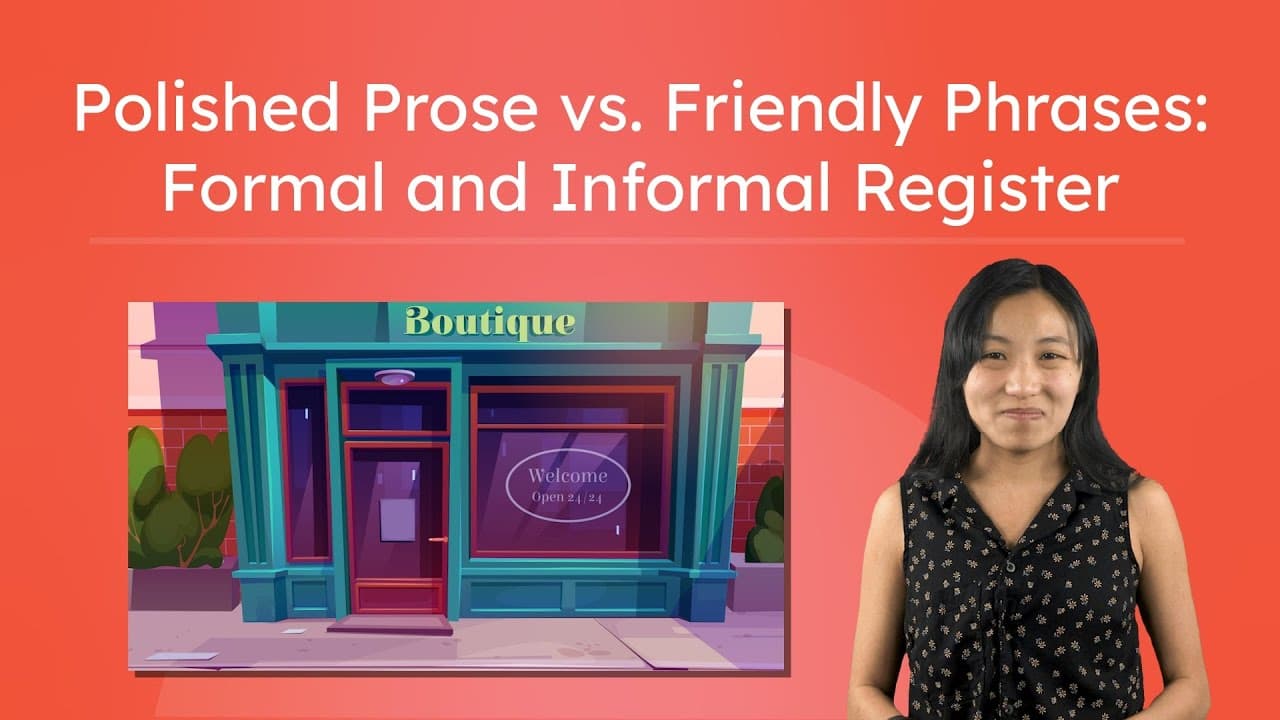
Khan AcademyKhan Academy

4mins 53s

Video
How to Identify the Subject and Predicate of a Sentence

How to Identify the Subject and Predicate of a Sentence

A lighthearted and clear introduction to the fundamental components of a sentence: the subject and the predicate. Through playful banter and humorous examples involving "goblin hats," the narrators break down sentence structure into easily digestible parts using analogies and visual aids. The video explicitly defines subjects as the actors and predicates as the actions (or states of being) plus their related details. The video covers key grammatical concepts including nouns, pronouns, action verbs, and state-of-being verbs. It specifically addresses the nuance that verbs aren't always physical actions (using the example "I am happy") and clarifies the common misconception that any noun in a sentence might be the subject. This resource is highly valuable for elementary and middle school language arts classrooms. It provides a non-intimidating entry point for sentence analysis, offering teachers a concrete metaphor (the car analogy) and a memorable catchphrase for predicates ("the verb and its pals"). It helps students move beyond guessing to systematically identifying sentence parts.

Khan AcademyKhan Academy

2mins 34s

Video
Action vs. Linking Verbs: What's the Difference?

Action vs. Linking Verbs: What's the Difference?

This educational video provides a clear and engaging introduction to the difference between action verbs and linking verbs (also known as state-of-being verbs). Through the use of simple hand-drawn visuals and a recurring character—a bear—the narrator illustrates how verbs function differently within sentences. The lesson begins by reviewing the forms of the verb "to be" and then proceeds to split the screen to contrast what a subject "does" (action) versus what a subject "is" (linking). Key grammatical themes explored include the identification of "to be" verbs (am, is, are, was, were, etc.) and the concept that some verbs can function as either action or linking verbs depending on context. The video uses sensory verbs like "look" and "smell" to demonstrate this nuance, showing how "the bear looked at me" differs grammatically from "the bear looked lonely." For educators, this video serves as an excellent foundational tool for teaching parts of speech and sentence structure. It demystifies abstract grammatical concepts by grounding them in concrete examples, making it easier for students to distinguish between describing an action and describing a state or quality. The clear visual separation of concepts helps visual learners grasp the function of linking verbs as connectors rather than doers.

Khan AcademyKhan Academy

3mins 2s

Video
Mastering the Difference Between Affect and Effect

Mastering the Difference Between Affect and Effect

This video provides a clear and practical guide to distinguishing between the commonly confused words "affect" and "effect." Using a digital blackboard style, the narrator breaks down the primary rule that "affect" functions as a verb while "effect" functions as a noun. Through concrete examples involving a drought and crops, the video demonstrates how to identify which word is grammatically correct based on its role in the sentence as either an action or a result. The video delves deeper than simple definitions by addressing rare but grammatically correct exceptions to the general rule. It explains how "effect" can be used as a verb (meaning to bring about or create, as in "effect change") and how "affect" can be used as a noun (a psychology term describing personality or demeanor). The narrator offers stylistic advice on these exceptions, suggesting that while they are correct, they often cause confusion and might be best avoided in general writing. For educators, this resource serves as an excellent tool for grammar instruction and writing workshops. It demystifies a persistent trouble spot for students of all ages, offering a straightforward "TL;DR" rule for quick recall while acknowledging the nuance of advanced English usage. The content is valuable for strengthening proofreading skills, enhancing vocabulary precision, and helping students navigate the complexities of English homophones.

Khan AcademyKhan Academy

4mins 18s

Video
Exploring the Vocabulary Words Recently and Voyage

Exploring the Vocabulary Words Recently and Voyage

In this engaging vocabulary lesson, the narrator introduces students to two specific words: "recently" and "voyage." Through a blend of humor, storytelling, and simple illustrations, the video breaks down the definitions, parts of speech, and grammatical rules associated with each word. Specifically, it explains how the suffix "-ly" transforms adjectives into adverbs and how a single word like "voyage" can function as both a noun and a verb. The video explores key grammatical concepts in an accessible way. It defines "recently" as an adverb meaning "happening a short time ago" and demonstrates how adjectives like "happy" and "quick" become adverbs with the addition of "-ly." It then defines "voyage" as a long journey, providing examples of its use as a noun (taking a trip) and a verb (the act of traveling). The narrator uses humorous example sentences involving astronomers and astronauts craving tamales to solidify understanding. For educators, this video is a valuable tool for reinforcing parts of speech and expanding vocabulary. It can be used to introduce the concept of suffixes, specifically how word endings change grammatical function. The clear definitions and contextual examples make it an excellent resource for ELA lessons focused on grammar, reading comprehension, and creative writing, encouraging students to use new vocabulary in their own sentences.

Khan AcademyKhan Academy

2mins 29s

Video
Active vs. Passive Voice: A Grammar Adventure

Active vs. Passive Voice: A Grammar Adventure

This engaging language arts video introduces students to the concepts of active and passive voice through a narrative set in the fictional town of "Verbados." When the town's tourism industry suffers due to confusing grammar, the presenter steps in to help clarify the town's communication. By breaking down the roles of the subject and the verb, the video demonstrates how active voice portrays the subject performing an action, while passive voice shows the subject receiving the action. The lesson uses clear visual metaphors—such as an archer shooting a target—to illustrate the direction of action in a sentence. It provides multiple opportunities for interactive learning, asking viewers to pause and label sentences as active or passive, and later to rewrite sentences from one voice to the other. The content covers not just how to identify the voices, but the stylistic reasons for choosing one over the other, such as using active voice for persuasion and clarity, or passive voice for formality or when the actor is unknown. Ideal for upper elementary and middle school English classes, this video serves as an excellent introduction or review of sentence structure and style. Teachers can use it to help students strengthen their writing by making conscious choices about subject-verb relationships. The narrative approach helps contextualize abstract grammatical rules, showing students practical applications in advertising, official announcements, and storytelling.

Miacademy & MiaPrep Learning ChannelMiacademy & MiaPrep Learning Channel

11mins 29s

Video
How to Identify Subjects and Predicates in Sentences

How to Identify Subjects and Predicates in Sentences

This educational whiteboard animation provides a clear, step-by-step guide to understanding the two fundamental parts of a complete sentence: the subject and the predicate. The video begins by defining these components, explaining that the subject is who or what the sentence is about, while the predicate tells what the subject does or is. It uses a friendly narrative style to break down grammatical concepts into digestible pieces, emphasizing the importance of complete sentences for effective communication. The video explores key grammatical themes including identifying nouns, proper nouns, and pronouns as subjects, and recognizing action verbs and linking verbs as the start of predicates. It employs a consistent "think-aloud" strategy where the narrator models the cognitive process of analyzing a sentence—asking specific questions to isolate the subject and then locating the verb to find the predicate. The video progresses from simple sentences to more complex examples involving compound subjects and linking verbs. For educators, this video is an excellent tool for introducing or reviewing sentence structure. The visual color-coding (subjects in red, predicates in yellow) helps students visually distinguish the parts of a sentence. The video effectively models metacognitive strategies, such as visualization ("I get a picture in my head"), which helps students move beyond rote memorization to genuine comprehension. It is particularly useful for addressing the common confusion between action verbs and state-of-being (linking) verbs.

GrammarSongs by MelissaGrammarSongs by Melissa

4mins 11s

Video
Understanding the Perfect Verb Aspect

Understanding the Perfect Verb Aspect

This video provides a clear and concise explanation of the "perfect aspect" in English grammar. The narrator clarifies that in grammatical terms, "perfect" means "complete" rather than flawless. Using a visual timeline, the video demonstrates how this aspect is used to describe actions that are finished prior to a specific reference point in time—whether that point is in the past, present, or future. The content breaks down the structure of perfect tenses, specifically highlighting the formula: helper verb (have/had/will have) + the past participle of the main verb. Through the specific example of "washing dishes," the narrator illustrates the Present Perfect ("have washed"), Past Perfect ("had washed"), and Future Perfect ("will have washed"), showing how only the helper verb changes while the main verb remains constant. For educators, this resource is an excellent tool for demystifying complex verb tenses. The visual timeline offers a concrete mental model for students who struggle with the abstract concept of time in language. It effectively separates the idea of "tense" (when we are speaking) from "aspect" (the status of the action), making it a valuable asset for middle and high school English Language Arts lessons and ESL/ELL instruction.

Khan AcademyKhan Academy

2mins 31s

Video
Understanding Simple and Compound Sentences

Understanding Simple and Compound Sentences

In this engaging grammar tutorial, David and Paige explain the structural differences between simple and compound sentences. Using a digital whiteboard, they break down the core components of sentence construction, defining a simple sentence as consisting of a single subject and predicate, while a compound sentence combines two or more independent clauses joined by a conjunction. The video dives into technical grammar terminology in an accessible way, introducing concepts like "independent clauses" and "predicates." A significant portion of the video is dedicated to a common point of confusion: the difference between a compound sentence (two complete thoughts joined together) and a simple sentence with a compound predicate (one subject doing two things). Through specific examples about buying candy and getting sunburned, the narrators visually diagram these differences. For educators, this resource serves as an excellent tool for improving student writing fluency. It moves beyond basic definitions to help students understand sentence variety and the mechanics of combining ideas. The visual diagramming of subjects and predicates provides a clear model for students to analyze their own writing, making it particularly useful for lessons on syntax, editing, and avoiding run-on sentences.

Khan AcademyKhan Academy

4mins 29s

Video
How Subordinating Conjunctions Connect Independent and Dependent Clauses

How Subordinating Conjunctions Connect Independent and Dependent Clauses

This educational video provides a clear and comprehensive introduction to subordinating conjunctions and their role in sentence structure. The narrator breaks down the fundamental difference between independent and dependent clauses, explaining that while all sentences are clauses, not all clauses are sentences. Using the helpful analogy of a tree (independent clause) and a ladder (dependent clause), the video demonstrates how subordinating conjunctions function to connect these two types of clauses to add context and detail to writing. The content covers key grammatical concepts including the definition of a clause (subject plus verb), the identifying features of sentence fragments, and the distinction between coordinating conjunctions (FANBOYS) and subordinating conjunctions. Through humorous example sentences involving characters like Herbert and Sir Reginald, viewers learn practical tests—such as the "Yeah? So what?" test—to identify dependent clauses and determine if a sentence is grammatically complete. For educators, this video is an excellent resource for teaching complex sentence structure and helping students avoid sentence fragments. It simplifies abstract grammatical terms into tangible concepts using visual aids and memorable analogies. The video concludes with a comprehensive list of common subordinating conjunctions, making it a useful reference tool for students looking to add variety and sophistication to their writing.

Khan AcademyKhan Academy

5mins 27s

Video
How to Identify and Use Prepositional Phrases

How to Identify and Use Prepositional Phrases

This engaging educational video introduces students to the concept of prepositional phrases through a clear, memorable analogy of a bridge. The narrator explains that just as a bridge connects two pieces of land, a preposition connects a noun (the object) to the rest of a sentence. The video breaks down the specific components of a prepositional phrase—the starting preposition and the ending object—and demonstrates how to identify them within various sentence structures, including phrases at the beginning, middle, and end of sentences. The content covers key grammatical terminology, including "preposition," "noun," and "object of the preposition." It uses repetitive, step-by-step analysis of example sentences like "We went fishing with Ben" and "Outside the window, the birds are singing" to reinforce learning. Humor is woven throughout to maintain engagement, featuring interruptions from a confused cat named Mr. Whiskers and a tangent about the sounds pelicans make, ensuring the tone remains lighthearted and accessible for elementary students. For educators, this video serves as an excellent core resource for teaching parts of speech and sentence structure. It provides a visual and conceptual framework (the bridge) that helps concrete thinkers grasp abstract grammatical rules. The clear distinction between the preposition itself and the entire phrase makes it valuable for lessons on sentence diagramming, expanding sentences with details (time, place, movement), and improving writing complexity.

Homeschool PopHomeschool Pop

8mins 53s

Video
How to Build Compound-Complex Sentences

How to Build Compound-Complex Sentences

This educational video provides a clear and structured explanation of compound-complex sentences, one of the most sophisticated sentence structures in English grammar. The instructors, Paige and Rosie, break down the definition by reviewing the components of simple, compound, and complex sentences before demonstrating how these elements combine. They use a digital whiteboard to visually map out the requirements: at least two independent clauses and at least one dependent clause. The video explores key grammatical themes including clause identification (independent vs. dependent), the use of coordinating conjunctions, and sentence variety. Through two distinct examples—one about picking flowers after a storm and a humorous narrative about a character named Alberto with a walnut allergy—the instructors demonstrate how to identify and construct these sentences. They also show how sentences can be expanded with additional clauses while maintaining their classification. For educators, this resource is an excellent tool for middle school English Language Arts classrooms. It demystifies a concept that often confuses students by visually isolating the parts of speech. Teachers can use this video to transition students from writing simple sentences to more nuanced, rhythmic prose. It serves as a perfect introduction to a lesson on sentence variety or as a remediation tool for students struggling with run-on sentences or fragments.

Khan AcademyKhan Academy

4mins 14s

Video
Mastering Parallel Structure in Writing

Mastering Parallel Structure in Writing

This educational video provides a clear and engaging guide to understanding parallel structure in writing. Hosted by David, Rosie, and Paige, the lesson distinguishes parallel structure as a stylistic choice rather than a strict grammatical rule, emphasizing how it creates harmony and flow in sentences. Through handwritten visual examples on a blackboard, the instructors demonstrate how to align items in a list—whether they are nouns, verbs, or phrases—to ensure they match in form.

Khan AcademyKhan Academy

5mins 5s

Video
Using Commas with Introductory Elements

Using Commas with Introductory Elements

This educational video provides a clear and engaging guide to using commas with introductory elements in sentences. The narrators, David and Paige, break down complex grammatical concepts into easy-to-understand rules, specifically focusing on dependent clauses and sentence adverbs. Through handwritten examples and visual analogies, viewers learn exactly when a comma is required to separate an introduction from the main body of a sentence. The video explores three main scenarios: identifying dependent clauses at the start of sentences, understanding why commas aren't needed when the clause order is reversed, and how to punctuate sentence adverbs like "Initially" or "Basically." The narrators use color-coding to distinguish between clause types and provide memorable metaphors, such as comparing a dependent clause to a ladder leaning against a tree, helping students visualize the relationship between sentence parts. Teachers can use this video to introduce or reinforce specific punctuation rules within a writing curriculum. It is particularly valuable for helping students move beyond simple sentence structures to more complex, varied syntax. The conversational tone and clear visual aids make abstract grammar rules concrete, supporting students in editing their own writing for proper punctuation and clarity.

Khan AcademyKhan Academy

4mins 35s

Video
How to Identify and Fix Sentence Fragments

How to Identify and Fix Sentence Fragments

In this engaging grammar lesson, David and his teacher-cousin Beth break down the concept of sentence fragments using a simple, collaborative blackboard style. The video explains that a sentence fragment is an incomplete thought that mimics a sentence by ending with a period but fails to tell the "whole story." Through clear visual examples, the hosts demonstrate the two main causes of fragments: missing a subject (the "who") or missing a predicate (the "what happened"). The video explores three distinct types of fragments: those missing a predicate, those missing a subject, and phrases that lack both (like prepositional phrases standing alone). Using relatable examples like "The pancakes" and "Because of the snowstorm," David and Beth show exactly how to turn these fragments into complete sentences by combining subjects and predicates. The visual use of green and white handwriting on a black background helps distinguish between the naming part (subject) and the telling part (predicate). This resource is highly valuable for upper elementary and middle school language arts classrooms. It provides a non-intimidating entry point into sentence structure, helping students move beyond intuition to understanding the grammatical mechanics of why a sentence is complete. Teachers can use this video to introduce editing skills, support struggling writers who frequently use fragments, or reinforce the fundamental concepts of subject and predicate.

Khan AcademyKhan Academy

3mins 48s

Video
Mastering Coordinating Conjunctions with FANBOYS

Mastering Coordinating Conjunctions with FANBOYS

This engaging grammar lesson introduces students to coordinating conjunctions, the words that glue sentences together. The narrator, David from Khan Academy, defines conjunctions as parts of speech that unite words, phrases, and clauses, providing simple initial examples like "peanut butter and jelly" and "sad but true." The core of the video is the introduction of the mnemonic device "FANBOYS," which helps students remember the seven coordinating conjunctions: For, And, Nor, But, Or, Yet, and So. The video systematically breaks down each of the seven conjunctions, explaining their specific functions and providing humorous, memorable example sentences. From a kangaroo robbing a bank to an angry tree spirit refusing to speak to humans, the quirky examples help illustrate how each conjunction creates different relationships between ideas, such as causality, addition, choice, contrast, or consequence. This resource is highly valuable for ELA classrooms as it transforms a dry grammar topic into an accessible concept through humor and clear visual aids. It is particularly useful for teaching sentence variety, correcting run-on sentences, and helping students understand the logical relationships between clauses. The "FANBOYS" acronym provides a lasting mental hook that students can rely on for years to come.

Khan AcademyKhan Academy

4mins 33s

Video
How to Tell the Difference Between Phrases and Clauses

How to Tell the Difference Between Phrases and Clauses

This educational video provides a clear and accessible explanation of the grammatical differences between phrases and clauses. Through a conversational dialogue and real-time digital whiteboard notes, the narrators break down the defining characteristics of each concept. The video clarifies that while both are groups of words, phrases act as a single part of speech without a subject-verb pair, whereas clauses must contain both a subject and a verb.

Khan AcademyKhan Academy

5mins 57s

Video
How to Use Where, When, and Why as Relative Adverbs

How to Use Where, When, and Why as Relative Adverbs

This educational video introduces students to the concept of relative adverbs—specifically focusing on the words "where," "when," and "why." Using a friendly illustrated character named Peggy the Dragon, the narrator demonstrates how these words function beyond their common role as question starters. The lesson distinguishes between asking a question (e.g., "Where are you from?") and using a relative adverb to connect two clauses and modify a noun (e.g., "That is the cave where I grew up"). The video explores three primary relationships: "where" relates to place, "when" relates to time, and "why" relates to reasons. Through humorous examples involving dragon traits like breathing fire and strange events like raining fish, the narrator explicitly maps how each adverb connects a dependent clause to the main sentence. The video concludes with a brief etymological expansion, discussing archaic forms like "whence" and clarifying the famous Shakespearean line "Wherefore art thou Romeo" to correct the common misconception that "wherefore" means "where." For educators, this resource serves as an excellent direct instruction tool for Common Core Language standards regarding relative adverbs (L.4.1.a). It effectively scaffolds learning by starting with prior knowledge (question words) and bridging to complex sentence structures. Teachers can use the video to launch lessons on sentence combining, complex sentence formation, and adding detail to writing. The clear visual distinction between the question examples and the relative clause examples helps visual learners grasp the syntactic shift required to use these words correctly.
Khan AcademyKhan Academy

3mins 23s

Video
Mastering Prepositional Phrases and Their Functions

Mastering Prepositional Phrases and Their Functions

This educational video provides a comprehensive overview of prepositional phrases, defining them as word chunks that begin with a preposition. The narrator uses a digital whiteboard to diagram sentences, illustrating how these phrases function within a sentence structure. Through clear examples and real-time sketching, the video breaks down complex grammatical concepts into digestible parts, showing how a single sentence can contain nested prepositional phrases. The content explores the three primary roles prepositional phrases play: acting as nouns, adverbs, and adjectives. The narrator walks through distinct examples for each function, from simple sentences about blowing a horn to complex literary analysis of Shakespeare's Hamlet. Special attention is given to the potential for ambiguity in writing, using a classic joke to demonstrate how misplaced prepositional phrases can change the meaning of a sentence entirely. For educators, this video serves as an excellent tool for teaching sentence structure, parts of speech, and clarity in writing. It moves beyond basic identification to higher-level analysis of how phrases modify other words. The inclusion of the 'misplaced modifier' example offers a practical way to teach students the importance of word order, while the Shakespeare analysis bridges grammar instruction with literary study.

Khan AcademyKhan Academy

5mins 38s

Video
How to Use That vs. Which Correctly

How to Use That vs. Which Correctly

This educational video clarifies the often-confusing grammatical distinction between the relative pronouns "that" and "which." It begins by framing the discussion within the broader linguistic debate between prescriptivists, who value strict adherence to rules, and descriptivists, who observe how language is actually used. The narrator positions himself in the middle, offering a practical synthesis to help writers make the right choice. The video explores two primary distinctions to guide usage. First, it demonstrates how "that" functions with restrictive clauses and explains why it should generally not be used with commas (non-restrictive clauses), using clear sentence examples about a carrot. Second, it uses a memorable mnemonic involving a cranky "witch" to explain why "which" should not be used when referring to people. The content covers restrictive vs. non-restrictive clauses, comma usage, and pronoun-antecedent agreement. For educators, this video provides an accessible tool for teaching complex grammar mechanics without getting bogged down in overly technical jargon. It is excellent for middle and high school English classes, particularly during writing workshops or editing phases. The visual examples and humorous mnemonics make abstract grammatical rules concrete and easier for students to retain and apply in their own writing.

Khan AcademyKhan Academy

5mins 41s

Video
Why You Can Start Sentences With Conjunctions

Why You Can Start Sentences With Conjunctions

This video debunks the common grammatical myth that starting sentences with conjunctions is incorrect. The narrator, David, explains that while many students are taught this "superstition," professional writers and grammarians agree that starting a sentence with a coordinating conjunction like "and" or "but" is grammatically sound. He illustrates how this technique can add dramatic tension and improve the flow of writing, citing style manuals and historical usage to support the argument. The video distinguishes between coordinating conjunctions (FANBOYS) and subordinating conjunctions (like "because"), identifying where the confusion often lies. Through a visual analogy of a tree and a ladder, the narrator explains the difference between independent and dependent clauses. He clarifies that while starting with "because" often leads to sentence fragments in student writing, it is permissible as long as the dependent clause is attached to an independent one. For educators, this resource is excellent for upper elementary and middle school writing instruction. It helps move students beyond rigid beginner rules toward more sophisticated sentence variation. Teachers can use this video to address sentence fragments, teach the function of different types of clauses, and encourage students to use sentence-initial conjunctions intentionally for rhetorical effect rather than avoiding them out of fear.

Khan AcademyKhan Academy

6mins 8s

Video
Using FANBOYS to Connect Ideas

Using FANBOYS to Connect Ideas

This educational video provides a clear and structured introduction to coordinating conjunctions, a fundamental part of English grammar. Utilizing a whiteboard animation style, the narrator defines what a conjunction is and specifically focuses on the seven coordinating conjunctions used to connect words, phrases, and clauses. The video introduces the popular mnemonic device "FANBOYS" to help students memorize the list: For, And, Nor, But, Or, Yet, and So. The video breaks down each of the seven conjunctions individually, explaining their specific functions—such as showing cause, combining ideas, or expressing contrast—and providing sentence examples for each. It further demonstrates how these conjunctions operate at different levels of sentence structure, showing how they can join simple words (e.g., "chocolate or vanilla"), phrases (e.g., "down the slide and over the fence"), and complete sentences (independent clauses). Ideally suited for upper elementary students, this resource is excellent for language arts instruction focused on sentence fluency and writing mechanics. Teachers can use this video to introduce the concept of compound sentences, help students move beyond simple sentence structures, and provide a memorable tool for self-editing their writing to make it less "choppy."

GrammarSongs by MelissaGrammarSongs by Melissa

4mins 30s

Video
Building Complex Sentences with Independent and Dependent Clauses

Building Complex Sentences with Independent and Dependent Clauses

In this engaging grammar tutorial, Paige and Rosie break down the structure of complex sentences, explaining how they differ from simple and compound sentences. The video uses clear handwritten examples to demonstrate how complex sentences are built by combining one independent clause with at least one dependent clause. Through color-coded sentence analysis, the narrators visually distinguish between the parts of a sentence that can stand alone and those that rely on additional information to be complete. The video explores key grammatical concepts including subjects, verbs, and the critical role of subordinating conjunctions like "when," "although," and "because." By analyzing examples involving birthday cakes and camping trips, the narrators show how these conjunctions transform an independent clause into a dependent one. They also demonstrate flexibility in sentence structure, showing that dependent clauses can appear at the beginning or end of a sentence, and that a single complex sentence can contain multiple dependent clauses. This resource is highly valuable for upper elementary and middle school classrooms as it moves beyond basic sentence identification into more sophisticated writing structures. It provides a clear, visual method for students to check their own writing for fragments and run-ons. Teachers can use this video to introduce subordinating conjunctions, practice identifying sentence components, and encourage students to vary their sentence fluency by combining simple ideas into more nuanced complex sentences.
Khan AcademyKhan Academy

5mins 7s

Video
How to Use Appositives to Clarify Your Sentences

How to Use Appositives to Clarify Your Sentences

This educational video provides a clear and accessible introduction to the grammatical concept of the appositive. Hosted by two narrators, David and Paige, the lesson demystifies this complex-sounding term by breaking down its etymology and function. Using a digital whiteboard format, the hosts visually demonstrate how appositives serve as noun phrases that rename, redefine, or clarify an antecedent noun within a sentence. They specifically focus on the punctuation rules associated with appositives, showing how commas act as essential separators to set off this clarifying information from the rest of the sentence. The video explores two primary sentence structures: one where the appositive appears in the middle of a sentence, and another where it appears at the end. Through relatable examples—like describing a sister going to college or lamenting a discontinued snack called "Cookie Cat"—the narrators illustrate how appositives add detail without altering the core grammatical structure of the main clause. The visual component uses color-coding to distinguish the appositive phrase from the rest of the sentence, making the syntactic relationship clear for viewers. For educators, this video serves as an excellent tool for teaching sentence variety and punctuation. It addresses the common student struggle of knowing when to use commas, providing a concrete rule (the appositive) that students can apply immediately to their own writing. By mastering appositives, students can write more sophisticated sentences that combine ideas efficiently, moving beyond simple subject-verb-object structures to more complex, information-rich writing.

Khan AcademyKhan Academy

3mins

Video
Mastering Correlative Conjunctions and Matched Word Pairs

Mastering Correlative Conjunctions and Matched Word Pairs

This educational video provides a clear and engaging introduction to correlative conjunctions, breaking down the intimidating terminology into simple, manageable concepts. The narrator, David, uses etymology to explain that "correlative" simply means "related together," defining these conjunctions as matching sets used to connect sentence parts. Through five distinct examples—either/or, neither/nor, both/and, as/so, and whether/or—the video demonstrates how these pairs function within sentences to create balance and establish relationships between ideas. The video explores key grammatical themes such as sentence structure, parallel construction, and the specific nuances of different conjunction pairs. It covers the difference between positive choices (either/or), negative rejection (neither/nor), inclusion (both/and), formal consequence (as/so), and possibilities (whether/or). The lesson also briefly touches upon pronunciation variations (e.g., ee-ther vs. eye-ther) and uses memorable, sometimes humorous examples involving famous quotes and fictional characters to illustrate usage. For educators, this video serves as an excellent tool for teaching intermediate grammar and writing skills. It transforms abstract grammatical rules into concrete patterns that students can recognize and apply. The breakdown of etymology promotes critical thinking about vocabulary, while the distinct examples provide a template for students to model their own writing. It is particularly useful for lessons on sentence variety, improving writing flow, and understanding the logic behind connecting clauses.

Khan AcademyKhan Academy

3mins 12s

Video
Linking Ideas with Relative Pronouns

Linking Ideas with Relative Pronouns

In this concise grammar tutorial, the narrator introduces relative pronouns—who, whom, whose, that, and which—and explains their primary function: linking independent and dependent clauses. The video breaks down the specific usage rules for each pronoun, distinguishing between those used for people (who, whom, whose, that) and those used for inanimate objects or concepts (whose, that, which). Key grammatical rules are demonstrated through clear, handwritten examples on a blackboard style background. The video specifically highlights the flexibility of the word "that" (usable for both people and things) while cautioning against the common error of using "which" to refer to people. Through examples like "The man who sold the world" and "The salad that I bought," viewers see practical applications of these rules in sentence construction. This resource is highly valuable for English Language Arts classrooms as it addresses a specific, common pain point in student writing: sentence variety and correct pronoun usage. It provides a foundational understanding that helps students combine simple sentences into complex ones, improving the flow and sophistication of their writing while clarifying the often-confused distinction between "who," "that," and "which."

Khan AcademyKhan Academy

1min 56s

Video
How to Identify and Use Relative Clauses

How to Identify and Use Relative Clauses

This educational video provides a clear and engaging introduction to relative clauses, a specific type of dependent clause used to add descriptive detail to sentences. Through a conversational format between two narrators, the video breaks down the grammatical structure of relative clauses, explaining how they function within a sentence and how they are signaled by relative pronouns like "who," "that," and "which." The explanation moves from simple definitions to complex sentence analysis, using color-coded handwriting on a digital blackboard to visualize the concepts. The video explores several key grammar topics, including the difference between independent and dependent clauses, the role of relative pronouns, and how to identify clauses embedded within larger sentences. It uses relatable examples, such as a Harry Potter reference ("The boy who lived"), to illustrate how relative pronouns substitute for nouns. The narrators also demonstrate how to parse complex sentences by identifying the core subject and verb, separating the essential information from the descriptive relative clauses. For educators, this video is an excellent tool for teaching sentence structure and syntax. It helps demystify complex sentences for students, showing them how to identify the "extra" information provided by relative clauses versus the main action of a sentence. This skill is crucial for both reading comprehension and writing development. Teachers can use this video to introduce the concept of sentence combining, helping students upgrade their writing from simple sentences to more sophisticated, complex sentence structures.
Khan AcademyKhan Academy

4mins 44s

Video
How to Identify and Fix Run-On Sentences

How to Identify and Fix Run-On Sentences

This educational video provides a clear and humorous guide to understanding and correcting run-on sentences and comma splices, two common grammatical errors. Through the use of a digital blackboard, the narrators, David and Rosie, visually break down the structure of these errors, defining them as issues arising from joining independent clauses incorrectly. They offer concrete analogies, such as the "runaway train" for run-ons and the nautical origin of "splicing," to help students conceptualize why these sentence structures are problematic. The video covers key grammatical themes including independent clauses, punctuation (specifically commas and semicolons), and coordinating conjunctions. It demonstrates two primary methods for fixing these errors: using a semicolon to separate related independent clauses, or using a comma followed by a conjunction (like "and"). The lesson distinguishes between a true run-on (no punctuation) and a comma splice (insufficient punctuation), clarifying a nuance that often confuses students. For educators, this video serves as an engaging tool to teach sentence mechanics and editing skills. The approachable tone, featuring a funny example about a fictional pony movie franchise, makes dry grammar concepts memorable. It is highly applicable for English Language Arts classrooms during writing workshops or grammar units, providing students with actionable strategies to improve the flow and accuracy of their writing.

Khan AcademyKhan Academy

4mins 38s

Video
How the Oxford Comma Prevents Confusion

How the Oxford Comma Prevents Confusion

This engaging video explores the function and importance of the Oxford comma (also known as the serial comma) through humorous and memorable examples. Narrators David and Paige explain that while the comma placed before the conjunction in a list is optional in some style guides, its omission can lead to hilarious and confusing misunderstandings. They illustrate this with sentences implying one's parents are Mahatma Gandhi and a hamster, or that Elvis is a tiny Norwegian harpist. The video delves into the nuances of grammatical clarity versus stylistic choice, referencing major style guides like AP (which typically omits it) and Chicago (which includes it). It introduces the grammatical concept of "apposition" to explain why these specific misunderstandings occur. The narrators also offer a sophisticated counter-argument: that rewriting a sentence to change the word order is often a better solution for ambiguity than relying solely on punctuation. For educators, this video serves as an excellent hook for grammar lessons, demonstrating that punctuation is not just about following arbitrary rules but about ensuring clear communication. It provides a non-threatening entry point into complex topics like appositives, ambiguity, and style guides. The humorous examples stick in students' minds, making the concept of the serial comma easier to recall and apply in their own writing.

Khan AcademyKhan Academy

3mins 43s

Video
How to Make Words Ending in S Possessive

How to Make Words Ending in S Possessive

This concise grammar tutorial addresses a common point of confusion in English writing: how to form the possessive of singular nouns and names that already end in the letter 's'. The video features two narrators, David and Paige, who use handwritten examples on a blackboard to demonstrate that the standard rule—adding an apostrophe followed by an 's'—still applies to these words, just as it does for any other singular noun. The video explores key examples including proper names like "Jess" and "Texas," as well as common nouns like "bus." It visually breaks down the transformation from a phrase like "the air conditioning on this bus" to the possessive form "the bus's air conditioning." The narrators acknowledge that while the resulting words may look crowded with 's's, the additional letter is crucial for accurately representing how these possessives are pronounced in spoken English. For educators, this video serves as an excellent tool for clarifying a specific punctuation rule that students frequently misapply. It helps dismantle the misconception that an existing 's' at the end of a word precludes adding another one for possession. The clear, step-by-step visual examples make it easy to introduce or review this concept in upper elementary and middle school English Language Arts classrooms, supporting better mechanics in student writing.

Khan AcademyKhan Academy

1min 51s

Video
Using Commas in Tag Questions and Direct Address

Using Commas in Tag Questions and Direct Address

In this engaging grammar lesson, grammarians David and Paige explore three specific and common uses for commas in everyday writing and dialogue. Using a conversational teaching style with digital whiteboard illustrations, the duo breaks down the mechanics of "tag questions" (turning a statement into a question), "direct address" (speaking to a specific person), and "yes or no" responses. The video uses humorous, memorable examples centering on a mutual love of cheese to demonstrate how commas function as necessary separators in these sentence structures. Key themes include the structural logic of tag questions—specifically the relationship between positive assertions and negative tags (and vice versa)—and the "separating function" of the comma. The video details how to punctuate sentences where a speaker names the person they are talking to, and how to properly set off introductory affirmations or negations at the start of a sentence. The visual use of different colors helps distinguish between the different parts of speech being separated. This video is highly valuable for upper elementary and middle school English Language Arts classrooms, particularly for units on punctuation mechanics and dialogue writing. Teachers can use this resource to help students correct run-on sentences in creative writing or to clarify the often-missed comma rules in conversational text. The clear, isolated examples make it easy for students to visualize where the pauses—and thus the punctuation—belong in their own writing.

Khan AcademyKhan Academy

3mins 24s

Video
How Punctuation Marks Change Meaning

How Punctuation Marks Change Meaning

This animated video provides a clear and engaging introduction to three fundamental punctuation marks: the period, the exclamation mark, and the question mark. Through a series of simple sentences featuring a friendly Apple character, the video demonstrates how changing the punctuation mark at the end of a sentence drastically alters its meaning, tone, and the way it should be read aloud. The visual examples make abstract grammatical concepts concrete for early learners. The key themes explored include sentence structure, reading intonation, and the specific function of different punctuation marks. The video explores how a period indicates a statement or fact, an exclamation mark conveys excitement or strong emotion, and a question mark indicates an inquiry. It uses humor, such as a surprise monster appearance and a contradiction about being tired, to keep young viewers engaged. For educators, this video is an excellent hook for early literacy lessons on writing and reading fluency. It visually reinforces the connection between written symbols and spoken expression, helping students understand that punctuation provides the "instruction manual" for how to read a sentence. It serves as a perfect model for teaching intonation and can be easily paused for interactive guessing games about which punctuation mark fits different emotional scenarios.

Scratch GardenScratch Garden

1min 53s

Video
How to Use Apostrophes for Possession

How to Use Apostrophes for Possession

This educational video provides a clear and friendly introduction to the grammatical concept of the possessive. The narrators, David and Paige, define possession simply as "owning something" and demonstrate how the apostrophe-s ('s) is used to condense complex phrases like "the carrot that belonged to the rabbit" into efficient forms like "the rabbit's carrot." They explore how this rule applies to both common nouns and proper nouns, using whimsical examples to keep the content engaging. The video then pivots to a crucial exception that often trips up students: possessive pronouns. The narrators clarify that while nouns rely on apostrophes to show ownership, possessive pronouns (like his, hers, ours, and its) never take an apostrophe. They illustrate this with side-by-side comparisons to reinforce the difference between a noun's possessive form and a pronoun's possessive form. Teachers can use this video to introduce or review the mechanics of possession in writing. It is particularly valuable for addressing the common error of adding apostrophes to possessive pronouns (e.g., writing "her's" instead of "hers"). The video's visual style—simple handwriting on a black background—focuses student attention directly on the spelling and punctuation changes being discussed.

Khan AcademyKhan Academy

3mins 45s

Video
Using Quotation Marks for Dialogue and Titles

Using Quotation Marks for Dialogue and Titles

This educational video provides a clear and humorous guide to using quotation marks correctly in English grammar. The narrators, David and Paige, explore the two primary functions of quotation marks: indicating direct speech (dialogue) and formatting titles of shorter works like songs, poems, and articles. The video breaks down the potentially confusing rules about when to use quotation marks versus underlining or italics for titles. Through engaging examples involving music albums and a fictional book of "bread poetry," the hosts demonstrate the "container" rule: larger works (albums, books, newspapers) get underlined or italicized, while the smaller works inside them (songs, poems, articles) get quotation marks. Teachers can use this video to introduce or reinforce punctuation rules for creative writing and citations. The visual examples on the digital whiteboard make the distinction between "big things" and "small things" easy to visualize, while the lighthearted banter keeps students engaged with what can otherwise be a dry topic.
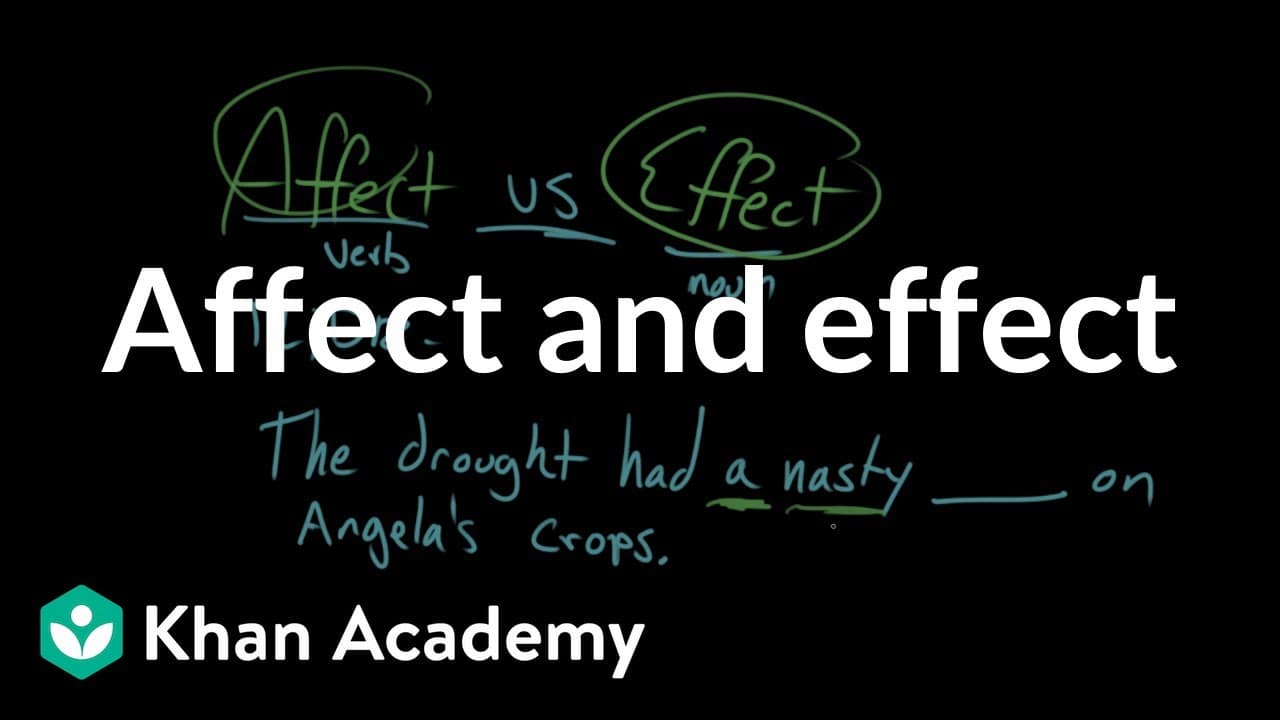
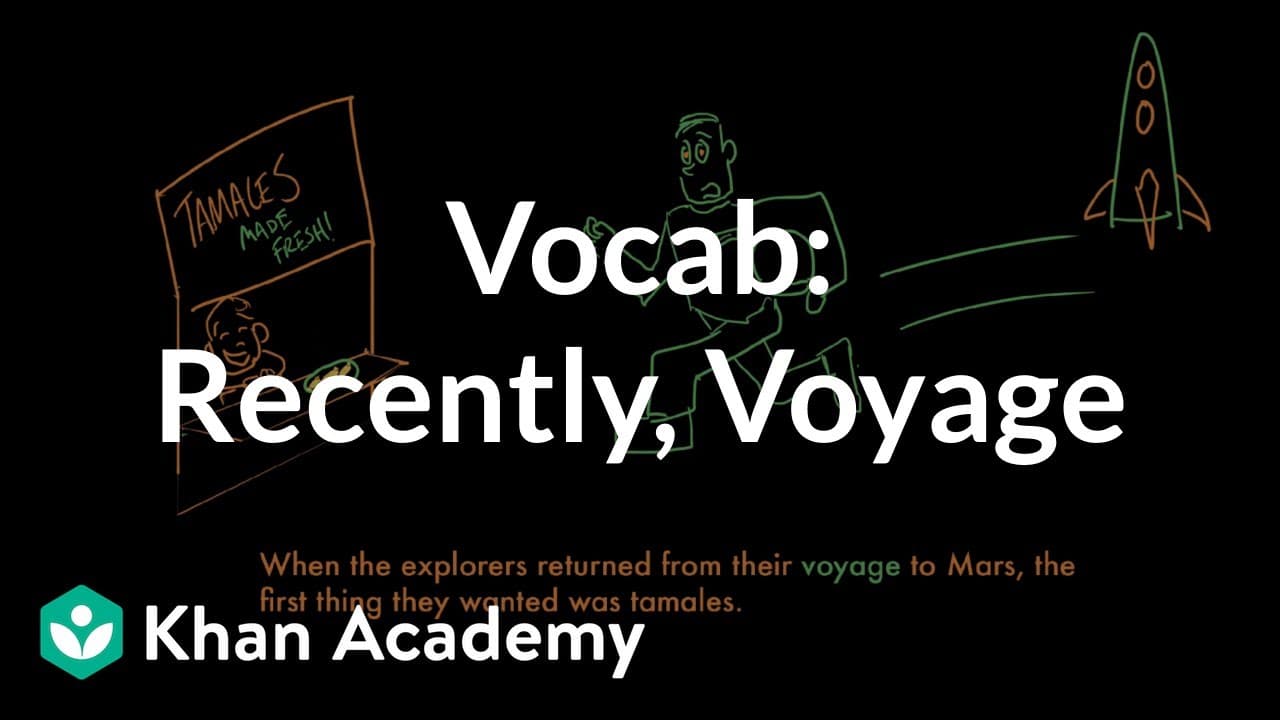
Khan AcademyKhan Academy

3mins 13s

Video
Mastering the Four Types of Sentences

Mastering the Four Types of Sentences

This animated educational video provides a comprehensive and engaging introduction to the four main types of sentences: interrogative, exclamatory, declarative, and imperative. Through the use of recurring characters like the narrator and a student named Terrence, the video breaks down each sentence type by defining its function—such as asking a question or giving a command—and identifying its corresponding punctuation mark. A catchy song and clear text visuals are used to reinforce the definitions of more complex terms like "interrogative." The video explores the specific characteristics of each sentence type. It explains that interrogative sentences ask questions, exclamatory sentences show strong emotion, declarative sentences simply state facts (and are noted as the most common type), and imperative sentences give commands. The content addresses potential points of confusion, such as how imperative sentences can end in either a period or an exclamation point depending on the delivery, and how to distinguish them from other types based on their function of telling someone to do something. For educators, this video serves as an excellent core resource for grammar instruction in elementary classrooms. It employs a "whole-part-whole" teaching strategy by introducing a complete paragraph containing all sentence types, breaking them down individually, and then reviewing them together. The video includes a built-in quiz segment and specific pause points for audience participation, making it ideal for interactive whiteboard lessons, introducing a writing unit, or reviewing punctuation rules.

Homeschool PopHomeschool Pop

8mins 16s

Video
How to Choose Between It's and Its

How to Choose Between It's and Its

This concise grammar tutorial clarifies the difference between the commonly confused homophones "it's" and "its." Using a digital whiteboard, hosts David and Paige visually separate the two terms, defining "it's" (with an apostrophe) strictly as a contraction for "it is" or "it has," and "its" (without an apostrophe) as a possessive pronoun. The video utilizes humor, such as referencing popular song lyrics and drawing quirky illustrations, to make the definitions stick. The content explores key grammatical themes including the function of apostrophes in contractions versus their absence in possessive pronouns. It addresses the common misconception that all possessive words require apostrophes, explaining that pronouns like "his," "hers," and "its" are exceptions to the general rule used for nouns. A practical "substitution test" is introduced to help learners verify their word choice. For the classroom, this video serves as an engaging hook or review tool for writing and editing units. It provides students with a concrete strategy—replacing "its" with "his" or "her" to check for ownership—that they can immediately apply to their own writing. The conversational style and clear visual distinction between the two forms make it accessible for students struggling with these specific mechanics.
Khan AcademyKhan Academy

2mins 31s

Video
Mastering Dialogue: Formatting, Punctuation, and Tags

Mastering Dialogue: Formatting, Punctuation, and Tags

This engaging language arts video invites students into the "Whispering Hall" of Genre Land to master the mechanics of writing dialogue. Through a quest-based narrative featuring three knight statues, the host guides viewers through three distinct challenges: formatting, punctuation, and dialogue tags. The video contrasts confusing, unformatted blocks of text with properly structured dialogue to visually demonstrate the importance of these writing conventions. The content systematically breaks down the technical rules of dialogue writing. Key topics include when to start new paragraphs (paragraph breaks and indentation), how to use quotation marks and other punctuation within speech, capitalization rules for quoted sentences, and the proper use and placement of dialogue tags. It also distinguishes between valid tags (speaking verbs like "said" or "asked") and action beats (like "smiled" or "ran"), clarifying common grammatical errors. This video is an excellent resource for upper elementary and middle school writing workshops. It transforms dry grammar rules into a gamified editing mission, encouraging students to analyze text critically. Teachers can use the specific "bad vs. good" examples to model editing skills, while the clear breakdown of rules provides a solid foundation for narrative writing units. The step-by-step revision of a single story throughout the video offers a cohesive example of the writing process in action.

Miacademy & MiaPrep Learning ChannelMiacademy & MiaPrep Learning Channel

10mins 24s

Video
How and When to Use Parentheses

How and When to Use Parentheses

In this engaging grammar tutorial, David and Paige break down the proper usage of parentheses, starting with the word's Greek origins meaning "placed beside." The video utilizes a clear, handwritten visual style to demonstrate the difference between the singular "parenthesis" and the plural "parentheses." The instructors define the primary function of this punctuation mark: to separate technically unnecessary information, or "asides," from the rest of a sentence without destroying the sentence's grammatical integrity. The lesson categorizes the utility of parentheses into three distinct functions: indicating additional remarks by a writer, specifying a definition or reference (citation), and showing interruptions in transcribed speech. Through specific examples—such as adding details about a warm cookie, citing a page number from a fictional autobiography, and noting a cough during a speech—the video illustrates how parentheses hold information that can be removed without altering the core meaning of the text. For educators, this resource is an excellent tool for teaching sentence structure and editing skills. It helps students distinguish between essential and non-essential clauses, a critical skill for developing sentence fluency. The video also introduces the concept of citations and transcription conventions in a low-stakes, humorous way, making it valuable for middle school English Language Arts units on mechanics, research writing, and narrative voice.

Khan AcademyKhan Academy

4mins 9s

Video
How to Read and Write Contractions

How to Read and Write Contractions

This engaging animated video introduces students to the concept of contractions in the English language, explaining how two words can be combined into one using an apostrophe. Through clear visual demonstrations, it defines what contractions are and shows how specific letters are removed and replaced by an apostrophe to shorten words without changing their meaning. The video systematically guides viewers through identifying contractions in reading and forming them in writing. It breaks down common examples like "didn't" (did not), "she's" (she is), "couldn't" (could not), "I'm" (I am), and "I'll" (I will). The content emphasizes looking for clues in the remaining letters to decode the original words, helping students understand the author's message. Ideal for elementary language arts instruction, this resource serves as both an introduction and a practice tool. It uses relatable scenarios—like pirates searching for treasure or writing a letter to a friend—to contextualize grammar. Teachers can use this video to model how to mechanically construct contractions and to facilitate discussions about why we use them in everyday speech and writing.

GrammarSongs by MelissaGrammarSongs by Melissa

5mins 40s

Video
How to Use Commas in Dialogue

How to Use Commas in Dialogue

This video provides a clear and engaging explanation of how to properly use commas when writing dialogue. Using a helpful "runway" metaphor, the narrators demonstrate the mechanics of punctuating speech in two common scenarios: when the speaker tag comes before the quote, and when the speaker tag follows the quote. The video uses specific sentence examples involving characters Guillermo and Roxane to visually illustrate where commas, periods, and quotation marks belong. The content focuses on the specific grammatical rules of "reported speech" or dialogue tags. Key themes include the function of commas as separators between narration and speech, the correct placement of punctuation inside or outside quotation marks, and the exceptions for question marks and exclamation points. The visual metaphor of an airplane taking off and landing helps solidify the concept of ramping up to or winding down from spoken words. For educators, this video serves as an excellent tool for teaching writing mechanics and editing skills. It simplifies a rule that often confuses students—specifically the counter-intuitive requirement to use a comma instead of a period at the end of a spoken sentence when a dialogue tag follows. Teachers can use this resource to introduce dialogue punctuation in creative writing units, support students during the editing phase of the writing process, or as a remediation tool for students struggling with writing mechanics.

Khan AcademyKhan Academy

3mins

Video
Introduction to Commas: Separating Sentence Elements

Introduction to Commas: Separating Sentence Elements

In this engaging grammar tutorial, narrators David and Paige introduce students to the comma, framing it as a "superhero" of punctuation due to its versatility and power. Using a friendly, conversational tone accompanied by real-time handwriting animations on a blackboard, they distill the comma's primary function down to a single, memorable concept: separating sentence elements. The video visually demonstrates how this "super power" applies to various scenarios, including items in a list, dates, and introductory phrases. The content covers three specific use cases for commas: separating items in a series (with a humorous lunch menu example), separating parts of a date (referencing "National Blueberry Muffin Day"), and setting off introductory words at the start of a sentence. Crucially, the video also addresses non-examples, explicitly showing what a comma cannot do—specifically, that it cannot act as a terminal punctuation mark like a period. The visual aid of crossing out incorrect usage helps reinforce the rule that commas must exist "in the middle" of things. This video is highly valuable for elementary and middle school English Language Arts classrooms as it simplifies complex punctuation rules into digestible segments. It provides a perfect visual anchor for lessons on sentence structure and mechanics. Teachers can use the specific examples provided (like the "Tofu, spam, and seaweed" list) to spark creative writing exercises, while the clear "do's and don'ts" format serves as an excellent reference point for editing and revision workshops.

Khan AcademyKhan Academy

3mins 59s

Video
Mastering Contractions in Reading and Writing

Mastering Contractions in Reading and Writing

This educational video provides a comprehensive introduction to contractions, explaining what they are, how they are formed, and how to use them correctly in both reading and writing. Using a clear whiteboard animation style, the narrator demonstrates how two words can be combined into one by removing specific letters and replacing them with an apostrophe. The video uses a recurring "monster" character to visualize the concept of the apostrophe "eating" the missing letters, making the abstract grammatical rule concrete and memorable for young learners. The content covers key grammatical themes including the function of the apostrophe, the preservation of meaning when using contractions, and the distinction between formal writing (without contractions) and informal writing (with contractions). It systematically breaks down common examples like "she is" to "she's," "did not" to "didn't," and "I am" to "I'm." A significant portion of the video focuses on a practical application where a character named Sasha writes a letter inviting a friend to a slumber party, allowing viewers to see how editing a text to include contractions can make writing sound more natural. For educators, this video serves as an excellent instructional tool for 2nd and 3rd-grade language arts curriculums. The visual metaphor of the "hungry apostrophe" provides a sticky learning hook for students struggling with punctuation placement. The step-by-step editing process shown in the letter-writing segment offers a perfect model for classroom editing activities, helping students move from simply identifying contractions to actively using them to improve sentence flow in their own writing.

GrammarSongs by MelissaGrammarSongs by Melissa

4mins 53s

Video
Mastering the Three Uses of the Apostrophe

Mastering the Three Uses of the Apostrophe

This engaging grammar tutorial features narrators David and Paige exploring the three distinct functions of the apostrophe in English. Using a digital whiteboard format, they visually demonstrate how this "floating comma" operates to change the meaning of words. The lesson covers the two most common uses—contractions and possession—before carefully explaining a highly specific and rare exception regarding the pluralization of lowercase letters. The video focuses on core mechanics of standard English conventions, specifically punctuation rules that often trip up students. A significant portion of the video is dedicated to distinguishing between possessive nouns (which need apostrophes) and simple plural nouns (which do not), directly addressing a frequent student error. The narrators use memorable, slightly humorous examples like "David's cursed skull" to illustrate concepts. For educators, this resource provides a clear, concise method for teaching punctuation mechanics. It effectively targets the misconception that apostrophes are used to make words plural, offering a visual "non-example" to reinforce the rule. The conversational banter and step-by-step breakdown make abstract grammatical rules concrete and accessible, making it an excellent tool for introducing the concept or reviewing it with upper elementary and middle school students.

Khan AcademyKhan Academy

4mins 50s

Video
The Only Time to Use Apostrophes for Plurals

The Only Time to Use Apostrophes for Plurals

This concise grammar tutorial clarifies the single, specific instance where it is grammatically correct to use an apostrophe to make a word plural. The narrators, Paige and David, explain that while apostrophes are generally reserved for possession or contractions, there is one rare exception: pluralizing lowercase letters to prevent confusion with other words. Using the example of "dotting your i's," they demonstrate how omitting the apostrophe would create the word "is," causing readability issues. The video contrasts this rule with uppercase letters and acronyms (like "CDs" or "MP3s"), reinforcing that these do not require apostrophes because they are unlikely to be confused for other words. Through clear visual examples on a blackboard style interface, the video debunks the common error of using apostrophes for all plurals, famously known as the "grocer's apostrophe." This resource is highly valuable for English Language Arts classrooms as it addresses a specific nuisance in punctuation rules that often confuses students. It provides a logical framework—clarity—for understanding punctuation exceptions rather than just memorizing arbitrary rules. Teachers can use this to correct common writing errors and help students understand the functional purpose of punctuation marks in conveying clear meaning.

Khan AcademyKhan Academy

2mins 51s

Video
When to Put Commas Between Adjectives

When to Put Commas Between Adjectives

In this engaging grammar lesson, two narrators, David and Paige, tackle a common punctuation dilemma through a relatable scenario involving a "mushy, sticky" apple. David wants to write a complaint letter to a grocery store but gets stuck on whether to include a comma between two adjectives describing the apple. This real-world writing problem serves as the hook to introduce specific grammatical rules regarding adjective order and punctuation.

Khan AcademyKhan Academy

3mins 50s

Video
How to Use Appositives to Clarify Your Sentences

How to Use Appositives to Clarify Your Sentences

This educational video provides a clear and accessible introduction to the grammatical concept of the appositive. Hosted by two narrators, David and Paige, the lesson demystifies this complex-sounding term by breaking down its etymology and function. Using a digital whiteboard format, the hosts visually demonstrate how appositives serve as noun phrases that rename, redefine, or clarify an antecedent noun within a sentence. They specifically focus on the punctuation rules associated with appositives, showing how commas act as essential separators to set off this clarifying information from the rest of the sentence. The video explores two primary sentence structures: one where the appositive appears in the middle of a sentence, and another where it appears at the end. Through relatable examples—like describing a sister going to college or lamenting a discontinued snack called "Cookie Cat"—the narrators illustrate how appositives add detail without altering the core grammatical structure of the main clause. The visual component uses color-coding to distinguish the appositive phrase from the rest of the sentence, making the syntactic relationship clear for viewers. For educators, this video serves as an excellent tool for teaching sentence variety and punctuation. It addresses the common student struggle of knowing when to use commas, providing a concrete rule (the appositive) that students can apply immediately to their own writing. By mastering appositives, students can write more sophisticated sentences that combine ideas efficiently, moving beyond simple subject-verb-object structures to more complex, information-rich writing.

Khan AcademyKhan Academy

3mins

Video
The Apostrophe and the Principle of Least Effort

The Apostrophe and the Principle of Least Effort

This educational video provides a clear and engaging introduction to contractions in English grammar, focusing on the role of the apostrophe. Two narrators, David and Paige, explore the linguistic concept known as the "principle of least effort," explaining that humans naturally shorten language to be more efficient—or "lazy"—when speaking. Through this lens, they demonstrate how two words combine into one, with the apostrophe acting as a placeholder for the missing letters. The video visually demonstrates several common contraction patterns using modal verbs and pronouns, such as "I will" becoming "I'll" and "he is" becoming "he's." It also addresses irregular contractions that don't follow standard rules, specifically highlighting the transformation of "will not" into "won't." The narrators use humor and visual aids to make the abstract rules of punctuation concrete and memorable. For educators, this resource serves as an excellent conceptual anchor for lessons on punctuation and writing flow. It moves beyond simple memorization by providing a "why" for contractions—efficiency in communication. This helps students understand that contractions are not just random rules but tools for natural-sounding speech and writing. It is particularly useful for visual learners who benefit from seeing letters literally disappear and be replaced by apostrophes on screen.

Khan AcademyKhan Academy

3mins 36s

Video
How to Use That vs. Which Correctly

How to Use That vs. Which Correctly

This educational video clarifies the often-confusing grammatical distinction between the relative pronouns "that" and "which." It begins by framing the discussion within the broader linguistic debate between prescriptivists, who value strict adherence to rules, and descriptivists, who observe how language is actually used. The narrator positions himself in the middle, offering a practical synthesis to help writers make the right choice. The video explores two primary distinctions to guide usage. First, it demonstrates how "that" functions with restrictive clauses and explains why it should generally not be used with commas (non-restrictive clauses), using clear sentence examples about a carrot. Second, it uses a memorable mnemonic involving a cranky "witch" to explain why "which" should not be used when referring to people. The content covers restrictive vs. non-restrictive clauses, comma usage, and pronoun-antecedent agreement. For educators, this video provides an accessible tool for teaching complex grammar mechanics without getting bogged down in overly technical jargon. It is excellent for middle and high school English classes, particularly during writing workshops or editing phases. The visual examples and humorous mnemonics make abstract grammatical rules concrete and easier for students to retain and apply in their own writing.

Khan AcademyKhan Academy

5mins 41s

Video
Mastering the 'Qu' Sound: Why Q Loves U

Mastering the 'Qu' Sound: Why Q Loves U

This engaging animated video introduces early readers to the specific phonics rule connecting the letters 'Q' and 'U'. Hosted by a humorous cheese character, the video explains that while these letters have individual sounds, they almost always appear together in English to form the /kw/ sound. The narrative uses the metaphor of the letters 'liking' each other to help students remember this spelling convention. The video explores the sounds associated with the digraph 'qu' through clear visual examples and repetition. Key vocabulary words such as 'quack', 'queen', 'quarrel', 'quiet', and 'quit' are illustrated with amusing animations involving a duck and a queen character. A specific interactive segment invites viewers to brainstorm their own words, encouraging active participation. For educators, this resource is an excellent tool for introducing or reviewing phonics and spelling rules. It simplifies an abstract concept (digraphs) into a memorable social relationship between letters. The video effectively combines auditory learning (sound repetition) with visual cues (text on screen) and context (skits defining words like 'quarrel'), making it highly suitable for early literacy instruction in Kindergarten through 2nd grade.

Scratch GardenScratch Garden

2mins 30s

Video
Why the Plural of Ox Is Oxen but Box Is Boxes

Why the Plural of Ox Is Oxen but Box Is Boxes

This educational video explores the fascinating history behind irregular English plurals, specifically focusing on the rare "-en" ending found in words like "children" and "oxen." The narrator, David, breaks down why English grammar often feels unpredictable by explaining its roots as a Germanic language derived from Old English. He uses humor and clear handwriting to illustrate how historical regional variations eventually distilled into the standard English rules we use today. The video delves into etymology to explain common student questions, such as why the plural of "ox" is "oxen" while the plural of "box" is "boxes." By distinguishing between native Old English words and borrowed words from Greek or Latin, the lesson demystifies these apparent inconsistencies. The content encourages students to view English not as a rigid block of rules, but as a "lashed together raft" of history and diverse influences. Included as a bonus segment is a historical anecdote about William Caxton, the first English printer, and a 15th-century confusion between the words "eggs" and "eyren." This story vividly illustrates the concept of dialects and the evolution of language, making it an excellent resource for discussing how communication technologies like the printing press helped standardize the English language.

Khan AcademyKhan Academy

7mins 23s

Video
Spelling and Reading the Sight Word "Clean"

Spelling and Reading the Sight Word "Clean"

A high-energy, musical sight word lesson focusing on the word "clean." Through repetition, rhythmic spelling, and a catchy beat, the video helps early learners recognize, read, and spell this essential vocabulary word. The simple visual design keeps students focused on the text, minimizing distractions while maximizing phonemic awareness. The video explores the concept of "clean" through three primary modes: whole word recognition, letter-by-letter spelling (C-L-E-A-N), and contextual usage in a sentence ("Everybody clean up"). It includes an interactive bridge section that encourages movement and action, associating the word with the physical act of cleaning, washing, and brushing. This resource is highly valuable for early childhood and primary classrooms as a tool for literacy and classroom management. Teachers can use it to introduce the sight word, reinforce spelling skills, or as an energetic transition song during cleanup times. The combination of auditory, visual, and kinesthetic elements makes it effective for diverse learning styles.

Have Fun TeachingHave Fun Teaching

2mins 19s

Video
How to Form Comparative and Superlative Adjectives

How to Form Comparative and Superlative Adjectives

This video provides a clear, step-by-step guide on how to form comparative and superlative adjectives in English. Using a digital whiteboard, the narrator constructs a reference table that categorizes adjectives based on their spelling and syllable count—such as one-syllable words ending in 'e', words ending in 'y', and longer multi-syllable words. Specific spelling rules, like doubling consonants or changing 'y' to 'i', are explained visually and phonetically. The content covers five distinct categories of adjectives: (1) one syllable ending in 'e' (cute); (2) one syllable with one vowel and one consonant (big); (3) short words with two vowels or ending in two consonants (sweet, short); (4) two-syllable words ending in 'y' (shiny); and (5) long words (magnificent). The video concludes with a humorous application of these rules to a nonsense word, "blarfy," demonstrating how internalizing these patterns allows students to conjugate even unfamiliar vocabulary. This resource is highly valuable for English Language Arts and ESL classrooms. It breaks down complex spelling conventions into manageable rules, making it an excellent tool for introducing or reviewing adjective morphology. Teachers can use the final "blarfy" segment to test students' ability to transfer these rules to new or made-up words, fostering a deeper understanding of English structural patterns rather than just rote memorization.

Khan AcademyKhan Academy

7mins 40s

Video
Mastering the Difference Between There, Their, and They're

Mastering the Difference Between There, Their, and They're

This video provides a clear and practical guide to mastering one of the most common confusion points in the English language: the difference between the homophones "there," "their," and "they're." Using a digital whiteboard format, the narrator visually breaks down each word's specific grammatical function—location, possession, and contraction—assigning a distinct color to each to aid memory retention. The lesson explores distinct strategies for identifying the correct word choice. For "there," the narrator demonstrates a "T to W" replacement trick to connect it to the question "Where?". For "their," the focus is placed on ownership and the question "Who does it belong to?". Finally, "they're" is explained through the mechanics of contractions, showing how it simply replaces "they are." Practical sentence examples are diagrammed on screen to reinforce these rules in context. This resource is highly valuable for English Language Arts classrooms ranging from upper elementary to middle school. It addresses a persistent writing error that affects students of all ages. Teachers can use this video as a hook for a grammar unit, a remediation tool for students struggling with mechanics, or a quick refresher before a writing assignment to encourage self-editing skills.

Khan AcademyKhan Academy

3mins 21s

Video
Singing and Spelling 40 Common Sight Words

Singing and Spelling 40 Common Sight Words

This high-energy educational music video is designed to help students master reading and spelling over 40 essential sight words. Set to an upbeat electronic rhythm, the video presents each word visually while a narrator pronounces it, spells it out letter-by-letter, and repeats it, creating a multi-sensory learning experience that aids memory retention through music and repetition. The video covers a wide range of high-frequency vocabulary commonly found in second and third-grade texts, including words like "about," "myself," "together," and "laugh." It reinforces the concept that sight words are foundational building blocks for reading fluency that often cannot be sounded out phonetically and must be recognized instantly. Teachers can use this video as a lively warm-up to a literacy block, a transition activity, or a fun way to practice spelling. The rhythmic nature of the content allows for active participation, where students can chant along, clap to the beat of the letters, or use the video as a self-checking tool for spelling practice. It is particularly effective for visual and auditory learners who benefit from musical mnemonics.

Have Fun TeachingHave Fun Teaching

4mins 4s

Video
Mastering the Mutant Plurals

Mastering the Mutant Plurals

In this engaging grammar lesson, the narrator introduces a special class of irregular English nouns known as "Mutant Plurals." Unlike standard nouns that simply add an "s" to become plural, these seven unique words transform by changing their internal vowel sounds. The video frames these linguistic anomalies as words with "mutant superpowers," making a dry grammatical rule memorable and fun for students. The video systematically lists and charts the only seven words in the English language that follow this specific pattern: foot/feet, woman/women, man/men, tooth/teeth, goose/geese, mouse/mice, and louse/lice. The narrator highlights how the vowel sounds shift (such as "oo" becoming "ee") and points out the additional spelling quirk found in "mouse" and "louse," where the consonant sound also changes. This resource is highly valuable for elementary ELA classrooms as a memorization tool. By isolating these seven words as a closed group, it reduces student anxiety about irregular plurals. The "mutant" metaphor provides a sticky hook for recall, and the clear visual chart supports note-taking and visual learning. Teachers can use this to introduce the concept of morphology or simply to reinforce correct spelling and usage.

Khan AcademyKhan Academy

2mins 42s

Video
Mastering the Difference Between Affect and Effect

Mastering the Difference Between Affect and Effect

This video provides a clear and practical guide to distinguishing between the commonly confused words "affect" and "effect." Using a digital blackboard style, the narrator breaks down the primary rule that "affect" functions as a verb while "effect" functions as a noun. Through concrete examples involving a drought and crops, the video demonstrates how to identify which word is grammatically correct based on its role in the sentence as either an action or a result. The video delves deeper than simple definitions by addressing rare but grammatically correct exceptions to the general rule. It explains how "effect" can be used as a verb (meaning to bring about or create, as in "effect change") and how "affect" can be used as a noun (a psychology term describing personality or demeanor). The narrator offers stylistic advice on these exceptions, suggesting that while they are correct, they often cause confusion and might be best avoided in general writing. For educators, this resource serves as an excellent tool for grammar instruction and writing workshops. It demystifies a persistent trouble spot for students of all ages, offering a straightforward "TL;DR" rule for quick recall while acknowledging the nuance of advanced English usage. The content is valuable for strengthening proofreading skills, enhancing vocabulary precision, and helping students navigate the complexities of English homophones.

Khan AcademyKhan Academy

4mins 18s

Video
Mastering Confusing Words: Complement vs. Compliment and Desert vs. Dessert

Mastering Confusing Words: Complement vs. Compliment and Desert vs. Dessert

This engaging grammar tutorial clarifies the confusion between two pairs of commonly misused words: "complement" vs. "compliment" and "desert" vs. "dessert." Through whimsical illustrations and clear definitions, the narrator breaks down the spelling, meaning, and pronunciation differences for each pair. The video uses memorable mnemonics—like associating the single 's' in desert with "less water" and the double 's' in dessert with "strawberry and sweet"—to help viewers retain the correct usage. The content focuses on key language arts concepts including homophones, near-homophones, and spelling rules. It explores how a word's spelling often links directly to its meaning and origin. The video specifically highlights how "complement" relates to completing or matching something (like an outfit), while "compliment" relates to praise. Similarly, it distinguishes the dry landscape of a "desert" from the sweet treat of "dessert" through visual associations. For educators, this video serves as an excellent hook or review tool for English Language Arts lessons on vocabulary and mechanics. It provides concrete, visual strategies that students can use to self-correct their writing. The lighthearted tone and simple animations make abstract spelling rules concrete, helping students move past rote memorization to understanding the logic—or at least the memory tricks—behind these tricky words.

Khan AcademyKhan Academy

4mins 15s

Video
Mastering the Homophones To, Two, and Too

Mastering the Homophones To, Two, and Too

This engaging grammar tutorial tackles one of the most common writing mistakes: the confusion between the homophones "to," "two," and "too." Using a clear, color-coded visual style on a blackboard, the narrator breaks down the specific grammatical function of each word—preposition, number, and adverb. To make the concepts stick, the video uses a consistent "pizza" theme throughout all examples, helping students visualize the context for each spelling. The video systematically explores each word's definition and usage. "To" is explained as a preposition indicating movement toward a location; "two" is identified simply as the number; and "too" is distinguished with its dual meanings of "excessive amount" or "also/in addition." The narrator provides humorous sentences for each, such as ordering two pizzas or eating too much pizza, which helps distinguish the nuances of the adverb form in particular. For educators, this resource is an excellent tool for introducing or reviewing homophones in elementary language arts. It directly addresses a high-frequency error in student writing with a memorable mnemonic strategy. The video's step-by-step pacing makes it suitable for pausing during a lesson to allow students to generate their own sentences, and the final summary screen serves as a perfect reference for creating classroom anchor charts.

Khan AcademyKhan Academy

3mins 19s

Video
Forming the Past Tense by Adding -ed

Forming the Past Tense by Adding -ed

This educational video provides a clear and humorous introduction to the past tense, specifically focusing on regular verbs. The narrator explains the basic concept of the past tense as "stuff that has already happened" and demonstrates the primary rule for forming it in English: adding the suffix "-ed" to the base verb. Through handwritten visual examples on a blackboard style background, the video breaks down the transformation of present tense verbs into their past tense forms. Key themes include the timeline of events (now versus earlier), verb conjugation, and spelling patterns for regular verbs. The video uses the example "walk" extensively to show the difference between "I walk to the moon" (present) and "I walked to the moon" (past). It also briefly touches upon spelling variations, noting that words already ending in "e" (like "sneeze") only require the addition of a "d" rather than the full "-ed." This video is highly valuable for early elementary classrooms introducing grammar concepts. Its visual approach helps concrete learners see the structural changes in words, while the narrator's entertaining examples keep students engaged. Teachers can use this resource to introduce the concept of verb tenses, reinforce spelling rules for suffixes, or as a review tool for students struggling with consistent verb tense usage in their writing.

Khan AcademyKhan Academy

1min 59s

Video
Understanding the Silent K in KN Words

Understanding the Silent K in KN Words

This engaging animated video features a character named "Happy Cheese" who guides young learners through the phonics rule of the "kn" digraph, specifically focusing on the silent "k". Through humor and visual metaphors, the video explains that when "k" and "n" appear together at the start of a word, the "k" is silent and only the "n" sound is pronounced. The video uses absurdity, such as a "ballerina vampire," to keep students entertained while reinforcing the concept. The video provides clear examples of high-frequency words that follow this rule, including "knob," "knock," "knee," and "know." It breaks down the sounds of the individual letters before showing how they interact as a pair. The lesson concludes with a humorous tongue twister visual involving a "knight in a knot with a knife" and a "knuckleball," reinforcing vocabulary through context and comedy. Teachers can use this video as a hook to introduce silent letters or as a review tool for phonics and spelling units. It effectively addresses the common mistake of pronouncing the "k" in these words. The video's interactive "quiz" element and memorable visual mnemonics make it an excellent resource for visual and auditory learners in early elementary grades.

Scratch GardenScratch Garden

2mins 48s

Video
How to Master Frequently Confused Words: Advice, Allowed, Break, and Bear

How to Master Frequently Confused Words: Advice, Allowed, Break, and Bear

This instructional video guides viewers through four sets of frequently confused words in the English language: advice/advise, aloud/allowed, break/brake, and bear/bare. Through a collaborative narration by David and Iman, the video breaks down the grammatical differences (such as noun versus verb forms) and spelling variations that distinguish these tricky pairings. Each set is accompanied by clear definitions, sentence examples, and visual demonstrations on a blackboard-style background. Key themes include homophones, parts of speech identification, and the use of mnemonic devices to aid memory. The video specifically highlights how slight changes in spelling—like the placement of the letter 'e' in 'break' versus 'brake'—can drastically alter a word's meaning. It also explores pronunciation nuances, such as the soft 's' in advice versus the 'z' sound in advise, helping students connect auditory cues to spelling rules. This video is a valuable resource for English Language Arts classrooms focusing on spelling, vocabulary, and writing mechanics. Teachers can use it to introduce these specific confusing words or as a remediation tool for students struggling with homophones in their writing. The explicit teaching of mnemonic strategies provides students with practical, metacognitive tools they can independently apply during writing and editing tasks.

Khan AcademyKhan Academy

6mins 11s

Video
Unlocking Word Meanings with Suffixes

Unlocking Word Meanings with Suffixes

In this engaging vocabulary lesson, the narrator, David, leads viewers on a quest to defeat the "greatest enemy: Not Knowing Stuff" by mastering three specific words: courageous, description, and mythology. Using a digital blackboard style with colorful handwriting and whimsical illustrations, the video breaks down each word's definition, part of speech, and etymology. The lesson places a strong emphasis on morphology, specifically how suffixes like -ous, -tion, and -logy attach to base words to transform their meanings and grammatical functions. The video explores key grammatical concepts including the difference between adjectives, nouns, and verbs. It demonstrates how adding "-ous" changes a noun (courage) into an adjective (courageous), how "-tion" turns a verb (describe) into a noun (description), and how "-logy" denotes a field of study. Humorous illustrated examples—such as a brave girl facing an "Onion Beast" and a disappointed online shopper buying a "magic sword"—reinforce the definitions in memorable contexts. For educators, this video is an excellent tool for introducing or reviewing morphology and word analysis skills. It moves beyond simple rote memorization by teaching students how to deconstruct words to understand their building blocks. The playful tone and clear visual explanations make abstract grammatical concepts accessible for upper elementary students, providing a model for how to figure out unfamiliar vocabulary by looking at word parts and context clues.

Khan AcademyKhan Academy

3mins 46s

Video
Exploring Suffixes Through Heroes and Villains

Exploring Suffixes Through Heroes and Villains

In this engaging animated lesson, "Vocabulary Man" (the narrator) dons a cape to teach viewers three specific vocabulary words: "ability," "heroic," and "villain." The video breaks down each word's definition, part of speech (noun or adjective), and usage. It then delves deeper into morphology by explaining how the suffixes "-ity" and "-ic" function to transform words from one part of speech to another, such as changing the adjective "able" into the noun "ability" or the noun "hero" into the adjective "heroic." The video explores key themes of grammar and morphology, specifically focusing on how suffixes modify word meaning and grammatical function. It connects these linguistic concepts to a fun superhero narrative, using examples like "Icicle Girl" and "Dr. Split-Ends" to contextualize the vocabulary. The contrast between heroes and villains serves as a thematic anchor to help students remember the definitions and the specific suffixes associated with describing qualities versus entities. For educators, this video provides a high-energy, visual method for introducing or reviewing suffixes and parts of speech. The simple whiteboard-style animation and humorous character examples make abstract grammatical concepts concrete and memorable. It is particularly useful for lessons on word study, vocabulary building, and narrative writing, offering a clear model for how to manipulate language to create more precise descriptions and characters.

Khan AcademyKhan Academy

3mins 16s

Video
Comparing Things Using Superlative Adjectives

Comparing Things Using Superlative Adjectives

This engaging animated video introduces students to superlative adjectives through a humorous variety show format hosted by colorful monsters. It systematically breaks down the rules for forming superlatives, starting with the basic addition of "-est" for short words and progressing to more complex rules like changing "y" to "i" and using "most" for longer adjectives. The video also explicitly addresses irregular adjectives that break standard rules, using memorable skits to reinforce these exceptions. Key themes include grammar rules for comparison, spelling changes when adding suffixes, and identifying irregular adjectives. The video uses a mix of animation, live-action skits, and interactive quizzes to maintain student attention while covering essential English Language Arts standards regarding adjectival forms. For educators, this resource serves as an excellent hook or review tool for a grammar unit on comparisons. The video's segmented structure allow for pausing and discussion after each rule is introduced. It provides clear visual text supports for spelling changes and includes a built-in assessment quiz at the end, making it a complete mini-lesson package for introducing or reinforcing how to describe the "most" of something.

Scratch GardenScratch Garden

6mins 38s

Video
Learning Storytelling Vocabulary: Traditional, Oral, and Narrator

Learning Storytelling Vocabulary: Traditional, Oral, and Narrator

This educational video serves as a vocabulary mini-lesson focused on three specific terms: "traditional," "oral," and "narrator." Set against the backdrop of a virtual "vocabulary circle" campfire, the narrator breaks down each word by examining its part of speech, definition, and etymological structure. The lesson specifically highlights how suffixes like "-al" and "-or" function to change a word's meaning or grammatical category, such as transforming the noun "tradition" into the adjective "traditional." Key themes explored include morphology (how words change forms), parts of speech, and storytelling concepts. The video provides concrete examples for each term, including a personal anecdote about naming pets after literary detectives, a humorous linguistic mix-up involving Spanish vocabulary, and a scene depicting a thief in ancient Greece to illustrate the role of a narrator. These examples help contextualize abstract definitions into relatable scenarios. For educators, this video is a valuable tool for English Language Arts instruction, particularly for building vocabulary and teaching structural analysis of words. It can be used to introduce a unit on storytelling, to reinforce understanding of suffixes and root words, or to spark discussions about family traditions and oral histories. The engaging, informal tone makes complex grammatical concepts accessible and memorable for elementary and middle school students.

Khan AcademyKhan Academy

3mins 33s

Video
Why We Say 'Feet' Instead of 'Foots'

Why We Say 'Feet' Instead of 'Foots'

This educational video dives deep into the fascinating etymology behind English's "mutant plurals"—the seven specific nouns that change their vowel sound to become plural (like foot/feet and mouse/mice) rather than adding an "s." Hosted by a grammarian and a linguist, the discussion traces these words back to their Proto-Germanic roots to explain the historical mechanics of language change. The video explores complex linguistic concepts including vowel harmony, umlaut mutation (or i-mutation), and the Great Vowel Shift. Through handwritten diagrams and clear examples comparing English to German and Dutch, the hosts demonstrate how ancient plural suffixes eventually influenced the root vowels of words, leaving behind the irregular forms we use today. For educators, this resource is an excellent tool for demystifying English grammar. It moves beyond rote memorization of irregulars to provide the "why" behind the rules. It connects language arts with history and anthropology, showing students that language is a living, evolving system rather than a static set of arbitrary rules.

Khan AcademyKhan Academy

5mins 53s

Video
Sing, Spell, and Use the Sight Word "But"

Sing, Spell, and Use the Sight Word "But"

This energetic music video focuses on teaching early readers the high-frequency sight word "but." Through a catchy, rhythmic song, students are guided to recognize, spell, and understand the usage of this common conjunction. The video employs a simple visual style with clear text on a contrasting background to minimize distractions and focus attention on literacy acquisition. The content is structured around three key learning modalities: recognition, spelling, and context. The song repeatedly introduces the word "but" visually and auditorily, breaks it down into its constituent letters (B-U-T) for spelling practice, and then integrates it into complete sentences. The sentence examples specifically demonstrate the word's grammatical function as a conjunction that introduces a contrast or exception (e.g., wanting to go somewhere vs. not being able to go). For educators, this video serves as an engaging tool for phonics and sight word instruction in early elementary classrooms. It is particularly useful for introducing the concept of conjunctions to young learners, modeling proper sentence structure, and building reading fluency through repetition. The song's steady beat makes it ideal for whole-class participation, where students can chant along, clap to the rhythm of the spelling, or practice reading the sentences aloud as they appear on screen.

Have Fun TeachingHave Fun Teaching

2mins 18s

Video
Understanding Solution, Research, and Recognize

Understanding Solution, Research, and Recognize

This educational video provides a clear and engaging deep dive into three high-utility vocabulary words: "solution," "research," and "recognize." Starting with a warm-up crossword puzzle hook, the narrator breaks down each word individually, exploring their parts of speech, spellings, and word origins. The video specifically highlights how suffixes like "-tion" change verbs into nouns and discusses how context determines whether a word is acting as a noun or a verb. The lesson delves into the nuances of multiple meanings and pronunciations. For instance, it explains the two valid pronunciations of "research" and the distinct definitions of "recognize" (identifying someone vs. realizing a truth). These concepts are crucial for developing reading comprehension and morphological awareness in elementary students. To ensure retention, the video concludes with humorous and relatable illustrated examples for each word. From a pilot realizing he should have studied flying, to a character named Loretta proposing an explosive solution to plumbing problems, these scenarios help students understand how to apply these terms in varied contexts. This makes the video an excellent tool for introducing vocabulary in a way that is memorable and linguistically rich.

Khan AcademyKhan Academy

3mins 37s