Budgeting, saving, and investment strategies alongside practical skills for managing credit, taxes, and banking. Addresses insurance needs, employment income, and major purchase decisions to support comprehensive long-term financial planning.
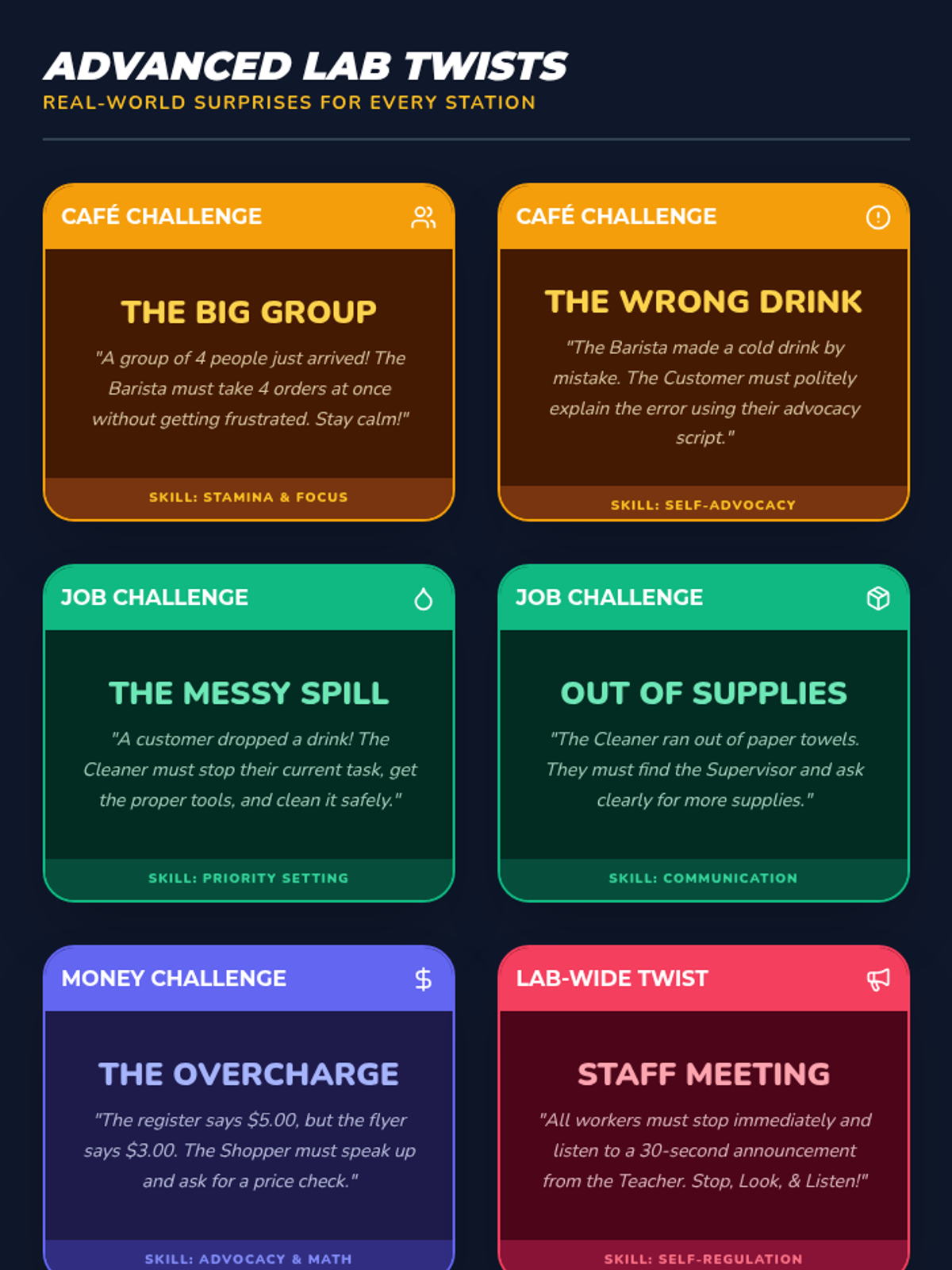
An expanded set of challenge cards for the Life Skills Lab, featuring new twists for the Café and Job stations to test problem-solving and self-regulation.
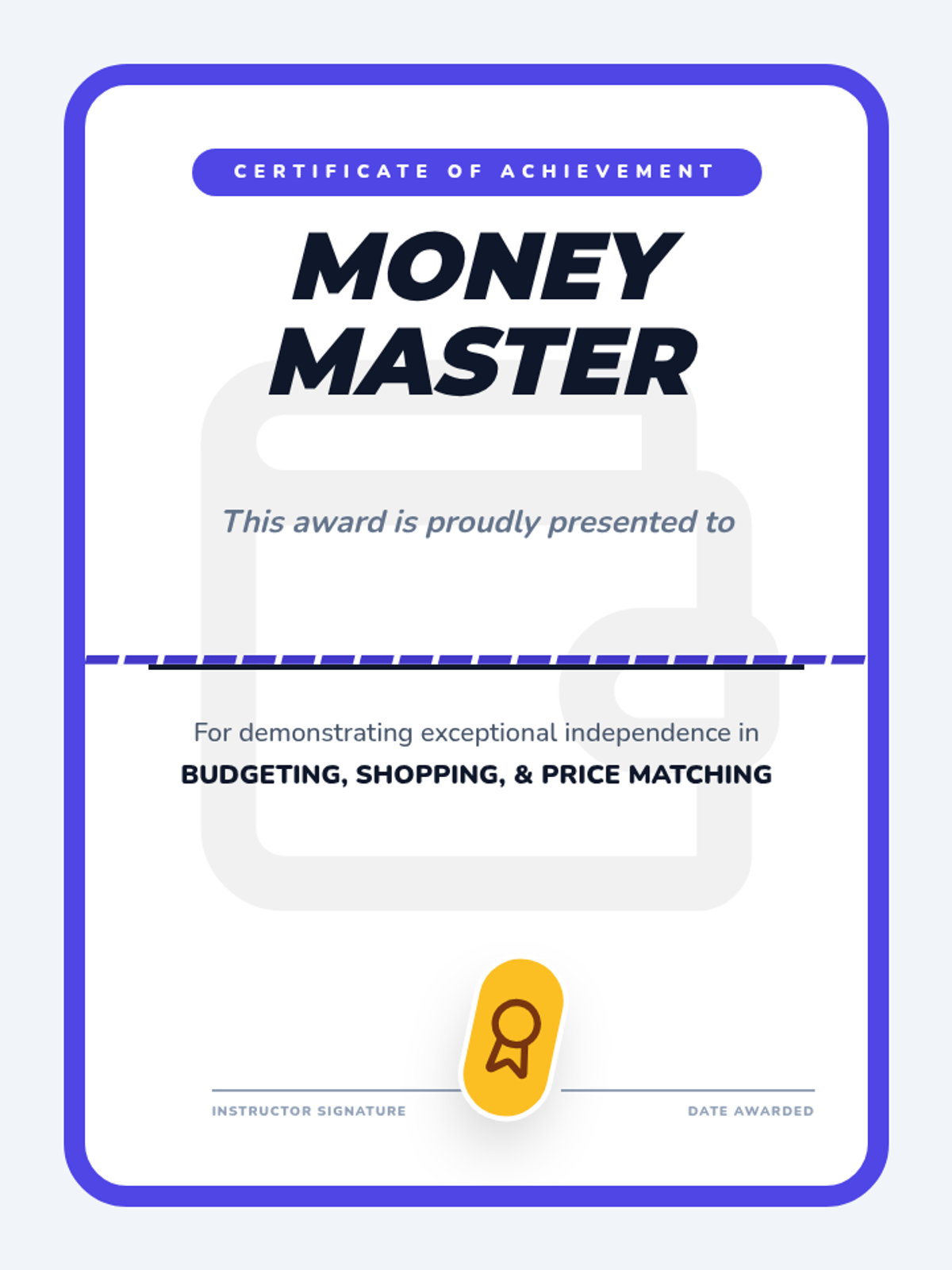
A set of high-quality printable achievement certificates for students mastering the Money, Social, and Job Skill stations.
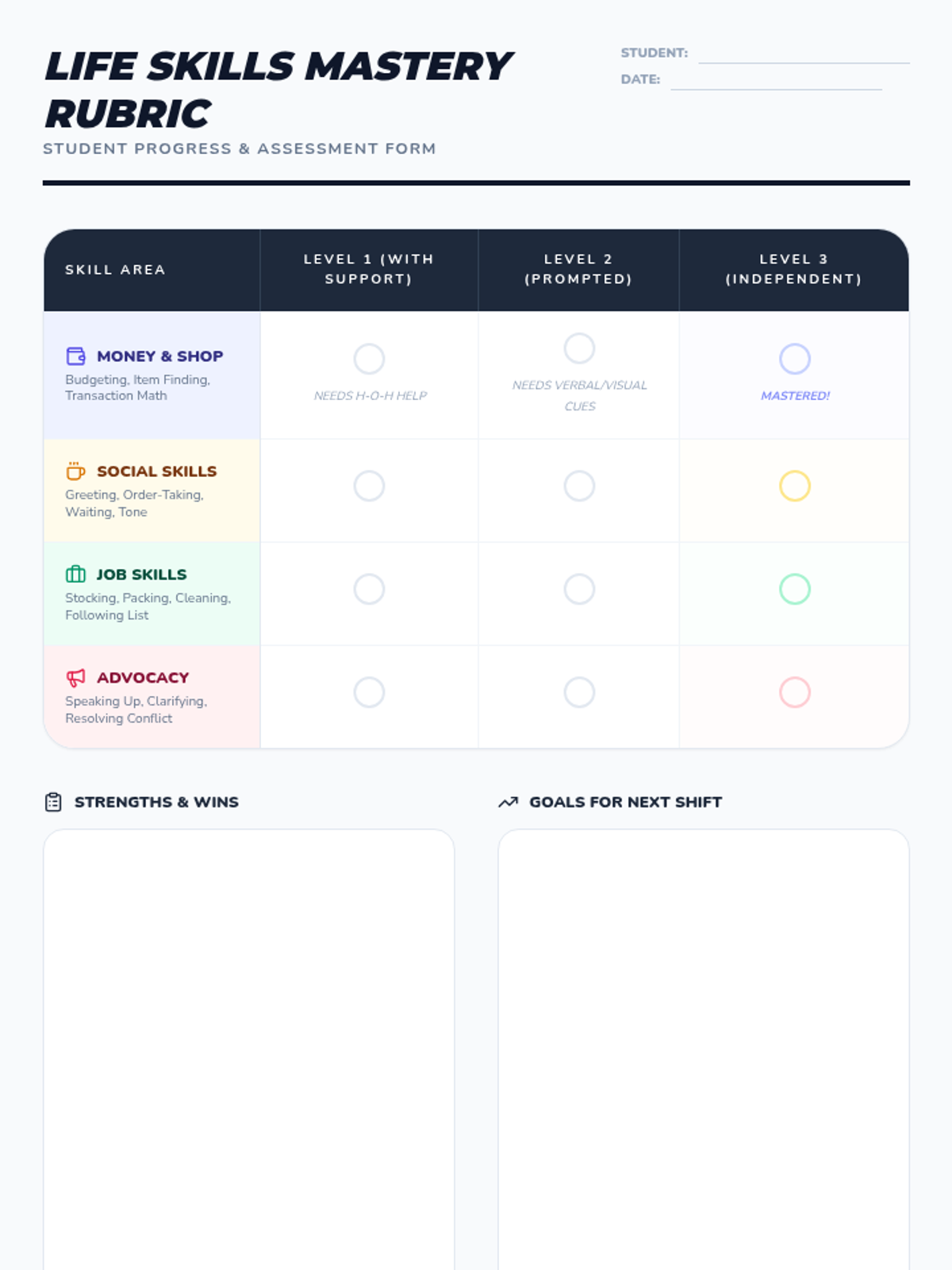
A professional assessment rubric for teachers to track student progress across four skill areas, ranging from supported to independent mastery.
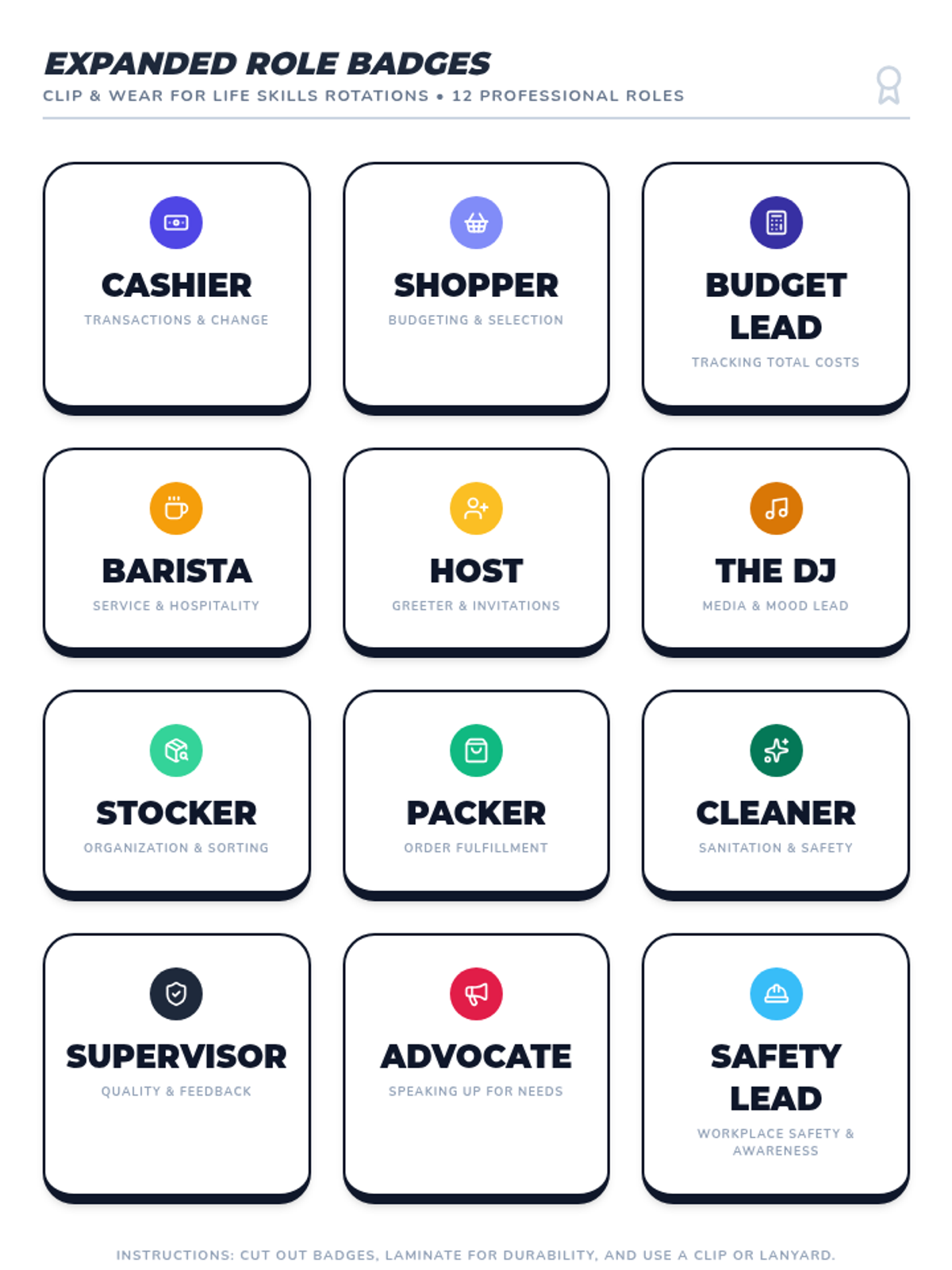
A sheet of 12 expanded role badges for the Life Skills Lab, including Budget Lead, Host, DJ, Packer, Cleaner, and Safety Lead, color-coded by skill area.
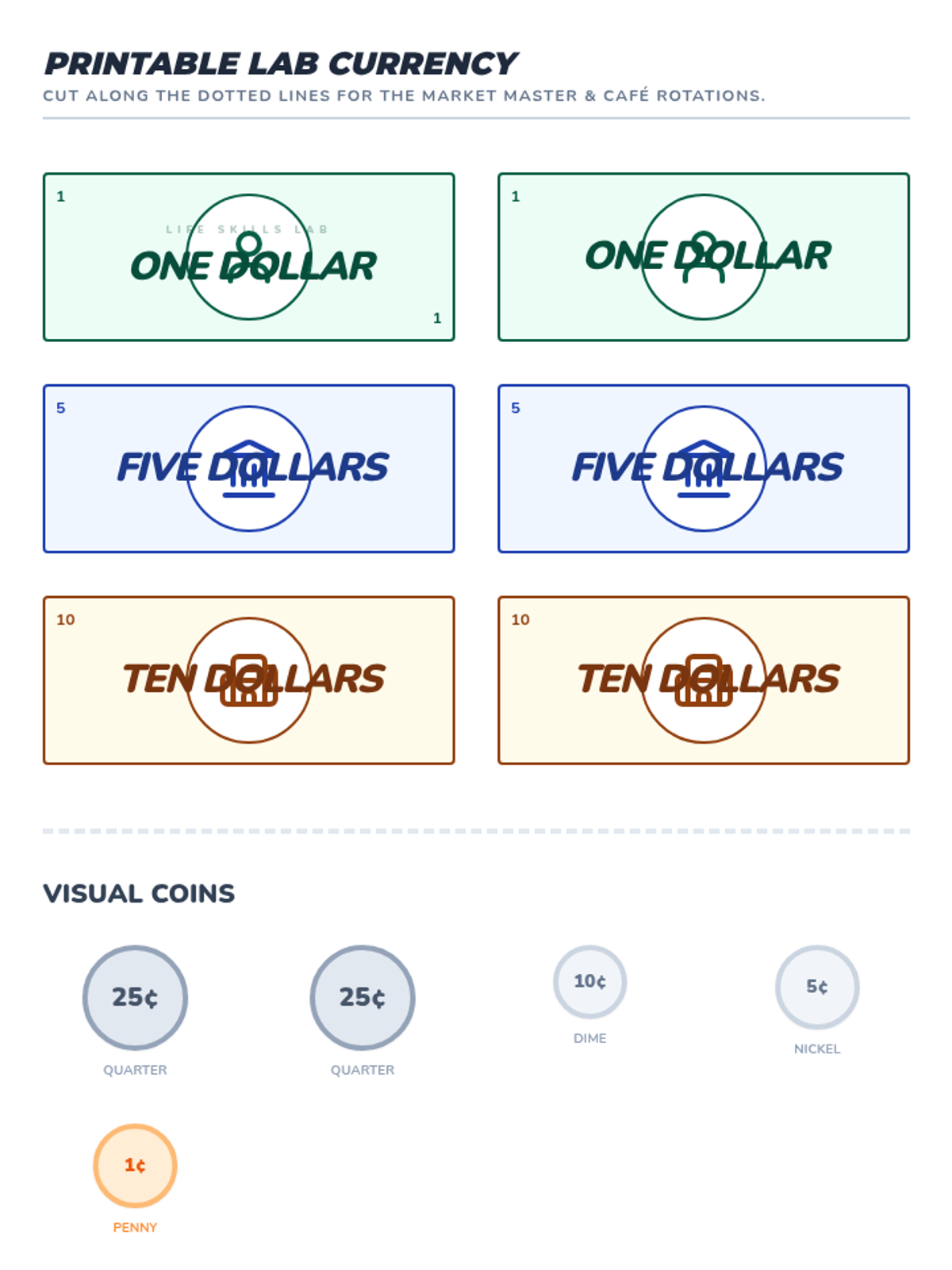
A printable sheet of realistic-style classroom currency, including $1, $5, and $10 bills and visual coins for use in life skills simulations.
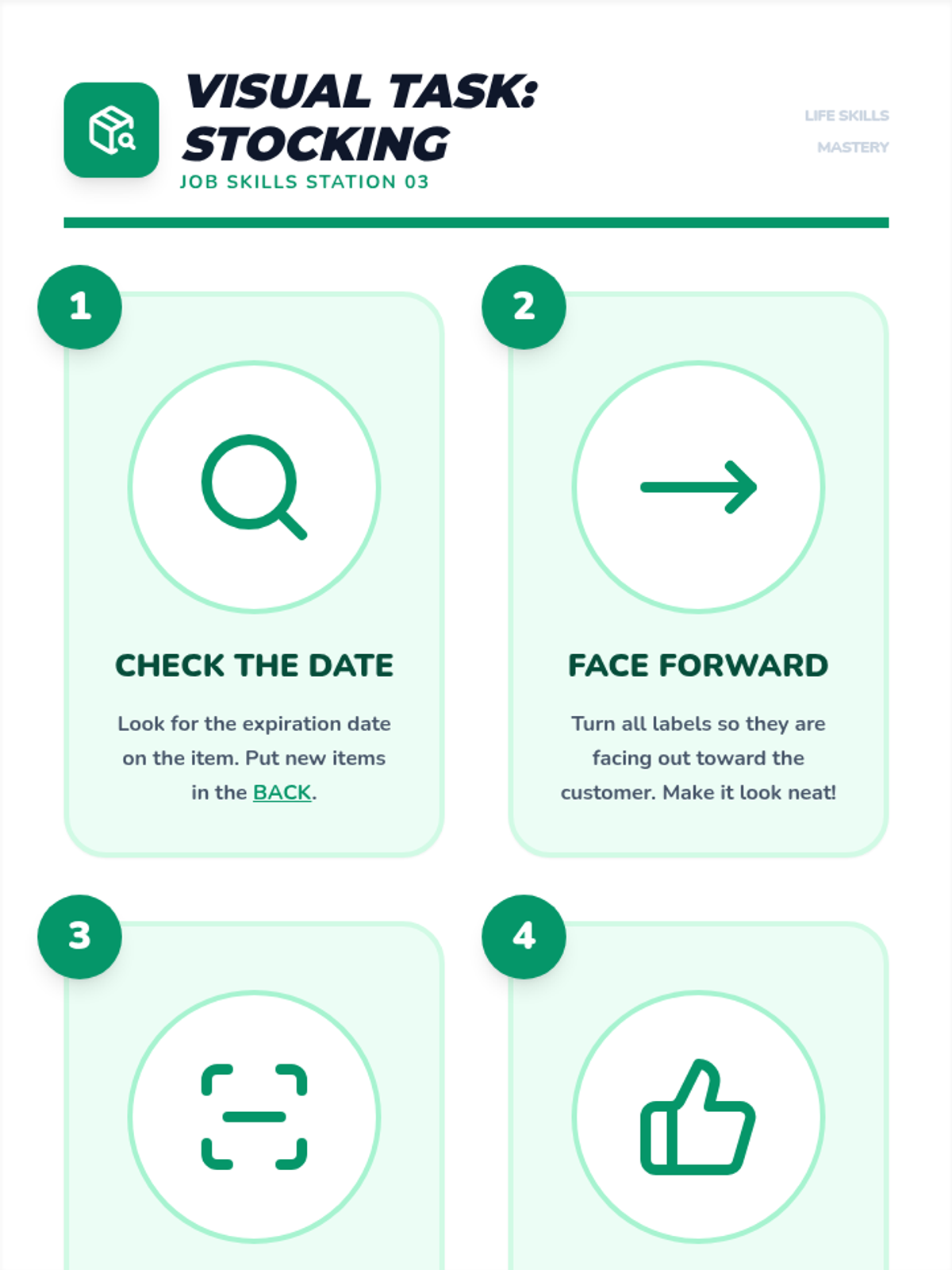
Icon-based visual task schedules for two key rotation stations: Stocking and Barista. Each page breaks down the task into four clear, sequential steps with simplified instructions. Updated to include Bagging and Cleaning tasks.
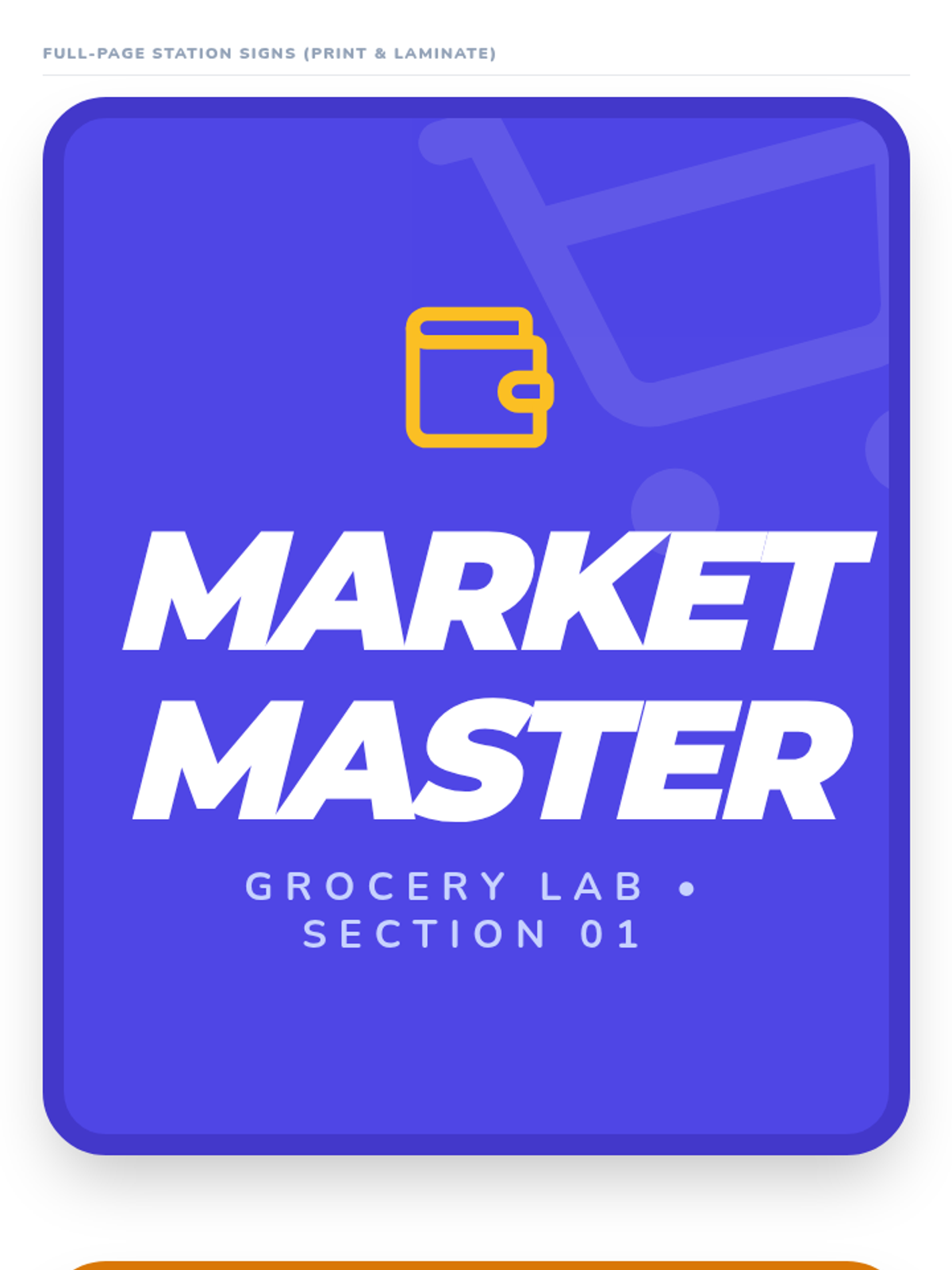
A collection of high-visibility station signs and wearable role badges for the Life Skills Lab environment, including roles for shopping, cafe service, and vocational tasks.
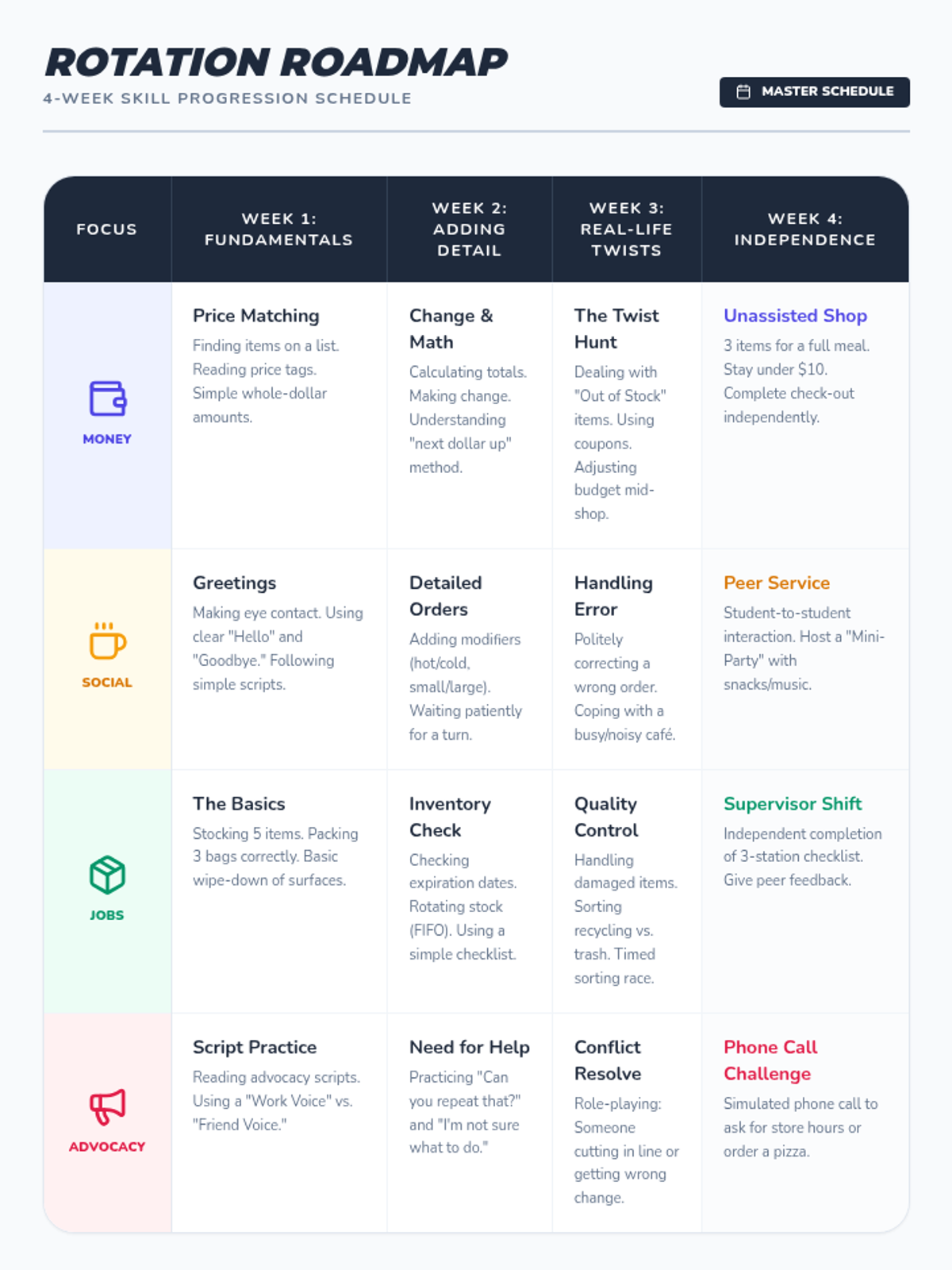
A master 4-week roadmap for the Life Skills Lab curriculum, detailing the skill progression from fundamentals to independence across all four skill areas.
Four professional binder section dividers for the Life Skills Lab curriculum, color-coded for Money, Social, Jobs, and Advocacy sections.
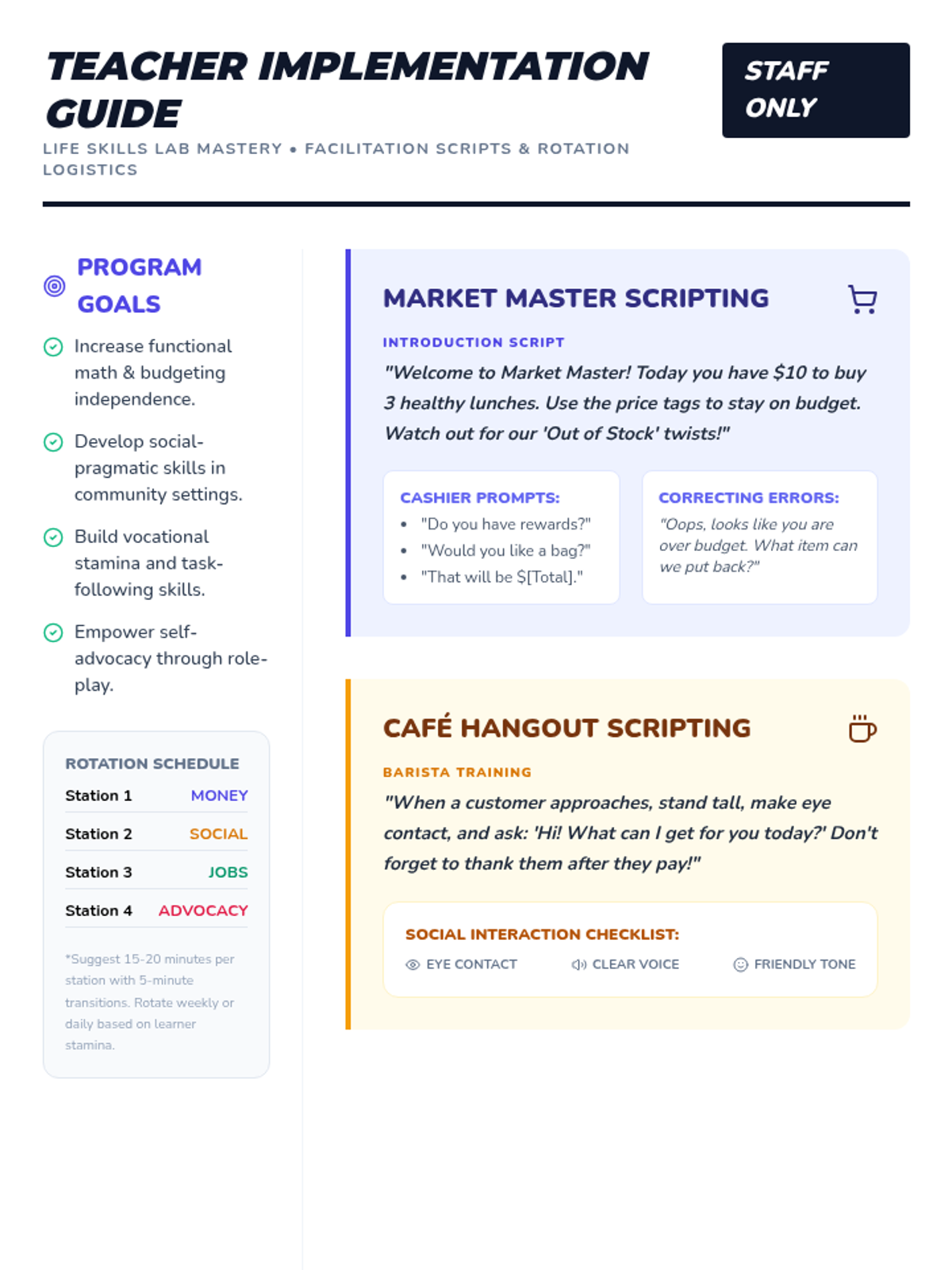
A comprehensive teacher implementation guide for the Life Skills Lab Mastery program, featuring specific facilitation scripts, program goals, and rotation logistics for every station.
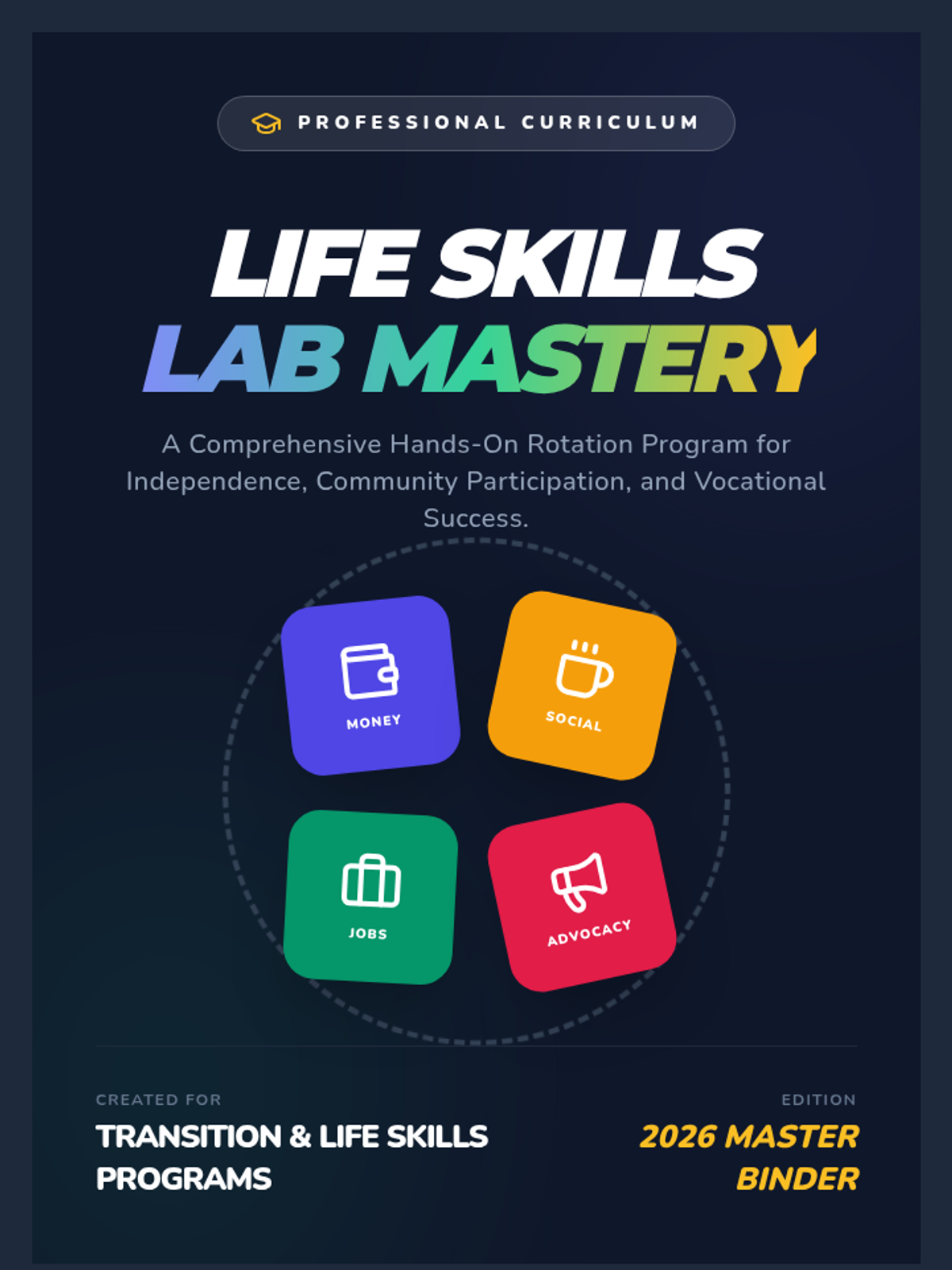
A high-impact curriculum cover page for the Life Skills Lab Mastery binder, featuring branding for money, social, job, and advocacy skill areas.
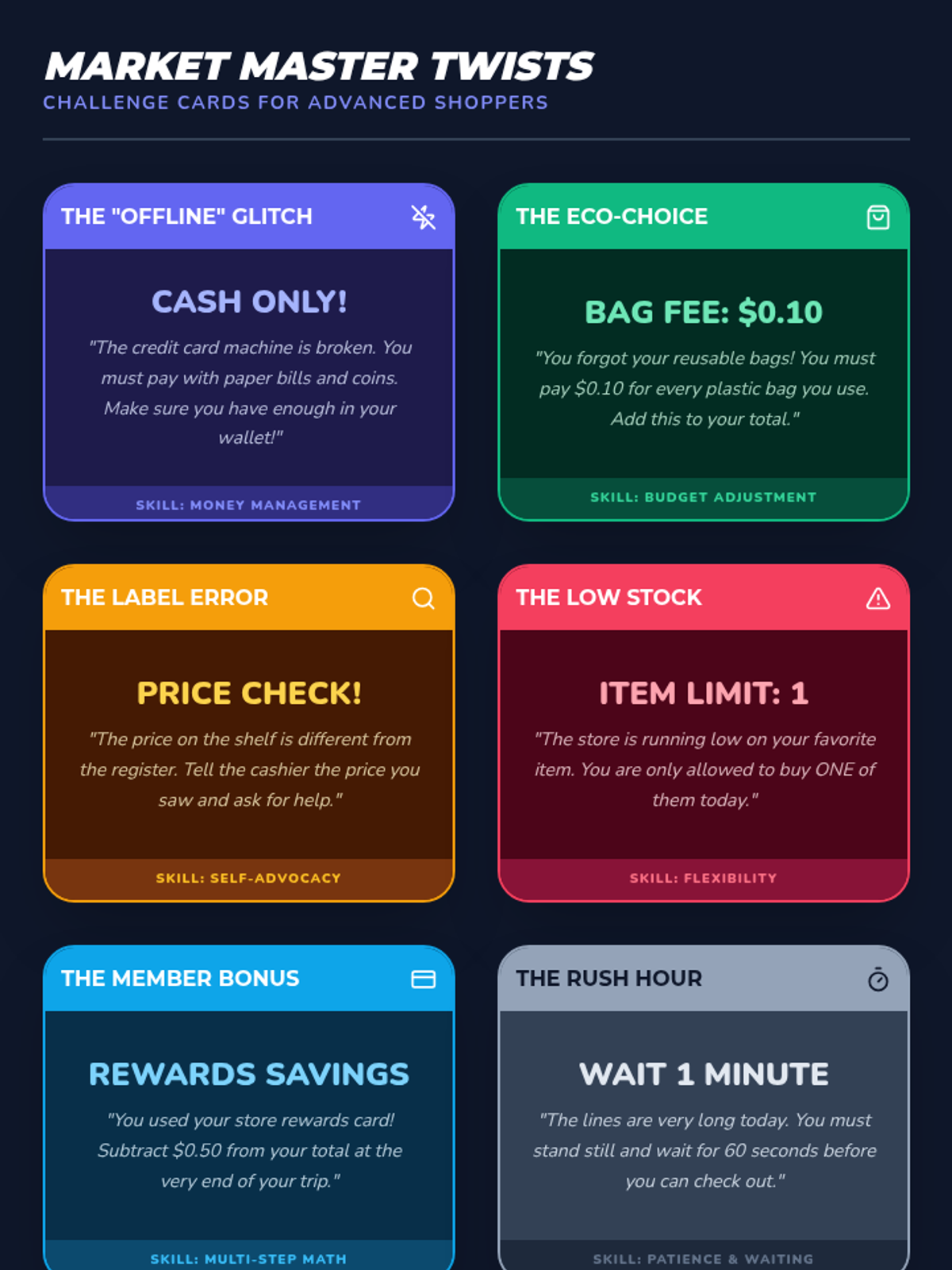
A set of 'Twist' challenge cards for the 'Market Master' activity, introducing real-life problems like cash-only registers, bag fees, and item limits.
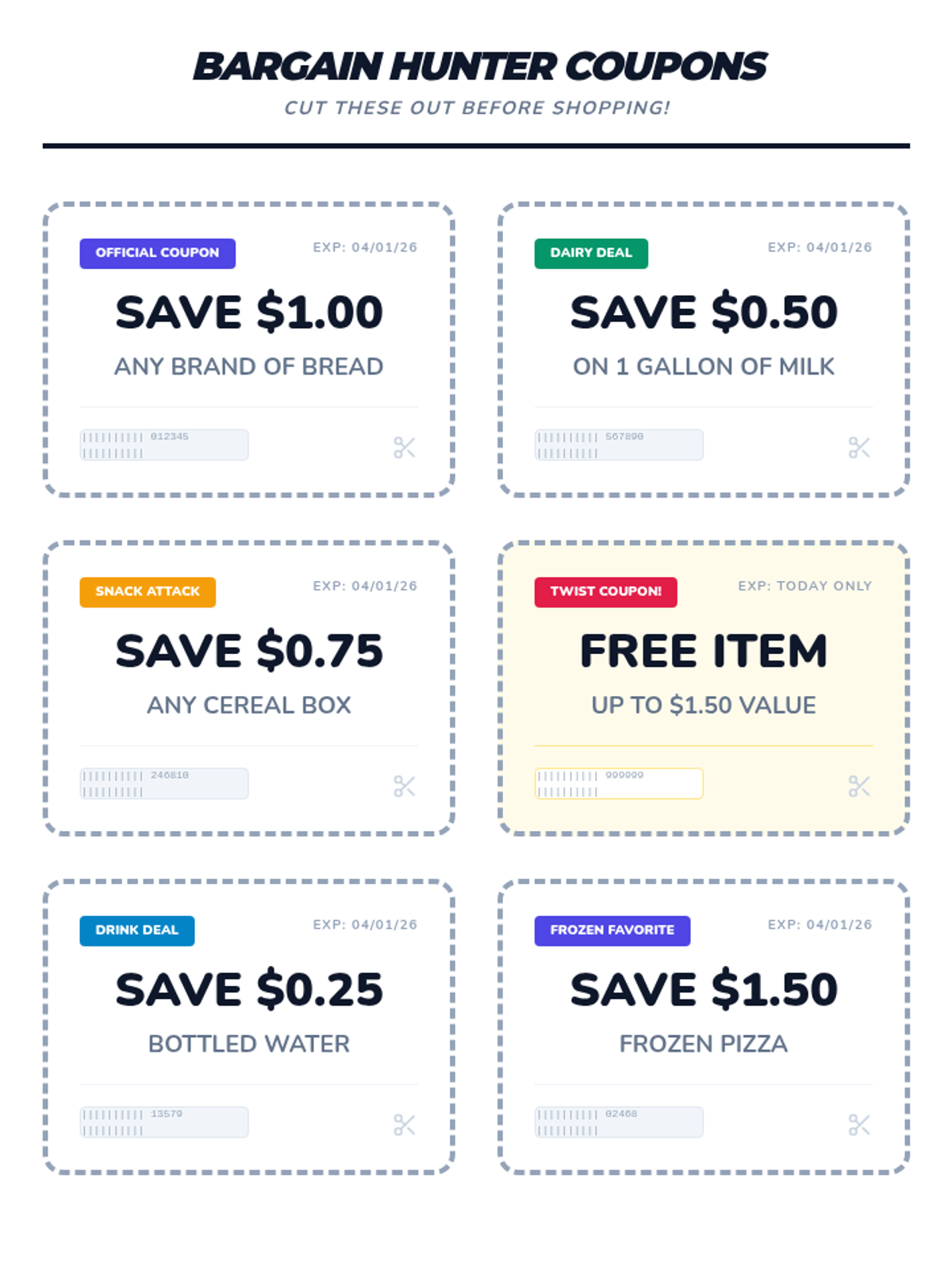
A sheet of printable coupons for students to use in the 'Market Master' activity, including 'Save $' deals and a special free item twist.
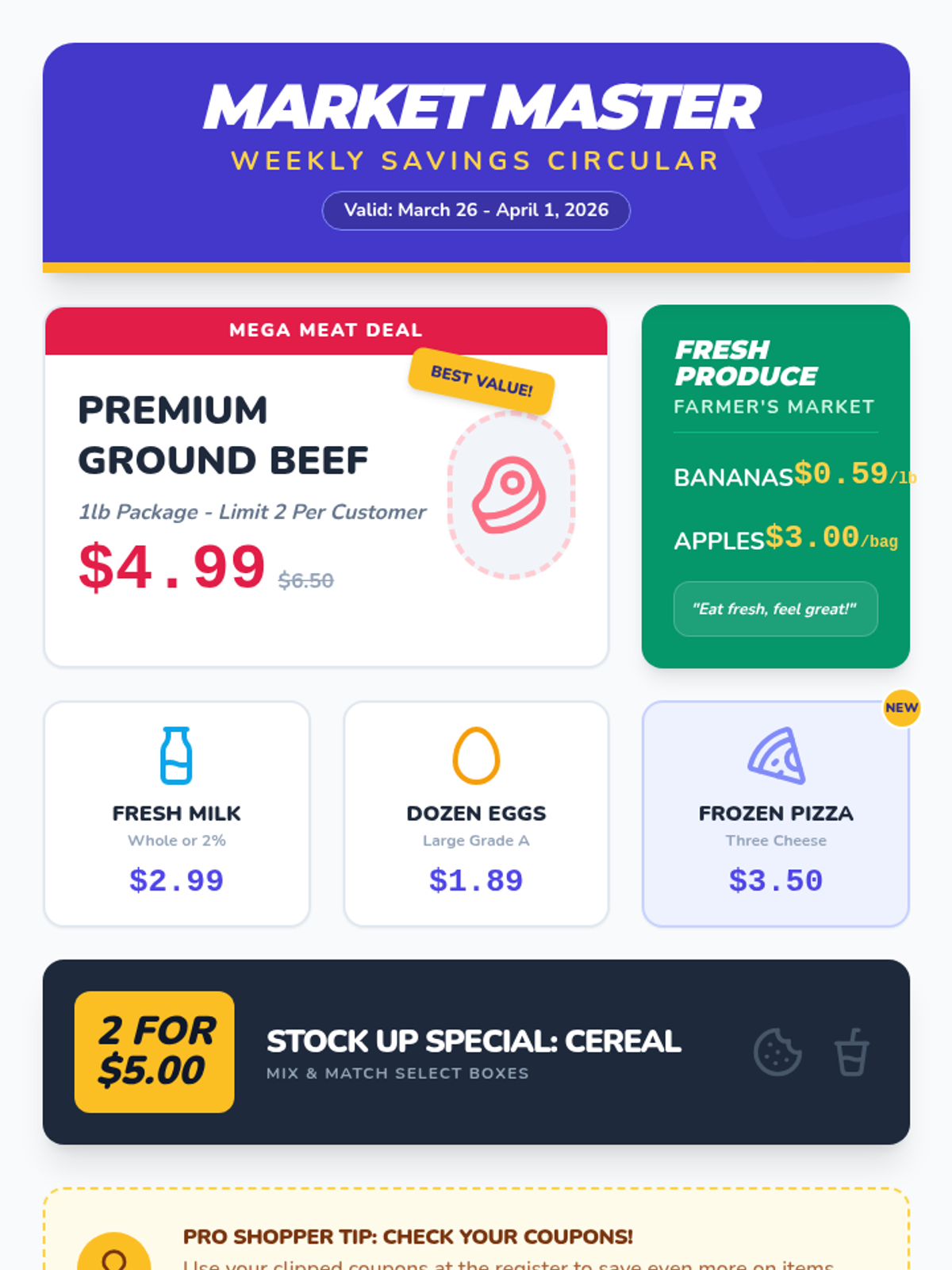
A colorful weekly grocery flyer for the 'Market Master' activity, showcasing deals on produce, dairy, and pantry items to practice price comparison.
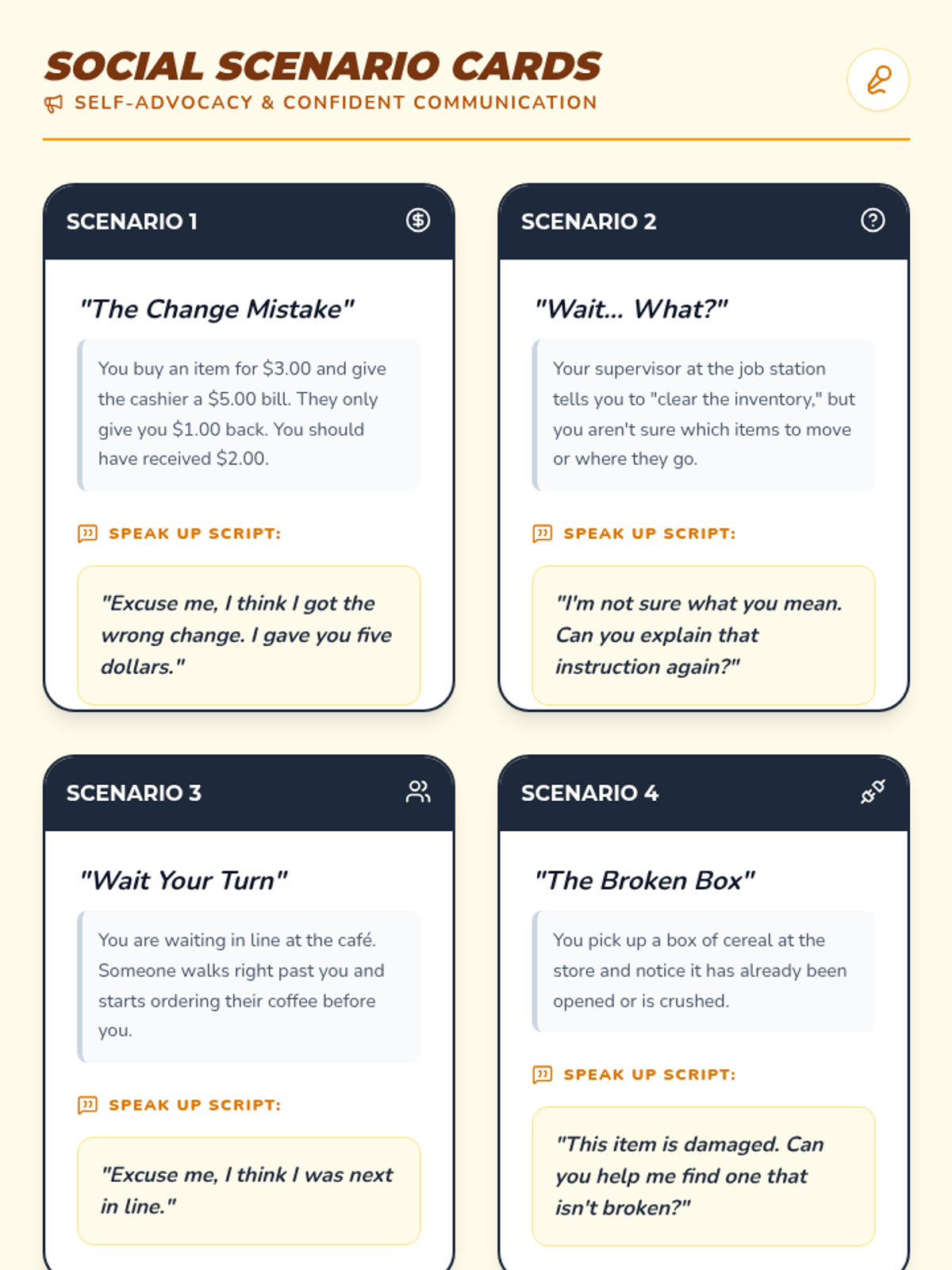
Role-play scenario cards for self-advocacy practice, covering common challenges like wrong change, unclear instructions, and line-cutting.
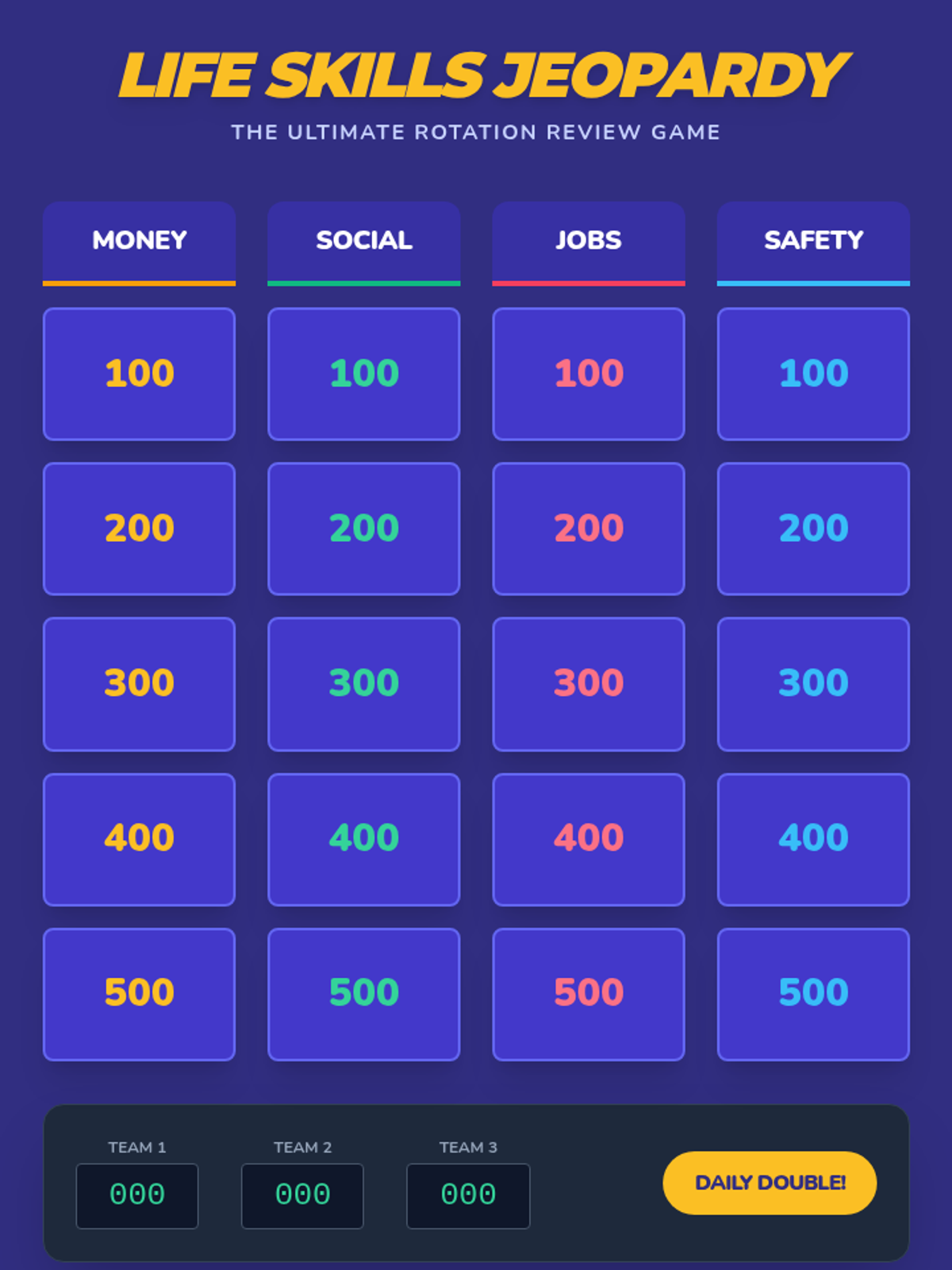
A visually striking Jeopardy-style game board for life skills review, featuring categories for Money, Social, Jobs, and Safety with integrated score tracking.
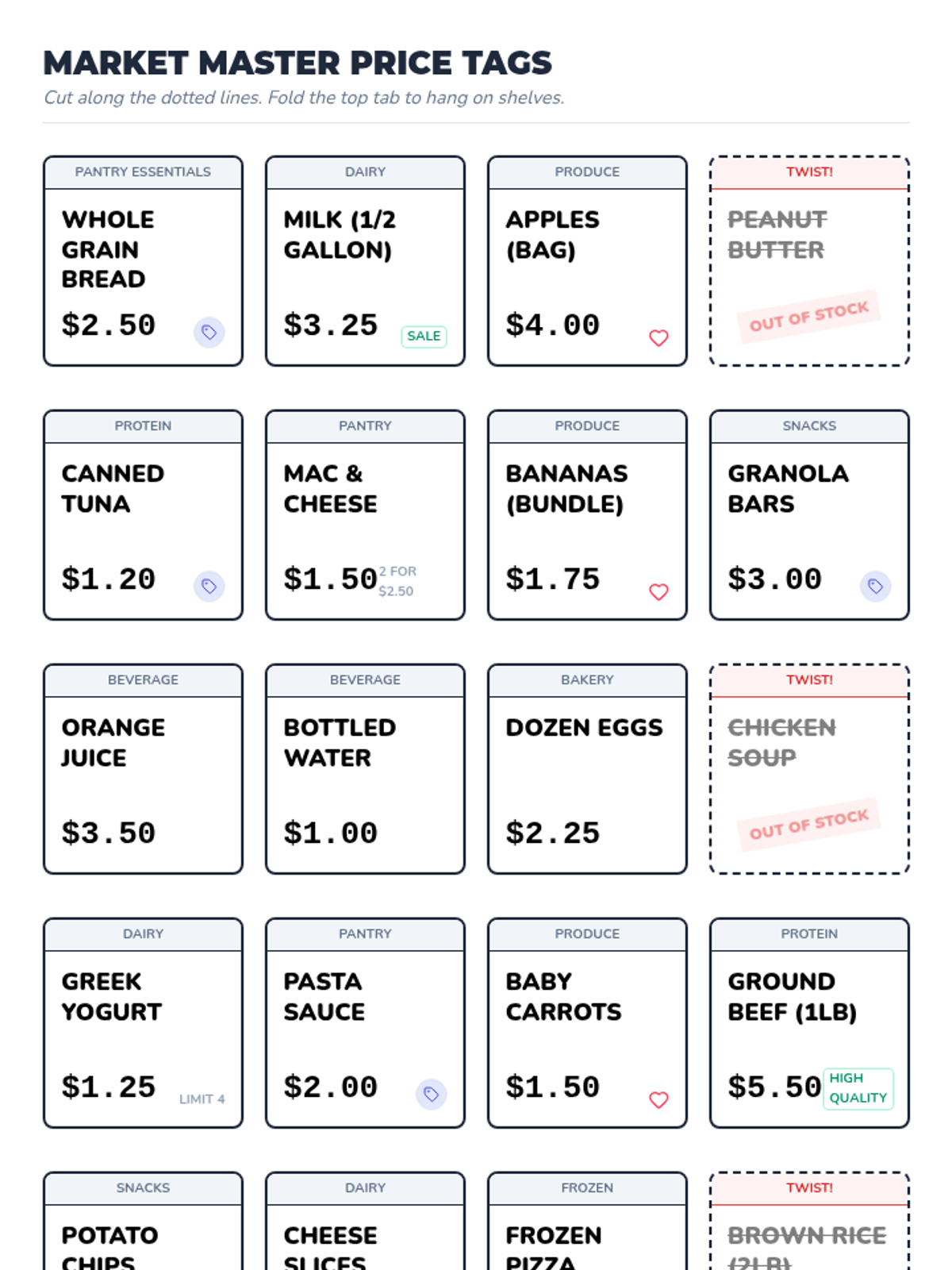
Printable grocery price tags for the 'Weekly Store Challenge' classroom setup, including 'out of stock' items to test problem-solving. Updated with more items.
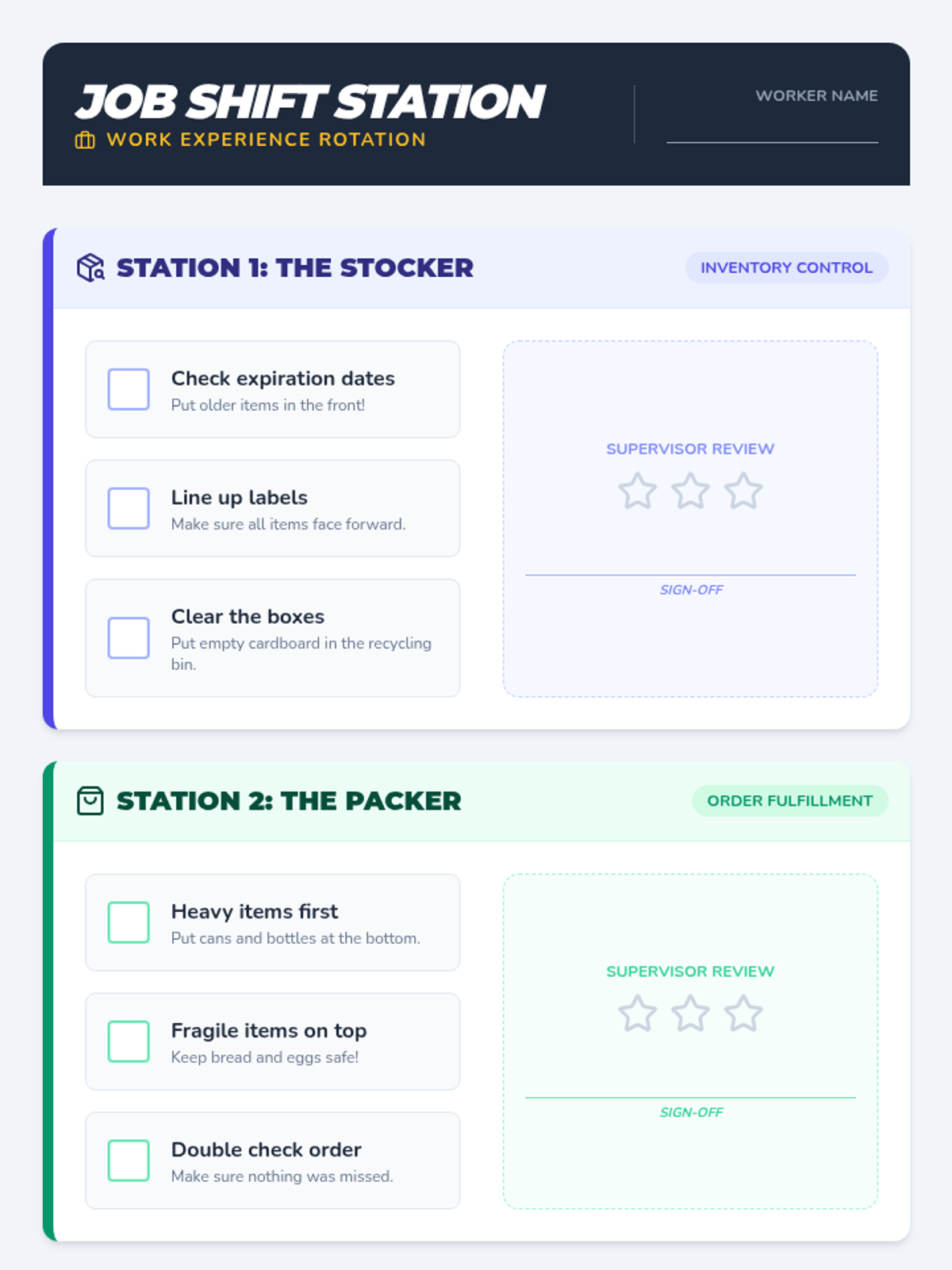
Visual checklists for three job skill stations: Stocking, Packing, and Cleaning. Includes specific tasks, safety tips, and a supervisor review section.
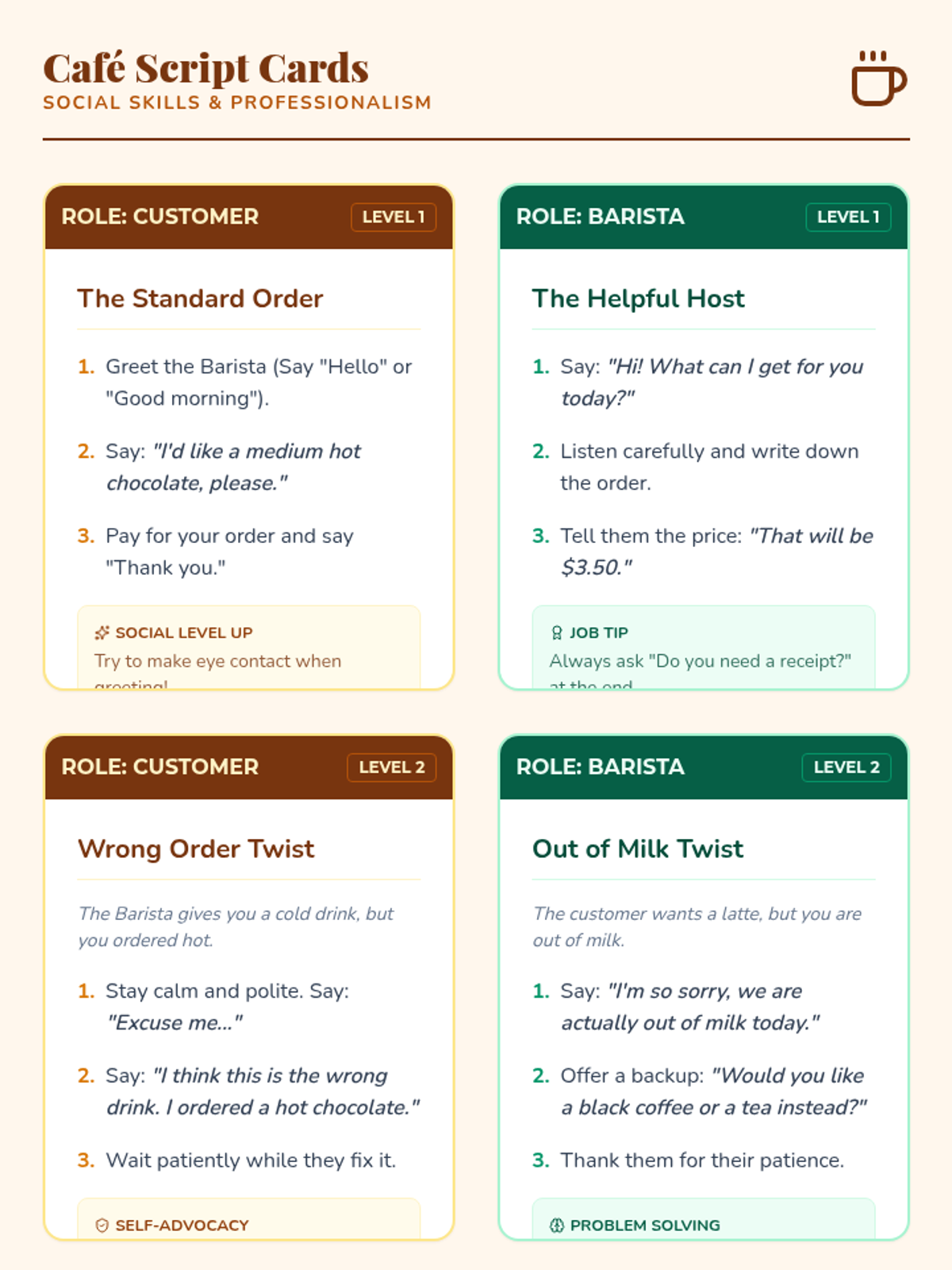
Role-play script cards for a cafe setting, featuring scenarios for customers and baristas with varying difficulty levels and social skills tips.
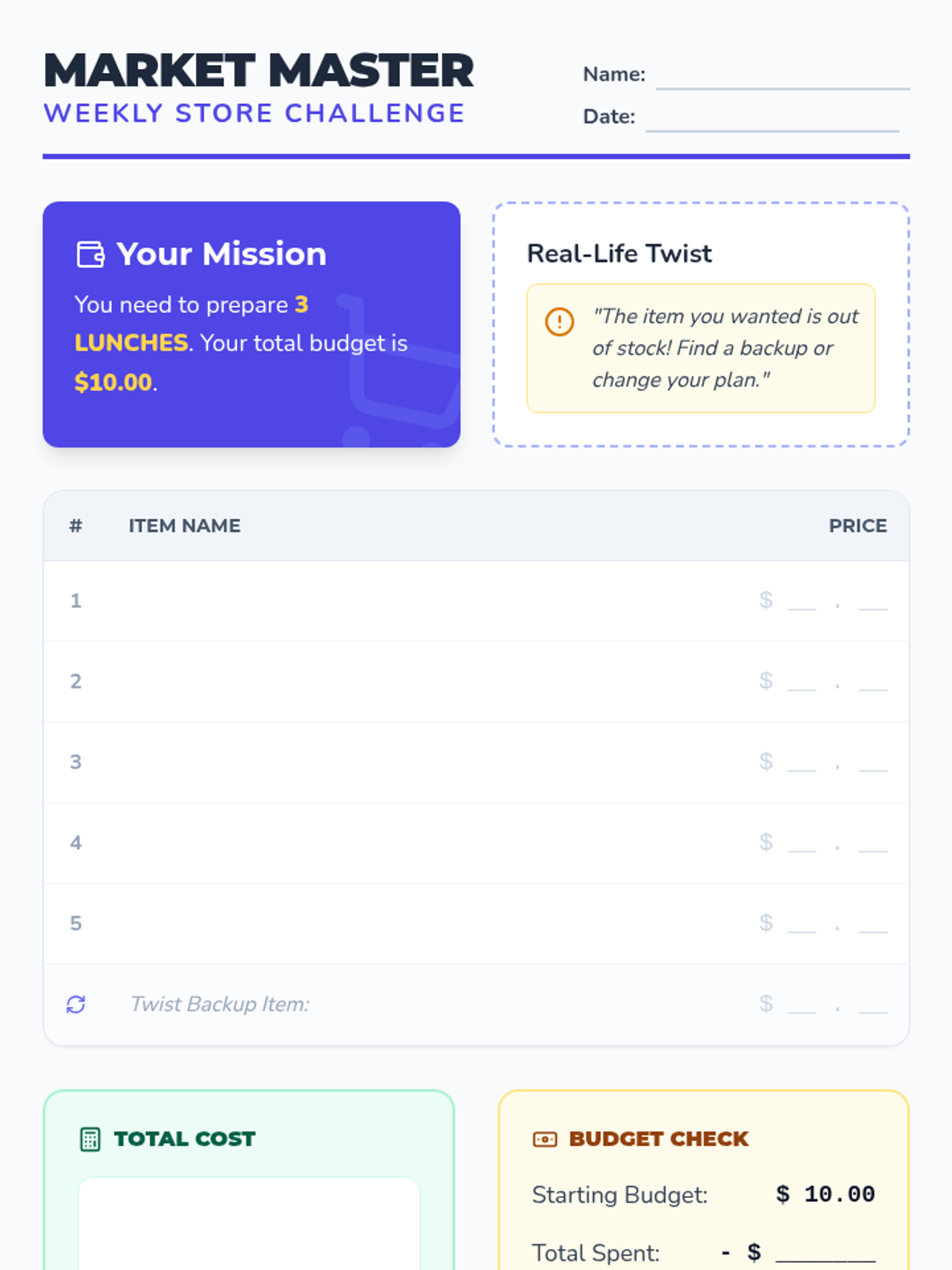
A student worksheet for the 'Weekly Store Challenge' focusing on budgeting, item selection under a $10 limit, and handling a real-life 'out of stock' twist.
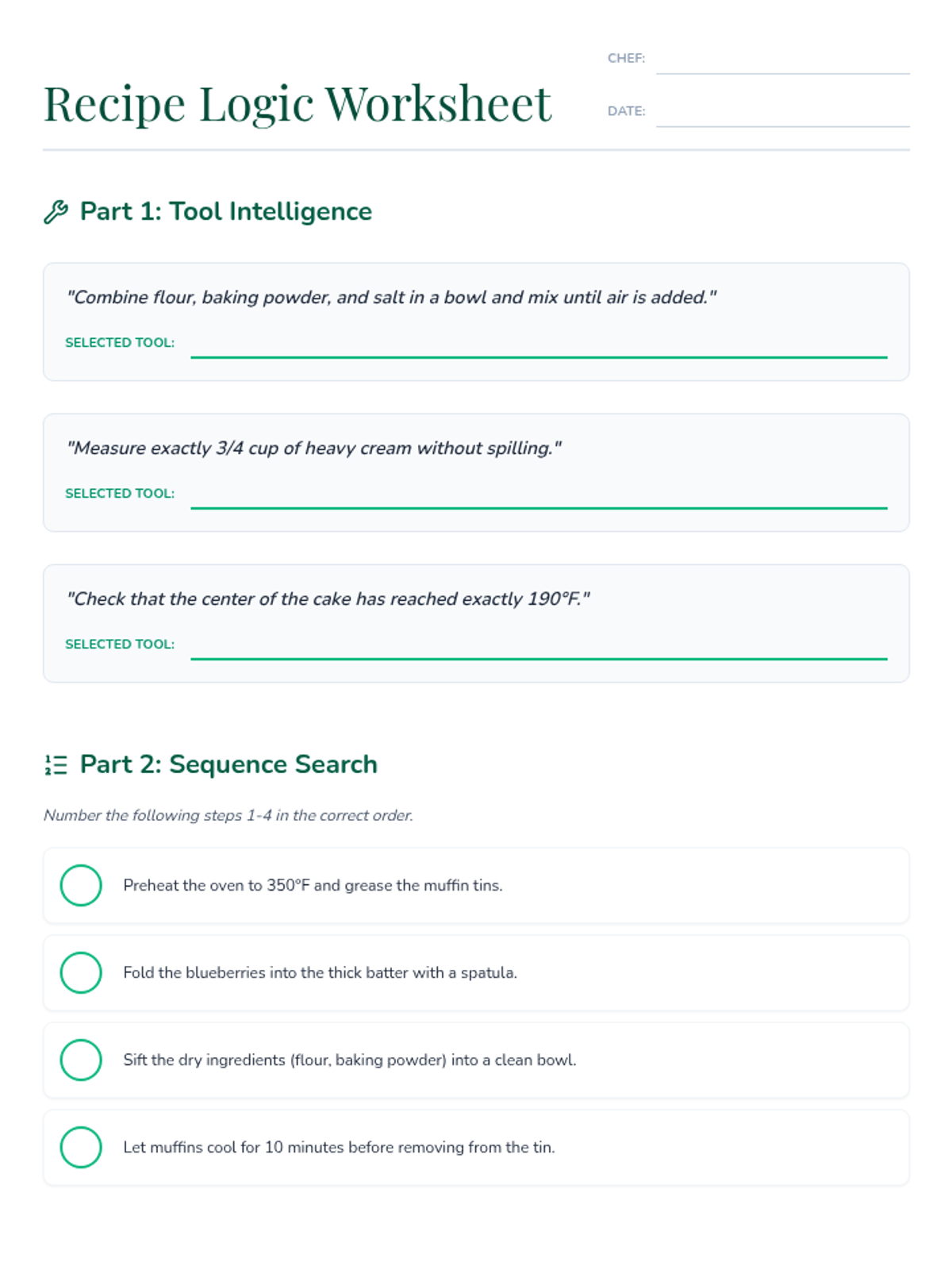
A student worksheet for practice in kitchen tool identification, fraction scaling, and recipe sequencing within the "Kitchen Code" lesson.
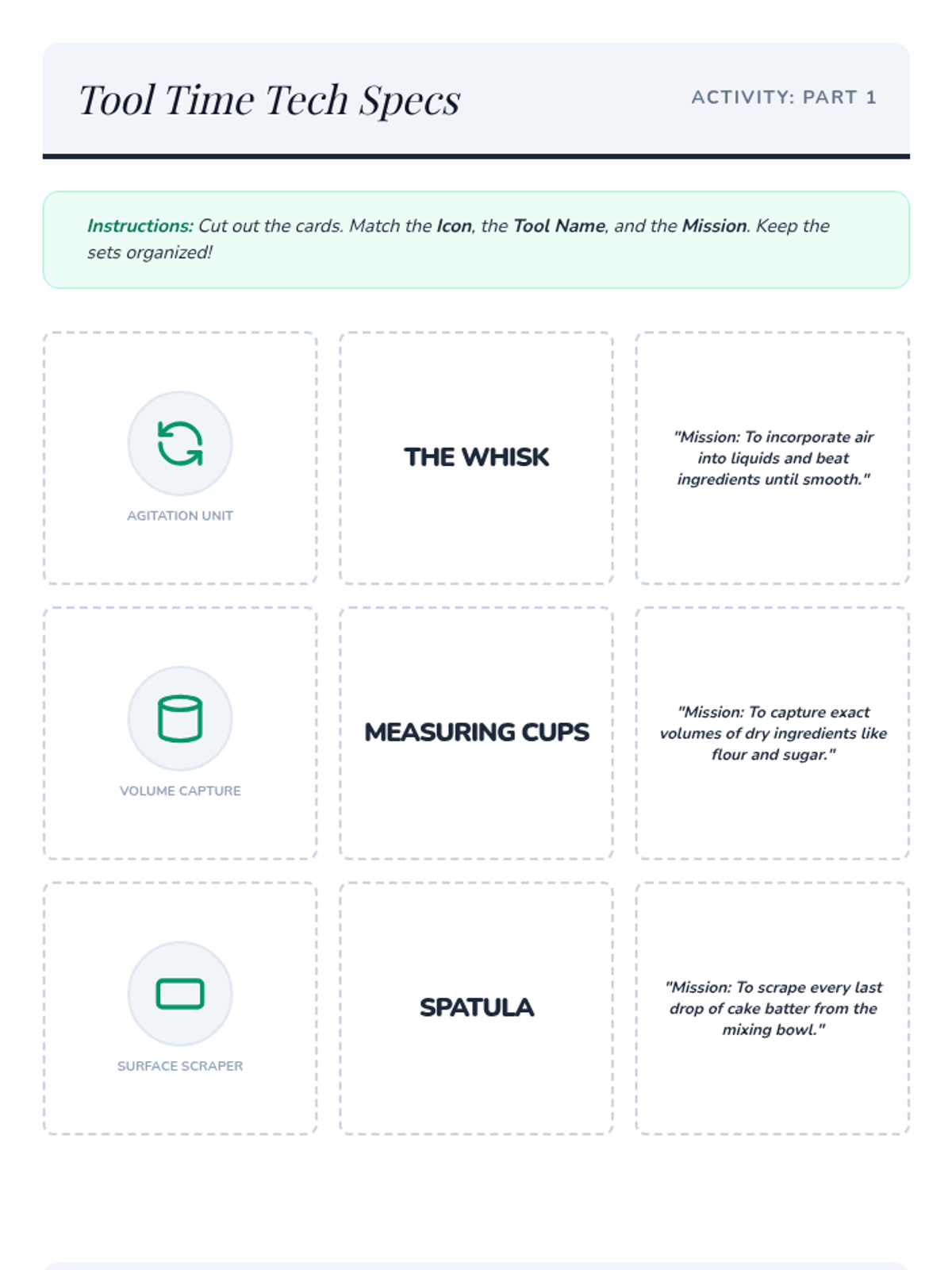
A hands-on activity where students cut out and match kitchen tools with their names and functions, including a "wildcard" card for student creativity.
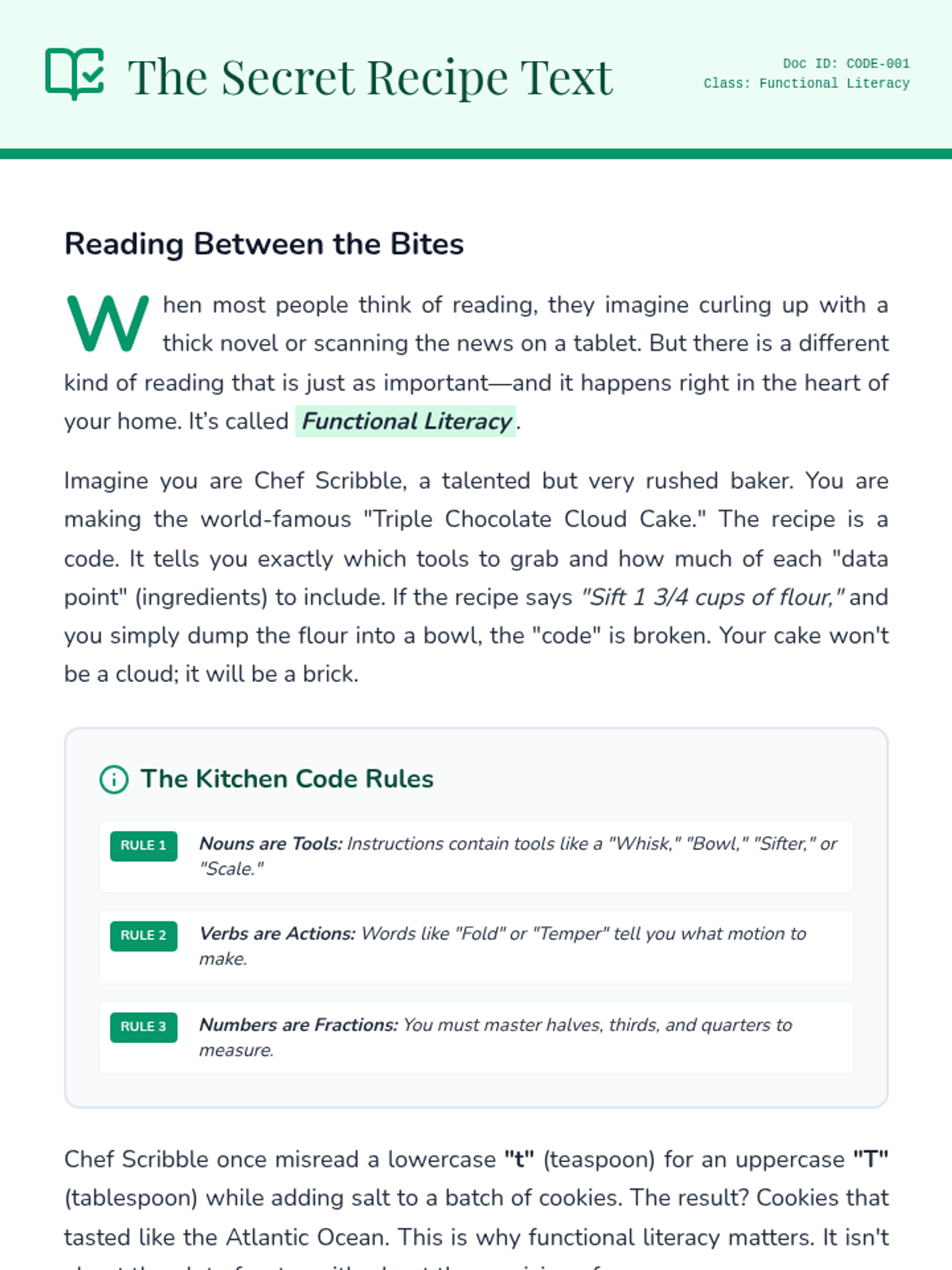
A reading passage for students that explains functional literacy through the story of "Chef Scribble," emphasizing precision in kitchen tools and fraction reading.
A high-impact slide deck for "Kitchen Code" introducing functional literacy, essential kitchen tools, and the math of fraction scaling in recipes.
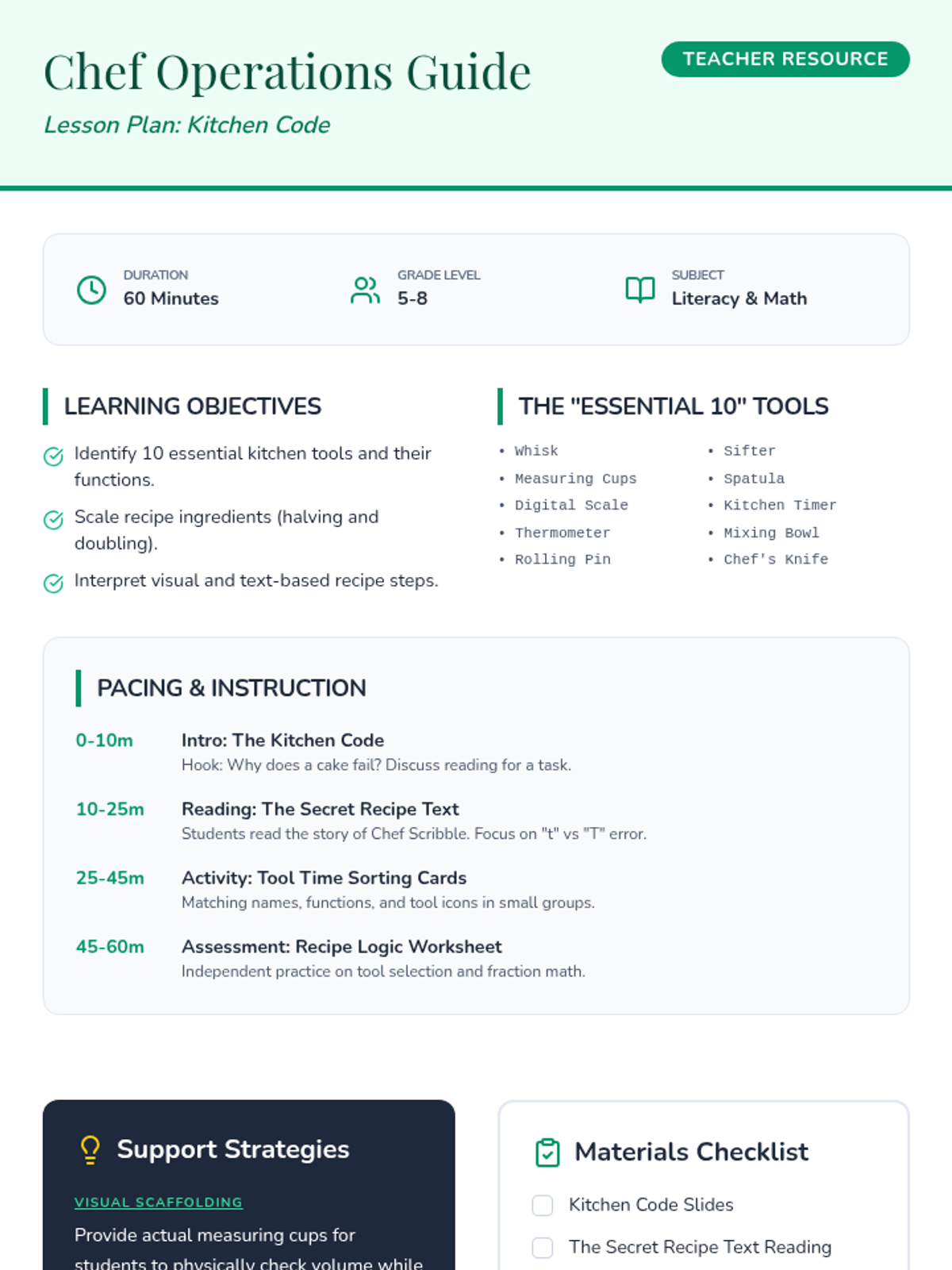
A teacher-facing lesson plan for "Kitchen Code," outlining learning objectives, vocabulary, pacing, and differentiation strategies for teaching functional literacy and culinary math.
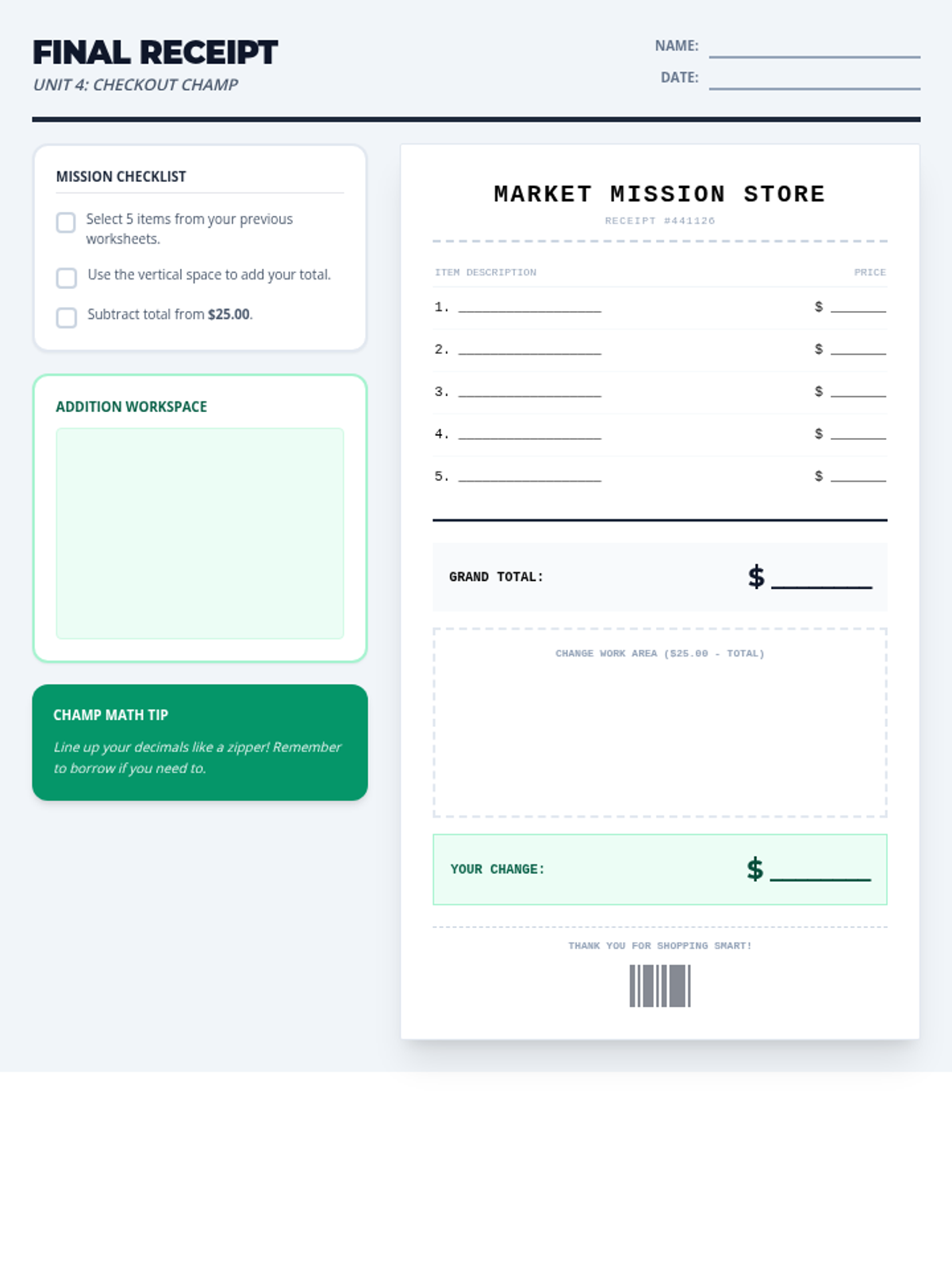
A final project worksheet for Lesson 4 that simulates a grocery receipt, where students calculate their final total and determine their remaining change from a $25 budget. Revised to fix page breaks, formatting, and added addition workspace.
Concluding slide deck for Lesson 4, guiding students through the final checkout process. Revised to fix a minor typo in the success checklist.
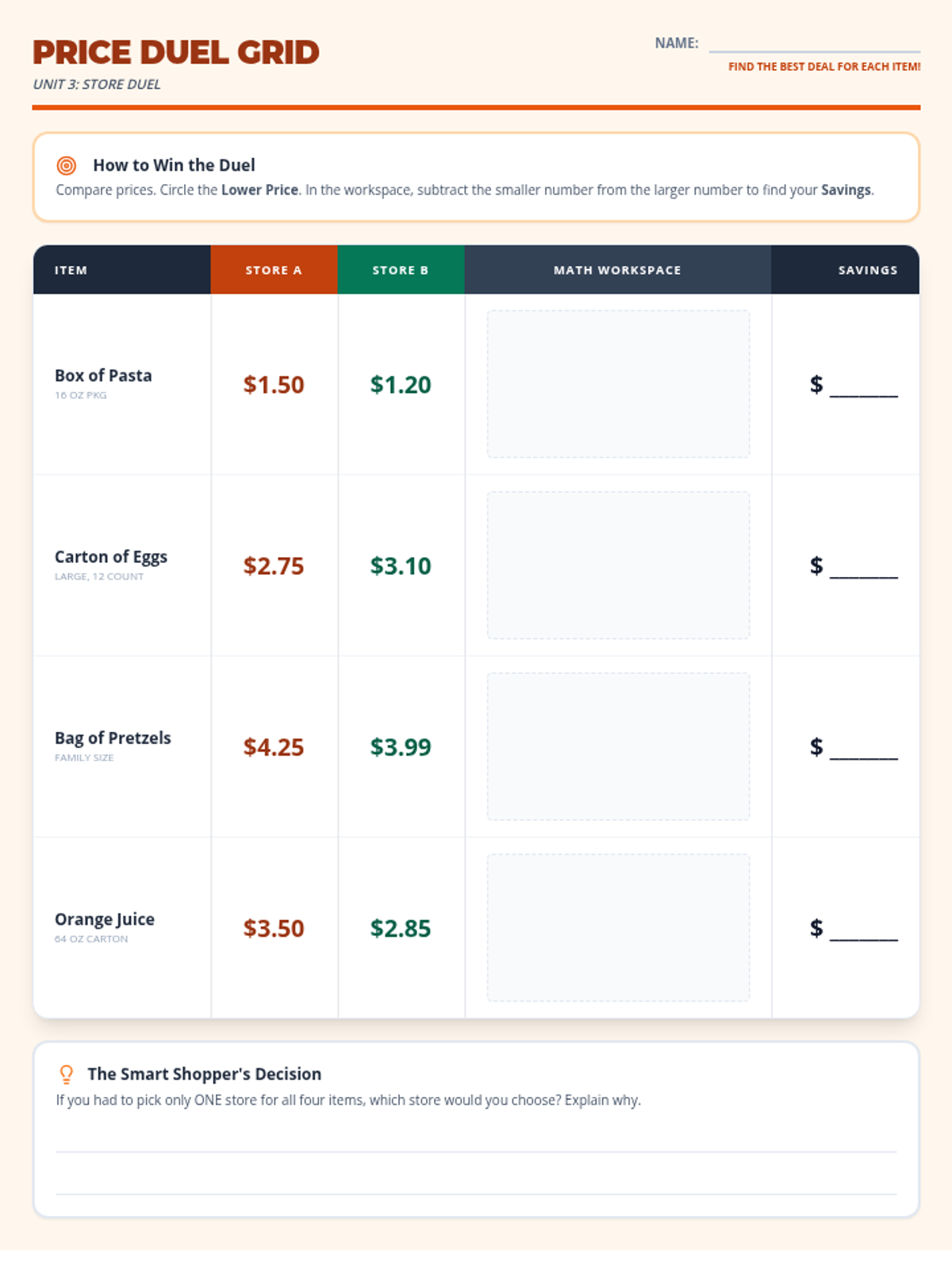
A comparison grid for Lesson 3 where students compare prices for the same items at two different stores and calculate the savings. Revised to fix layout, workspace size, and column logic.
Slide deck for Lesson 3 focusing on price comparison strategies, identifying the best deals, and reviewing decimal subtraction.
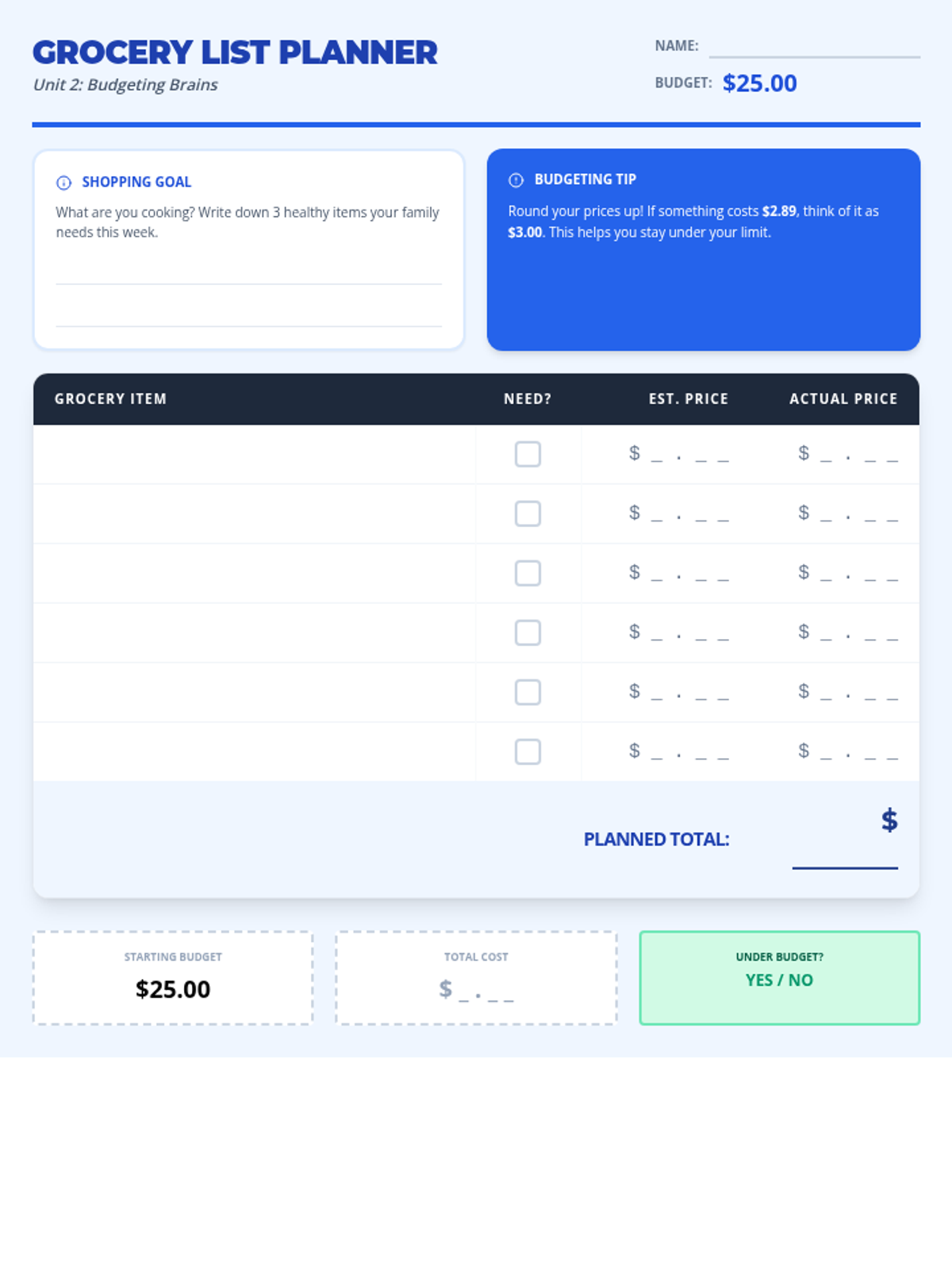
A graphic organizer for Lesson 2 that helps students plan a shopping trip, estimate costs, and track whether items are 'needs' or 'wants' while staying within a $25 budget. Revised to fix page breaks and formatting.
Slide deck for Lesson 2 focusing on budgeting basics, identifying needs vs. wants, and planning a shopping trip within a $25 limit.
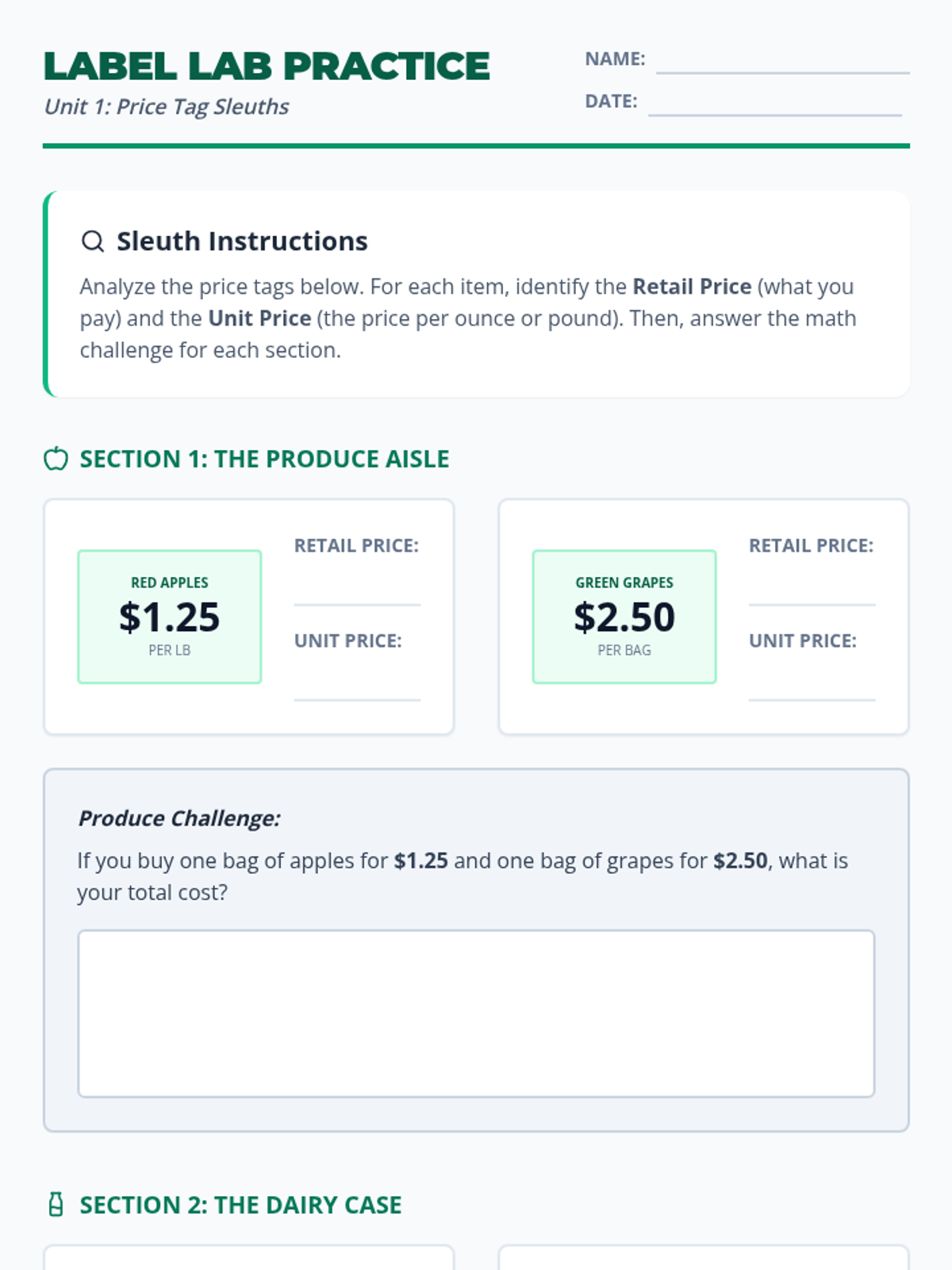
A practice worksheet for Lesson 1 where students identify retail and unit prices from visual tags and perform basic decimal addition/subtraction. Revised to fix page break and formatting issues.
An introductory slide deck for Lesson 1 that teaches students how to read grocery price labels and the basics of unit pricing.
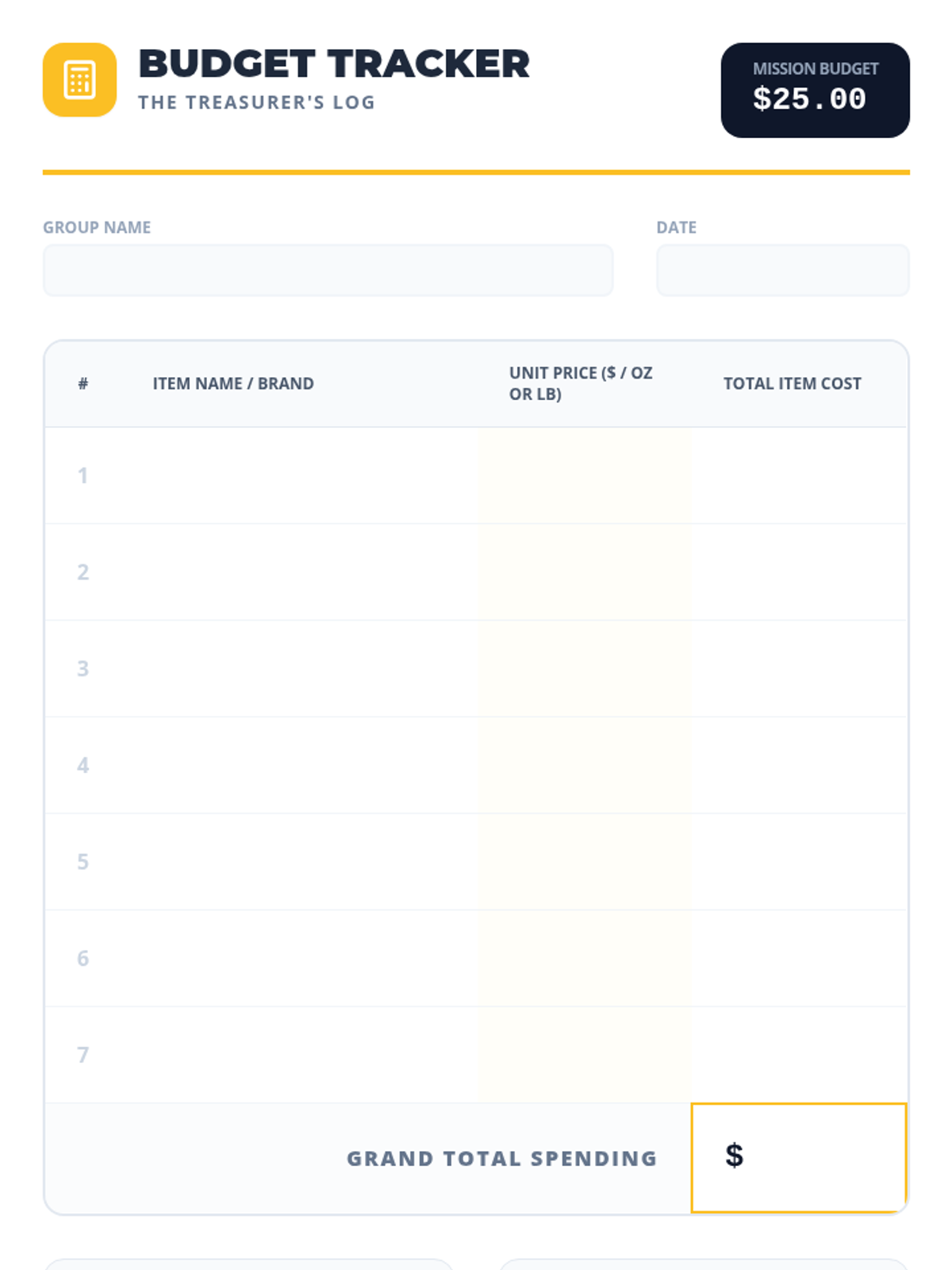
A specialized tracking sheet for the team 'Treasurer' to log grocery items, record unit prices, and calculate total spending within a $25 budget.
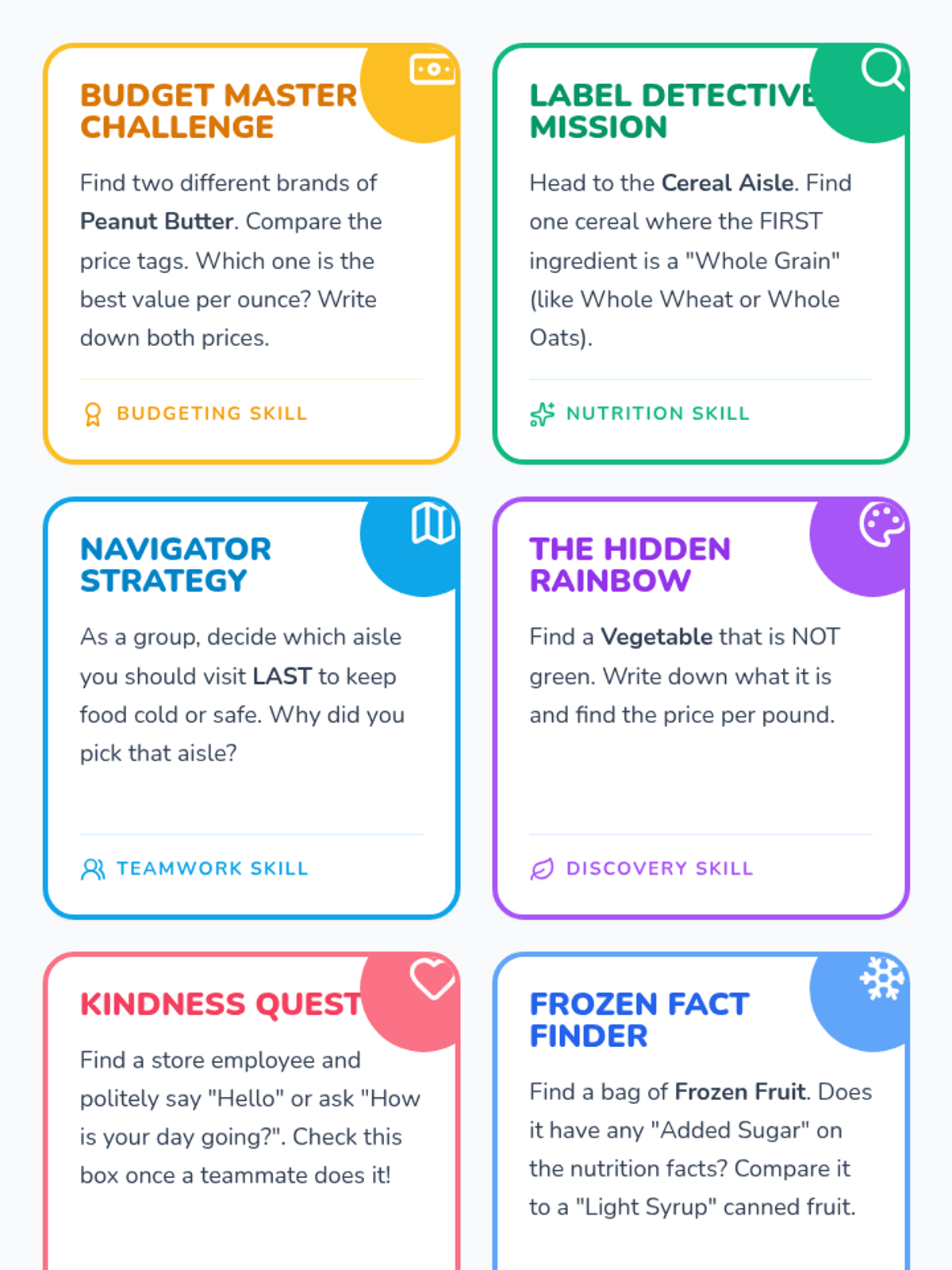
A set of 6 printable task cards that challenge student teams to perform specific missions involving nutrition, budgeting, and social skills in an online setting.
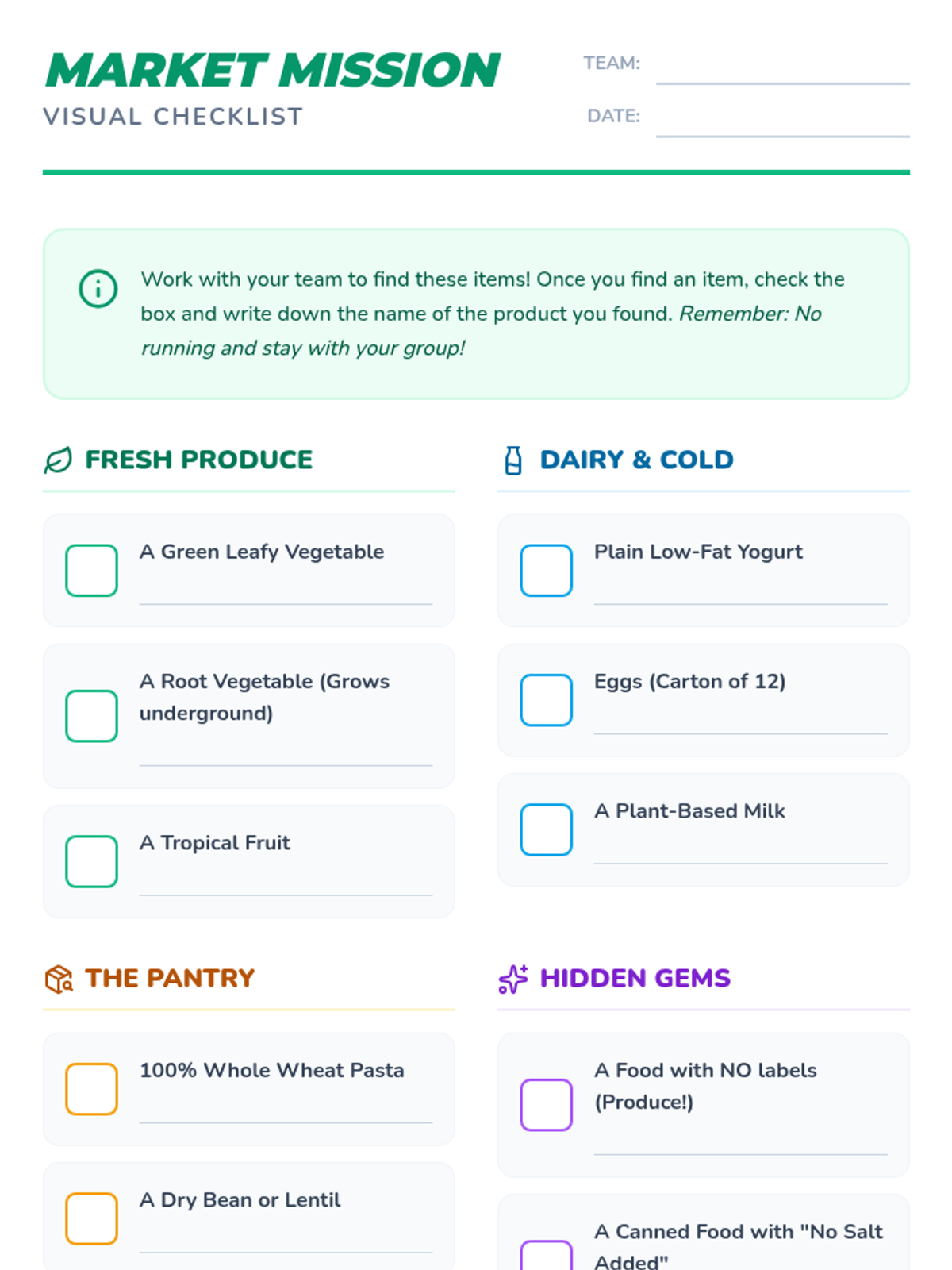
A visual checklist with icons and checkboxes for students to identify healthy grocery items across various departments.
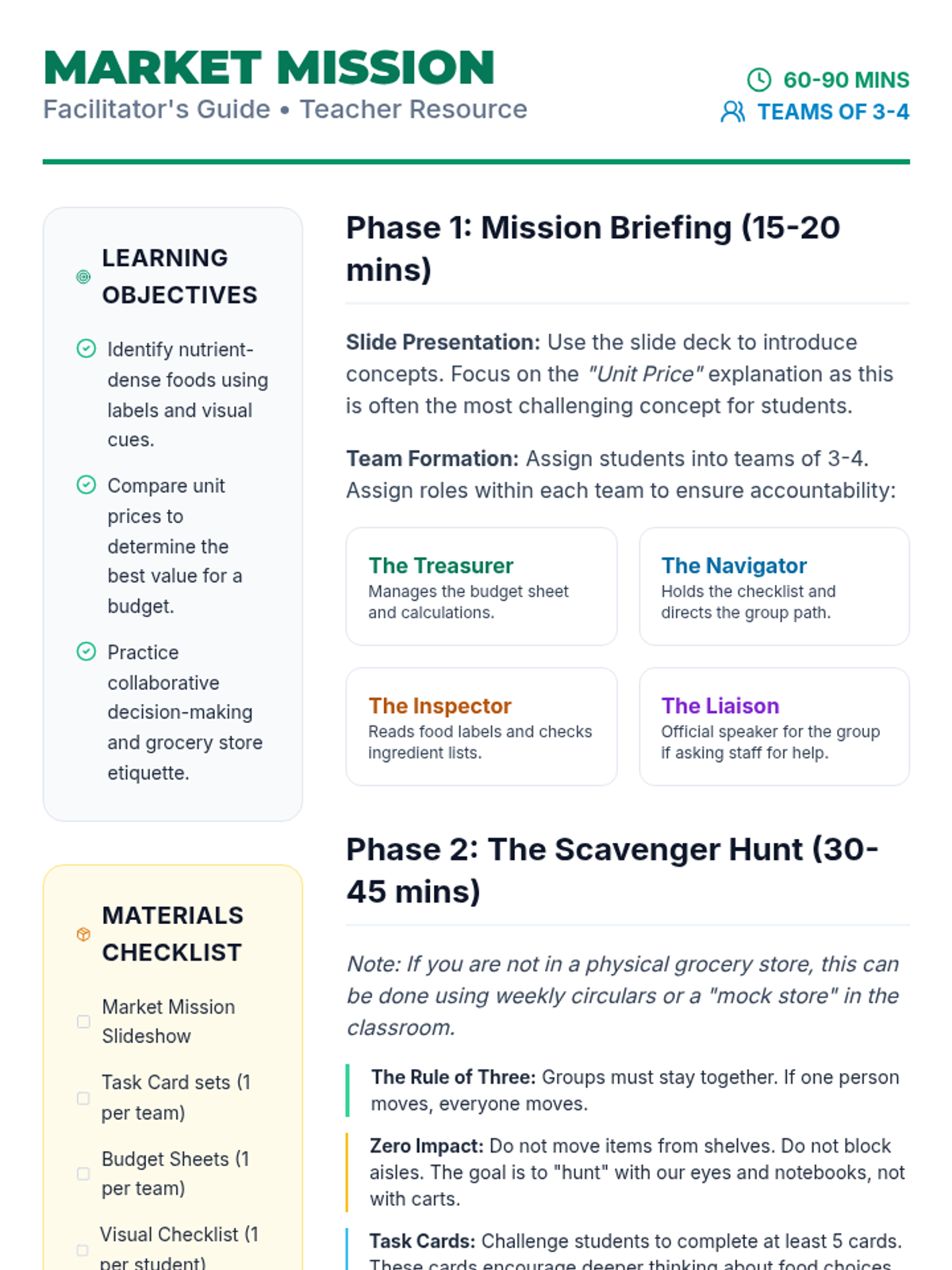
A comprehensive guide for teachers and facilitators to lead the Market Mission online scavenger hunt, including learning objectives, team roles, and debrief questions.
A vibrant, visual slide deck that introduces the Market Mission online scavenger hunt, covering digital searching tips, budgeting basics, and online teamwork expectations.
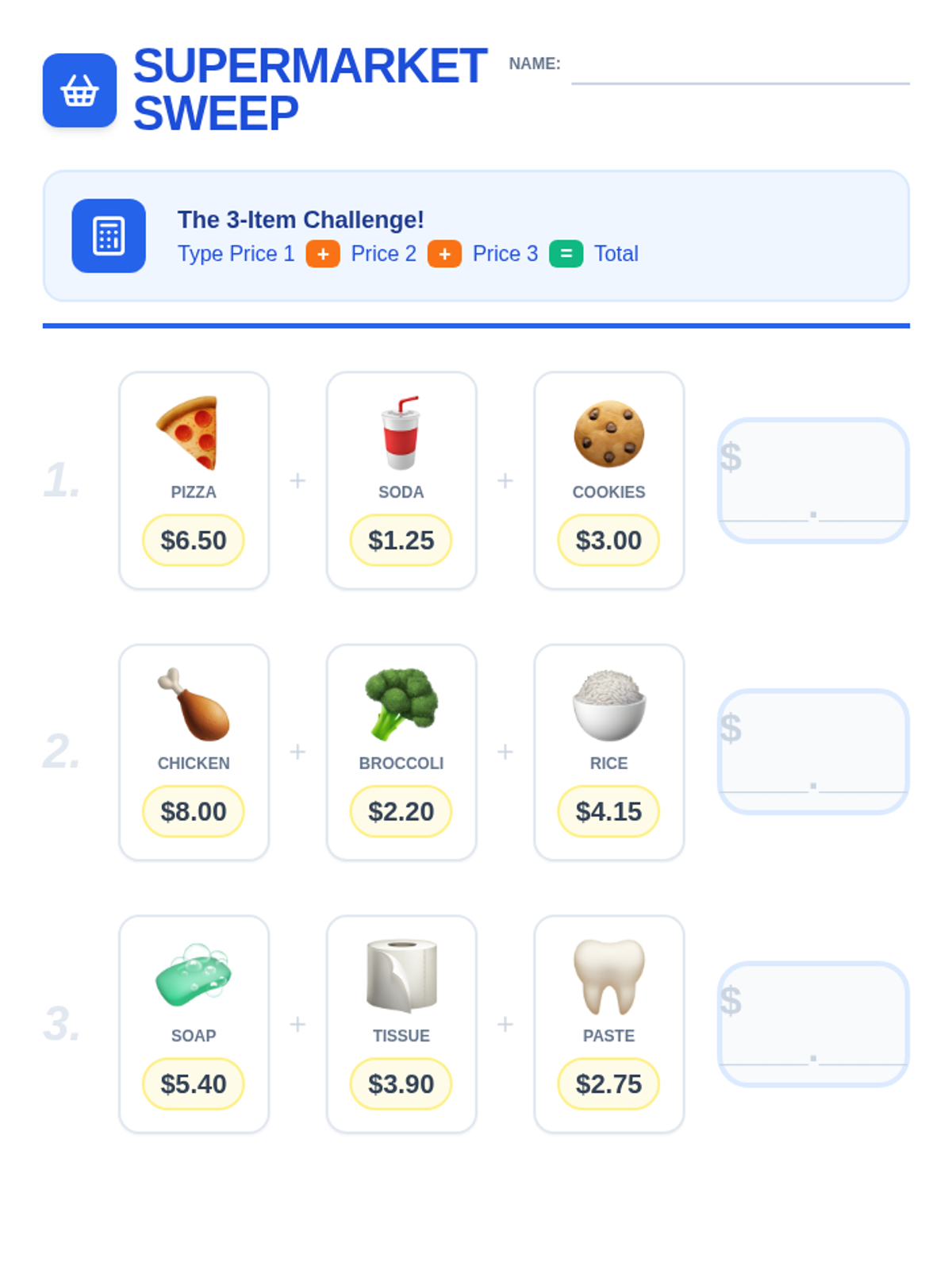
An expanded two-page worksheet featuring 6 problems for adding three grocery prices using a calculator, maintaining clear visual supports.
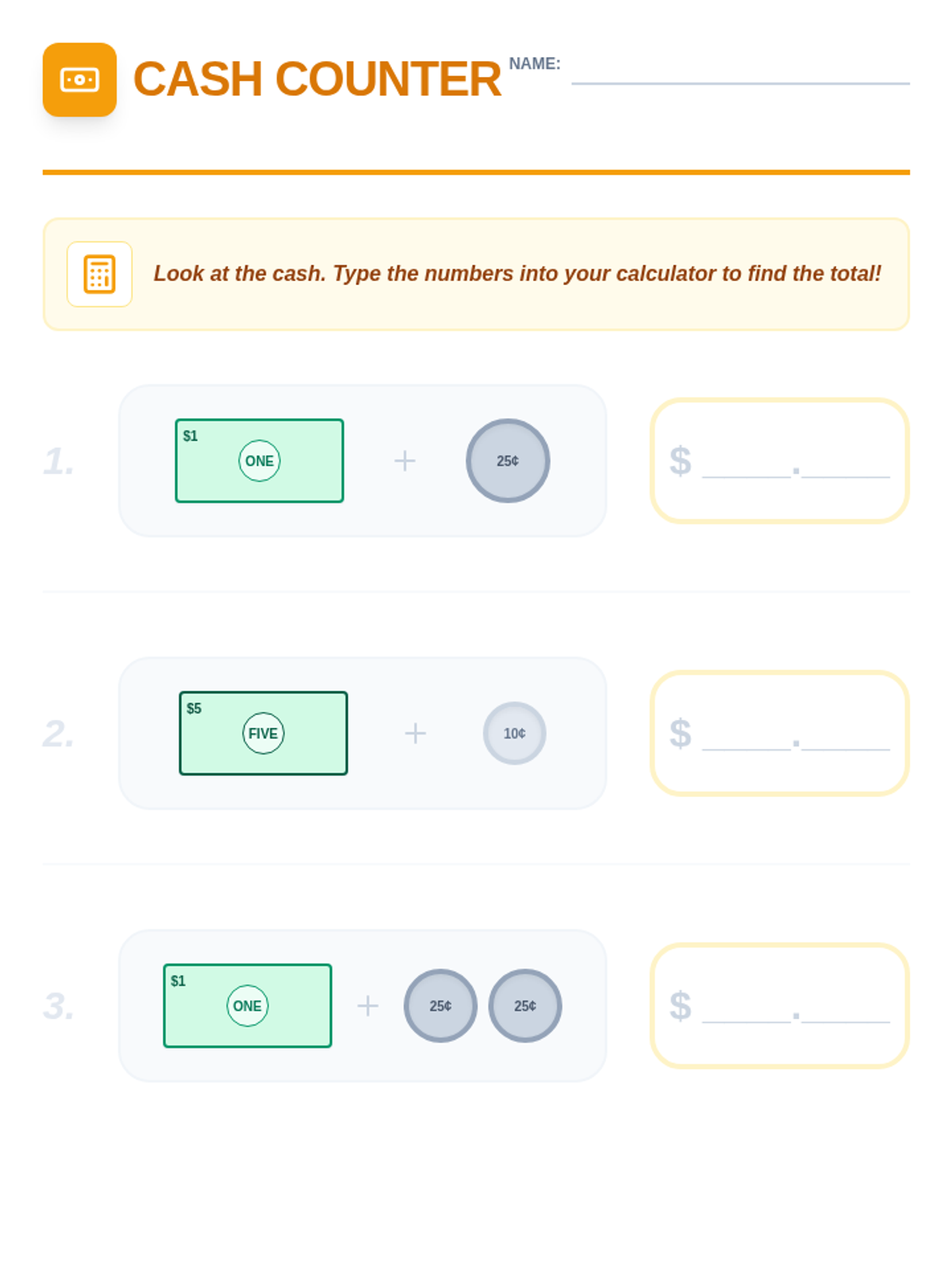
An expanded two-page worksheet featuring realistic CSS-rendered bills and coins for students to identify and add using a calculator.
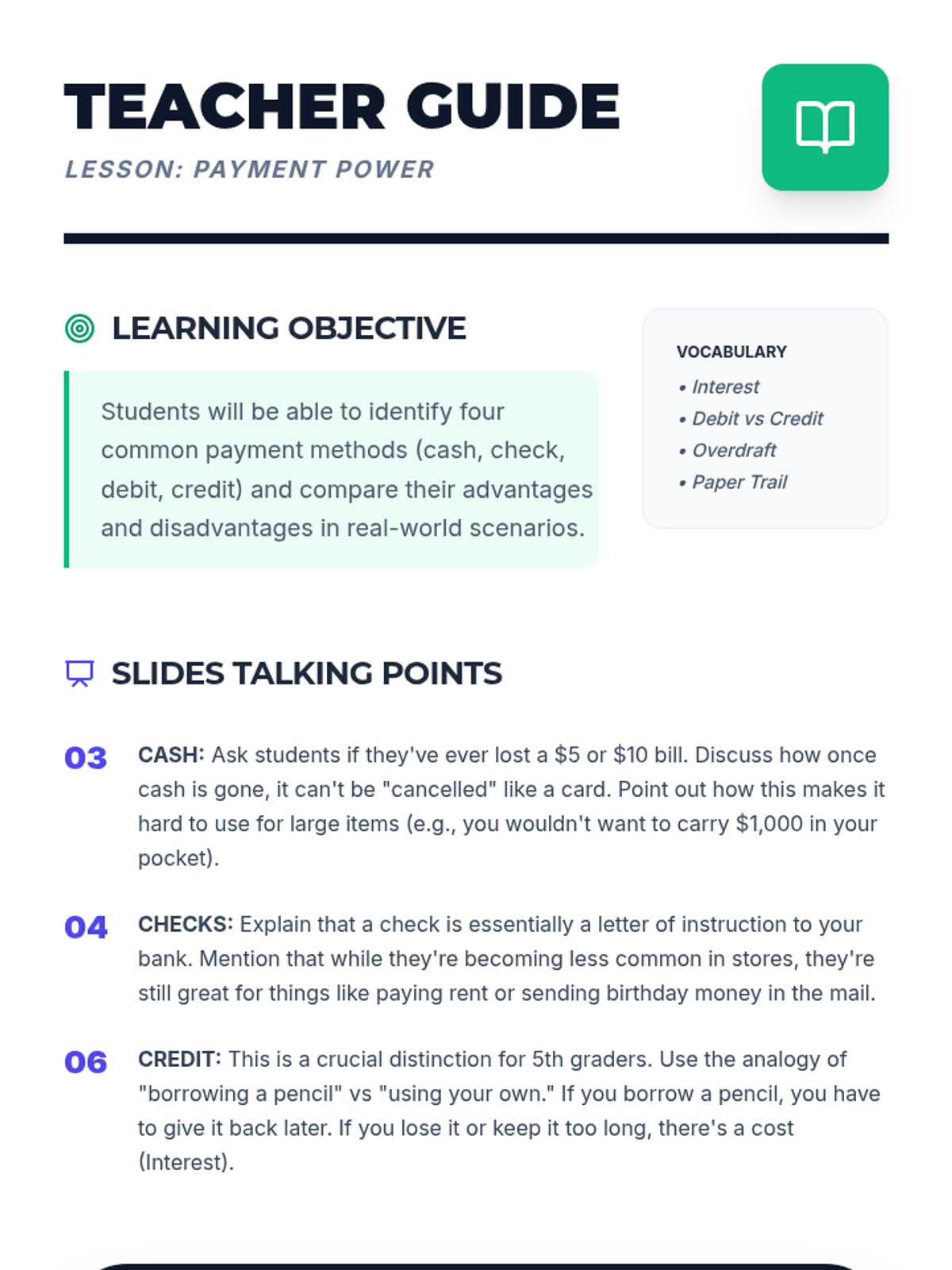
A teacher-facing resource that provides a lesson summary, learning objectives, presentation talking points, and comprehensive answer keys for both the worksheet and quiz.
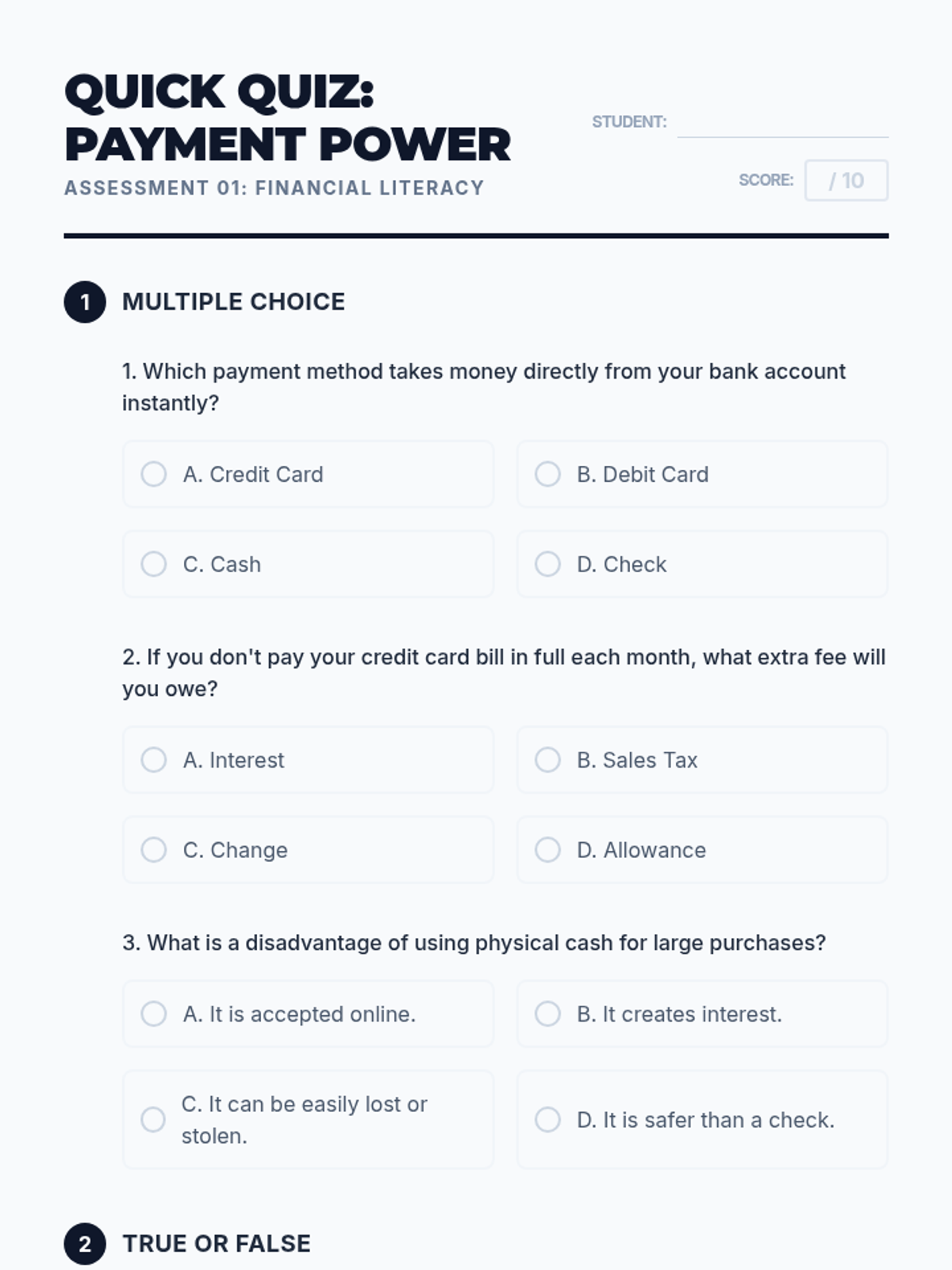
A short quiz to assess student understanding of payment methods. Features multiple-choice questions, true/false statements, and a final decision-making scenario to demonstrate mastery.
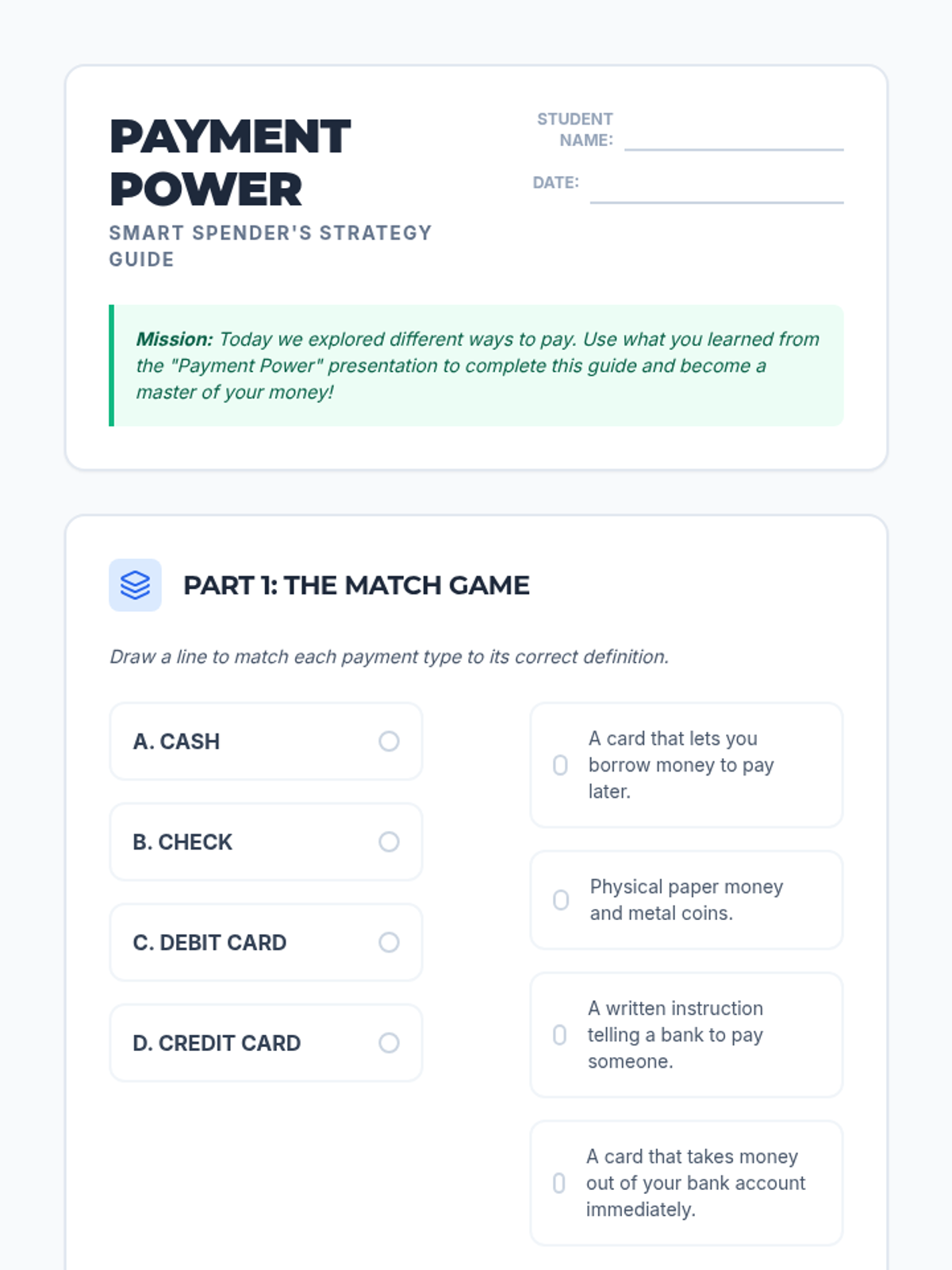
A worksheet designed for students to practice identifying and comparing different payment methods. Includes a definition matching section, a pro/con cloze activity, and scenario-based questions to apply their knowledge.
A comprehensive slide deck introducing cash, checks, credit cards, and debit cards. Each slide highlights the advantages and disadvantages of the payment method, with a final scenario to test understanding.
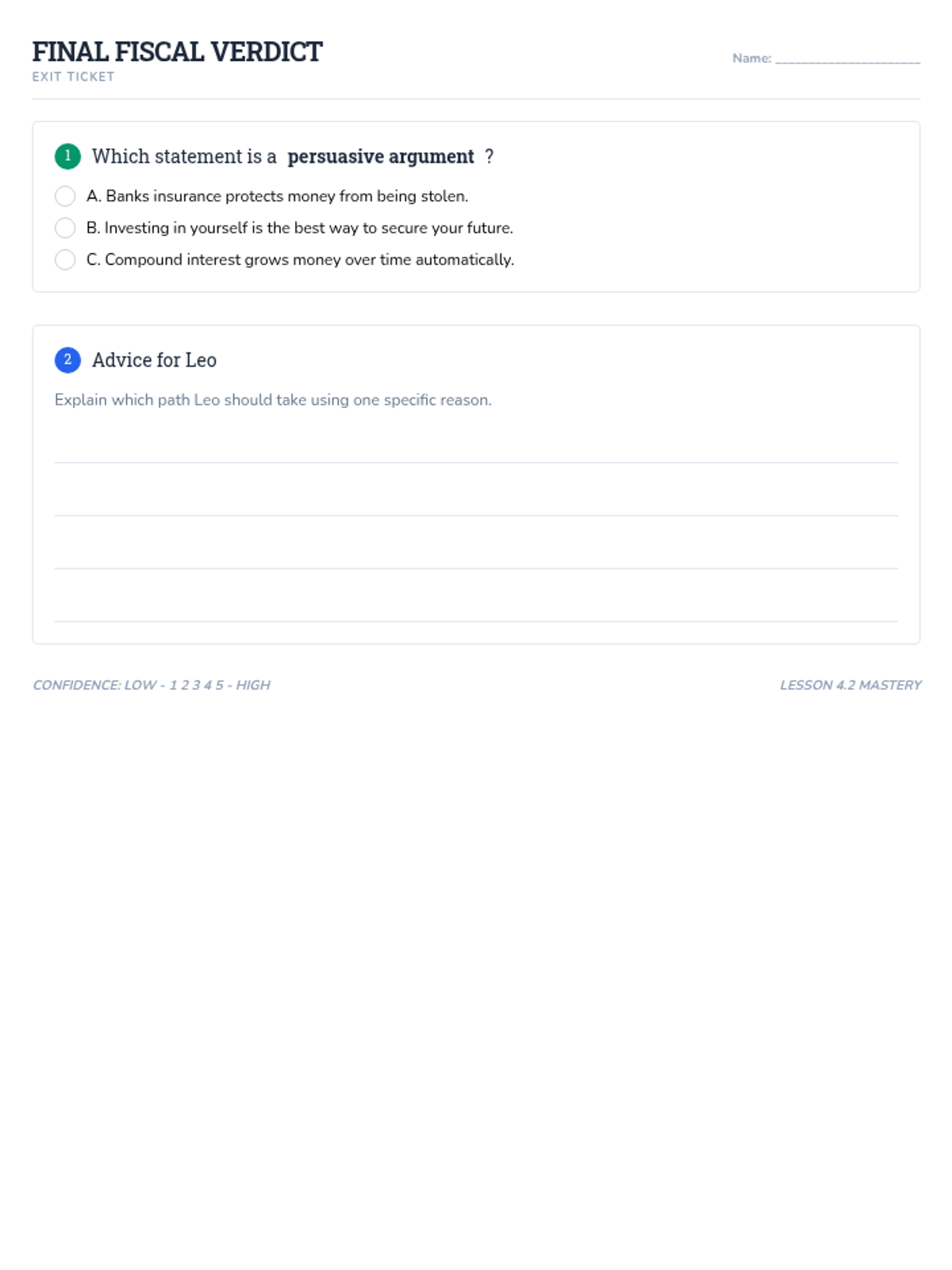
A compact, one-page exit ticket for the Money Moves lesson, featuring streamlined questions and writing space.
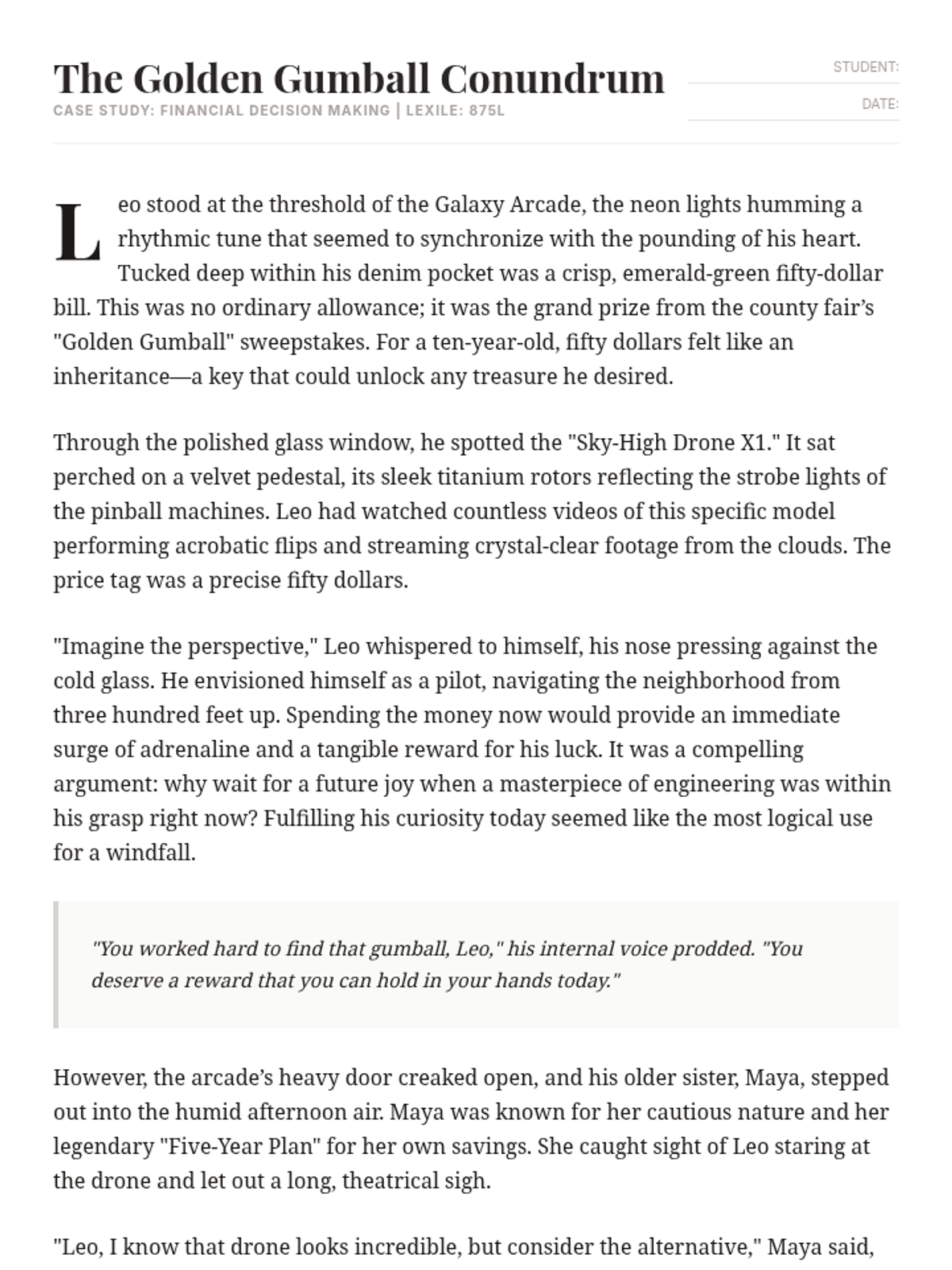
A 2-page Lexile 875 story with a continuous flow and 12pt Times Roman style font. Features an integrated student response area at the end.
A visual presentation to introduce the concepts of spending, saving, and investing, while teaching students how to distinguish between arguments and evidence.
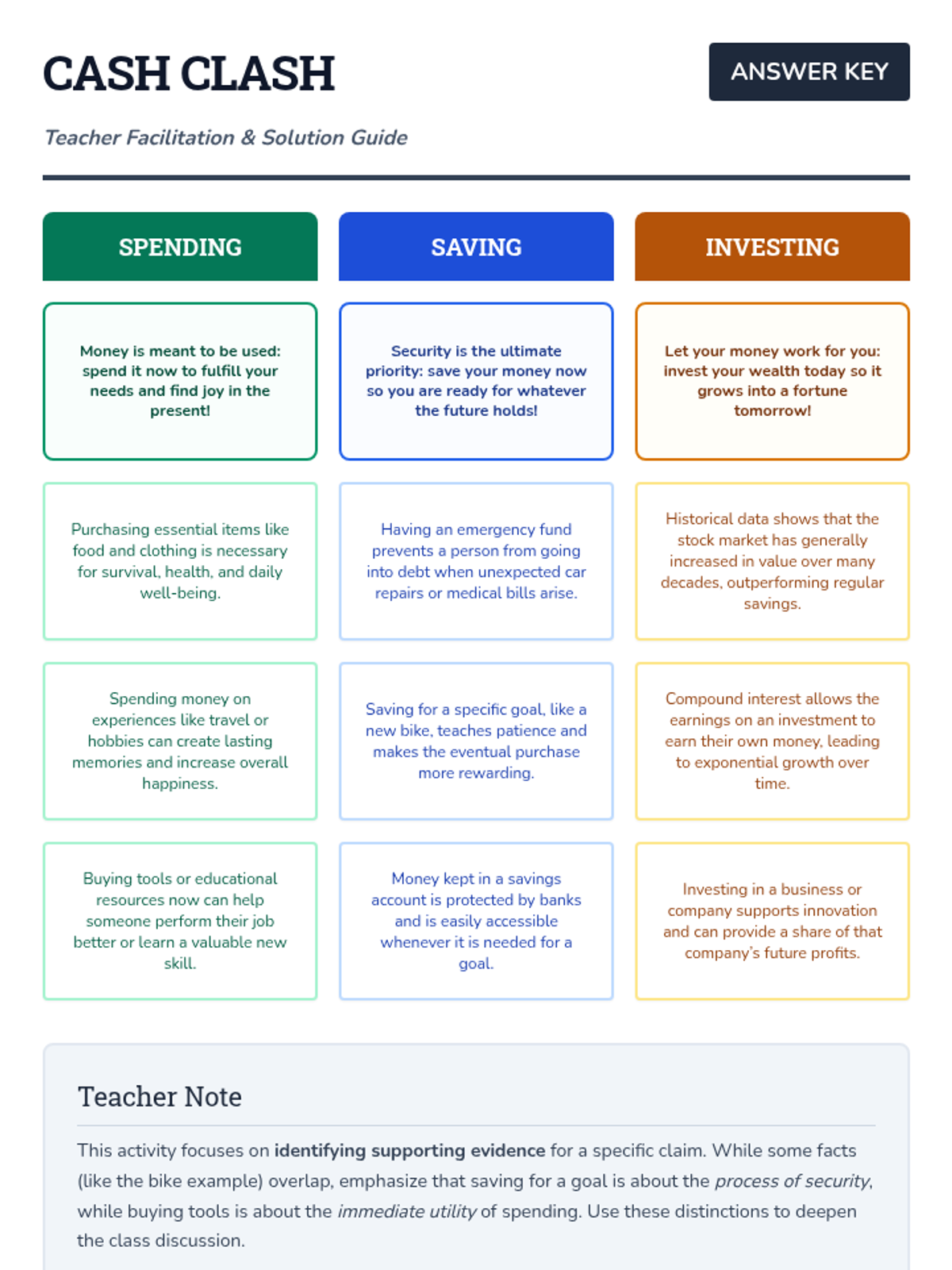
An updated answer key for the Cash Clash Card Sort, displaying the correct matches between claims and evidence with dimensions that match the student handout.
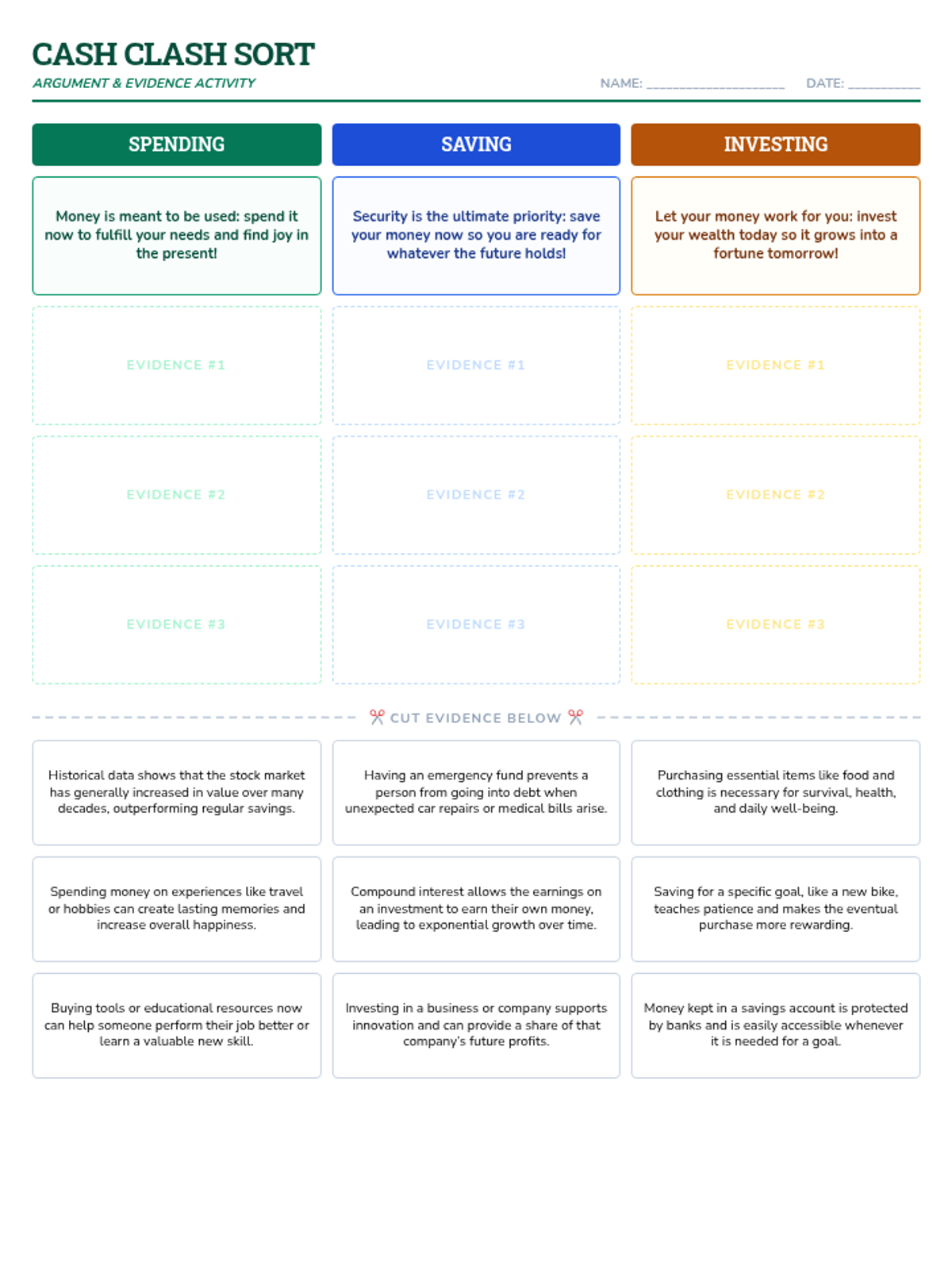
A one-page version of the Cash Clash Card Sort, featuring the sorting board and cut-out evidence cards on a single sheet with a compact header.
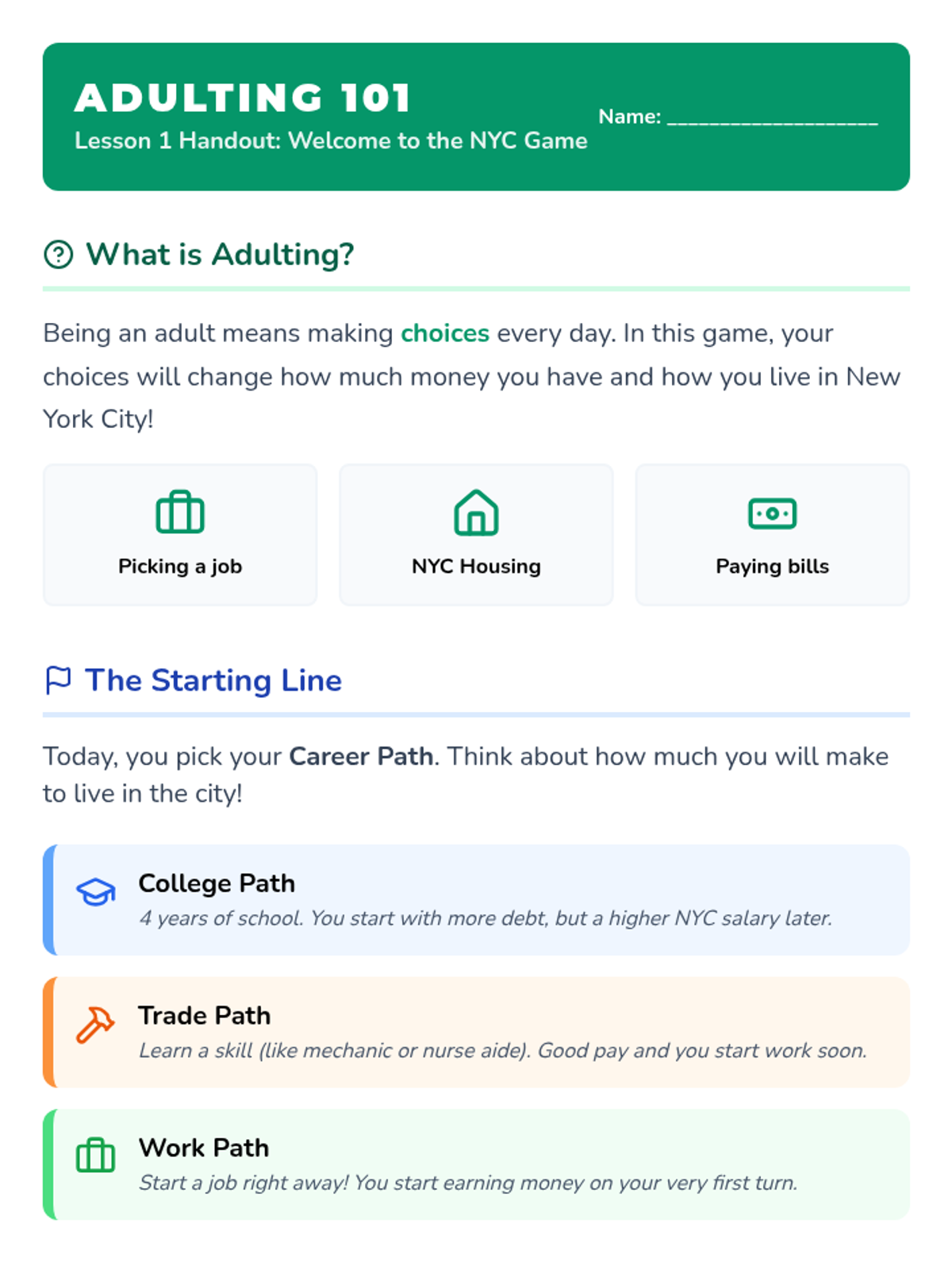
A printable lesson handout for 'Adulting 101' Lesson 1. It introduces the general career paths (College, Trade, Work) and the definition of a salary, set within the context of New York City living.
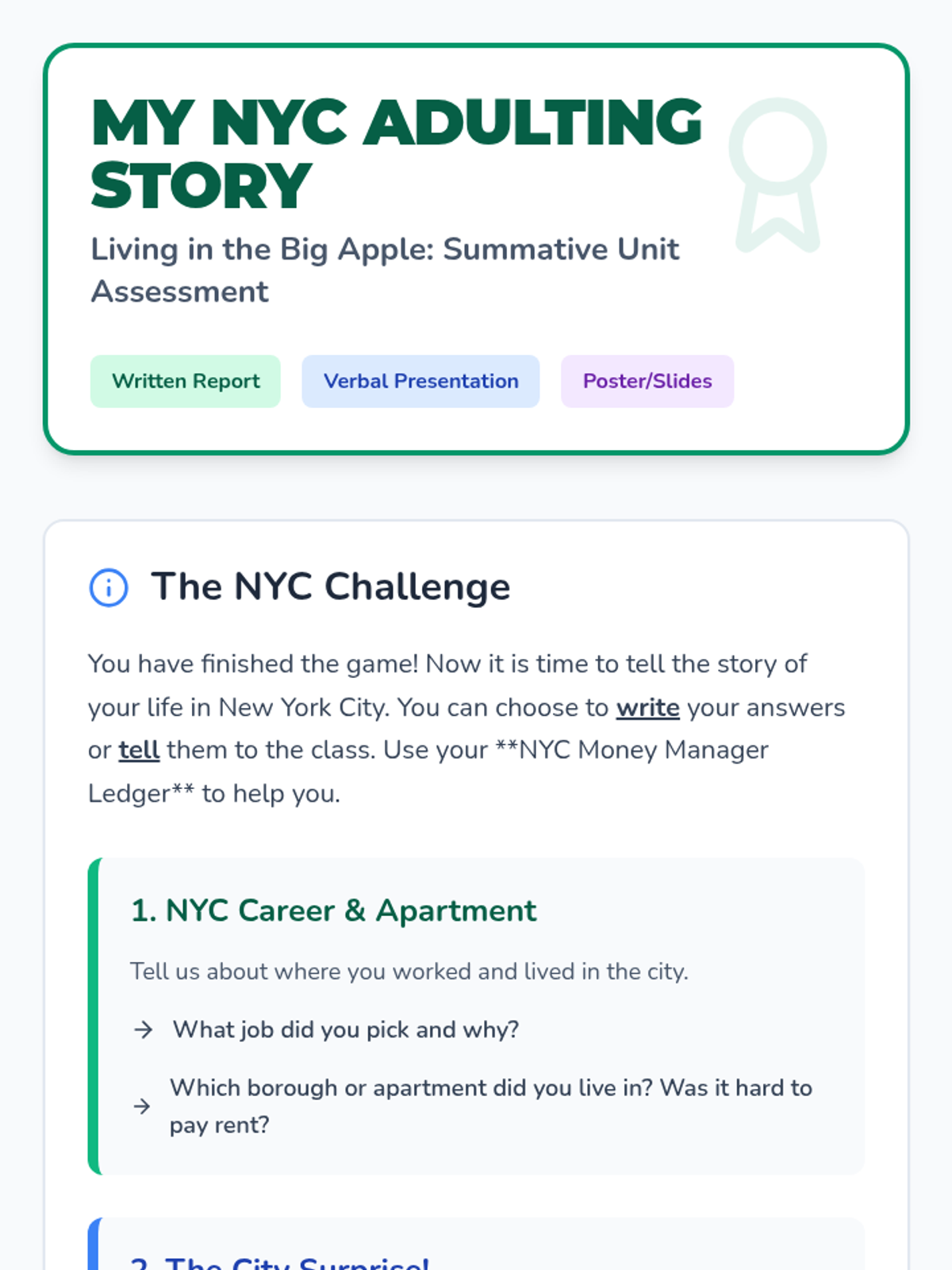
The summative unit assessment for 'Adulting 101'. This document includes a structured prompt for a verbal or written reflection on the student's game experience, covering career/housing choices, life events, and financial lessons, along with a student-friendly grading rubric.
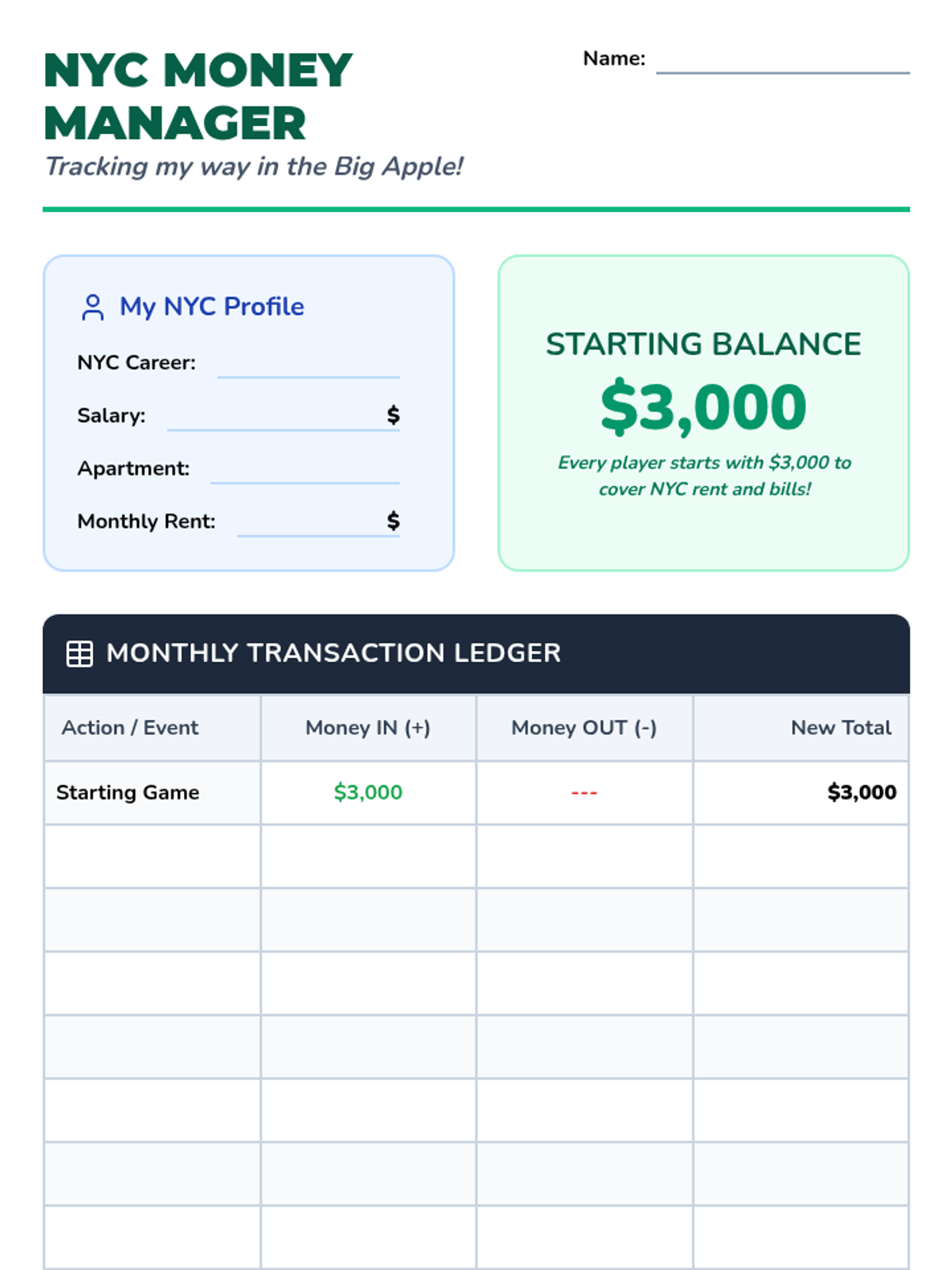
A student-facing financial ledger for 'Adulting 101'. It allows students to track their career choice, salary, housing costs, and all game transactions (income and expenses) to maintain an accurate account balance throughout the unit.
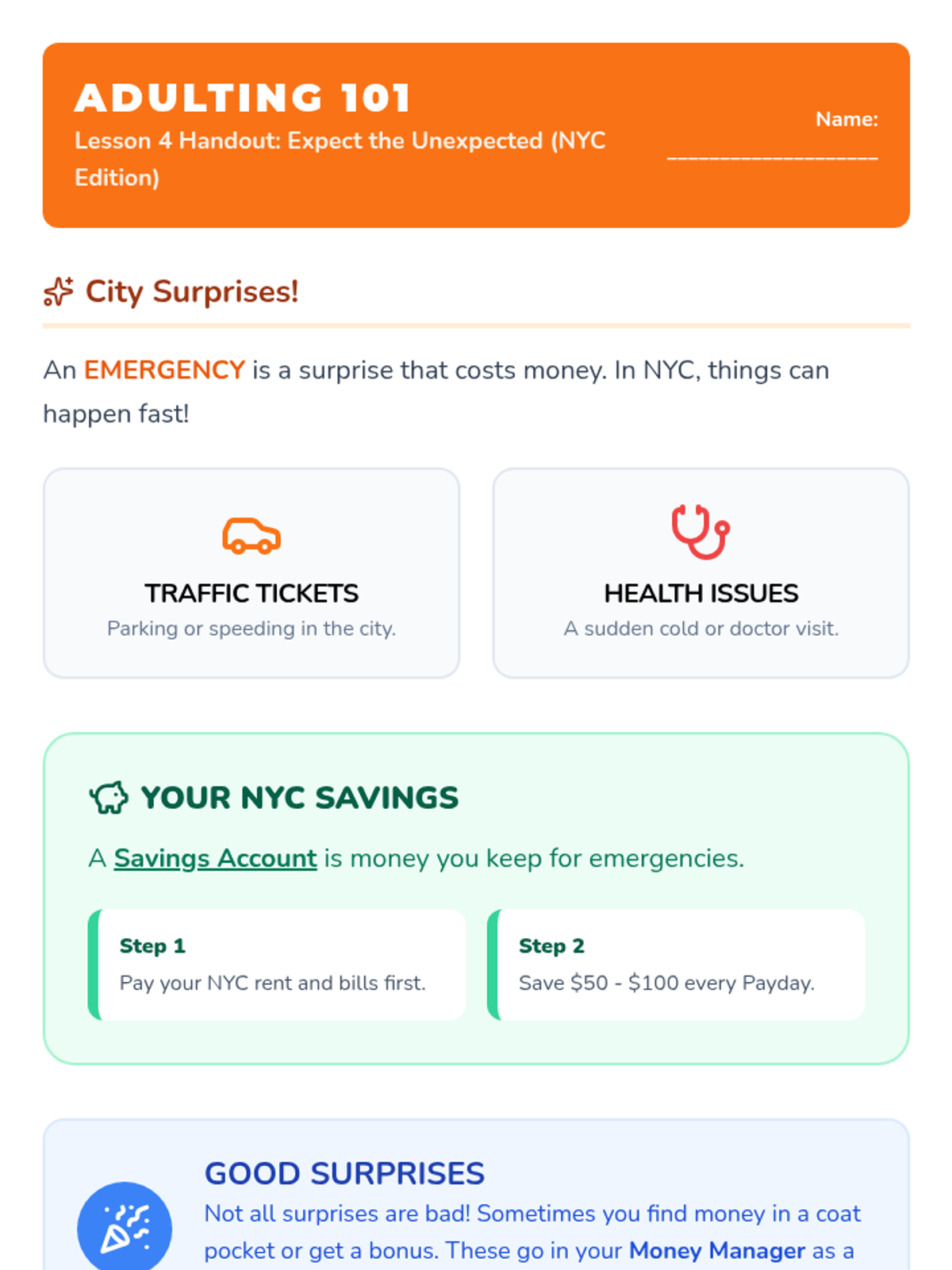
A printable lesson handout for 'Adulting 101' Lesson 4. It introduces the concept of financial emergencies, the importance of a savings account, and includes a reflection question for students to think critically about managing unexpected costs.
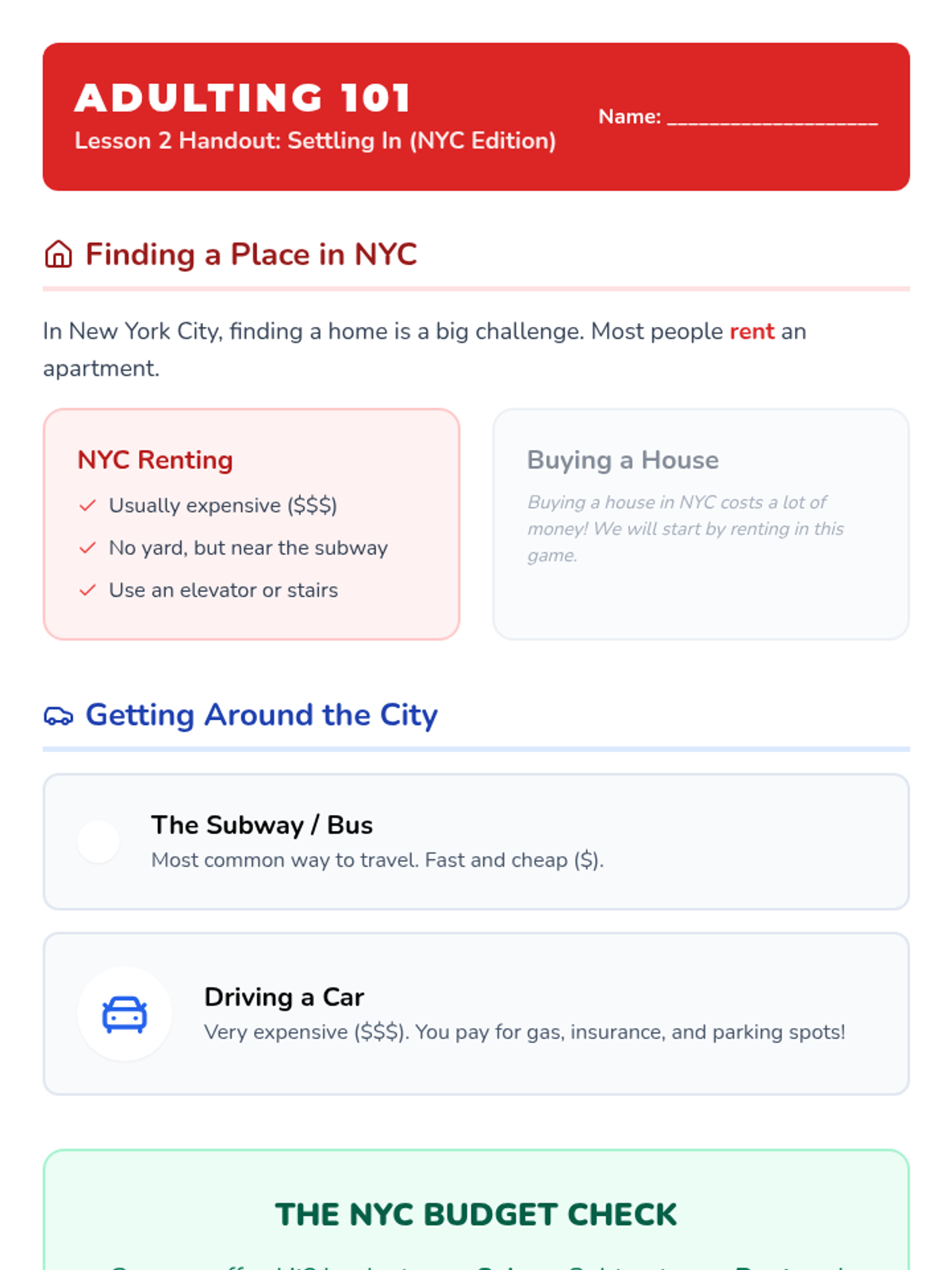
A printable lesson handout for 'Adulting 101' Lesson 2. It covers housing (renting vs. owning), transportation options, and the basic concept of a budget check in a visual, easy-to-read format.
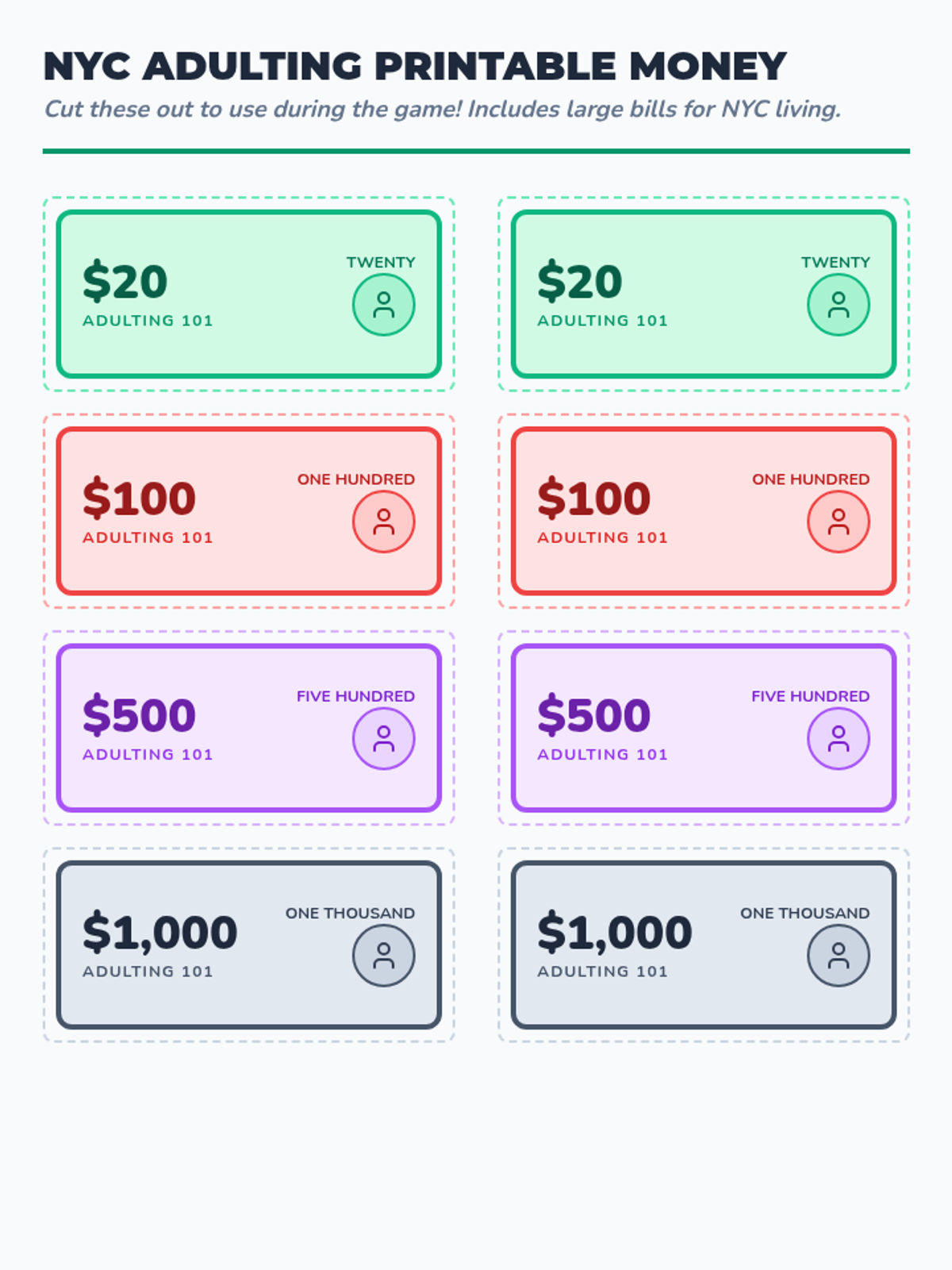
A printable sheet of play money for 'Adulting 101' in denominations of $20, $50, $100, and $500. Designed with clear numbers and distinct colors to aid students with 5th-grade level skills in identifying and counting currency during the board game. Now includes $1,000 bills for NYC living.
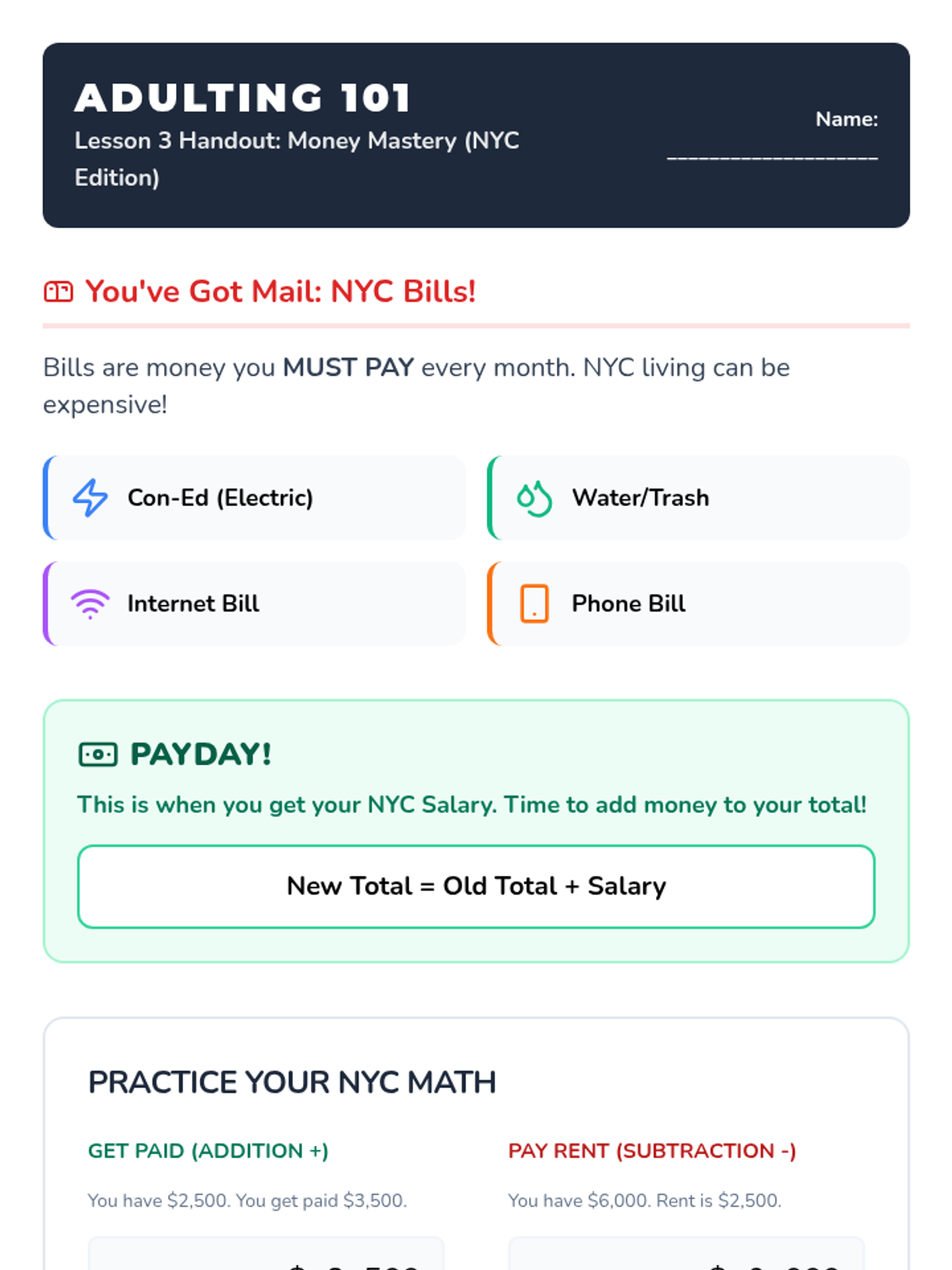
A printable lesson handout for 'Adulting 101' Lesson 3. It focuses on the concepts of bills, paydays, and basic money math (addition and subtraction) with practice areas for students to calculate totals.
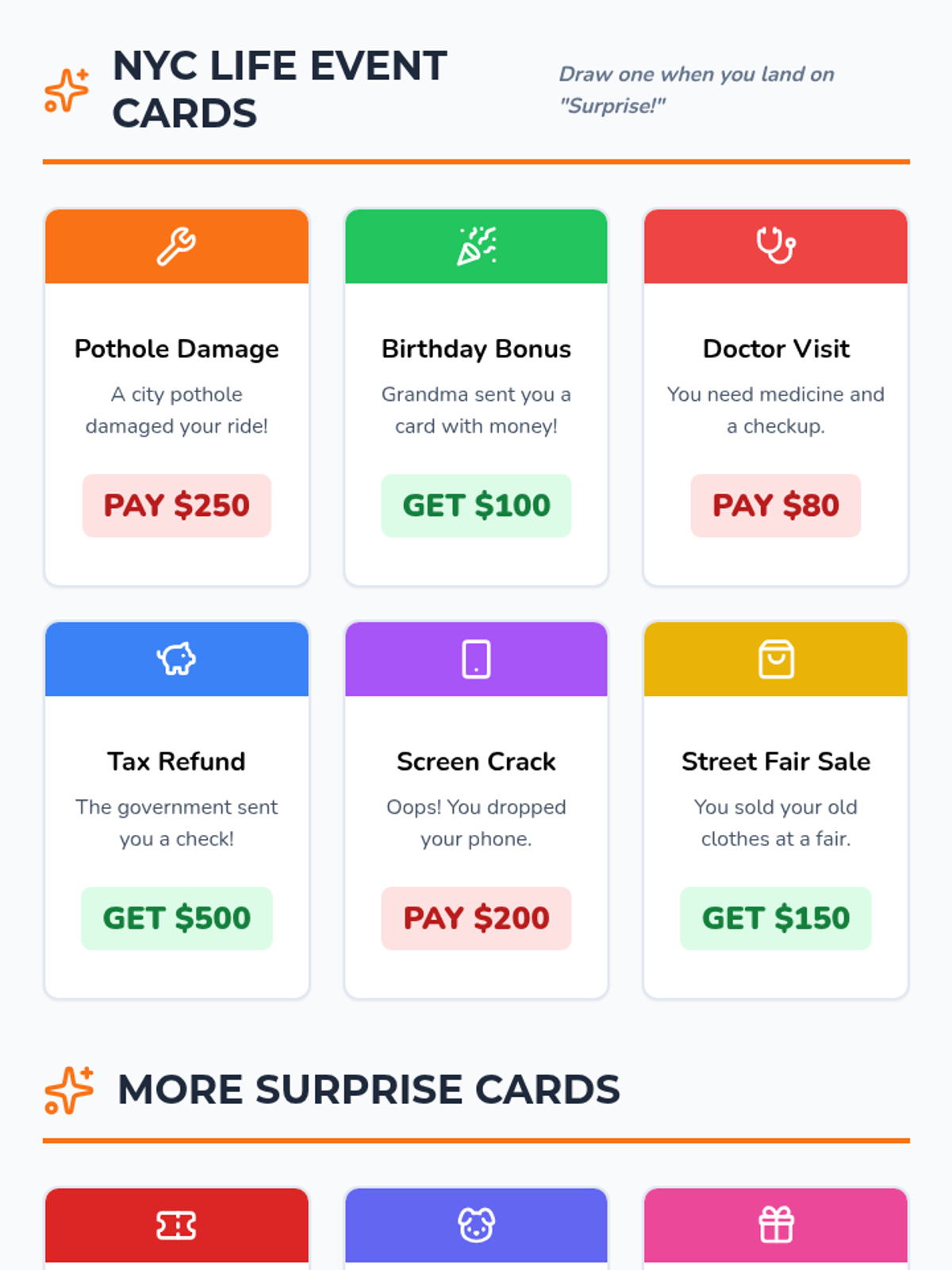
Life Event 'Surprise' cards and Transportation 'Ride' cards for 'Adulting 101'. These cards present random events (expenses or income) and vehicle choices with monthly costs to be used during gameplay. Now with doubled variety!
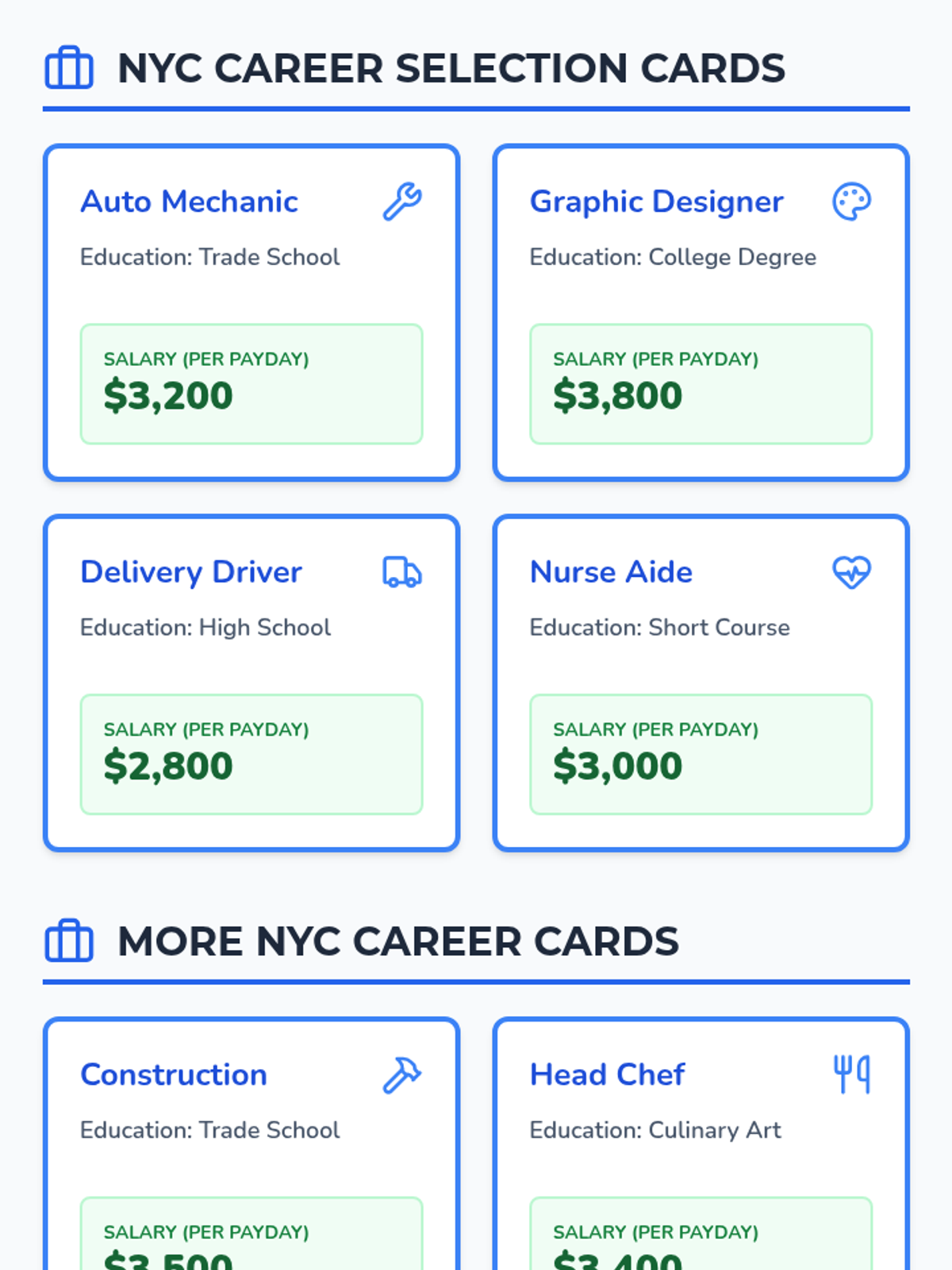
Updated Career and Housing selection cards for 'Adulting 101', featuring original professions (Mechanic, Designer, etc.) with NYC-adjusted salaries and 8 housing options with city rent prices.
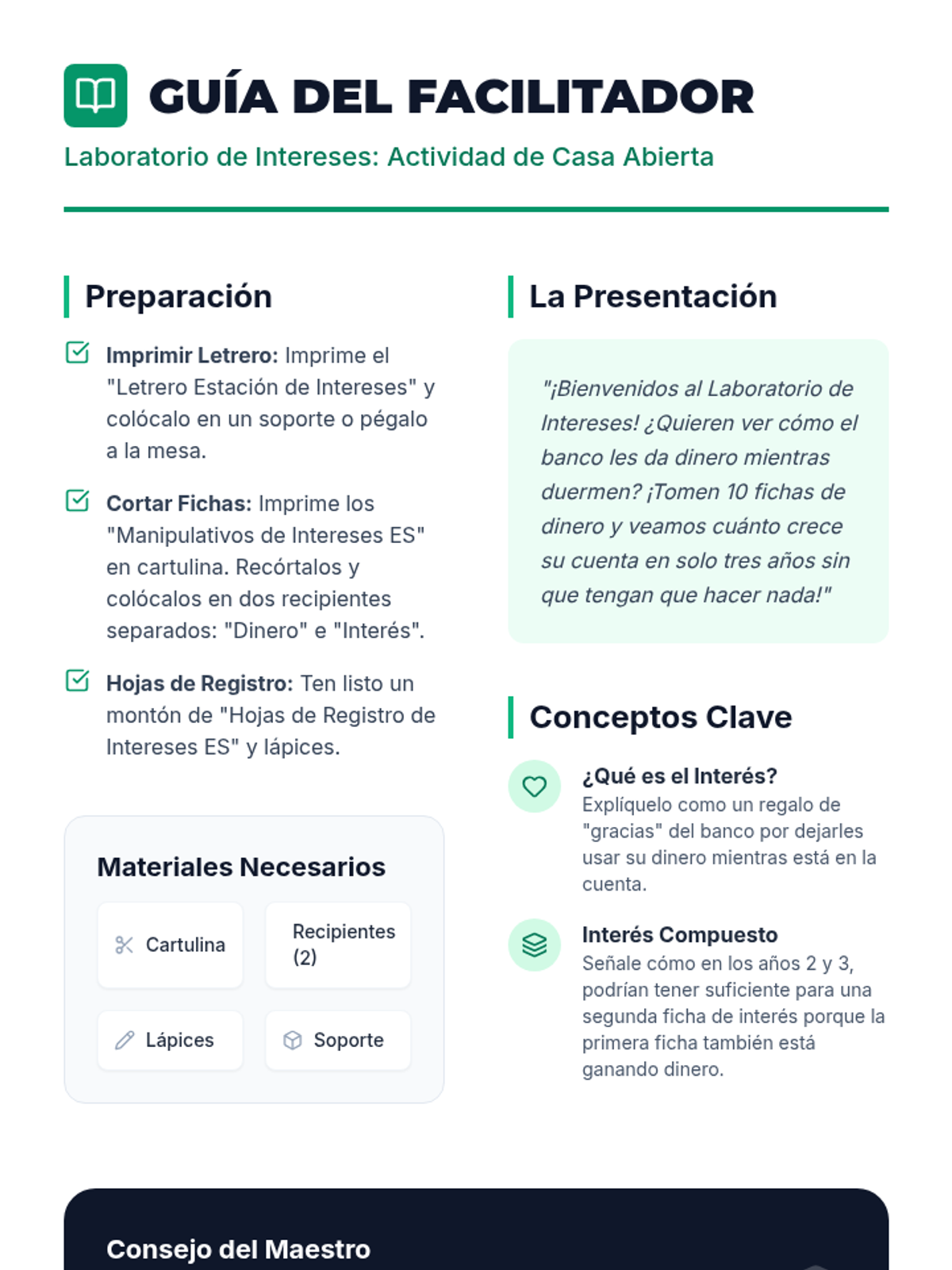
Una guía de facilitación para el maestro o voluntario que dirige la estación del Laboratorio de Intereses. Incluye pasos de preparación, guiones y conceptos clave en español.
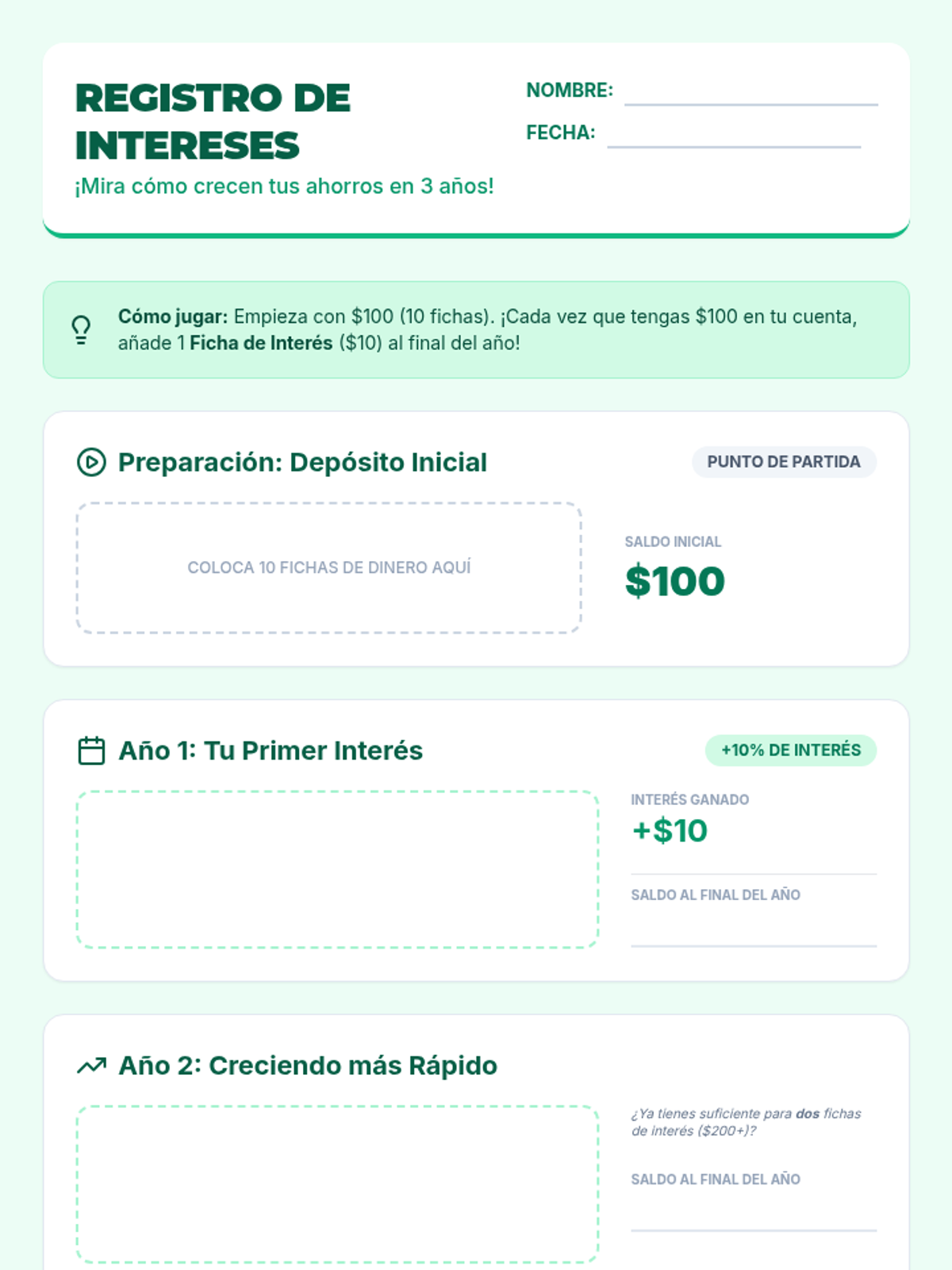
Una hoja de registro práctica para que los estudiantes la usen durante la actividad de la estación. Colocan manipulativos en los cuadros de 'años' y calculan su saldo creciente en español.
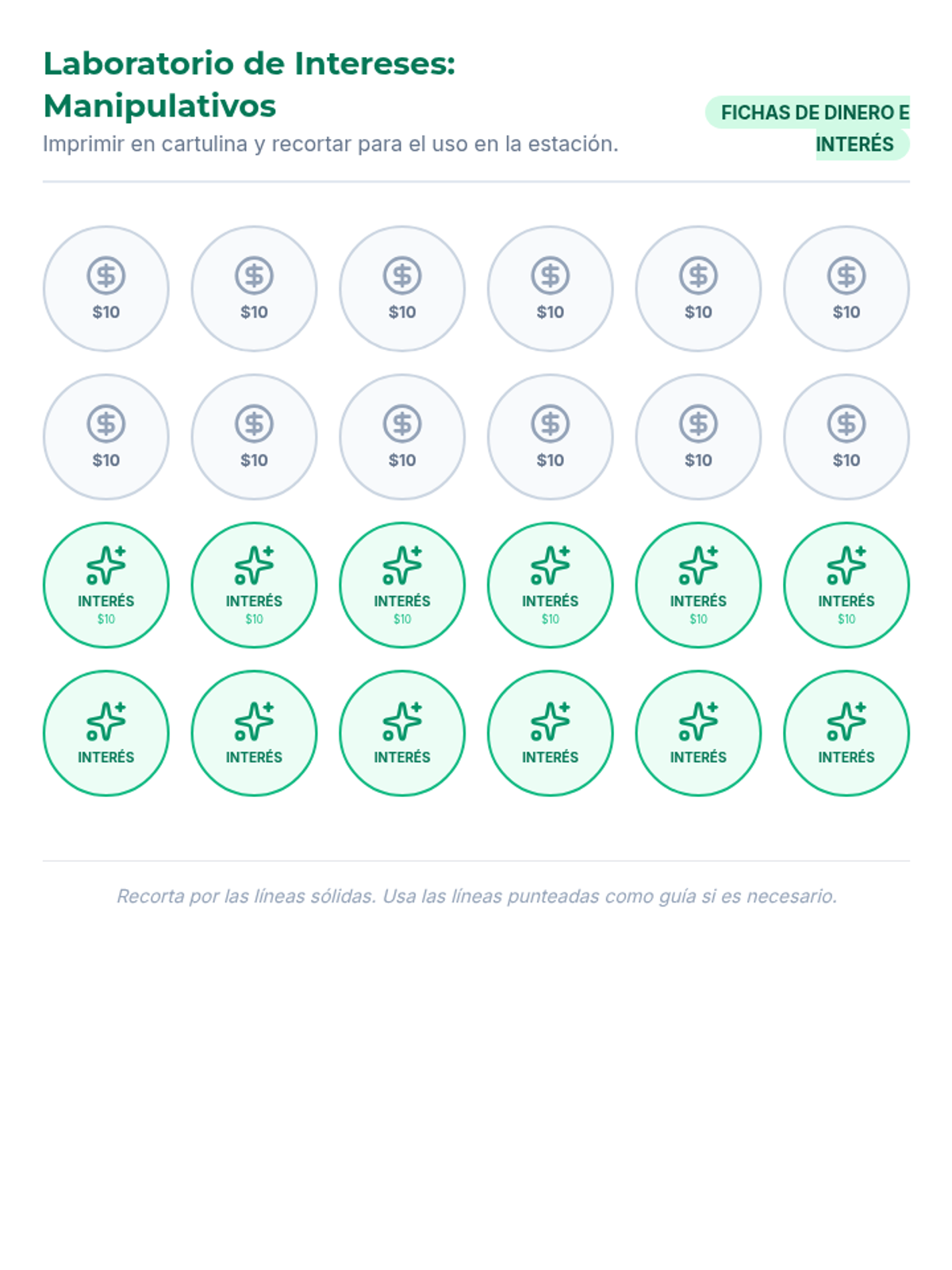
Fichas de dinero e interés imprimibles para la actividad práctica de la estación de cuenta bancaria en español. Incluye fichas base de $10 y fichas especiales de 'Interés'.
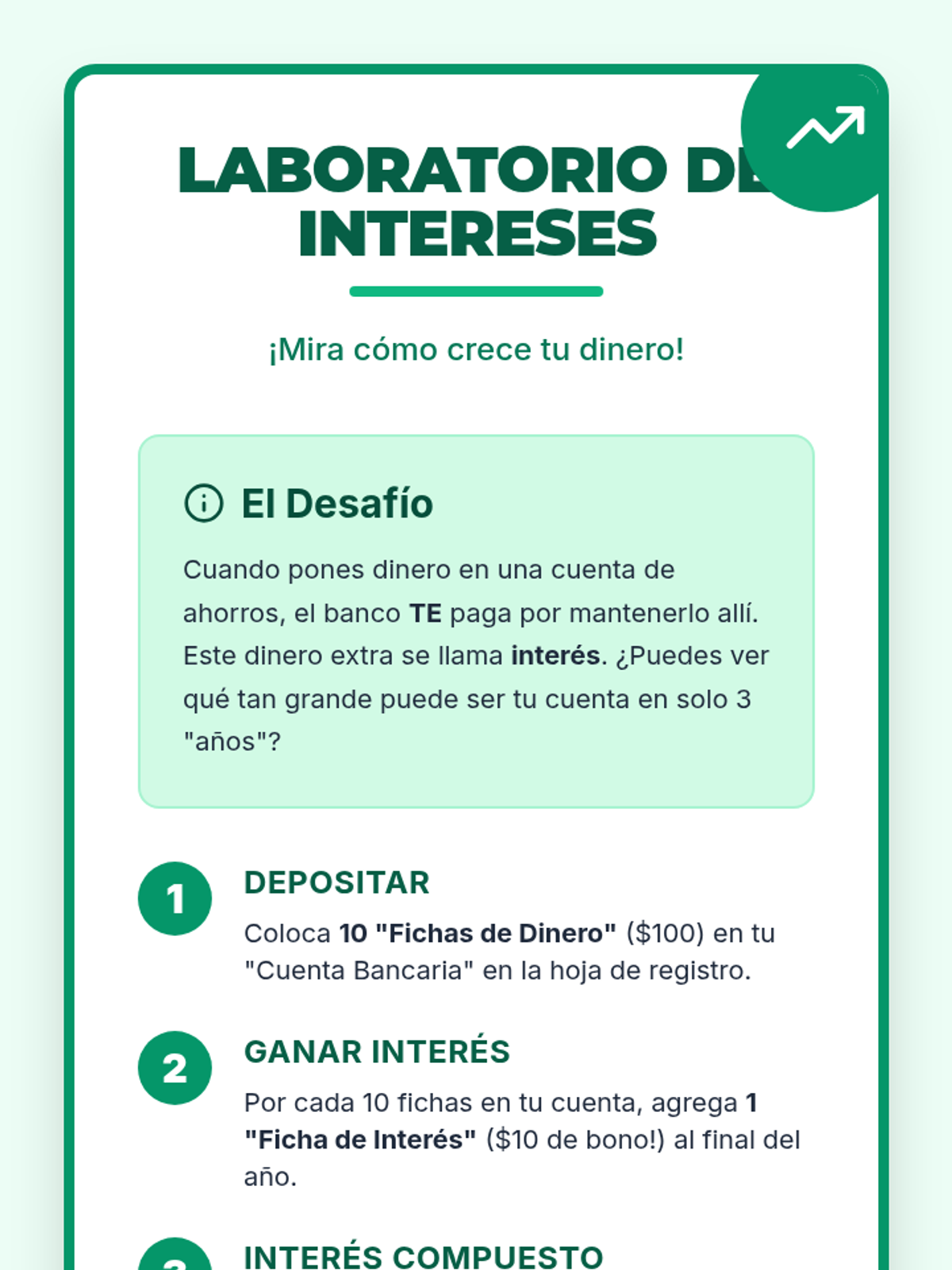
Un letrero de estación grande y vibrante para una actividad de Casa Abierta que explica el concepto de interés bancario y proporciona instrucciones claras para la actividad práctica.
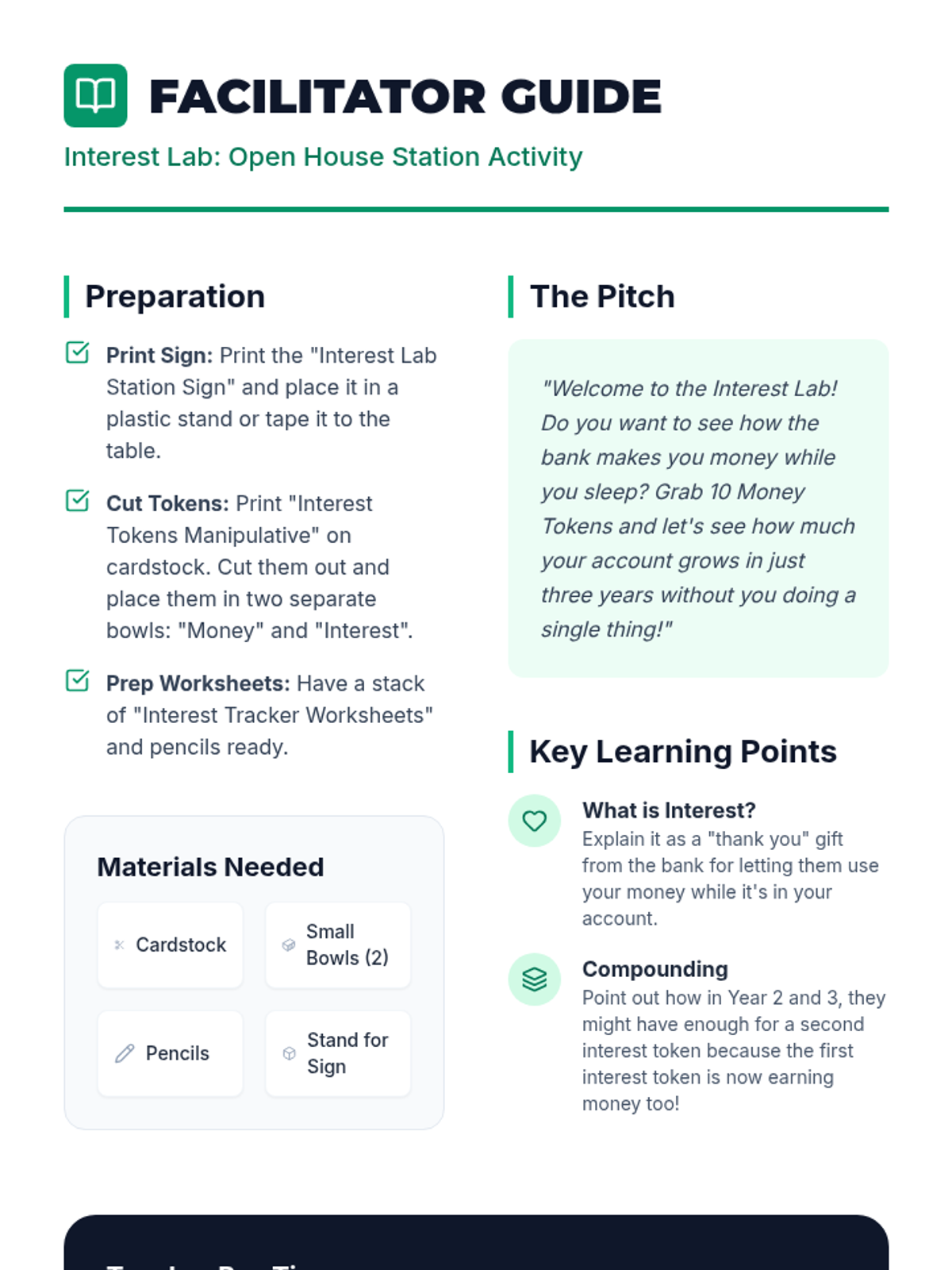
A facilitation guide for the teacher or volunteer running the Interest Lab station at an Open House. Includes prep steps, talk tracks, and key concepts to emphasize.
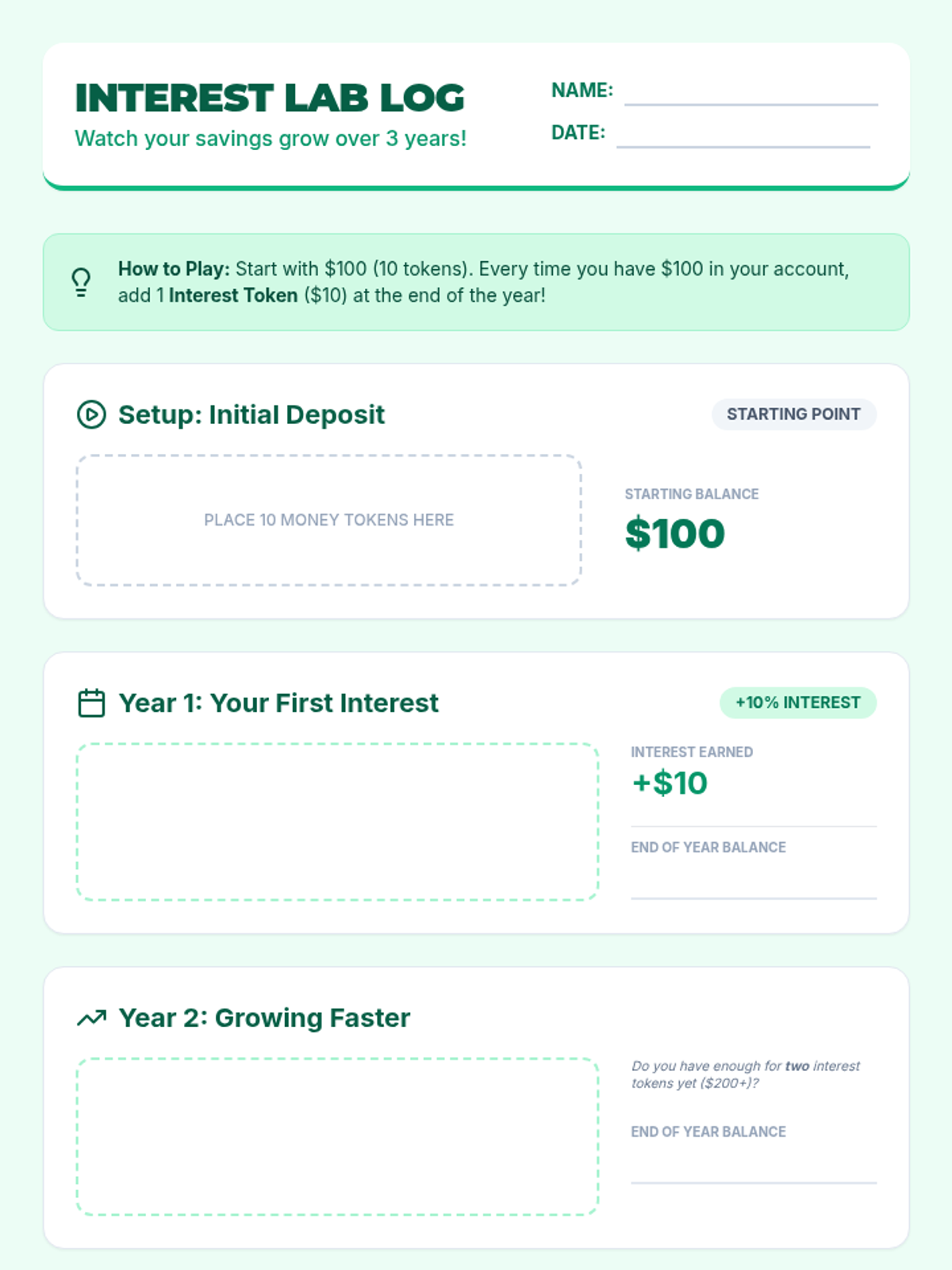
A hands-on recording sheet for students to use during the bank account station activity. They place manipulatives in the 'years' boxes and calculate their growing balance.
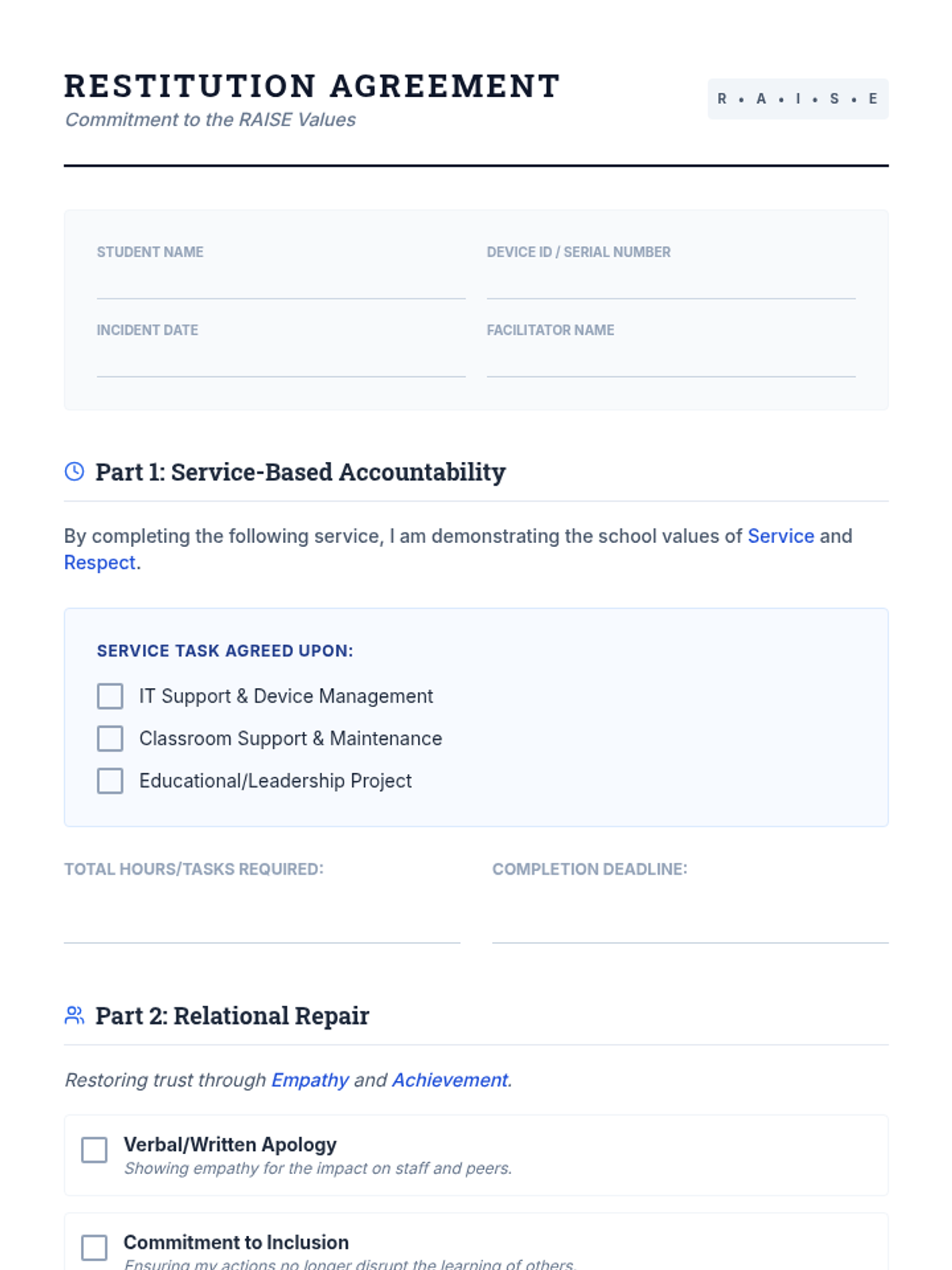
A formal restitution agreement form for school administration and students to document agreed-upon service and community repair actions. Explicitly tied to the RAISE values (Respect, Achievement, Inclusion, Service, Empathy).
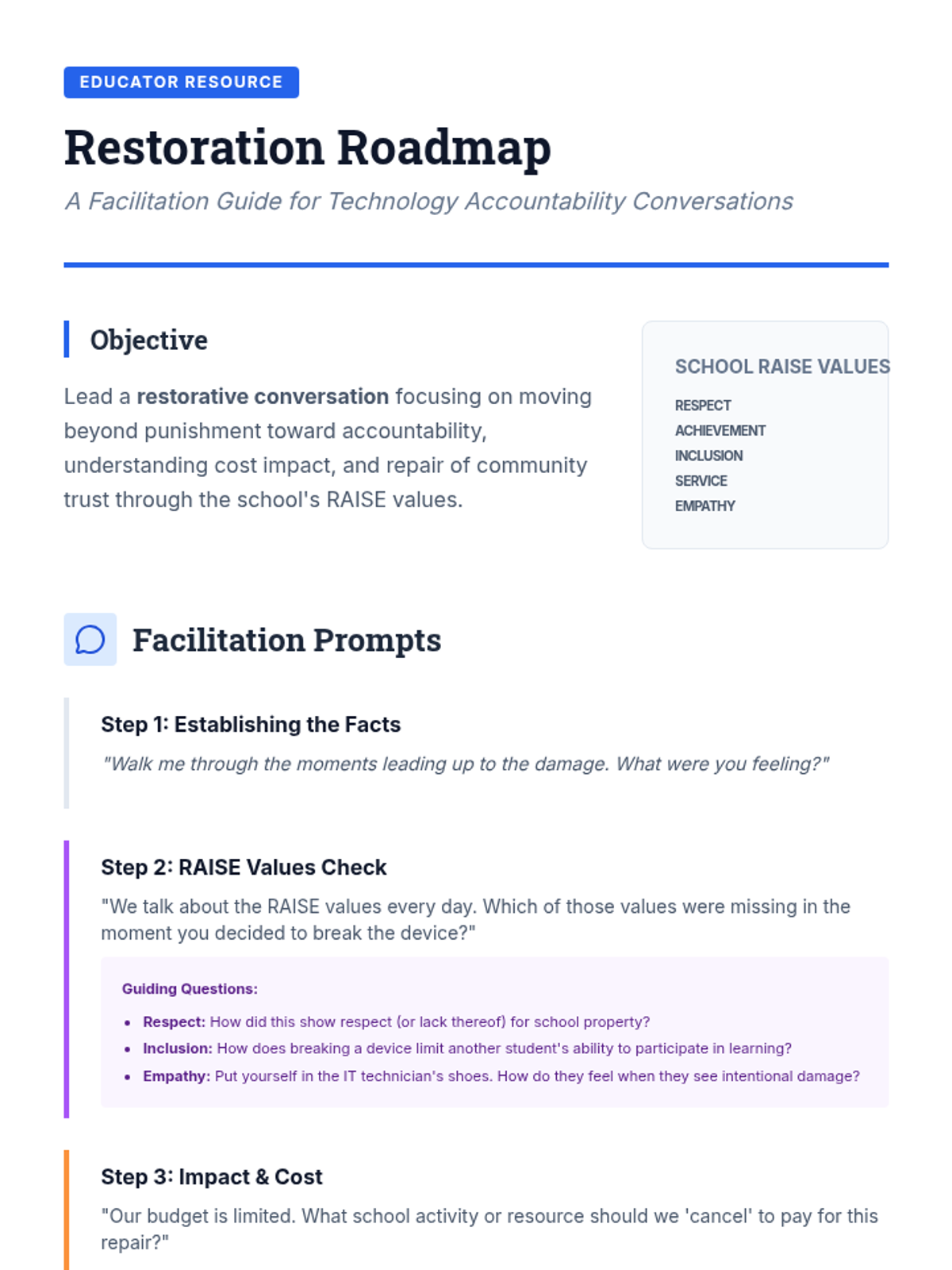
A teacher-facing guide to facilitate restorative justice conversations with students who have damaged school technology. Integrated with the school's RAISE values (Respect, Achievement, Inclusion, Service, Empathy).
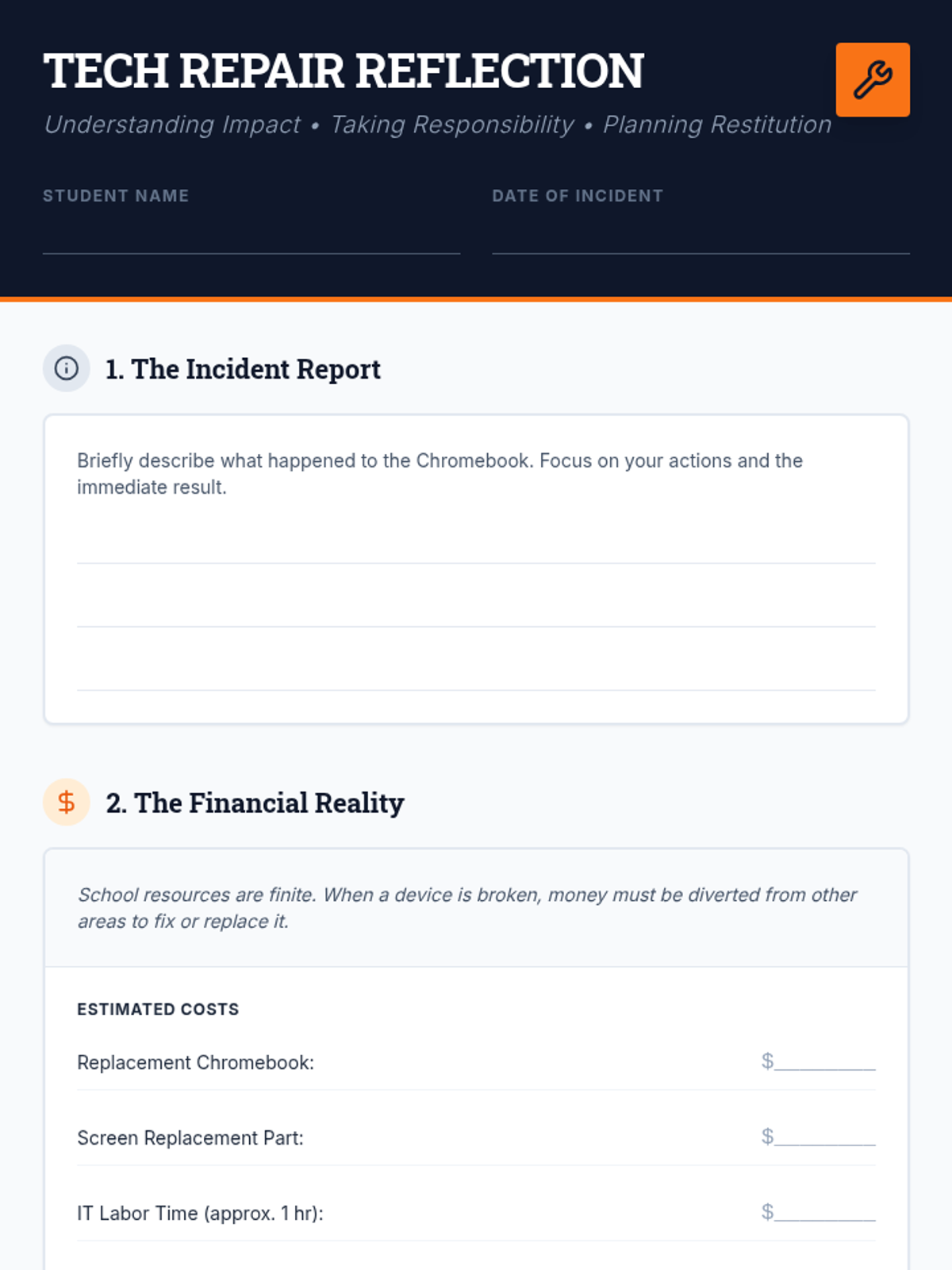
A structured reflection worksheet for students focused on the financial and community consequences of intentionally damaging school technology. Includes a section for reflecting on the school's RAISE values (Respect, Achievement, Inclusion, Service, Empathy).
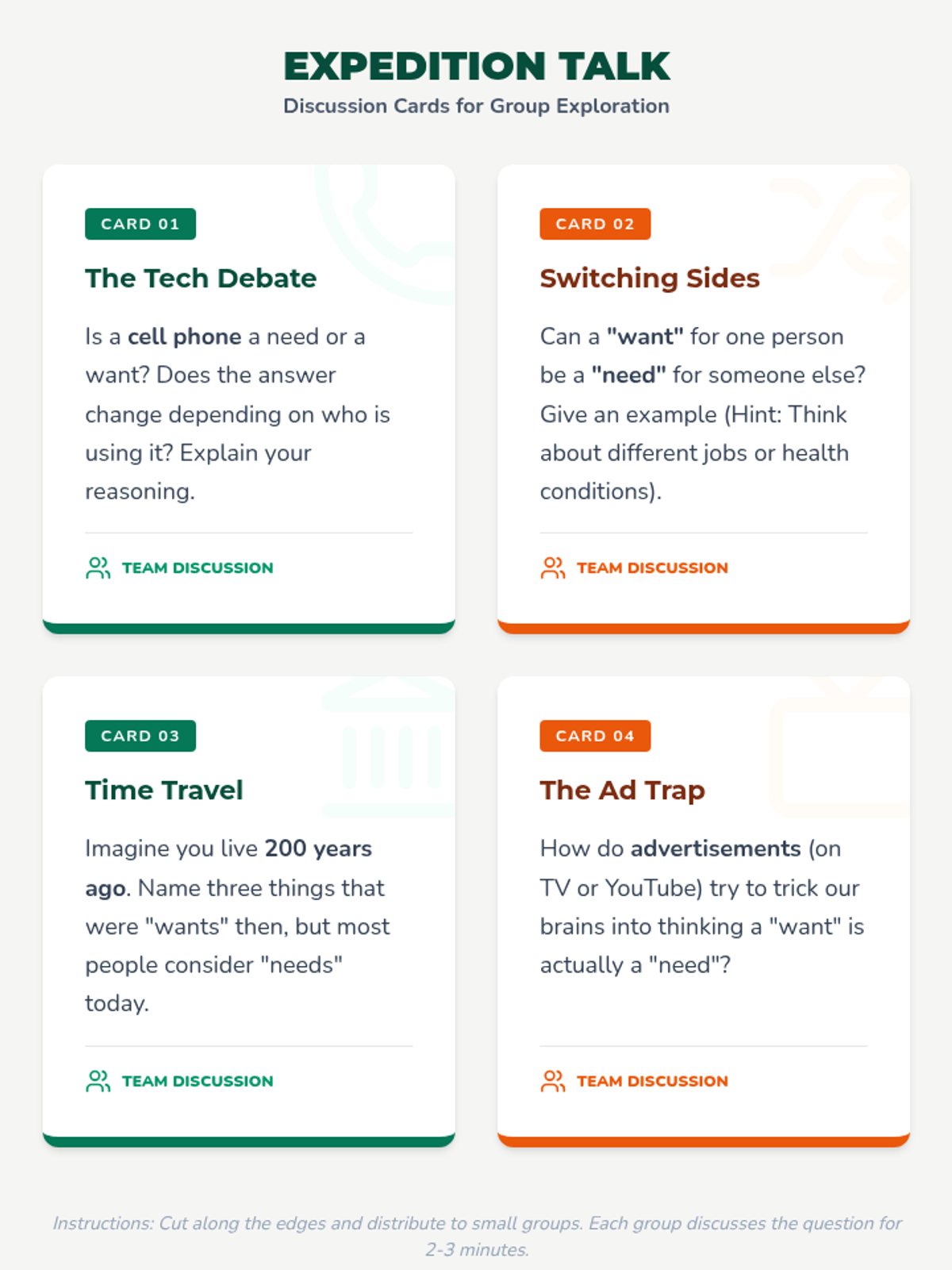
A set of four discussion task cards with critical thinking questions about needs vs. wants, designed for group activities.
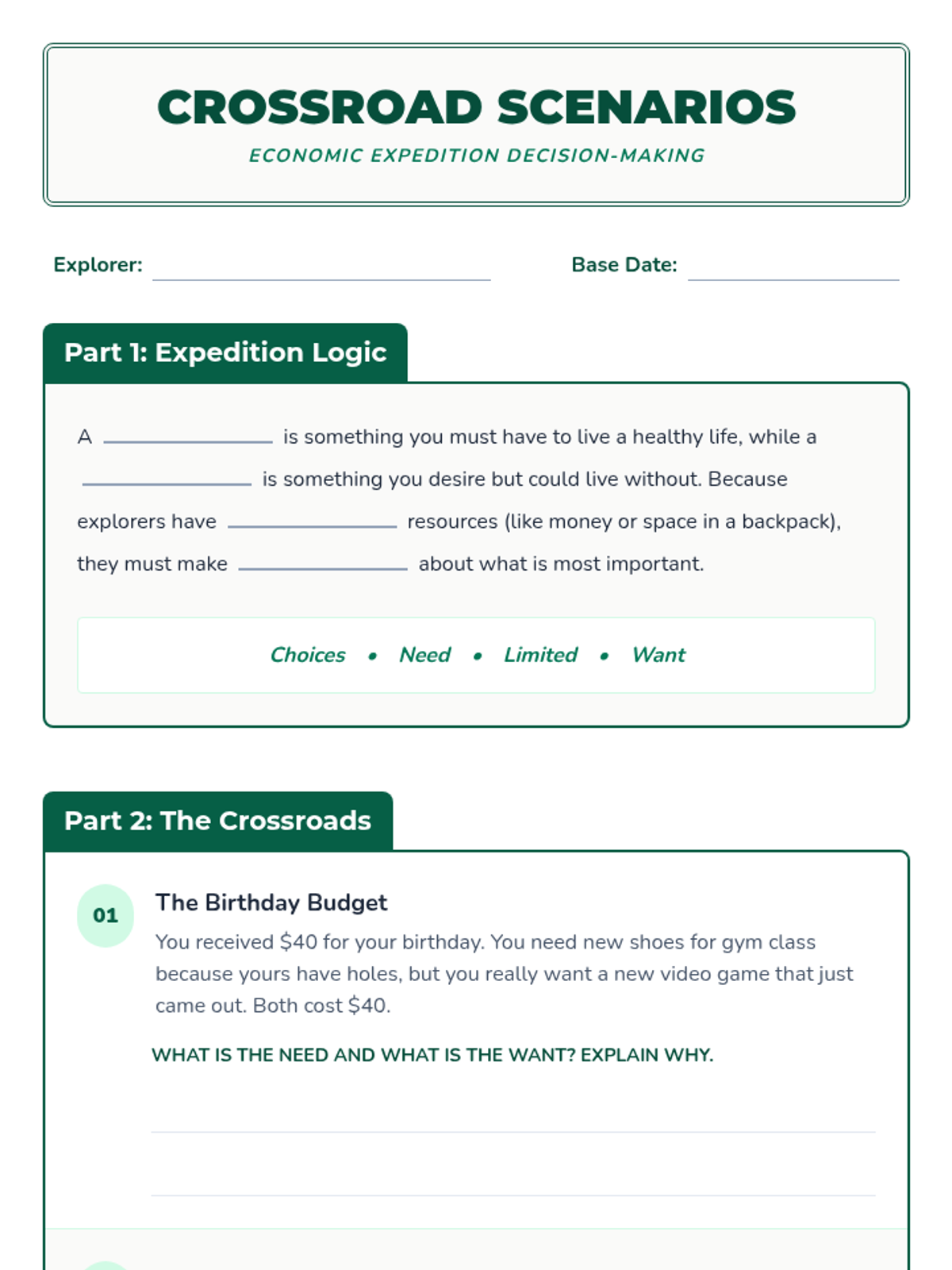
A worksheet with fill-in-the-blank logic and real-world scenarios requiring students to differentiate between needs and wants to make economic decisions.
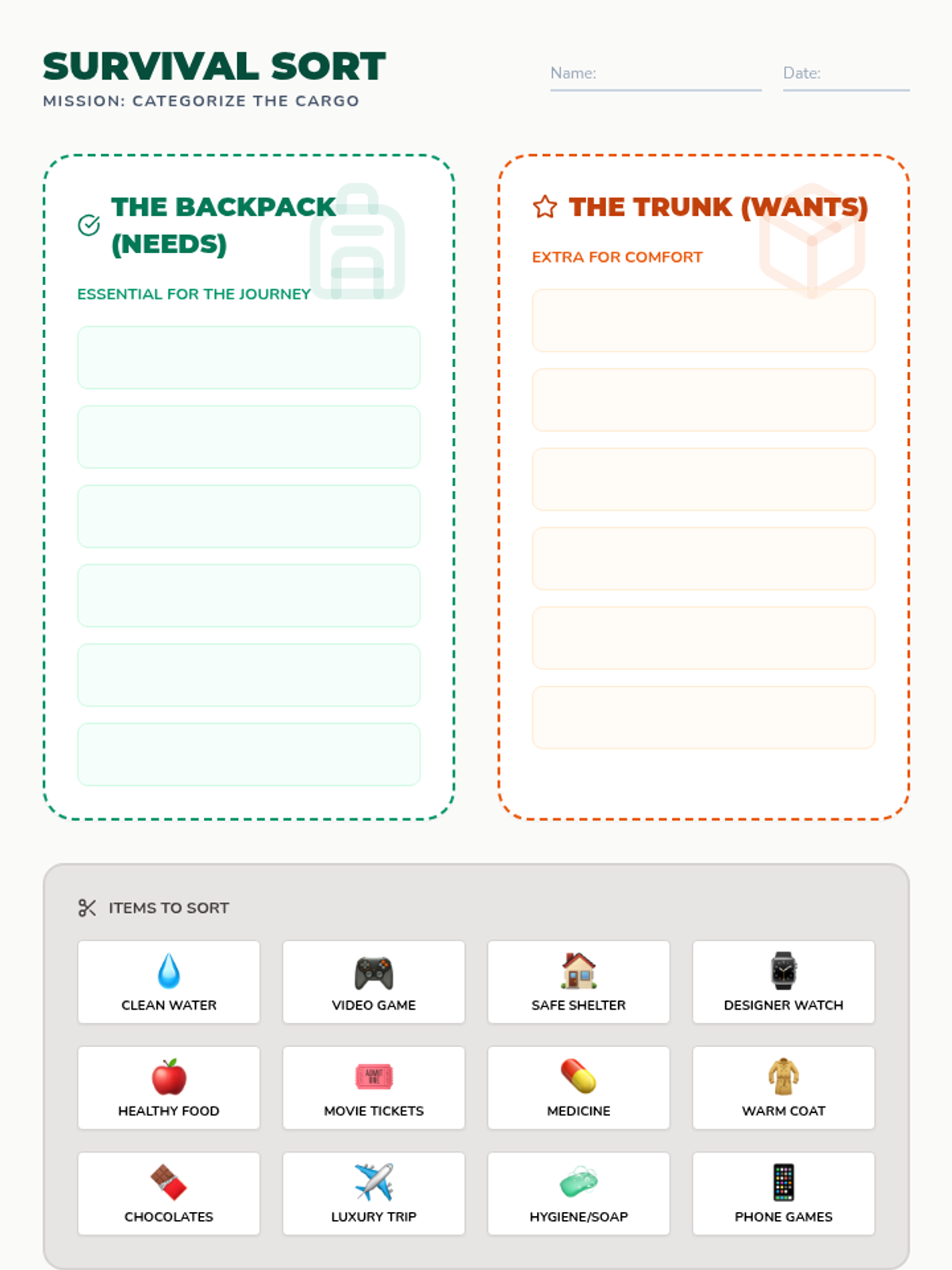
A sorting activity where students categorize 12 items (with visual emoji icons) as either 'Needs' or 'Wants' in an expedition-themed layout.
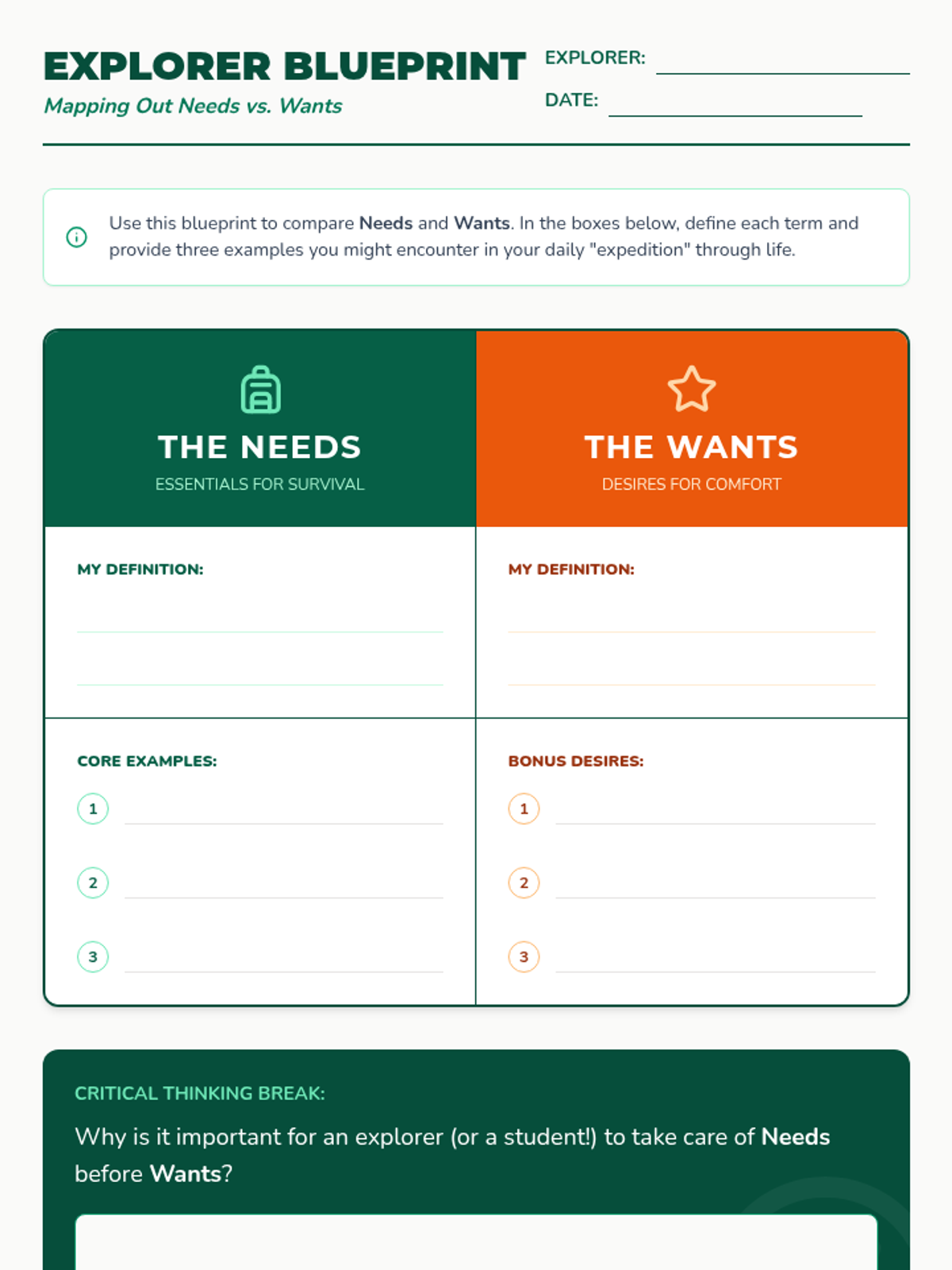
A comparison graphic organizer for students to define and list examples of needs and wants using an expedition blueprint theme. Includes structured writing lines and a summary section.
Introductory slide deck for "The Essential Explorer" lesson, visually defining needs vs. wants and explaining the importance of priority-based decision making.
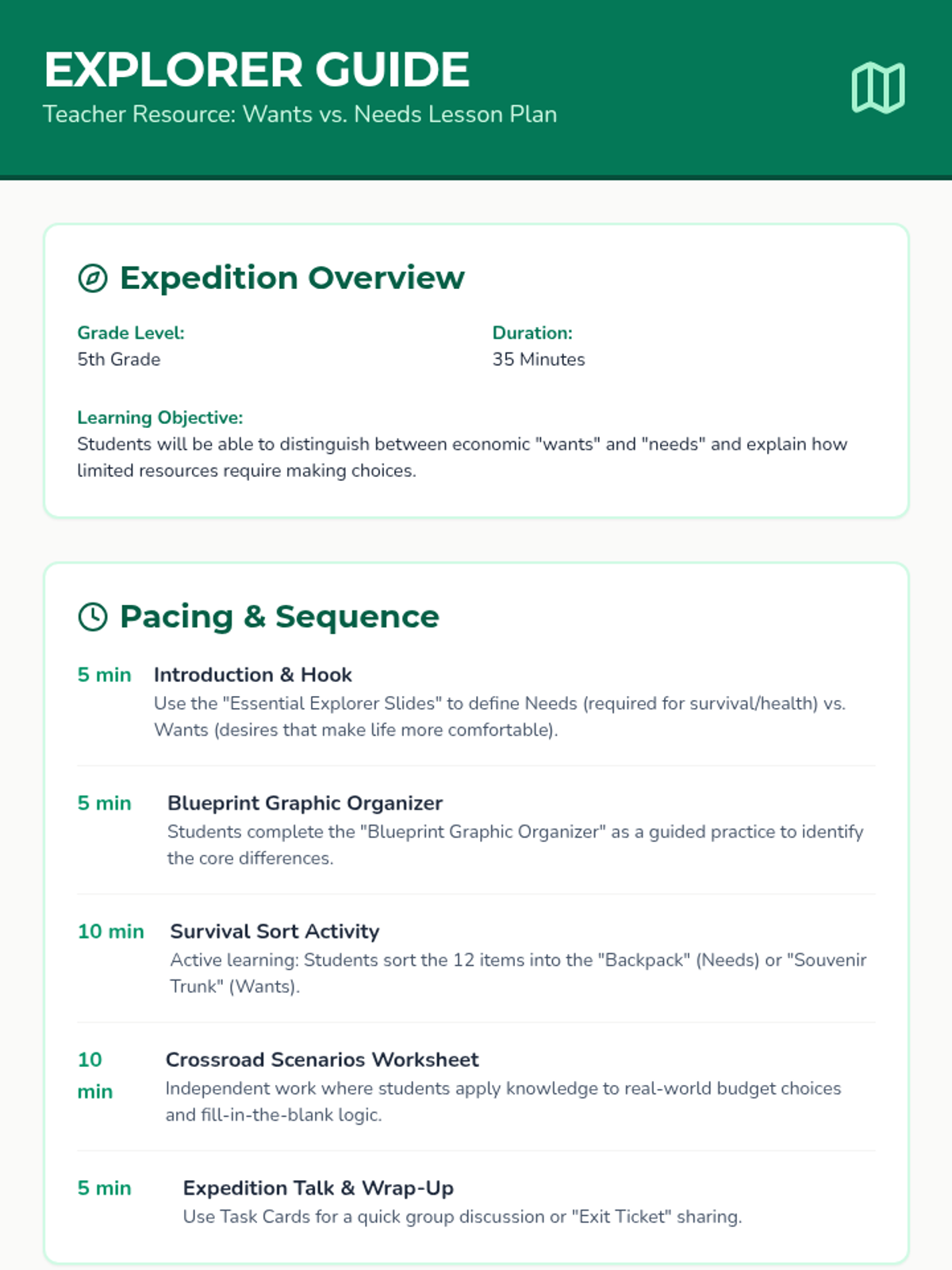
A comprehensive teacher's guide for the Wants vs. Needs lesson, including a 35-minute pacing guide, learning objectives, and answer keys for all student activities.
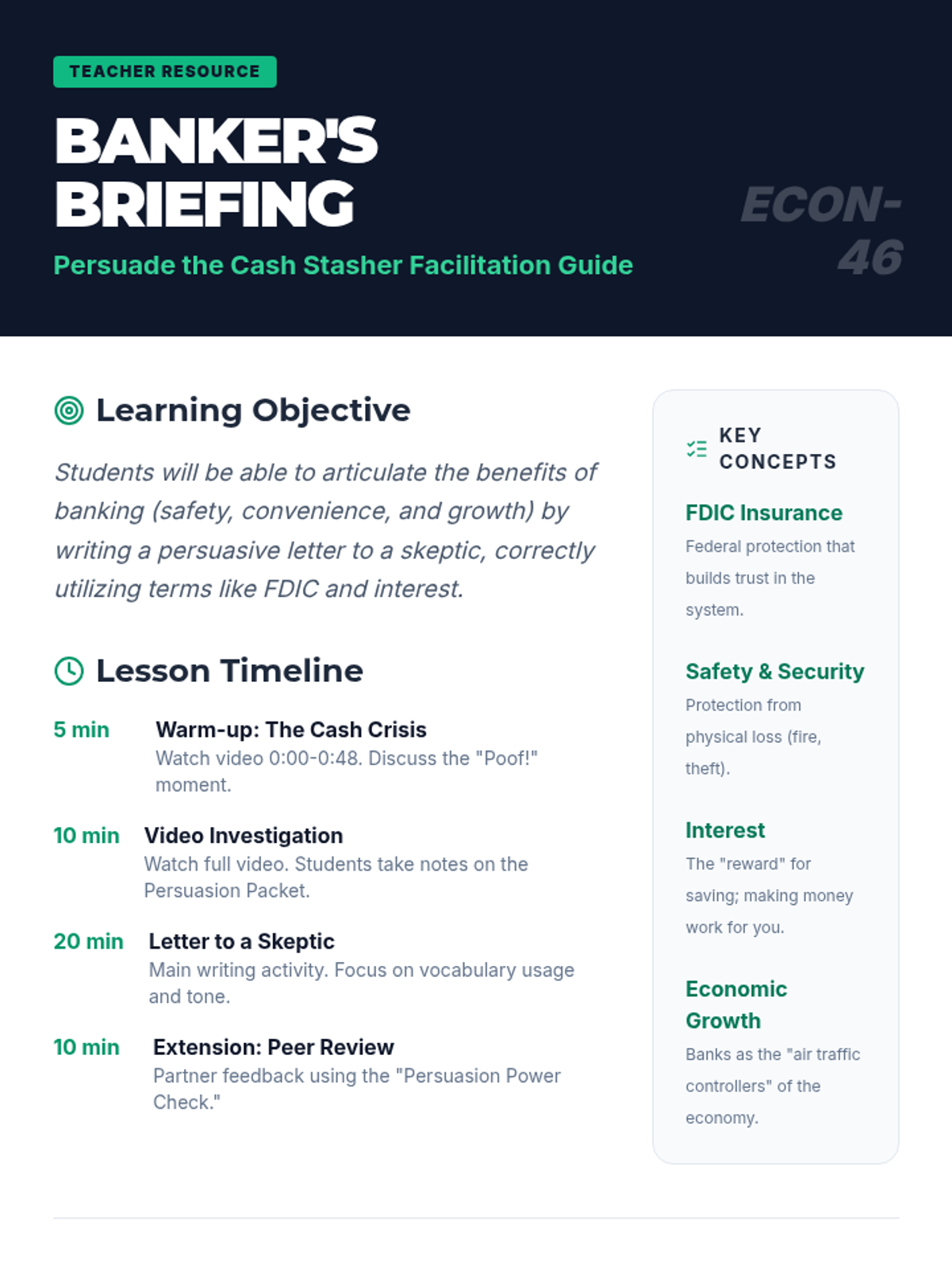
A teacher guide for the 'Persuade the Cash Stasher' lesson. Includes a detailed lesson timeline, key concept summaries, discussion prompts based on video timestamps, common misconceptions, and an answer key for the persuasive letter activity.
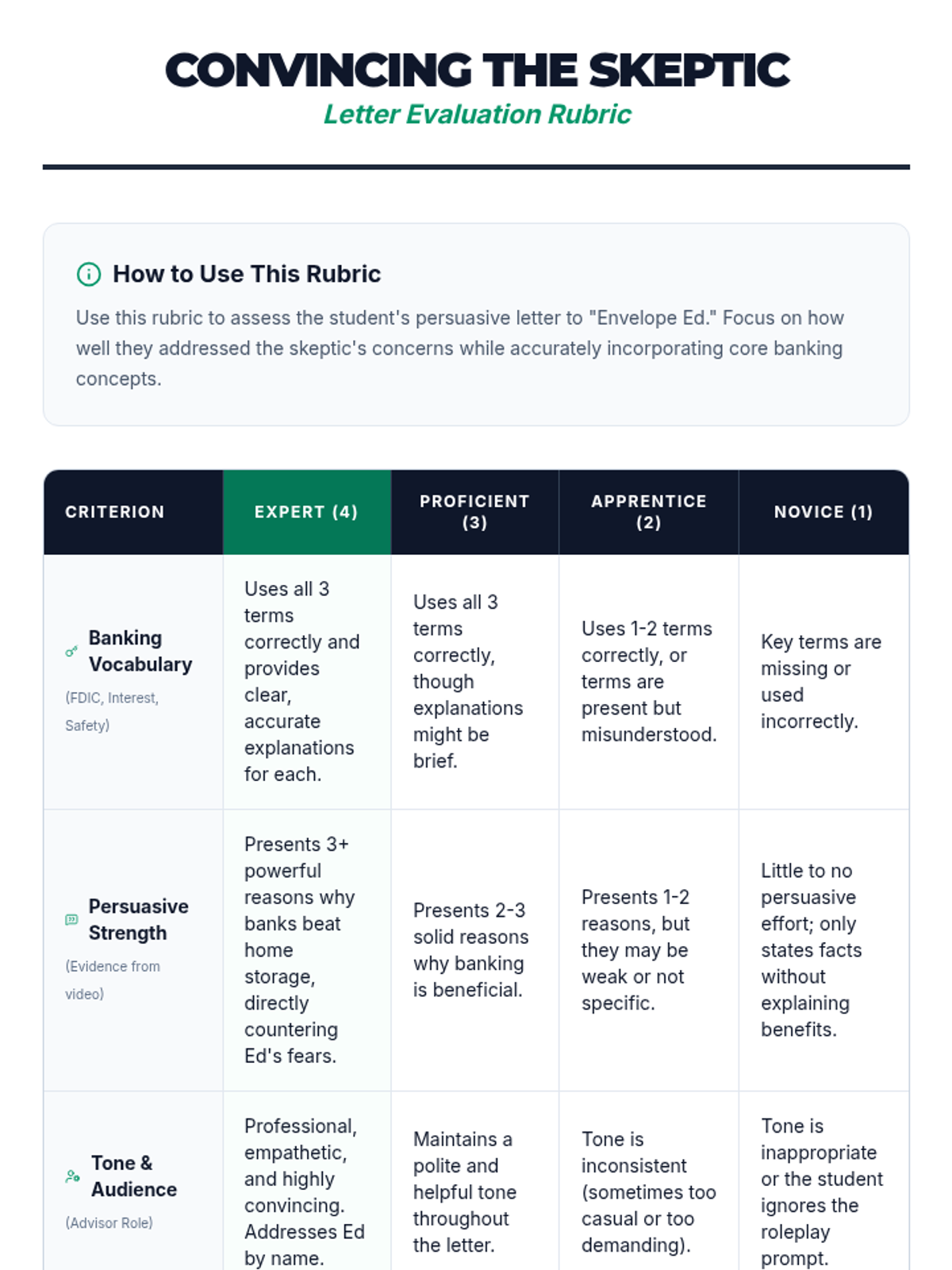
An assessment rubric for evaluating student letters in the 'Persuade the Cash Stasher' lesson. Rates students on their usage of banking vocabulary, persuasive strength, professional tone, and writing conventions using a 4-point scale.
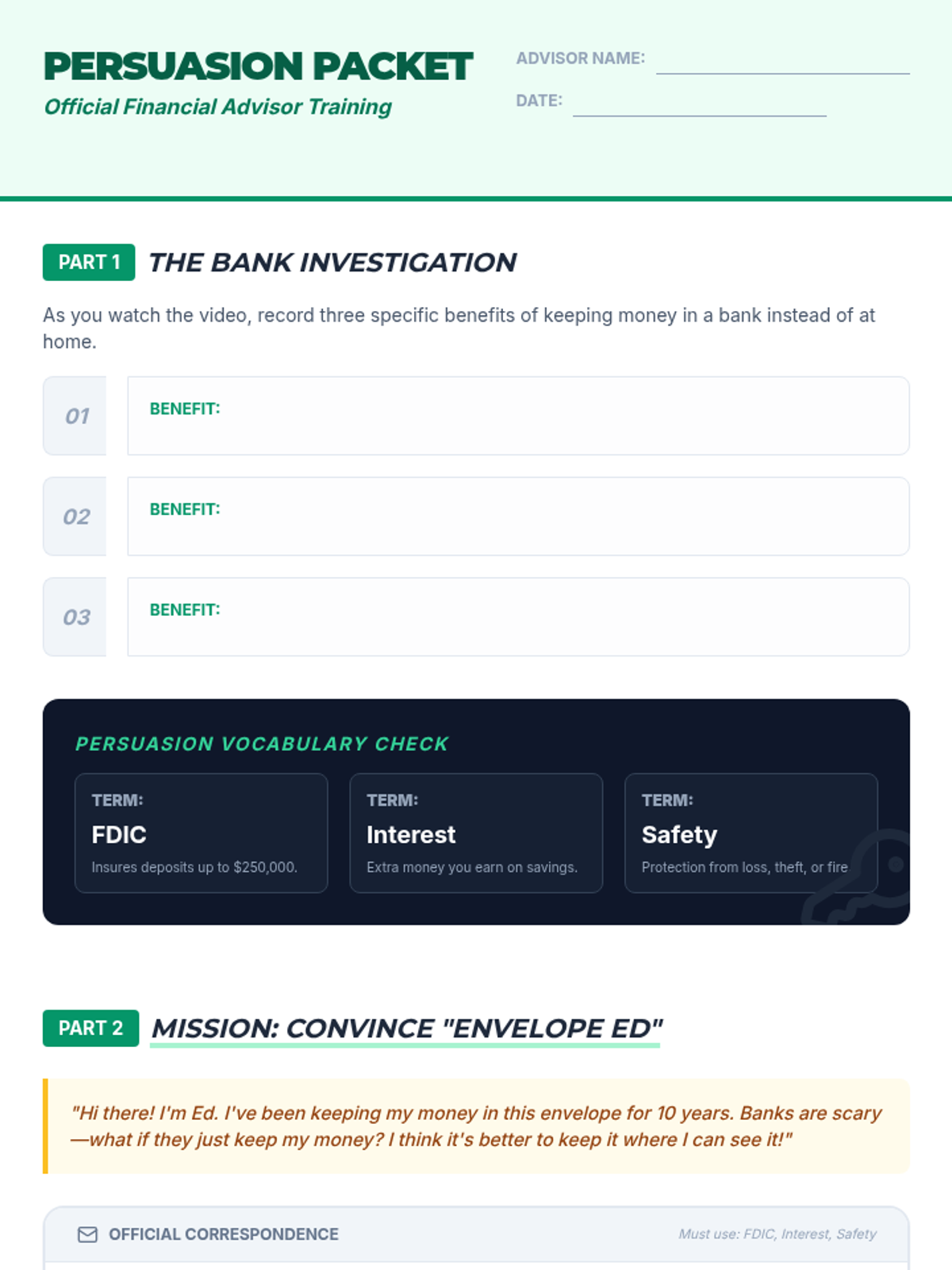
A student worksheet for the 'Persuade the Cash Stasher' lesson. Includes a note-taking section for video benefits, a vocabulary reference for key terms, and a structured letter-writing area for students to roleplay as financial advisors convincing a skeptic.
A comprehensive slide deck for the 'Persuade the Cash Stasher' lesson, including a video hook, vocabulary tools, and the main writing mission. Features high-contrast visuals, clear hierarchy, and embedded YouTube video for a dynamic classroom experience.
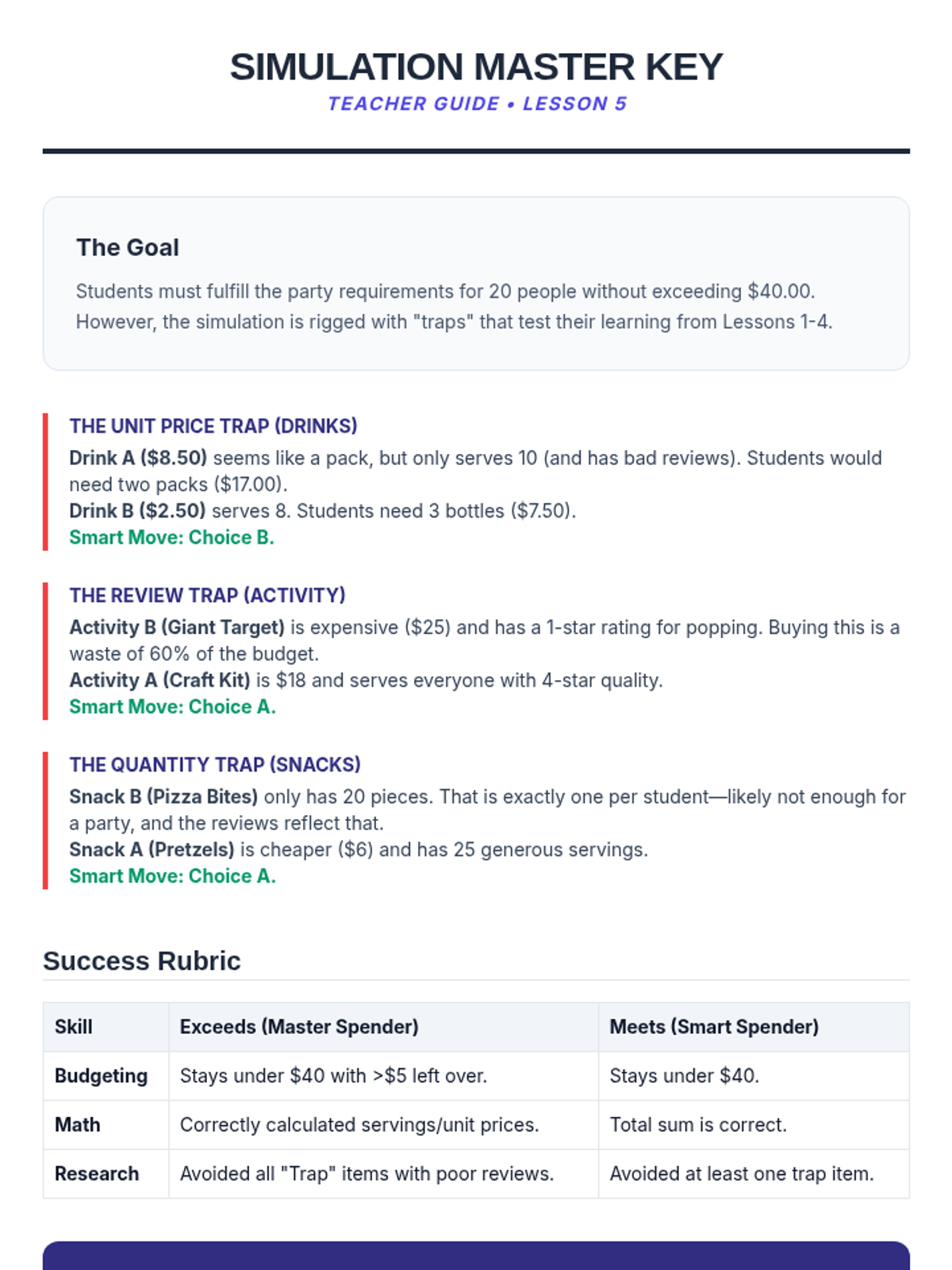
Teacher answer key and rubric for the Lesson 5 simulation. Identifies the "traps" in the catalog and provides a grading framework for student decisions.
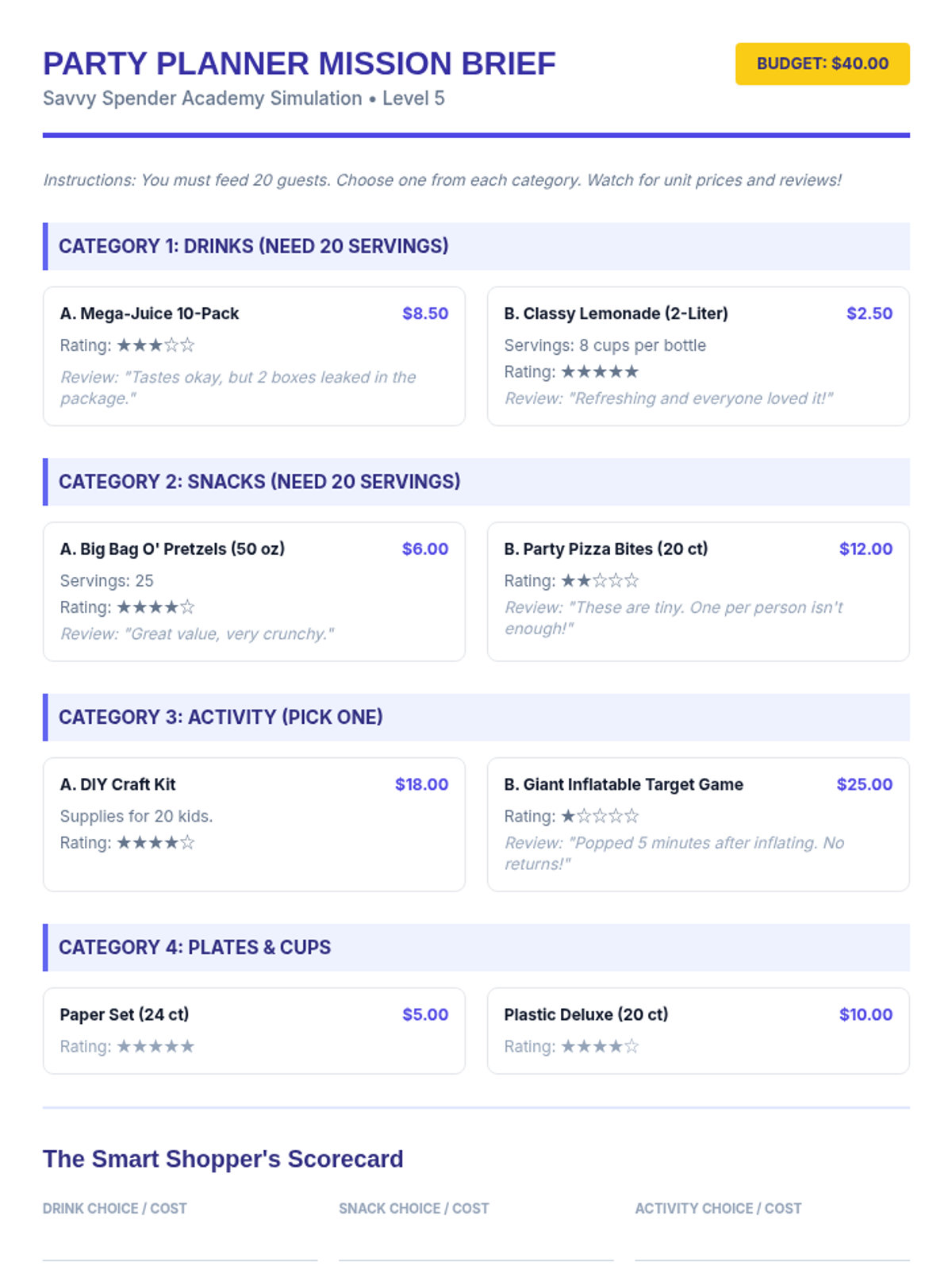
The comprehensive catalog and simulation brief for the final lesson. Students must navigate choices for a class party while managing a $40 budget and evaluating quality.
Introductory slide deck for the final lesson simulation. Sets the stage for the Party Planner mission and reviews the success criteria.
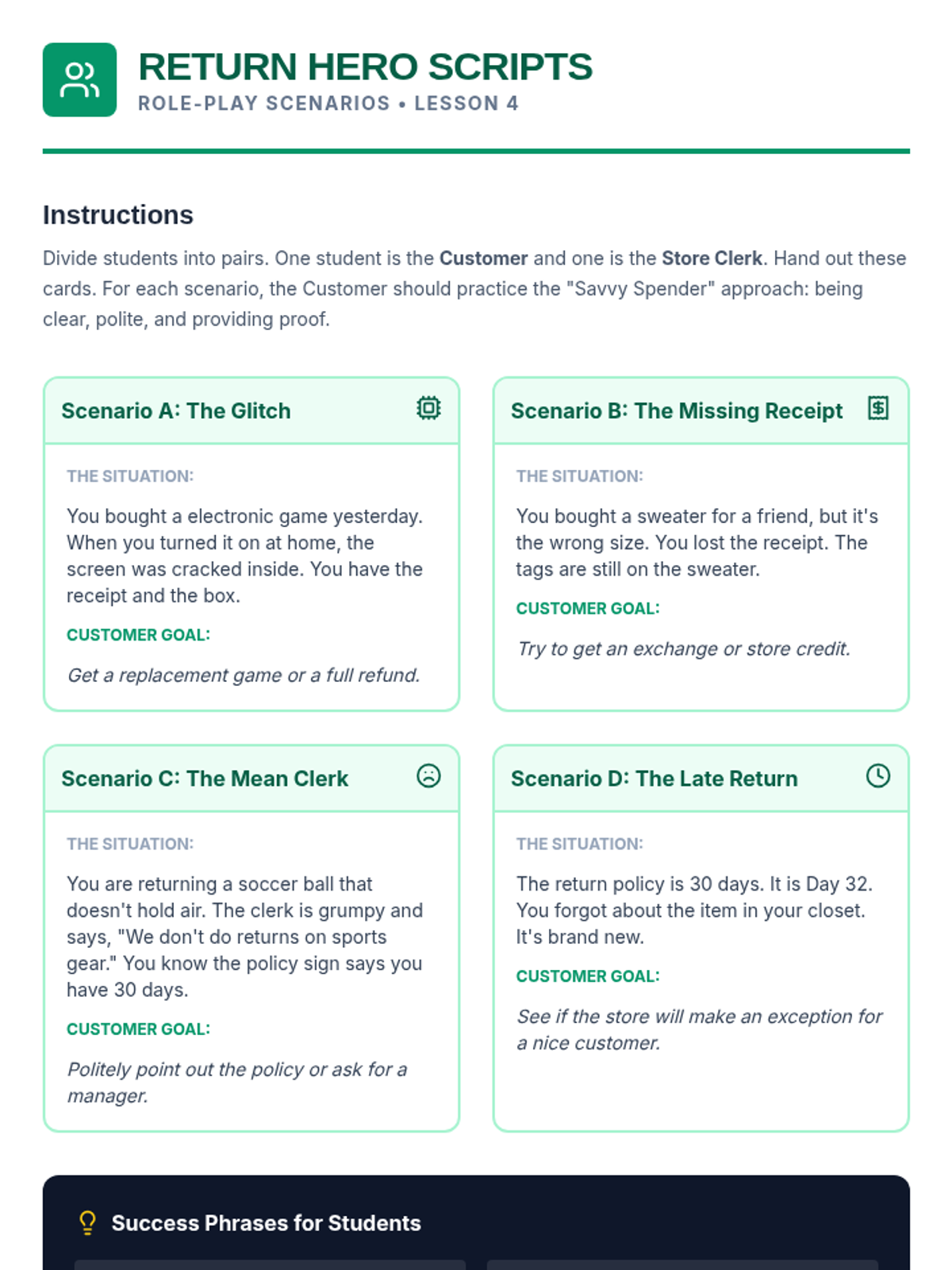
A set of role-play scenario cards and scripts for students to practice advocating for their consumer rights politely and effectively.
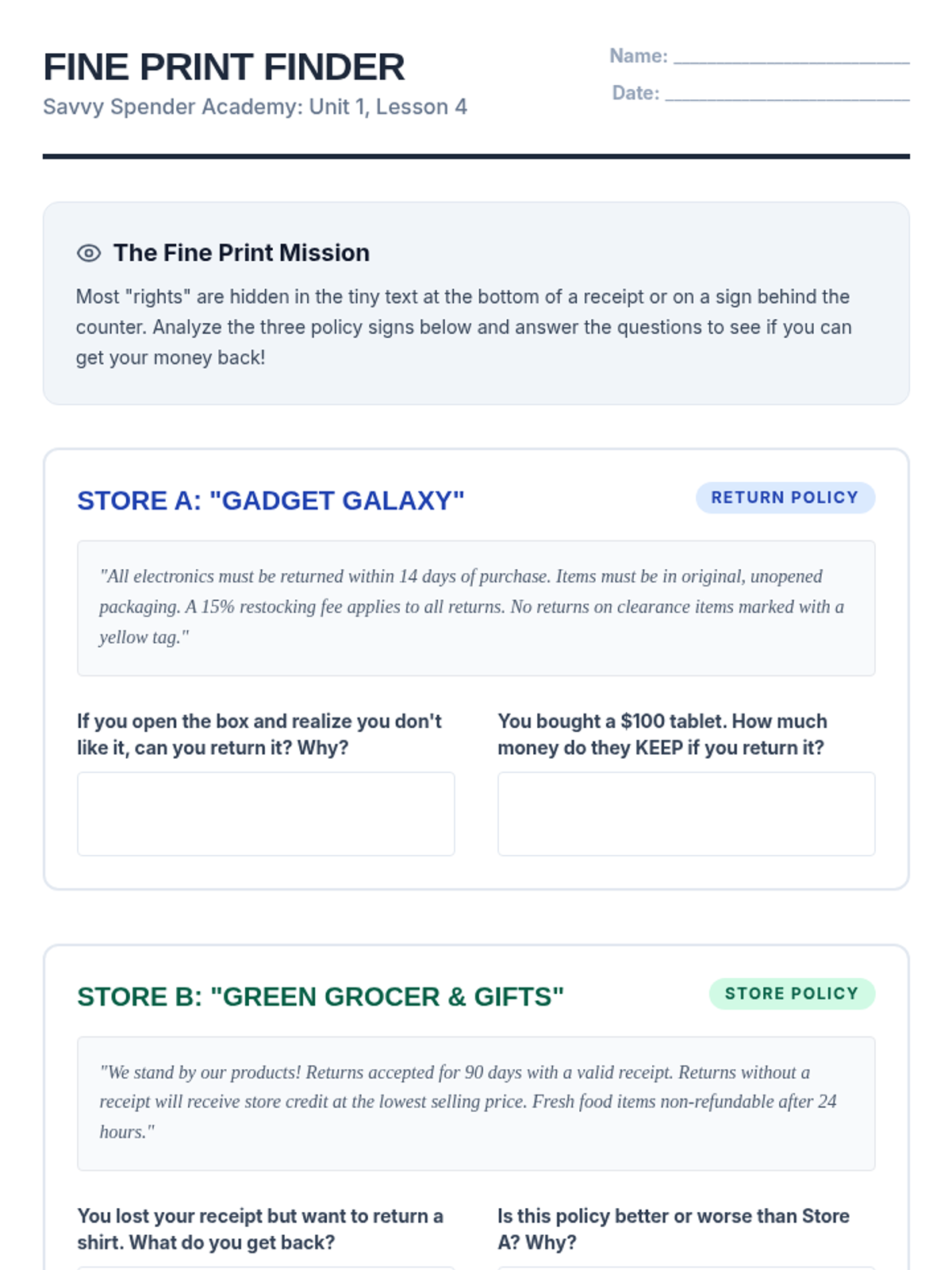
A student worksheet for Lesson 4 where students analyze mock store policies to identify return limits, fees, and requirements. Includes a vocabulary matching section.
Introductory slide deck for Lesson 4 on consumer rights, return policies, and warranties. Teaches students how to read the "fine print" and advocate for themselves politely.
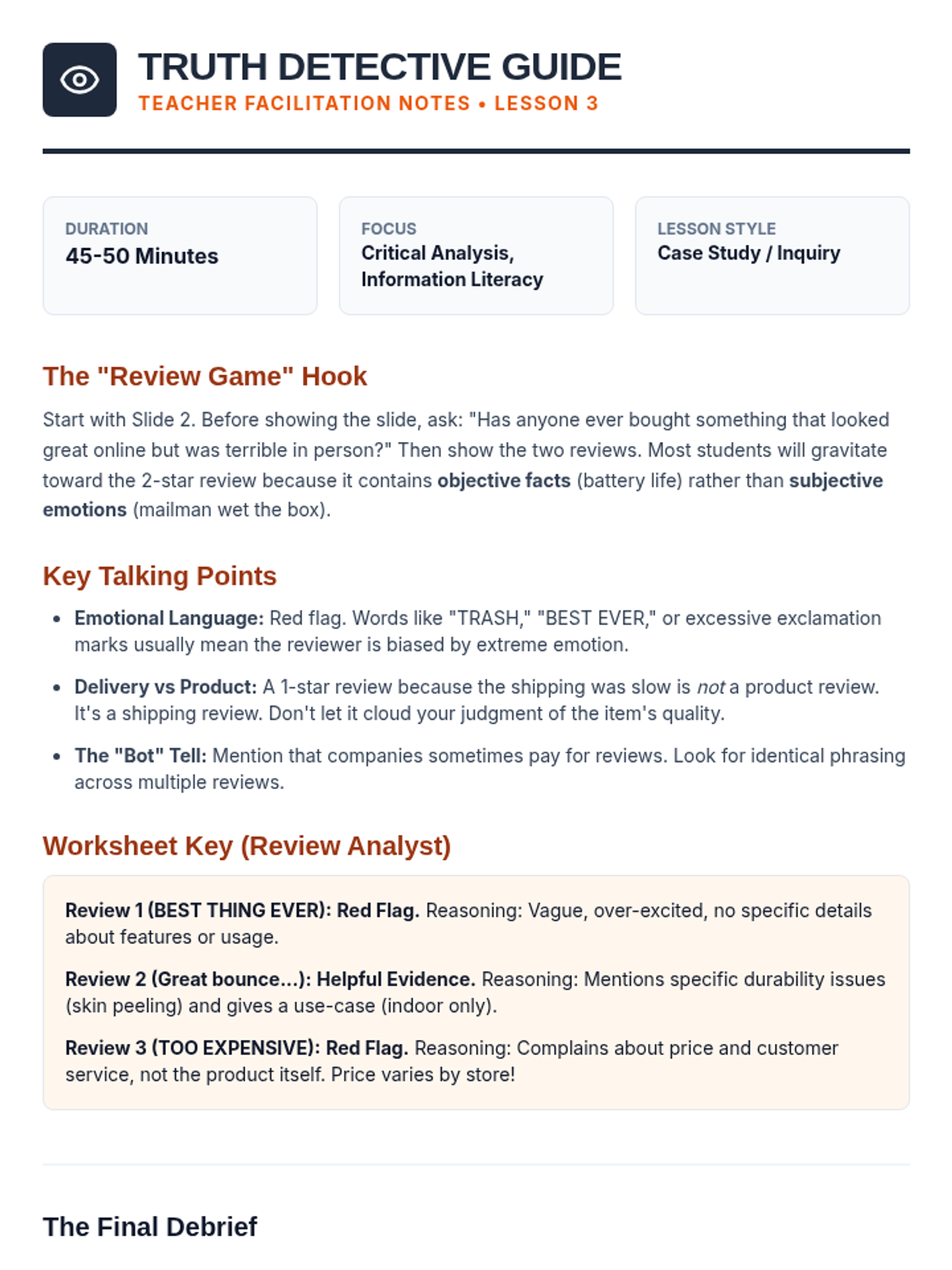
A teacher facilitation guide for Lesson 3, providing discussion points, answer keys for the analysis activity, and critical thinking prompts.