Builds word mastery through parts of speech, Greek and Latin roots, and morphological analysis of prefixes and suffixes. Develops nuanced comprehension using context clues, shades of meaning, and idiomatic expressions.
Presentation slides for the Persuasion Powerhouse lesson, covering claims, evidence, rhetorical devices (Ethos, Pathos, Logos), and counter-arguments.
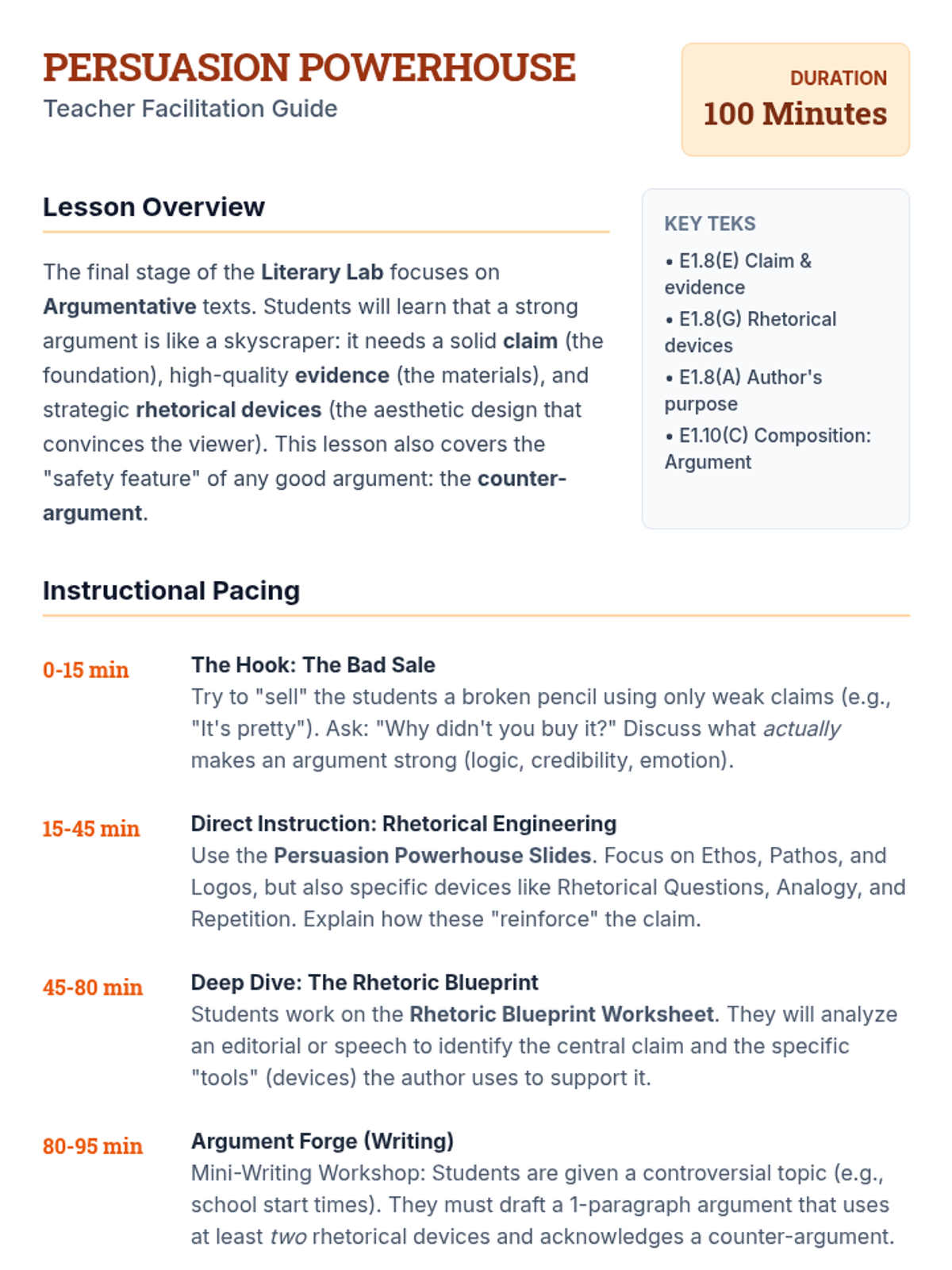
Grayscale teacher facilitation guide for the Persuasion Powerhouse lesson, focusing on argumentative structures, rhetorical devices, and claim development.
Presentation slides for the Fact Forge lesson, covering central idea identification, organizational patterns, and distinguishing structural evidence from minor details.
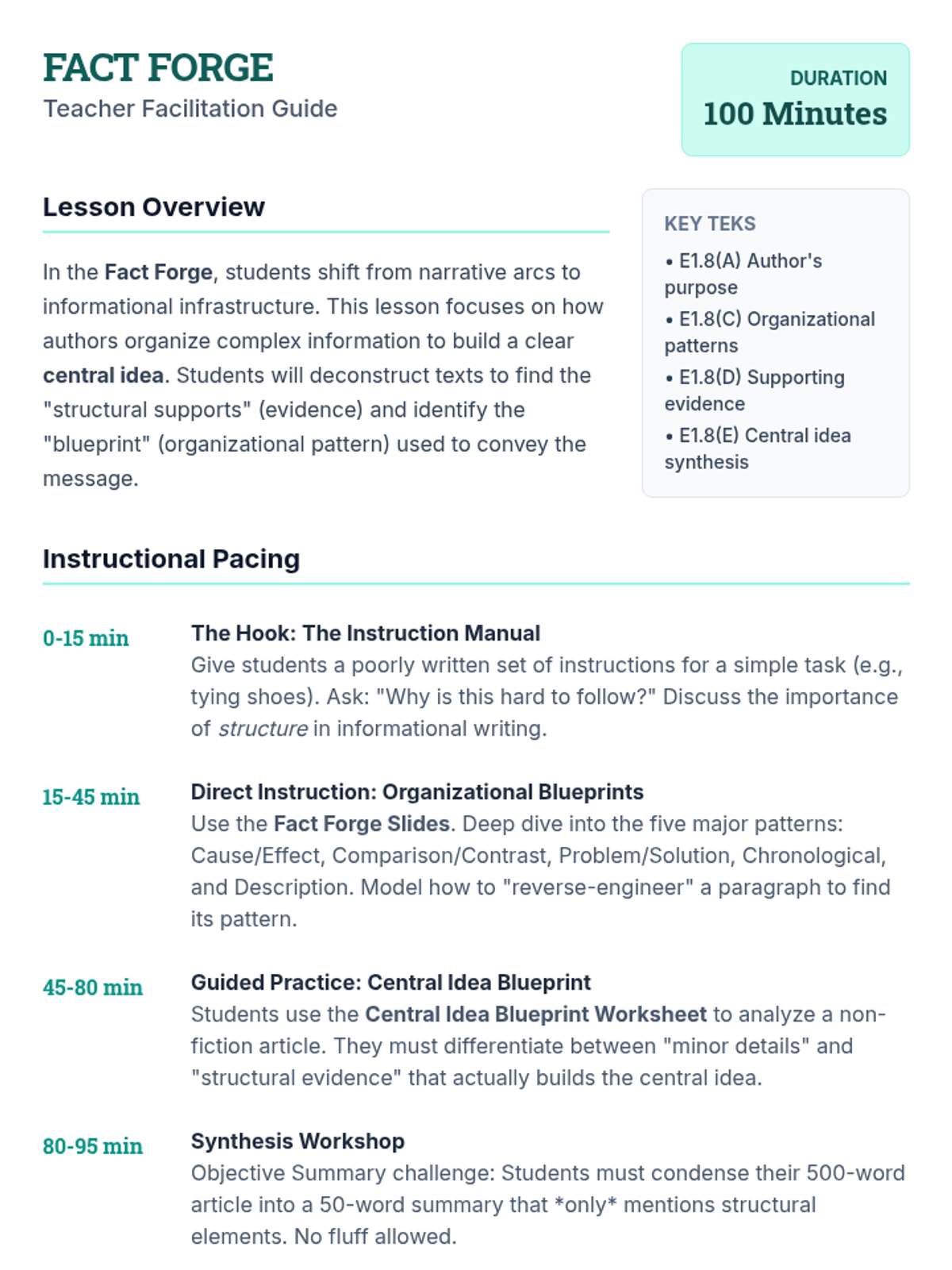
Grayscale teacher facilitation guide for the Fact Forge lesson, focusing on informational text structures, central idea identification, and evidence analysis.
Presentation slides for the Fiction Factory lesson, covering character complexity (the iceberg model), plot architecture, and author's craft (the toolbelt).
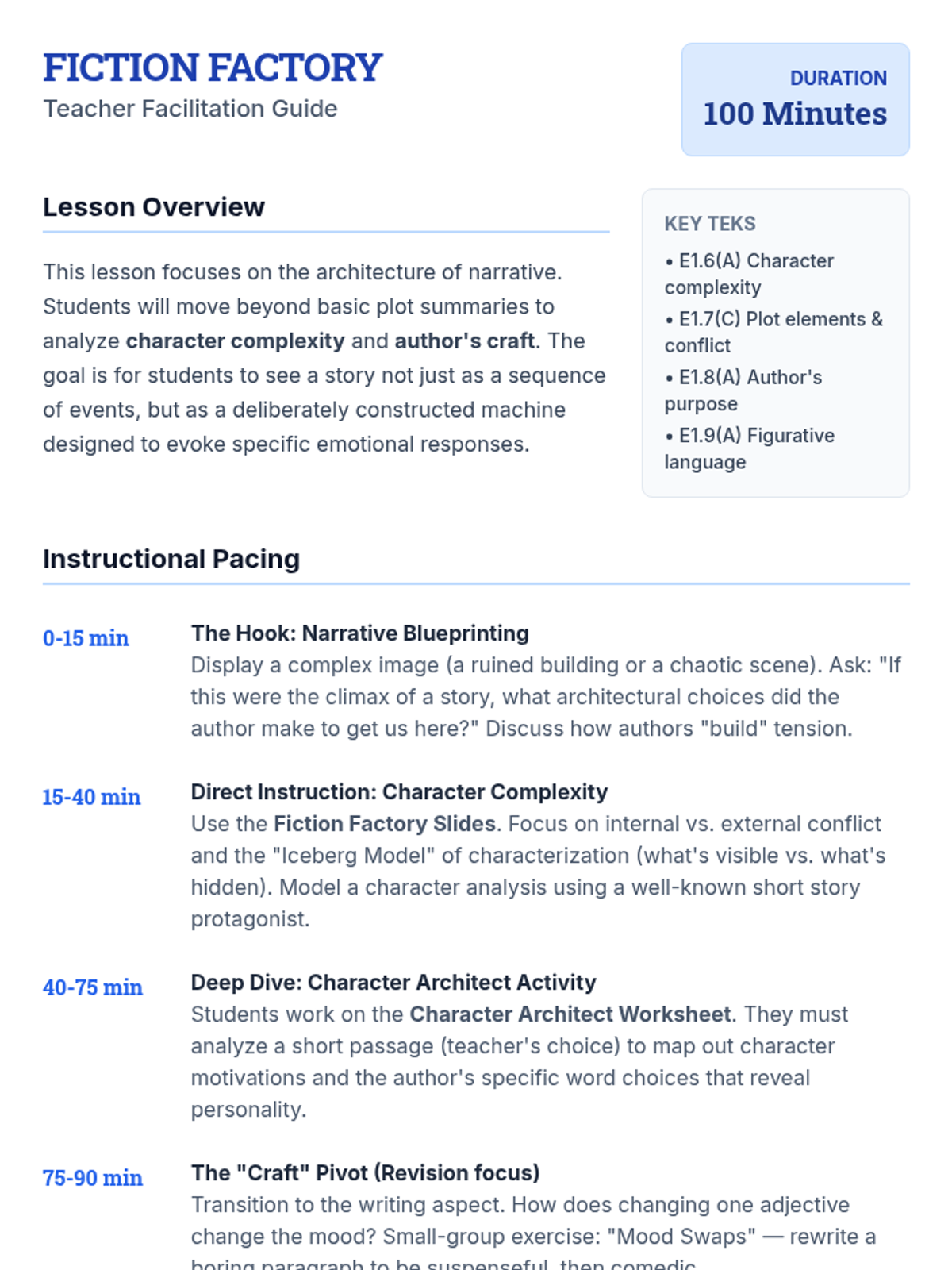
Grayscale teacher facilitation guide for the Fiction Factory lesson, including pacing, TEKS alignment, and instructional strategies for character and craft analysis.
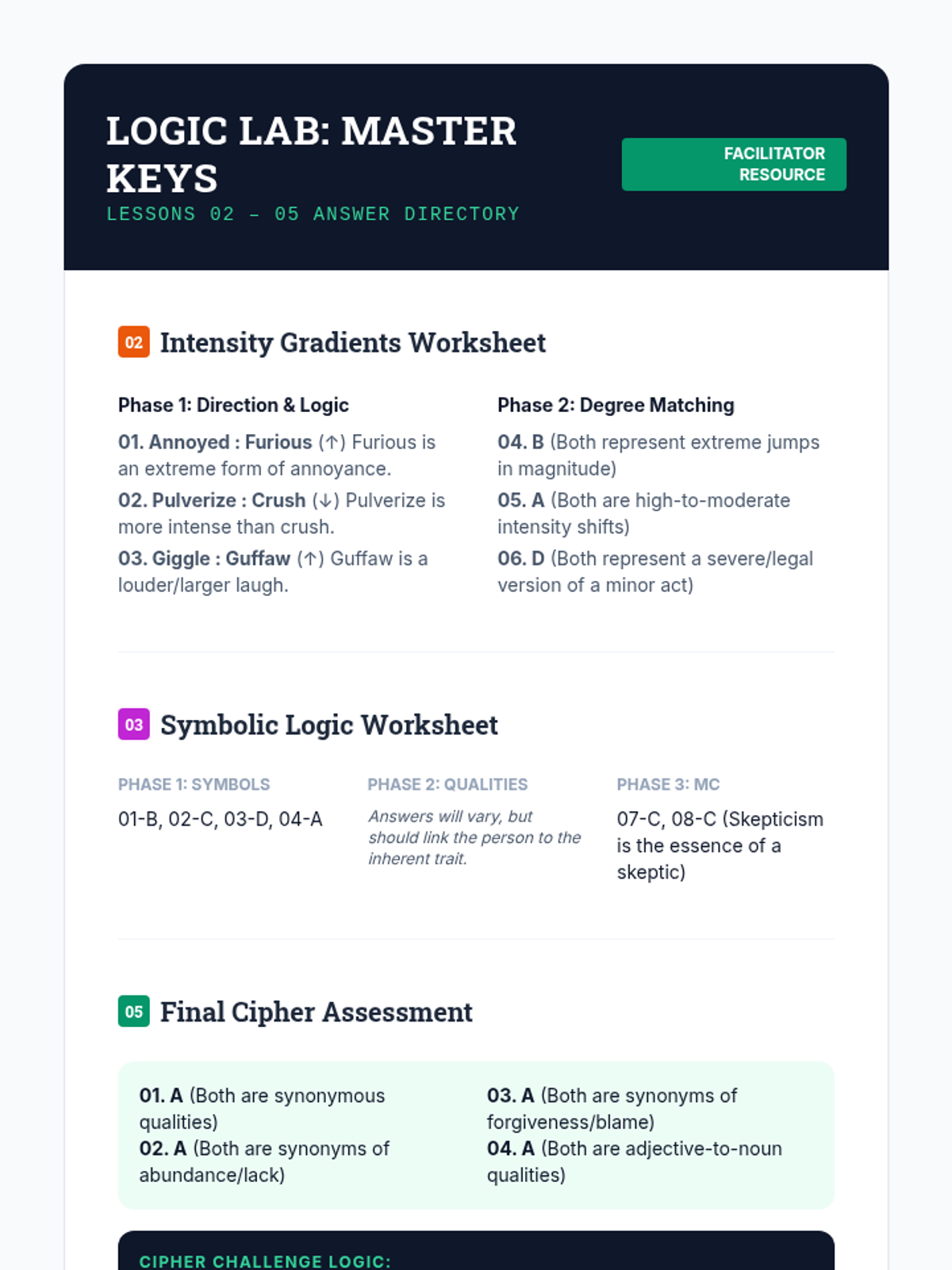
Comprehensive answer key for the worksheets and assessments in Lessons 2, 3, 4, and 5.
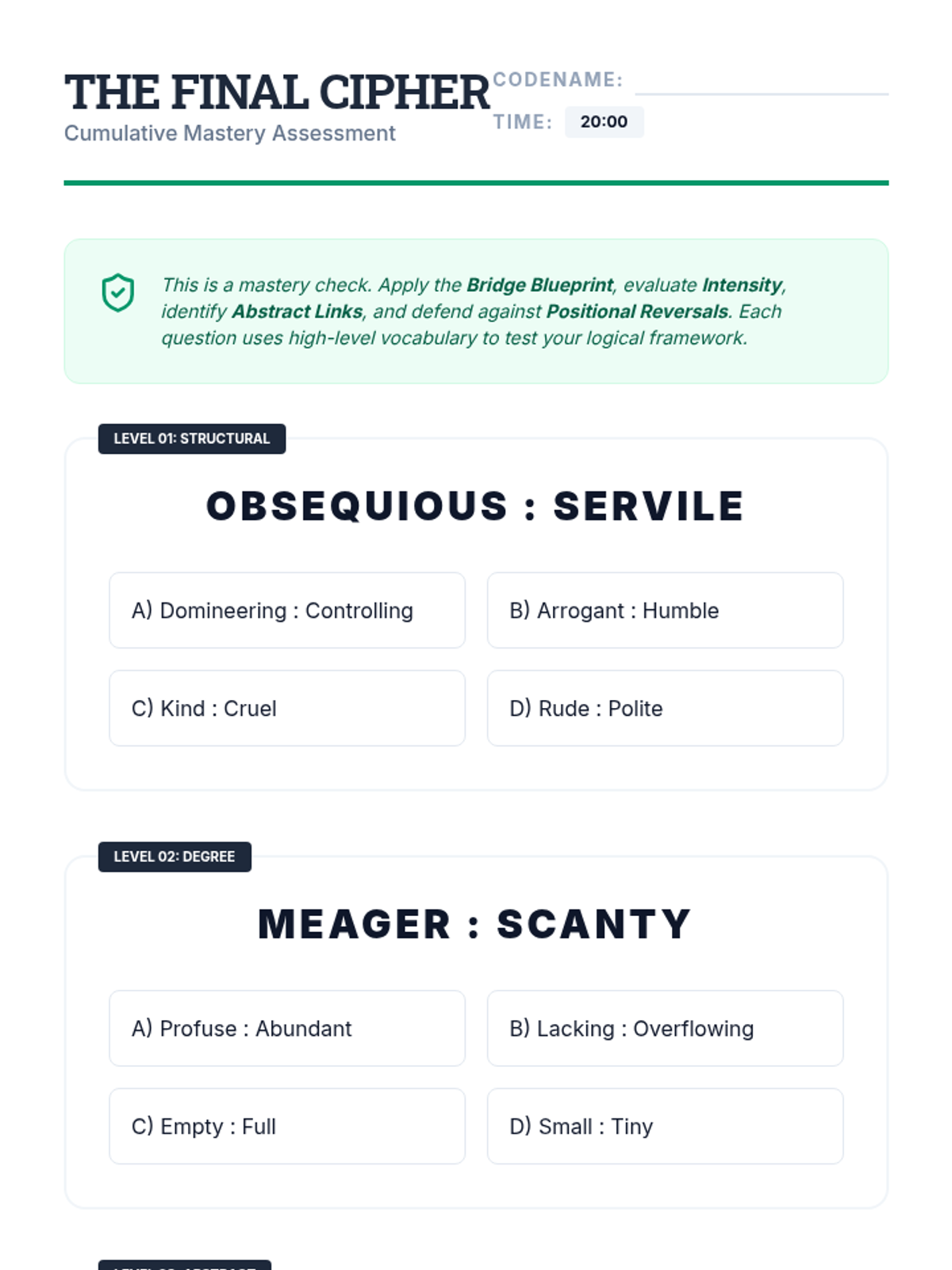
Timed mastery assessment applying logic strategies to high-level and nonsense vocabulary to test student decoding skills.
Introductory slide deck for Lesson 5, focusing on advanced vocabulary, contextual inference, and the 'Nonsense Language' challenge.
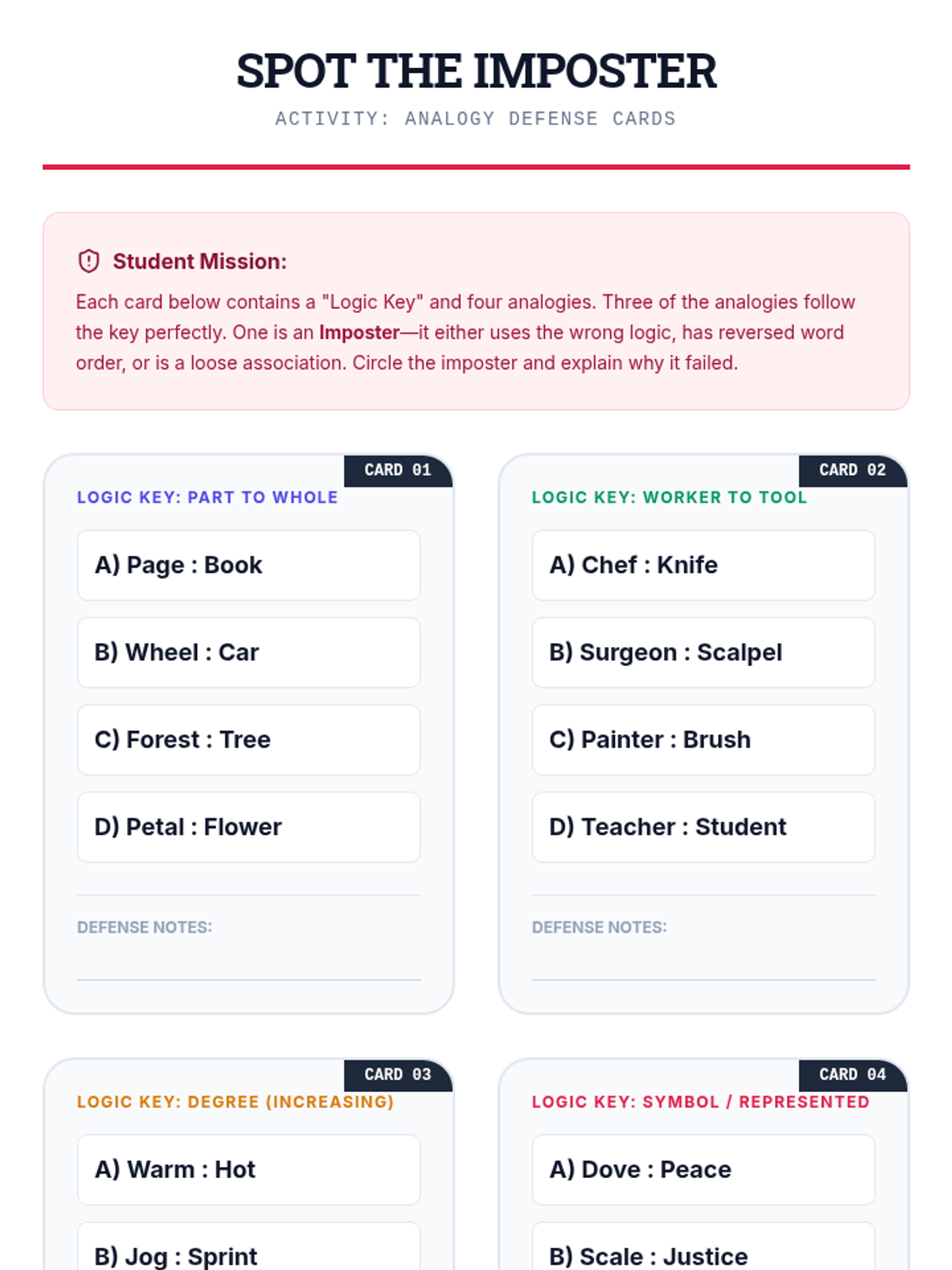
Set of printable vocabulary cards for a 'Spot the Imposter' game where students identify valid and invalid analogies.
Introductory slide deck for Lesson 4, focusing on common analogy traps like positional reversal and loose association.
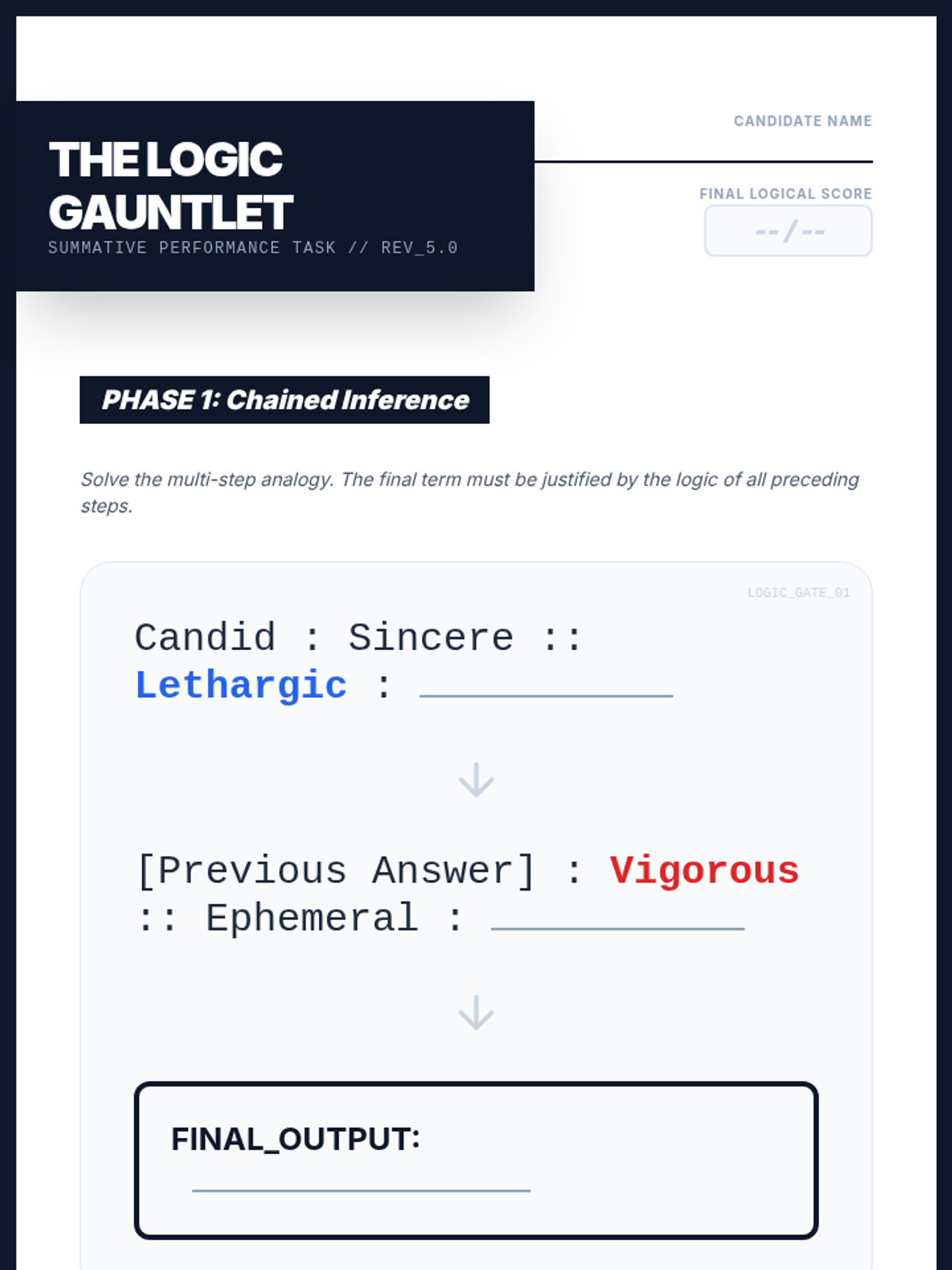
A summative assessment material for the Gauntlet Challenge, featuring chained inferences, a logic grid puzzle, and a systems design section for original student-created logic traps.
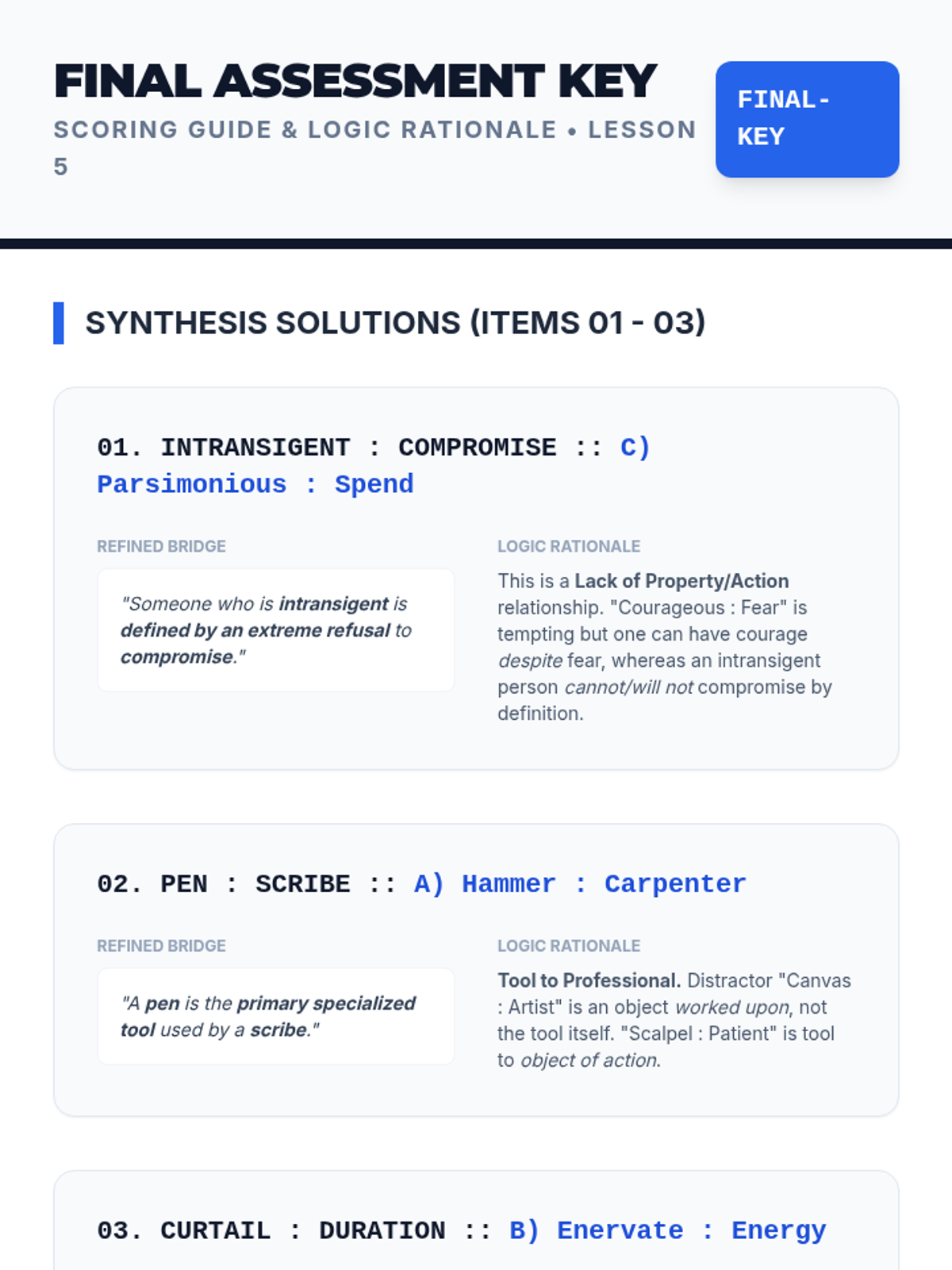
The master answer key and logic rationale guide for the final assessment of the analogies sequence, providing detailed explanations for complex synthesis problems.
A presentation slide deck for the summative assessment, covering chained analogies, deductive chains, and final mission directives.
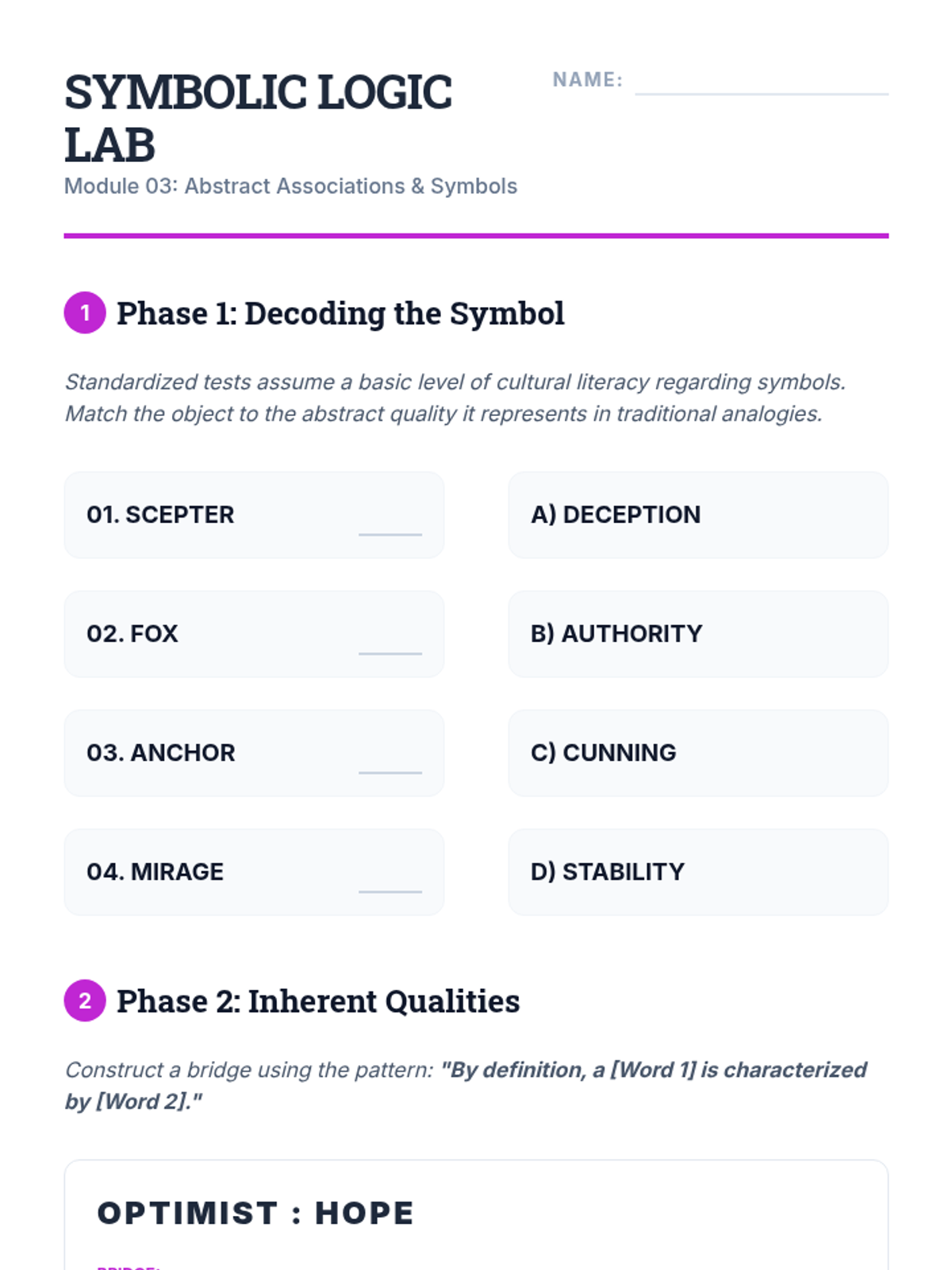
Student worksheet for Lesson 3, focusing on symbolic representation and identifying defining characteristics in abstract analogies.
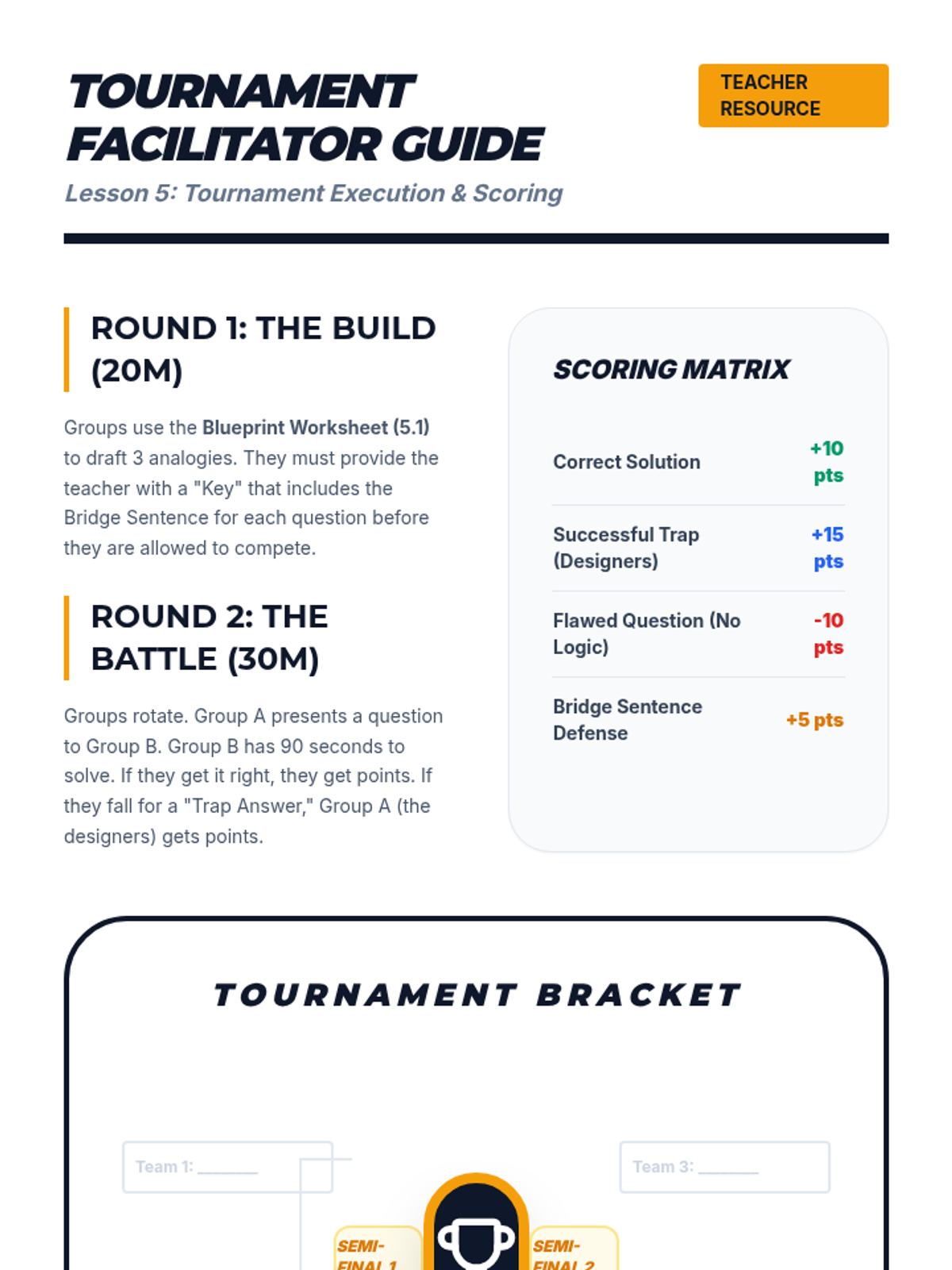
A teacher resource for managing and scoring the analogy tournament, including rules for rounds, a scoring matrix, and a tournament bracket.
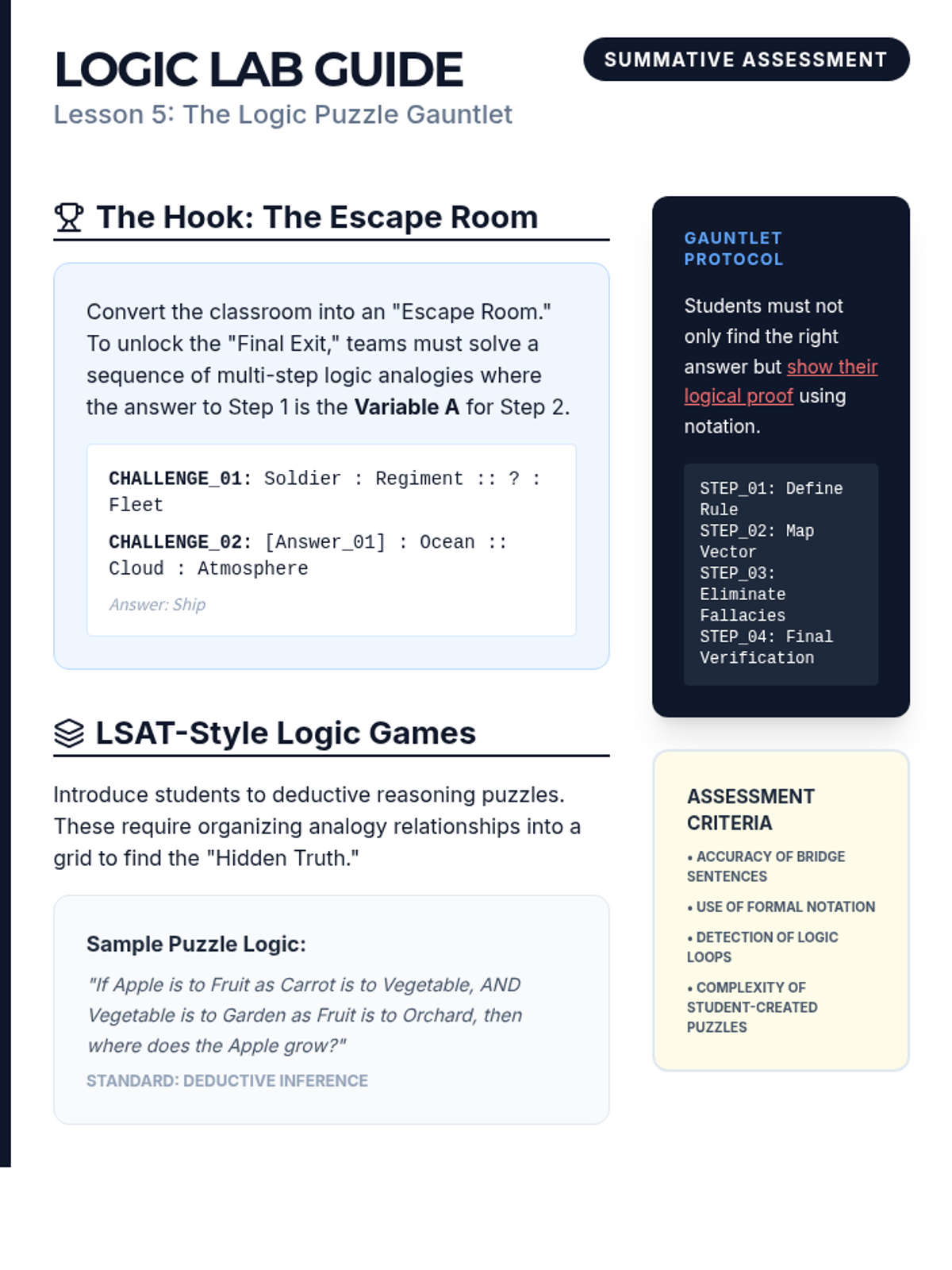
A teacher guide for the summative assessment lesson, featuring "Escape Room" logic puzzles and LSAT-style game structures.
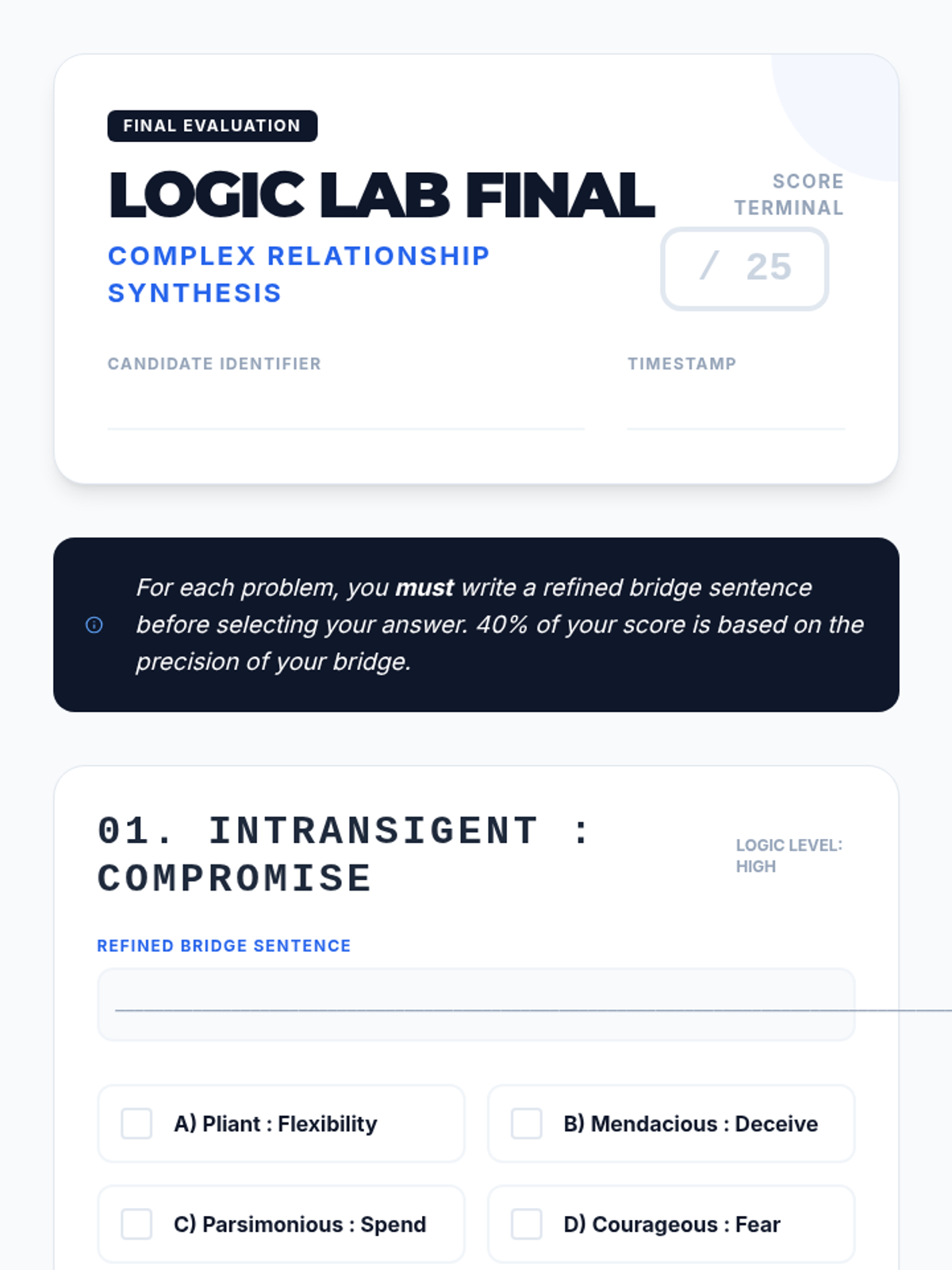
A final summative assessment for the verbal reasoning sequence, featuring multi-layered analogies that require precise bridge sentences and written defense of logical choices.
Introductory slide deck for Lesson 3, focusing on abstract associations, symbolic representation, and defining characteristics.
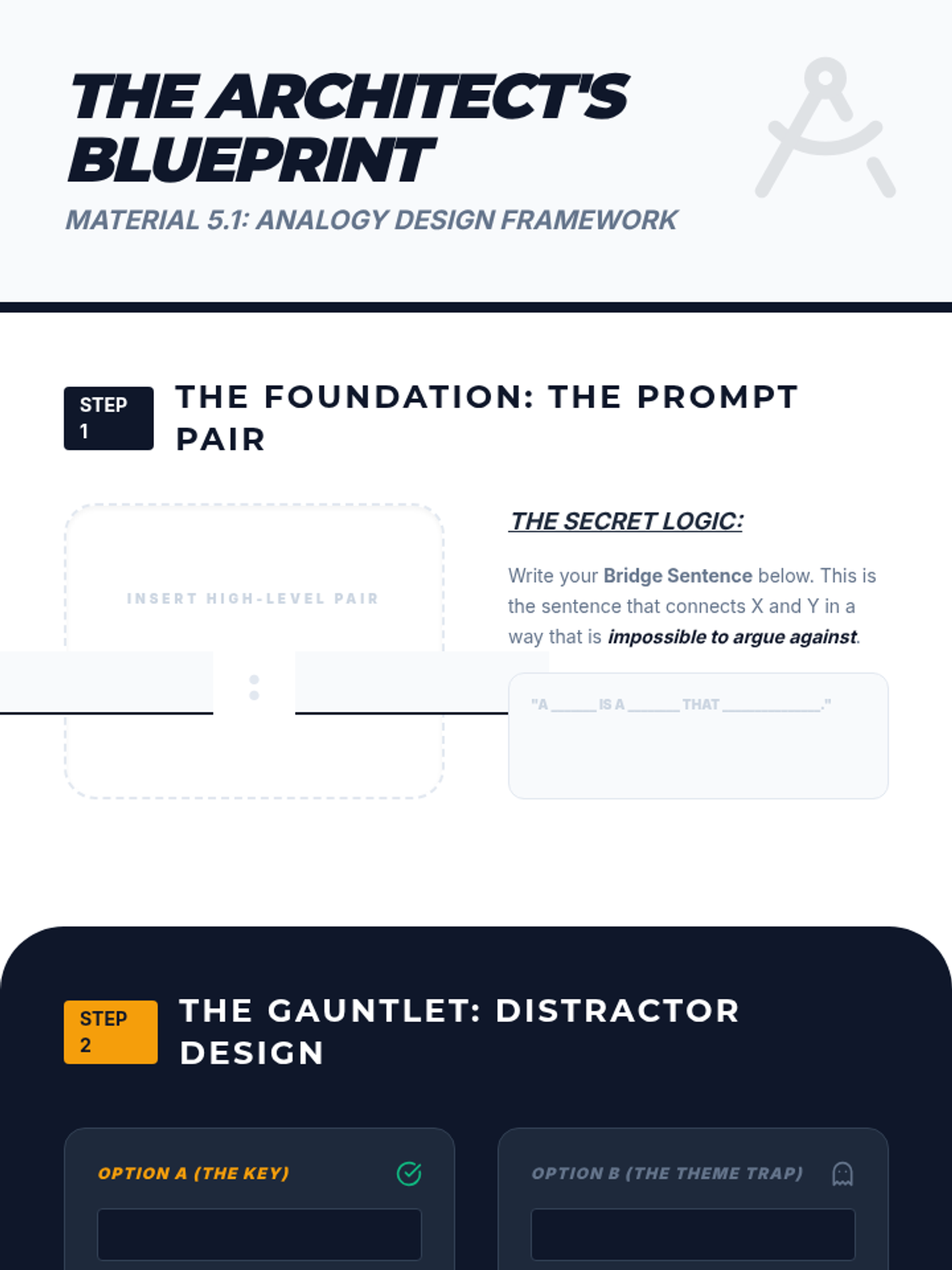
A specialized design sheet that guides students through the process of constructing high-level analogy questions, including the development of sophisticated distractors and a logical "bridge sentence" key.
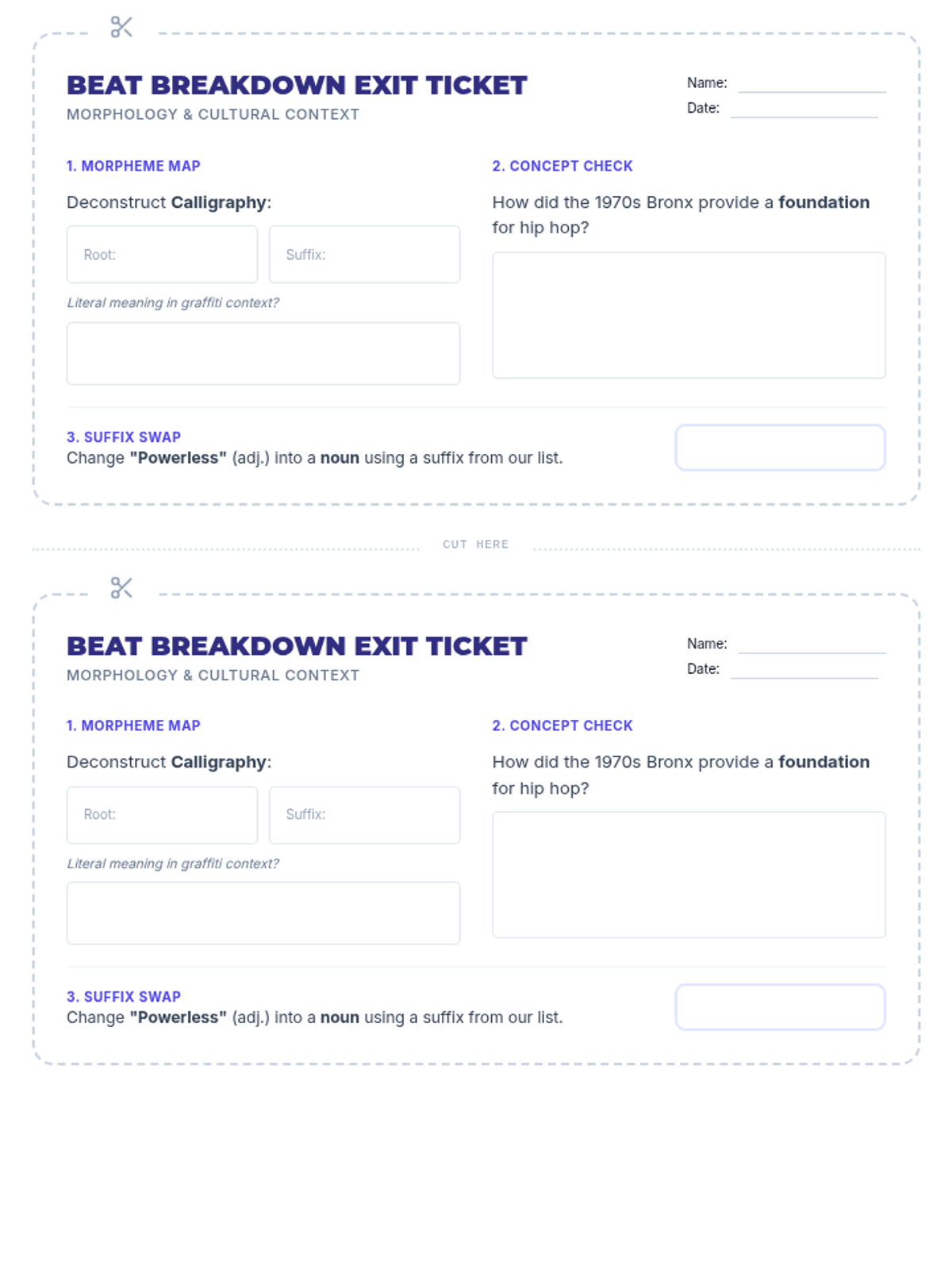
A printable exit ticket for the Beat Breakdown lesson, featuring morphological analysis of 'calligraphy', a context question about Hip Hop's roots, and a suffix application task. Designed with two tickets per page for efficient printing.
Instructional slides for the 'Beat Breakdown' lesson. Covers the key morphology (carto, mono, paleo, graphy, choreo), the extensive list of required suffixes, the reading passage for group fluency, and comprehension discussion questions.
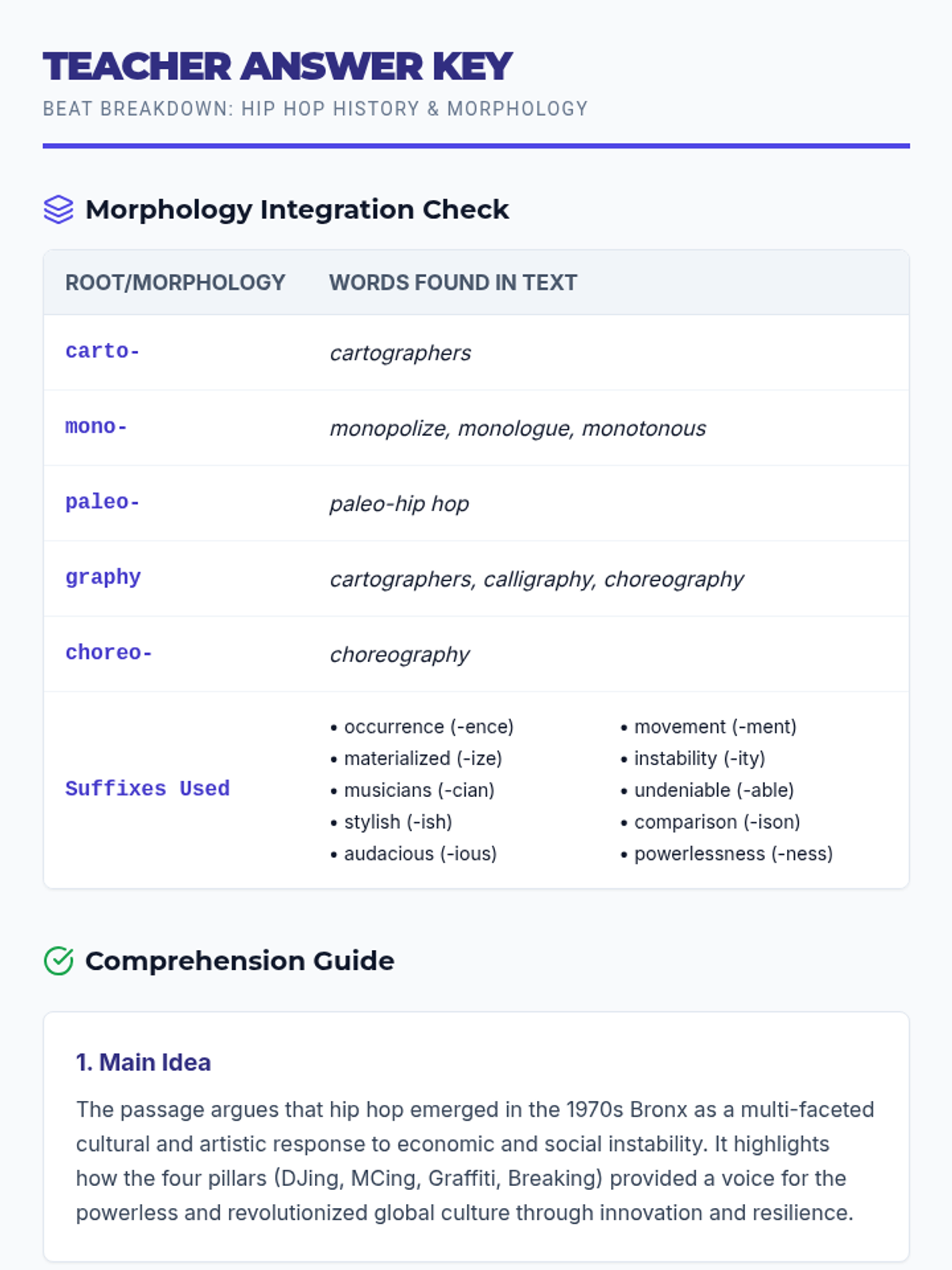
A teacher-facing answer key and morphology guide for the 'Beat Breakdown' reading passage. Includes a breakdown of integrated roots (carto, mono, paleo, etc.) and suggested answers for the comprehension questions.
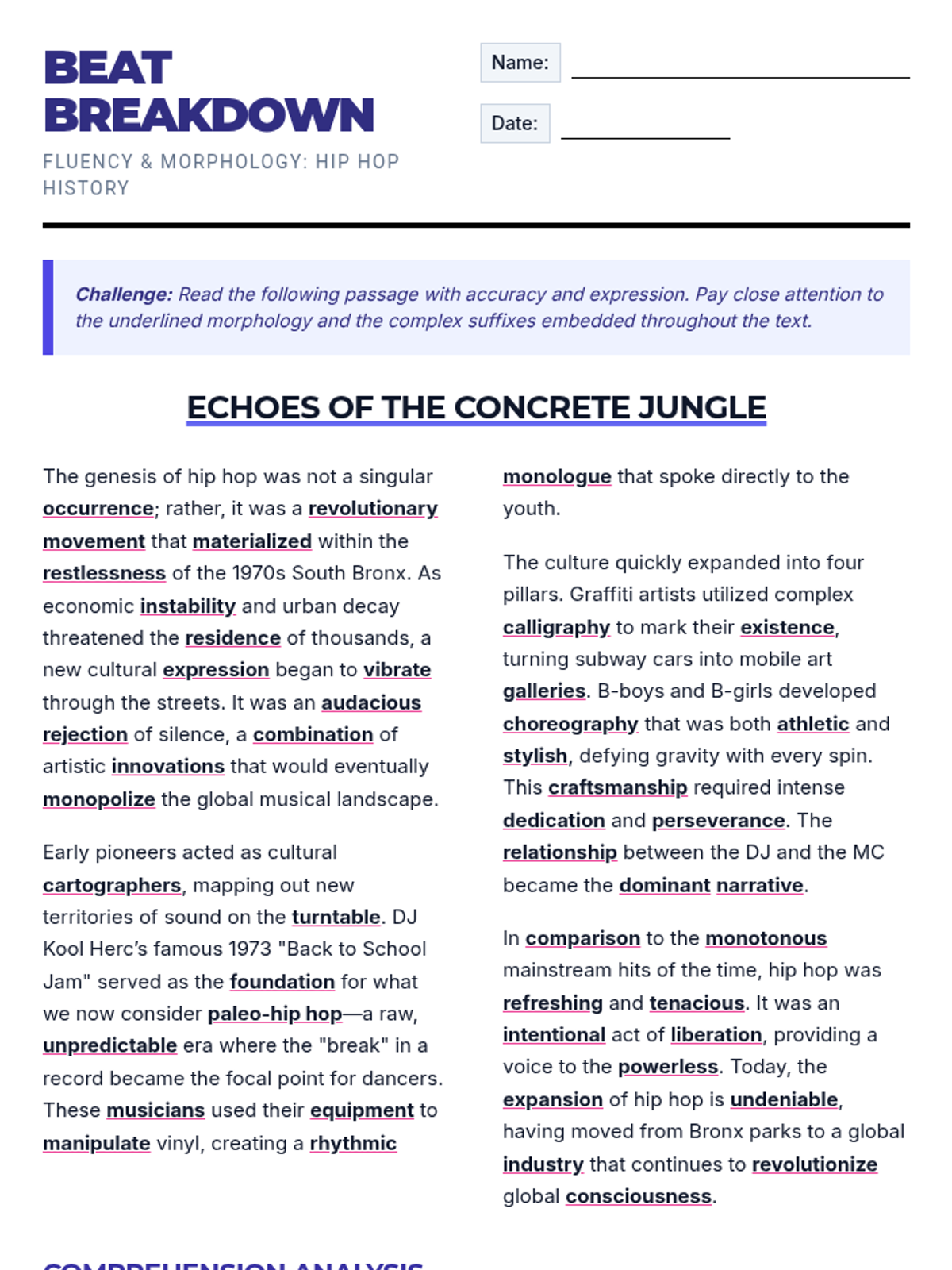
A high-school level fluency passage and comprehension worksheet about the history of Hip Hop, incorporating over 40 specific suffixes and Greek/Latin roots like carto, mono, paleo, graphy, and choreo. Includes a main idea prompt and three higher-order thinking questions.
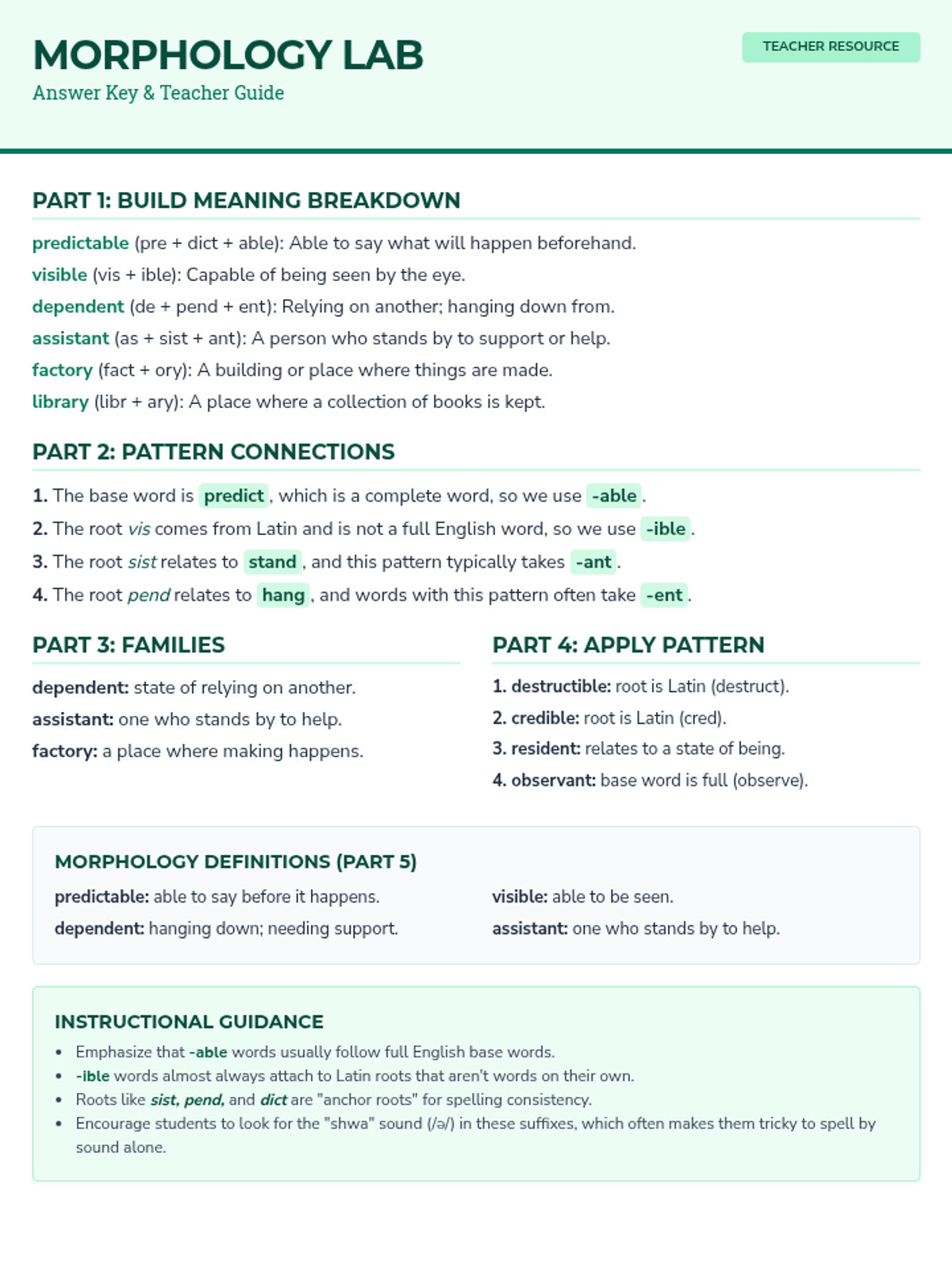
Answer key for the Morphology Lab worksheet. Revised to be a single-page teacher resource with full explanatory sentences and instructional tips.
Instructional slides for the Morphology Lab lesson, explaining suffix rules (-able/-ible, -ant/-ent, -ary/-ery/-ory) with visual examples and a quick challenge.
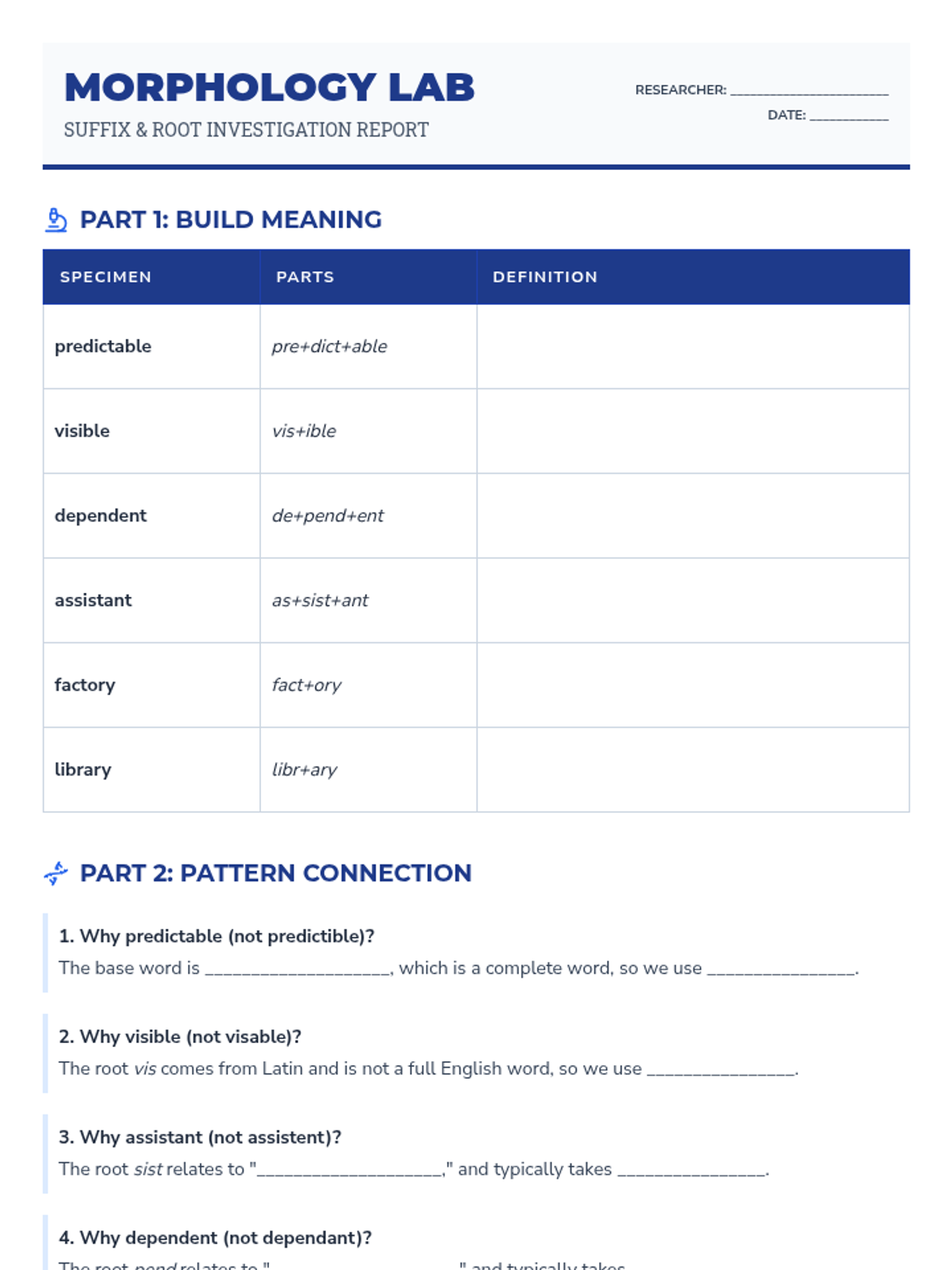
A comprehensive morphology worksheet focusing on Latin roots and suffix patterns (-able, -ible, -ant, -ent, etc.) with structured analysis sections. Revised for better page flow and work area legibility.
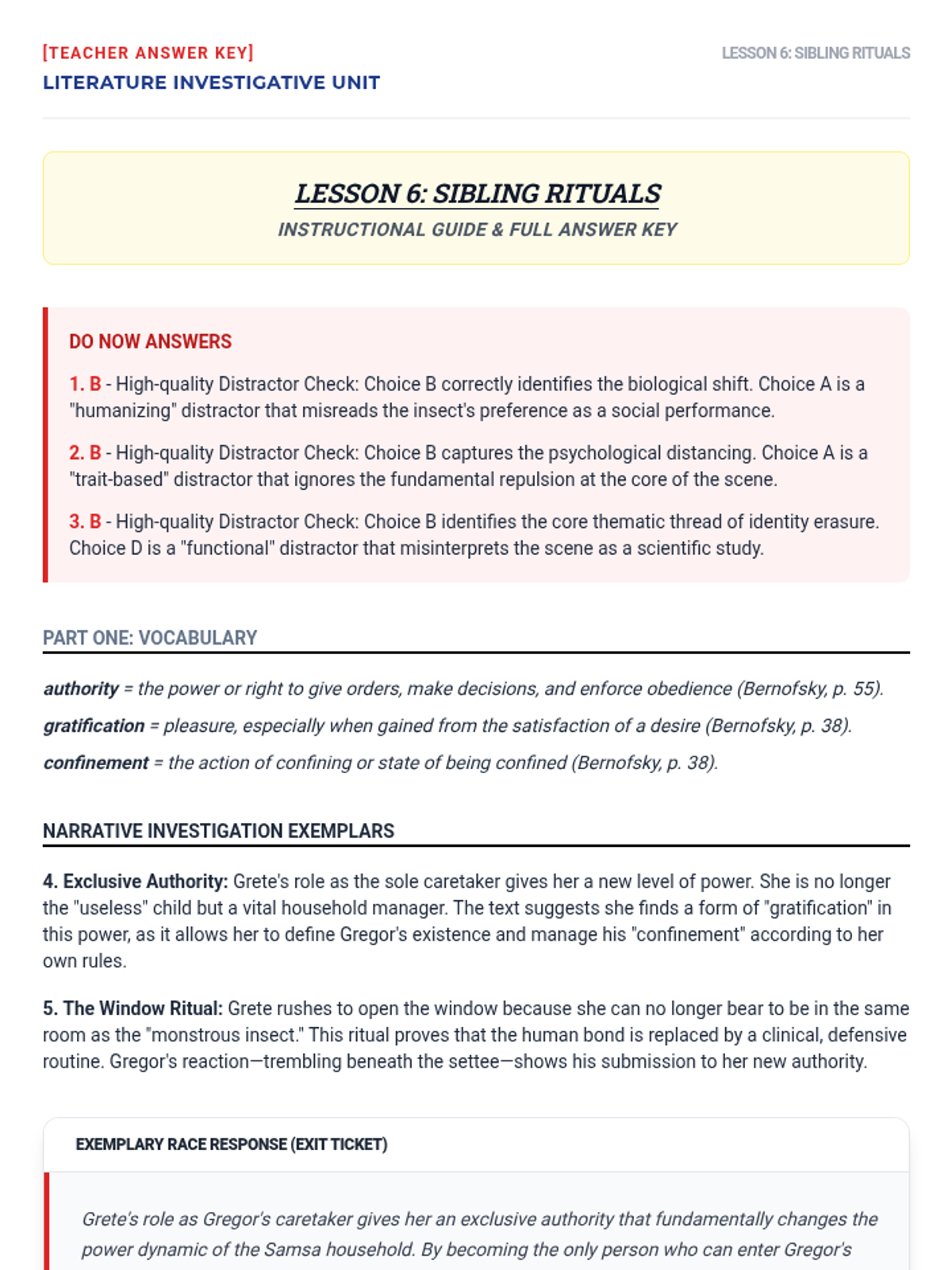
Updated teacher answer key for Lesson 6 with Bernofsky-aligned vocabulary (authority, gratification, confinement). Definitions and page references updated to match the Susan Bernofsky translation text. Aligned terminology for "monstrous insect."
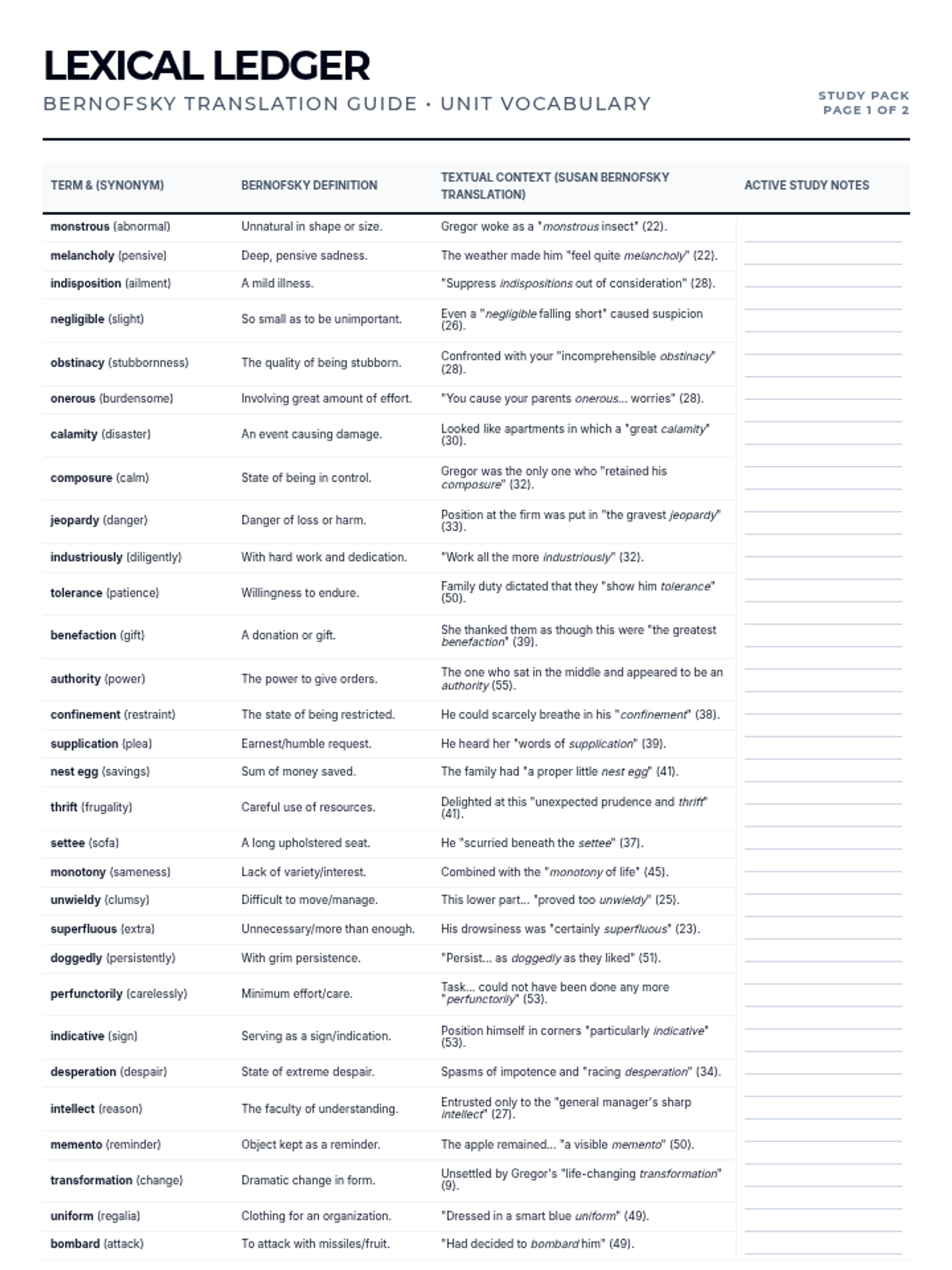
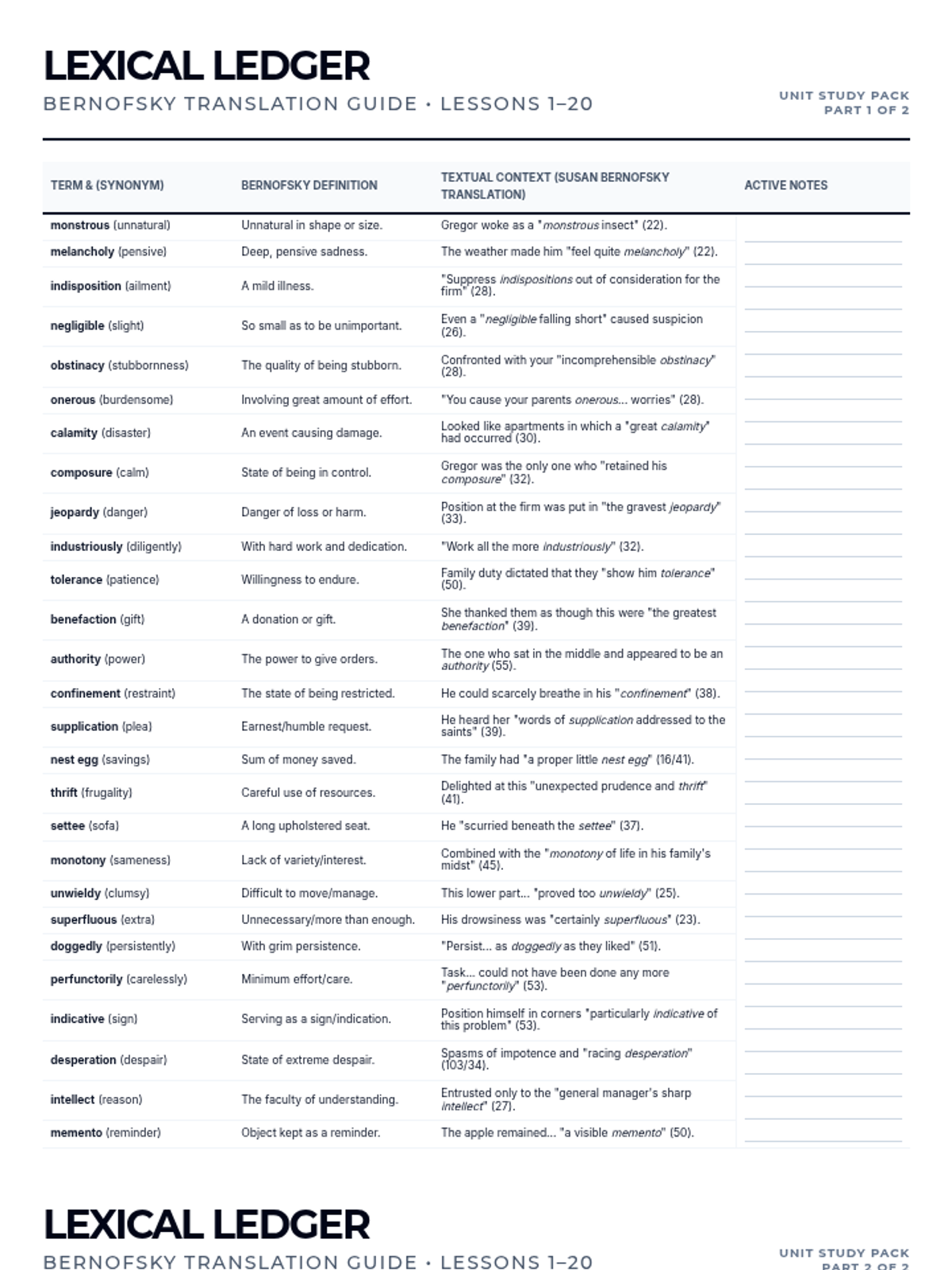
A comprehensive vocabulary study pack for the Bernofsky translation of The Metamorphosis. Includes a 54-word Lexical Ledger with definitions and samples drawn directly from the Susan Bernofsky text, spanning all three parts of the novella. Definitions and page references are strictly aligned with the Norton Critical Edition.
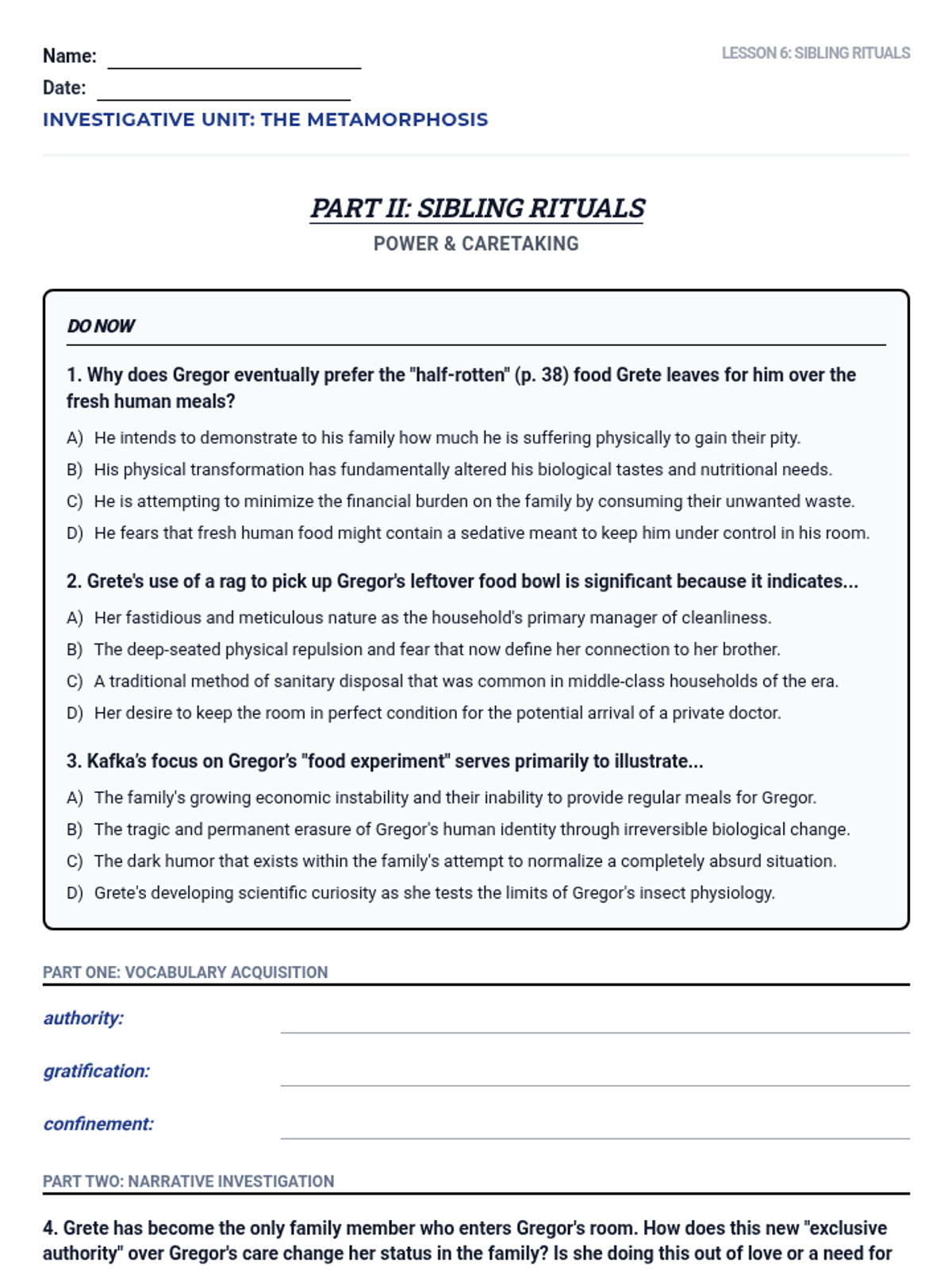
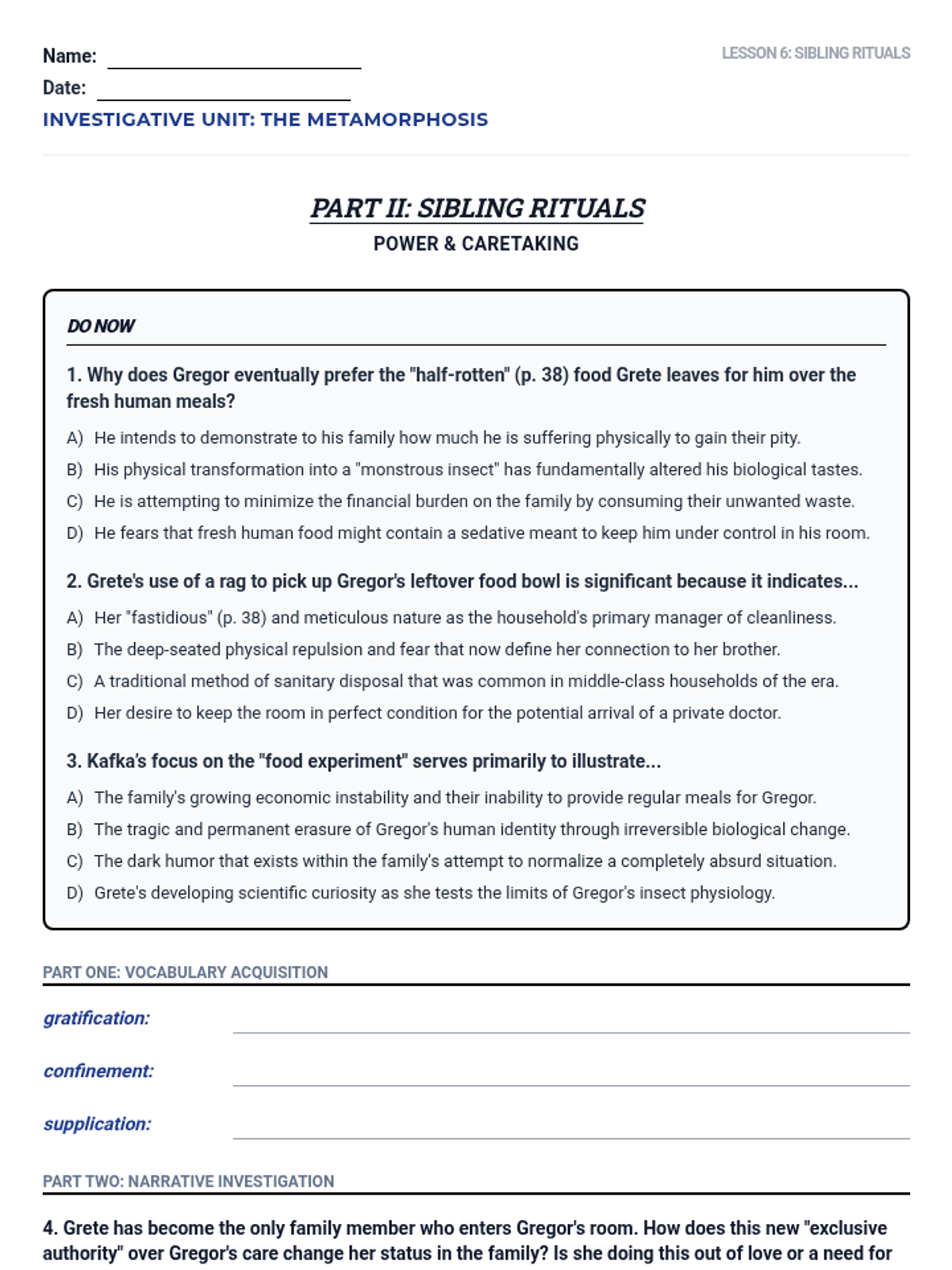
Updated student worksheet for Lesson 6 with Bernofsky-aligned vocabulary (gratification, confinement, supplication). Terminology updated to match the Susan Bernofsky translation ("monstrous insect"). Fixed terminology in Part 2.
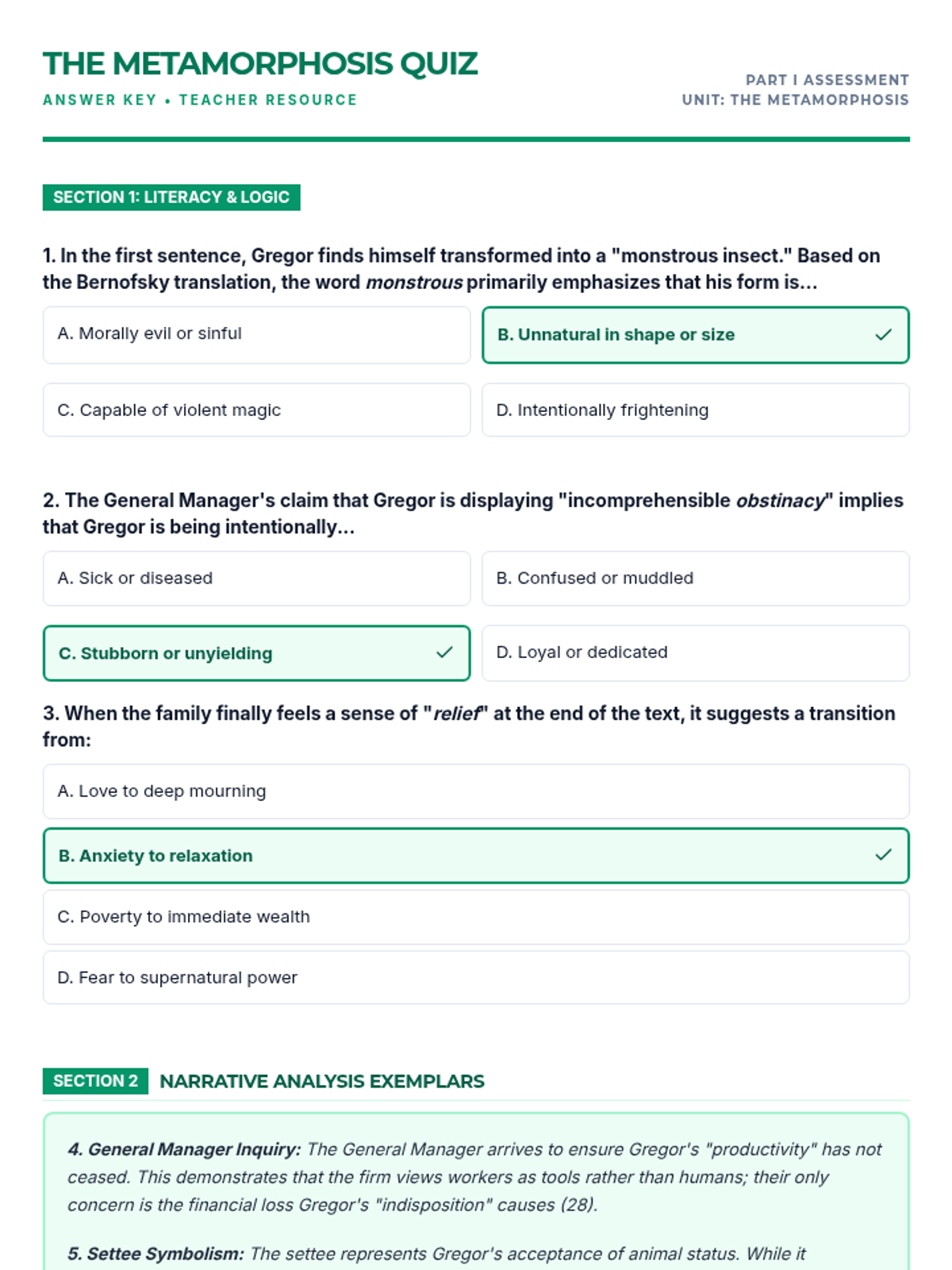
A comprehensive teacher answer key for the Bernofsky-aligned summative quiz. Provides correct multiple-choice answers with analytical justifications and a full-score RACE exemplar using HIRED vocabulary and text evidence. Optimized for teacher reference during grading.
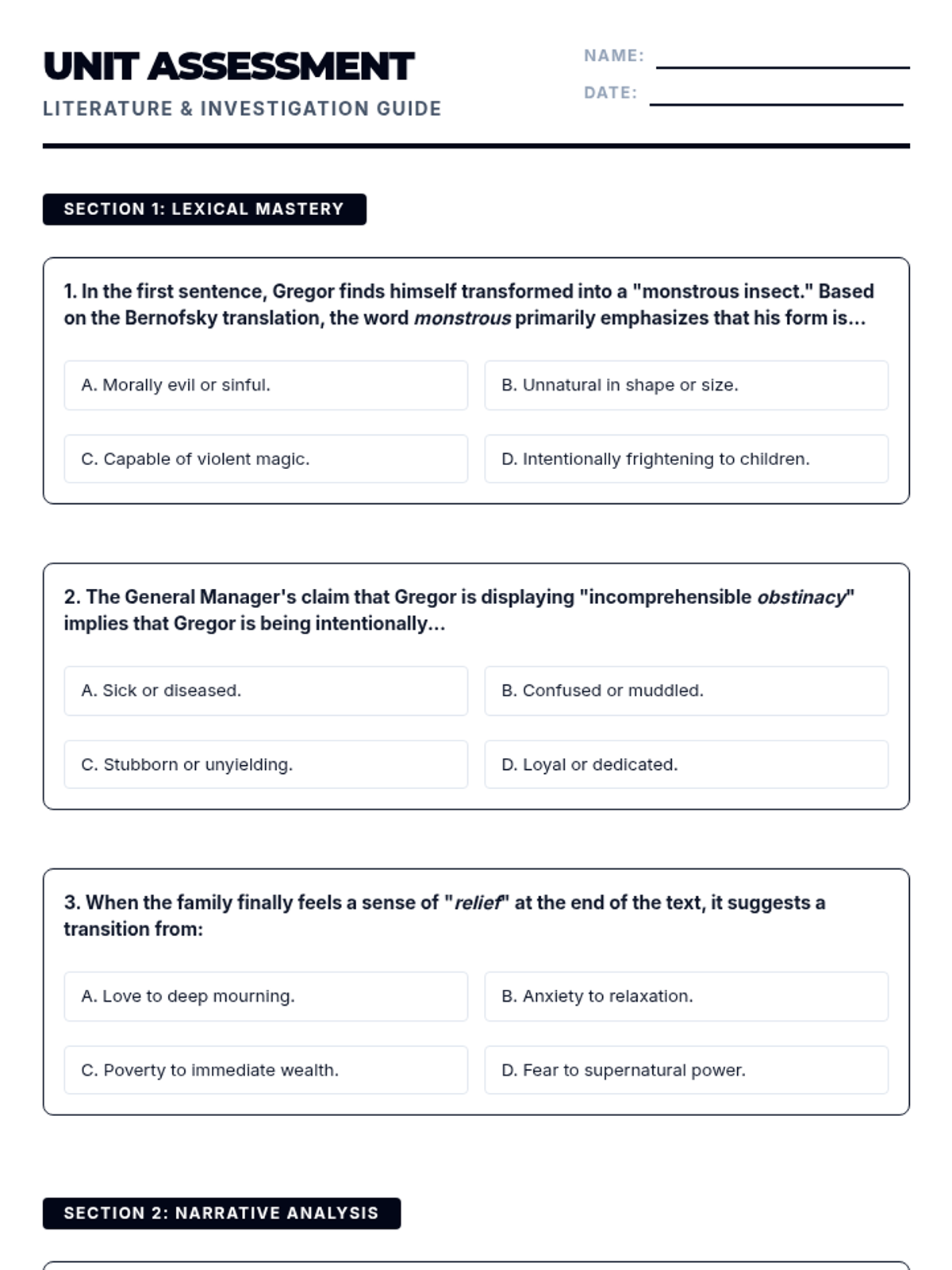
A summative student assessment for The Metamorphosis, strictly aligned with the Susan Bernofsky translation. Features vocabulary in context using target unit terms (monstrous, indisposition, calamity, etc.), analytical questions on the "General Manager" and narrative perspective, and a RACE response based on Gregor's final peaceful reflection. Optimized for print.
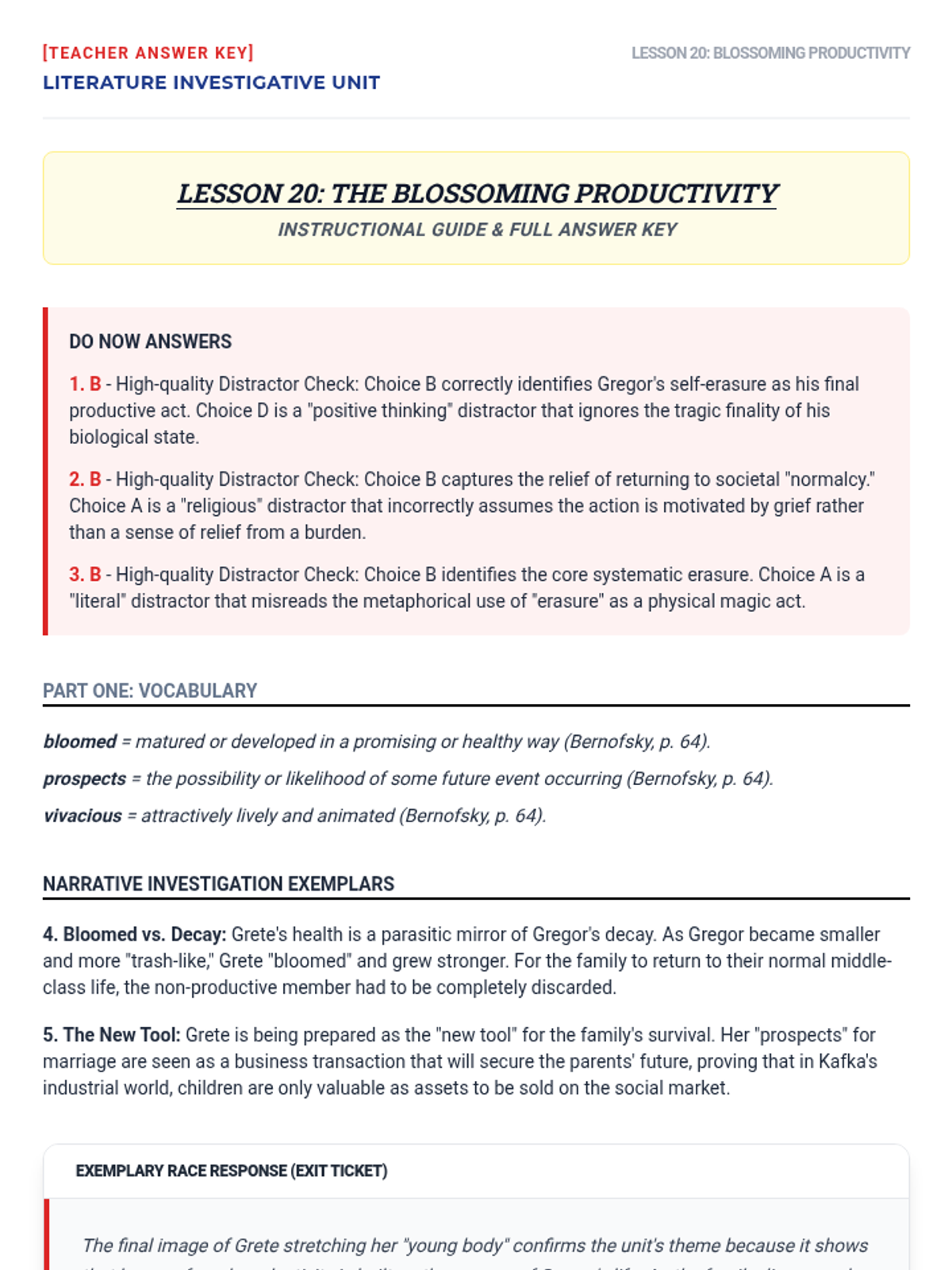
Updated teacher answer key for Lesson 20 with Bernofsky-aligned vocabulary (bloomed, prospects, vivacious). Definitions and page references updated to match the Susan Bernofsky translation text. Aligned terminology for "monstrous insect."
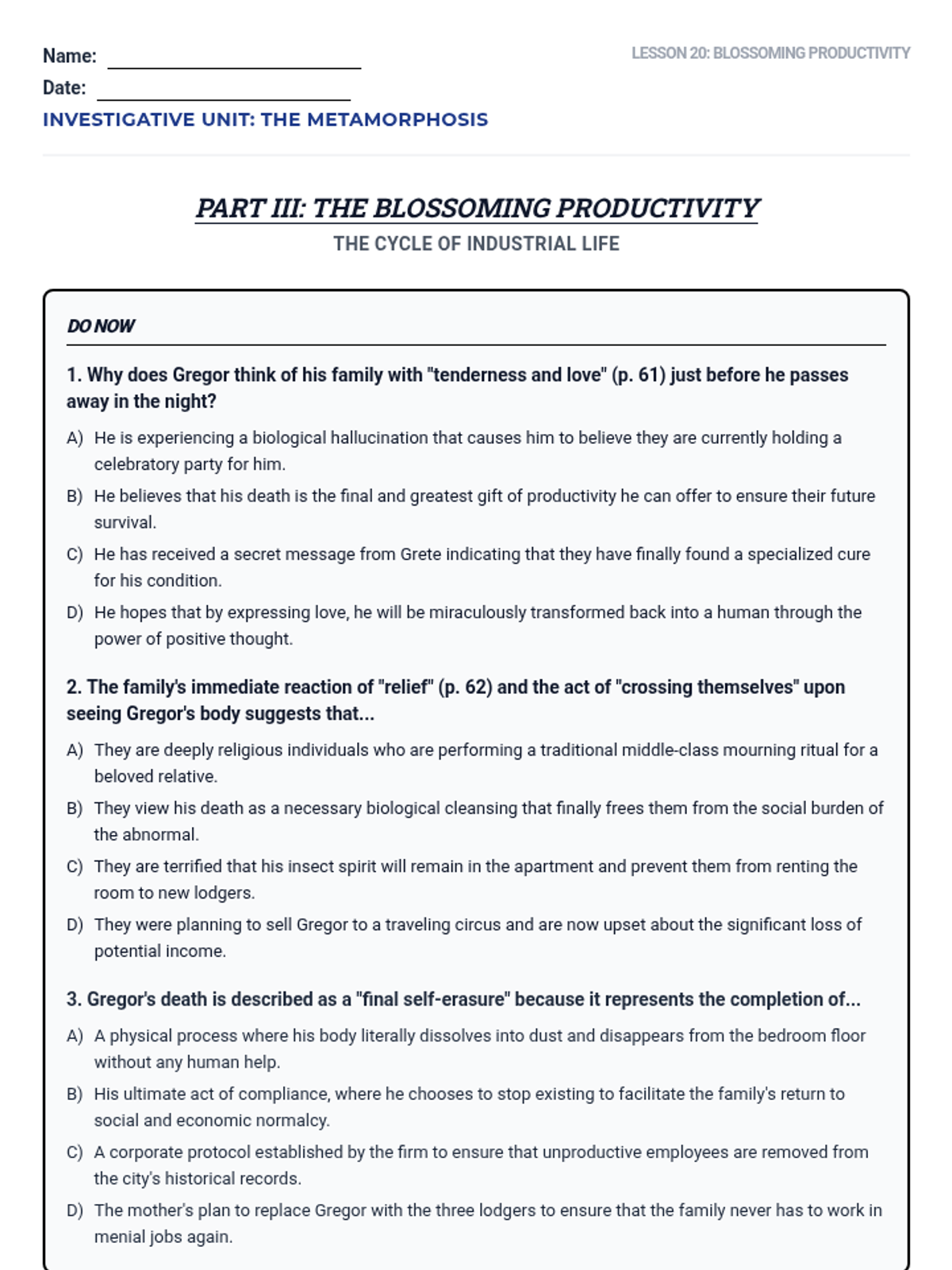
Updated student worksheet for Lesson 20 with Bernofsky-aligned vocabulary (bloomed, prospects, vivacious). Definitions and page references updated to match the Susan Bernofsky translation text. Aligned terminology for "monstrous insect."
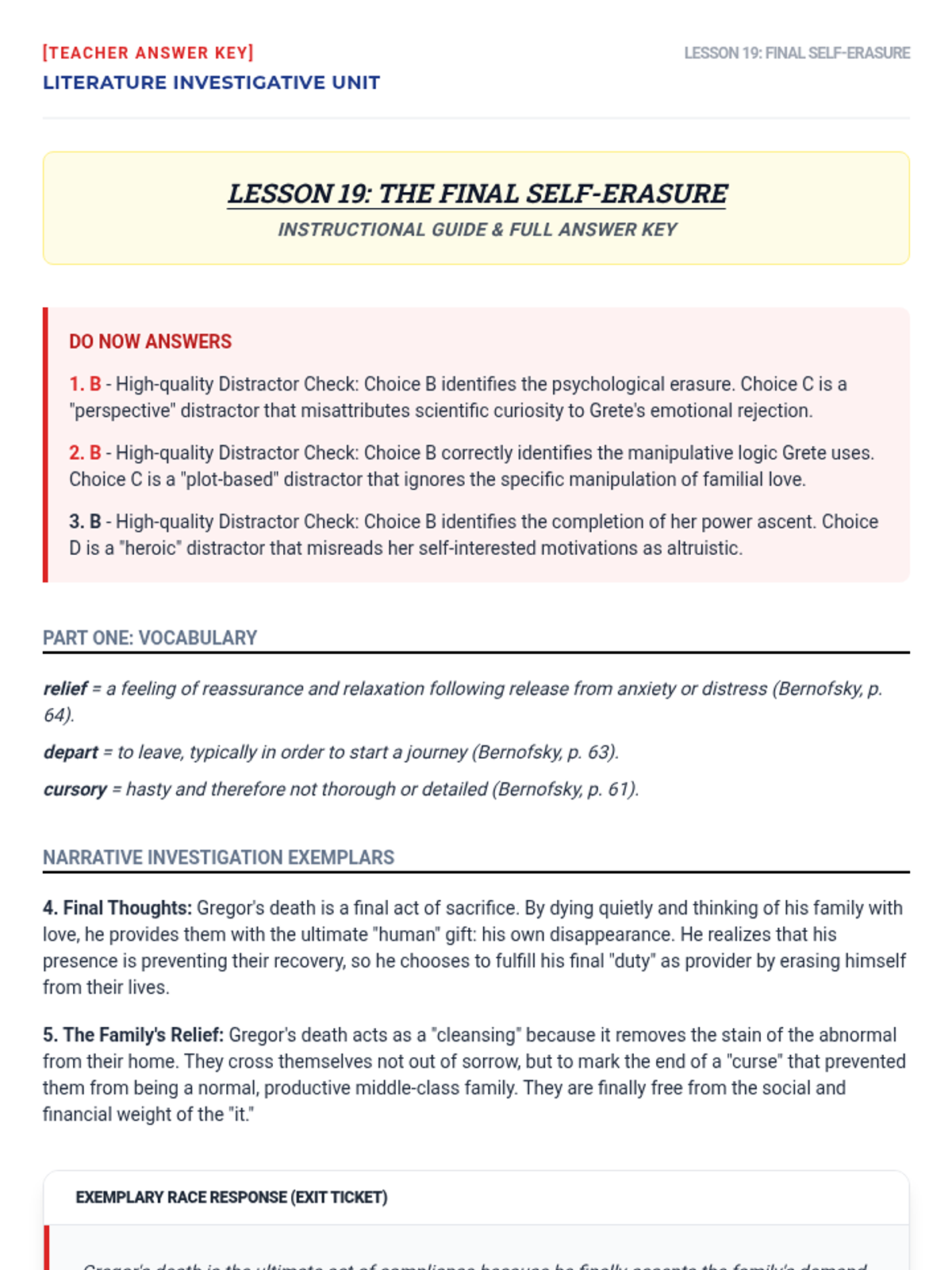
Updated teacher answer key for Lesson 19 with Bernofsky-aligned vocabulary (relief, depart, cursory). Definitions and page references updated to match the Susan Bernofsky translation text. Aligned terminology for "monstrous insect."
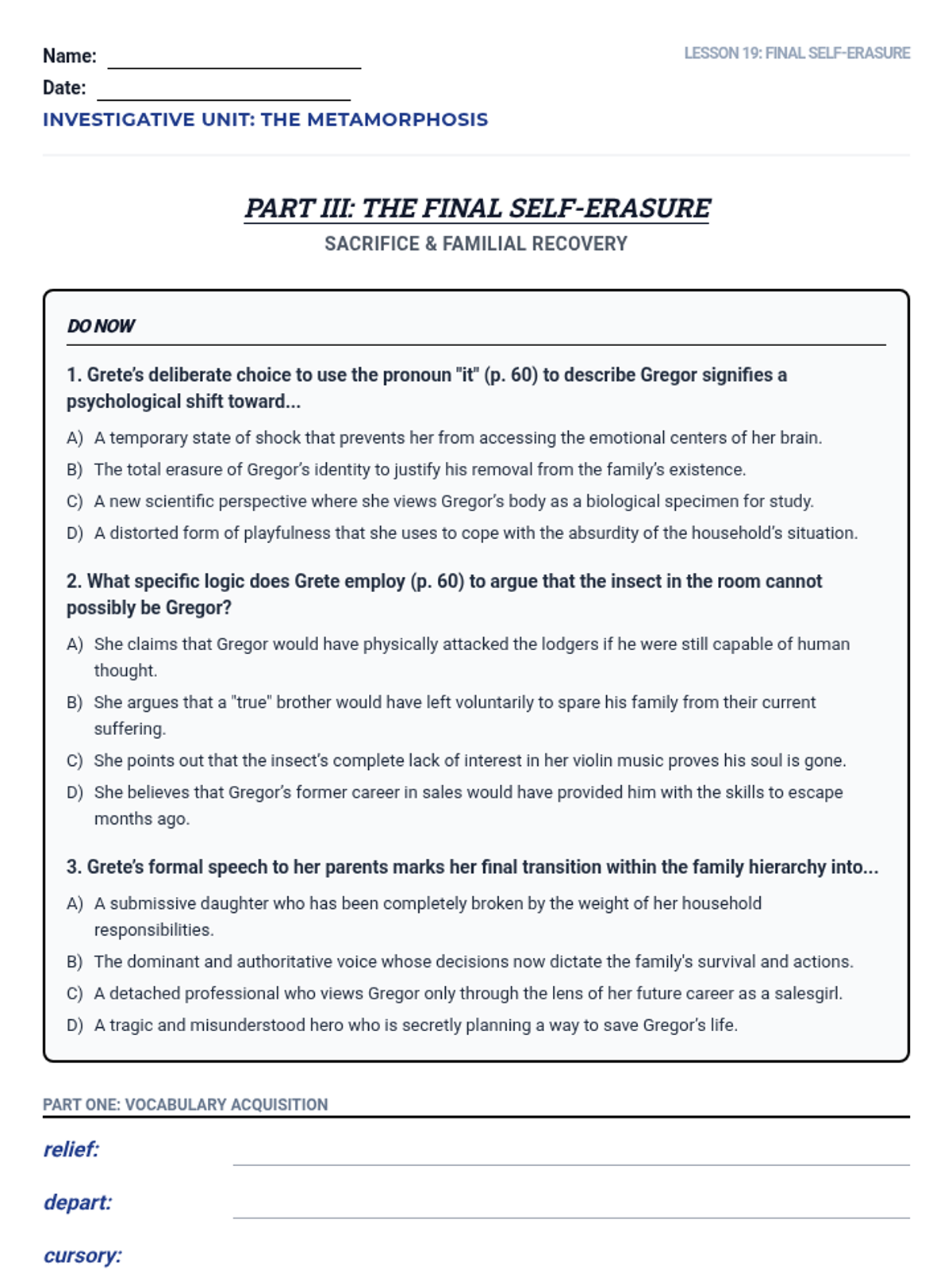
Updated student worksheet for Lesson 19 with Bernofsky-aligned vocabulary (relief, depart, cursory). Definitions and page references updated to match the Susan Bernofsky translation text. Aligned terminology for "monstrous insect."
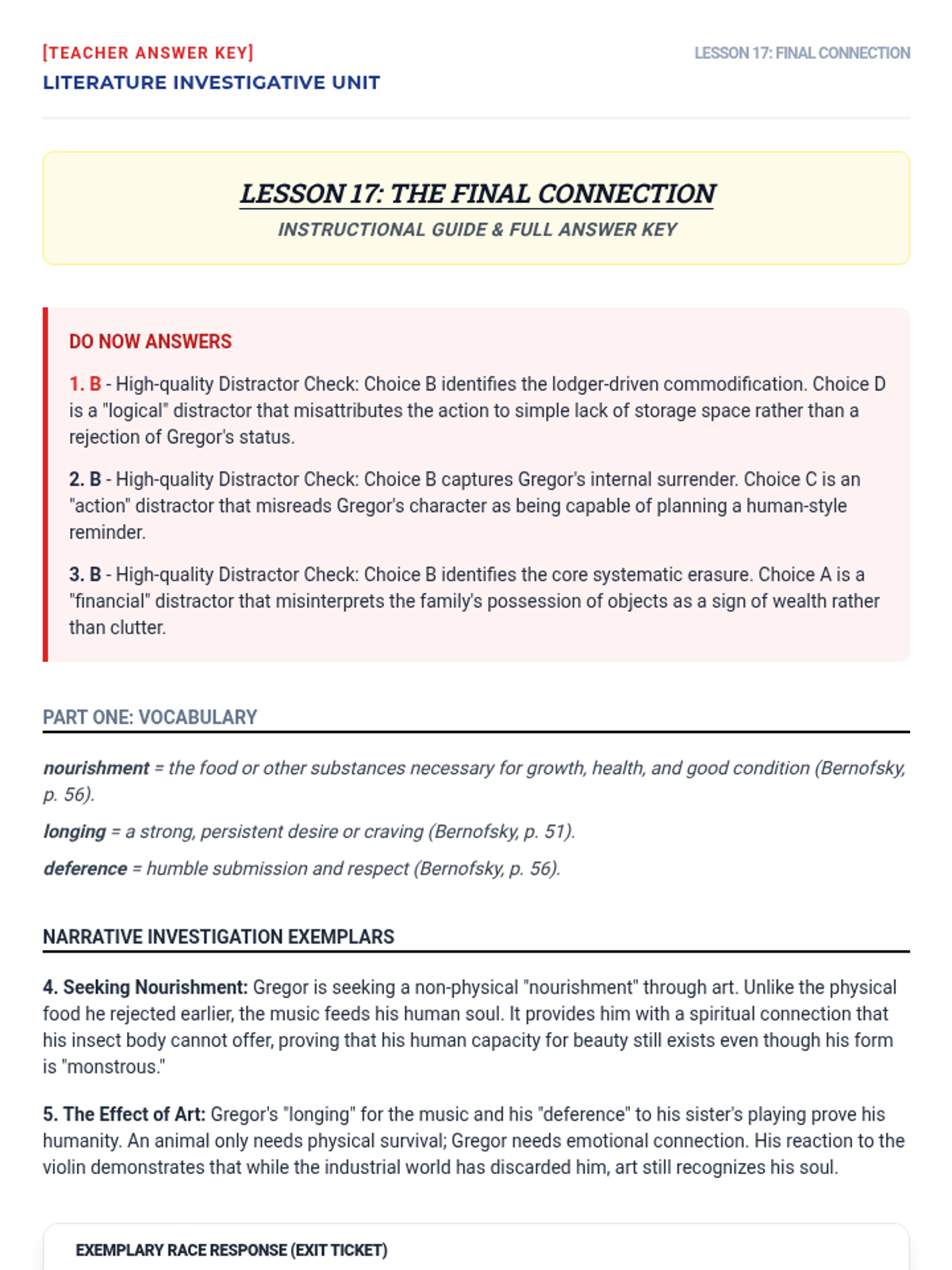
Updated teacher answer key for Lesson 17 with Bernofsky-aligned vocabulary (nourishment, longing, deference). Definitions and page references updated to match the Susan Bernofsky translation text. Aligned terminology for "monstrous insect."
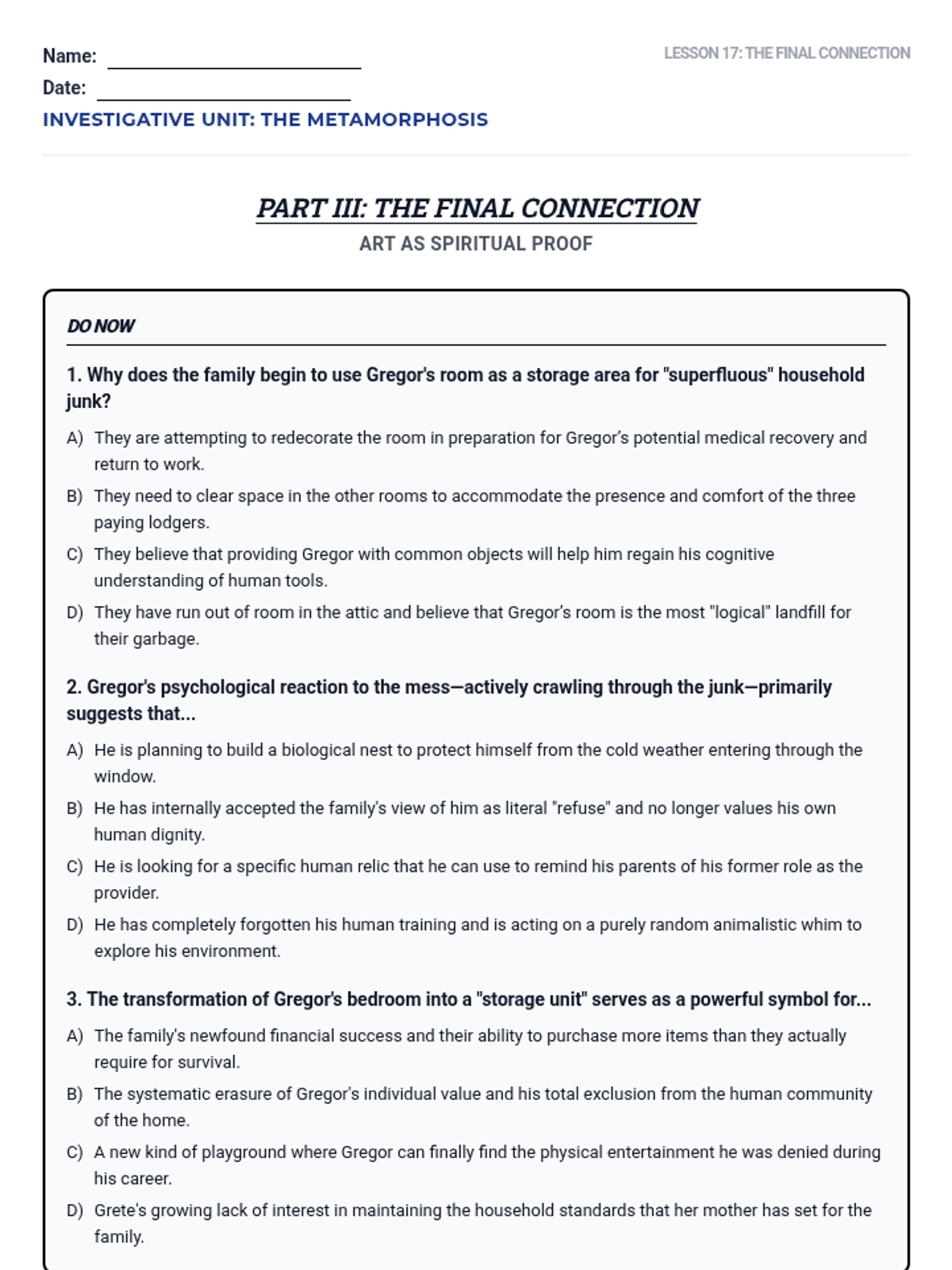
Updated student worksheet for Lesson 17 with Bernofsky-aligned vocabulary (nourishment, longing, deference). Definitions and context markers come directly from the Susan Bernofsky translation text. Aligned terminology for "monstrous insect."
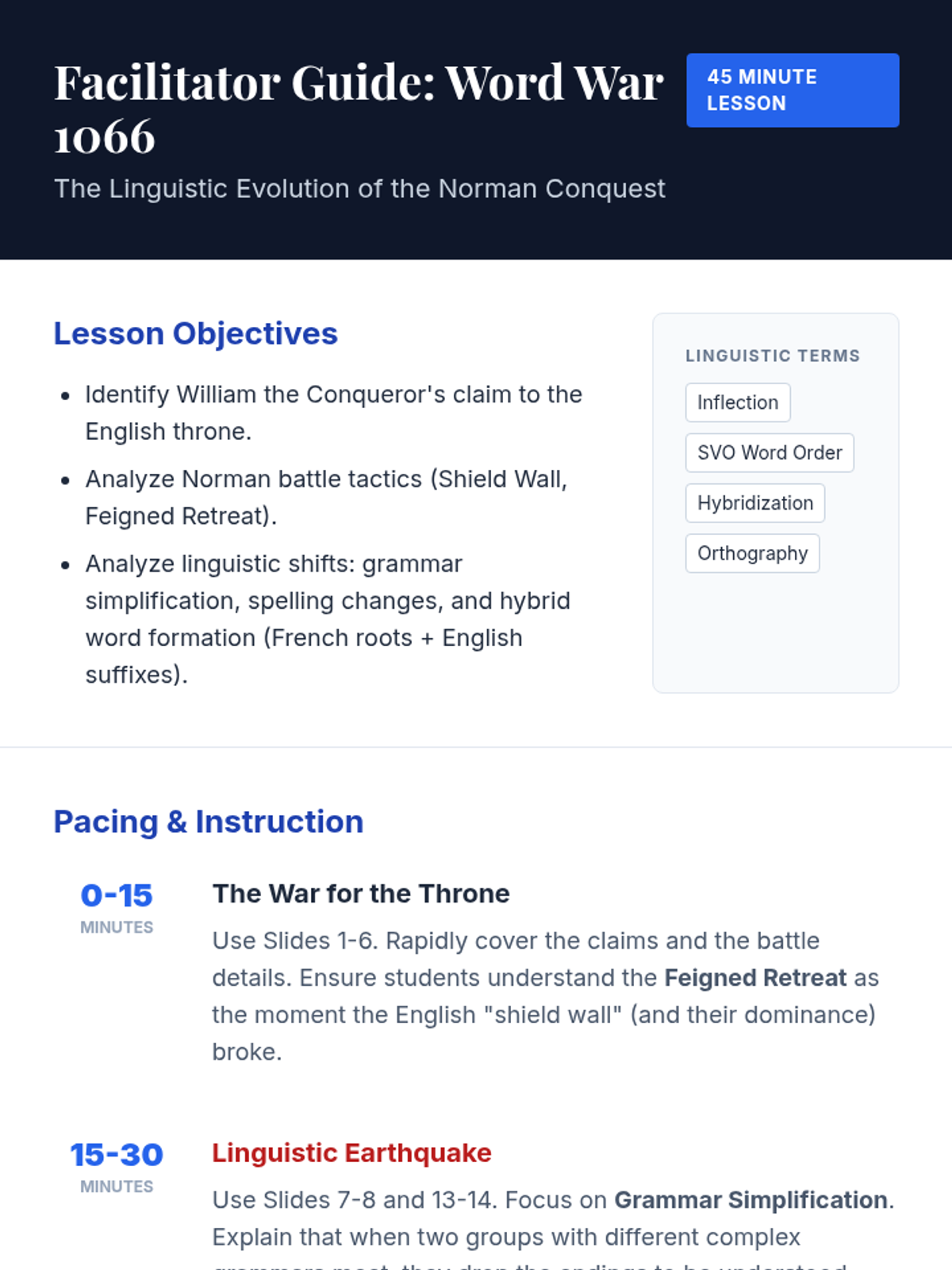
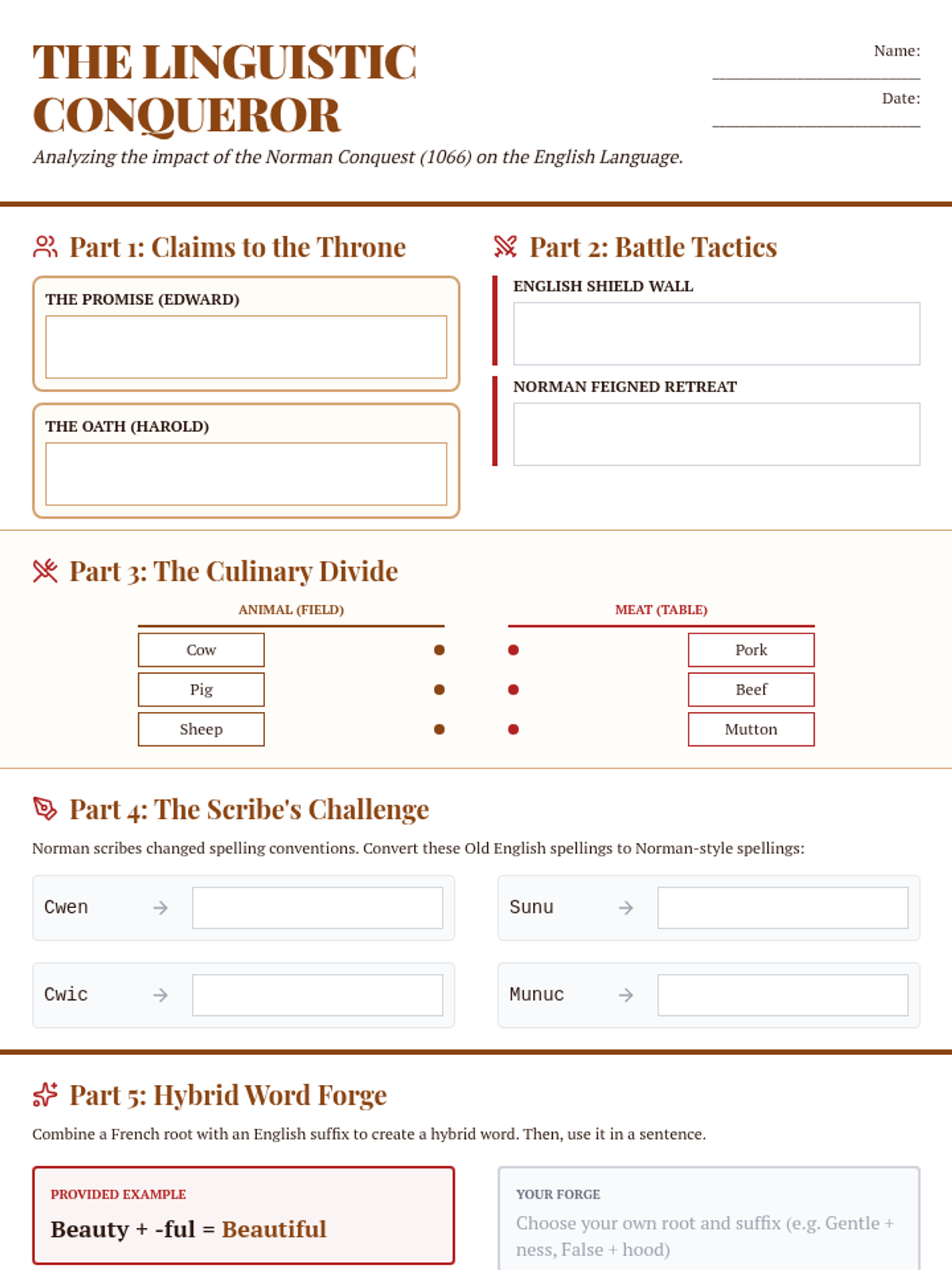
An expanded teacher guide with detailed instructional notes on linguistic evolution, grammar simplification, scribal changes, and hybrid word formation.
An expanded student worksheet featuring significant new linguistic activities on phonetic shifts, scribal spelling changes, hybrid word building, and grammar simplification.
An expanded 18-slide presentation detailing the Battle of Hastings tactics and adding extensive linguistic sections including a new "Sound of the Conqueror" slide with phonetic examples of vowel shifts and consonant changes.
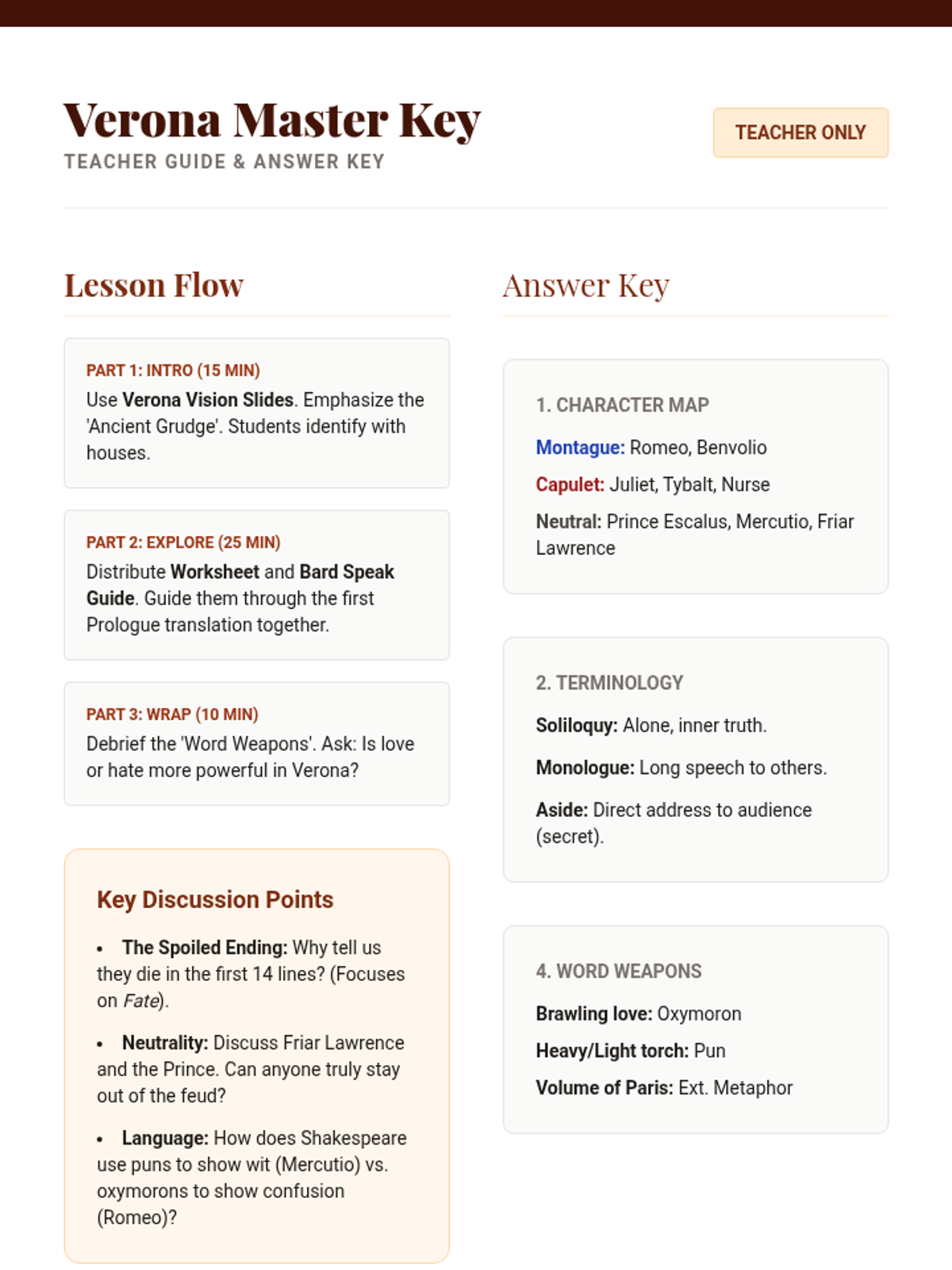
A teacher resource containing the answer key for the Star-Crossed Script Worksheet, lesson delivery tips, and discussion prompts.
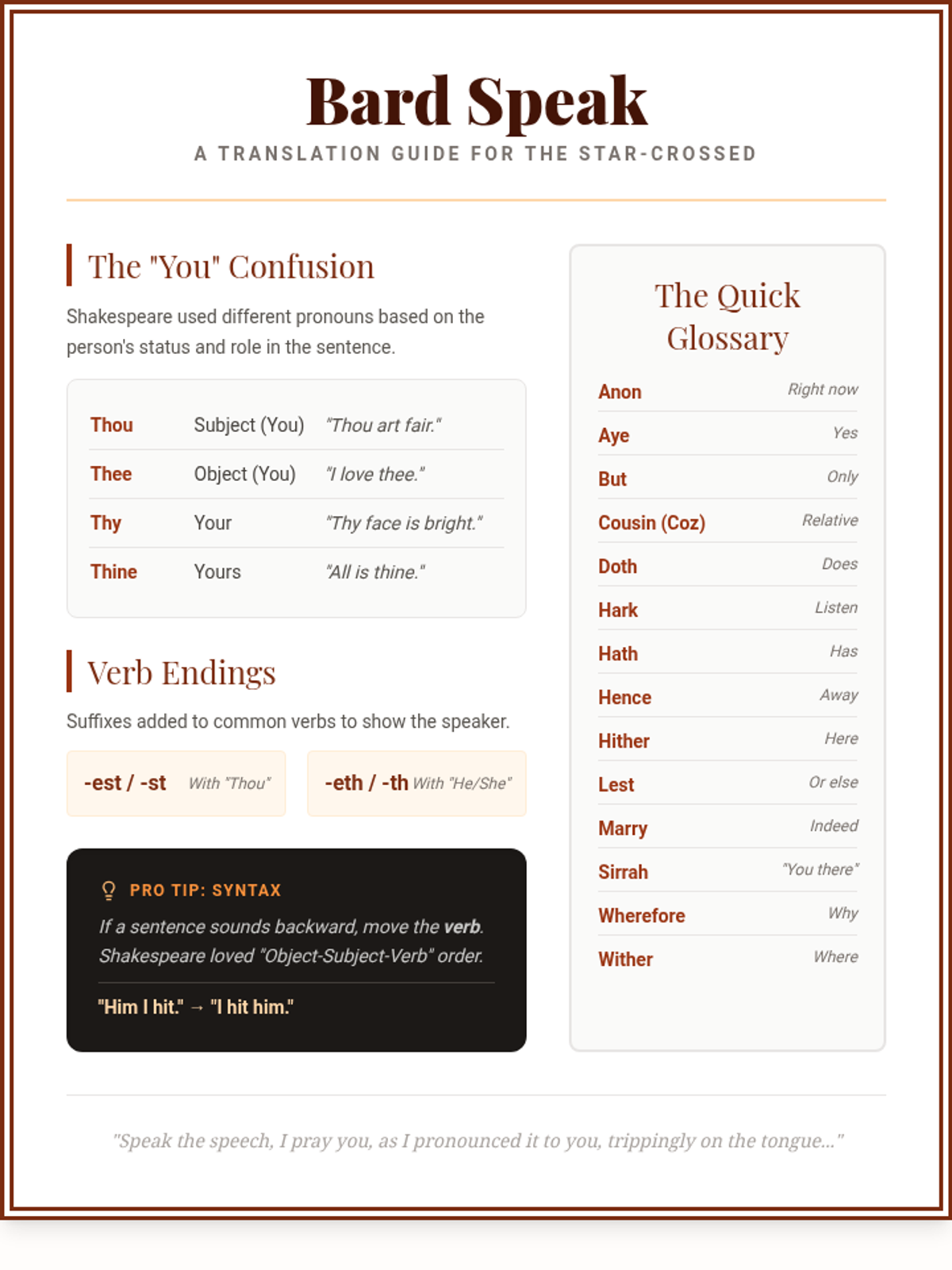
A handy glossary and grammar guide to help students navigate Shakespearean English, focusing on personal pronouns, verb endings, and common vocabulary.
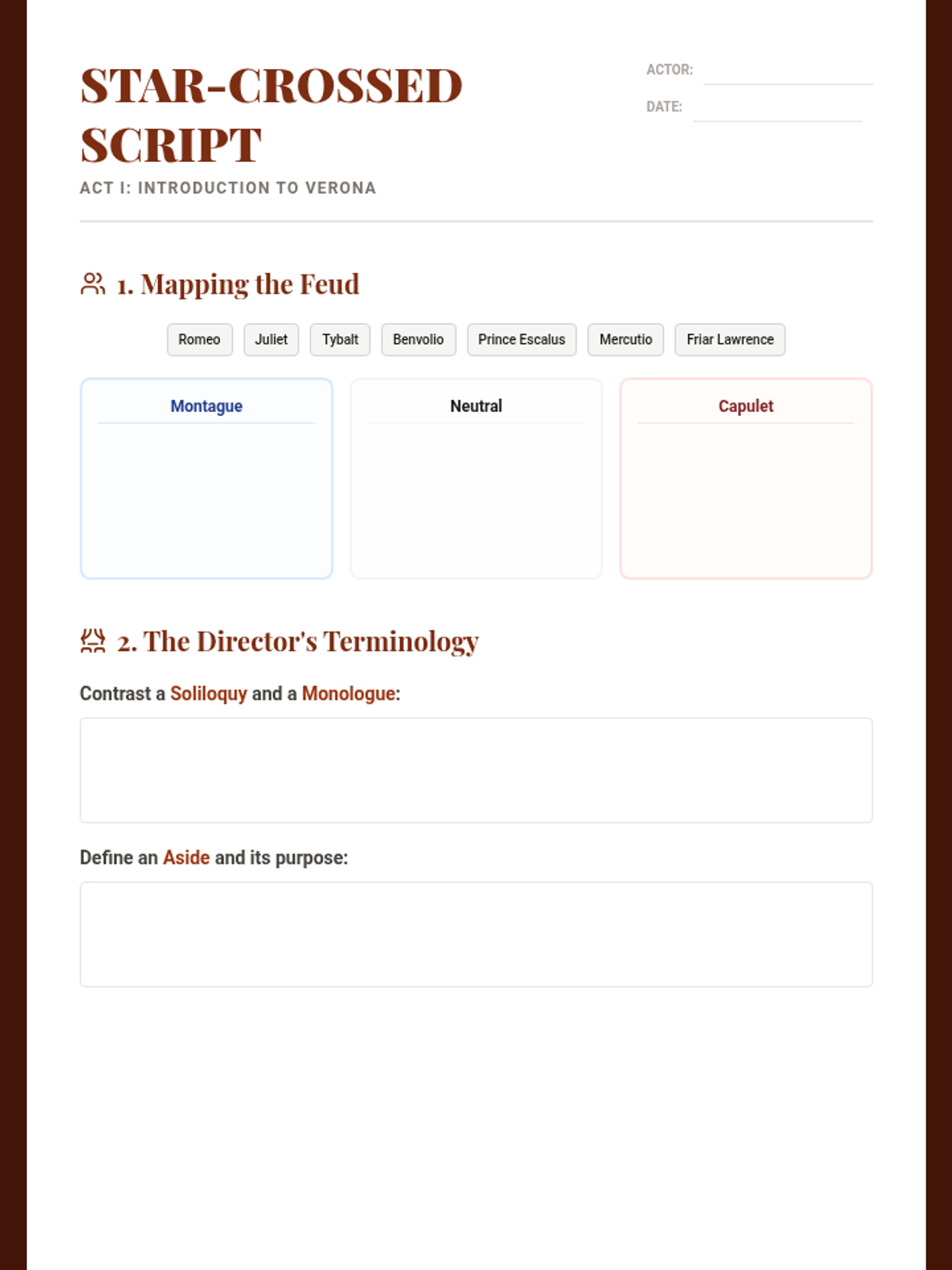
A two-page student activity sheet for mapping characters, defining stage devices, practicing translation of the Prologue, and identifying figurative language.
A visual presentation introducing the world of Verona, key characters, central themes, and the literary tools Shakespeare used to craft the tragedy.
The finalized, all-in-one Cosmic Carnival slide deck. Includes definitions, carnival examples, practice tasks with global language integrated, official WNHS logo branding, "By: Mr. Hamed" signature, the YouTube song, and functional QR scavenger hunt backup slides.
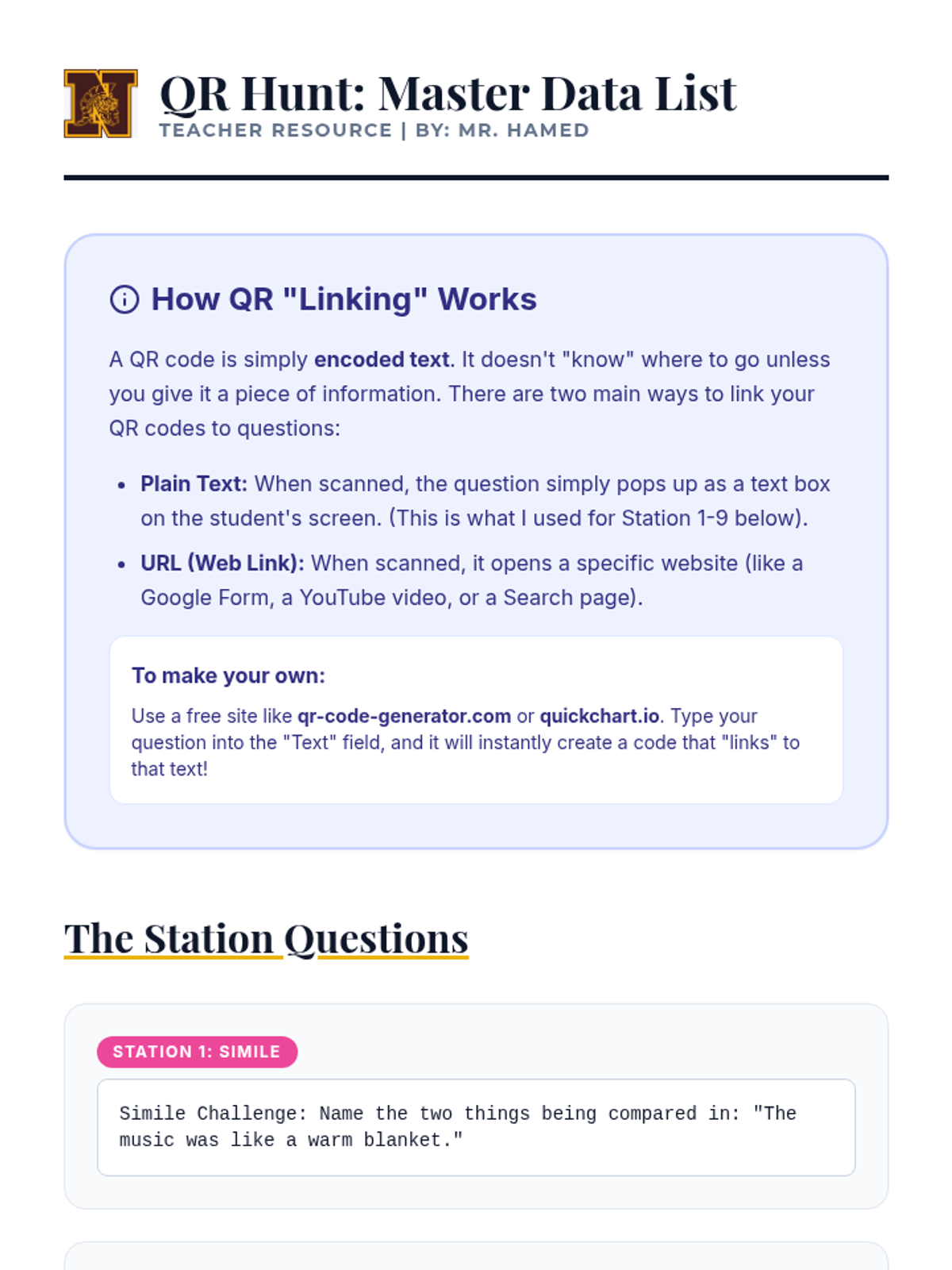
A teacher resource containing the raw text data used for all nine QR stations, along with a guide on how QR codes link to questions and how teachers can create their own custom codes.
The finalized Cosmic Carnival slide deck. Includes definitions and practice for all 9 devices, branded footer with the WNHS logo and "By: Mr. Hamed" on every slide, and an embedded YouTube video of the "Figurative Language Song" before the conclusion. Now includes a backup QR code slide for the scavenger hunt.
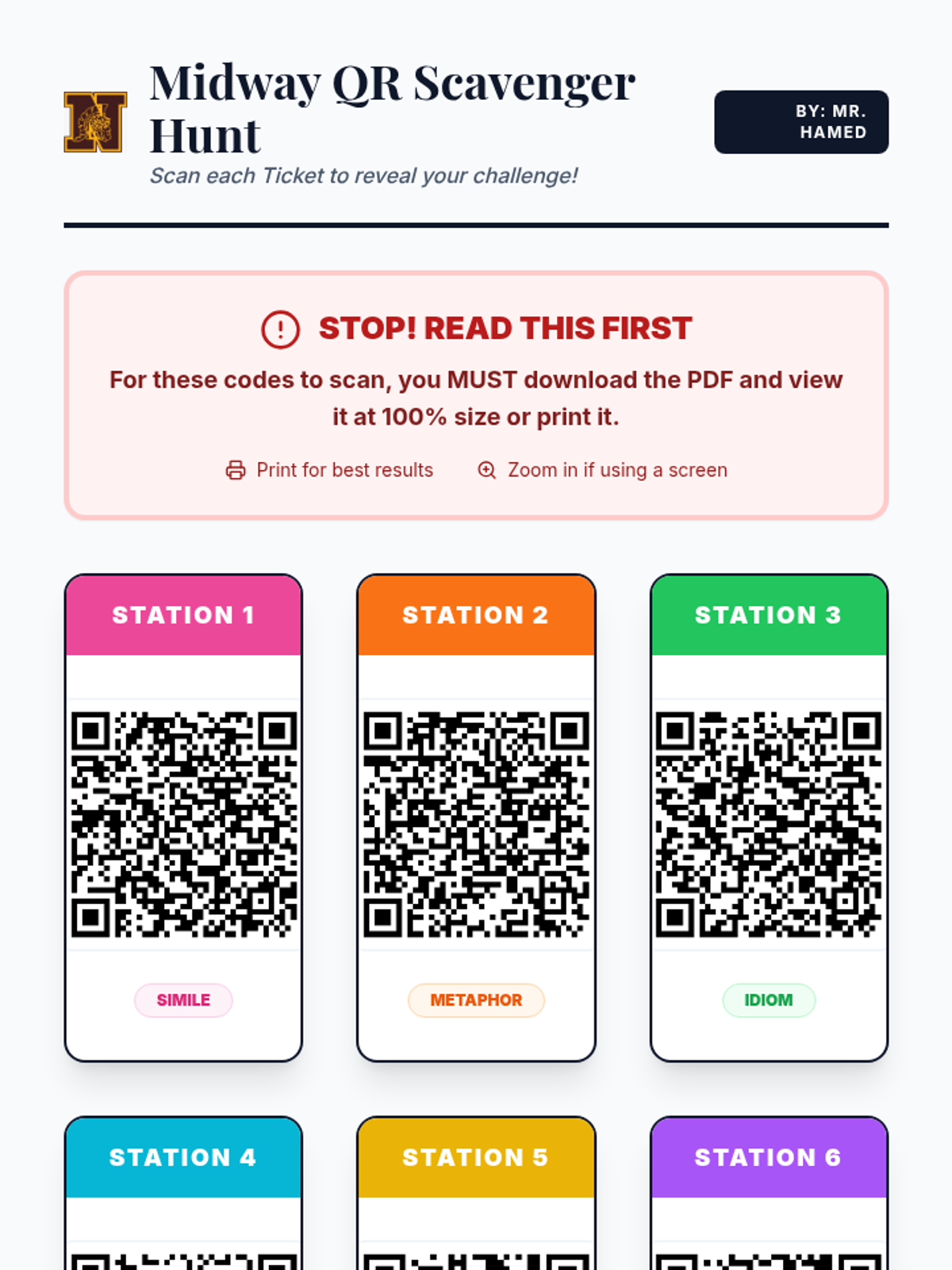
A high-resolution, functional QR code scavenger hunt. Each station features a large, scan-optimized QR code that links to a Google Search for the specific figurative language challenge, ensuring maximum compatibility with all mobile devices and scanner apps. Includes school branding and teacher key.
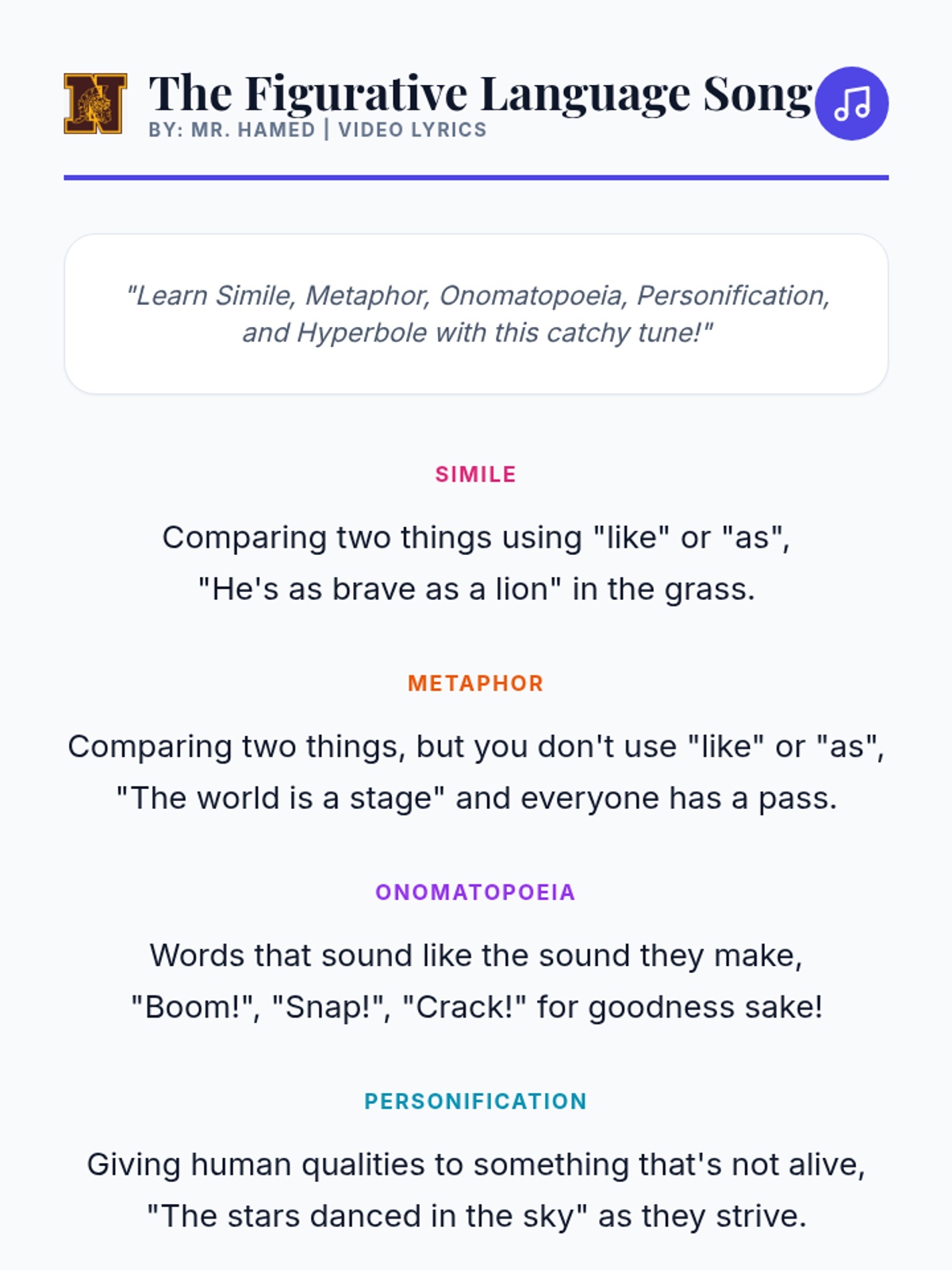
A lyric sheet for the "Figurative Language Song" YouTube video. Covers Simile, Metaphor, Onomatopoeia, Personification, and Hyperbole with examples from the song. Branded for WNHS and Mr. Hamed.
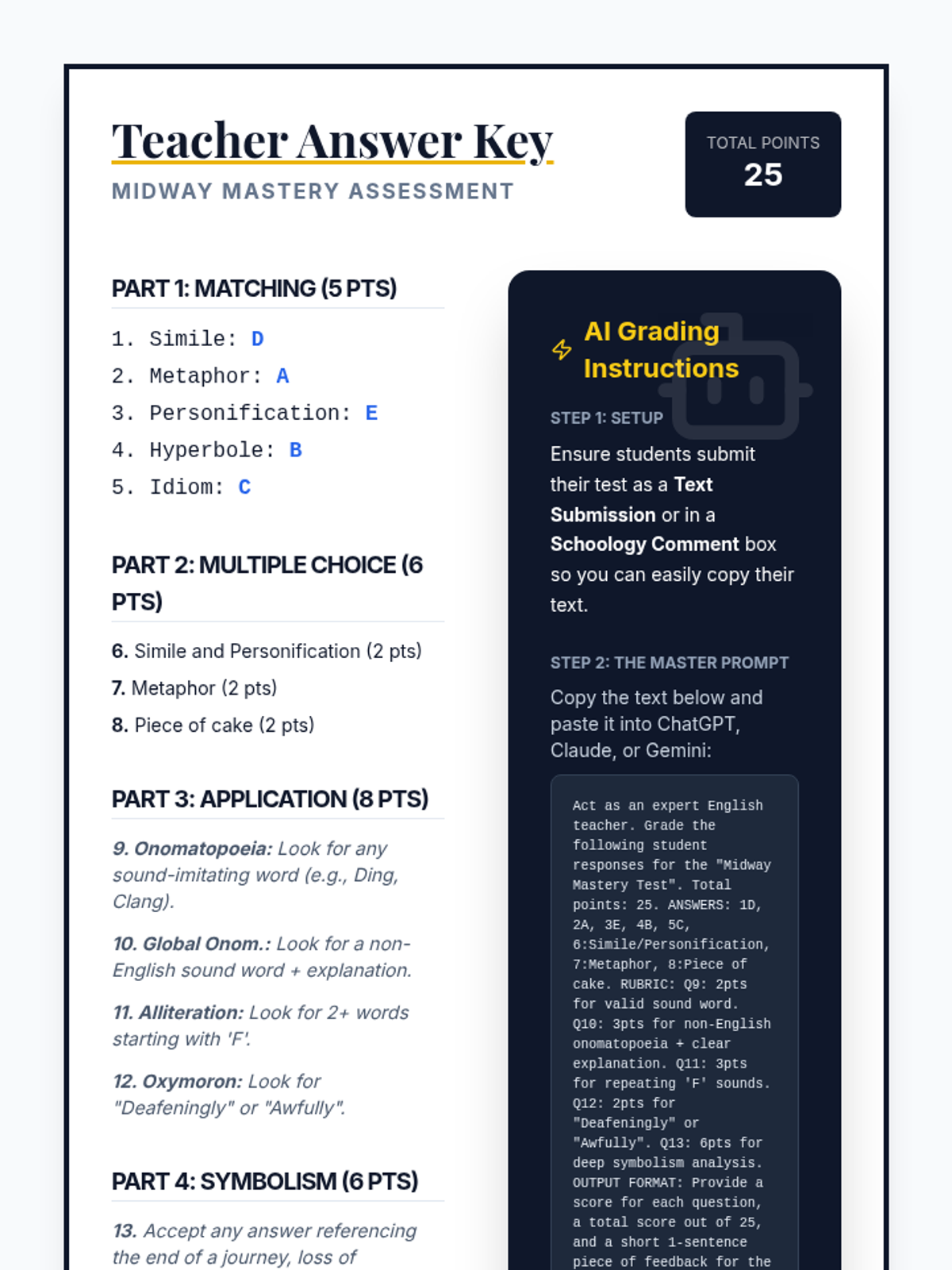
An enhanced teacher-facing answer key and AI grading guide for the Midway Mastery Assessment. Includes a structured master prompt for teachers to copy into AI tools for rapid grading of student responses.
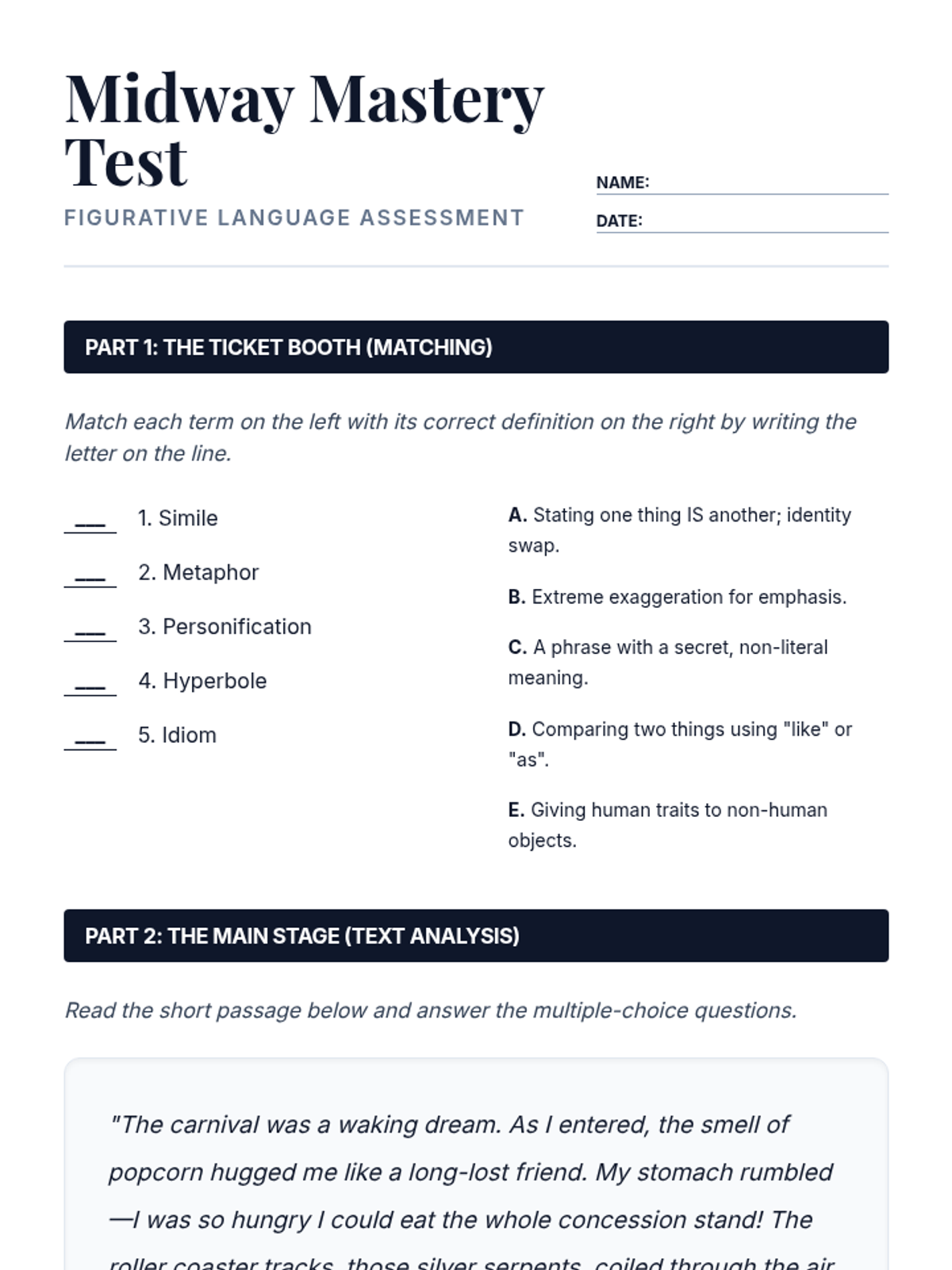
A comprehensive figurative language mastery test featuring matching, multiple-choice text analysis, fill-in-the-blank application, and a symbolism short-response question. Includes a new cross-cultural onomatopoeia task.
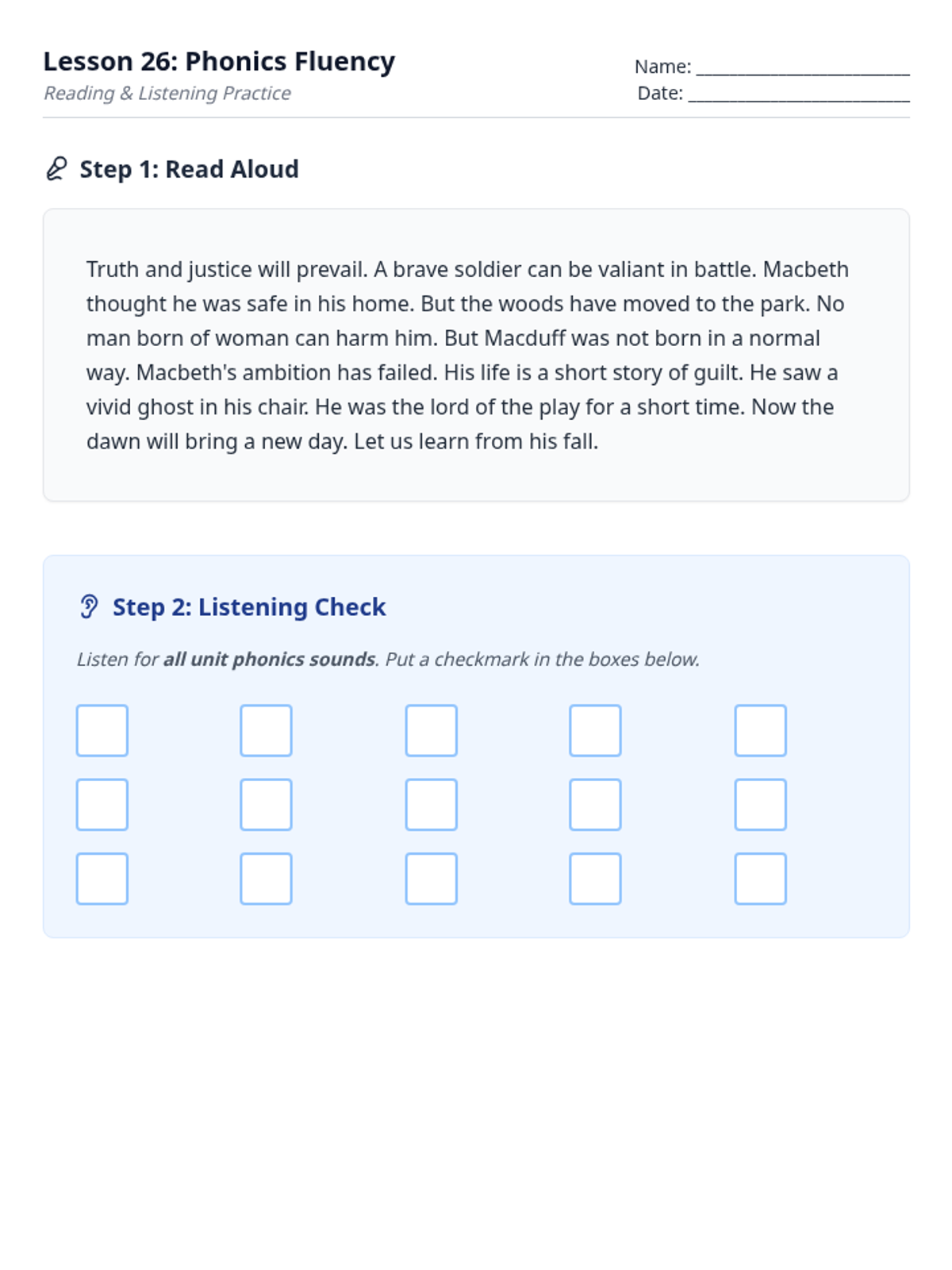
Fluency handout for Lesson 26. Contains a cumulative passage summarizing the unit's themes and integrating all taught vowel phonics. Students practice oral reading and auditory identification.
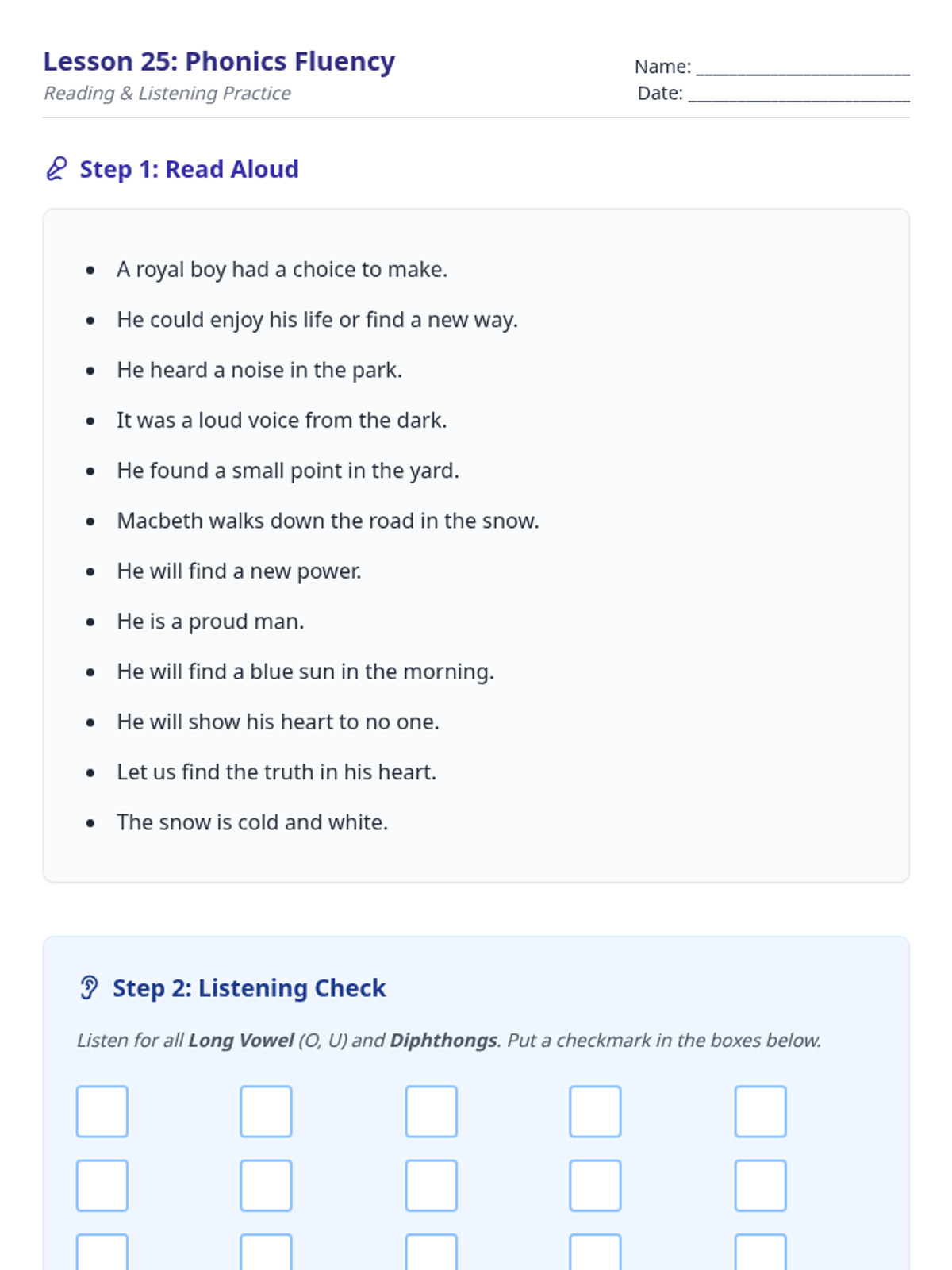
Fluency handout for Lesson 25. Contains a passage integrating Long O, Long U, and Diphthongs. Students practice oral reading and auditory identification. Sentences are presented as a list to accommodate varied subjects.
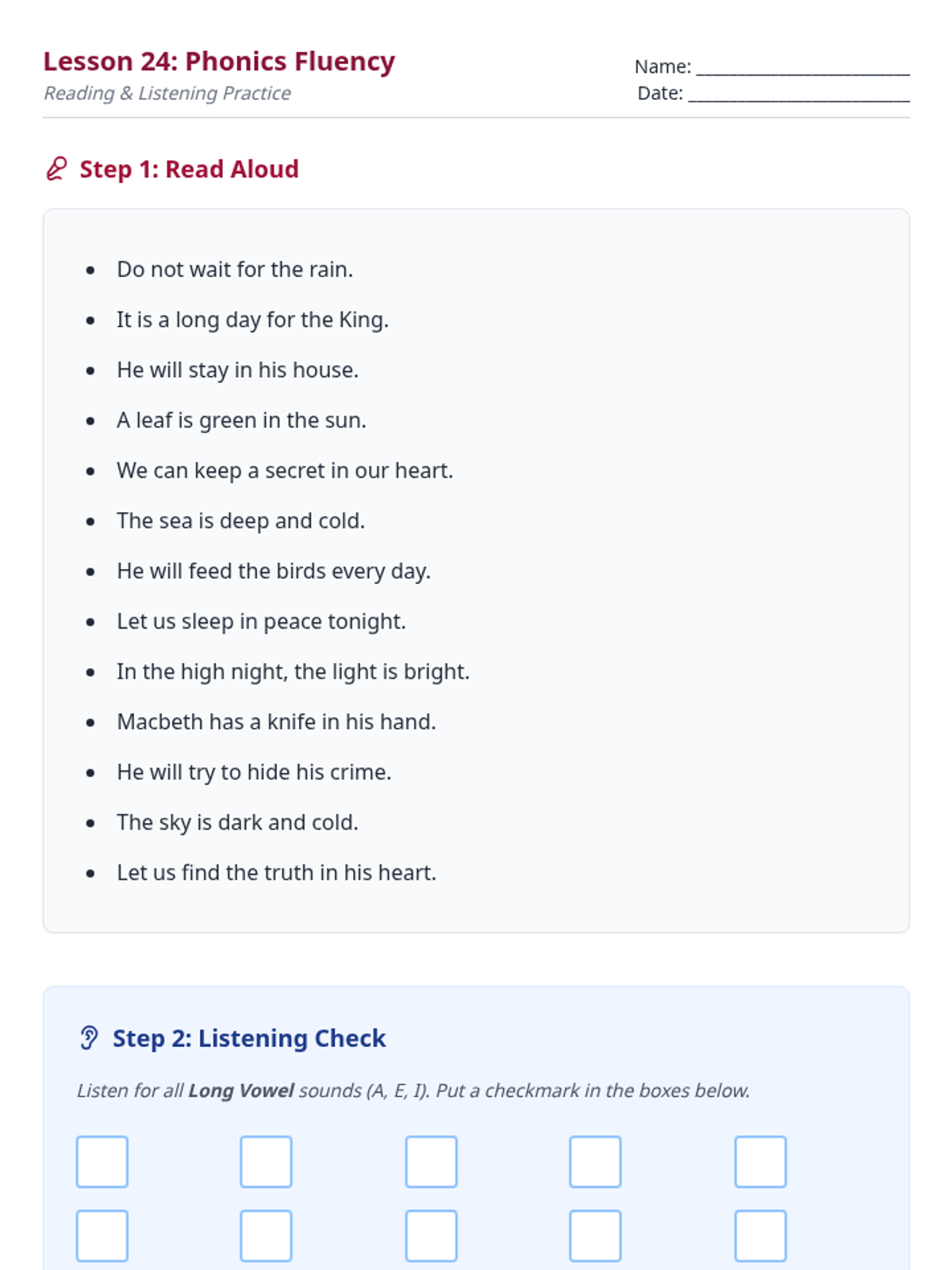
Fluency handout for Lesson 24. Contains a passage integrating Long Vowel sounds A, E, and I. Students practice oral reading and auditory identification. Sentences are presented as a list to accommodate varied subjects.
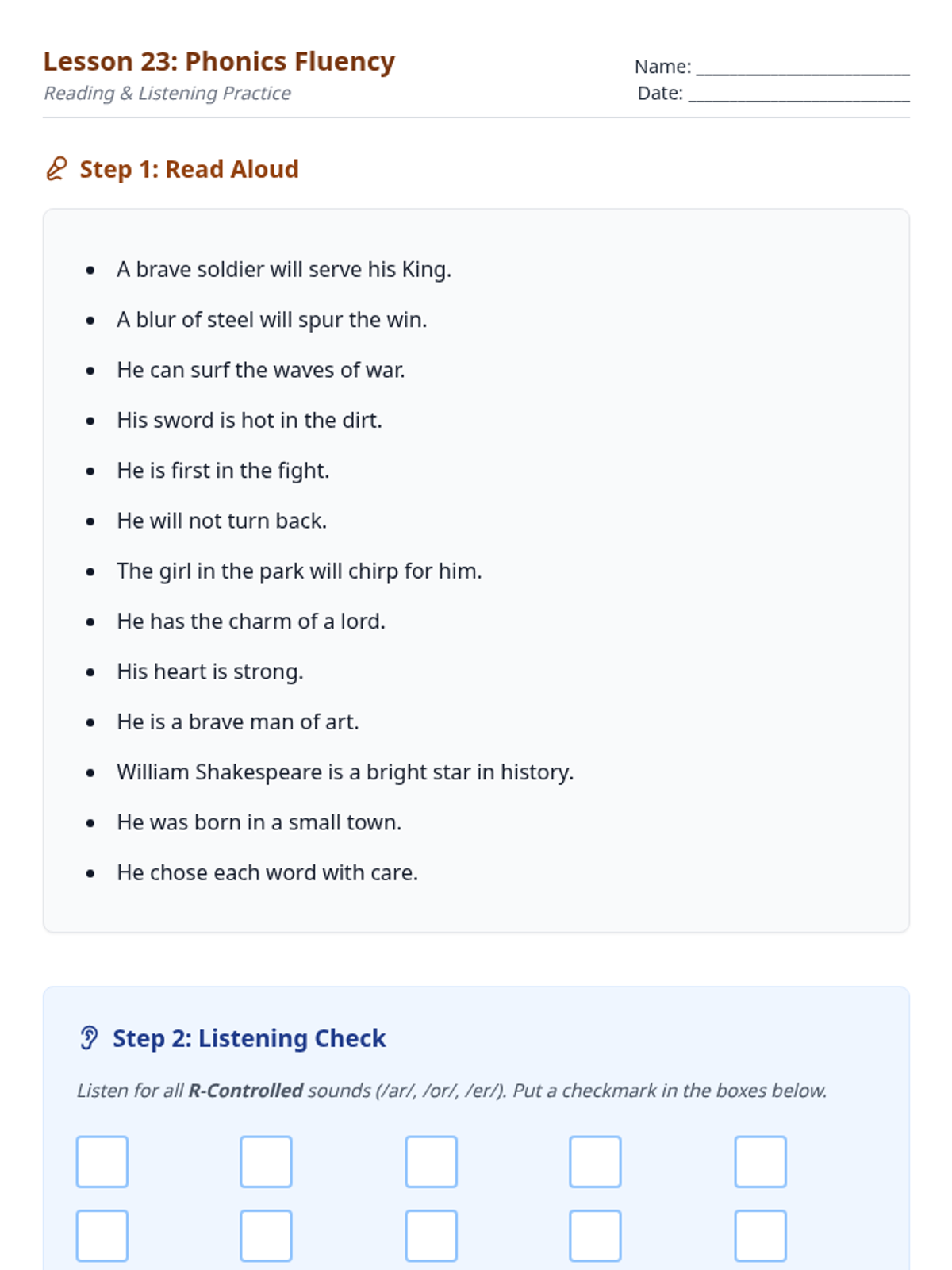
Fluency handout for Lesson 23. Contains a passage integrating all R-controlled vowel sounds. Students practice oral reading and auditory identification. Sentences are presented as a list to accommodate varied subjects.
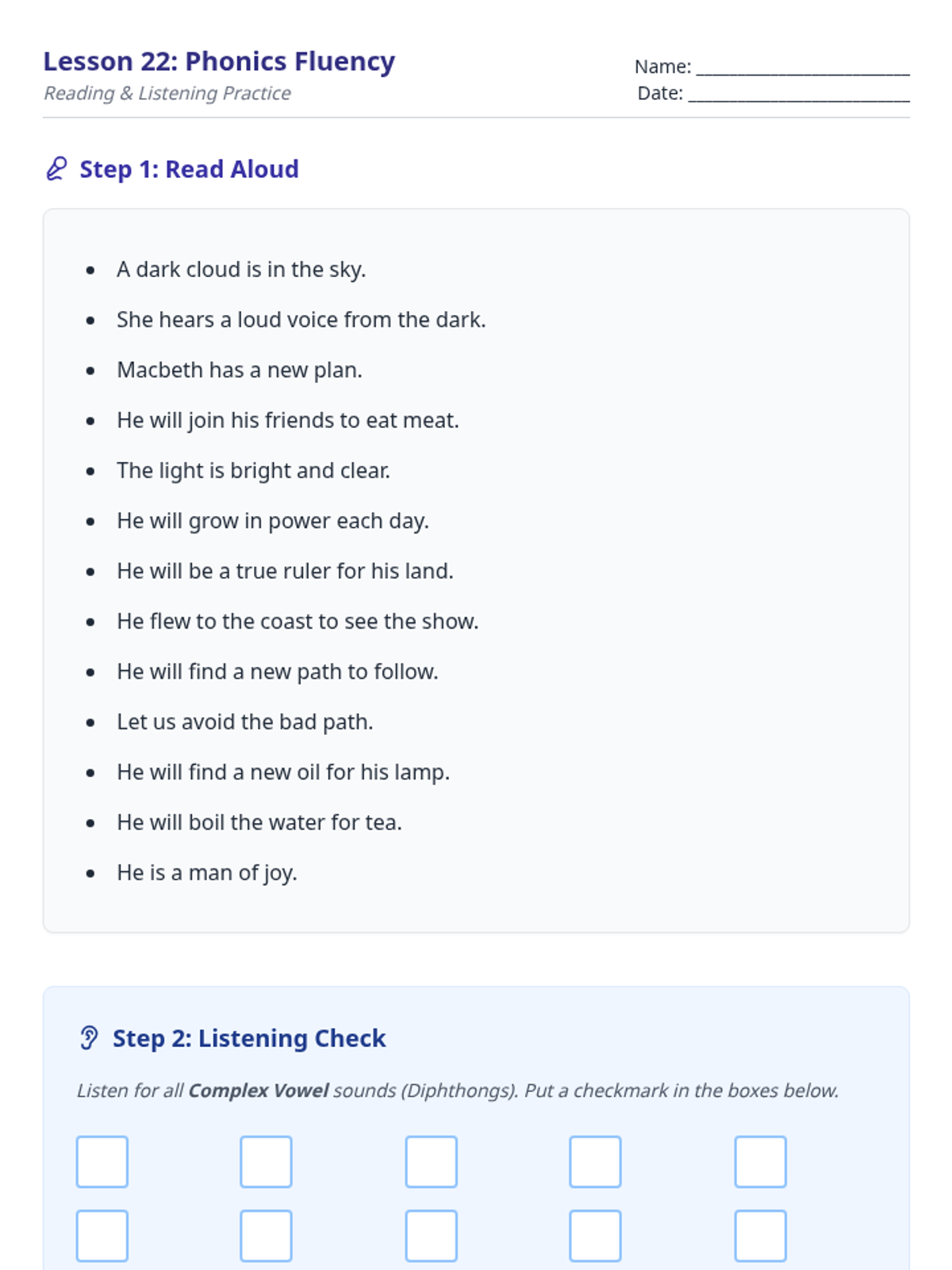
Fluency handout for Lesson 22. Contains a passage integrating multiple Diphthongs. Students practice oral reading and auditory identification. Sentences are presented as a list to accommodate varied subjects.
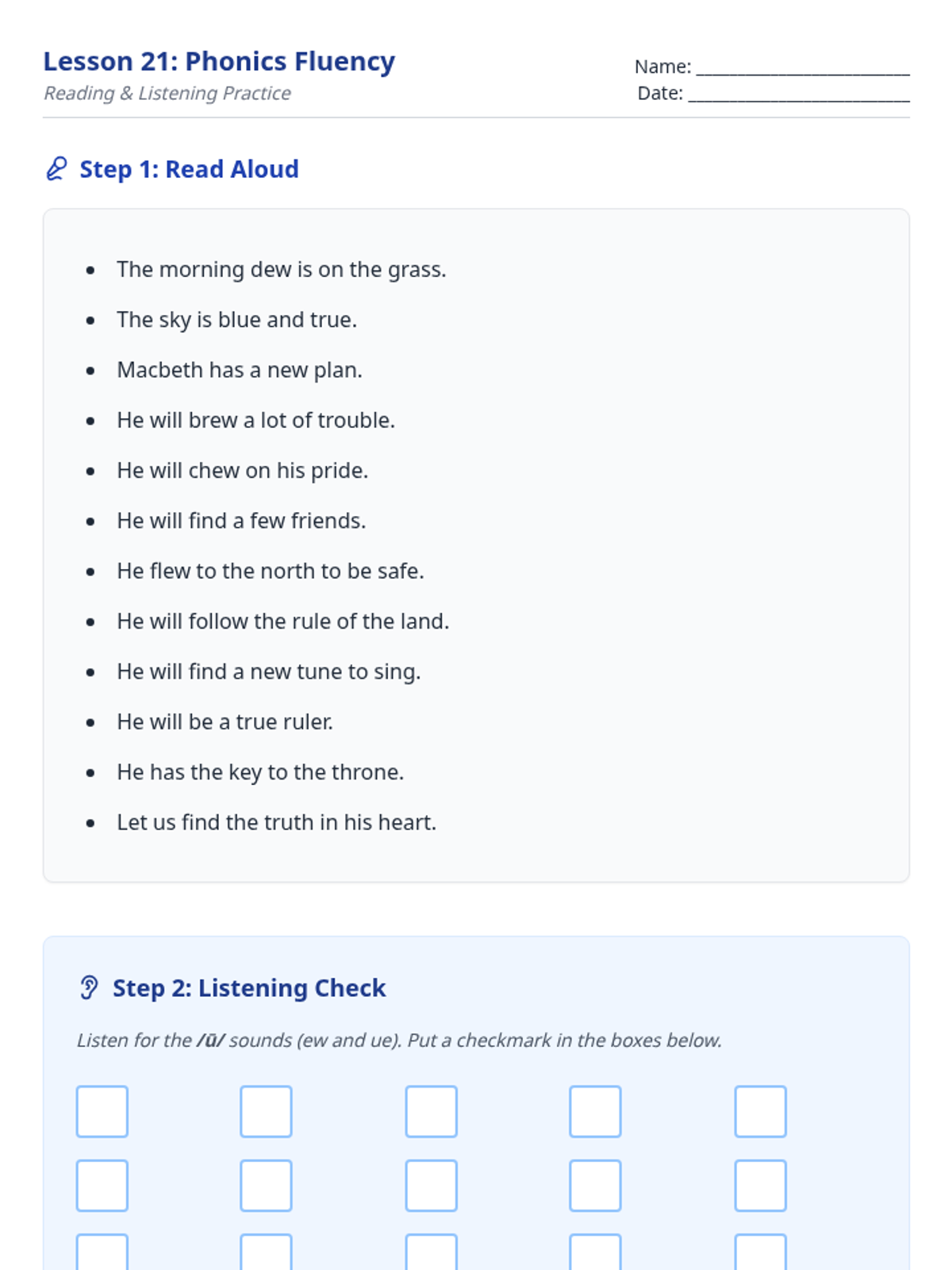
Fluency handout for Lesson 21. Contains a passage integrating Long U diphthongs (ew, ue). Students practice oral reading and auditory identification. Sentences are presented as a list to accommodate varied subjects.
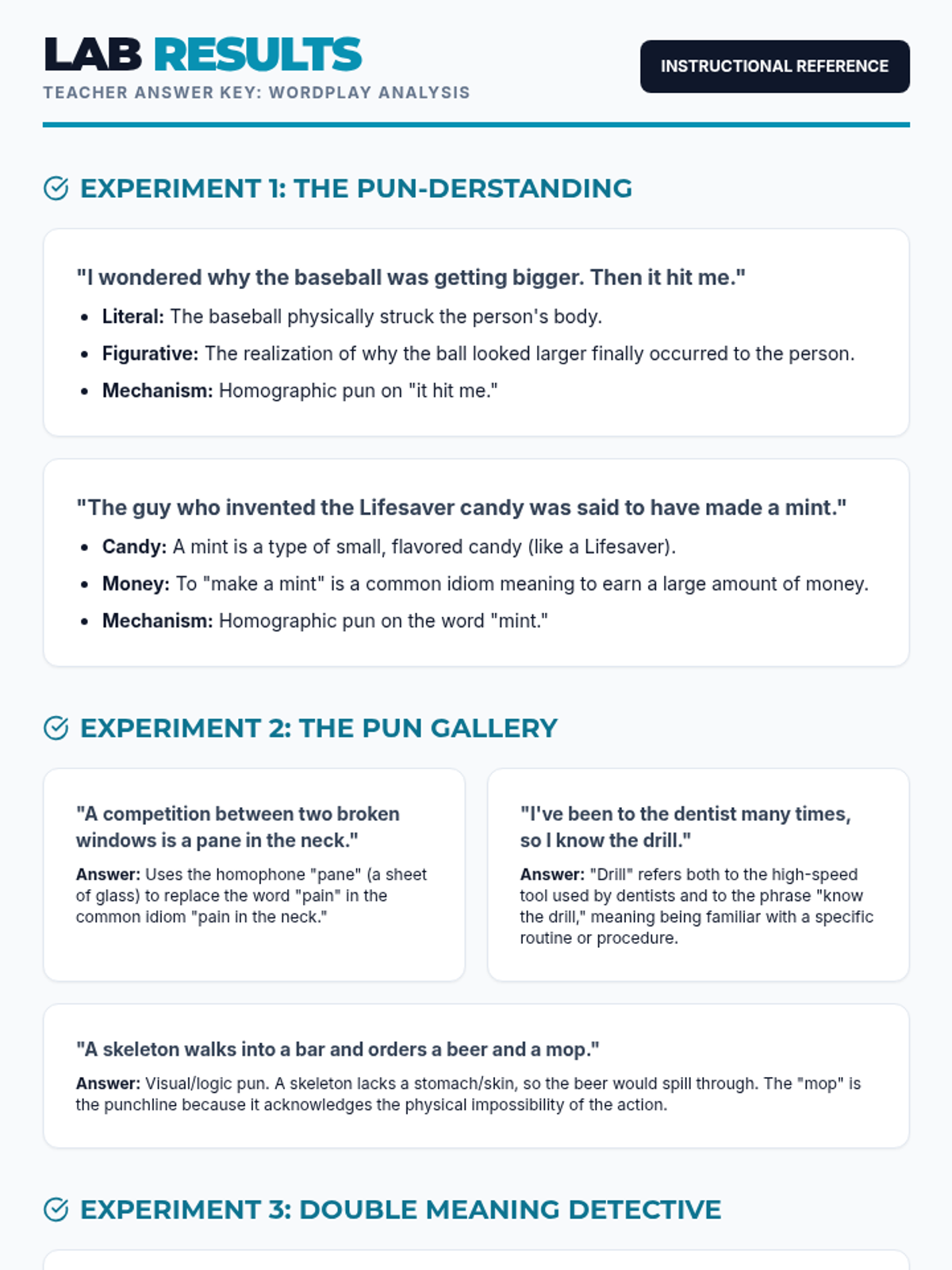
An updated answer key reflecting the additions to the wordplay worksheet, including explanations for the 'Pun Gallery' section and refined linguistic definitions.
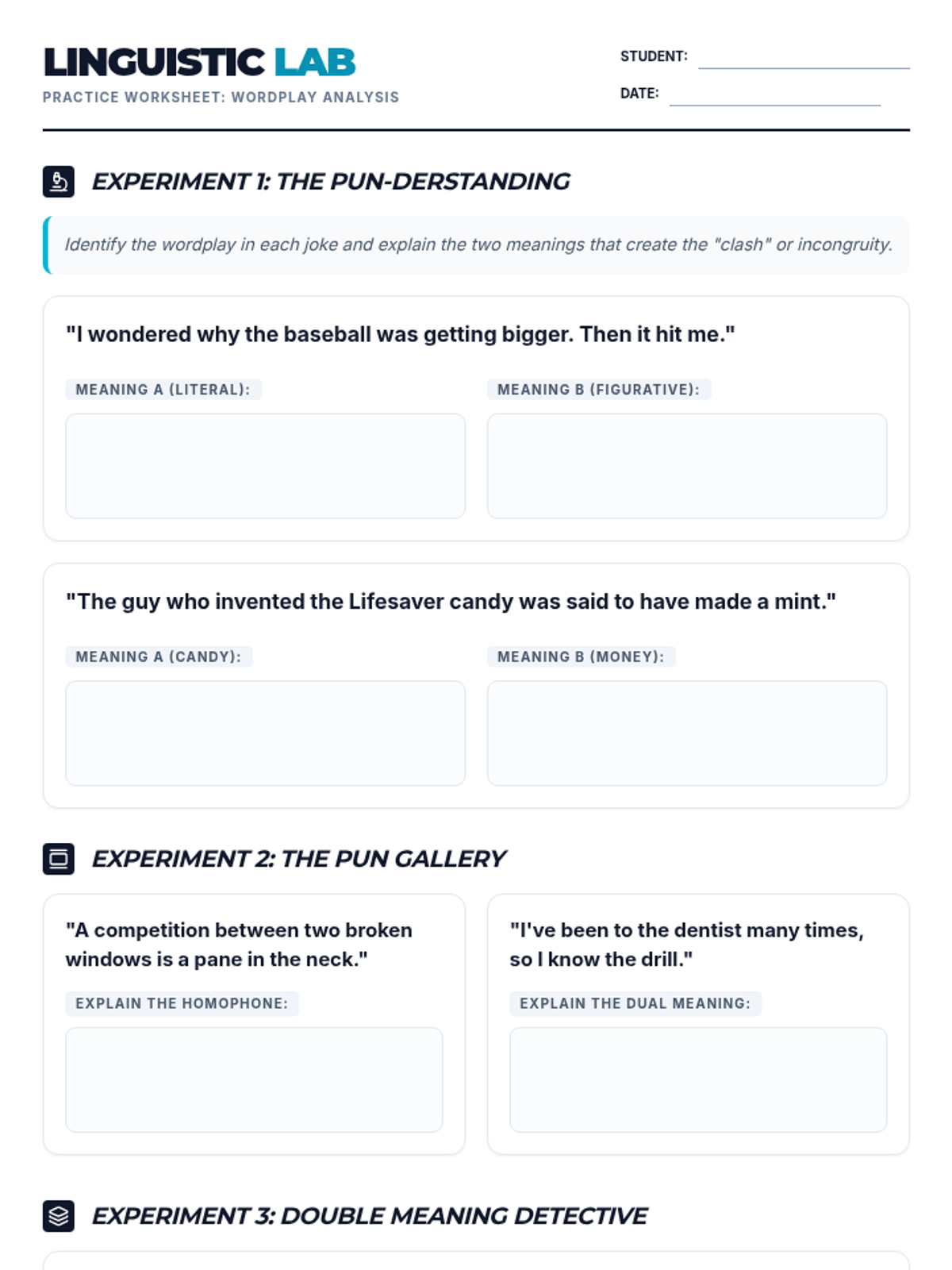
A polished 2-page practice worksheet for analyzing puns, idioms, and double meanings. Improved layout efficiency, clearer work areas for multi-meaning questions, and higher-contrast labels based on reviewer feedback.
A set of high-school instructional slides exploring the mechanics of puns, double-meanings, and idioms. It uses the 'Incongruity Theory' of humor to help students deconstruct and analyze wordplay.
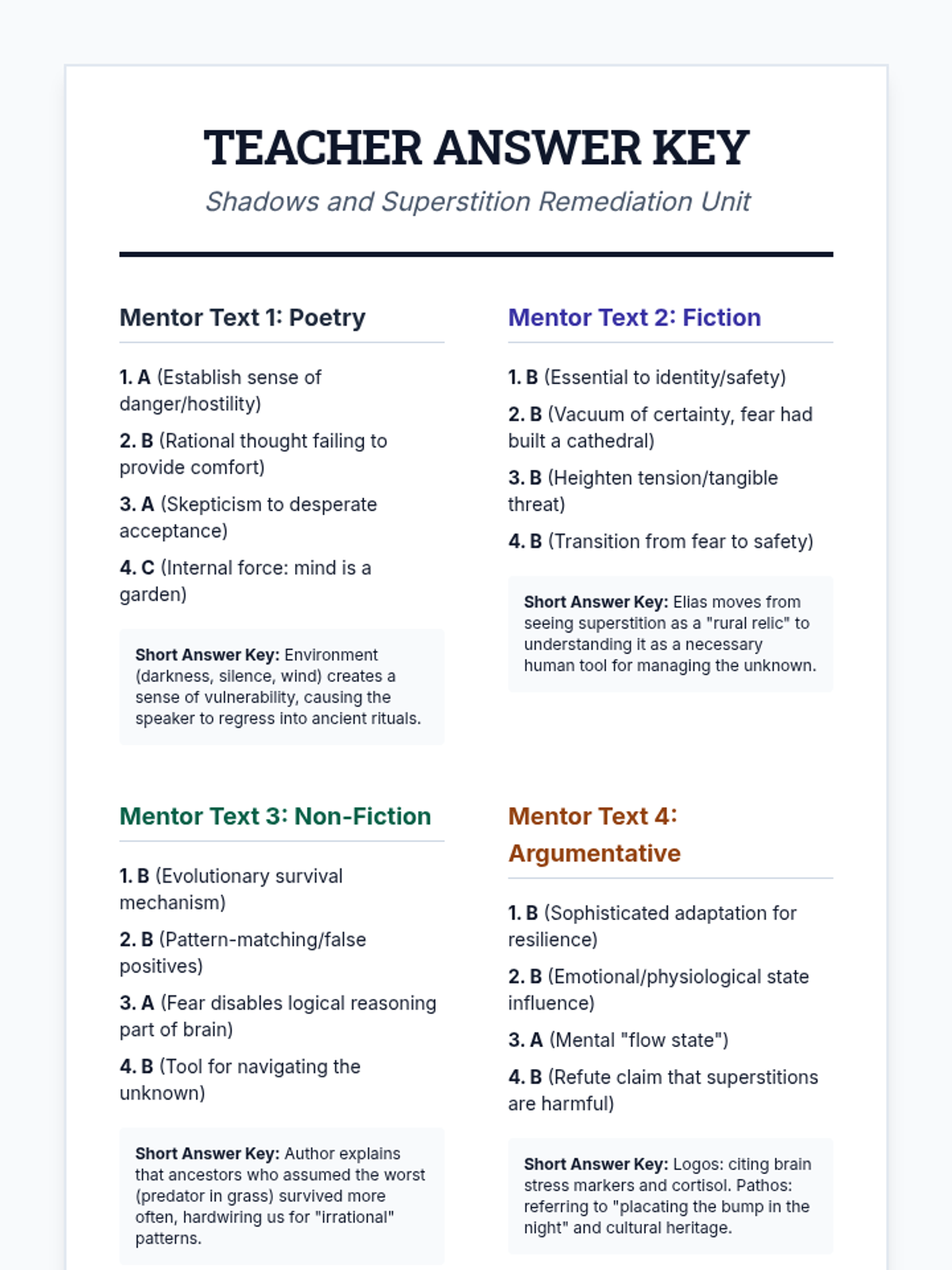
A comprehensive answer key for all mentor texts, revision/editing exercises, and the cumulative test in the Shadows and Superstition remediation packet. Revised to fit on a single page. Adjusted spacing and naming for consistency.
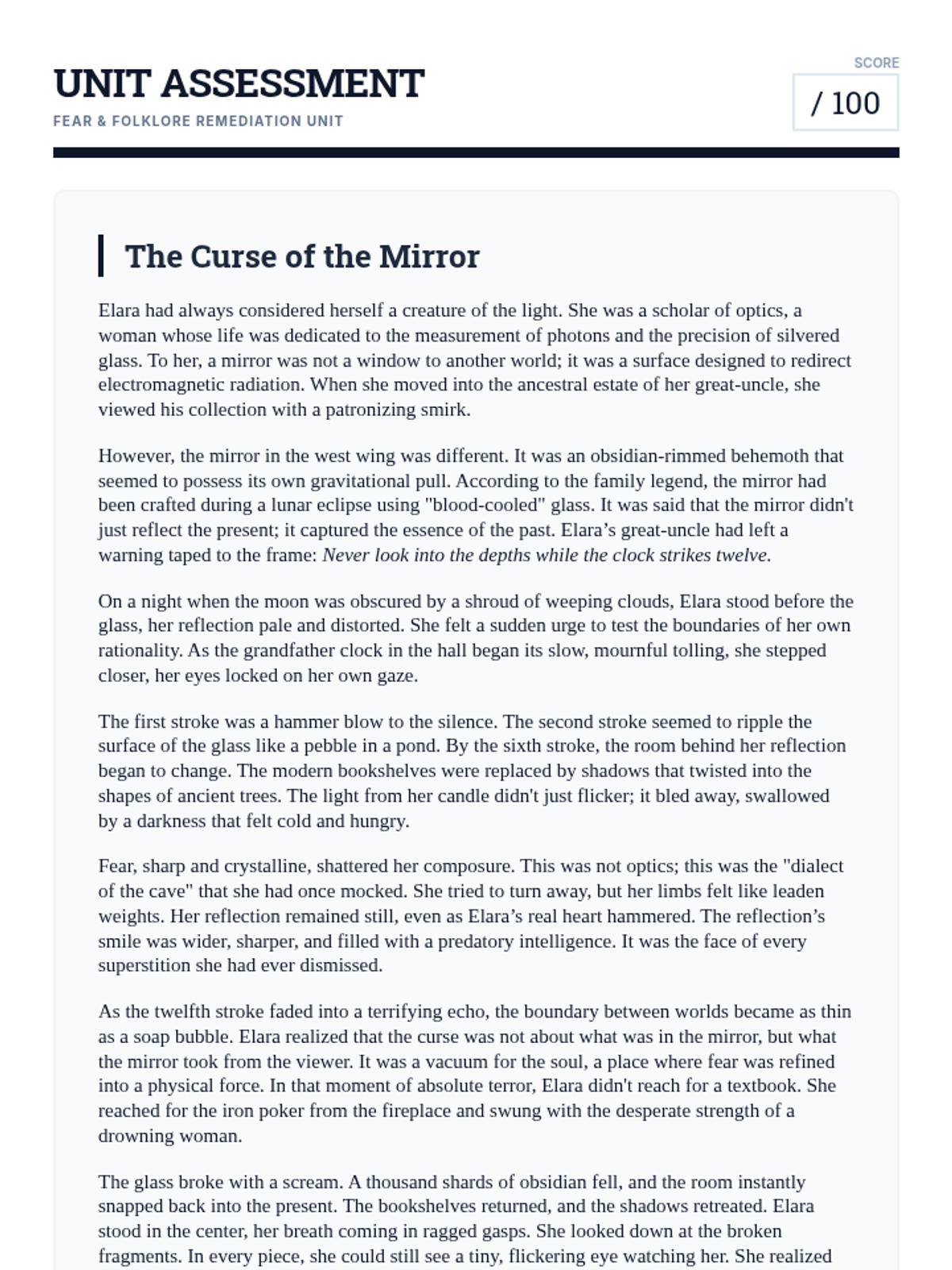
A grayscale version of the cumulative test, featuring the cold-read passage and assessment questions with all color removed. Fixed word spacing in headers and increased writing lines. Standardized distractor order.
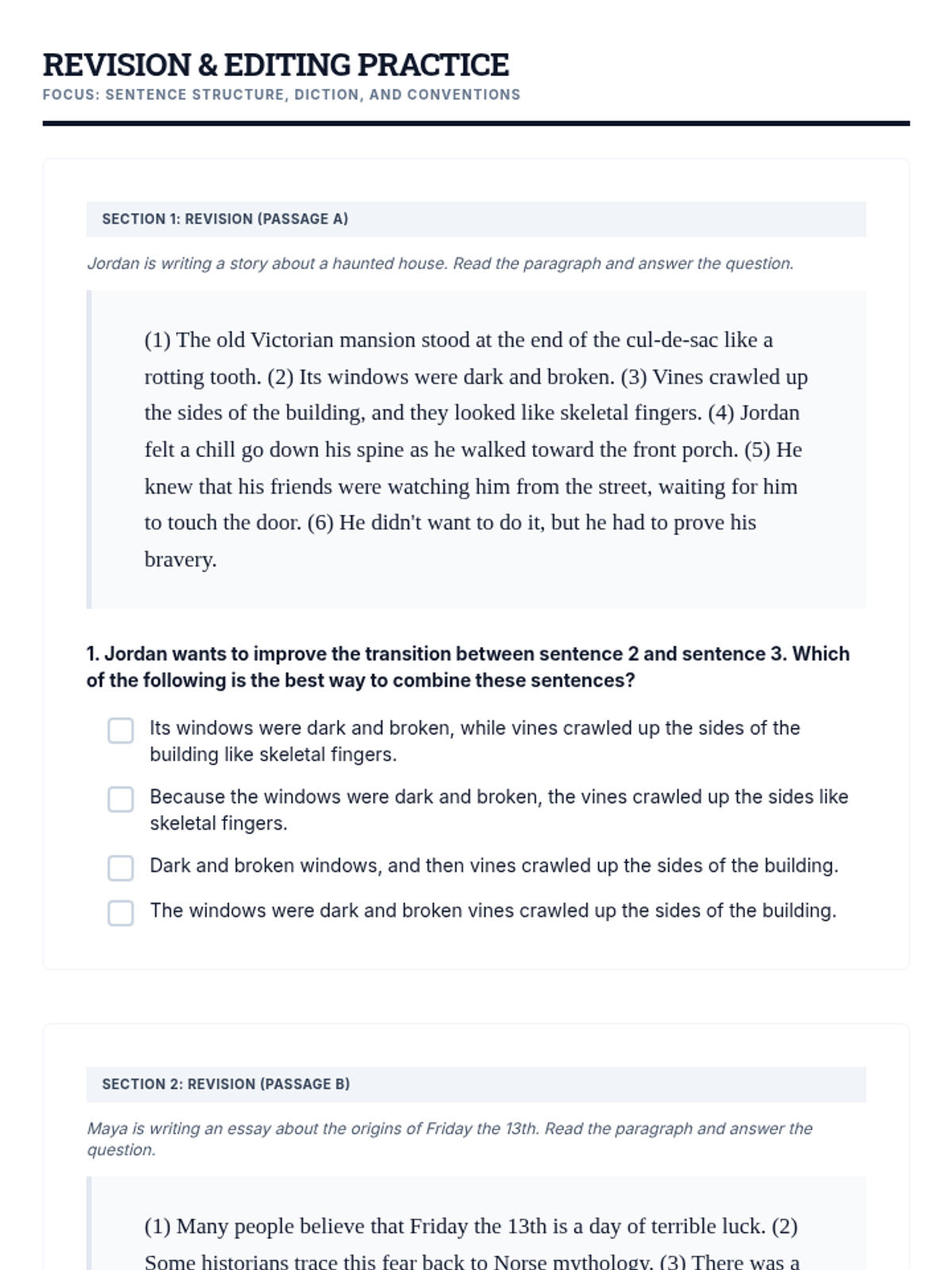
A grayscale version of the revision and editing practice passages, with the yellow highlight updated to gray. Consolidated layout to group Revision questions on Page 1 and Editing questions on Page 2. Fixed word spacing issues. Removed excessive whitespace and min-height constraints.
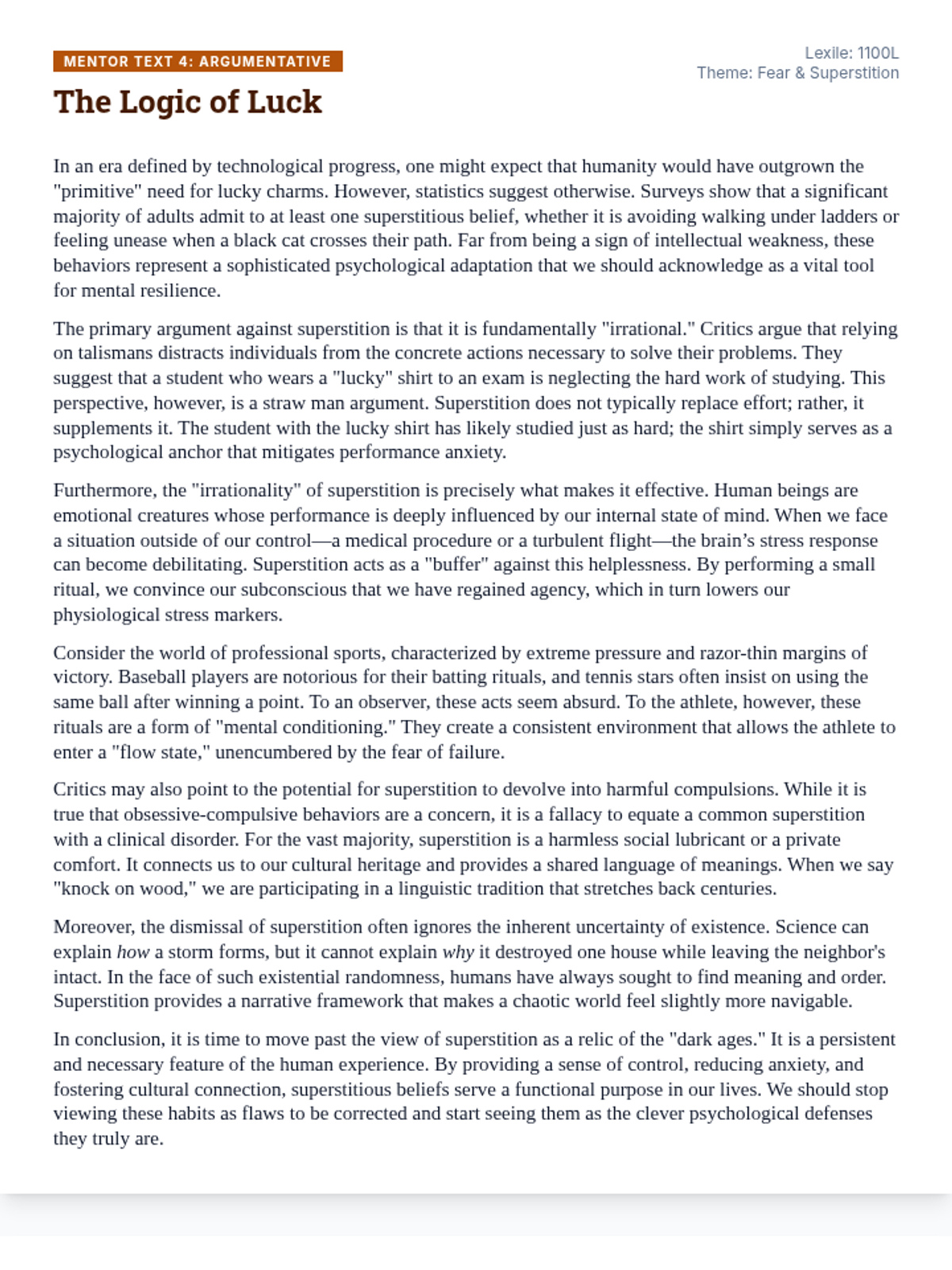
A grayscale version of the argumentative analysis document, with colors updated to slate shades and text references adjusted to reflect gray highlights. Consolidated layout to 2 pages and fixed work area line spacing. Fixed radio button alignment and constructed response container.
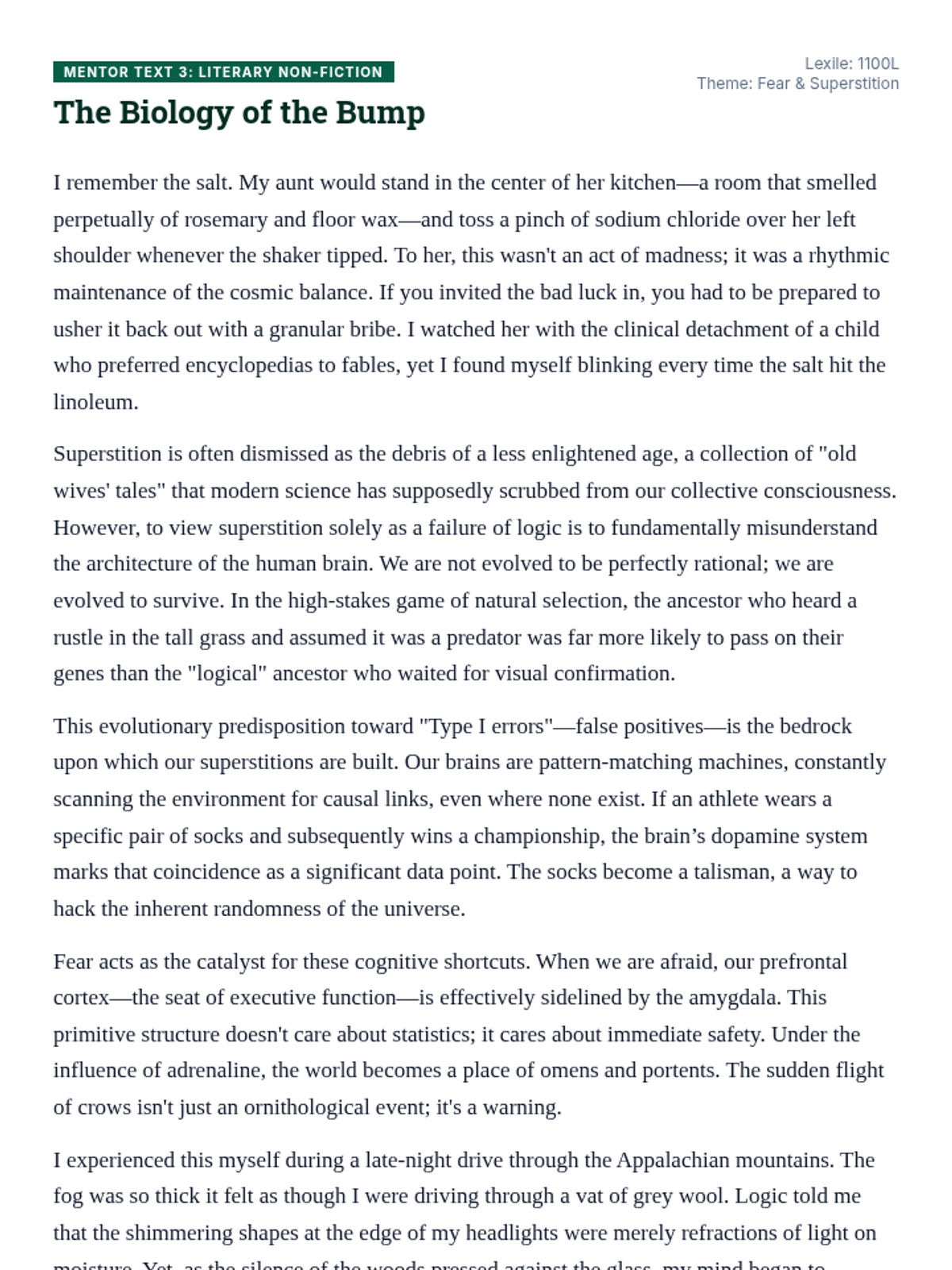
A grayscale version of the non-fiction analysis document, with colors updated to slate shades and text references adjusted to reflect gray highlights. Fixed invisible legend labels. Corrected work area rule thickness.
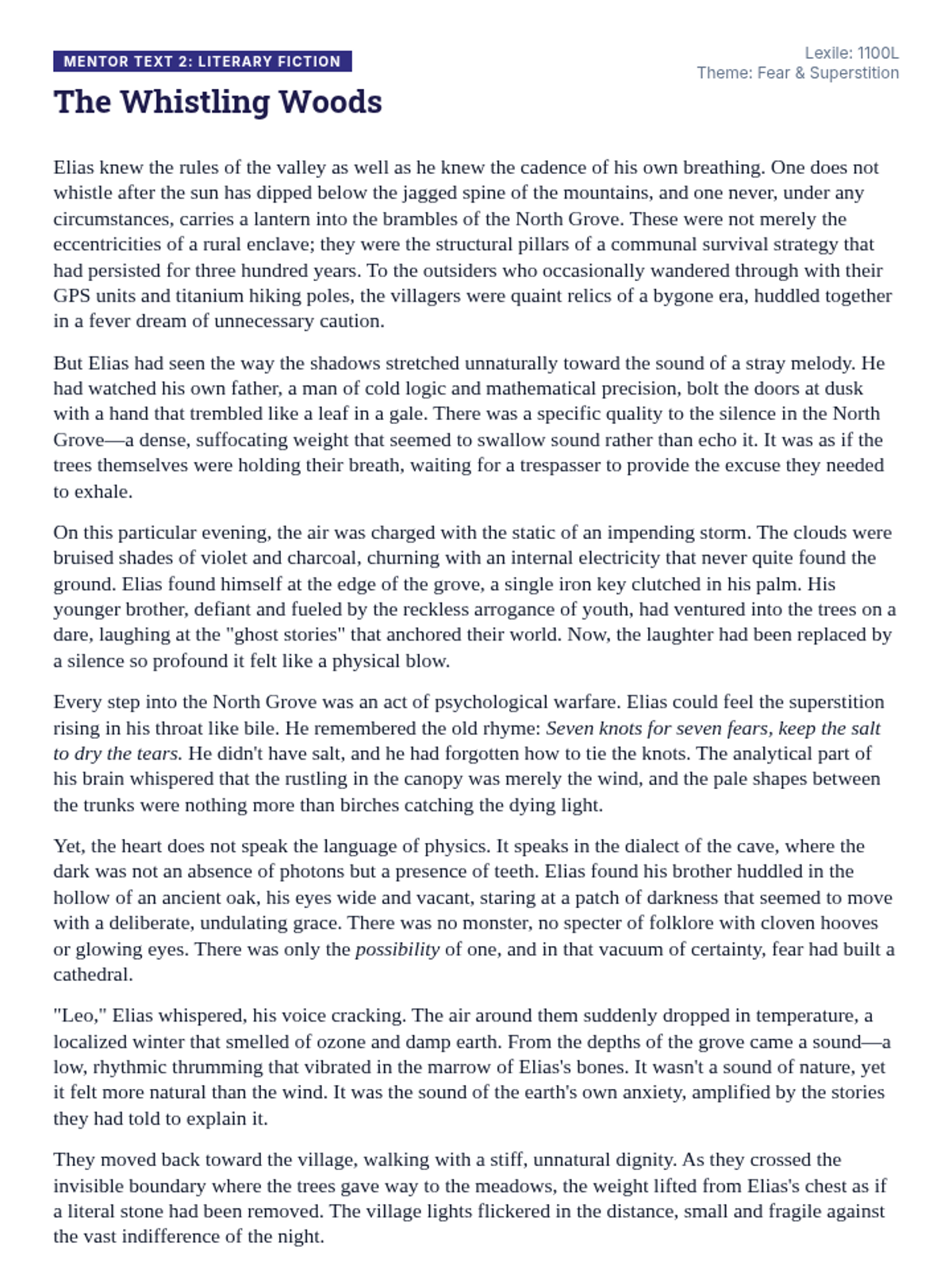
A grayscale version of the fiction analysis document, with colors updated to slate shades and text references adjusted to reflect gray highlights. Corrected prompt colors and consolidated layout to 2 pages. Fixed word spacing in sidebars.
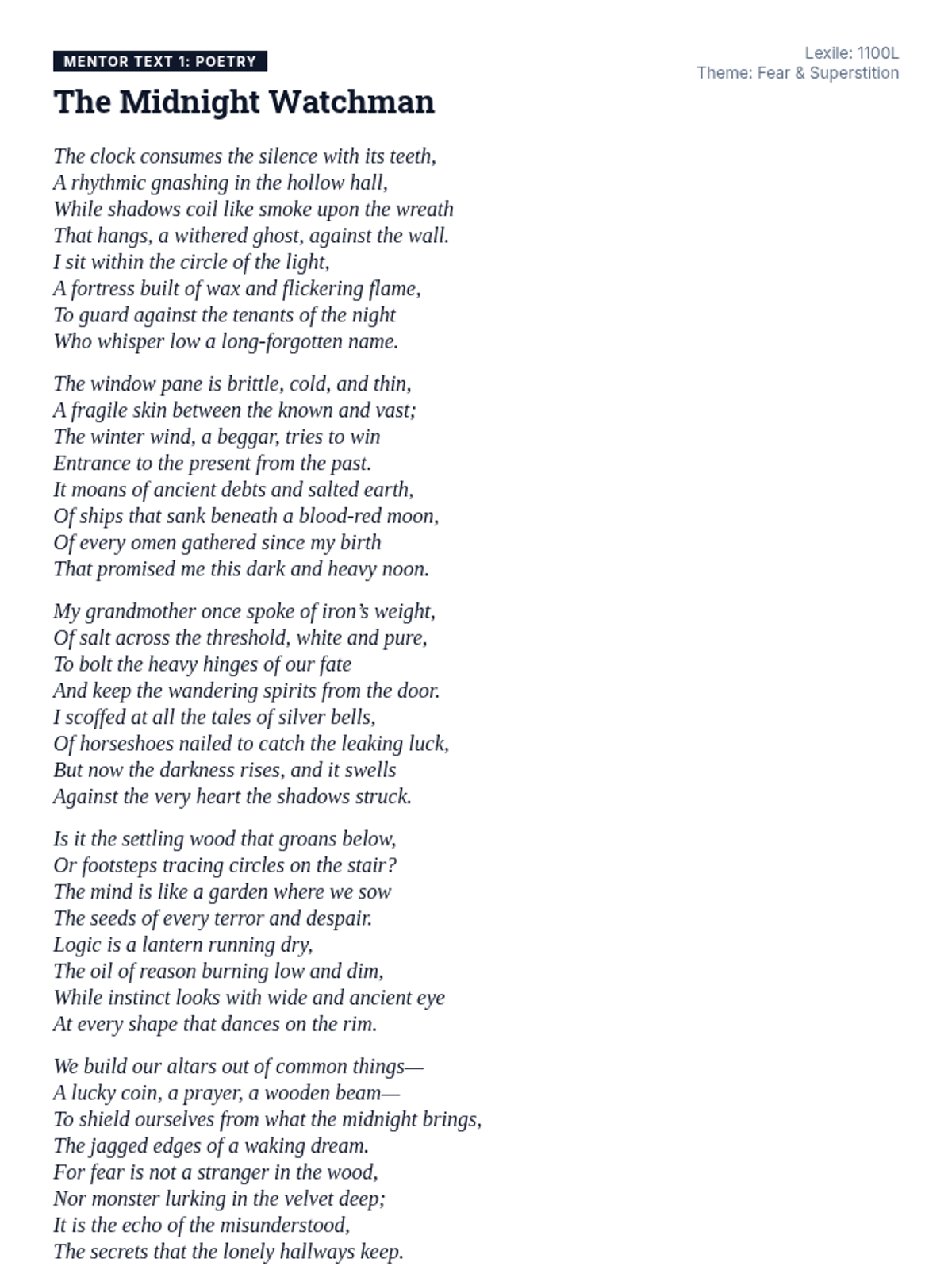
A grayscale version of the poem analysis document, with colors updated to slate shades and text references adjusted to reflect gray highlights. Revised to fit entire poem and sidebars on a single page. Margin callouts precisely aligned.
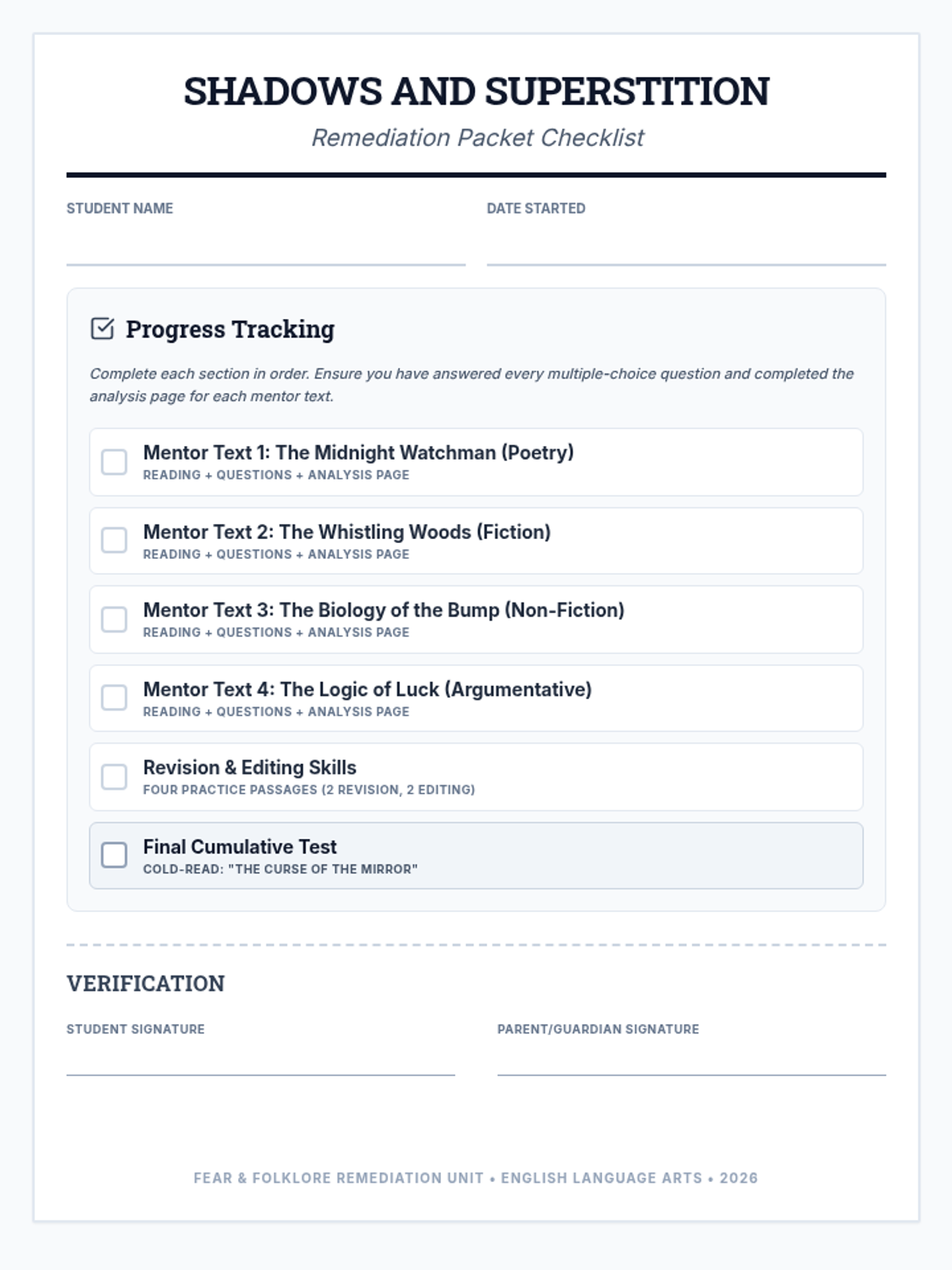
A grayscale version of the student progress checklist for the remediation packet, featuring a structured list of all required texts and activities.
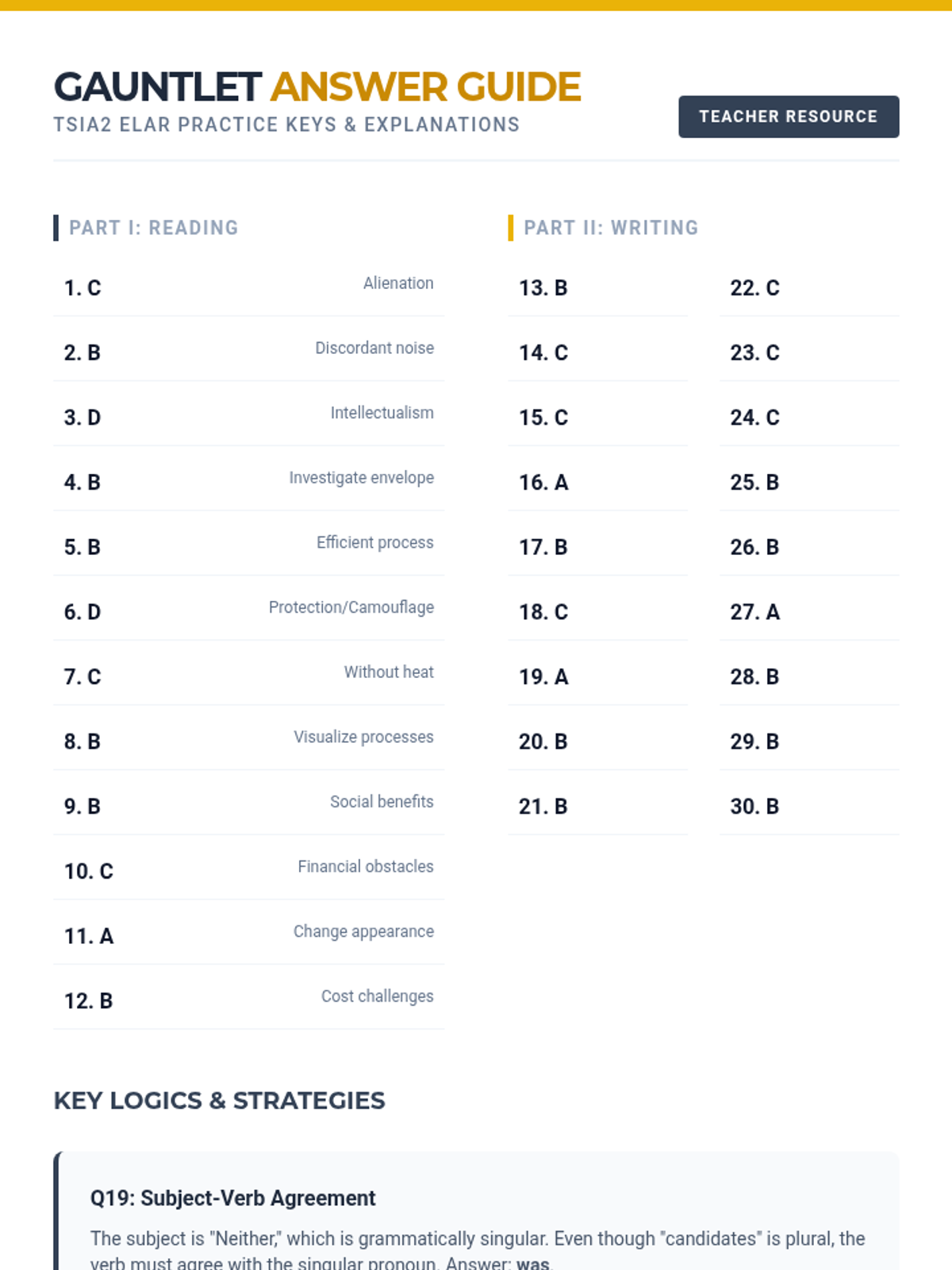
An answer key and explanation guide for the 30-question TSIA2 English Gauntlet Practice test. Provides correct answers, brief logic explanations for challenging grammar rules, and a scoring benchmark.
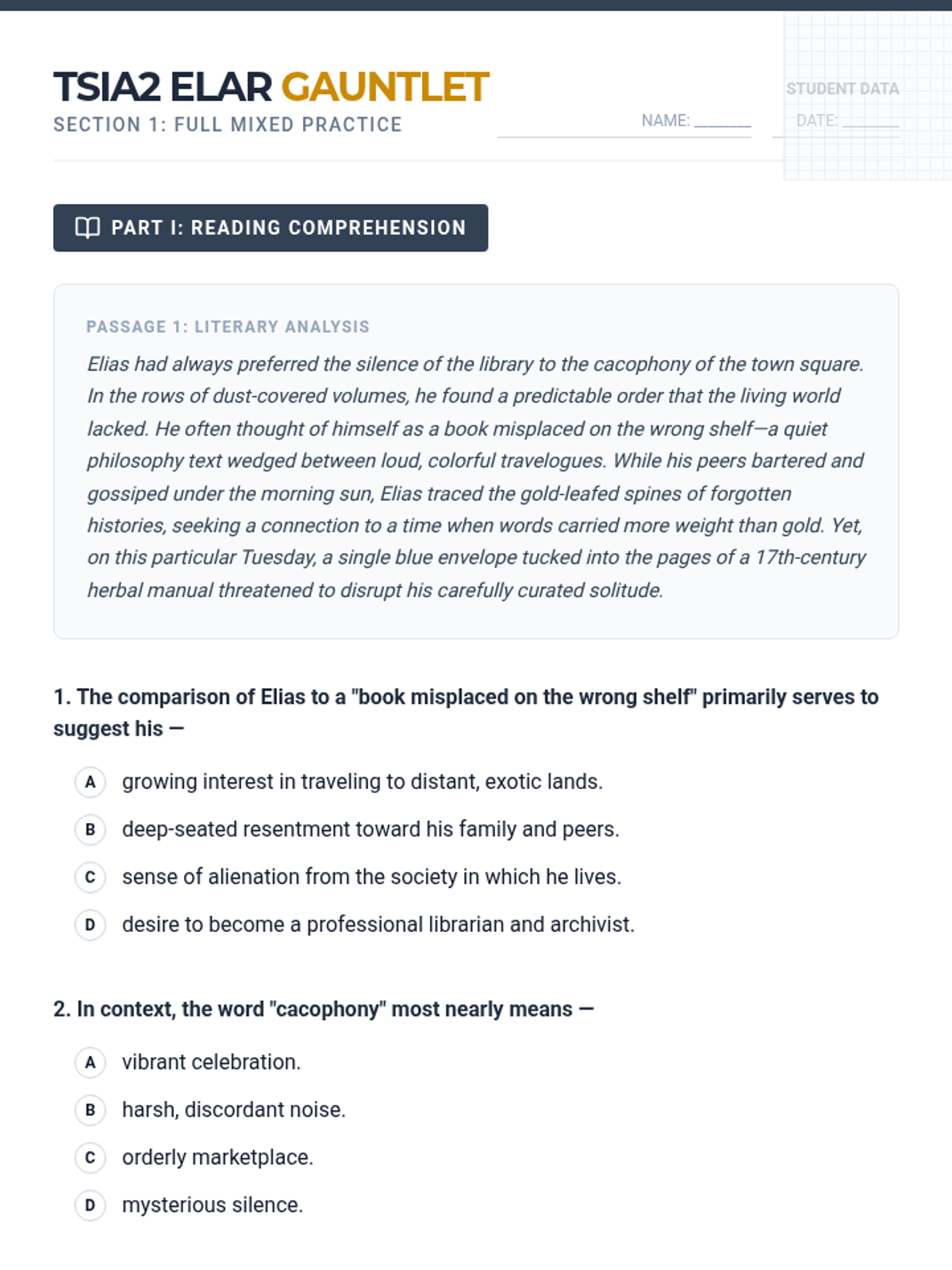
A comprehensive 30-question practice test for the TSIA2 ELAR section. Includes Reading Comprehension (Literary, Informational, and Paired passages) and Writing (Revising and Editing) sections. Expanded to 8 pages for maximum readability and handwriting space.
A 15-slide review presentation covering key TSIA2 ELAR concepts. Optimized for high-quality printing with light backgrounds and high-contrast text while maintaining the professional 'blueprint' aesthetic.
Visual slide deck for Lesson 4, highlighting the differences between spoken and written registers and providing specific vocabulary upgrades for dictated text.
Visual slide deck for Lesson 2, explaining the issues of run-on sentences in dictation and teaching verbal punctuation commands and the "Pause-Plan-Speak" strategy.
Final slides for Lesson 5, presenting the "Golden Editor" challenge rules and the messy transcript for the summative assessment.
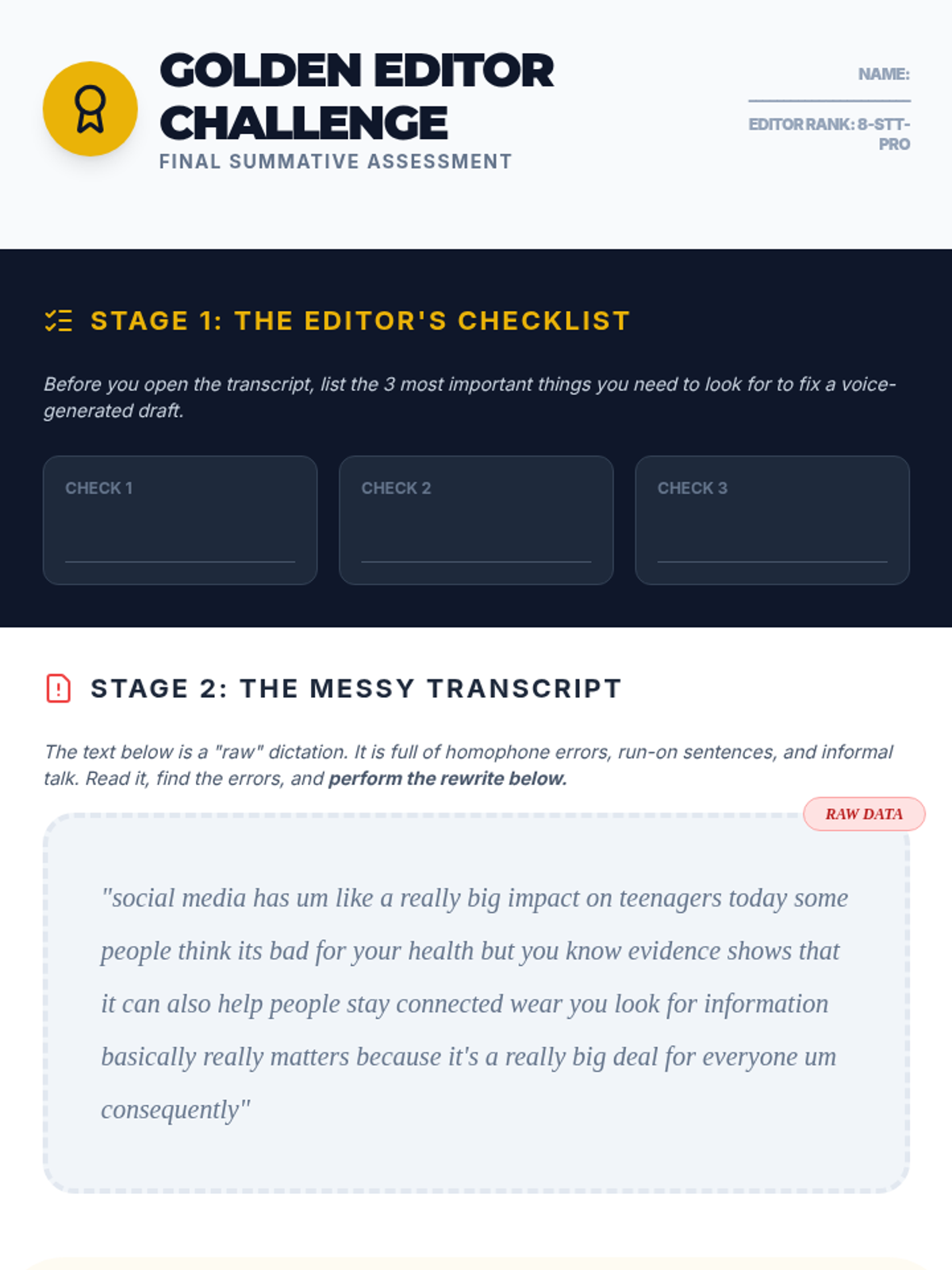
The summative assessment worksheet for the sequence, requiring students to apply all previous lessons (homophones, structure, tone) to a "messy" transcript and produce a polished academic paragraph.
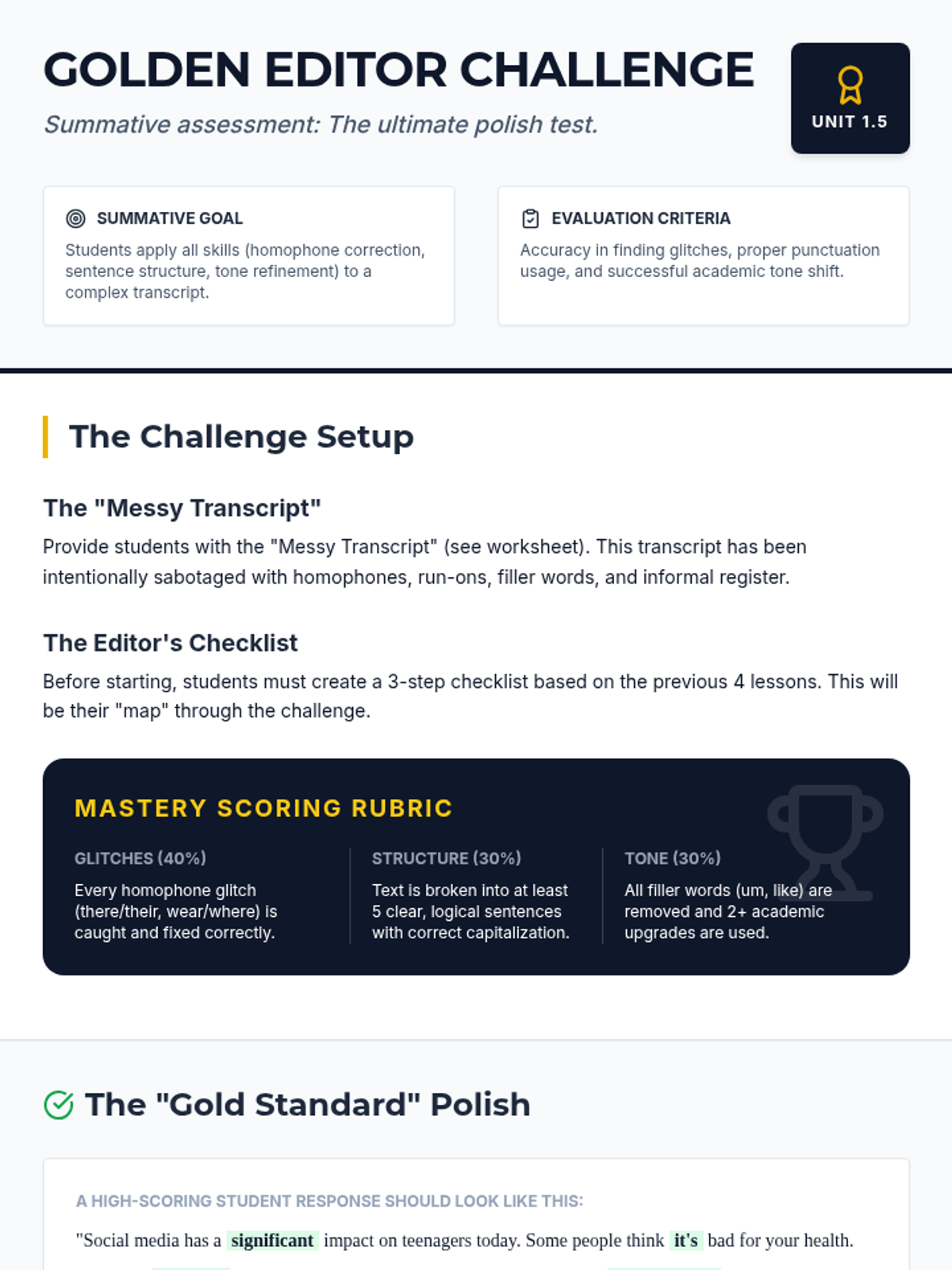
A teacher guide for the final summative assessment, the Golden Editor Challenge, featuring a rubric, instructional flow, and a "gold standard" polished example.
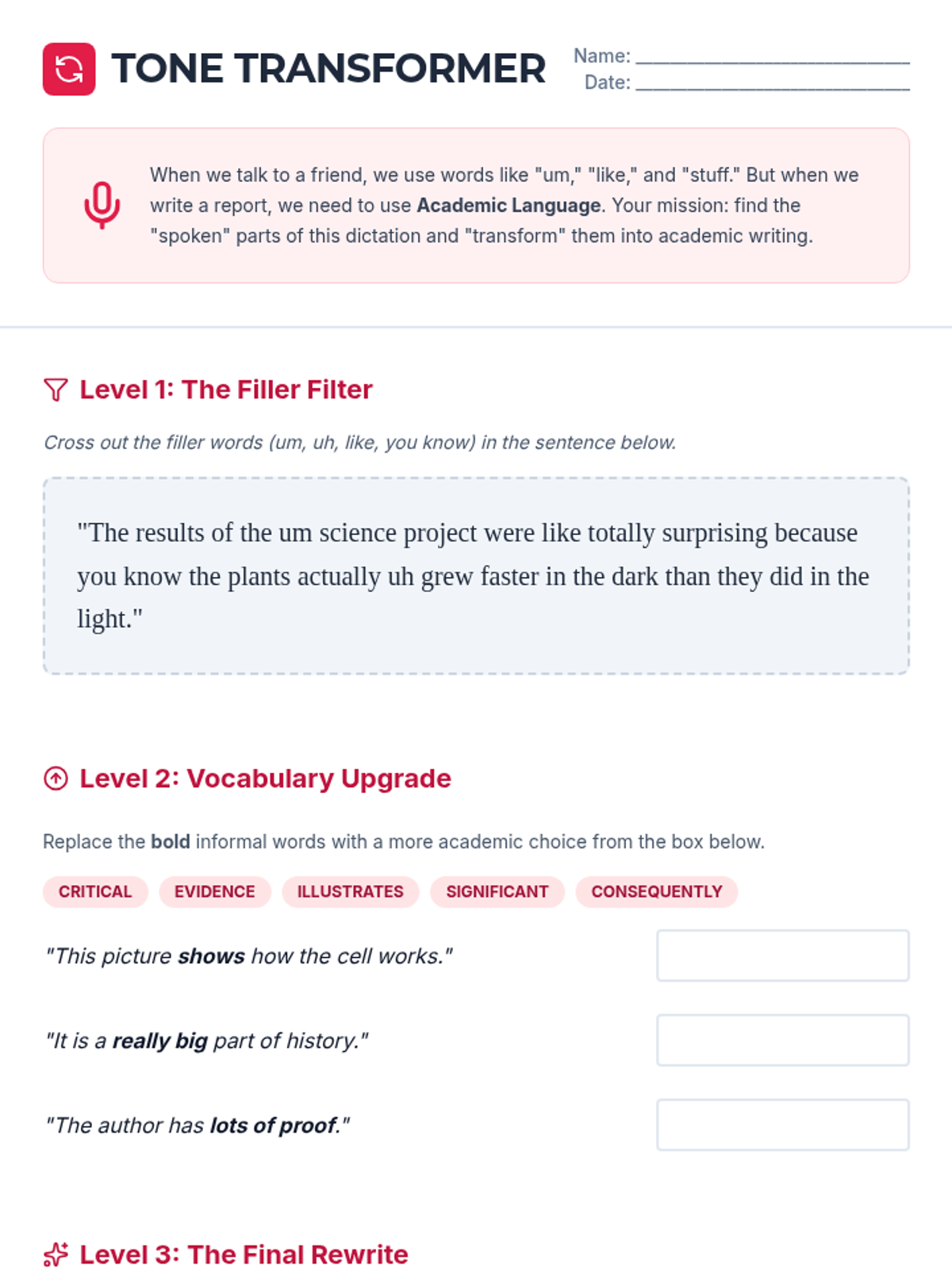
A student worksheet for transforming casual dictated speech into formal academic writing by identifying filler words and upgrading vocabulary.
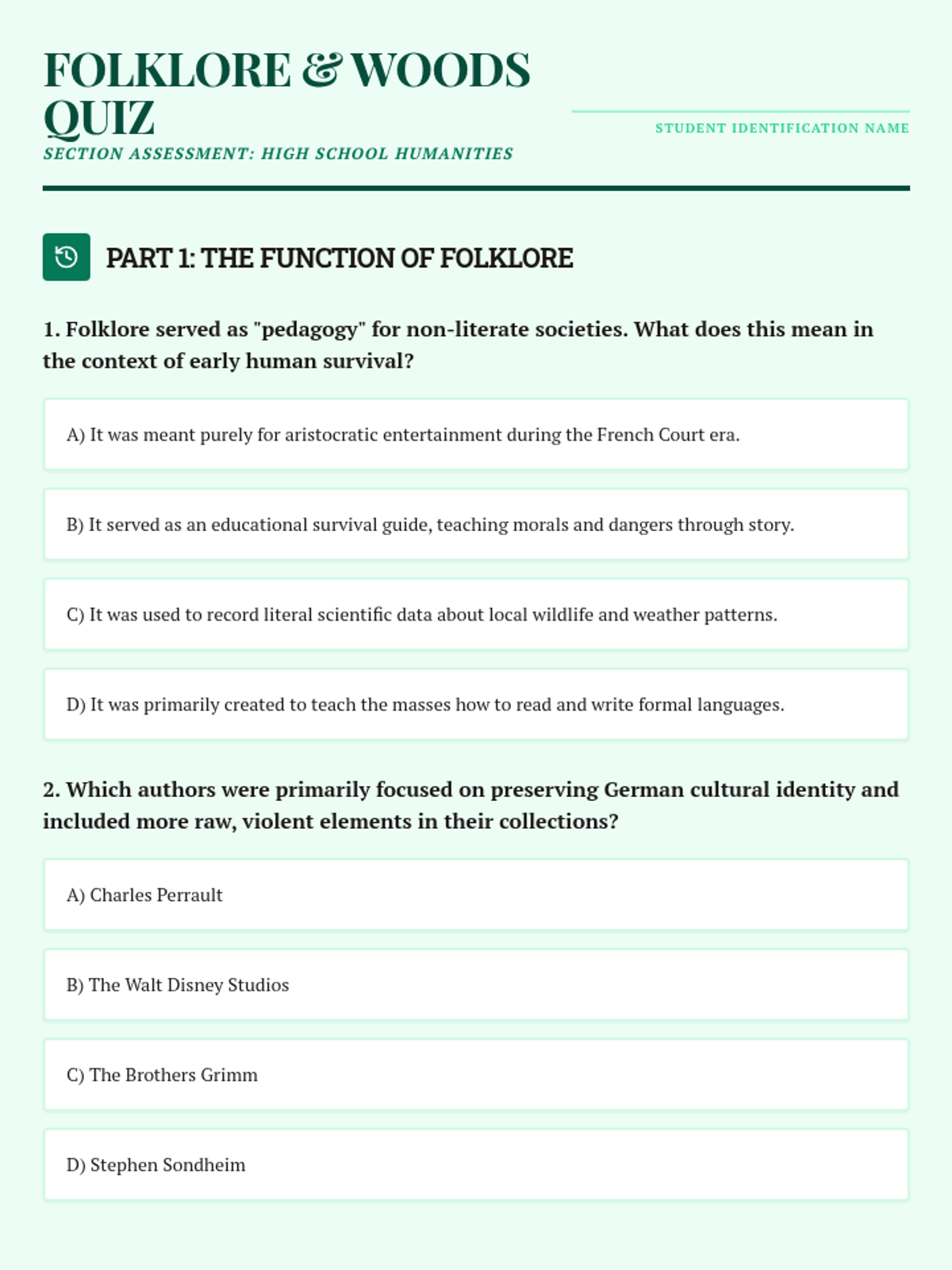
A high-school level quiz covering the purpose of folklore, literary history (Perrault/Grimm), and thematic subversion in 'Into the Woods'.
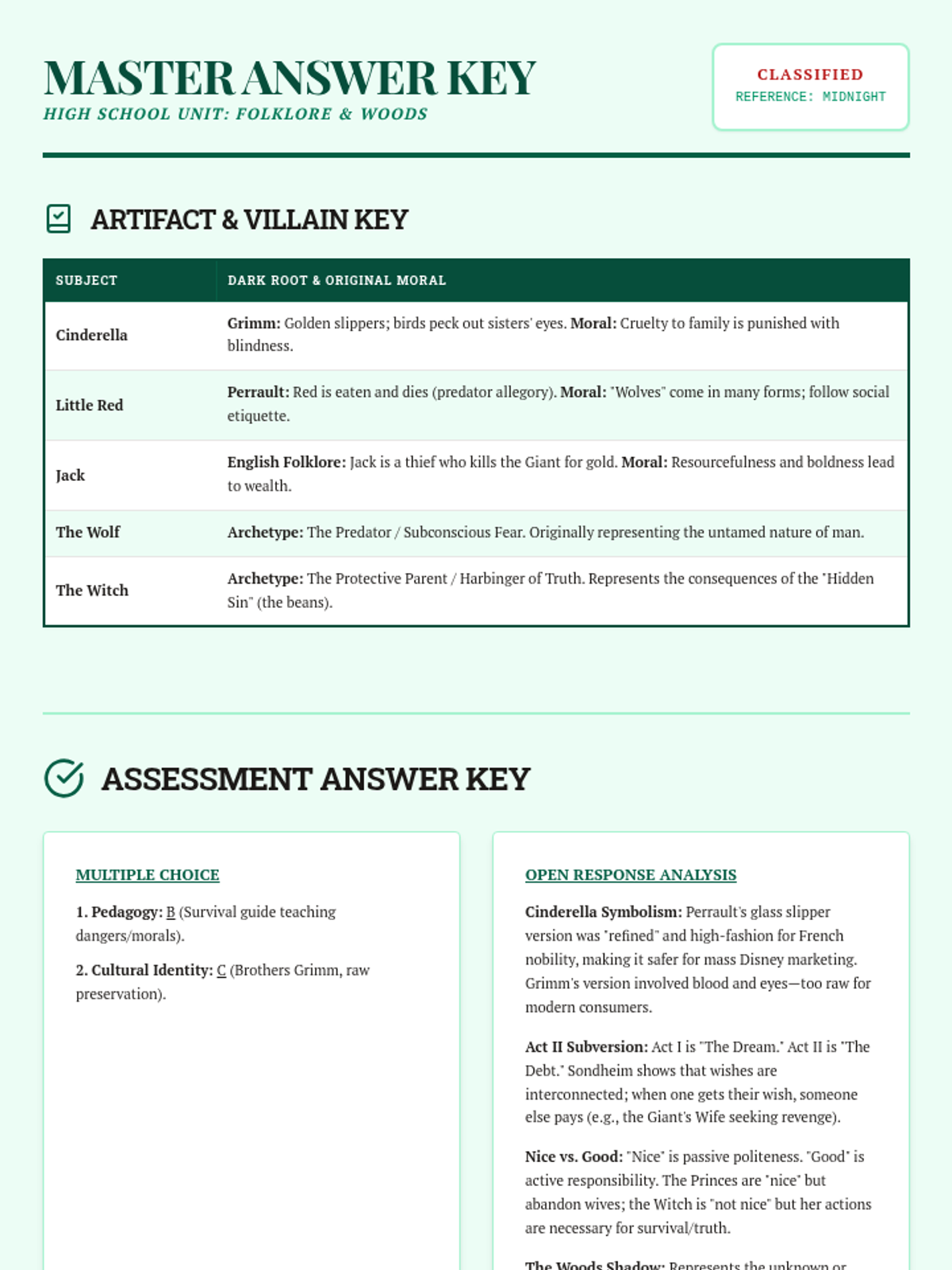
A comprehensive answer key for the high-school folklore unit, including character origins, literary history, and assessment answers.
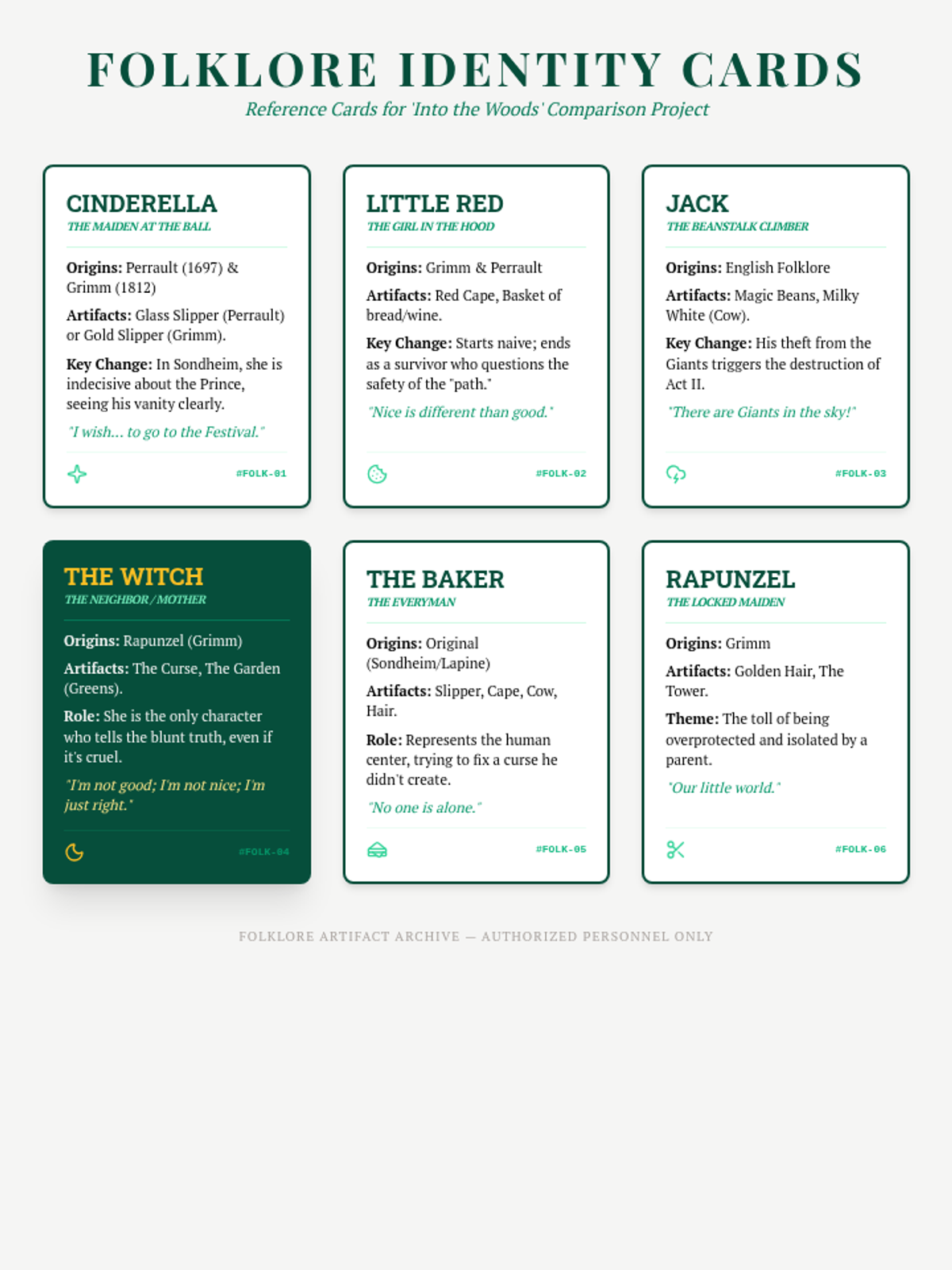
A set of reference cards for 'Into the Woods' characters, including their folklore origins, artifacts, and key changes in the musical adaptation.
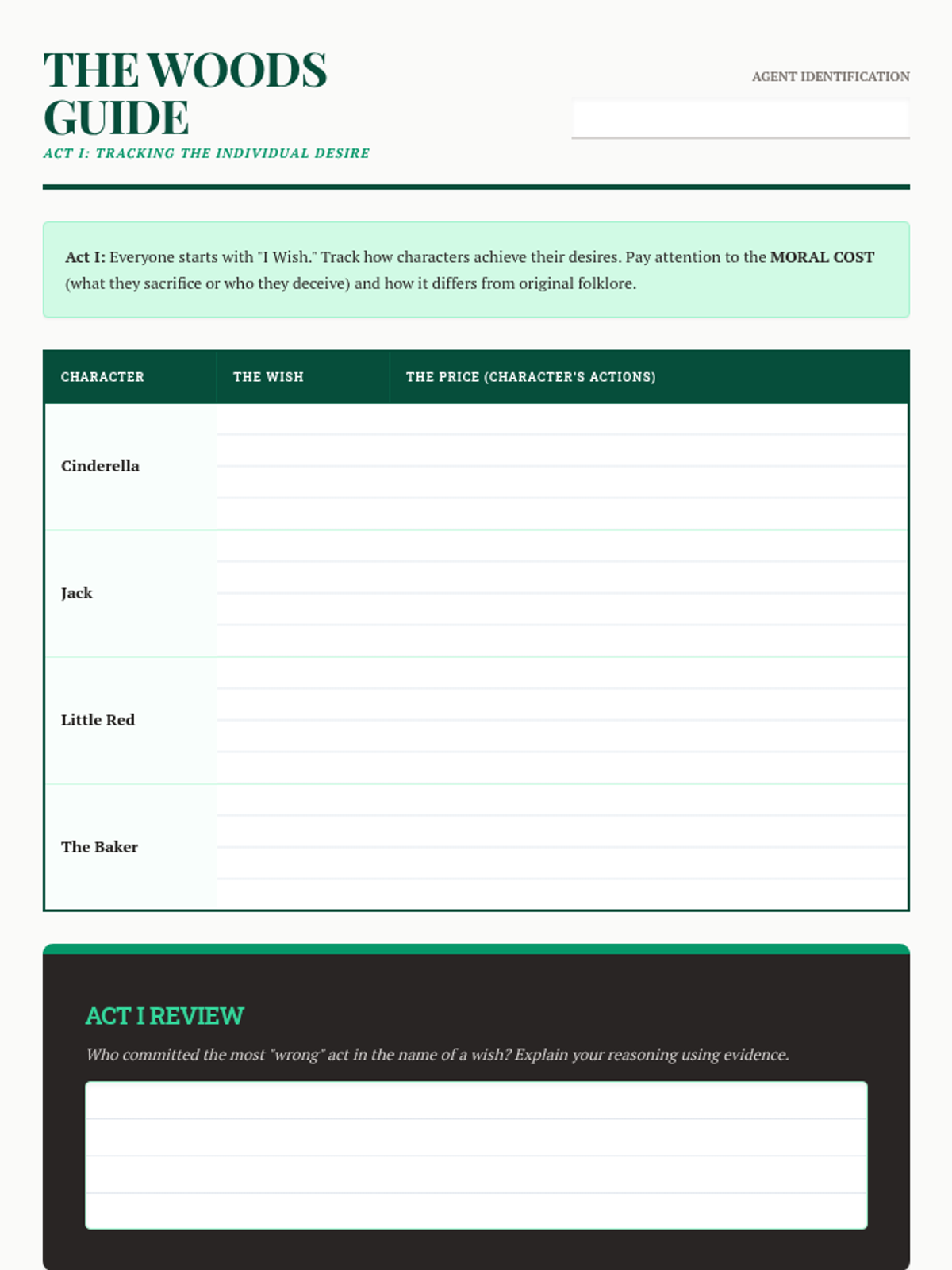
A detailed watching guide for 'Into the Woods' that tracks character wishes in Act I and their consequences in Act II.
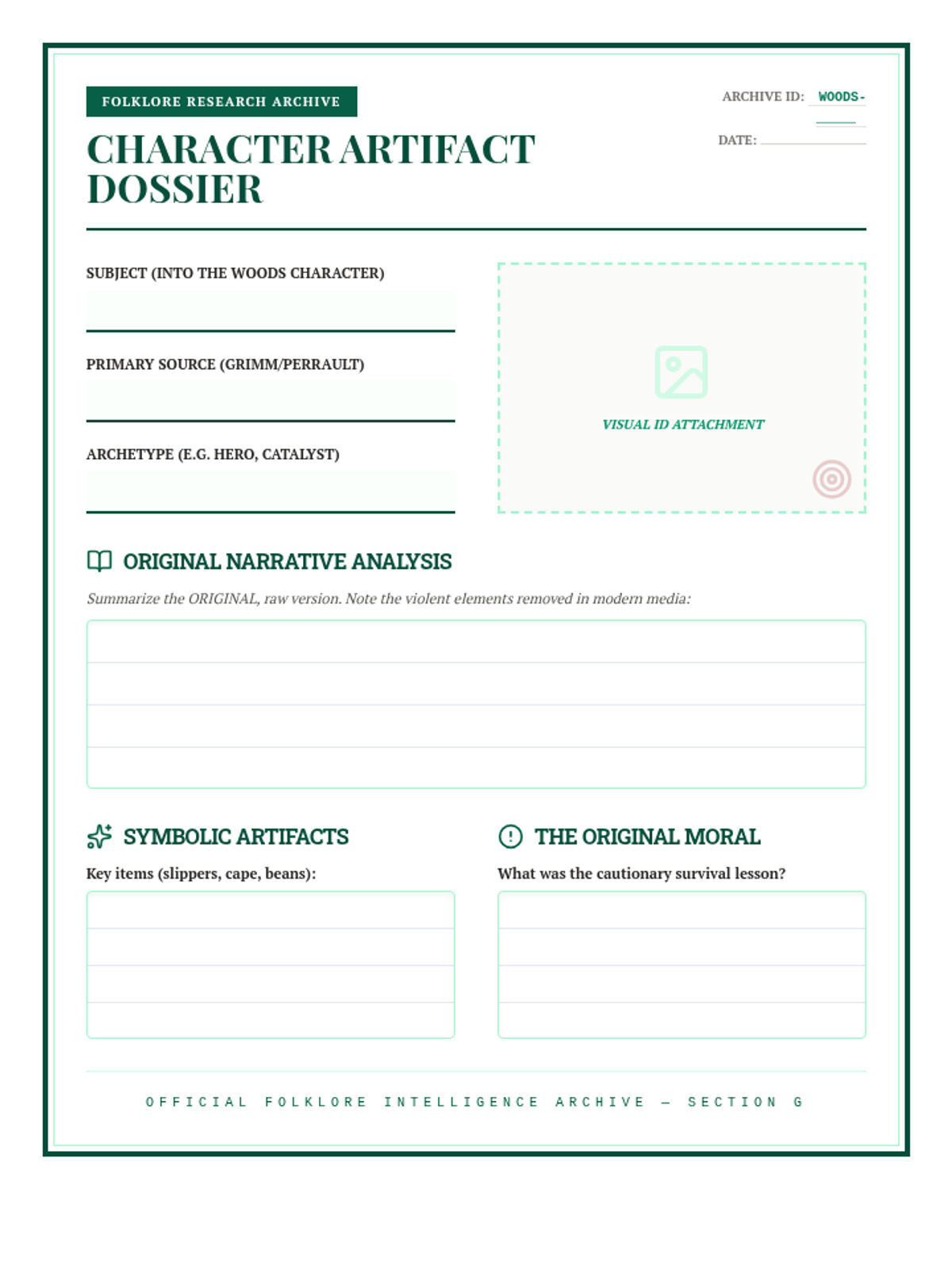
A research worksheet for students to document the original versions of fairytale characters, their attributes, and their cultural endurance.
High-school introductory slides for the 'Into the Woods' folklore project, exploring the purpose of stories, literary history, and Sondheim's deconstruction.
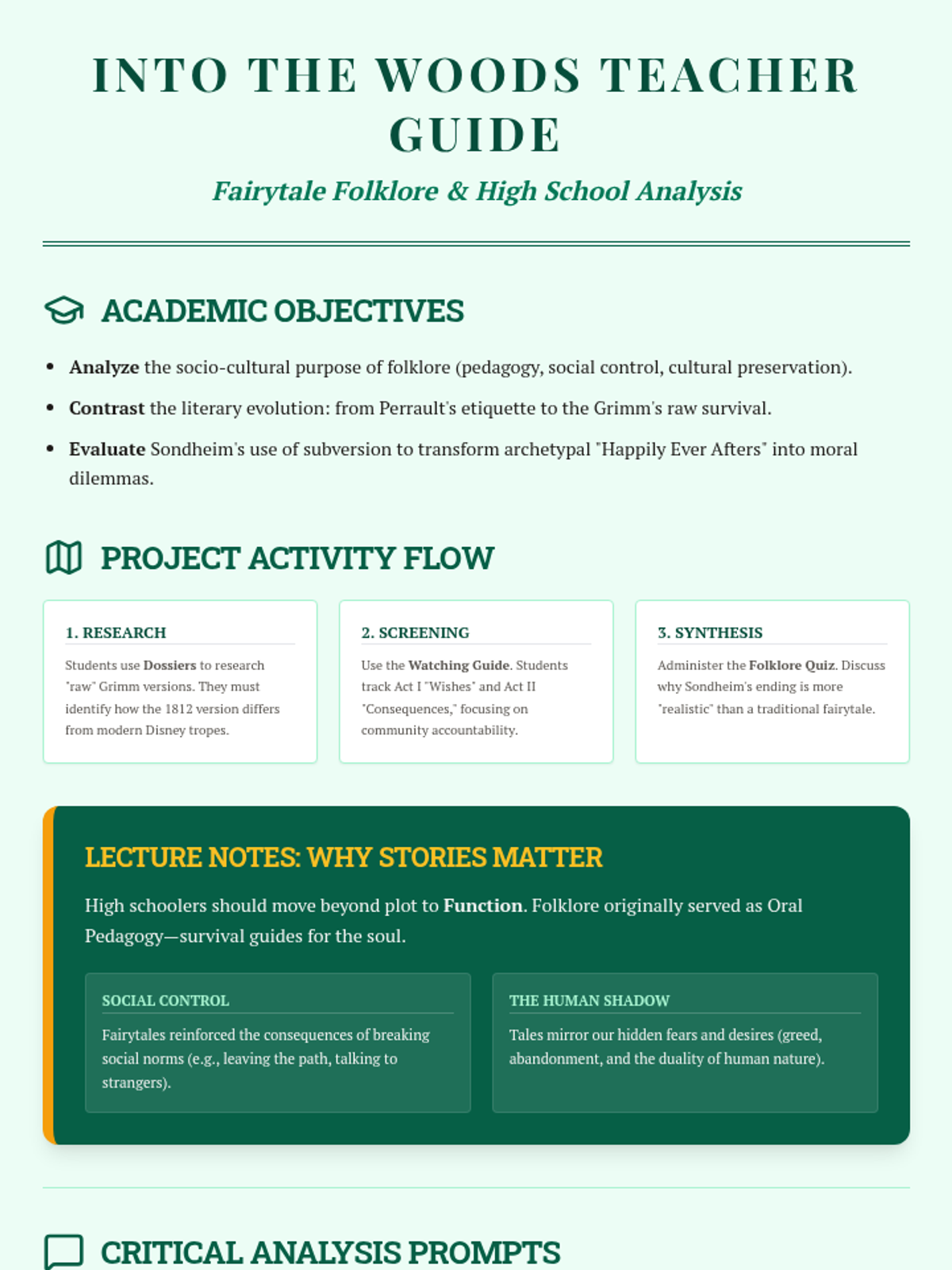
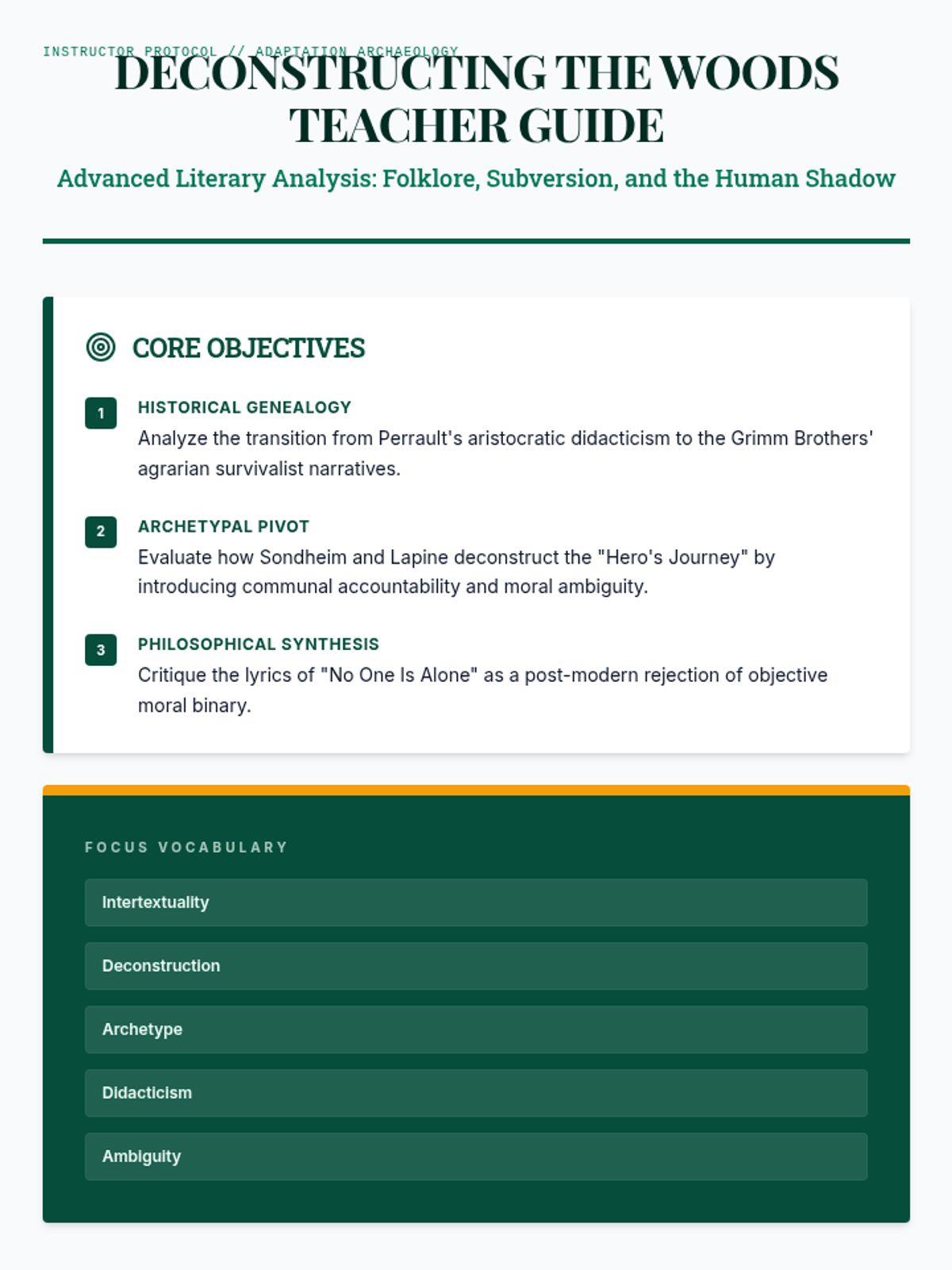
A teacher's facilitation guide for the 'Into the Woods' folklore project, including academic objectives, socratic seminar prompts, and theoretical frameworks for high school analysis.
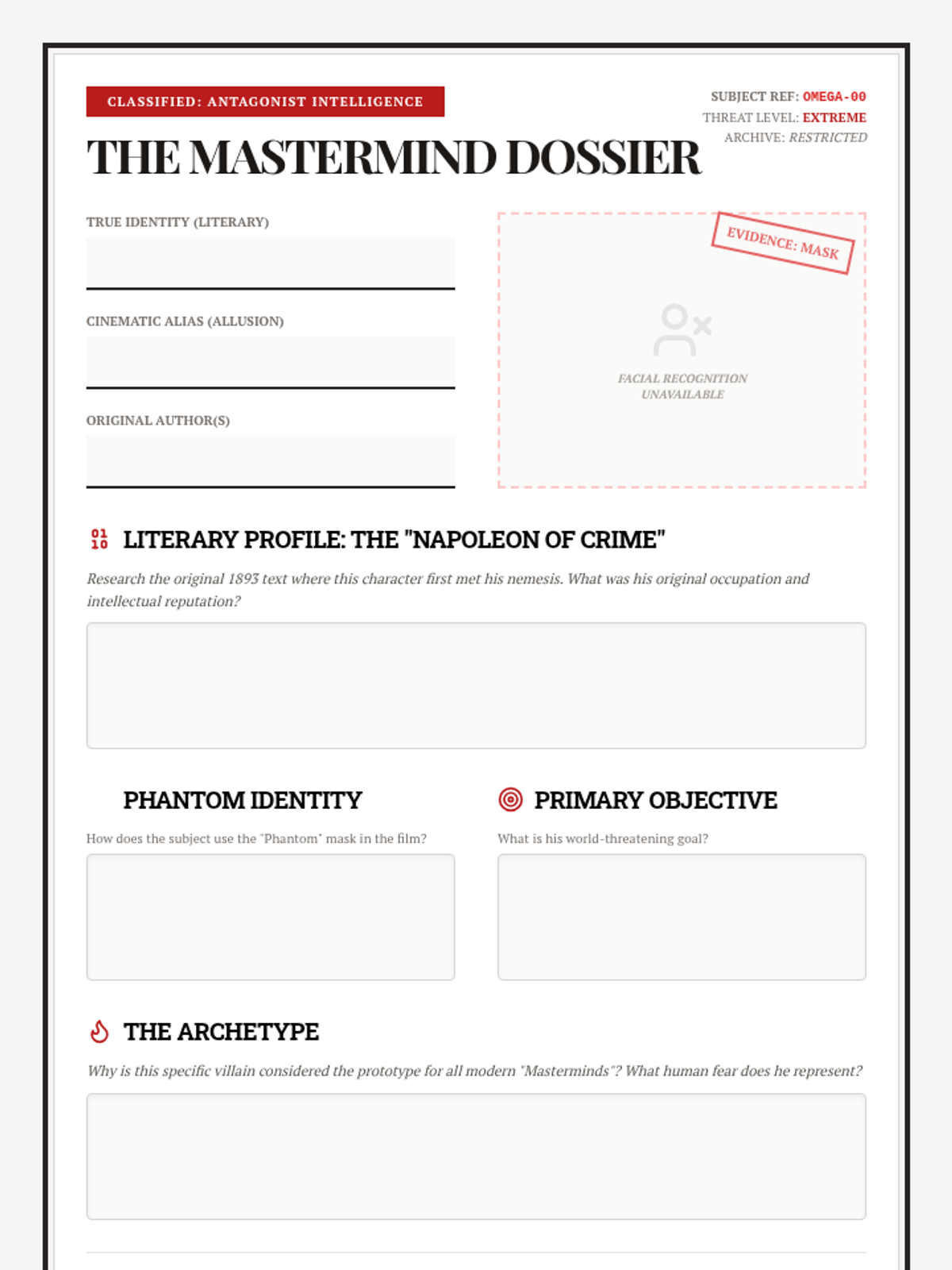
A specialized research dossier for the film's main antagonist, focusing on Professor Moriarty's literary origins and his 'Phantom' dual identity.
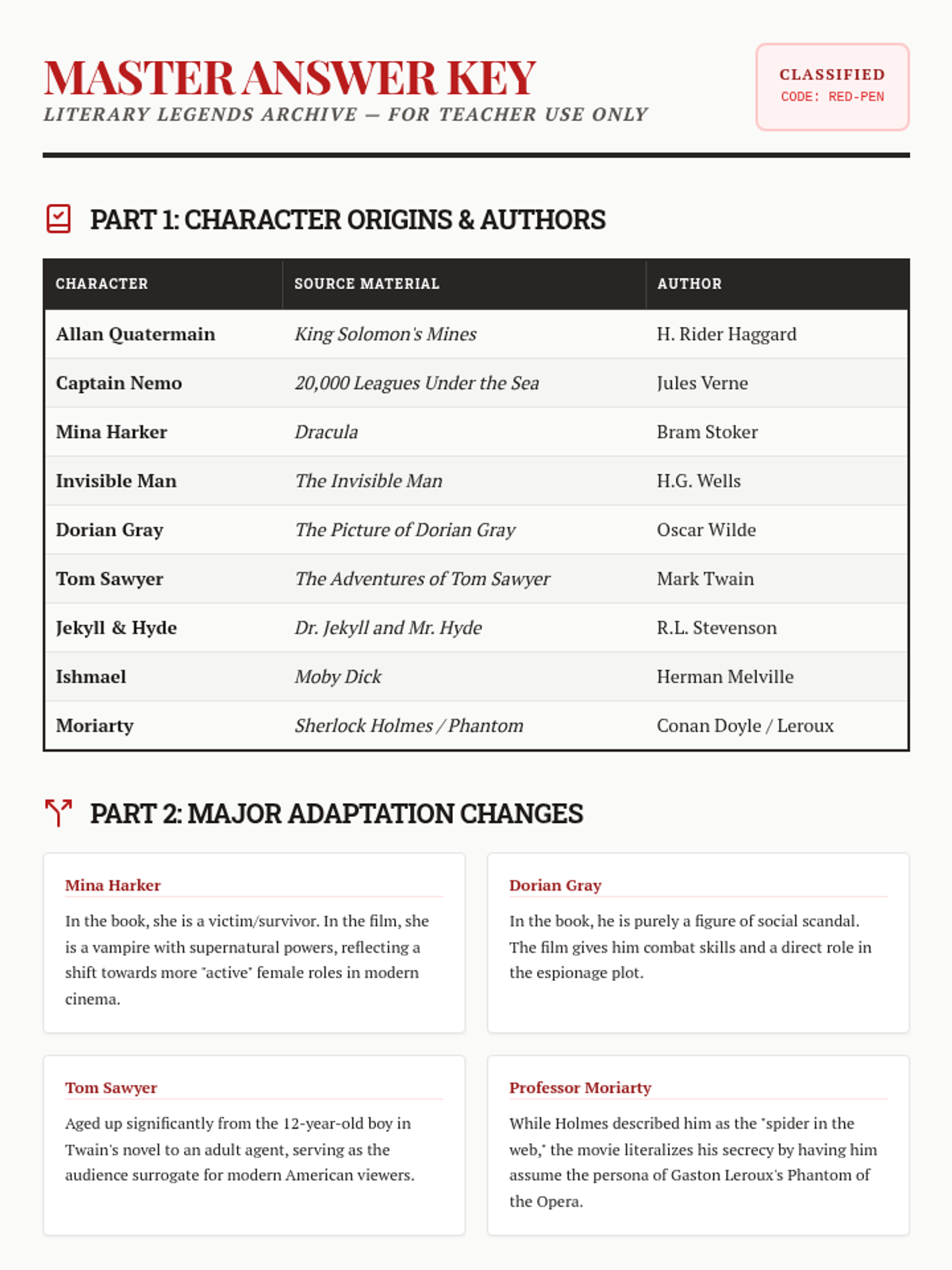
A comprehensive answer key for teachers, including character origins, adaptation differences, and explanations for the film's literary idioms and allusions.
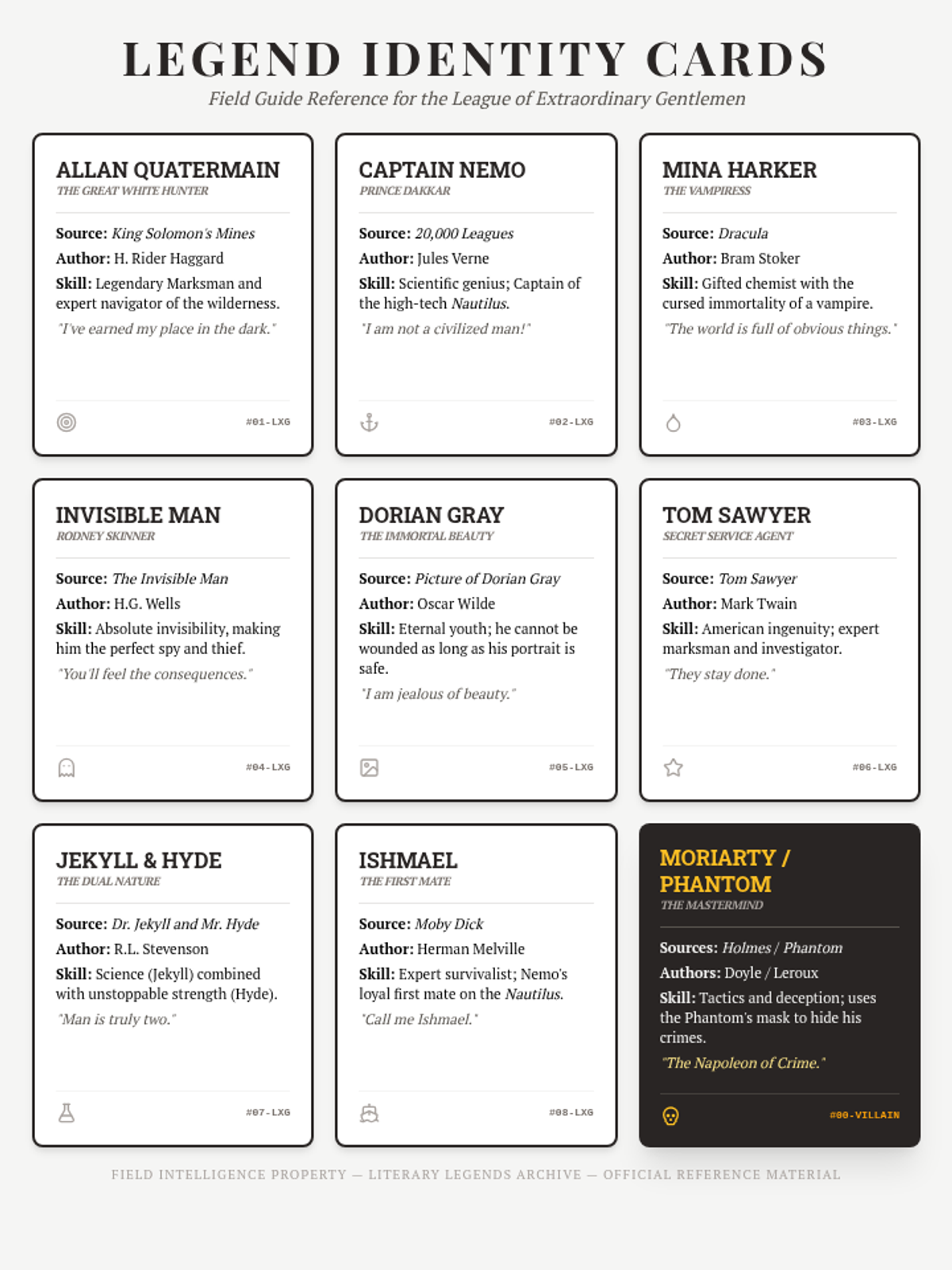
A set of reference cards for the main characters, including their literary origins, authors, skills, and key quotes.
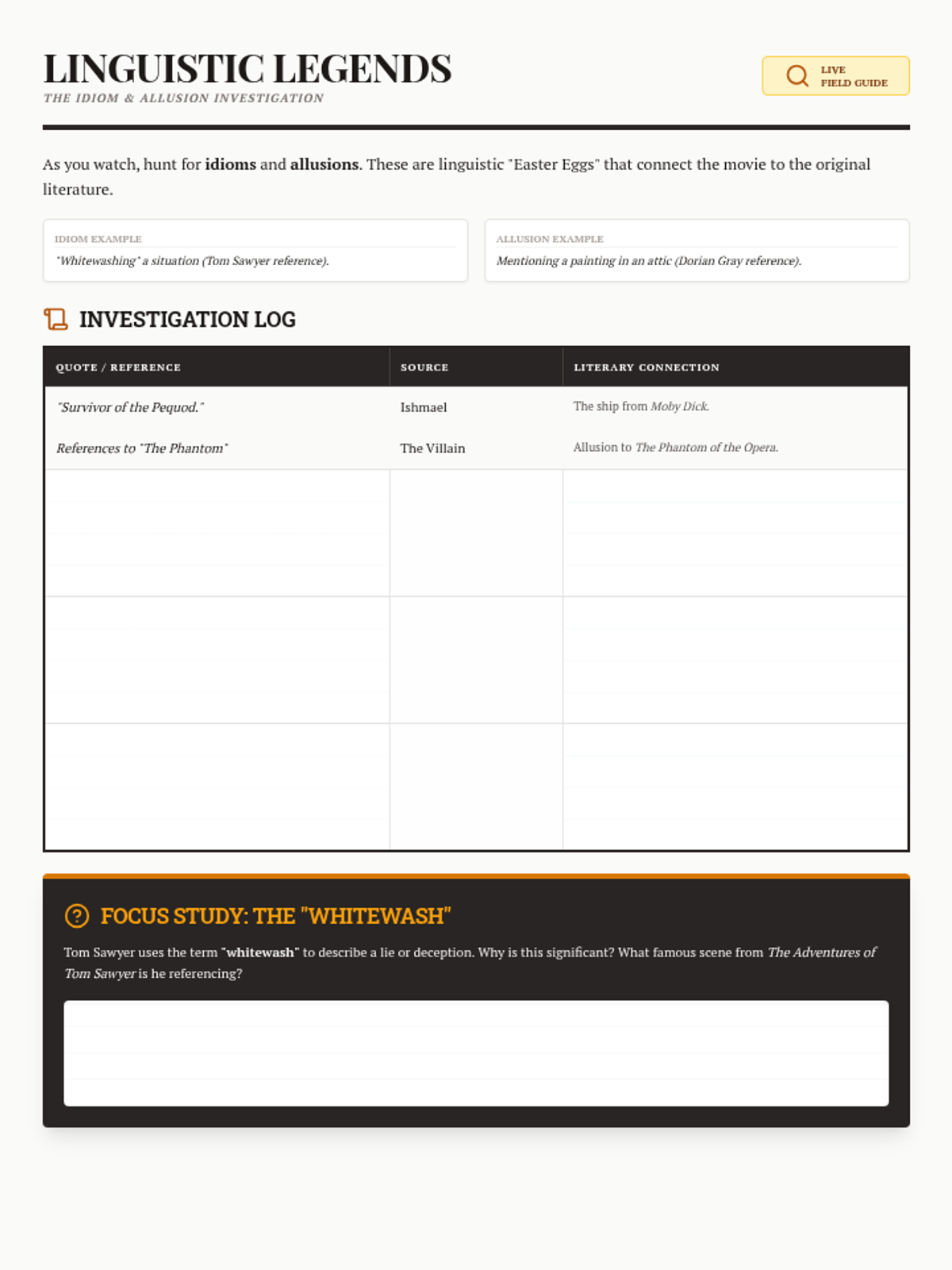
A watching guide focused on identifying literary idioms and allusions used by the characters throughout the film.
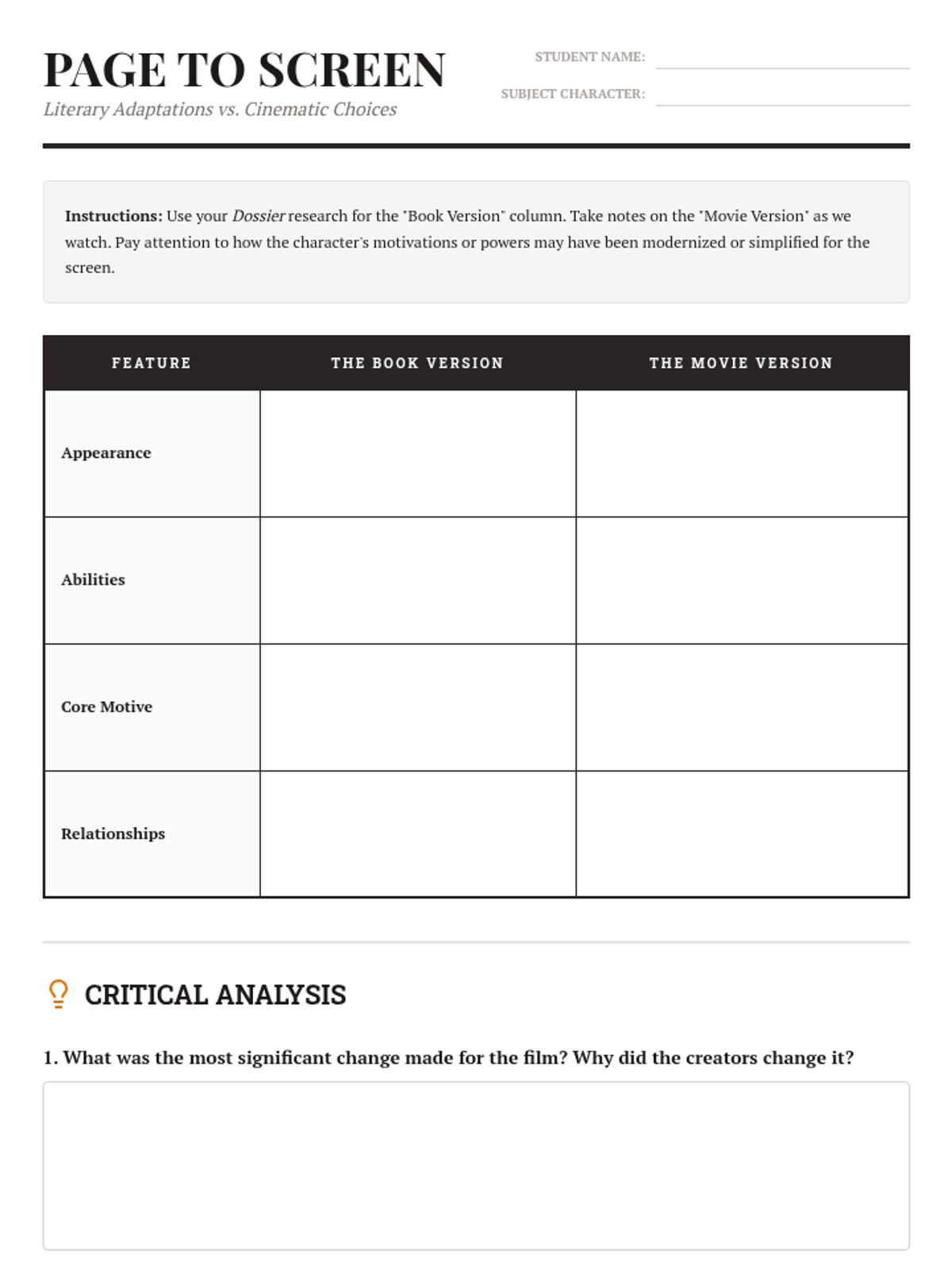
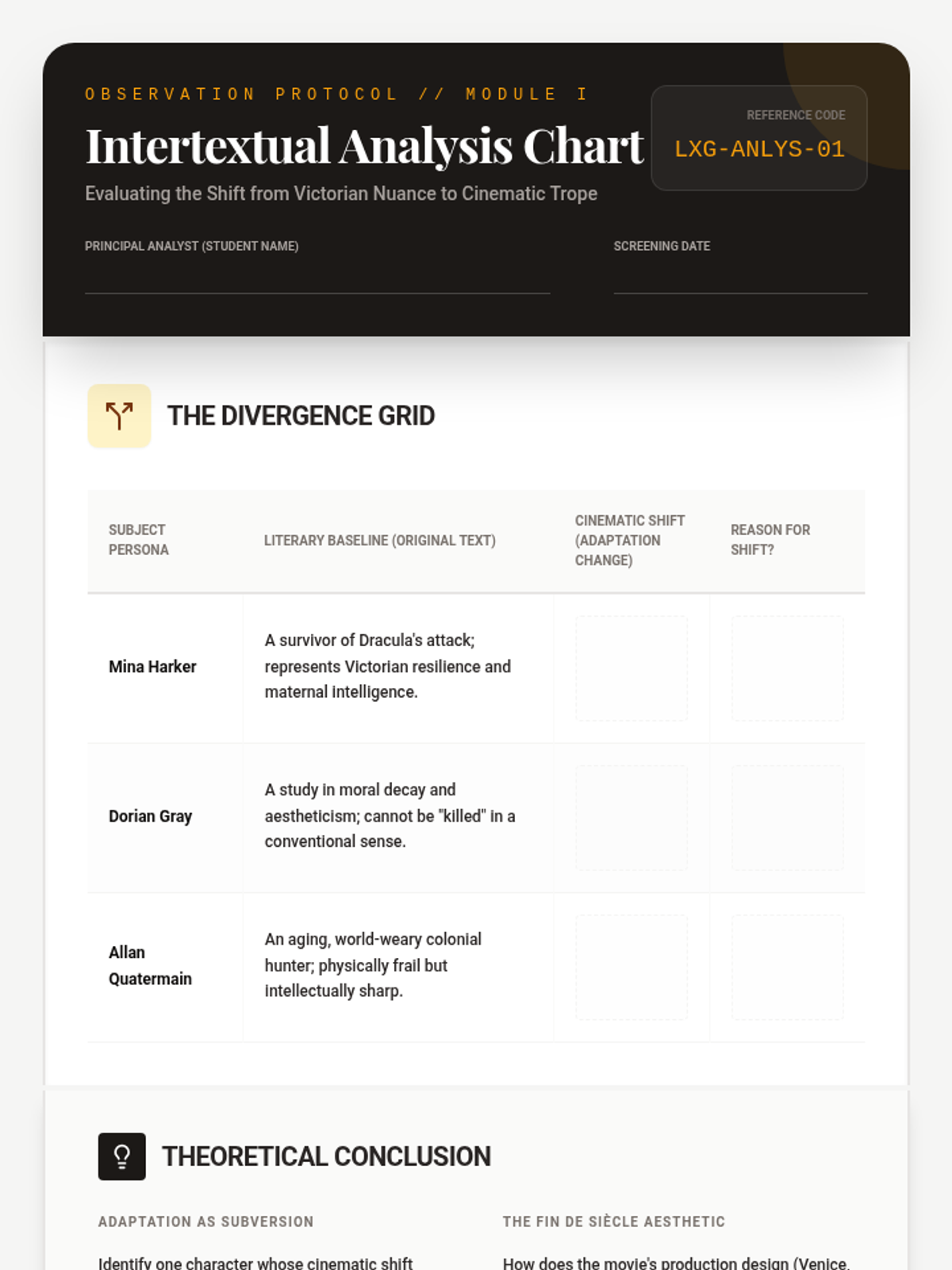
A comparison chart for students to record differences between the original literary version of a character and its cinematic counterpart in the film.
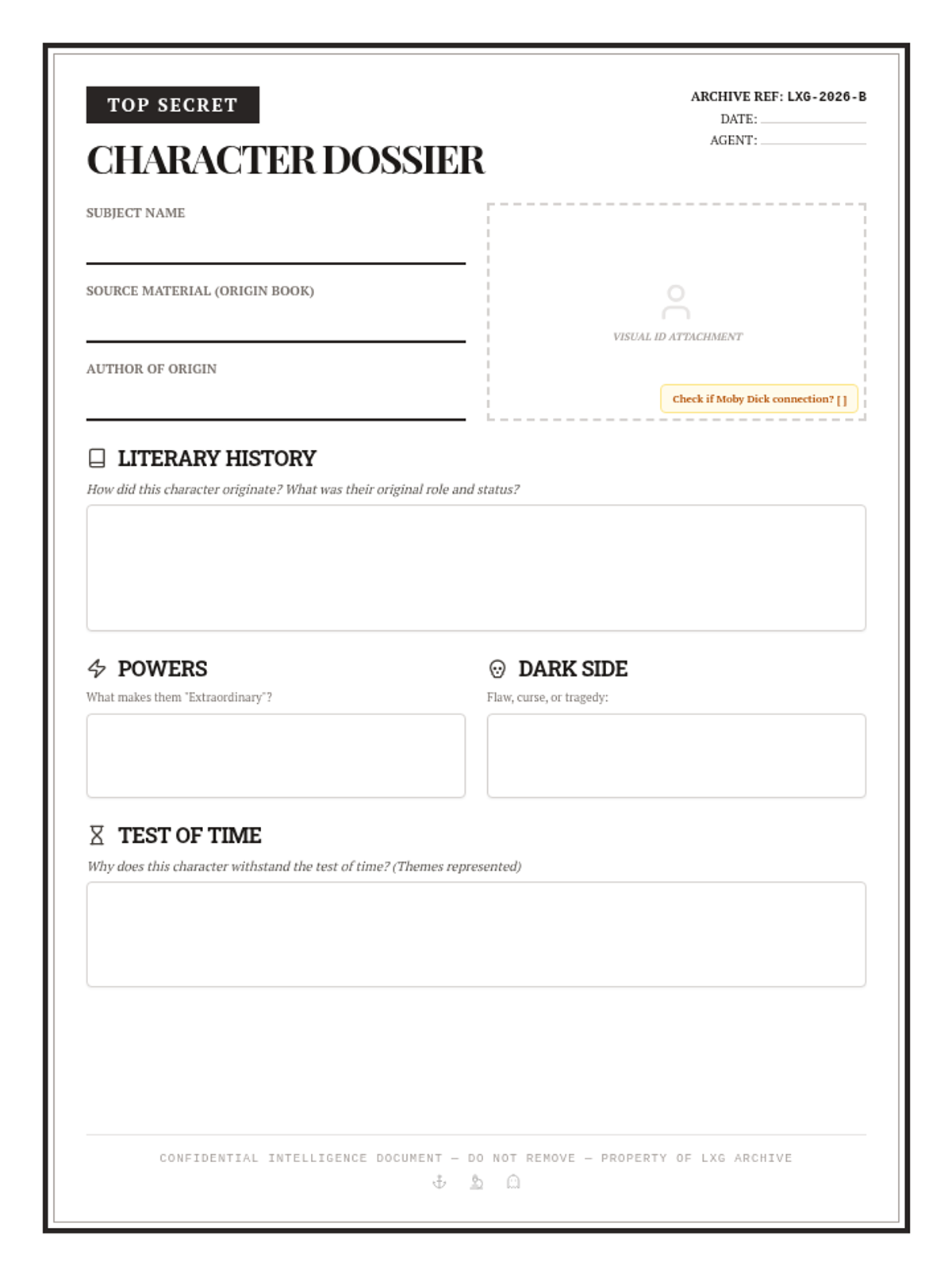
A structured 'Secret Dossier' research worksheet for students to document the literary origins, traits, and endurance of their assigned character.
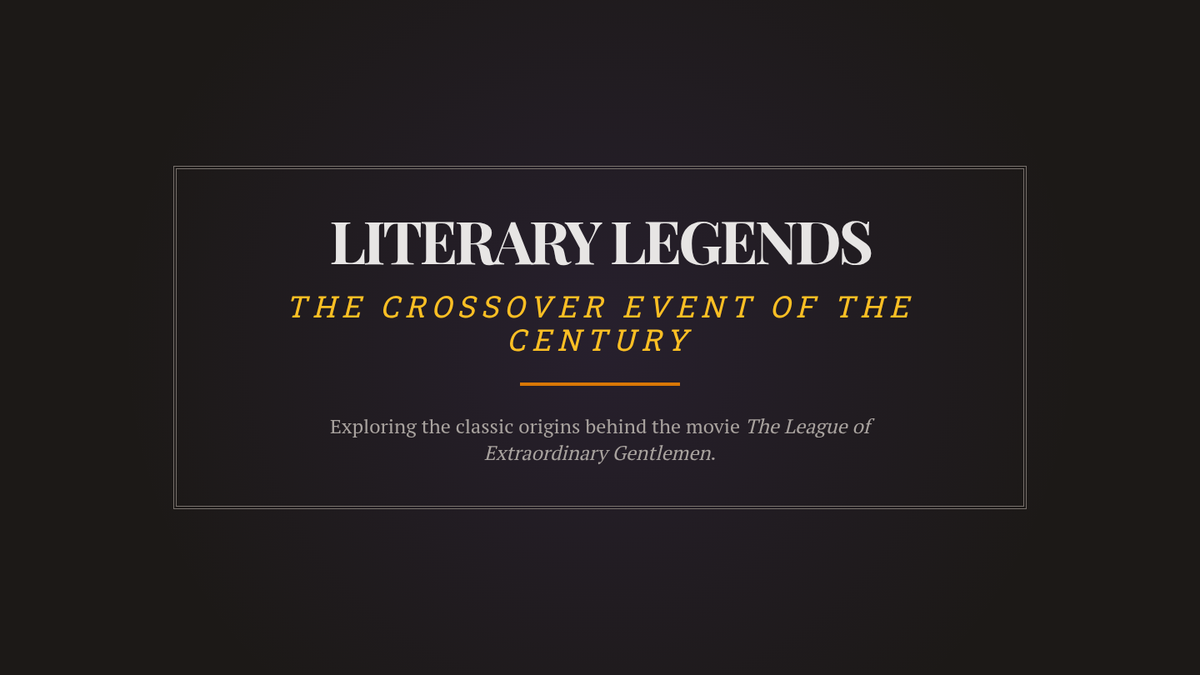
Introductory slides for the 'Literary Legends' project, explaining the concept of the cinematic crossover and the students' research mission.
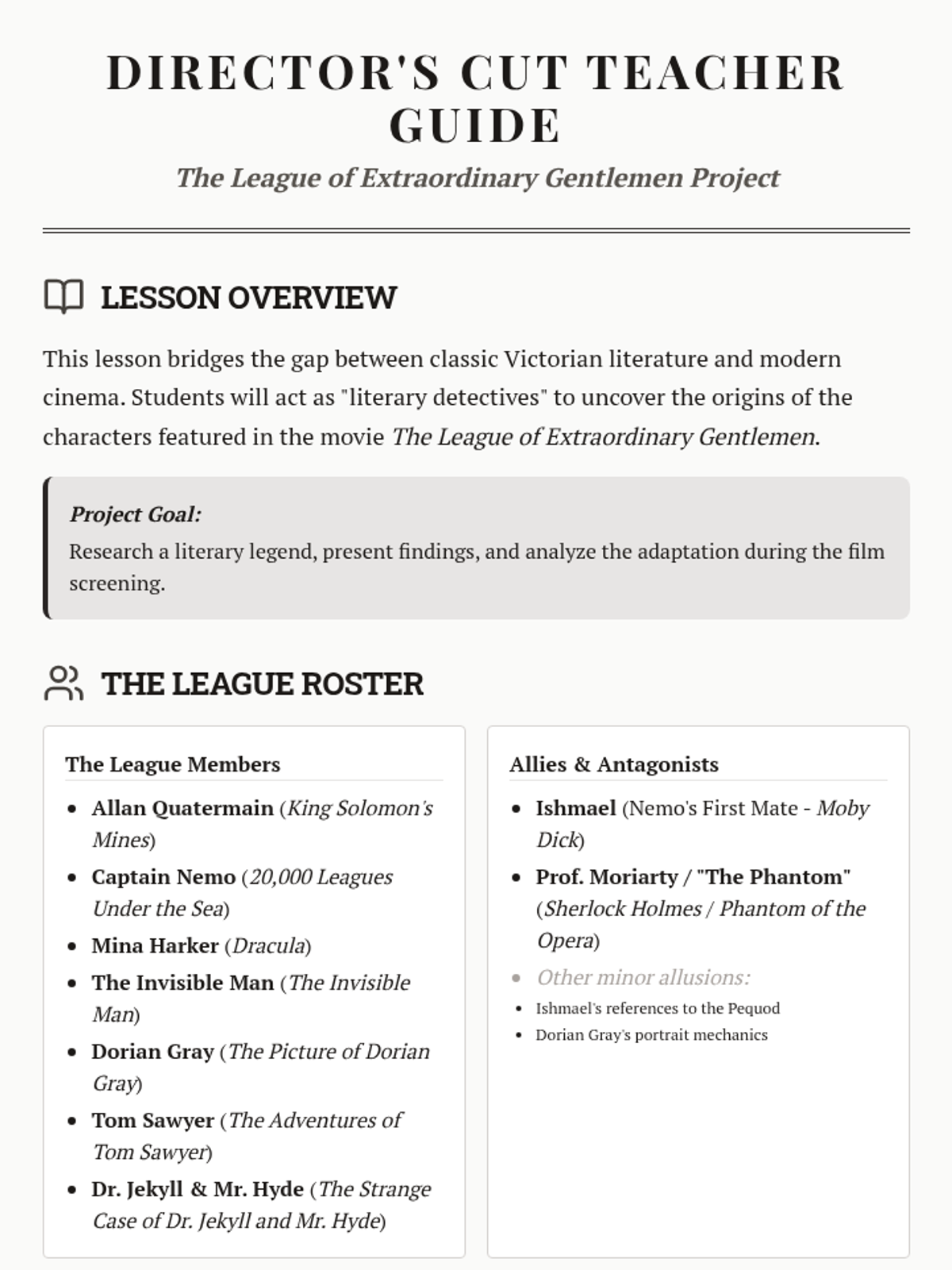
A teacher's facilitation guide for the 'Literary Legends Crossover' project, including a character roster, pacing guide, and discussion prompts.
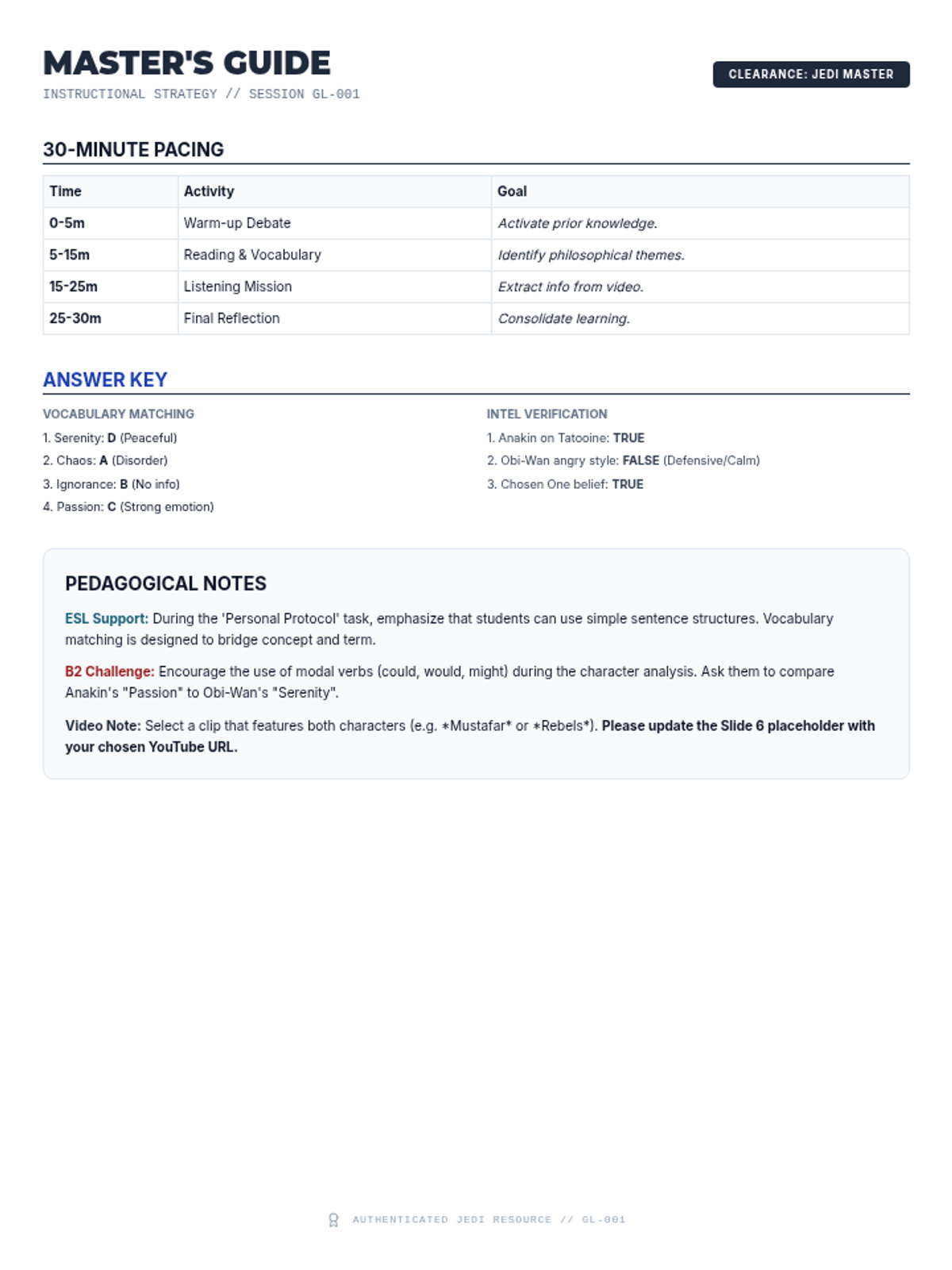
A teacher guide for the Galactic Language Lounge lesson. Includes a 30-minute pacing guide, answer keys for all student activities, and specific differentiation strategies for B1/B2 ESL learners. Consolidated to a single page.
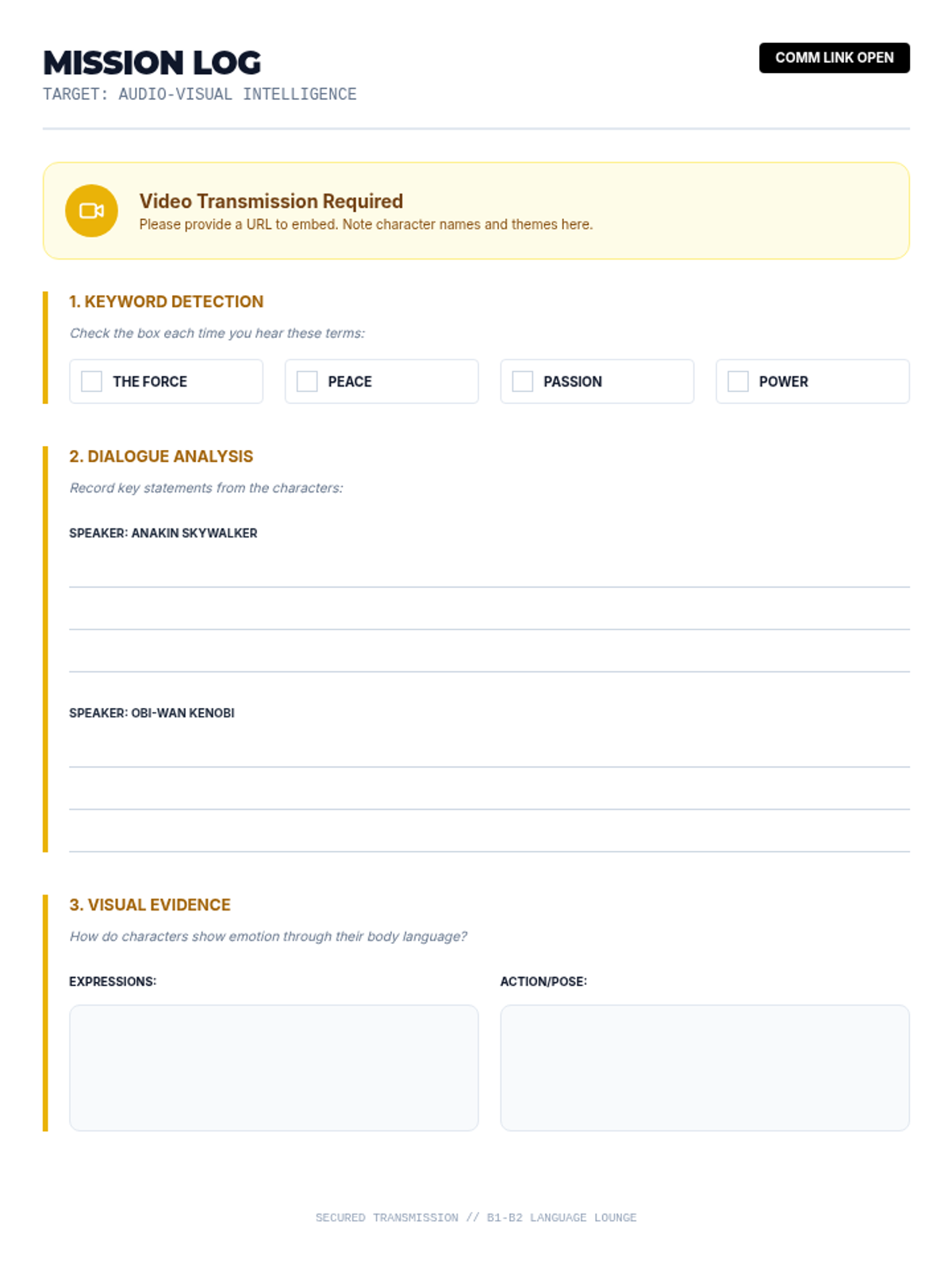
A listening comprehension guide designed to accompany a YouTube video. It includes sections for keyword detection, quote completion, and visual analysis of character emotions, tailored for B1/B2 ESL learners. Consolidated to a single page.
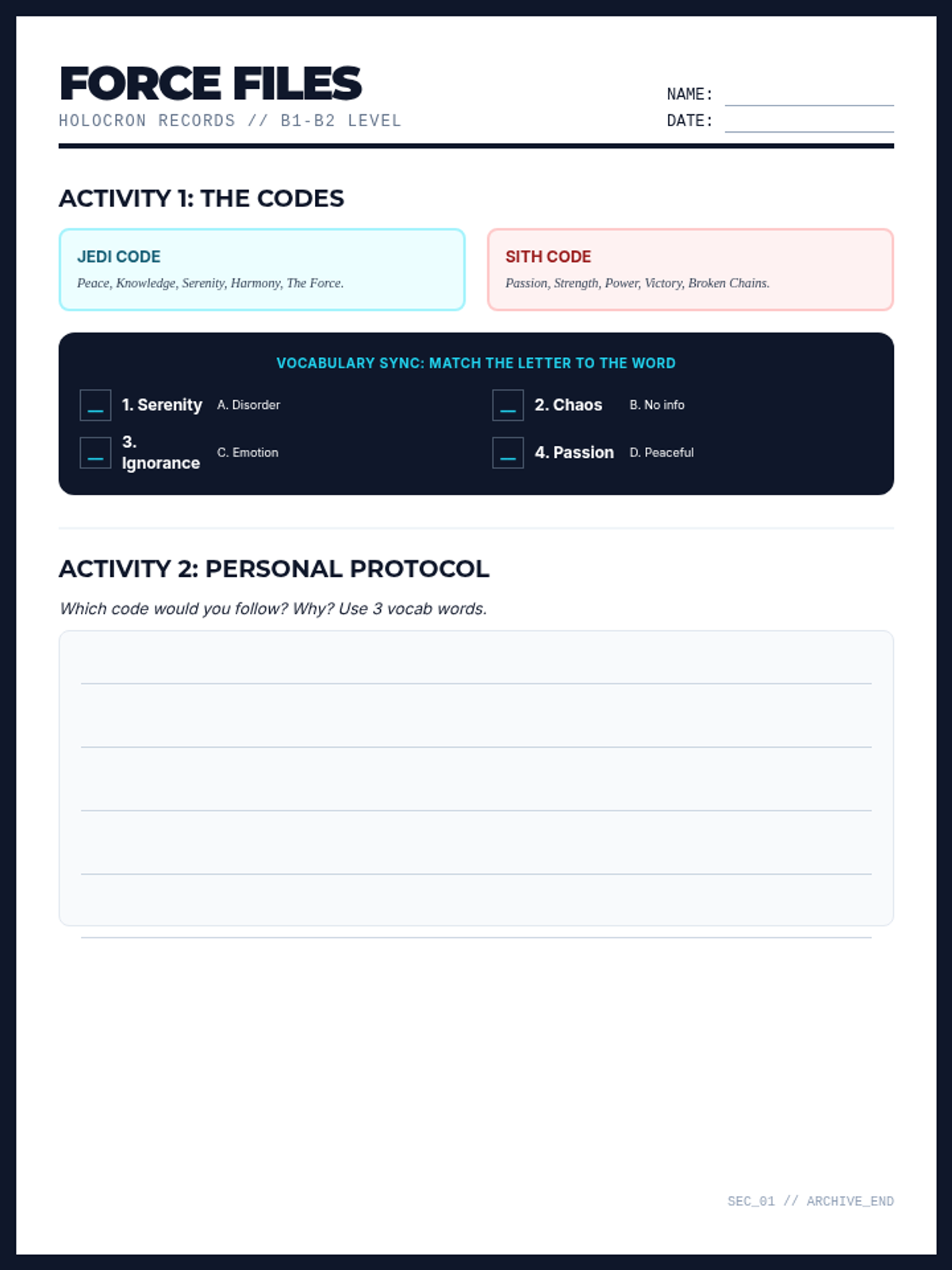
A two-page printable worksheet for ESL students covering Star Wars character backstories and a comparison of Jedi and Sith philosophy. Layout optimized to fit two pages with improved contrast and work areas.
A high-energy, Star Wars-themed slide deck designed for ESL students. It includes visual representations of the Jedi and Sith Codes, character backstory highlights, and structured speaking prompts to facilitate classroom discussion. Content layout fixed for better slide transitions.
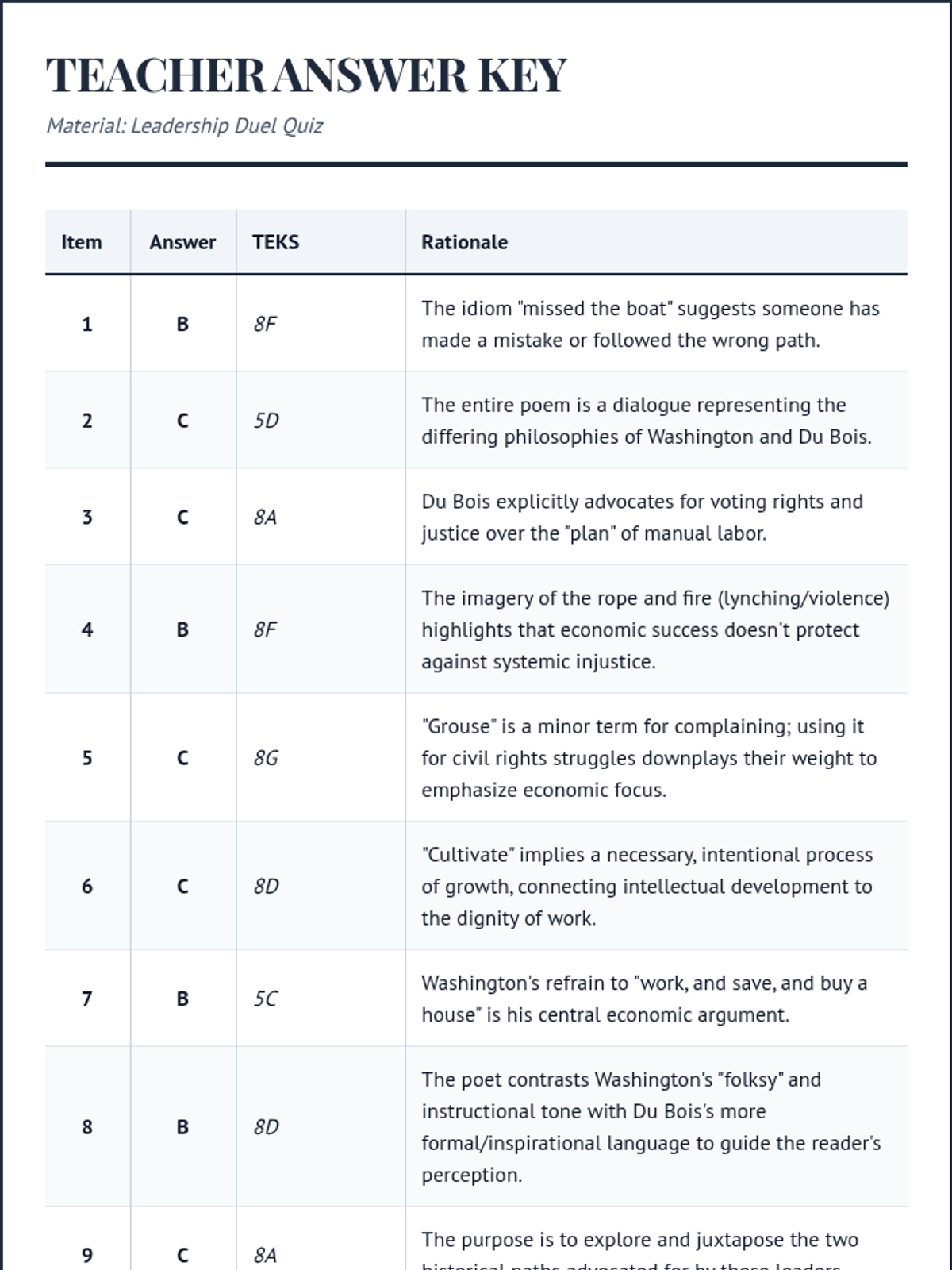
The teacher answer key for the Leadership Duel Quiz, including correct answers, TEKS alignments, and brief rationales for remediation analysis.
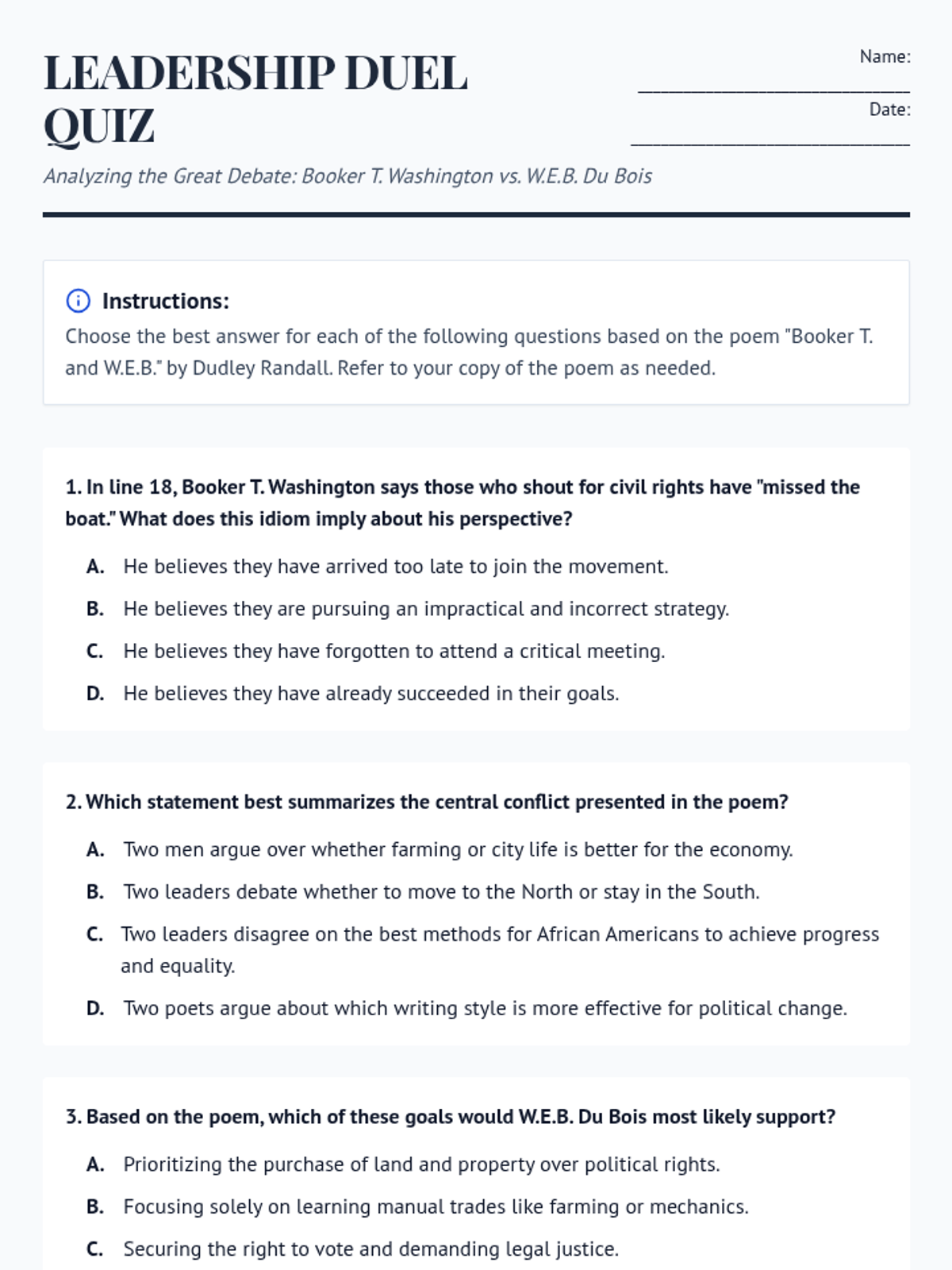
A 10-question multiple-choice remediation quiz designed to help students master the analysis of Dudley Randall's poem 'Booker T. and W.E.B.' focusing on historical perspectives, figurative language, and authorial intent.
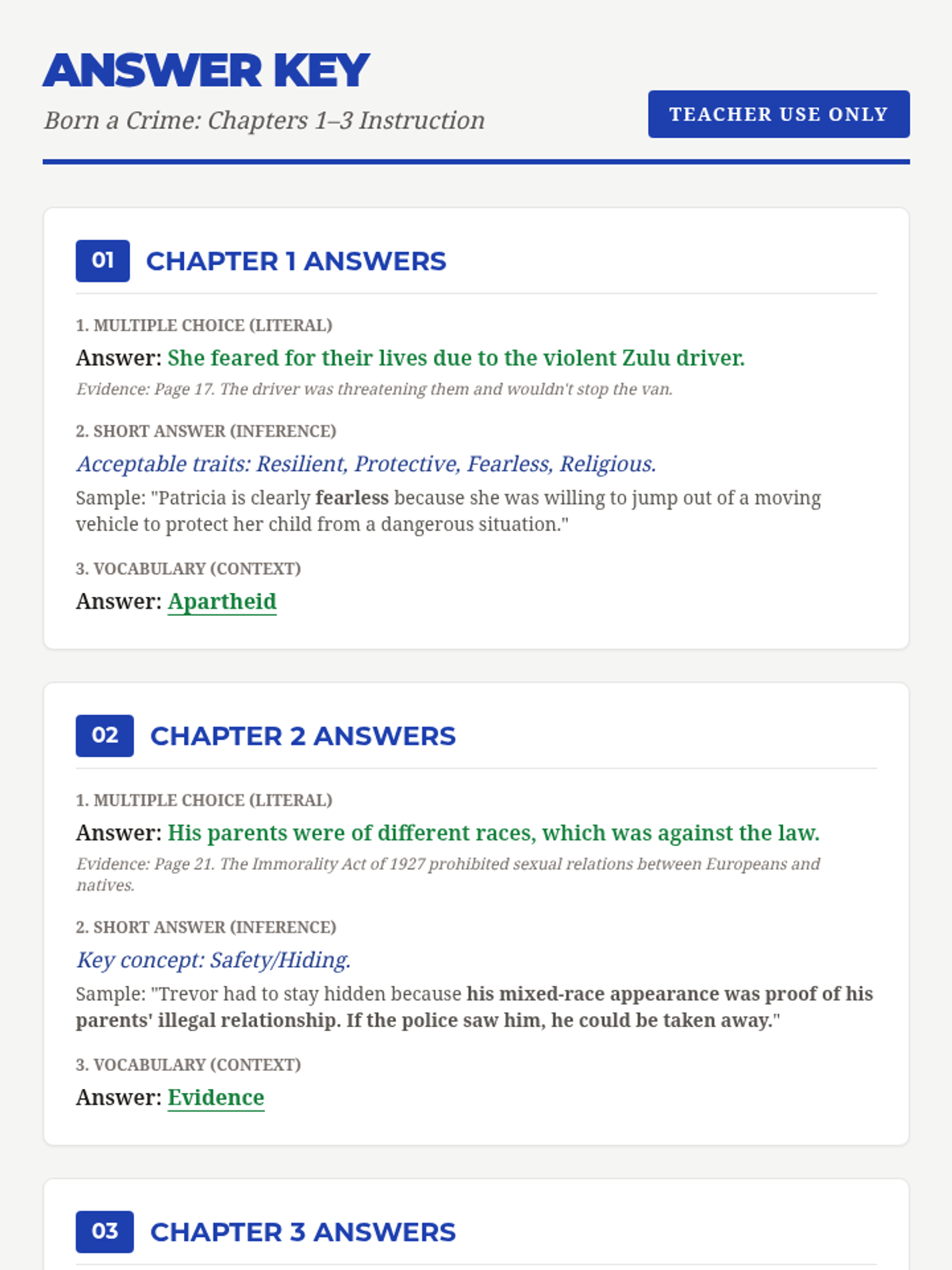
Teacher answer key for the Born a Crime Chapters 1-3 worksheet. Fixed layout issues, split content problems, and formatting bugs. Optimized for clear single-page sections where possible.
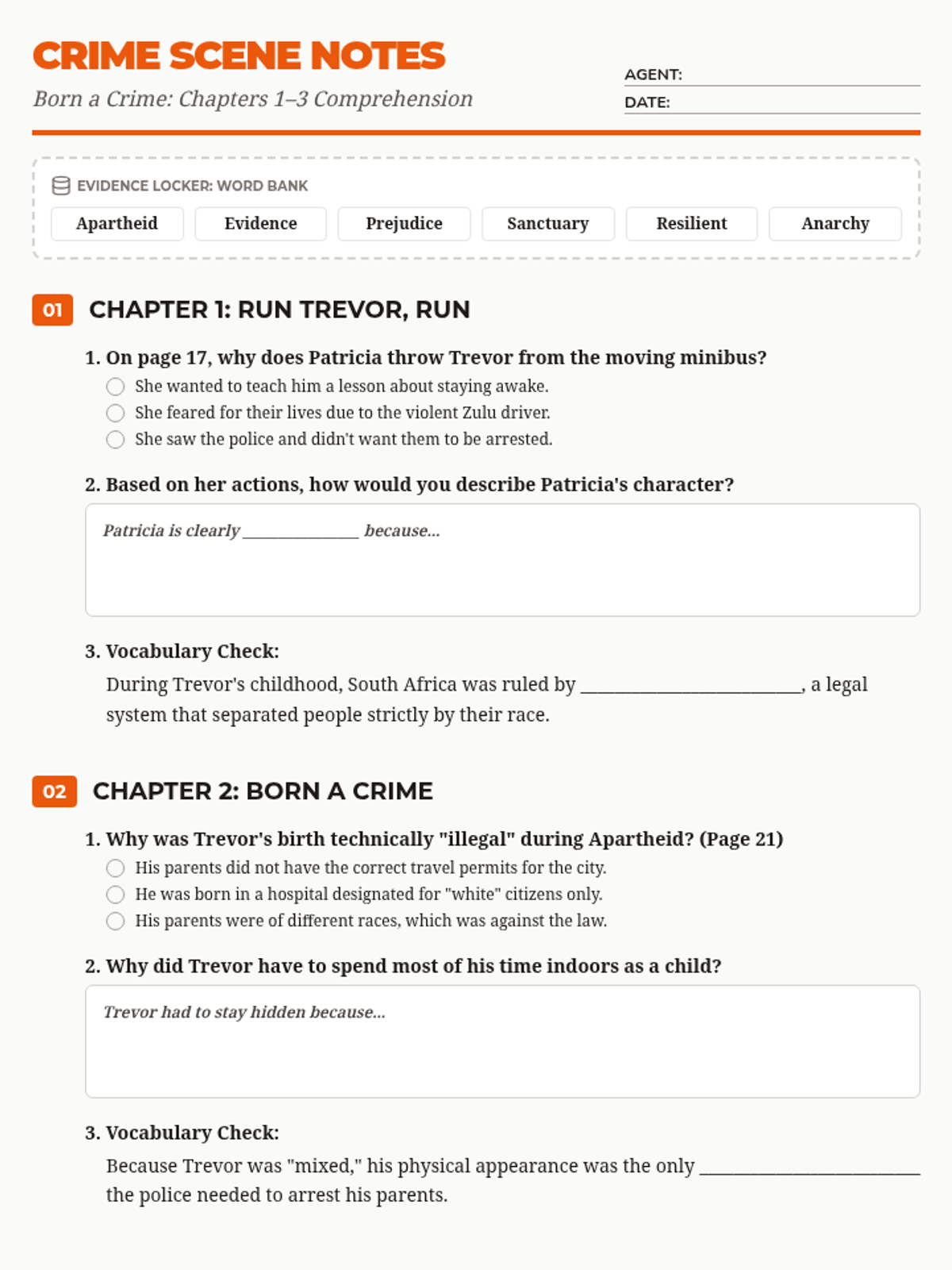
Student worksheet for Born a Crime Chapters 1-3, featuring multiple choice, short answer with sentence starters, and fill-in-the-blank vocabulary questions. Design features a 'crime scene' or 'reporter notebook' theme suitable for 7th graders. Improved layout for 2-page printability.
An updated, high-impact review slide deck that recaps sports archetypes using the full criteria from the unit's Brainstorm Key. It defines Heroes, Villains, and the 'Swagger Paradox' with rapid-fire practice cases for Curry and Durant.
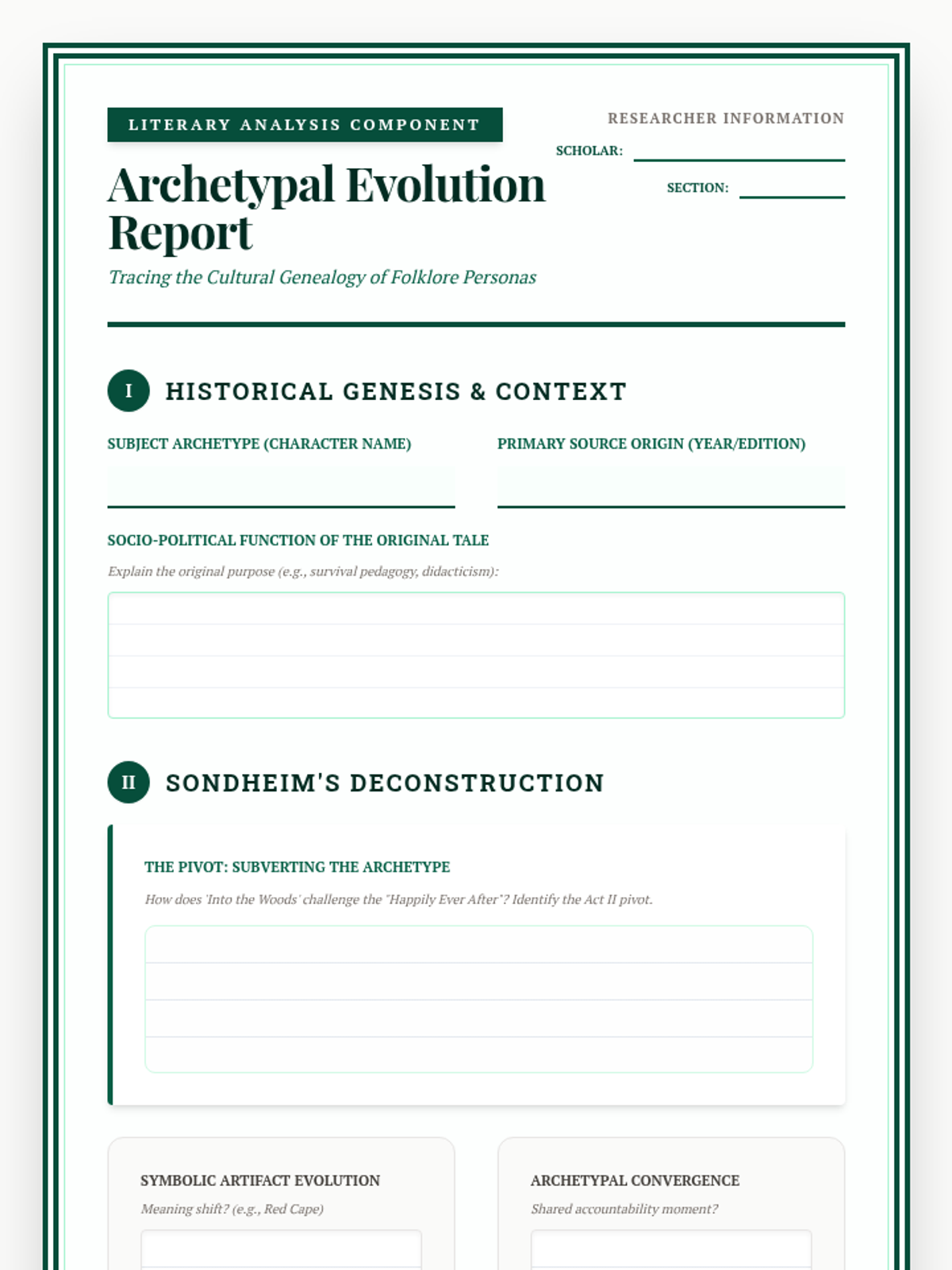
An advanced research report for sophomore students to document the archetypal evolution and cultural genealogy of fairytale characters, focusing on socio-political functions and thematic deconstruction.
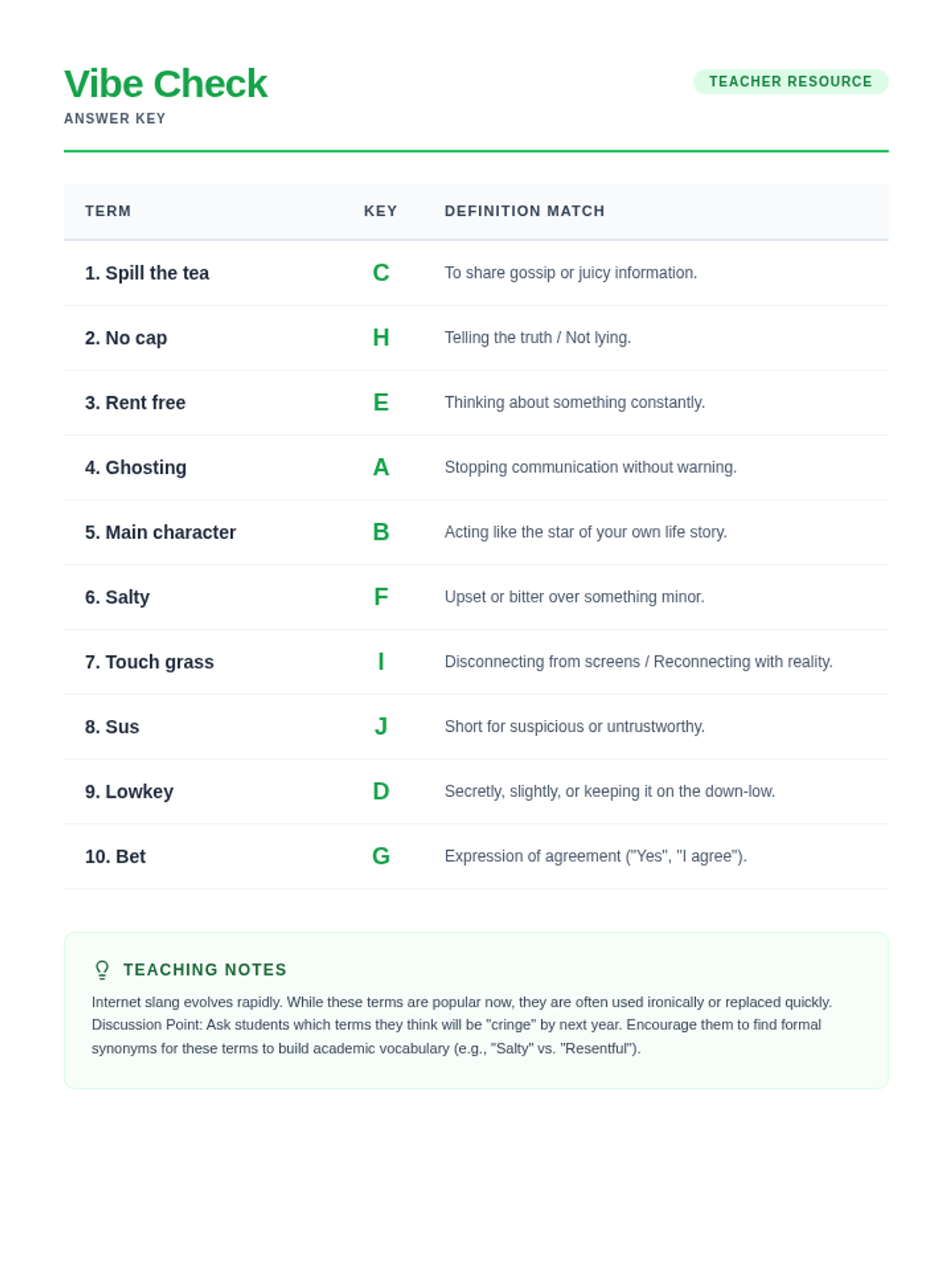
The updated answer key for the Vibe Check Matching Worksheet, now including 15 terms with correct pairings and expanded teacher notes. Corrected spelling of 'Rizz' and increased font size for accessibility.
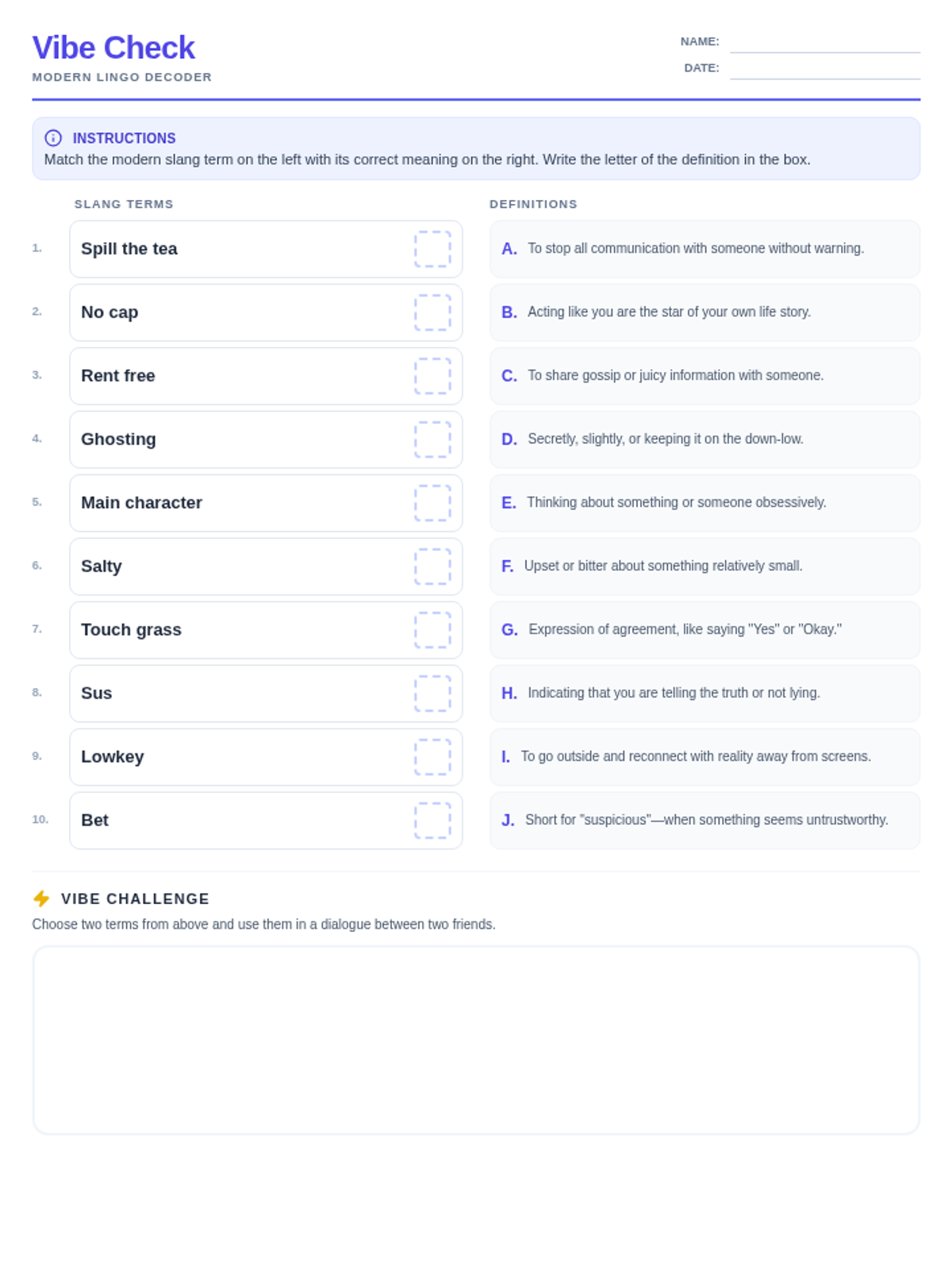
An expanded matching worksheet for teens featuring 15 modern slang terms and idioms, including 'slay', 'rizz', and 'clout'. Includes definitions and a creative writing challenge with writing lines. Corrected spelling for 'Rizz' and optimized for 15 items on one page.
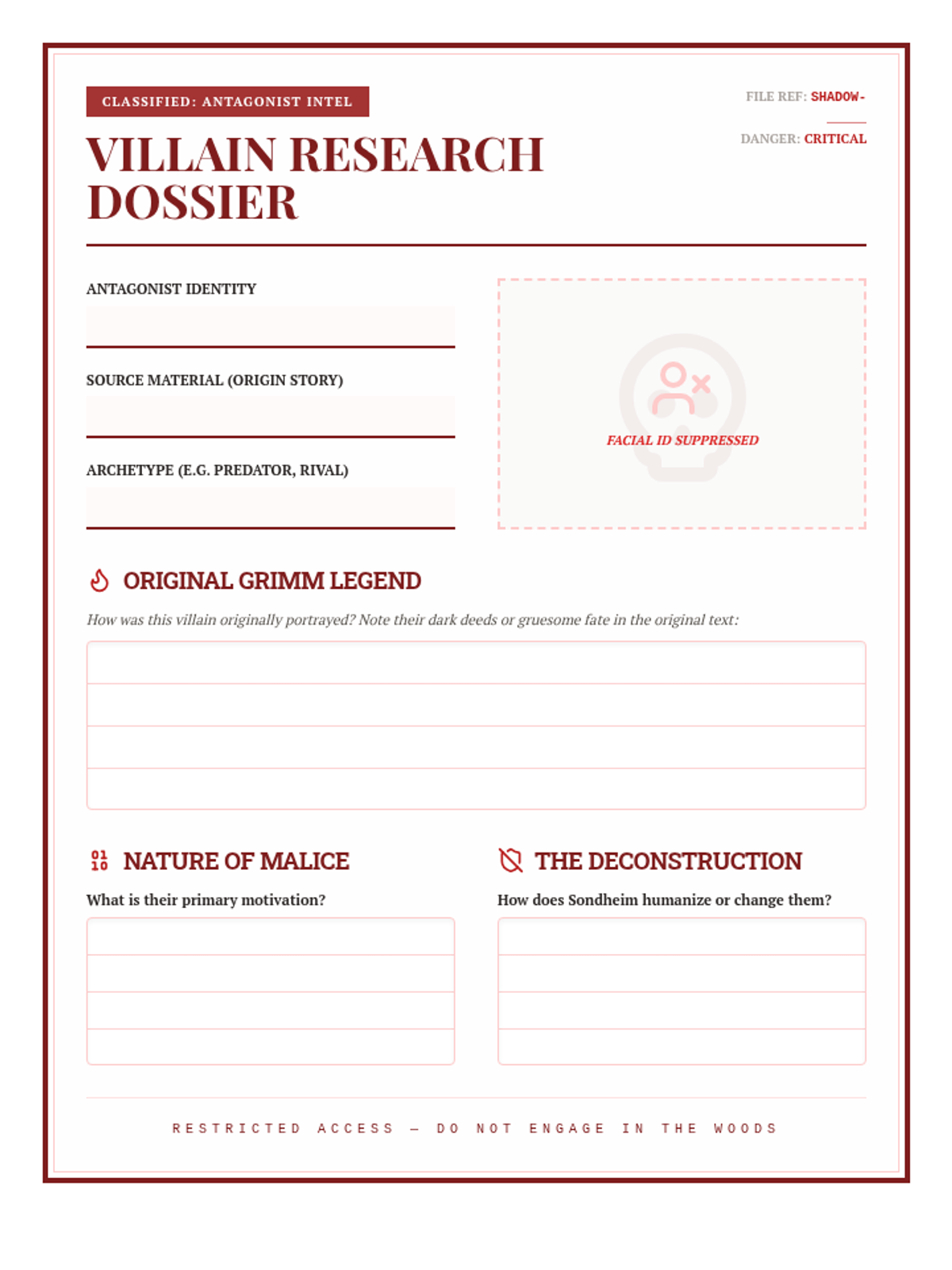
A specialized research dossier focusing on the antagonists and dark roots of fairytale characters in 'Into the Woods'.