Sentence structure fundamentals, subject-verb agreement, and precise usage of parts of speech including pronouns, conjunctions, and adjectives. Targets technical accuracy through mastery of capitalization, punctuation, spelling, and verb mood.
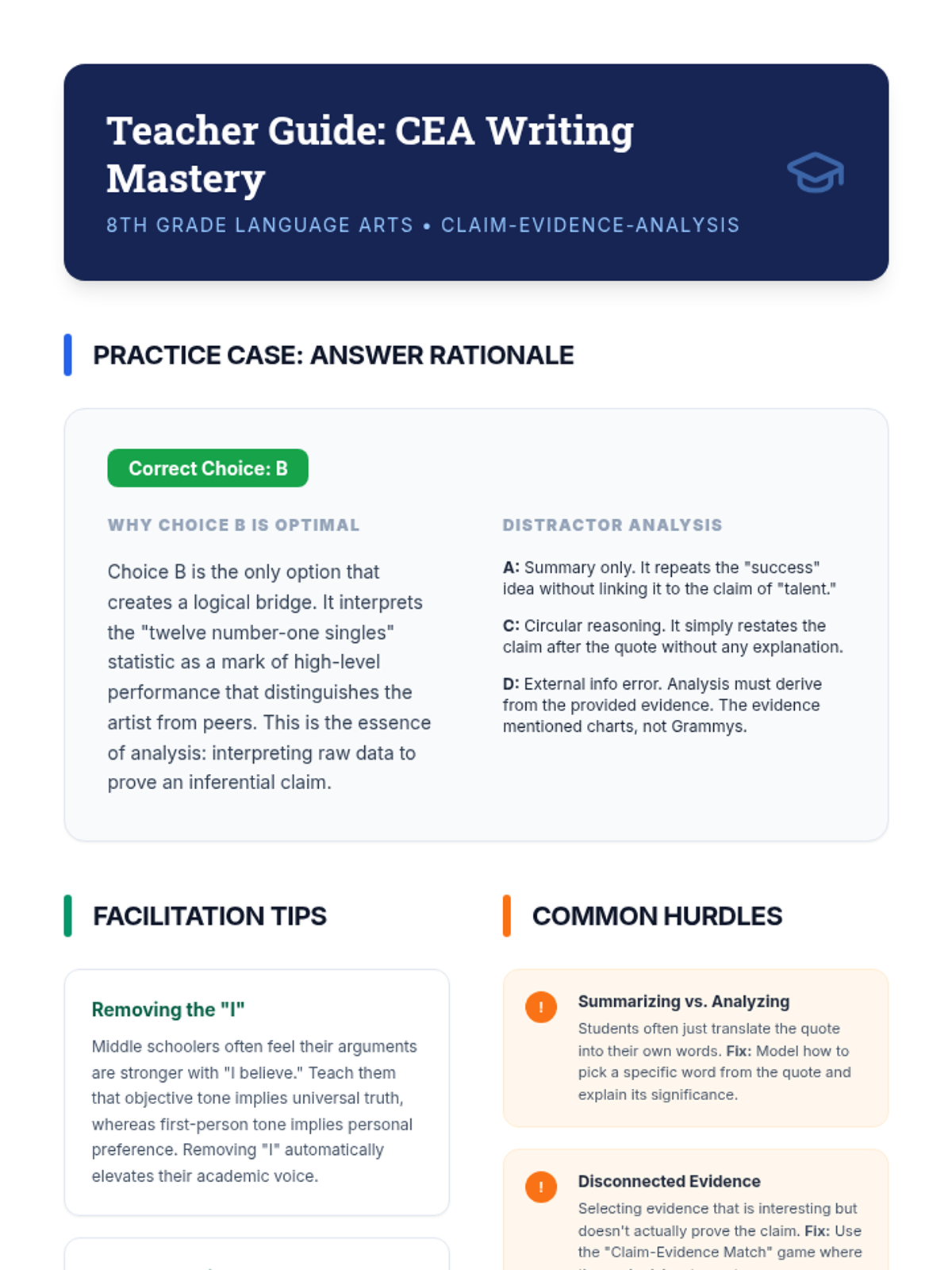
A teacher's reference guide for the CEA Writing lesson. It provides session goals, instructional strategies for academic writing, answer keys for practice activities, and solutions for common student writing misconceptions.
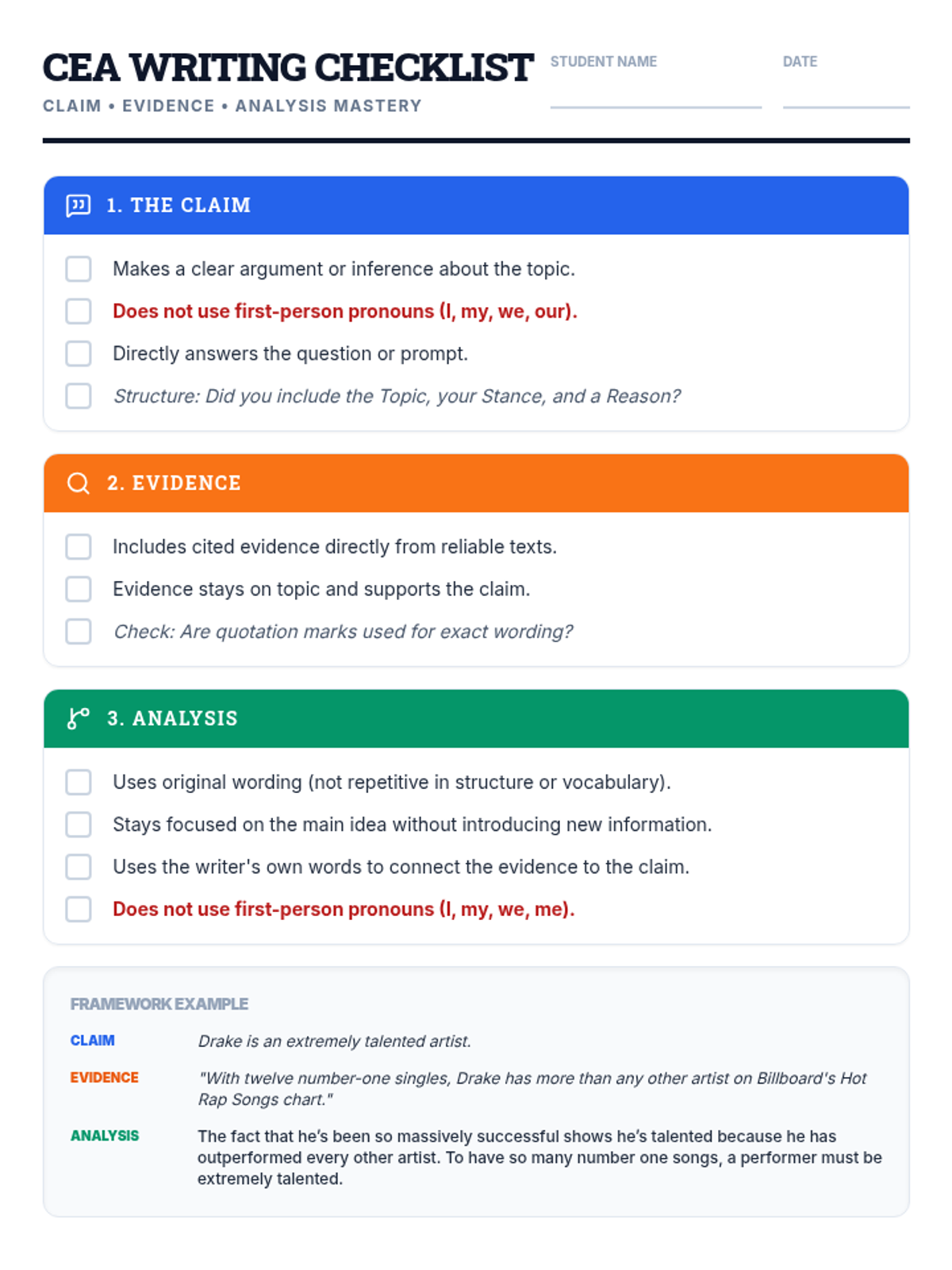
A student-facing checklist for constructing arguments using the Claim-Evidence-Analysis (CEA) framework. It includes specific criteria for each component and a modeled academic example about high school lunch periods.
A 9-slide presentation deck explaining the Claim-Evidence-Analysis (CEA) writing framework for 8th-grade students. It includes session goals, clear definitions, a simplified modeled paragraph on high school lunch breaks, and an interactive practice case.
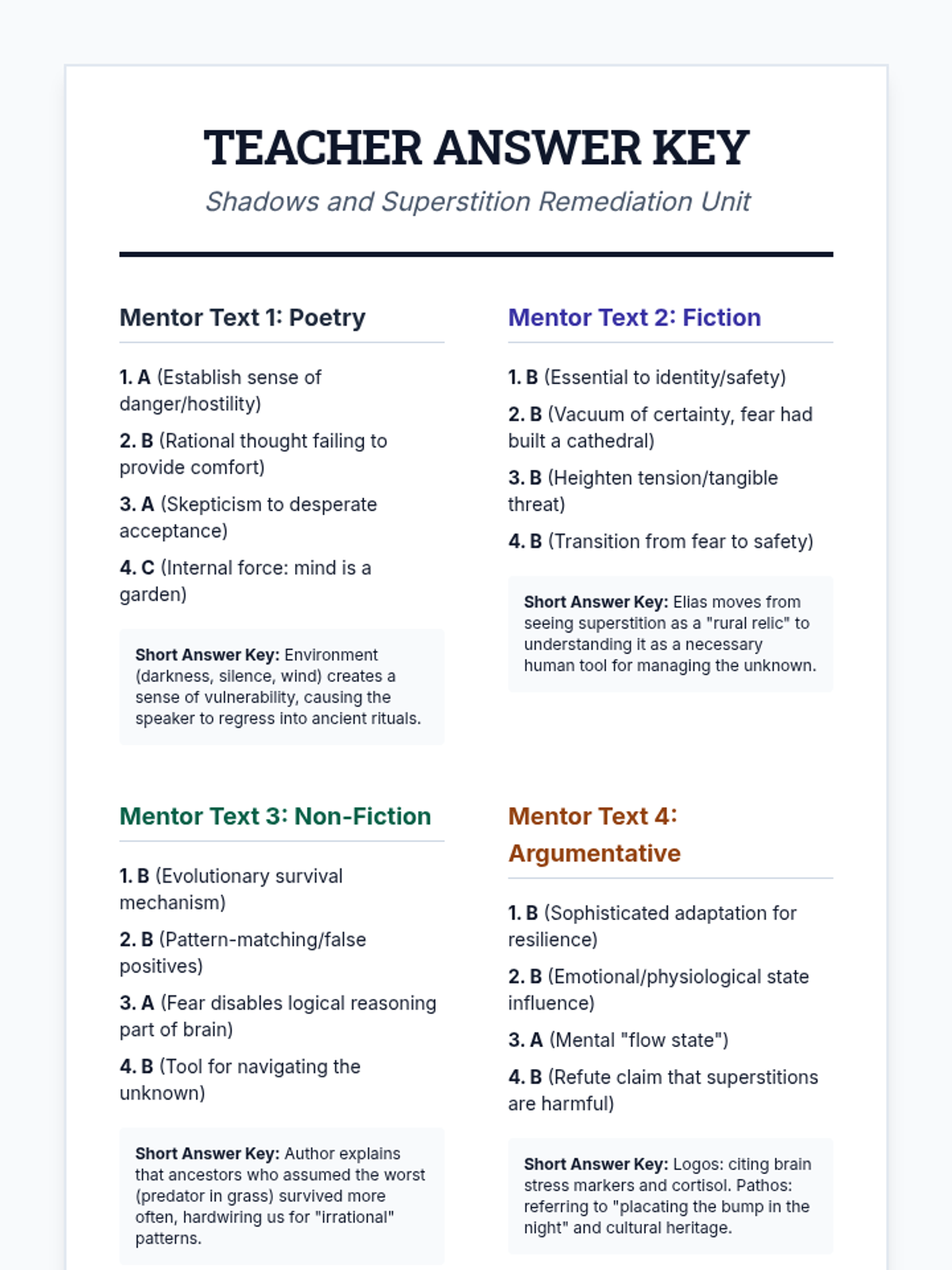
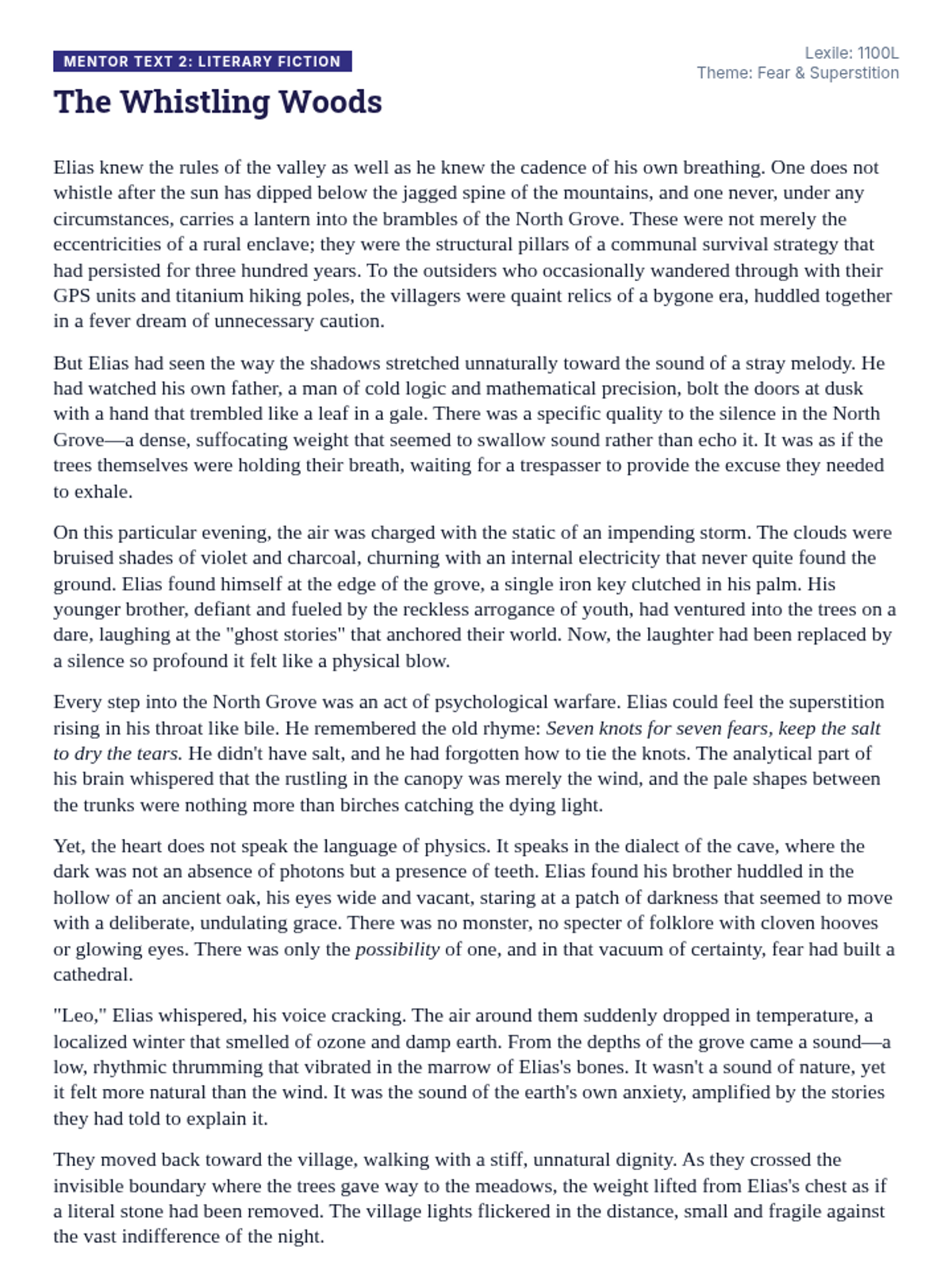
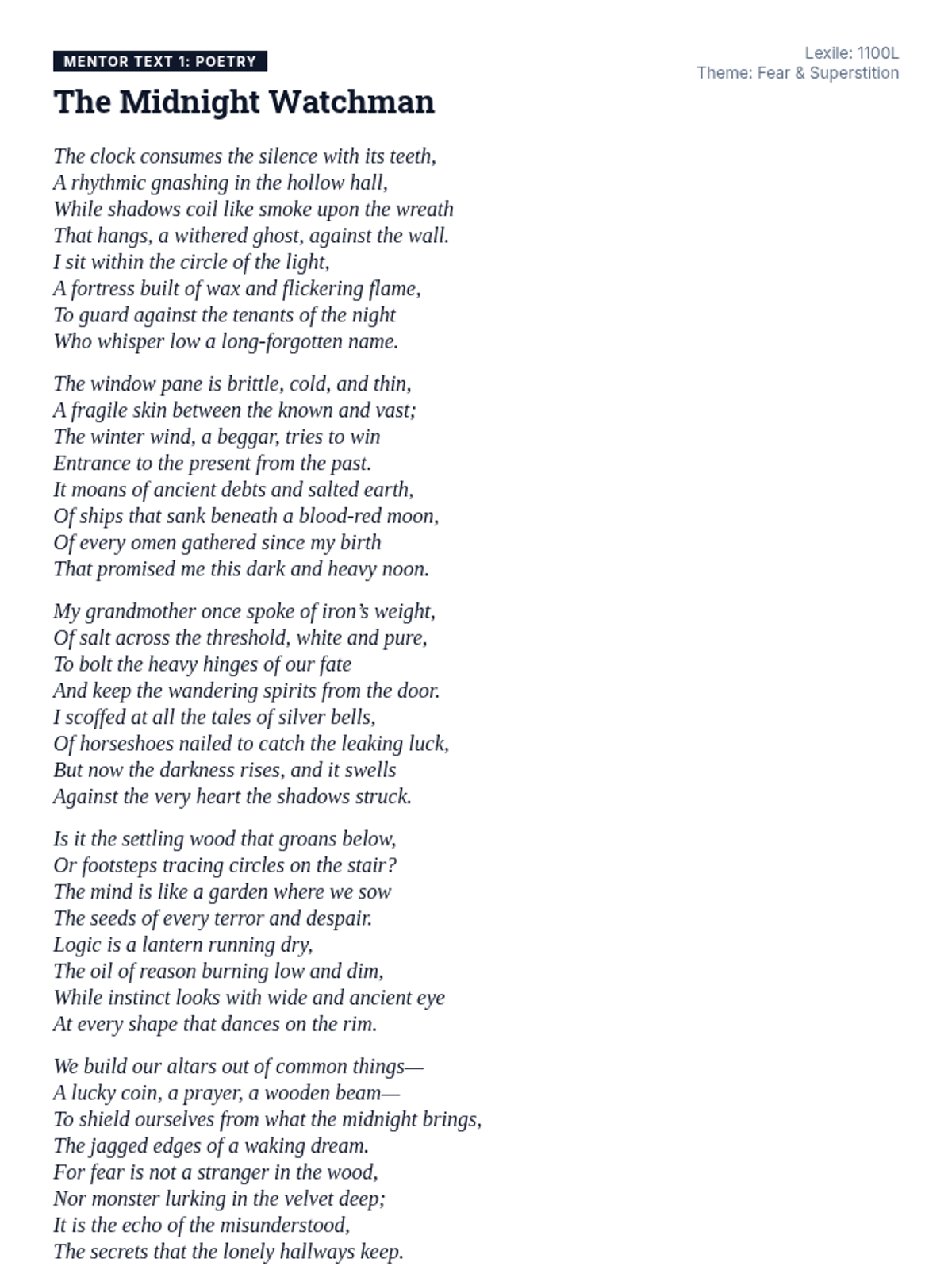
A comprehensive answer key for all mentor texts, revision/editing exercises, and the cumulative test in the Shadows and Superstition remediation packet. Revised to fit on a single page. Adjusted spacing and naming for consistency.
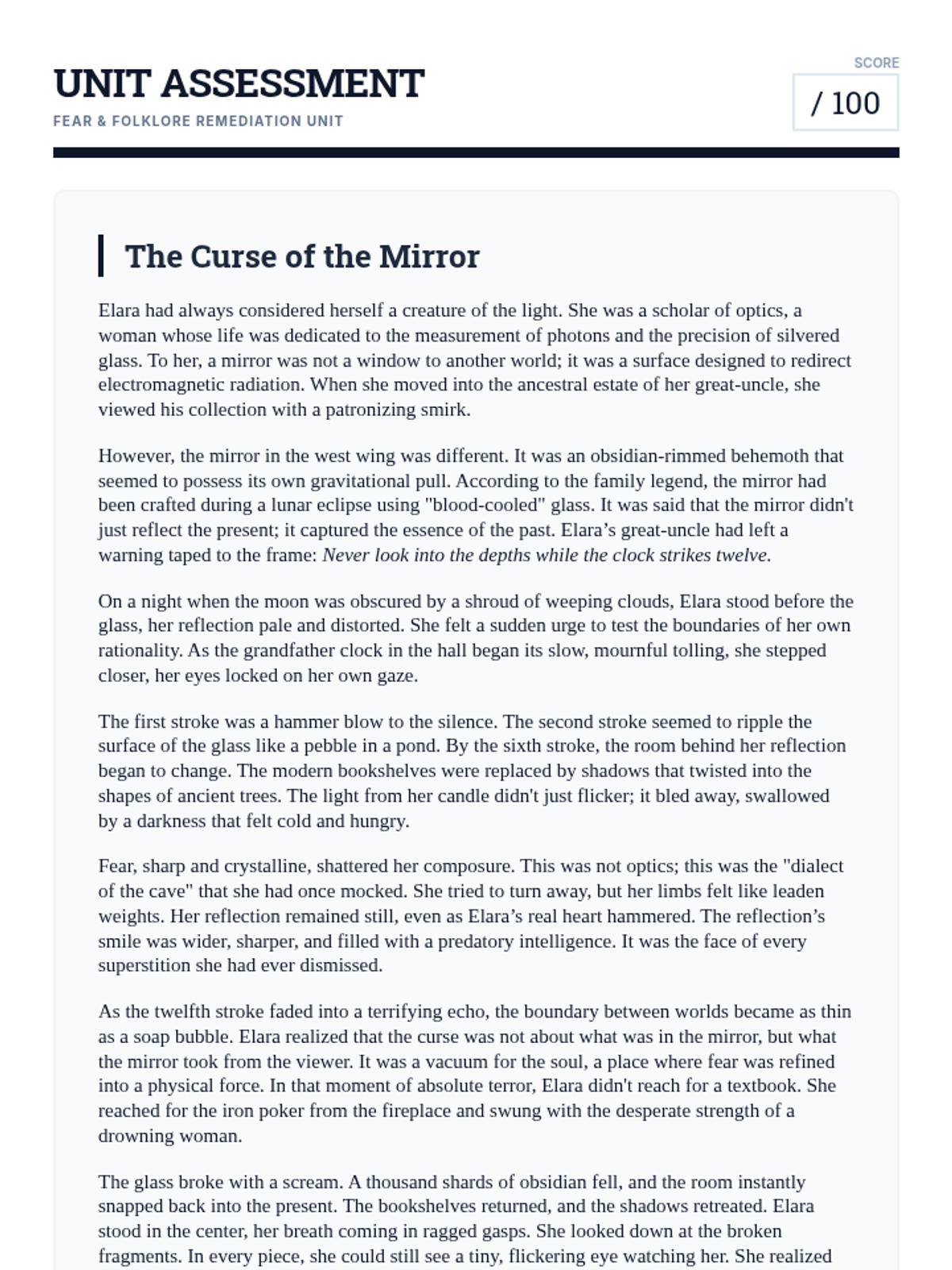
A grayscale version of the cumulative test, featuring the cold-read passage and assessment questions with all color removed. Fixed word spacing in headers and increased writing lines. Standardized distractor order.
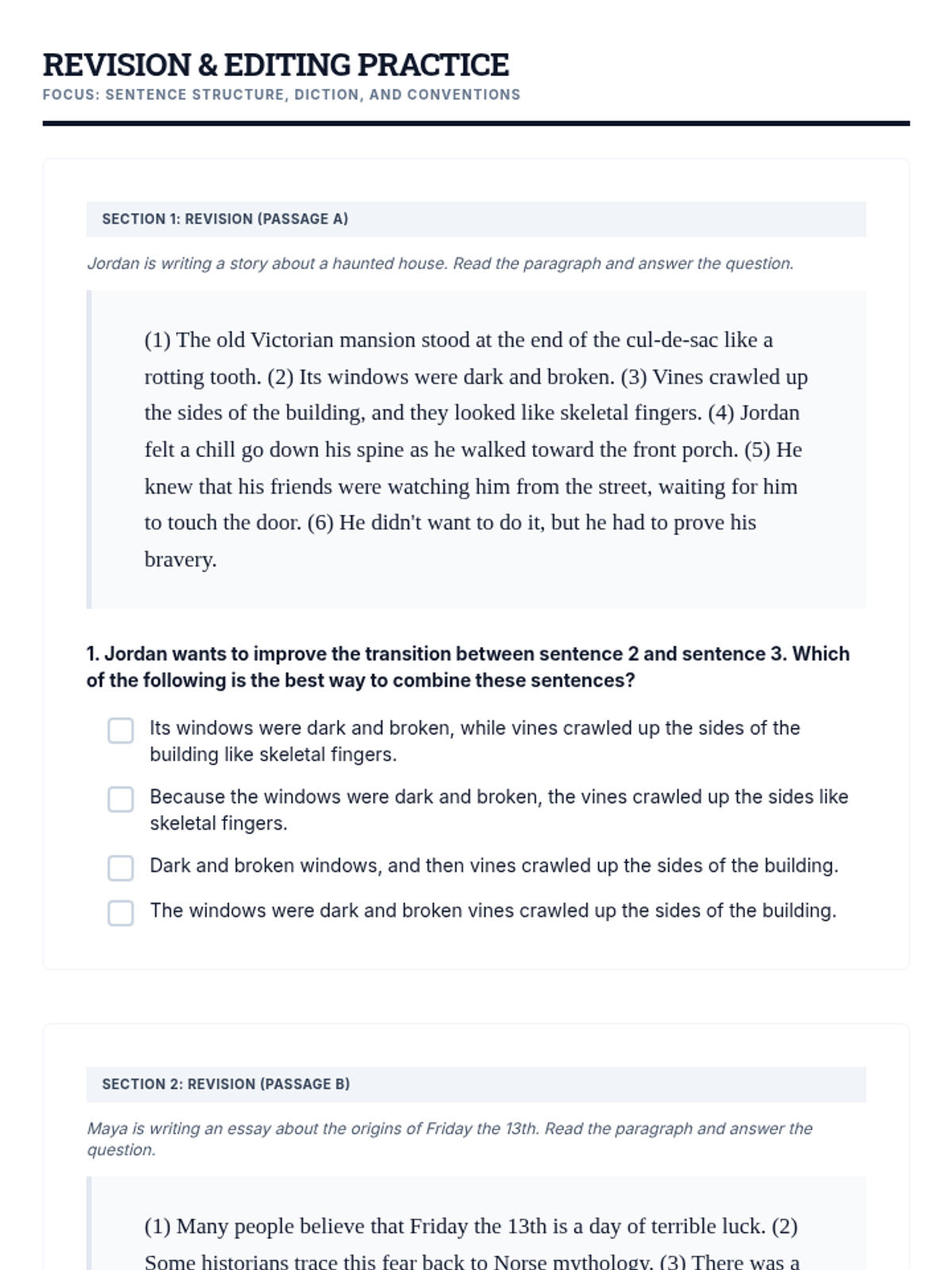
A grayscale version of the revision and editing practice passages, with the yellow highlight updated to gray. Consolidated layout to group Revision questions on Page 1 and Editing questions on Page 2. Fixed word spacing issues. Removed excessive whitespace and min-height constraints.
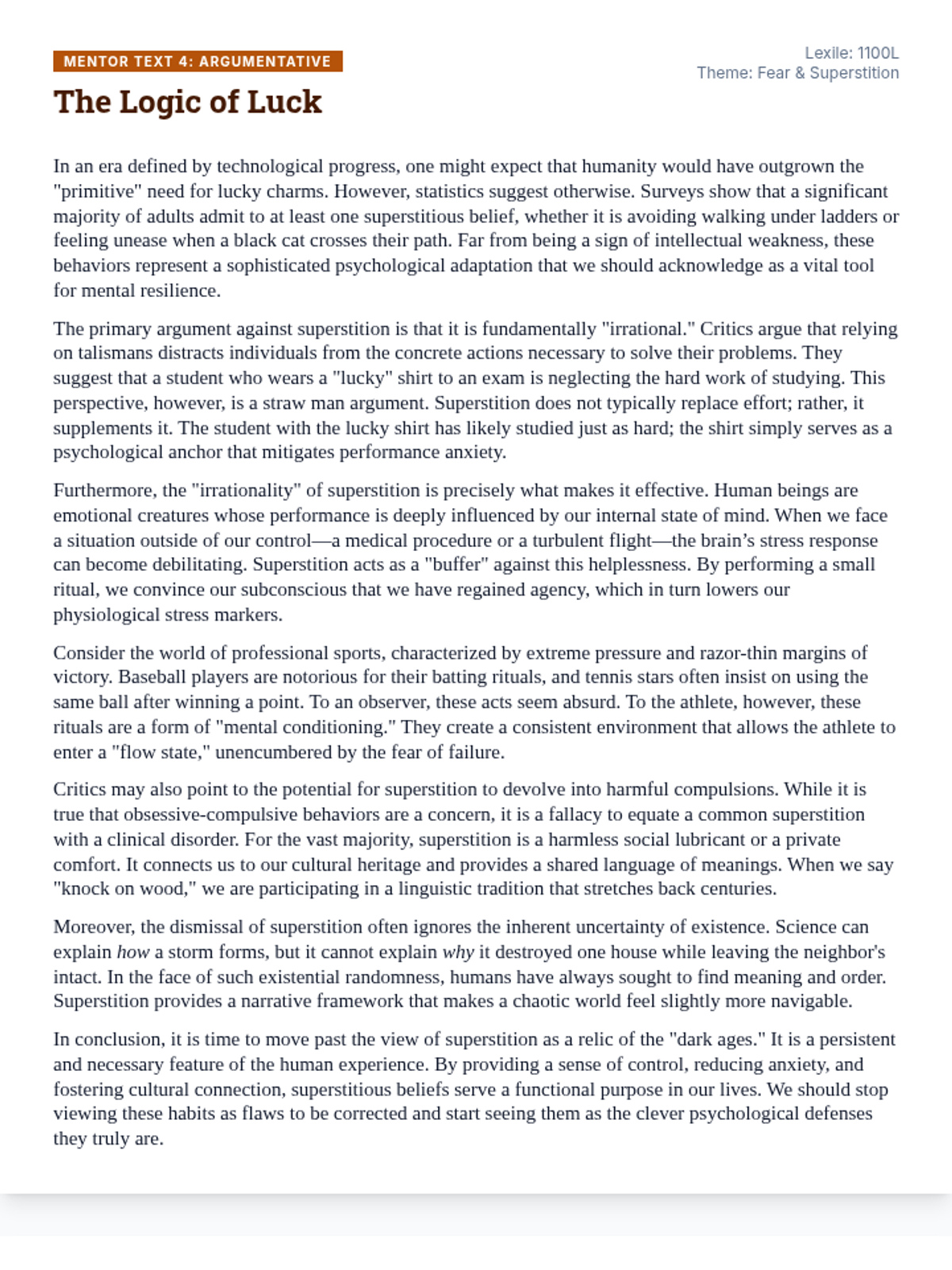
A grayscale version of the argumentative analysis document, with colors updated to slate shades and text references adjusted to reflect gray highlights. Consolidated layout to 2 pages and fixed work area line spacing. Fixed radio button alignment and constructed response container.
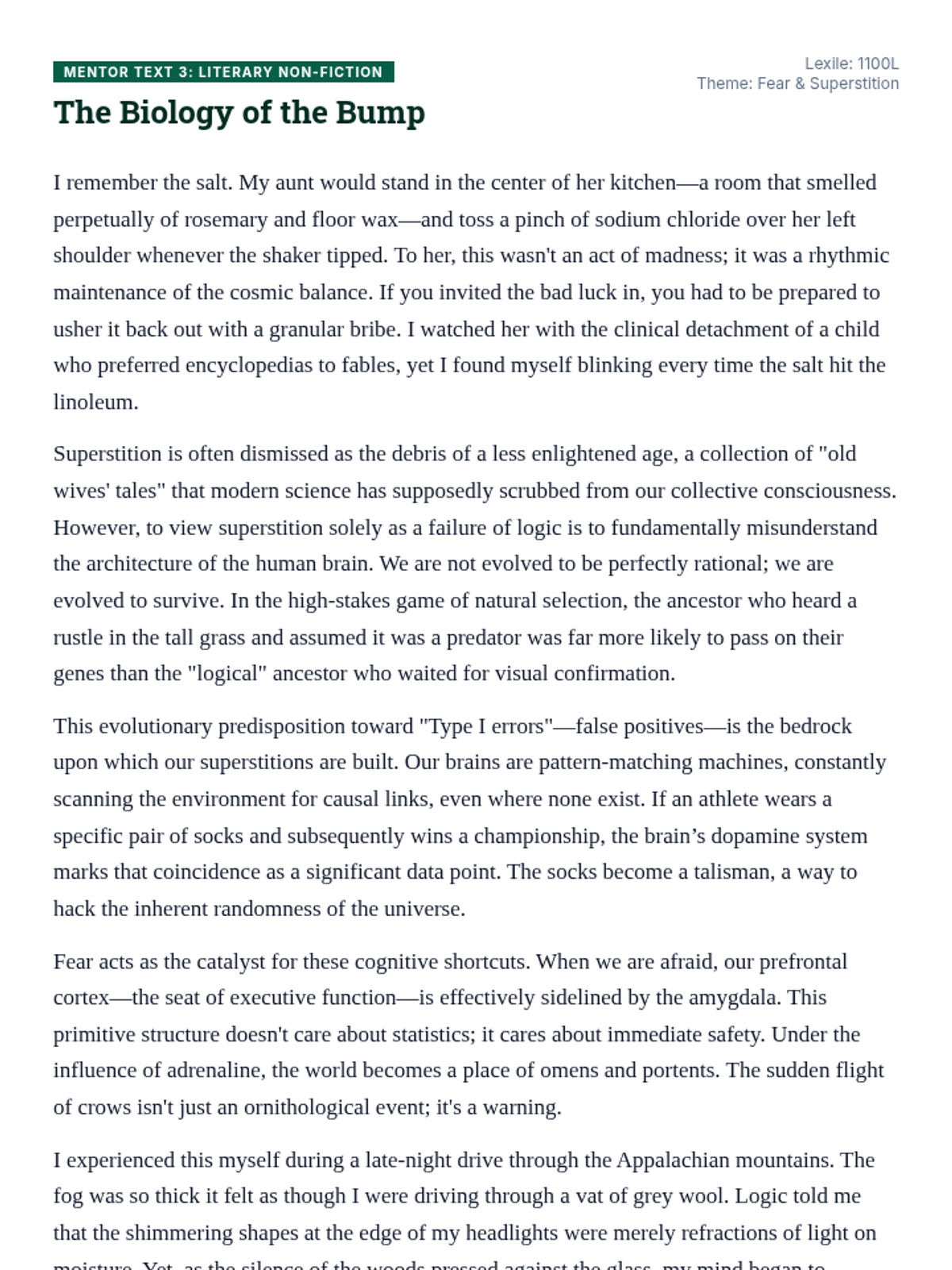
A grayscale version of the non-fiction analysis document, with colors updated to slate shades and text references adjusted to reflect gray highlights. Fixed invisible legend labels. Corrected work area rule thickness.
A grayscale version of the fiction analysis document, with colors updated to slate shades and text references adjusted to reflect gray highlights. Corrected prompt colors and consolidated layout to 2 pages. Fixed word spacing in sidebars.
A grayscale version of the poem analysis document, with colors updated to slate shades and text references adjusted to reflect gray highlights. Revised to fit entire poem and sidebars on a single page. Margin callouts precisely aligned.
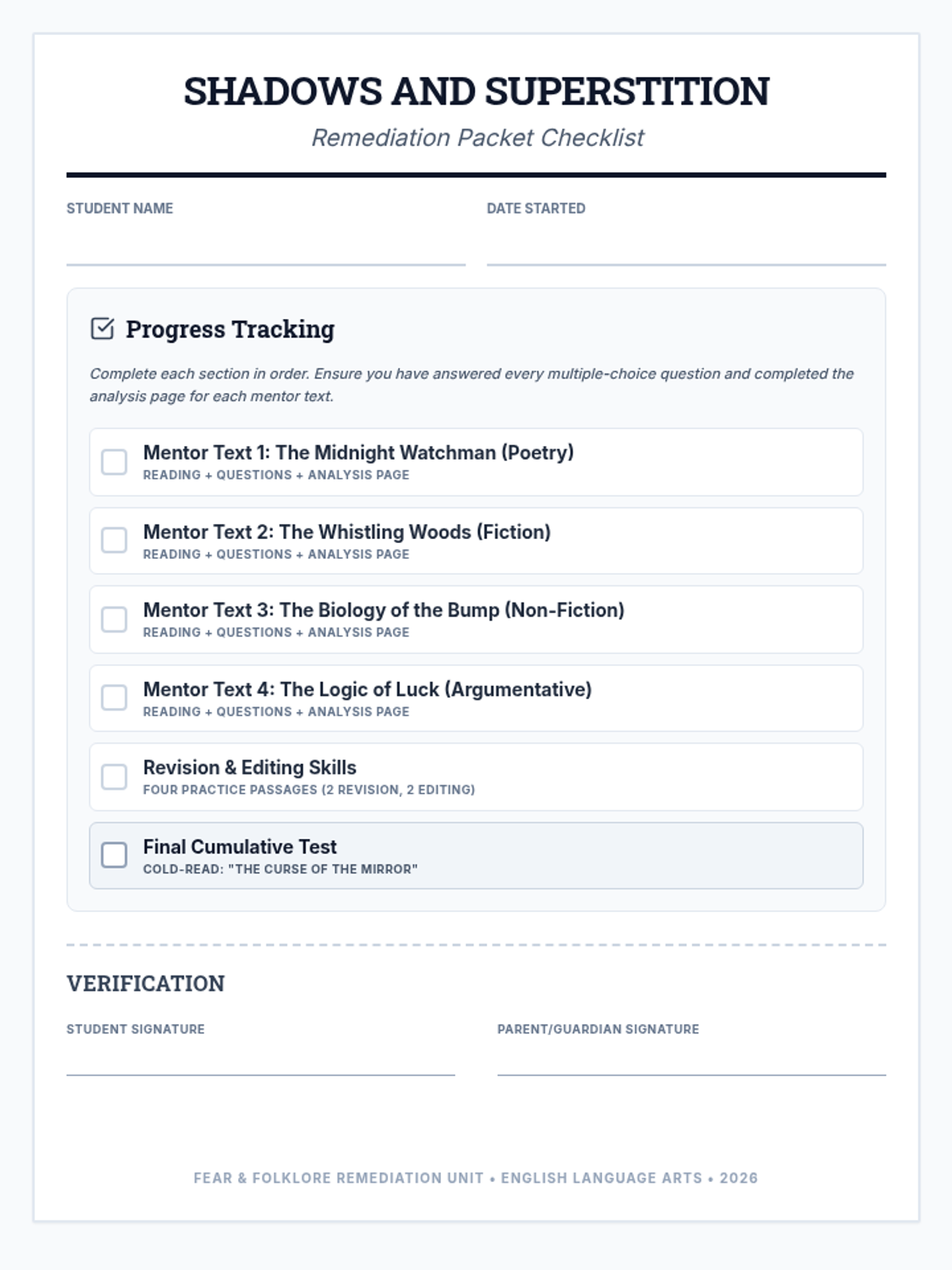
A grayscale version of the student progress checklist for the remediation packet, featuring a structured list of all required texts and activities.
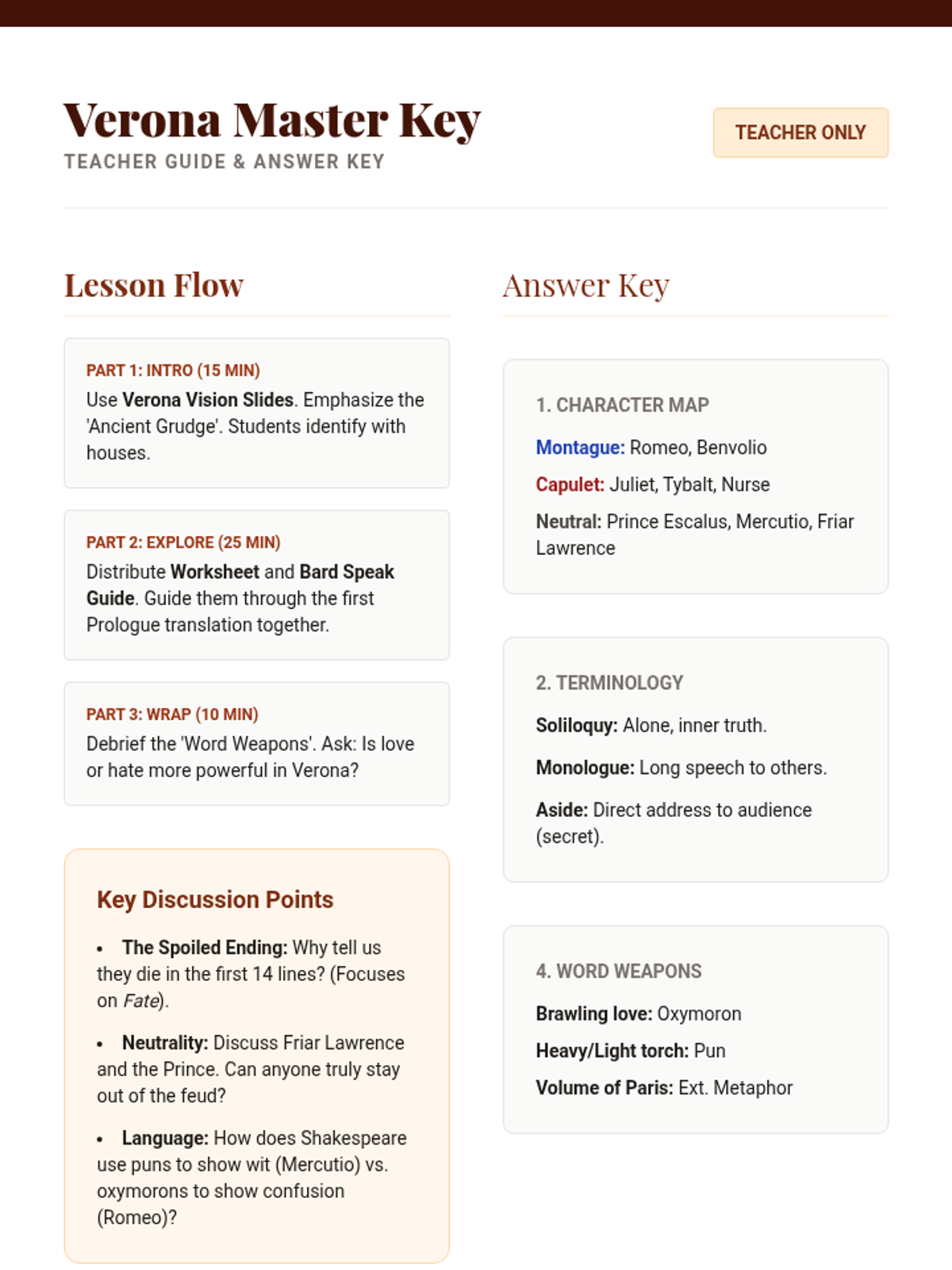
A teacher resource containing the answer key for the Star-Crossed Script Worksheet, lesson delivery tips, and discussion prompts.
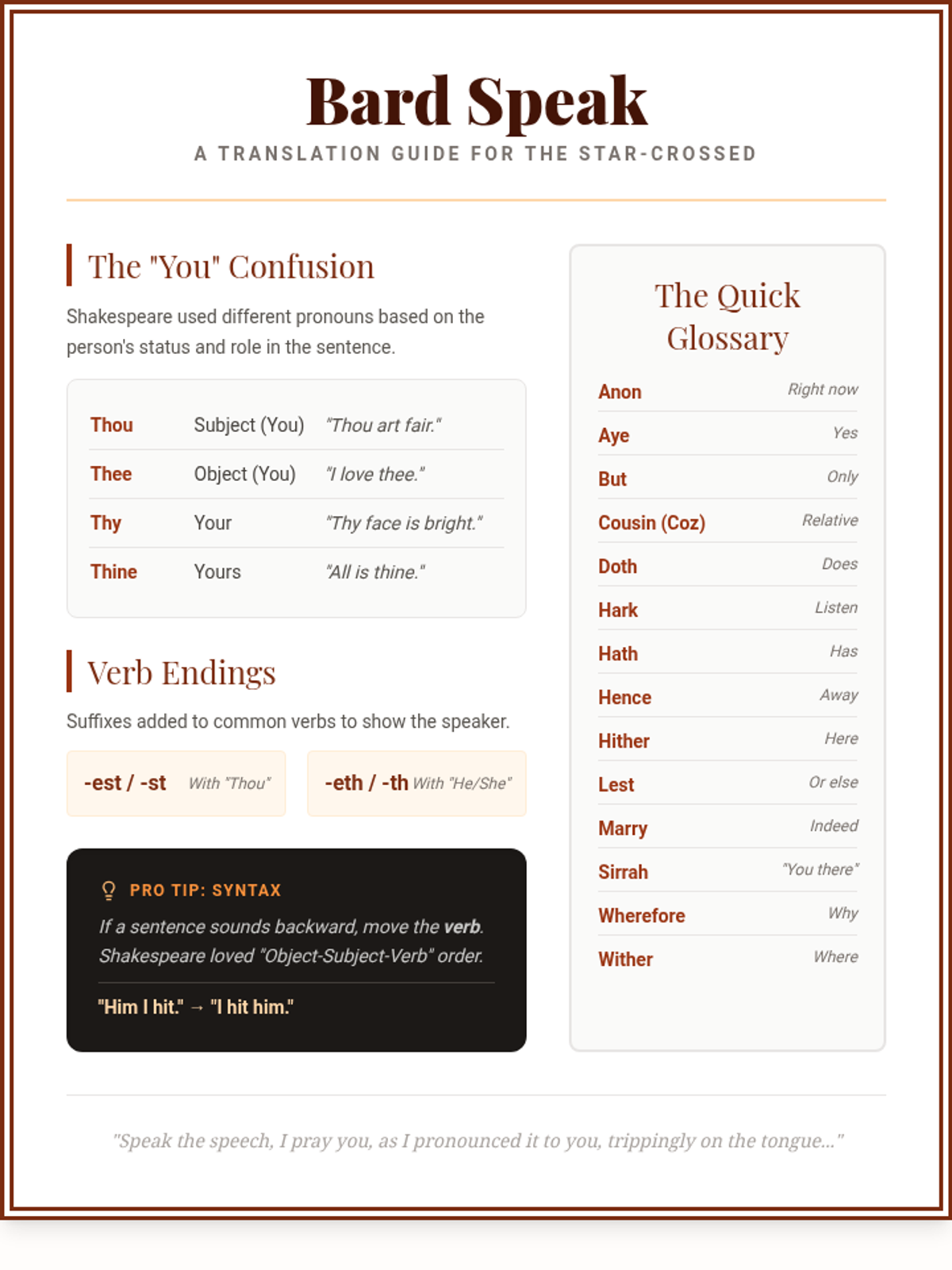
A handy glossary and grammar guide to help students navigate Shakespearean English, focusing on personal pronouns, verb endings, and common vocabulary.
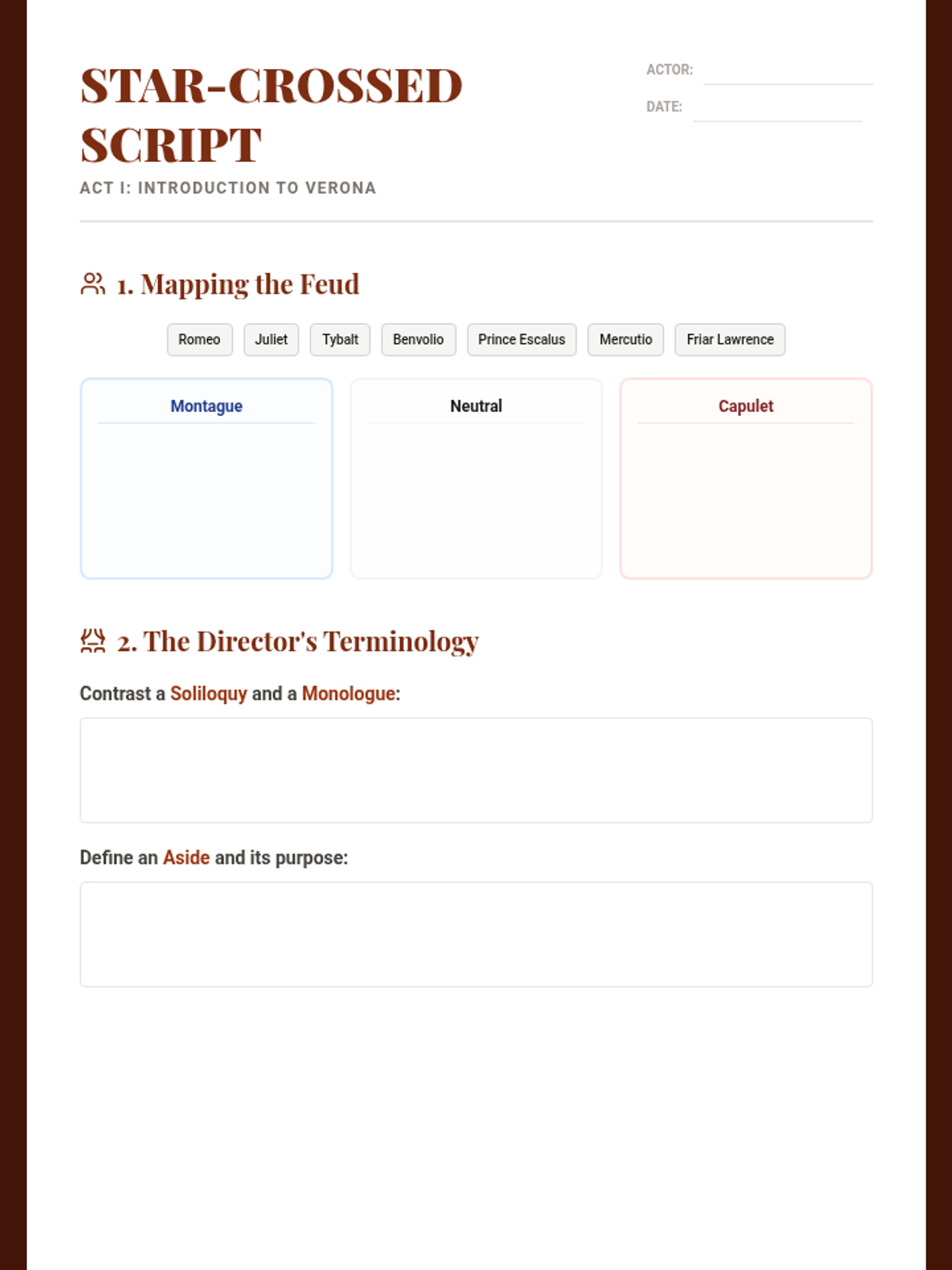
A two-page student activity sheet for mapping characters, defining stage devices, practicing translation of the Prologue, and identifying figurative language.
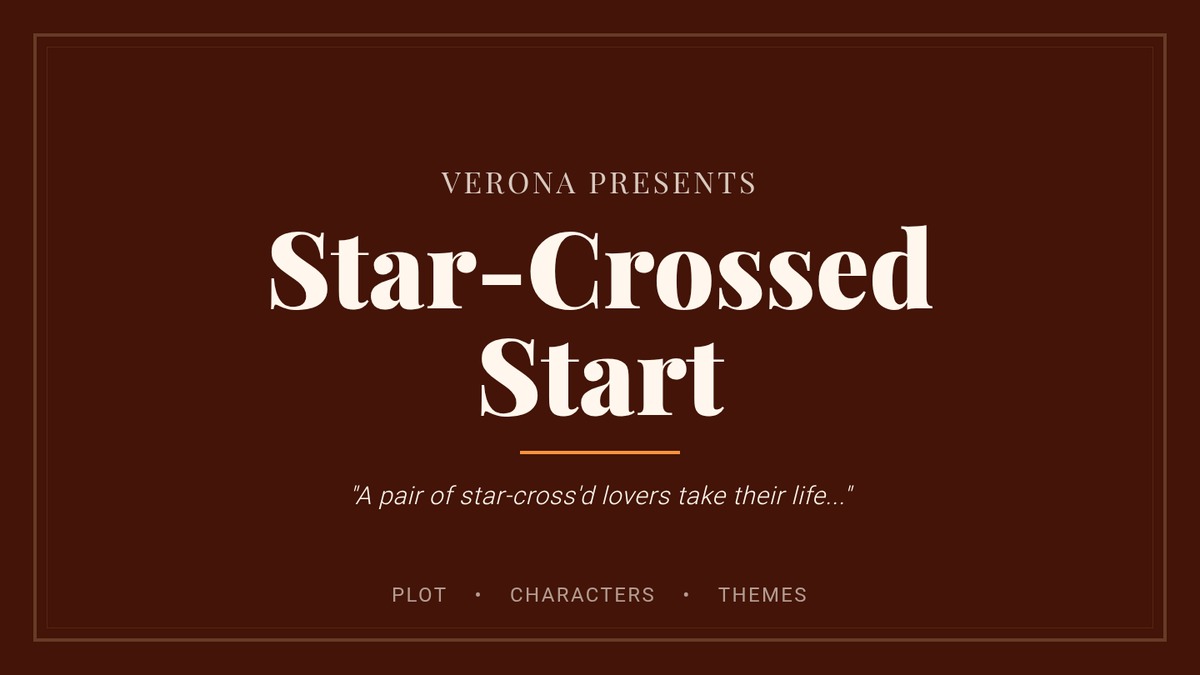
A visual presentation introducing the world of Verona, key characters, central themes, and the literary tools Shakespeare used to craft the tragedy.
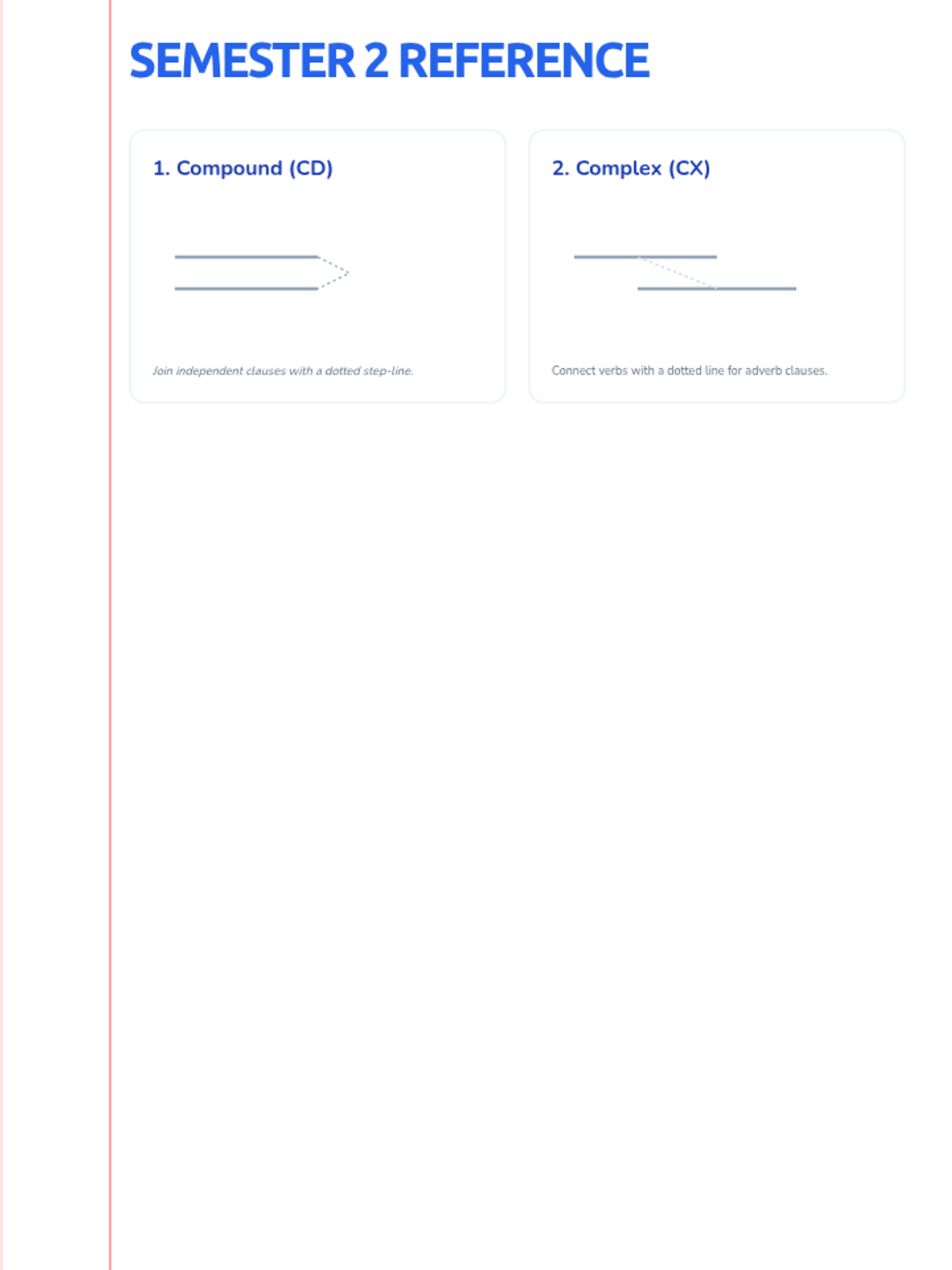
A comprehensive 19-page second-semester grammar workbook. This portrait handout includes daily tasks and unique hints for all 18 weeks (19-36), complex sentence analysis, and customized diagramming spaces with structural guides. Every page follows the user's color-coded daily task model.
A complete 19-page first-semester grammar practice workbook in portrait mode. Each page includes specific daily tasks (POS, Sentence Parts, Clauses, Correction) and a customized Friday diagramming area with structure-specific baselines and professional guidance. Each page matches the user's color-coded model.
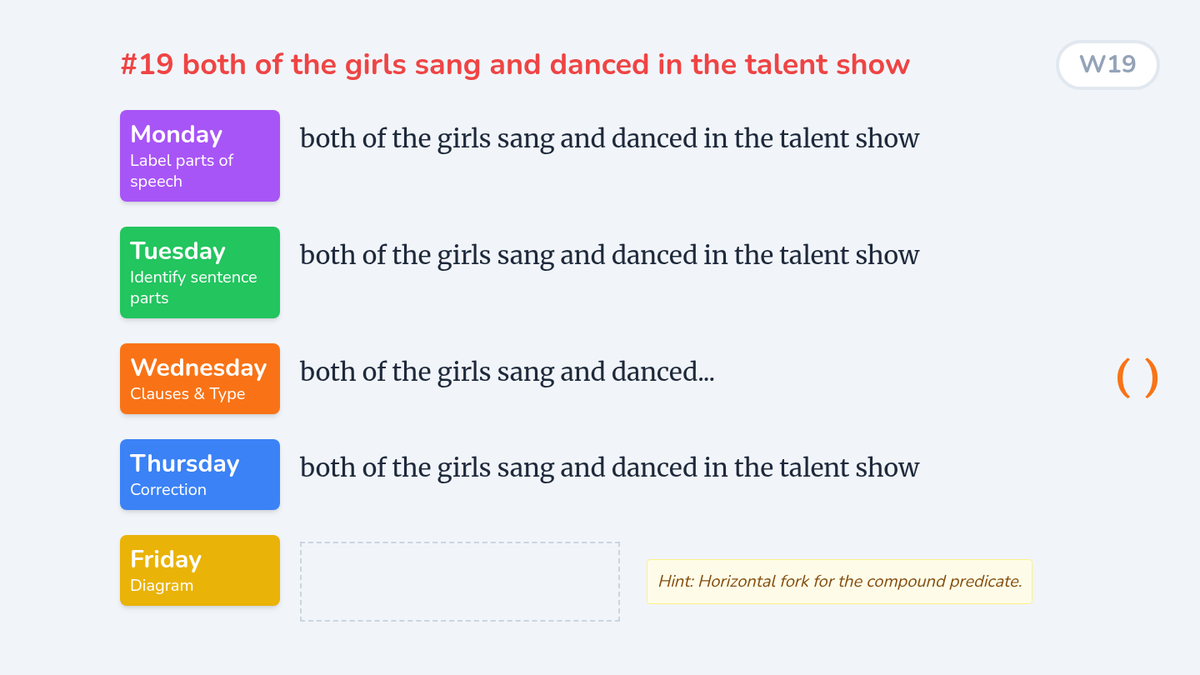
A presentation deck for the second semester of daily grammar practice (Weeks 19-36). Each slide focuses on a complex or compound-complex sentence with specific sections for daily analysis and hints.
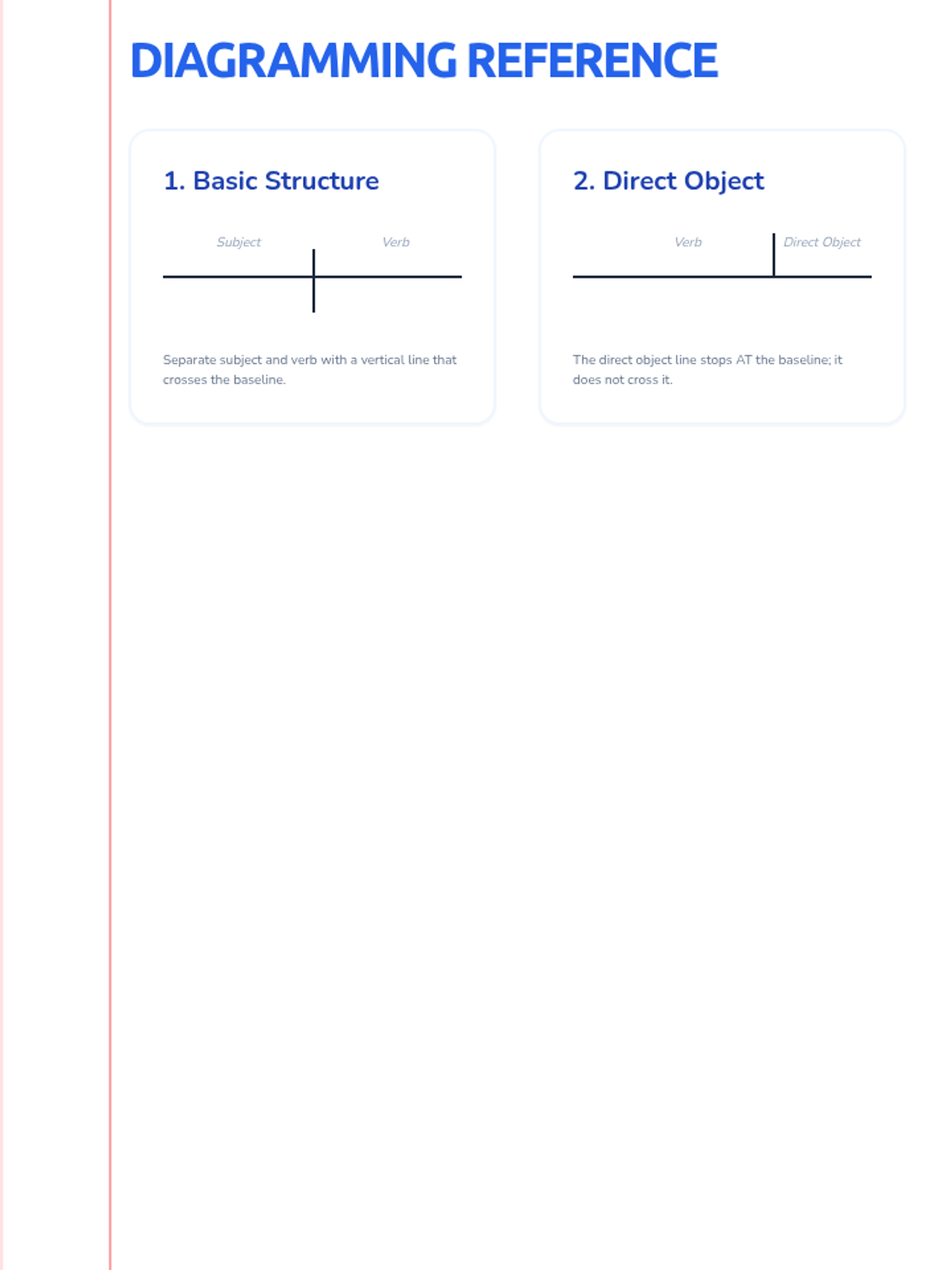
A 19-page second-semester grammar practice workbook, featuring Weeks 19-36 in portrait mode. Each page provides daily instructions and specific hints for complex and compound-complex sentence analysis, plus a diagramming reference guide.
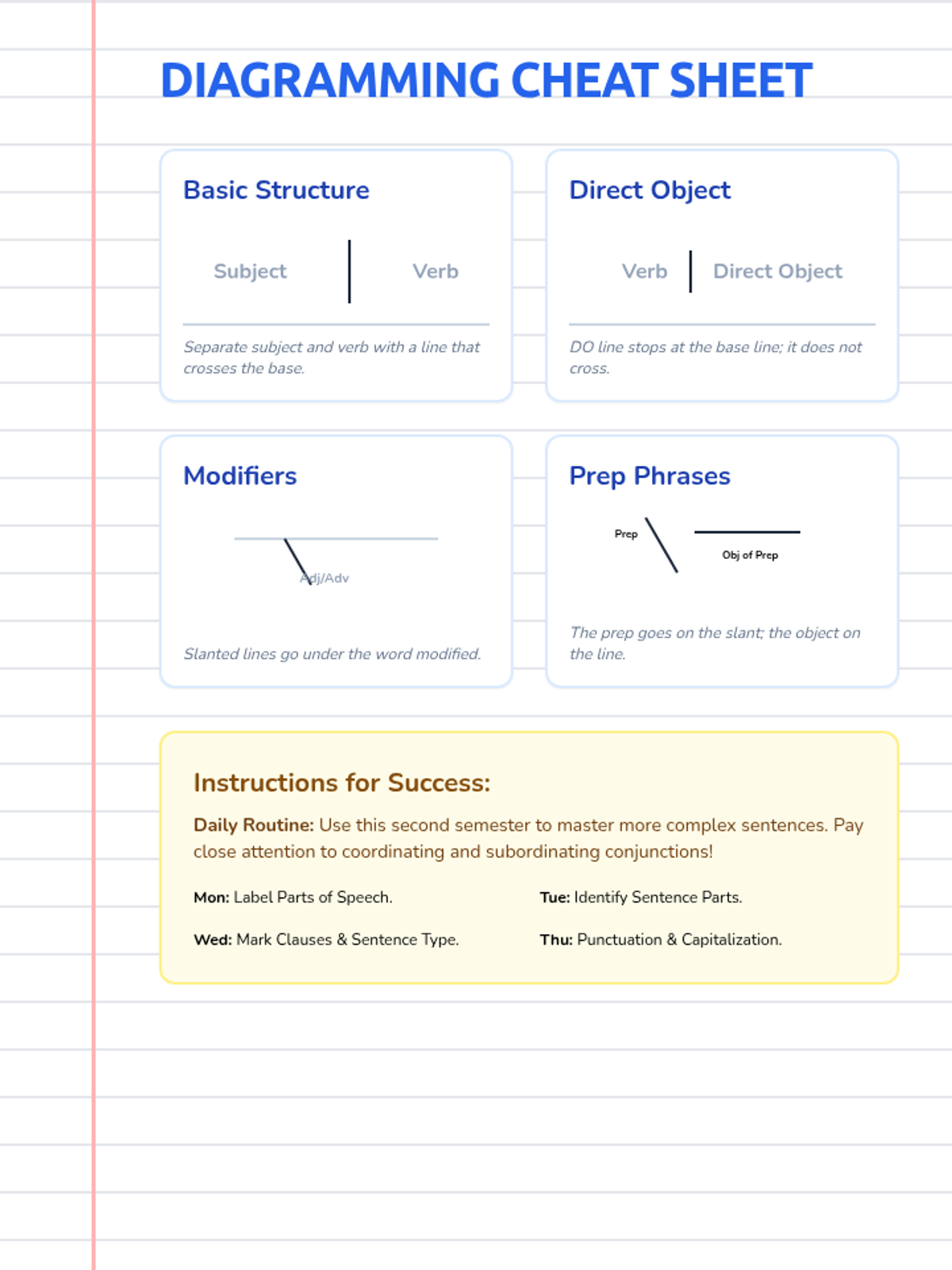
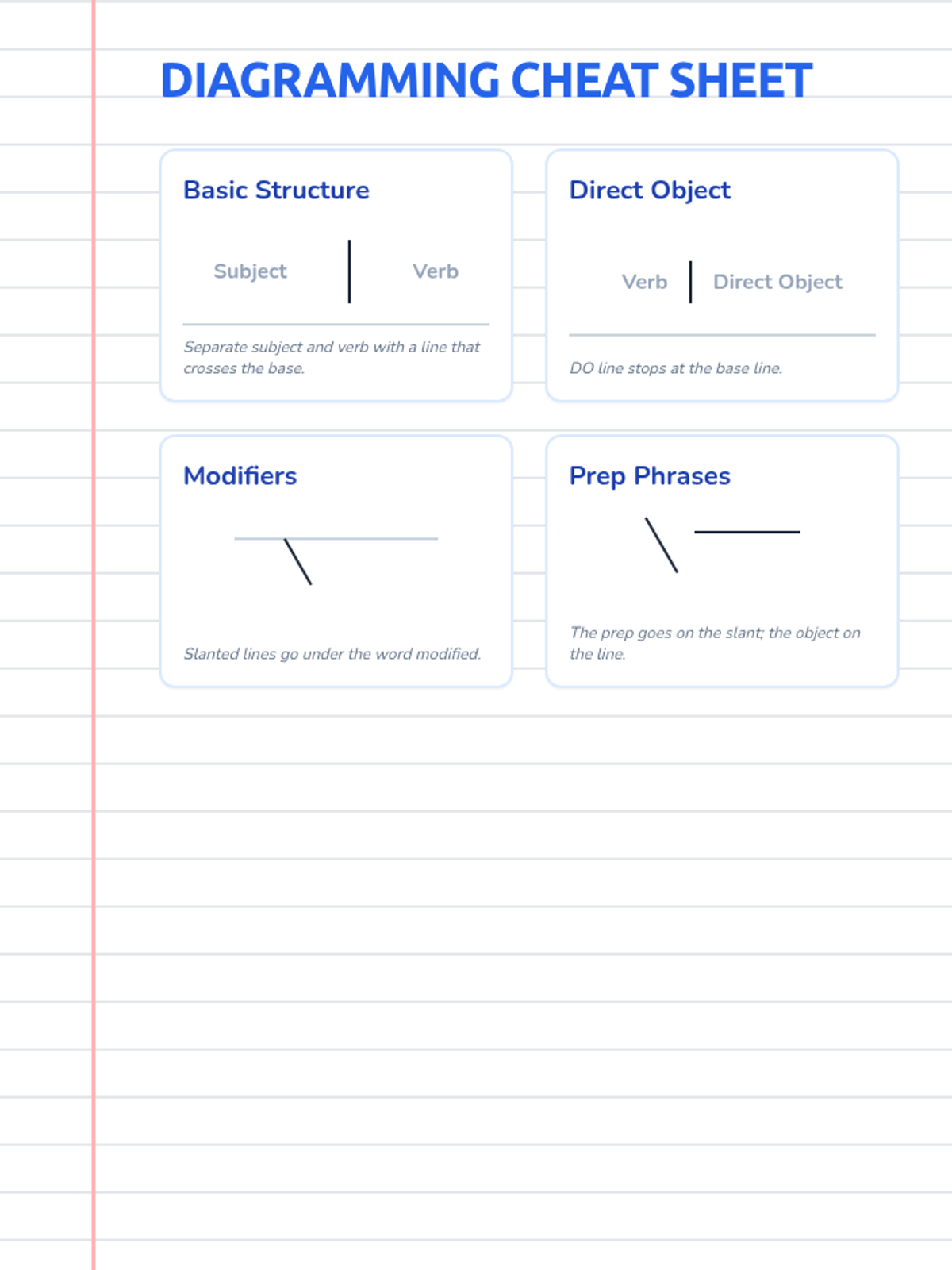
A 19-page comprehensive grammar practice workbook for the first semester, featuring one week per page in portrait mode. Each page includes specific daily instructions and tailored hints for parts of speech, sentence analysis, correction, and diagramming, plus a diagramming cheat sheet.
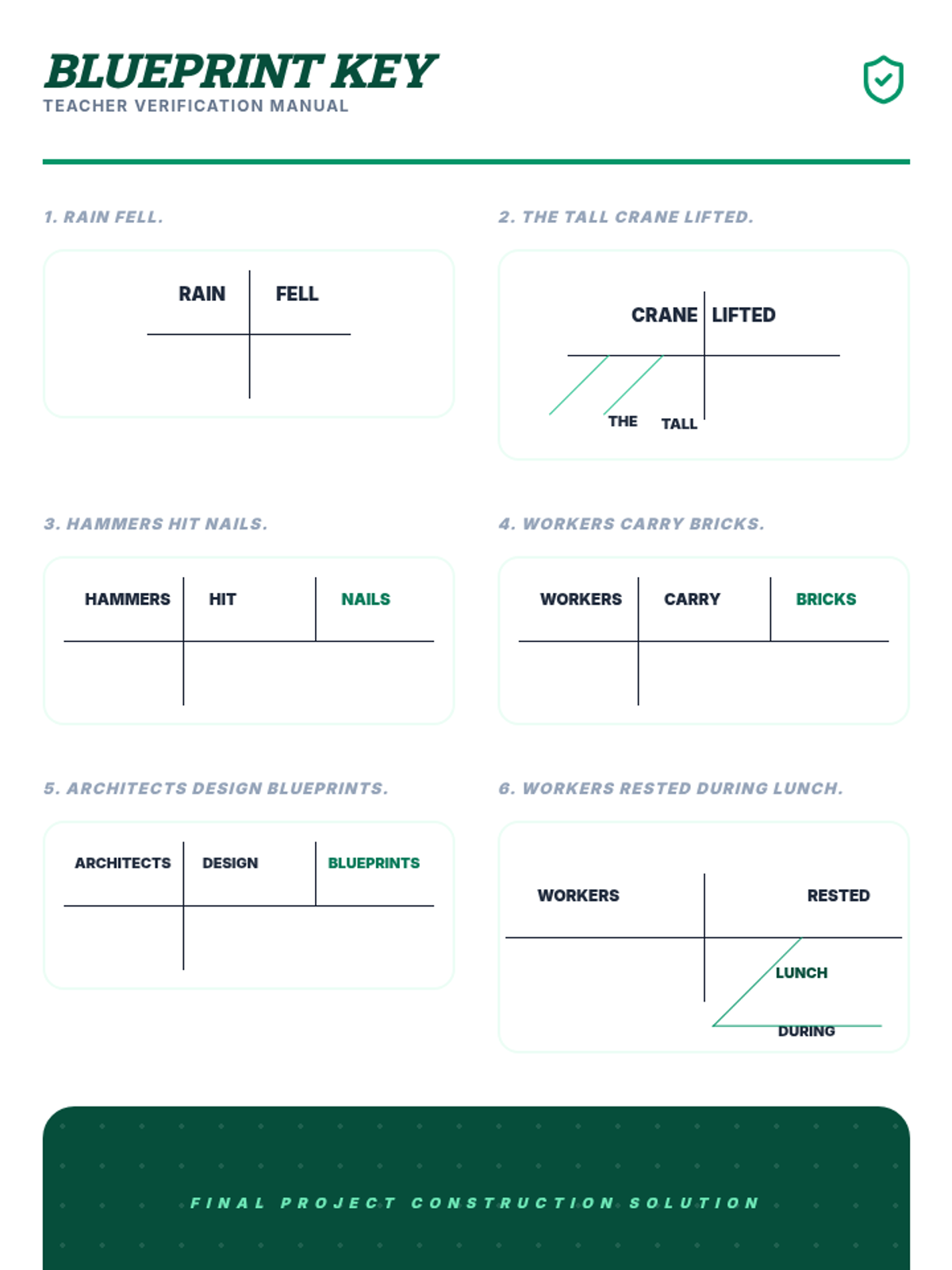
A comprehensive answer key with visual diagram solutions, featuring corrected Reed-Kellogg structures for complex sentences and prepositional phrases.
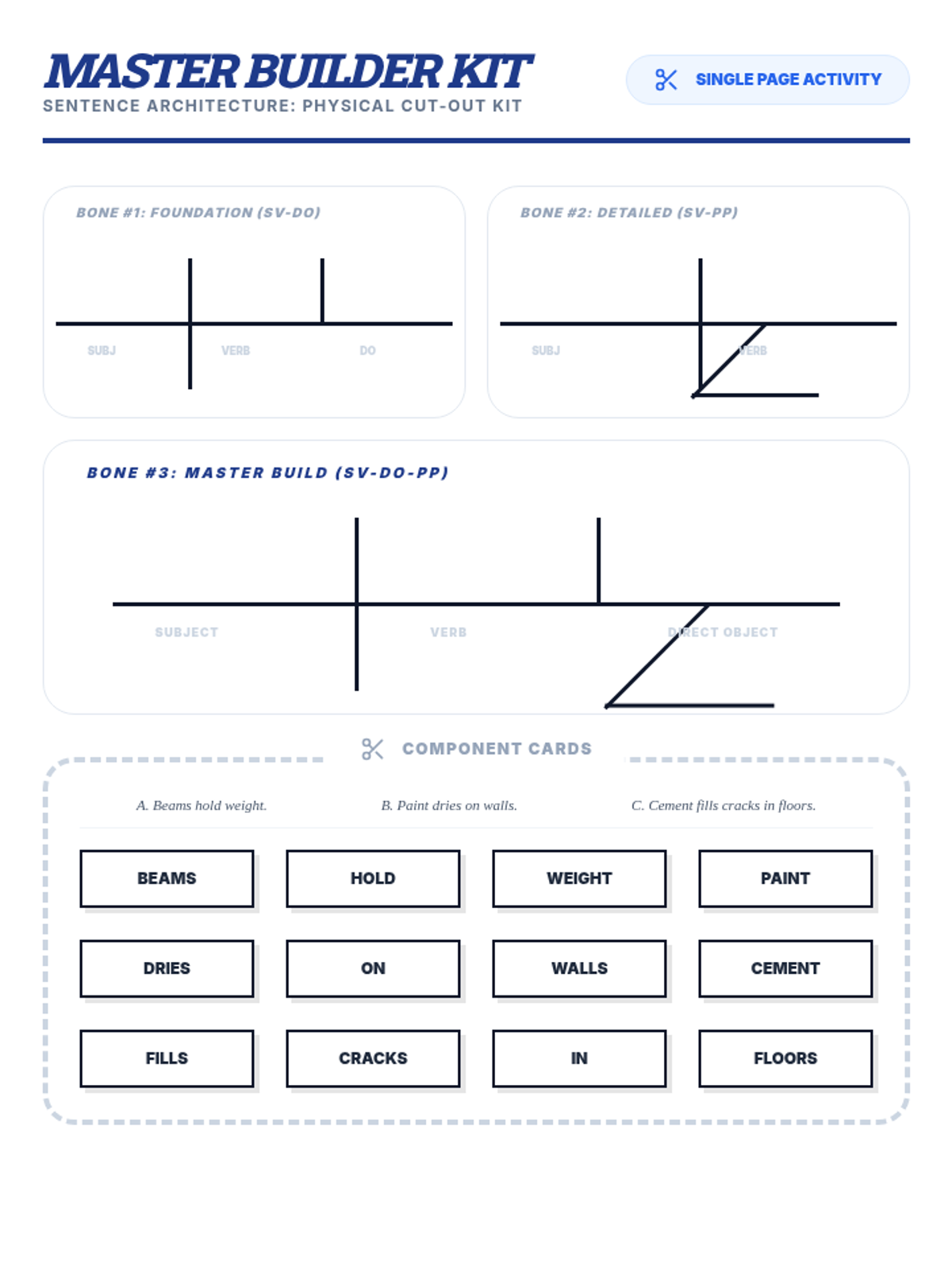
A hands-on "drag and drop" alternative for print, providing enlarged diagram frames and component cards for a physical sentence building activity on a single page.
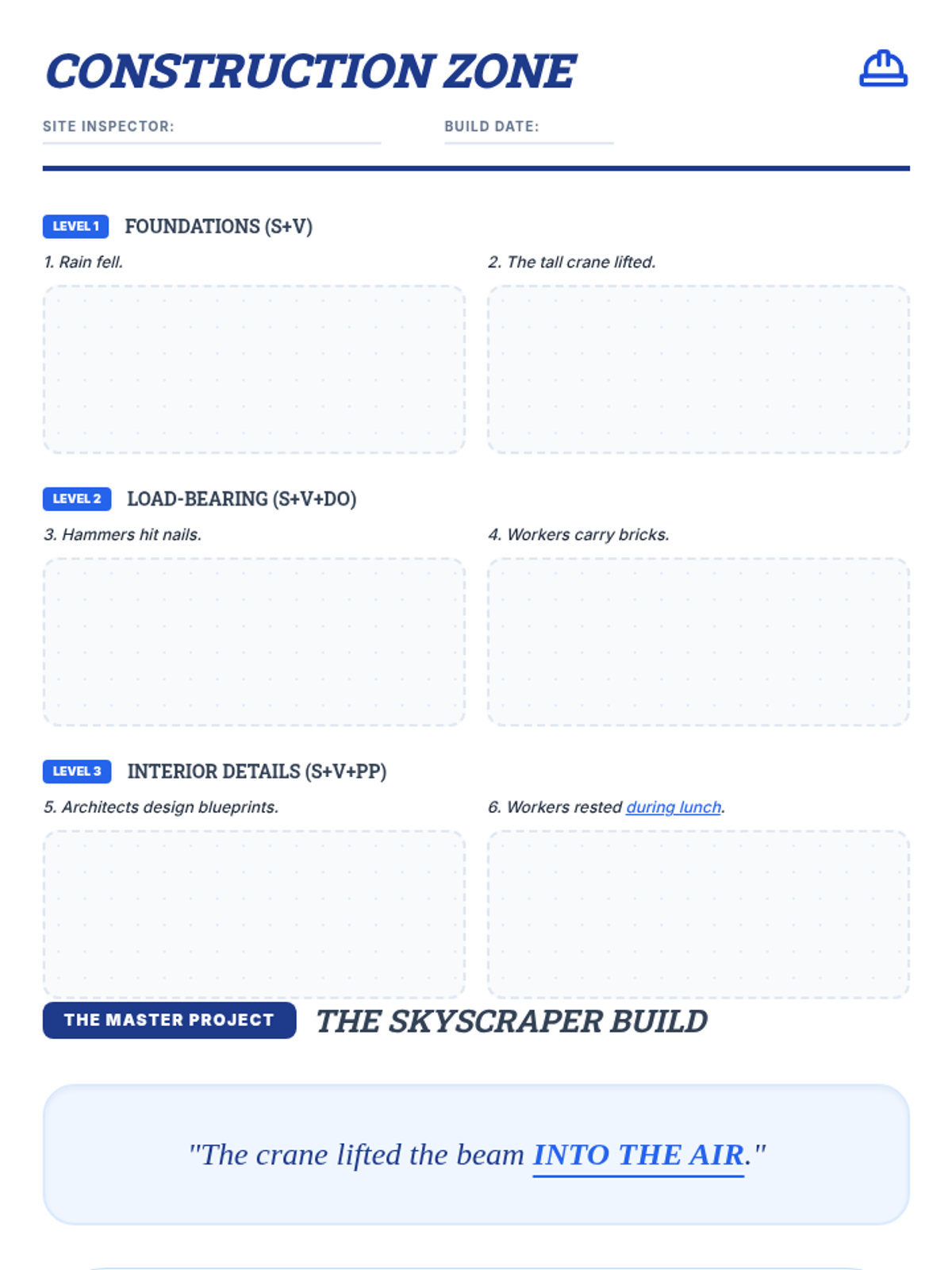
A sentence diagramming worksheet with three levels of increasing difficulty, plus a final challenge and a word bank to simulate interactive diagram building.
A visual guide to Reed-Kellogg diagramming, using an architectural theme to explain how to structure subjects, verbs, direct objects, and prepositional phrases.
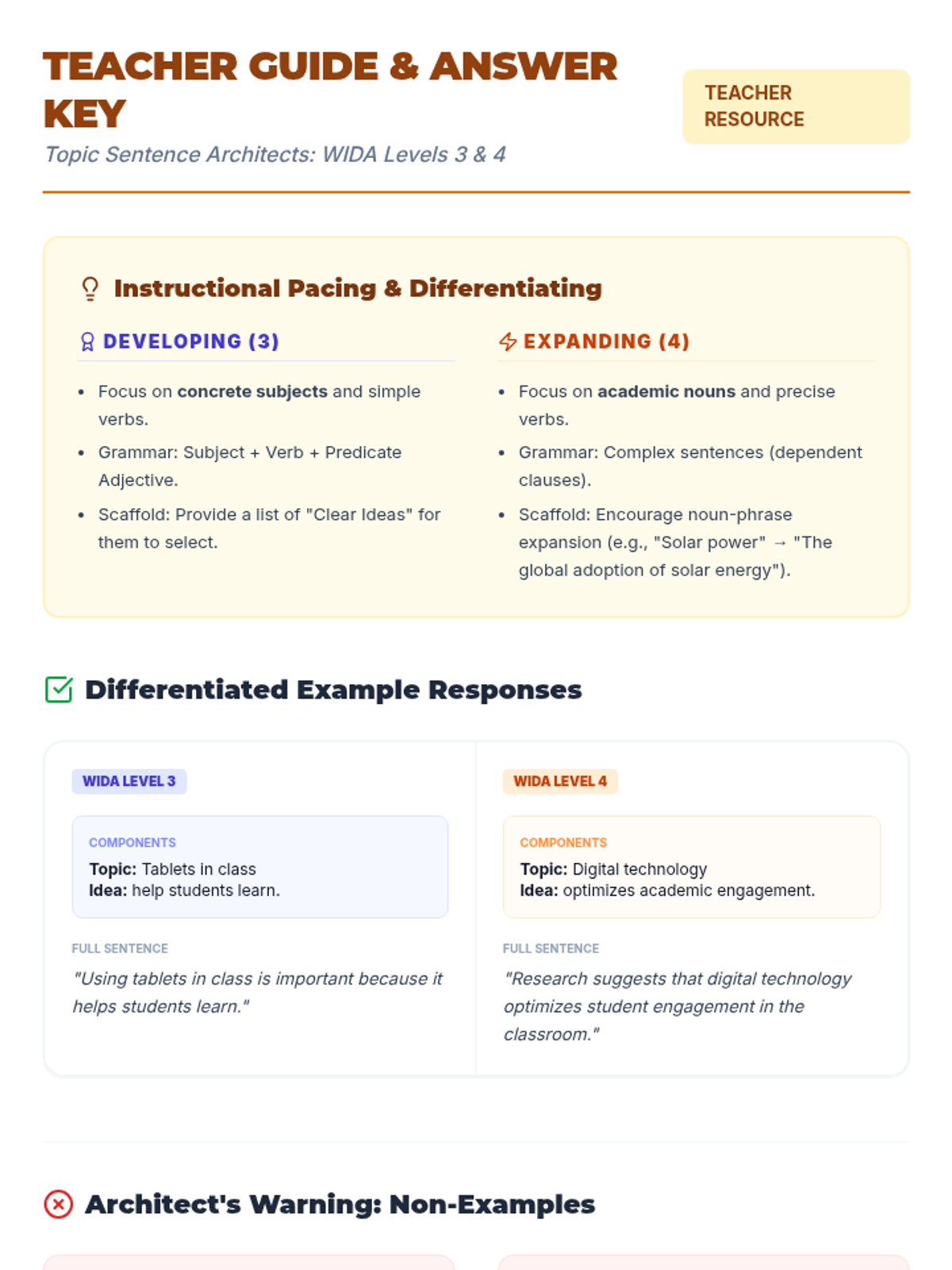
A facilitation guide and answer key for the Topic Sentence Architects lesson. It provides differentiated instructional focuses for WIDA level 3 and 4 students, sophisticated example responses, non-examples for teacher reference, and specific strategies for academic language growth.
A slide deck for introducing the concept of a two-part topic sentence (Topic + Clear Idea). It includes visual analogies, differentiated examples for WIDA levels 3 and 4, and sentence starters for Developing and Expanding learners.
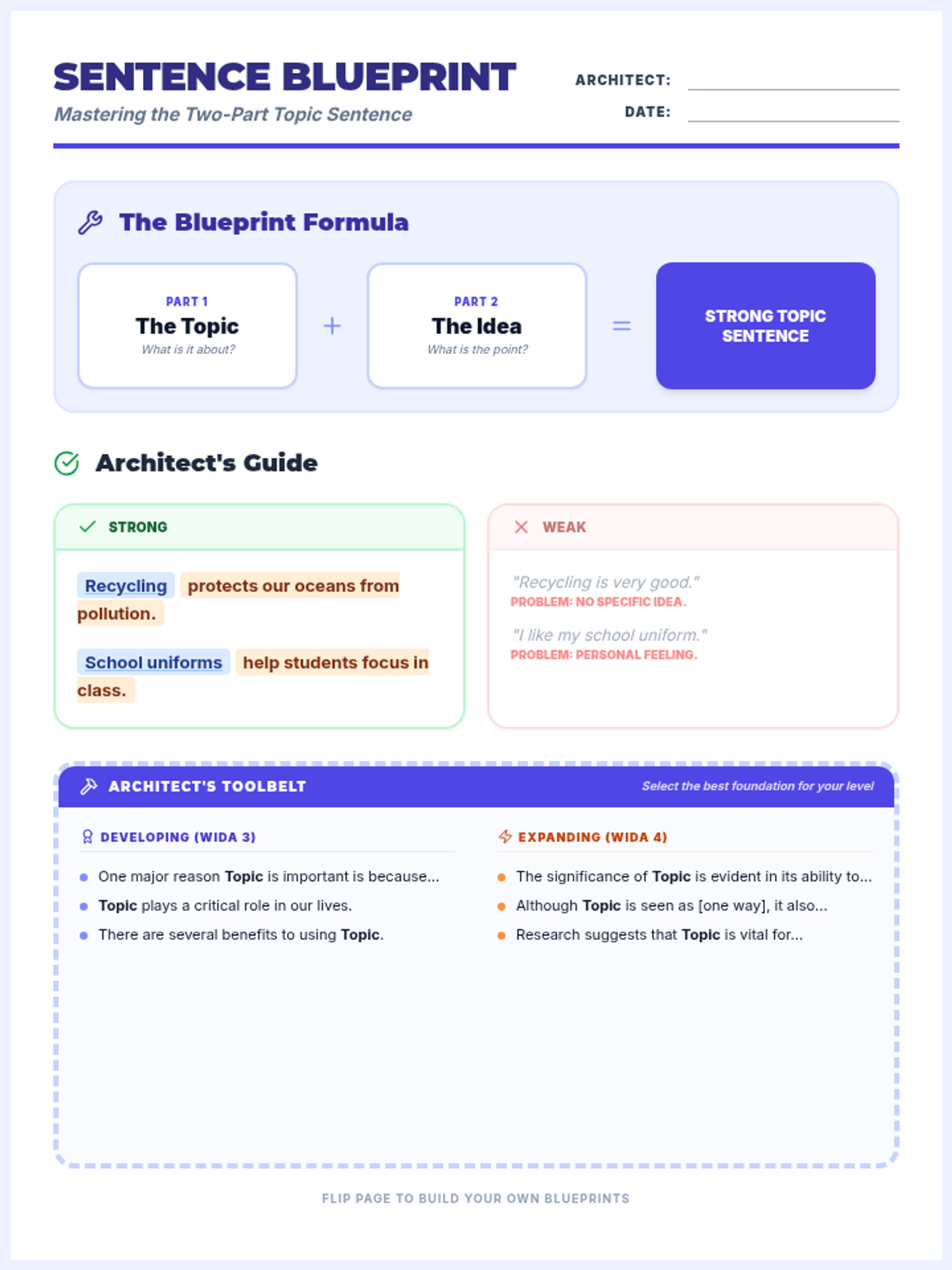
A worksheet for WIDA level 3-4 students to practice writing topic sentences. It includes a visual formula, differentiated sentence starters for Developing and Expanding levels, and a graphic organizer for guided practice.
A Japanese educational slide deck covering the fundamentals of English sentence structure, including subjects, predicates, fragments, and run-on sentences. It provides all instructional content and explanations in Japanese while maintaining English example sentences for analysis.
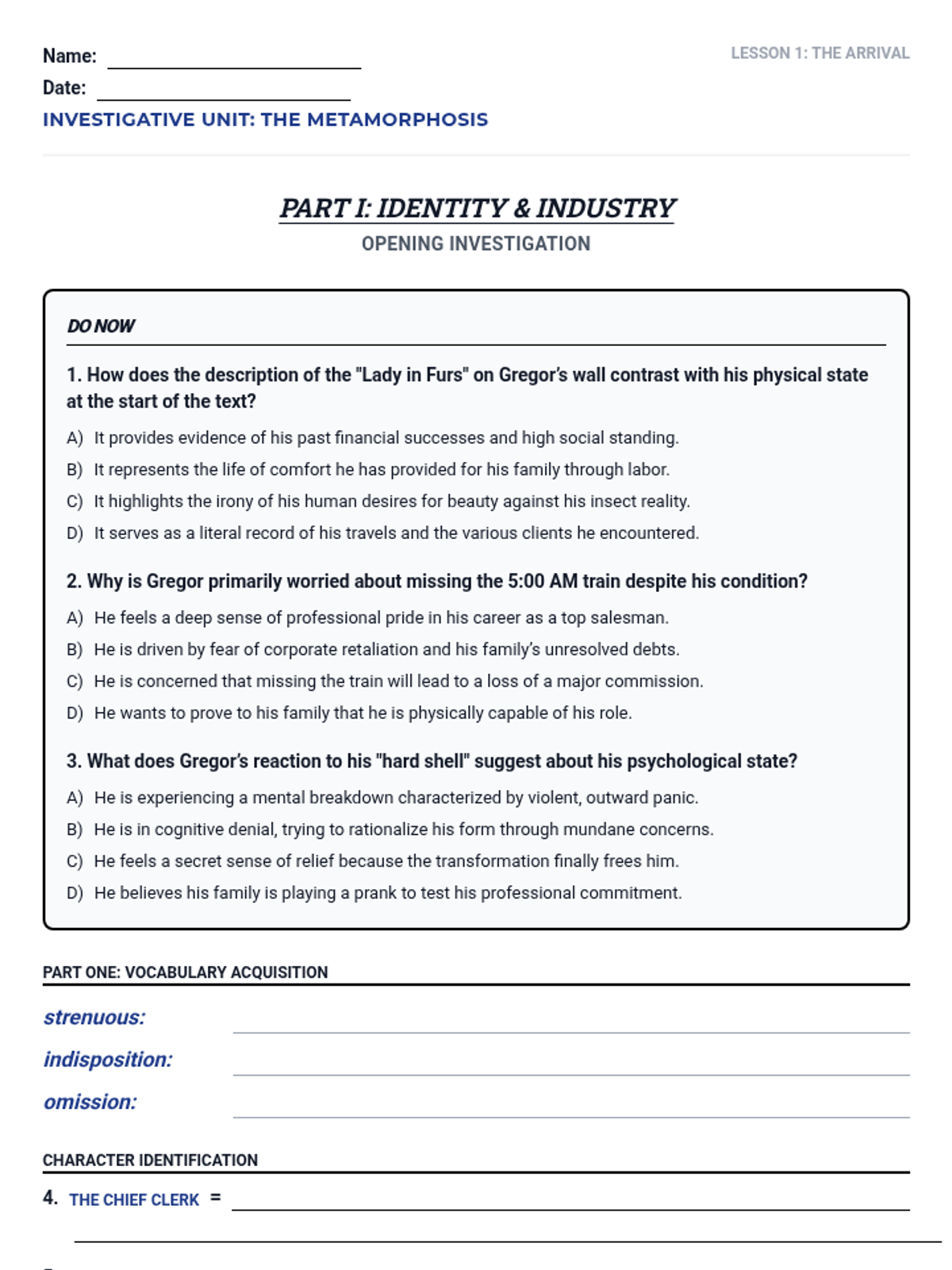
Middle-grade student worksheet for Lesson 1 updated with Bernofsky-specific terminology (General Manager, monstrous insect, carapace). Vocabulary section updated to include monstrous, melancholy, and indisposition. Removed references to "Chief Clerk" and "vermin" to ensure strict alignment with the provided text edition.
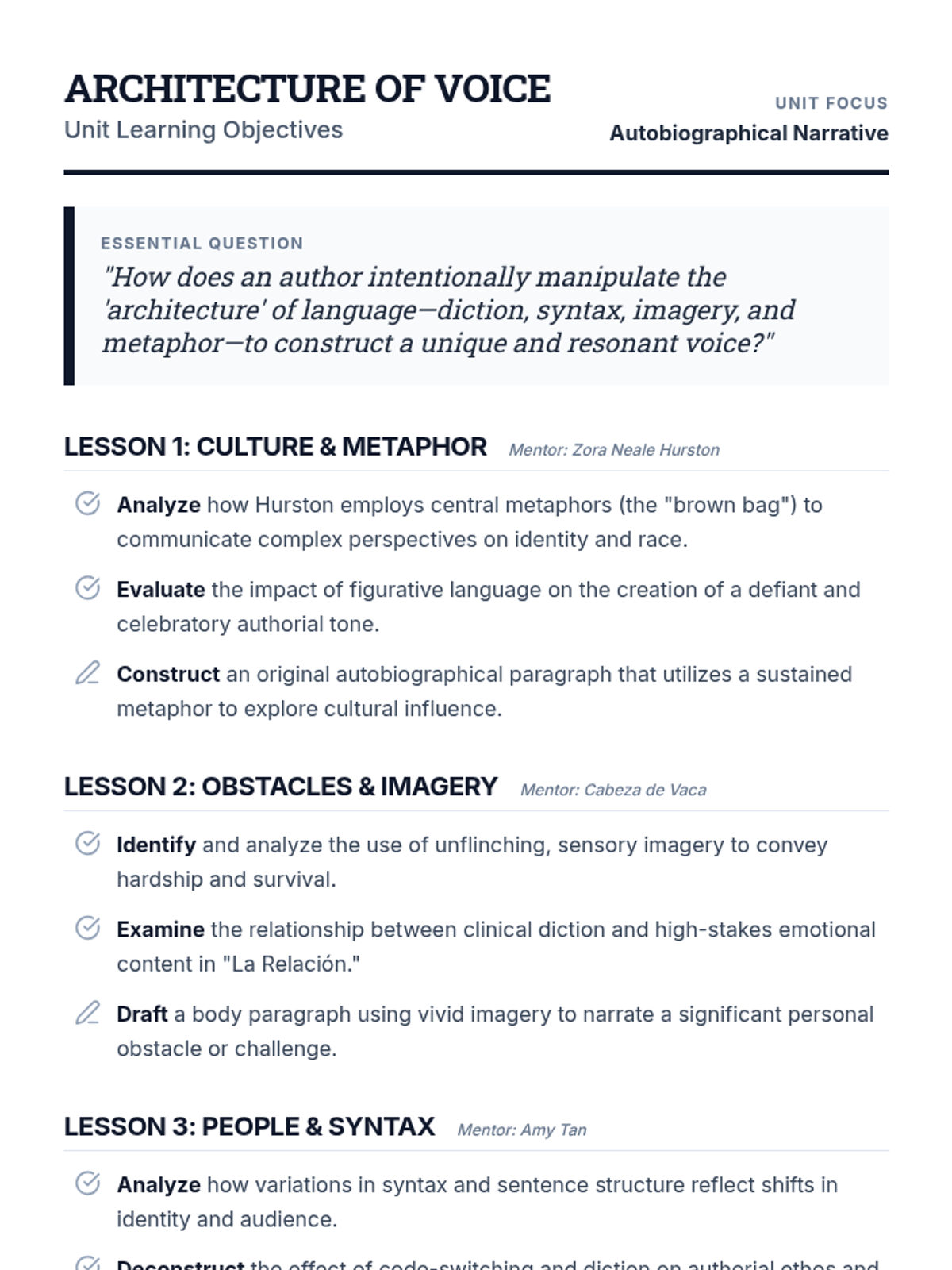
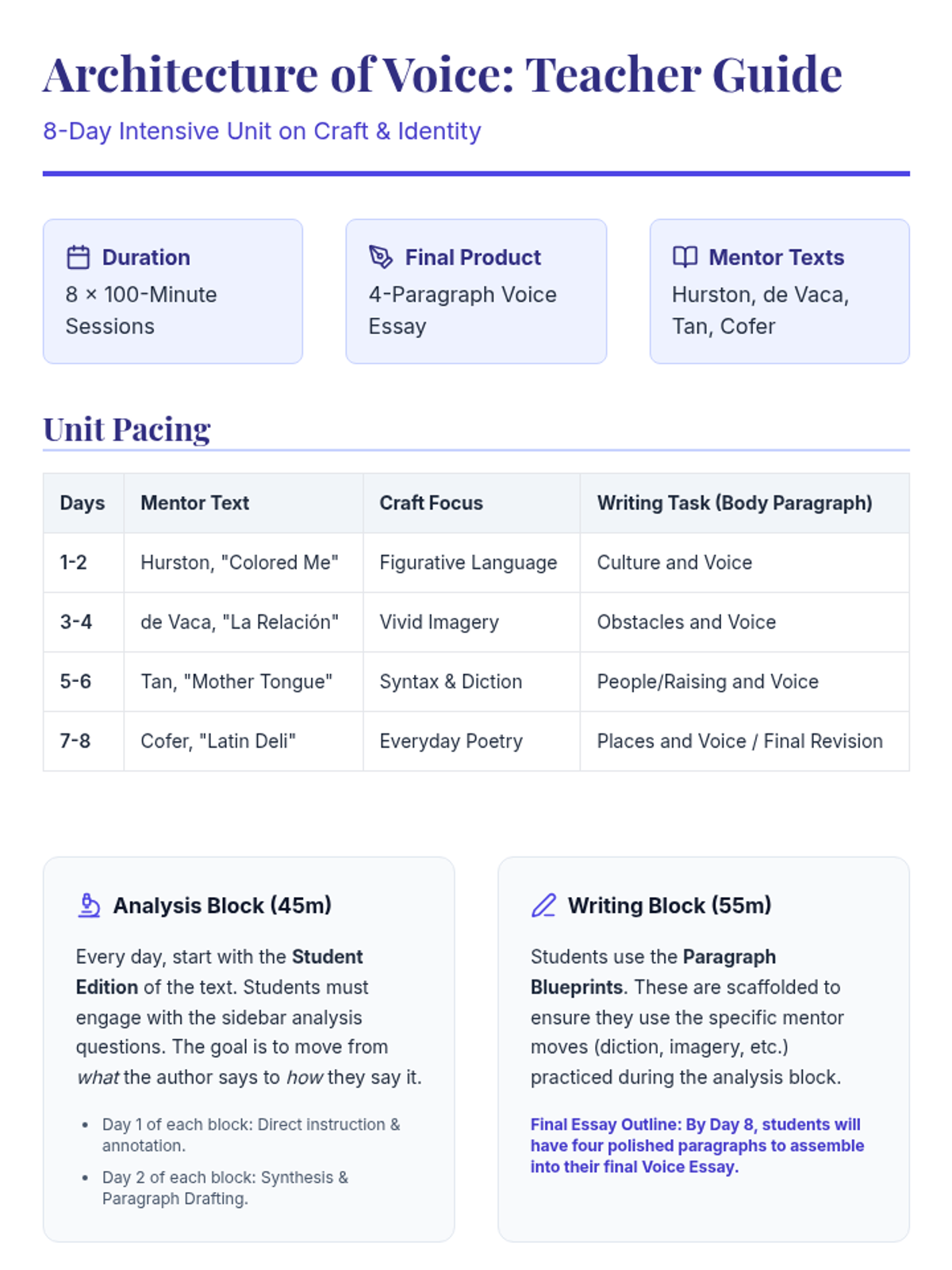
A teacher-facing unit objectives overview for 'The Architecture of Voice,' detailing specific student learning objectives for each of the four mentor-text lessons. Updated to remove TEKS alignment and provide a cleaner, single-column focus on objectives. Optimized for a compact layout.
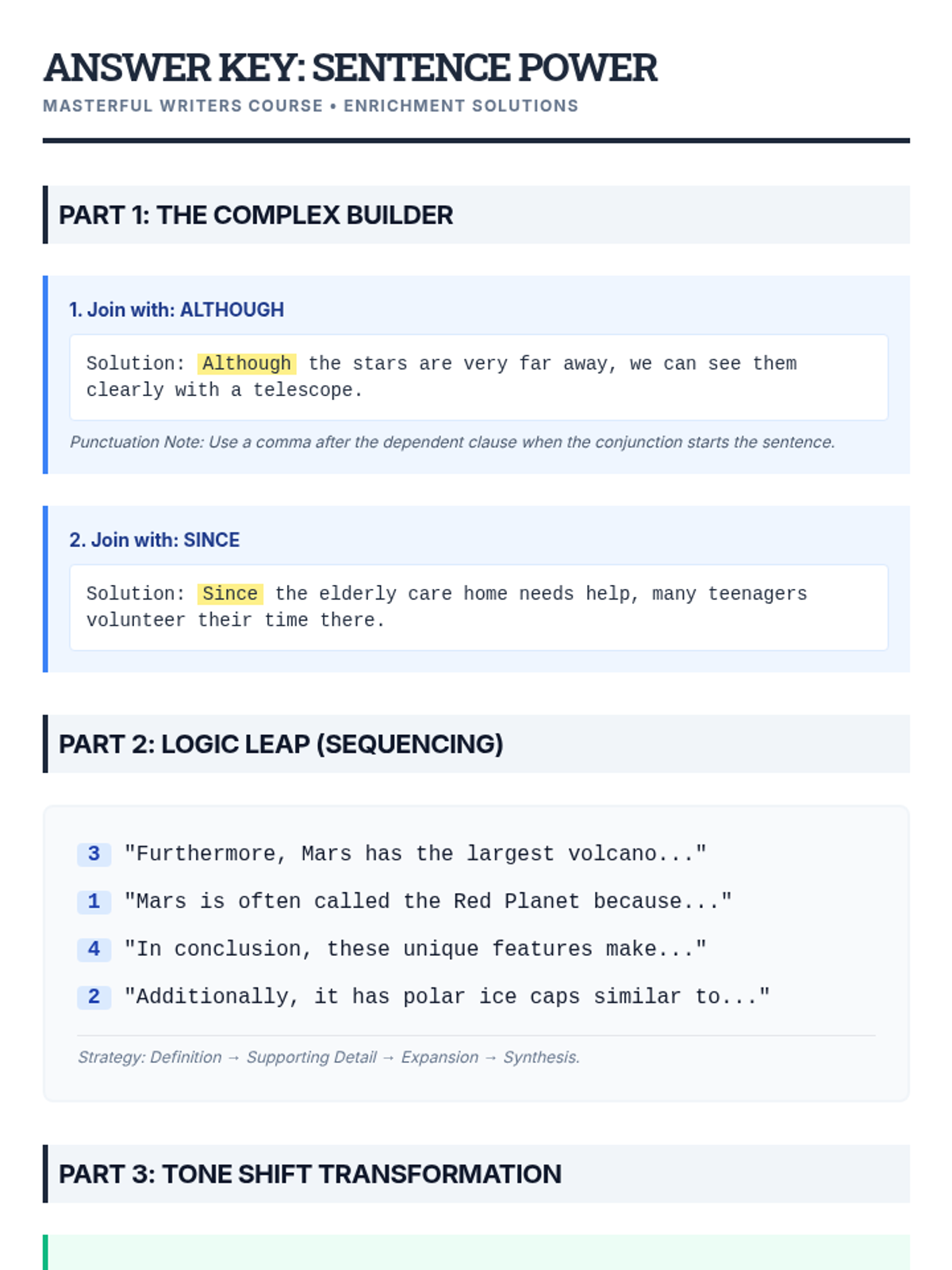
A teacher answer key for the Sentence Power Practice Worksheet, including model answers and grammar rationales. Updated for clarity and visual organization.
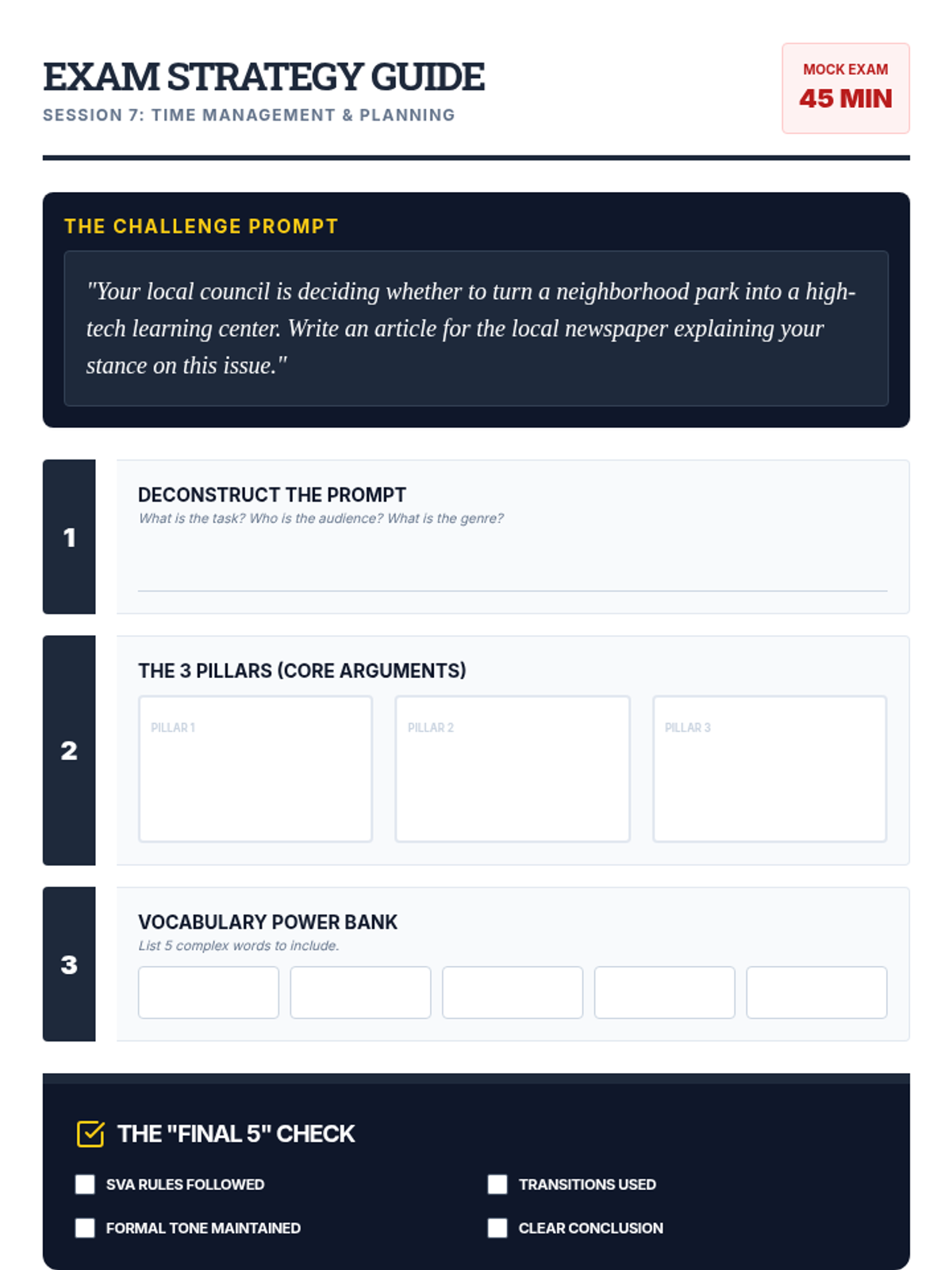
A strategic planning worksheet for students to use during exam preparation, featuring a practice prompt, increased workspace, and a consolidated single-page layout.
A regal, attractive presentation slide deck for the Verse Voyagers lesson, featuring a rich Emerald Green and Royal Gold color palette. The deck includes learning targets, a full 20-round gamified Quiz Bee, TP-CASTT modeling, and an independent analysis guide. Fully revised for uniform answer choices, corrected headers, and visual polish.
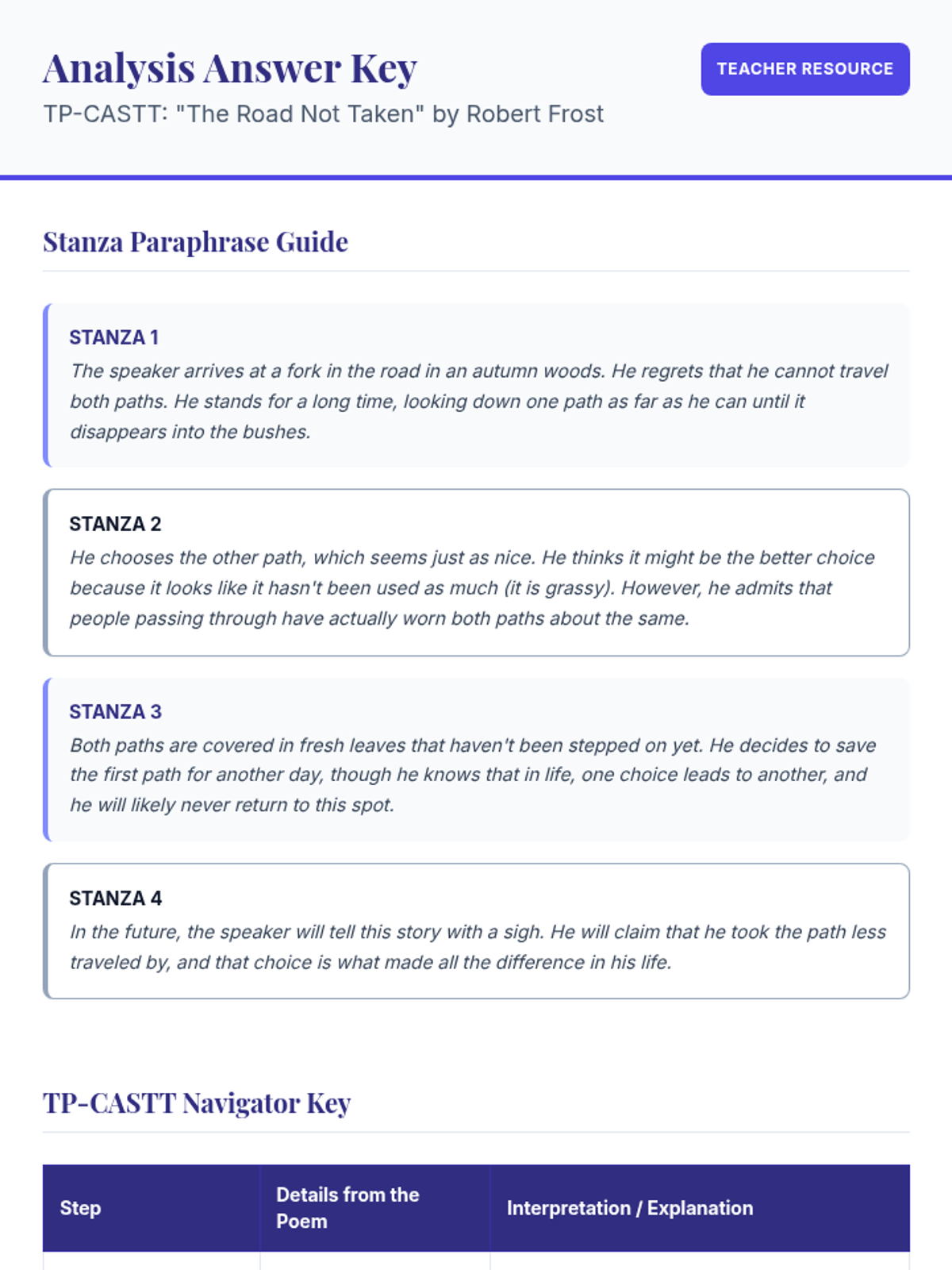
A comprehensive answer key for the 'The Road Not Taken' TP-CASTT analysis, including stanza-by-stanza paraphrasing and detailed interpretations for each step of the method.
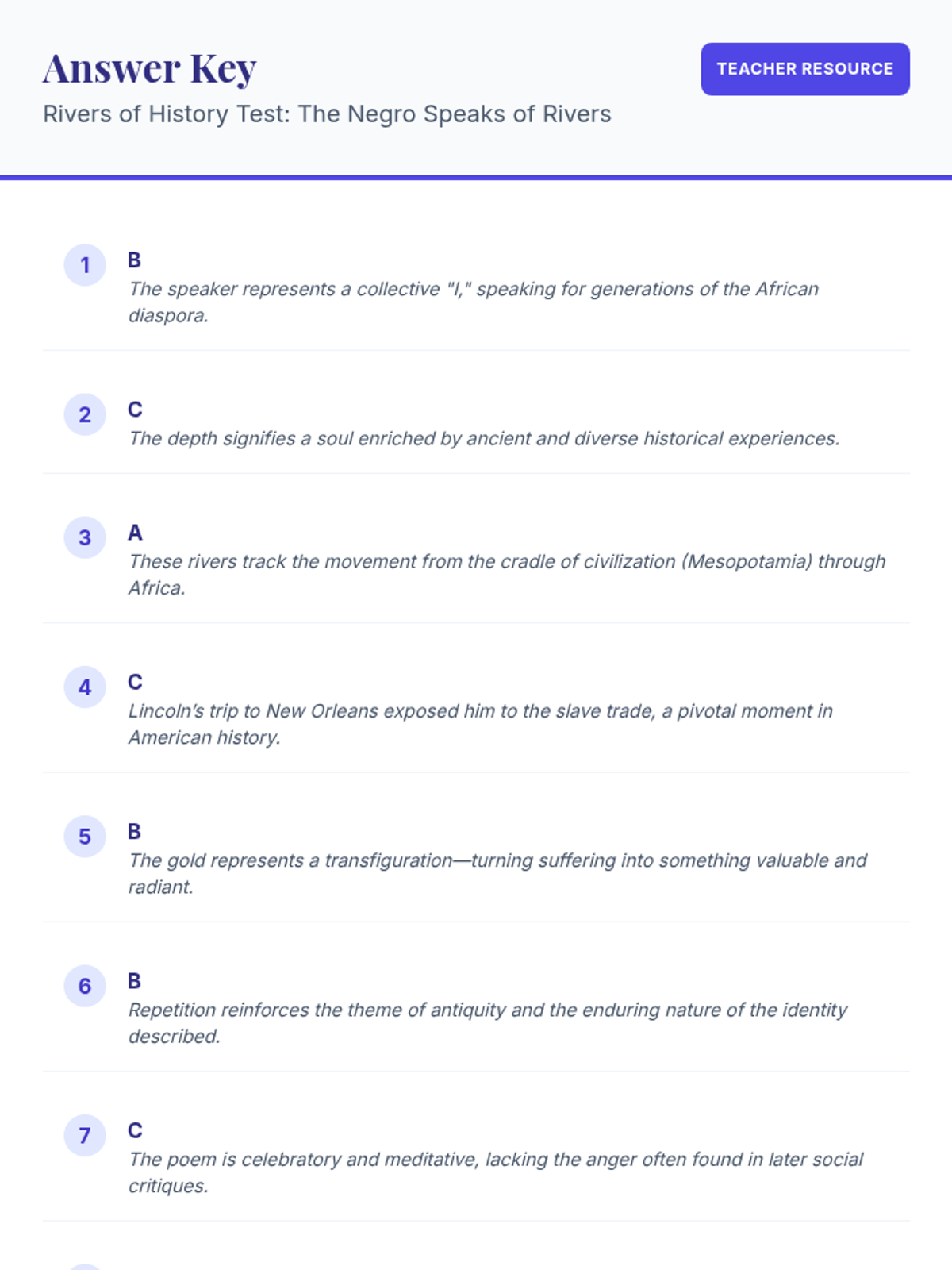
An answer key for the 'Rivers of History' test, including correct responses and brief pedagogical rationales for each question.
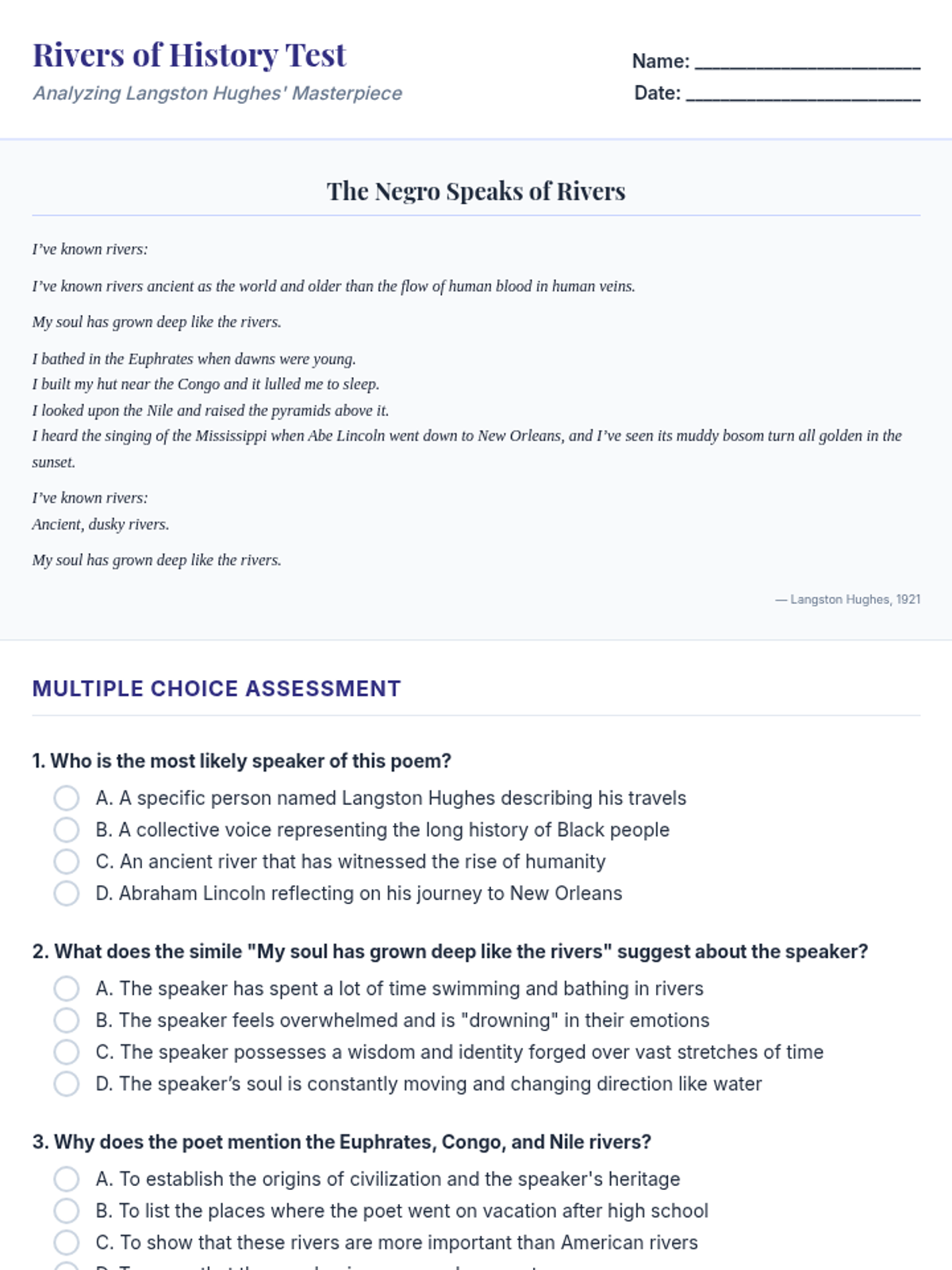
A 10-question multiple choice test worksheet based on Langston Hughes' 'The Negro Speaks of Rivers', focusing on symbolism, allusion, and theme.
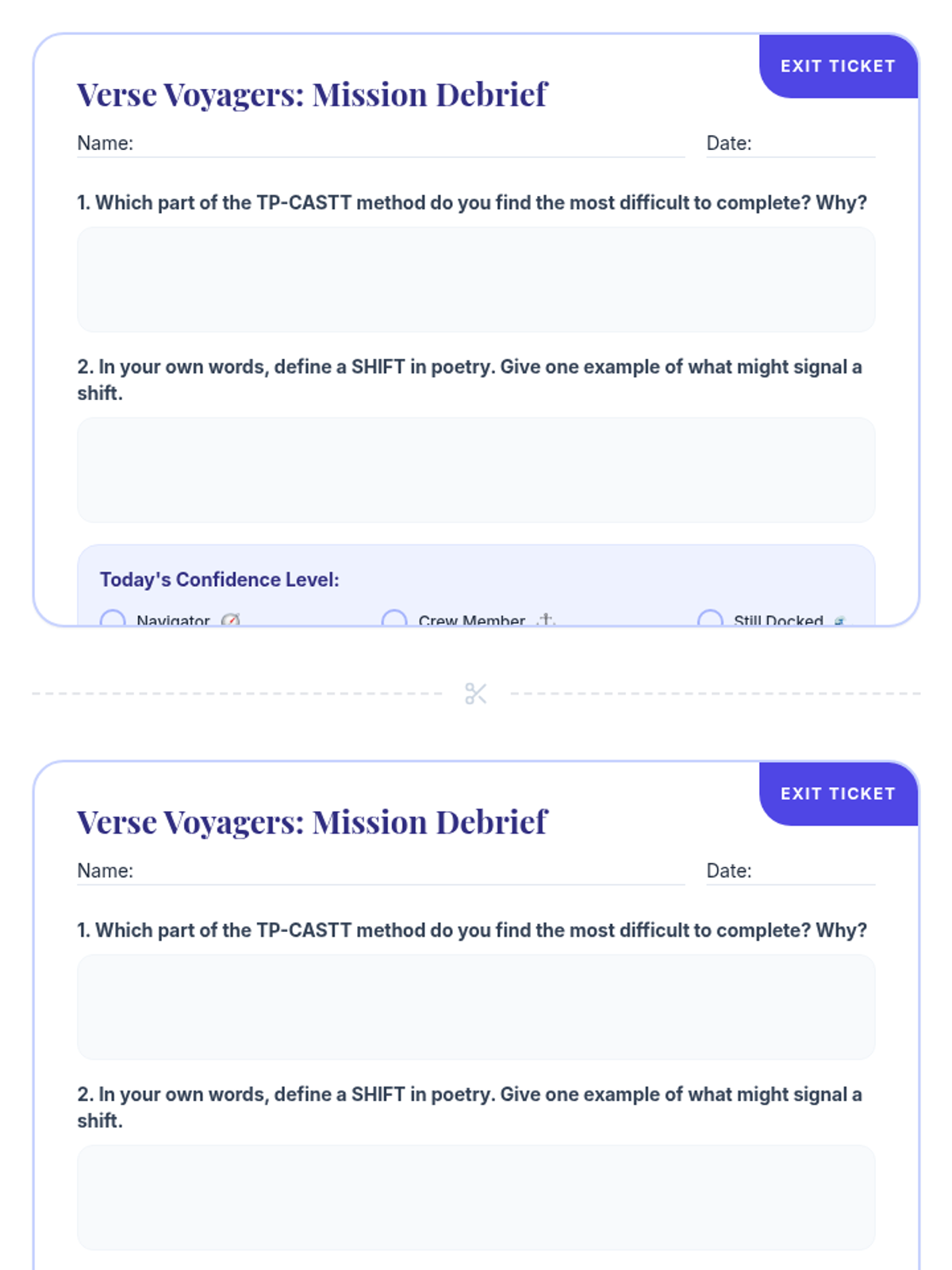
A half-sheet exit ticket for students to reflect on the TP-CASTT method and assess their understanding of poetic shifts, formatted as two per page for easy cutting.
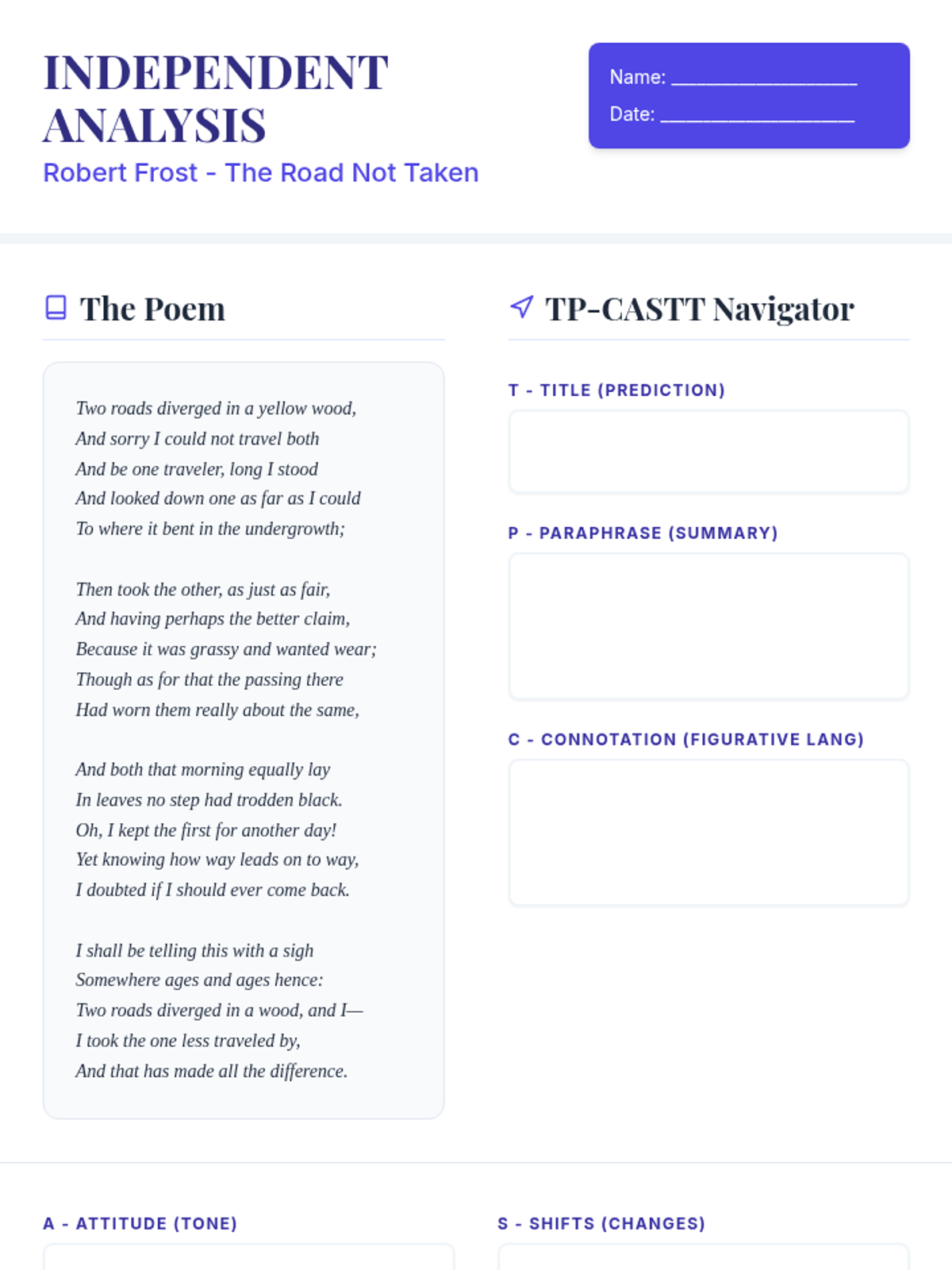
An independent practice worksheet for analyzing Robert Frost's 'The Road Not Taken' using the TP-CASTT method, featuring a full-text version and guided analysis blocks.
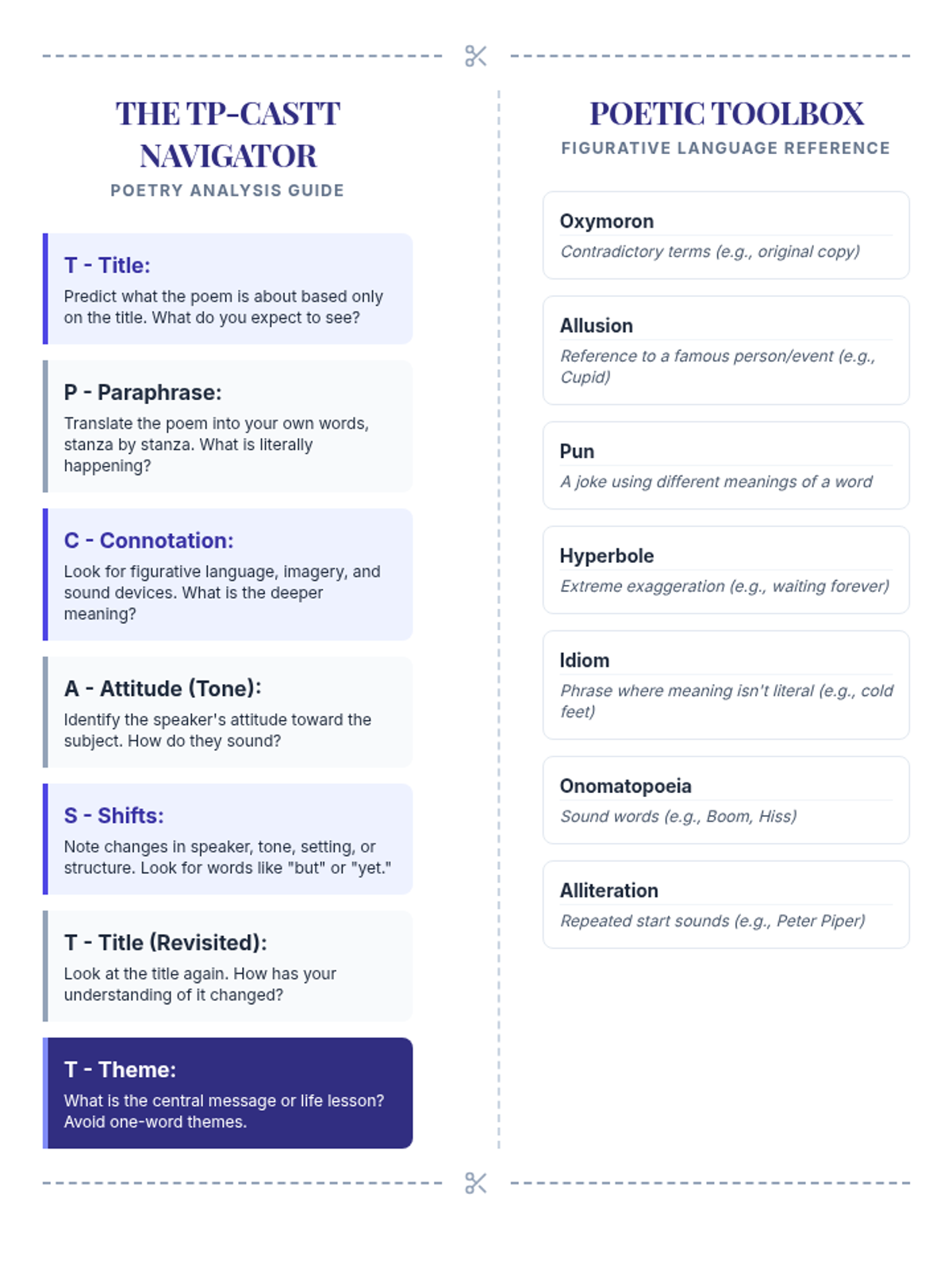
A two-part cut-out reference sheet containing the TP-CASTT analysis steps on one side and a figurative language toolbox on the other.
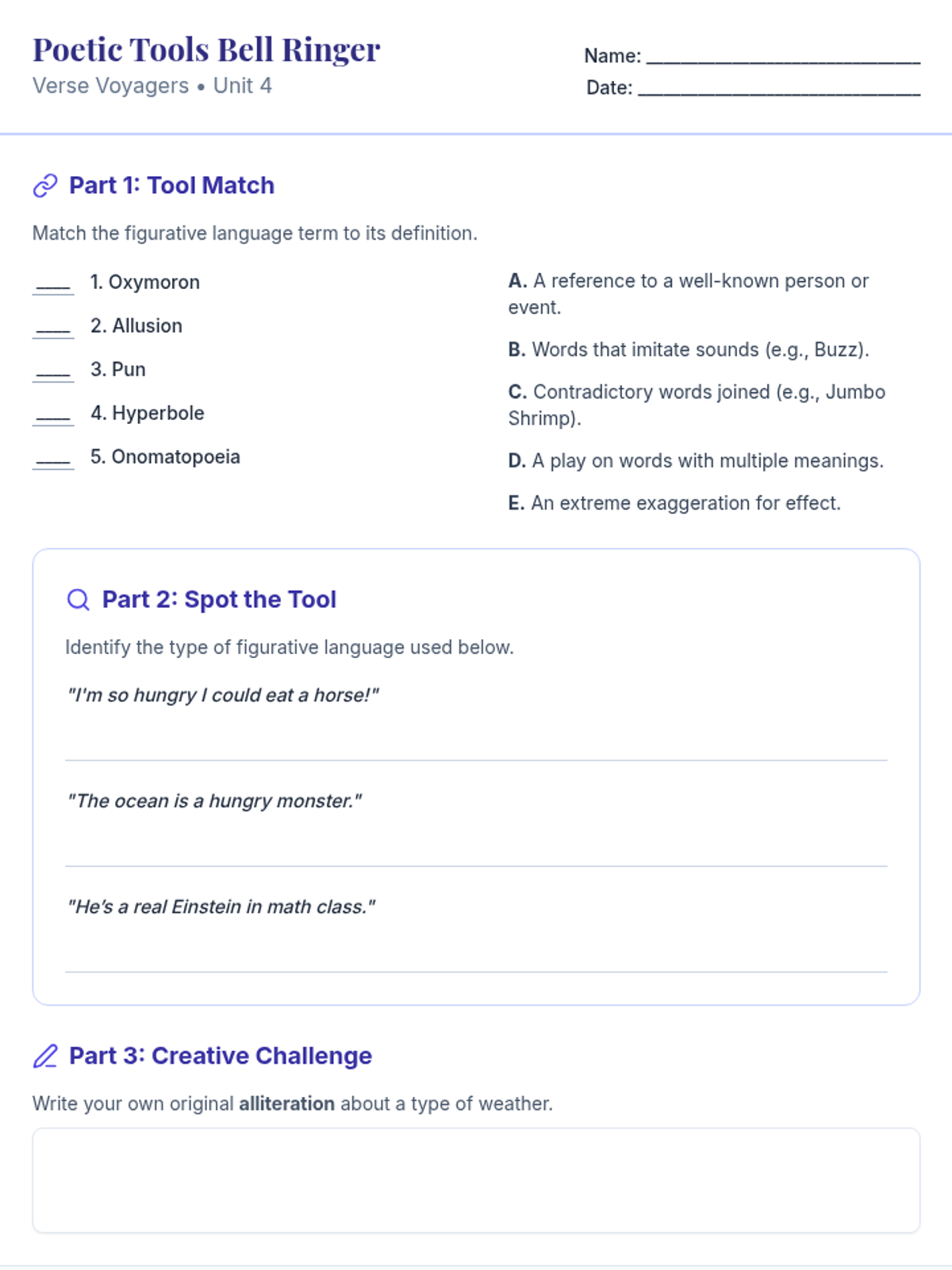
A bell ringer worksheet reviewing key figurative language terms like oxymoron, allusion, and pun through matching and identification exercises.
A comprehensive slide deck for the Verse Voyagers lesson, including a 20-question Quiz Bee and a step-by-step TP-CASTT modeling section for Langston Hughes' 'The Negro Speaks of Rivers'.
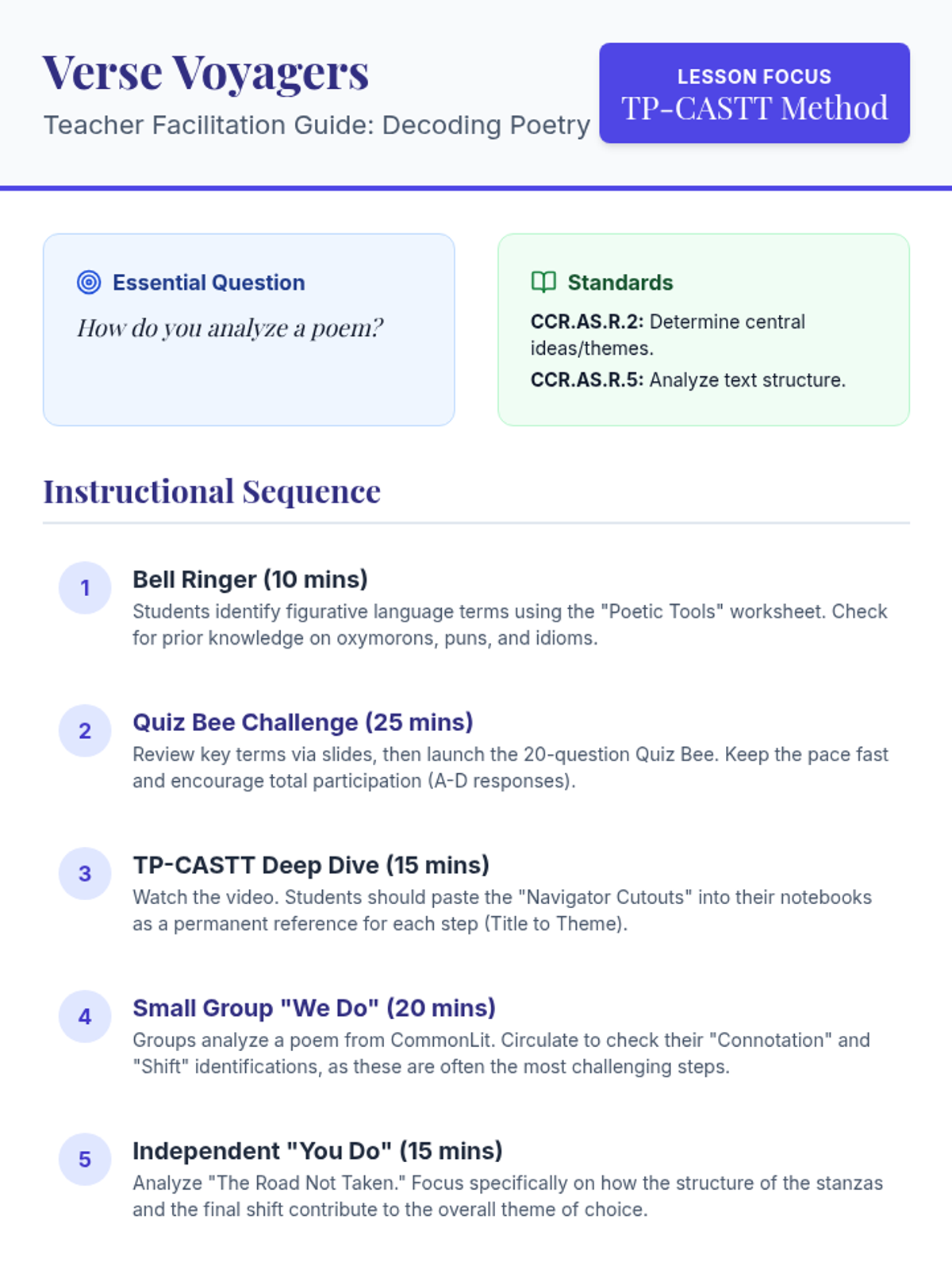
A teacher facilitation guide outlining the instructional flow, standards, and learning targets for the Verse Voyagers poetry lesson.
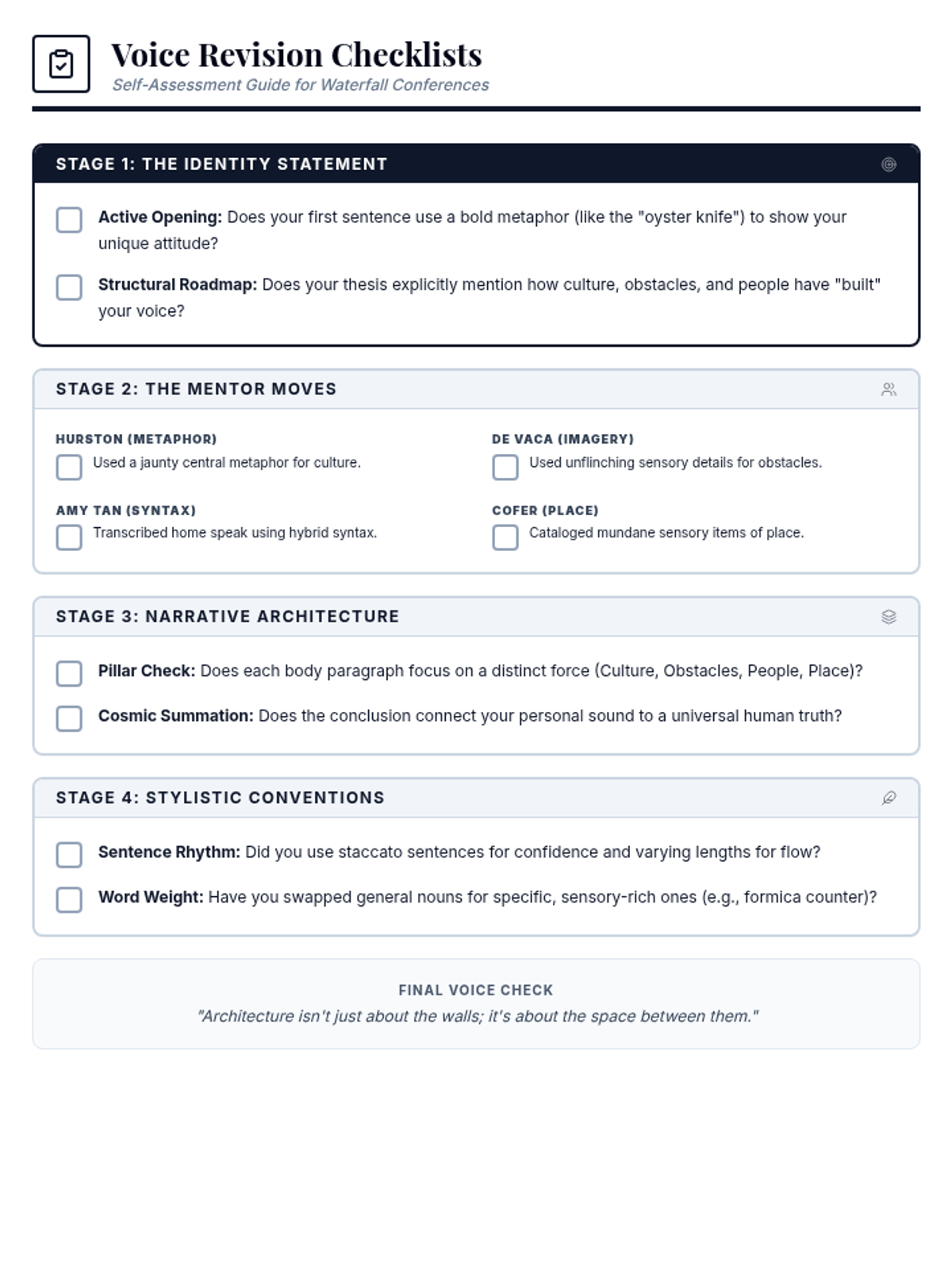
Detailed revision checklists aligned with the four stages of the waterfall conference log (Thesis, Mentor Skills, Organization, and Conventions). Provides students with actionable checkpoints to self-assess the architectural development of their personal voice.
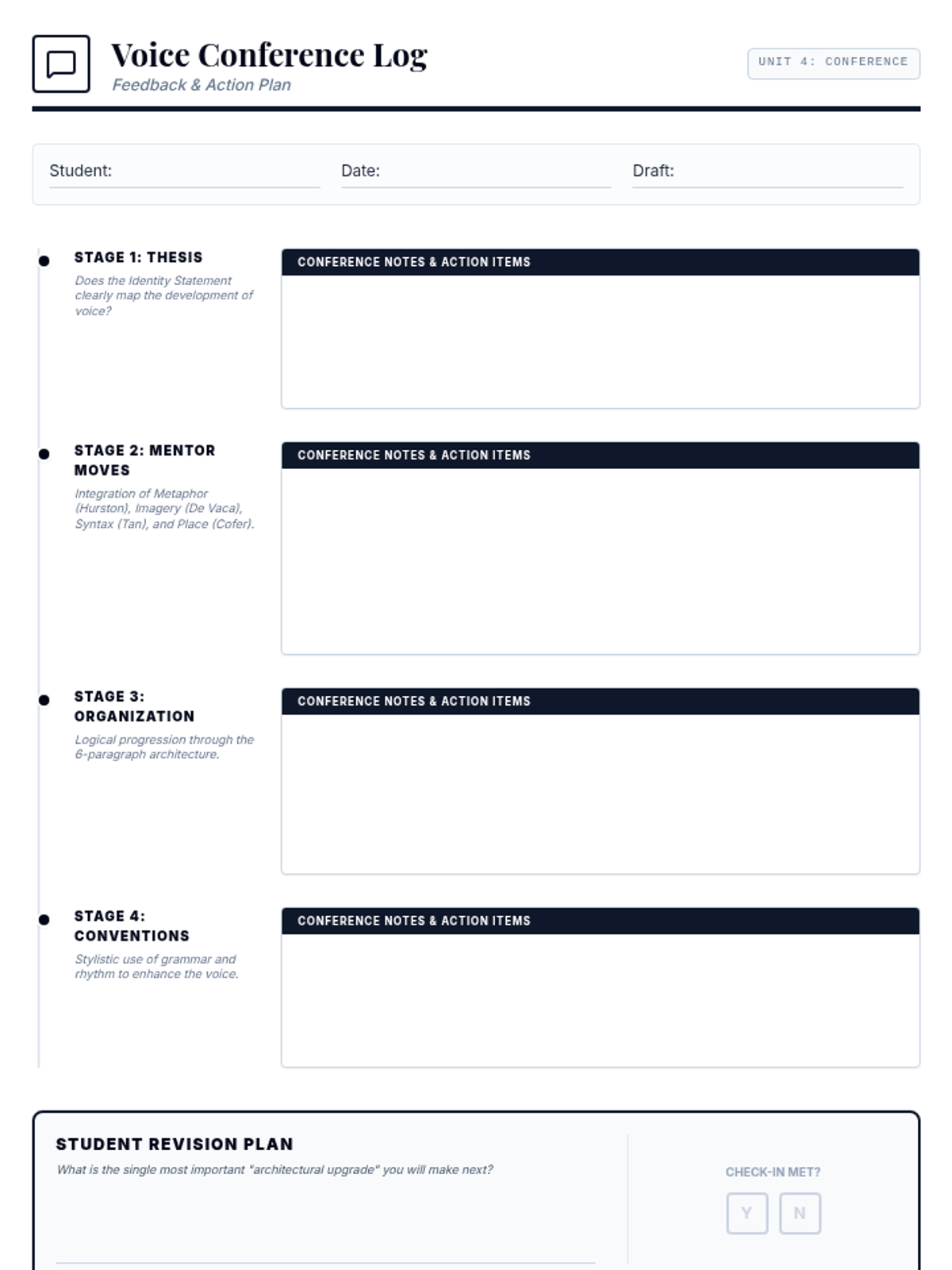
A vertical 'waterfall' style writing conference form for the Architecture of Voice unit. It cascades through four instructional stages (Thesis, Mentor Skills, Organization, and Conventions) with dedicated space for teacher notes and student action items. Grayscale optimized for single-page printing.
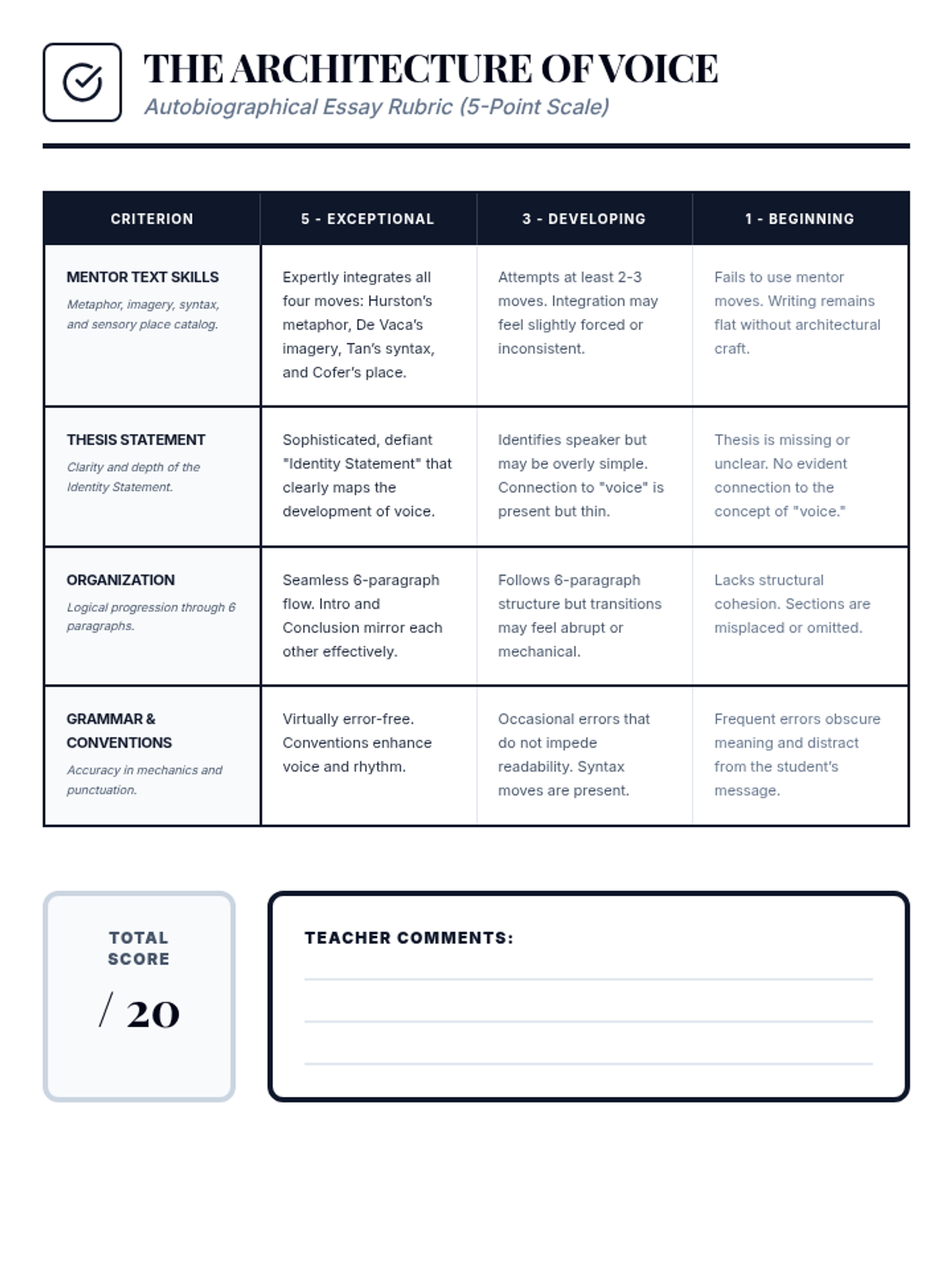
A comprehensive 5-point rubric for the final Architecture of Voice autobiographical essay, evaluating mentor text skills, thesis clarity, organization, and conventions. Optimized for grayscale printing.
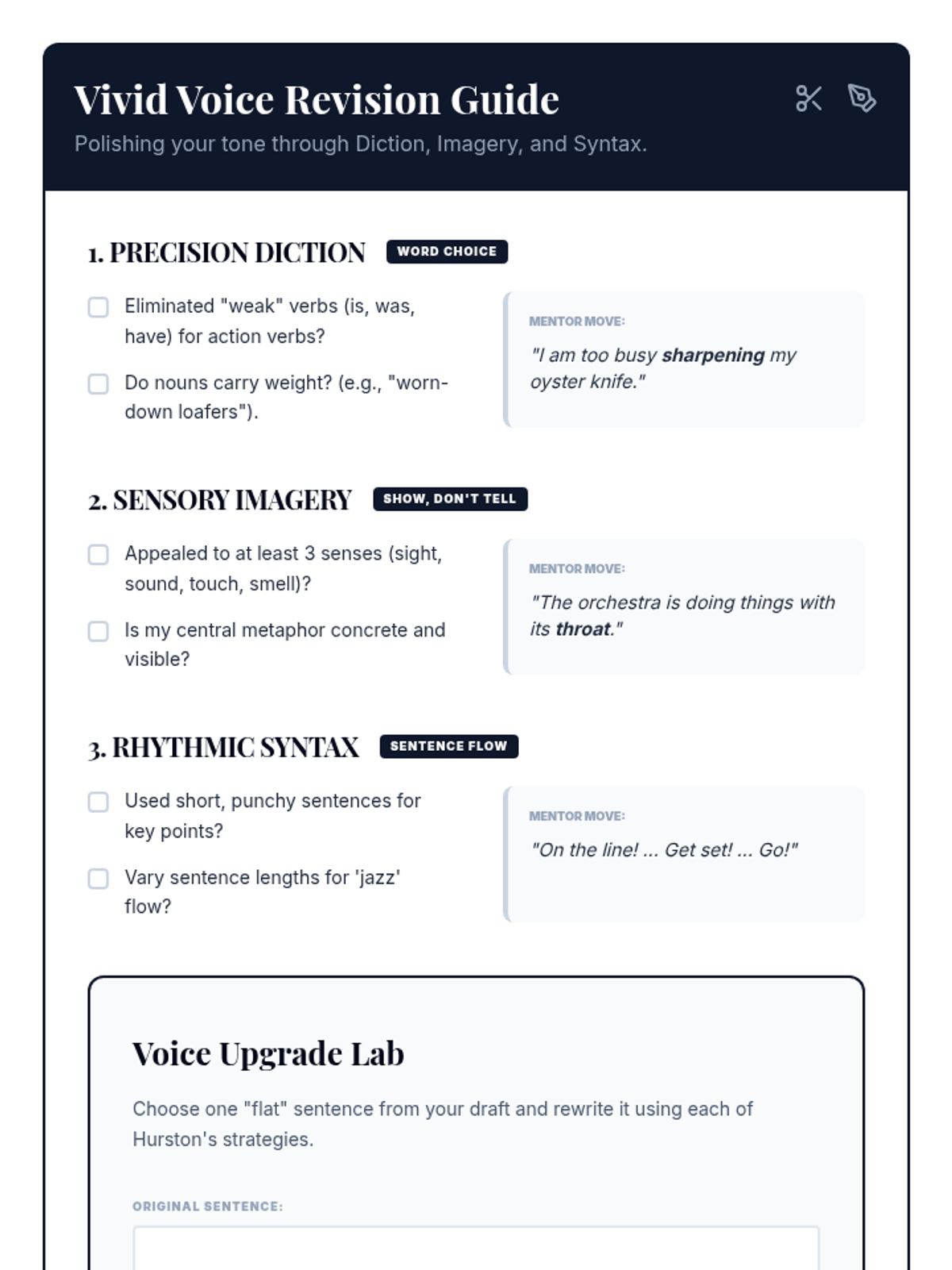
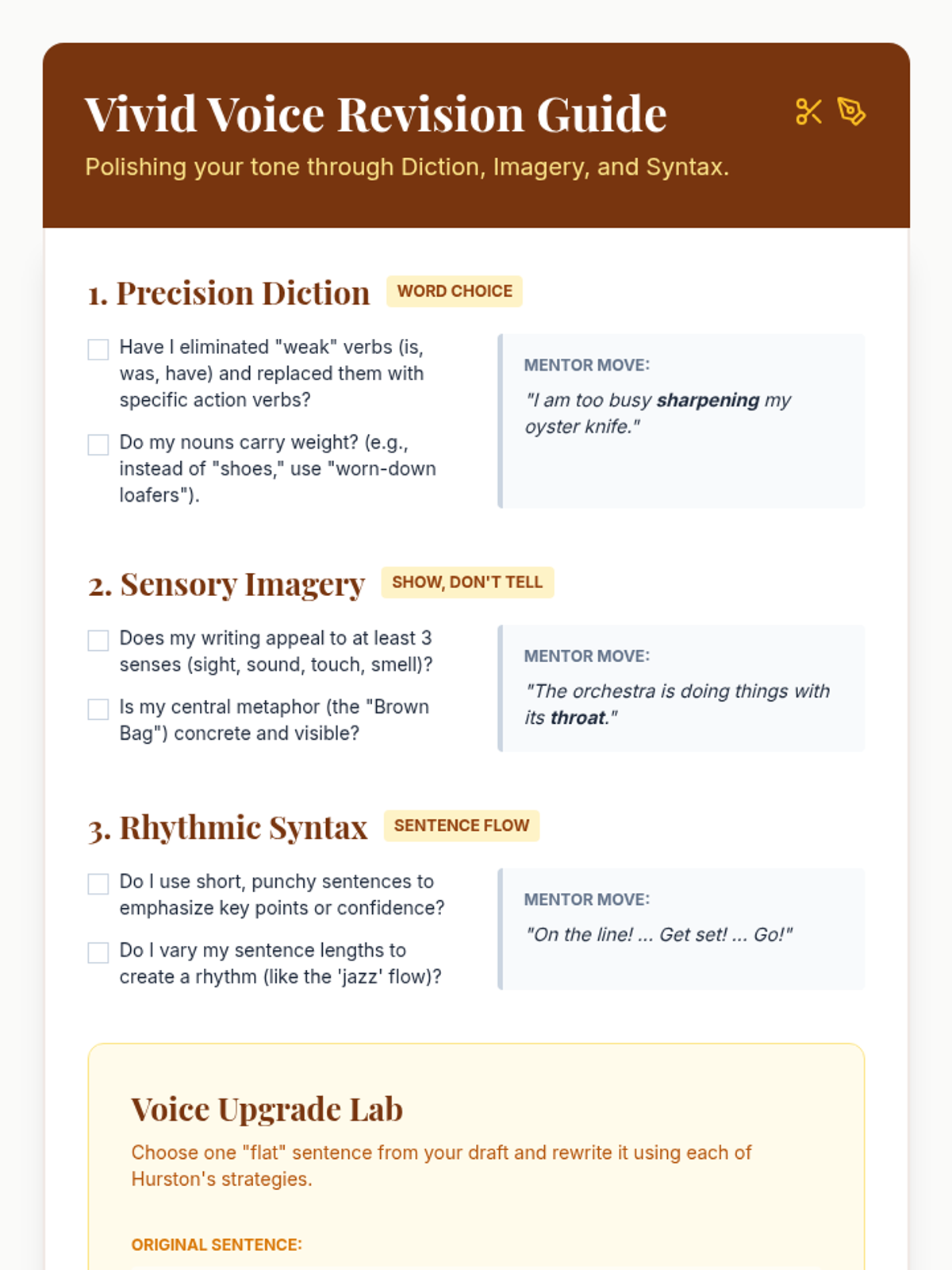
A tone-focused revision guide for students to refine their autobiographical essays using Hurston's mentor moves in diction, imagery, and syntax. Includes checklists and a 'voice upgrade' practice area.
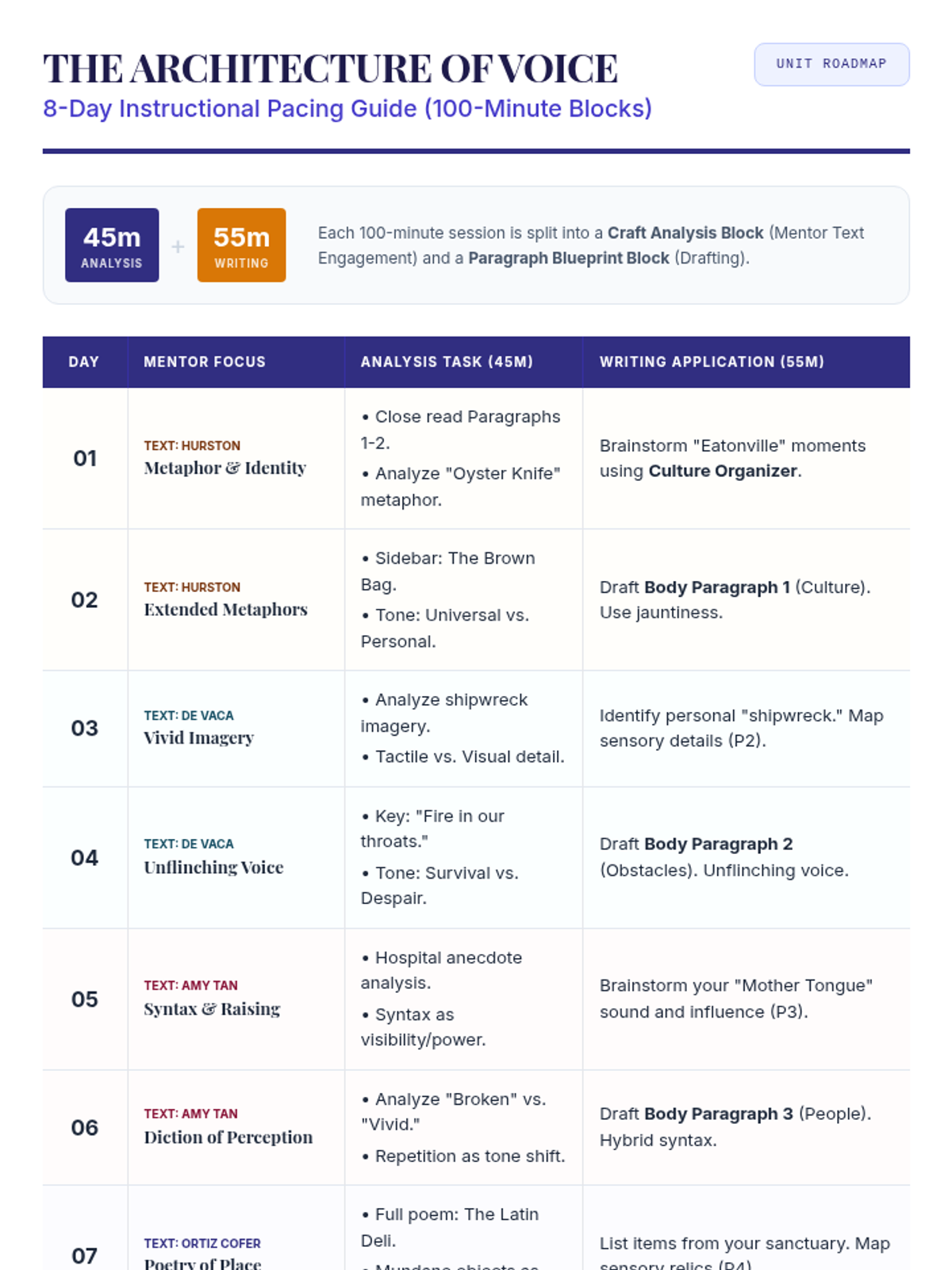
Grayscale-optimized instructional pacing guide for 'The Architecture of Voice' unit, updated to include English III 2017 TEKS for each instructional day. Details the 8-day progression from introduction to final submission with specific standards alignment. Revised for exact footer alignment and TEKS descriptions.
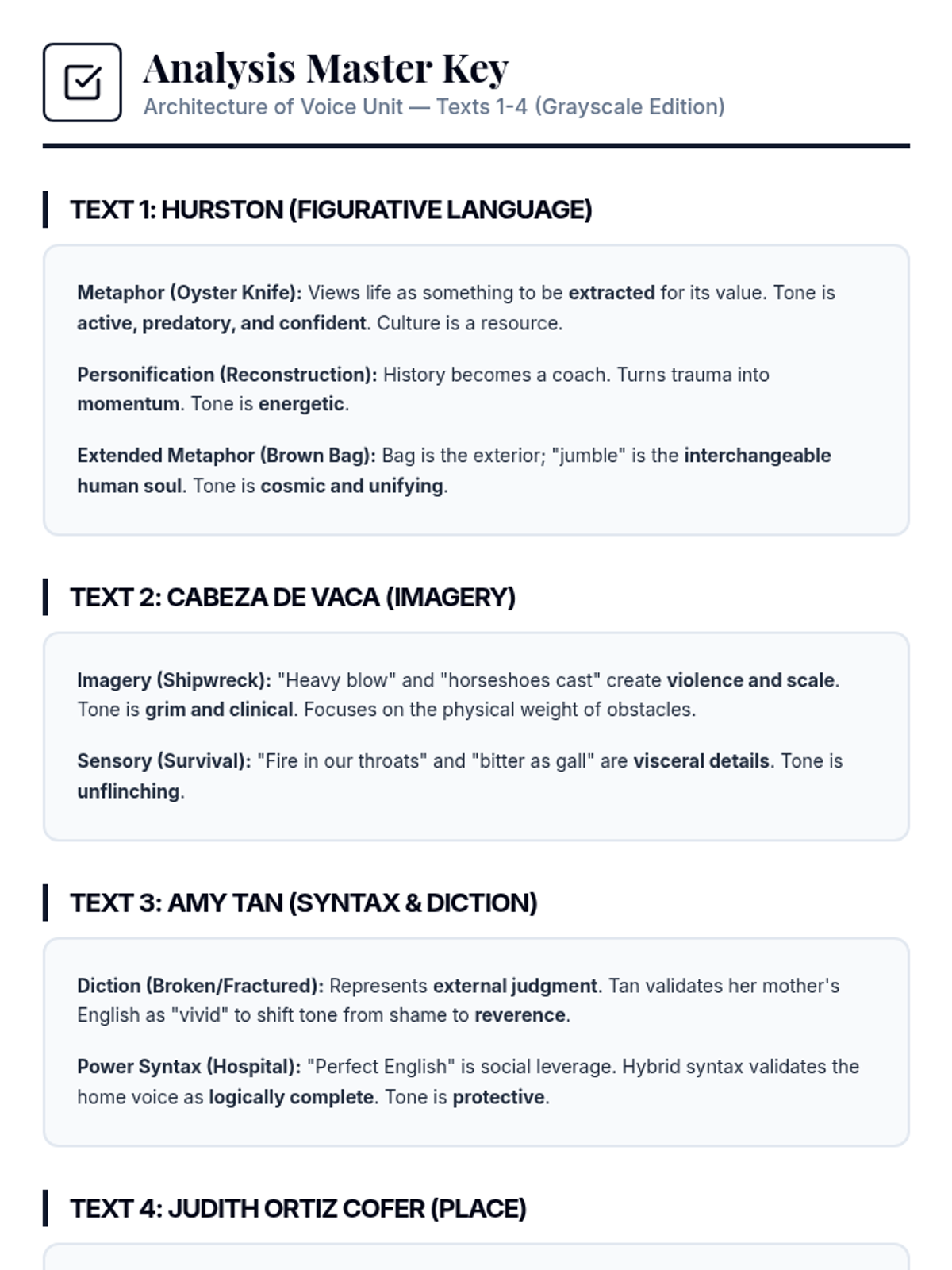
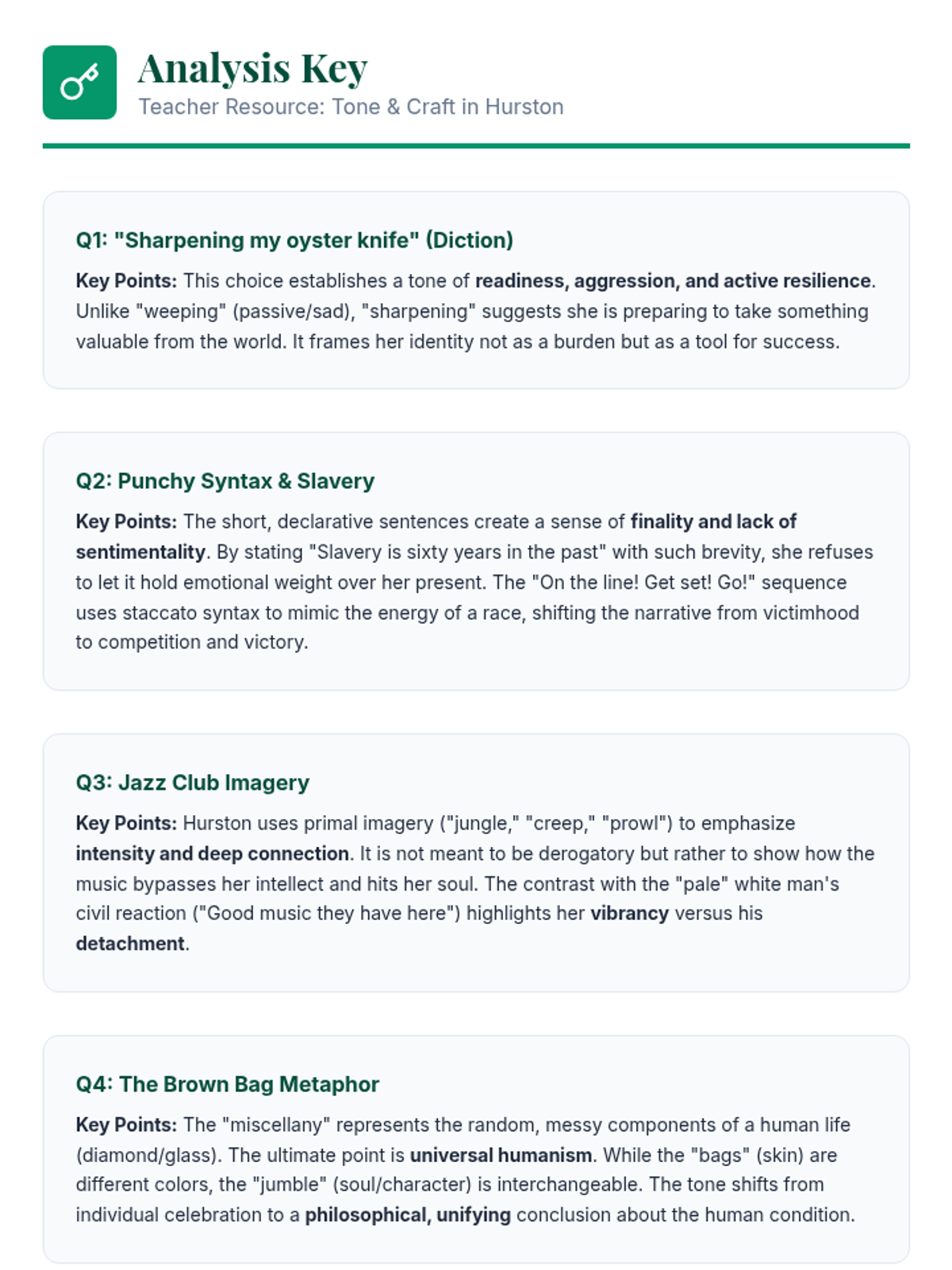
Teacher's master answer key for the analysis of all four mentor texts (Hurston, de Vaca, Tan, Cofer) in the 'Architecture of Voice' unit. Aligns with sidebar questions and synthesis tasks. Optimized for single or double-page printing.
A comprehensive slide deck for the 'Architecture of Voice' unit, updated to the 6-paragraph master essay model. Provides visual anchors for hook/thesis, the four mentor-based pillars, and the cosmic conclusion. Integrated with the waterfall conference and revision tools.
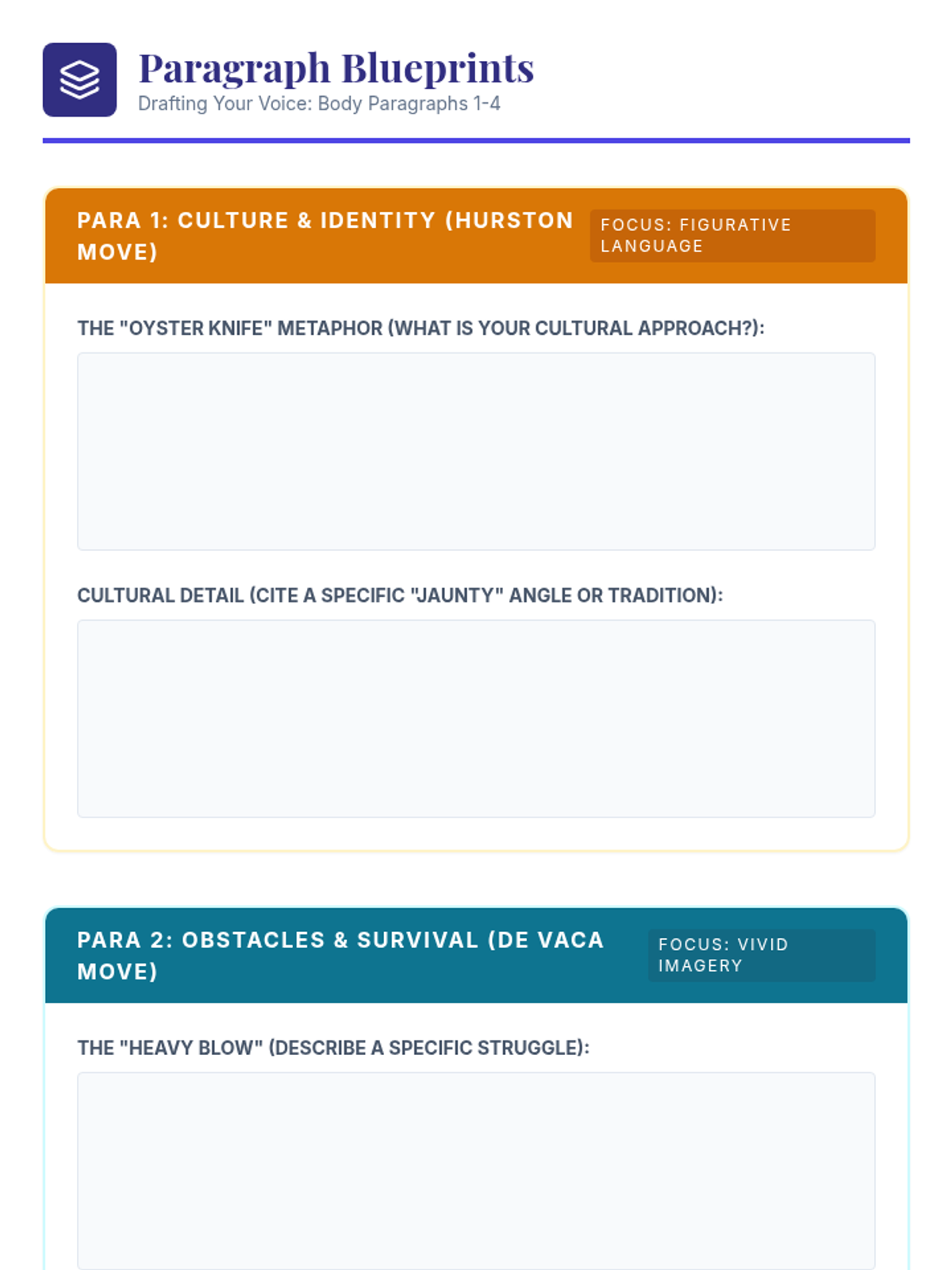
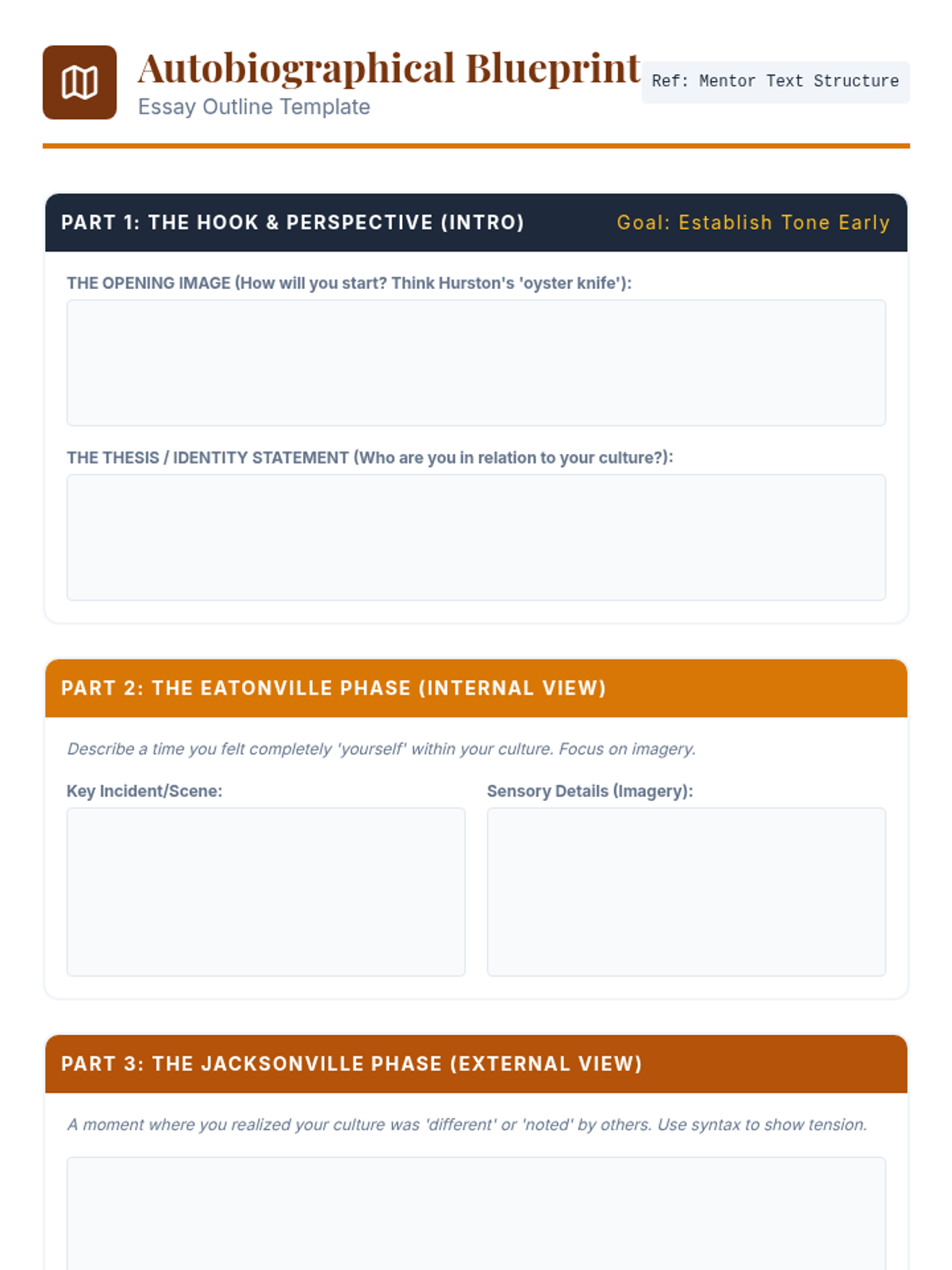
Structured paragraph outlines for all four sections of the Voice Essay, aligned with the craft moves of Hurston, de Vaca, Tan, and Cofer. Optimized for grayscale printing.
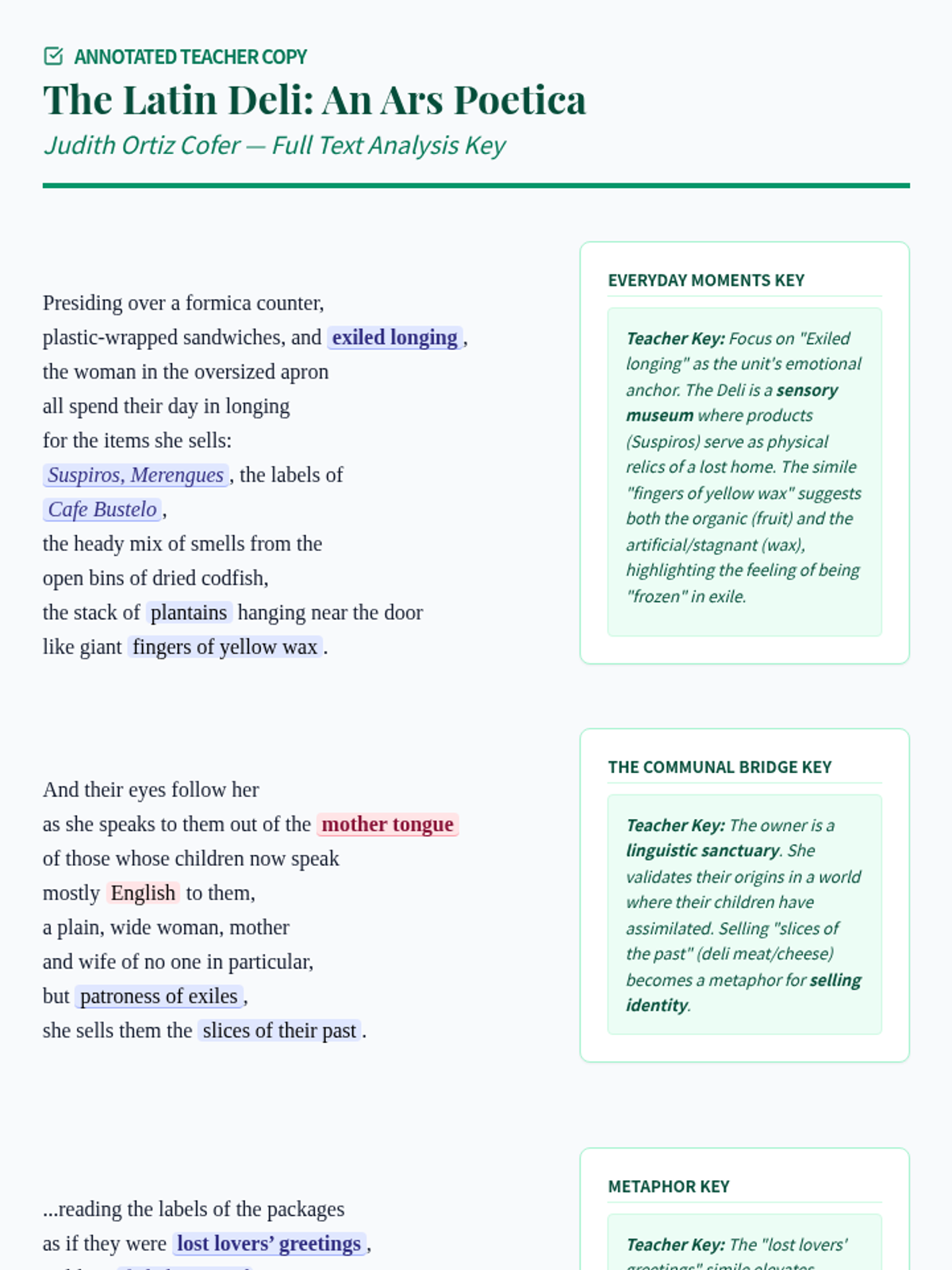
Grayscale-optimized annotated teacher copy for Cofer's 'The Latin Deli,' using a slate and white palette for high contrast and toner-saving. Includes highlighted text evidence and analysis keys.
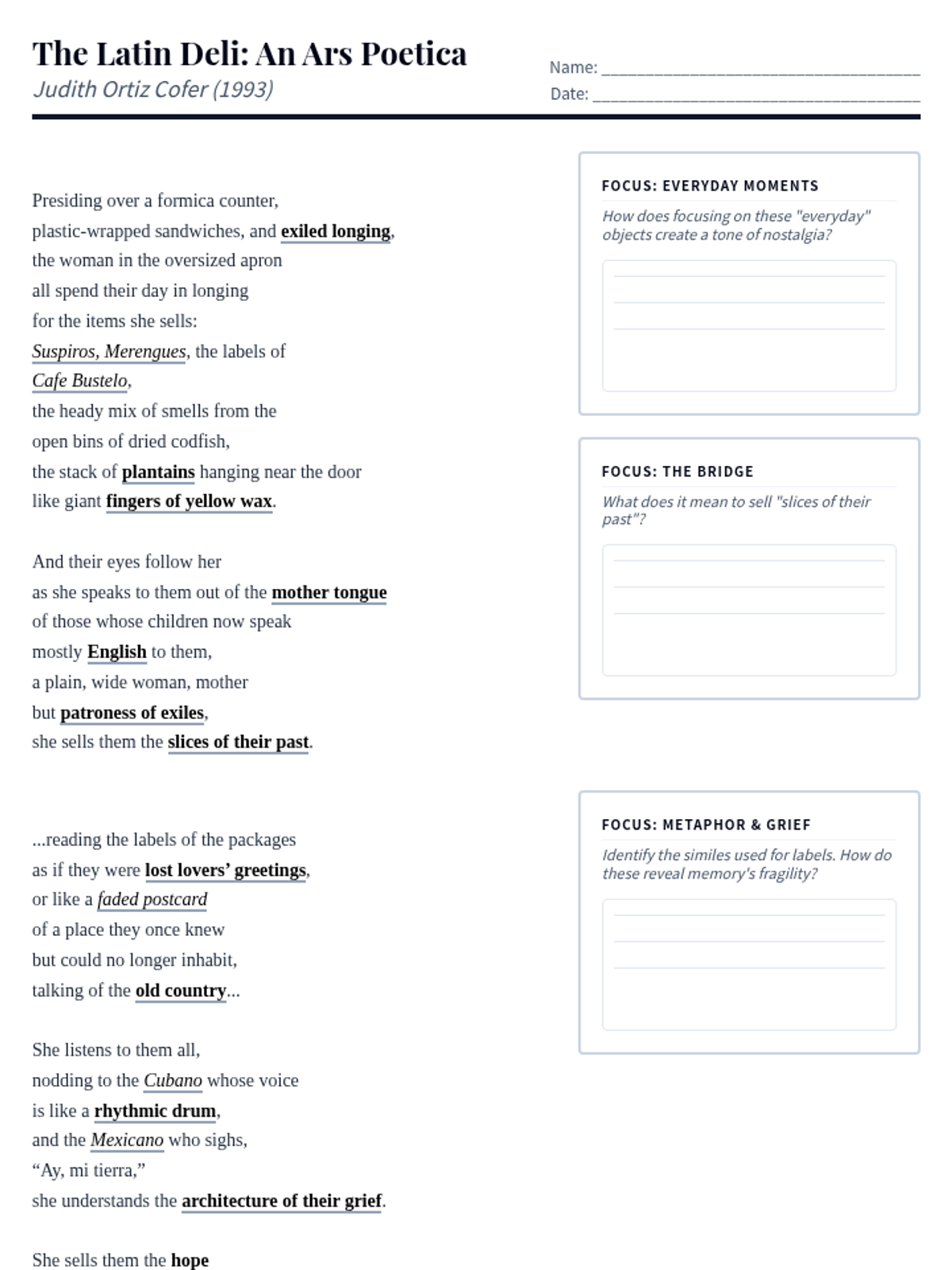
Grayscale-optimized student analysis guide for Cofer's 'The Latin Deli,' using a slate and white palette for high contrast and toner-saving. Includes the full poem and sidebar analysis questions. Optimized to fit on a single page.
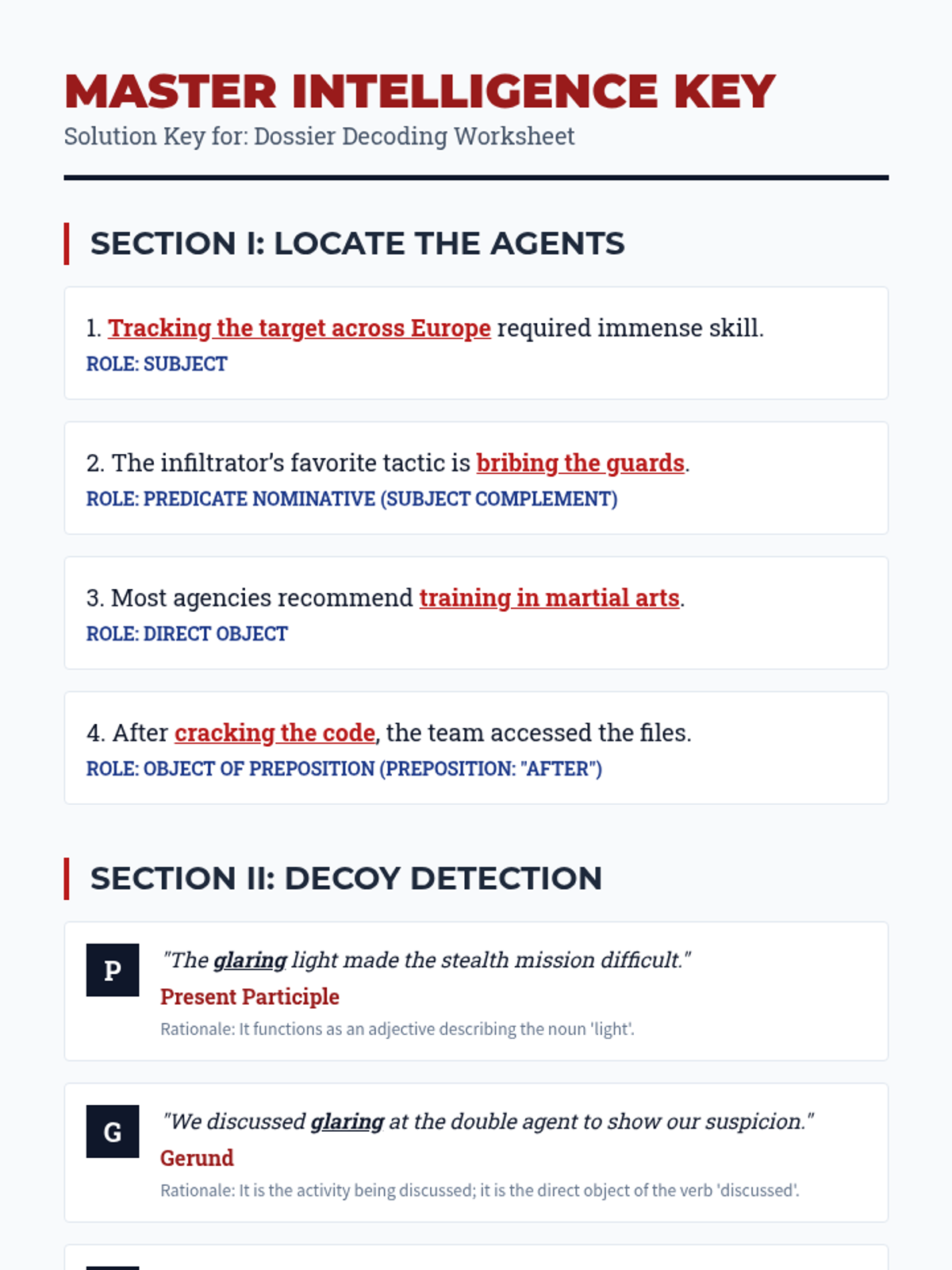
A comprehensive answer key for the 'Dossier Decoding' worksheet, providing highlighted solutions, role identifications, and teacher notes for evaluating high-level student responses. Section II is now self-contained and formatted for better readability.
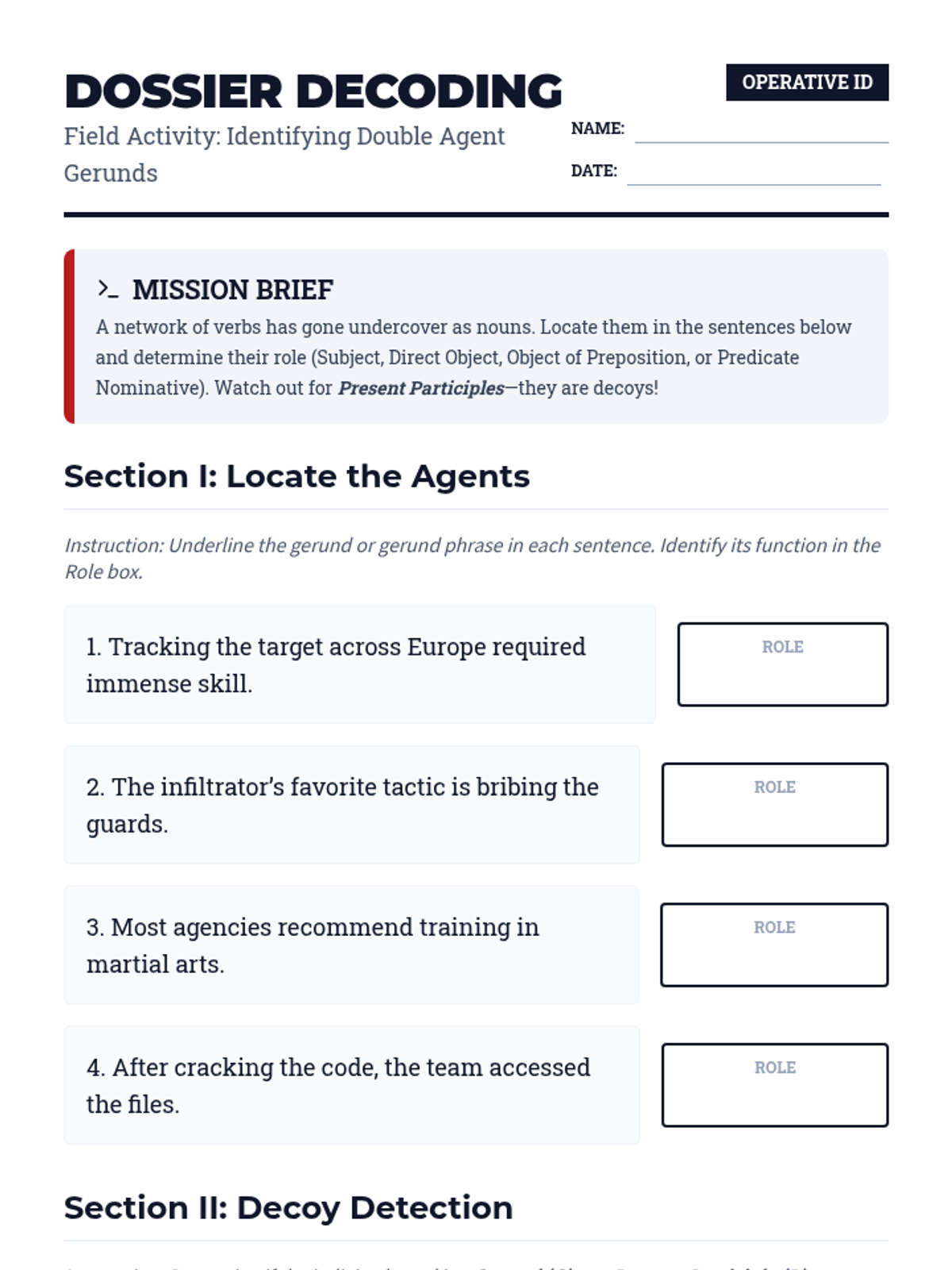
A student worksheet designed with a detective 'dossier' aesthetic. It challenges students to identify gerunds and their roles, distinguish them from participles, and apply their knowledge in creative writing. Section I has been improved for better layout and clarity.
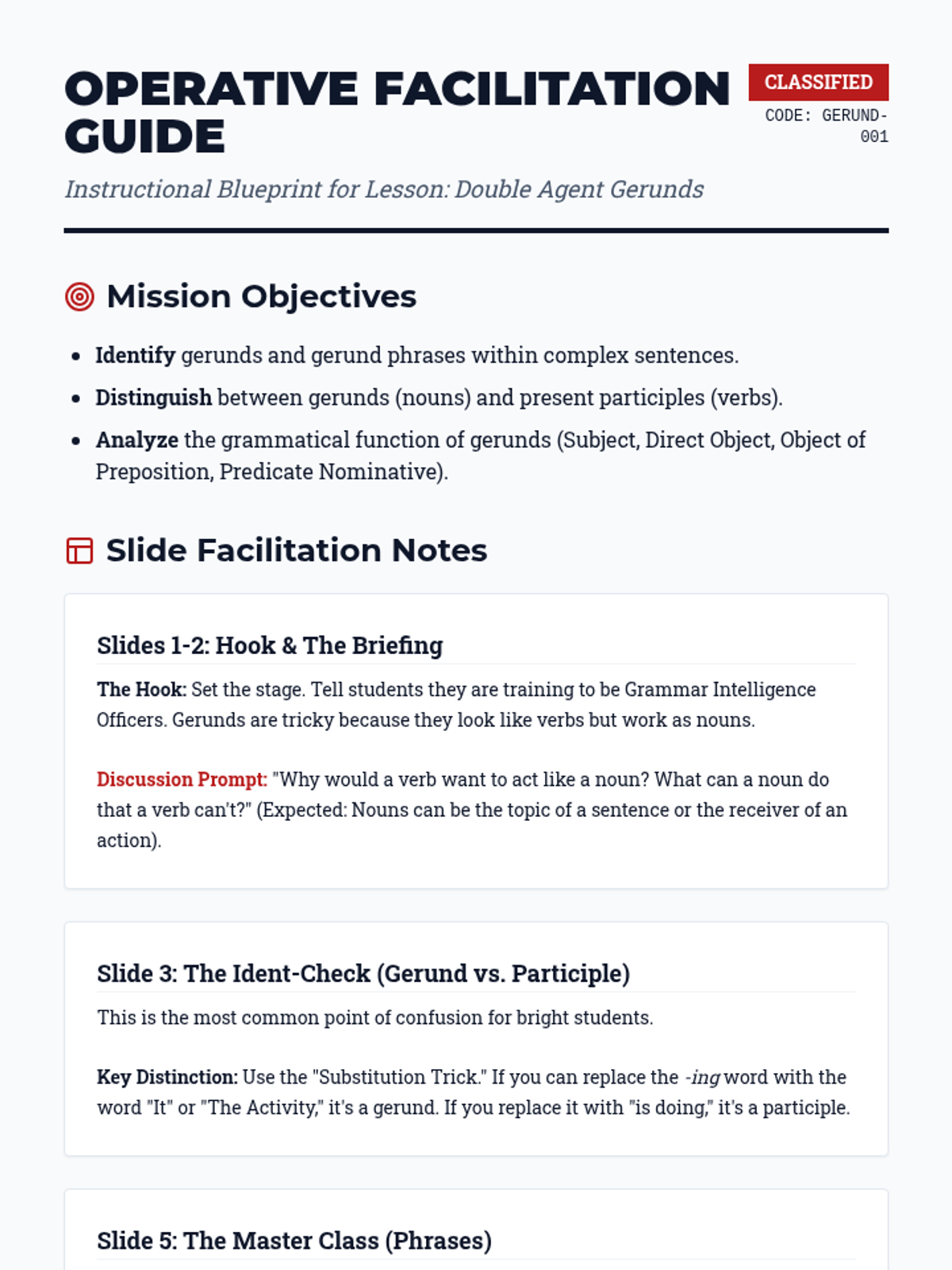
A teacher's facilitation guide for the 'Double Agent Gerunds' lesson, featuring slide-by-slide prompts, common pitfalls, the 'Substitution Trick', and extension activities for advanced students. Updated with guidance for the interactive analysis slide.
A visually striking, spy-themed slide deck that introduces gerunds as 'Double Agents'—verbs acting as nouns. It covers identification, functions (subject, object, complement), and gerund phrases for advanced learners. Now includes a dedicated analysis slide for student participation.
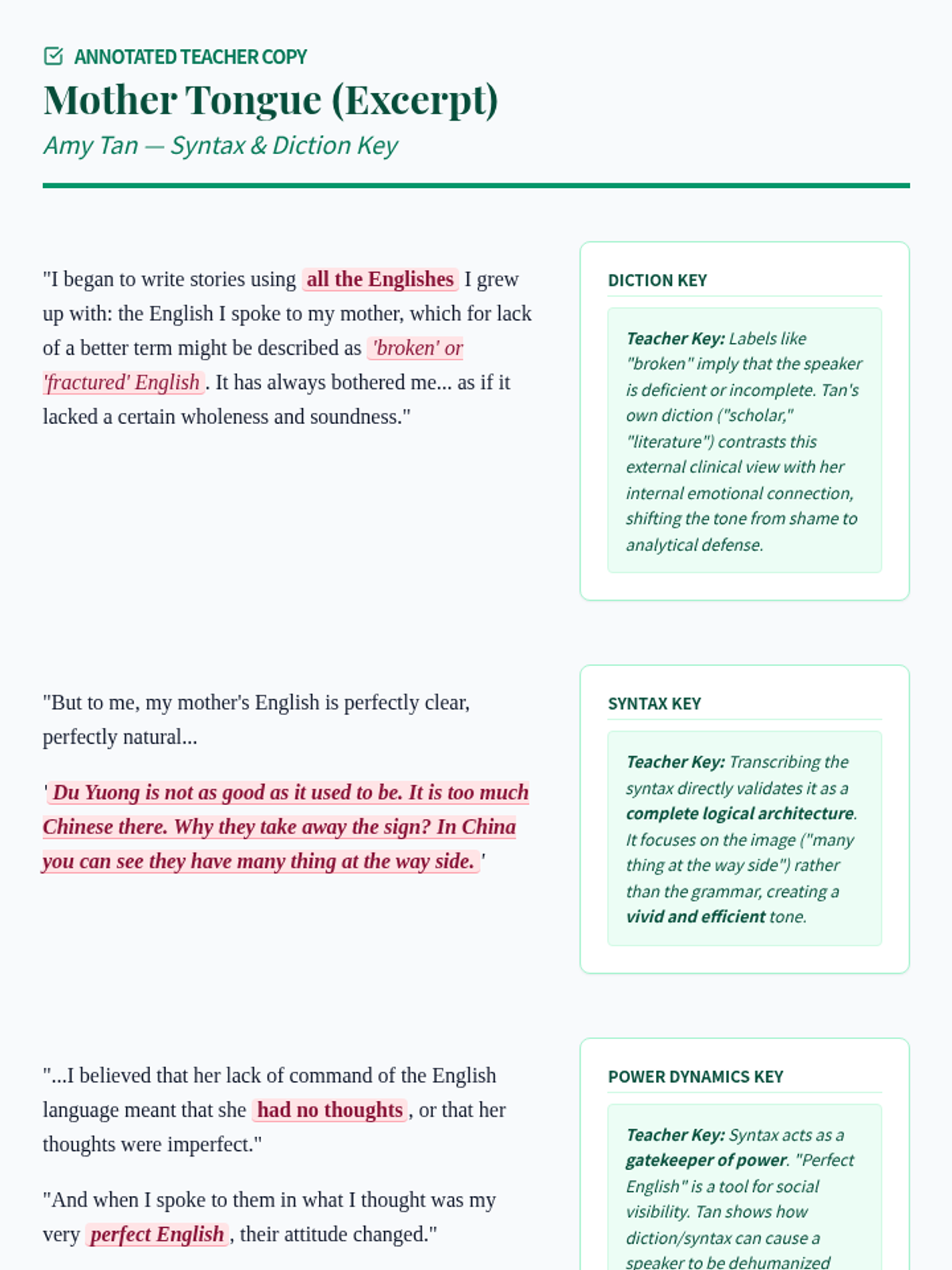
Grayscale-optimized annotated teacher copy for Tan's 'Mother Tongue,' using a slate and white palette for high contrast and toner-saving. Includes the hospital anecdote and sidebar analysis keys.
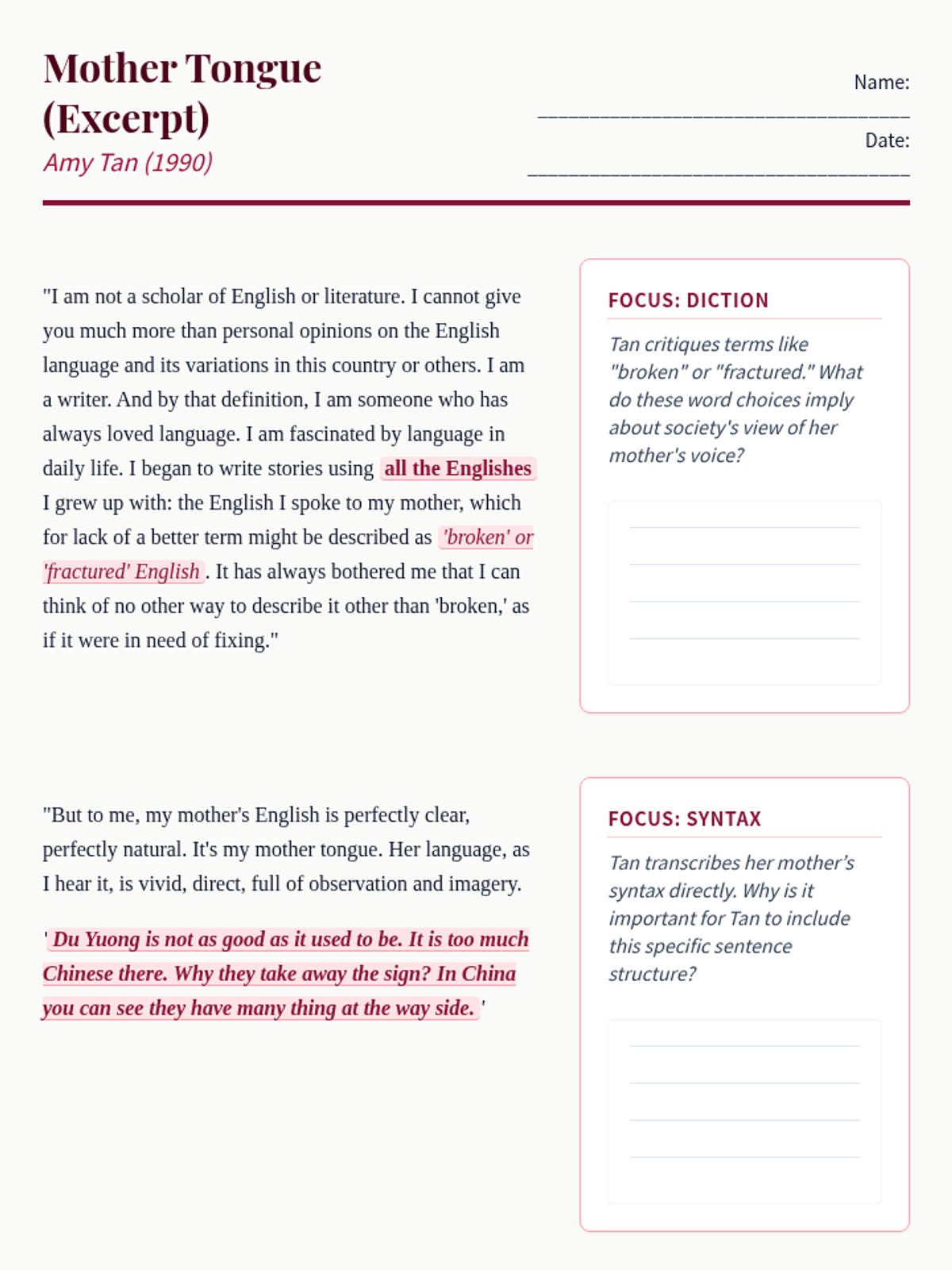
Grayscale-optimized student analysis guide for Tan's 'Mother Tongue,' using a slate and white palette for high contrast and toner-saving. Includes the hospital anecdote and sidebar analysis questions. Optimized to fit on a single page.
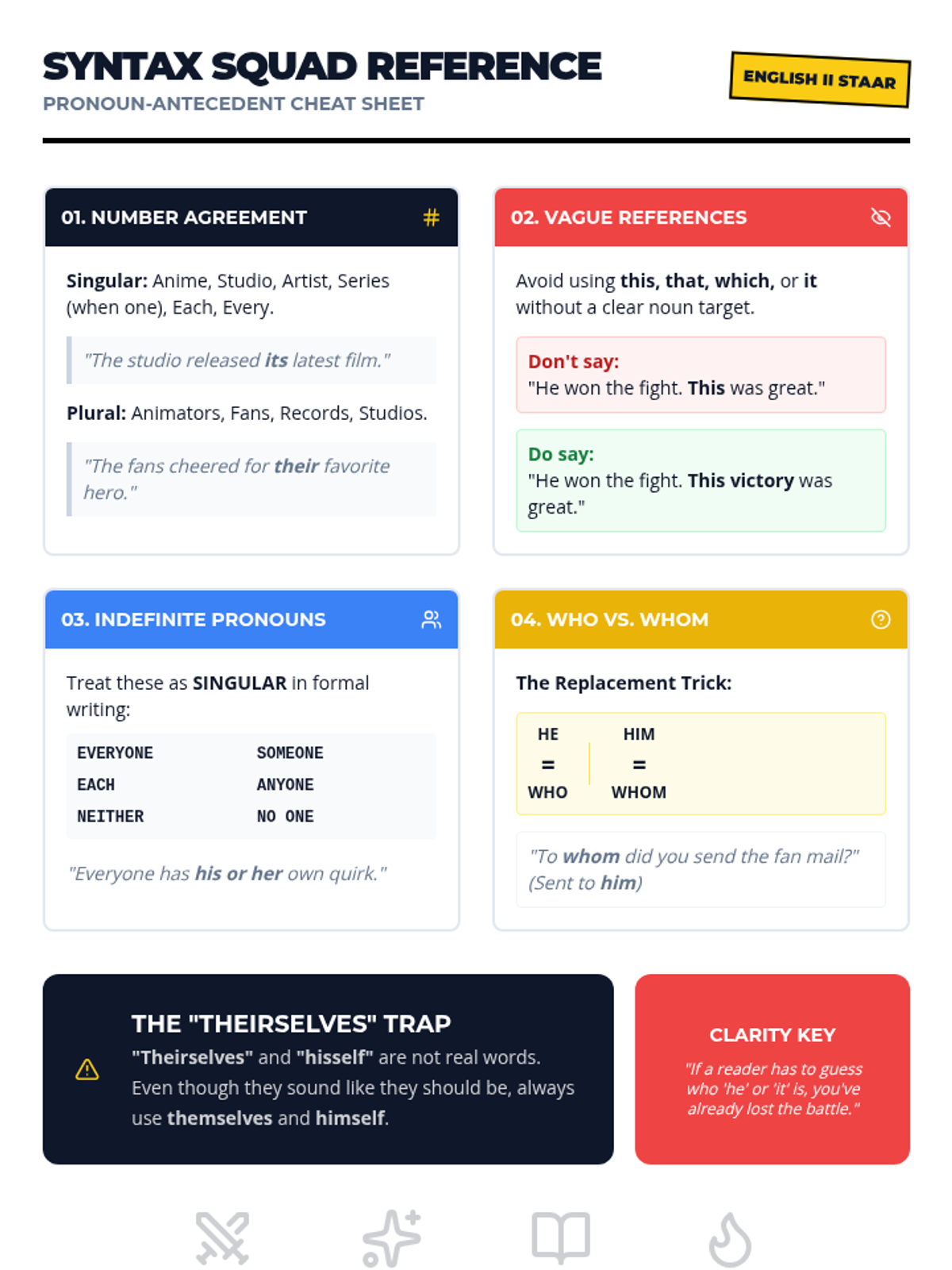
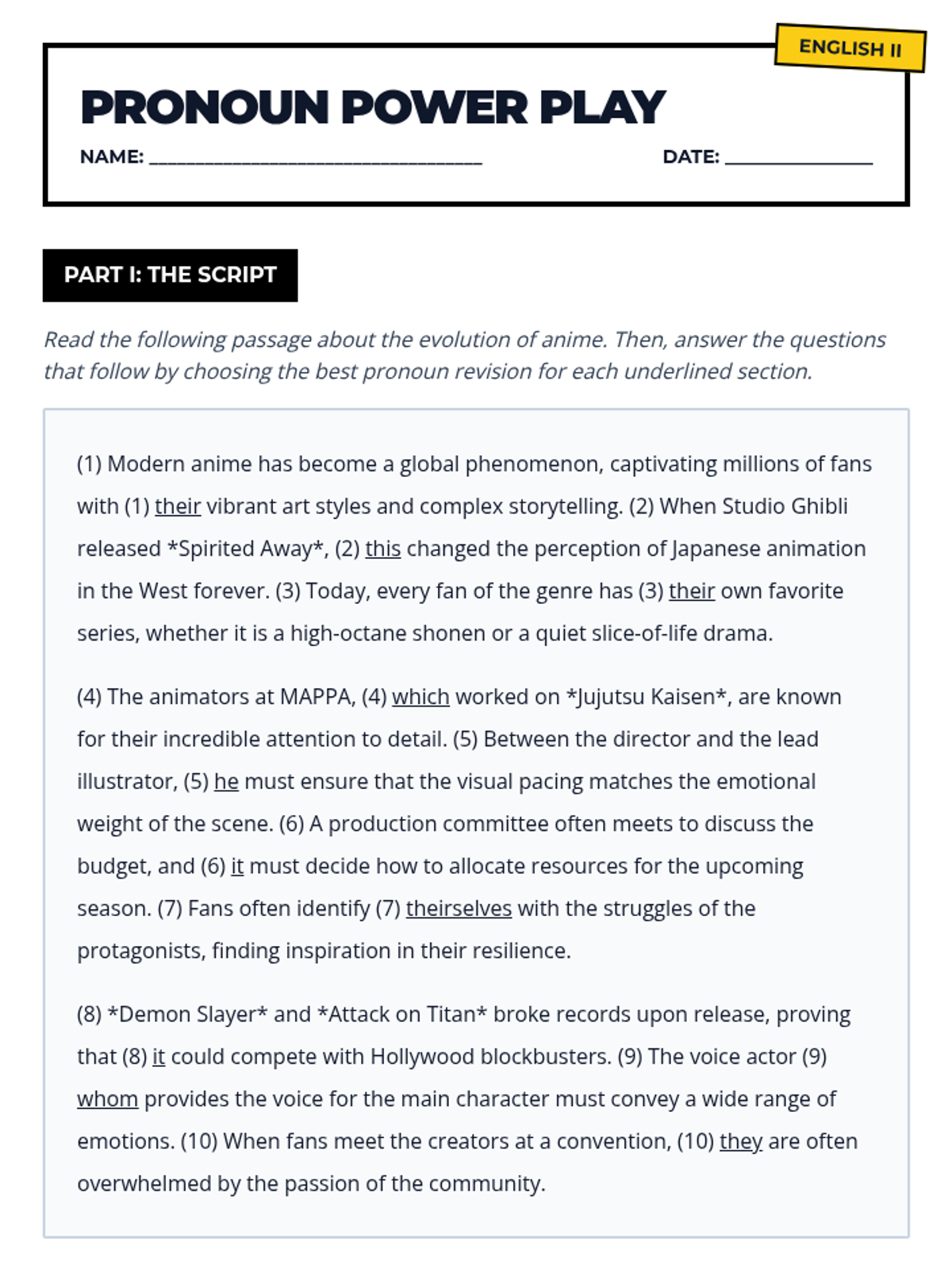
A concise one-page reference sheet or "cheat sheet" for students, summarizing the four major pronoun rules and providing the "He/Him" trick for Who/Whom. Designed for easy reference during the Anime Pronoun Play worksheet.
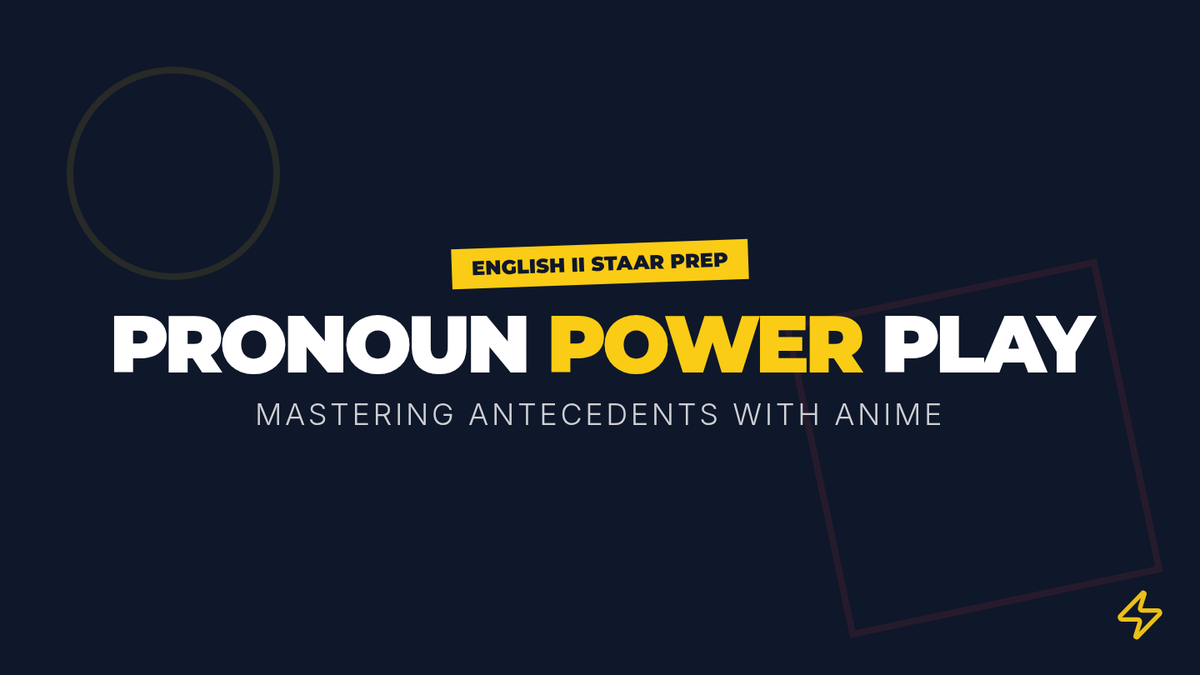
A vibrant, anime-themed slide deck for English II STAAR preparation, focusing on pronoun-antecedent agreement and clarity. Includes clear rules, "STAAR traps," and interactive checks for singular/plural agreement, ambiguous references, and who vs. whom.
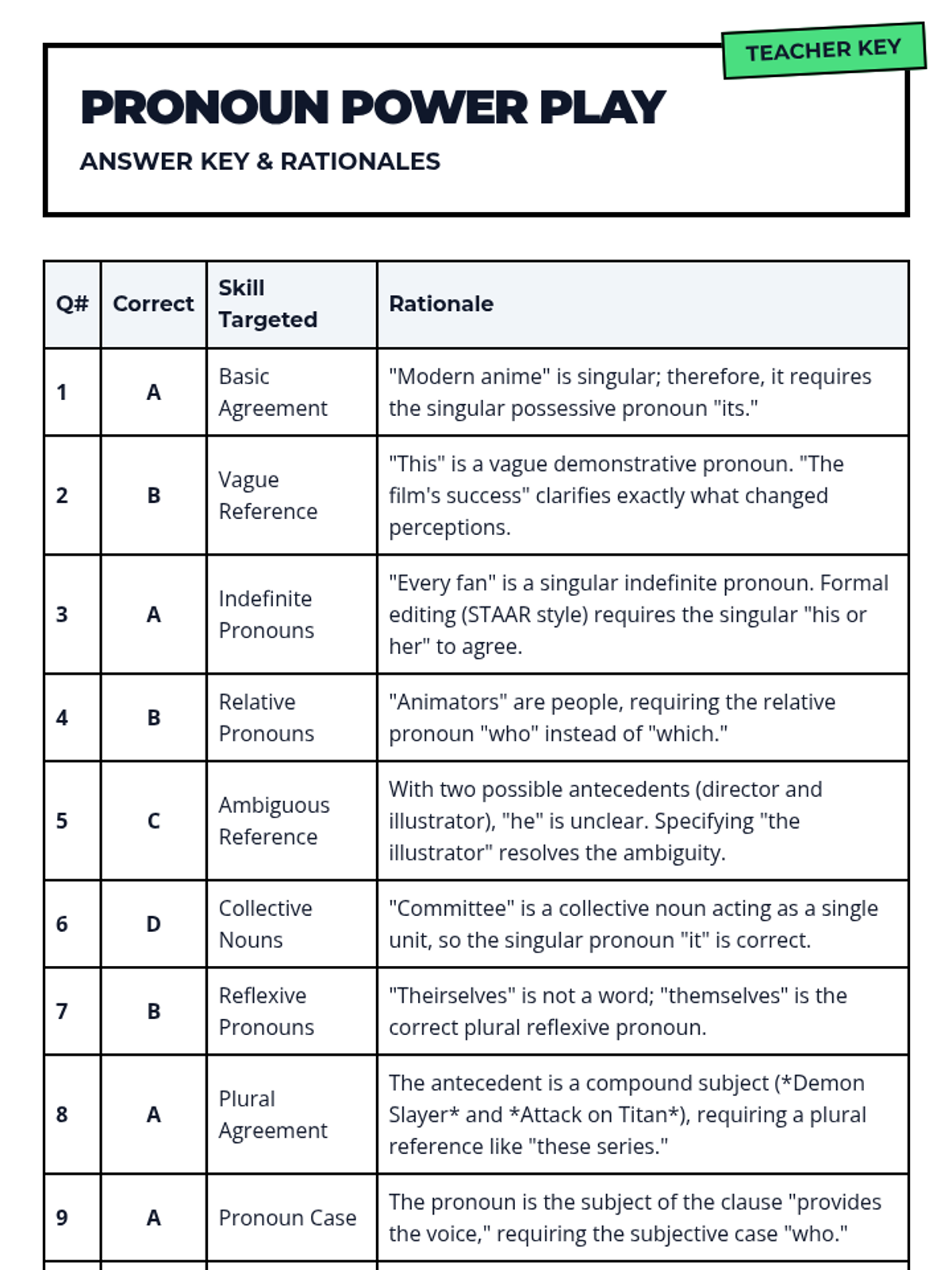
The answer key and teaching guide for the Anime Pronoun Power worksheet, providing correct answers, rationales, and targeted skills for each of the 10 STAAR-style questions.
A STAAR-style editing worksheet focused on pronoun-antecedent agreement and clarity, featuring a high-interest passage about the history and production of anime. Restored to the original two-page layout.
A comprehensive slide deck for the first week of TSIA2 writing preparation, containing daily 3-question drills with detailed answer explanations focusing on punctuation, grammar, and organization.
A comprehensive slide deck for the final week of TSIA2 writing preparation, providing high-rigor mixed practice to simulate the full range of the TSIA2 Writing section.
A slide deck for the third week of TSIA2 writing preparation, covering days 11 through 15 with daily 3-question drills focusing on modifier placement, pronoun agreement, and structural polish.
A comprehensive slide deck for the second week of TSIA2 writing preparation, containing daily 3-question drills with detailed answer explanations focusing on pronoun case, punctuation, and organizational flow.
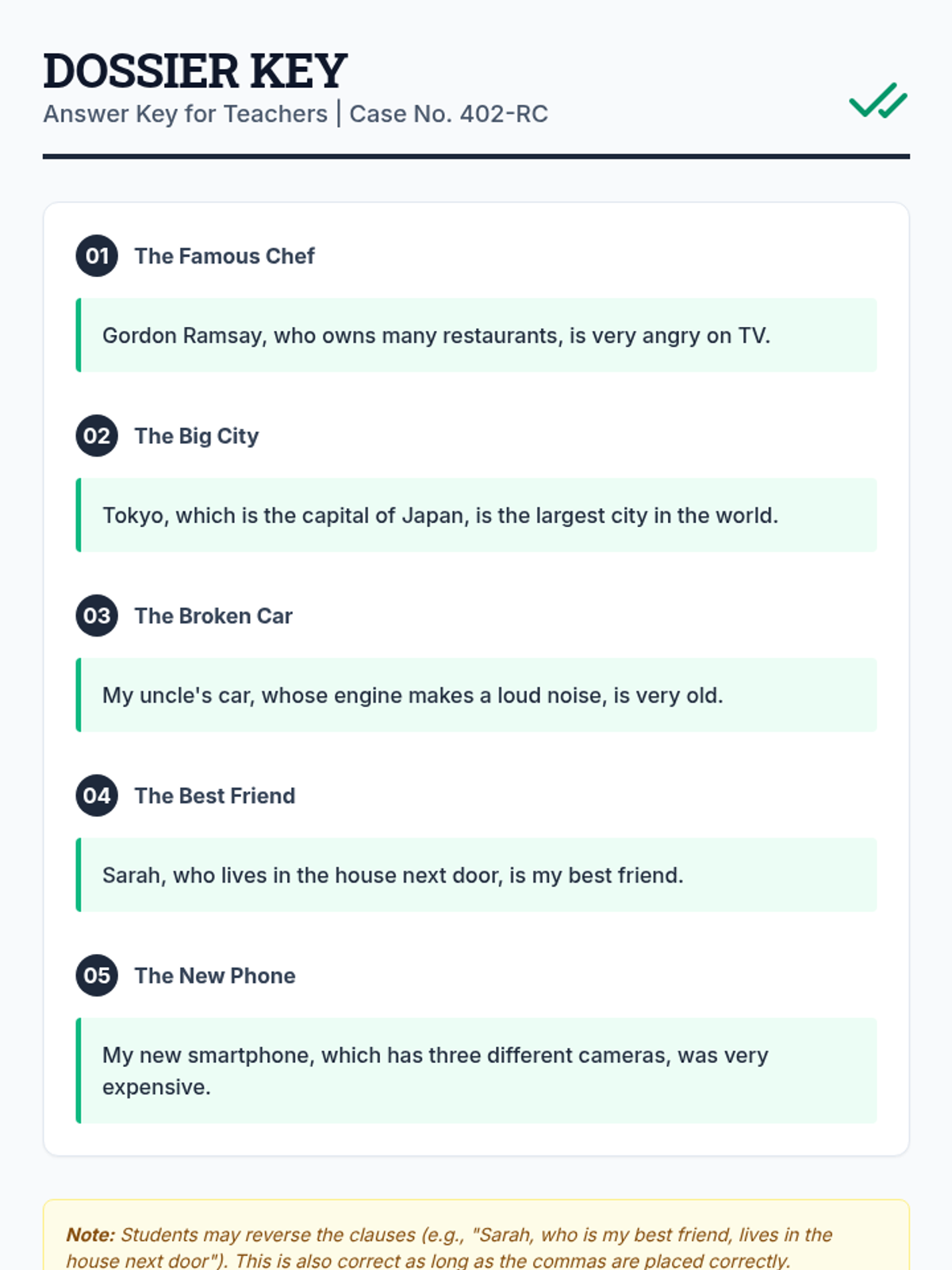
The answer key for the Dossier Linker worksheet, showing correctly combined sentences with non-defining relative clauses.
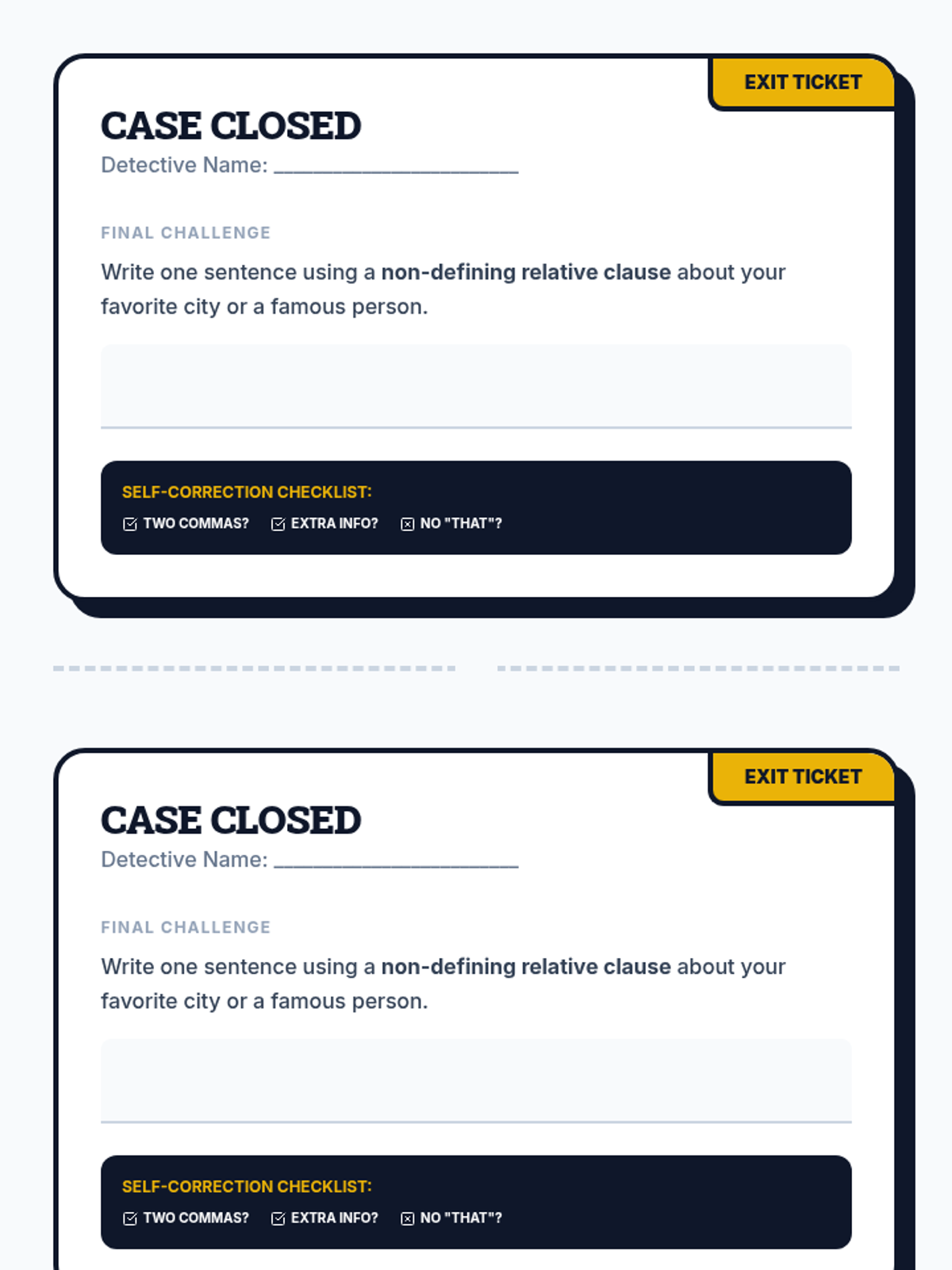
A printable exit ticket for a quick assessment on non-defining relative clauses, featuring a self-correction checklist for students.
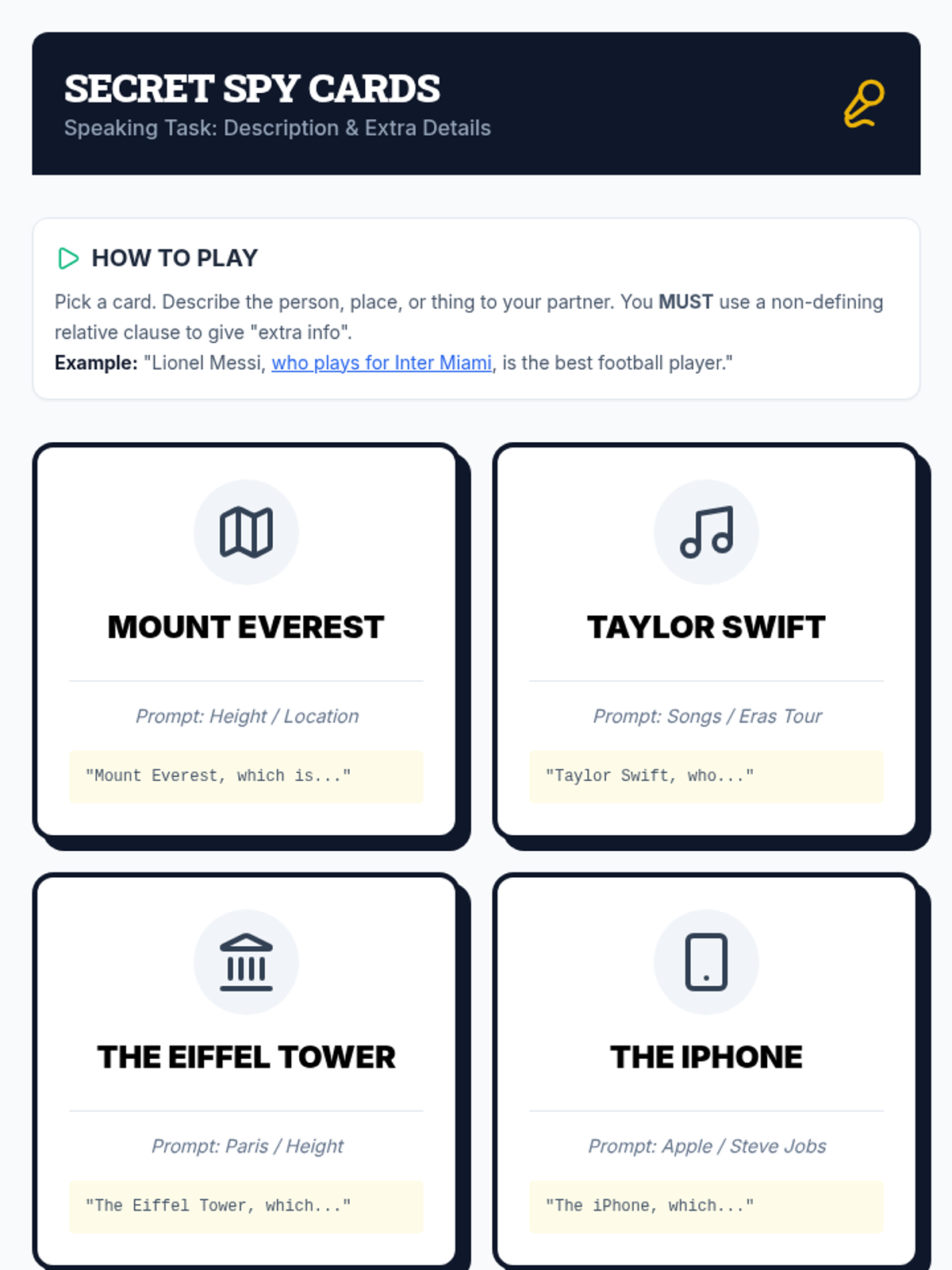
A set of speaking prompt cards for practicing non-defining relative clauses, designed for pair work with specific person/place/thing prompts.
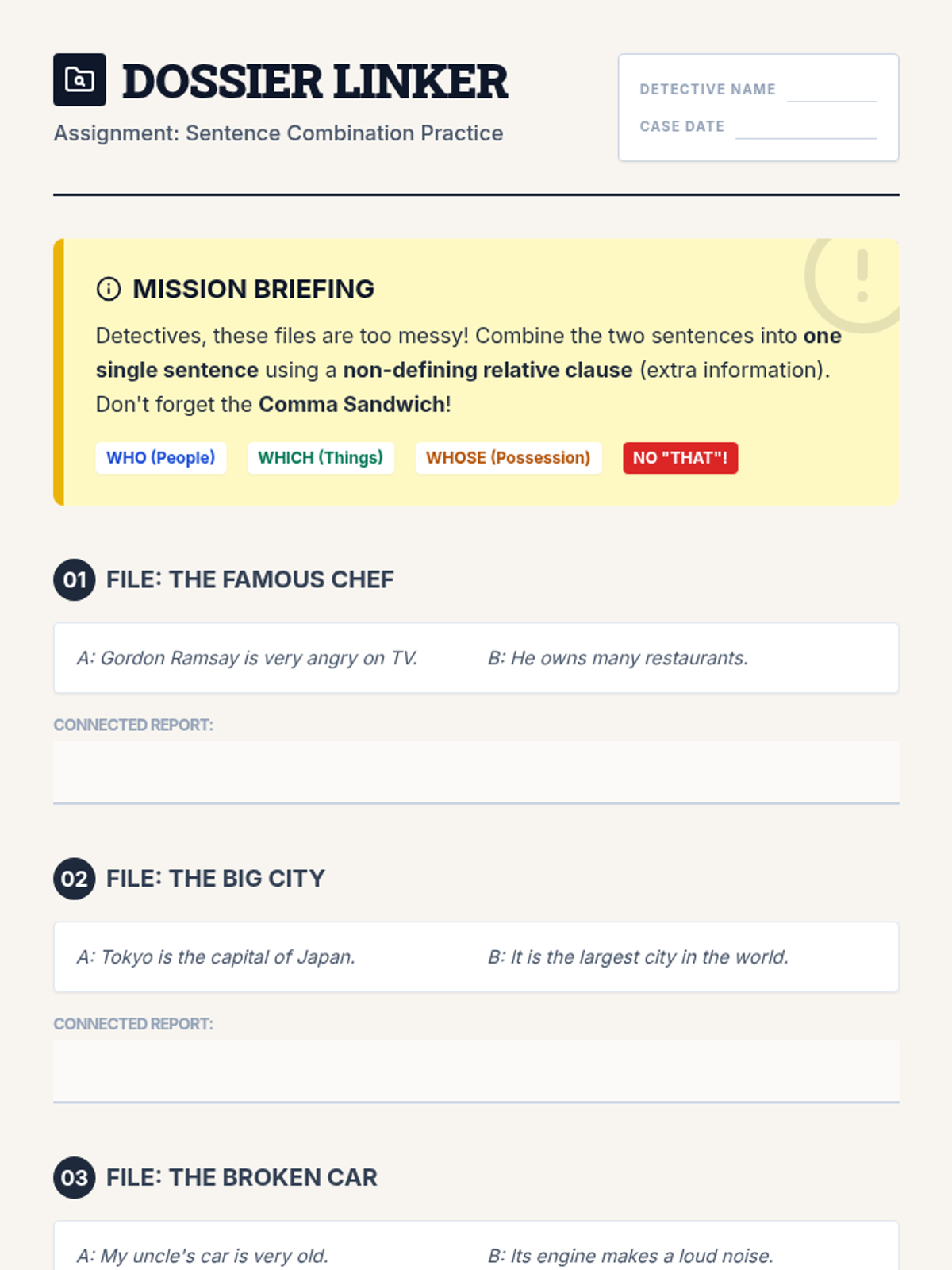
A pair-work worksheet themed as a detective dossier where students combine simple sentences into non-defining relative clauses.
Instructional slides for teaching non-defining relative clauses, featuring visual metaphors like the 'Comma Sandwich' and interactive detective challenges.
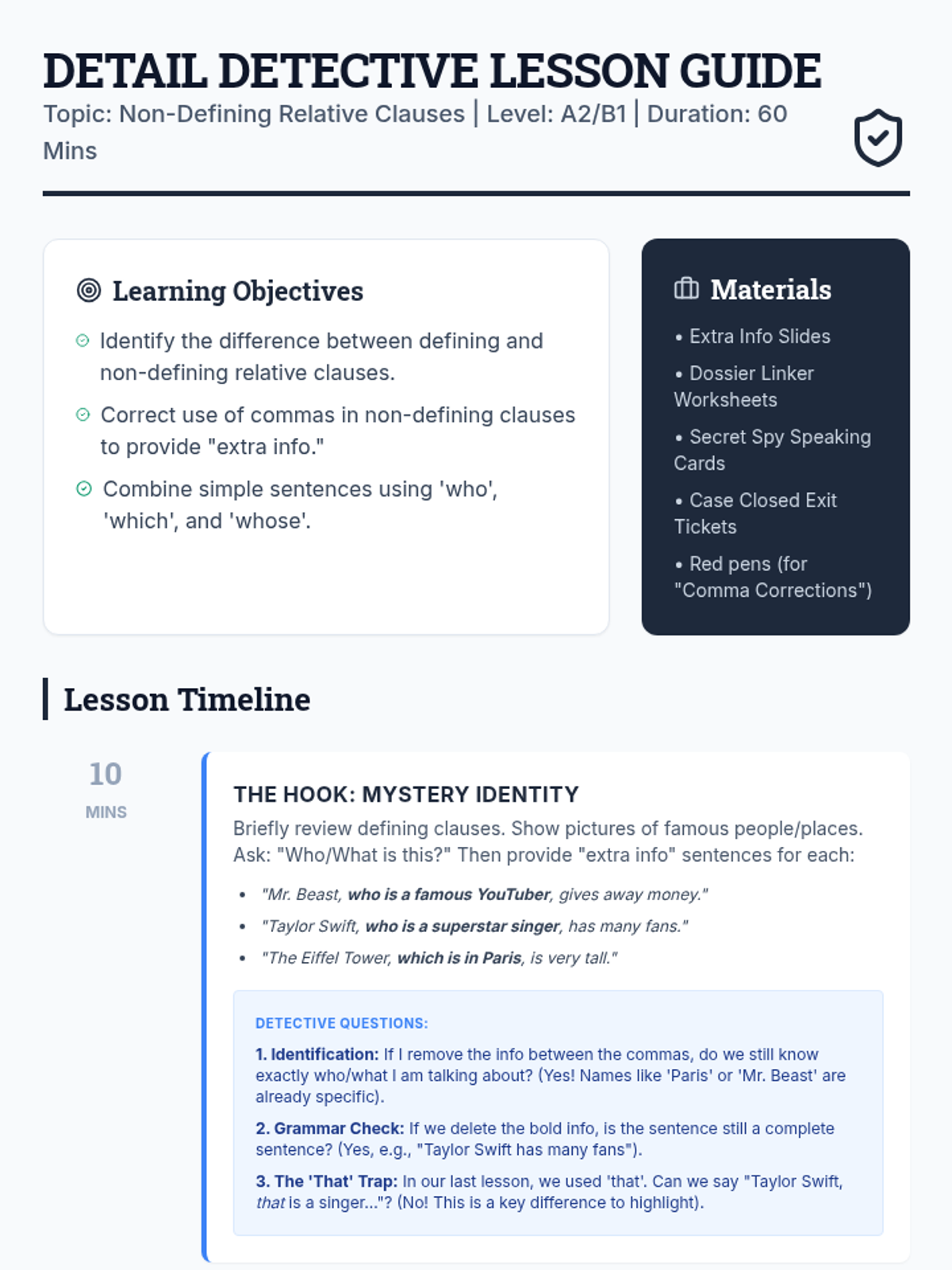
A teacher's lesson guide for teaching non-defining relative clauses to A2/B1 students, themed as a 'Detail Detective' investigation with a clear 60-minute timeline.
An expanded interactive slide deck featuring 30 revising and editing questions. Each day now includes a third question focused specifically on sentence combining and parallel structure, with immediate feedback slides.
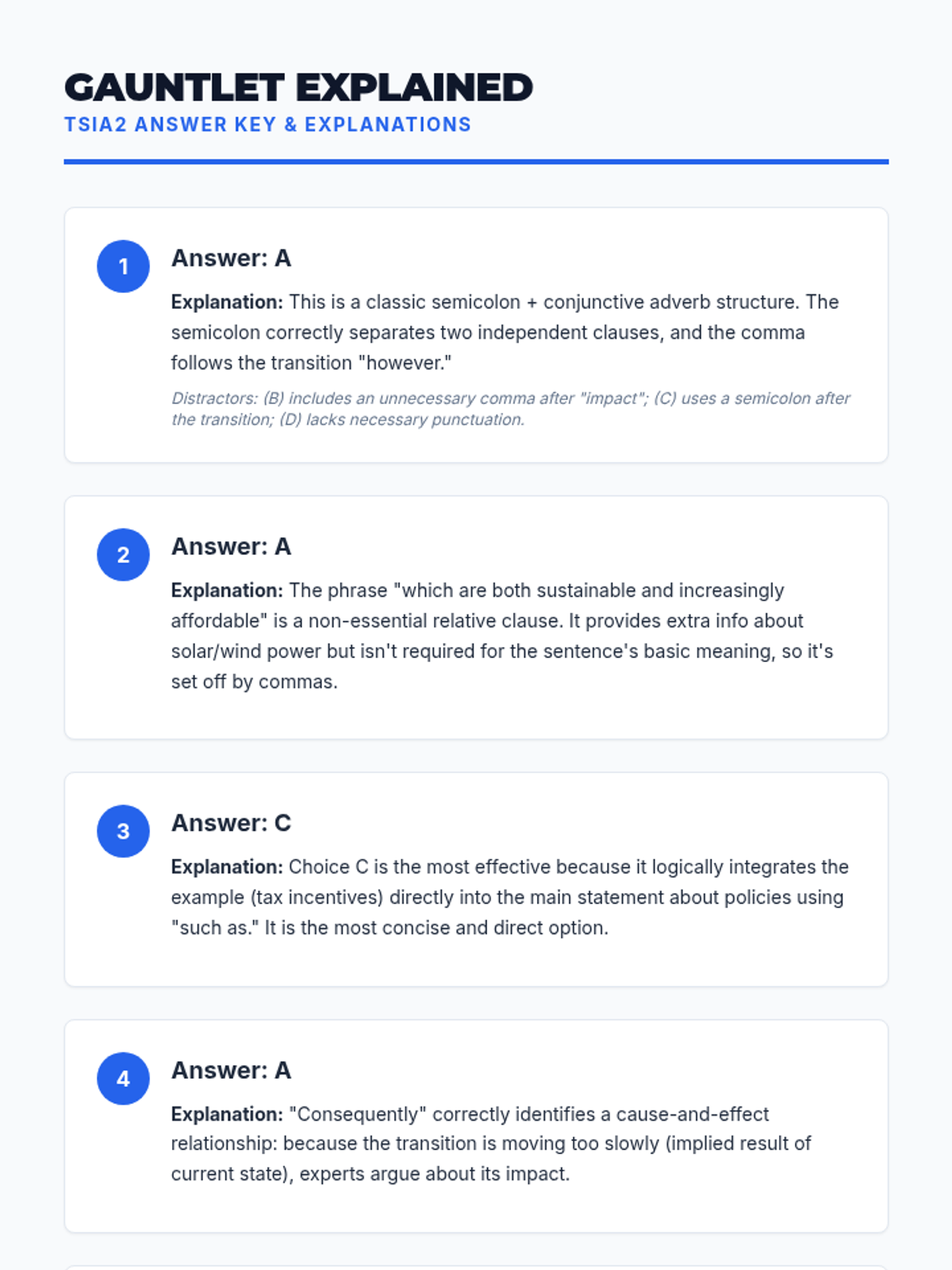
A detailed answer key for the Grammar Gauntlet Assessment, providing the correct answers and instructional explanations for each question.
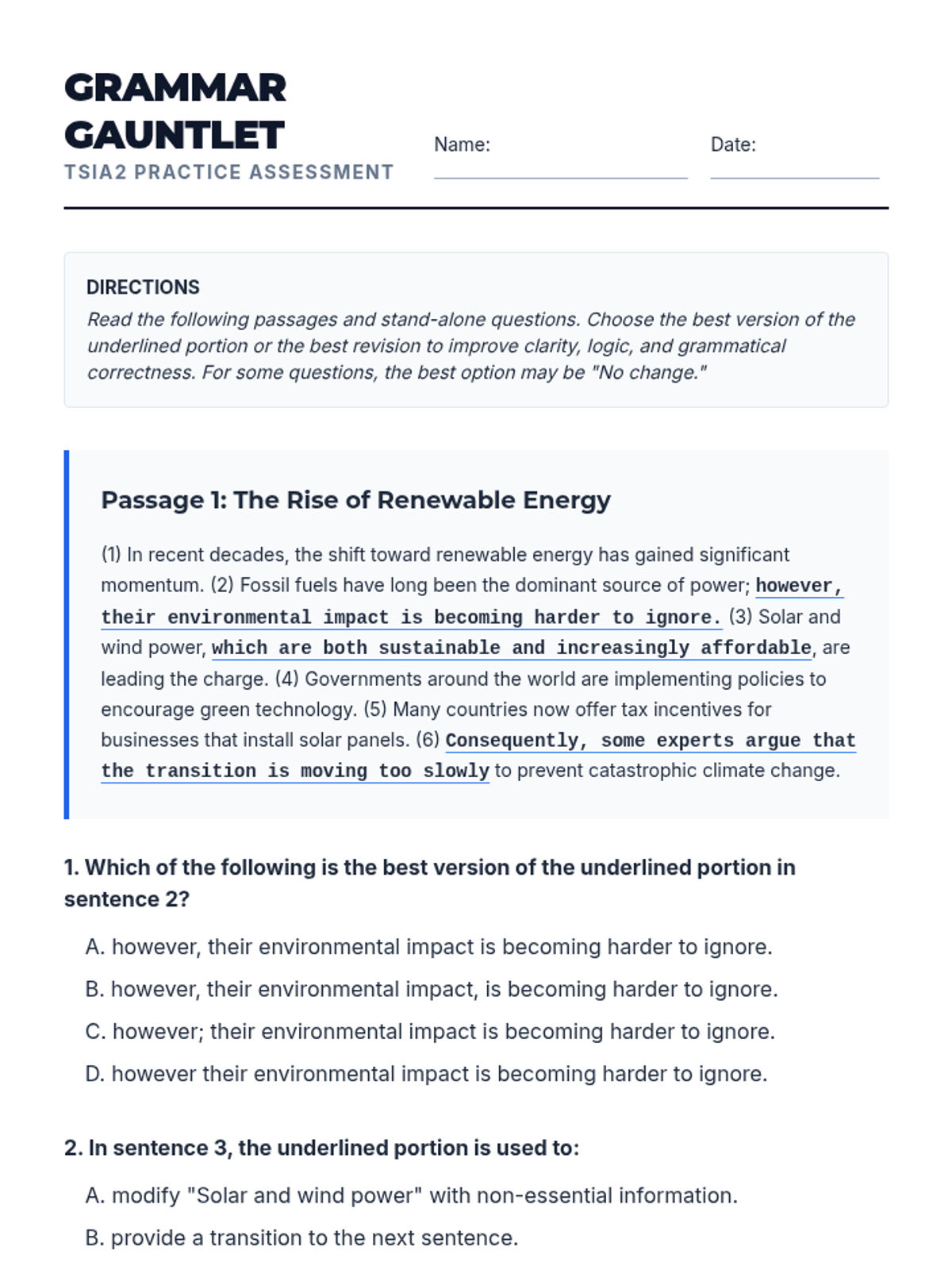
A 20-question multiple-choice practice assessment mirroring the TSIA2 revising and editing standards, including passage-based and stand-alone questions.
Instructional slide deck for the TSIA2 Grammar Gauntlet lesson, covering the four key focus areas of the exam with visual examples and strategy tips. All text updated to 24px minimum for visibility.
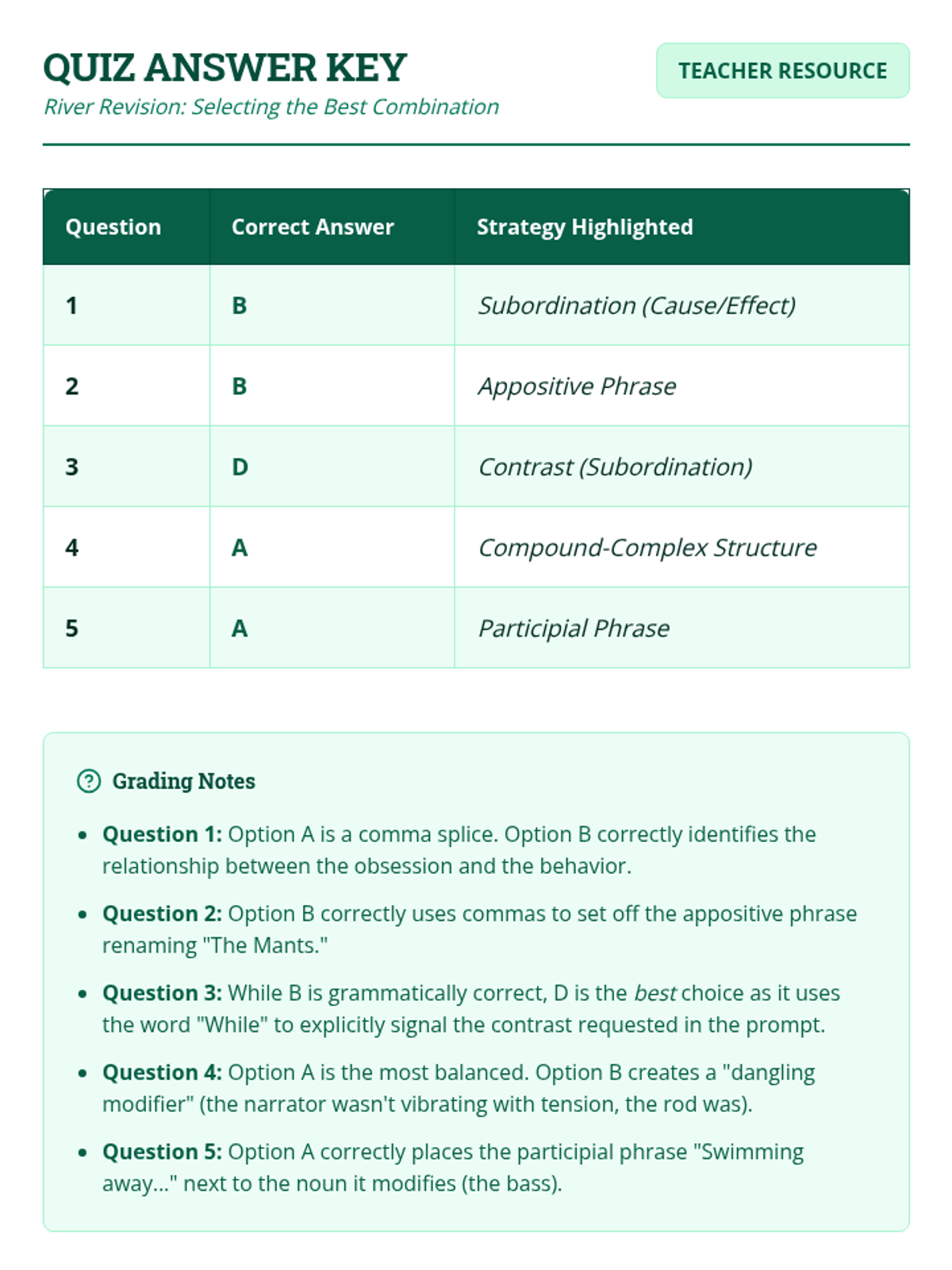
An answer key for the River Revision Quiz, including the correct letter for each question and brief explanations for the grammatical reasoning behind the correct choices.
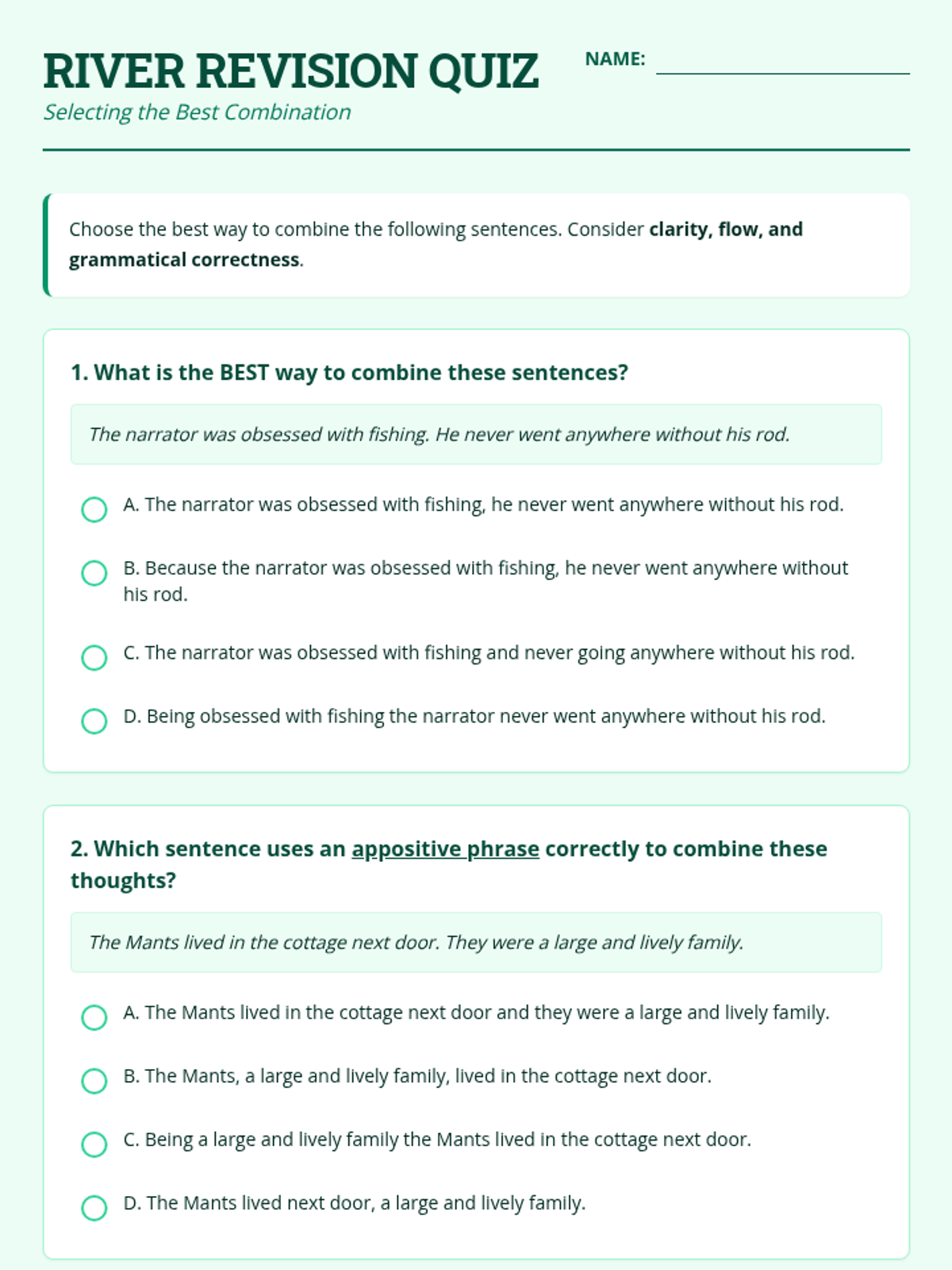
A 5-question multiple-choice quiz focusing on choosing the best sentence combinations based on clarity, flow, and grammatical sophistication, themed around 'The Bass, the River, and Sheila Mant'.
An instructional slide deck for teaching sentence combining strategies (FANBOYS, subordination, appositives, and participles) themed around 'The Bass, the River, and Sheila Mant'.
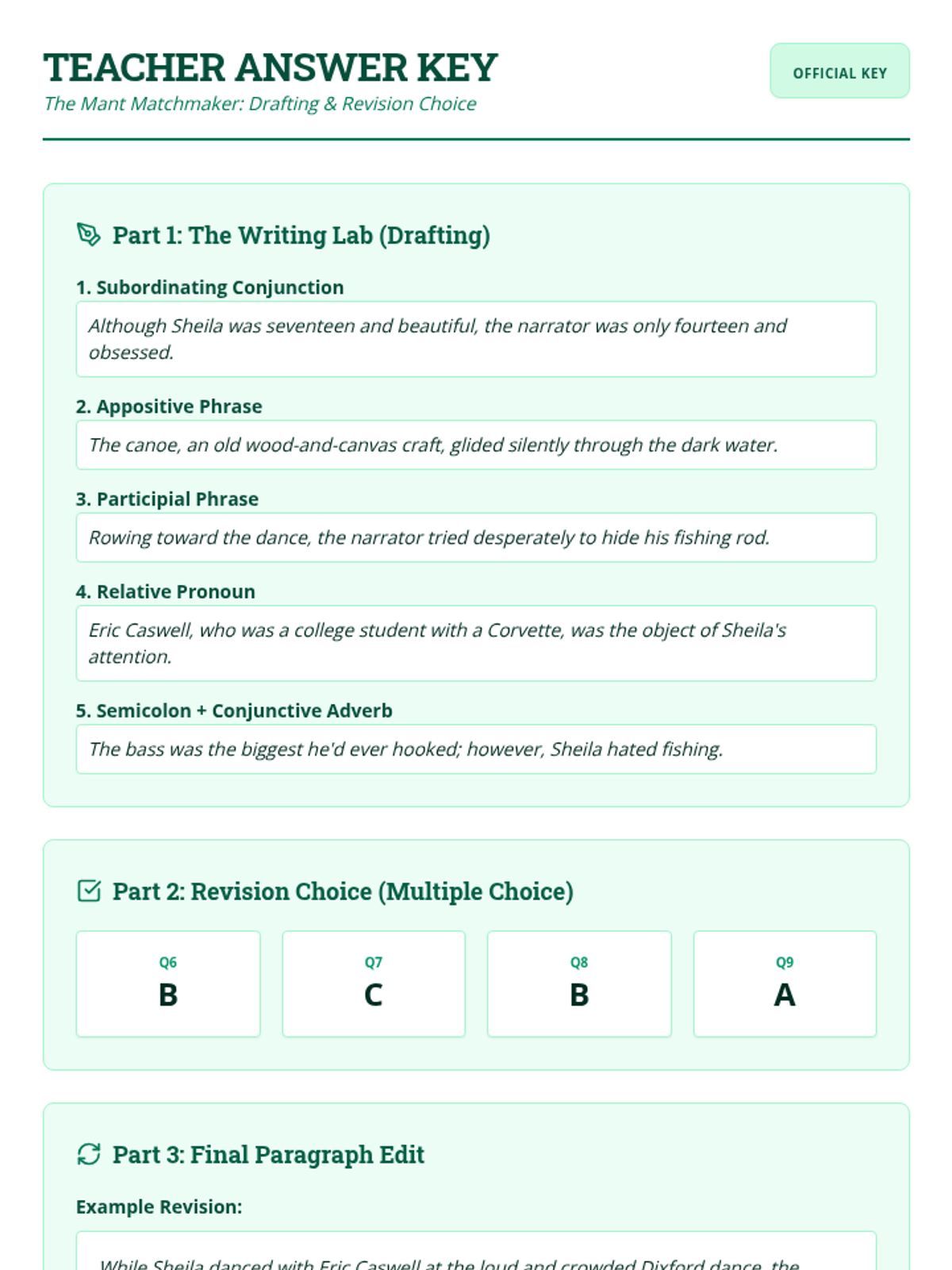
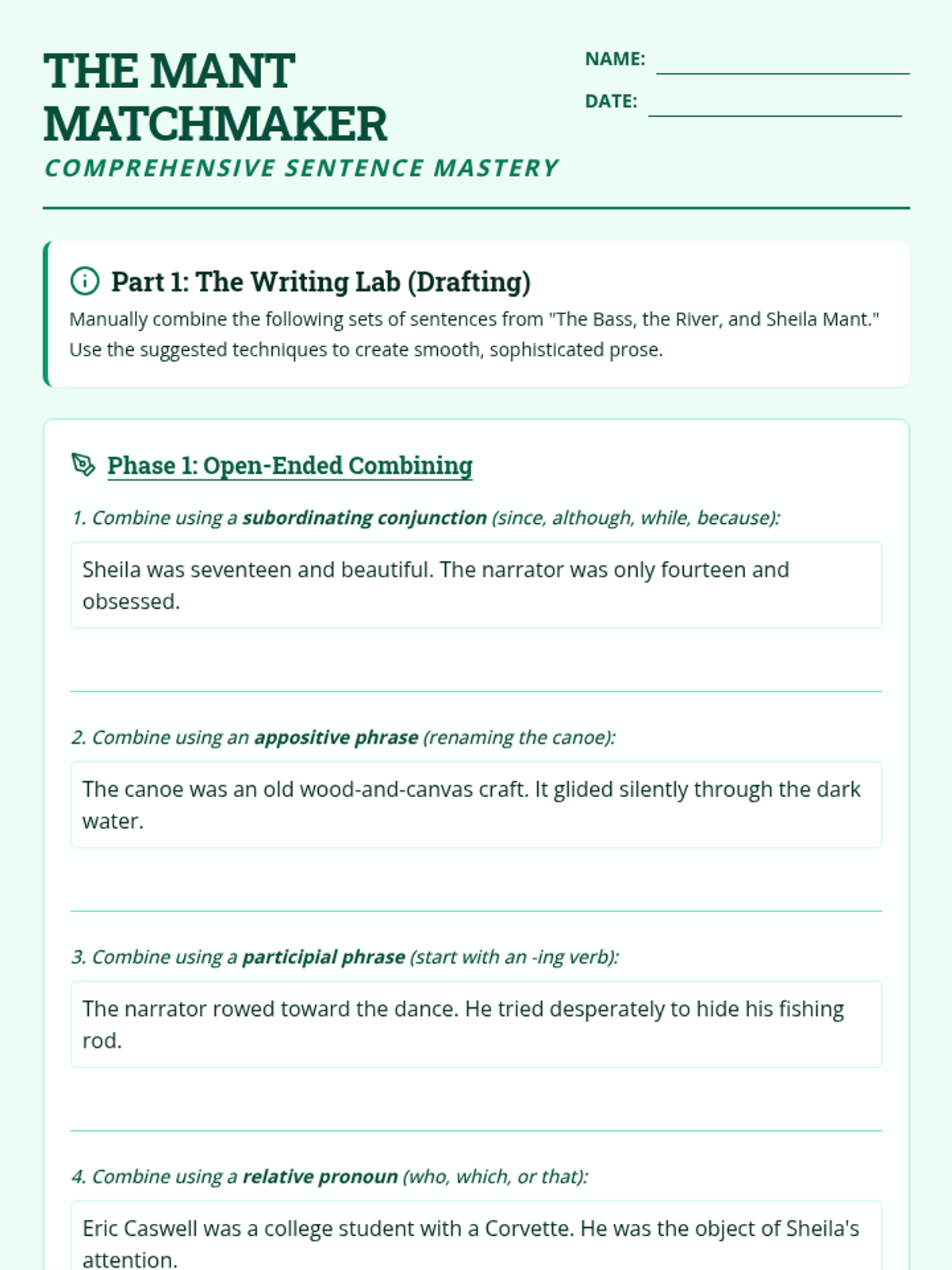
A comprehensive teacher answer key for the updated Mant Matchmaker Worksheet, covering the open-ended combining tasks, multiple-choice questions, and the final narrative flow challenge.
A comprehensive two-page combined worksheet featuring 5 open-ended drafting tasks, 4 multiple-choice revision questions with standardized styling, and a final paragraph editing challenge.
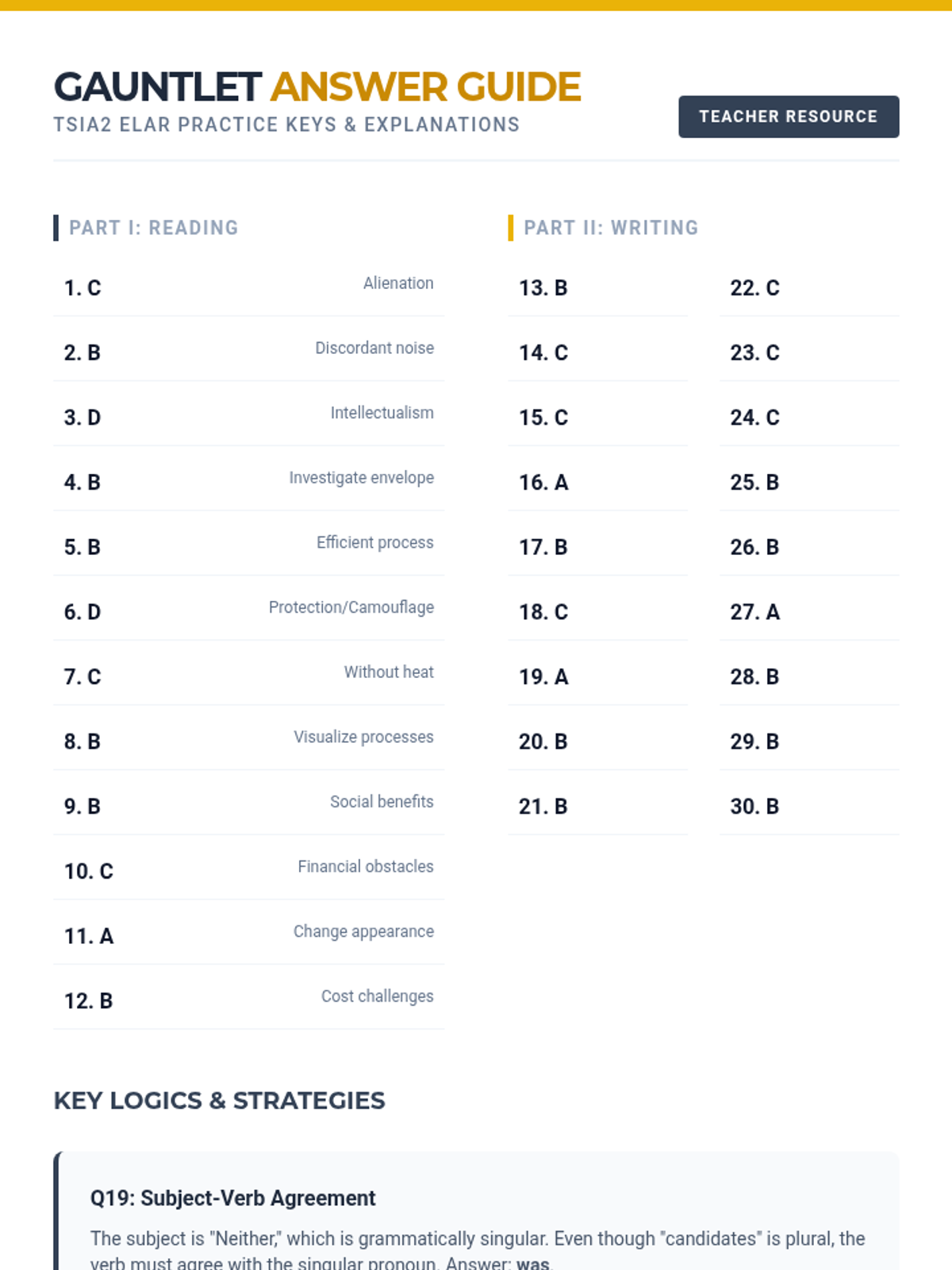
An answer key and explanation guide for the 30-question TSIA2 English Gauntlet Practice test. Provides correct answers, brief logic explanations for challenging grammar rules, and a scoring benchmark.
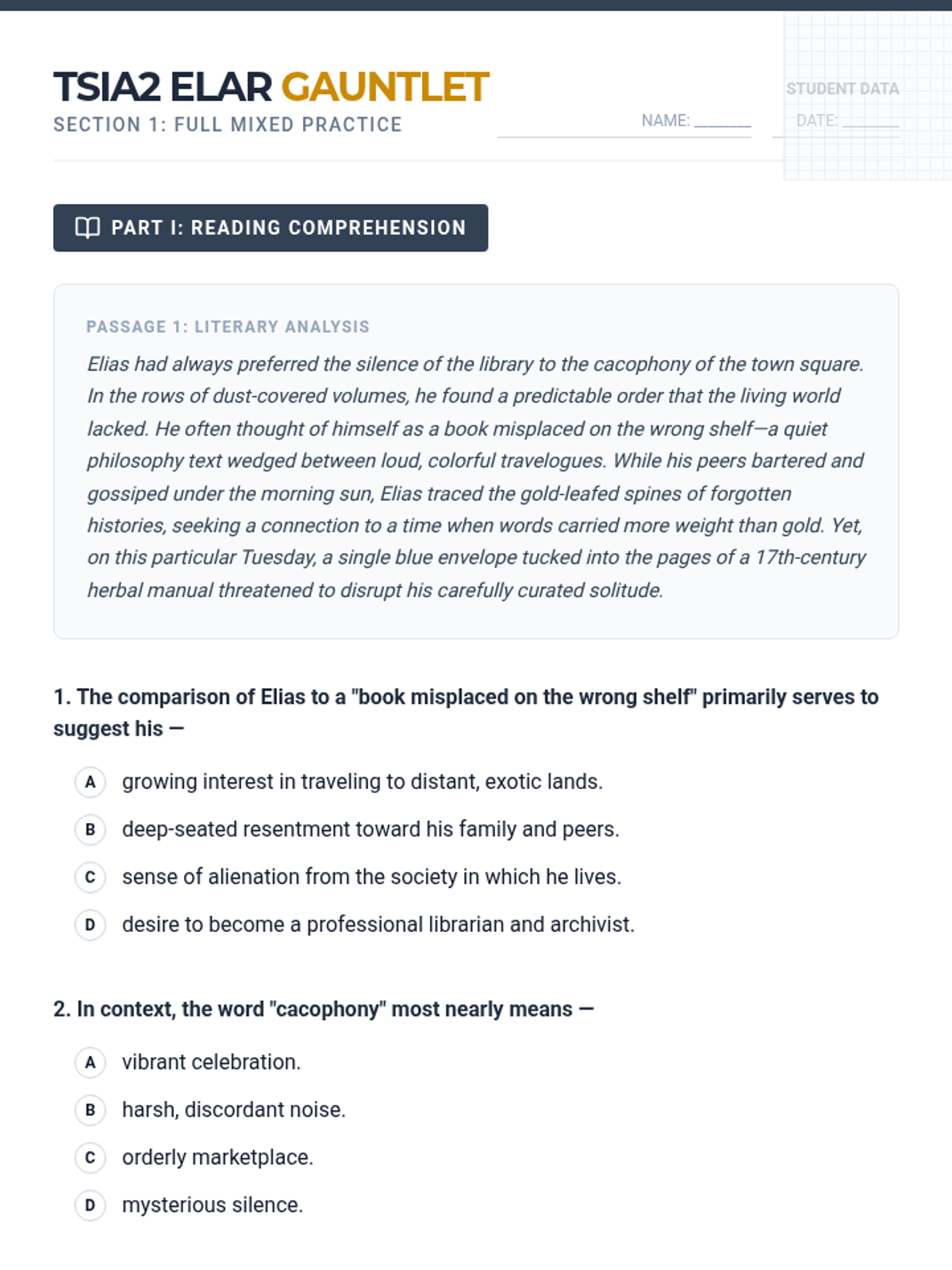
A comprehensive 30-question practice test for the TSIA2 ELAR section. Includes Reading Comprehension (Literary, Informational, and Paired passages) and Writing (Revising and Editing) sections. Expanded to 8 pages for maximum readability and handwriting space.
A 15-slide review presentation covering key TSIA2 ELAR concepts. Optimized for high-quality printing with light backgrounds and high-contrast text while maintaining the professional 'blueprint' aesthetic.
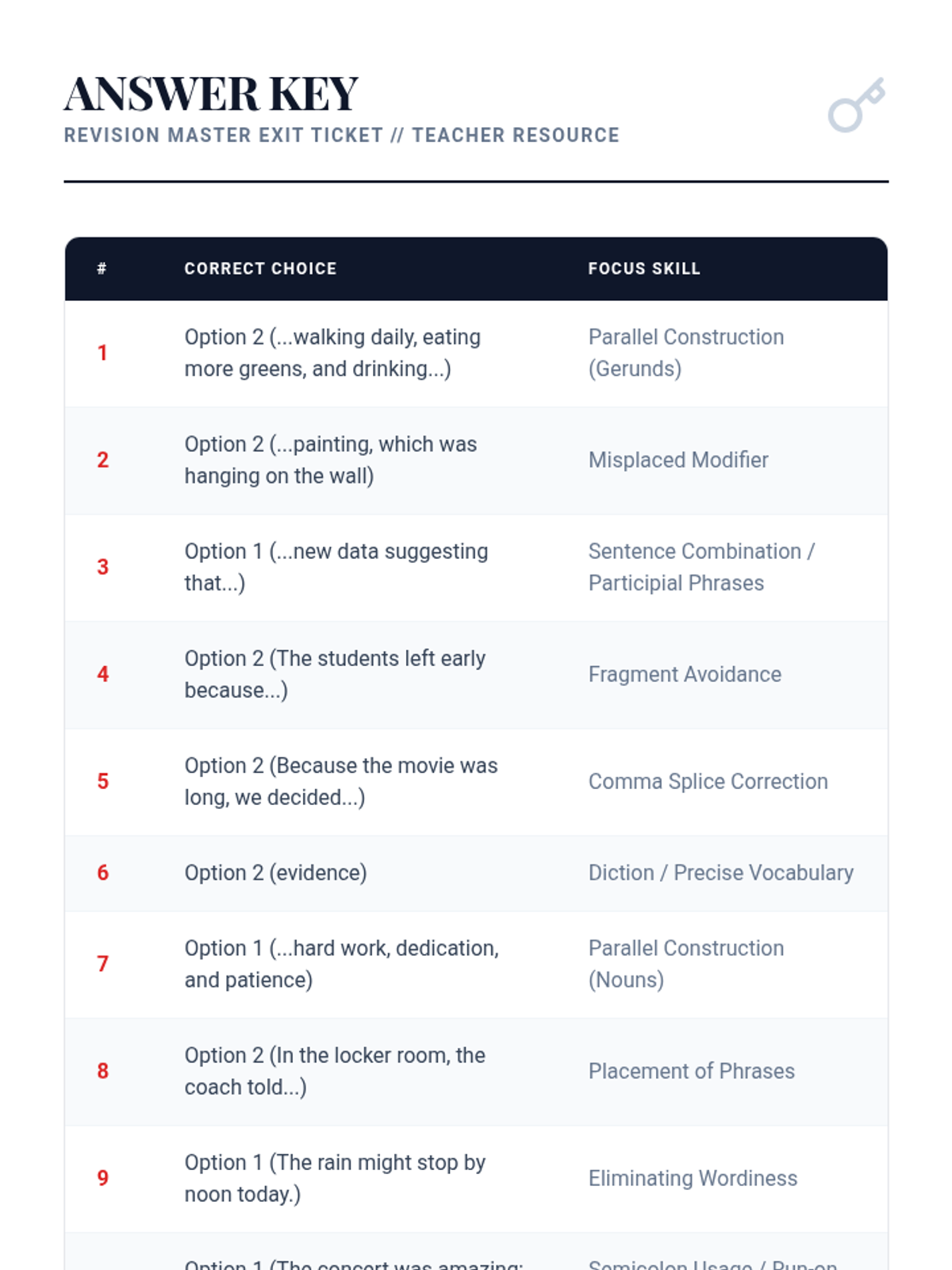
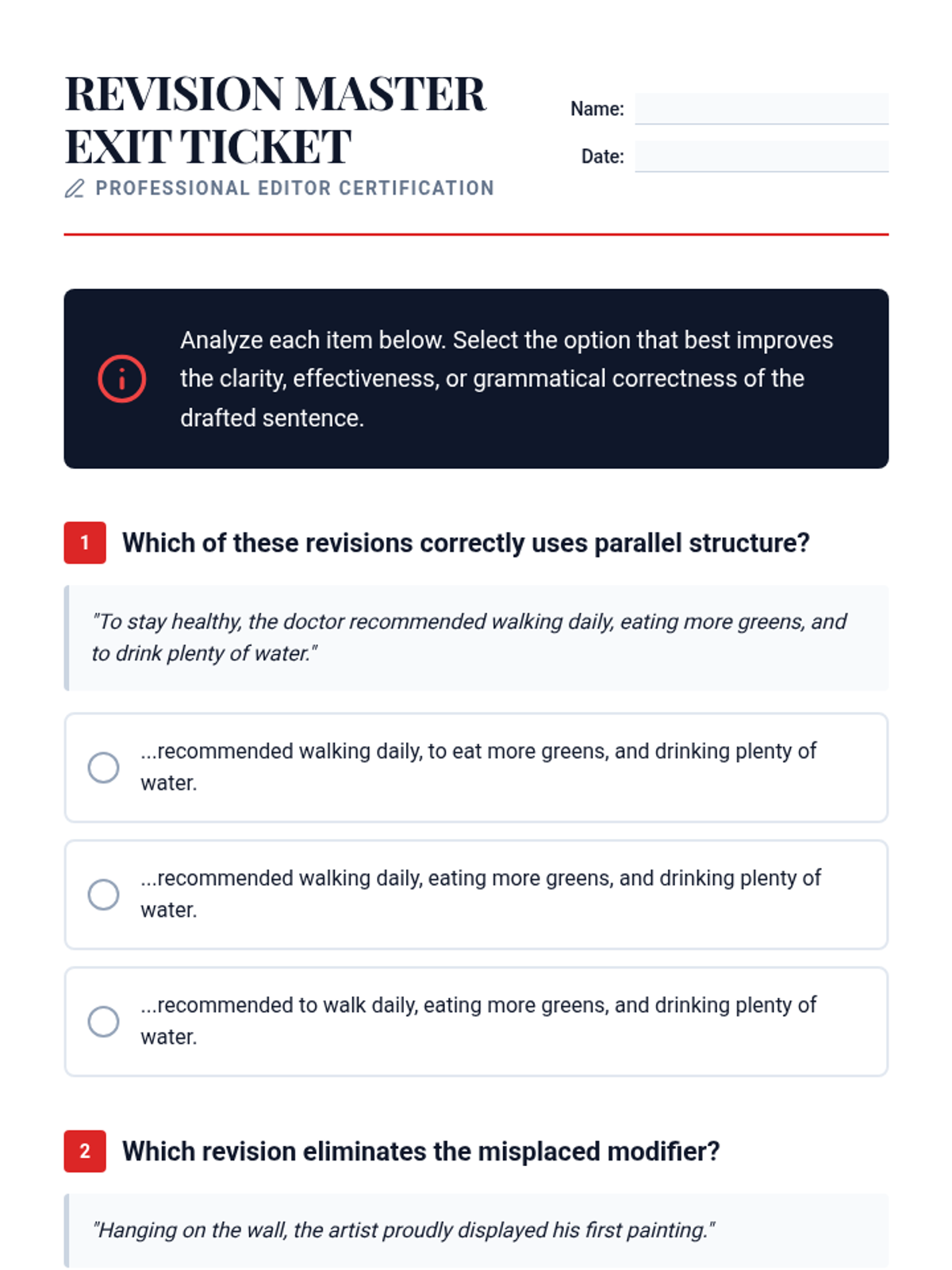
A teacher-facing answer key and grading guide for the Revision Master Exit Ticket. Includes focus skills for each question and common student misconceptions.
A 10-question multiple-choice exit ticket assessing student mastery of parallel structure, phrase placement, sentence effectiveness, and basic editing for fragments and run-ons. Includes break-inside-avoid to prevent question splitting.
A digital slide presentation guiding students through the revision process, focusing on parallel structure, phrase placement, and sentence effectiveness. Now updated with minimum 24px font size for all text elements.
The complete 10-day slide deck with Question 3 for each day as a Short Constructed Response (SCR). Includes high-contrast logic and model response slides for sentence combining and parallelism.
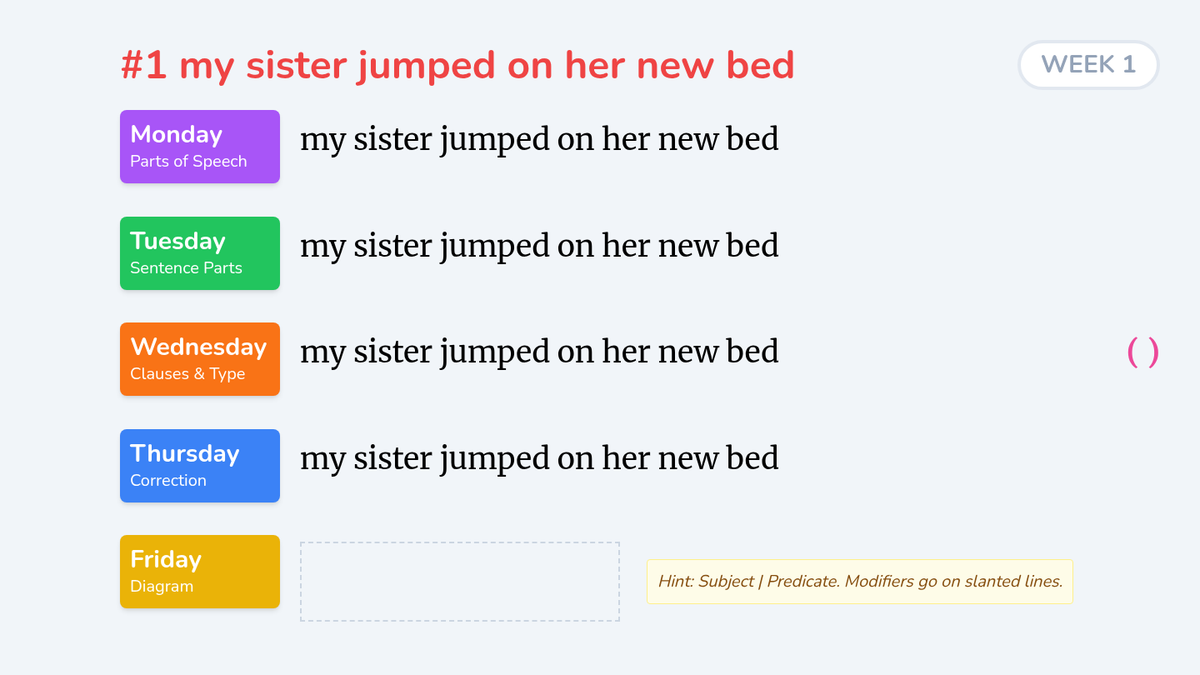
A 18-slide presentation for daily grammar practice, following a consistent weekly routine of part of speech identification, sentence analysis, and diagramming. Each slide features a notebook-style theme with colorful daily task indicators and space for student interaction.
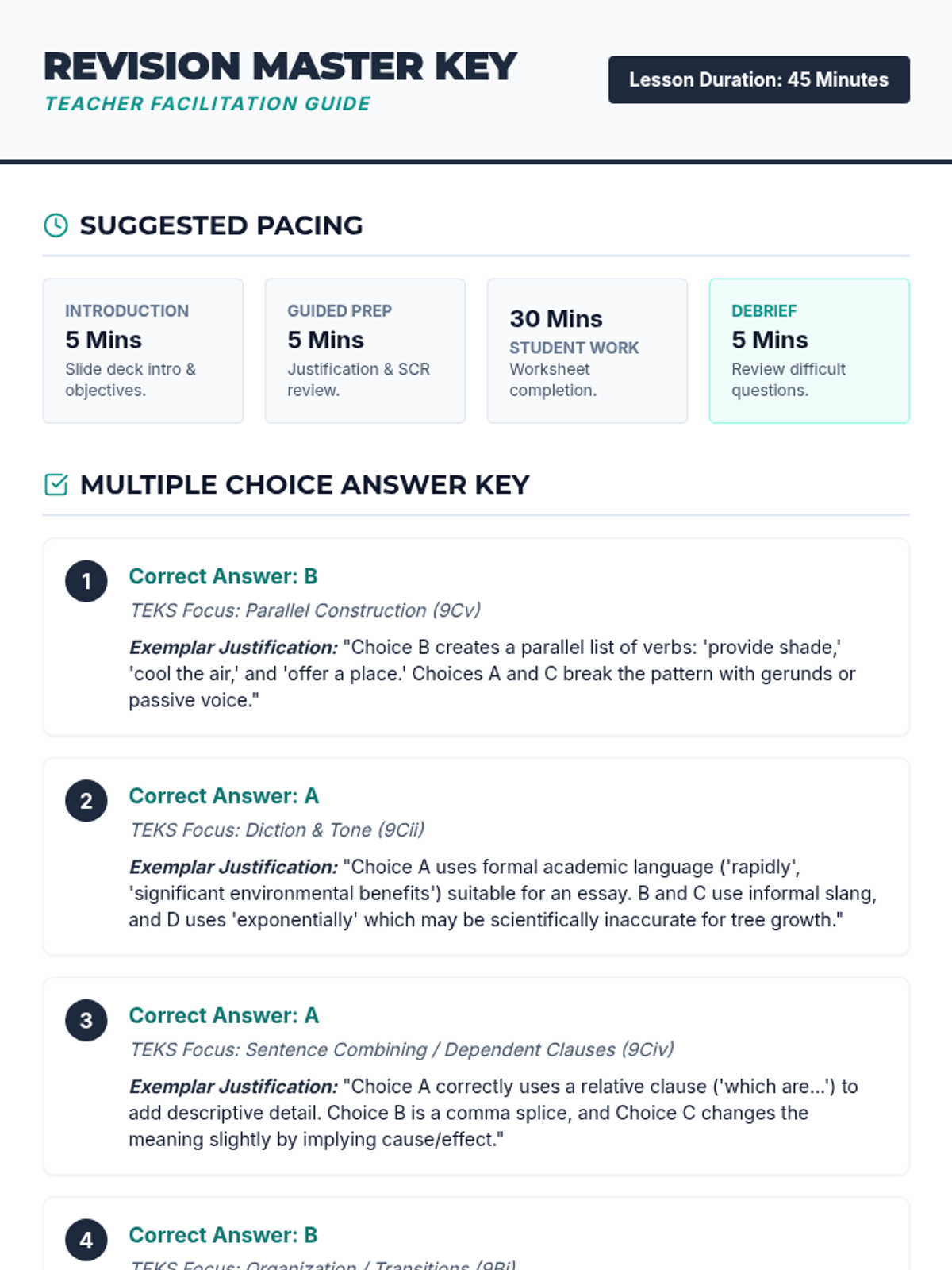
A comprehensive teacher facilitation guide containing a 45-minute pacing schedule, a detailed answer key for the multiple-choice questions with exemplar student justifications, and a sample Short Constructed Response with a STAAR-aligned 2-point rubric.
A visual presentation to guide the 45-minute revision workshop. Includes session objectives, a review of key STAAR revision TEKS, a strategy for writing justifications, and a formula for successful Short Constructed Responses.
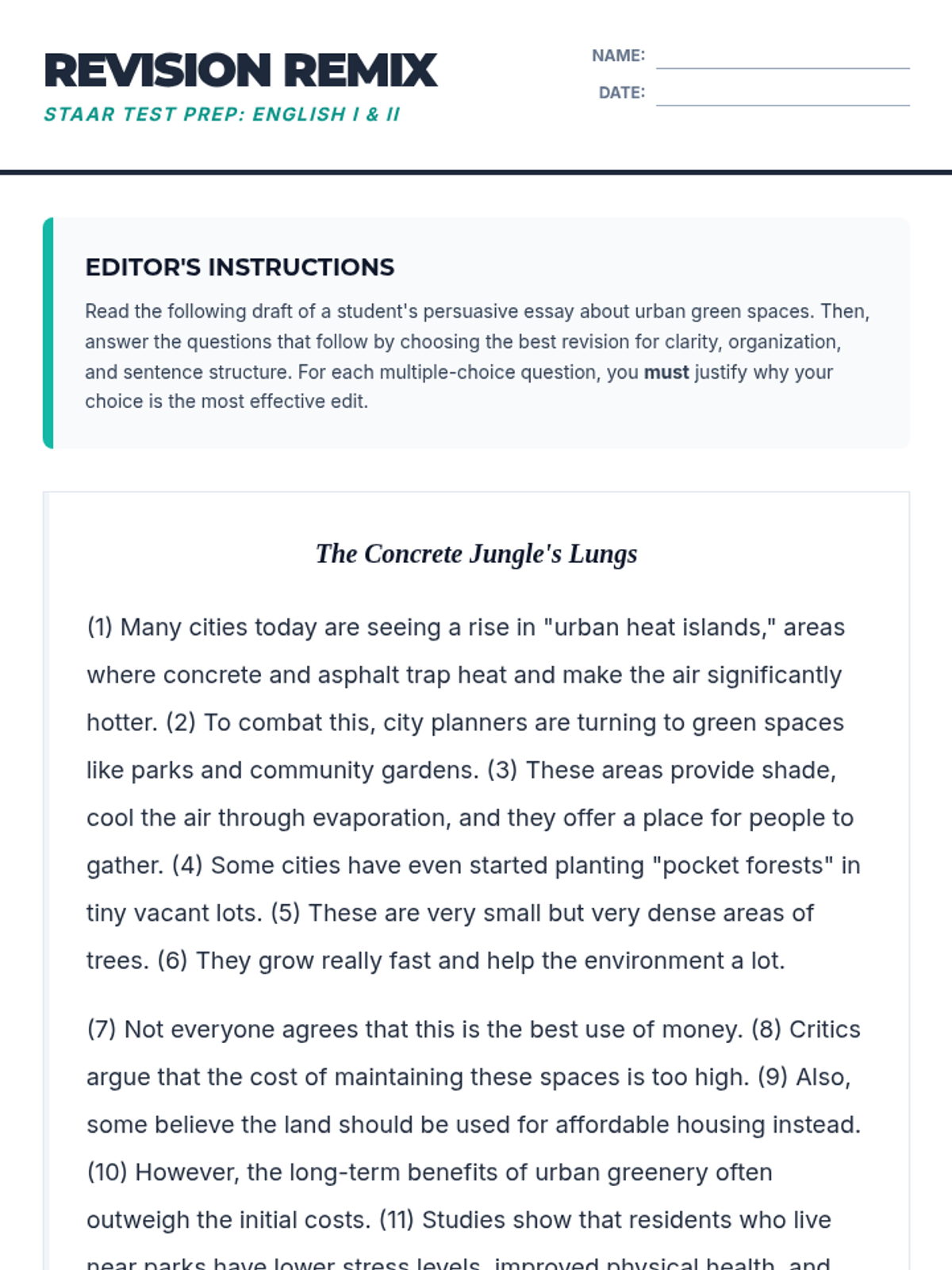
A STAAR-formatted revision worksheet featuring a multi-paragraph passage and six multiple-choice questions with justification areas. It concludes with a Short Constructed Response (SCR) prompt targeting specific grammatical and organizational TEKS.
A visual presentation for the Who vs. Whom lesson, following the Khan Academy aesthetic with neon highlights, including an embedded video and structured pauses for discussion.
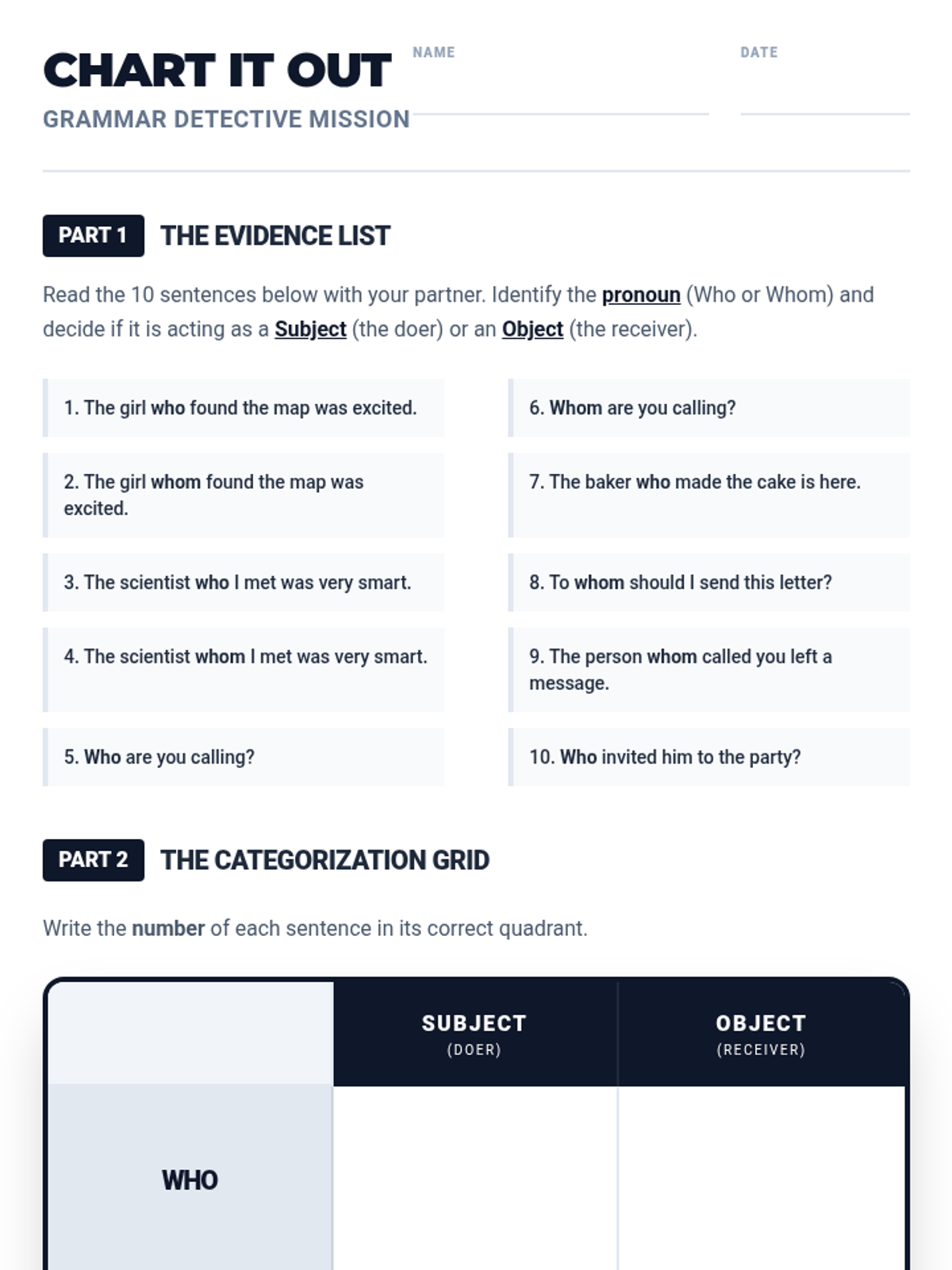
A student activity sheet for categorizing sentences into the 2x2 grid based on the 'One-Way Street' rule, including space for creating an 'impossible' sentence.
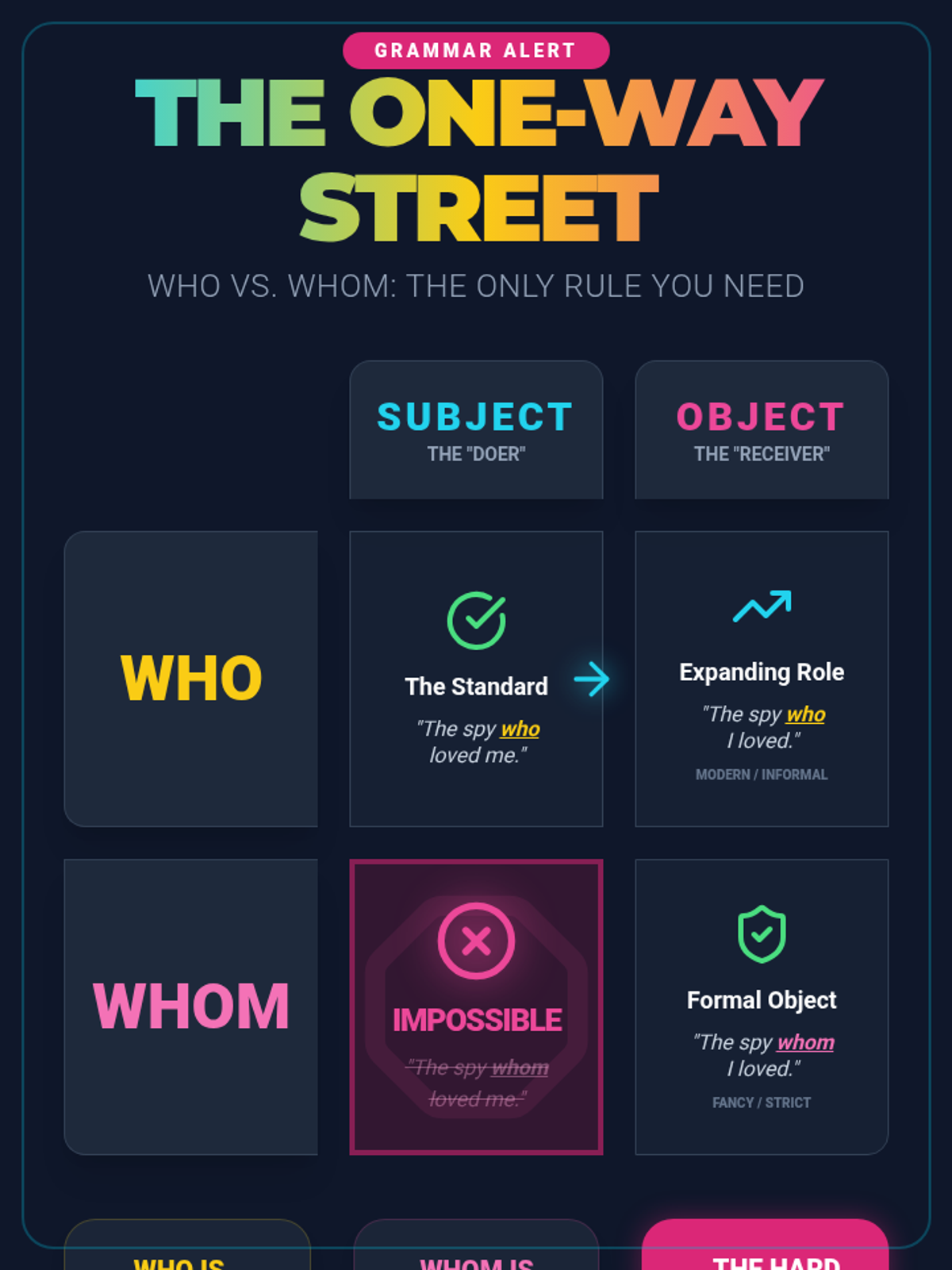
A high-contrast anchor chart for the 'One-Way Street' grammar rule, illustrating that 'who' is expanding into the object space while 'whom' remains strictly an object pronoun.
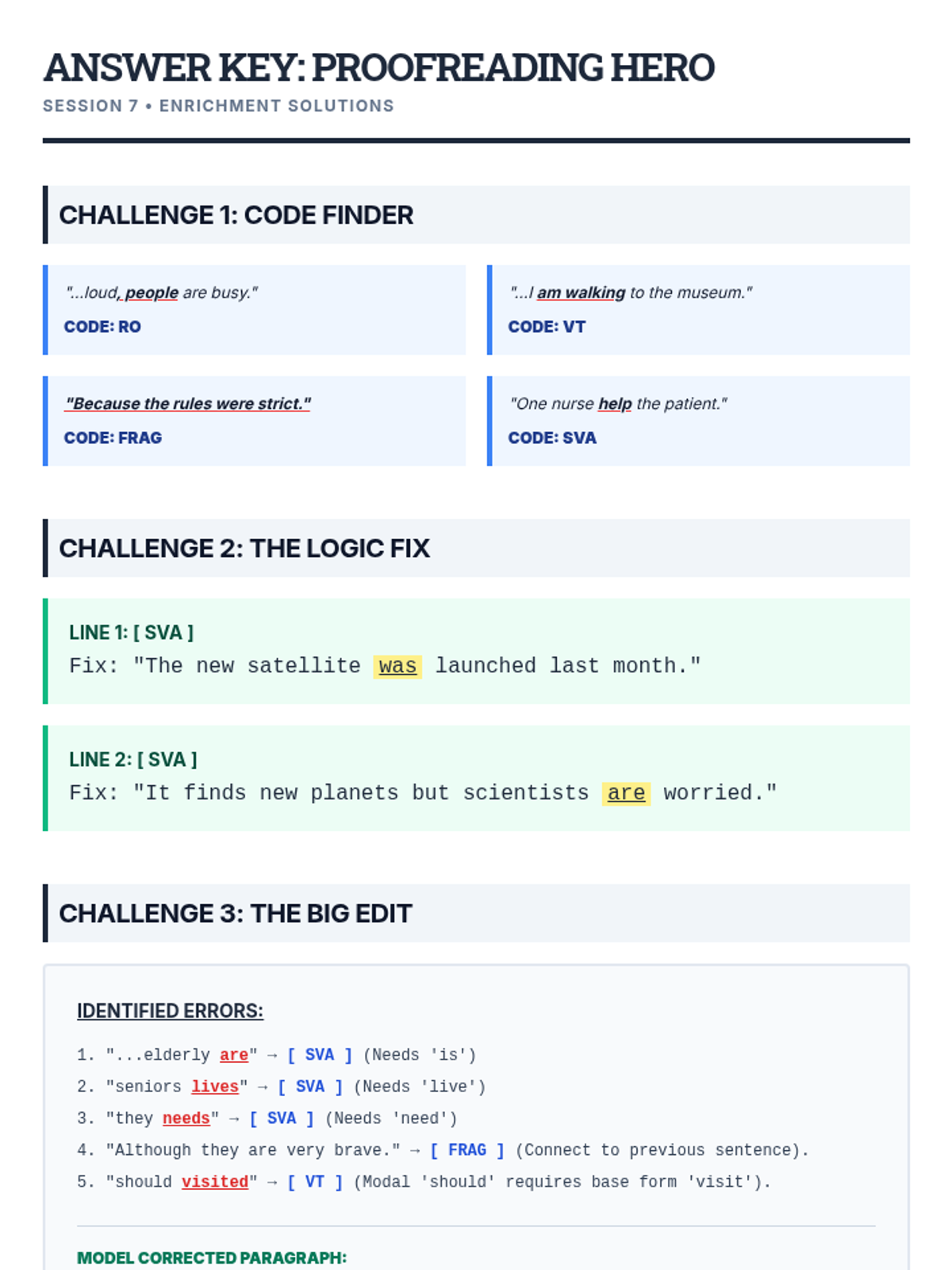
A teacher answer key for the Proofreading Hero Worksheet, including identified error codes and model corrected paragraphs for all challenges. Updated for matching expanded worksheet and includes a legend.
Instructional slides for the mock exam session, providing a visual pacing guide (10-30-5 breakdown) and specific phase-by-phase writing strategies.
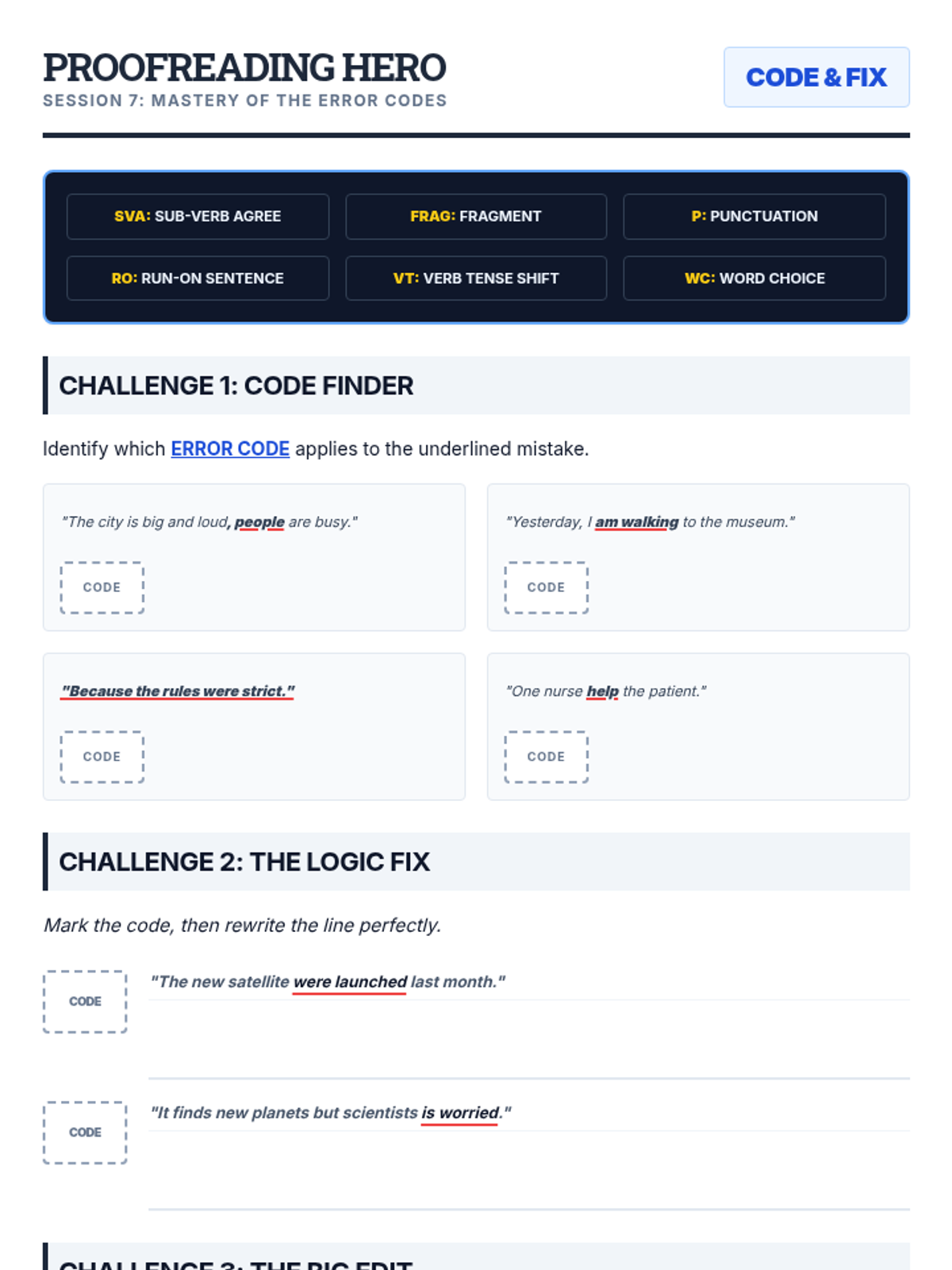
An interactive proofreading worksheet where students apply the teacher's Error Coding Key to identify and fix grammar, punctuation, and structure mistakes in sample texts. Updated with expanded items and unit-themed examples across two pages.
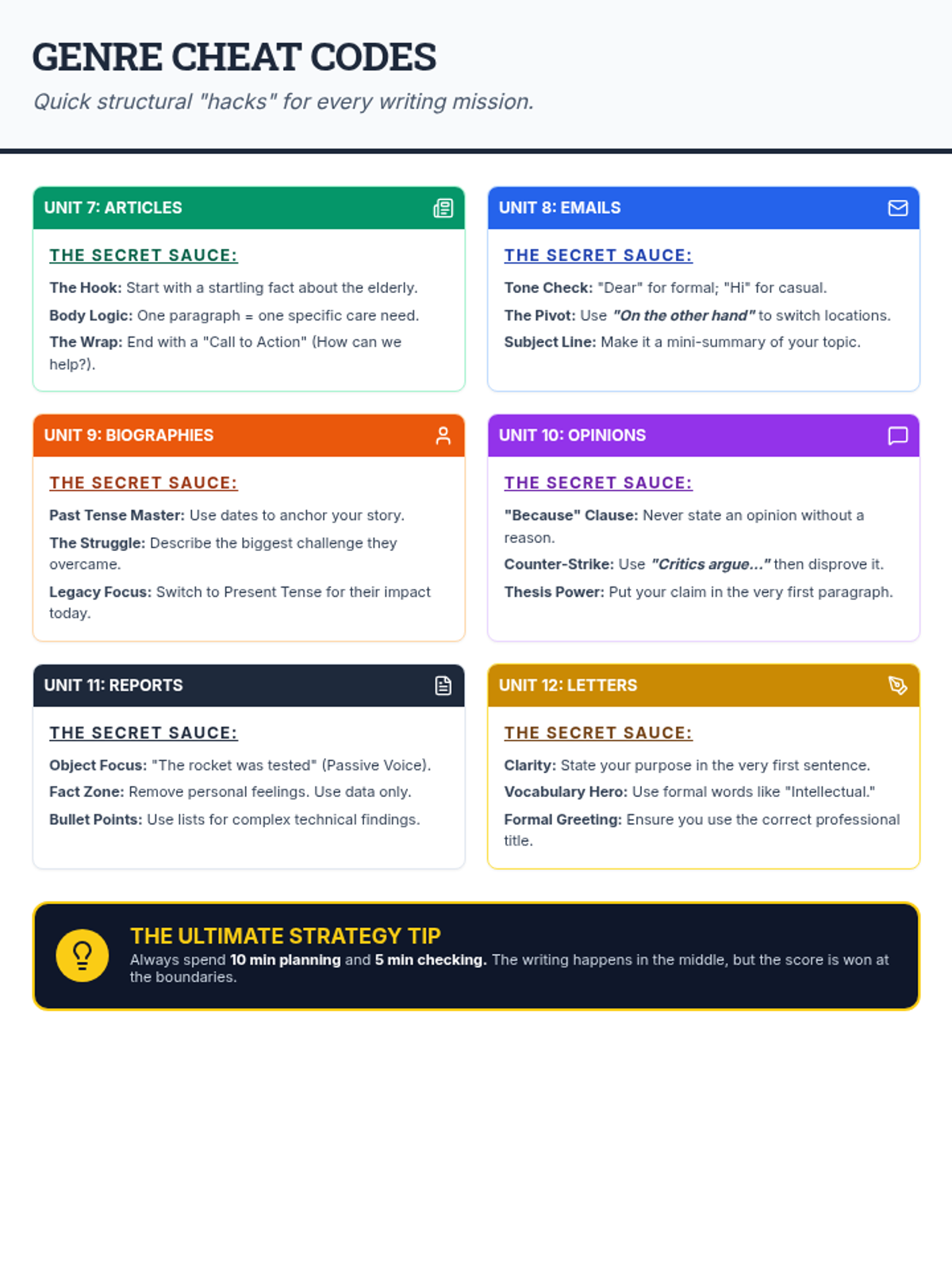
A one-page reference guide containing structural "hacks" and specific strategies for each of the six writing genres covered in the program. Updated for single-page efficiency.
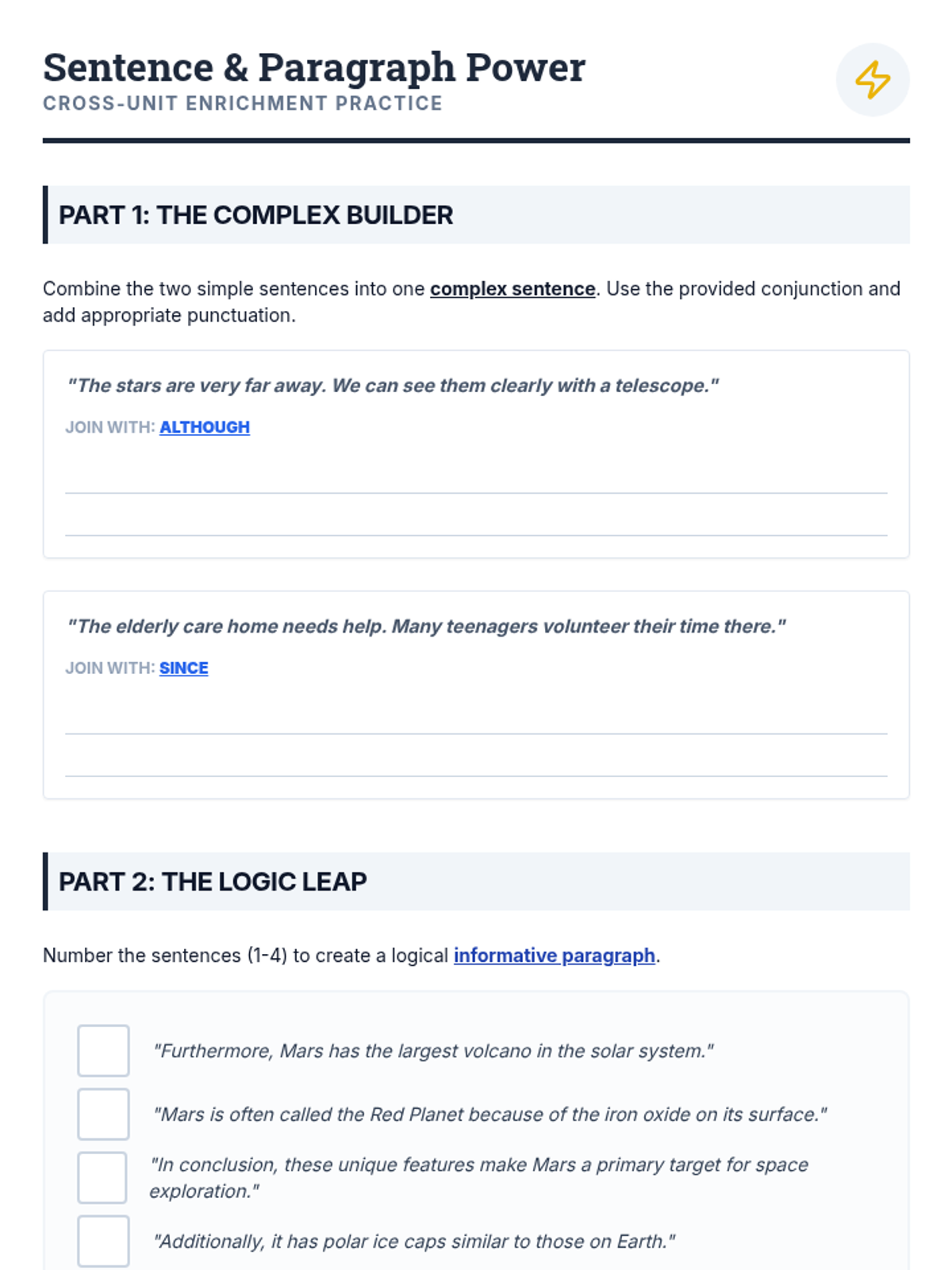
An enrichment worksheet focused on advanced sentence combining, logical paragraph sequencing, and tone transformation. Updated for handwriting legibility and clear instruction.
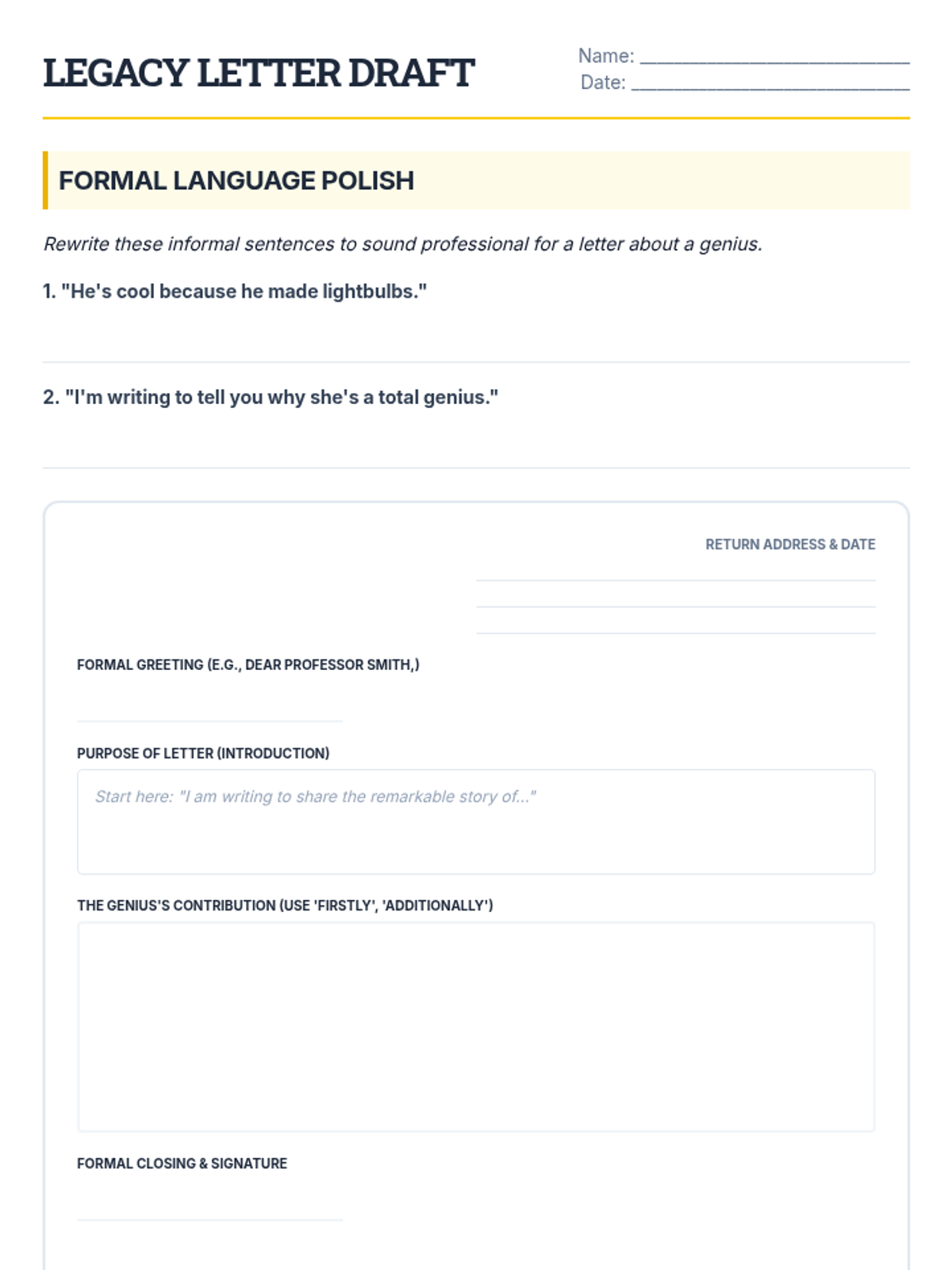
A student worksheet for formal letter writing about a genius. Includes a formal language rewrite activity and a structured letter template. Updated to fit one page and improve contrast.
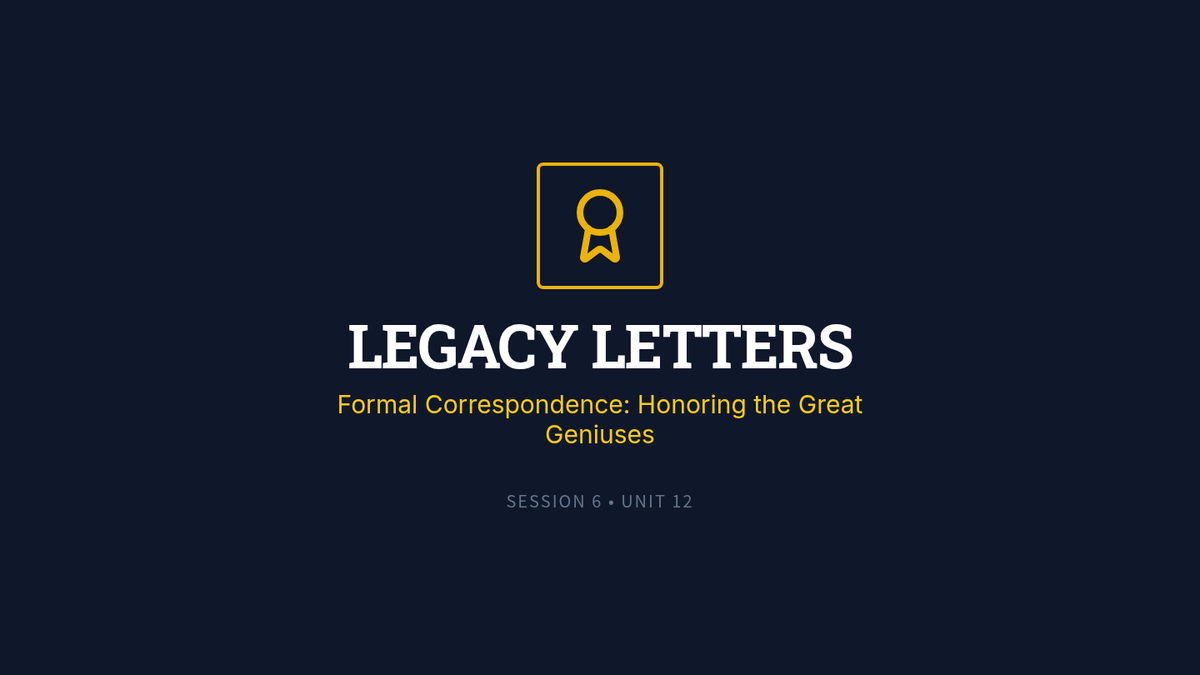
Instructional slides for formal letter writing, focusing on the achievements of geniuses, formal tone vs. informal tone, and letter structure. Updated with specific examples and curriculum cohesion.
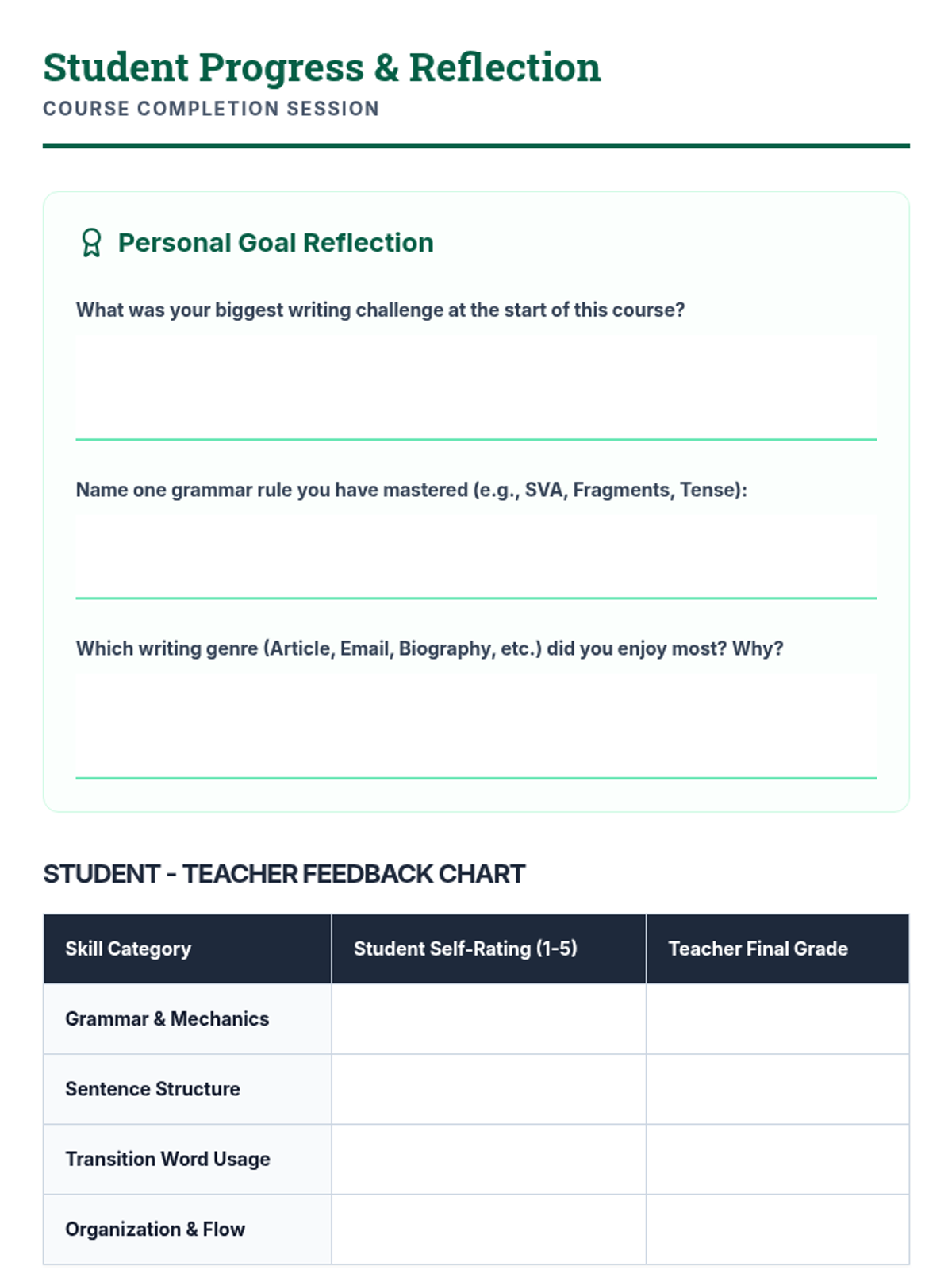
A final reflection and feedback document for students to self-assess their progress, receive teacher evaluations across core skill categories, and review strategy tips for future writing success.
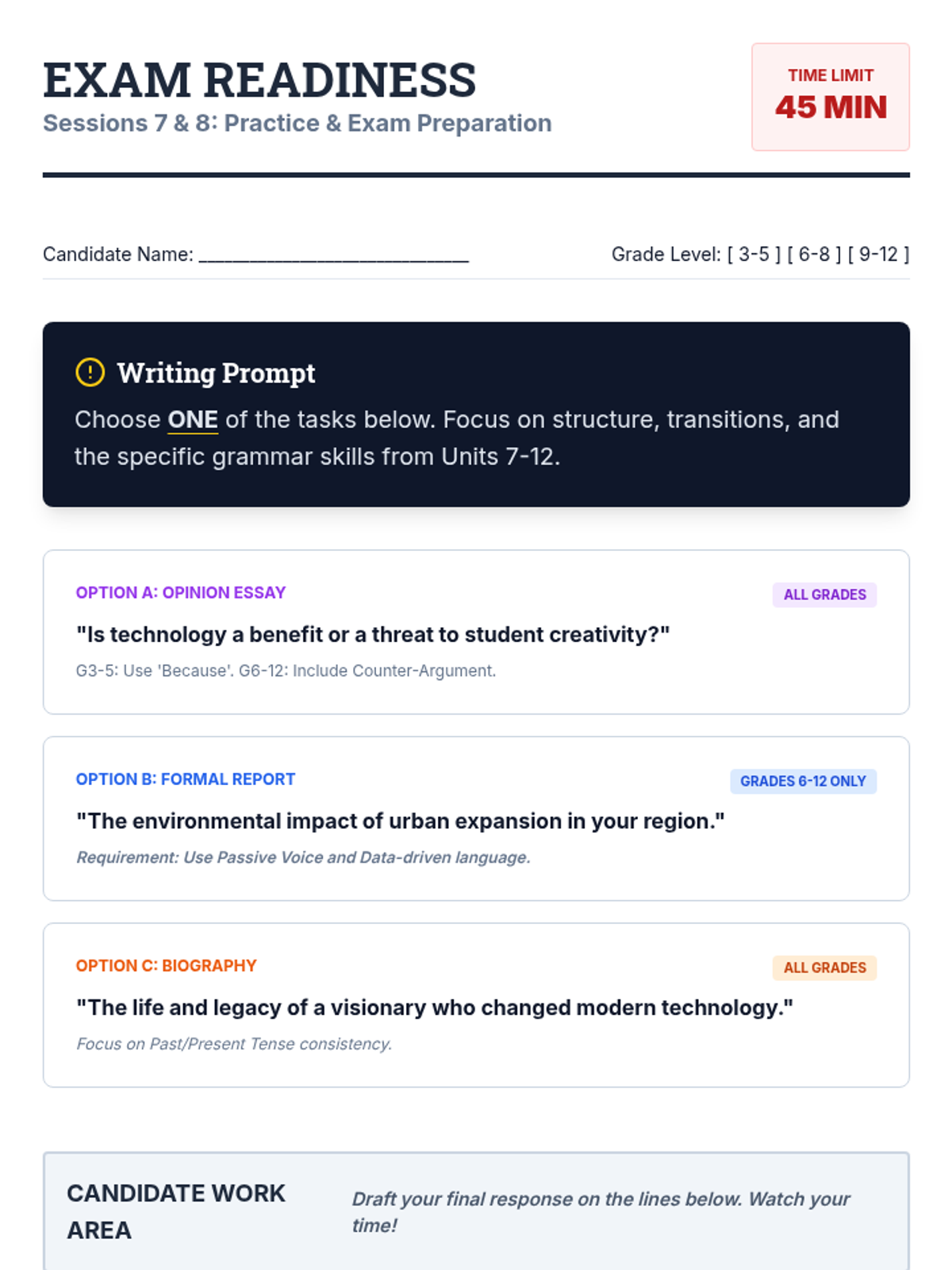
A mock exam writing prompt and workspace for sessions 7 and 8, featuring tiered options for different writing genres (essay, report, biography) and a lined writing area for timed practice.
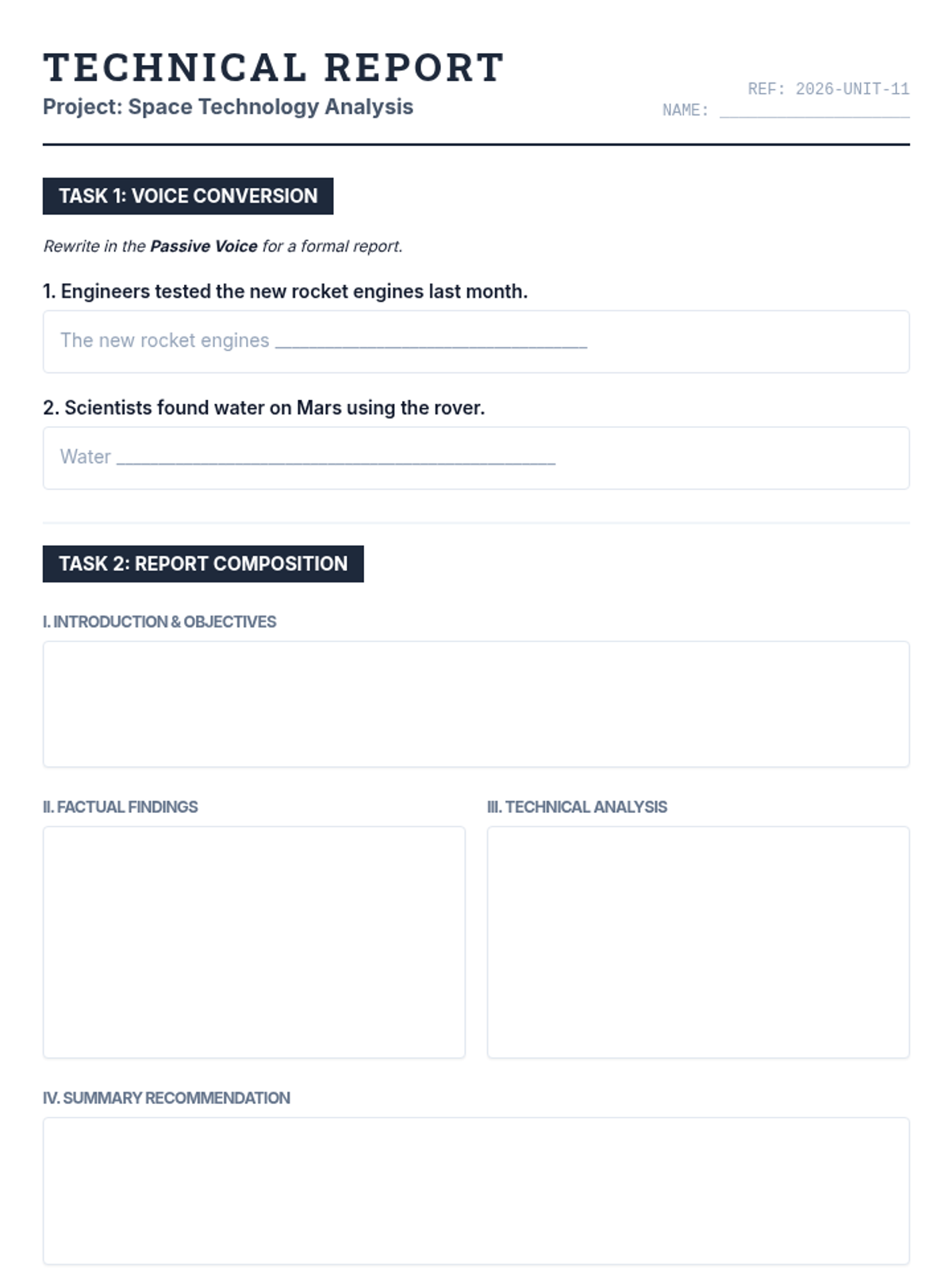
A technical report writing worksheet for students, including an active-to-passive voice conversion exercise and a structured four-part report layout for space technology analysis.
Instructional slides for report writing on space technology, focusing on the distinction between active and passive voice and the formal structure of a data-driven report.
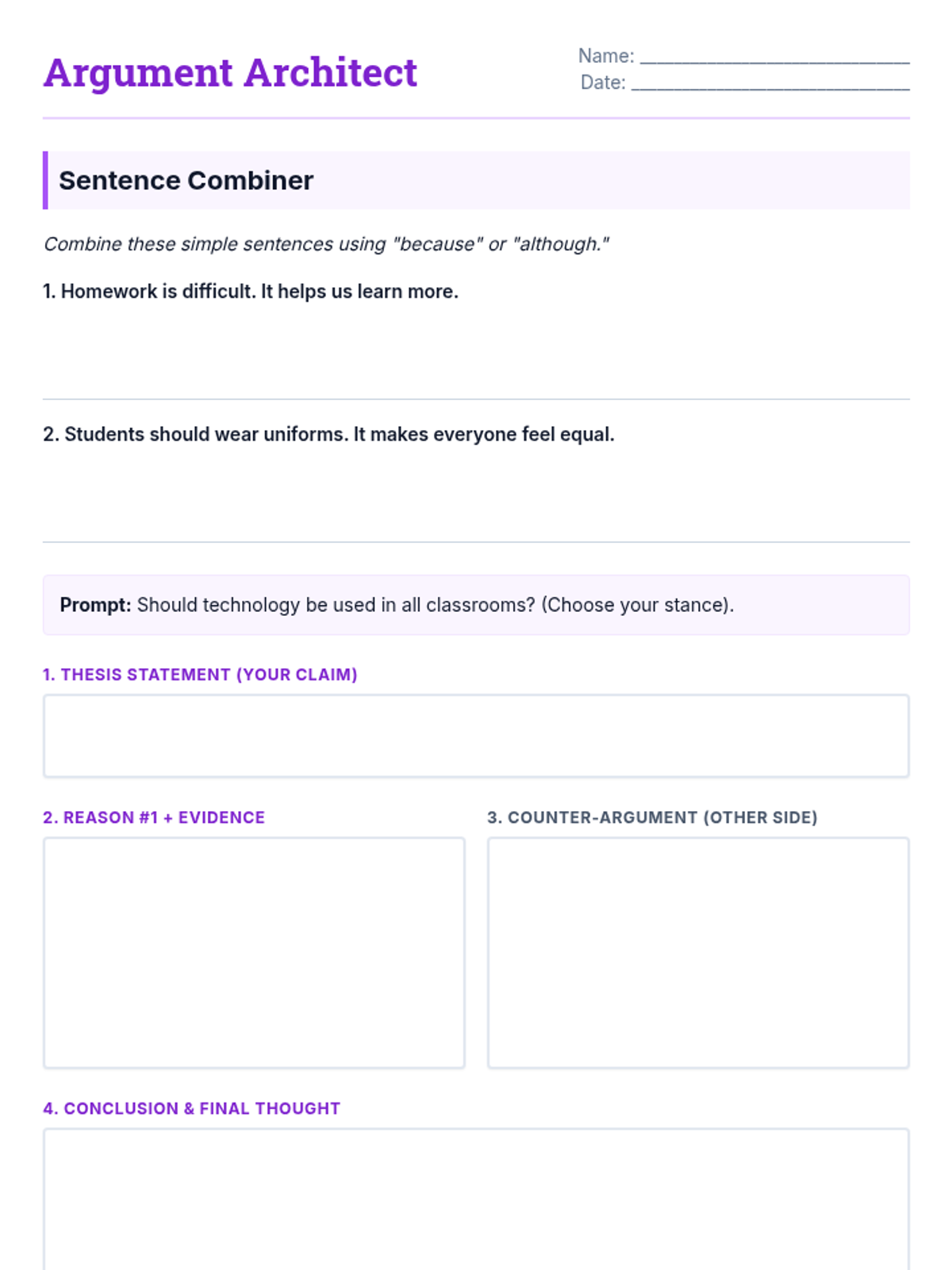
A student worksheet for opinion essay writing, featuring a conjunction-combining grammar activity and a structured multi-part outline for a thesis, evidence, counter-argument, and conclusion.
Instructional slides for opinion essay writing, emphasizing the use of conjunctions (because, although) and the structure of a multi-paragraph argument including counter-arguments.
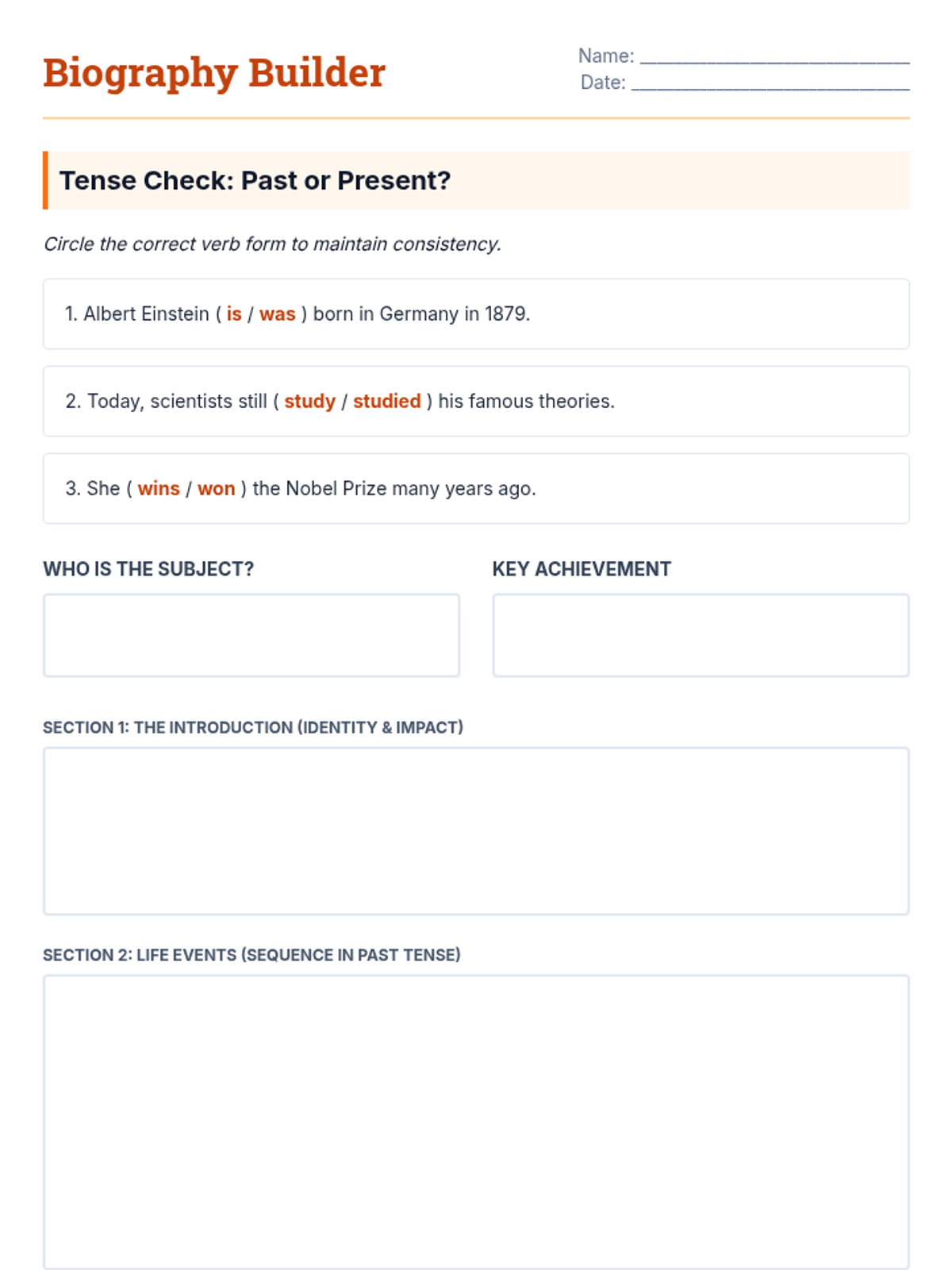
A student worksheet for biography writing, including a tense-selection warm-up activity and a three-section drafting organizer (Introduction, Life Events, Legacy).
Instructional slides for biography writing, focusing on tense consistency (past vs. present) and logical sequencing of life events for historical figures.
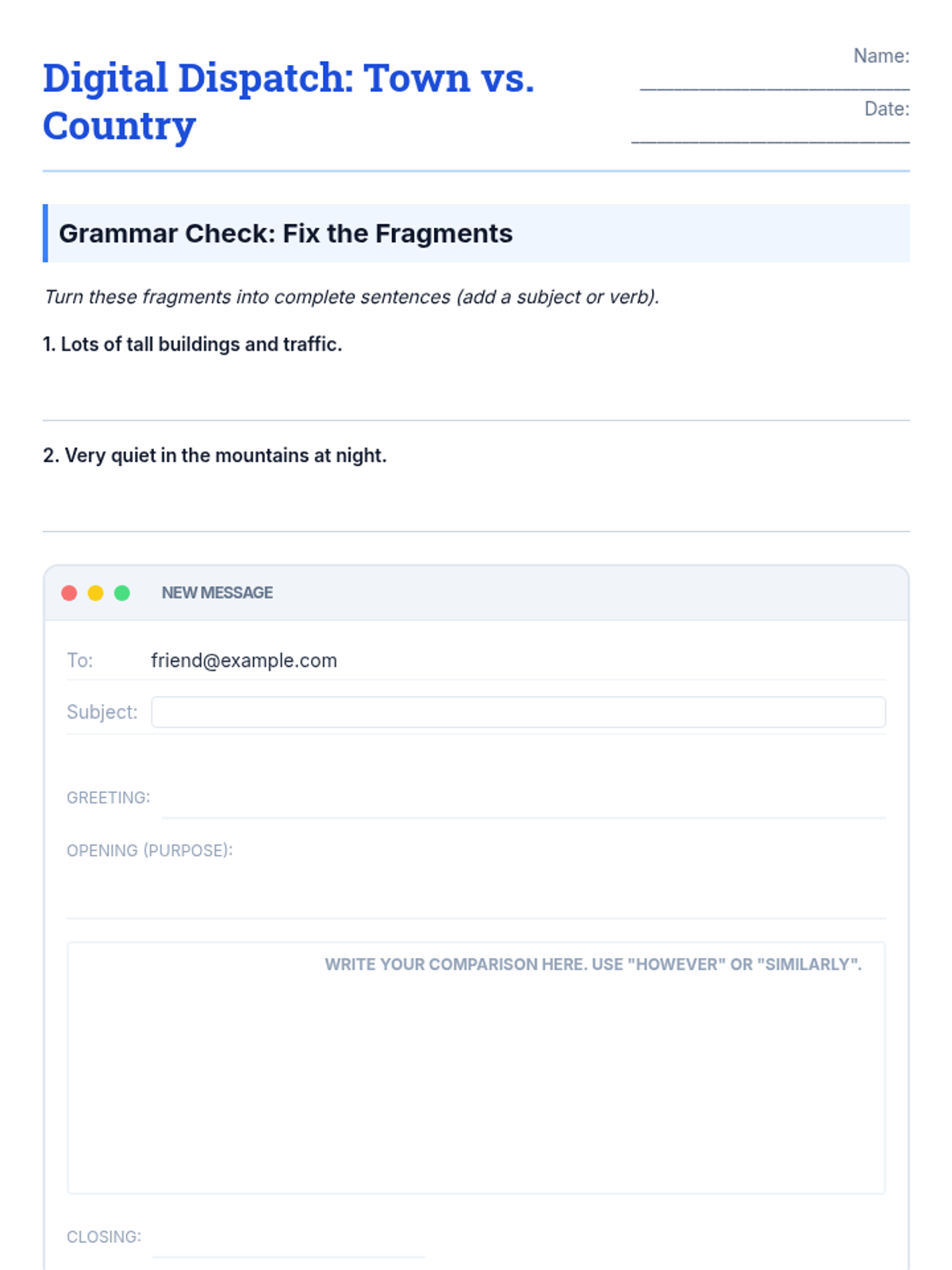
A student worksheet for writing an email comparing urban and rural life. Features a grammar activity to correct sentence fragments and a structured email template with comparison-word prompts.
Instructional slides for email writing, focusing on the comparison between urban and rural living, grammar instruction on sentence fragments, and transitional words for comparison.
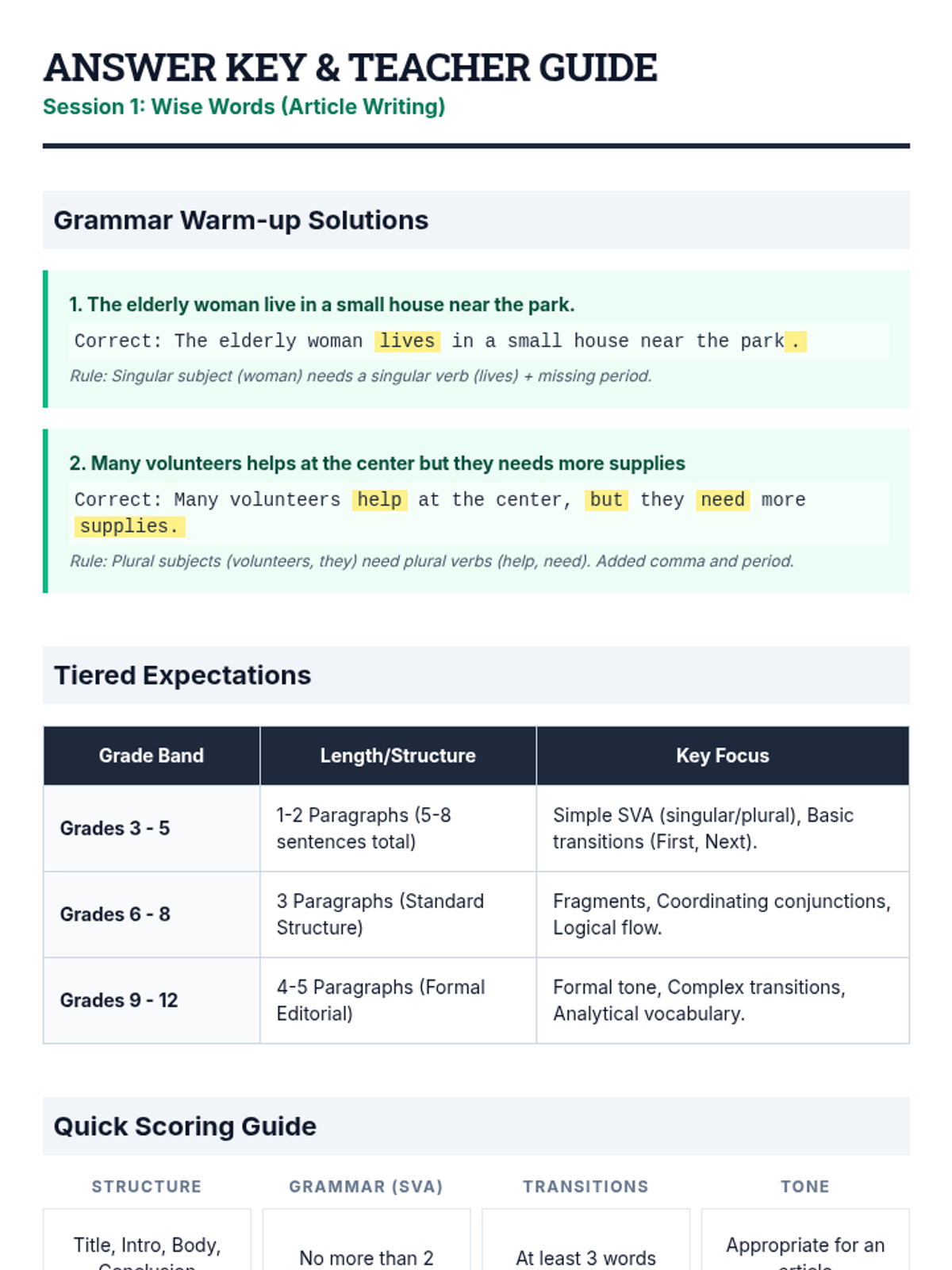
Teacher reference guide for Session 1, containing grammar solutions, tiered expectations for different grade bands, and a quick scoring rubric for the article writing task.
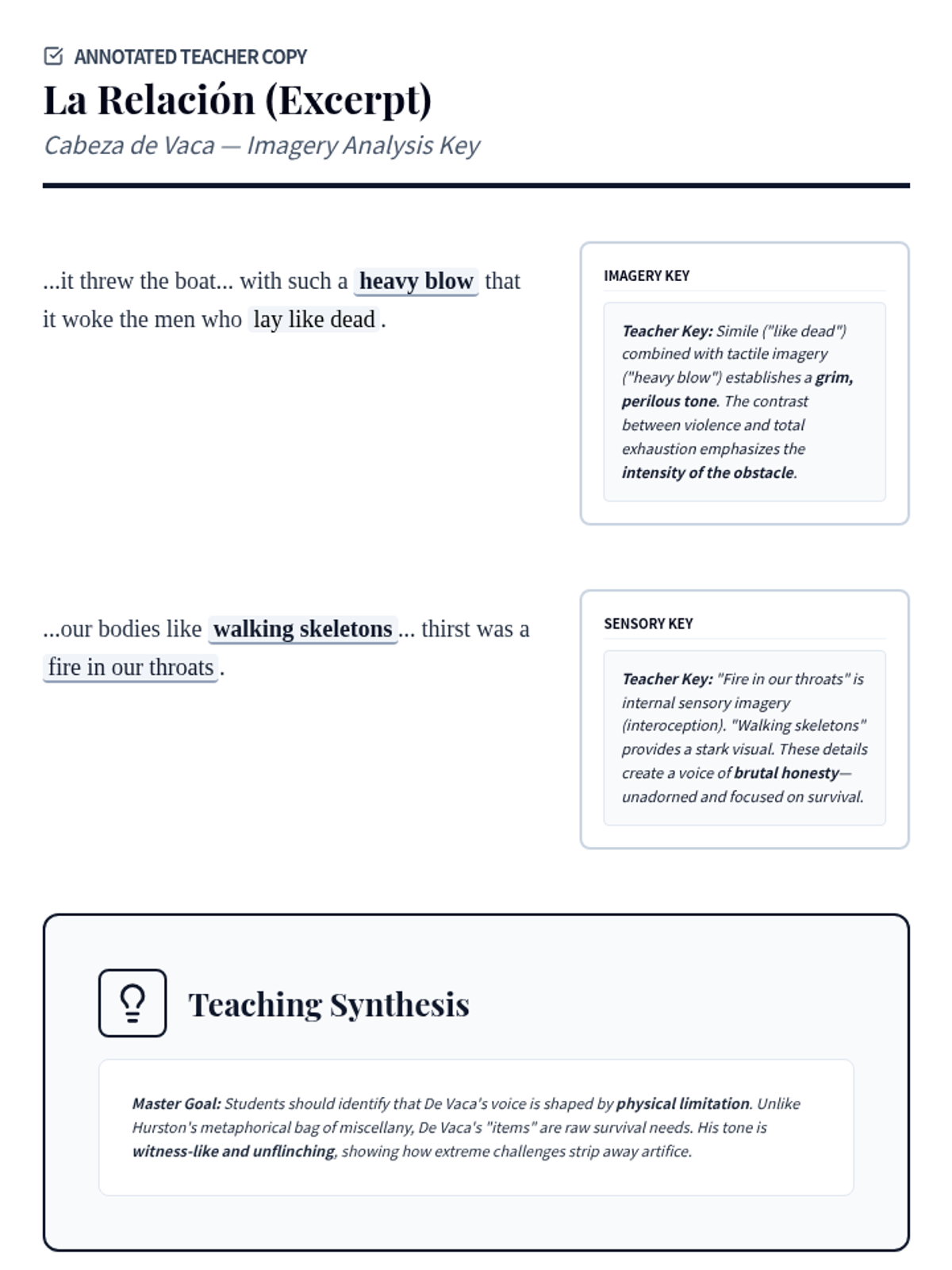
Grayscale-optimized annotated teacher copy for de Vaca's 'La Relación,' using a slate and white palette for high contrast and toner-saving. Includes specific analysis keys for imagery and survival tone.
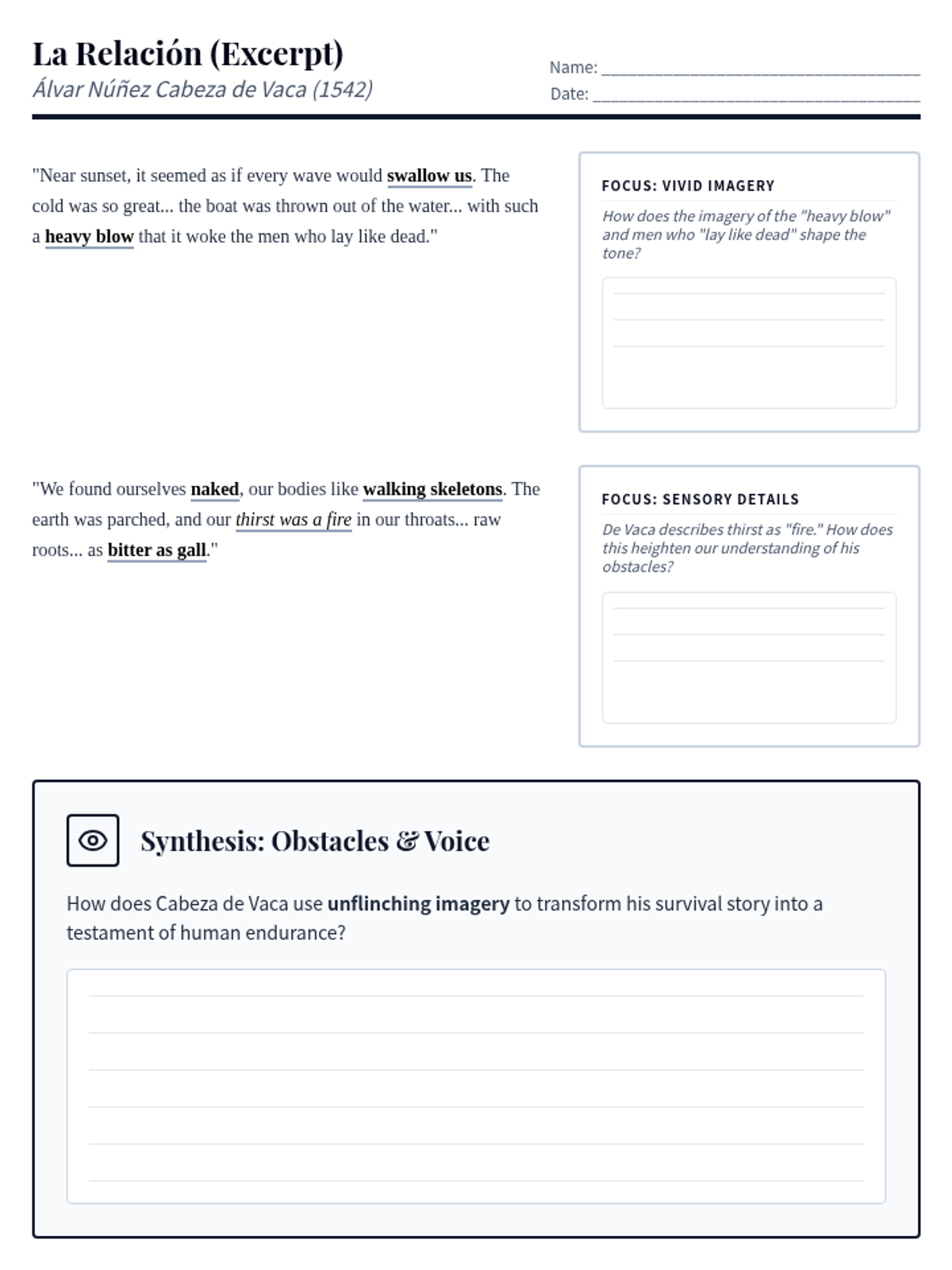
Grayscale-optimized student analysis guide for Cabeza de Vaca's 'La Relación,' using a slate and white palette for high contrast and toner-saving. Focuses on vivid and unflinching imagery. Optimized to fit on a single page.
Grayscale-optimized teacher guide for 'The Architecture of Voice' unit, updated with English III 2017 TEKS alignment. Details daily pacing, mentor text focuses, and the cumulative writing process with specific standards mapped to each phase. Revised for page break stability and exact TEKS alignment.
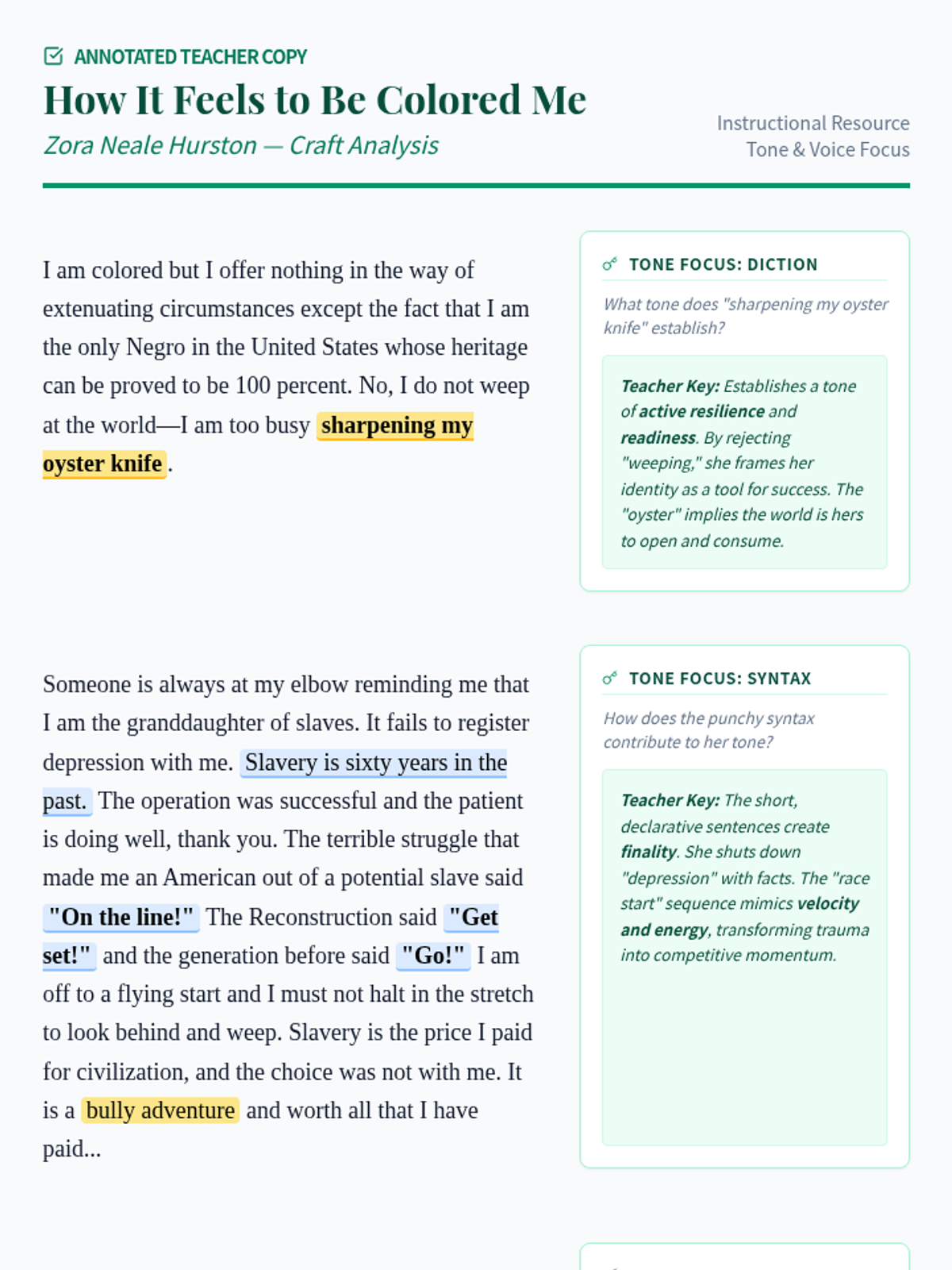
Annotated teacher copy of Hurston's text, providing specific craft-based answers for the figurative language analysis. Grayscale optimized for high contrast printing.
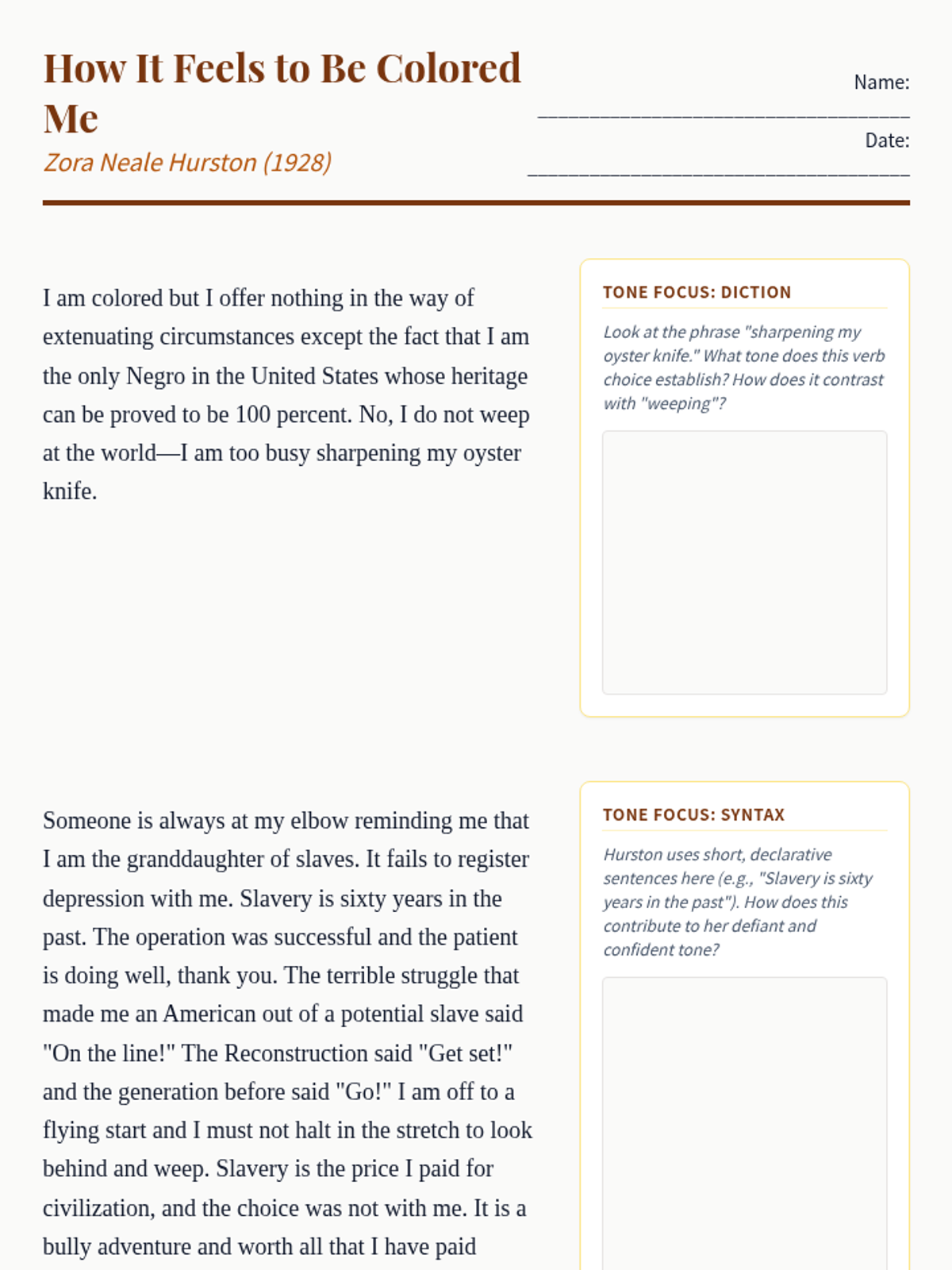
A comprehensive teacher's answer key for the tone analysis questions in Zora Neale Hurston's 'How It Feels to Be Colored Me,' providing deep-dive craft explanations for instruction.
Expanded 6-paragraph essay blueprint that scaffolds students through an introductory hook, four mentor-text-aligned body paragraphs, and a cosmic conclusion. Includes a built-in 5-point rubric evaluating mentor skills, thesis, organization, and conventions. Optimized for grayscale printing.
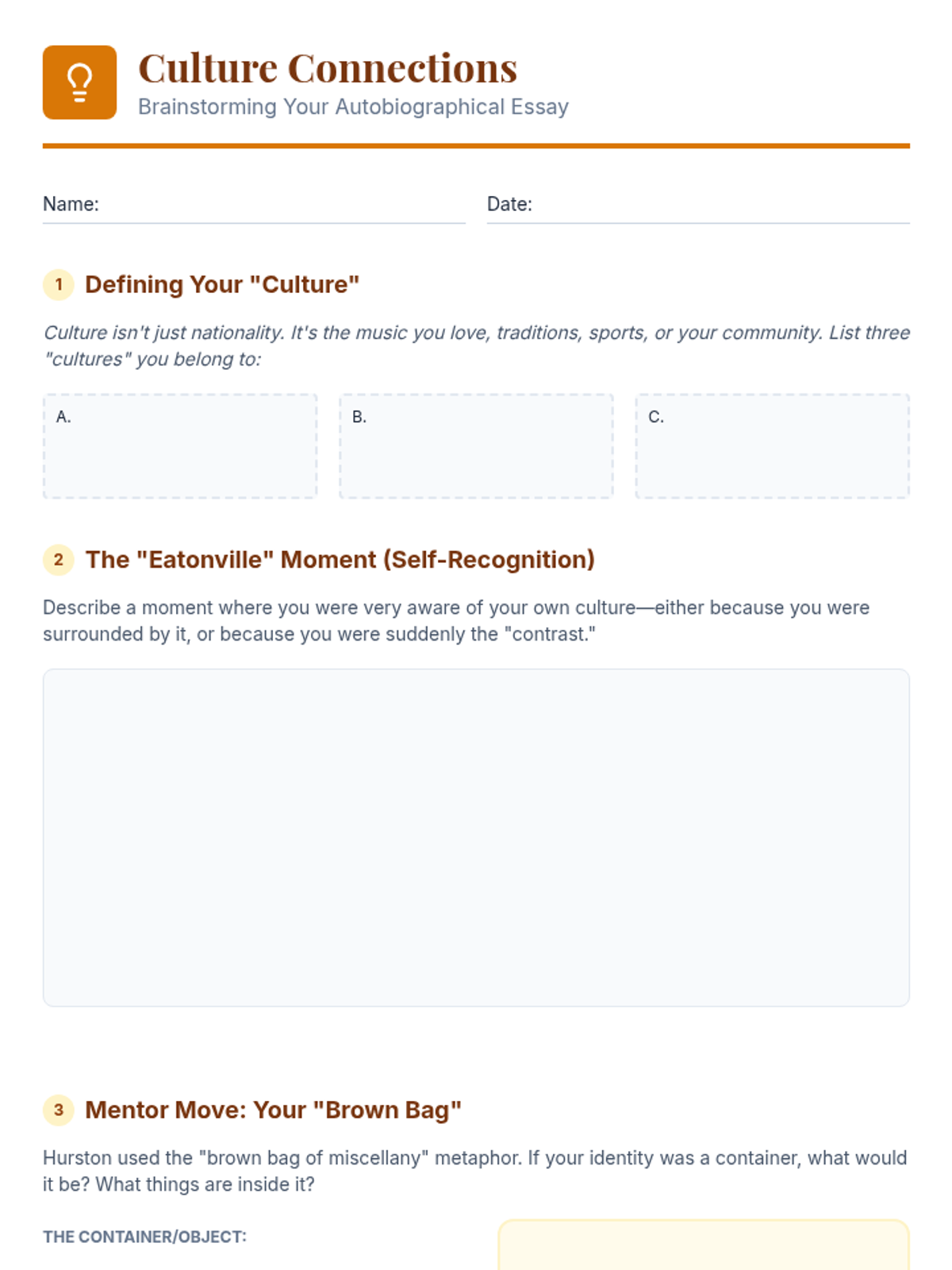
A brainstorming graphic organizer that helps students identify their own cultural identity moments and develop a central metaphor for their autobiographical essay, modeled after Hurston's 'brown bag' imagery.
Grayscale-optimized student analysis guide for Hurston's essay, specifically focusing on figurative language (metaphors and personification) to analyze how she constructs her defiant tone. Optimized to fit on a single page.
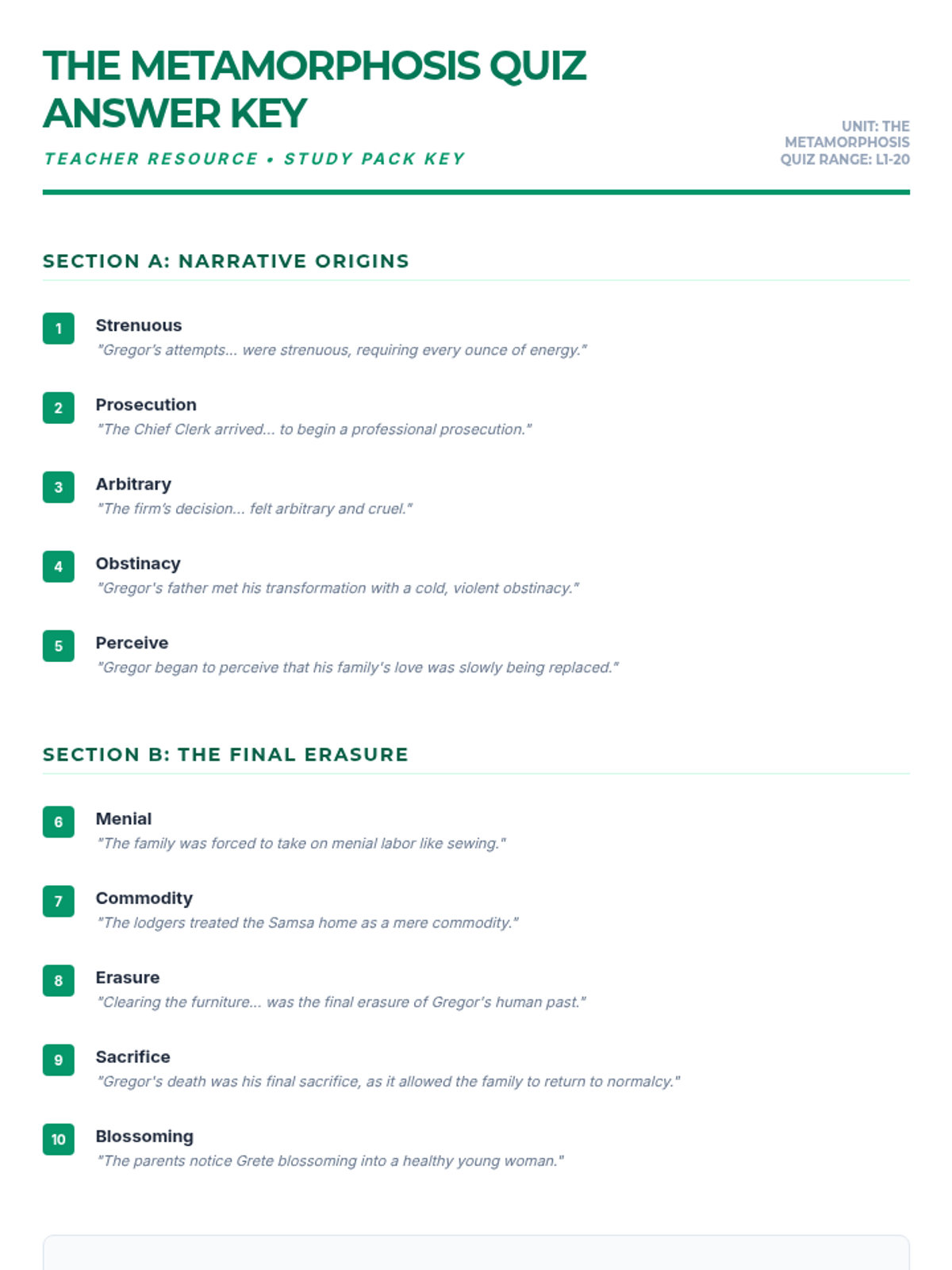
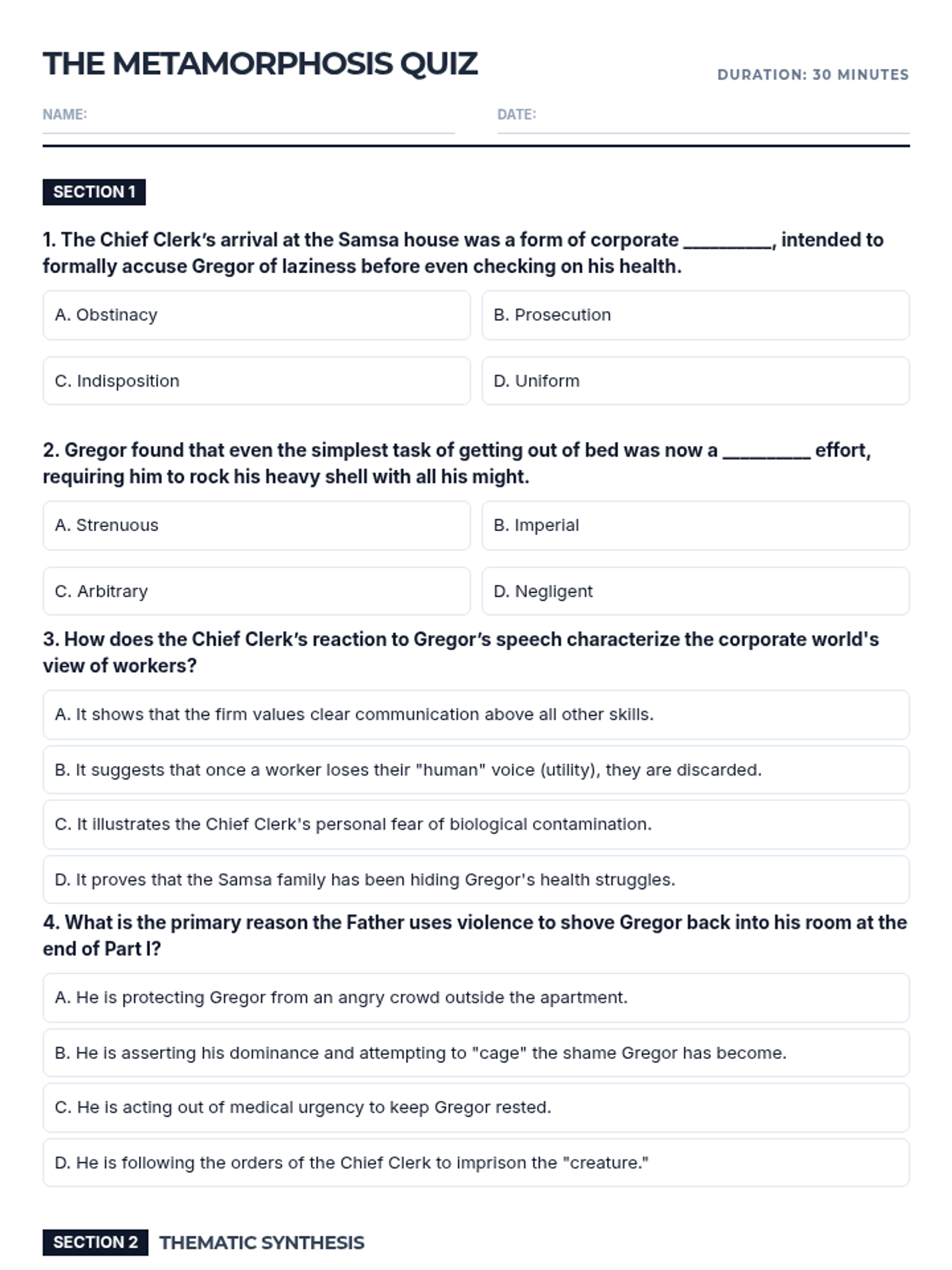
Teacher answer key for the unit-wide Vocabulary Mastery Quiz. Provides correct answers, full context sentences, and a suggested grading scale for the 10-item assessment included in the study pack. Strictly aligned with the Susan Bernofsky translation and the 60-word Lexical Ledger.
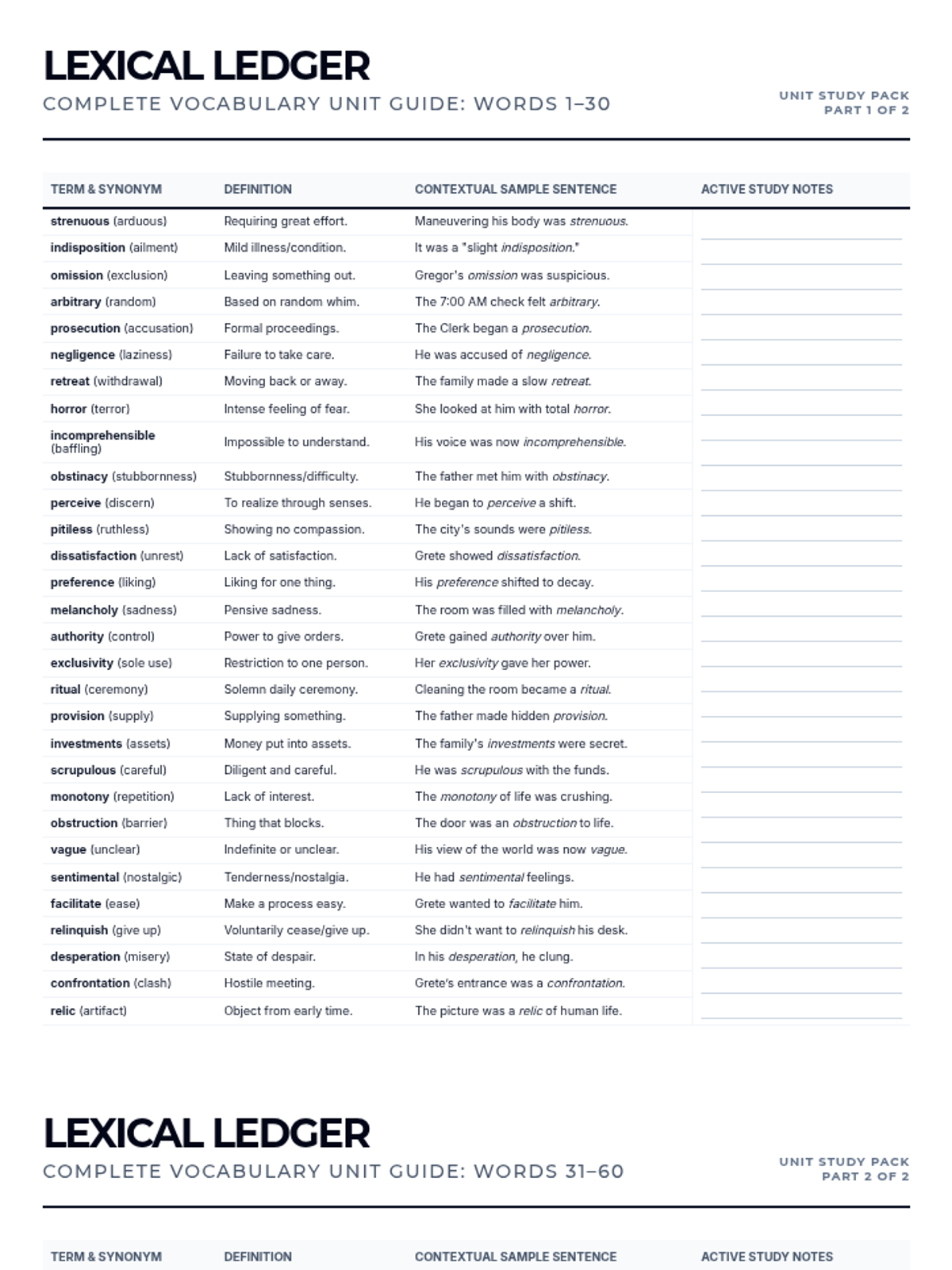
A comprehensive vocabulary study pack and cumulative quiz for The Metamorphosis, strictly aligned with the Susan Bernofsky translation. Features a 60-word Lexical Ledger with definitions, direct textual context, and page numbers, followed by a 10-question assessment. Optimized for print and student reference.
A summative student assessment for the first third of The Metamorphosis. Features vocabulary matching, multiple choice analytical questions, a short answer on the theme of 'The Firm', and a RACE response based on an excerpt from Gregor's reveal. Optimized for print with 'break-inside: avoid' on all questions. Fixed layout and spacing.
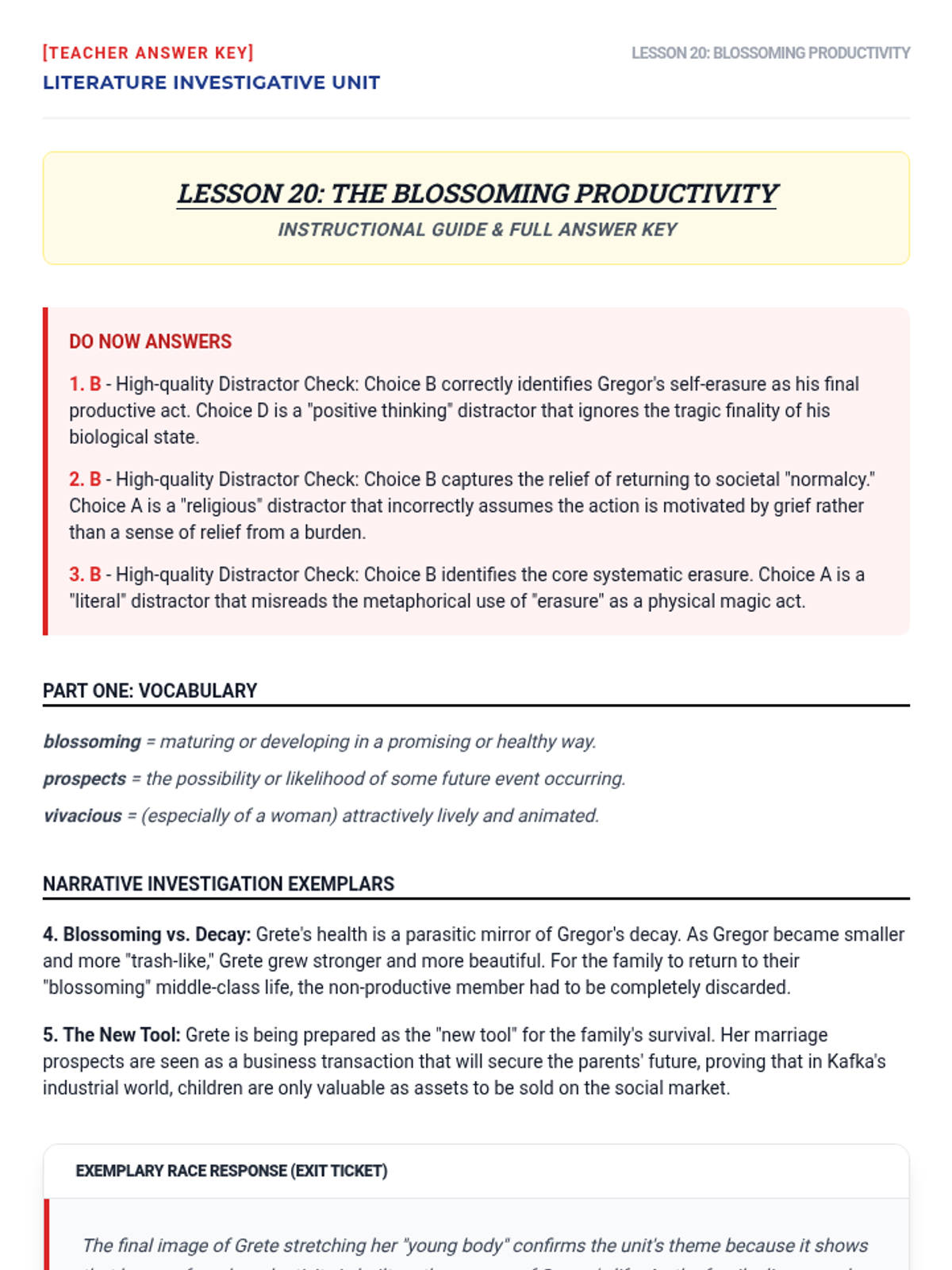
A comprehensive teacher answer key for Lesson 20. Synthesizes the themes of the unit and provides final push questions for middle grade students. Updated with specific Bernofsky page references (p. 64, 65). Removed branding.
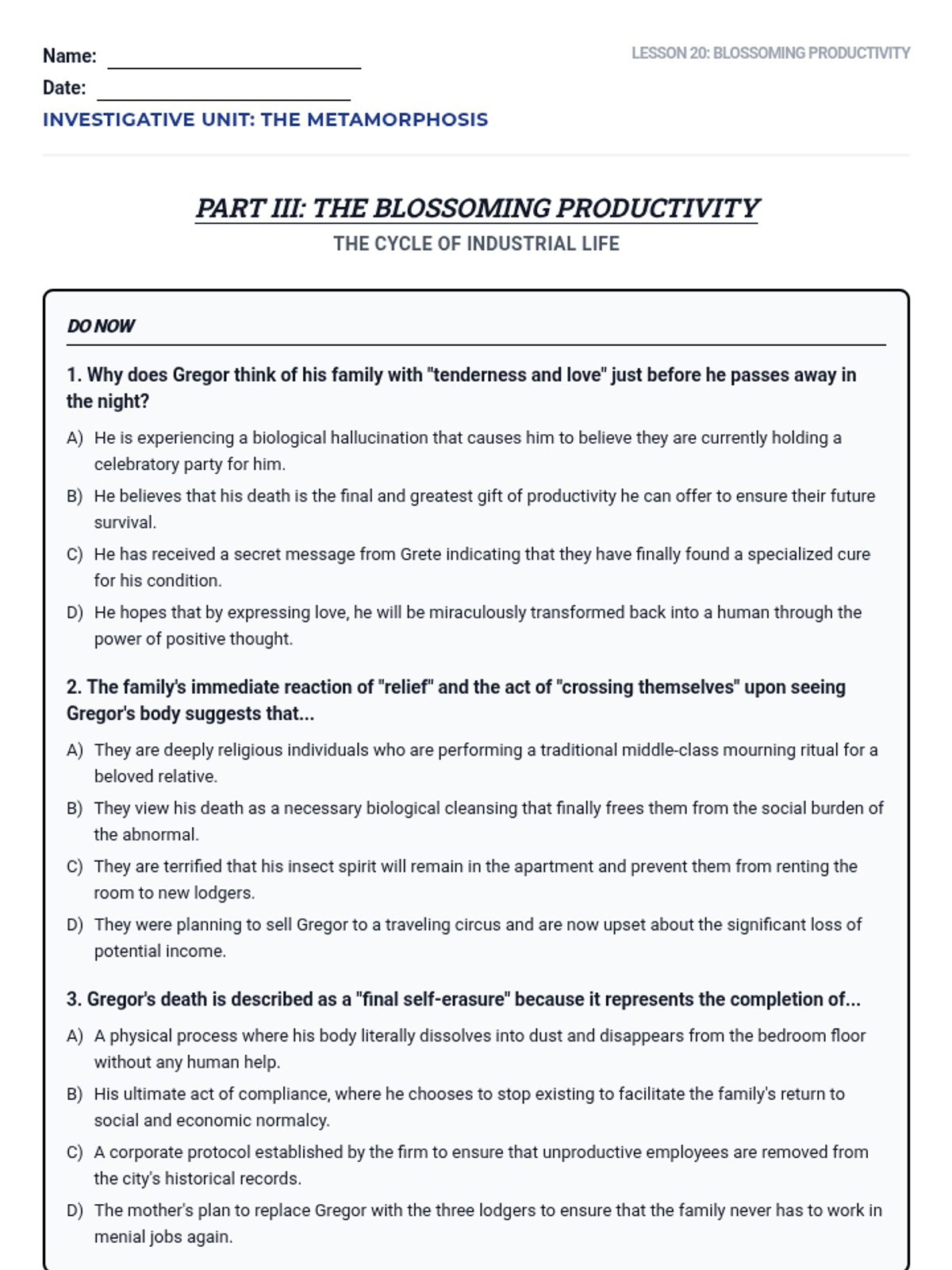
A final middle-grade worksheet for Lesson 20. Synthesizes the themes of the unit, focusing on Grete's transformation. Updated with definition lines in Part 1 and a comprehensive RACE checklist with 10 lines for the Exit Ticket. Time markers removed. Includes high-quality analytical distractors for the Do Now. Fixed checklist formatting and layout. Removed duplicate choice B.
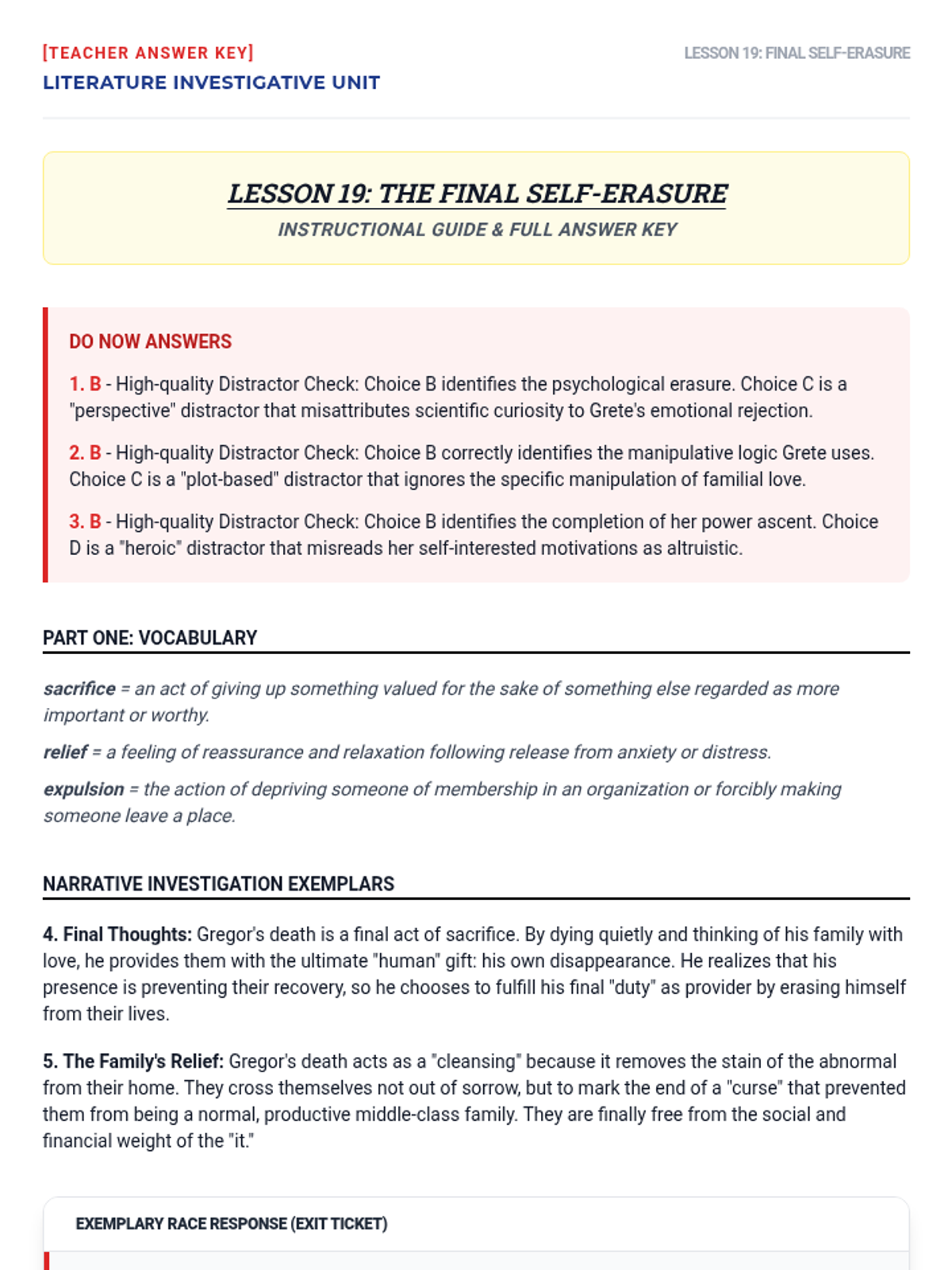
A comprehensive teacher answer key for Lesson 19. Includes exemplar responses, thematic synthesis (STAMP), and instructional push questions for middle grade students. Removed branding.
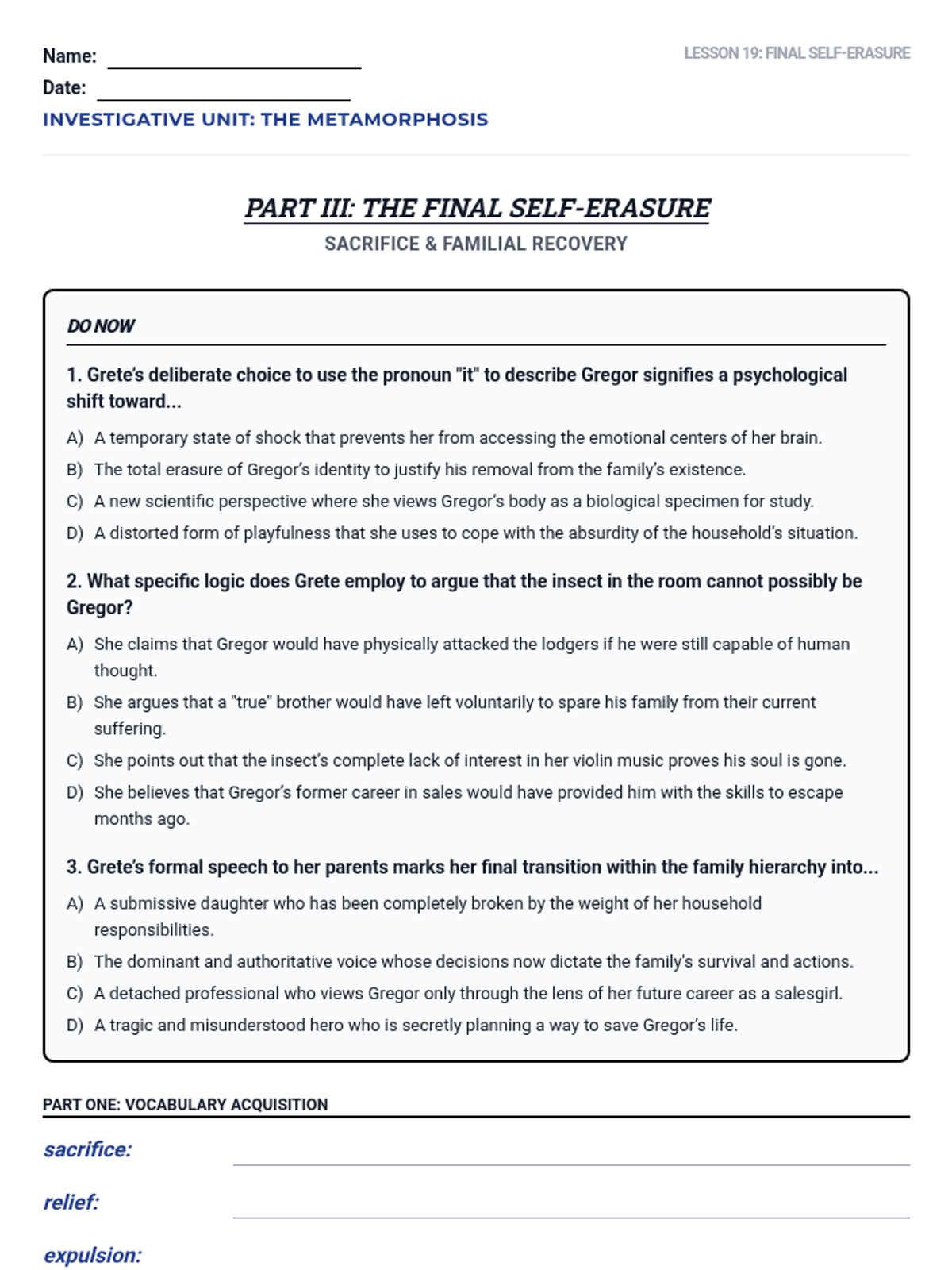
A middle-grade worksheet for Lesson 19 focusing on Gregor's death. Updated with definition lines in Part 1 and a comprehensive RACE checklist with 10 lines for the Exit Ticket. Time markers removed. Fixed checklist formatting and layout. Includes high-quality analytical distractors for the Do Now.
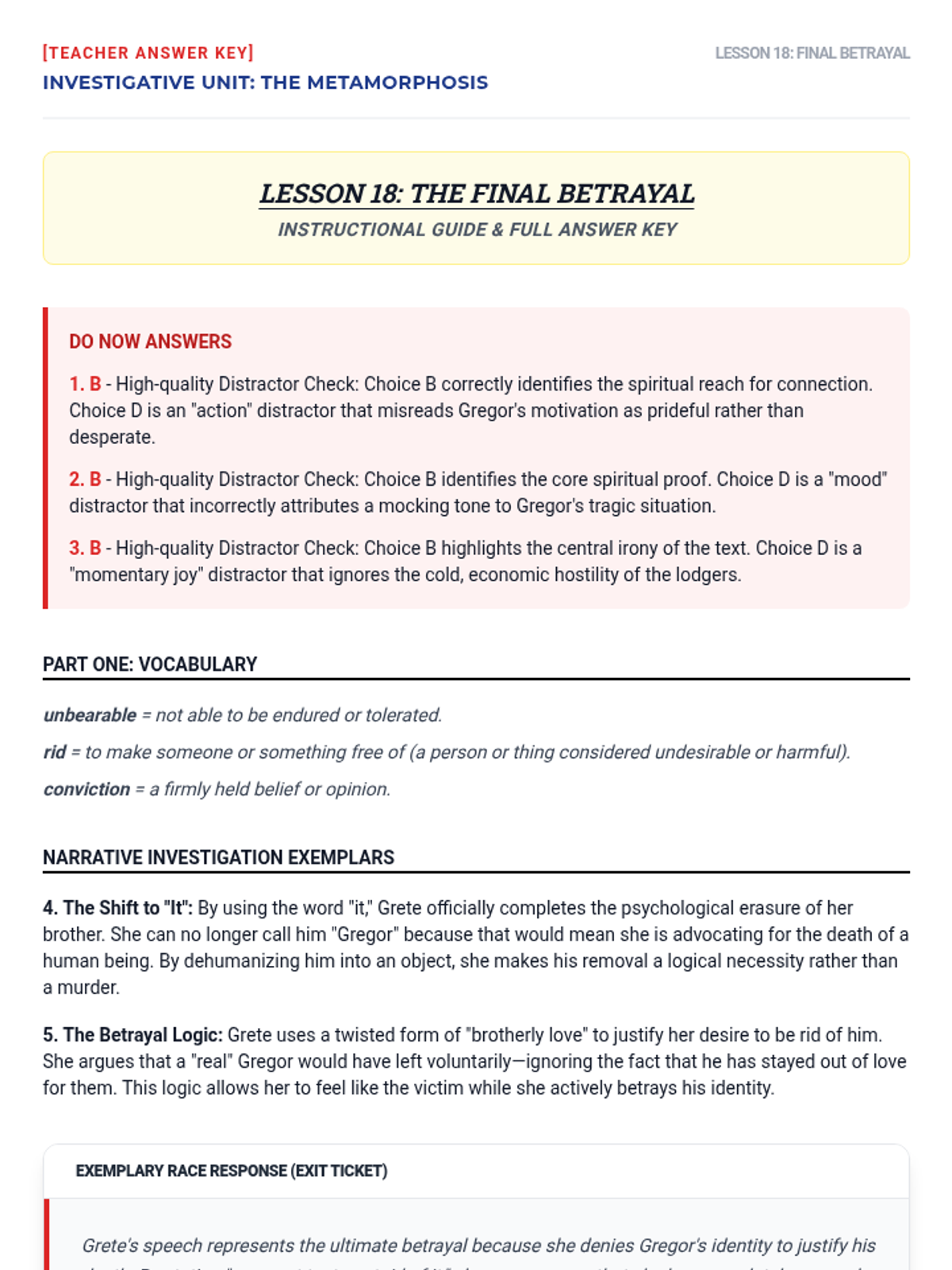
A comprehensive teacher answer key for Lesson 18. Includes exemplar responses, thematic synthesis (STAMP), and instructional push questions for middle grade students. Updated with specific Bernofsky page references. Removed branding.
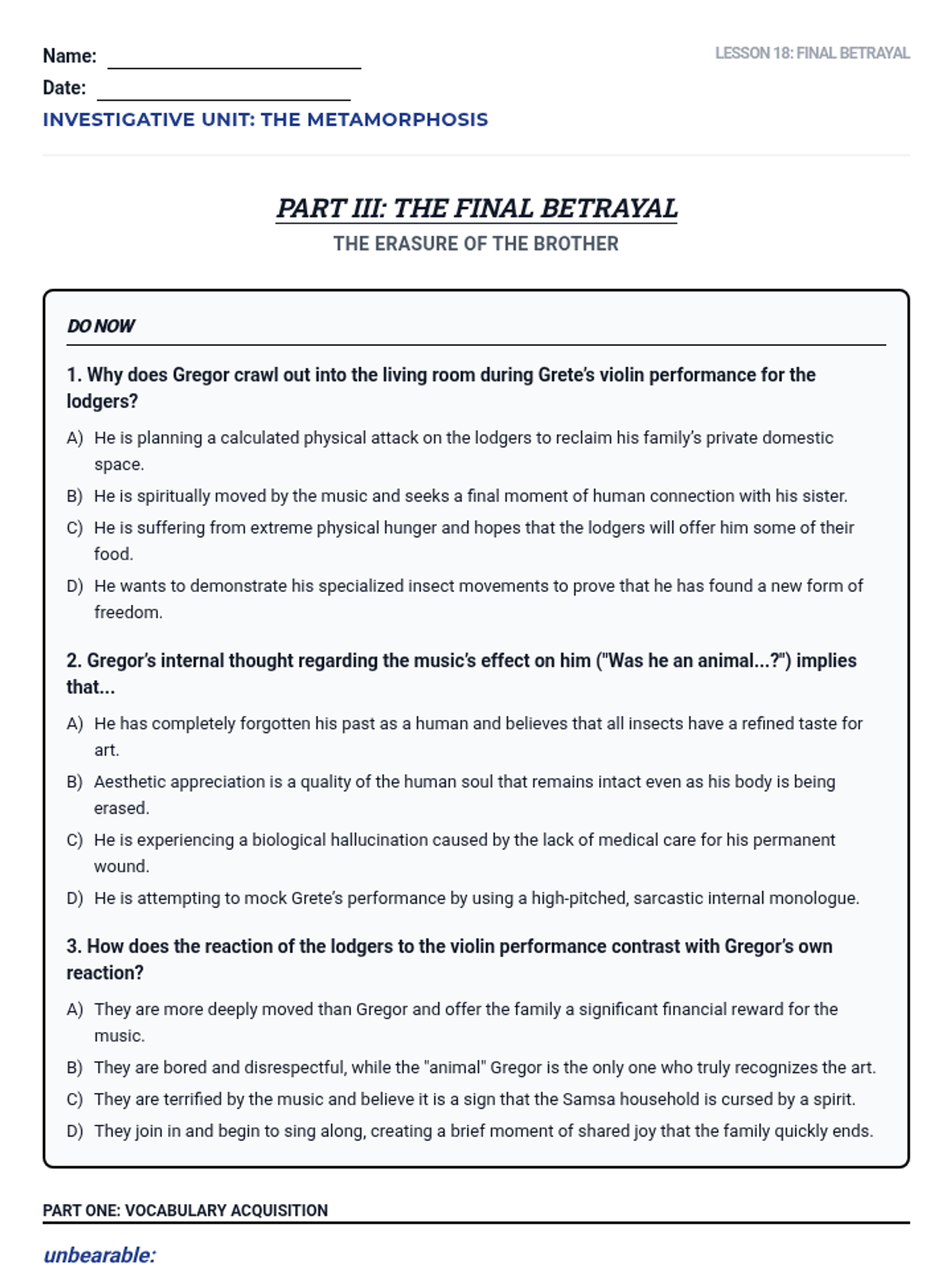
A middle-grade worksheet for Lesson 18 focusing on Grete's formal rejection of Gregor. Updated with definition lines in Part 1 and a comprehensive RACE checklist with 10 lines for the Exit Ticket. Time markers removed. Fixed checklist formatting and layout. Includes high-quality analytical distractors for the Do Now.
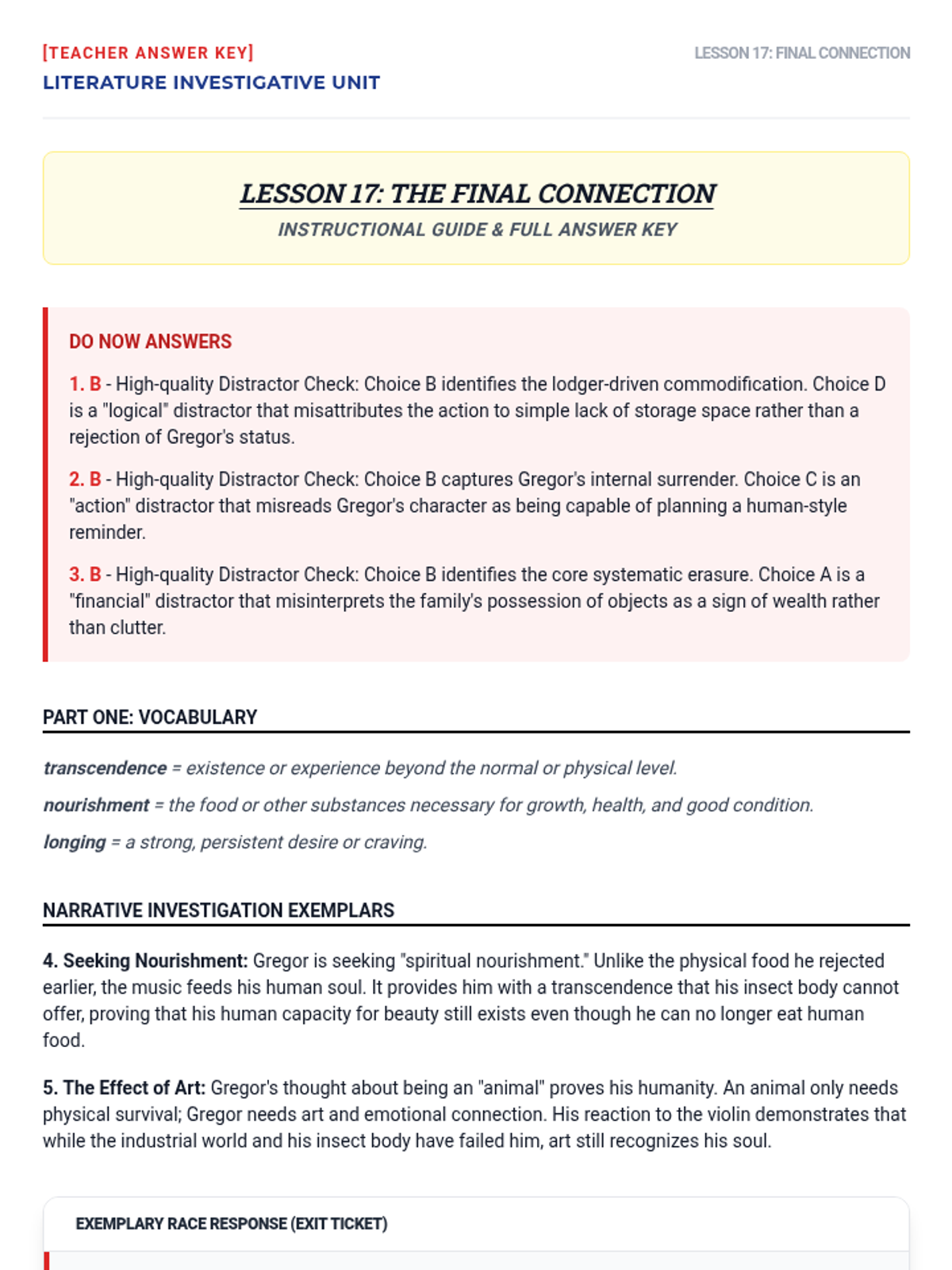
A comprehensive teacher answer key for Lesson 17. Includes exemplar responses, thematic synthesis (STAMP), and instructional push questions for middle grade students. Removed branding. Updated with specific Bernofsky page references.
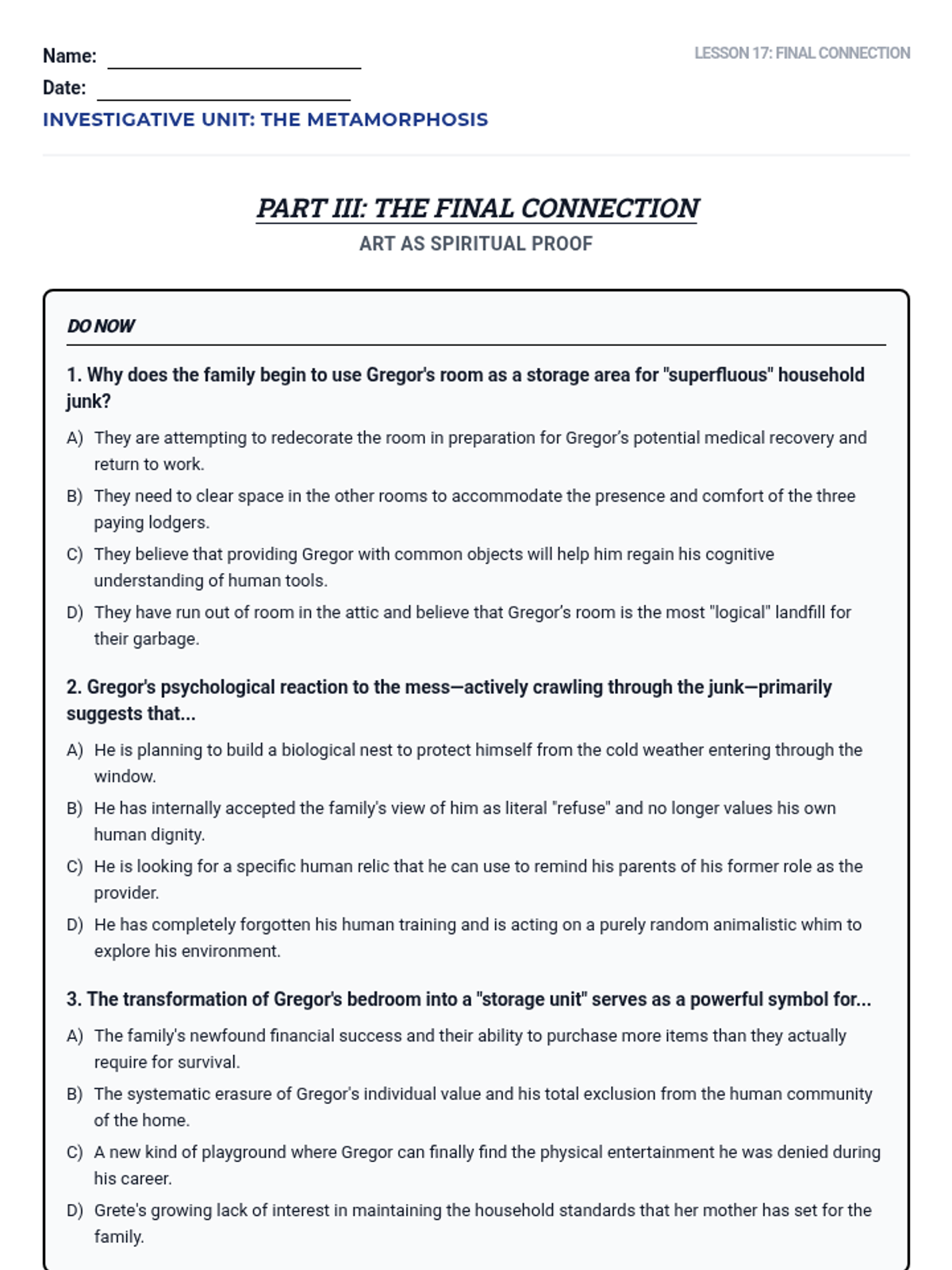
A middle-grade worksheet for Lesson 17 focusing on Grete's violin performance. Updated with definition lines in Part 1 and a comprehensive RACE checklist with 10 lines for the Exit Ticket. Time markers removed. Fixed checklist formatting and layout. Includes homogenous, high-quality analytical MC distractors.
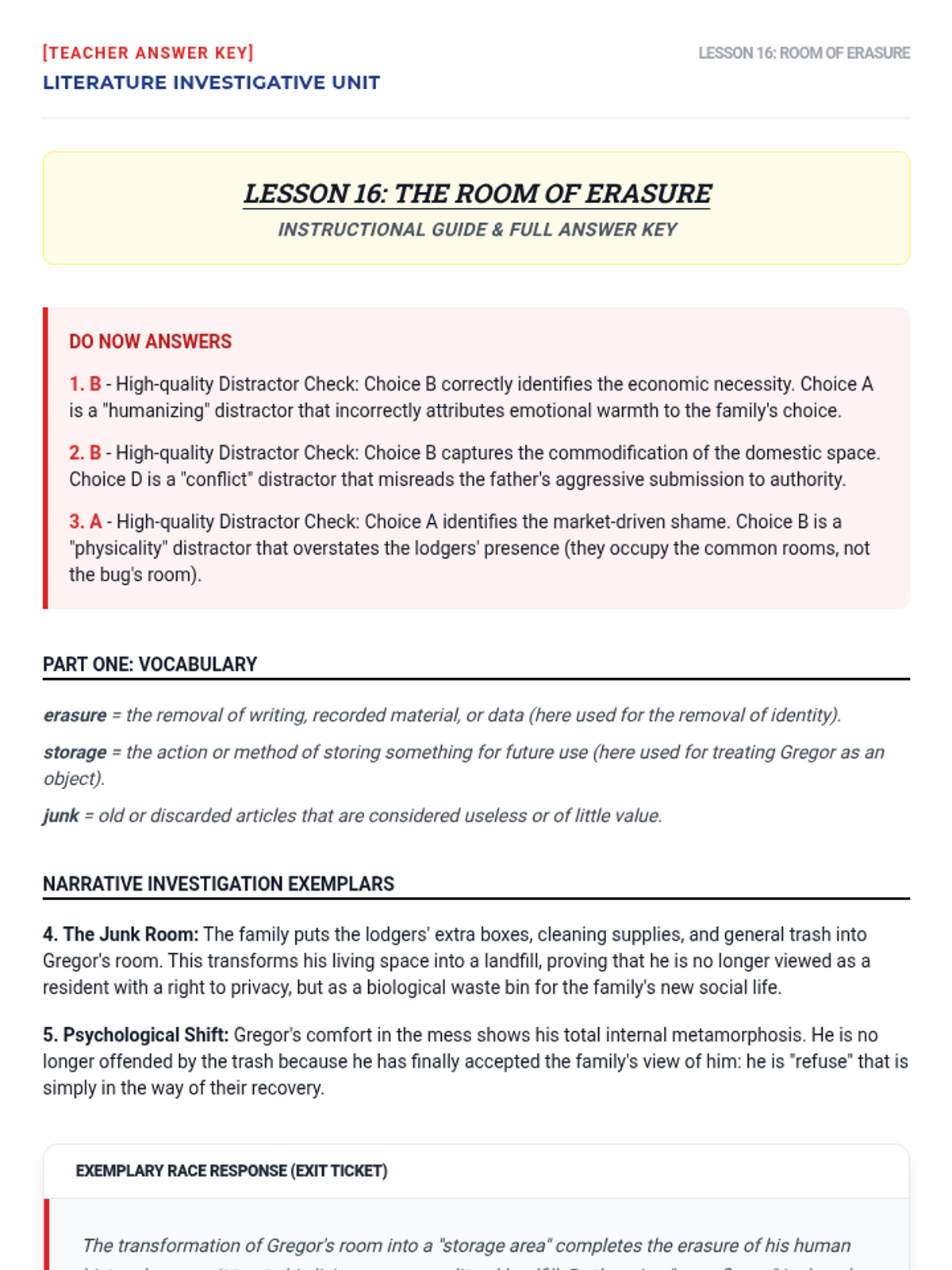
A comprehensive teacher answer key for Lesson 16. Includes exemplar responses, thematic synthesis (STAMP), and instructional push questions for middle grade students. Removed branding. Updated with specific Bernofsky page references.
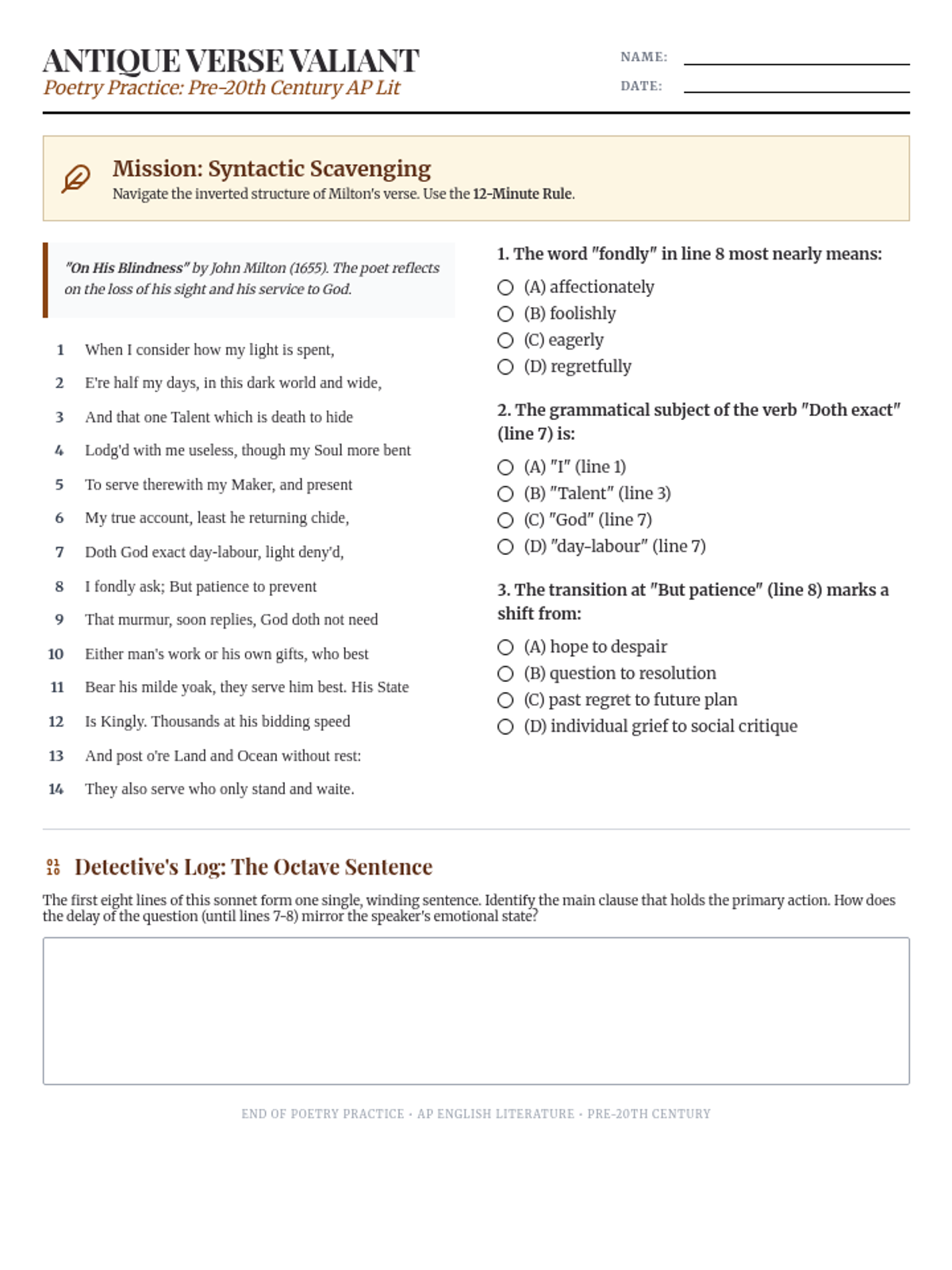
A student practice worksheet featuring John Milton's 'On His Blindness' with strategy-specific multiple-choice questions (4-choice format) and a space for syntactic analysis of the octave.
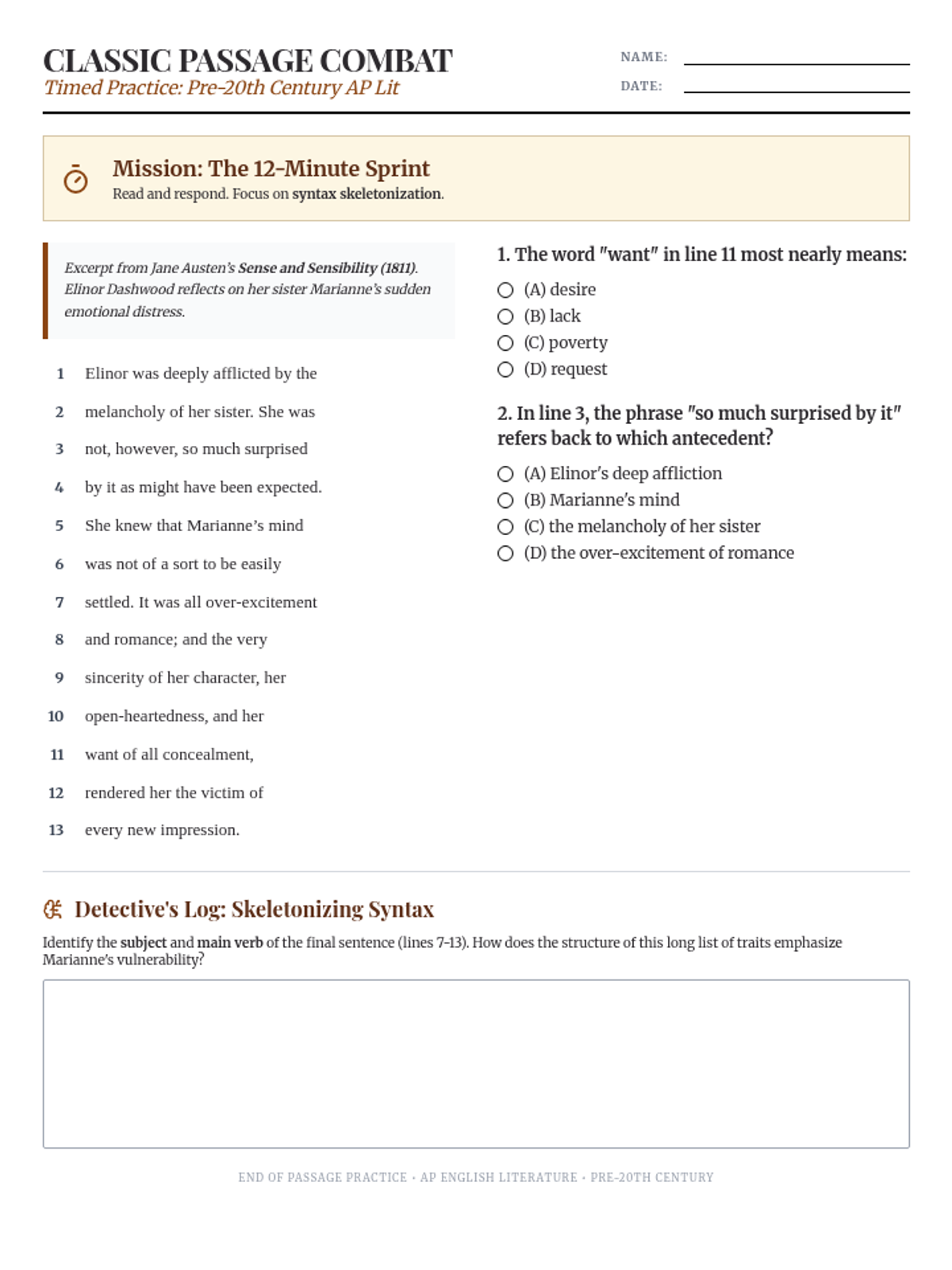
A student practice worksheet featuring a pre-20th century literary excerpt (Austen) with strategy-specific multiple-choice questions (4-choice format) and a space for syntactic analysis.
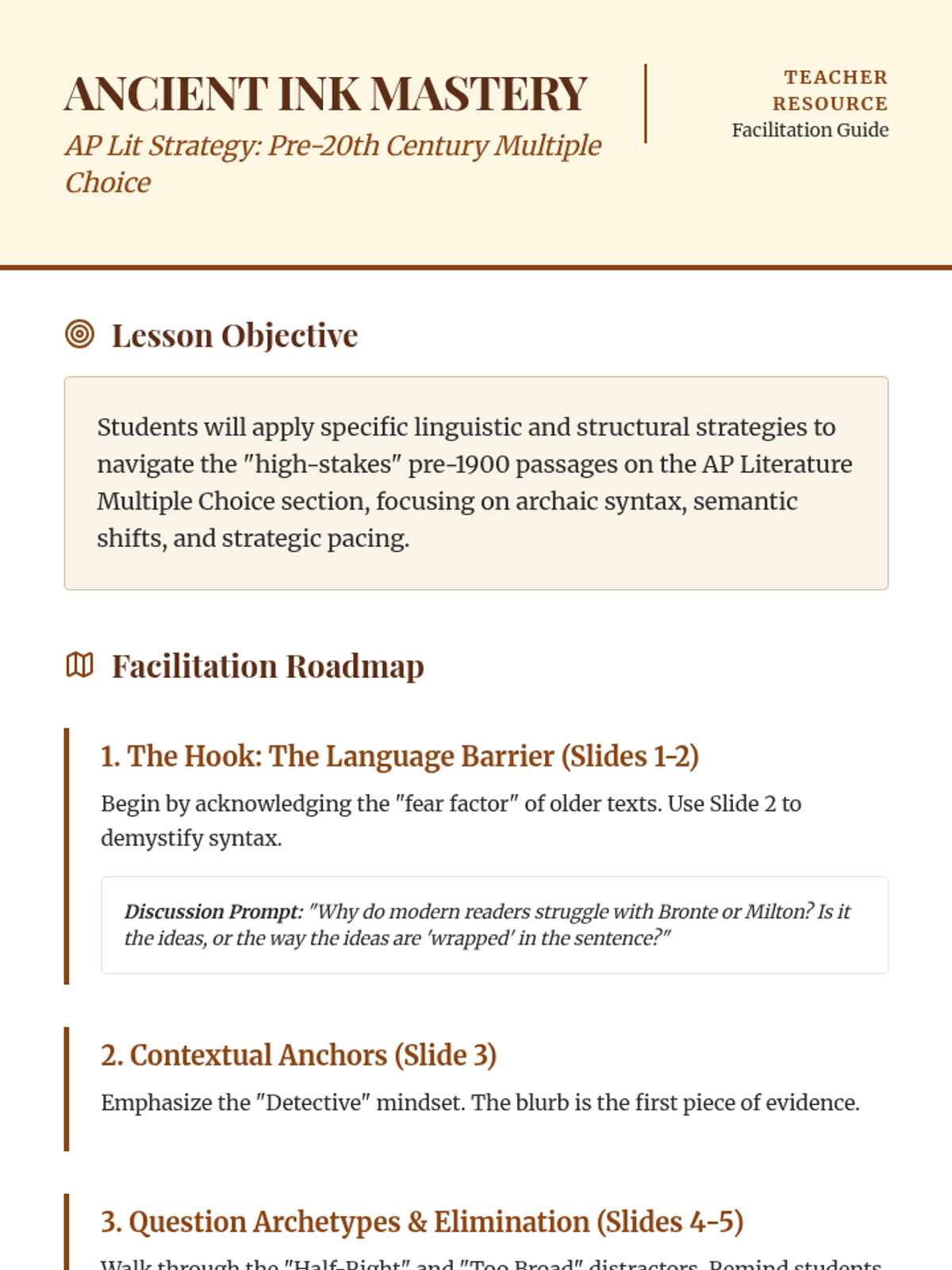
A teacher facilitation guide providing instructional steps, discussion prompts, and strategy-specific tips for teaching pre-20th century multiple-choice strategies. Updated to include both prose and poetry practice.
A seven-slide presentation designed for AP English Literature students, providing specific strategies for navigating pre-20th century multiple-choice passages. Revised for better contrast and updated for the 4-choice question format.
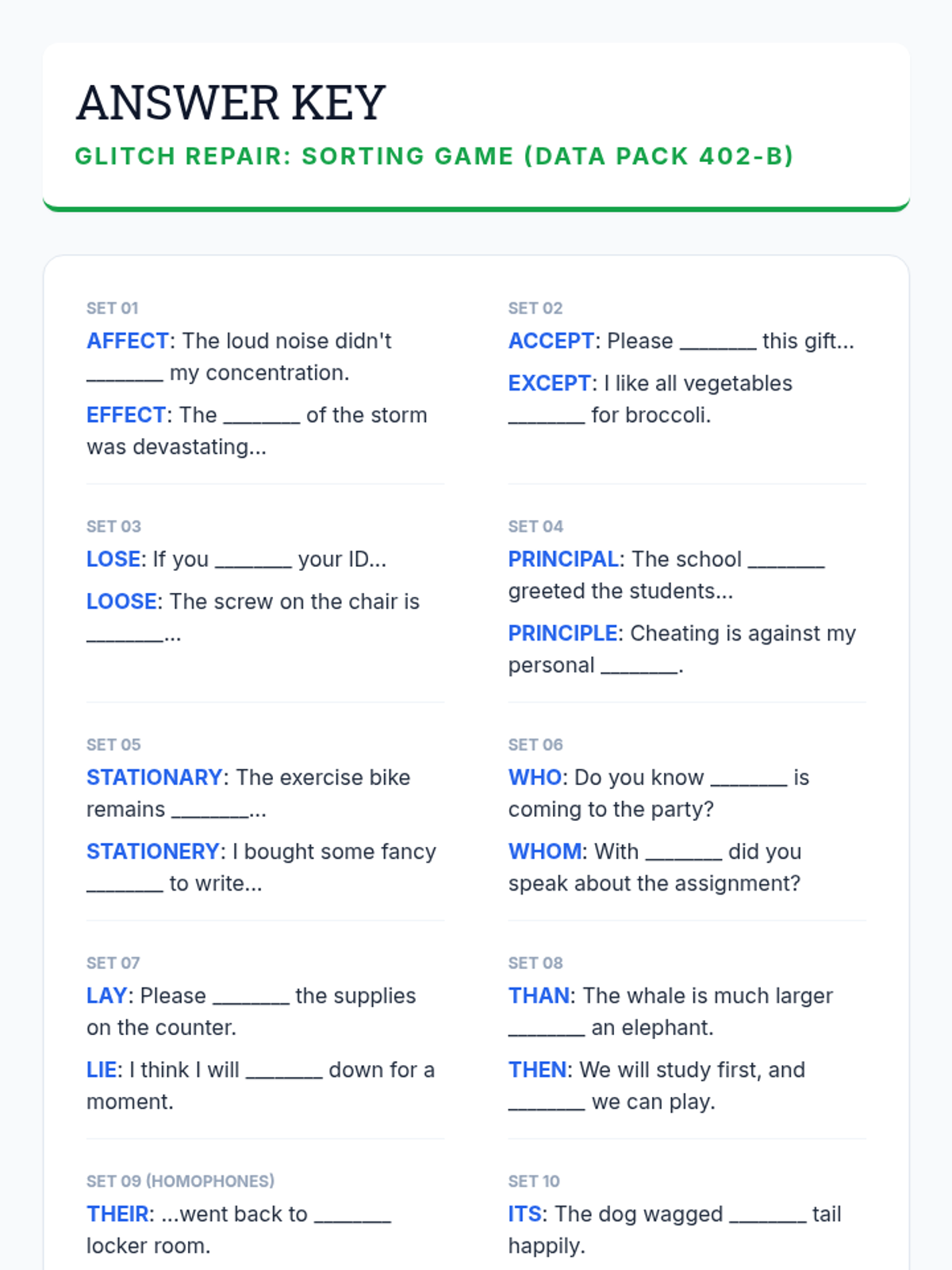
A teacher's answer key for the Glitch Repair sorting game, providing the correct matches for all word and sentence cards to facilitate quick grading and feedback.
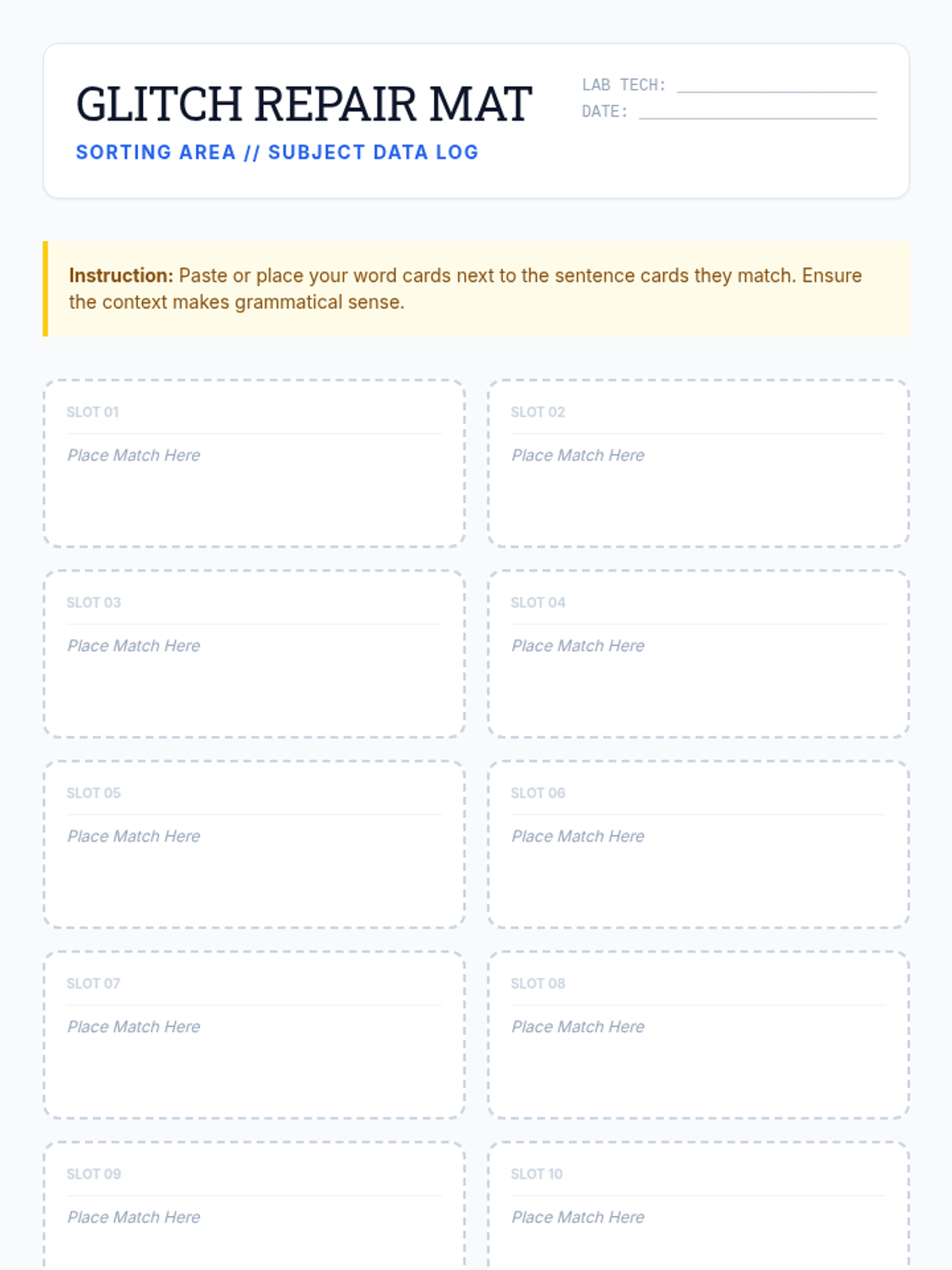
A printable sorting mat for the Glitch Repair game, providing students with a structured workspace to organize and match word and sentence cards.
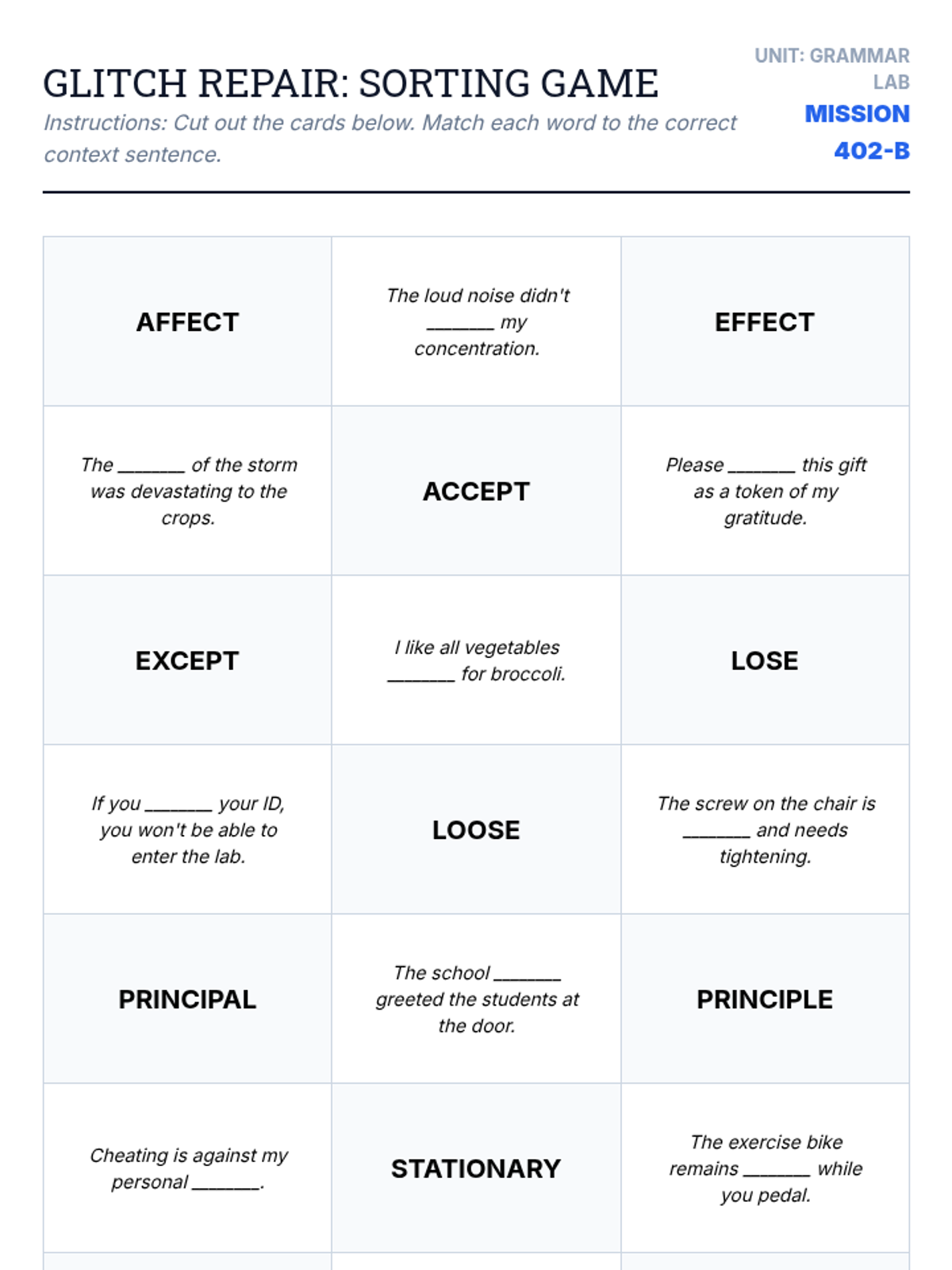
A set of 24 printable cards featuring words and context sentences for a sorting game. Students must match the correct commonly confused word with the sentence that fits its definition.
A visually striking slideshow designed for direct instruction on 12 pairs of commonly confused words. Includes memory triggers, definitions, visual hints, and interactive practice sentences for each word group.
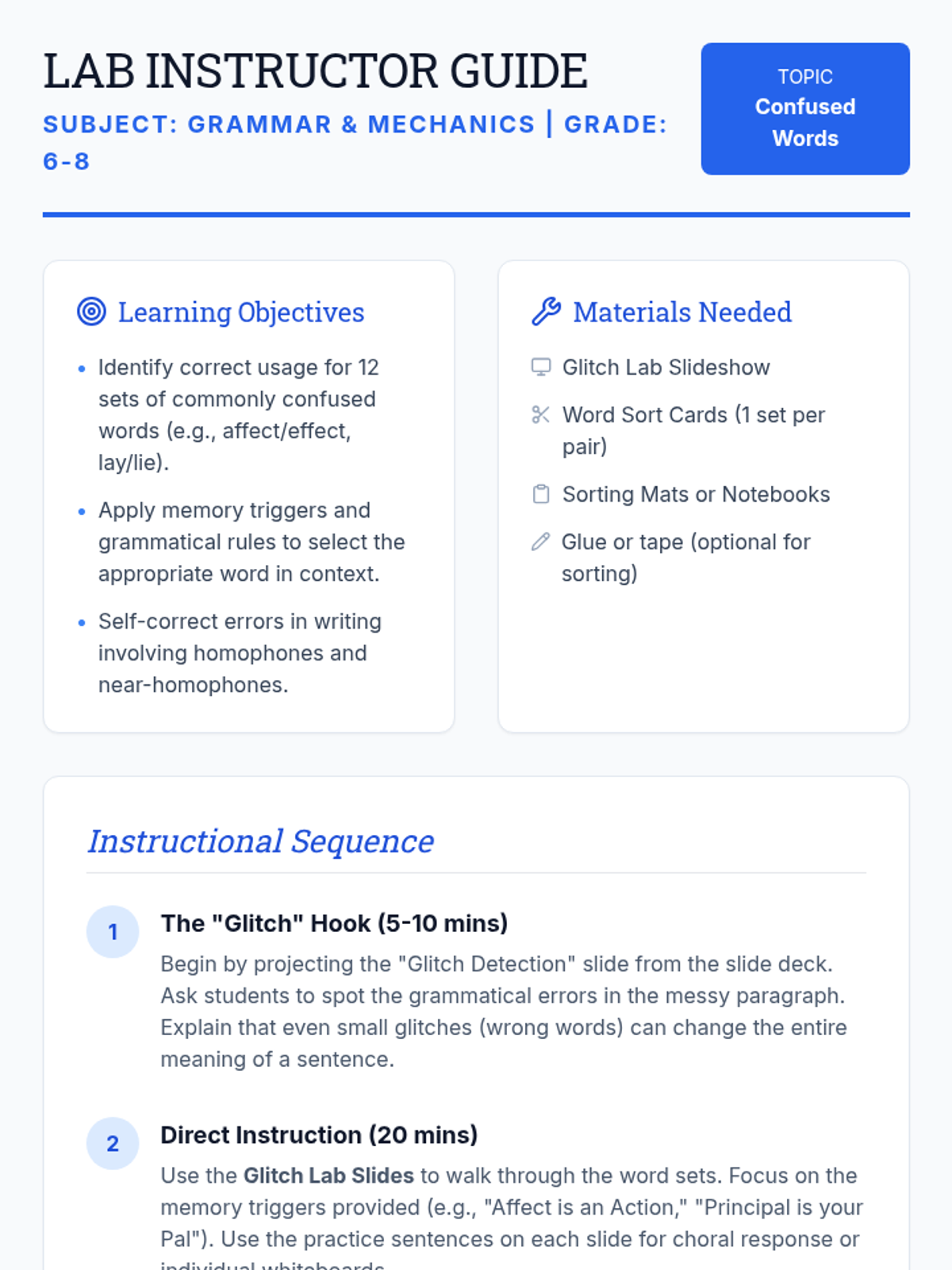
A detailed teacher's guide for the Grammar Lab lesson, including learning objectives, a list of required materials, a step-by-step instructional sequence, and practical teaching tips for middle school classrooms.
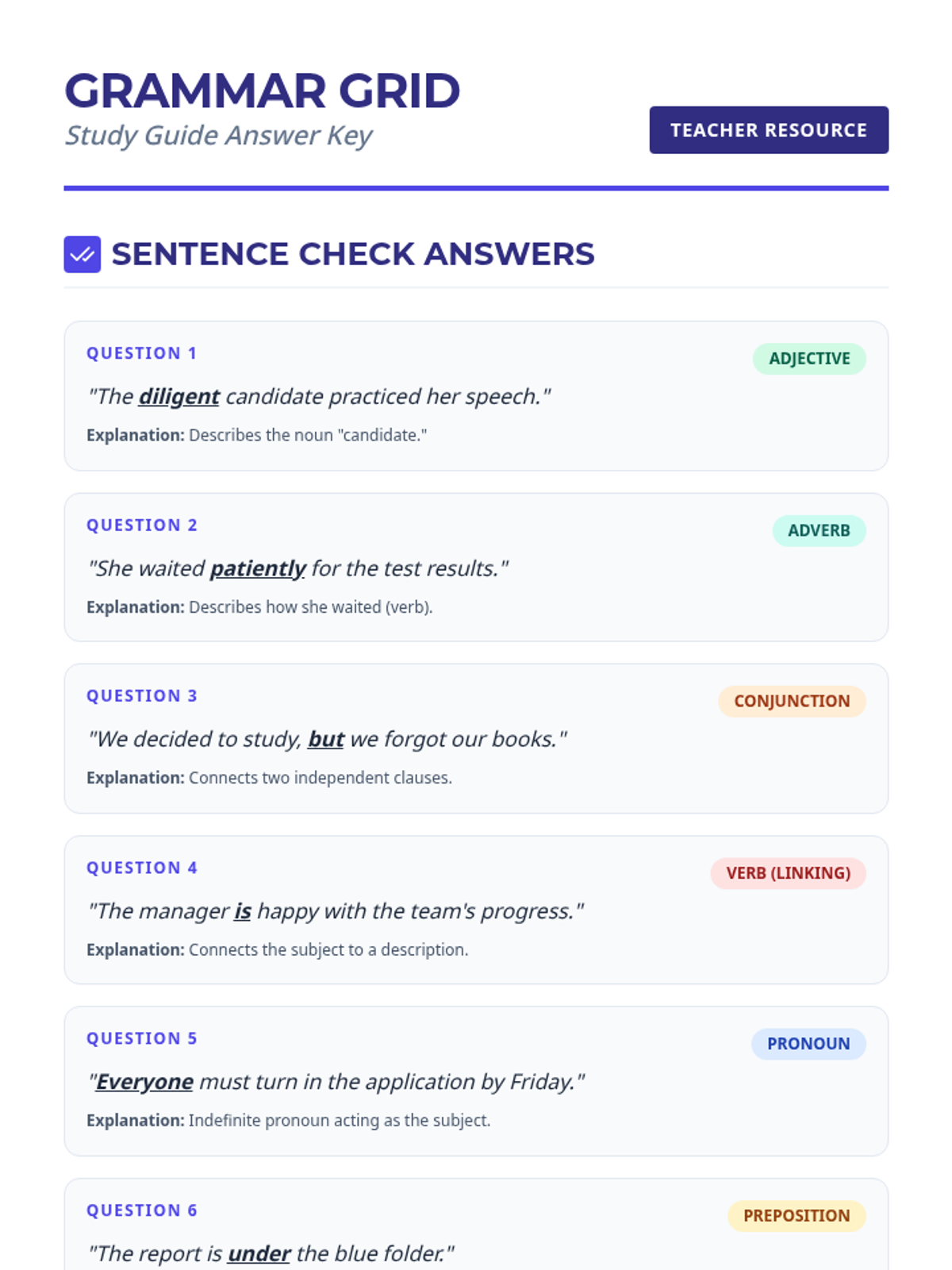
A detailed answer key for the Grammar Grid Study Guide, providing the correct parts of speech and pedagogical explanations for each practice question.
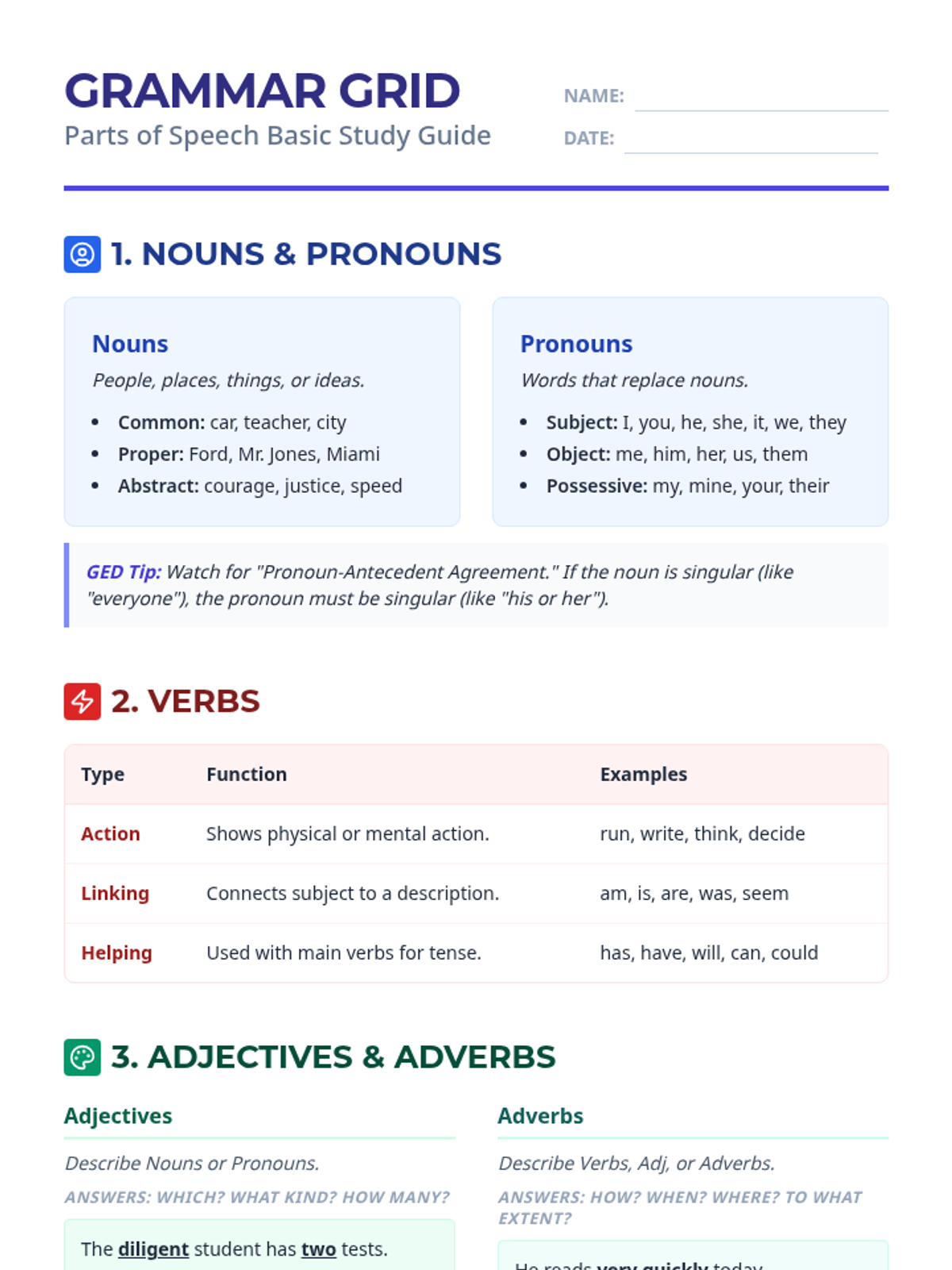
A comprehensive printable study guide covering the eight parts of speech with definitions, examples, and GED-specific grammar tips. Includes a practice section for identifying parts of speech in context.
A visual presentation introducing the eight parts of speech with specific focus on how they apply to the GED Reasoning Through Language Arts exam. Includes definitions, examples, and contextual usage tips.
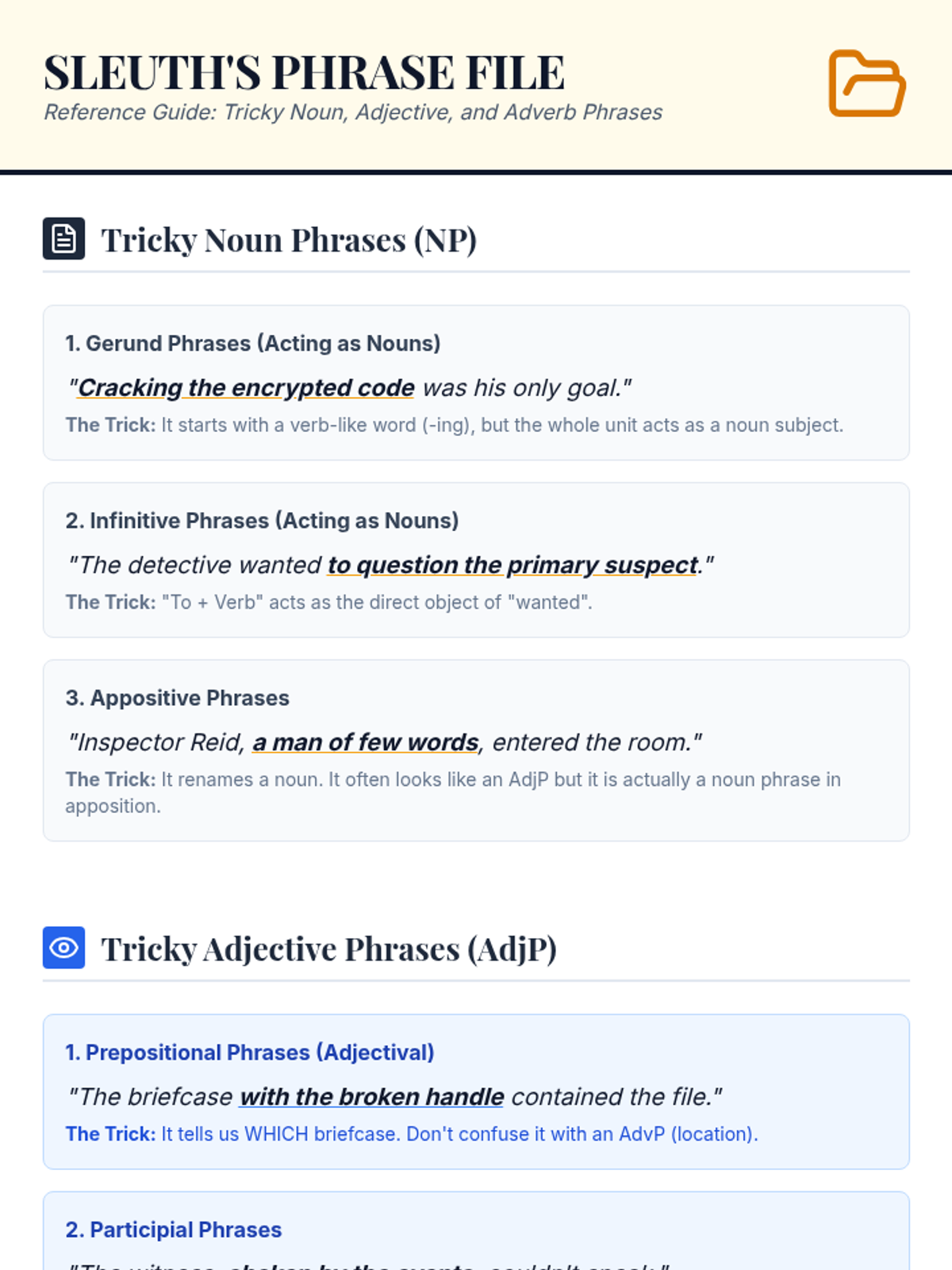
A comprehensive reference guide for teachers and students featuring categorized "tricky" phrase examples and explanations.
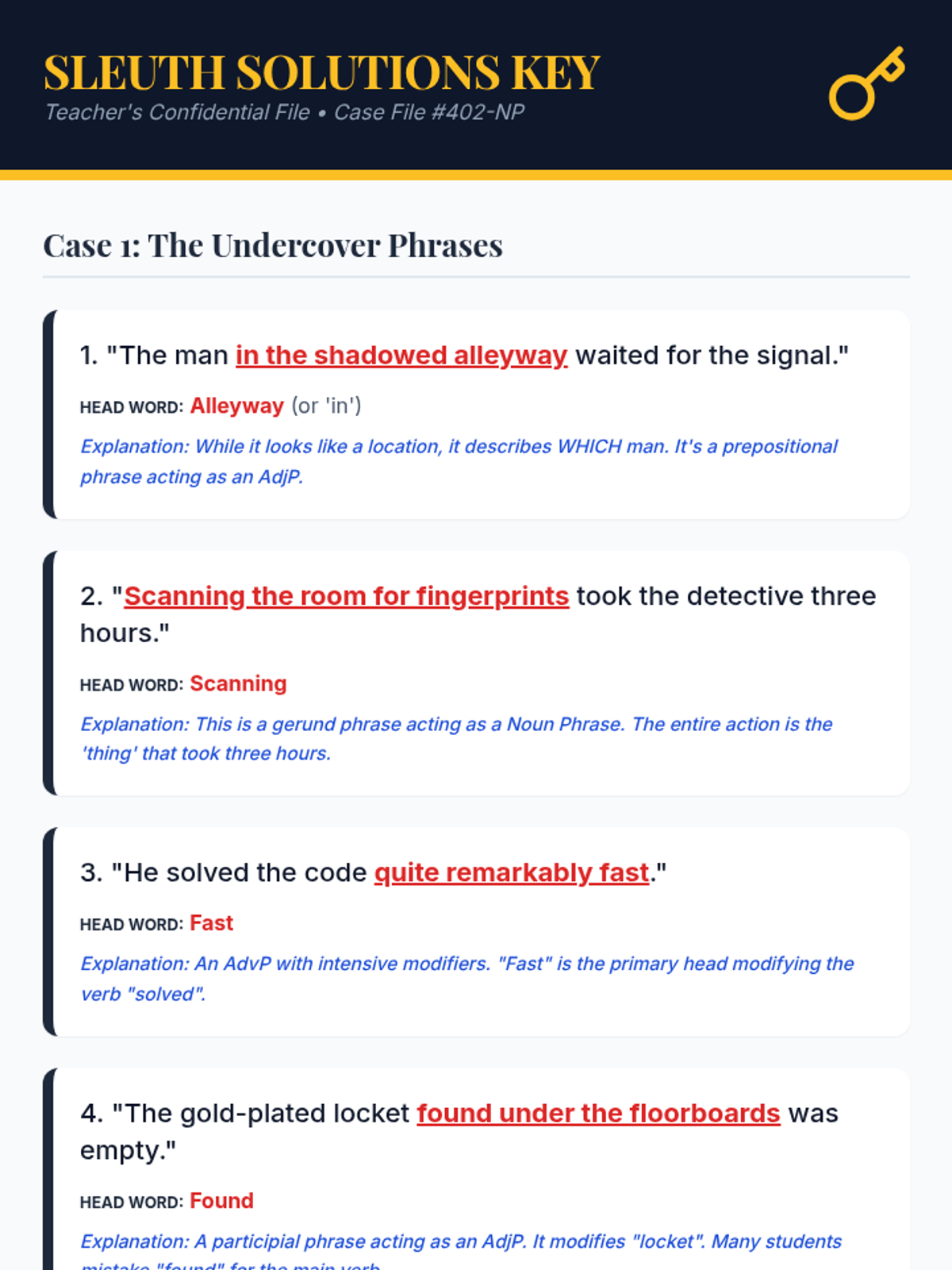
Answer key for the Syntax Sabotage Worksheet with detailed explanations of why specific questions were 'tricky'.
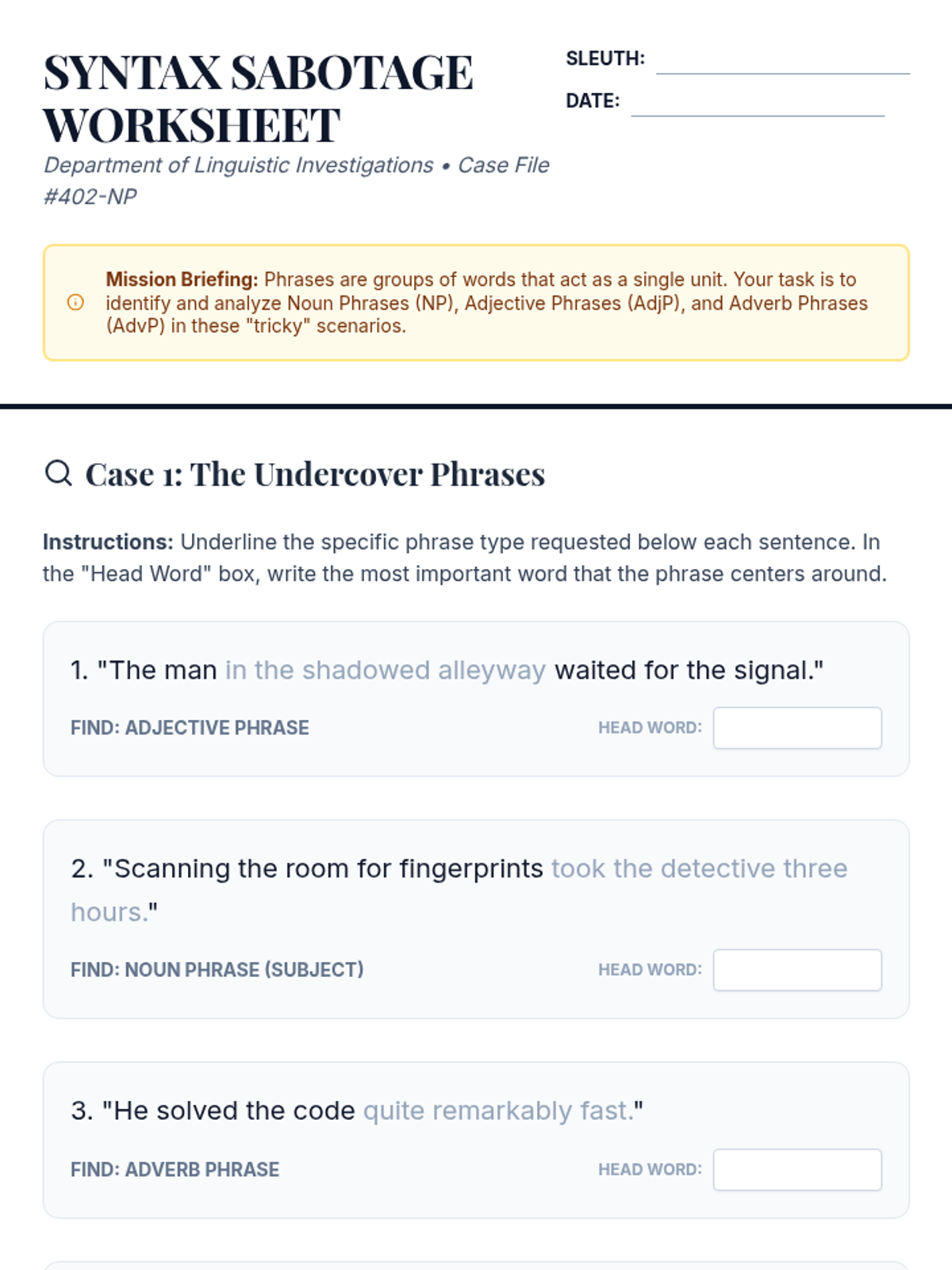
A detective-themed worksheet with "tricky" phrase identification, ambiguity analysis, and sentence construction tasks.
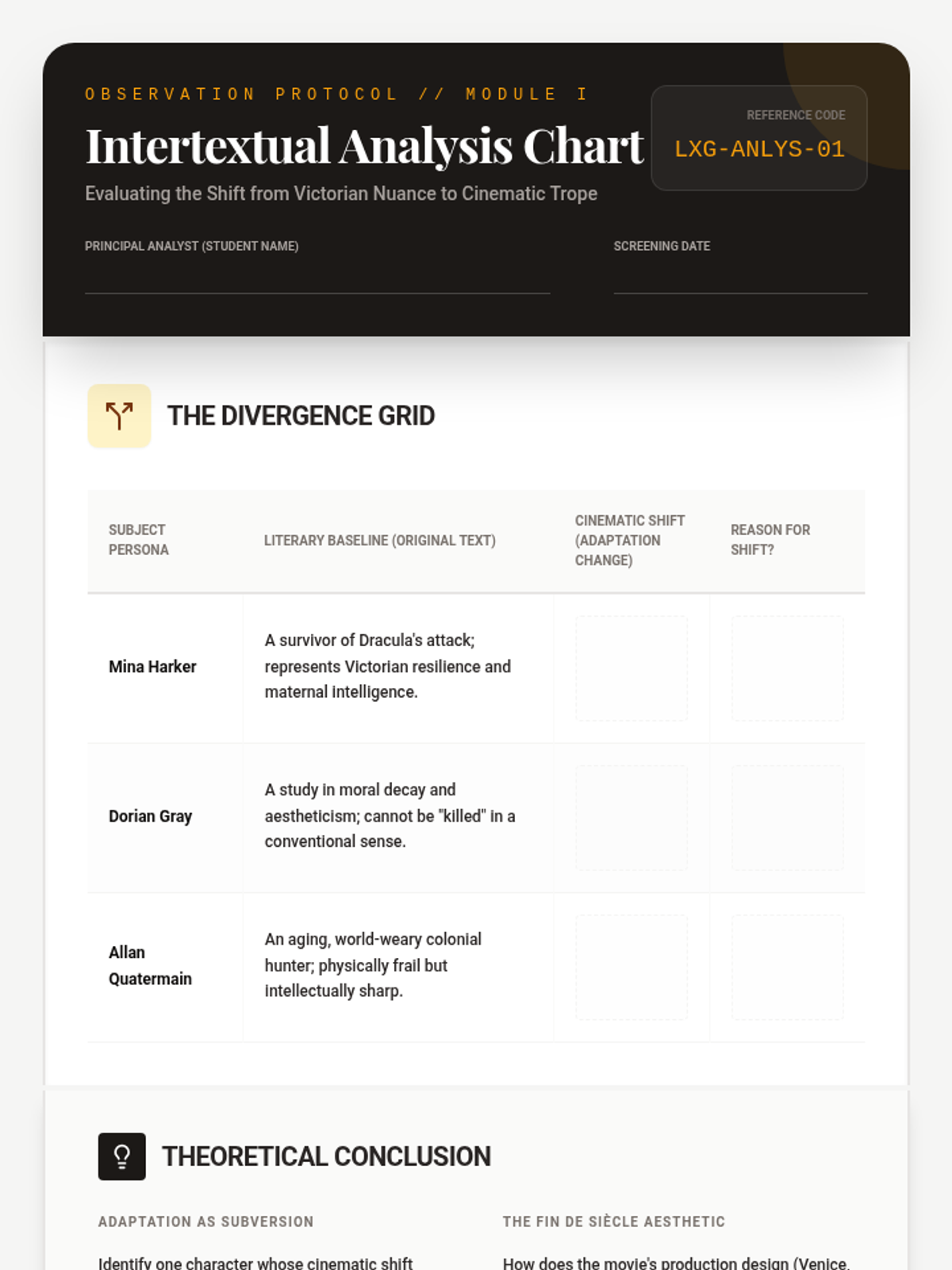
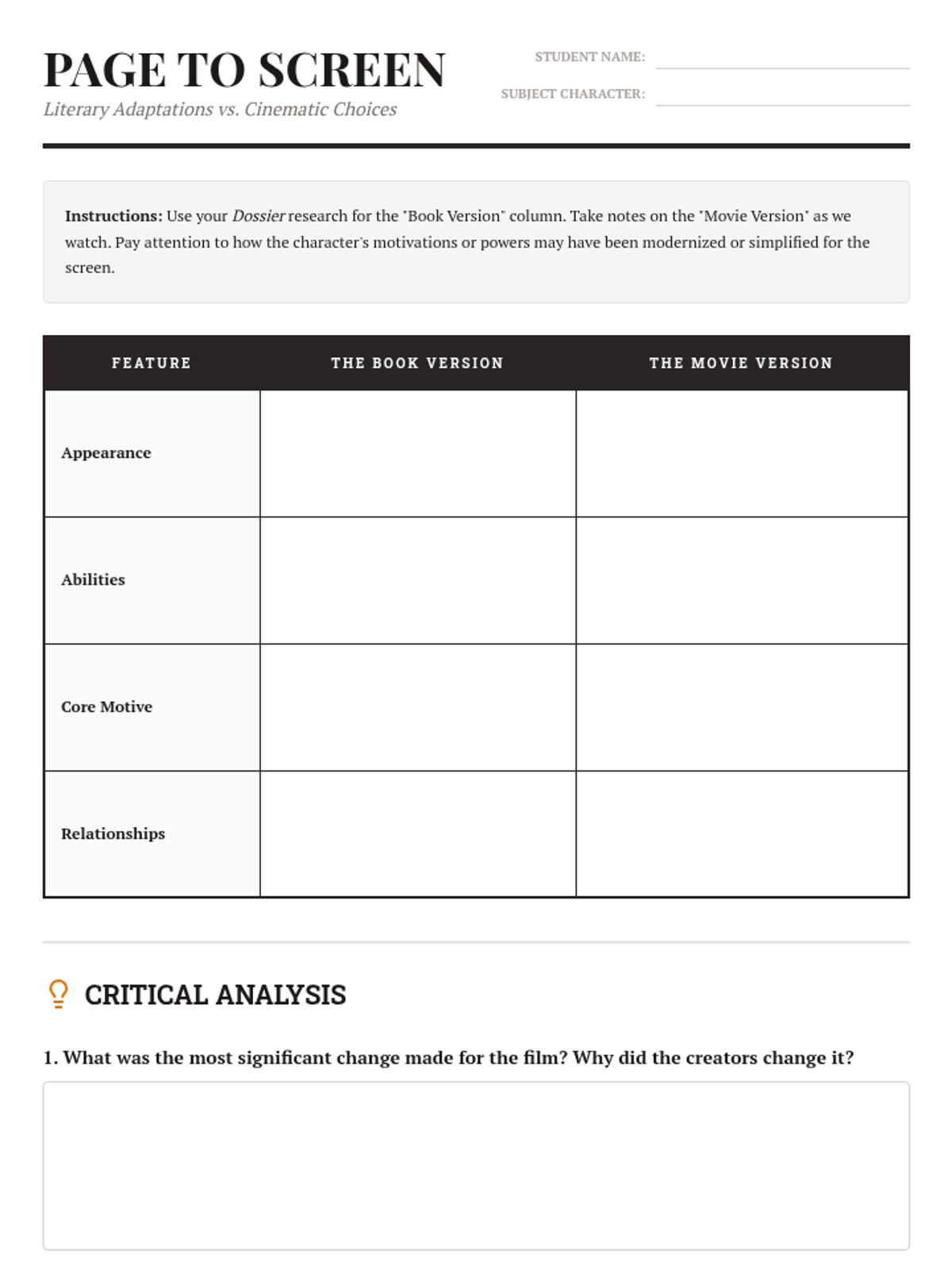
A comparison chart for students to record differences between the original literary version of a character and its cinematic counterpart in the film.
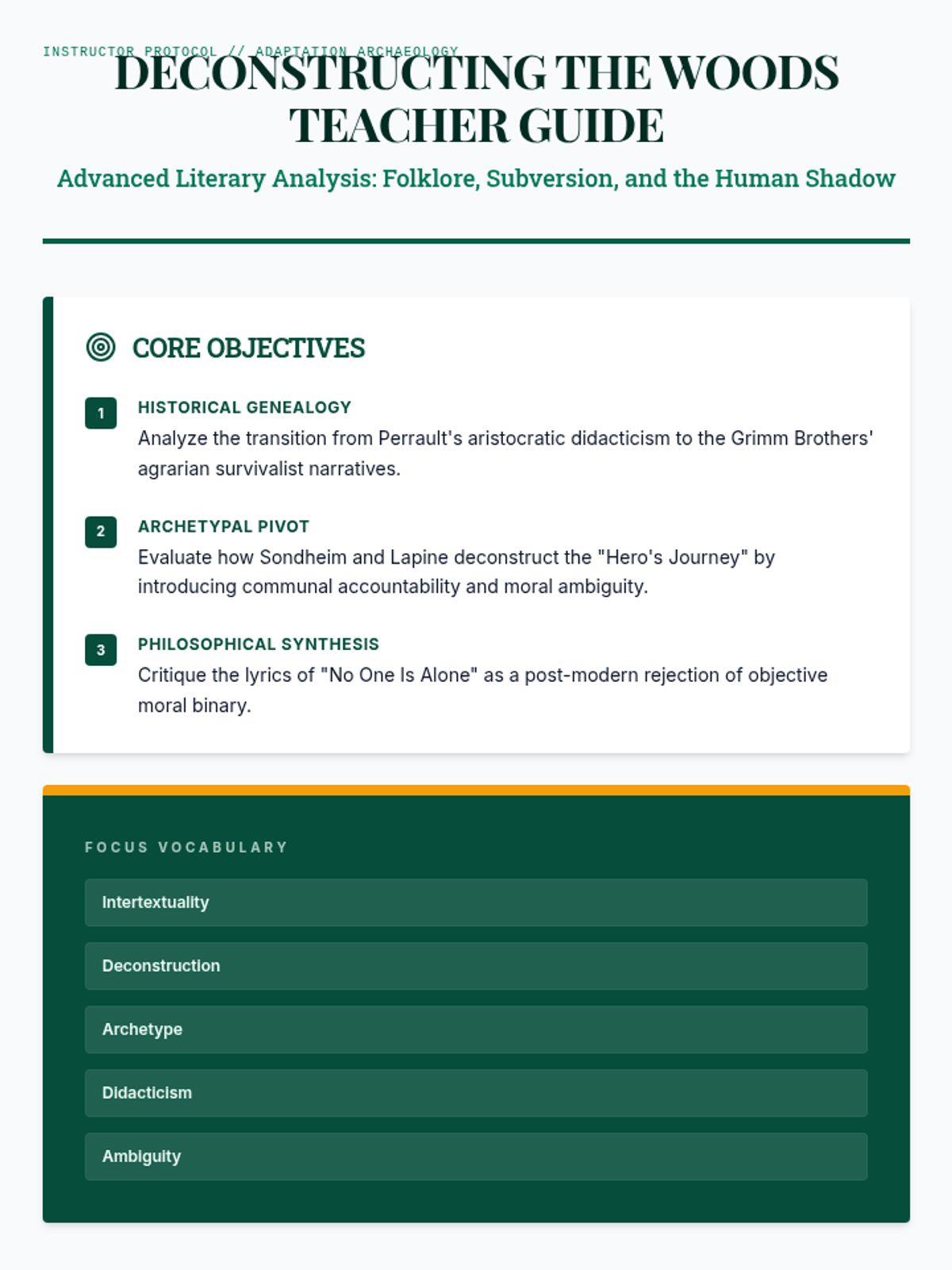
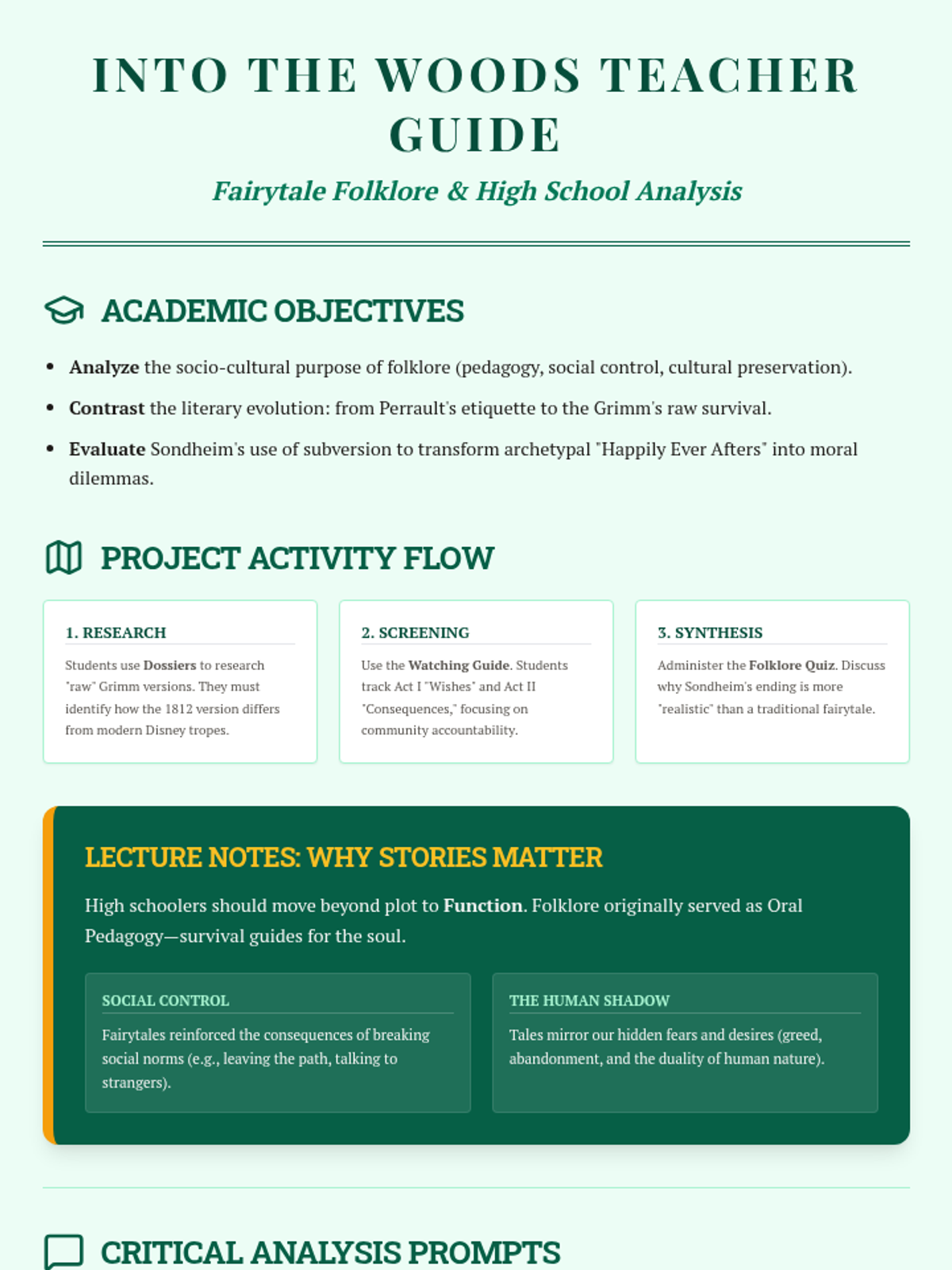
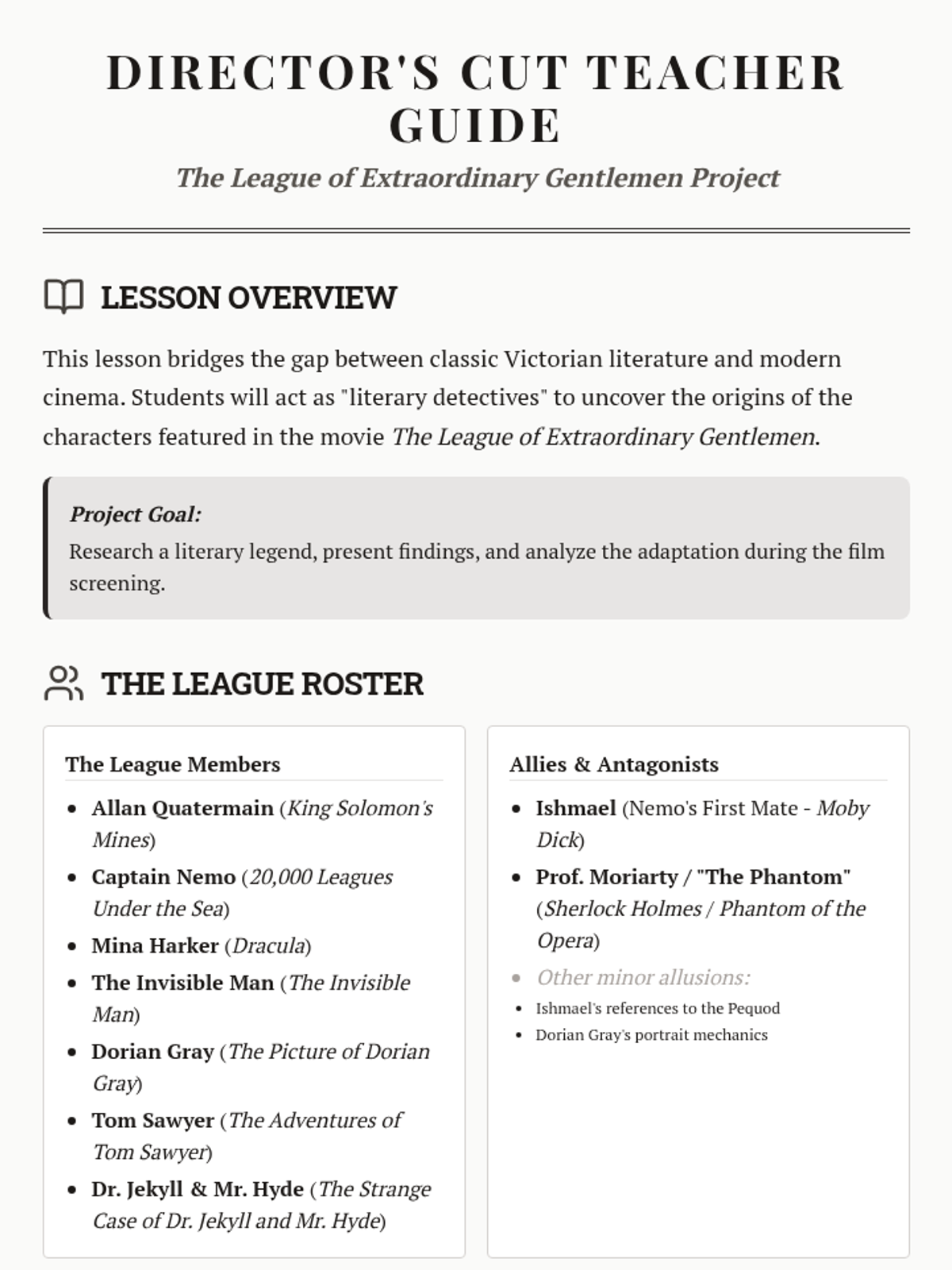
A teacher's facilitation guide for the 'Into the Woods' folklore project, including academic objectives, socratic seminar prompts, and theoretical frameworks for high school analysis.
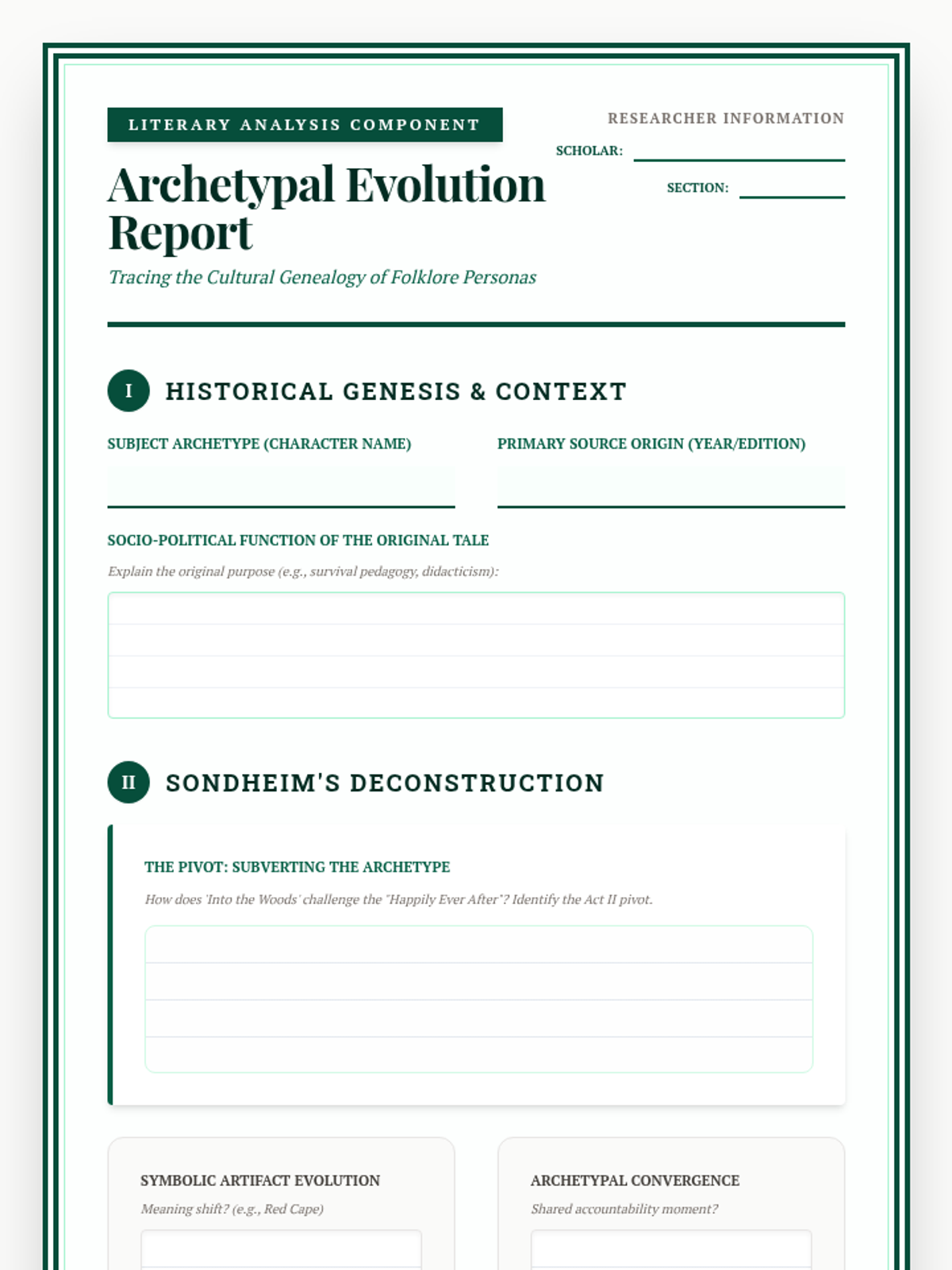
An advanced research report for sophomore students to document the archetypal evolution and cultural genealogy of fairytale characters, focusing on socio-political functions and thematic deconstruction.
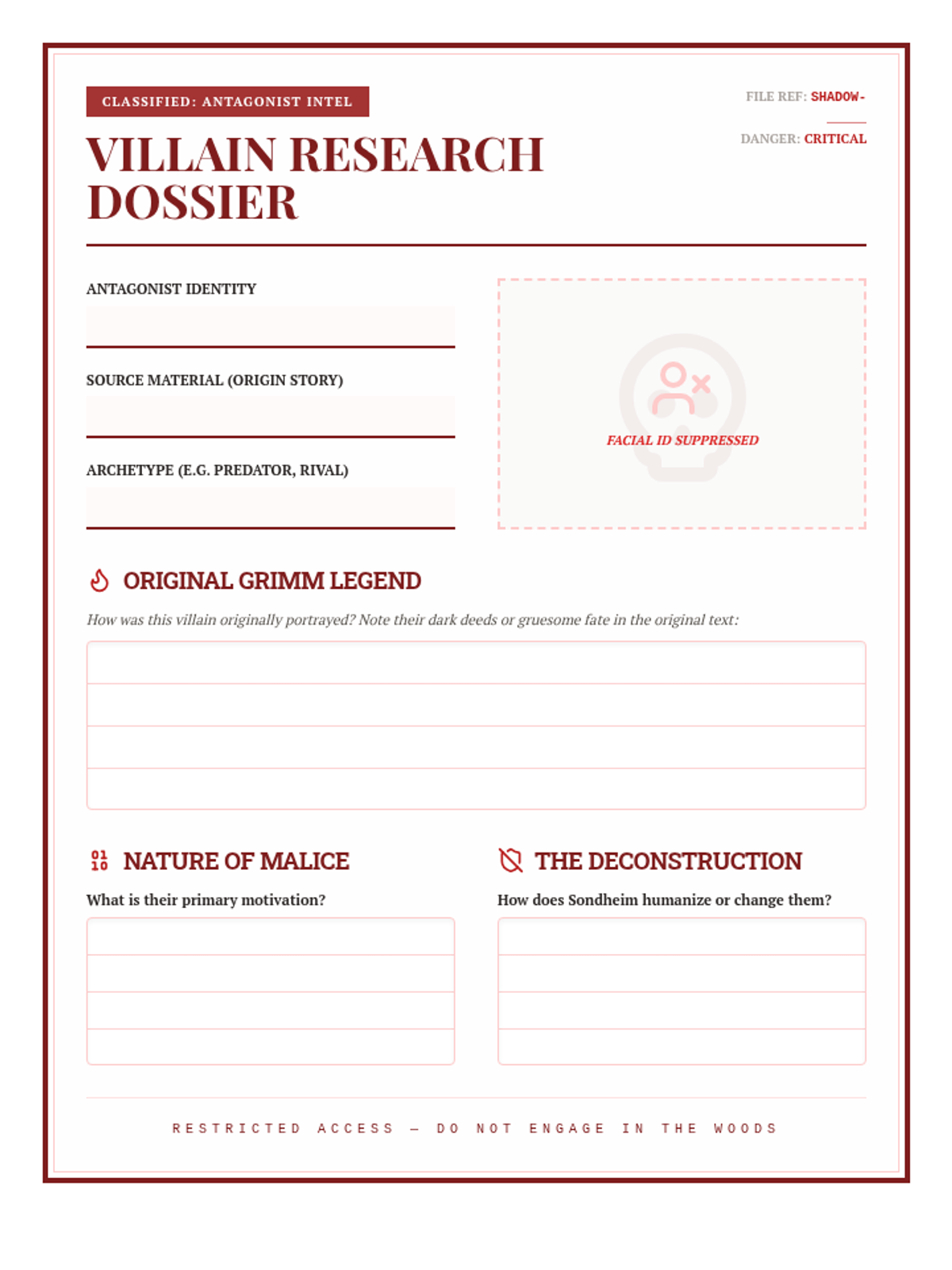
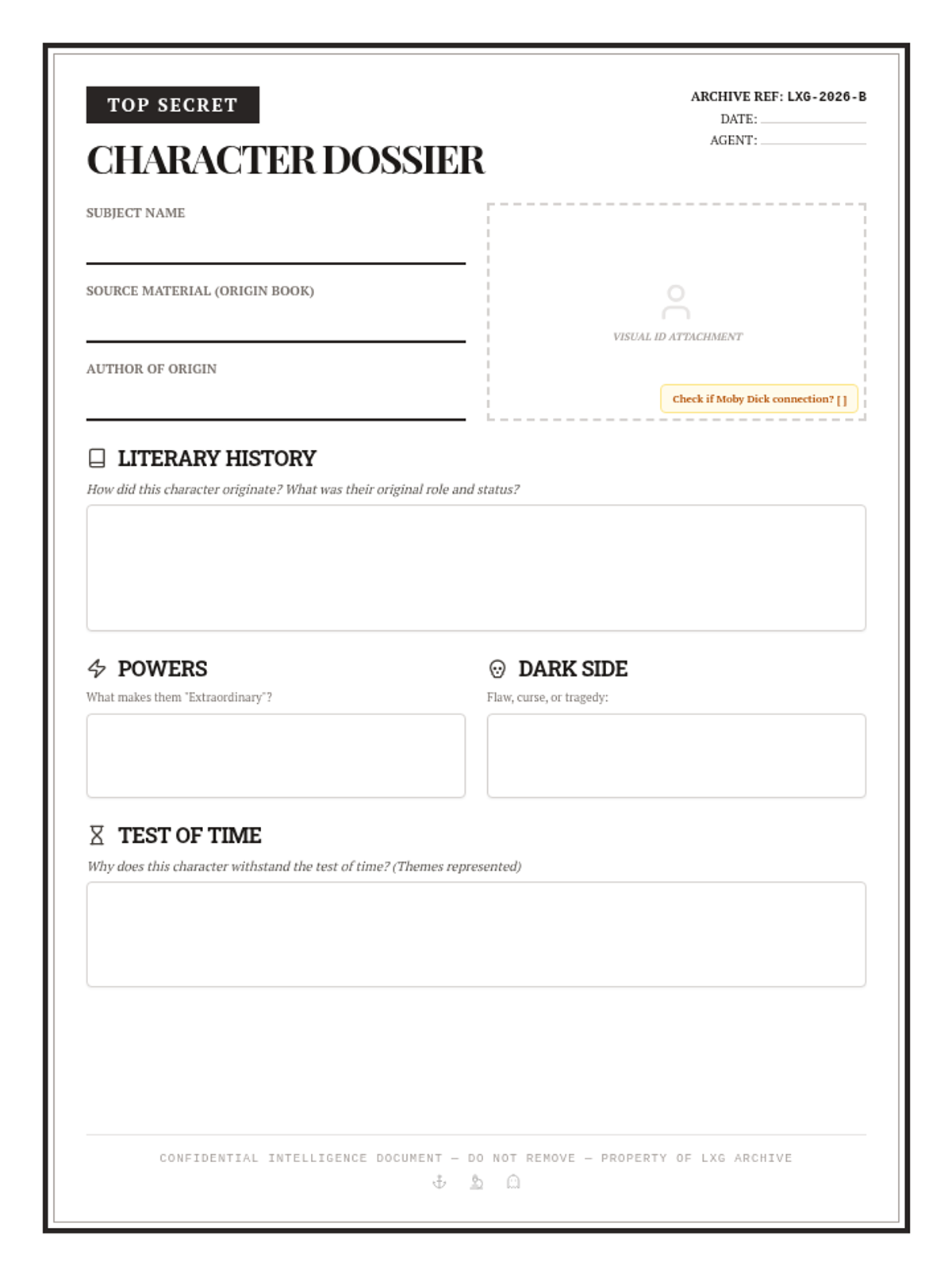
A specialized research dossier focusing on the antagonists and dark roots of fairytale characters in 'Into the Woods'.
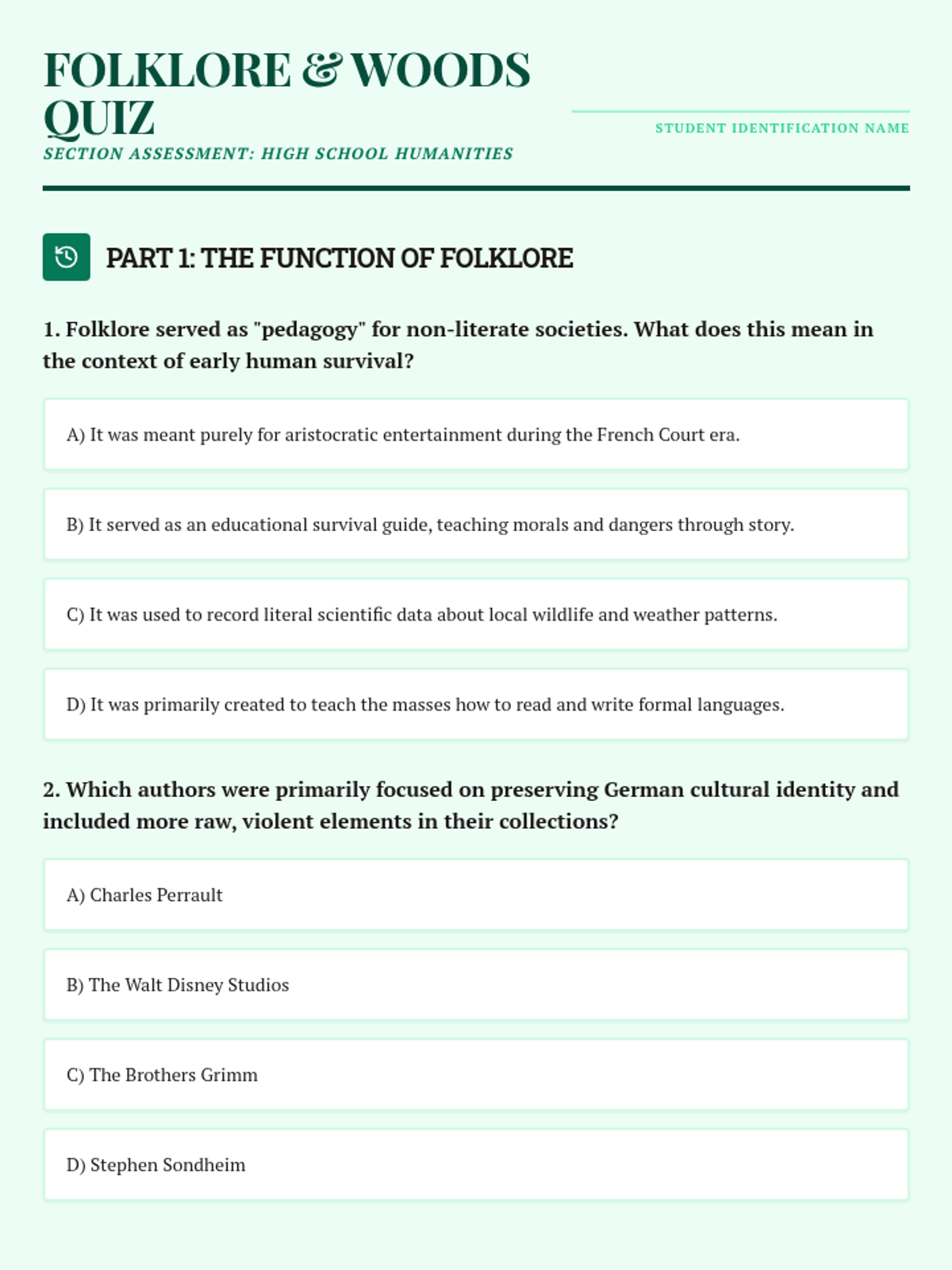
A high-school level quiz covering the purpose of folklore, literary history (Perrault/Grimm), and thematic subversion in 'Into the Woods'.
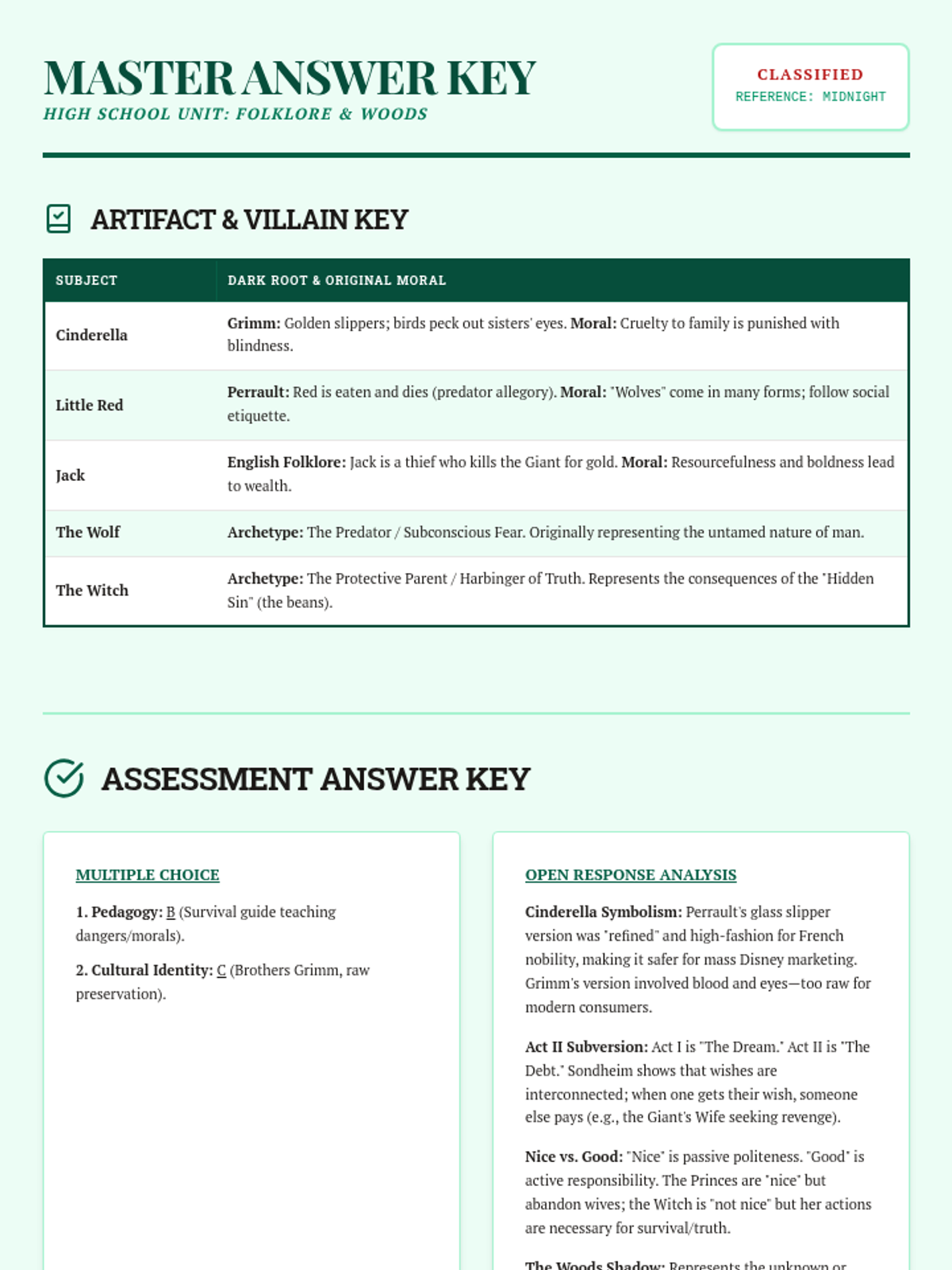
A comprehensive answer key for the high-school folklore unit, including character origins, literary history, and assessment answers.
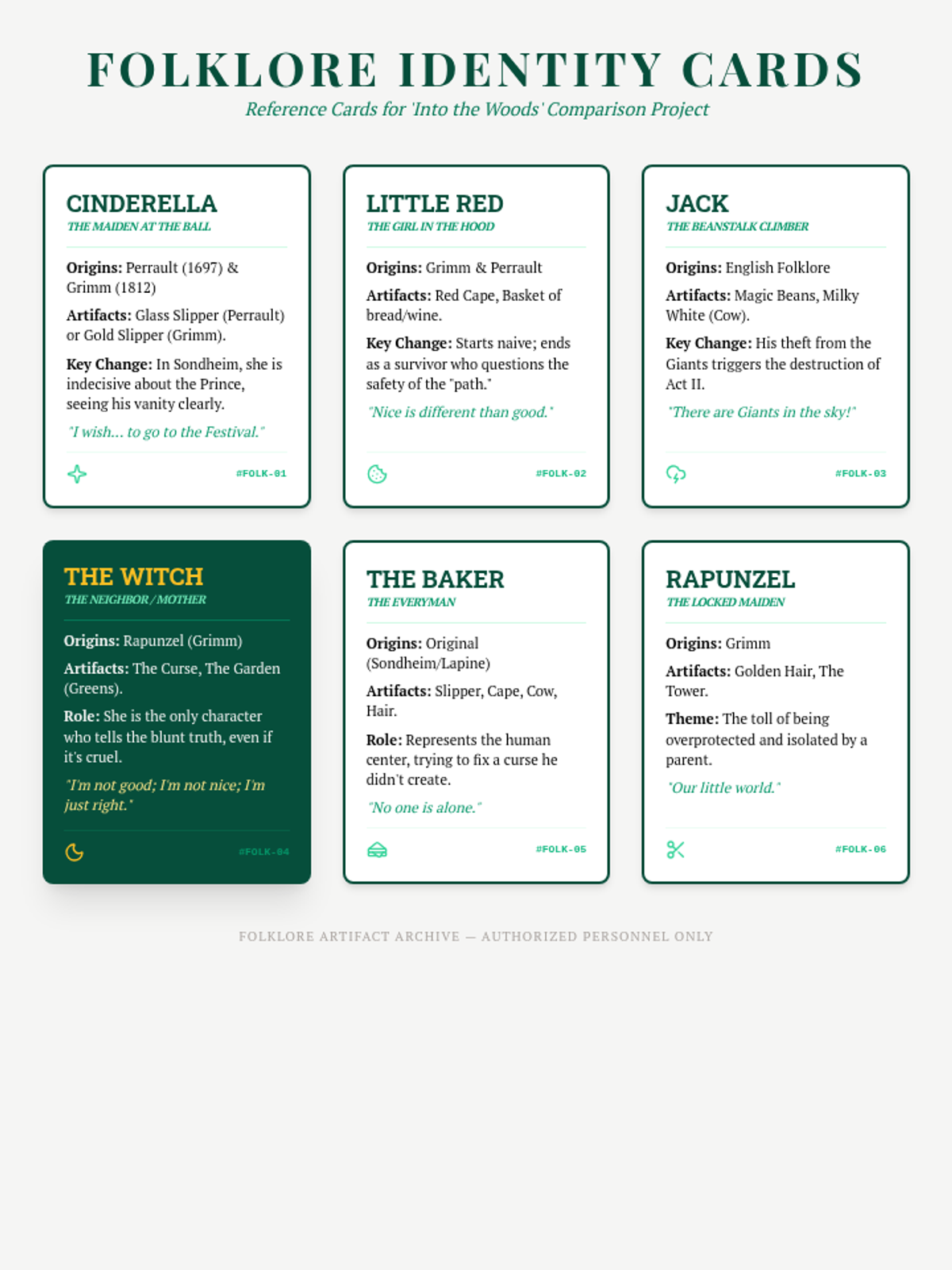
A set of reference cards for 'Into the Woods' characters, including their folklore origins, artifacts, and key changes in the musical adaptation.
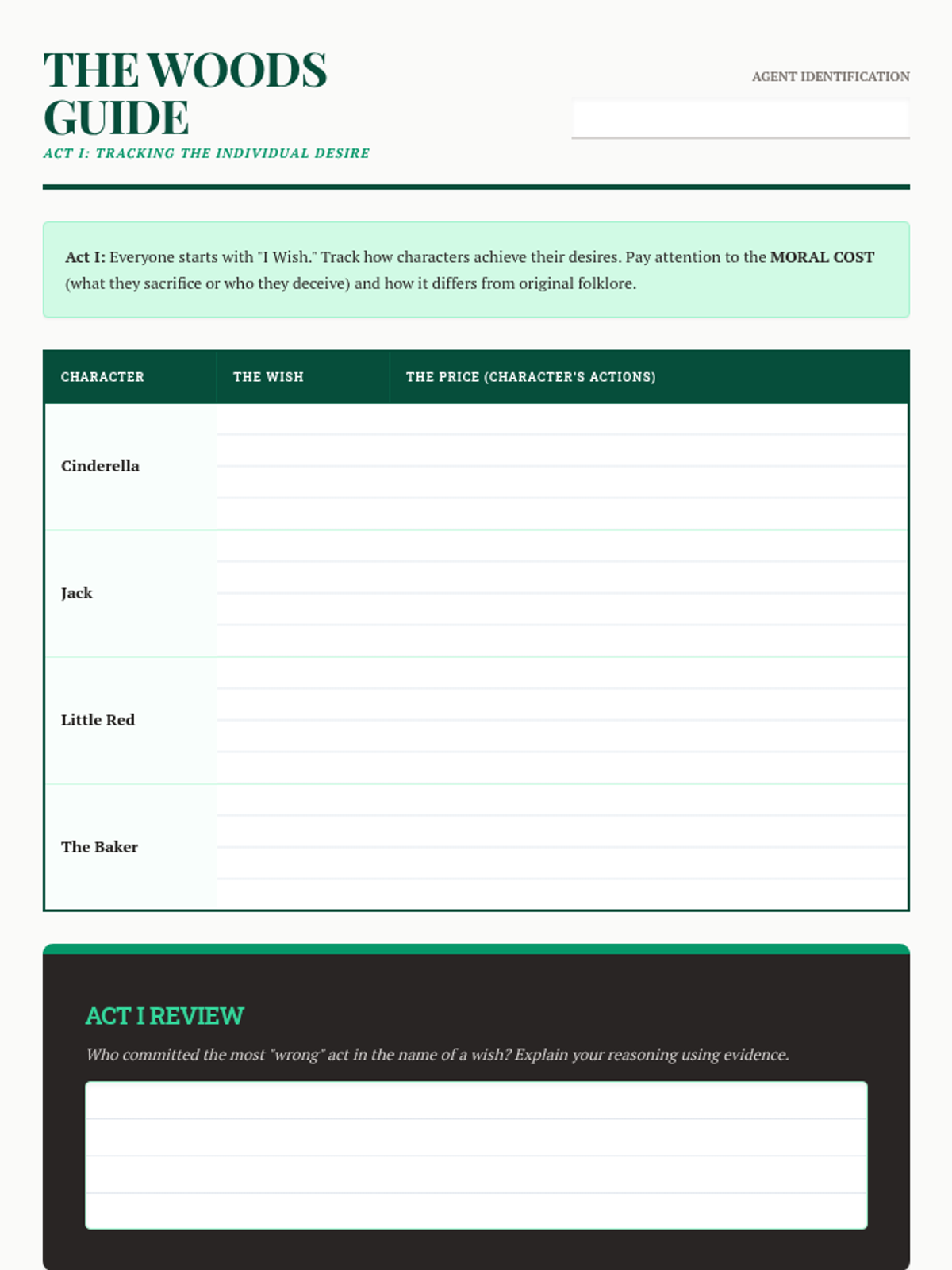
A detailed watching guide for 'Into the Woods' that tracks character wishes in Act I and their consequences in Act II.
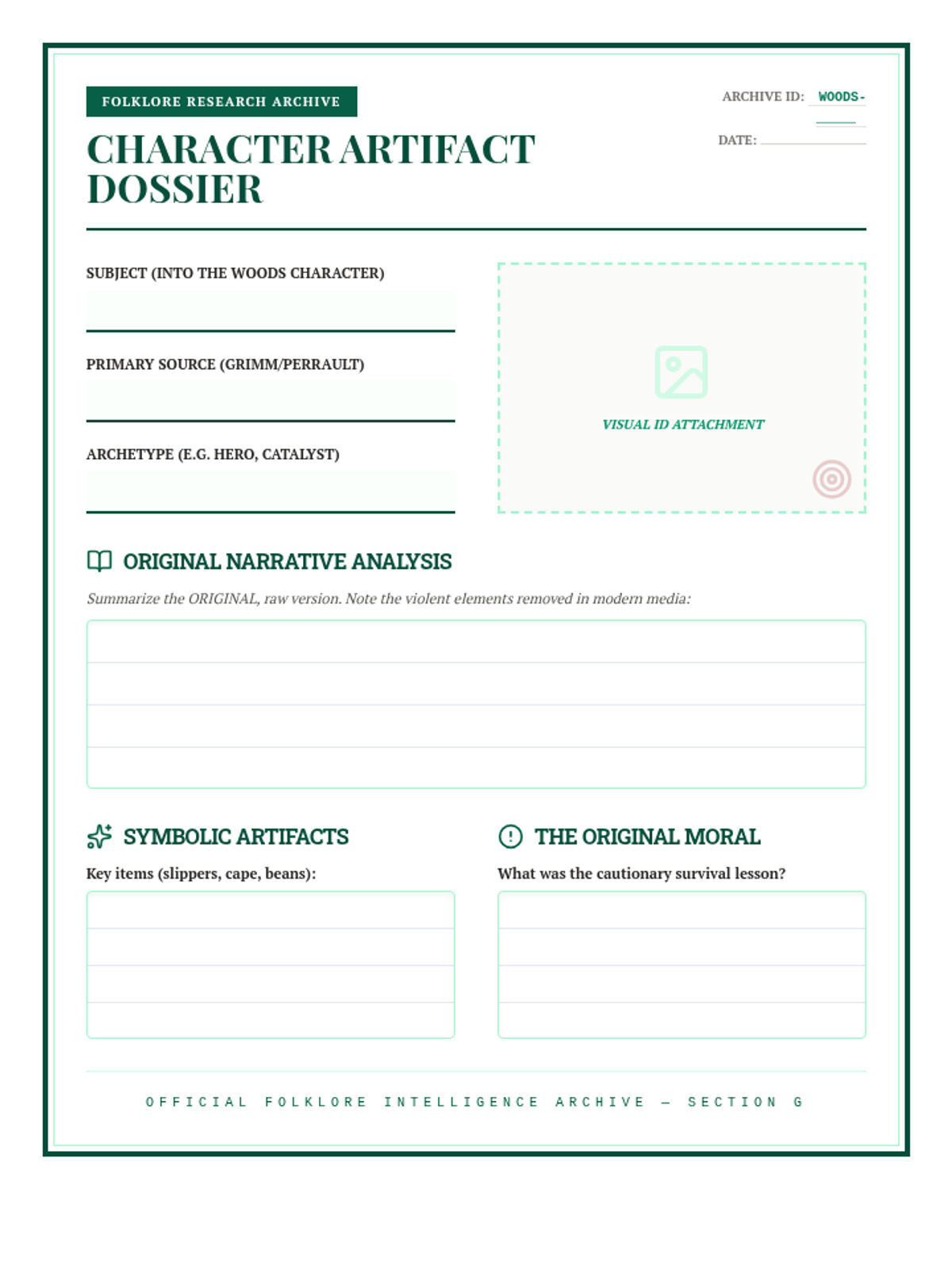
A research worksheet for students to document the original versions of fairytale characters, their attributes, and their cultural endurance.
High-school introductory slides for the 'Into the Woods' folklore project, exploring the purpose of stories, literary history, and Sondheim's deconstruction.
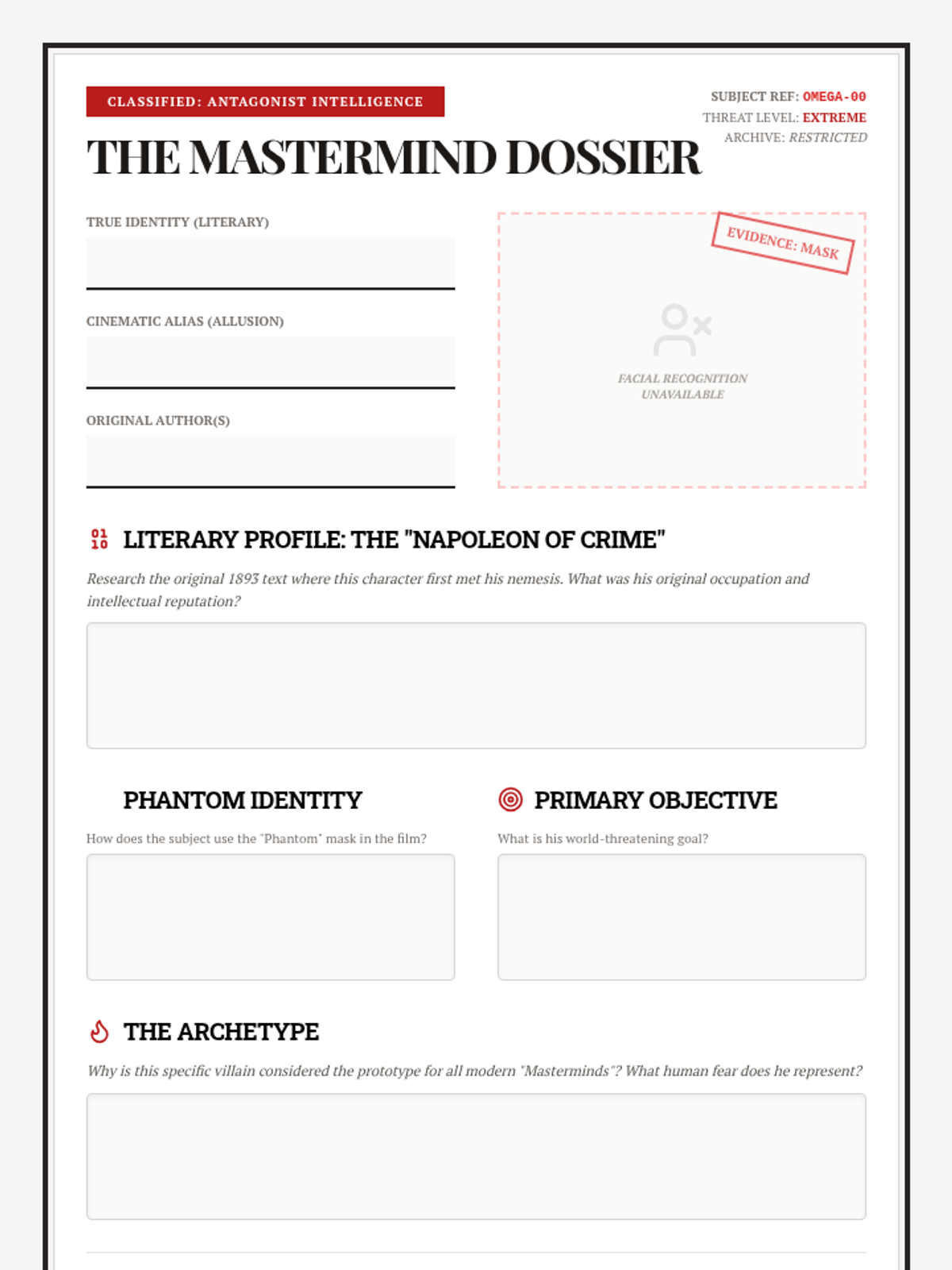
A specialized research dossier for the film's main antagonist, focusing on Professor Moriarty's literary origins and his 'Phantom' dual identity.
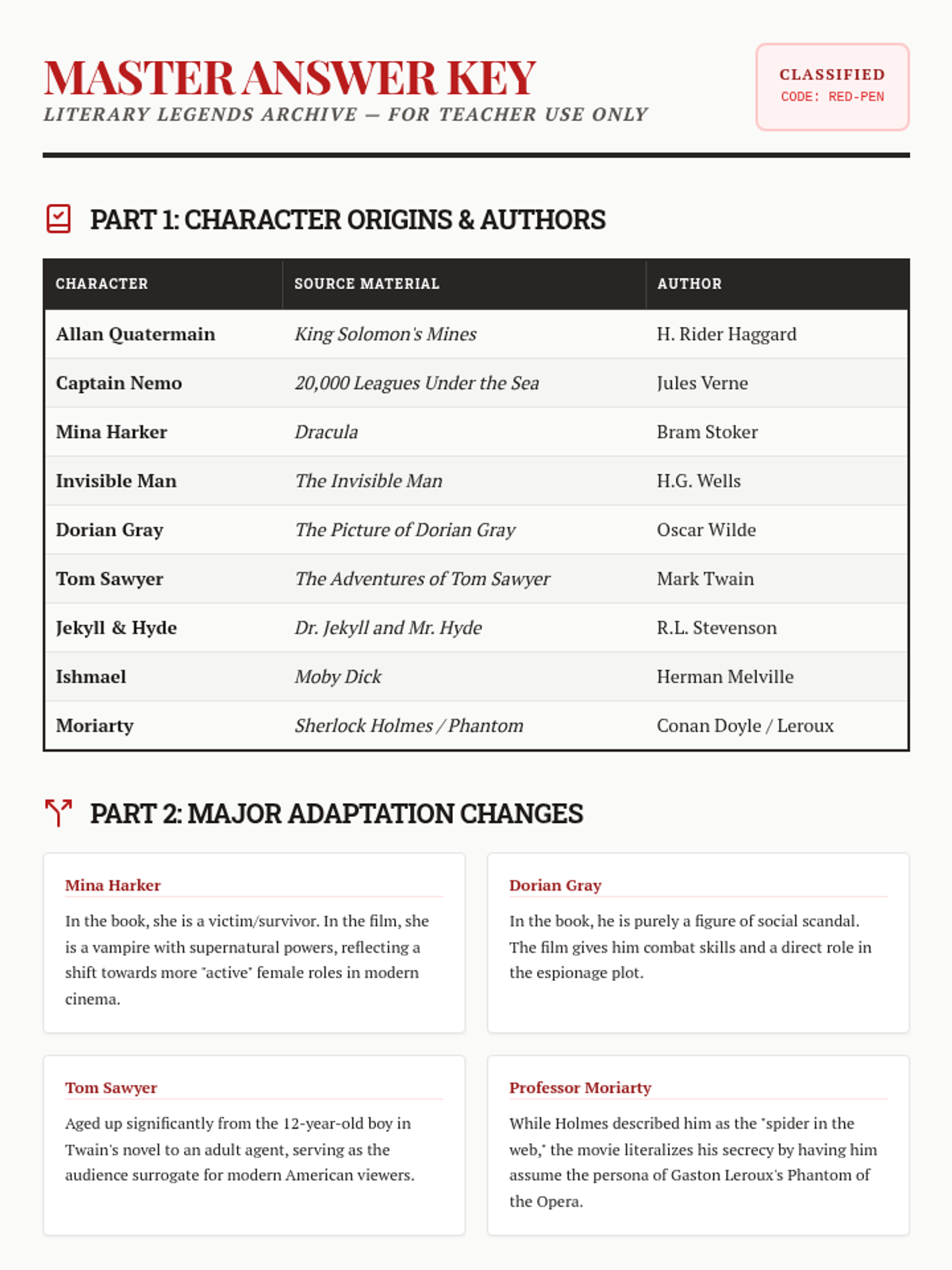
A comprehensive answer key for teachers, including character origins, adaptation differences, and explanations for the film's literary idioms and allusions.
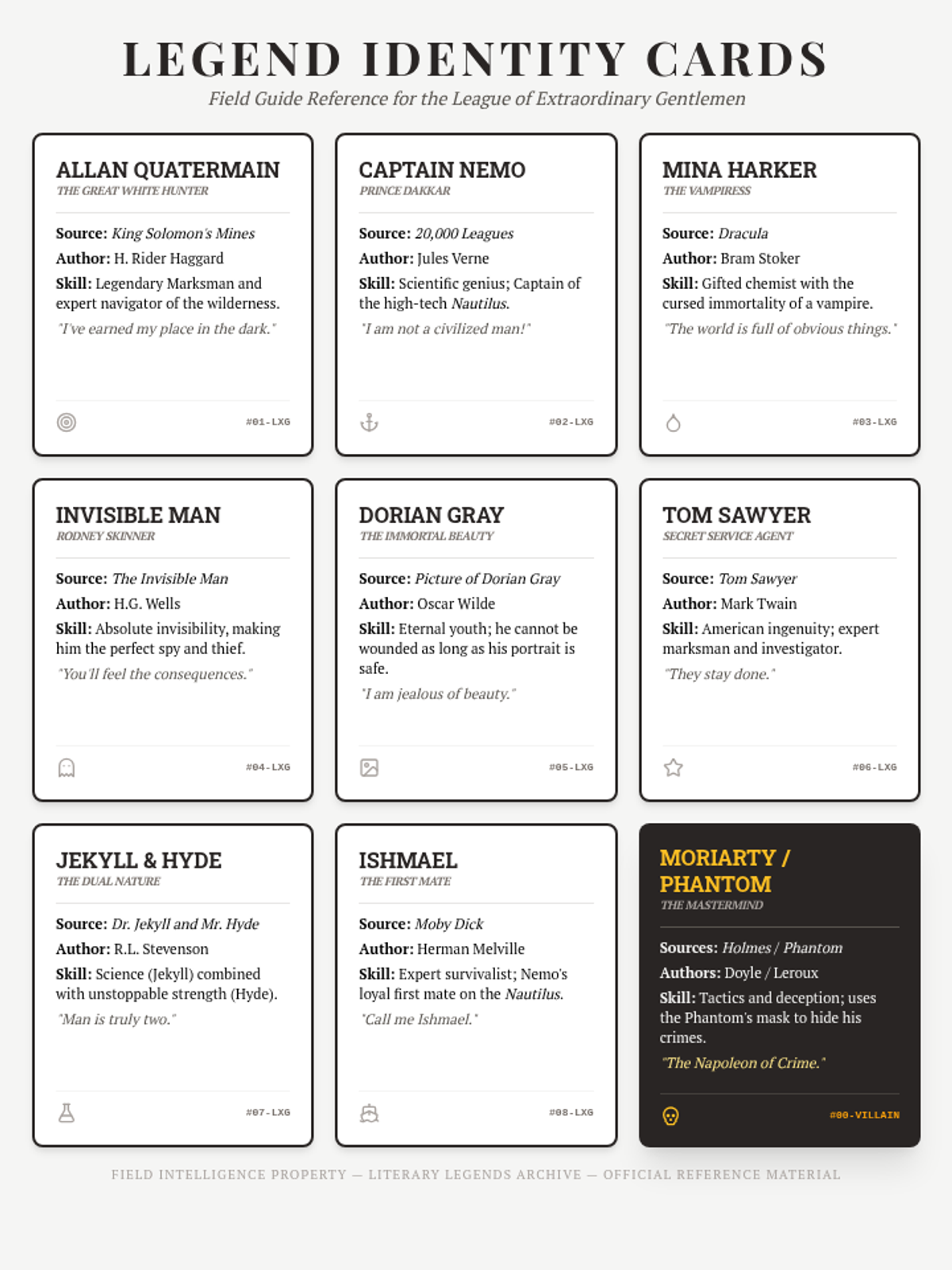
A set of reference cards for the main characters, including their literary origins, authors, skills, and key quotes.
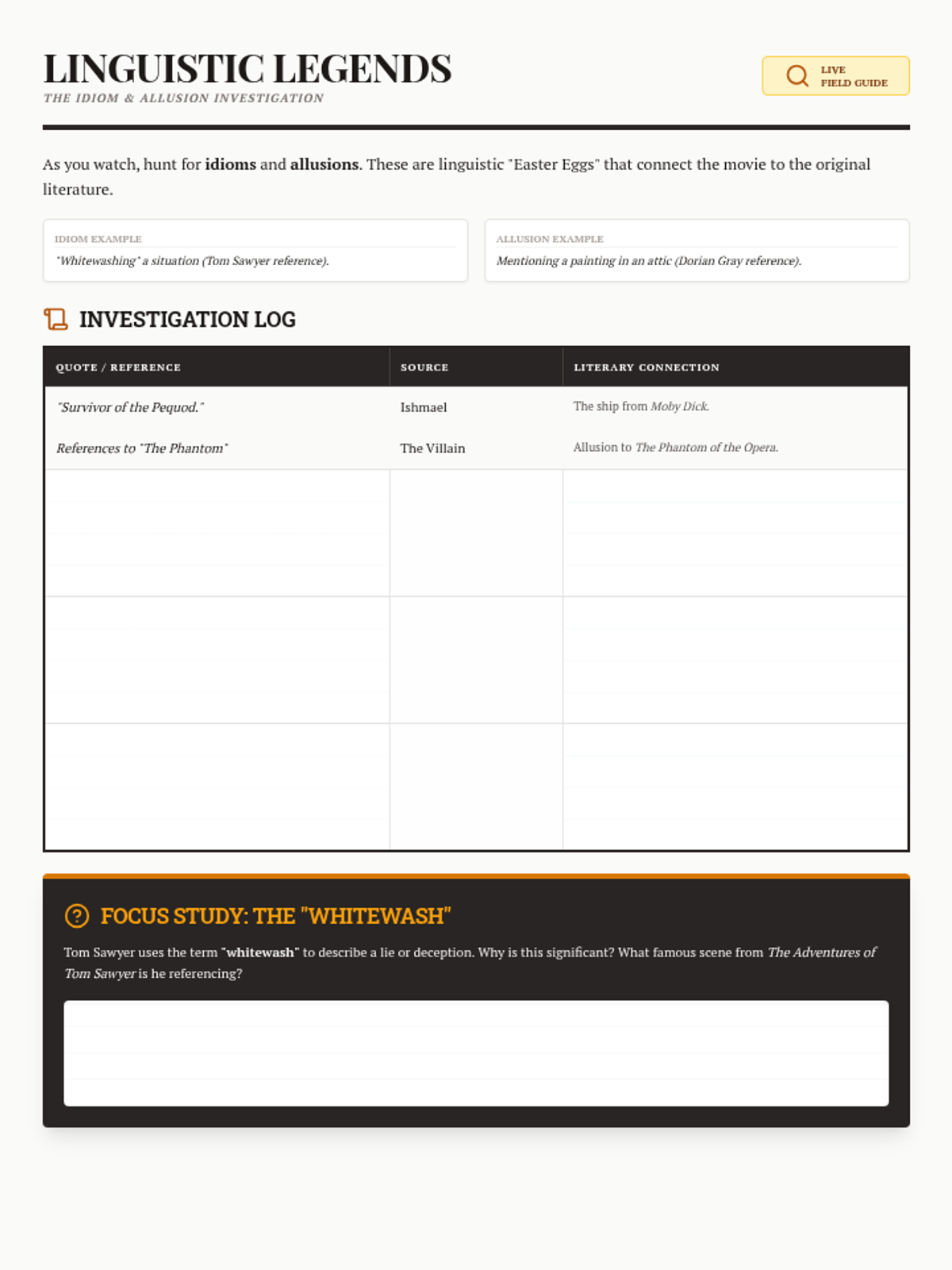
A watching guide focused on identifying literary idioms and allusions used by the characters throughout the film.
A structured 'Secret Dossier' research worksheet for students to document the literary origins, traits, and endurance of their assigned character.
Introductory slides for the 'Literary Legends' project, explaining the concept of the cinematic crossover and the students' research mission.
A teacher's facilitation guide for the 'Literary Legends Crossover' project, including a character roster, pacing guide, and discussion prompts.
A visual presentation guiding students through key revising strategies for the Texas English I EOC, focusing on sentence combining, redundancy, and clarity.
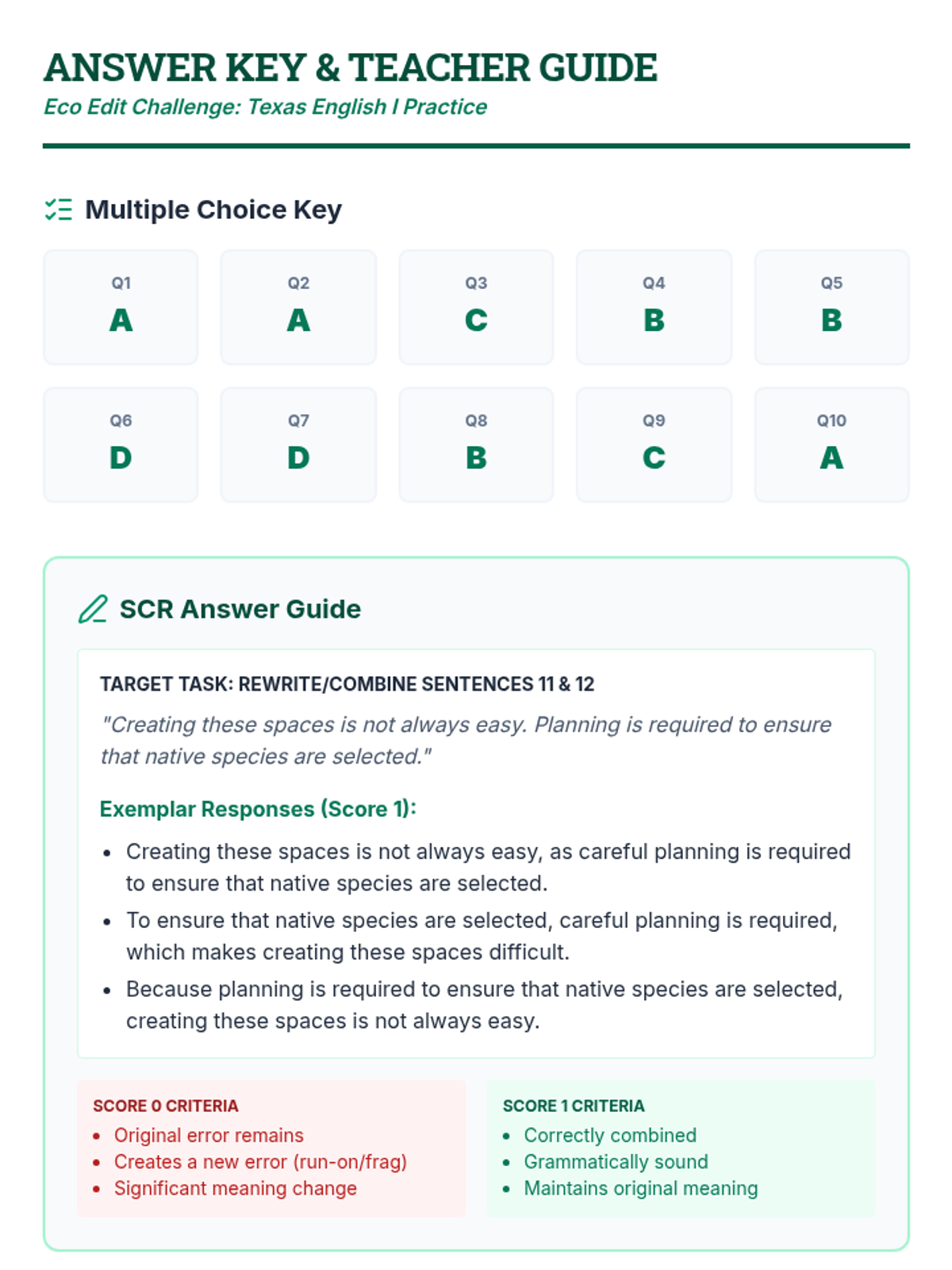
An updated answer key and teacher guide that includes a scoring rubric and exemplar responses for the short constructed response (SCR) revision task.
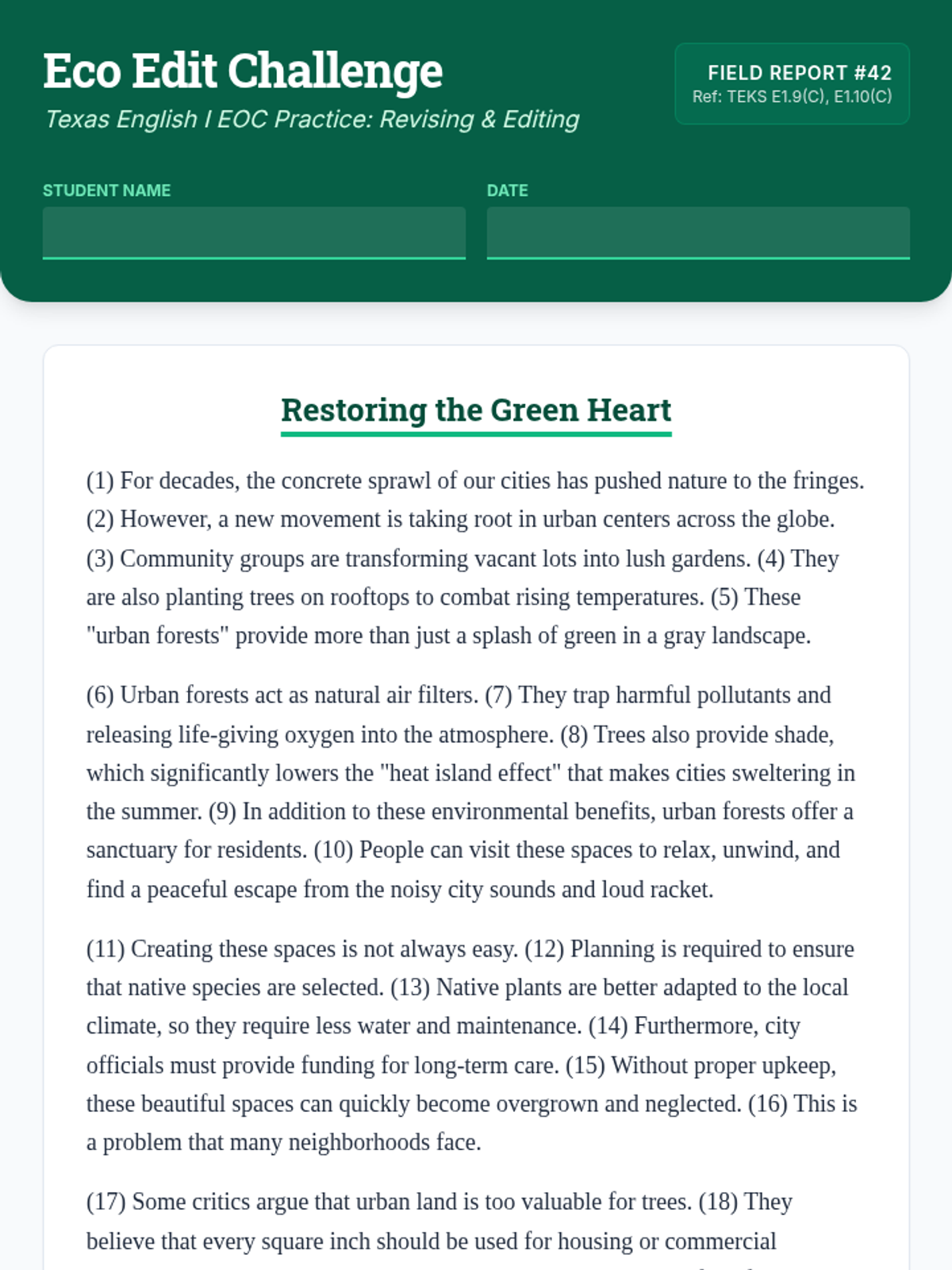
A STAAR-aligned practice test for Texas English I, featuring a passage on urban forestry with 10 multiple-choice questions focusing on sentence combining, word choice, transitions, and grammatical corrections.
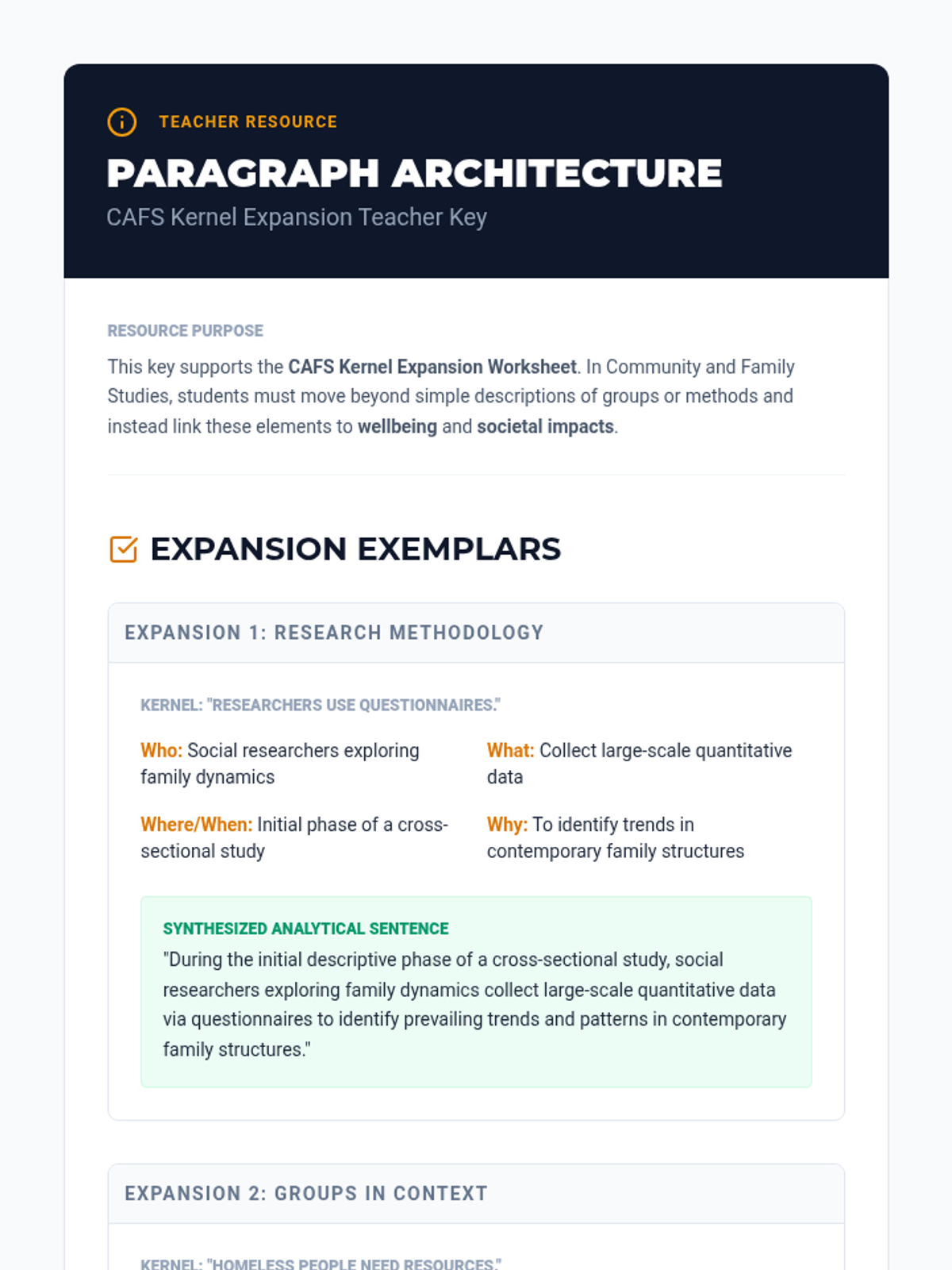
A teacher answer key for the CAFS Kernel Expansion Worksheet, providing high-level synthesized exemplars for Research Methodology and Groups in Context.
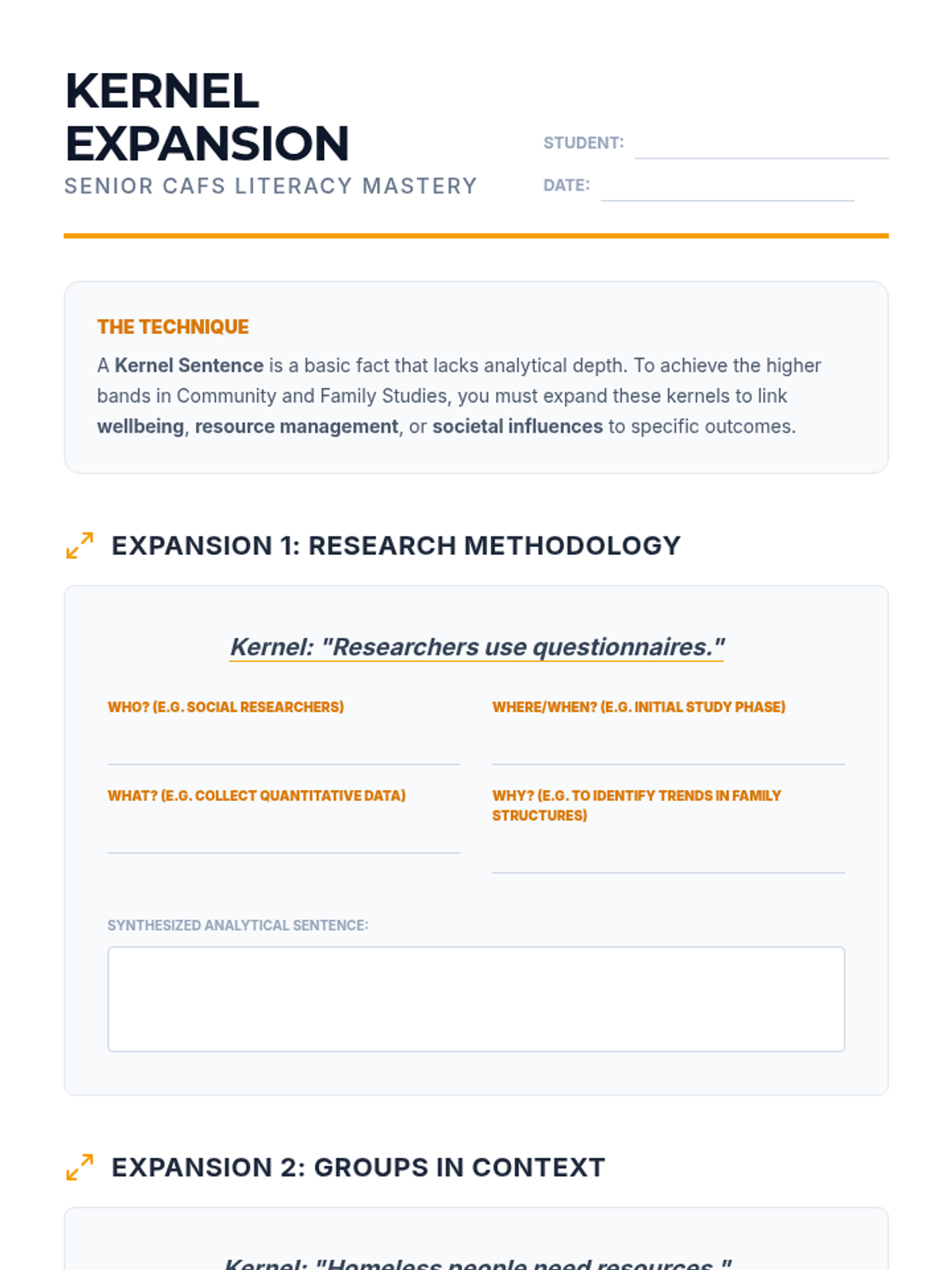
A literacy worksheet for Year 12 CAFS students to practice expanding kernel sentences, focusing on research methodology and groups in context to improve analytical depth.
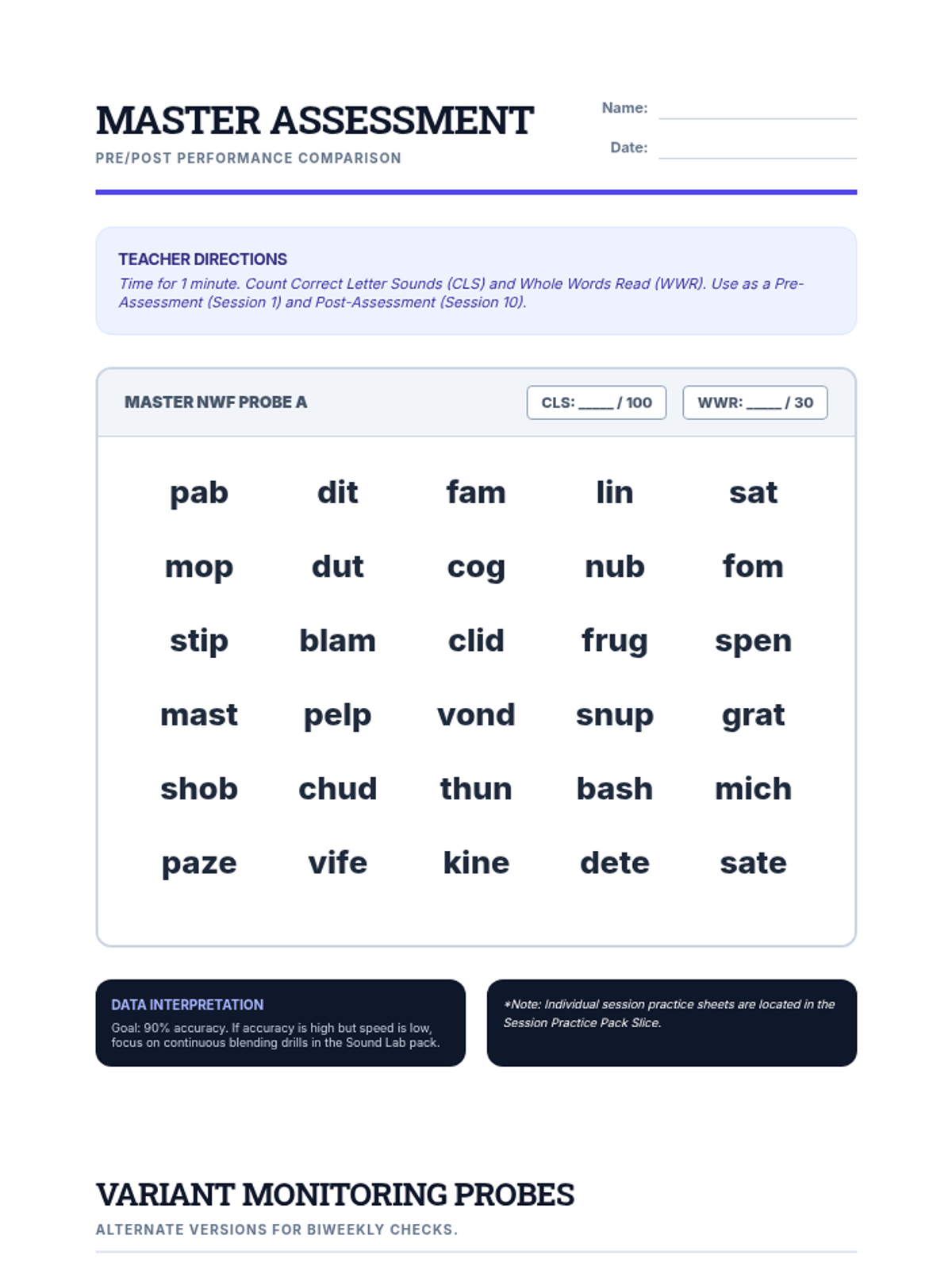
A comprehensive assessment pack including a Master Pre/Post probe and alternate mid-cycle probes, combining all phonics patterns (CVC, Blends, Digraphs, Magic E) with a robust 5-column layout for timed NWF assessments.