Active listening, assertive expression, and boundary-setting strategies for interpersonal success. Develops proficiency in conflict mediation, cooperative teamwork, and the cultivation of healthy romantic and platonic connections.
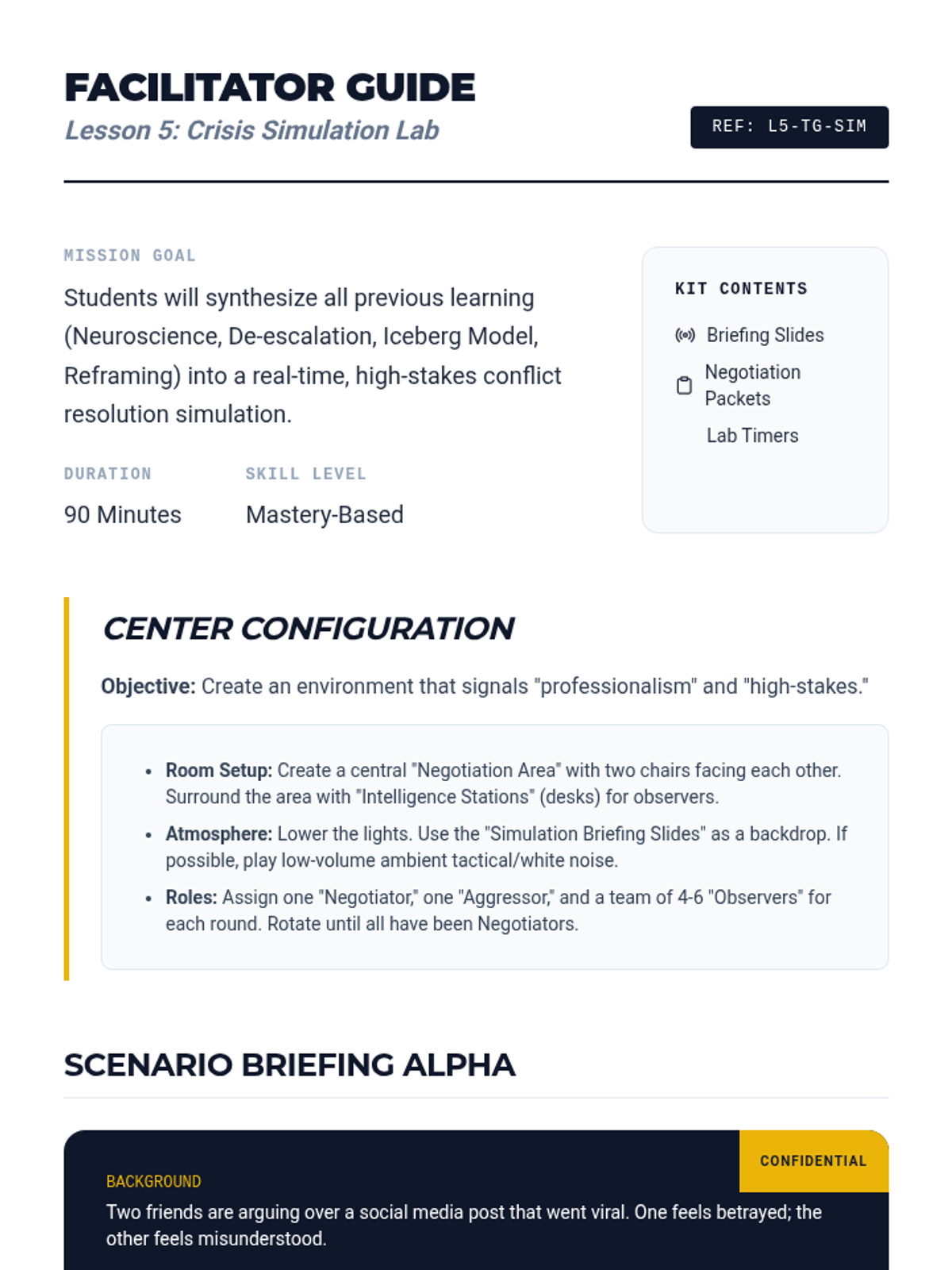
A teacher guide for the Conflict Simulation lesson, including instructions for the lab setup, scenario scripts, and debriefing questions.
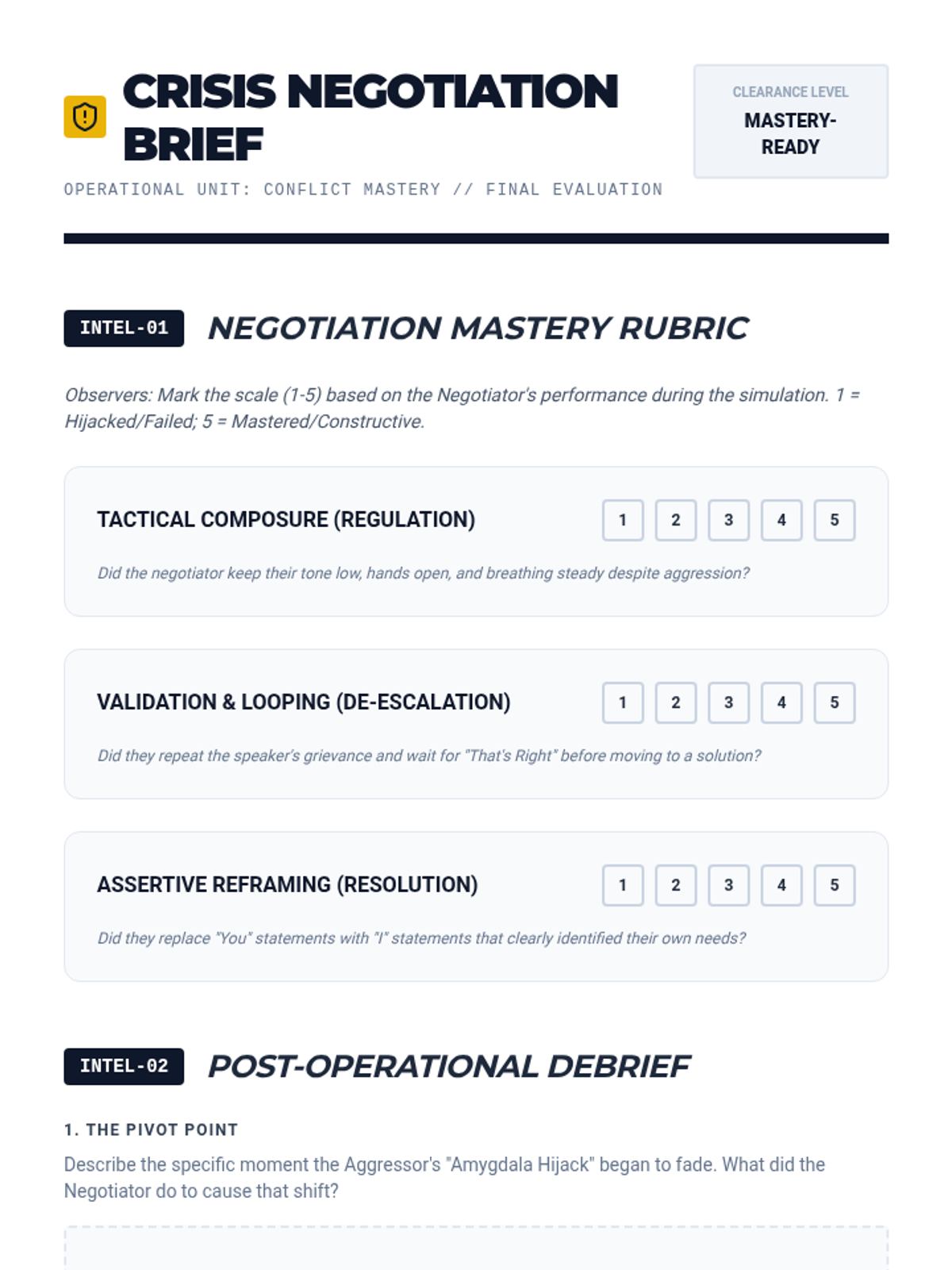
A student-facing briefing packet for the final simulation lab, including a mastery rubric for peer observation and a post-negotiation debrief log.
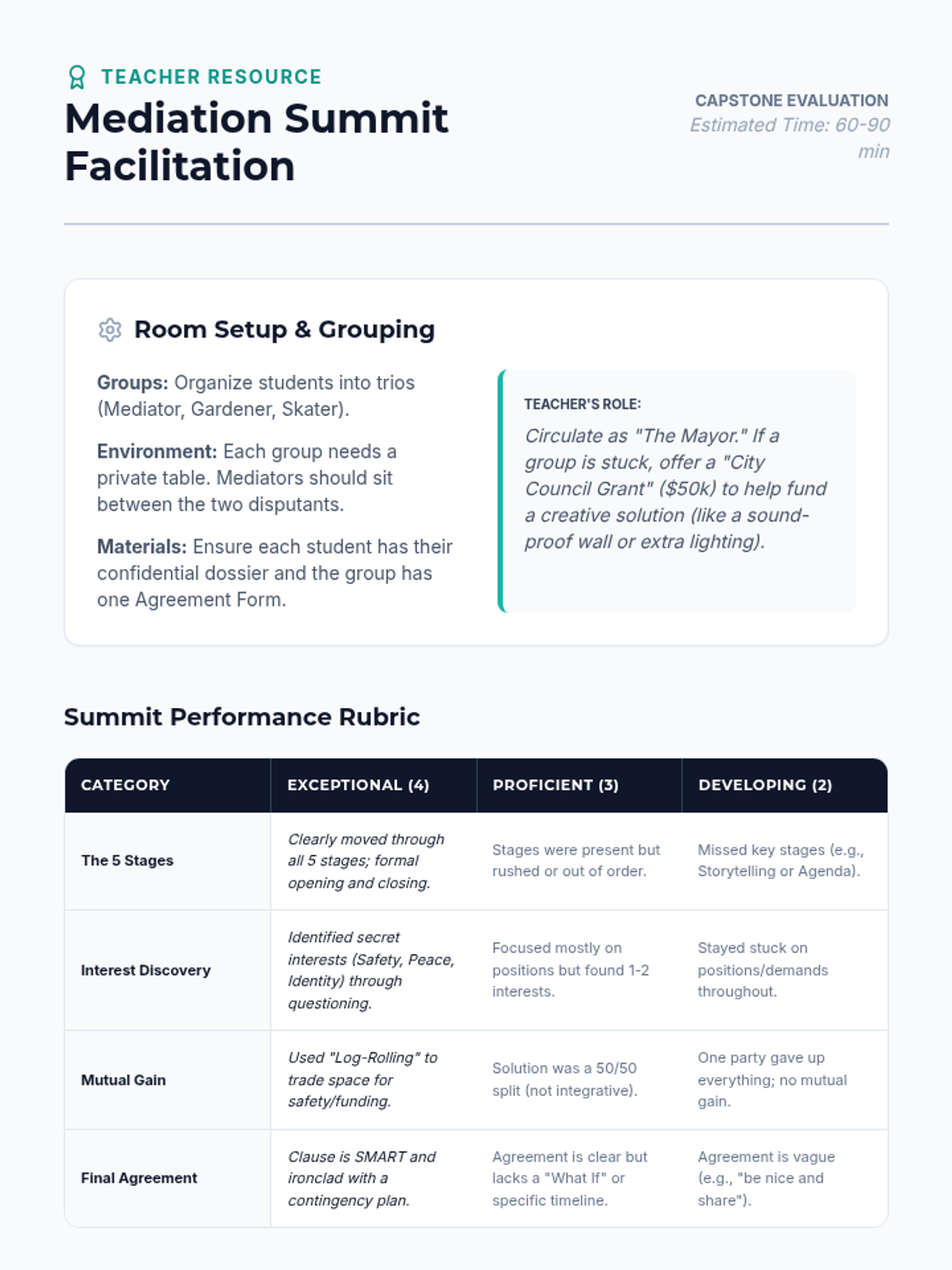
Teacher facilitation guide and evaluation rubric for the Lesson 5 Mediation Summit capstone simulation. Includes setup instructions, a grading rubric, and debrief prompts.
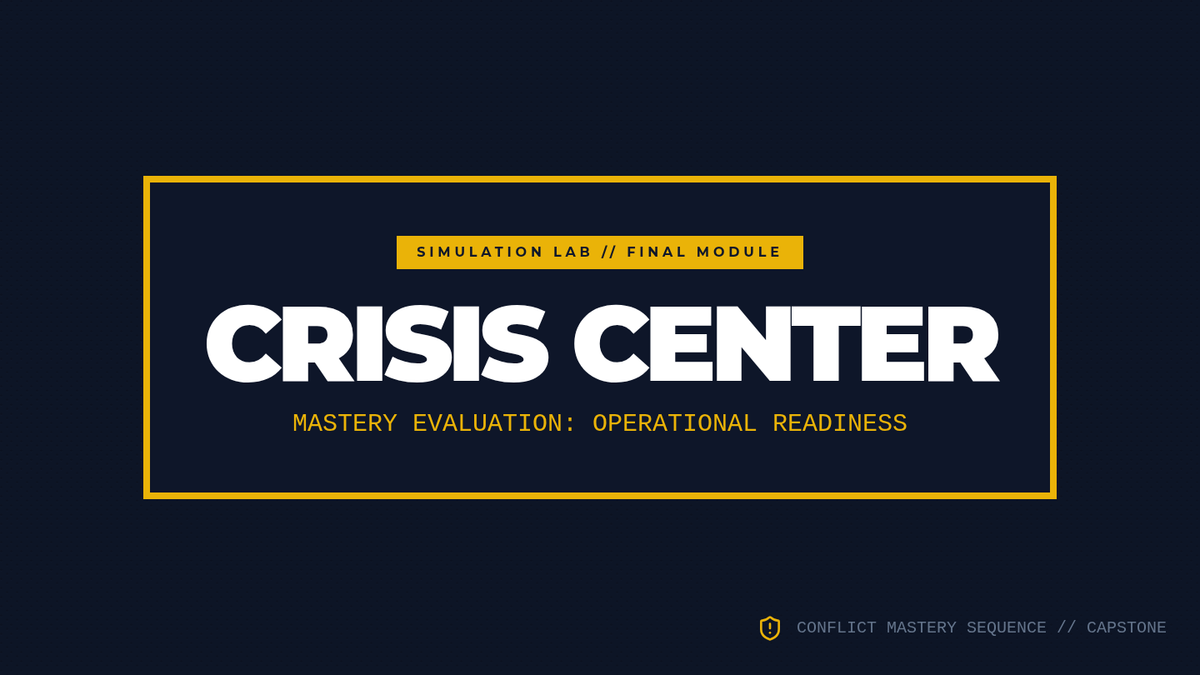
A visual presentation for the final simulation lab, setting the stage, explaining the Crisis Negotiation Center concept, and outlining the mission objectives and rules of engagement.
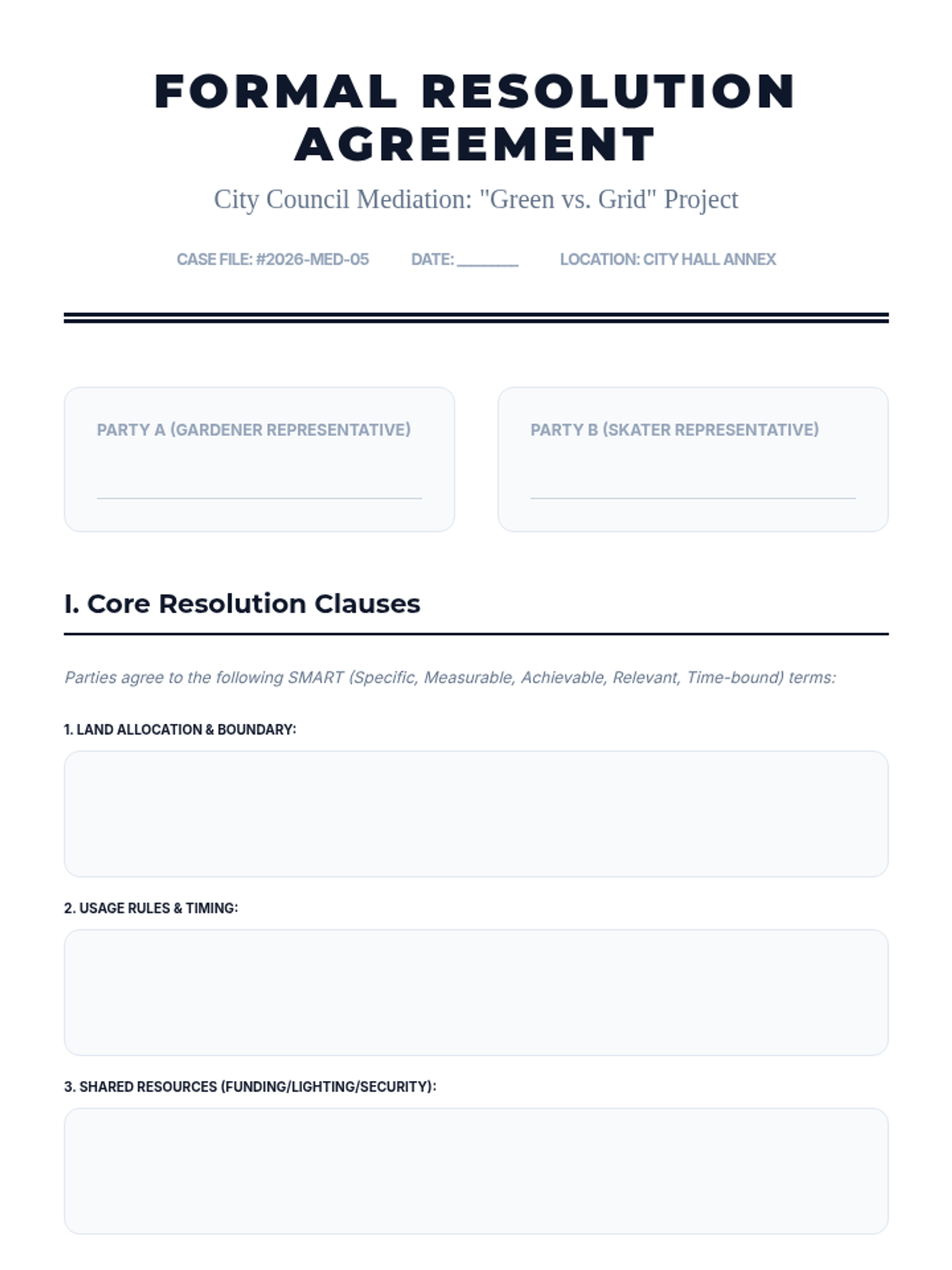
Formal mediation agreement form for the "Green vs. Grid" simulation. Students use this to draft their final SMART resolution clauses and finalize the simulation with signatures.
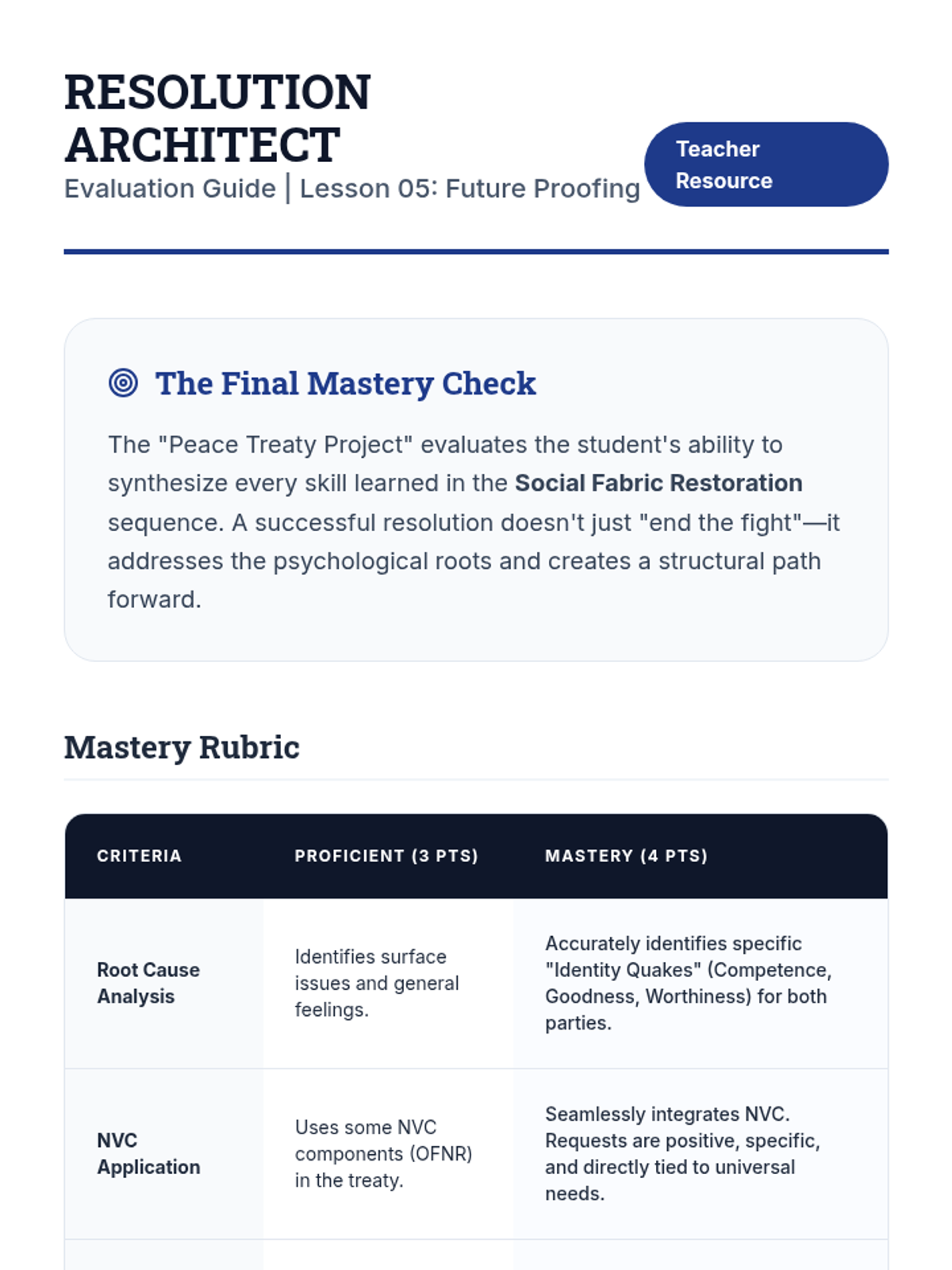
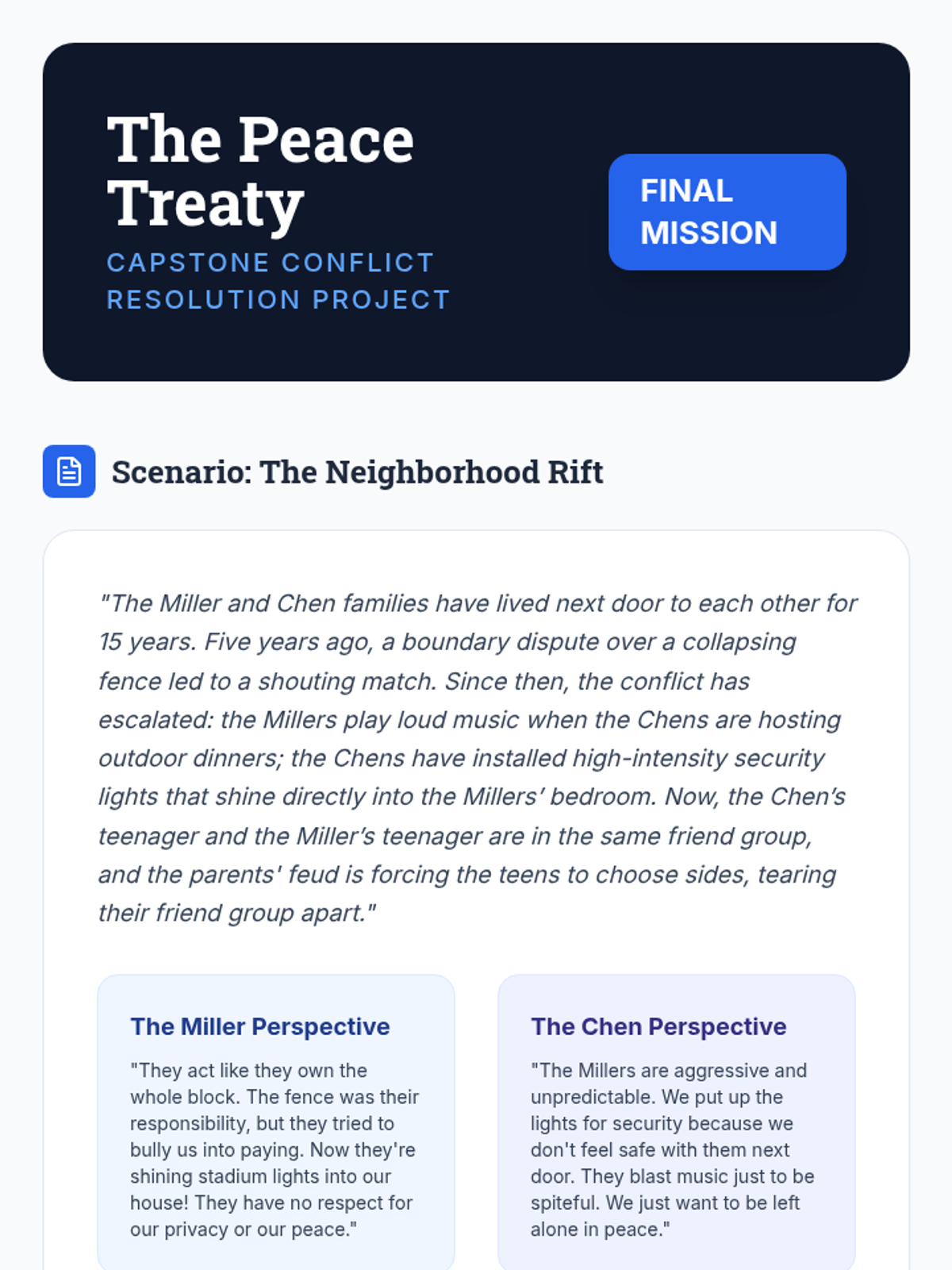
Teacher assessment guide and rubric for the final Peace Treaty project in Lesson 5.
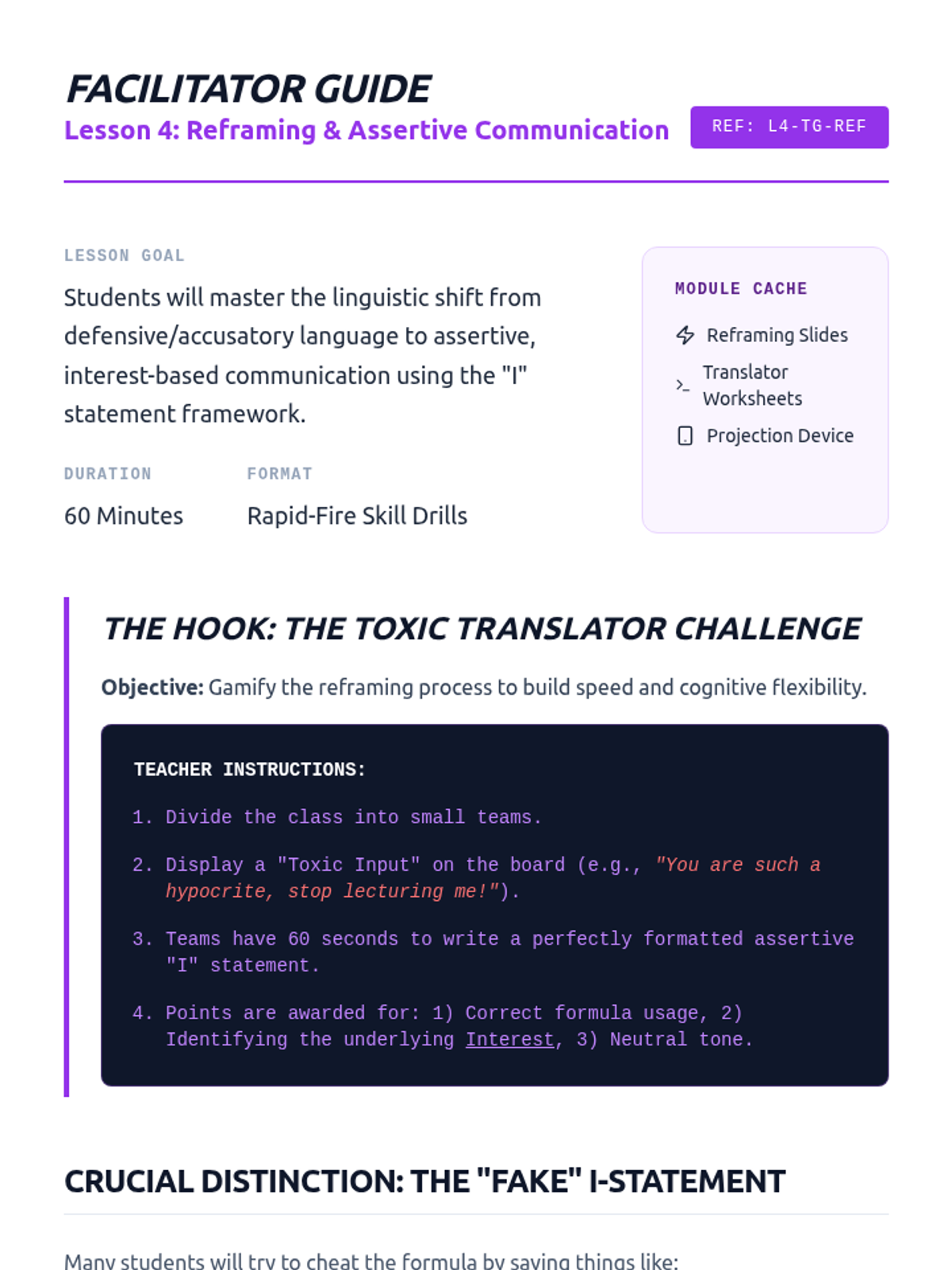
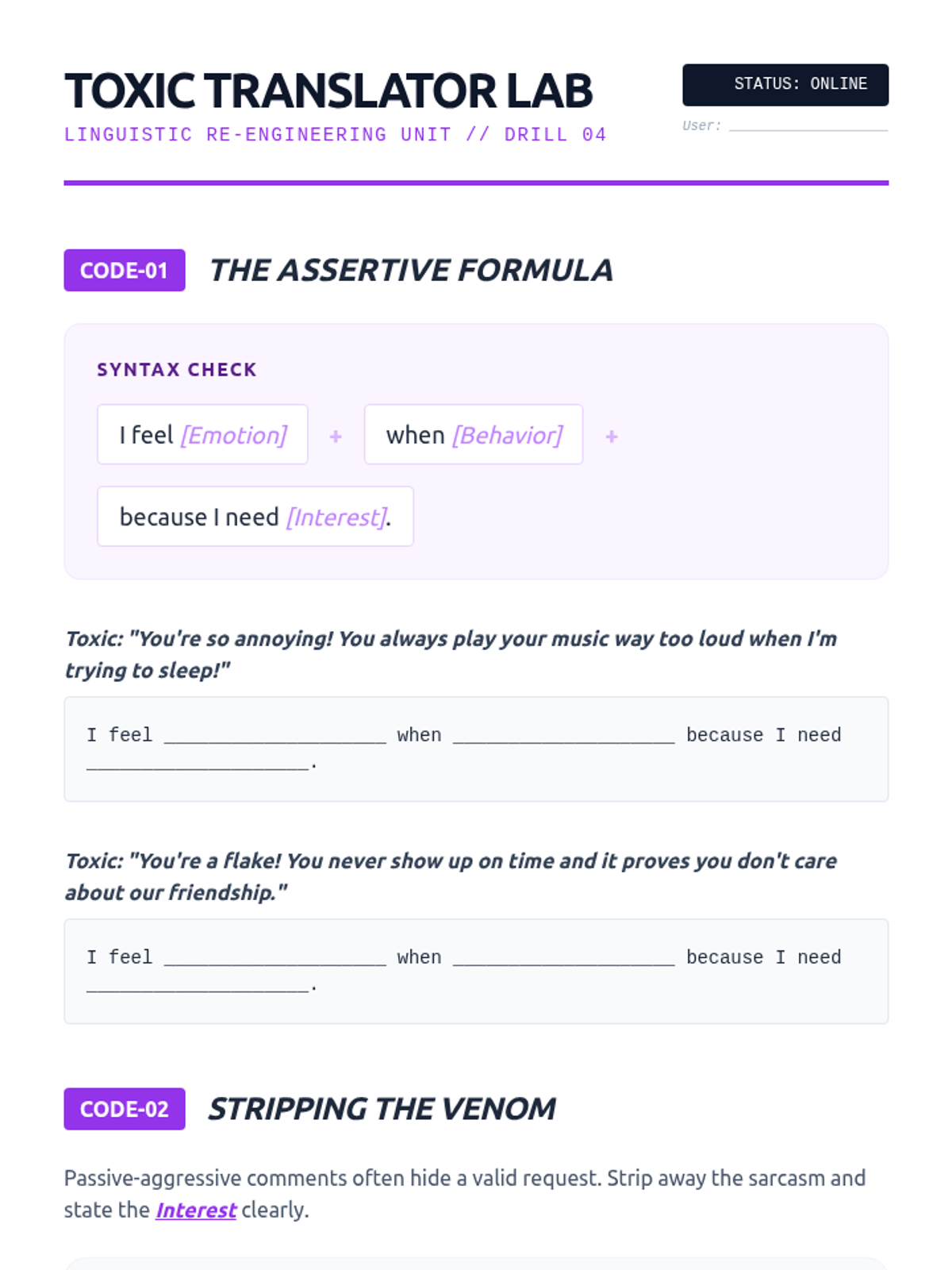
A teacher guide for the Communication Reframing lesson, including instructions for the 'Toxic Translator' challenge, common pitfalls, and a worksheet answer key.
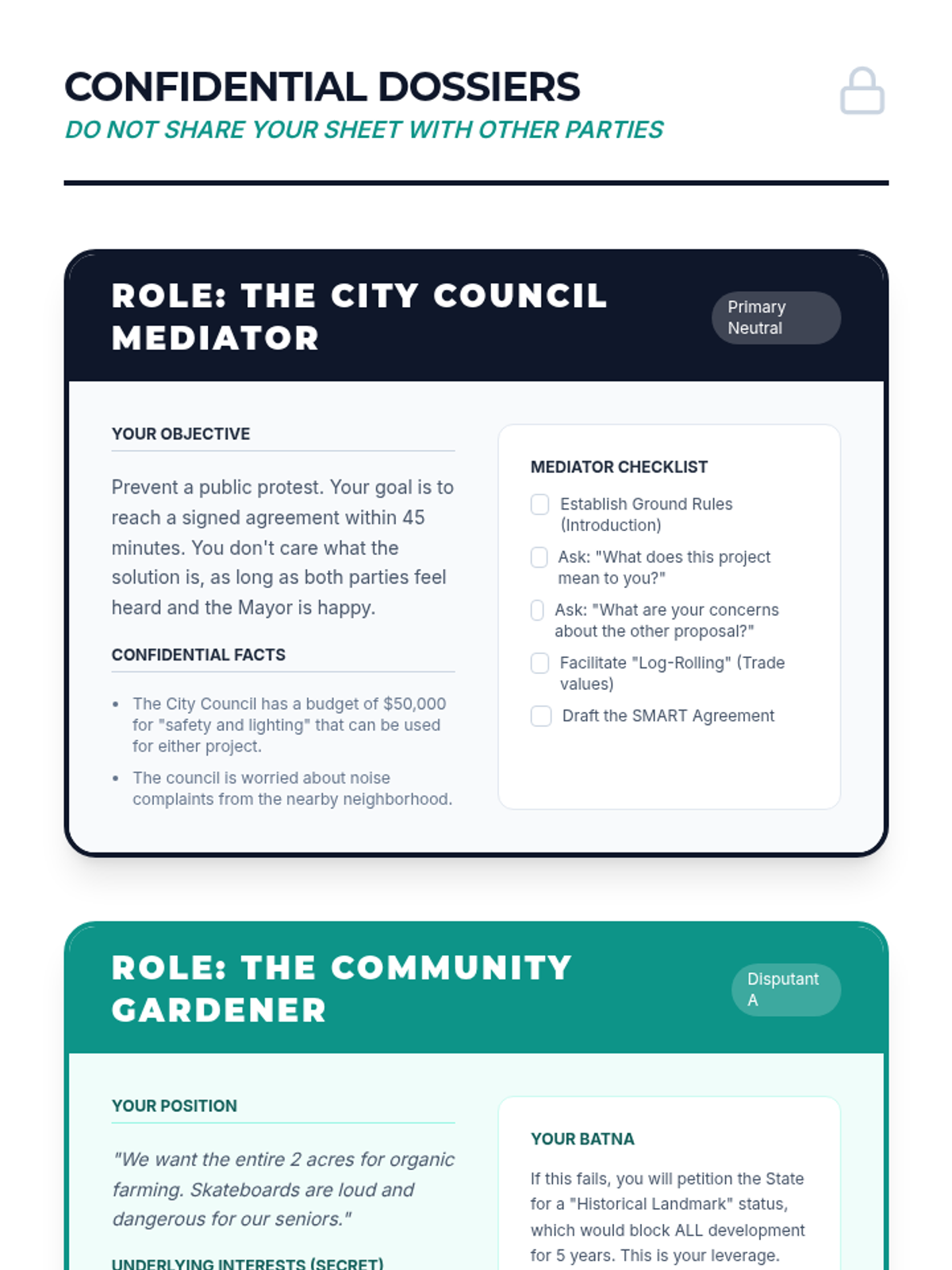
Confidential briefing sheets for the three roles in the "Green vs. Grid" simulation: The Mediator, The Gardener, and The Skater. Includes secret interests and walk-away points.
Final synthesis project where students design a comprehensive resolution and peace treaty for a long-standing neighborhood dispute.
A practice worksheet for students to practice translating toxic language into assertive 'I' statements and neutral requests.
Slide deck for Lesson 5 exploring the synthesis of skills to design long-term, sustainable resolutions.
Briefing slide deck for the Lesson 5 Mediation Summit capstone simulation. Introduces the "Green vs. Grid" land use case, roles, and rules of engagement.
A visual presentation exploring assertive communication through 'I' statements and reframing toxic language into neutral, problem-solving requests.
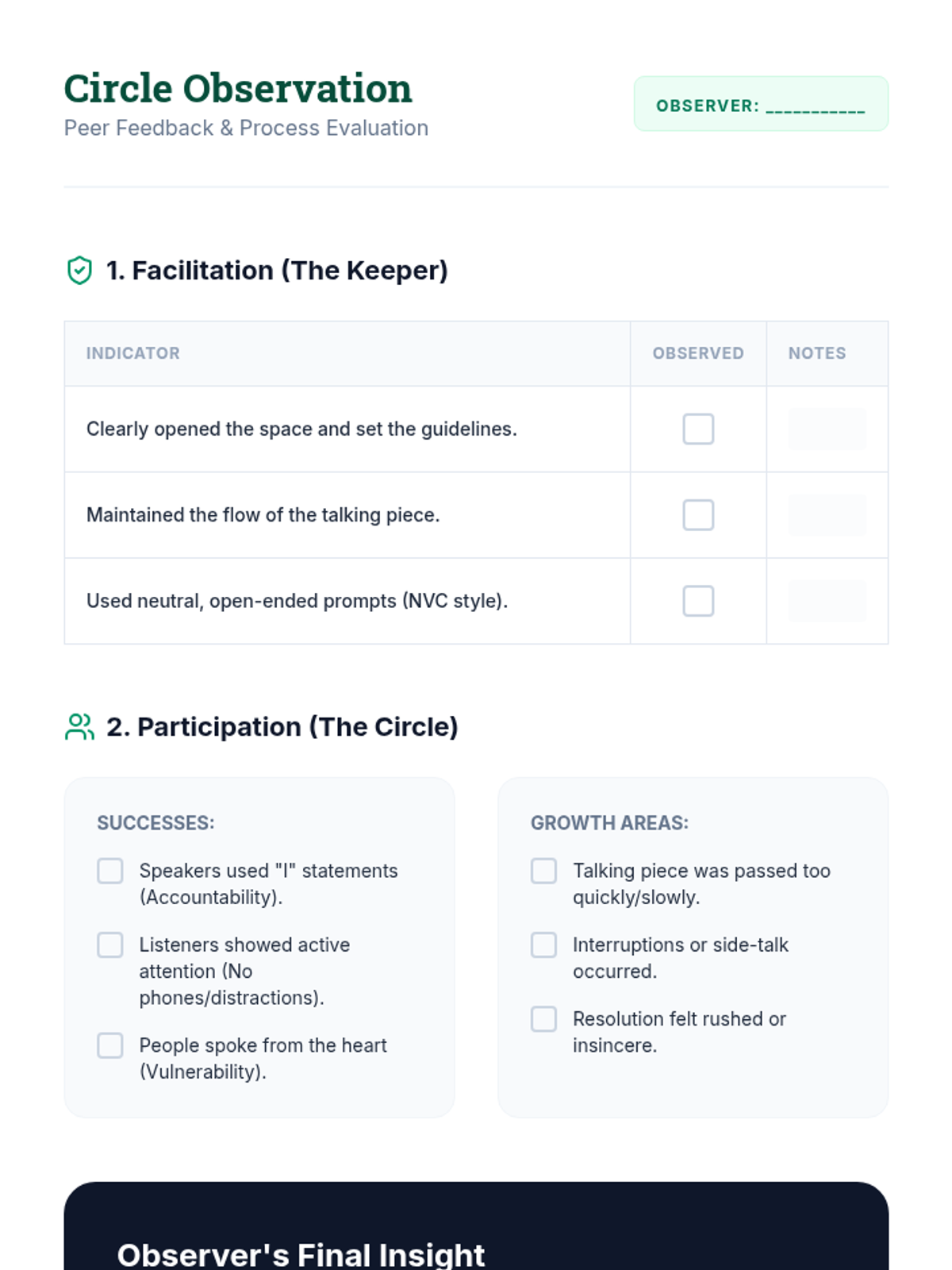
Observation checklist for students to use while peer-evaluating restorative circle simulations.
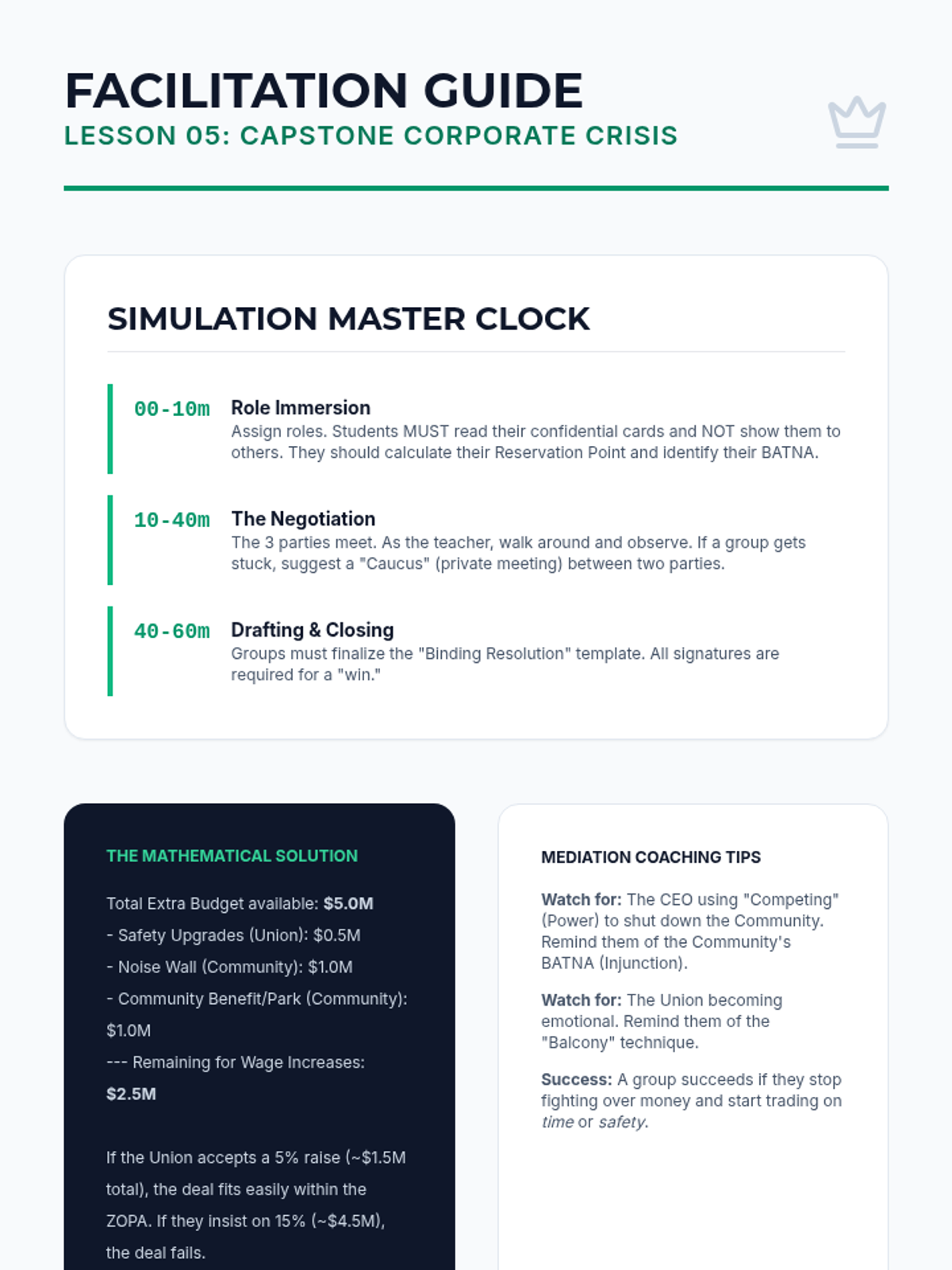
Facilitation guide for Lesson 5, providing a simulation timeline, the mathematical "Hidden ZOPA" solution, and sequence-wide debrief questions.
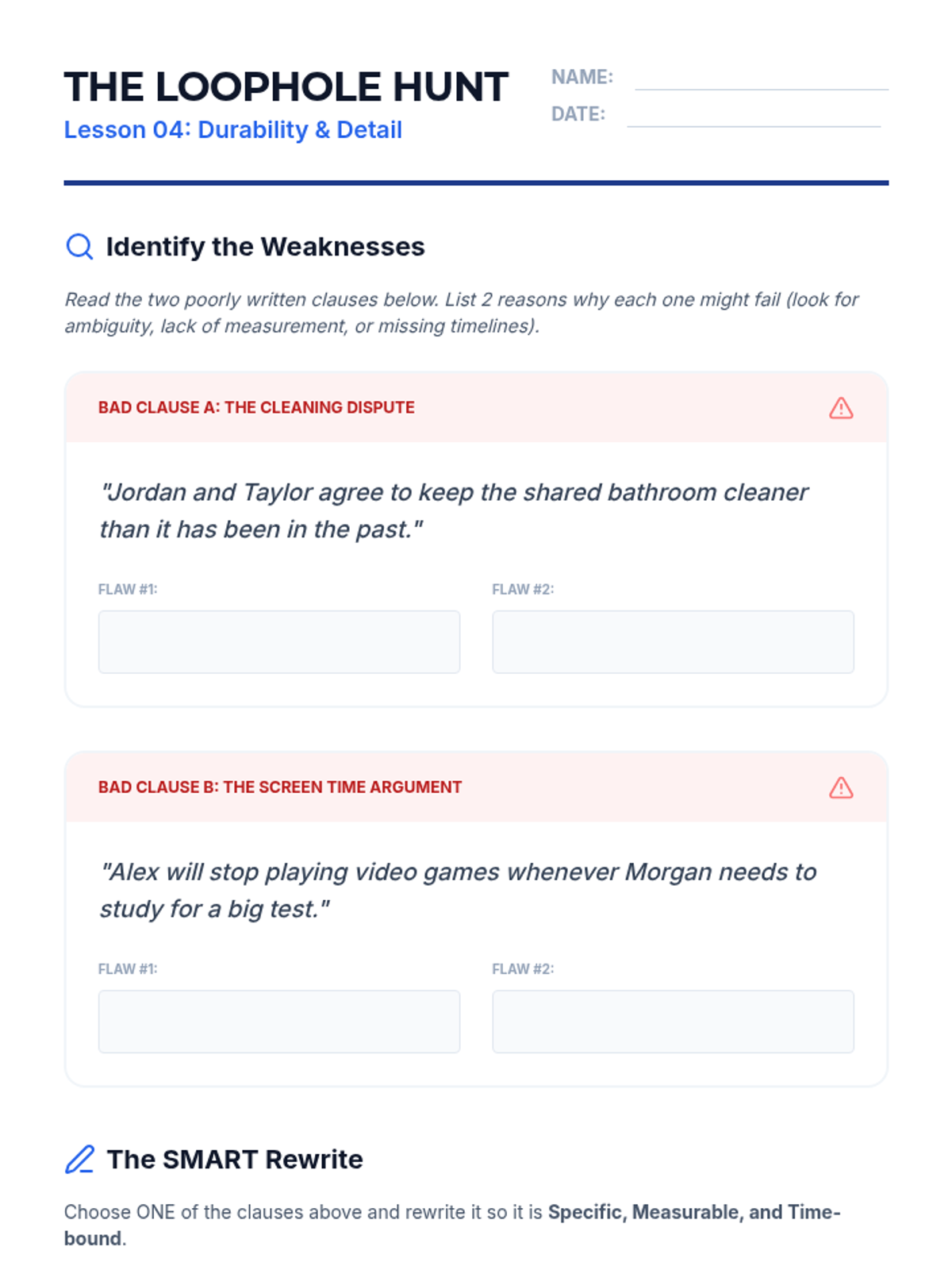
Student worksheet for identifying flaws in poorly written conflict resolution agreements and rewriting them using the SMART framework.
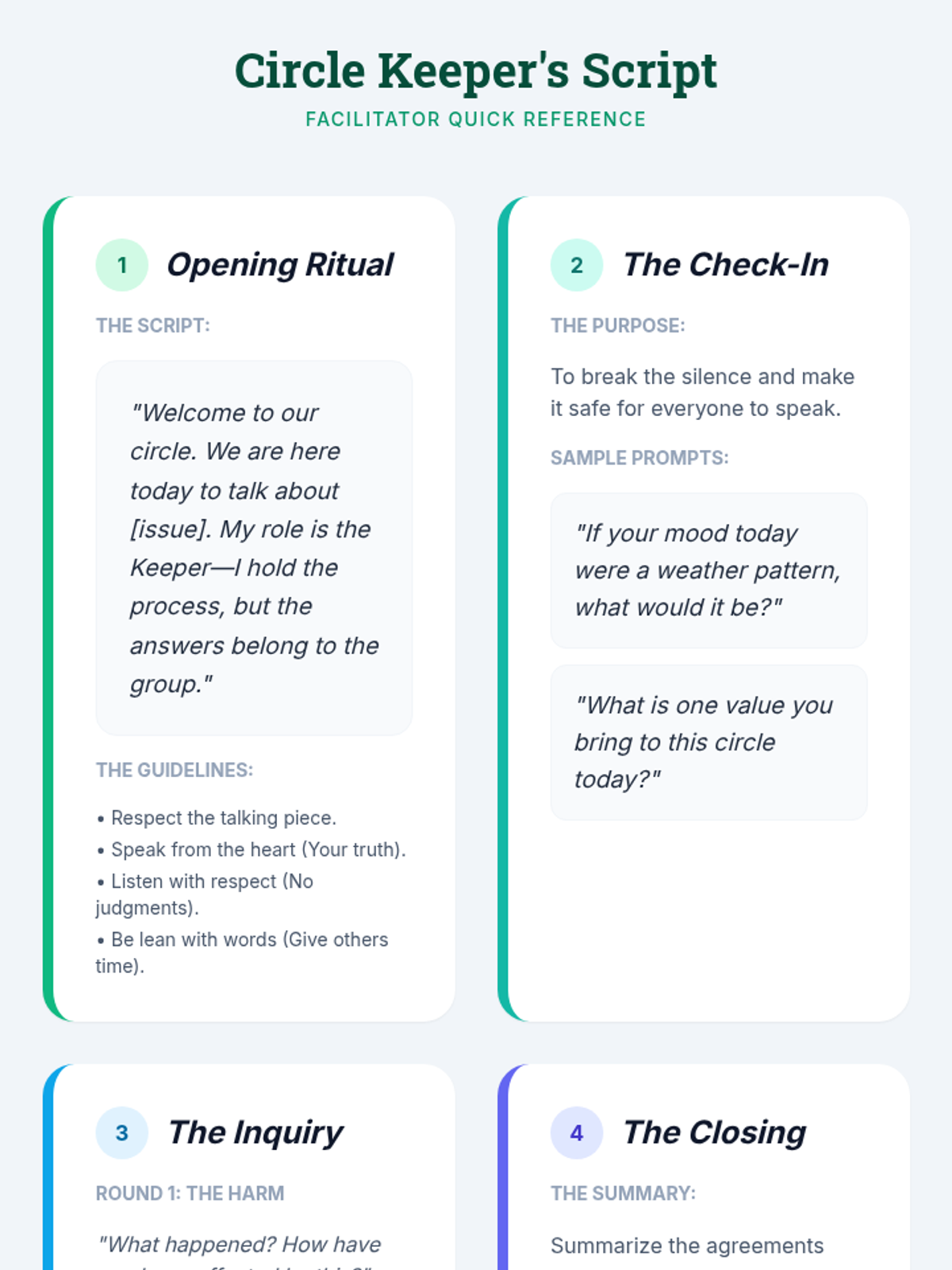
Reference cards for student facilitators, providing scripts and prompts for each stage of a restorative circle.
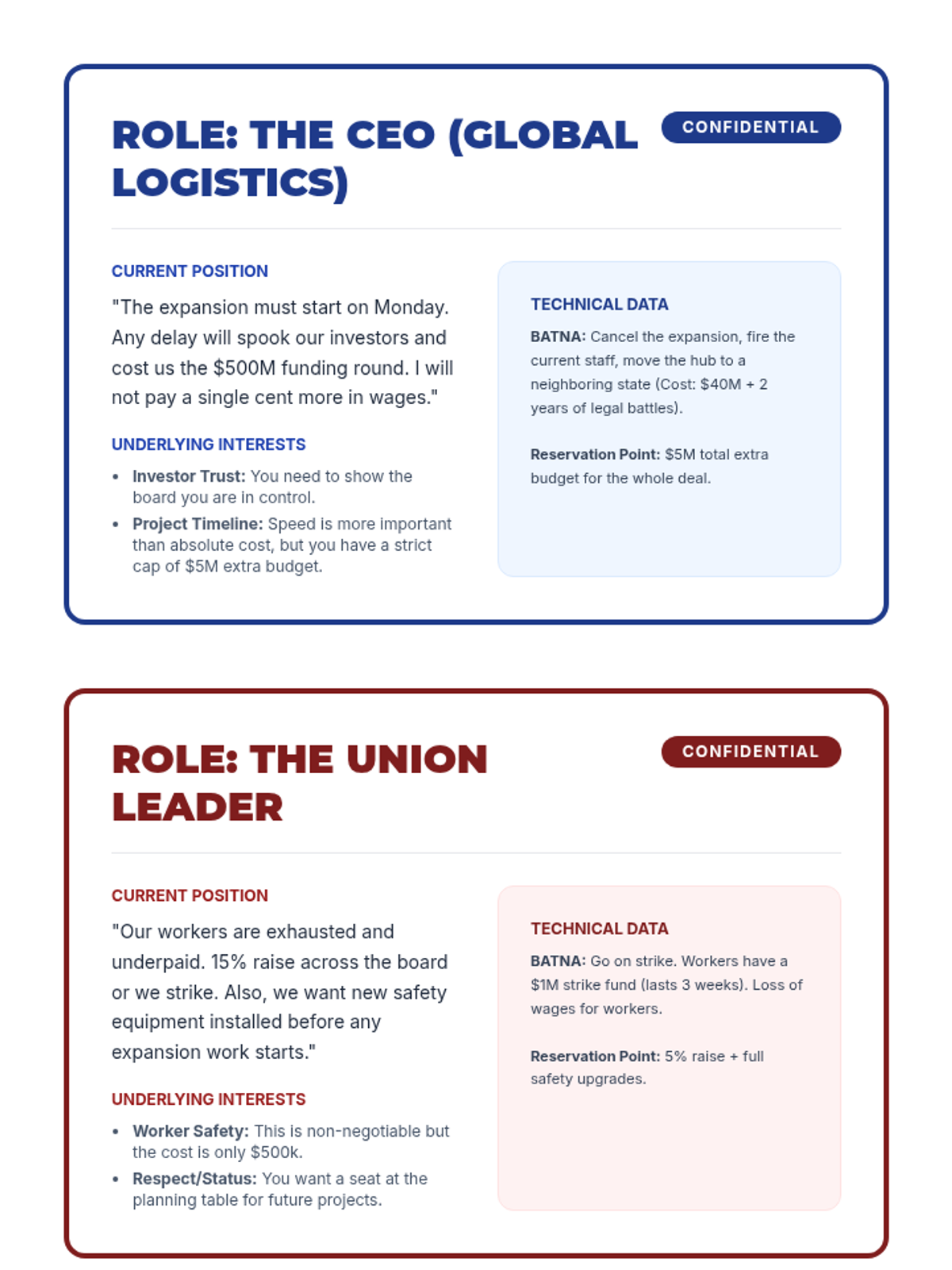
Simulation packet for the Capstone Corporate Crisis, including role cards for the CEO, Union Rep, and Community Leader, plus a resolution template.
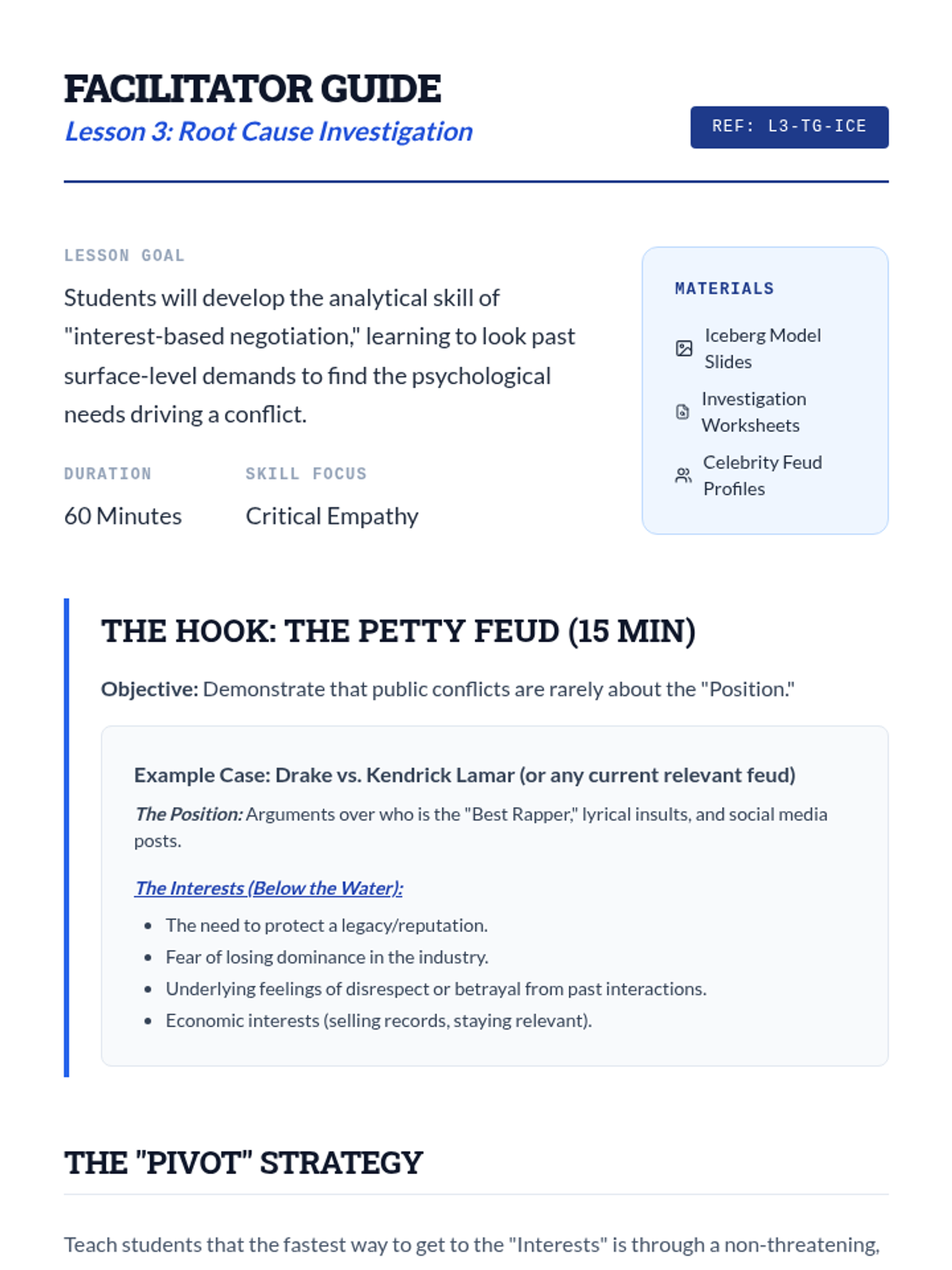
A teacher guide for the Root Cause Investigation lesson, including celebrity conflict examples, a case study answer key, and discussion prompts.
Instructional slide deck for Lesson 4: Drafting Sustainable Agreements. Explains the SMART framework for conflict resolution and the importance of specific clauses and contingency planning.
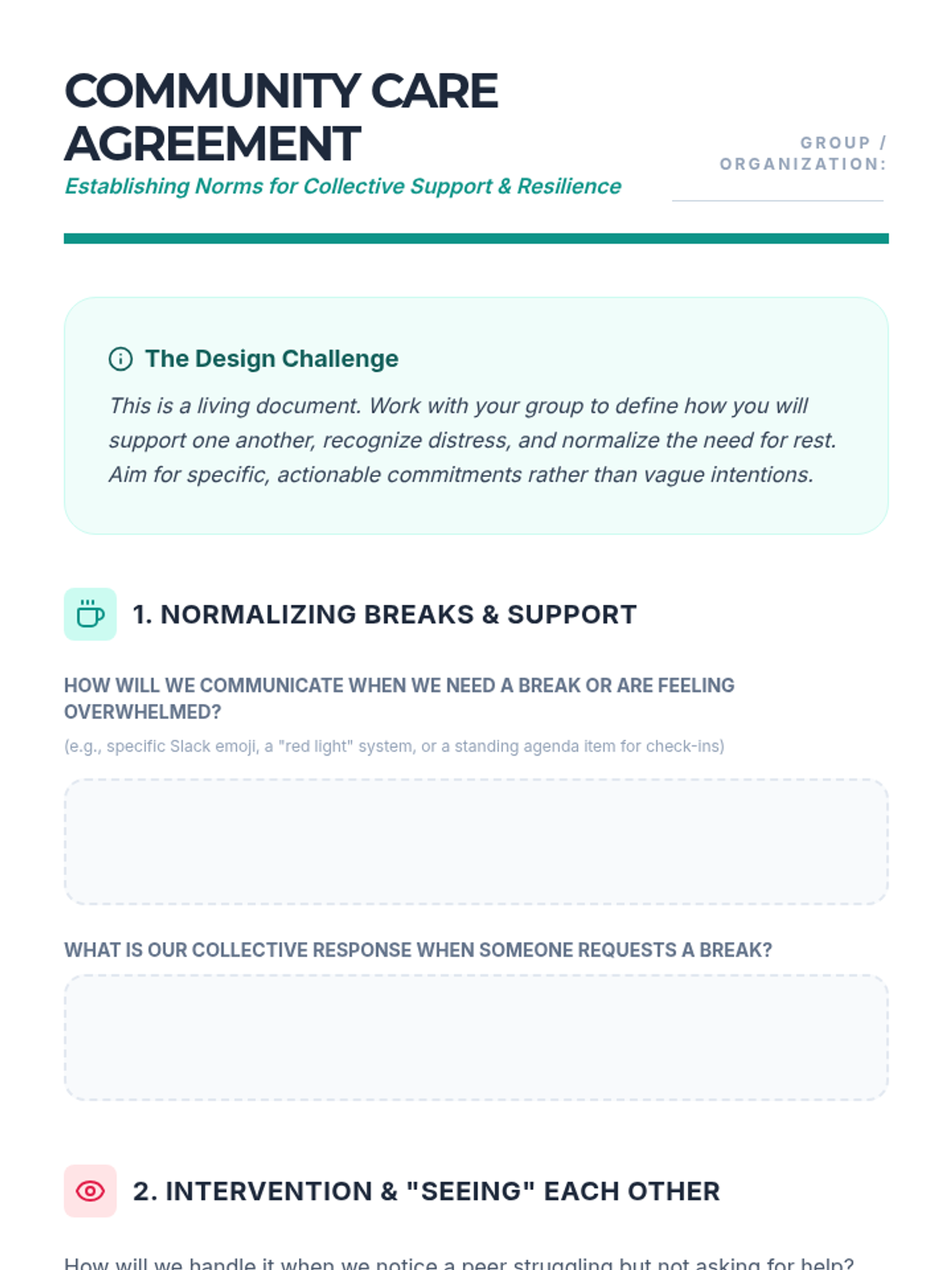
A design template for students to create a 'Community Care Agreement', establishing norms for mutual support, intervention strategies, and collective boundaries.
Slide deck for the 'Building Care Webs' lesson, introducing the concept of collective care vs. self-care and providing a framework for creating Community Care Agreements.
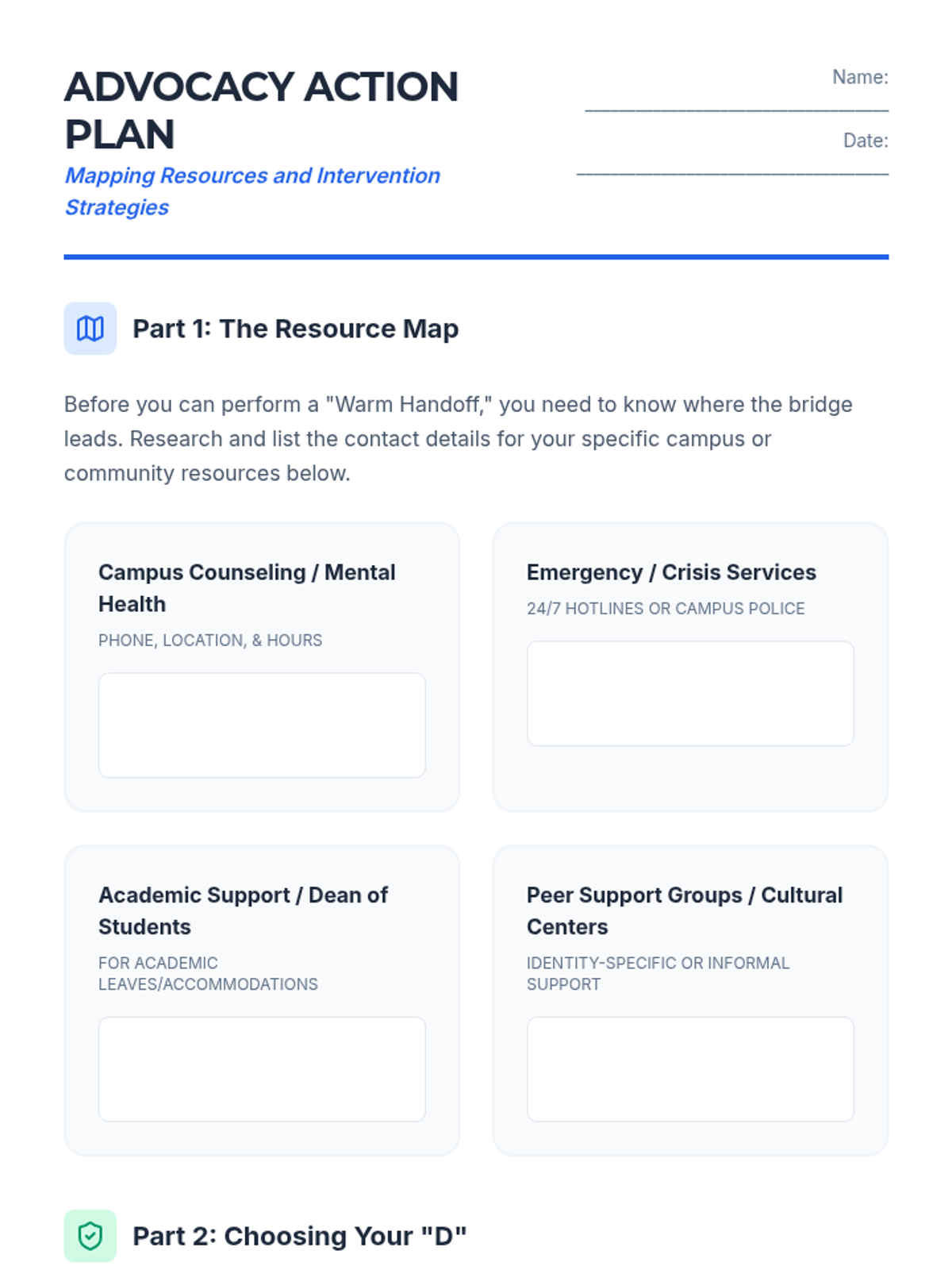
A student worksheet for mapping local mental health resources and practicing the 5Ds of intervention in a specific peer-distress scenario.
Slide deck for 'Mental Health Advocacy', covering the bystander effect, the 5Ds of intervention strategies, and the 'Warm Handoff' technique for connecting peers to professional resources.
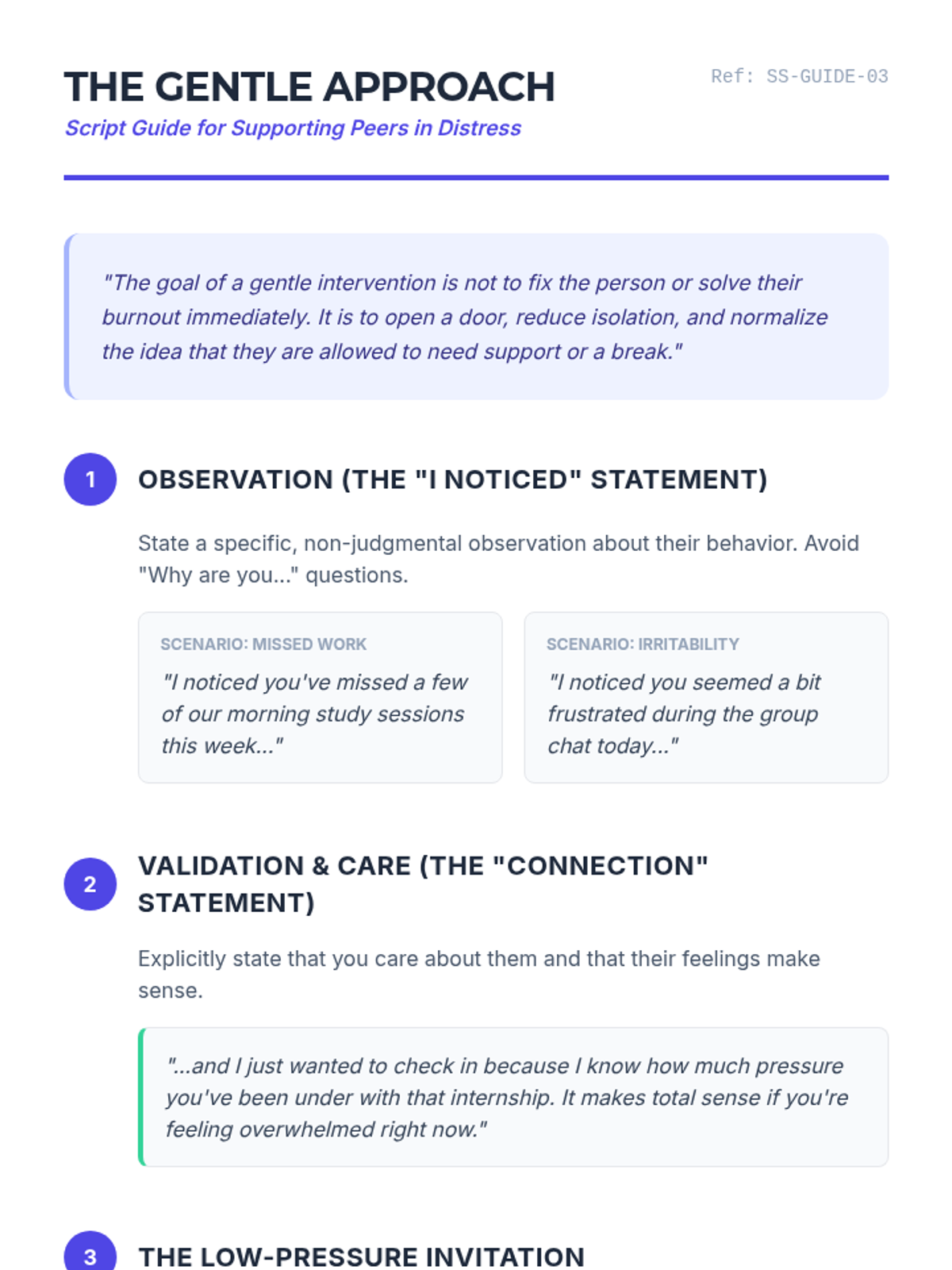
A script-building guide for students to practice the 'Gentle Approach' to intervention, providing specific phrasing for observations, validation, and low-pressure invitations.
Slide deck for 'Spotting the Signs', covering the three dimensions of burnout (Exhaustion, Cynicism, Inefficacy), behavioral red flags, and the three-step 'Gentle Approach' for intervention.
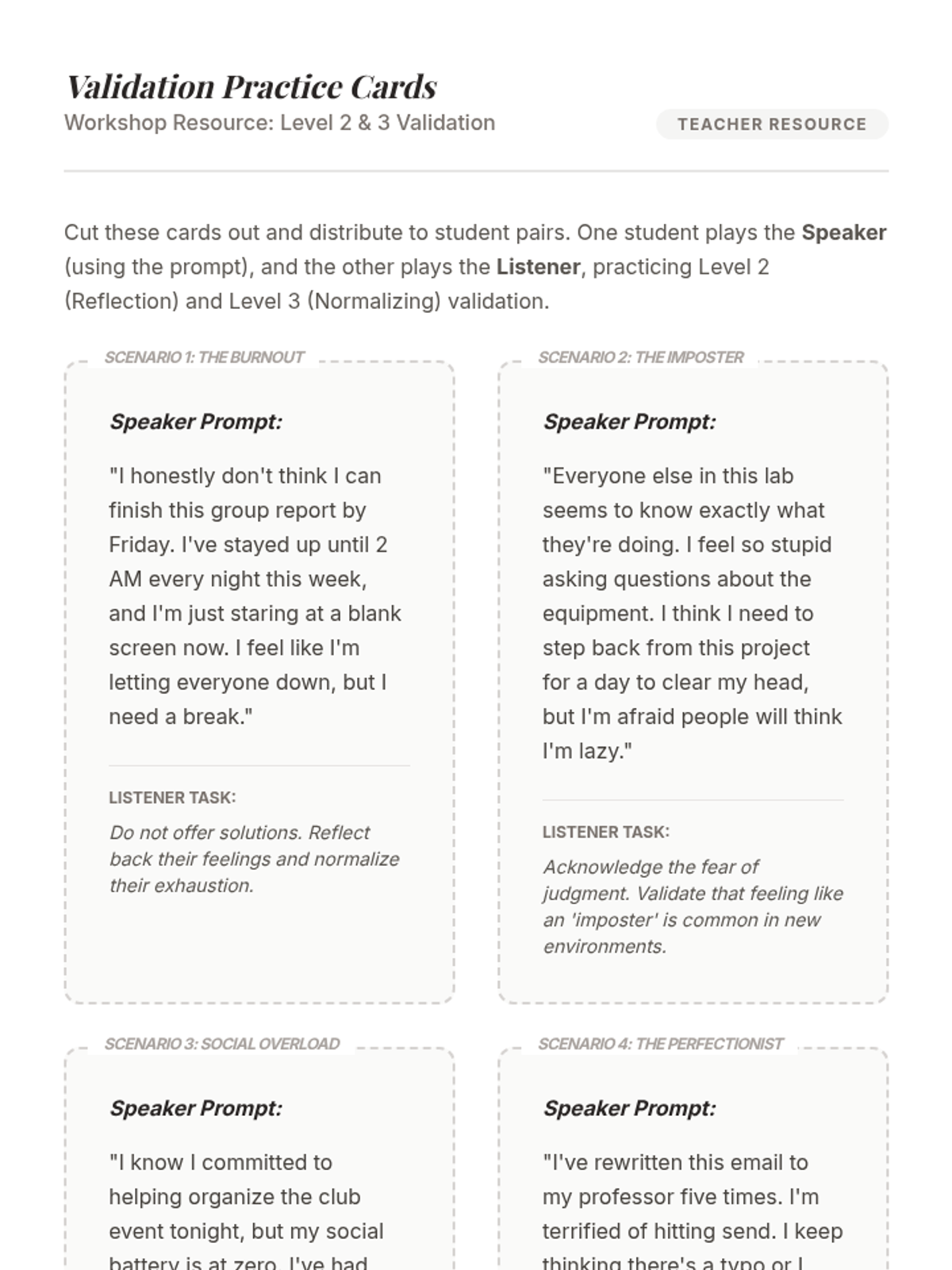
Scenarios and facilitator notes for the active listening workshop, providing students with structured practice in emotional validation and 'holding space' for peers in distress.
Slide deck for the 'Holding Space Workshop' lesson, focusing on the distinction between problem-solving ('fixing') and emotional validation, and introducing the 3 levels of validation.
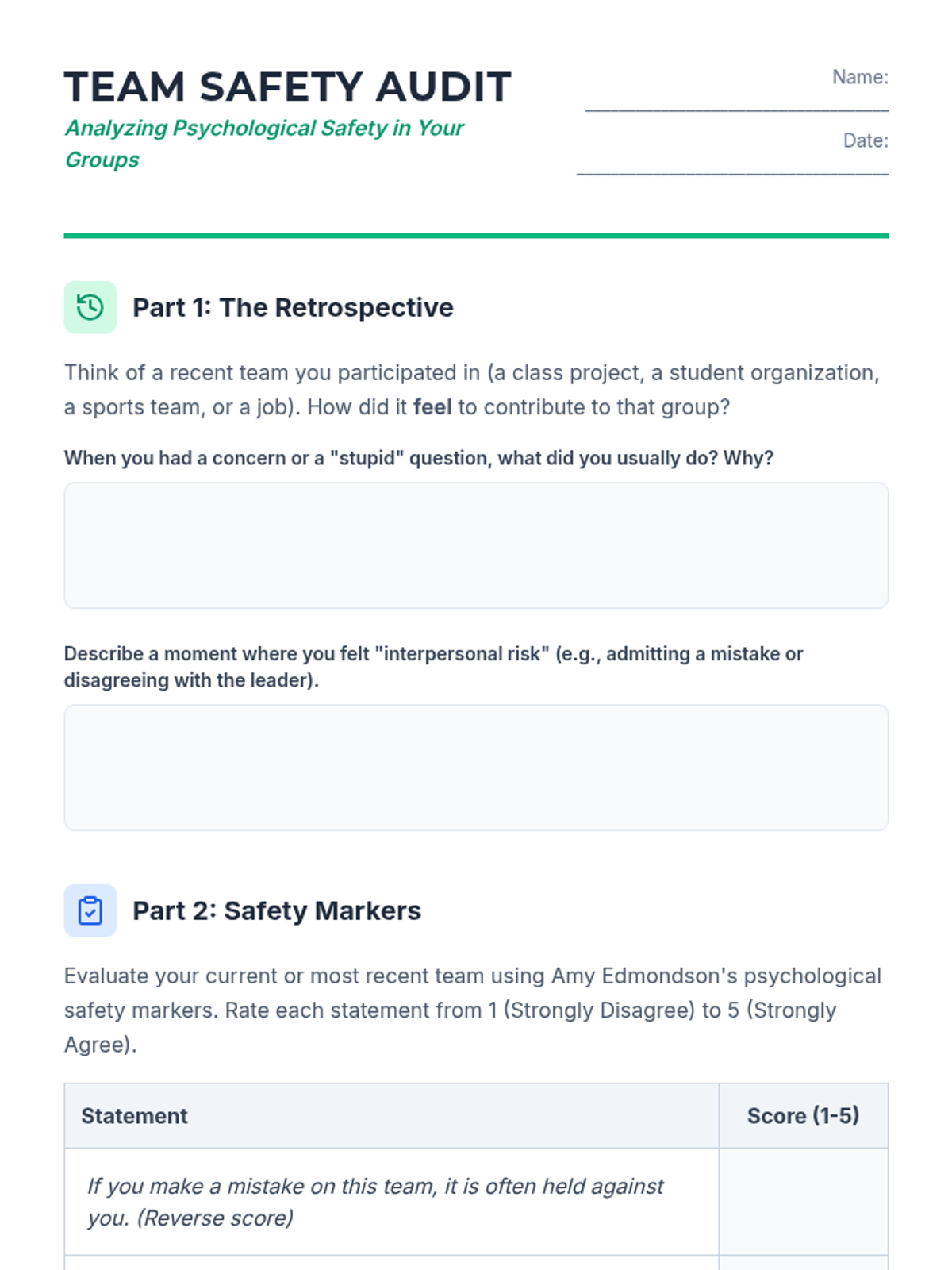
A reflection and audit worksheet for students to analyze the psychological safety of their own teams and identify barriers to requesting support.
Introductory slides for the 'Safe Spaces for Strong Teams' lesson, covering Google's Project Aristotle and the fundamental definition of psychological safety in group settings.
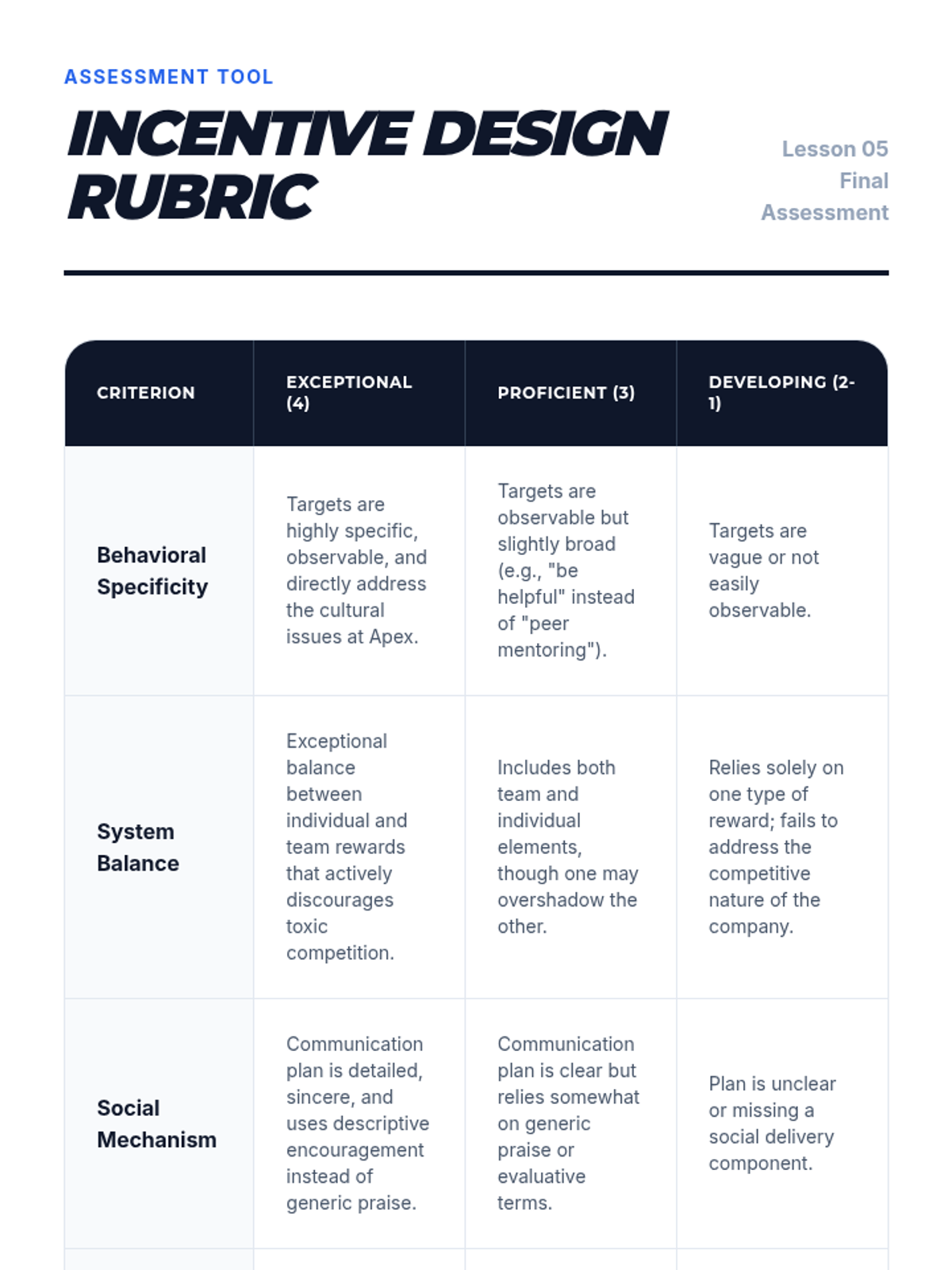
An assessment rubric for evaluating the Team Culture Blueprint project, focusing on behavioral specificity, system balance, and risk analysis.
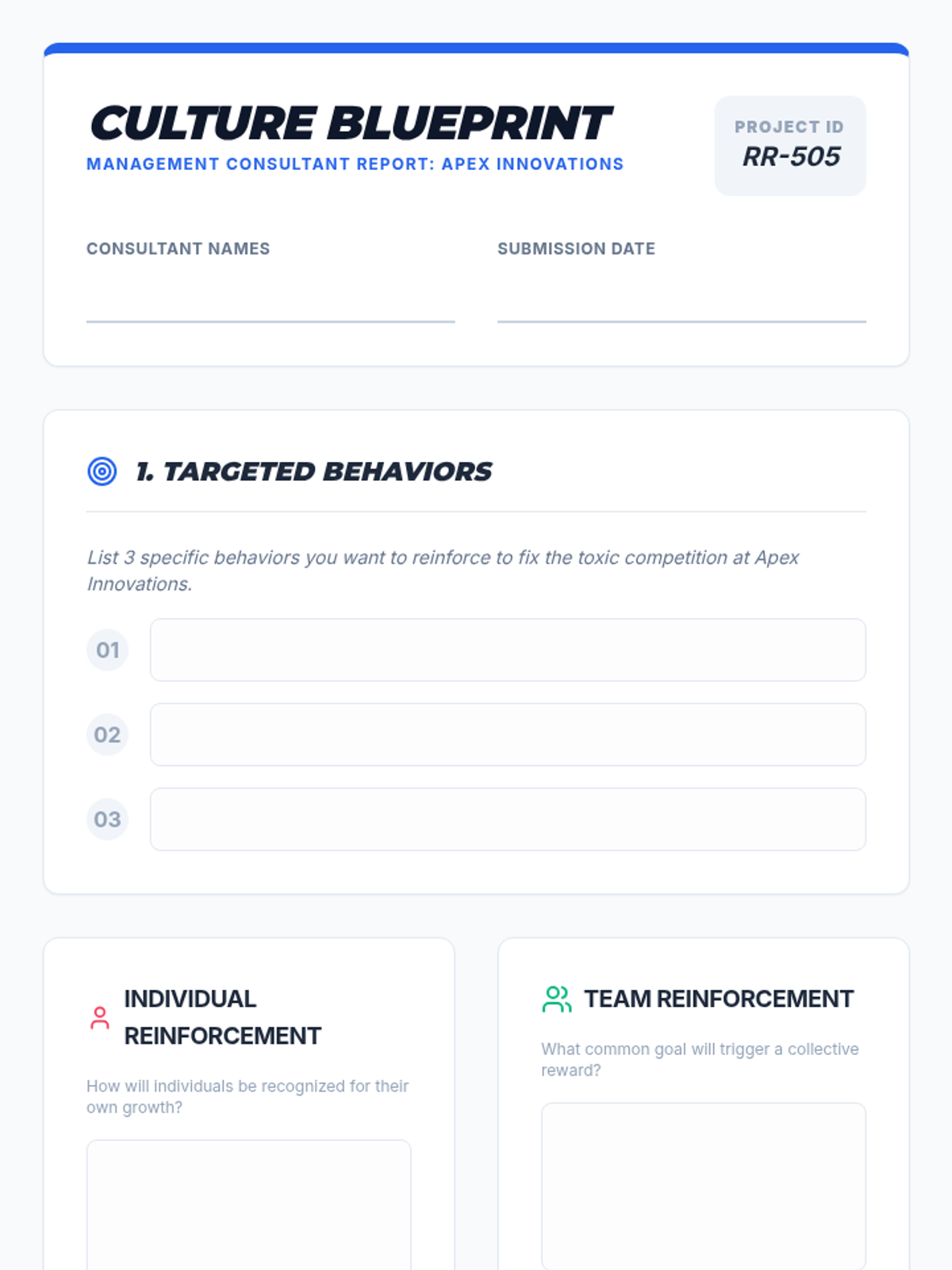
A culminating project template for students to act as management consultants and design a reinforcement system for a struggling organization.
A slide deck for the culminating project where students design a reinforcement system for an organization, balancing individual and team goals.
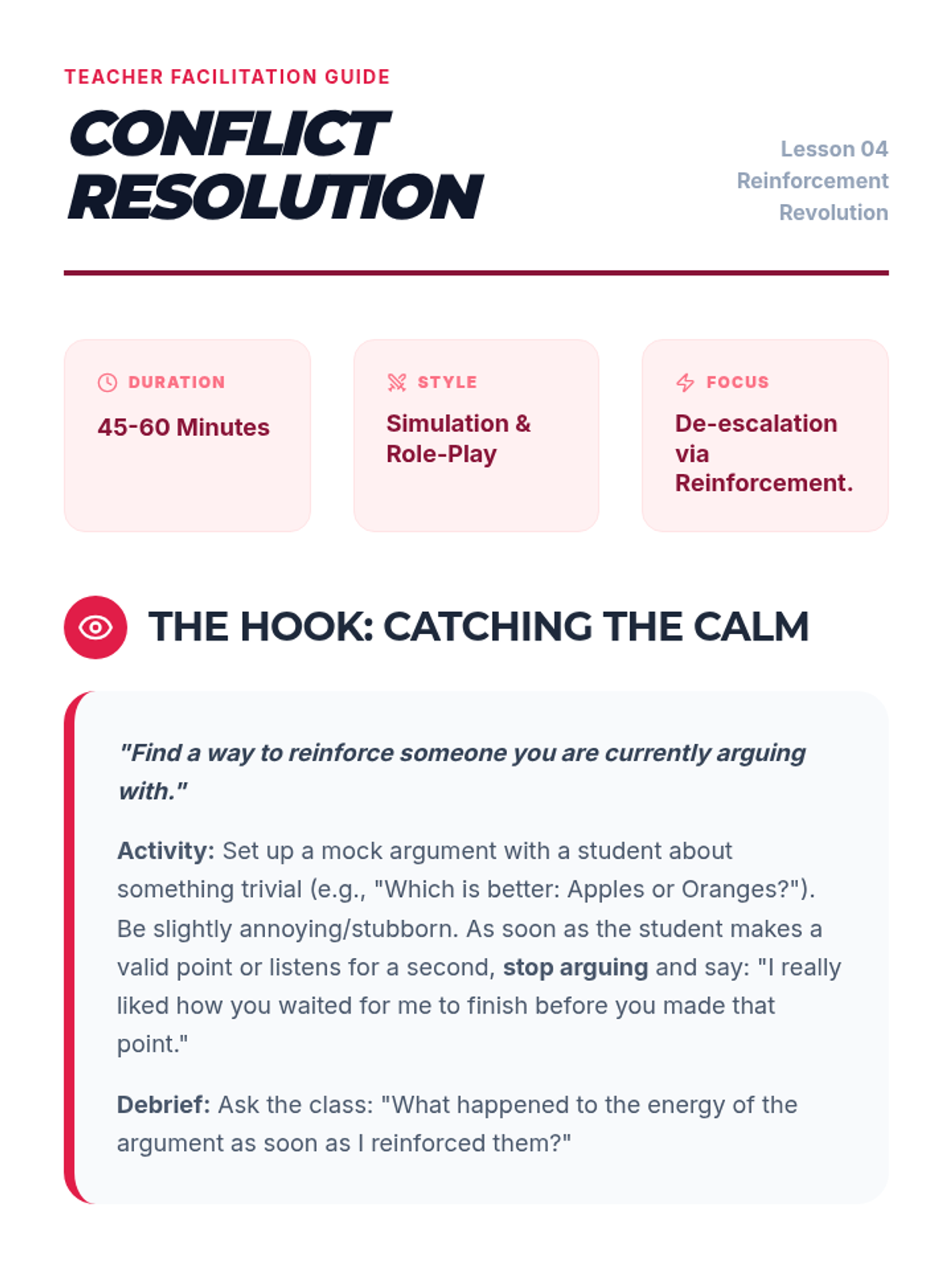
A facilitation guide for teachers to deliver the Reinforcement in Conflict lesson, including role-play tips, de-escalation strategies, and debrief questions.
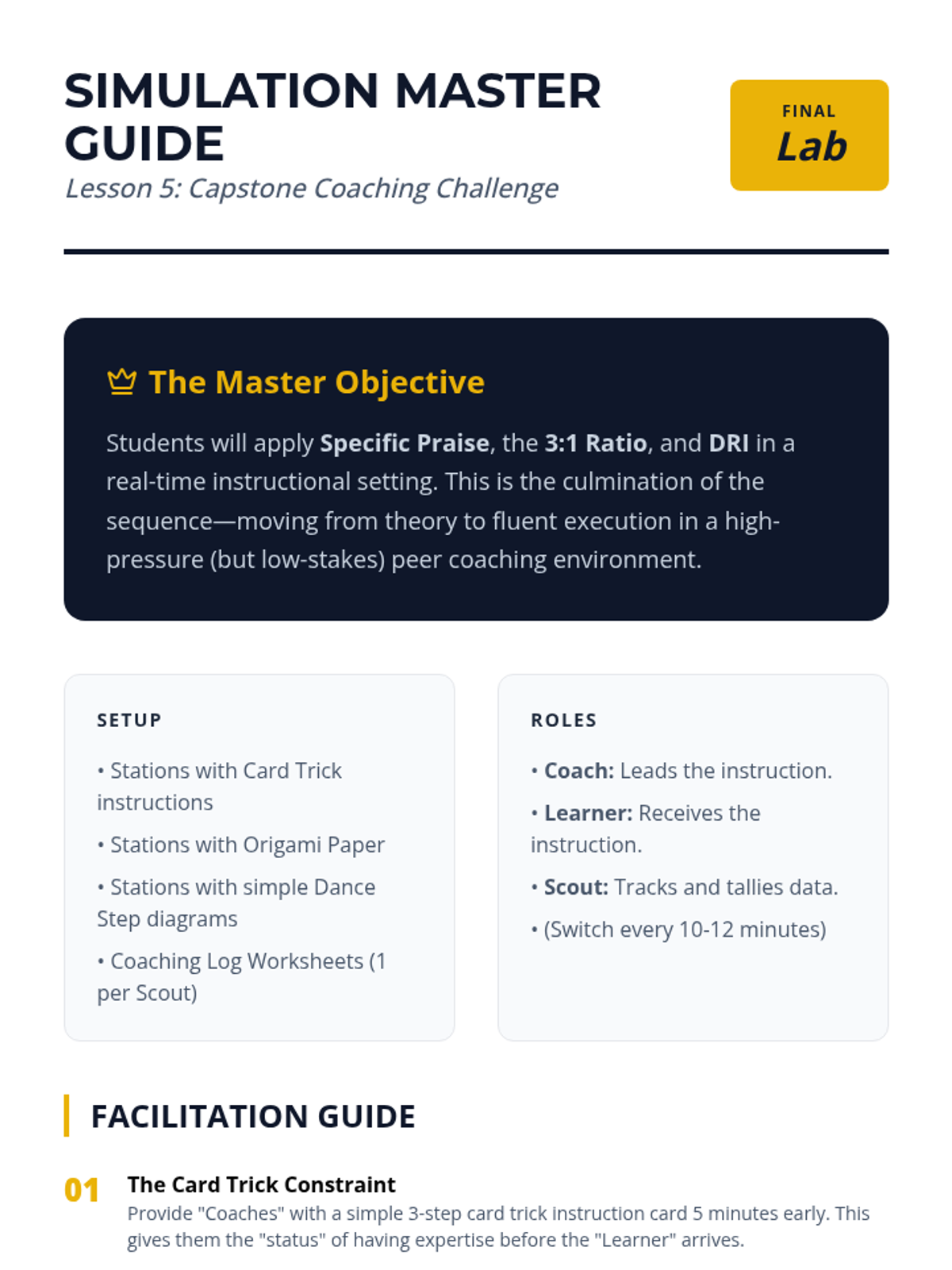
A teacher guide for Lesson 5 including card trick instructions, simulation logistics, and master debrief prompts for the Coaching Challenge.
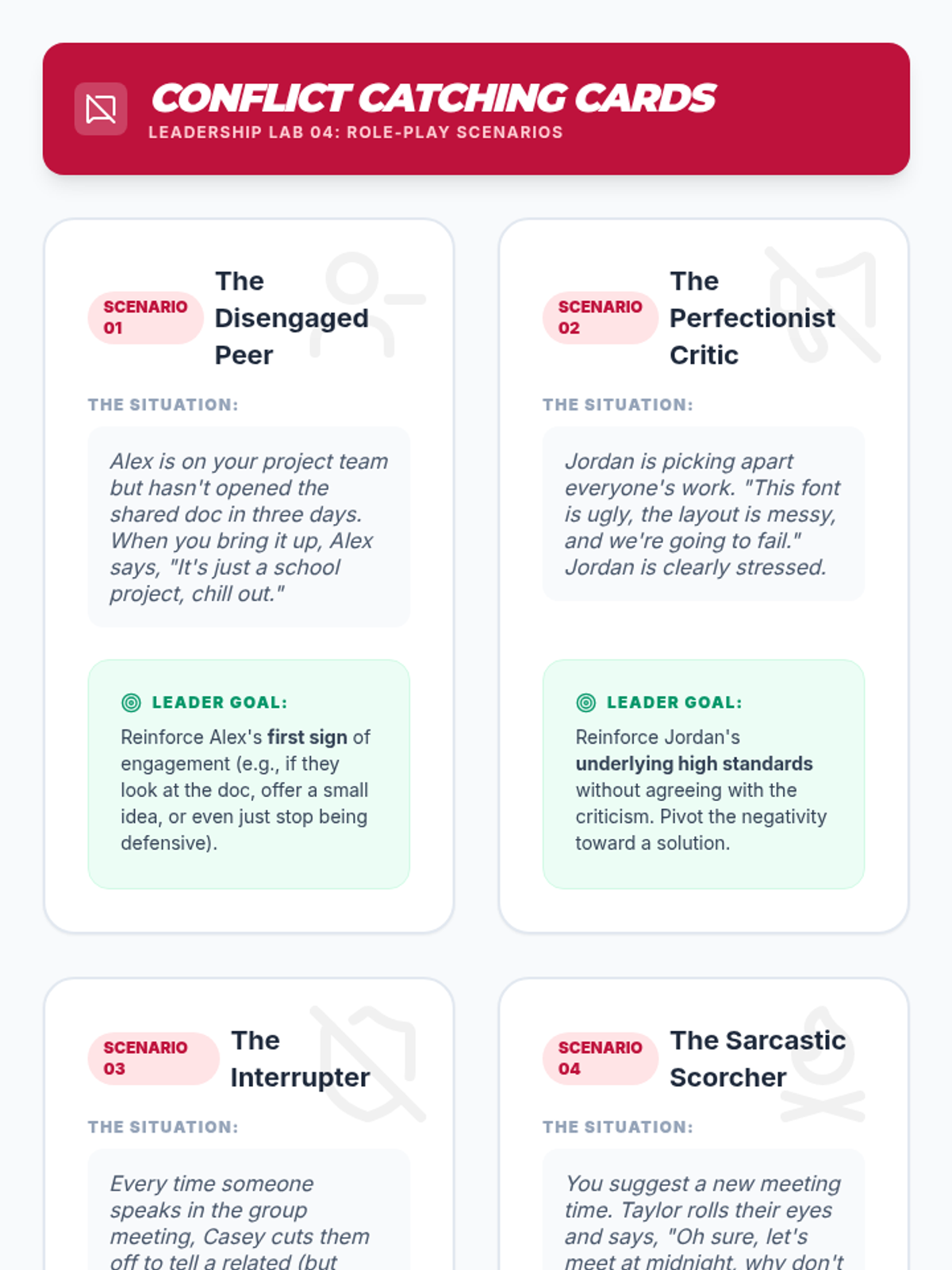
A set of role-play scenario cards designed to help students practice using positive reinforcement to de-escalate common interpersonal conflicts.
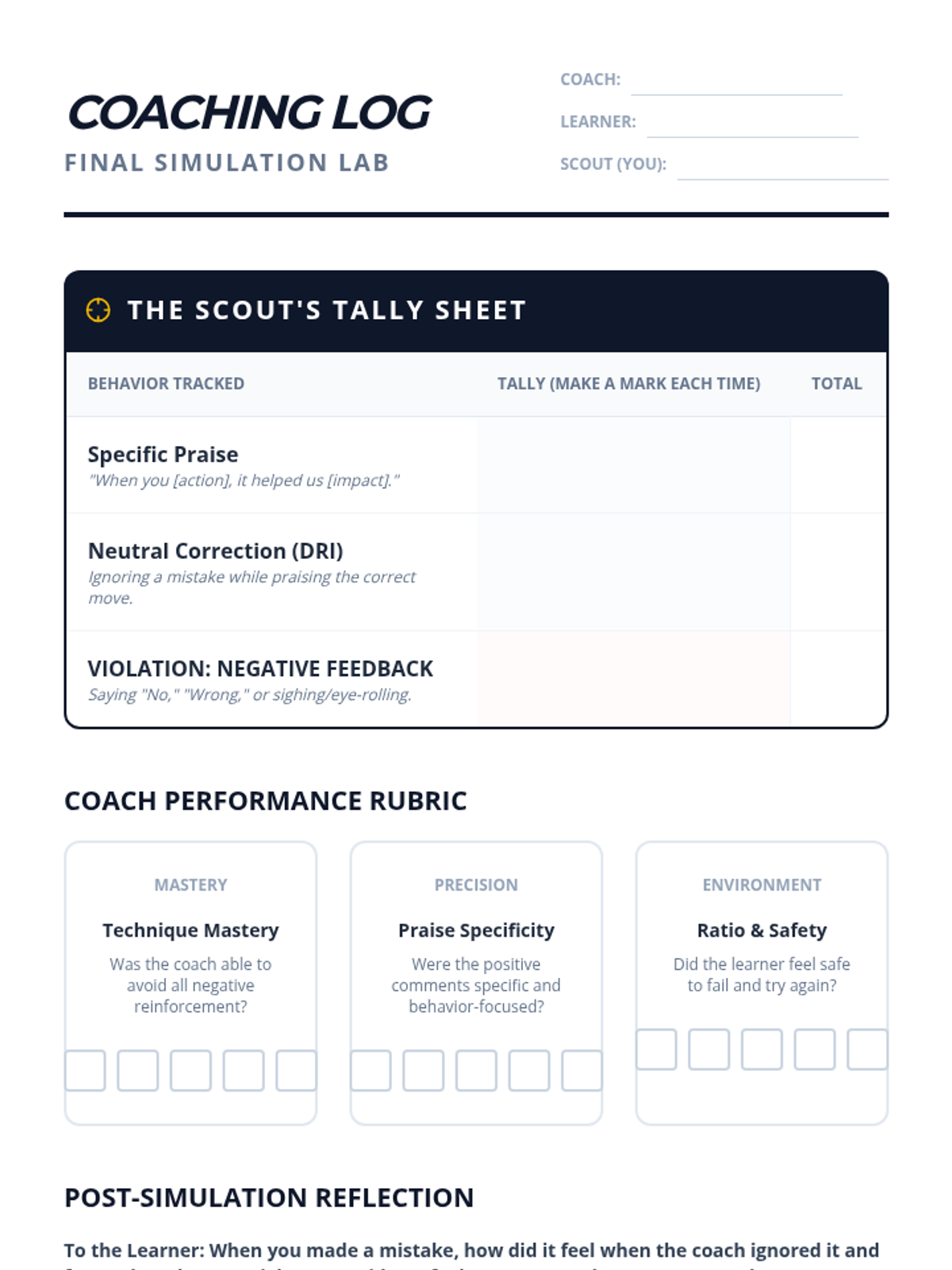
A worksheet for students to record tallies, rate performance, and reflect on the final coaching challenge simulation.
A slide deck introducing how to use positive reinforcement to de-escalate conflict and reinforce cooperative behavior in stressful leadership situations.
A slide deck introducing the final coaching challenge simulation, where students apply all positive reinforcement techniques learned in the sequence.
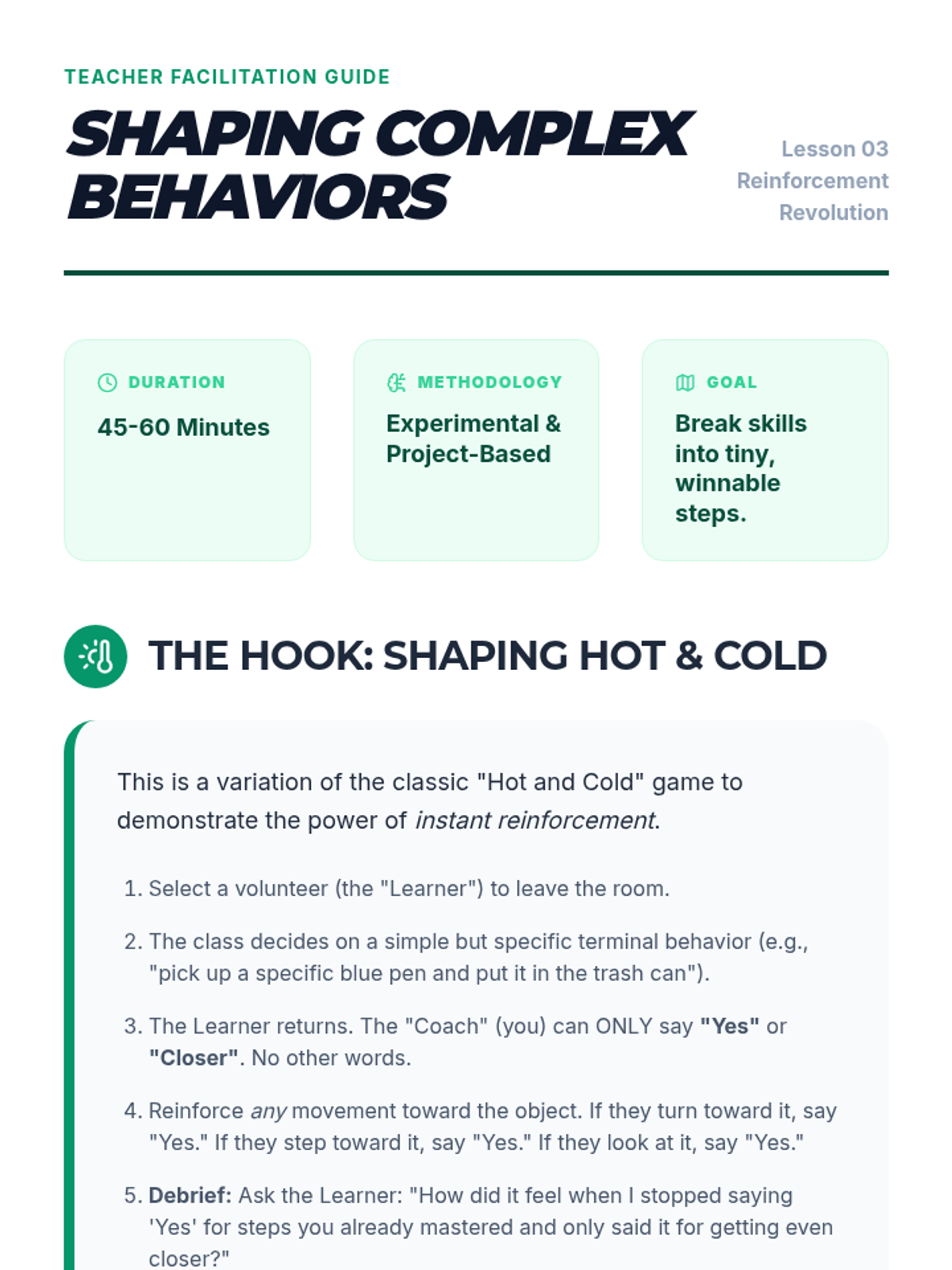
A facilitation guide for teachers to deliver the Shaping Complex Behaviors lesson, including game instructions, coaching tips, and key concept deep-dives.
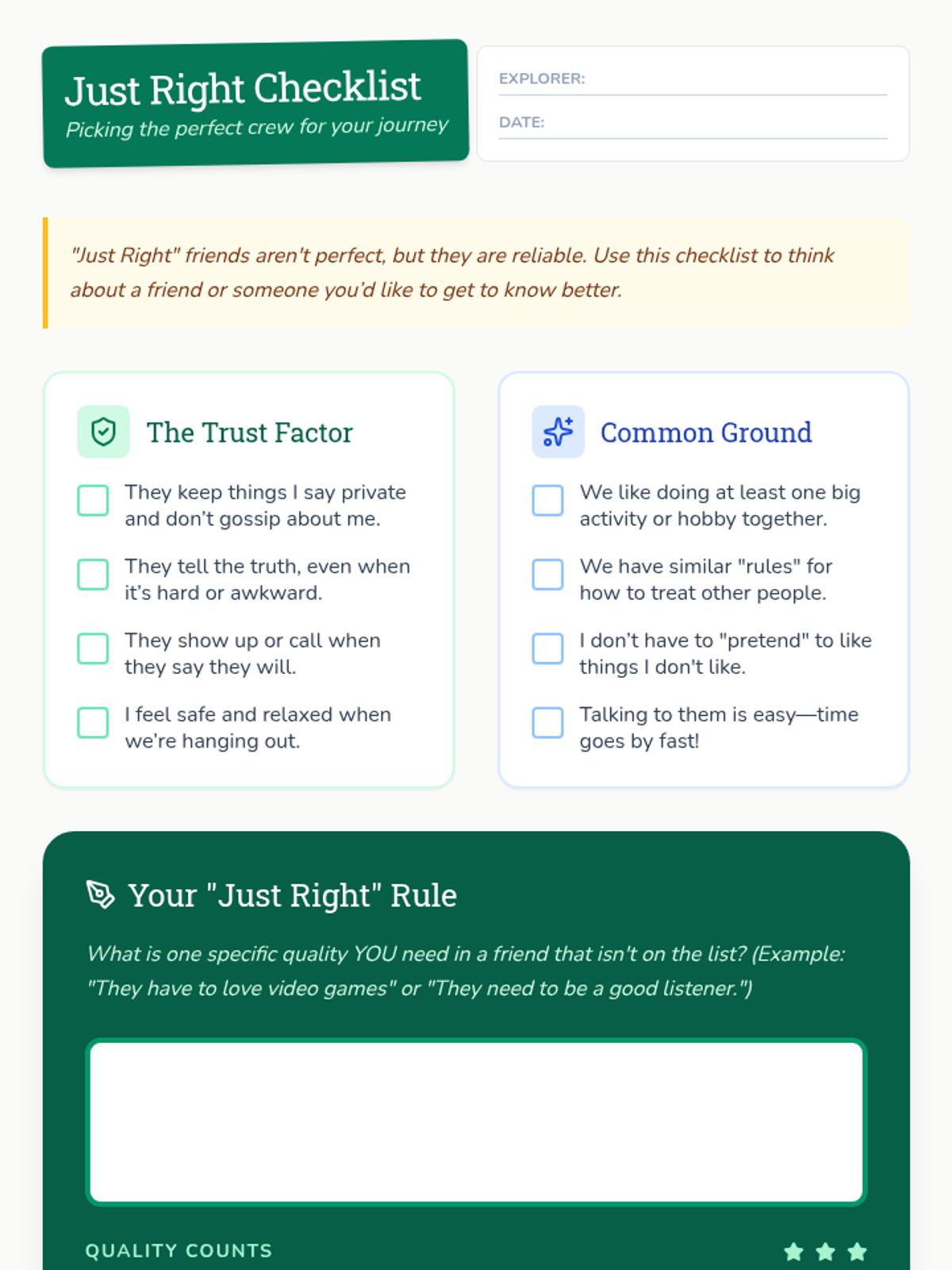
A student-friendly evaluation tool featuring clear indicators for trust and common interests, with a personalized reflection area for specific friendship needs.
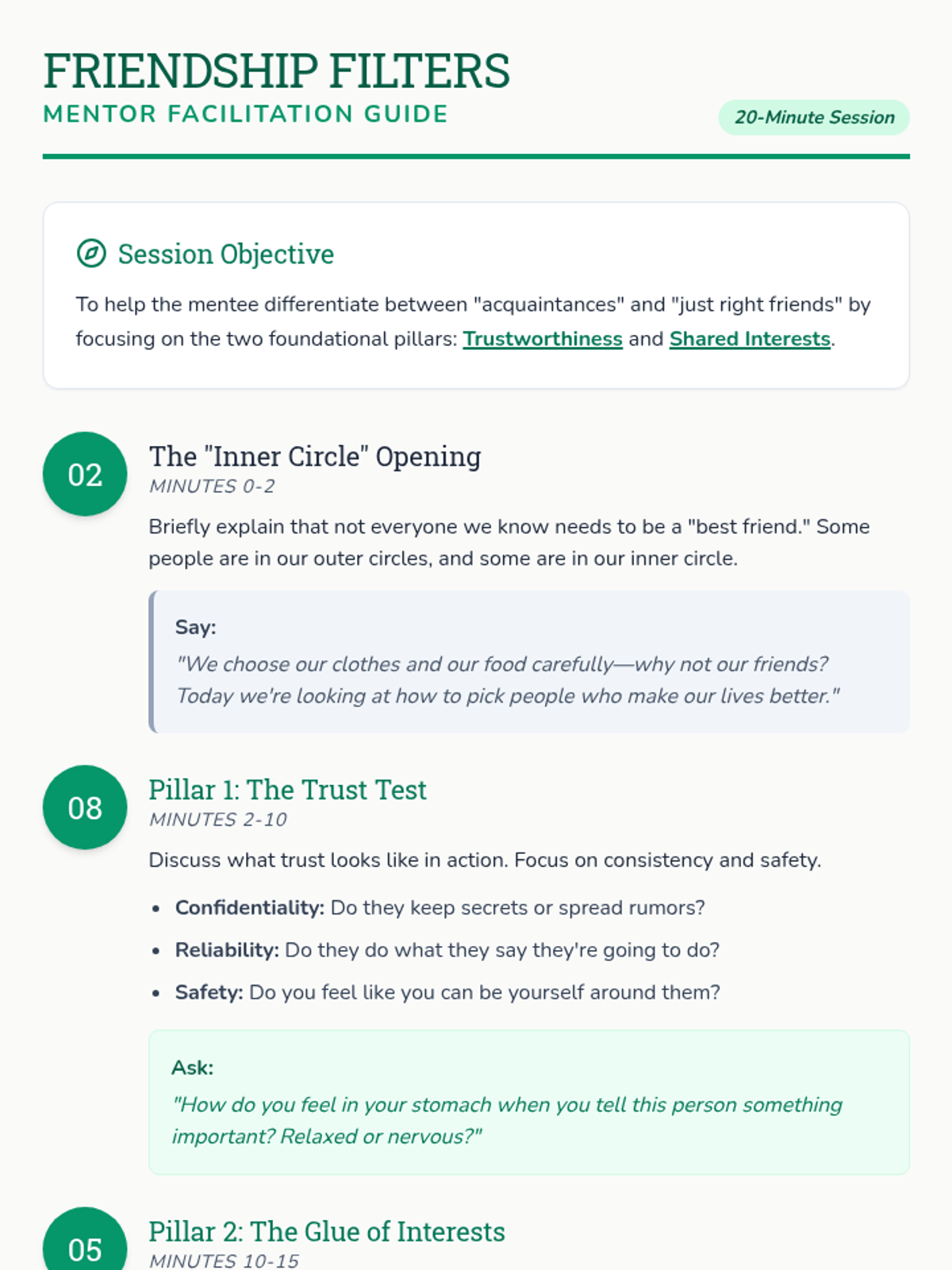
A concise 20-minute mentor facilitation guide designed to lead a focused discussion on choosing high-quality friends based on trust and common ground.
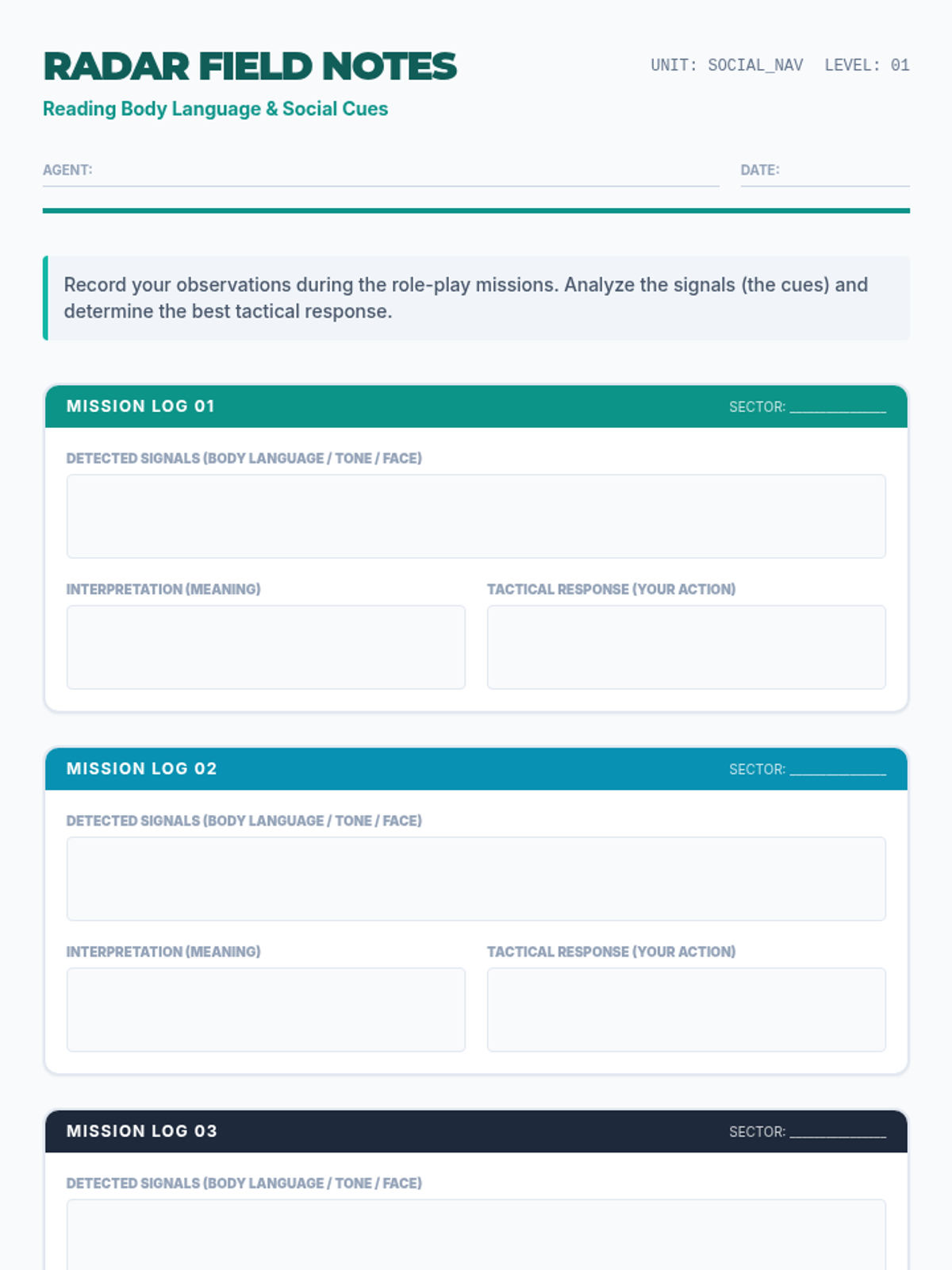
A student observation worksheet designed for recording cues and responses during role-play activities. Features a 'Mission Log' layout to track signals, interpretation, and tactical responses across different settings.
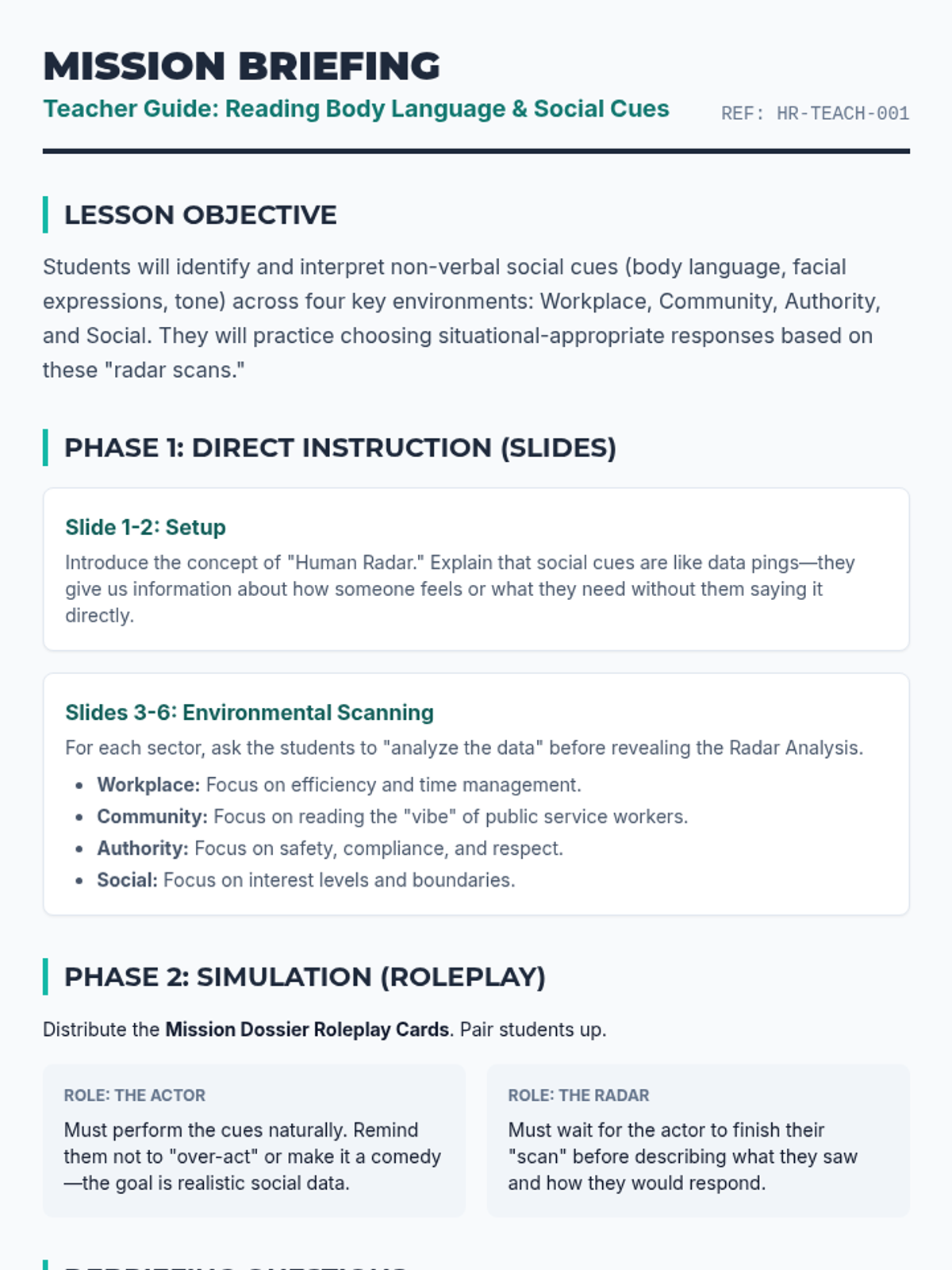
A comprehensive teacher facilitation guide for the Body Language lesson, including pacing, activity instructions for role-play, discussion questions, and troubleshooting tips.
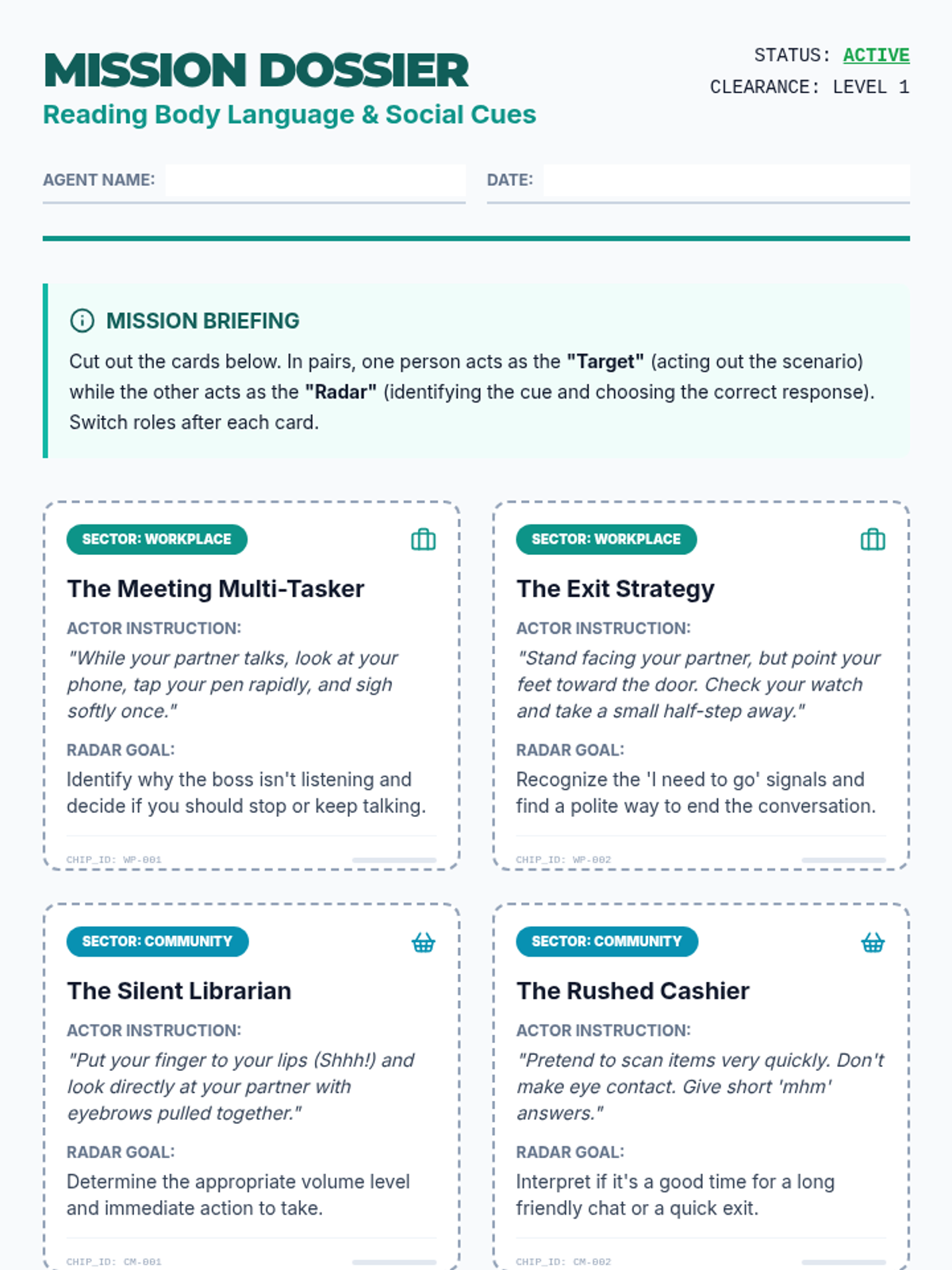
A set of printable role-play scenario cards themed as a 'Mission Dossier' for practicing reading social cues across workplace, community, authority, and social settings. Each card includes specific actor instructions and goals for the person playing the 'Radar'.
A presentation deck on body language and social cues across various settings, featuring clear 'Radar Analysis' for specific scenarios and visual descriptions for analysis.
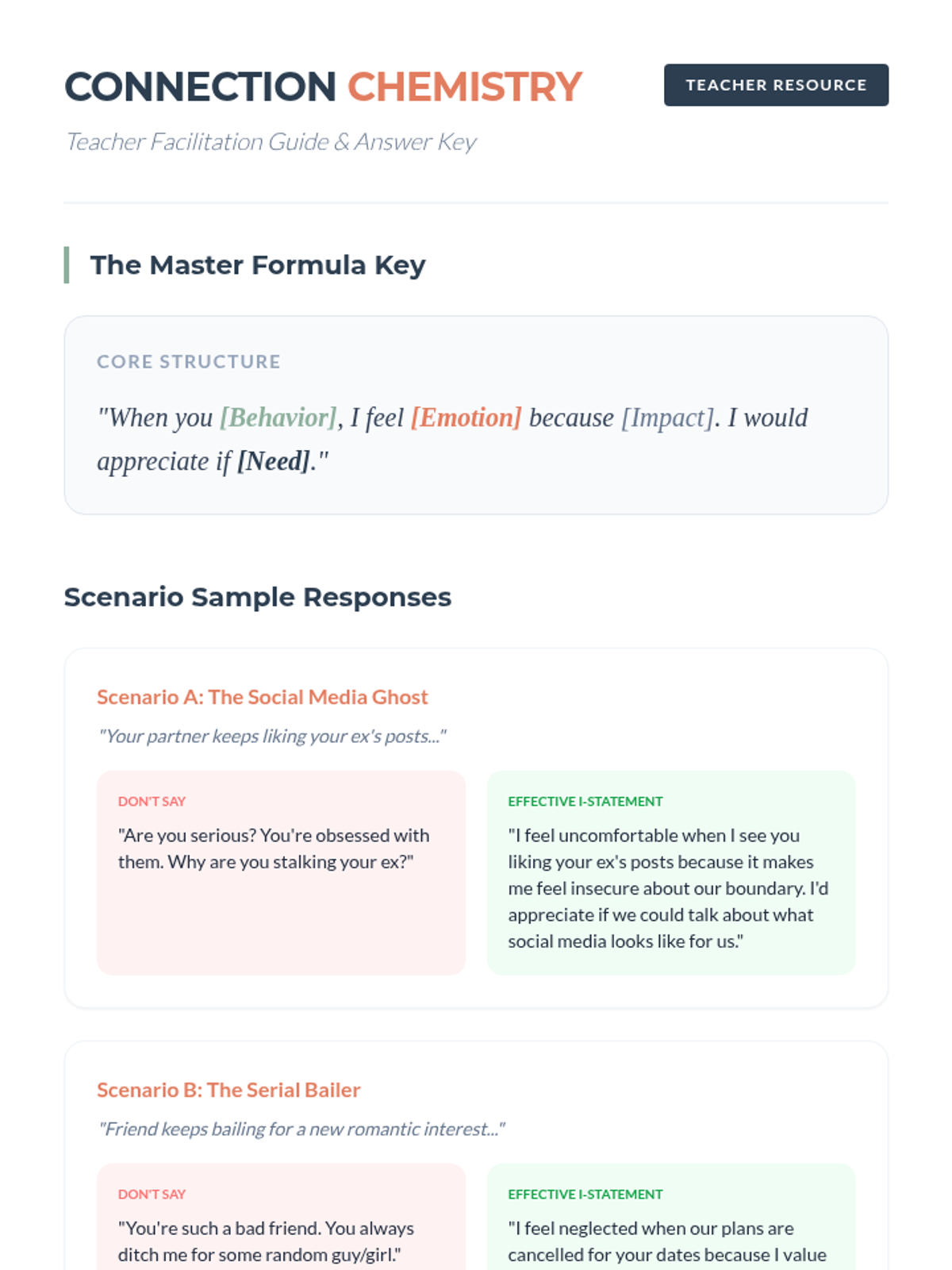
Teacher-facing answer key and facilitation guide for the Connection Chemistry lesson. Includes sample I-statement responses for scenarios and instructional tips for managing classroom activities.
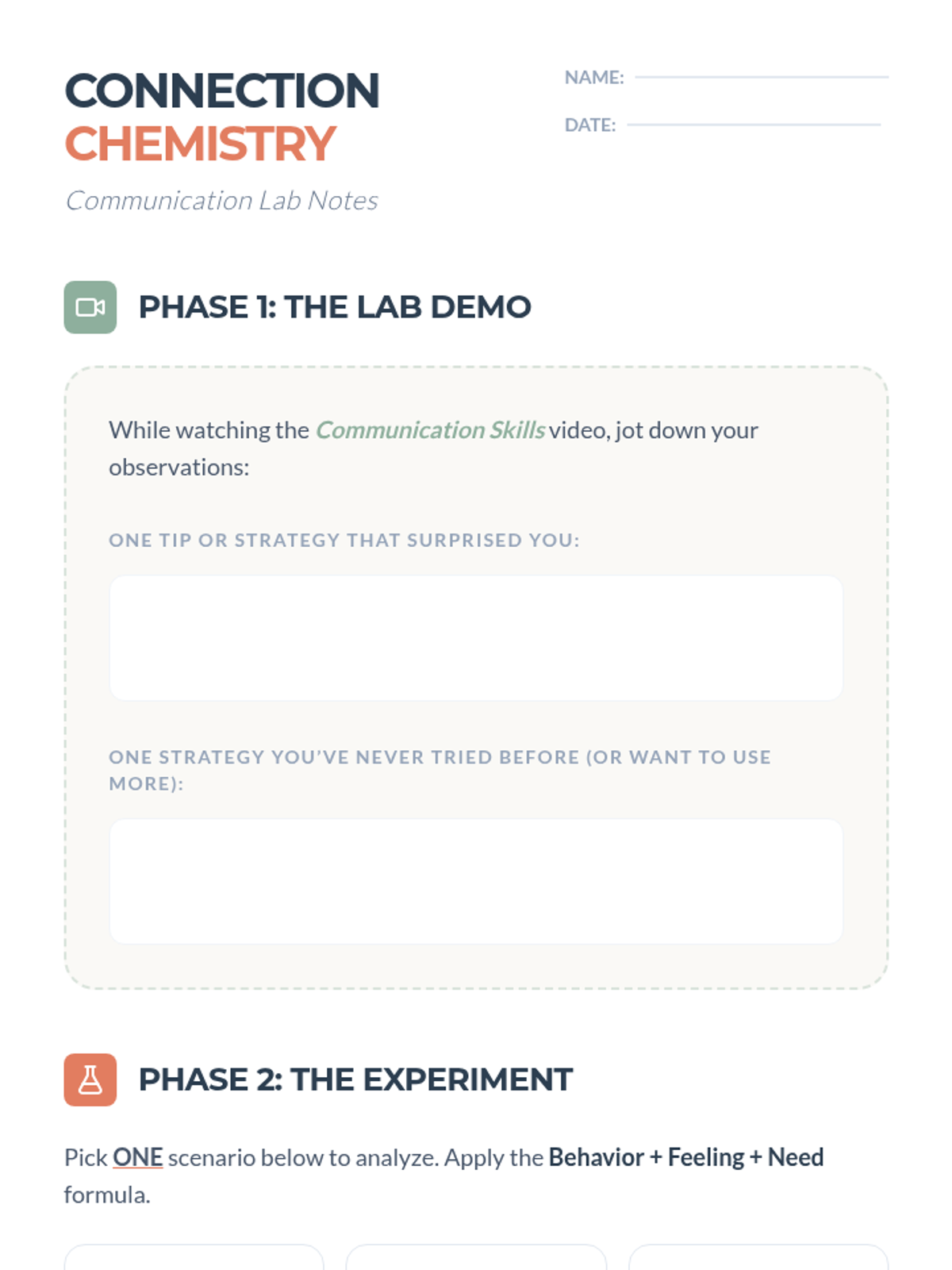
Student worksheet for the Connection Chemistry lesson. Includes video observation notes, a scenario-based practice section using the "Master Formula," and a final reflection summarizer.
Comprehensive lesson plan for the Connection Chemistry unit, detailing curriculum alignment, learning objectives, and a 60-minute instructional agenda featuring slide-based instruction and scenario-based practice.
Contemporary slide deck for HS students on effective communication. Features clean, warm aesthetics with soft greens and terracottas, focusing on modern relationship scenarios like digital boundaries and texting etiquette.
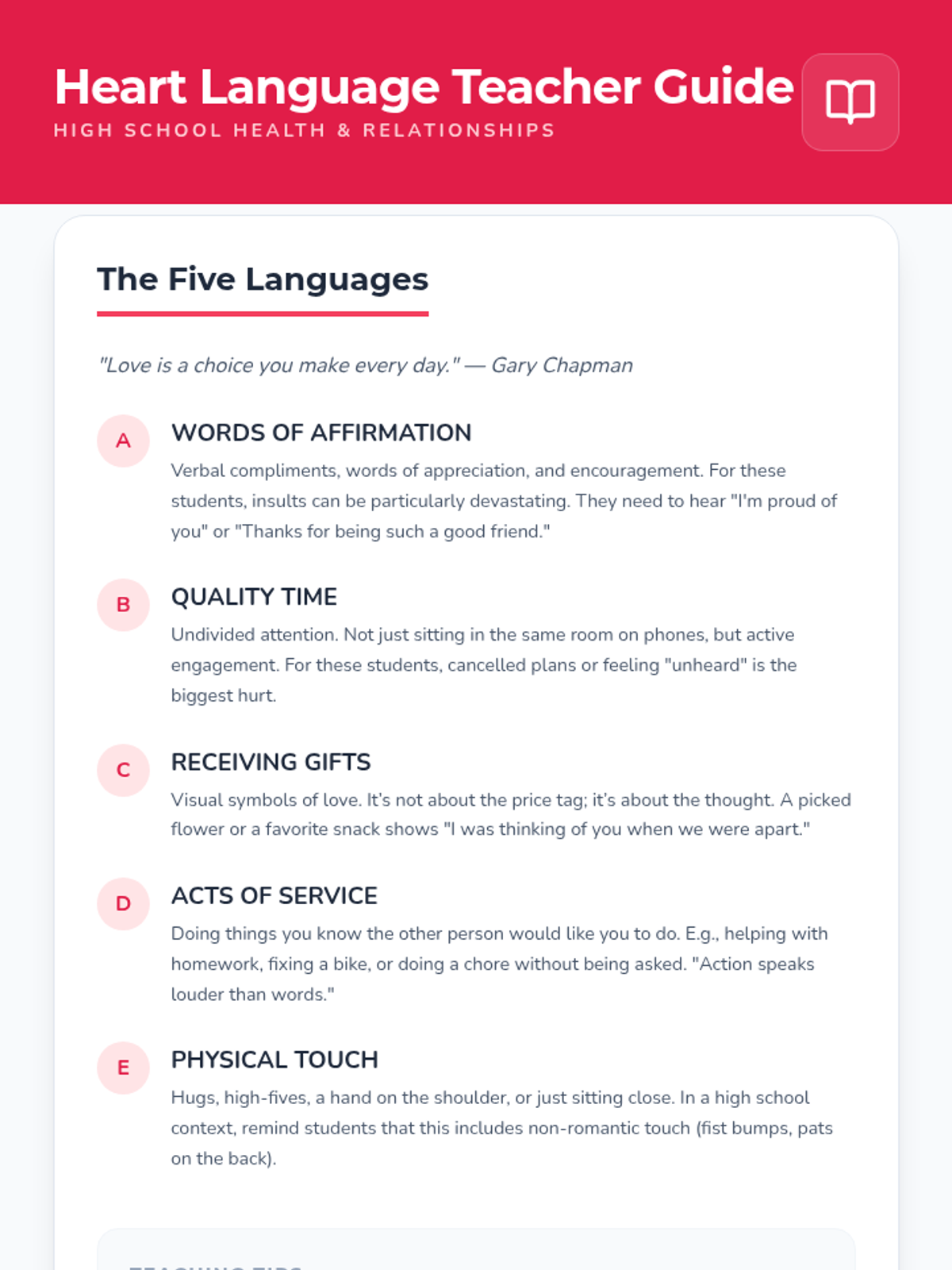
A comprehensive guide for teachers to lead a lesson on Love Languages, including definitions, signs of each language, discussion prompts, and teaching tips.
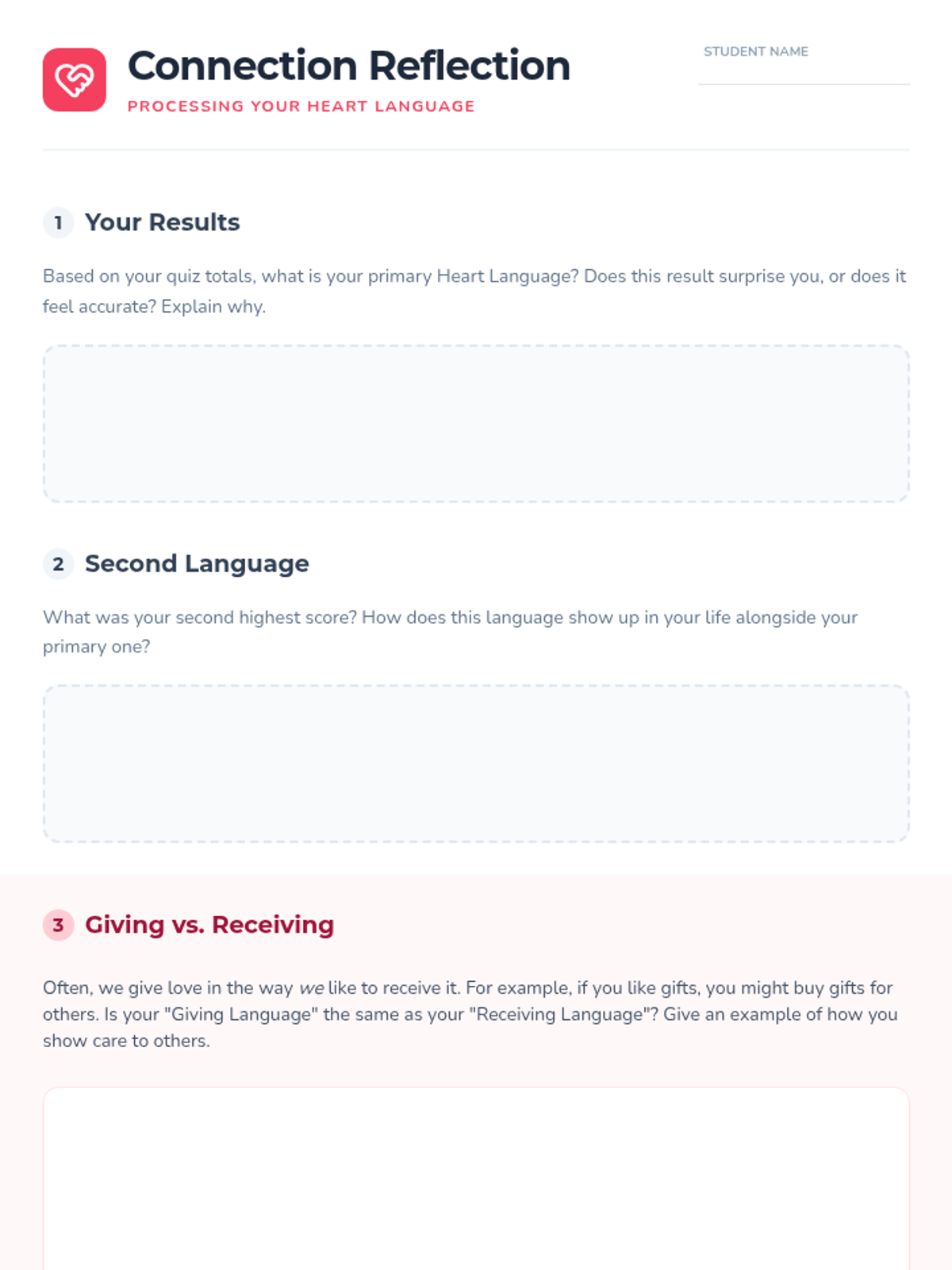
A reflection guide for students to process their love language quiz results, analyze their relationships, and create an action plan to support others.
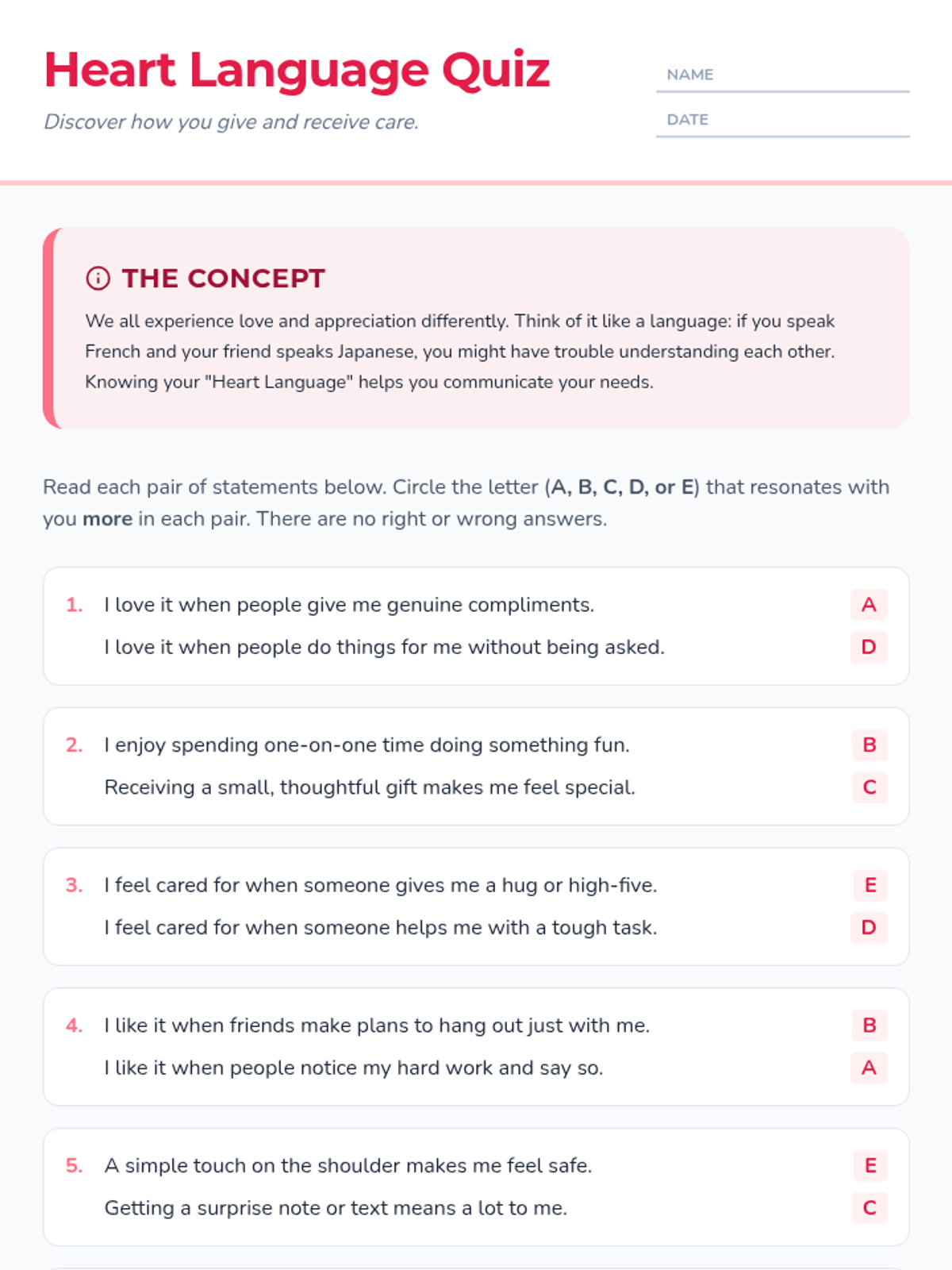
A two-page self-assessment quiz for high school students to identify their primary love languages (Words, Time, Gifts, Acts, Touch) through 15 comparative statements.
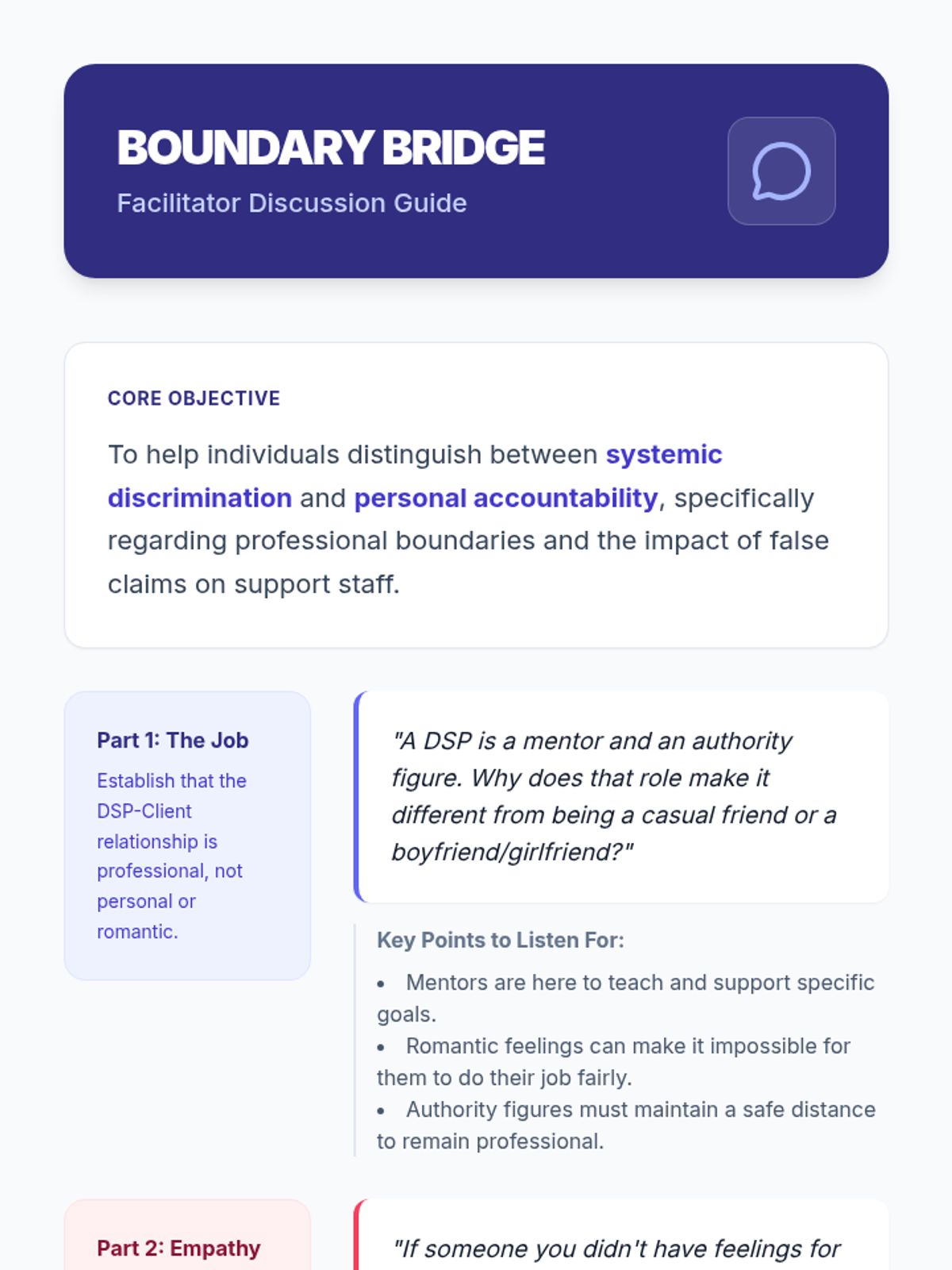
A facilitator guide with discussion prompts and key points for leading a group or individual session on boundaries and discrimination.
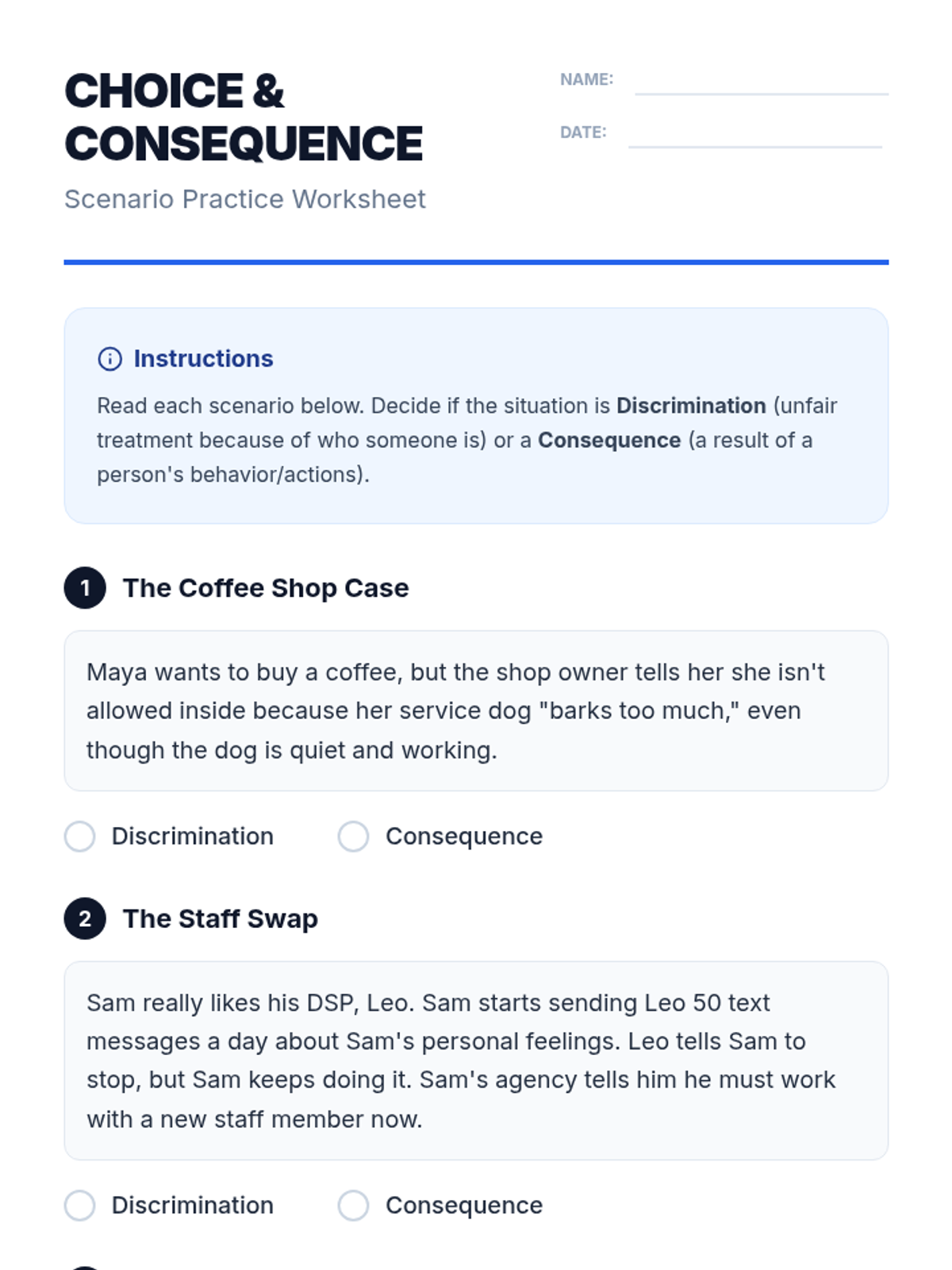
An expanded worksheet with six scenarios for students to identify discrimination versus behavioral consequences, including a deep-dive reflection on false claims.
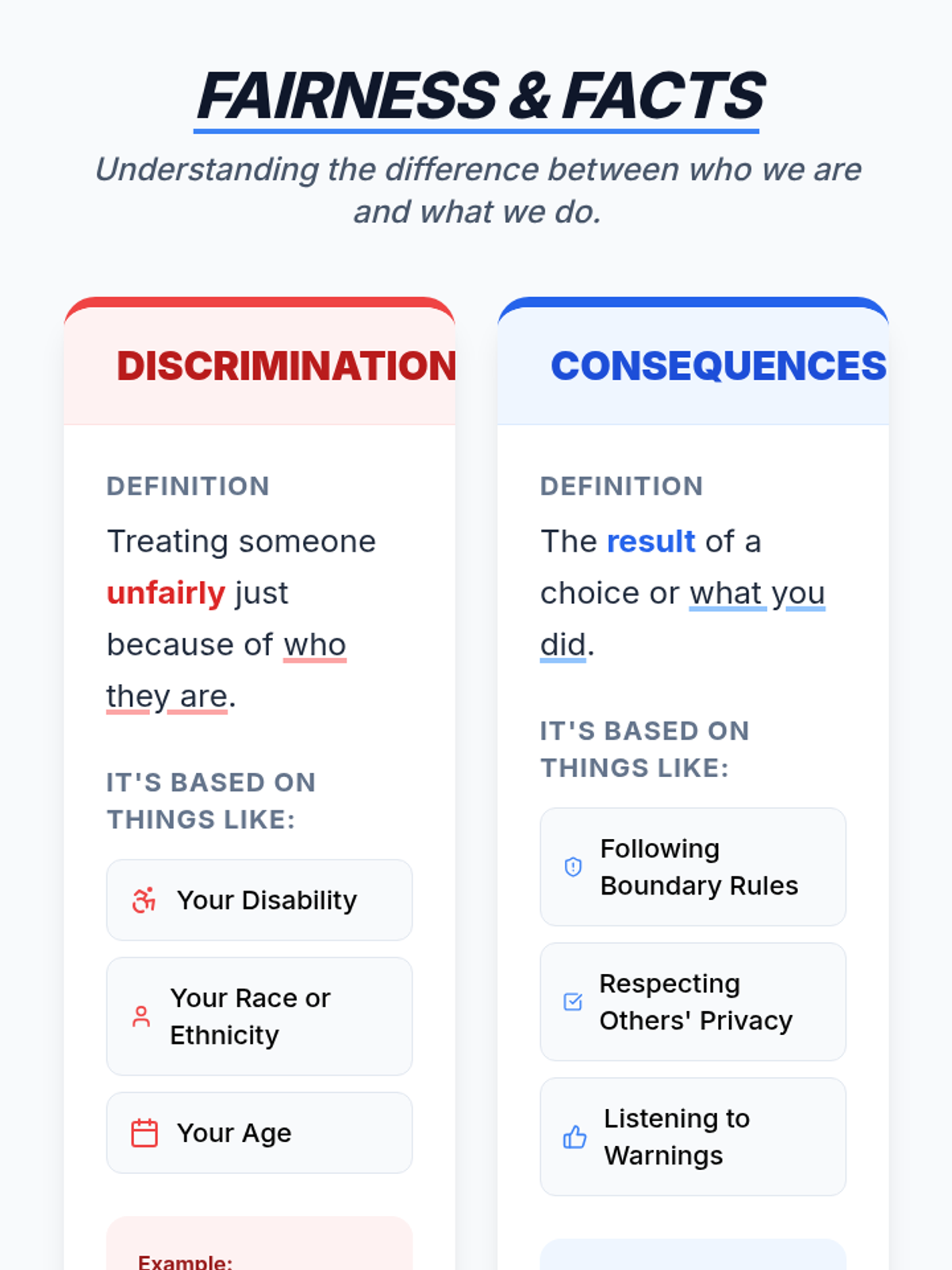
An anchor chart contrasting the definitions and examples of discrimination versus behavioral consequences.
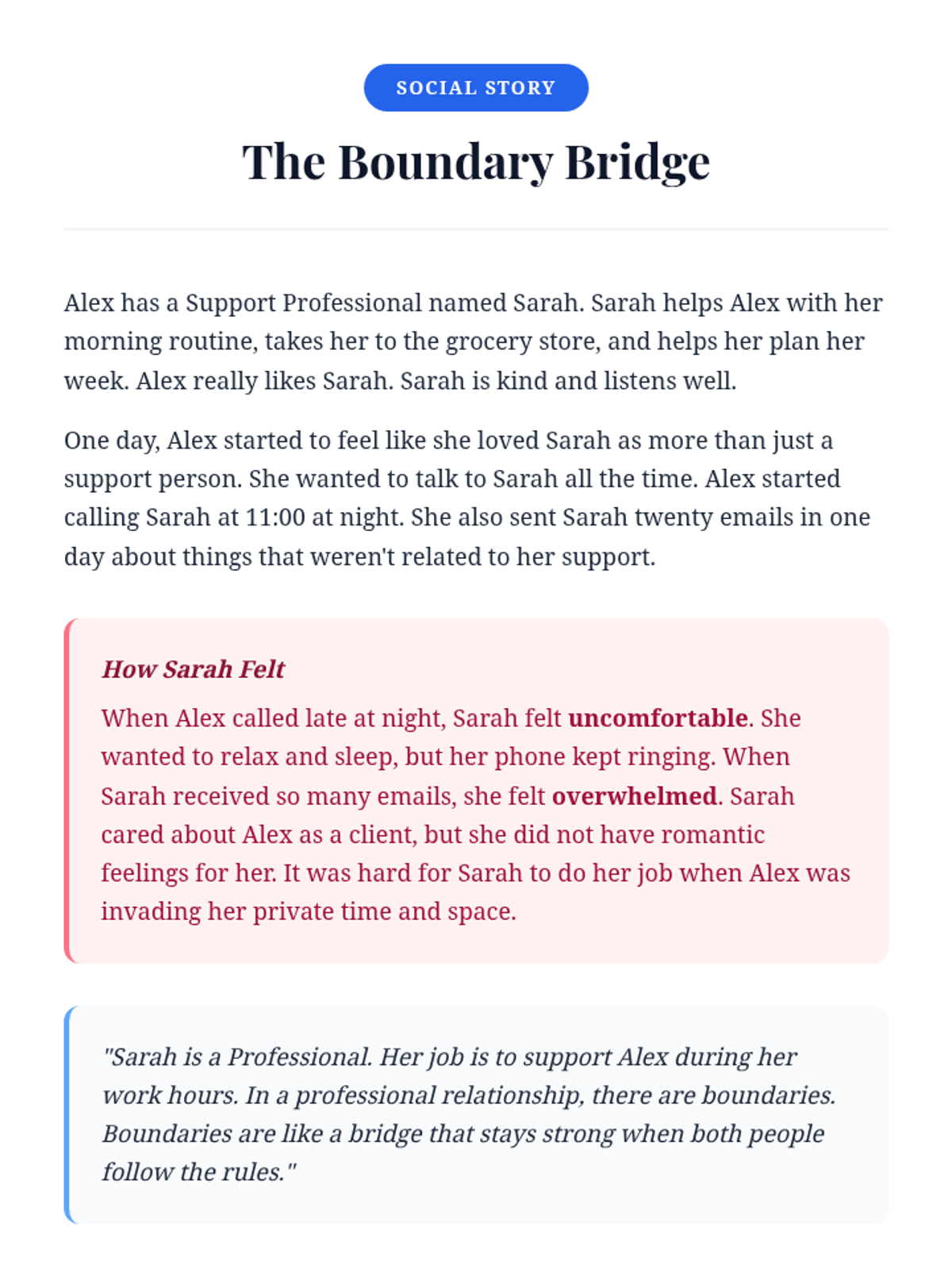
Updated social story including Sarah's perspective of discomfort and the importance of respecting a mentor's boundaries.
Updated slides defining professional boundaries, explaining discrimination vs. consequences, and detailing the discomfort caused by boundary violations.
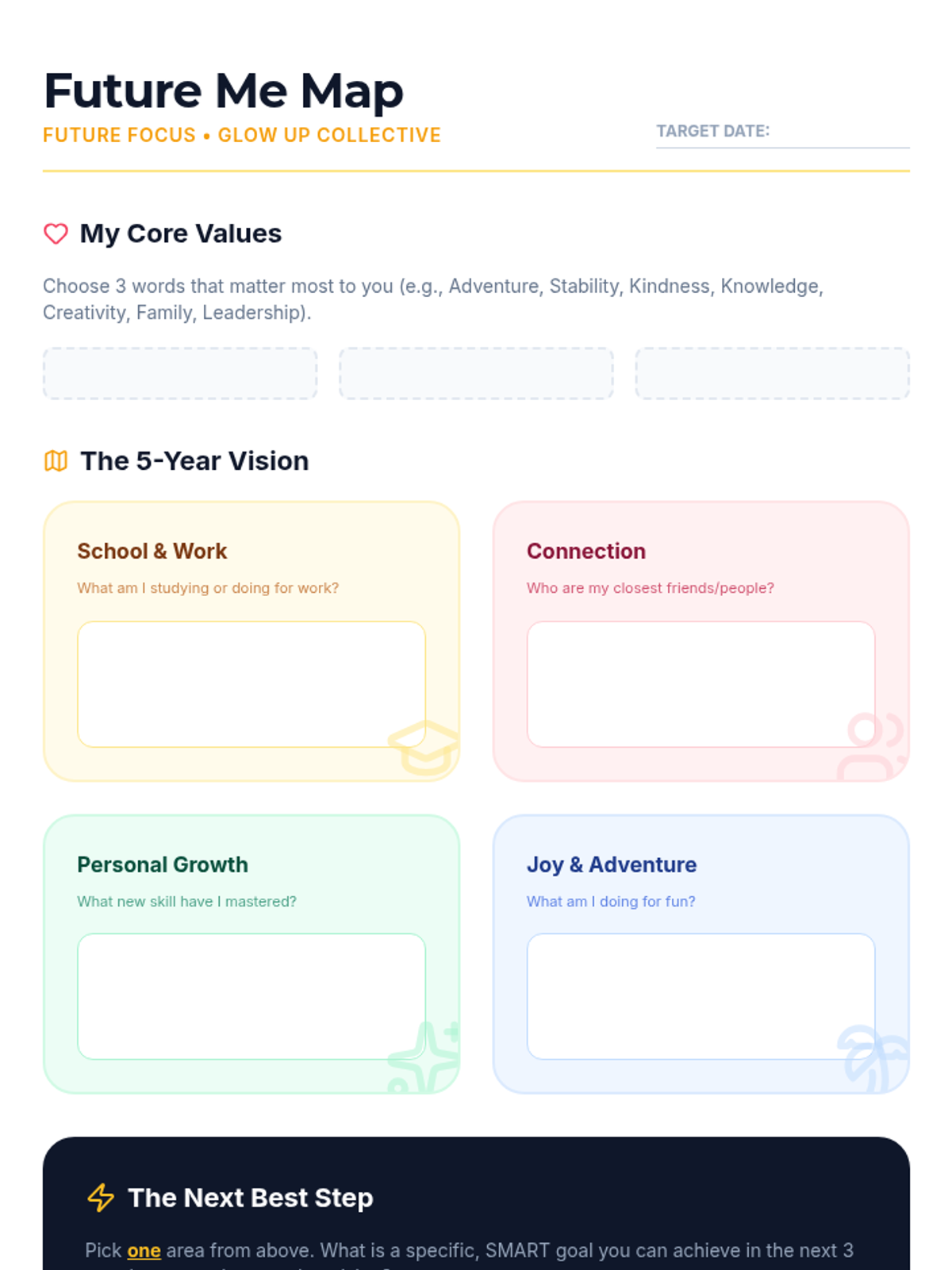
Guided vision mapping worksheet for Lesson 4: Future Focus. Helps students identify values, visualize life in 5 years, and set a SMART goal for the immediate future.
Visual slide deck for Lesson 4: Future Focus, covering goal setting (SMART), identifying personal values, and overcoming future-related anxiety.
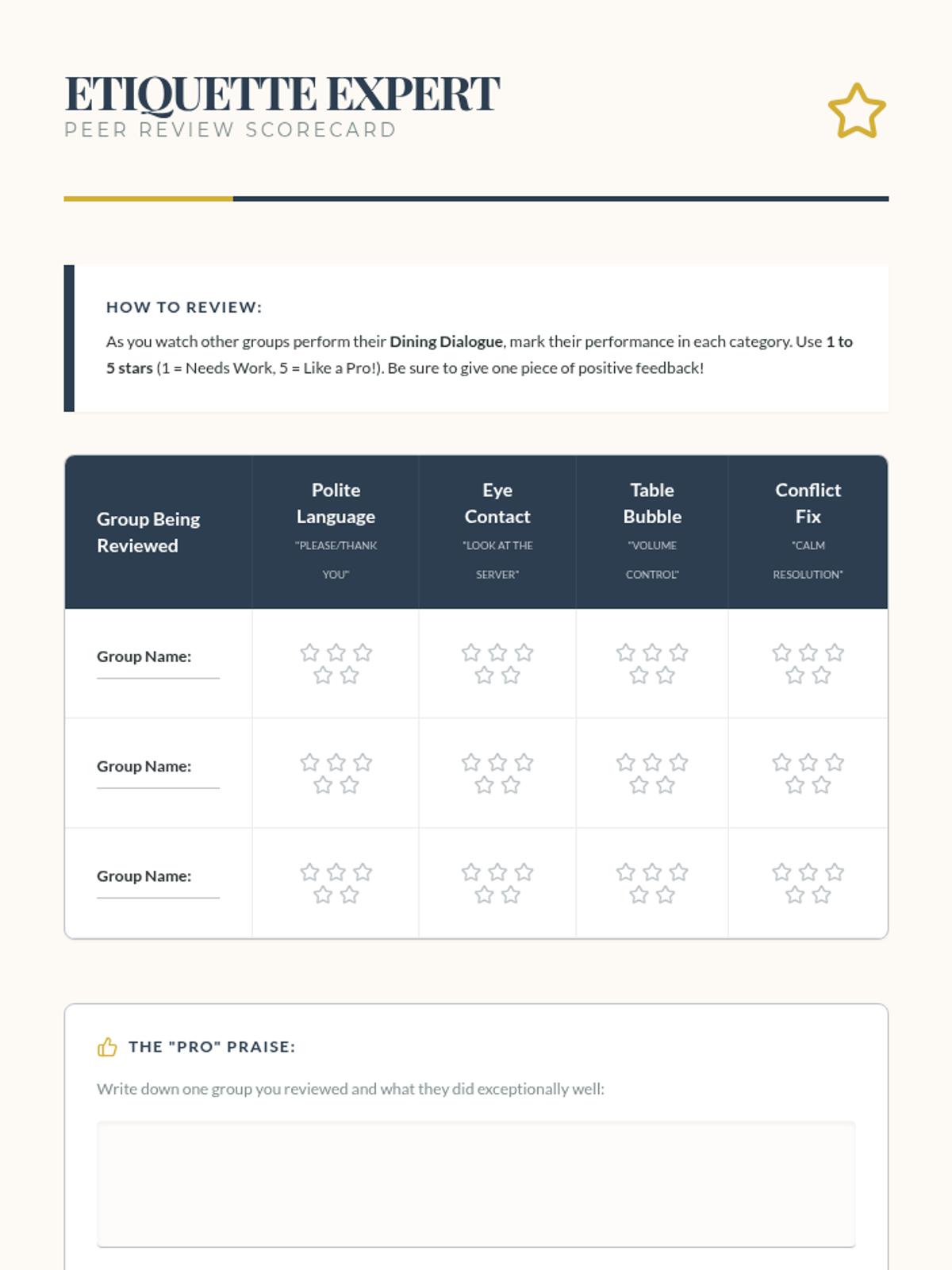
A peer review evaluation sheet for students to score each other's etiquette skills during the roleplay portion of the lesson.
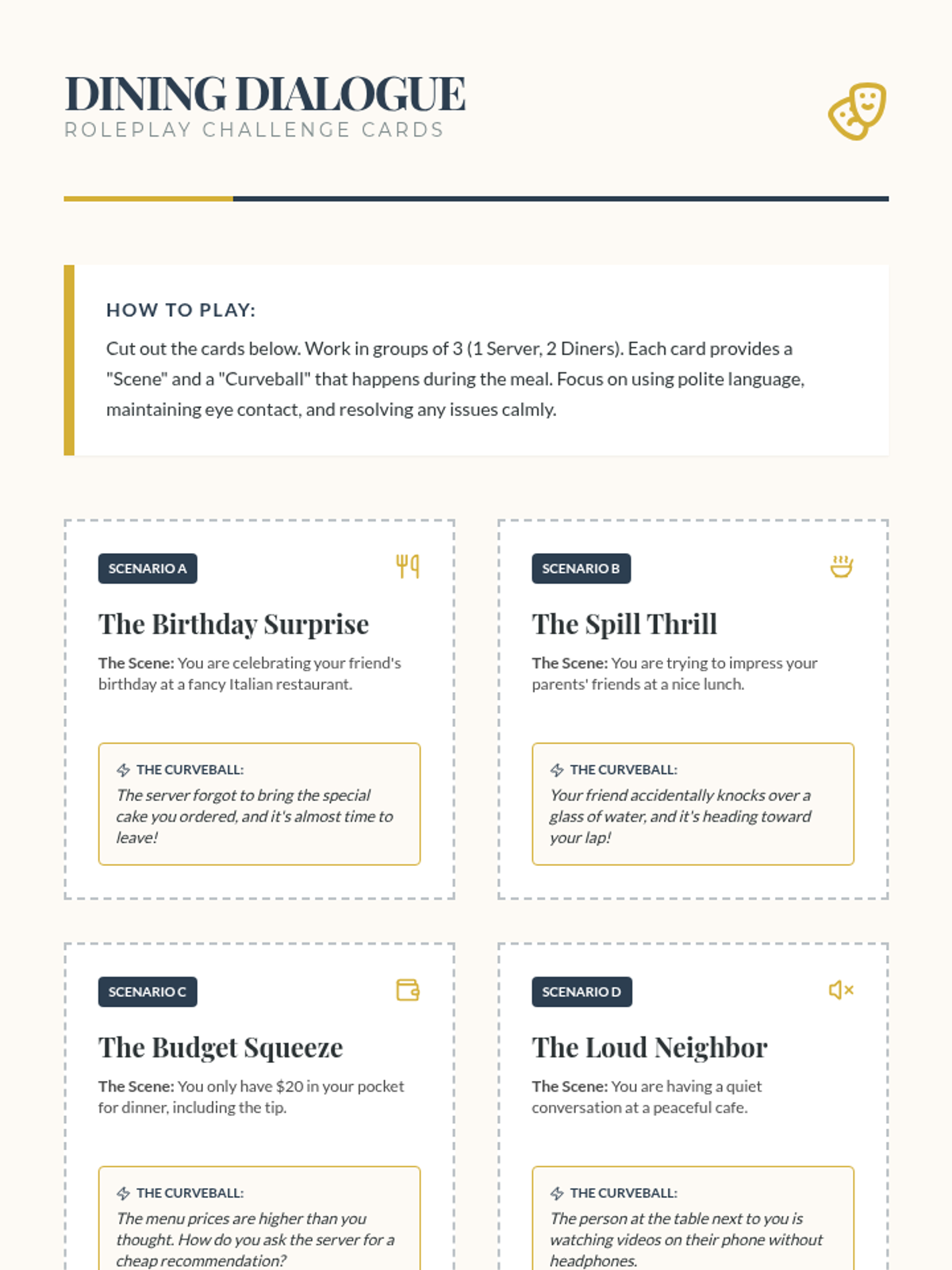
A set of four roleplay challenge cards for students to practice ordering, manners, and conflict resolution in various restaurant scenarios.
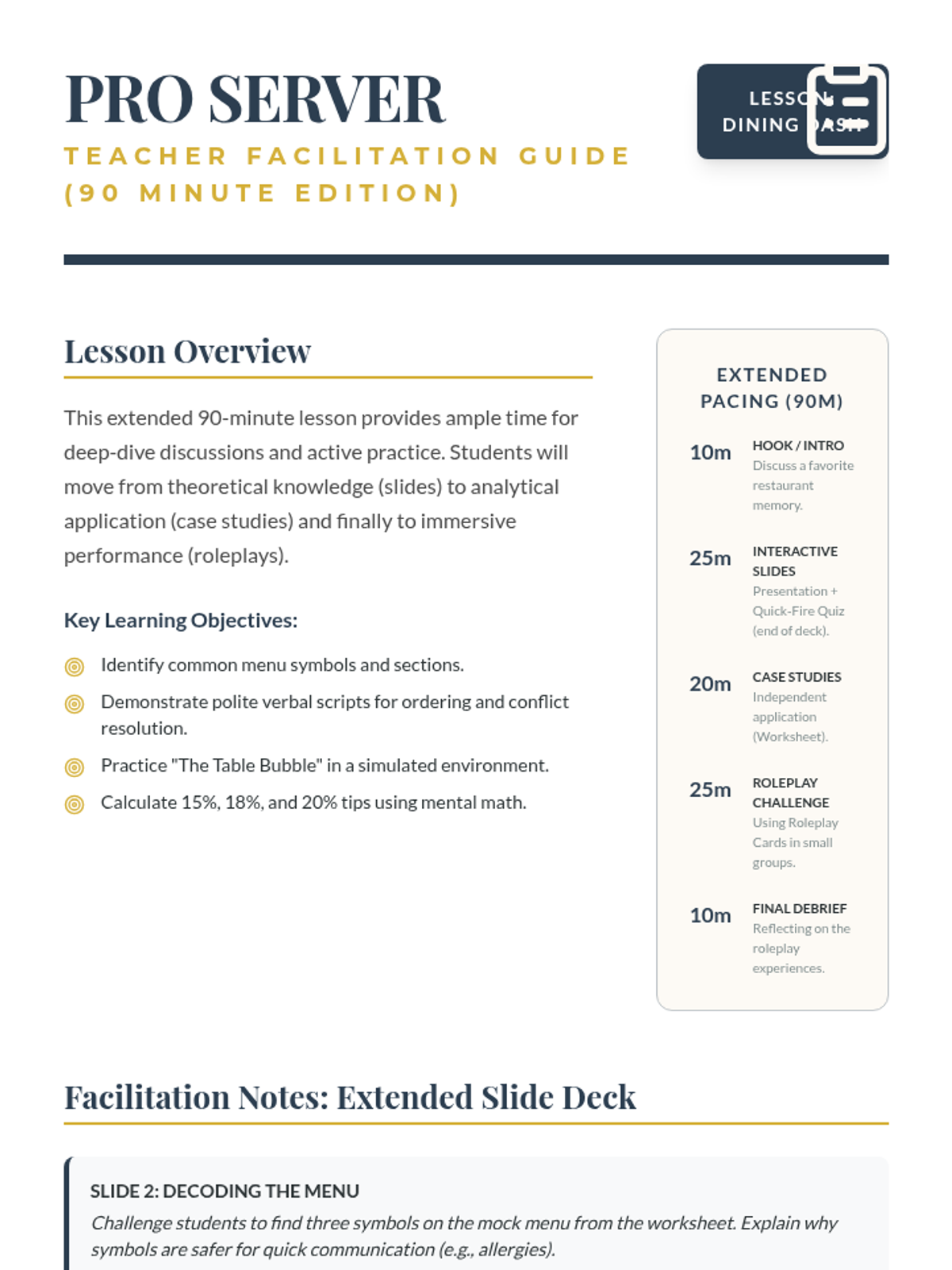
A teacher guide featuring lesson objectives, pacing suggestions, slide-by-slide discussion prompts, and a detailed answer key for the case studies.
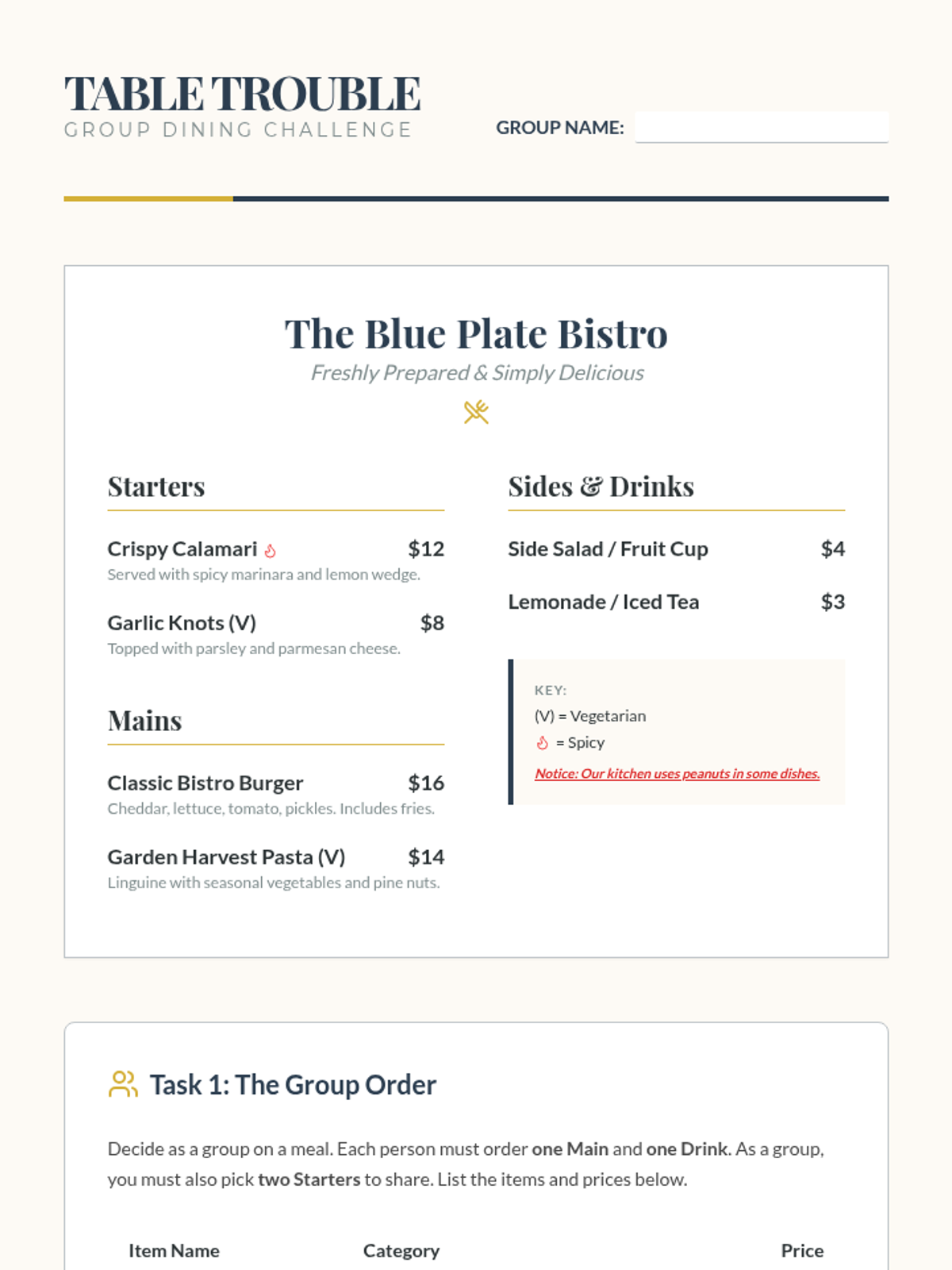
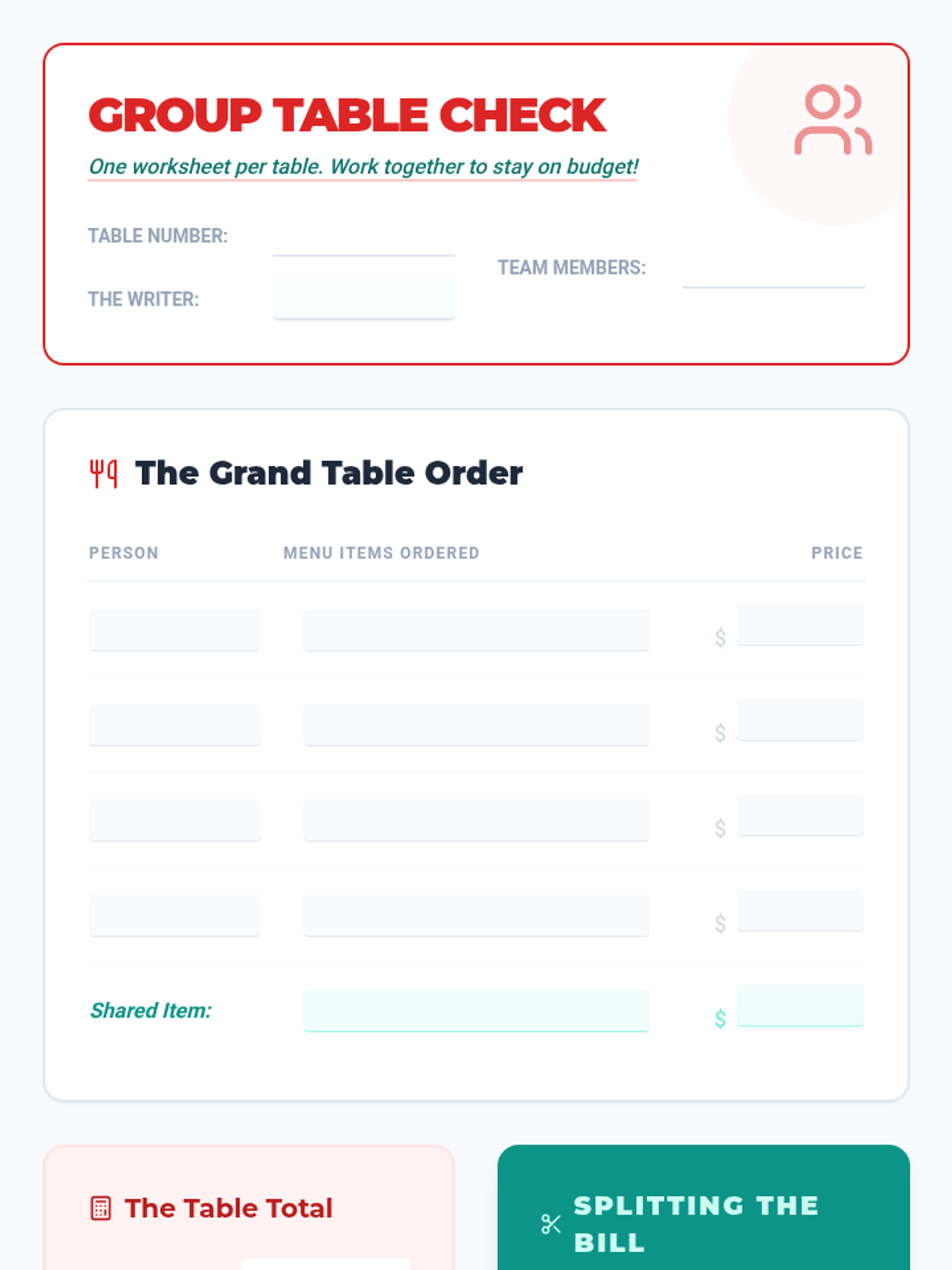
A group-focused student worksheet featuring a mock menu, a collective ordering challenge, group bill calculations, and collaborative restaurant scenarios.
A visual slide deck teaching restaurant etiquette, including menu reading, ordering scripts, table manners, volume control, tipping, and conflict resolution. Separates quiz questions and answers for better engagement.
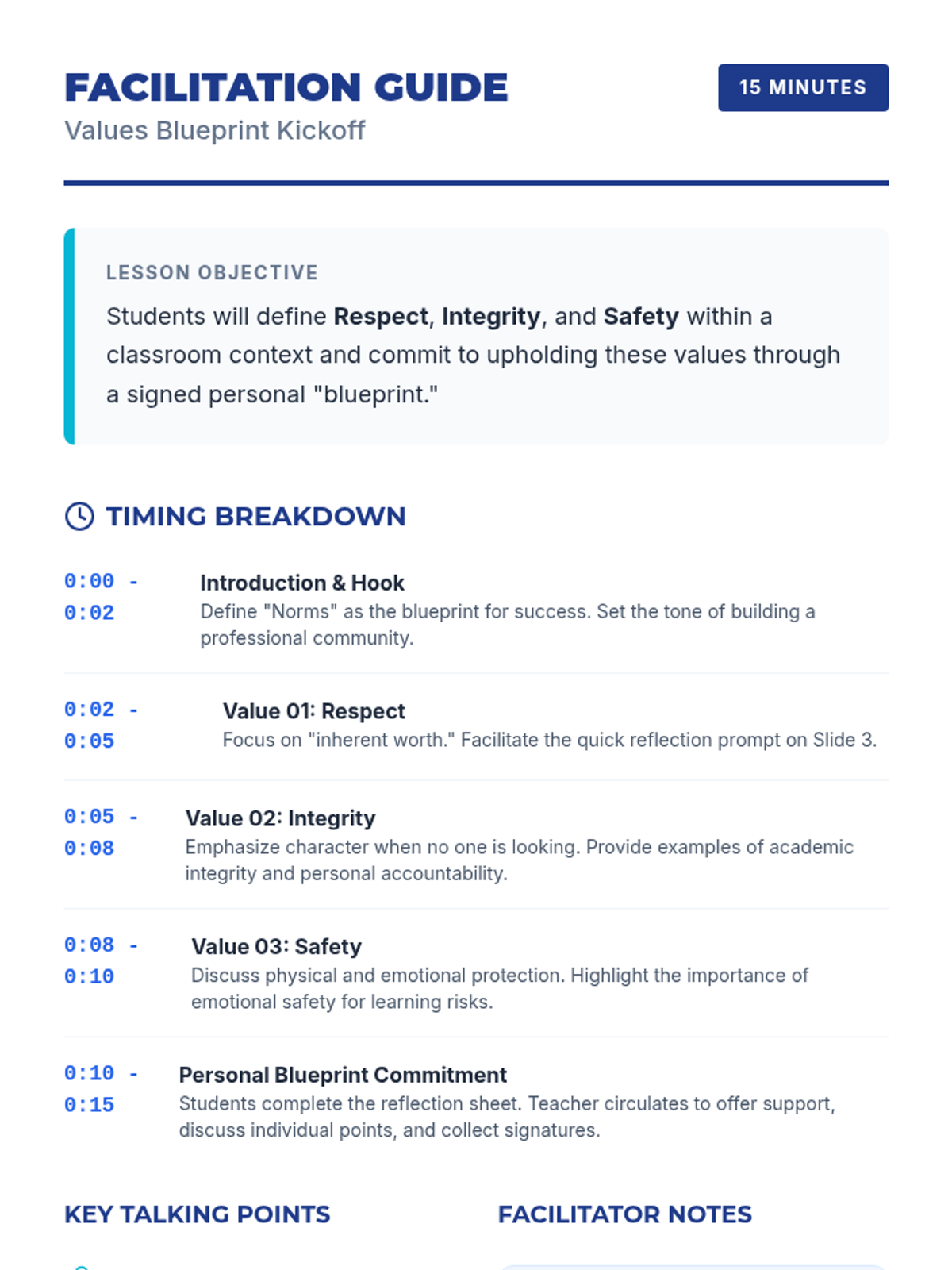
A concise facilitation guide for teachers to lead the 15-minute Values Blueprint Kickoff. Includes a minute-by-minute breakdown, key talking points, and strategies for handling student misconceptions.
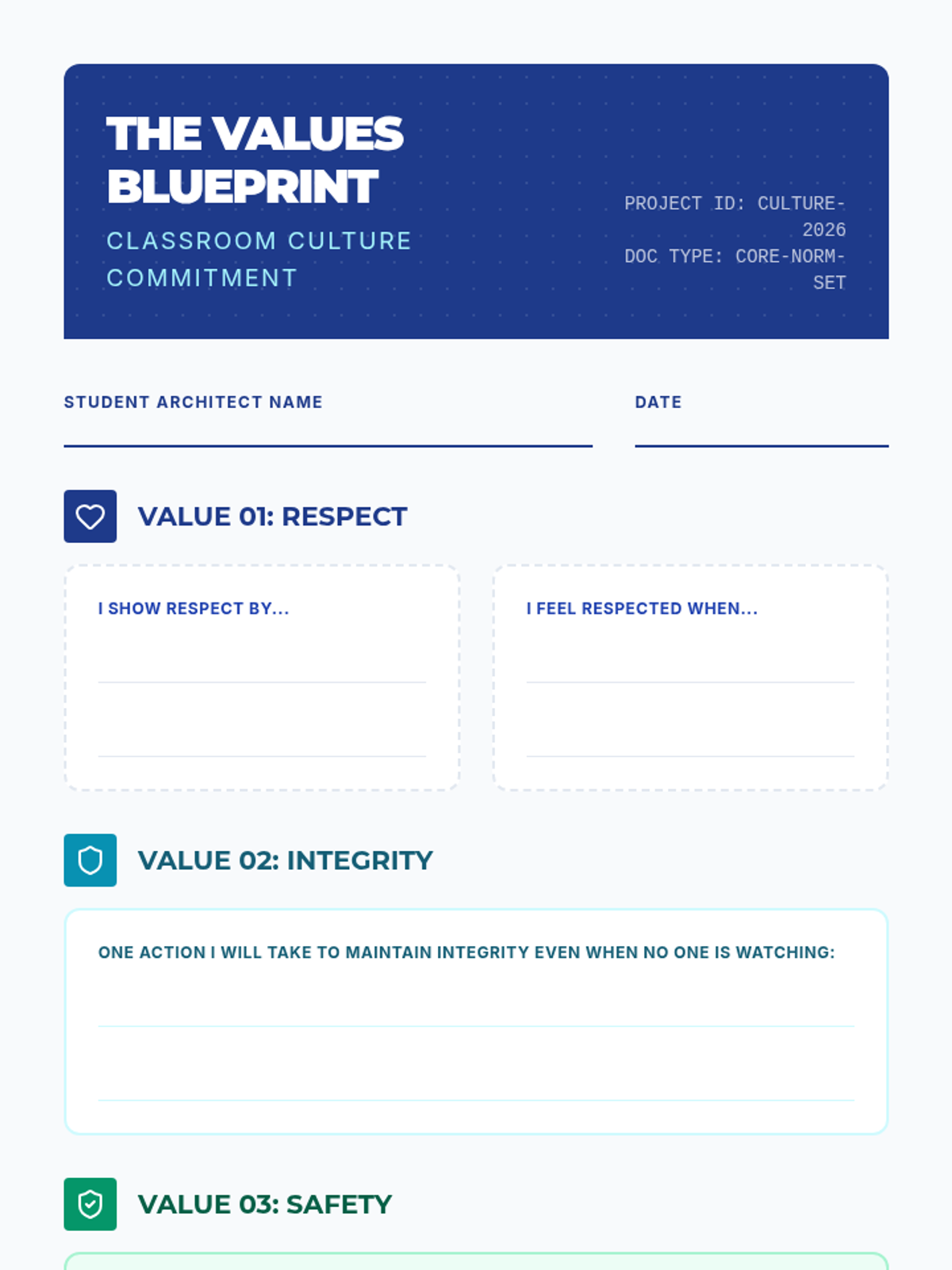
A student reflection sheet that reinforces the classroom values of Respect, Integrity, and Safety. Includes guided prompts and designated spaces for students to define their personal commitment to the classroom 'blueprint'.
A high-impact 7-slide presentation designed to introduce the core classroom values of Respect, Integrity, and Safety through a 'Blueprint' aesthetic. Includes clear definitions, practical examples, and a collective commitment.
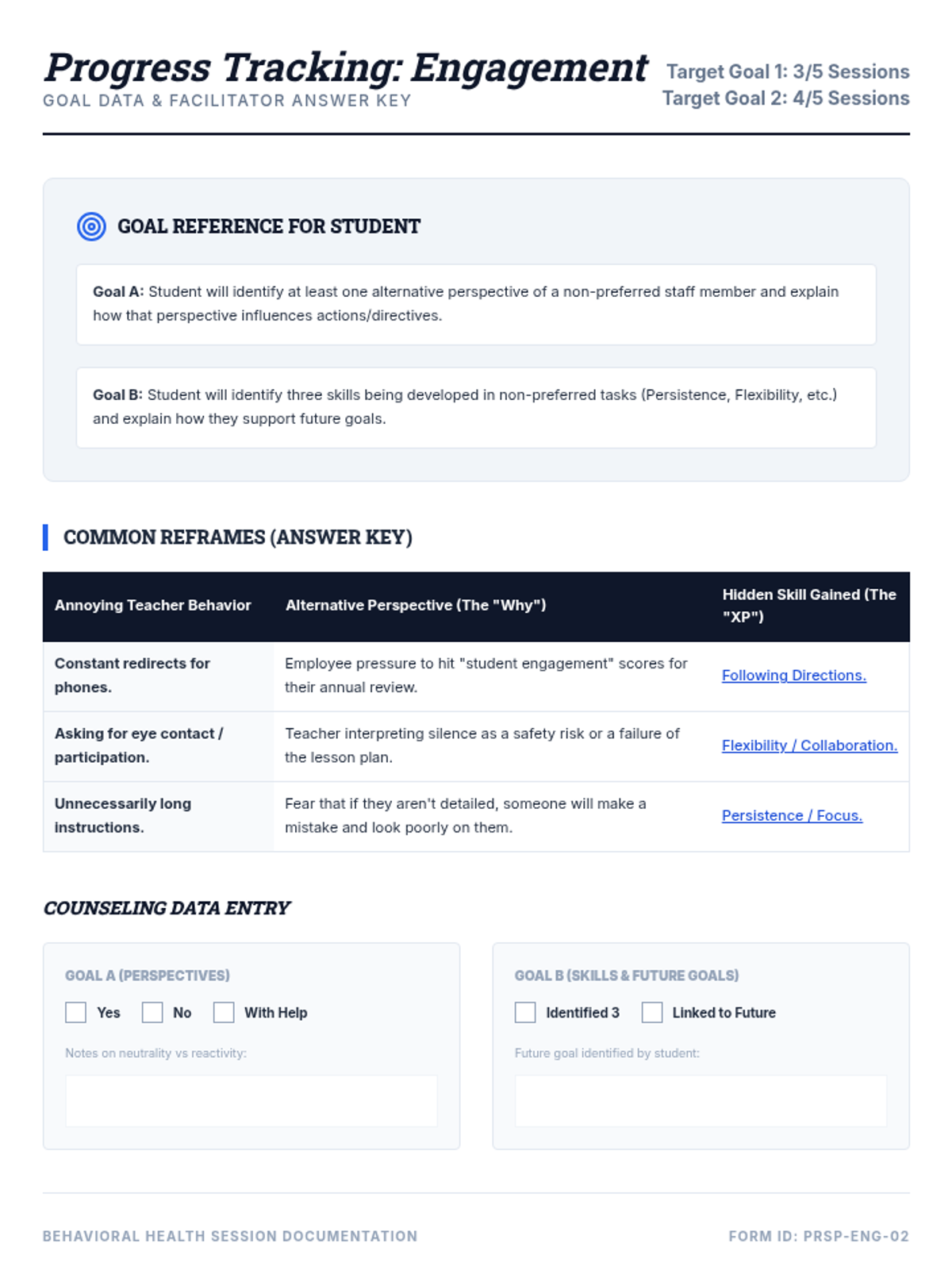
A tracking sheet and answer key for counselors to monitor student progress on perspective-taking and identifying skills (Persistence, Flexibility) developed during non-preferred tasks.
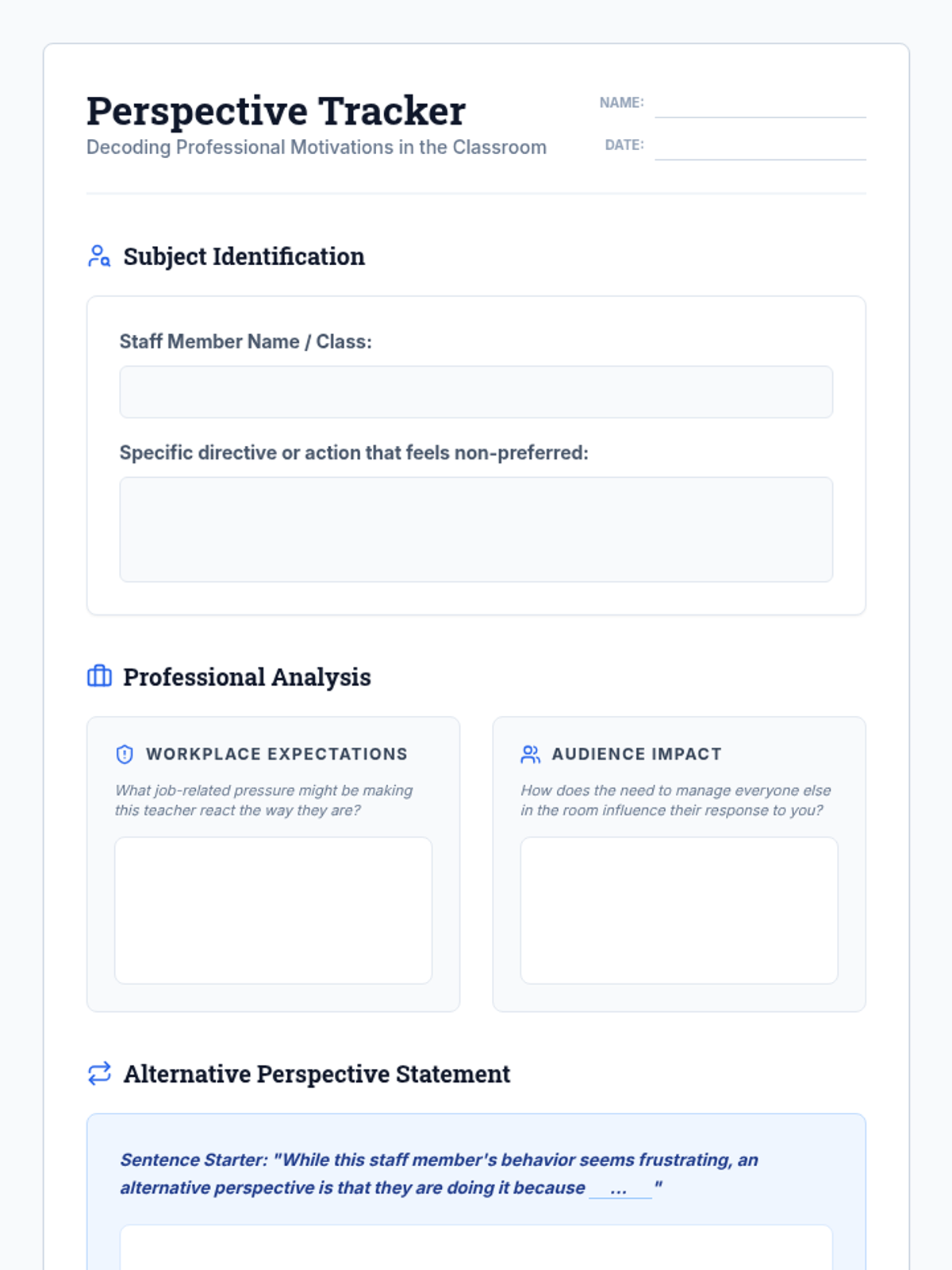
A student worksheet designed as a "Director's Script Organizer" to help students analyze staff member motivations and perspectives.
A presentation that reframes "annoying" staff behavior and focuses on the high-value skills (Persistence, Flexibility) students build by choosing to engage.
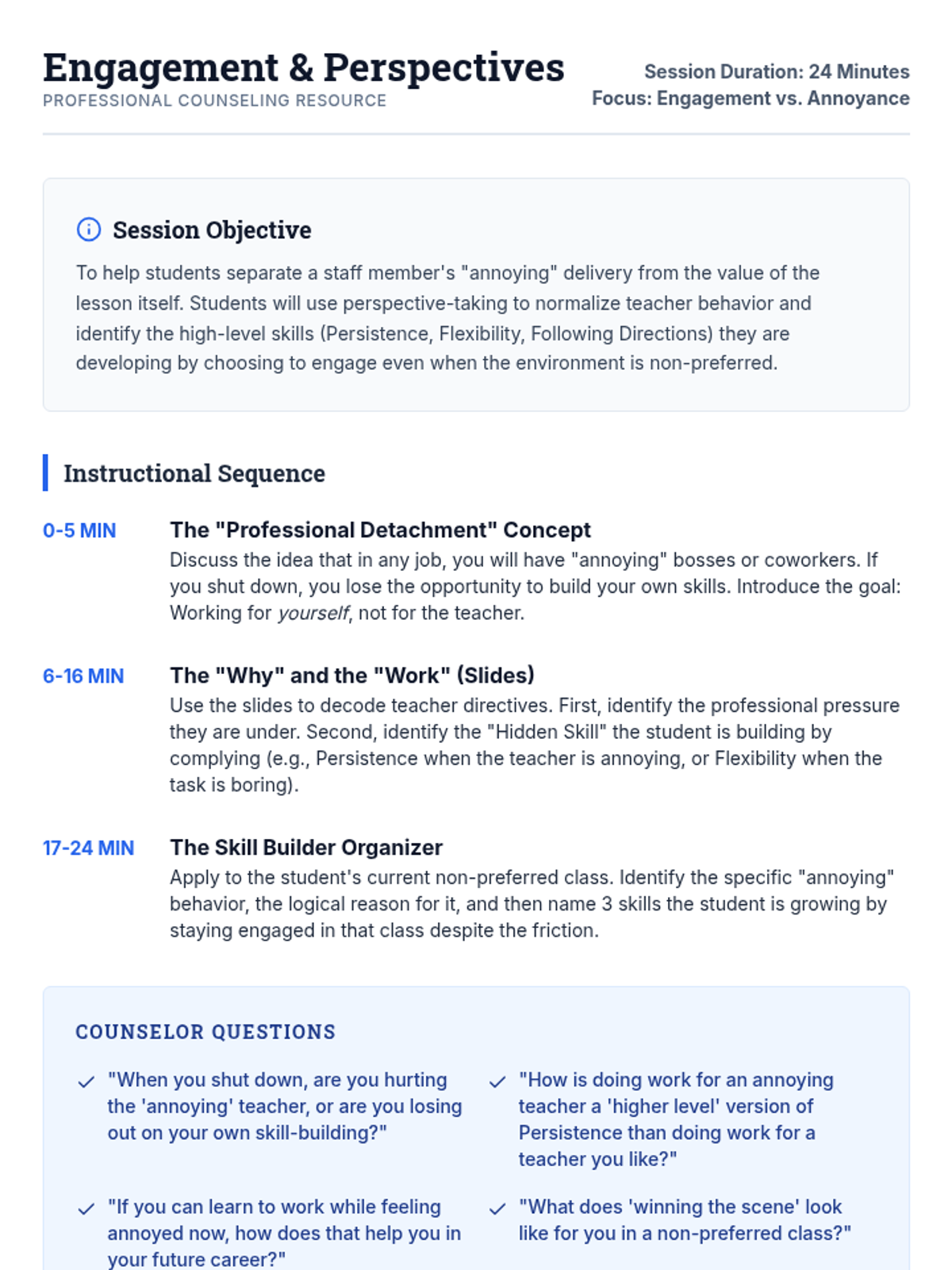
A facilitator's guide for a 24-minute counseling session focused on engaging in lessons despite feeling "annoyed" by staff, by identifying professional perspectives and personal skill-building.
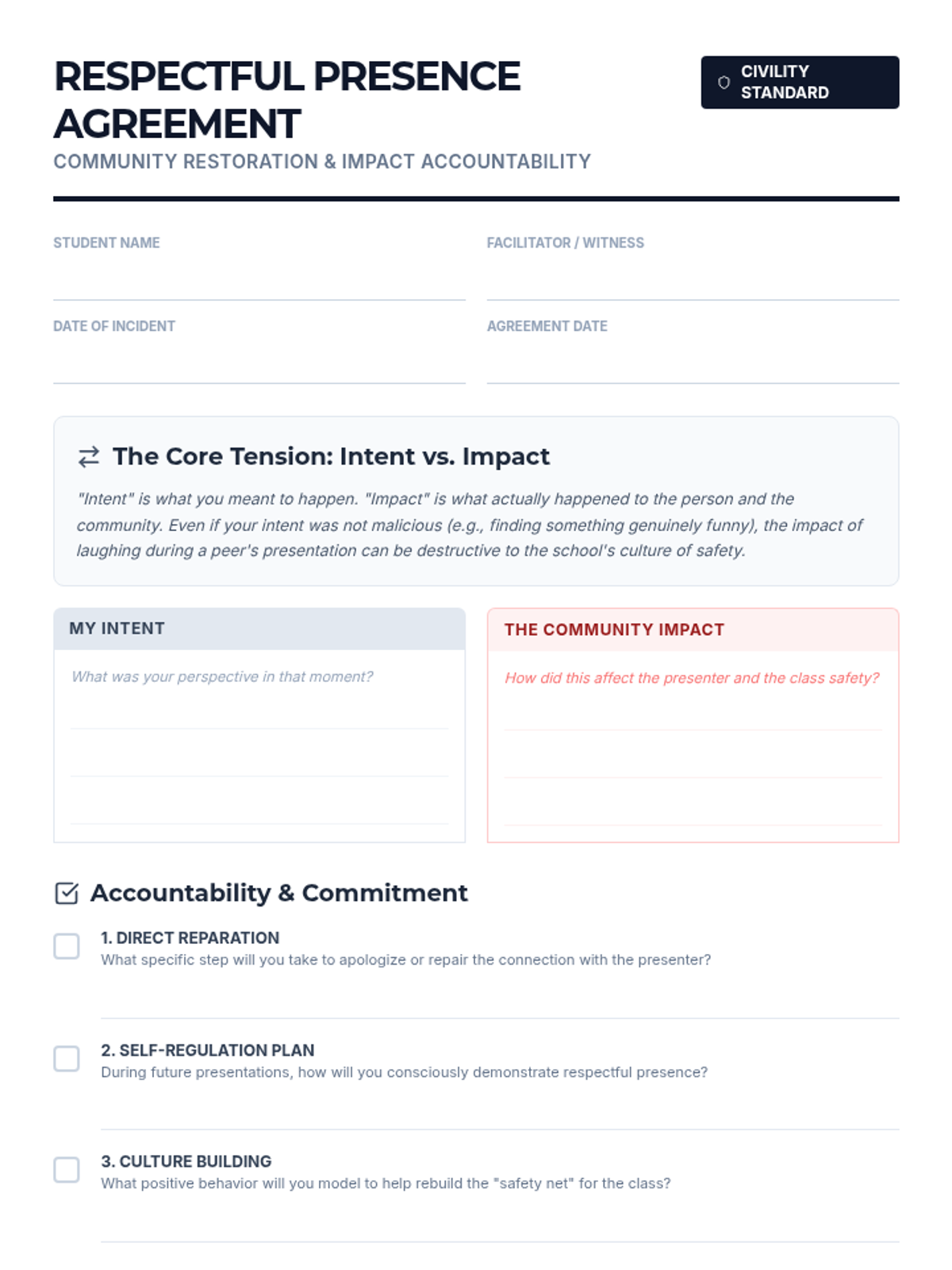
A high-school level behavioral contract using the "Intent vs. Impact" framework to address peer mockery during presentations. It guides students through a reflective process to acknowledge communal harm and commit to specific restorative actions that improve school culture.
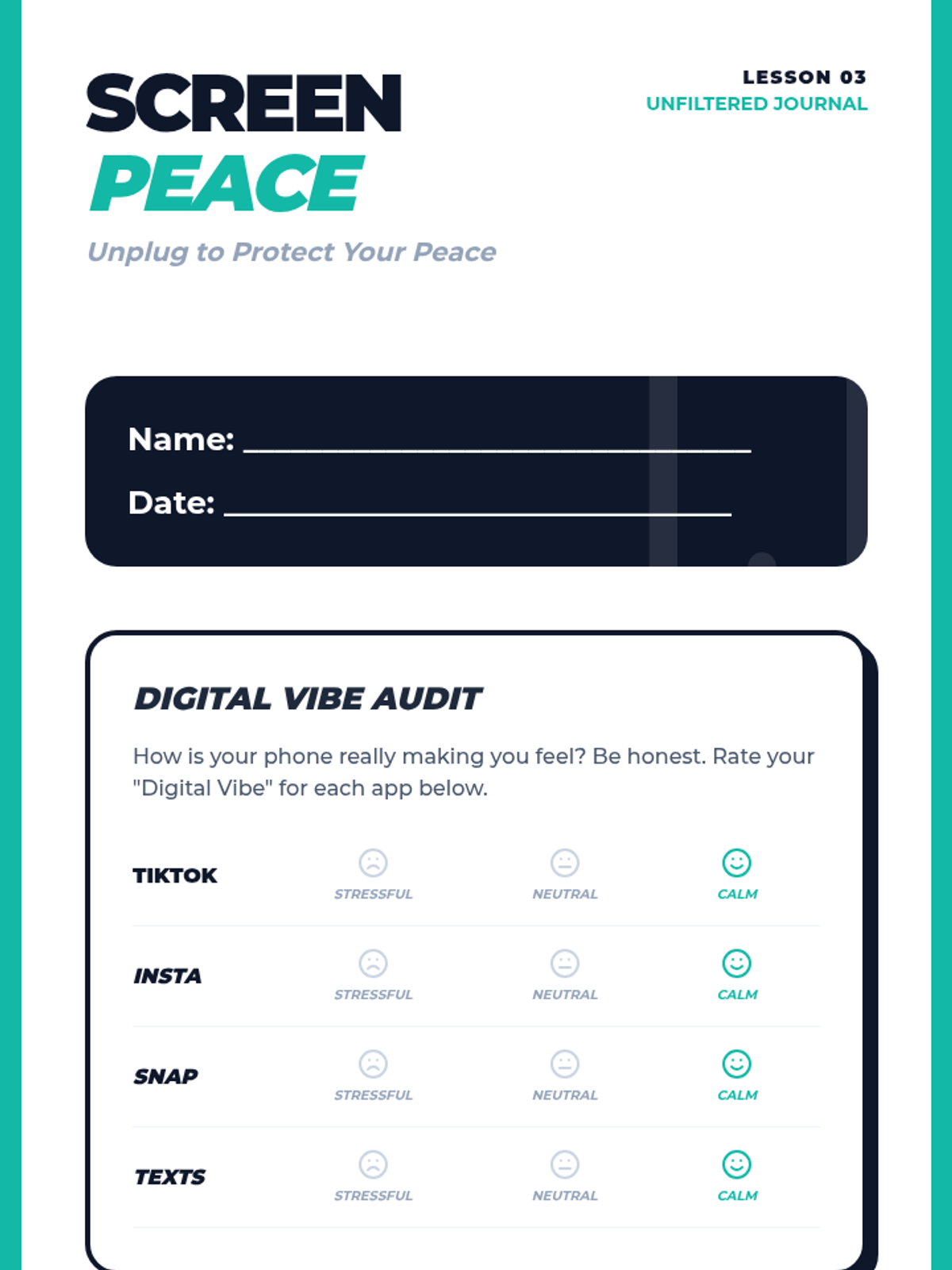
A student-facing journal for Lesson 3 focusing on digital wellness, featuring a social media vibe audit and a 24-hour digital peace plan for managing online stress.
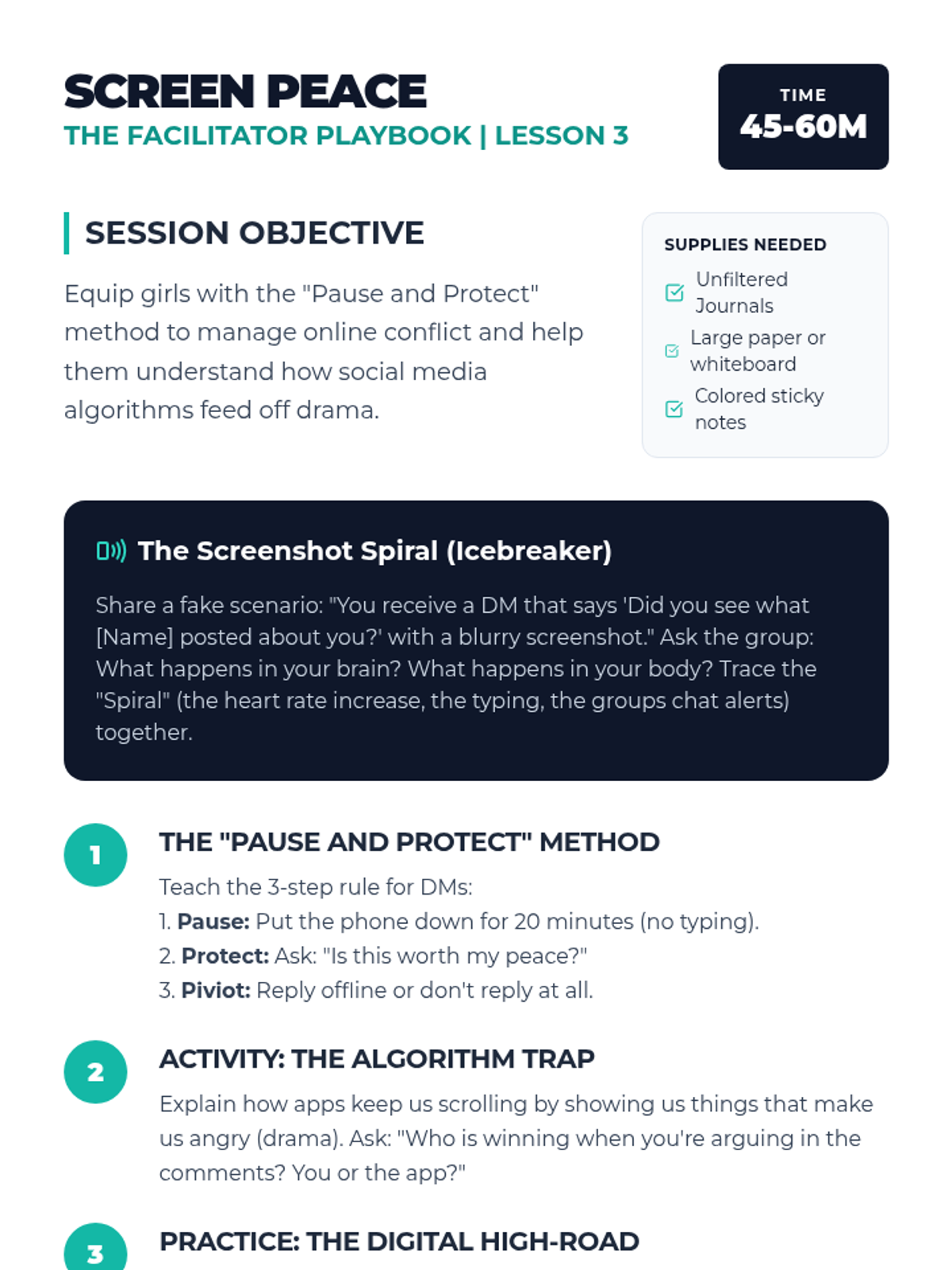
A facilitator guide for the 'Screen Peace' lesson, focusing on the 'Pause and Protect' method for managing social media conflict, identifying algorithmic traps, and practicing digital de-escalation for high school girls.
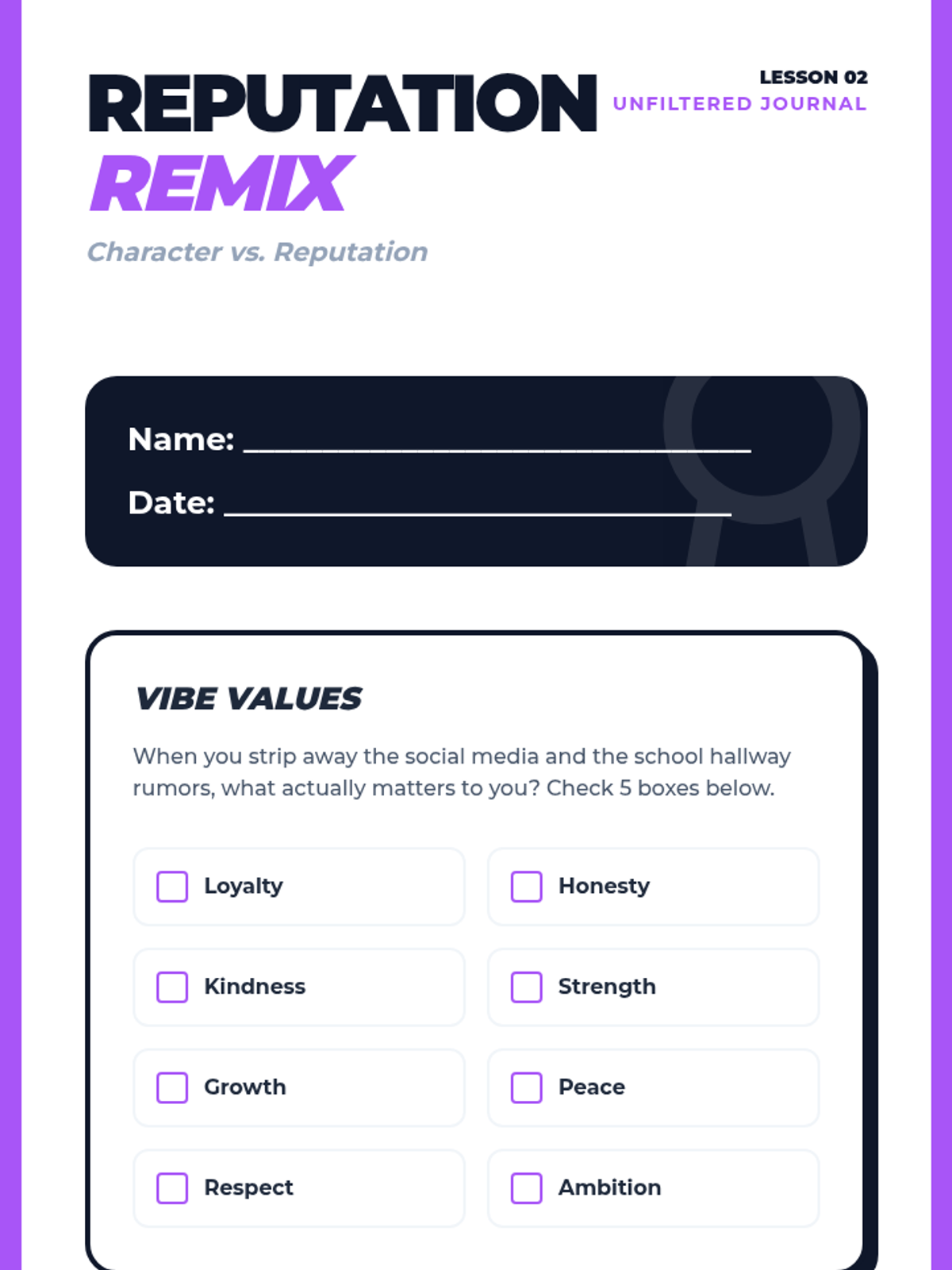
A student reflection workbook for Lesson 2 focusing on identifying personal values and practicing 'The Remix Pivot'—rethinking instinctive drama-based reactions to align with core character traits.
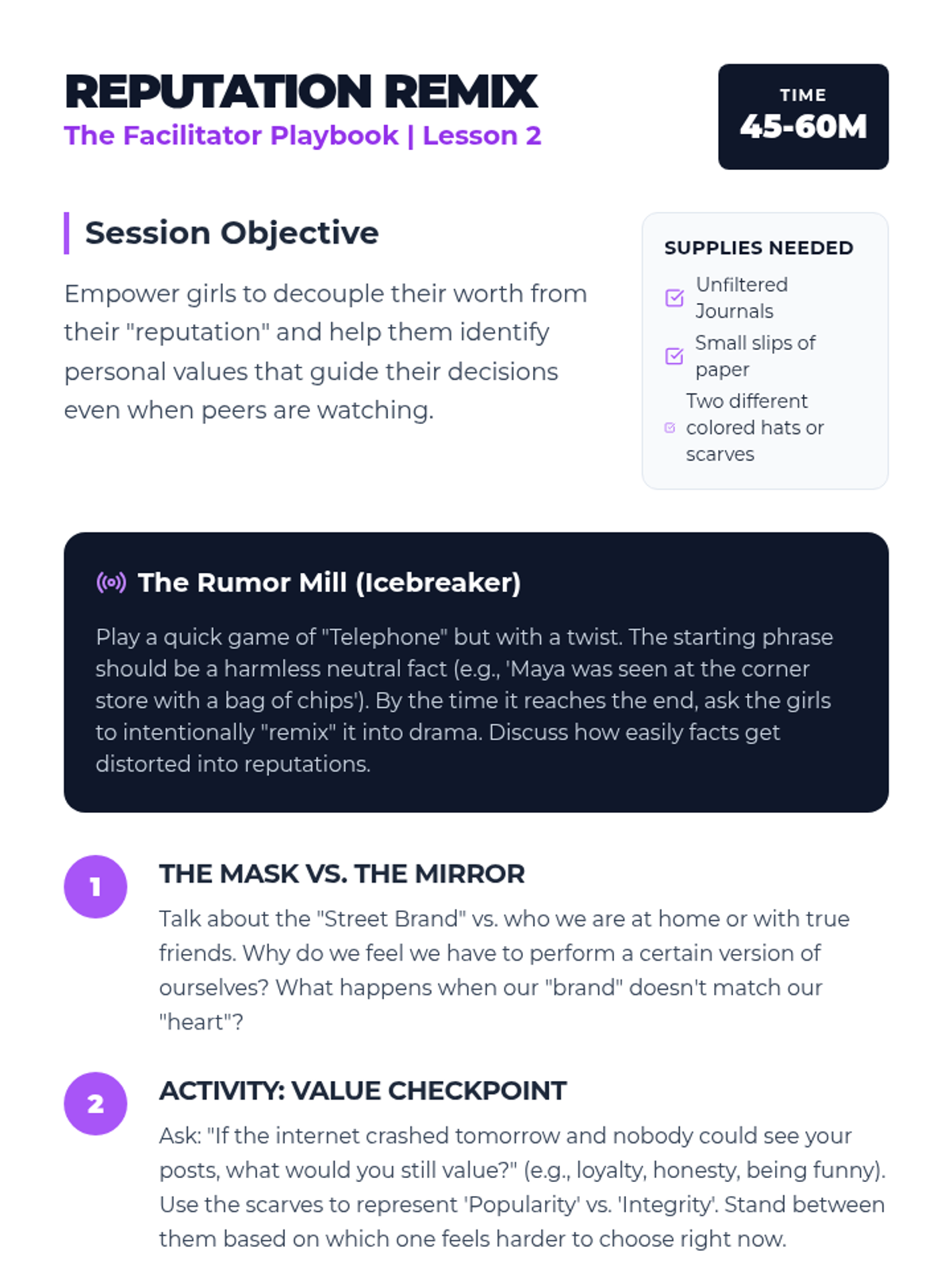
A facilitator guide for the 'Reputation Remix' lesson, featuring the 'Rumor Mill' activity, concepts of character vs. reputation, and scenario-based discussion prompts to help high school girls stay true to their values.
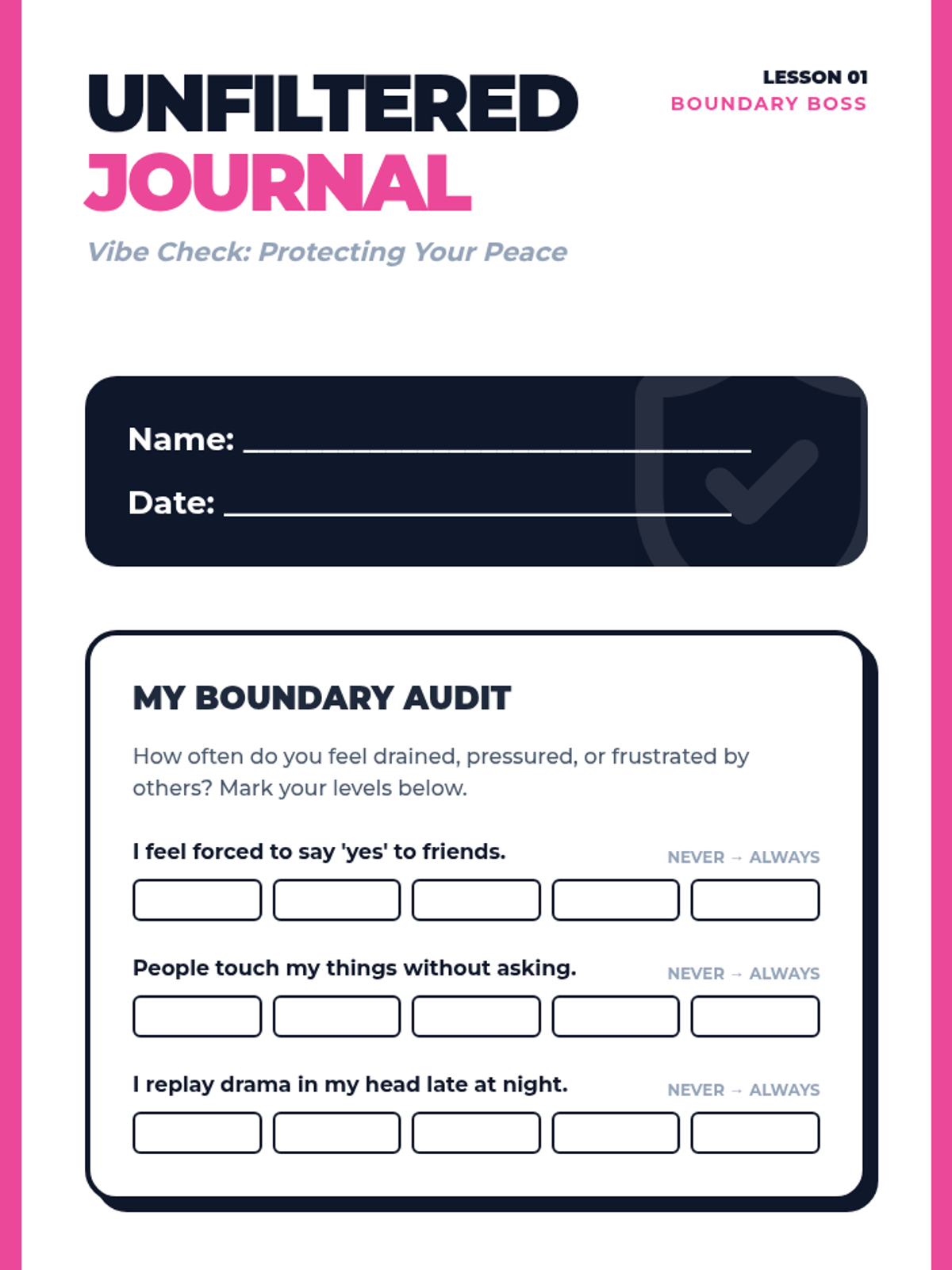
A student-facing reflection journal for the 'Boundary Boss' lesson, including a boundary audit, a 'Circle of Protection' visualization activity, and script-building exercises for assertive communication.
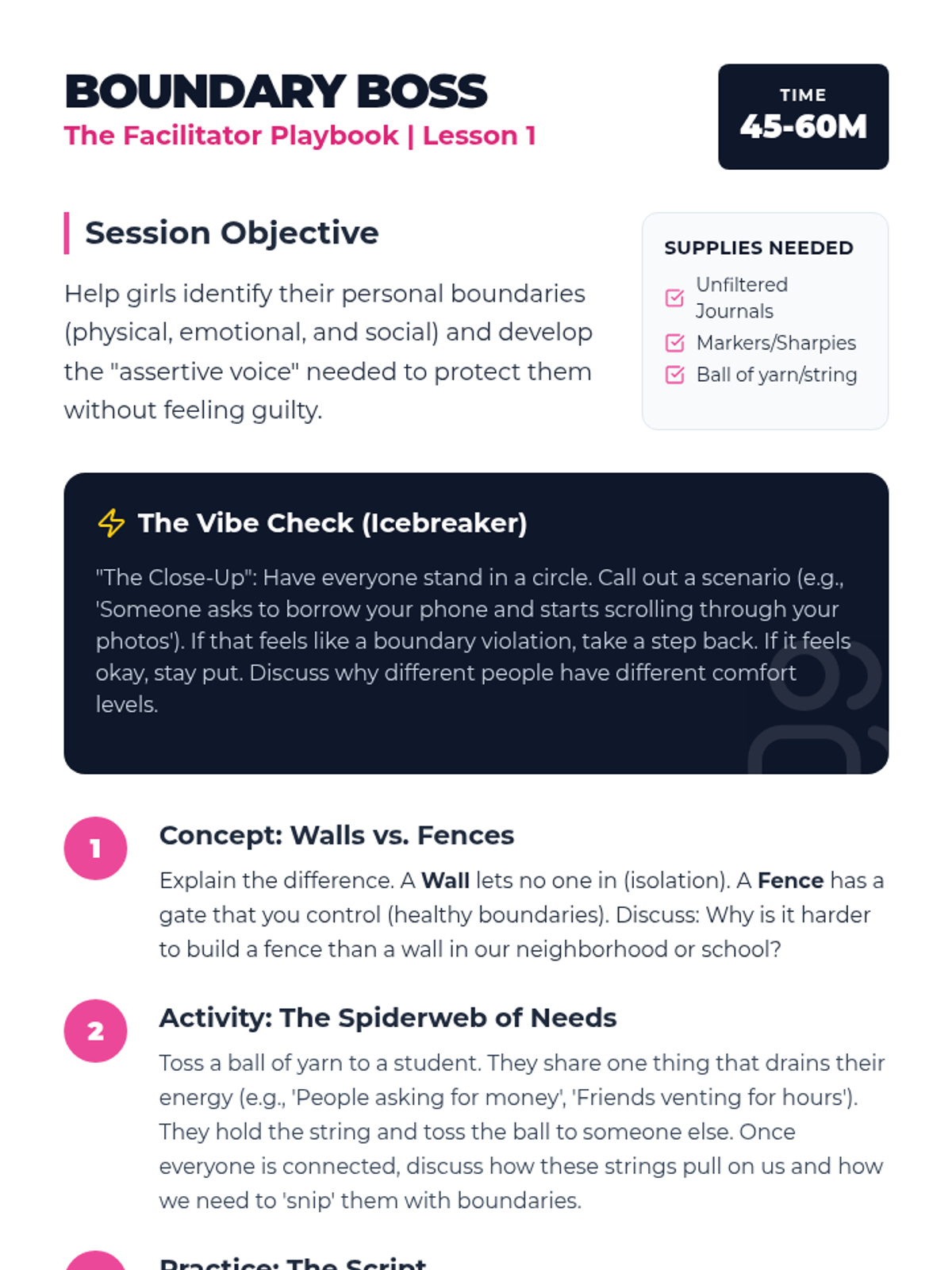
A comprehensive facilitator guide for the 'Boundary Boss' lesson, featuring urban-themed icebreakers, conceptual activities (Walls vs. Fences), and discussion prompts focused on physical, emotional, and digital boundaries for high school girls.
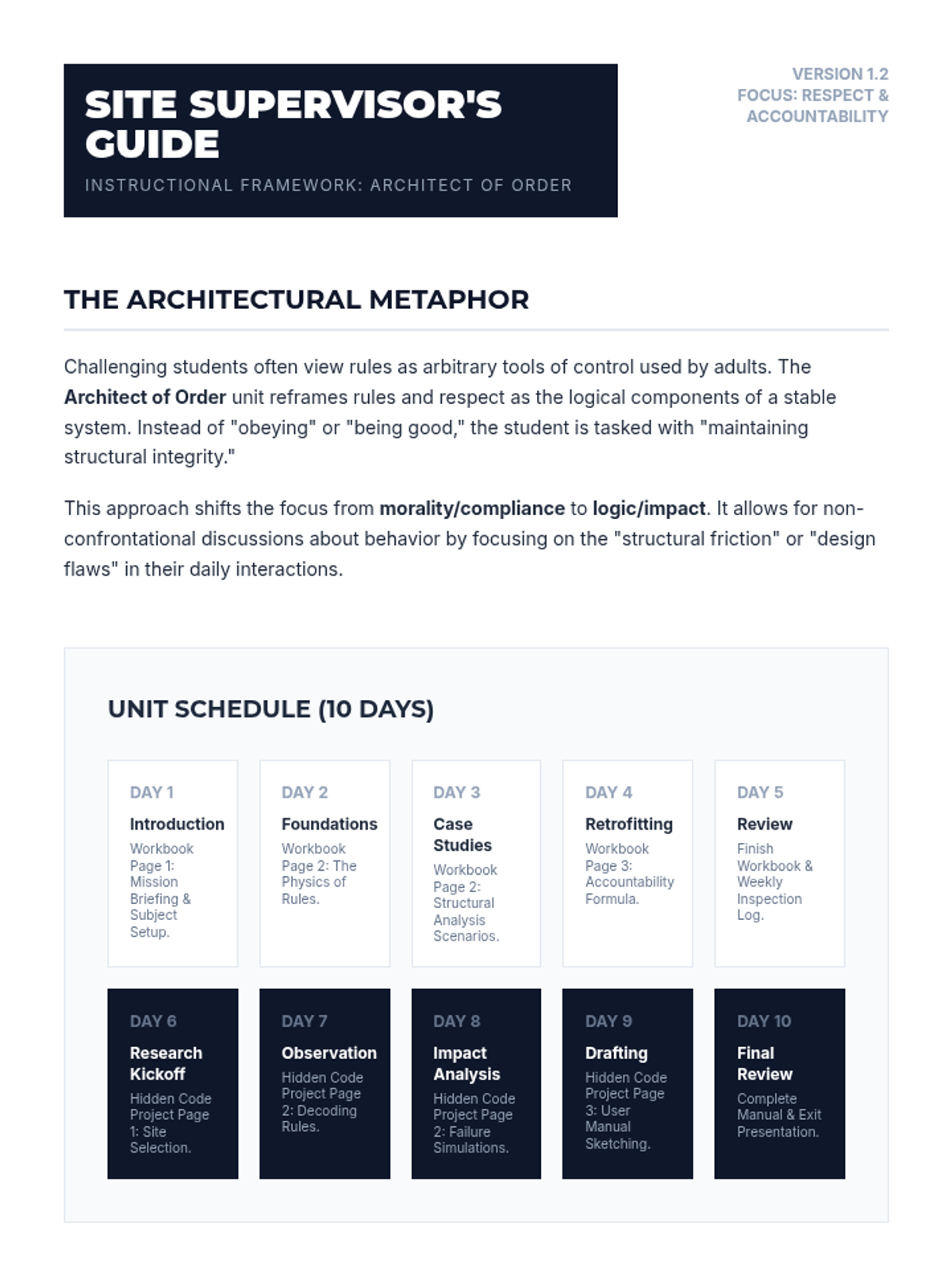
A 2-page instructional facilitation guide for teachers to implement the Architect of Order unit, including a 10-day pacing guide, de-escalation strategies, and feedback frameworks.
A comprehensive group worksheet that combines combined food order tracking, table total calculations (including tax and tip), group math challenges, and social etiquette reflections into a single multi-page document.
Instructional slide deck for the Budget Bites lesson, covering the 90-minute agenda, hidden costs (tax and tip), and restaurant social etiquette.
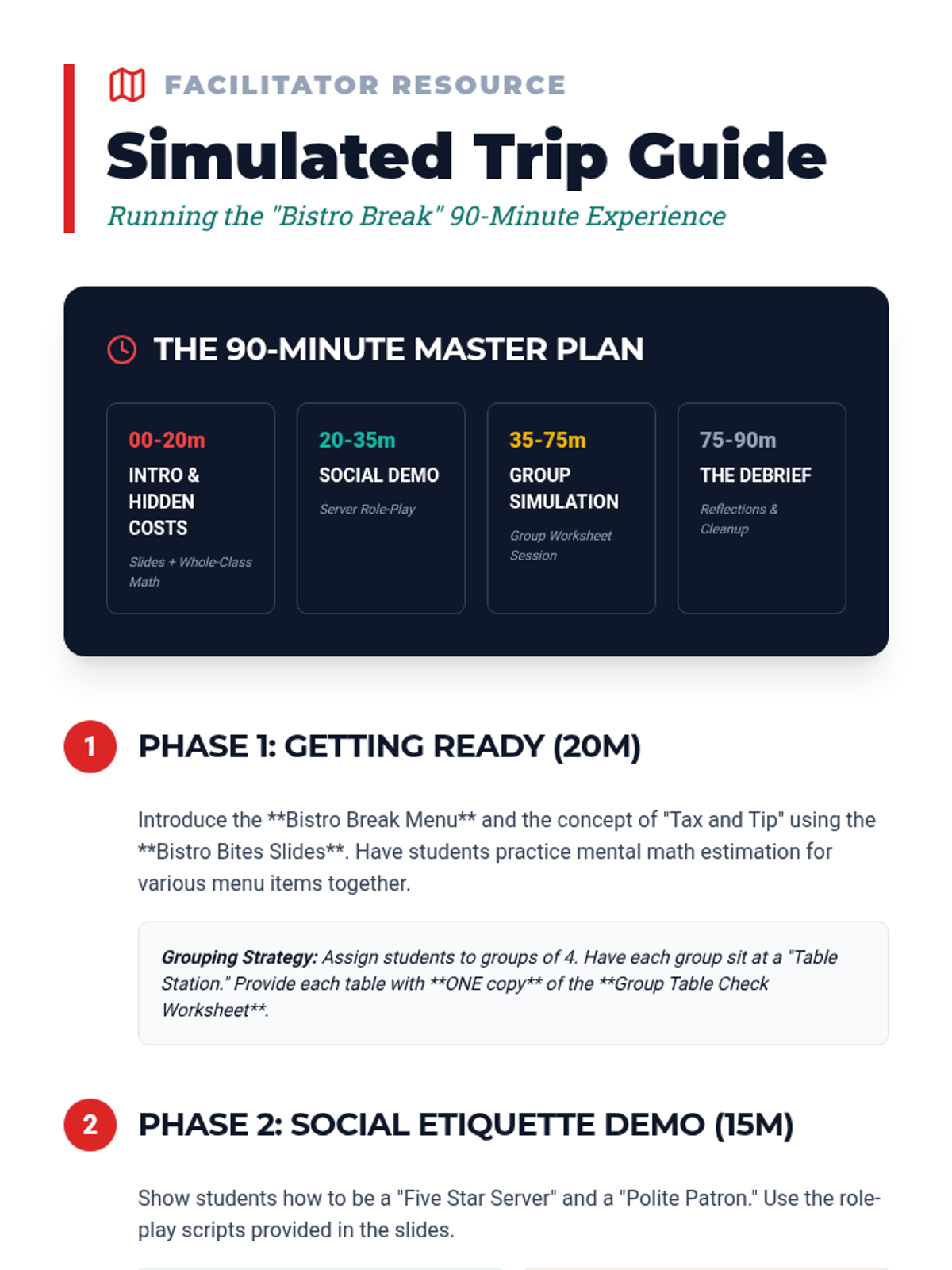
A facilitator's guide for conducting a simulated restaurant field trip in the classroom, including role-play scripts and setup instructions.
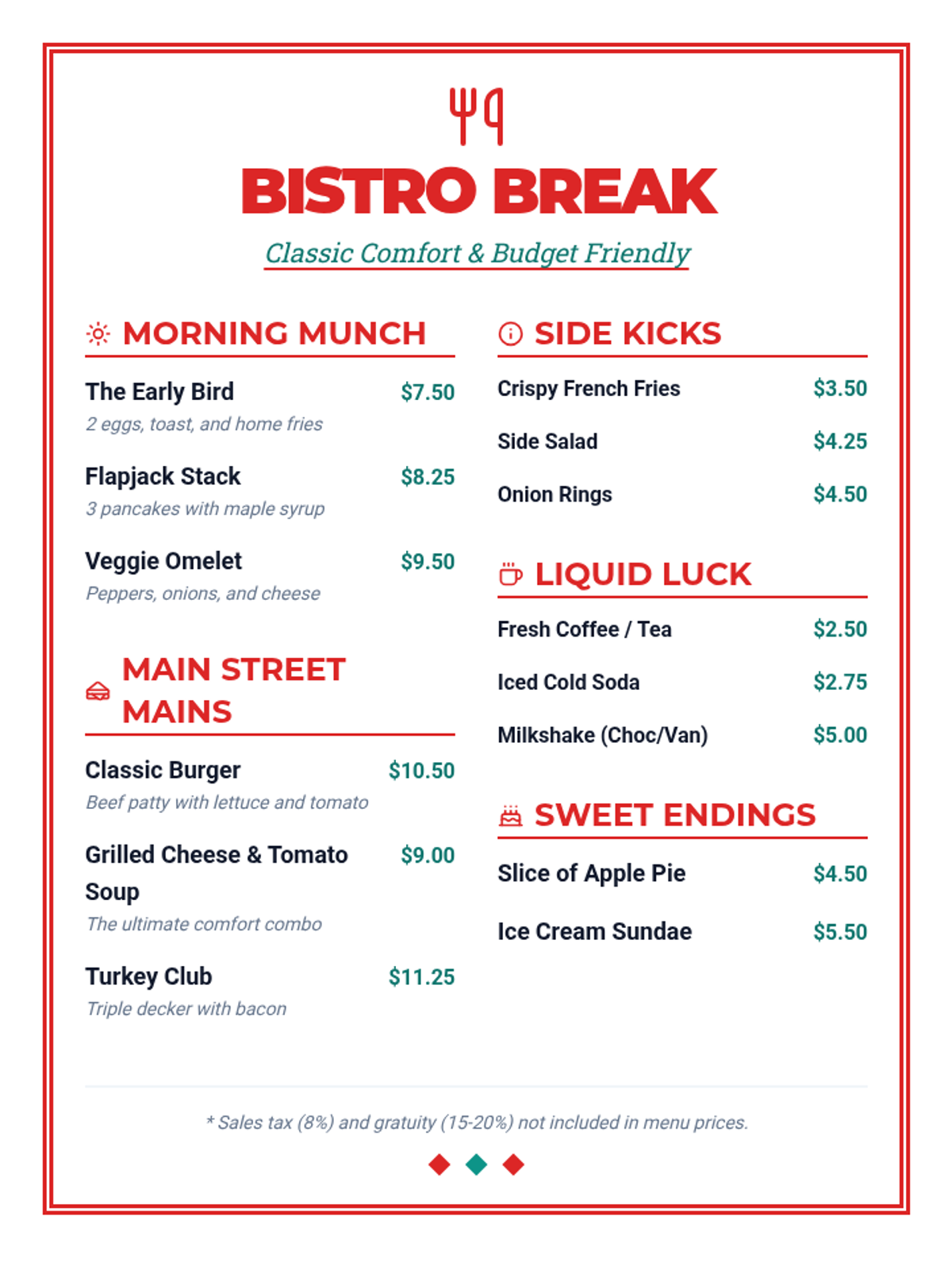
A retro-style bistro menu featuring breakfast, main courses, sides, drinks, and desserts with clear pricing for use in budget and math exercises.
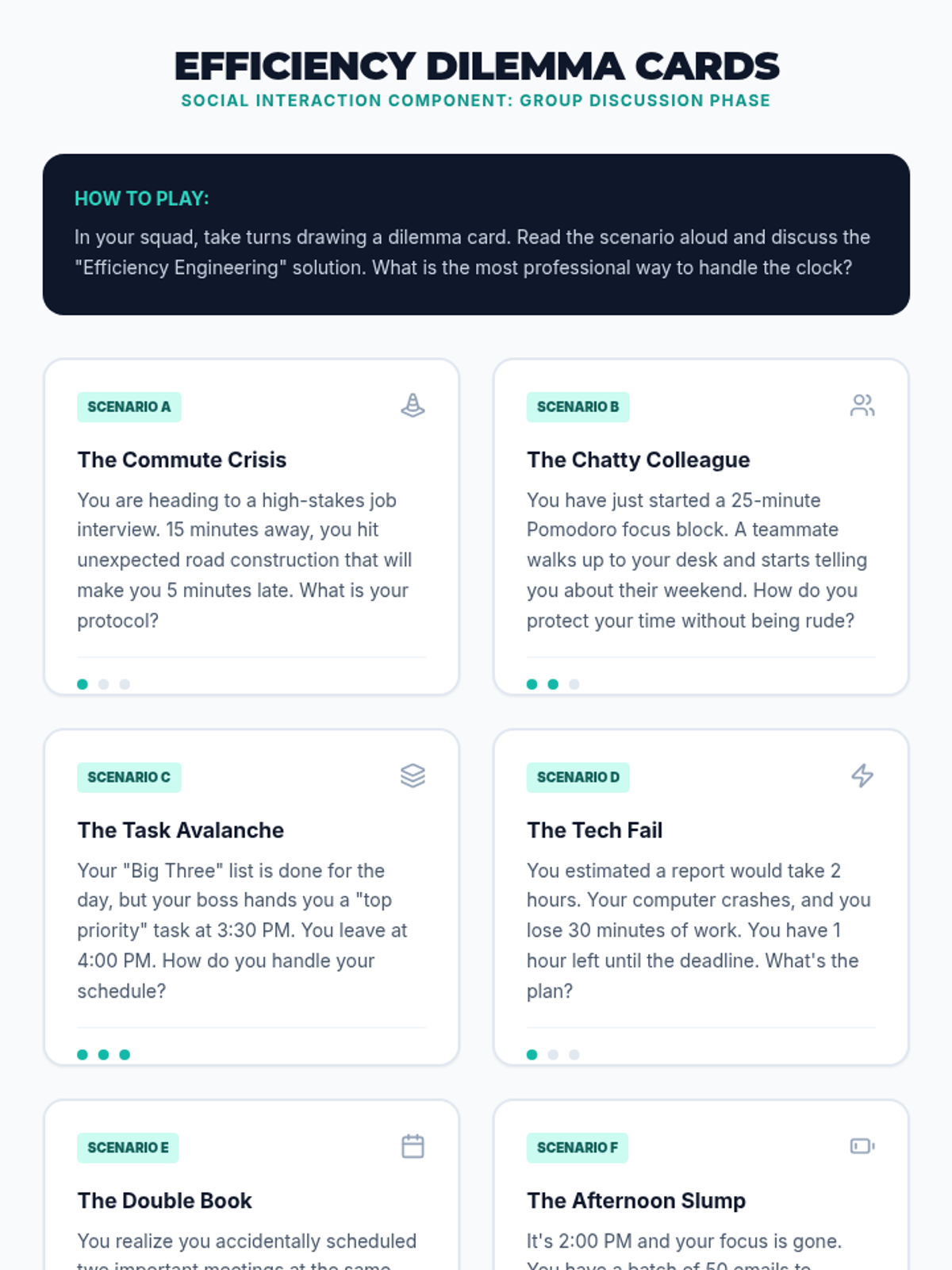
A set of scenario-based discussion cards designed to help students navigate real-world time management dilemmas in a social, collaborative setting.
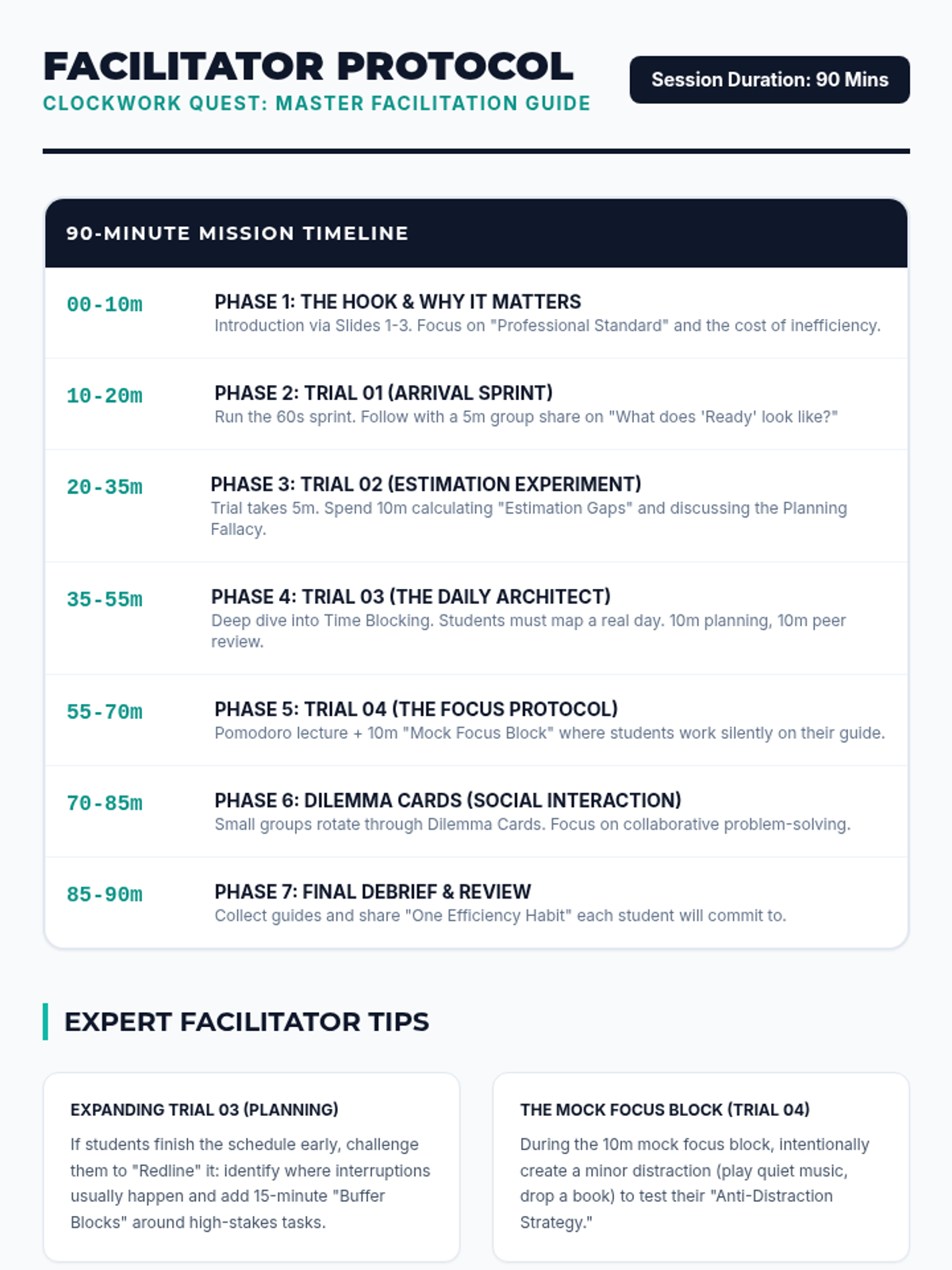
A comprehensive teacher-facing facilitation guide for running the Clockwork Quest trials, featuring a detailed 90-minute agenda, expert tips, and success metrics.
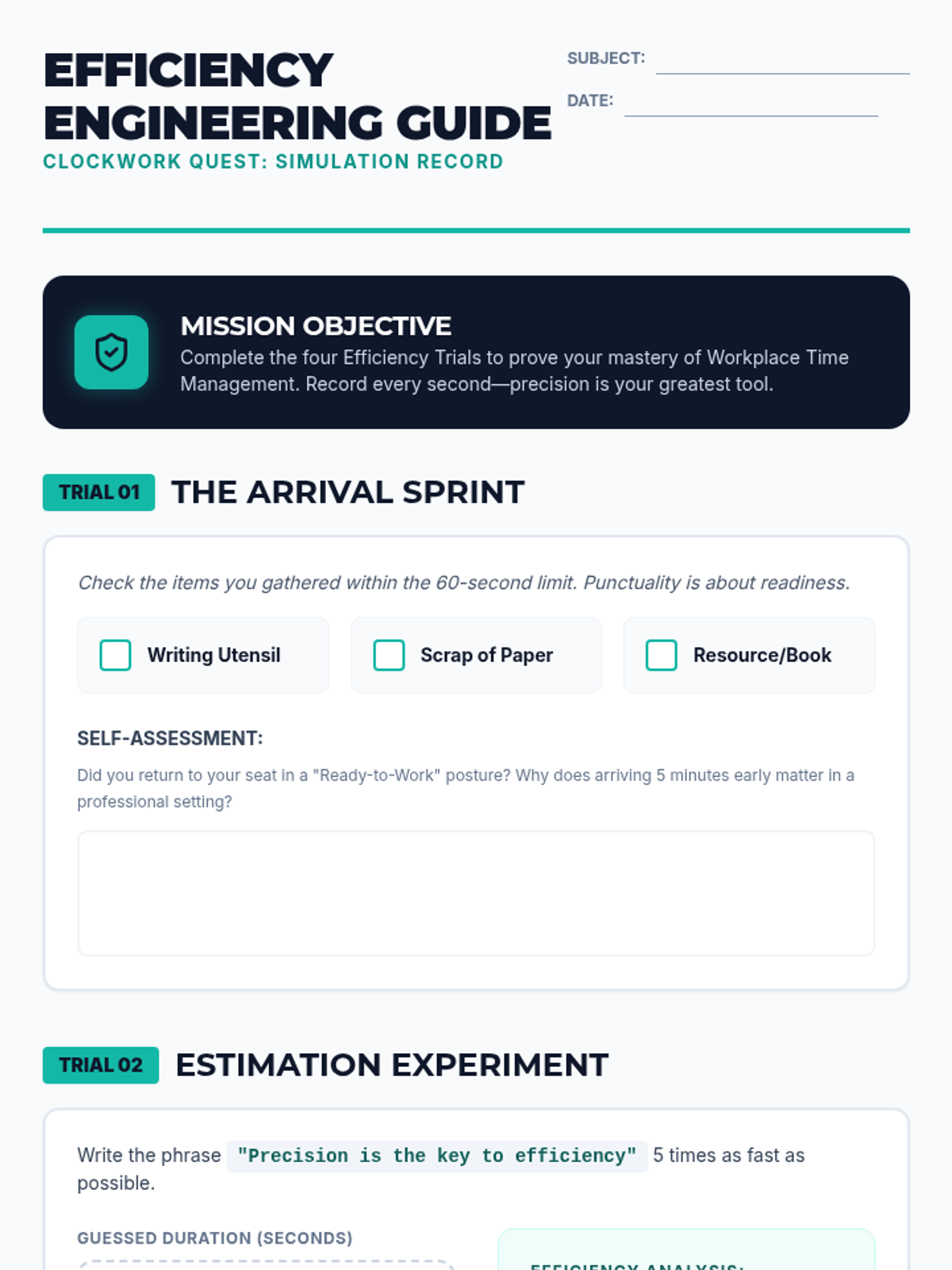
A comprehensive student worksheet featuring hands-on 'trials' to master time management, including estimation experiments, daily scheduling, and focus planning. Updated to include a specific reflective analysis question for Trial 3 for consistency.
A high-energy, modern slide presentation for teaching time management skills like punctuality, task estimation, scheduling, and the Pomodoro technique.
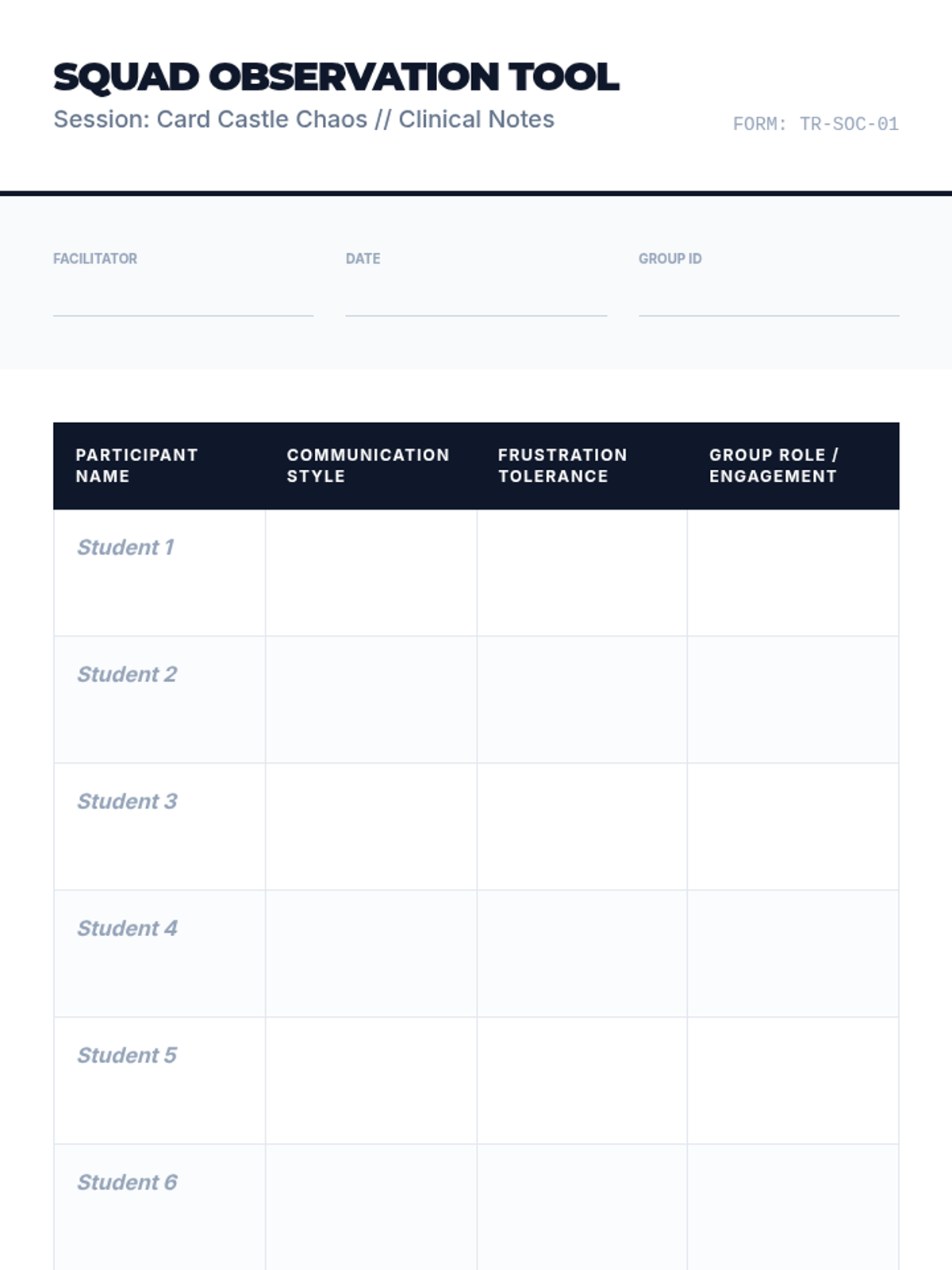
A clinical observation tool for the facilitator to track participant engagement, communication styles, and frustration tolerance during the session's activities. Designed specifically for the clinical rehab context.
A presentation slide deck for the Squad Support session. It introduces the session objectives, provides clear instructions for the "Common Threads" and "Card Castle Chaos" activities, and sets the stage for final reflection.
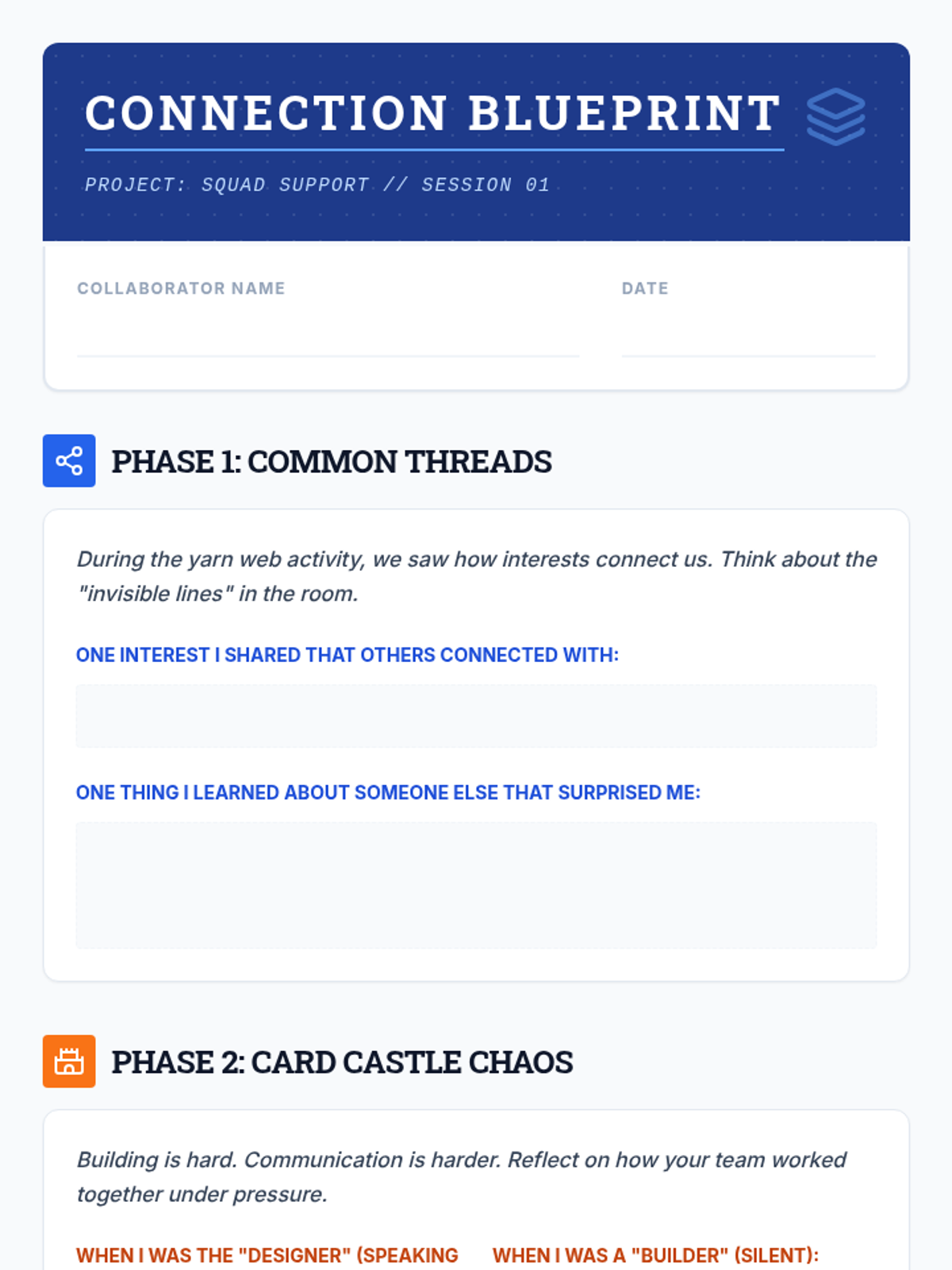
A student reflection worksheet using a "blueprint" aesthetic. It guides teens through processing their experiences with connection and teamwork from the session's activities.
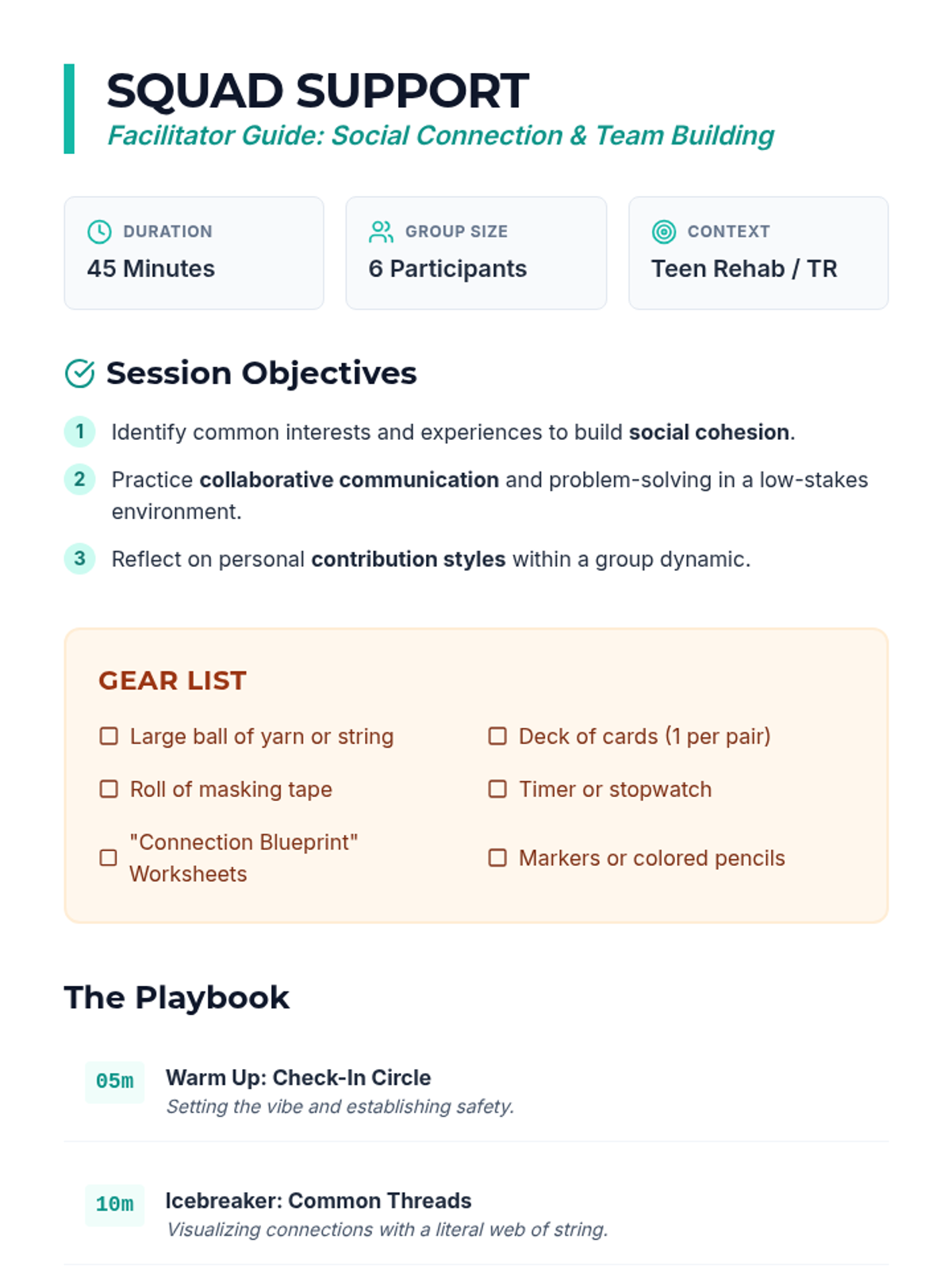
A comprehensive facilitator guide for a 45-minute therapeutic leisure session. Includes session objectives, a detailed materials checklist, activity breakdowns with specific prompts, and clinical considerations for working with teens in rehab.
A vibrant slide deck for the Sisterhood Circle workshop, breaking down friendship profiles and exploring themes of Black girlhood and community. Revised for accessibility with minimum 24px font sizes.
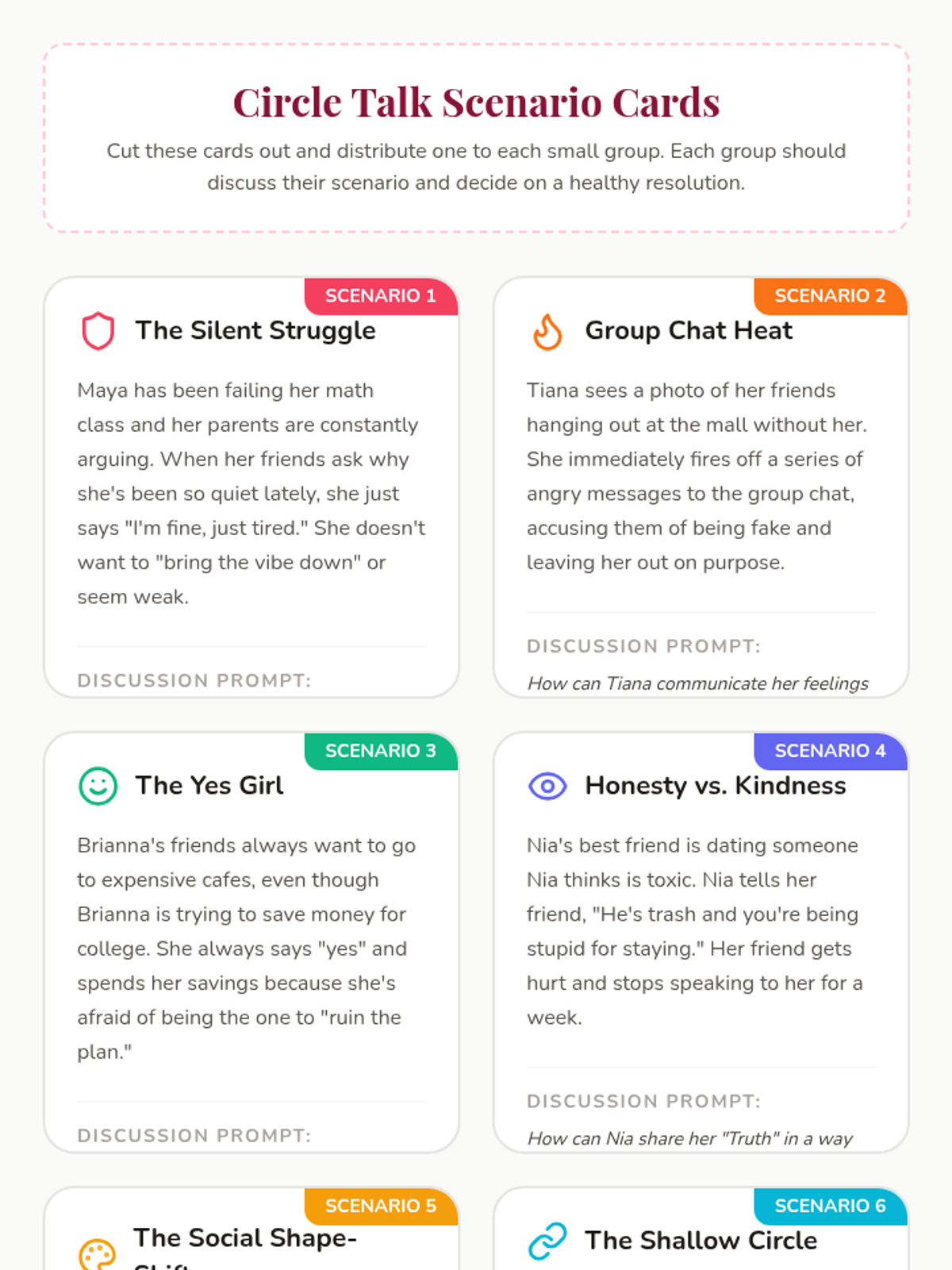
A set of scenario cards for small group discussion, highlighting different friendship profiles and challenges in Black girlhood friendships.
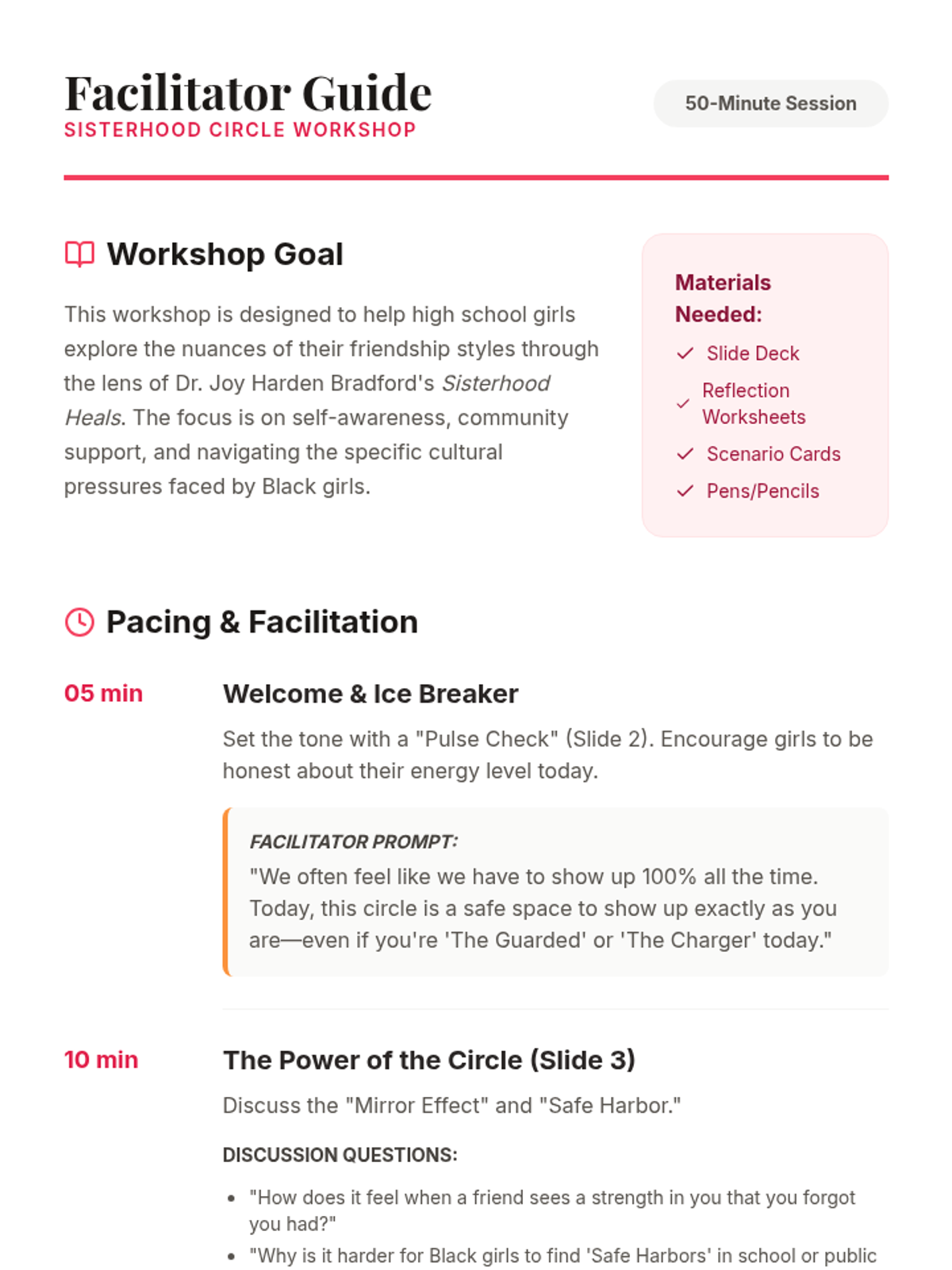
A comprehensive facilitator guide for the Sisterhood Circle workshop, including pacing, discussion prompts, and facilitation tips for high school girls.
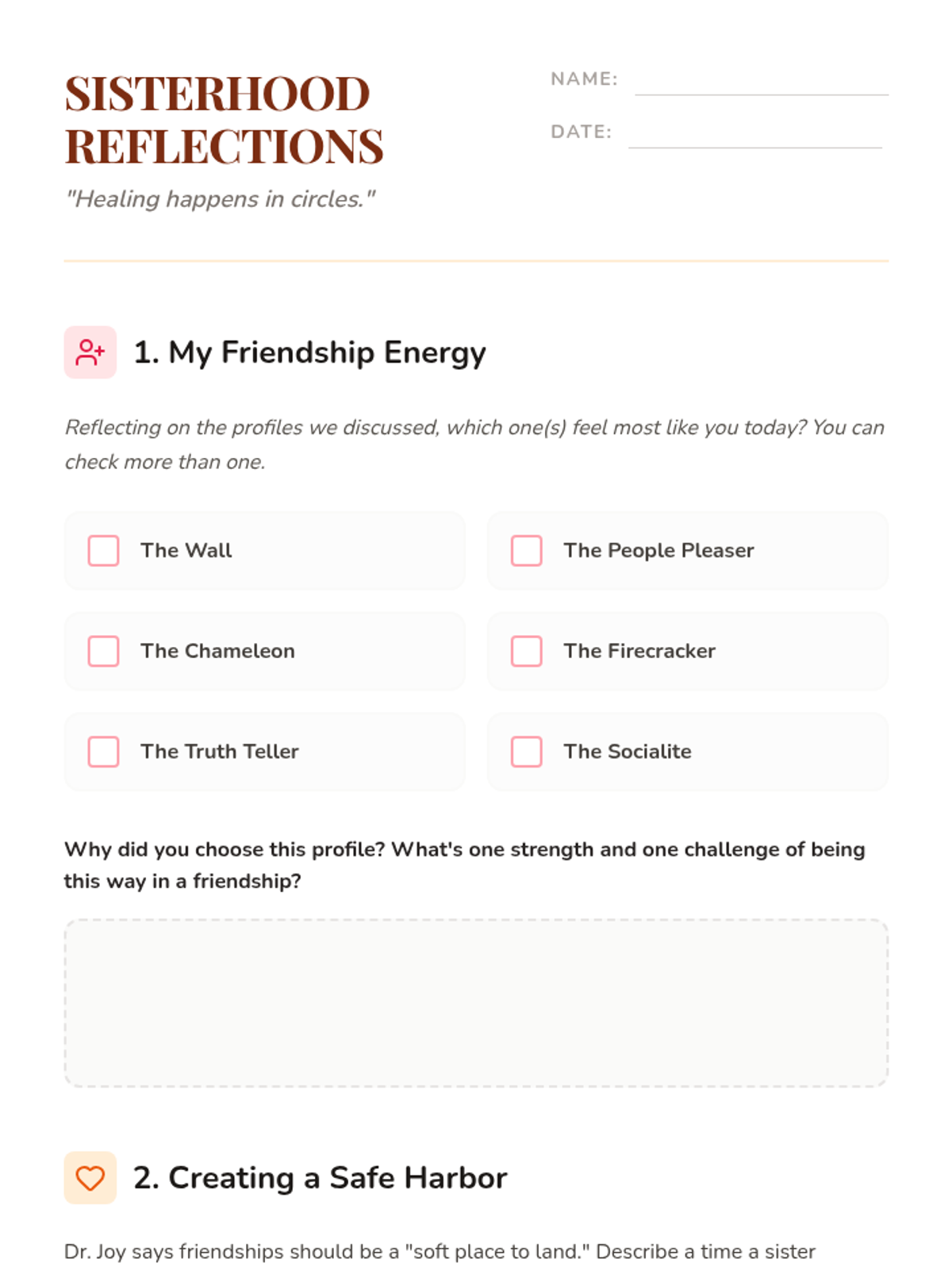
A personal reflection worksheet for students to self-identify their friendship profiles and reflect on their support systems.
A vibrant slide deck for the Sisterhood Circle workshop, breaking down friendship profiles and exploring themes of Black girlhood and community.
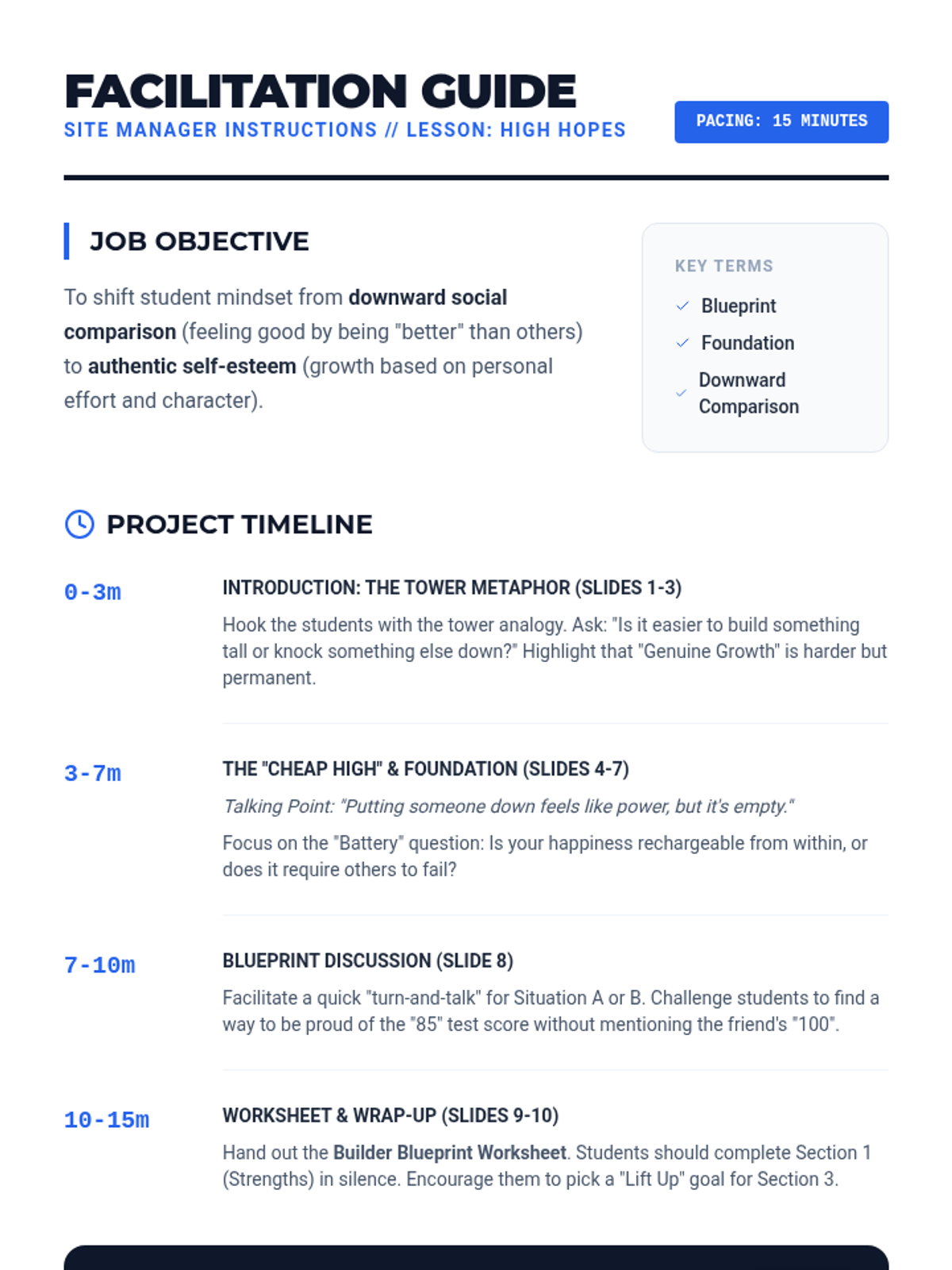
A teacher facilitation guide designed to manage a 15-minute lesson. It includes a pacing timeline, talking points for the tower metaphor, and strategies for handling common student responses.
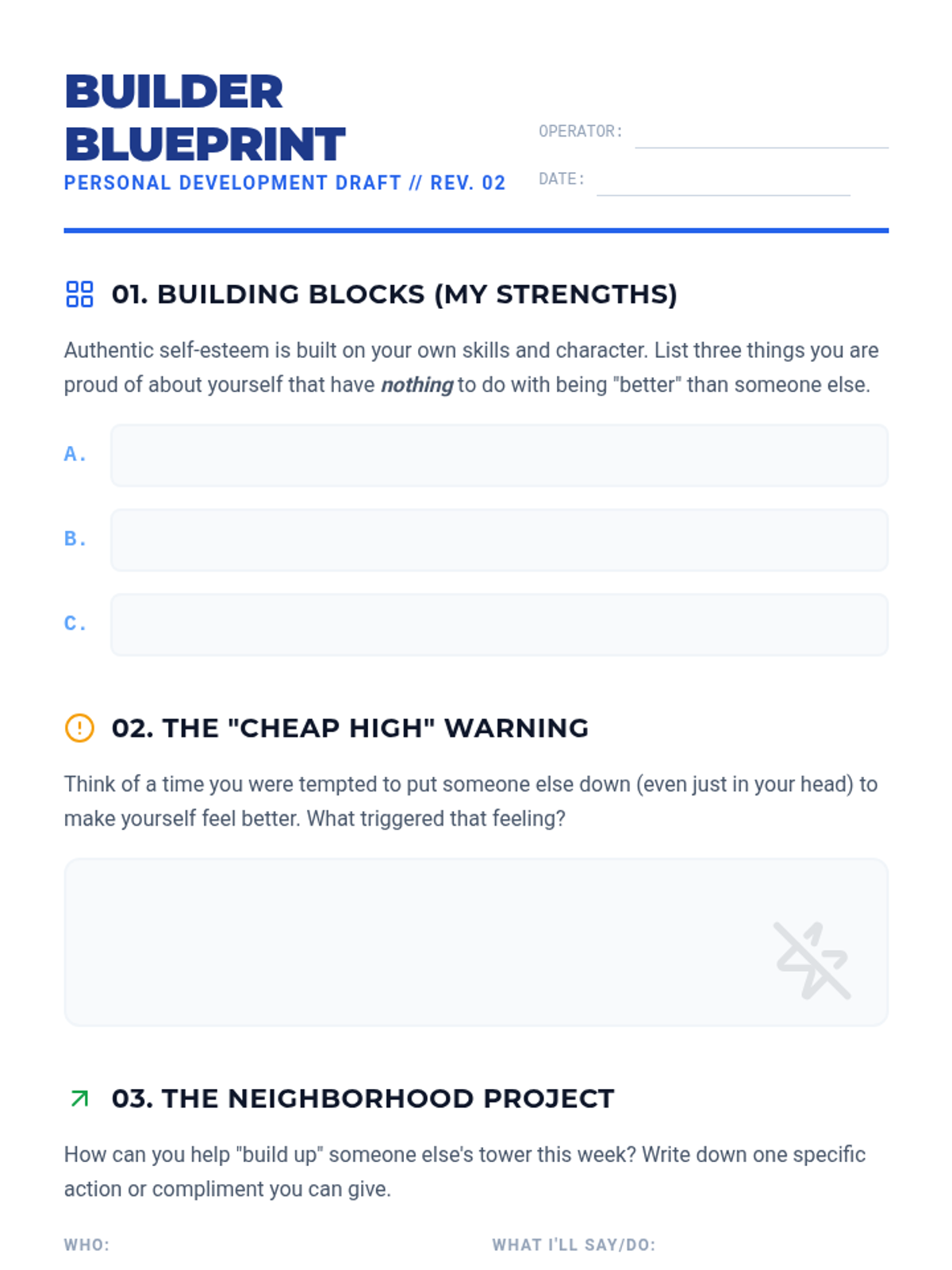
A student reflection worksheet that helps learners identify their personal strengths, recognize moments of unhealthy comparison, and set a goal to encourage others. Styled like a professional blueprint.
A 10-slide presentation using a construction and blueprint theme to teach students about authentic self-esteem. It contrasts 'building yourself up' with 'knocking others down' and provides actionable tools for genuine growth. Updated for maximum legibility.
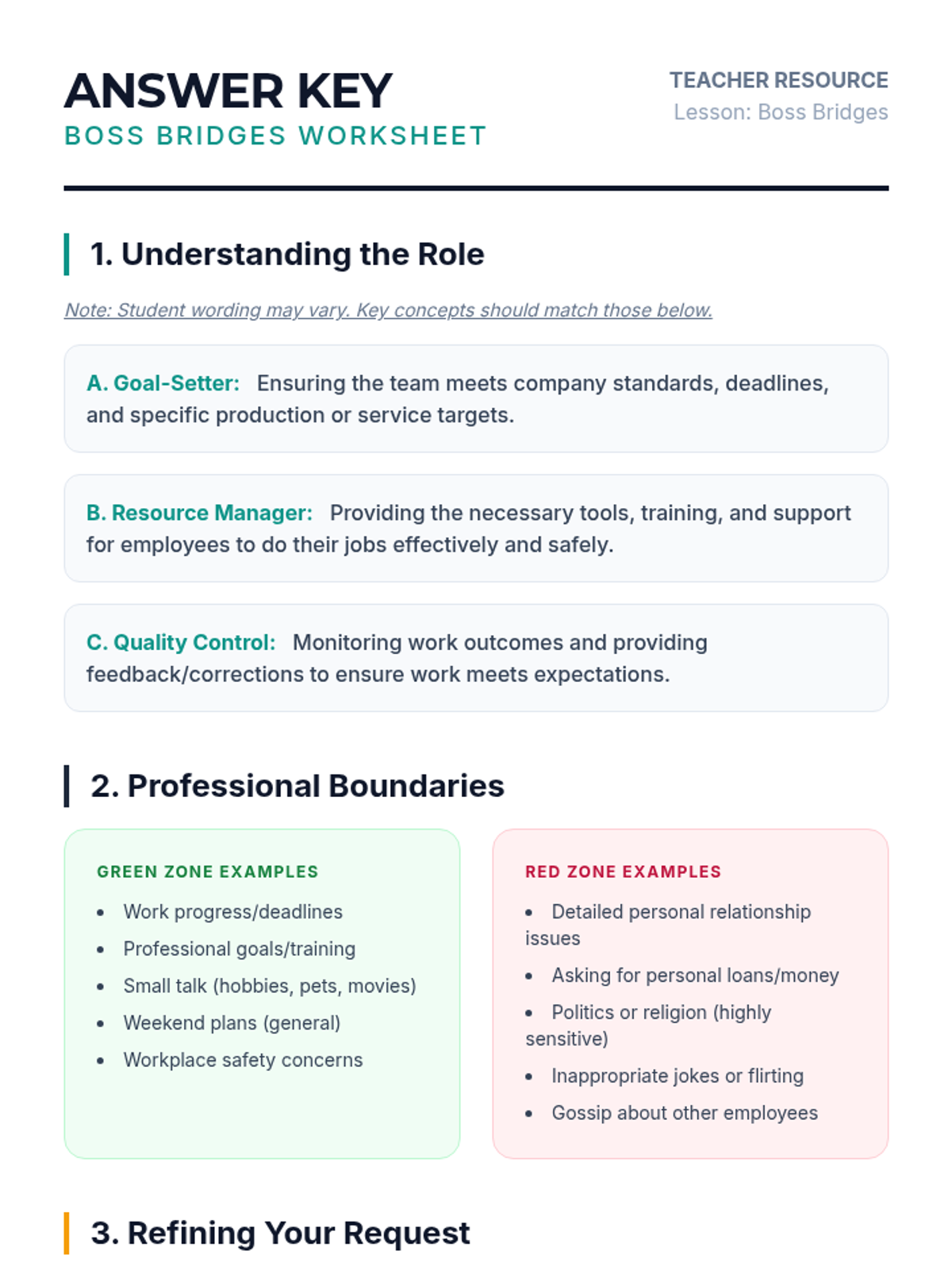
A 2-page teacher-facing answer key for the Boss Bridges Worksheet. It provides suggested professional responses for role definitions, boundary categorization, communication rewrites, and the three training case studies.
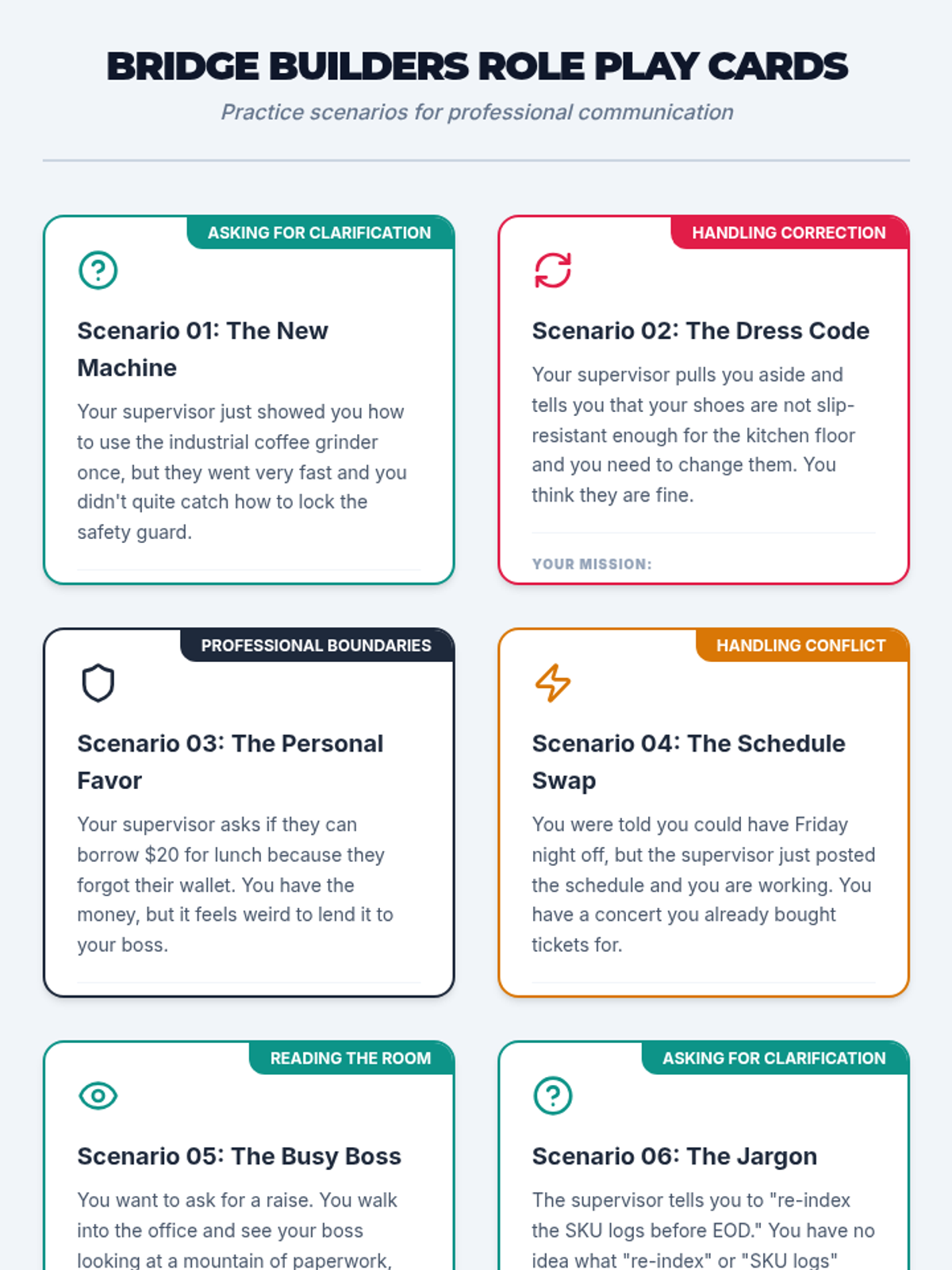
A printable set of 8 role-play scenario cards (Clarification, Correction, Boundaries, Conflict) designed to provide hands-on practice for students in employment training. Each card includes a specific scenario and a clear communication mission.
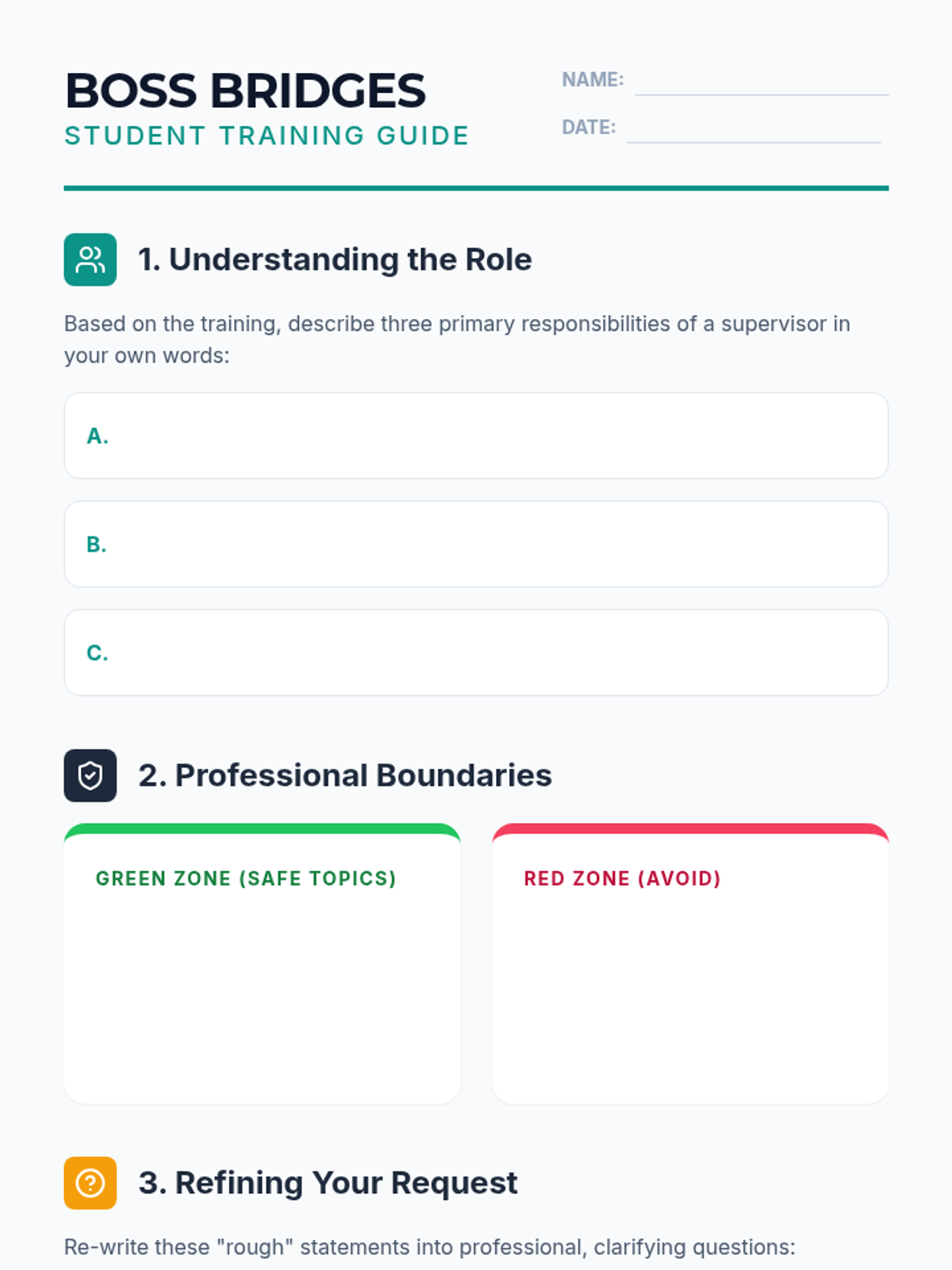
A 2-page student worksheet that complements the slide deck. It includes sections for identifying supervisor roles, mapping professional boundaries, practicing communication strategies, and documenting reflections on the training case studies.
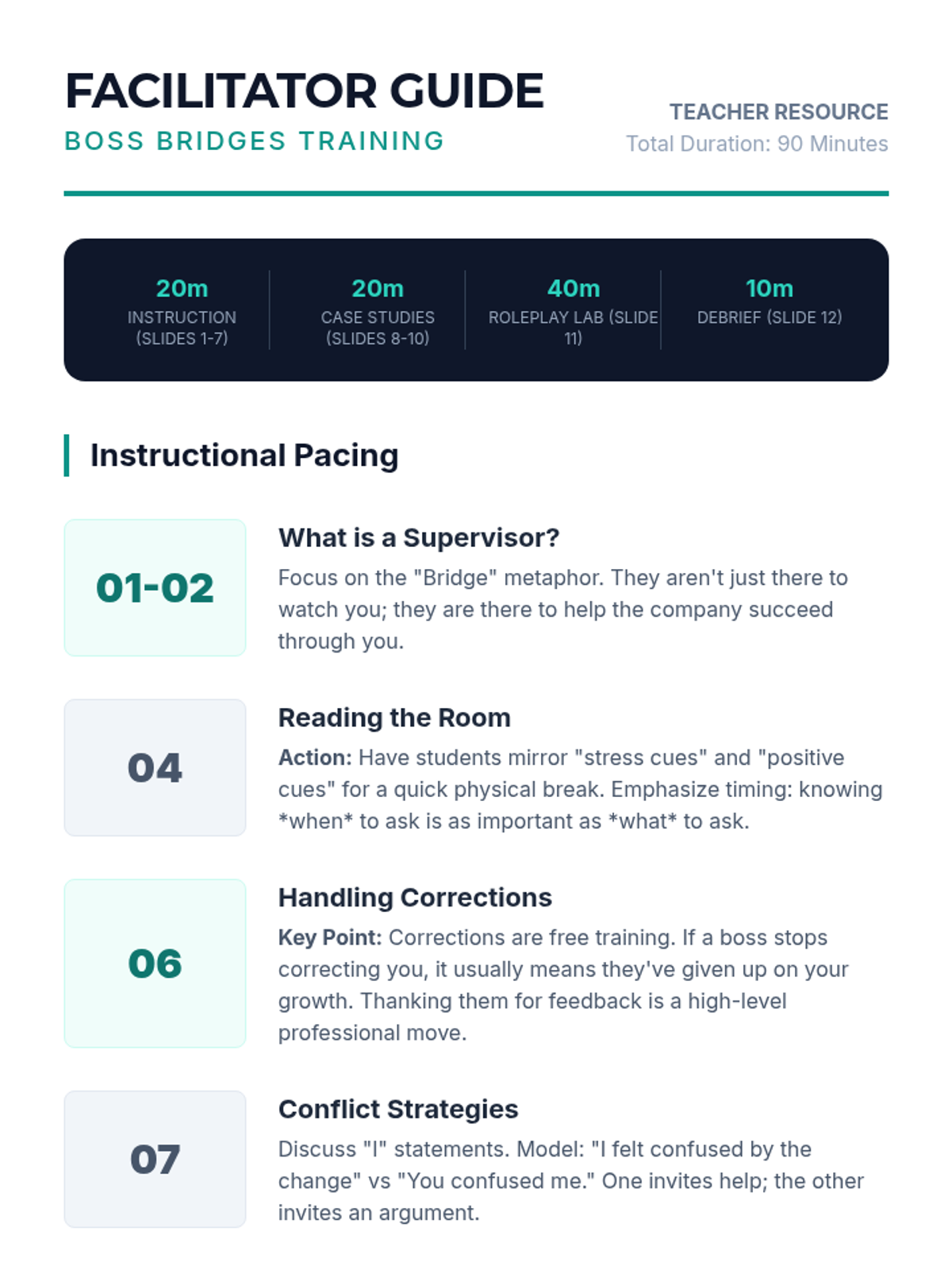
A 2-page facilitator guide updated for a 90-minute session, including detailed pacing, instruction on slides, and a structured plan for the 40-minute Roleplay Lab.
An updated 12-slide presentation that includes a dedicated "Roleplay Lab" slide to guide the 40-minute practice session, ensuring a cohesive 90-minute training experience.
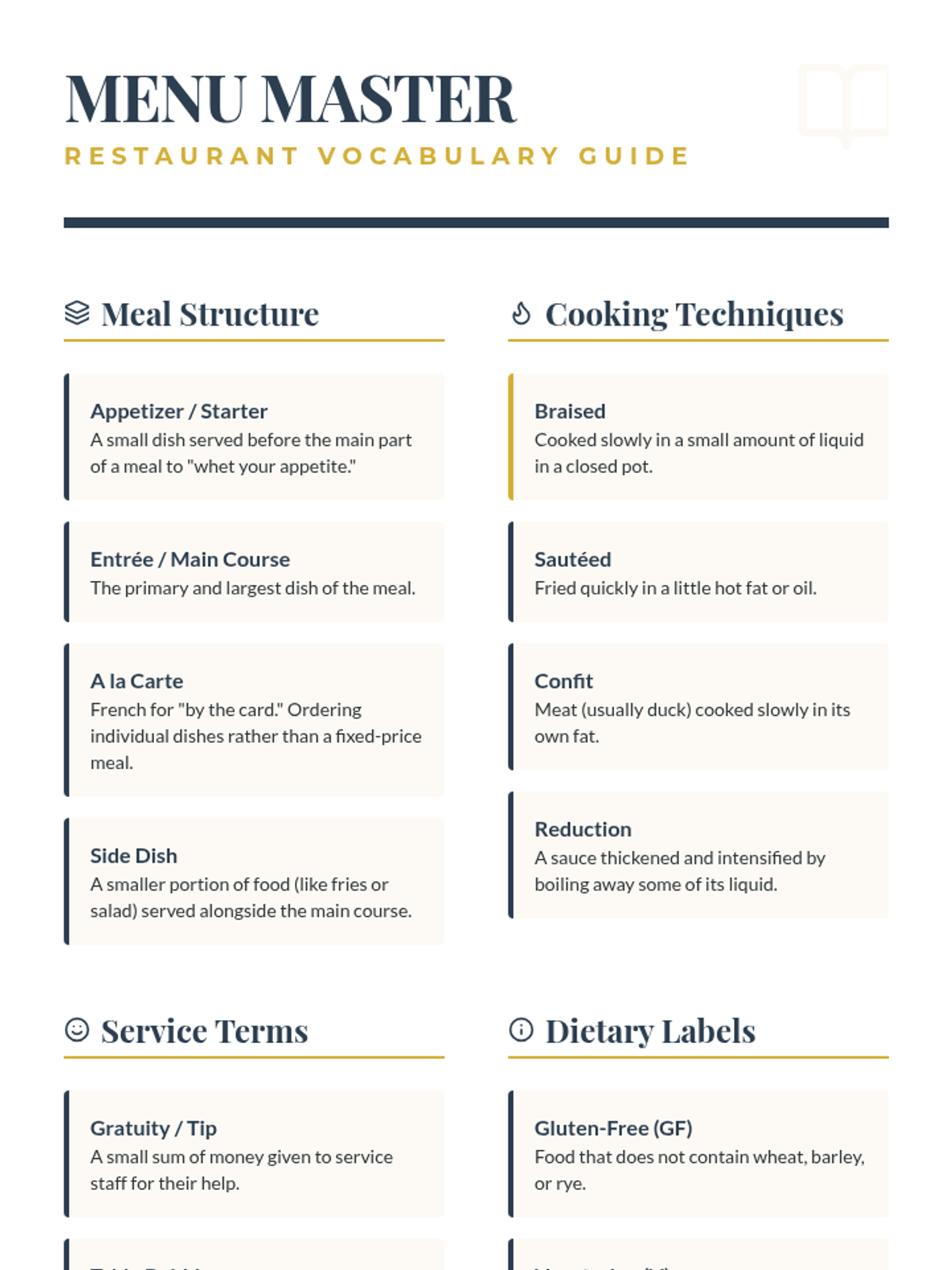
A vocabulary reference sheet for students to understand common restaurant terms, cooking styles, and dietary labels found on menus.
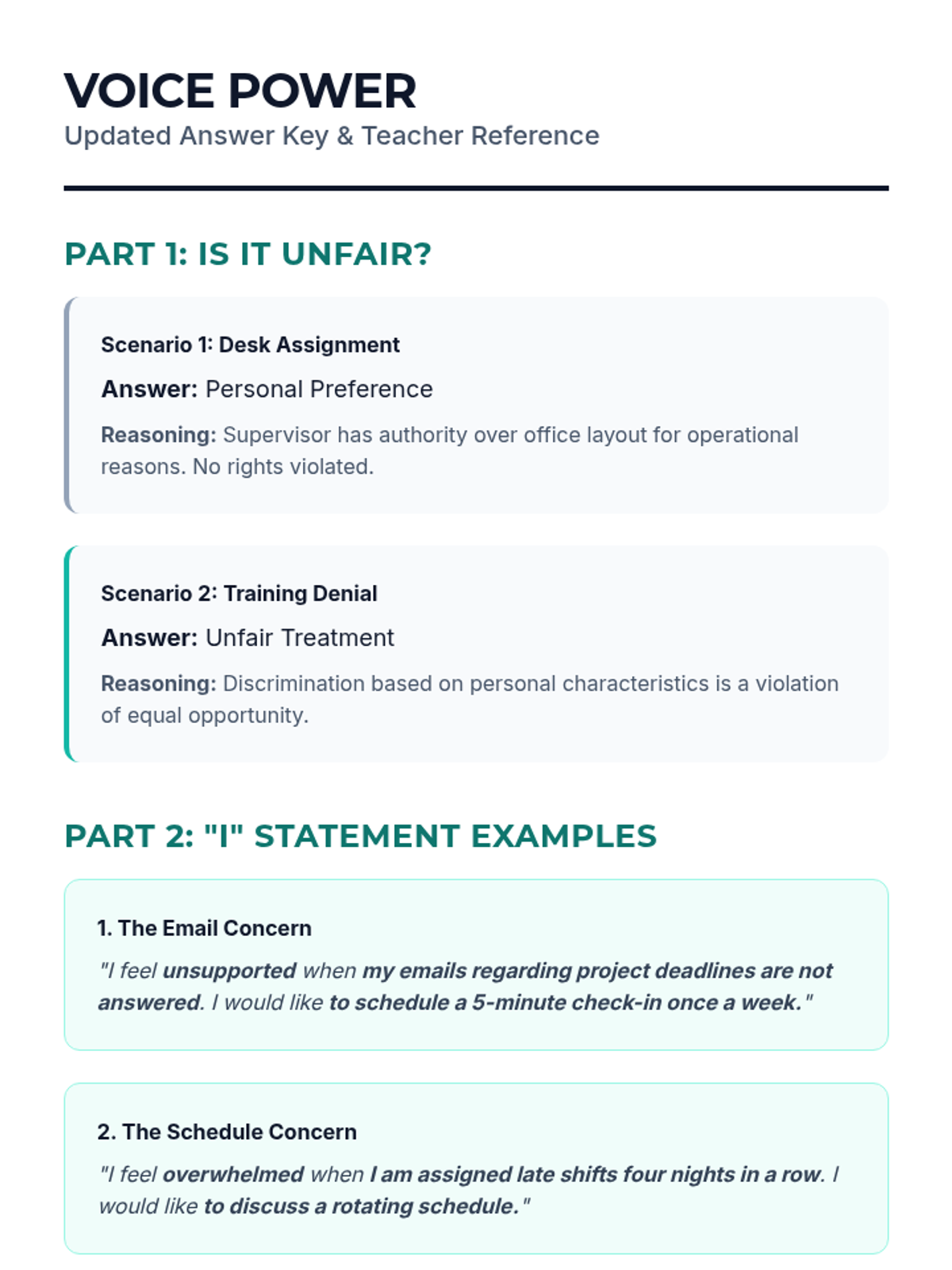
An updated answer key and teacher reference sheet that includes suggested responses for the advanced safety, promotion, and consumer rights case studies.
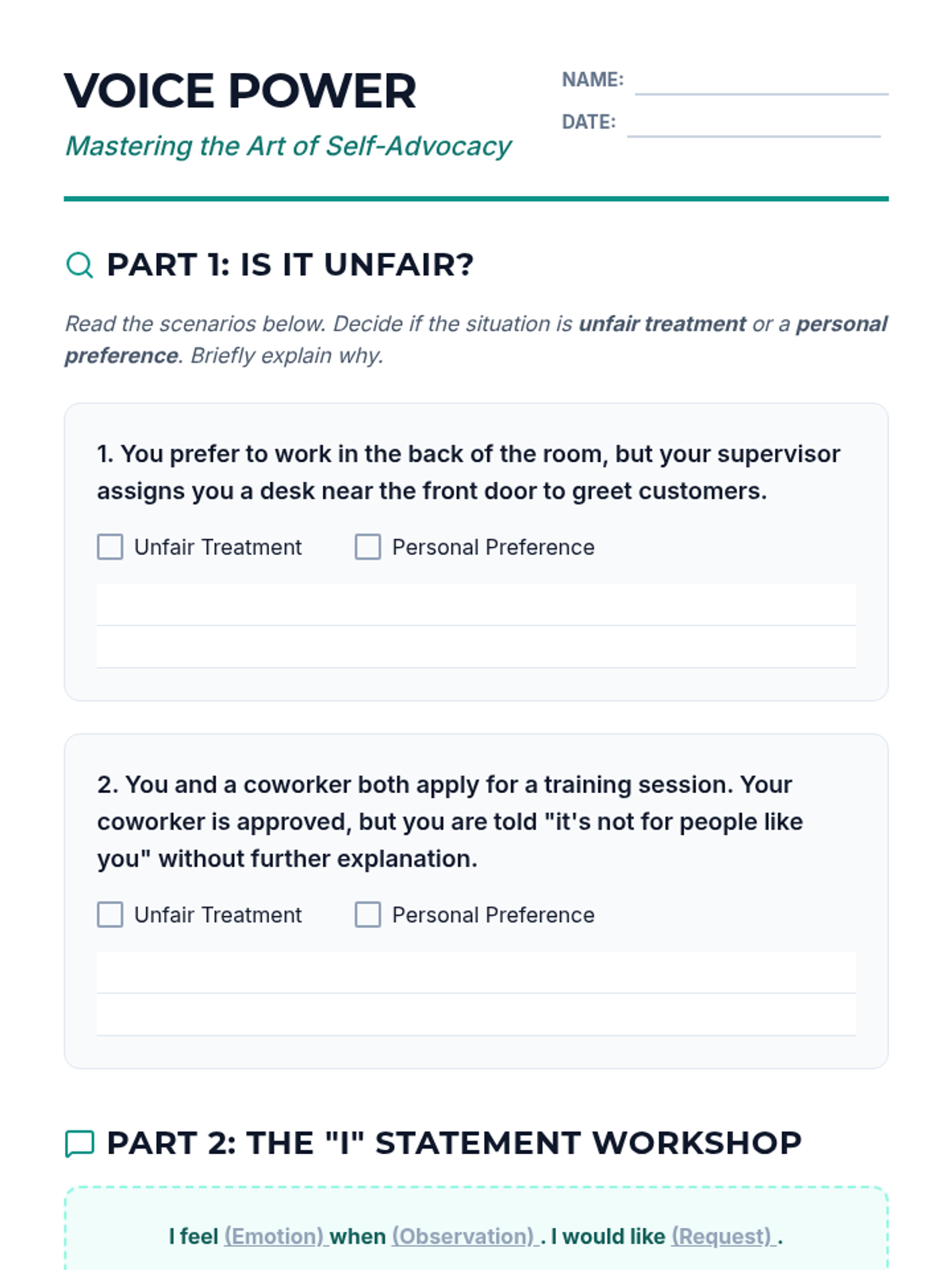
An expanded two-page student worksheet that includes the original scenarios plus three new advanced case studies focused on workplace safety, promotion fairness, and consumer rights.
An updated slide deck featuring four YouTube videos on effective complaining and consumer rights, along with three new workplace and consumer case studies for class discussion.
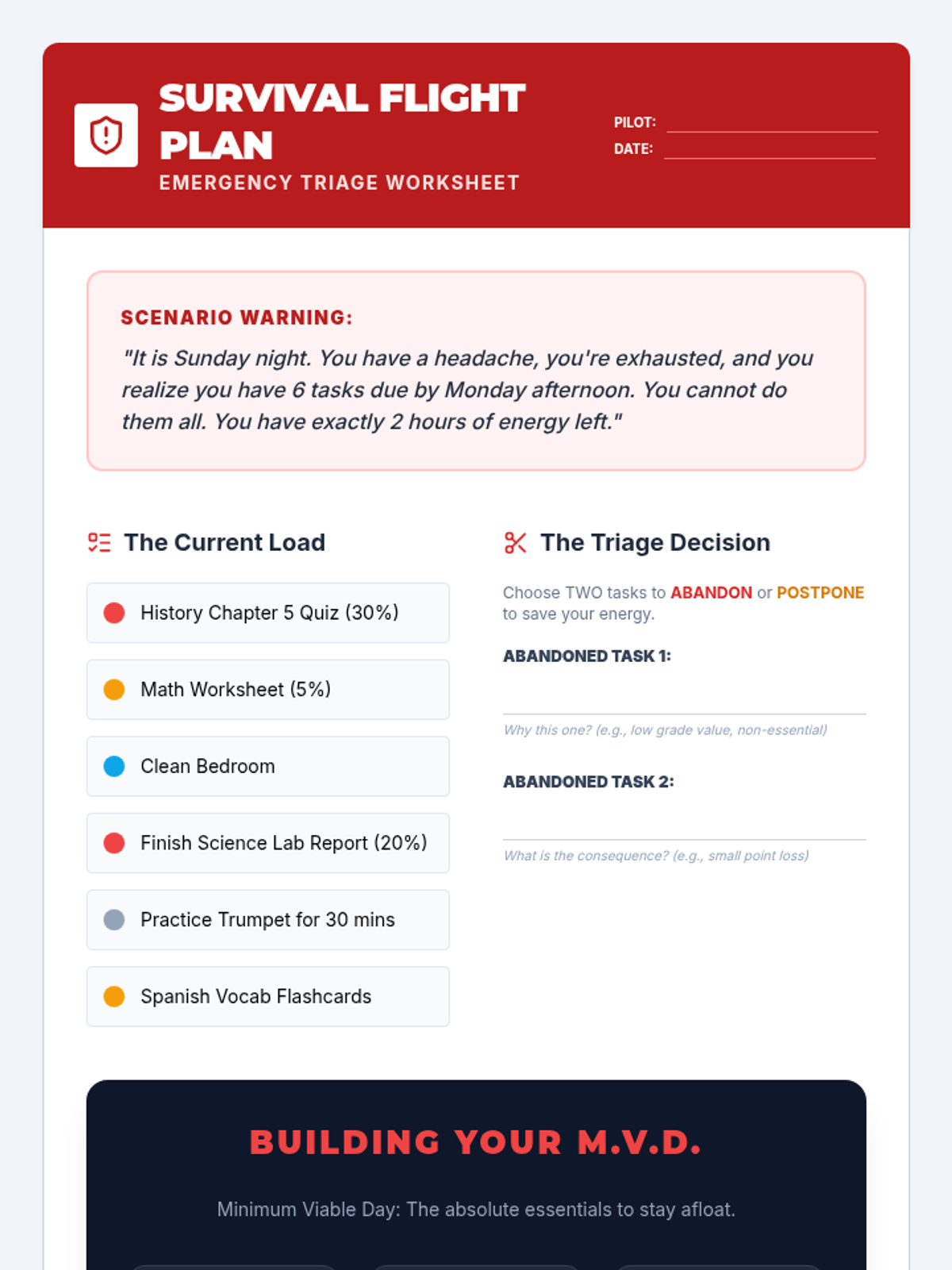
An emergency triage worksheet that guides students through a simulated crisis scenario, helping them identify which tasks to abandon and how to construct a Minimum Viable Day (MVD).
Lesson 5 slide deck on emergency triage and the 'Minimum Viable Day' concept, teaching students how to prioritize critical tasks during periods of crisis or illness.
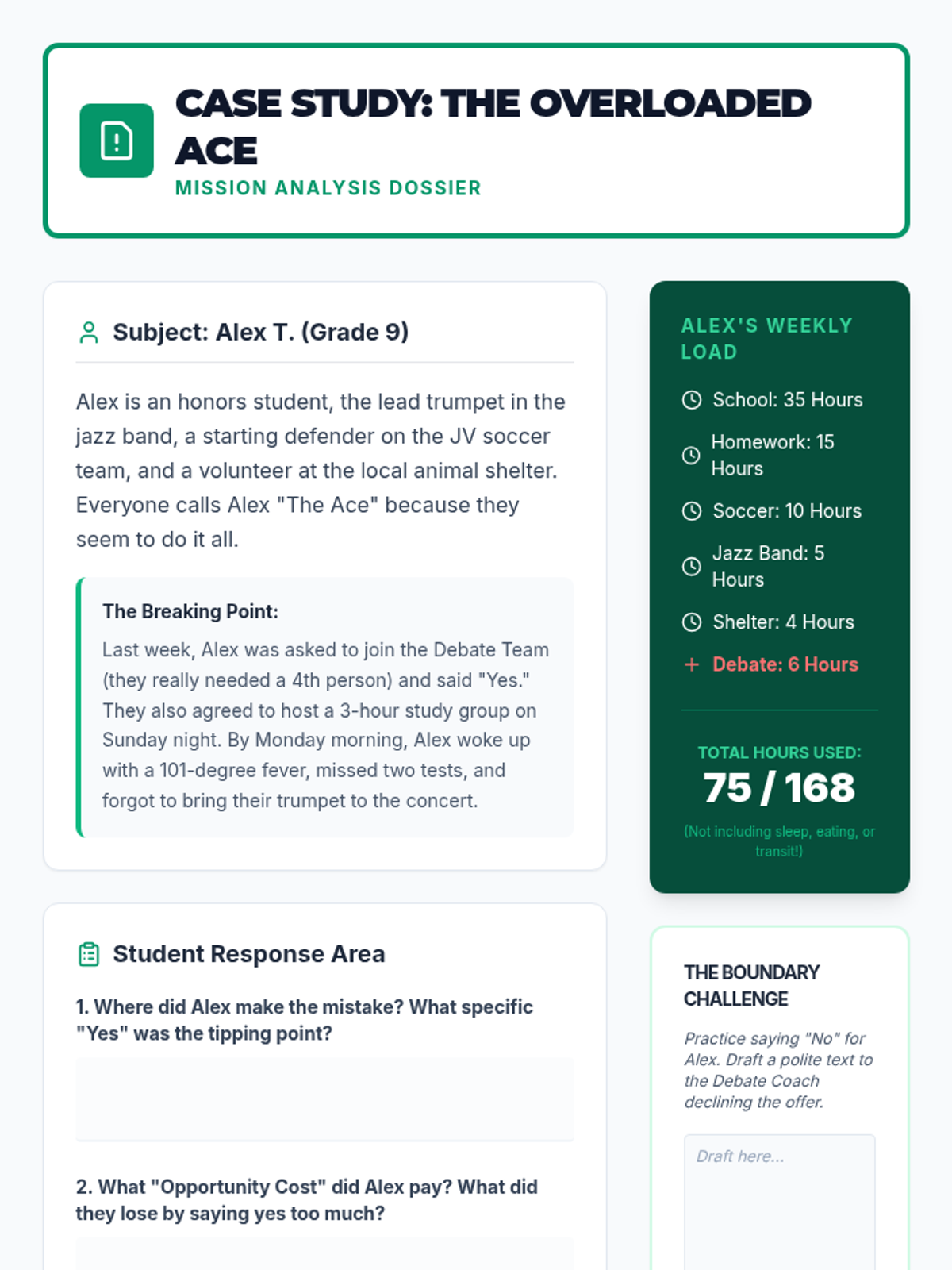
A case study document about 'Alex the Ace', a student who takes on too much, designed to help students analyze the consequences of over-commitment and practice setting boundaries.
Lesson 4 slide deck introducing the concept of opportunity cost and providing a "No Bank" of polite but firm scripts for setting boundaries.
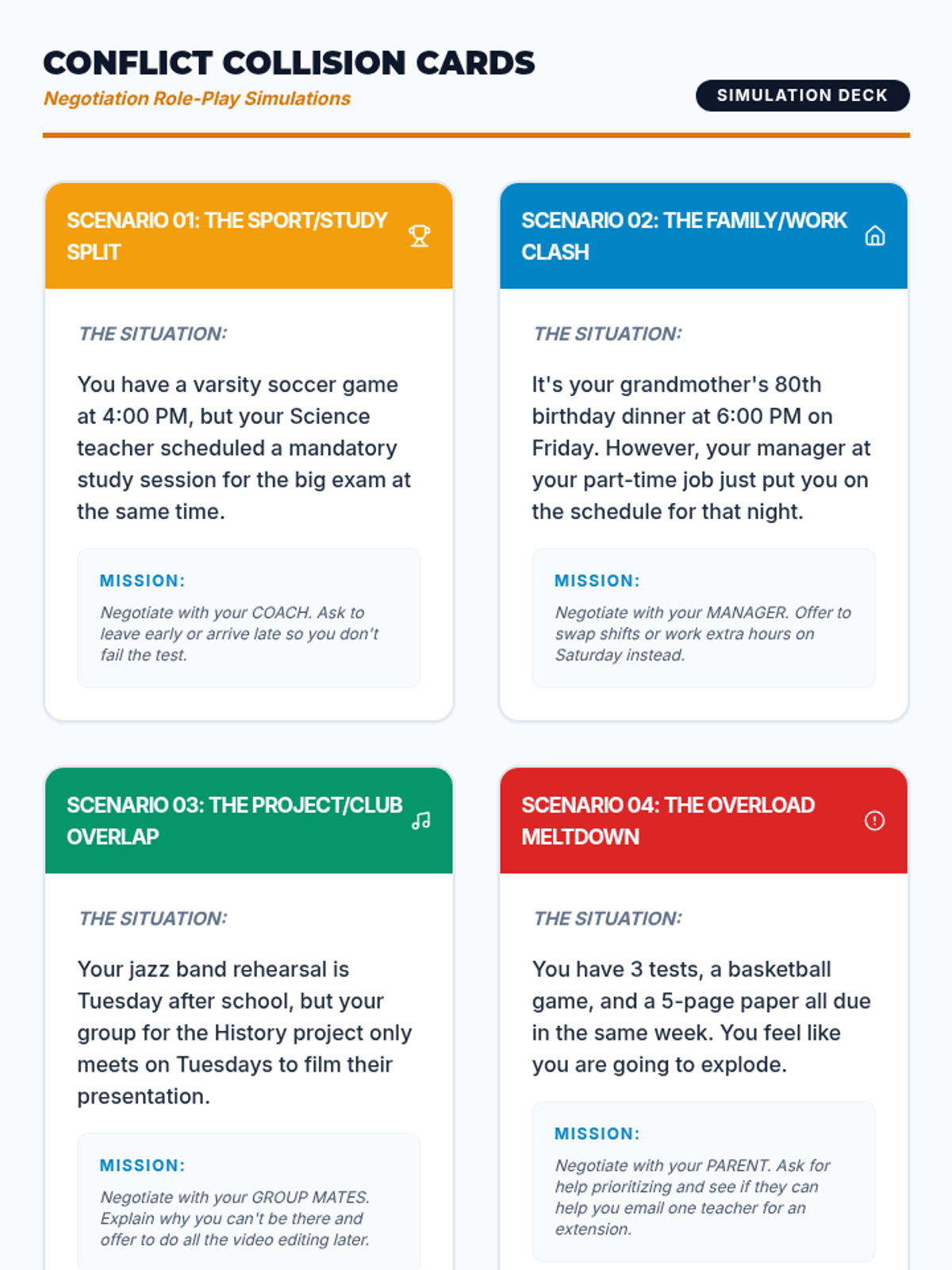
A set of role-play simulation cards for students to practice negotiating scheduling conflicts in various realistic scenarios (sports vs. academics, work vs. family, etc.).
Lesson 3 slide deck focusing on face-to-face negotiation skills for resolving scheduling conflicts, introducing a 3-step negotiation framework.
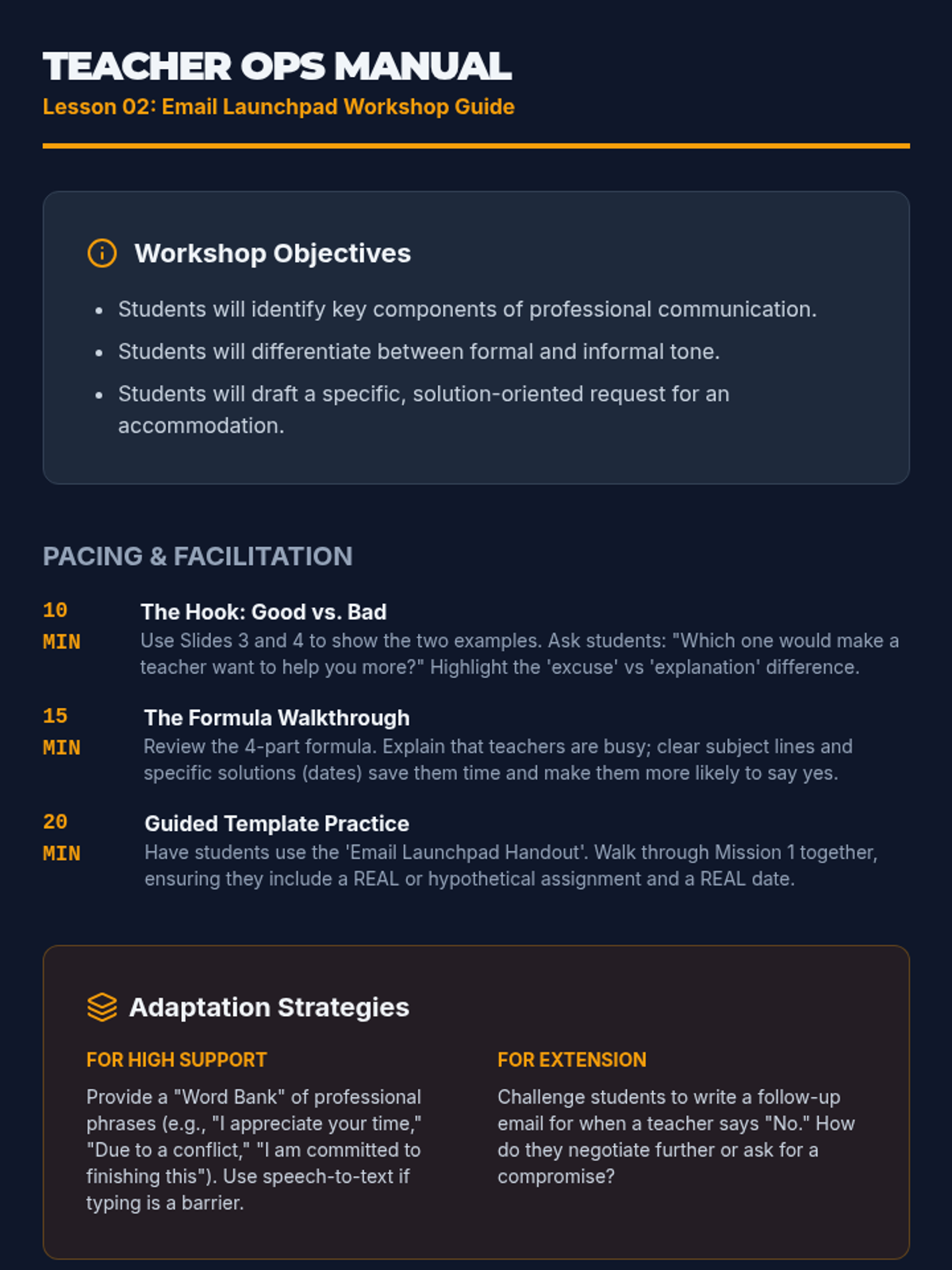
Teacher facilitation guide for Lesson 2, including pacing, differentiation strategies, and discussion prompts for the email workshop.
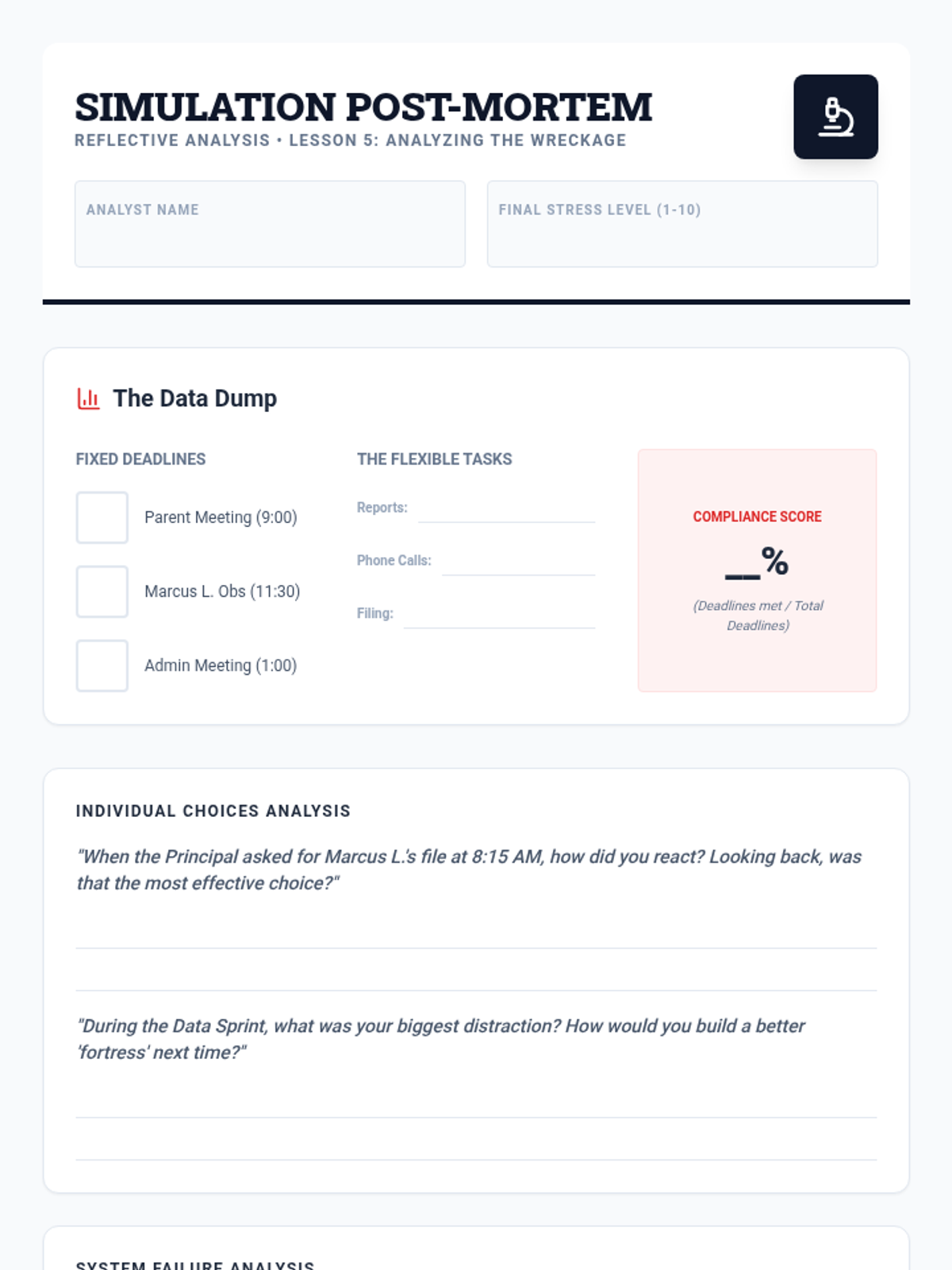
A detailed reflection worksheet for students to analyze their simulation performance, identify mistakes, and distinguish between individual and systemic issues.
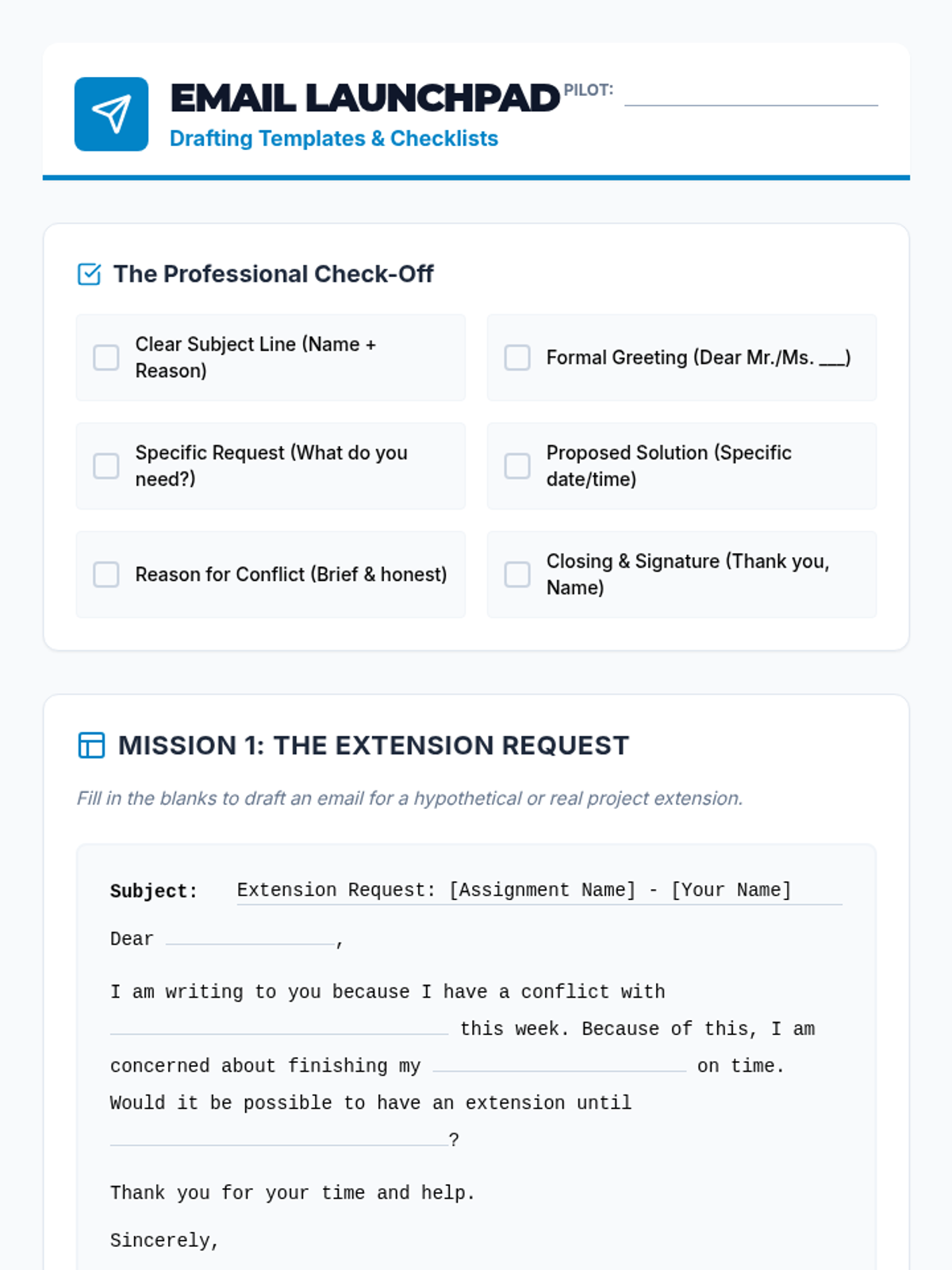
A student handout and worksheet providing an email etiquette checklist and fill-in-the-blank templates for drafting professional requests to teachers.
Lesson 2 slide deck covering the importance of professional email communication, contrasting effective and ineffective examples, and introducing the 4-part request formula.
Visual presentation for the final debrief of the simulation, identifying system failures versus individual choices and reflecting on professional growth.
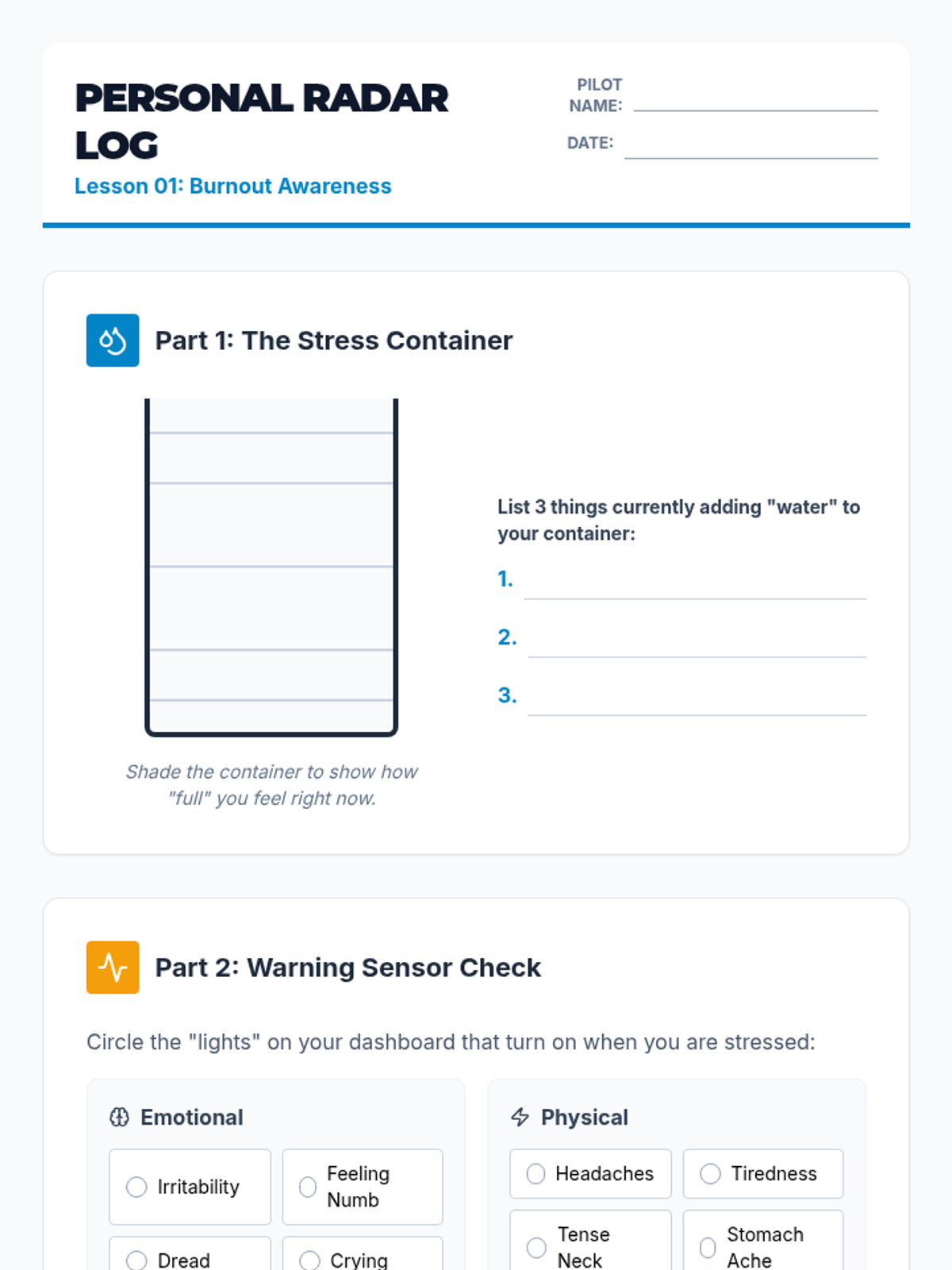
A student worksheet for identifying burnout symptoms, mapping current stress levels using the container metaphor, and identifying trusted adults for support.
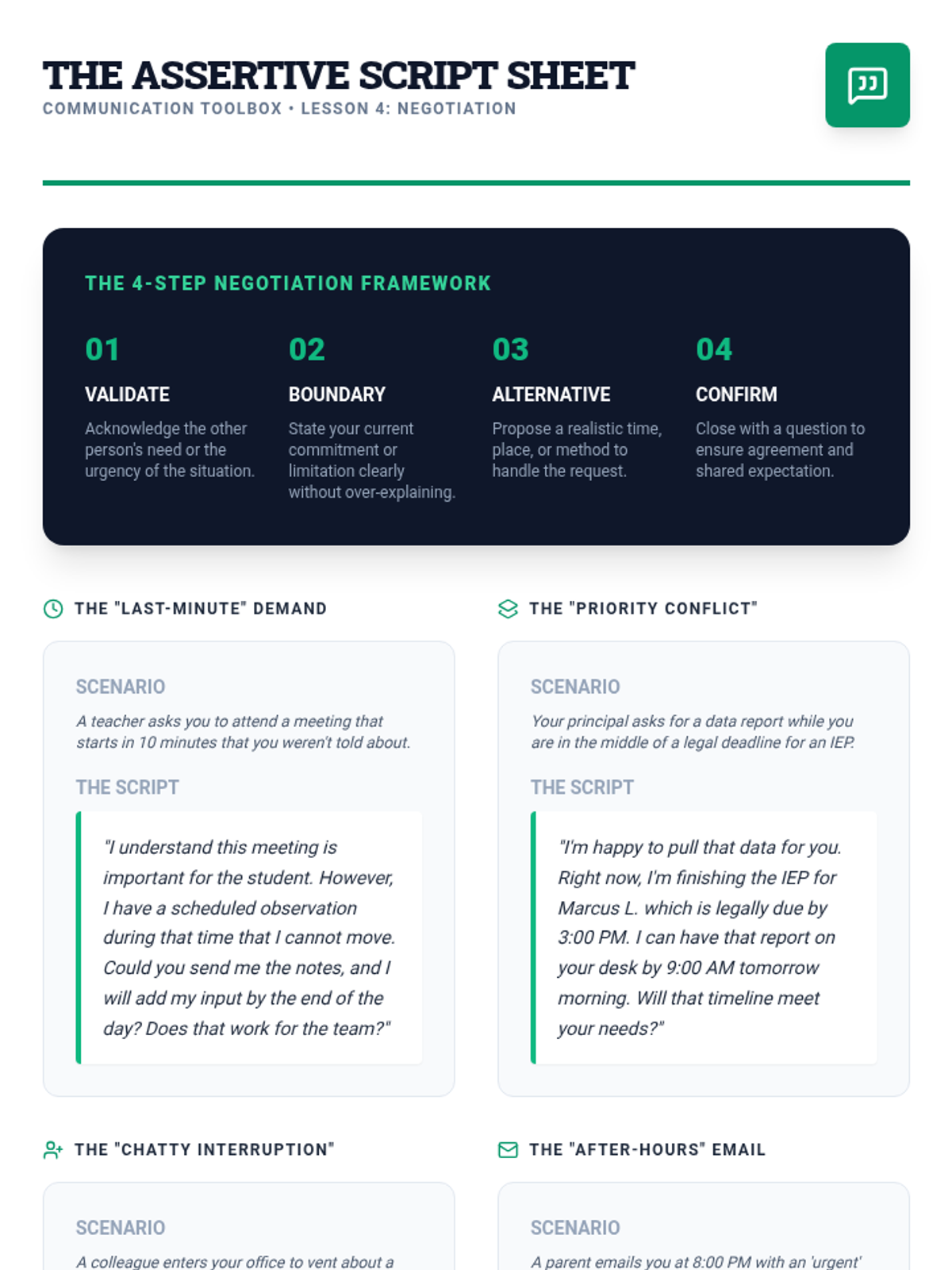
A professional communication guide providing specific scripts for "polite but firm" refusal and negotiation in common workplace scenarios.
Introductory slide deck for Lesson 1, using a flight control theme to explain burnout through the 'Stress Container' metaphor and identifying physical/emotional warning signs.
Visual presentation for Lesson 4, teaching students about assertive communication, professional boundaries, and negotiation scripts in high-pressure work environments.
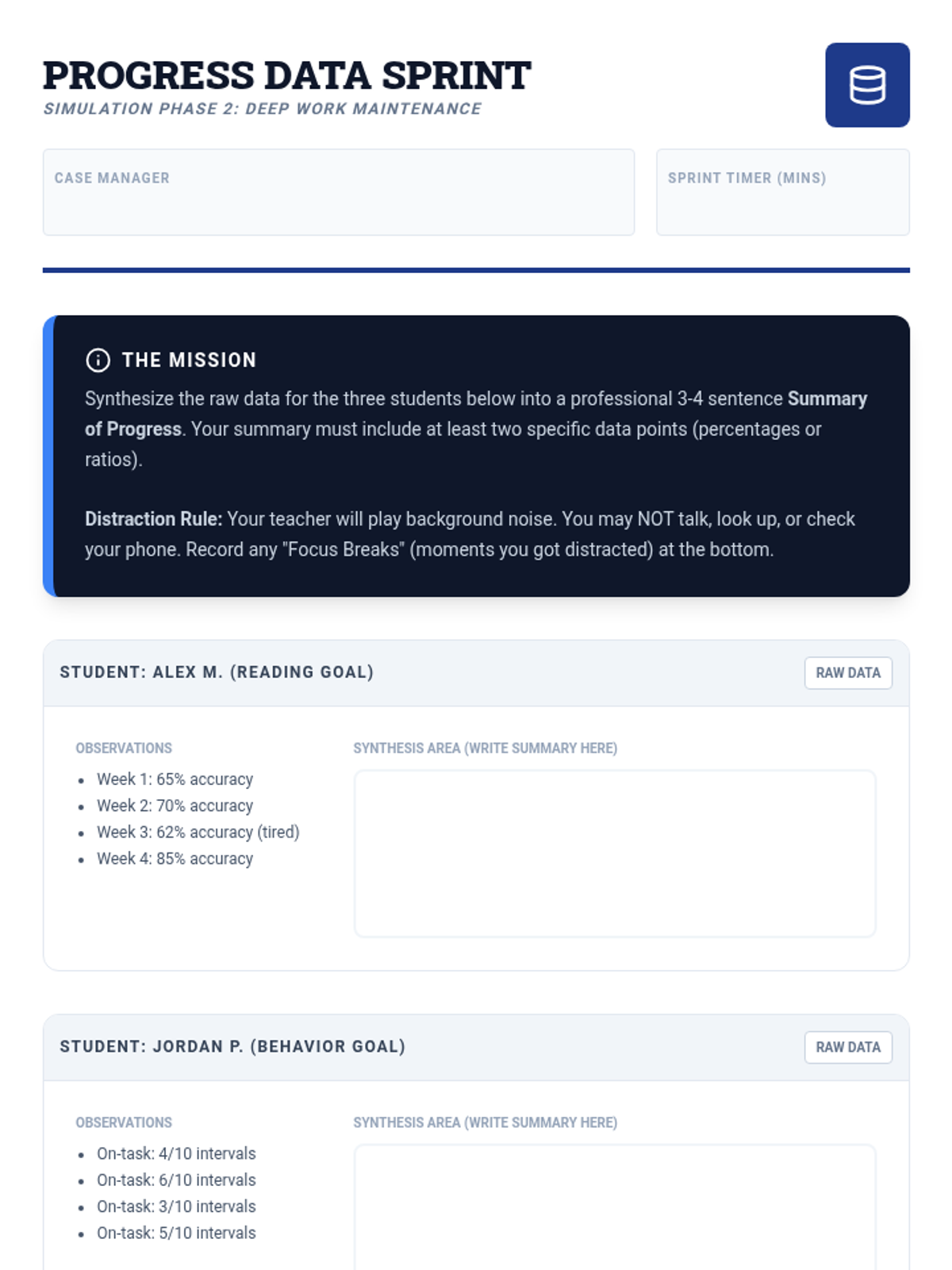
A simulation activity where students must synthesize raw student progress data into professional summaries under distracting conditions.
Visual presentation for Lesson 3, teaching students about deep work, the cost of interruptions, and strategies like time batching and defensive communication.
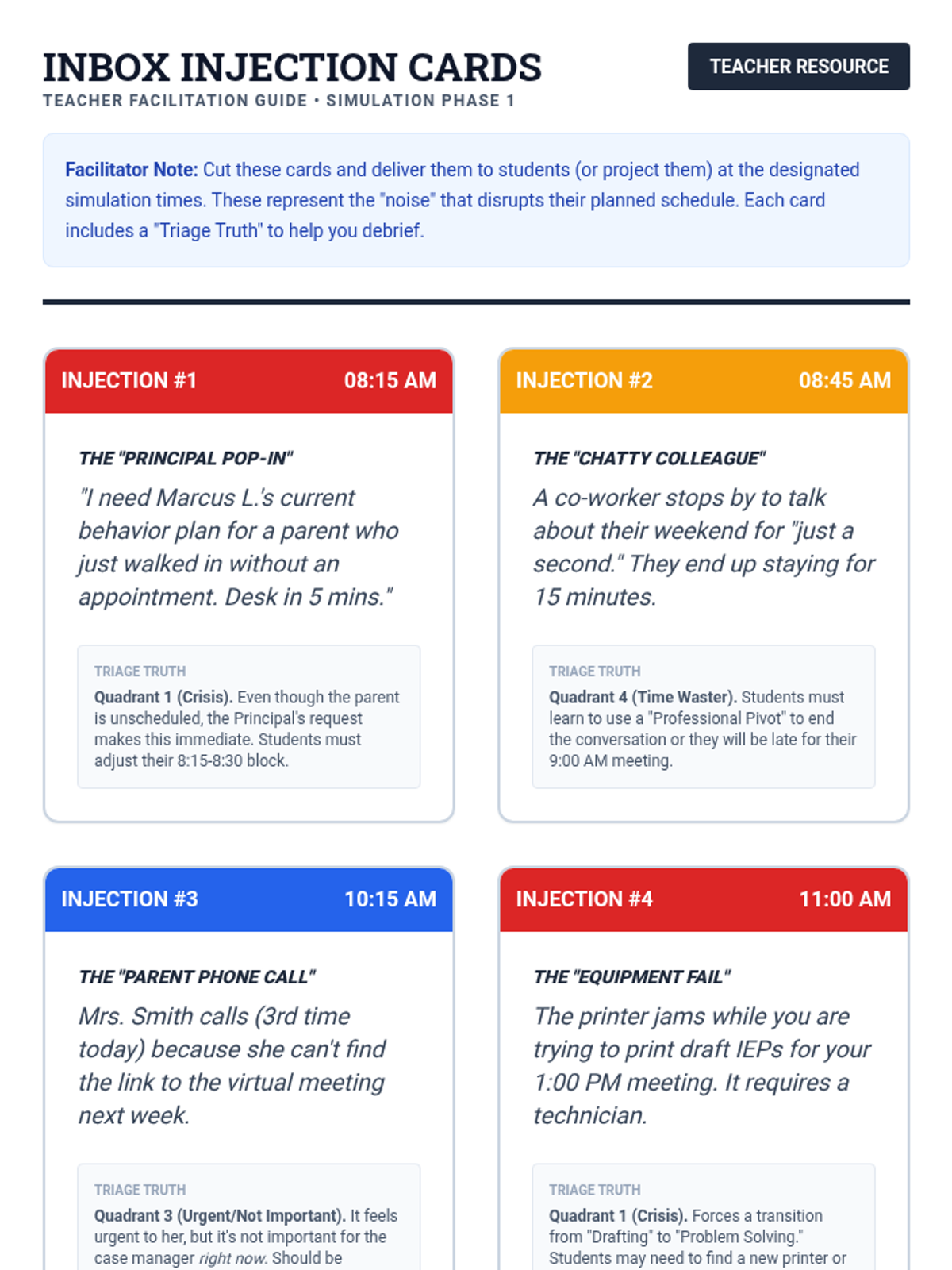
A set of scenario cards for the teacher to reveal during the Morning Rush simulation, providing specific interruptions and the 'triage truth' for debriefing.
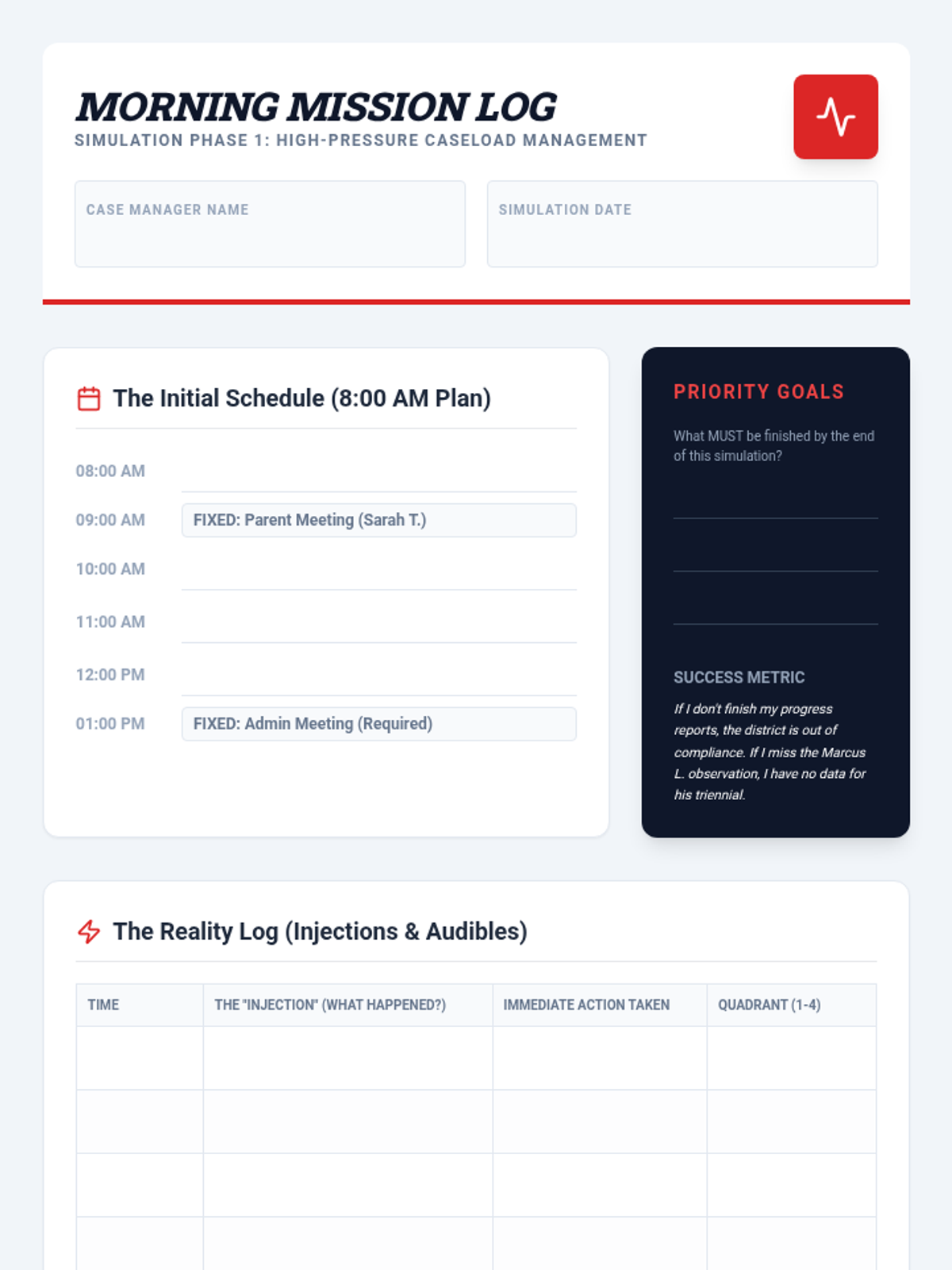
A planning and tracking worksheet for students to manage their simulated workday and record the impact of unexpected interruptions.
Visual presentation for the Morning Rush simulation, including timers, task lists, and the first unexpected "Inbox Injection."
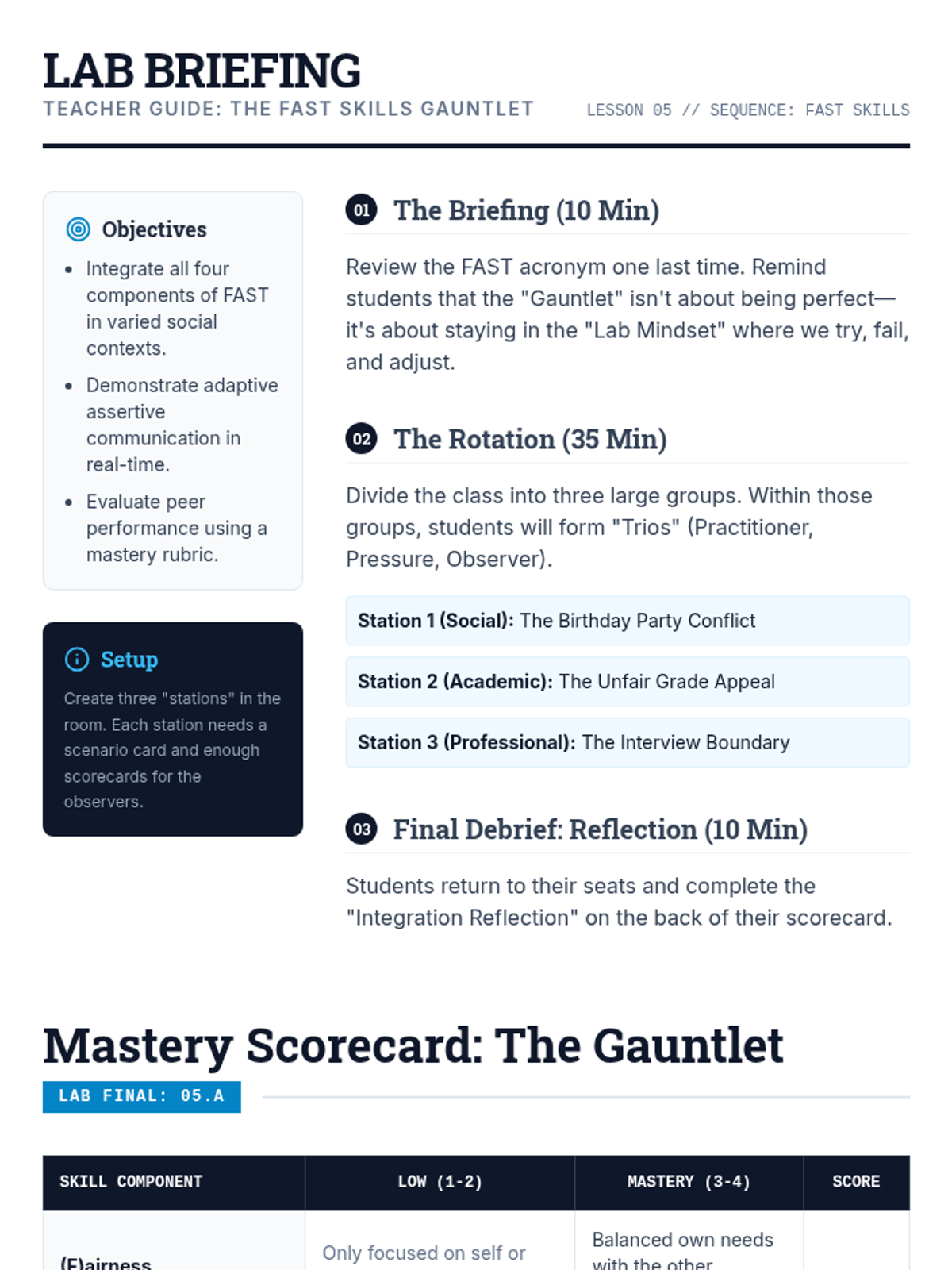
Final mastery-based assessment materials for Lesson 5, including teacher facilitation guide, station scenarios, and a performance rubric.
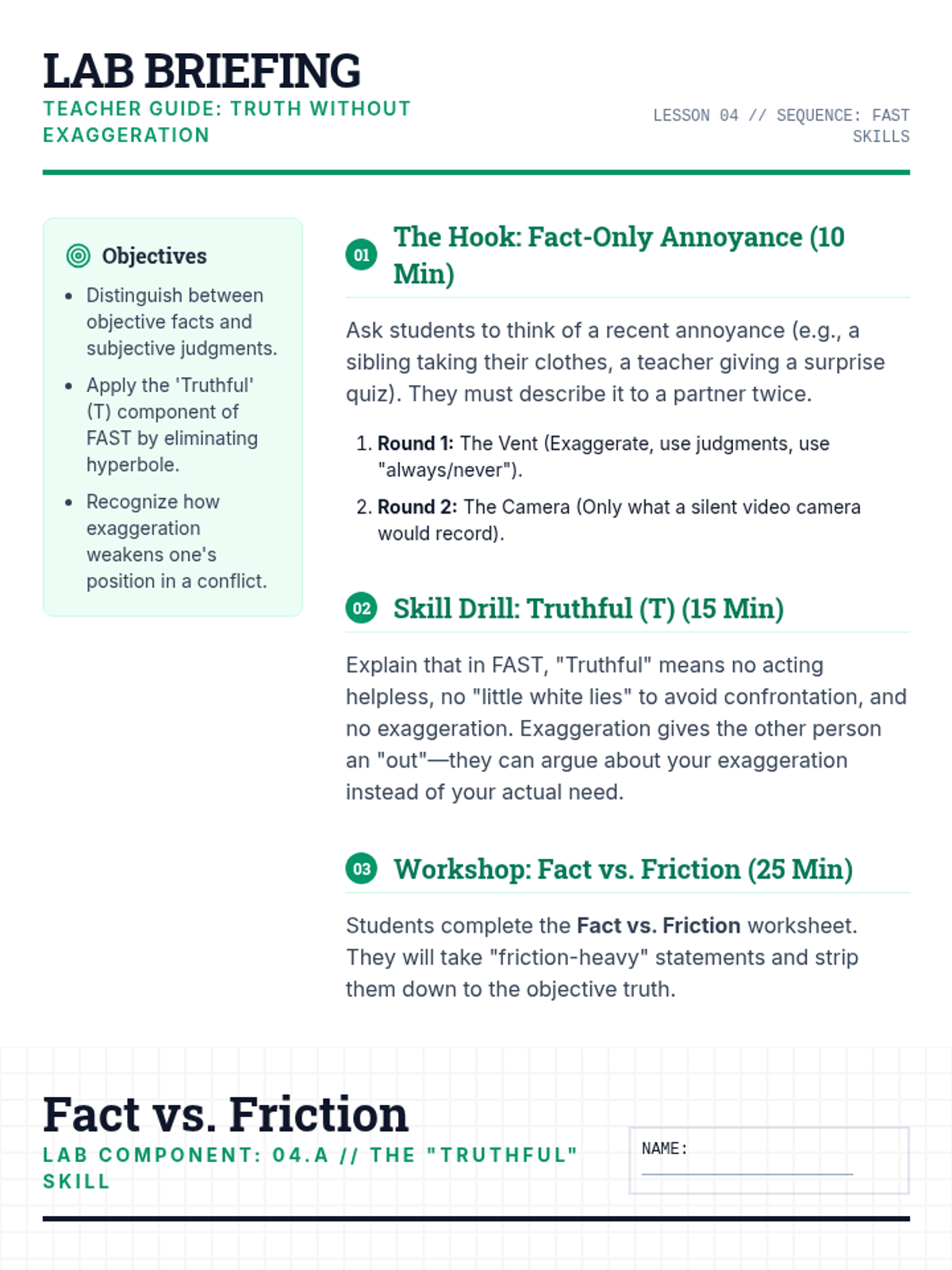
Teacher guide and student worksheet for Lesson 4, focusing on "Truthfulness" and the elimination of hyperbole in communication.
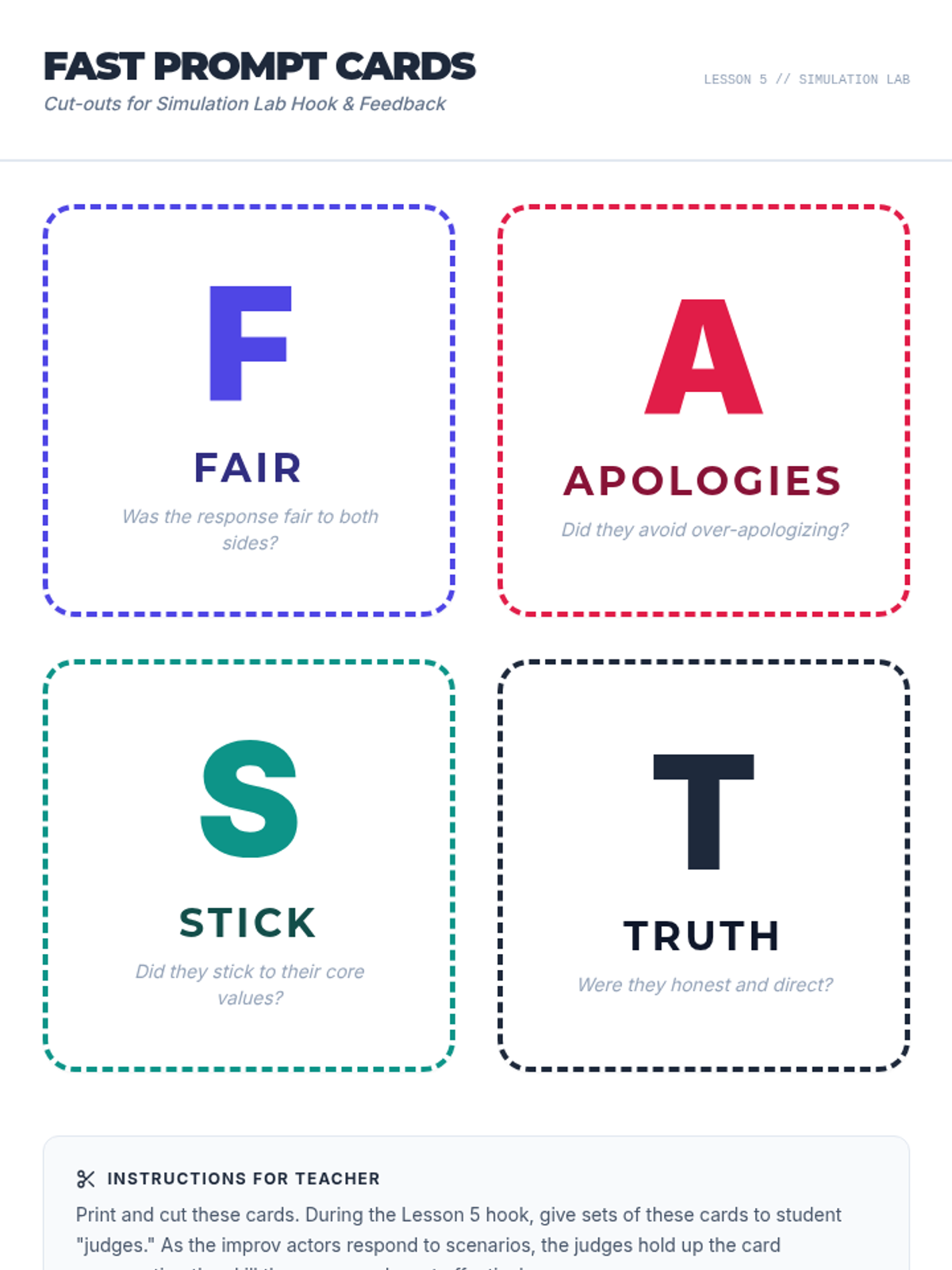
Printable prompt cards (F-A-S-T) for the simulation lab, used for real-time feedback and the improv hook activity.
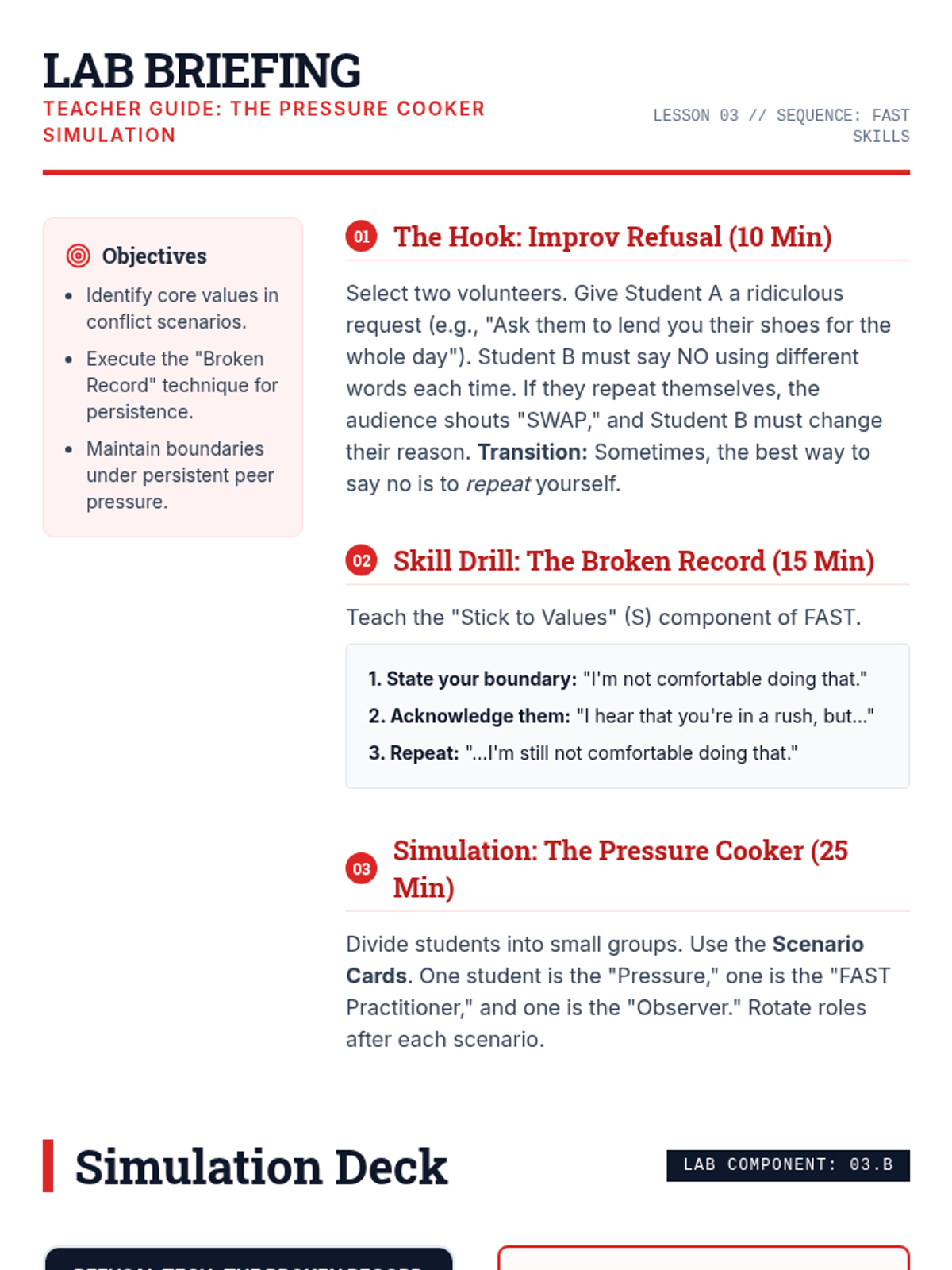
Teacher guide and role-play simulation materials for Lesson 3, focusing on "Sticking to Values" and the "Broken Record" technique.
Presentation slides for Lesson 4 focusing on 'S' (Stick to values) and 'T' (Truthful) components of FAST.
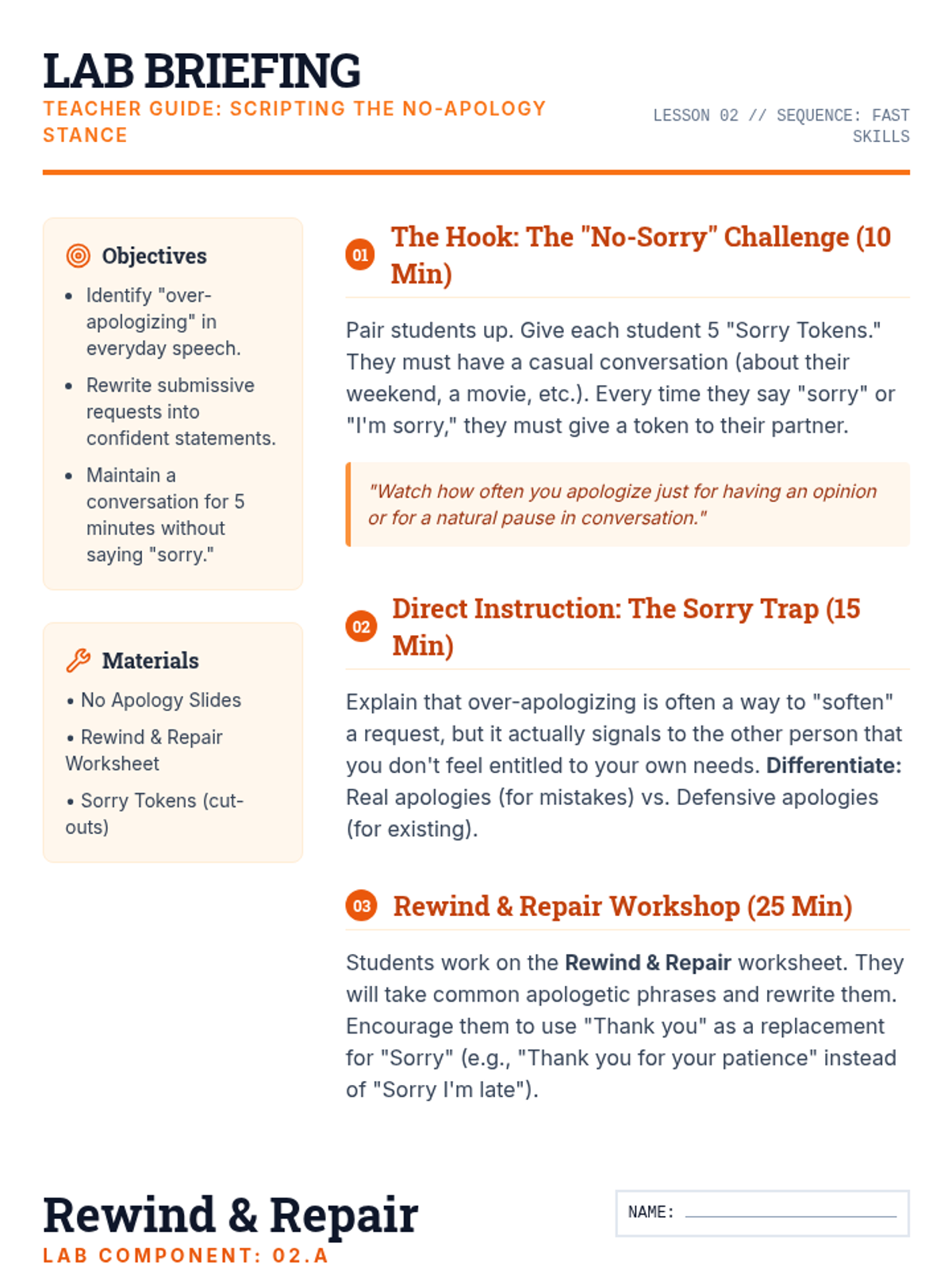
Teacher guide and student scripting workshop for Lesson 2, focusing on eliminating defensive over-apologizing and converting it into confident communication.
Presentation slides for Lesson 3 focusing on the 'A' in FAST, reducing unwarranted apologies and replacing them with assertive communication.
Presentation slides for Lesson 2 focusing on the 'F' in FAST, exploring the concept of fairness to both self and others.
Introductory presentation for Lesson 1, introducing the FAST acronym and featuring the rapid-fire gut-check quiz.
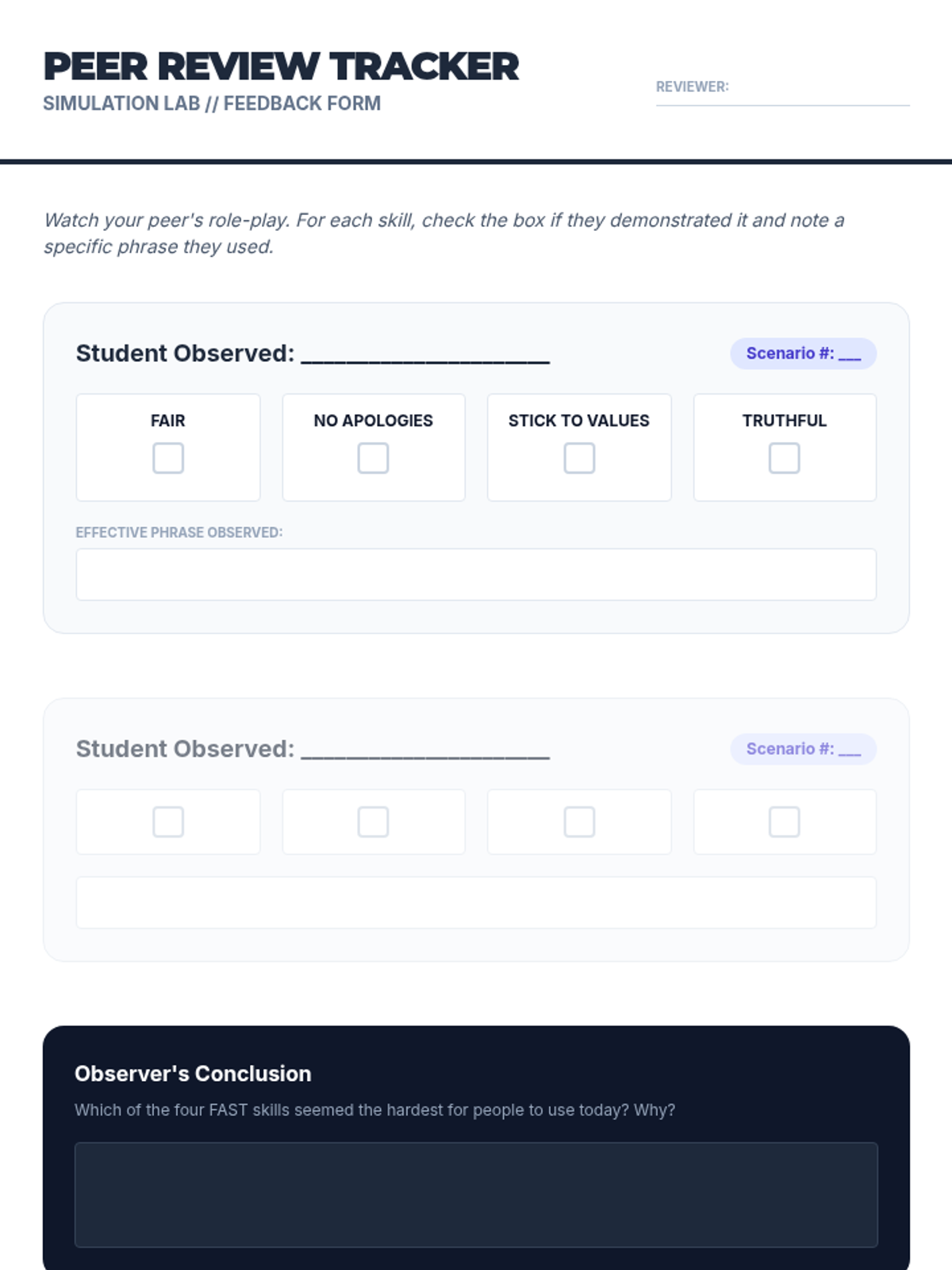
A peer-evaluation tracker for students to use during the final simulation lab, monitoring their peers' use of FAST skills.
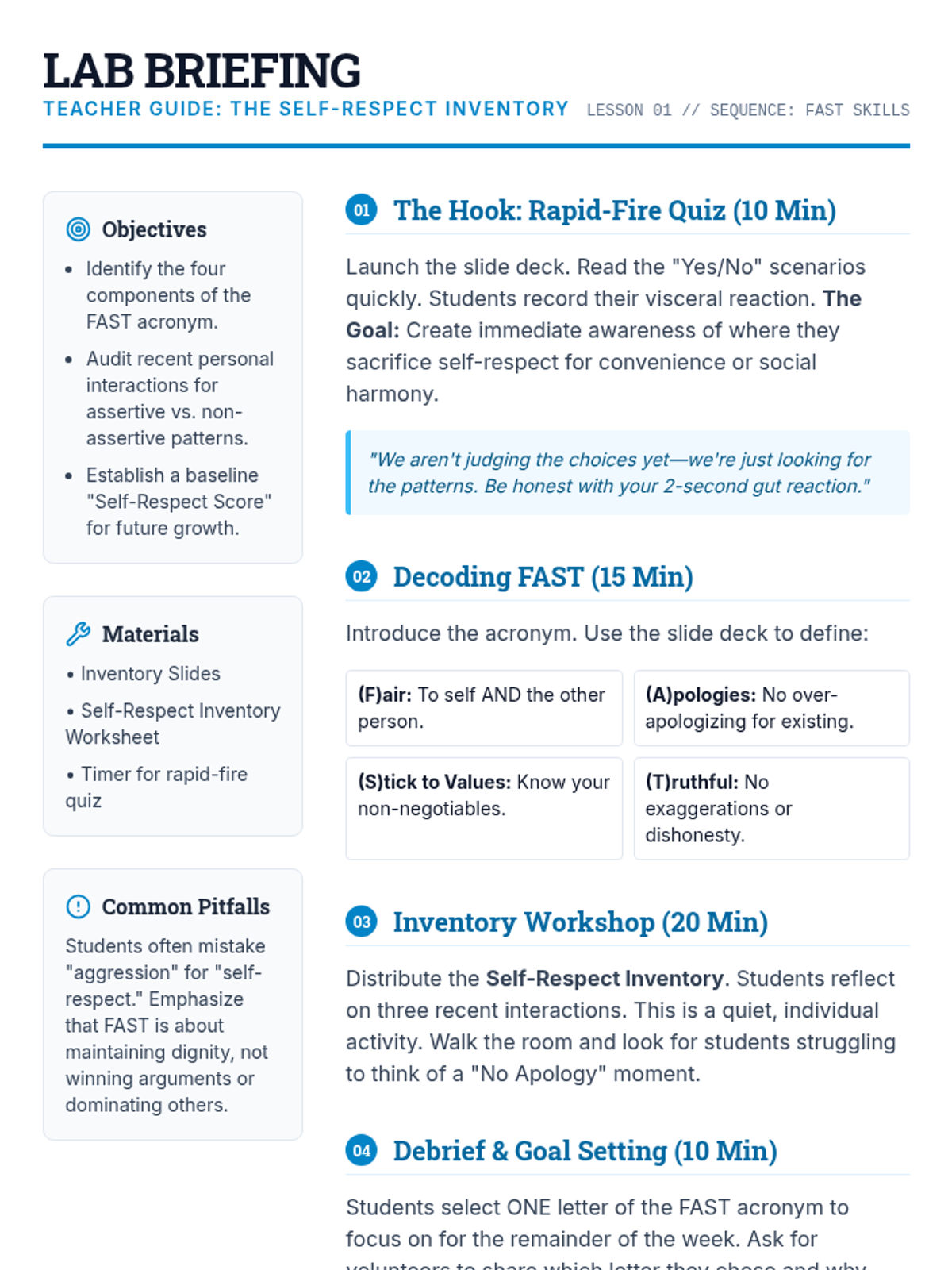
Teacher briefing and student self-audit worksheet for Lesson 1, focusing on baseline interpersonal patterns and FAST skill identification.
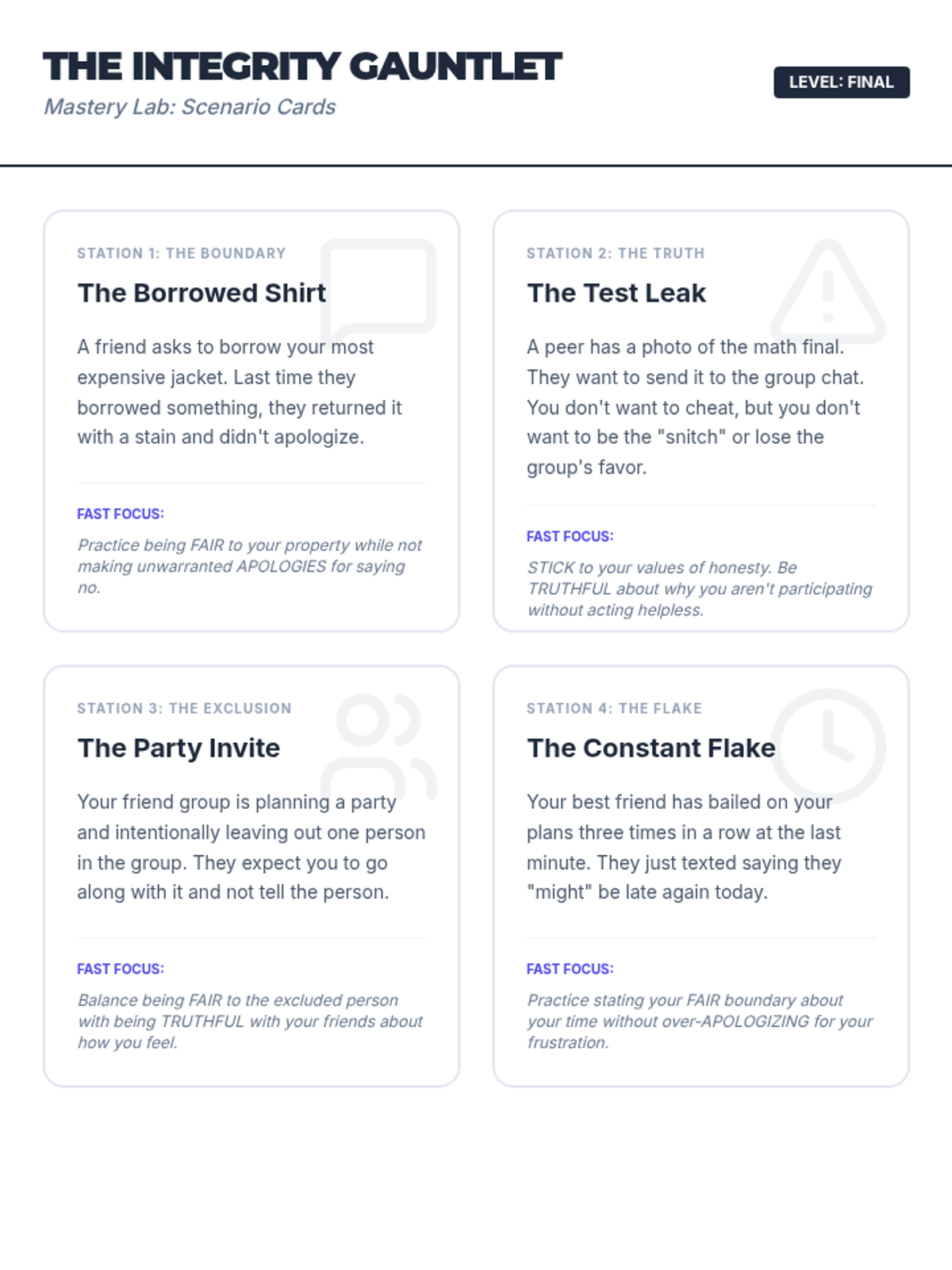
Scenario cards for the final simulation lab, depicting common 9th-grade social dilemmas requiring FAST skills.
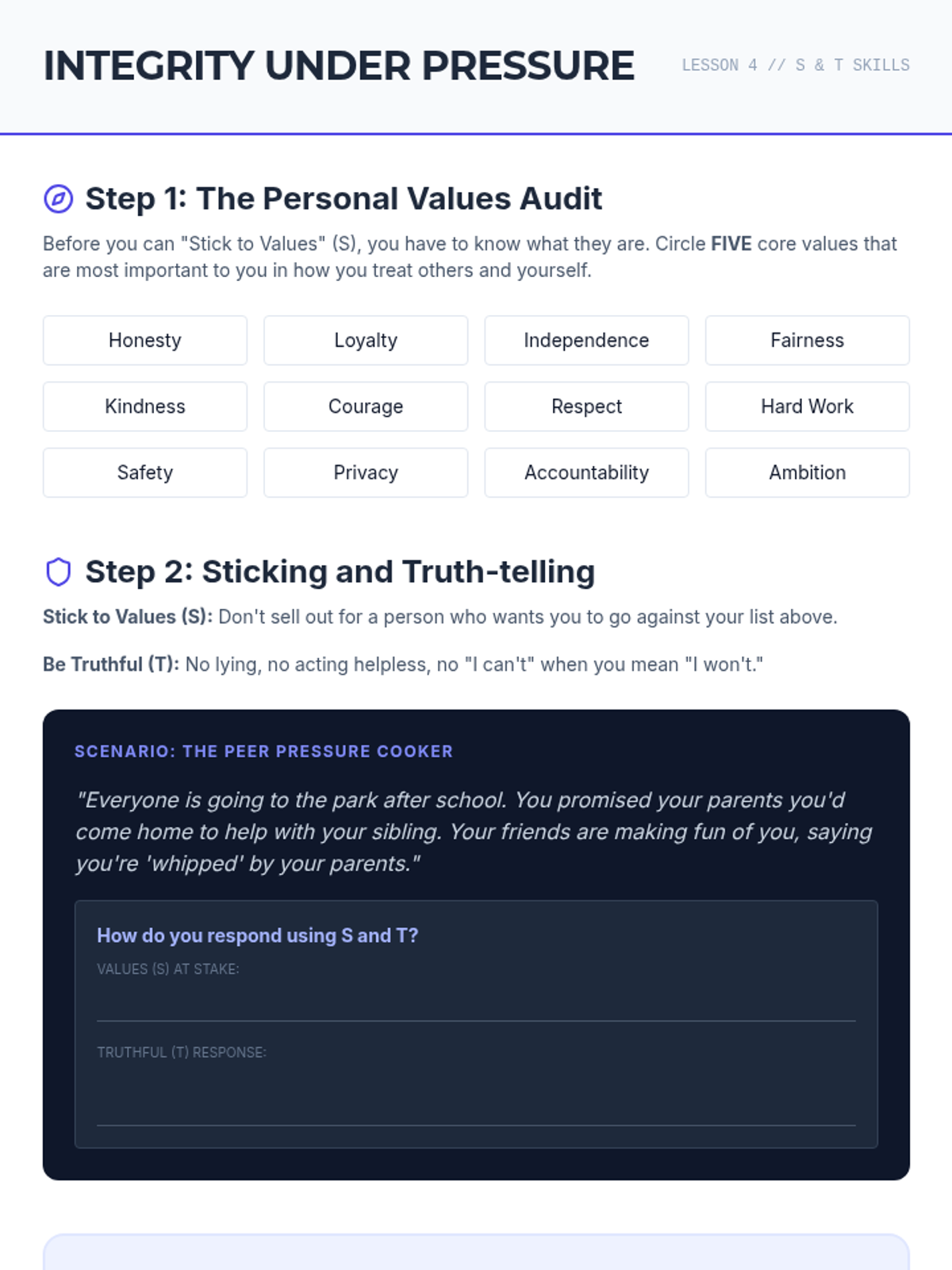
A worksheet for Lesson 4 combining personal values identification with truthful communication practice.
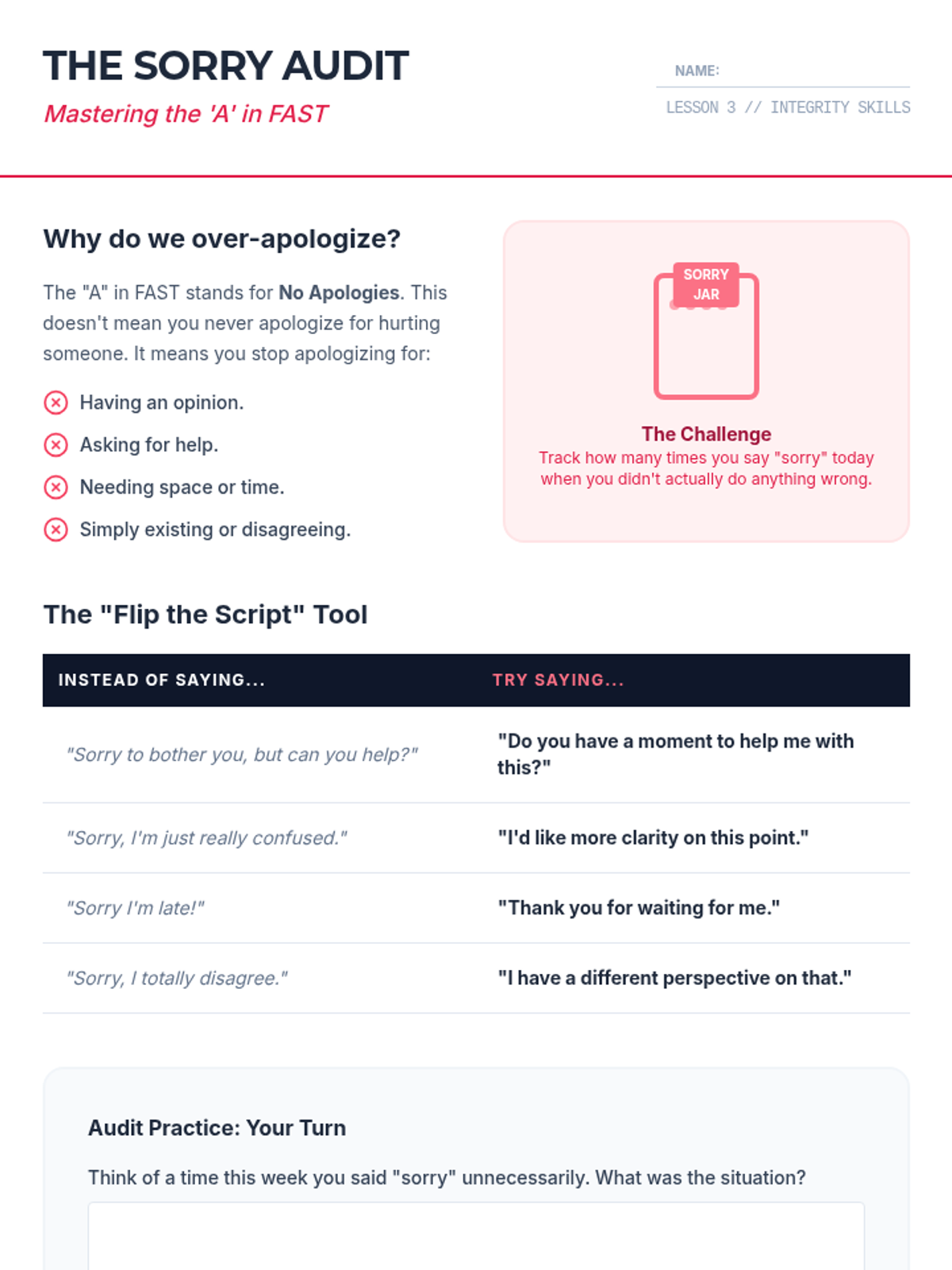
A worksheet for Lesson 3 focusing on the 'A' (No Apologies) in FAST, featuring a "Flip the Script" tool to replace unwarranted apologies with assertive communication.
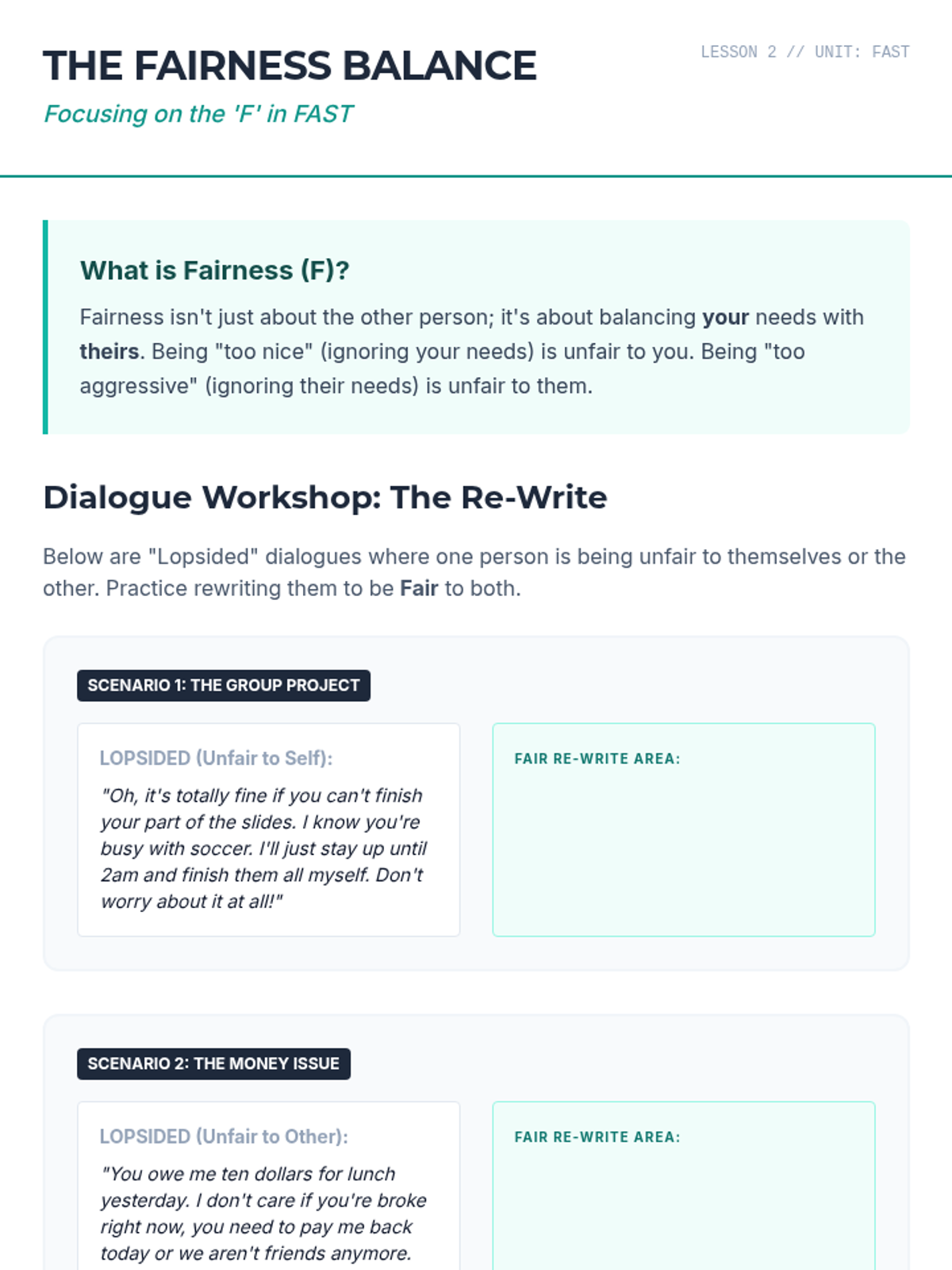
A worksheet focusing on the 'F' in FAST, providing scenarios for students to practice rewriting lopsided communication into fair dialogue.
Introductory presentation slides for the FAST skills sequence, defining social goals and introducing the FAST acronym.
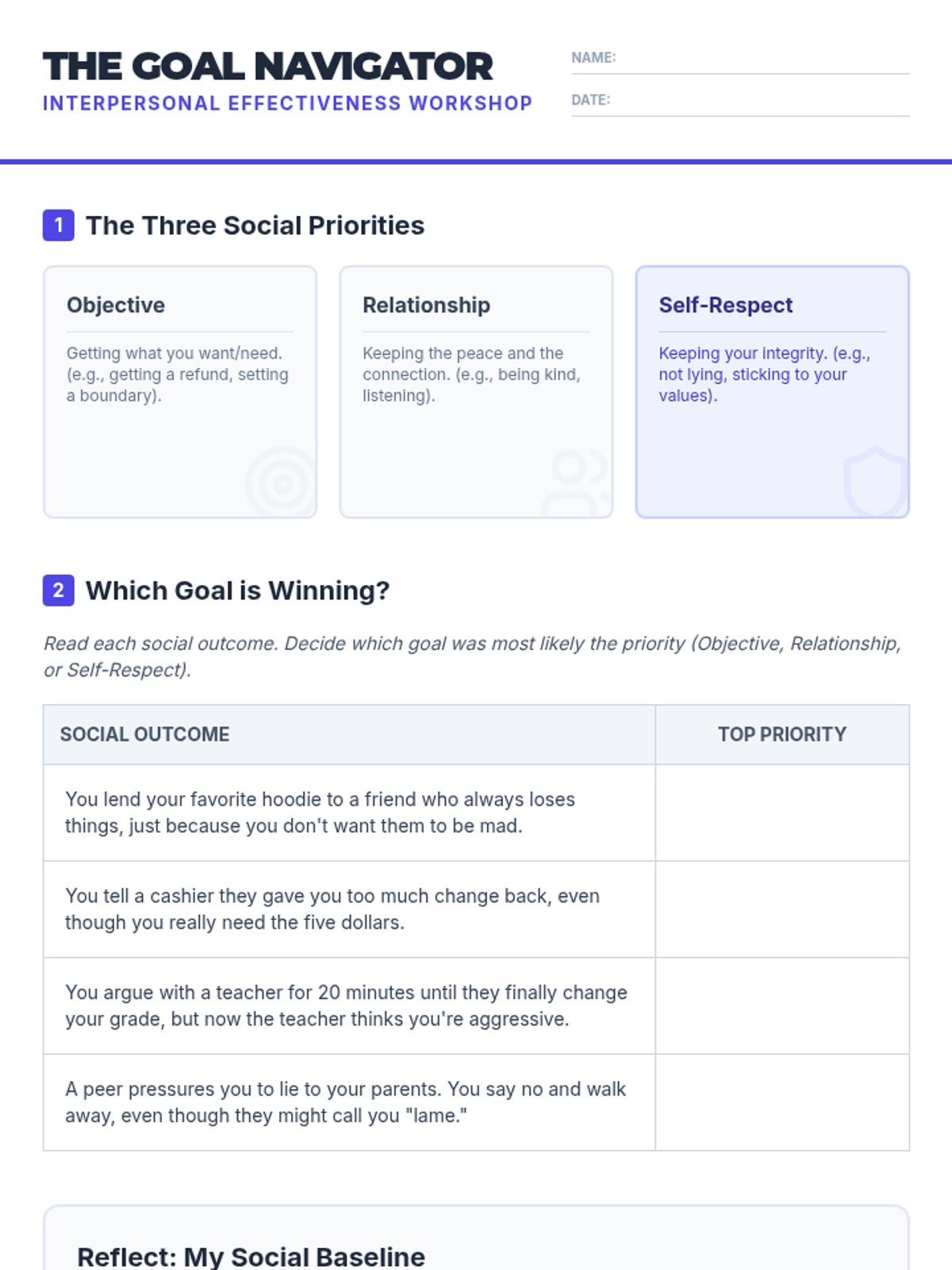
A worksheet for students to categorize social outcomes based on interpersonal goals (Objective, Relationship, Self-Respect).
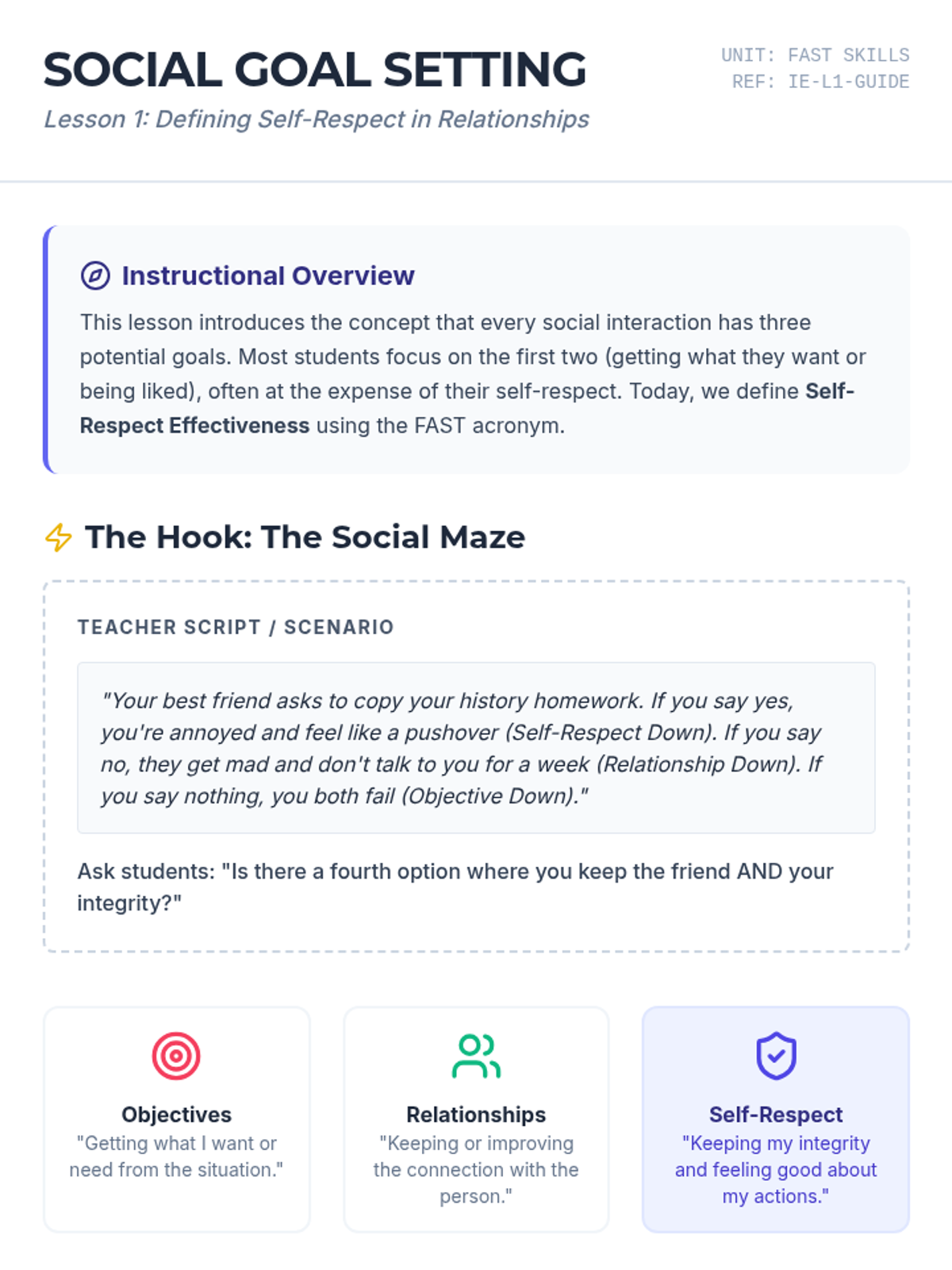
A teacher guide for the first lesson, introducing the three goals of social interactions and the FAST acronym for self-respect.
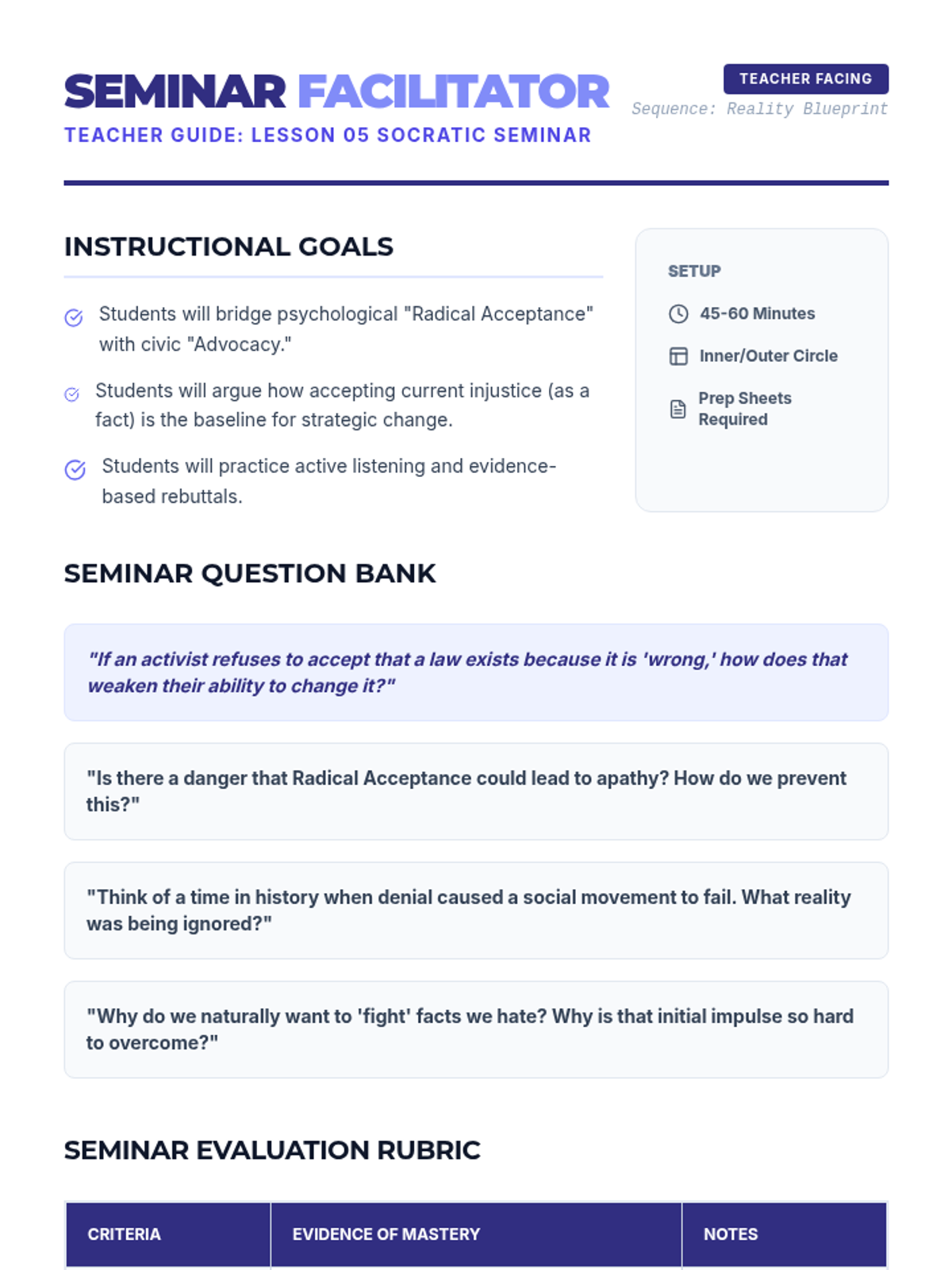
Teacher facilitator guide for the Lesson 5 Socratic Seminar. Includes instructional goals, seminar question bank, and a comprehensive rubric for evaluating student synthesis and discourse skills.
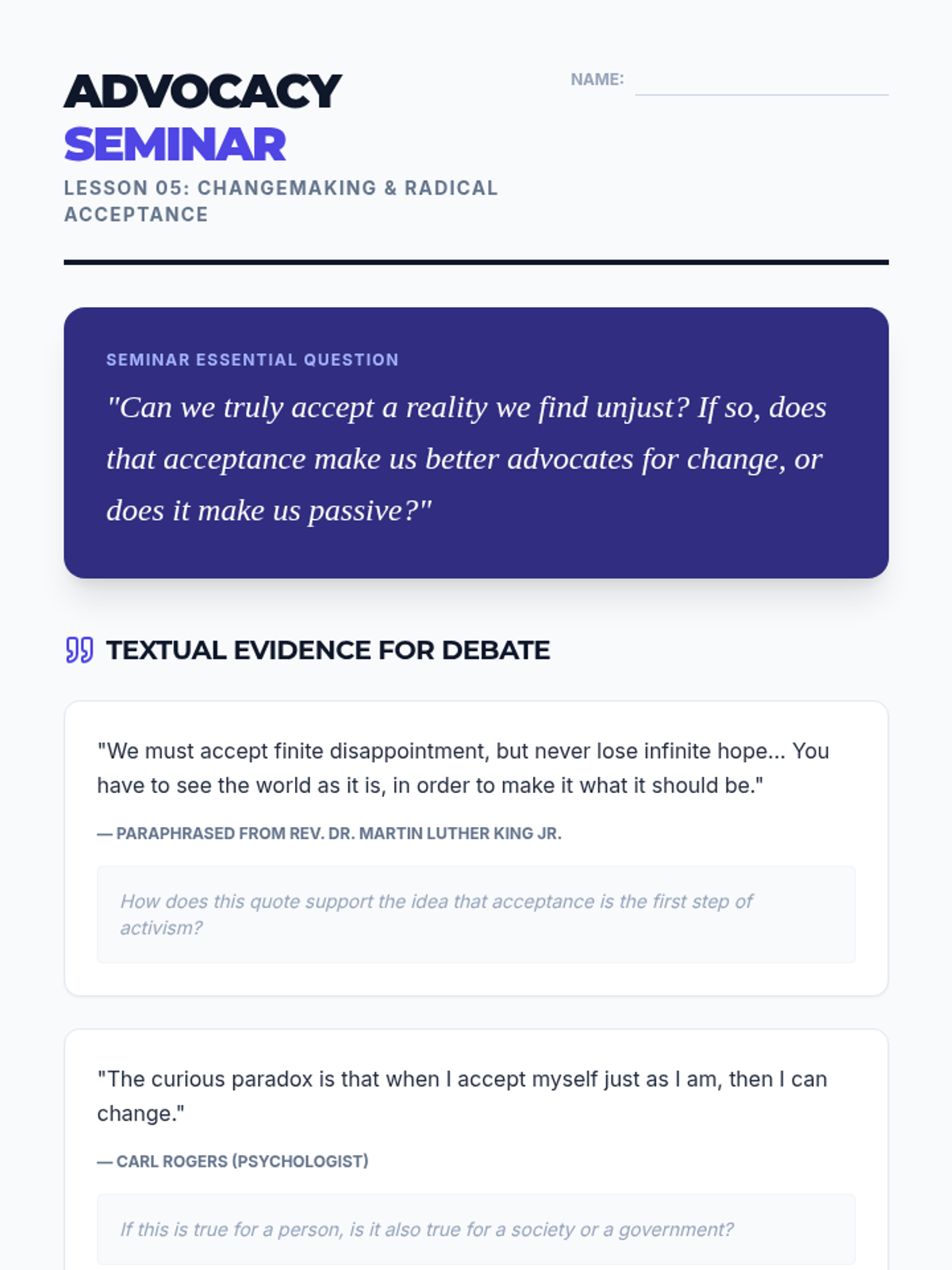
Preparation sheet for the Lesson 5 Socratic Seminar. Includes quotes from leaders and psychologists for analysis, plus a planning section where students apply radical acceptance to a real-world social issue.