Empathetic skill development through emotion recognition, cultural diversity appreciation, and bias confrontation. Targets multi-perspective analysis to support respectful interactions and complex social responses.
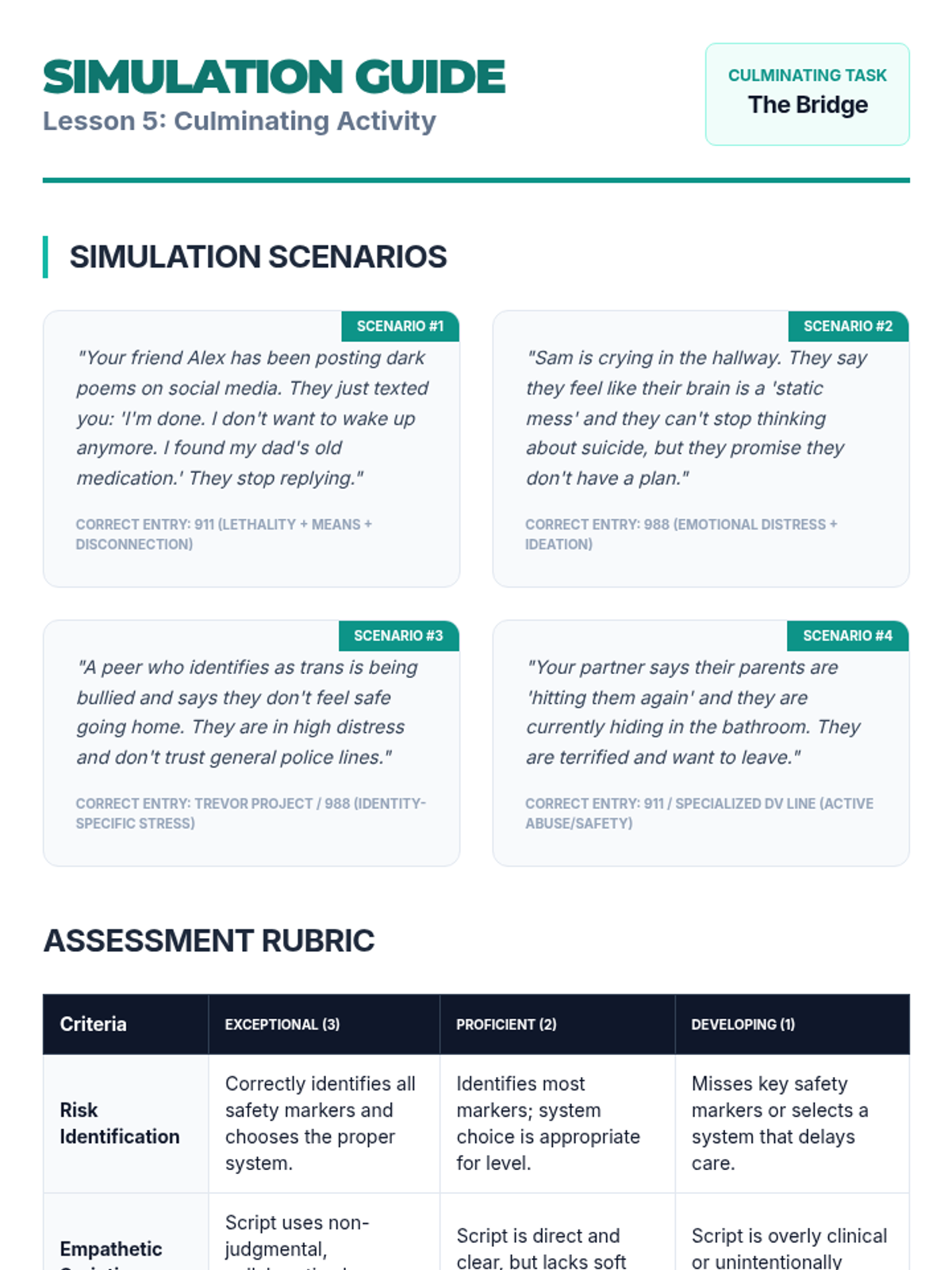
A teacher resource for Lesson 5 including simulation scenarios and an assessment rubric for the "Bridge Builder" activity.
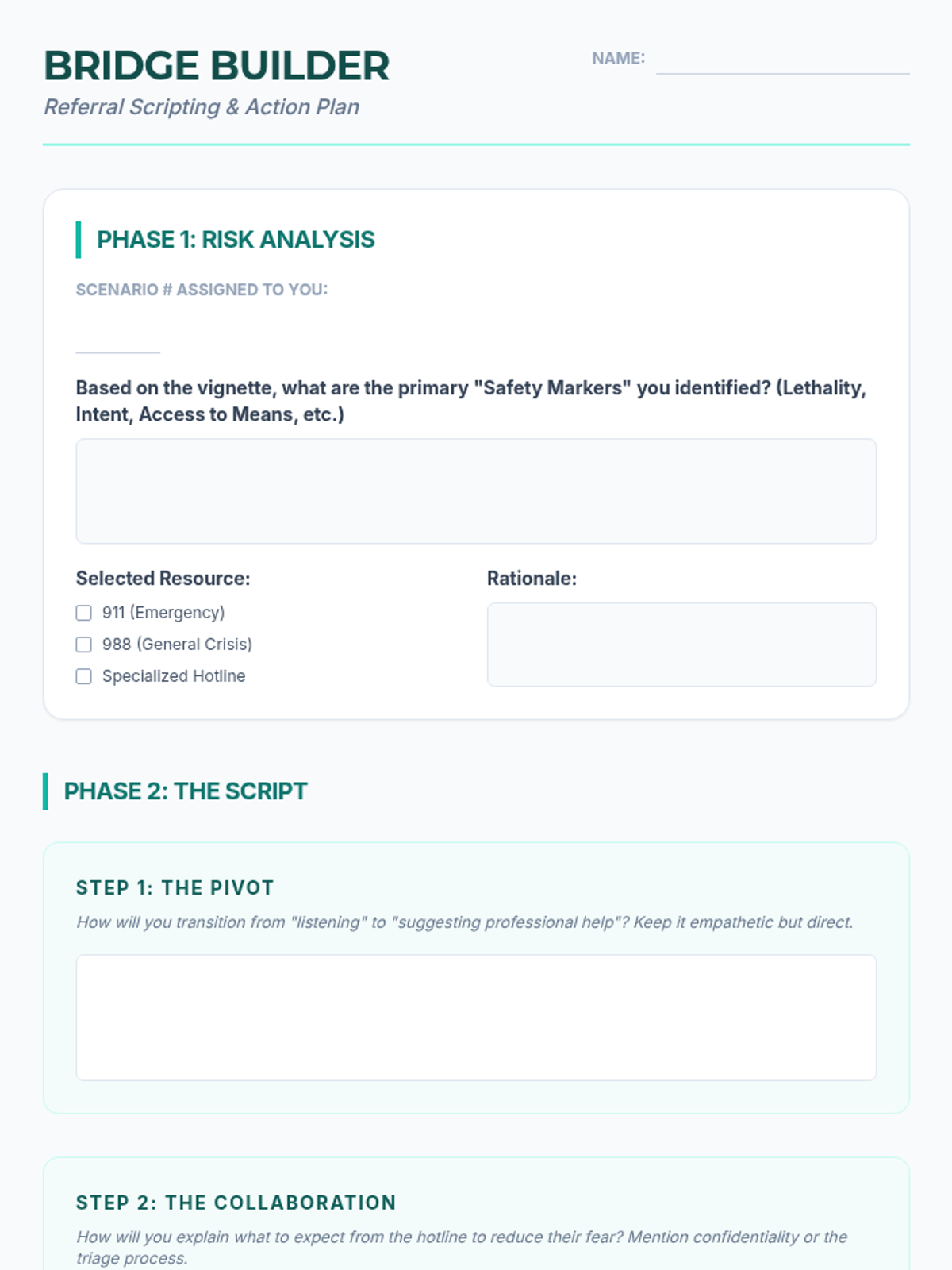
A student worksheet for Lesson 5 to analyze peer crisis scenarios and script a professional referral.
A visual presentation for Lesson 5 explaining the role of a "Bridge" person and the 3-step referral process.
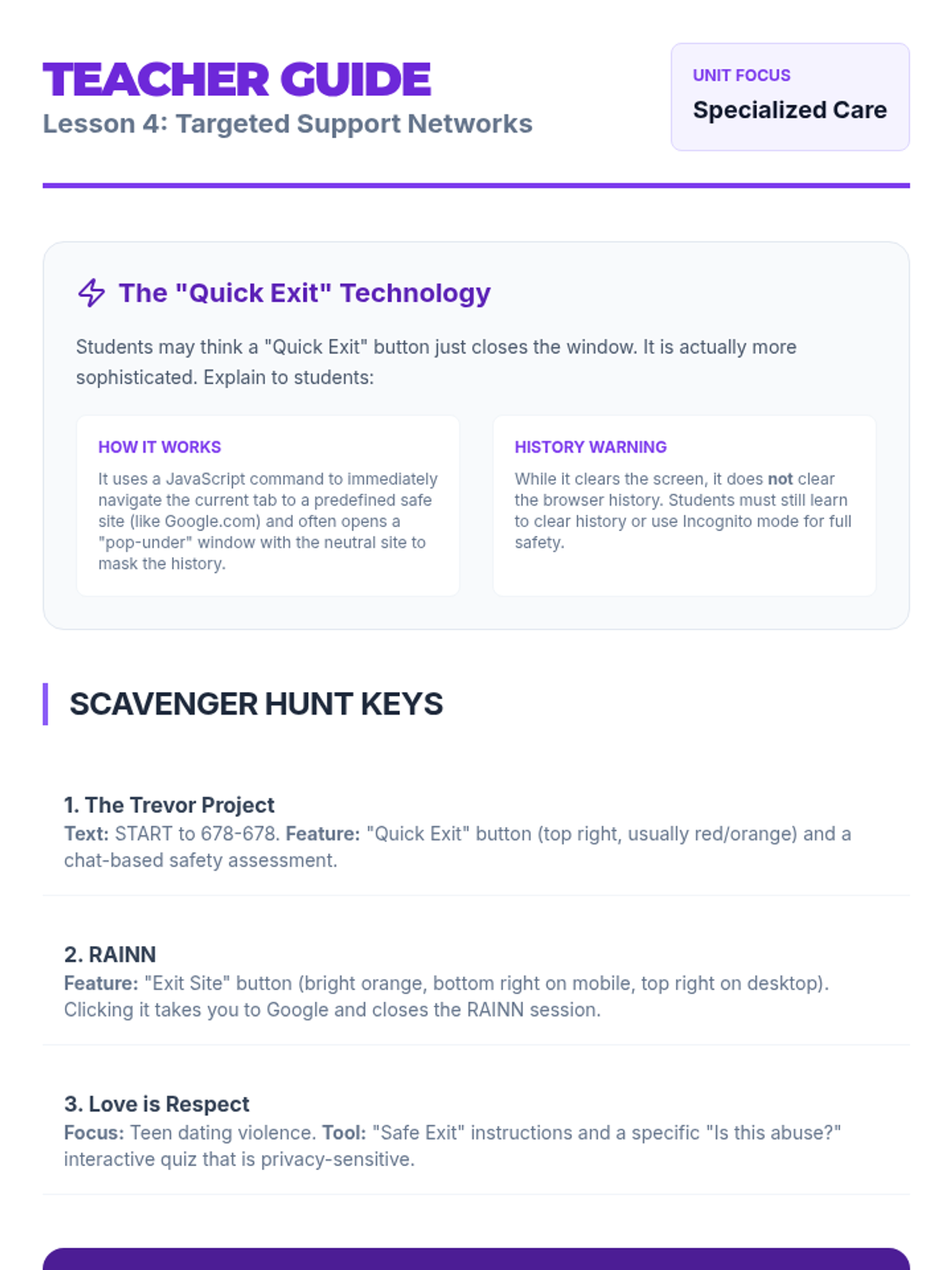
A teacher guide for Lesson 4 covering the technical aspects of digital safety features and keys for the scavenger hunt.
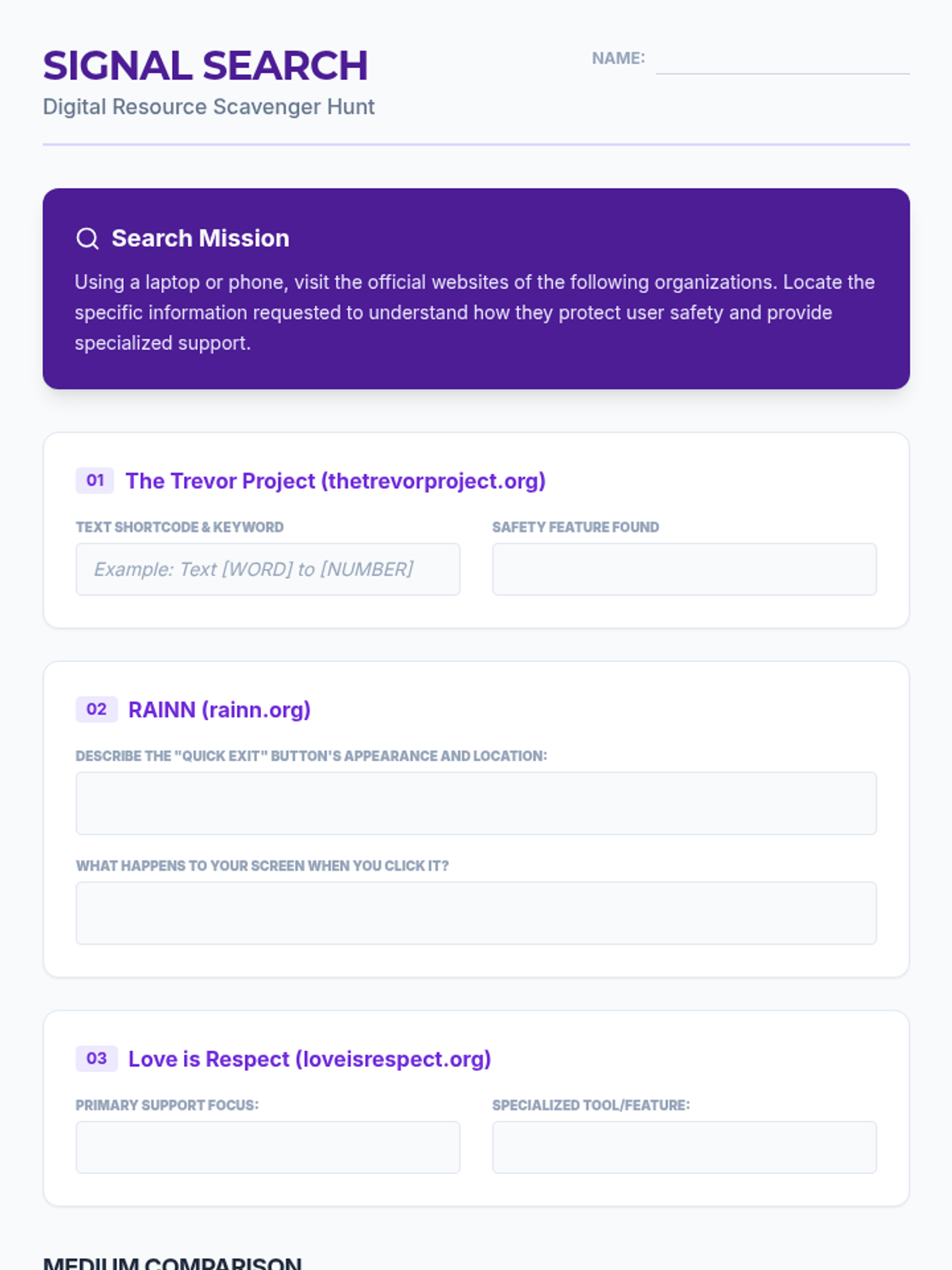
A student scavenger hunt worksheet for Lesson 4 to investigate specialized crisis resources and digital safety features.
A visual presentation for Lesson 4 explaining specialized hotlines, digital safety features, and the pros/cons of different communication mediums.
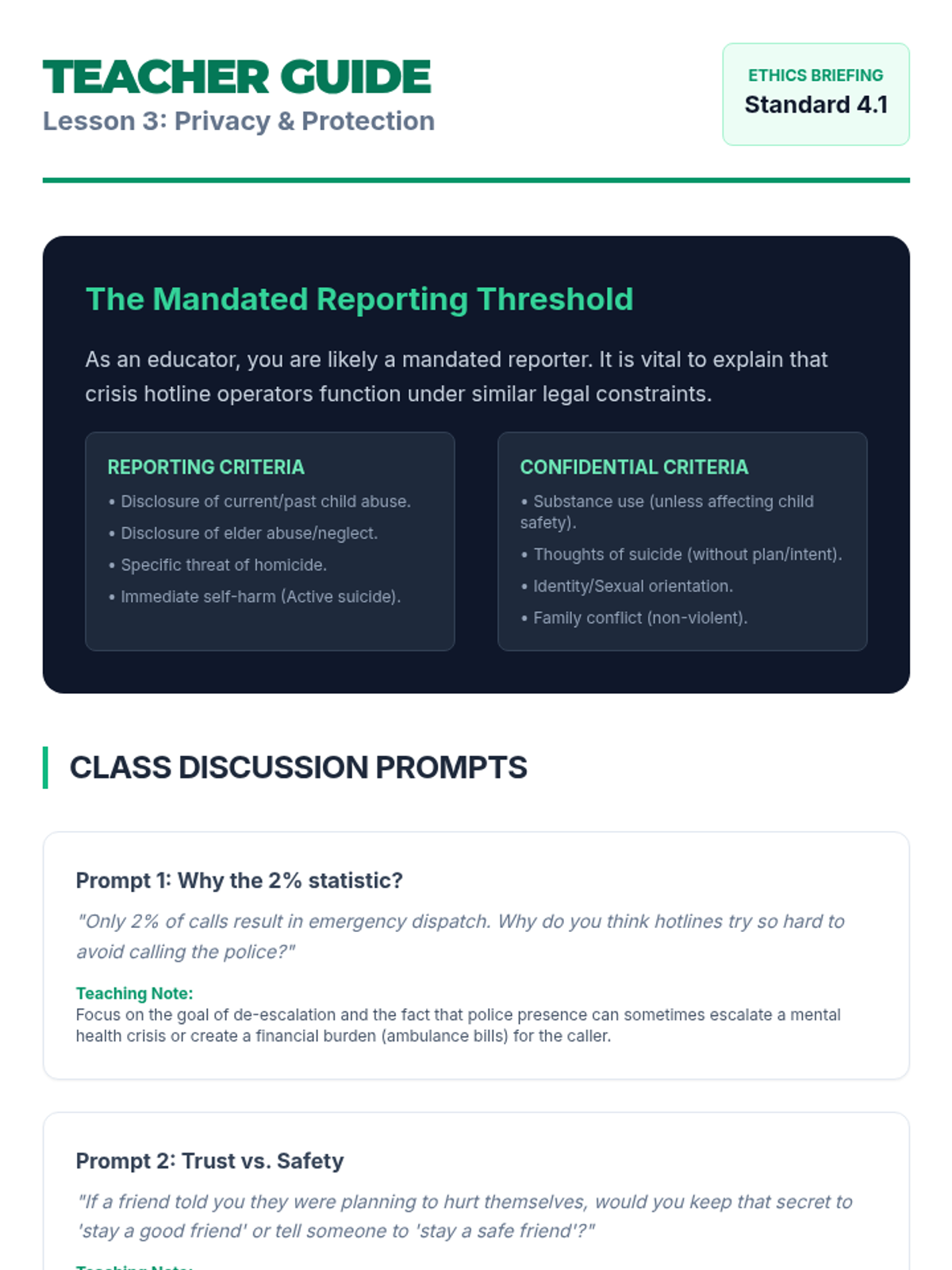
A teacher guide for Lesson 3 focusing on the ethics of mandated reporting, including discussion prompts and a worksheet answer key.
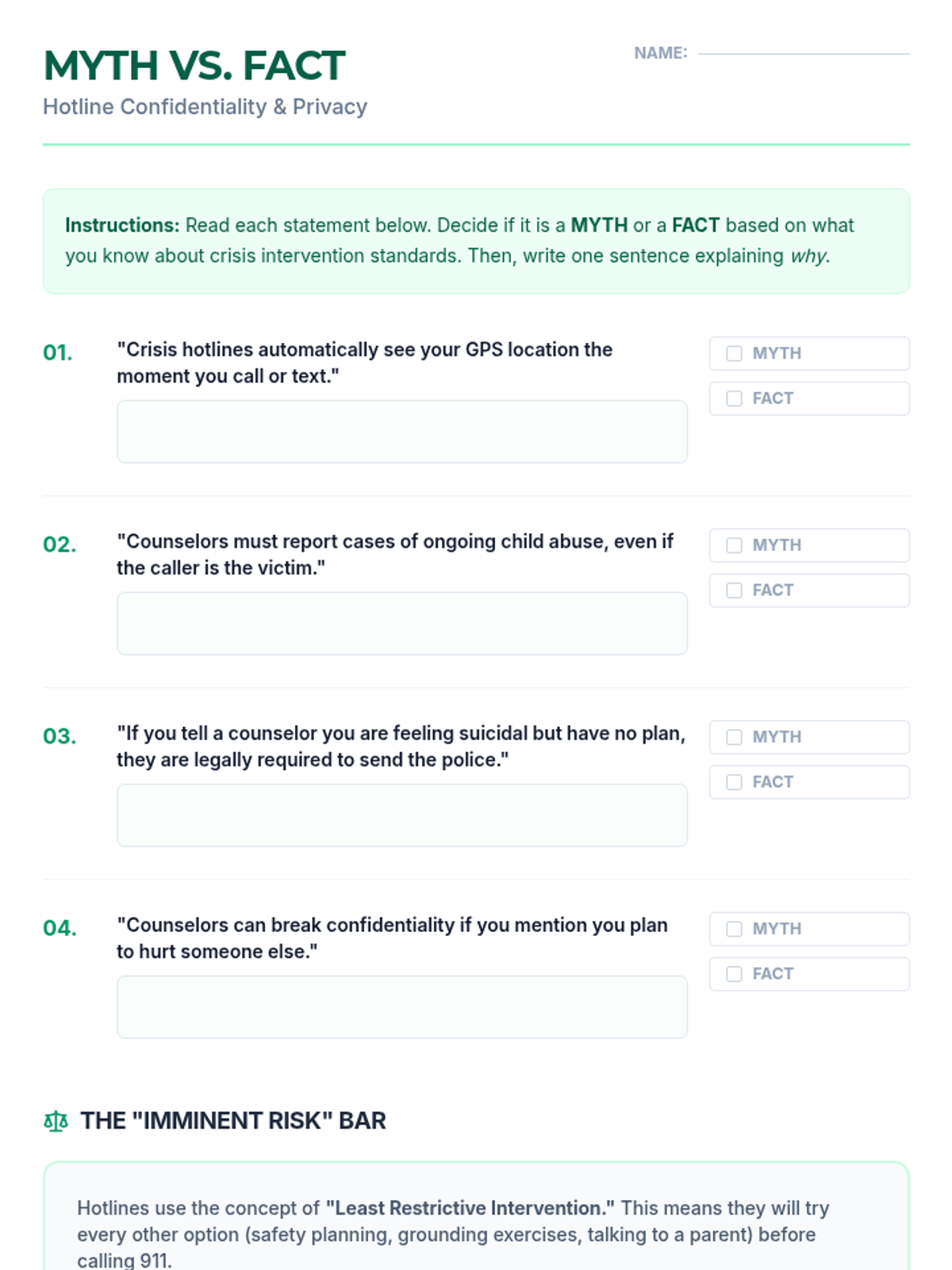
A student activity worksheet for Lesson 3 to identify common myths and facts about crisis hotline confidentiality and privacy standards.
A visual presentation for Lesson 3 explaining the legal and ethical frameworks of confidentiality and mandated reporting.
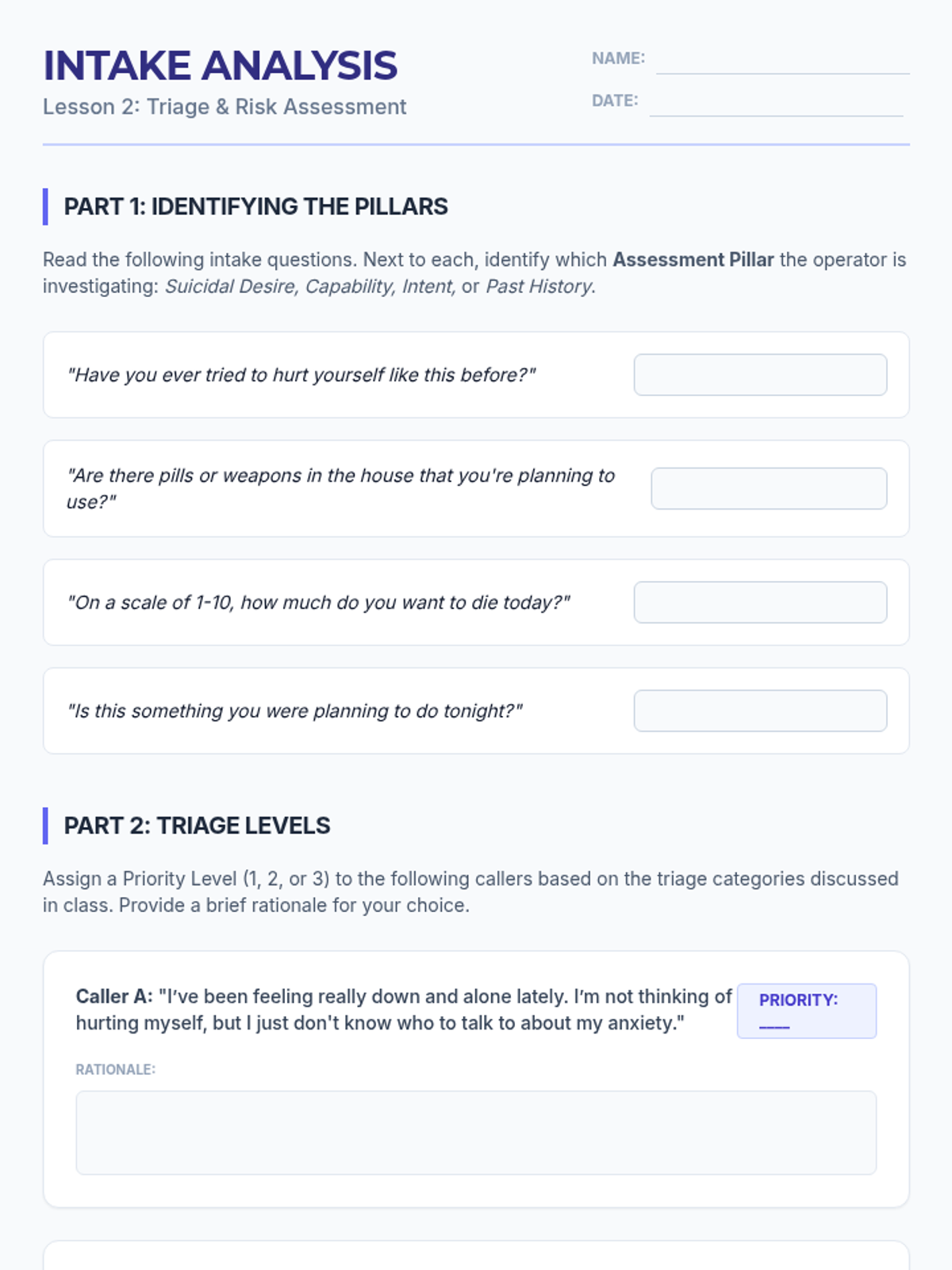
A student worksheet for Lesson 2 to analyze hotline intake questions and categorize callers based on triage priority levels.
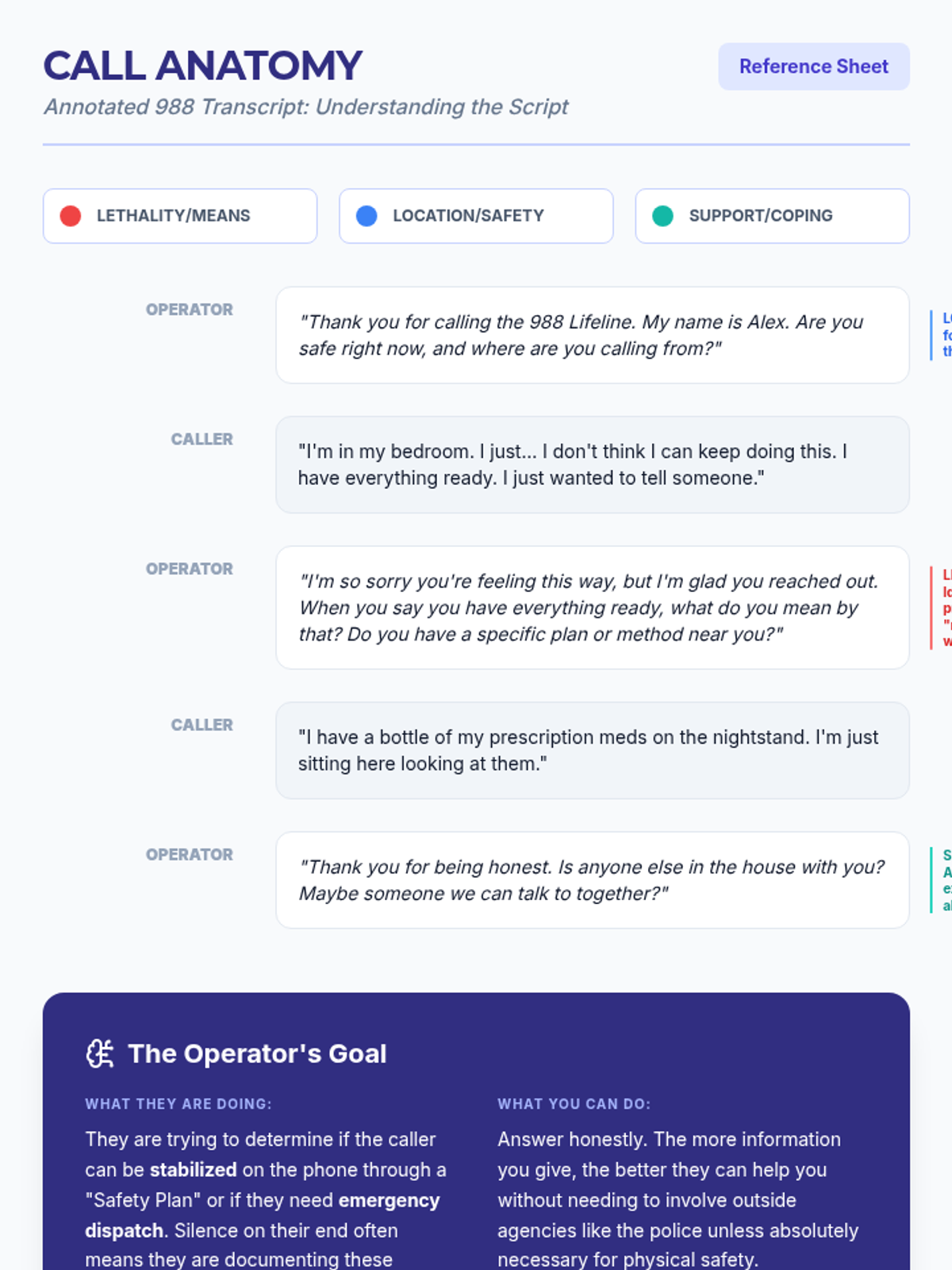
An annotated transcript of a crisis hotline call for Lesson 2, highlighting triage steps and risk assessment questions.
A visual presentation for Lesson 2 explaining triage steps, intake questions, and risk assessment categories used by crisis hotlines.
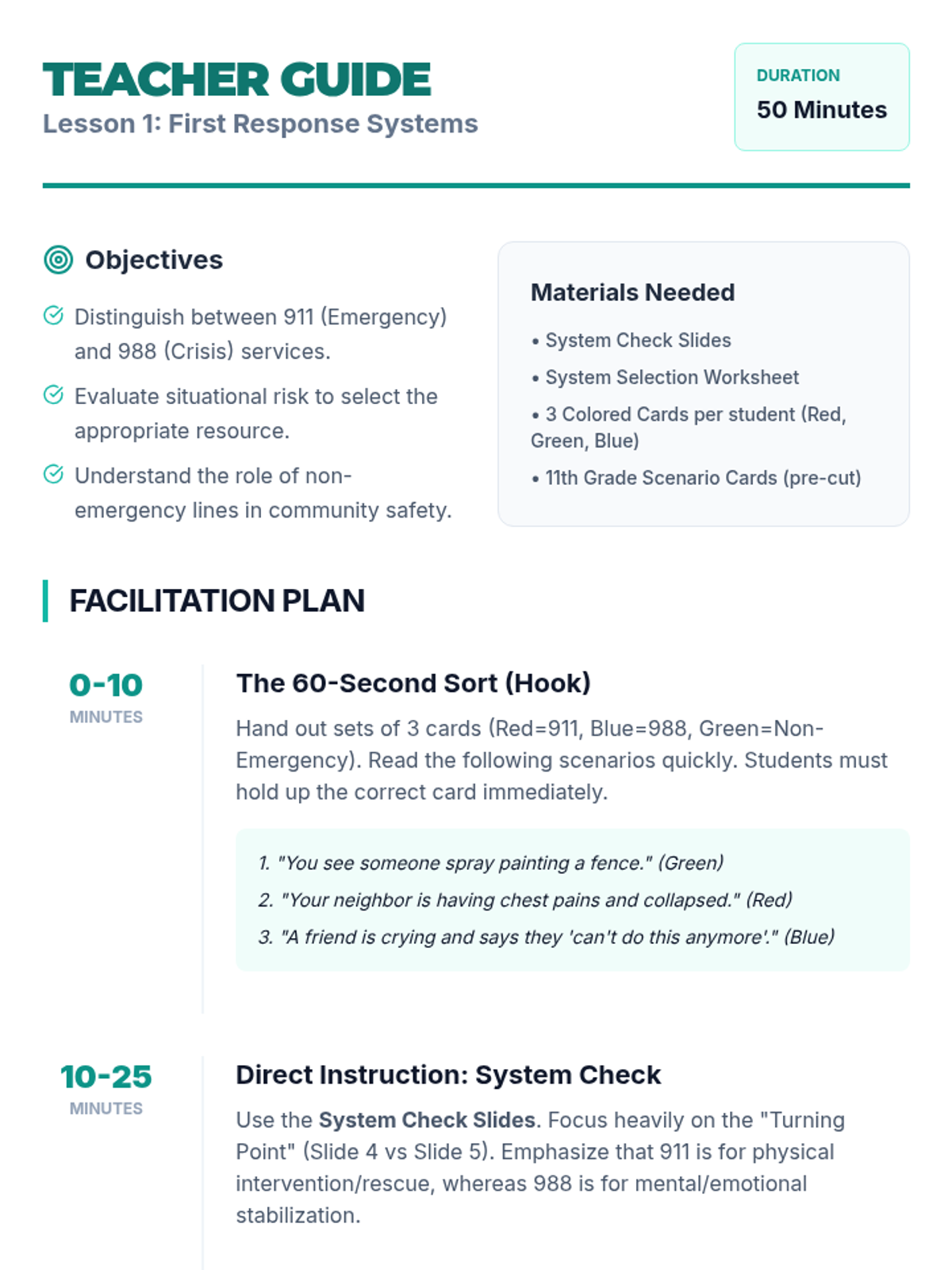
A teacher guide for Lesson 1 with hook instructions, facilitation tips, and a worksheet answer key.
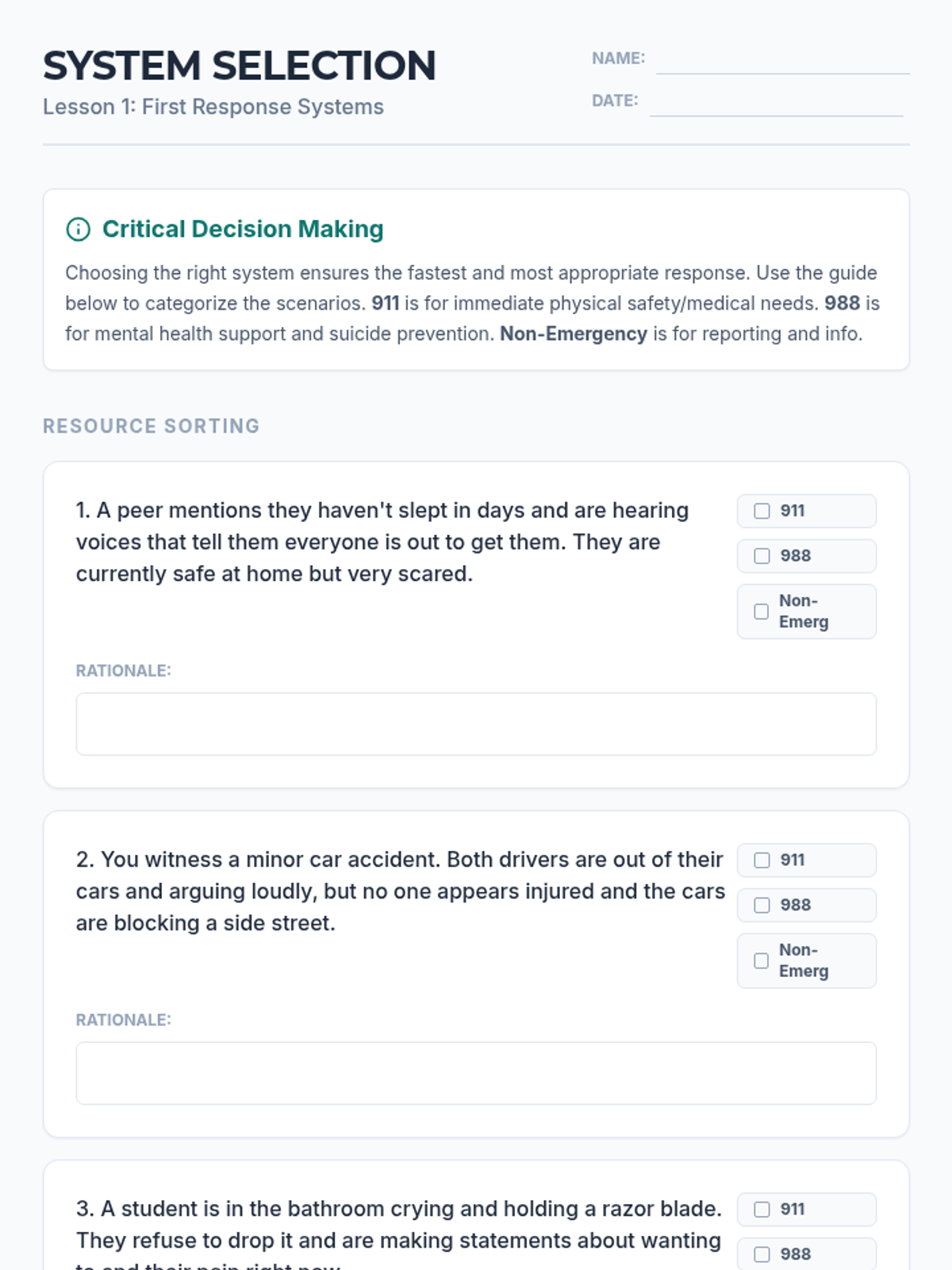
A student worksheet for Lesson 1 to categorize emergency scenarios into 911, 988, or non-emergency services.
A visual presentation for Lesson 1 comparing 911, 988, and non-emergency services with case study analysis.
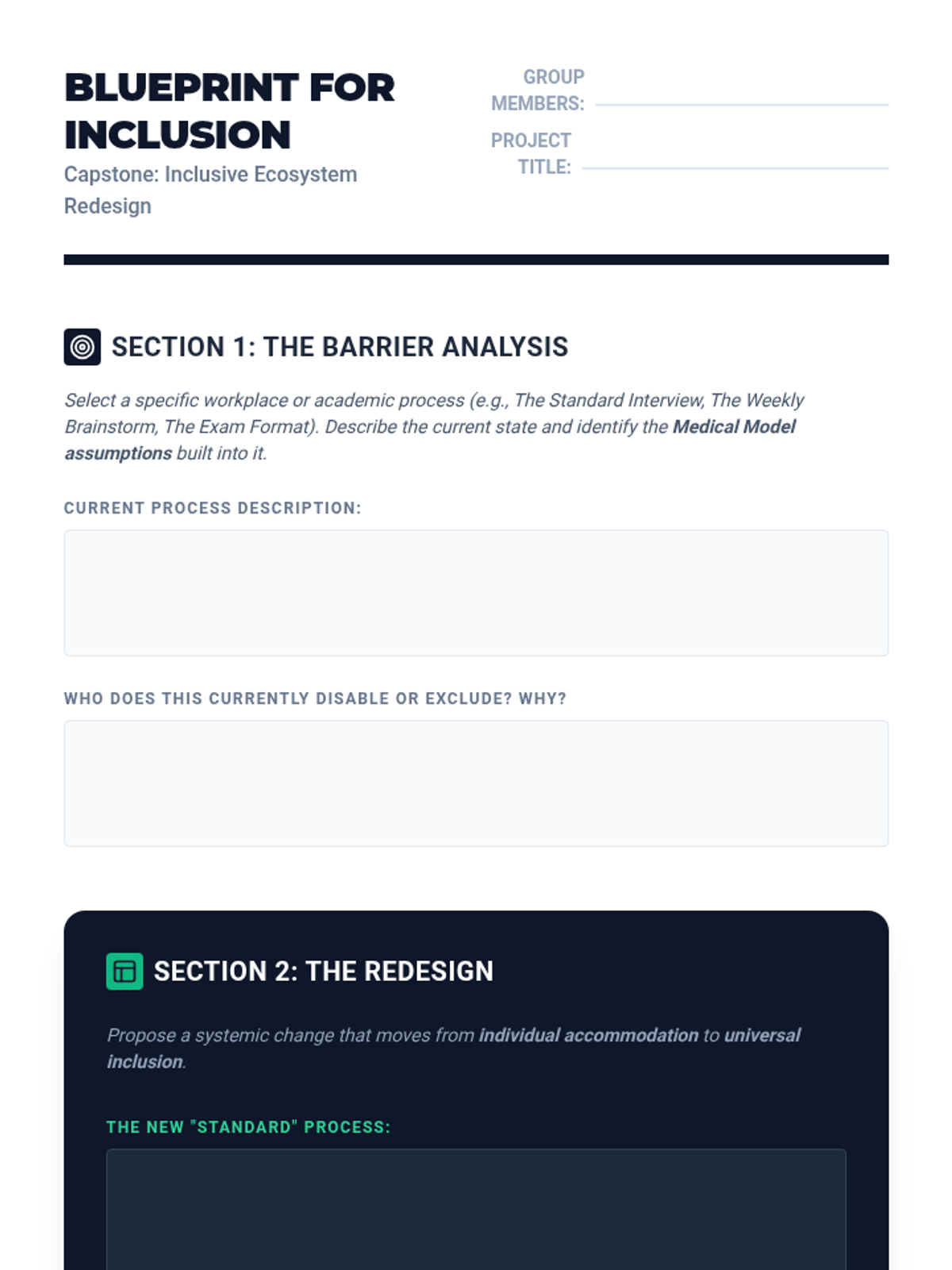
A final capstone proposal template for Lesson 5, allowing students to synthesize their learning into a formal redesign of an organizational process.
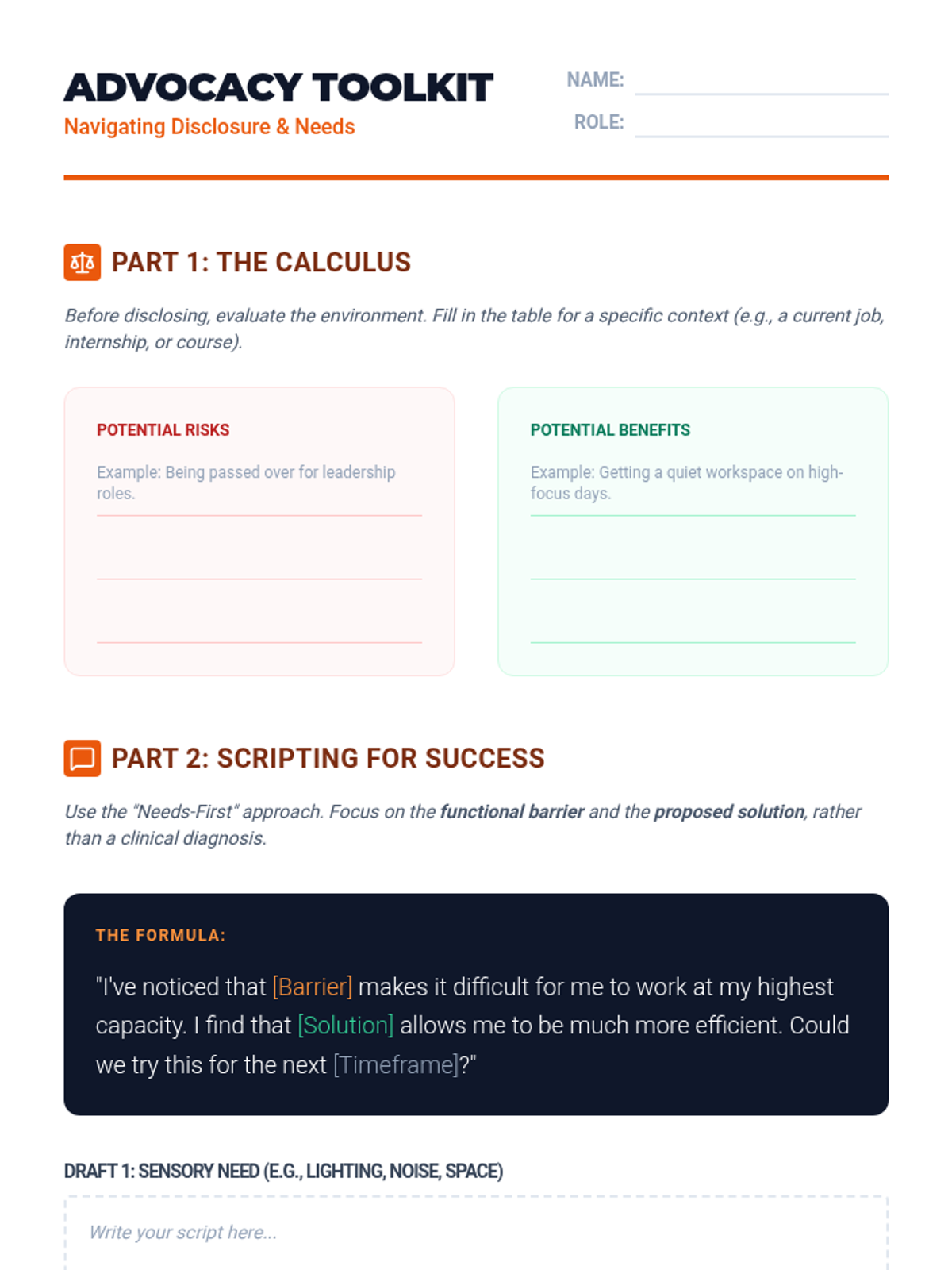
A student activity sheet for Lesson 4 focused on assessing the risks/benefits of disclosure and drafting advocacy scripts.
Slide deck for Lesson 5 introducing the capstone project, "Hostile Design" concepts, and the synthesis of neuro-inclusive design.
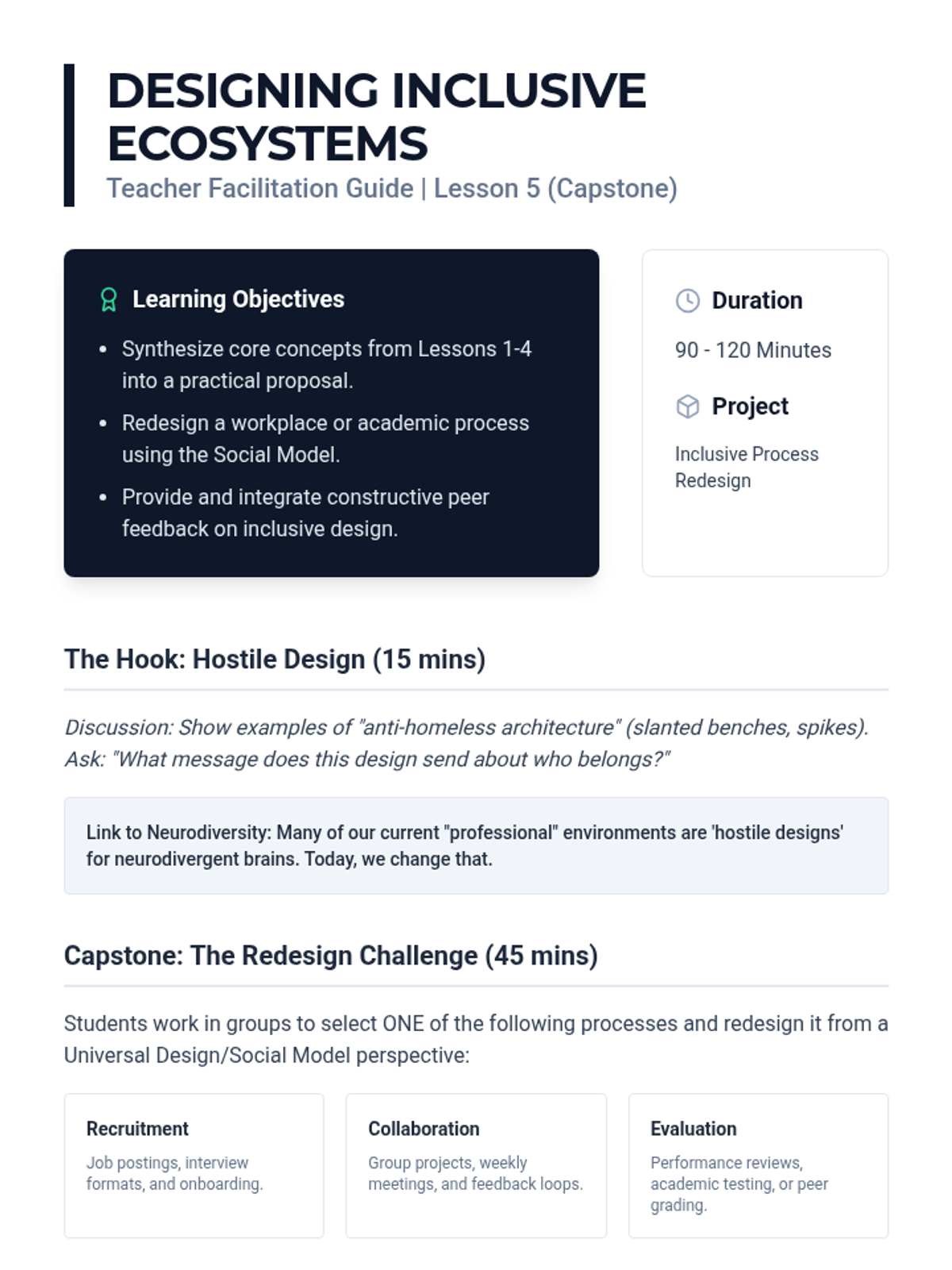
Teacher facilitation guide for Lesson 5, focusing on the capstone redesign project and synthesis of neurodiversity concepts.
Slide deck for Lesson 4 covering the risks/benefits of disclosure, legal rights under the ADA, and focus on functional advocacy.
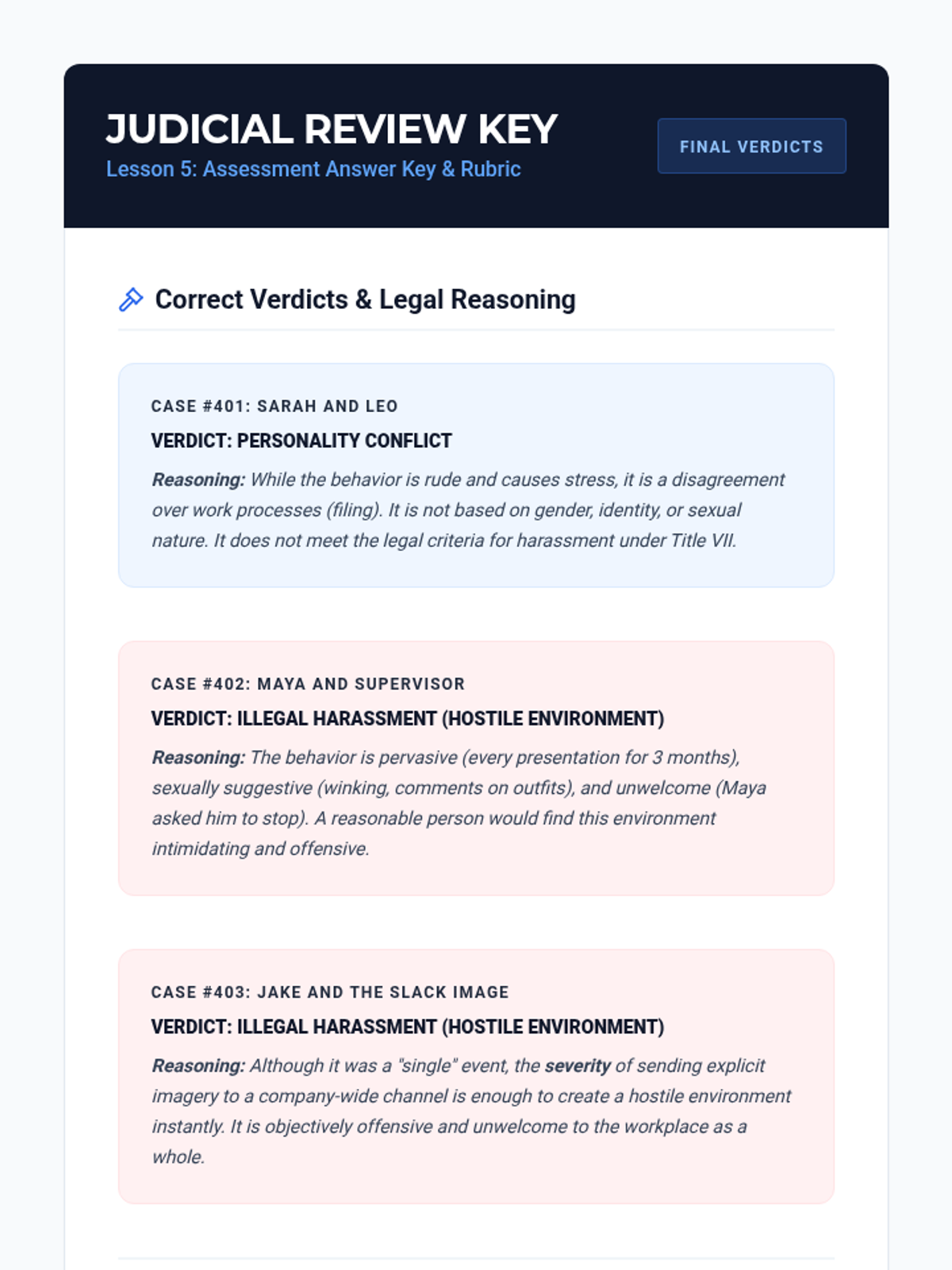
A teacher resource for Lesson 5: The Judicial Review. It includes the correct categorization of assessment scenarios, detailed legal justifications for each, and a grading rubric for student responses.
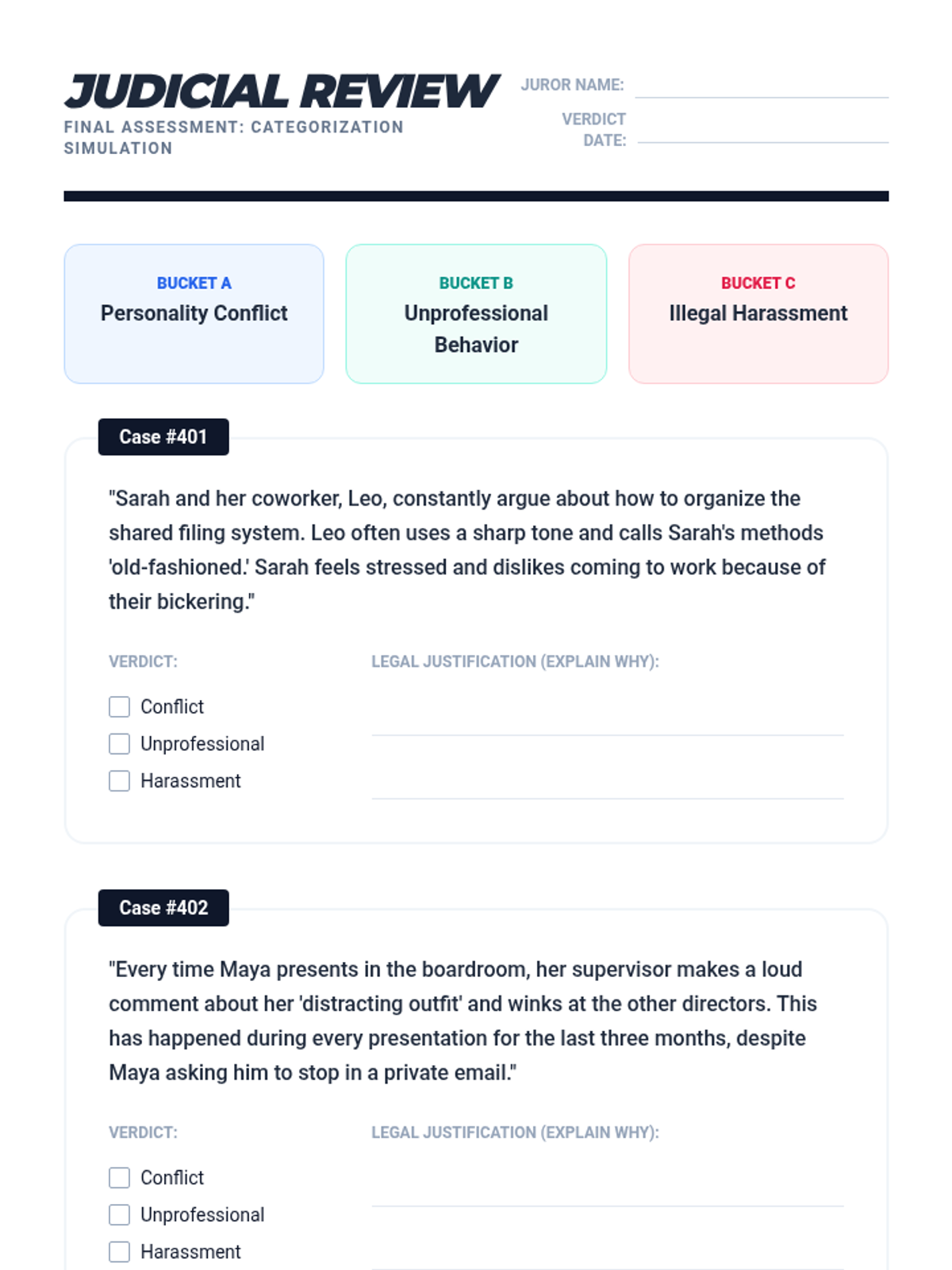
The final assessment worksheet for Lesson 5. Students categorize complex workplace scenarios as Personality Conflict, Unprofessional, or Illegal Harassment, providing legal justifications for each verdict.
Educational slides for Lesson 5: The Judicial Review. This deck sets up the final simulation, defines the three categories (Conflict, Unprofessional, Harassment), and outlines the assessment task.
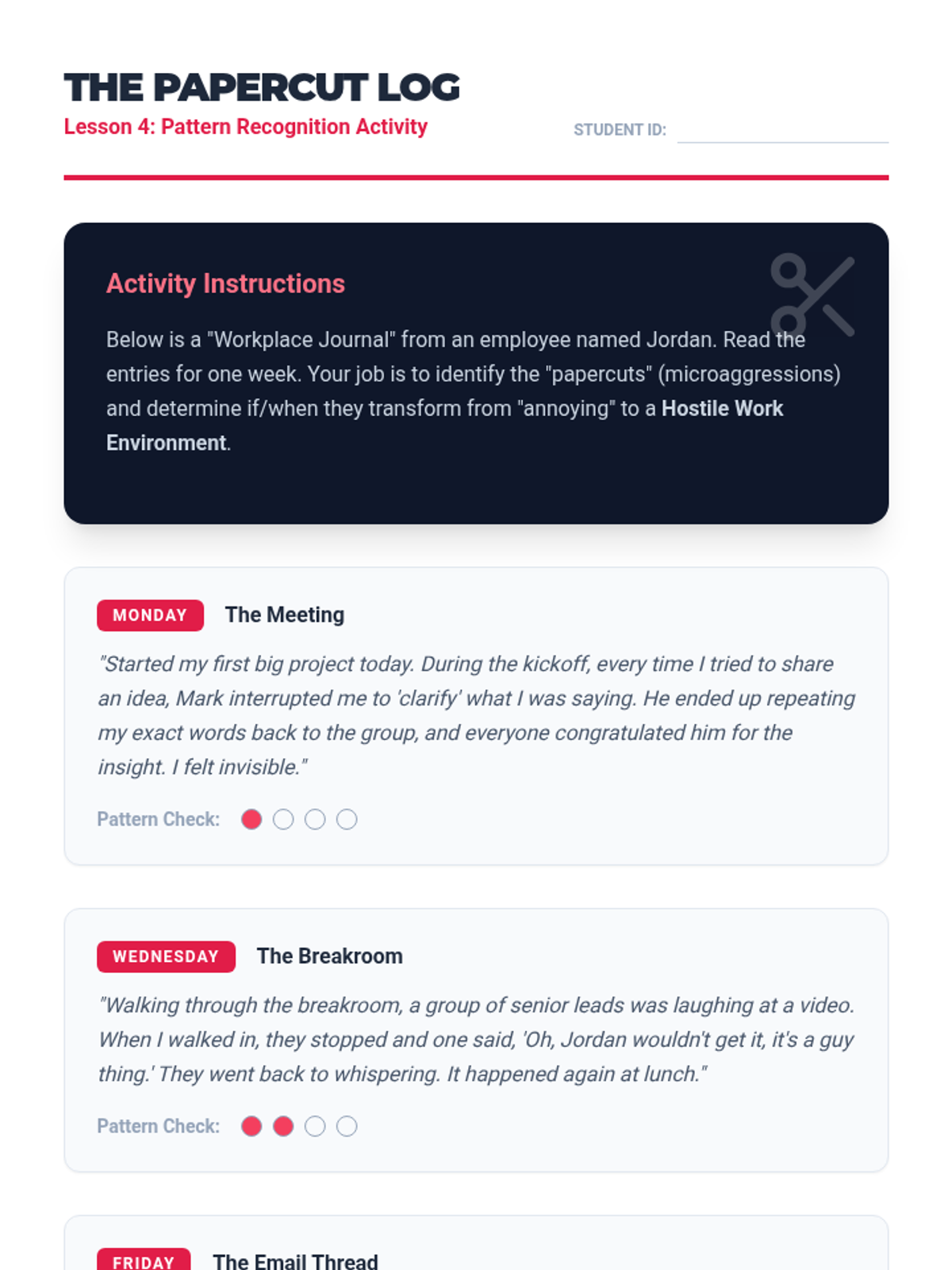
A student worksheet for Lesson 4 where they analyze a week's worth of workplace journal entries to identify a pattern of microaggressions. It focuses on the cumulative effect of small behaviors.
Educational slides for Lesson 4: The Pattern of Toxicity. This deck explains how microaggressions contribute to a hostile work environment over time, emphasizing the distinction between isolated incidents and pervasive patterns.
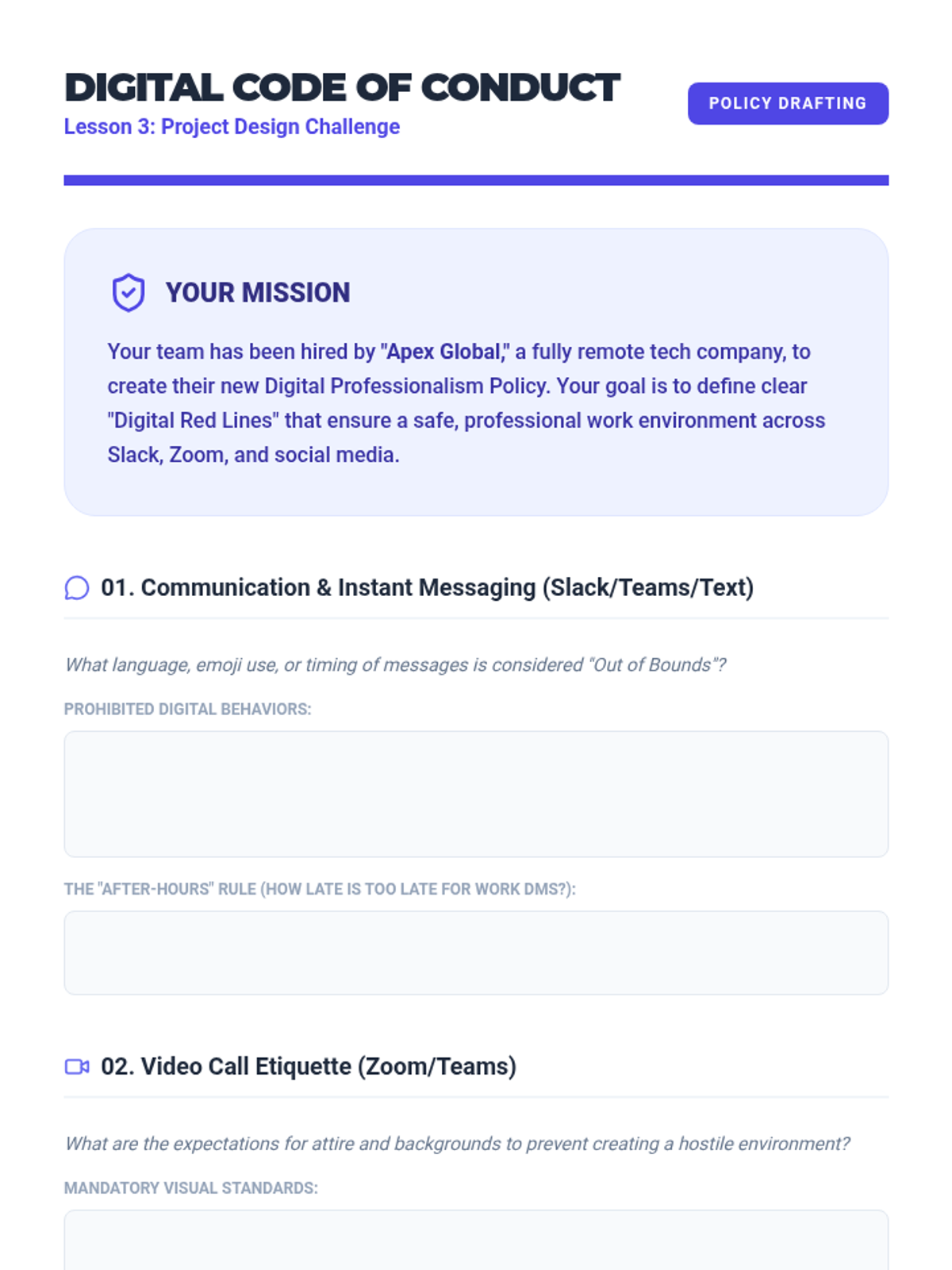
A student project guide for Lesson 3. Students act as HR consultants to draft a 'Digital Professionalism Policy' for a remote company, defining boundaries for instant messaging, video calls, and social media.
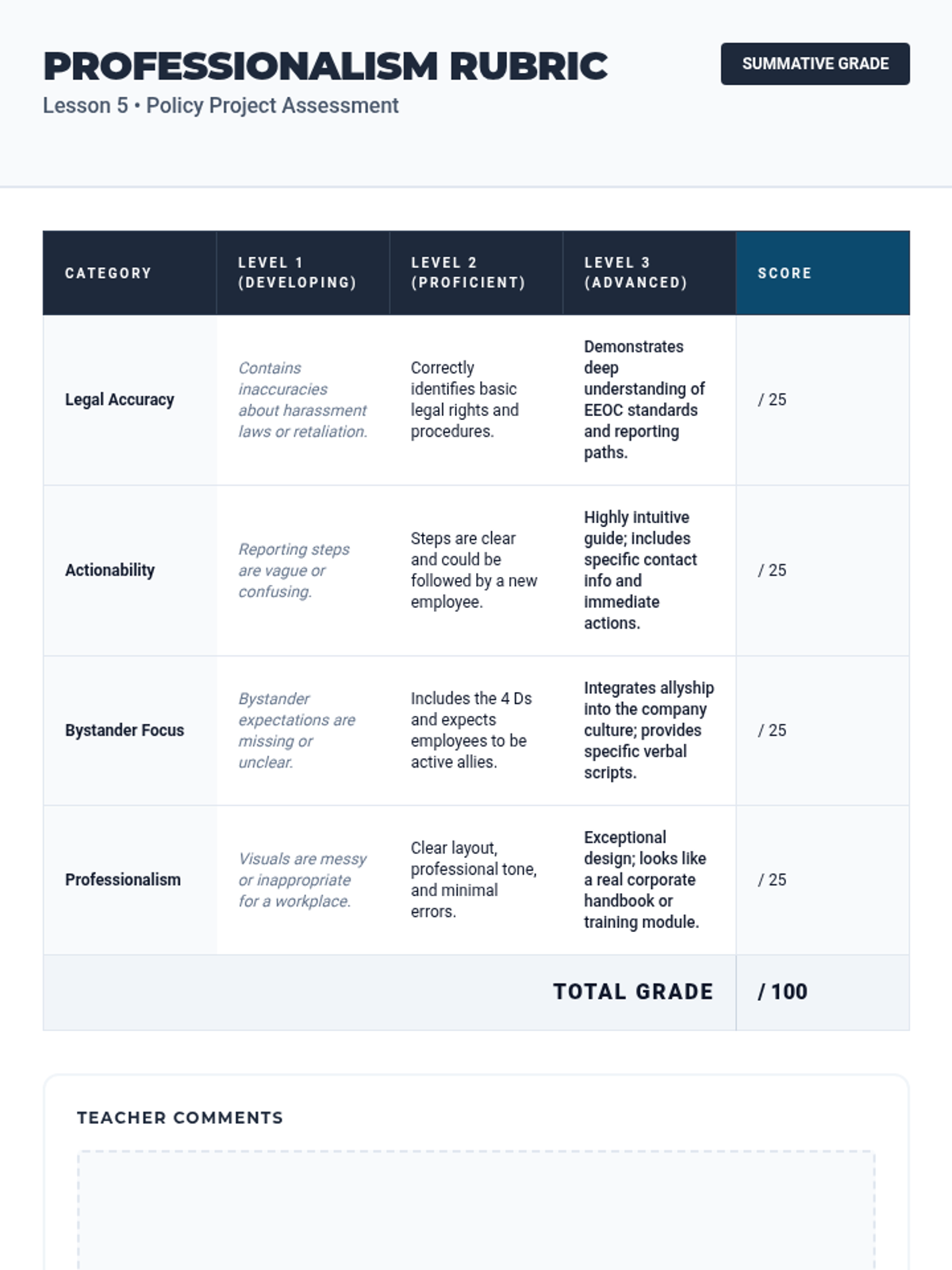
Final summative rubric for Lesson 5, assessing legal accuracy, actionability, bystander focus, and professionalism in the student-created workplace policies.
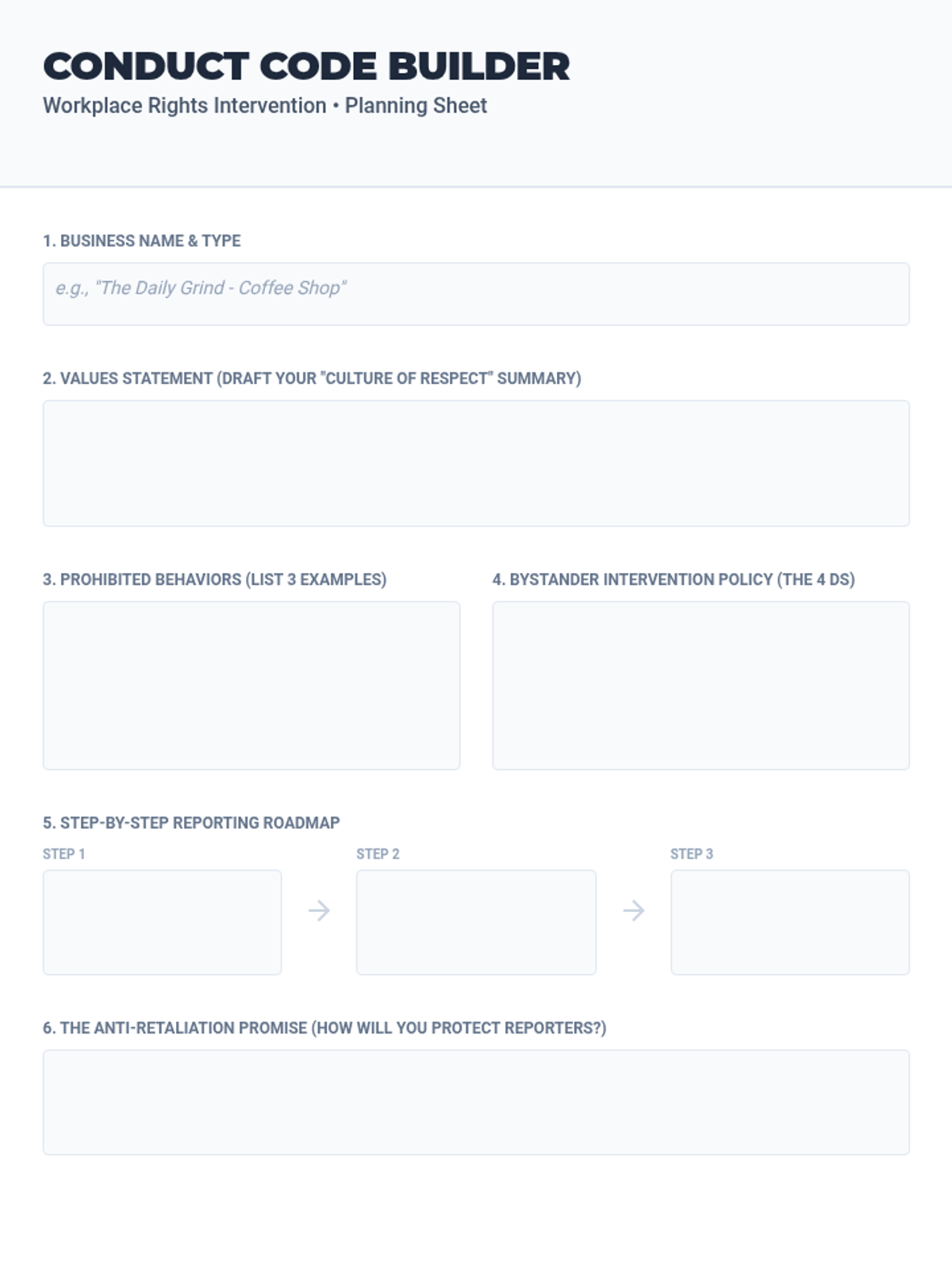
A planning worksheet for Lesson 5 where students draft the various components of their workplace code of conduct and reporting policy.
Educational slides for Lesson 3: Digital Professional Conduct. This deck covers how workplace harassment translates to digital spaces, the impact of social media interactions between coworkers, and the 'permanence' of digital evidence.
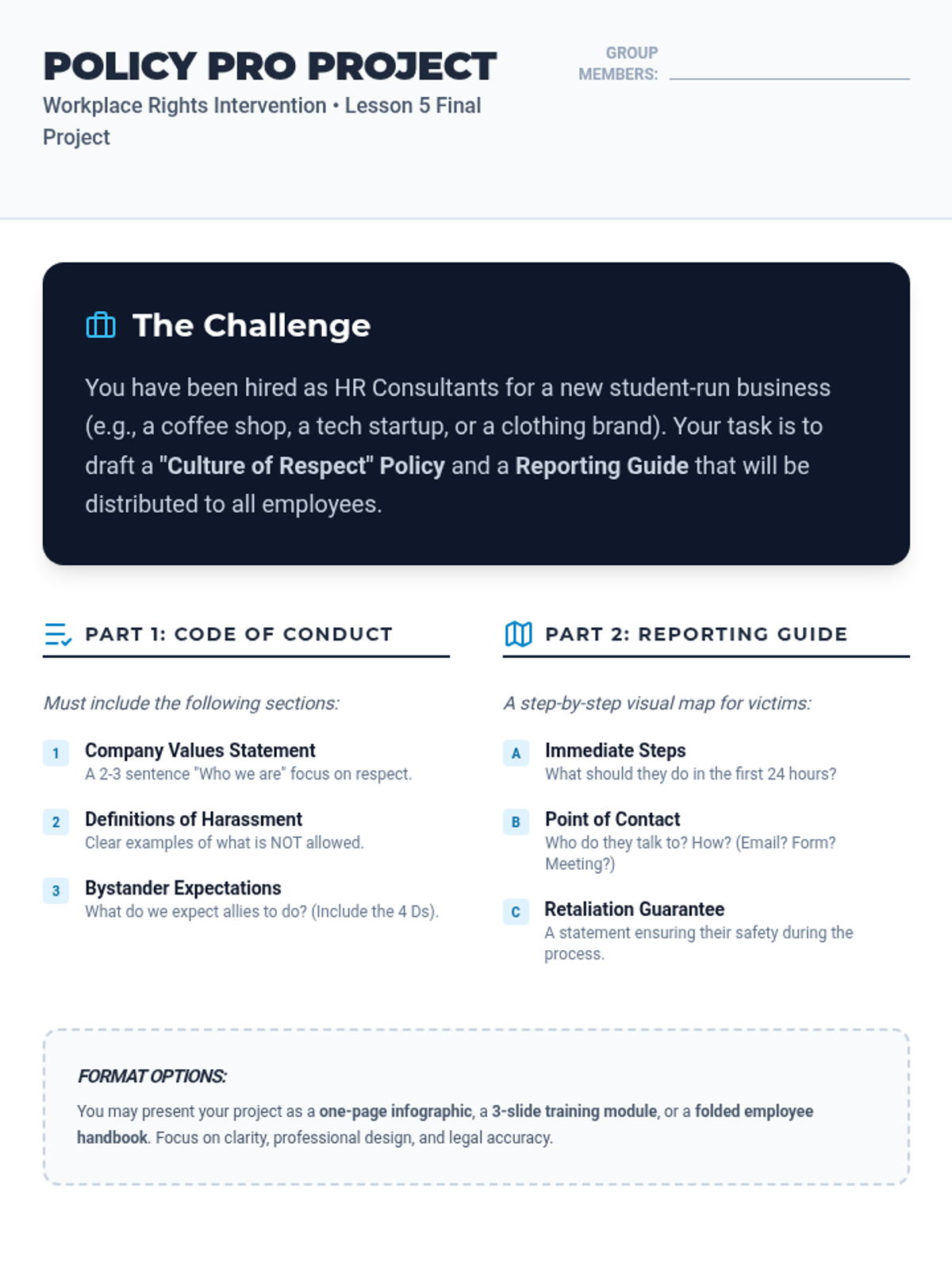
Final project guide for Lesson 5, tasking students to create a code of conduct and reporting guide for a fictional student-run business.
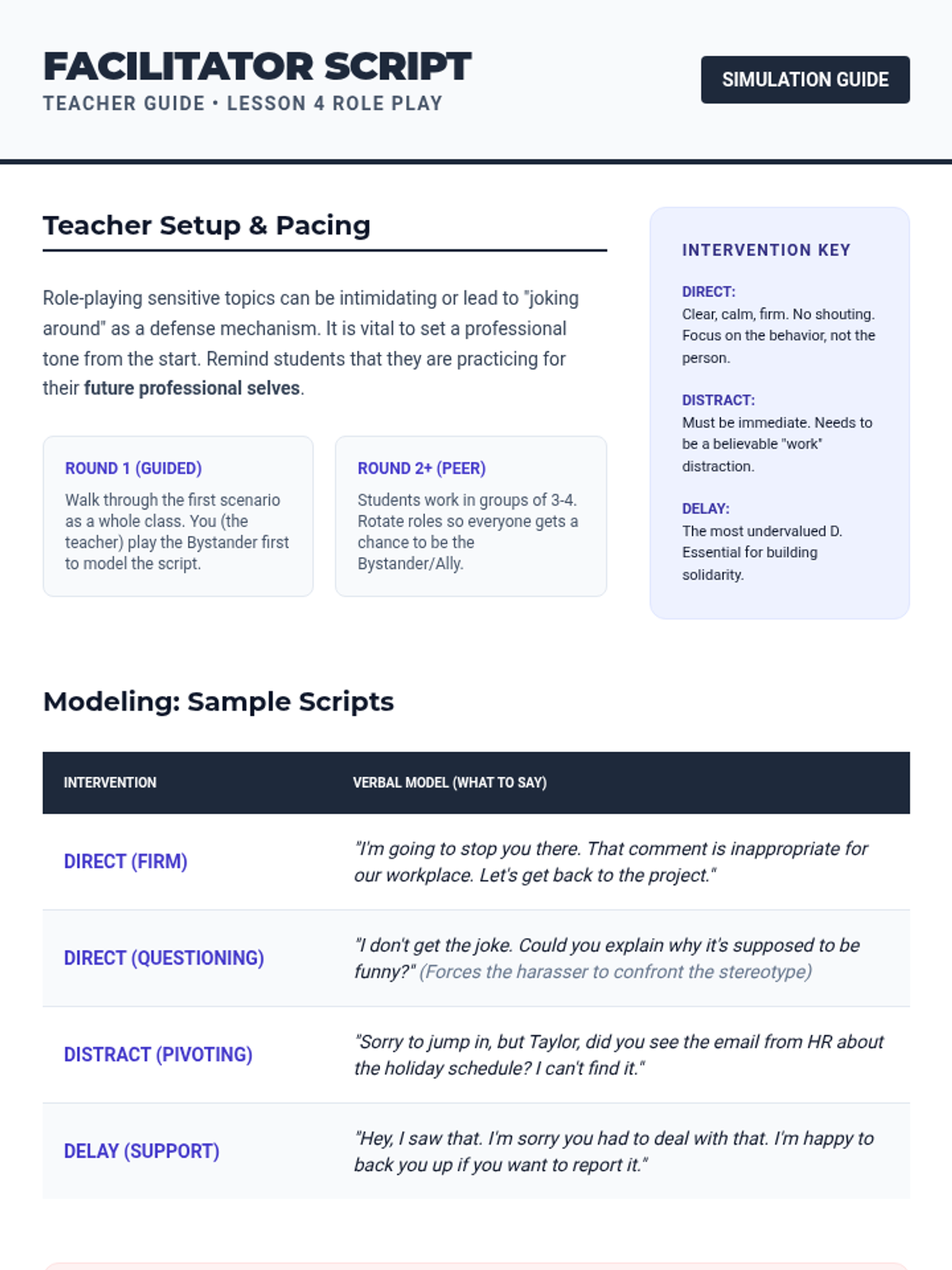
Teacher facilitator guide for Lesson 4 role-play simulations, including setup advice, verbal models for interventions, and safety protocols.
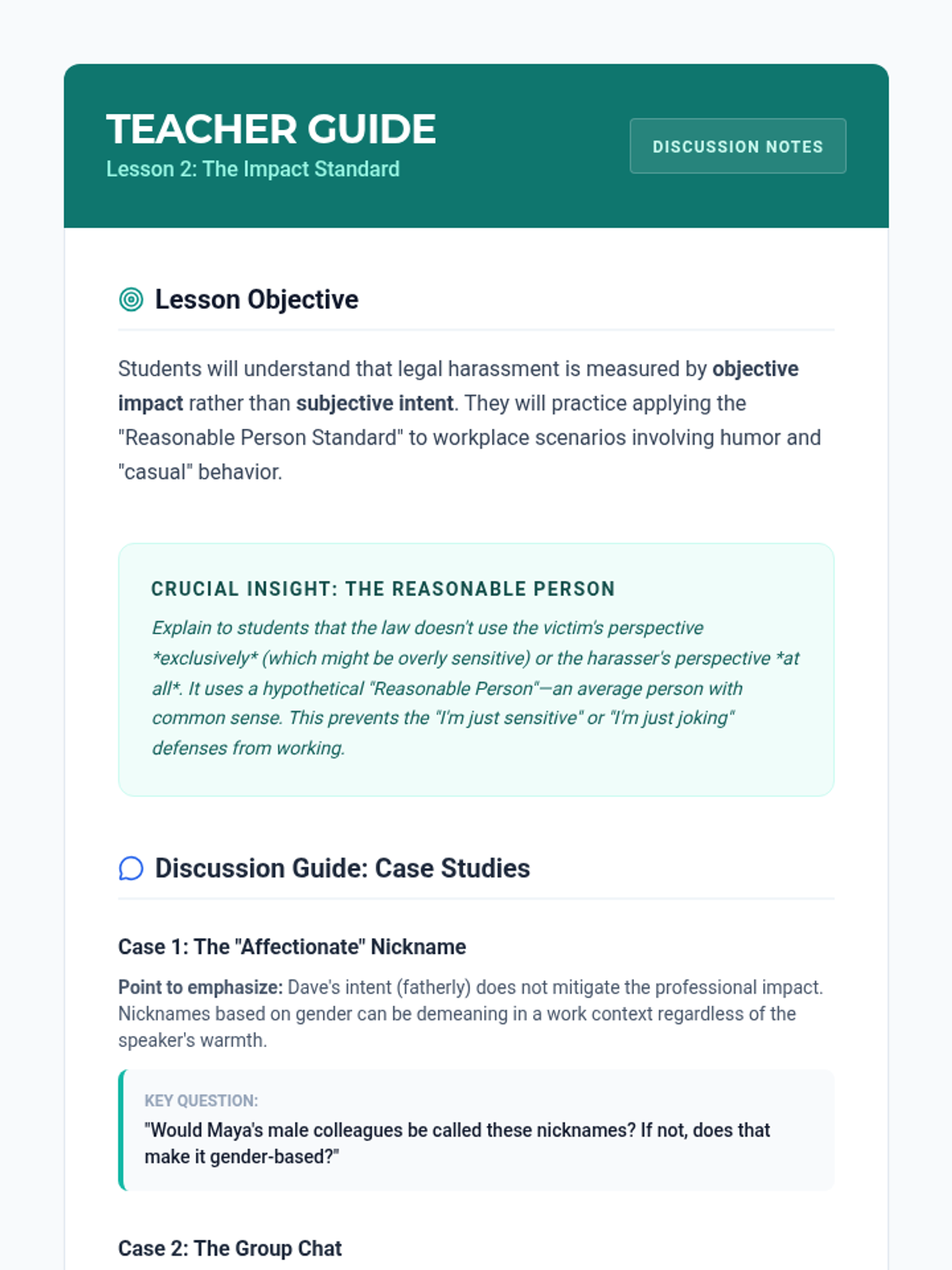
Teacher facilitation notes for Lesson 2: The Impact Standard. It includes guiding questions for the case studies and tips for addressing common student concerns about the "Reasonable Person Standard."
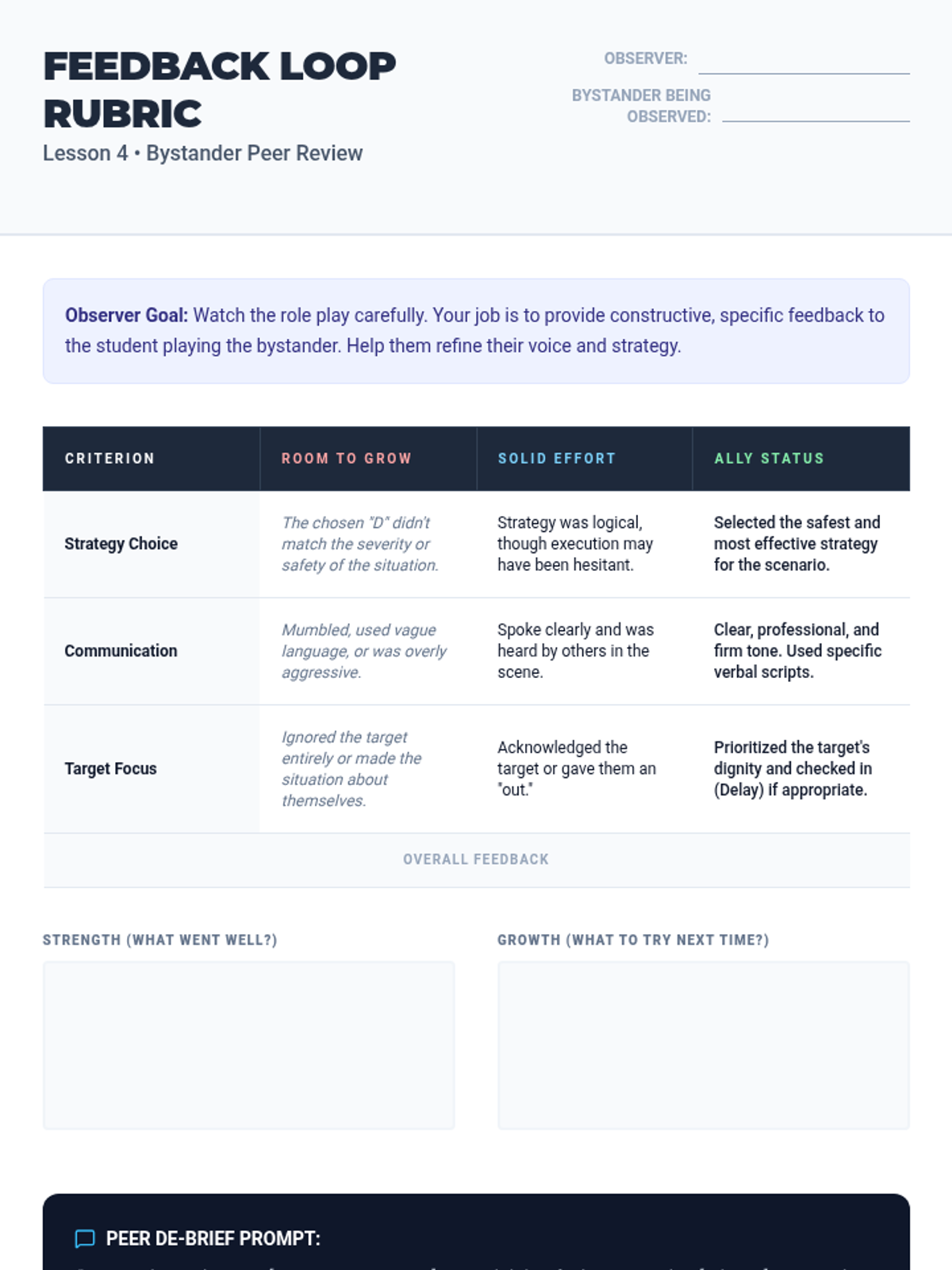
A peer-assessment rubric for Lesson 4 role-play activities, focusing on strategy choice, communication, and target-focused intervention.
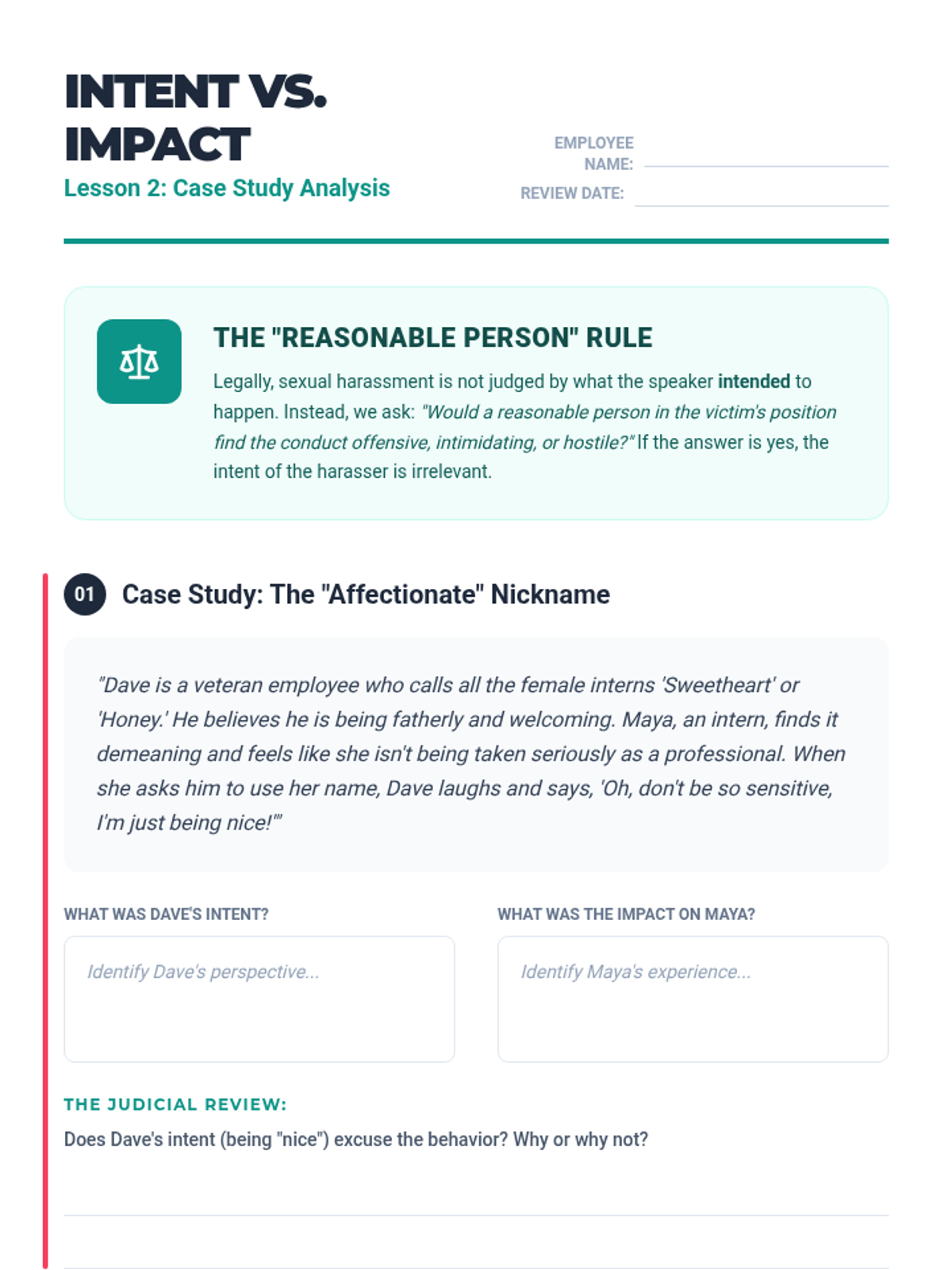
A student case study analysis for Lesson 2 focusing on the 'Intent vs. Impact' legal standard. Students analyze two workplace scenarios to determine how intent differs from the actual impact on the victim and the environment.
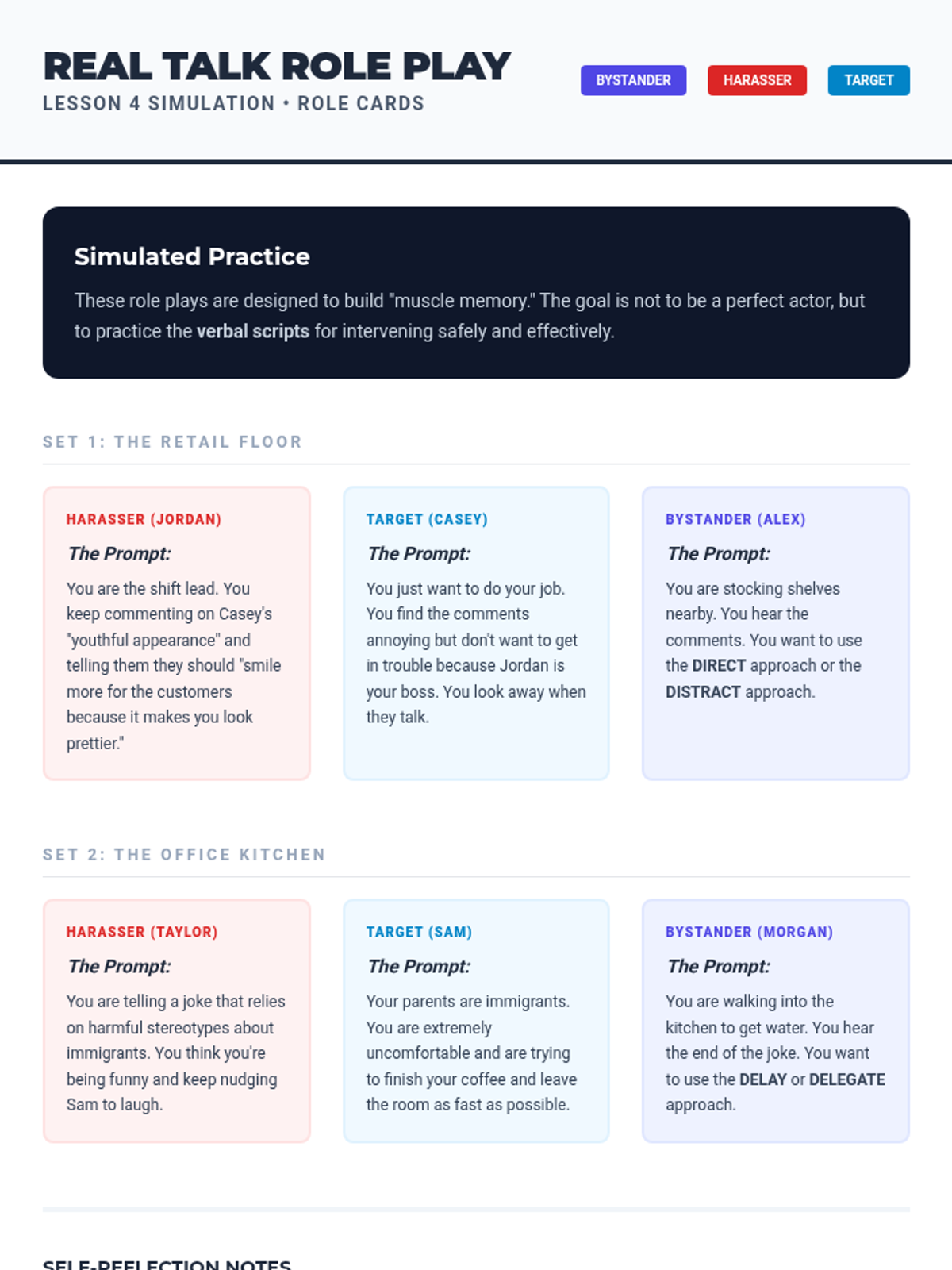
Role-play scenario cards for Lesson 4, including prompts for harassers, targets, and bystanders in different workplace settings.
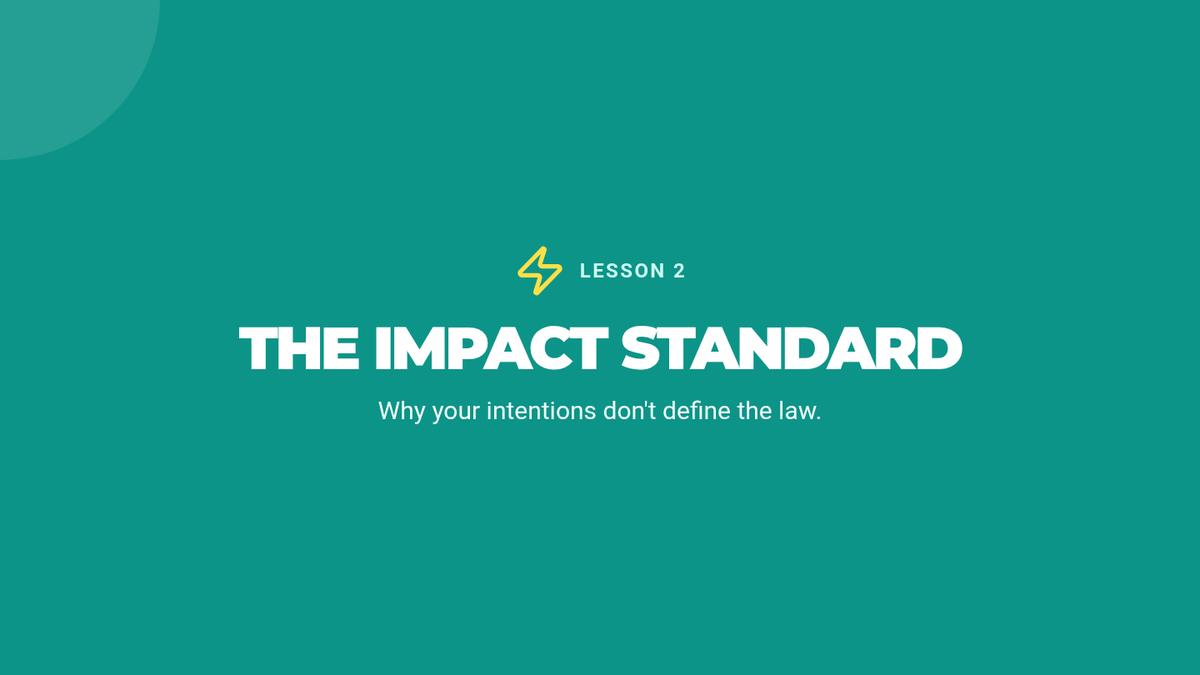
Educational slides for Lesson 2: The Impact Standard. This deck explains the legal shift from harasser intent to victim impact, introducing the 'Reasonable Person Standard' and debunking the 'just joking' defense.
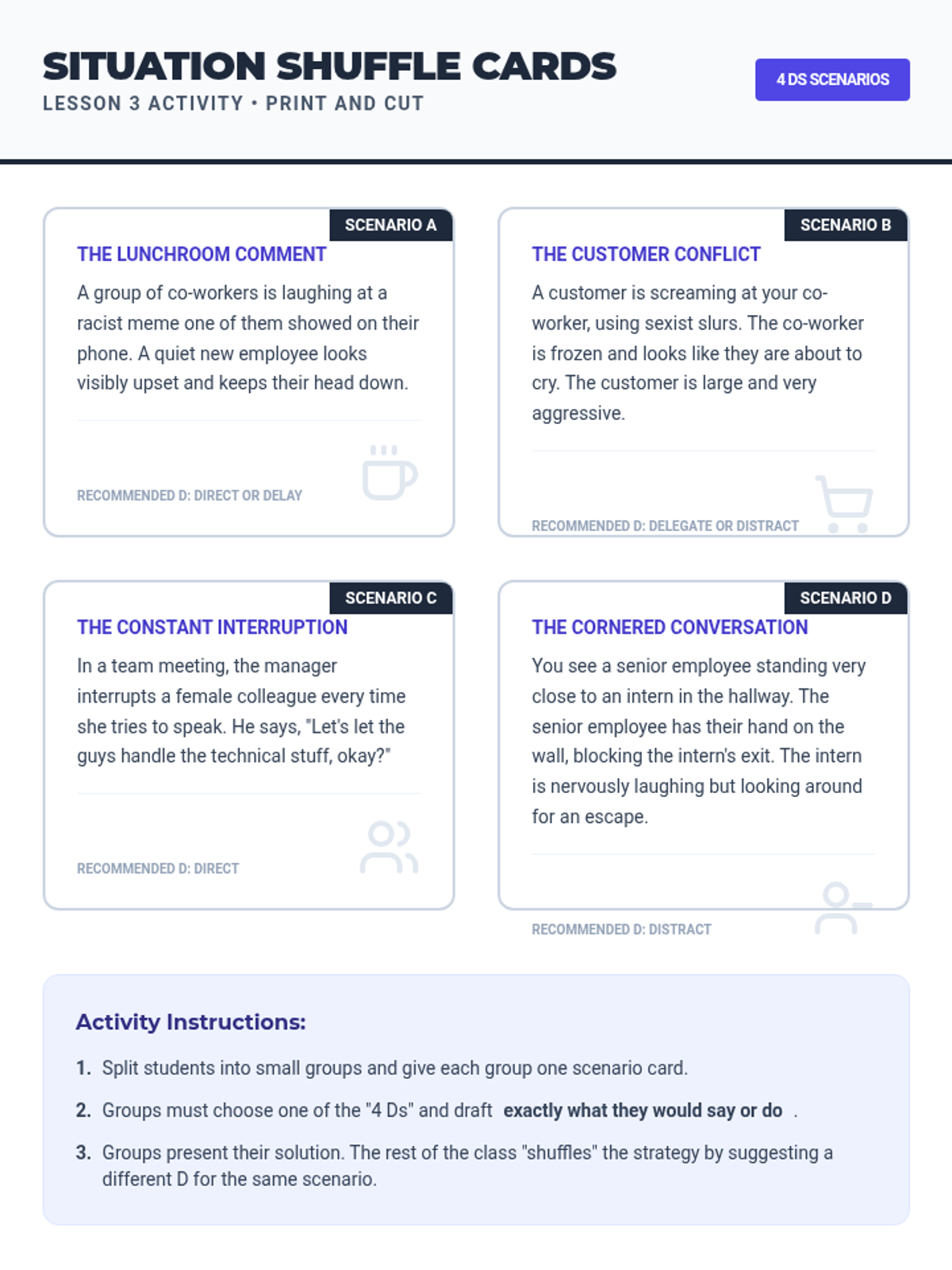
Printable activity cards featuring workplace harassment scenarios for students to analyze and apply bystander intervention strategies.
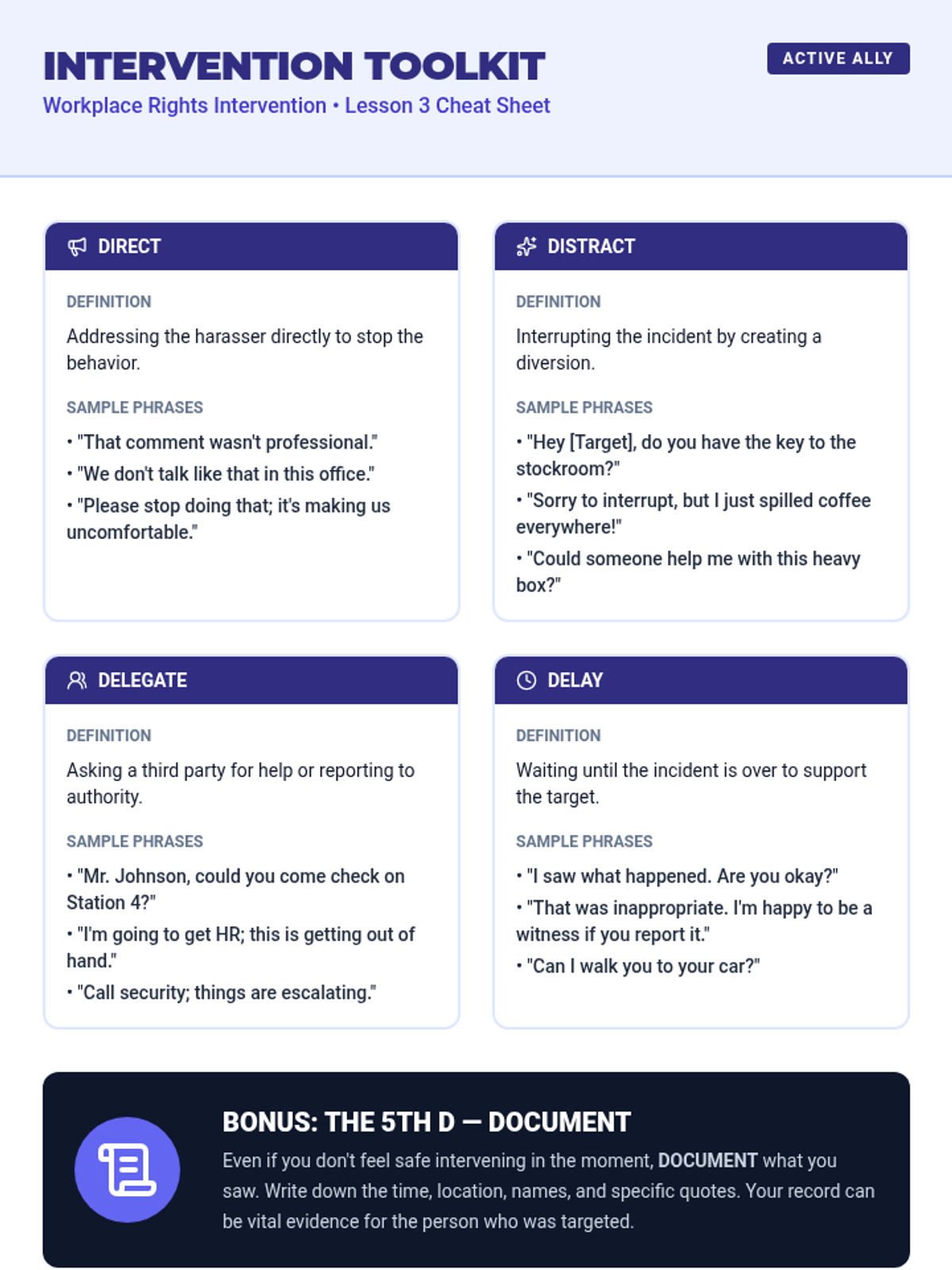
A comprehensive cheat sheet for students detailing the 4 Ds of bystander intervention with definitions, sample phrases, and safety tips.
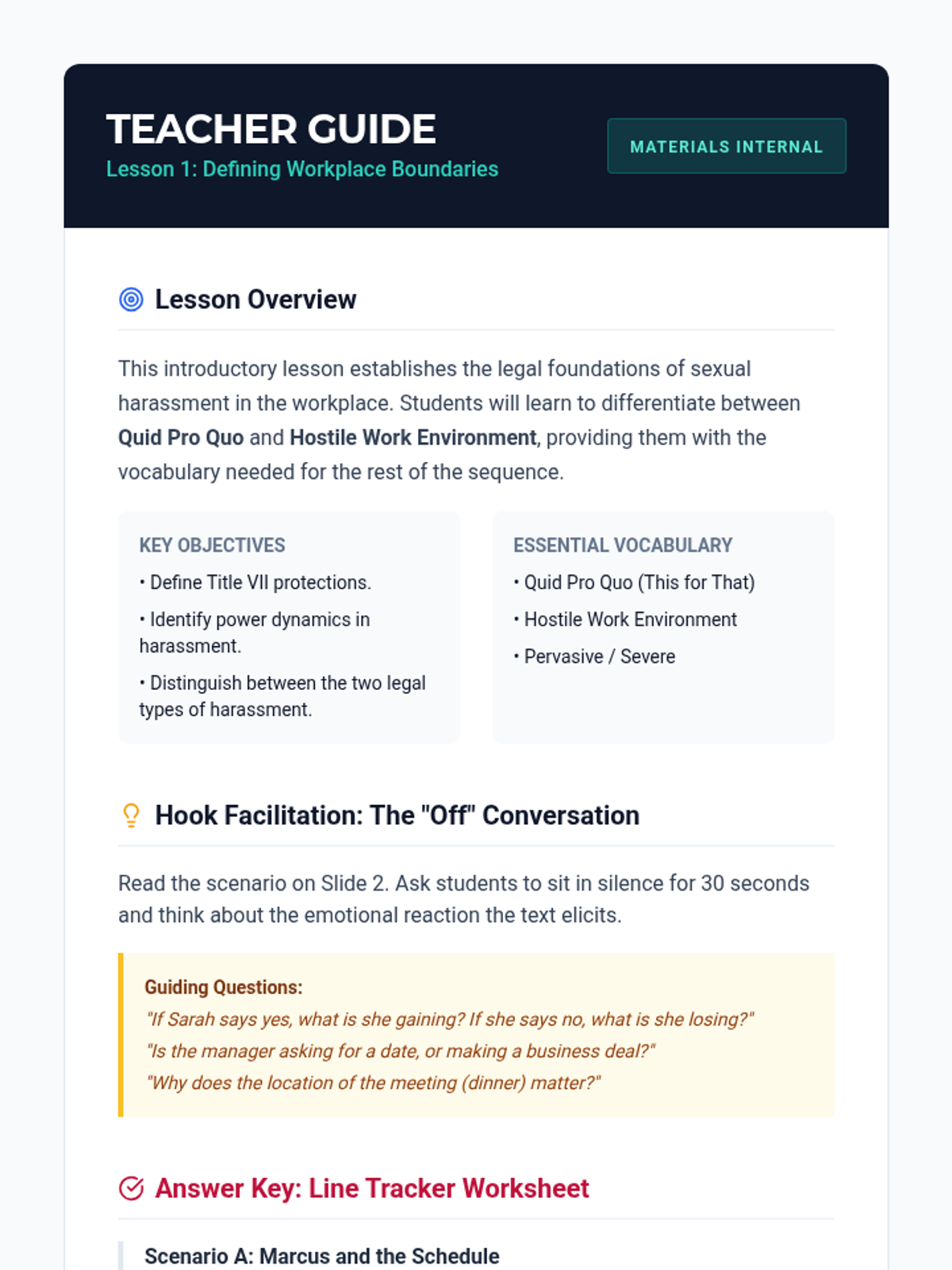
A teacher resource for Lesson 1: Defining Workplace Boundaries. It includes lesson objectives, facilitation tips for the hook, a complete answer key for the student worksheet, and notes on common misconceptions.
Slide deck for Lesson 3 introducing the 'Bystander Effect' and the '4 Ds' of intervention (Direct, Distract, Delegate, Delay) with guidance on strategy selection.
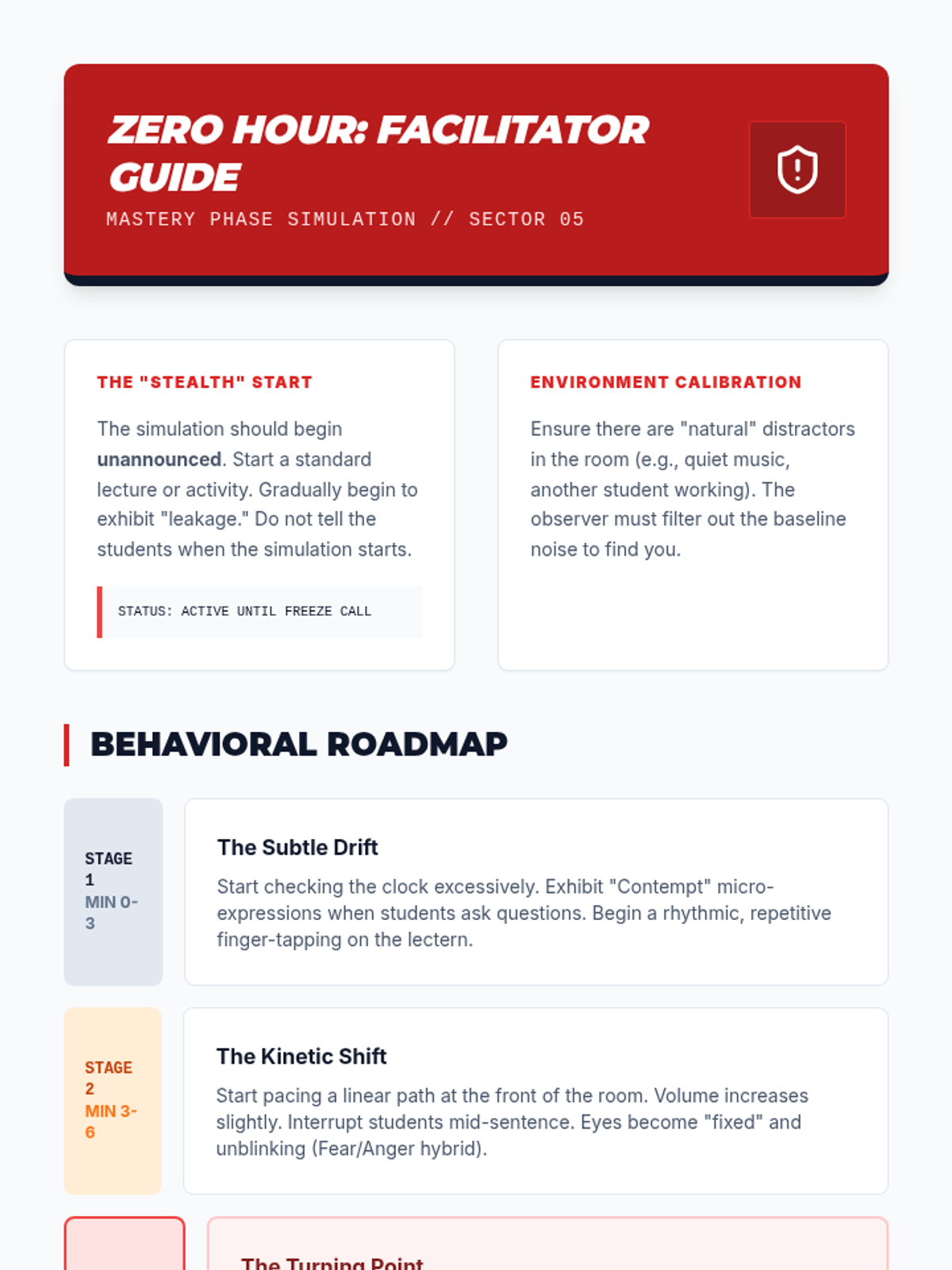
Teacher guidance for the "Zero Hour" mastery simulation, including staging instructions, escalation levels, and debriefing strategies.
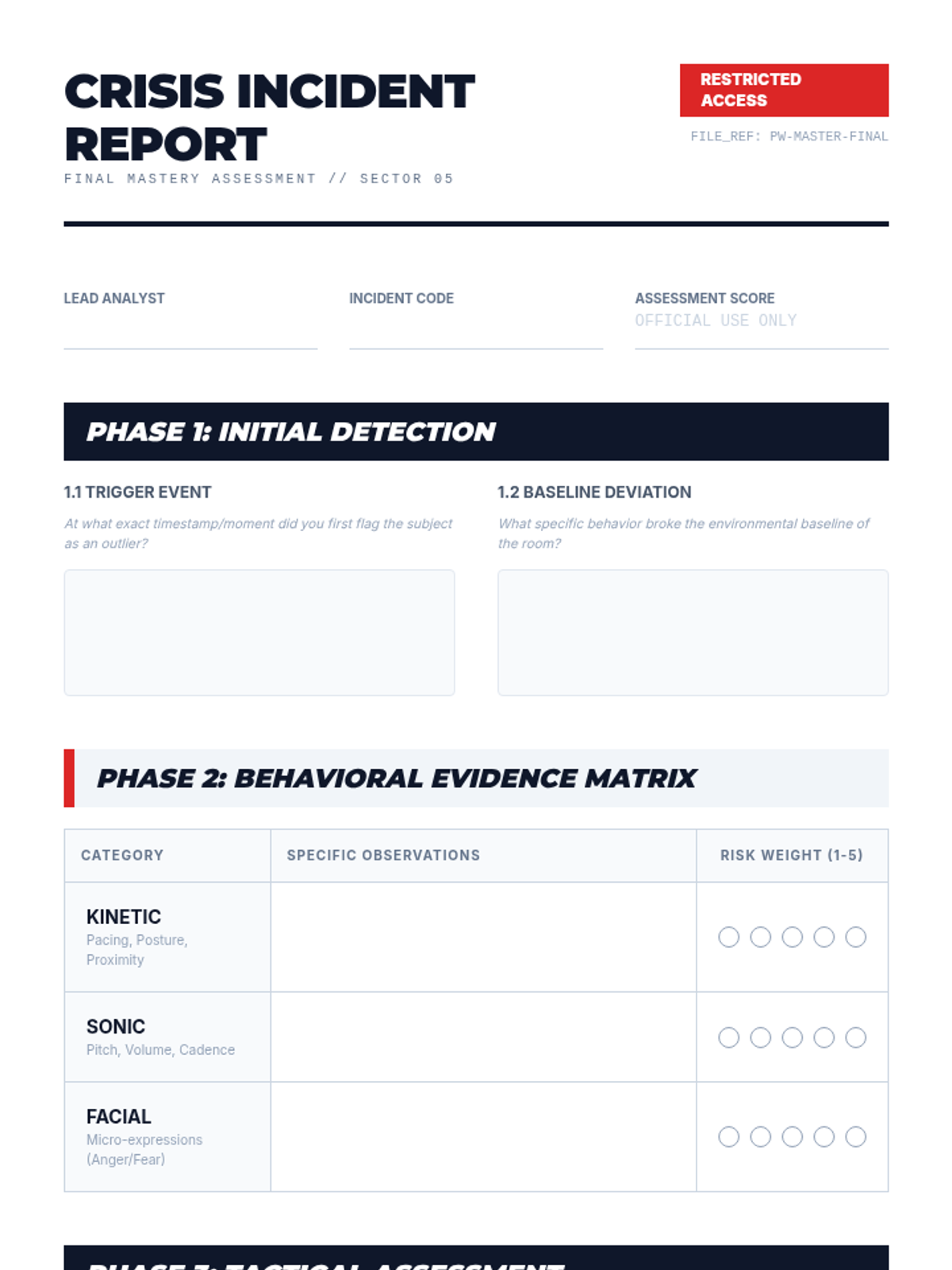
A comprehensive final assessment report for the "Zero Hour" simulation, requiring students to document and justify their behavioral analysis.
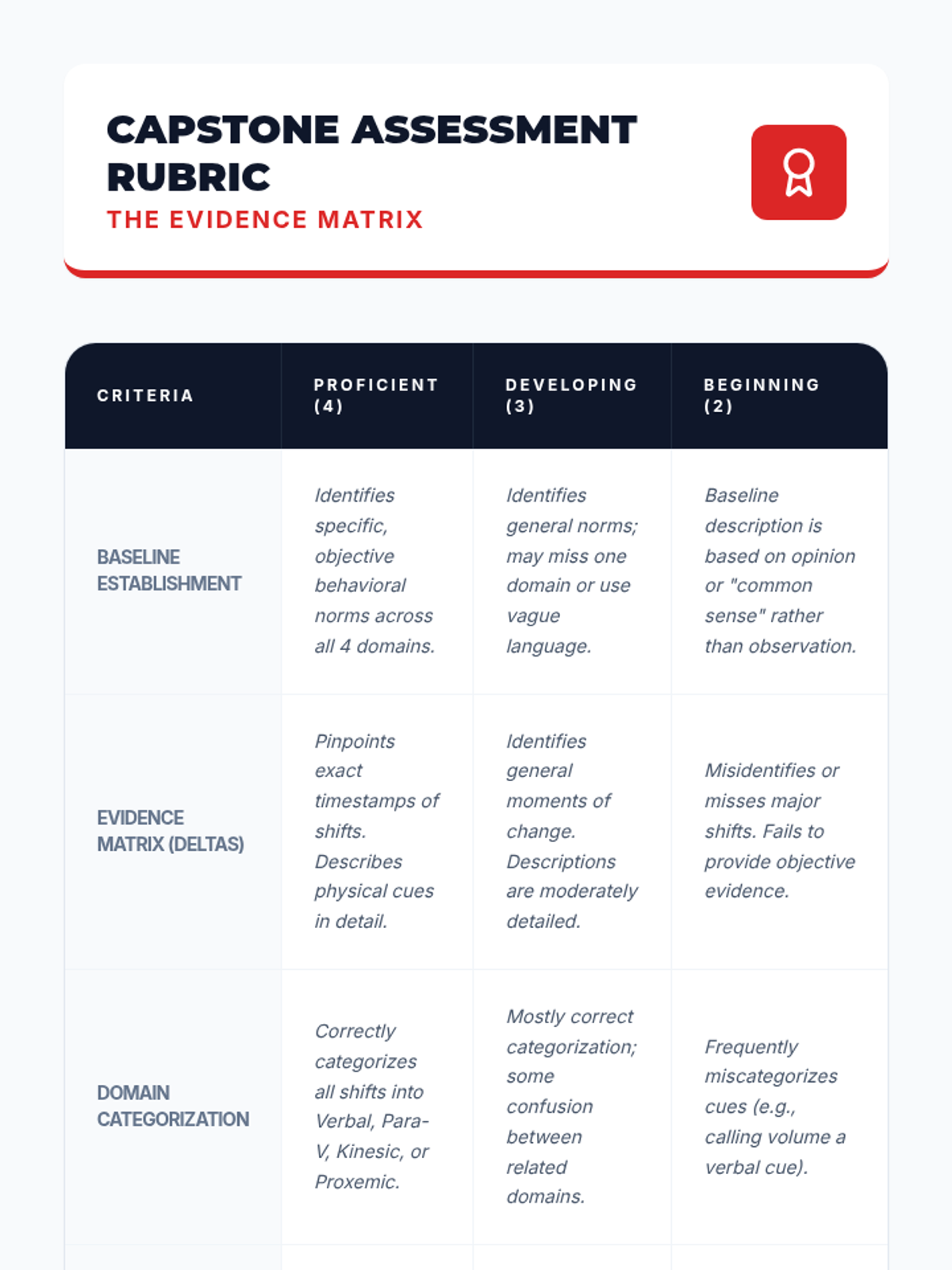
Final assessment rubric for the behavioral analysis capstone, evaluating students on baseline establishment, evidence quality, and intervention strategy.
A visual presentation for Lesson 5 outlining the "Zero Hour" mastery simulation protocols, rules of engagement, and success criteria.
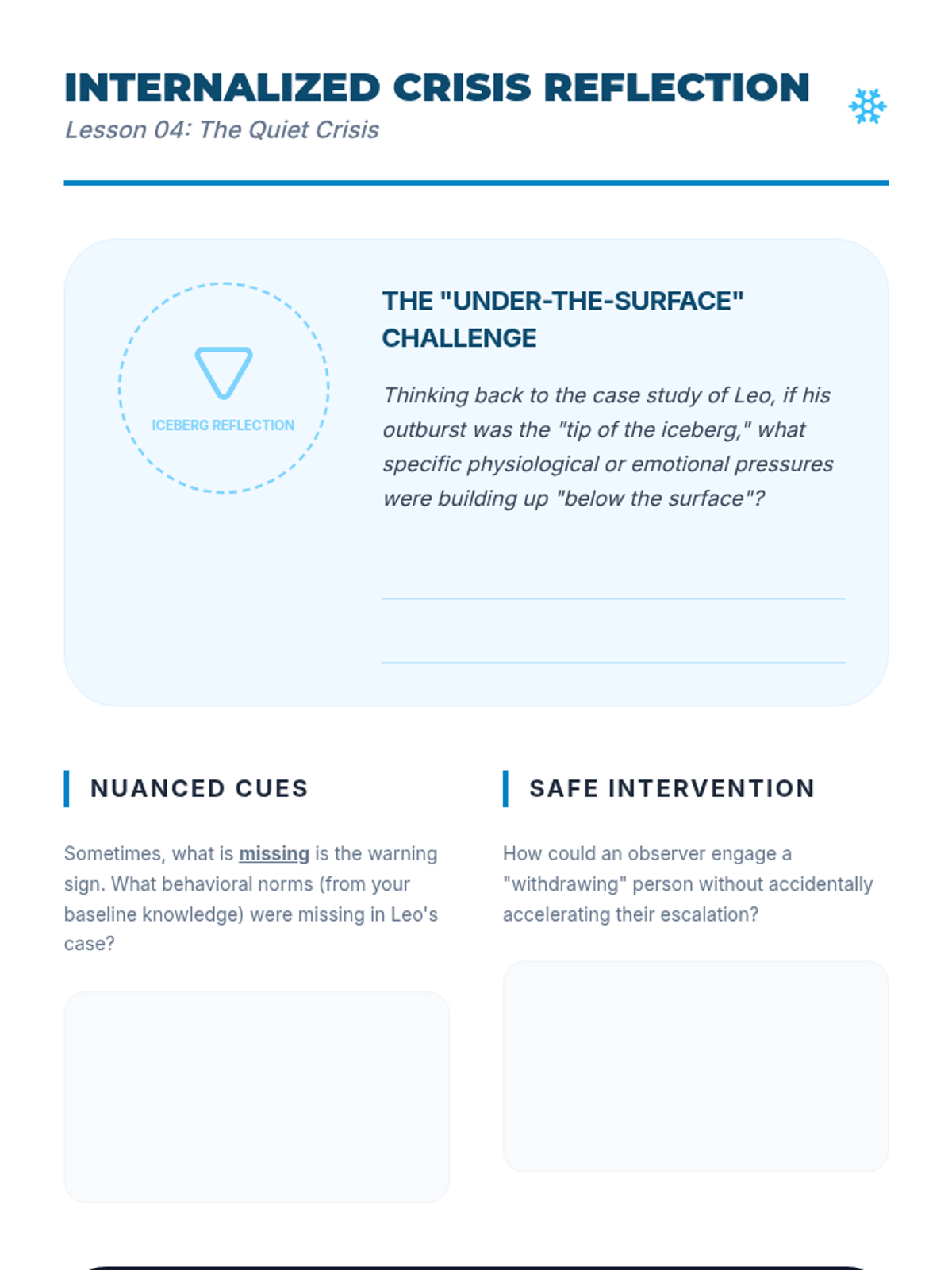
Reflection log for students to analyze internalizing behaviors, the iceberg model, and empathetic intervention strategies in Lesson 4.
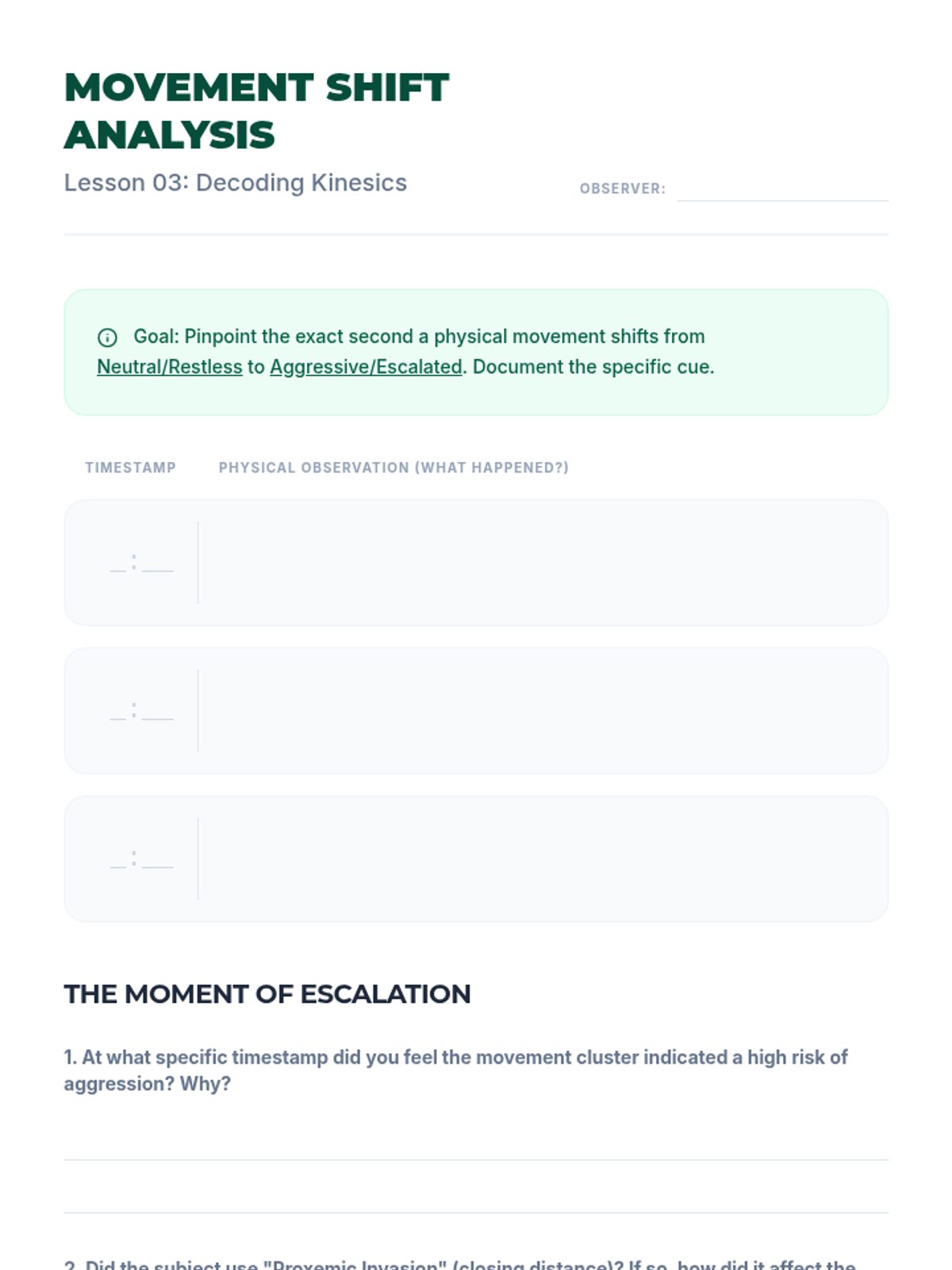
Student worksheet for recording and analyzing physical movements and proxemic shifts during video case studies in Lesson 3.
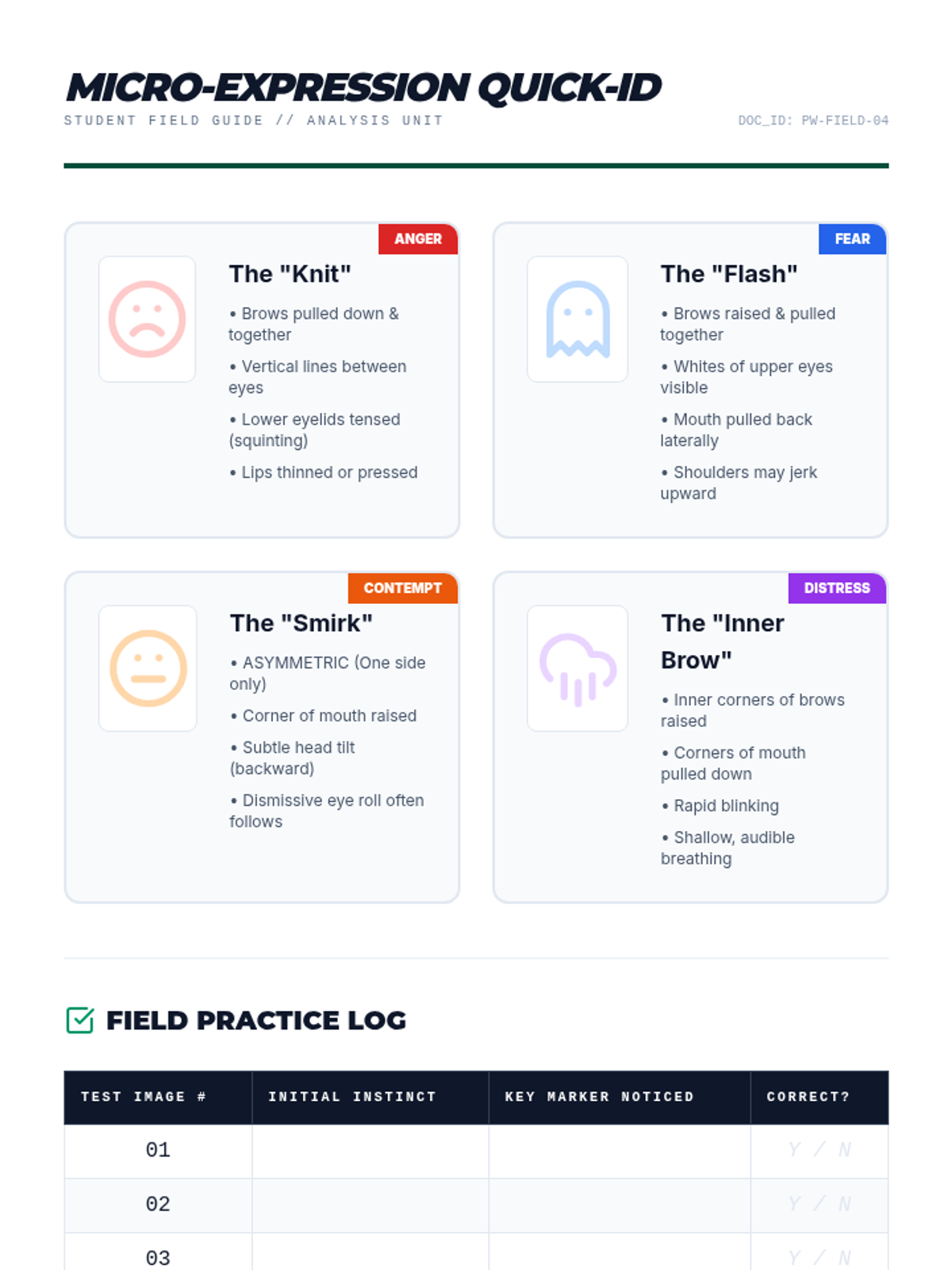
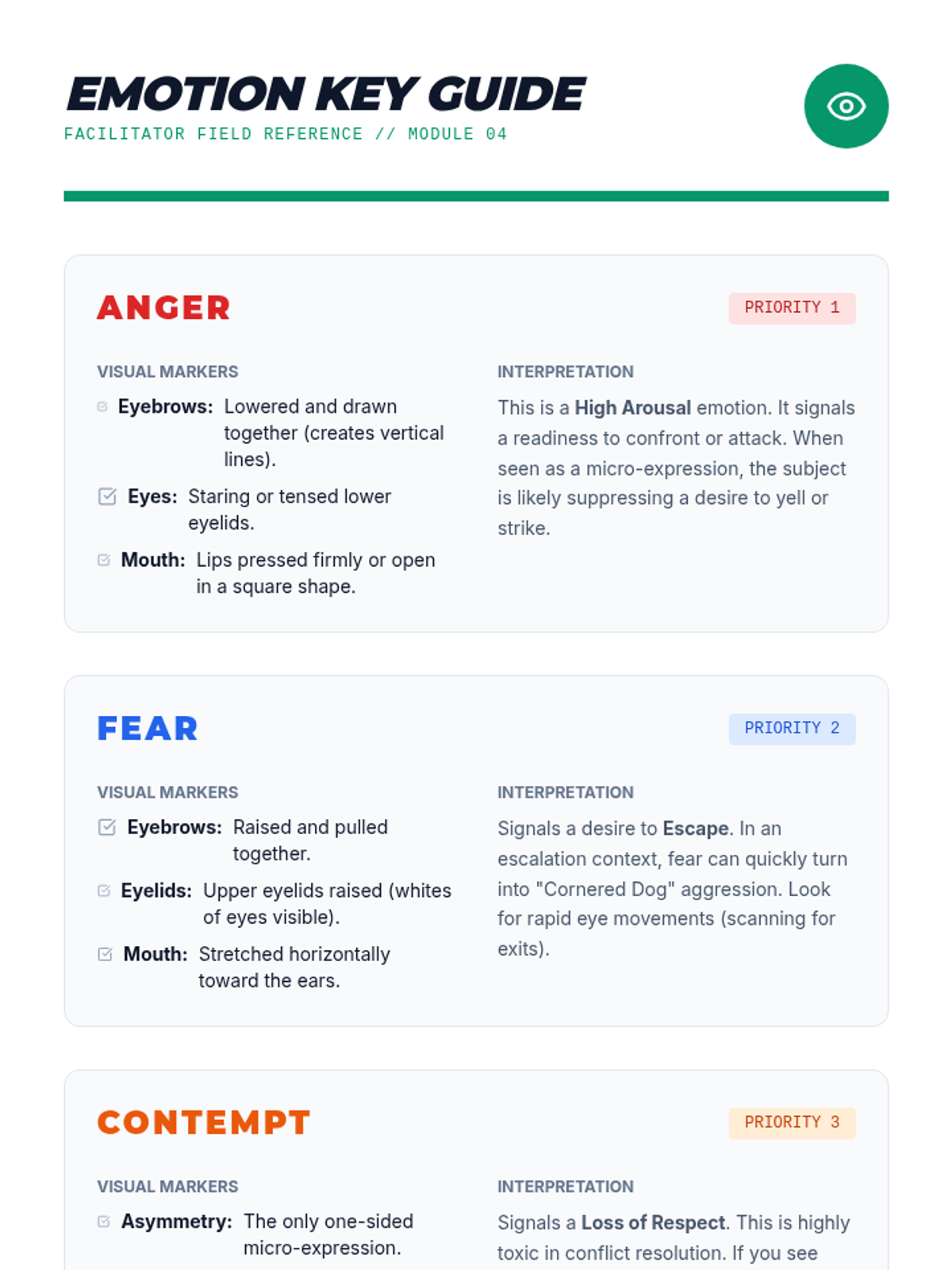
A student reference sheet for Lesson 4 detailing the visual markers of anger, fear, and contempt micro-expressions.
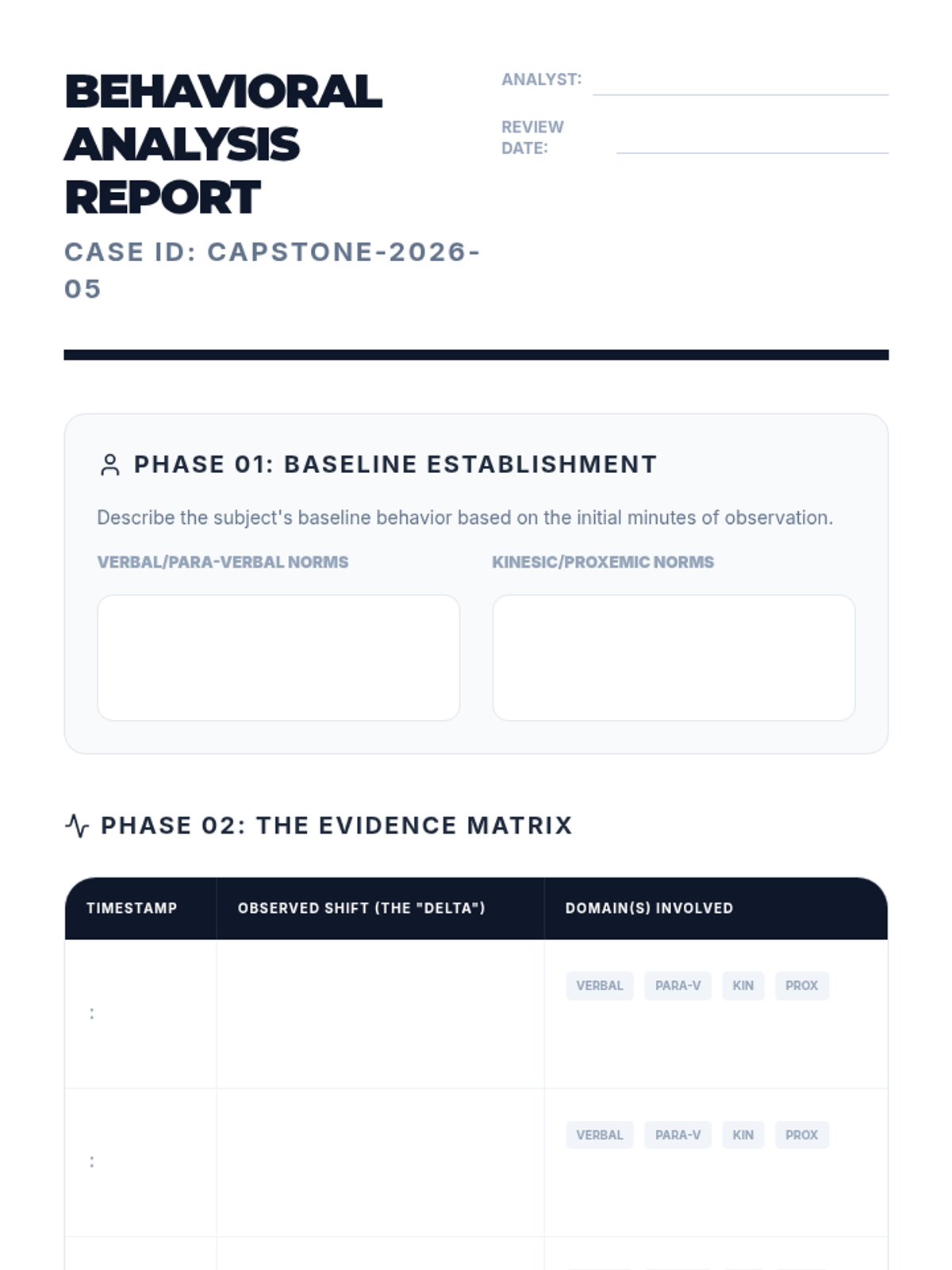
Formal incident report template for the capstone assessment where students map an escalation cycle and provide evidence-based intervention recommendations.
A teacher reference guide for Lesson 4 detailing the visual markers and behavioral interpretations of anger, fear, and contempt micro-expressions.
Reviewing all 4 domains. Introduction to the "Evidence Matrix" and the final synthesis task mapping the escalation cycle from Baseline to Crisis.
A visual presentation for Lesson 4 focusing on identifying fleeting micro-expressions of anger, fear, and contempt as early warning signs of escalation.
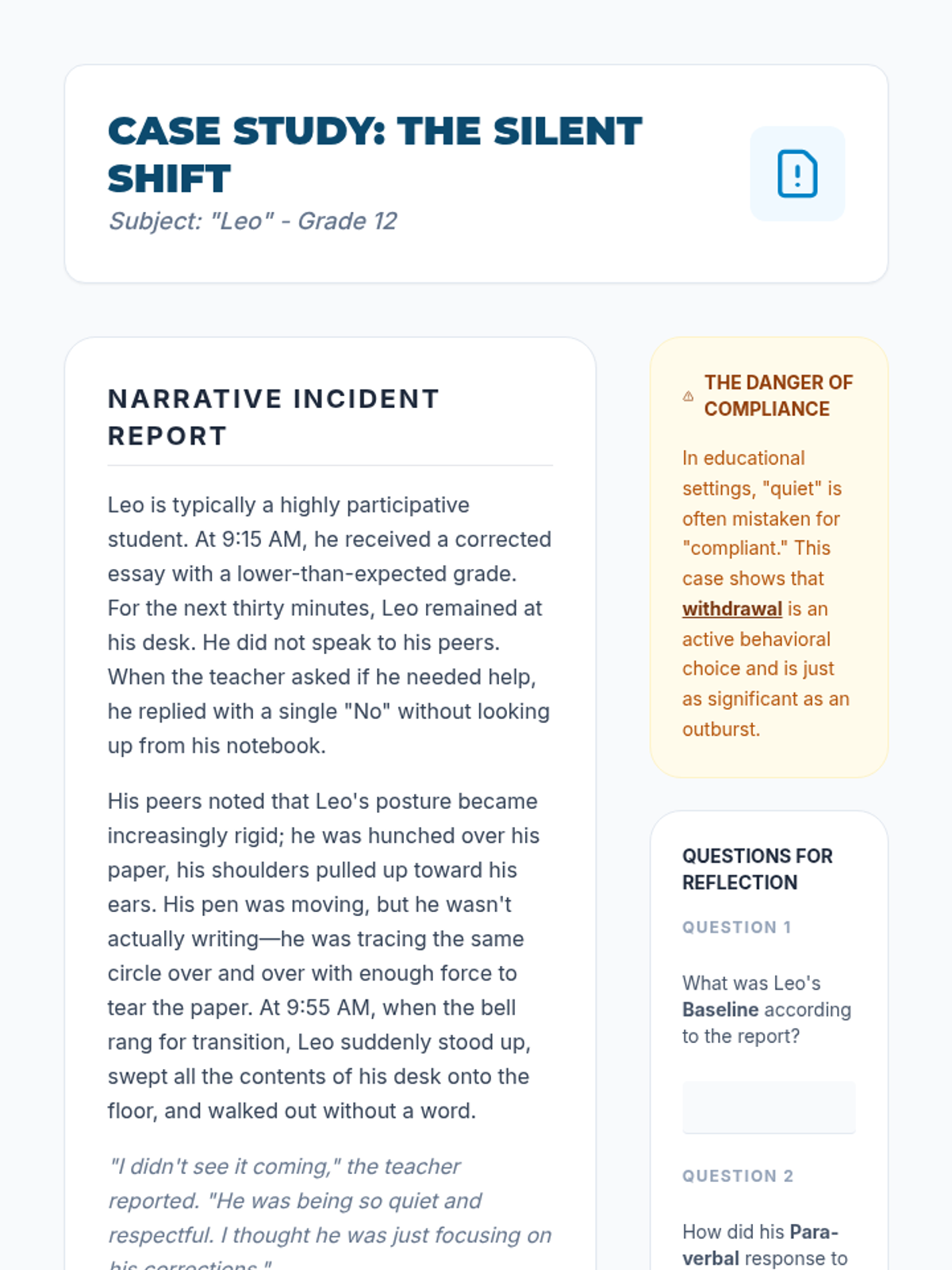
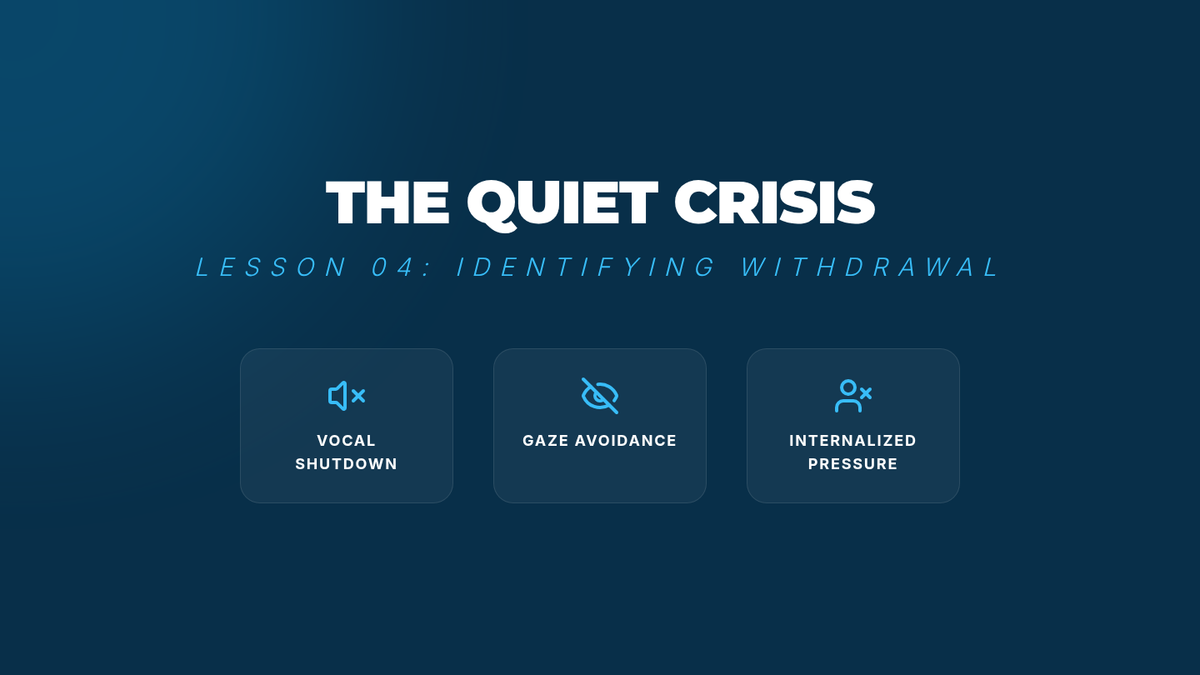
Case study narrative of a student exhibiting withdrawal-based escalation cues (implosive behavior) before an outburst.
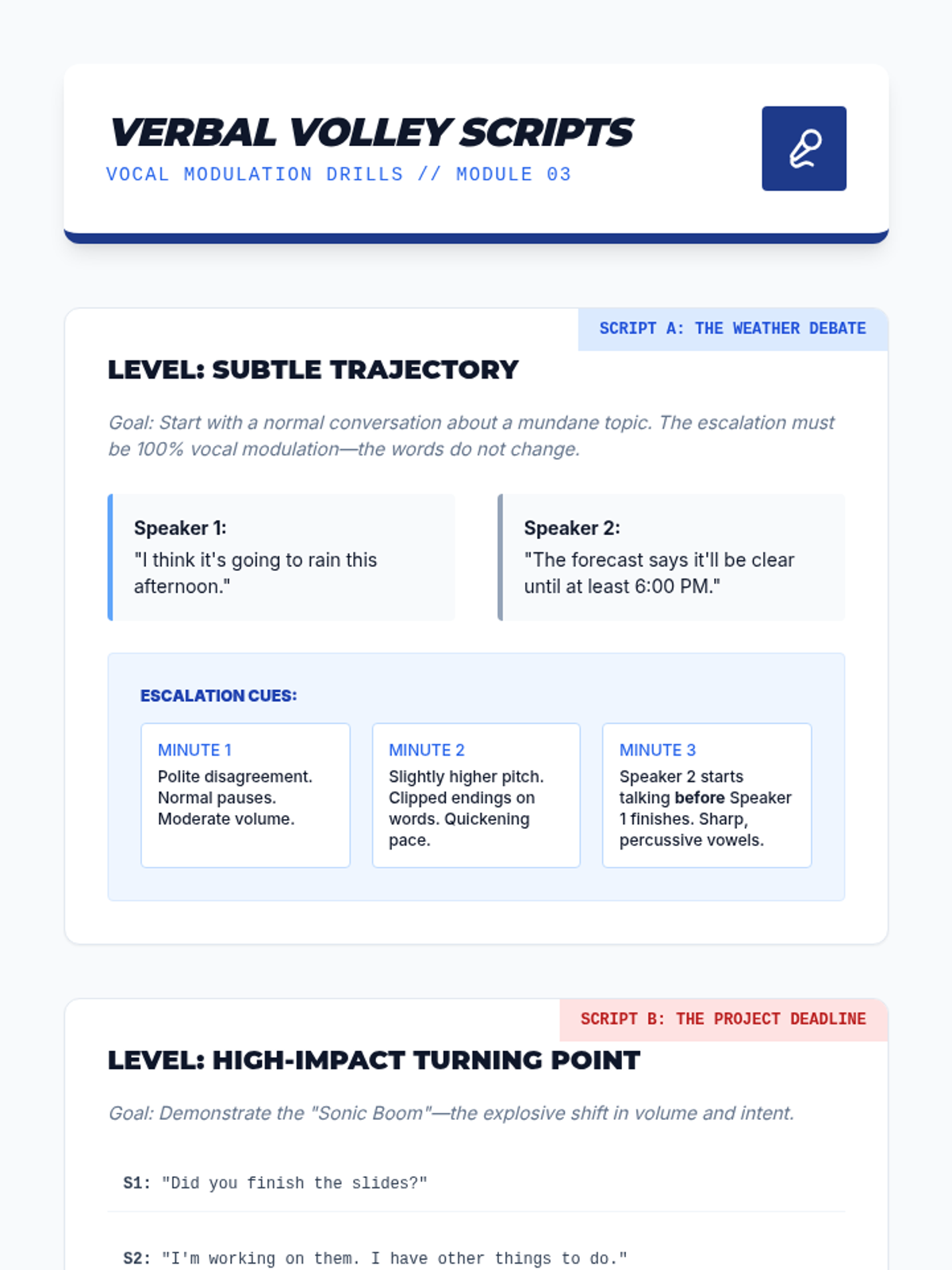
Teacher and actor scripts for verbal escalation simulations, including mundane dialogue with tonal shifts and high-impact turning points.
Internalizing vs. Externalizing behavior slides, featuring the "Iceberg Model" to explain subtle 'implosive' escalation warning signs.
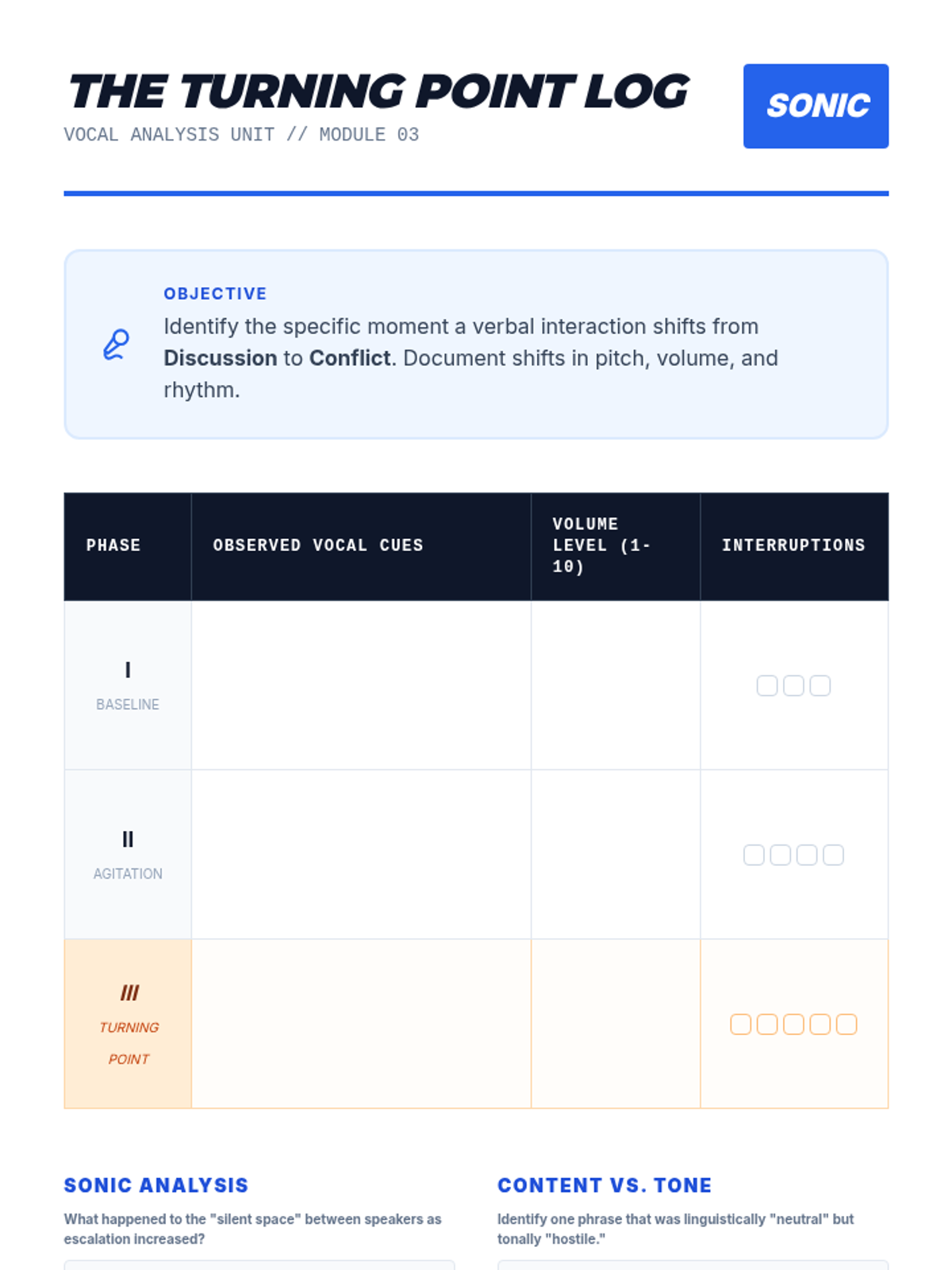
A student tracking log for Lesson 3 to document shifts in pitch, volume, and rhythm during verbal escalation simulations.
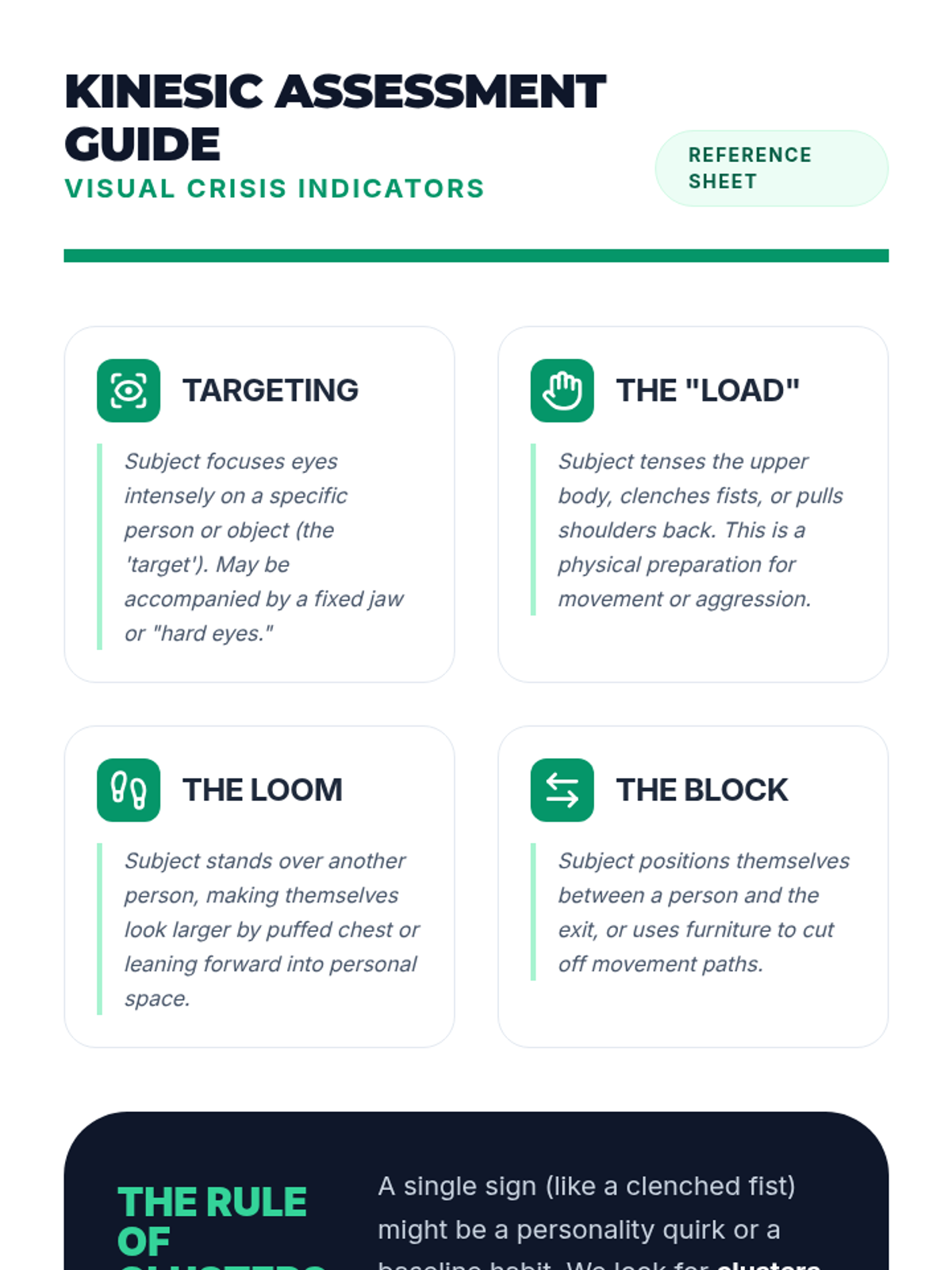
Student reference sheet defining key kinesic warnings such as Targeting, The Load, The Loom, and The Block, including the Rule of Clusters.
A visual presentation for Lesson 3 focusing on analyzing shifts in tone, volume, and identifying the turning point in conversations.
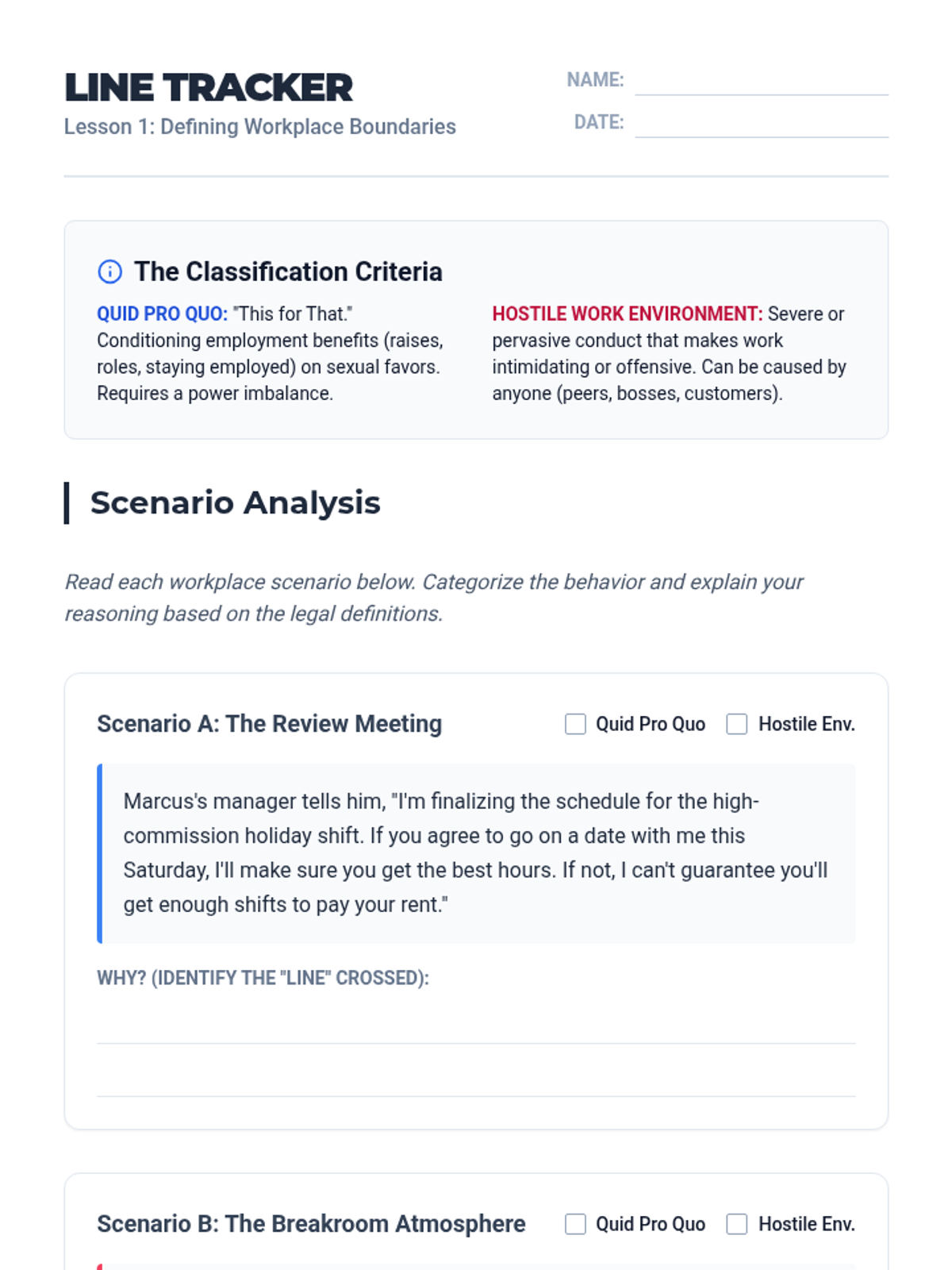
A student worksheet for Lesson 1 where they categorize workplace scenarios as Quid Pro Quo or Hostile Work Environment. It includes space for reasoning and critical reflection on power dynamics.
Educational slide deck for Lesson 1: Defining Workplace Boundaries. It covers legal definitions under Title VII, explains the difference between Quid Pro Quo and Hostile Work Environments, and provides clear examples of each.
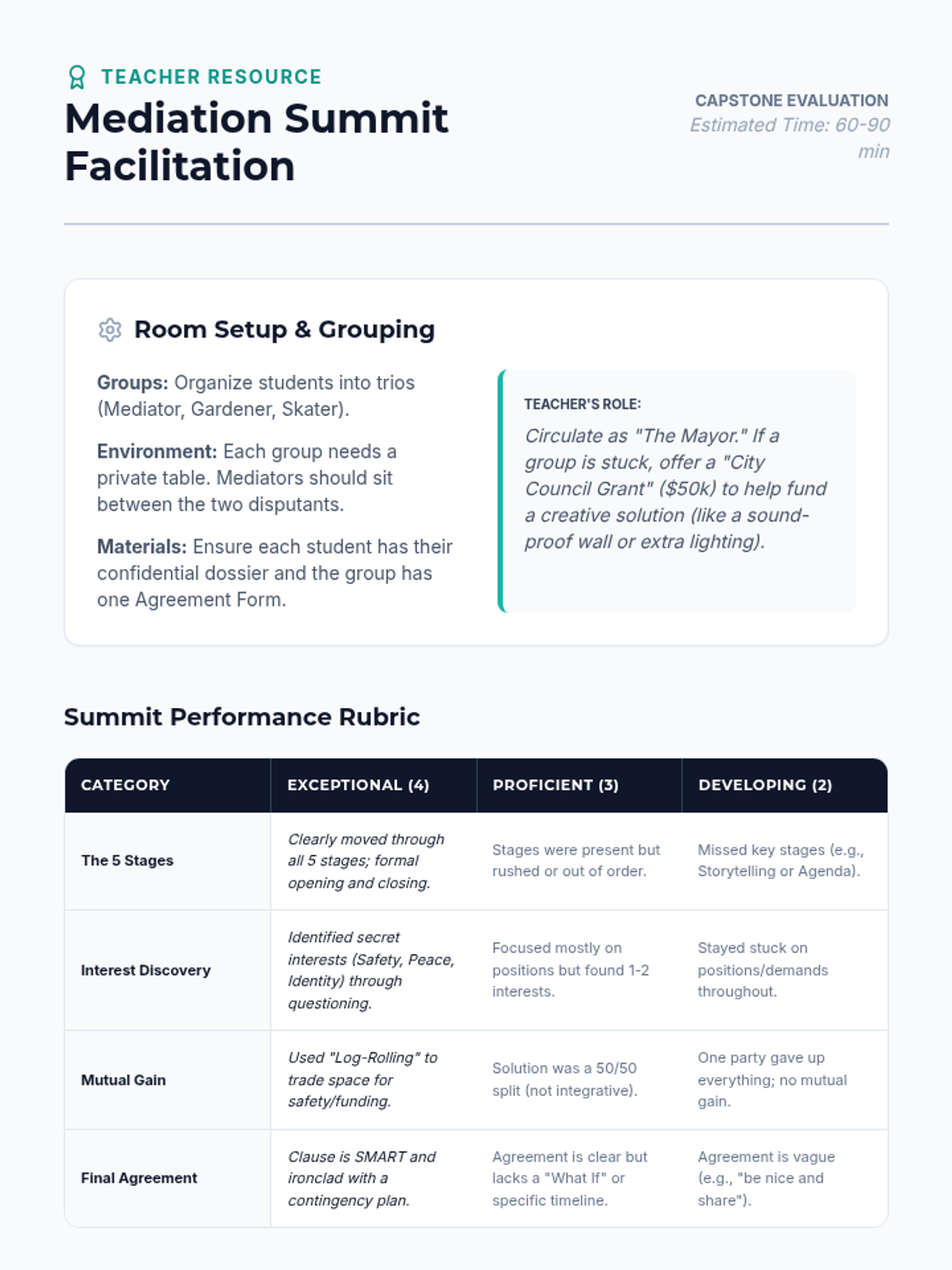
Teacher facilitation guide and evaluation rubric for the Lesson 5 Mediation Summit capstone simulation. Includes setup instructions, a grading rubric, and debrief prompts.
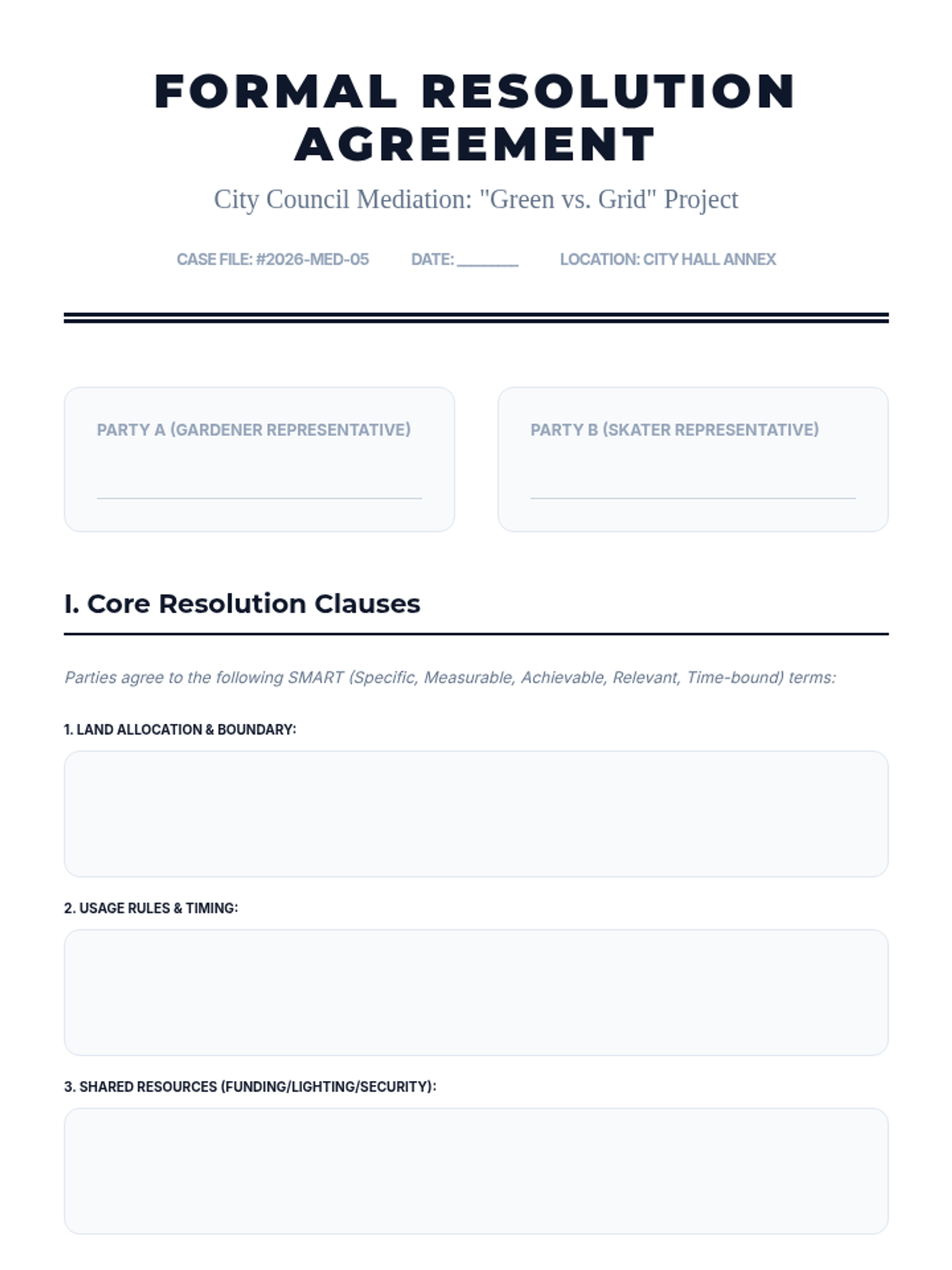
Formal mediation agreement form for the "Green vs. Grid" simulation. Students use this to draft their final SMART resolution clauses and finalize the simulation with signatures.
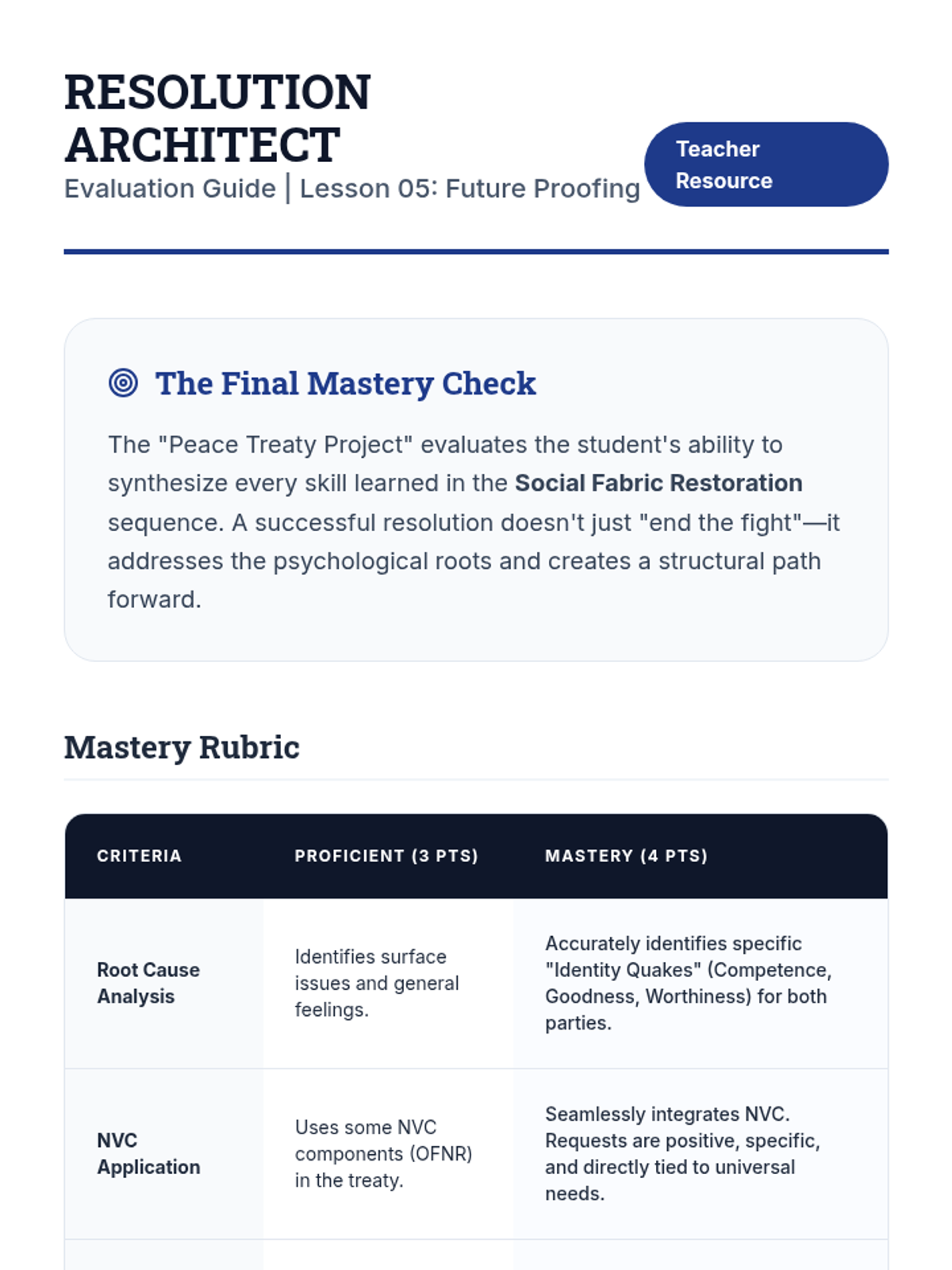
Teacher assessment guide and rubric for the final Peace Treaty project in Lesson 5.
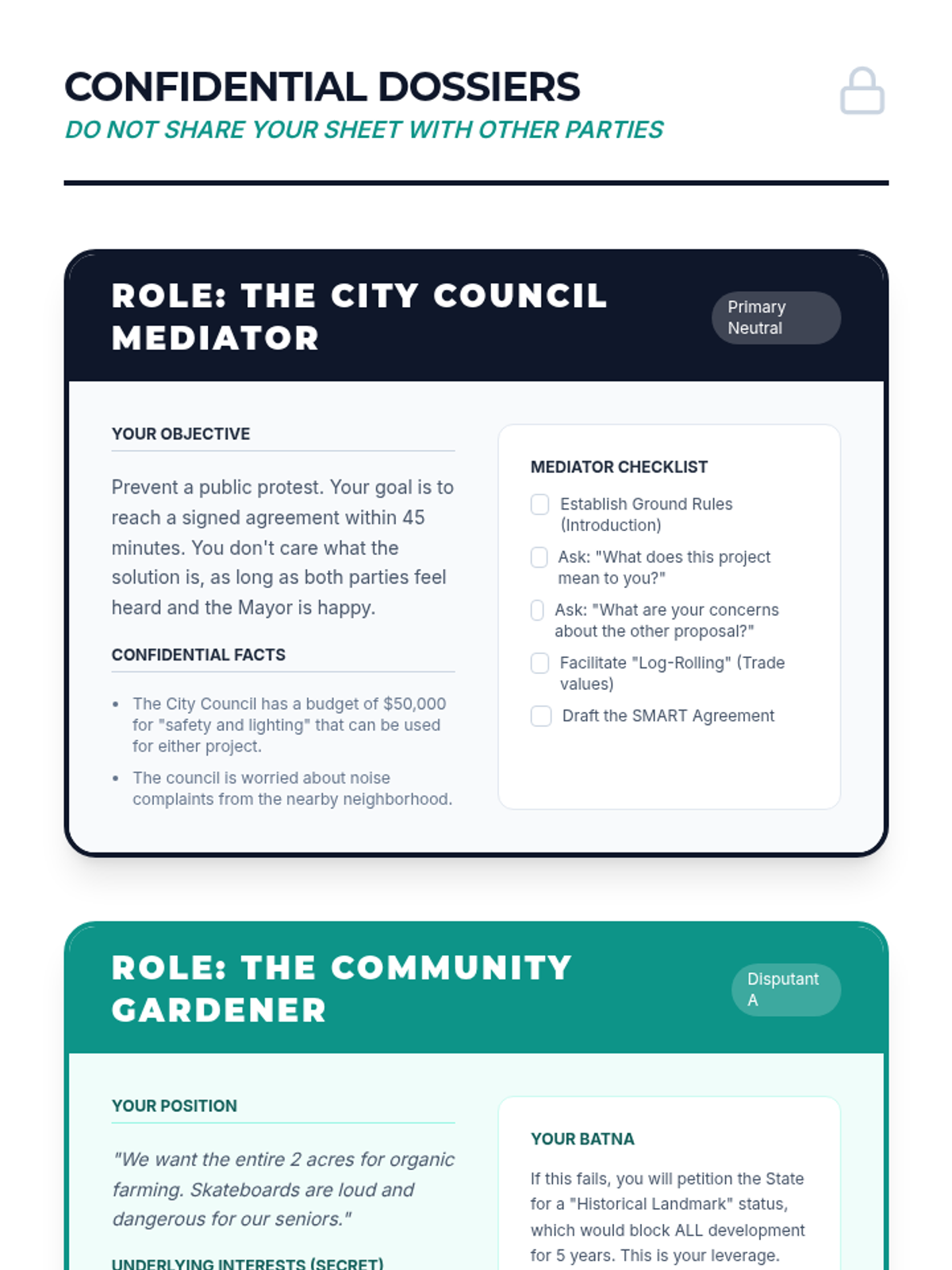
Confidential briefing sheets for the three roles in the "Green vs. Grid" simulation: The Mediator, The Gardener, and The Skater. Includes secret interests and walk-away points.
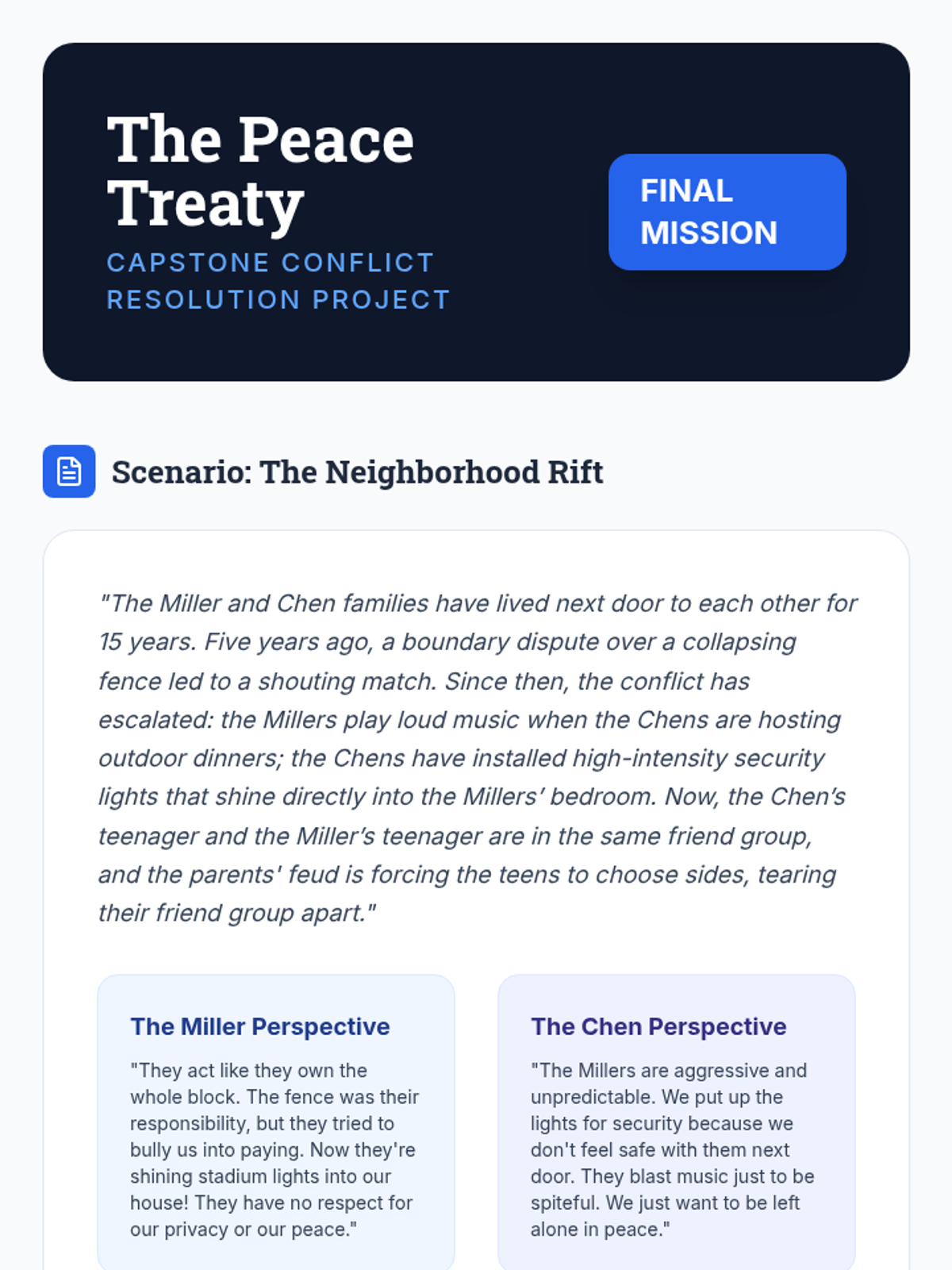
Final synthesis project where students design a comprehensive resolution and peace treaty for a long-standing neighborhood dispute.
Slide deck for Lesson 5 exploring the synthesis of skills to design long-term, sustainable resolutions.
Briefing slide deck for the Lesson 5 Mediation Summit capstone simulation. Introduces the "Green vs. Grid" land use case, roles, and rules of engagement.
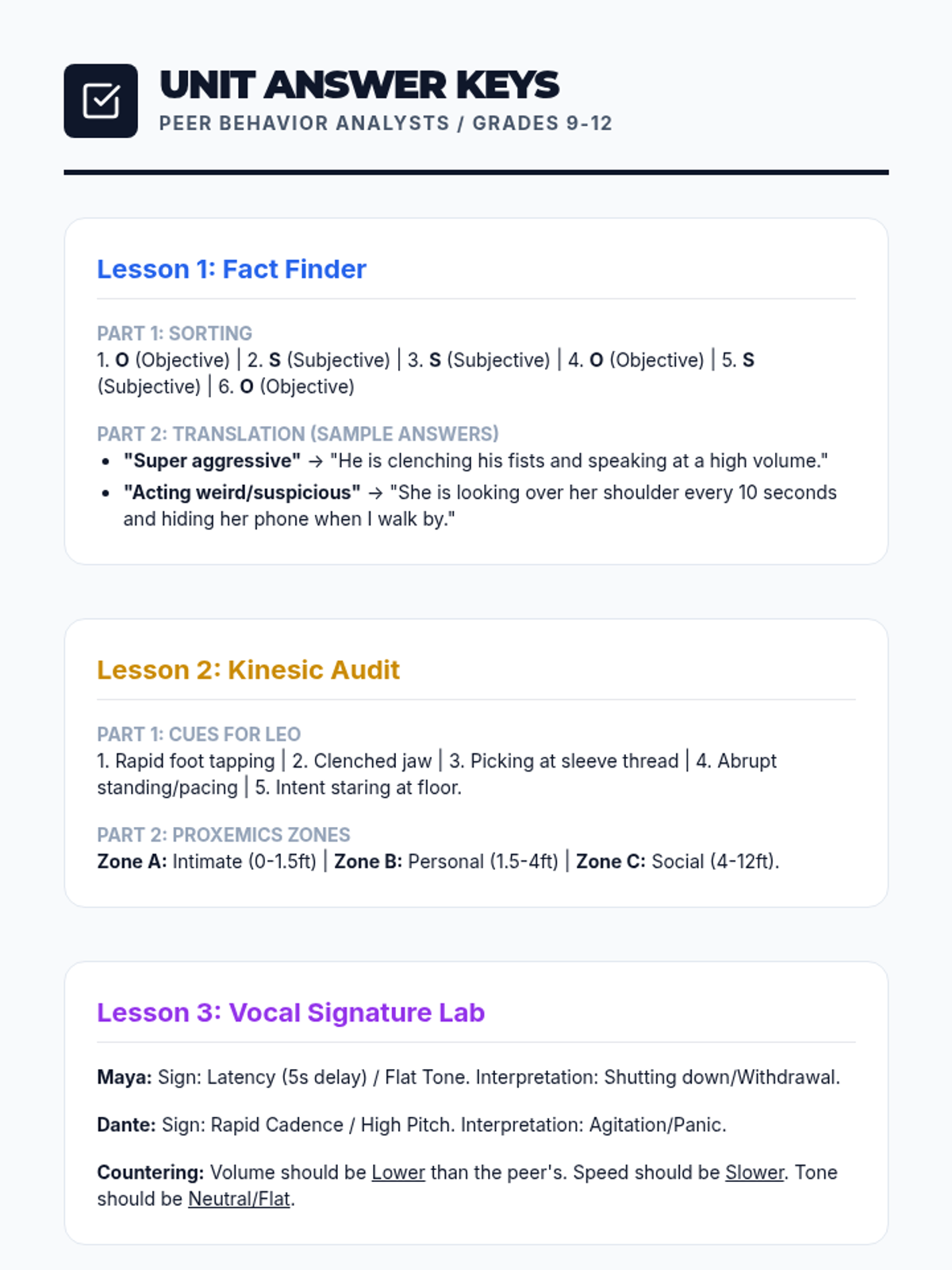
A complete set of answer keys and sample responses for all student worksheets and activities in the Peer Behavior Analysts sequence.
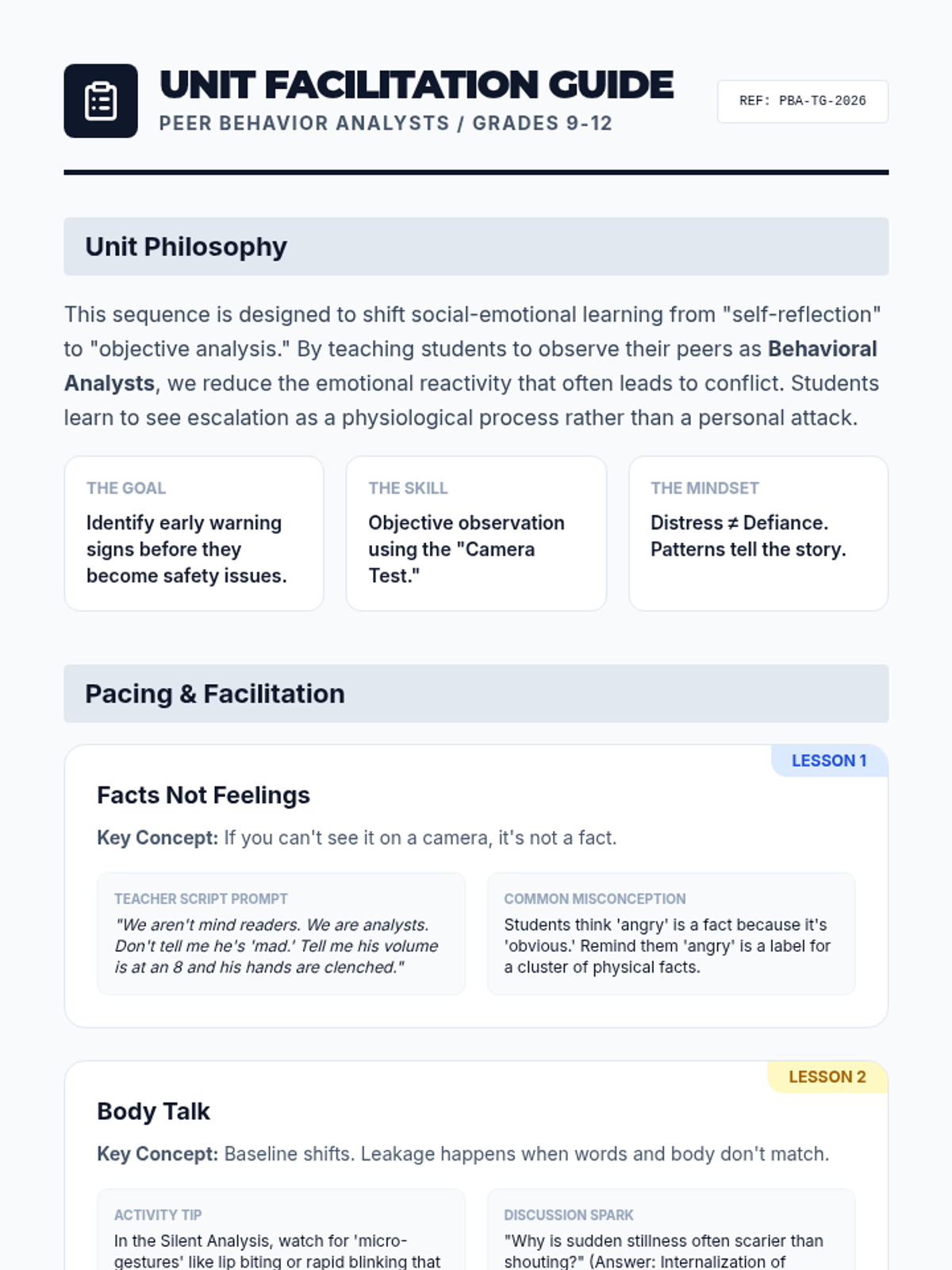
A comprehensive unit facilitation guide for teachers, providing instructional strategies, scripts, pacing notes, and differentiation tips for the Peer Behavior Analysts sequence.
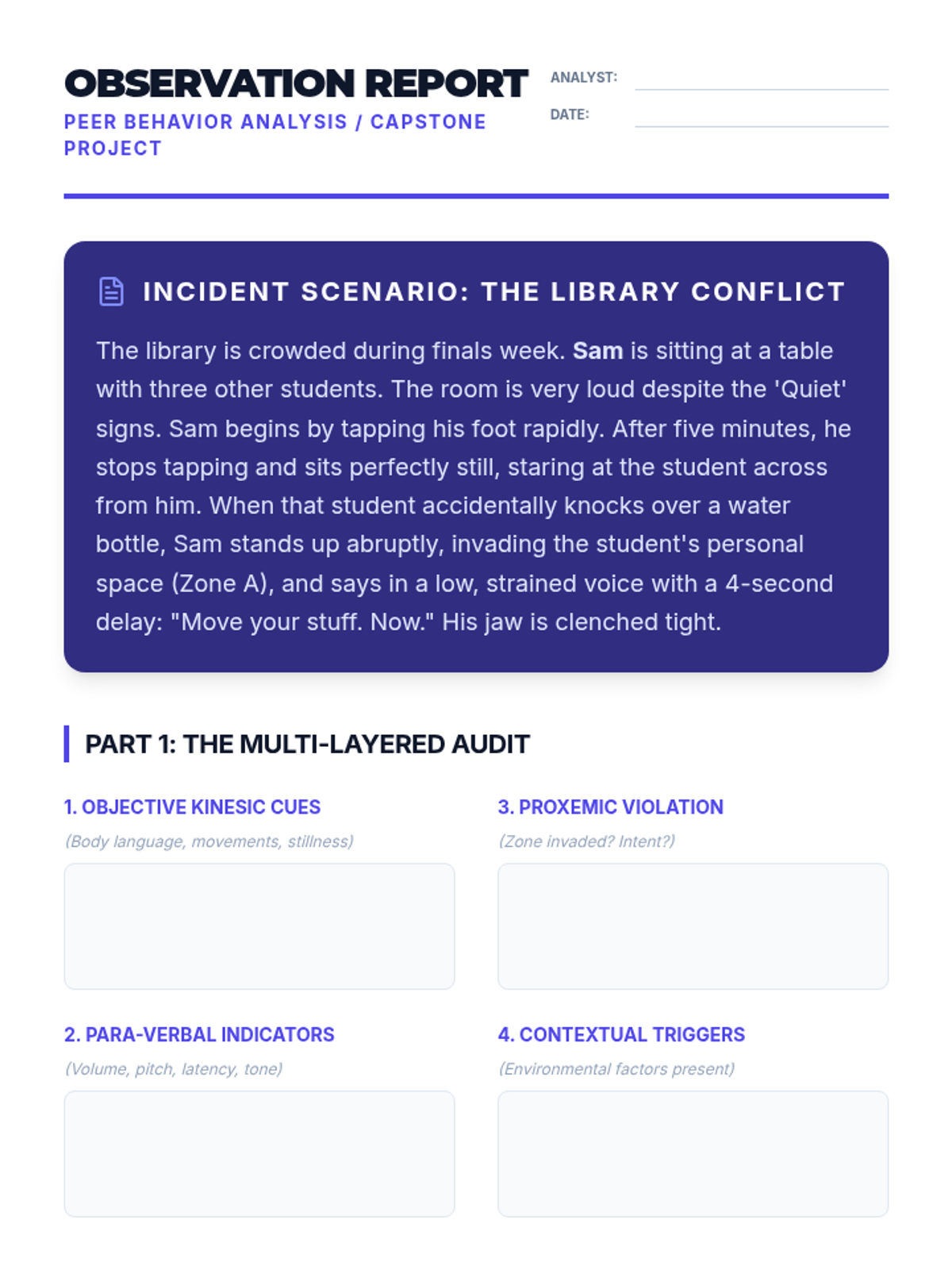
Capstone project worksheet where students synthesize all observation skills to analyze a complex scenario, identifying cues, environmental triggers, and intervention points.
Final slide deck for the sequence, focusing on synthesis of behavioral observation skills and identifying environmental triggers in escalation analysis.
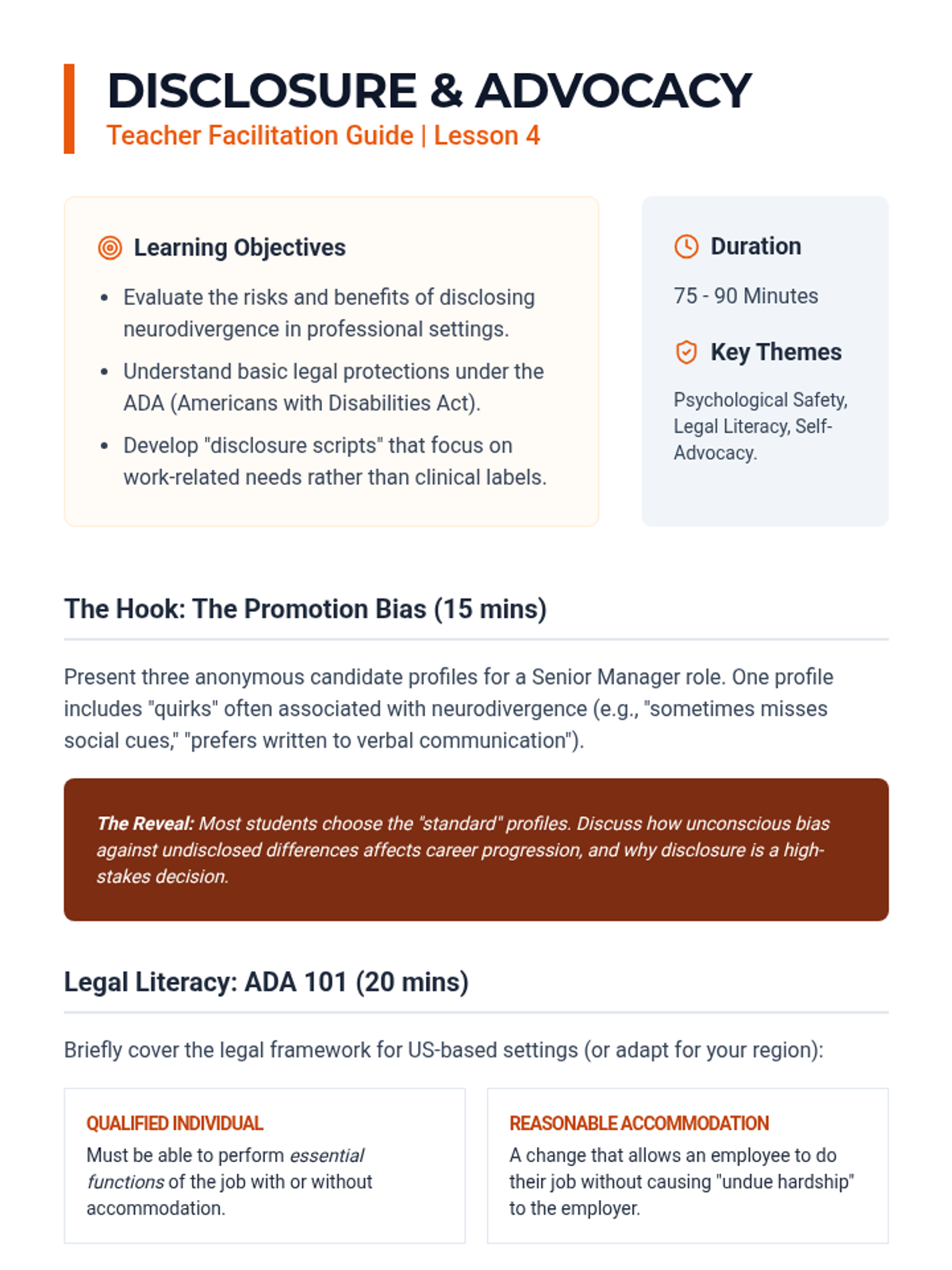
Teacher facilitation guide for Lesson 4, focusing on the legal aspects of the ADA, psychological safety, and the "Calculus of Disclosure."
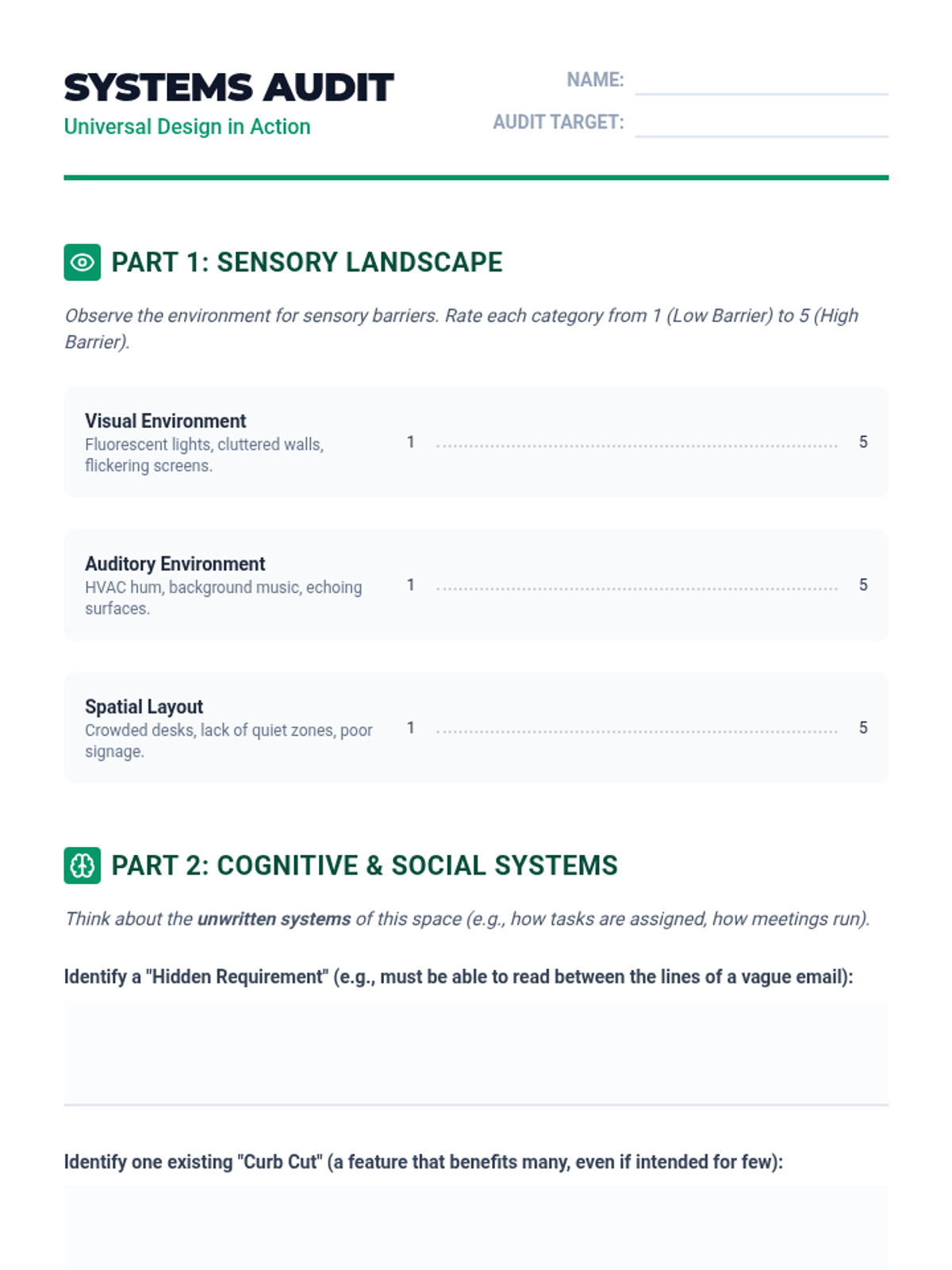
A student activity sheet for Lesson 3 focused on conducting environmental audits for sensory and systemic barriers.
Slide deck for Lesson 3 introducing Universal Design principles, the Curb Cut Effect, and systemic inclusion.
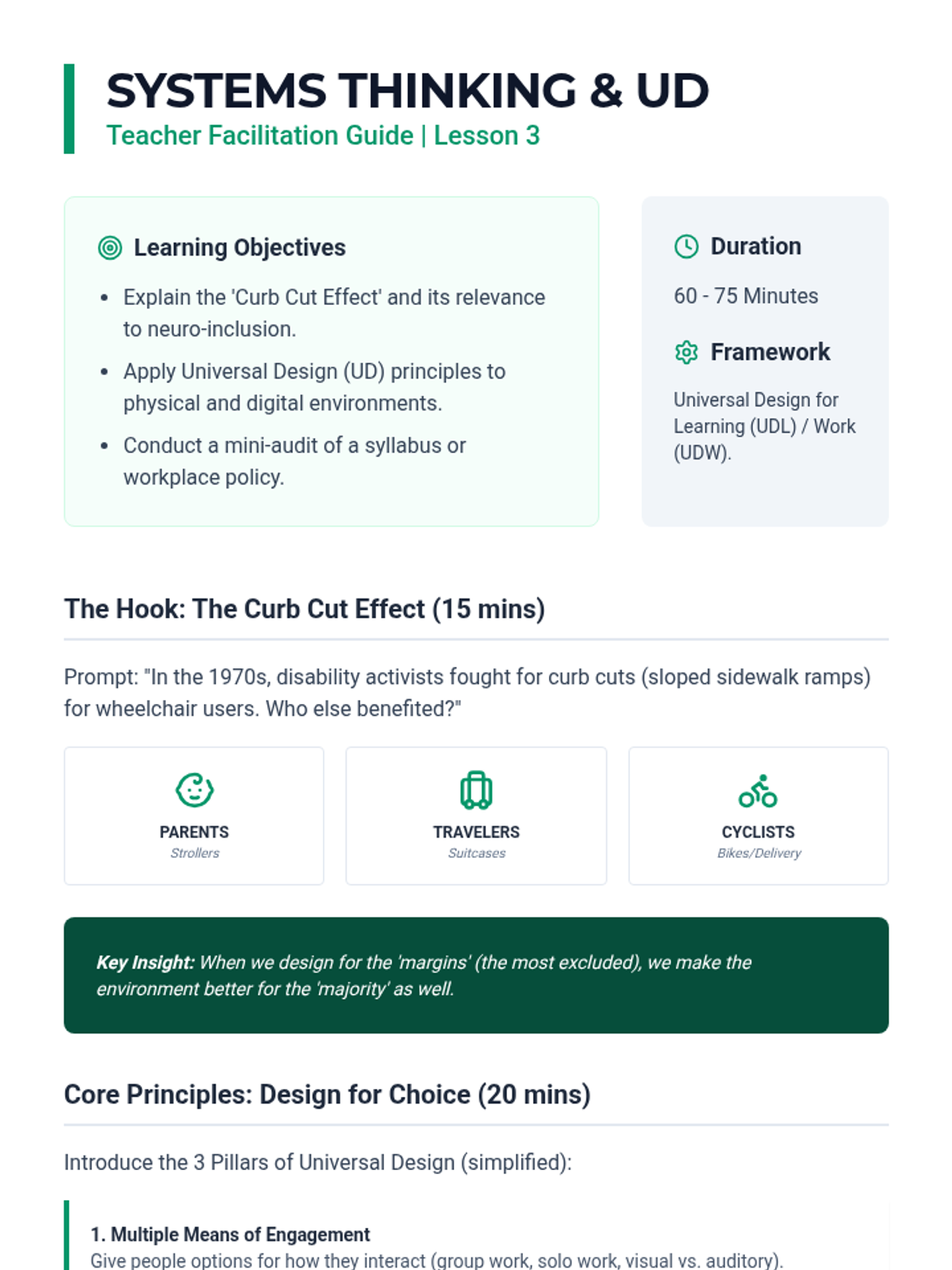
Teacher facilitation guide for Lesson 3, focusing on Universal Design principles, the Curb Cut Effect, and conducting environmental audits.
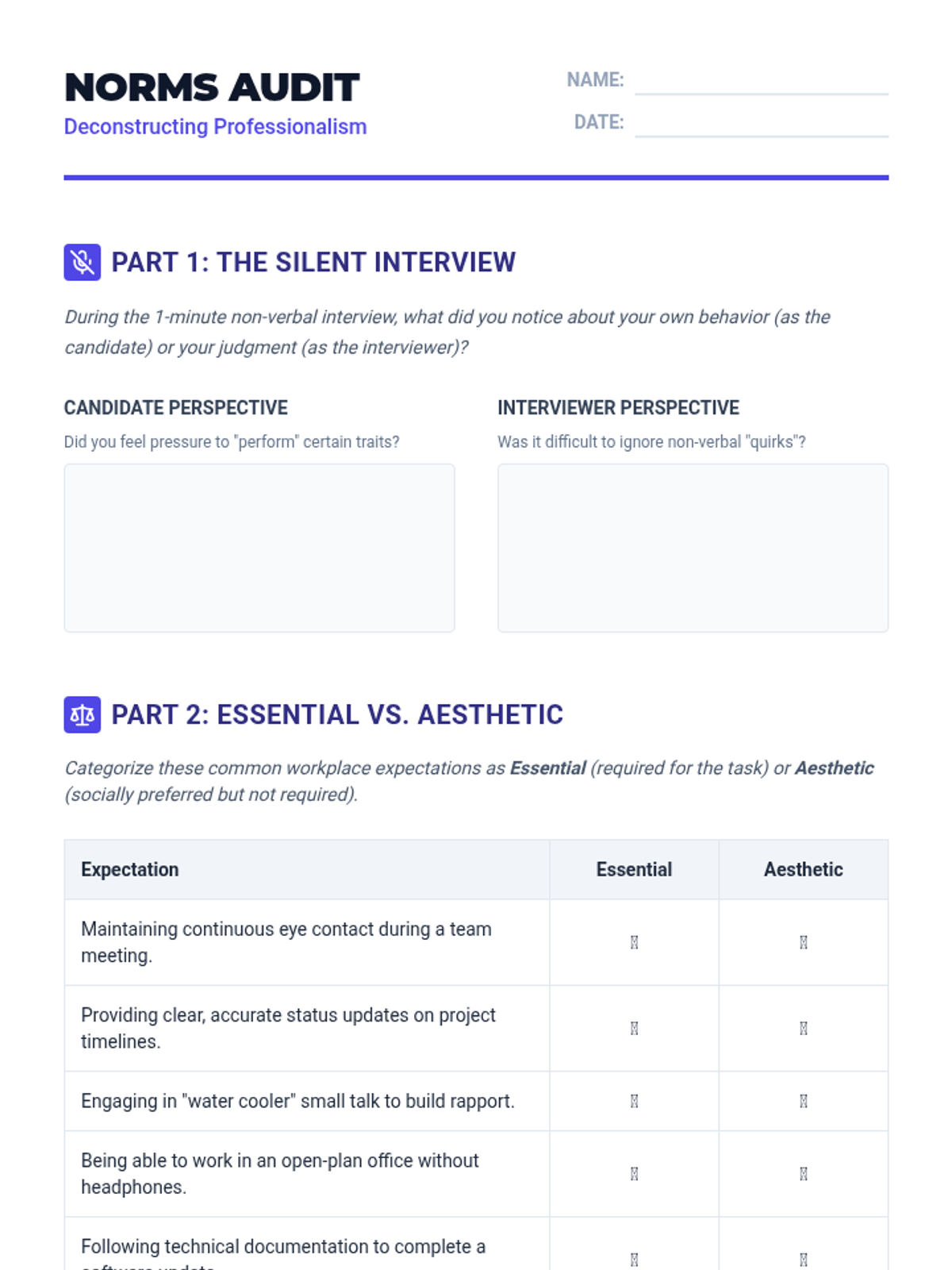
A student activity sheet for Lesson 2 focused on auditing professional norms and distinguishing essential functions from social etiquette.
Introductory slide deck for Lesson 2, covering unwritten professional codes, the cost of masking, and shifting toward essential functions.
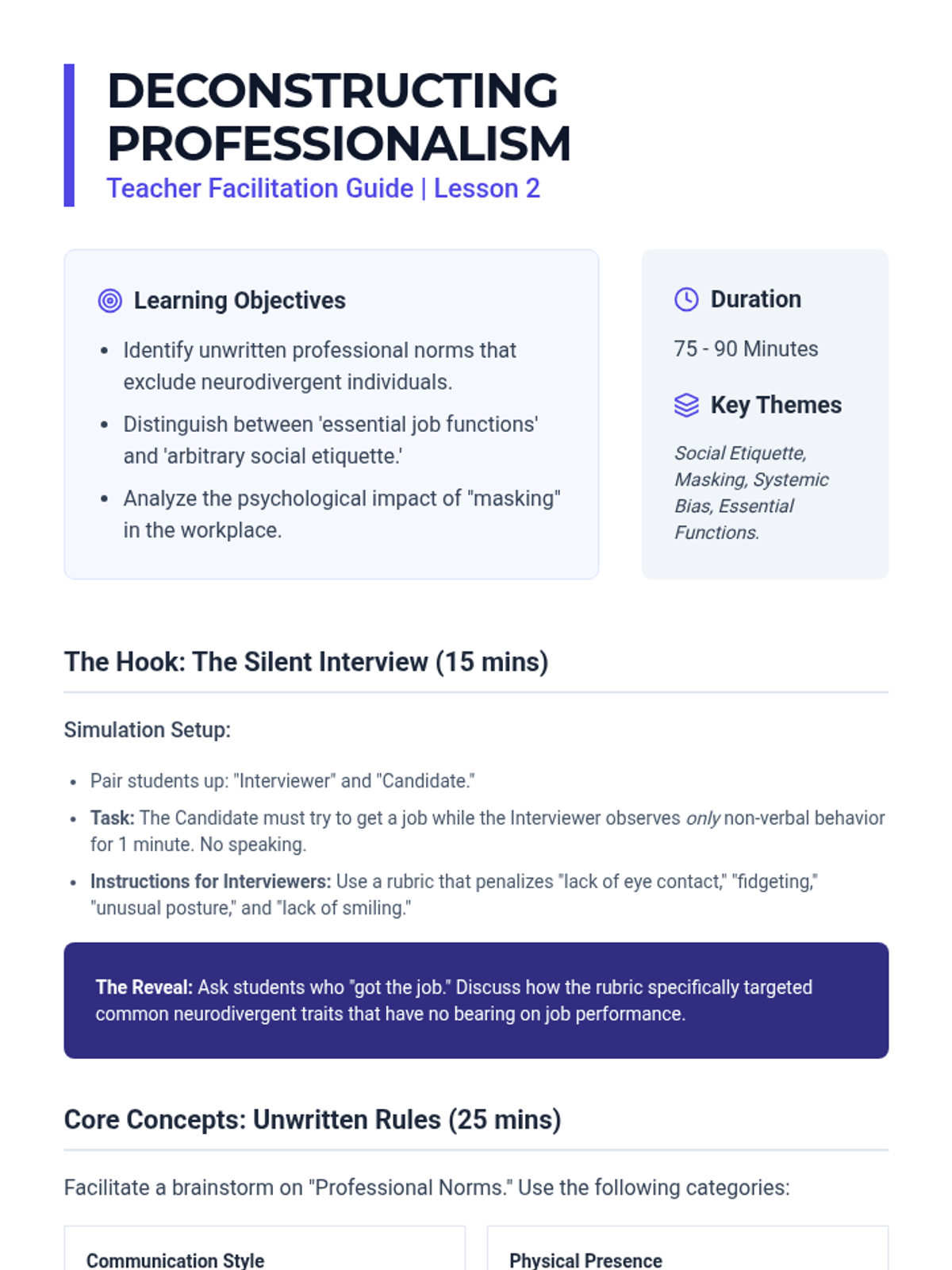
Teacher facilitation guide for Lesson 2, including the "Silent Interview" simulation instructions and discussion prompts on professionalism and masking.
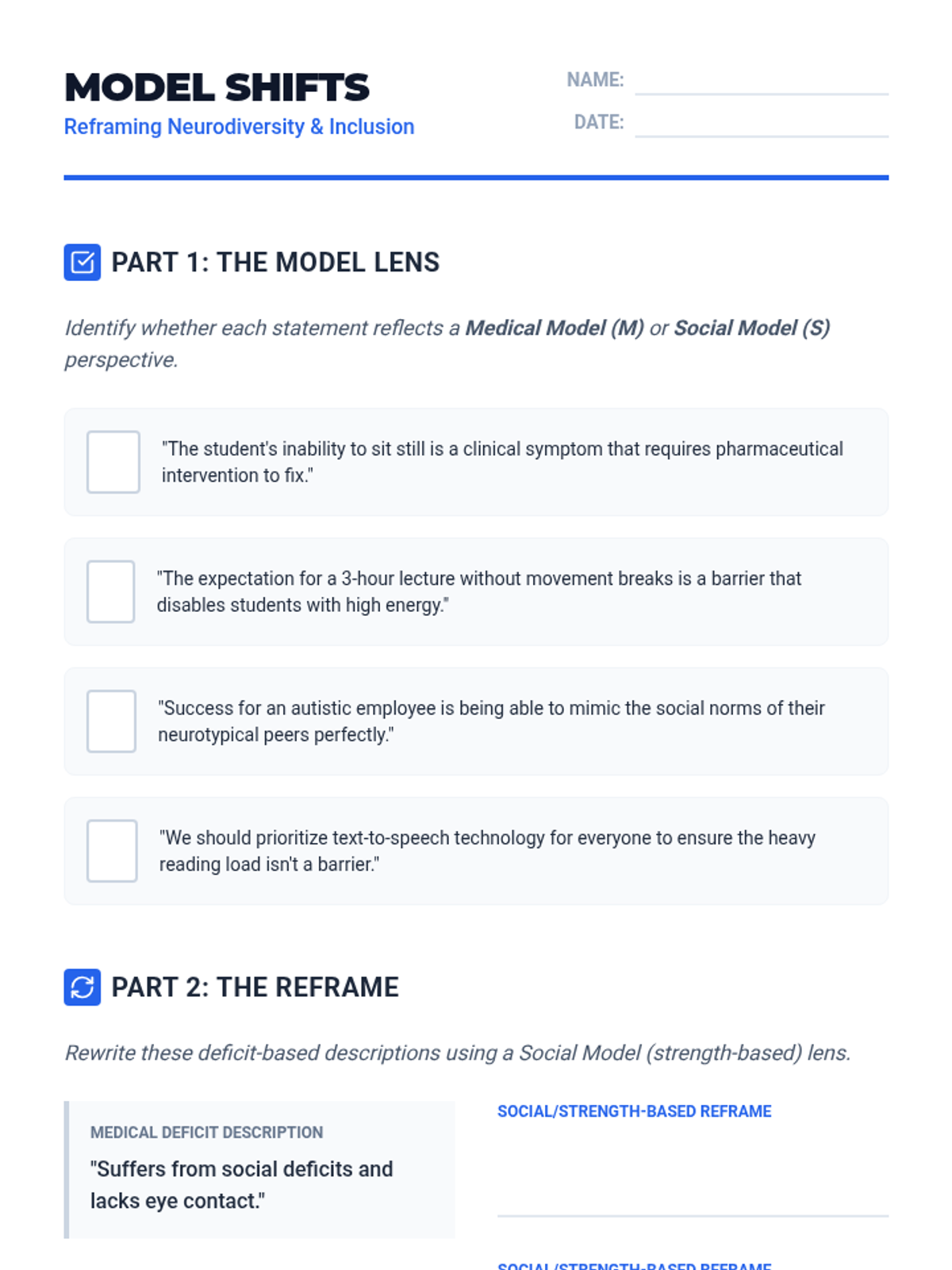
A student worksheet for Lesson 1 focused on identifying the Medical vs. Social Models and reframing deficit-based narratives.
Introductory slide deck for Lesson 1, covering the Medical and Social Models of disability and strength-based reframing of neurotypes.
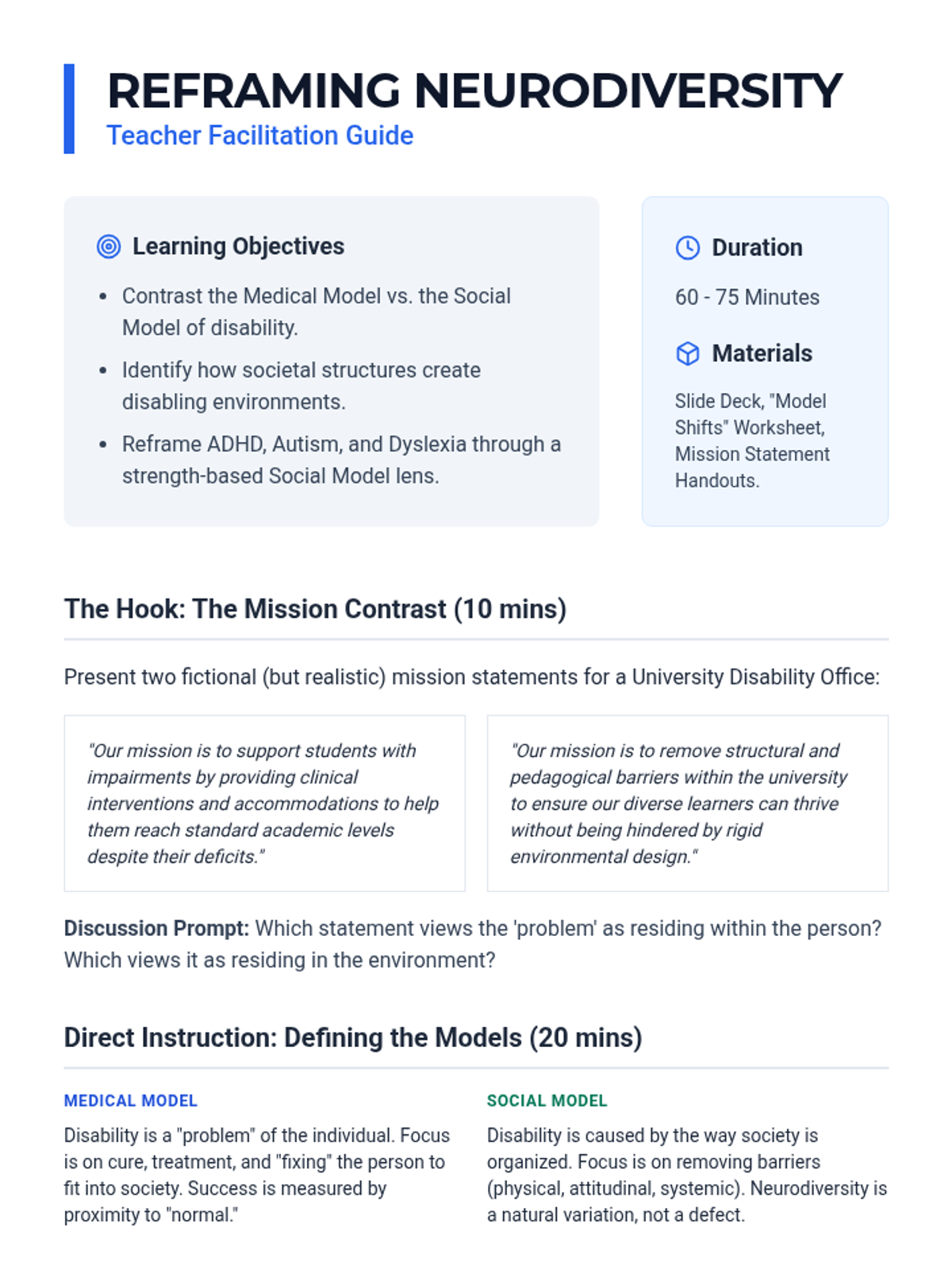
A teacher facilitation guide for Lesson 1, detailing the hook, direct instruction on Medical vs. Social Models, and discussion prompts.
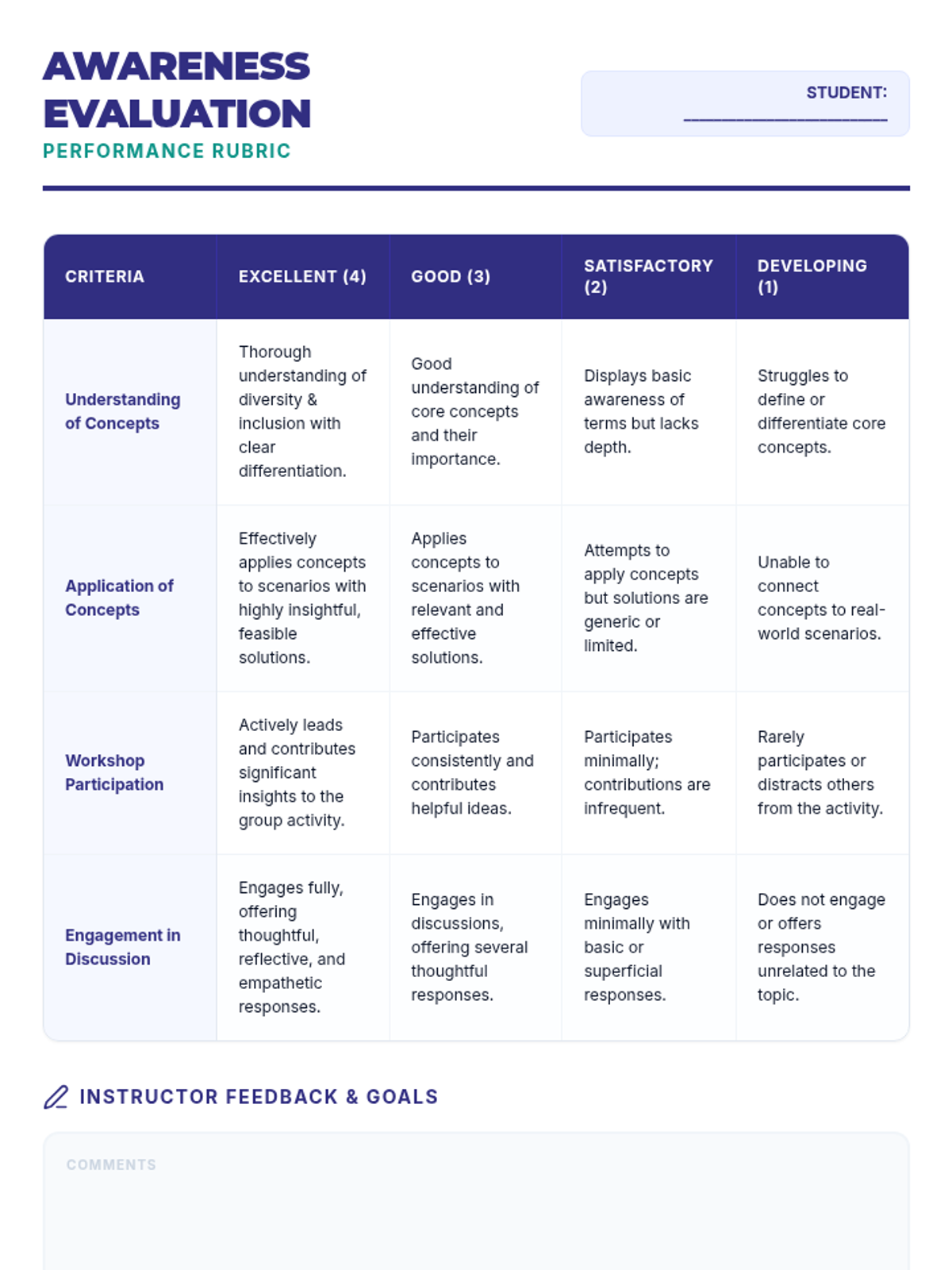
A professional evaluation rubric to assess students' understanding, application, and participation regarding workplace diversity and inclusion concepts.
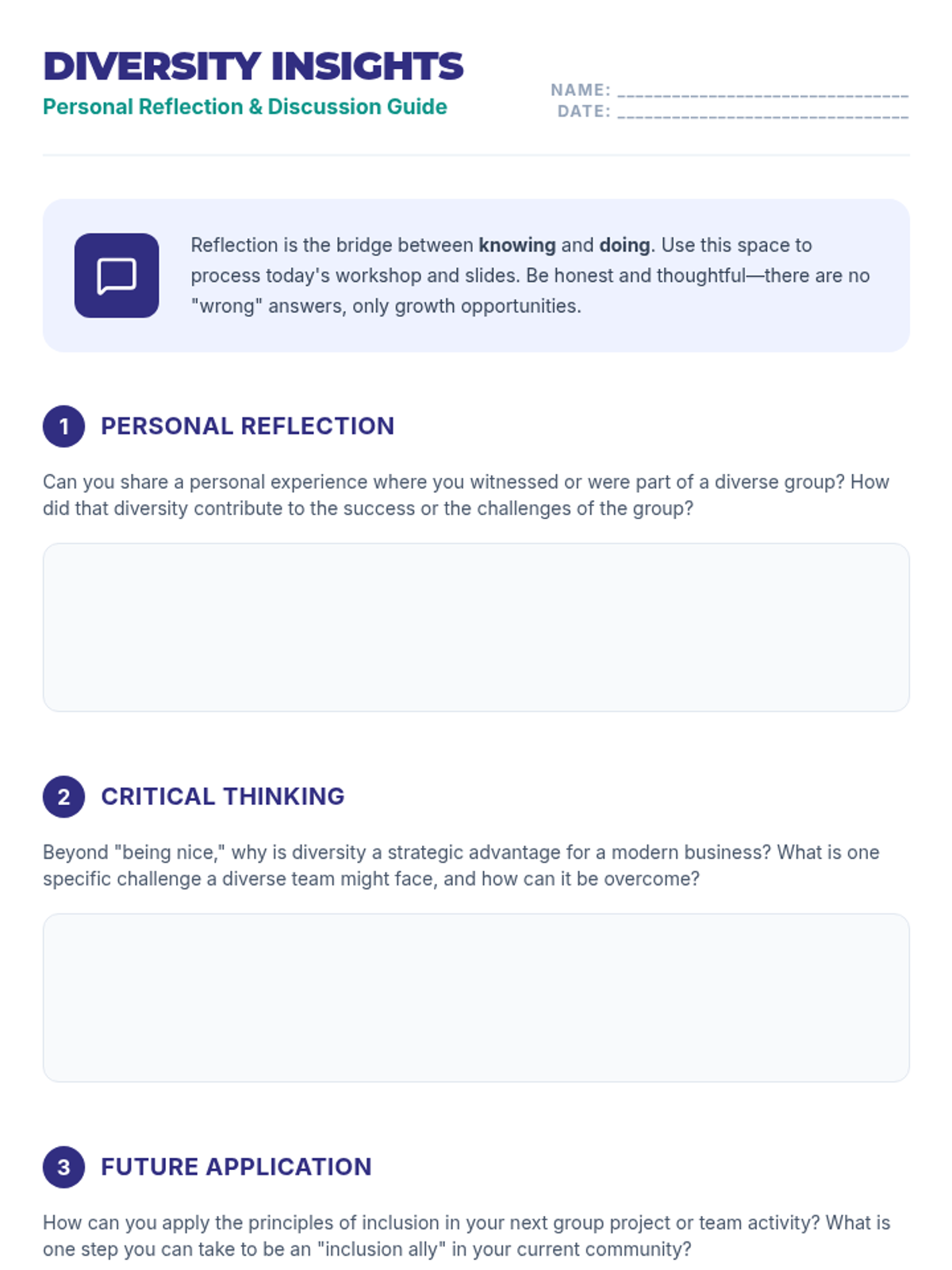
A guided reflection sheet for students to document their personal insights, critical thinking, and future applications of diversity and inclusion principles.
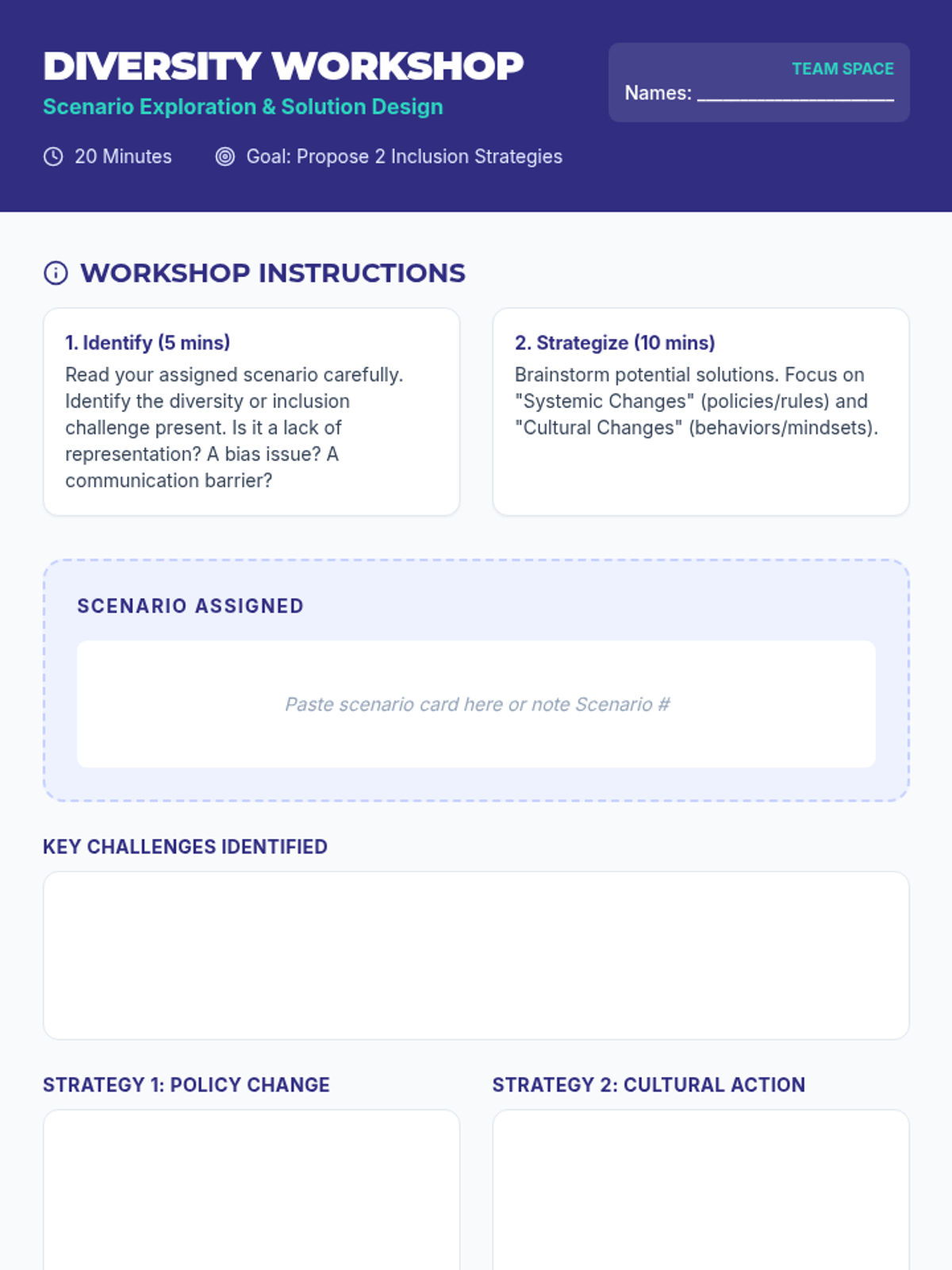
An interactive workshop worksheet and set of scenario cards for small group activities, focused on identifying diversity challenges and proposing inclusion strategies.
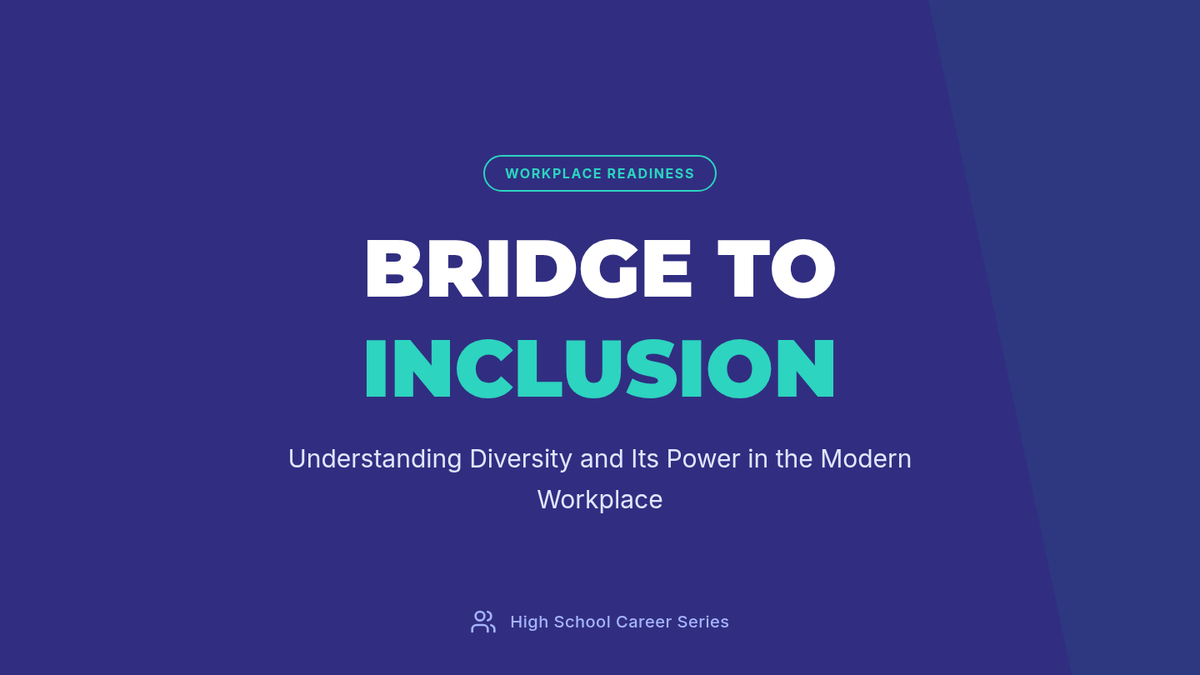
A vibrant, professional slide deck introducing the concepts of workplace diversity and inclusion, their business benefits, and strategies for building inclusive cultures.
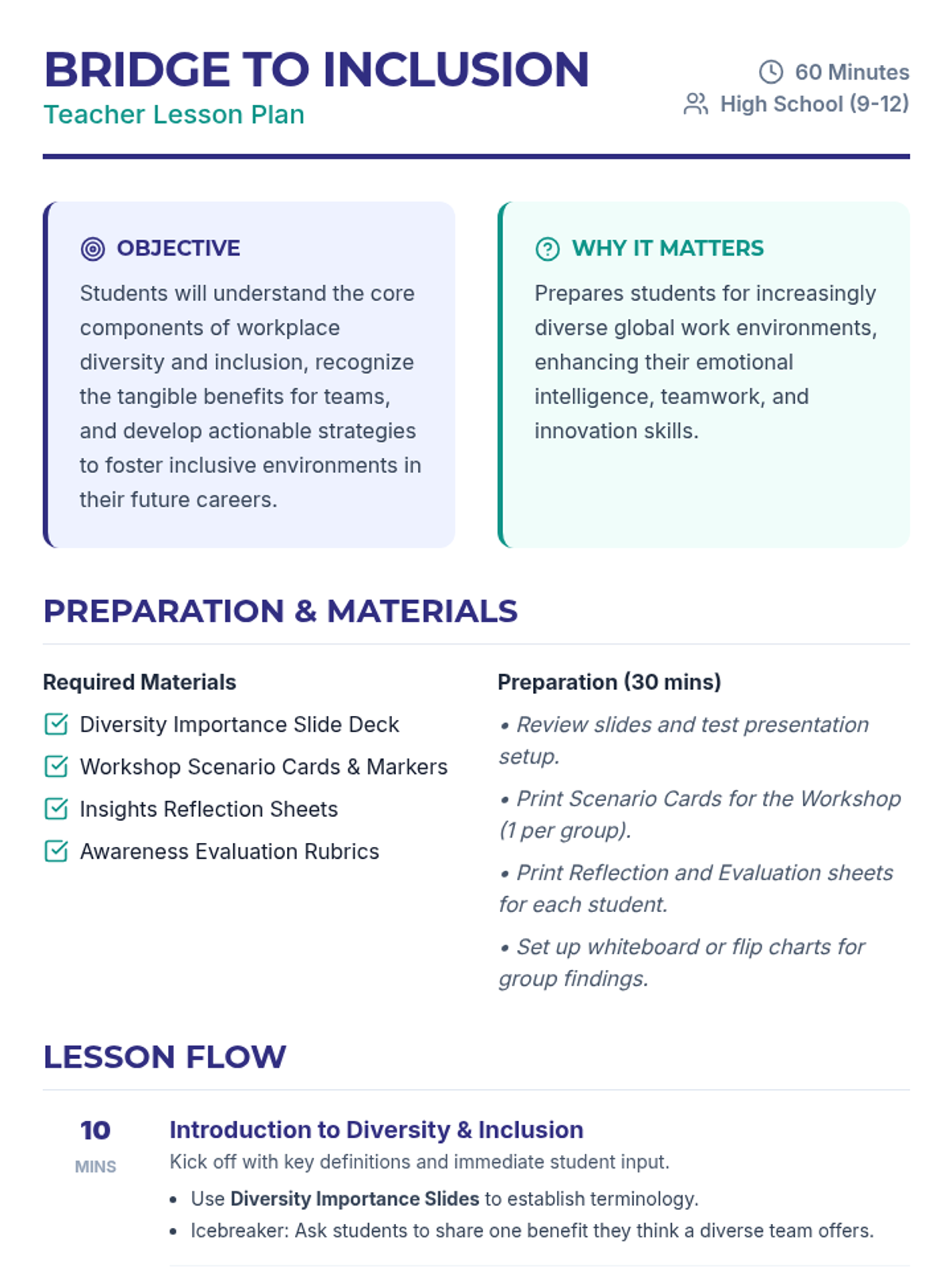
A comprehensive lesson plan for teachers, outlining the objectives, materials, and step-by-step flow for a 60-minute session on workplace diversity and inclusion.