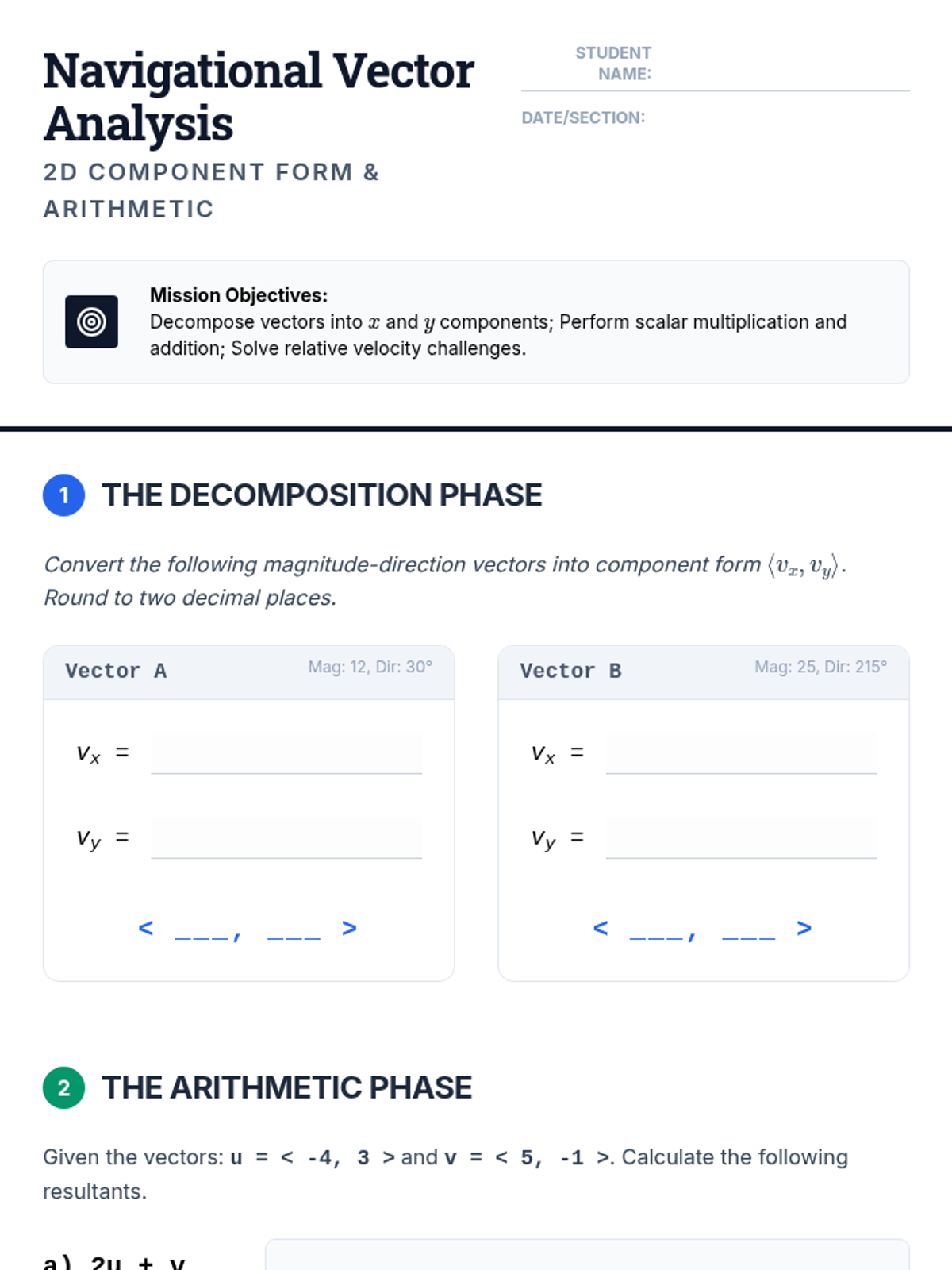
Vector properties, magnitudes, and algebraic operations including addition and scalar multiplication. Introduces matrix representations, arithmetic, and computational techniques for solving linear systems.
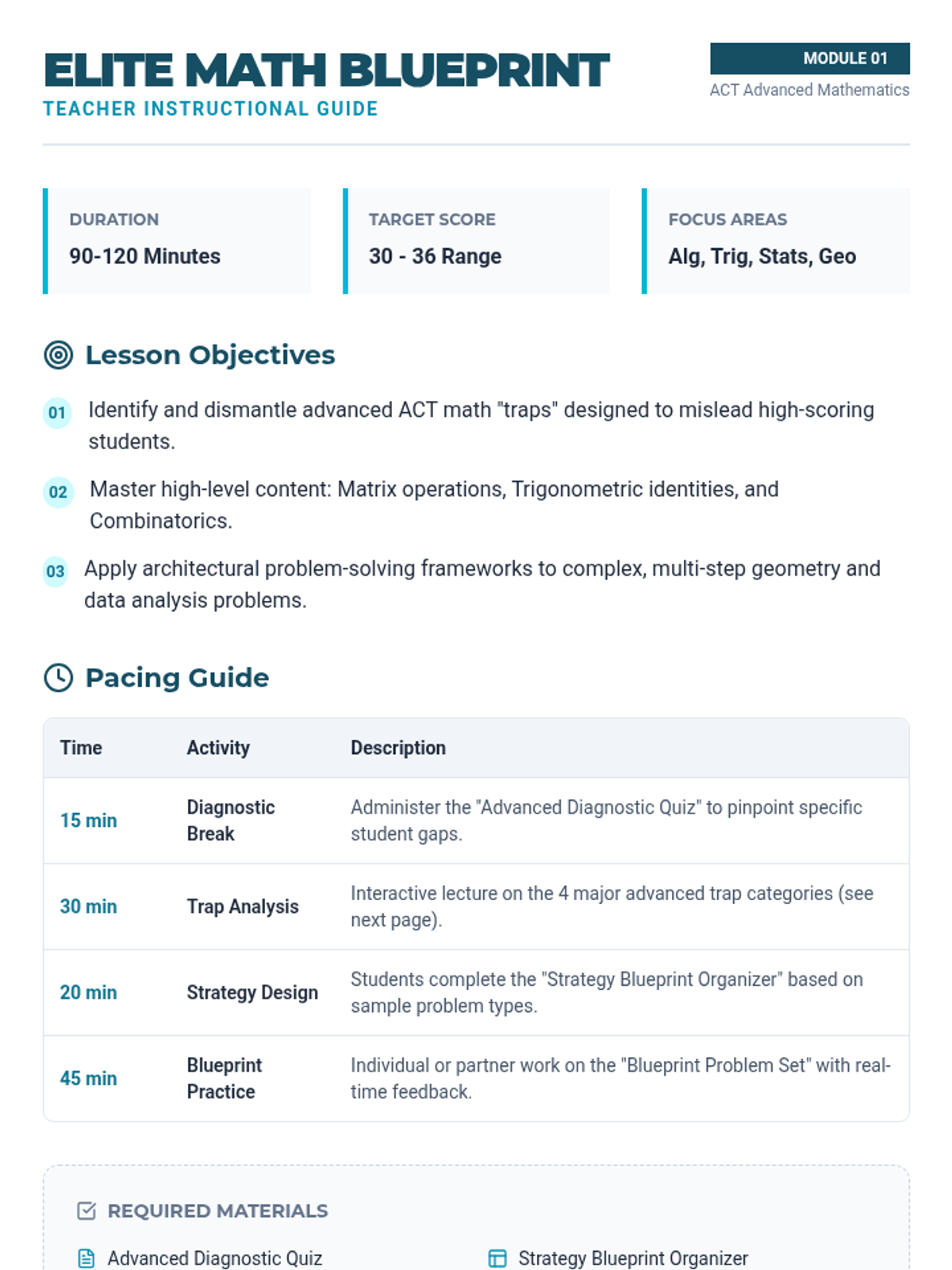
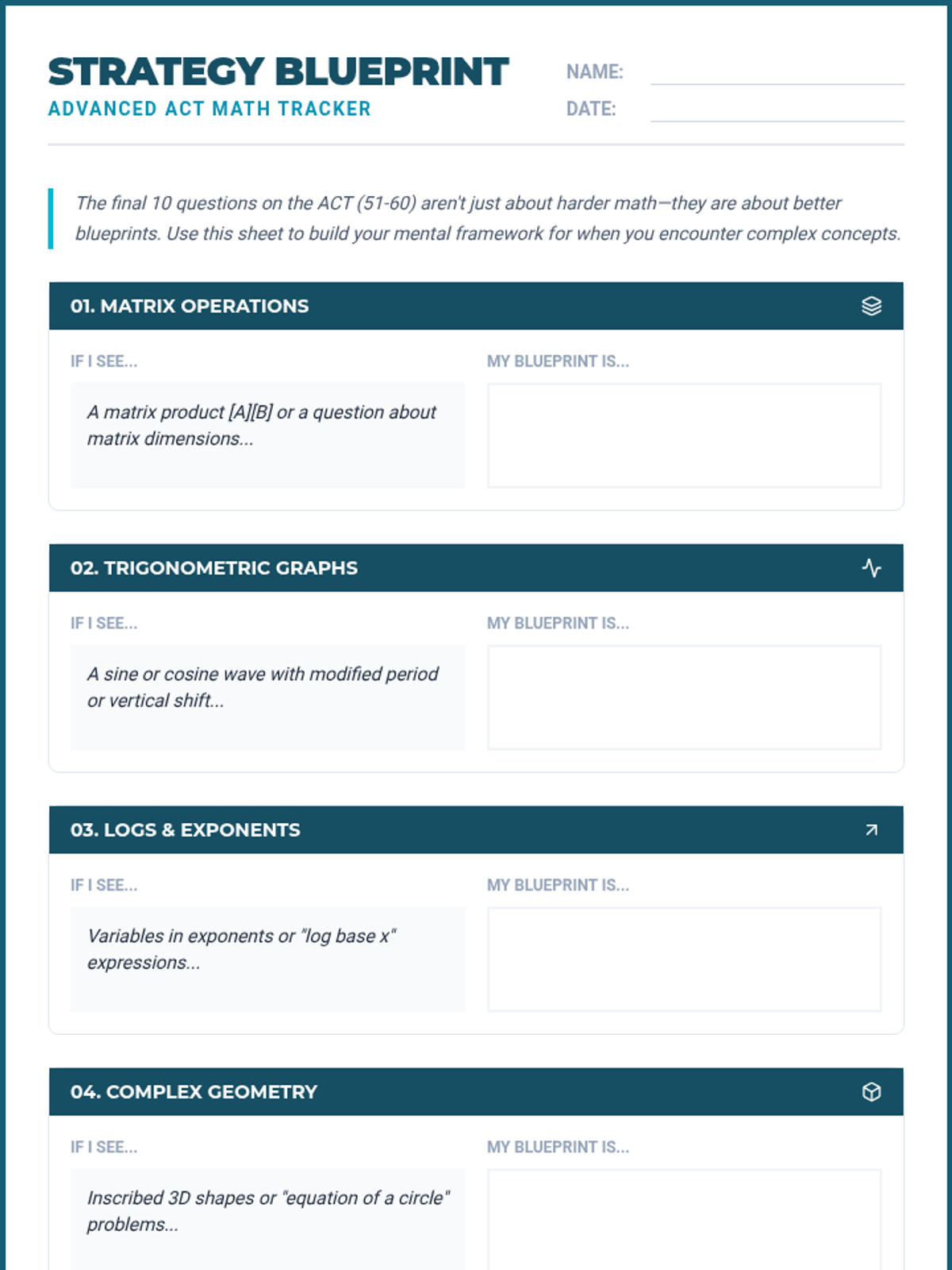
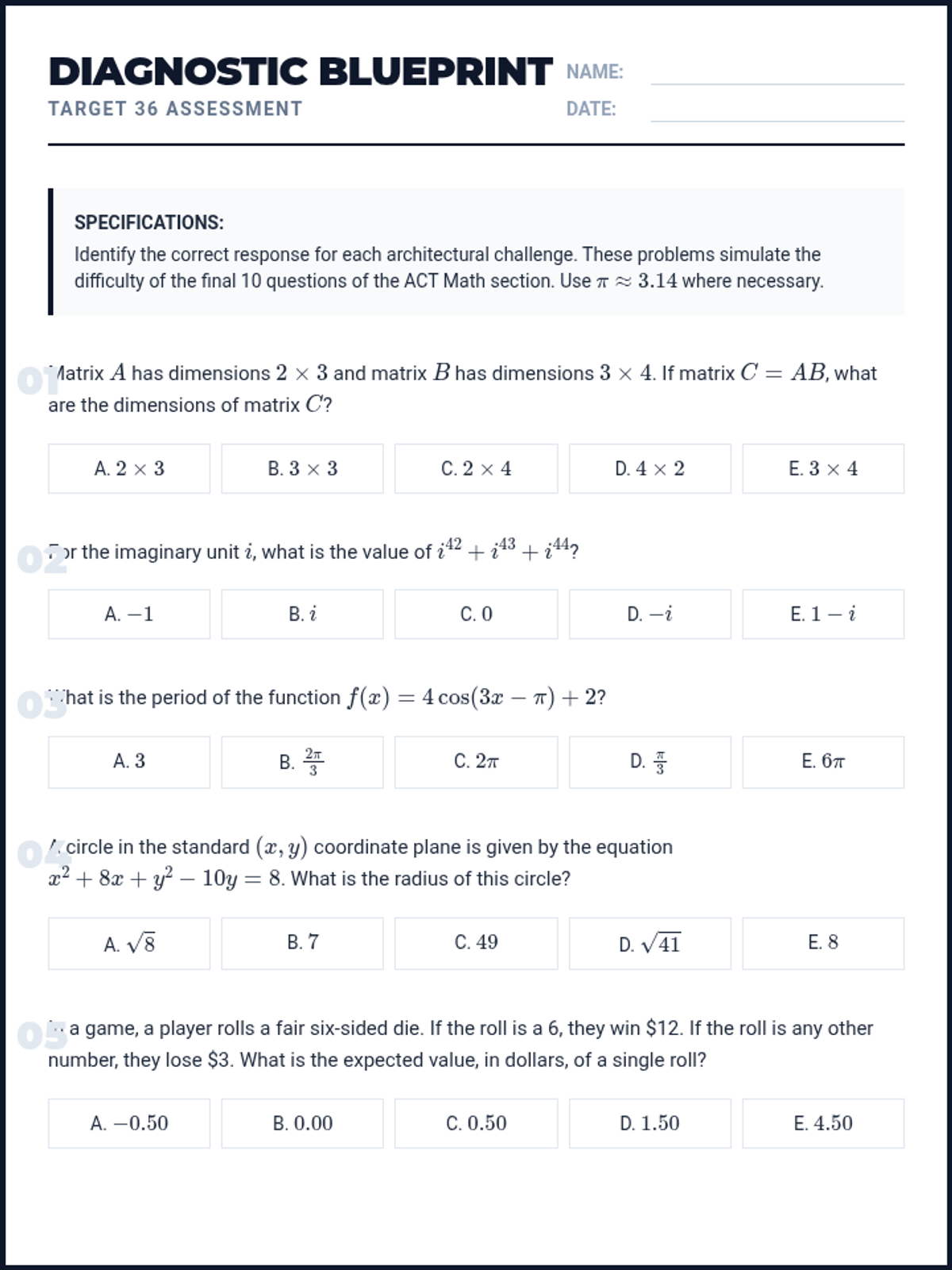
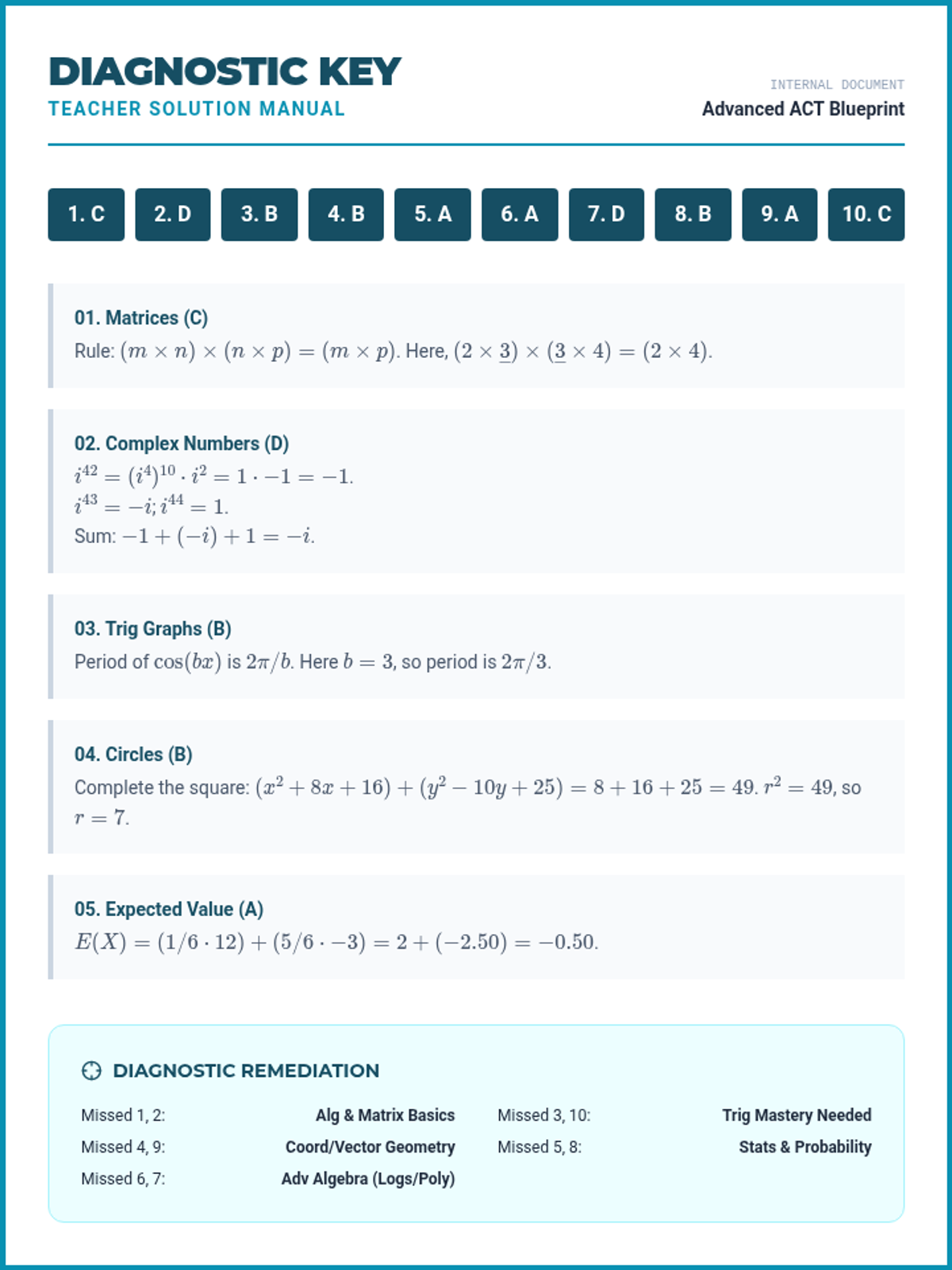
A comprehensive prep sequence for the most challenging questions on the ACT Math and Science sections. It focuses on high-level conceptual blueprints for math topics like complex numbers and matrices, alongside speed-reading and data-interpretation strategies for the Science section.
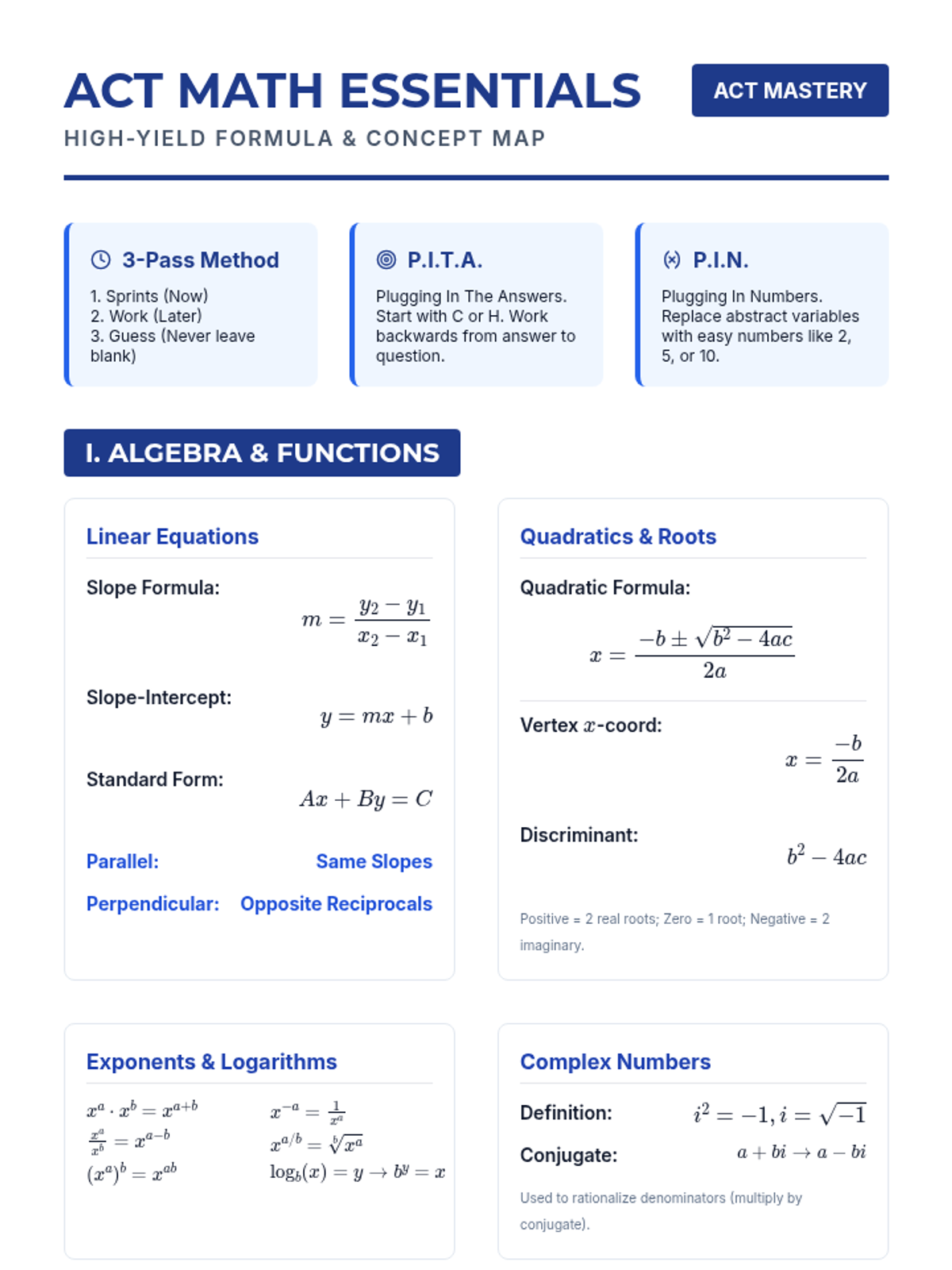
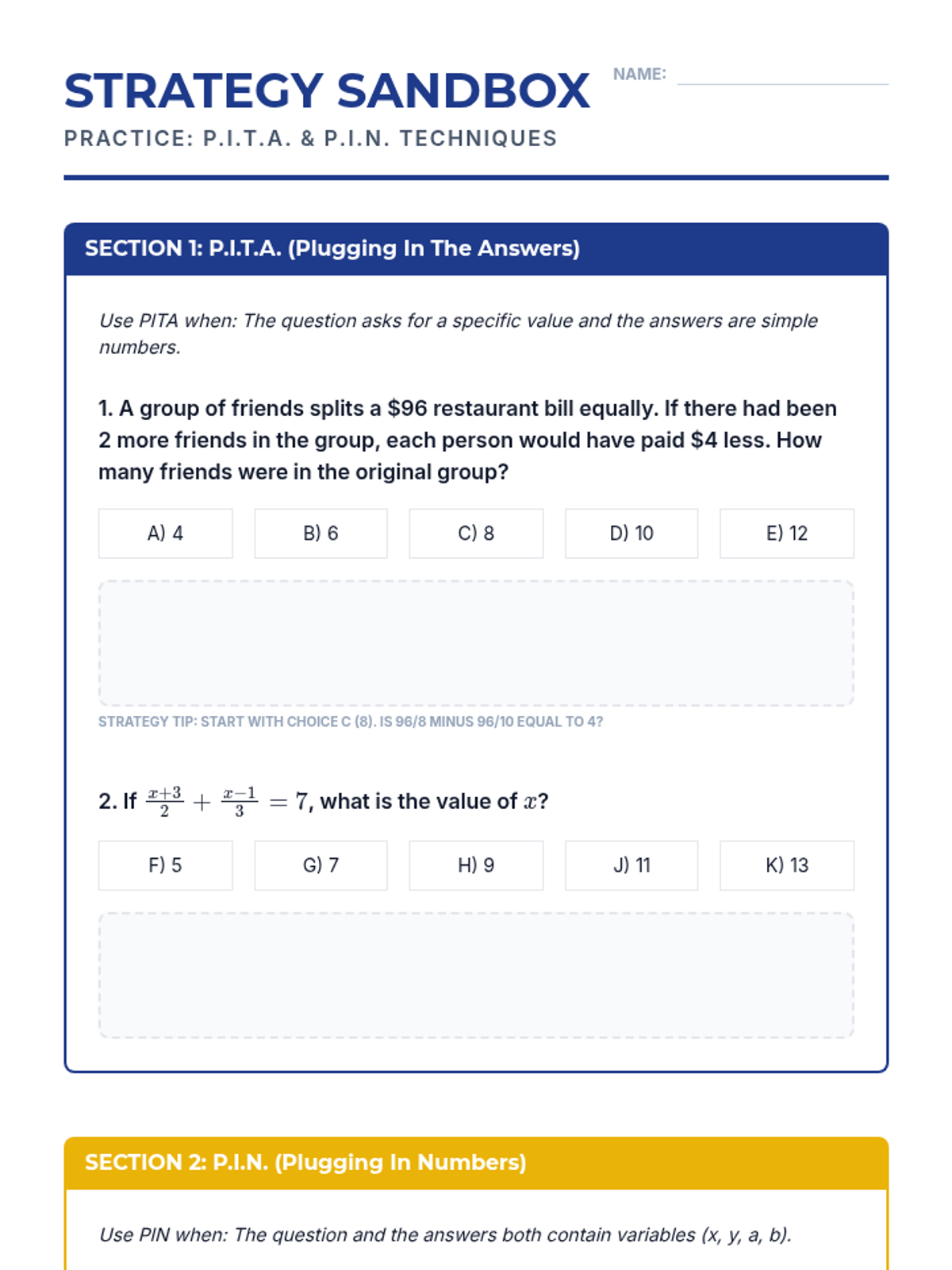
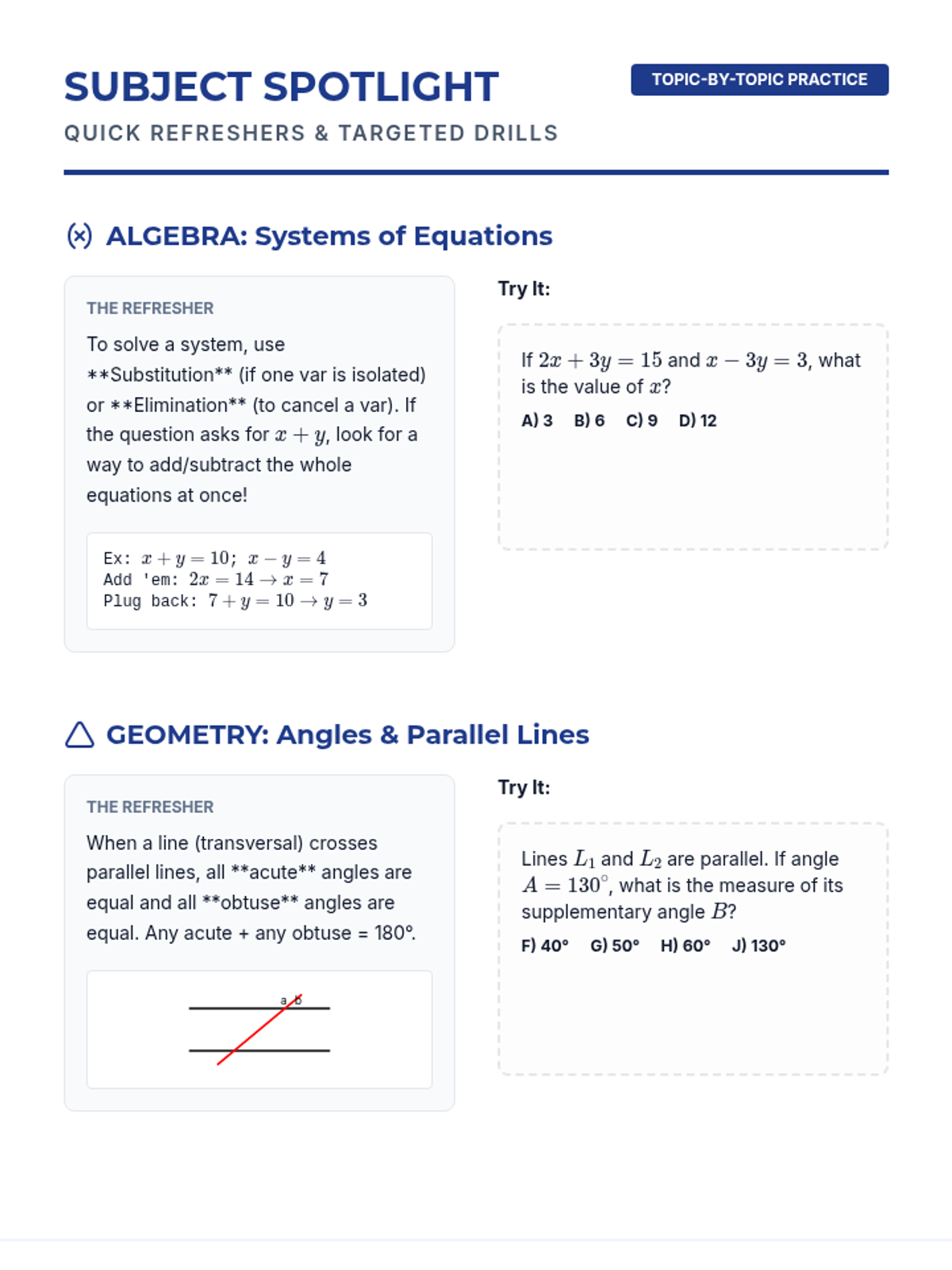
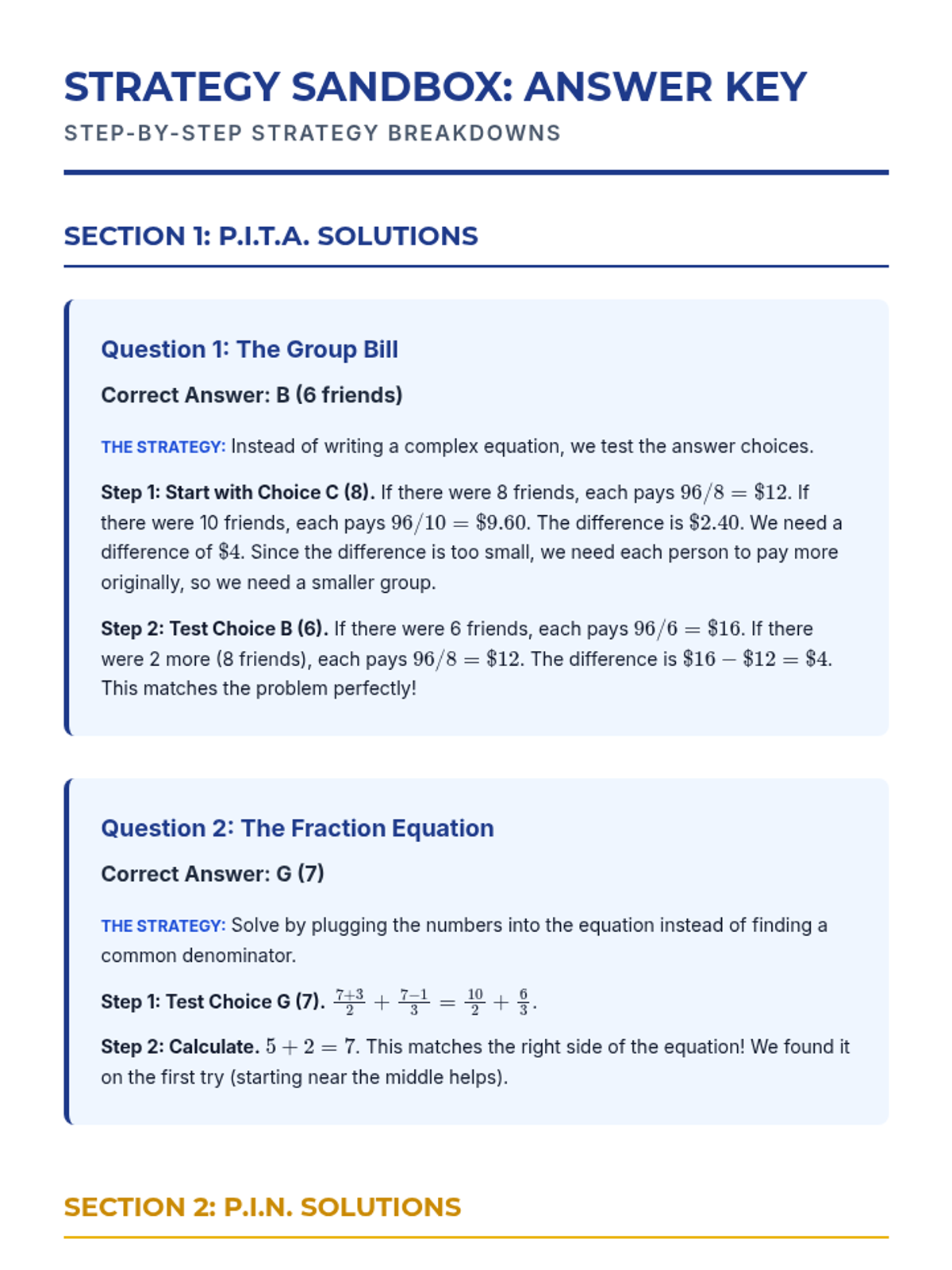
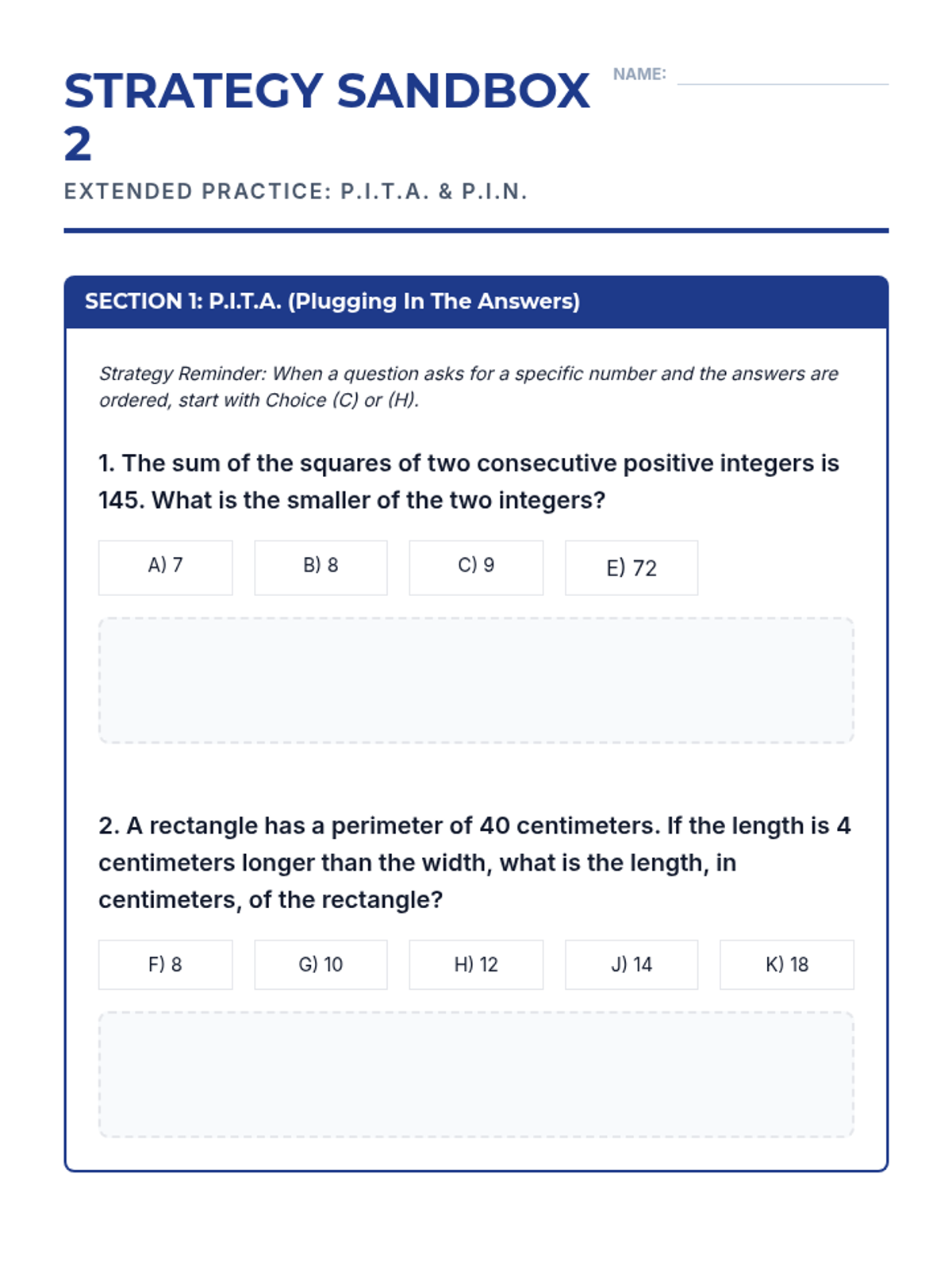
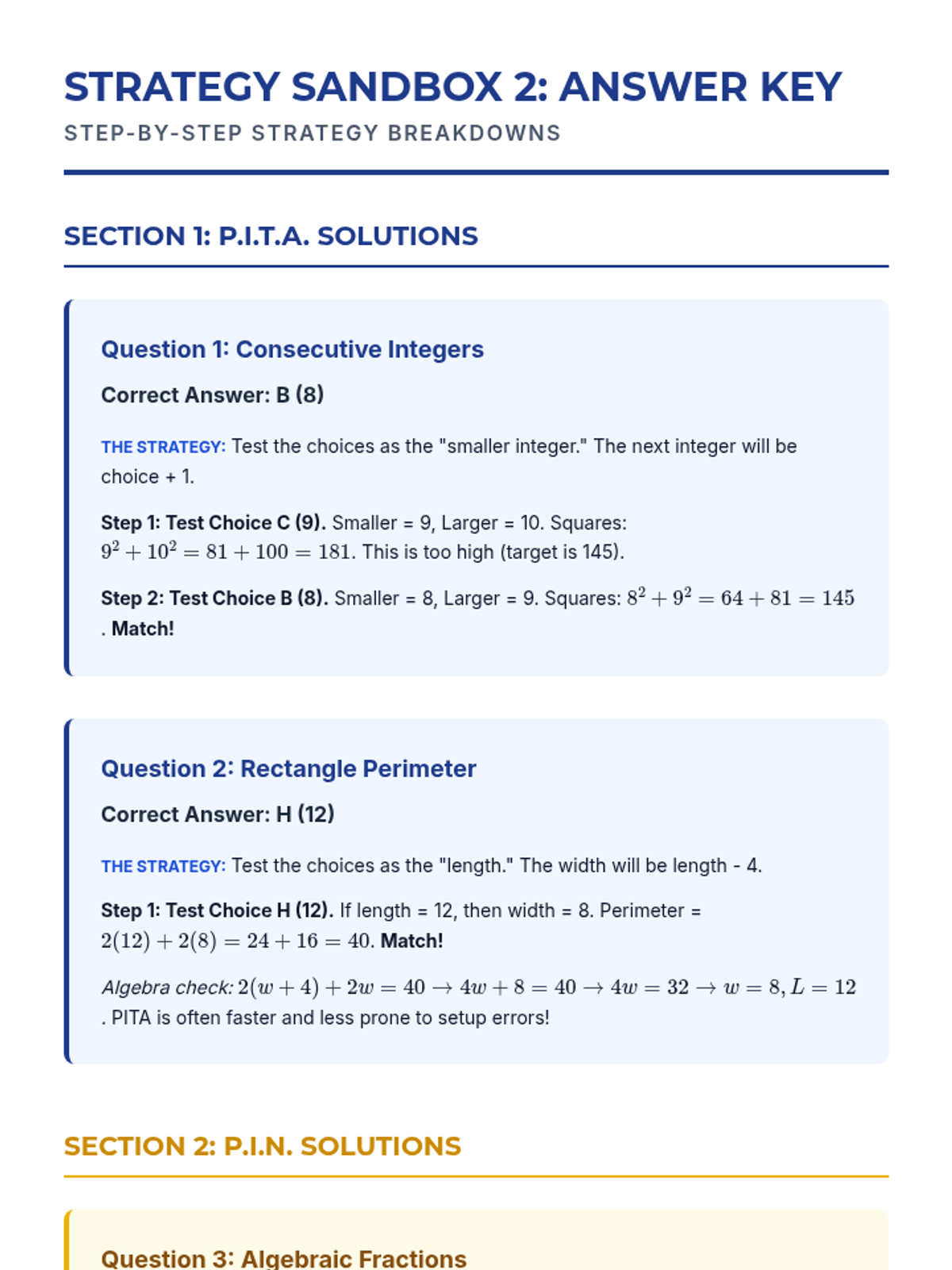
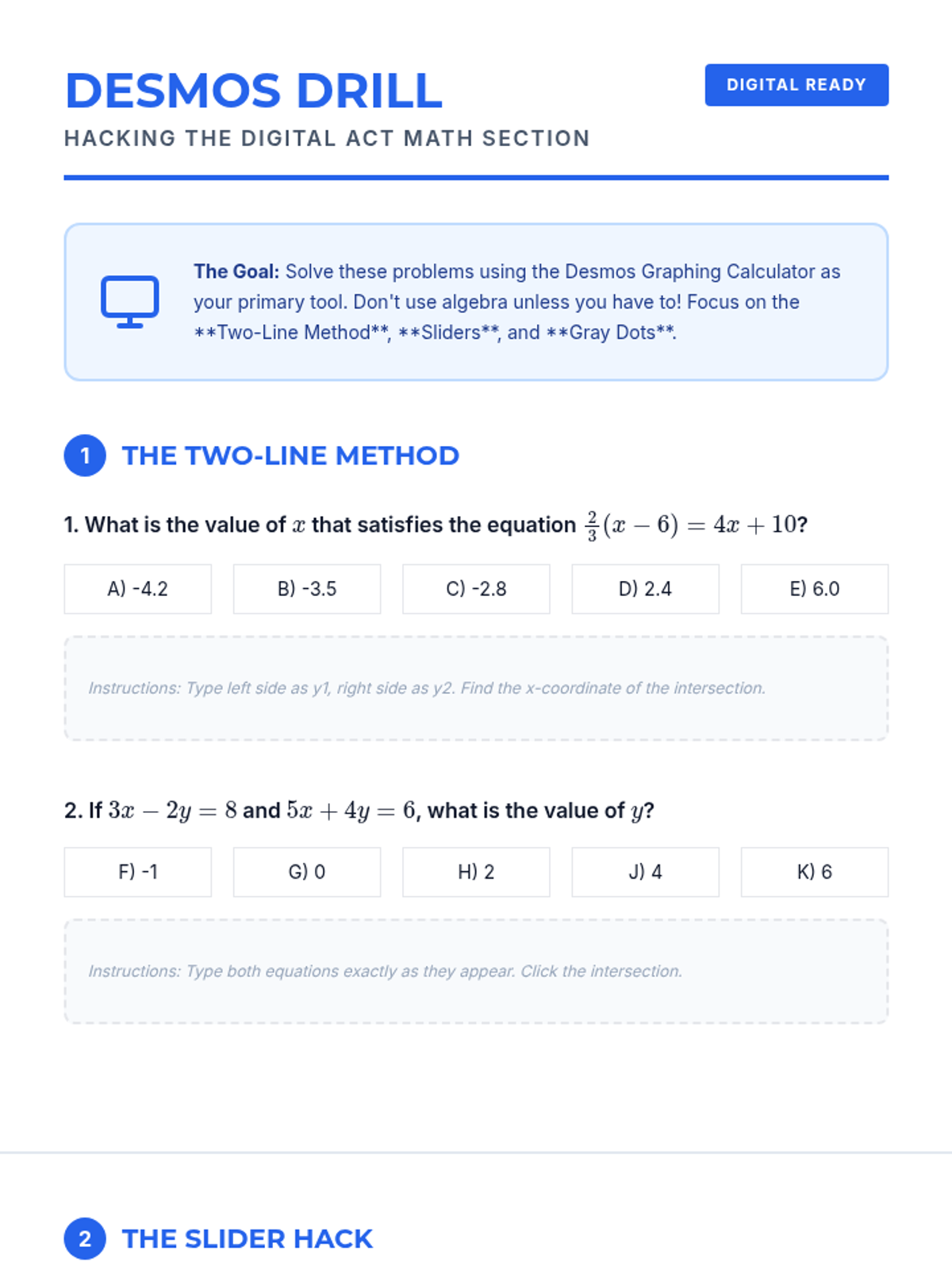
A comprehensive ACT Math preparation program focusing on essential strategies, high-yield Algebra and Geometry concepts, and realistic practice to boost scores.
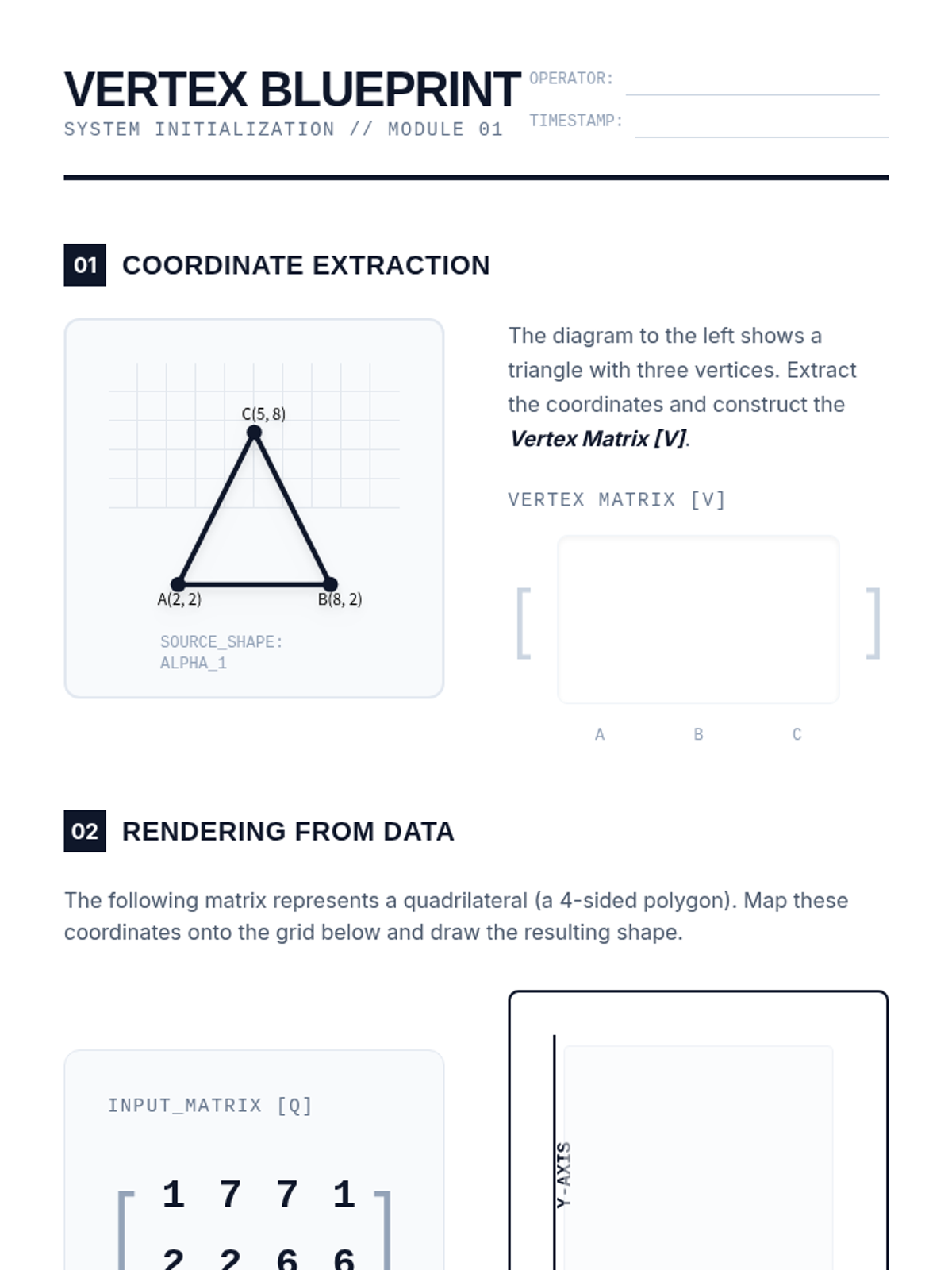
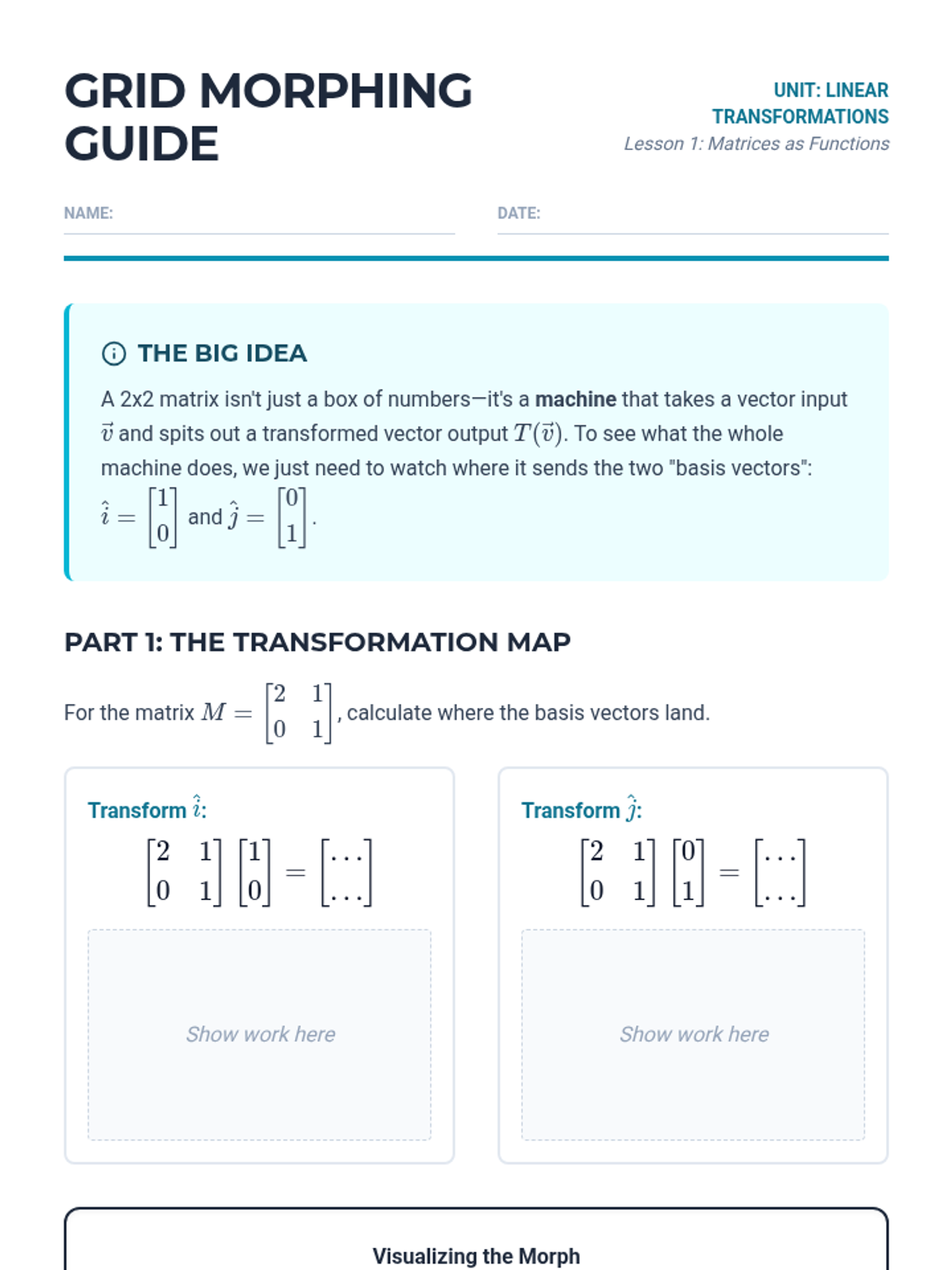
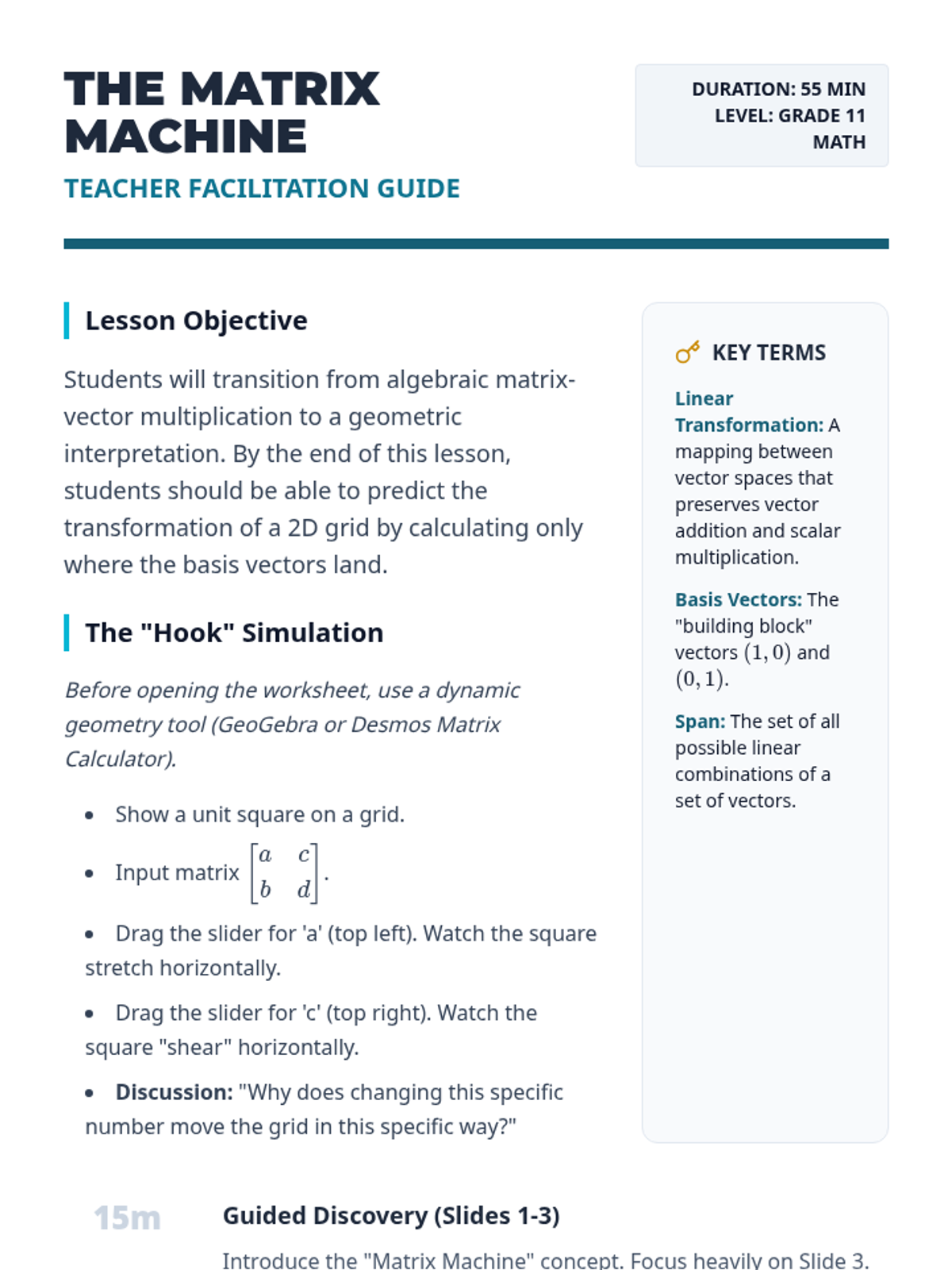
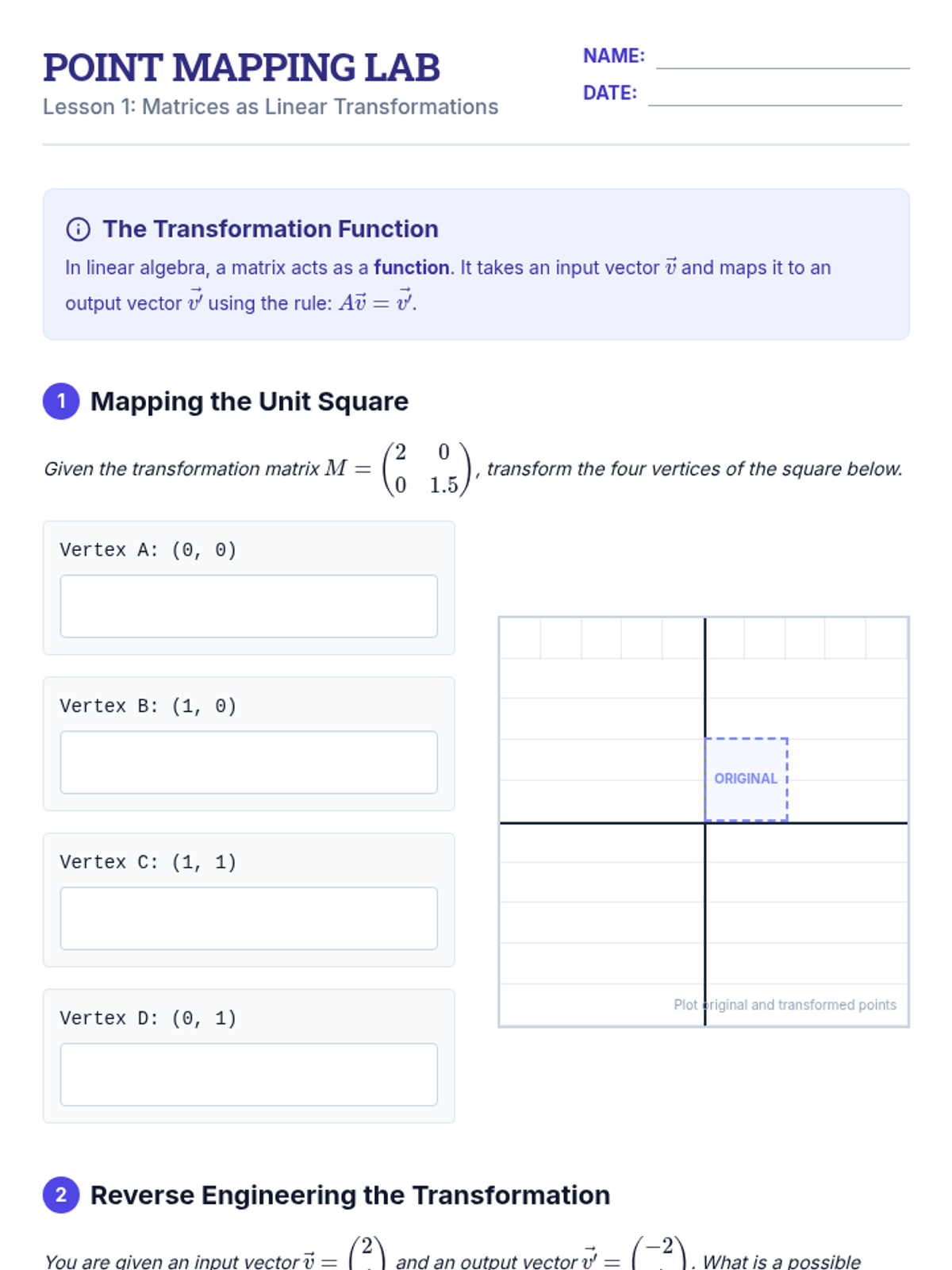
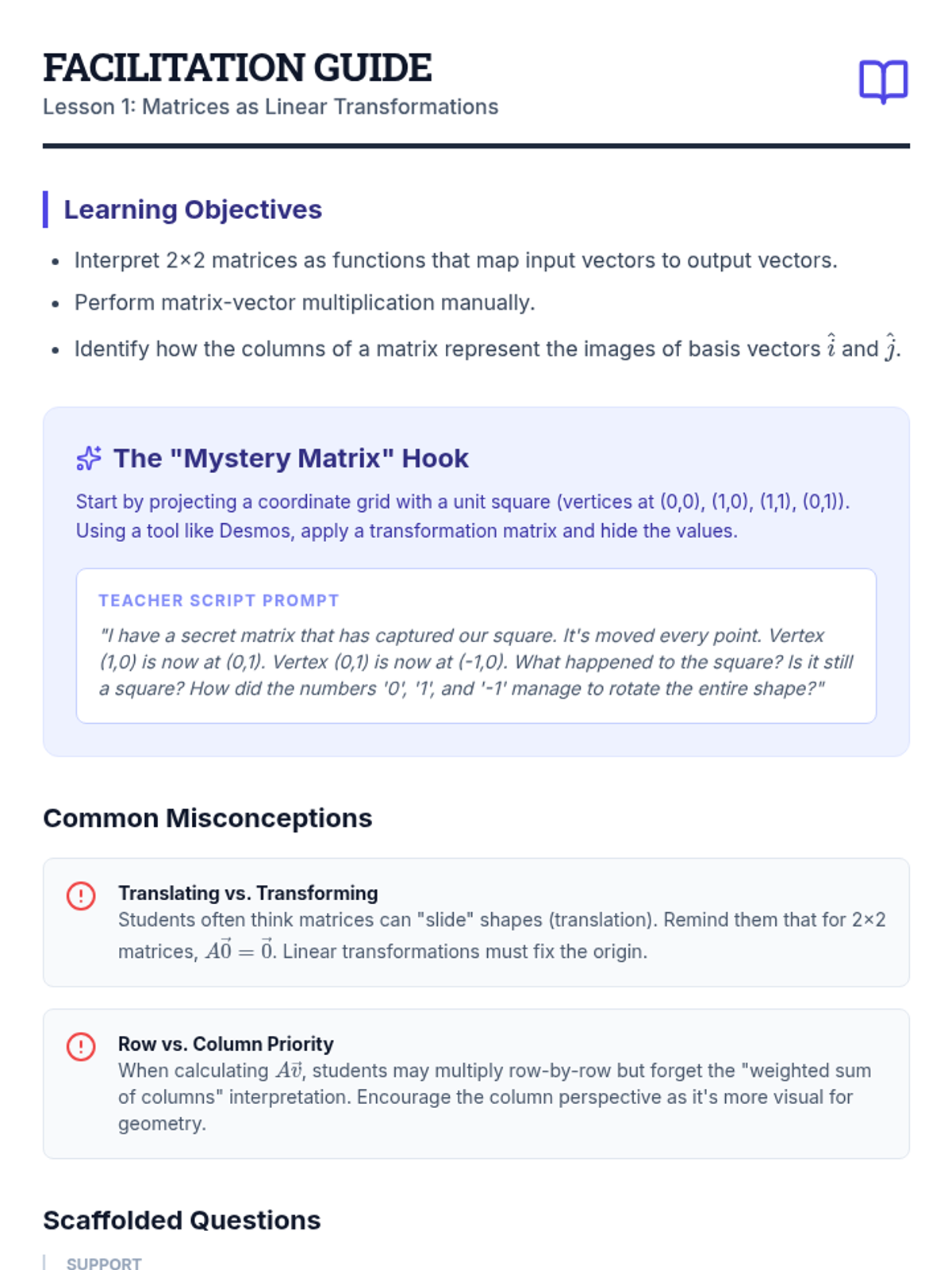
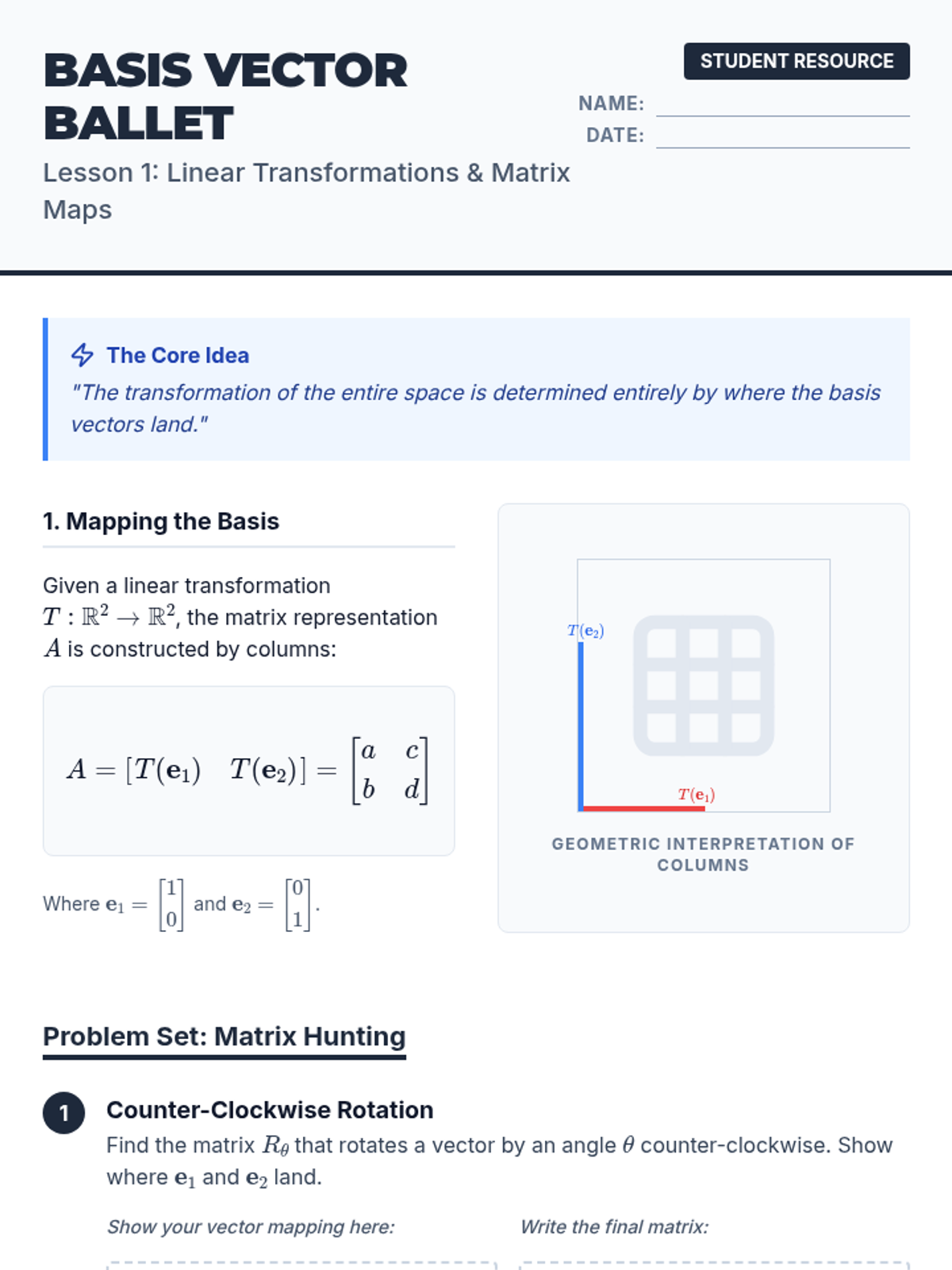
This sequence explores the geometric interpretation of matrices, treating them as operators that transform space. Students move from calculation to visual application, using matrices to represent coordinates, perform translations/dilations, and apply rotations/reflections via matrix multiplication.
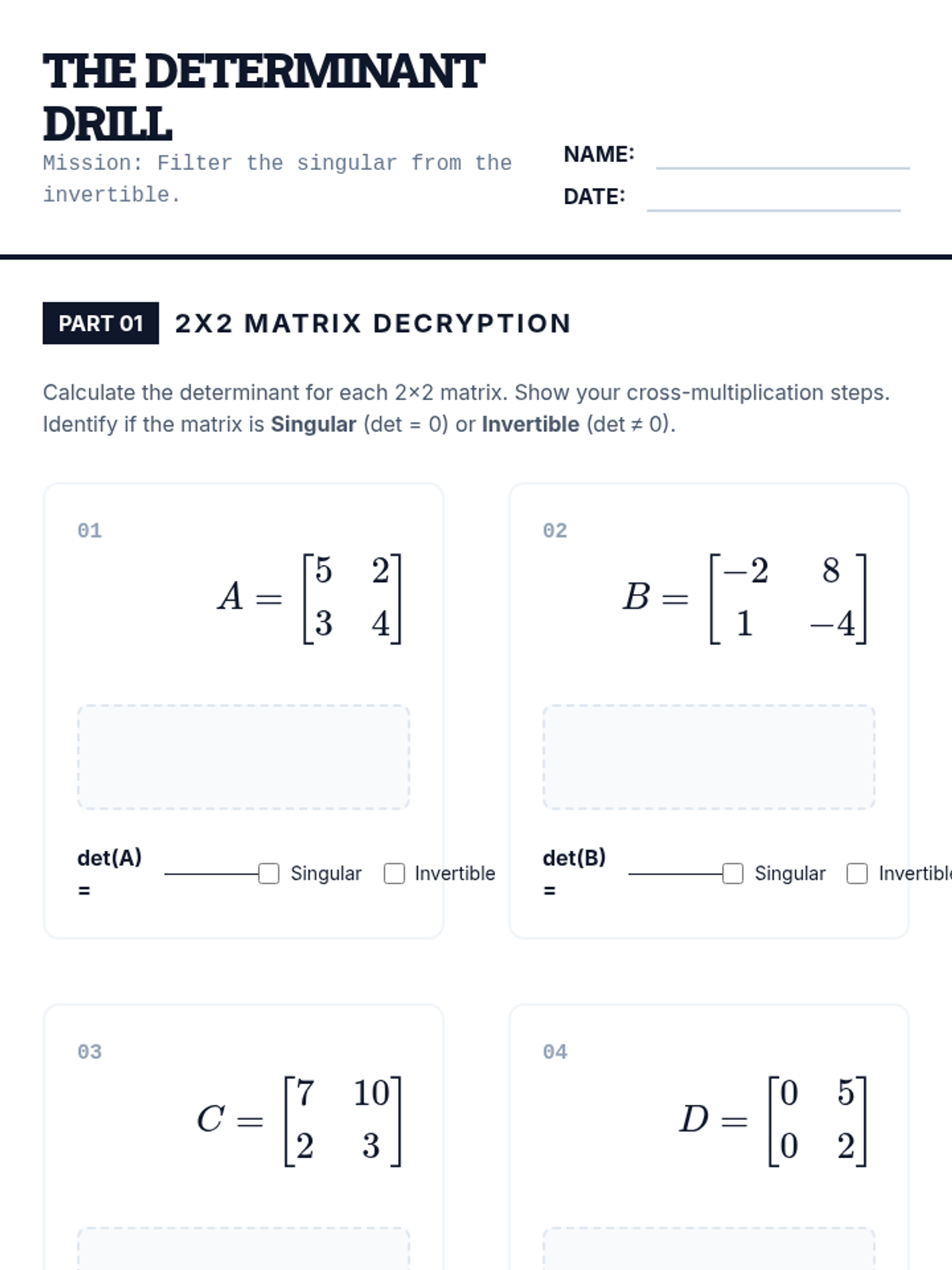
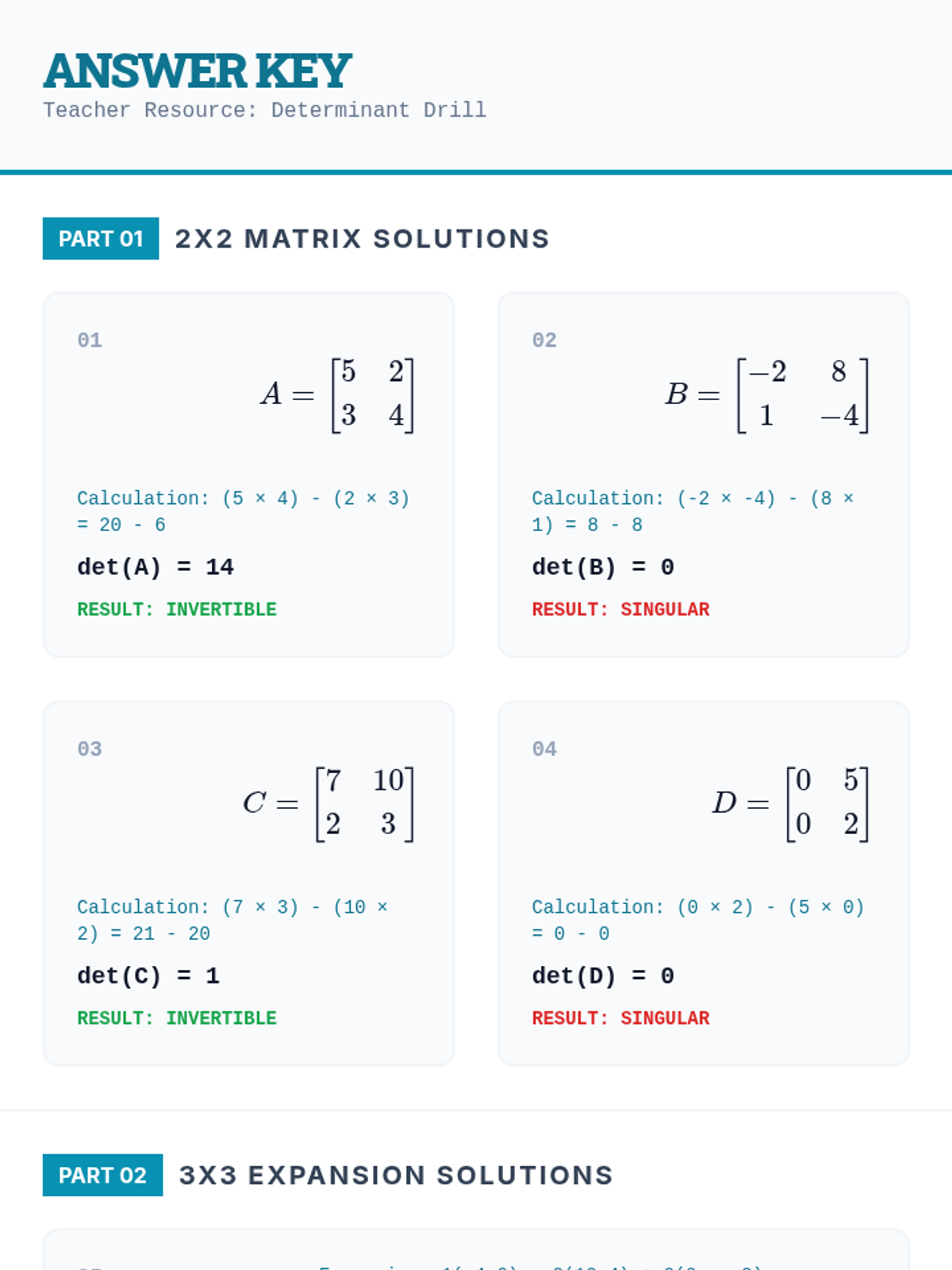
A comprehensive sequence on matrix operations, focusing on determinants, inverses, and their application in solving linear systems and cryptography. Students move from basic calculations to advanced problem-solving techniques.
This sequence explores matrices as geometric transformations of vectors. Students learn to visualize and calculate how matrices stretch, rotate, reflect, and shear space, culminating in a project where they design a computer graphics animation sequence.
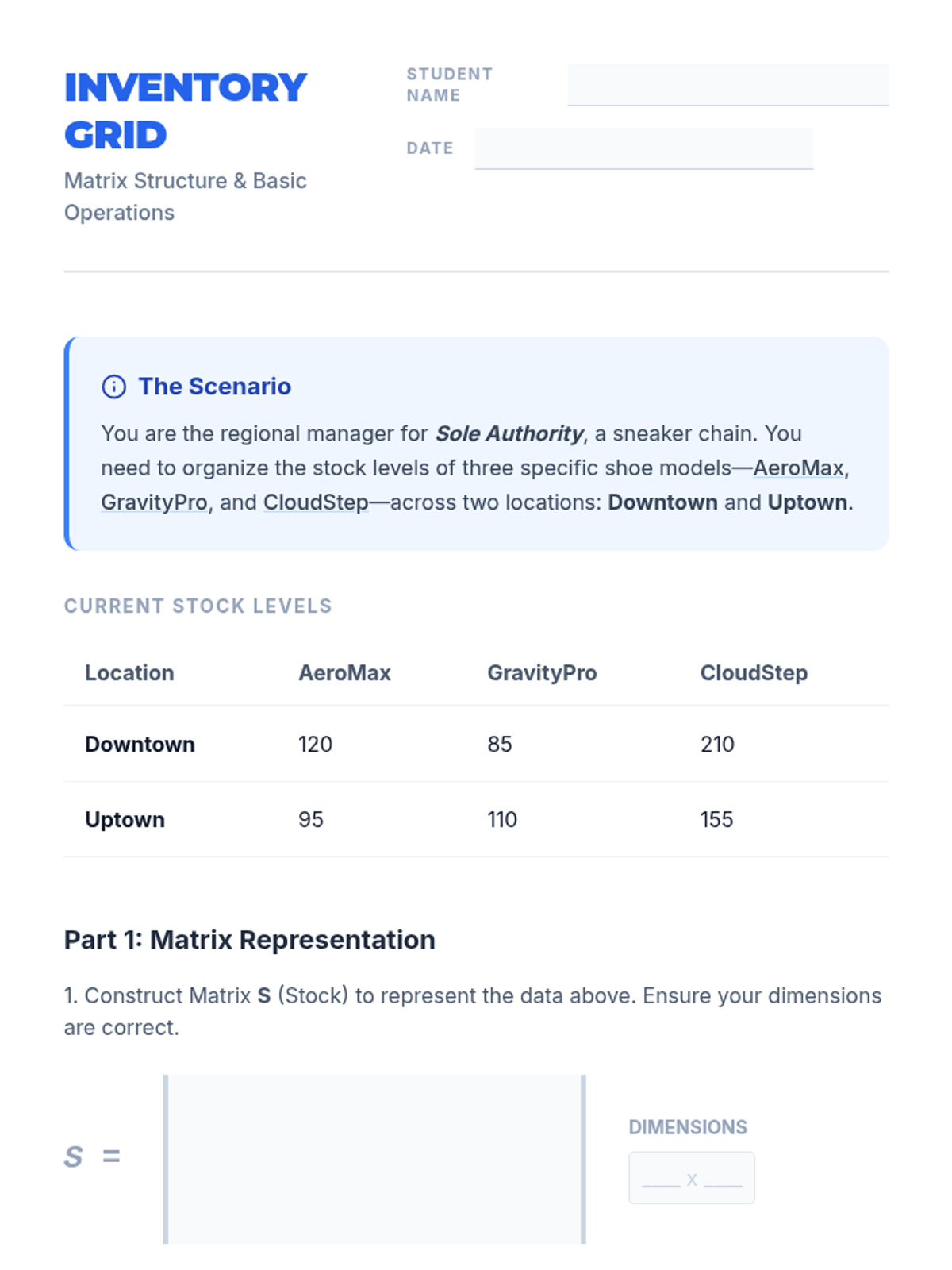
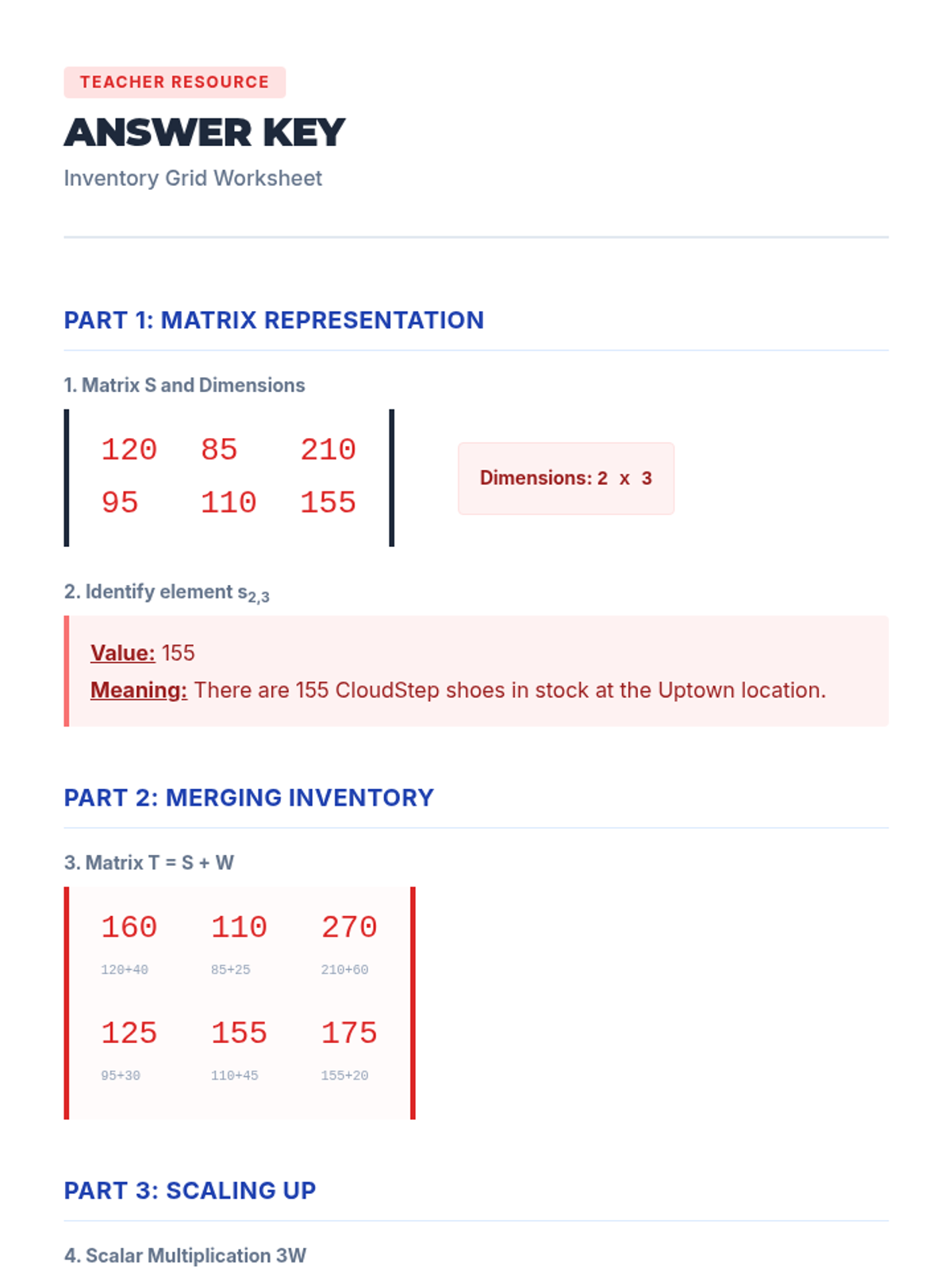
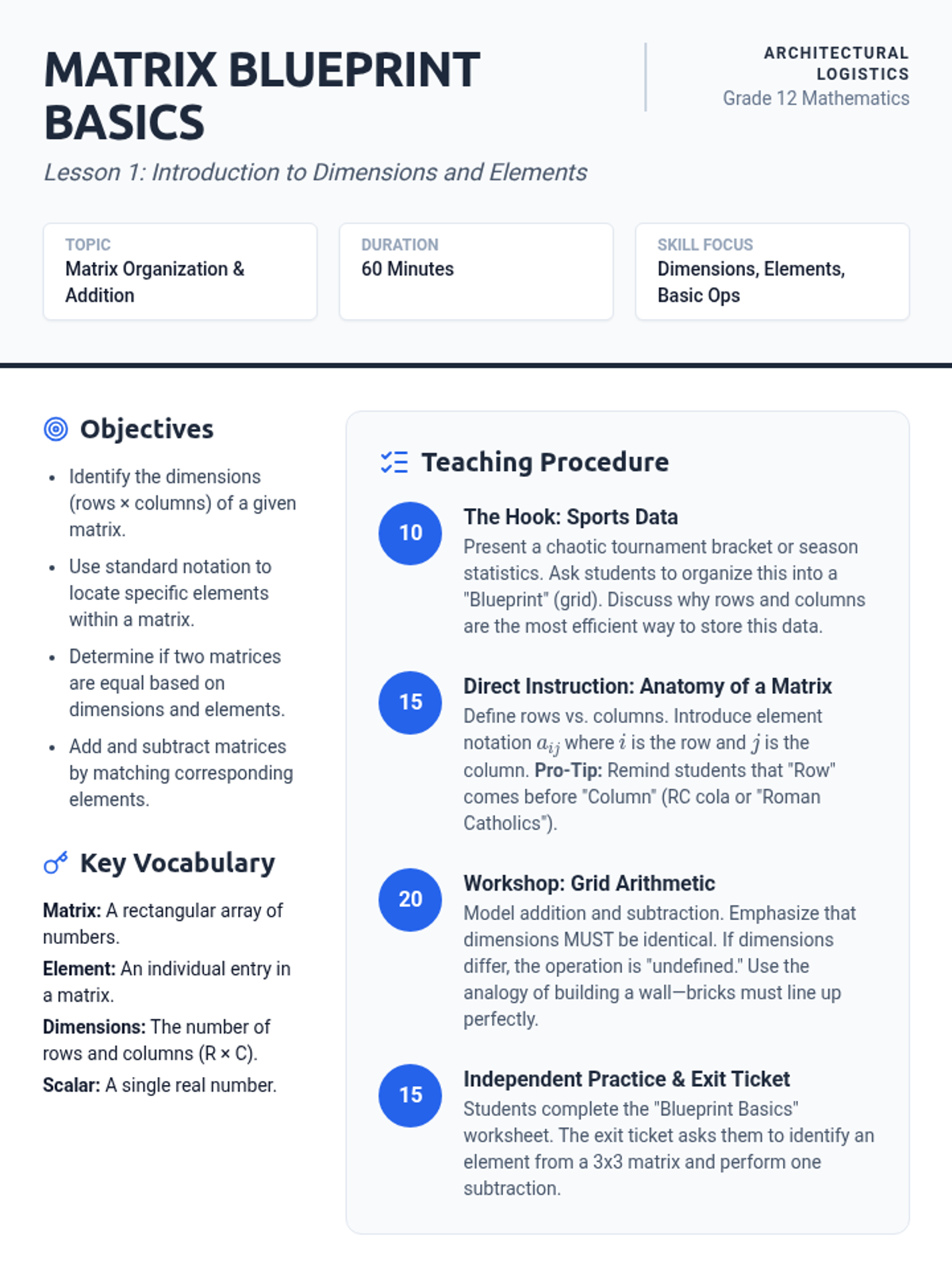
This sequence explores matrix algebra as a tool for data organization and system solving. Students progress from basic arithmetic to complex operations like multiplication, determinants, and inverses, ultimately applying these skills to solve systems of linear equations.
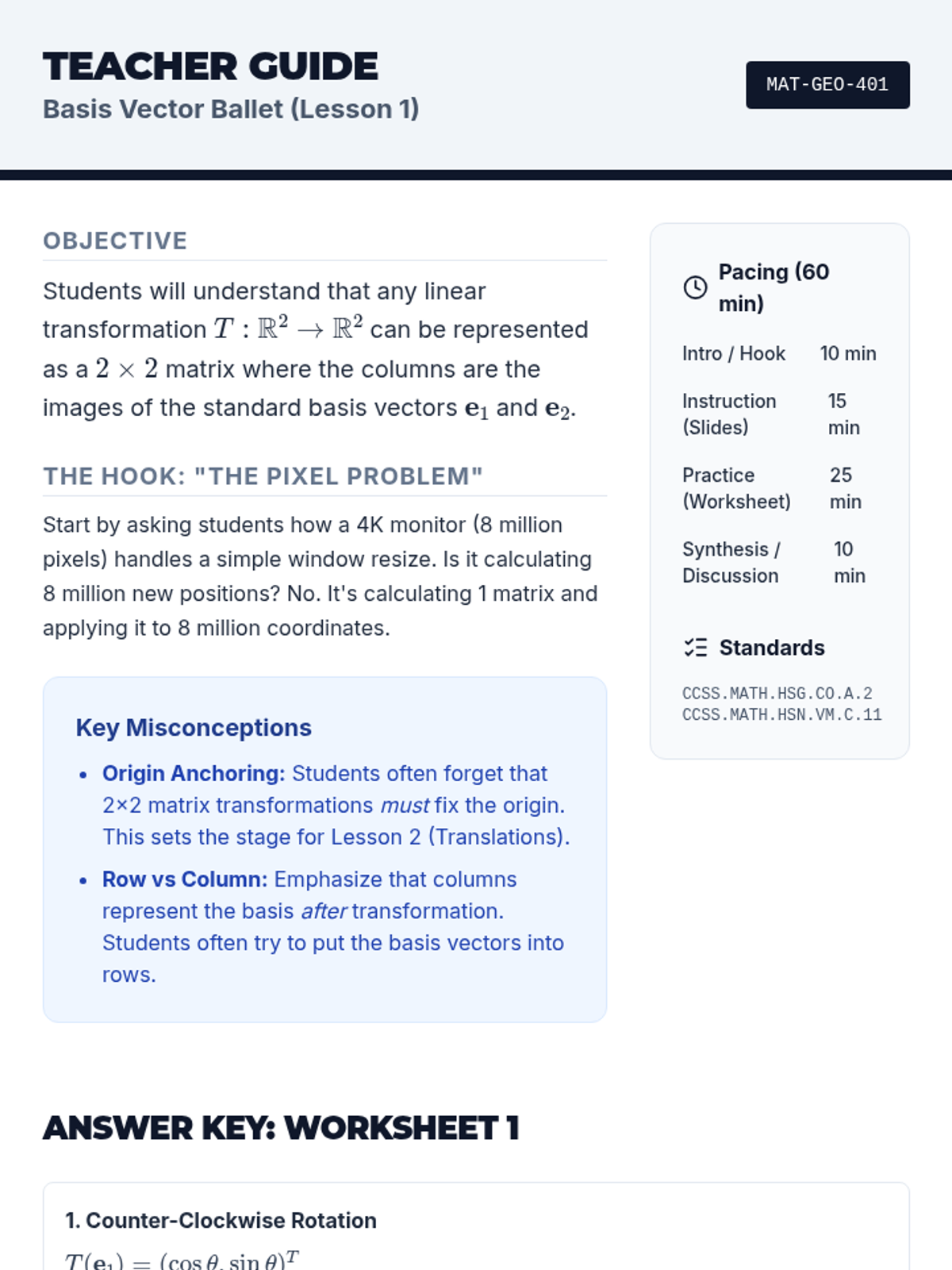
A project-based sequence for 12th Grade students exploring linear transformations through the lens of computer graphics. Students learn to use 2x2 matrices to scale, reflect, shear, and rotate vectors, culminating in a retro video game animation project.
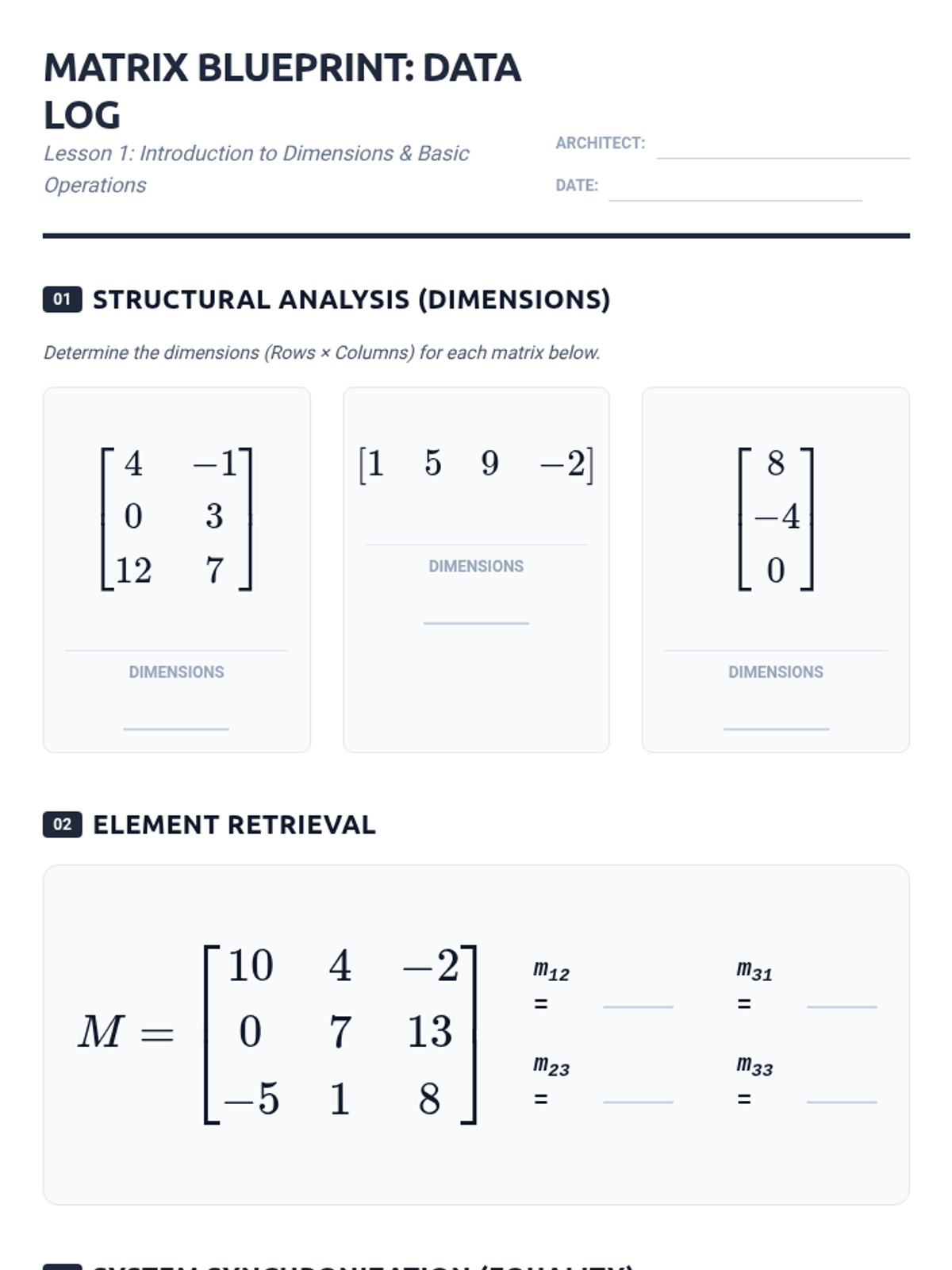
A comprehensive 12th-grade mathematics sequence on matrix algebra, covering dimensions, arithmetic operations, determinants, inverses, and solving linear systems. Students progress from basic organization to using matrices as powerful tools for solving complex equations.
A high-level exploration of stochastic processes, focusing on how random systems reach equilibrium. Students will master Markov chains, steady-state algebra, and real-world applications like Google's PageRank algorithm.
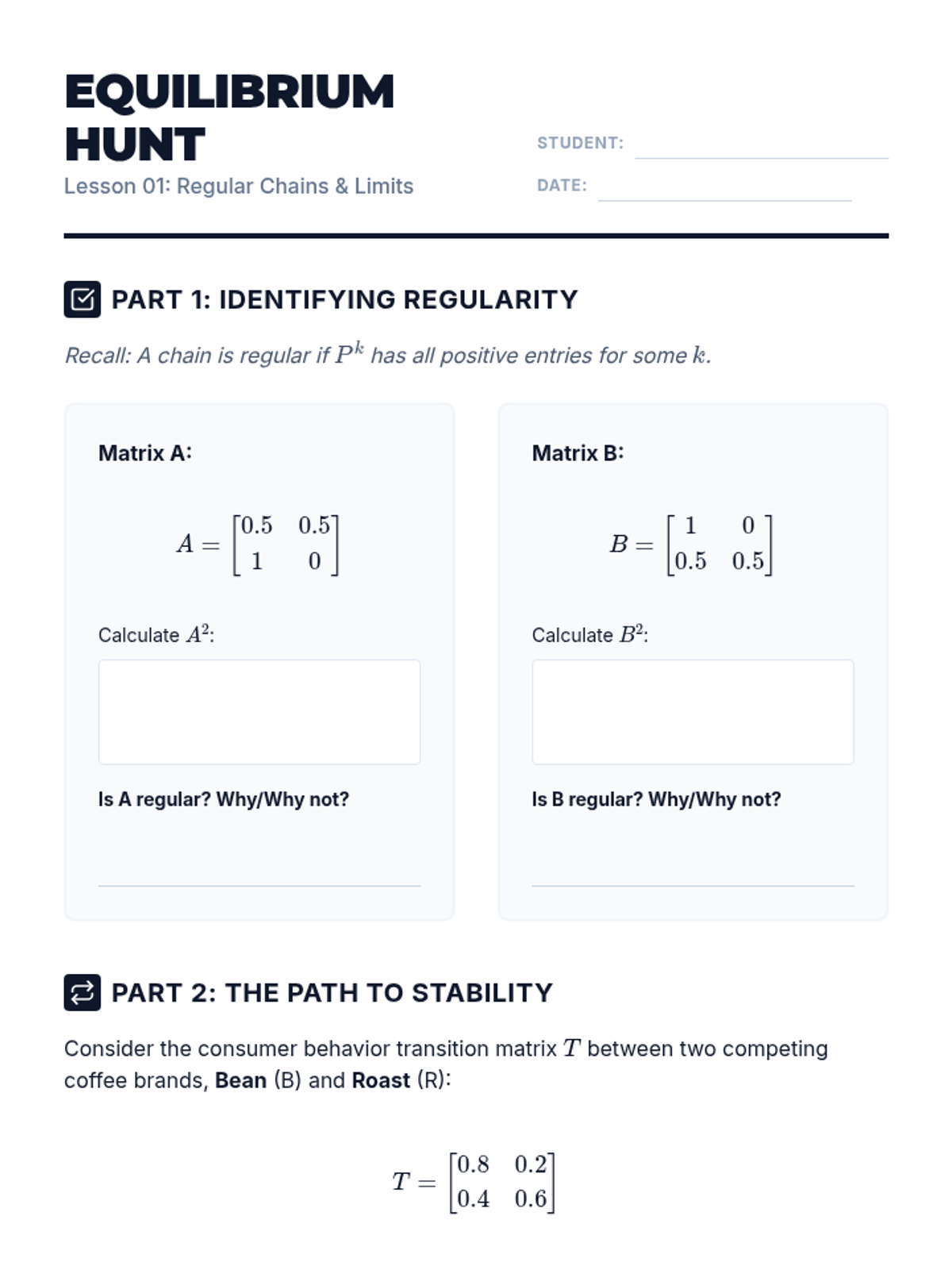
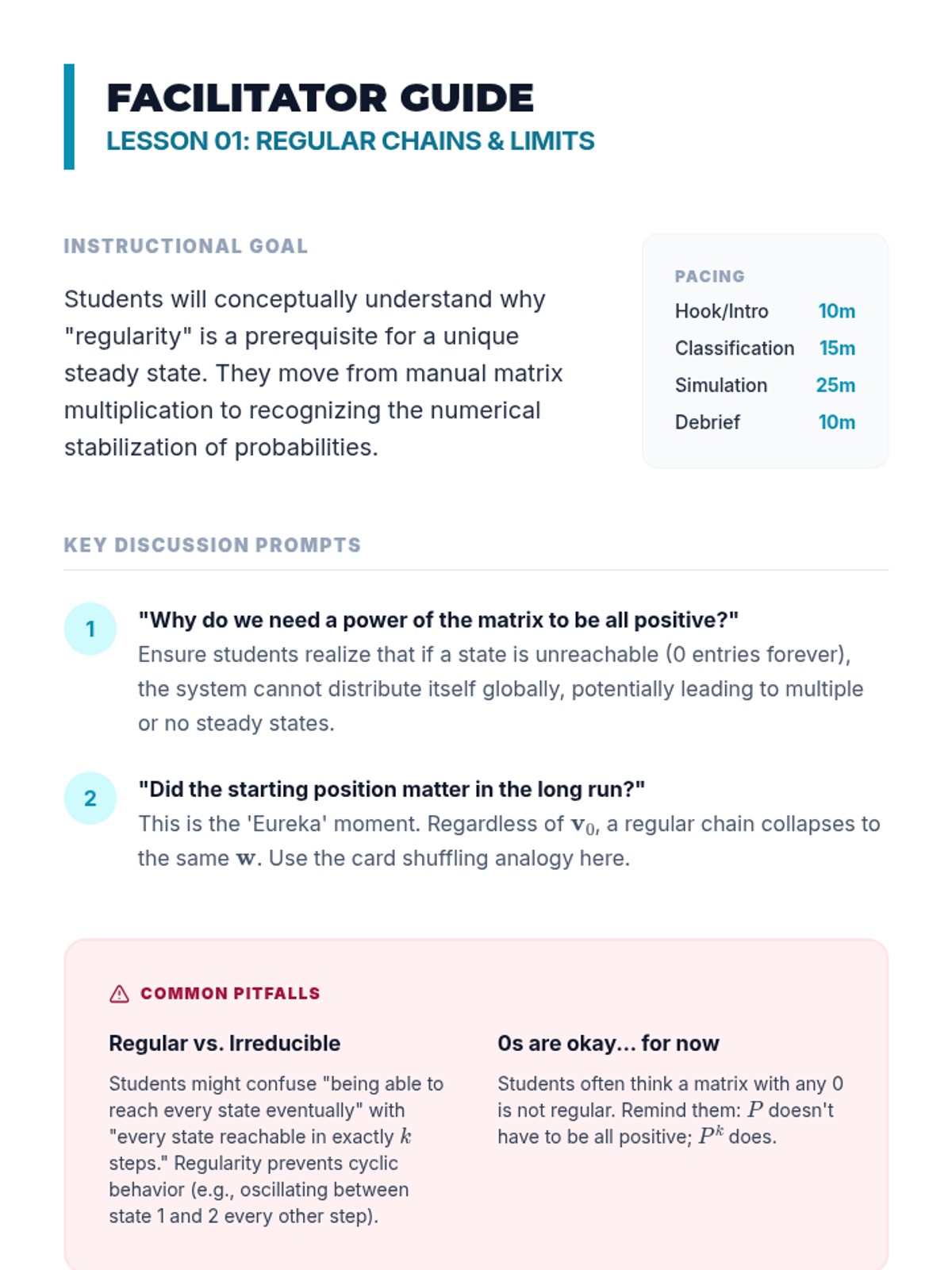
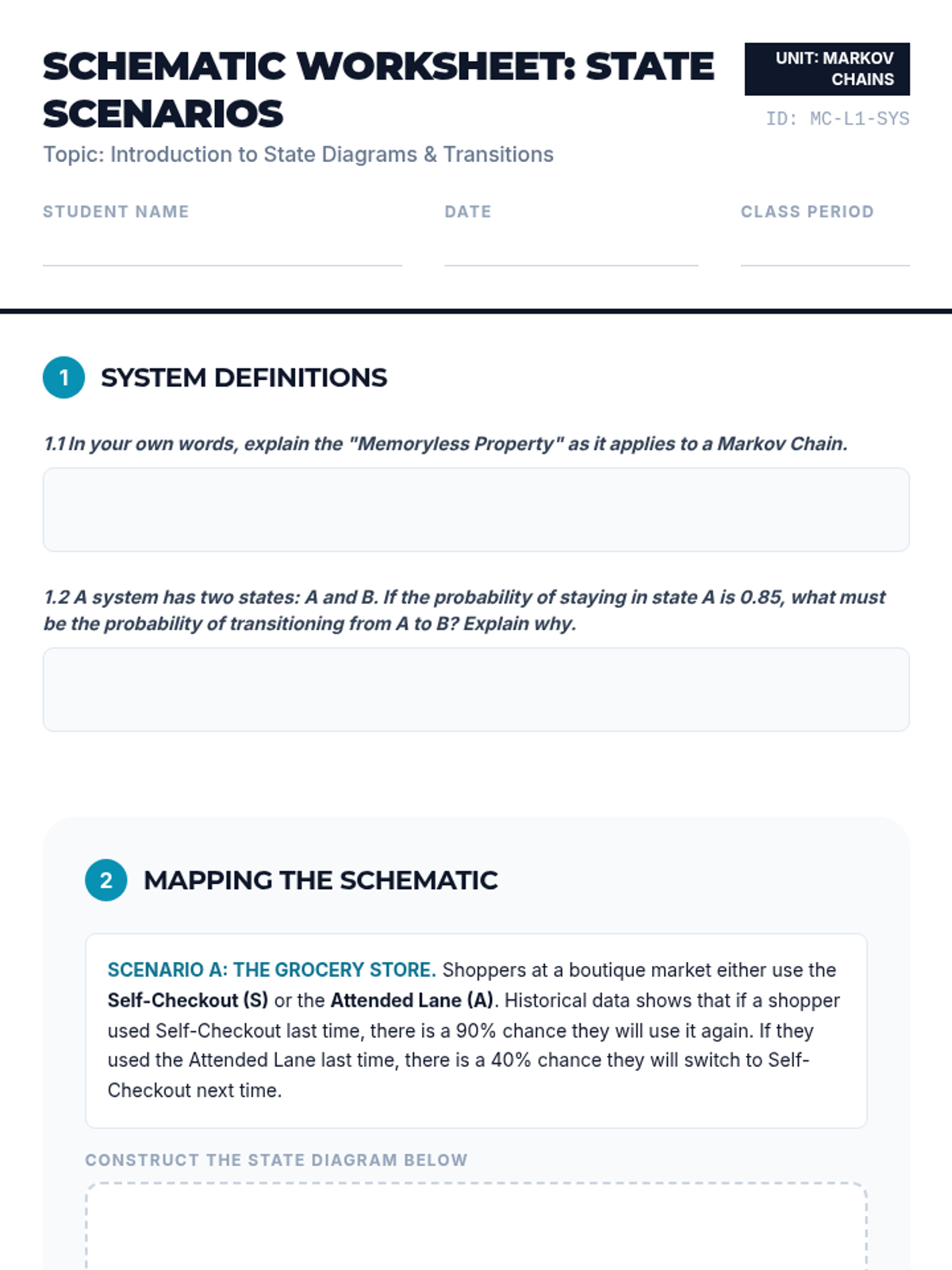
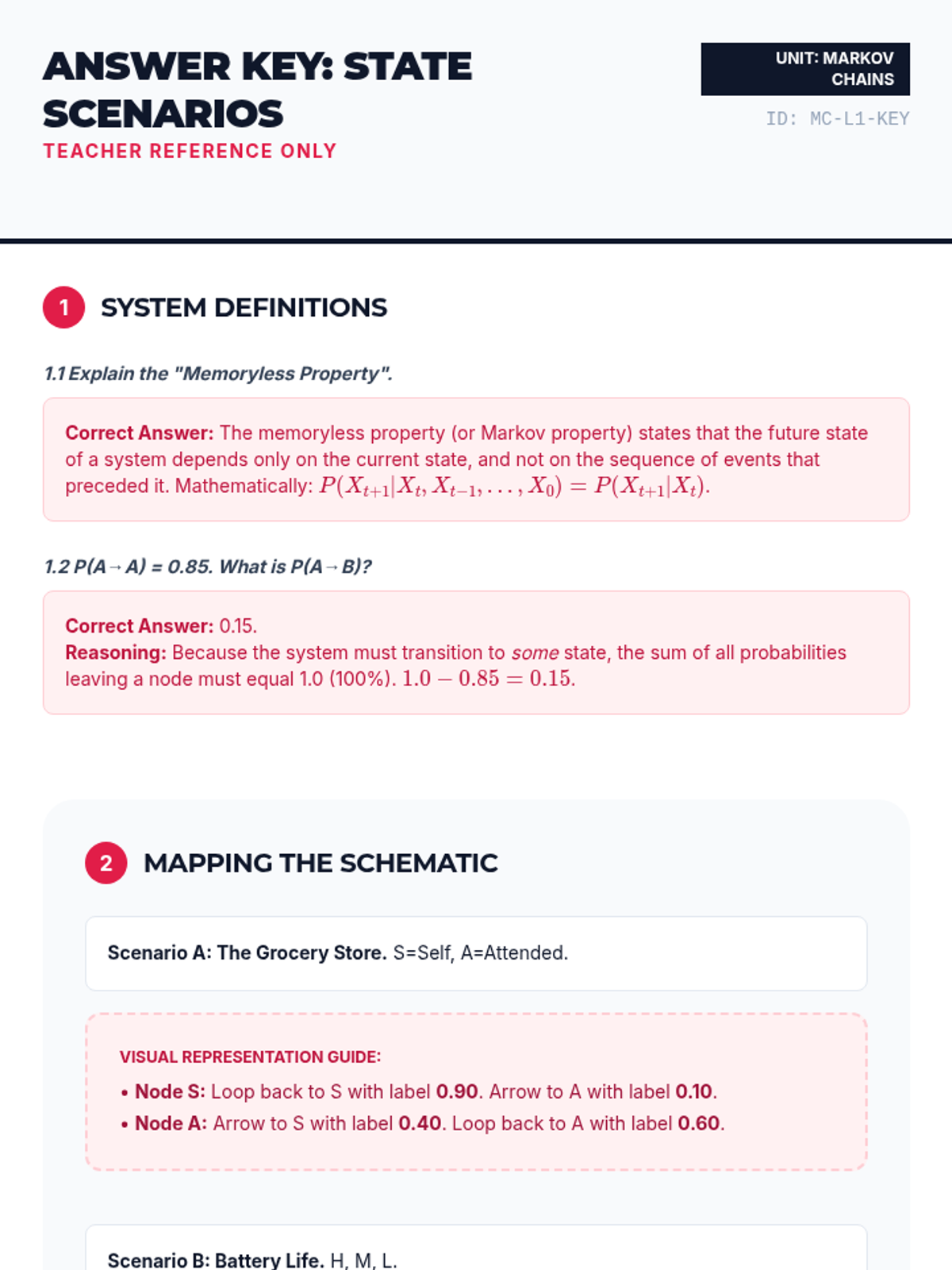
A comprehensive sequence for 12th-grade students on discrete-time Markov chains, covering state diagrams, transition matrices, and n-step probability calculations using matrix algebra.
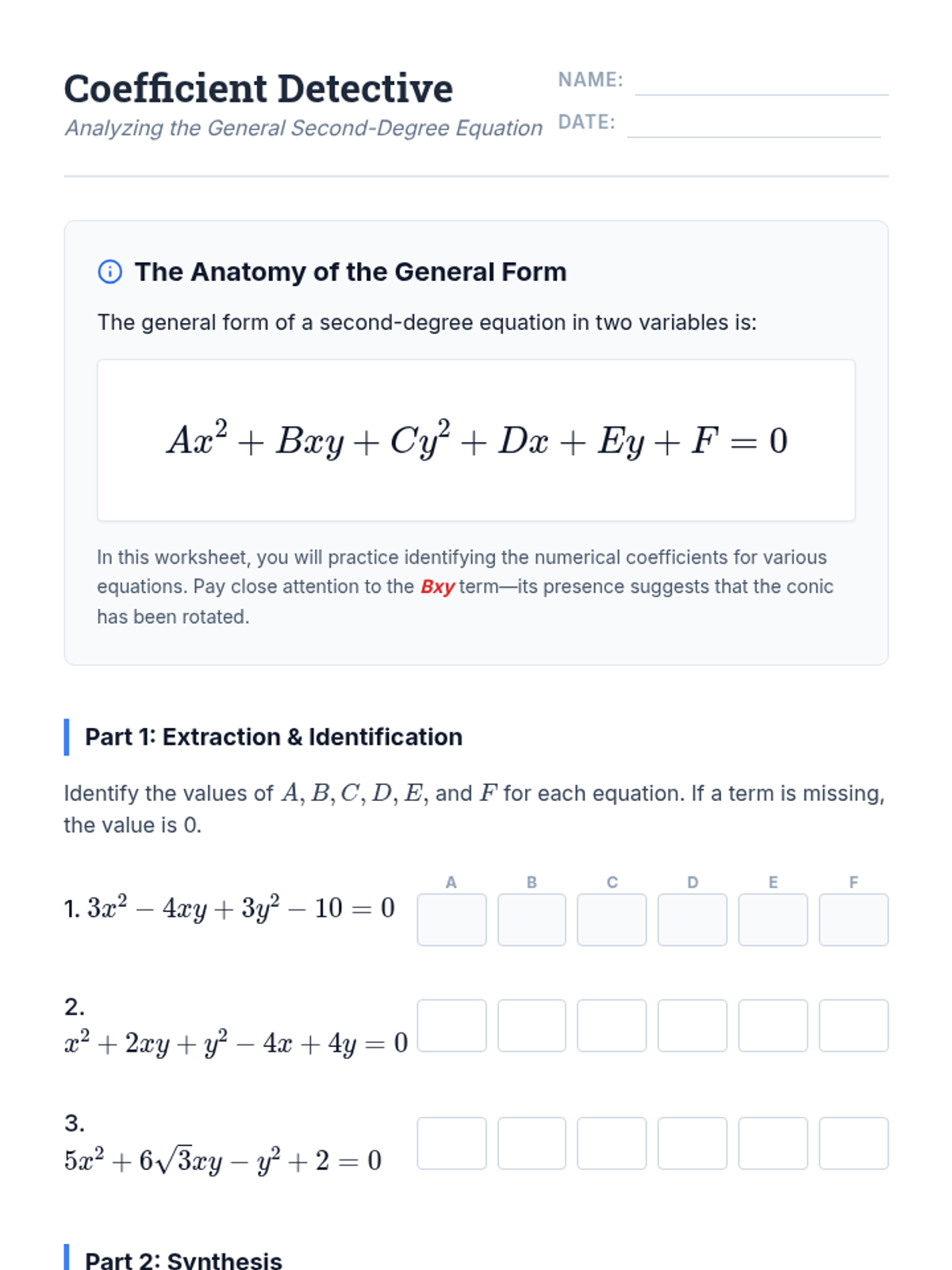
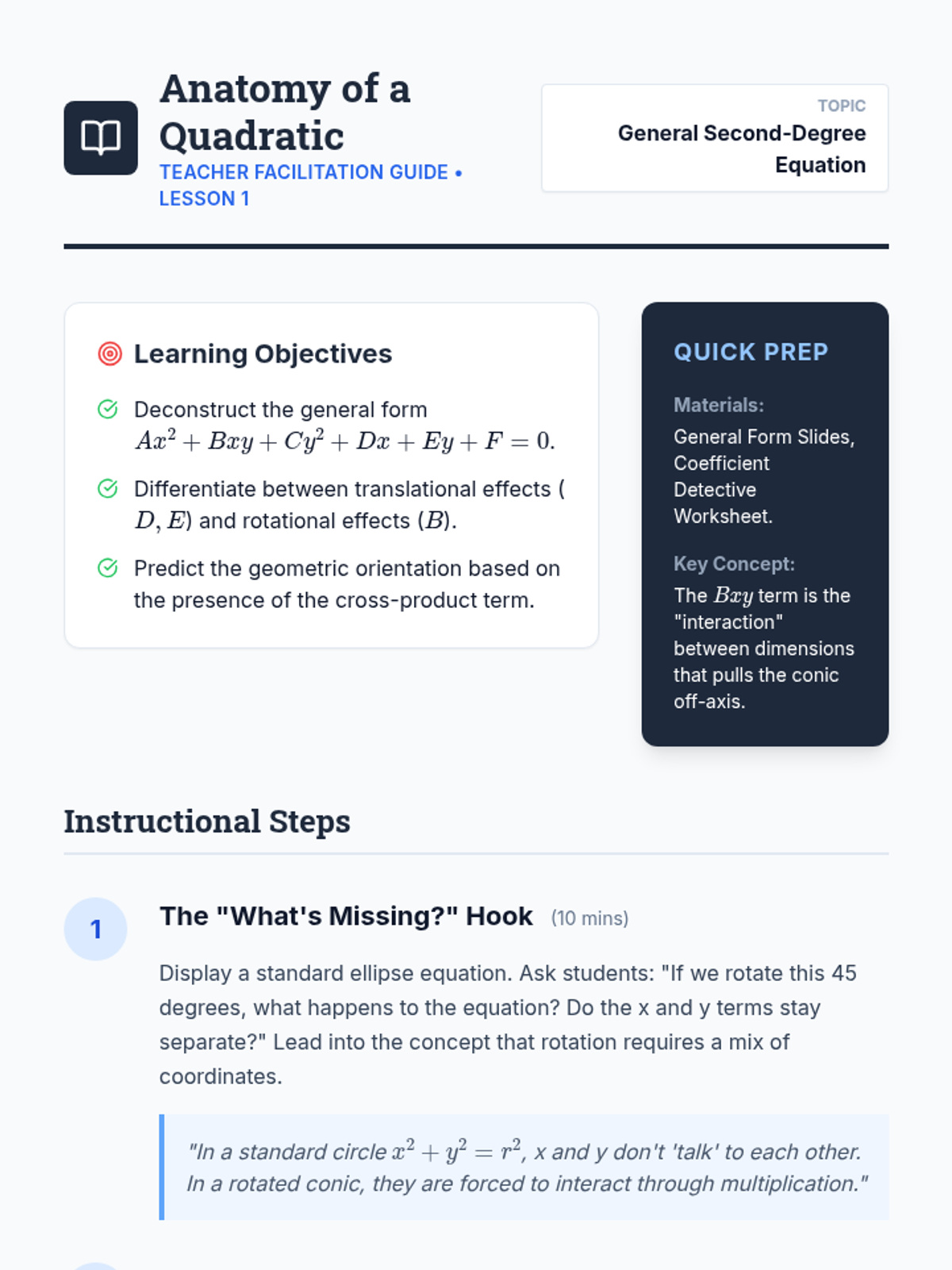
An advanced exploration of the general second-degree equation, focusing on identifying, rotating, and graphing conics with cross-product terms using both trigonometric and matrix methods.
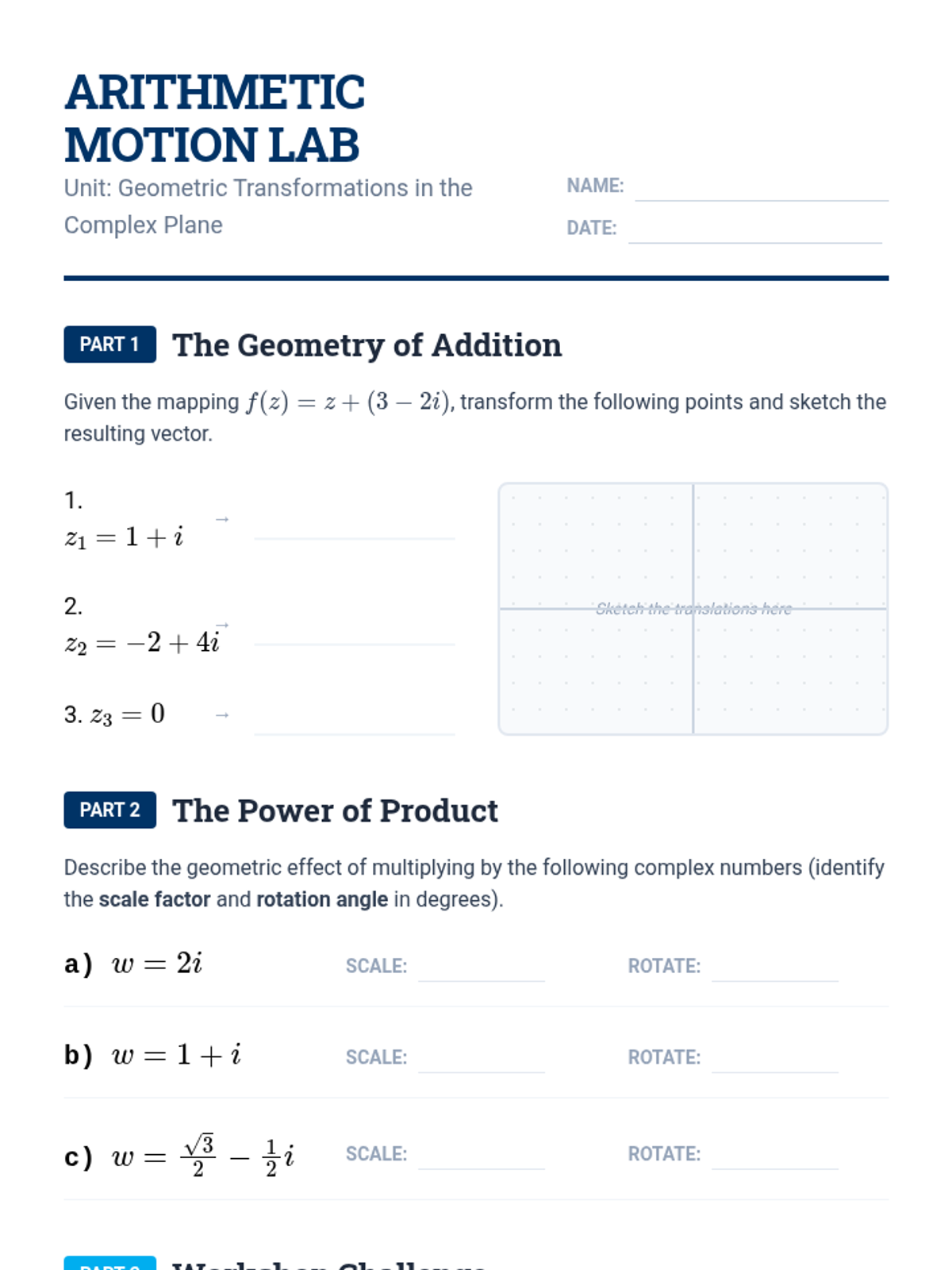
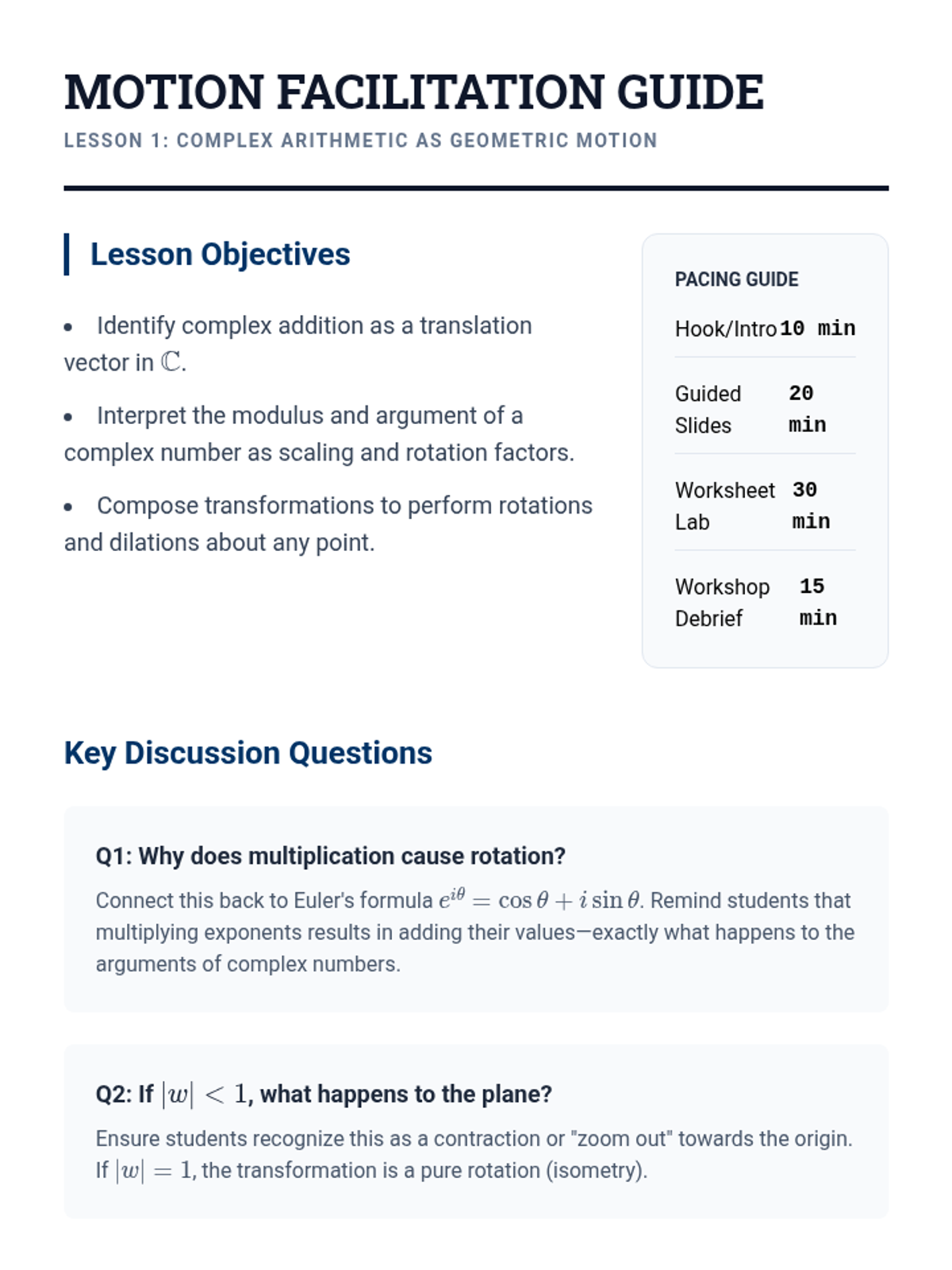
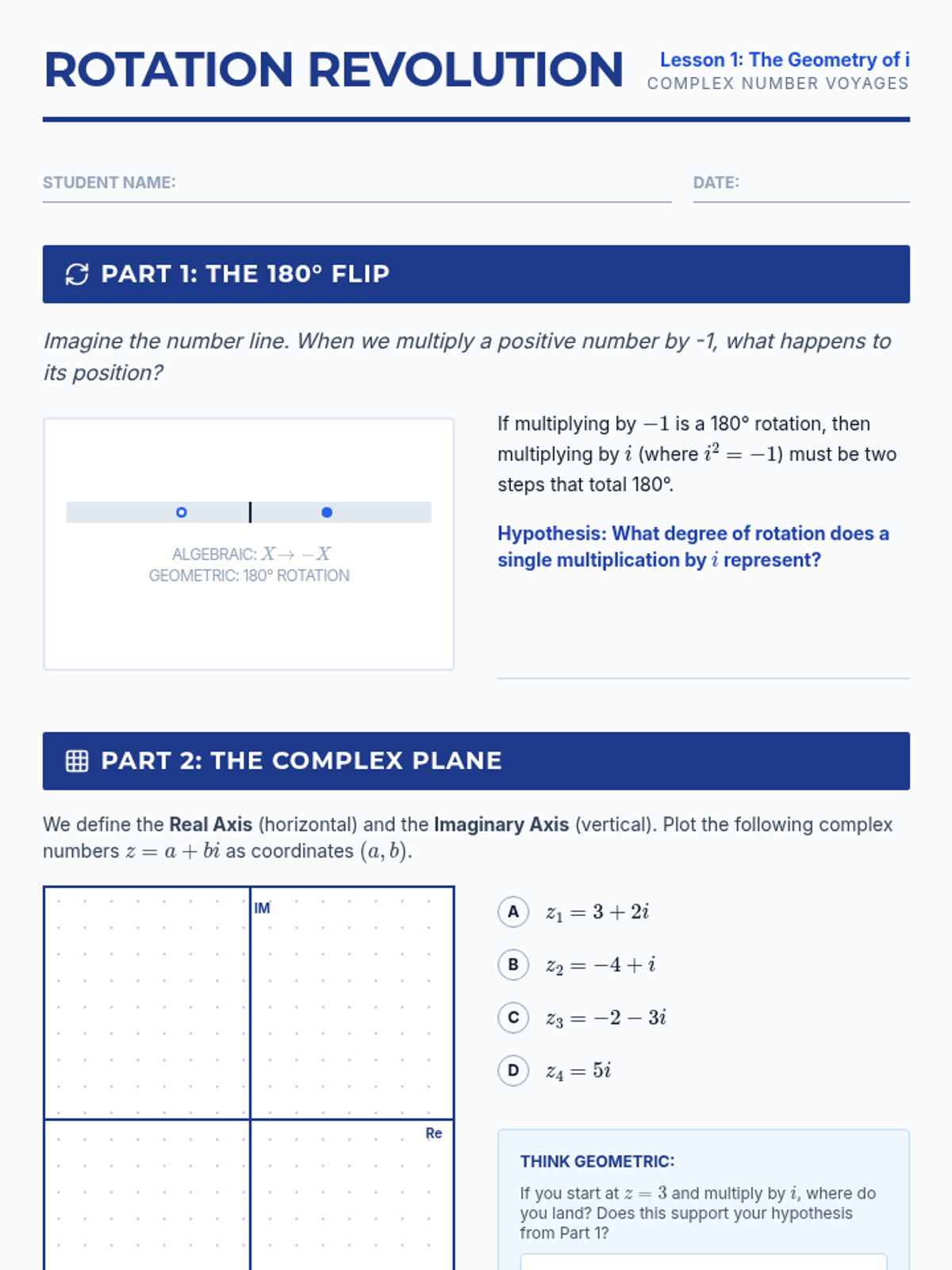
This sequence explores geometric transformations using the complex plane as a primary framework. Students will learn how complex arithmetic maps to translations, rotations, dilations, and reflections, culminating in an investigation of non-linear mappings like circle inversion and Möbius transformations.
This sequence explores geometric congruence and similarity through the lens of linear algebra. Students learn to represent and manipulate shapes using matrices, homogeneous coordinates, and composite transformations, bridging the gap between abstract geometry and computer graphics.
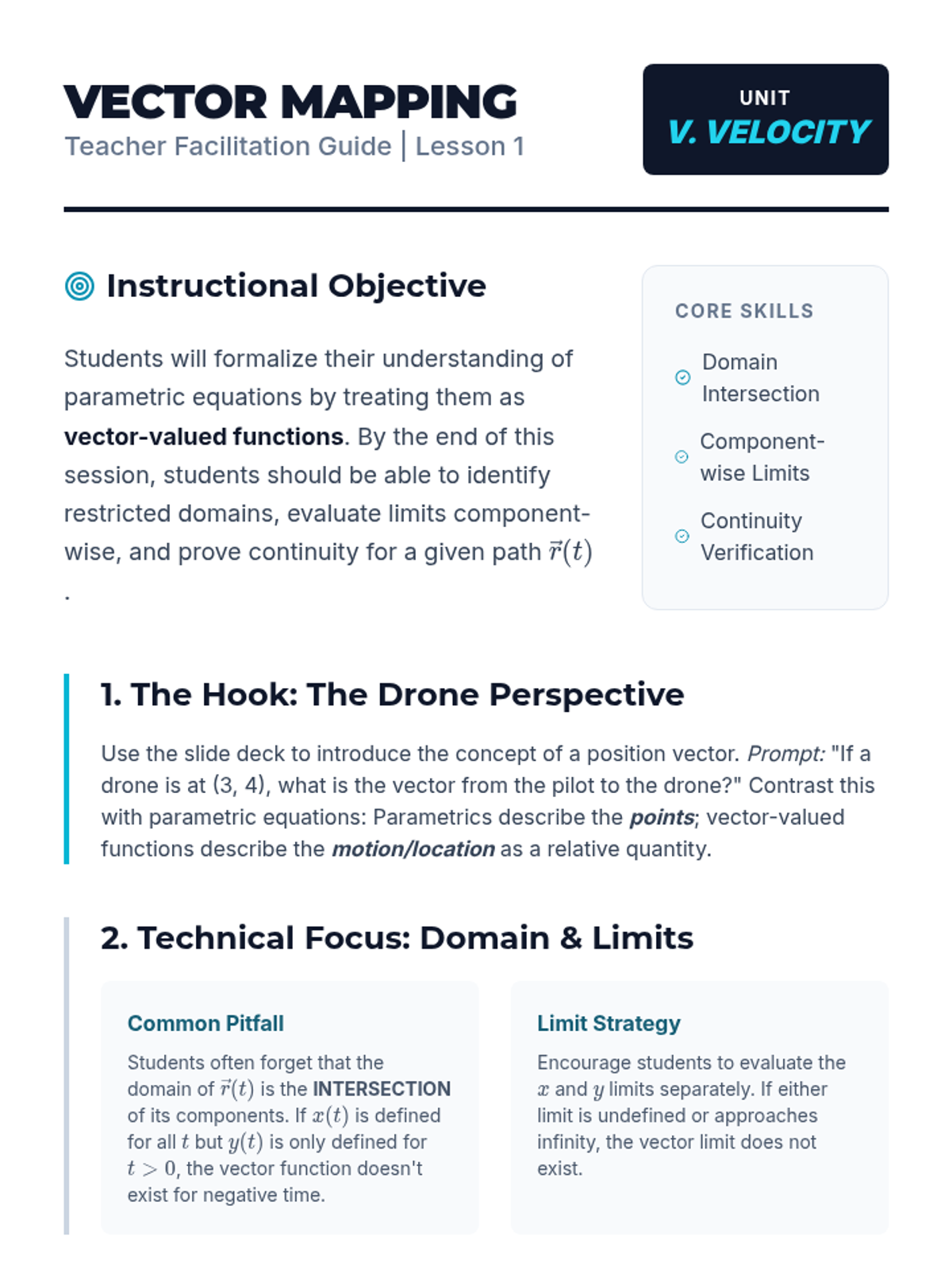
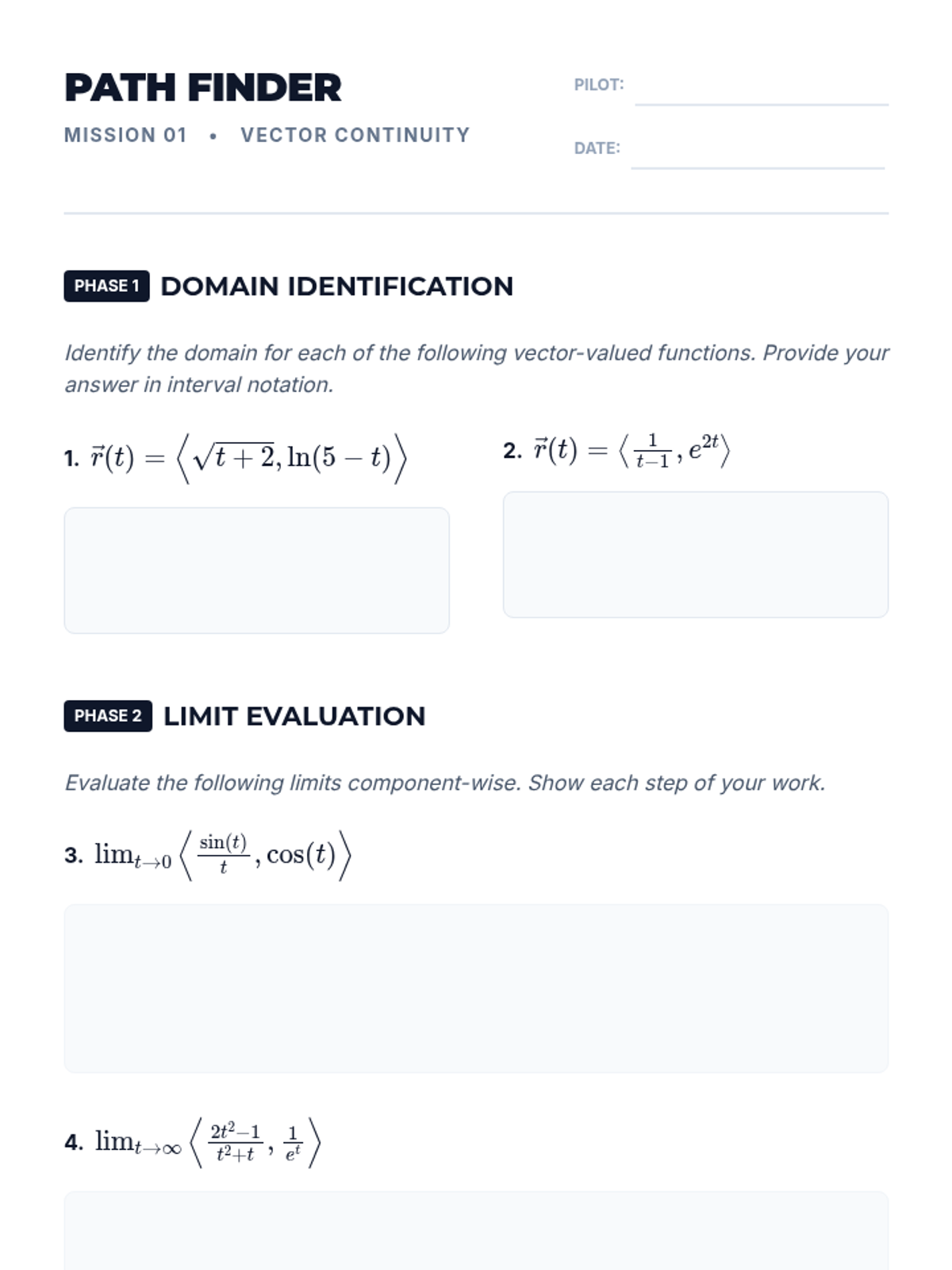
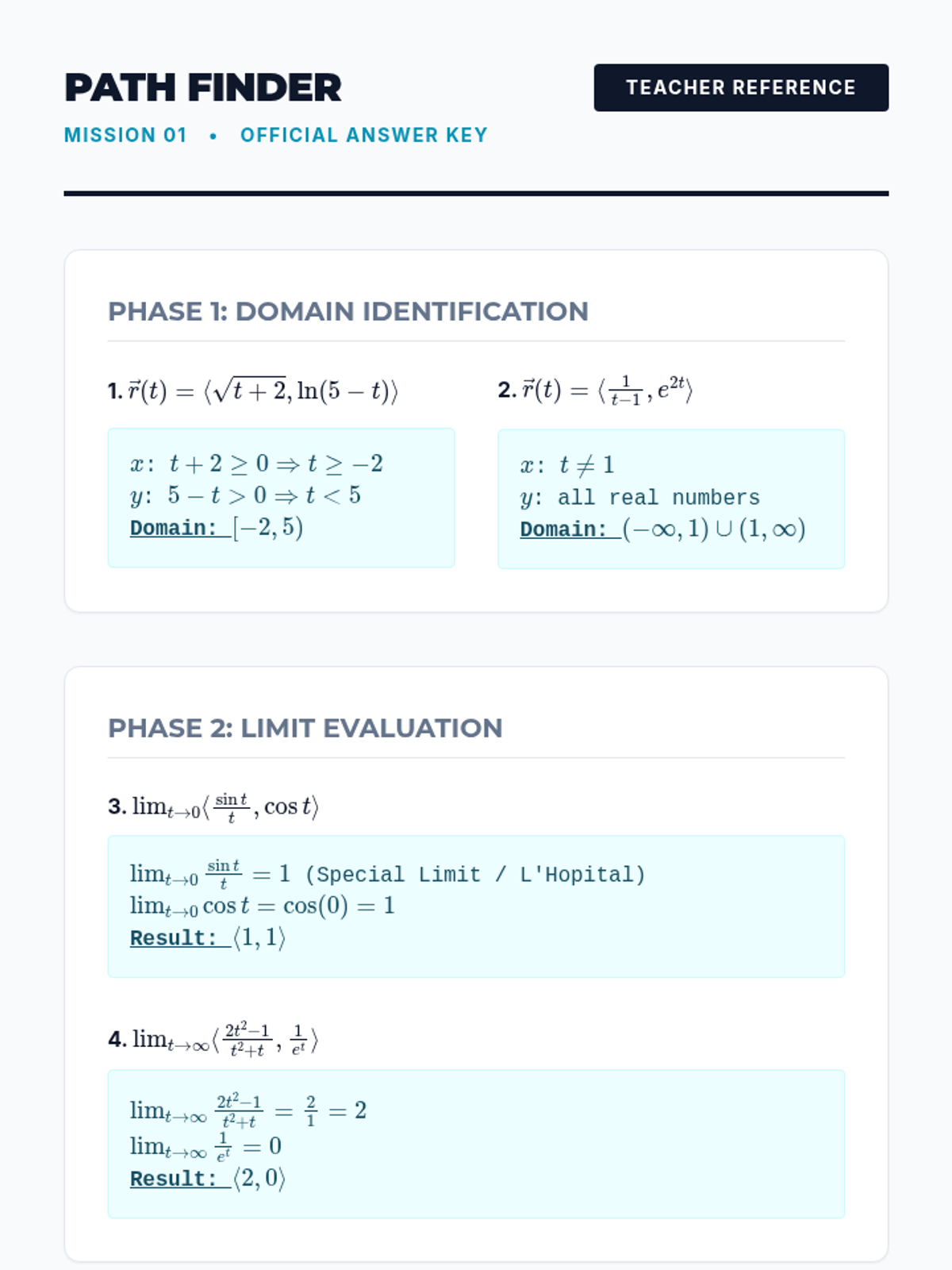
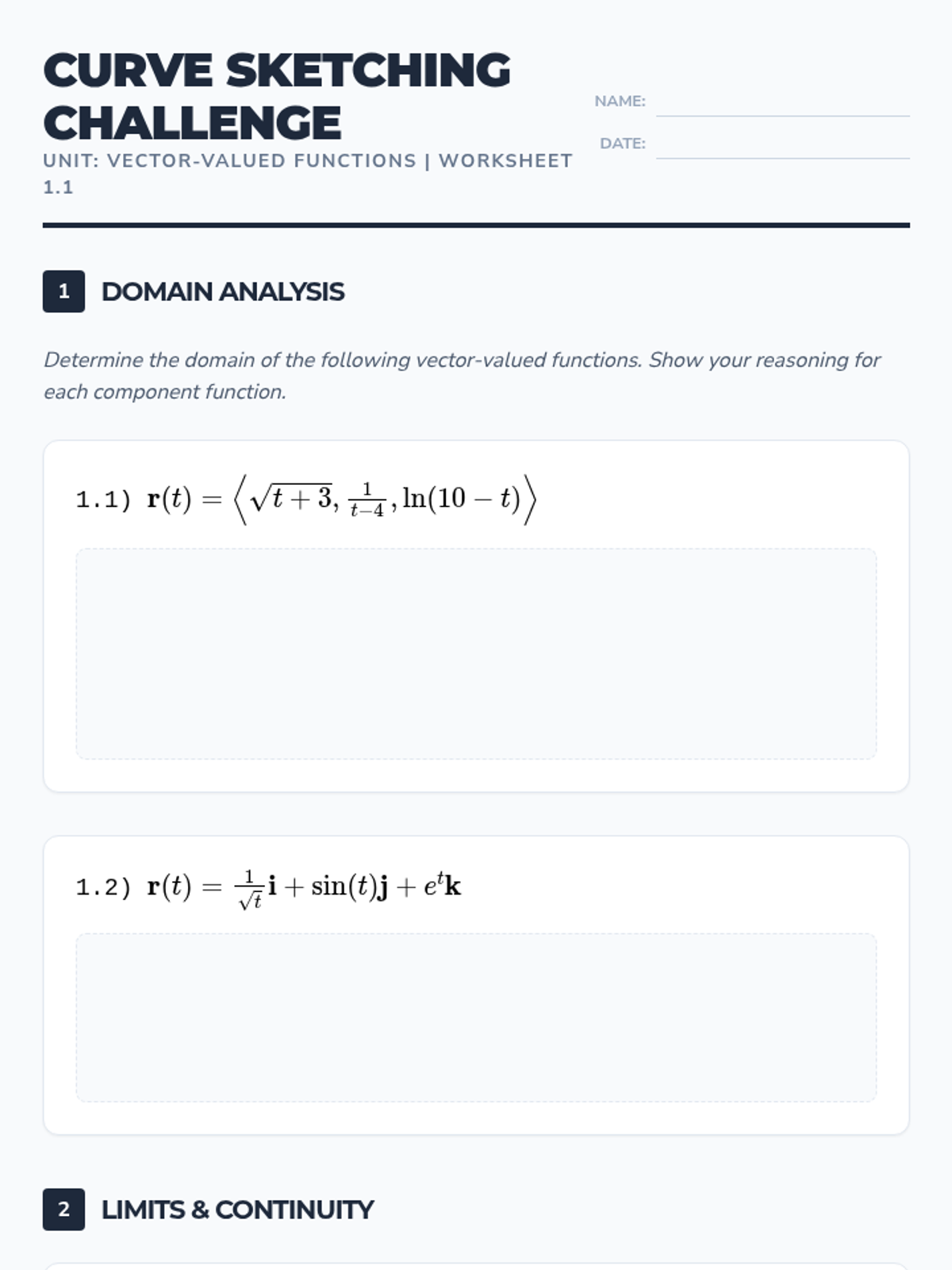
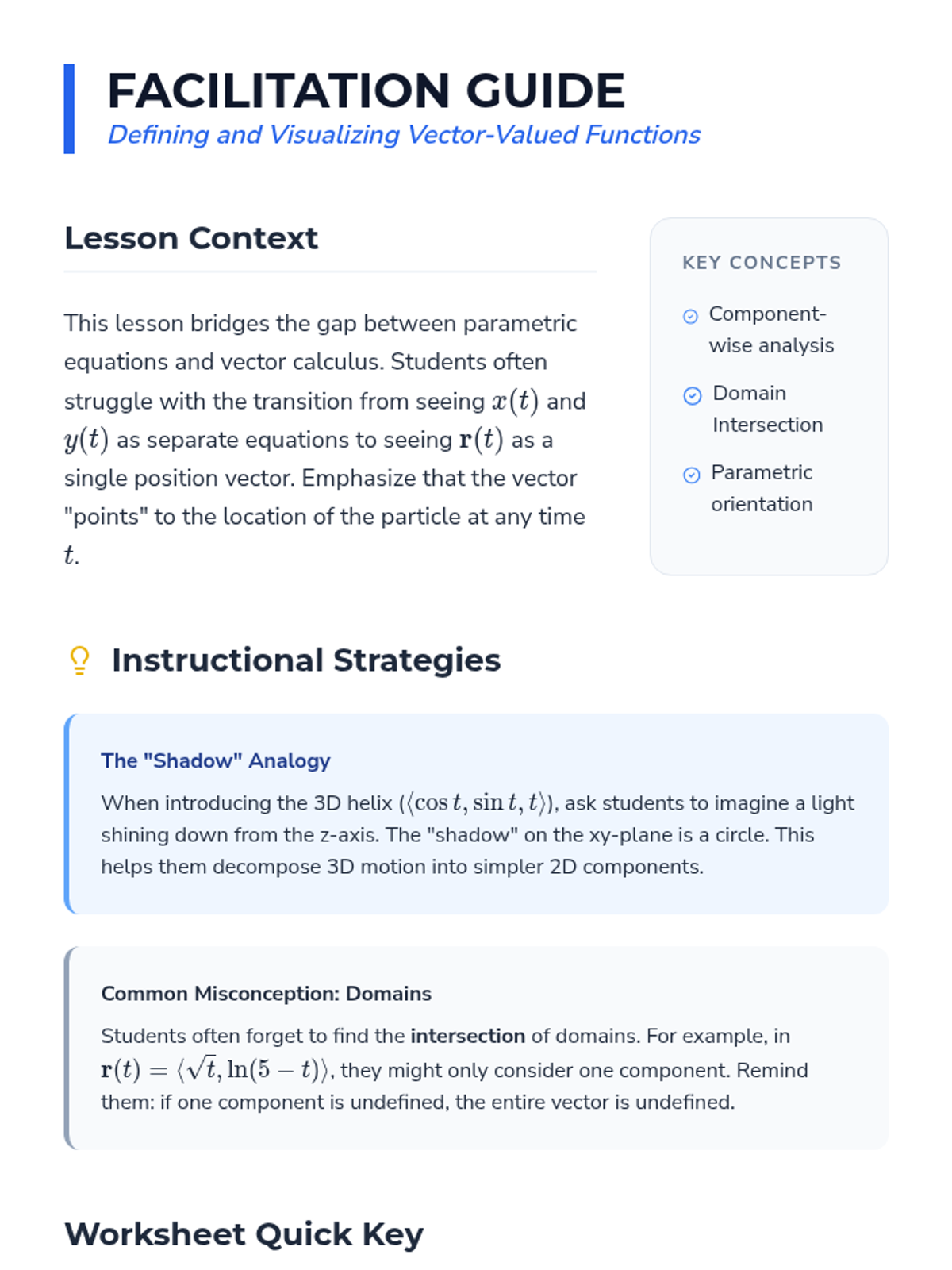
An advanced exploration of vector-valued functions and their applications in modeling 2D motion and force, preparing students for multivariable calculus.
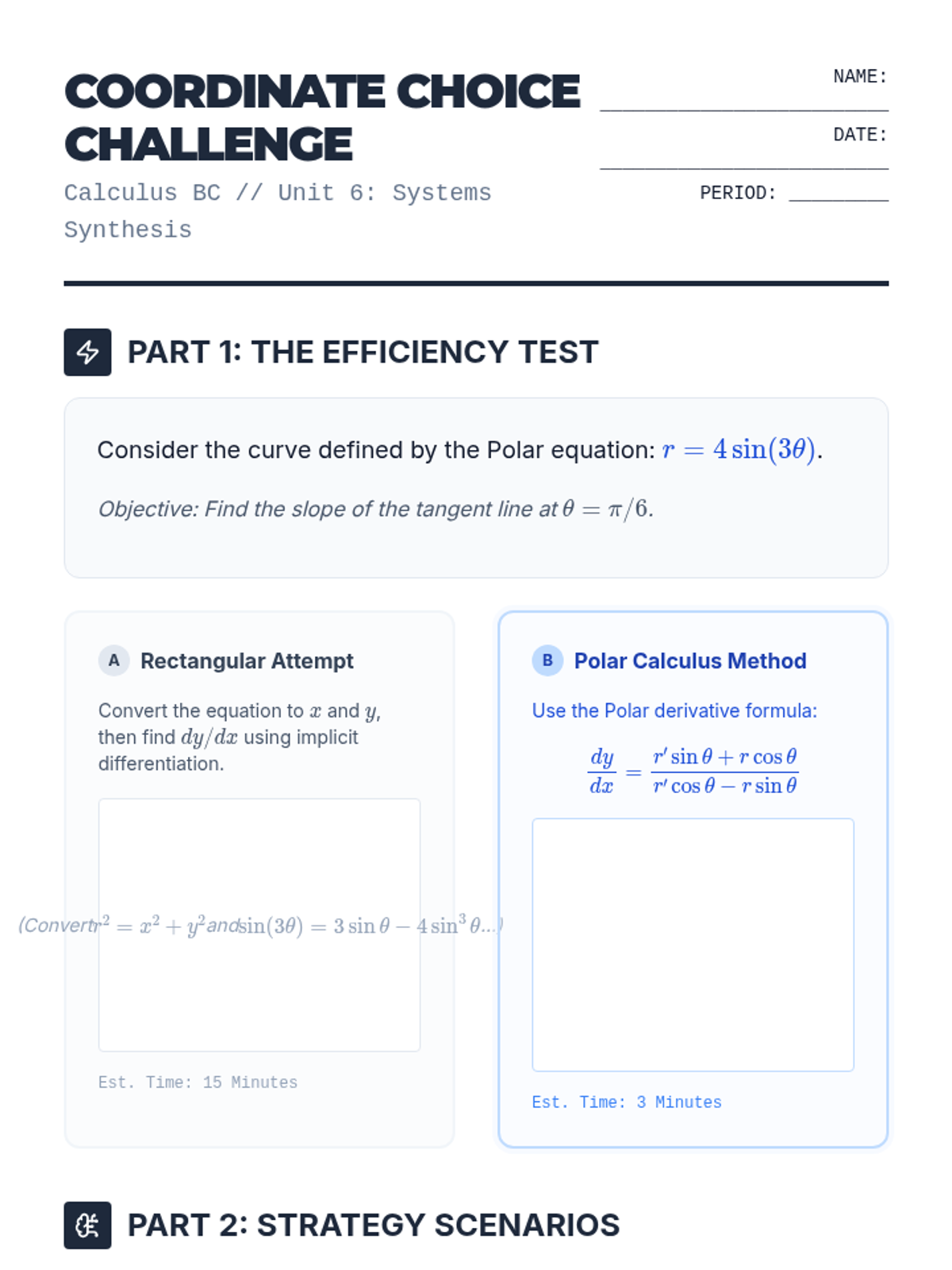
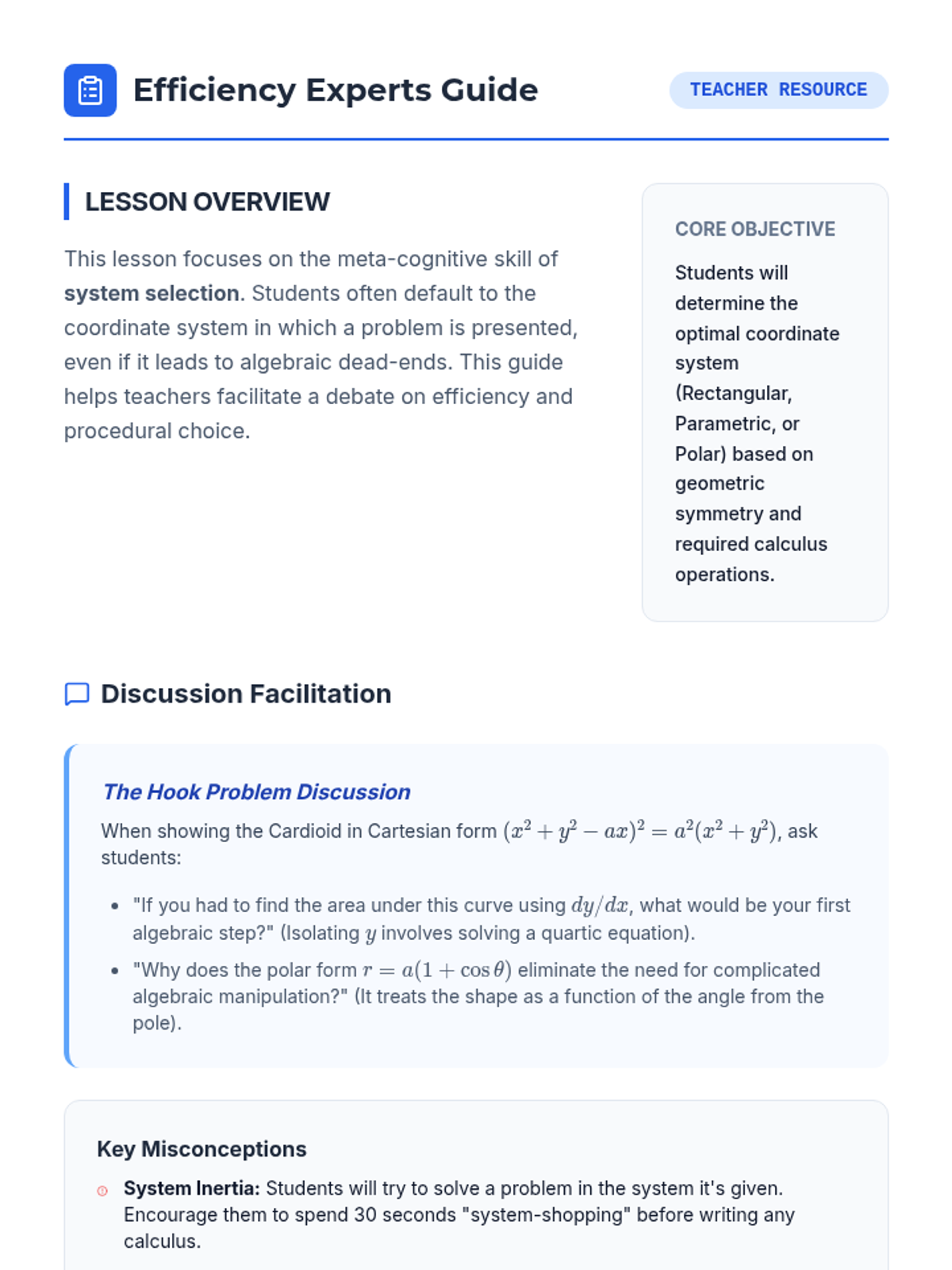
An advanced 11th-grade Calculus unit focusing on the integration of parametric and polar coordinate systems. Students analyze motion, calculate complex areas, perform error analysis, and complete a final synthesis project based on particle kinematics.
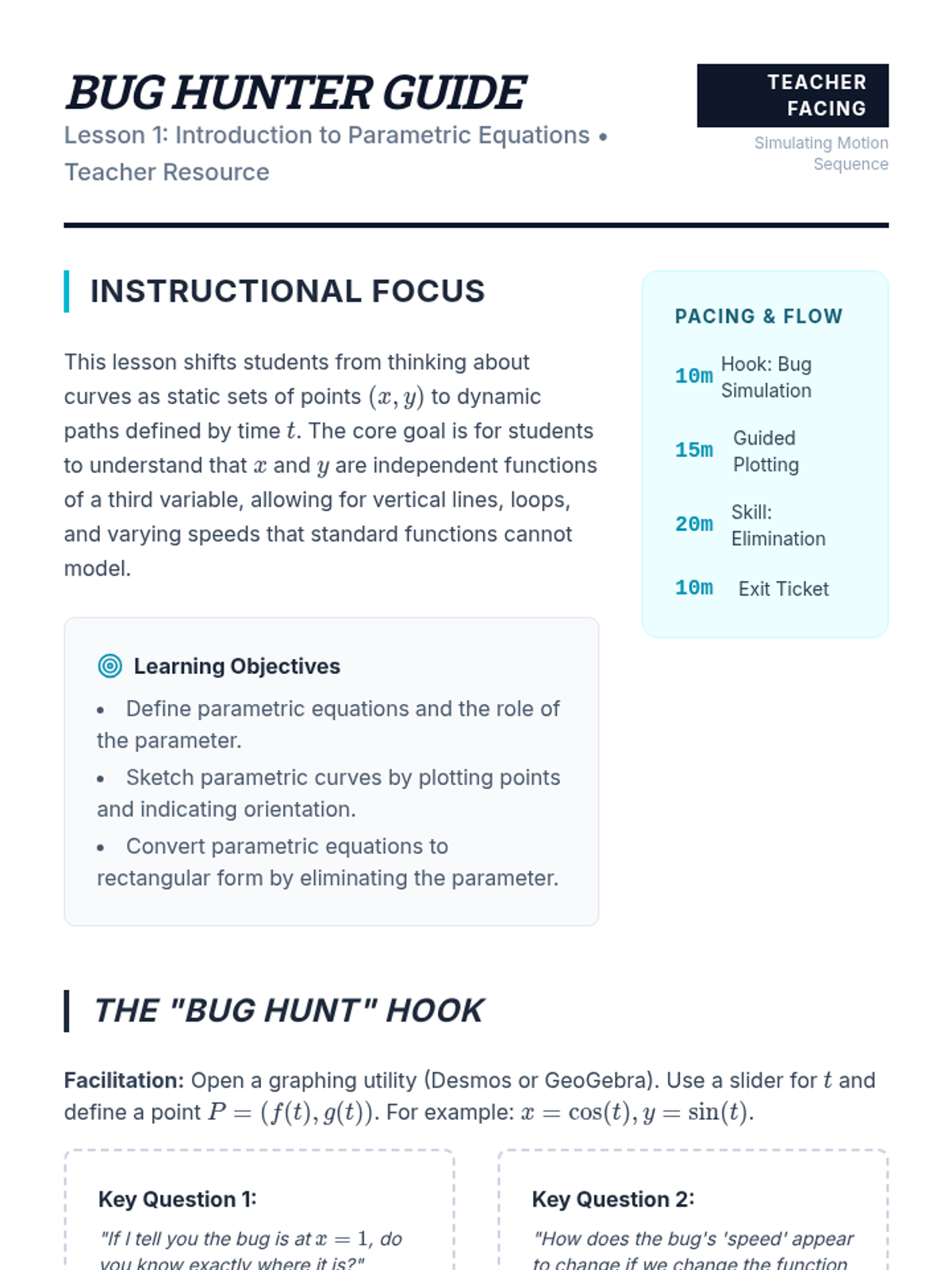
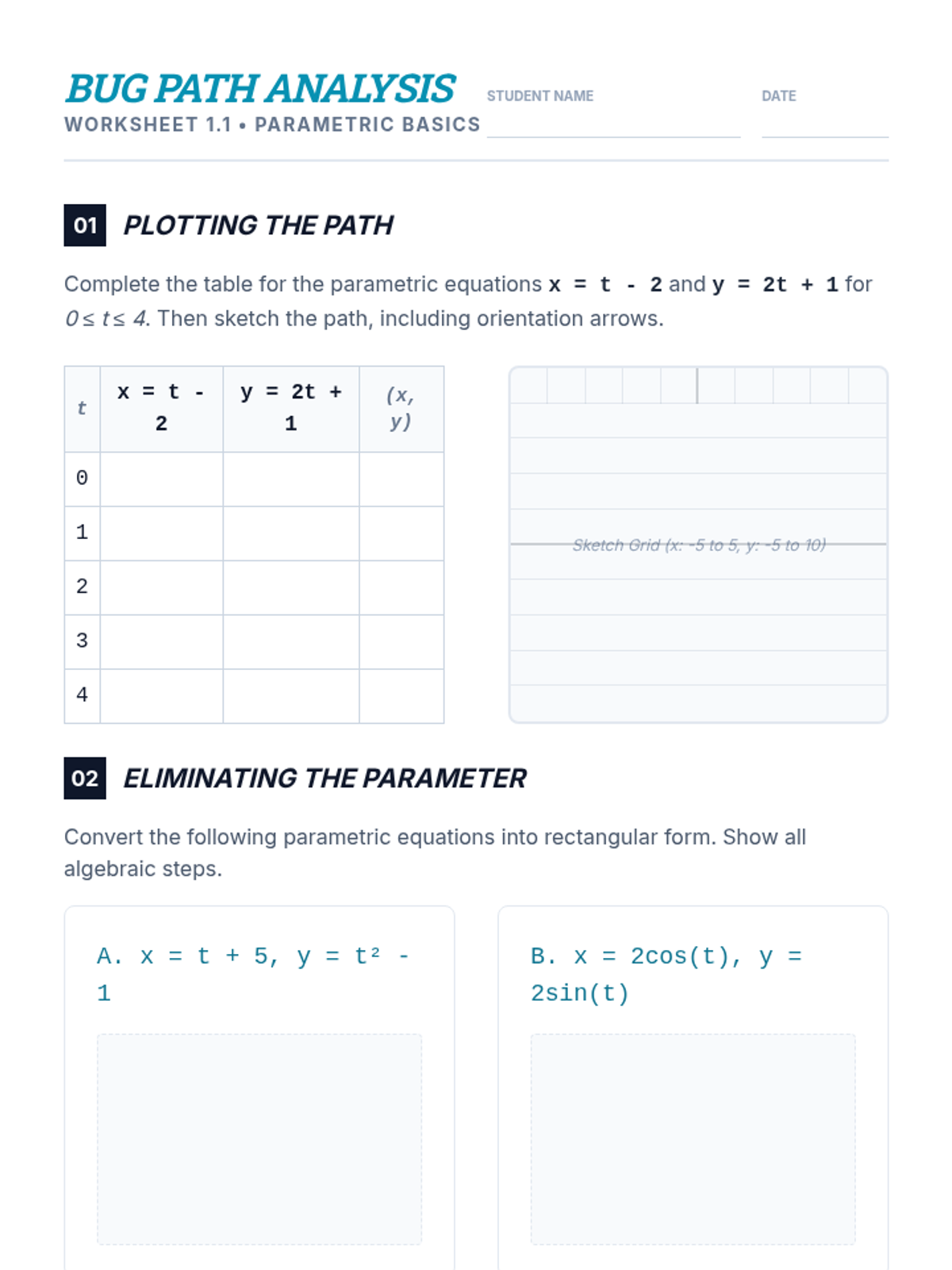
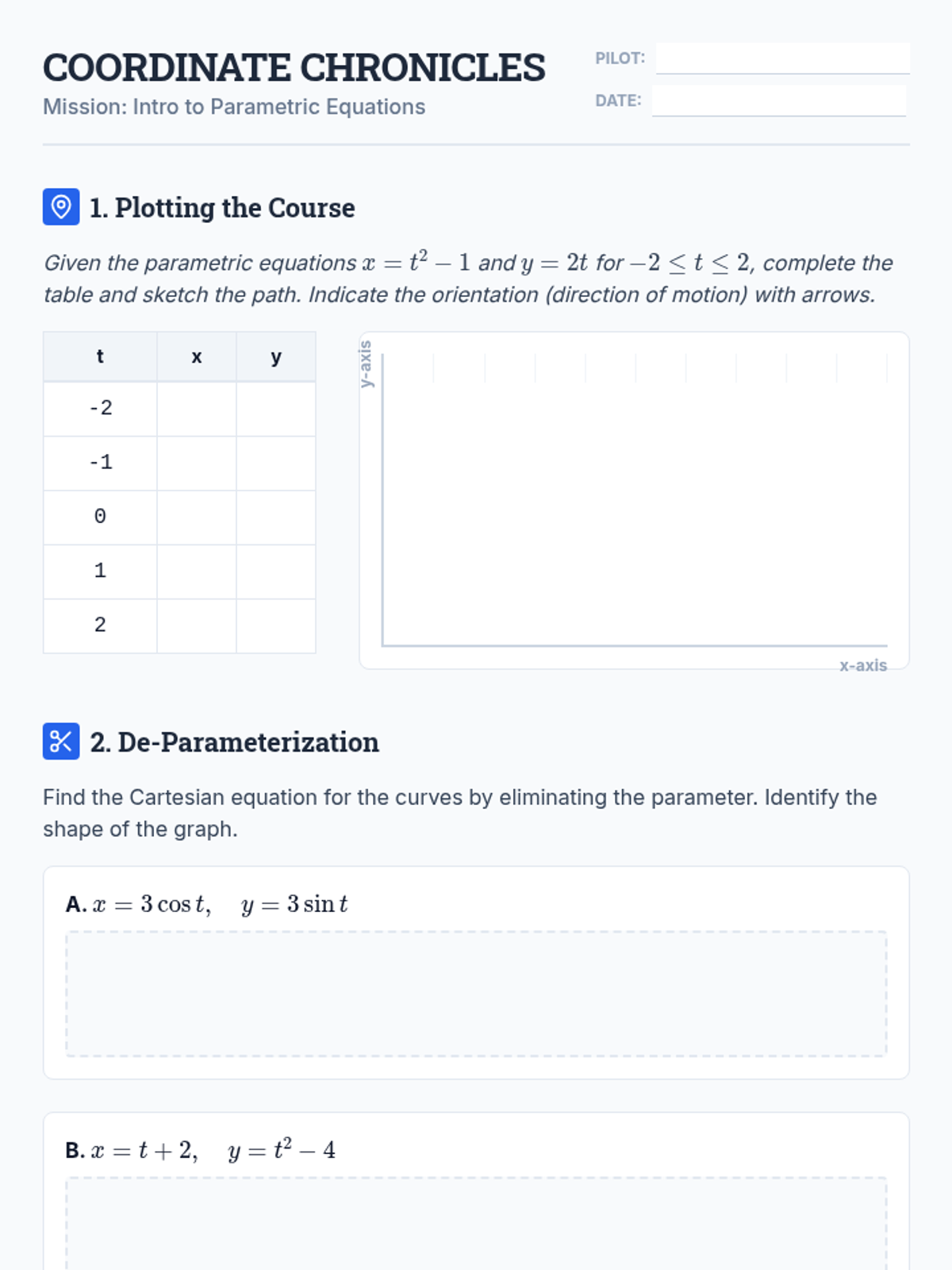
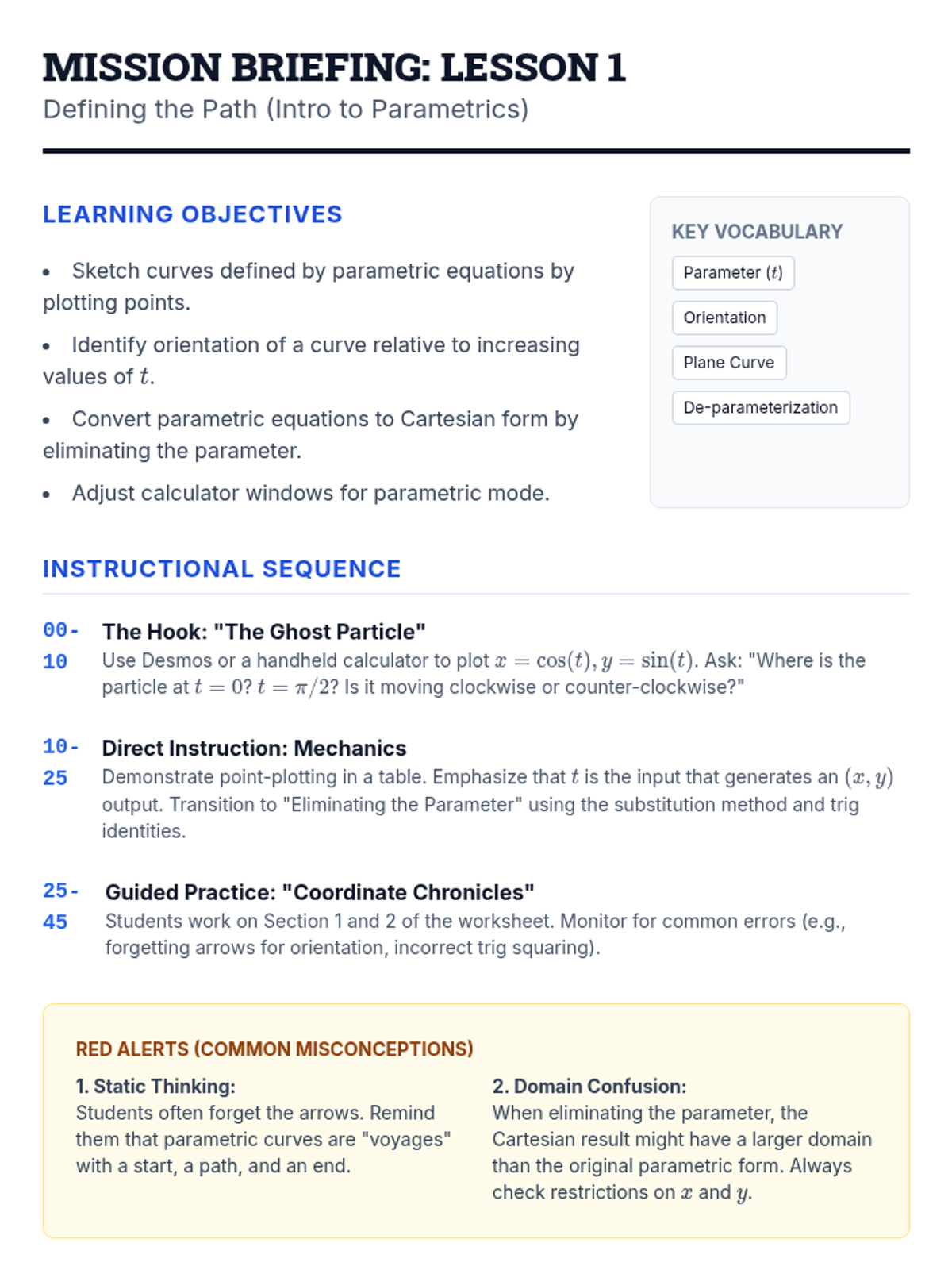
This sequence introduces students to parametric equations through the lens of particle motion and physics simulations. Students progress from basic plotting and parameter elimination to advanced calculus applications involving derivatives, vectors, and arc length.
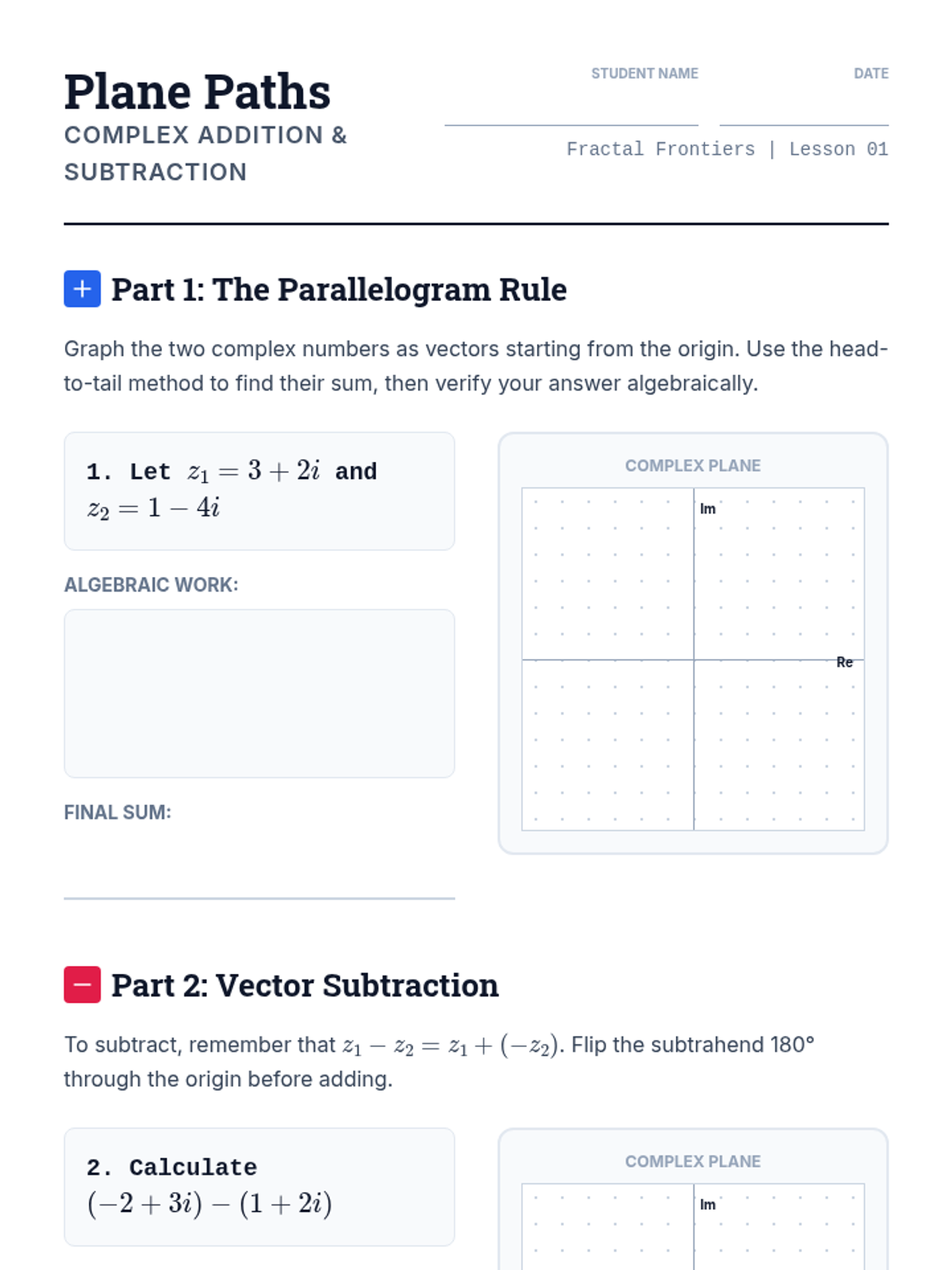
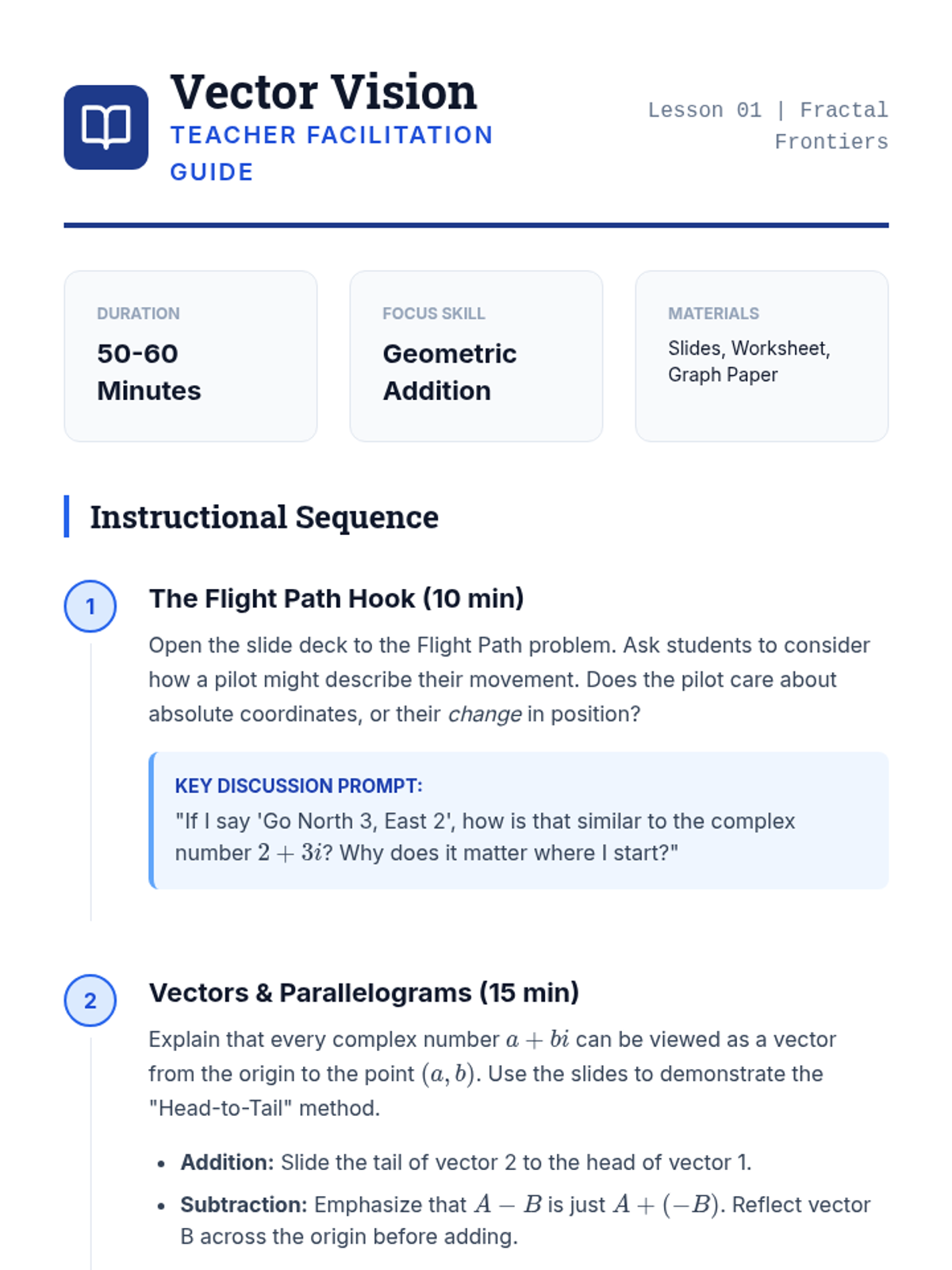
A 12th-grade inquiry into complex numbers through the lens of geometry and vector operations. Students transition from algebraic rules to visual intuition, exploring rotations, dilations, and translations in the complex plane.
A project-based sequence for 11th grade algebra connecting complex number operations to visual geometry and the generation of the Mandelbrot set. Students transition from seeing complex numbers as points to seeing them as vectors, rotations, and eventually the building blocks of fractal art.
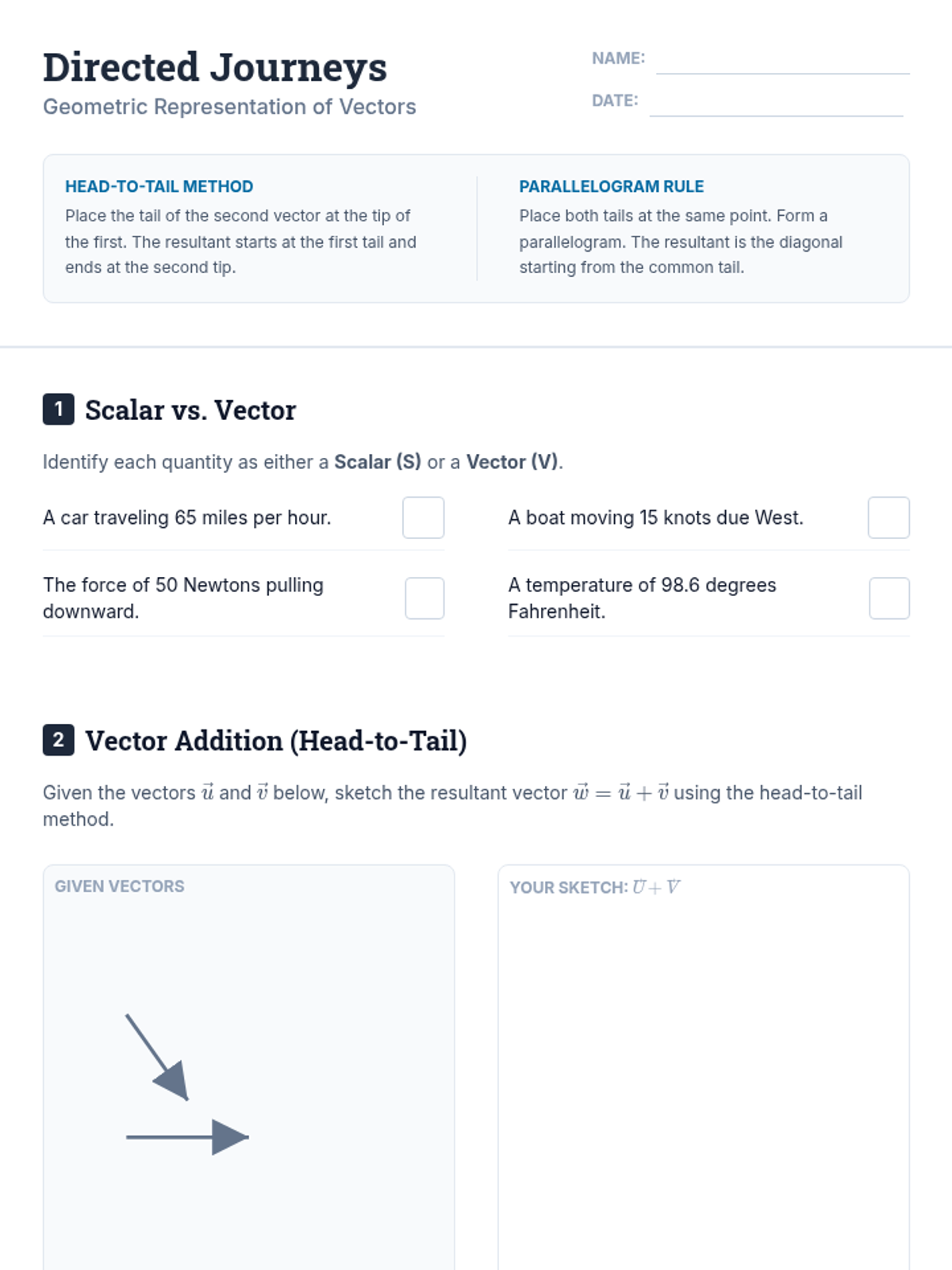
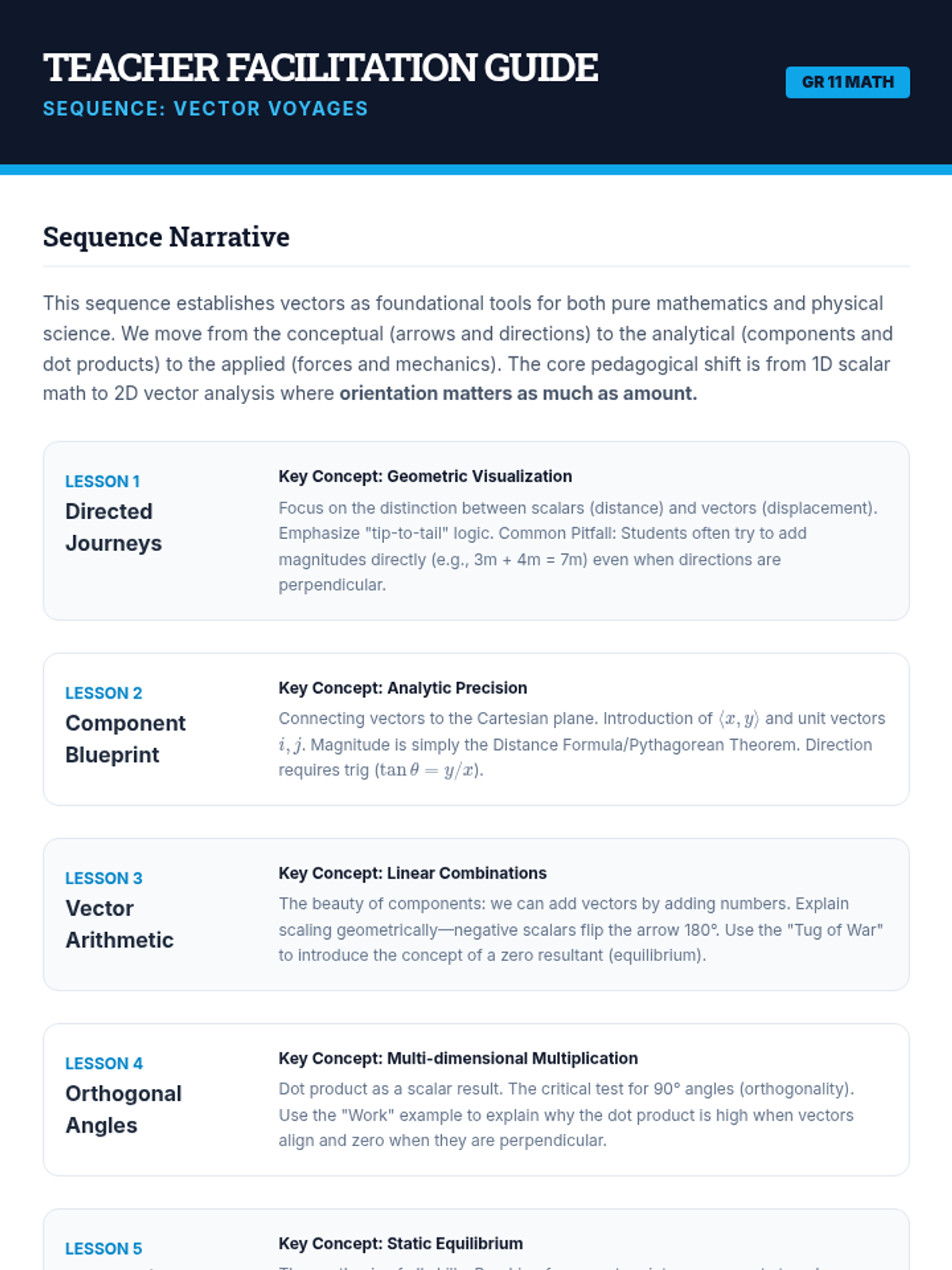
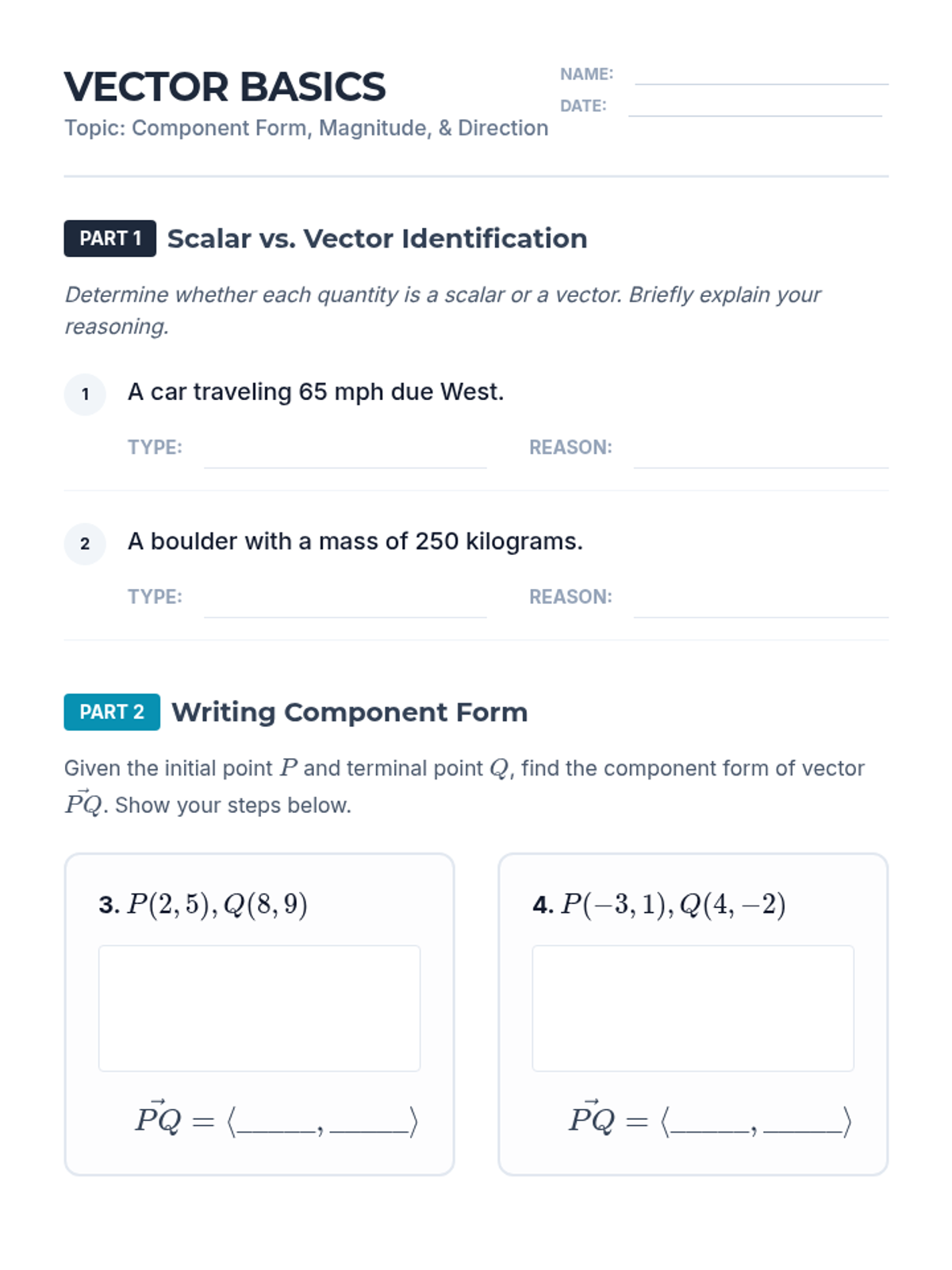
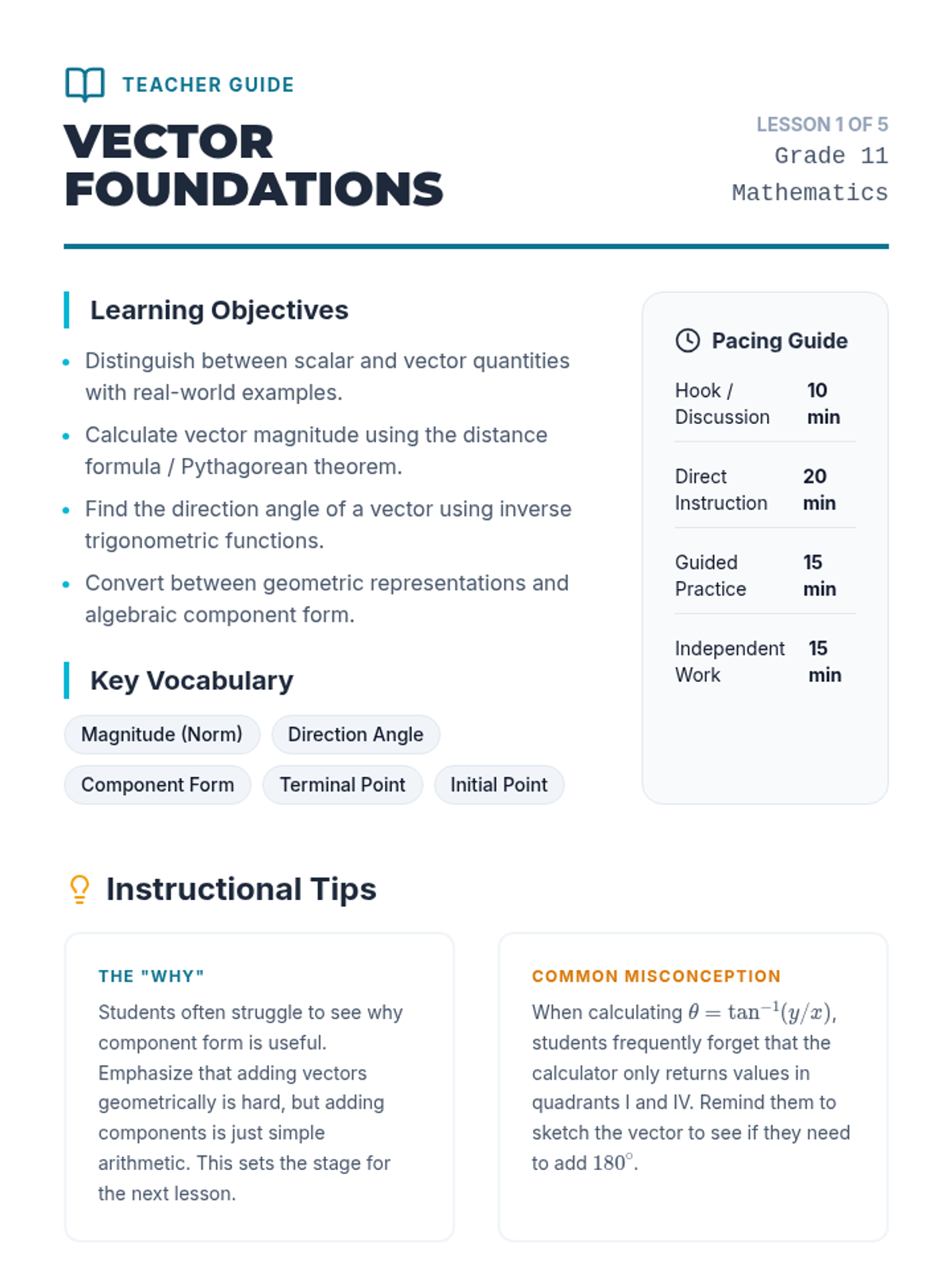
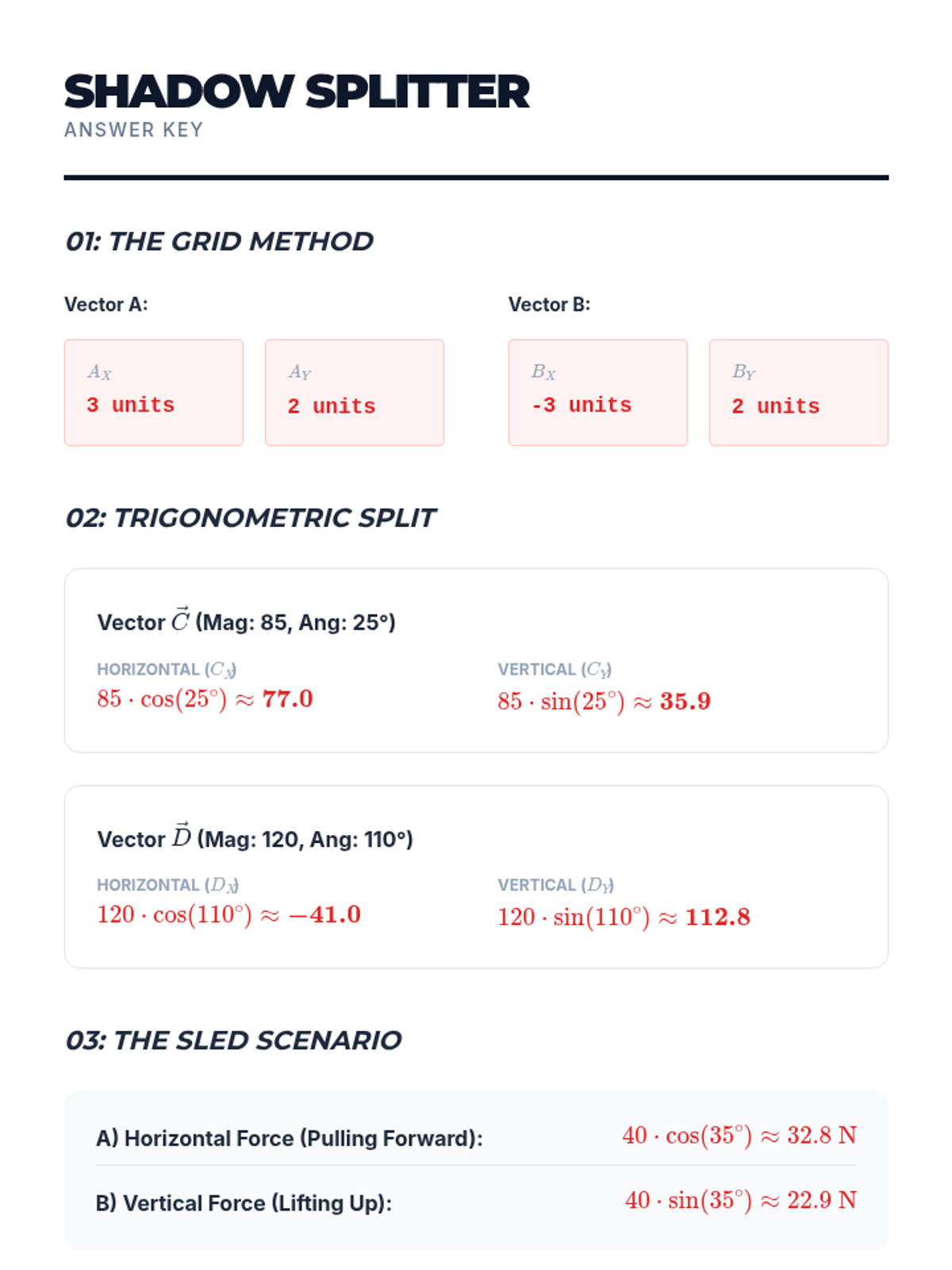
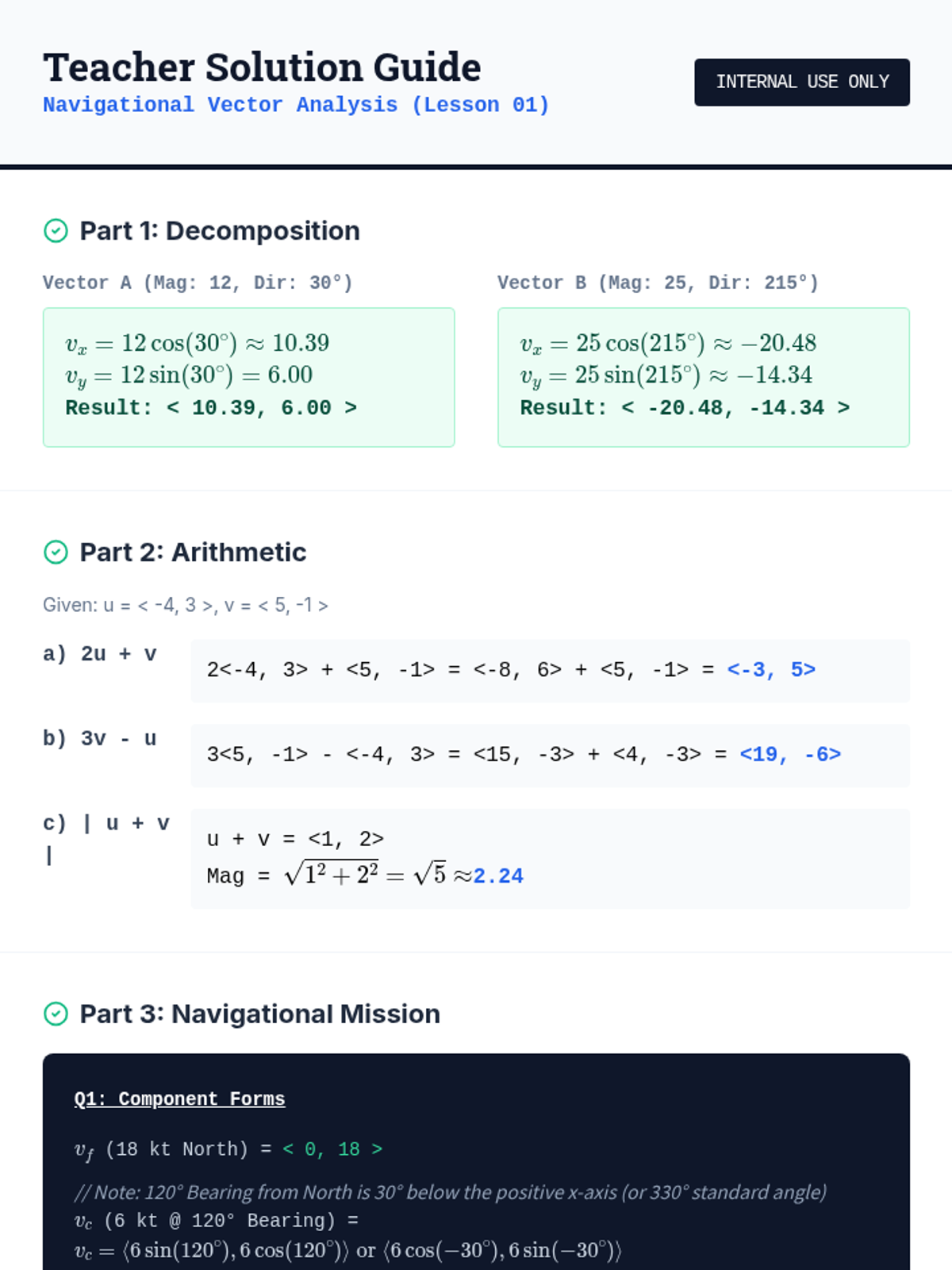
A comprehensive introduction to vector analysis for 11th-grade students, moving from geometric representations to algebraic components and real-world mechanical applications. Students master vector addition, scalar multiplication, the dot product, and force decomposition.
This sequence introduces 12th-grade students to vectors, covering geometric representations, algebraic operations in component form, and real-world applications in physics and navigation. Students will progress from visual concepts to complex analytical modeling of velocity and force.
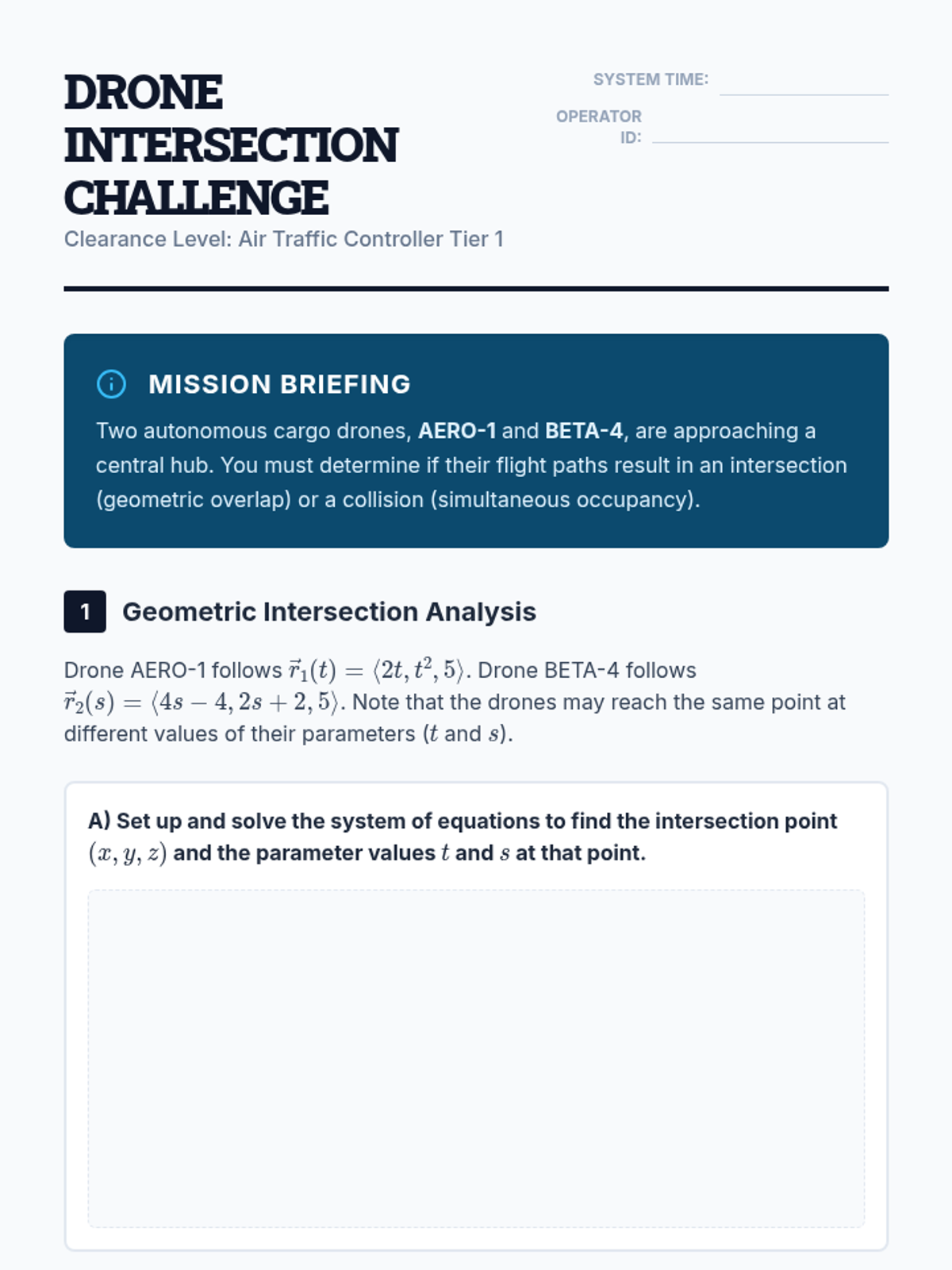
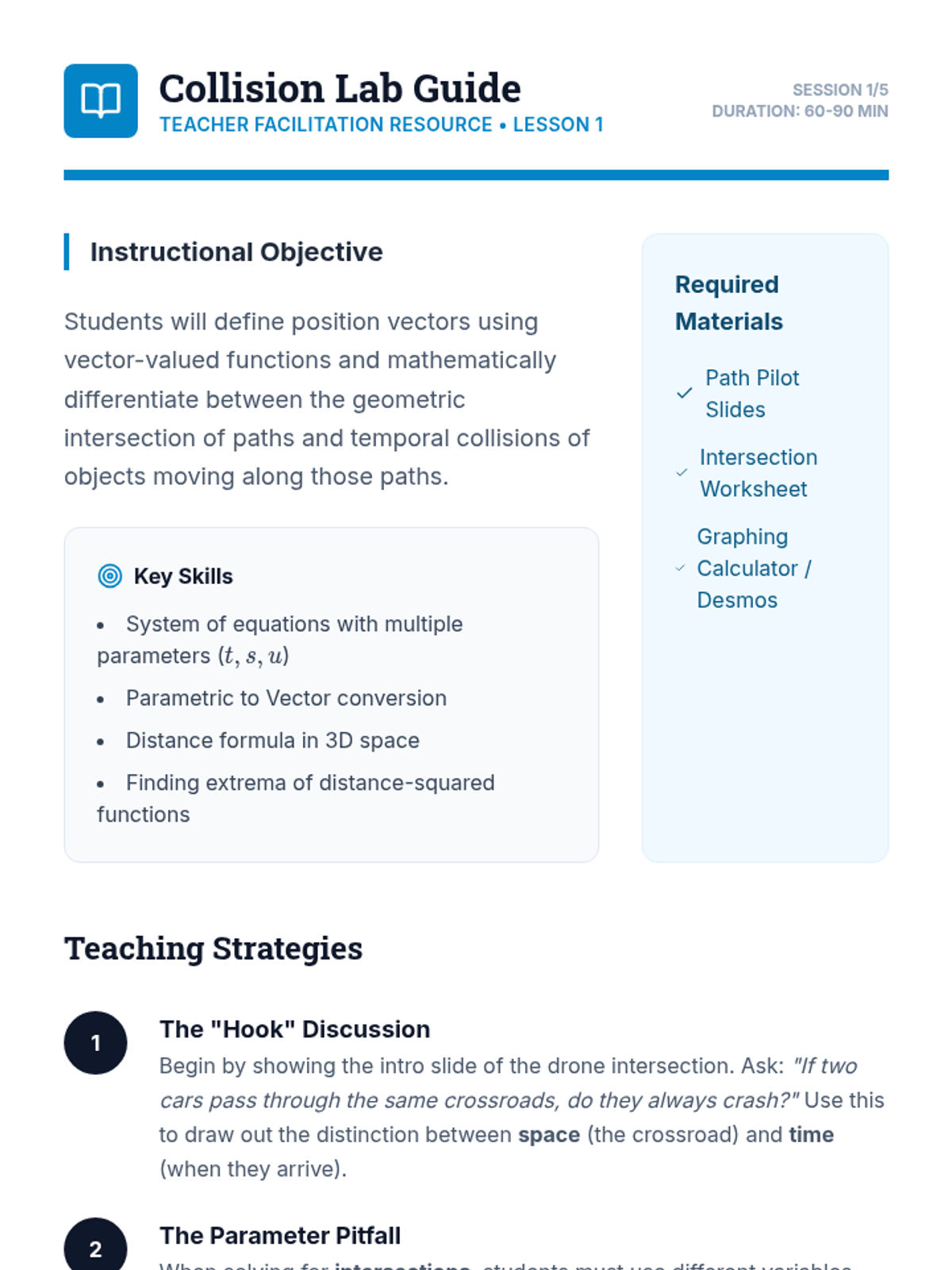
A project-based calculus sequence for 12th grade students focusing on the engineering applications of vector-valued functions, including path optimization, differentiability, and arc length.
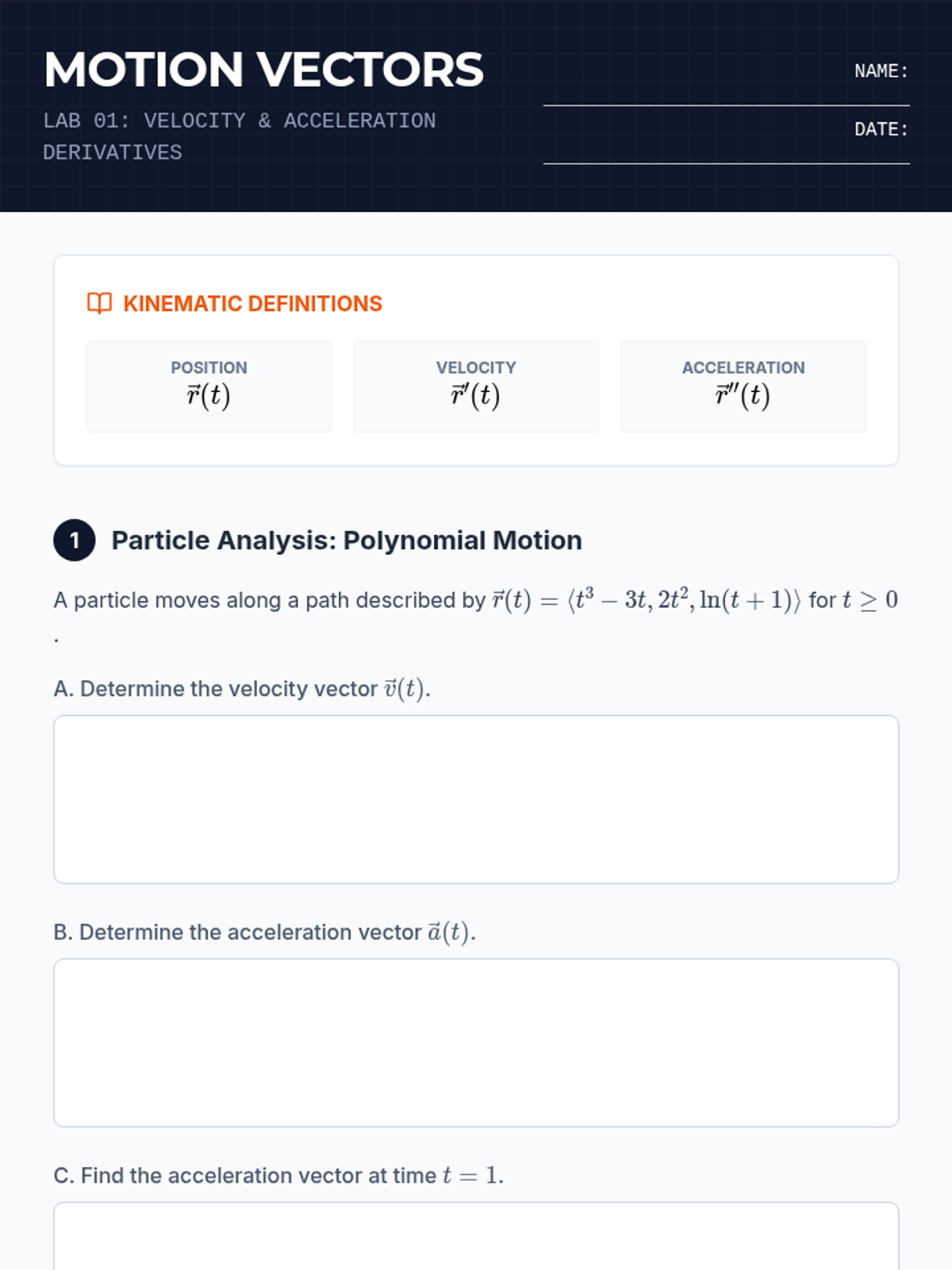
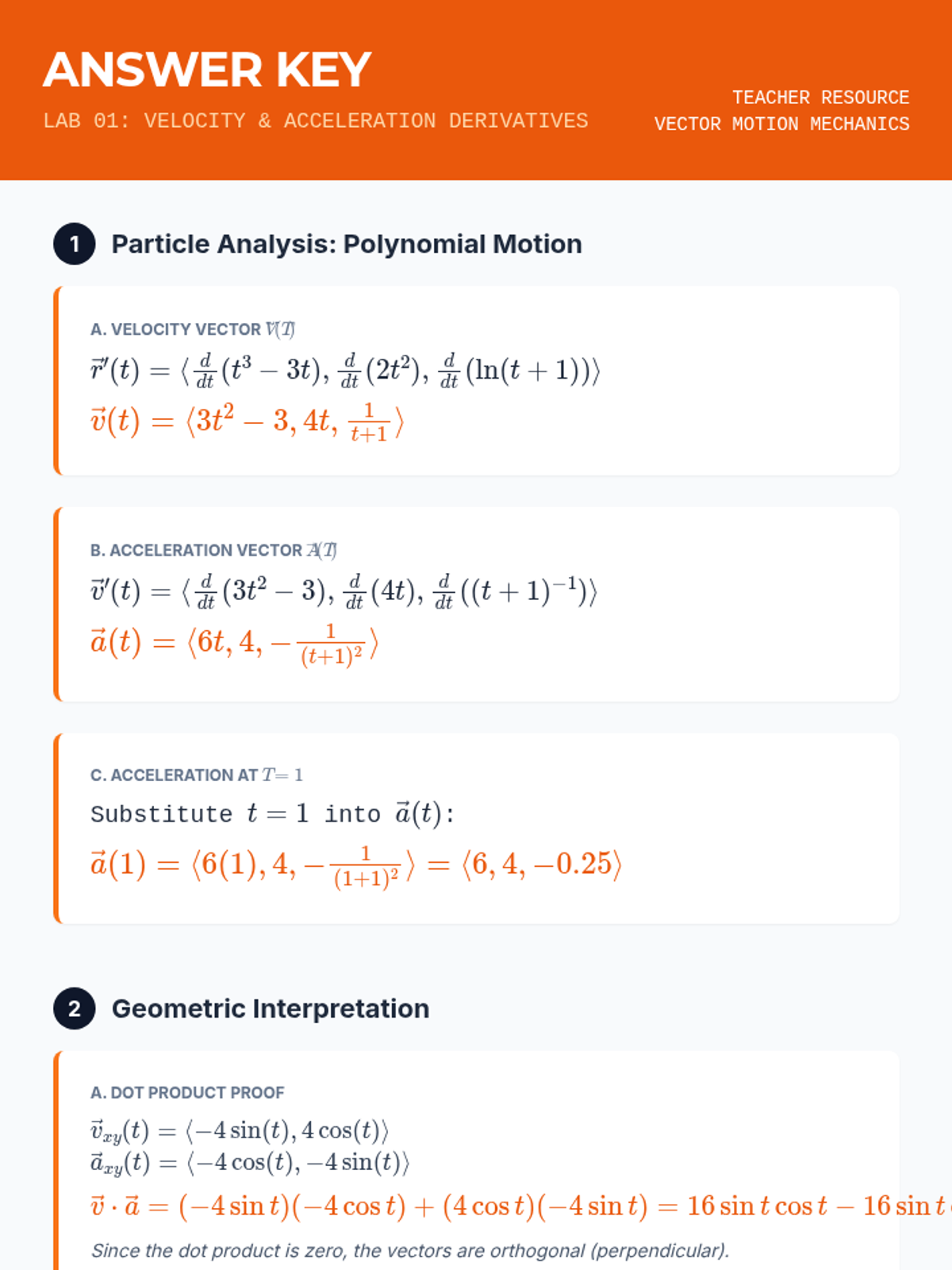
This sequence applies vector calculus to particle motion in two and three dimensions, interpreting derivatives and integrals as velocity, acceleration, and displacement to model real-world kinematics.
This sequence guides students through the fundamental operations of vector analysis, bridging the gap between geometric visualization and algebraic computation. Students progress from 2D component forms to 3D spatial analysis and complex products, applying their knowledge to physics-based problems like work and torque.
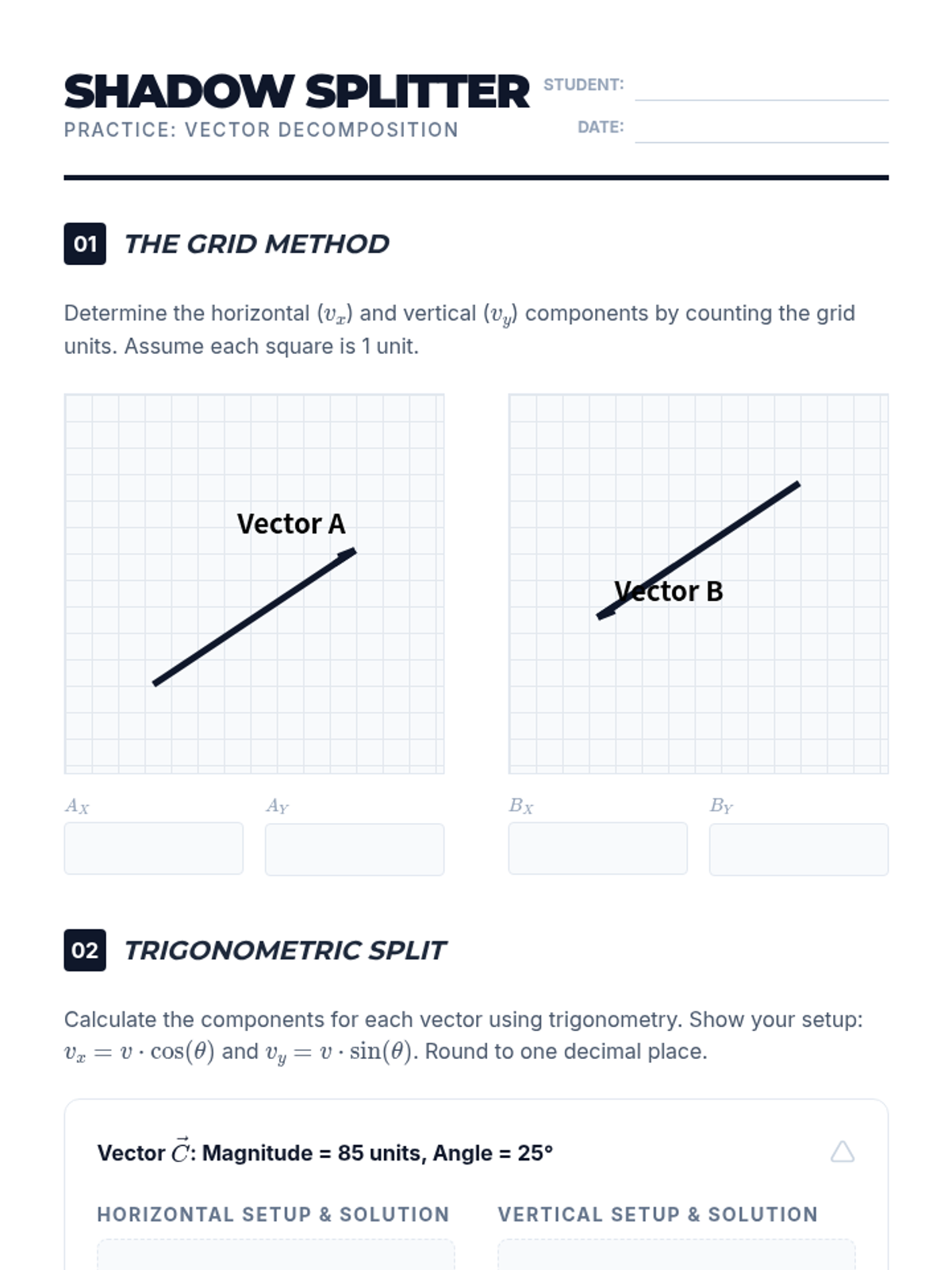
This sequence guides 9th-grade students through the algebraic representation of vectors. Moving from geometric drawings to coordinate components, students use trigonometry and the Pythagorean theorem to decompose, reconstruct, and add vectors with precision.
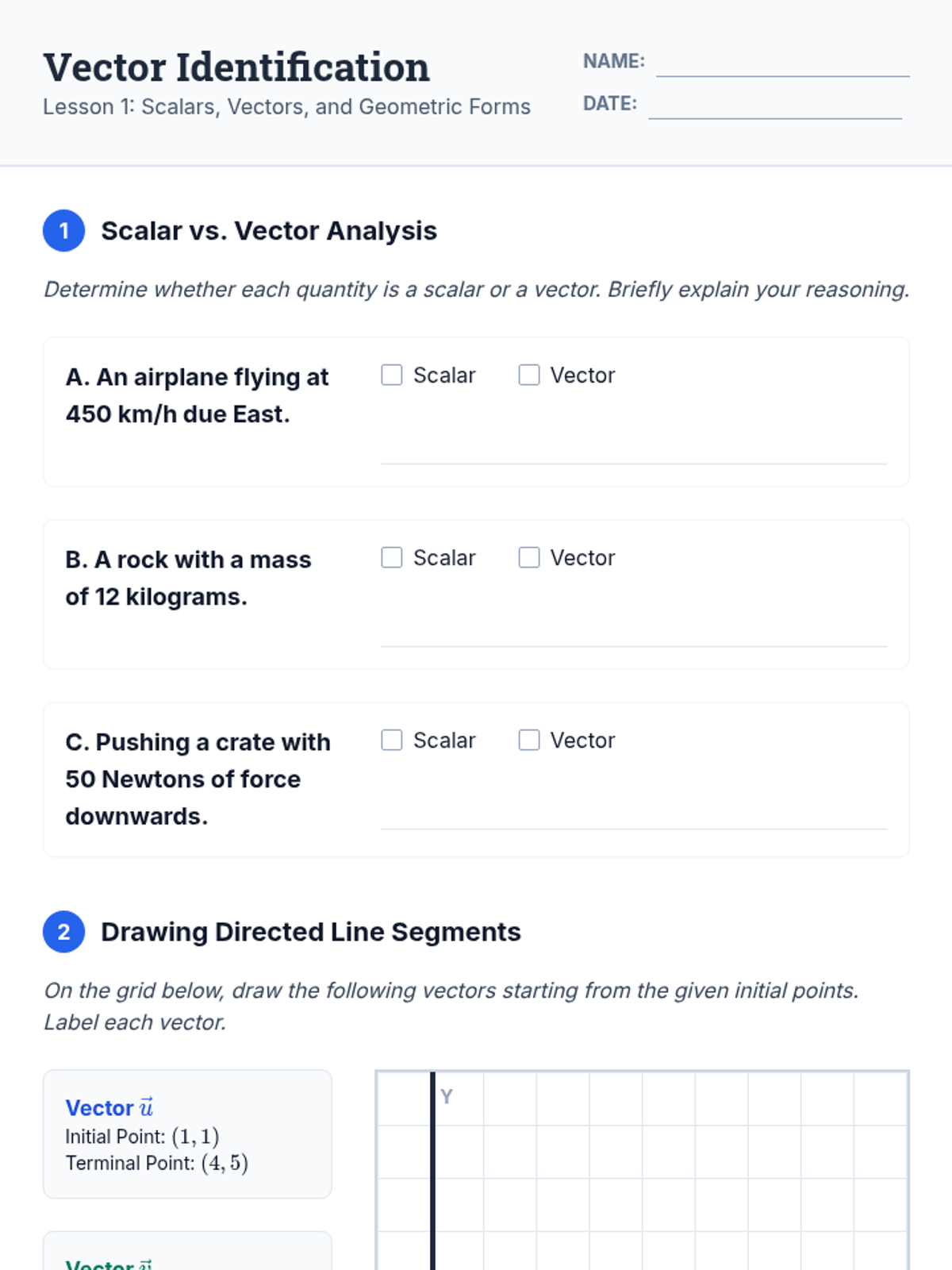
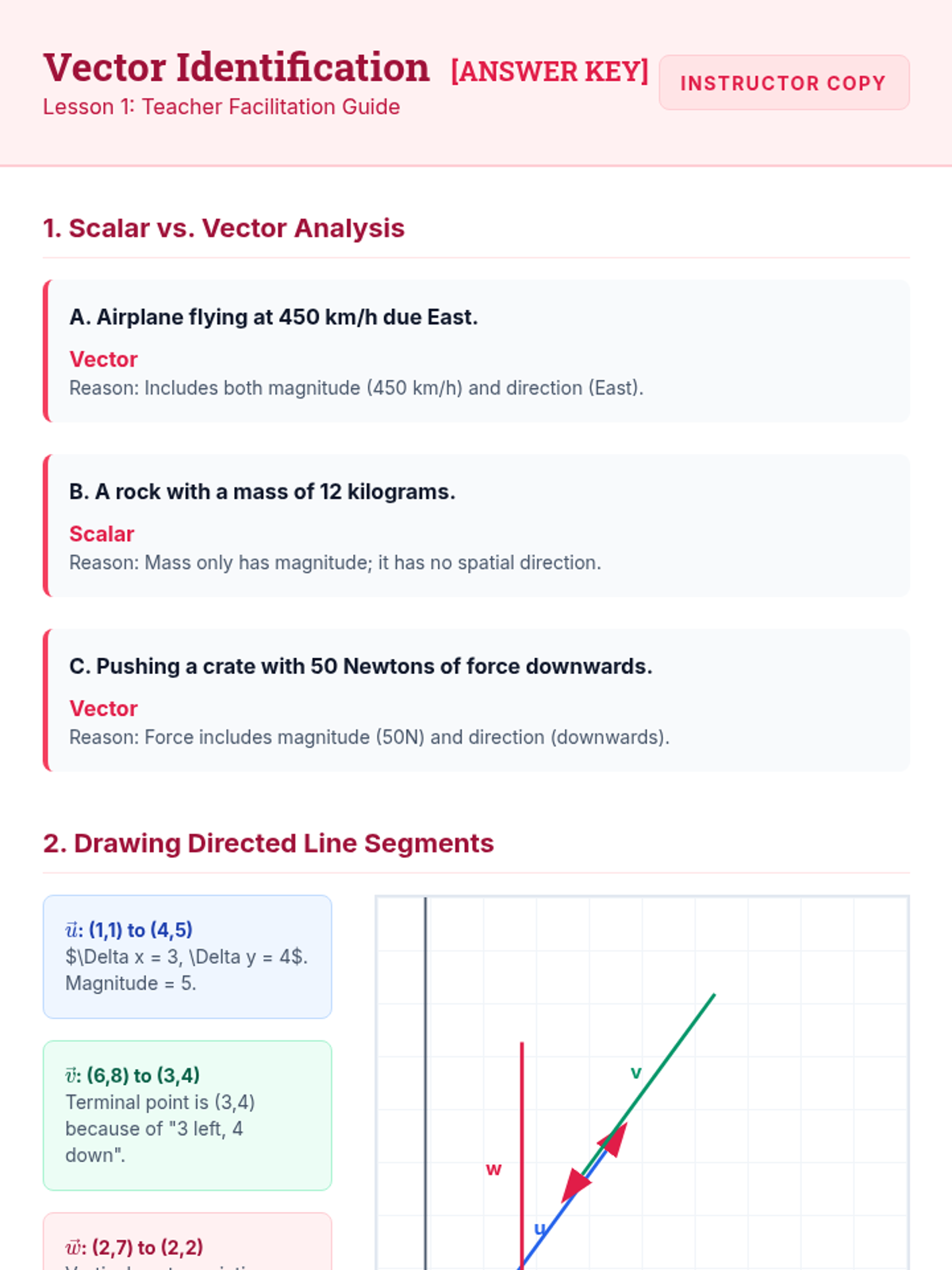
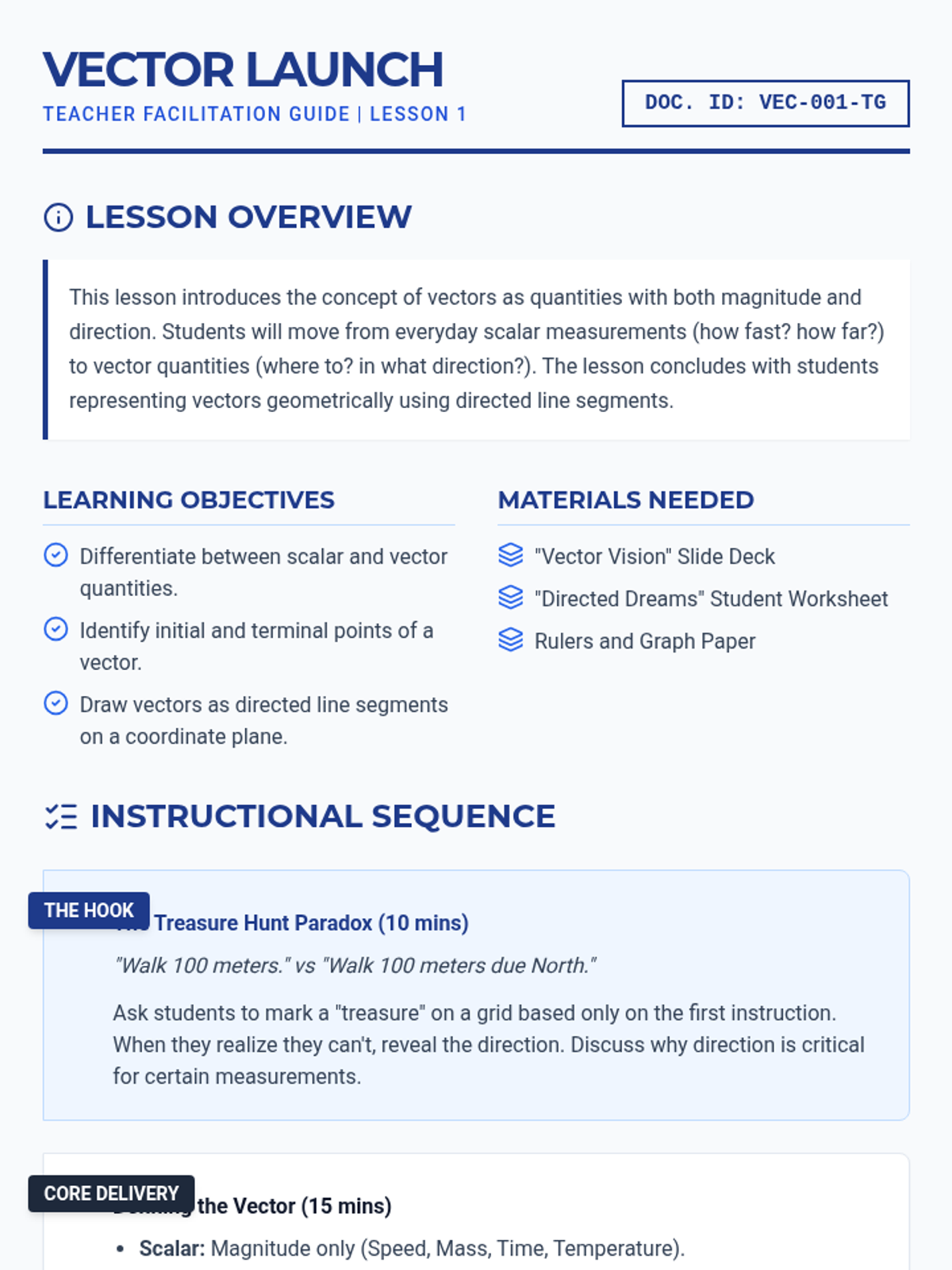
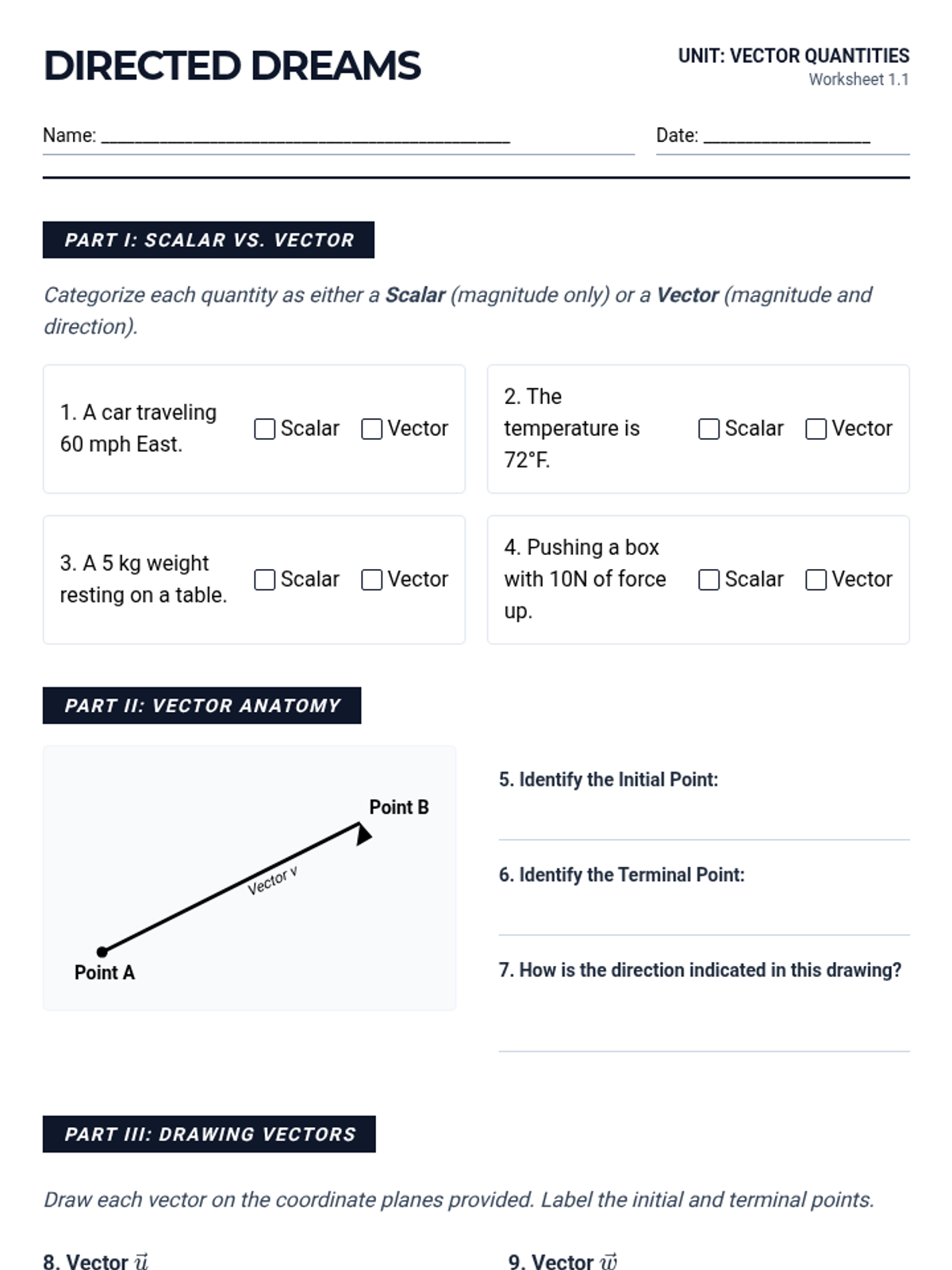
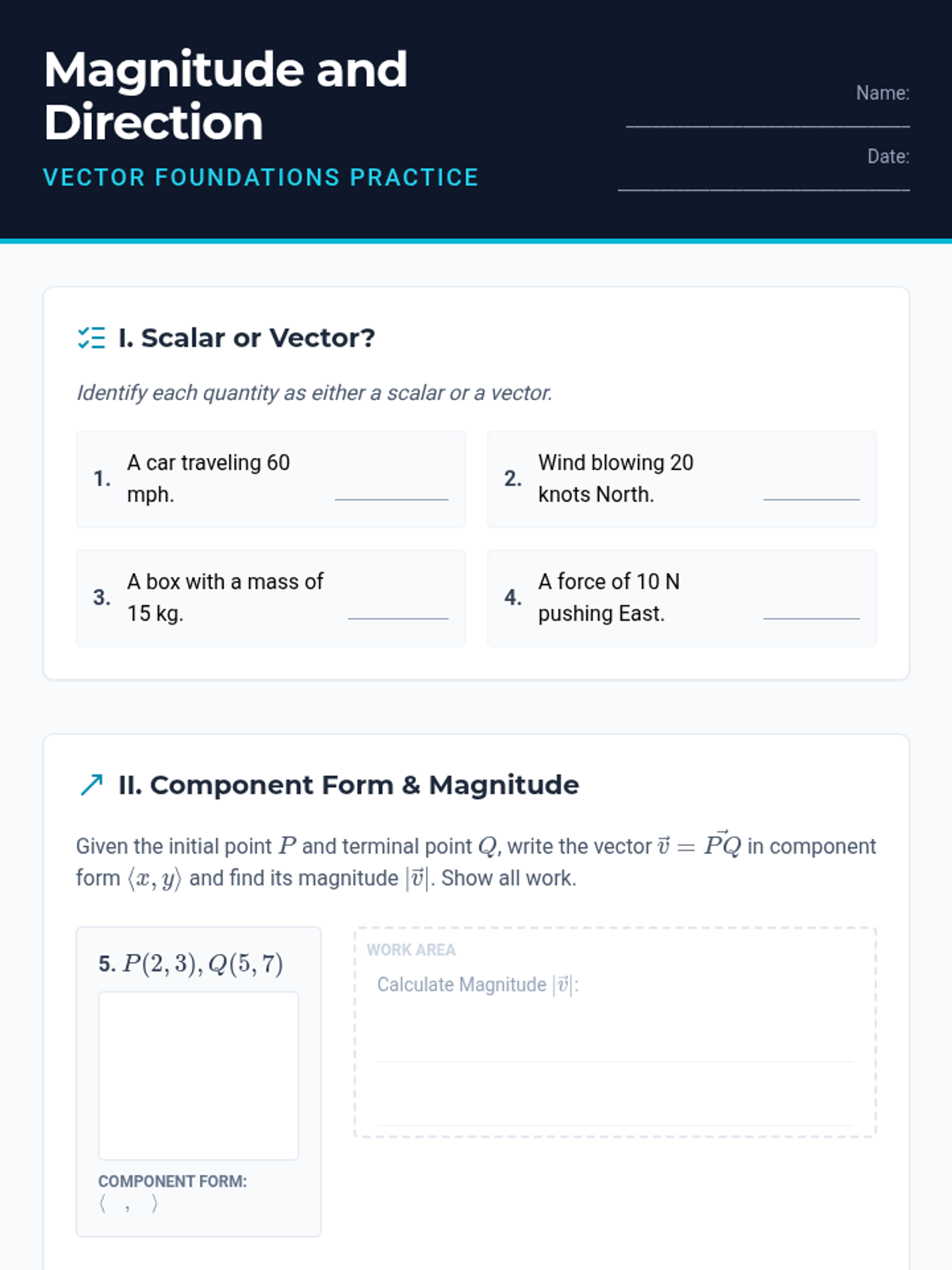
A comprehensive introduction to vectors through geometric representation, focusing on the distinction between scalars and vectors, visual addition/subtraction, scalar multiplication, and the transition to component form and magnitude calculation.
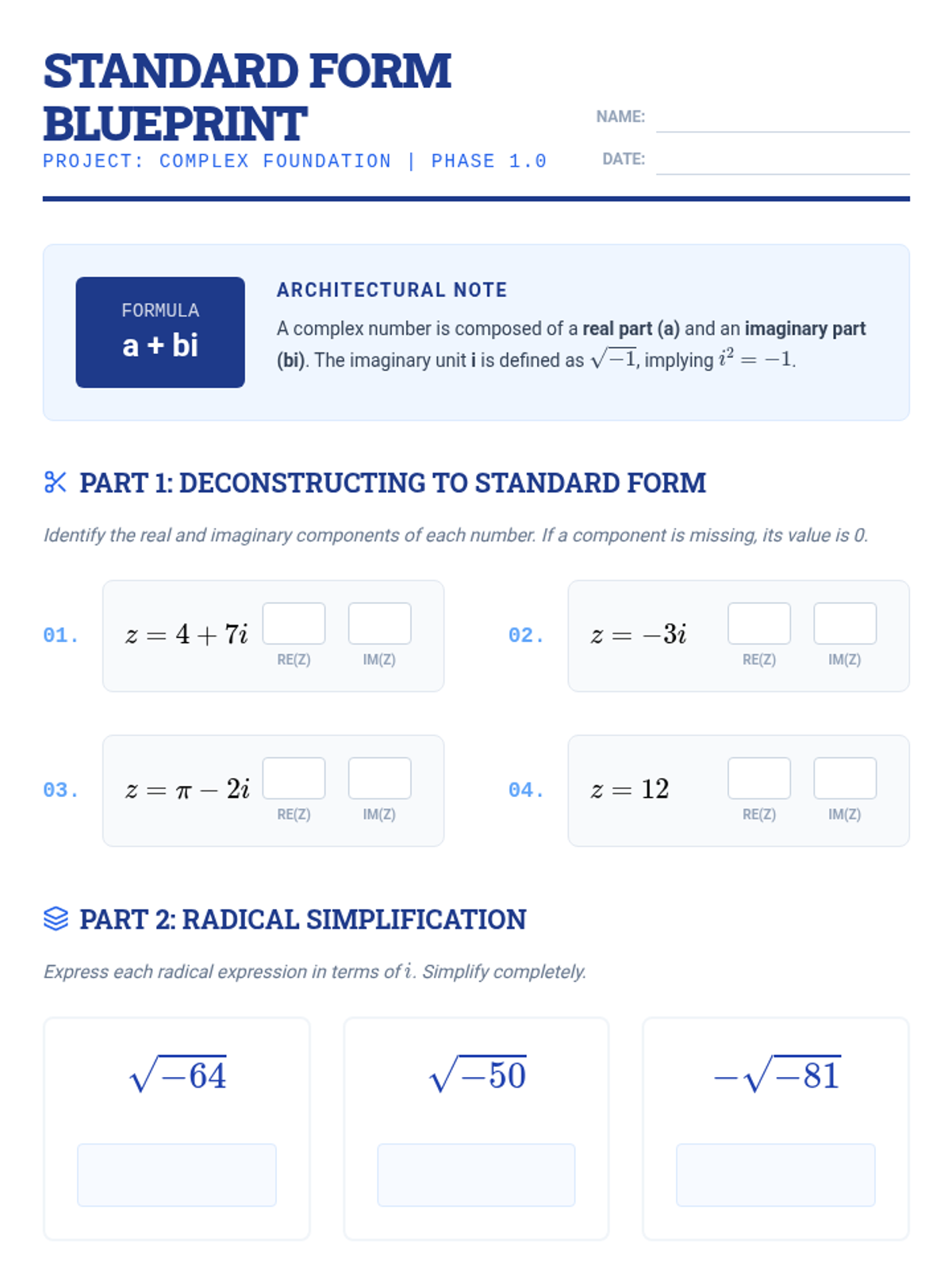
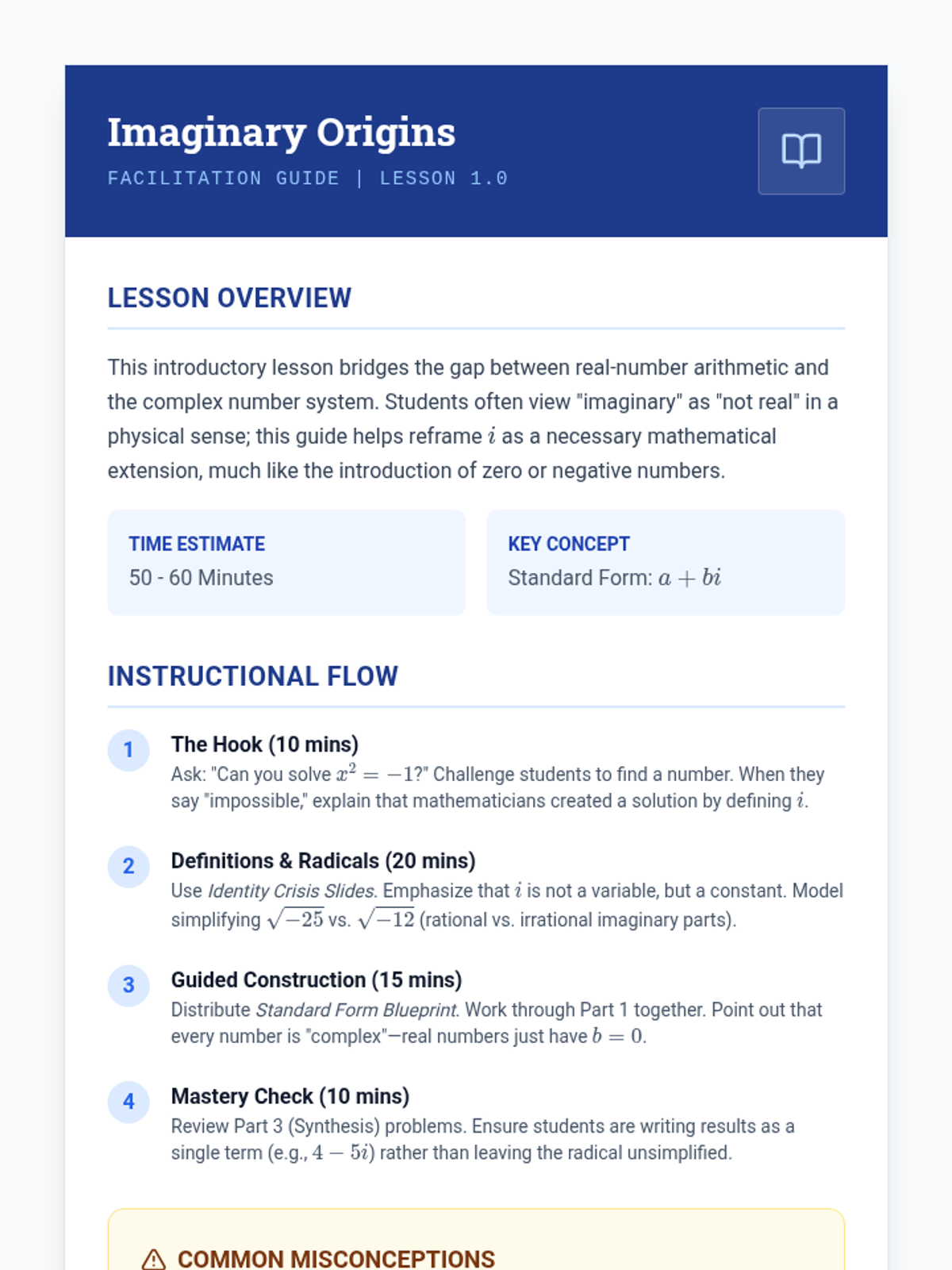
A foundational sequence for undergraduate students exploring the arithmetic, geometric, and algebraic properties of complex numbers, focusing on the imaginary unit, standard form, operations, and the complex plane.
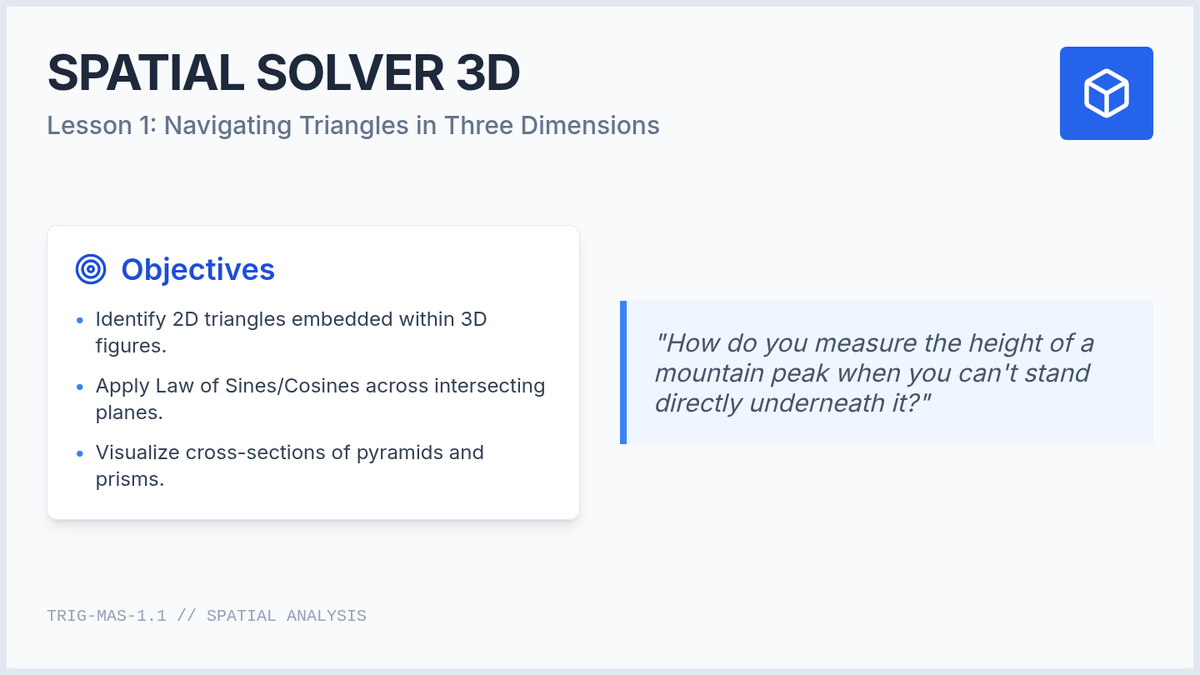
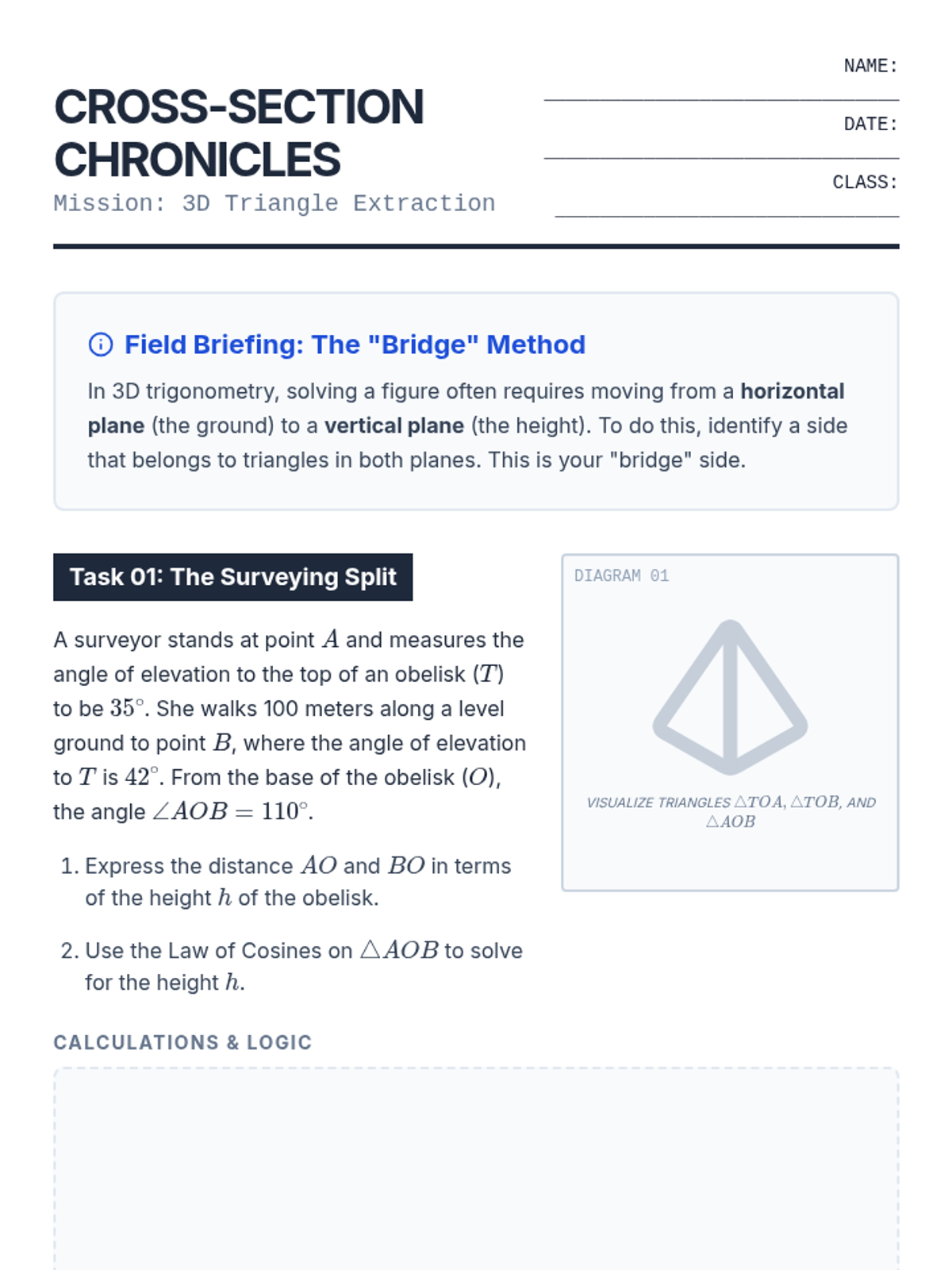
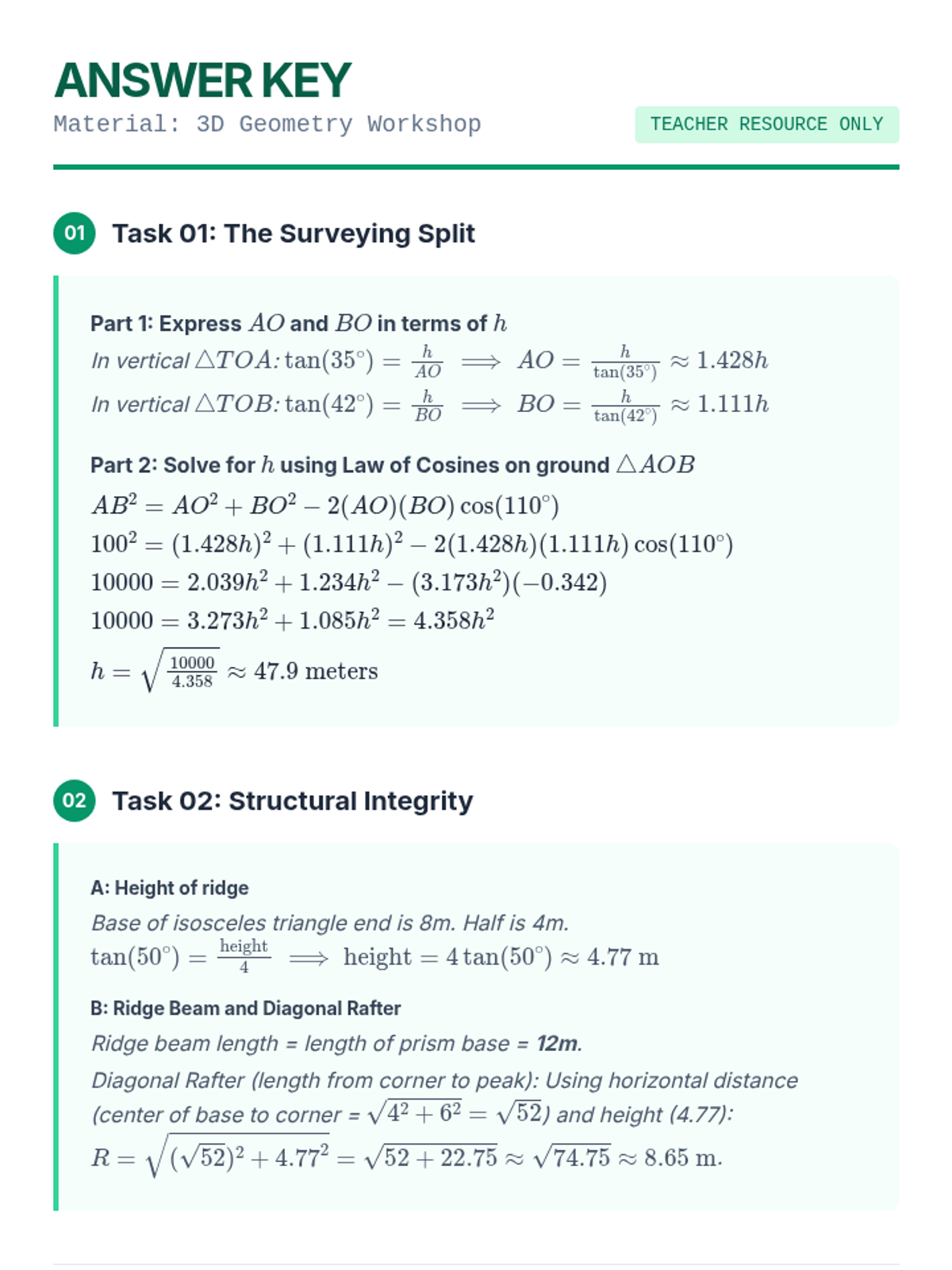
An advanced trigonometry sequence for 12th-grade students focusing on the Law of Sines and Cosines applied to 3D spatial problems, vector magnitudes, static forces, and structural engineering. Students transition from 2D calculations to analyzing complex 3D systems and physical forces.
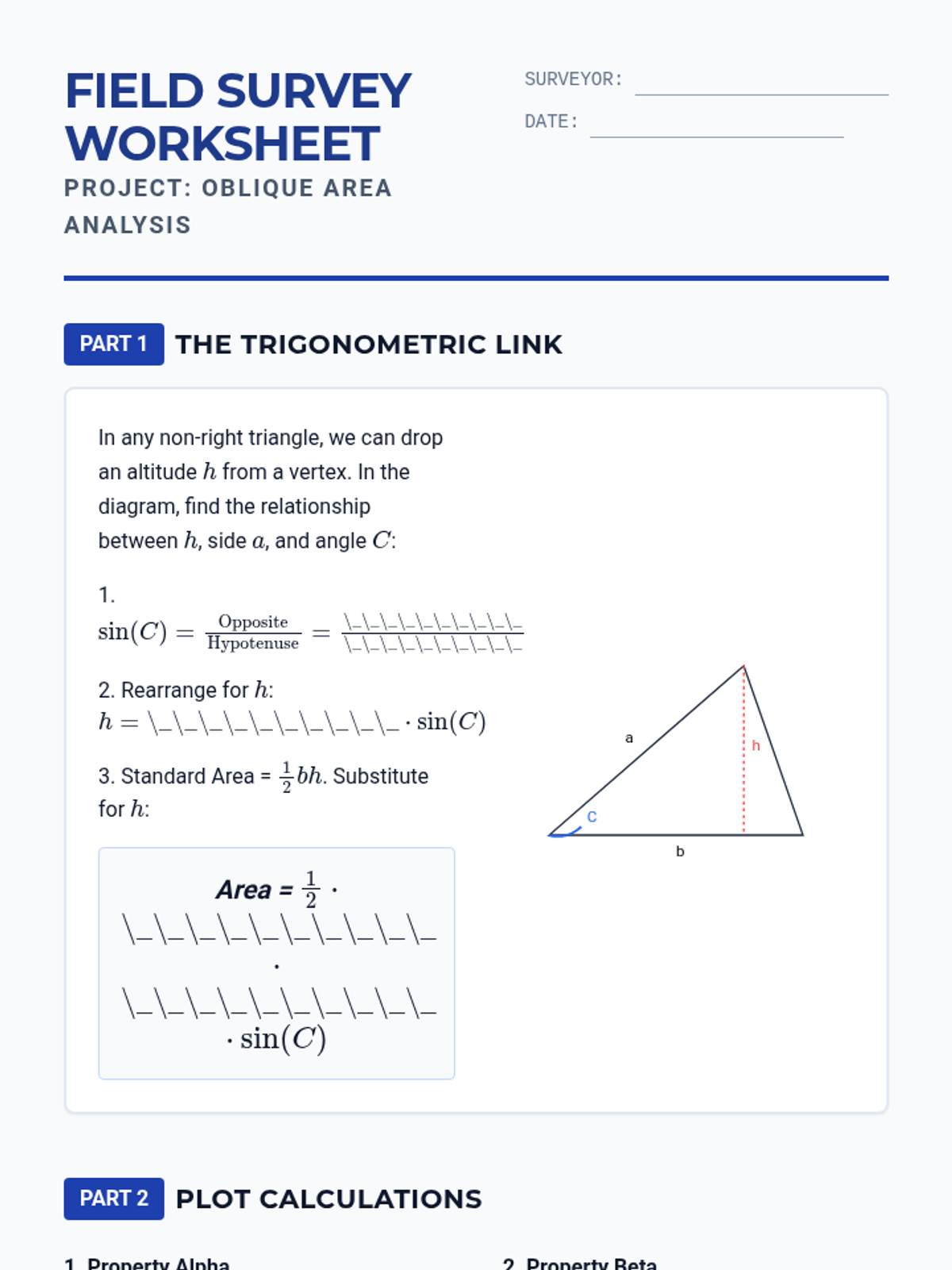
This sequence explores the measurement of area and the analysis of forces using general triangles. Students move beyond the basic 1/2 bh formula to discover how sine and perimeter can define area in oblique scenarios, specifically using Heron's Formula and vector analysis.
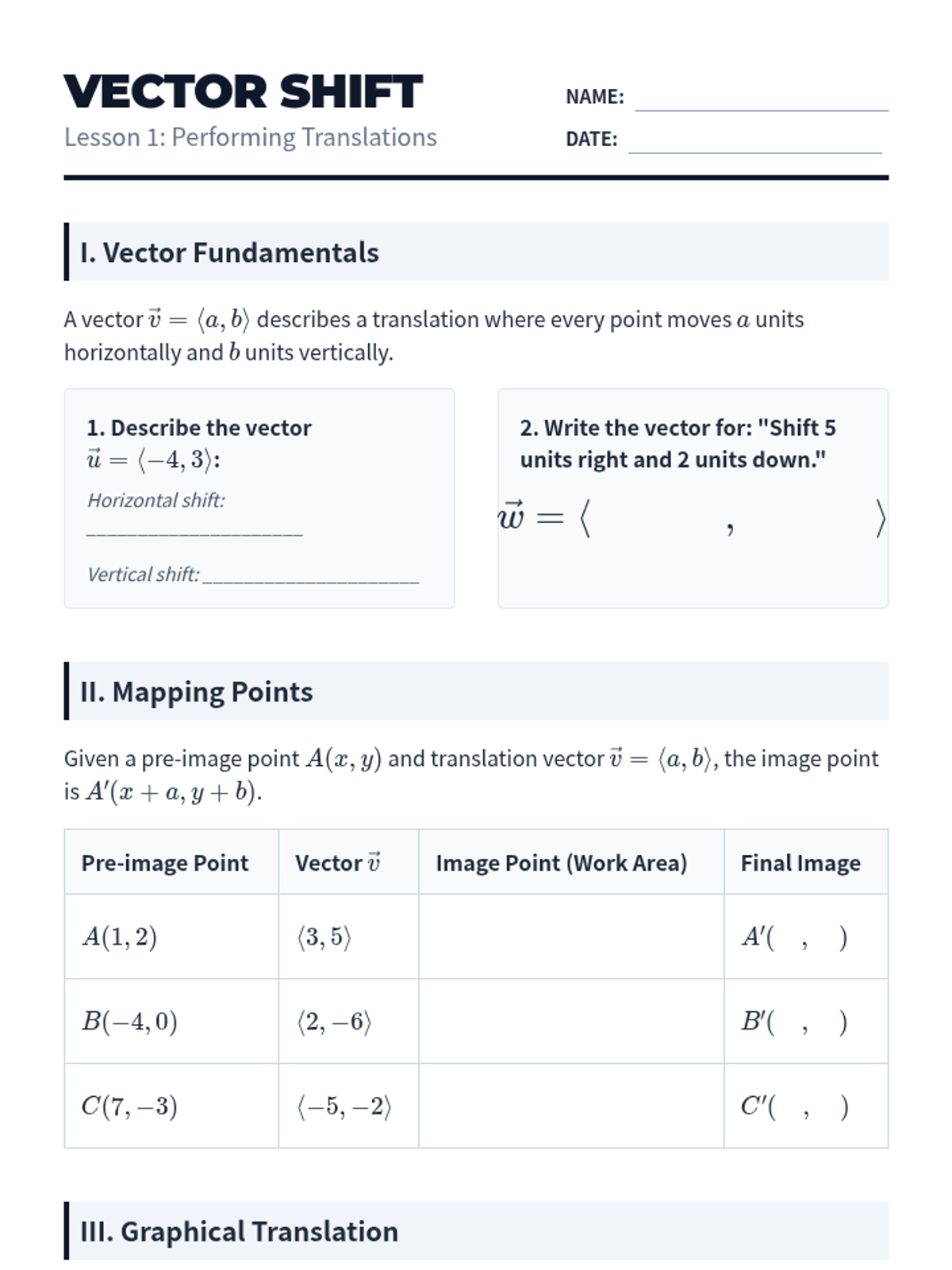
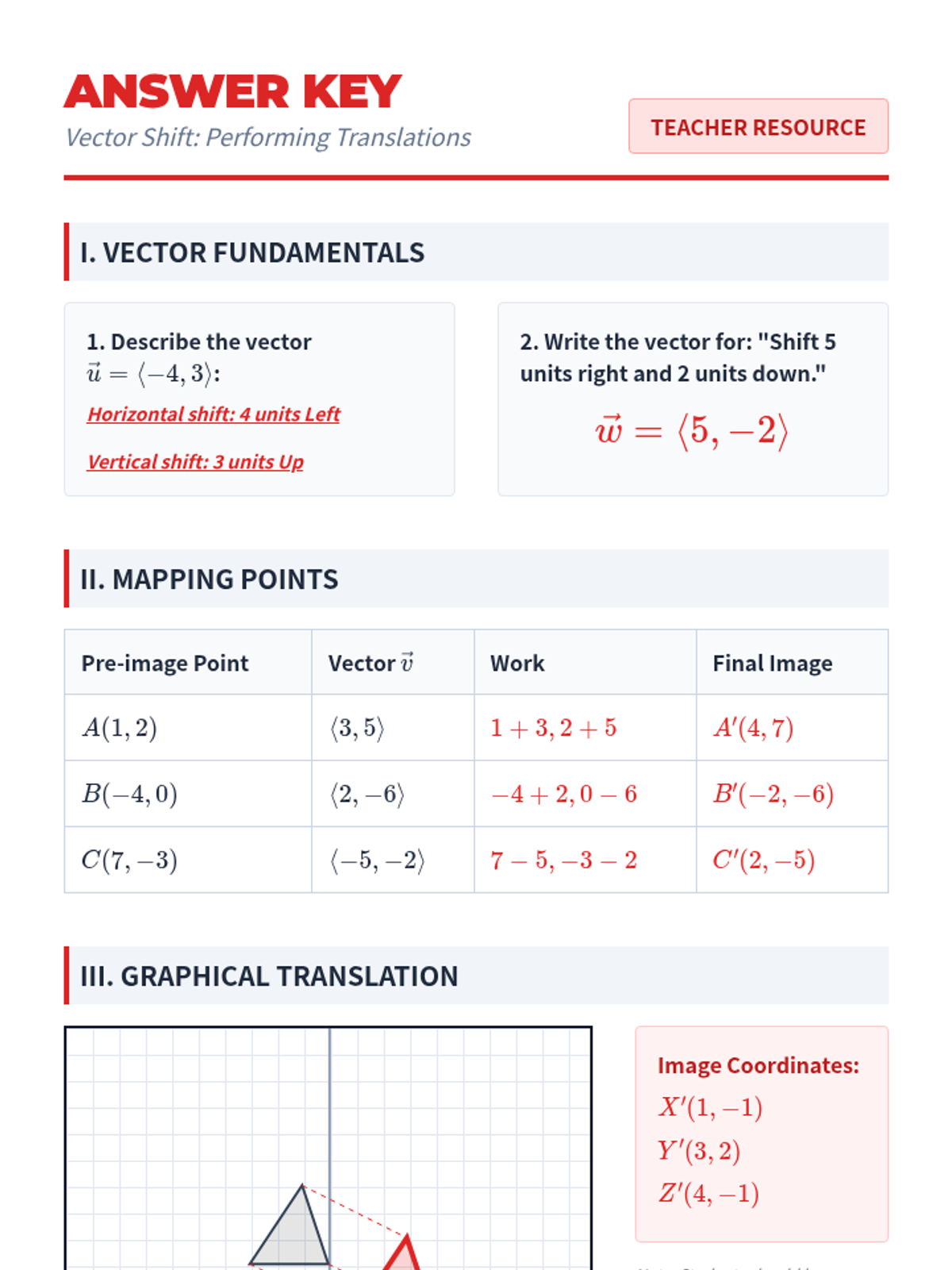
A comprehensive unit on the three primary rigid transformations: translations, reflections, and rotations. Students move from physical manipulation to precise geometric descriptions using vectors, lines of reflection, and centers of rotation to prepare for the study of congruence.
This advanced calculus sequence guides students through the theory and application of vector-valued functions, covering limits, differentiation, integration, and their real-world applications in kinematics and projectile motion.
A comprehensive 12th-grade unit on vector operations, transitioning from 2D arithmetic to complex 3D applications including dot products, cross products, and static equilibrium in engineering contexts.
A comprehensive 11th-grade mathematics unit on vector operations, transitioning from basic 2D component forms and geometric representations to advanced 3D cross products and real-world applications in physics and navigation.
A comprehensive unit on parametric equations and their applications in modeling motion. Students move from the basics of parametric curves to advanced calculus concepts like derivatives, concavity, vectors, and arc length.