Cultural identity, community development, and public policy through the lens of creative practice. Addresses arts advocacy strategies and integrates interdisciplinary connections across social and professional sectors.
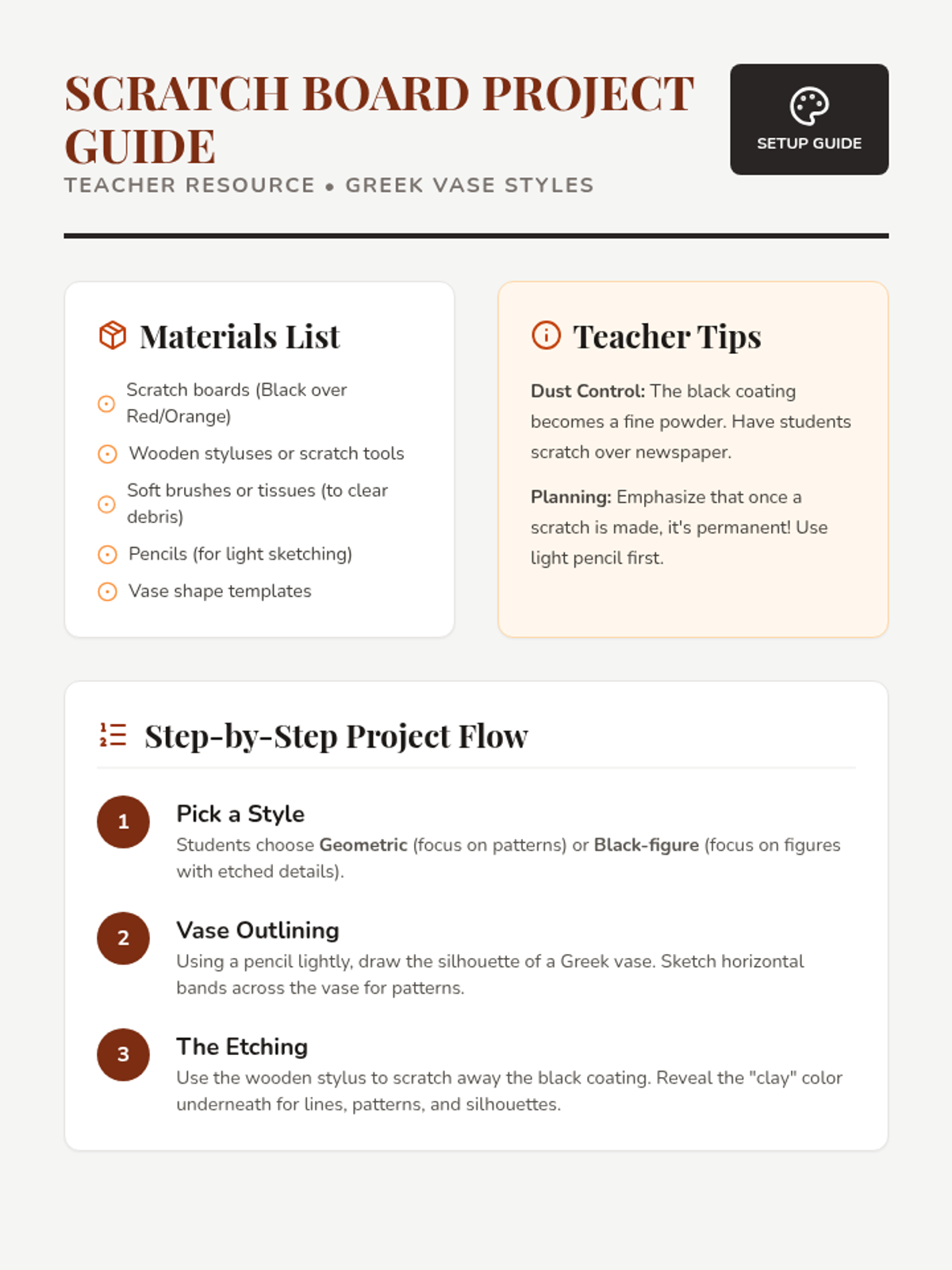
A teacher's guide for the scratch board art project, including materials, prep tips, step-by-step student instructions, and historical discussion prompts.
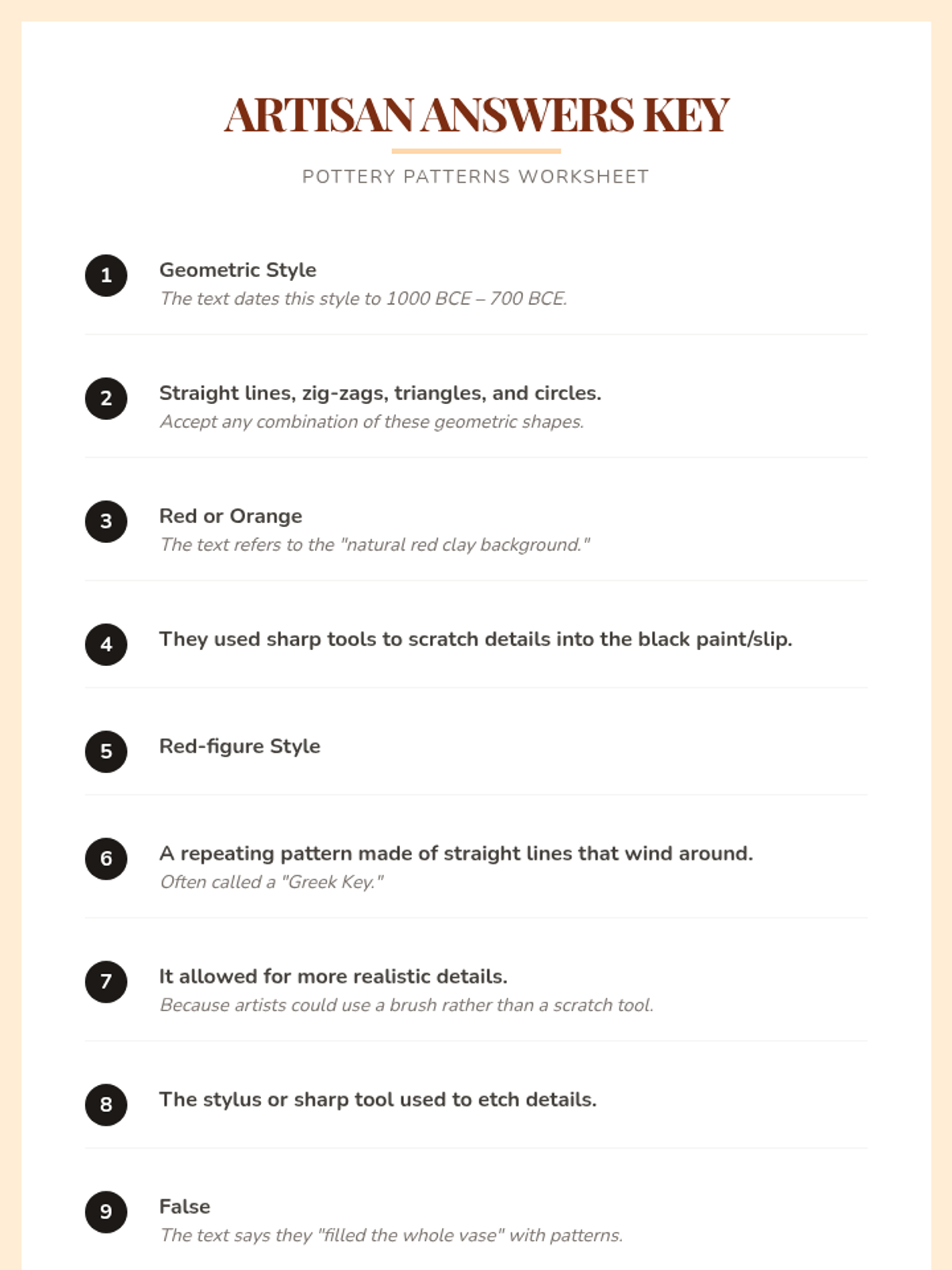
An answer key for the Pottery Patterns Worksheet, providing clear answers and teacher notes for all 10 questions.
Instructional slides introducing the history and visual characteristics of Geometric, Black-figure, and Red-figure pottery. Includes a project introduction slide connecting the history to scratch board art.
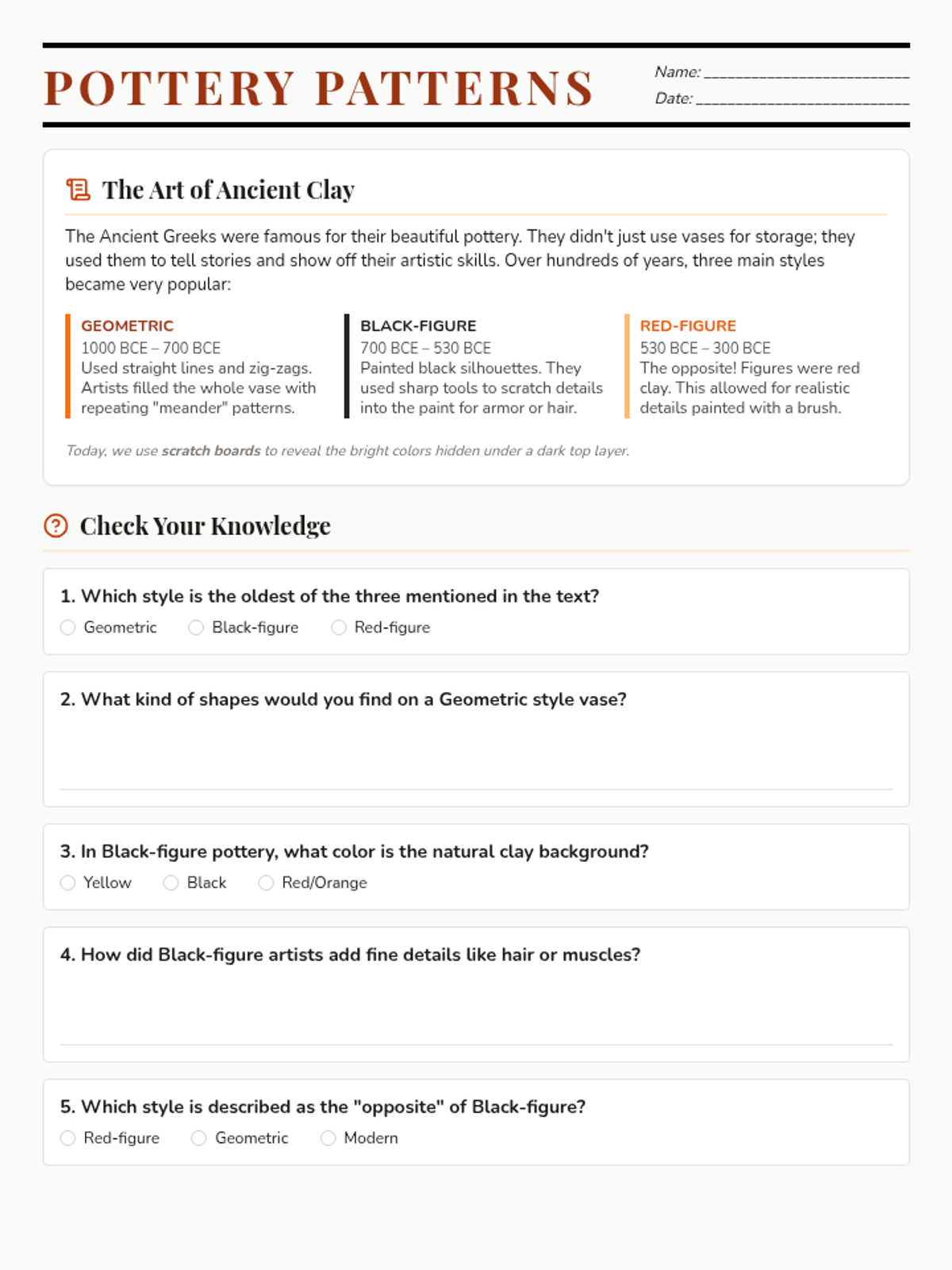
An introductory reading passage about Geometric, Black-figure, and Red-figure Greek pottery styles followed by 10 comprehension questions. Designed for primary/middle school students to build background knowledge before an art project.
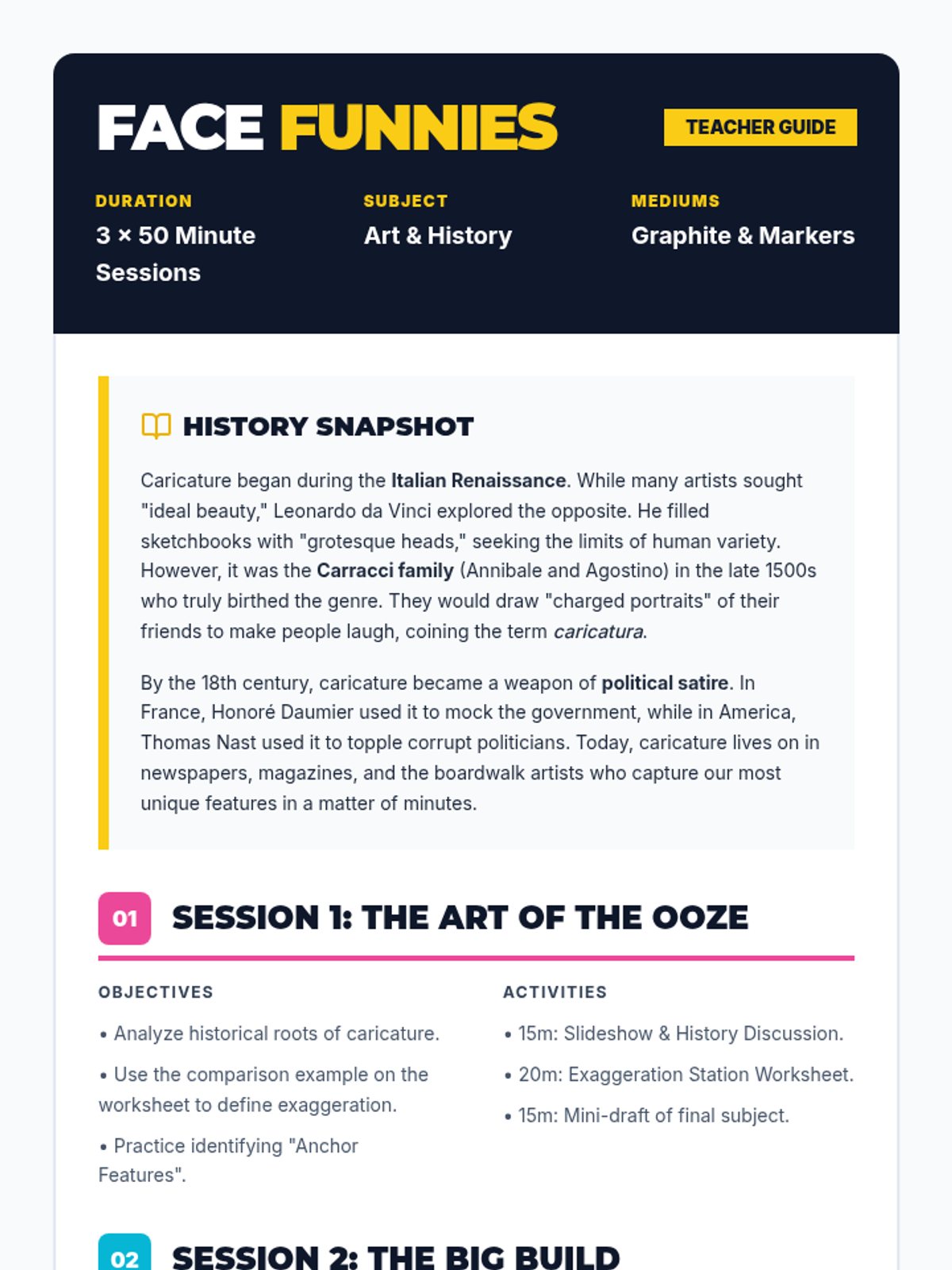
A comprehensive instructional guide for teachers, detailing the lesson's three-session structure, historical context, key learning objectives, and classroom facilitation tips.
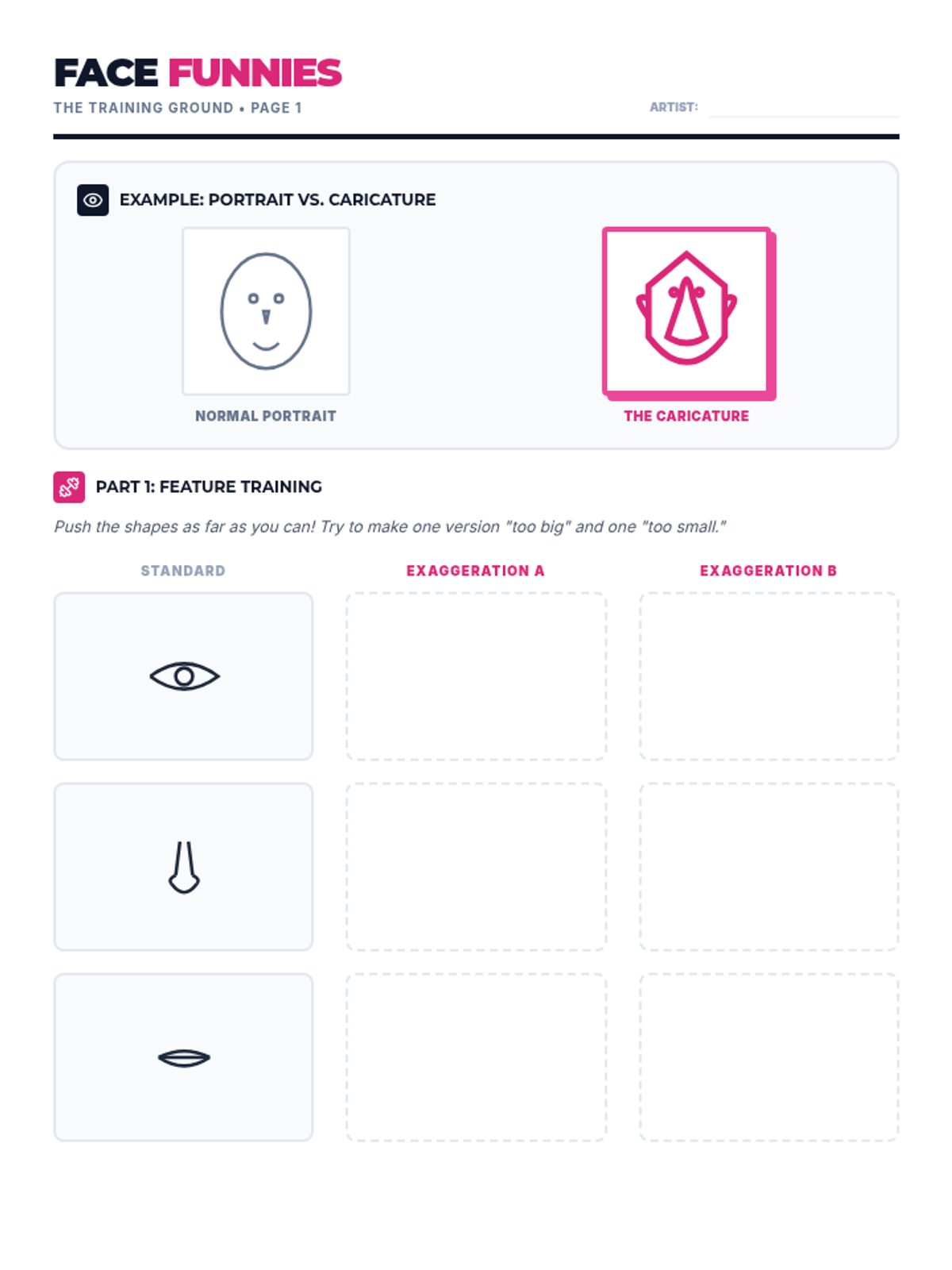
A student worksheet for practicing the fundamental skills of caricature: observing features and applying varied levels of exaggeration before attempting a full sketch. Now includes a generous two-page layout for better practice space.
A visual presentation introducing caricature art, its history from the Renaissance to modern times, and a step-by-step guide for creating an exaggerated portrait using graphite and markers.
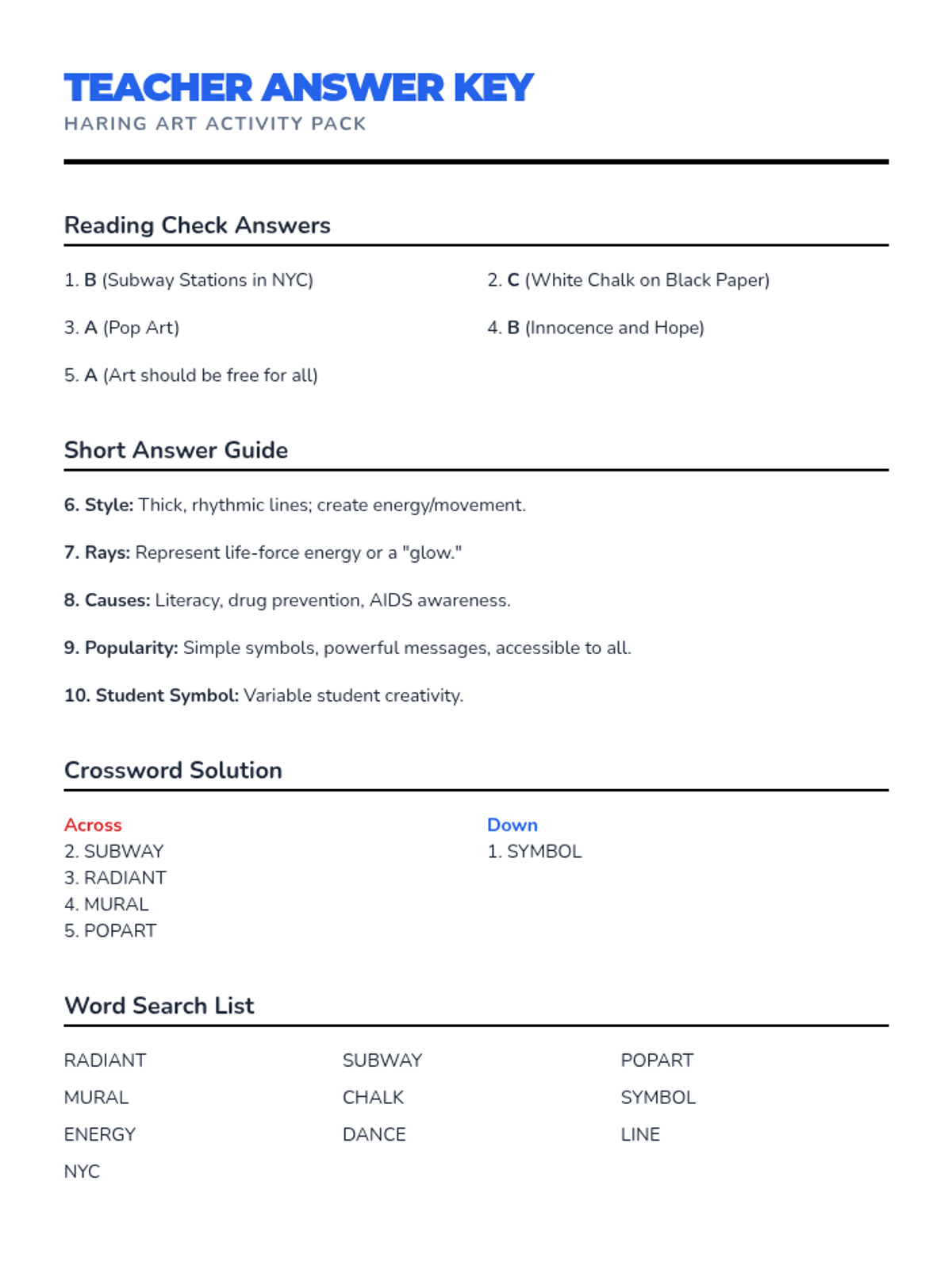
Teacher answer key for all activities in the Haring Art Activity Pack.
A comprehensive activity pack including a reading passage, 10 comprehension questions, a themed crossword, and a word search about Keith Haring and Pop Art. All on unified pages for efficiency.
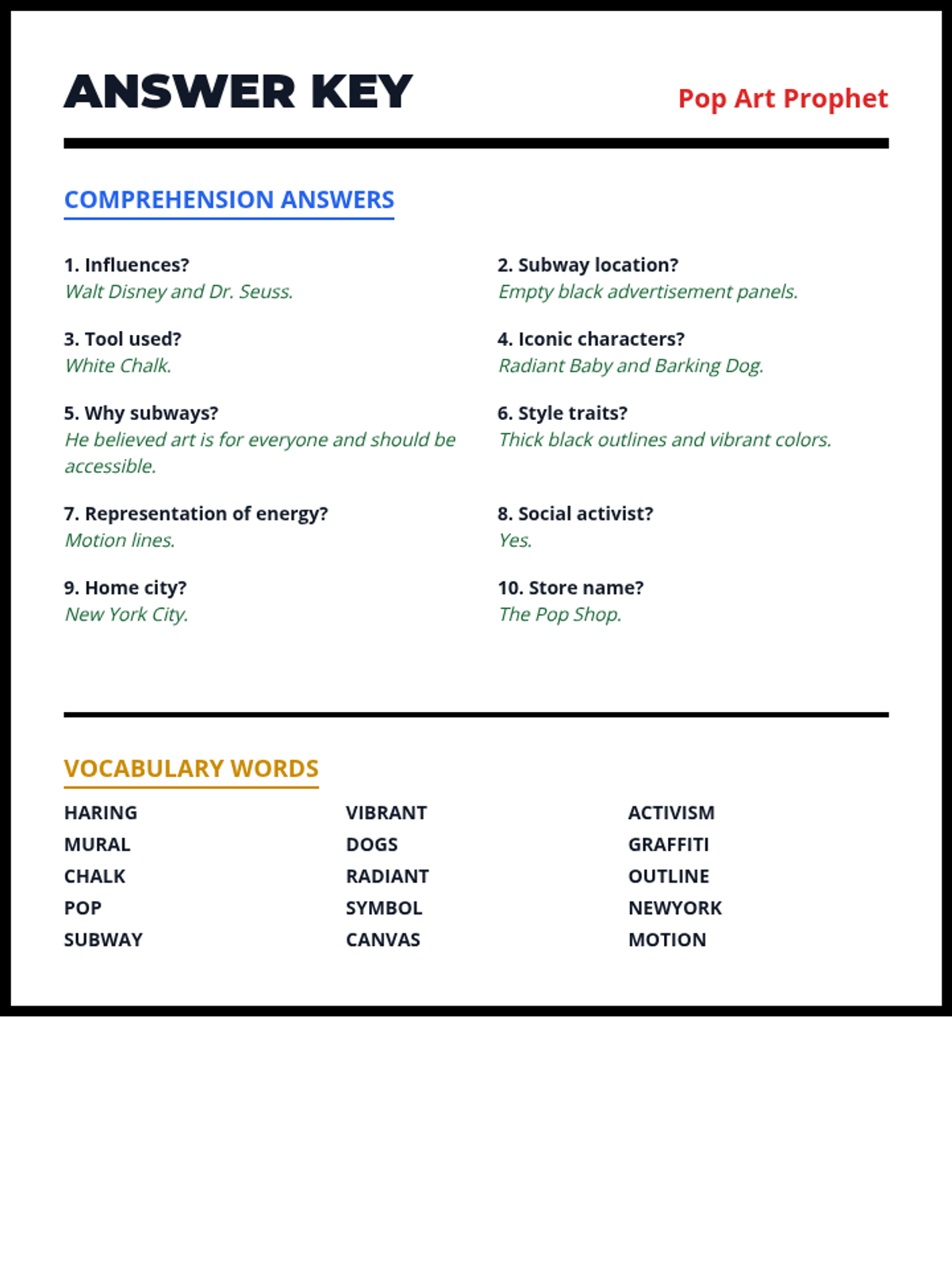
The teacher answer key for the Pop Art Prophet worksheet, providing solutions for the reading comprehension questions and the vocabulary word search.
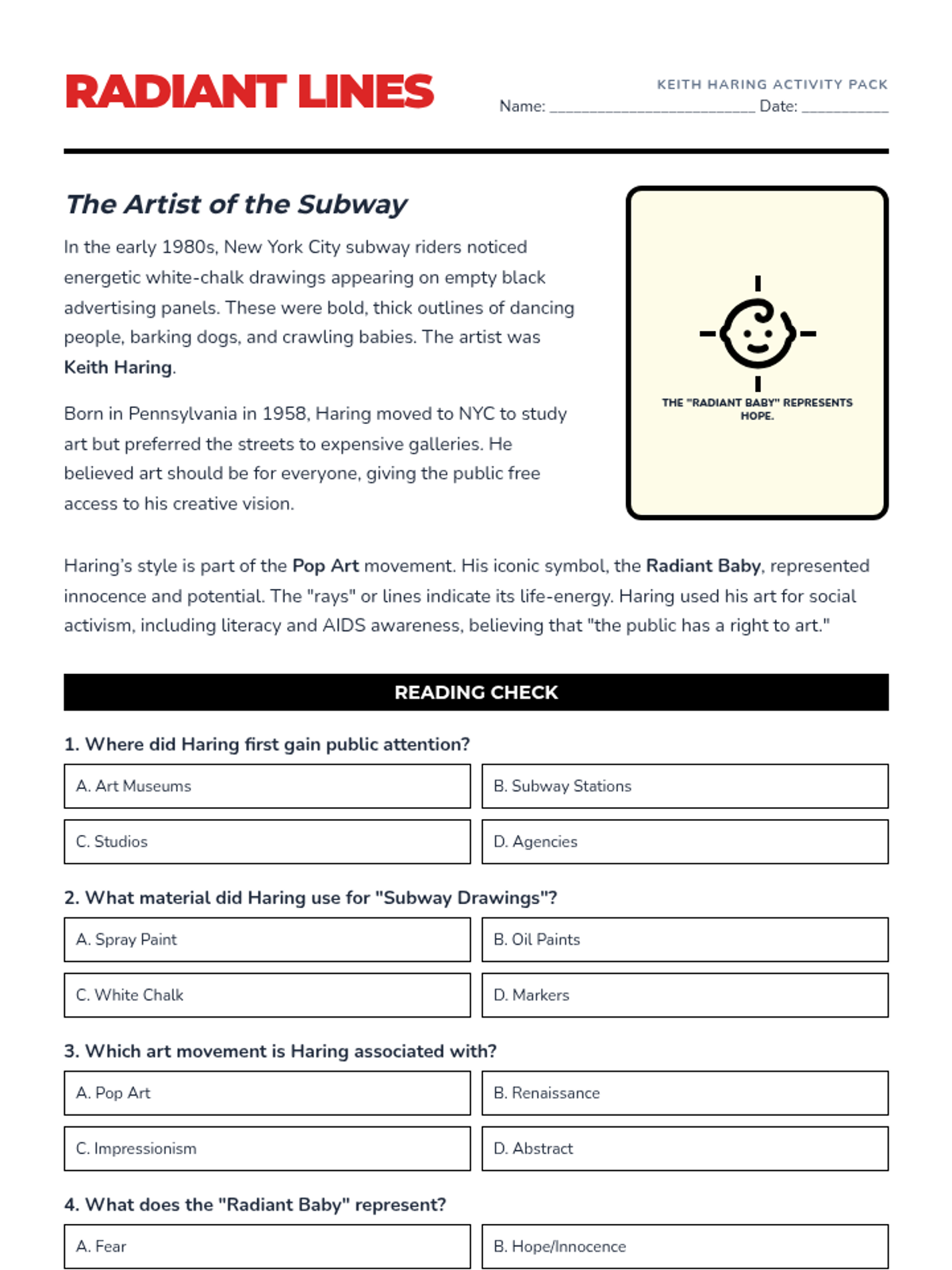
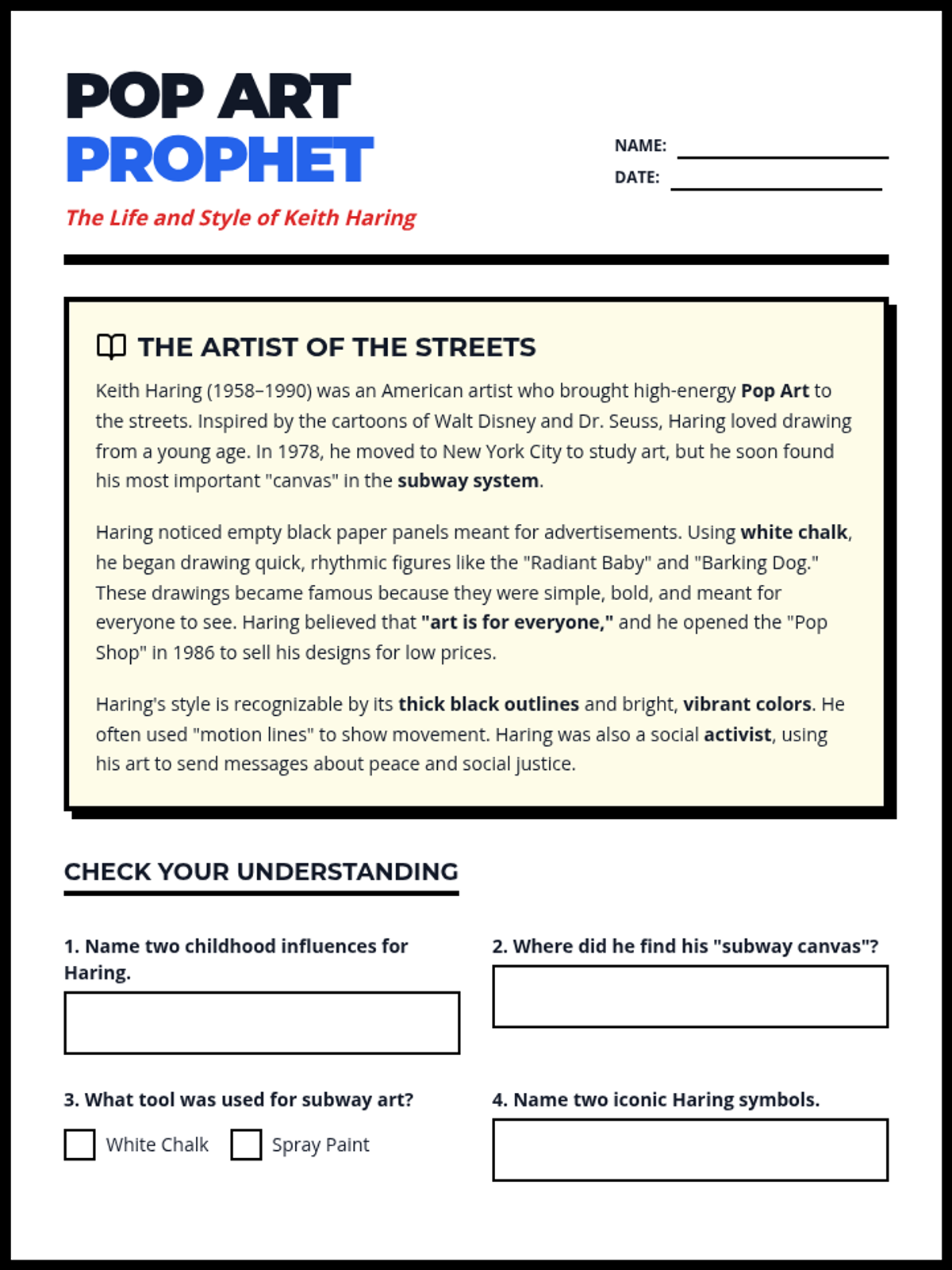
A comprehensive Keith Haring student worksheet featuring a middle school reading passage, 10 comprehension questions distributed across two pages, and a 15-word word search on a dedicated third page. It uses a bold Pop Art aesthetic with primary colors and Haring-inspired motifs.
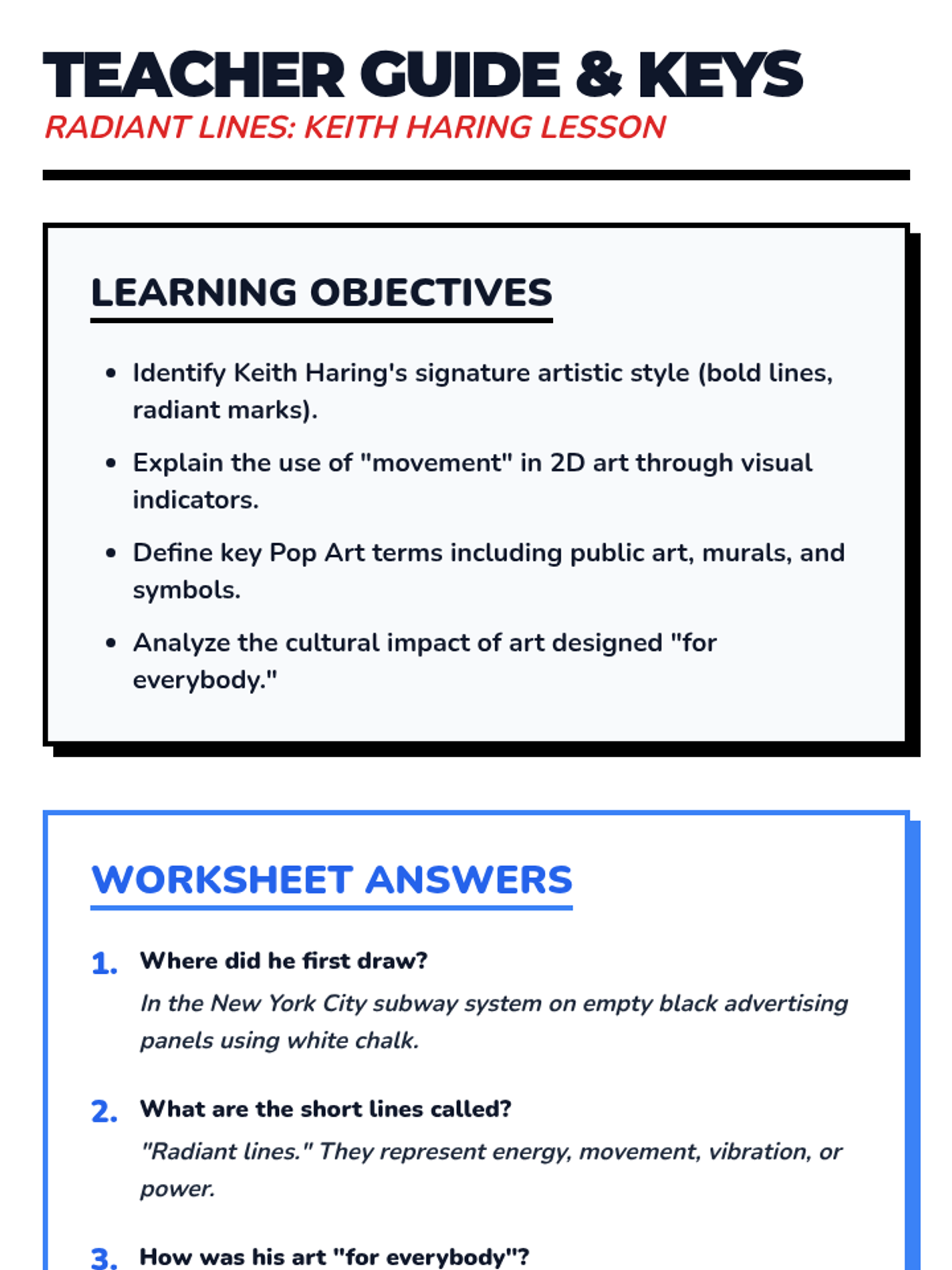
Comprehensive teacher resource featuring learning objectives, an answer key for both student materials, and a suggested pacing guide for the 'Radiant Lines' lesson. Part of the Radiant Lines lesson set.
A vibrant 6-slide presentation introducing Keith Haring, his signature 'radiant lines' technique, and the broader context of Pop Art. Features bold visual metaphors and interactive discussion prompts. Part of the Radiant Lines lesson set.
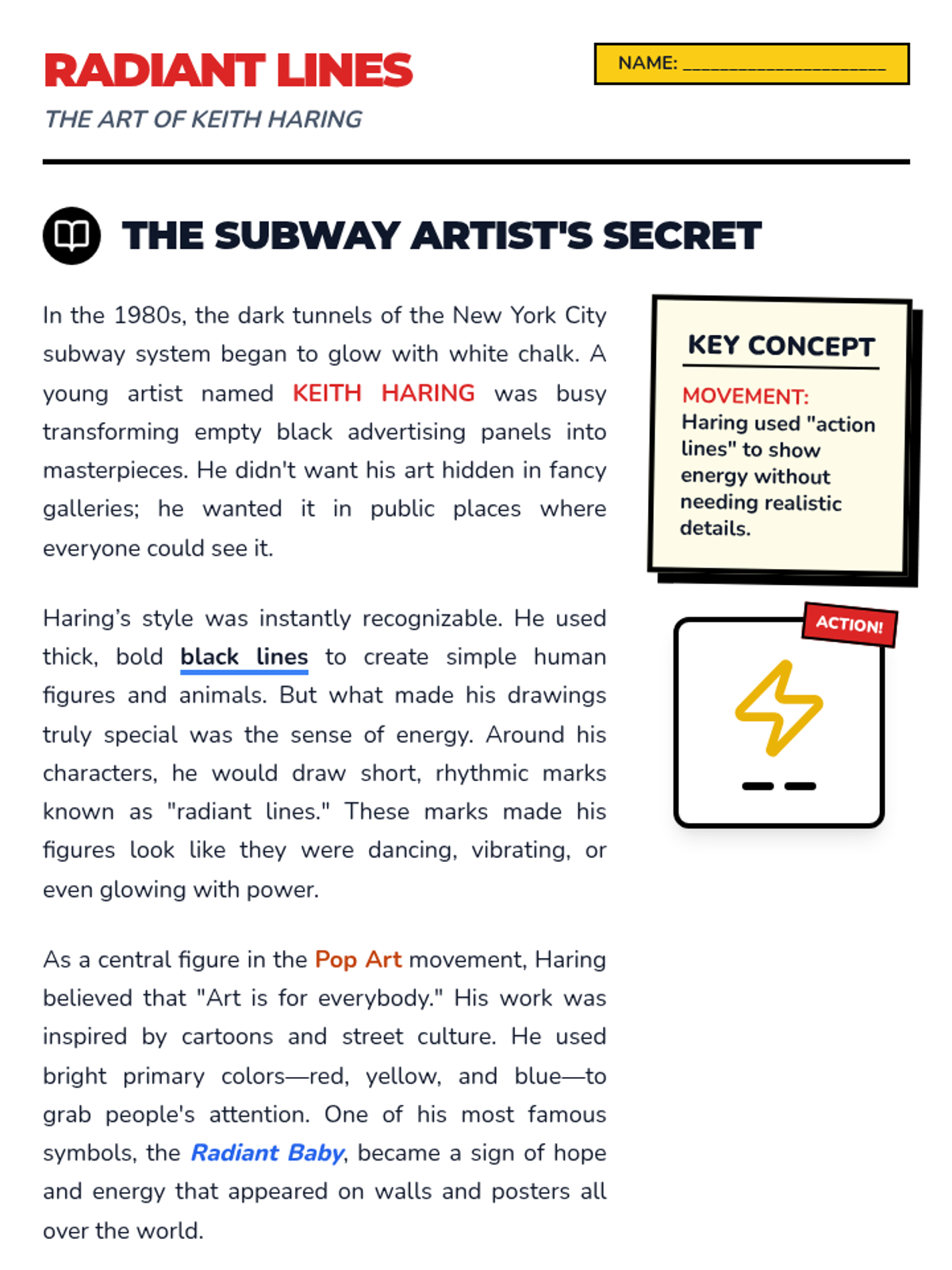
A comprehensive three-page student packet including a detailed reading passage about Keith Haring, 5 reading comprehension questions, and a Pop Art vocabulary crossword puzzle. Part of the Radiant Lines lesson set.
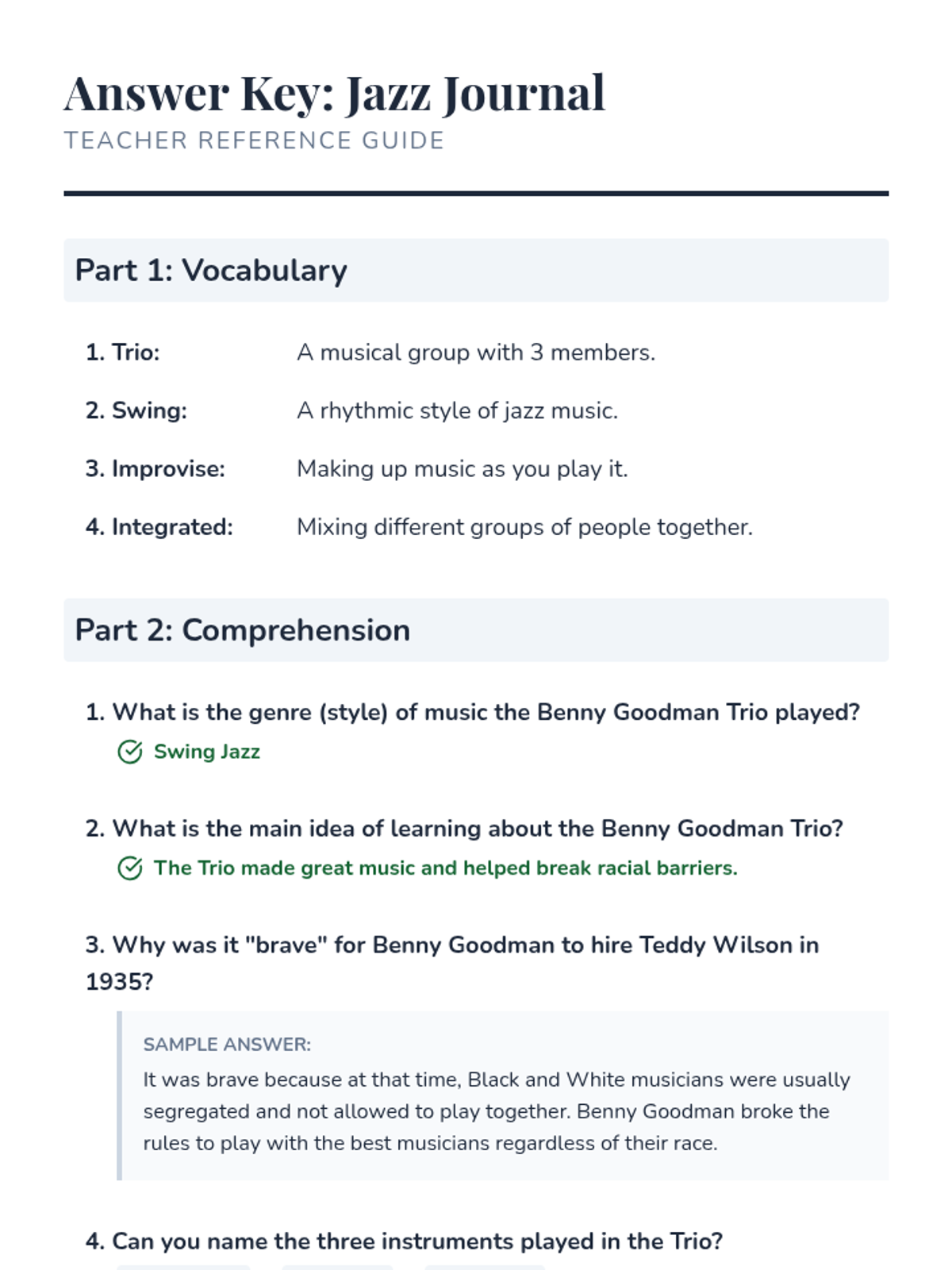
An answer key for the Jazz Journal worksheet, including teaching tips and sample responses for the teacher.
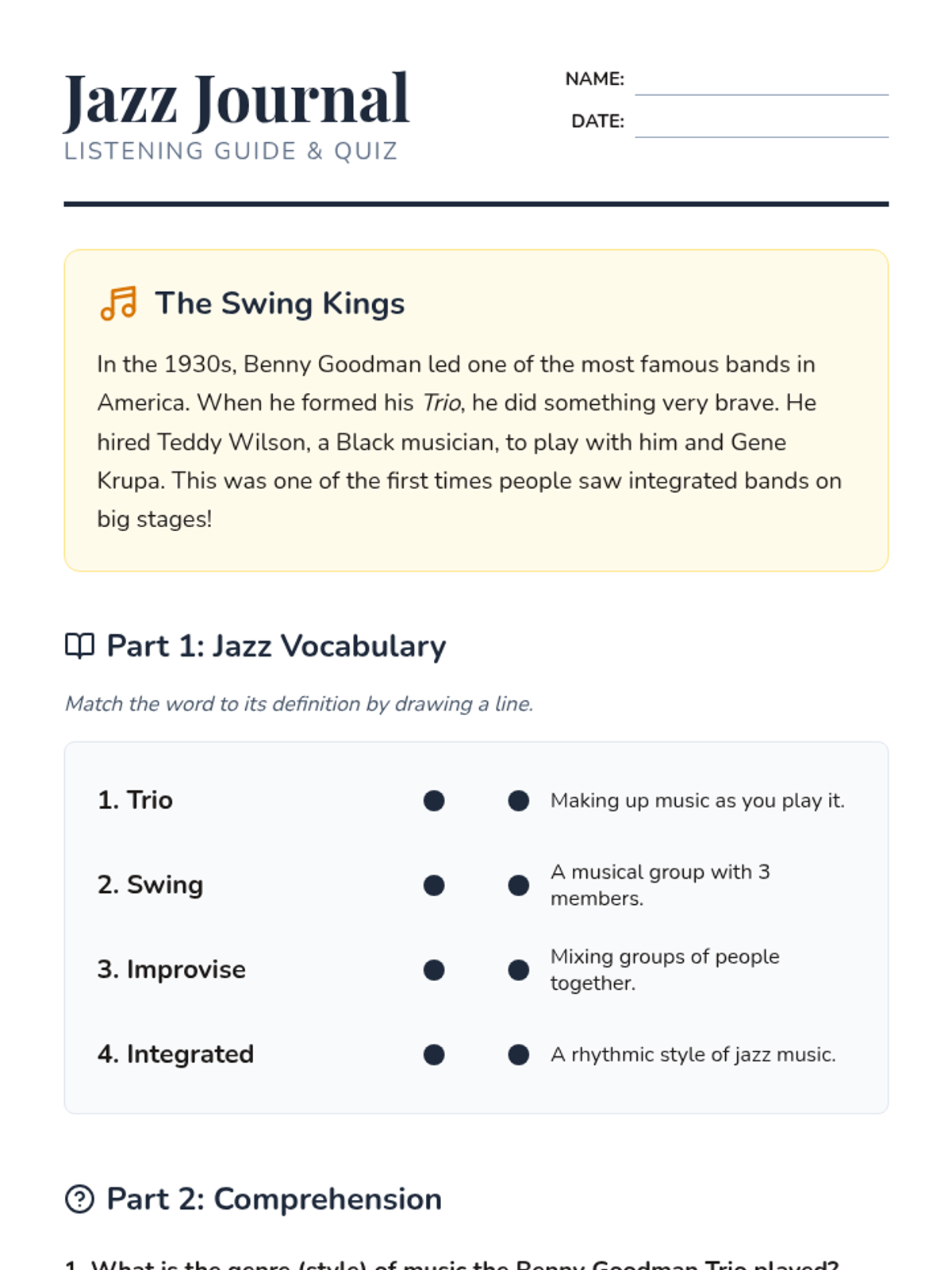
A student-facing worksheet for 3rd graders that includes vocabulary matching, multiple-choice comprehension questions, and a short answer section focused on the Benny Goodman Trio.
An 8-slide presentation introducing 3rd-grade students to Benny Goodman, the concept of a trio, swing jazz, and the significance of racial integration in music history.
An introductory slide deck for stock photography, using student exemplars to teach concepts of marketability, technical composition, and lighting within a school environment. Updated with clarified mission instructions for collaboration, classroom selection, and specific academic marketing goals.
Enhanced slide deck for Lesson 11, integrating the metaphysical Spectral Constants, digital hardware mapping (Luminance/RGB), and historical pigment chemistry. Includes the 'Complementary Shadow' rule and the 'Luminance Test'.
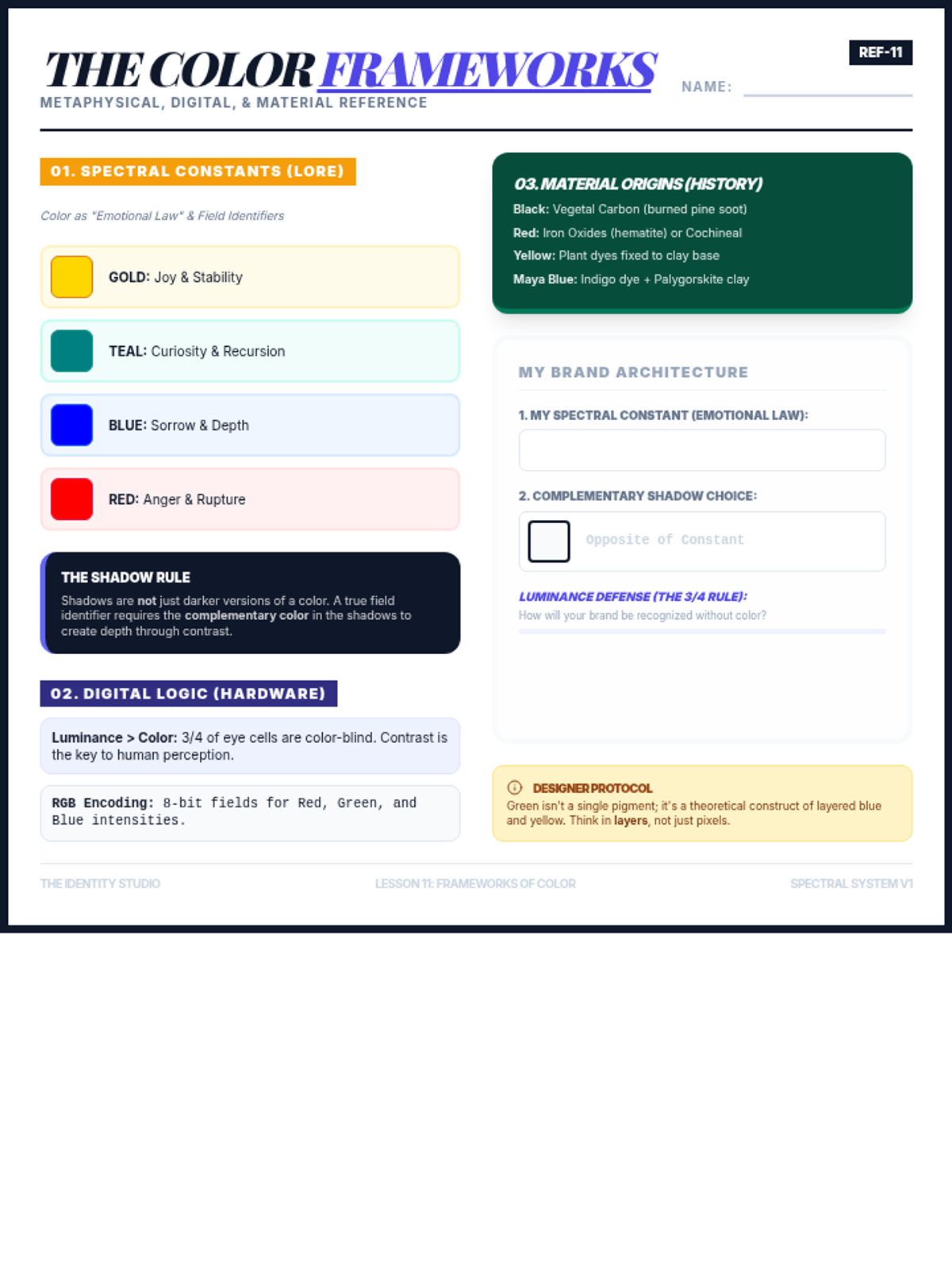
A final one-page student cheat sheet for Lesson 11, integrating the metaphysical Spectral Constants, digital hardware mapping (Luminance/RGB), and historical pigment chemistry.
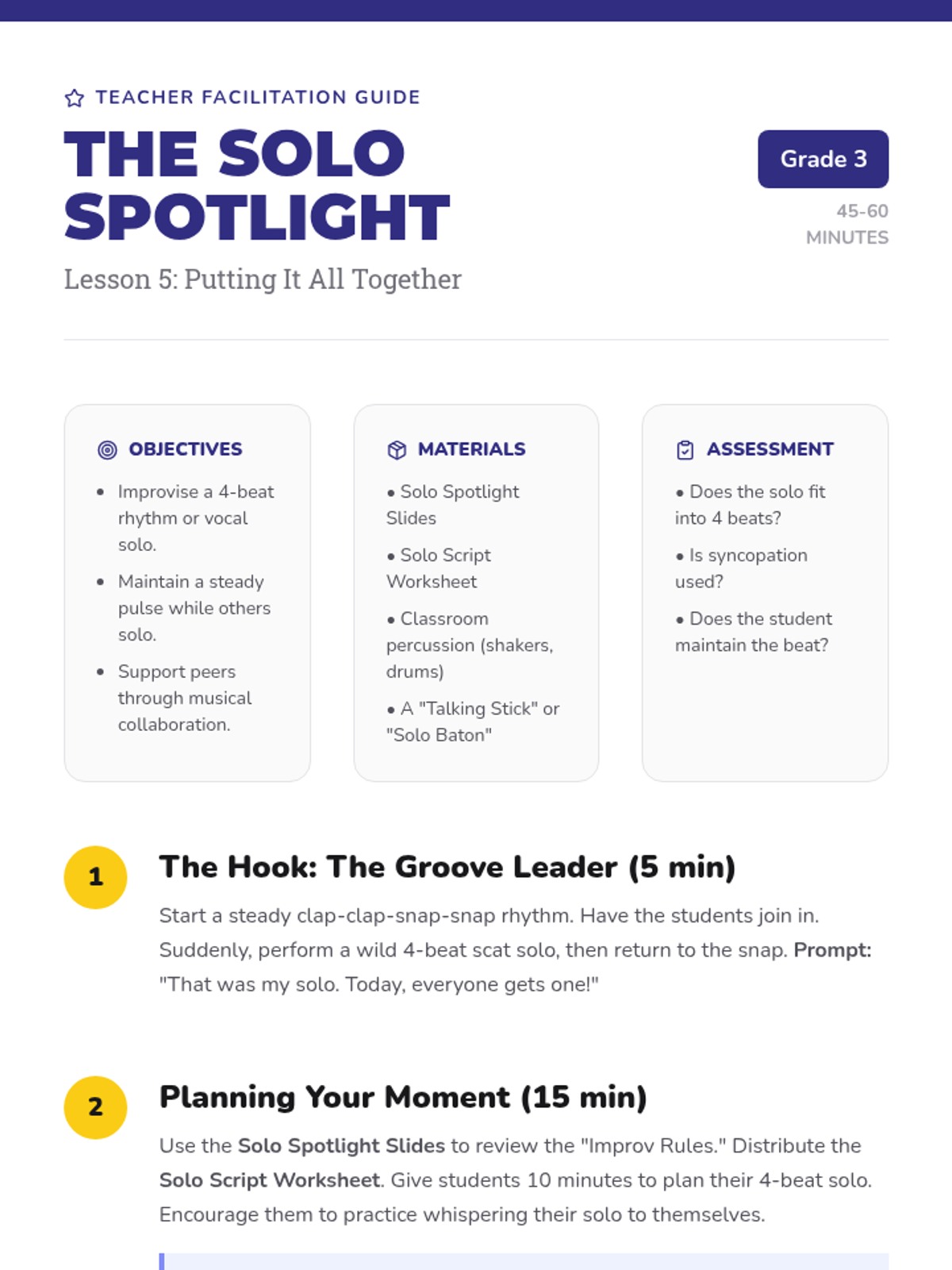
A facilitation guide for the final lesson, including solo circle rules and assessment criteria for student improvisation.
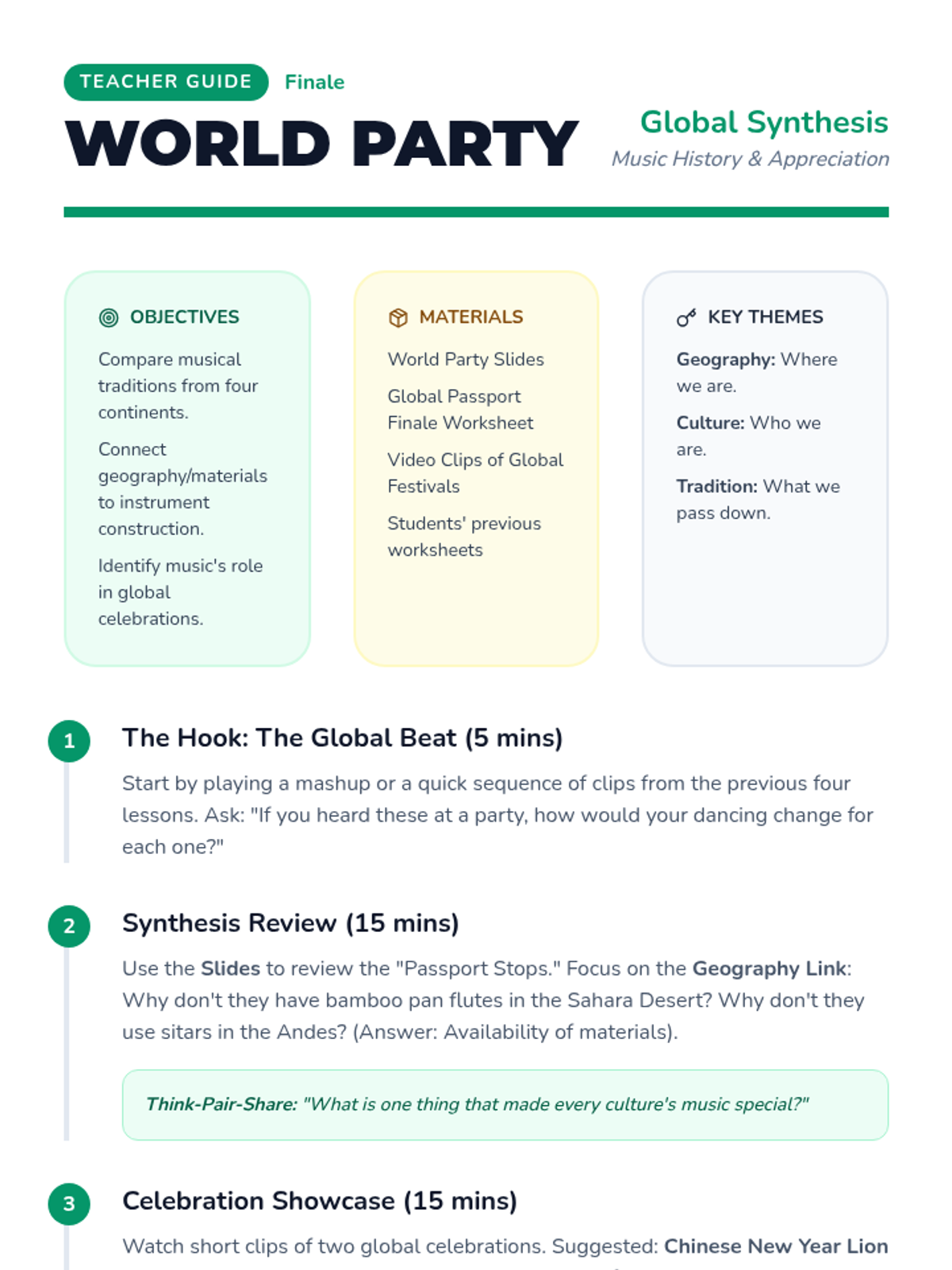
A teacher guide for the final lesson, providing a roadmap for synthesizing the global music journey and assessing student understanding of the sequence's essential question.
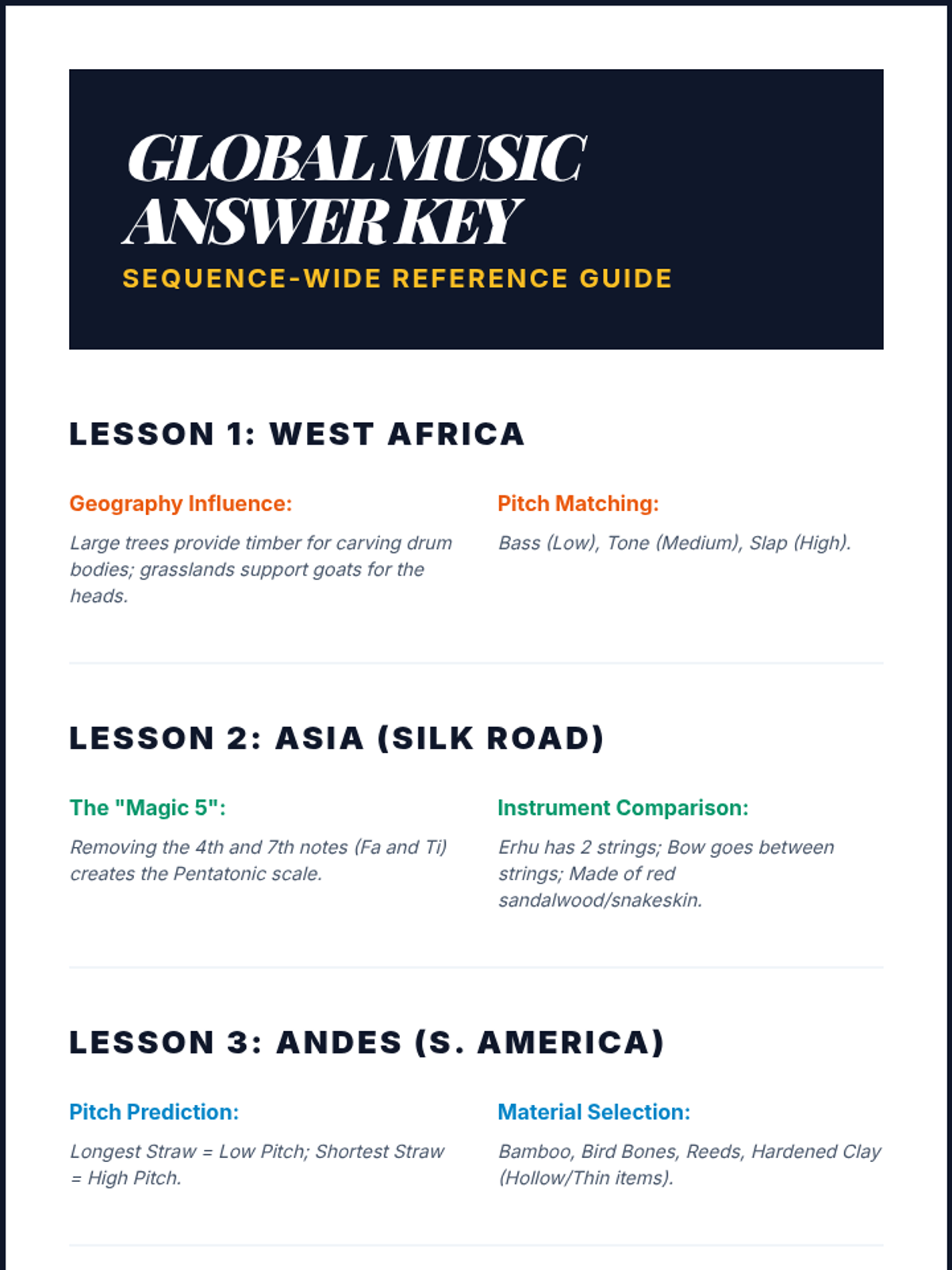
Comprehensive teacher answer key and reference guide covering all five lessons in the "Global Rhythm Quest" sequence.
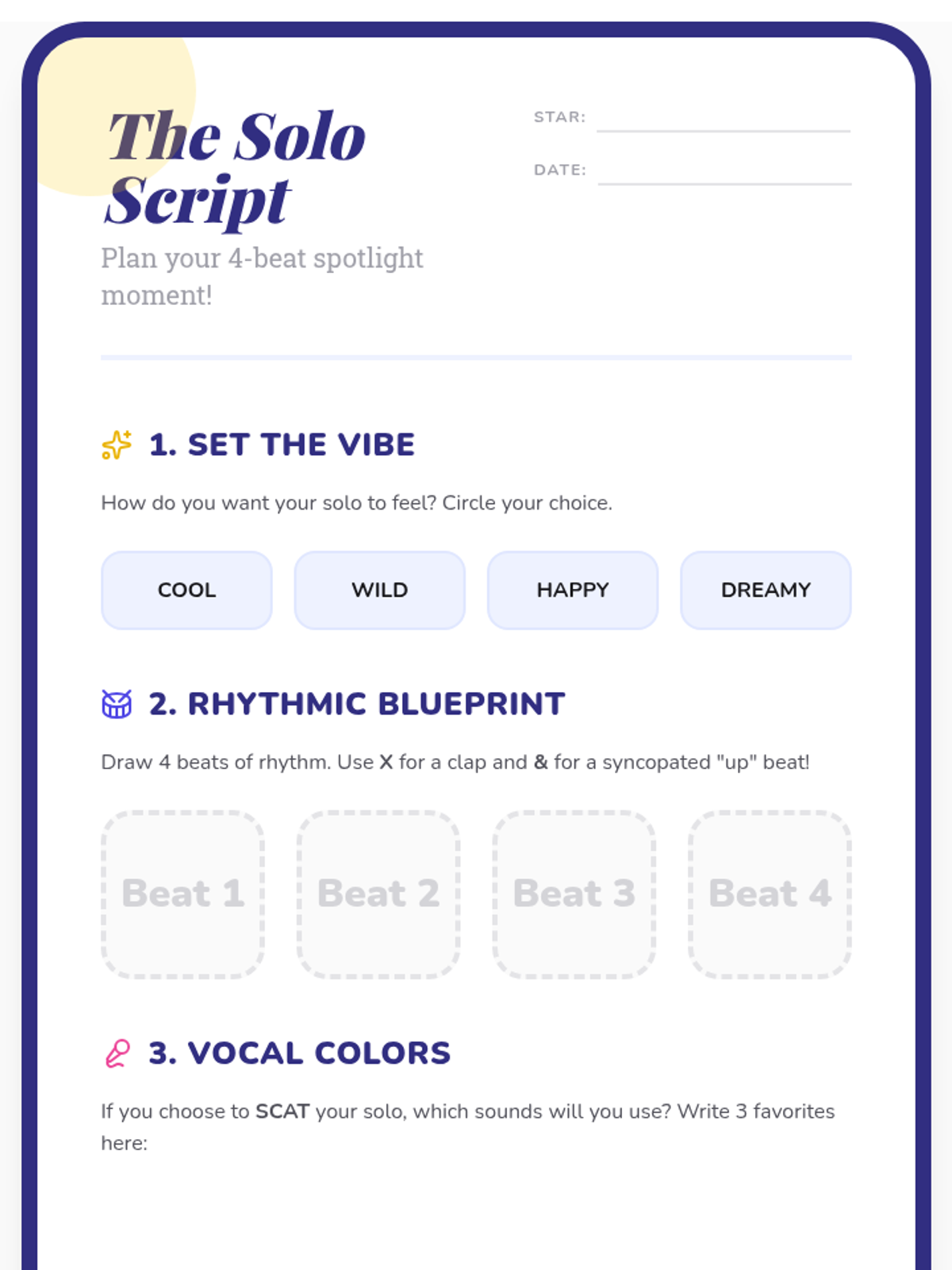
A student planning sheet for designing a simple 4-beat rhythm or scat solo for the final classroom improvisation circle. Identical styling applied to all mood options.
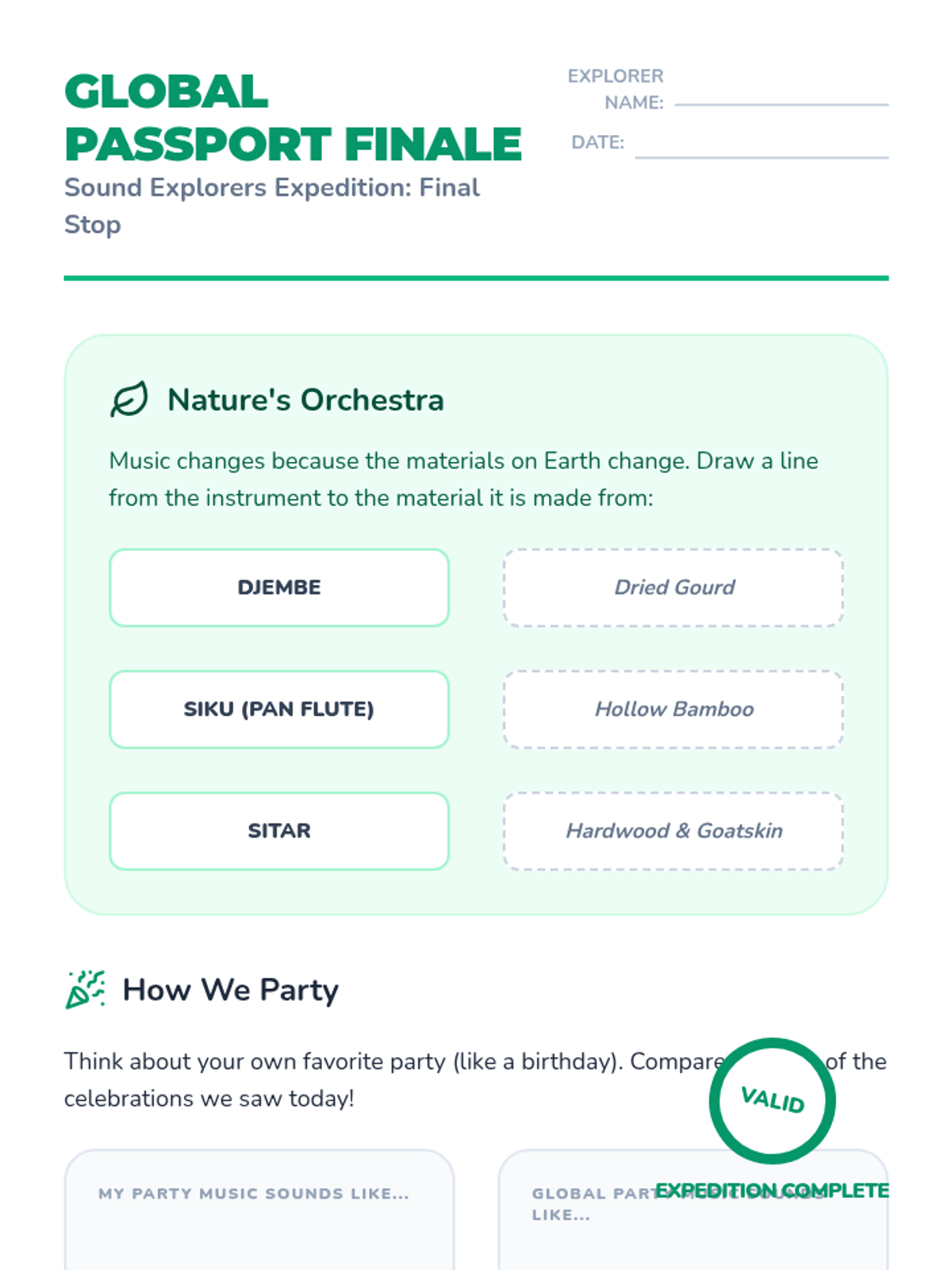
A final synthesis worksheet for students to compare musical instruments, materials, and cultural celebrations, acting as a final "passport" reflection.
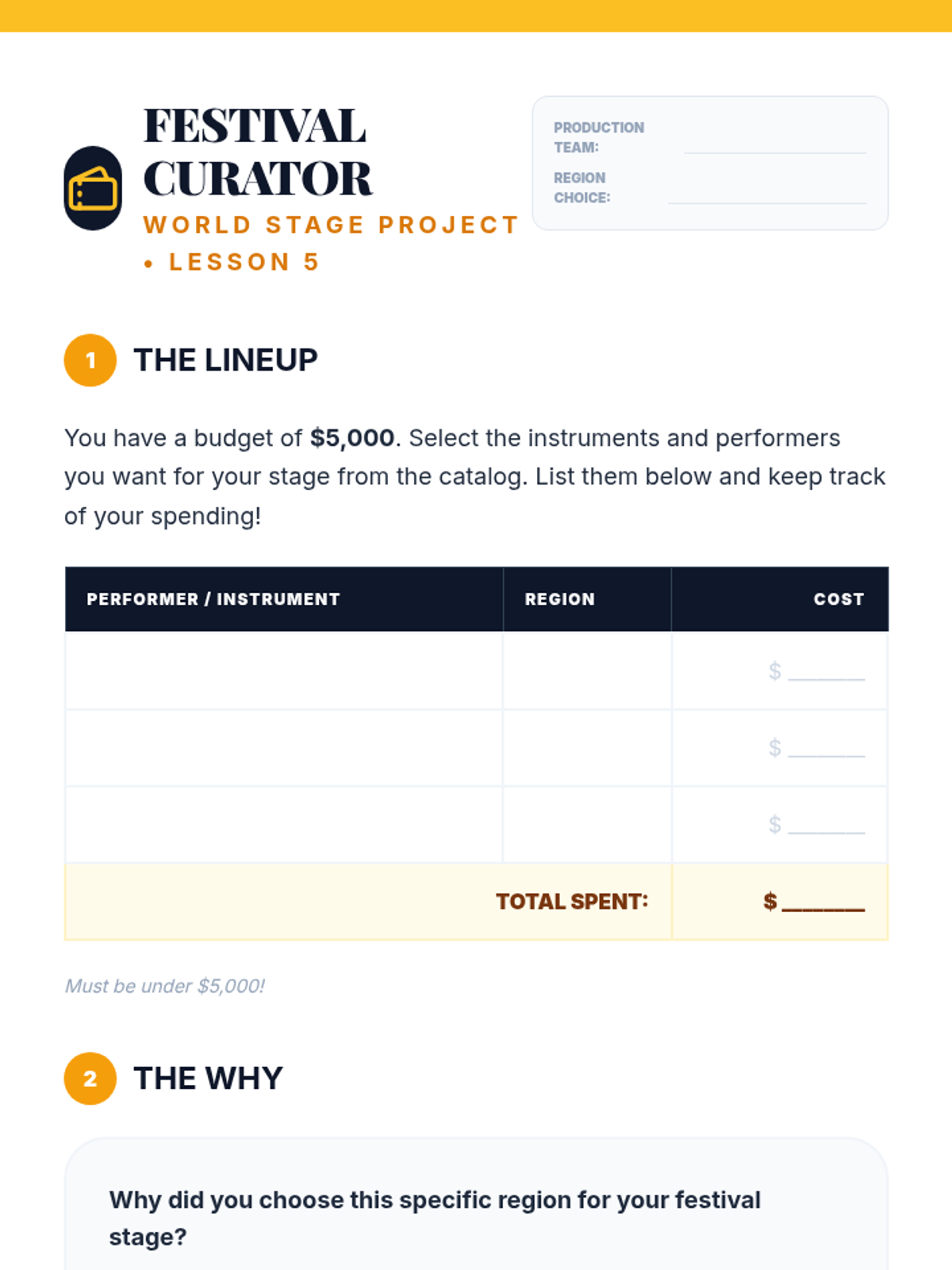
Student project planner for the "World Stage" festival, including budget tracking, a written pitch for a selected region, and a stage design blueprint area.
Visual presentation for the final lesson, synthesizing the global journey, reviewing key instruments, and exploring how different cultures use music for celebration.
A visual presentation for the final project, focusing on the rules of improvisation and how to conduct a classroom solo circle.
Visual presentation slides for Lesson 5, introducing the "World Stage" festival project, defining the curator's role, and providing an instrument catalog with "budget" pricing.
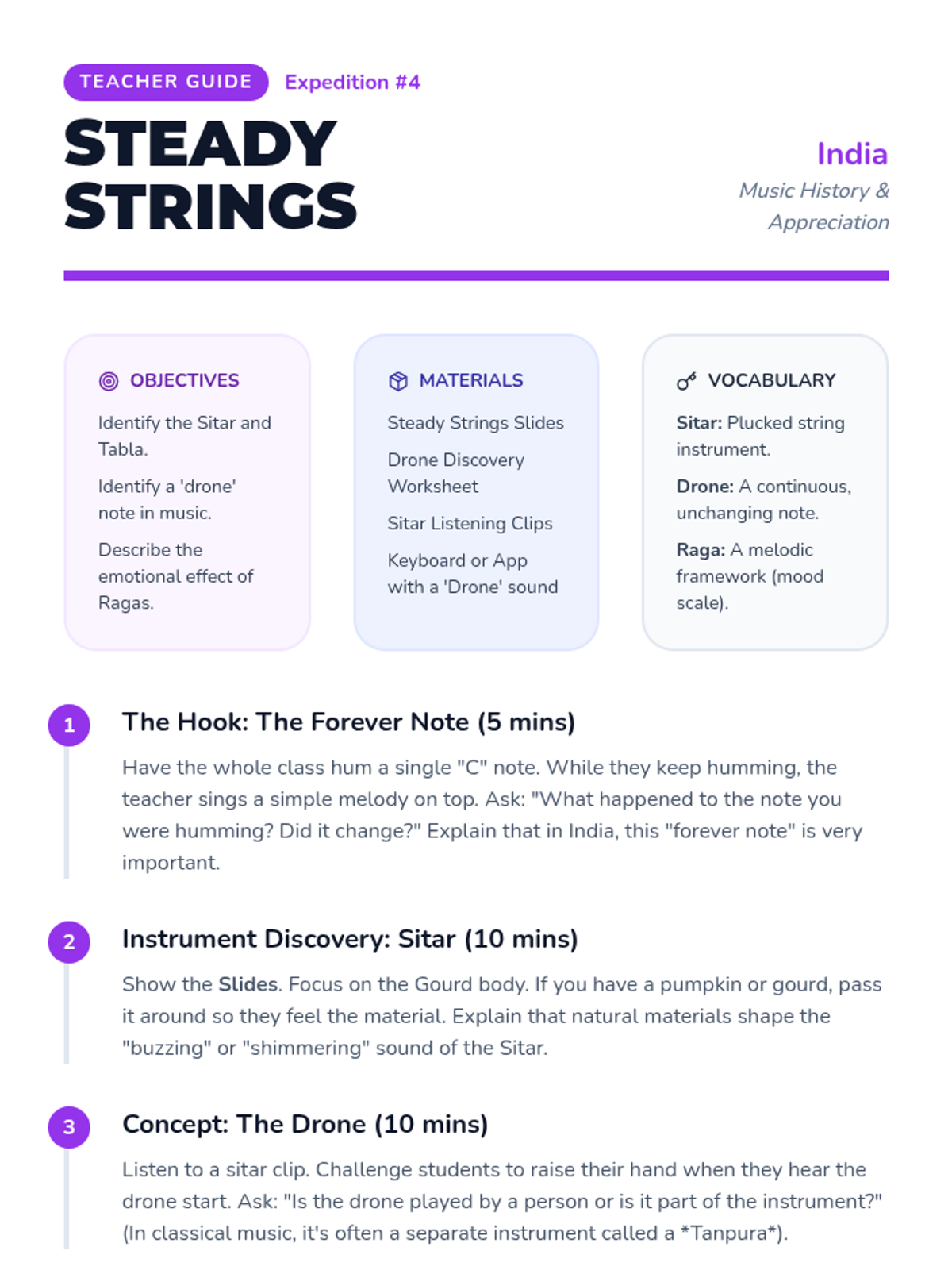
A teacher guide for the fourth lesson, outlining how to teach the concept of the drone and lead listening activities for Indian classical music.
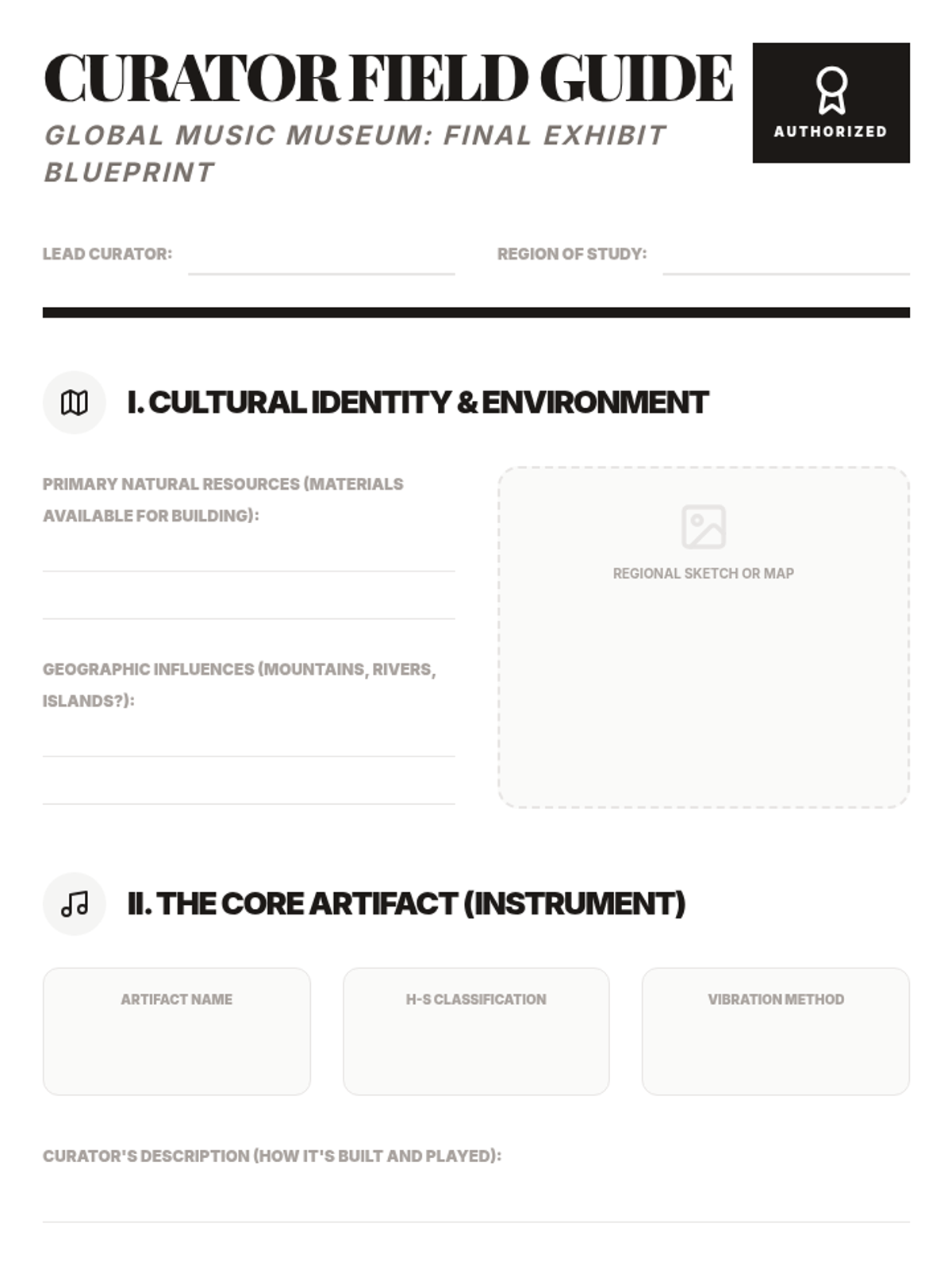
Student exhibit planner and research guide for the final Music Museum project. Guides students through cultural research, instrument classification, and visual exhibit design.
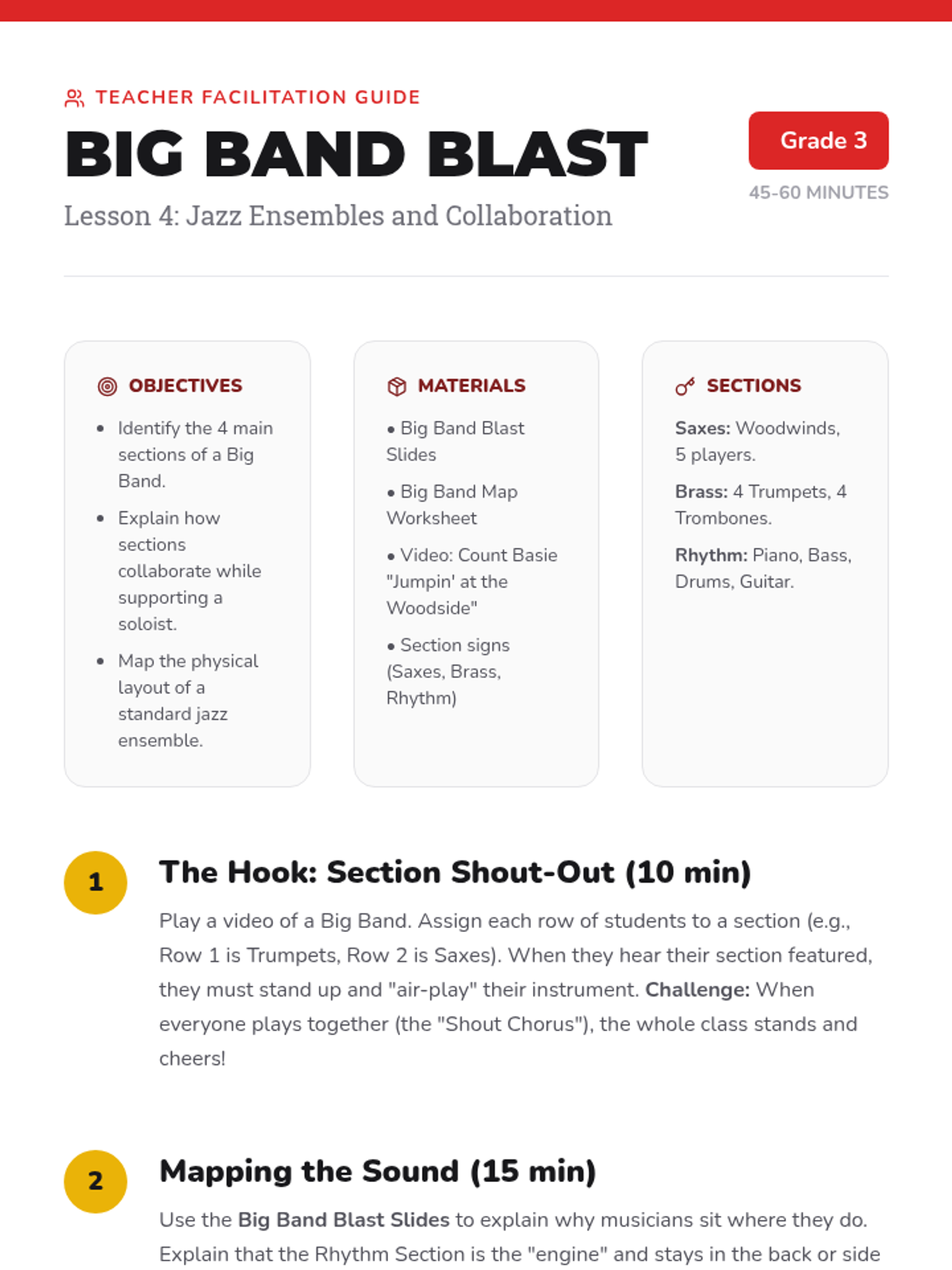
A facilitation guide for Lesson 4, including section identification games and a listening guide for Count Basie's orchestra.
Teacher reference guide for Lesson 4, focusing on cultural protocols for teaching Indigenous North American music, key terminology, and listening facilitation strategies.
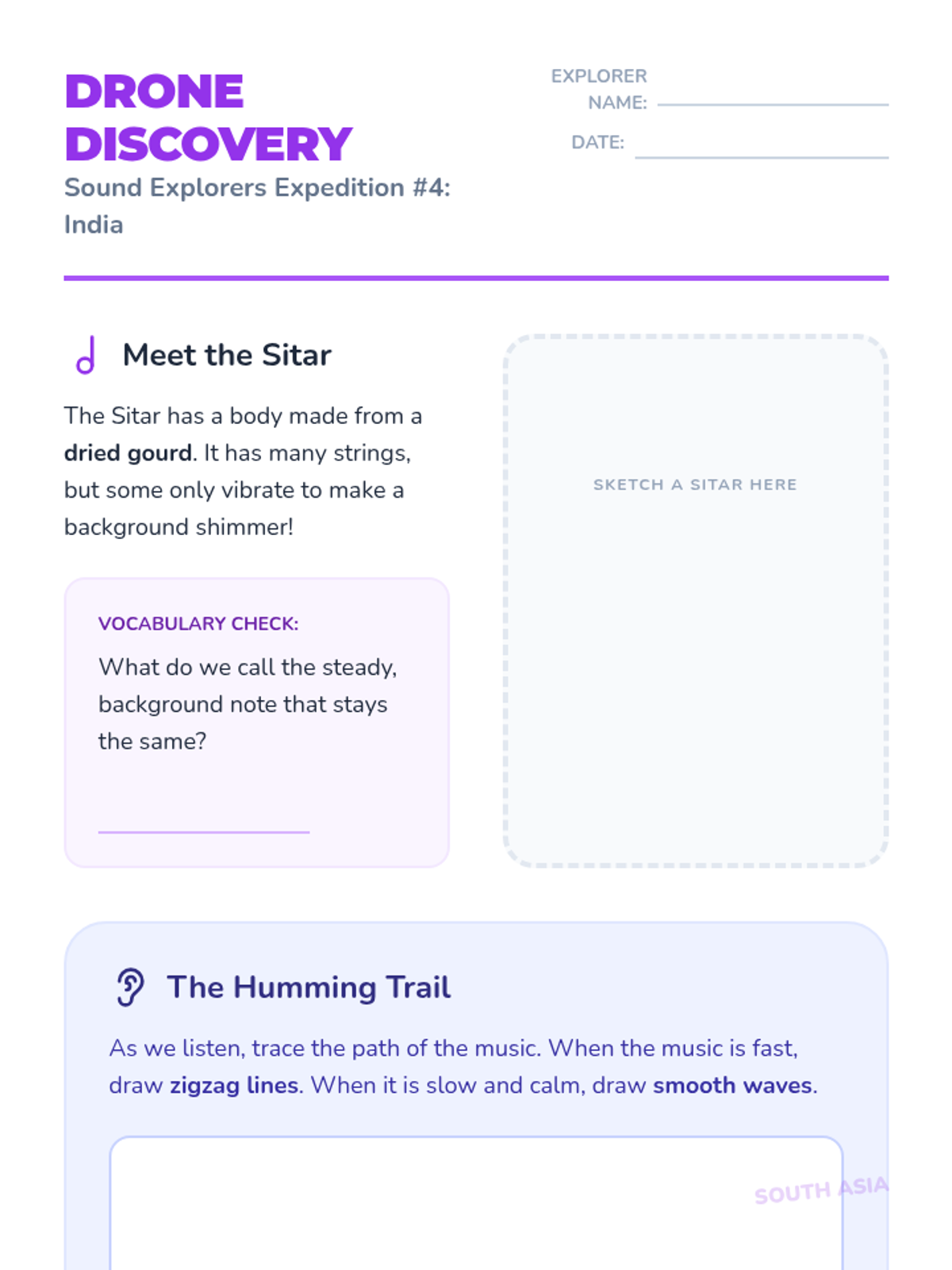
A student listening and reflection worksheet for the fourth lesson, focusing on the sitar, the concept of a drone, and identifying the emotional qualities of Indian ragas.
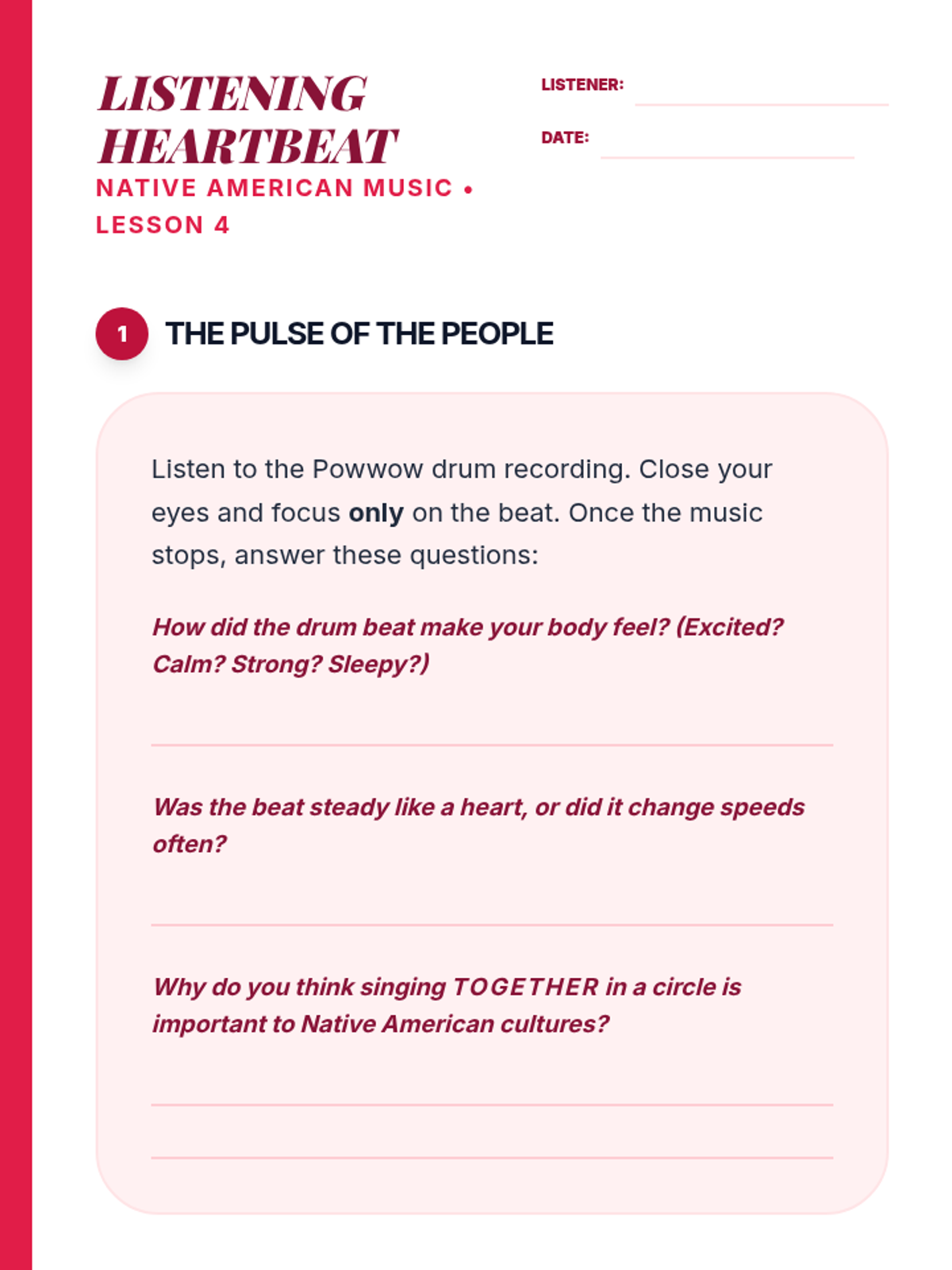
Student reflection worksheet for Lesson 4, featuring listening questions for Powwow music, vocabulary matching, and a creative response on cultural preservation.
A teacher facilitation guide for Lesson 5, including "Turing Test" clip suggestions, discussion prompts for streaming culture, and ideas for the futuristic instrument design project.
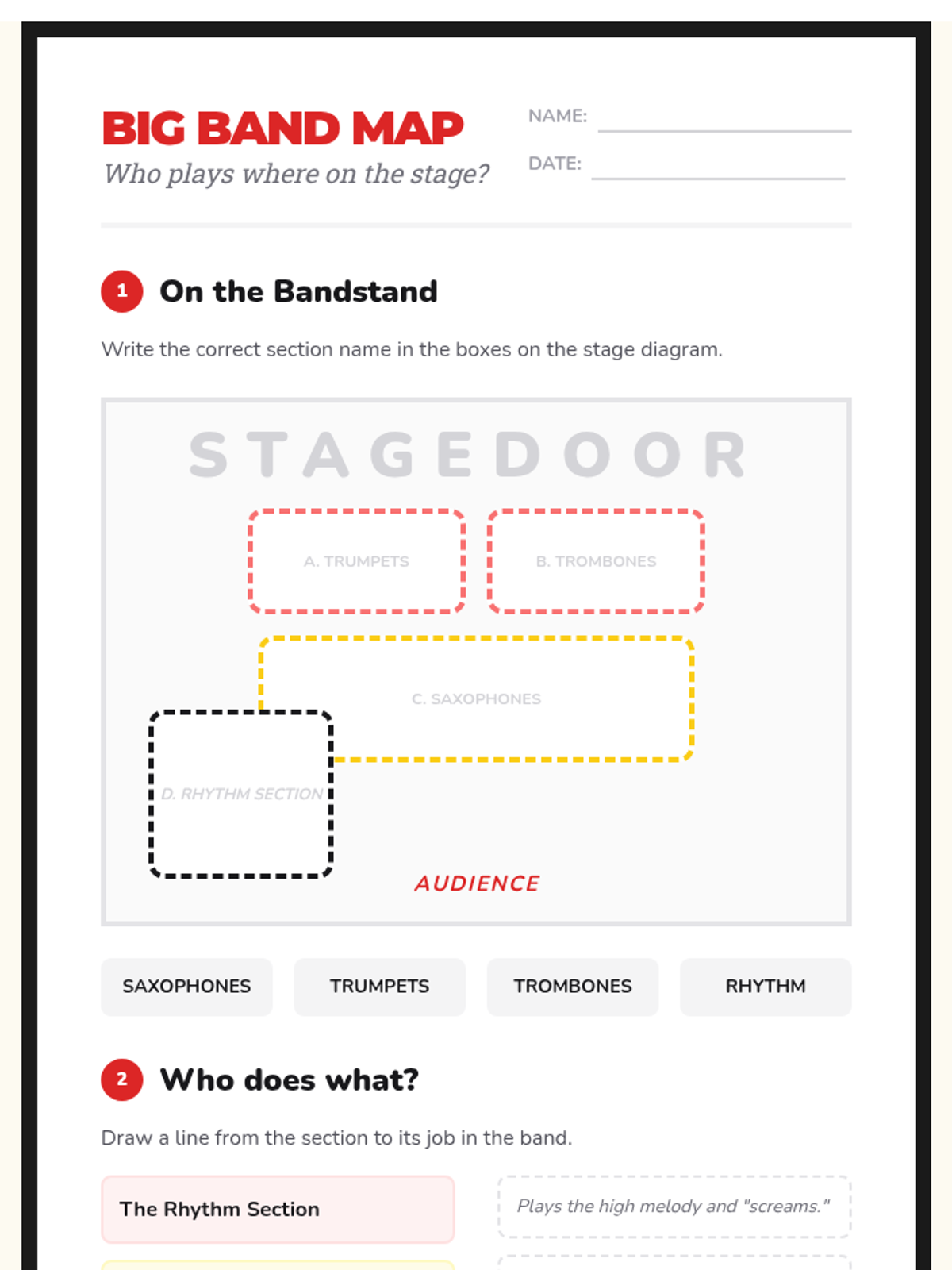
A student worksheet for identifying the different sections of a jazz big band and their roles within the ensemble.
Visual presentation for the fourth lesson, introducing Indian classical music, the Sitar, the concept of a drone note, and the emotional connection of Ragas.
Final project slide deck for Lesson 5, guiding students through the process of designing a "Music Museum" exhibit. Sets the stage for their role as curators and outlines the specific requirements for their final presentation.
A slide deck for Lesson 5, guiding students through the elements of a swing band performance, including rhythm, melody, and improvisation.
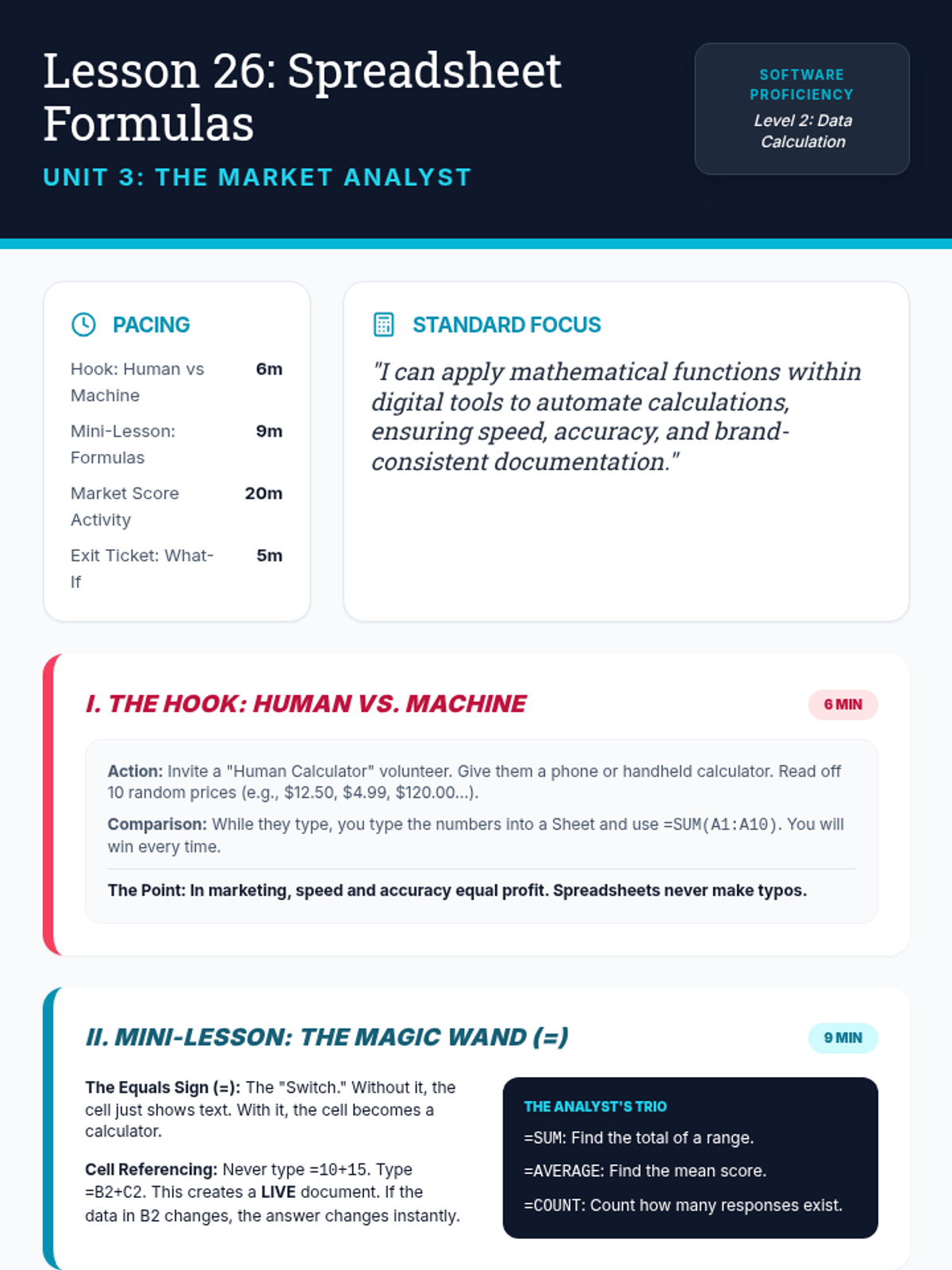
Comprehensive teacher guide for Lesson 26, focusing on introductory spreadsheet formulas (=SUM, =AVERAGE, =COUNT) and the concept of cell referencing. Fixed minor spacing issues in pacing list.
Dynamic slides for Lesson 25, explaining real-time data syncing between forms and sheets, the importance of file organization, and the technical steps for freezing header rows. Fixed tracking and spacing issues in headers and action items.
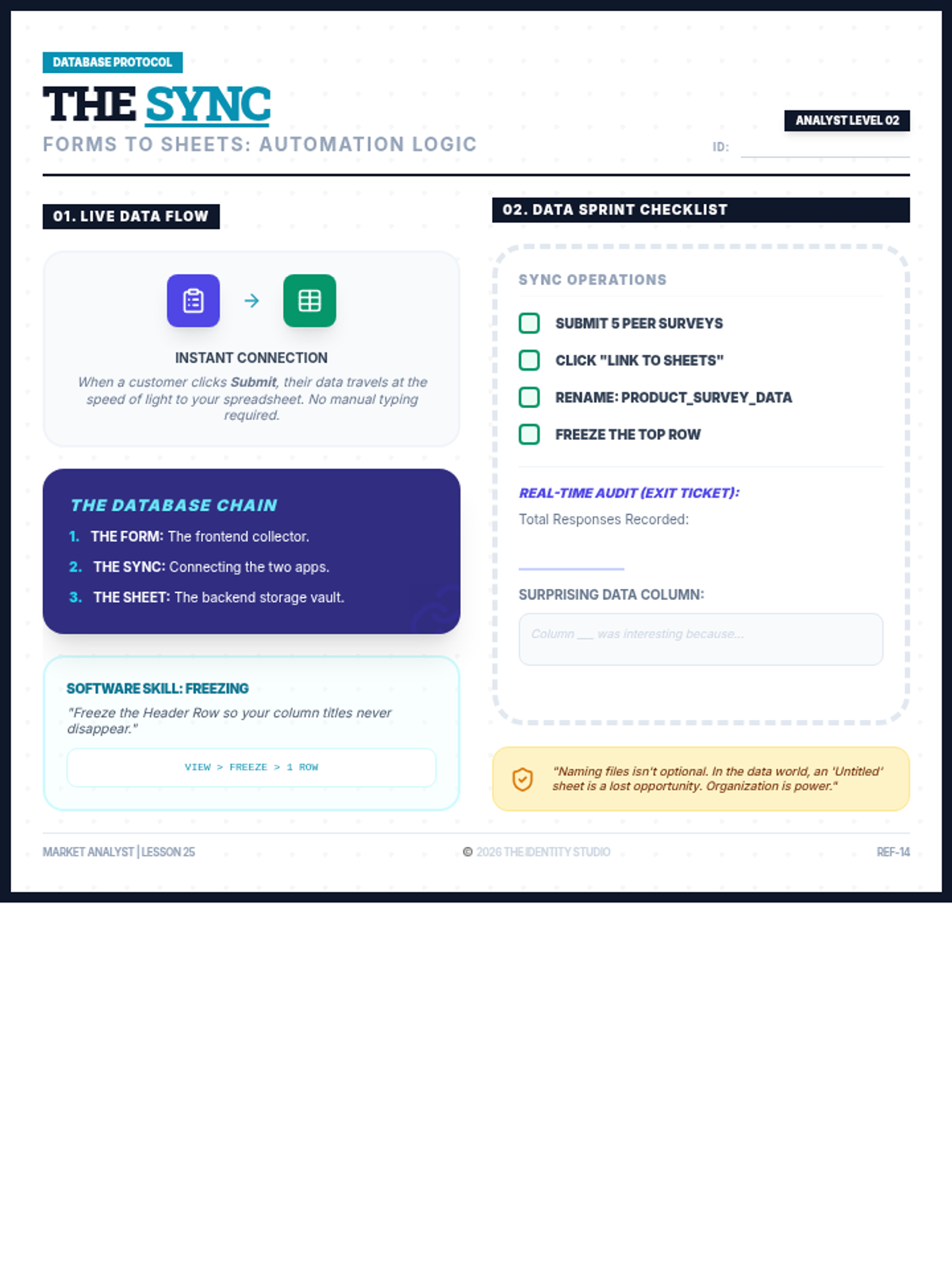
A student technical reference for Lesson 25, explaining the automated link between forms and spreadsheets, the concept of the 'database chain', and a checklist for the Data Sprint activity.
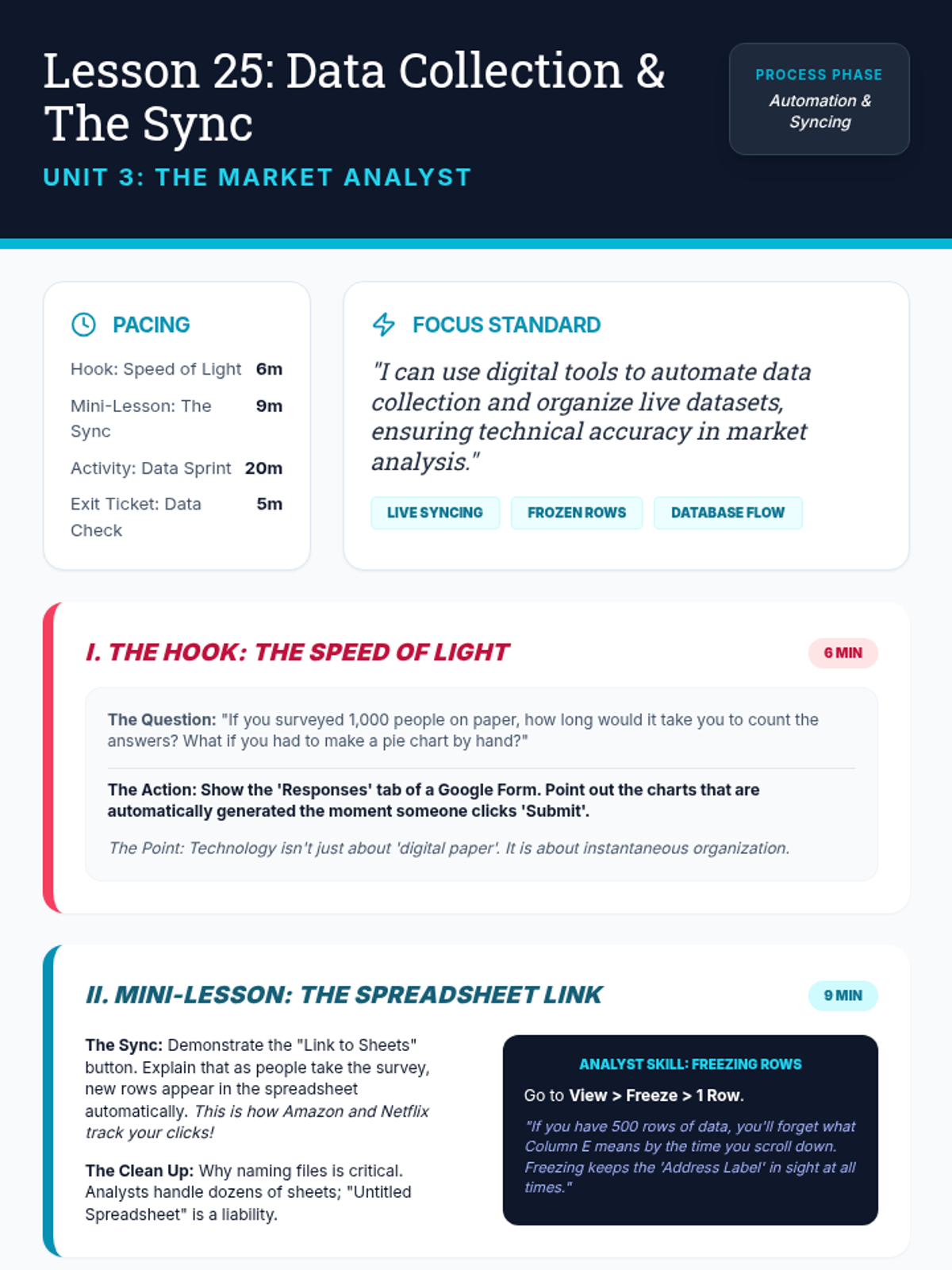
A detailed teacher facilitation guide for Lesson 25, focusing on linking forms to spreadsheets, the concept of real-time syncing, and the technical skill of freezing rows for data management.
Dynamic slides for Lesson 24, featuring the biased question hook, definitions of quantitative and qualitative data, and technical setup for survey deployment. Fixed tracking, layout spacing, and checklist completeness.
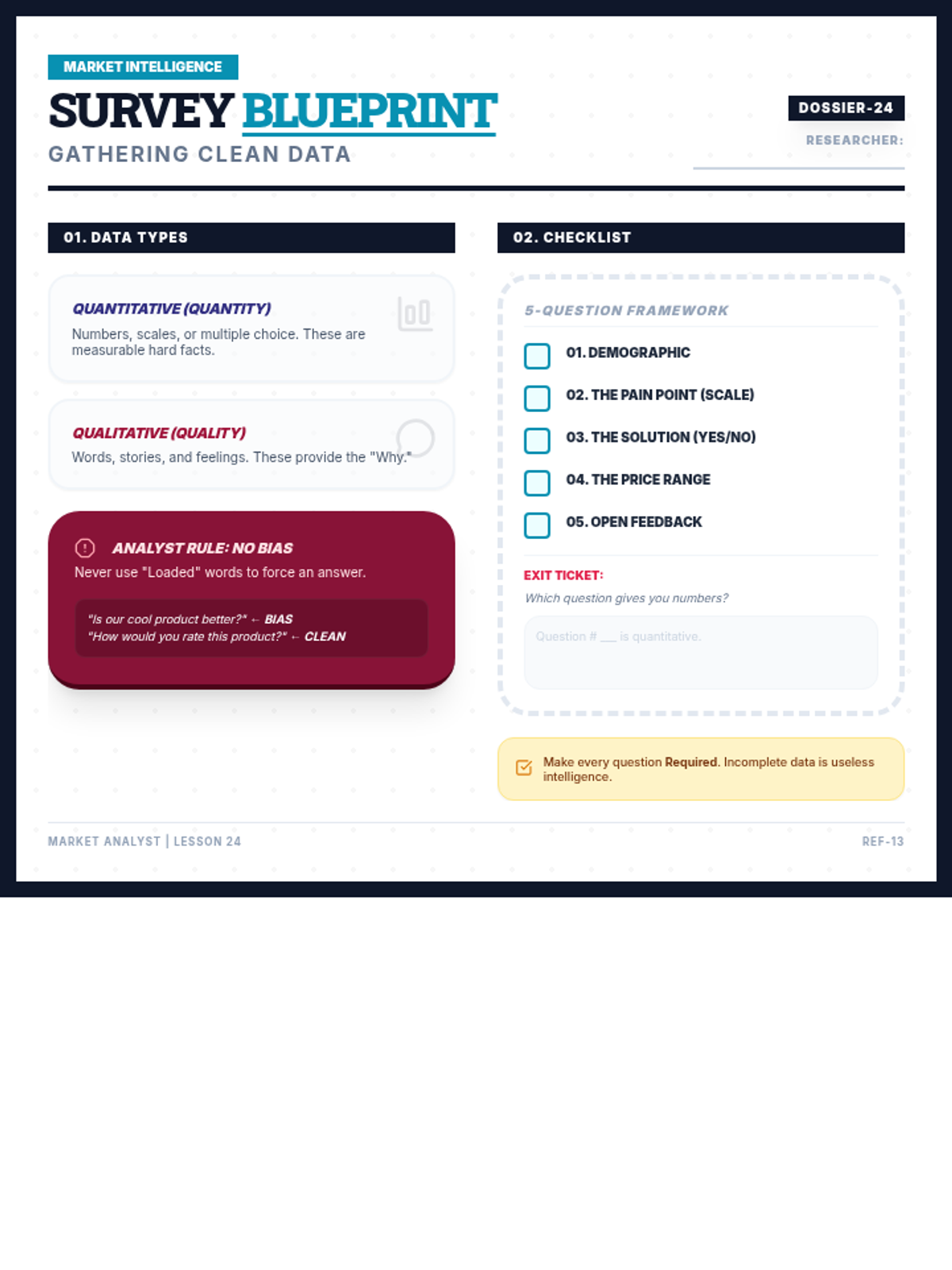
A student reference sheet and checklist for professional survey design. Covers quantitative vs. qualitative data, how to avoid bias, and the 5-question framework for market research. Optimized for a single page.
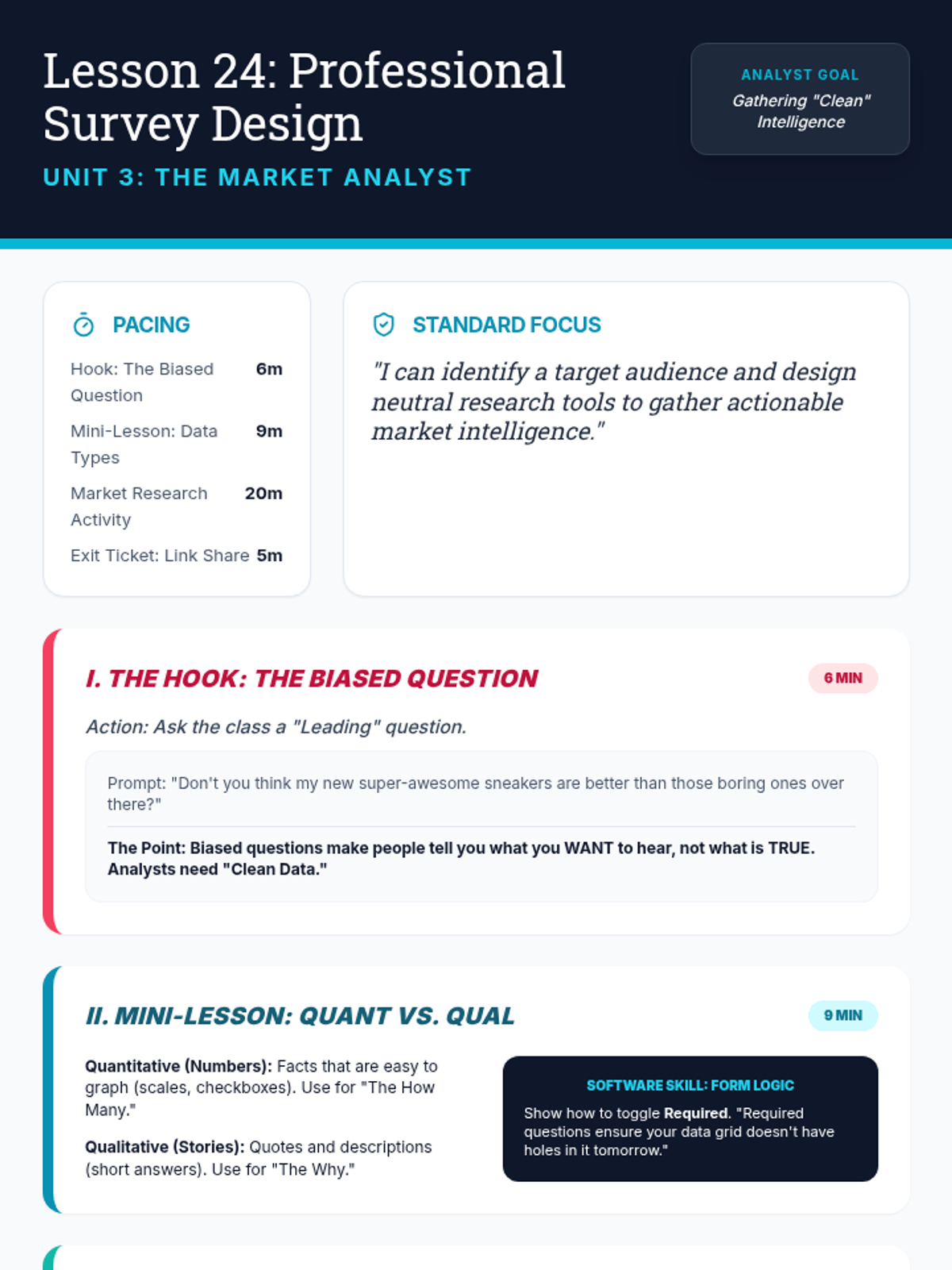
A detailed teacher facilitation guide for Lesson 24, focusing on survey design principles, avoiding bias, and the technical setup of market research forms. Fixed placeholder text and redundant labels.
Dynamic slides for Lesson 23, introducing the 'Data Grid' concept with the Jellybean Challenge, Battleship navigation, and technical instruction for resizing and fill colors. Fixed tracking, contrast, and diagram alignment.
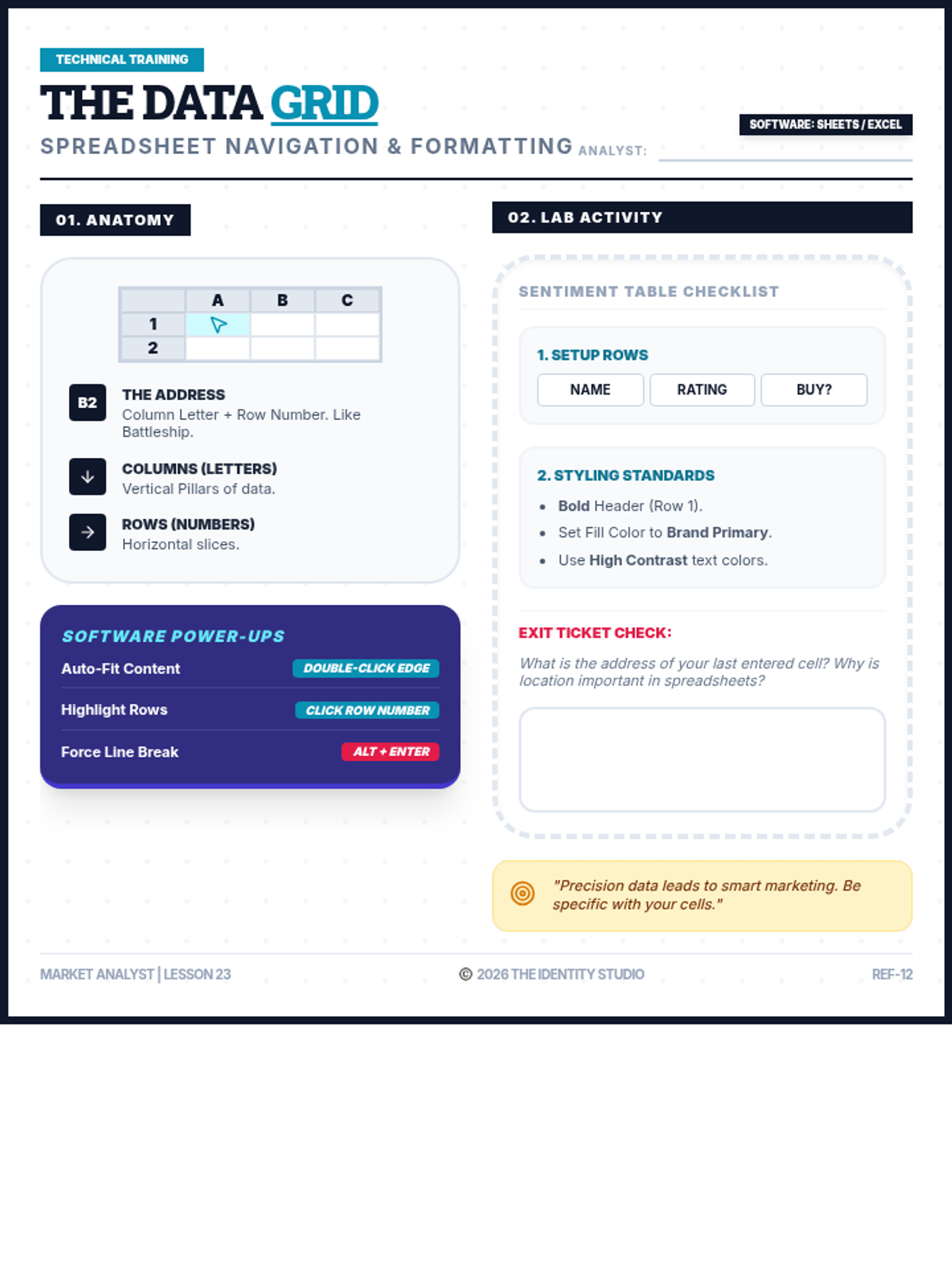
A professional student reference sheet for Lesson 23, explaining the 'Battleship' address system, column/row orientation, and essential formatting shortcuts for Google Sheets and Excel. Optimized for a single-page print.
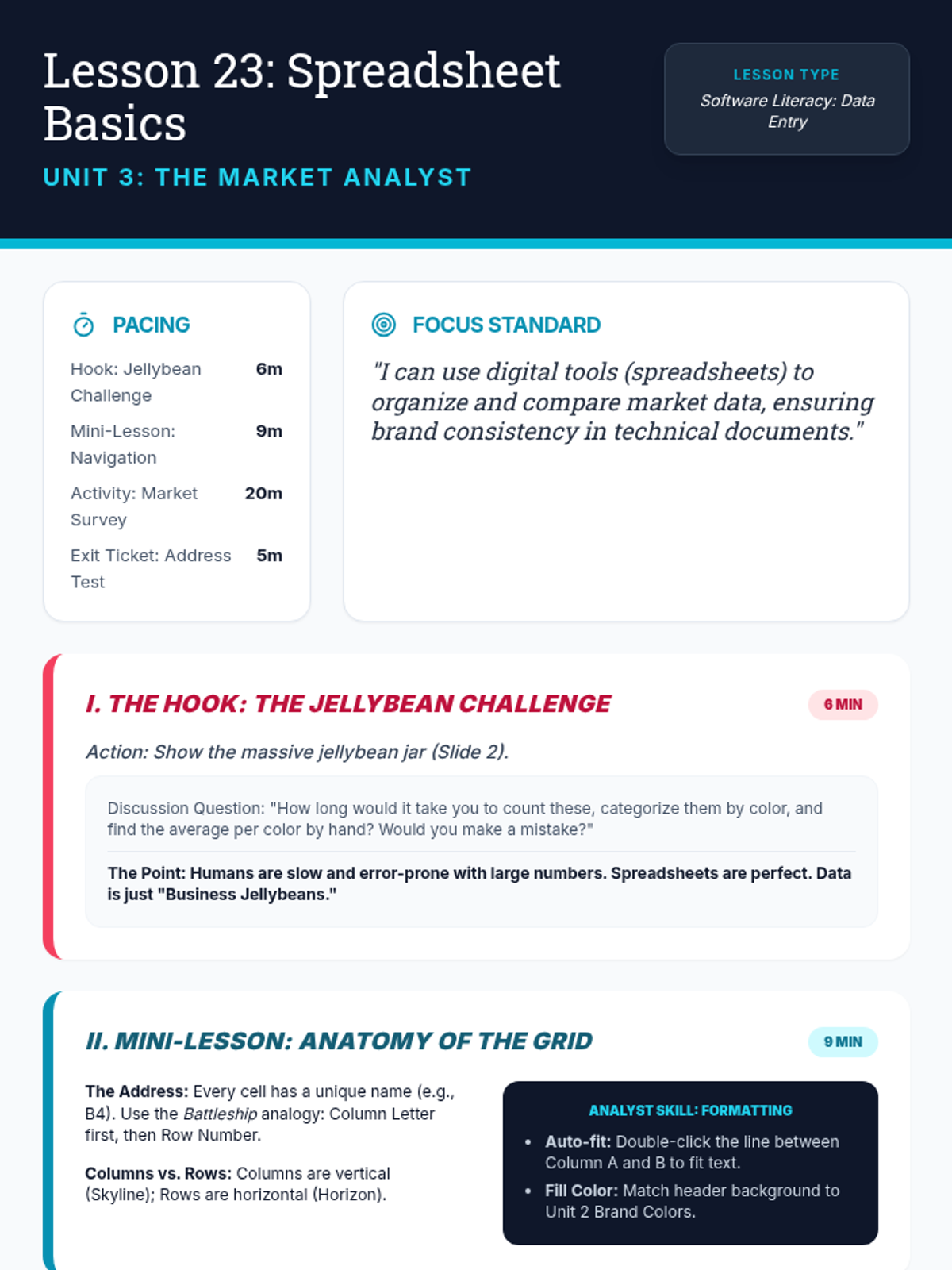
A detailed teacher facilitation guide for Lesson 23, introducing spreadsheet software via the Jellybean Challenge, Battleship navigation analogies, and basic table formatting.
Dynamic slides for Lesson 22, featuring the shoe-based hook, pillar definitions (Demographics/Psychographics), and User Persona activity instructions.
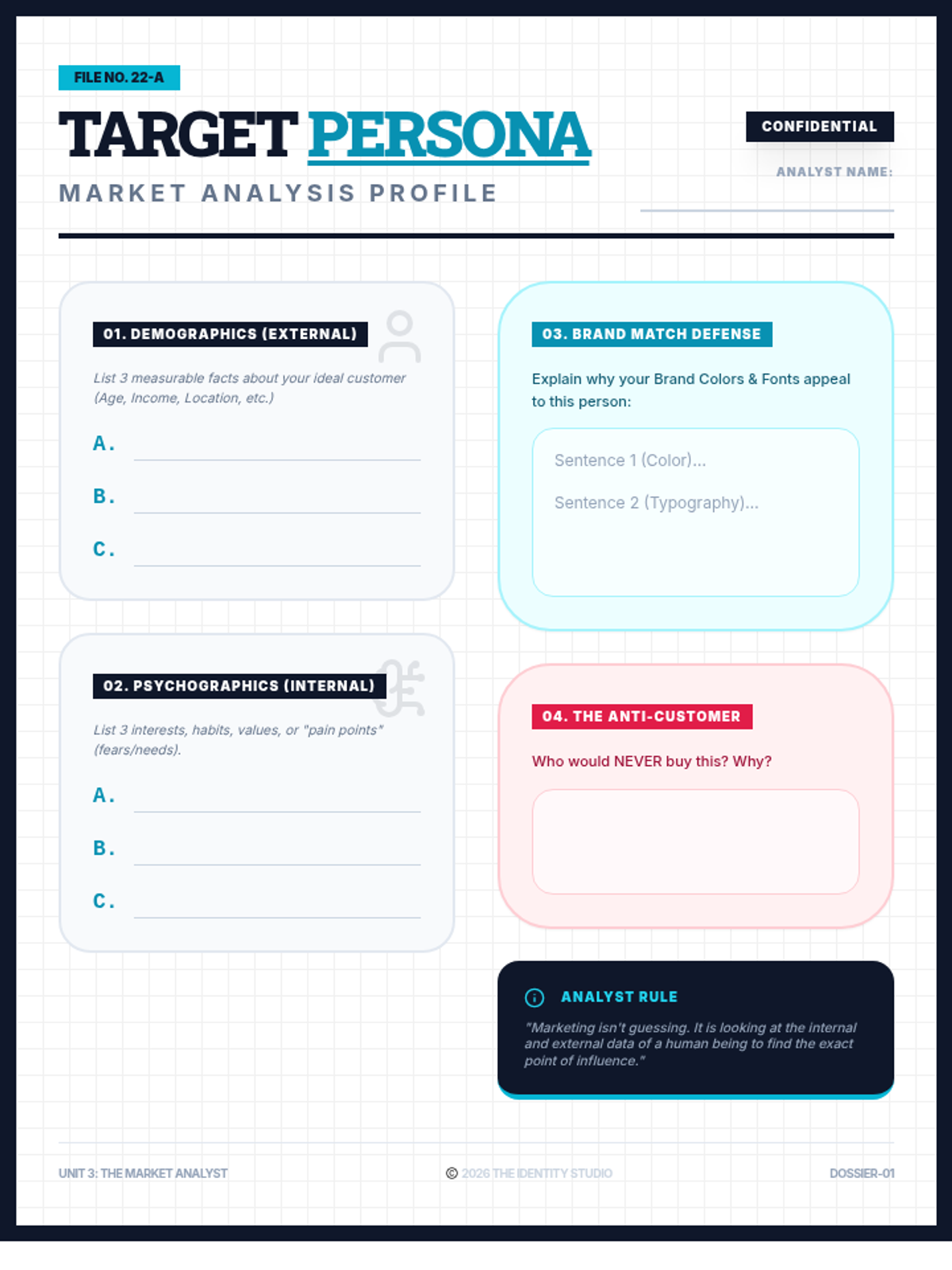
A structured data-themed student worksheet for building a User Persona. Includes sections for demographics, psychographics, brand alignment defense, and the anti-customer profile.
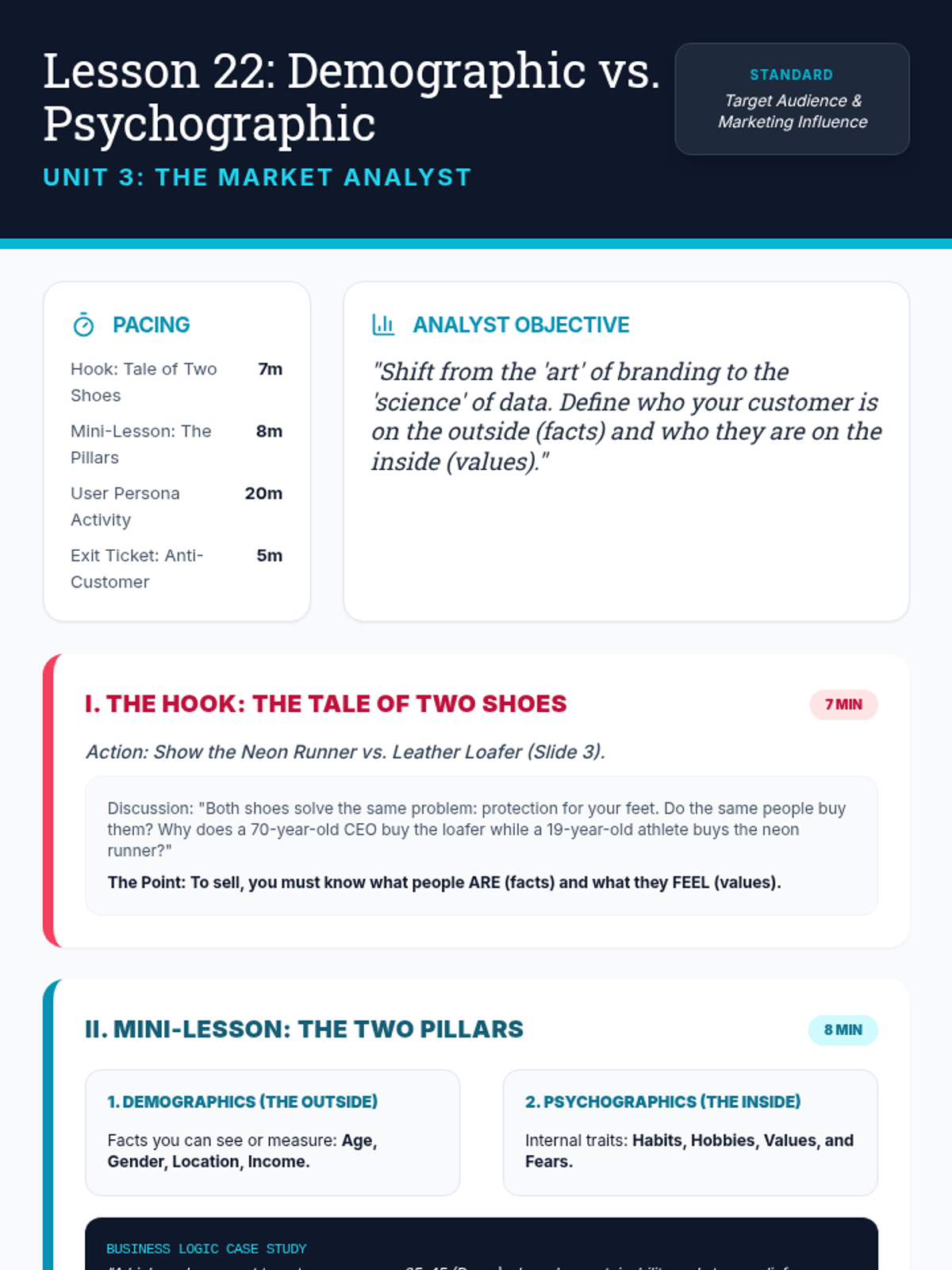
A comprehensive teacher facilitation guide for Lesson 22, introducing Unit 3: The Market Analyst. Focuses on the difference between demographics and psychographics with shoe-based hooks and persona building instructions.
Polished final slides for Lesson 21, including 'The Boardroom' hook, Glow and Grow feedback framework, Gallery Walk protocol, and final refinement instructions.
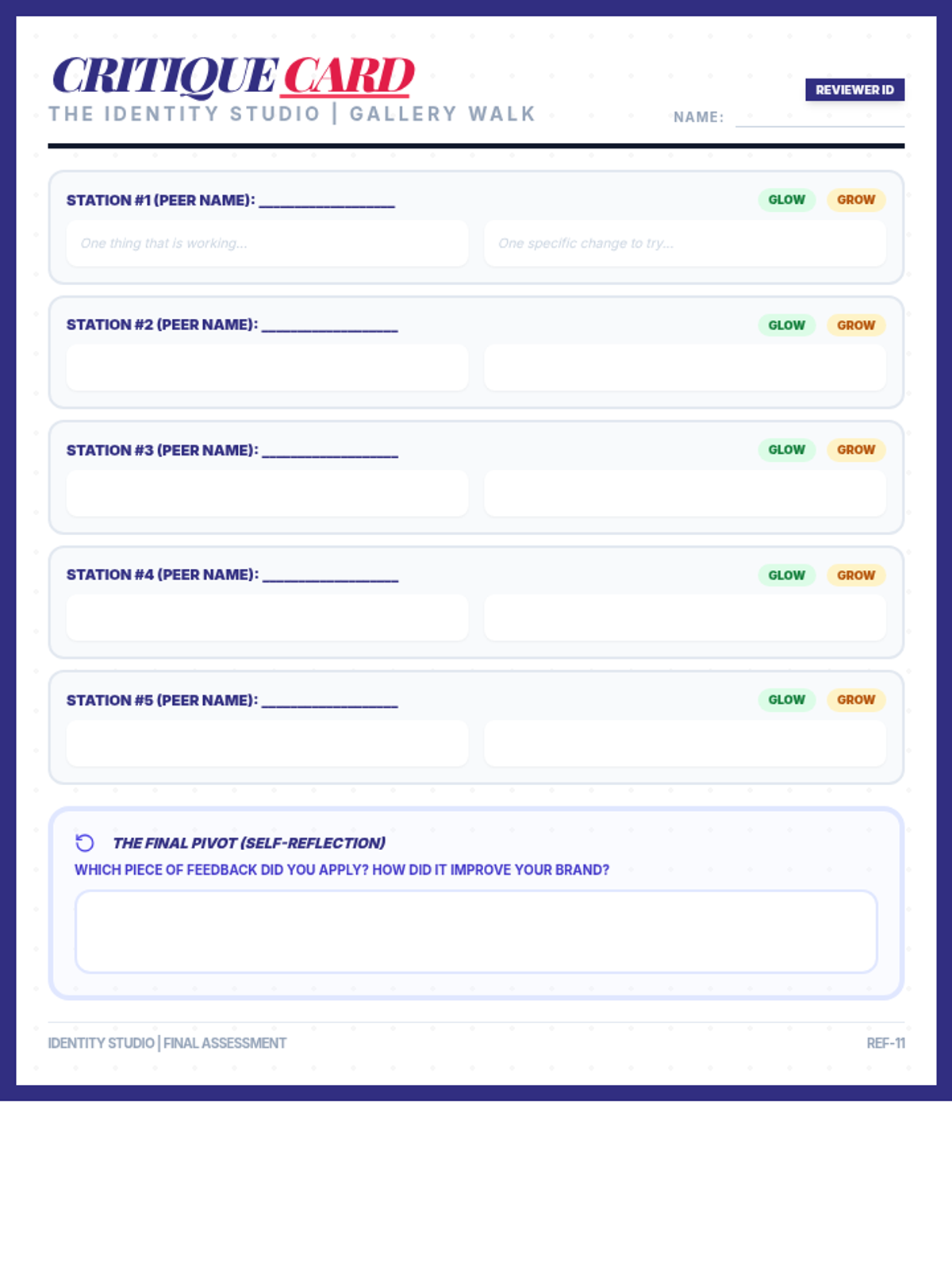
A structured student feedback card for the Gallery Walk, providing space for students to record 'Glows' and 'Grows' for five classmates and a final self-reflection on their refinements. Revised for 5 stations with larger font sizes.
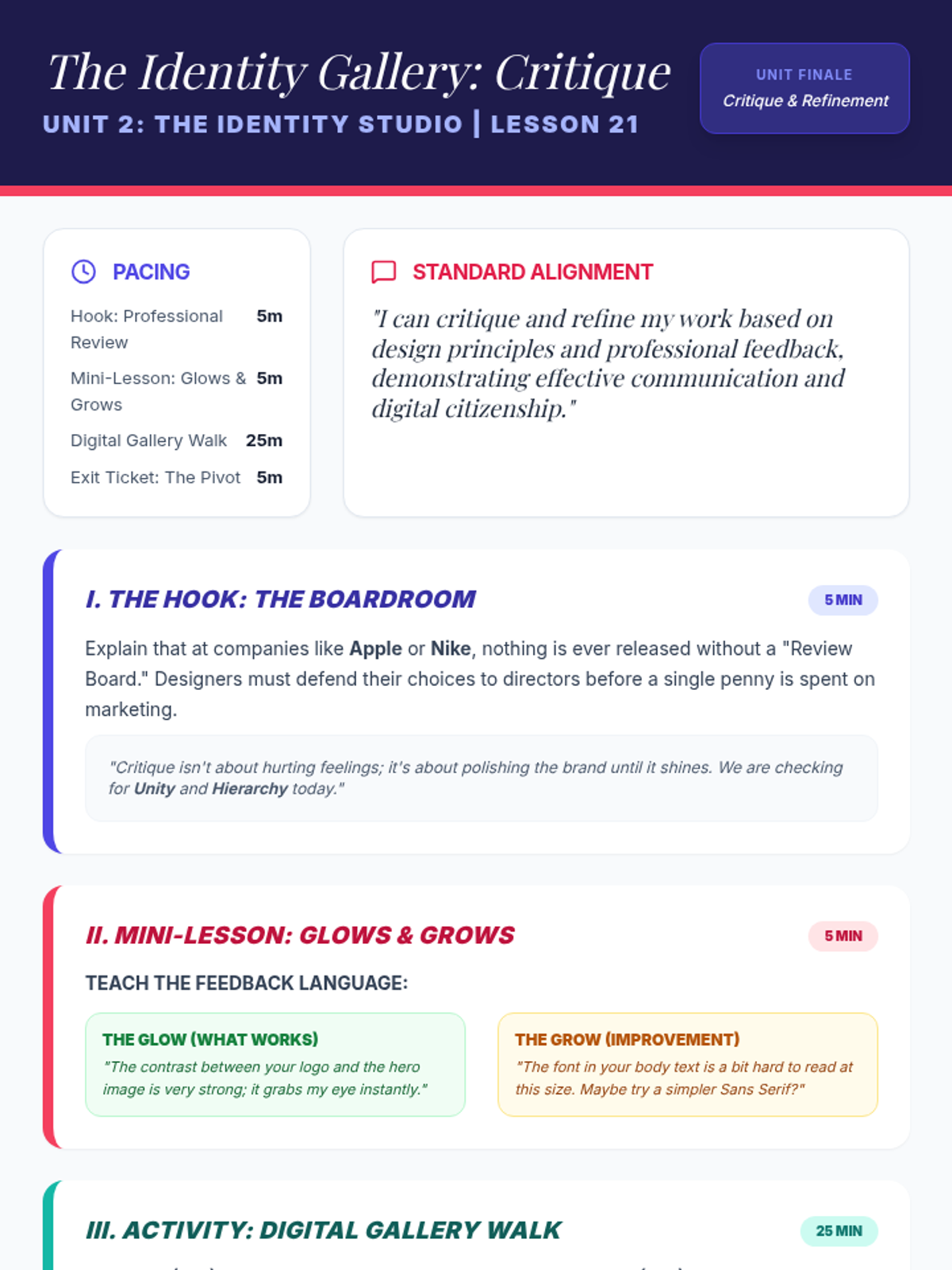
Comprehensive teacher facilitation guide for Lesson 21, focusing on the professional design critique, the Glow and Grow feedback method, and final portfolio refinement.
Dynamic slides for Lesson 20, featuring the 'Read This First' hook, the Rule of Three for size and weight, the 'Tidy Up' Canva skill, and the 3-second rule for testing visual hierarchy. Fixed tracking and contrast issues.
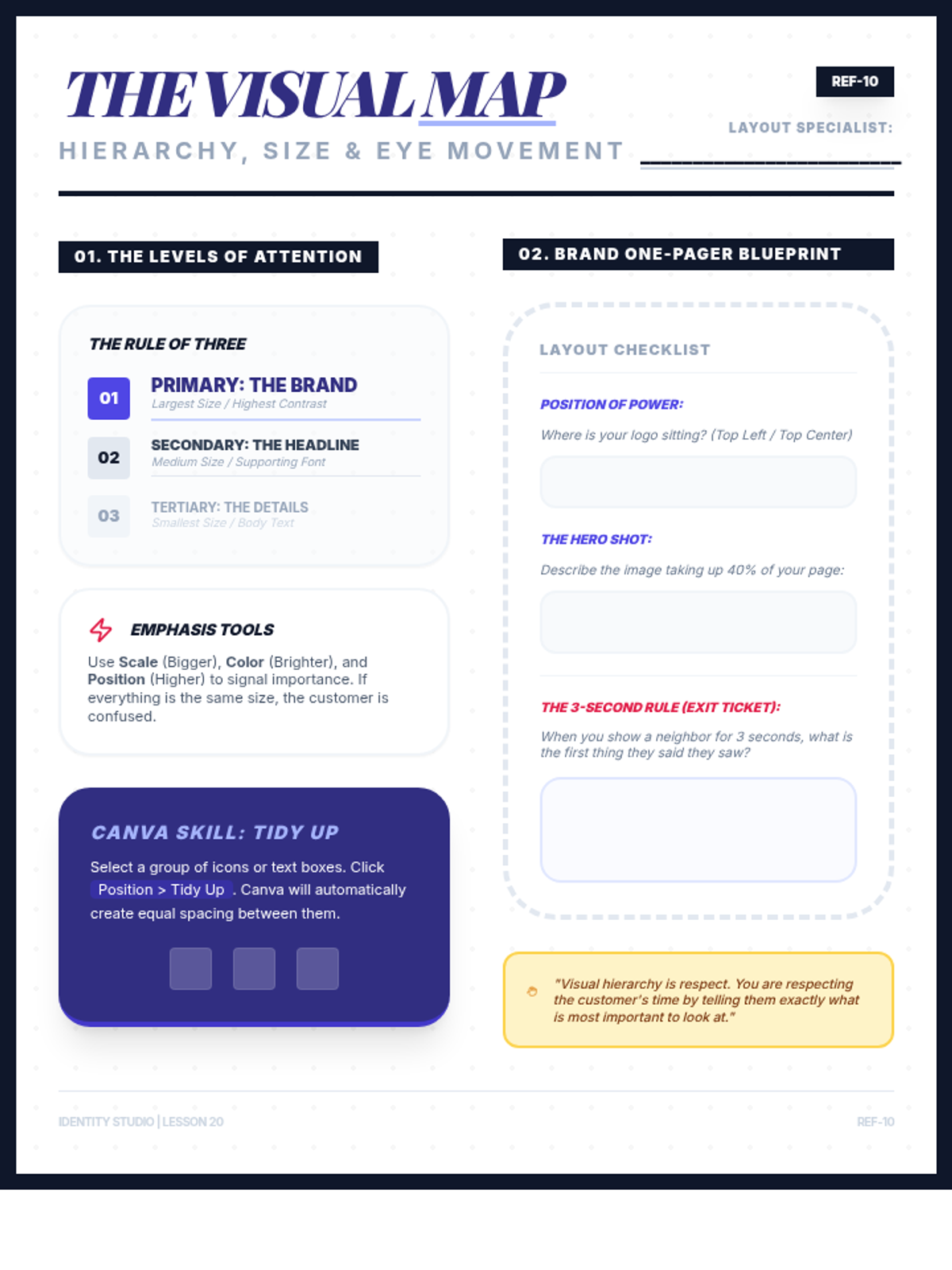
A student planning sheet for Lesson 20, focusing on the principles of visual hierarchy (Size, Emphasis, Tidy Up) and providing a layout blueprint for the Brand One-Pager activity.
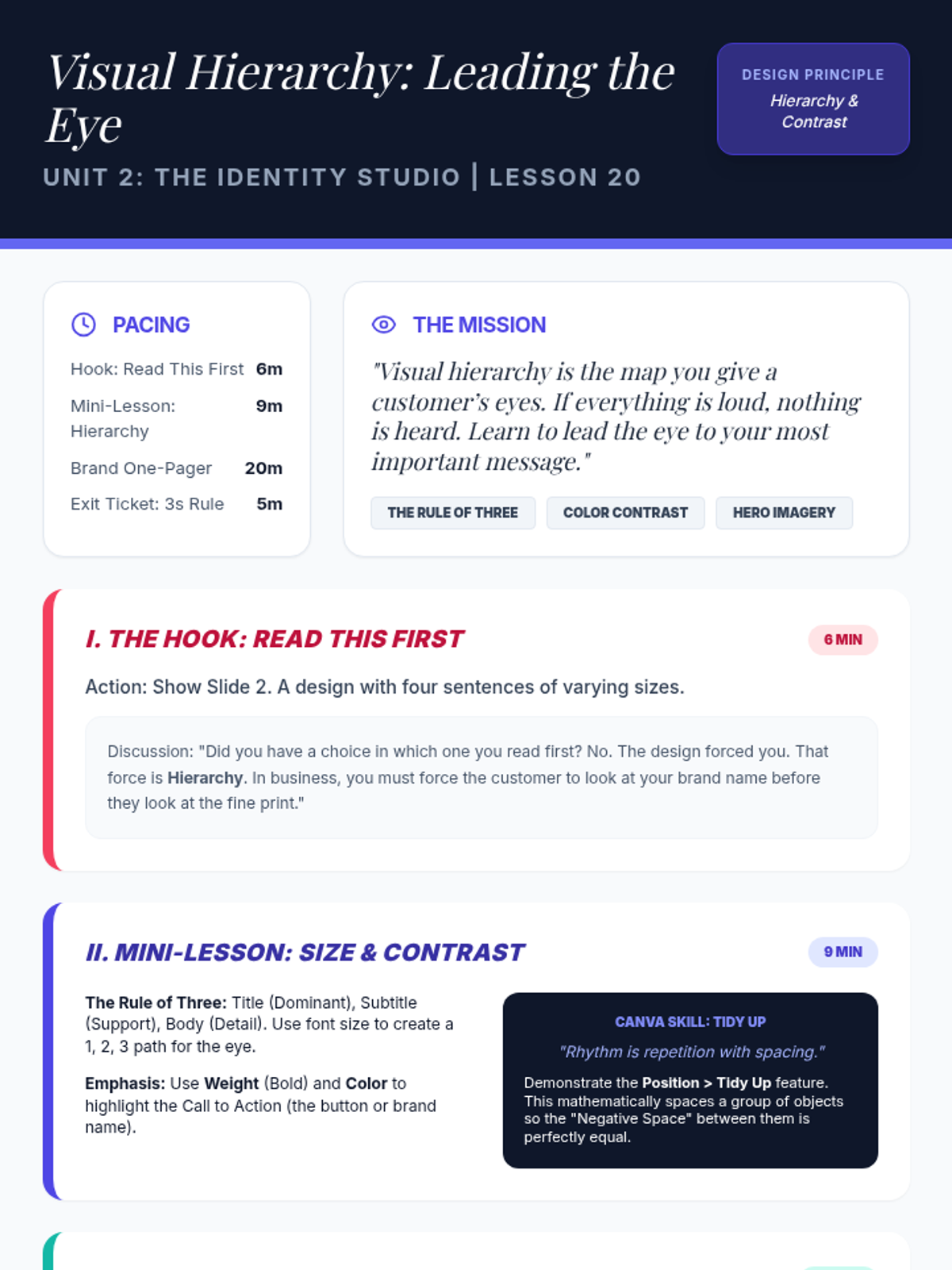
Comprehensive teacher facilitation guide for Lesson 20, focusing on visual hierarchy, the 'Rule of Three', and the creation of a Brand One-Pager in Canva.
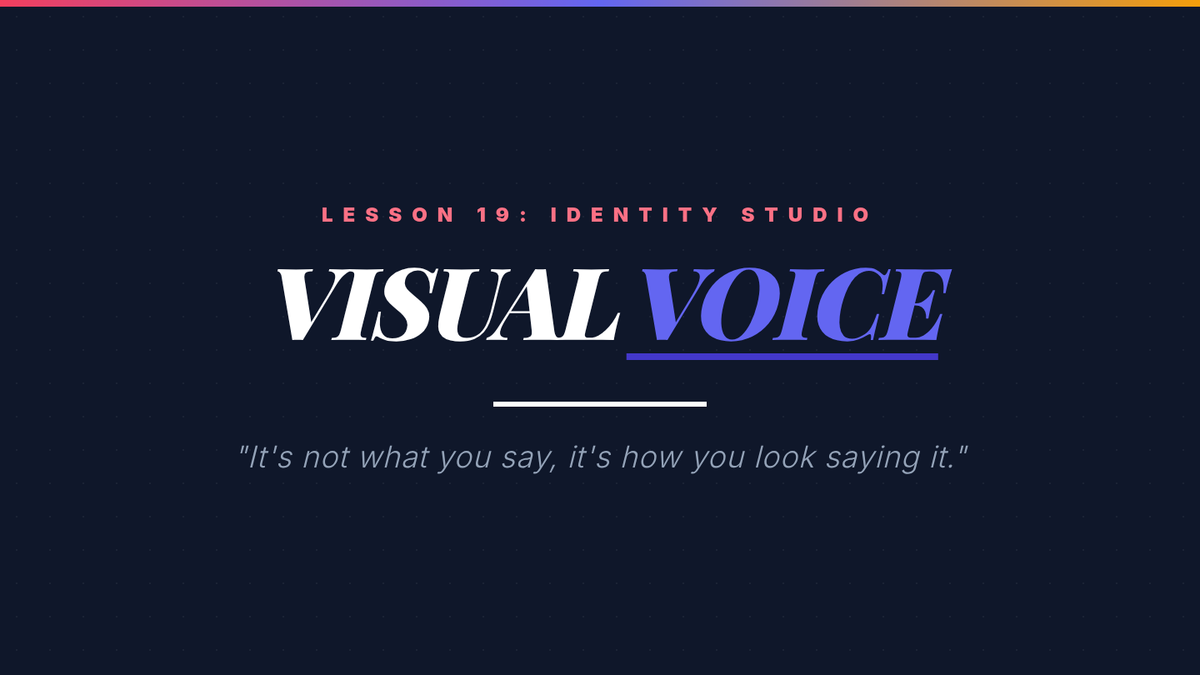
Polished slides for Lesson 19, featuring the Disney vs. Tesla brand persona hook, a photography style overview with visual examples, and final instructions for the Style Guide PDF export. Fixed visual incompleteness flagged in review.