Sentence structure fundamentals, subject-verb agreement, and precise usage of parts of speech including pronouns, conjunctions, and adjectives. Targets technical accuracy through mastery of capitalization, punctuation, spelling, and verb mood.
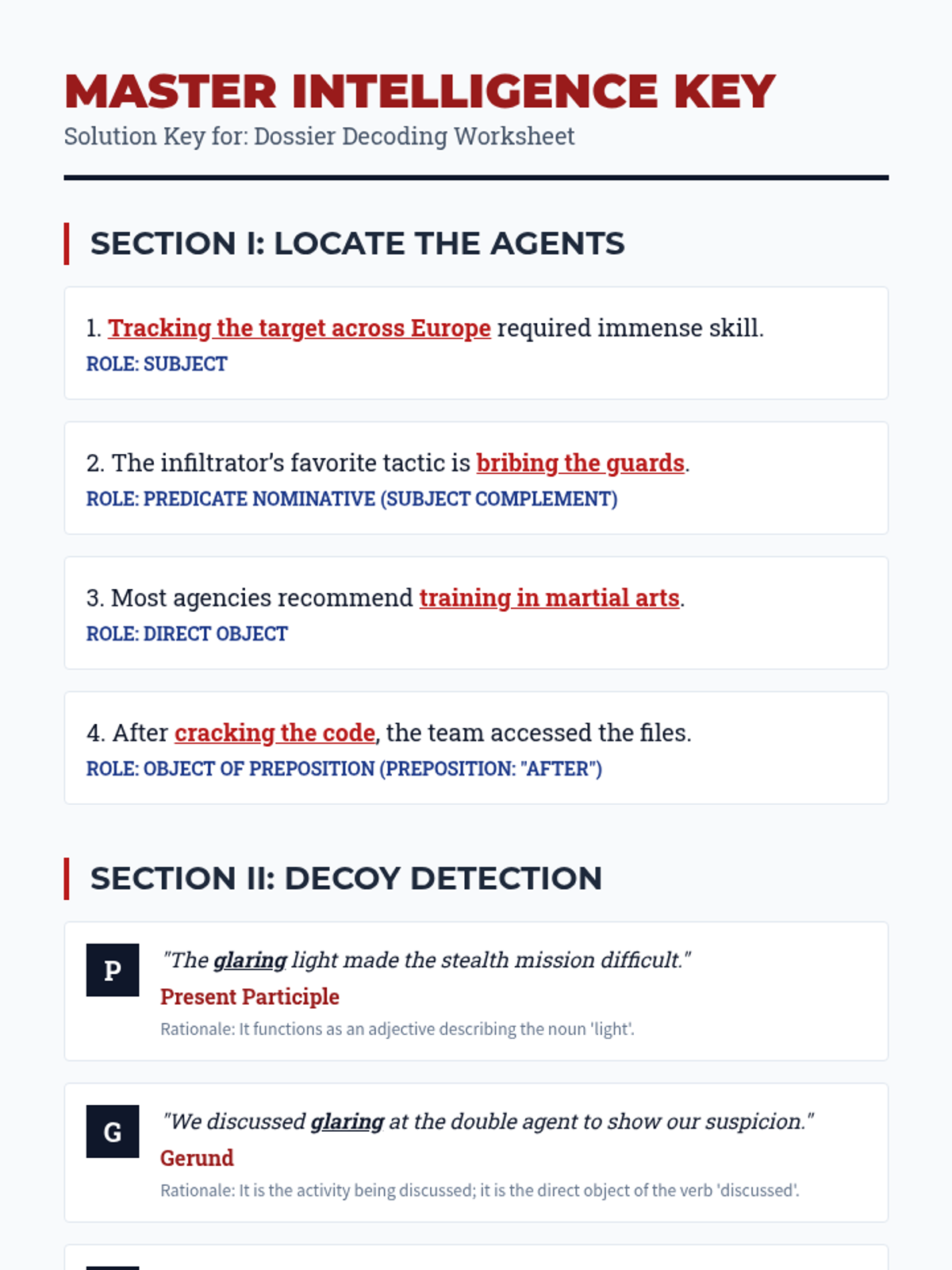
A comprehensive answer key for the 'Dossier Decoding' worksheet, providing highlighted solutions, role identifications, and teacher notes for evaluating high-level student responses. Section II is now self-contained and formatted for better readability.
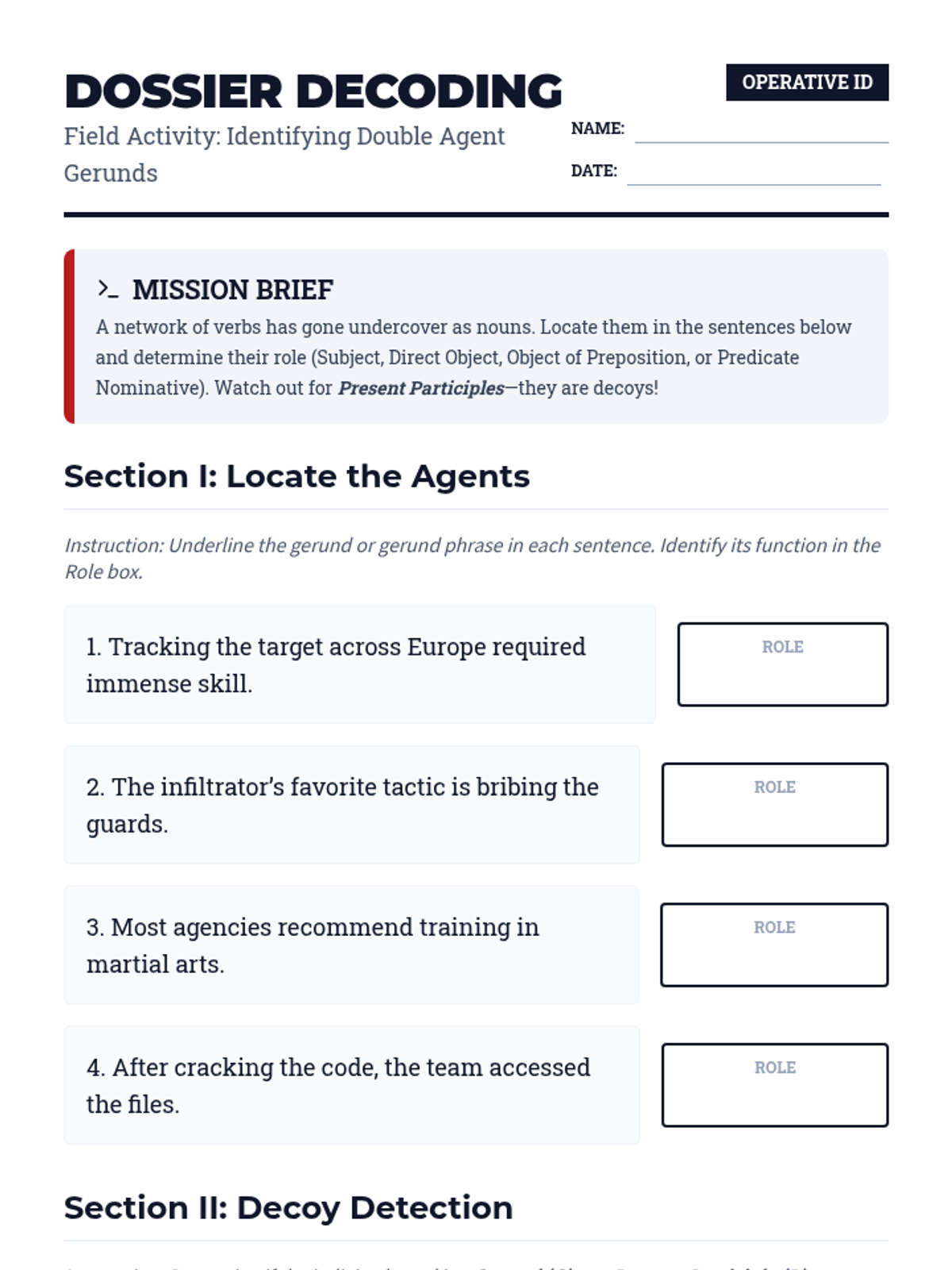
A student worksheet designed with a detective 'dossier' aesthetic. It challenges students to identify gerunds and their roles, distinguish them from participles, and apply their knowledge in creative writing. Section I has been improved for better layout and clarity.
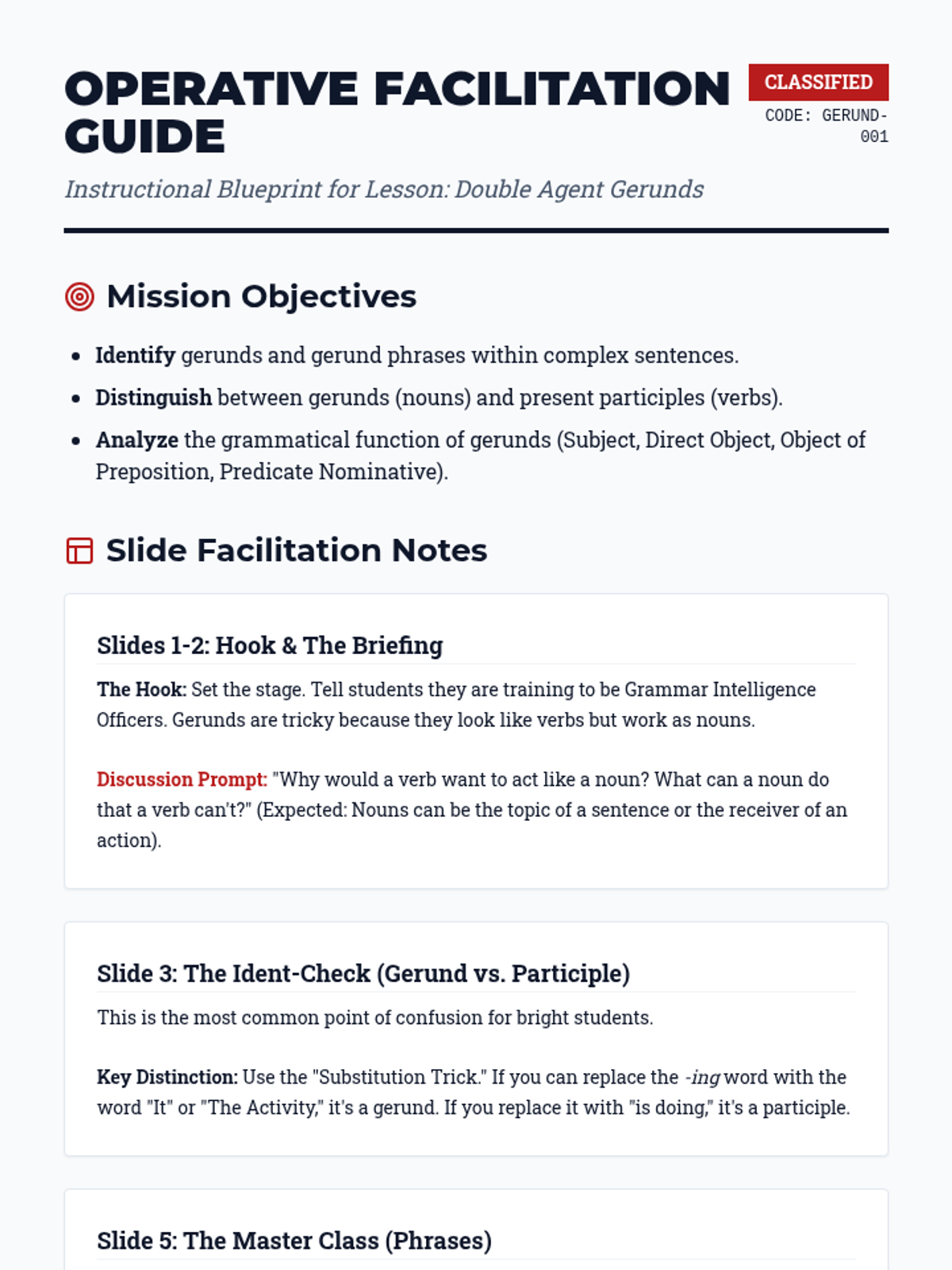
A teacher's facilitation guide for the 'Double Agent Gerunds' lesson, featuring slide-by-slide prompts, common pitfalls, the 'Substitution Trick', and extension activities for advanced students. Updated with guidance for the interactive analysis slide.
A visually striking, spy-themed slide deck that introduces gerunds as 'Double Agents'—verbs acting as nouns. It covers identification, functions (subject, object, complement), and gerund phrases for advanced learners. Now includes a dedicated analysis slide for student participation.
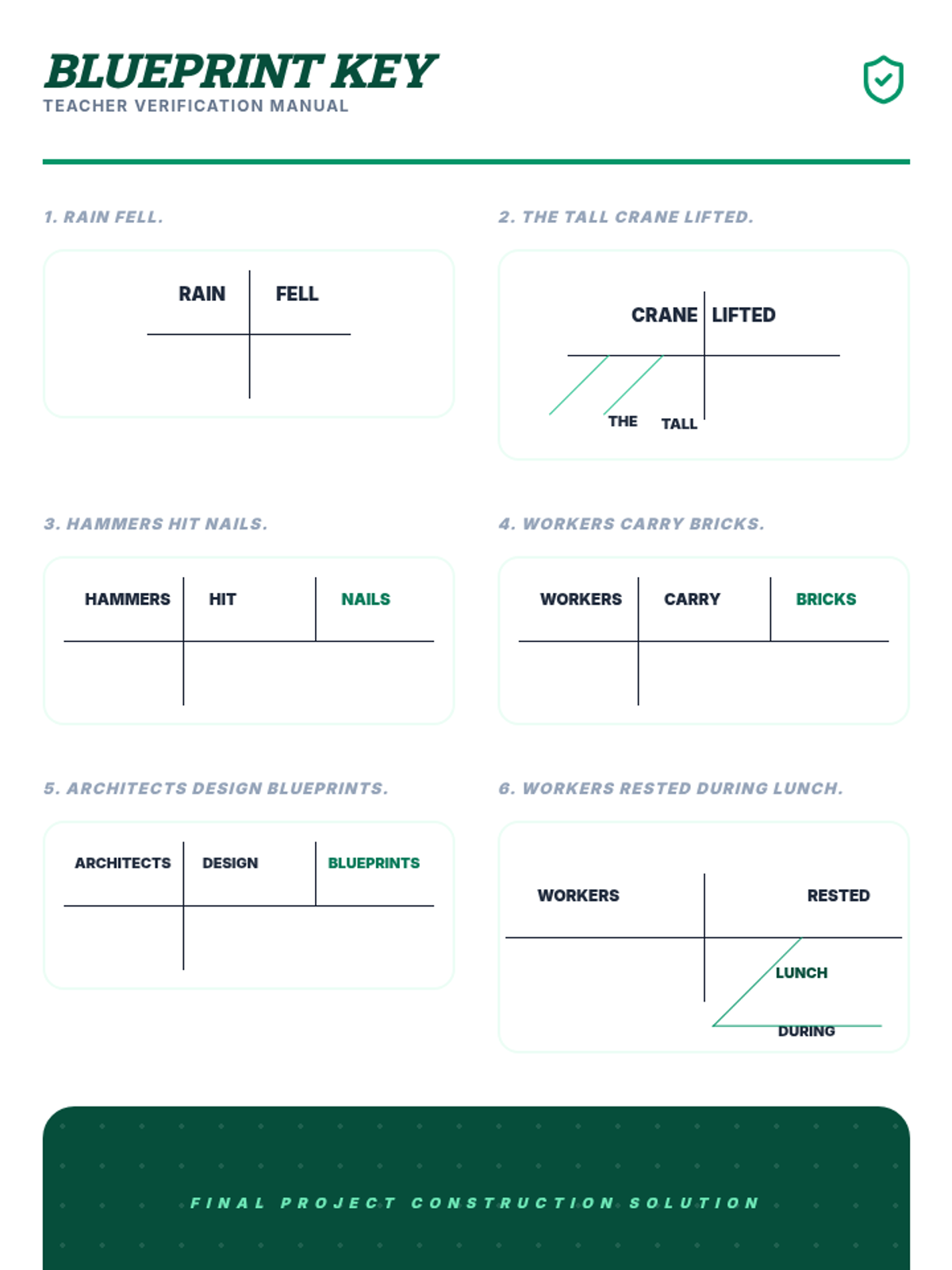
A comprehensive answer key with visual diagram solutions, featuring corrected Reed-Kellogg structures for complex sentences and prepositional phrases.
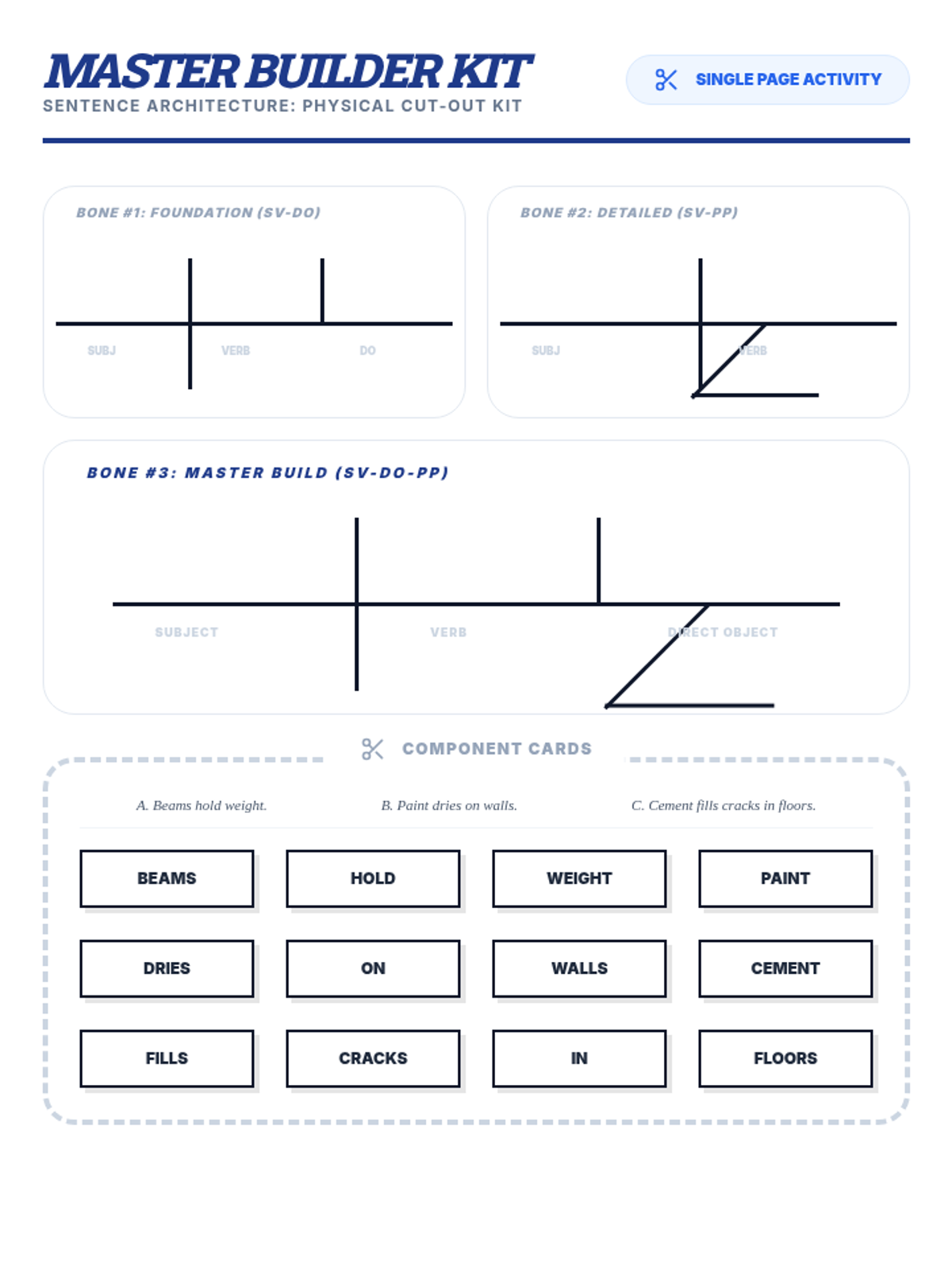
A hands-on "drag and drop" alternative for print, providing enlarged diagram frames and component cards for a physical sentence building activity on a single page.
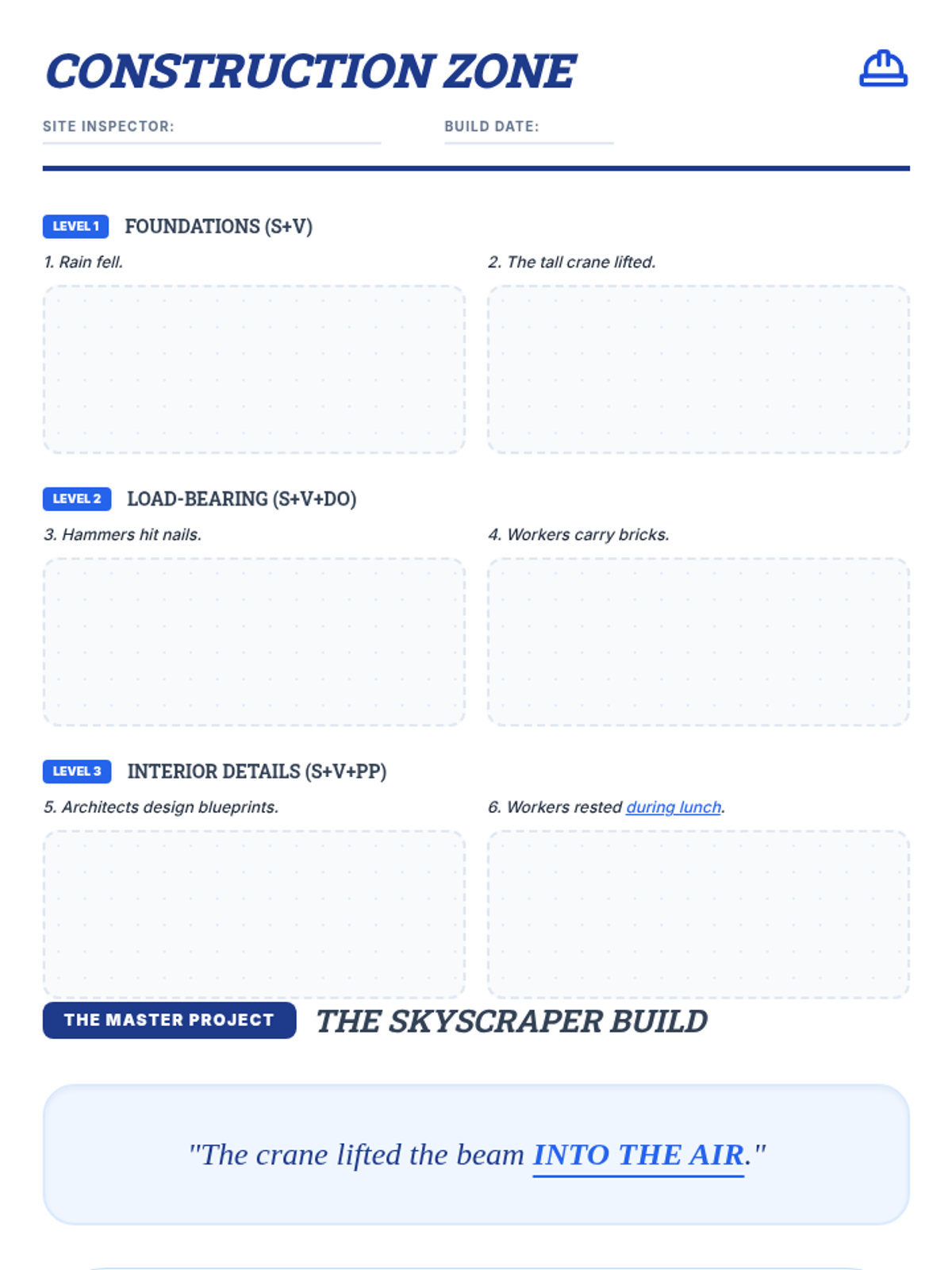
A sentence diagramming worksheet with three levels of increasing difficulty, plus a final challenge and a word bank to simulate interactive diagram building.
A visual guide to Reed-Kellogg diagramming, using an architectural theme to explain how to structure subjects, verbs, direct objects, and prepositional phrases.
A comprehensive 19-page second-semester grammar workbook. This portrait handout includes daily tasks and unique hints for all 18 weeks (19-36), complex sentence analysis, and customized diagramming spaces with structural guides. Every page follows the user's color-coded daily task model.
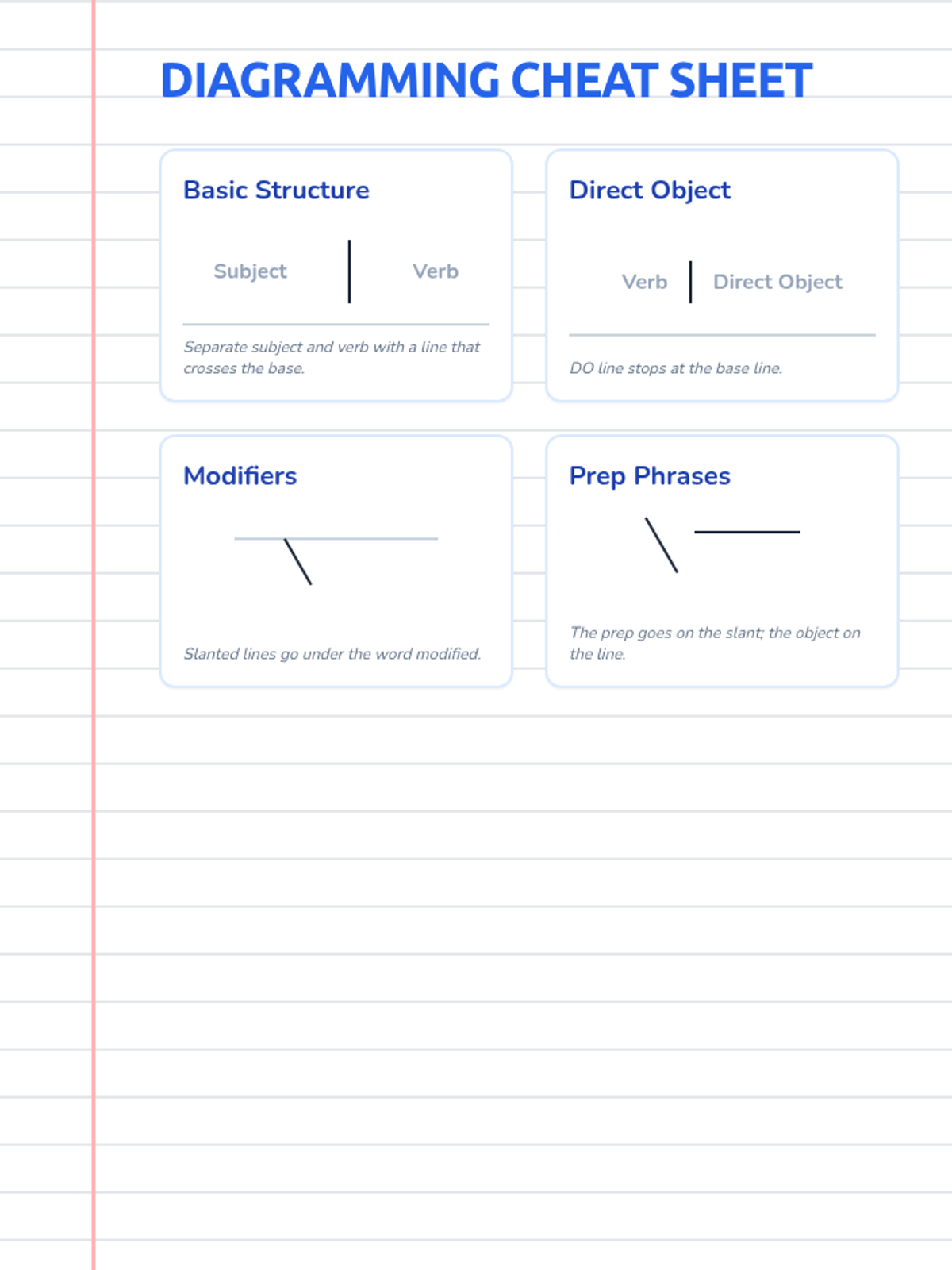
A complete 19-page first-semester grammar practice workbook in portrait mode. Each page includes specific daily tasks (POS, Sentence Parts, Clauses, Correction) and a customized Friday diagramming area with structure-specific baselines and professional guidance. Each page matches the user's color-coded model.
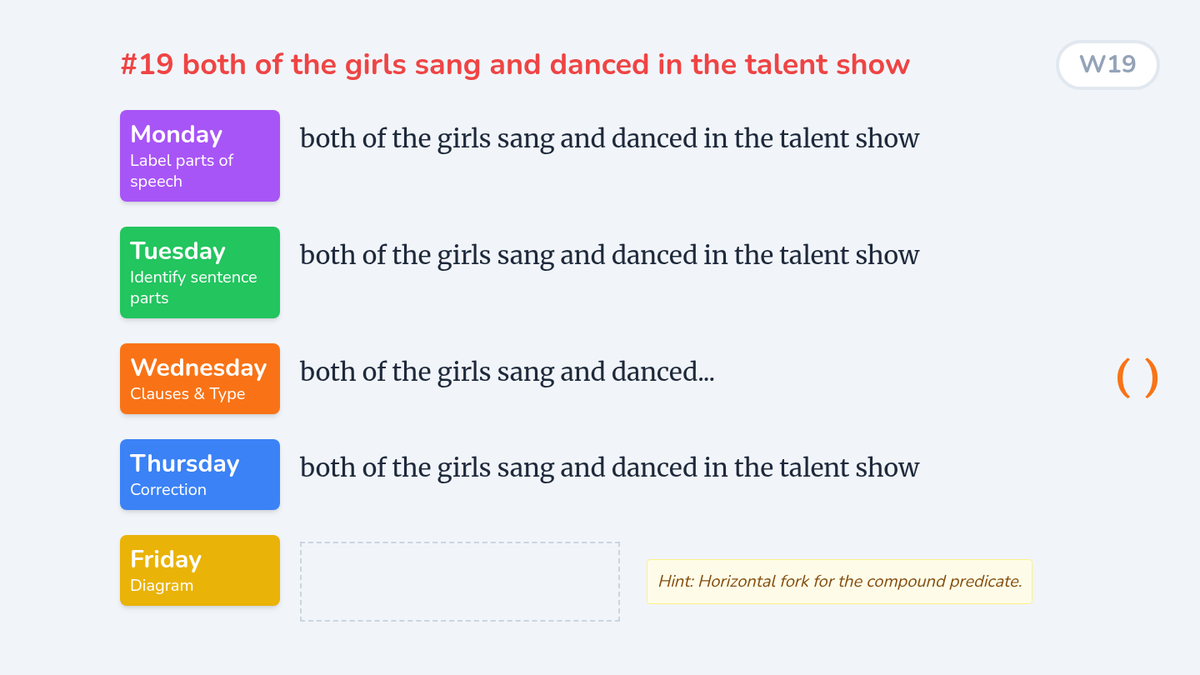
A presentation deck for the second semester of daily grammar practice (Weeks 19-36). Each slide focuses on a complex or compound-complex sentence with specific sections for daily analysis and hints.
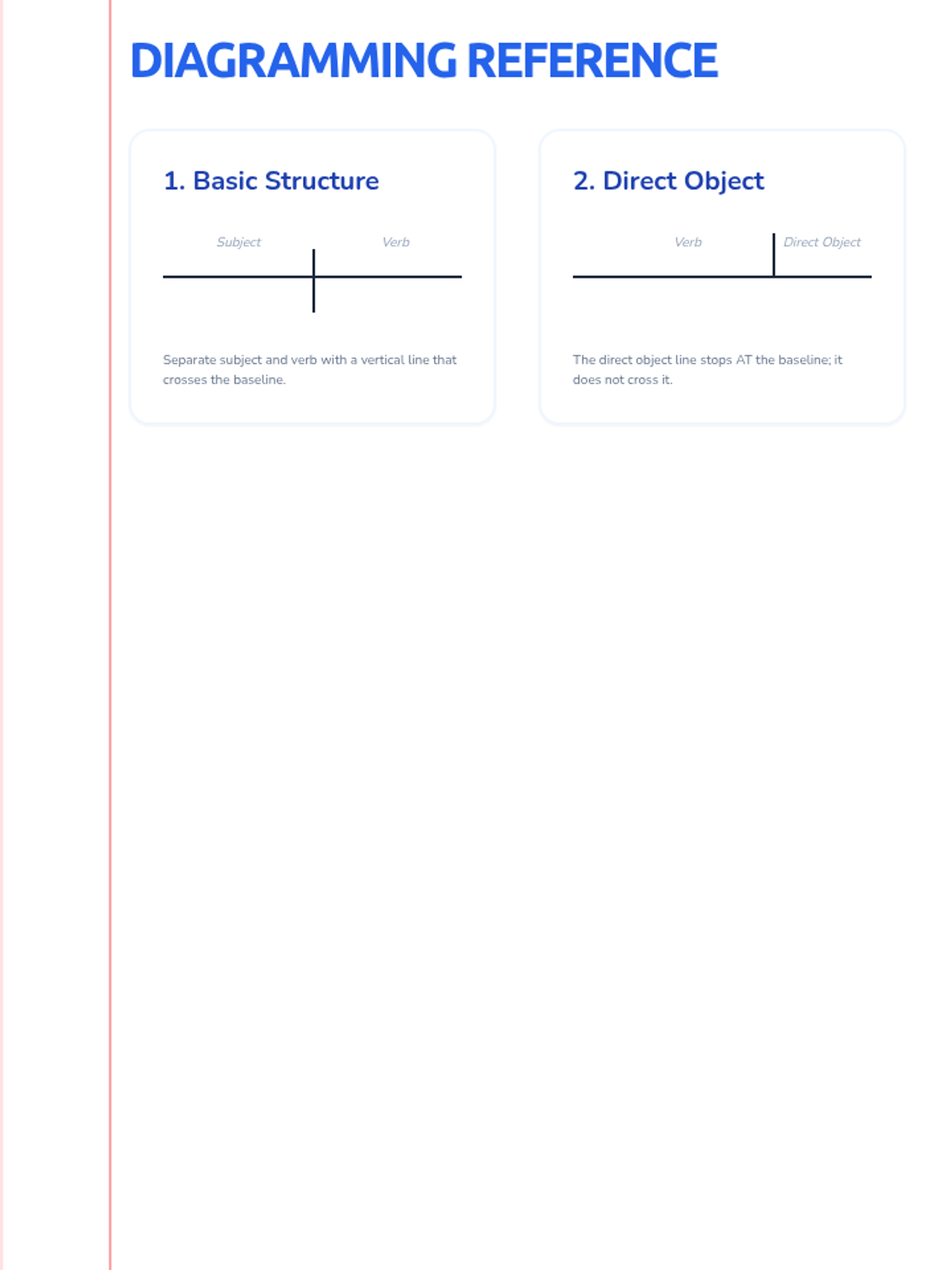
A 19-page second-semester grammar practice workbook, featuring Weeks 19-36 in portrait mode. Each page provides daily instructions and specific hints for complex and compound-complex sentence analysis, plus a diagramming reference guide.
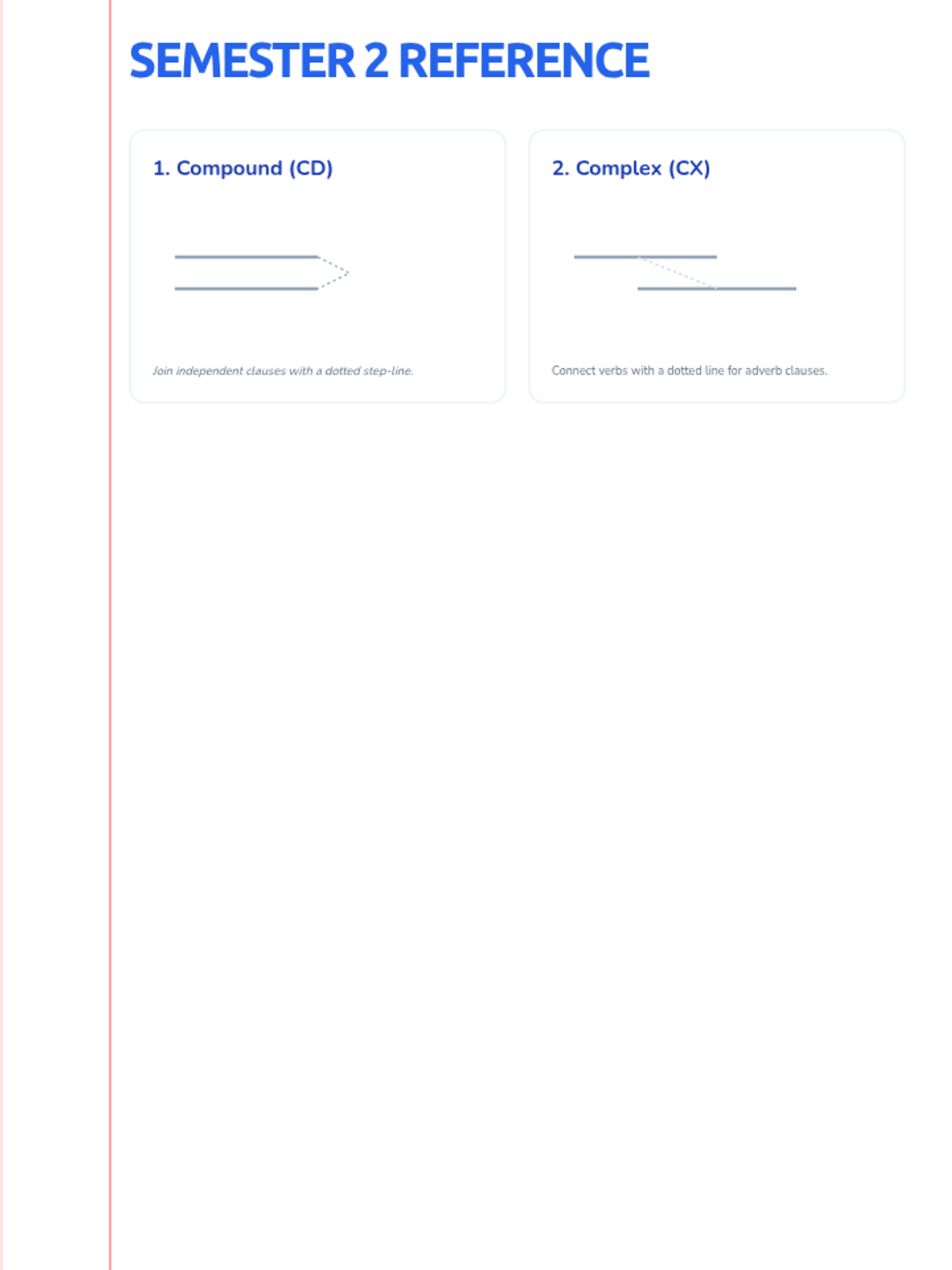
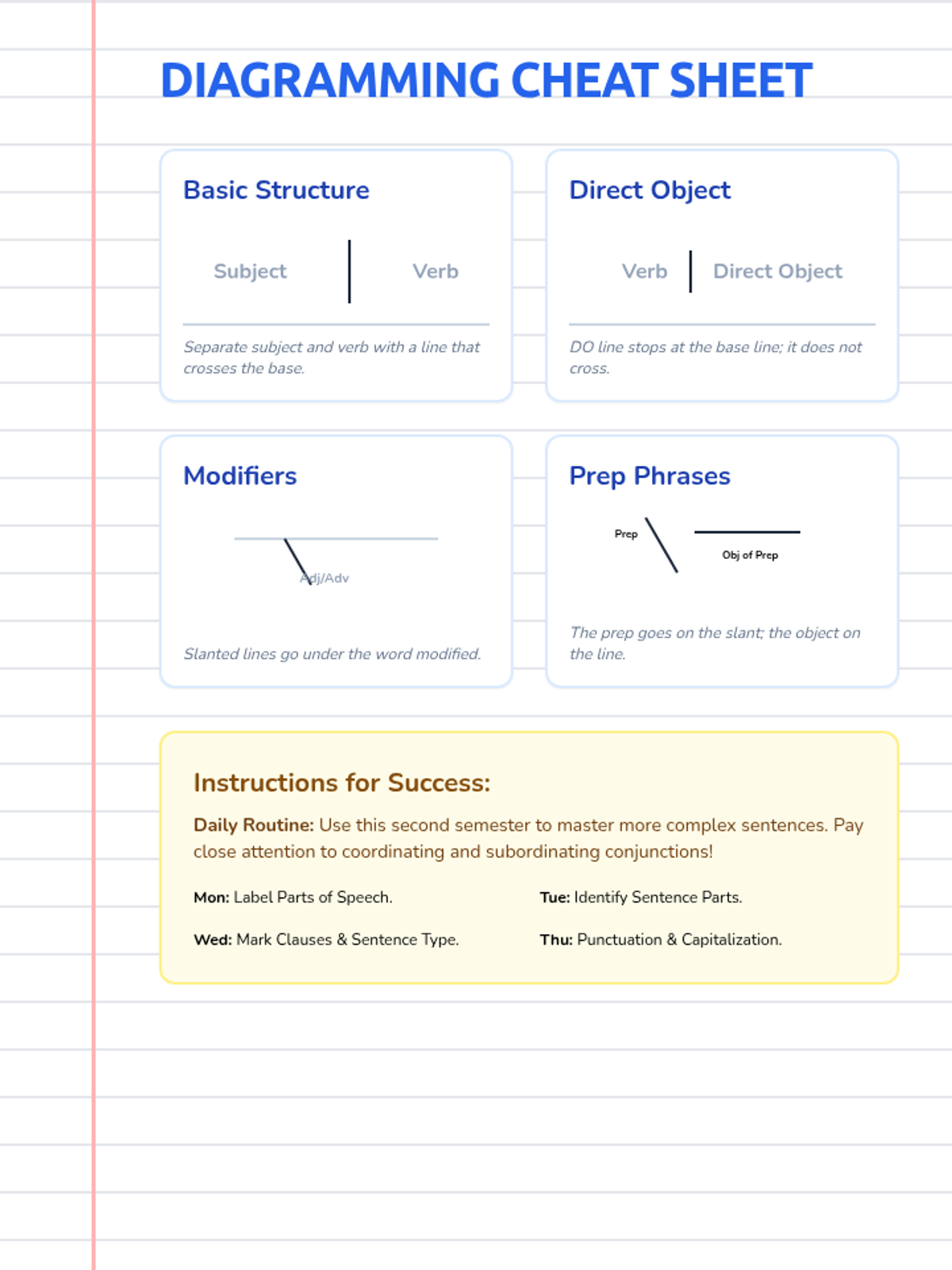
A 19-page comprehensive grammar practice workbook for the first semester, featuring one week per page in portrait mode. Each page includes specific daily instructions and tailored hints for parts of speech, sentence analysis, correction, and diagramming, plus a diagramming cheat sheet.
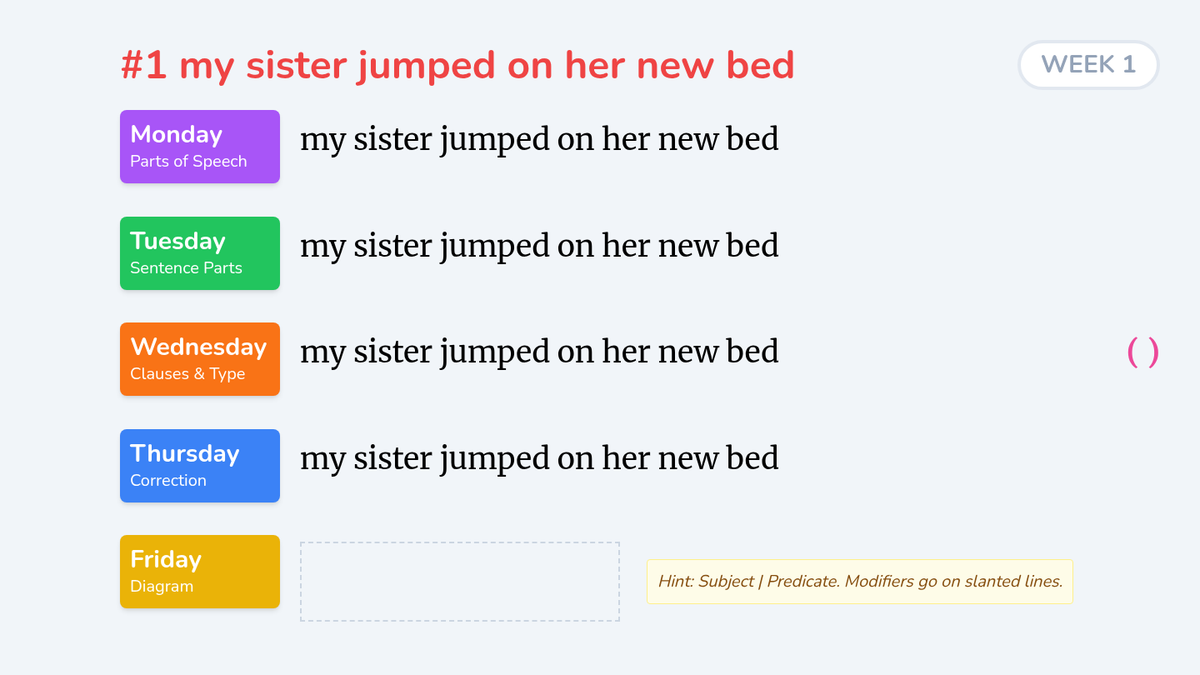
A 18-slide presentation for daily grammar practice, following a consistent weekly routine of part of speech identification, sentence analysis, and diagramming. Each slide features a notebook-style theme with colorful daily task indicators and space for student interaction.
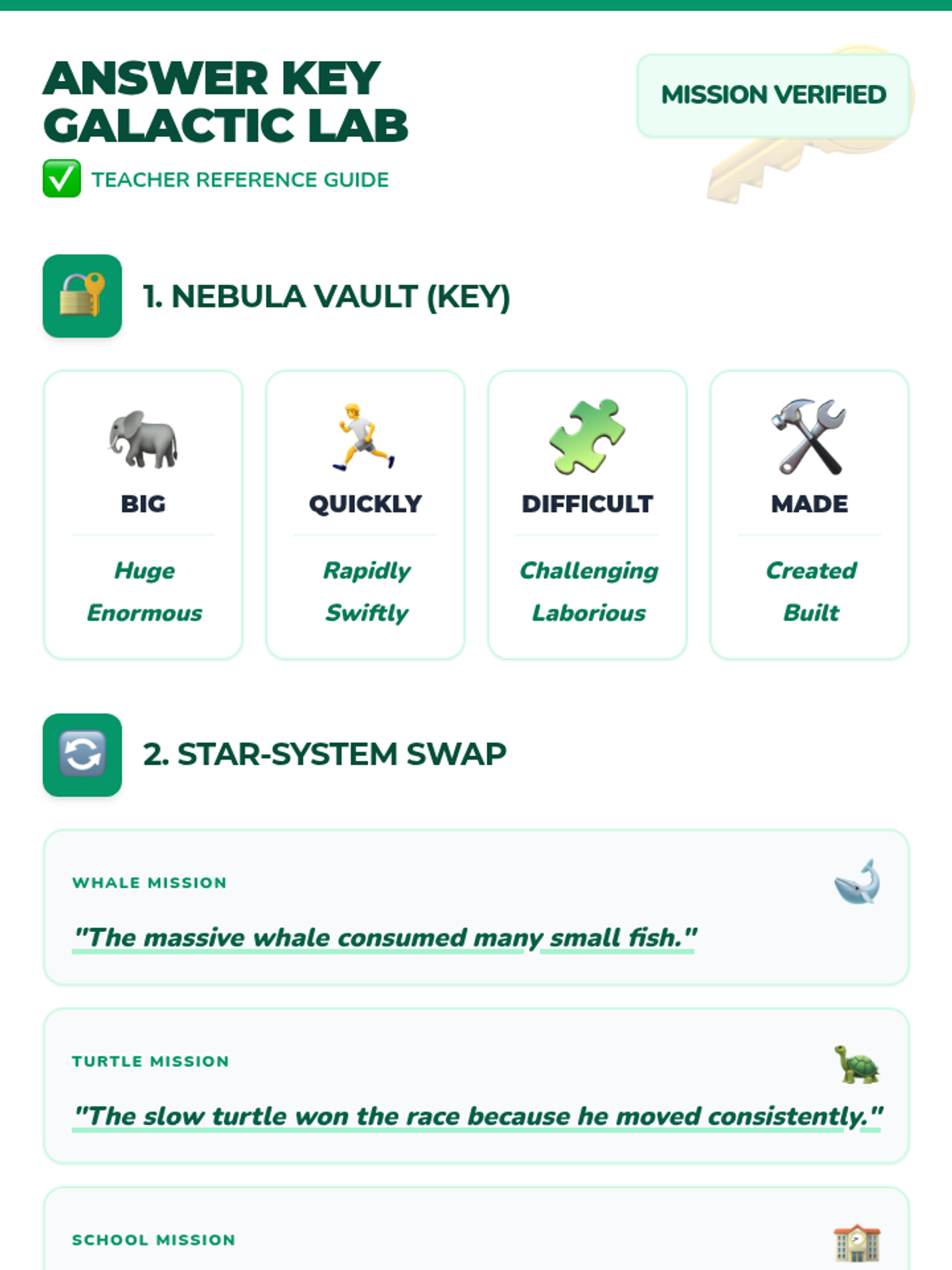
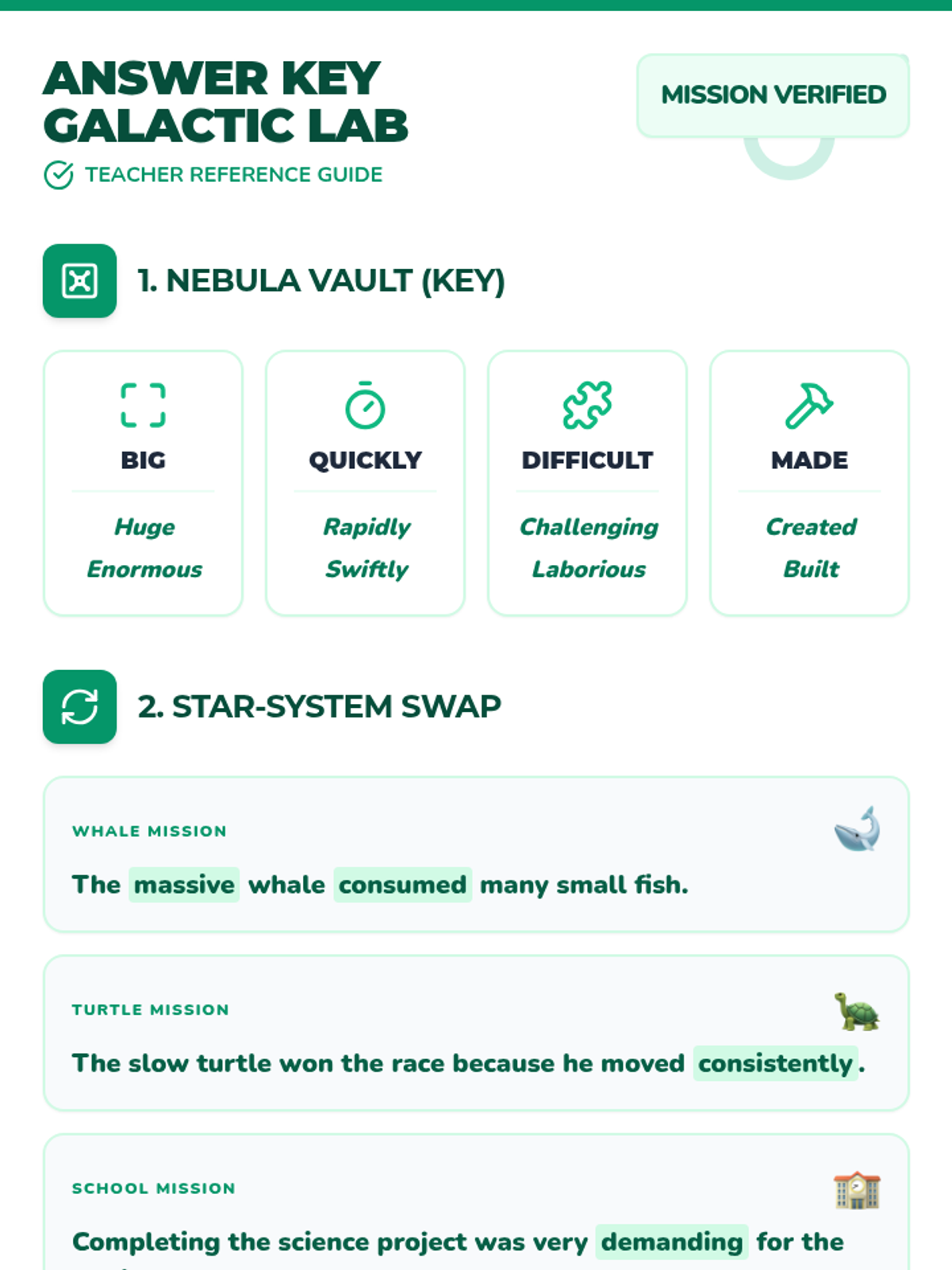
The teacher's answer key for the Galactic Lab, updated with the new mission styling, emoji visuals, and bold solutions presented across a clear two-page layout.
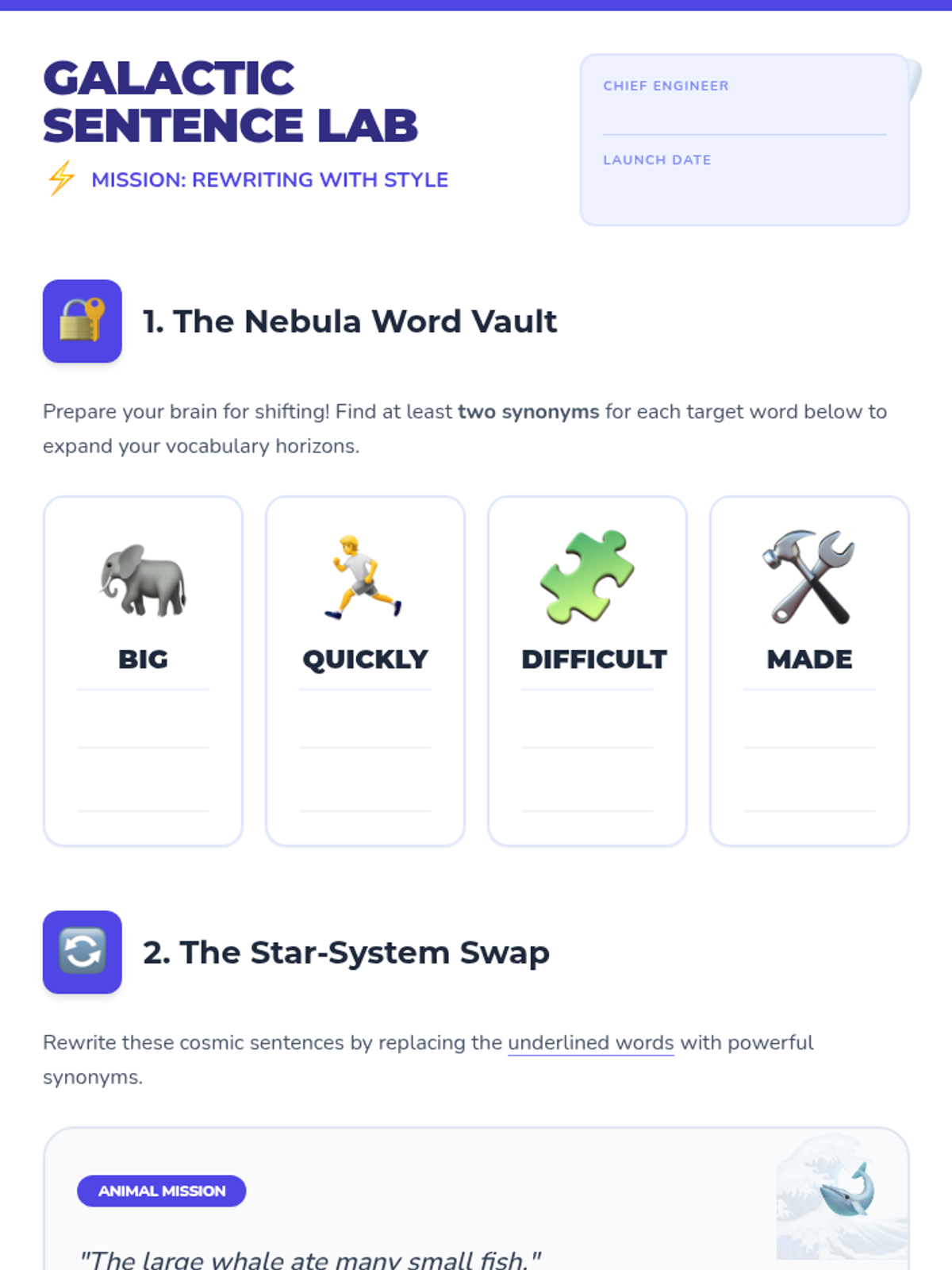
A space-themed student worksheet using emojis for visual engagement and distinct page sections for a clear, organized mission-style learning experience.
The teacher's answer key for the high-visual Galactic Lab, updated with the new mission styling and clear, bold solutions.
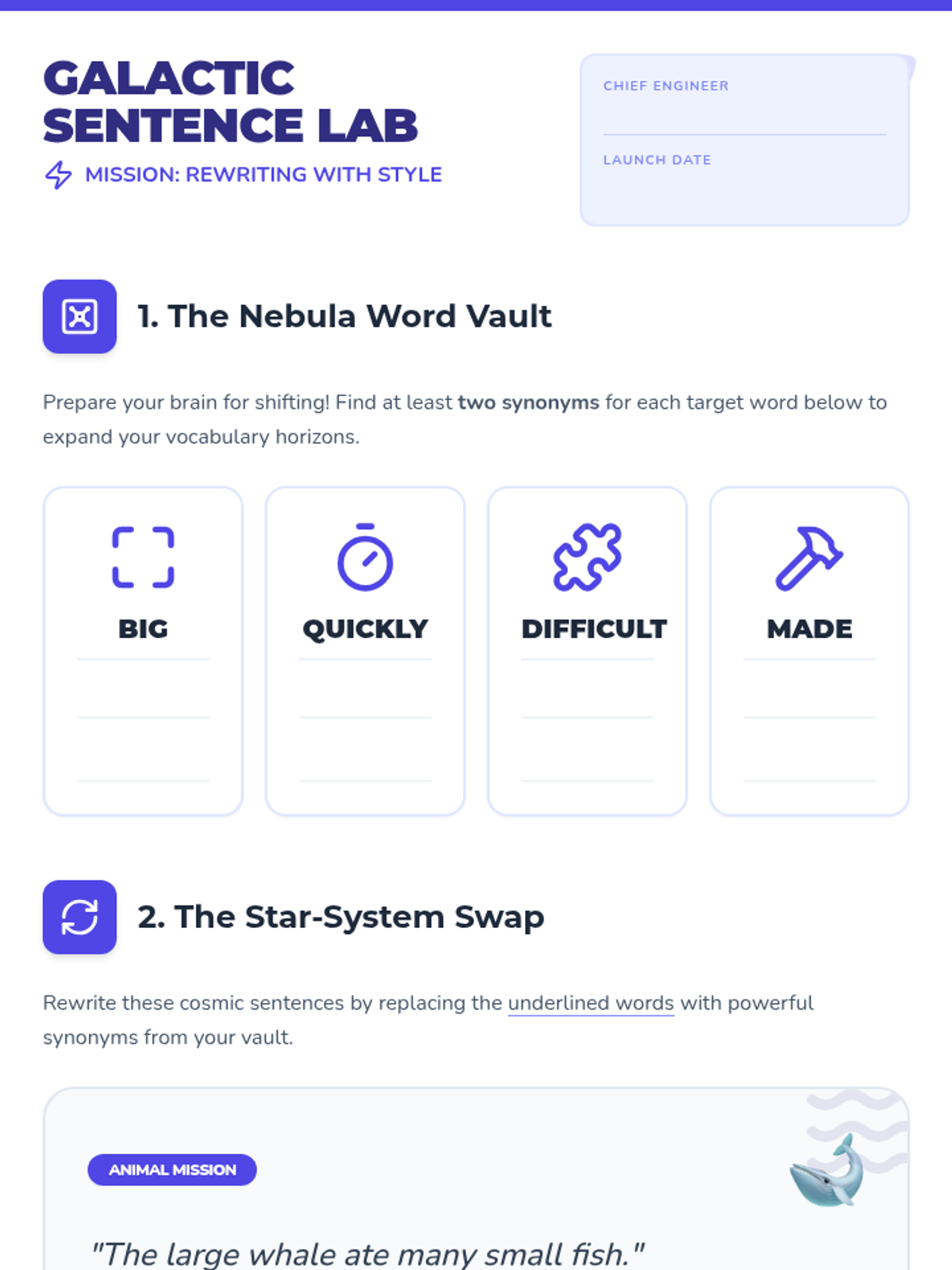
An upgraded, highly visual space-themed worksheet with large, prominent icons and emojis to guide students through vocabulary and grammar missions.
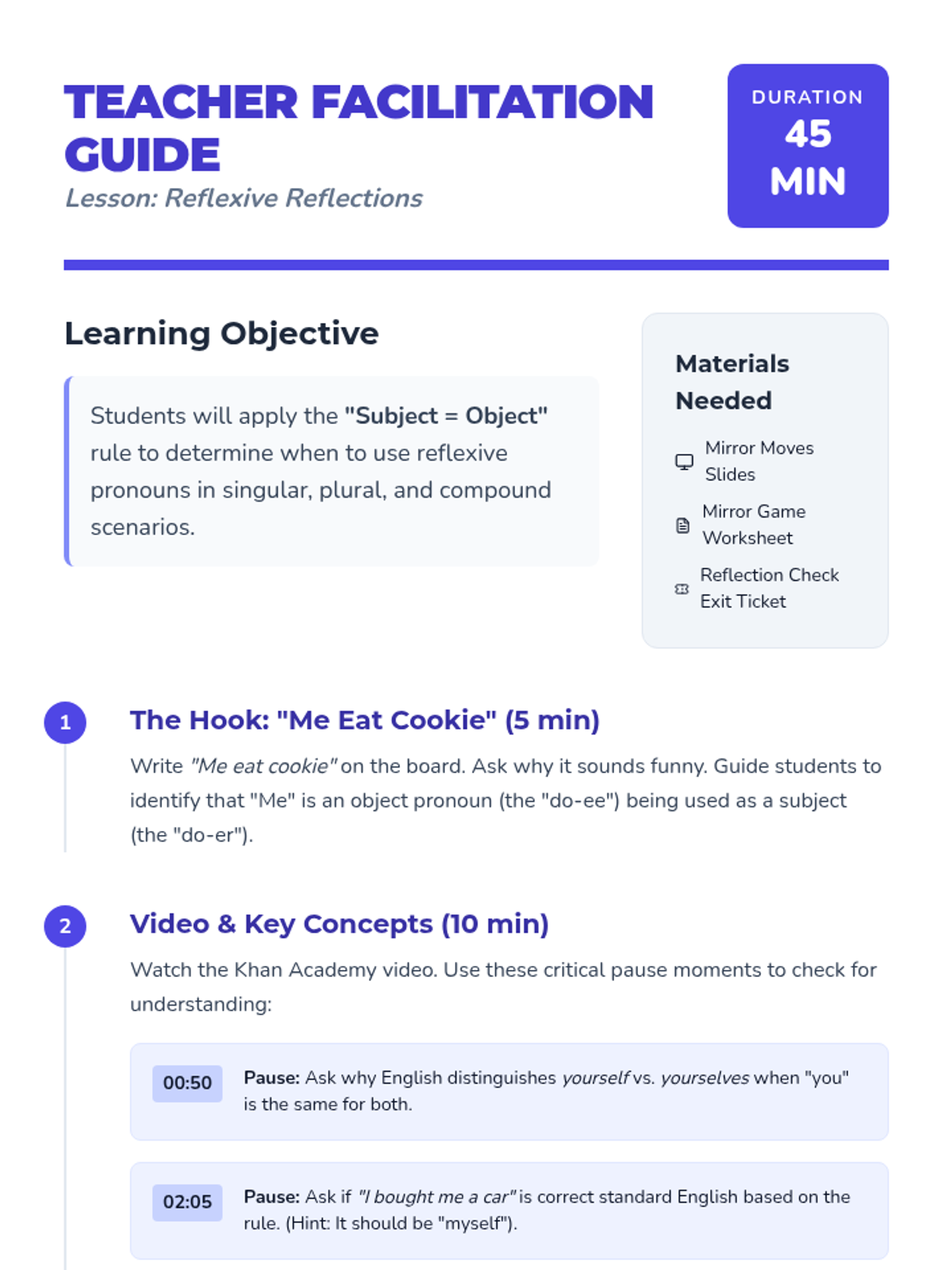
Instructional guide for teachers delivering the reflexive pronoun lesson. Includes video timestamps for discussion, common misconceptions (like hypercorrection), an answer key, and pacing suggestions.
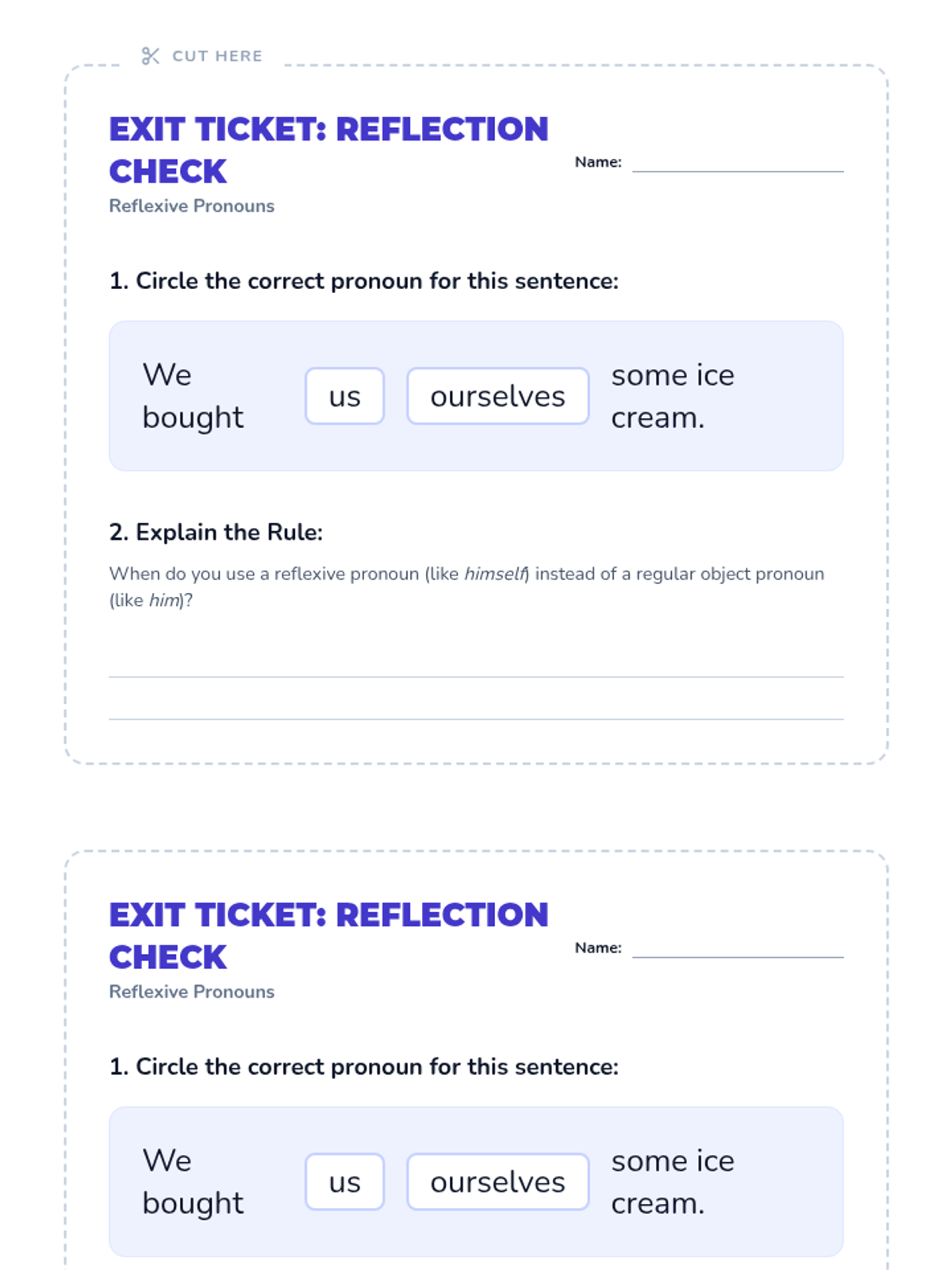
A quick exit ticket for assessing student understanding of reflexive pronouns. Features a choice between 'us' and 'ourselves' and an explanation task. Provided in a two-per-page format for efficient printing.
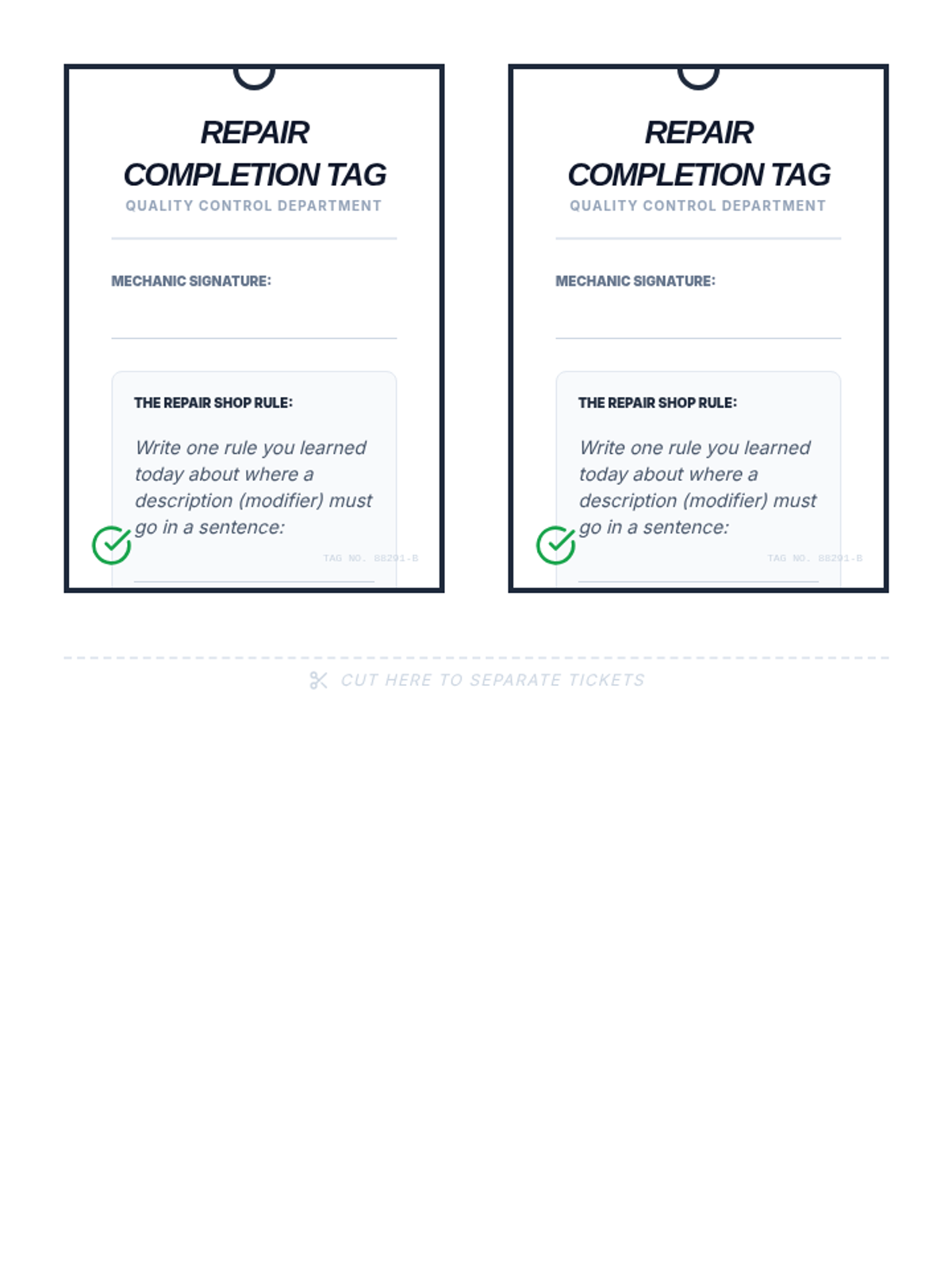
A pair of 'Repair Completion' exit tickets for the Modifier Mechanics lesson. Includes a prompt for students to reflect on the core rule of modifier placement.
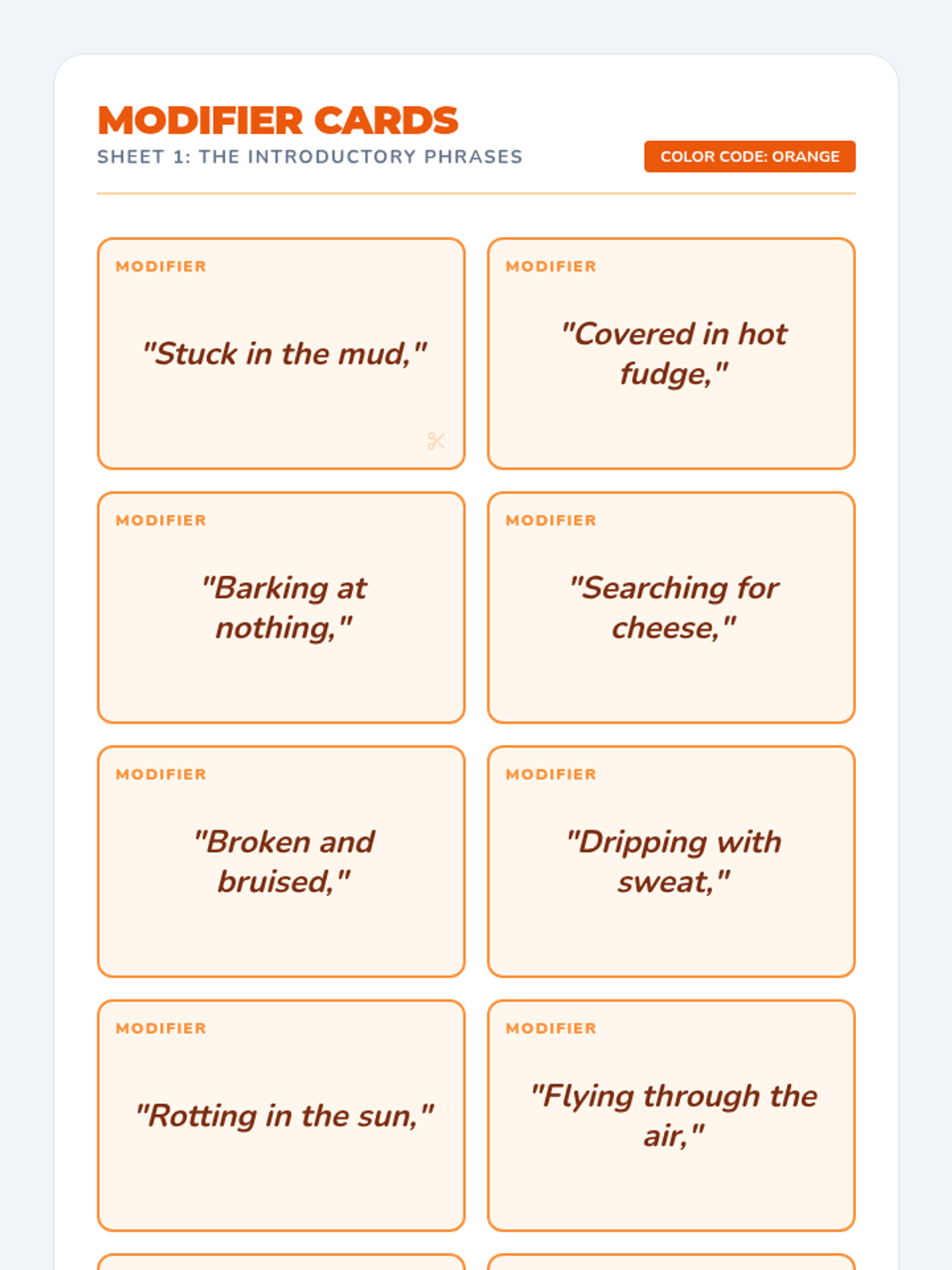
A printable deck of 20 cards (10 modifiers and 10 logical main clauses) for the Modifier Match-Up game. Includes orange and teal color-coding for easy sorting.
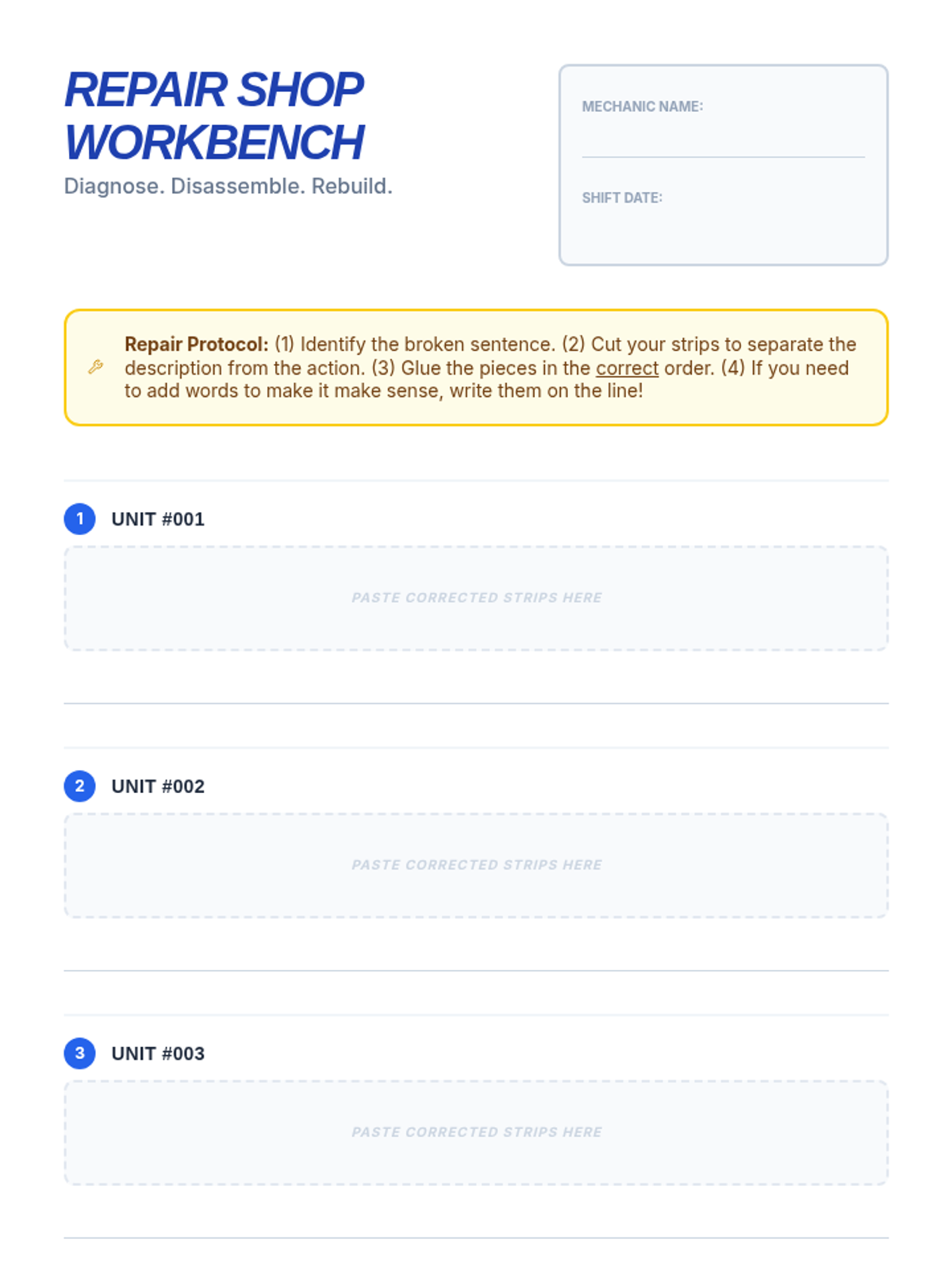
The student worksheet for the 'Modifier Mechanics' activity. Provides designated 'Units' for students to glue their repaired sentence strips and write out any necessary revisions. Balanced across two pages for adequate working space.
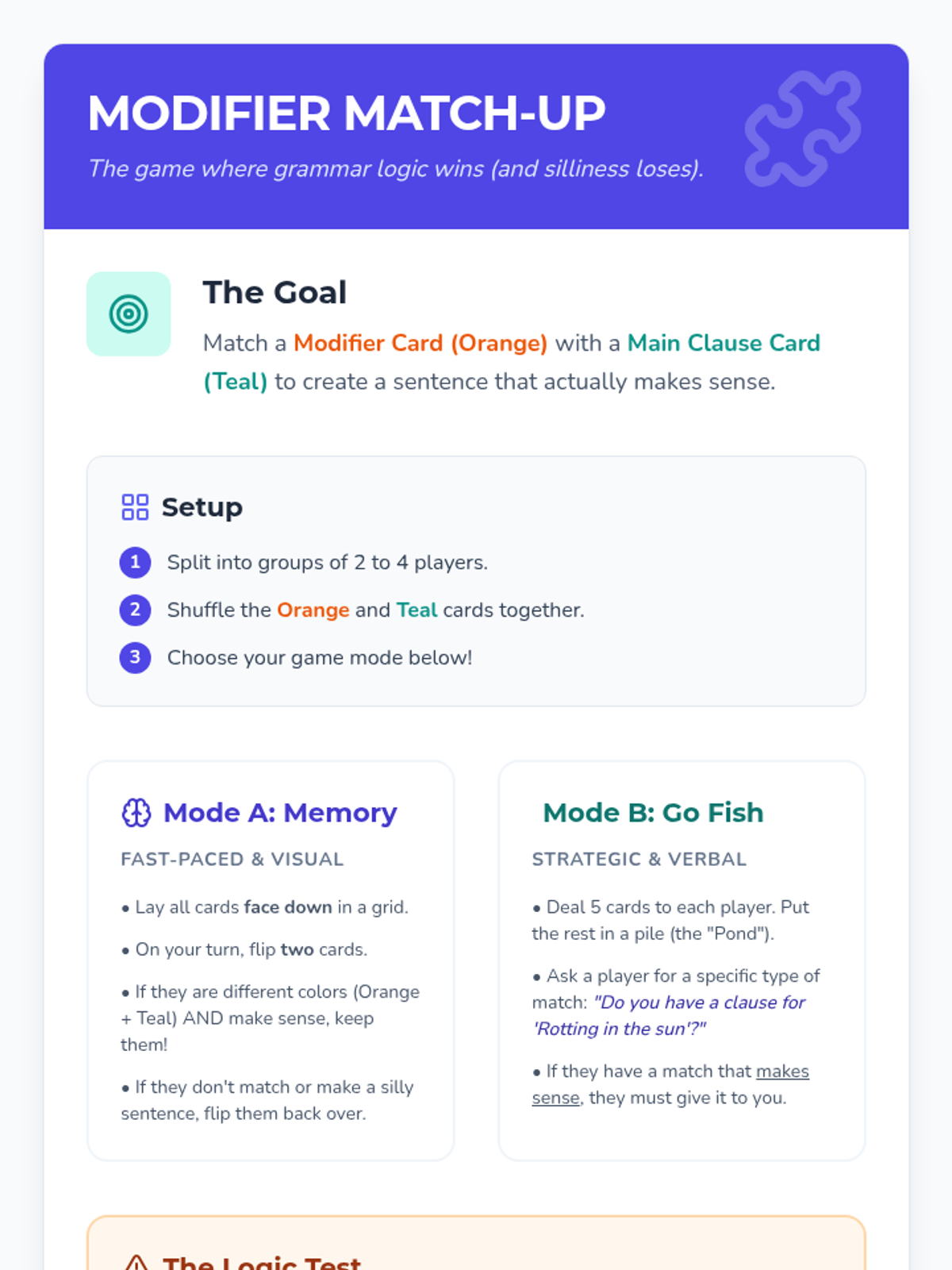
Clear, step-by-step game instructions for the Modifier Match-Up card game, including 'Memory' and 'Go Fish' play modes and the 'Logic Test' rule.
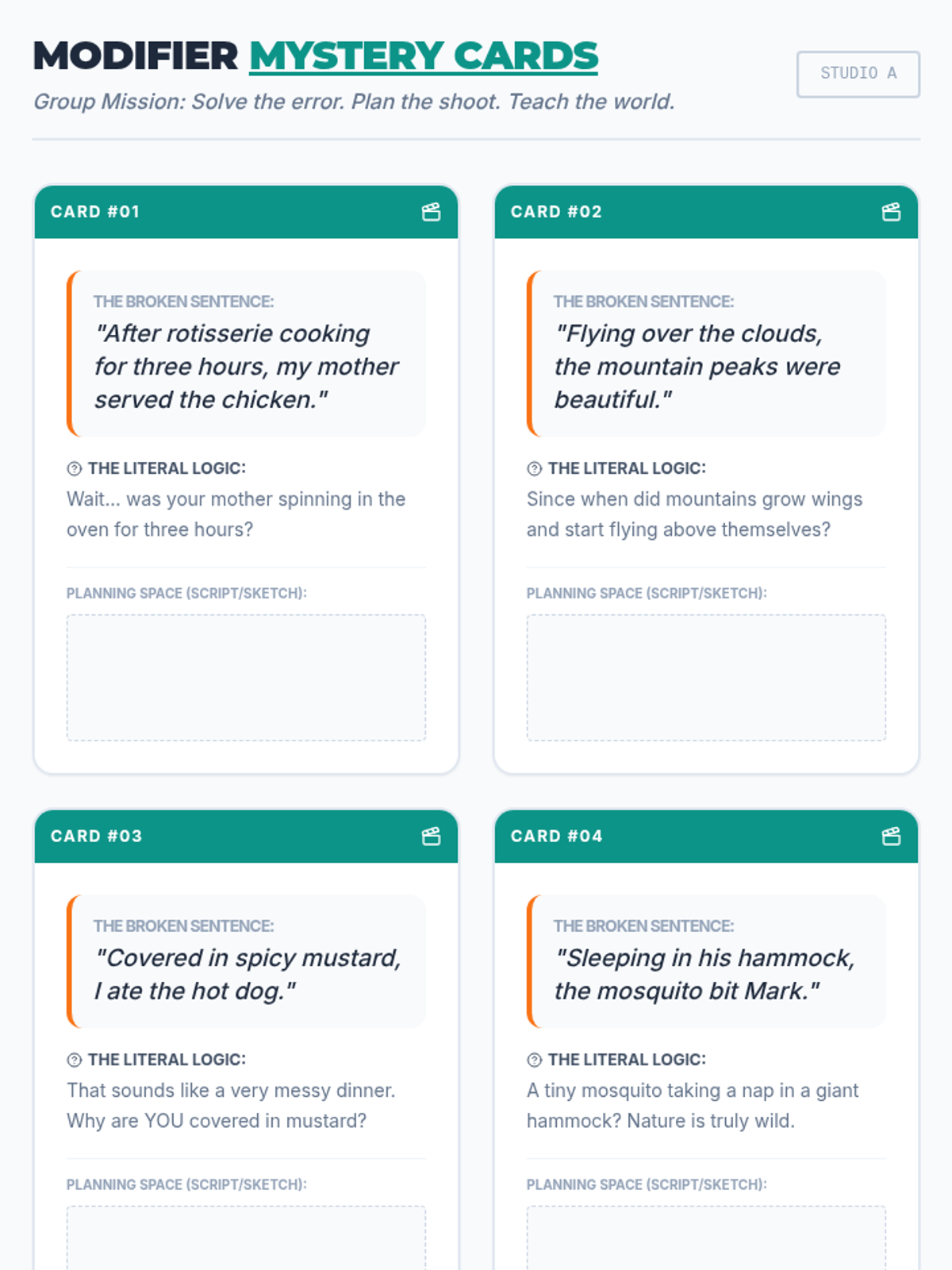
A set of printable activity cards for the group activity, each featuring a humorous dangling modifier sentence, a logic prompt, and space for video planning.
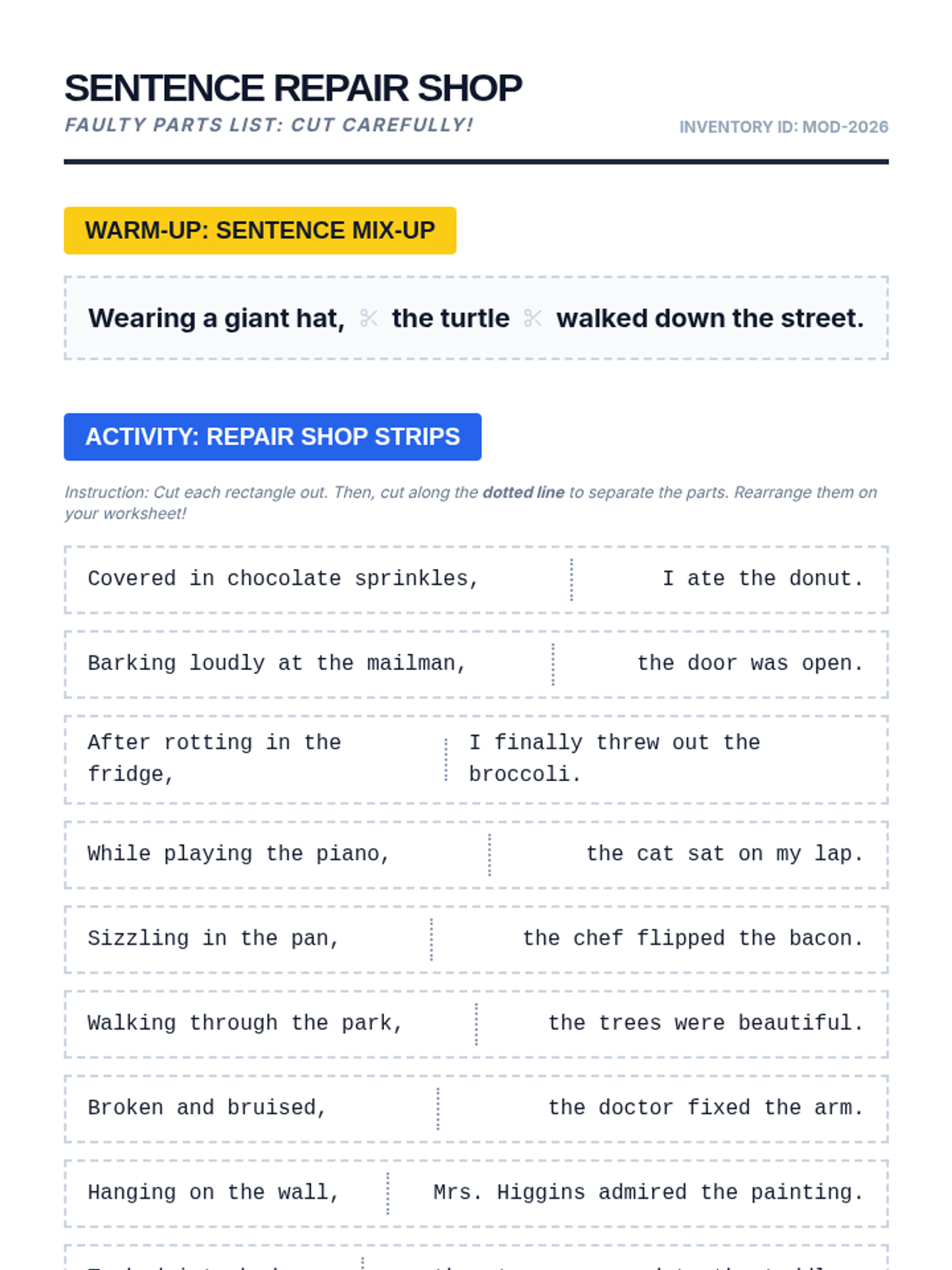
A page of sentence strips for the 'Modifier Mechanics' activity. Includes warm-up strips and 10 broken sentences with dotted lines for easy cutting and manipulation.
Visual presentation for the Modifier Mischief lesson, featuring an embedded Khan Academy video, interactive discussion prompts, and game introduction slides.
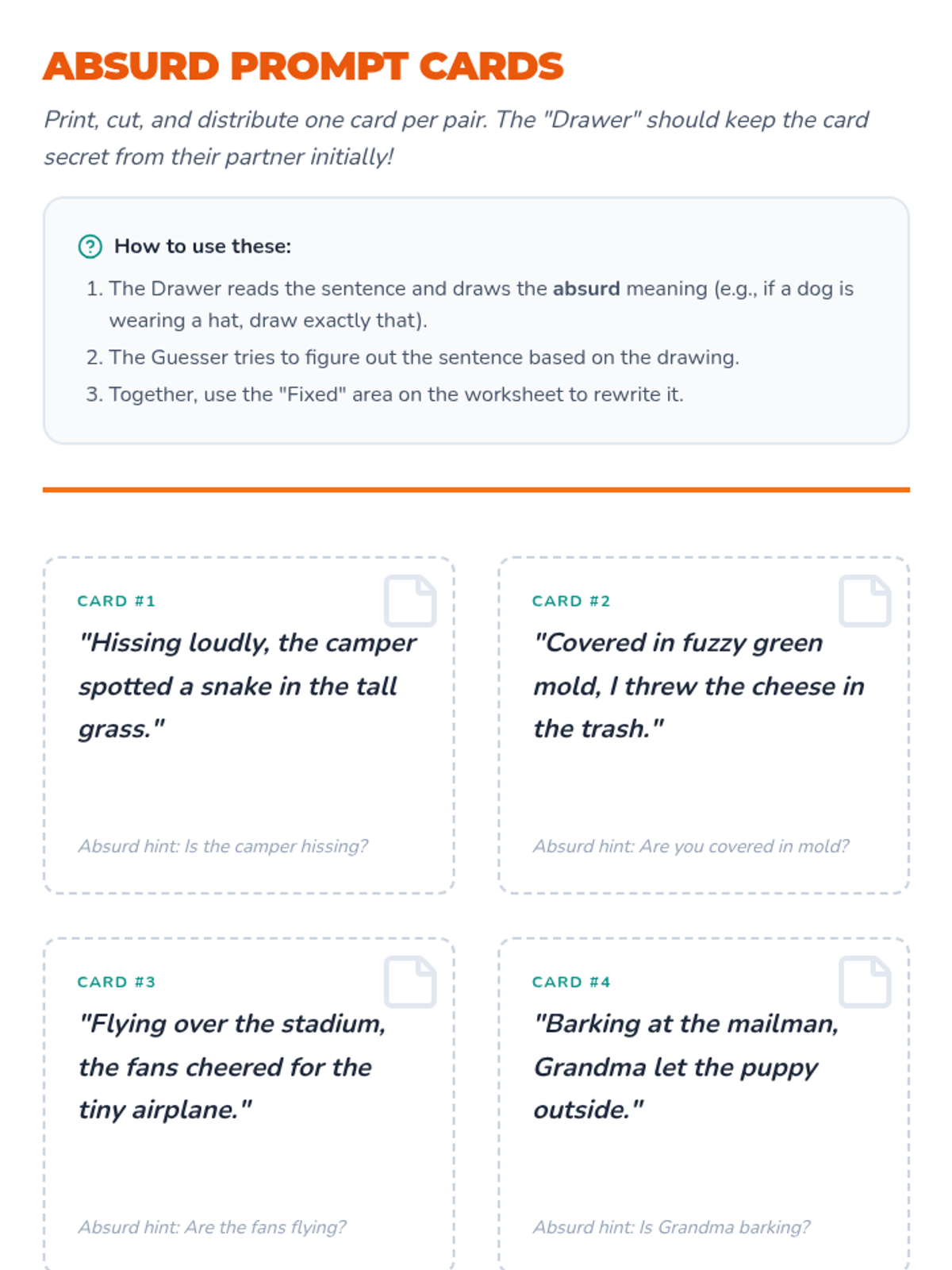
A set of 6 dangling modifier prompt cards for the Grammar Pictionary activity, featuring 'absurd' sentences and a teacher answer key for corrections.
Visual presentation for the 'Modifier Mechanics' lesson, featuring video integration, interactive discussion slides, and clear grammatical definitions.
A high-contrast visual presentation for the 'Syntax Spotlight' lesson, featuring video embeds, grammar definitions, and interactive step-by-step instructions for the group activity.
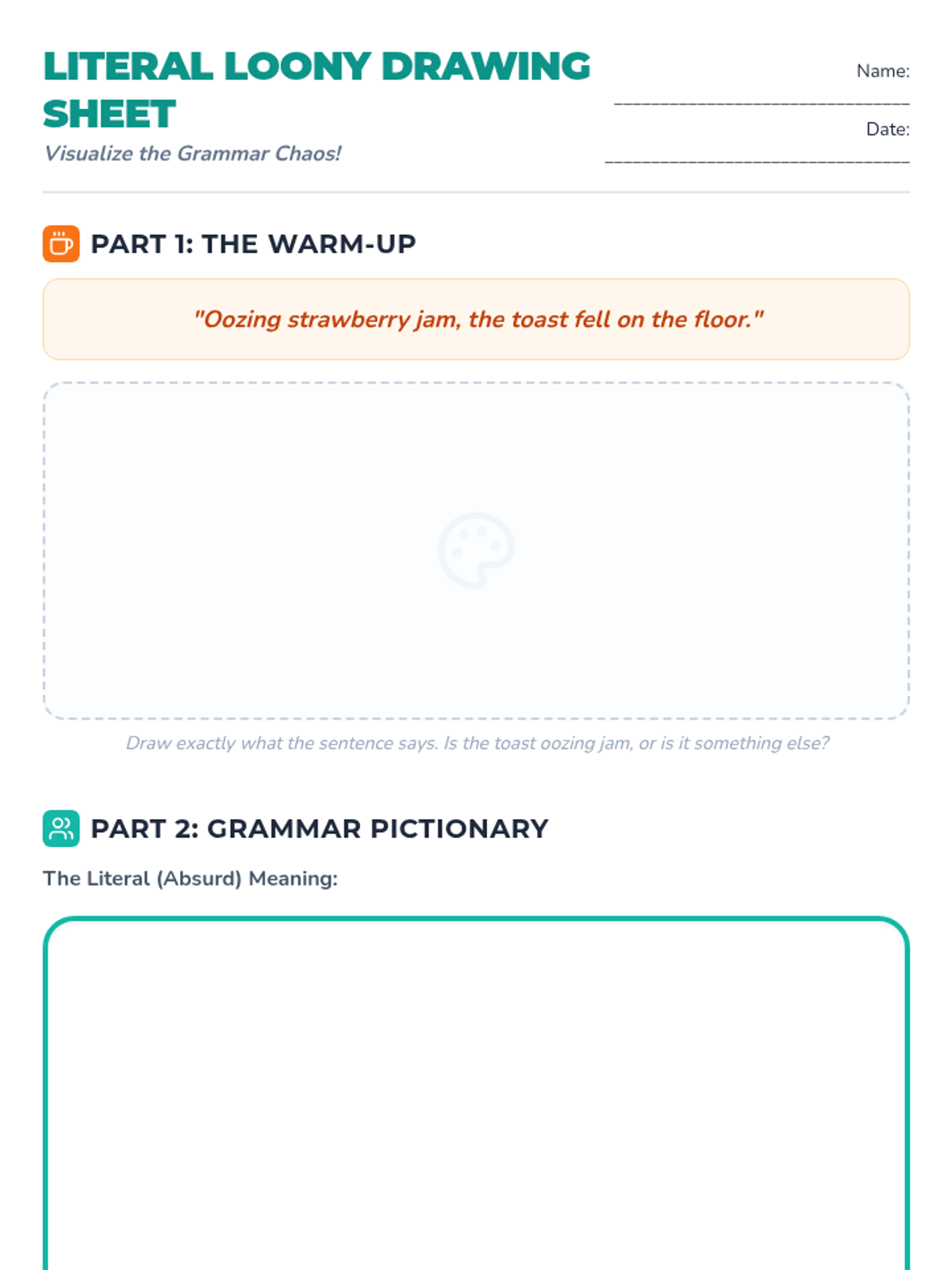
A student worksheet with dedicated spaces for drawing literal interpretations of dangling modifiers and a 'Rescue Mission' section for rewriting sentences correctly.
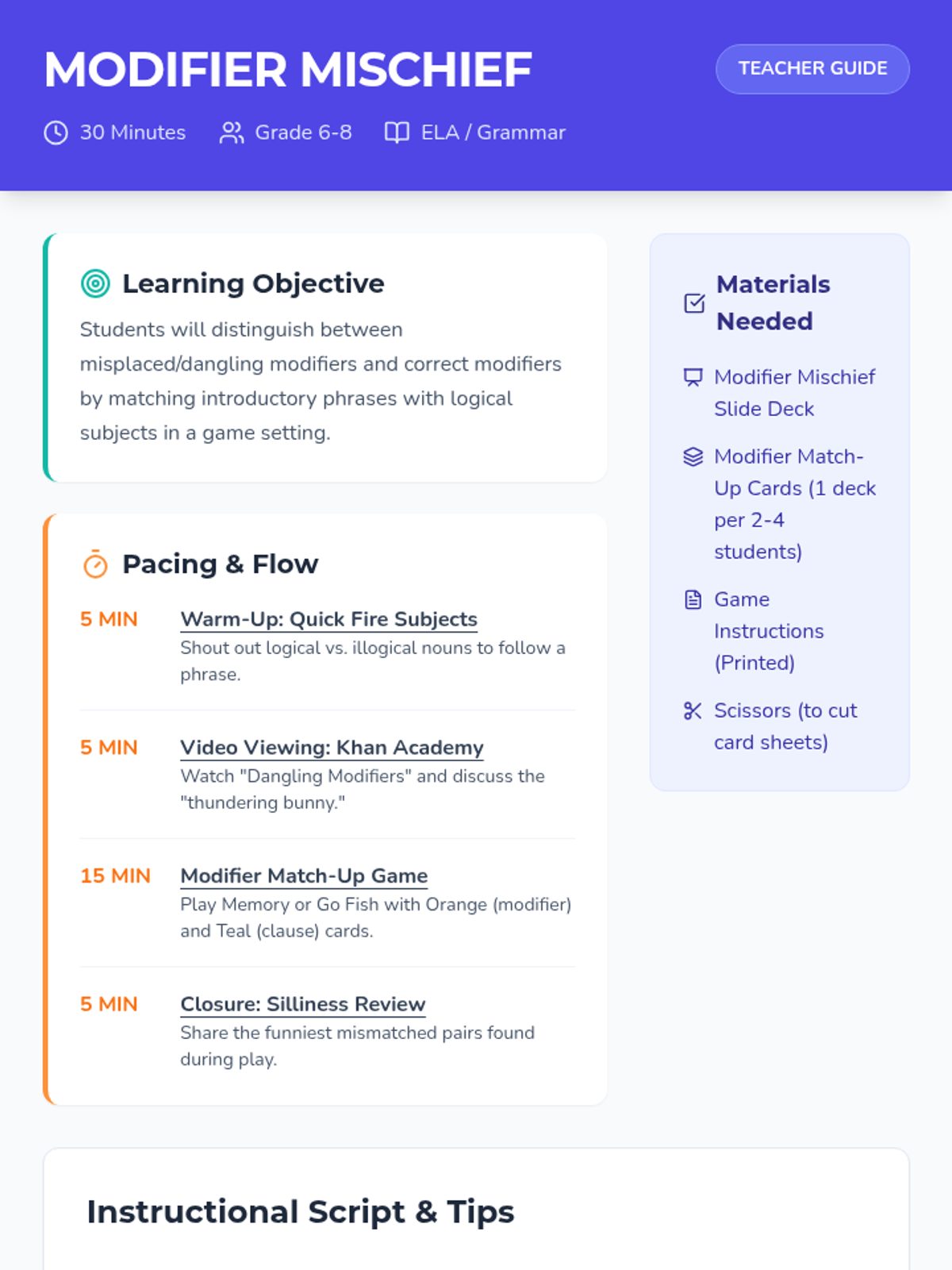
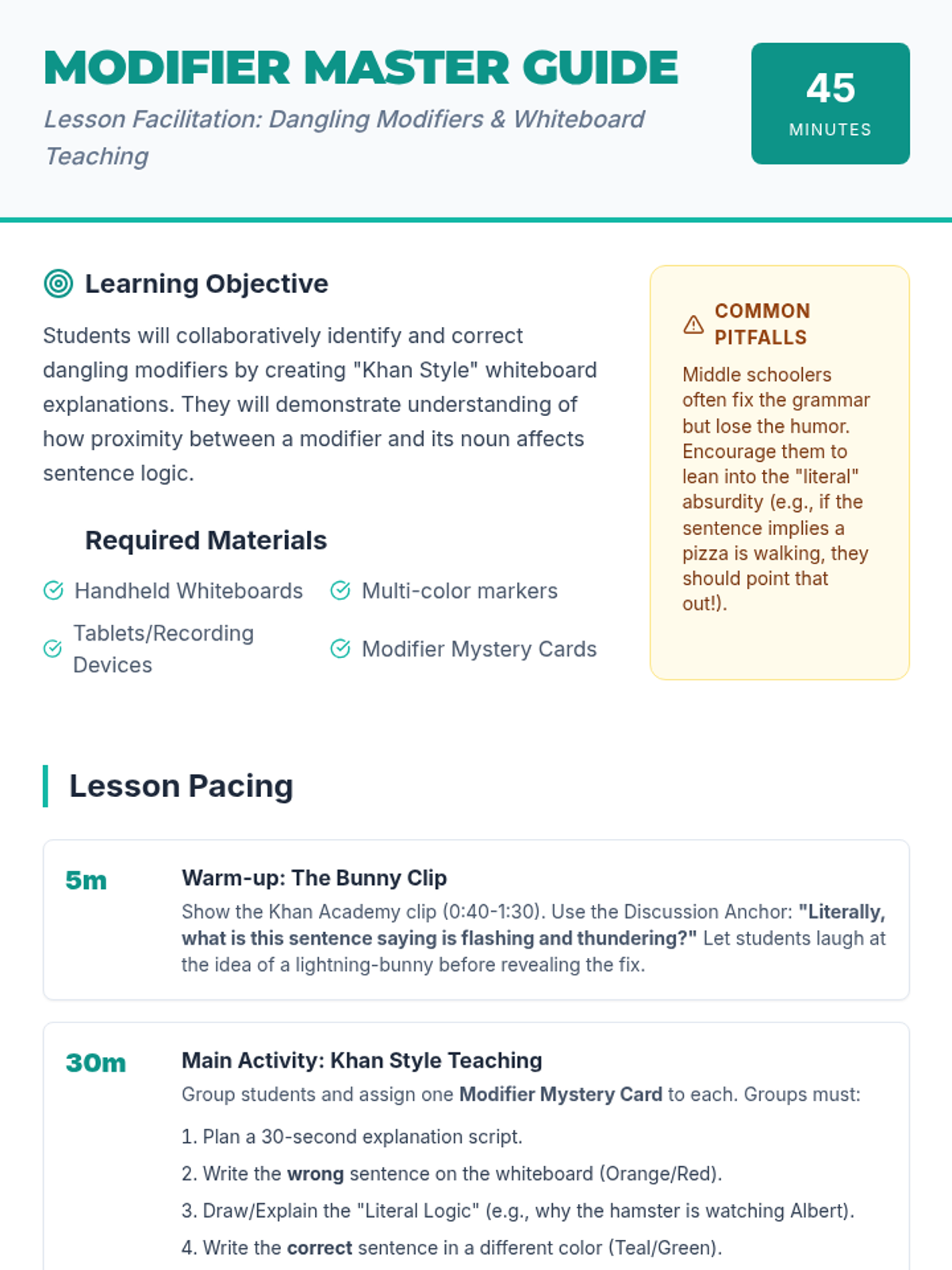
A comprehensive teacher's guide for the Modifier Mischief lesson, featuring pacing instructions, warm-up prompts, a video discussion guide, and a logical answer key for the card game.
A 5-slide visual presentation for the Dangling Disasters lesson, including warm-up prompts, the embedded Khan Academy video, activity instructions, and a closure slide.
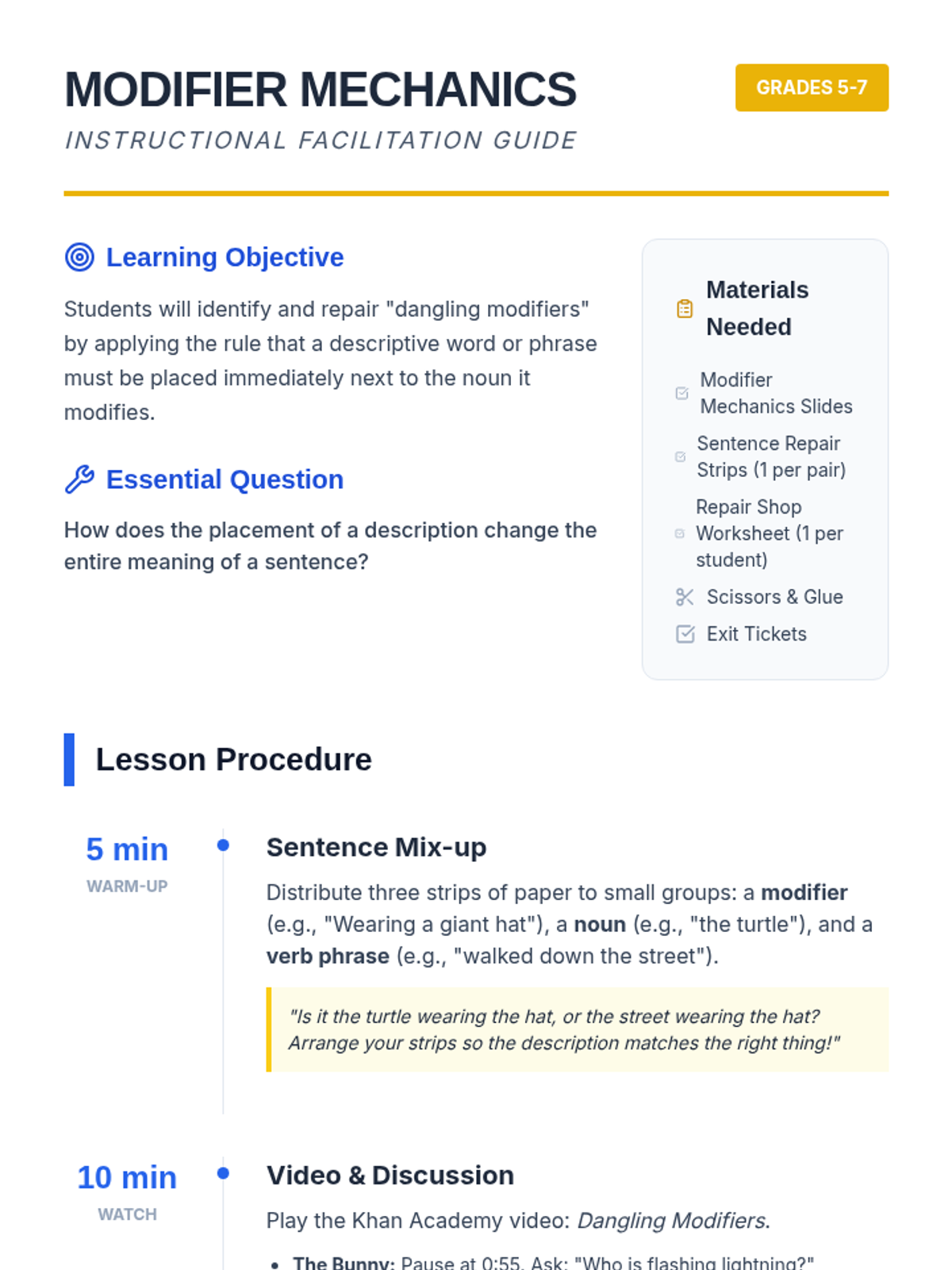
A comprehensive teacher guide for a Grade 5-7 grammar lesson on dangling modifiers, featuring a 'Modifier Mechanics' repair shop theme with detailed procedures and an answer key.
A comprehensive teacher facilitation guide for the 'Syntax Spotlight' lesson, featuring learning objectives, a detailed pacing guide, and an answer key for the student activities.
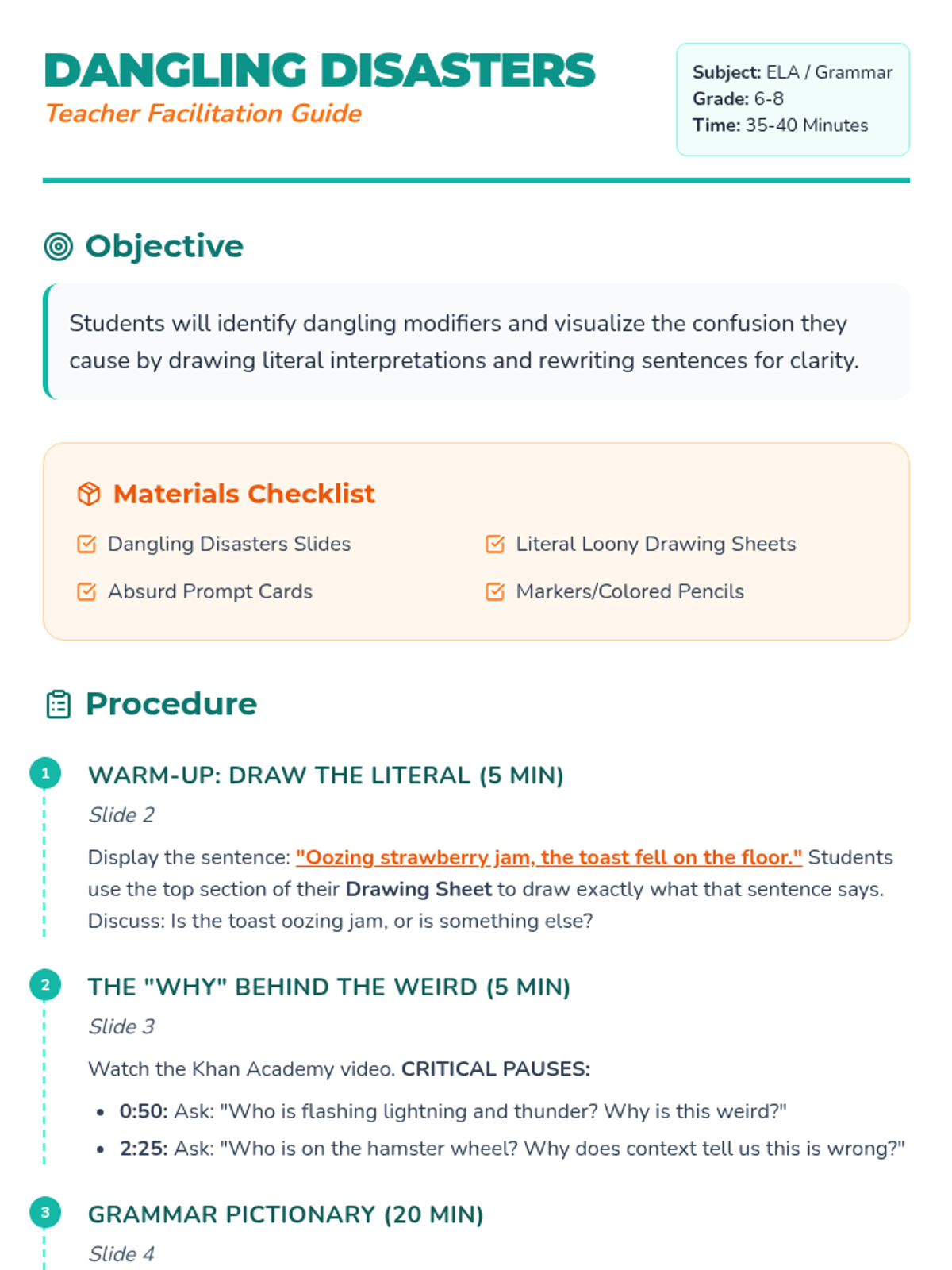
A comprehensive teacher facilitation guide for the Dangling Disasters lesson, featuring a step-by-step procedure, materials list, and discussion anchors for the video.
Themed lined paper with an architectural blueprint aesthetic, featuring a subtle grid background and space for students to take notes or draft expanded sentences.
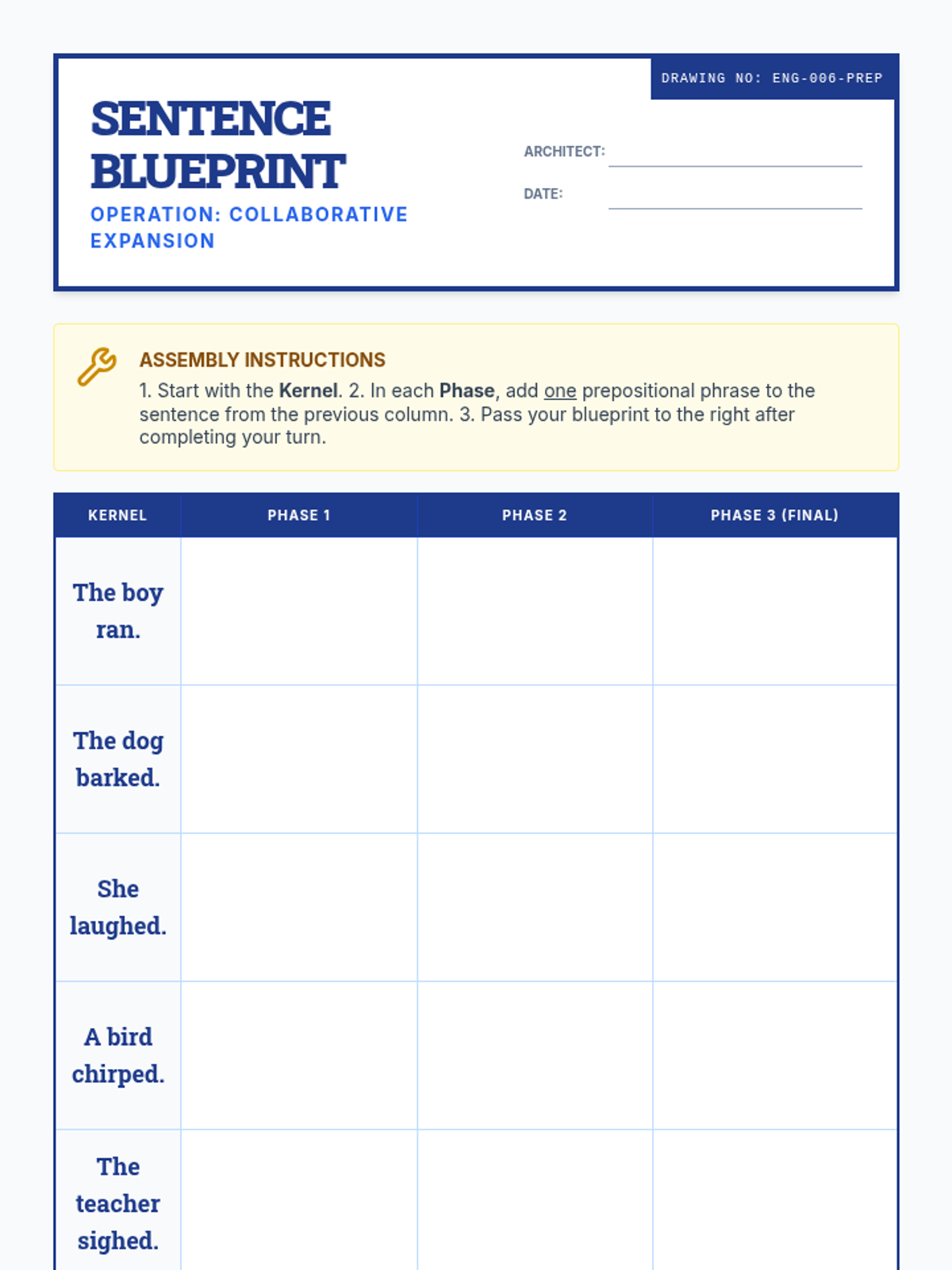
A structured activity sheet for the 'Expanding Sentences' activity, featuring 5 kernel sentences in a grid layout for students to collaboratively add prepositional phrases in phases.
A visual presentation for teaching prepositional phrases, featuring the 'The Cat Sat' hook, the Khan Academy video embed, clear definitions of adjective/adverb functions, and instructions for the Sentence Architects activity.
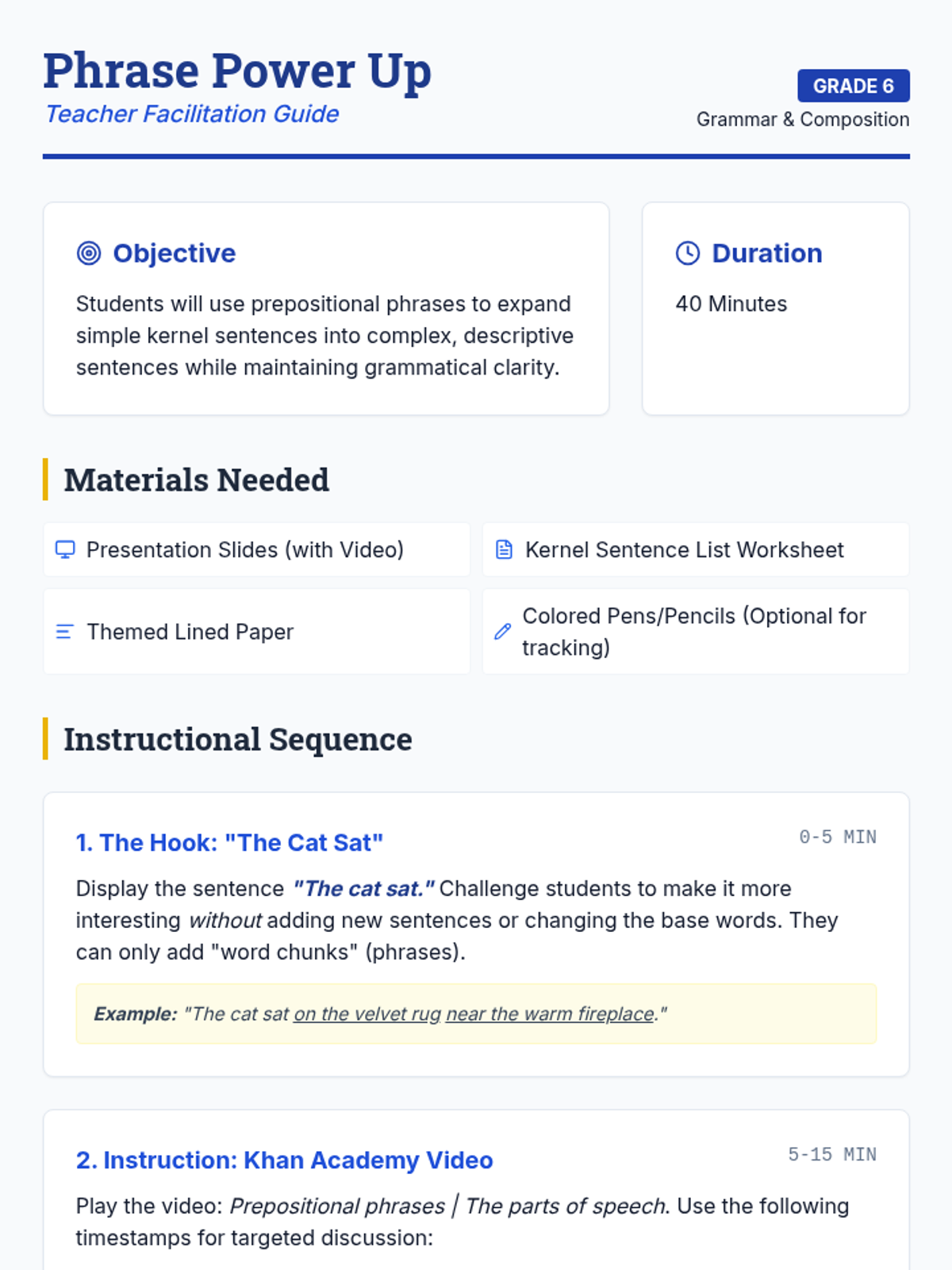
A comprehensive teacher guide for a 6th-grade lesson on prepositional phrases, featuring a detailed pacing guide, video discussion prompts, and instructional strategies for the 'Sentence Architects' lesson.
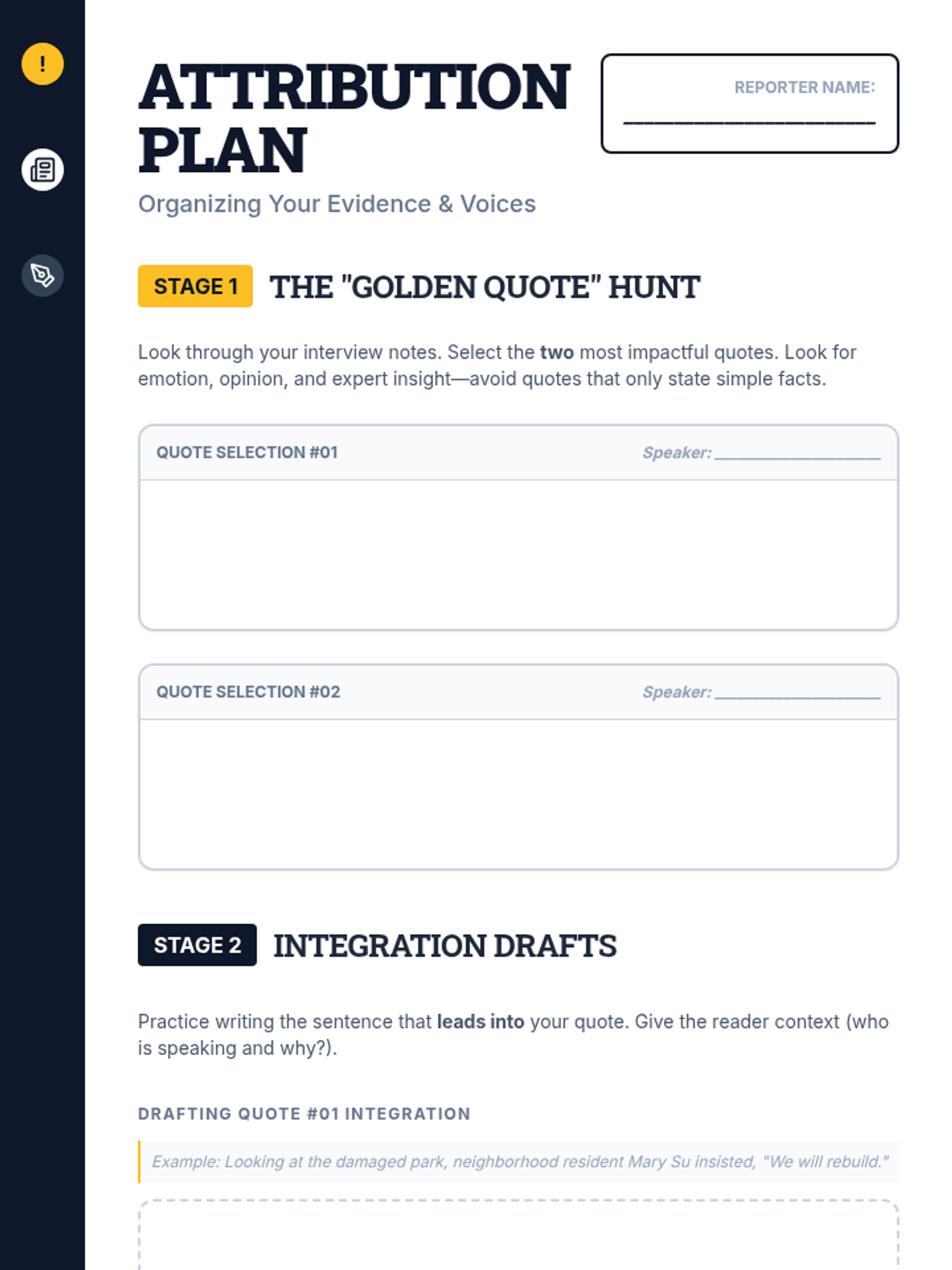
An organizational tool for students to select impactful quotes from their interview notes and practice integrating them into their news article drafts with proper context and attribution. Updated with consistent quote numbering and improved page breaks.
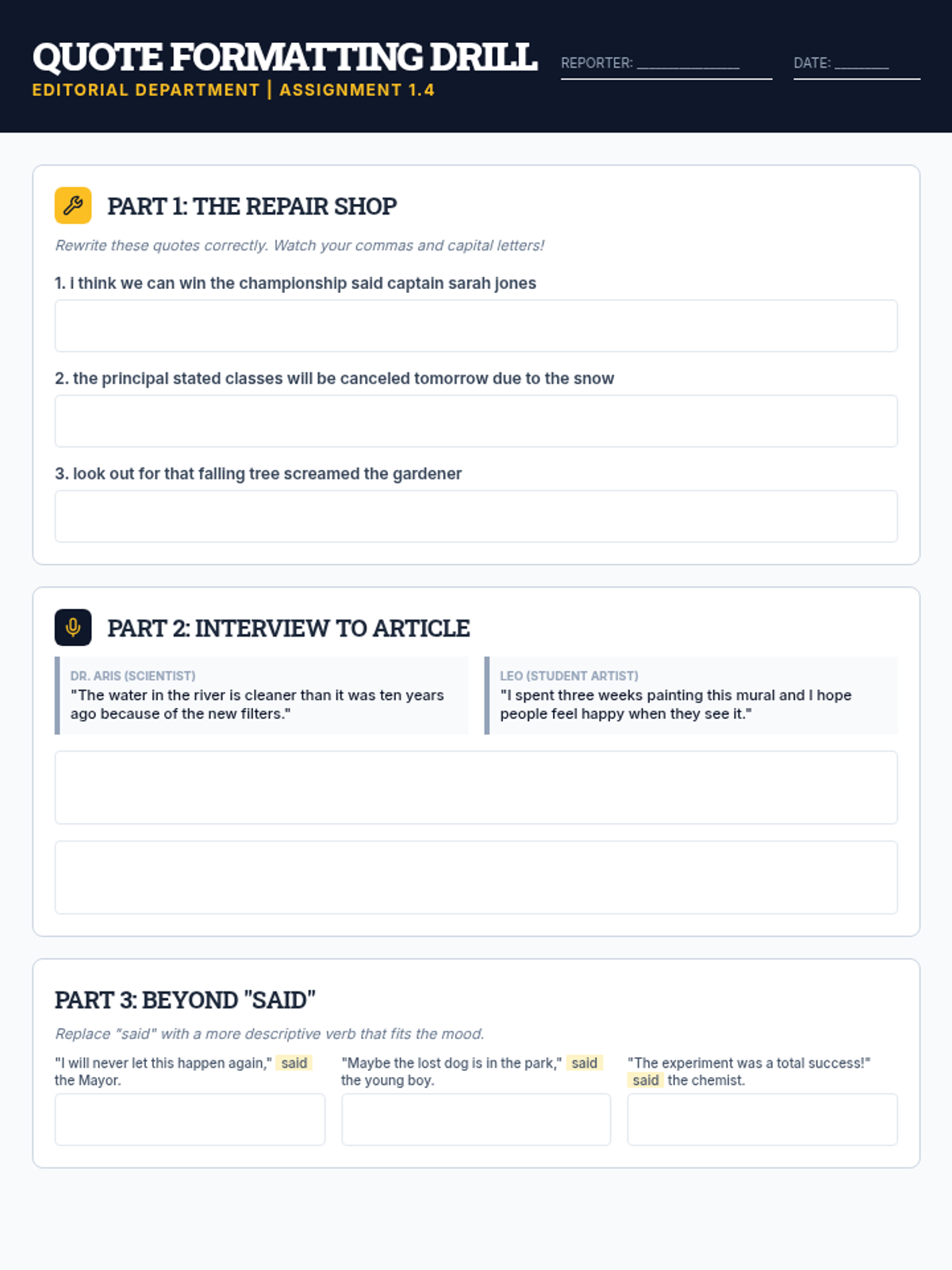
A practice worksheet where students correct common quote formatting errors, transform interview notes into news-ready quotes, and experiment with descriptive attribution verbs. Updated with larger writing spaces, better contrast, and improved page layout.
A professional slide deck for teaching 6th graders the rules of quote formatting, the importance of attribution, and journalistic ethics. Updated with larger text on technical slides and improved contrast on the title slide.
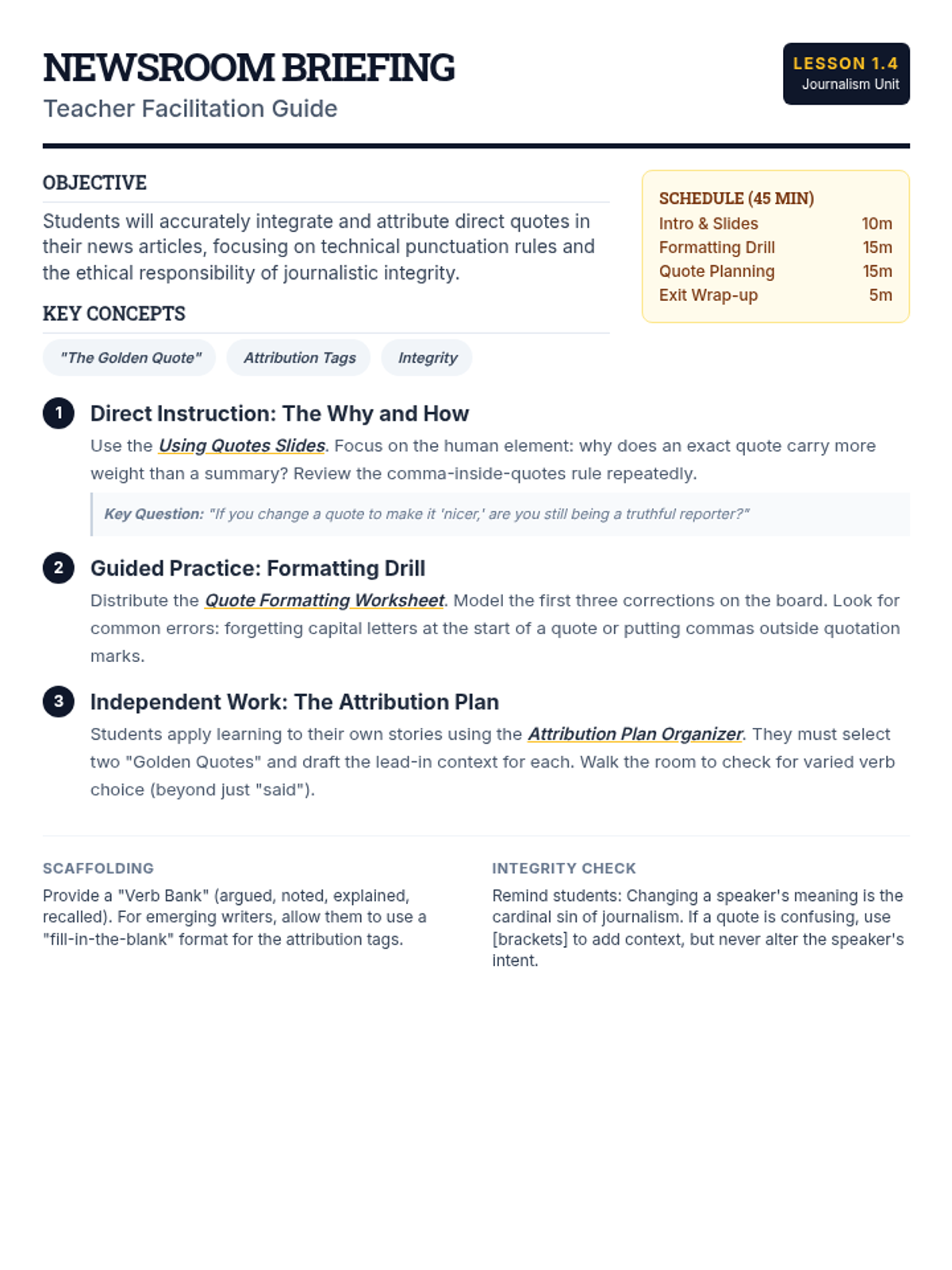
A teacher facilitation guide for the 45-minute lesson on journalistic attribution, including timing, instructional steps, and differentiation tips. Updated with improved layout to ensure all content fits on one page and better text contrast in the footer.
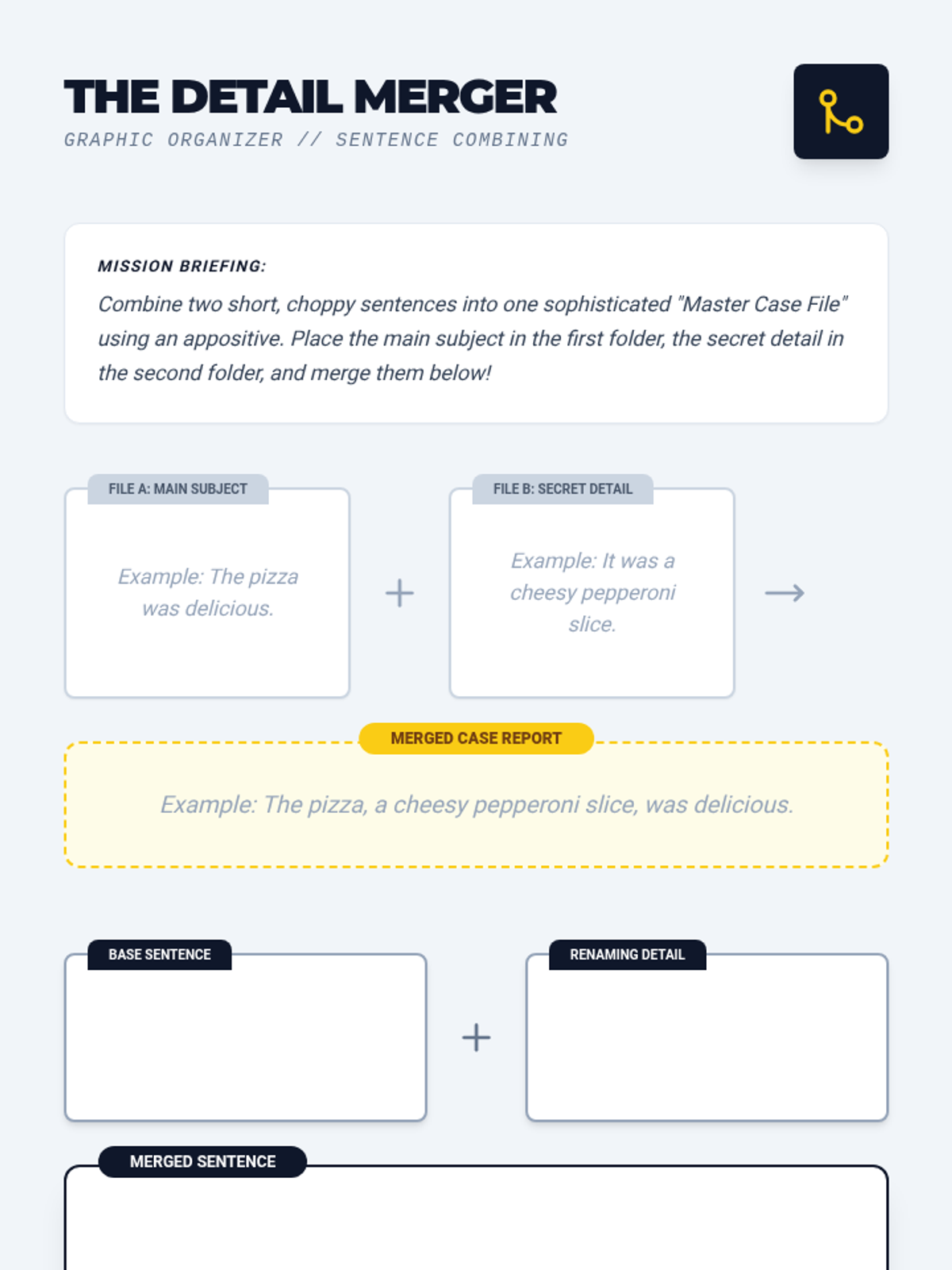
A graphic organizer for combining two short sentences into one sentence with an appositive, designed with a 'file merger' theme.
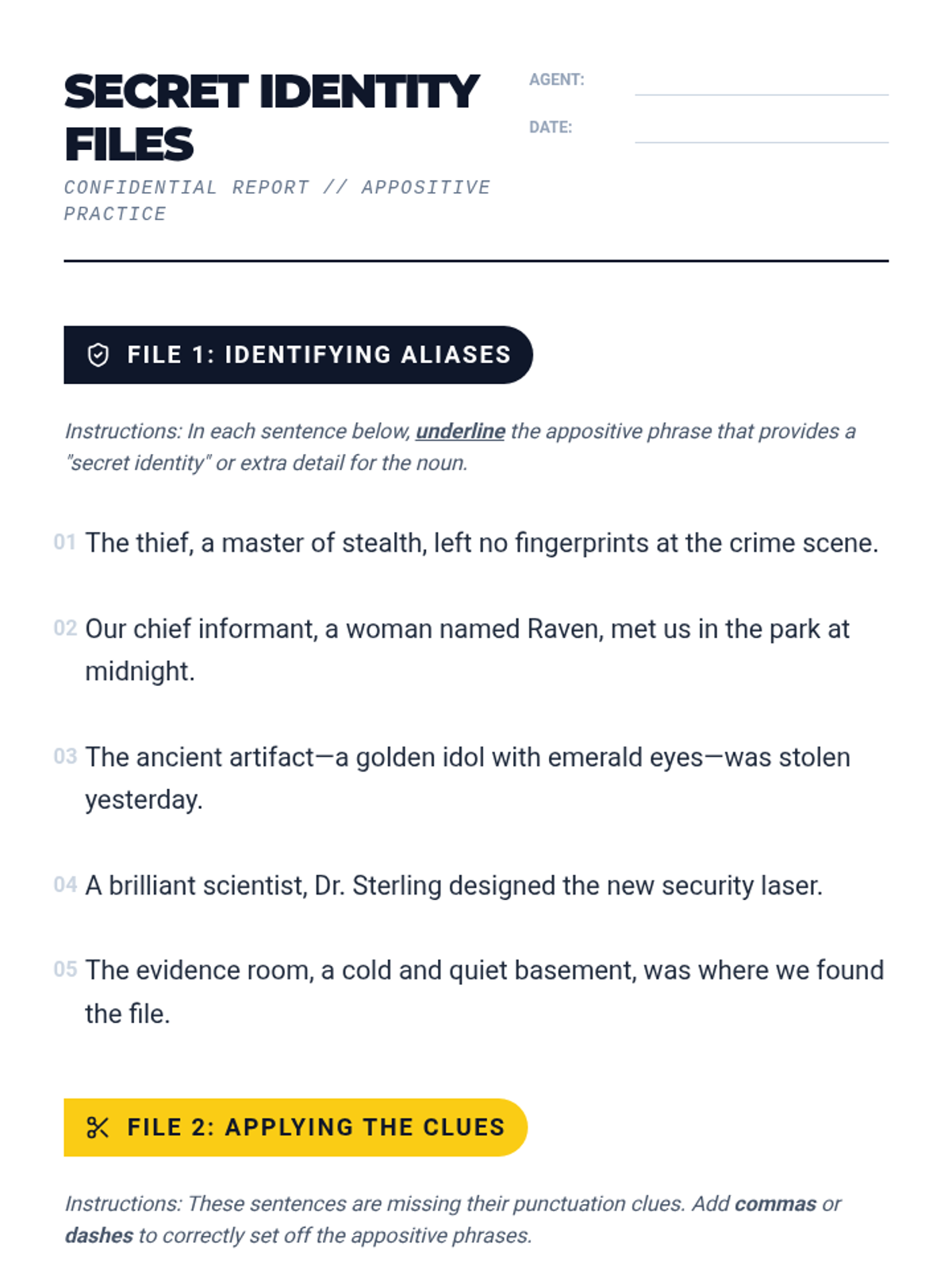
A comprehensive worksheet for practicing appositive identification, punctuation, and sentence construction with a detective theme.
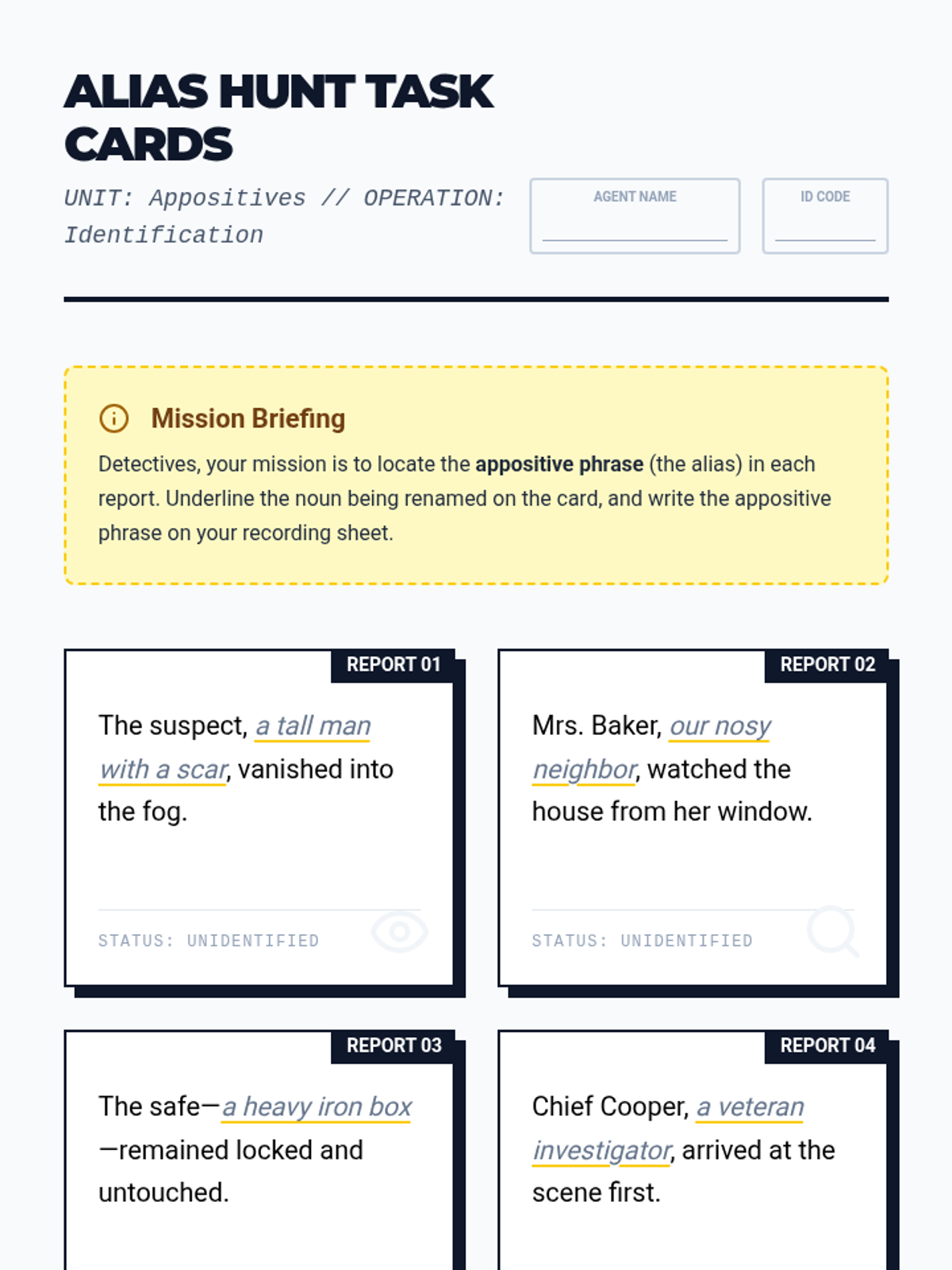
A set of 8 detective-themed task cards for identifying appositives, plus a student recording sheet. Each card presents a 'field report' sentence with a hidden appositive.
A slide deck introducing appositives using a 'detective' theme, explaining their function as 'aliases' for nouns and detailing punctuation markers.
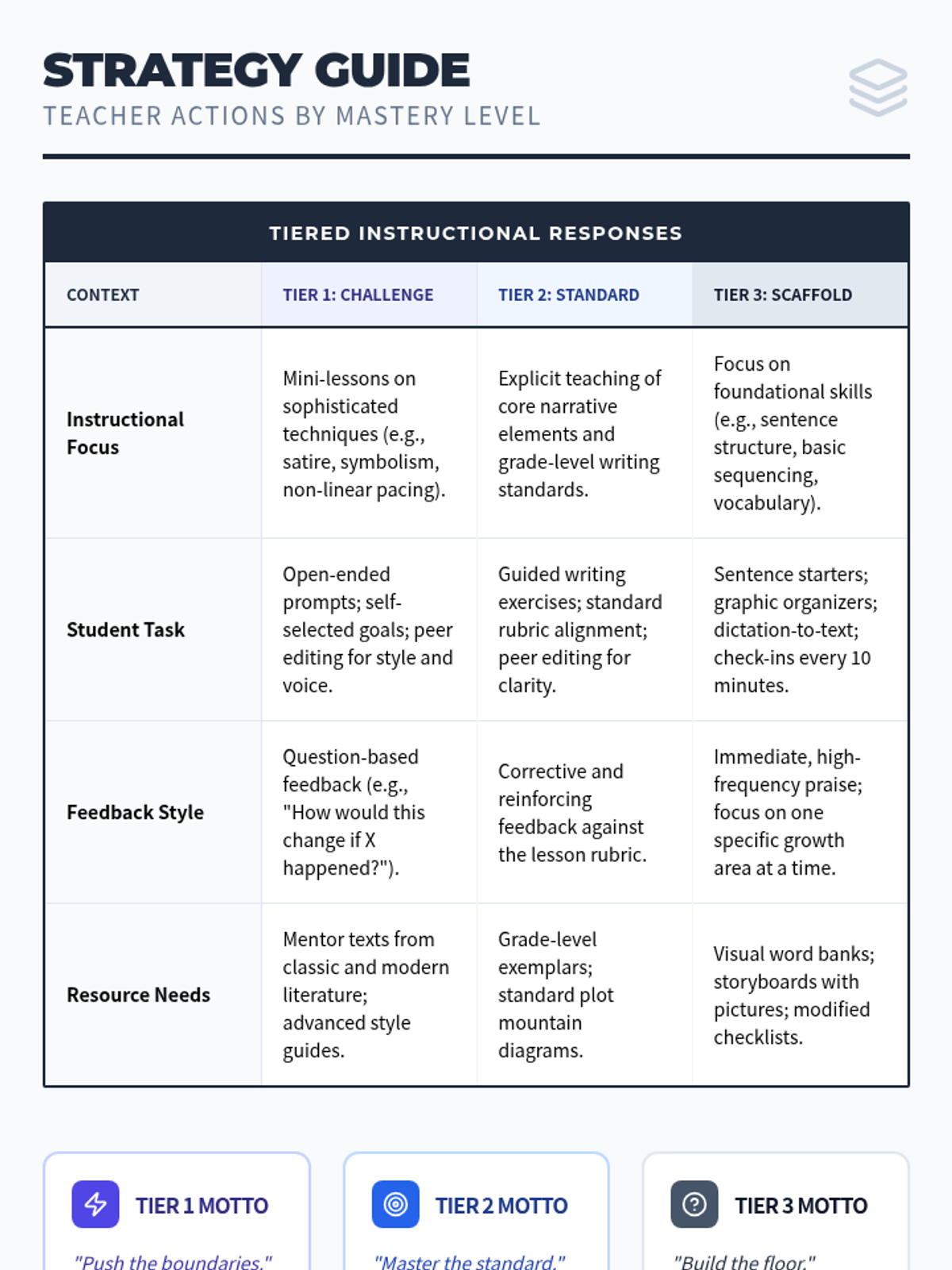
A teacher-facing strategy guide outlining specific instructional actions, feedback styles, and resource needs for Tier 1, 2, and 3 students.
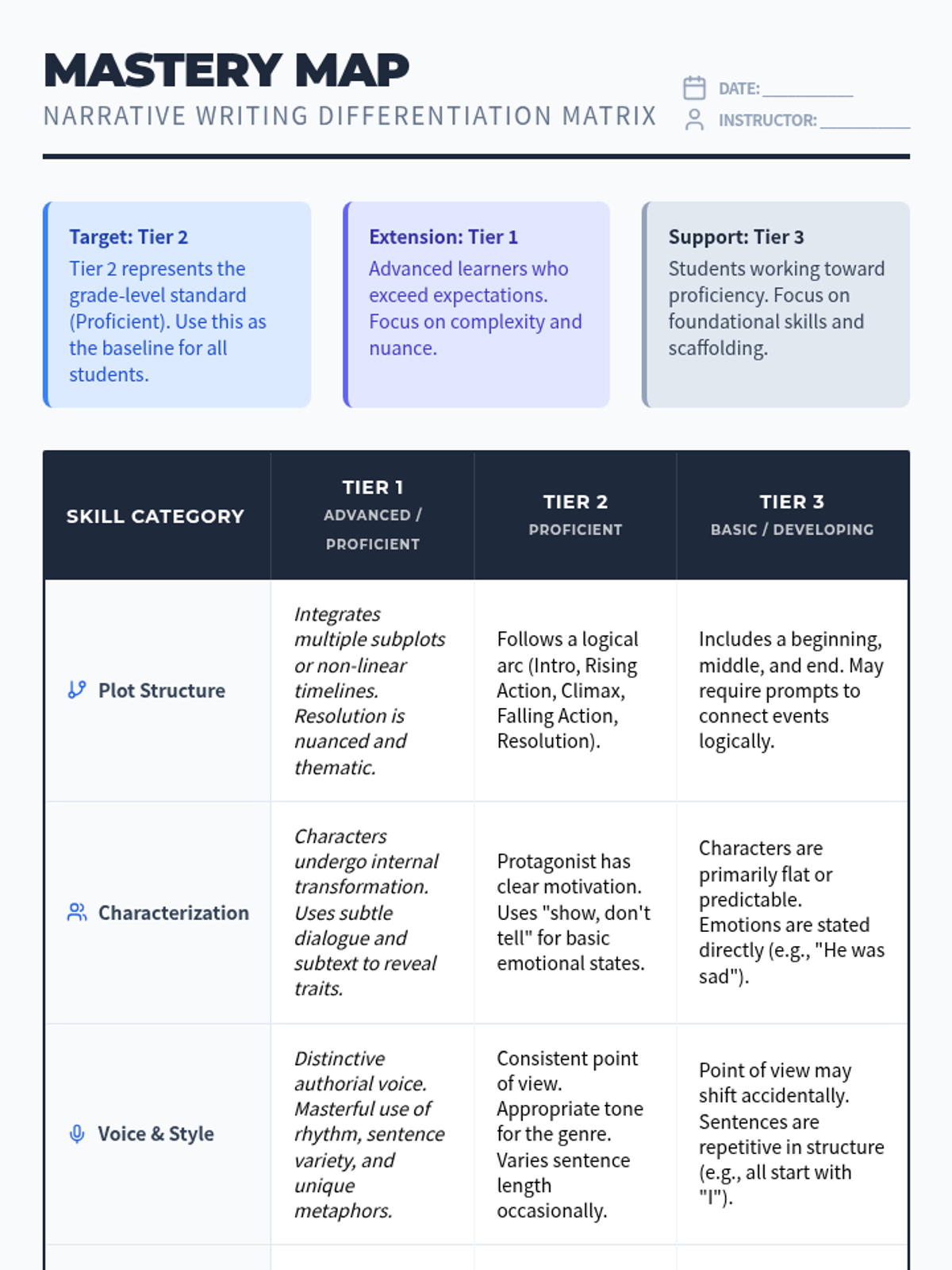
A comprehensive 4-column mastery chart for narrative writing, featuring criteria for Tier 1 (Advanced), Tier 2 (Proficient), and Tier 3 (Basic) students, plus a grouping log.
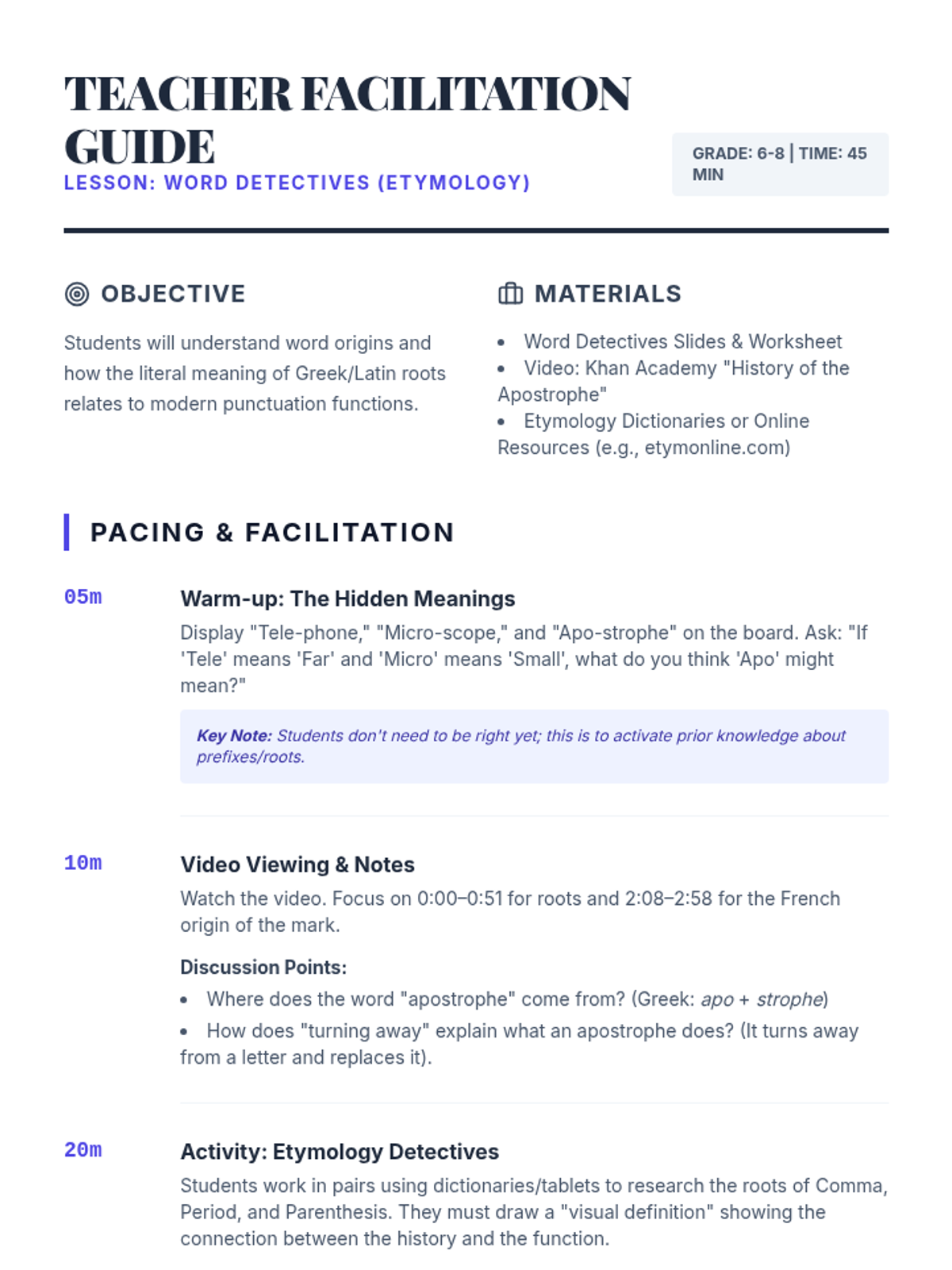
A comprehensive teacher facilitation guide for the Word Detectives lesson. Includes pacing, discussion prompts, a detailed answer key with word origins for punctuation marks, and extension suggestions.
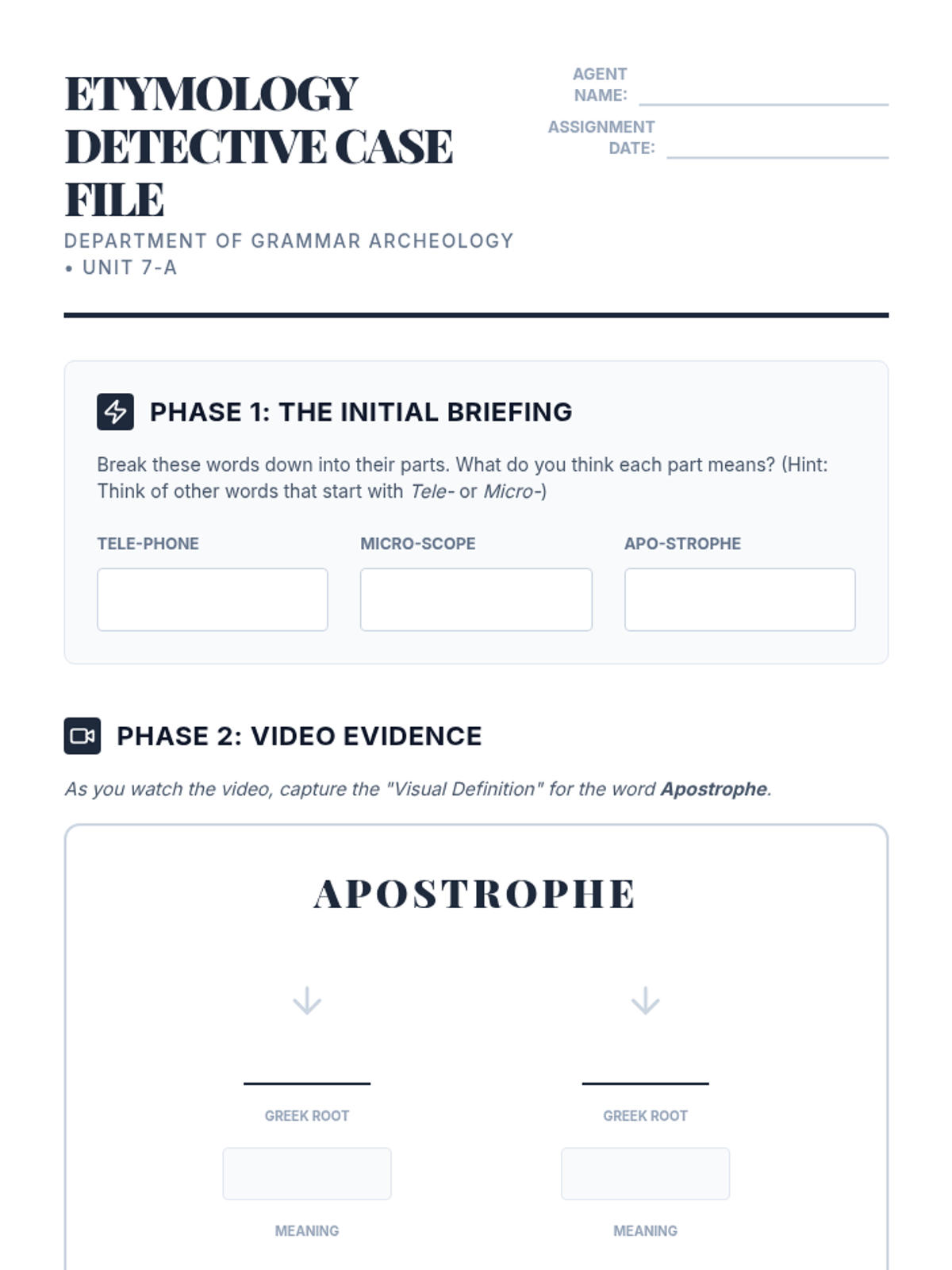
A worksheet for students to record word origins and create visual definitions for common grammar terms. Includes spaces for warm-up notes, video observation, and an independent research activity on comma, period, and parenthesis.
A slide deck for teaching etymology and the history of the apostrophe. Includes a warm-up, an embedded Khan Academy video, and instructions for the student-led detective activity.
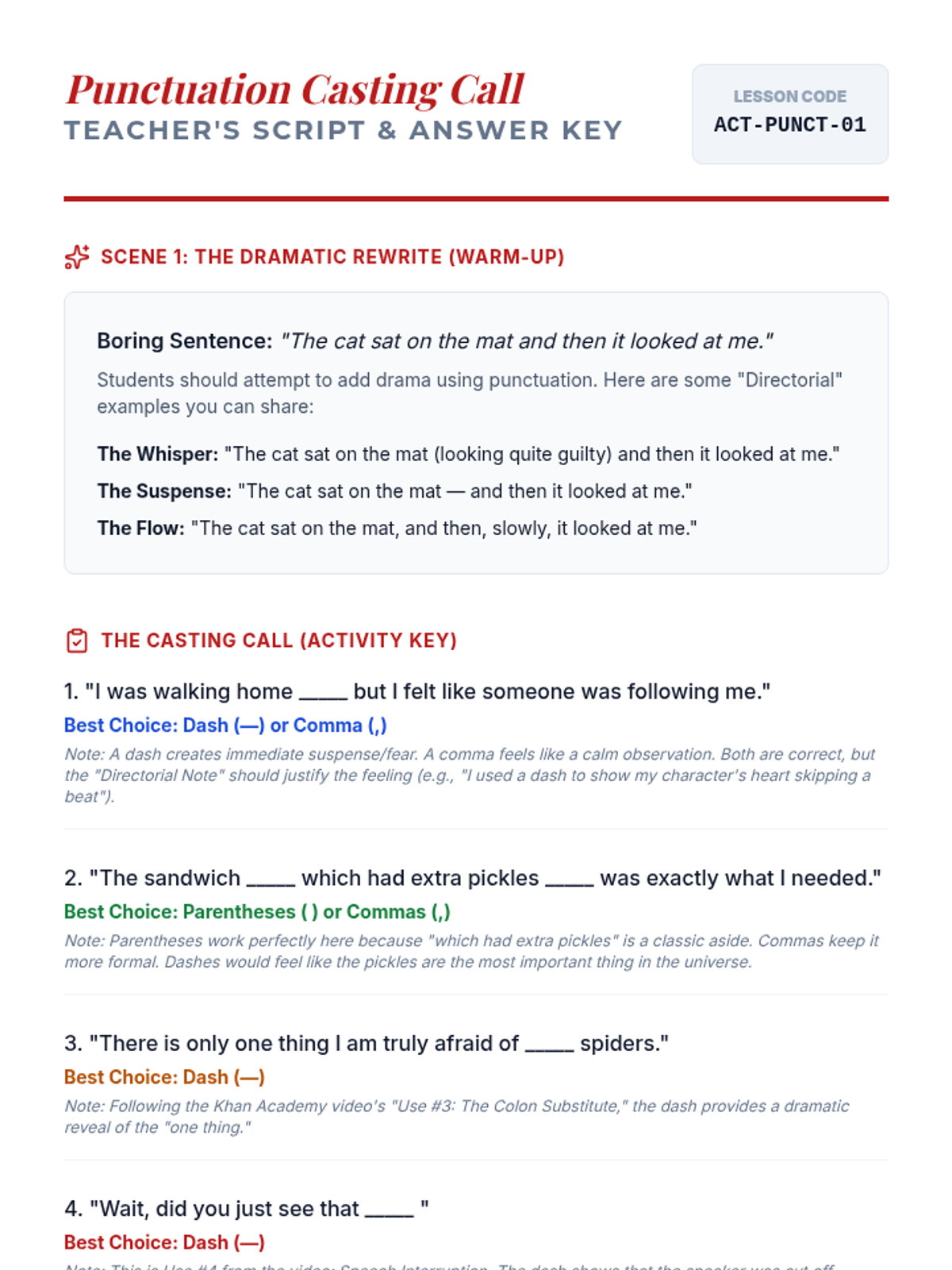
A comprehensive teacher's guide and answer key for the 'Punctuation Casting Call' lesson. It provides suggested answers for the student worksheet, explanation of the tone differences between marks, and instructional tips for the dramatic rewrite and closure activities.
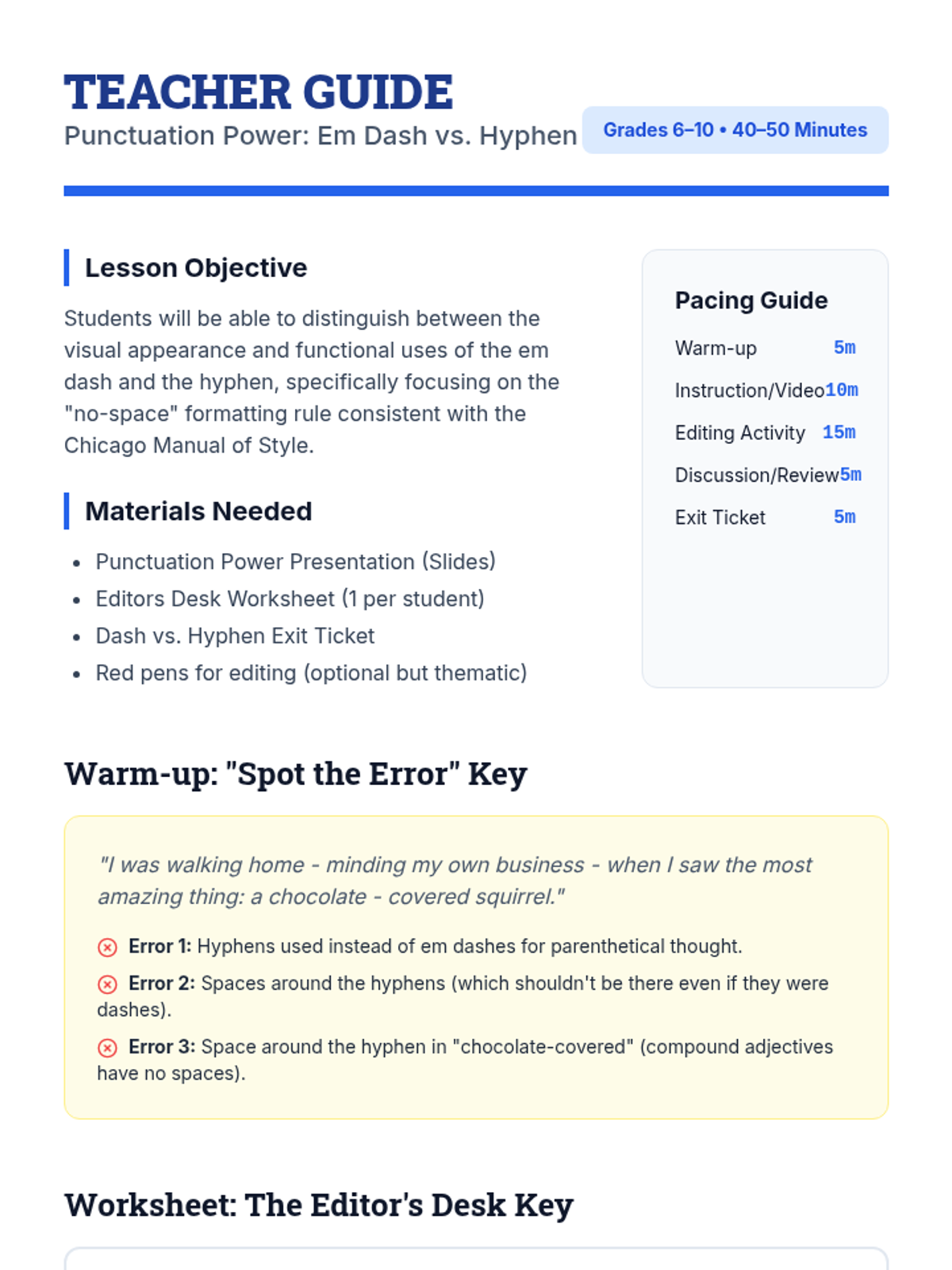
A comprehensive teacher resource containing lesson objectives, a pacing guide, answer keys for the warm-up and activity, and notes on common student misconceptions.
A visual presentation for a middle school grammar lesson themed around a theatrical casting call. It introduces commas, parentheses, and dashes as characters with distinct personalities, includes an embedded instructional video, and features interactive 'casting' exercises to explore tone and meaning.
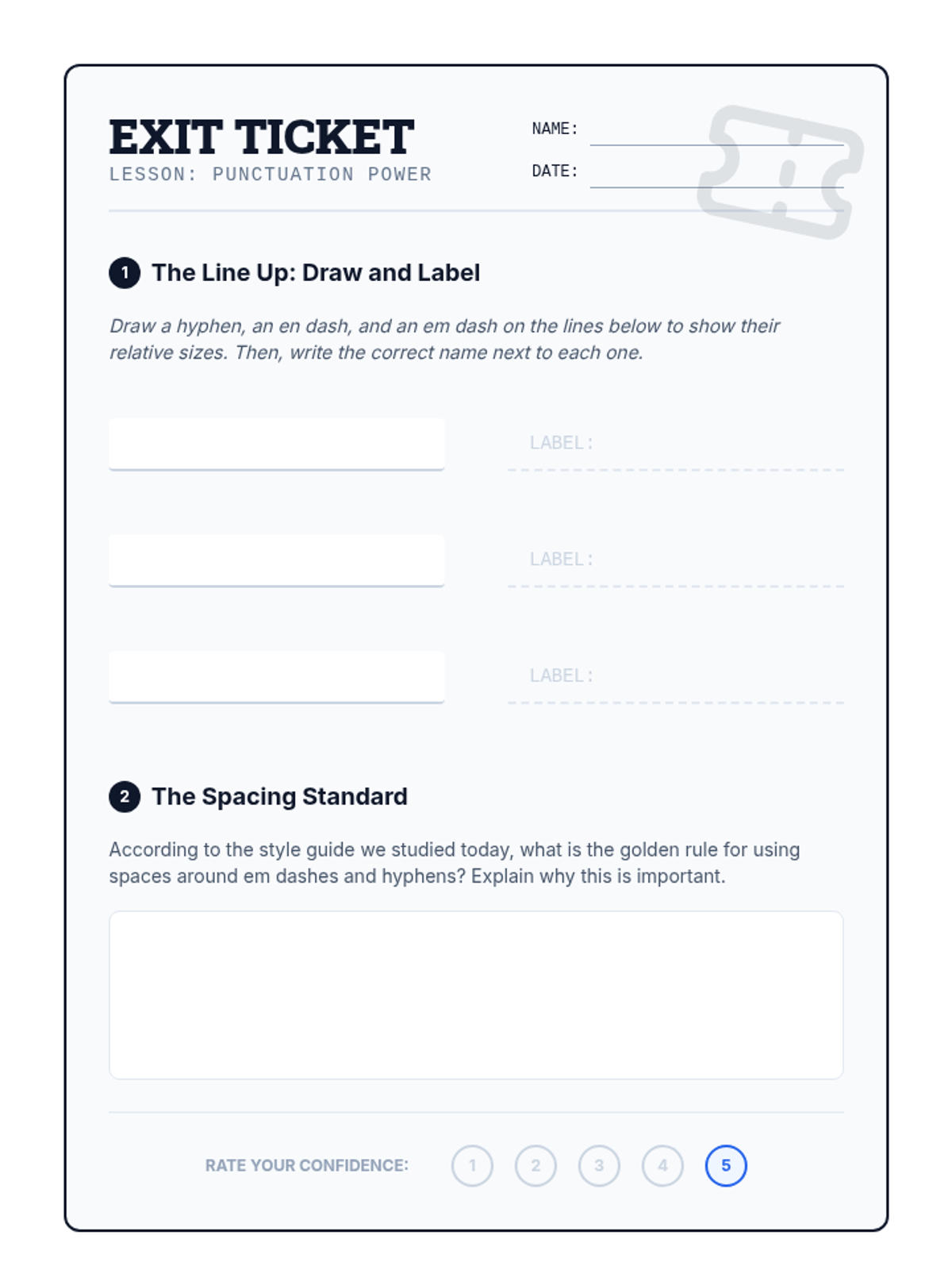
A quick assessment tool for the end of the lesson where students demonstrate visual distinction between hyphens and dashes and explain spacing rules.
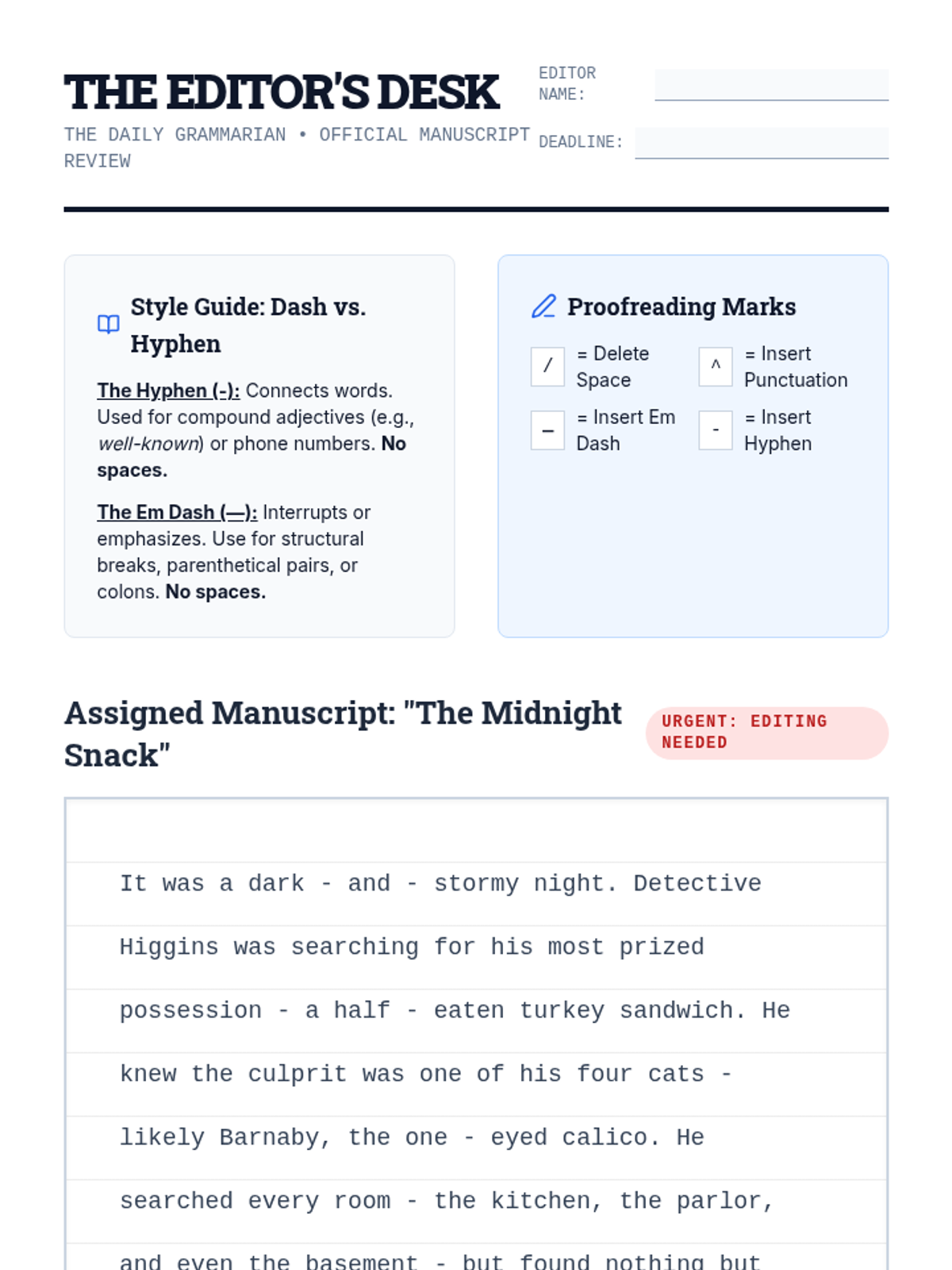
A newsroom-themed student worksheet where students edit a "messy" manuscript, correcting hyphen/dash errors and spacing issues using proofreading marks.
A visual presentation for teaching the differences between em dashes and hyphens, including formatting rules, four functional uses of the em dash, and an interactive warm-up.
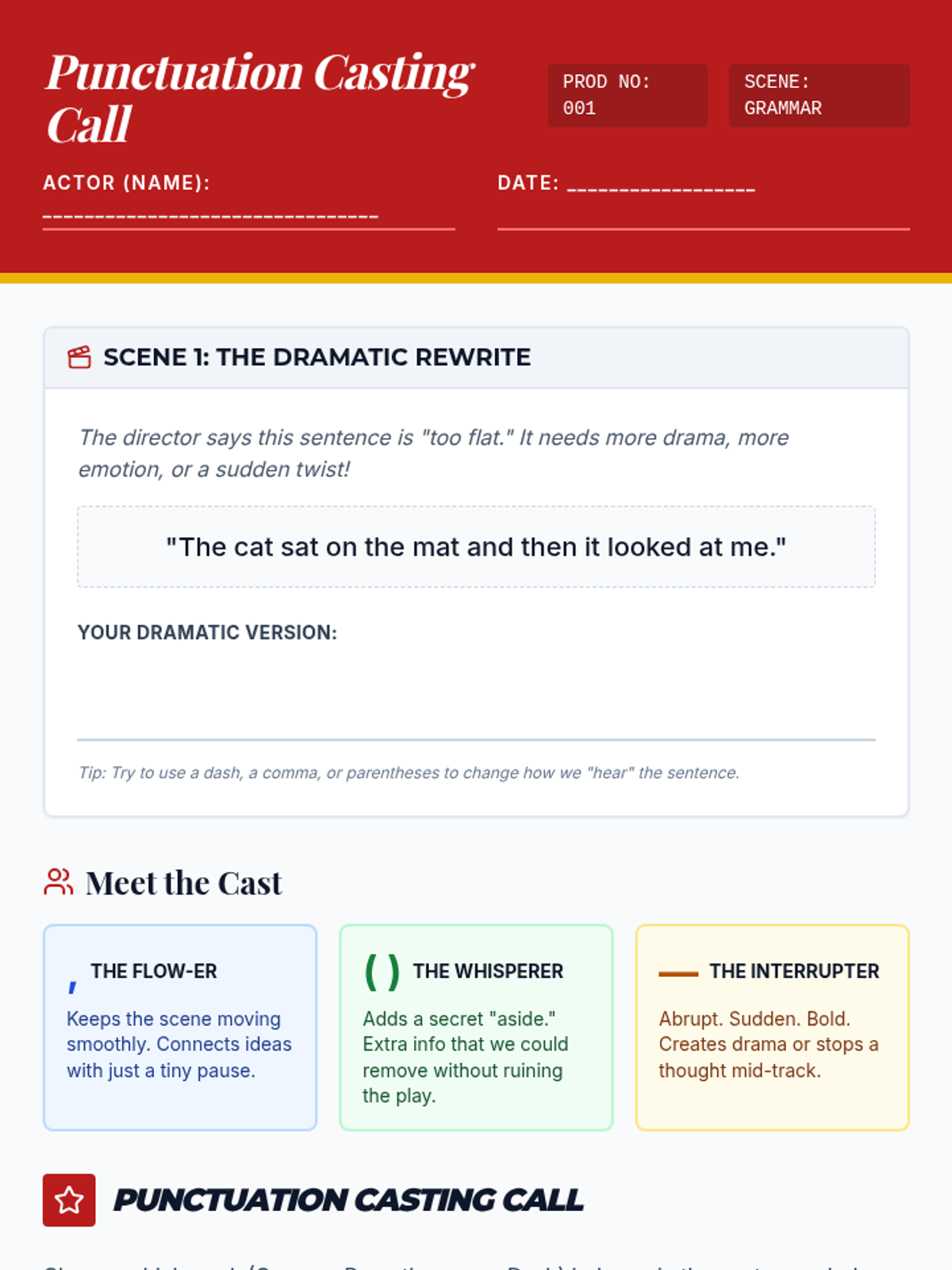
A student worksheet designed with a theatrical 'casting call' theme. It includes a dramatic rewrite warm-up, a cast list defining the roles of commas, parentheses, and dashes, and a series of sentence exercises where students 'cast' the appropriate punctuation mark and provide directorial notes.
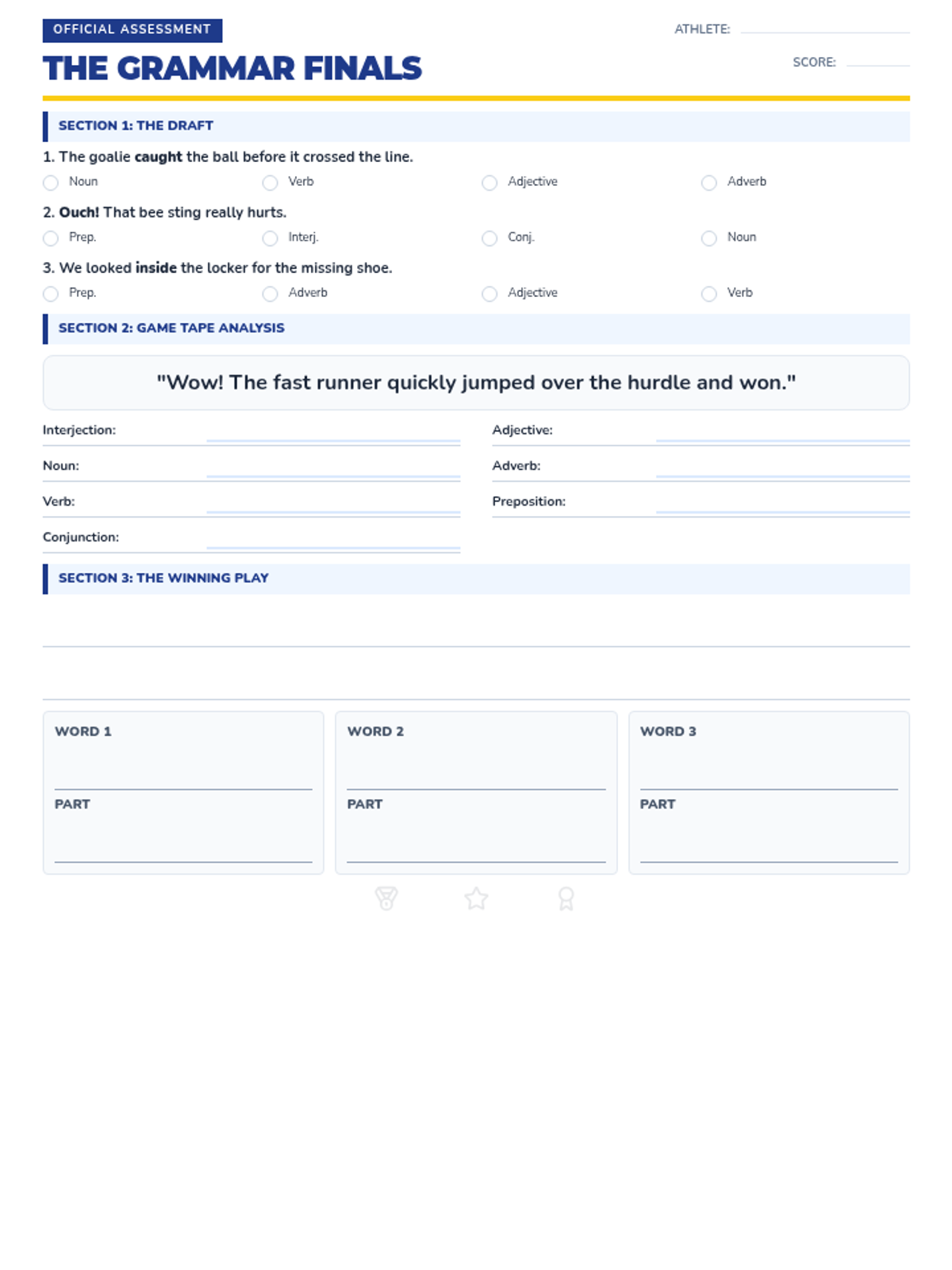
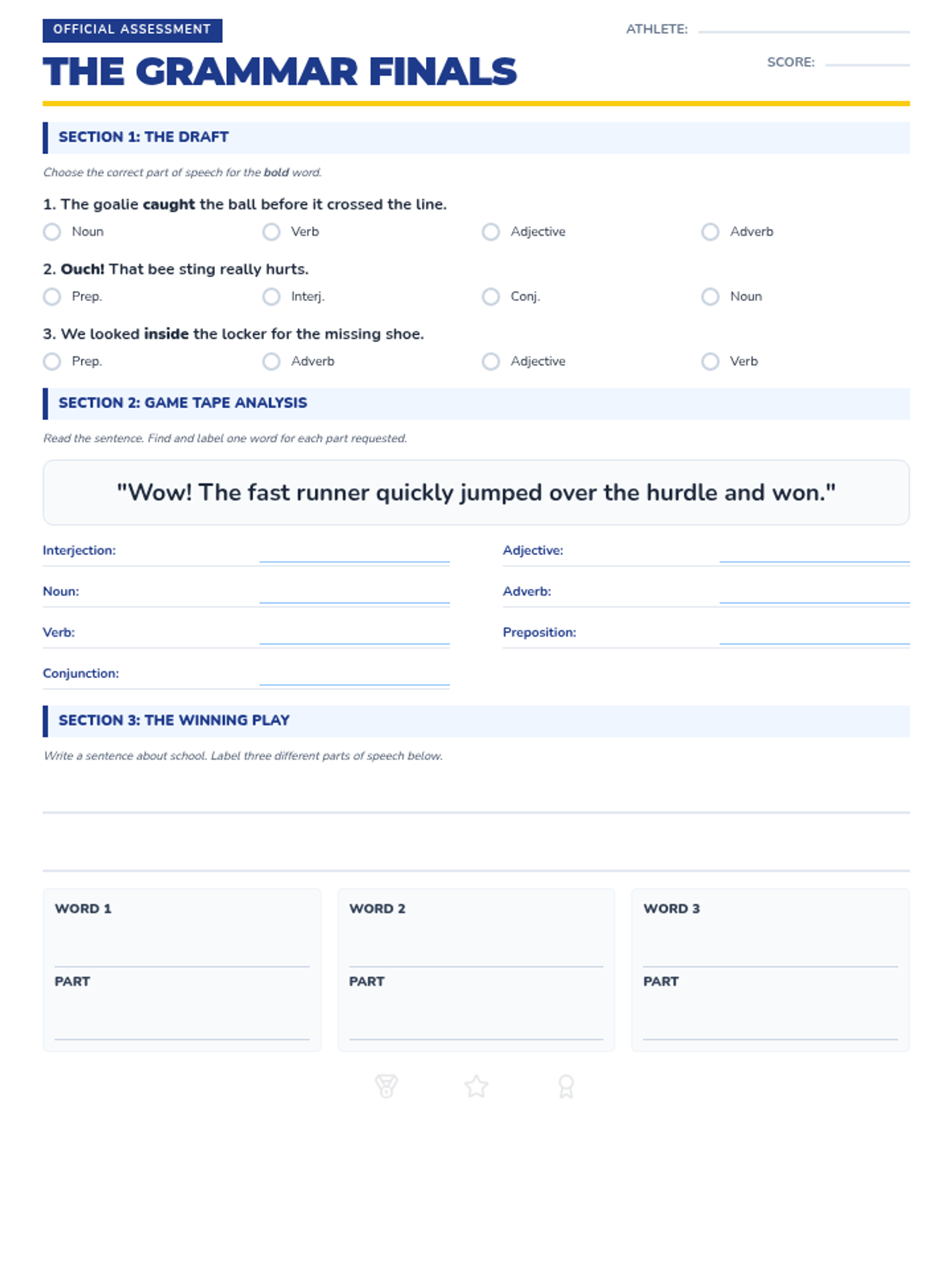
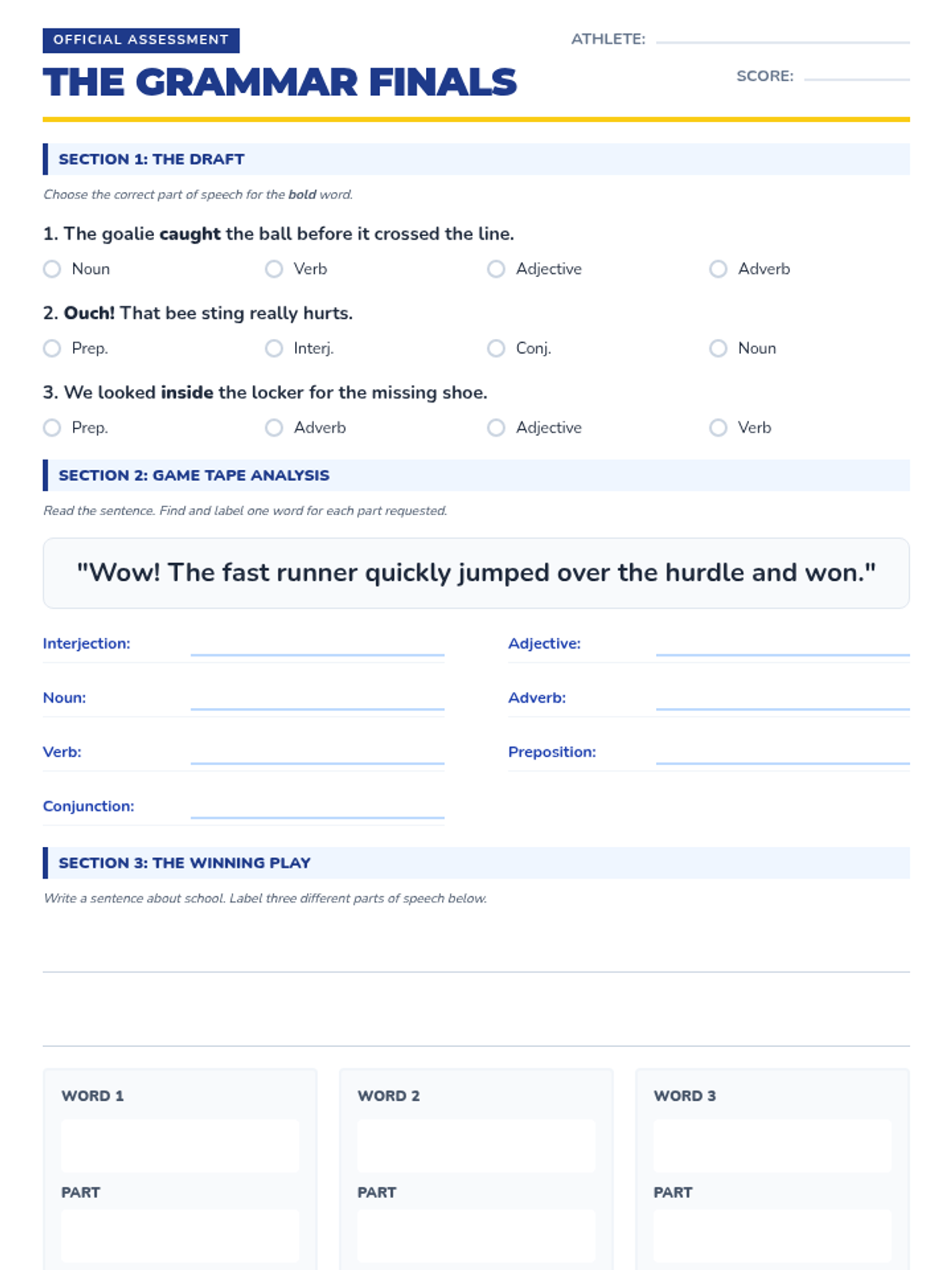
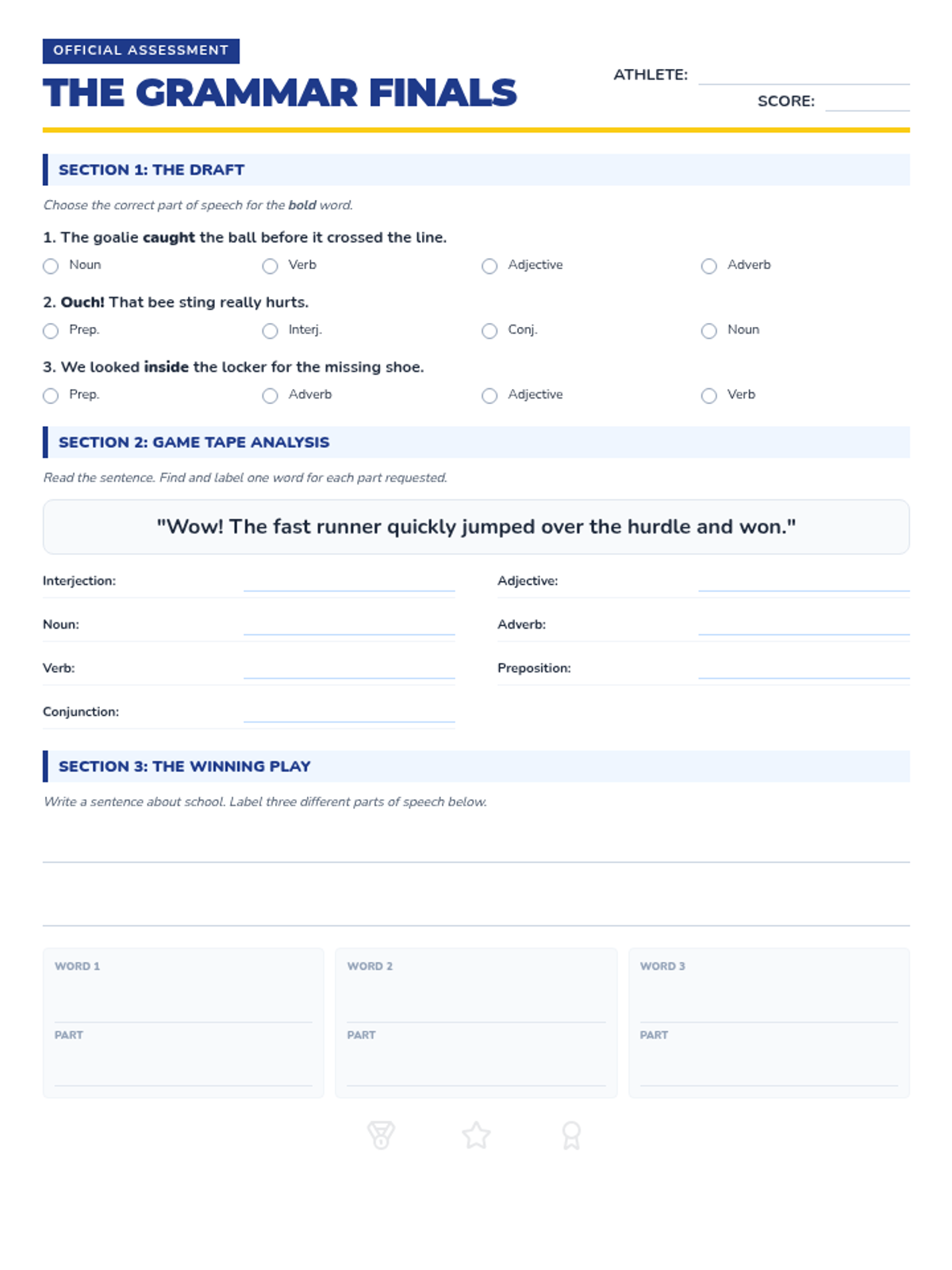
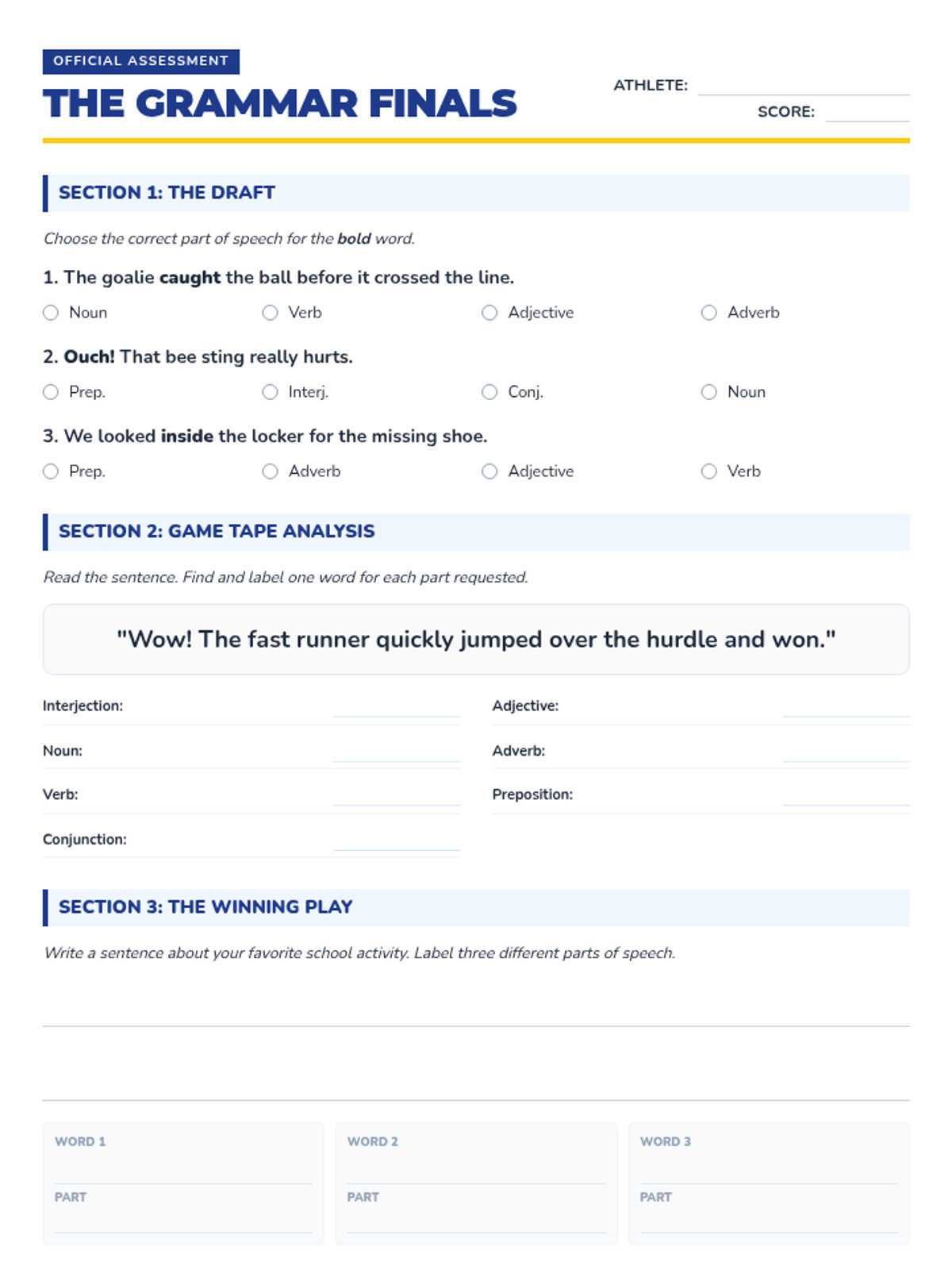
A comprehensive 1-page assessment quiz featuring multiple-choice identification, contextual analysis, and creative writing. Revised to fit on a single page with improved handwriting space.
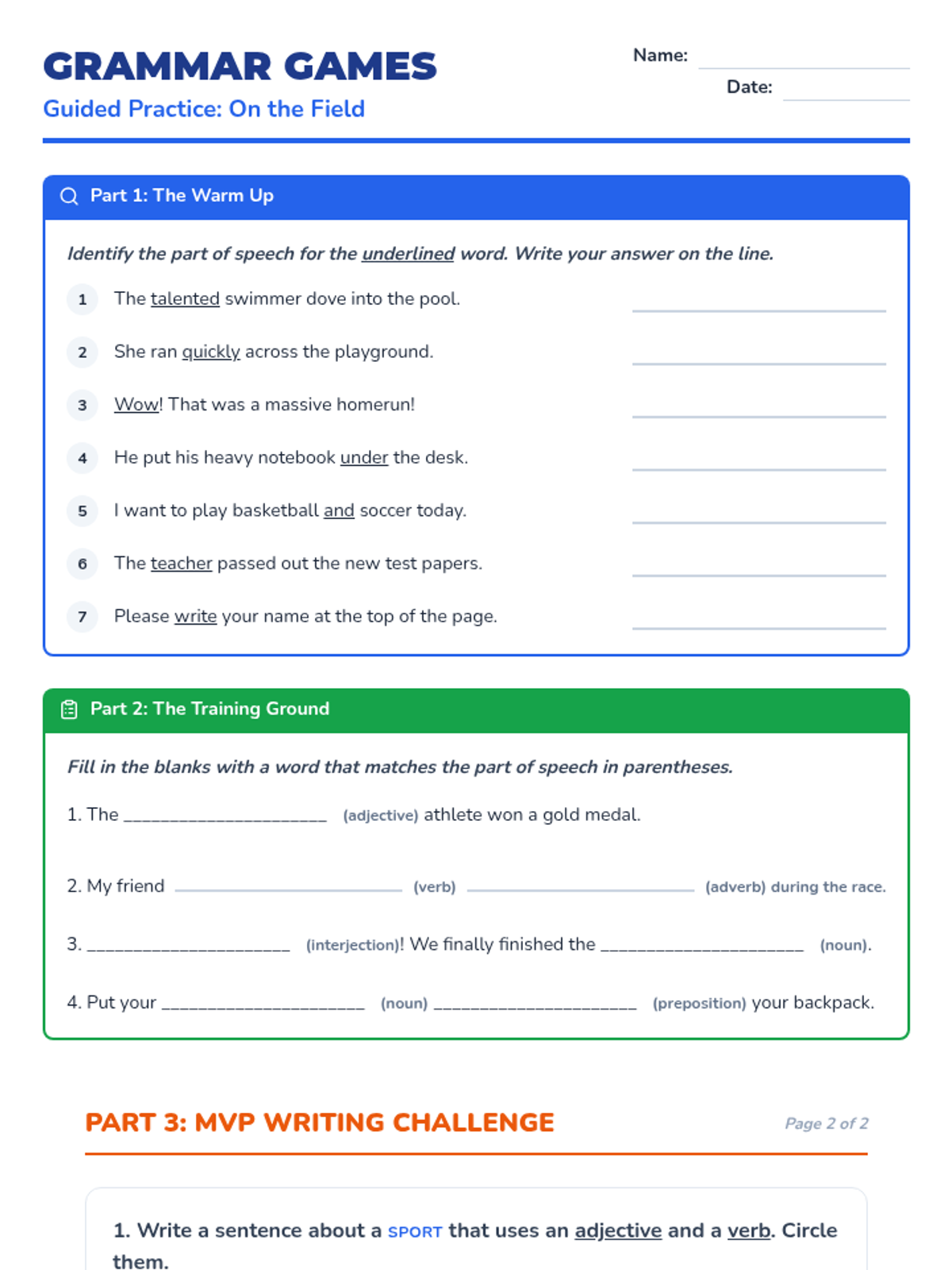
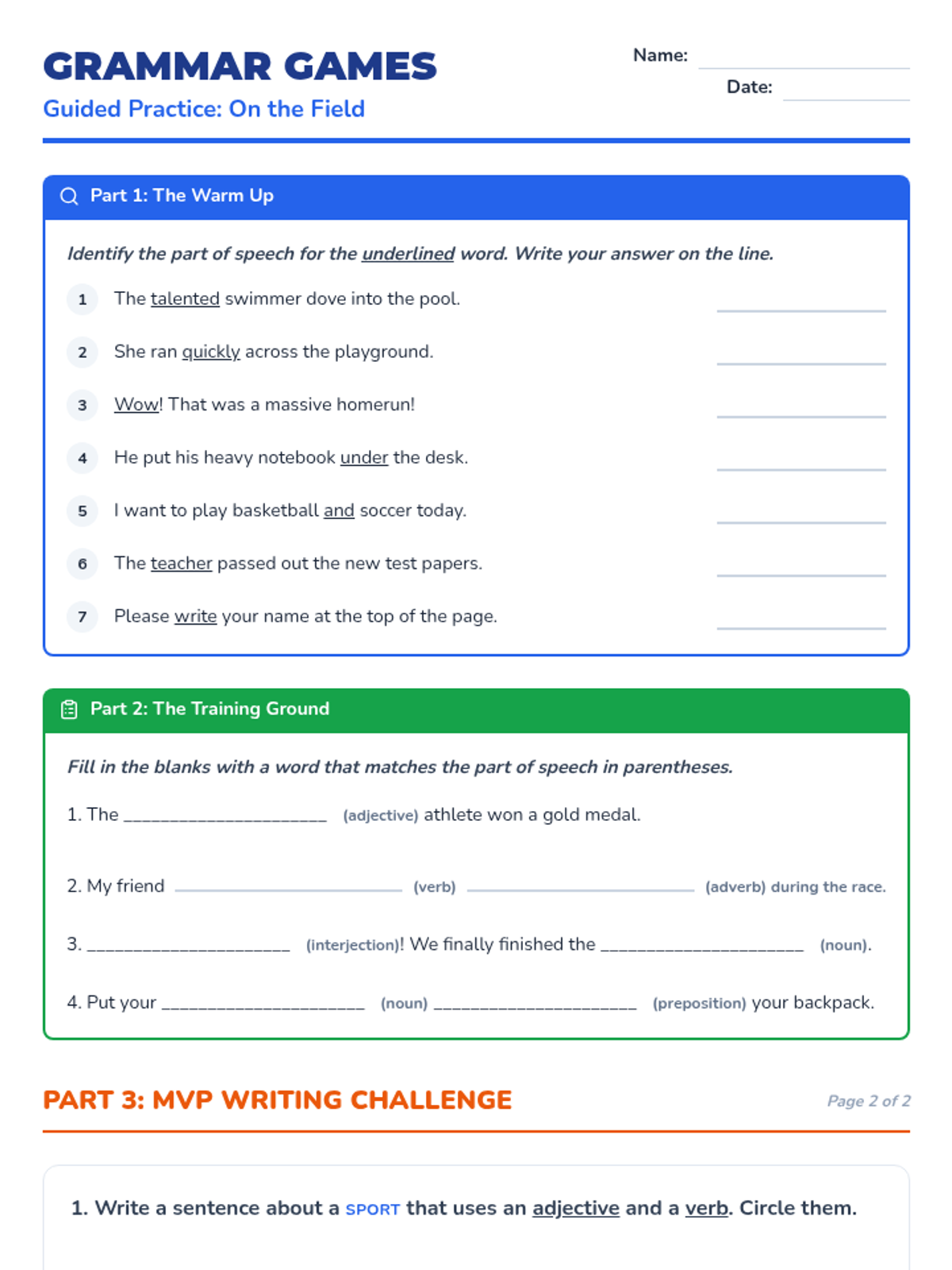
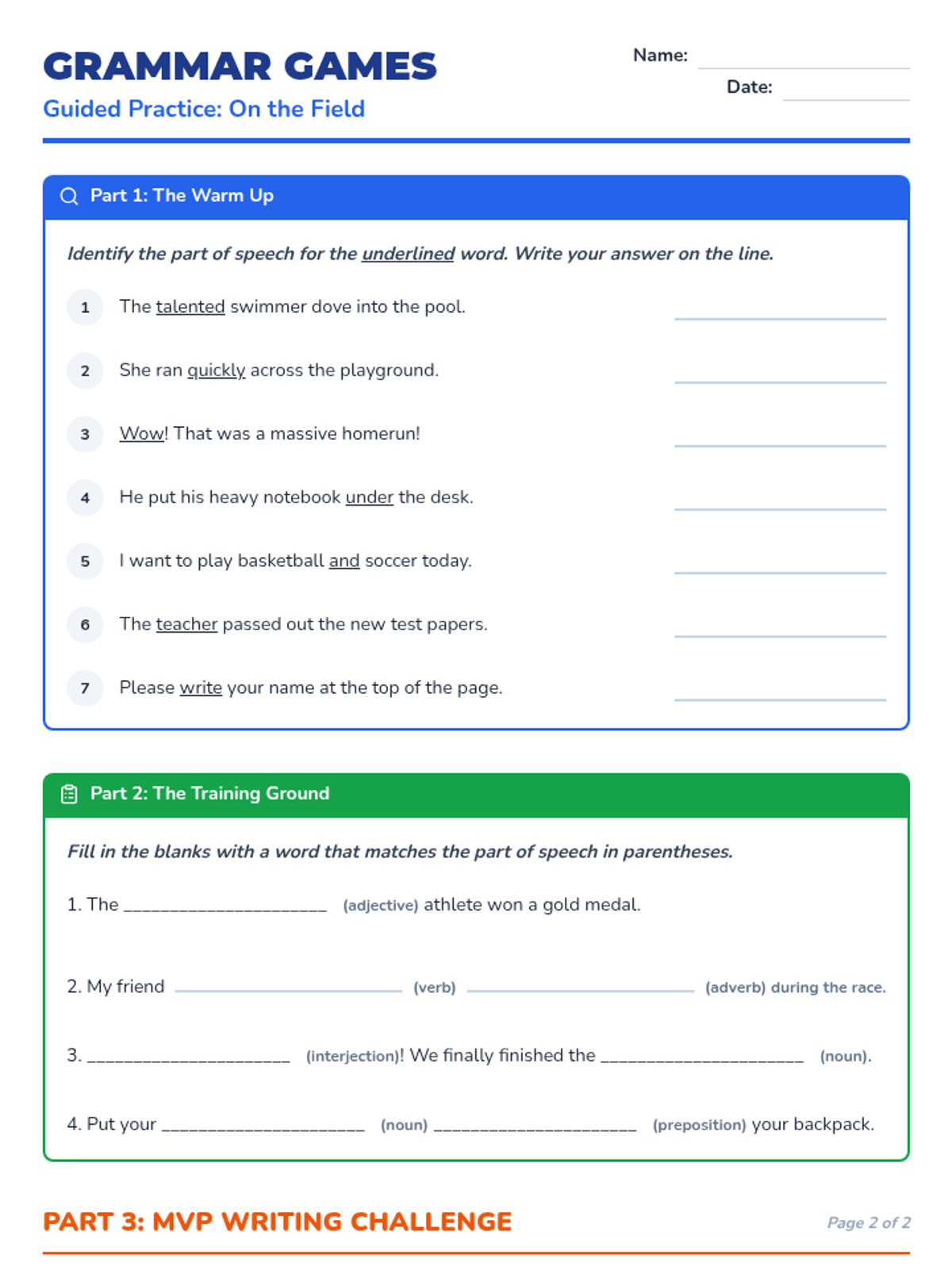
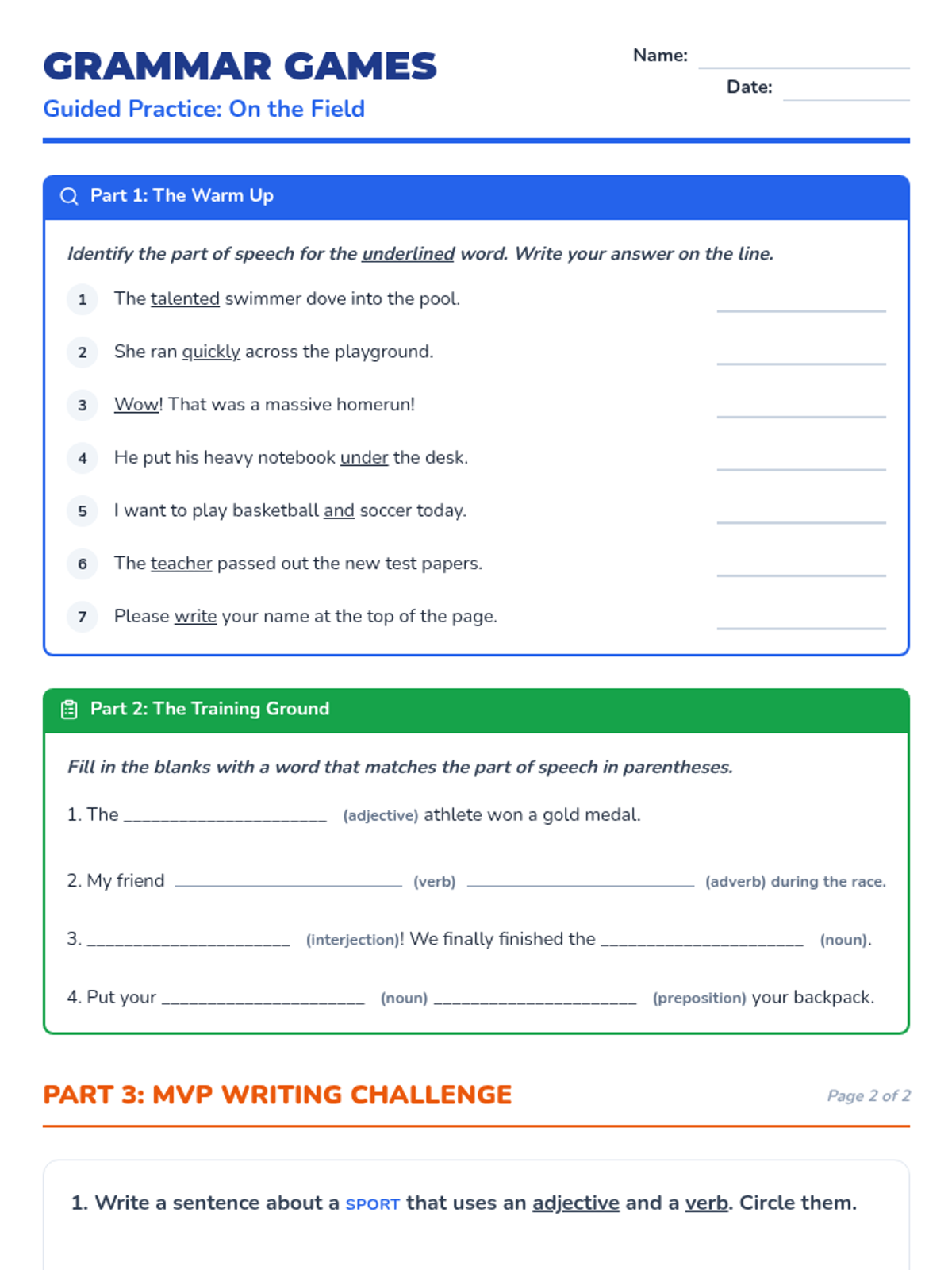
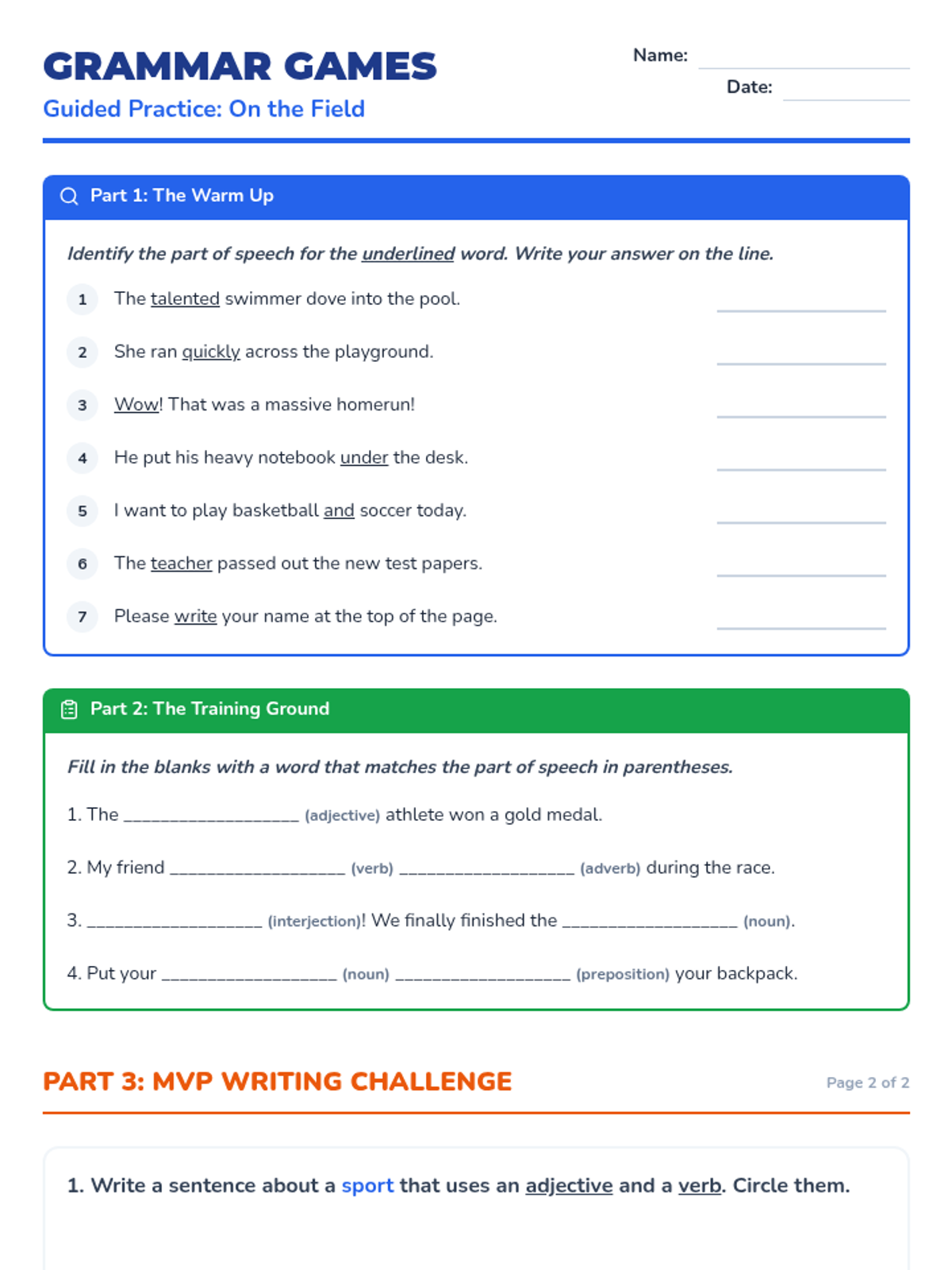
A 2-page guided practice worksheet where students identify parts of speech in athletic and academic contexts and apply their knowledge by writing original sentences. Revised for better page flow and student work areas.
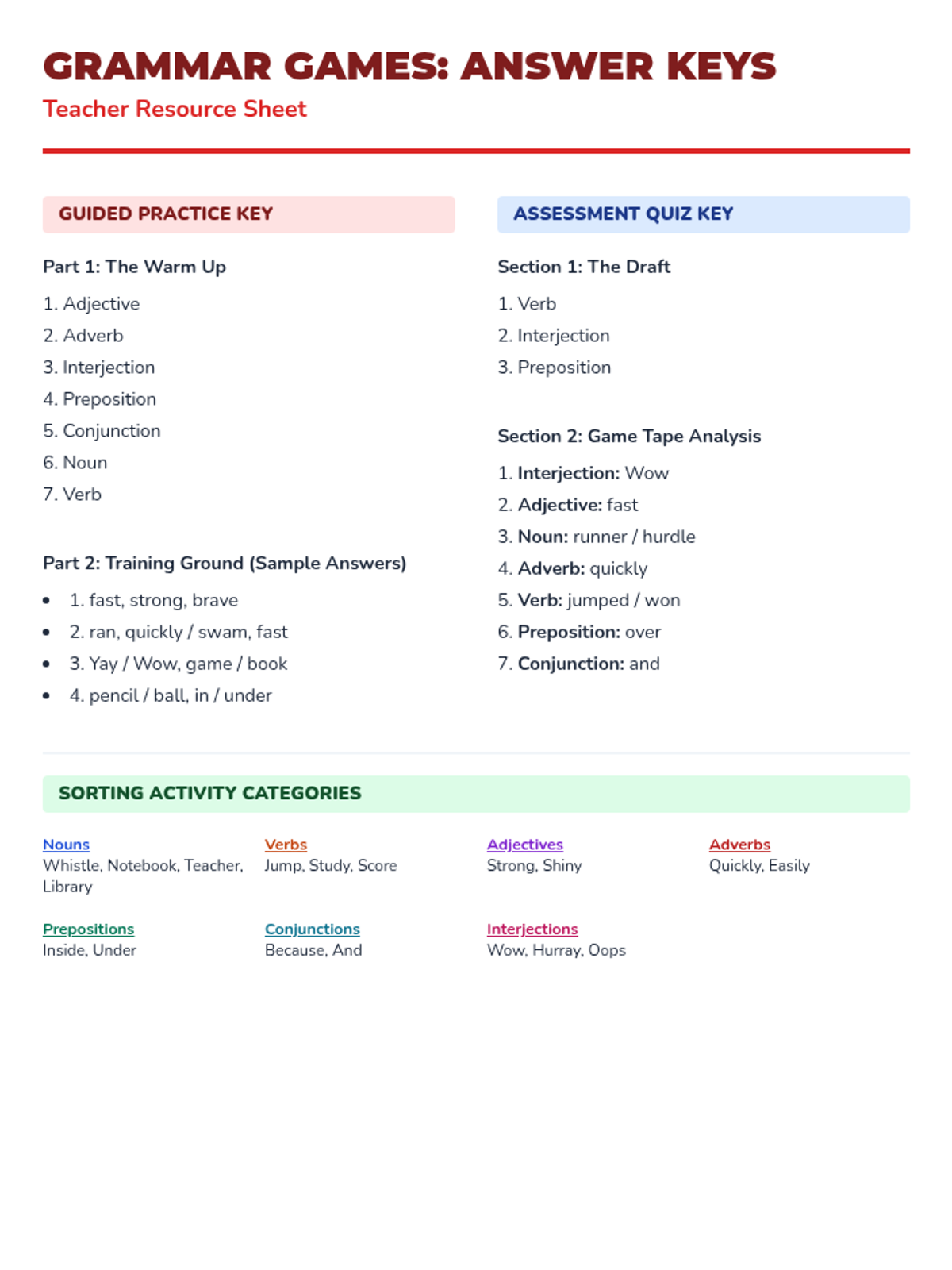
A comprehensive answer key for teachers, covering the guided practice worksheet, sorting activity, and assessment quiz. Updated to match revised layouts and word choices.
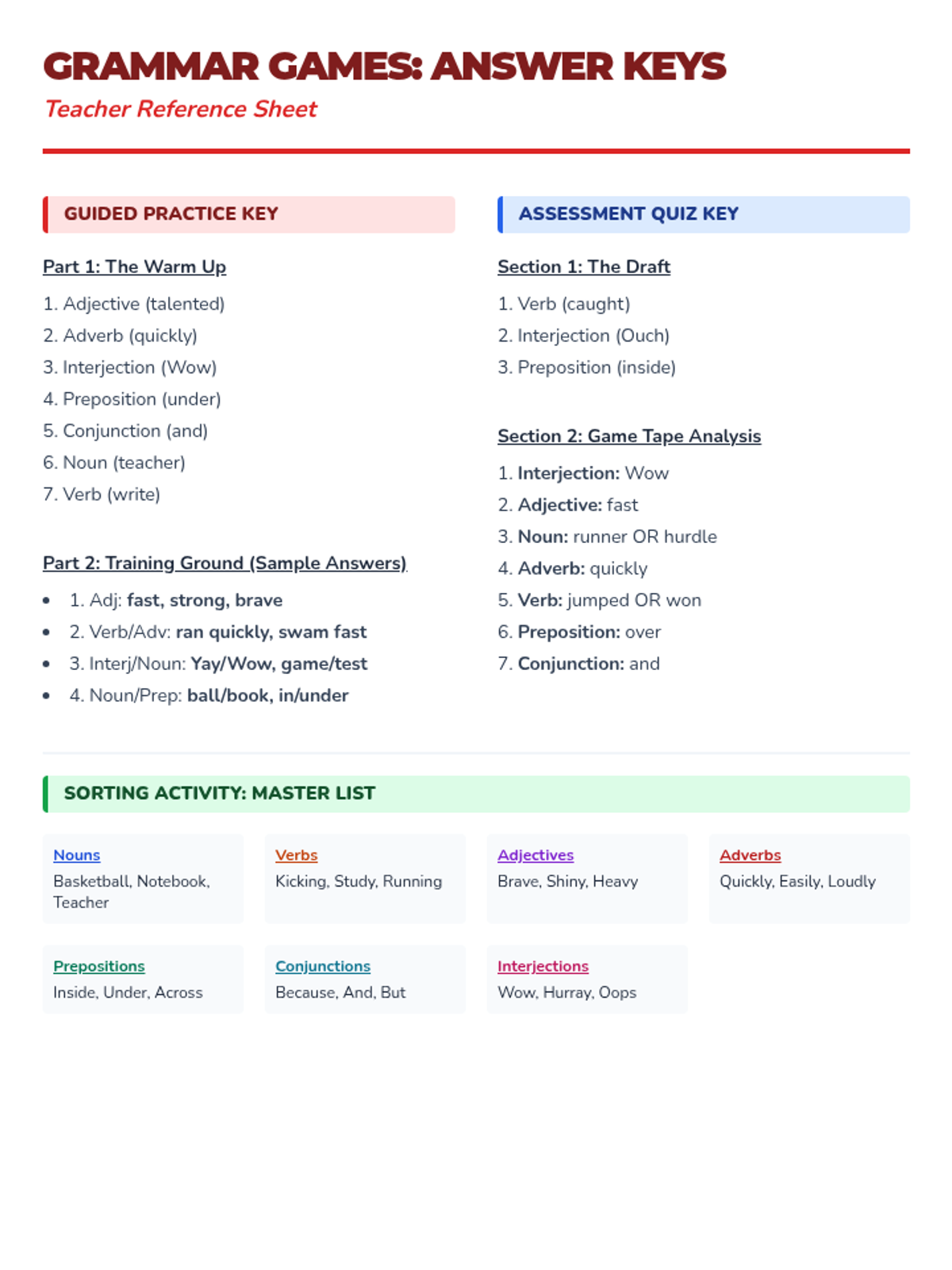
A comprehensive answer key for teachers, covering the guided practice worksheet, the sorting activity, and the assessment quiz. Includes sample answers for open-ended writing prompts.
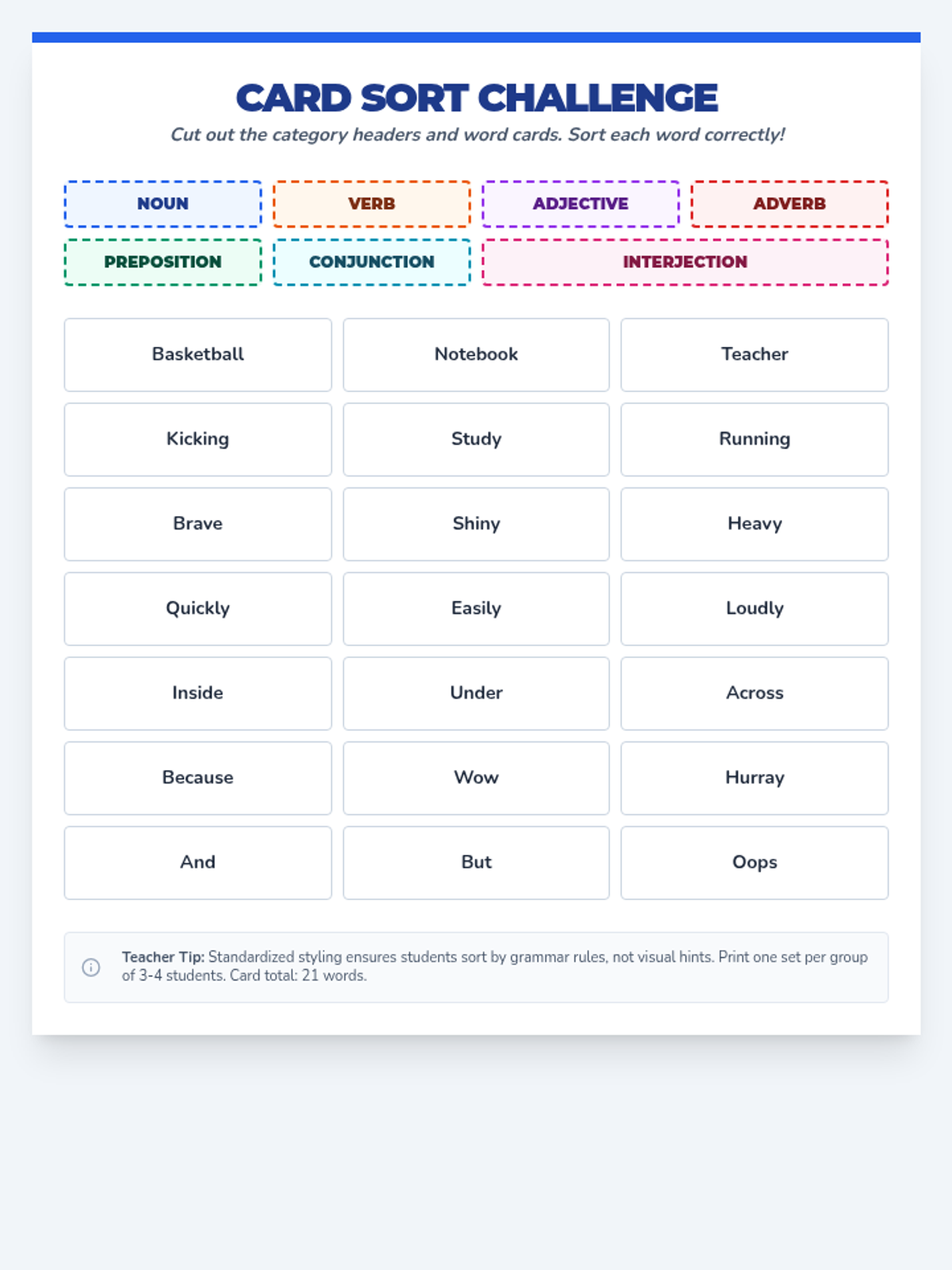
A hands-on small group activity featuring cut-out cards for all seven parts of speech. Revised to fit on a single page with standardized styling to prevent visual cues.
A set of 8 instructional slides defining the seven primary parts of speech with clear definitions and themed examples from sports and school life.
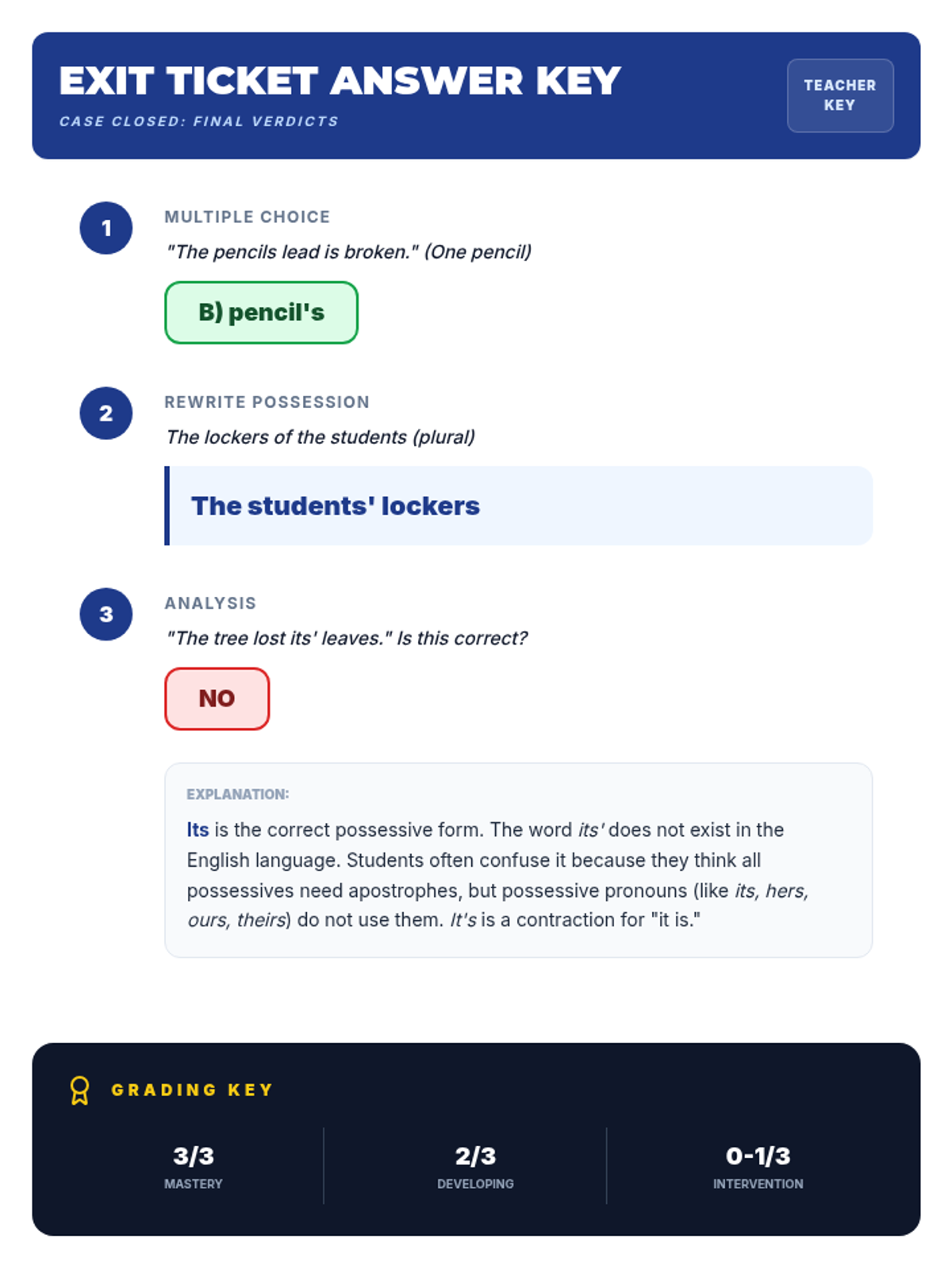
A teacher's answer key for the 'Case Closed' exit ticket. It provides correct answers for multiple-choice and short-answer questions, along with a detailed explanation of the common 'its' vs 'it's' mistake and a suggested grading rubric.
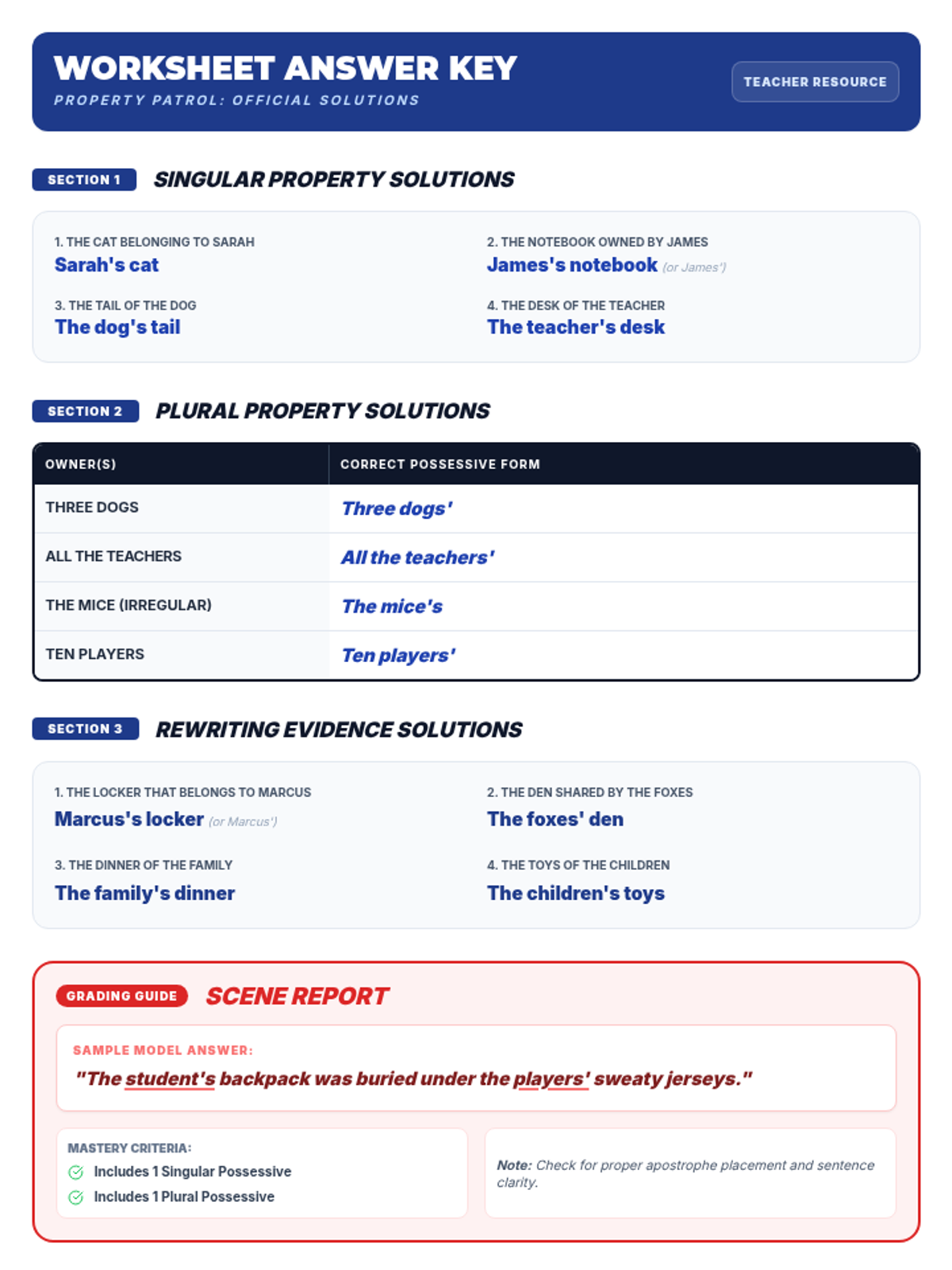
A comprehensive teacher's answer key for the 'Property Patrol' worksheet. It provides clear solutions for singular and plural possessive noun exercises, including irregular forms and sample sentence constructions.
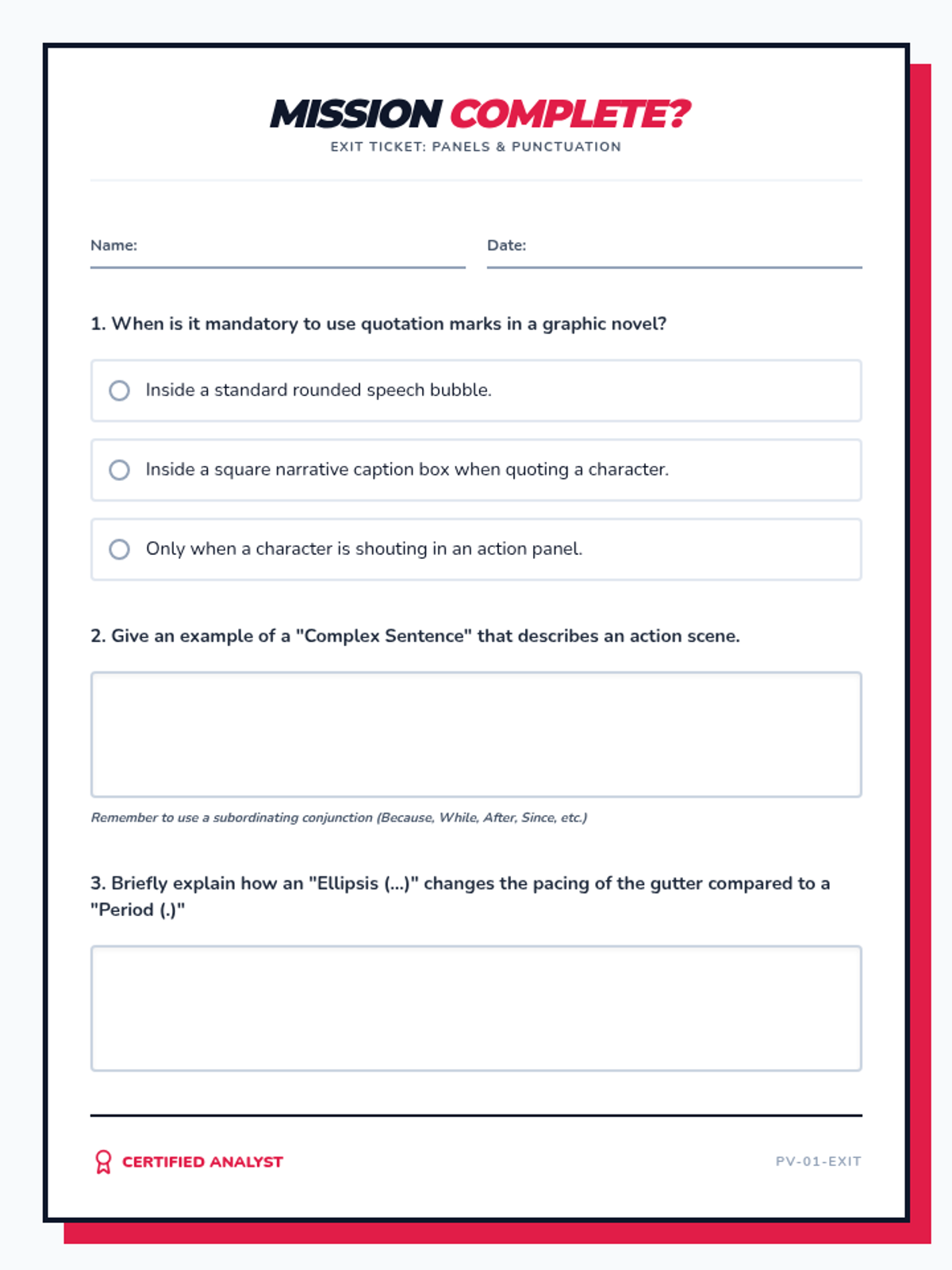
A quick assessment for the end of the lesson to check student understanding of quotation rules in comics, complex sentence construction, and visual pacing. Revised for better contrast and legibility.
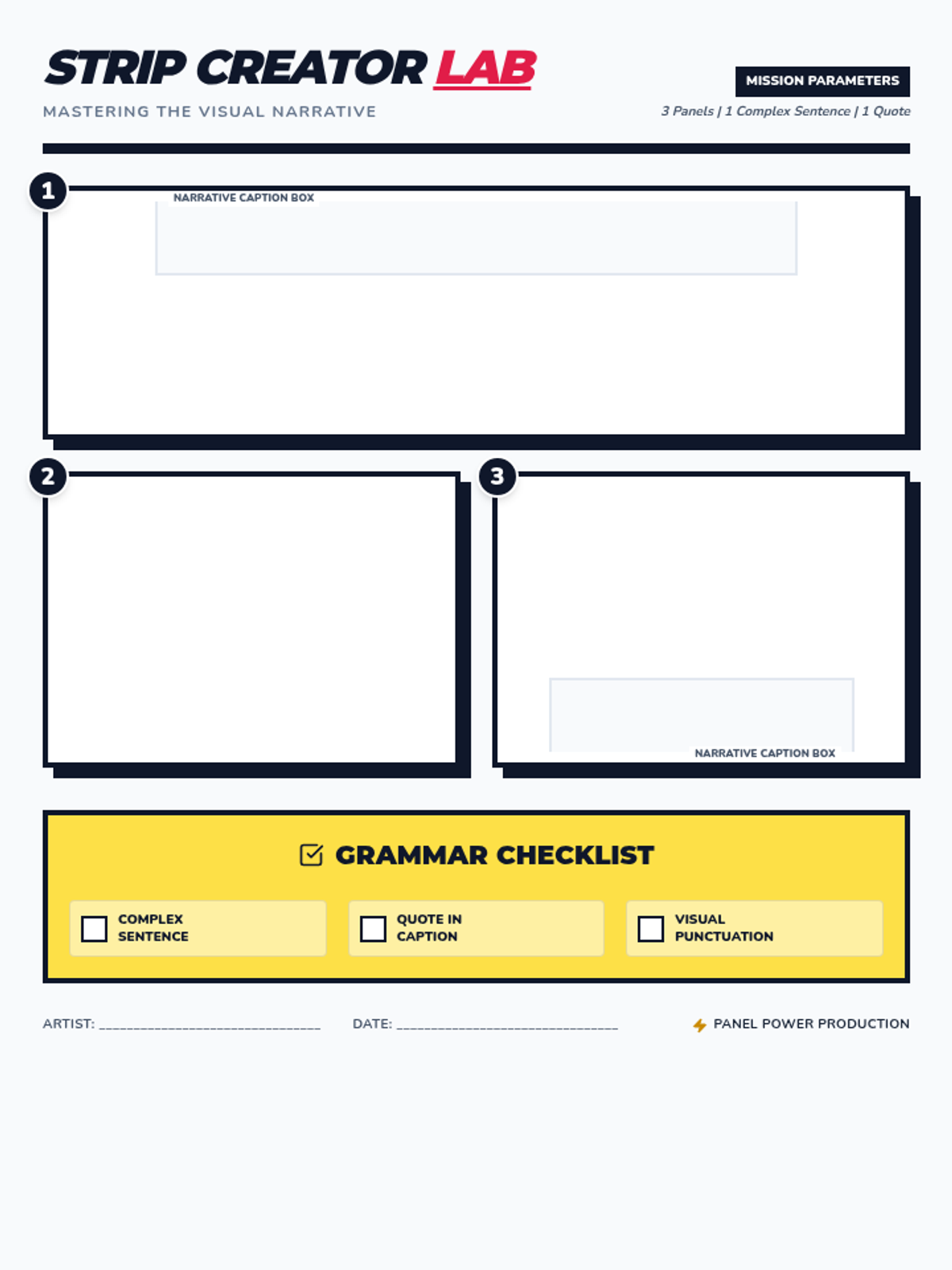
A creative comic strip template with a built-in grammar checklist, requiring students to apply complex sentences and quotation rules in a visual format. Revised for better label clarity and caption space.
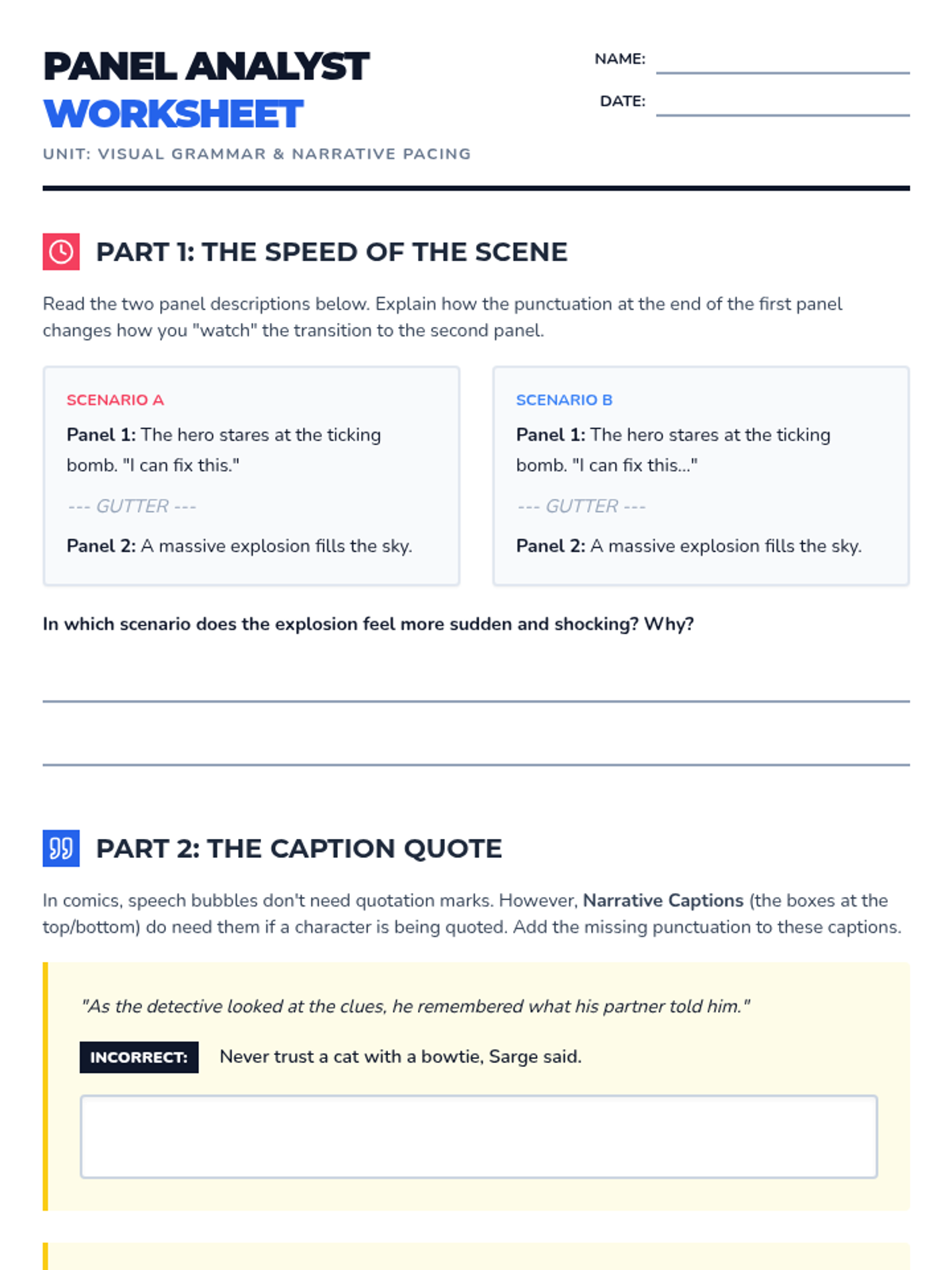
A student worksheet for analyzing the effect of punctuation on narrative pacing in comics and practicing the correct use of quotation marks in narrative captions. Final polish for page breaks and consistency.
High-energy, comic-themed presentation slides covering visual pacing, the 'grammar of the gutter', quotation mark rules in comics, and complex sentence structures. Revised for better label clarity and padding.
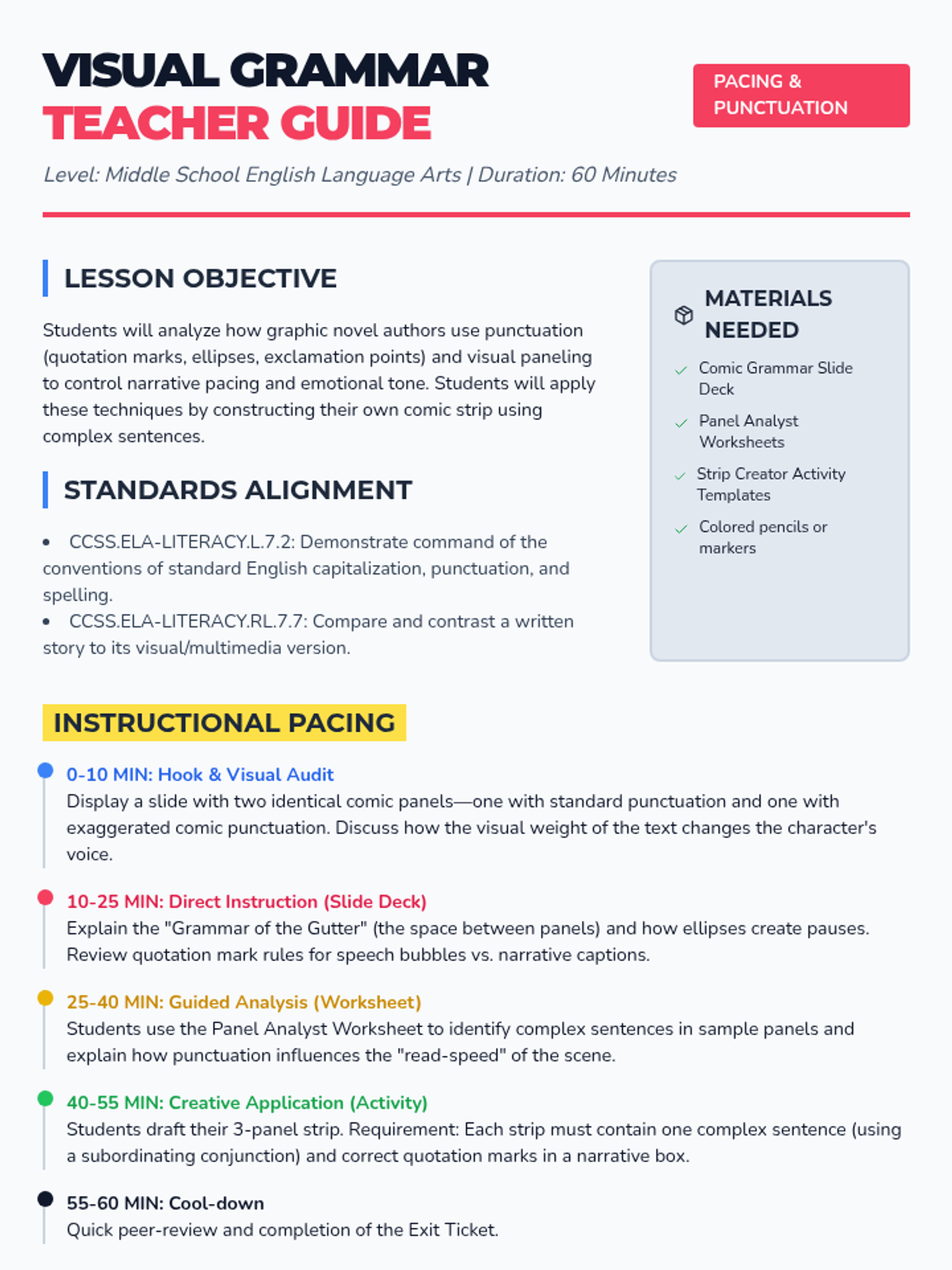
A detailed teacher guide for the 'Panels and Punctuation' lesson, including a timed pacing guide, lesson objectives, and discussion prompts for teaching visual grammar.
A Japanese educational slide deck covering the fundamentals of English sentence structure, including subjects, predicates, fragments, and run-on sentences. It provides all instructional content and explanations in Japanese while maintaining English example sentences for analysis.
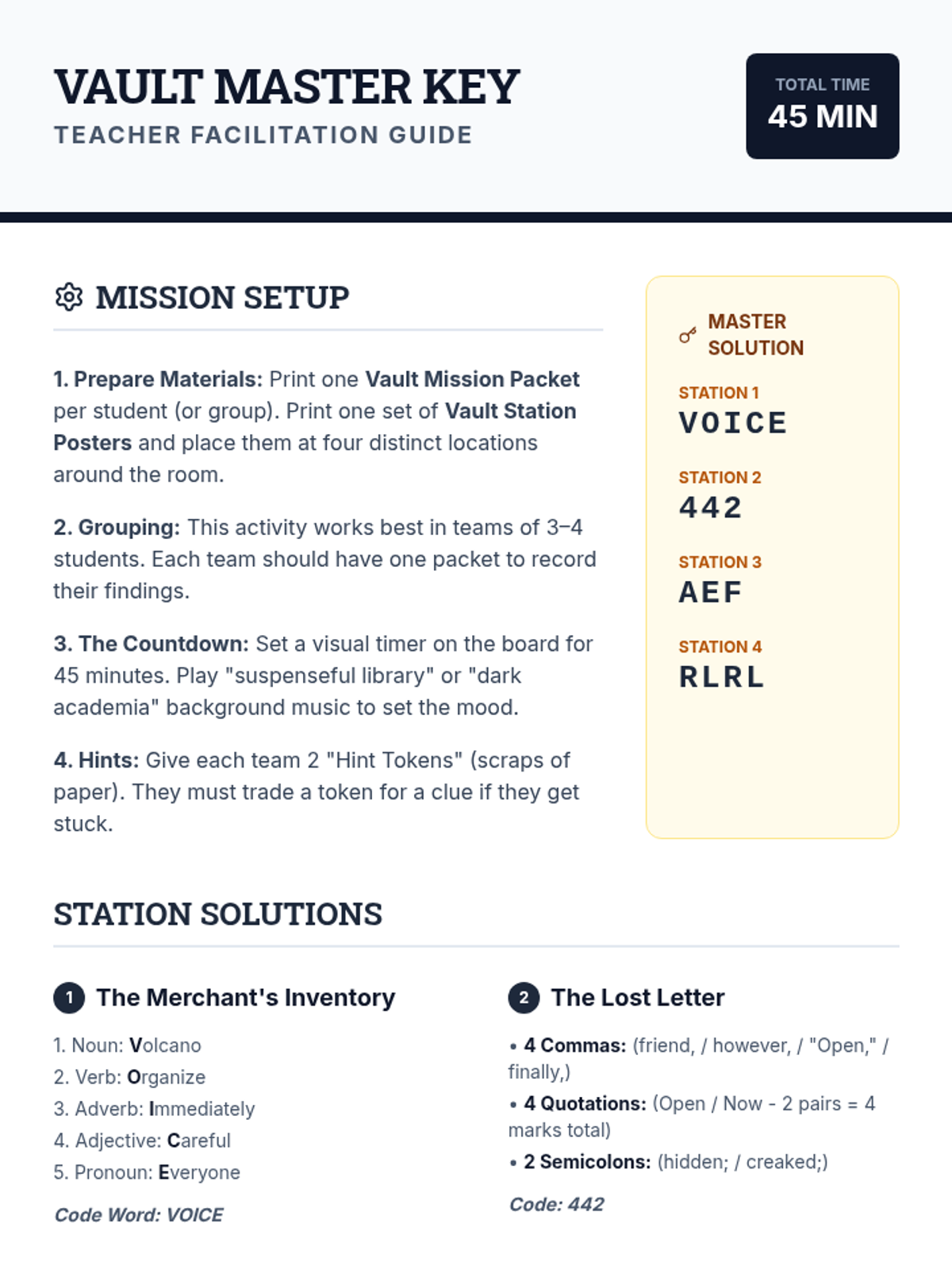
A comprehensive teacher guide for the Grammar Gauntlet escape room, including setup instructions, a master solution key, and detailed breakdowns of each station's puzzle.
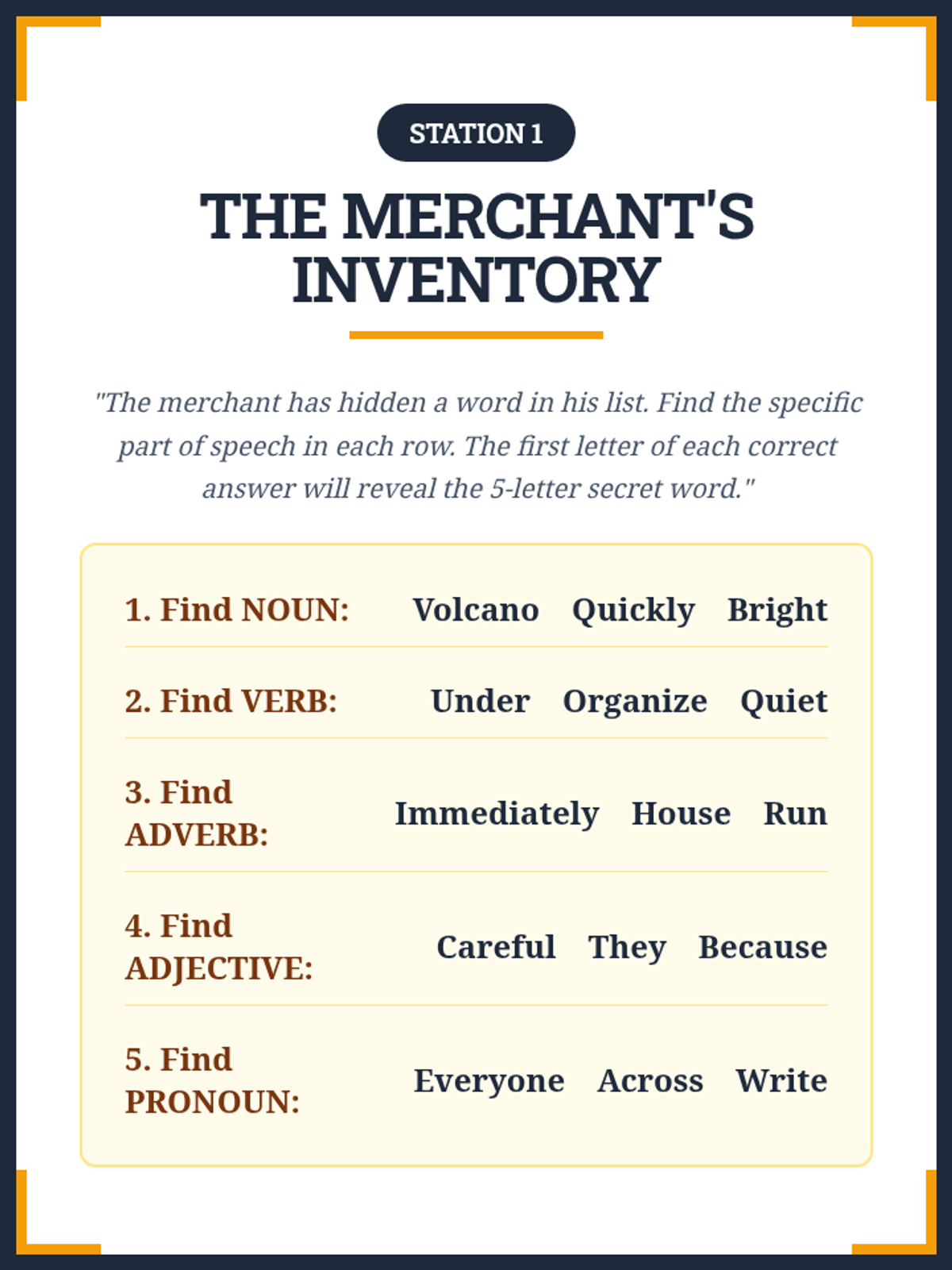
Four immersive grammar station posters designed for the 'Grammar Gauntlet' escape room. Each station focuses on a different skill: parts of speech, punctuation, sentence structure errors, and sentence types. Each station is carefully sized to fit on its own printed page with consistent visual accents.
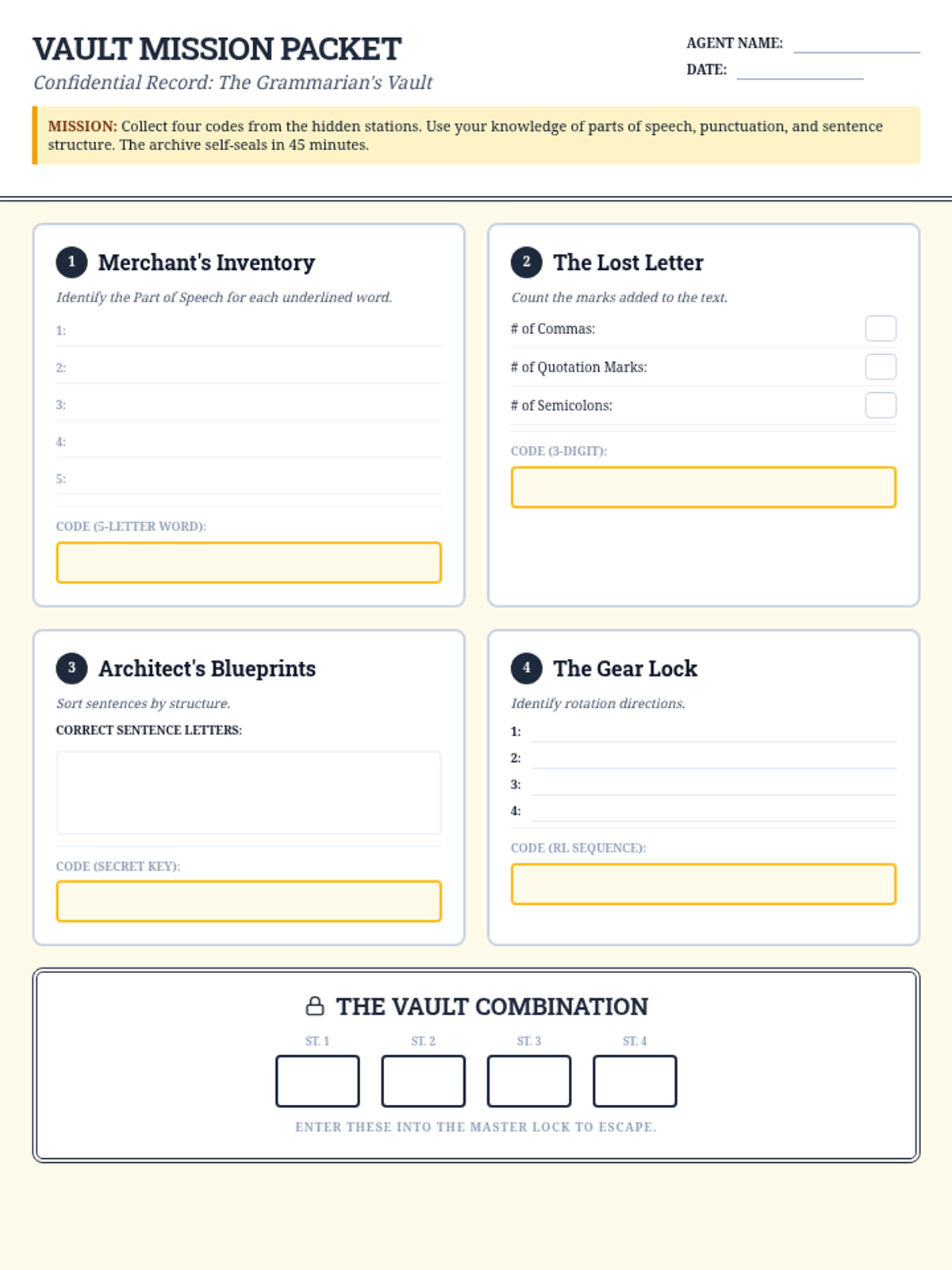
A student-facing mission packet for the Grammar Gauntlet escape room, featuring clear recording areas for each of the four stations and a final vault combination section. It is optimized to fit on a single page.
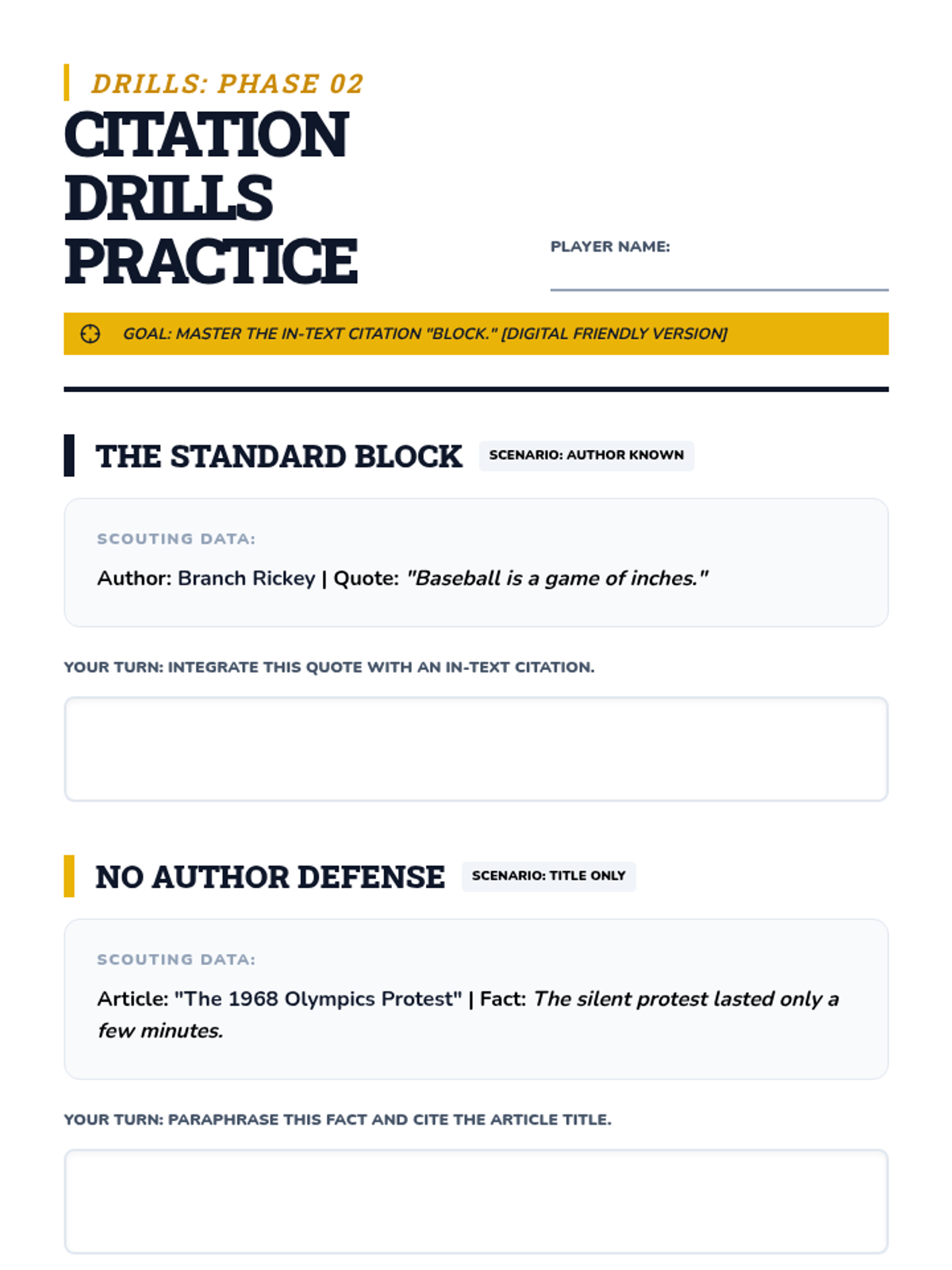
A practice worksheet focused on mastering MLA in-text citations for both authored sources and title-only sources, featuring signal phrase integration.
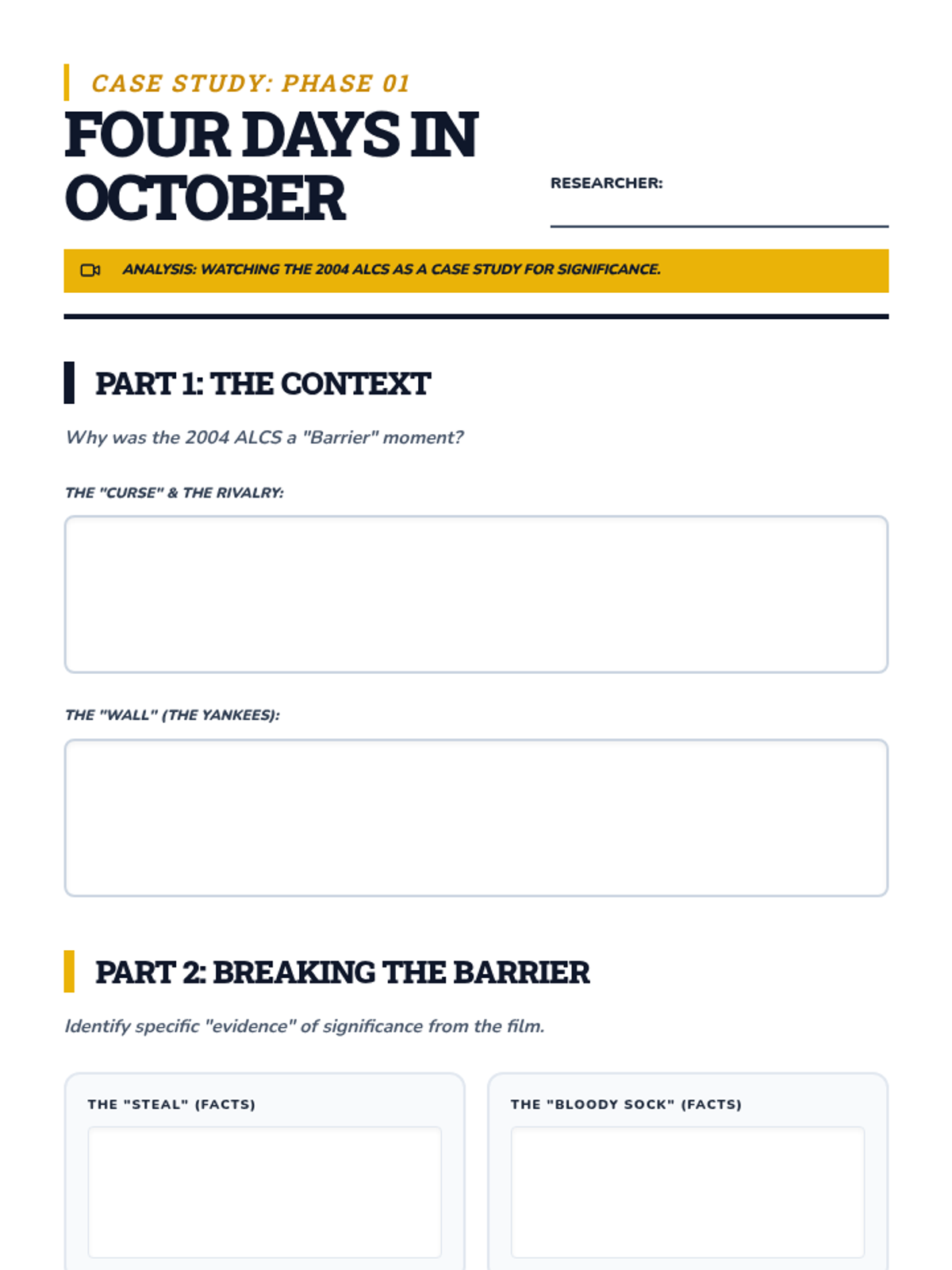
An analysis guide for the 'Four Days in October' documentary, optimized for digital use with large typing boxes instead of lines.
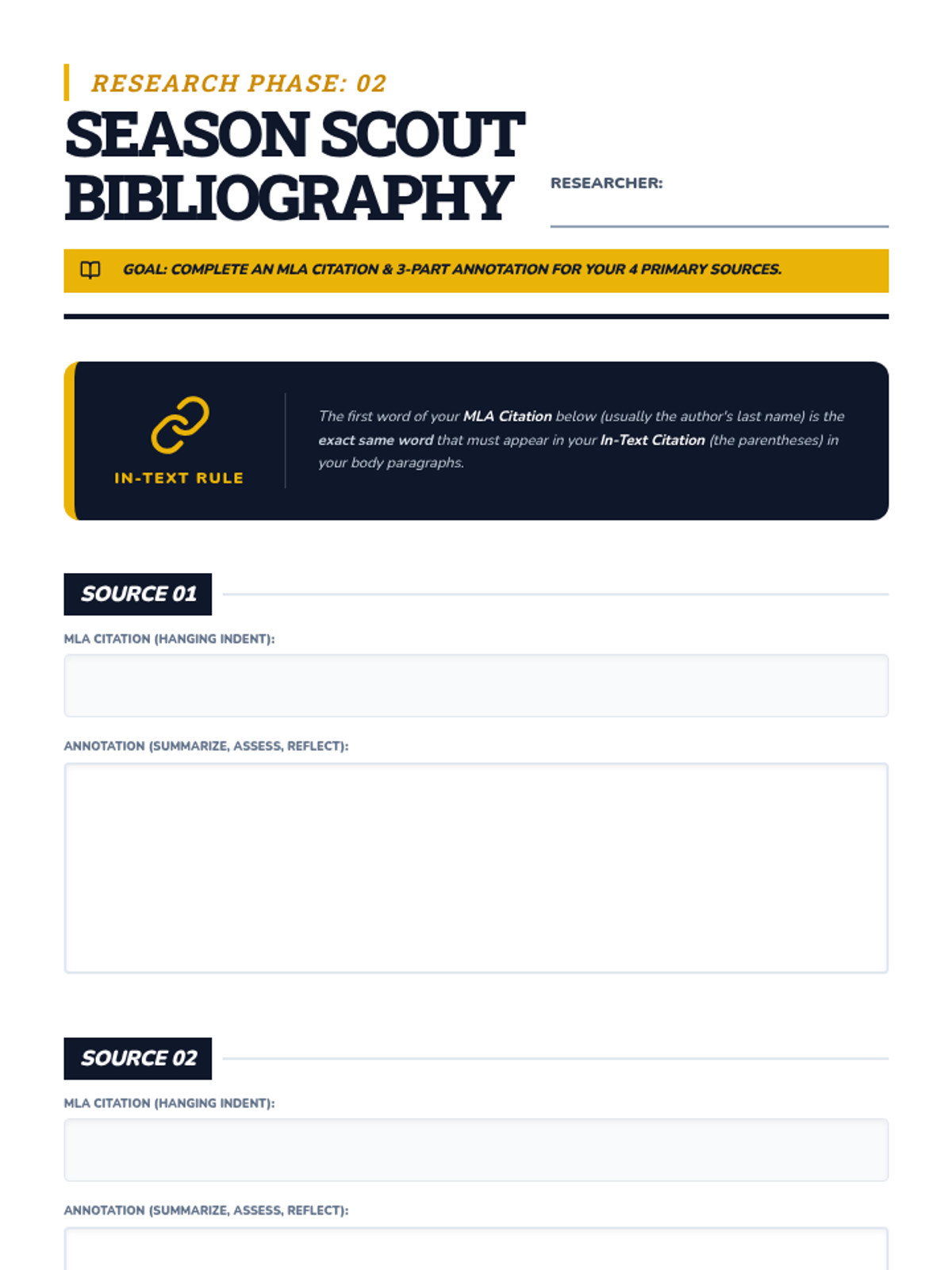
A scaffolded annotated bibliography worksheet for Lesson 2, where students record 4 sources with full MLA citations and three-part annotations (summary, assessment, reflection).
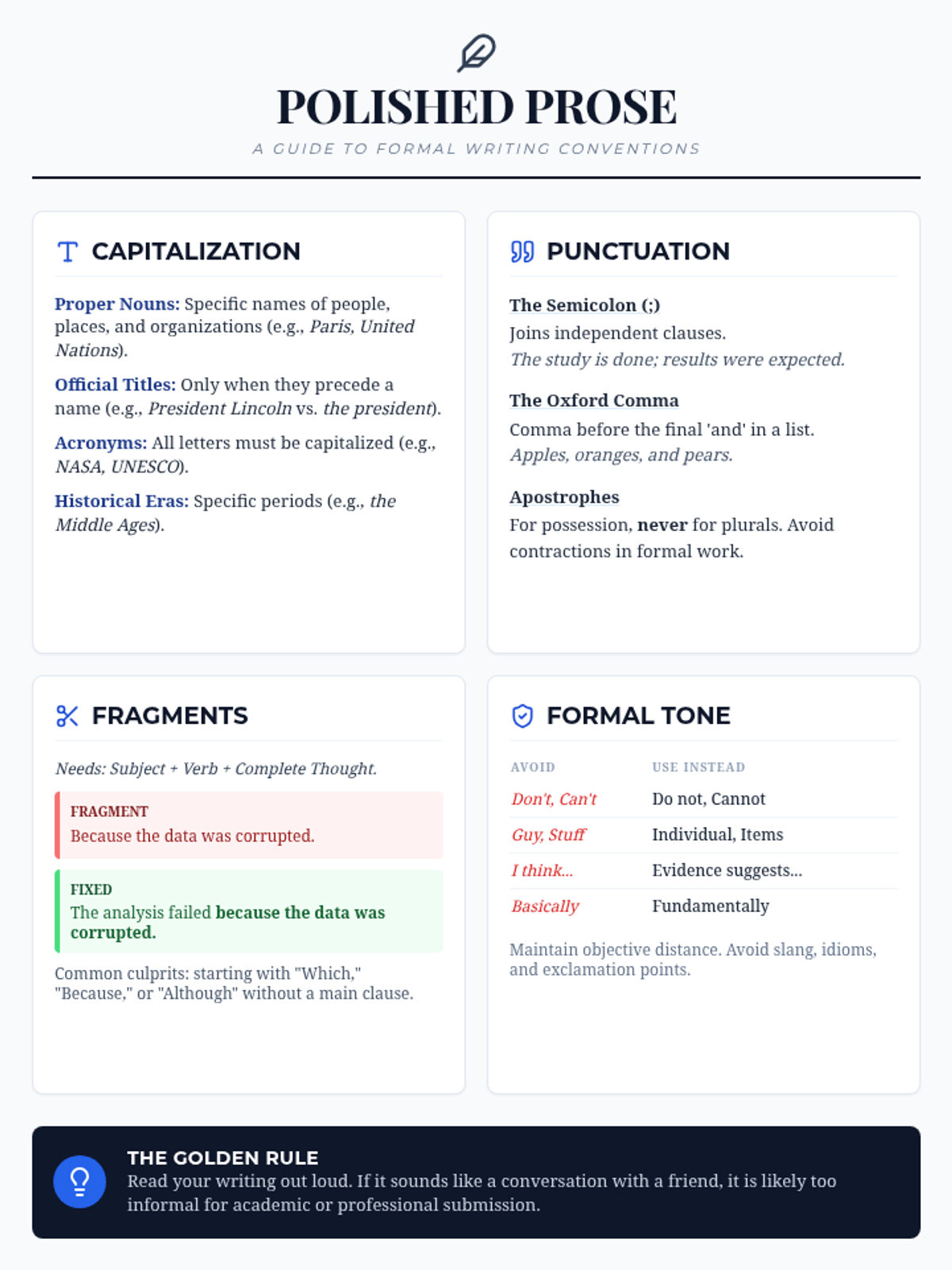
An expanded anchor chart featuring a second page focused on academic articulation. It provides curated lists of formal sentence starters for stating arguments, introducing evidence, and performing deep text analysis, maintaining a professional editorial aesthetic.
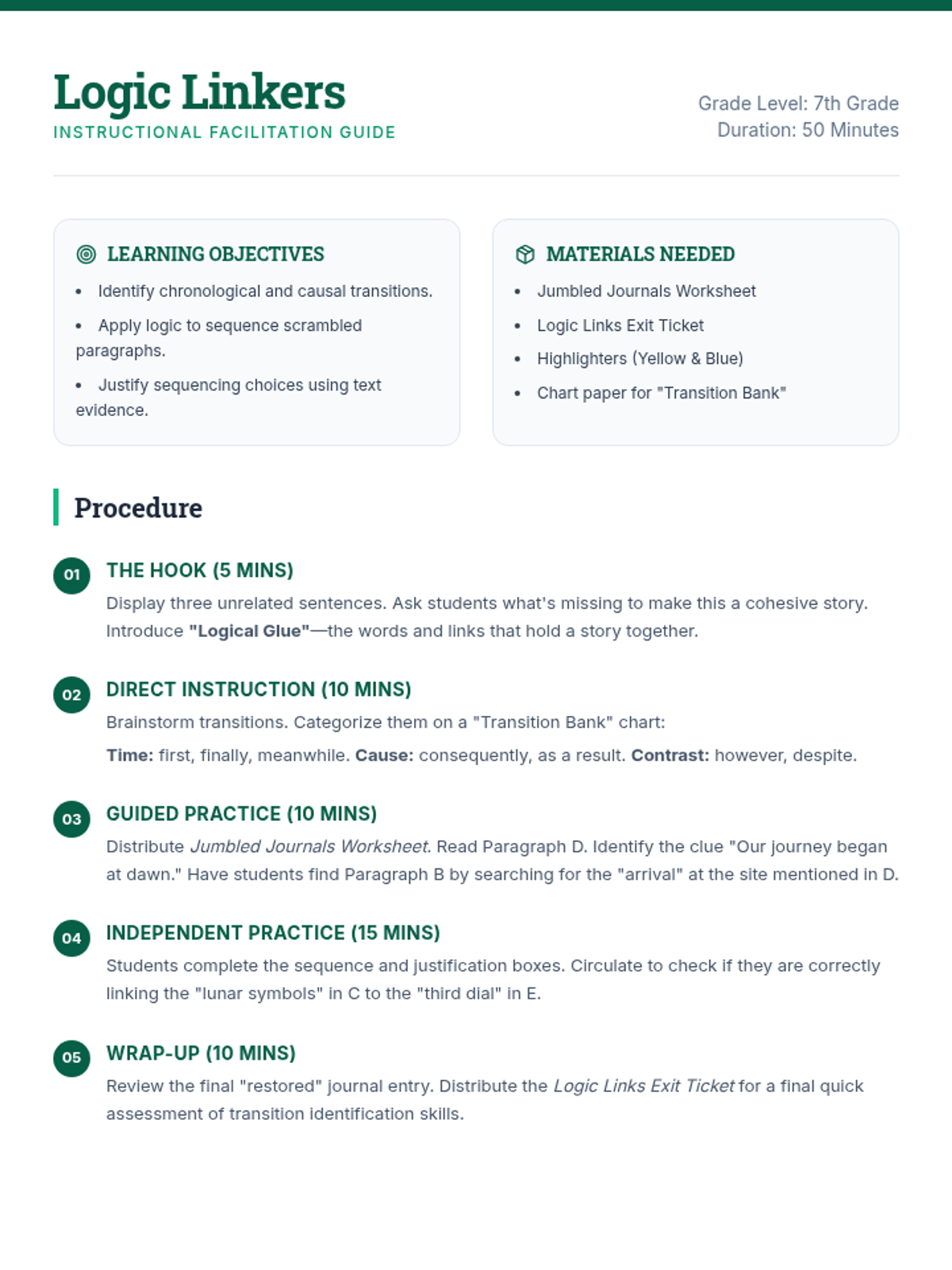
A comprehensive teacher-facing lesson plan for 'Logic Linkers', featuring learning objectives, a detailed 5-phase procedure, differentiation strategies, and common misconceptions.
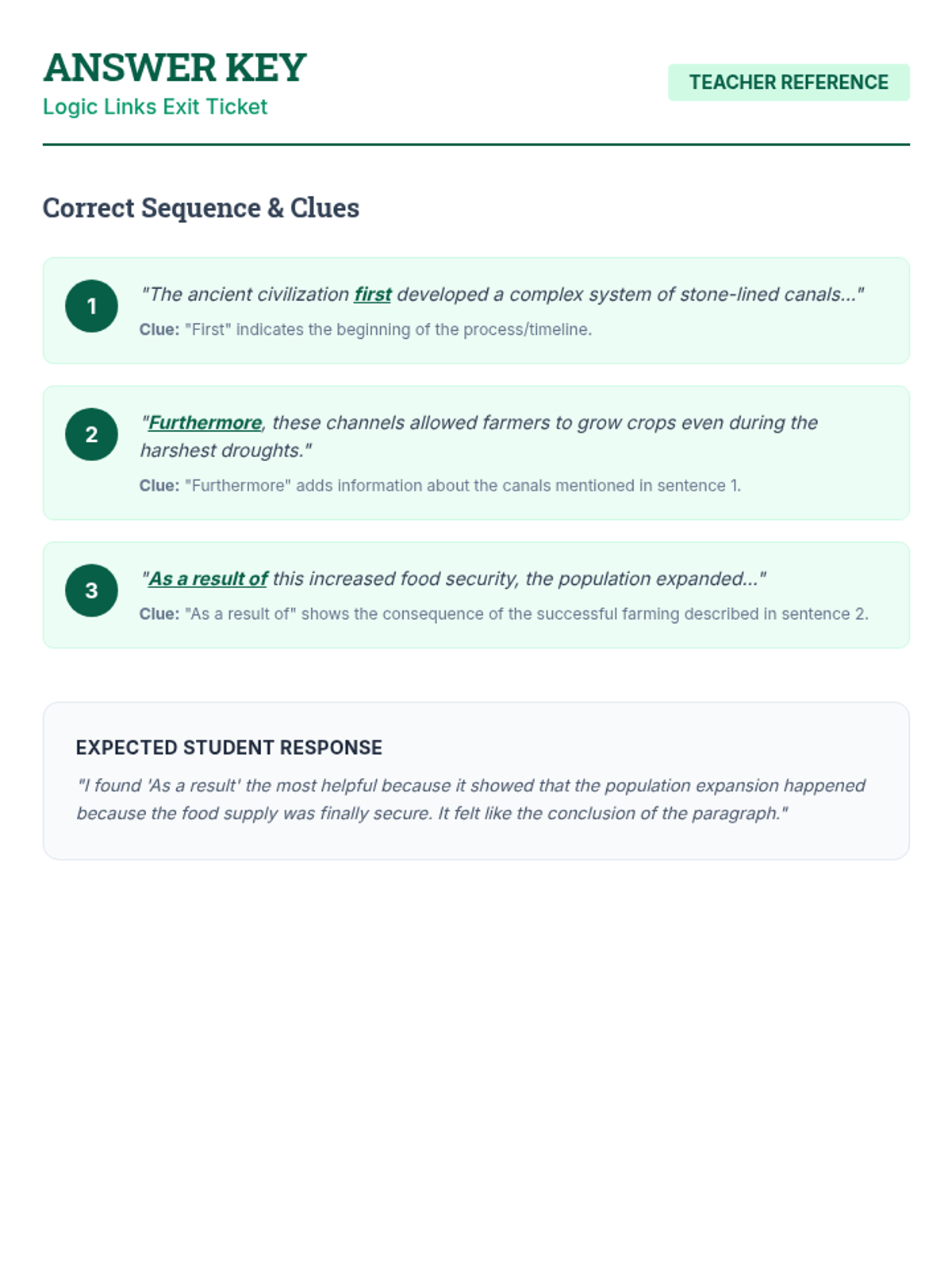
Answer key for the Logic Links Exit Ticket, highlighting the transition words 'first', 'furthermore', and 'as a result of' as sequencing clues.
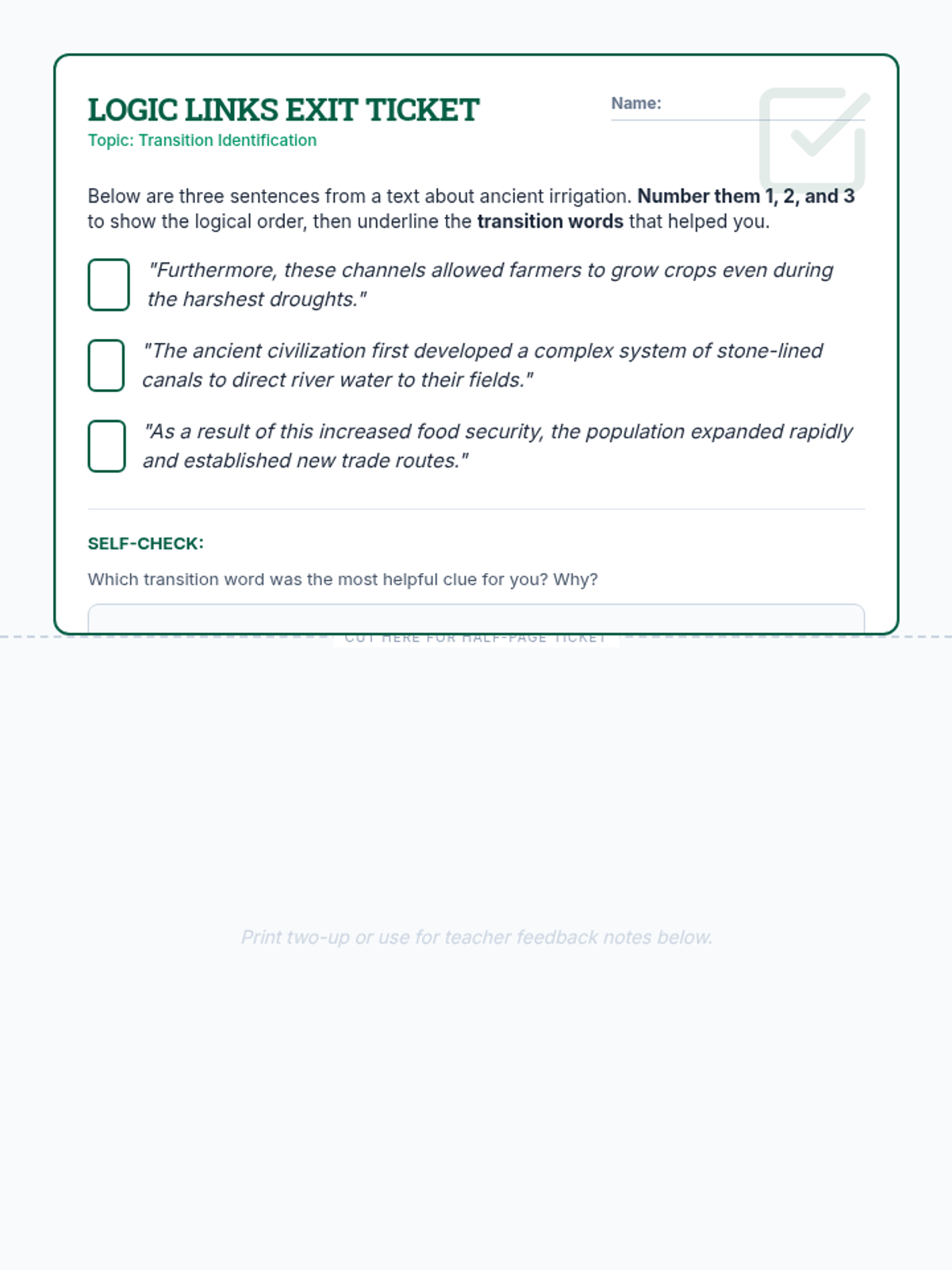
A short exit ticket where students sequence three sentences about ancient irrigation and identify transition words like 'furthermore' and 'as a result'. Includes a cut-line guide for efficient printing.
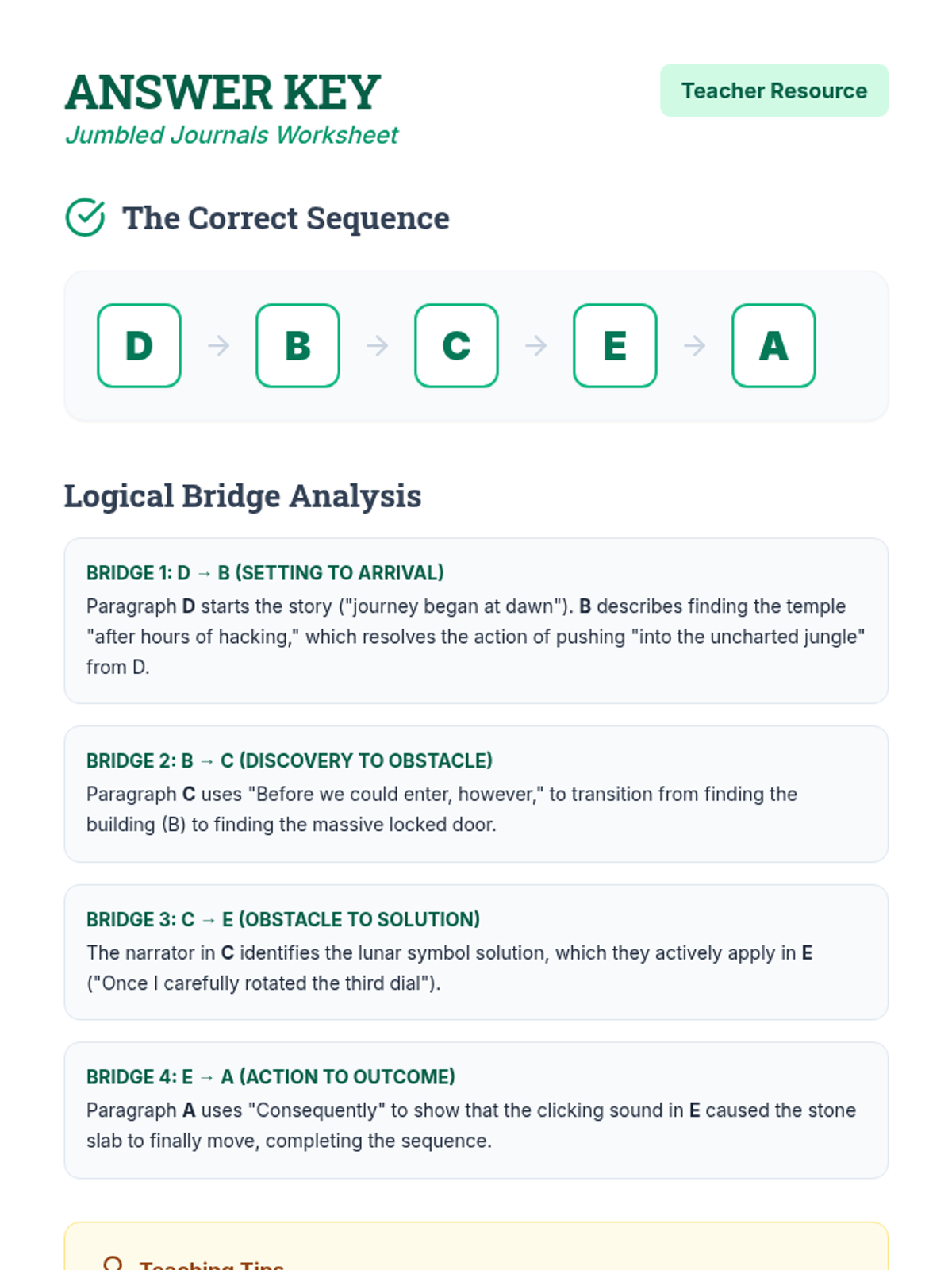
Detailed answer key for the Jumbled Journals worksheet, providing the correct sequence (D-B-C-E-A) and logical explanations for each connection.
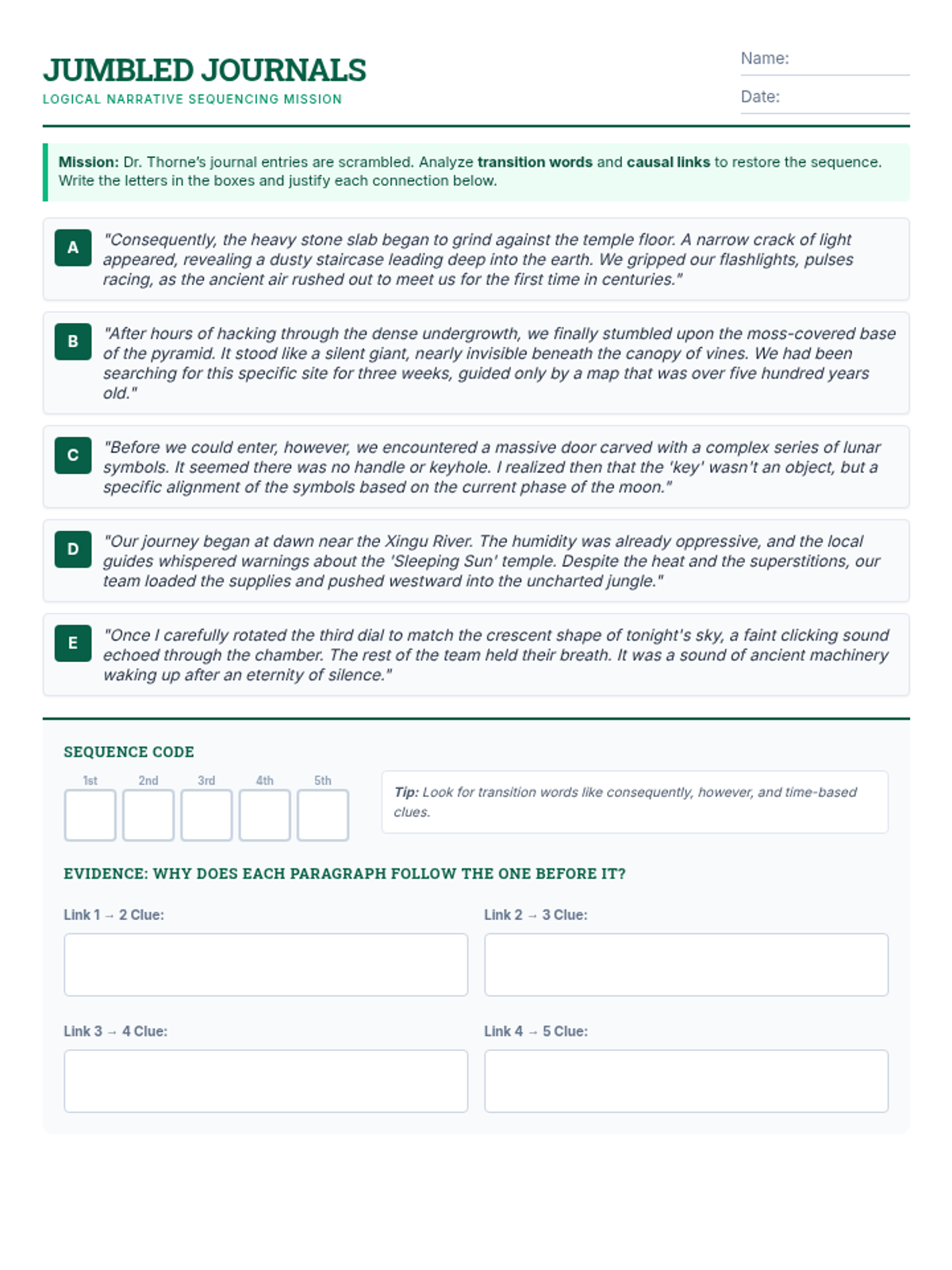
A worksheet where students must reorder five scrambled paragraphs from an explorer's journal by identifying transition words and logical narrative flow.
Slide deck for Lesson 4 focusing on drafting the conclusion, connecting to literary narratives, and preparing for final submission. Includes final assembly instructions and rubric audit drills.
Slide deck for Lesson 3 focusing on drafting the two societal impact paragraphs, analyzing resistance vs. progress, and using evidence to prove change. Includes peer review prep and deep analysis drills.
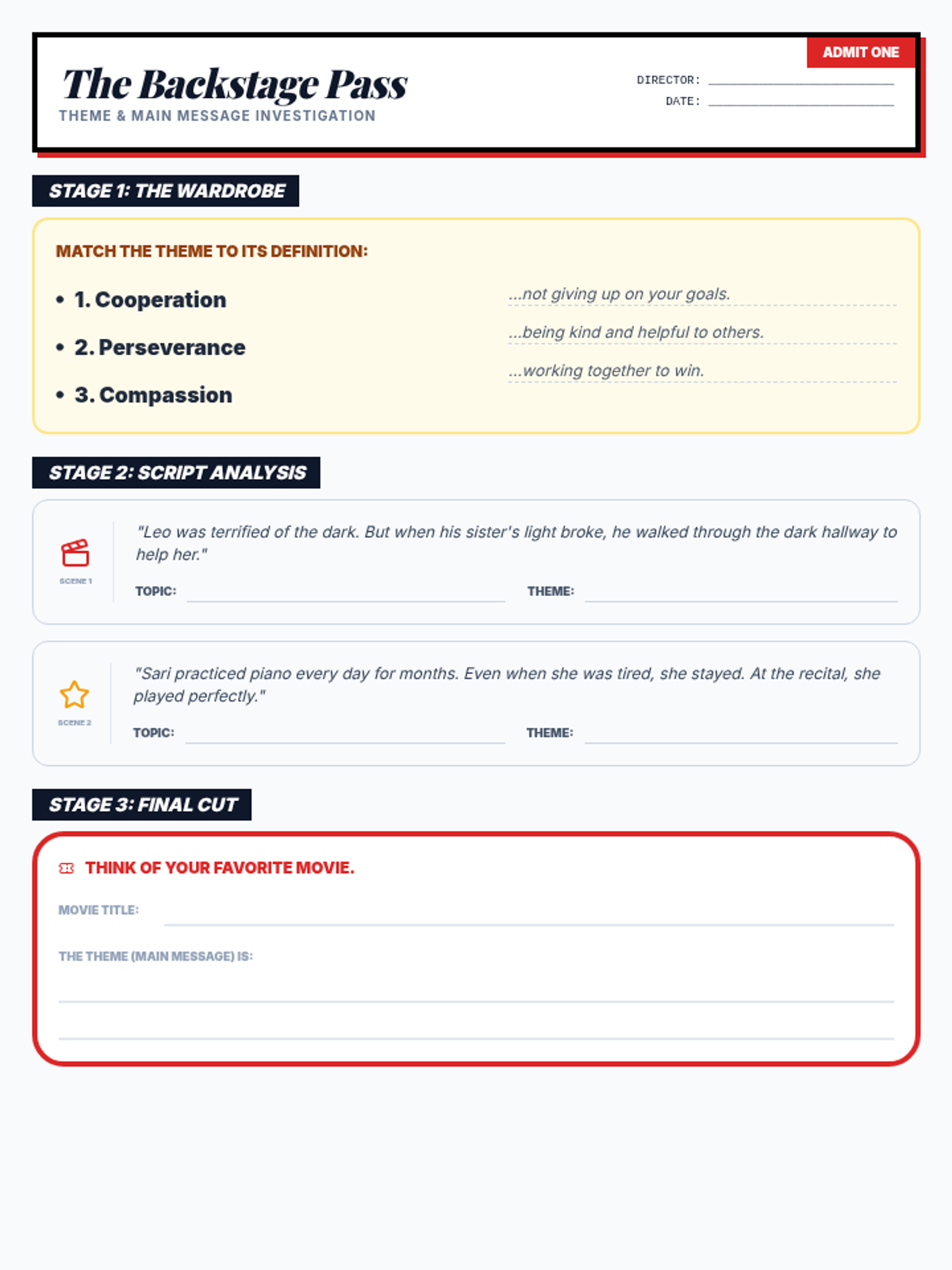
A student worksheet for the Theme Theatre lesson where students practice matching themes to definitions, identifying topics vs. themes in short "Micro-Scripts," and drafting their own theme statements for familiar media.
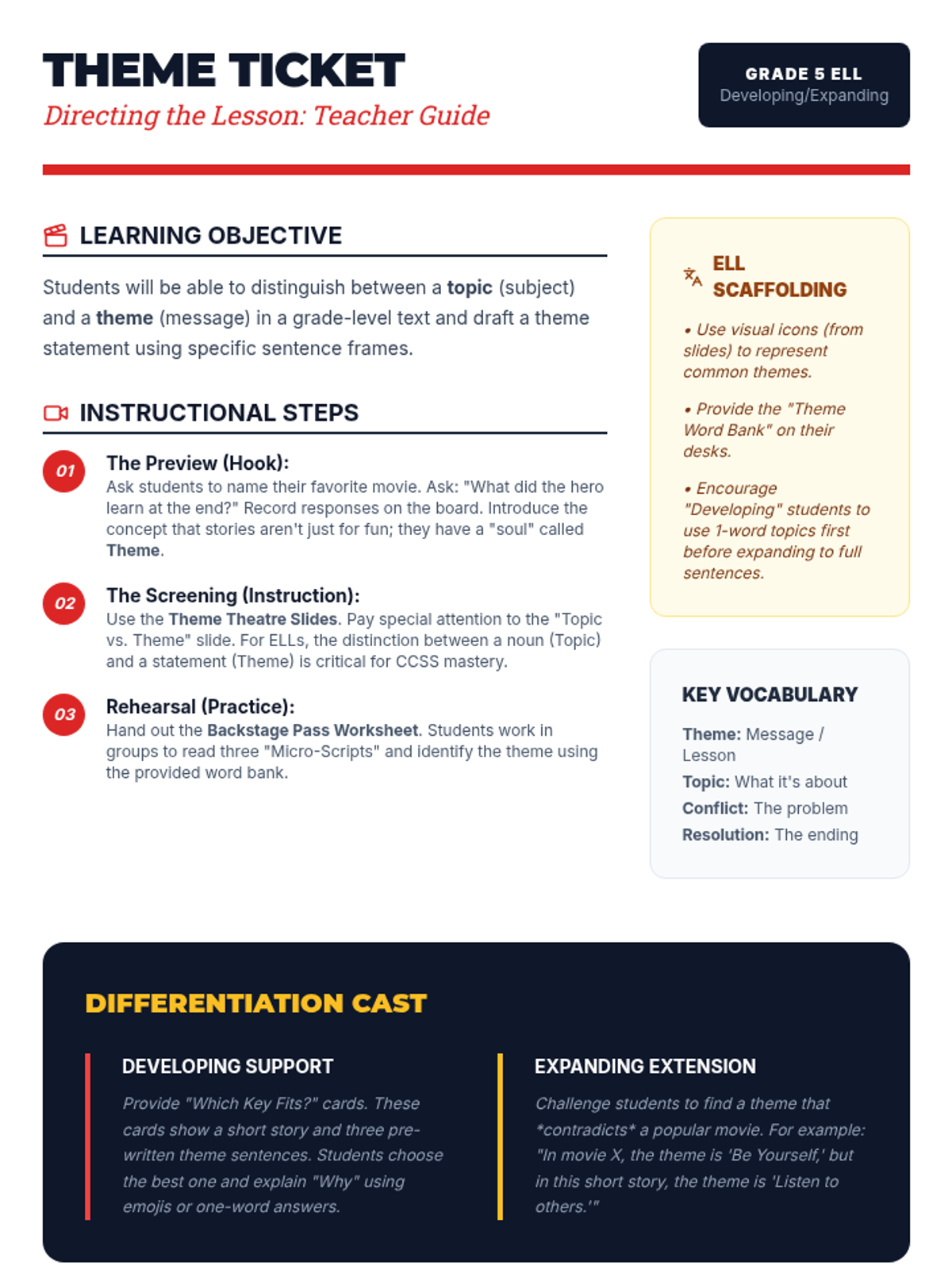
Teacher facilitation guide for the Theme Theatre lesson, providing instructional steps, ELL scaffolding techniques, and differentiation strategies for Grade 5 students.
A visually striking presentation using a "Movie Theatre" theme to teach 5th grade ELL students about identifying themes and distinguishing them from topics. Includes vocabulary support, clues for finding themes, and practice examples.
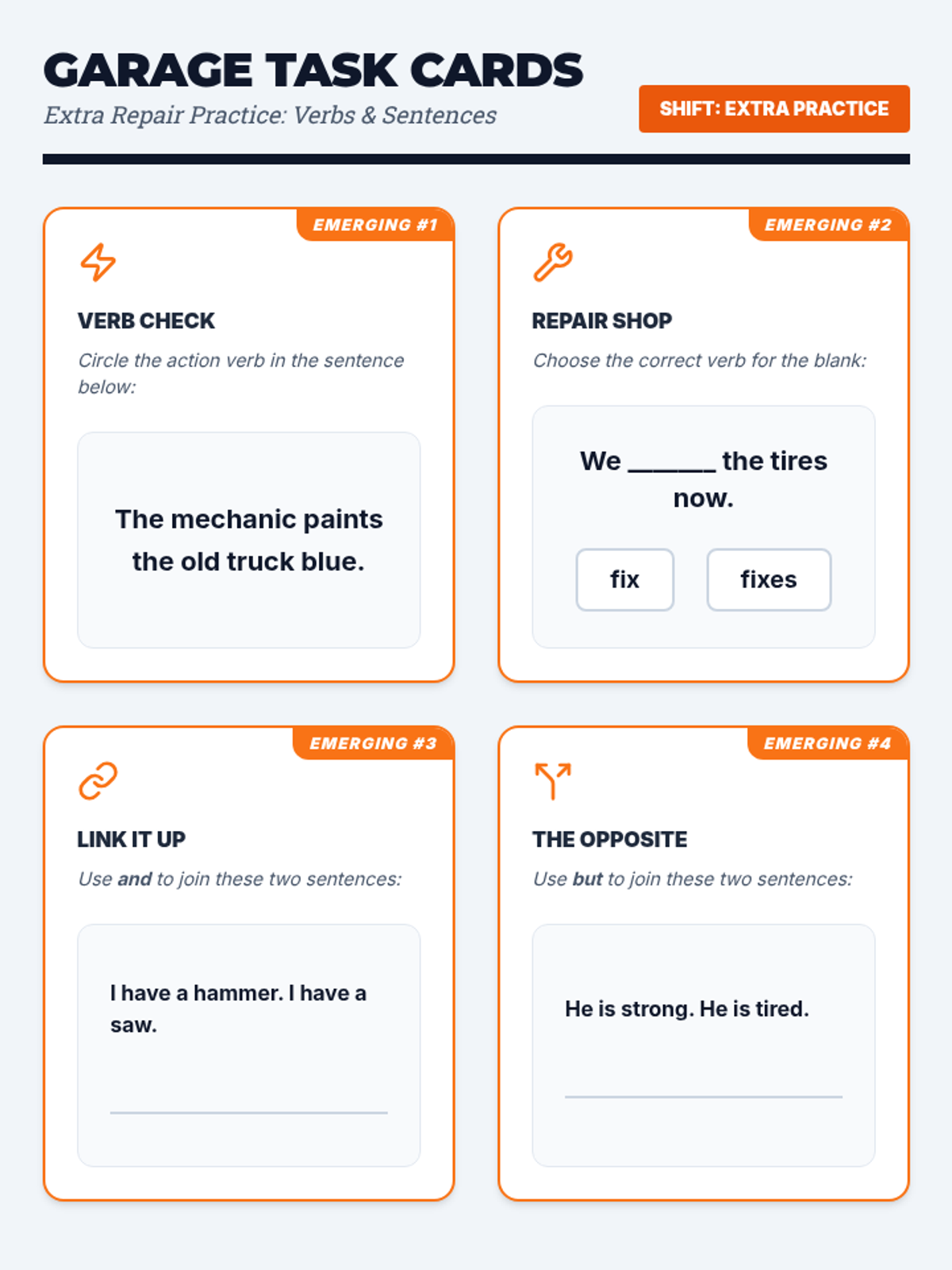
A set of 12 tiered task cards (4 per ELL level) providing extra practice with action verbs, compound sentences, and complex sentences with a Garage theme.
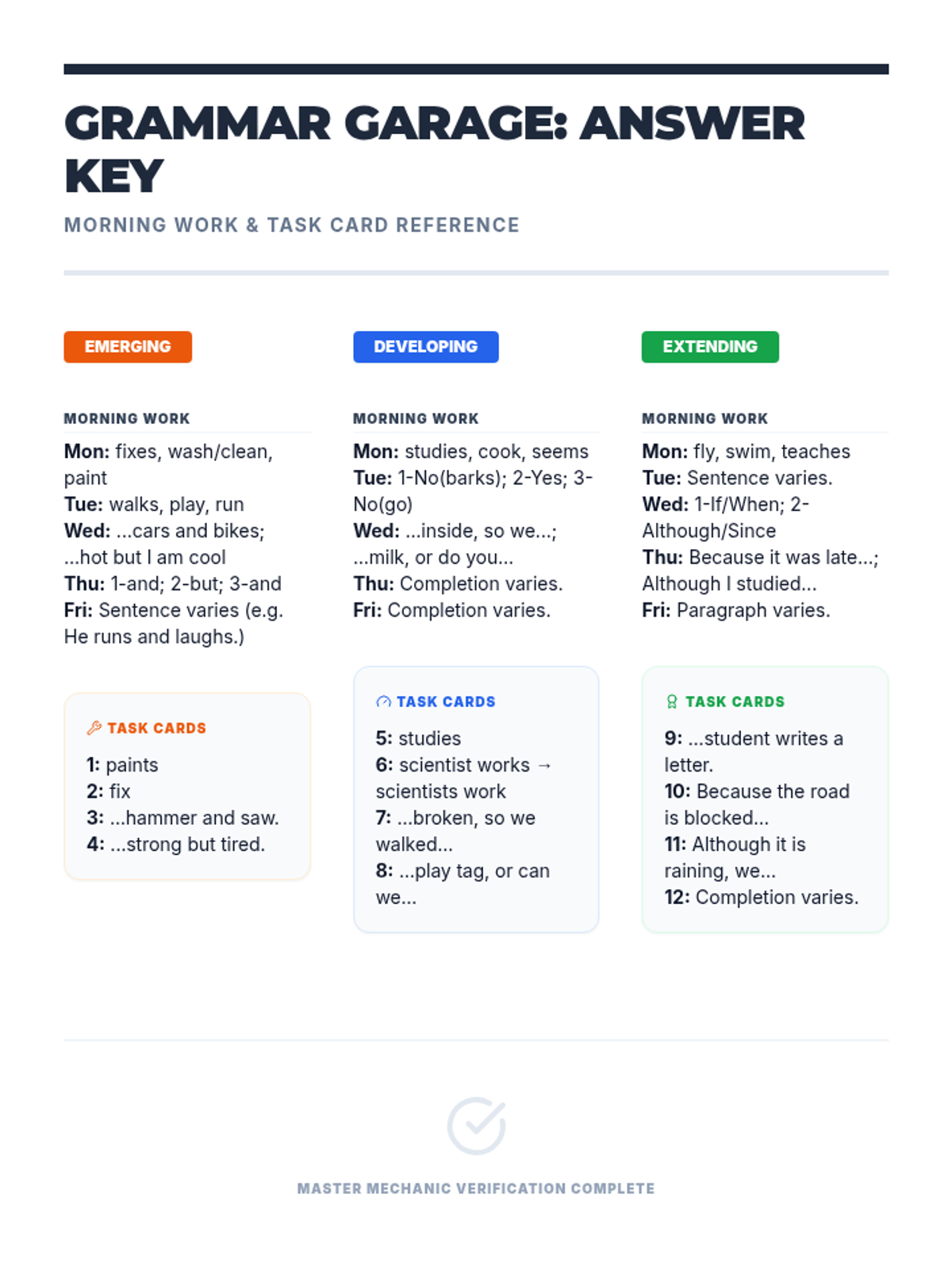
A comprehensive answer key for all three levels of the Grammar Garage morning work series and task cards.
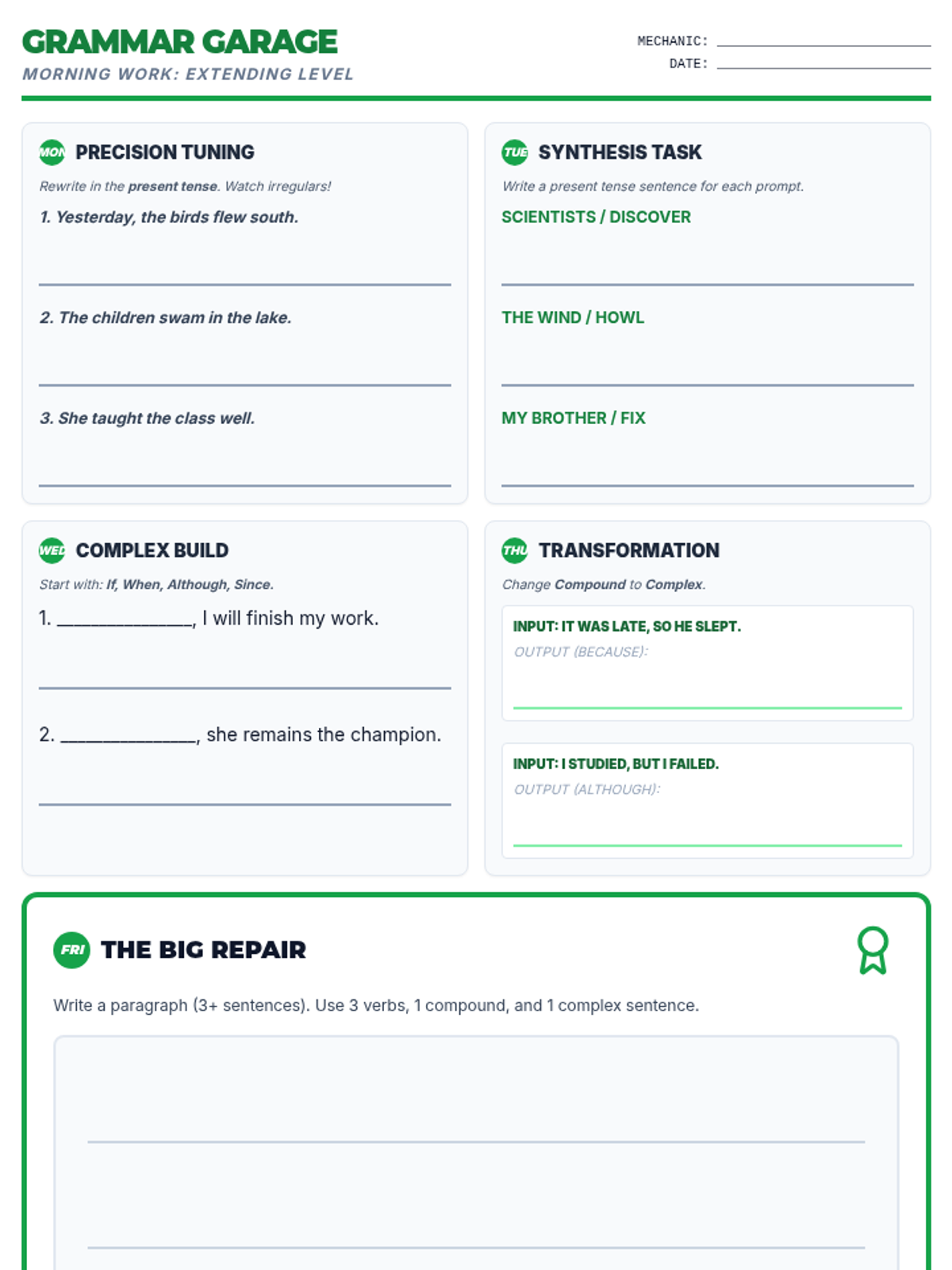
Extending level morning work for ELL students, focusing on irregular present tense verbs, complex sentence construction, and transforming sentence structures.
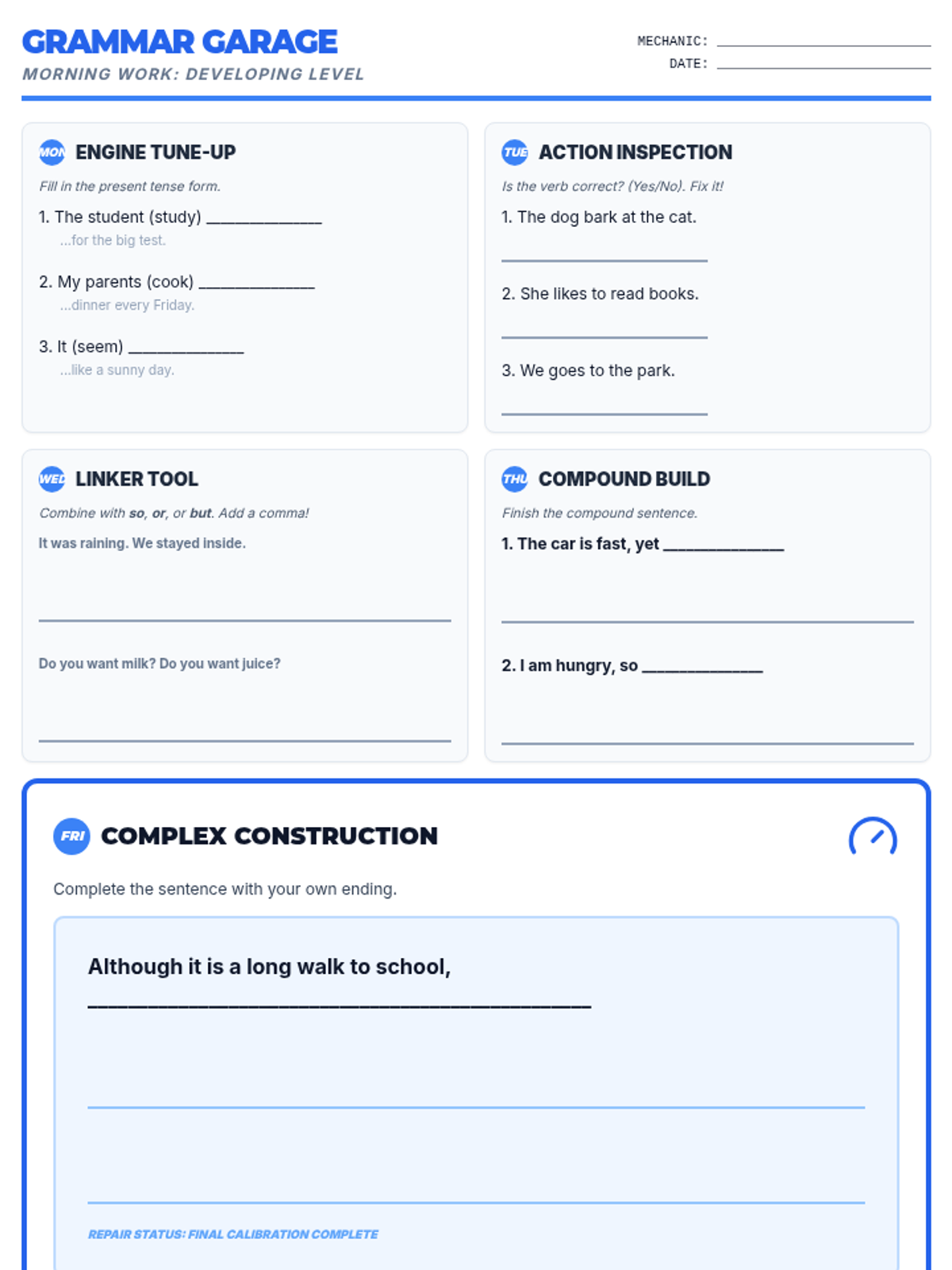
Developing level morning work for ELL students, focusing on subject-verb agreement and compound sentences using FANBOYS, with an introduction to complex sentences.
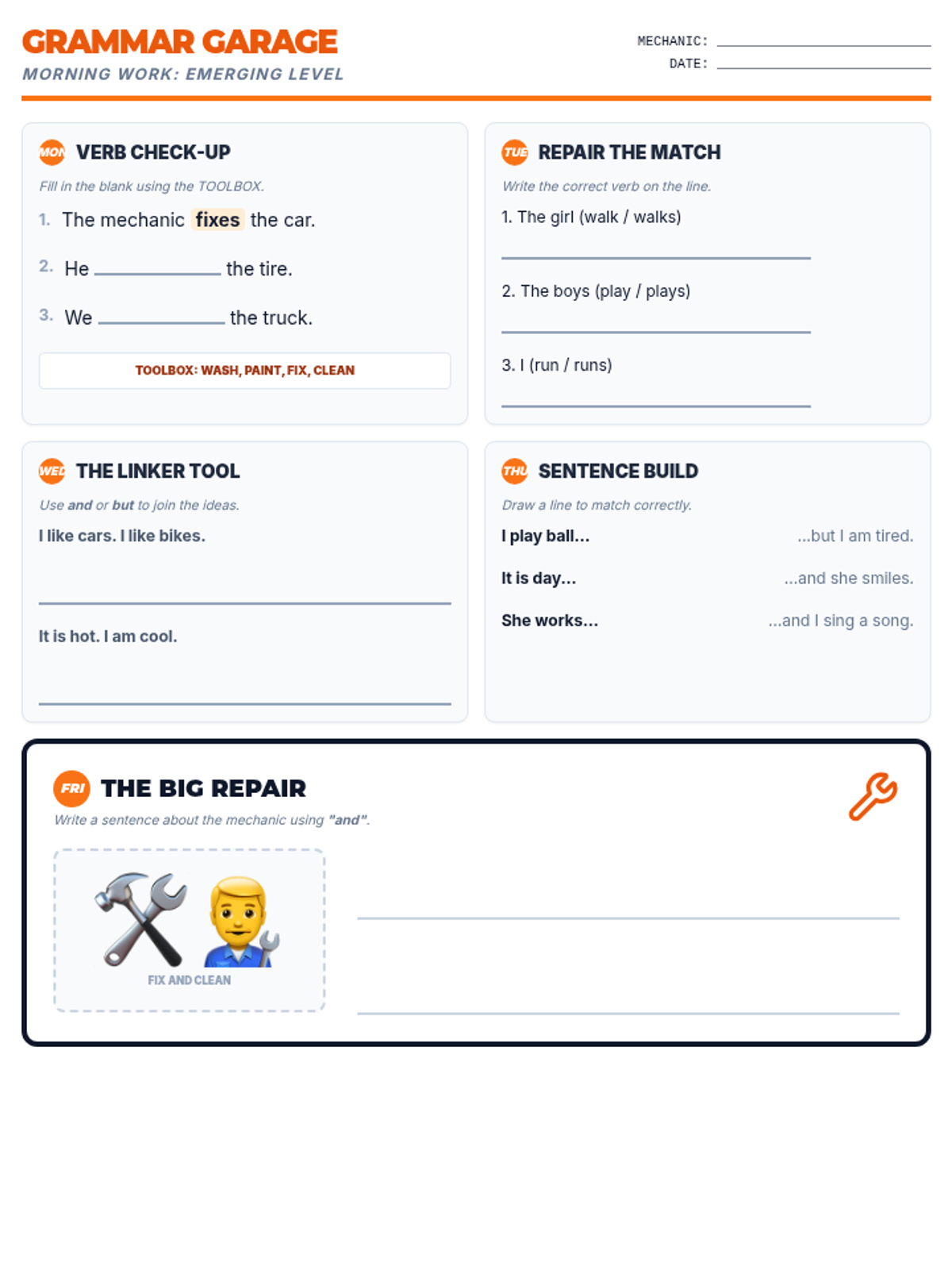
Emerging level morning work for ELL students, focusing on basic present tense action verbs and simple sentence joining with "and/but".
A high-energy presentation for reviewing verbs, compound sentences, and complex sentences with a garage theme. Suitable for 5th grade ELL students.
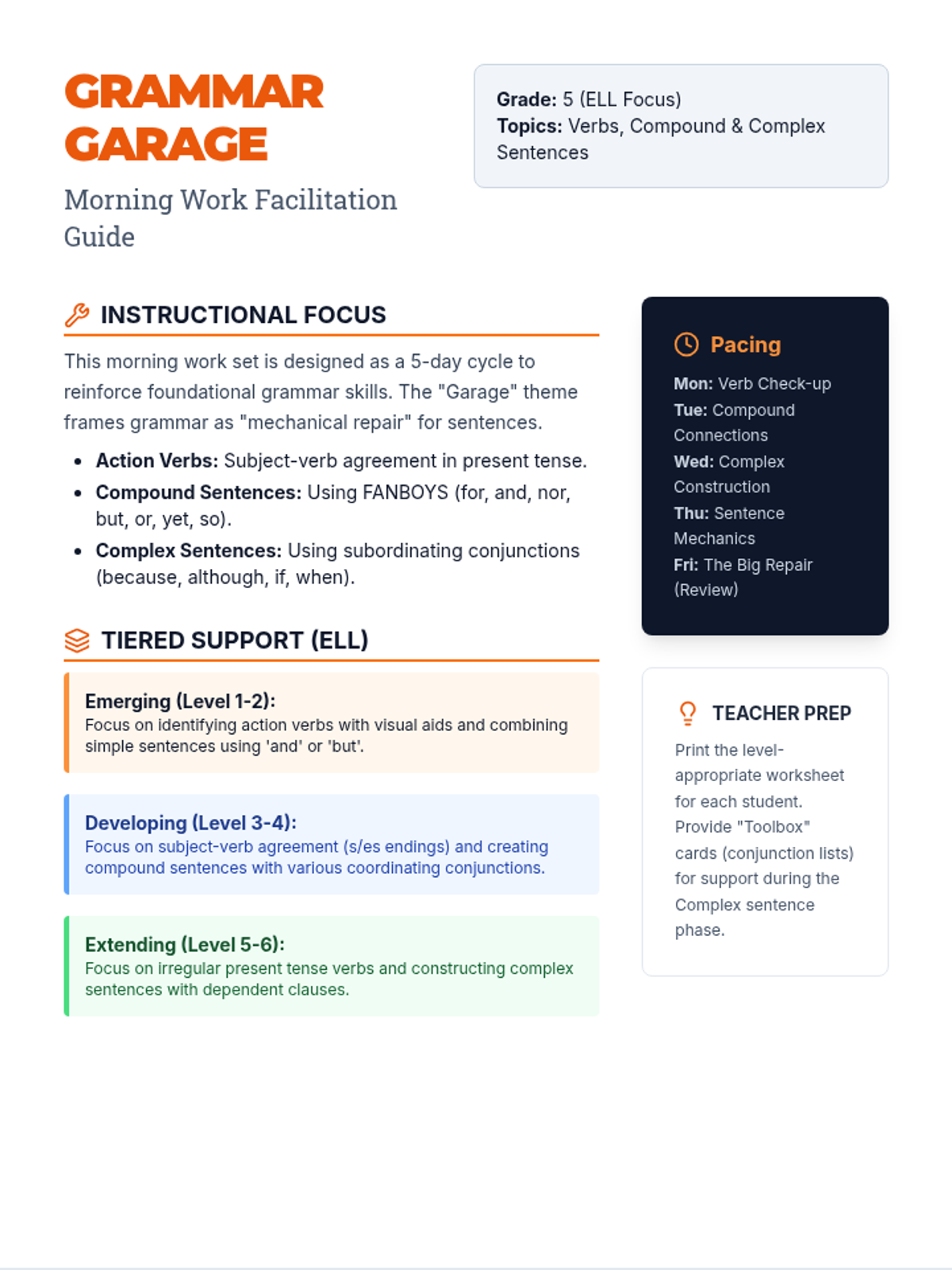
Teacher guide for the Grammar Garage morning work series, outlining differentiation strategies for Emerging, Developing, and Extending ELL students.
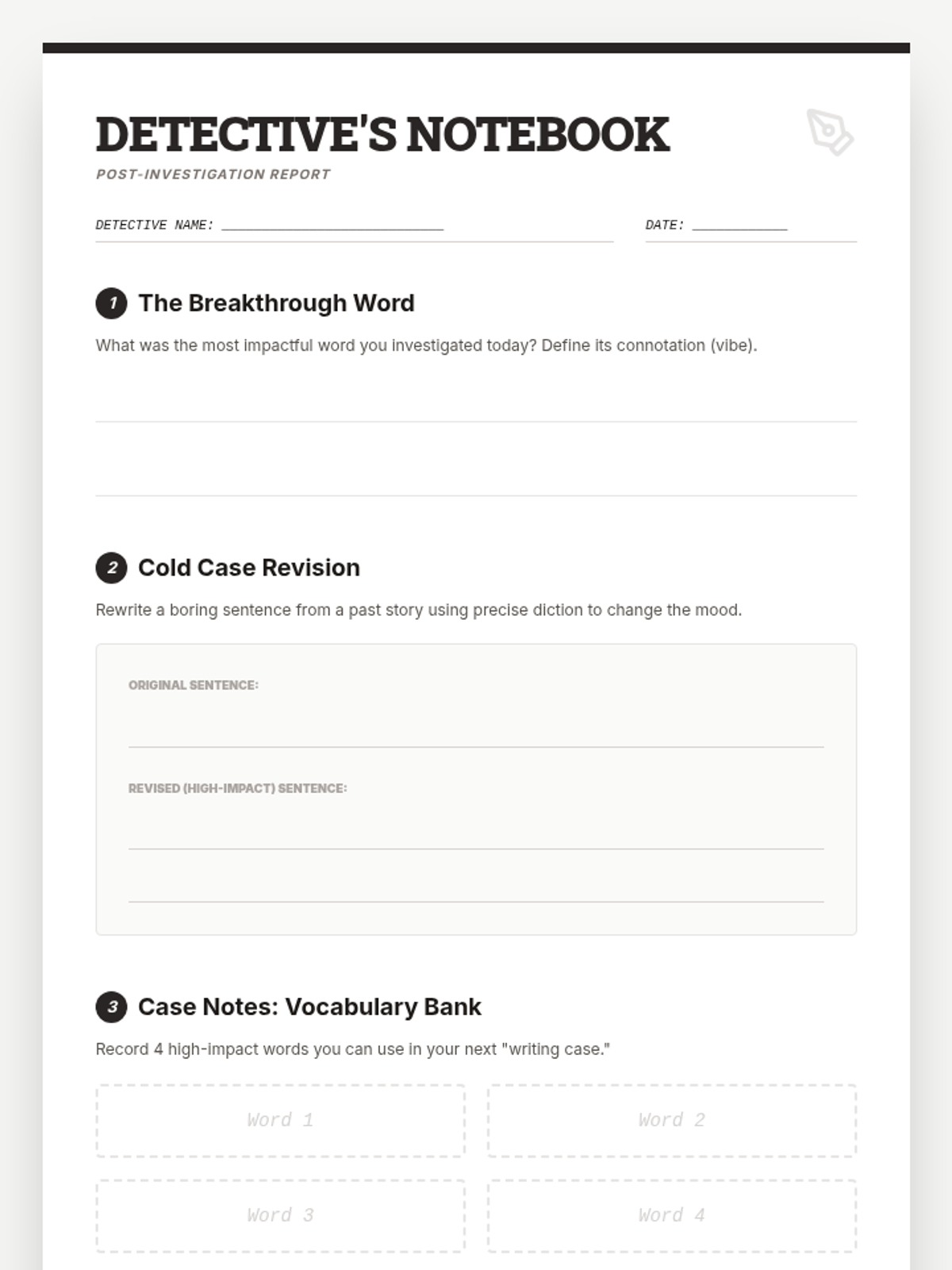
A reflection journal for students to document new vocabulary, revise previous writing using improved diction, and reflect on the importance of word choice in storytelling.
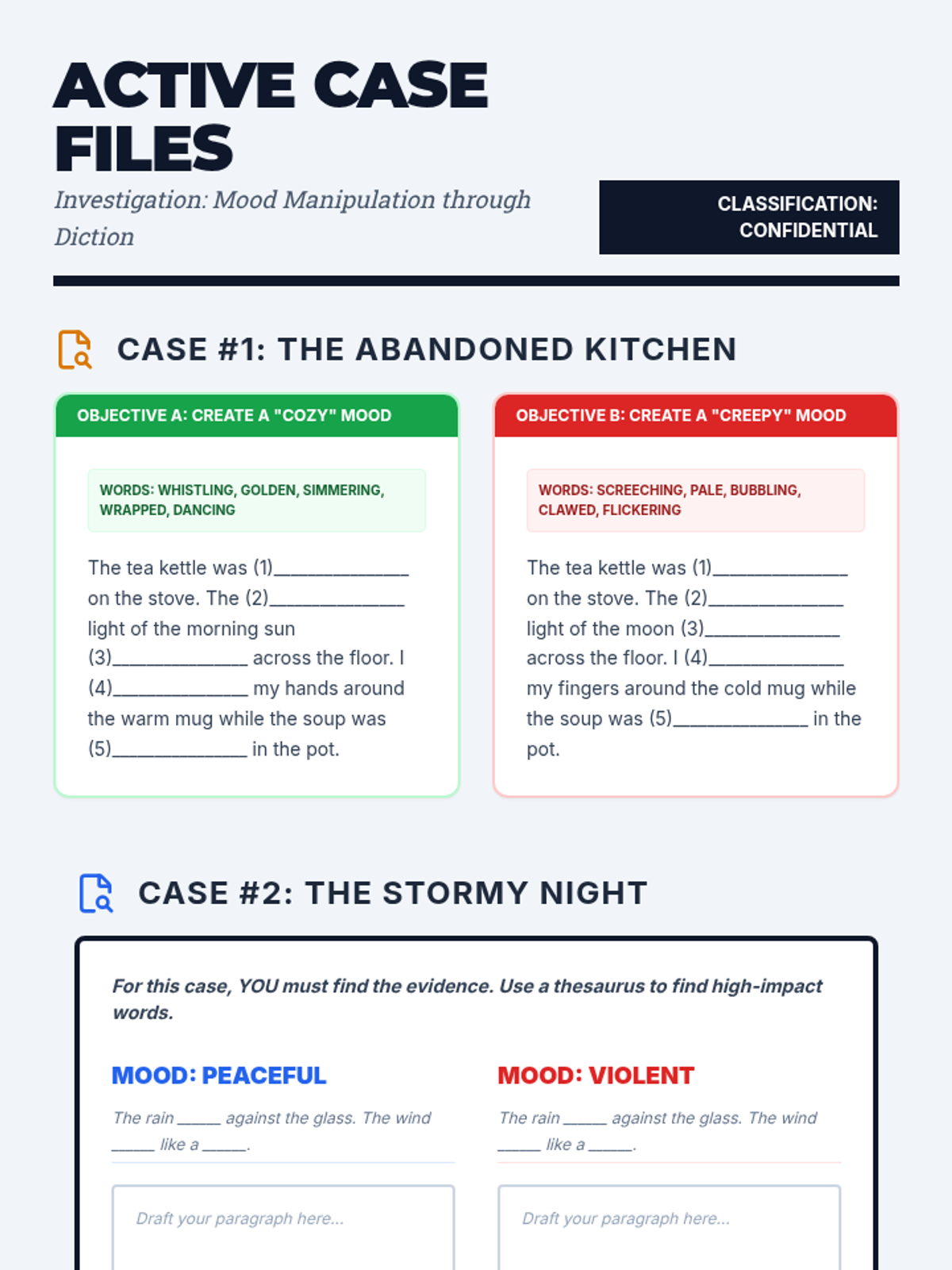
A "Case Files" activity where students use word banks and thesauruses to manipulate the mood of a scene. They practice applying different sets of diction to the same narrative structure to see the immediate emotional impact.
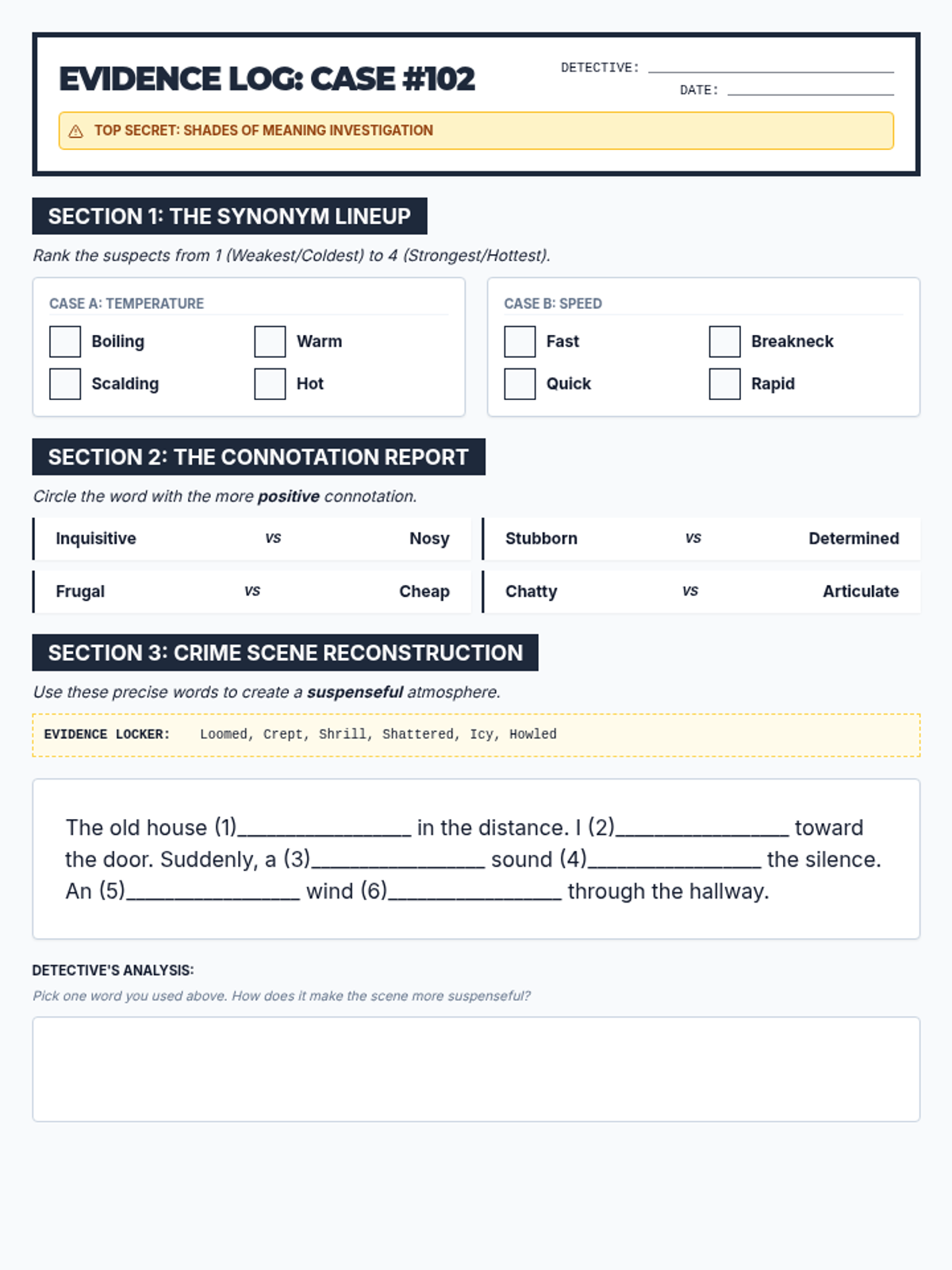
A student worksheet designed as an "Evidence Log" where students practice ranking synonyms by intensity, identifying connotations, and replacing dull verbs with precise diction to create suspense.
A visually engaging presentation using a detective/noir theme to teach 5th and 6th graders about diction, connotation, and word intensity. Includes clear examples and an intensity scale visualization.
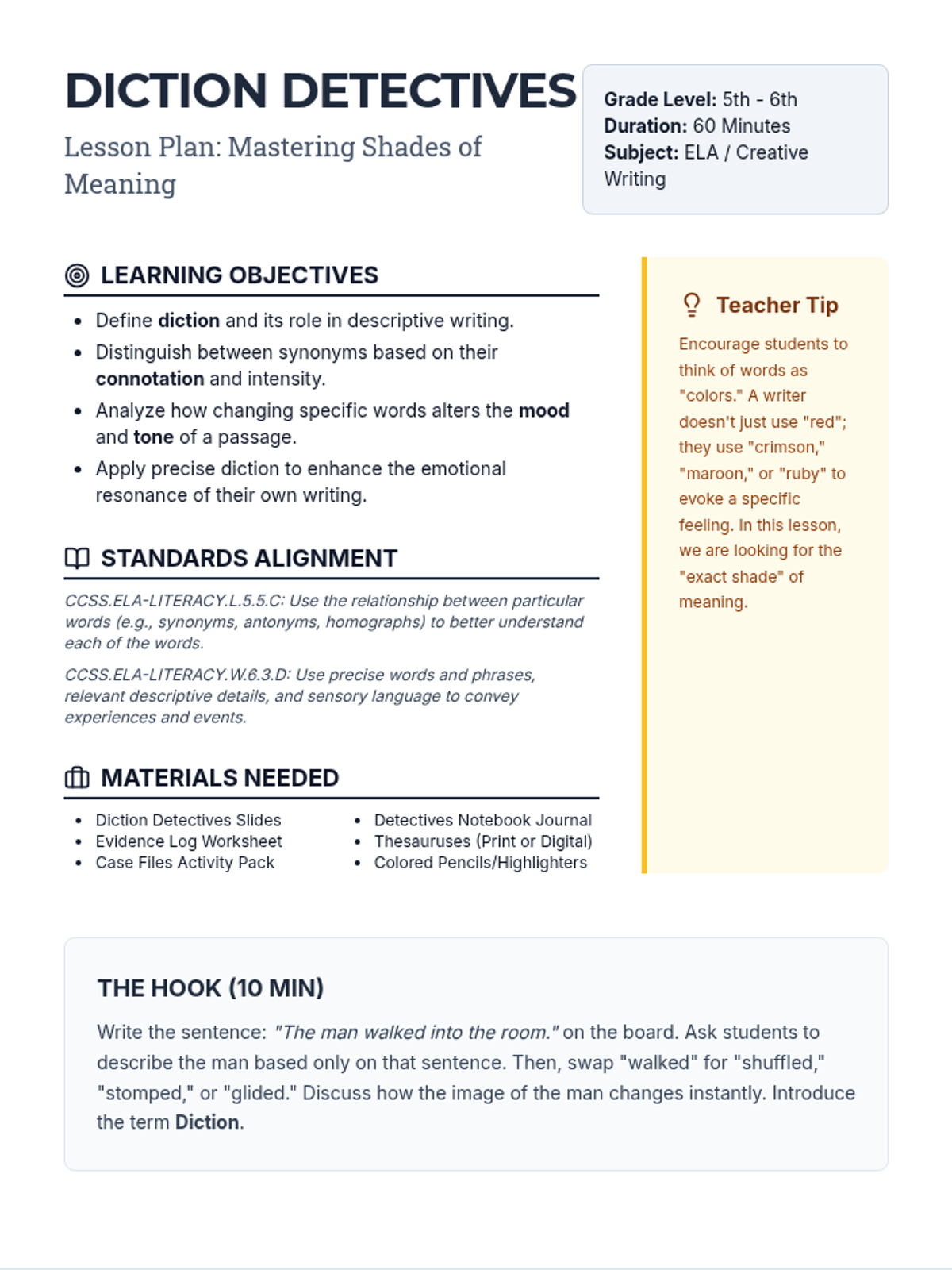
A comprehensive teacher guide for the Diction Detectives lesson, including learning objectives, CCSS alignment, a minute-by-minute instructional sequence, and differentiation strategies for 5th and 6th grade ELA.
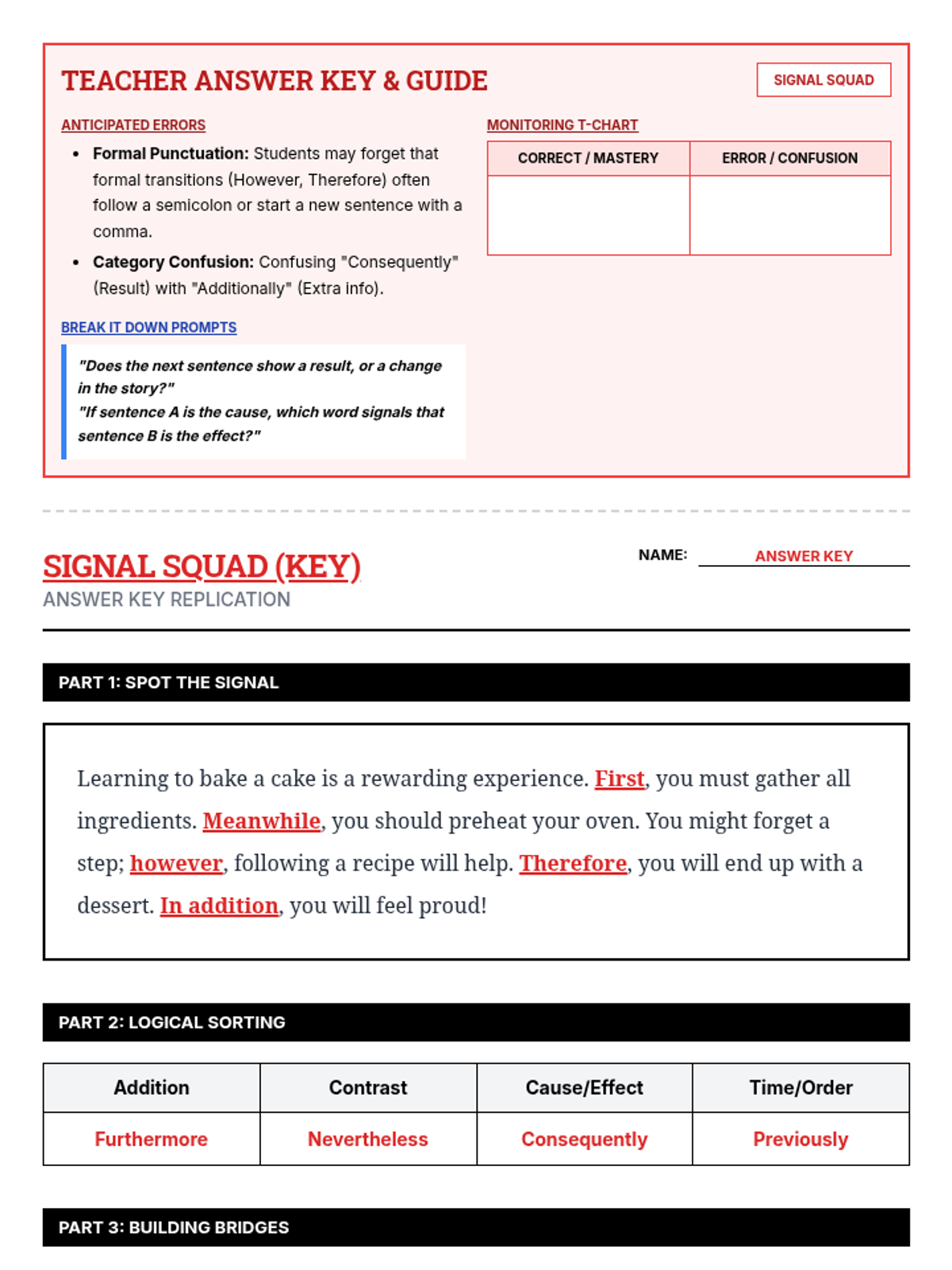
A comprehensive answer key for the Signal Squad handout. Includes teacher scaffolding with interrogative 'Break it down' prompts and marks challenging items with a star. Revised to exclude FANBOYS and fix spacing/fragment issues identified in review.
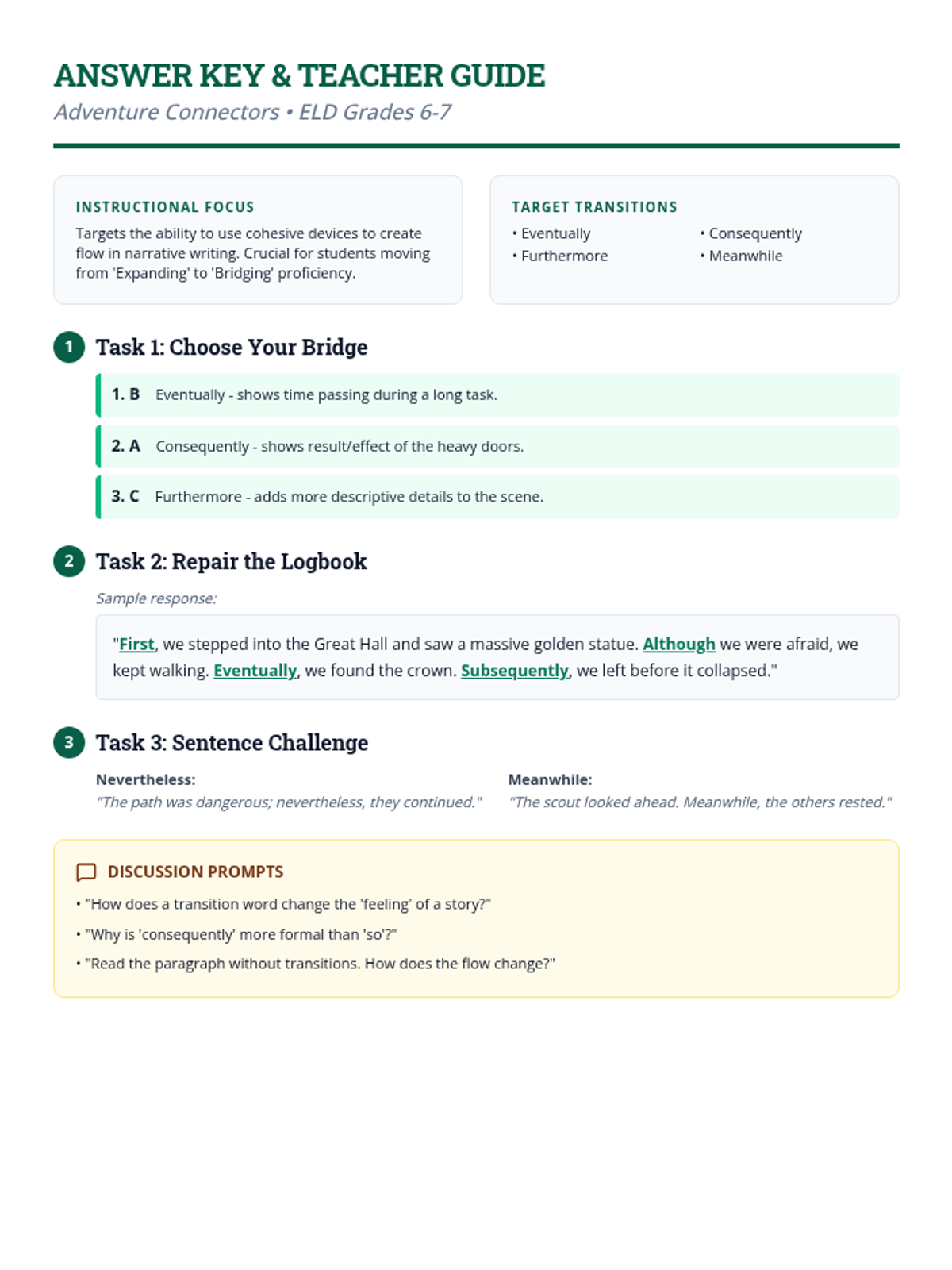
An answer key and teacher facilitation guide for the ELD Adventure Connectors lesson, including sample responses and discussion prompts.
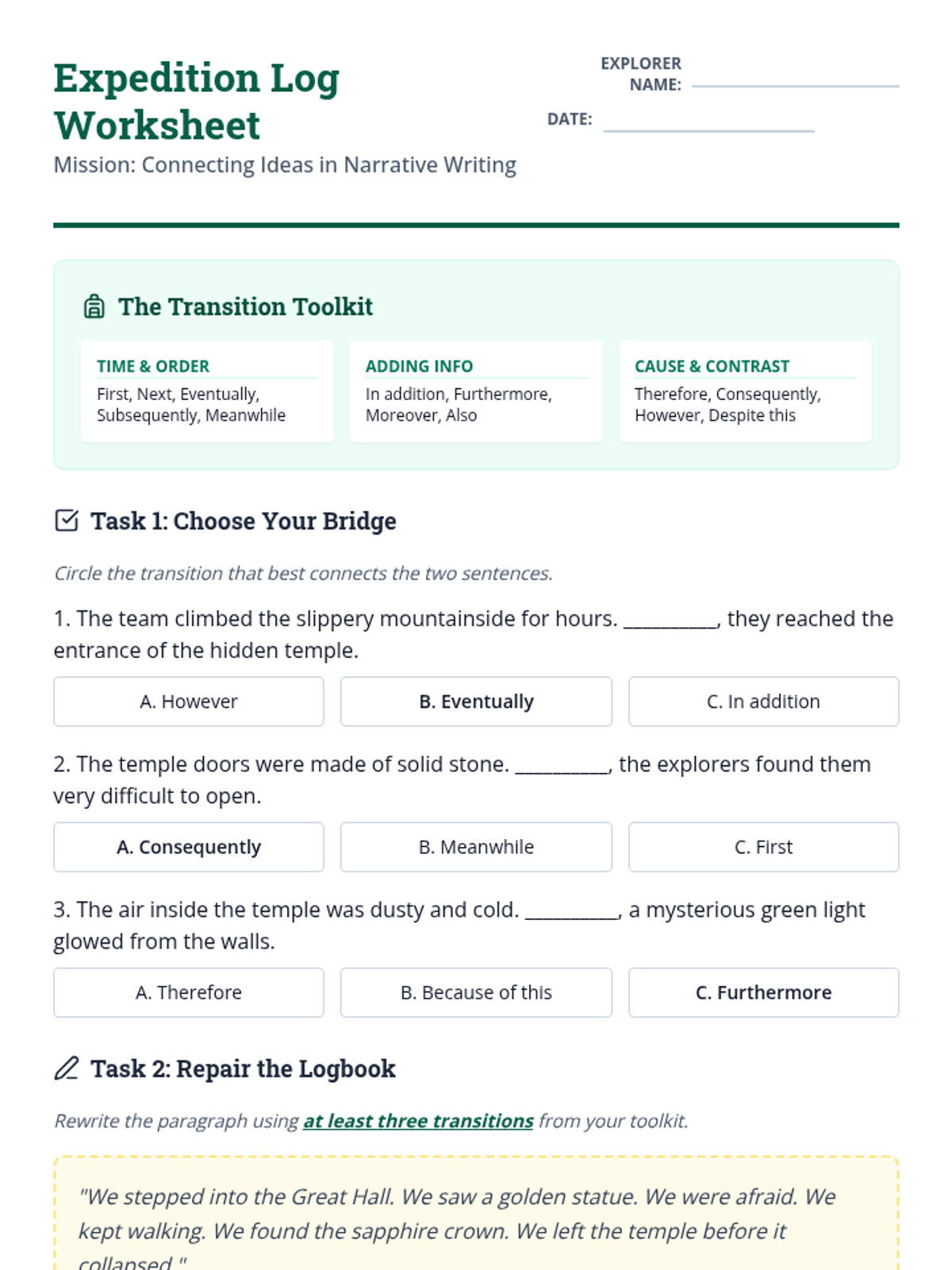
A 6th-7th grade ELD worksheet where students practice using transitional phrases to connect narrative sentences about an archaeological expedition.
An instructional slide deck for 6th-7th grade ELD students introducing the concept of transitional phrases through an archaeology/adventure theme.
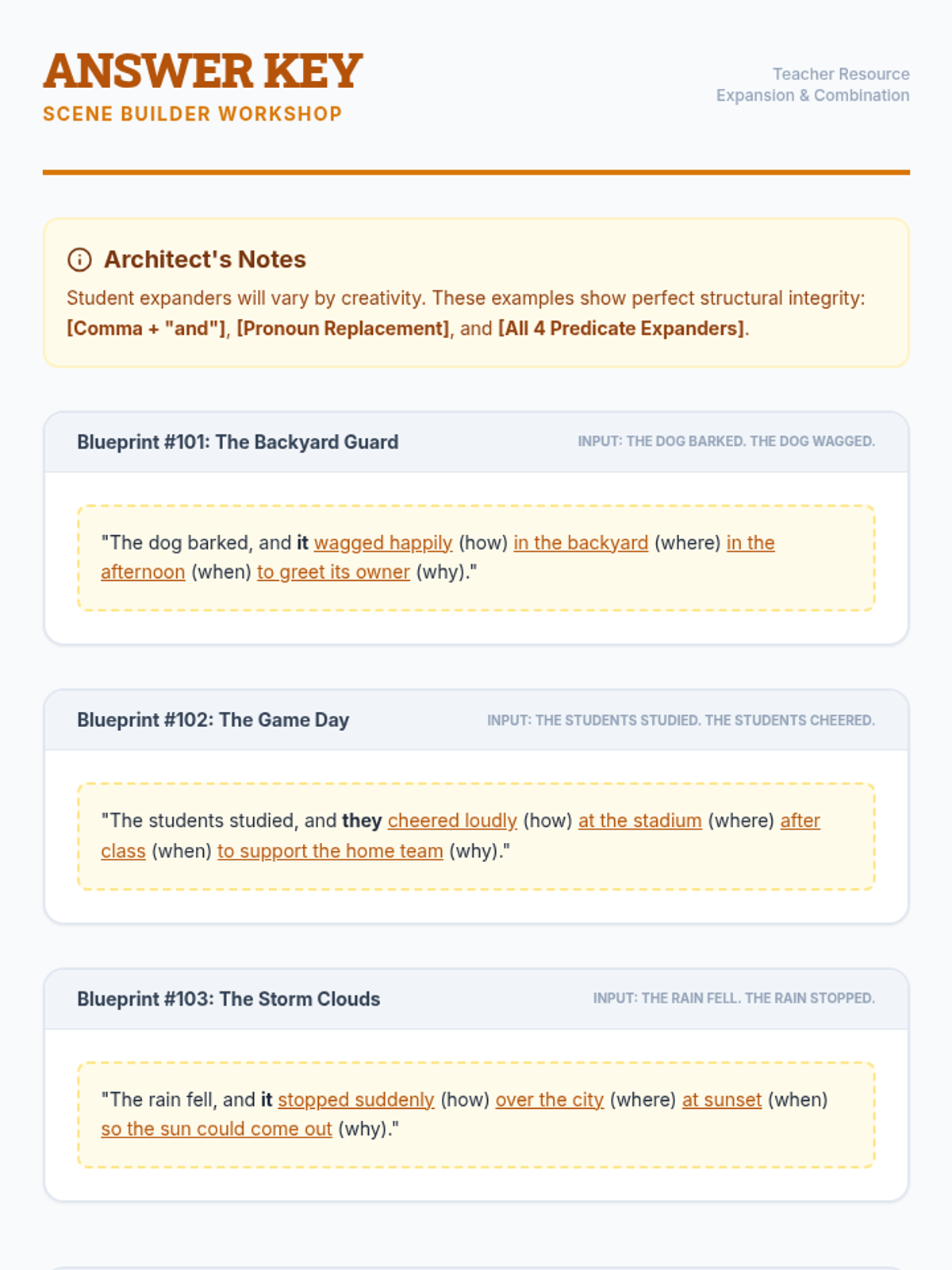
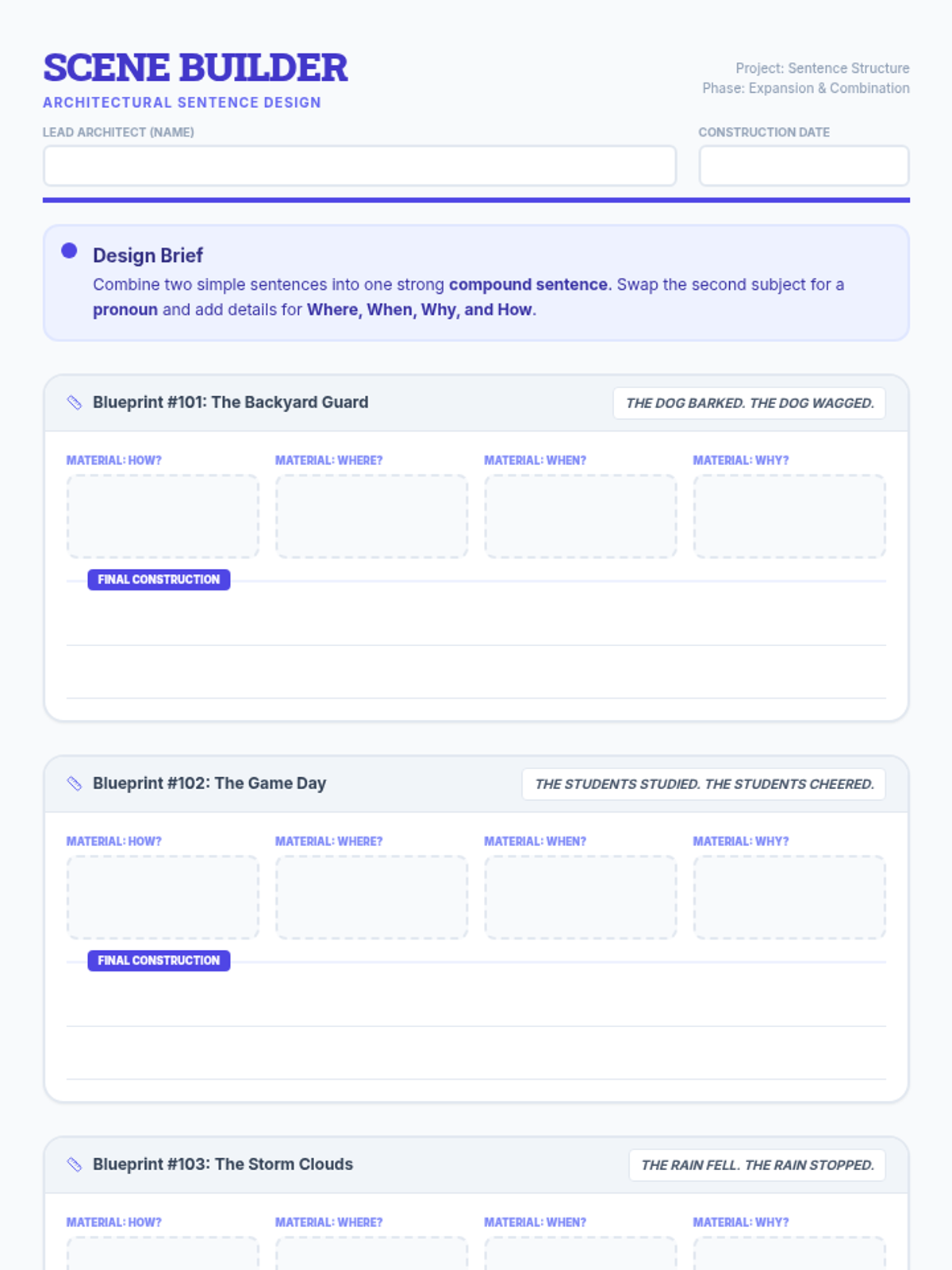
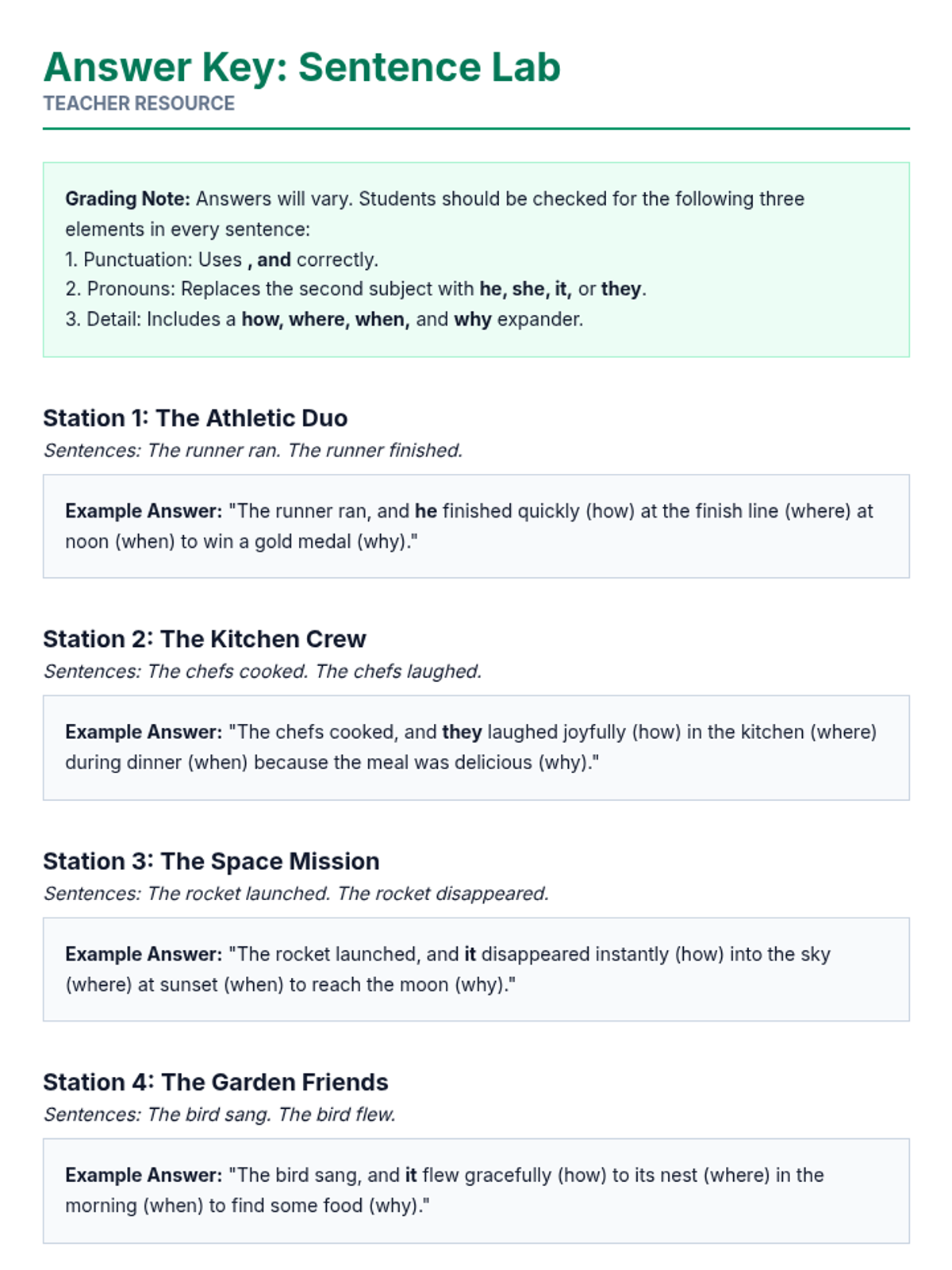
A teacher's answer key for the Scene Builder worksheet, featuring example answers and a structural grading rubric.
A second practice worksheet for the Sentence Lab lesson, using an architectural "Scene Builder" theme. Students combine simple sentences using pronouns and expand them with four descriptive predicates. Optimized for a 2-page layout.
A Google Docs friendly version of the teacher's answer key, using standard text and table formatting that translates perfectly when copied into a digital document.
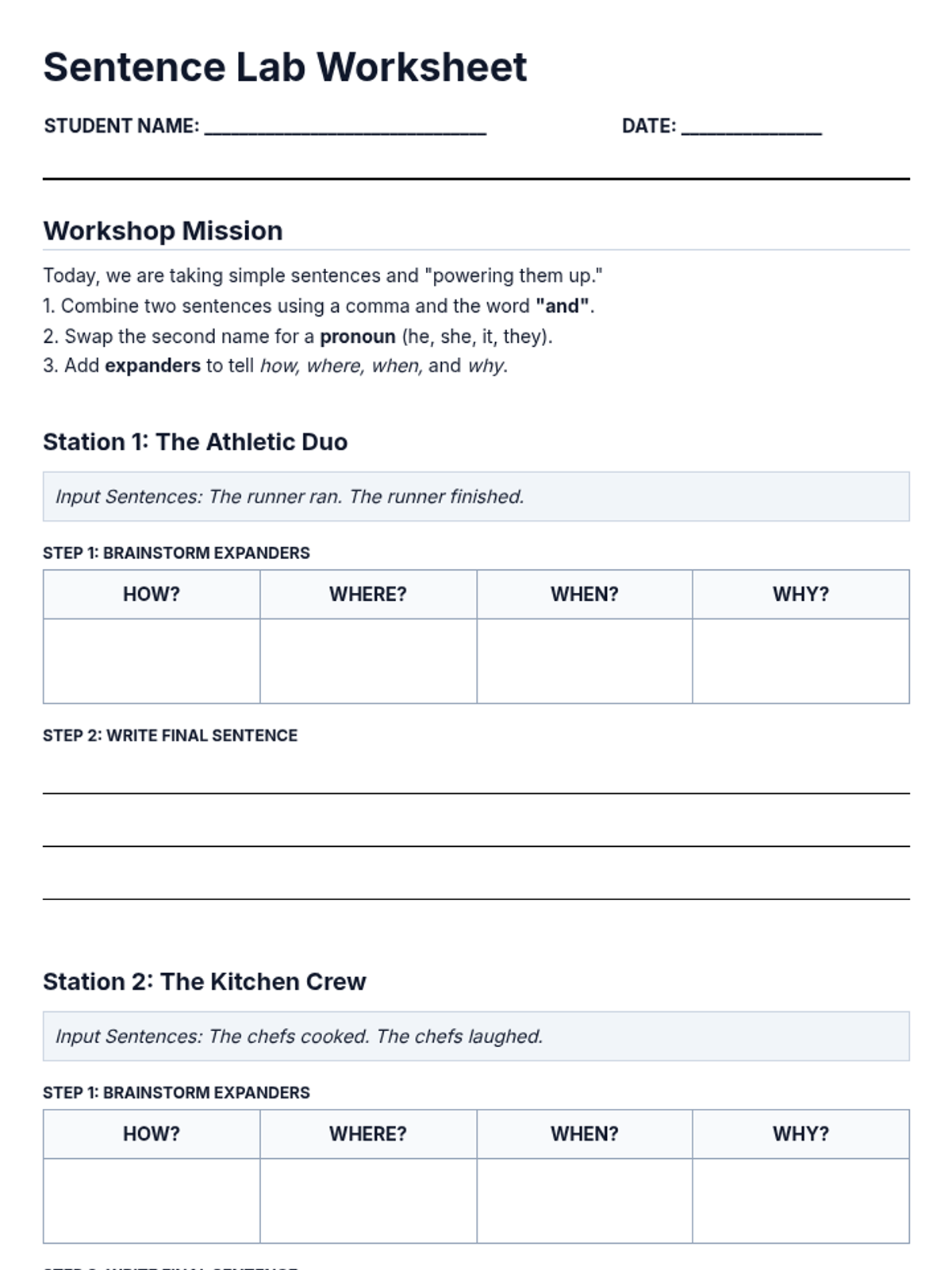
A Google Docs friendly version of the Sentence Lab worksheet, using a simplified table-based layout and standard formatting that translates easily when copied and pasted. Includes a bonus challenge station.
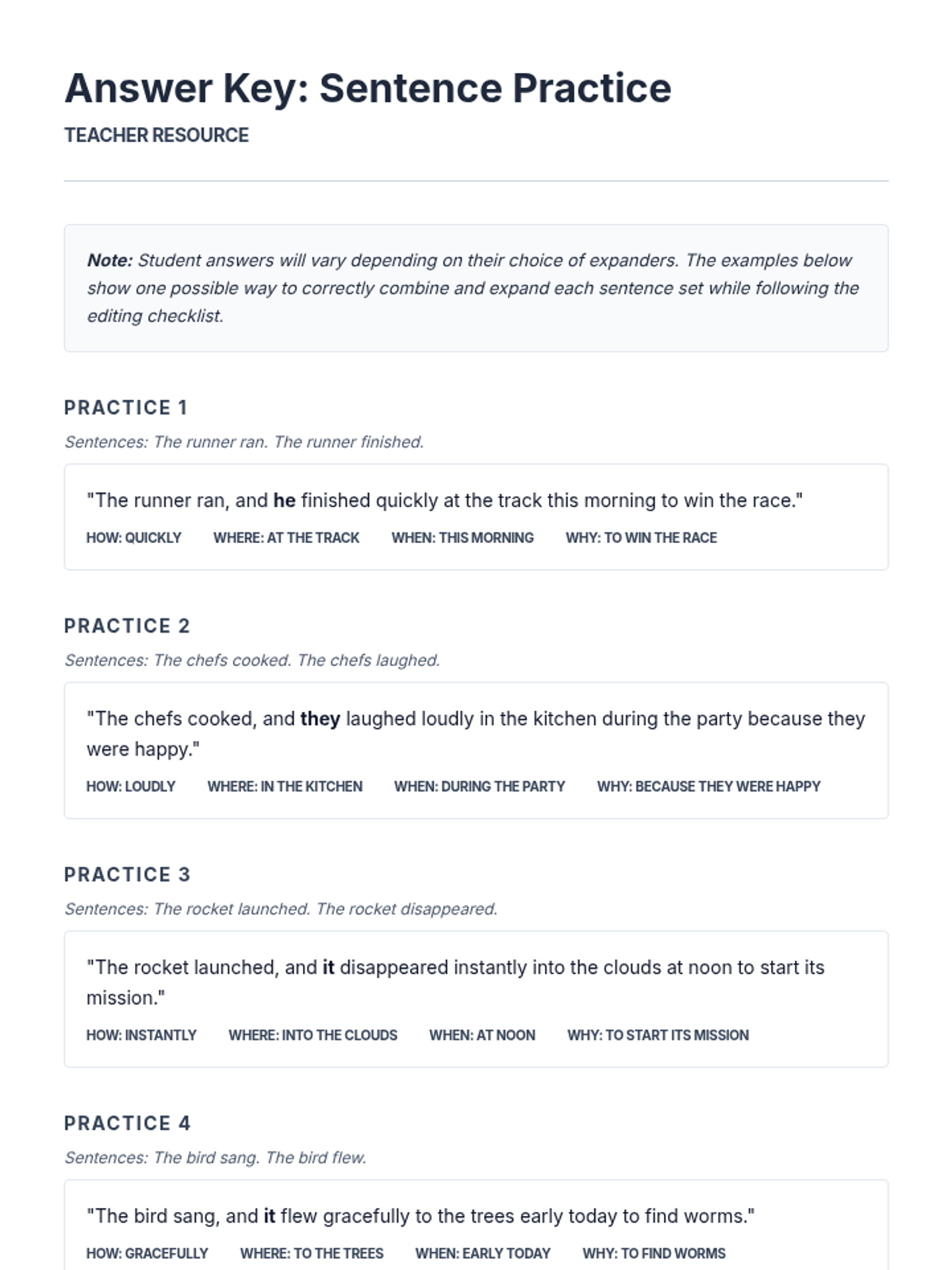
A teacher's answer key for the sentence practice worksheet, featuring example answers and a guide for the mobility punctuation rule.
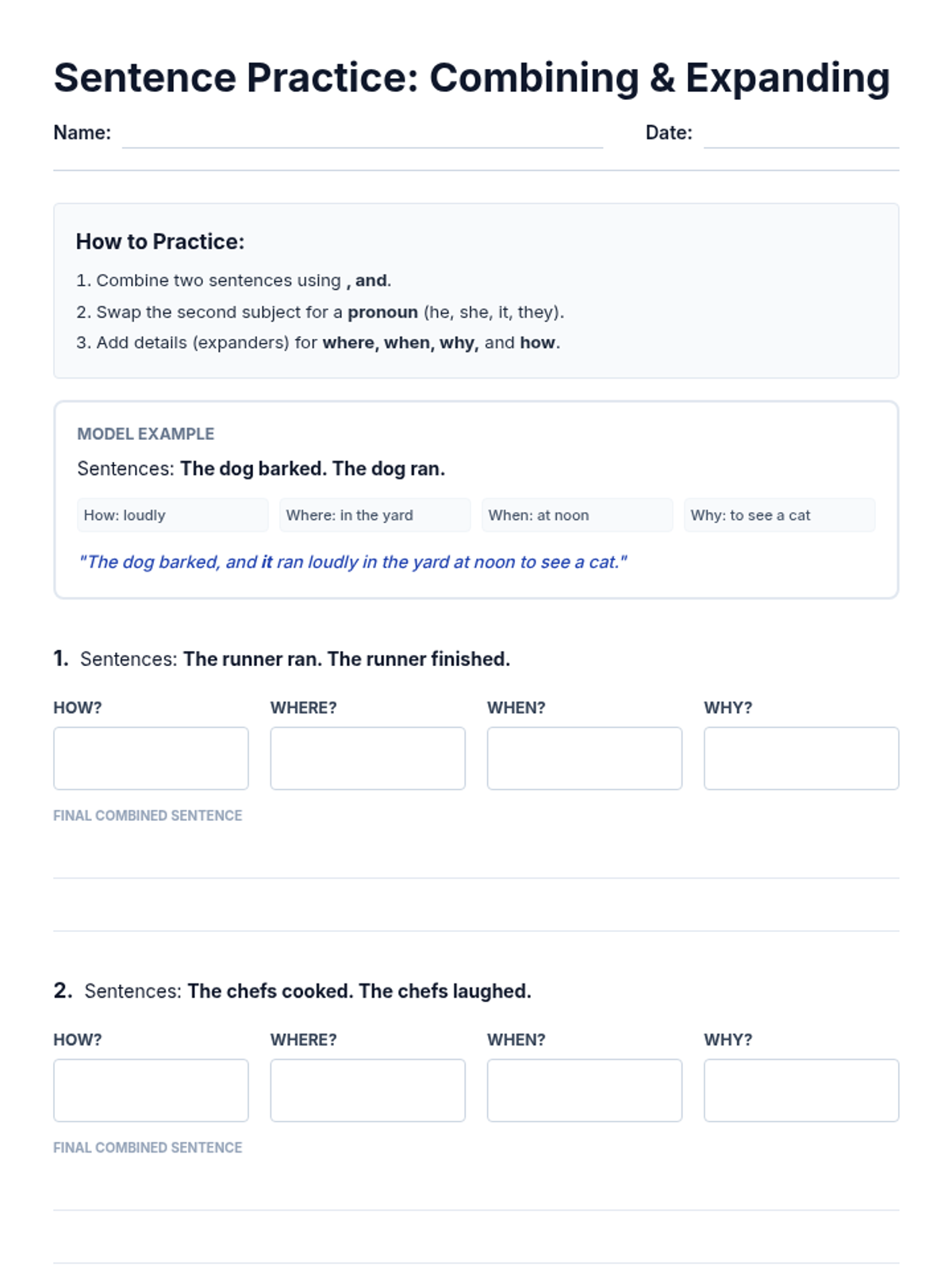
A basic sentence practice worksheet for middle school students, focusing on combining sentences with pronouns and adding predicate expanders. Includes a comprehensive editing checklist.
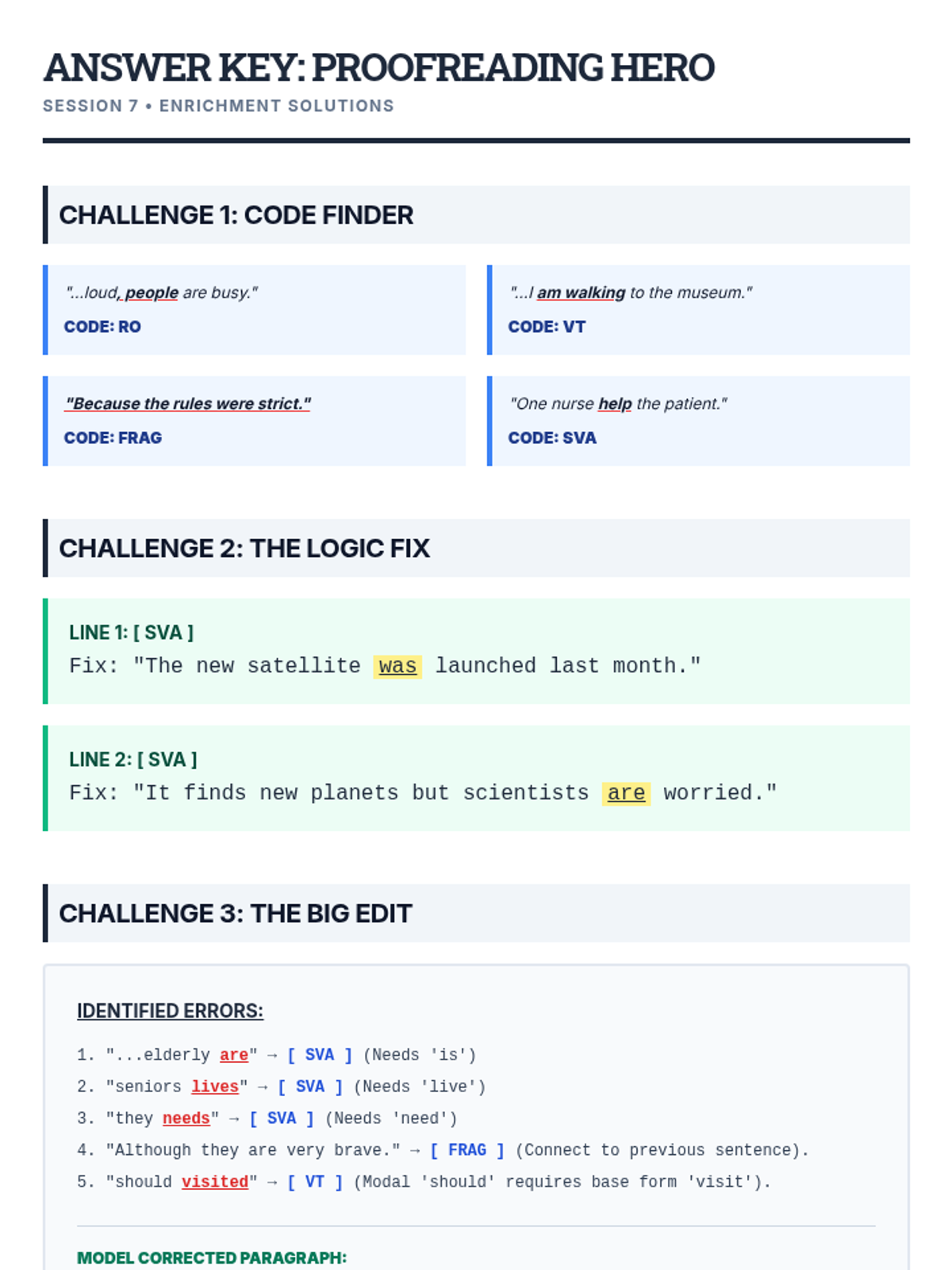
A teacher answer key for the Proofreading Hero Worksheet, including identified error codes and model corrected paragraphs for all challenges. Updated for matching expanded worksheet and includes a legend.
Instructional slides for the mock exam session, providing a visual pacing guide (10-30-5 breakdown) and specific phase-by-phase writing strategies.
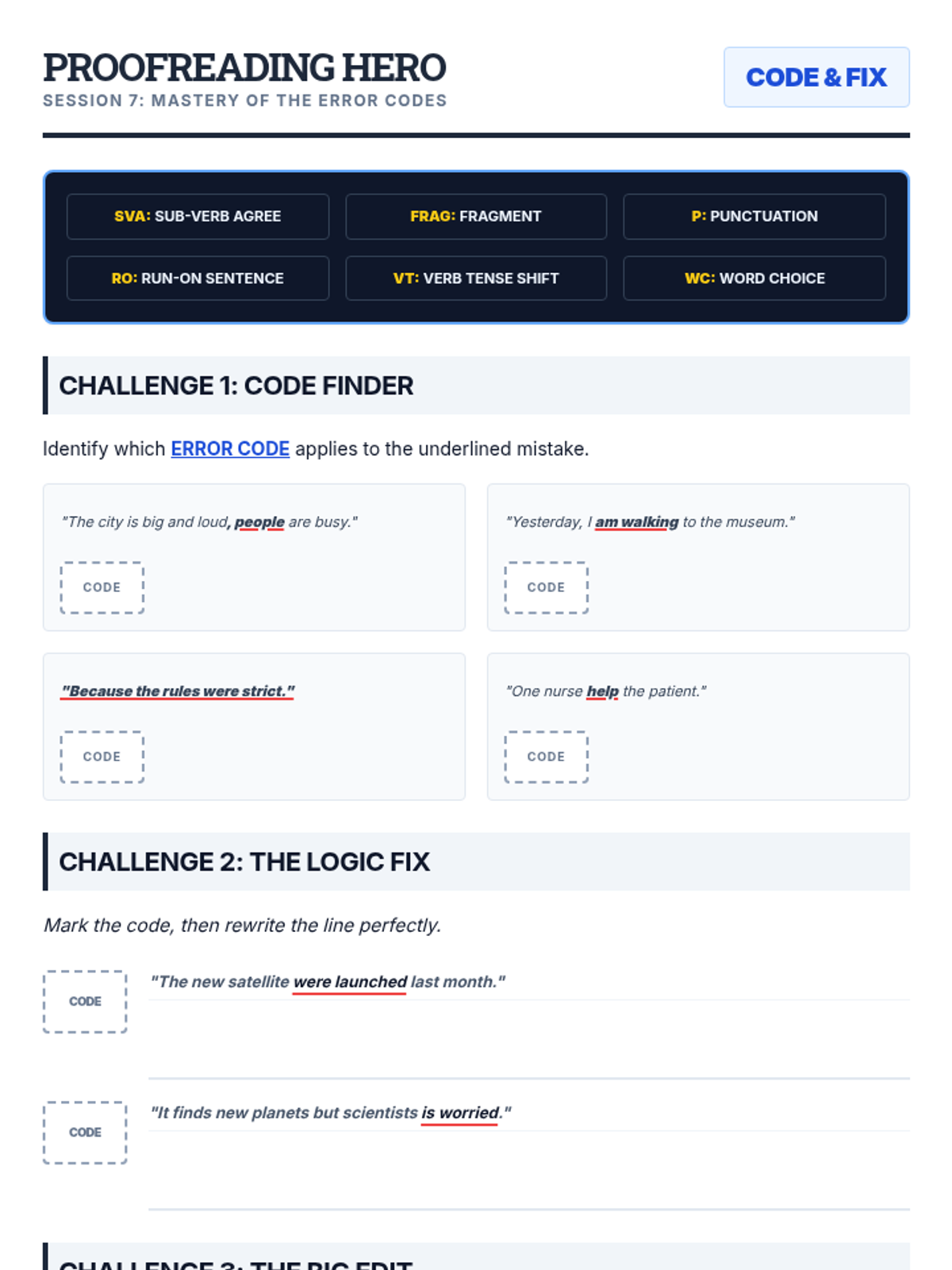
An interactive proofreading worksheet where students apply the teacher's Error Coding Key to identify and fix grammar, punctuation, and structure mistakes in sample texts. Updated with expanded items and unit-themed examples across two pages.
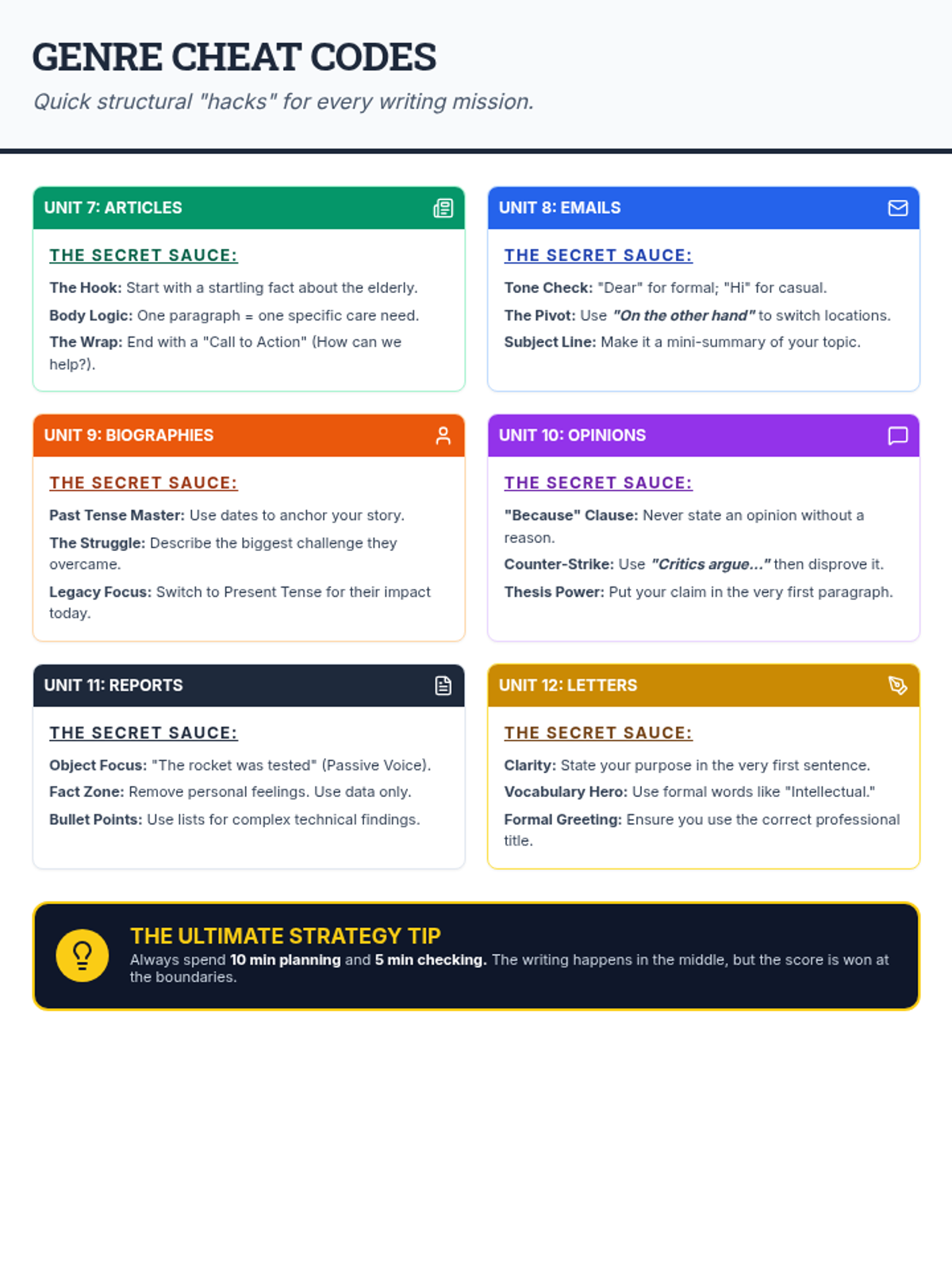
A one-page reference guide containing structural "hacks" and specific strategies for each of the six writing genres covered in the program. Updated for single-page efficiency.
A teacher answer key for the Sentence Power Practice Worksheet, including model answers and grammar rationales. Updated for clarity and visual organization.
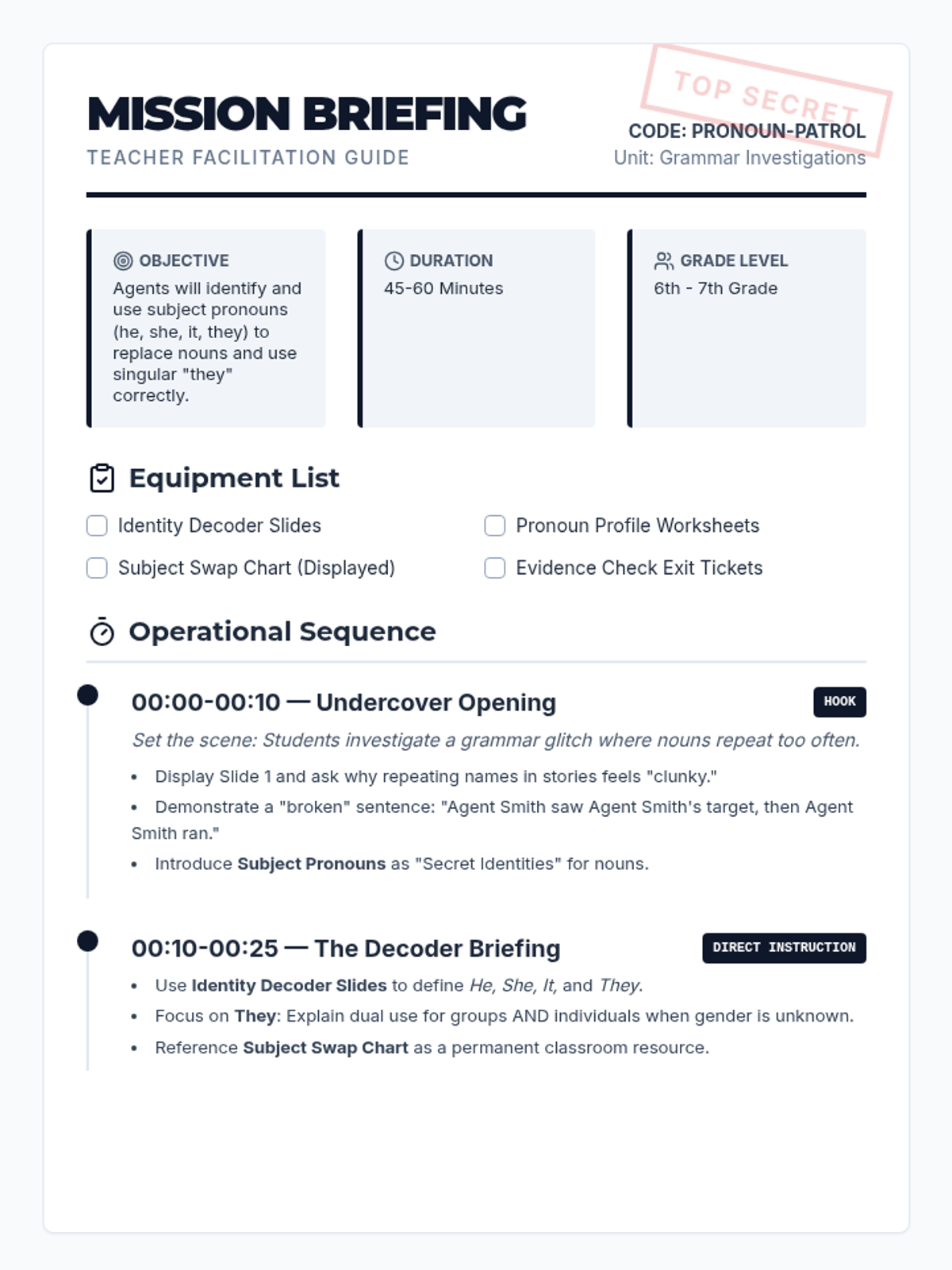
A comprehensive mission briefing guide for teachers, outlining the lesson flow, pacing, materials, and discussion prompts for the Pronoun Patrol Investigation. Includes differentiation tips and scripting support. Revised to fix layout and page breaks.
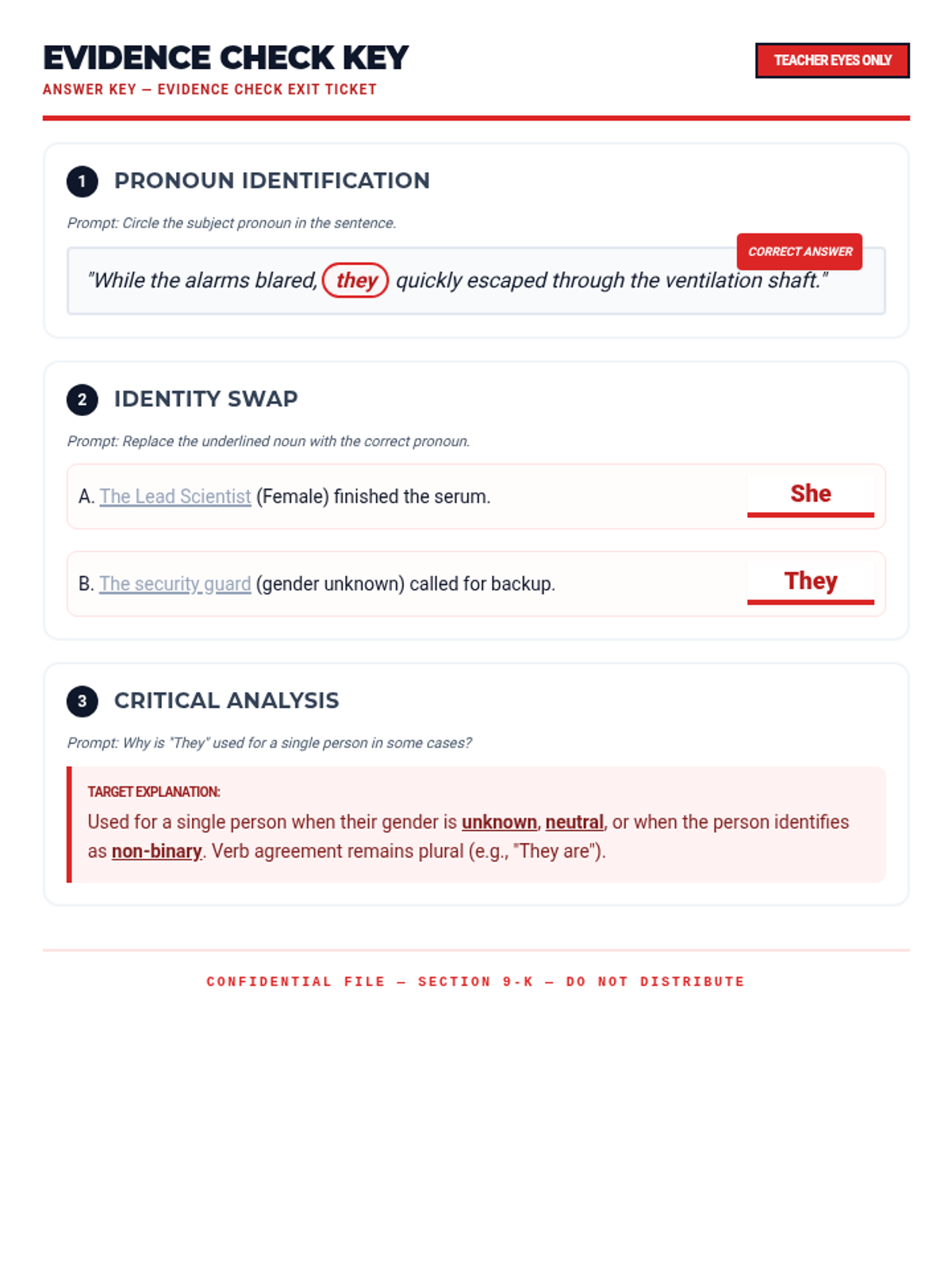
An answer key for the Evidence Check Exit Ticket, providing clear visual answers and explanation guides for teacher use. Revised for better page layout and clarity.
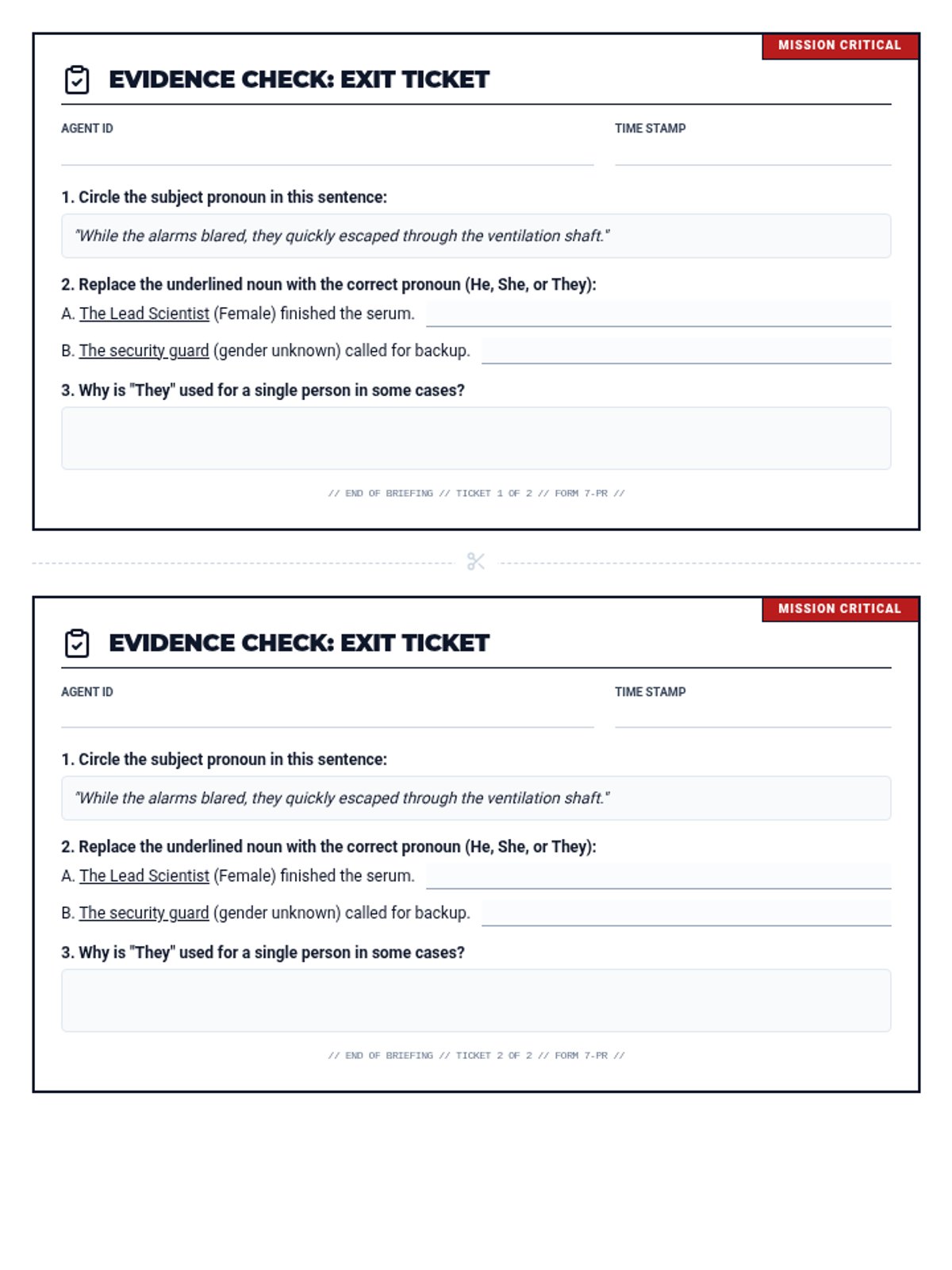
A set of two identical exit tickets per page for assessing student understanding of subject pronouns (he, she, they) at the end of the lesson. Designed for easy cutting and distribution. Revised to fix page breaks and remove bolded answers.
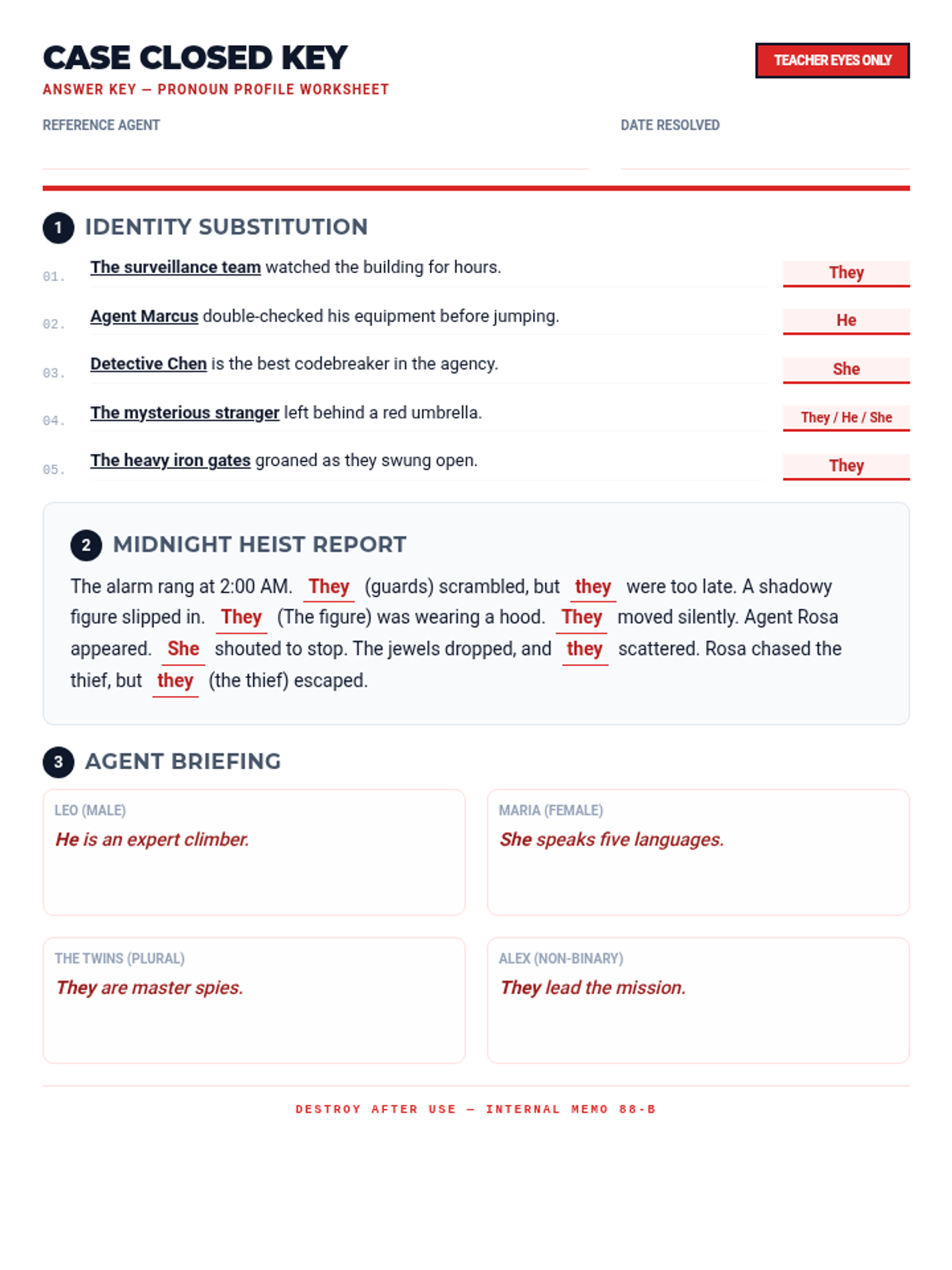
An answer key for the Pronoun Profile Worksheet, providing correct pronoun replacements and example sentences for teacher reference. Revised to fit on a single page with enhanced contrast.
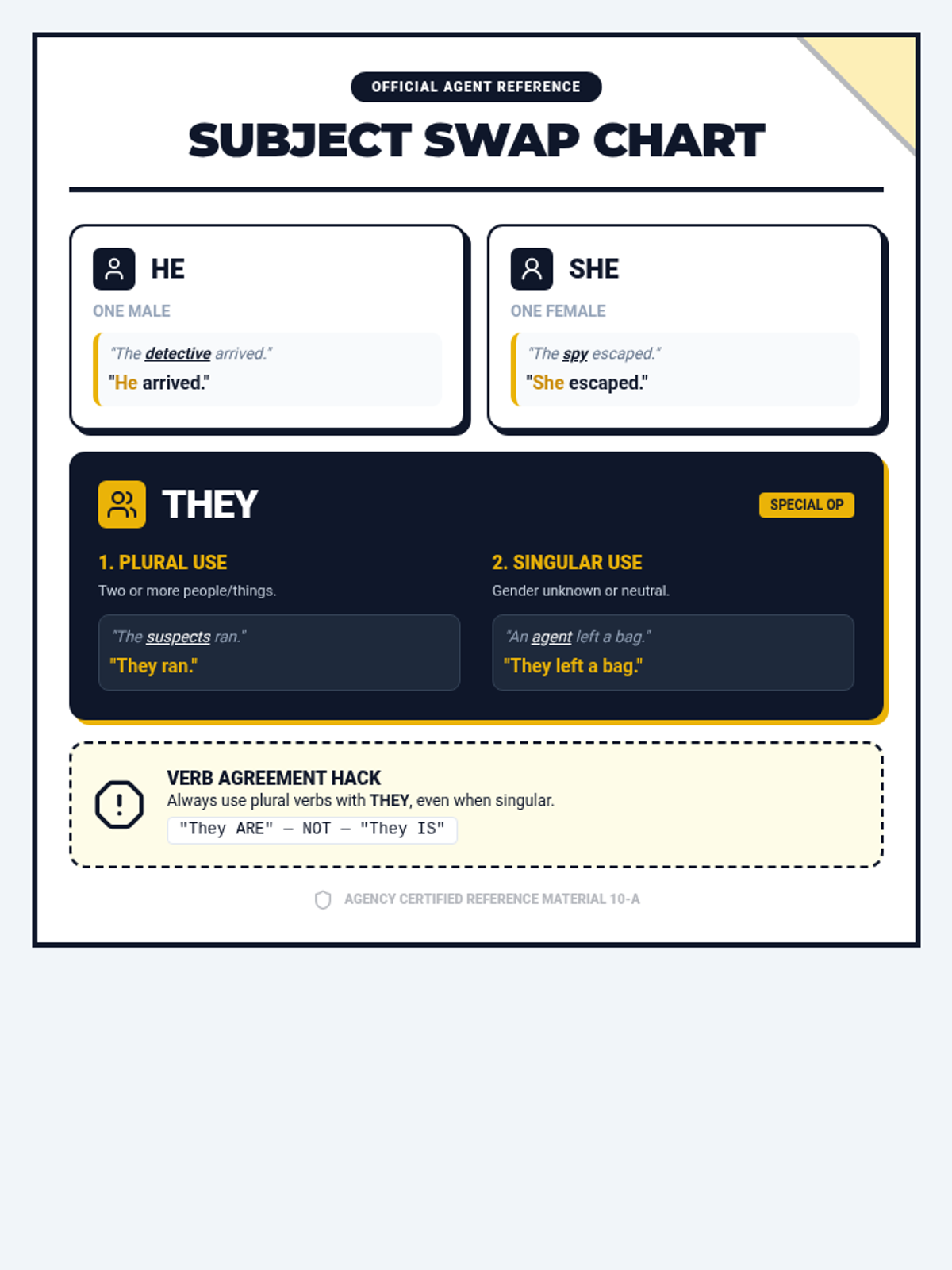
A visually engaging anchor chart for classroom display, detailing the rules and examples for using 'he', 'she', and 'they' (both plural and singular) as subject pronouns. Revised to fit on a single page.
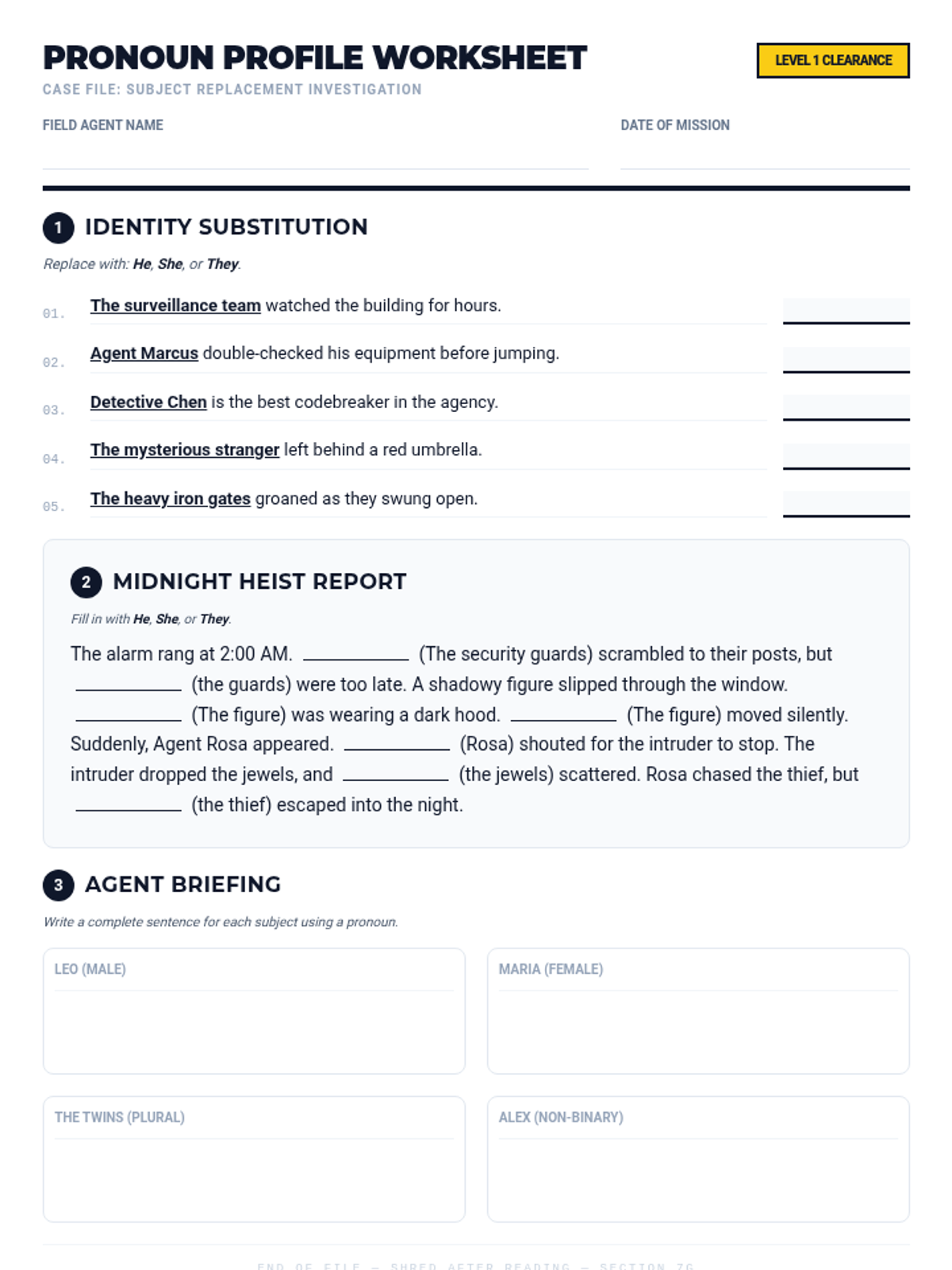
A student practice worksheet for identifying and using subject pronouns (he, she, it, they) within a 'Secret Agent' theme. Includes sentence replacement, narrative completion, and sentence construction tasks. Revised to include 'It' and more writing space.
A 7-slide presentation for a 6th-7th grade lesson on subject pronouns (he, she, they) featuring a 'Secret Agent' theme. Includes definitions, practice problems, and an explanation of the singular 'they'.
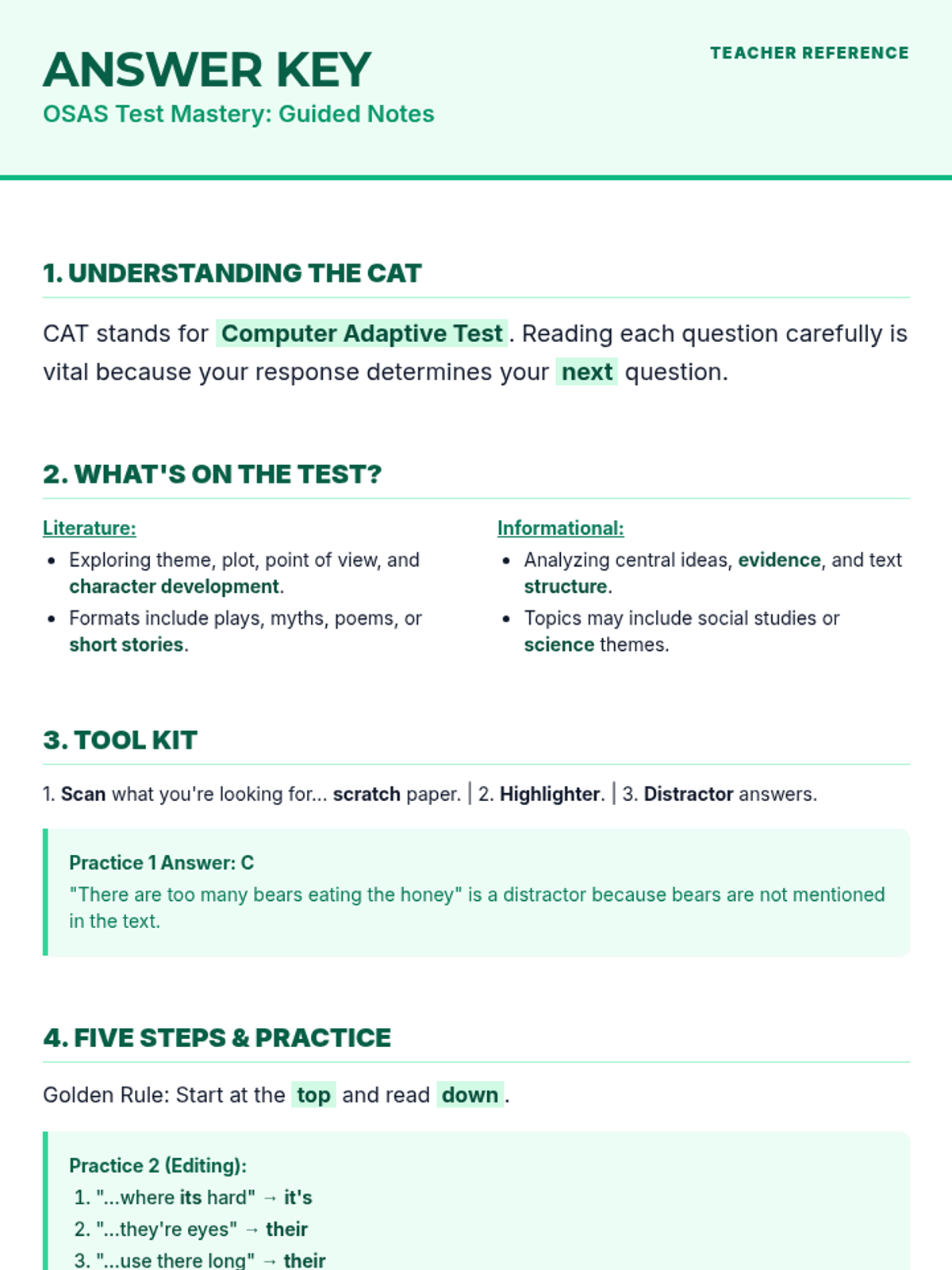
Updated answer key for the OSAS guided notes, matching the revised worksheet text and including full context for the sections that are no longer fill-in-the-blanks for students.
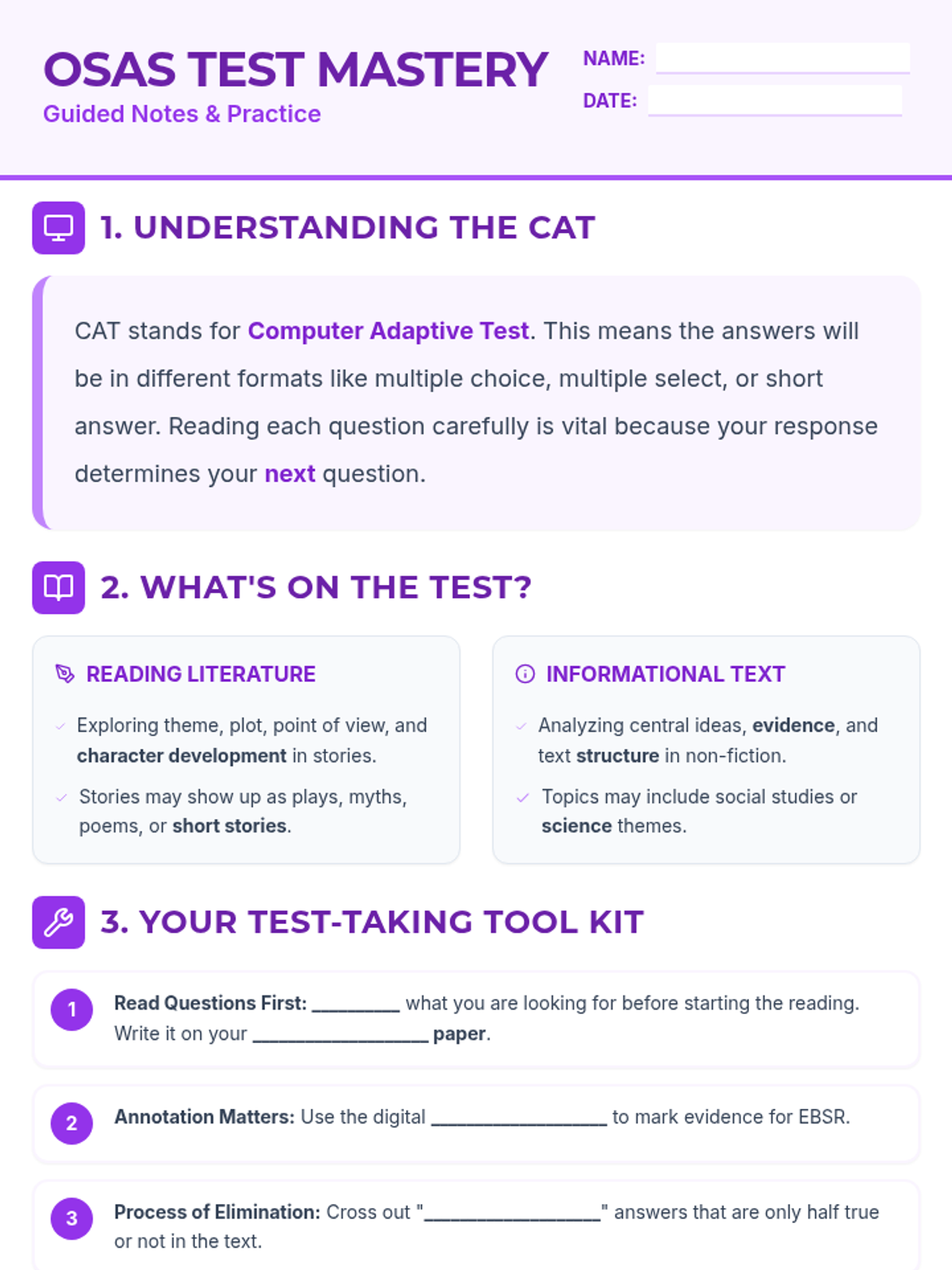
Updated guided notes for the OSAS ELA Test Prep, with complete text for the first two sections, central idea terminology in practice questions, and an expanded hamburger method outline.
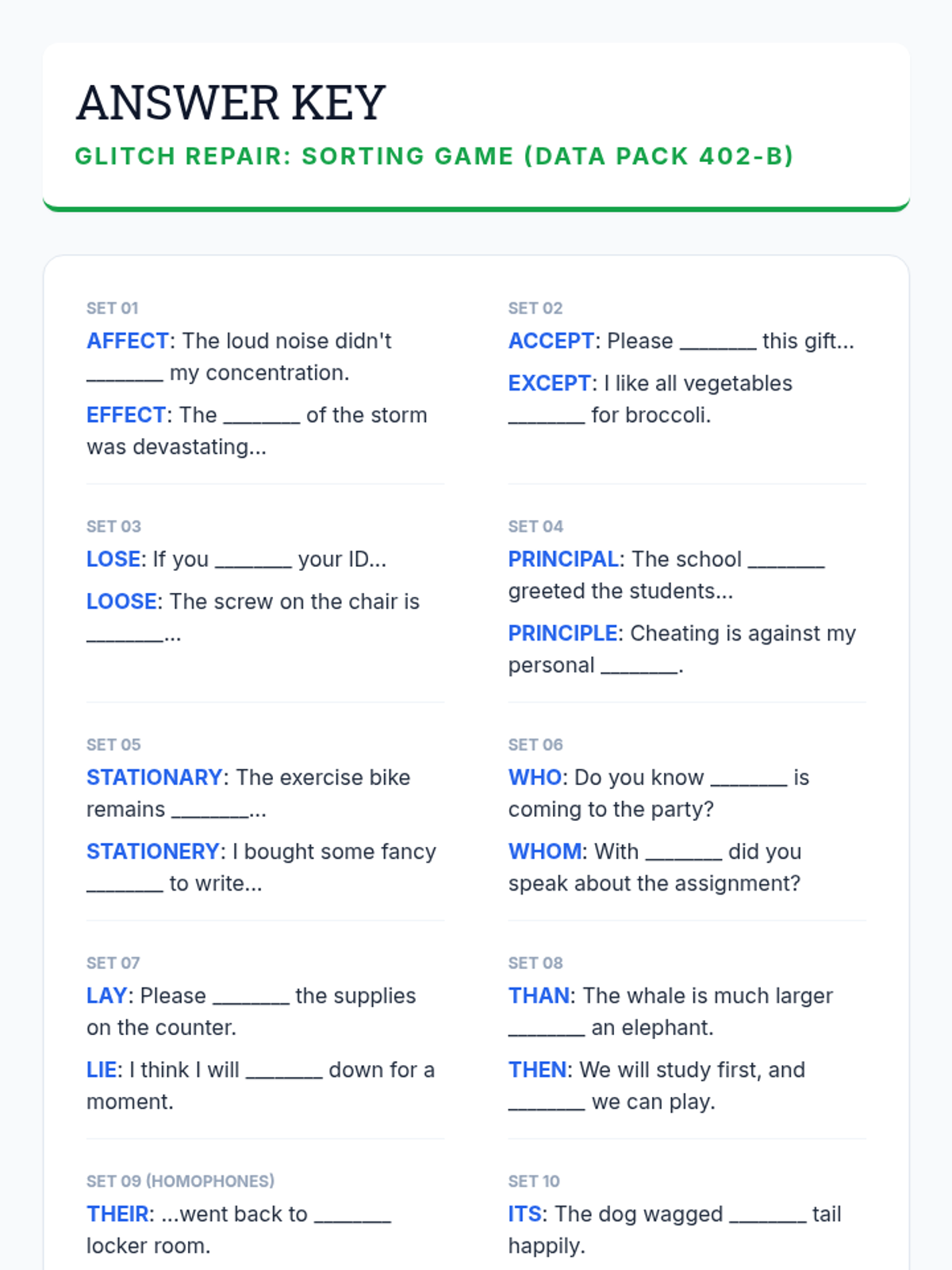
A teacher's answer key for the Glitch Repair sorting game, providing the correct matches for all word and sentence cards to facilitate quick grading and feedback.
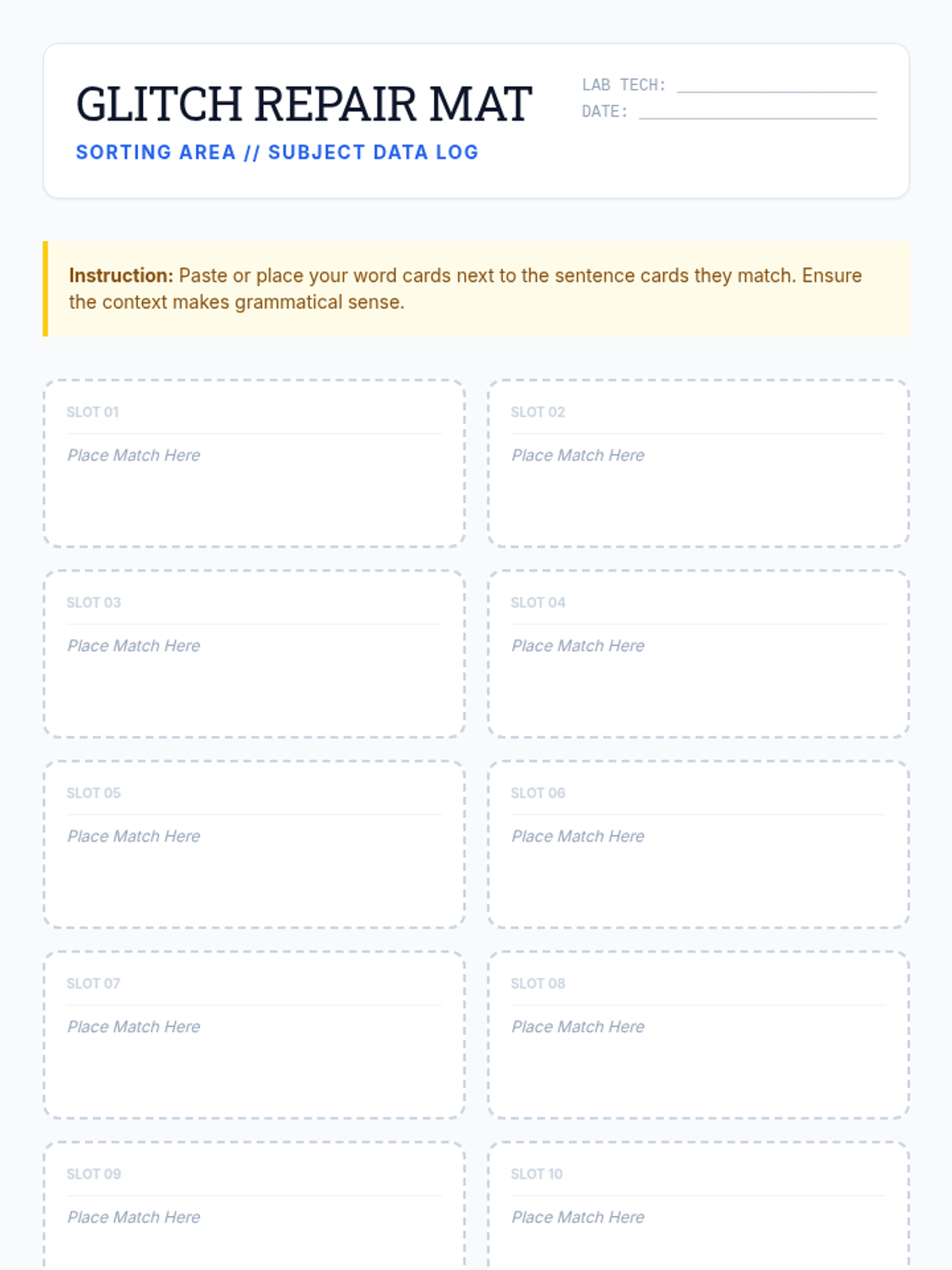
A printable sorting mat for the Glitch Repair game, providing students with a structured workspace to organize and match word and sentence cards.
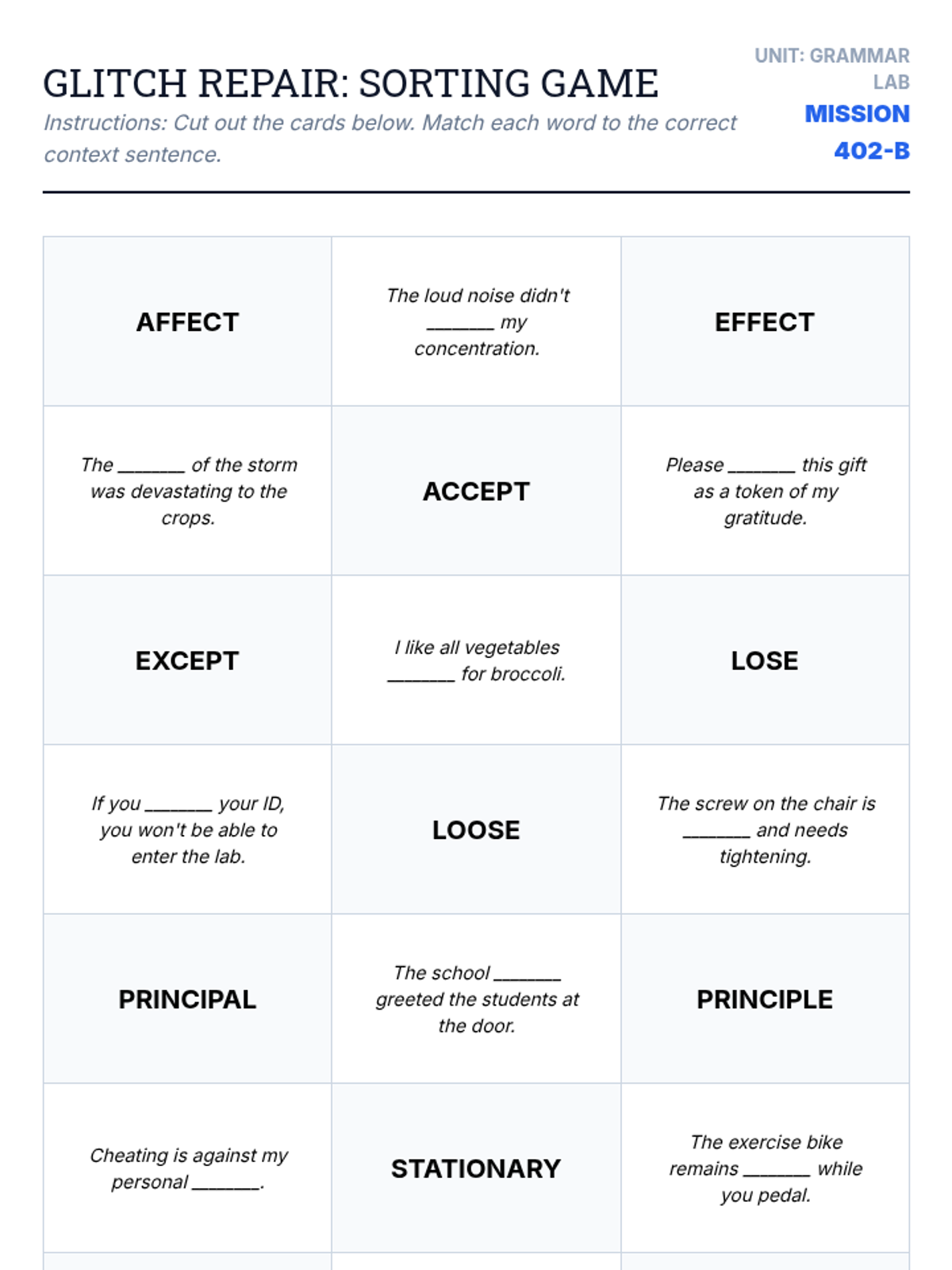
A set of 24 printable cards featuring words and context sentences for a sorting game. Students must match the correct commonly confused word with the sentence that fits its definition.
A visually striking slideshow designed for direct instruction on 12 pairs of commonly confused words. Includes memory triggers, definitions, visual hints, and interactive practice sentences for each word group.
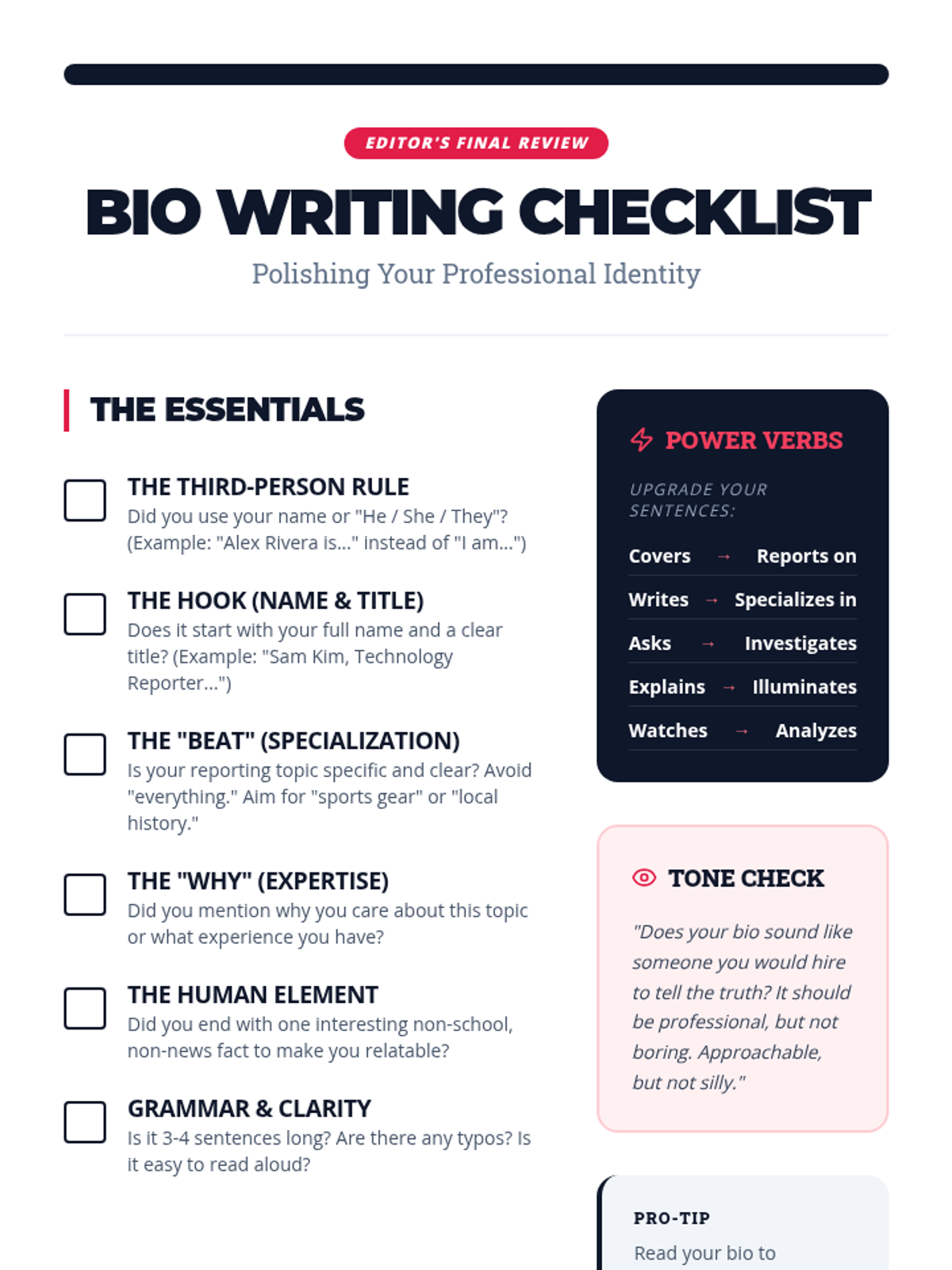
A comprehensive student-facing checklist and style guide for writing professional journalist biographies, featuring POV rules, component checks, and a 'Power Verb' reference section.
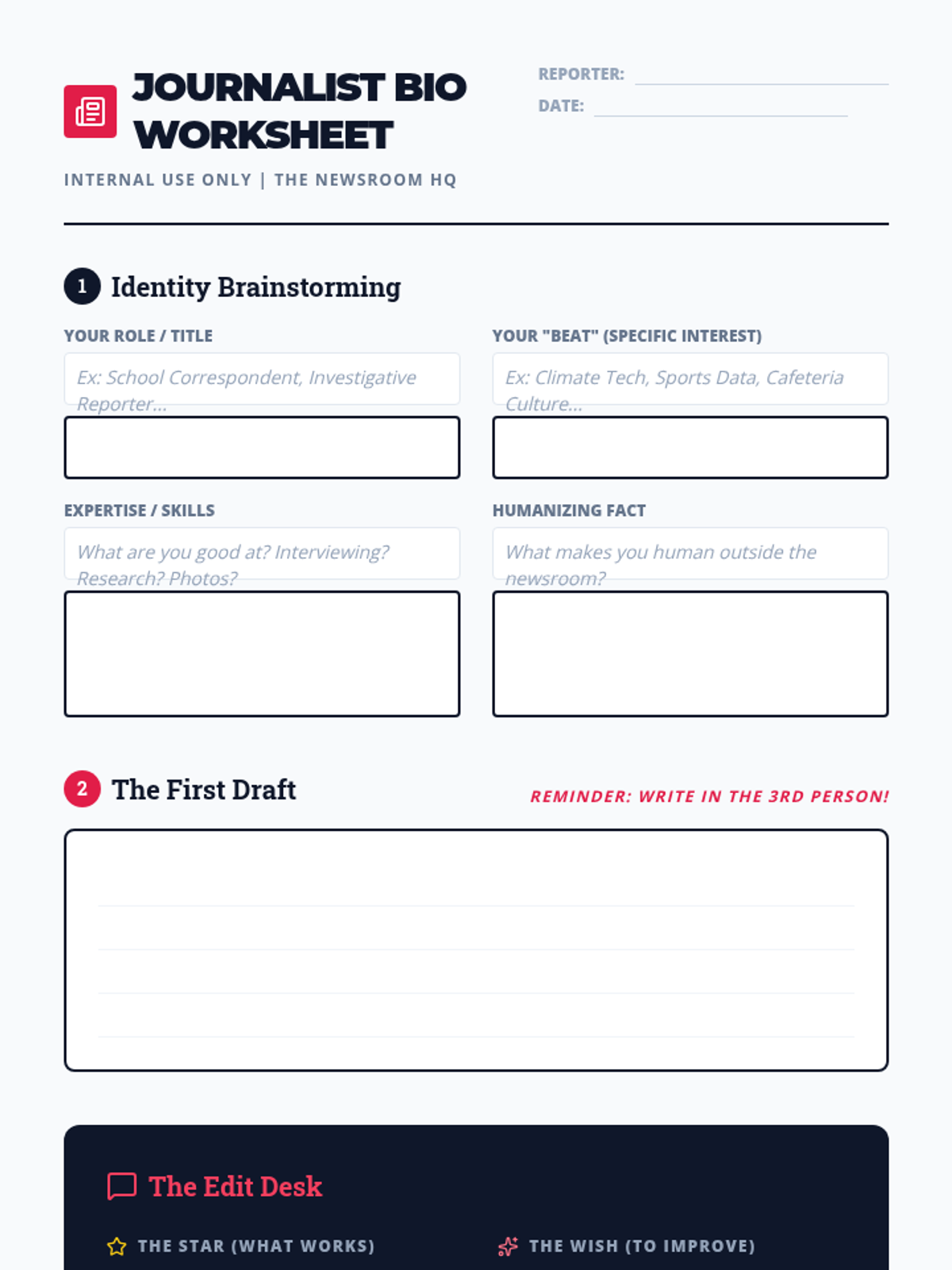
A structured worksheet for 6th-grade students to brainstorm, draft, and receive peer feedback on their professional newsroom biographies. Includes dedicated spaces for identifying a journalistic 'beat' and humanizing facts.
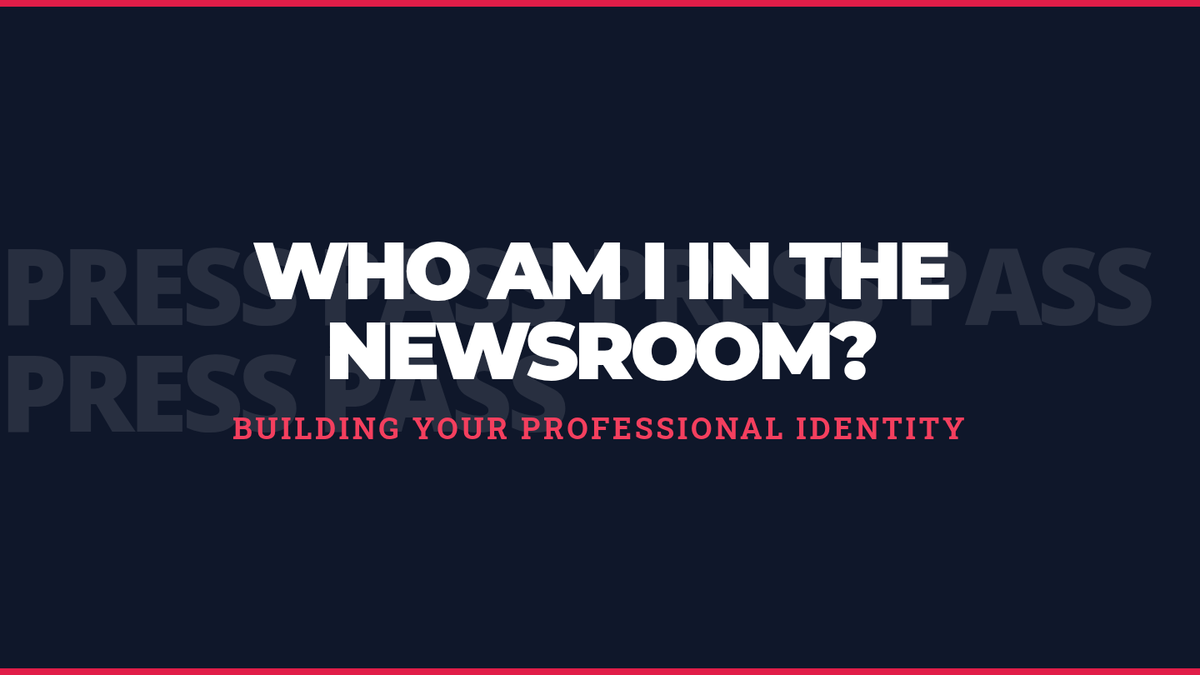
A visual presentation for students that defines professional identity in journalism, analyzes effective bio examples, and breaks down the four core components of a professional reporter's biography.
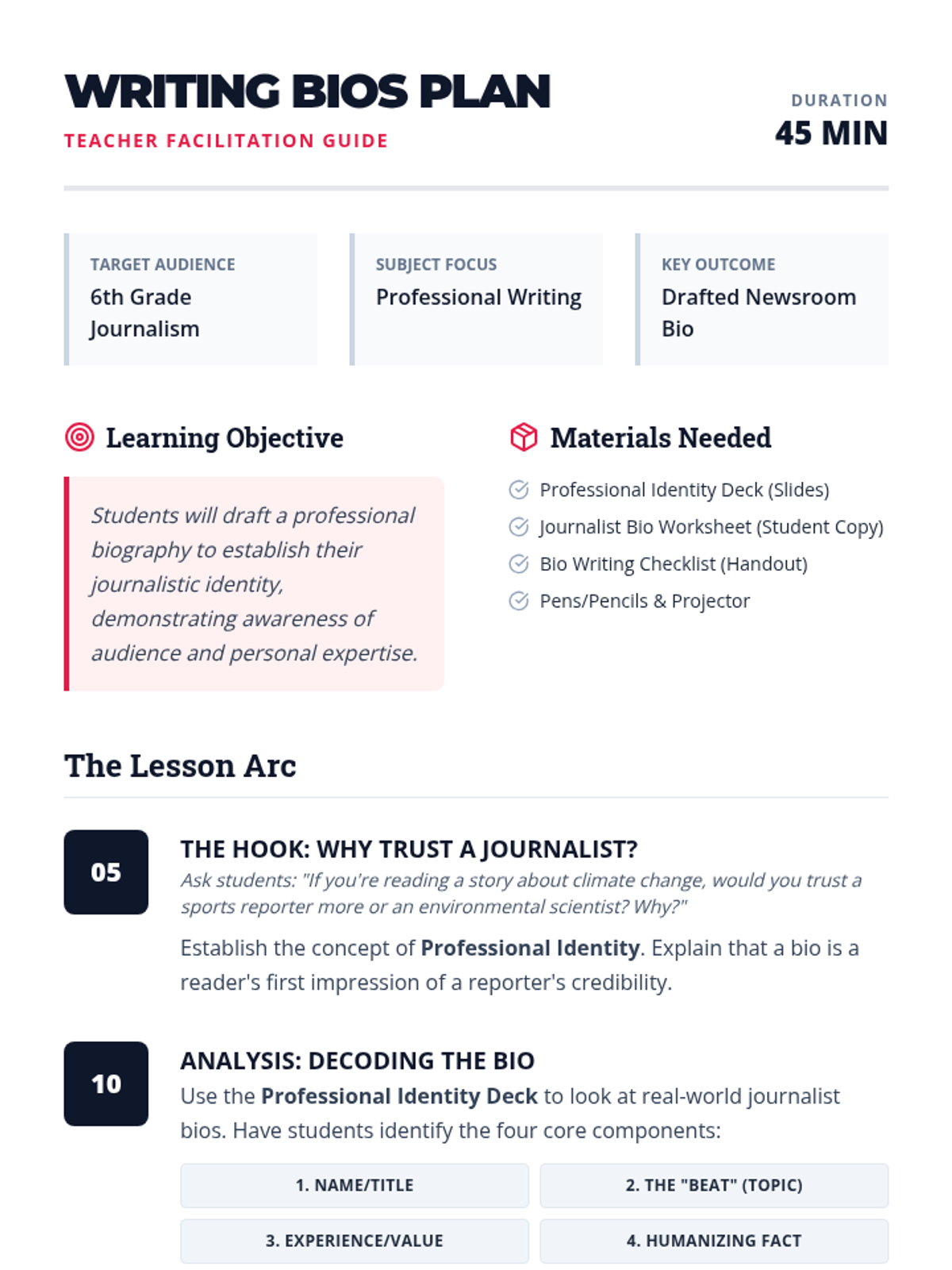
A comprehensive teacher facilitation guide for a 45-minute journalism lesson, featuring an instructional arc from hook to peer feedback, including timing, learning objectives, and differentiation strategies.
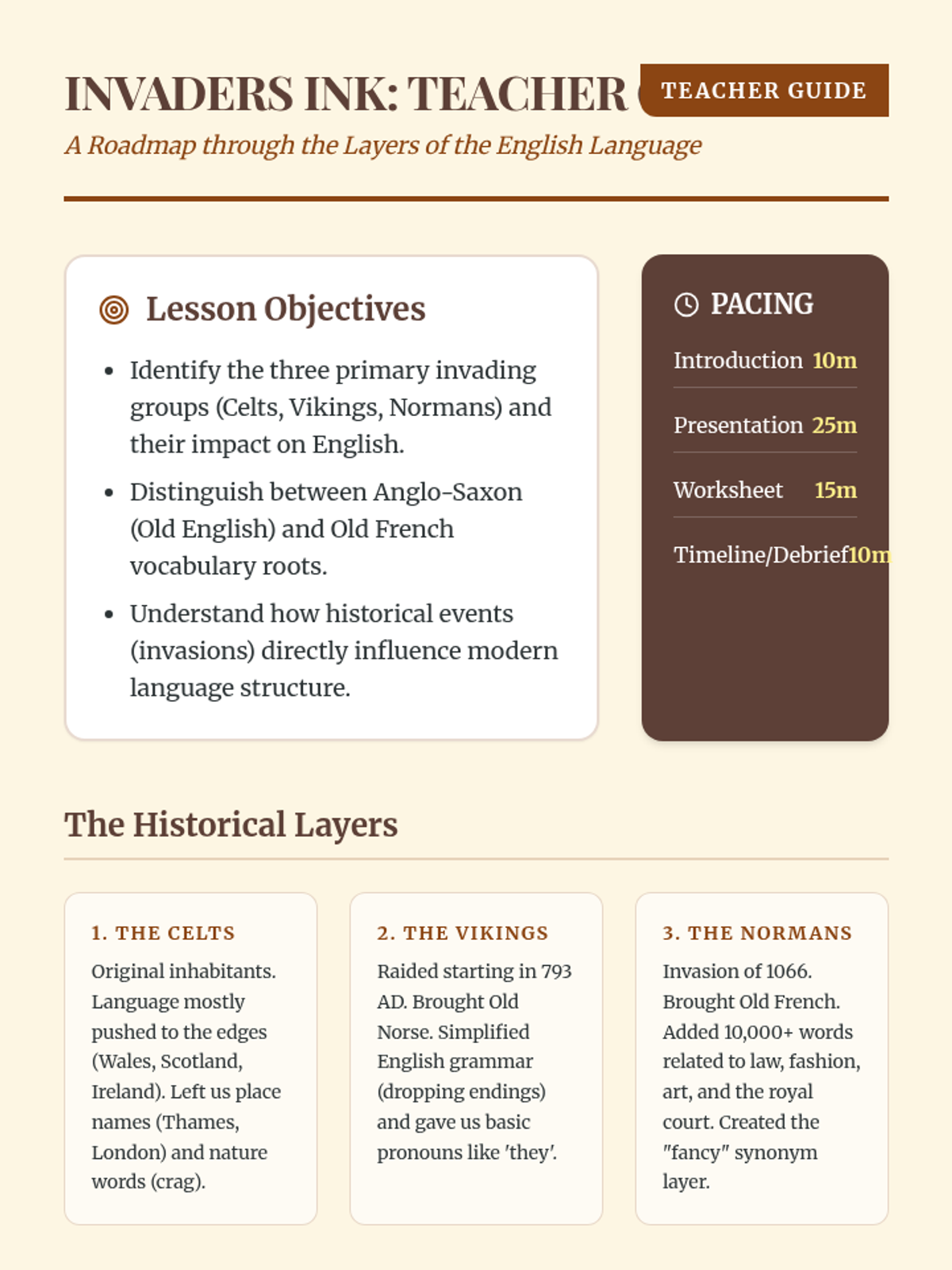
A comprehensive teacher guide for the Invaders Ink lesson. It includes lesson objectives, historical background summaries, slide-by-slide teaching notes, activity suggestions, and differentiation strategies.
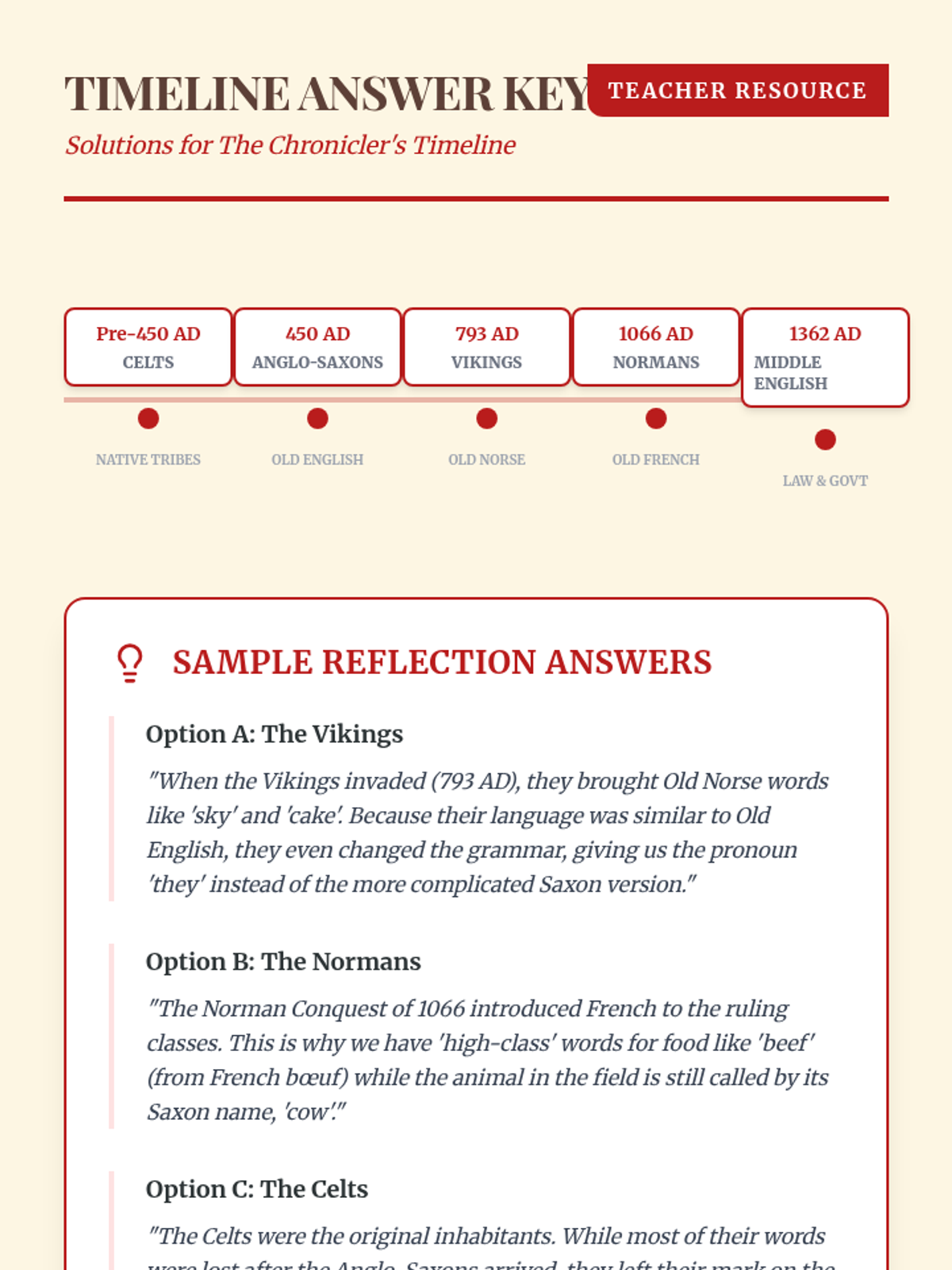
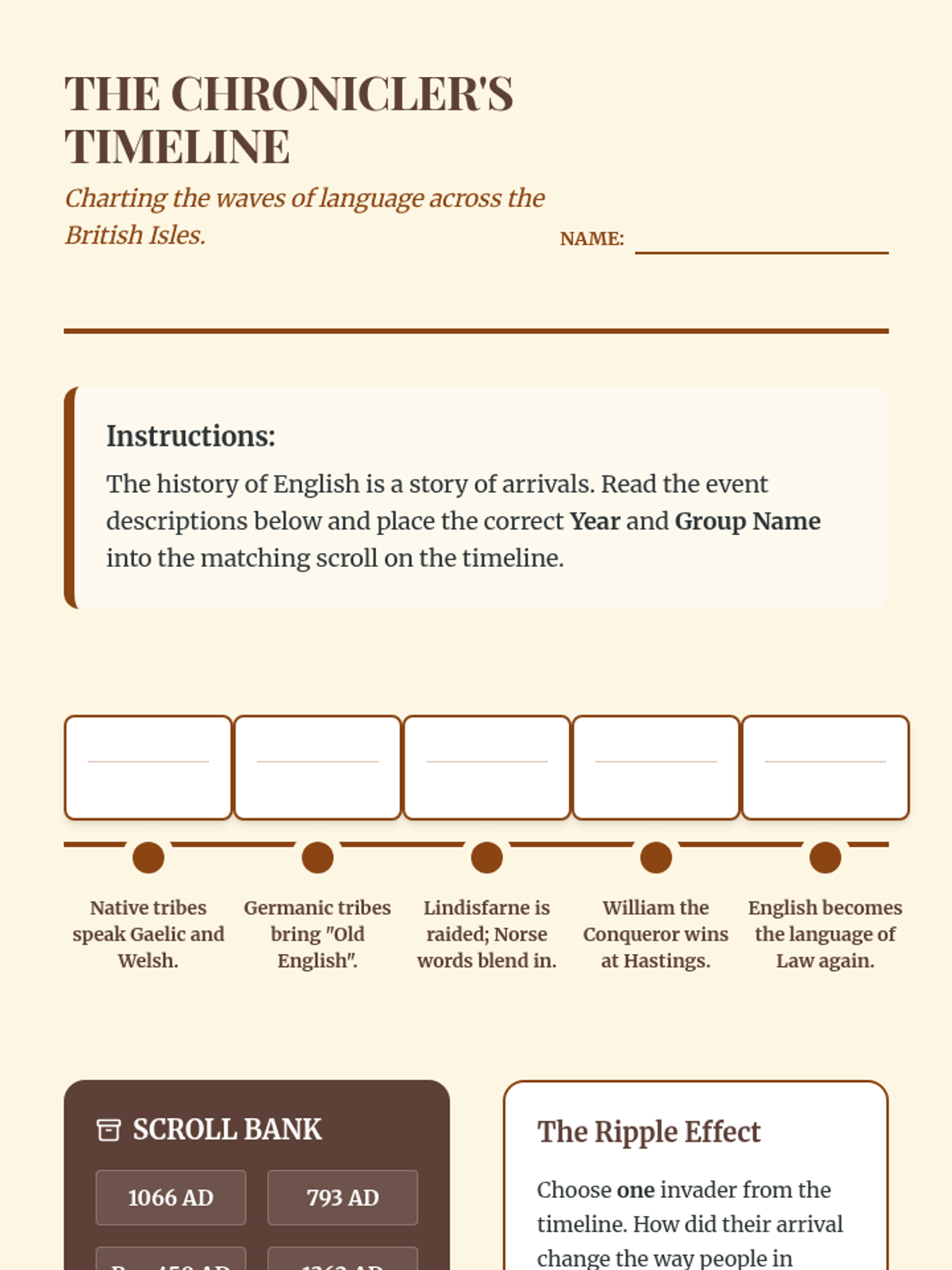
An answer key for the Invasion Timeline Activity, providing the correct dates and groups for each timeline point, plus sample answers for the reflection question.
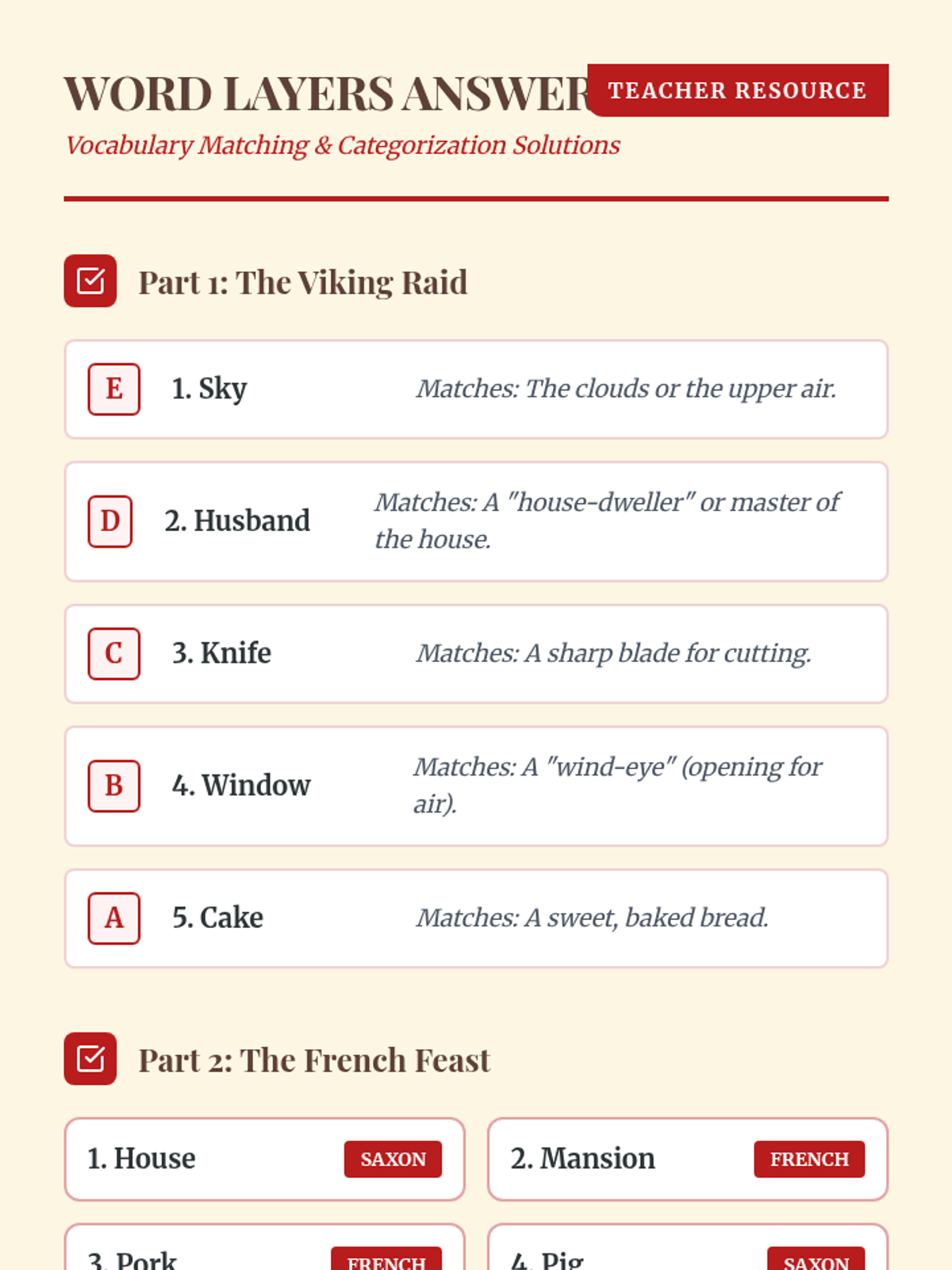
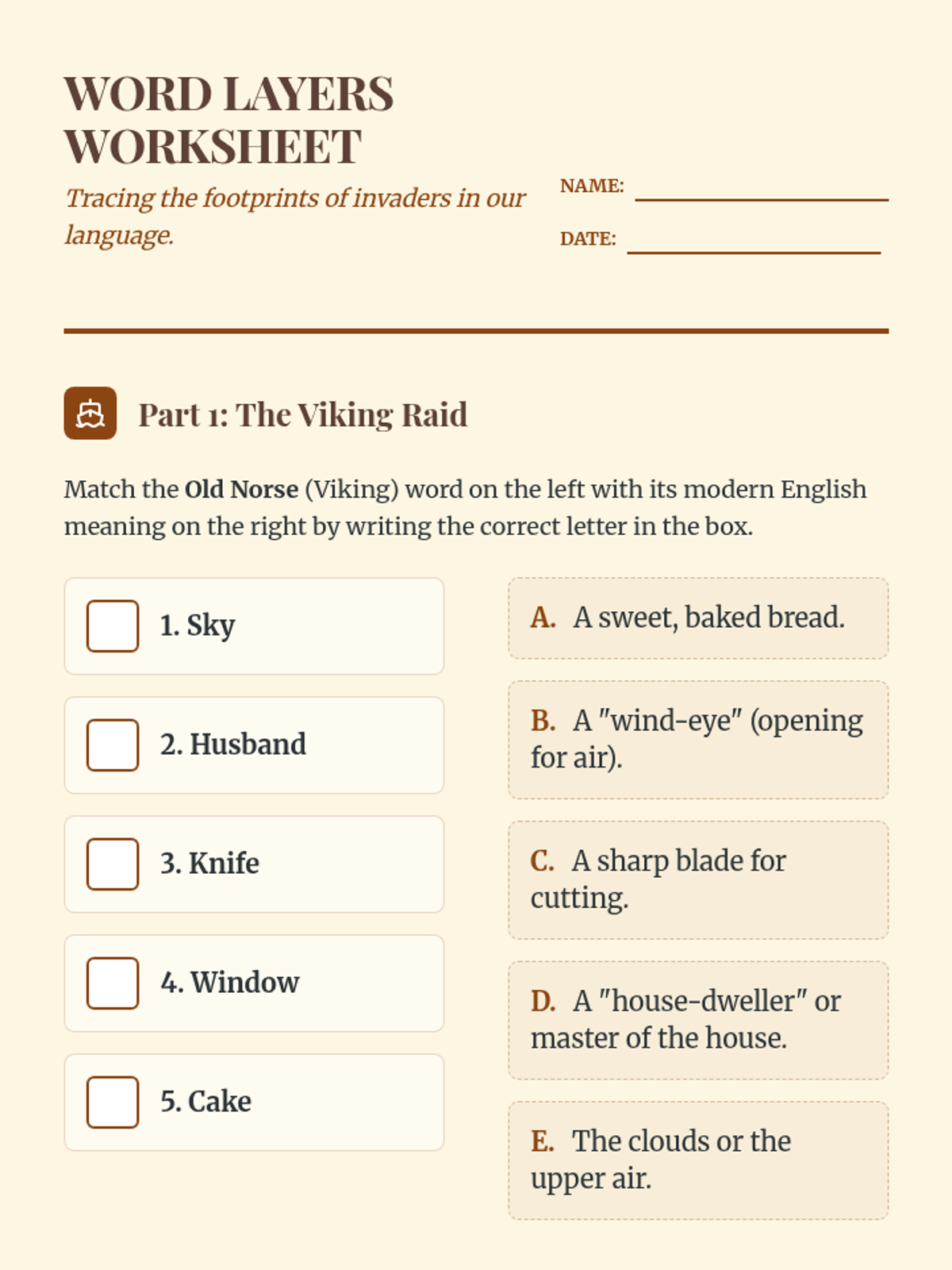
An answer key for the Word Layers Worksheet, providing solutions for the Viking matching section and the Saxon vs. French categorization task. Includes teaching notes on vocabulary origins.
A timeline worksheet where students place key invasions and historical dates in order to see the development of the English language. It includes a word bank of dates and groups, plus a synthesis question.
A vocabulary matching and categorization worksheet that tests students on the Norse and French influences in English. Includes sections on matching Viking words to their meanings and distinguishing between Saxon and French synonyms.
A 10-slide presentation detailing the history of the English language through the lens of Celtic, Viking, and French invasions. It features a manuscript-inspired aesthetic with clear visual distinctions between the layers of vocabulary.
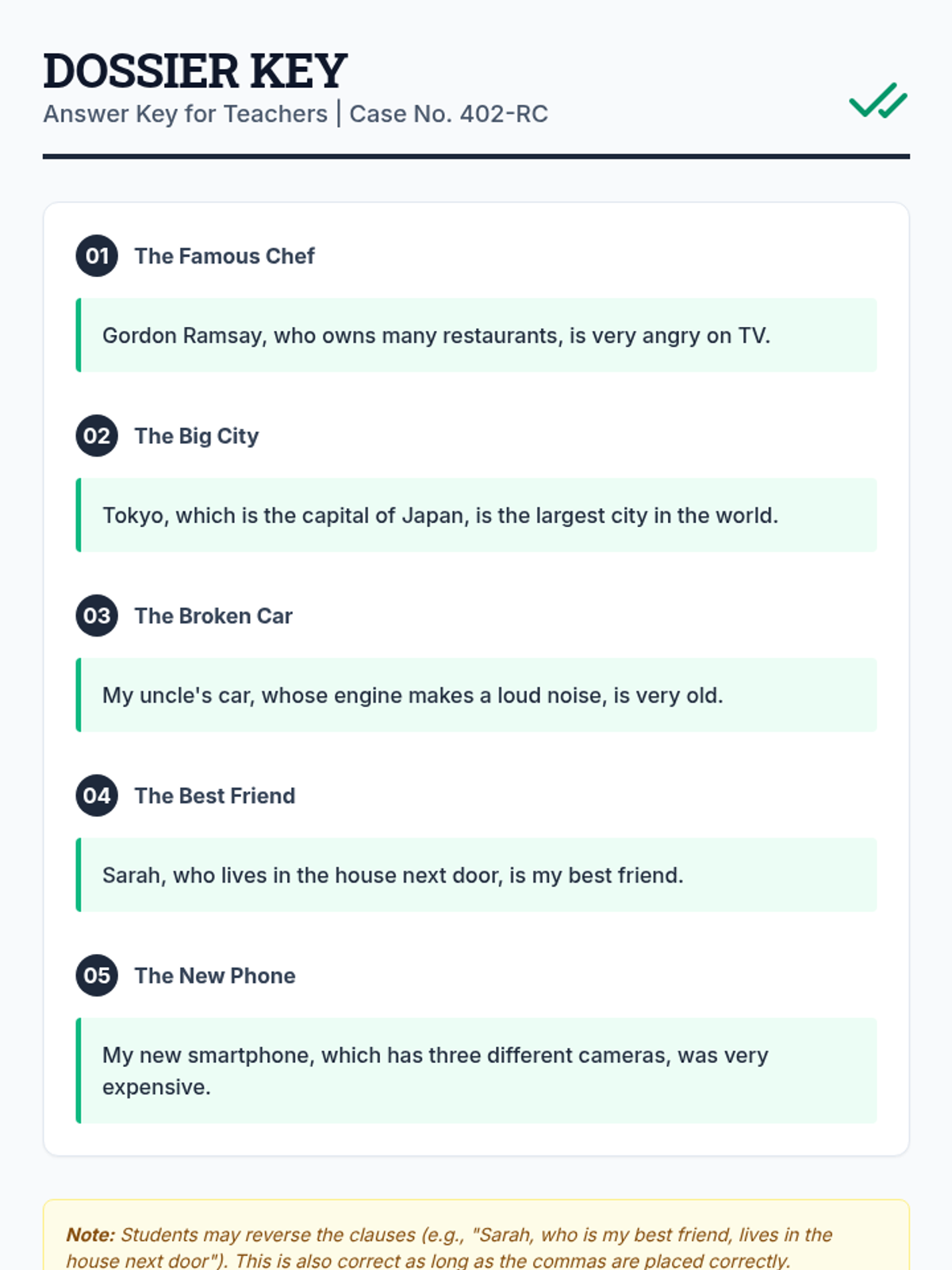
The answer key for the Dossier Linker worksheet, showing correctly combined sentences with non-defining relative clauses.
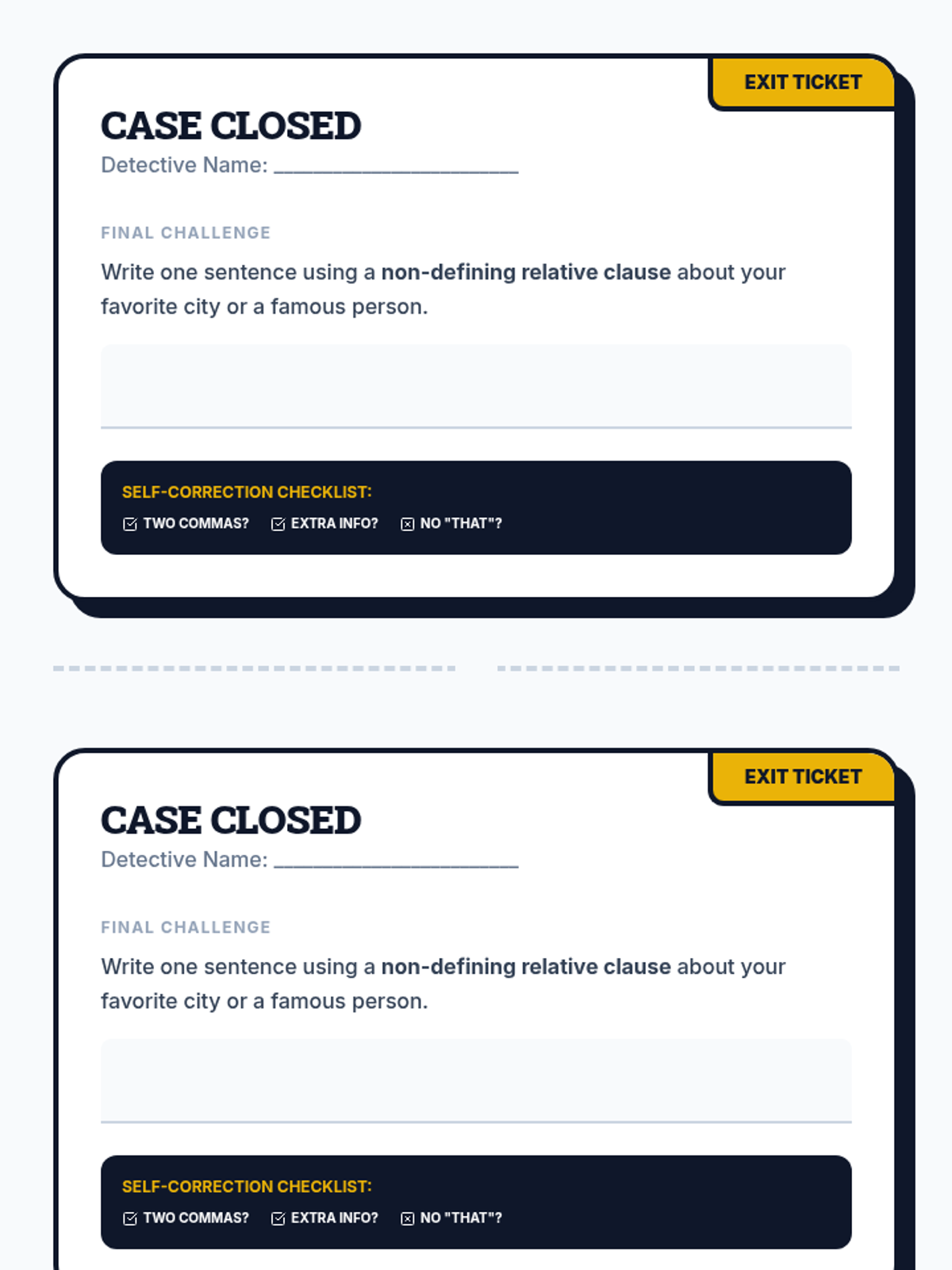
A printable exit ticket for a quick assessment on non-defining relative clauses, featuring a self-correction checklist for students.
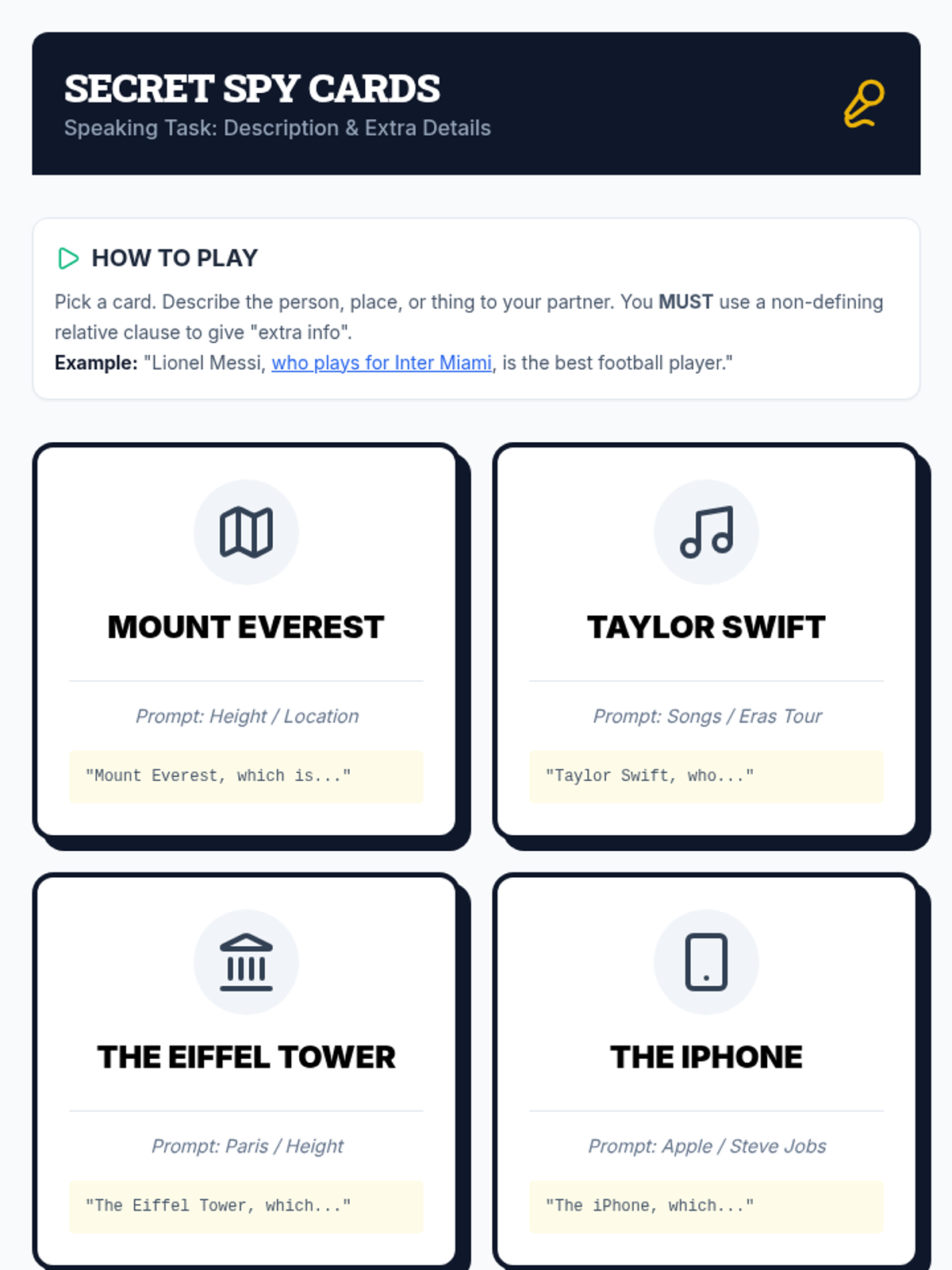
A set of speaking prompt cards for practicing non-defining relative clauses, designed for pair work with specific person/place/thing prompts.
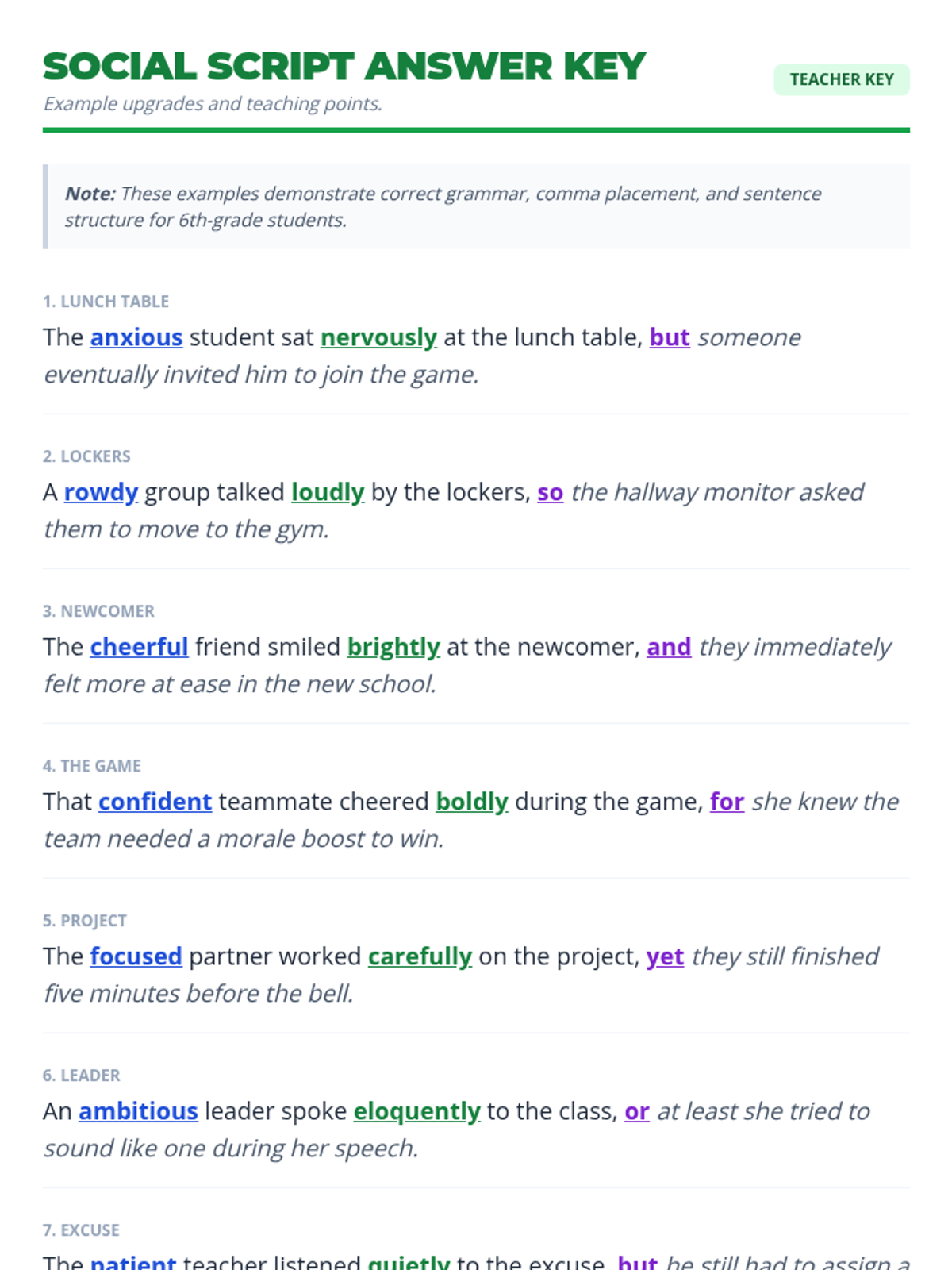
An answer key providing example responses for the Social Script Upgrade worksheet. Optimized to fit on two pages with clear examples.
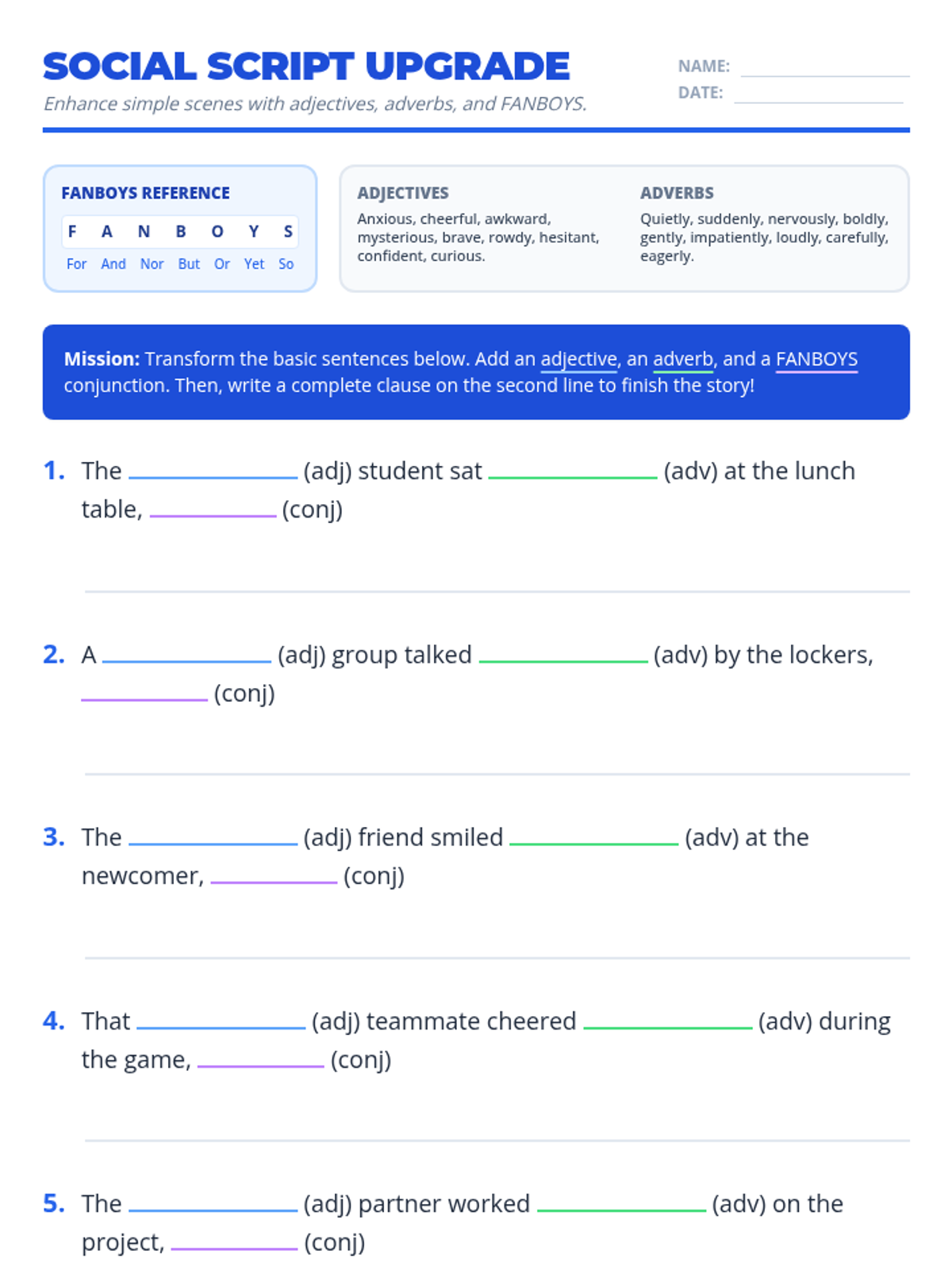
A fill-in-the-blank worksheet for 6th graders to practice enhancing simple sentences with adjectives, adverbs, and coordinating conjunctions (FANBOYS) within social scenarios. Provides ample writing space over two pages.
A regal, attractive presentation slide deck for the Verse Voyagers lesson, featuring a rich Emerald Green and Royal Gold color palette. The deck includes learning targets, a full 20-round gamified Quiz Bee, TP-CASTT modeling, and an independent analysis guide. Fully revised for uniform answer choices, corrected headers, and visual polish.
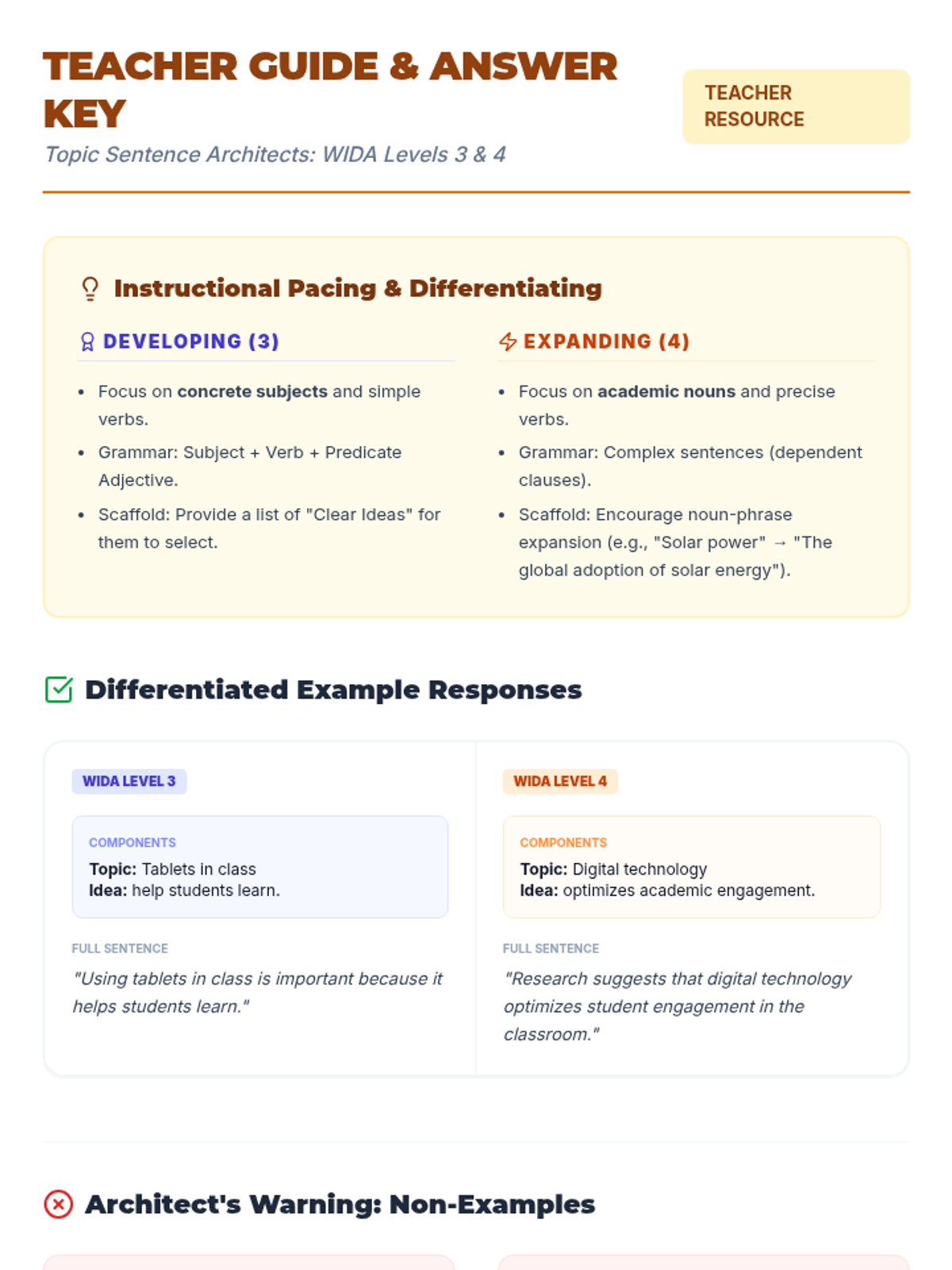
A facilitation guide and answer key for the Topic Sentence Architects lesson. It provides differentiated instructional focuses for WIDA level 3 and 4 students, sophisticated example responses, non-examples for teacher reference, and specific strategies for academic language growth.
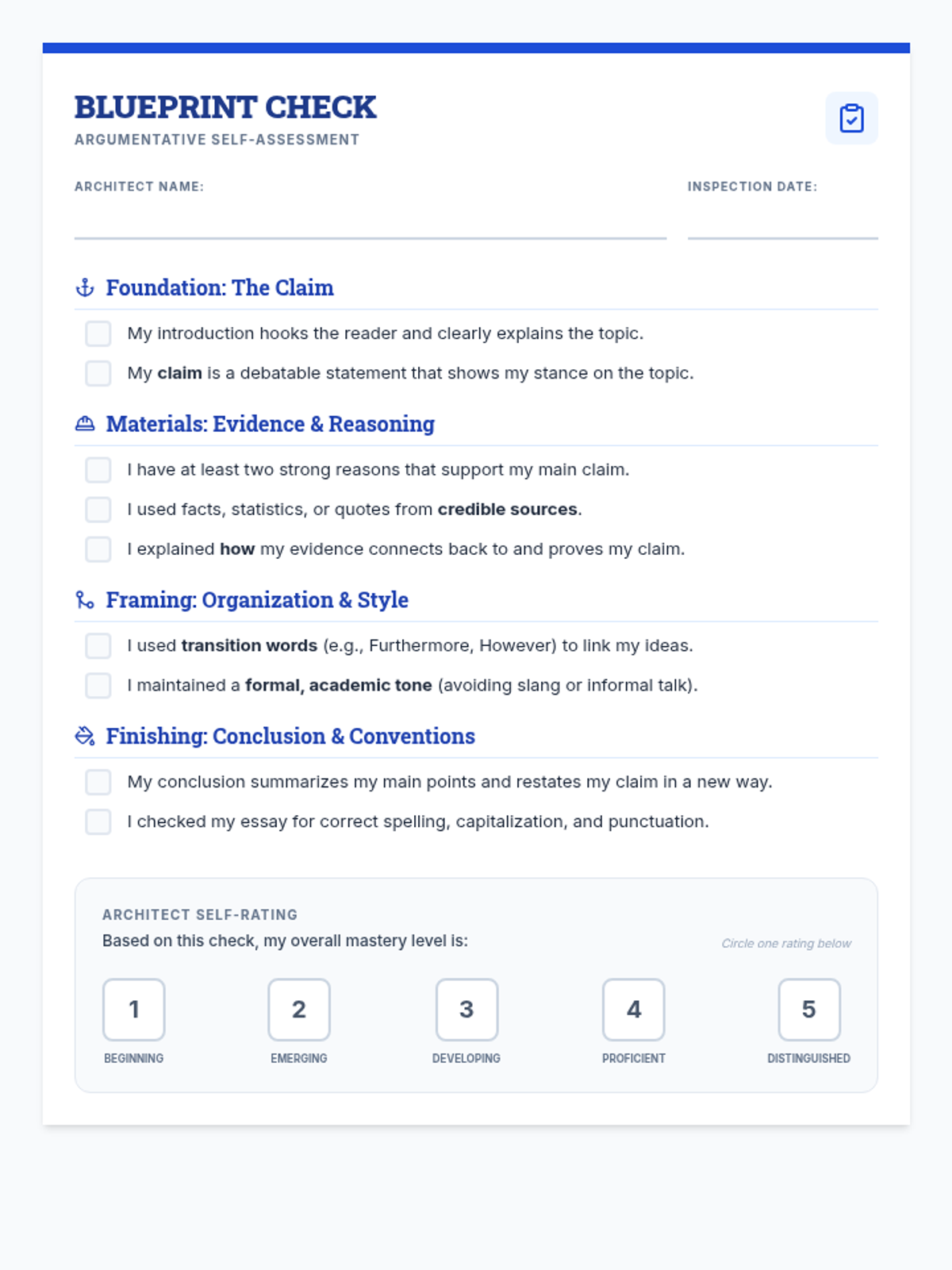
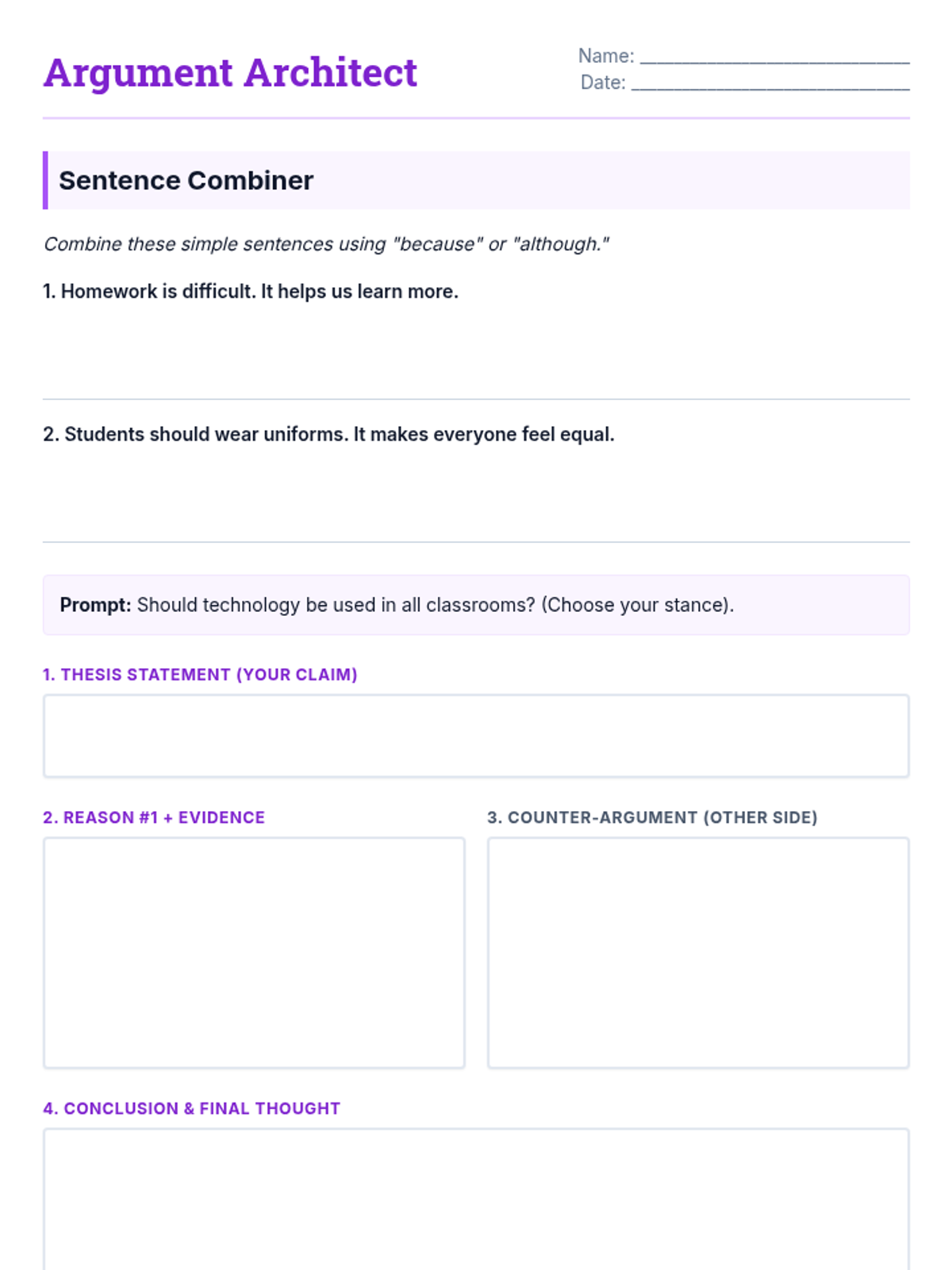
A student-facing self-assessment checklist for 6th-grade argumentative essays. Organized by 'Construction' phases (Foundation, Materials, Framing, Finishing), it helps students verify they have met the requirements of the Argument Architect Rubric before submission.
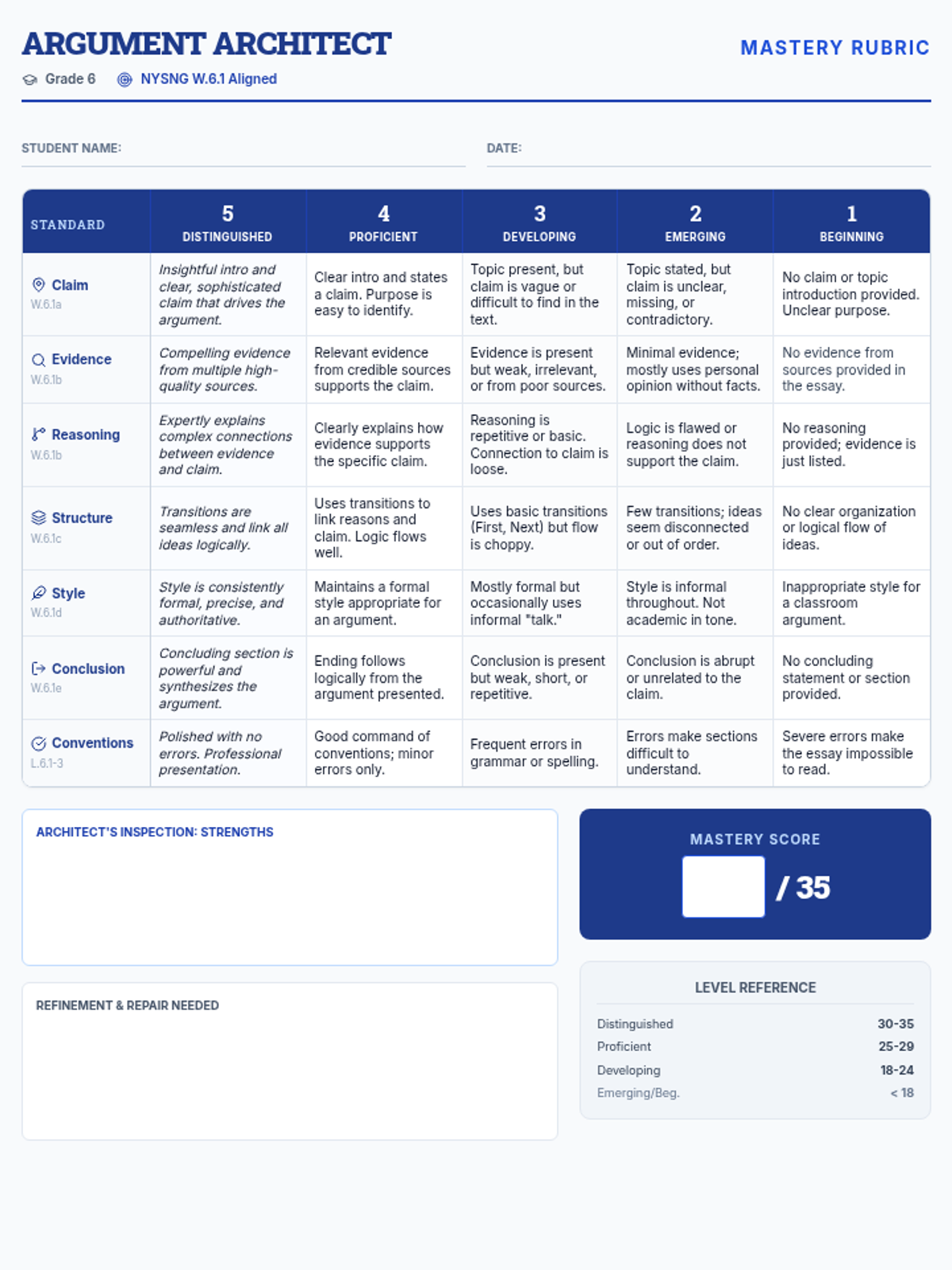
A detailed 5-point mastery rubric for 6th-grade argumentative essays, aligned to NYSNG standards (W.6.1). It features an architectural blueprint theme with criteria for claims, evidence, reasoning, organization, style, and conventions.
A slide deck for introducing the concept of a two-part topic sentence (Topic + Clear Idea). It includes visual analogies, differentiated examples for WIDA levels 3 and 4, and sentence starters for Developing and Expanding learners.
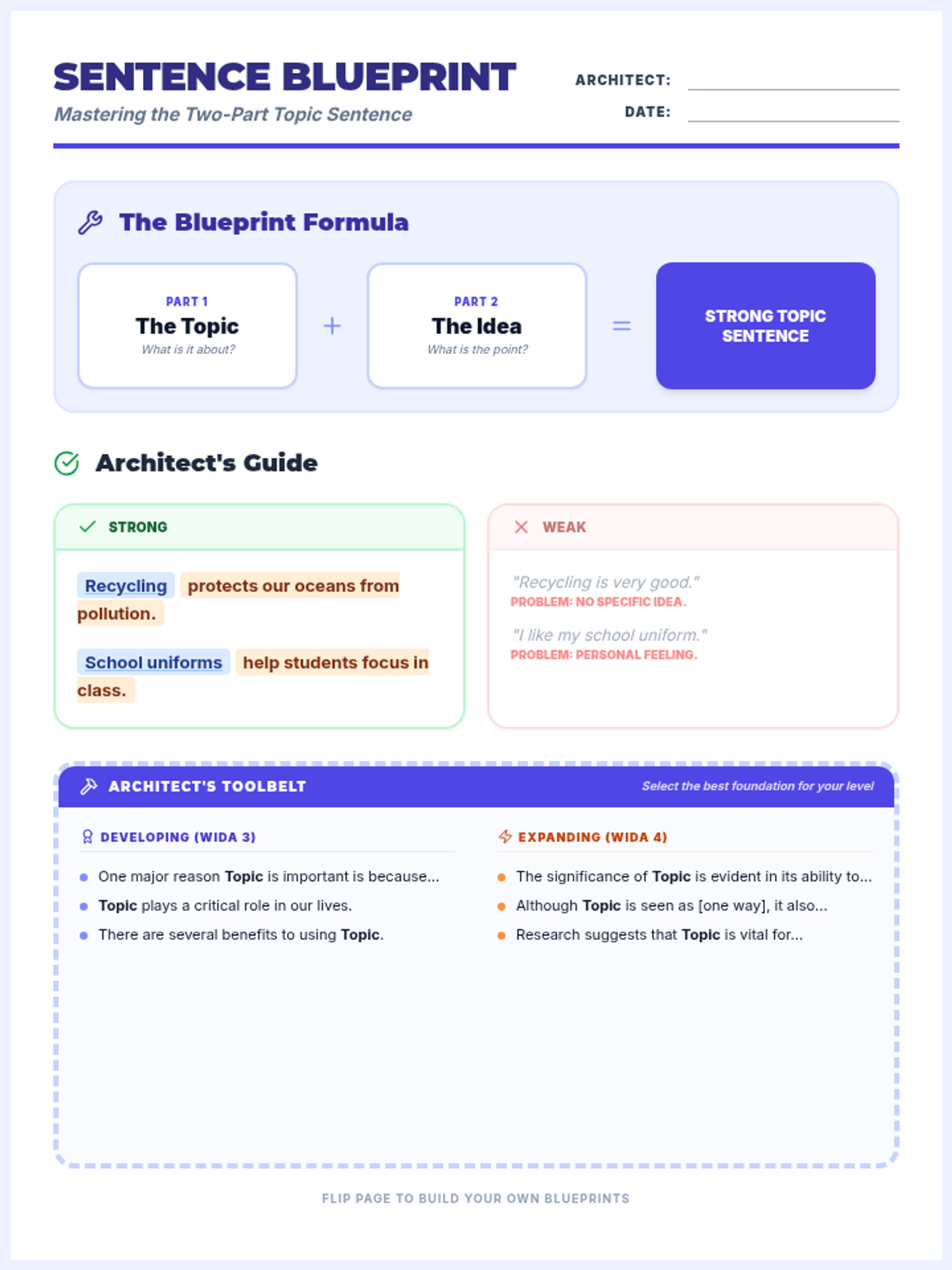
A worksheet for WIDA level 3-4 students to practice writing topic sentences. It includes a visual formula, differentiated sentence starters for Developing and Expanding levels, and a graphic organizer for guided practice.
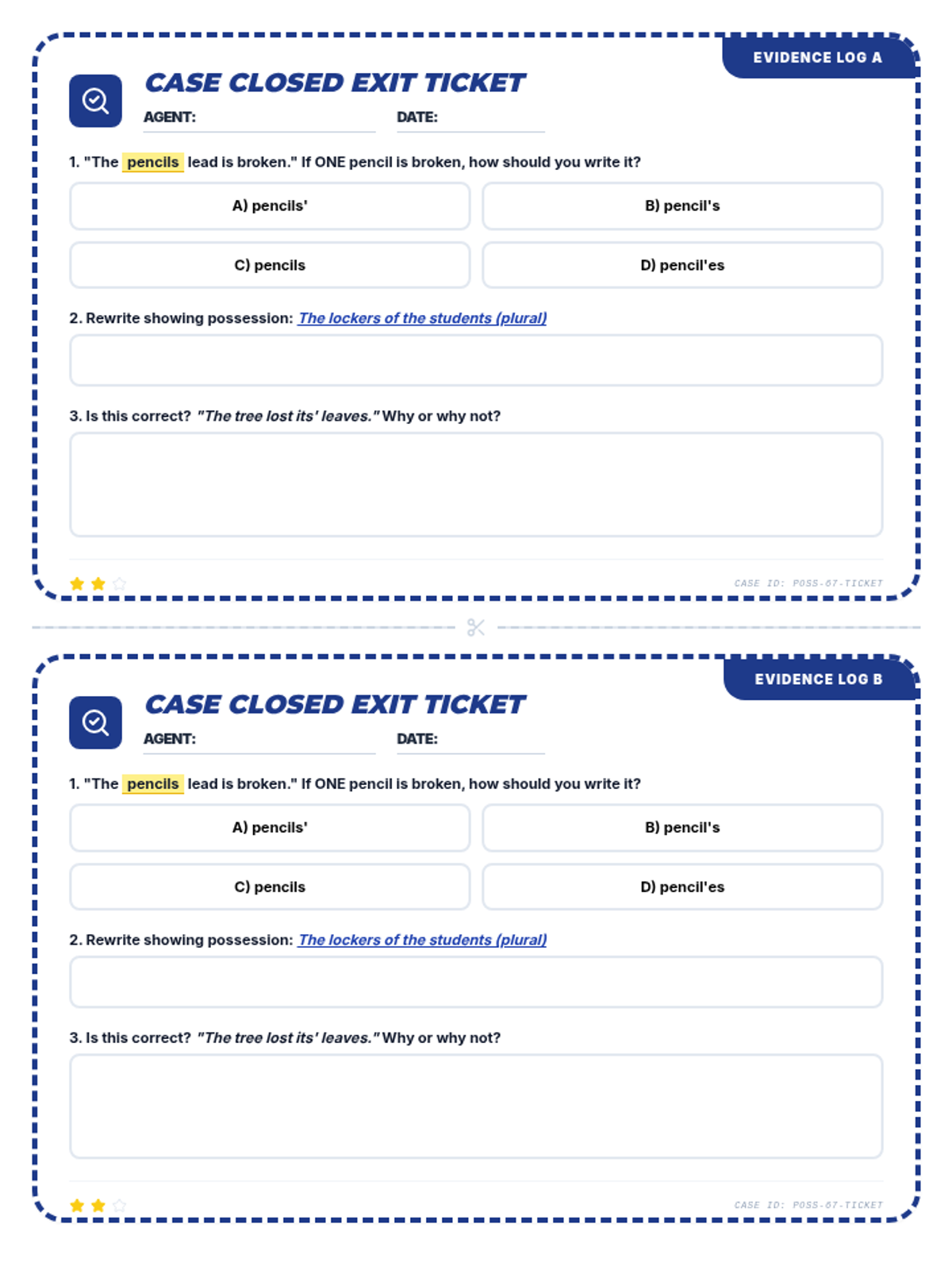
Two-per-page exit tickets for quick formative assessment. Includes multiple-choice and short-answer questions focused on singular and plural possessive nouns, as well as the 'its' vs. 'it's' rule.
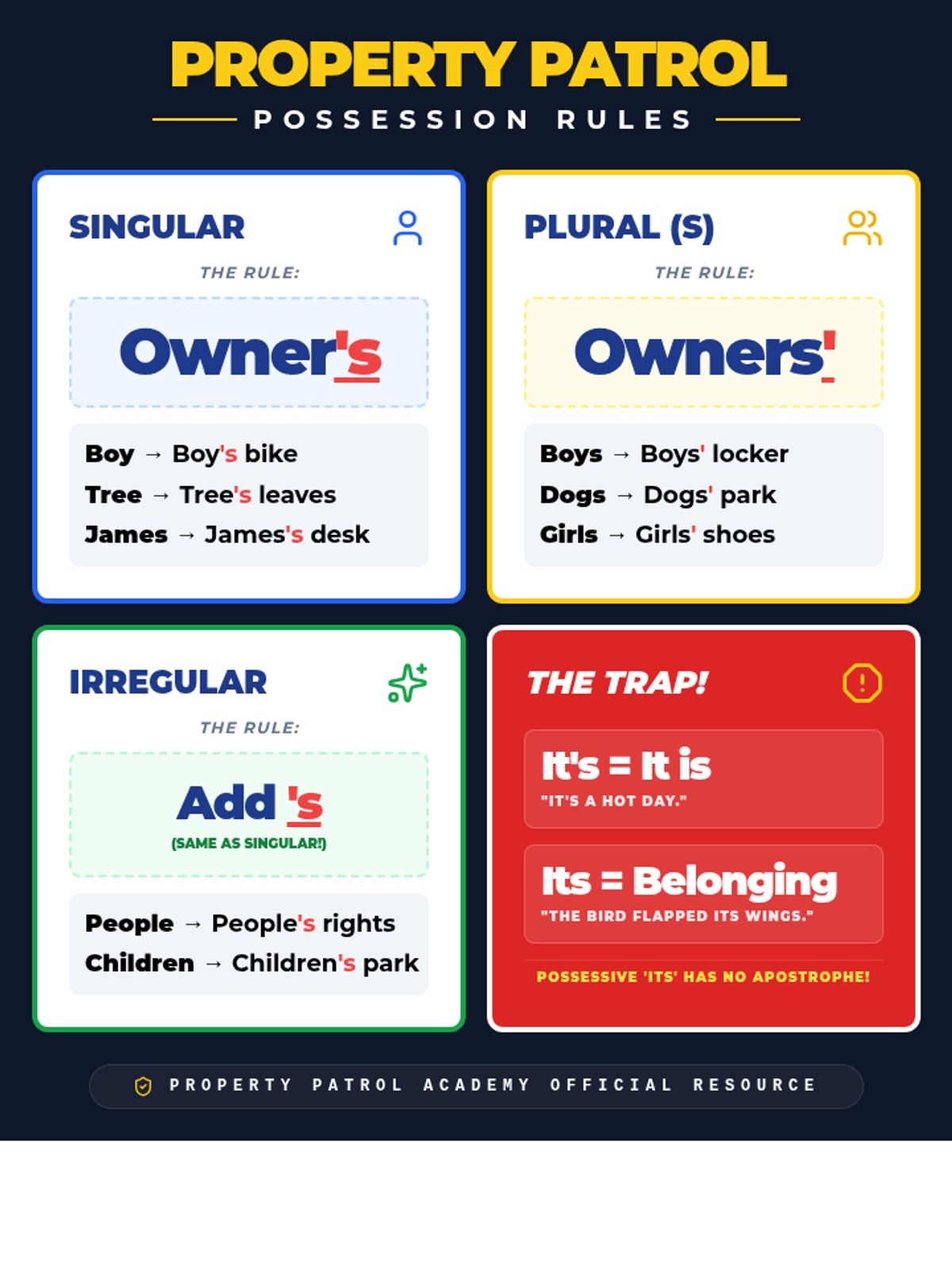
A high-contrast visual anchor chart for classroom display. It breaks down the three main rules of possessive apostrophes (singular, plural, irregular) and clarifies the 'it's' vs. 'its' trap using bold colors and clear examples.
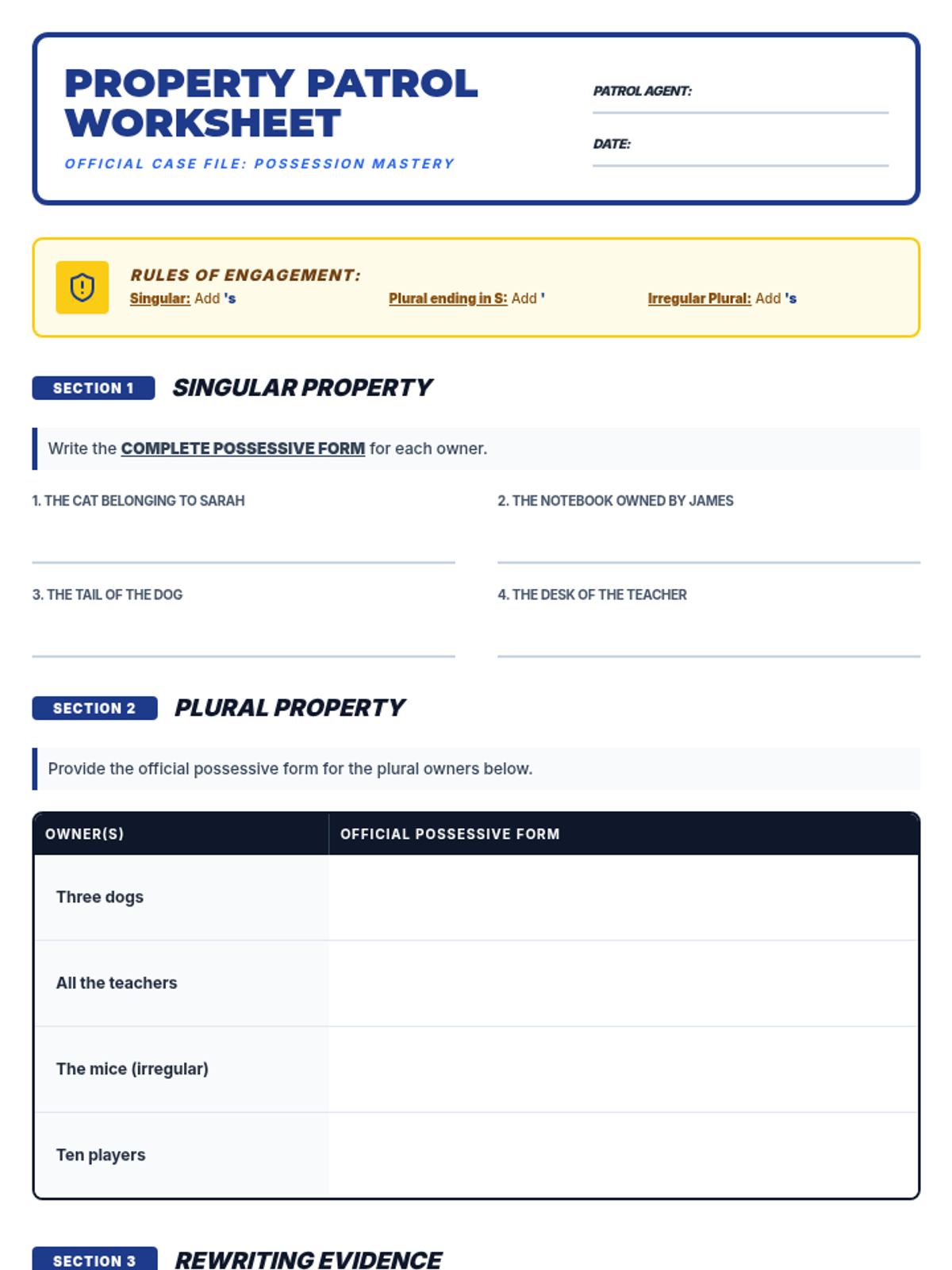
A student-facing practice worksheet with three sections: singular possession practice, plural possession tables, and phrase rewriting. Includes a 'final challenge' sentence writing task.
A high-energy, detective-themed slide deck that teaches the rules for using apostrophes for singular and plural possessive nouns. Features clear examples, visual formulas, and guided practice slides.
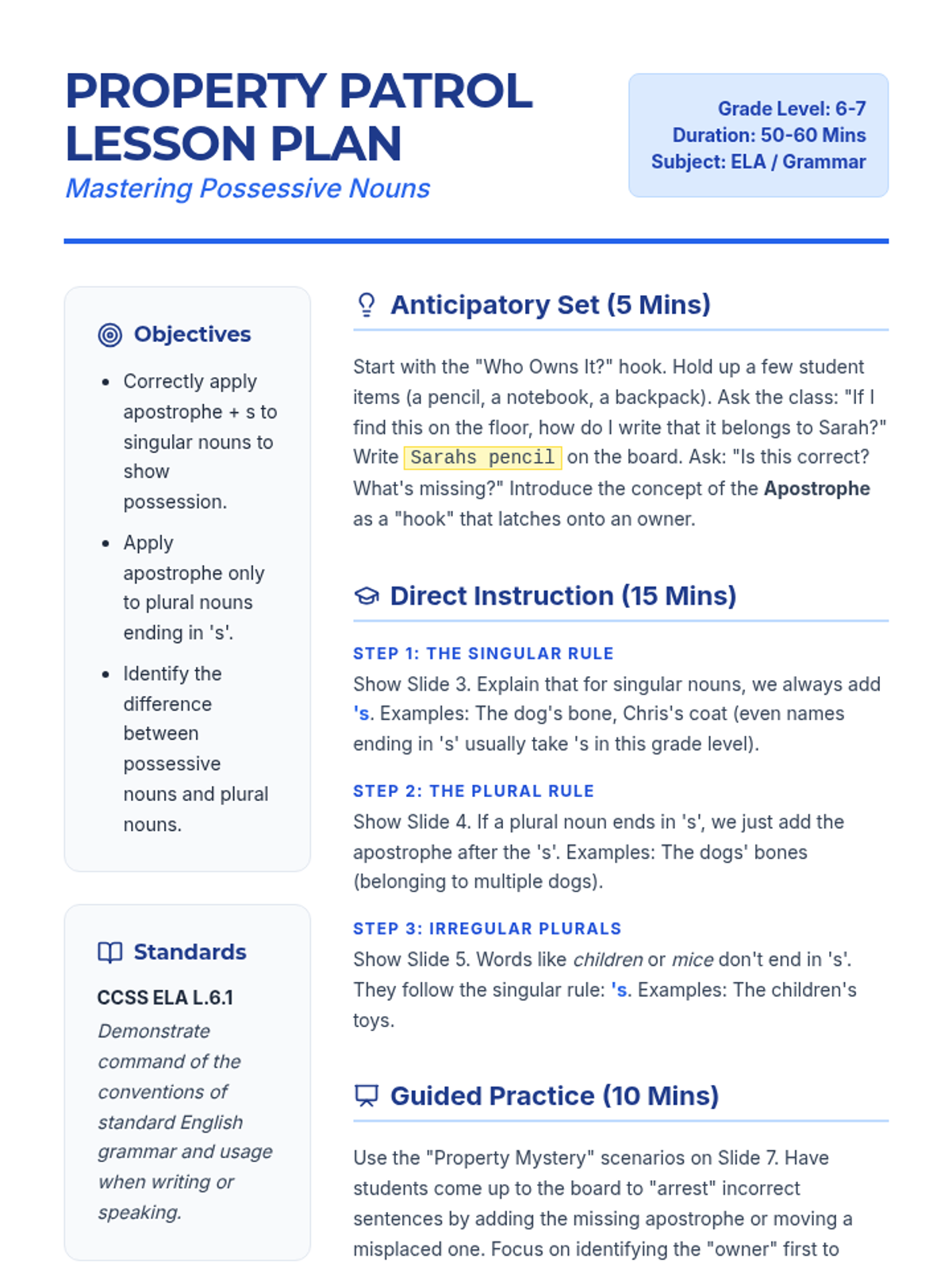
A detailed teacher's lesson plan for the 'Property Patrol' unit, outlining objectives, CCSS standards, step-by-step instructional procedures, and differentiation strategies for teaching possessive nouns.
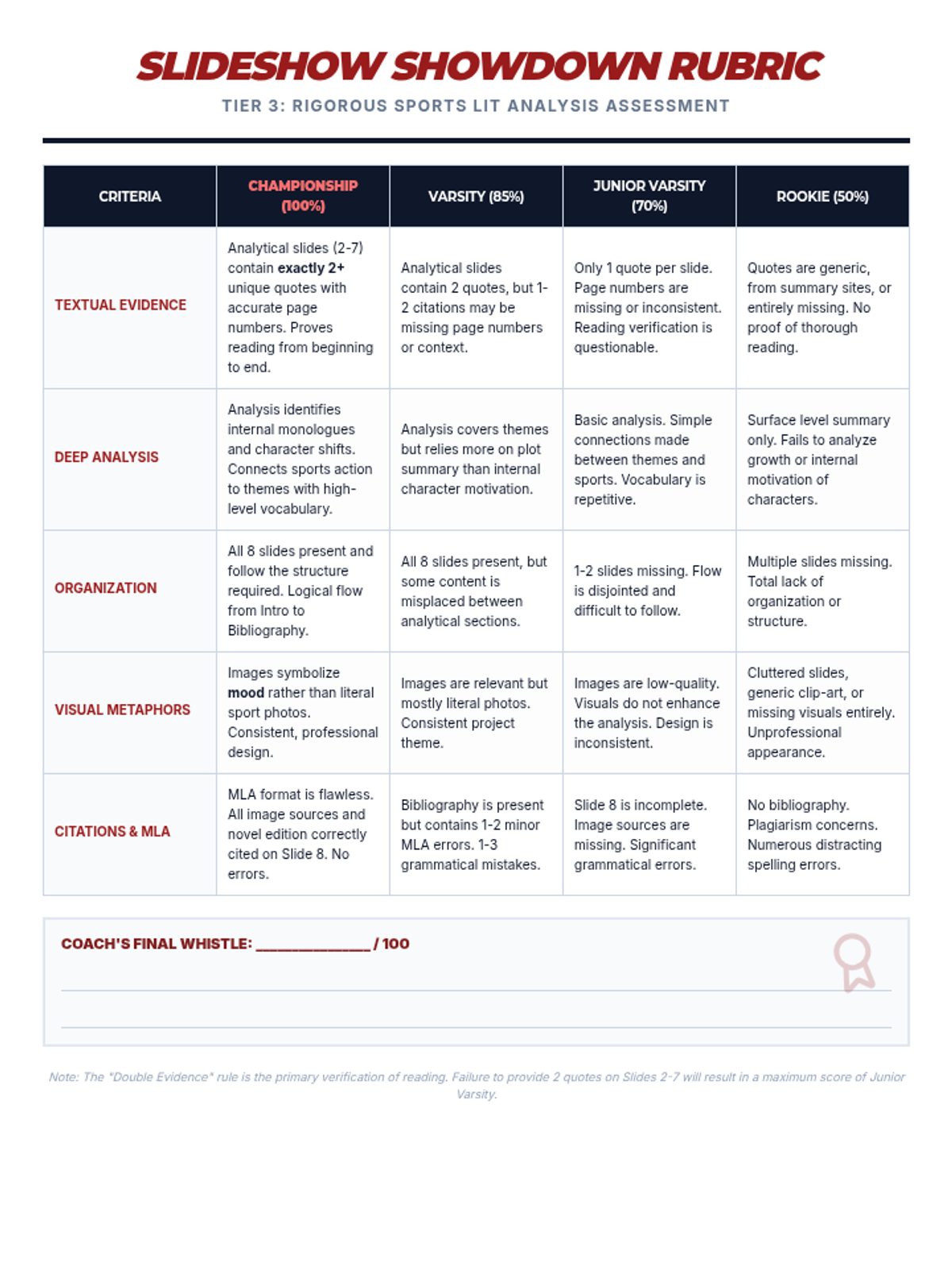
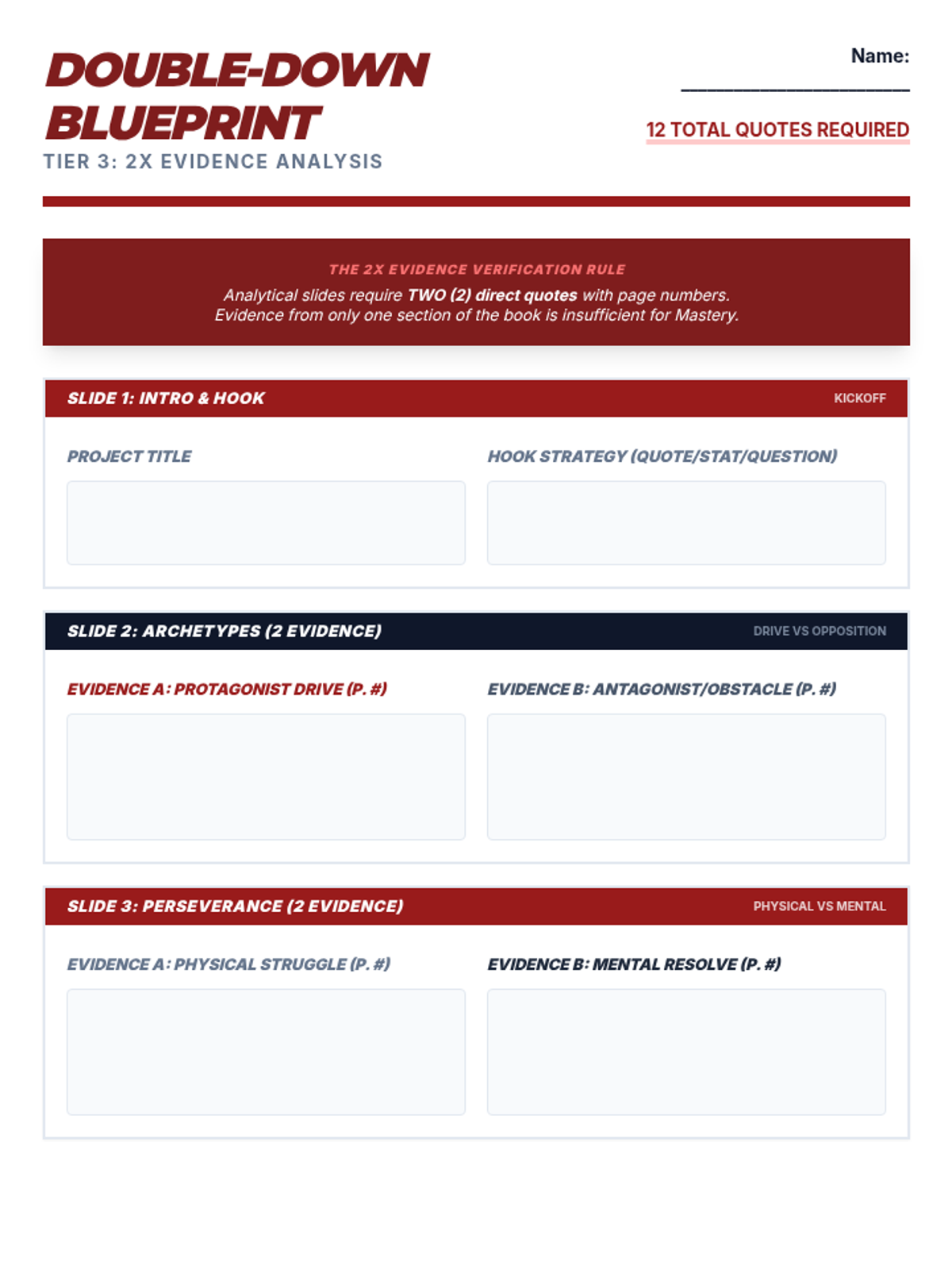
A detailed grading rubric for the Google Slides project, updated to support both fiction and non-fiction tracks. Evaluates textual evidence, dual-track analysis, visual metaphors, and MLA formatting. Fits on one sheet.
A printable slide-by-slide planning guide for students, updated to support both fiction and non-fiction tracks. Includes two specific evidence boxes for Slide 7 and a student-facing rubric on a 3rd page for self-assessment. Layout optimized for clarity and handwriting space. Fixed page breaks and rubric typos.
Instructional slide deck for students, updated to support both fiction and non-fiction tracks. Clearly outlines the adaptive requirements for biographies/memoirs while maintaining high rigor. Includes a full 8-slide roster and scoring preview.
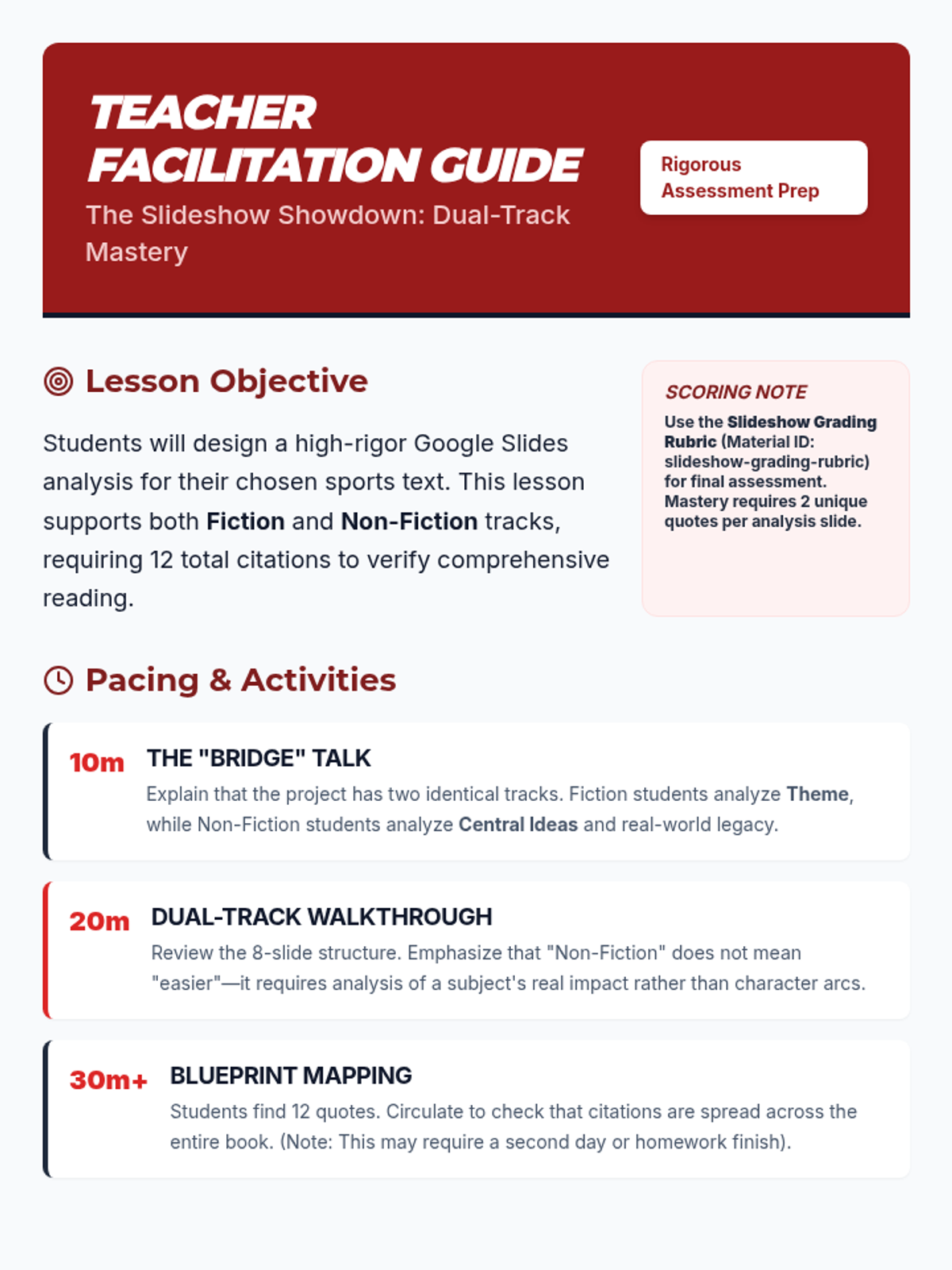
Teacher facilitation guide for the Google Slides project, updated with a comprehensive 8-slide comparison map for both fiction and non-fiction tracks. Includes specific reading verification strategies and fixed orphaned punctuation. Revised Scoring Note for better contrast.
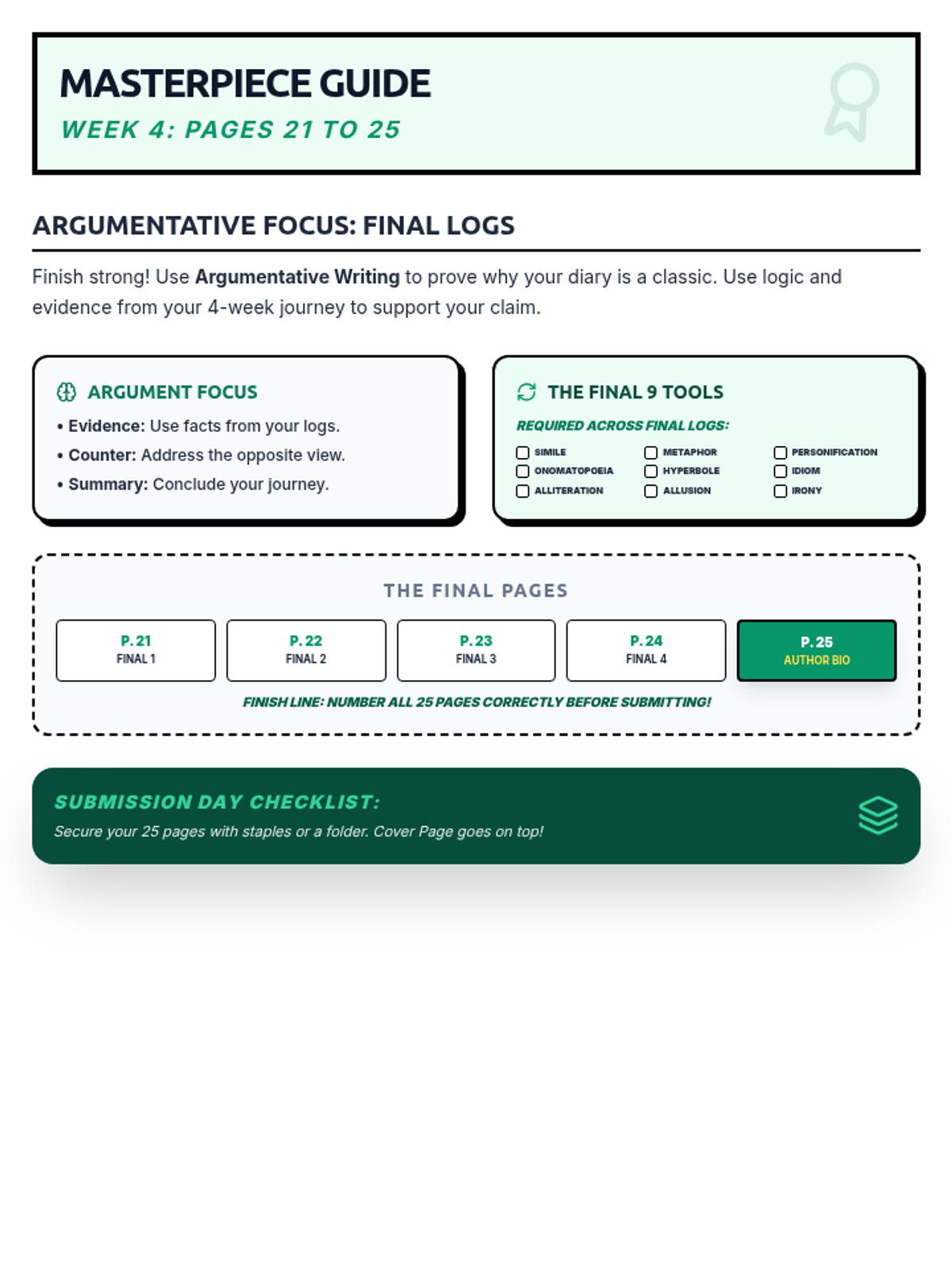
A single-page instruction sheet for Week 4 of the diary unit, detailing the Argumentative writing requirements and the comprehensive mix of all 9 figurative language devices for pages 21-25. Reverted to a classic hand-drawn aesthetic and optimized for single-page layout.
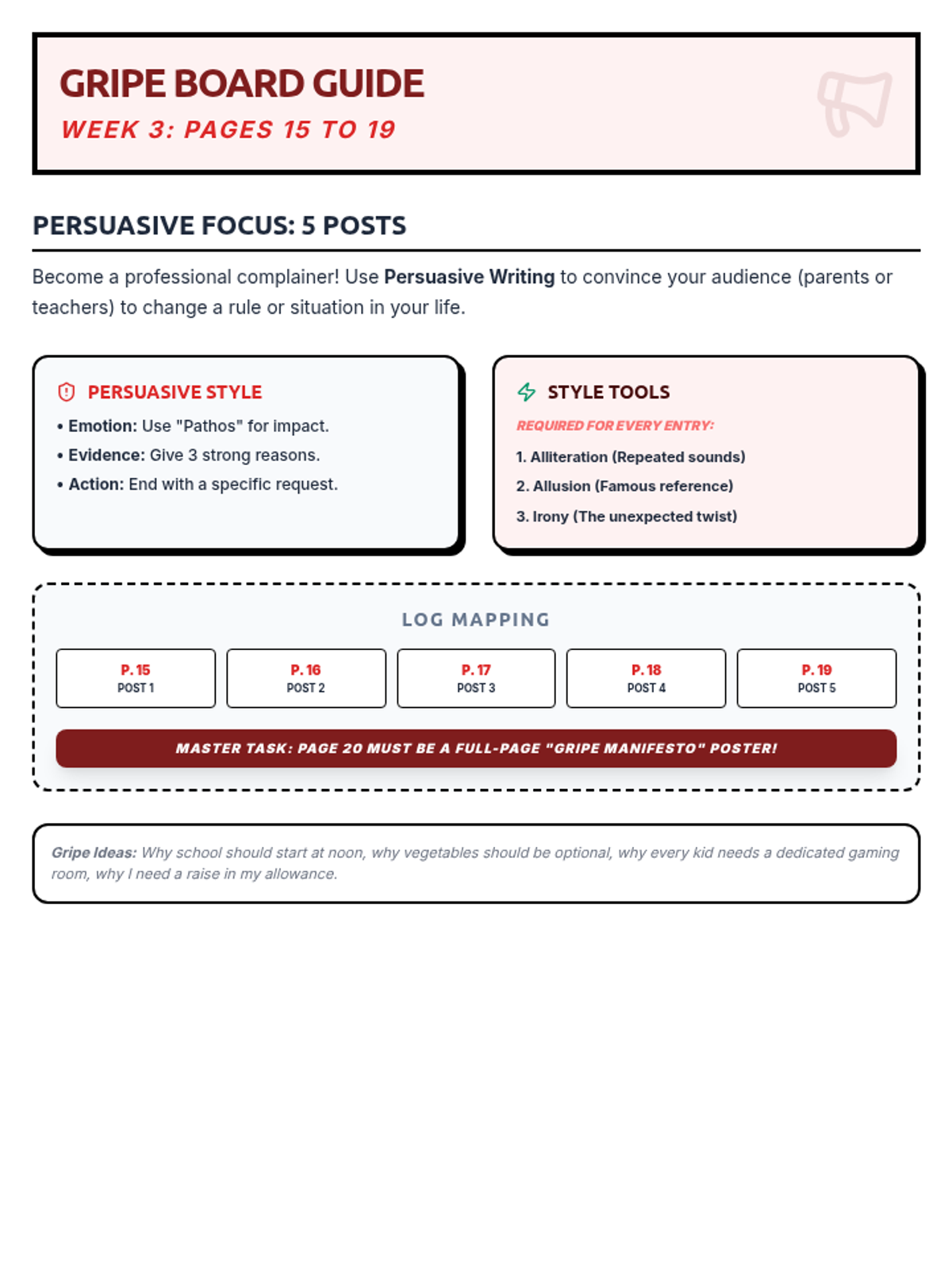
A single-page instruction sheet for Week 3 of the diary unit, detailing the Persuasive writing requirements and the mandatory use of alliteration, allusion, and irony for pages 15-19. Reverted to a classic hand-drawn aesthetic and optimized for single-page layout.
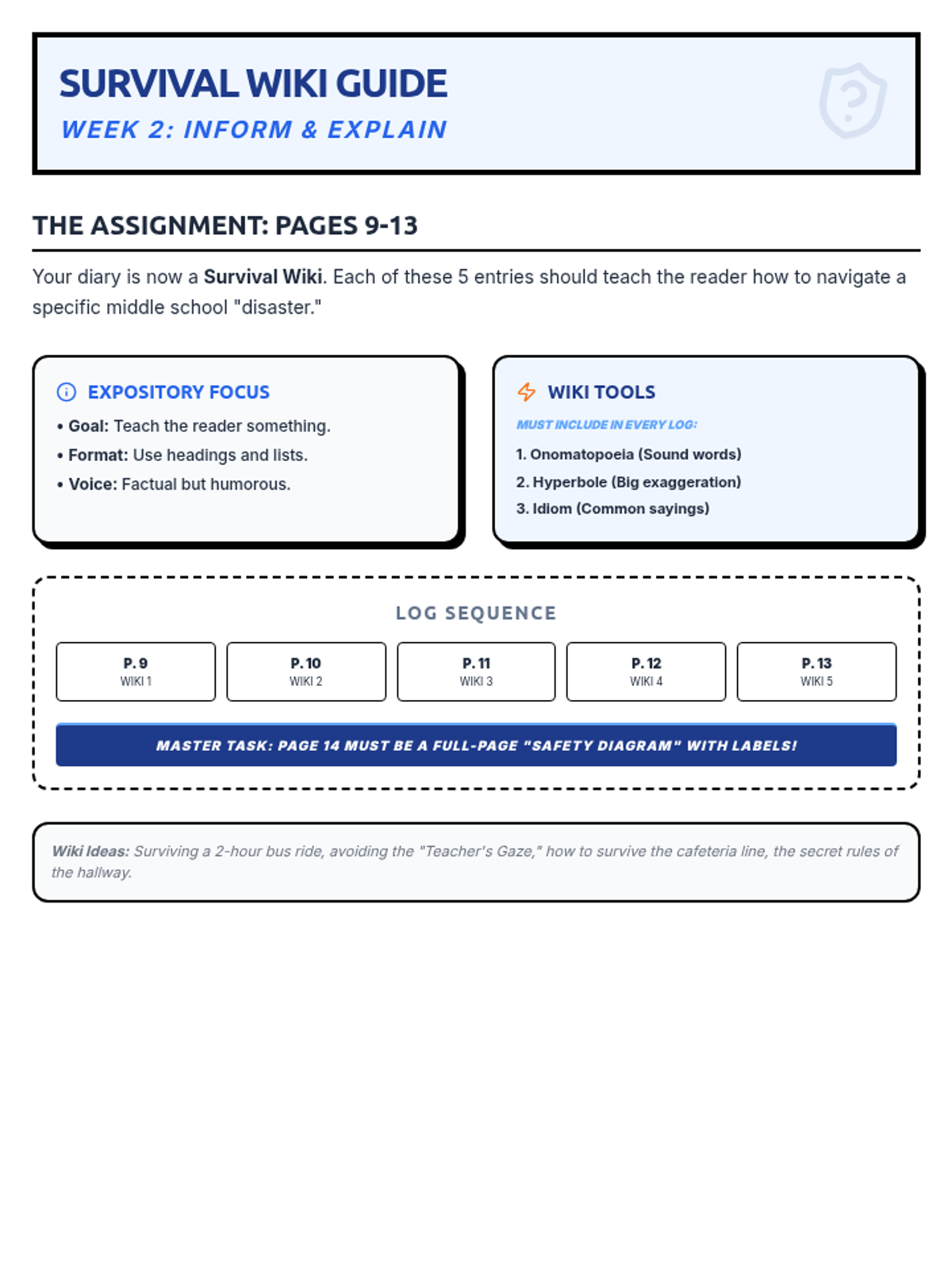
A single-page instruction sheet for Week 2 of the diary unit, detailing the Expository writing requirements and the mandatory use of onomatopoeia, hyperbole, and idioms for pages 9-13. Reverted to a classic hand-drawn aesthetic and optimized for single-page layout.
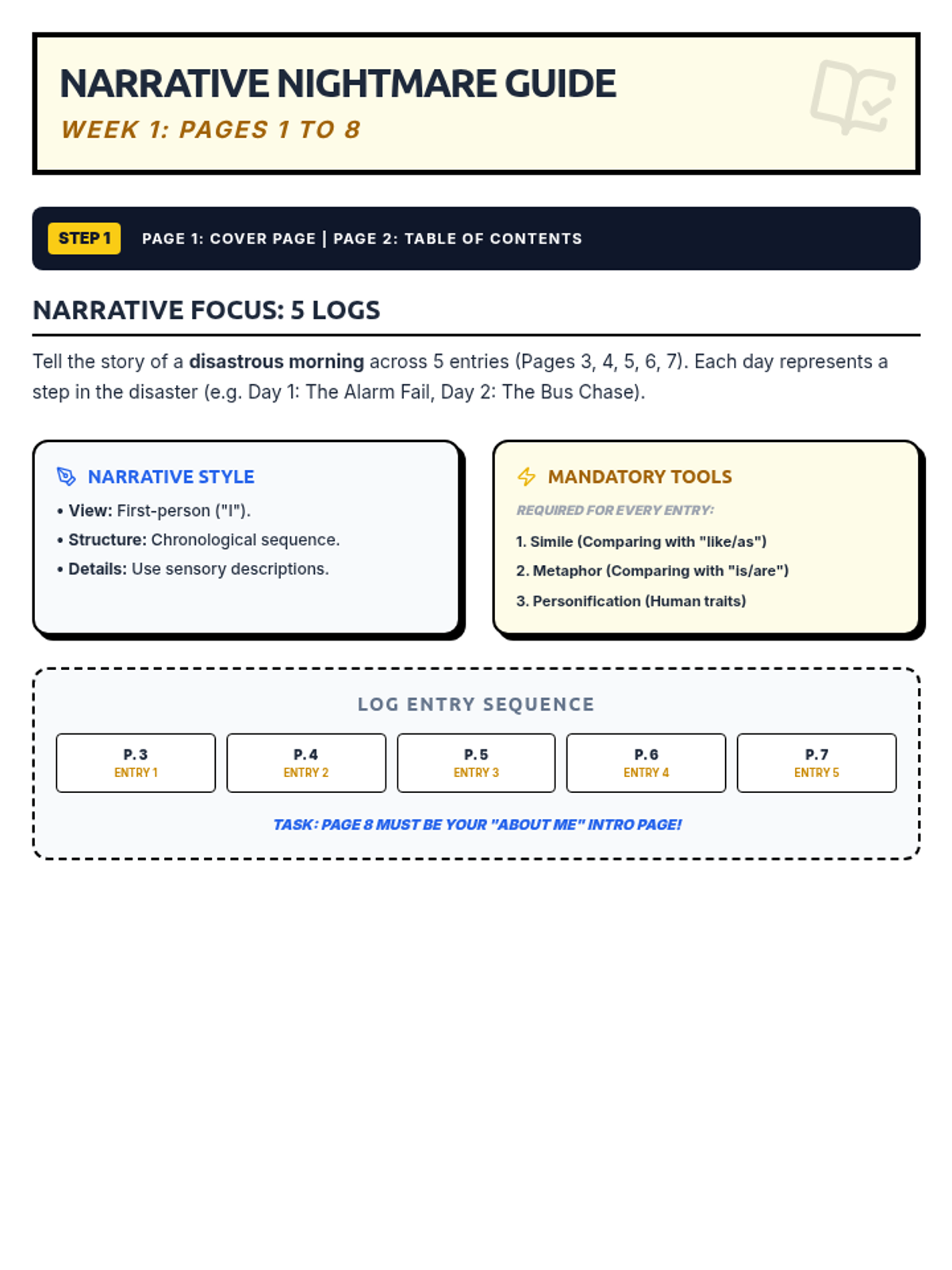
A single-page instruction sheet for Week 1 of the diary unit, explicitly detailing the Narrative writing requirements and the mandatory use of similes, metaphors, and personification for pages 3-7. Reverted to a classic hand-drawn aesthetic and removed doodle mandate.
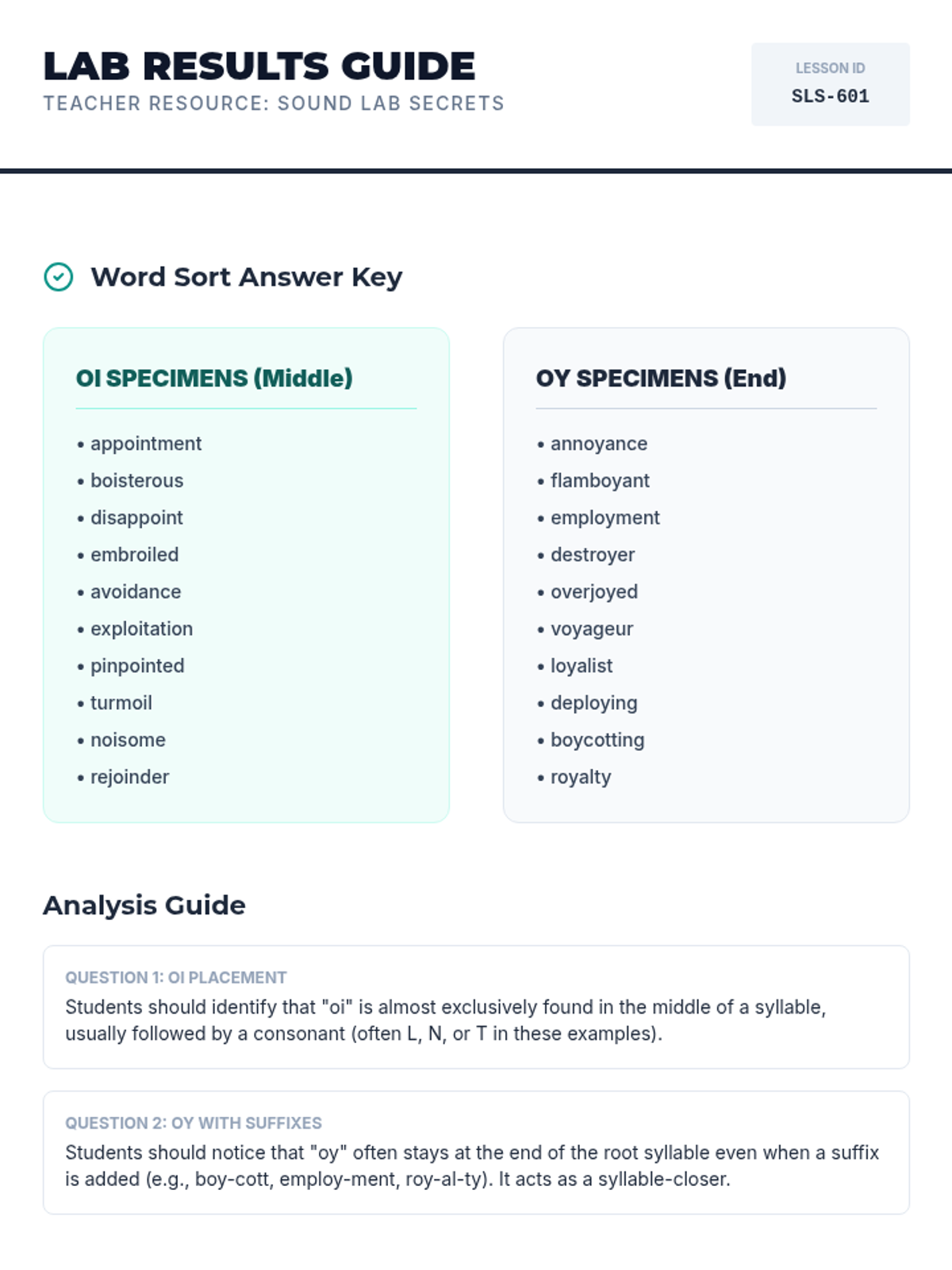
A comprehensive teacher guide and answer key for the Sound Lab Secrets lesson. Features a categorized answer key for the word sort, sample analysis answers, and strategies for differentiation.
Revised instructional slides for 'oi' and 'oy' diphthongs. Includes a reference specimen list, uniform underlines for interactive checks, and a separate answer reveal slide.
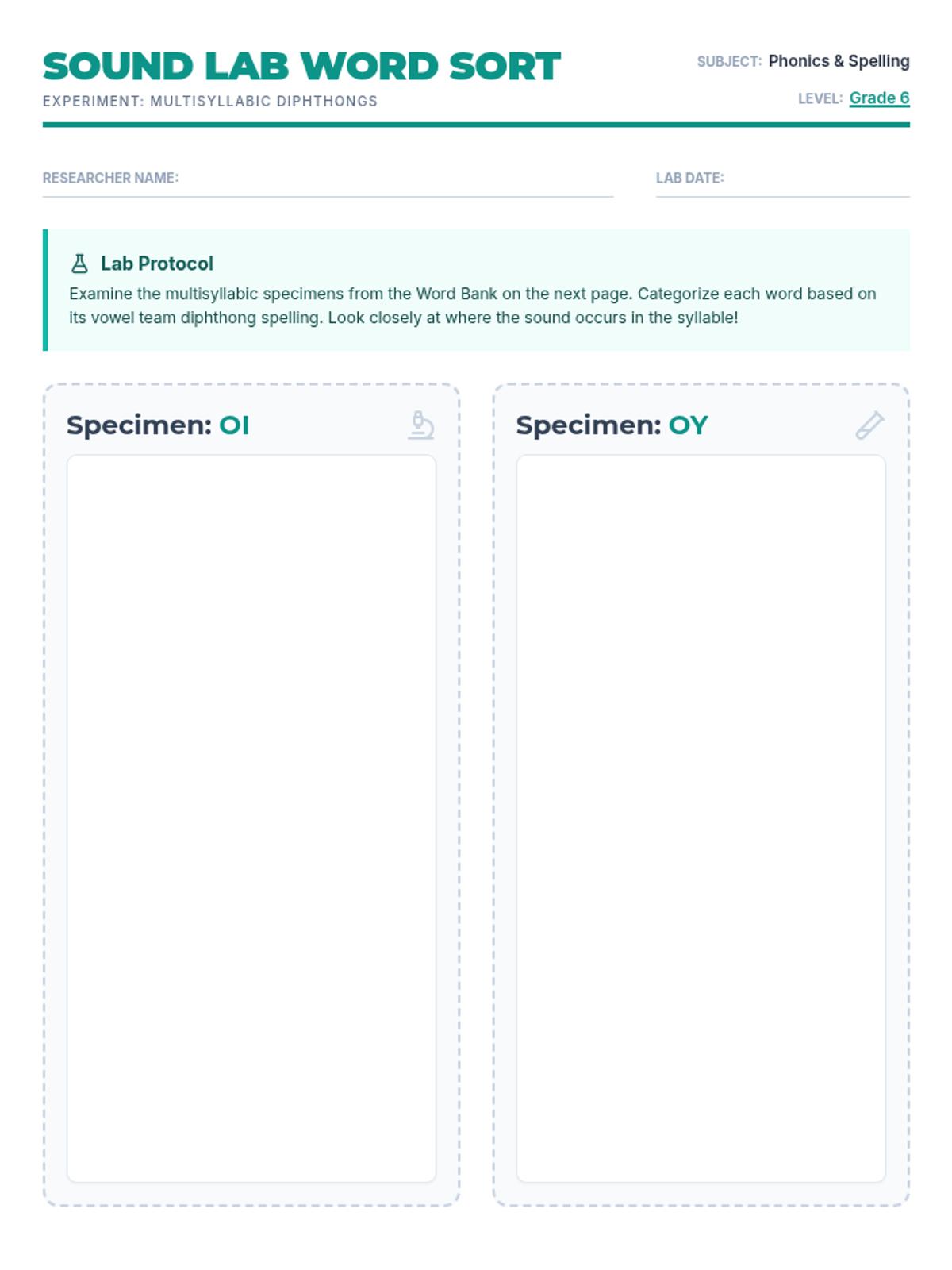
A revised two-page interactive word sort for Grade 6 students. Layout optimized to prevent content cutoff, with expanded writing lines for better usability.
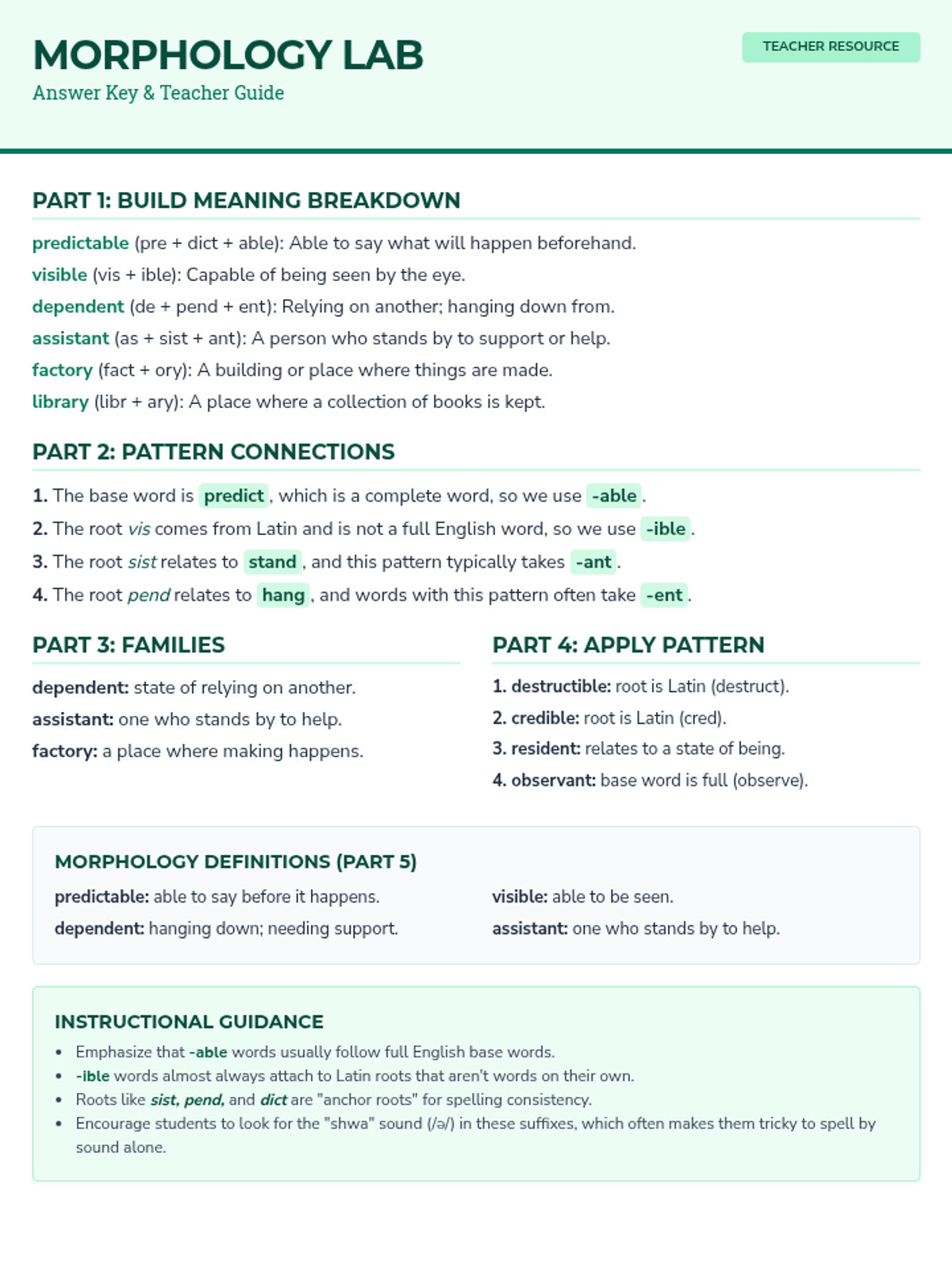
Answer key for the Morphology Lab worksheet. Revised to be a single-page teacher resource with full explanatory sentences and instructional tips.
Instructional slides for the Morphology Lab lesson, explaining suffix rules (-able/-ible, -ant/-ent, -ary/-ery/-ory) with visual examples and a quick challenge.
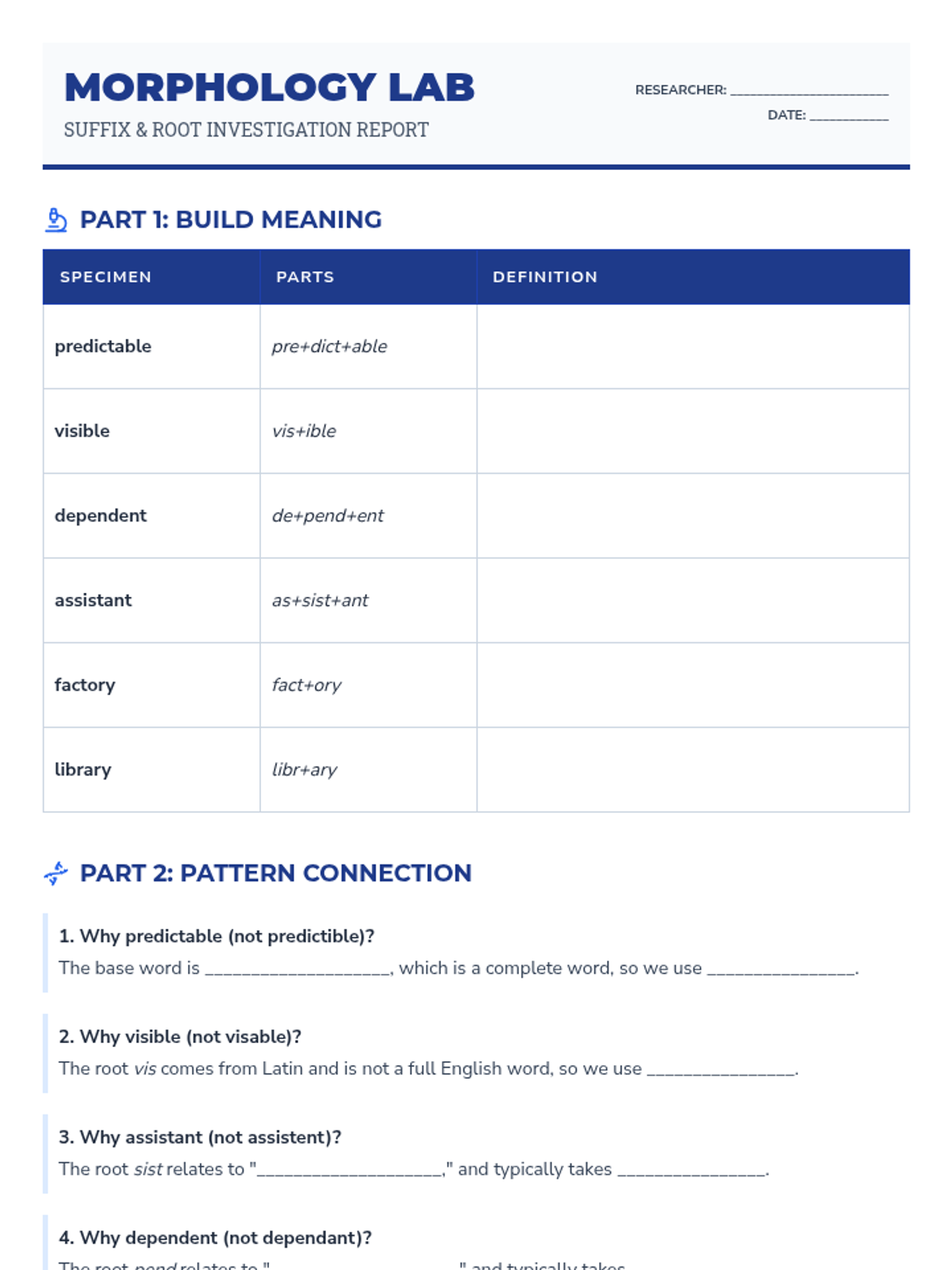
A comprehensive morphology worksheet focusing on Latin roots and suffix patterns (-able, -ible, -ant, -ent, etc.) with structured analysis sections. Revised for better page flow and work area legibility.
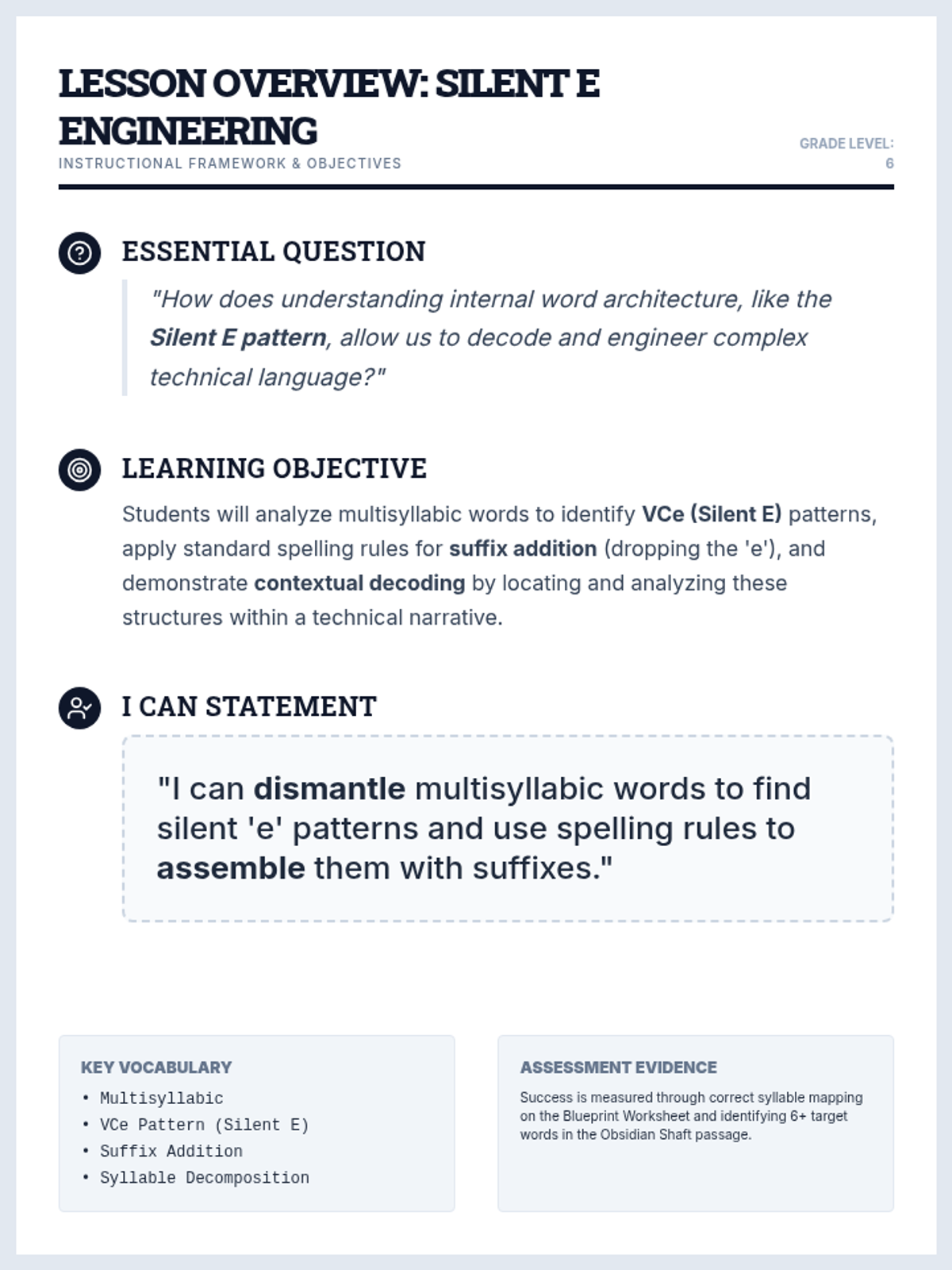
A teacher-facing reference document outlining the essential question, learning objective, and 'I can' statement for the Silent E Engineering lesson.
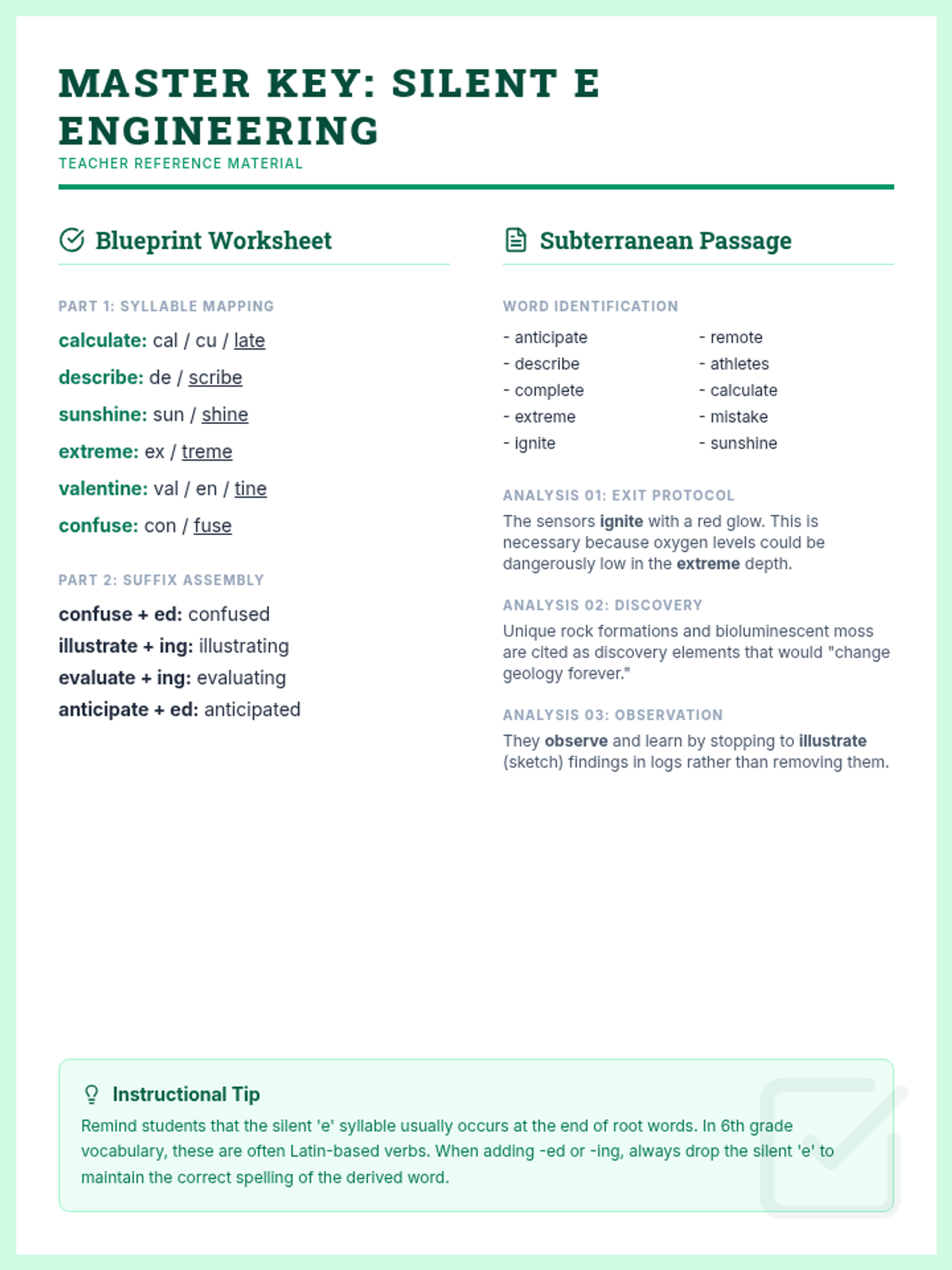
A comprehensive answer key for both the Vowel Power Blueprint Worksheet and the Subterranean Secret Passage, including syllable breakdowns and instructional tips. Optimized for a single-page layout.
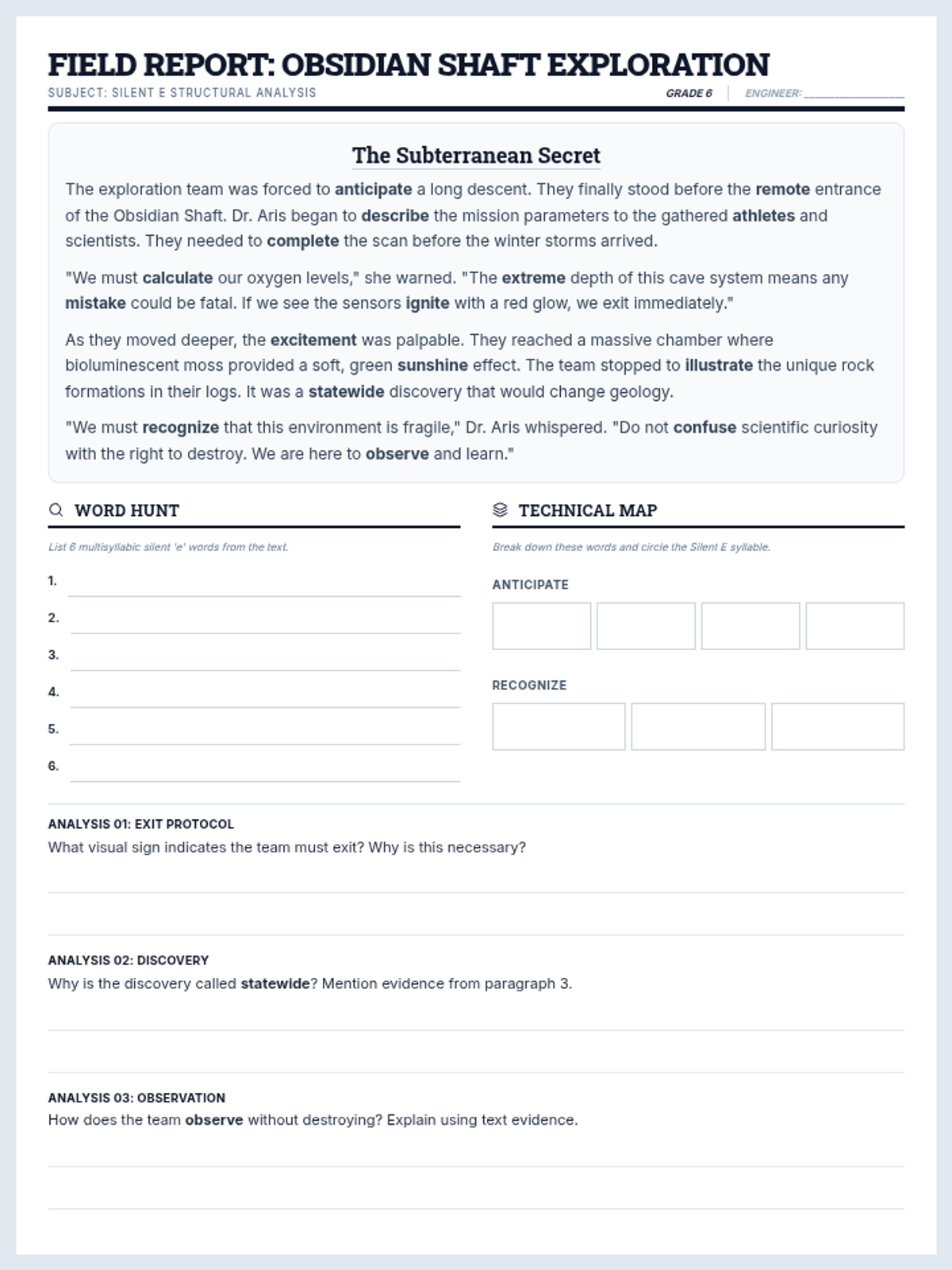
A narrative reading passage set in a mysterious cave system, embedded with high-frequency 6th-grade multisyllabic silent 'e' words. Includes syllable mapping and expanded text-based comprehension questions. Optimized for a single-page layout.
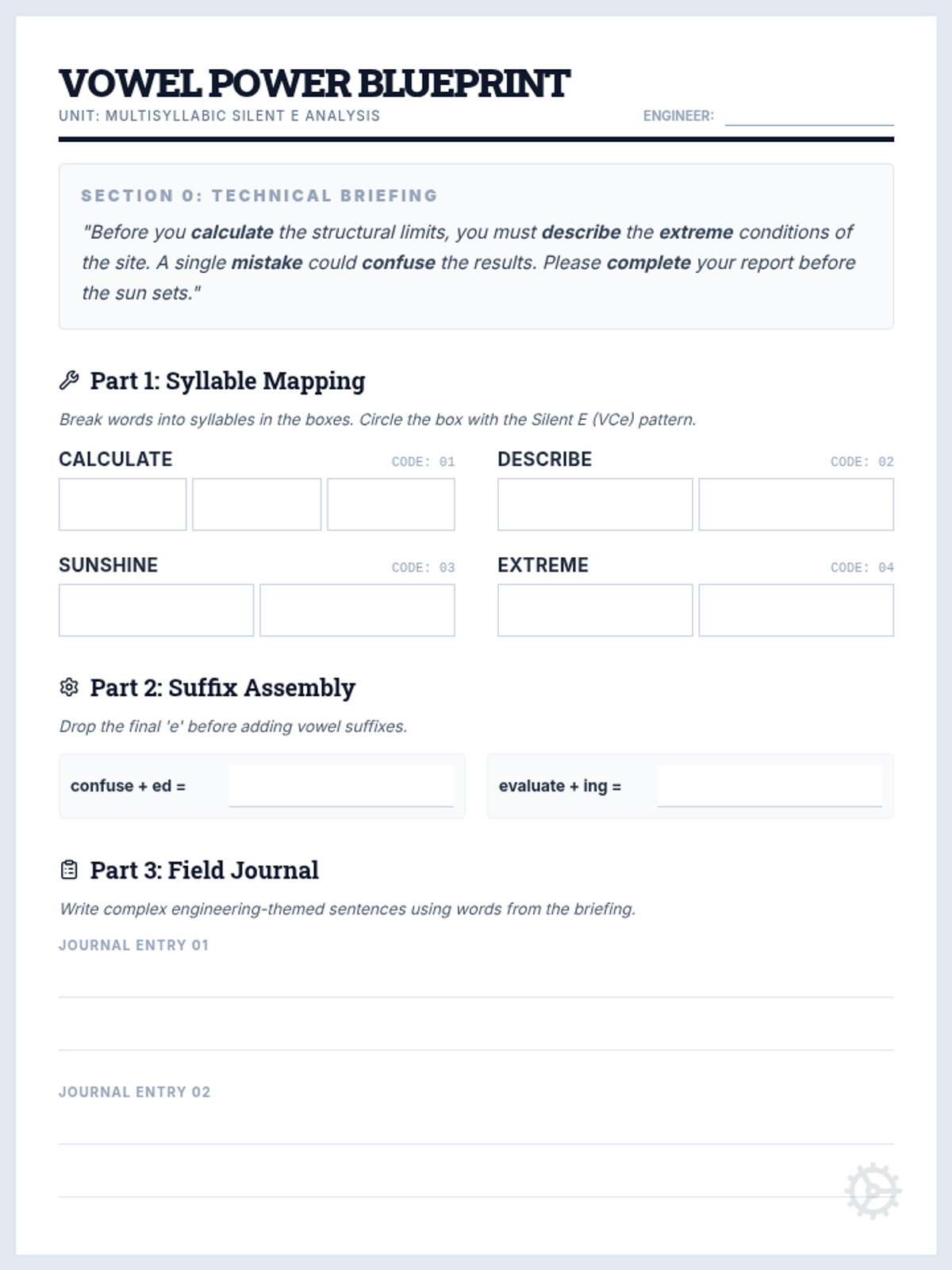
A structural analysis worksheet where students dismantle multisyllabic words into syllables, identifying the silent 'e' pattern and practicing suffix addition rules. Optimized for a single-page layout.
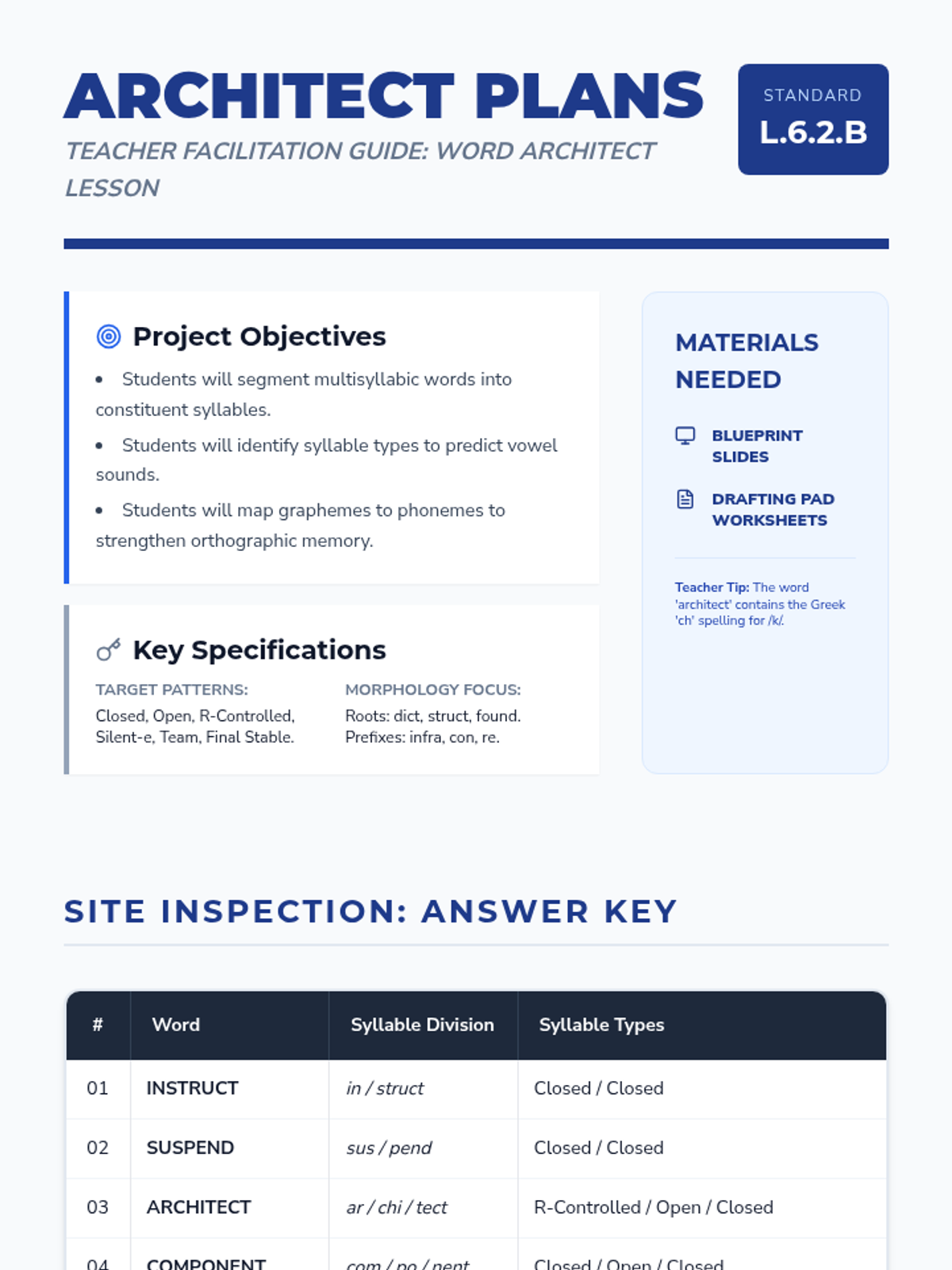
An updated teacher's guide with a complete 11-word answer key and expanded morphological analysis notes. Includes specific syllable types and division points for all architectural vocabulary. Corrected page breaks and consistency.
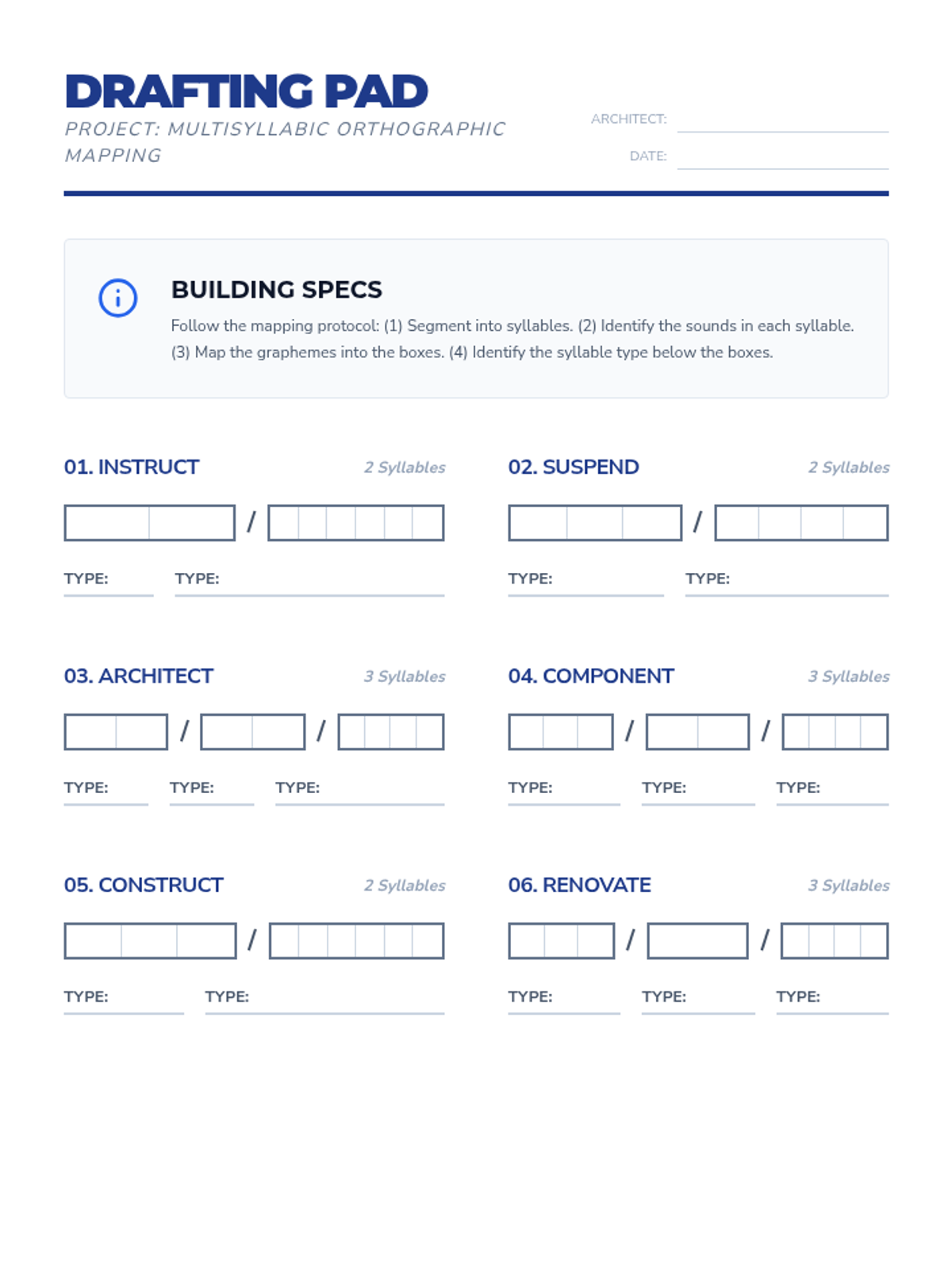
A comprehensive two-page student orthographic mapping worksheet with 11 architecture-themed multisyllabic words. Includes sound boxes, syllable typing fields, and morphological analysis questions. Corrected box counts and grid visibility.
An instructional slide deck for middle school students focusing on the architectural process of orthographic mapping. It covers syllable division, syllable types, and grapheme mapping for multisyllabic words using a professional blueprint aesthetic.
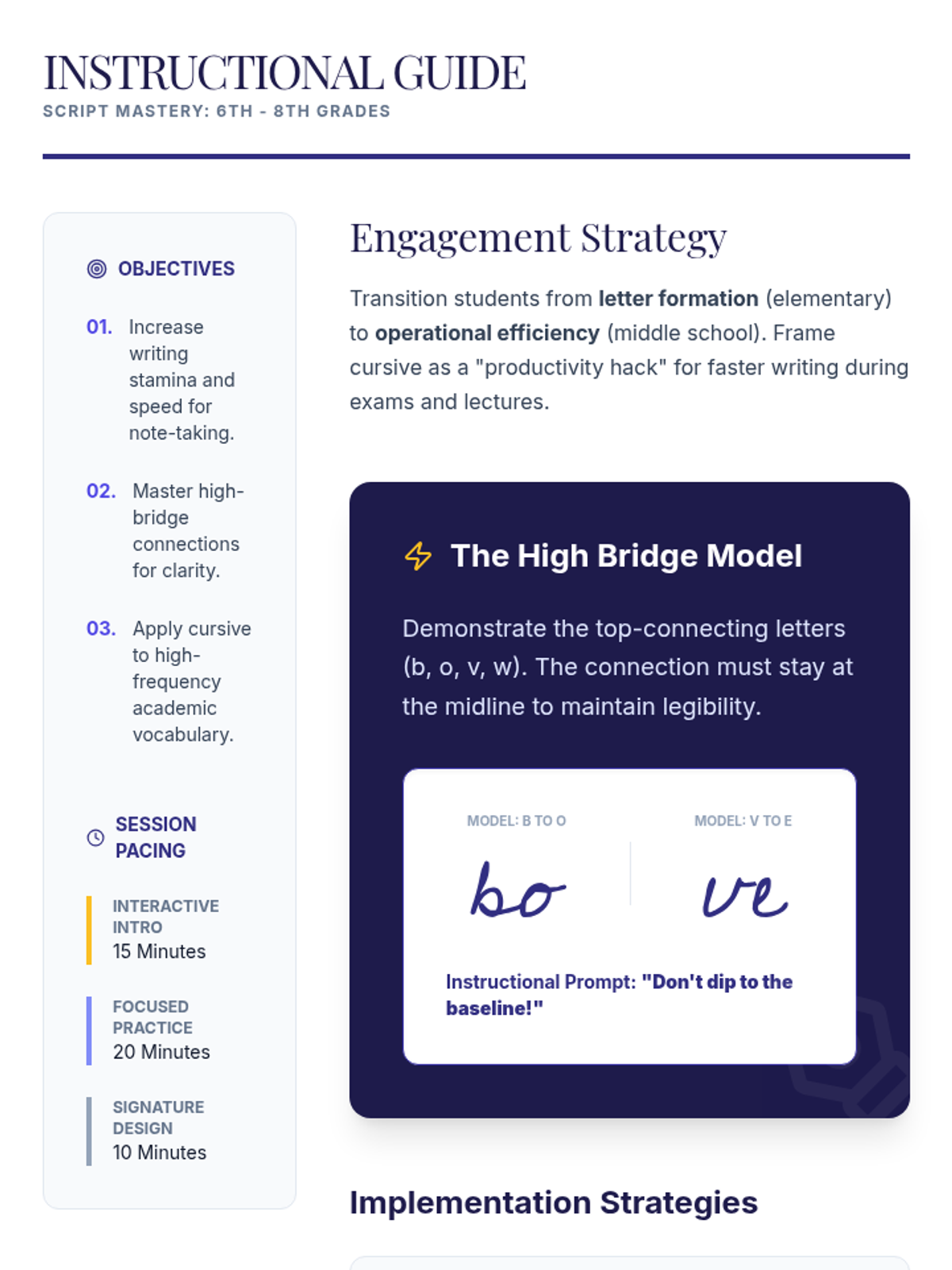
A teacher guide for instructing middle schoolers in cursive, focusing on engagement strategies, academic vocabulary integration, and common troubleshooting tips for bridge connections.
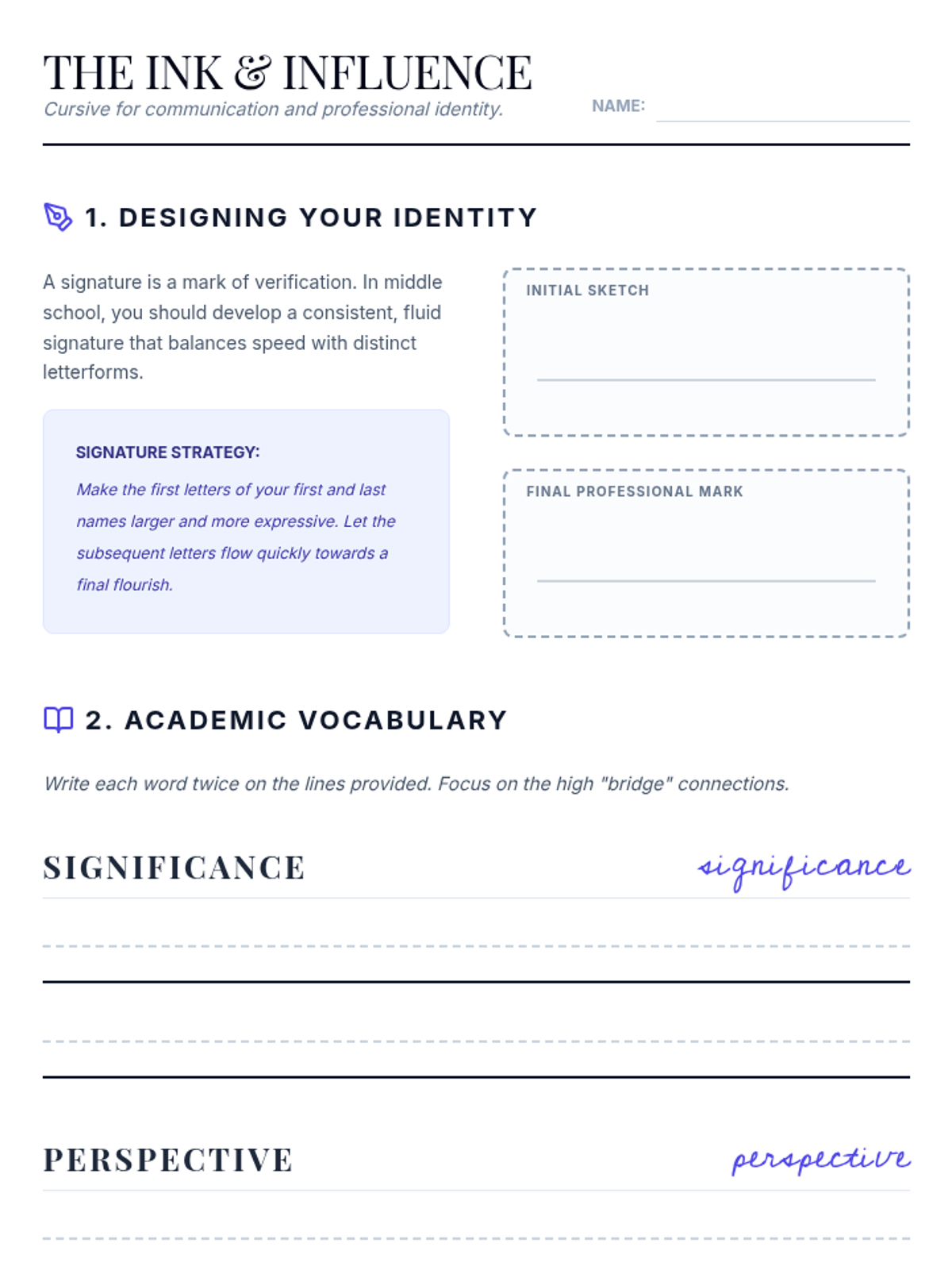
An advanced cursive practice document for middle schoolers focusing on signature development and rapid transcription of complex academic vocabulary. It bridges the gap between basic handwriting and professional script application.
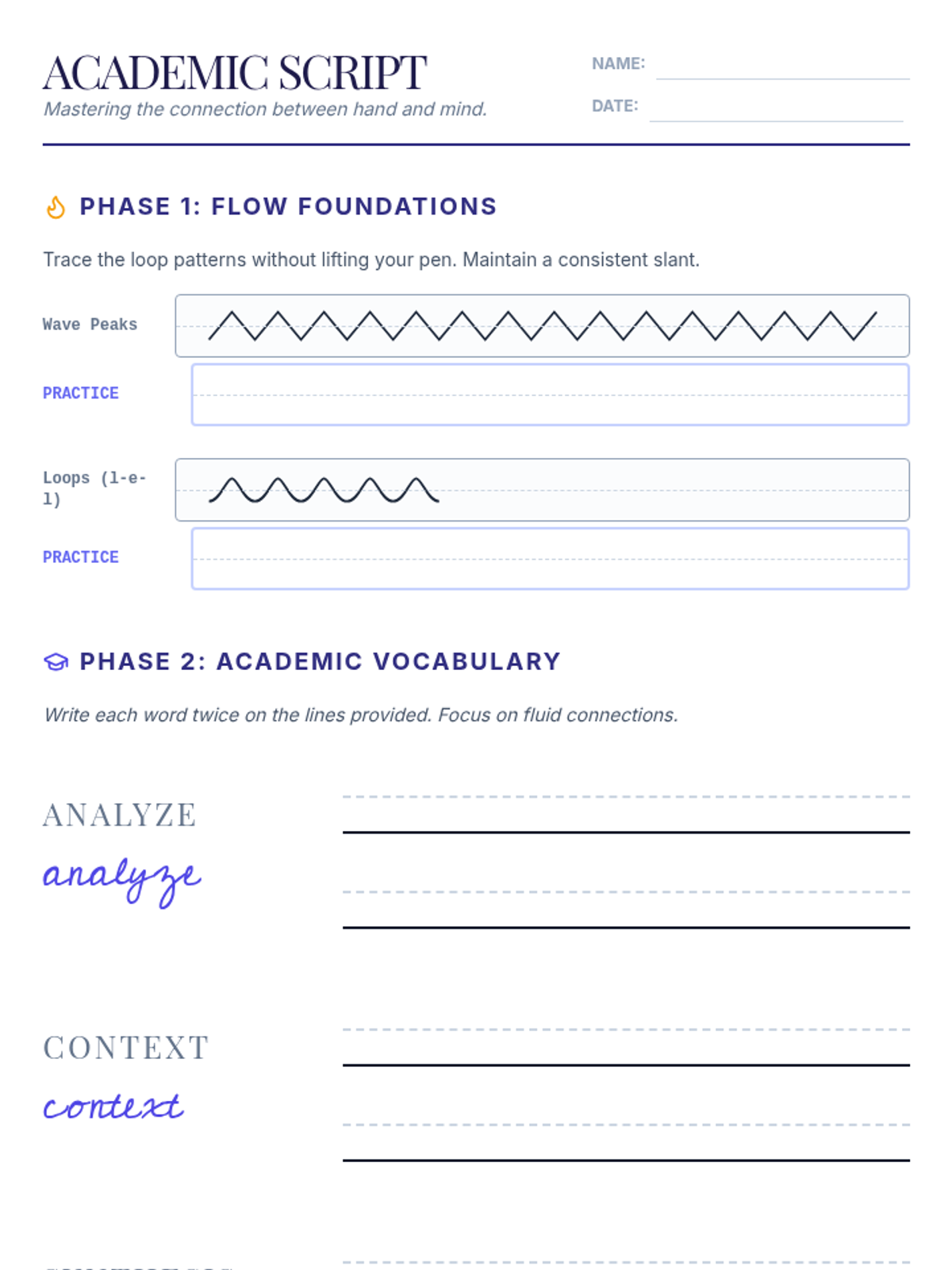
A professional cursive practice worksheet for middle school students, featuring academic Tier 2 vocabulary words. It includes warm-up connection drills and a transcription challenge to build both handwriting fluency and vocabulary mastery.
An introductory slide deck for middle school cursive practice, focusing on the efficiency of script for note-taking and academic success. It includes visual cues for difficult connections and a spotlight on Tier 2 academic vocabulary.
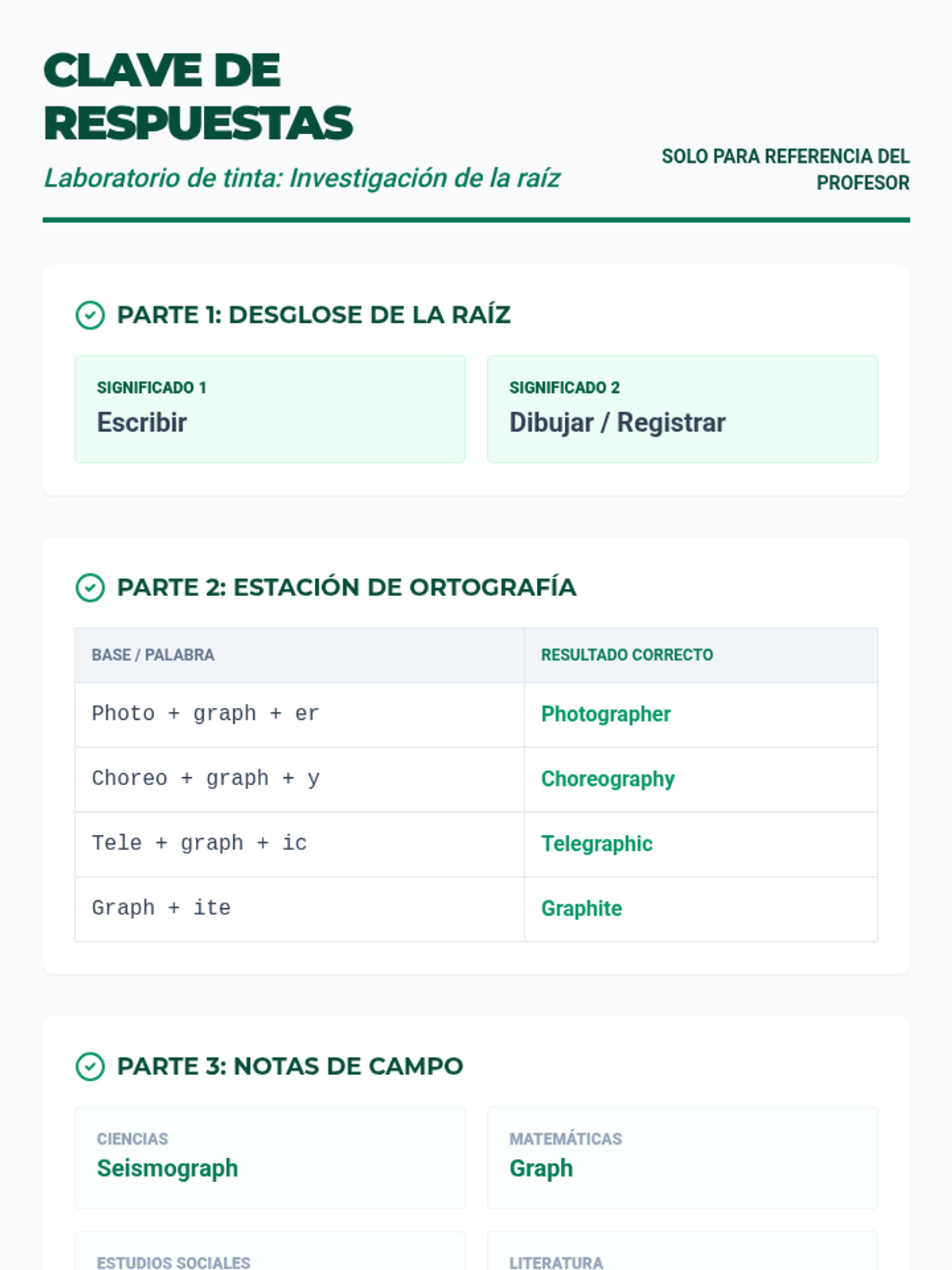
An answer key for the 'Ink Lab' worksheet, providing correct responses for root meanings, spelling variations, and cross-curricular terminology.
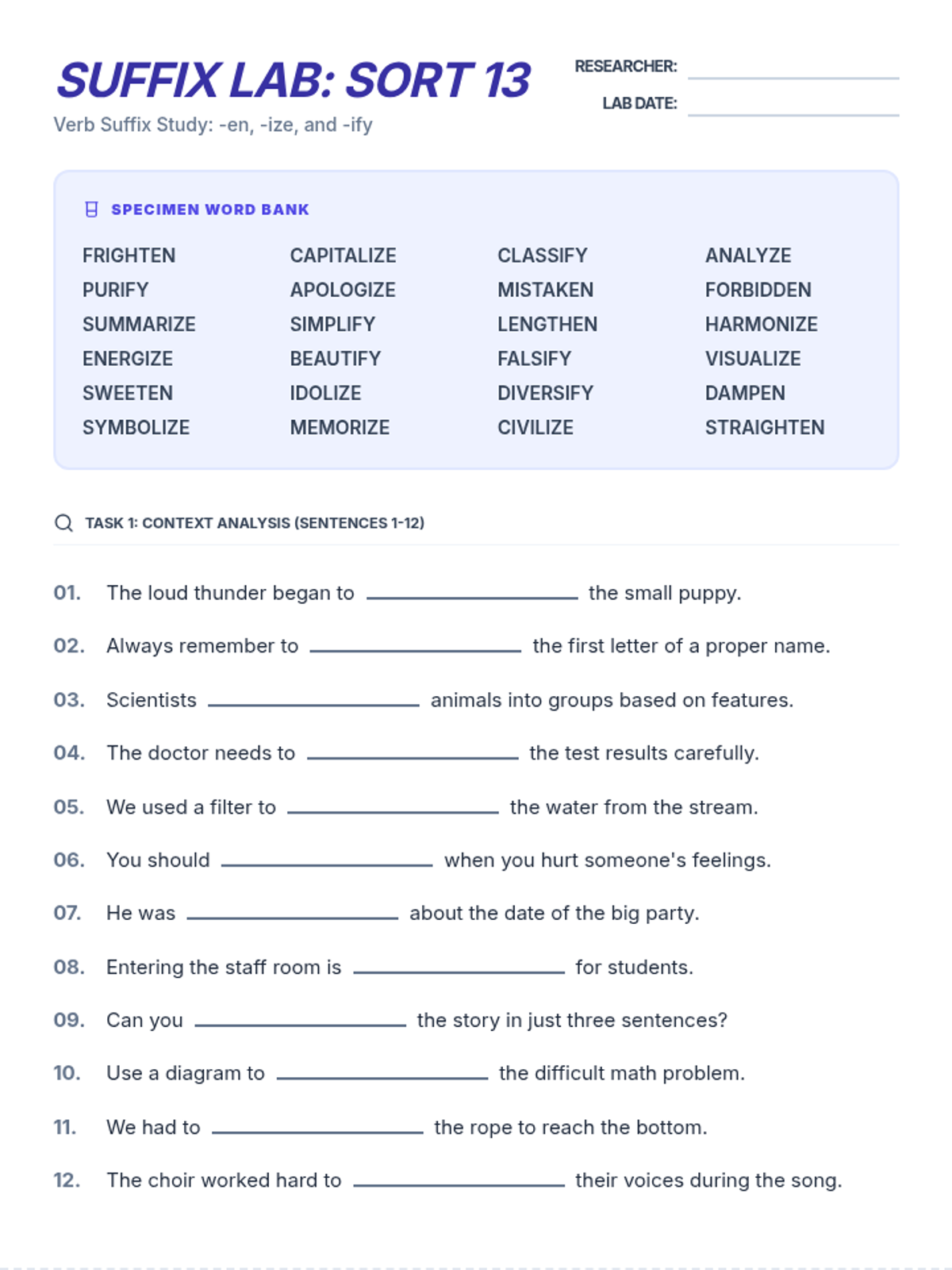
A 3-page printable packet for Sort 13 (-en, -ize, -ify). Includes 24 fill-in-the-blank sentences across two pages, followed by a logic page with 6 word unscrambles and a functional 12x12 crossword puzzle. Task 1 sentences are randomized. Crossword clues are sorted Across (odd) and Down (even). Suffix Lab headers corrected.
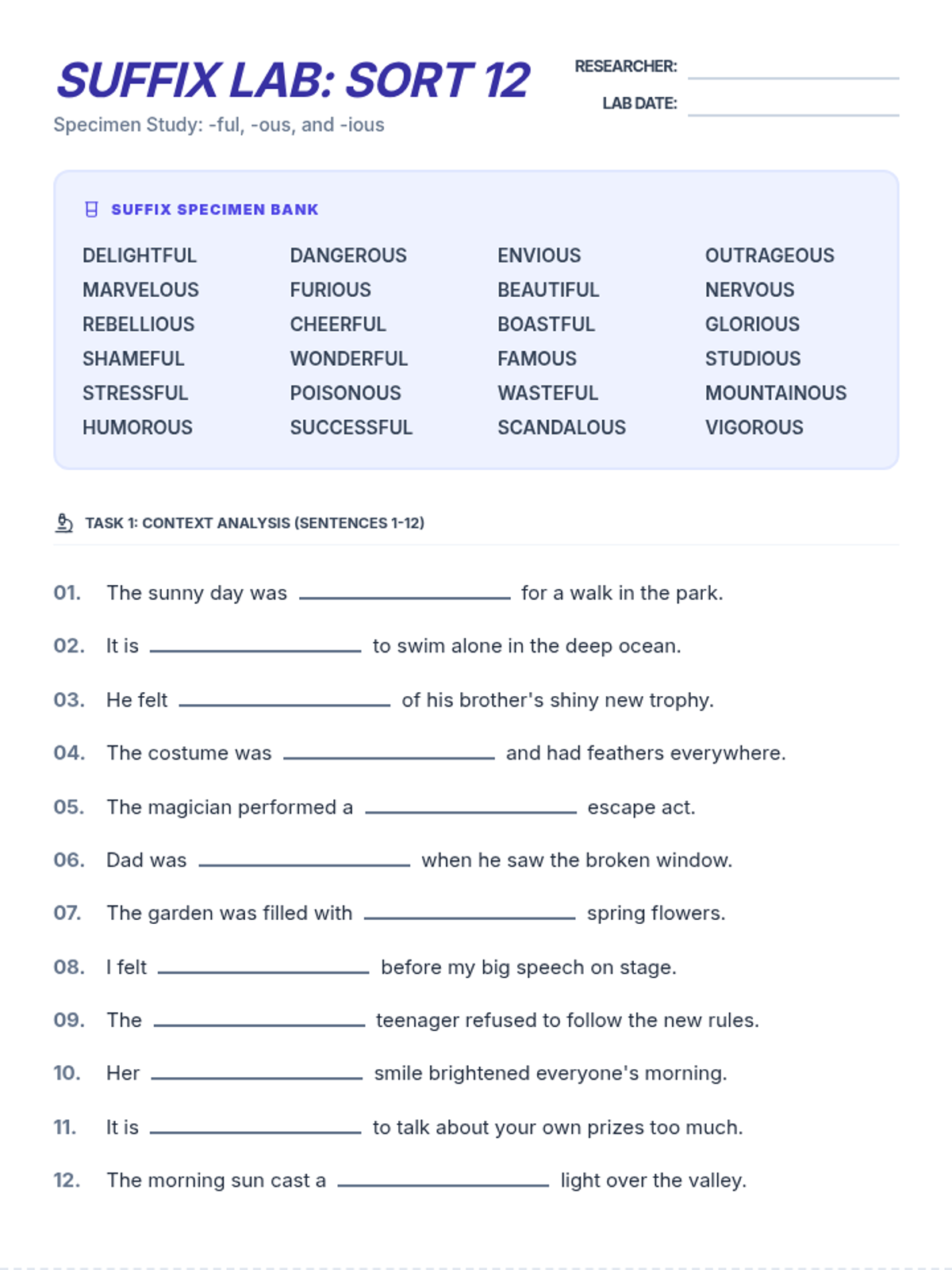
A 3-page printable packet for Sort 12 (-ful, -ous, -ious). Includes 24 fill-in-the-blank sentences across two pages, followed by a logic page with 6 word unscrambles and a functional 12x12 crossword puzzle. Task 1 sentences are randomized. Crossword clues are sorted Across (odd) and Down (even). Suffix Lab headers corrected.
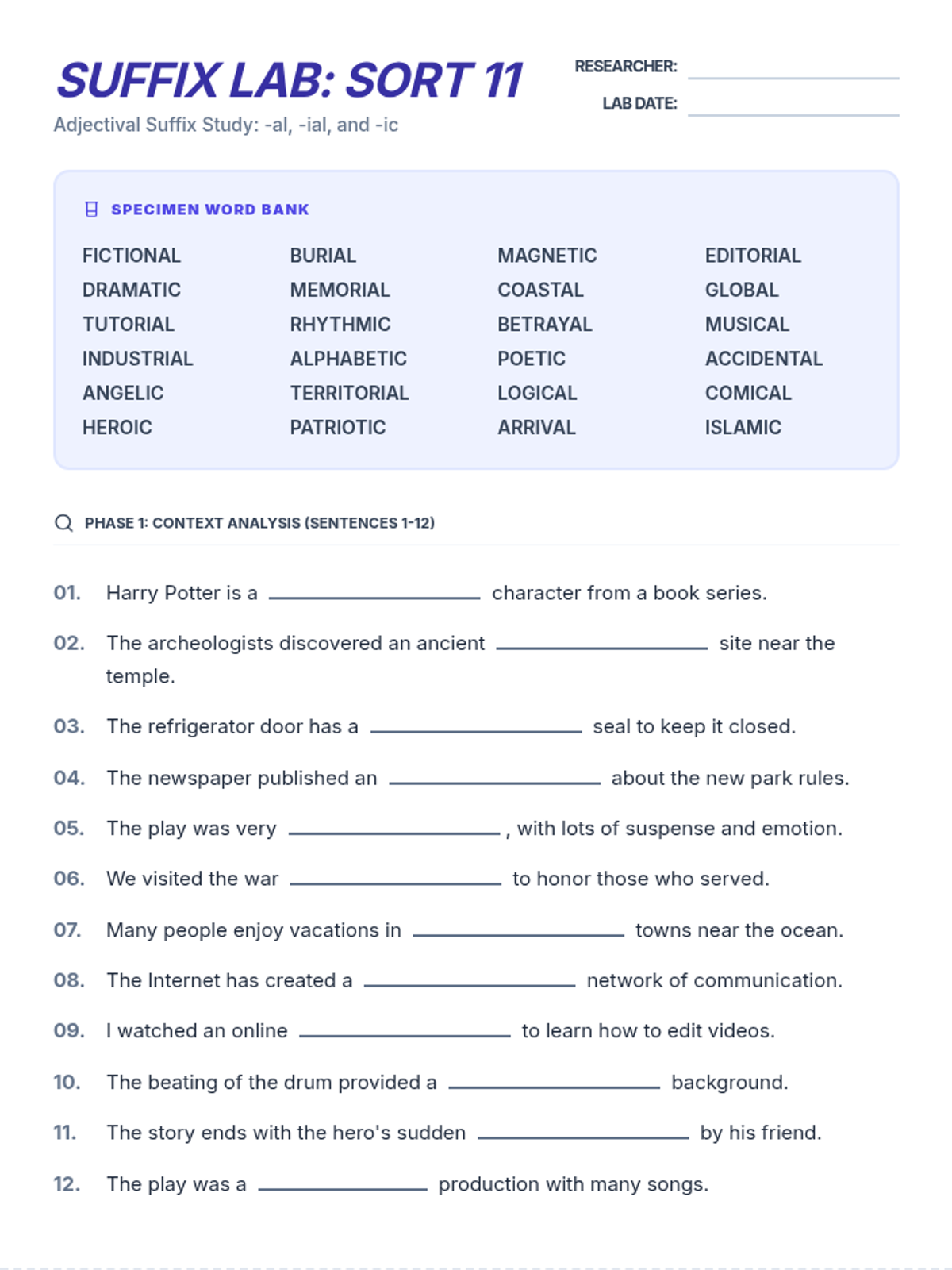
A 3-page printable packet for Sort 11 (-al, -ial, -ic). Includes 24 fill-in-the-blank sentences across two pages, followed by a logic page with 6 word unscrambles and a functional 12x12 crossword puzzle. Task 1 sentences are randomized. Crossword clues are sorted Across (odd) and Down (even). Suffix Lab headers corrected.
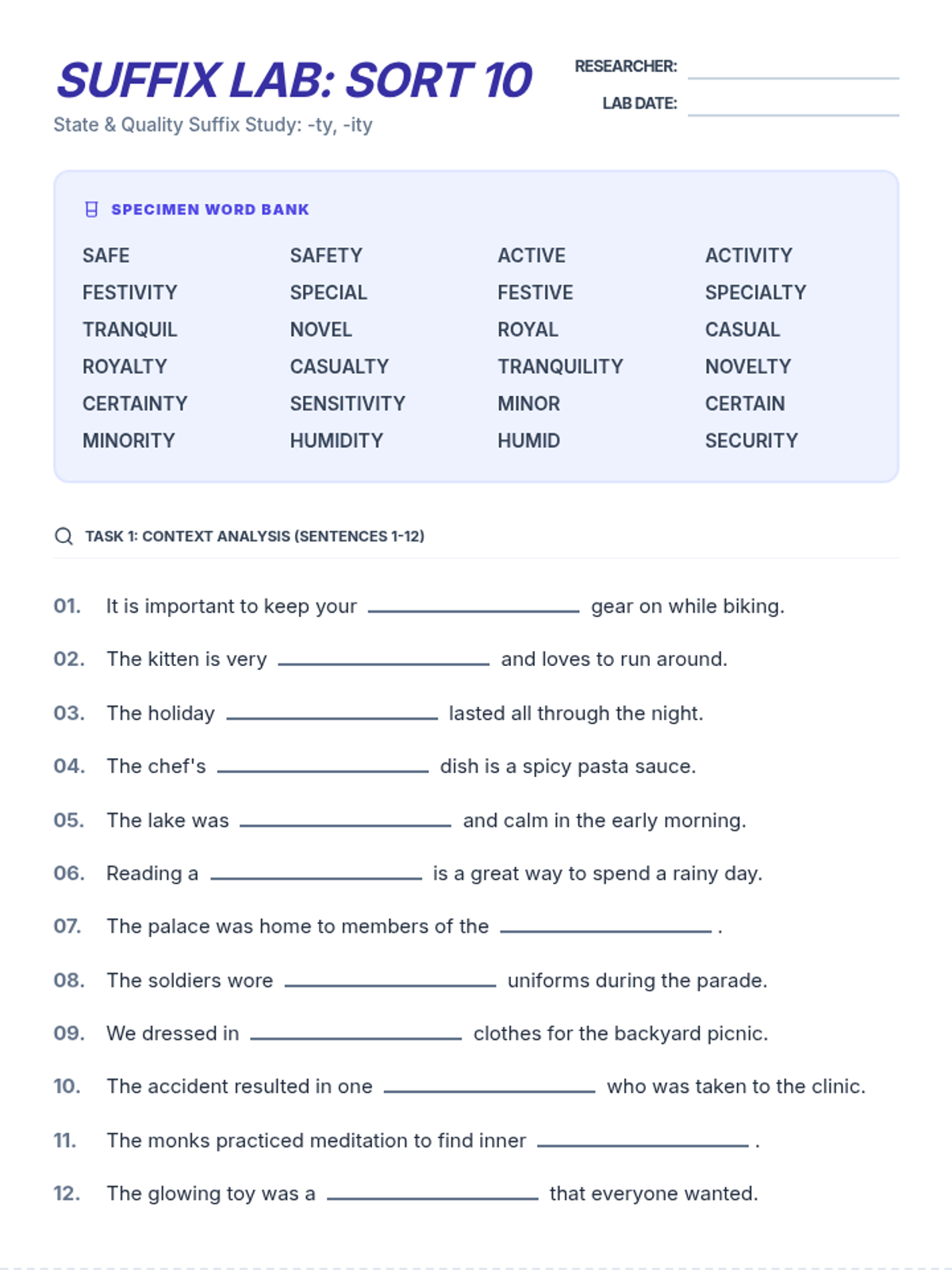
A 3-page printable packet for Sort 10 (-ty, -ity). Includes 24 fill-in-the-blank sentences across two pages, followed by a logic page with 6 word unscrambles and a functional 12x12 crossword puzzle. Task 1 sentences are randomized. Crossword clues are sorted Across (odd) and Down (even).
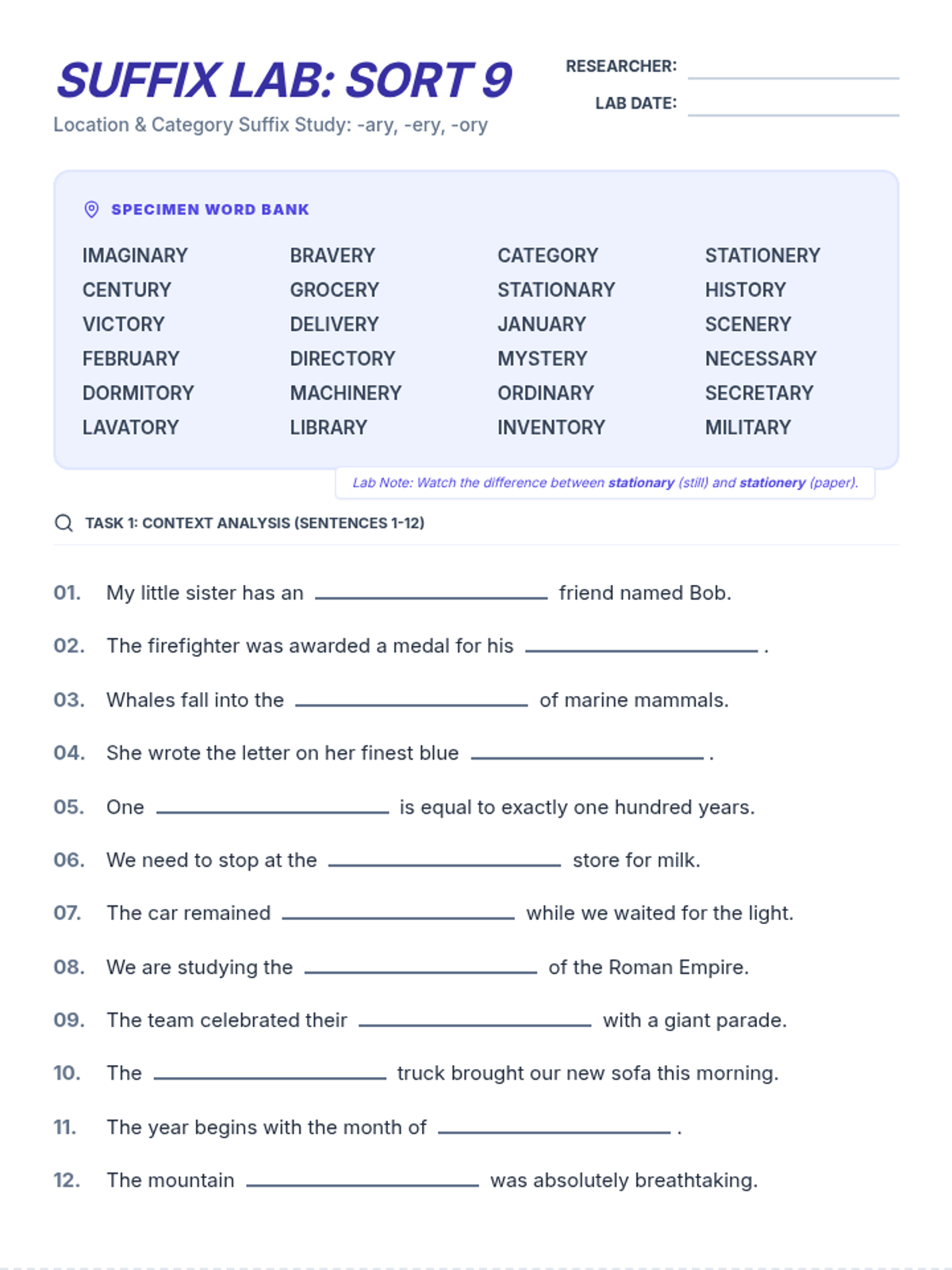
A 3-page printable packet for Sort 9 (-ary, -ery, -ory). Includes 24 fill-in-the-blank sentences across two pages, followed by a logic page with 6 word unscrambles and a functional 12x12 crossword puzzle.
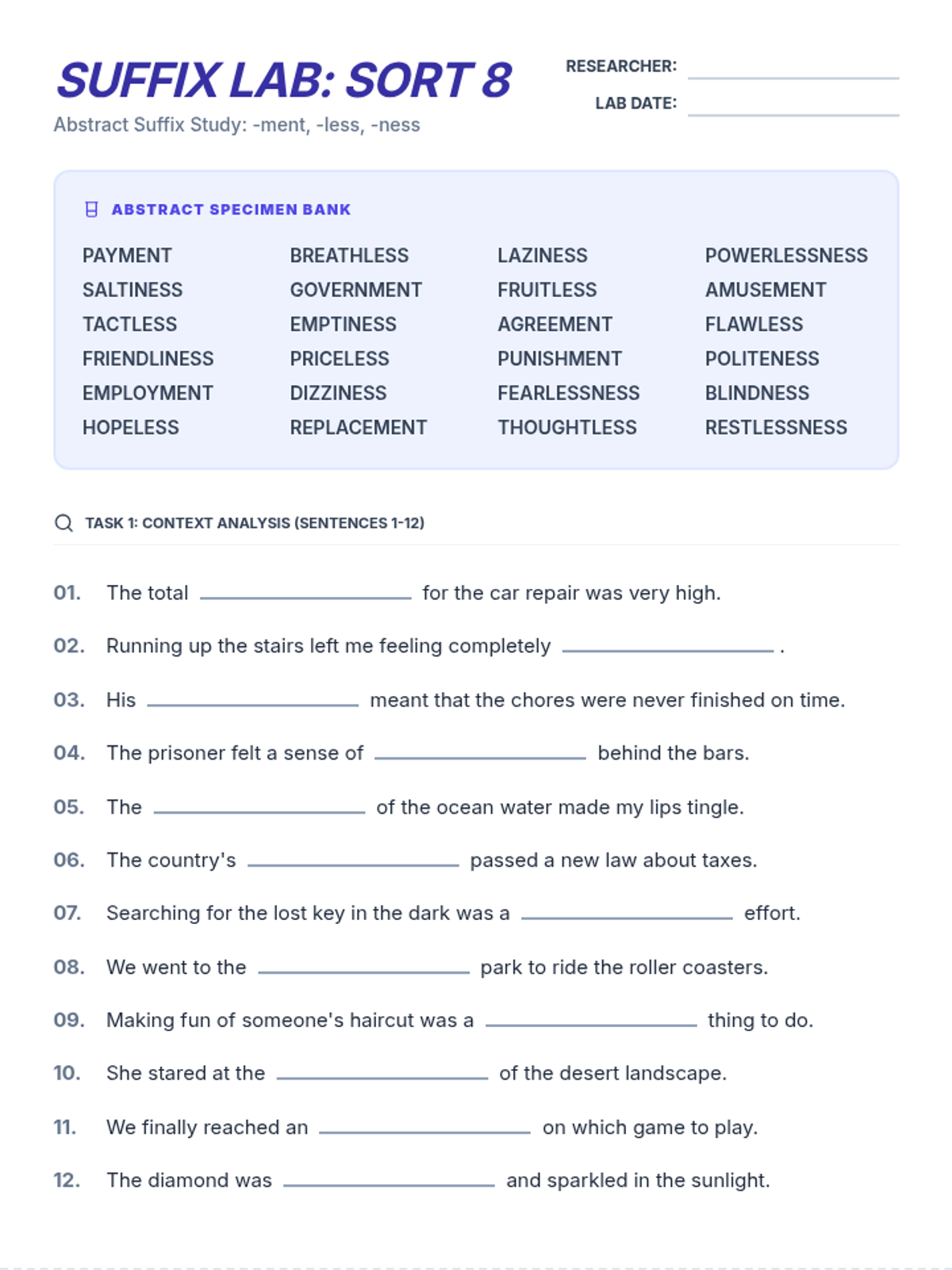
A 3-page printable packet for Sort 8 (-ment, -less, -ness). Includes 24 fill-in-the-blank sentences across two pages, followed by a logic page with 6 word unscrambles and a functional 12x12 crossword puzzle.
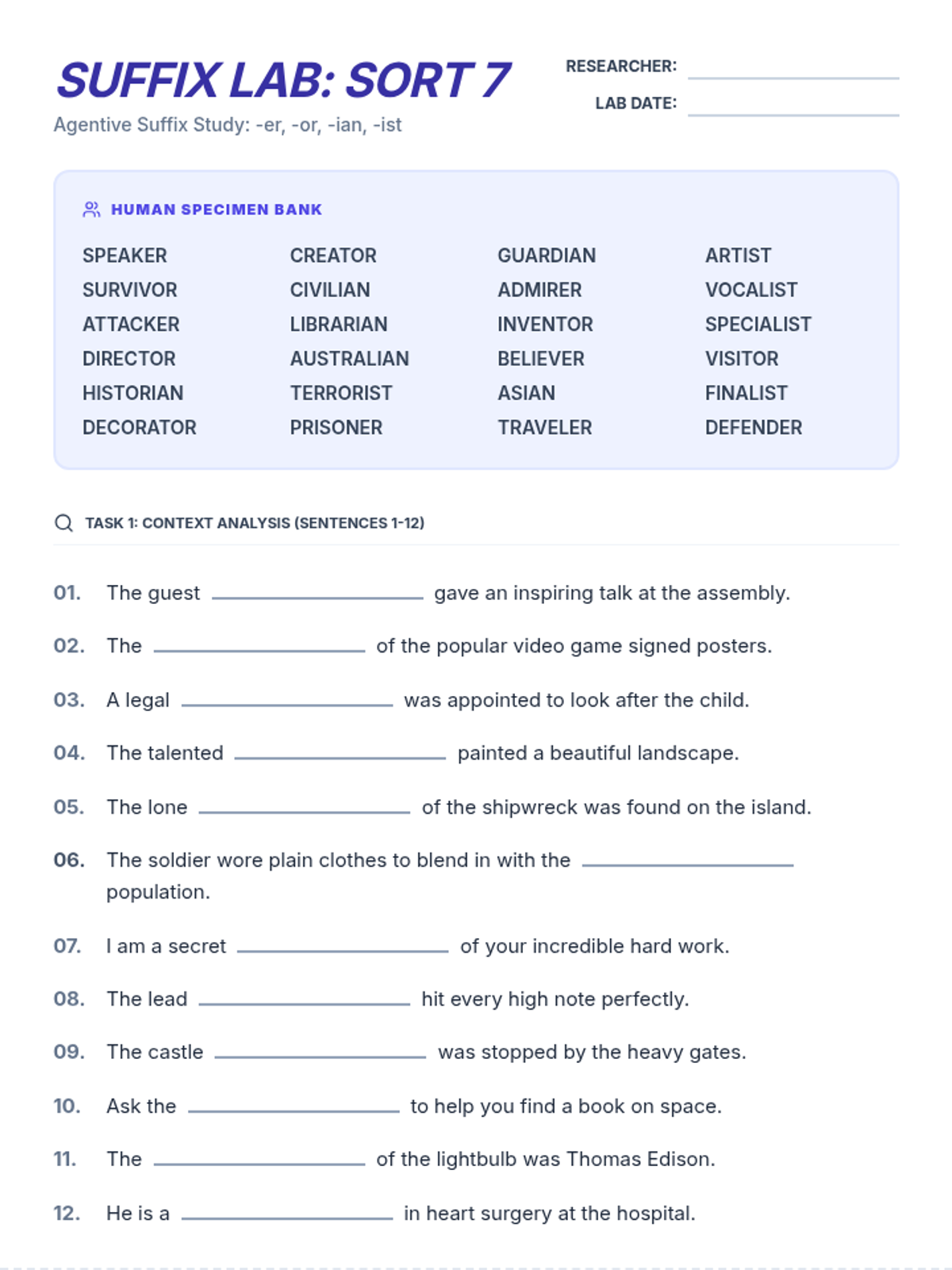
A 3-page printable packet for Sort 7 (-er, -or, -ian, -ist). Includes 24 fill-in-the-blank sentences across two pages, followed by a logic page with 6 word unscrambles and a functional 12x12 crossword puzzle. Task 1 sentences are randomized. Crossword clues are sorted Across (odd) and Down (even).
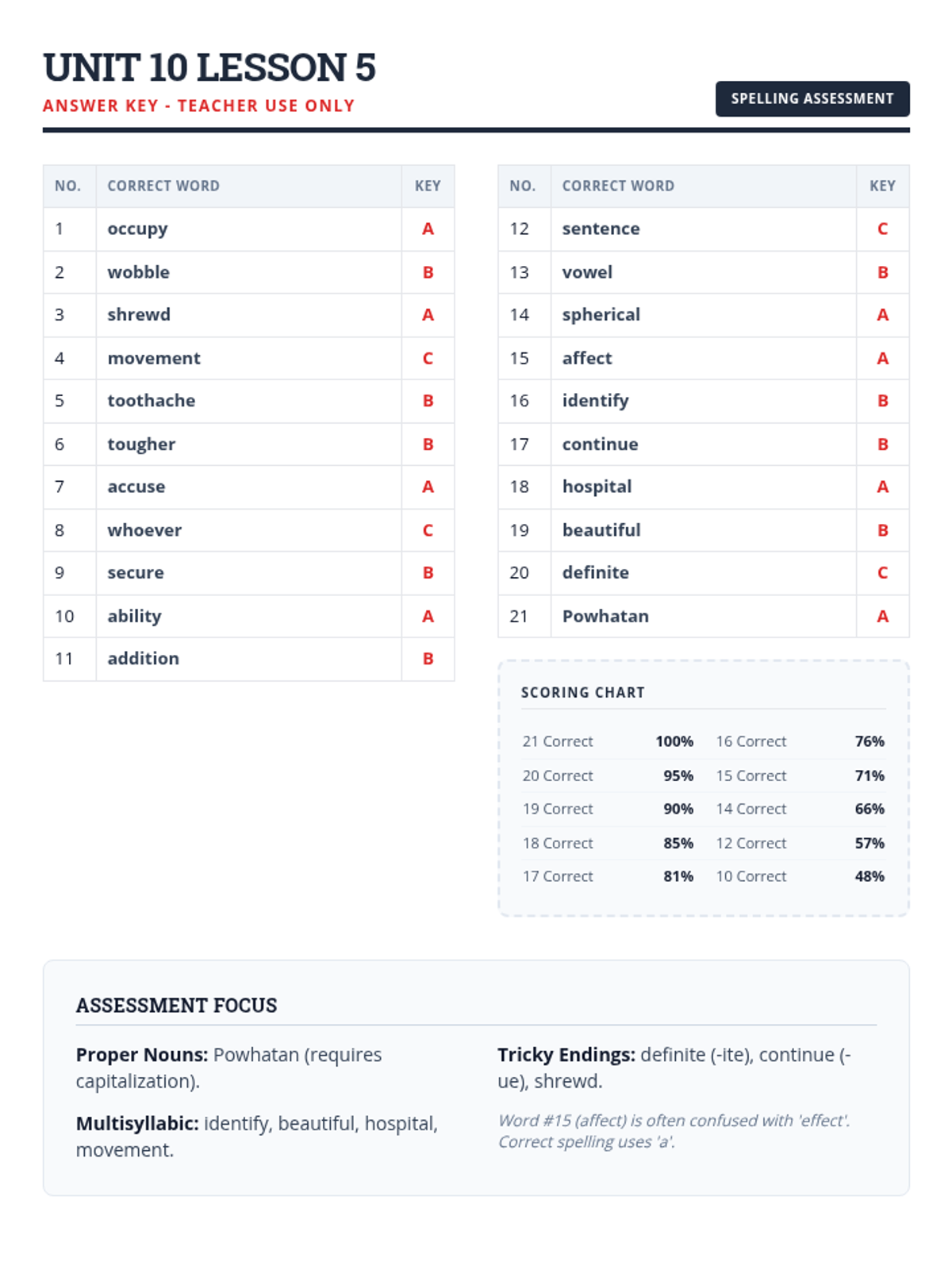
A clear teacher answer key for the 21-word Unit 10 Lesson 5 Spelling Test. Includes updated scoring chart and focus notes covering proper nouns and multisyllabic words.
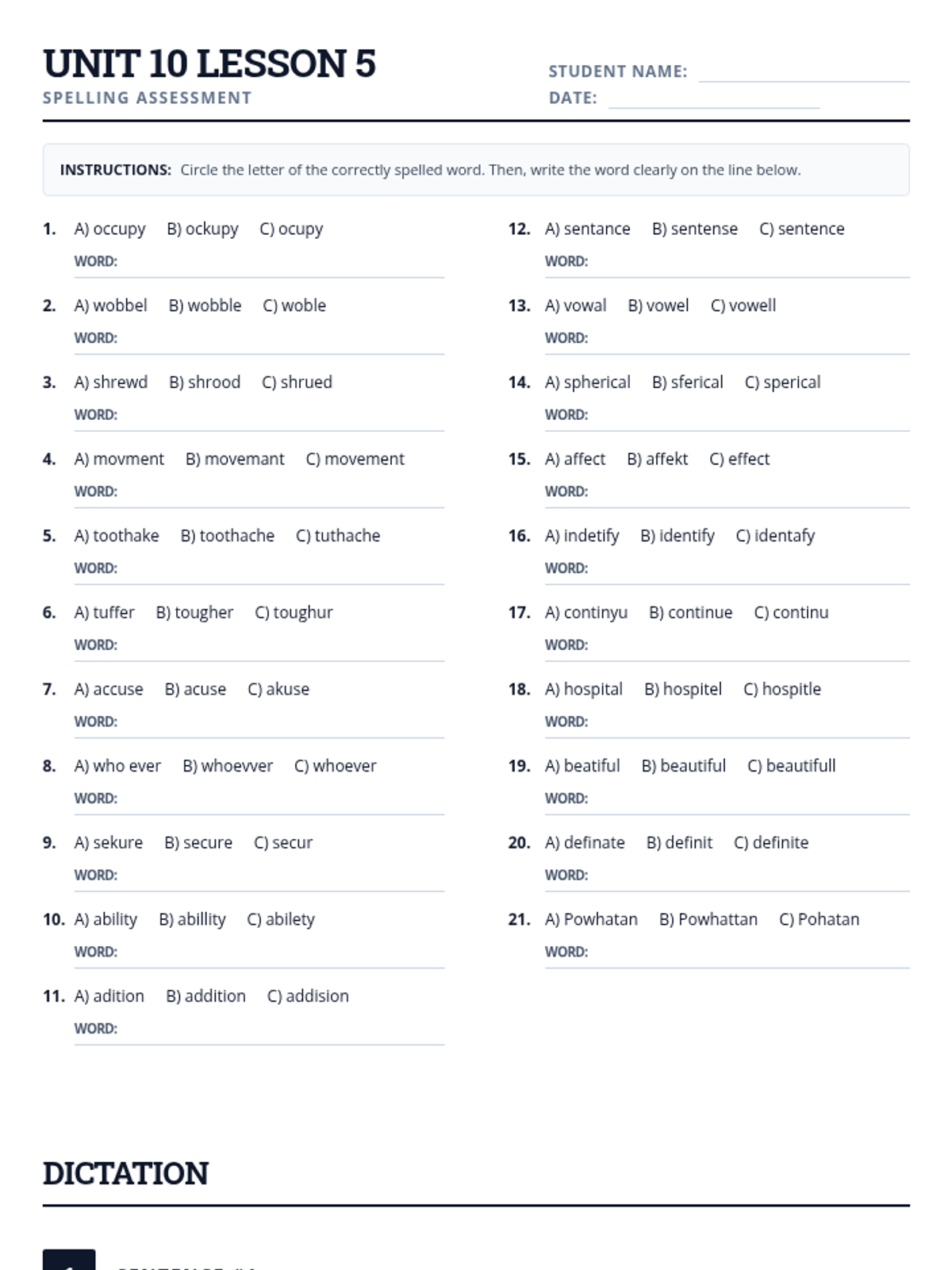
A formal spelling assessment for Unit 10 Lesson 5 with 21 multiple-choice questions and a dictation section. Two-page layout providing ample workspace for student answers.
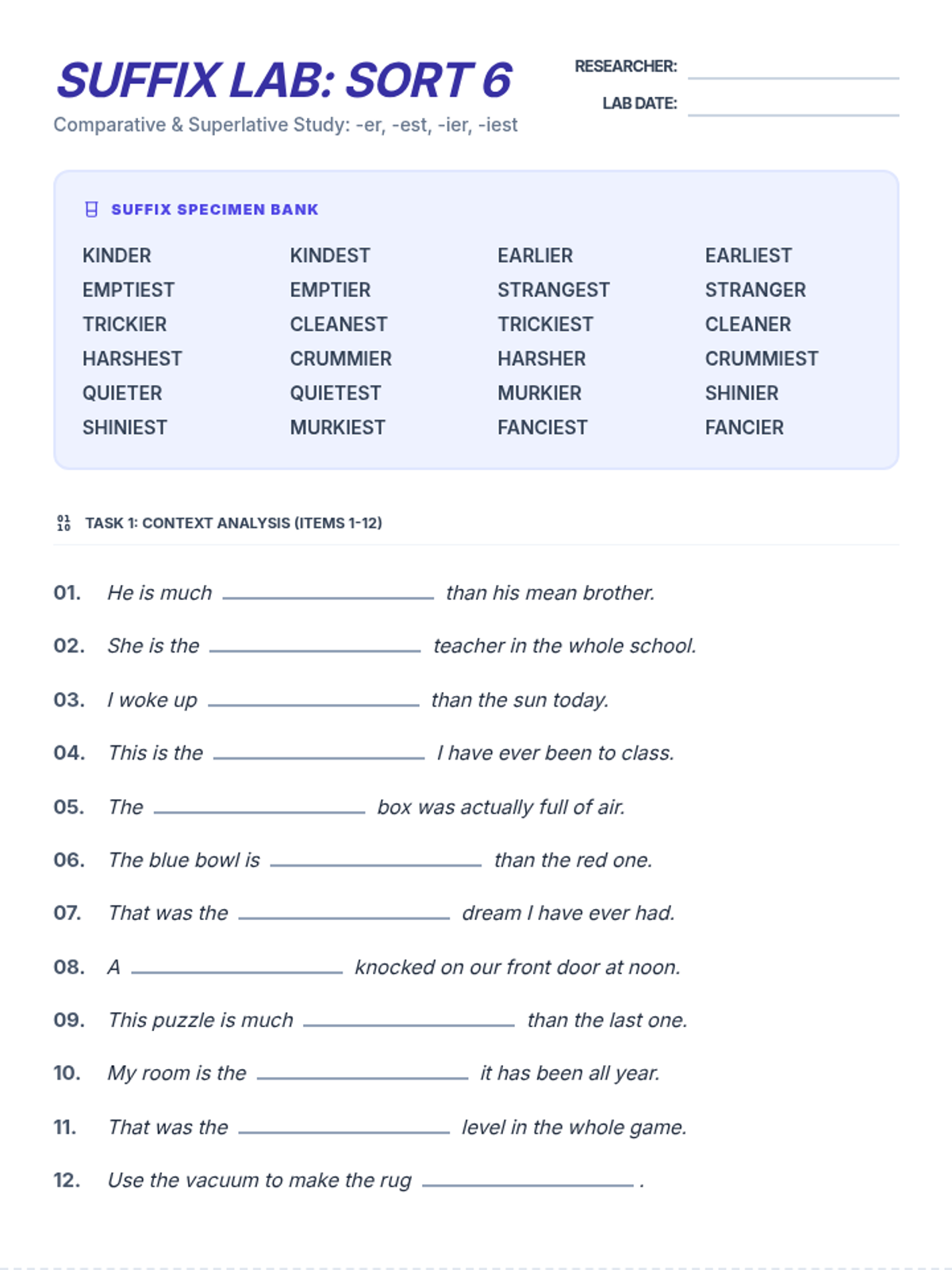
A 3-page printable packet for Sort 6 (-er, -est, -ier, -iest). Includes 24 fill-in-the-blank sentences across two pages, followed by a logic page with 6 word unscrambles and a functional 12x12 crossword puzzle. Task 1 sentences are randomized. Crossword clues are sorted Across (odd) and Down (even).
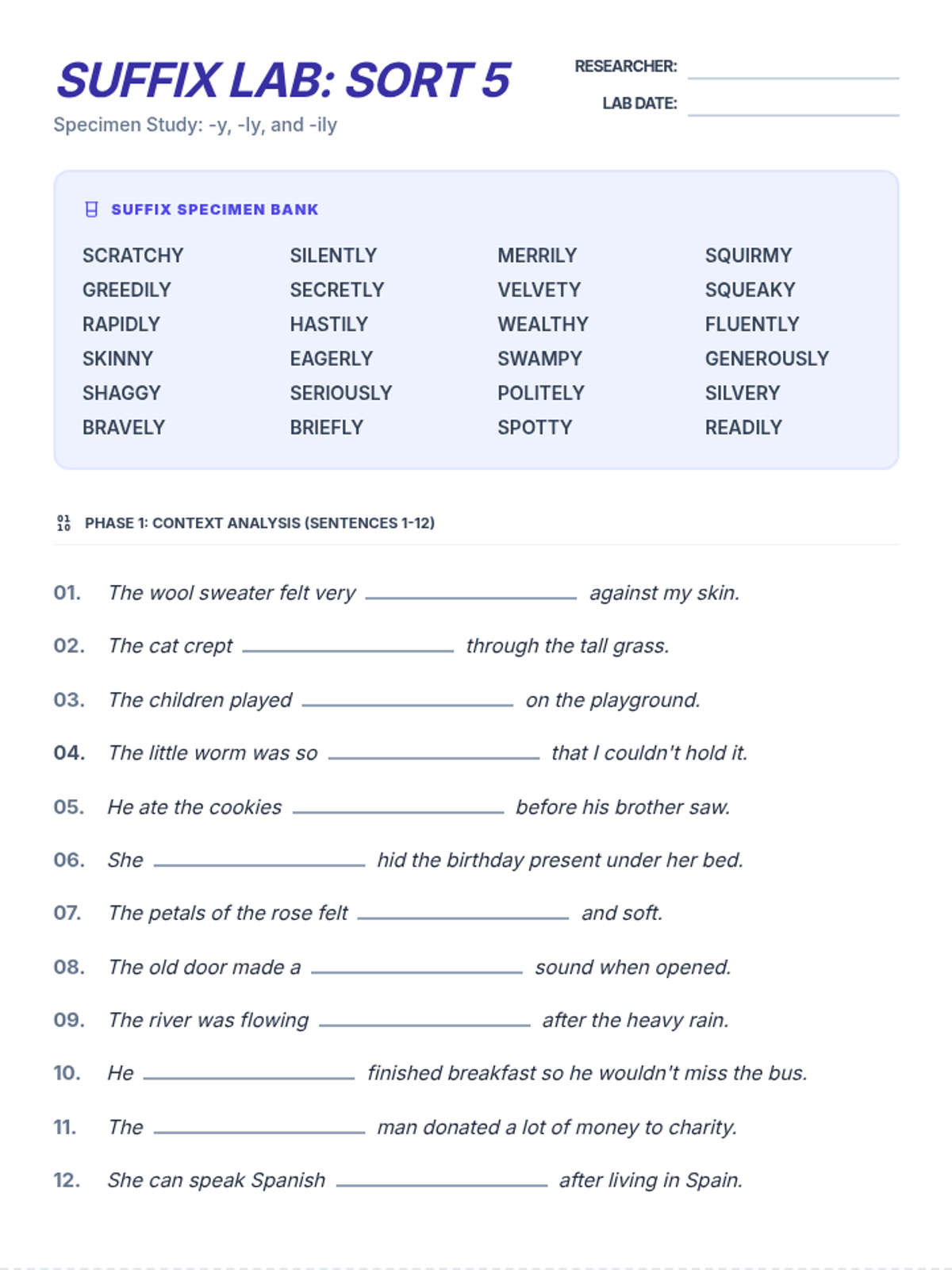
A 3-page printable packet for Sort 5 (-y, -ly, -ily). Includes 24 fill-in-the-blank sentences across two pages, followed by a logic page with 6 word unscrambles and a functional 12x12 crossword puzzle. Task 1 sentences are randomized. Crossword clues are sorted Across (odd) and Down (even).
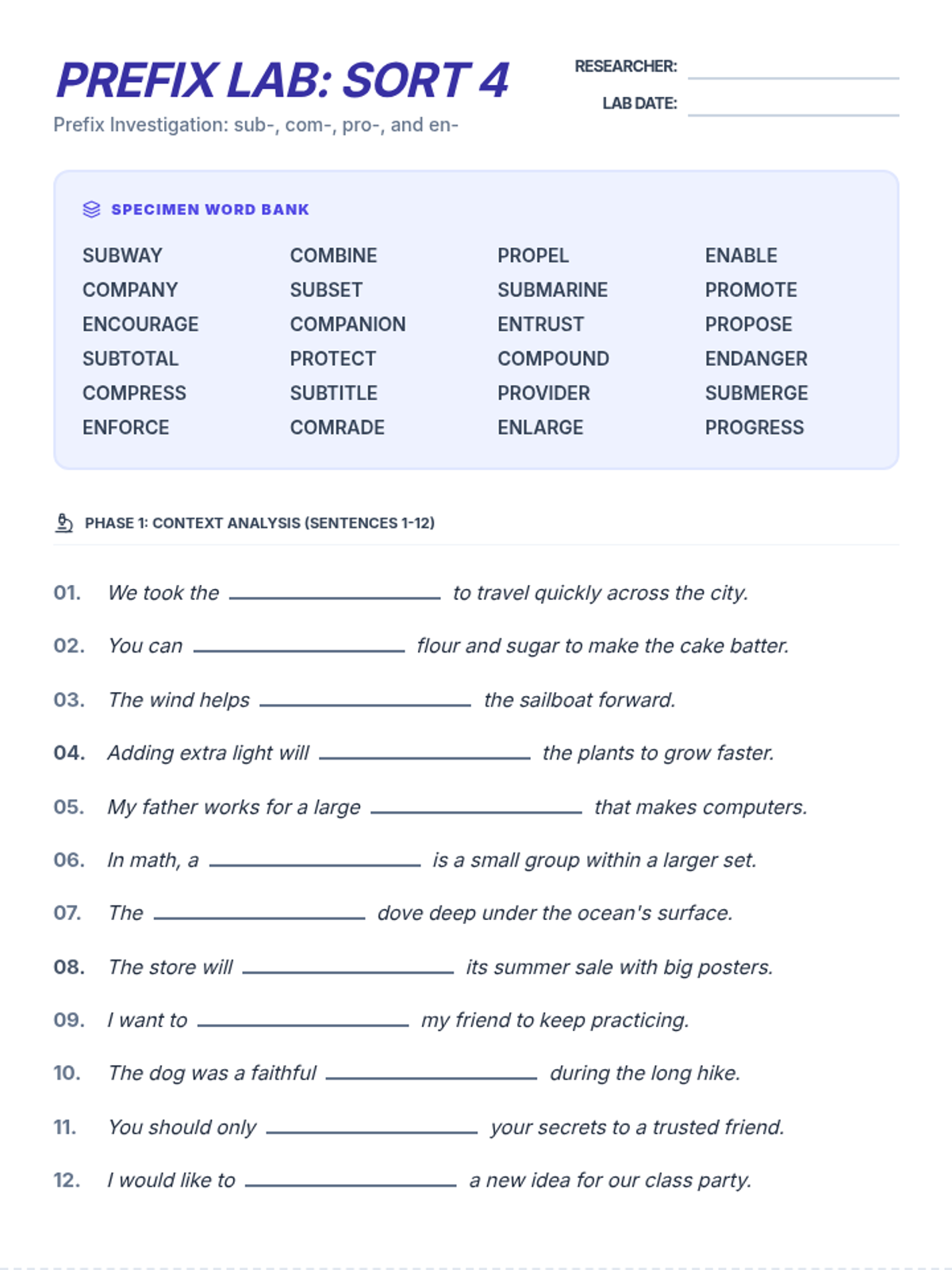
A 3-page printable packet for Sort 4 (sub-, com-, pro-, en-). Includes 24 fill-in-the-blank sentences across two pages, followed by a logic page with 6 word unscrambles and a functional 12x12 crossword puzzle. Task 1 sentences are randomized. Crossword clues are sorted Across (odd) and Down (even).
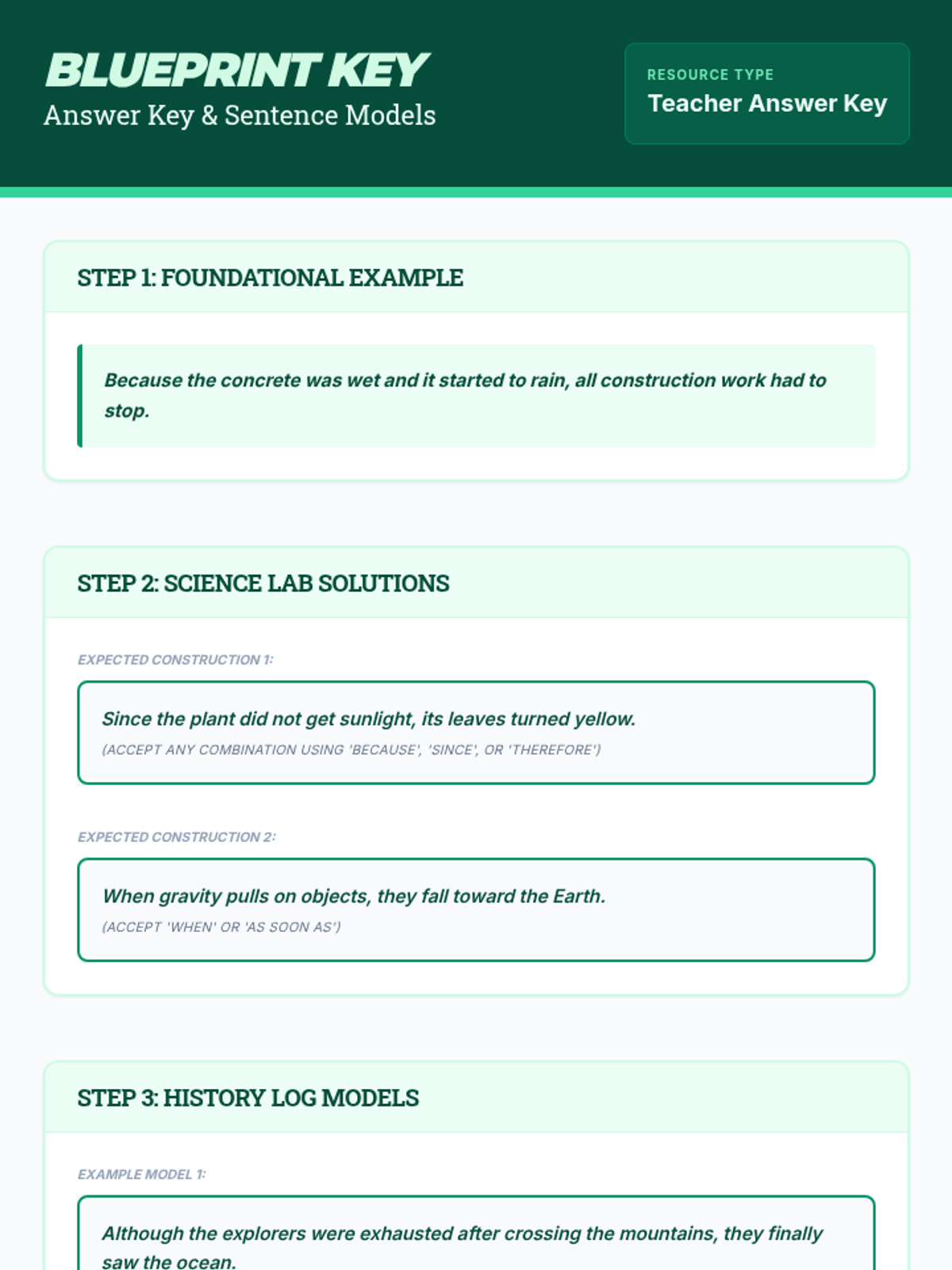
A detailed teacher answer key for the Sentence Blueprint worksheet, providing model complex and compound sentences using science and history themes.
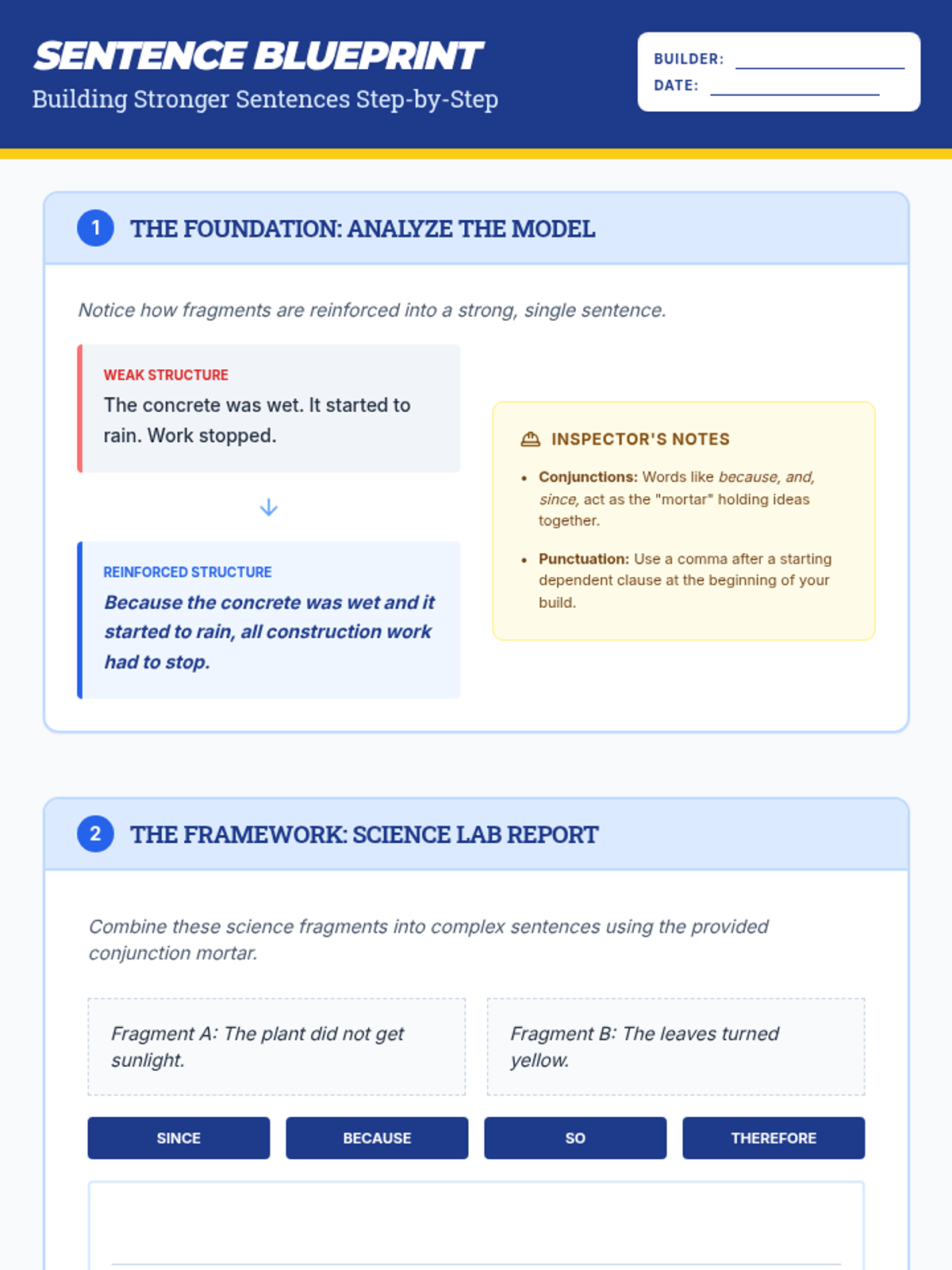
A 3-step guided practice worksheet with a construction theme, designed to help students combine fragments and simple sentences into compound and complex sentences within science and social studies contexts.
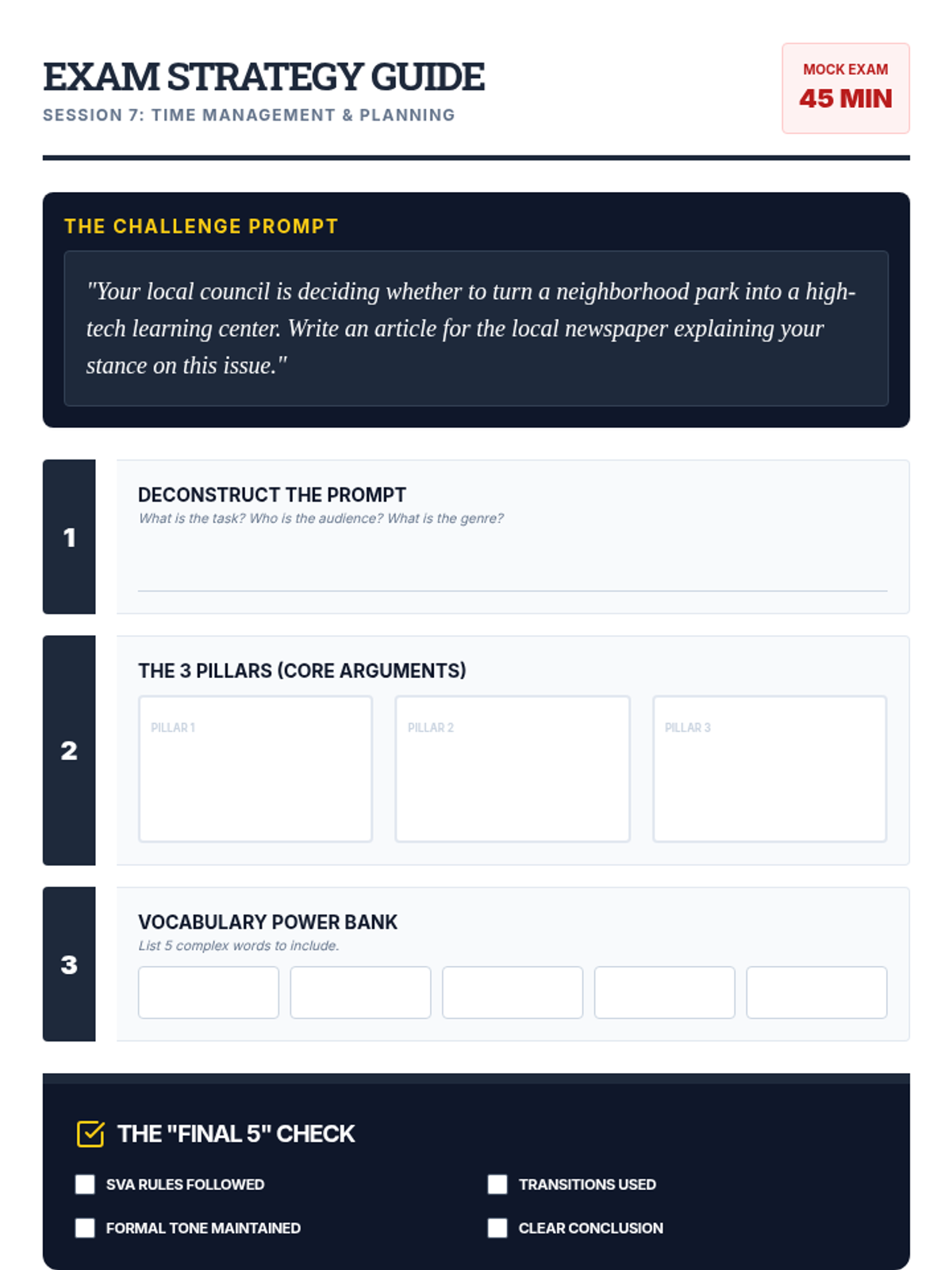
A strategic planning worksheet for students to use during exam preparation, featuring a practice prompt, increased workspace, and a consolidated single-page layout.
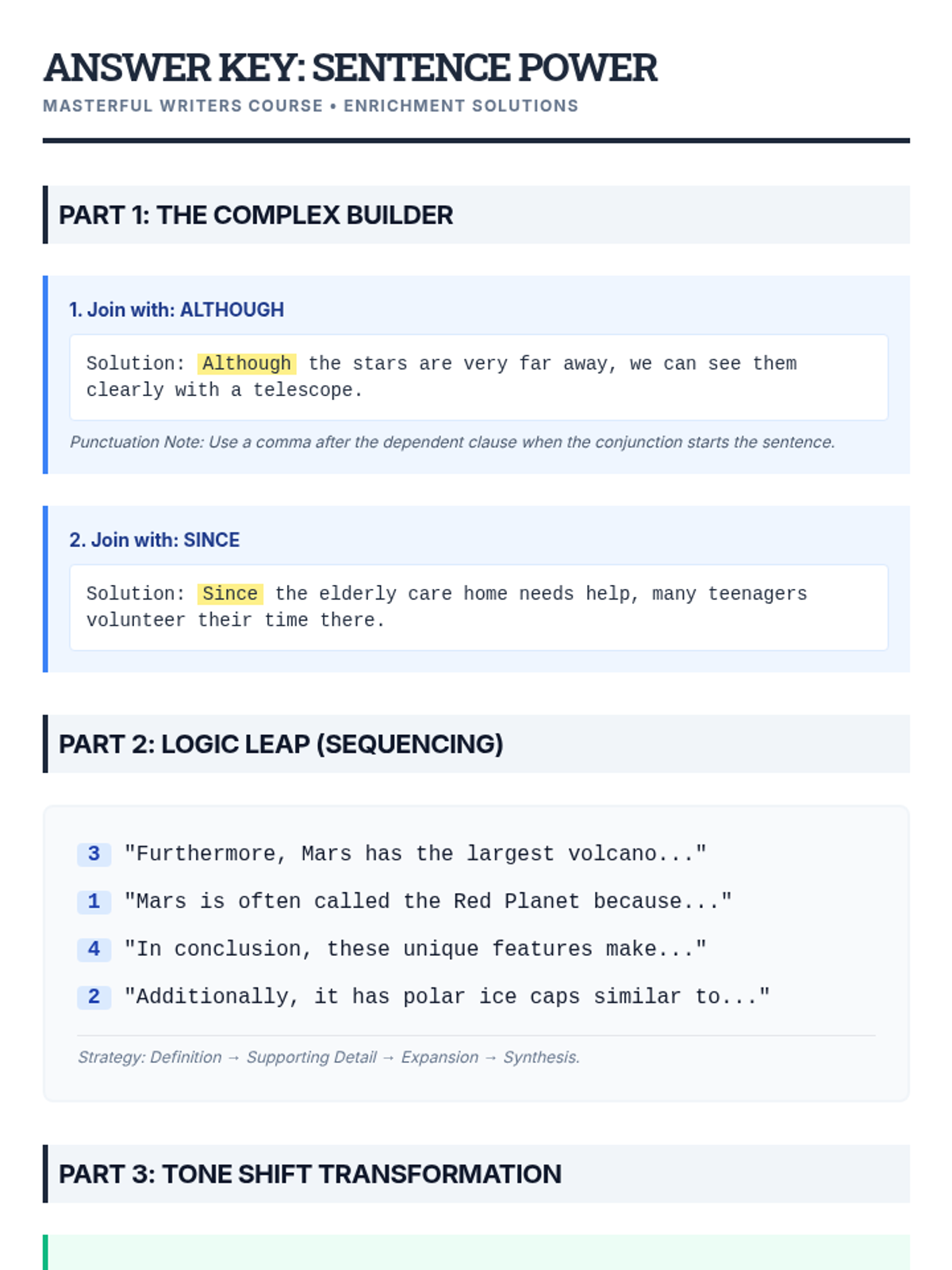
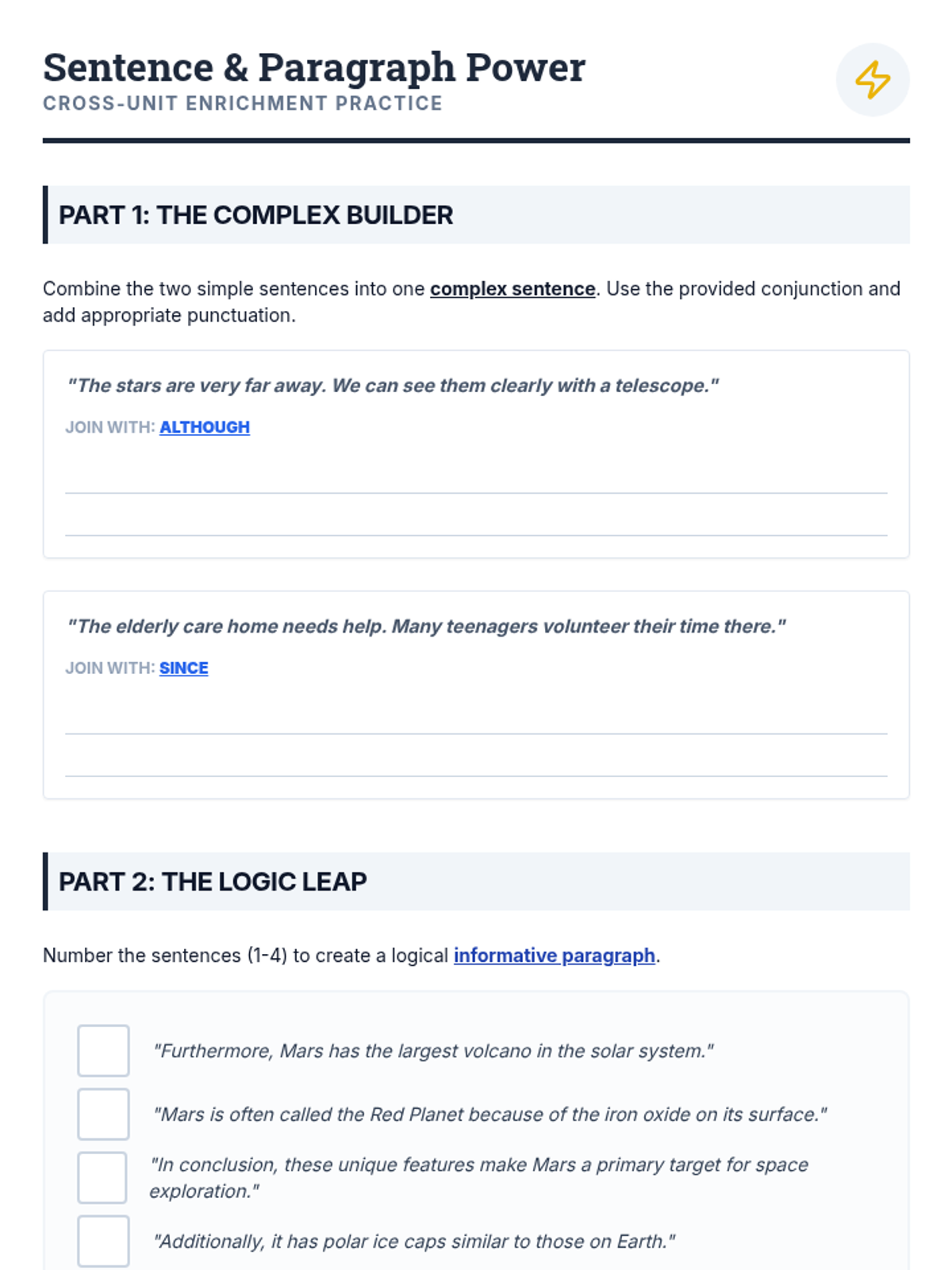
An enrichment worksheet focused on advanced sentence combining, logical paragraph sequencing, and tone transformation. Updated for handwriting legibility and clear instruction.
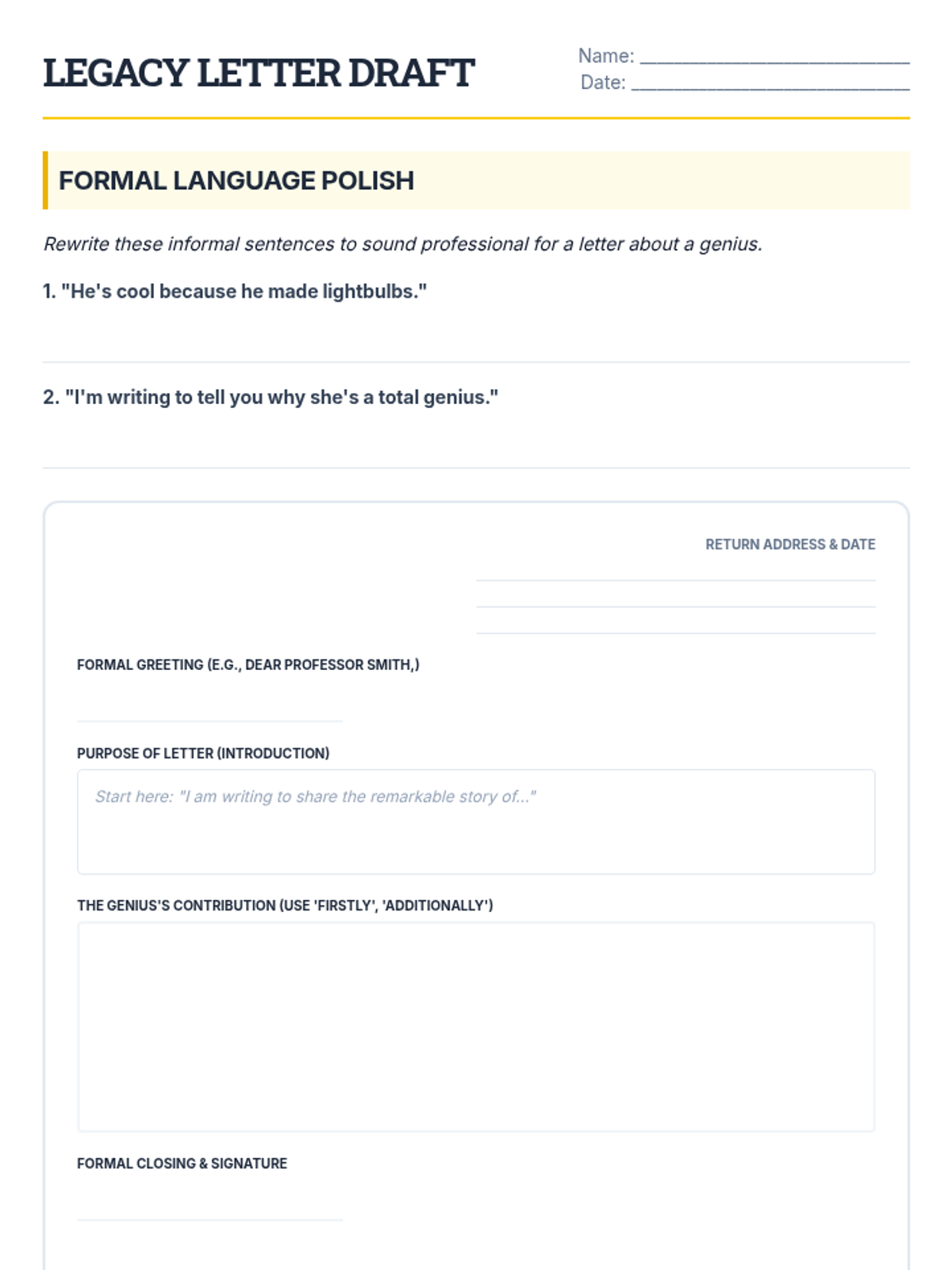
A student worksheet for formal letter writing about a genius. Includes a formal language rewrite activity and a structured letter template. Updated to fit one page and improve contrast.
Instructional slides for formal letter writing, focusing on the achievements of geniuses, formal tone vs. informal tone, and letter structure. Updated with specific examples and curriculum cohesion.
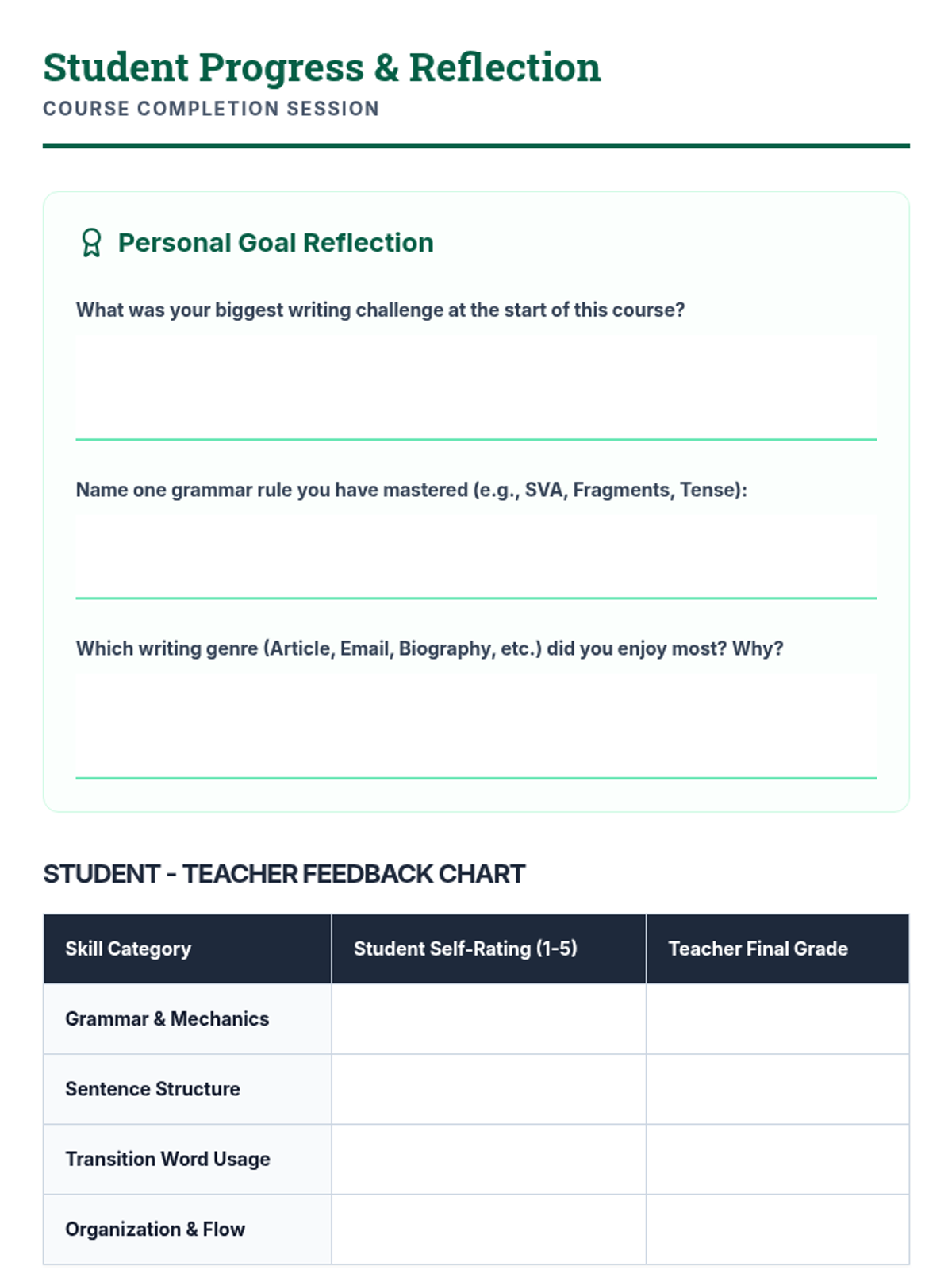
A final reflection and feedback document for students to self-assess their progress, receive teacher evaluations across core skill categories, and review strategy tips for future writing success.
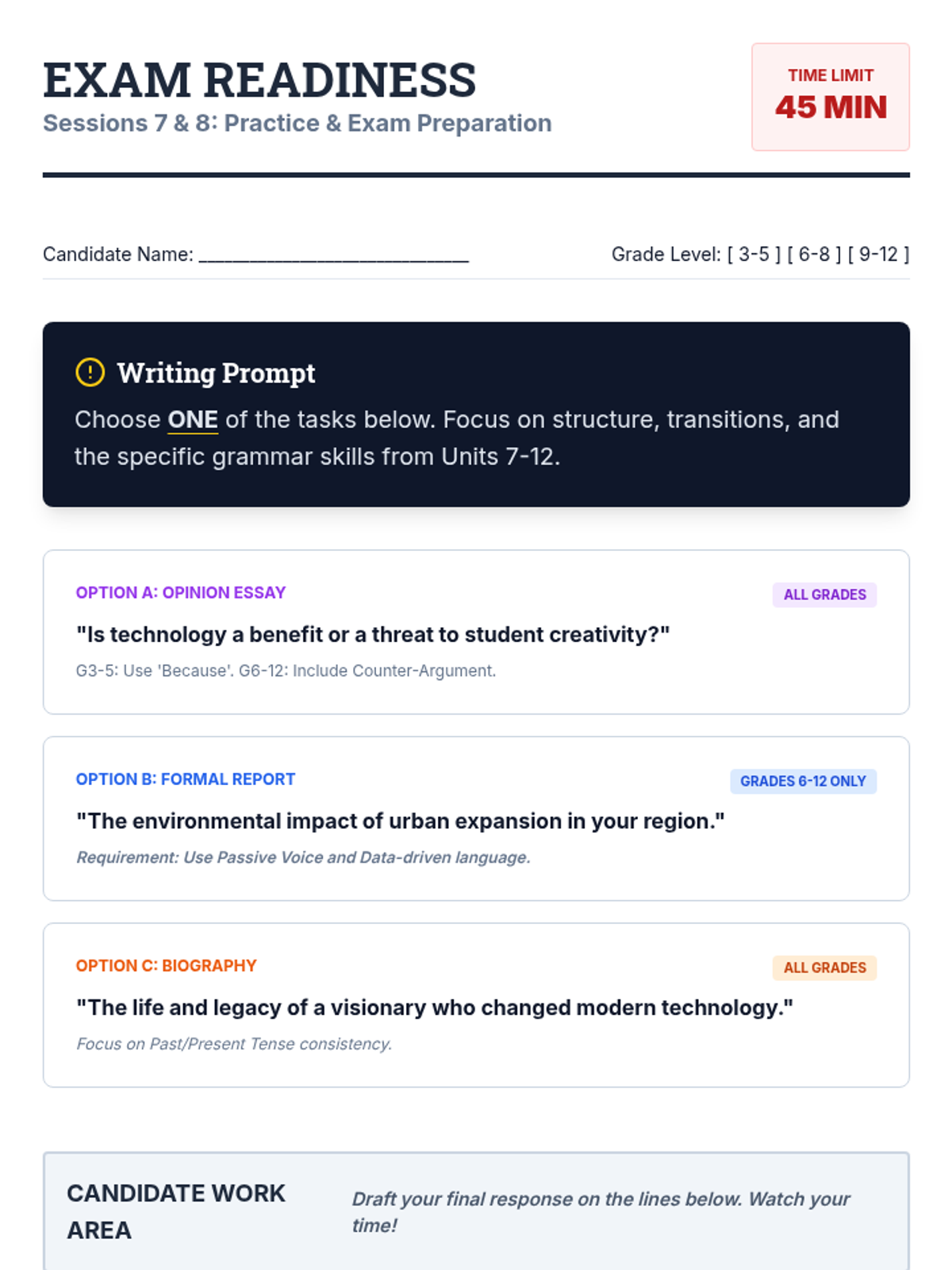
A mock exam writing prompt and workspace for sessions 7 and 8, featuring tiered options for different writing genres (essay, report, biography) and a lined writing area for timed practice.
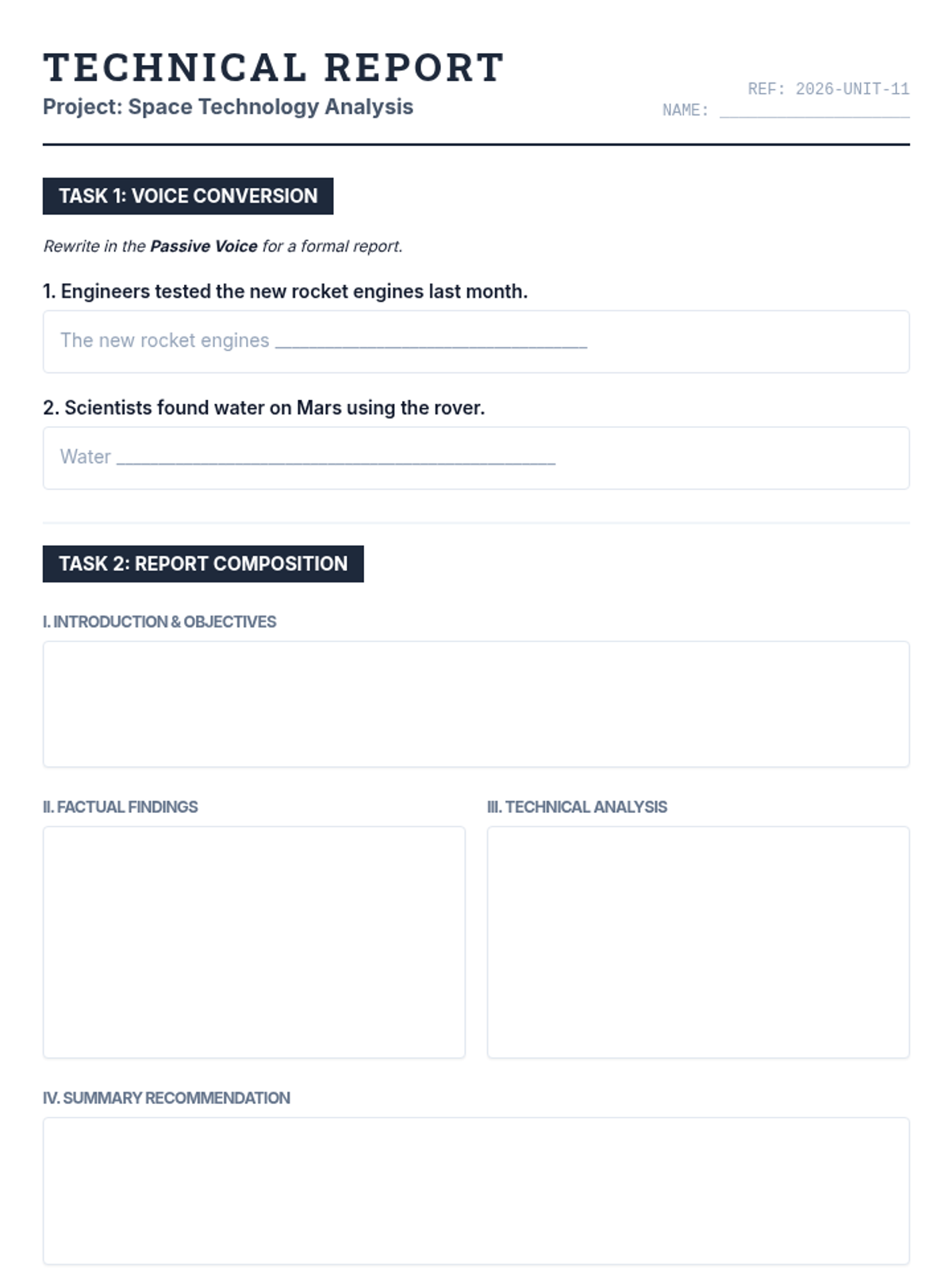
A technical report writing worksheet for students, including an active-to-passive voice conversion exercise and a structured four-part report layout for space technology analysis.
Instructional slides for report writing on space technology, focusing on the distinction between active and passive voice and the formal structure of a data-driven report.
A student worksheet for opinion essay writing, featuring a conjunction-combining grammar activity and a structured multi-part outline for a thesis, evidence, counter-argument, and conclusion.