Builds word mastery through parts of speech, Greek and Latin roots, and morphological analysis of prefixes and suffixes. Develops nuanced comprehension using context clues, shades of meaning, and idiomatic expressions.
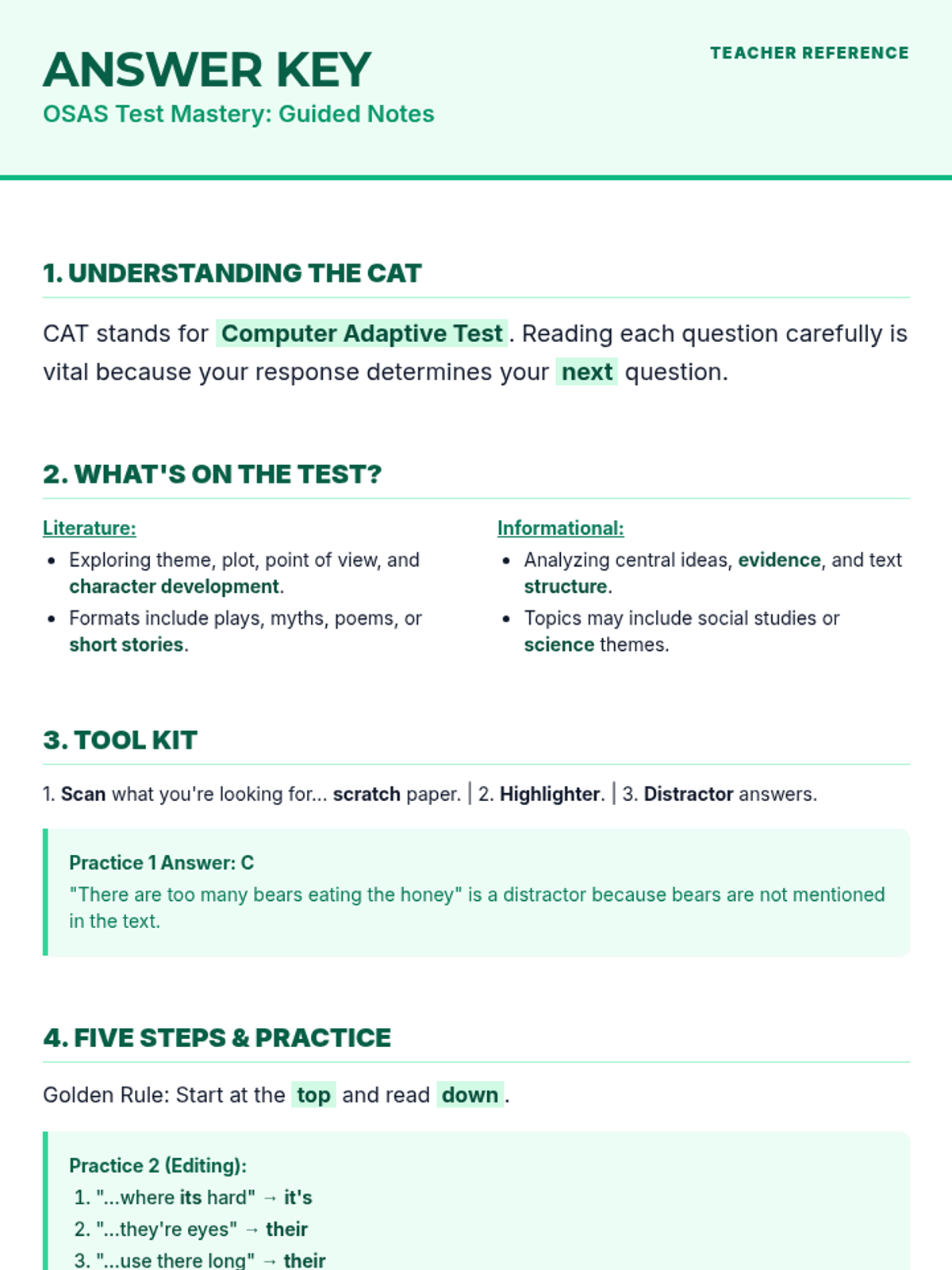
Updated answer key for the OSAS guided notes, matching the revised worksheet text and including full context for the sections that are no longer fill-in-the-blanks for students.
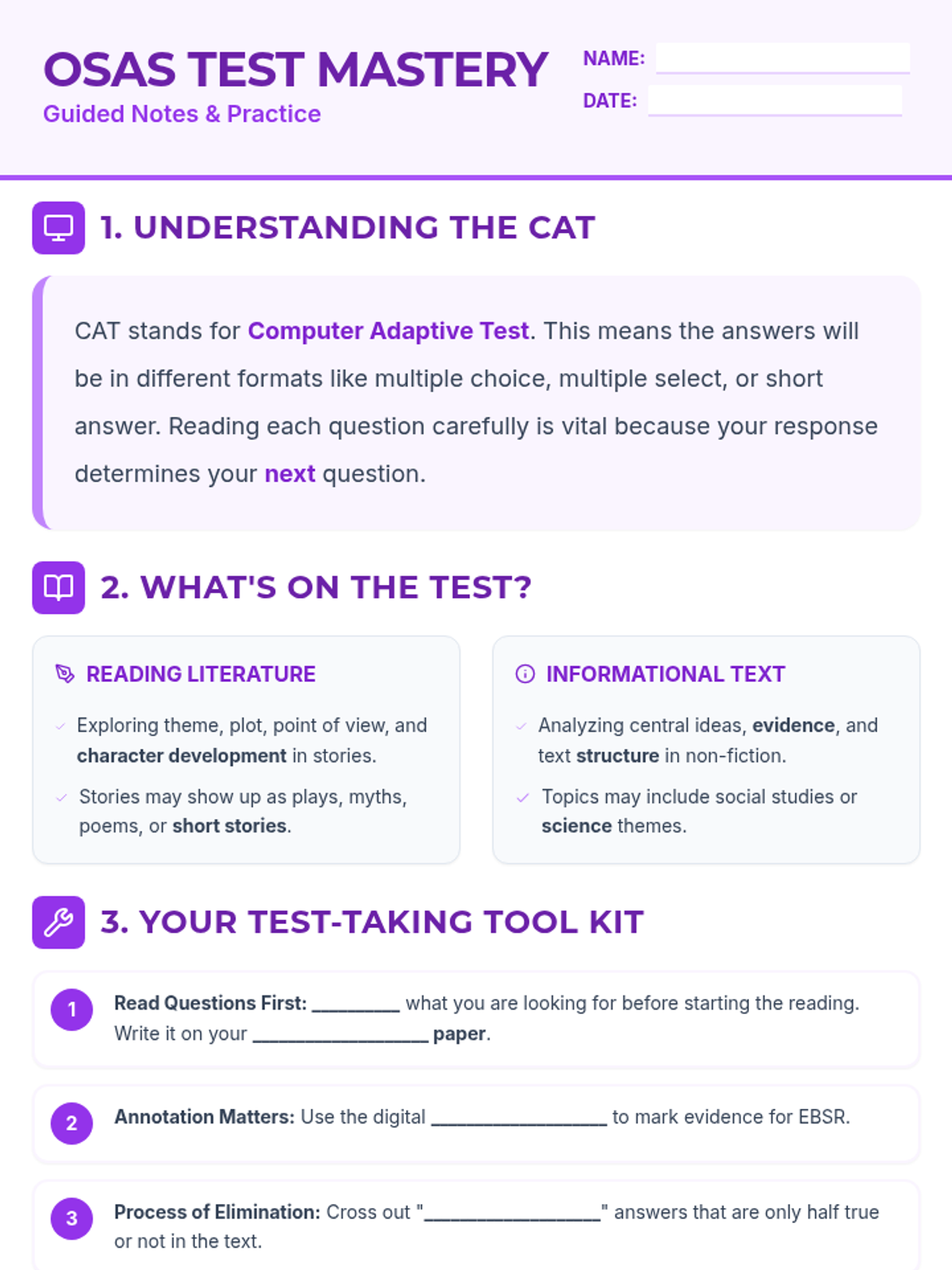
Updated guided notes for the OSAS ELA Test Prep, with complete text for the first two sections, central idea terminology in practice questions, and an expanded hamburger method outline.
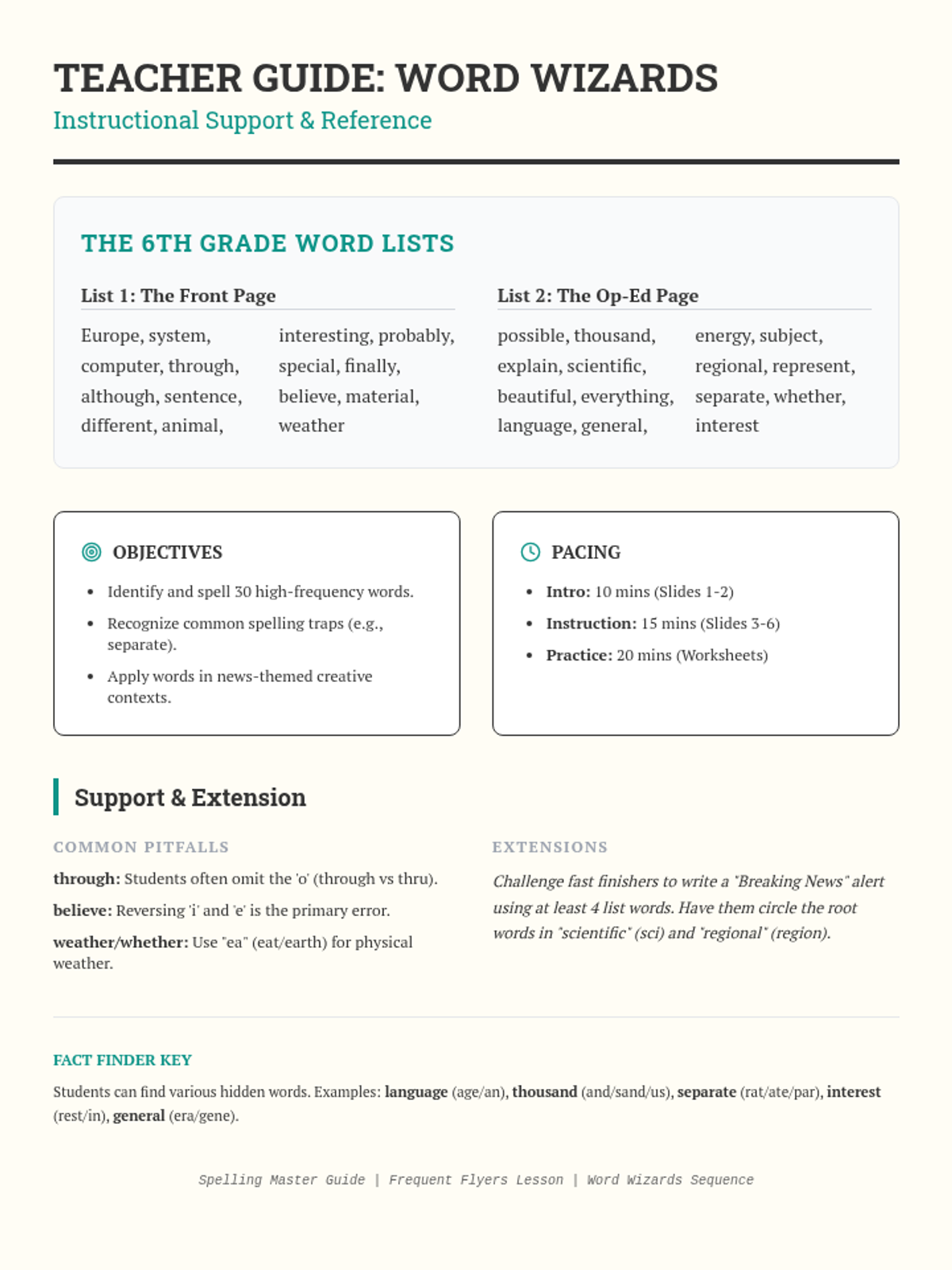
A teacher-facing guide providing instructional strategies and answer guidance, revised for better font size consistency and layout stability.
An instructional slide deck for teaching two lists of high-frequency Fry words, updated with improved contrast, larger examples, and revised titles.
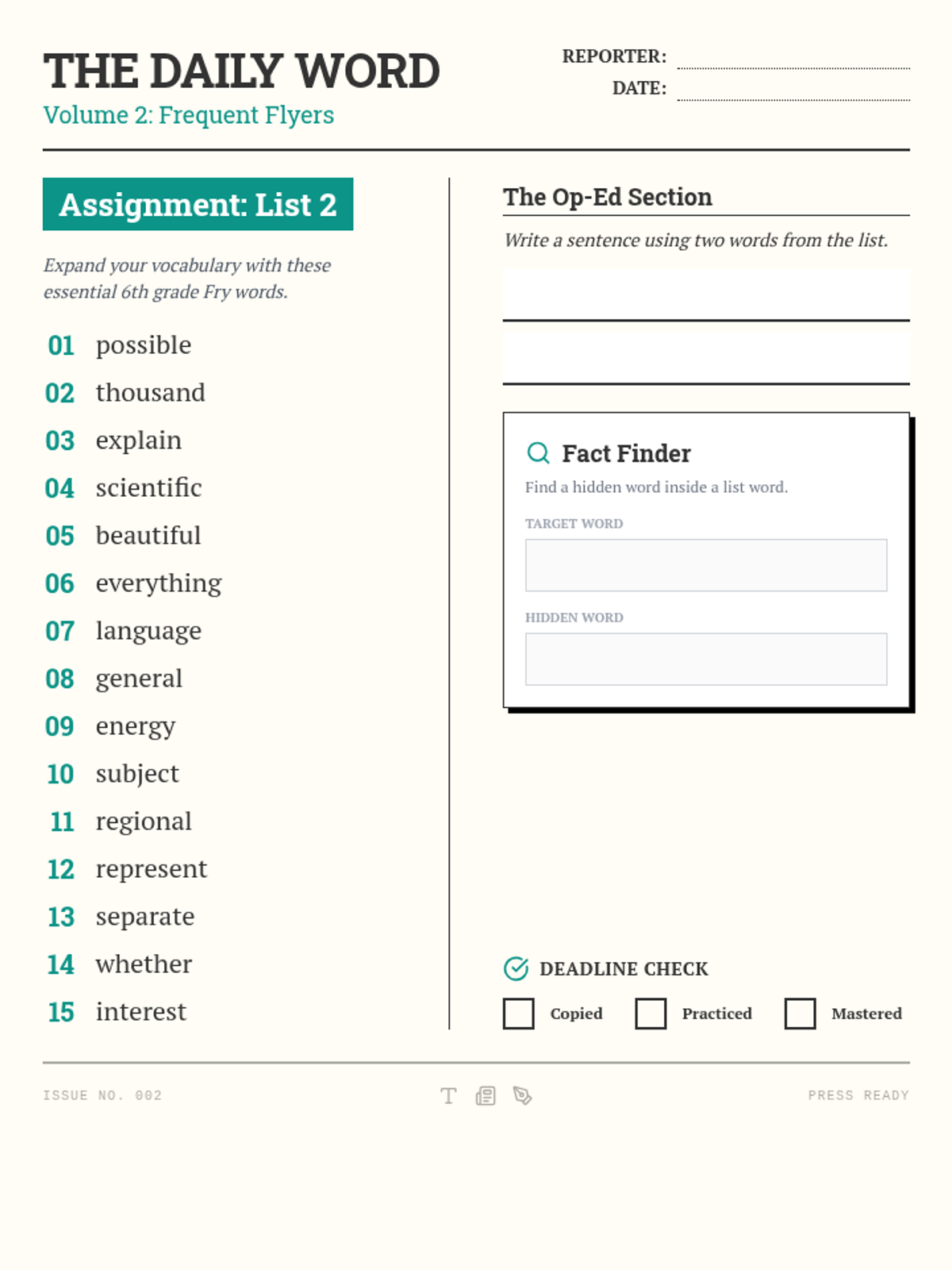
A news-themed spelling worksheet featuring the second set of 15 high-frequency Fry words for 6th grade, revised for better space efficiency and handwriting room.
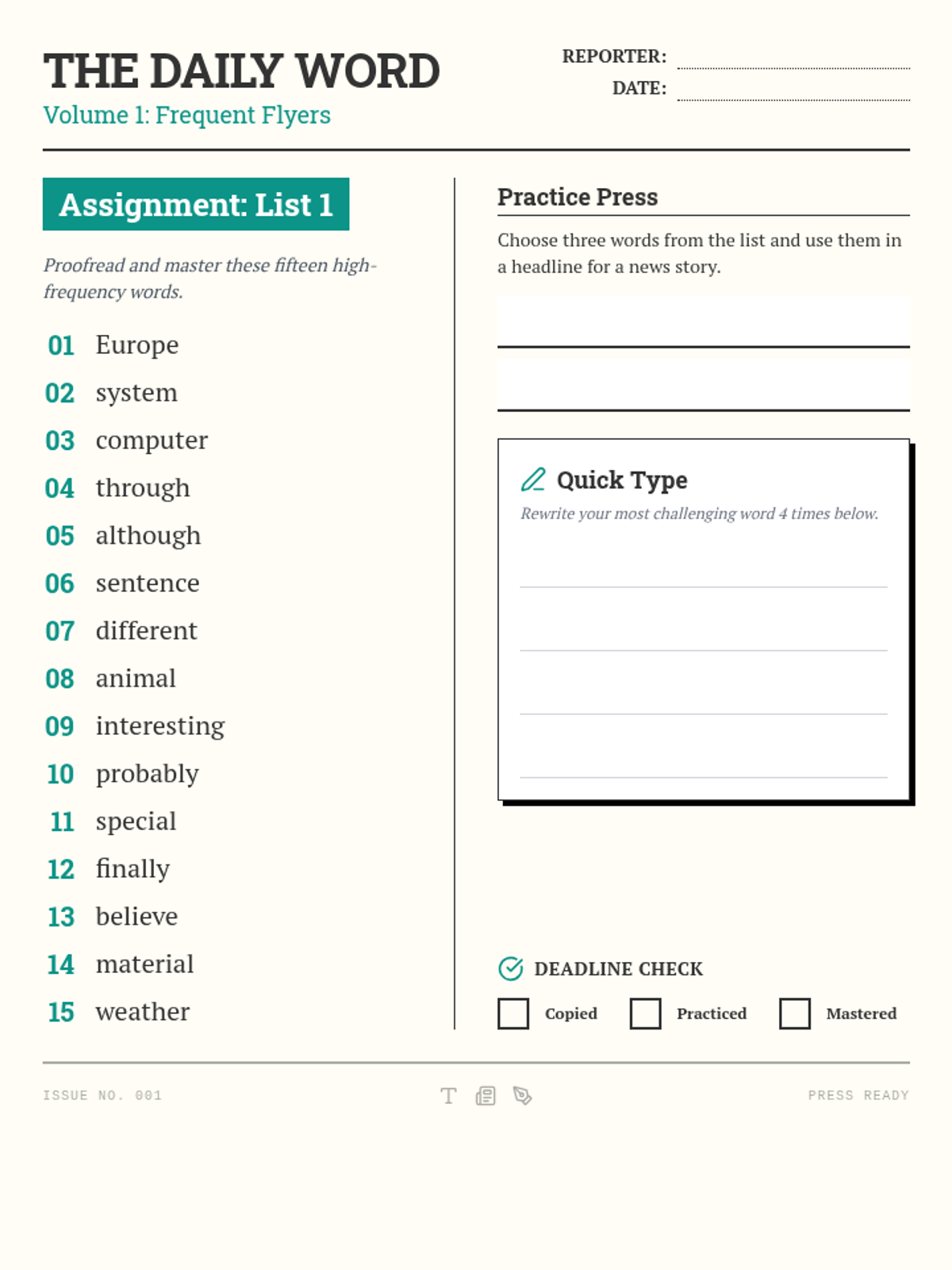
A news-themed spelling worksheet featuring the first set of 15 high-frequency Fry words for 6th grade, revised for better space efficiency and writing room.
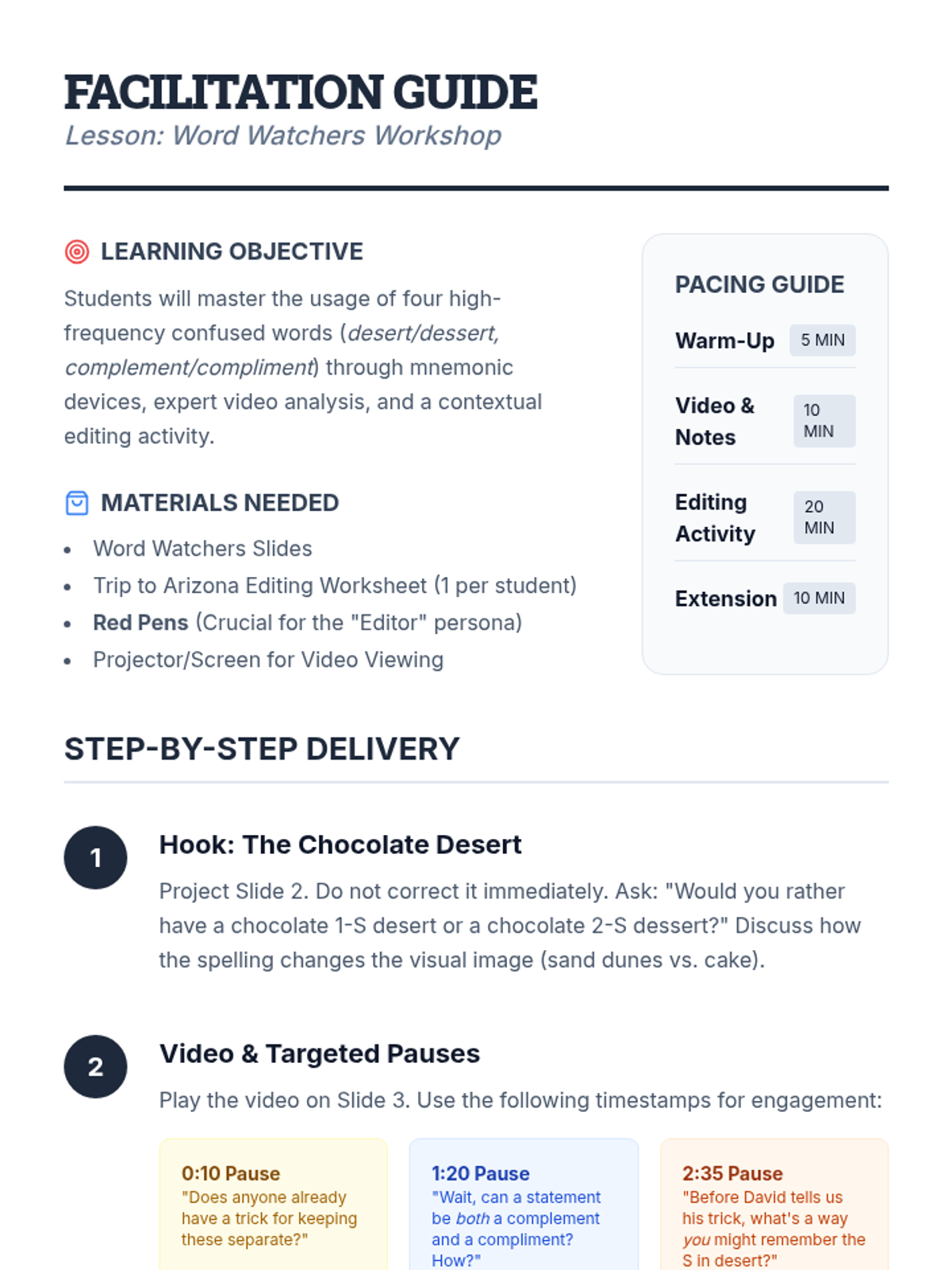
A facilitation guide for teachers leading the Word Watchers Workshop. Includes pacing instructions, targeted video pause points, common student misconceptions, and tips for effective delivery.
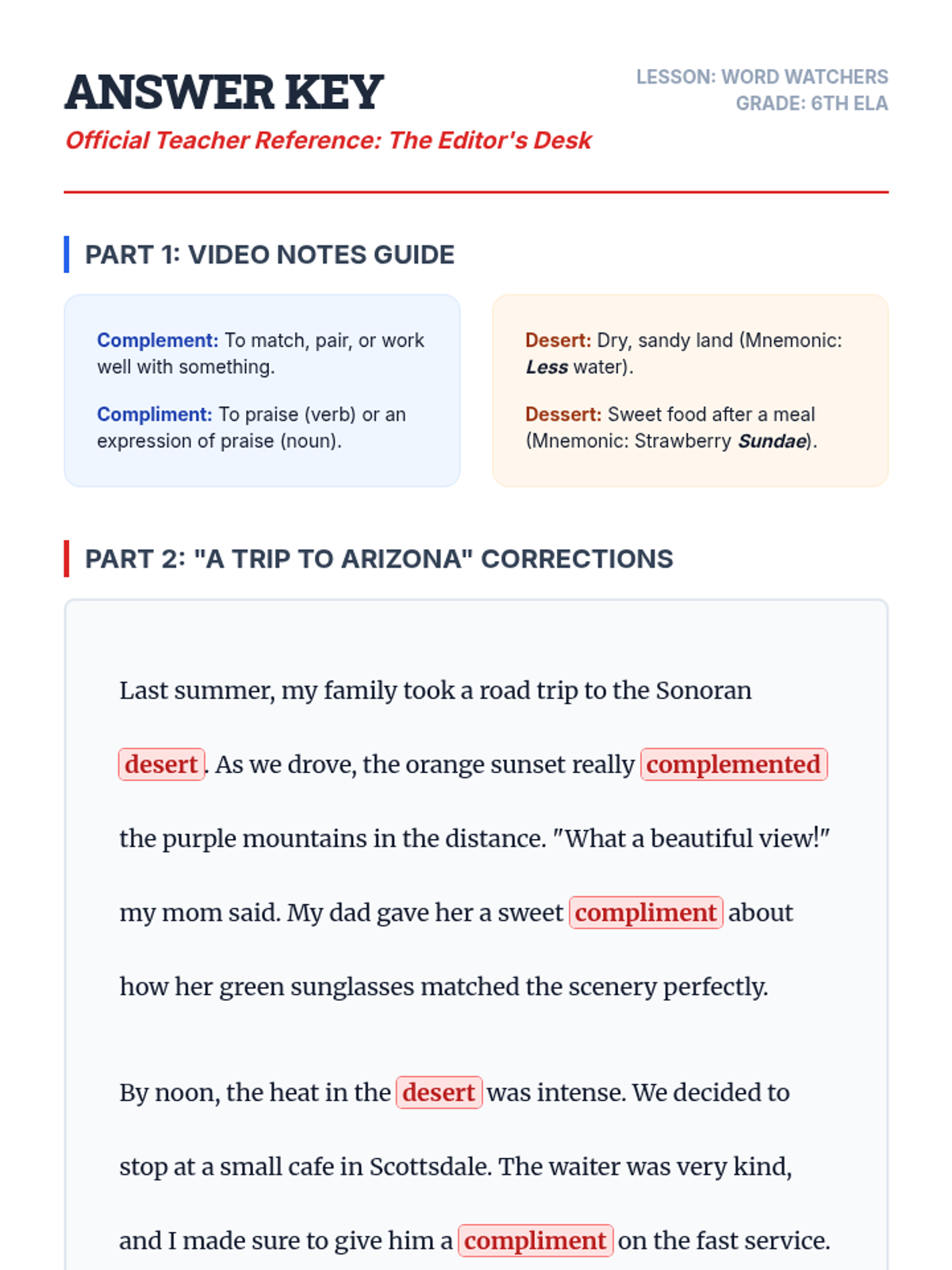
Teacher answer key for the 'Trip to Arizona' editing worksheet, featuring corrected text highlights and a grading rubric for the extension paragraph.
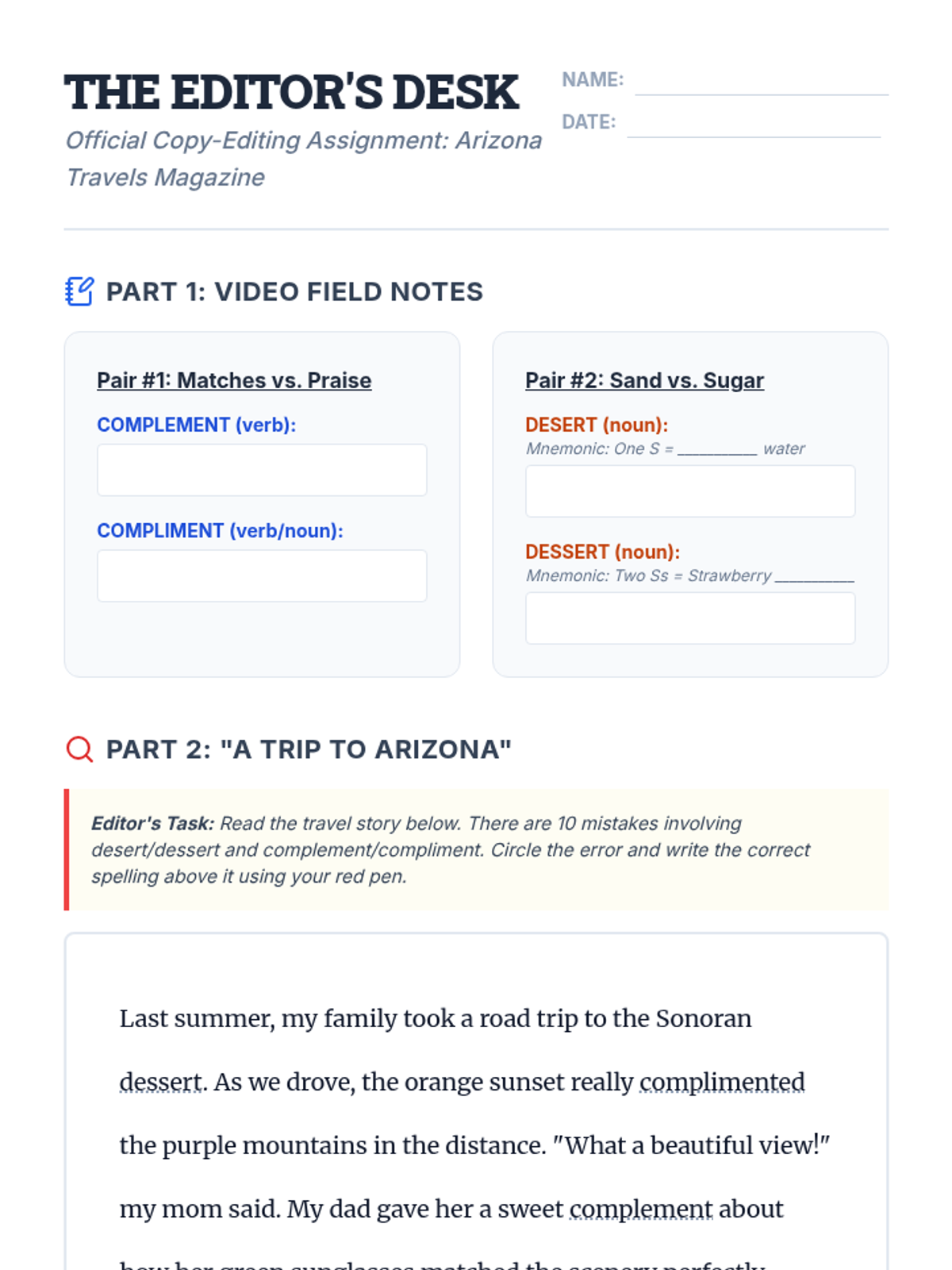
A student worksheet for the 'Trip to Arizona' editing workshop. Includes a section for video notes, the primary editing activity with a 10-error story, and a creative writing extension.
Instructional slides for the Word Watchers Workshop, featuring a warm-up, embedded Khan Academy video, definitions with visual mnemonics for desert/dessert and complement/compliment, and activity instructions.
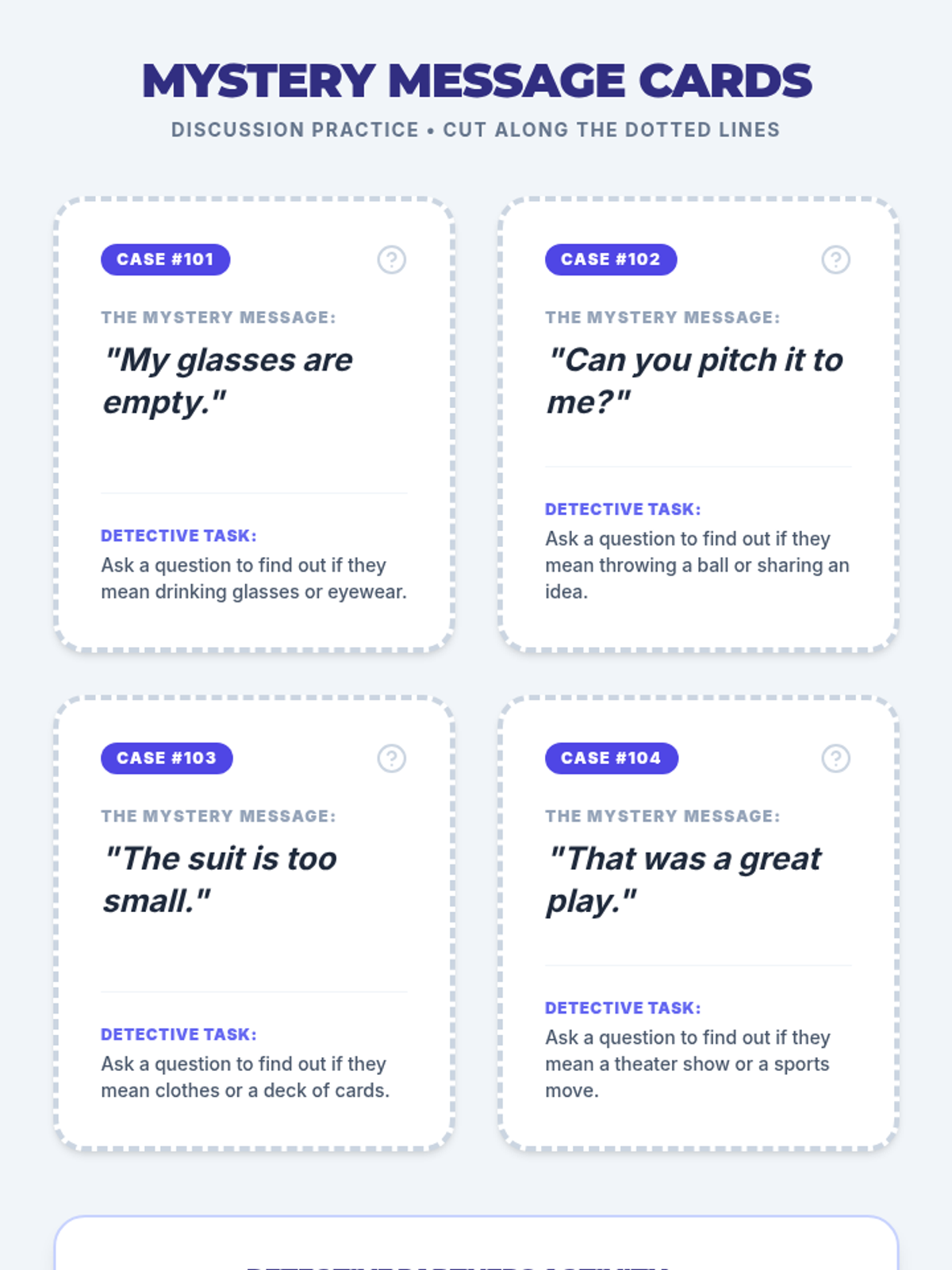
A set of discussion cards with ambiguous sentences designed for small group practice in asking clarifying questions.
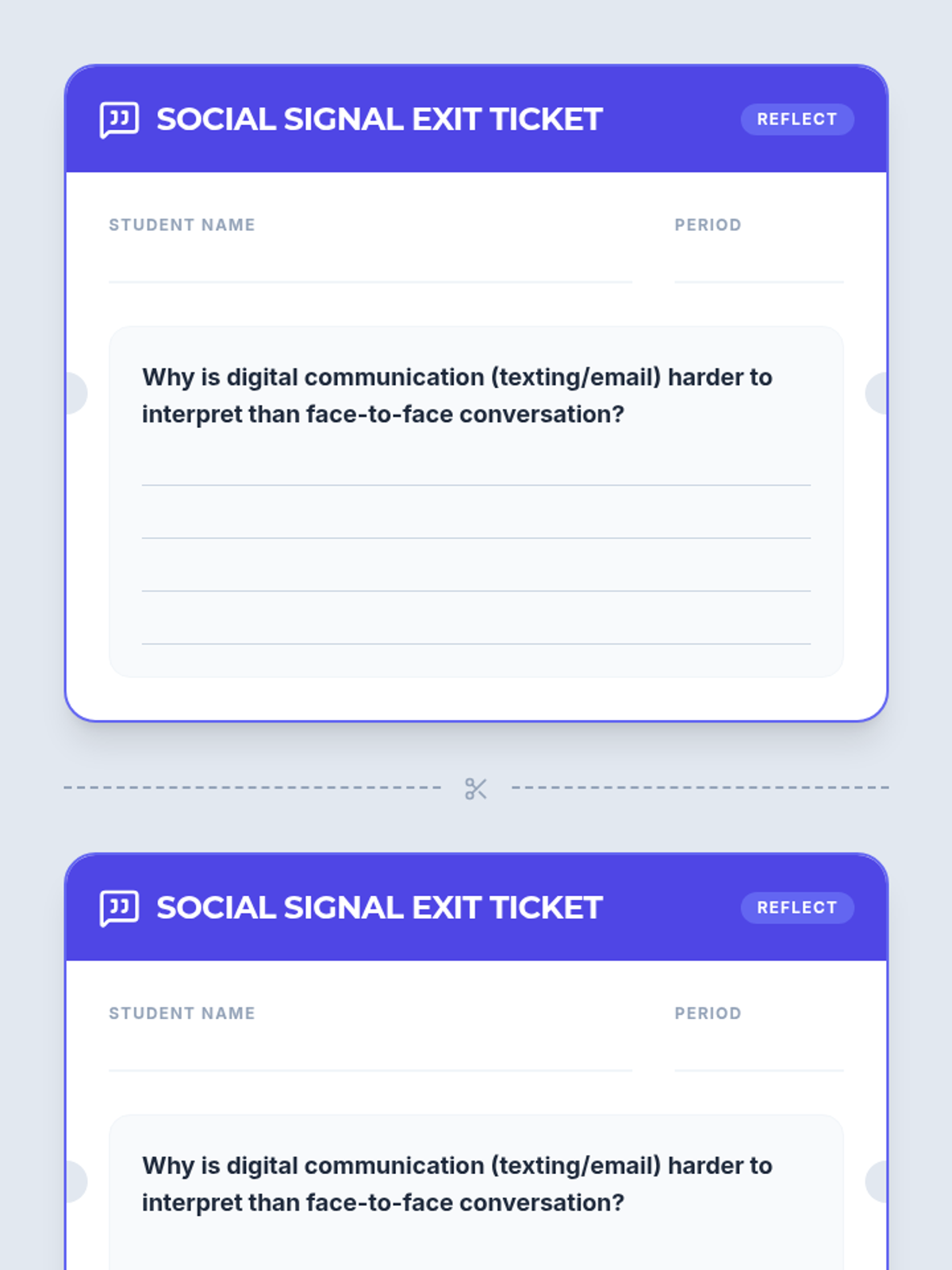
A half-page exit ticket for students to reflect on the challenges of digital communication versus face-to-face conversation.
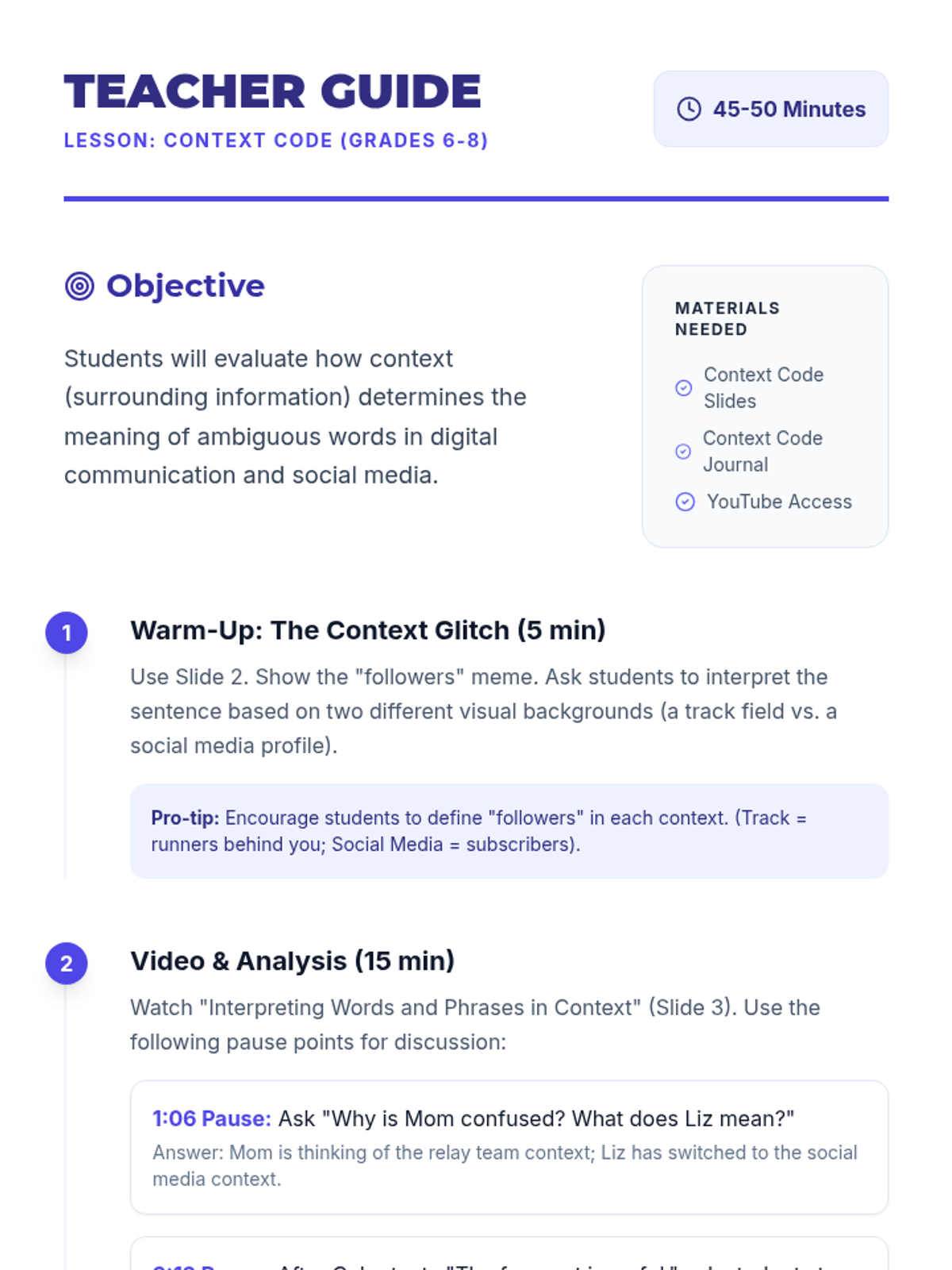
A comprehensive teacher facilitation guide for the Context Code lesson. Includes lesson pacing, specific discussion prompts for the video, activity examples, and a vocabulary key.
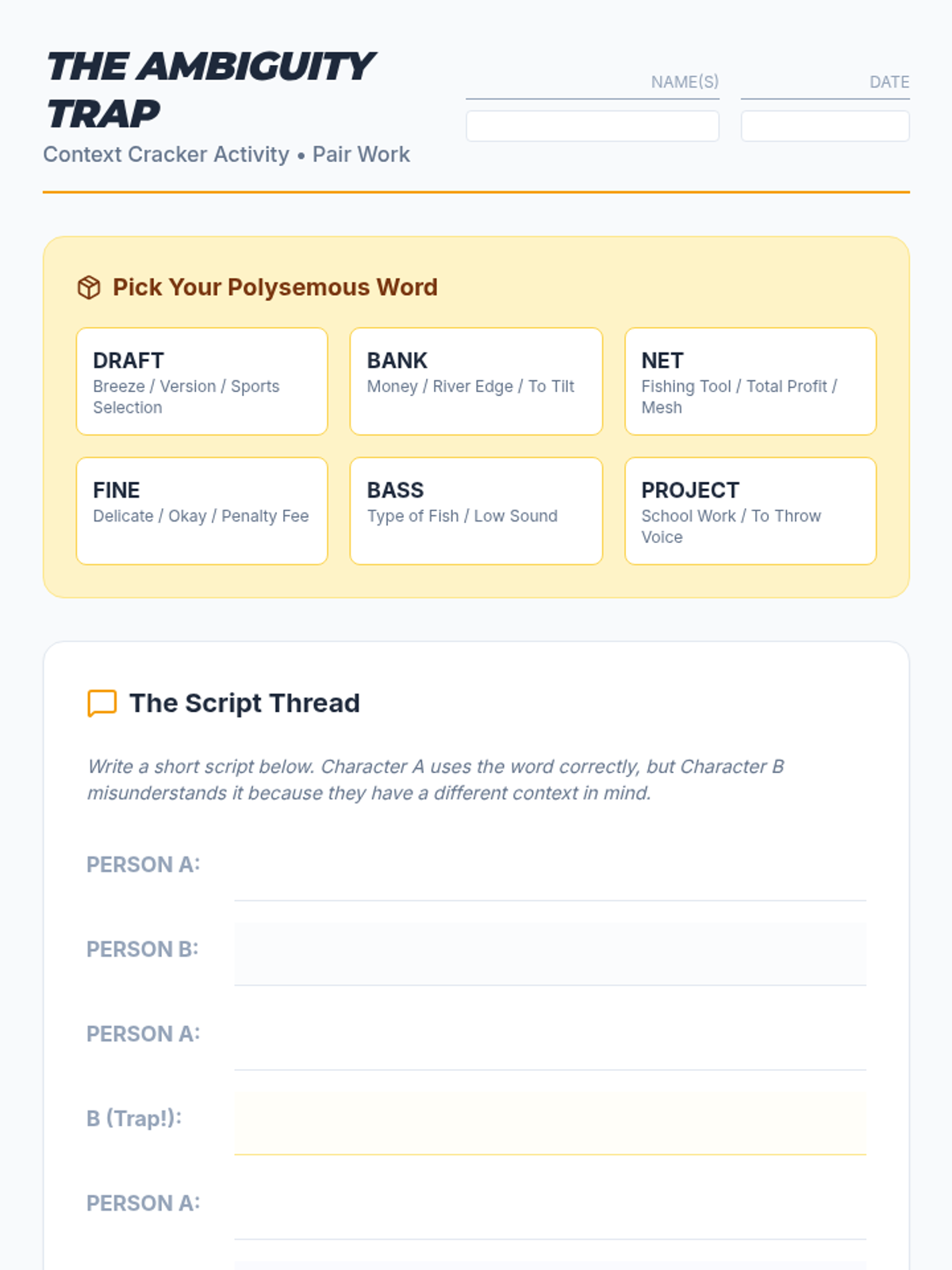
A worksheet for students to select a polysemous word and write a script where context leads to a misunderstanding, including a word bank and analysis area.
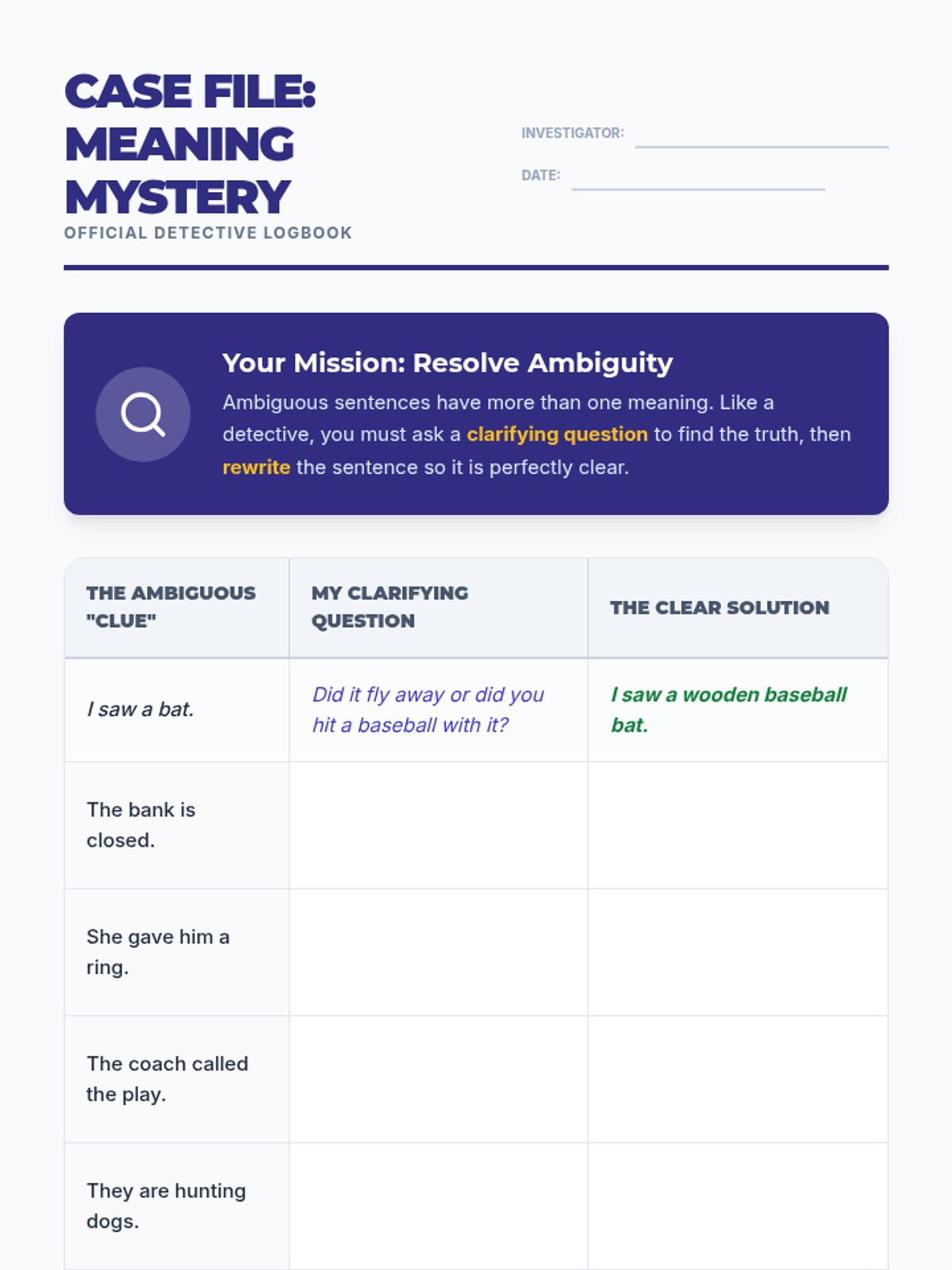
A student worksheet designed as a 'Case File' for practicing identifying ambiguity, asking clarifying questions, and rewriting sentences for clarity.
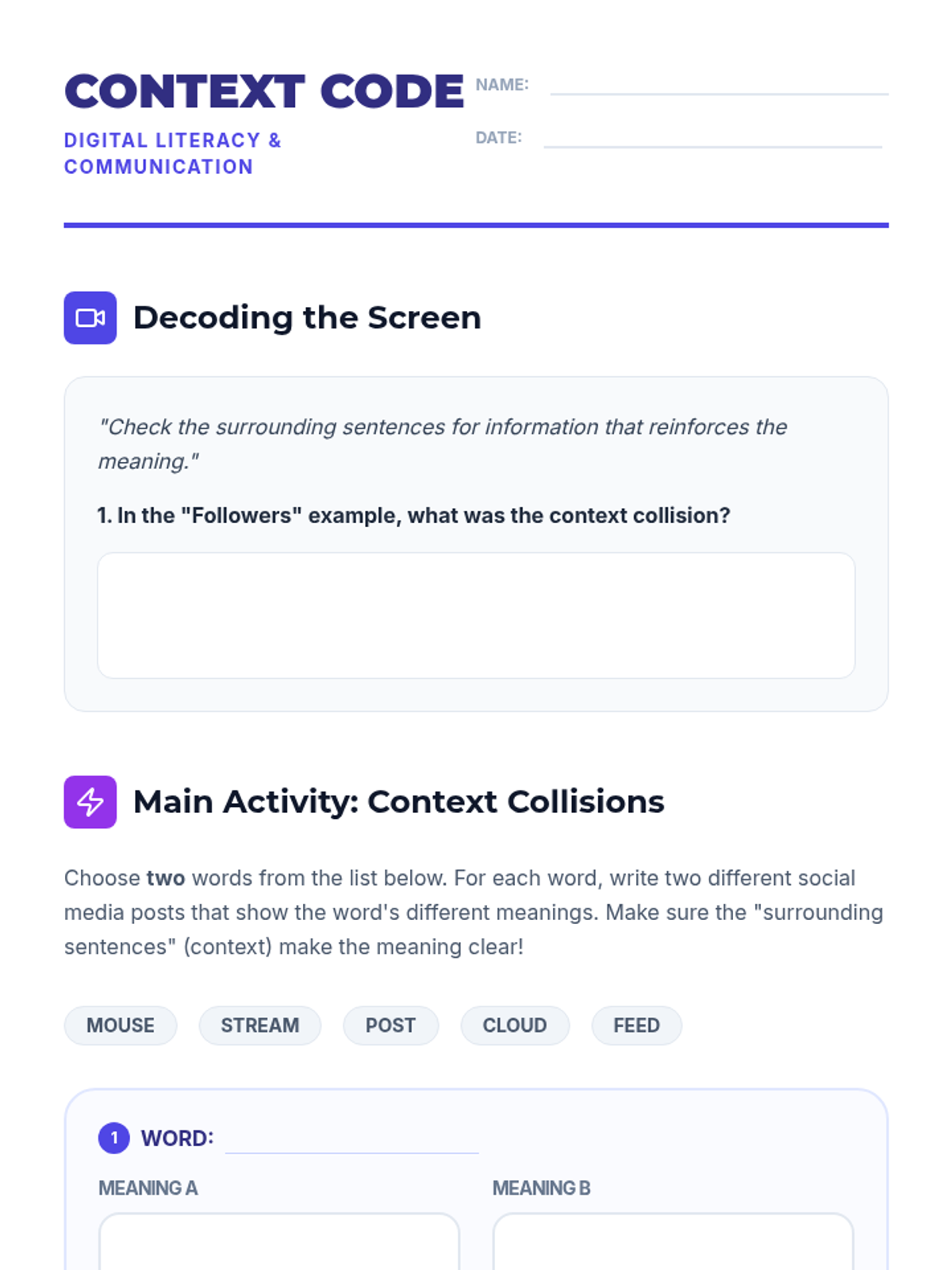
A student activity sheet for the Context Code lesson. Includes a section for video analysis, the Context Collisions creative writing activity, and the final Reflection Journal prompt with writing space.
Visual presentation for the Context Cracker lesson, including the video embed, discussion questions for Scenario 1 and 2, and activity instructions.
A visual presentation for the Meaning Detectives lesson, featuring the "20 Questions" warm-up, an embedded YouTube video, and a step-by-step breakdown of clarifying questions.
A visual presentation for a digital literacy lesson on context. Includes a warm-up exercise, an embedded YouTube video, key vocabulary definitions, and activity instructions for 'Context Collisions'.
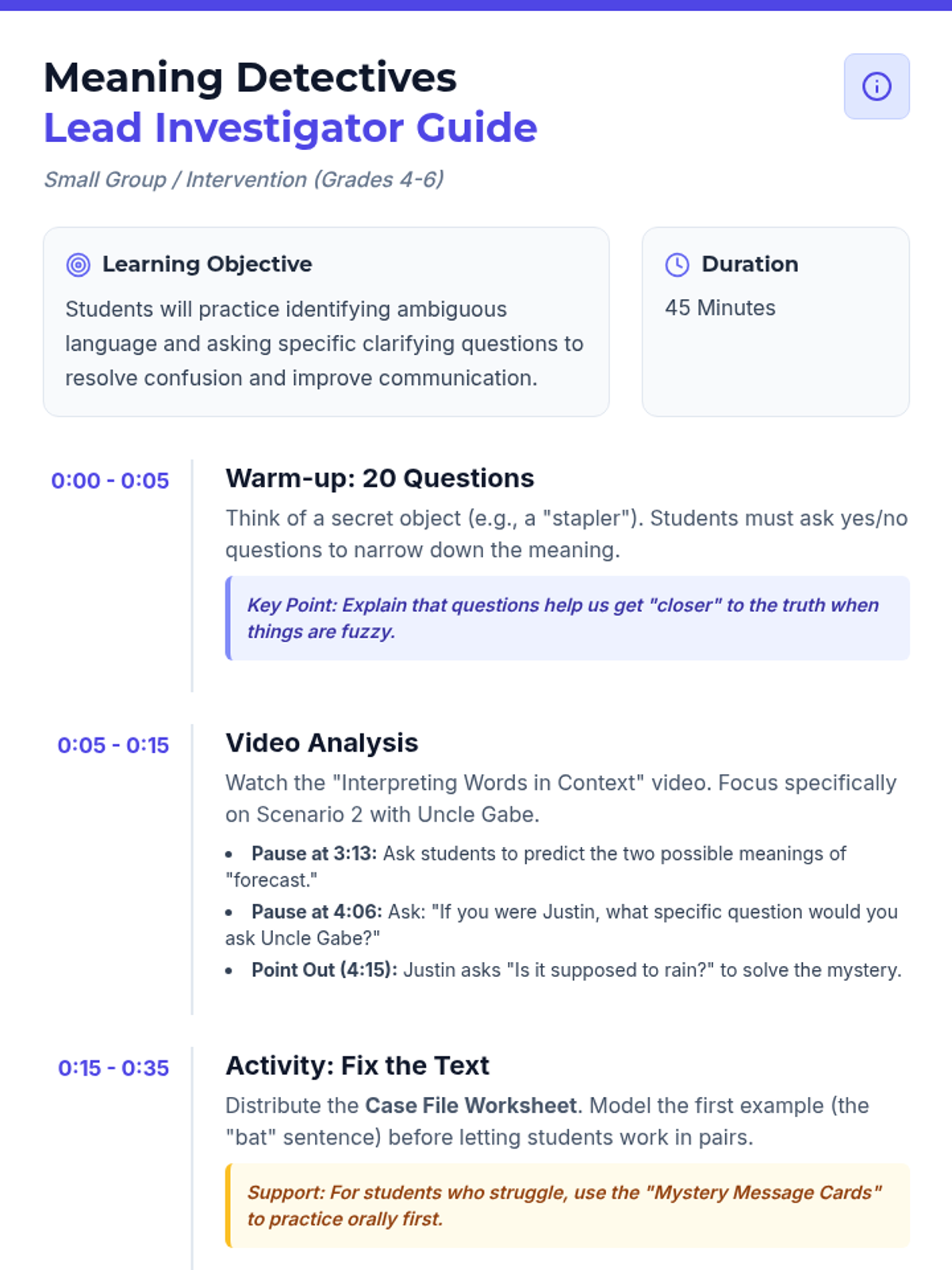
A comprehensive teacher facilitation guide for the Meaning Detectives lesson, including pacing, discussion prompts, and an activity answer key.
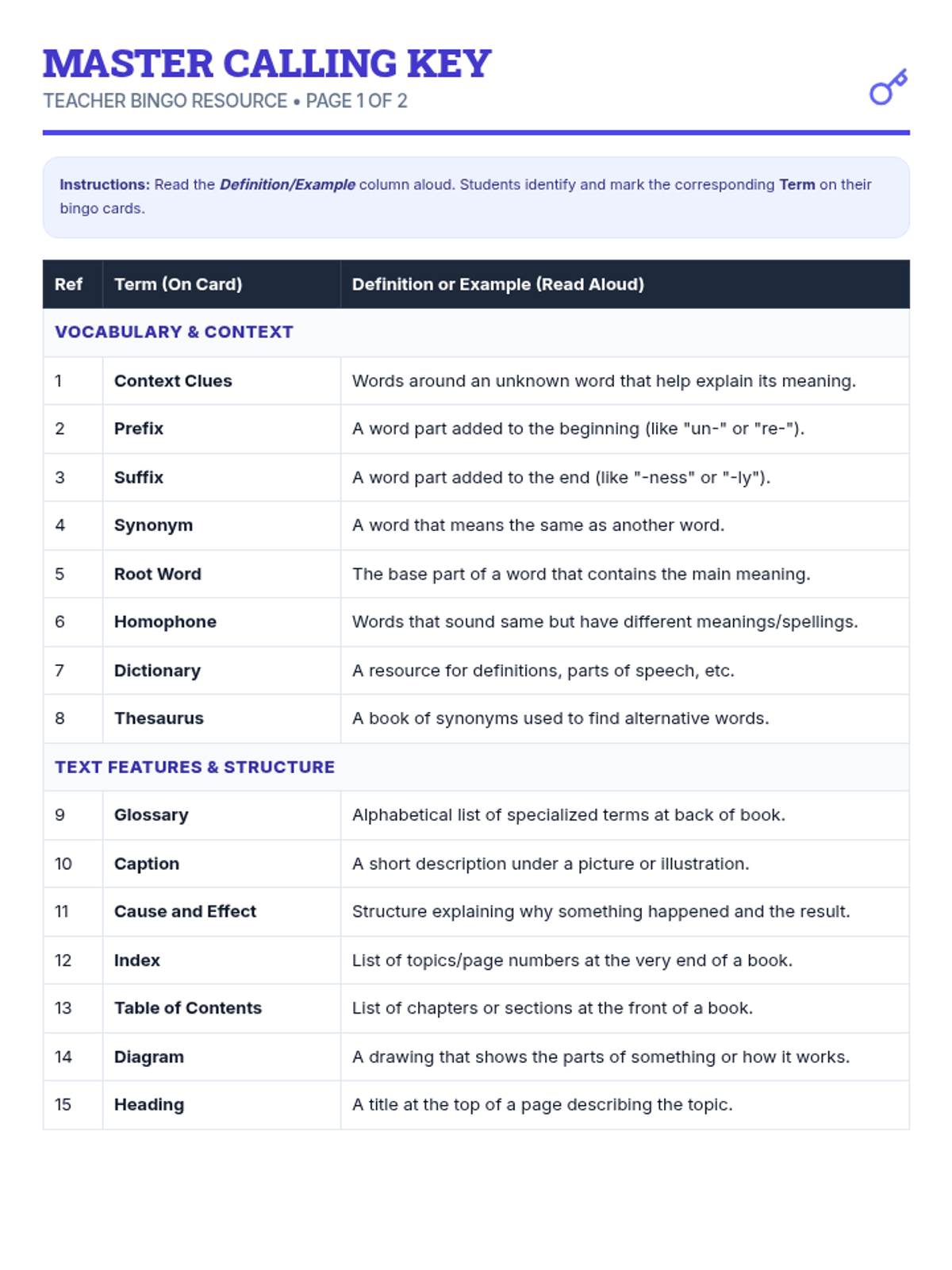
A comprehensive master calling key for the teacher, listing 30 ELA terms, their definitions, and examples aligned with MCAS standards. Revised for optimal print layout and sequential numbering.
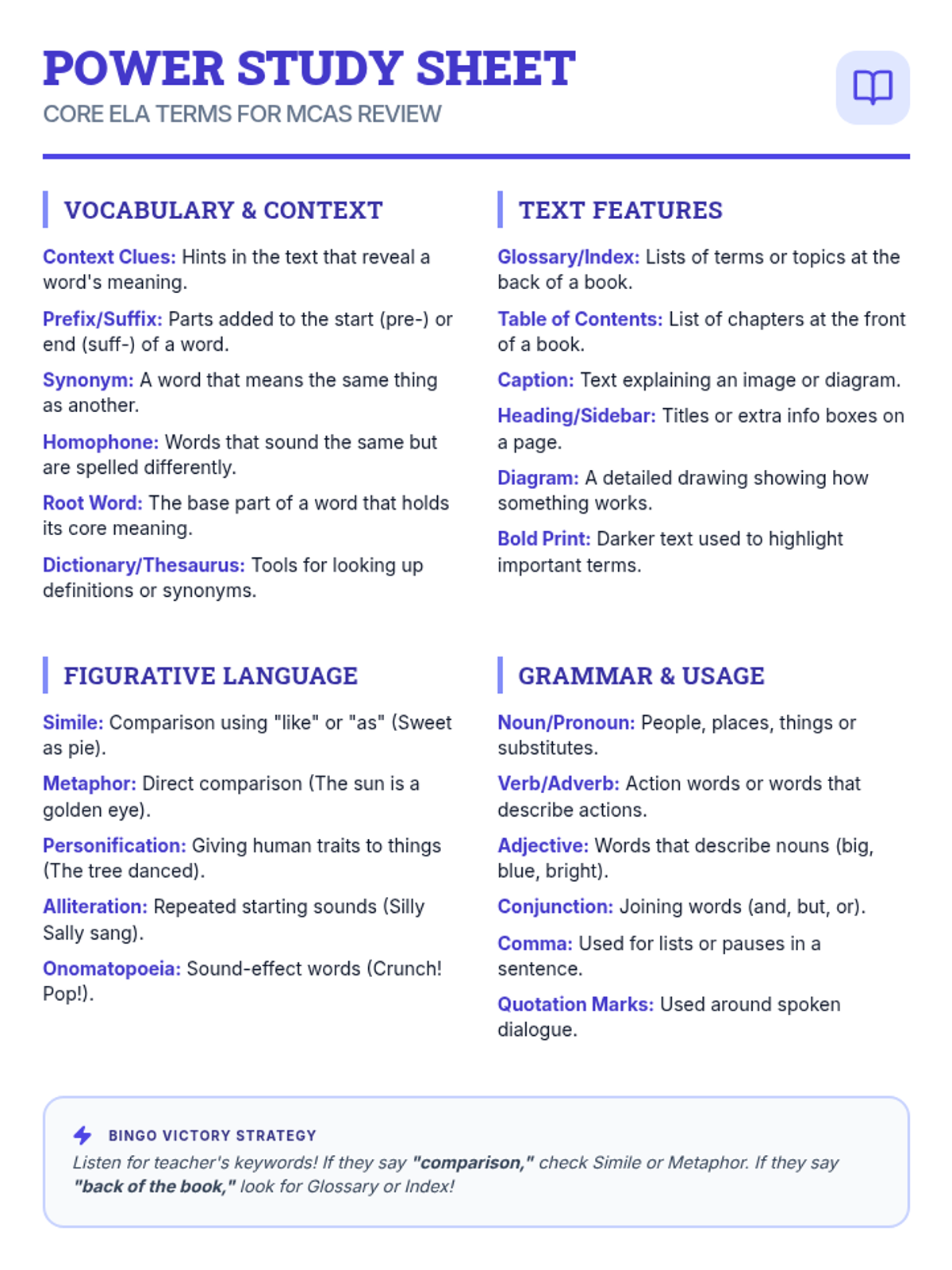
A clean, printable student reference sheet containing key ELA terms, definitions, and examples featured in the bingo game. Optimized for 8.5x11 format with clear headings and a study tips section.
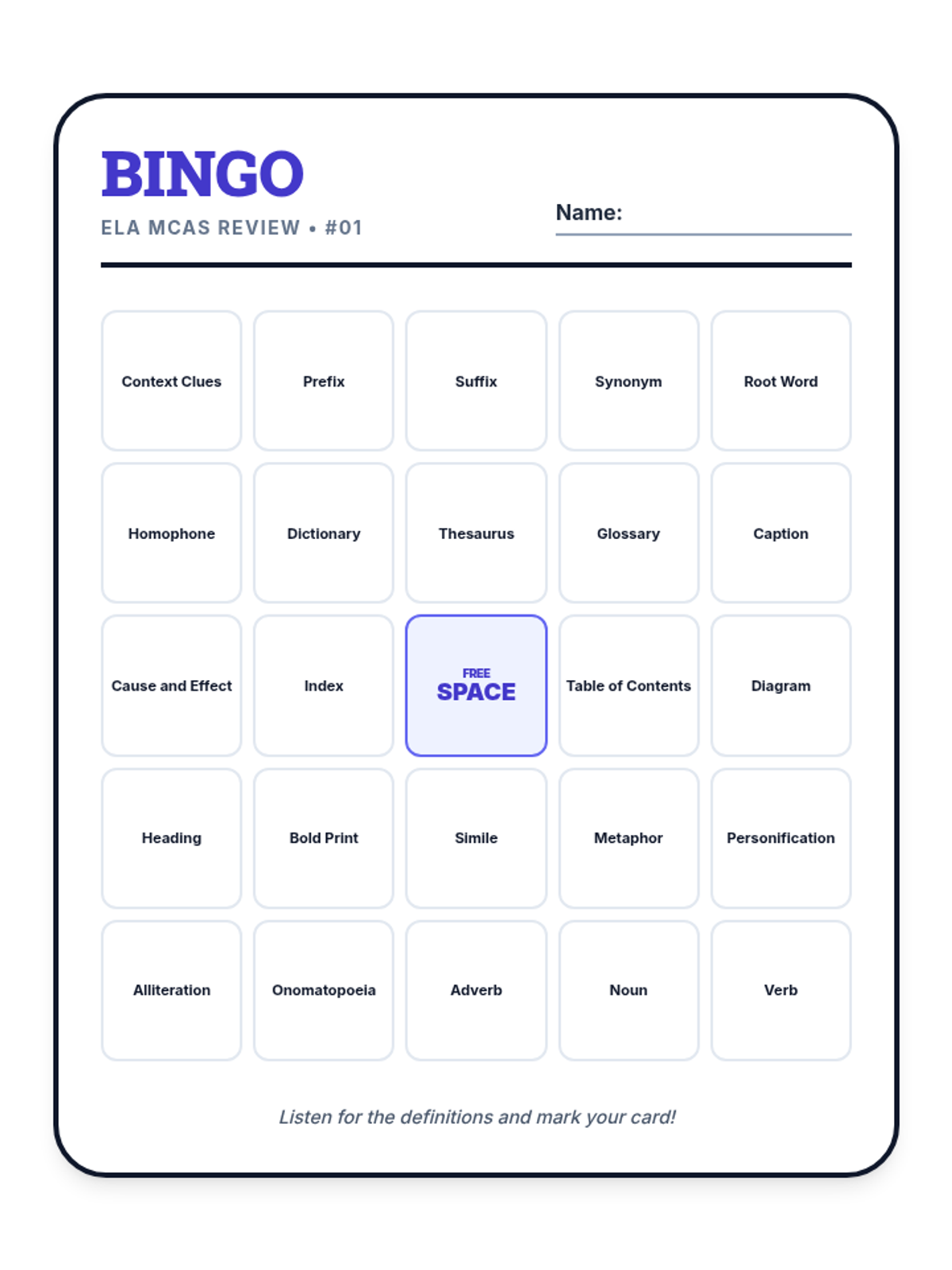
A collection of 22 unique bingo cards for ELA review, updated to provide one large, easy-to-read card per page. Each card features academic vocabulary, text features, and grammar terms aligned with MCAS standards.
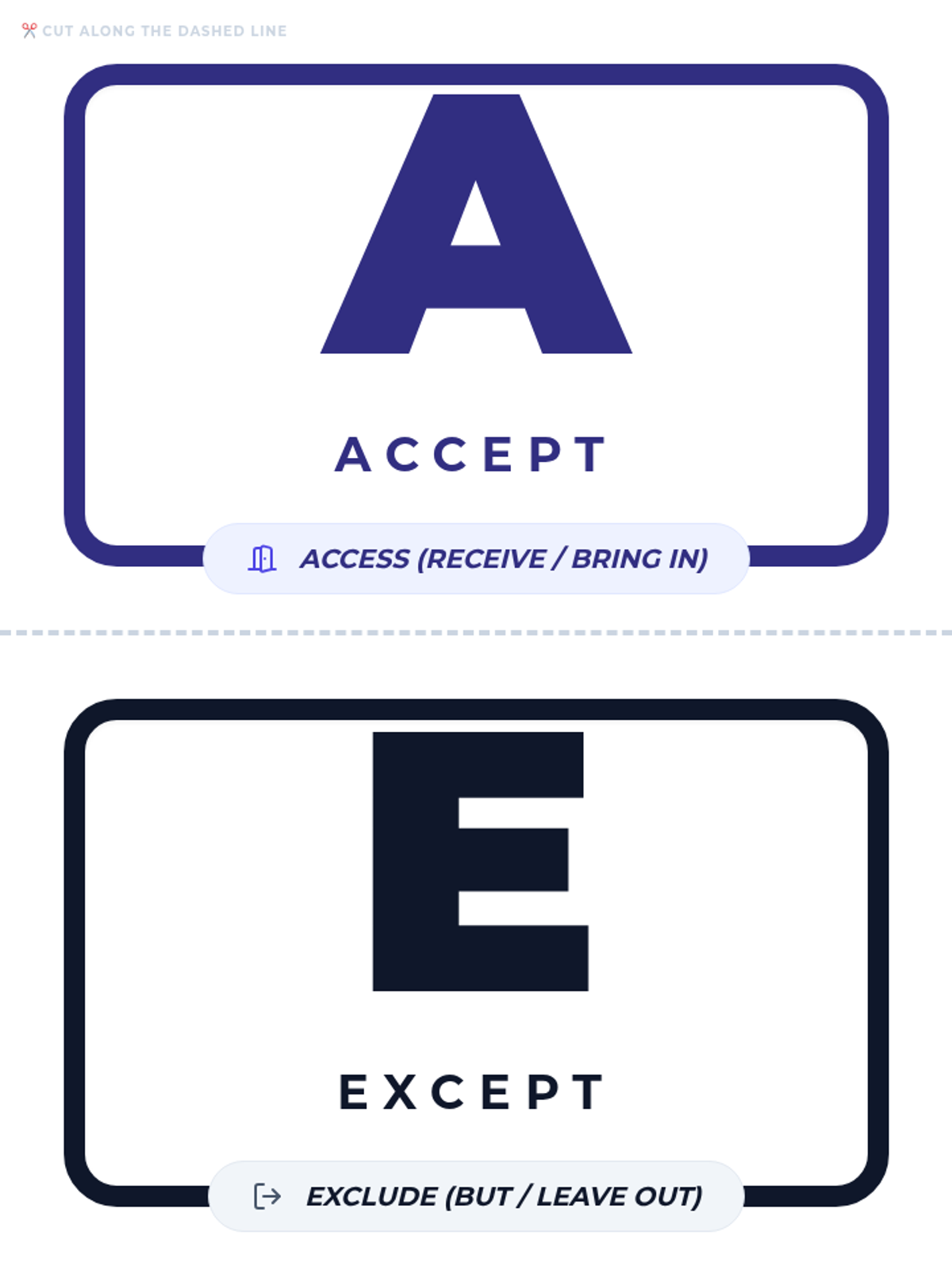
Large printable voting cards for students to hold up during performances to identify the correct usage of 'accept' and 'except'.
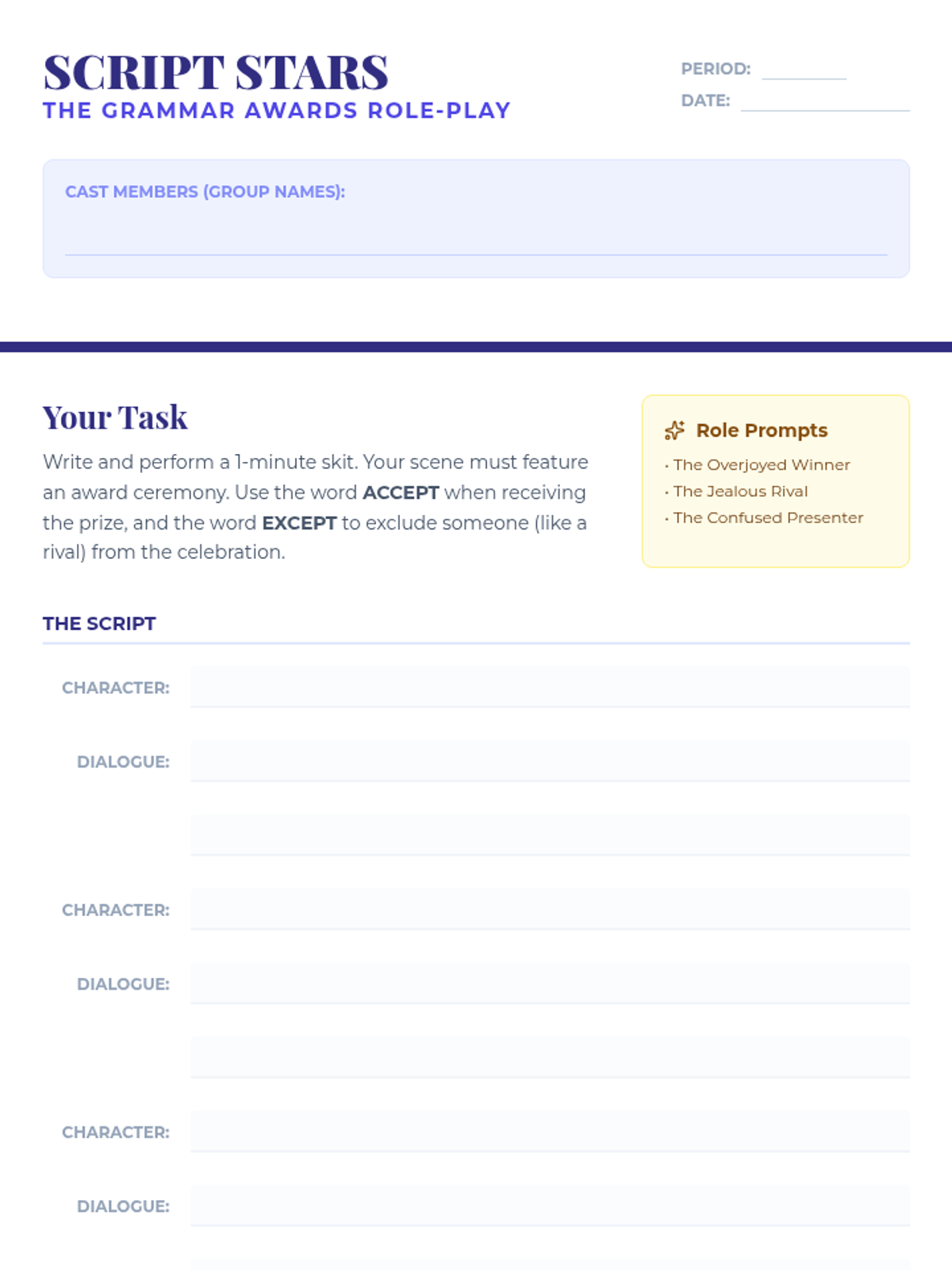
A scriptwriting worksheet for students to draft their award show role-play skits, featuring a grammar checklist and mnemonics.
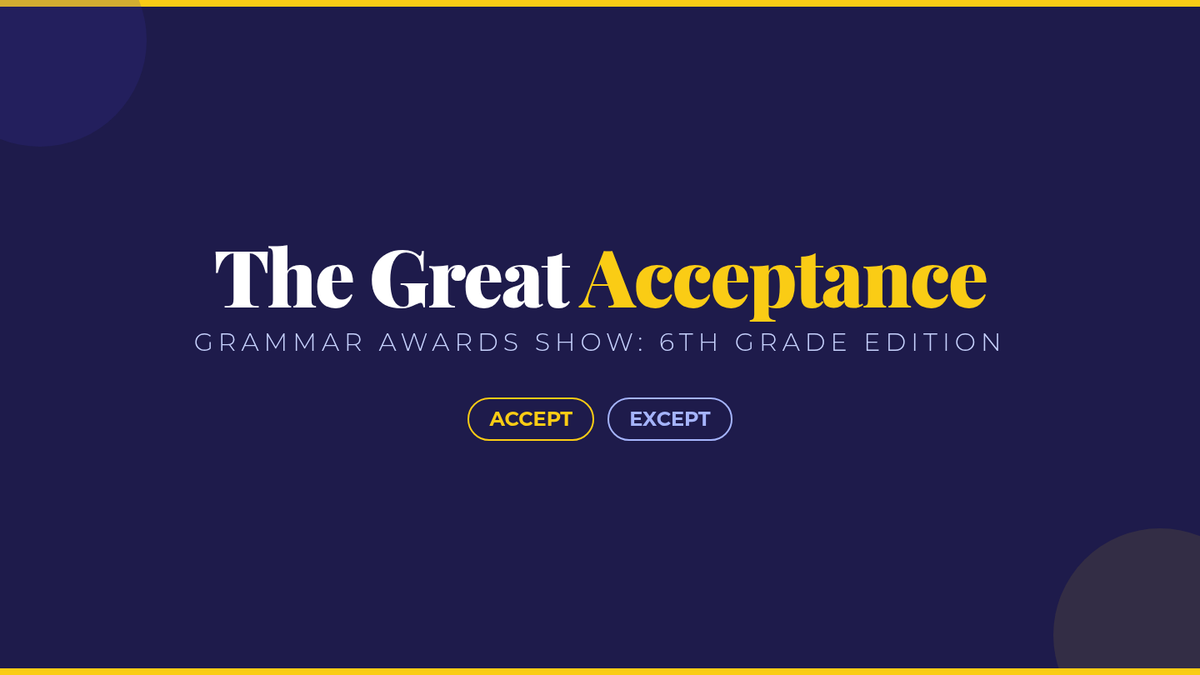
Visual presentation slides for the lesson, featuring a warm-up, embedded video, mnemonic devices, and role-play instructions.
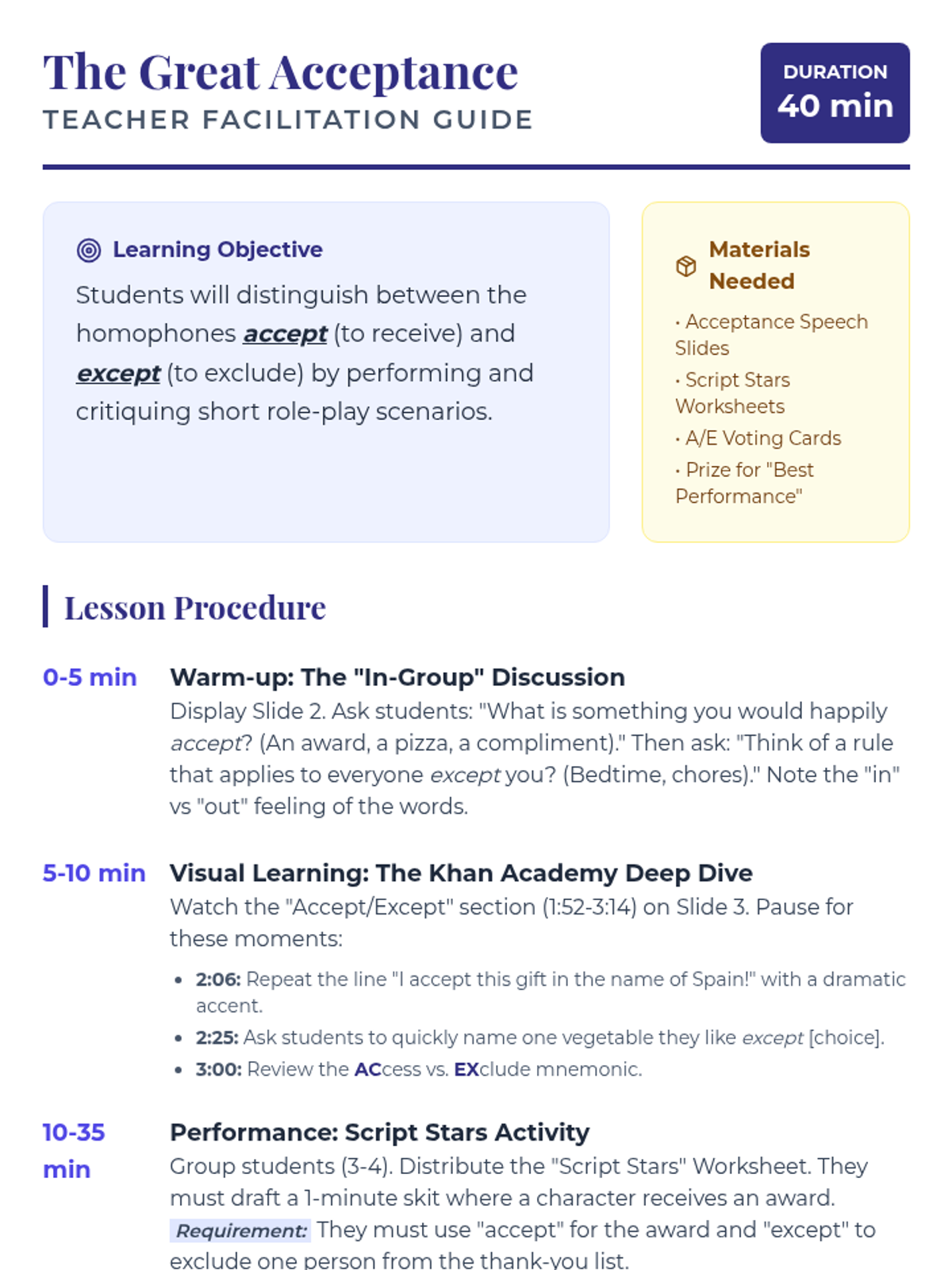
A detailed lesson plan and facilitation guide for teachers covering the grammar objective, timeline, and teaching strategies for 'accept' vs. 'except'.
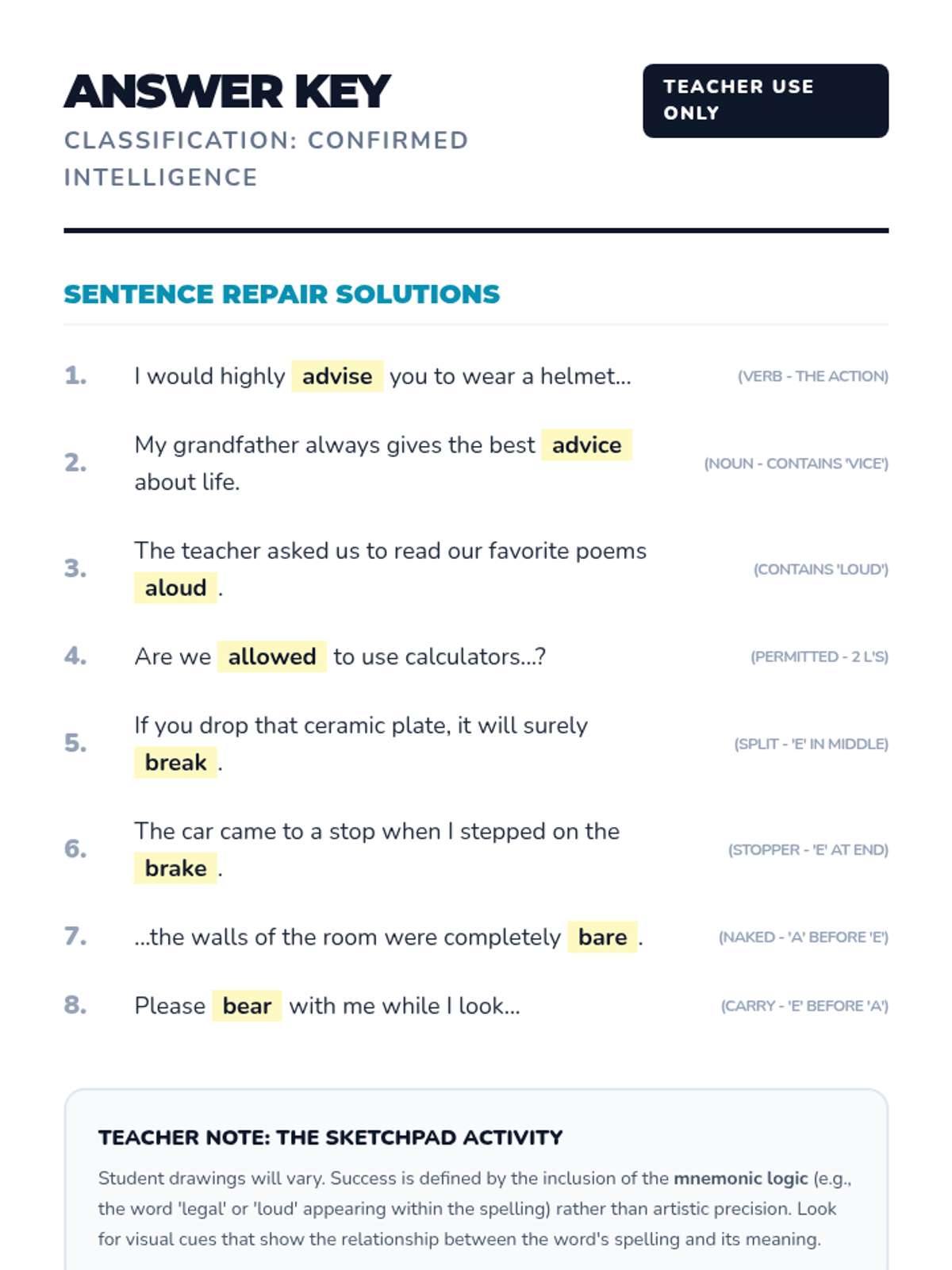
Answer key for the 'Sentence Hacker Worksheet' with detailed explanations for each homophone pair.
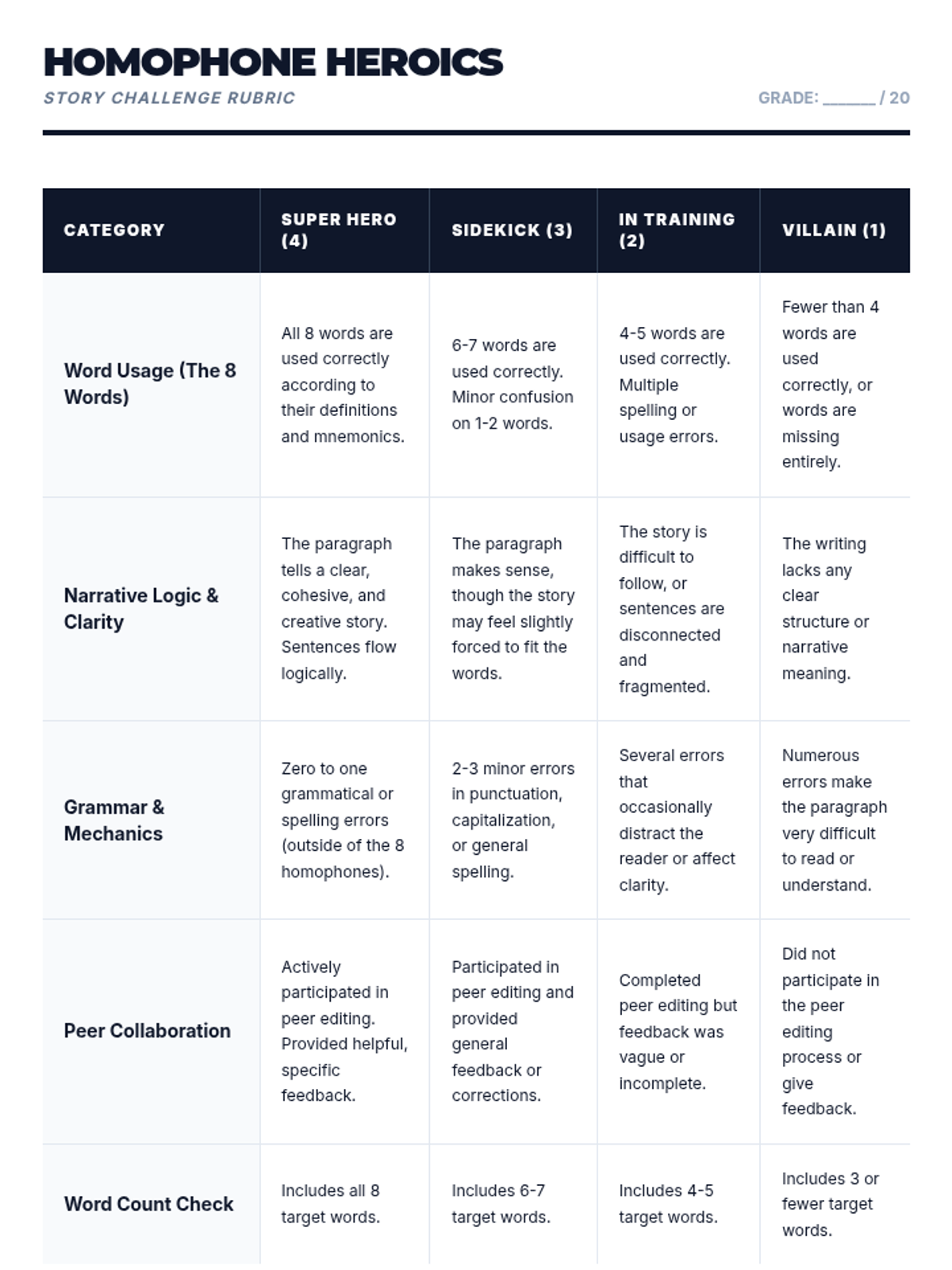
A professional rubric for grading the Homophone Story Challenge, evaluating word usage, narrative clarity, grammar, and peer collaboration.
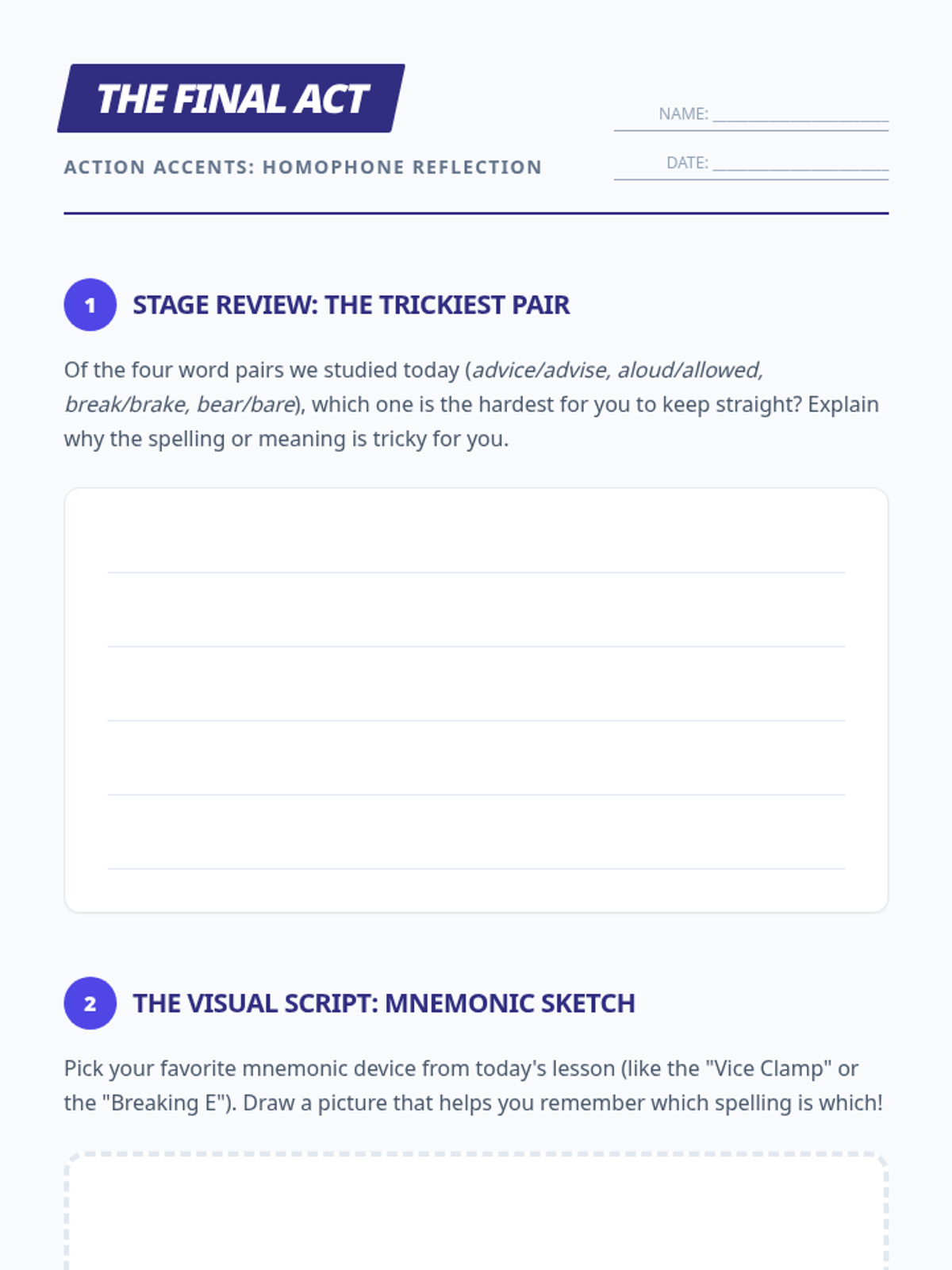
A student reflection journal page for the Action Accents lesson, where students explain their difficulties with specific homophones and sketch visual mnemonics.
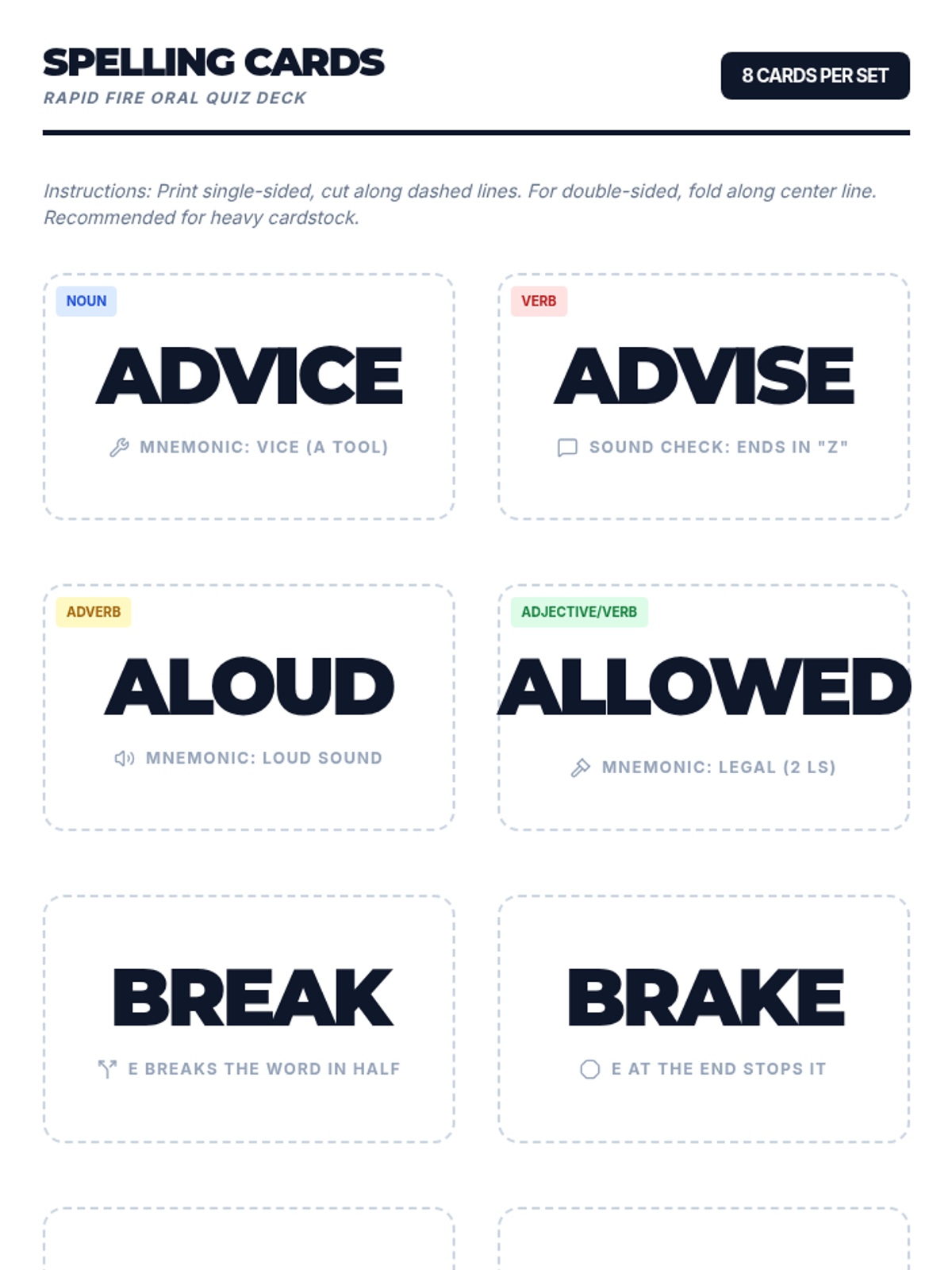
A set of 8 large-print flashcards for the classroom warm-up, featuring the homophone pairs and their corresponding mnemonics.
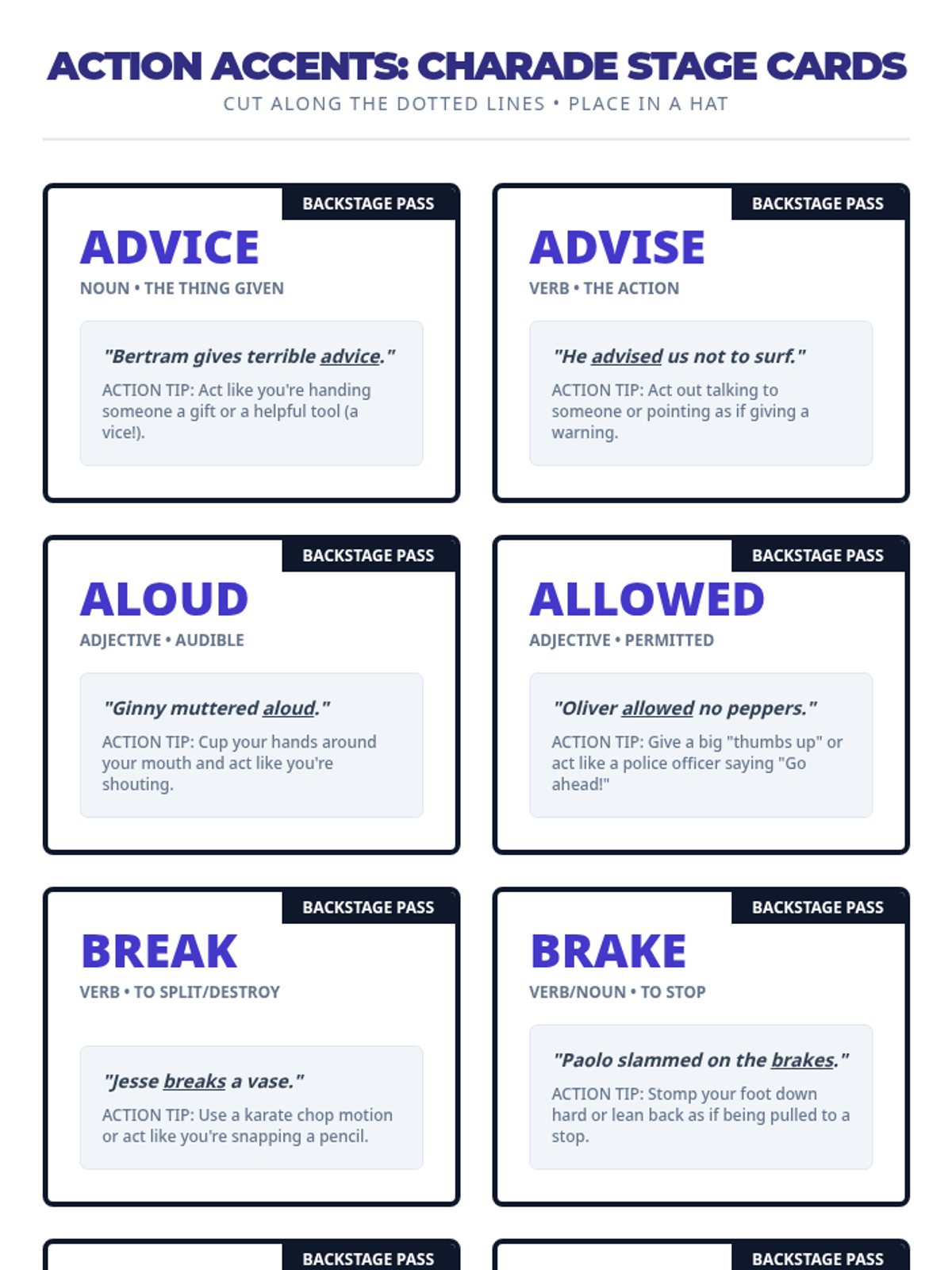
Printable charade cards for students to use in the Homophone Charades activity, featuring word spellings, definitions, and action tips.
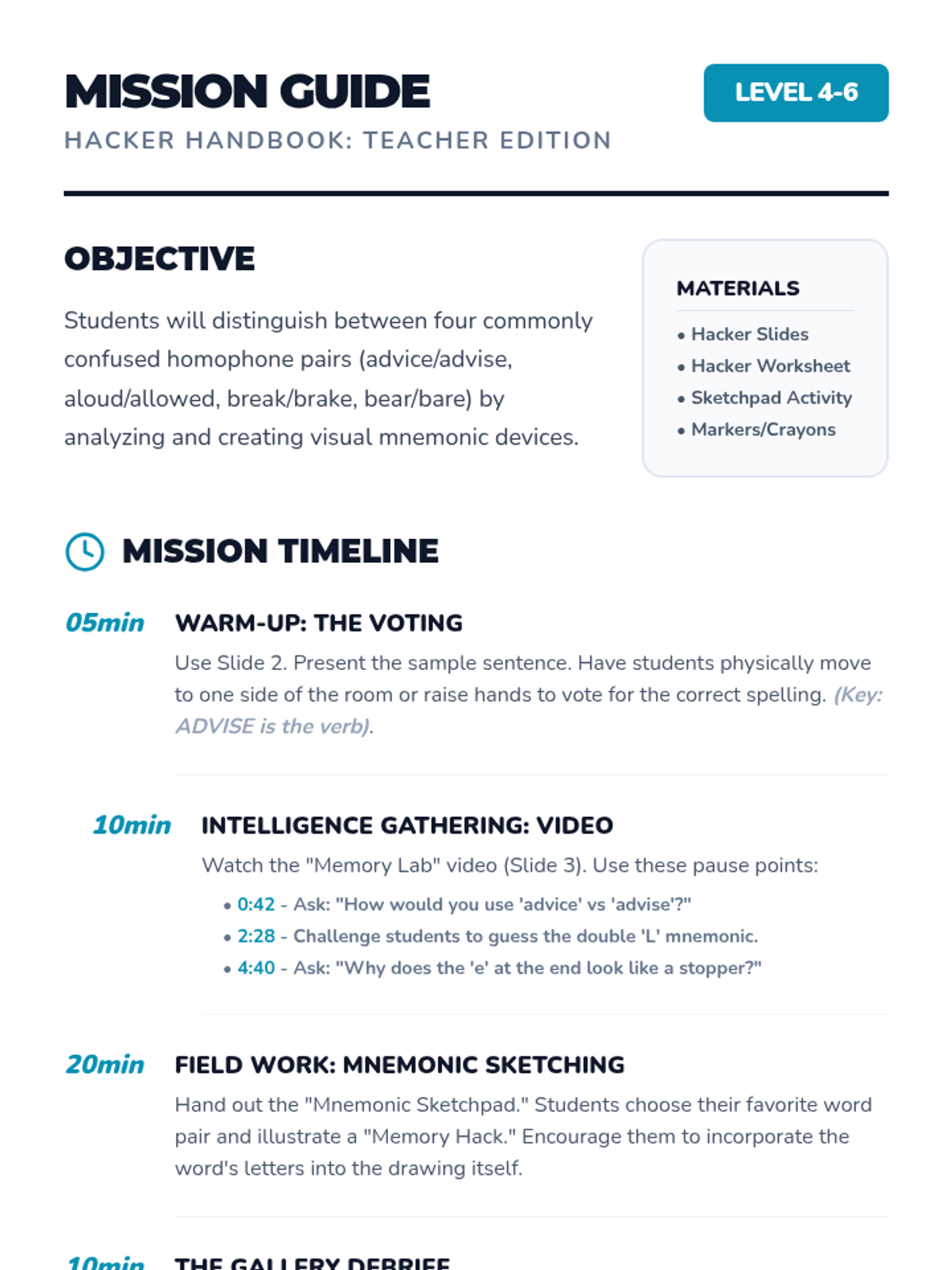
Facilitation guide for teachers, including pacing, video pause points, and activity instructions for the Homophone Hackers lesson.
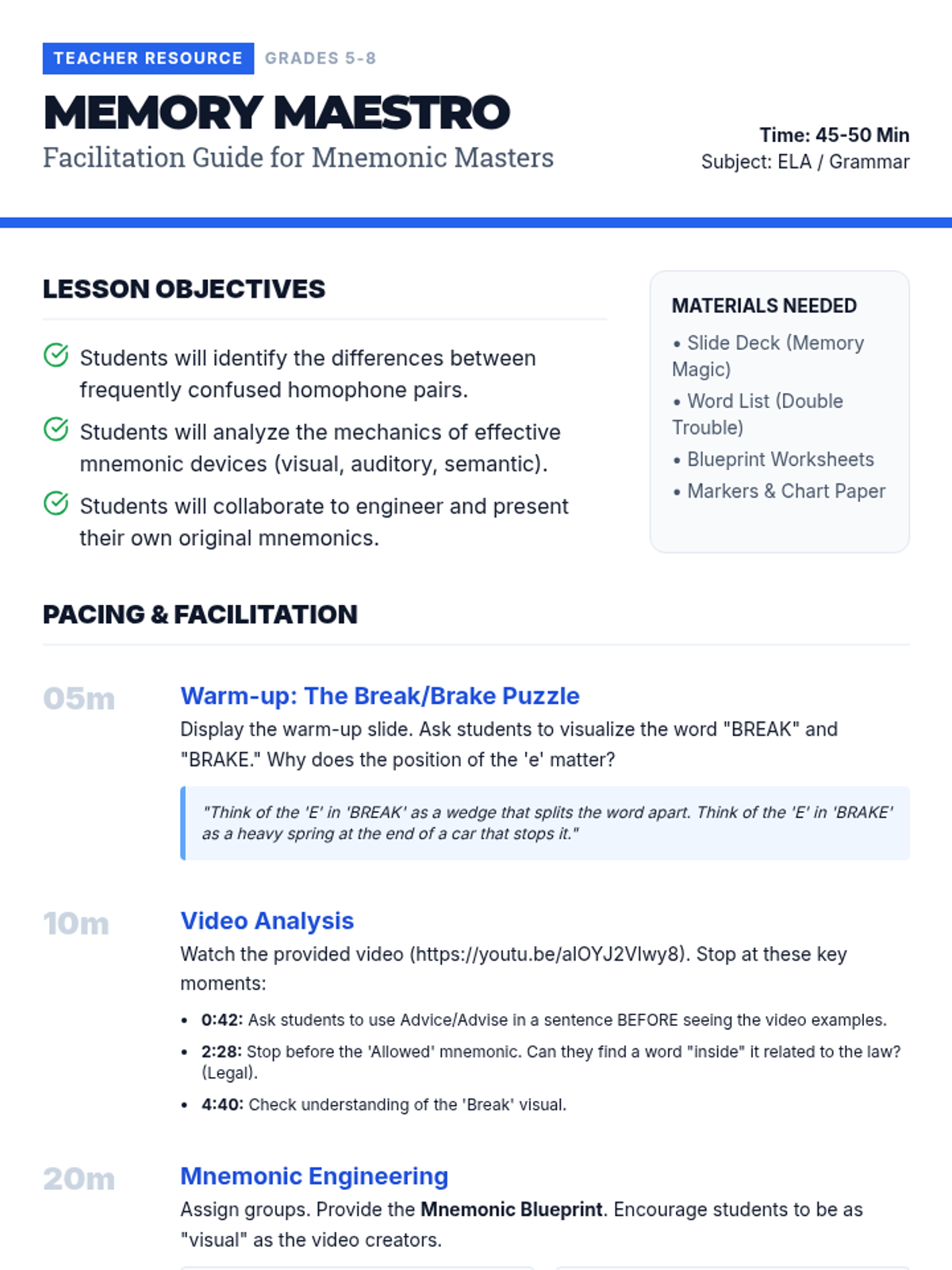
A comprehensive teacher facilitation guide containing the lesson plan, transcript highlights from the video, a pacing guide, and a cheat sheet of sample mnemonic devices for the word pairs.
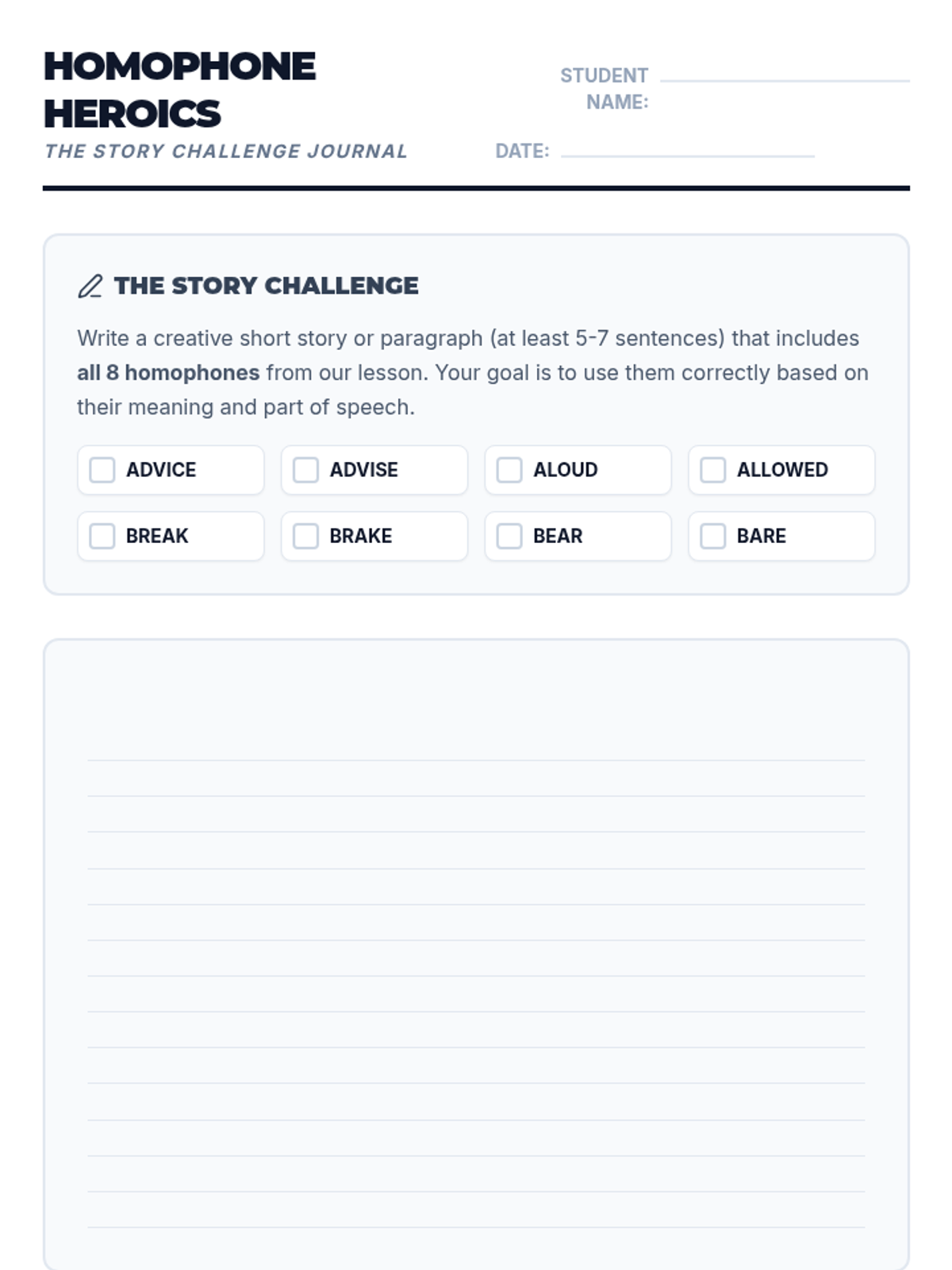
A student-facing journal page for the Homophone Story Challenge, including a checklist of words, a ruled writing area, and a peer review section.
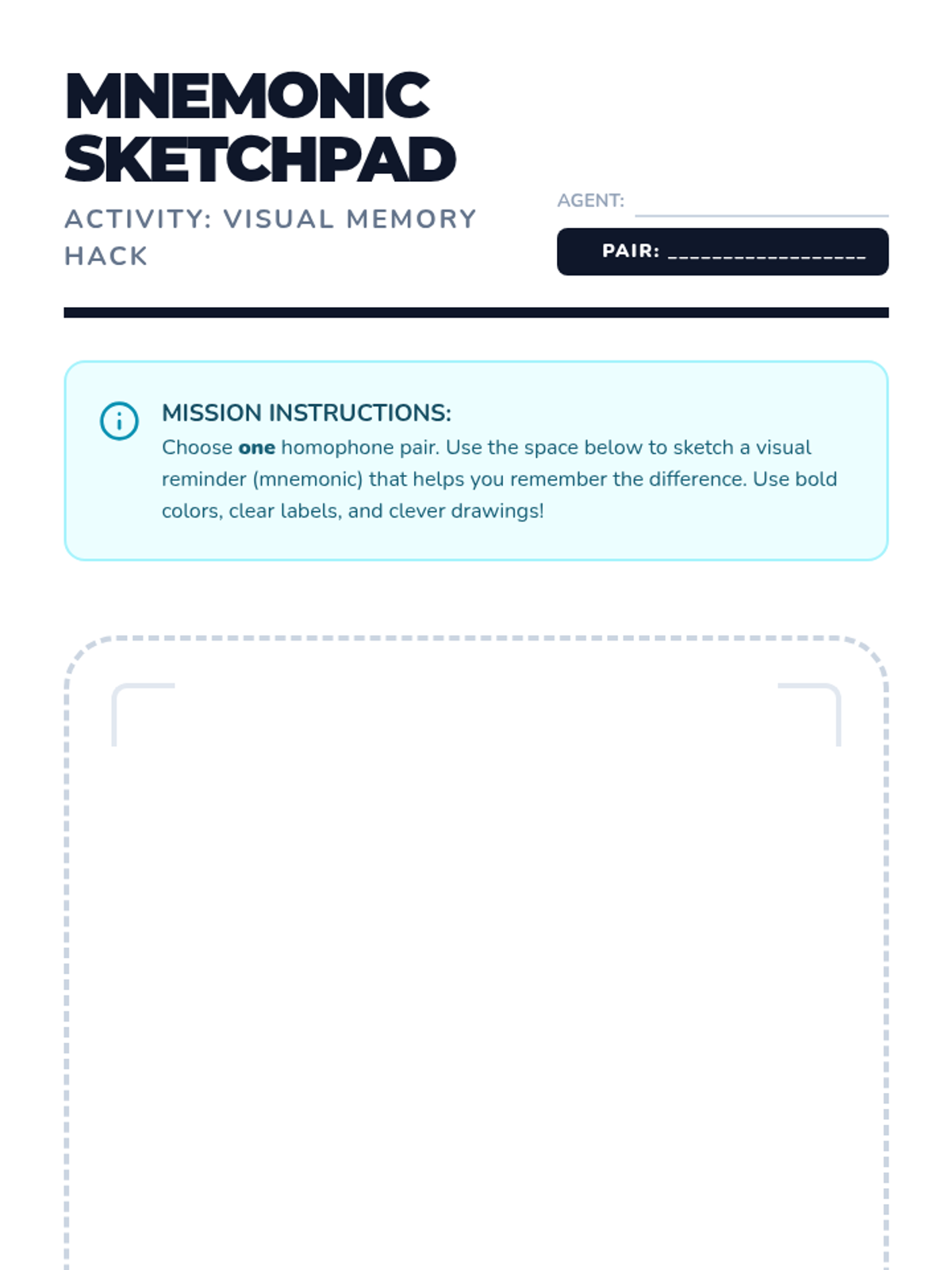
A structured drawing sheet for the 'Mnemonic Sketching' activity where students visualize their chosen homophone pair.
Engaging slides for the Action Accents lesson, featuring embedded video content, visual mnemonics for each word pair, and clear instructions for the charades activity.
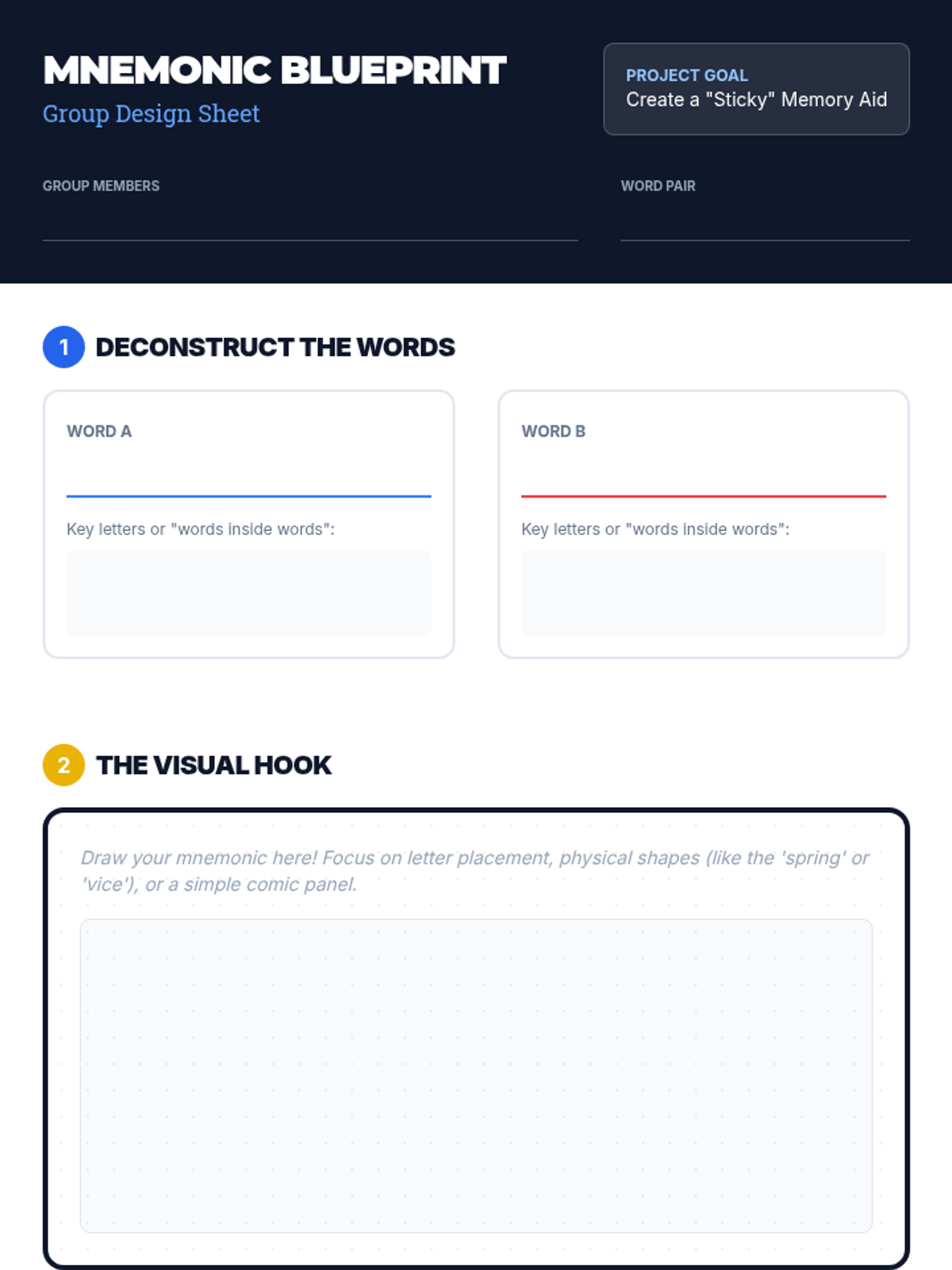
A graphic organizer and workspace for student groups to design their mnemonic devices. It includes structured sections for word deconstruction, a large visual drawing area (simulating chart paper), and a space to craft a verbal anchor or rhyme.
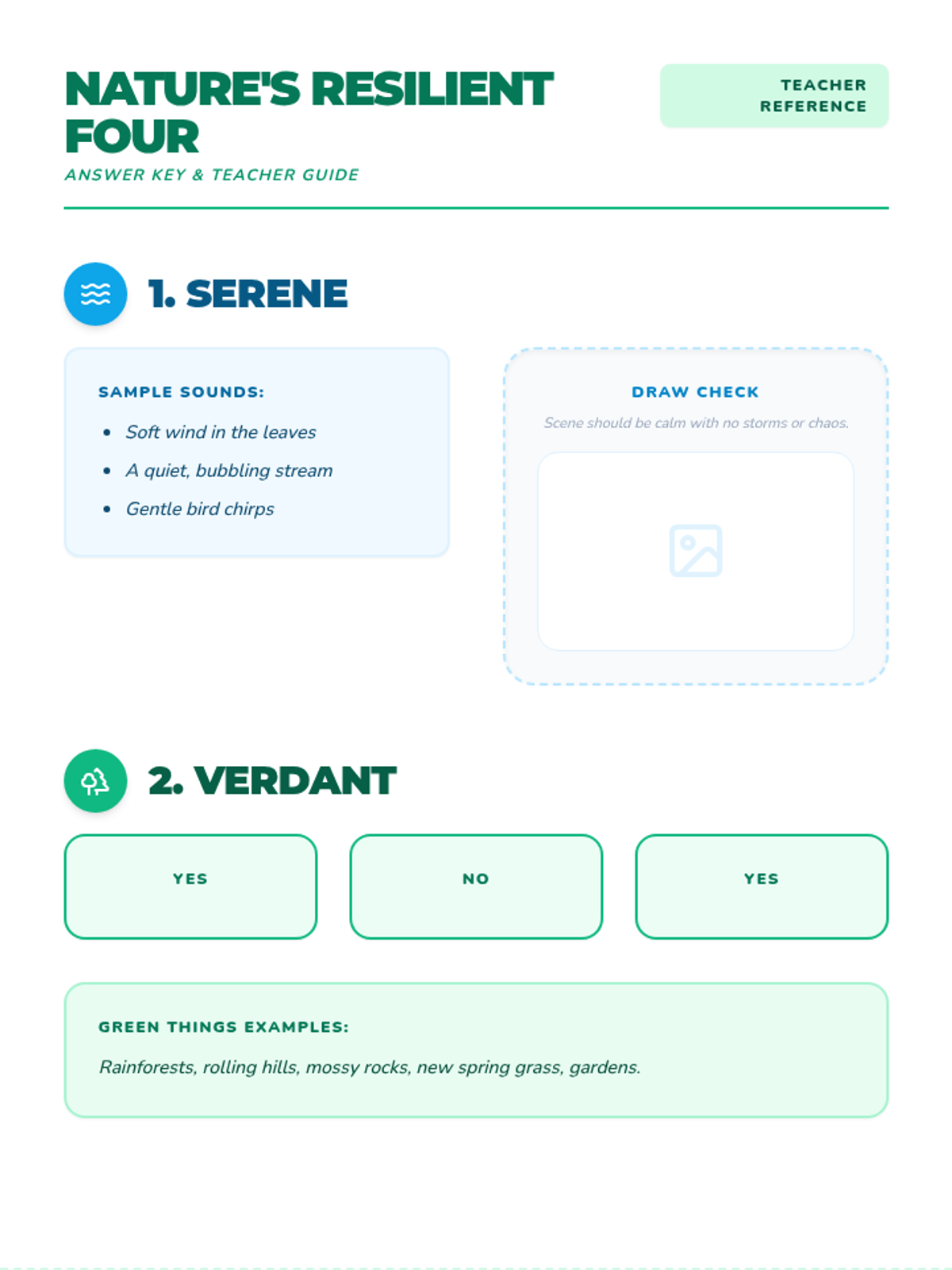
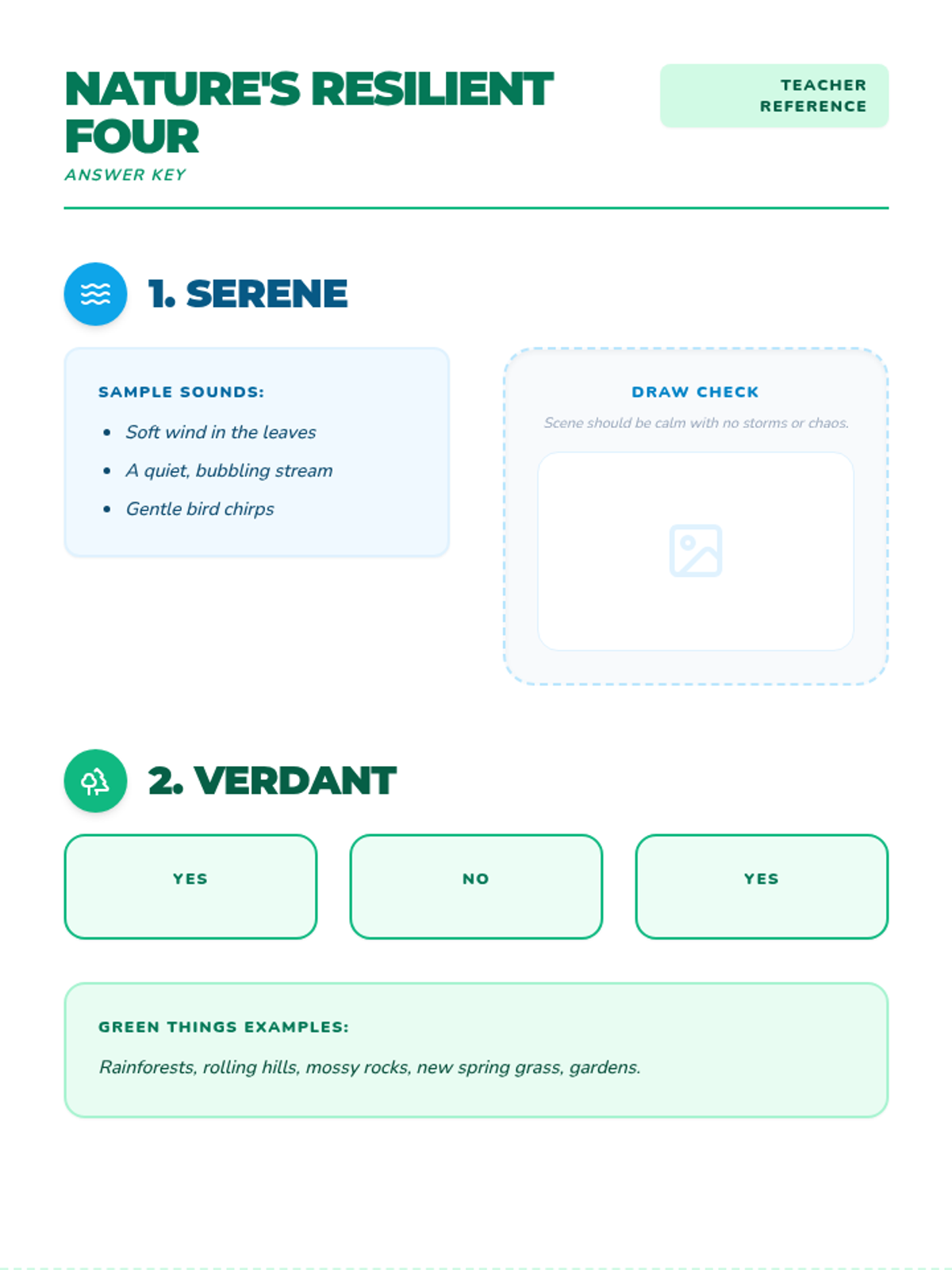
Answer key for the Nature Resilient Four Worksheet, providing sample responses, synonym identification, and context check answers for teacher reference. Updated to match the worksheet's final styling with the final task removed.
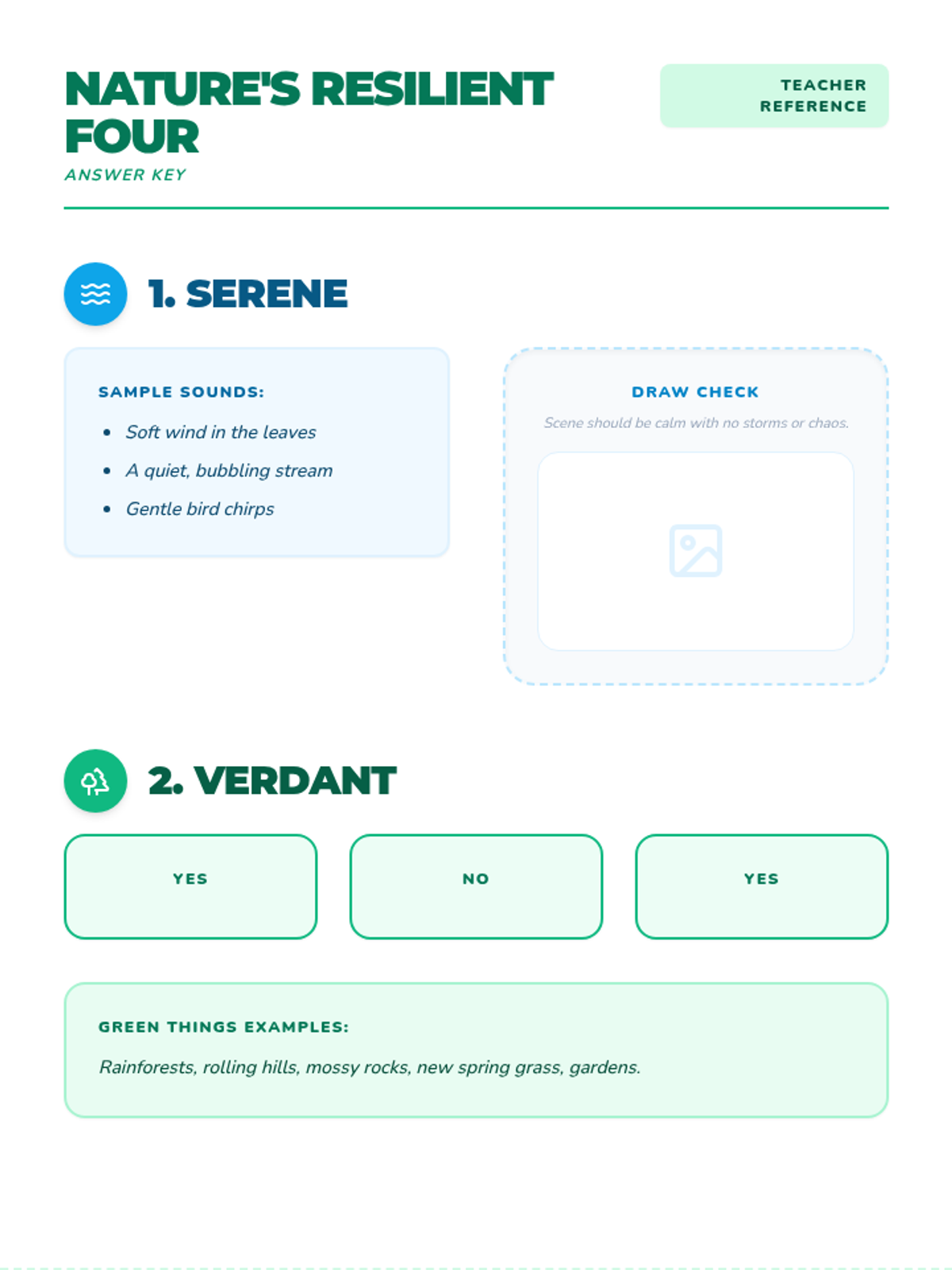
Answer key for the Nature Resilient Four Worksheet, providing sample responses, synonym identification, and context check answers for teacher reference. Updated to match the worksheet's final styling.
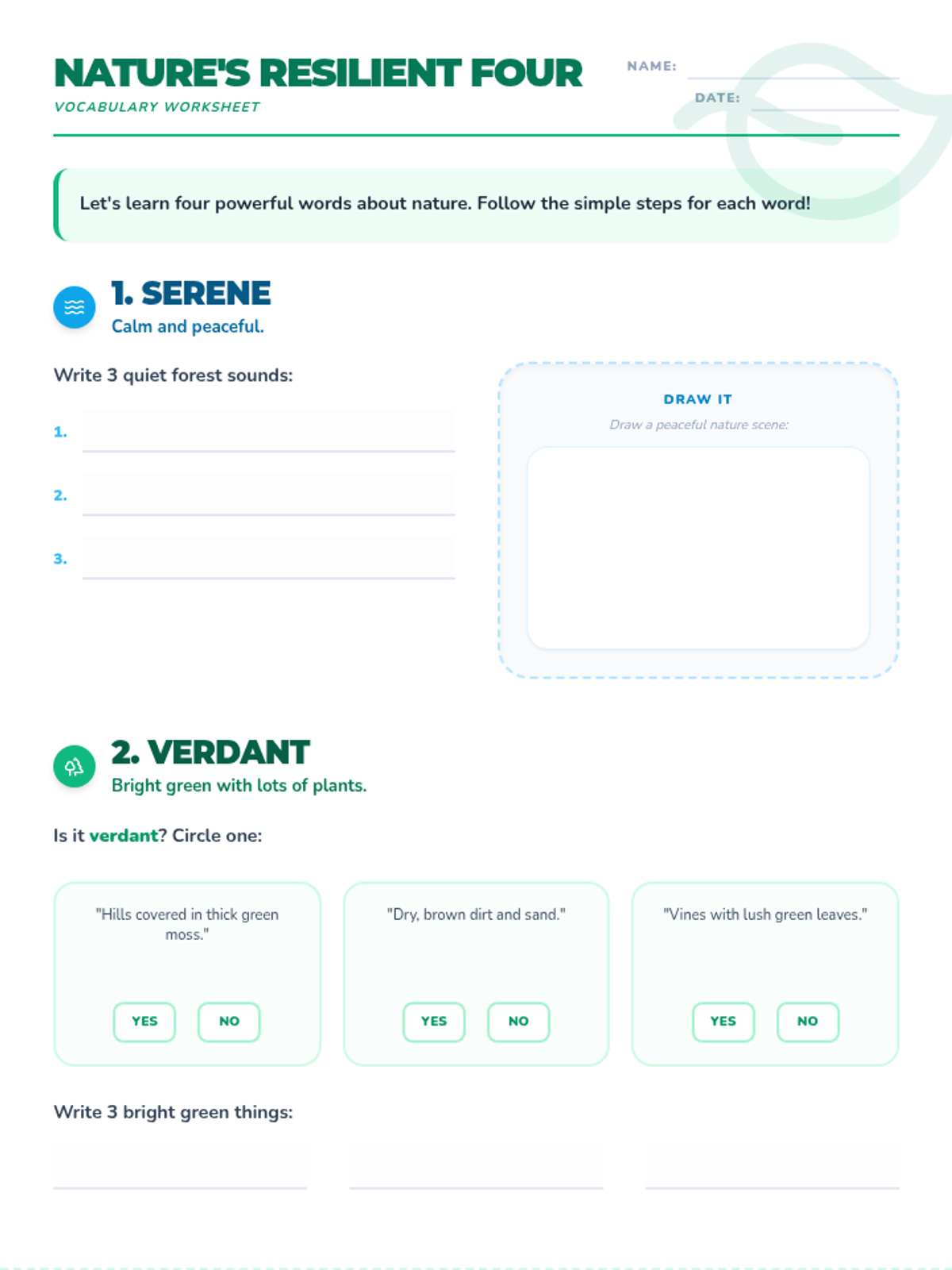
A two-page vocabulary worksheet focusing on serene, verdant, prosperity, and resilient with extremely simplified directions for maximum student clarity. Includes definition-matching, context-checking, drawing, and sentence-writing tasks. Features smaller fonts to ensure a clean fit across two pages with the final step removed.
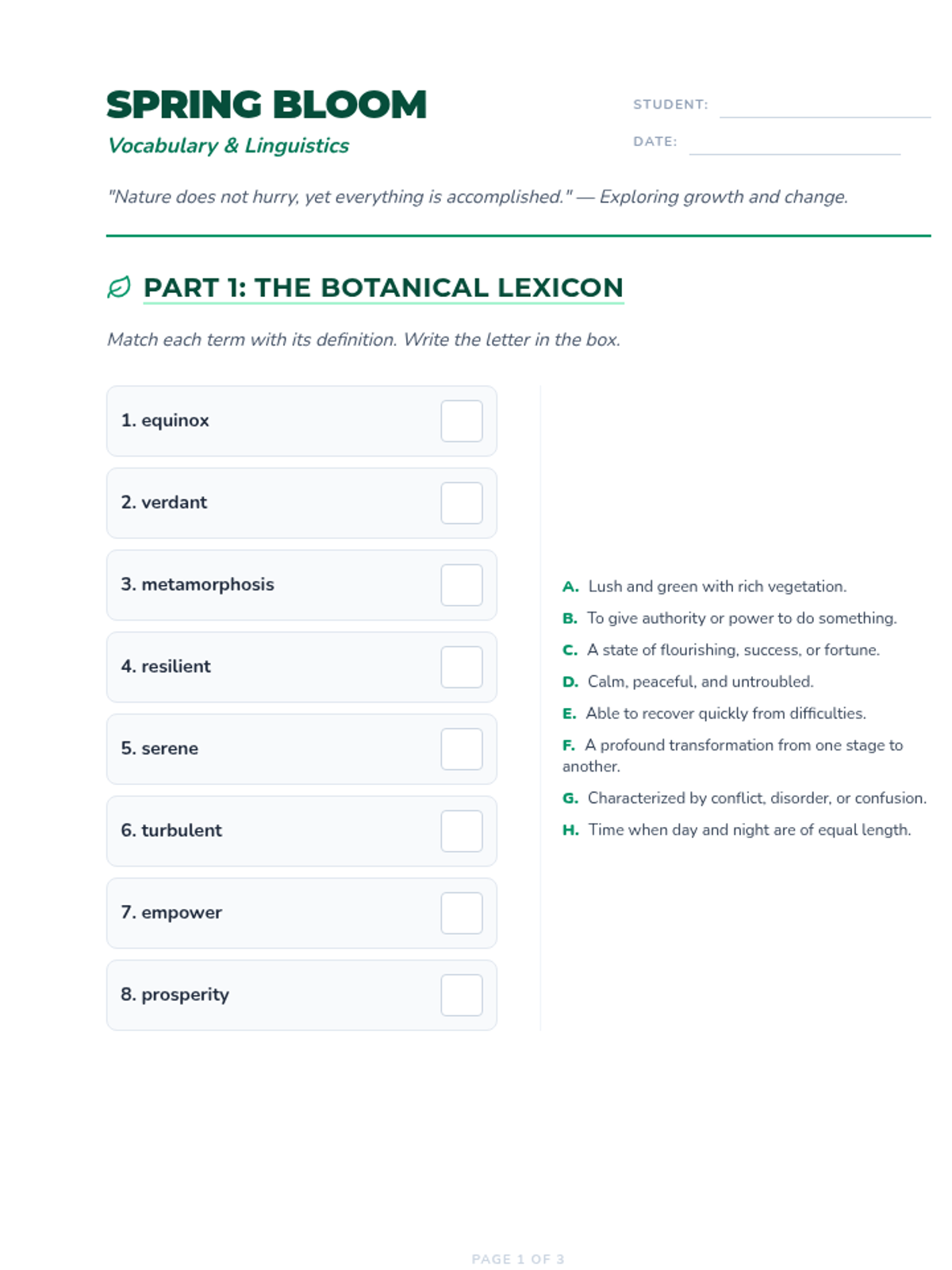
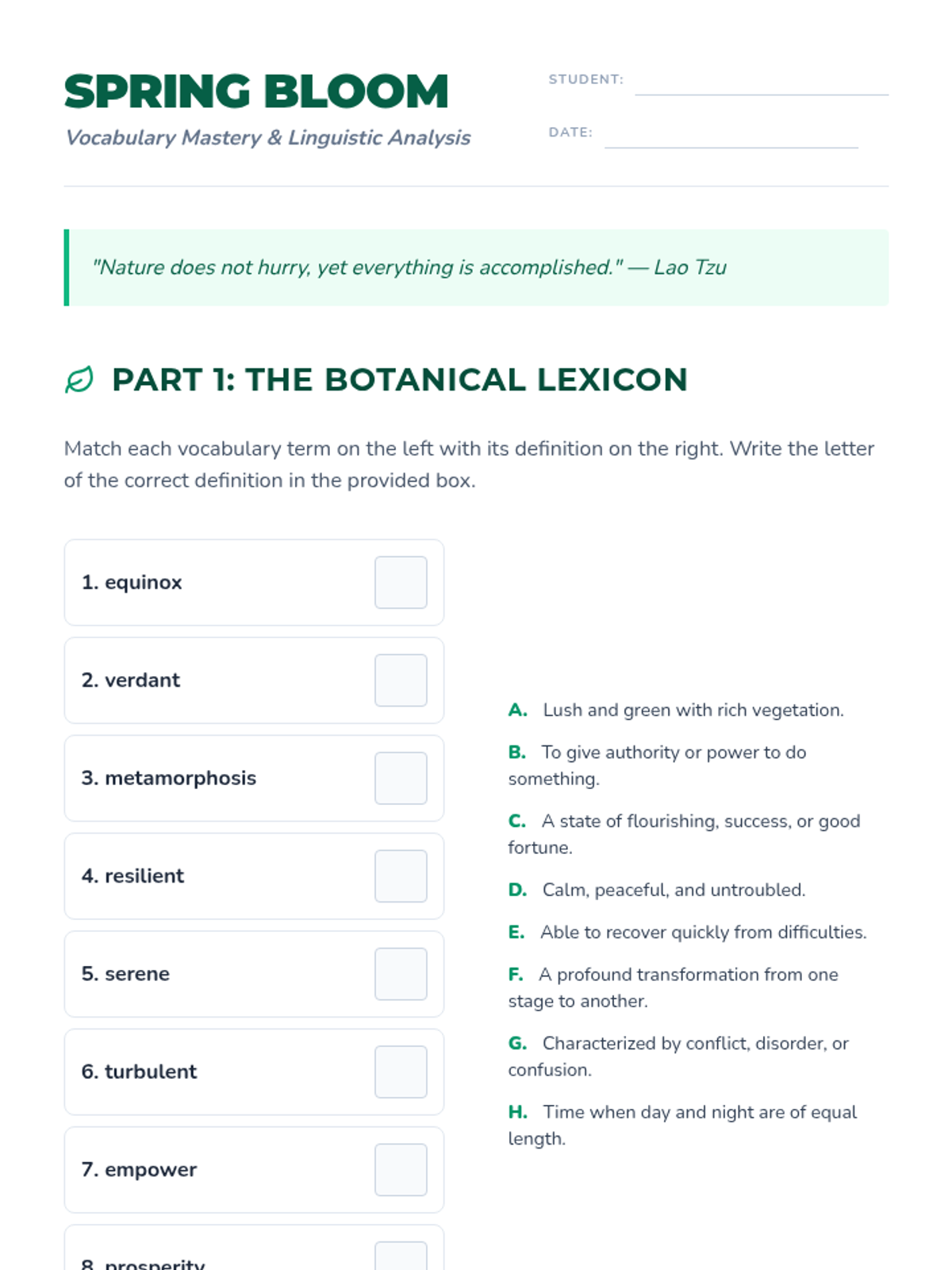
Refined three-page vocabulary worksheet with reduced font sizes and margins to prevent content cutoff. Each part is clearly separated on its own page (Part 1 on Page 1, Part 2 on Page 2, Part 3 on Page 3) for a clean, print-optimized experience.
A visual presentation to introduce the eight vocabulary terms. Each slide features high-impact definitions, parts of speech, and usage examples with nature-themed motifs. Corrected font sizes to meet the 24px minimum requirement. Vocabulary words are now lowercase.
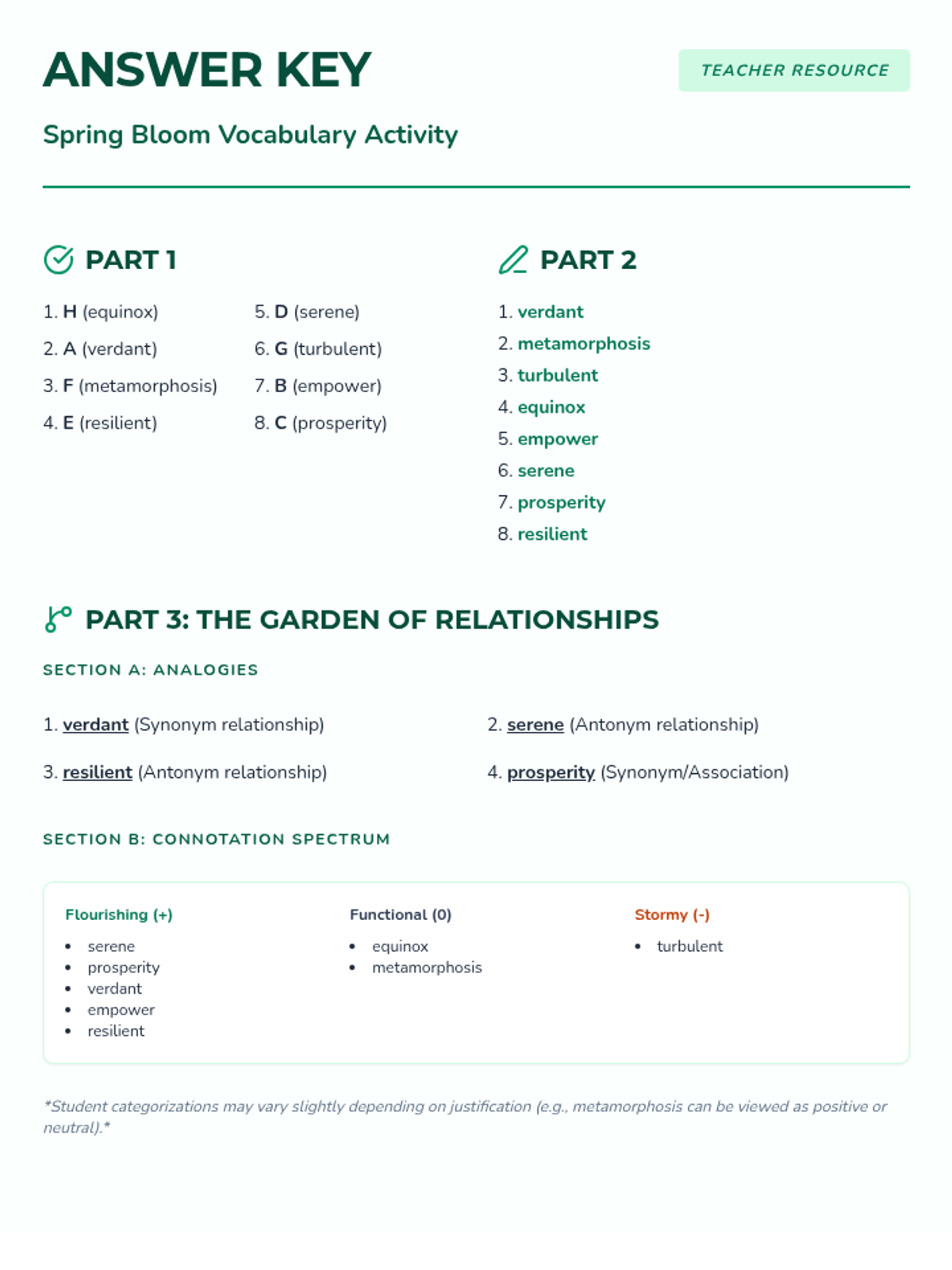
Updated answer key for the Spring Bloom Vocabulary Activity. Changed "Challenging (-)" to "Stormy (-)" in the Connotation Spectrum section to align with the revised worksheet.
High-contrast, print-ready three-page vocabulary worksheet. Uses explicit break-after properties and a strict 960px height per page to ensure Part 1, Part 2, and Part 3 are perfectly separated during printing. Clean white backgrounds maximize legibility and ink efficiency.
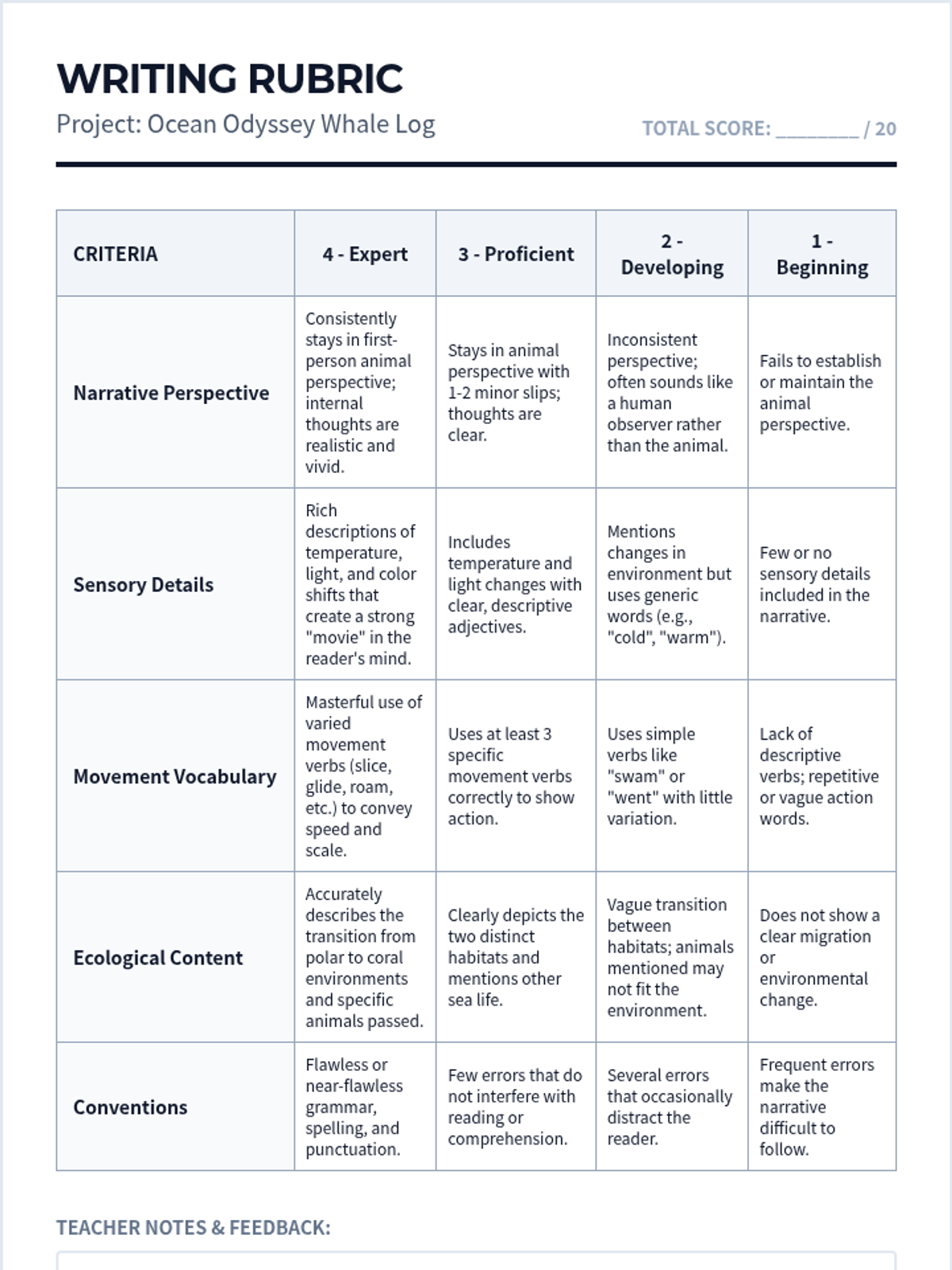
A comprehensive grading rubric for the Whale Log narrative, evaluating student work on perspective, sensory language, movement vocabulary, ecological accuracy, and conventions.
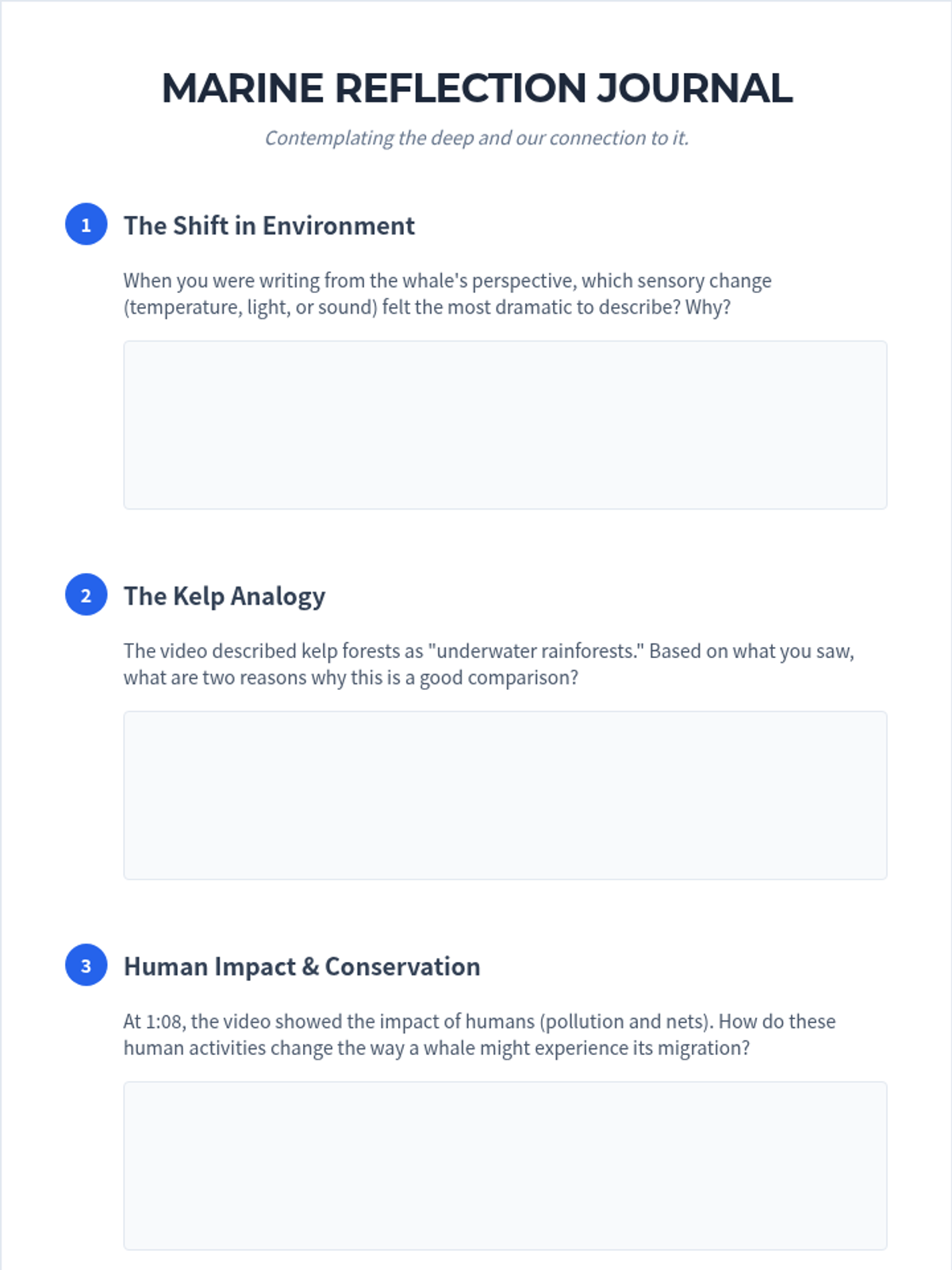
A set of reflection prompts for students to complete after their writing activity, encouraging deeper thinking about environmental shifts, ecological analogies, and linguistic choices.
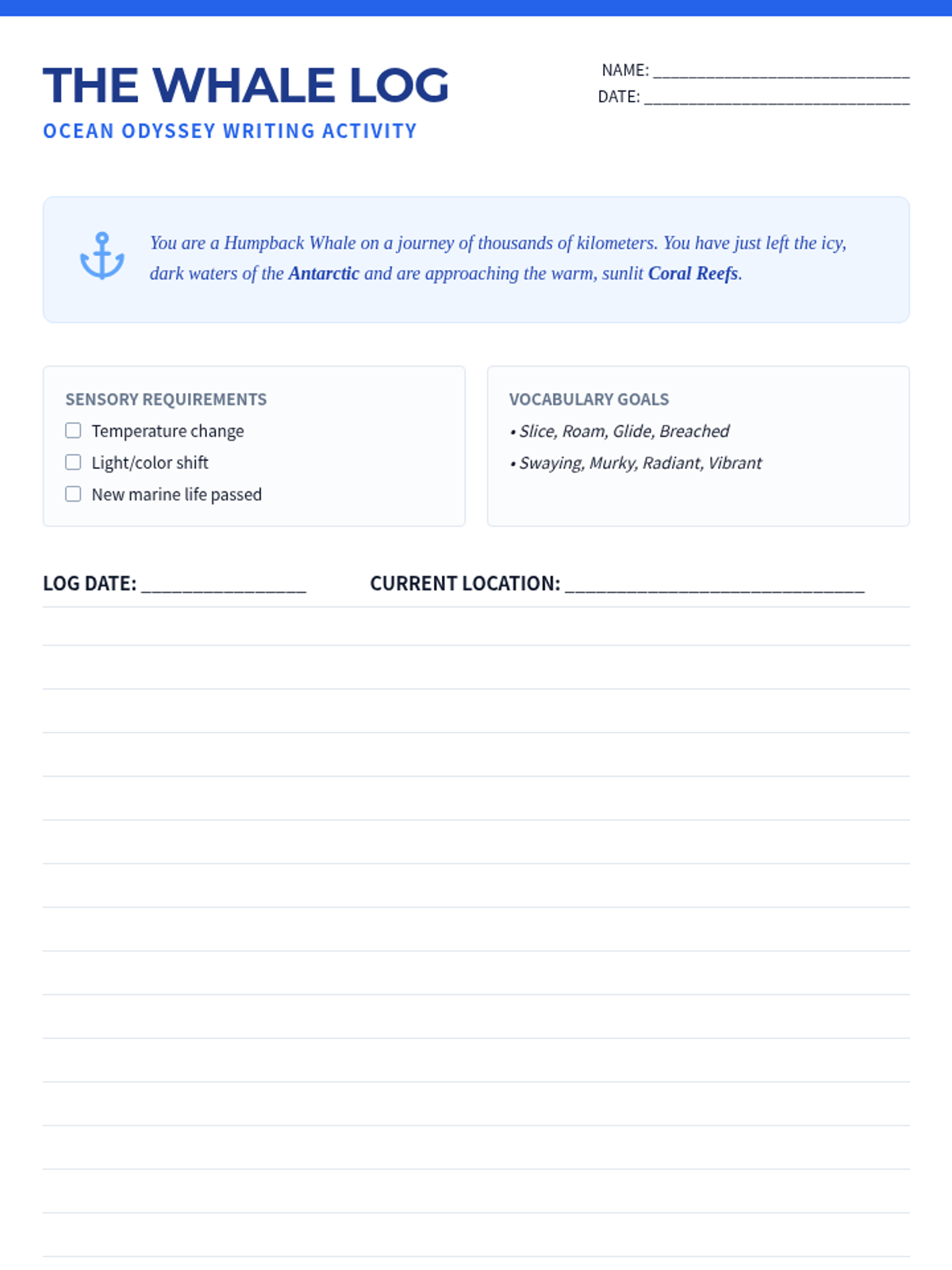
A descriptive writing worksheet for students to record their "Whale Log" entry, featuring guided sensory requirements and plenty of space for creative narrative writing.
A visual presentation for the Ocean Odyssey lesson, featuring sensory warm-ups, an embedded video segment of the open ocean, and clear creative writing prompts for the Whale Log activity.
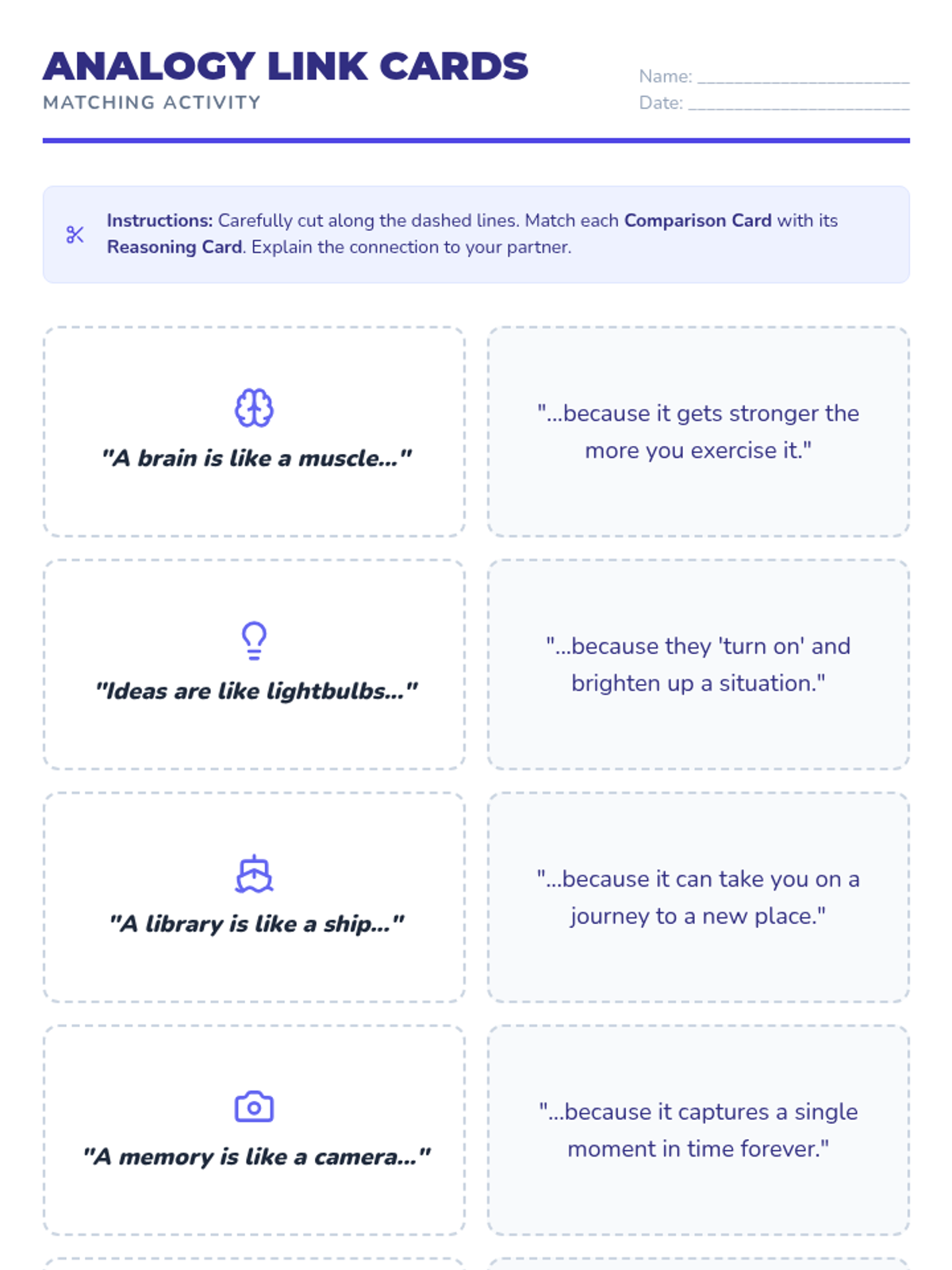
A set of cut-out matching cards for students to practice identifying logical connections in analogies, plus an application area for creating a personal analogy.
A visually engaging slide deck for the "Bridge Builders" lesson on analogies, featuring embedded video, interactive discussion prompts, and clear definitions.
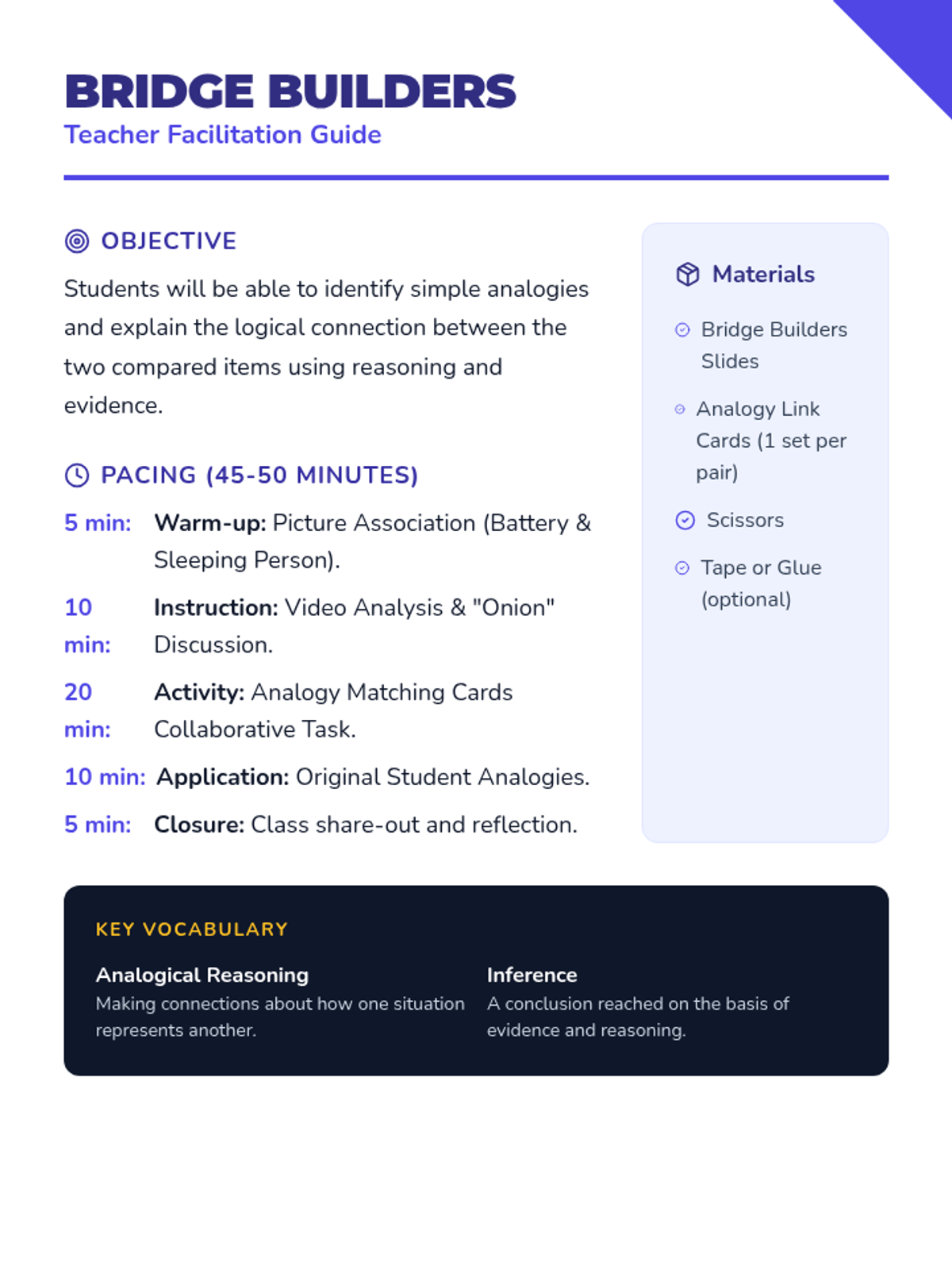
A comprehensive teacher facilitation guide for the "Bridge Builders" analogy lesson, including pacing, vocabulary, and an answer key for the matching activity.
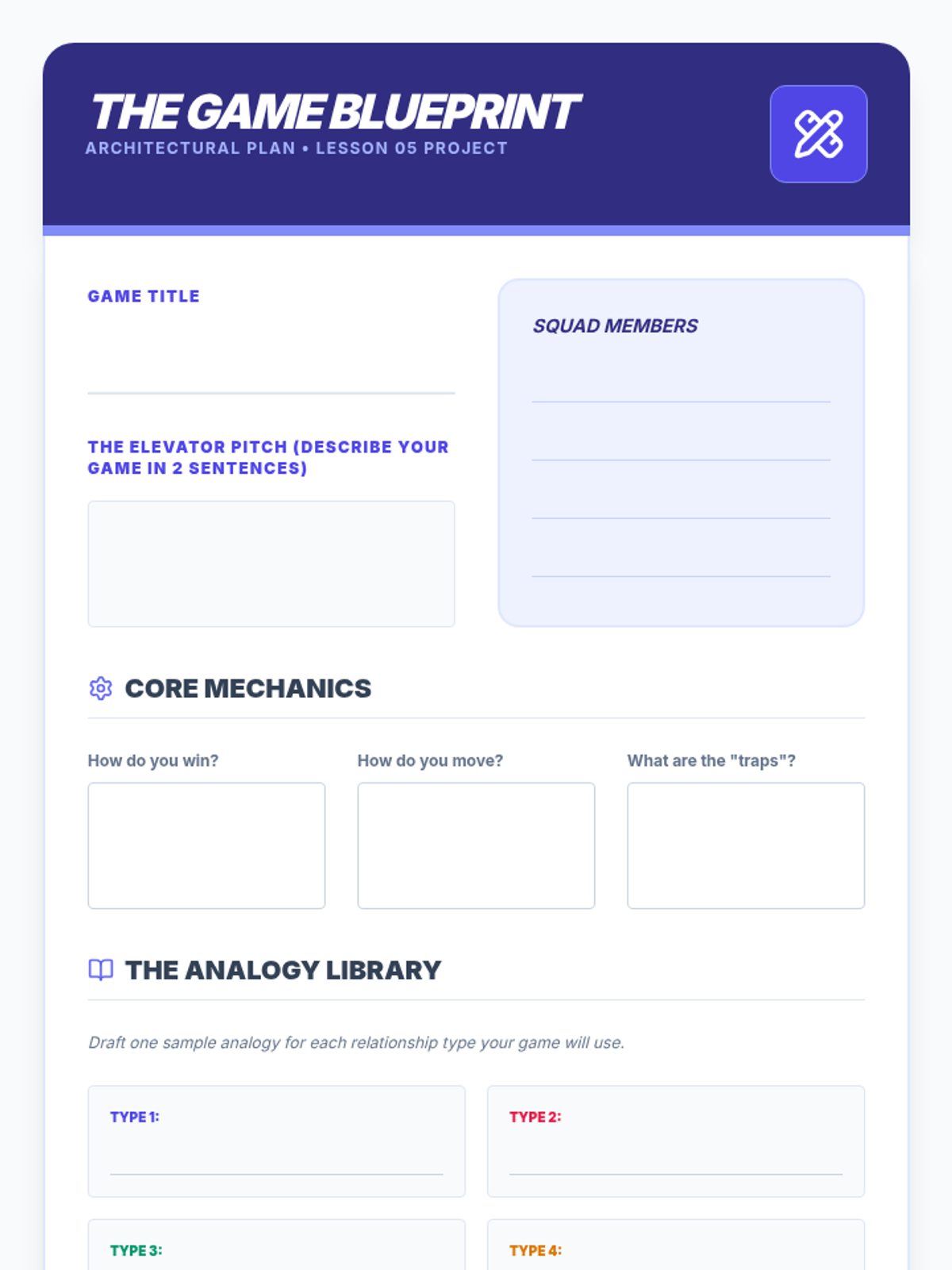
A comprehensive project packet for the Analogy Game Design project. It includes a Game Blueprint for planning mechanics and content, and a Master Designer Rubric used for evaluation during the final playtest.
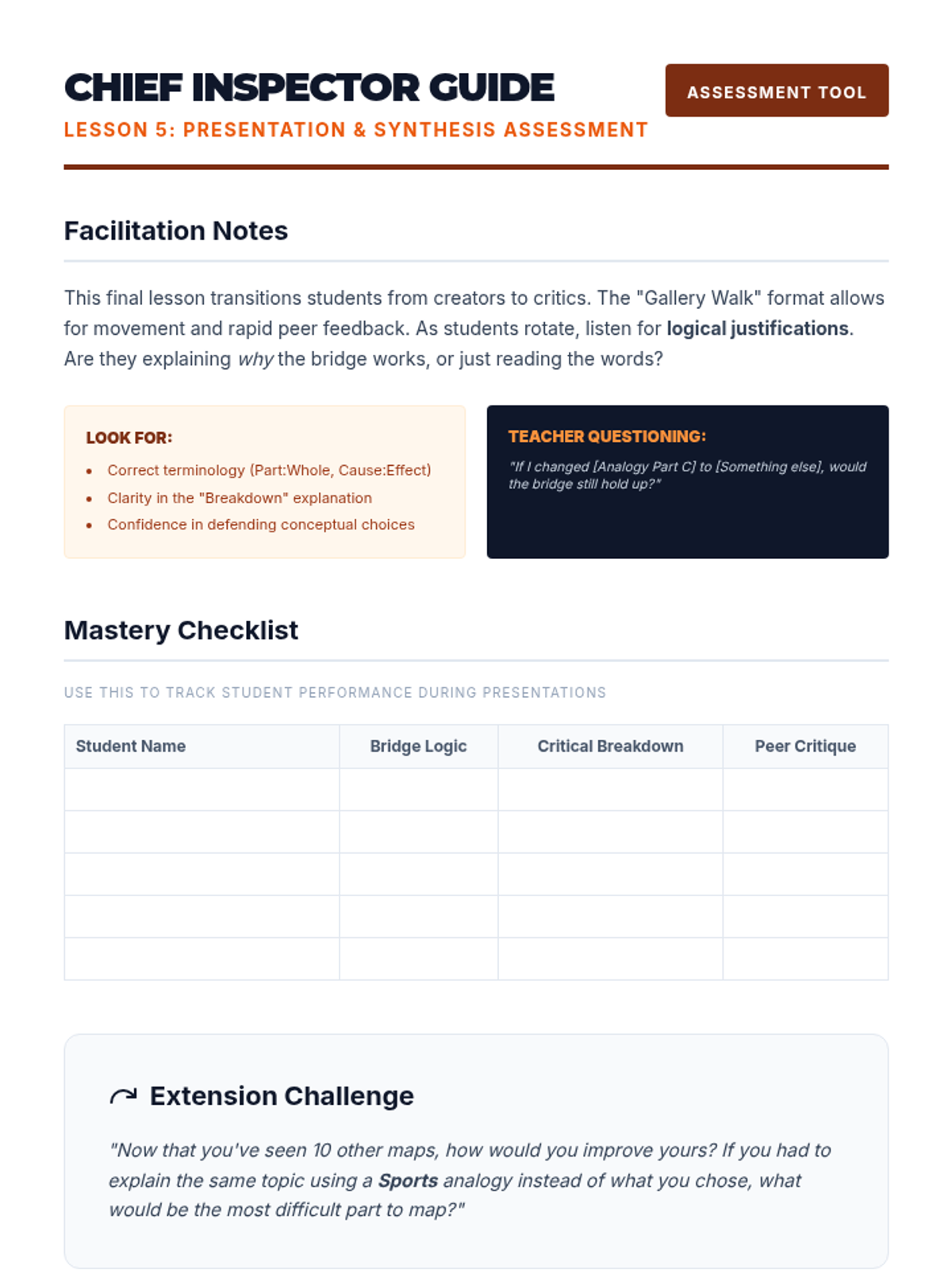
Teacher Guide and Assessment tool for Lesson 5: Logic Detectives. Includes facilitation notes for the gallery walk, a mastery checklist for student performance, and extension questions.
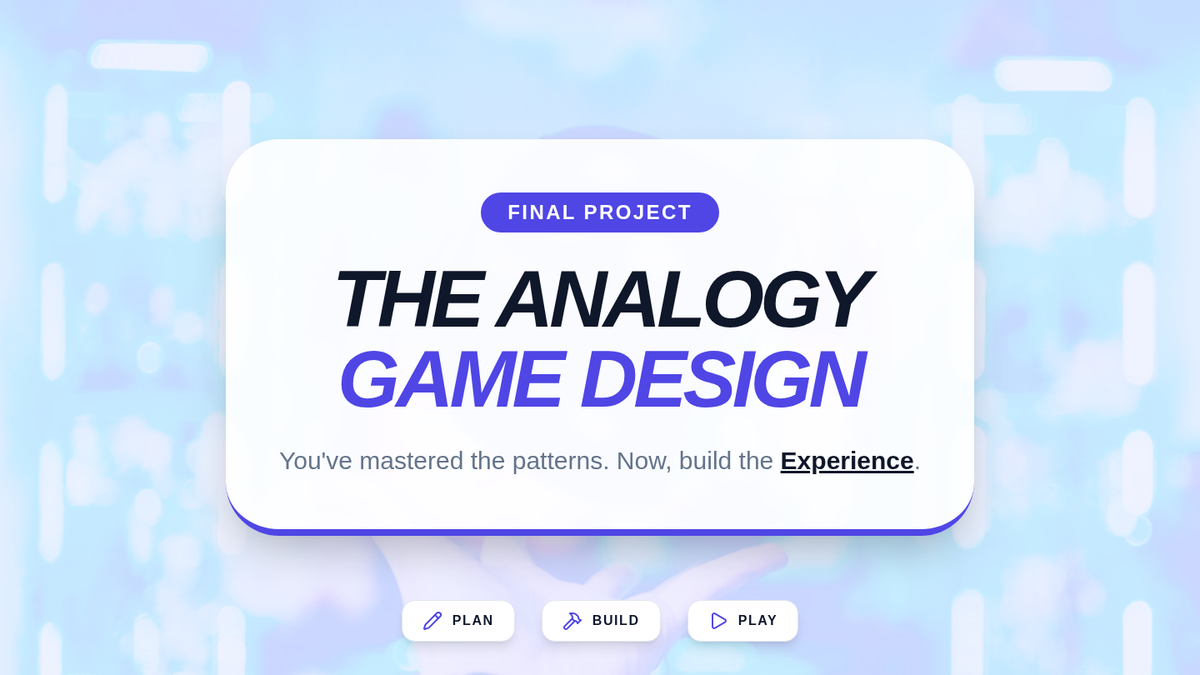
Inspiring slides for the capstone project: Design Your Own Analogy Board Game. It outlines the project requirements, design options, and core game mechanics, setting the stage for students to transition from learners to instructional designers.
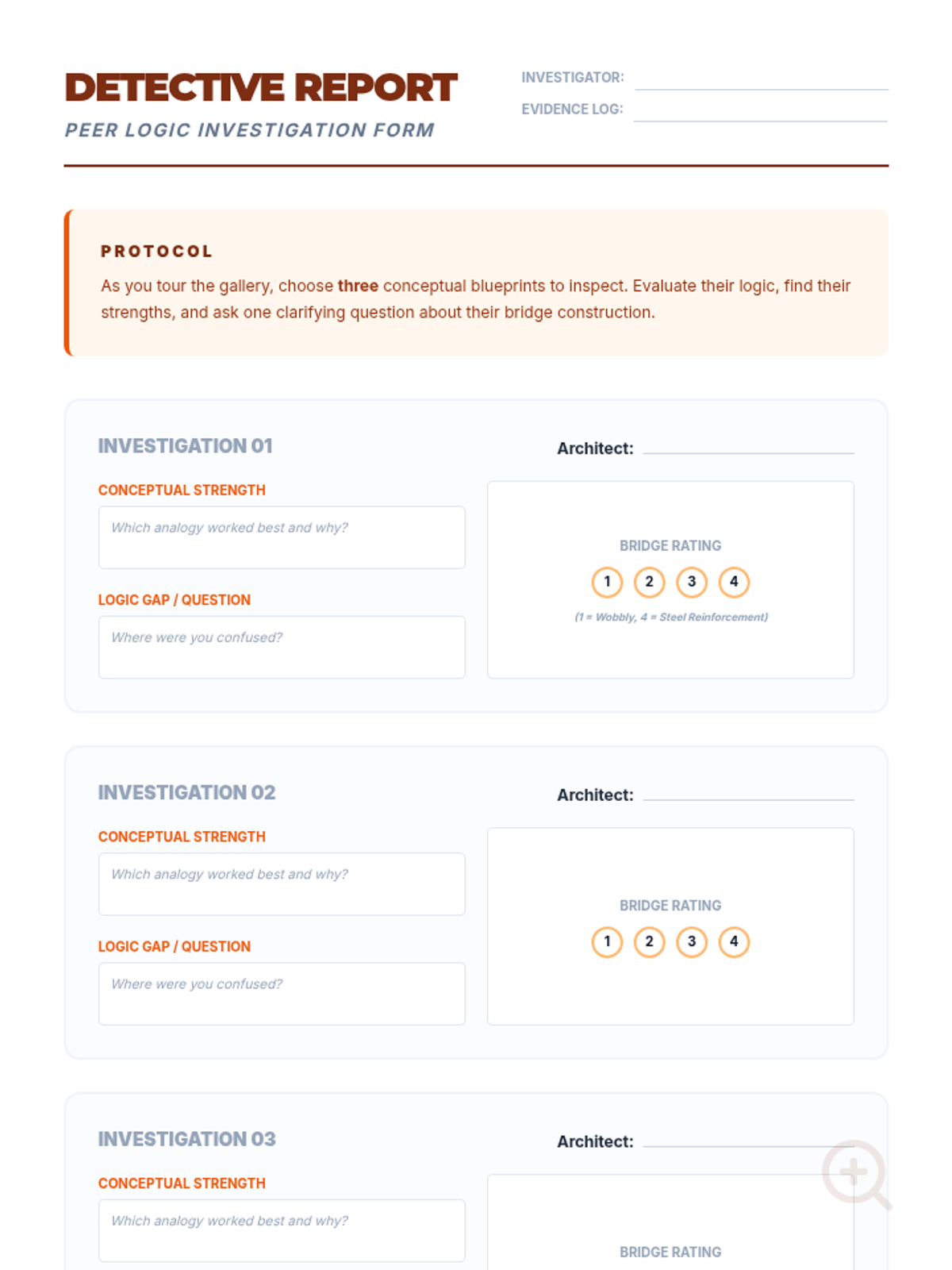
Peer Review form for Lesson 5: Logic Detectives. Students use this to evaluate the logic and clarity of their peers' analogy concept maps during the gallery walk.
Educational slide deck for Lesson 5: Logic Detectives Presentations. It provides the framework for peer review, critique etiquette, and the gallery walk protocols for the final analogy concept map showcase.
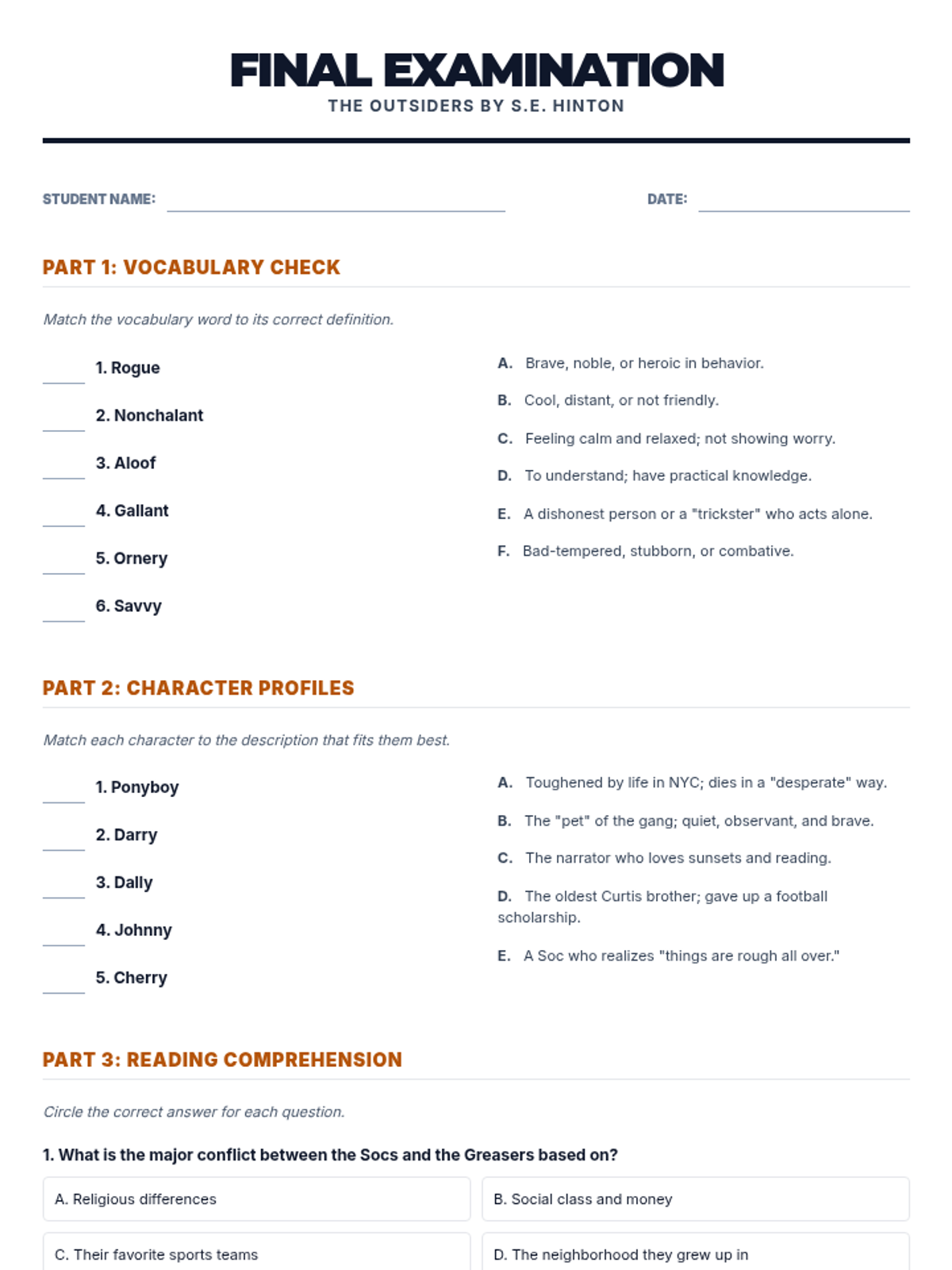
A comprehensive final exam for 'The Outsiders'. Expanded to include a dedicated vocabulary matching section and reading comprehension multiple-choice questions. Optimized for printing with clear page breaks and ample writing space for adult learners.
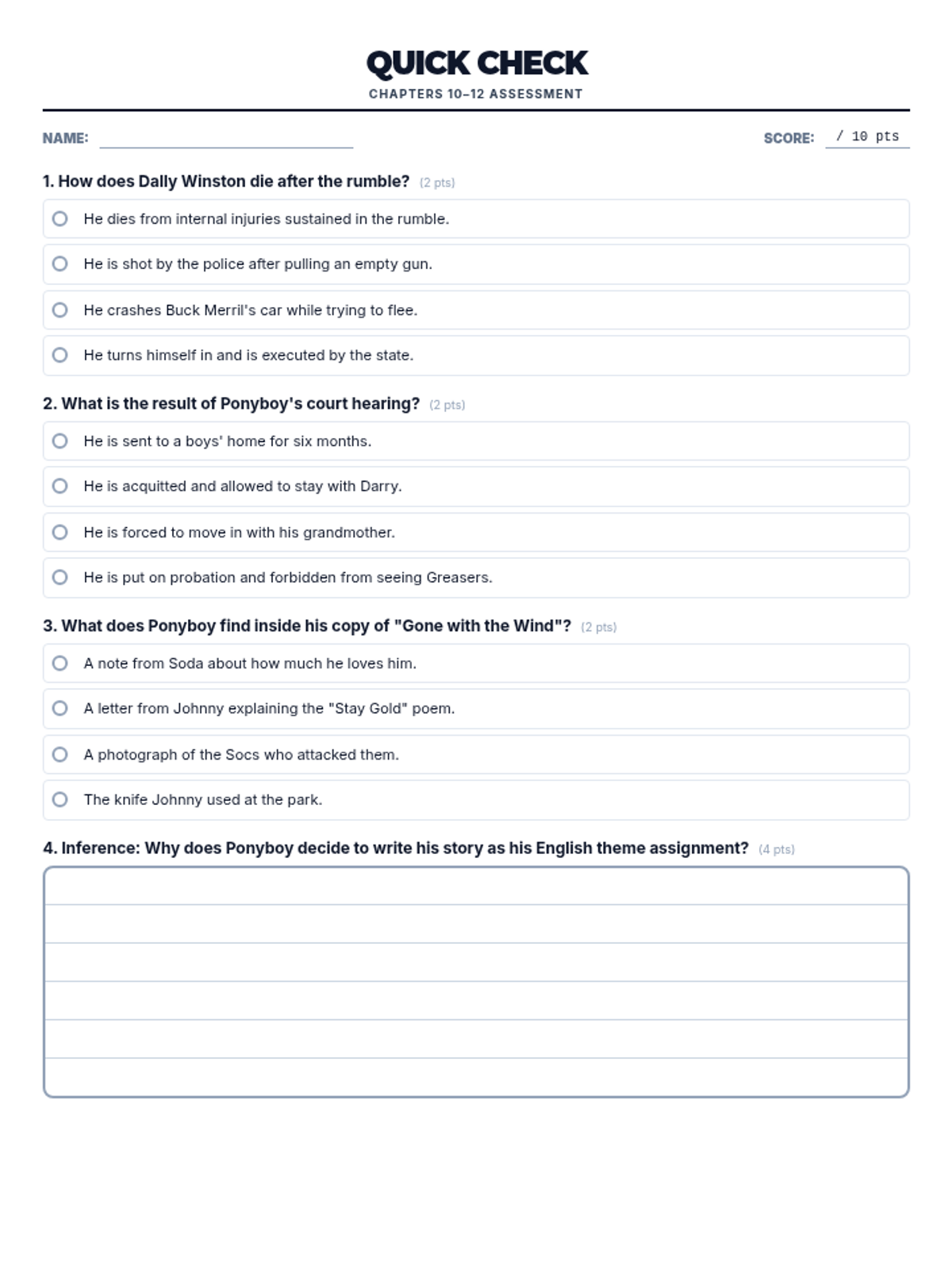
A 4-question quiz covering the resolution of the novel in Chapters 10-12. Includes questions on Dally's death, the court hearing, Johnny's letter, and Ponyboy's decision to write his story. Revised for consistency in scoring and styling.
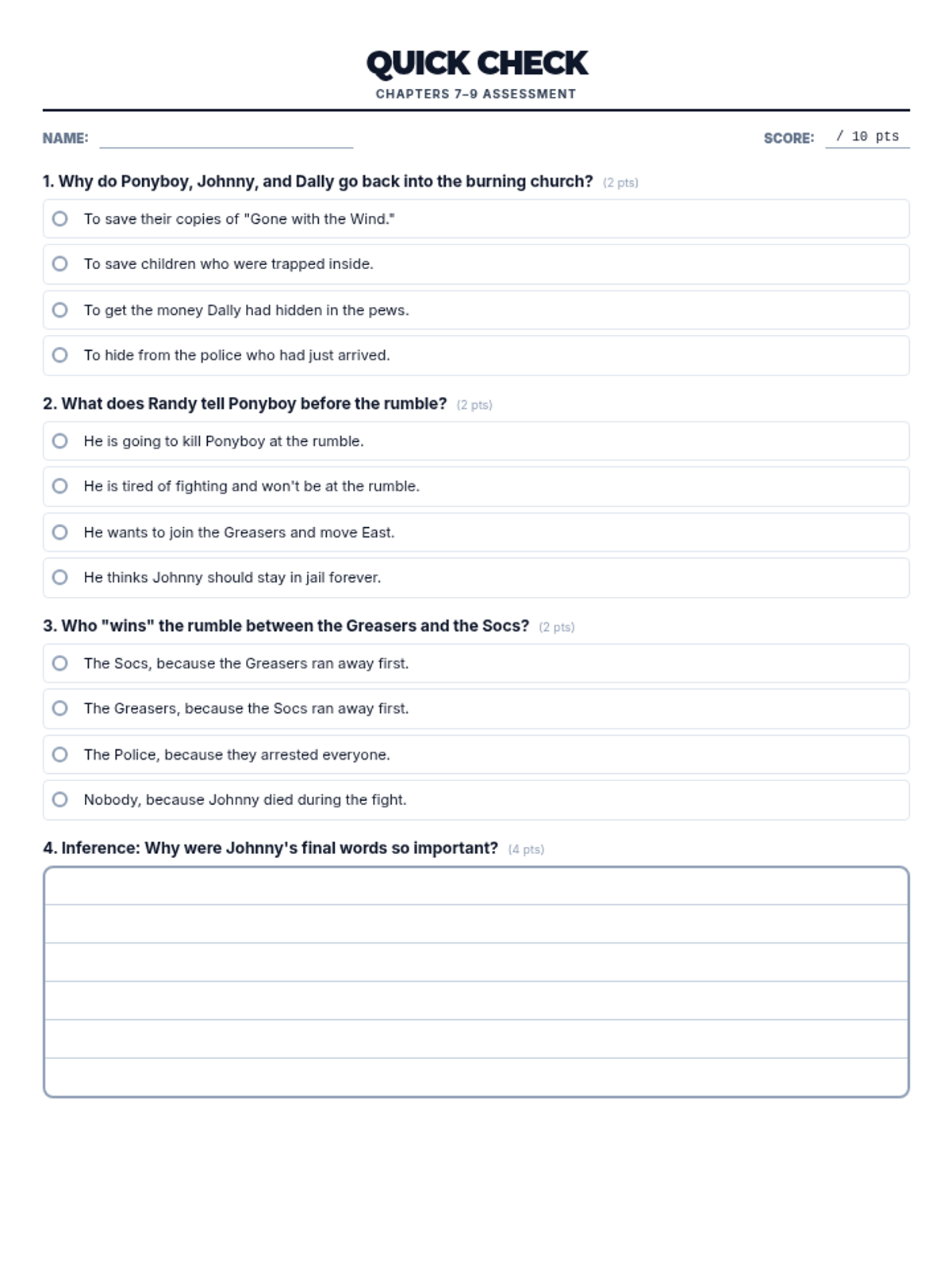
A 4-question quiz covering key plot points in Chapters 7-9. Includes questions on the church fire, Randy's conversation with Ponyboy, the rumble, and Johnny's final words. Revised for single-page fit and improved writing space.
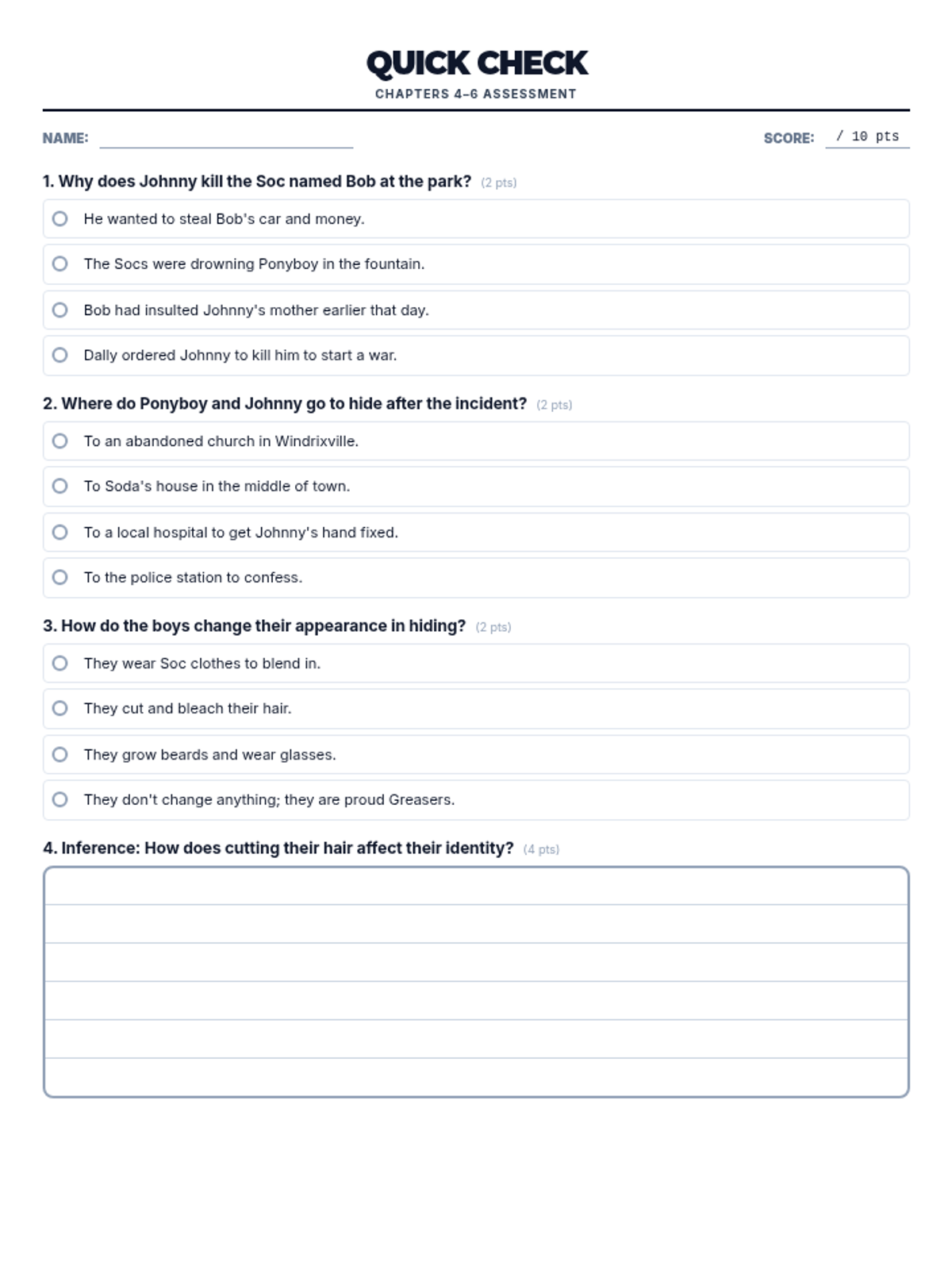
A 4-question quiz covering key plot points and character identity in Chapters 4-6. Includes multiple-choice questions on the park incident and hiding at the church, plus an inference question on Greaser identity. Revised for single-page fit and improved writing space.
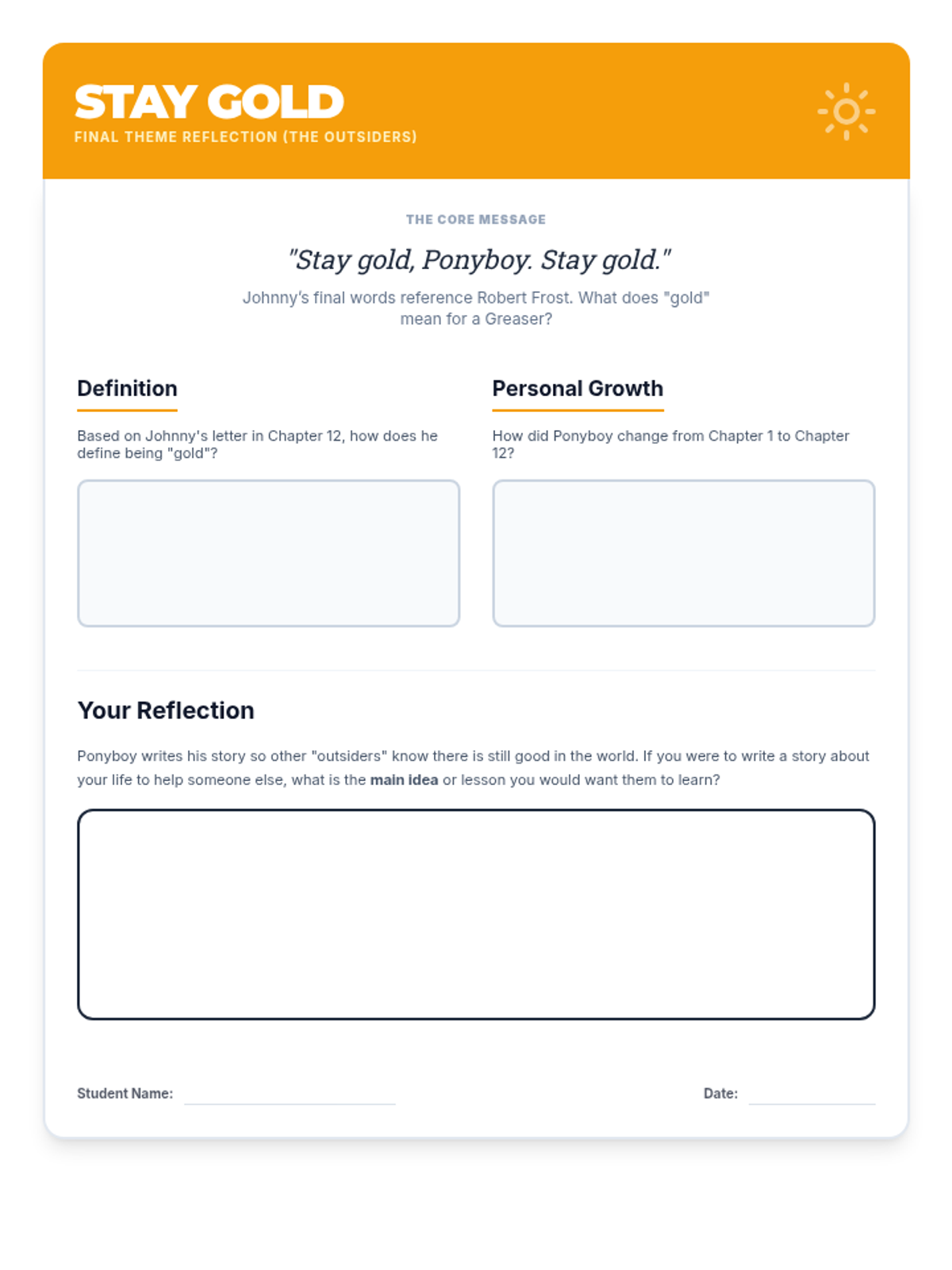
A final reflection worksheet for 'The Outsiders'. Revised to lighten the reflection work area for handwriting legibility and consolidate all content onto a single page.
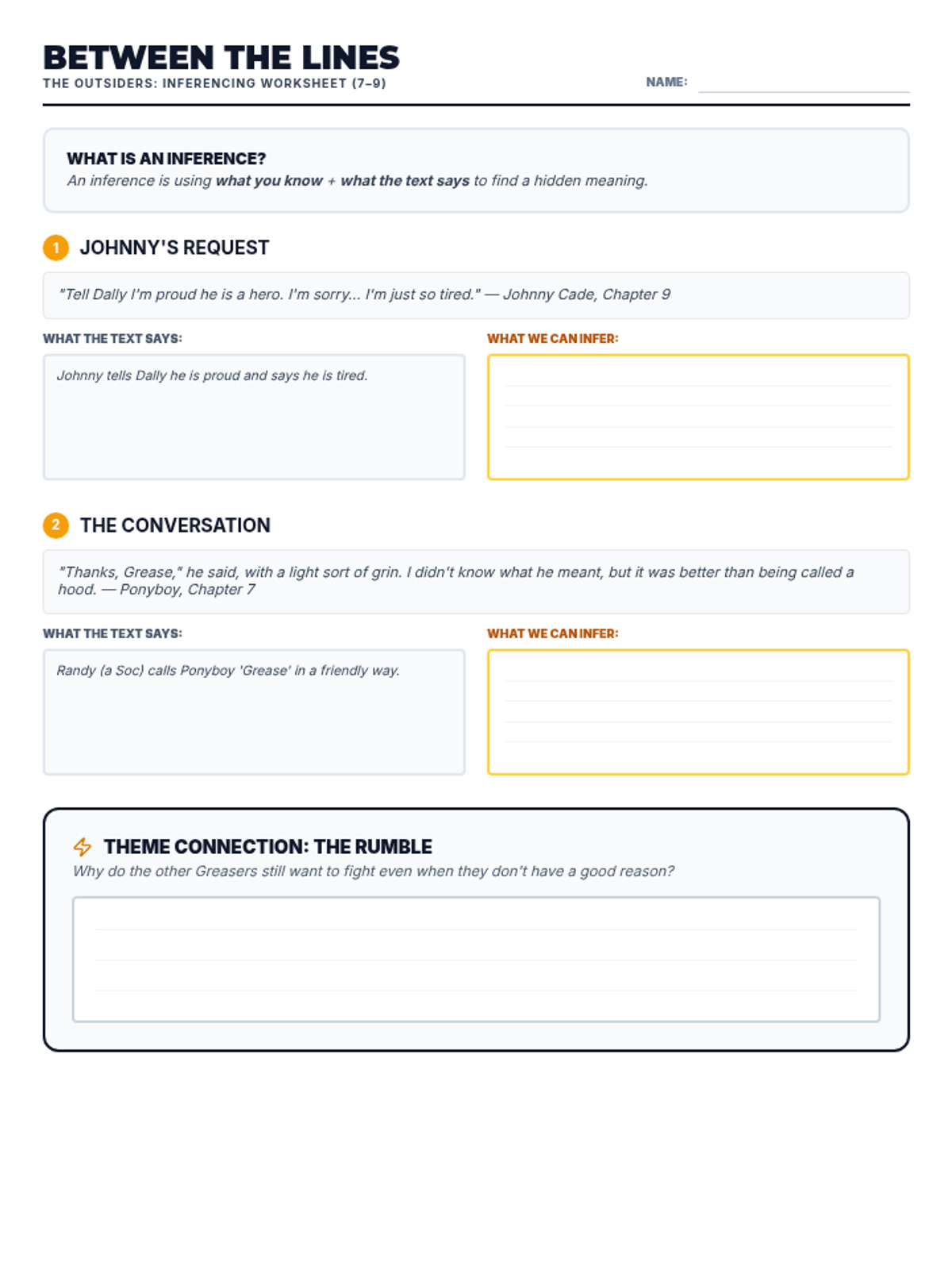
A worksheet focusing on inferencing skills for Chapters 7-9 of 'The Outsiders'. Revised to improve contrast in work areas and ensure all content fits on one page.
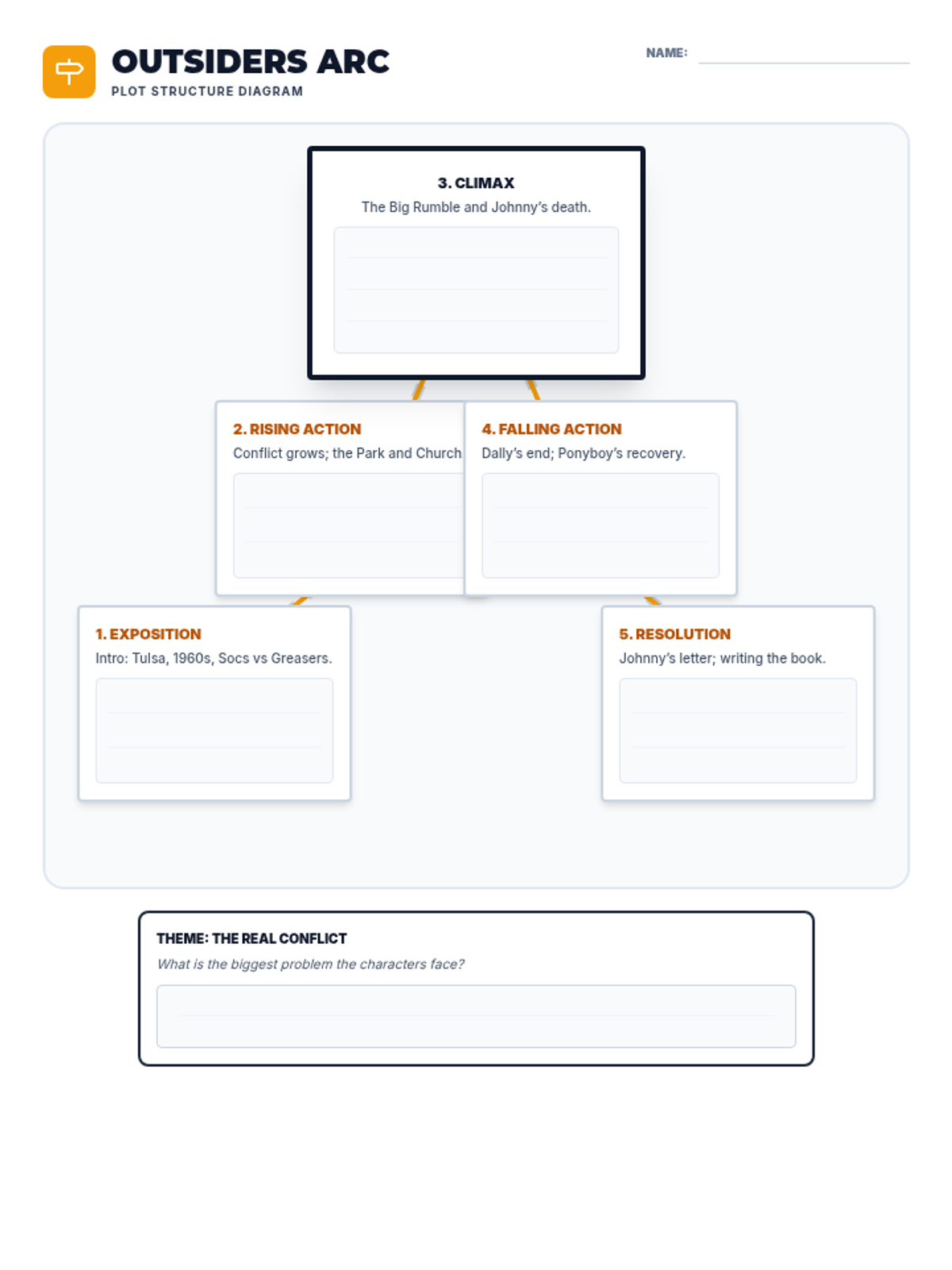
A plot diagram graphic organizer for 'The Outsiders'. Revised to provide larger writing boxes, better legibility for adult handwriting, and fixed colors for the climax section.
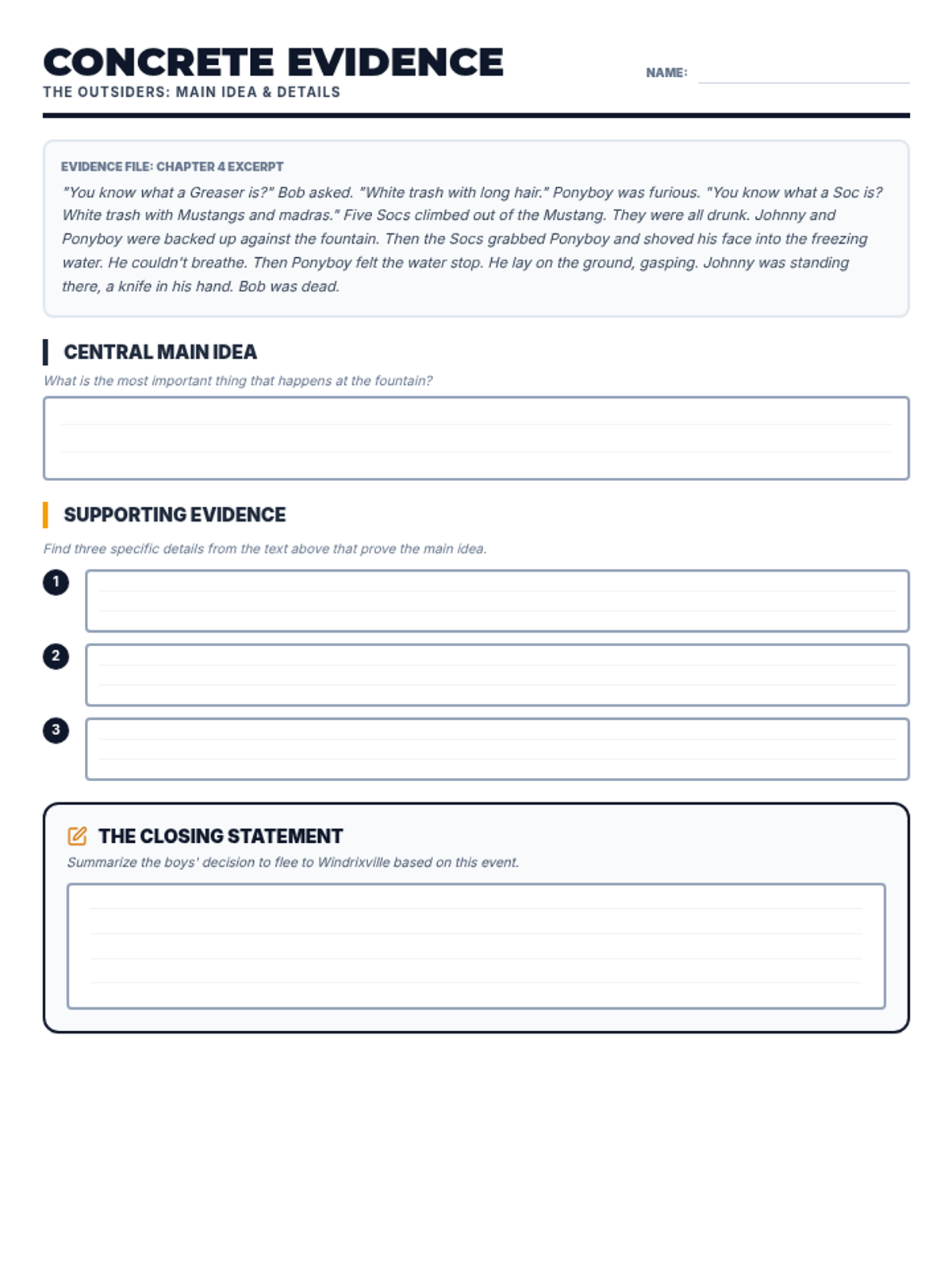
A worksheet focused on identifying the main idea of the Chapter 4 fountain incident. Revised to include the source passage, improve contrast of work areas, and ensure a single-page fit.
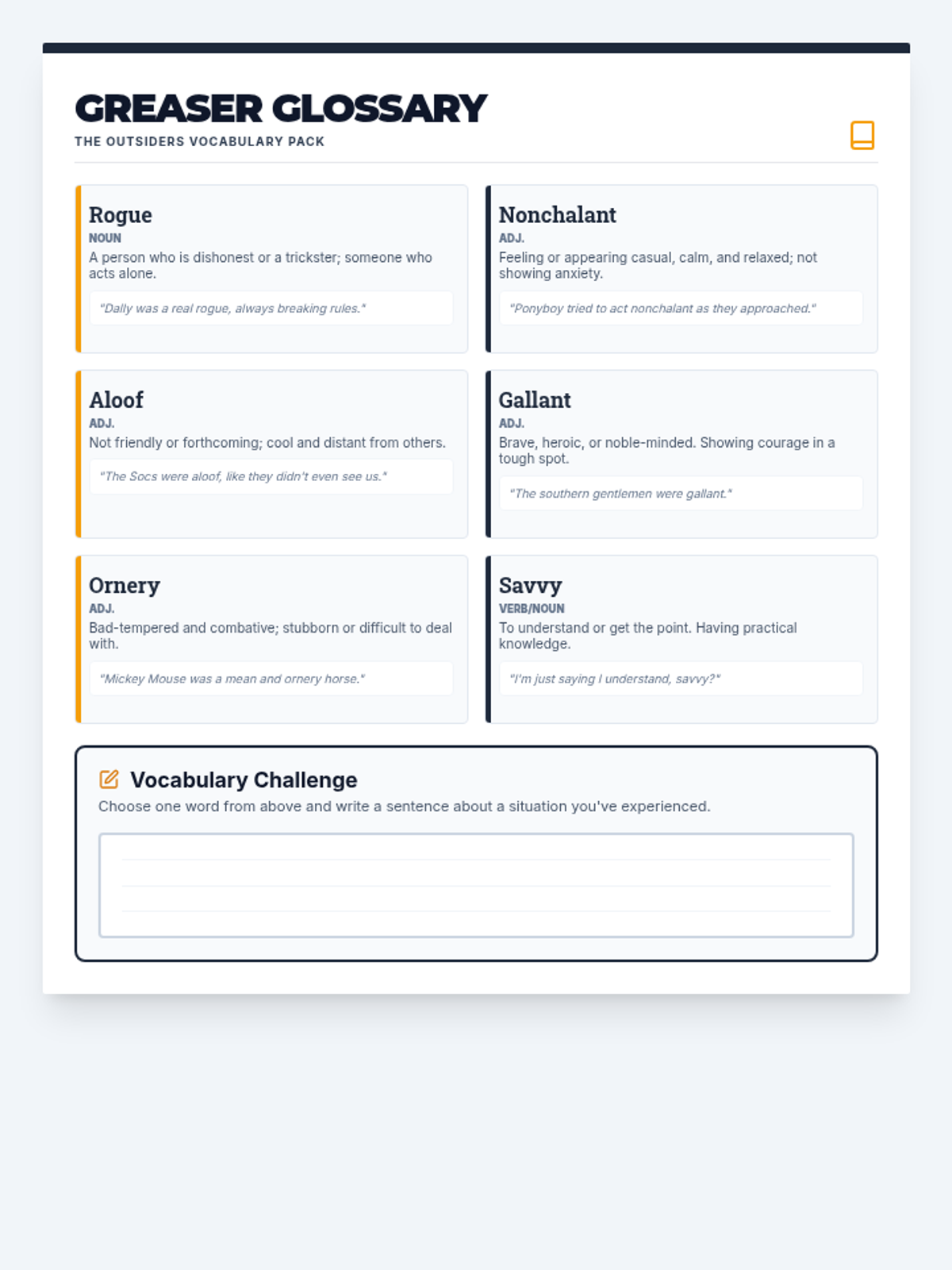
A set of vocabulary cards featuring key terms from 'The Outsiders'. Revised with additional terms, improved white background for student work areas, and layout consolidation to fit one page.
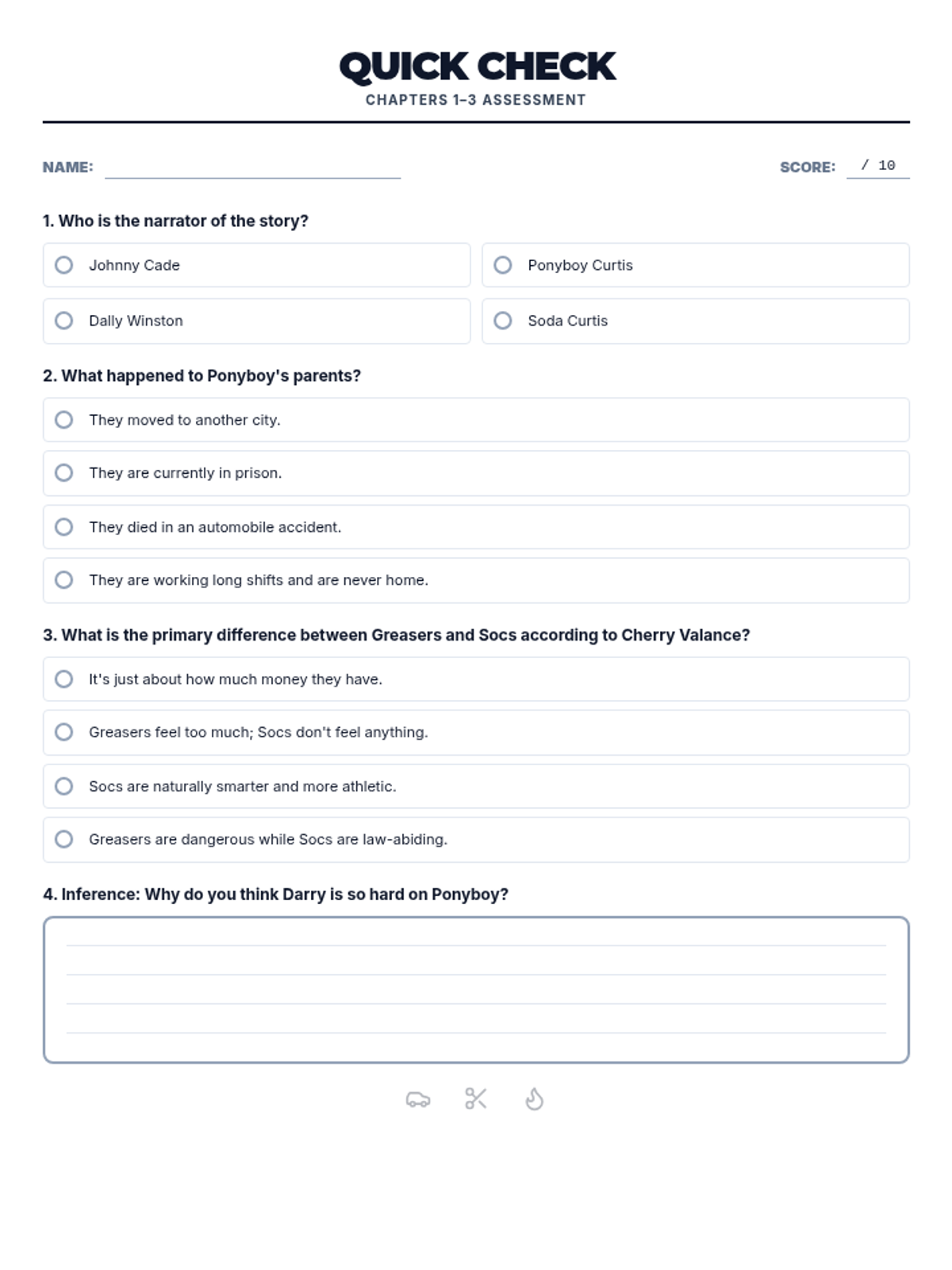
A 4-question quiz covering key plot points in Chapters 1-3. Revised to fit on one page, remove unnecessary interactive styles, and provide white background for work areas.
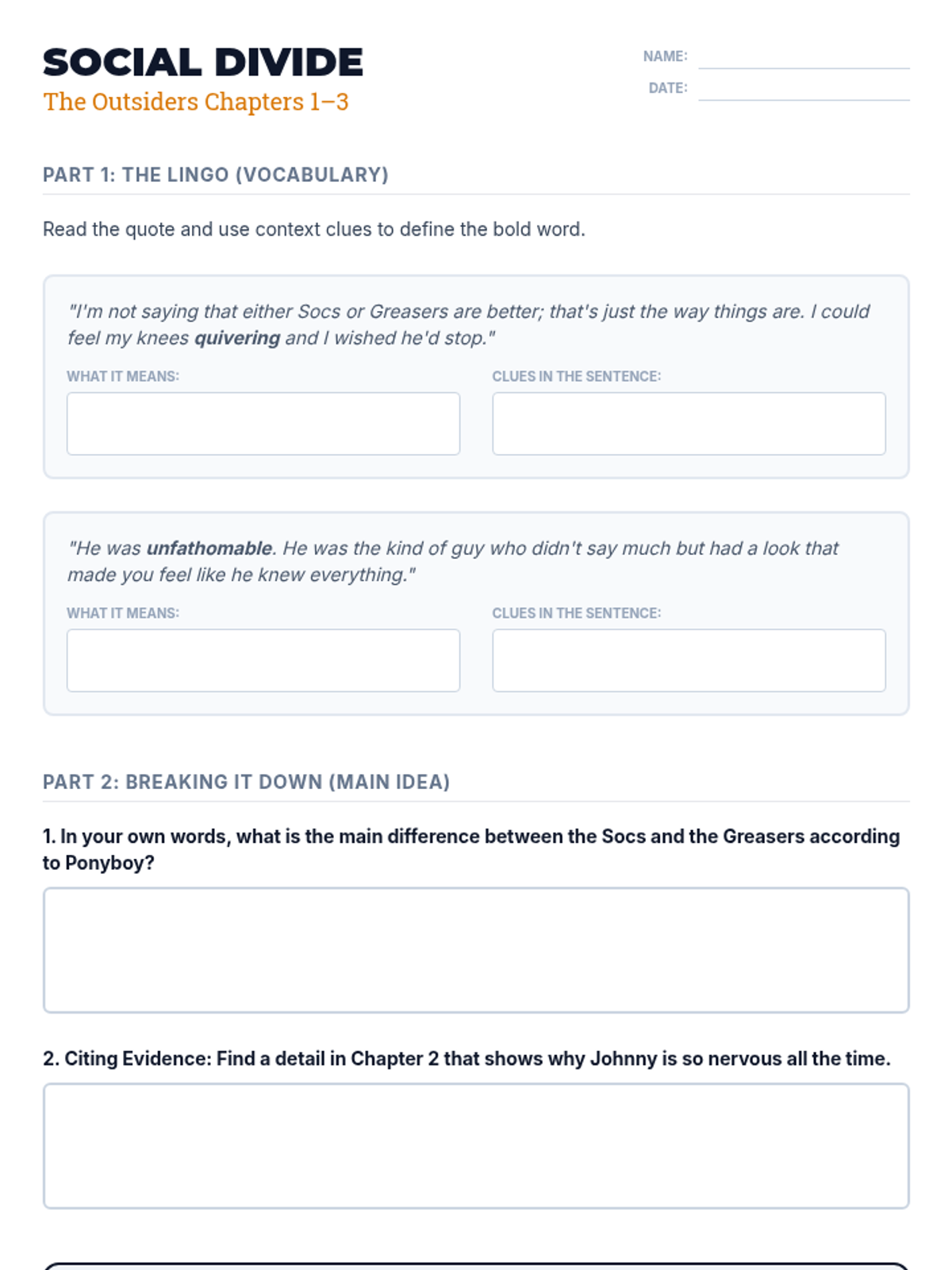
A worksheet for Chapters 1-3 focusing on vocabulary through context clues, main idea identification, and social-emotional reflection. Revised for improved page flow and handwriting legibility on light backgrounds.
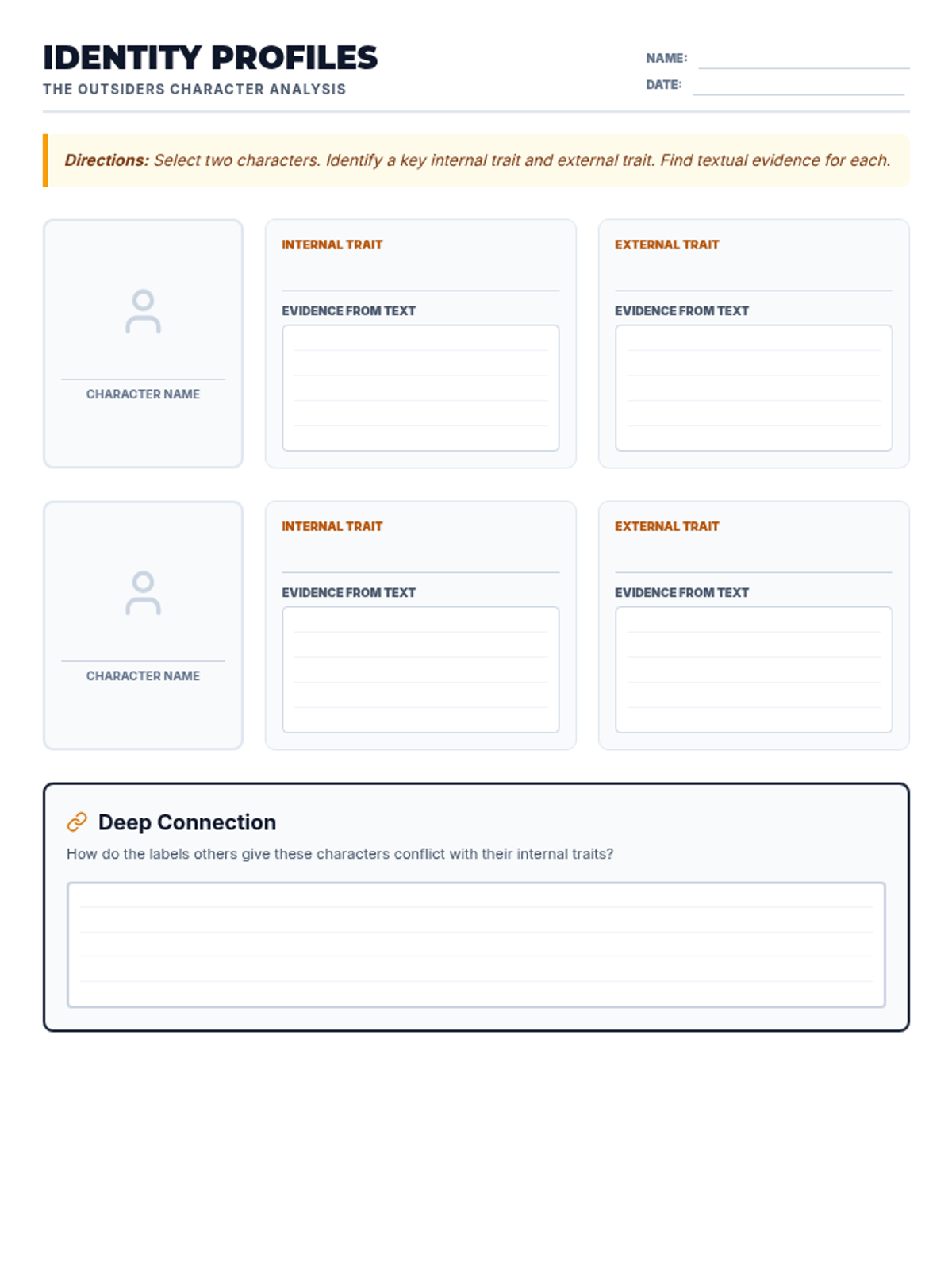
A graphic organizer for analyzing character traits and citing textual evidence. Revised for improved writing space, handwriting legibility on light backgrounds, and page-break prevention.
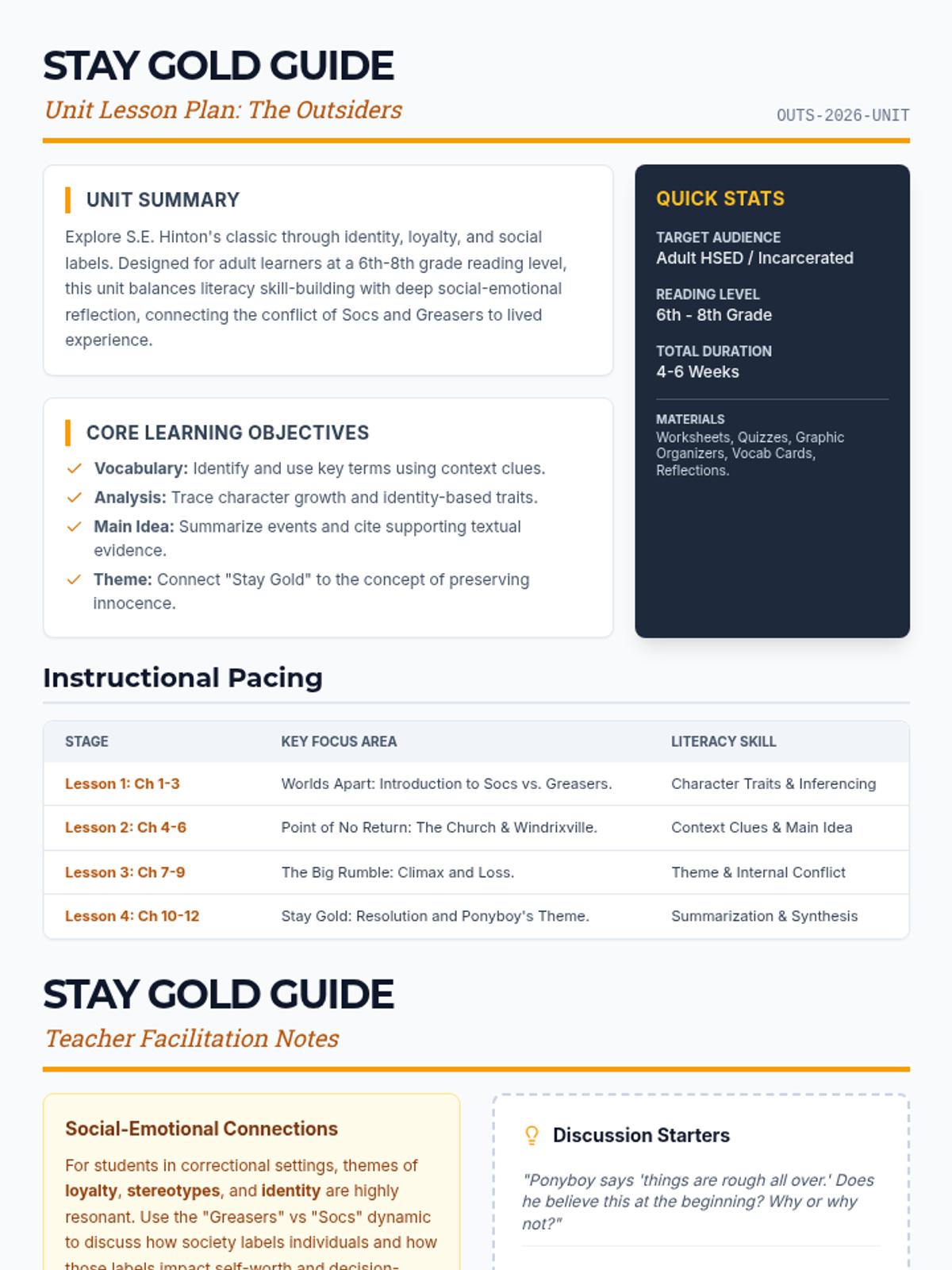
A comprehensive master lesson plan for teachers, outlining unit objectives, pacing for the 12 chapters, literacy focus areas, and facilitation notes for adult learners in correctional settings. Revised for improved page breaks and layout.
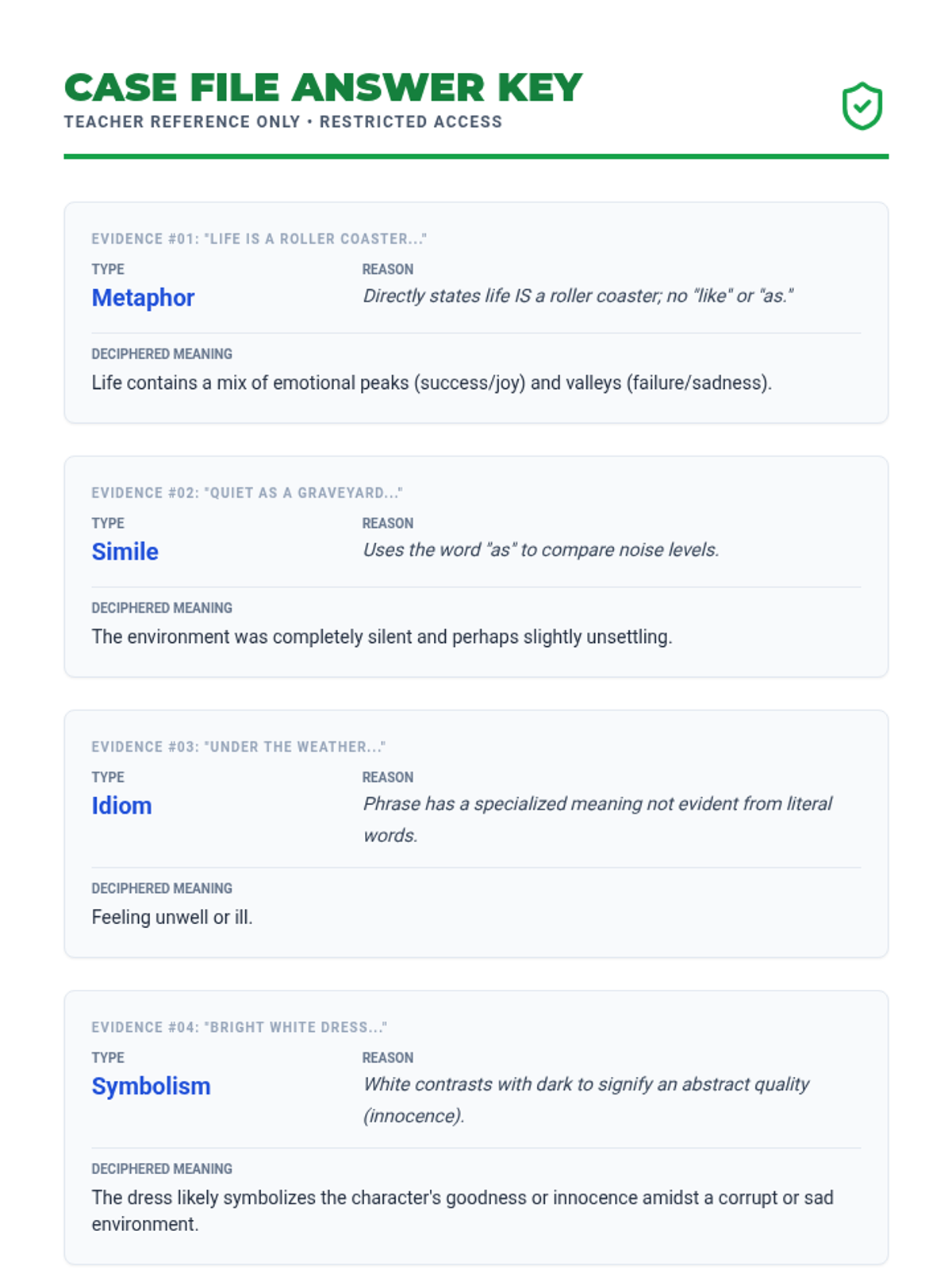
An expanded answer key for the Case File Analysis Worksheet, covering all 8 evidence items with clear explanations and teacher guidance.
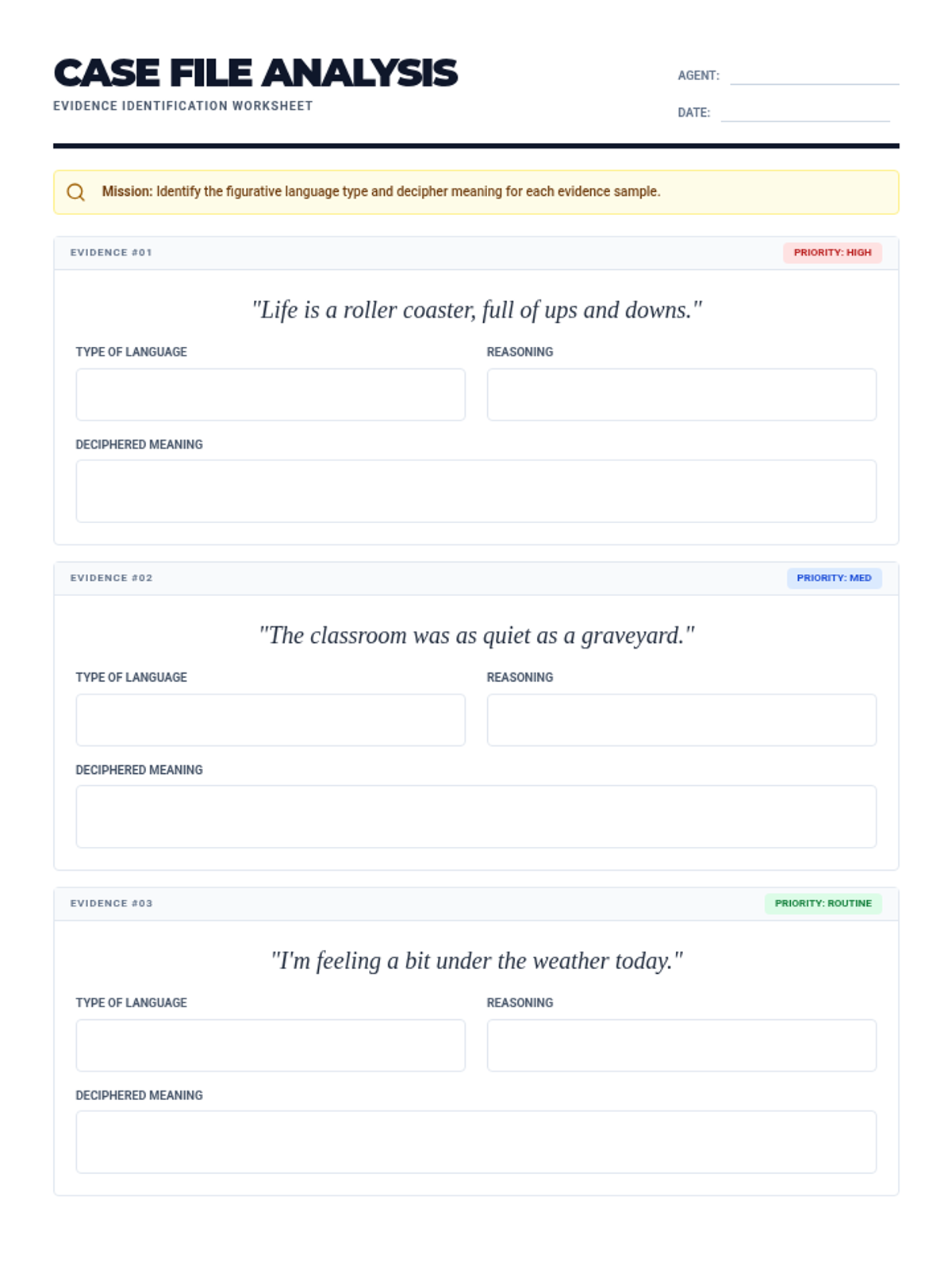
An expanded and optimized 2-page version of the Case File Analysis Worksheet with 8 evidence items, a word bank, and a creative application section. cover similes, metaphors, idioms, and symbolism.
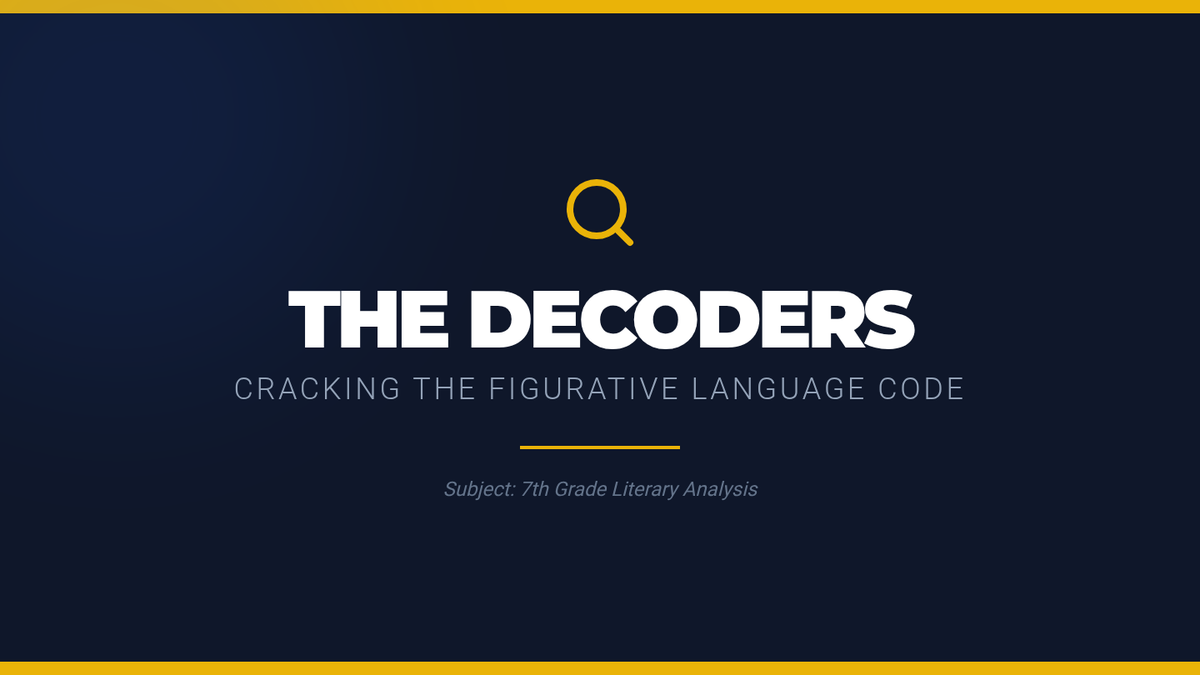
A robust, expanded version of 'The Decoders' slide deck with detailed breakdowns of each figurative language type, detective tips, and a mission-based summary. It features high-contrast visuals and multiple examples.
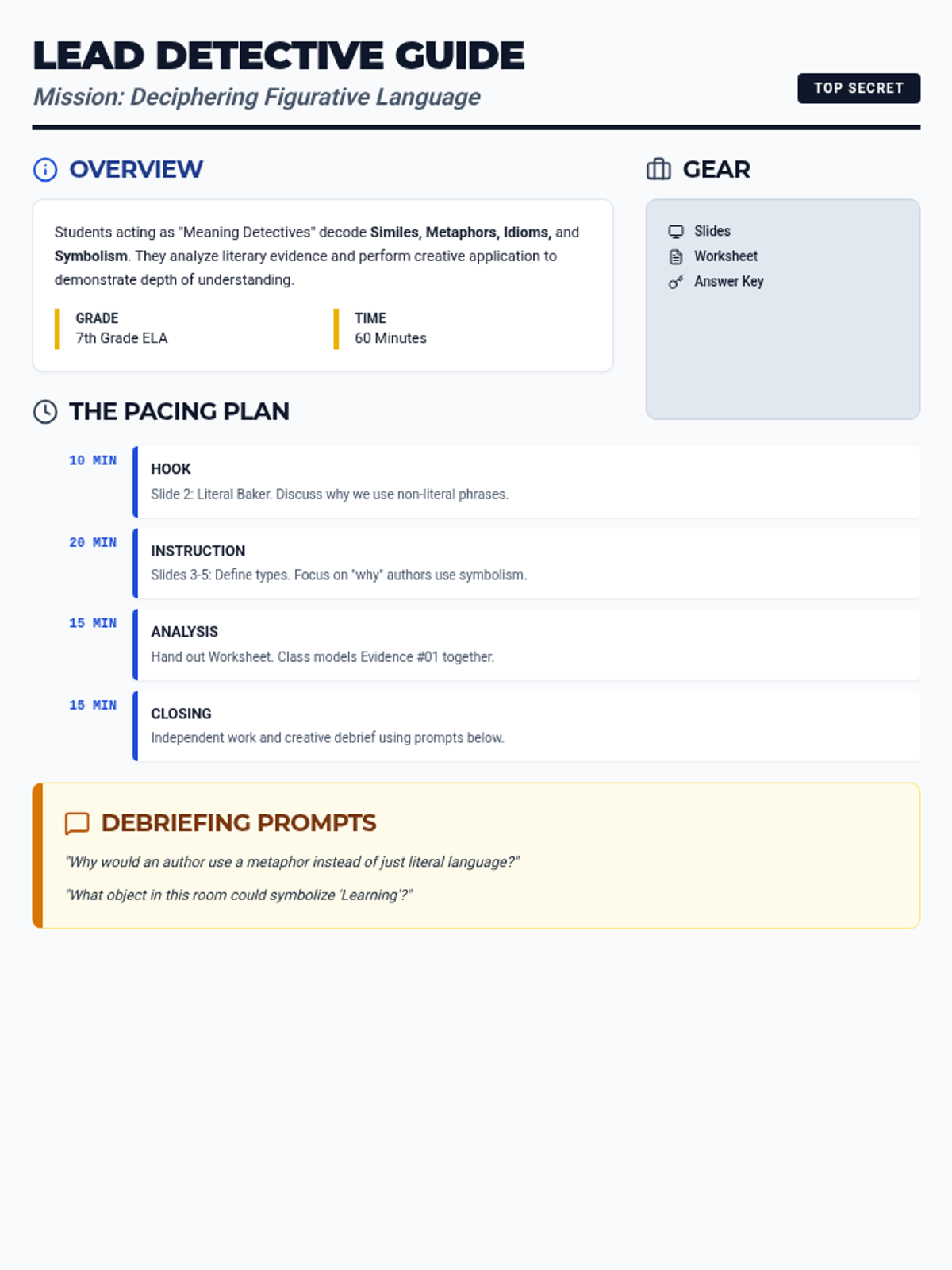
A detailed teacher guide for the 'Meaning Detectives' lesson, including learning objectives, an expanded appendix of figurative language examples, and a minute-by-minute pacing plan.
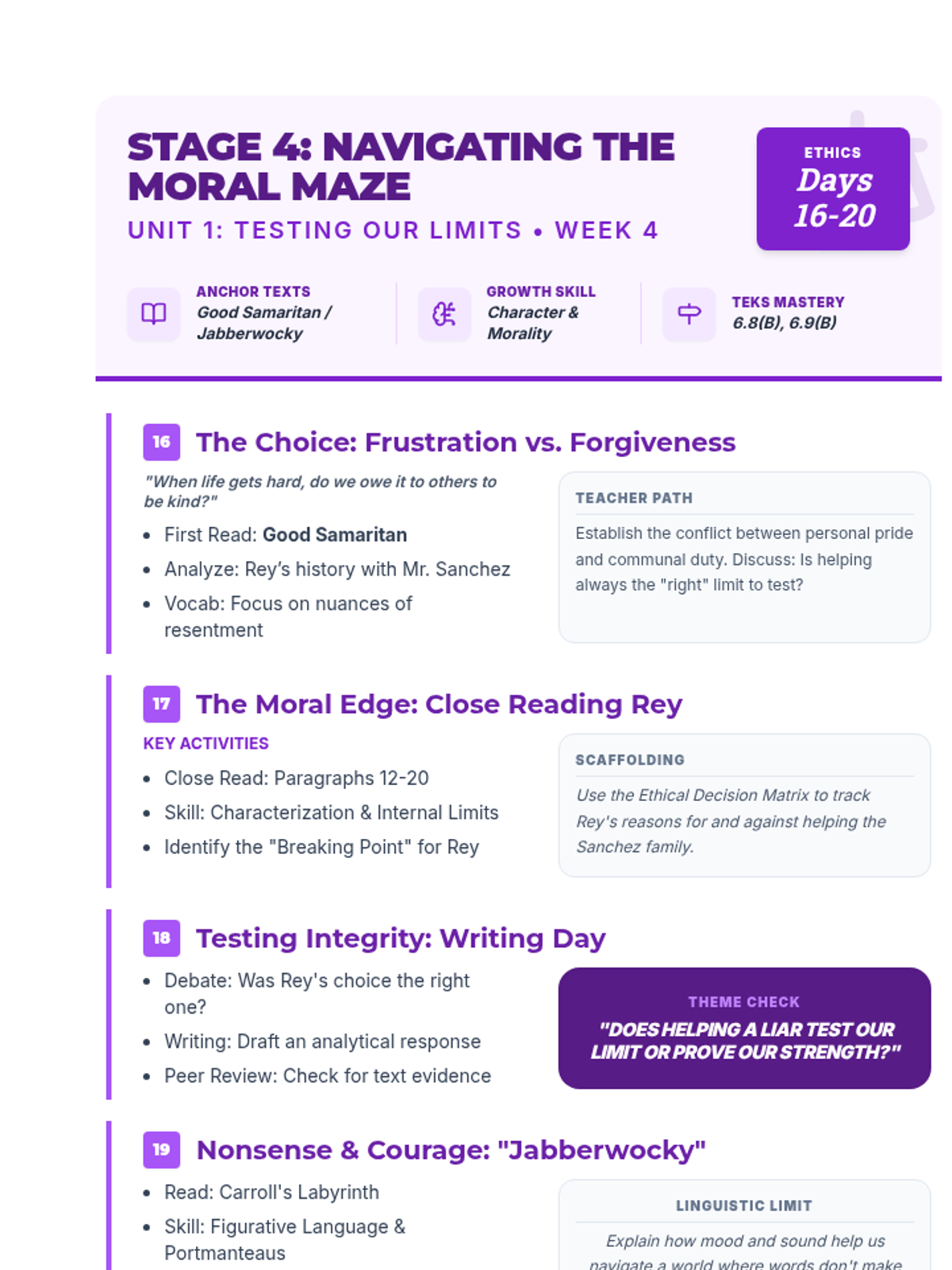
Week 4 Pacing Guide for Unit 1, exploring 'Good Samaritan' and 'Jabberwocky' with a focus on ethical limits and linguistic boundaries. Optimized for single-page use with improved font sizes and vertical layout.
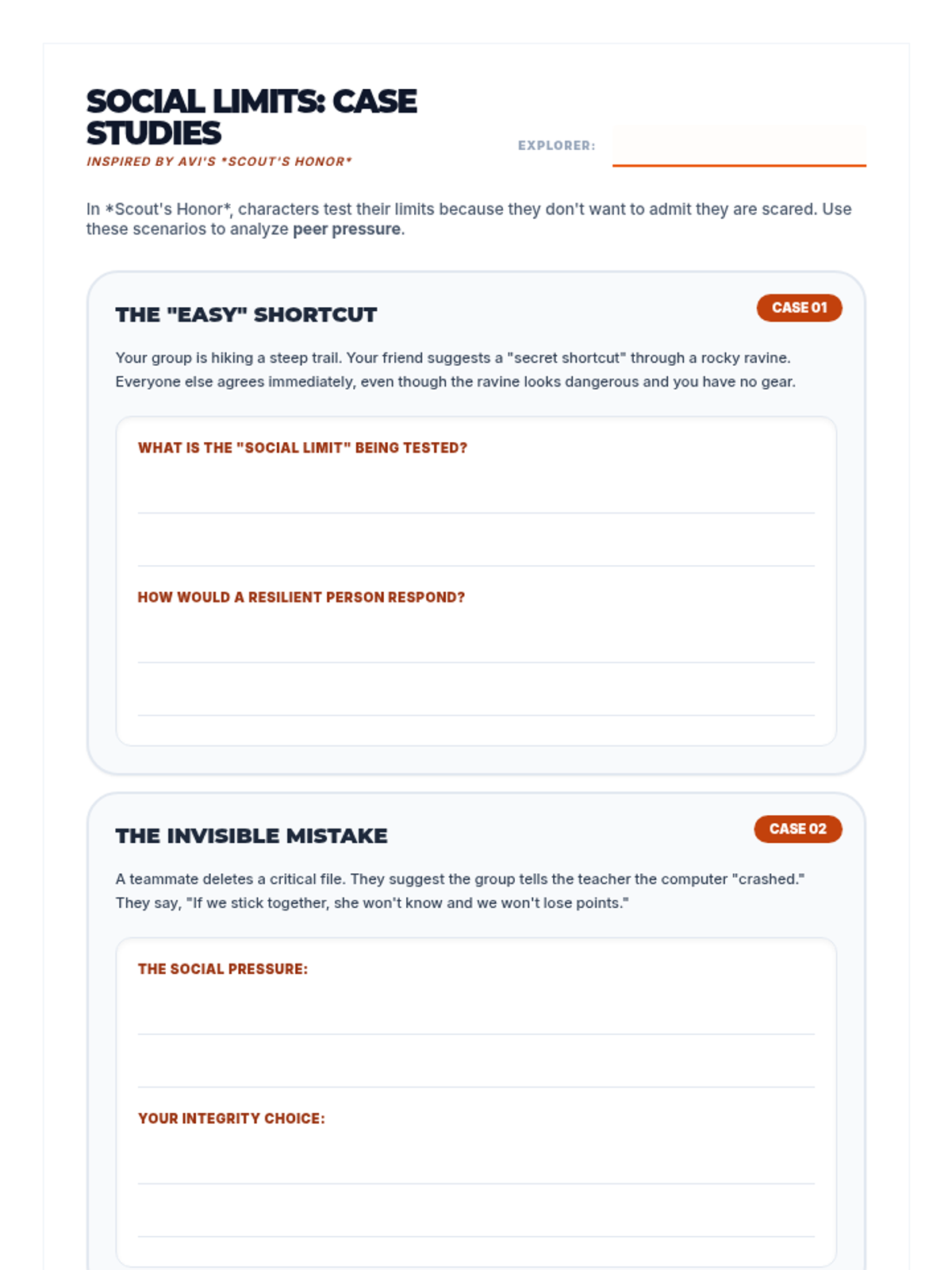
A set of real-world scenarios and reflection questions analyzing peer pressure and integrity, inspired by Avi's 'Scout's Honor'. Updated for better page flow and usable reflection areas.
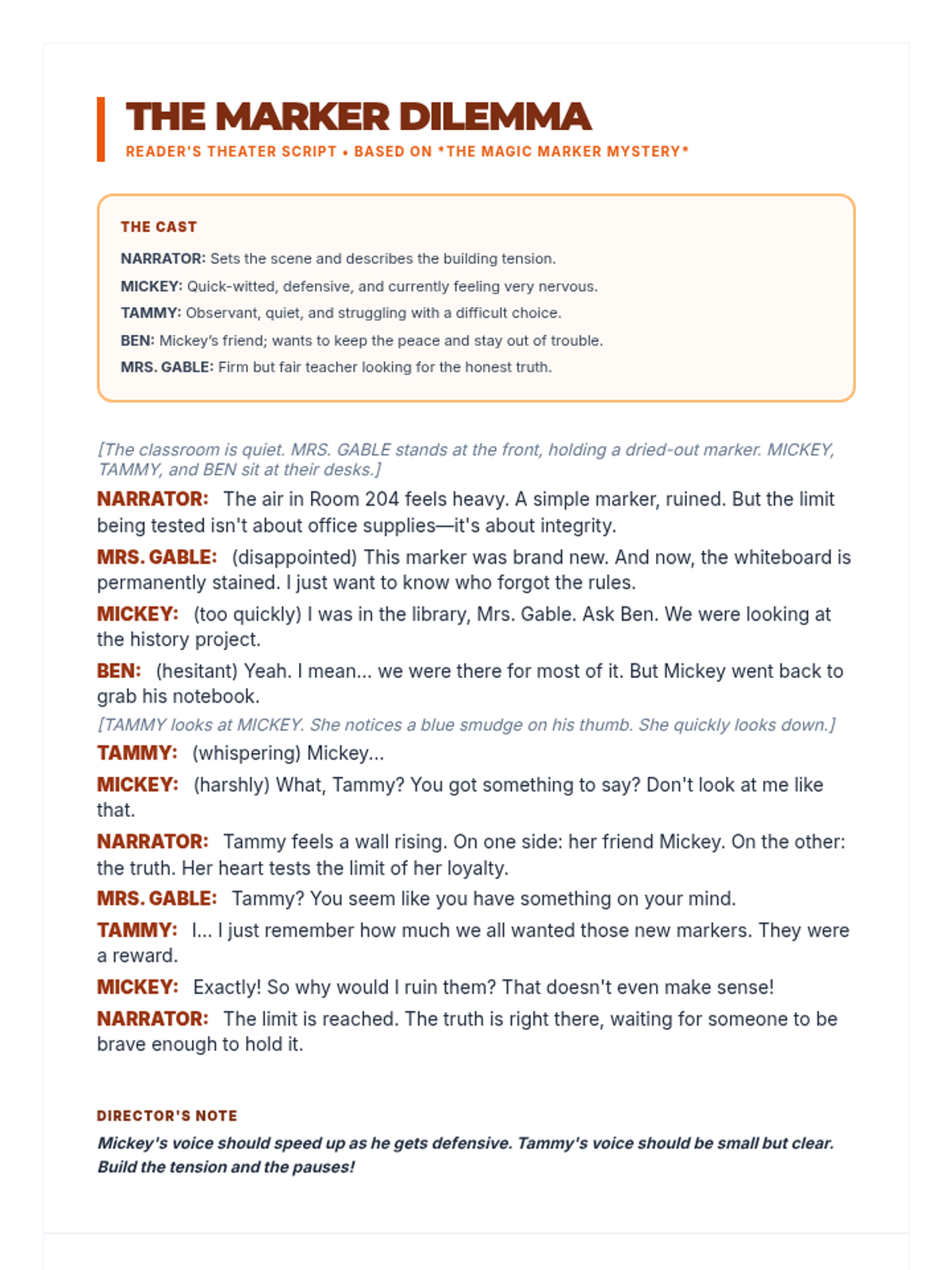
A Reader's Theater script adapted from 'The Magic Marker Mystery' with an added analysis page for student reflection on character motives and internal limits. Updated for better readability and spacing.
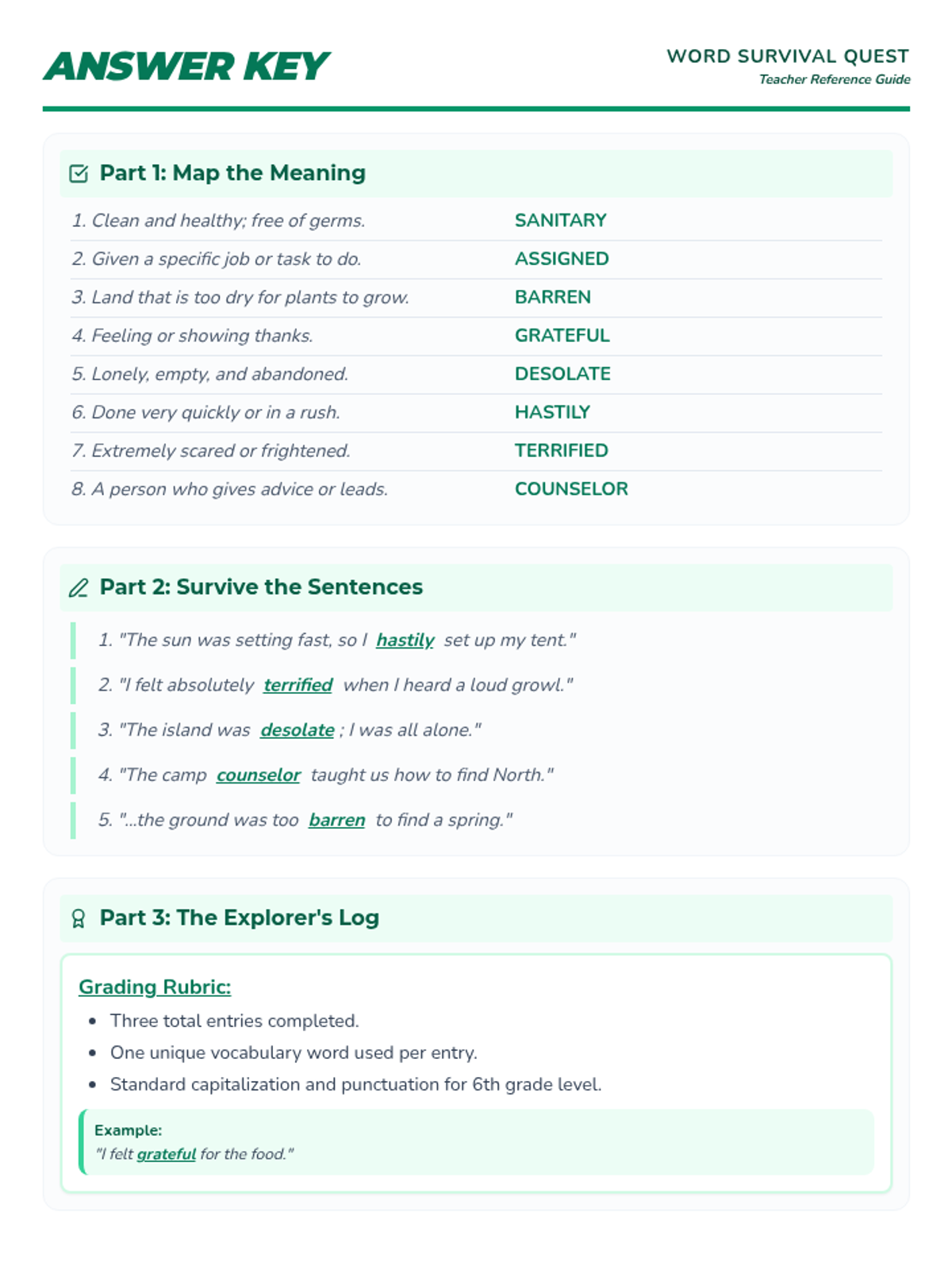
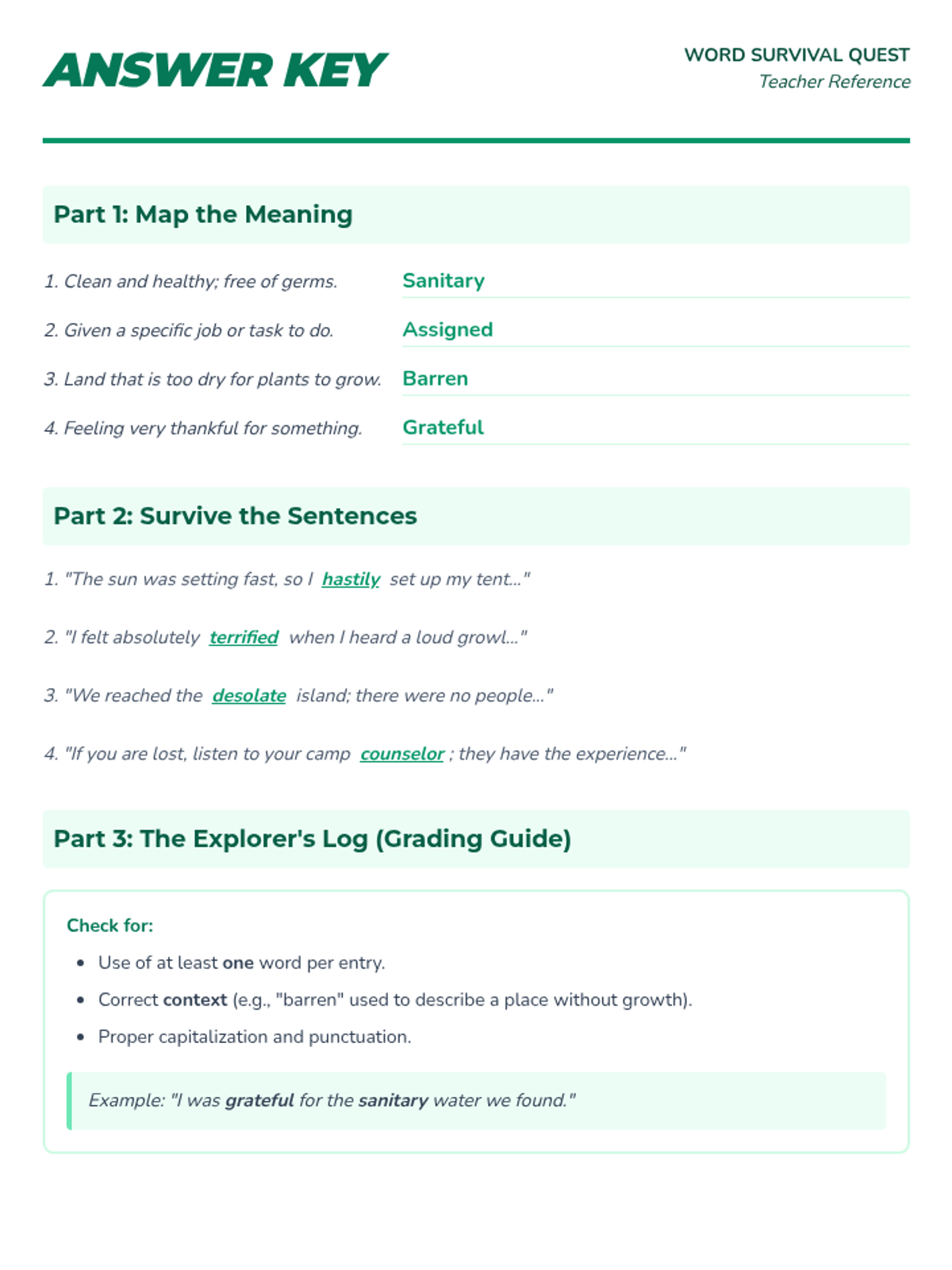
A detailed answer key for the updated Word Survival Worksheet, featuring all 13 objective answers and a grading rubric for the writing entries. Optimized for a clean, single-page layout.
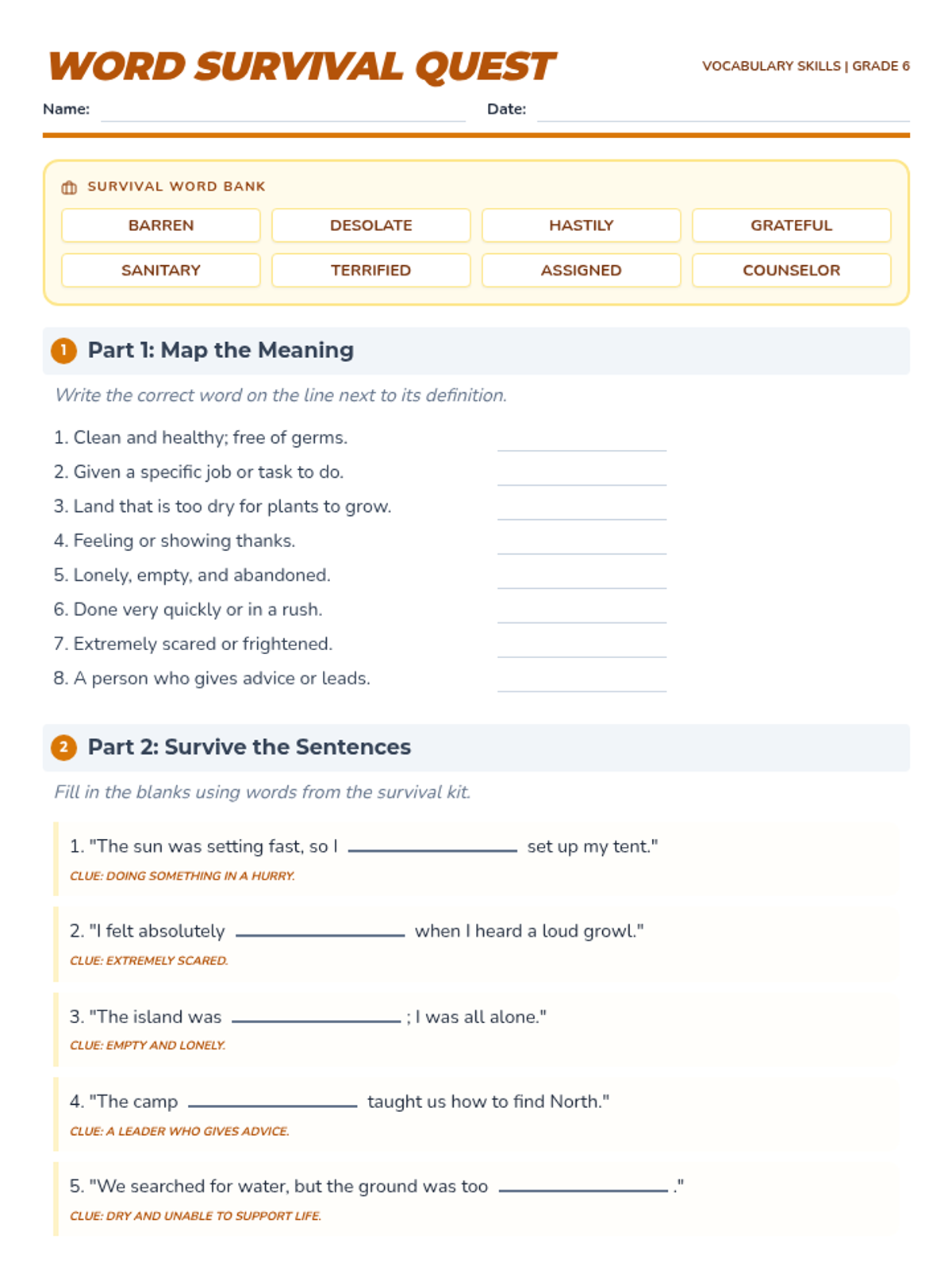
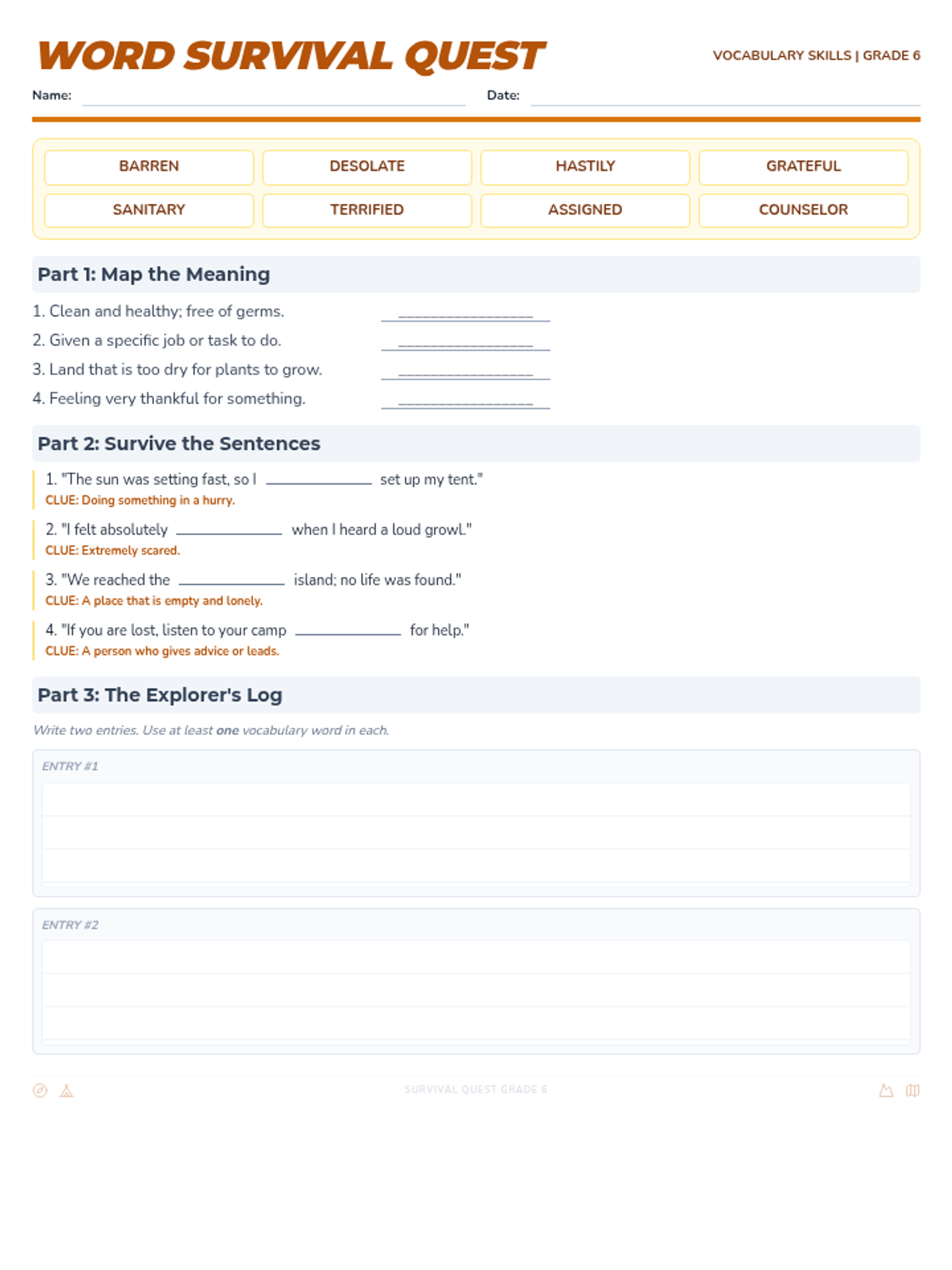
A polished, two-page vocabulary worksheet for 6th grade students. Part 1 now includes matching for all 8 vocabulary words. Includes 5 context clue sentences and 3 journal entries with writing lines. Optimized for clear page breaks.
A detailed answer key for the Word Survival Worksheet, providing correct answers, grading guides for creative sections, and a quick reference table.
A highly scaffolded vocabulary worksheet featuring matching, fill-in-the-blanks with clues, and a creative writing section for 6th grade students. Revised to fix page breaks, add writing lines, and clarify instructions.
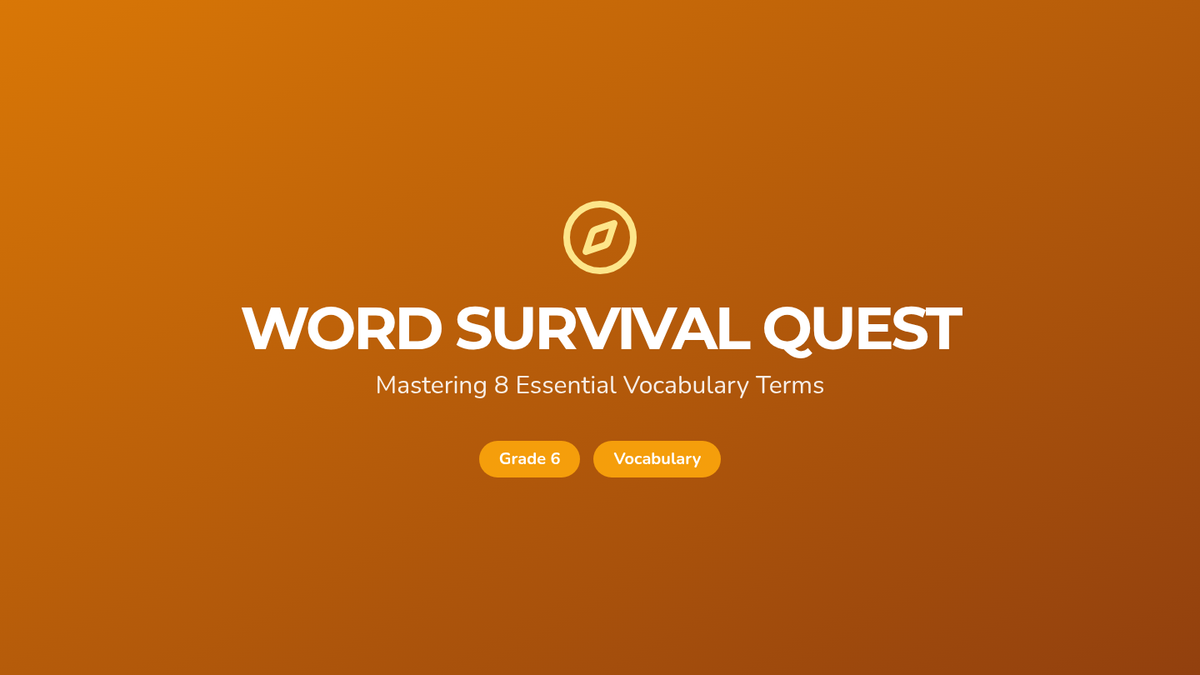
A set of interactive slides introducing eight survival-themed vocabulary words with definitions, example sentences, and visual aids. Revised for better formatting and consistency.
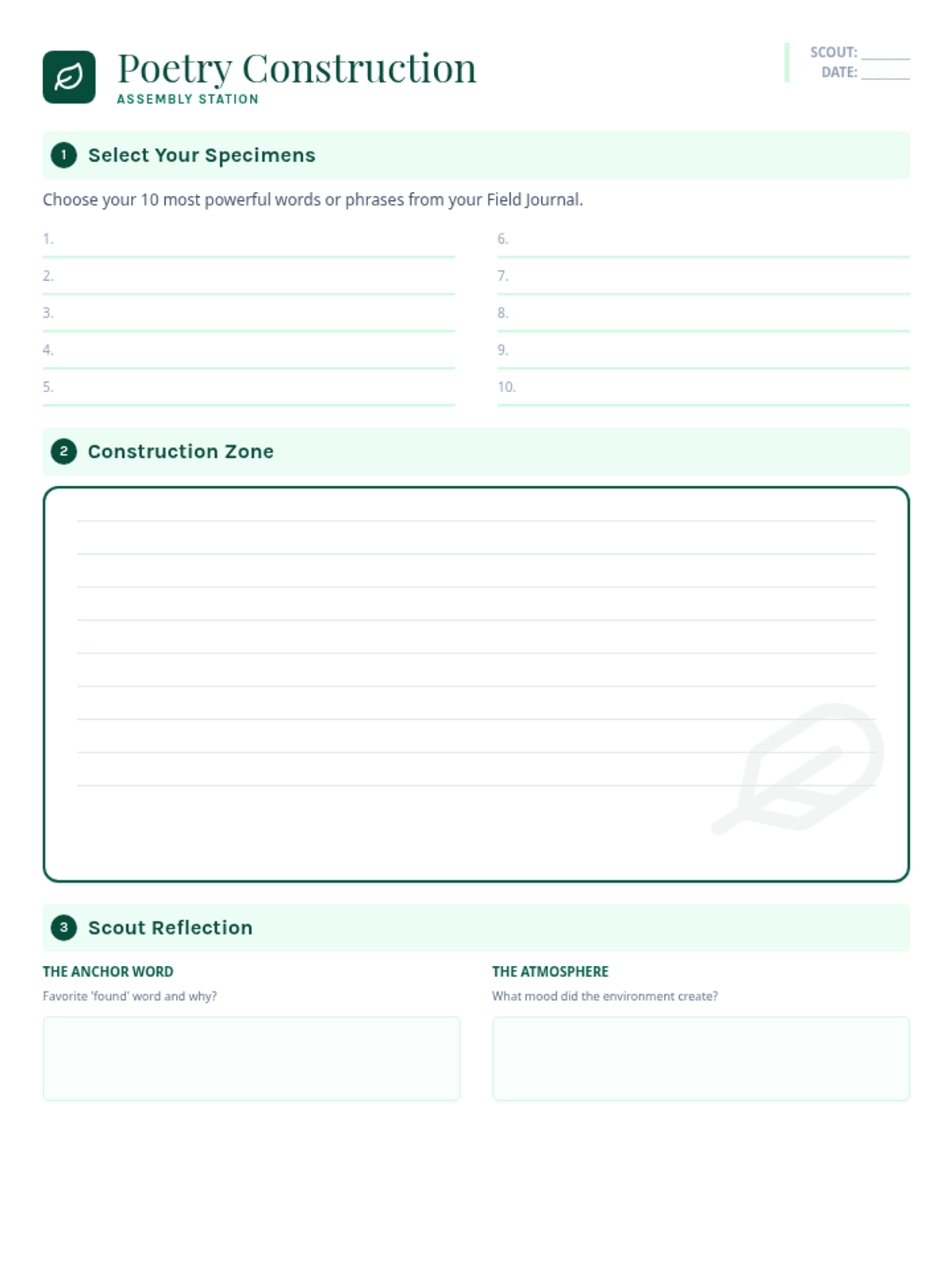
A poem drafting worksheet for students to curate their collected words and assemble their final 'found' poetry stanzas, including a reflection section.
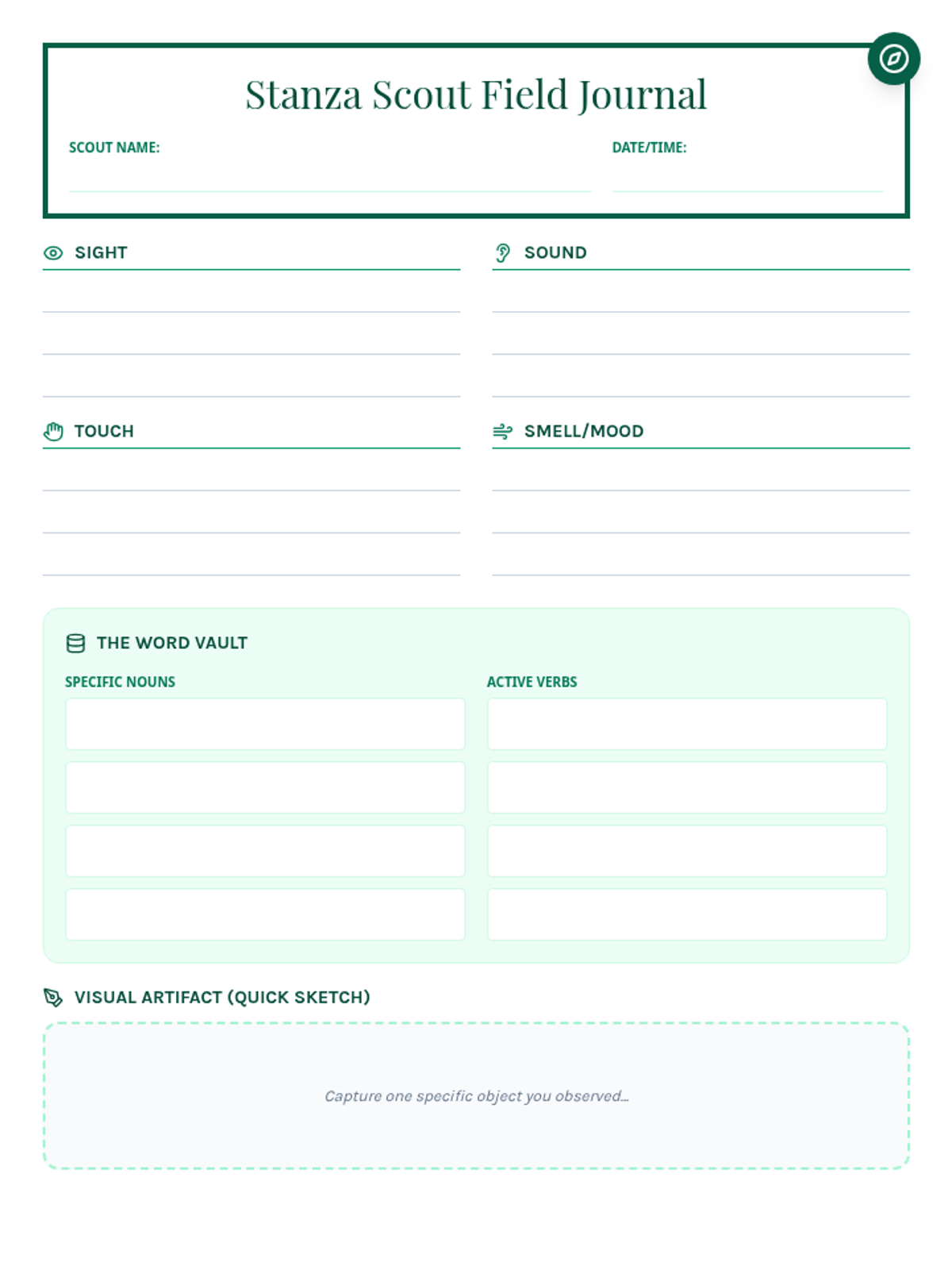
A student field journal for the 'Stanza Scout' nature walk, featuring sections for sensory observations, noun/verb collection, and a visual artifact sketch area.
A visual slide presentation for 'The Stanza Scout' lesson, defining found poetry, outlining sensory scouting techniques, and providing guidelines for the nature walk and poem construction.
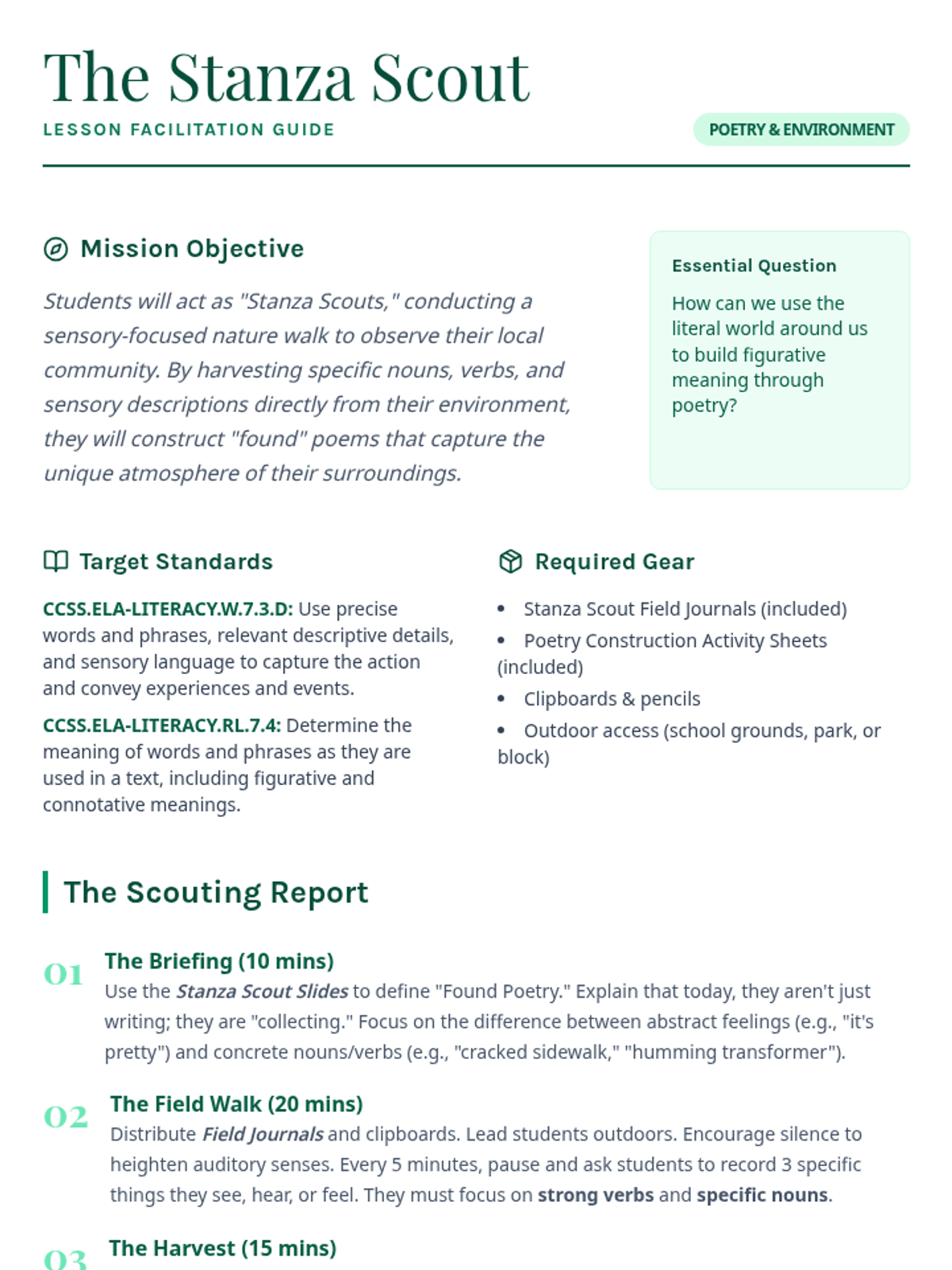
A detailed teacher's lesson plan for 'The Stanza Scout' poetry unit, including objectives, CCSS standards, required materials, and a step-by-step instructional guide.
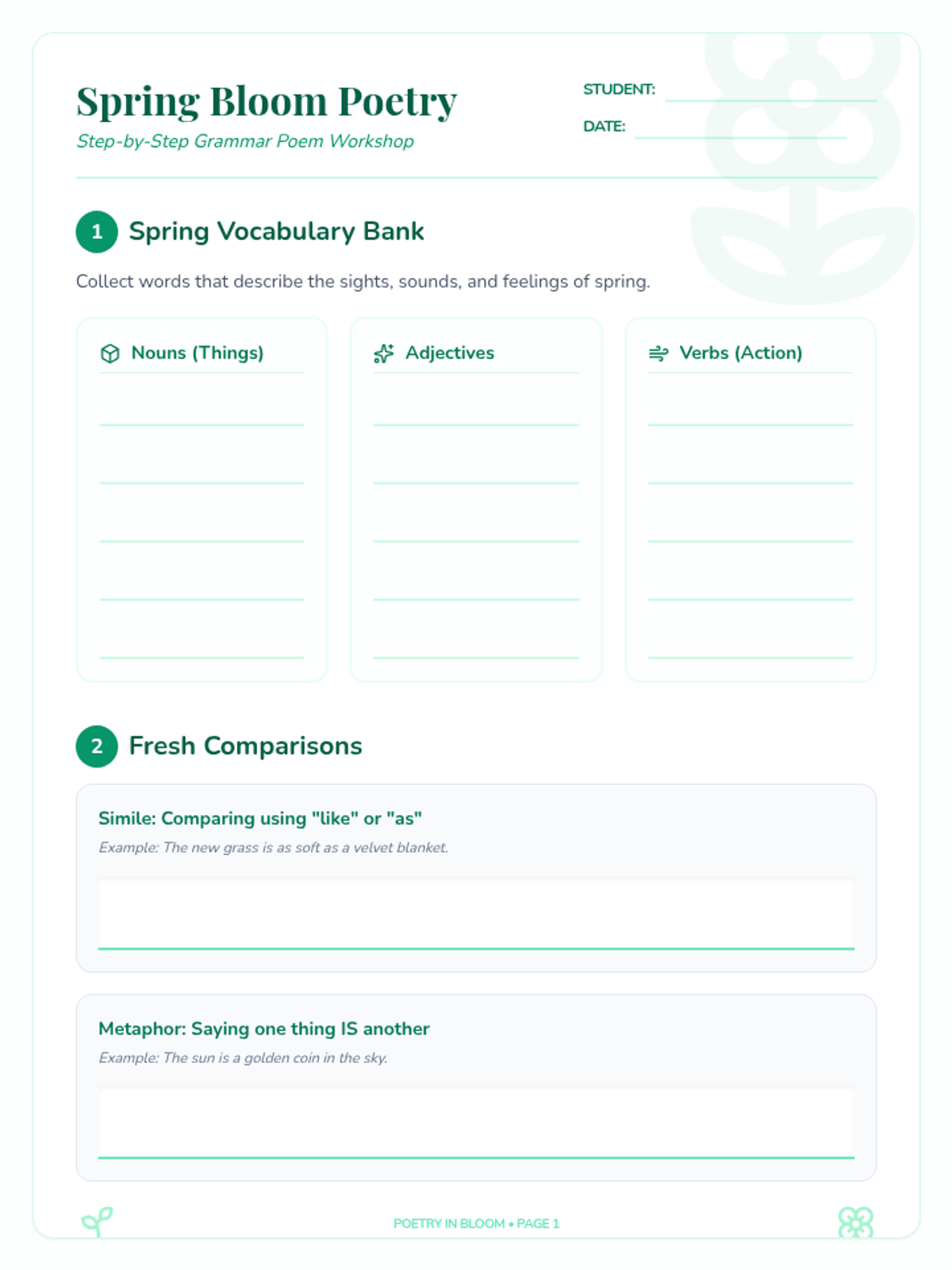
A two-page guided worksheet for students to brainstorm spring-themed grammar and figurative language, then craft a structured poem.
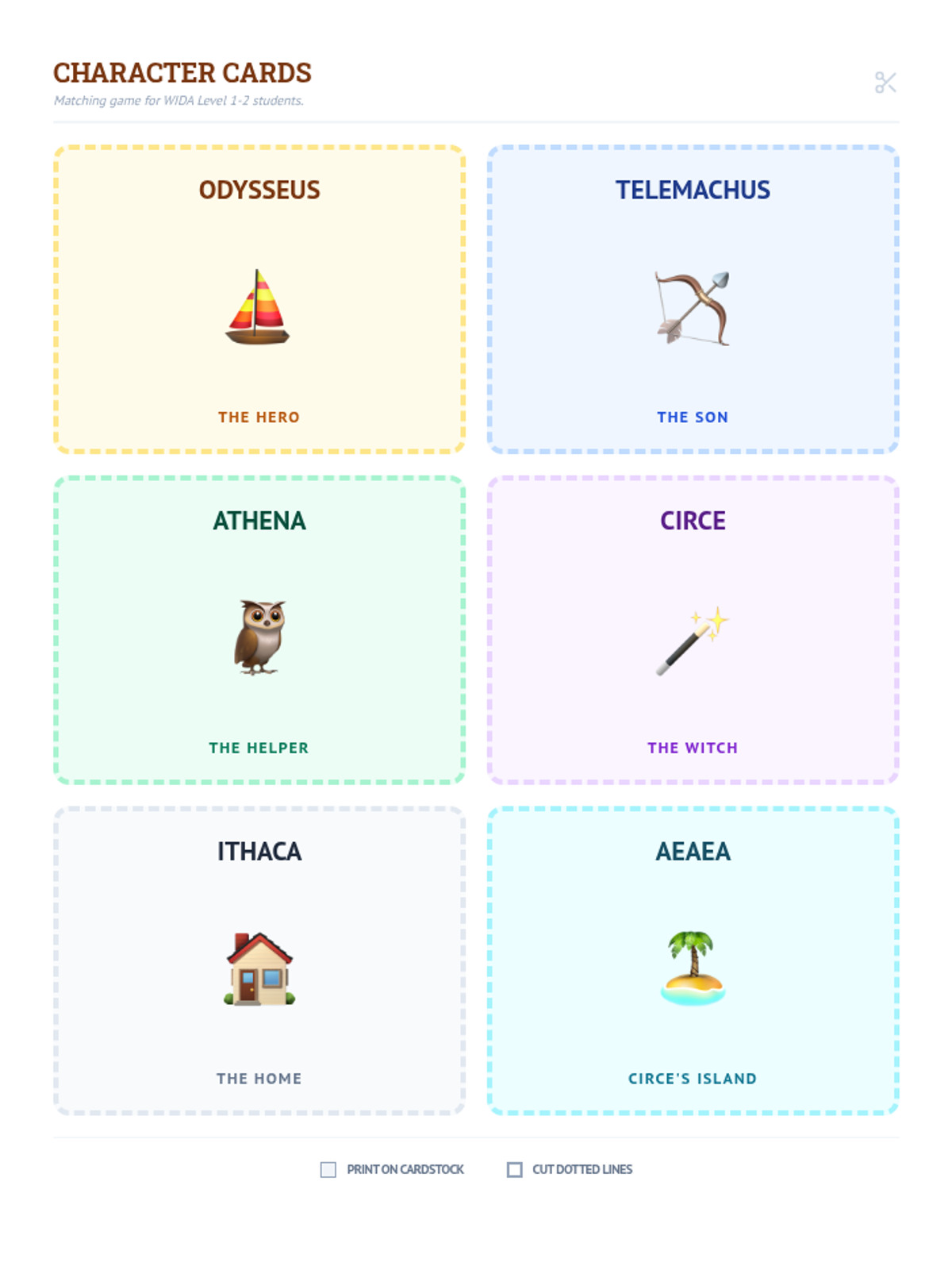
A set of visual character and place cards for ELL students to use as a matching game manipulative. Students match names to their corresponding icons and roles for Books 1-5 of The Odyssey.
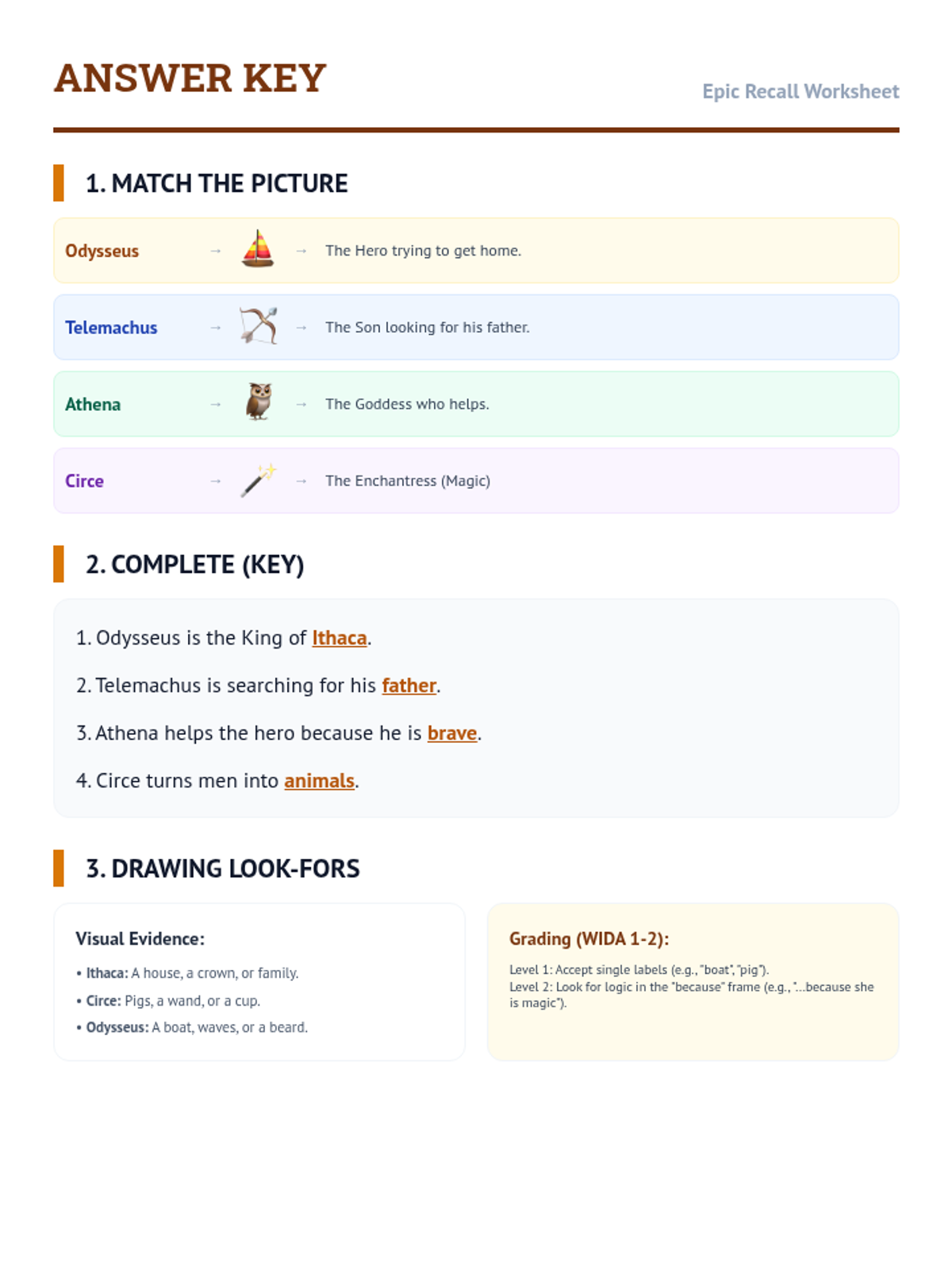
An answer key for the updated Epic Recall Worksheet, providing correct matching combinations, fill-in-the-blank answers, and grading guidance.
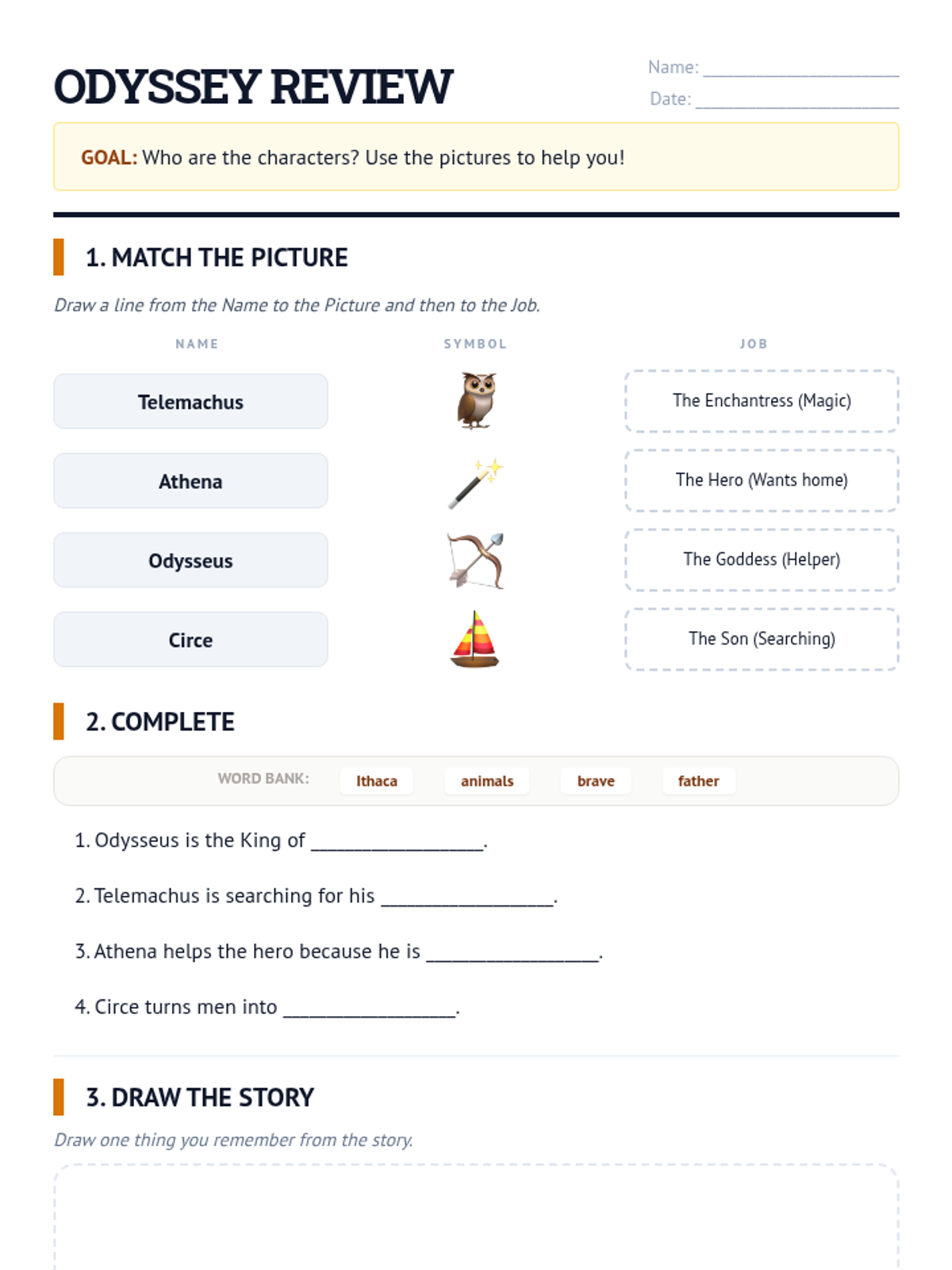
A recall worksheet for ELL students (WIDA 1-2) with visual matching, cloze sentences with a word bank, and a creative drawing space for personal recall of Books 1-5 of The Odyssey. Focuses on Odysseus, Telemachus, Athena, and Calypso.
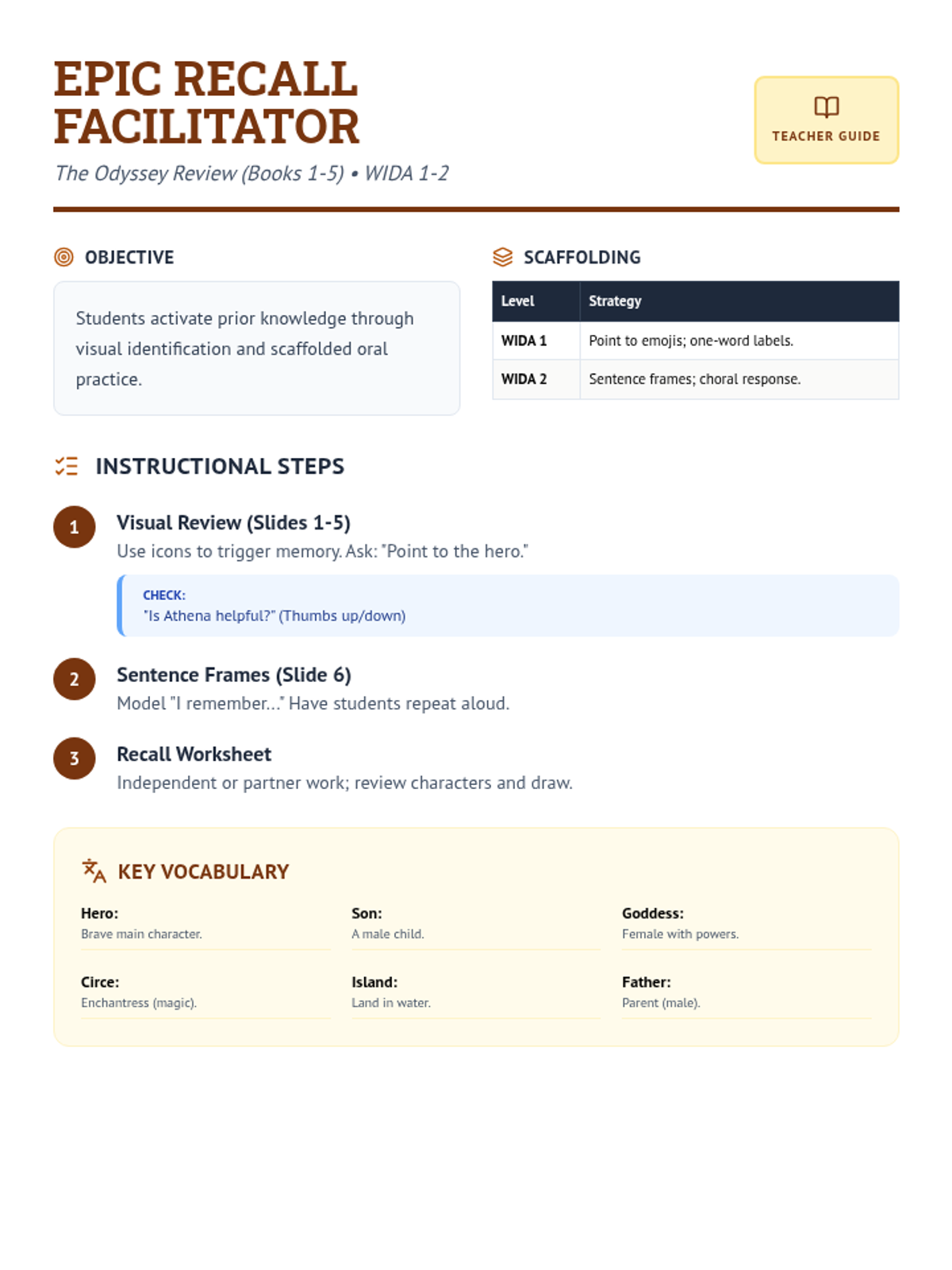
A facilitator guide for teachers, providing WIDA-aligned scaffolding strategies, step-by-step instruction notes, and key vocabulary for reviewing The Odyssey Books 1-5, focusing on Odysseus, Telemachus, Athena, and Calypso.
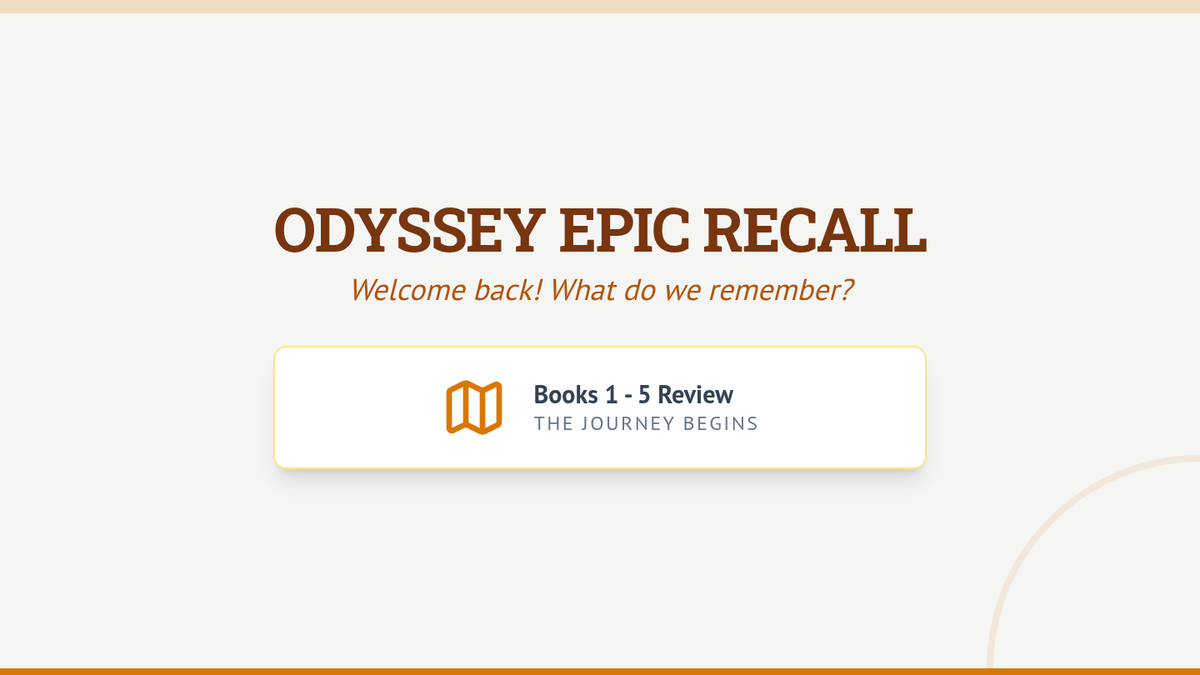
A visually engaging slide deck designed for level 1-2 ELL students to review characters and events from Books 1-5 of The Odyssey. Focuses on Odysseus, Telemachus, Athena, and Calypso with simplified language and visual supports.
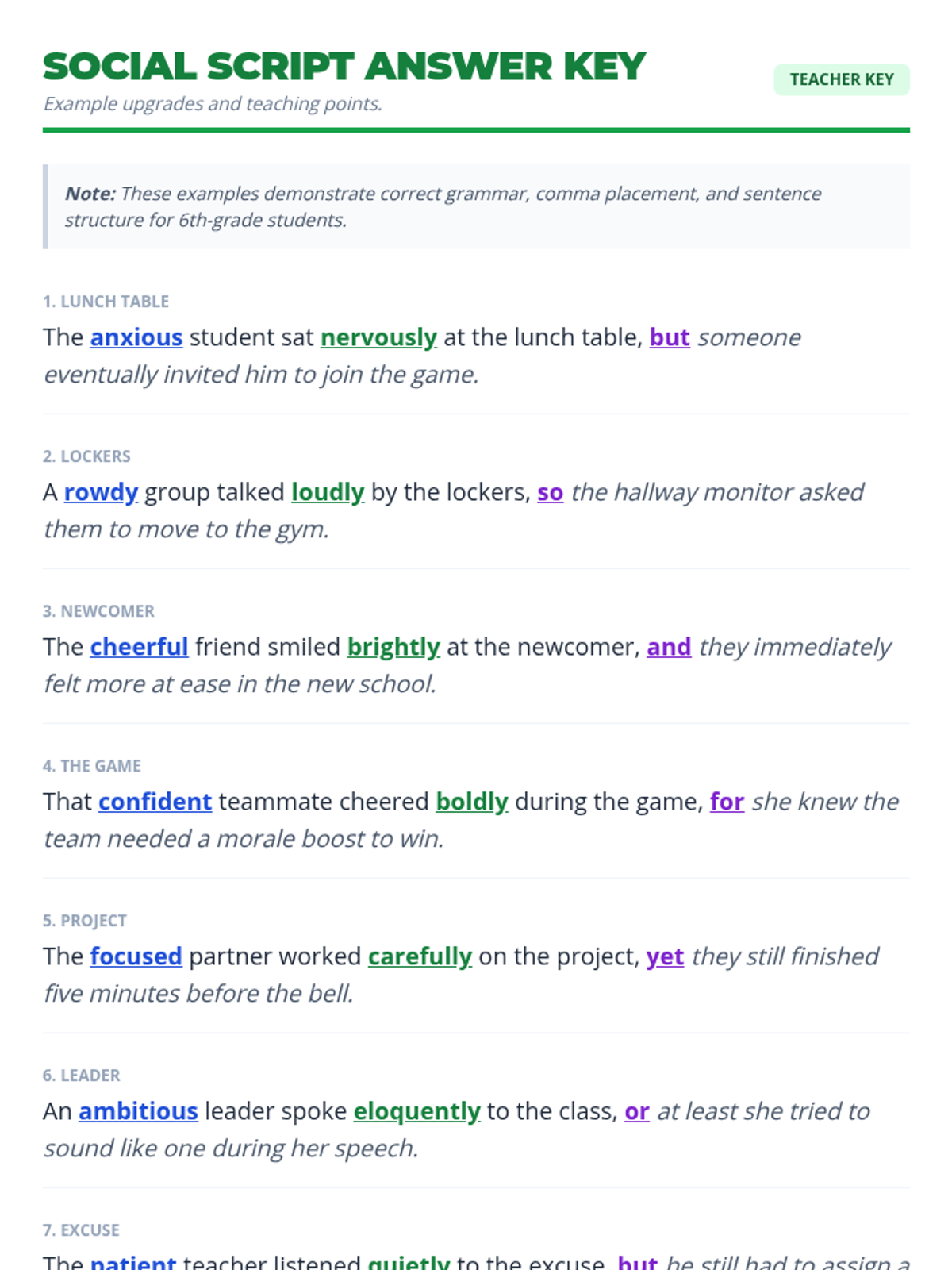
An answer key providing example responses for the Social Script Upgrade worksheet. Optimized to fit on two pages with clear examples.
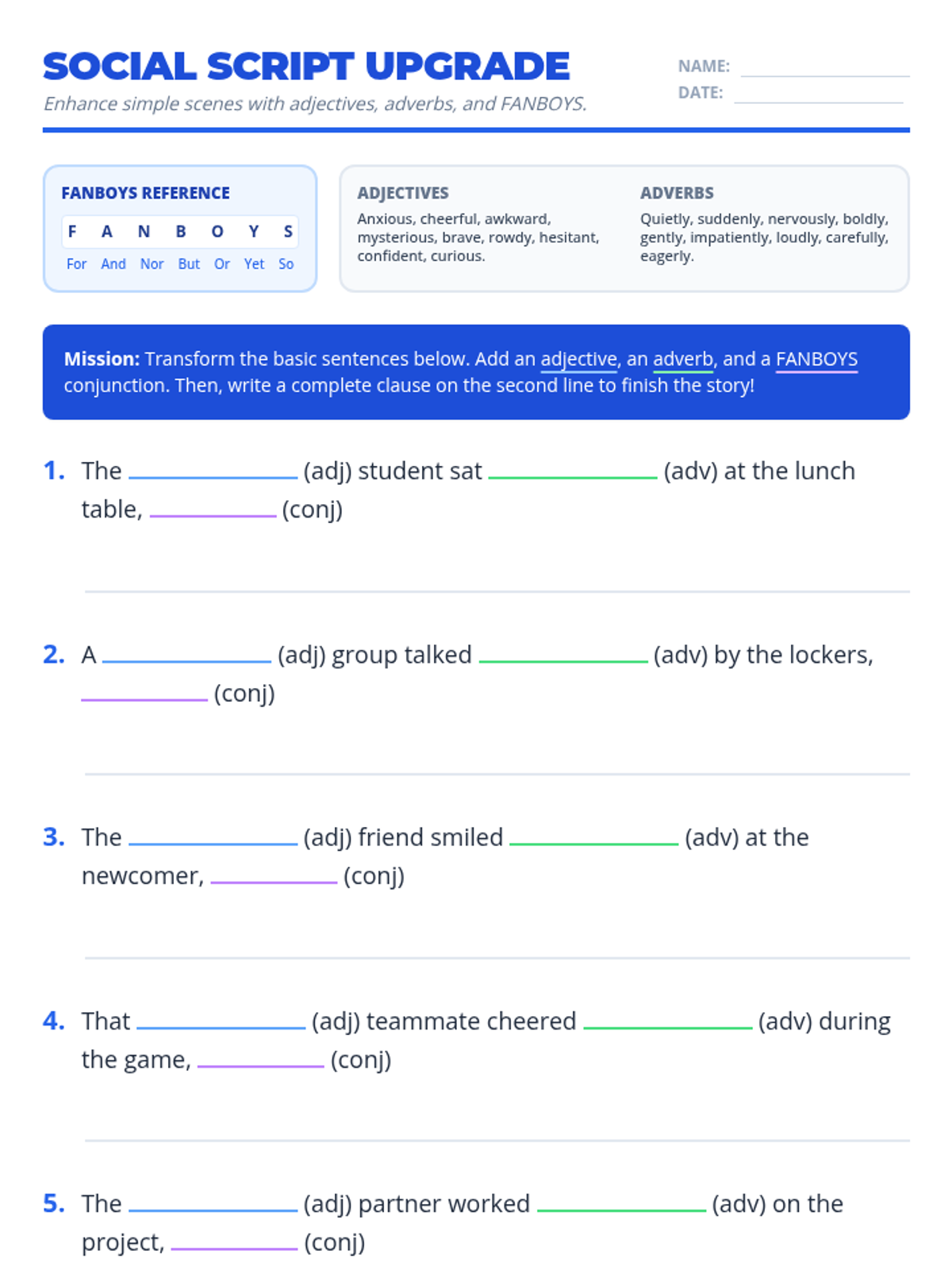
A fill-in-the-blank worksheet for 6th graders to practice enhancing simple sentences with adjectives, adverbs, and coordinating conjunctions (FANBOYS) within social scenarios. Provides ample writing space over two pages.
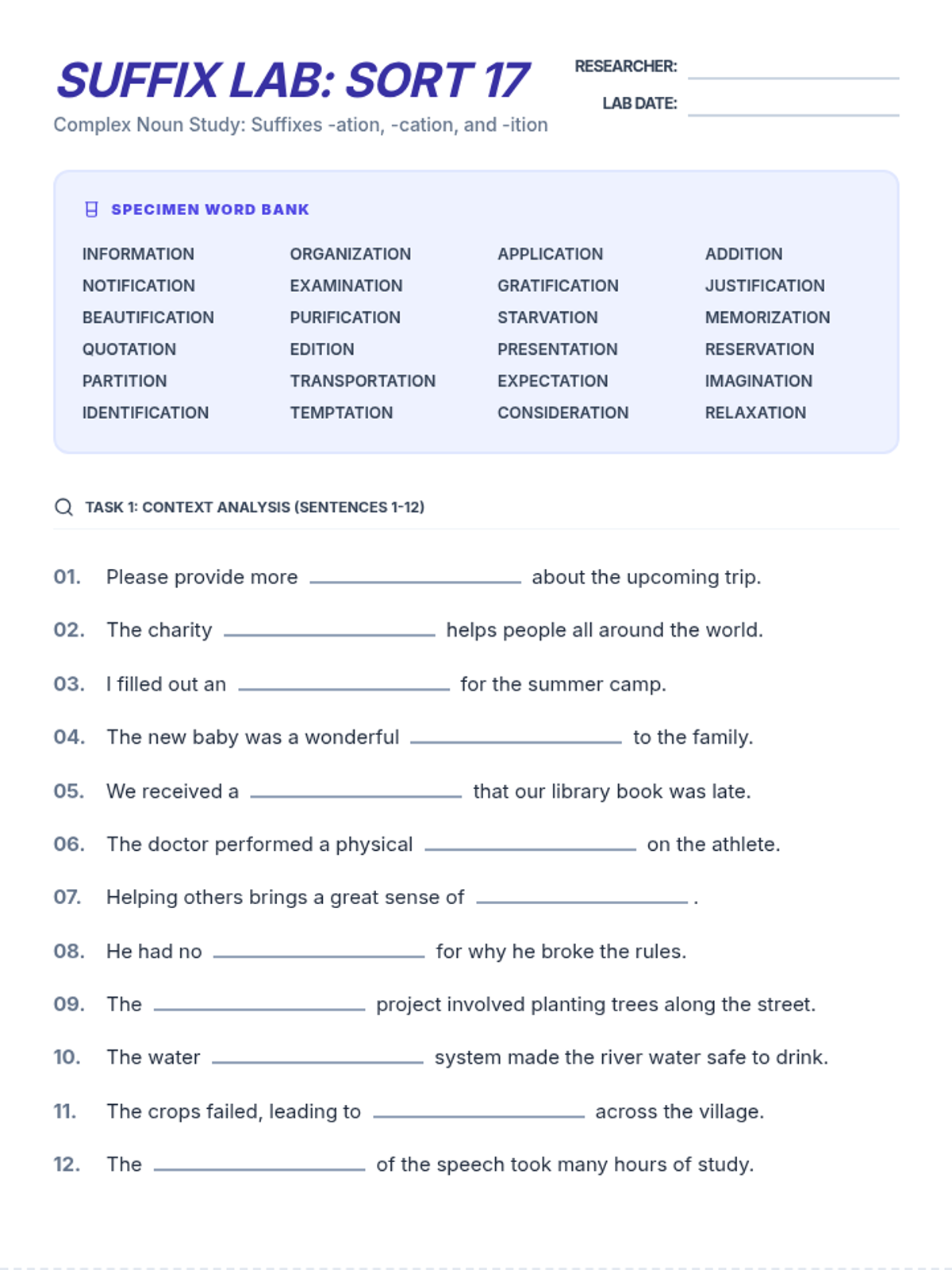
A 3-page printable packet for Sort 17 (-ation, -cation, -ition). Includes 24 fill-in-the-blank sentences across two pages, followed by a logic page with 6 word unscrambles and a functional 12x12 crossword puzzle.
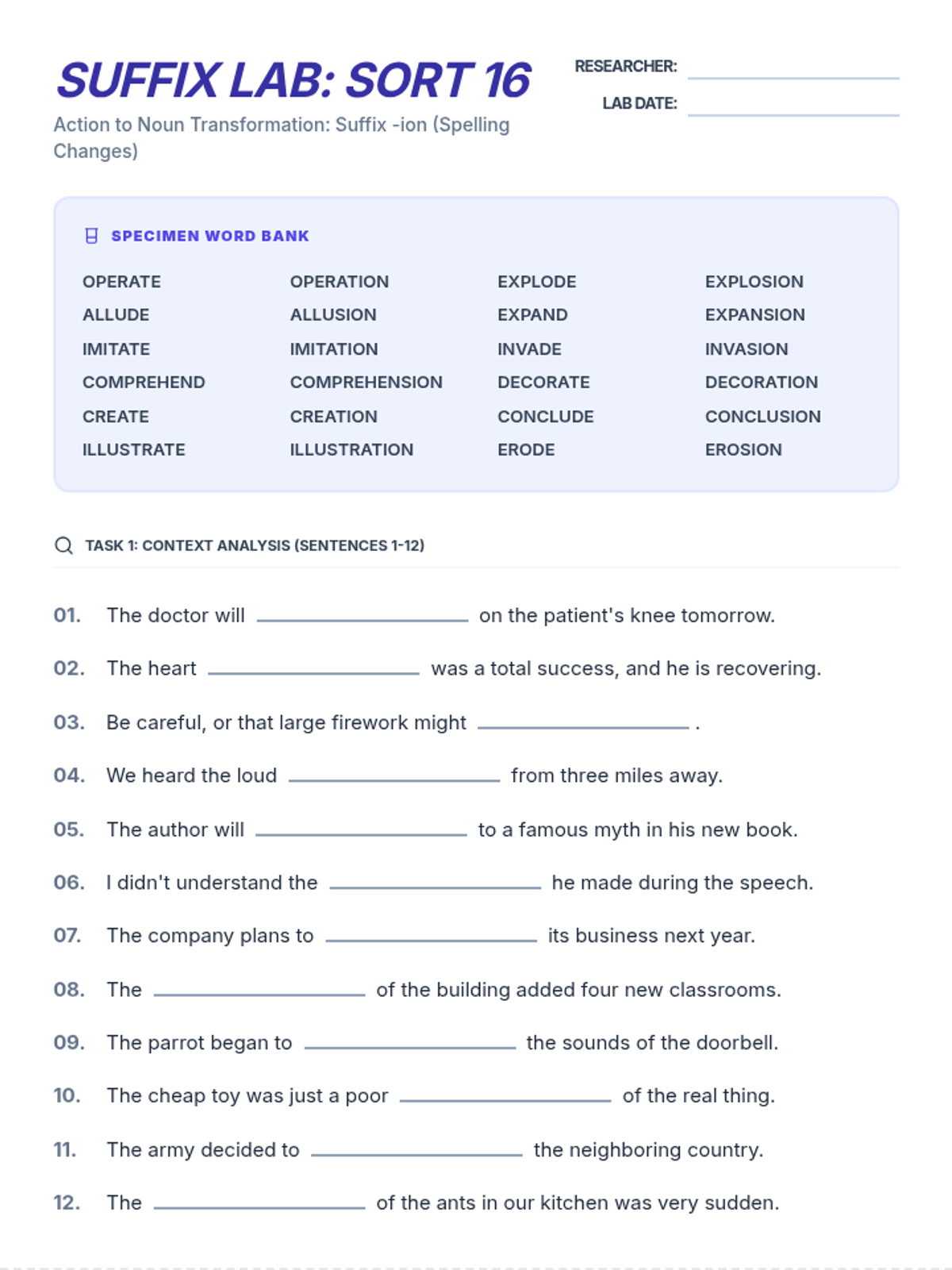
A 3-page printable packet for Sort 16 (-ion). Includes 24 fill-in-the-blank sentences across two pages, followed by a logic page with 6 word unscrambles and a functional 12x12 crossword puzzle.
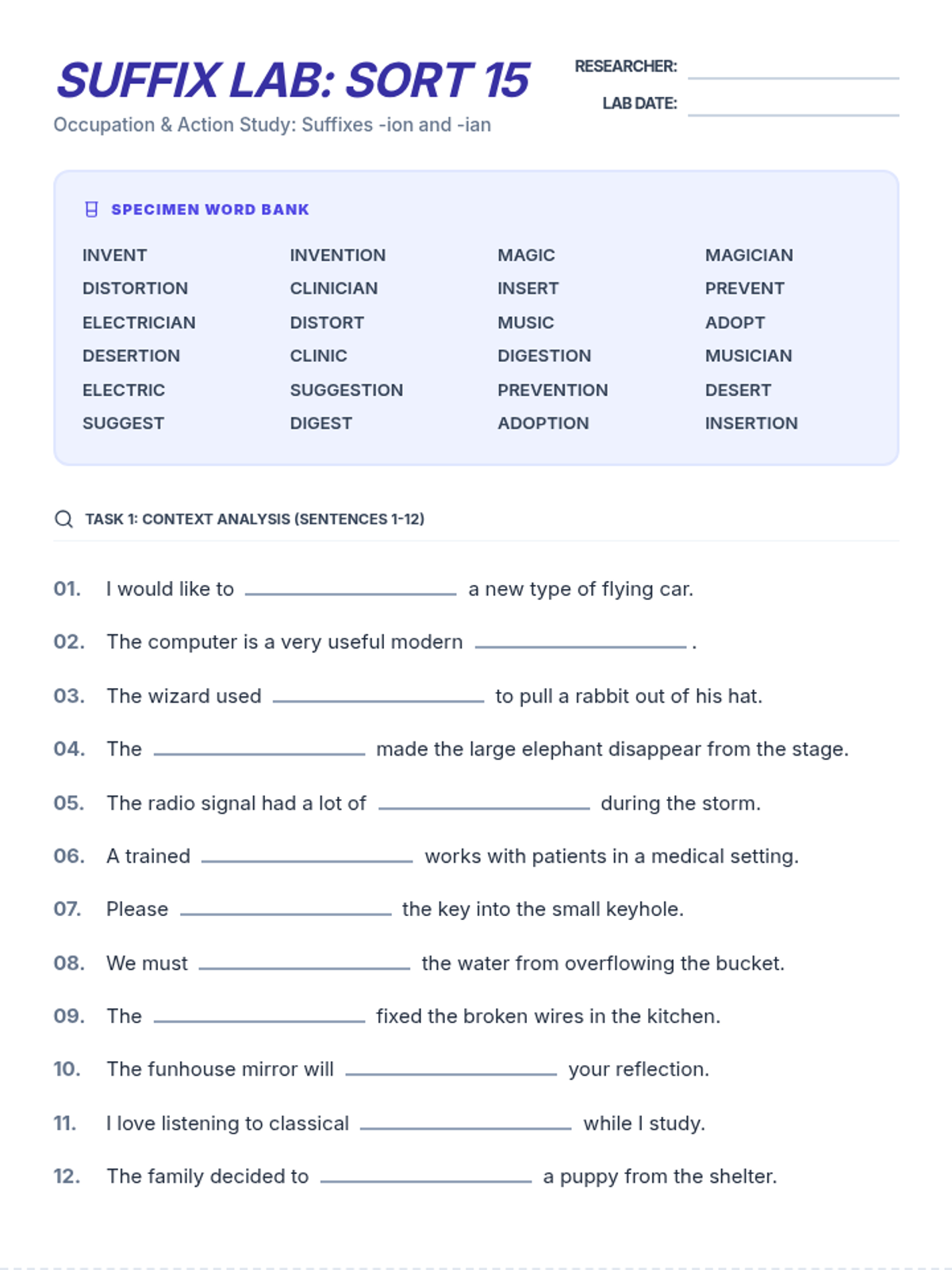
A 3-page printable packet for Sort 15 (-ion, -ian). Includes 24 fill-in-the-blank sentences across two pages, followed by a logic page with 6 word unscrambles and a functional 12x12 crossword puzzle.
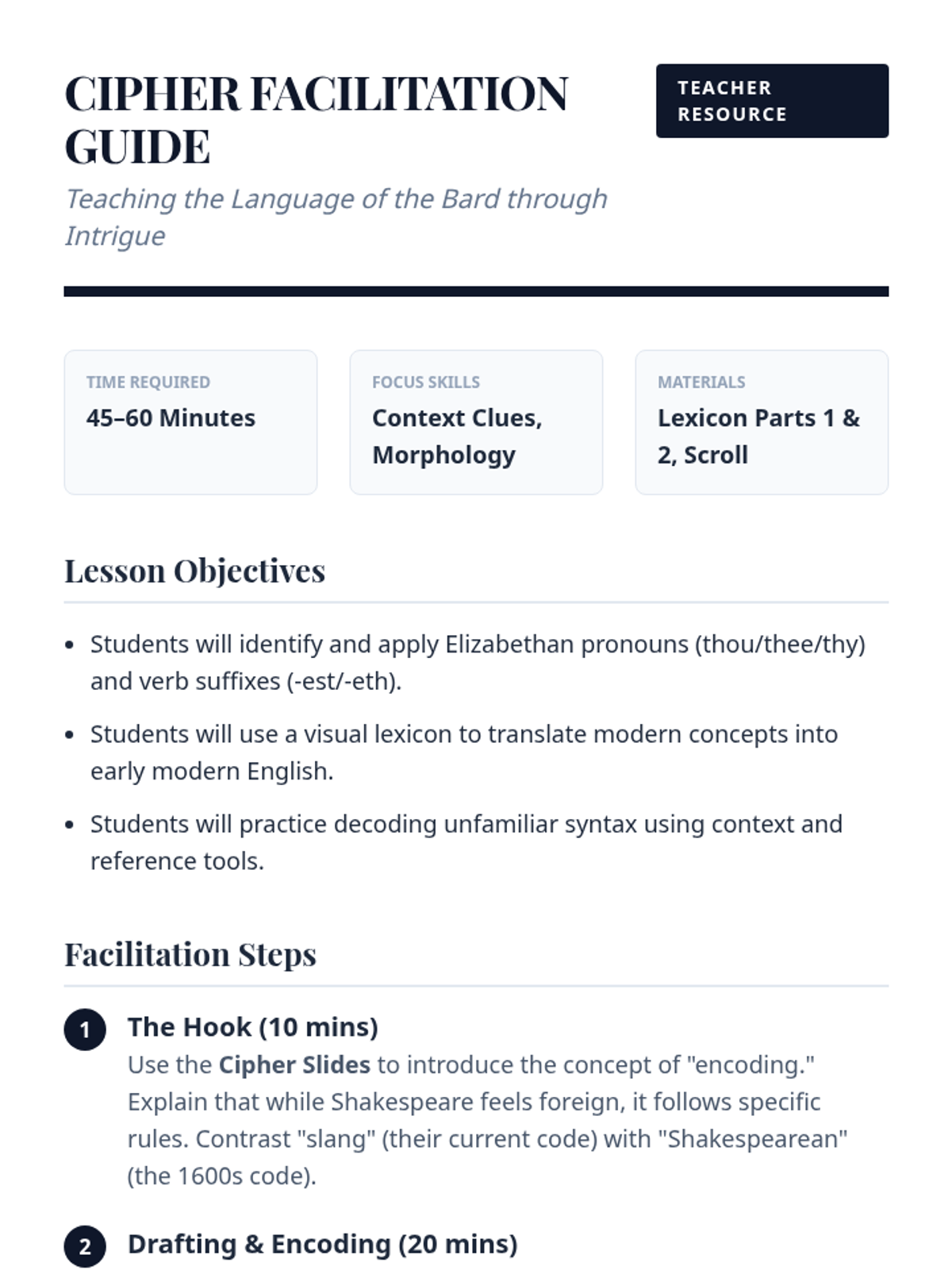
A teacher resource for 'The Bard's Cipher' lesson, providing instructional strategies, common misconceptions, and translation examples to facilitate student success. Updated to fix page breaks and icon rendering.
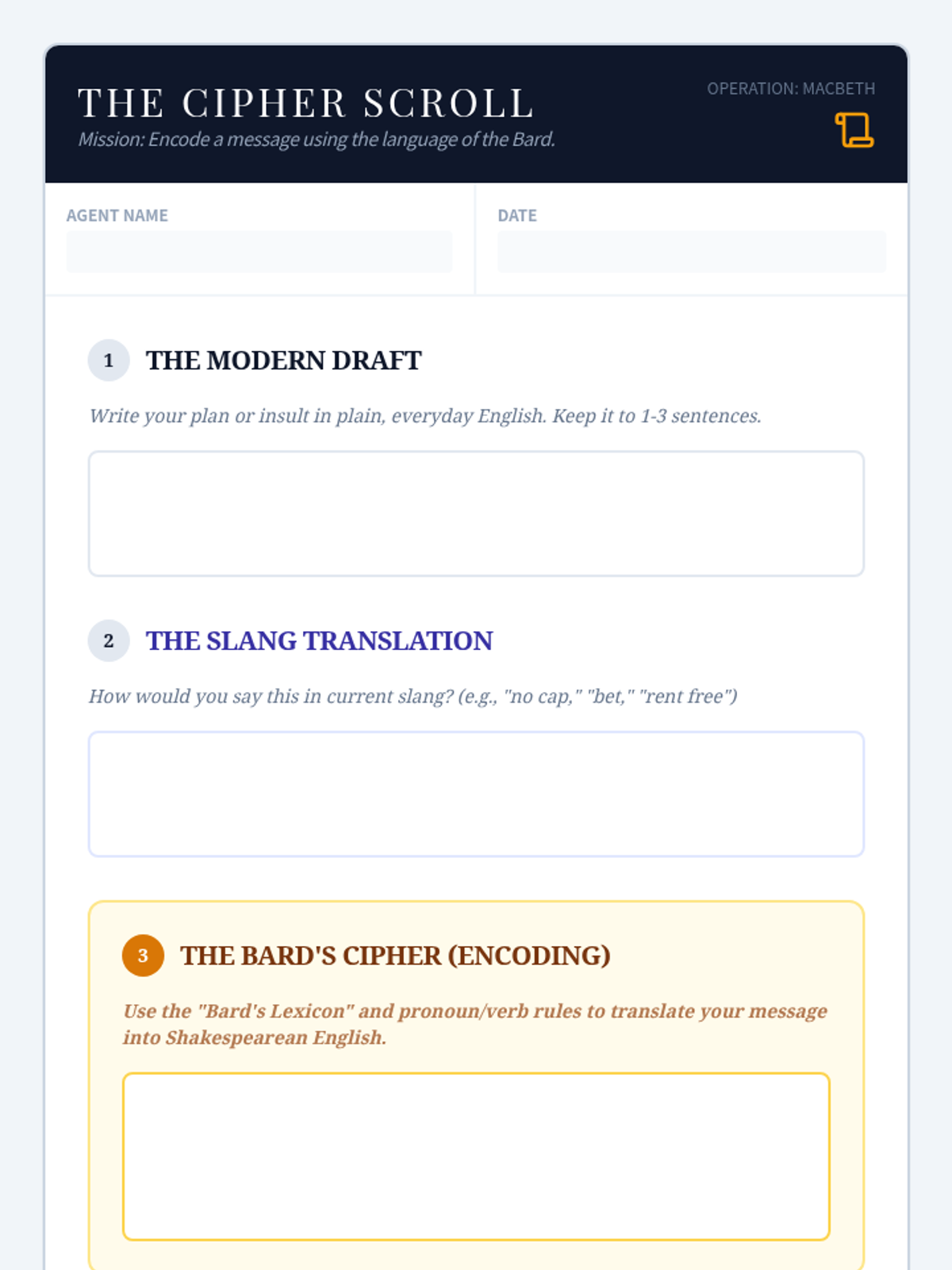
A multi-step activity worksheet where students draft a message in modern English and slang before 'encoding' it into Shakespearean language for a partner to decode. Updated to fix page break issues.
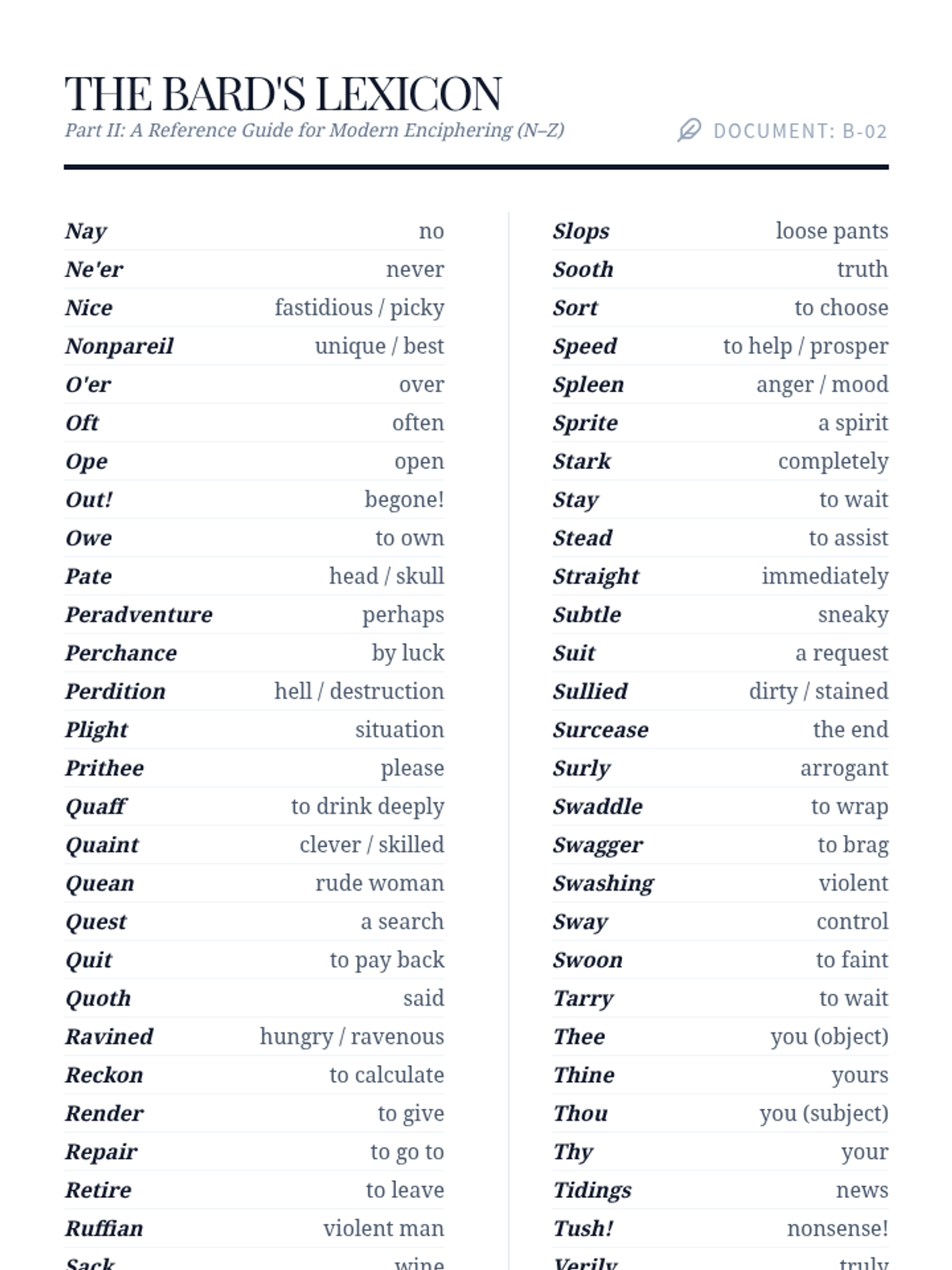
Part 2 of the visual word bank (N-Z) for the Shakespearean encoding activity, completing the alphabet with common Elizabethan words and their modern translations in pt. 12 font. Total word count across two parts exceeds 100.
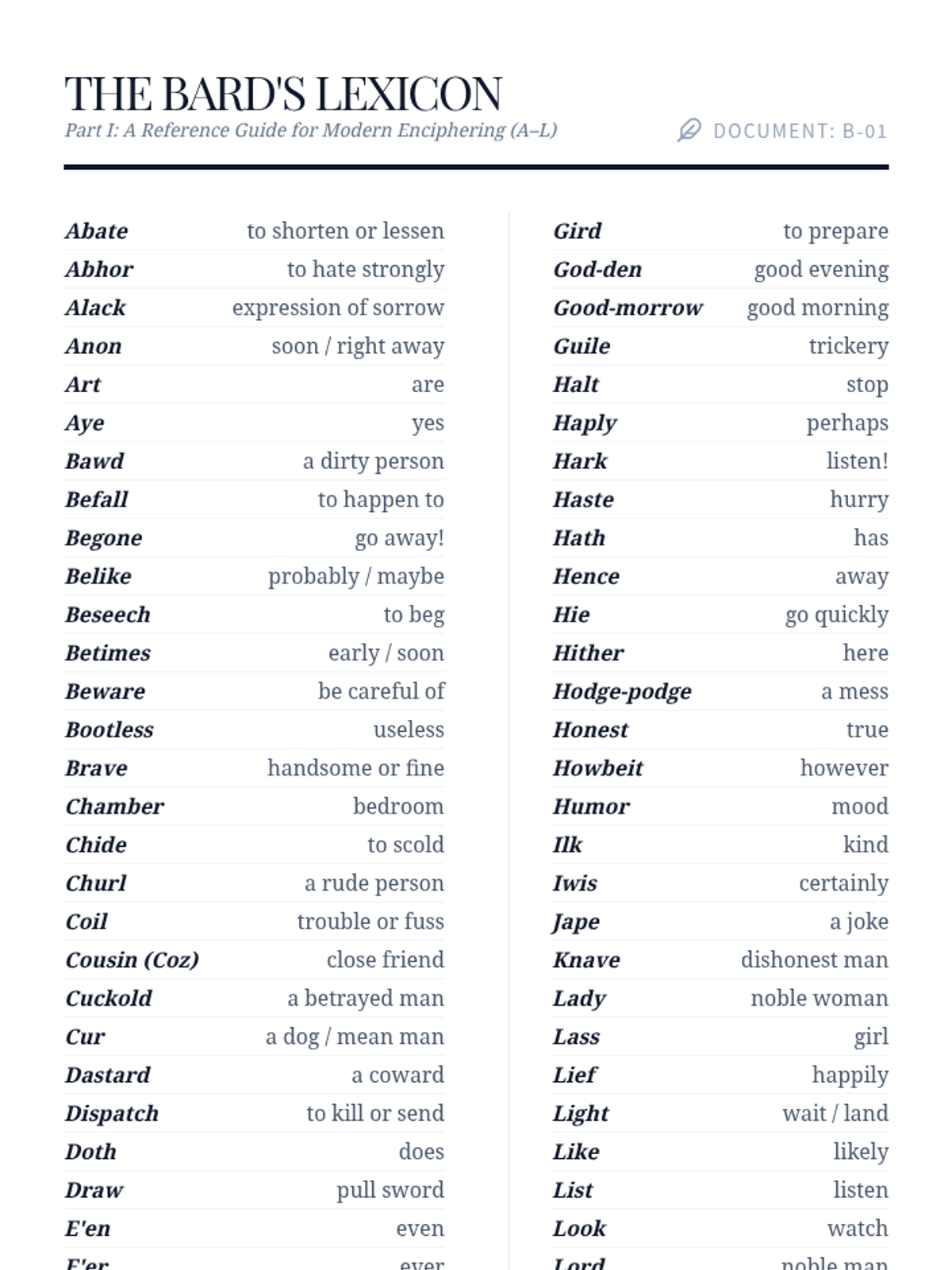
Part 1 of the visual word bank (A-M) for the Shakespearean encoding activity, featuring common Elizabethan words and their modern translations in pt. 12 font. Total word count across two parts exceeds 100.
An introductory slide deck for 'The Bard's Cipher' activity, covering basic Shakespearean pronouns, verb endings, and activity instructions with a moody Elizabethan aesthetic.
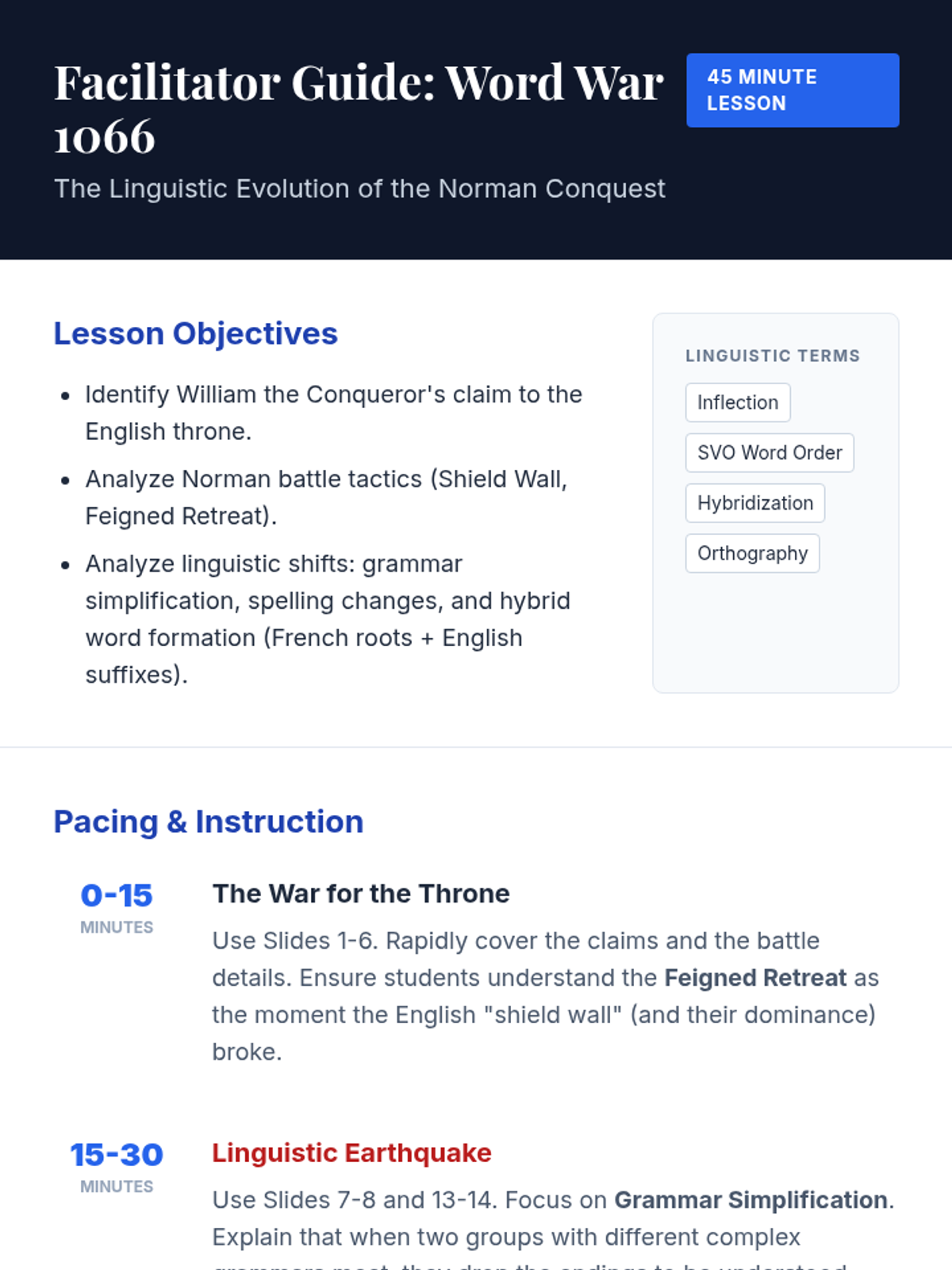
An expanded teacher guide with detailed instructional notes on linguistic evolution, grammar simplification, scribal changes, and hybrid word formation.
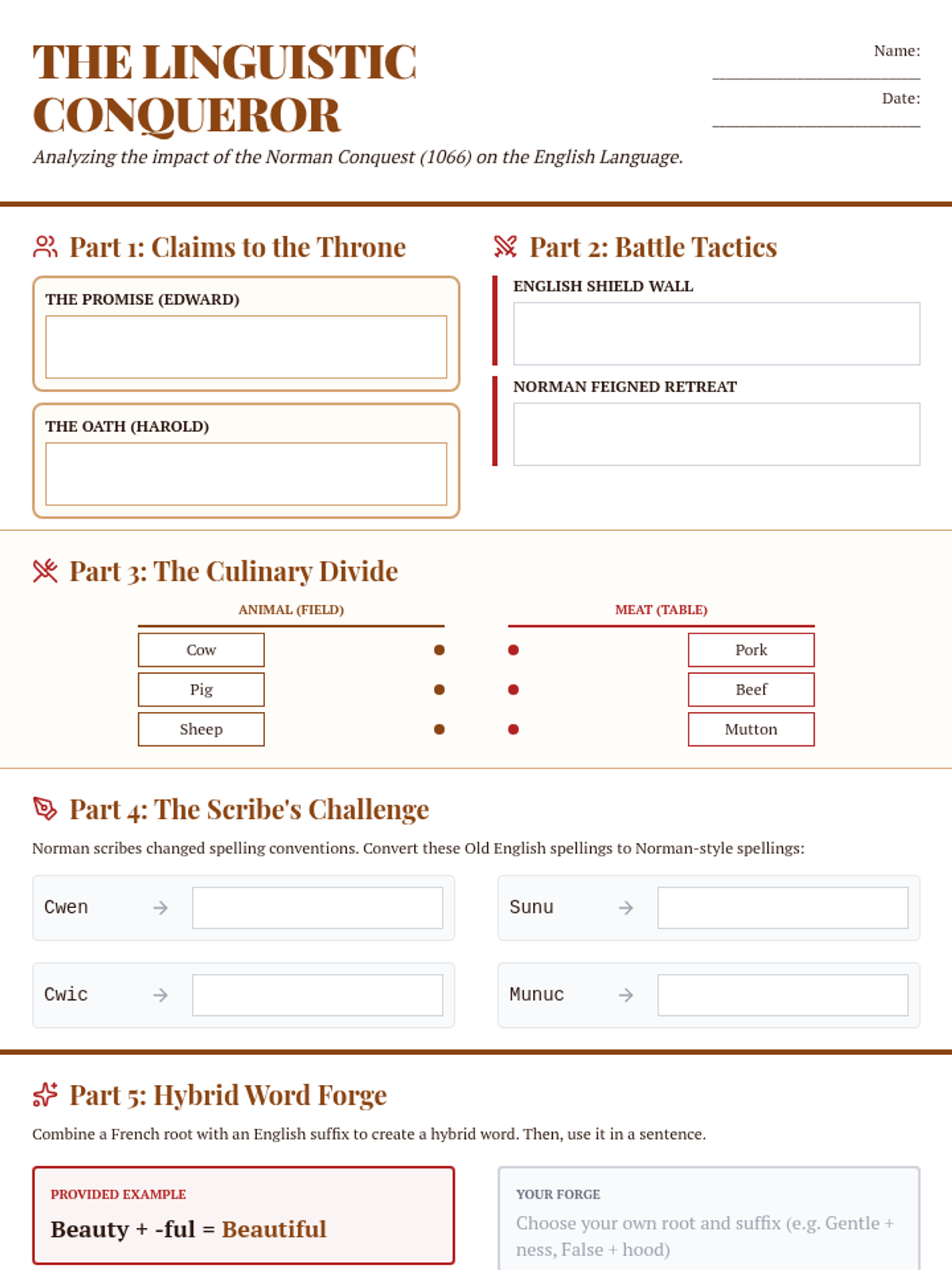
An expanded student worksheet featuring significant new linguistic activities on phonetic shifts, scribal spelling changes, hybrid word building, and grammar simplification.
An expanded 18-slide presentation detailing the Battle of Hastings tactics and adding extensive linguistic sections including a new "Sound of the Conqueror" slide with phonetic examples of vowel shifts and consonant changes.
The finalized, all-in-one Cosmic Carnival slide deck. Includes definitions, carnival examples, practice tasks with global language integrated, official WNHS logo branding, "By: Mr. Hamed" signature, the YouTube song, and functional QR scavenger hunt backup slides.
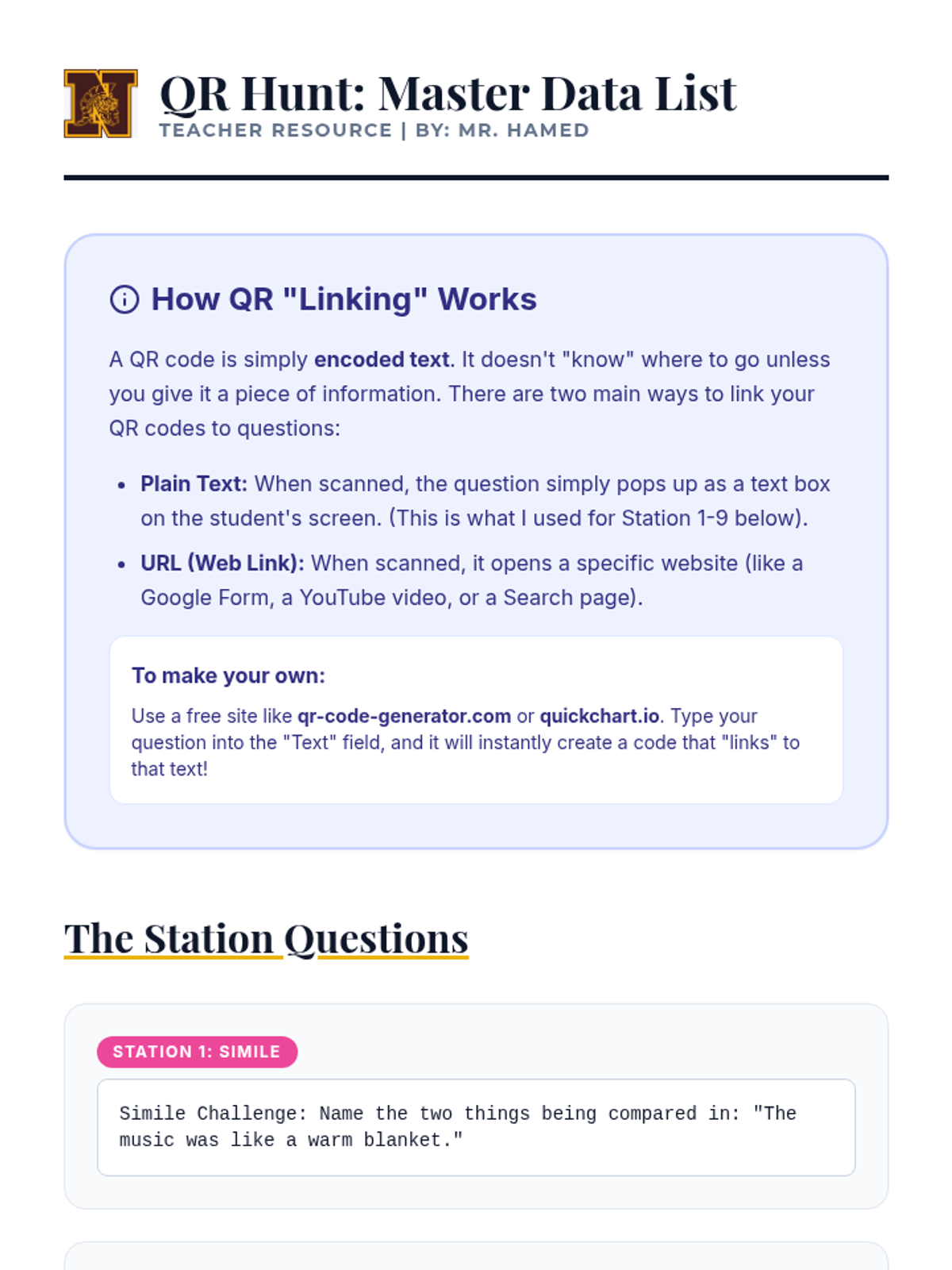
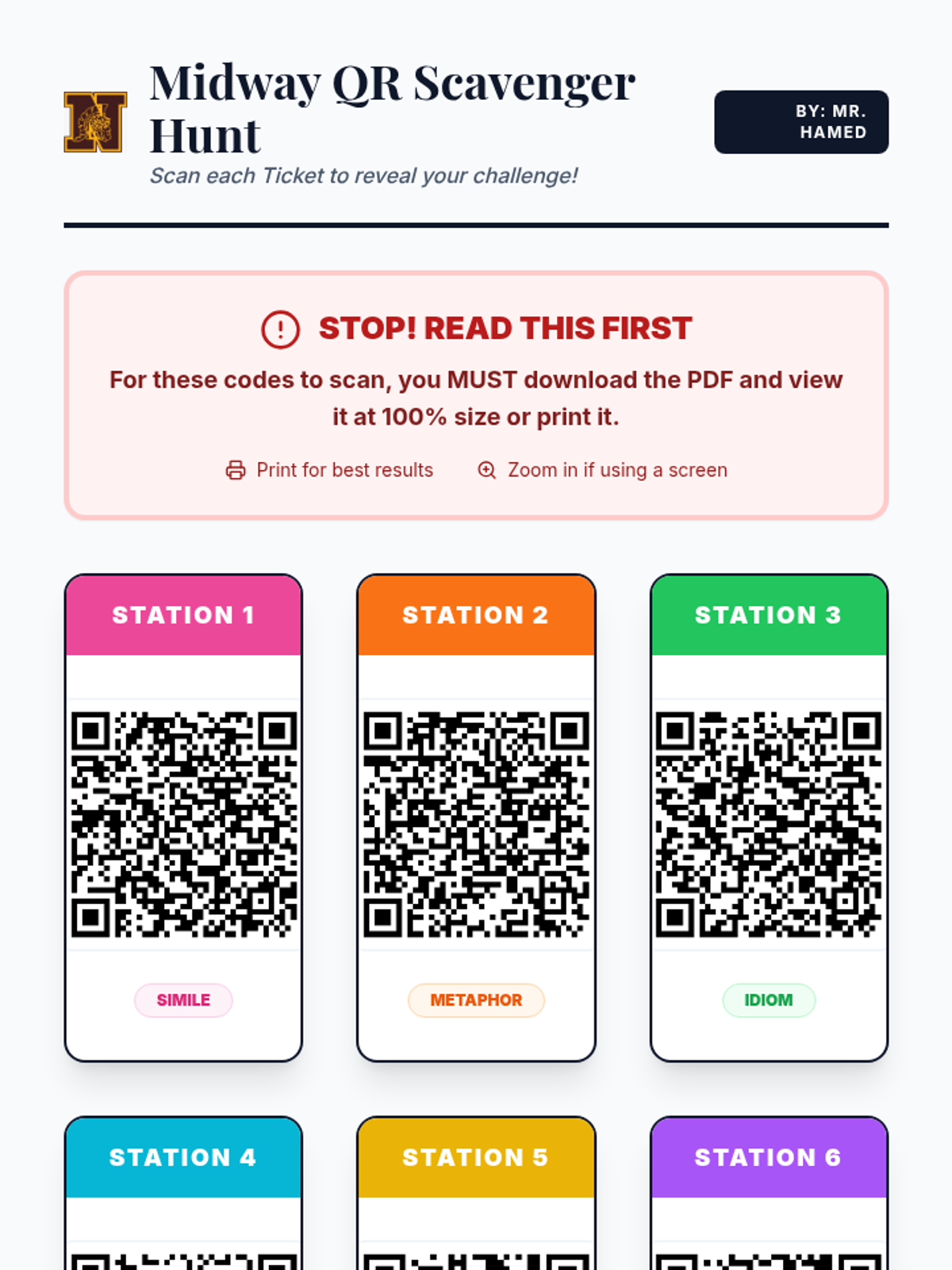
A teacher resource containing the raw text data used for all nine QR stations, along with a guide on how QR codes link to questions and how teachers can create their own custom codes.
The finalized Cosmic Carnival slide deck. Includes definitions and practice for all 9 devices, branded footer with the WNHS logo and "By: Mr. Hamed" on every slide, and an embedded YouTube video of the "Figurative Language Song" before the conclusion. Now includes a backup QR code slide for the scavenger hunt.
A high-resolution, functional QR code scavenger hunt. Each station features a large, scan-optimized QR code that links to a Google Search for the specific figurative language challenge, ensuring maximum compatibility with all mobile devices and scanner apps. Includes school branding and teacher key.
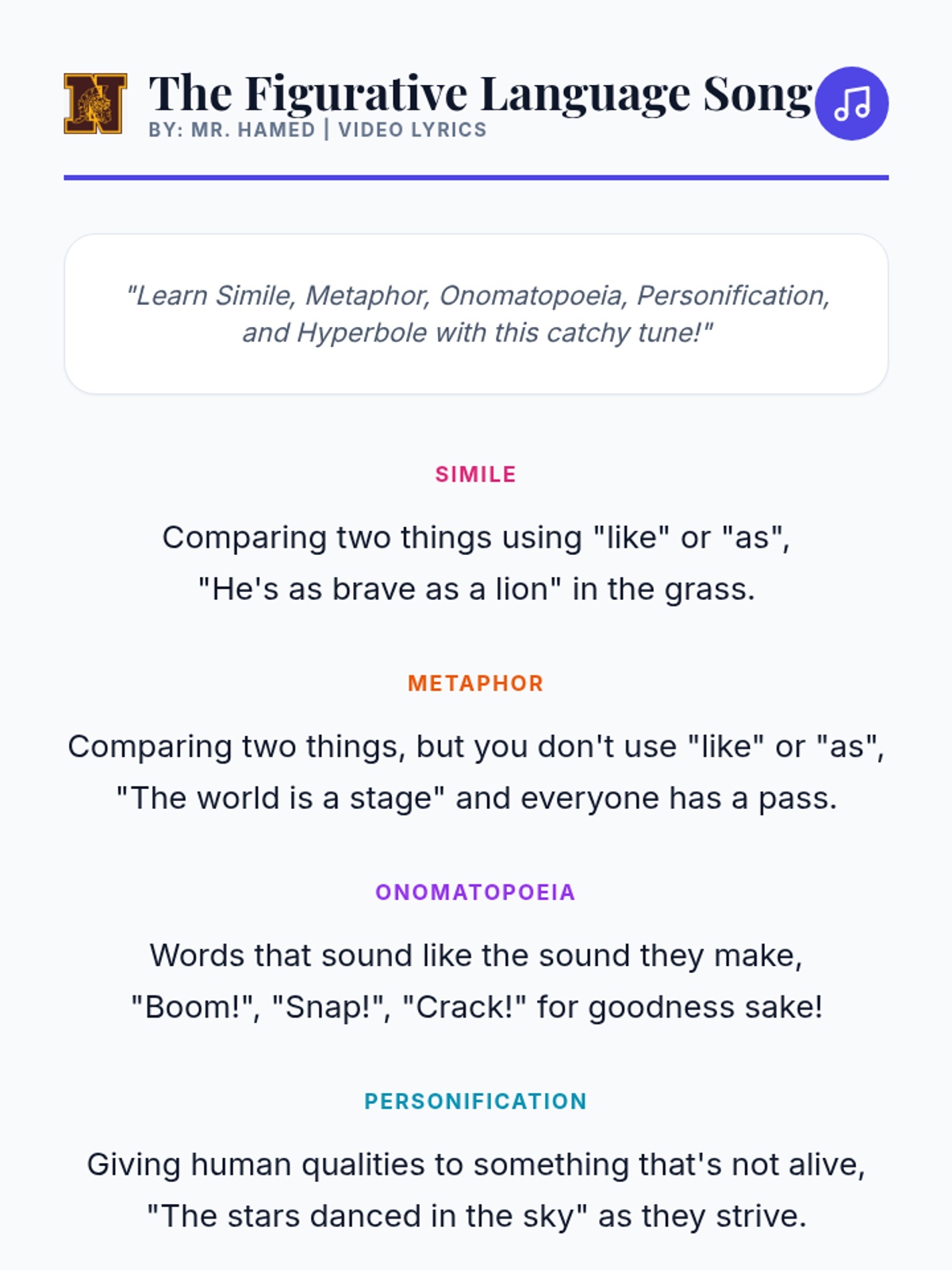
A lyric sheet for the "Figurative Language Song" YouTube video. Covers Simile, Metaphor, Onomatopoeia, Personification, and Hyperbole with examples from the song. Branded for WNHS and Mr. Hamed.
Updated the Mythic Legends Mythology packet: removed quotation marks and italics from all daily facts on Pages 4-33. Also updated the quote on the educational rationale page (Page 3) to remove italics for consistency with the new series-wide plain-text fact style.
Updated the Music Masters packet: removed quotation marks and italics from all daily facts on Pages 4-33. Also updated the quote on the educational rationale page (Page 3) to remove italics for consistency with the new series-wide plain-text fact style.
Updated the Ocean Depths packet: removed quotation marks and italics from all daily facts on Pages 4-33. Also updated the quote on the educational rationale page (Page 3) to remove italics for consistency with the new series-wide plain-text fact style.
Updated the Art Masters packet: removed quotation marks and italics from all daily facts on Pages 4-33. Also updated the quote on the educational rationale page (Page 3) to remove italics for consistency with the new series-wide plain-text fact style.
Updated the Invention Lab packet: removed quotation marks and italics from all daily facts on Pages 4-33. Also updated the quote on the educational rationale page (Page 3) to remove italics for consistency with the new series-wide plain-text fact style.
Updated the Sports Champions packet: removed quotation marks and italics from all daily facts on Pages 4-33. Also updated the quote on the educational rationale page (Page 3) to remove italics for consistency with the new series-wide plain-text fact style.
Updated the World Wonders Geography packet: removed quotation marks and italics from all daily facts on Pages 4-33. Also updated the quote on the educational rationale page (Page 3) to remove italics for consistency with the new series-wide plain-text fact style.
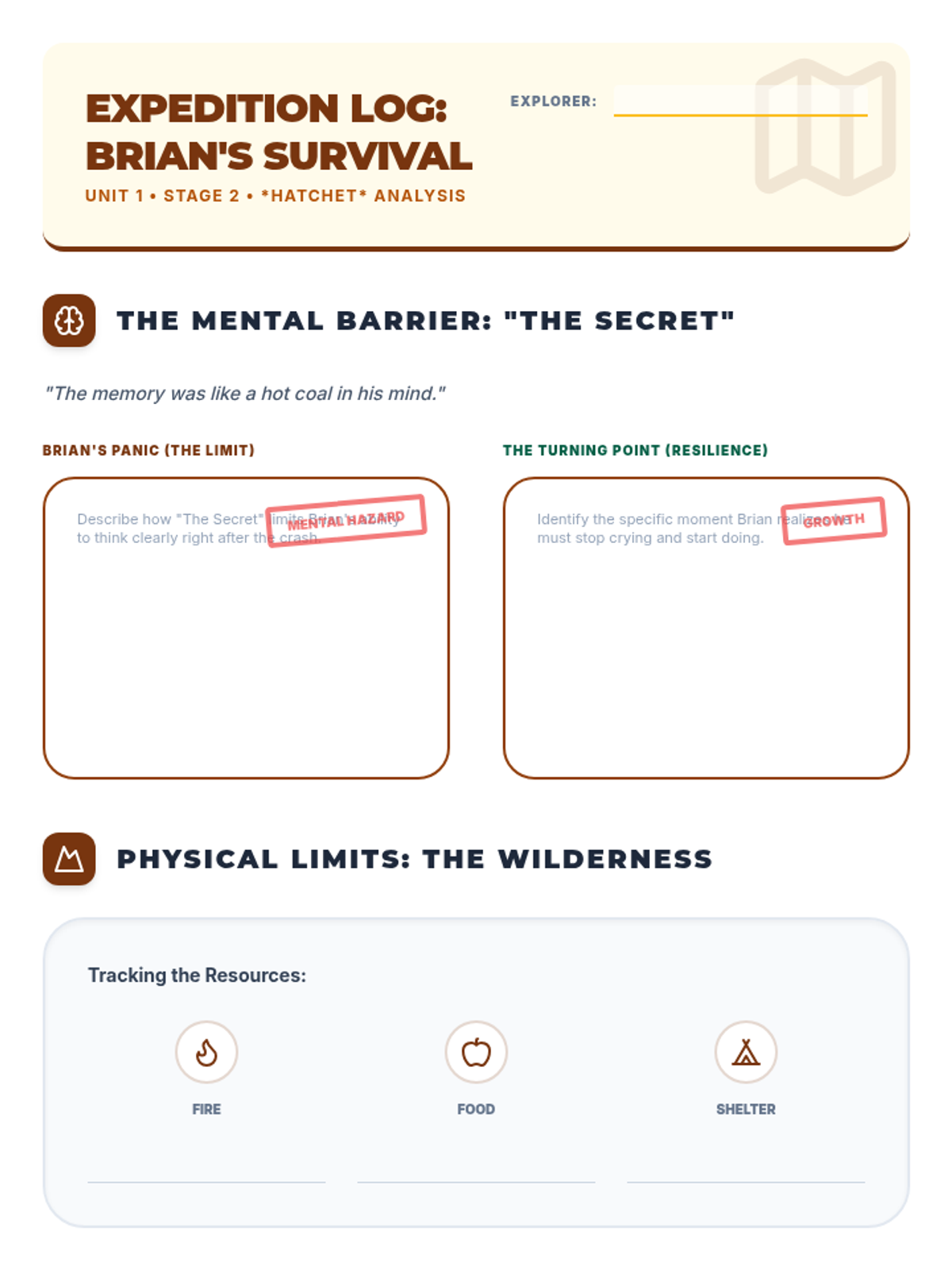
A rugged student worksheet for 'Hatchet' featuring survival tracking for Brian's resources and a deep-dive reflection on mental vs. physical survival.
A historical context slide deck for 'Red Scarf Girl' exploring the Cultural Revolution, the Four Olds, and the Red Guards within the unit theme of testing limits. Updated for better spacing and contrast.
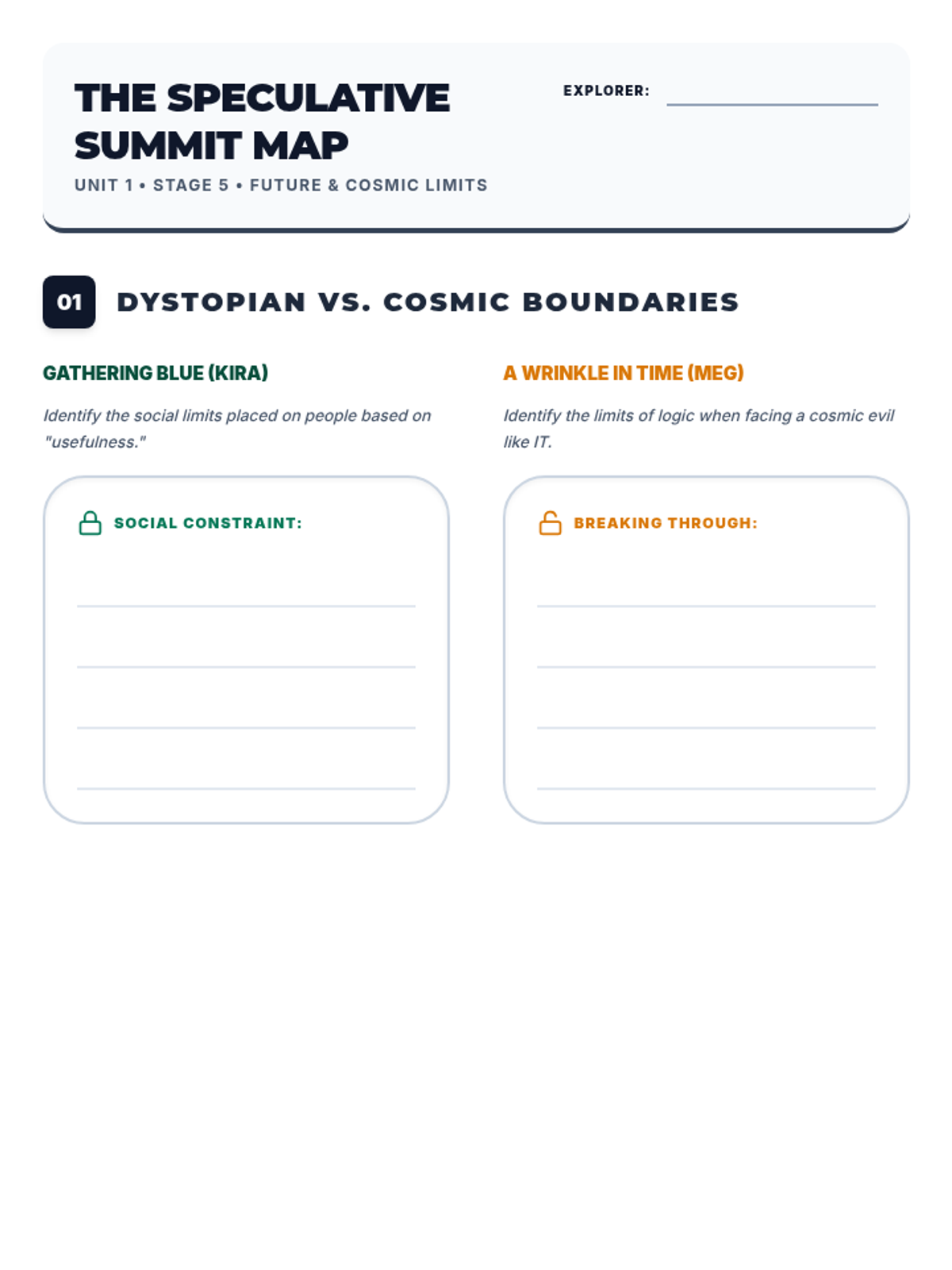
A final planning worksheet for Week 5 focusing on character gifts and societal boundaries in 'Gathering Blue' and 'A Wrinkle in Time'. Updated with white work areas for legibility and unified page structure.
A slide deck for Week 5 focusing on world-building and character gifts in 'Gathering Blue' and 'A Wrinkle in Time'. Updated for improved text spacing and reliable cosmic visuals.
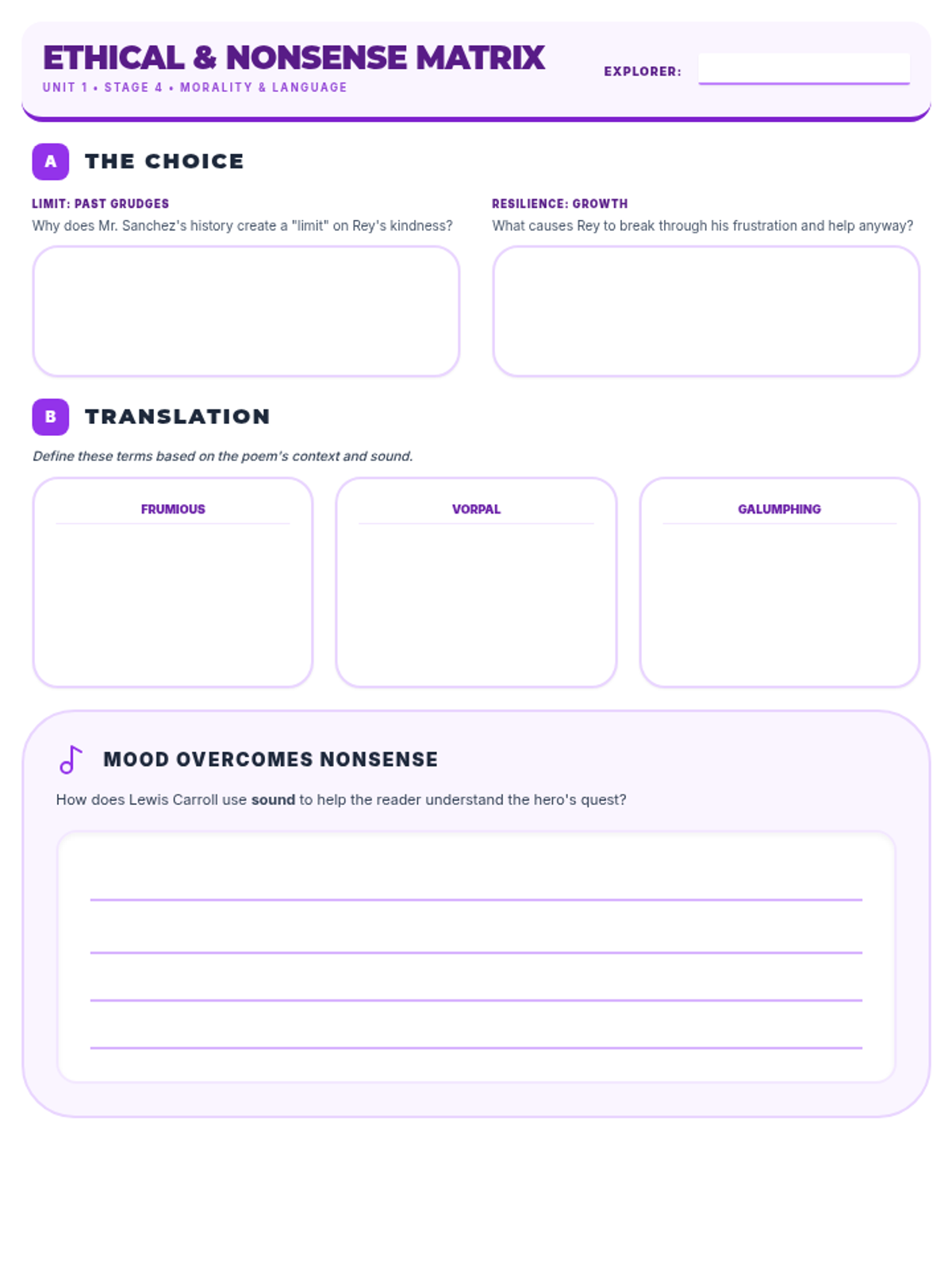
A worksheet for Week 4 analyzing moral dilemmas in 'Good Samaritan' and word-play in 'Jabberwocky'. Updated for one-page fit and improved writing space for Part C.
A slide deck for Week 4 focusing on ethical choices in 'Good Samaritan' and linguistic play in 'Jabberwocky'.
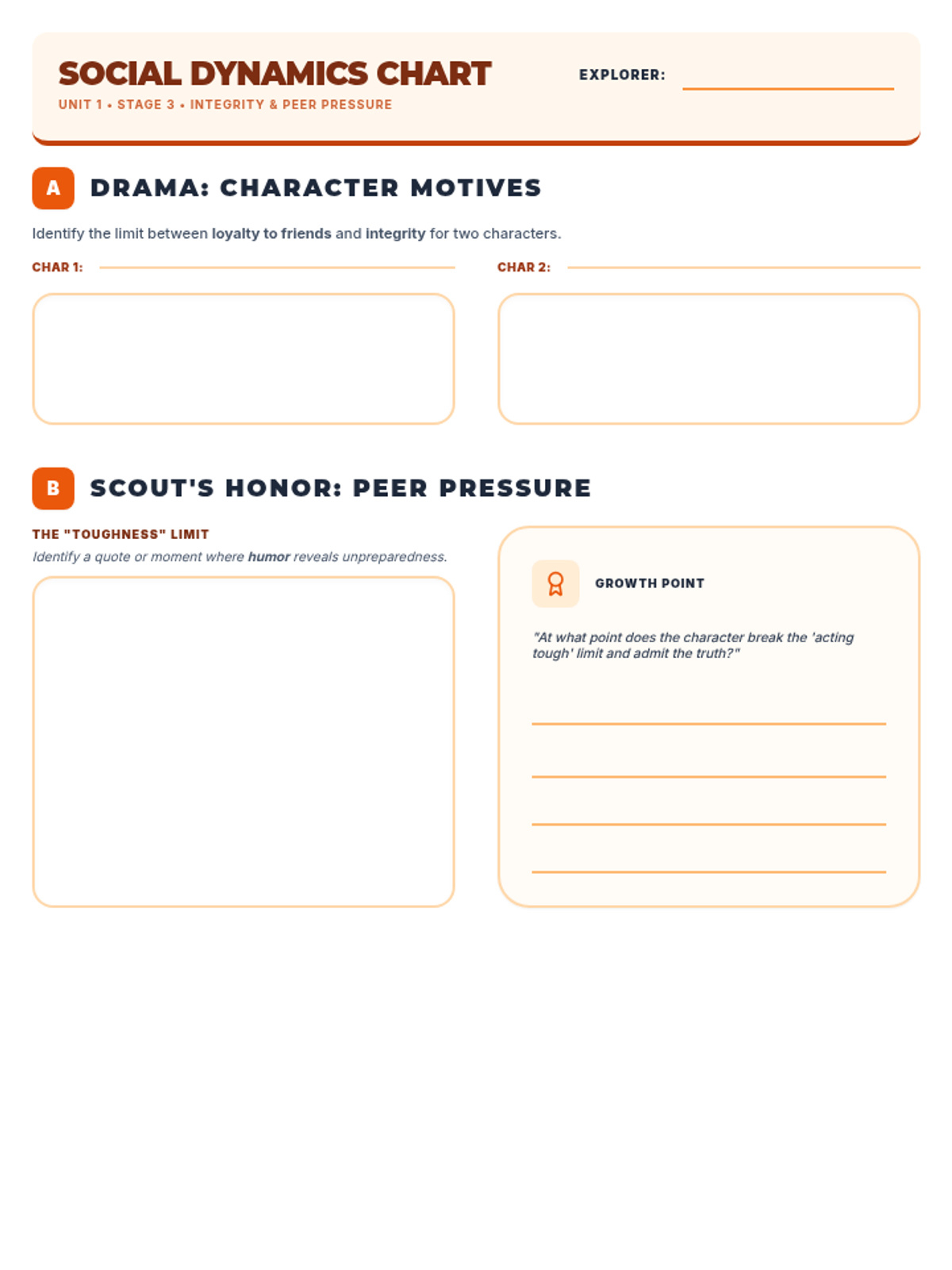
A worksheet for Week 3 analyzing character motives in drama and peer pressure in fiction. Updated for better spacing and one-page layout.
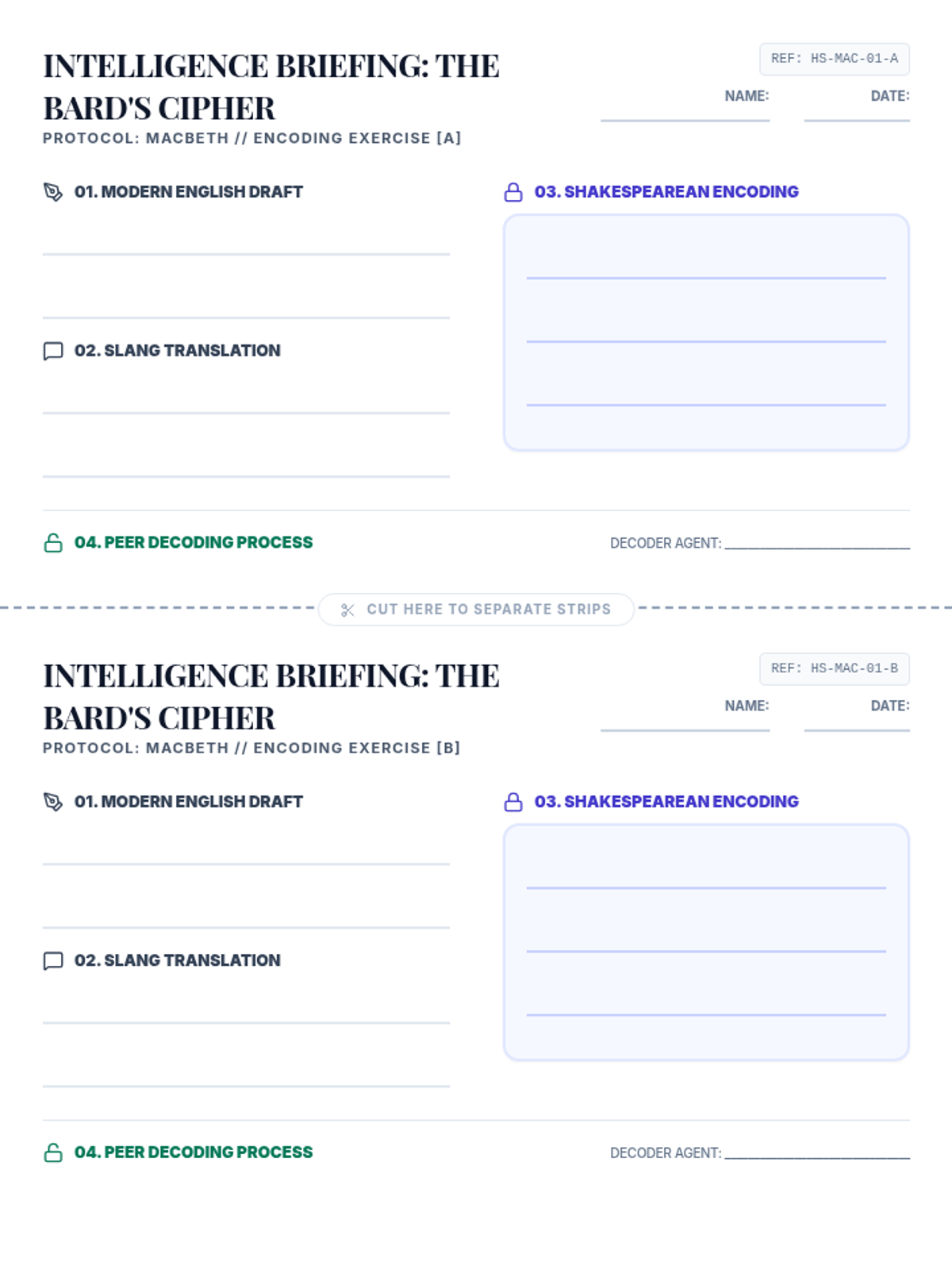
A compact, high-school oriented version of the Cipher Scroll activity, formatted as two strips per page with lines for modern, slang, and Shakespearean translations. Updated for better handwriting space and readability.
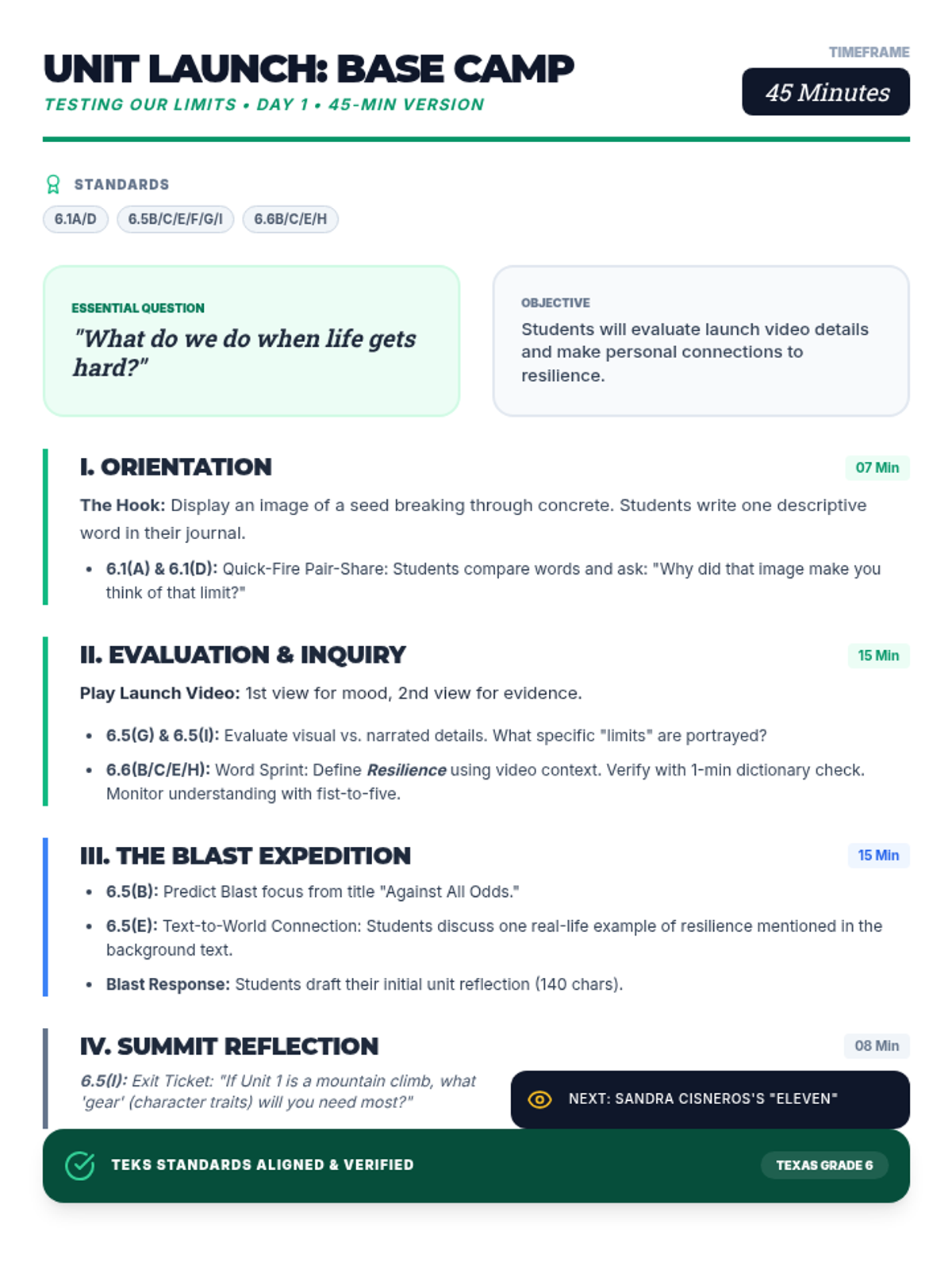
A refined 45-minute lesson plan for Unit 1 Day 1, covering 12 Texas TEKS standards. Streamlined for pace without sacrificing thematic depth or collaborative activities.
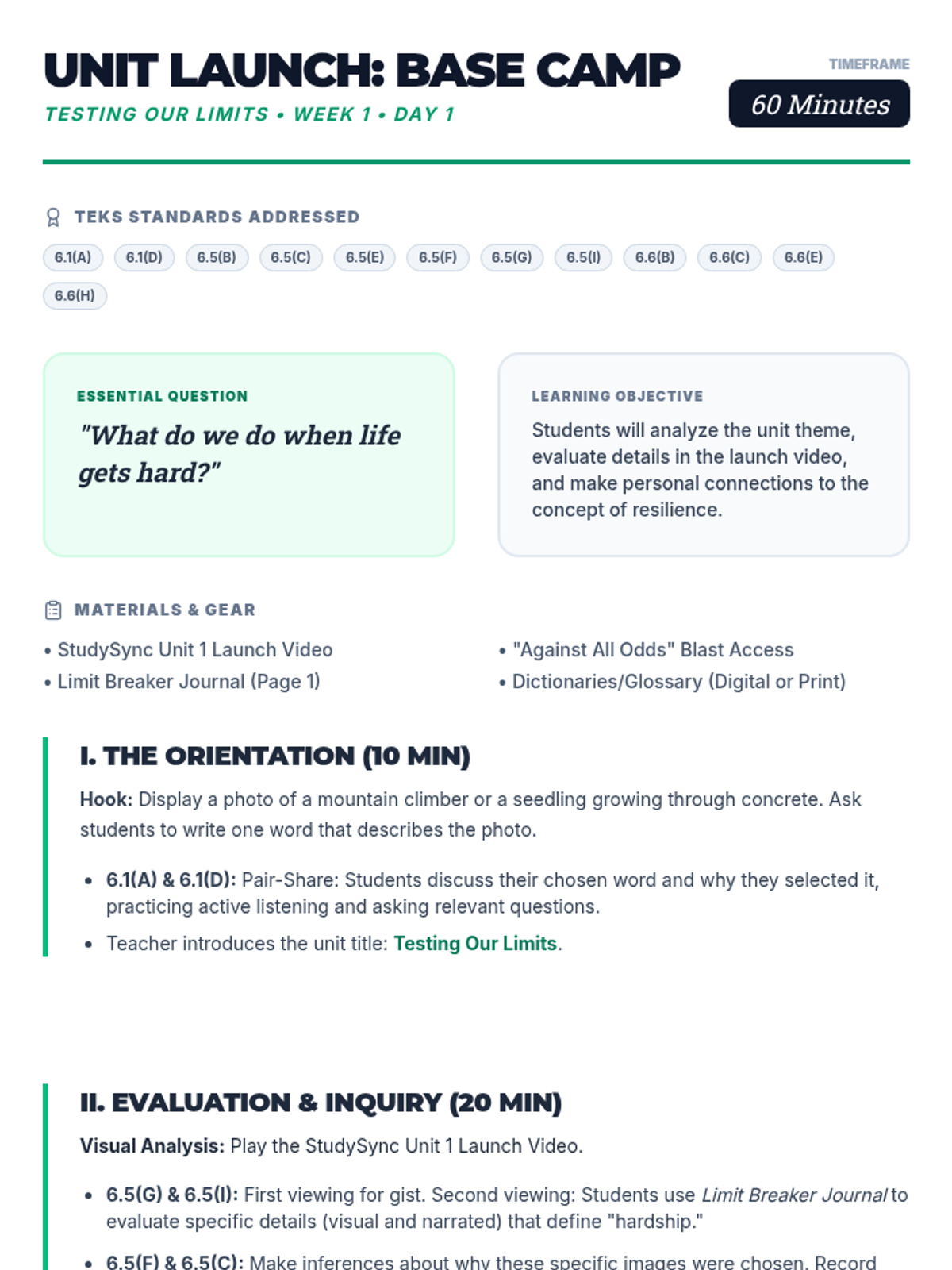
A detailed Unit 1 Week 1 Day 1 lesson plan for Grade 6 Texas StudySync, aligned with 12 specific TEKS standards and the theme 'Testing Our Limits'. Includes procedural steps for the Unit Video and Blast.
A slide deck for Week 3 focusing on social limits and integrity in 'The Magic Marker Mystery' and 'Scout’s Honor'.
Week 2 slide deck exploring conflict and perspective in 'Red Scarf Girl' and 'Hatchet'.
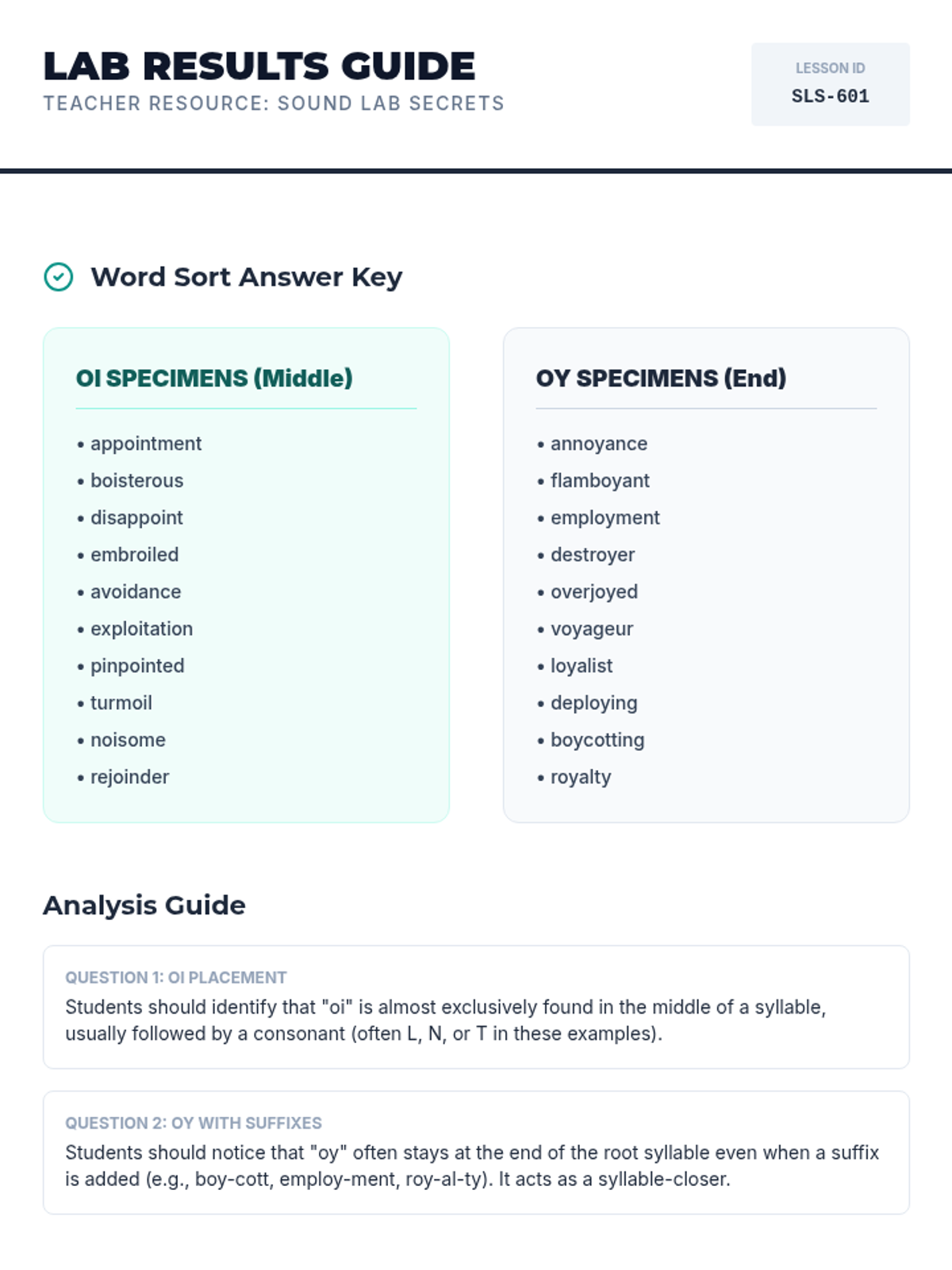
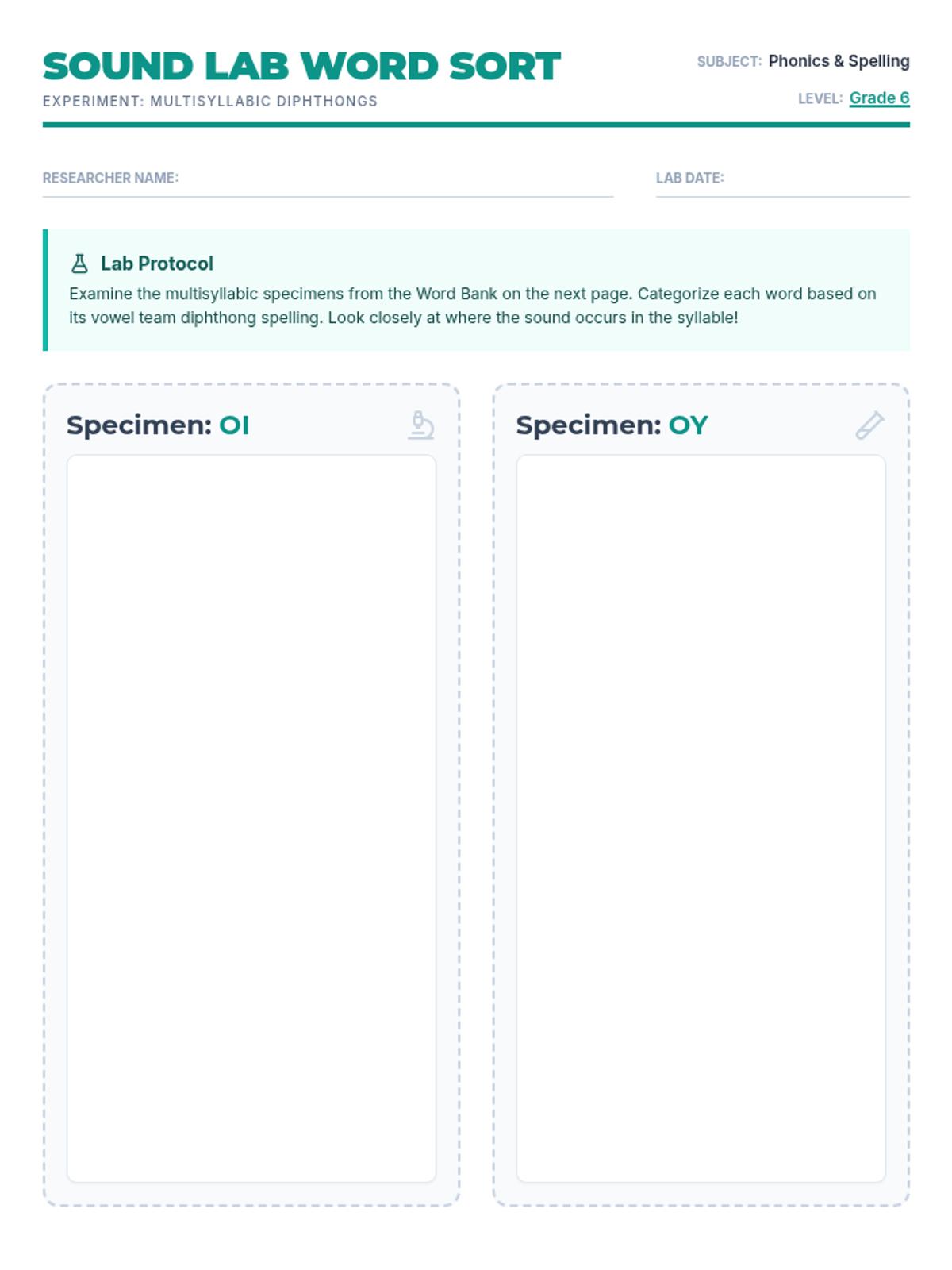
A comprehensive teacher guide and answer key for the Sound Lab Secrets lesson. Features a categorized answer key for the word sort, sample analysis answers, and strategies for differentiation.
Revised instructional slides for 'oi' and 'oy' diphthongs. Includes a reference specimen list, uniform underlines for interactive checks, and a separate answer reveal slide.
A revised two-page interactive word sort for Grade 6 students. Layout optimized to prevent content cutoff, with expanded writing lines for better usability.
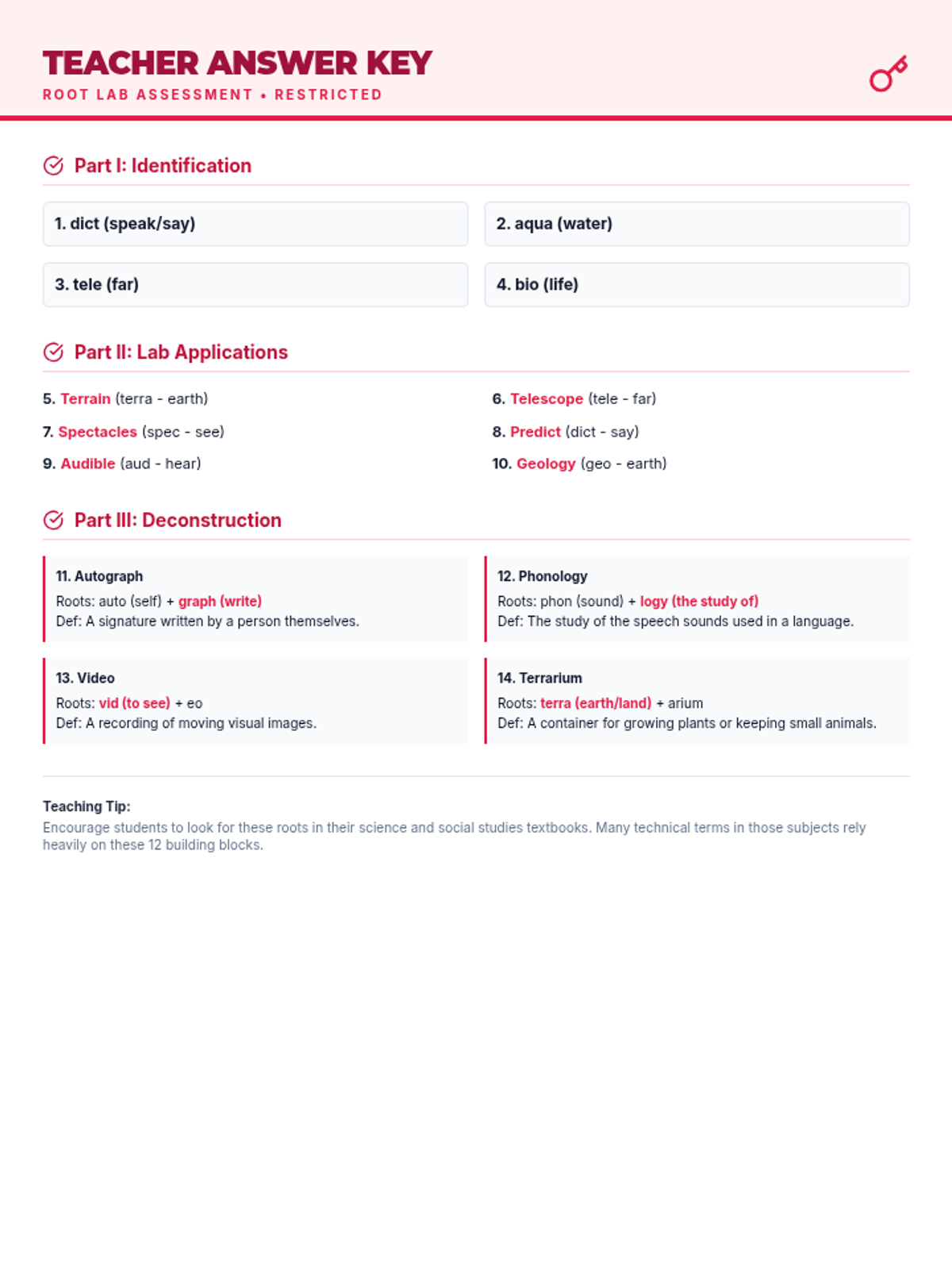
A detailed answer key and teacher guide for the Root Lab Assessment, including root definitions, correct word applications, and instructional tips for 7th-grade vocabulary. Consolidated to a single page for efficiency.
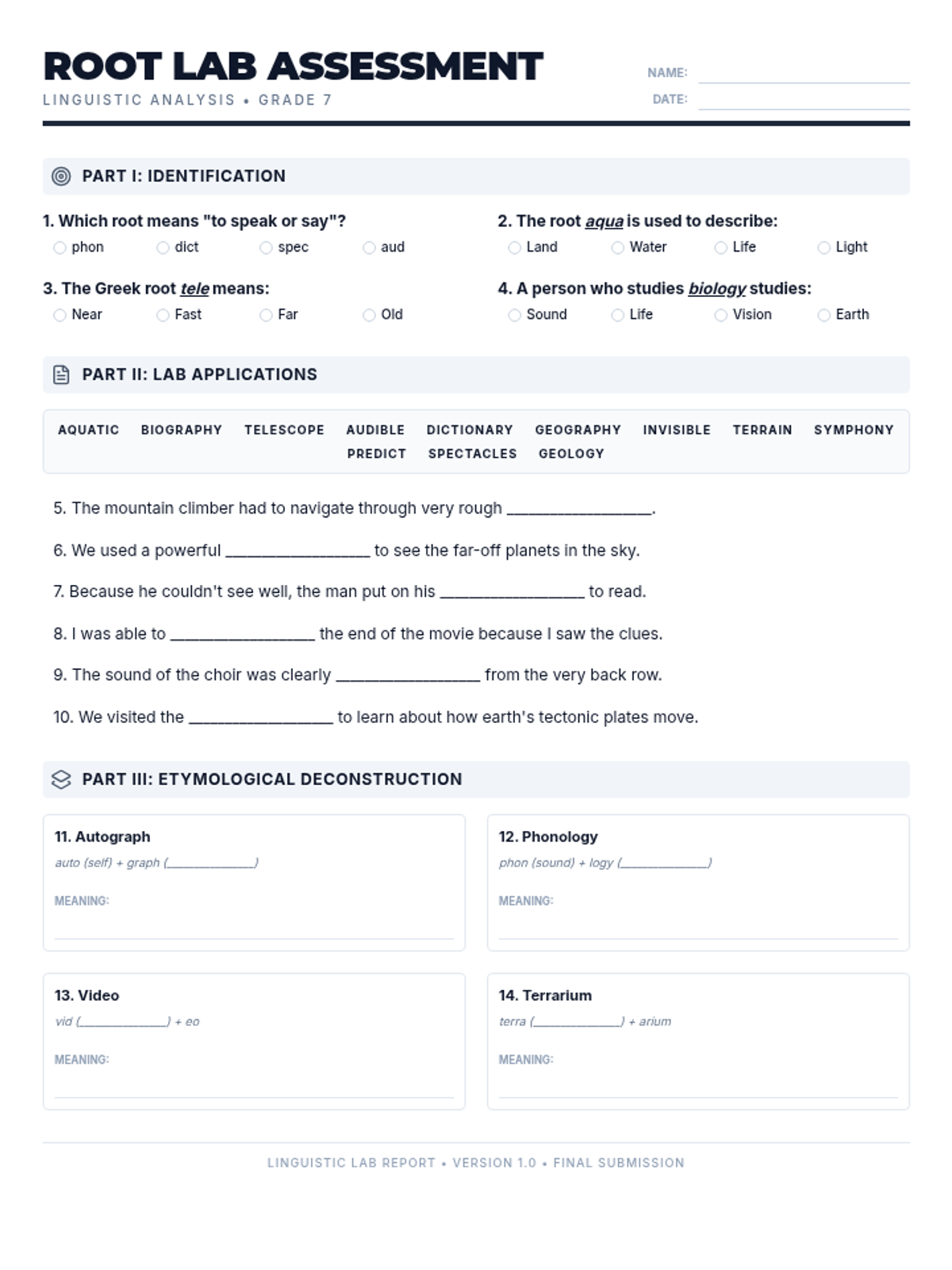
A comprehensive assessment for 7th-grade students covering 12 Greek and Latin roots through multiple-choice identification, sentence completion, and etymological deconstruction. Consolidated to a single page for efficiency.
A visual presentation exploring 12 key Greek and Latin roots (phon, terra, aqua, graph, bio, tele, dict, geo, vis/vid, spec, aud, logy) with interactive quiz practice and decoding challenges.
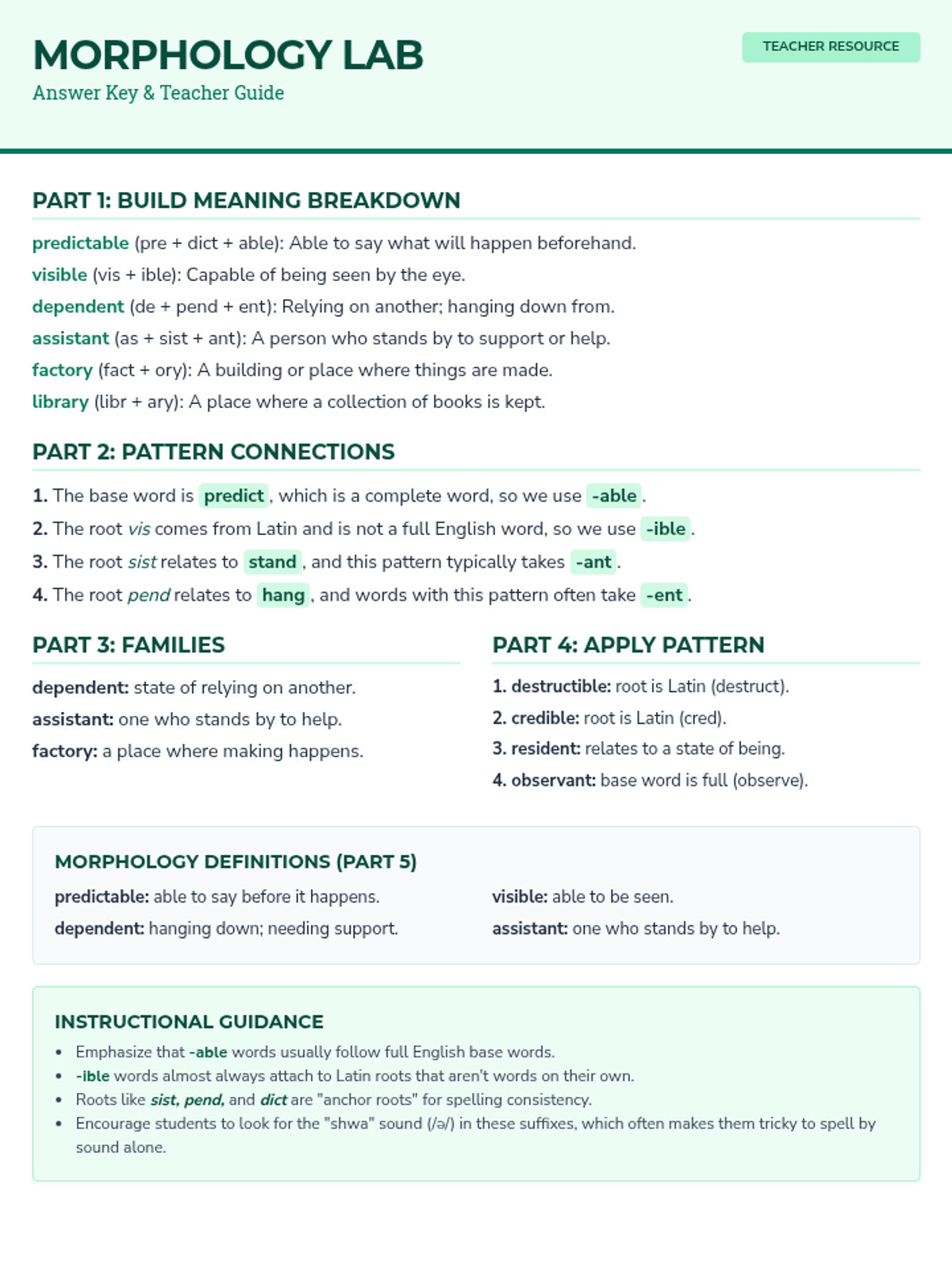
Answer key for the Morphology Lab worksheet. Revised to be a single-page teacher resource with full explanatory sentences and instructional tips.
Instructional slides for the Morphology Lab lesson, explaining suffix rules (-able/-ible, -ant/-ent, -ary/-ery/-ory) with visual examples and a quick challenge.
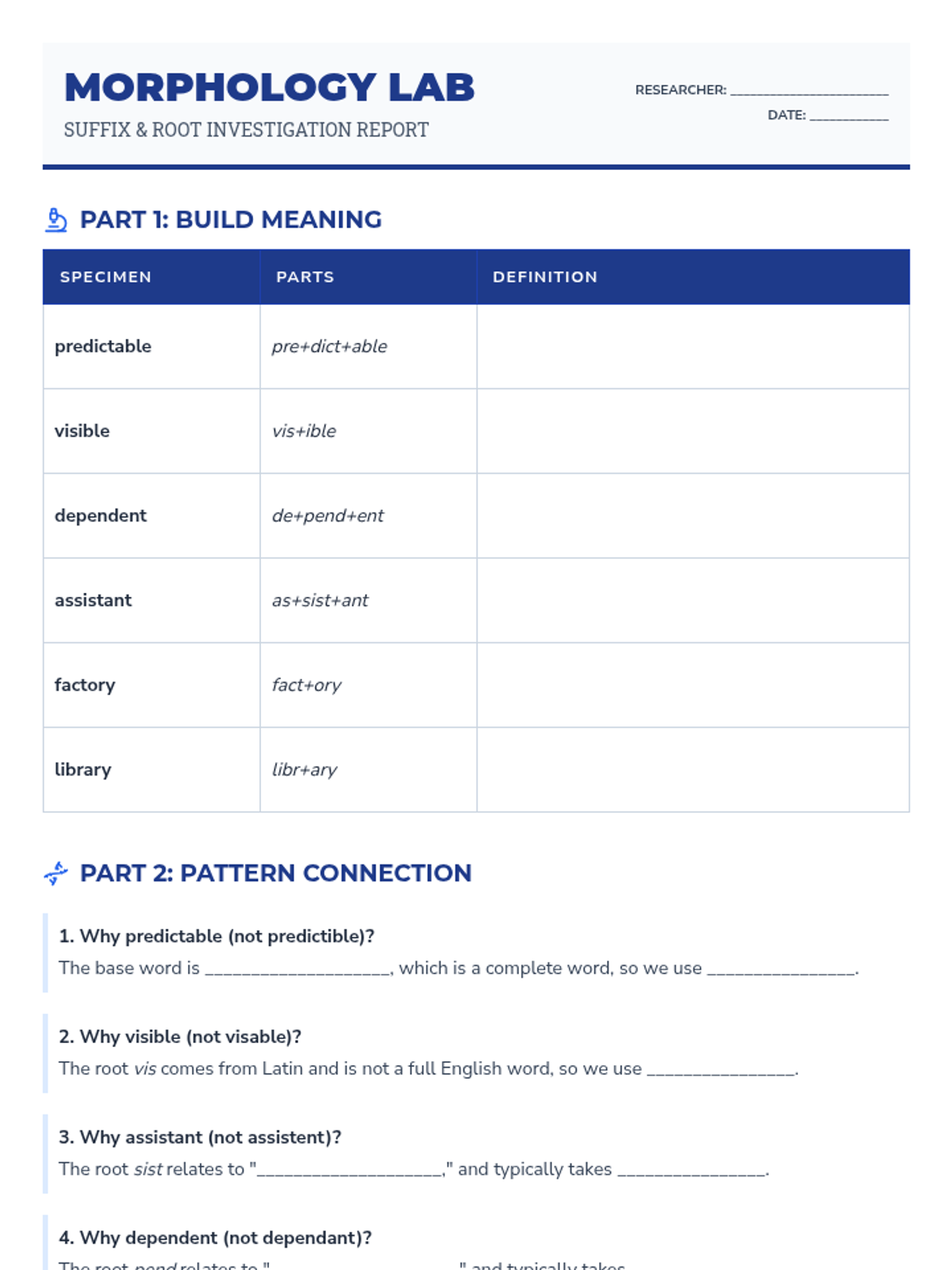
A comprehensive morphology worksheet focusing on Latin roots and suffix patterns (-able, -ible, -ant, -ent, etc.) with structured analysis sections. Revised for better page flow and work area legibility.
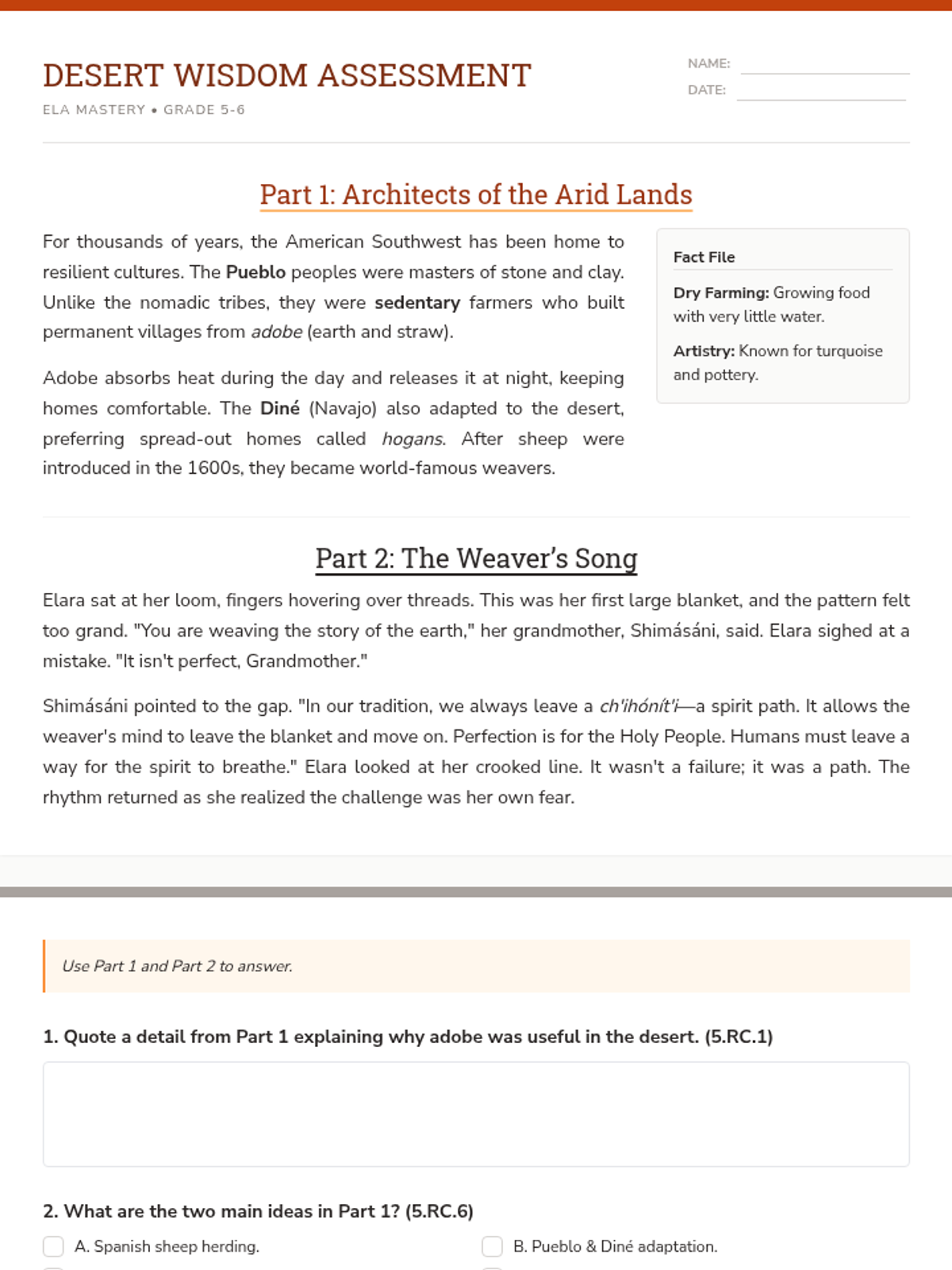
A 5-slide visual presentation to introduce the Desert Wisdom lesson. Covers the Pueblo and Diné cultures, key ELA skills (quoting evidence, identifying theme), and discussion prompts.
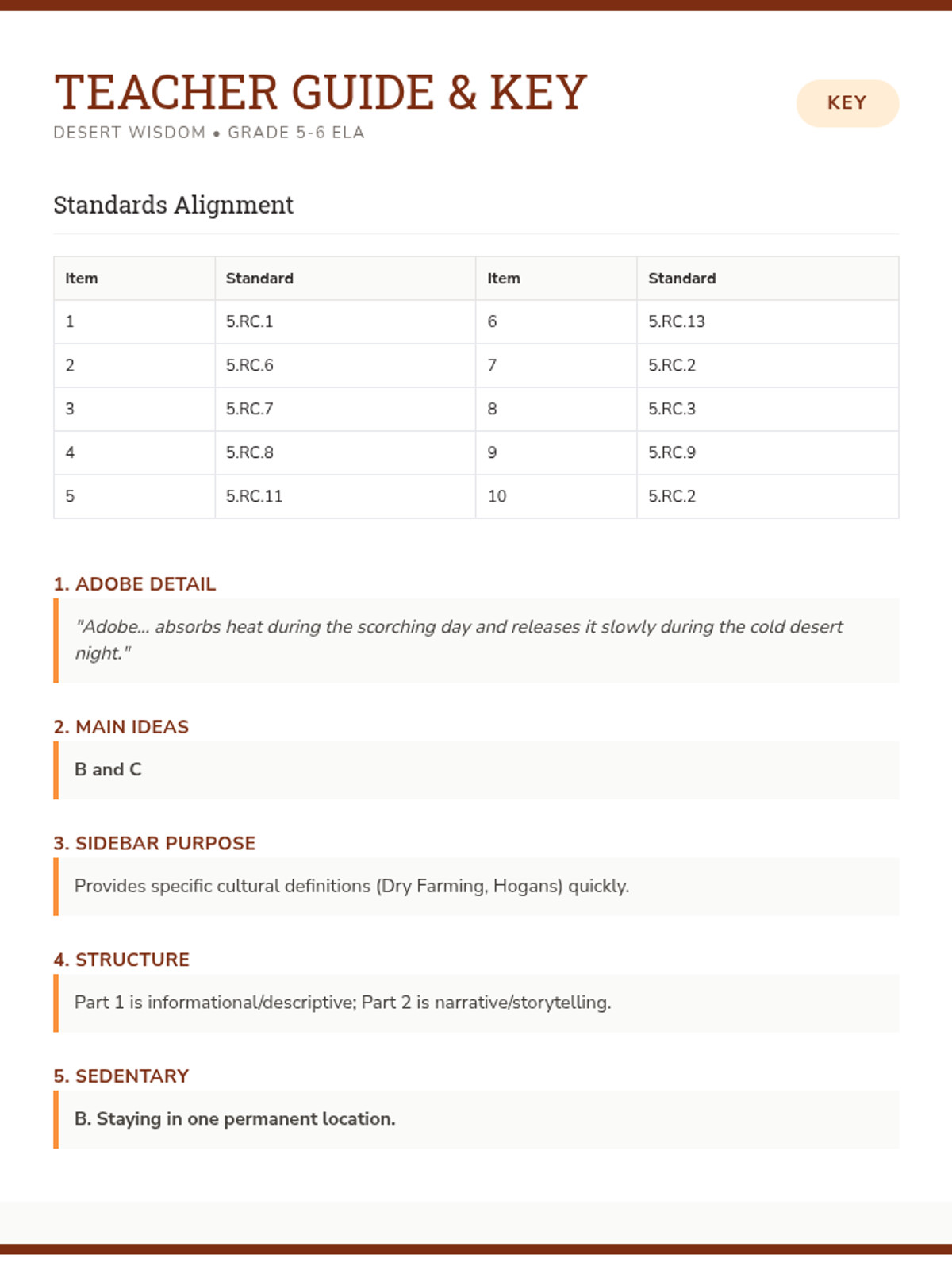
Teacher's answer key and standards alignment guide for the Desert Roots ELA assessment. Includes exemplar responses and scoring notes for all 10 questions.
A 2-page ELA assessment for grades 5-6 featuring two passages about Southwest Native American tribes (Pueblo and Diné). It includes 10 standards-aligned questions covering theme, main idea, text features, and context clues.
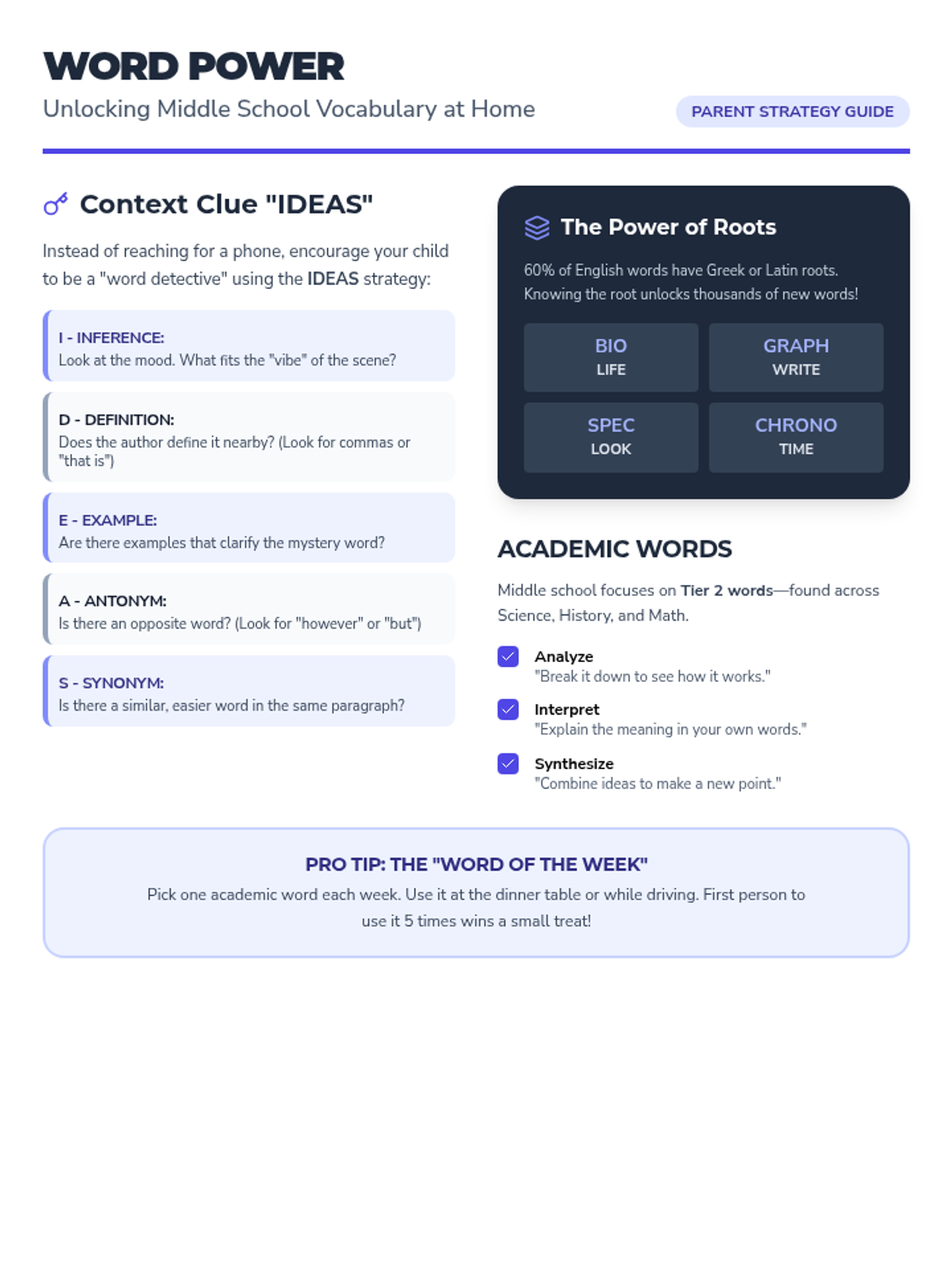
A one-page guide for parents on helping middle schoolers master vocabulary, featuring context clue strategies (IDEAS), Greek and Latin roots, and academic vocabulary tips.
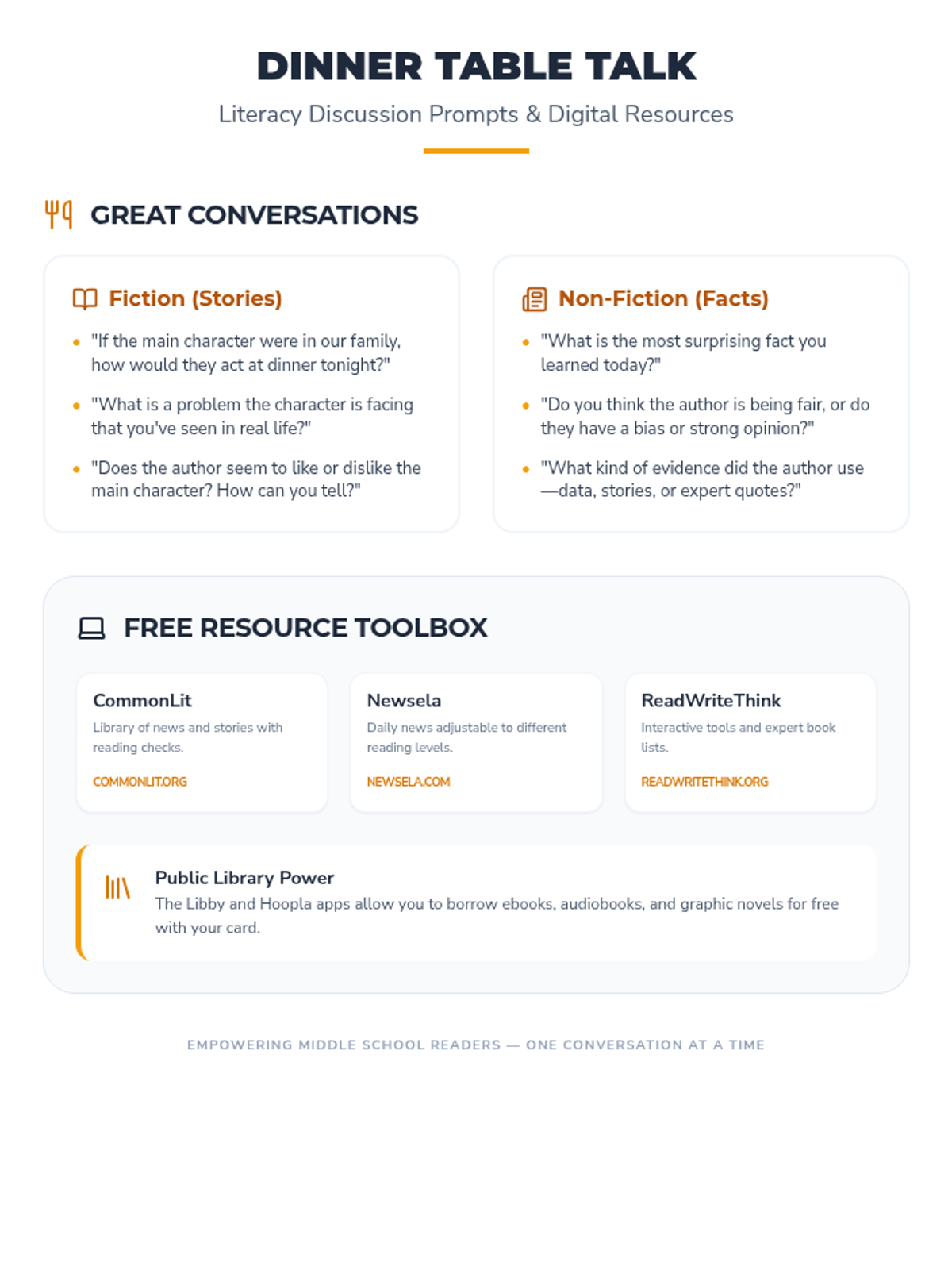
A resource list for parents featuring standard-aligned discussion prompts for fiction and non-fiction, along with a curated list of free digital literacy tools.
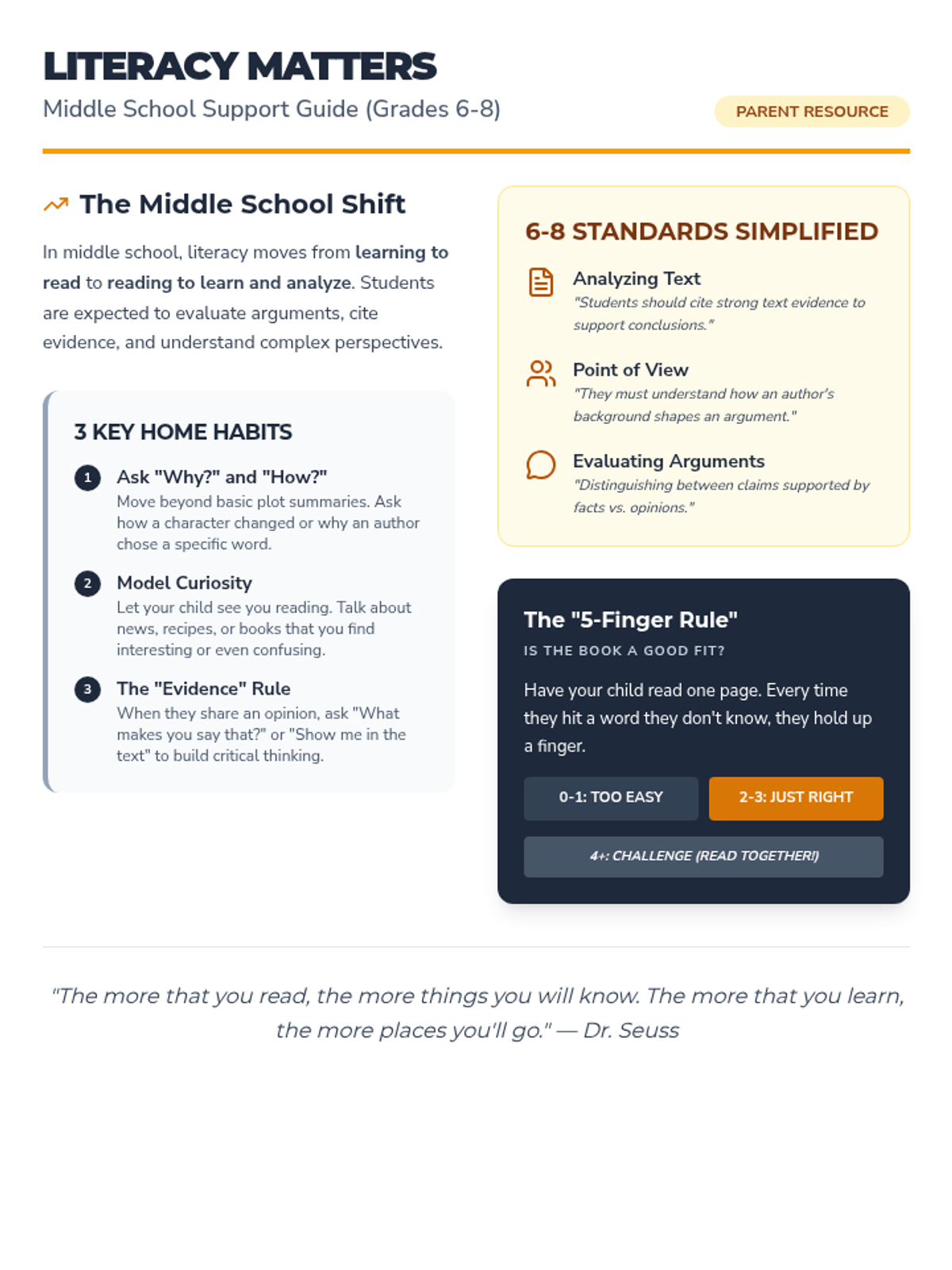
A one-page guide for middle school parents explaining the shift in literacy expectations from elementary to middle school, with actionable habits and standards-aligned tips.
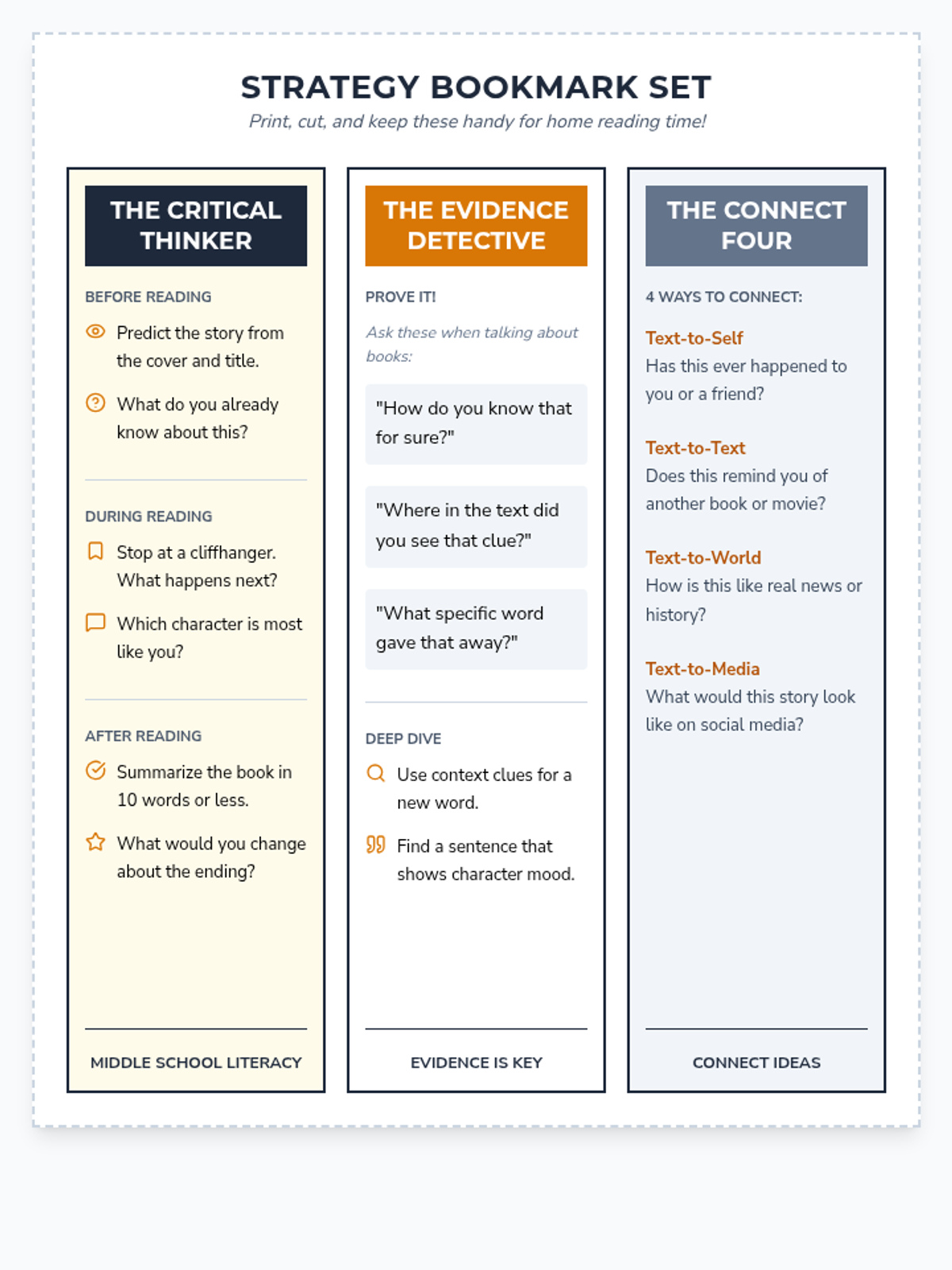
A set of three printable reading strategy bookmarks for middle school parents, providing quick prompts for before, during, and after reading, evidence-based questioning, and making connections.
A 7-slide data-driven presentation designed for administrative meetings, visualizing Grade 6 reading growth across NC Check-In cycles A, B, and C with specific metrics on vocabulary, informational text mastery, and fluency.
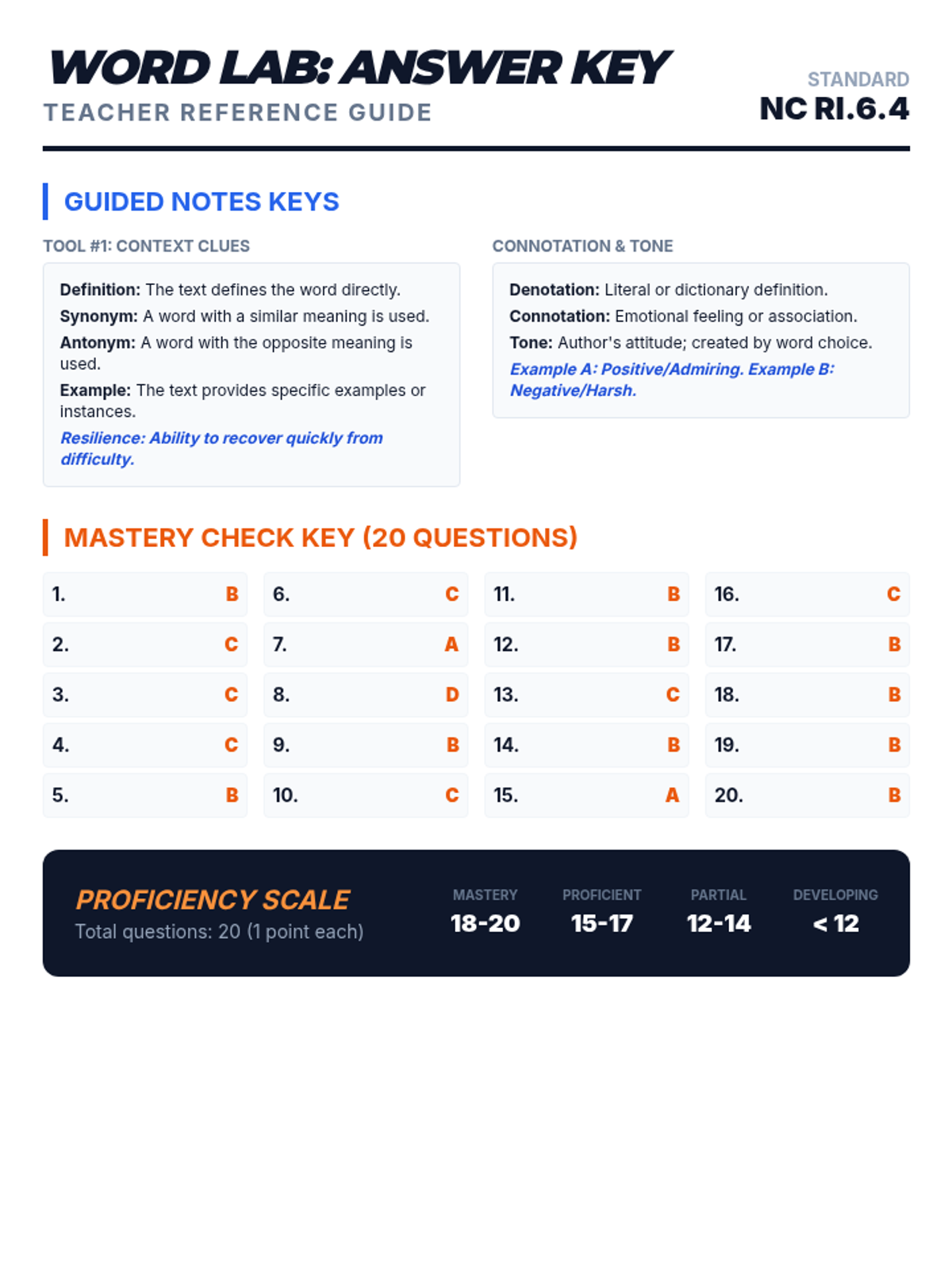
Teacher answer key for the Word Lab Guided Notes and Mastery Check, including proficiency scales and grading guides for Grade 6 NC standard RI 6.4. Revised to fit all content onto a single page for easier reference.
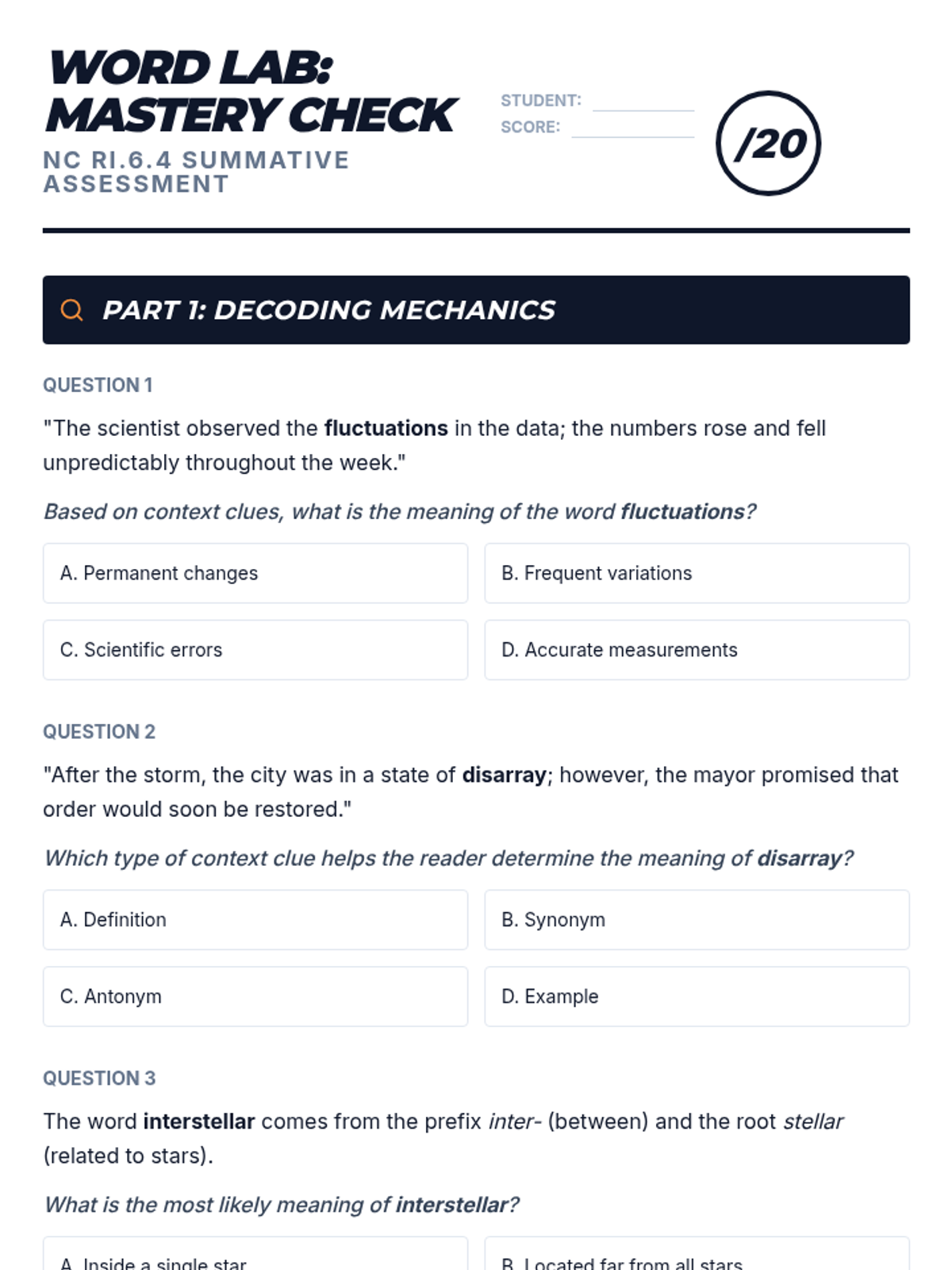
A comprehensive 20-question EOG-style mastery check for Grade 6 NC standard RI 6.4. The assessment covers context clues, word parts, connotation, tone, figurative language, and technical terms using multiple-choice questions and a themed reading selection. Revised to ensure questions stay with their options and sections are properly separated.
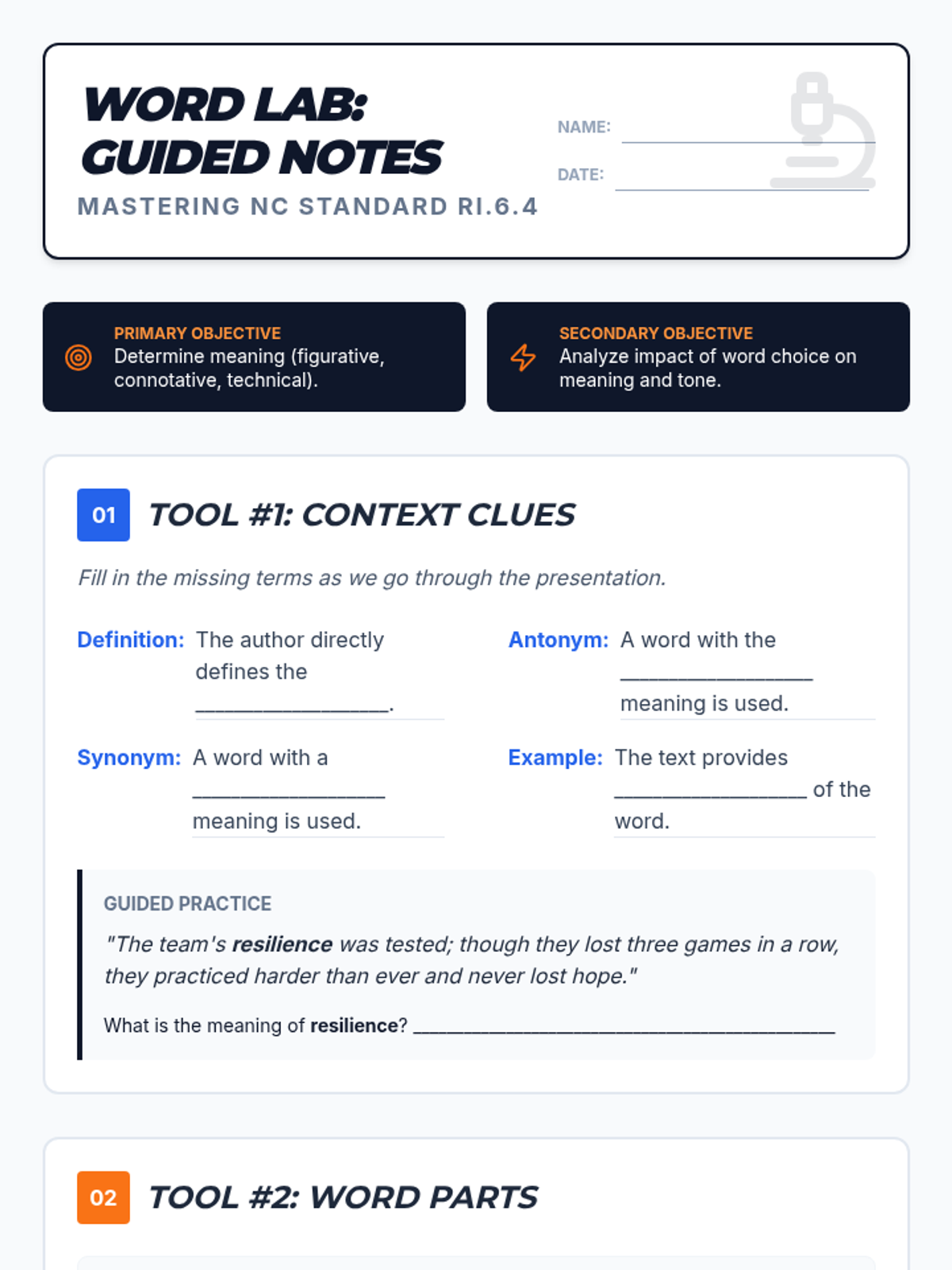
Guided notes for Grade 6 NC standard RI 6.4, designed to accompany the Word Lab Slides. Students complete definitions and practice exercises focused on context clues, word parts, connotation, and tone. Revised for improved layout and page breaks.
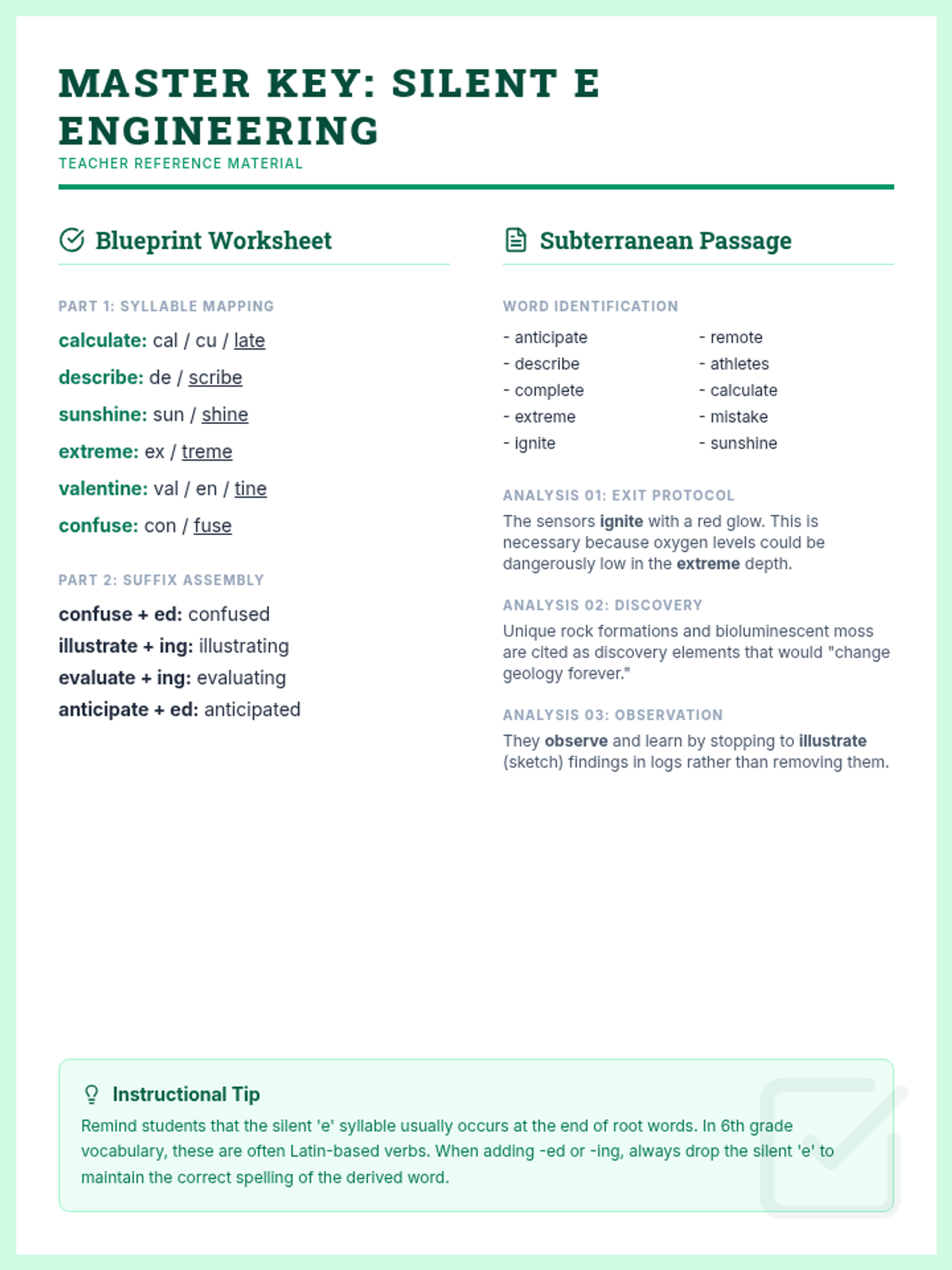
A comprehensive answer key for both the Vowel Power Blueprint Worksheet and the Subterranean Secret Passage, including syllable breakdowns and instructional tips. Optimized for a single-page layout.
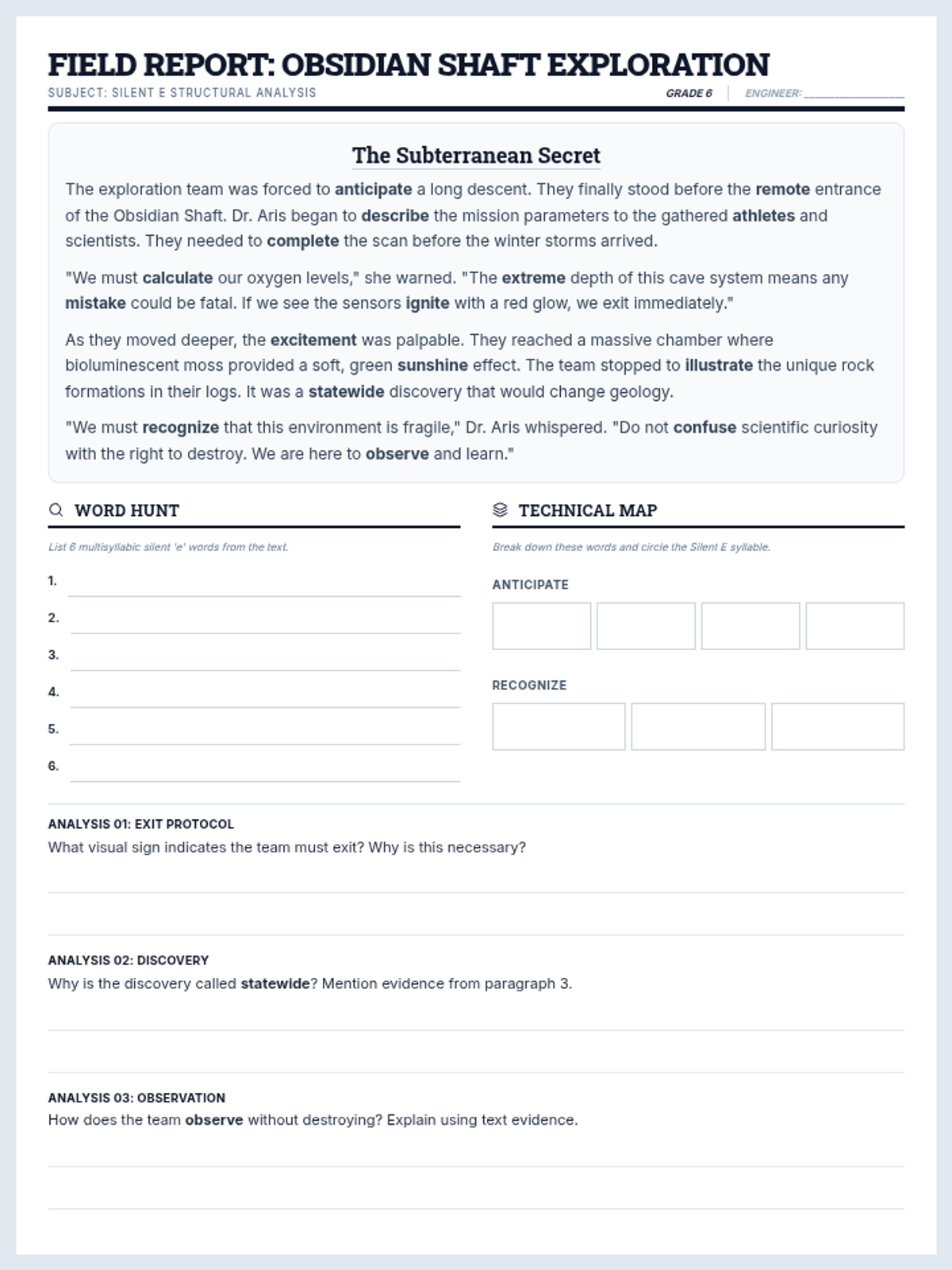
A narrative reading passage set in a mysterious cave system, embedded with high-frequency 6th-grade multisyllabic silent 'e' words. Includes syllable mapping and expanded text-based comprehension questions. Optimized for a single-page layout.
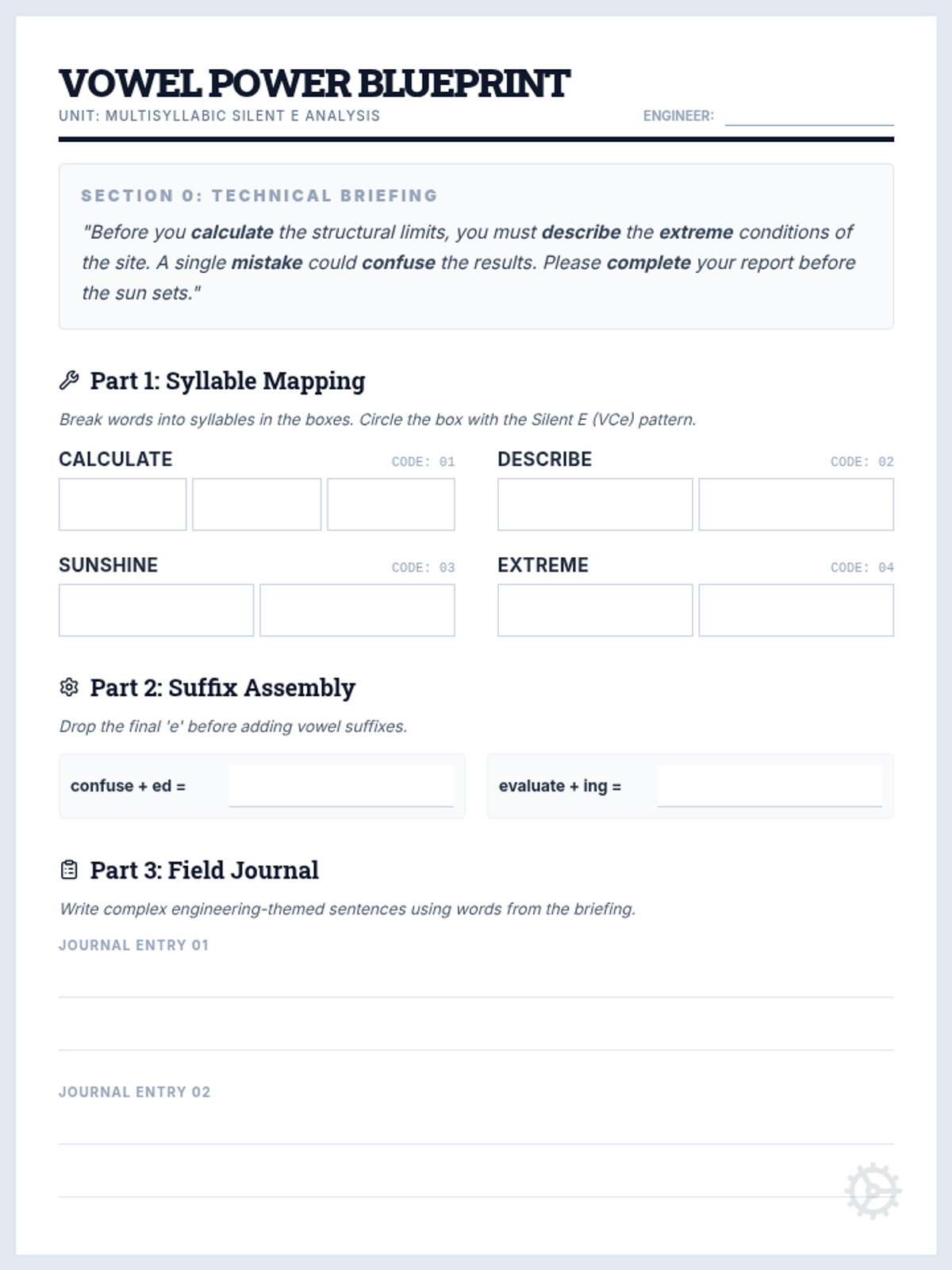
A structural analysis worksheet where students dismantle multisyllabic words into syllables, identifying the silent 'e' pattern and practicing suffix addition rules. Optimized for a single-page layout.
A high-impact instructional slide presentation for Grade 6 NC standard RI 6.4, featuring the 'Word Lab' theme. Includes direct instruction on context clues, word parts, connotation, tone, and technical terms, along with EOG-style practice questions.
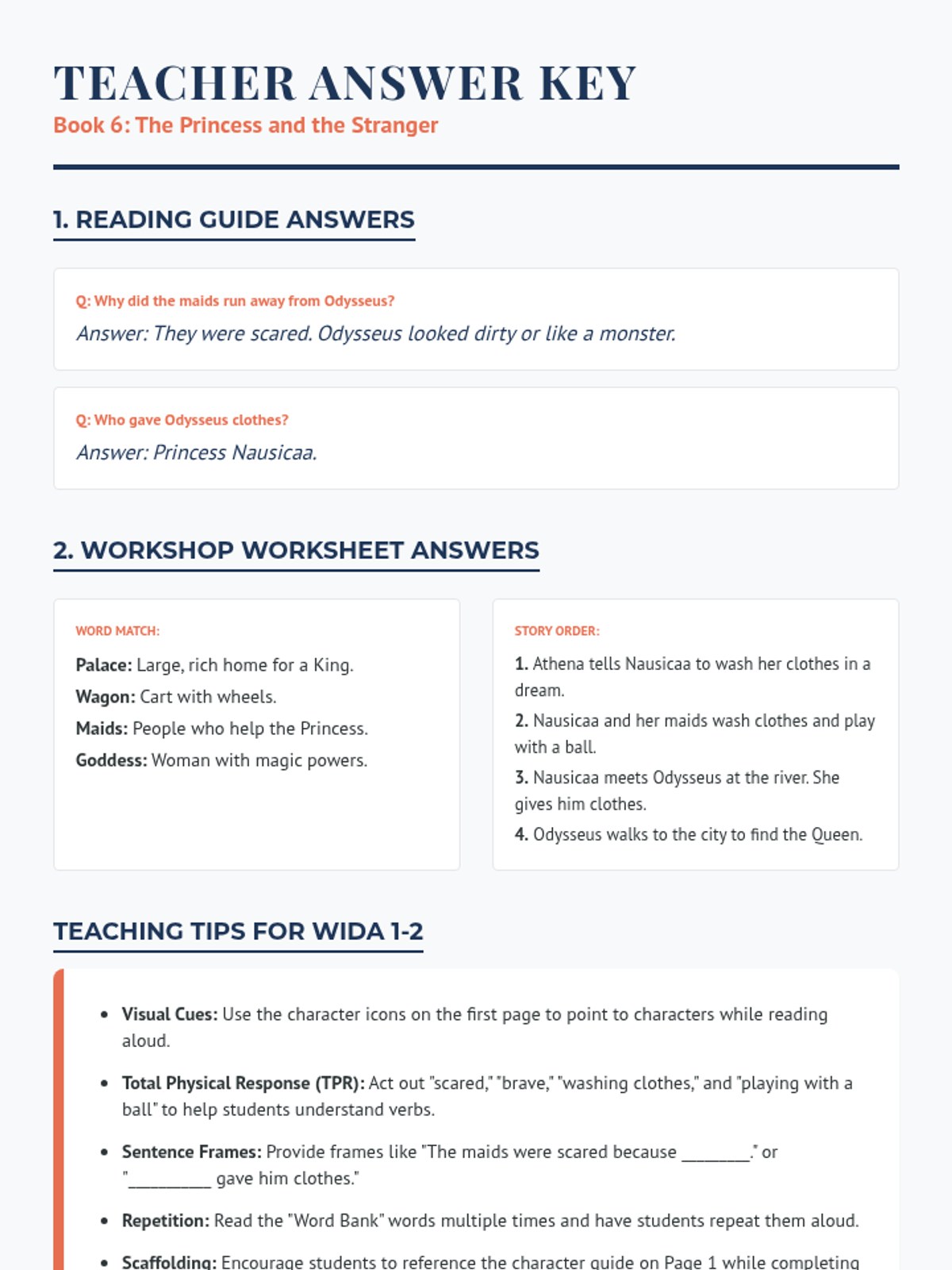
A teacher's answer key and instructional guide for the Book 6 materials, including pedagogical tips for supporting newcomer and beginner ELL students.
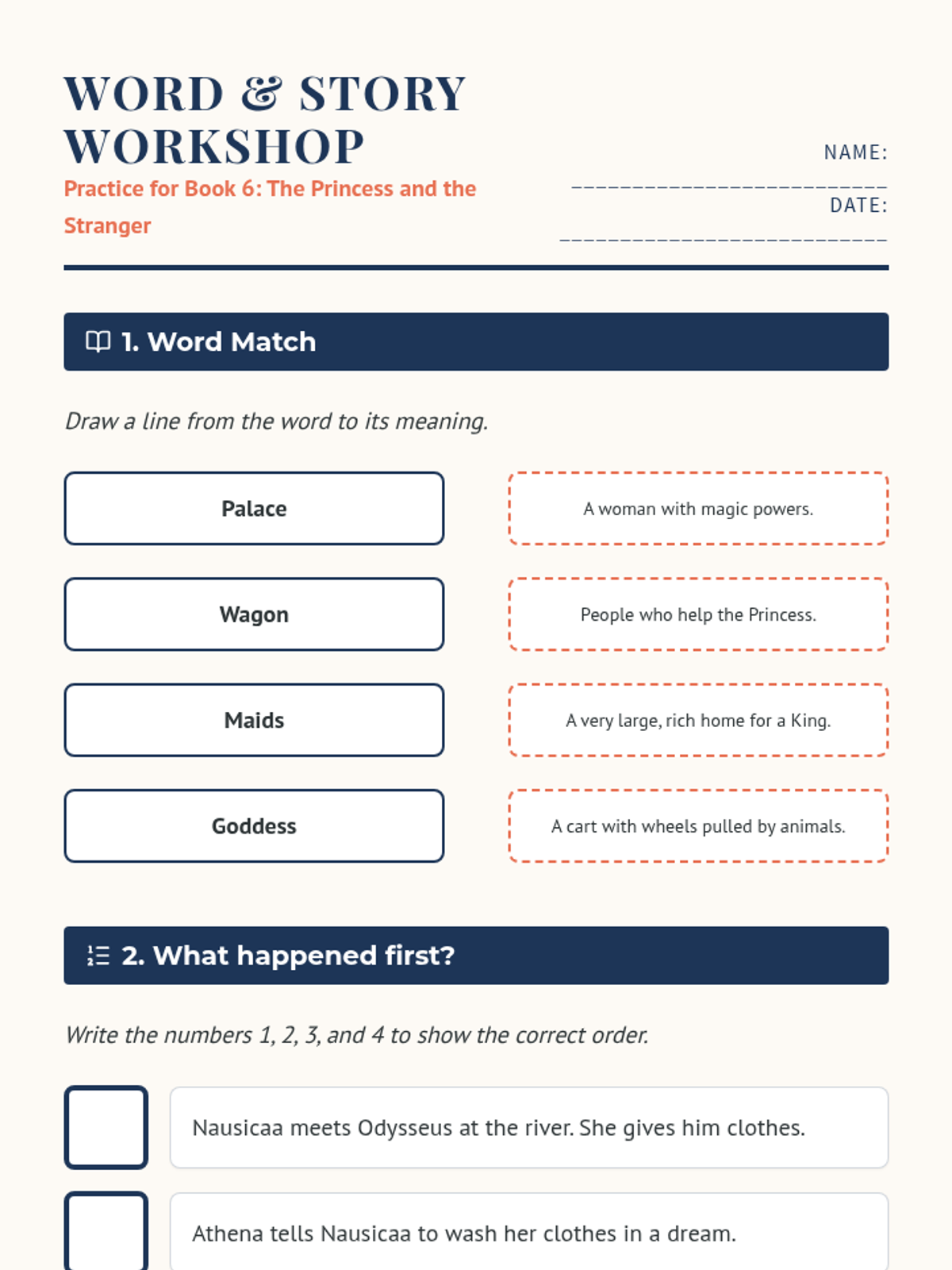
A vocabulary and comprehension worksheet for WIDA Level 1-2 students, featuring word matching, sequencing of events, and a creative drawing area.
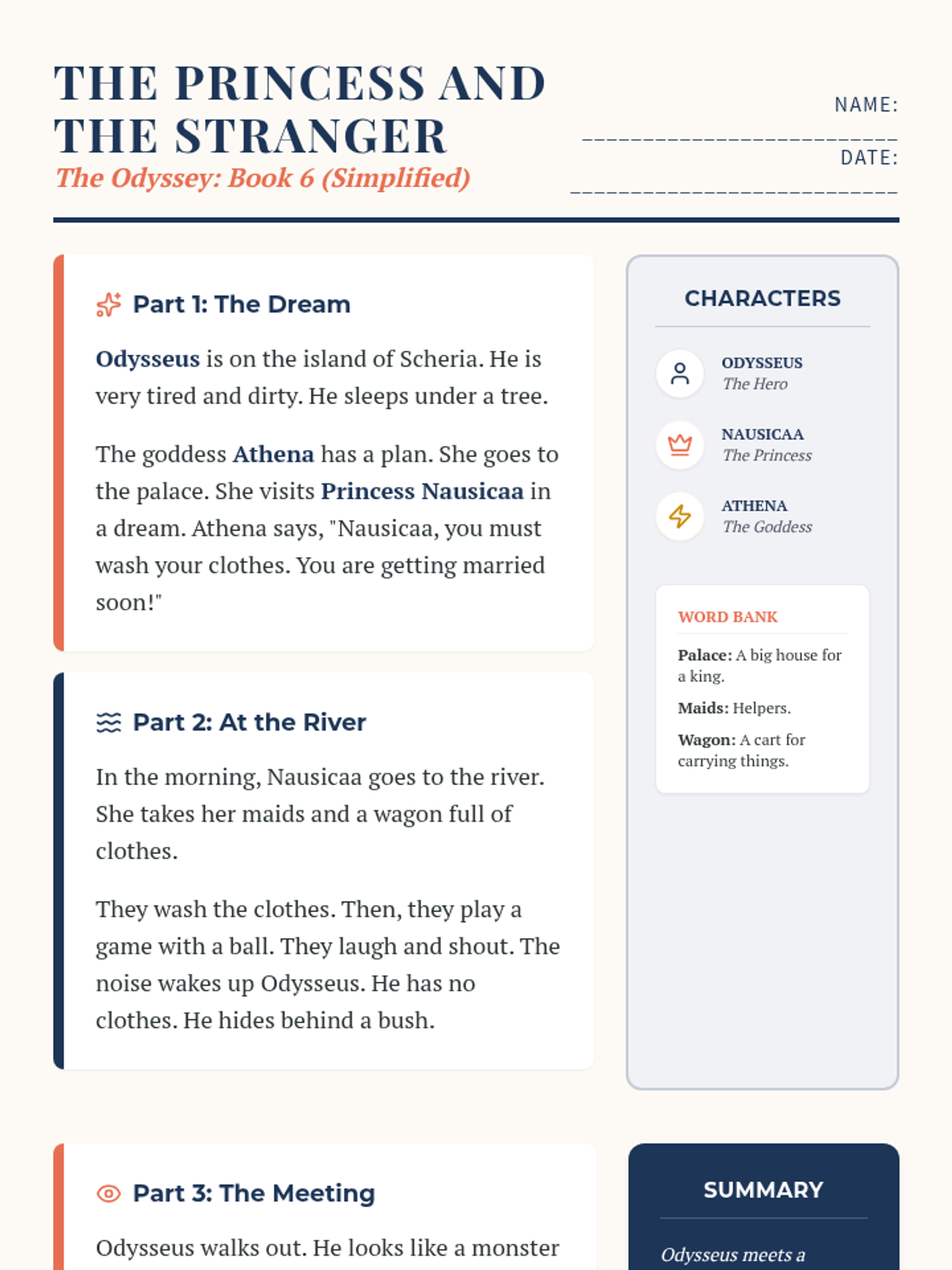
A simplified, two-page reading passage of Book 6 of The Odyssey, adapted for WIDA Level 1-2 ELL students with clear character guides, bolded text, and supportive vocabulary.
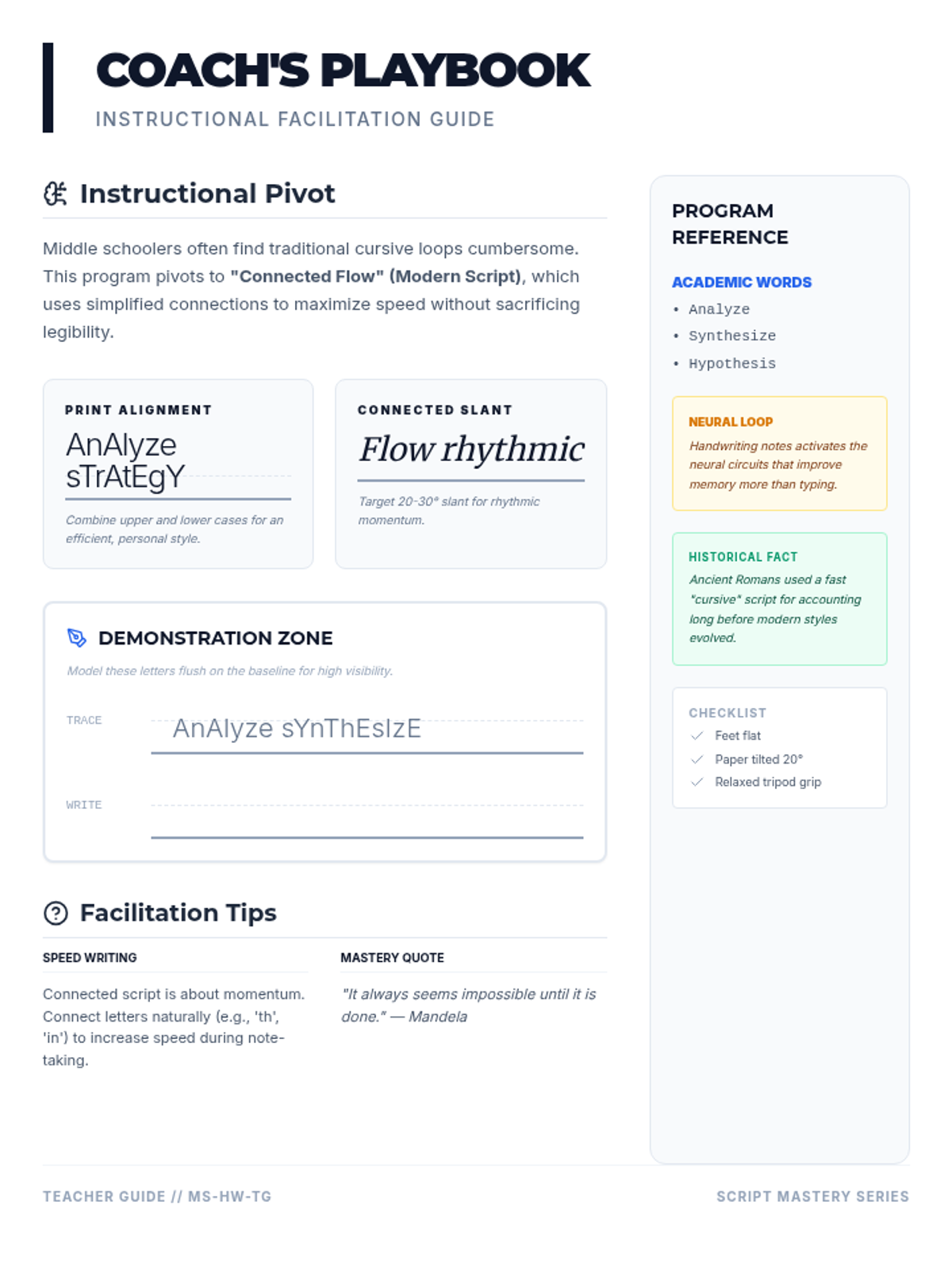
A teacher facilitation guide for the Script Mastery program, providing instructional philosophy, strategies for print and cursive, and implementation tips for middle school classrooms. Now includes guidance on the 'Connected Script' technique and case-combining print. Vertical alignment and single-page rendering have been optimized.
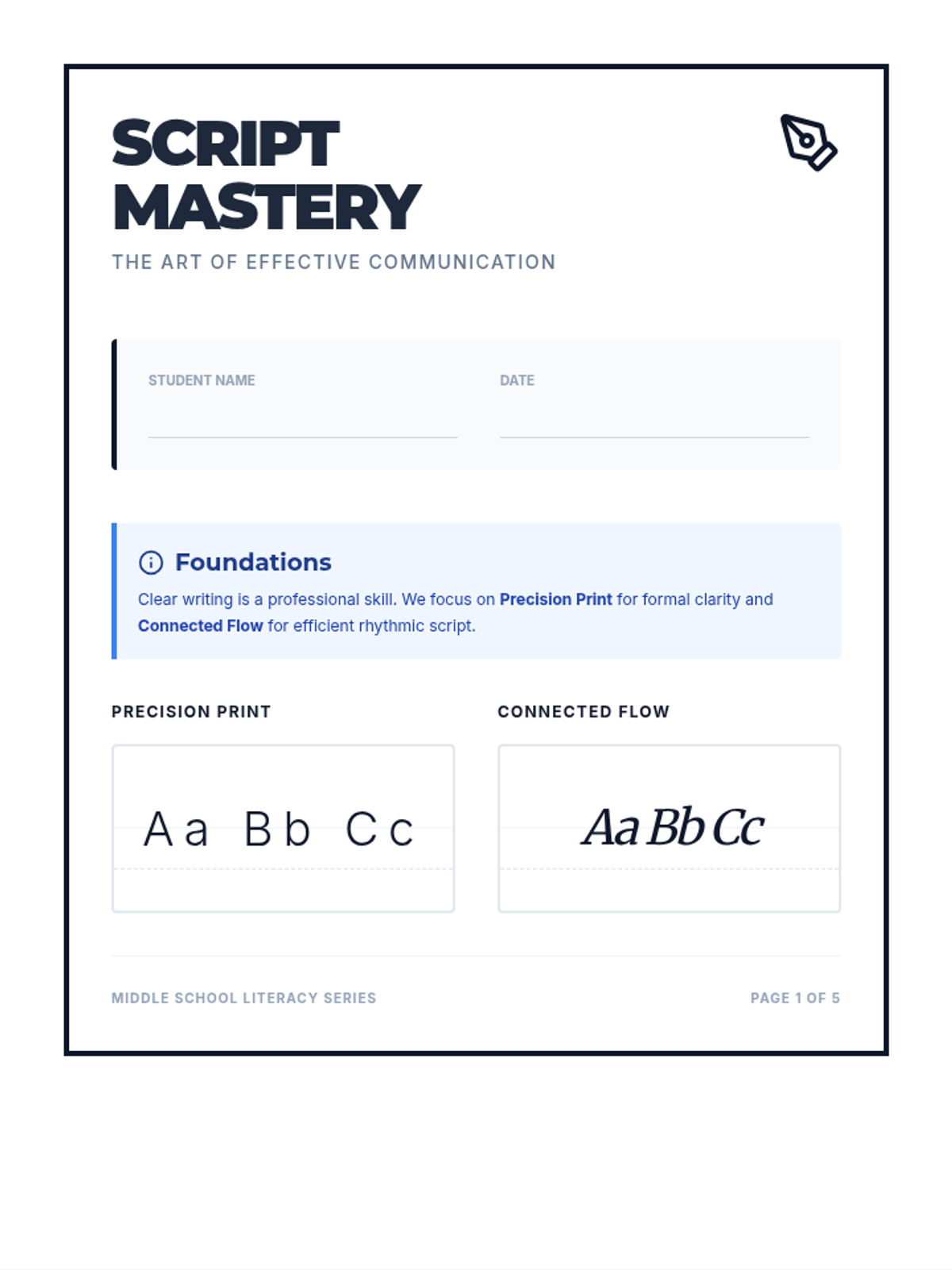
A sleek, professional-looking 5-page handwriting packet for middle schoolers featuring academic vocabulary, motivational quotes, and fun facts in a mix of print and cursive. Now includes combined upper/lower case print and a refined 'Modern Flow' connected script style for better speed and legibility. Trace models have been darkened and vertical clipping issues have been resolved.
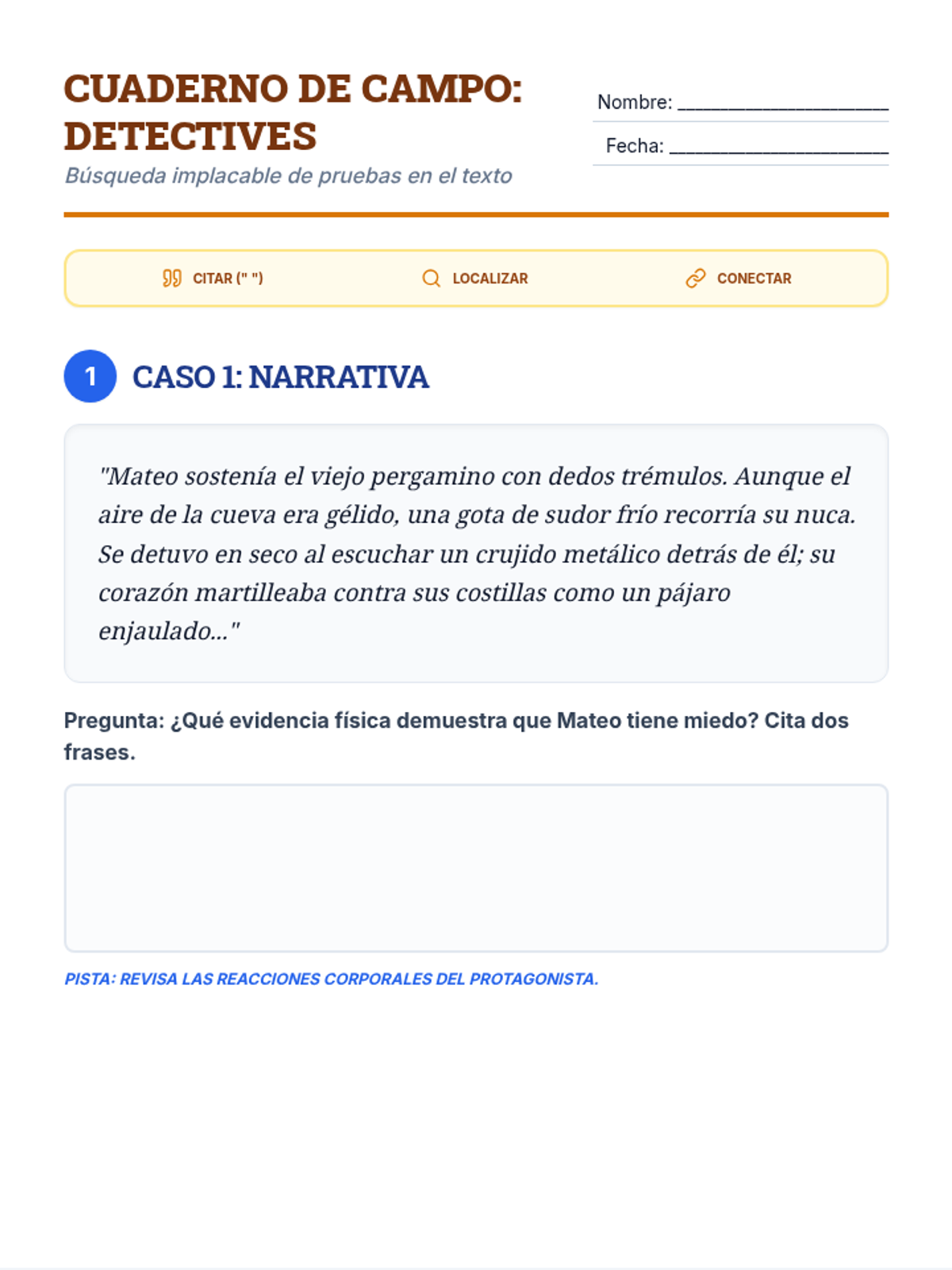
Una hoja de trabajo mejorada con los textos incluidos, espacios de respuesta más amplios y una estructura de tres páginas que garantiza que los estudiantes tengan el material necesario para encontrar evidencia.
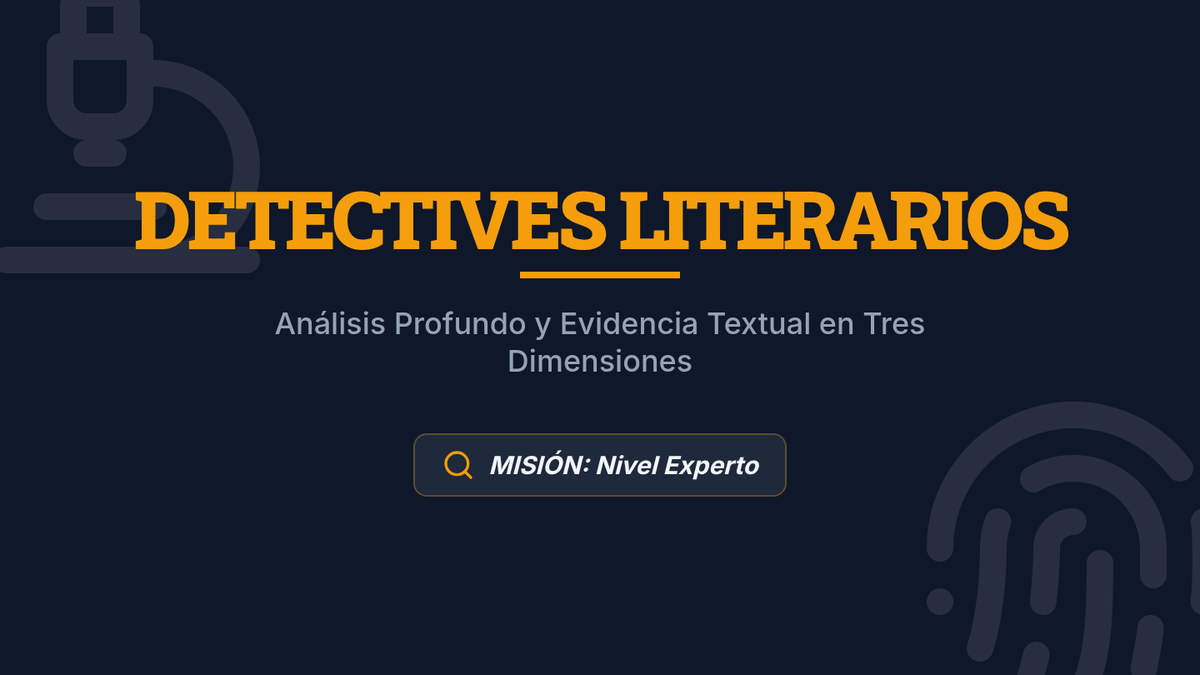
Una presentación dinámica y visualmente impactante que guía a los estudiantes a través de tres "casos" literarios (narrativa, informativo y drama) para practicar la búsqueda de evidencia textual con un enfoque más profundo y estratégico.
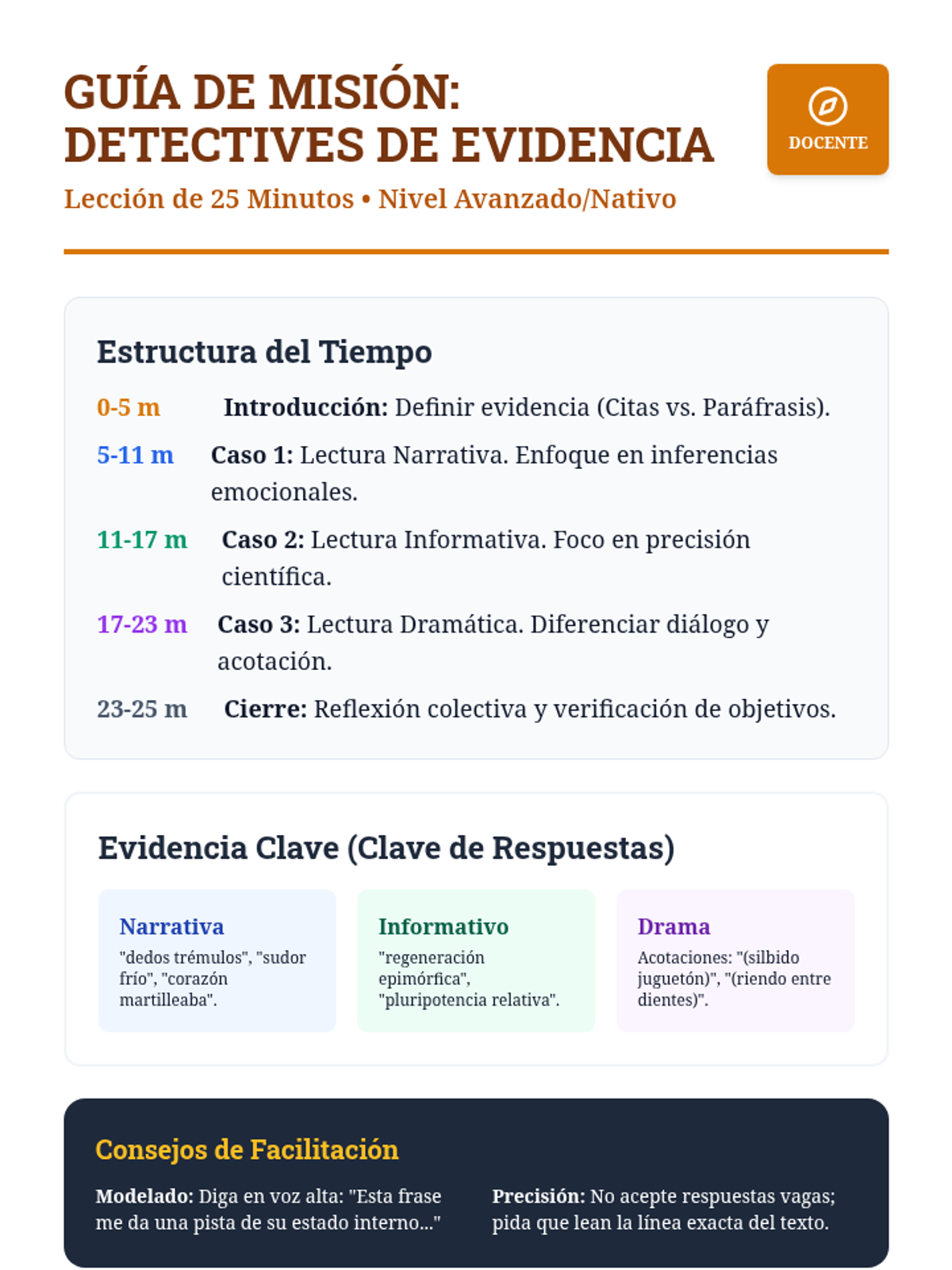
Una guía detallada para el docente que organiza la lección de 25 minutos, incluyendo los textos completos de los tres casos literarios para referencia inmediata y consejos de facilitación mejorados.