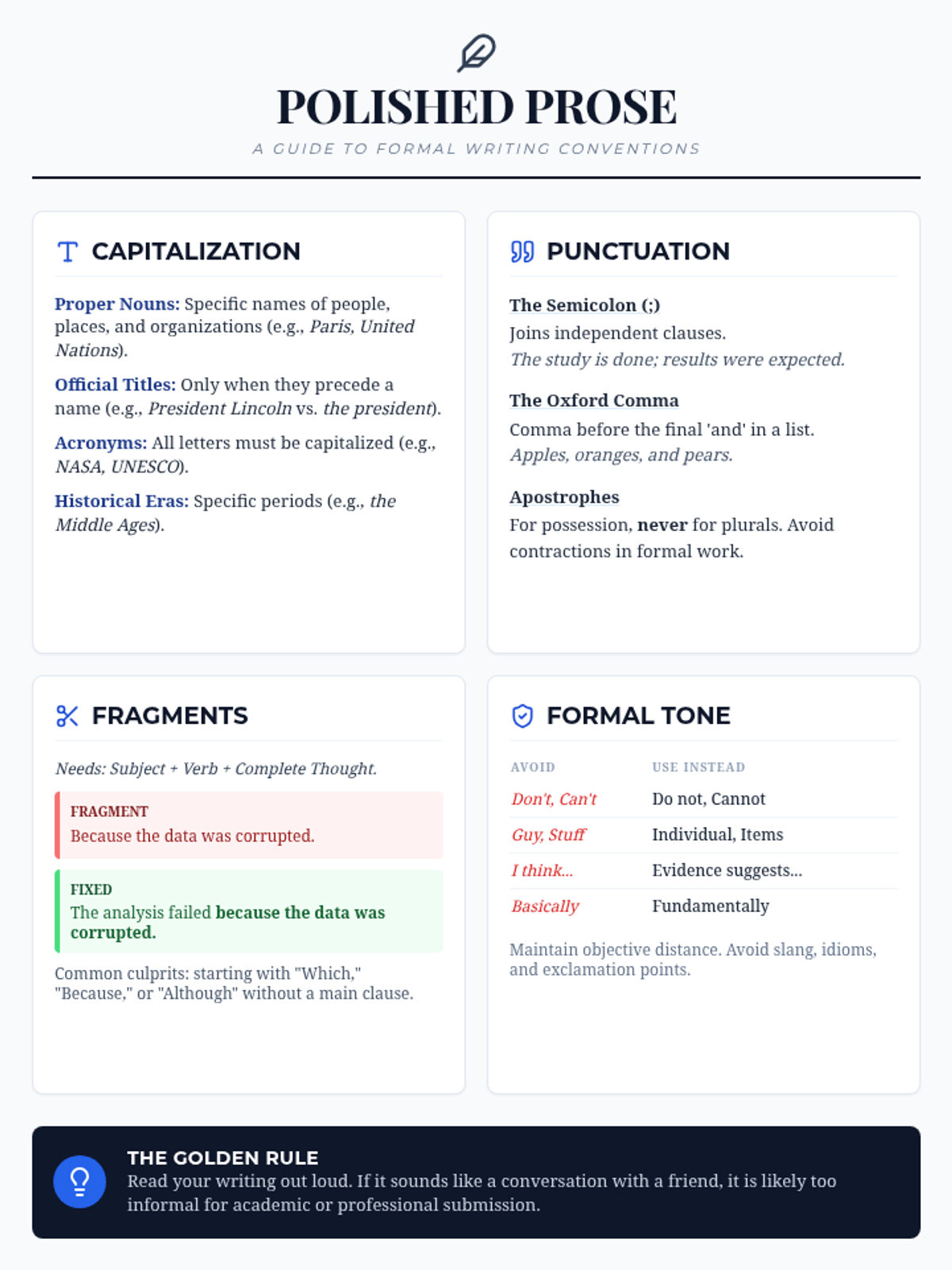
Sentence structure fundamentals, subject-verb agreement, and precise usage of parts of speech including pronouns, conjunctions, and adjectives. Targets technical accuracy through mastery of capitalization, punctuation, spelling, and verb mood.
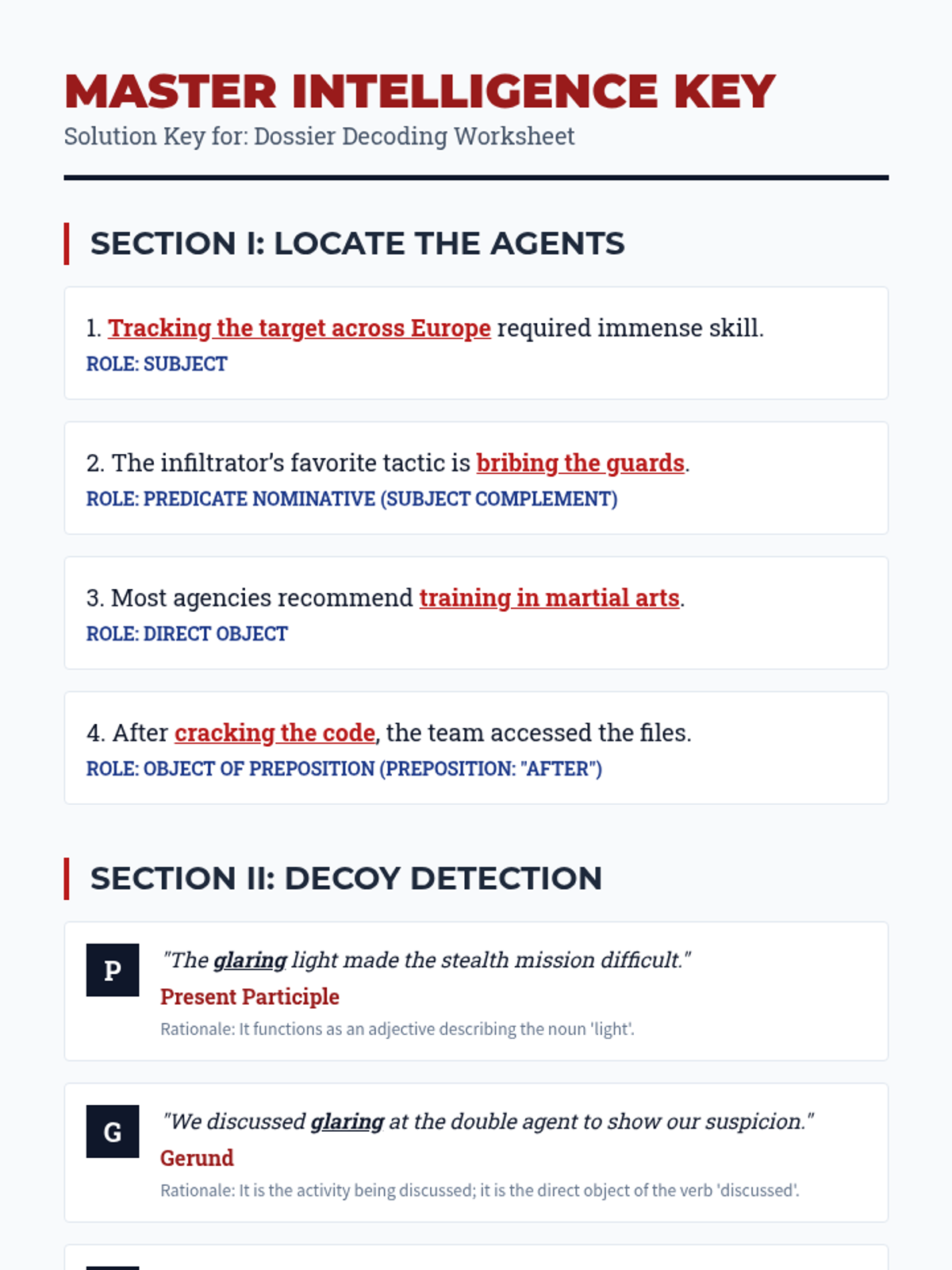
A comprehensive answer key for the 'Dossier Decoding' worksheet, providing highlighted solutions, role identifications, and teacher notes for evaluating high-level student responses. Section II is now self-contained and formatted for better readability.
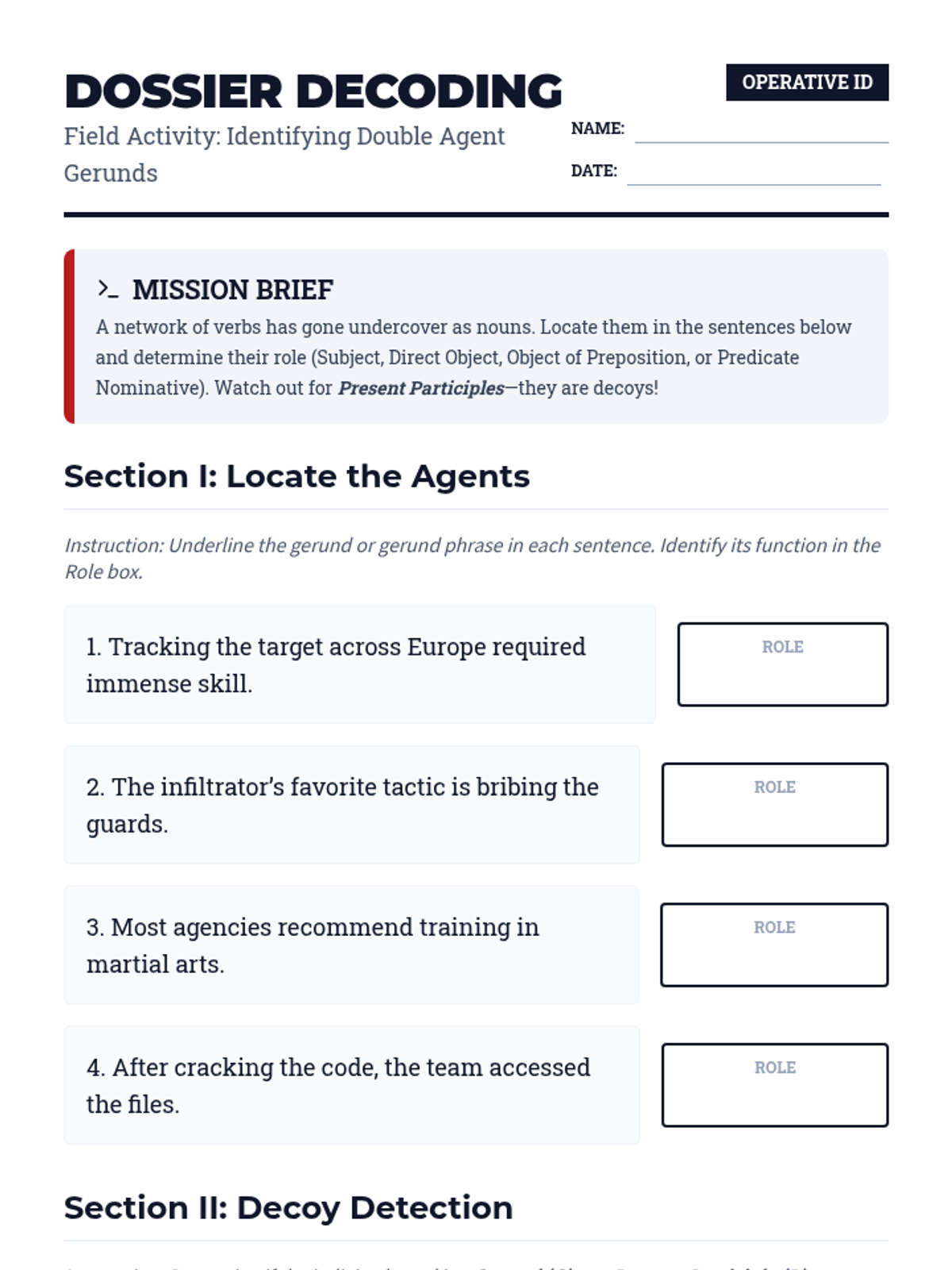
A student worksheet designed with a detective 'dossier' aesthetic. It challenges students to identify gerunds and their roles, distinguish them from participles, and apply their knowledge in creative writing. Section I has been improved for better layout and clarity.
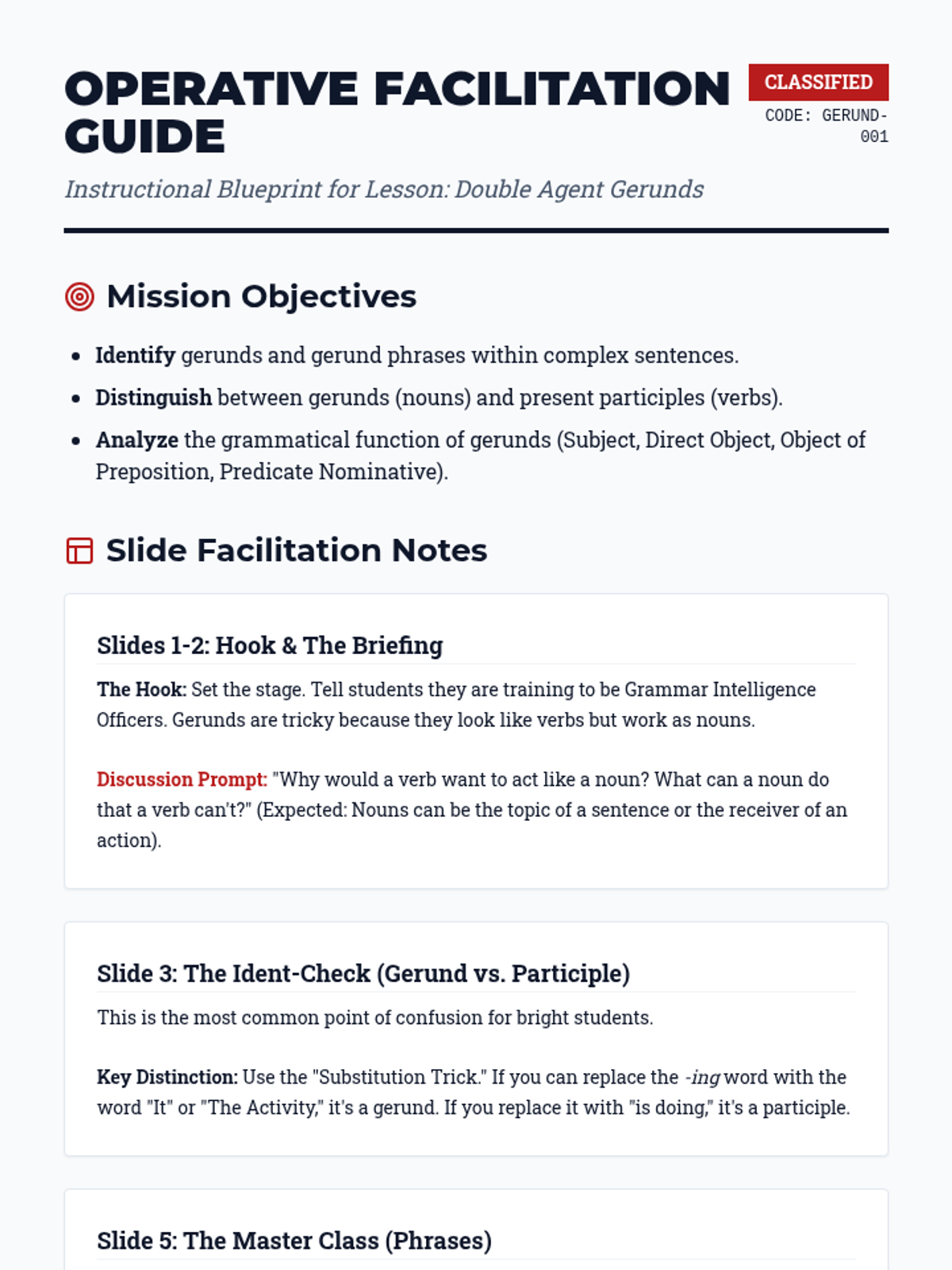
A teacher's facilitation guide for the 'Double Agent Gerunds' lesson, featuring slide-by-slide prompts, common pitfalls, the 'Substitution Trick', and extension activities for advanced students. Updated with guidance for the interactive analysis slide.
A visually striking, spy-themed slide deck that introduces gerunds as 'Double Agents'—verbs acting as nouns. It covers identification, functions (subject, object, complement), and gerund phrases for advanced learners. Now includes a dedicated analysis slide for student participation.
An expanded anchor chart featuring a second page focused on academic articulation. It provides curated lists of formal sentence starters for stating arguments, introducing evidence, and performing deep text analysis, maintaining a professional editorial aesthetic.
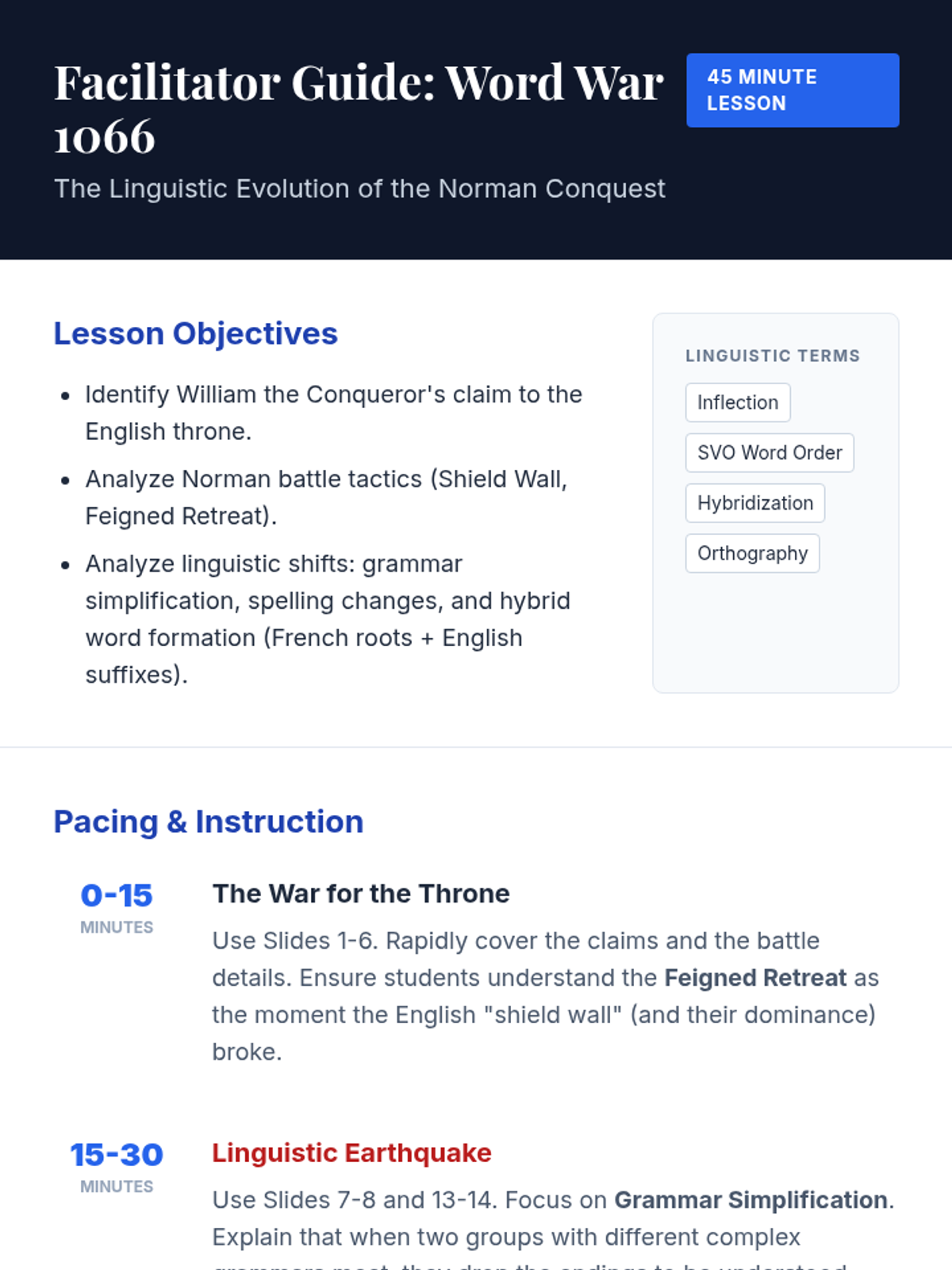
An expanded teacher guide with detailed instructional notes on linguistic evolution, grammar simplification, scribal changes, and hybrid word formation.
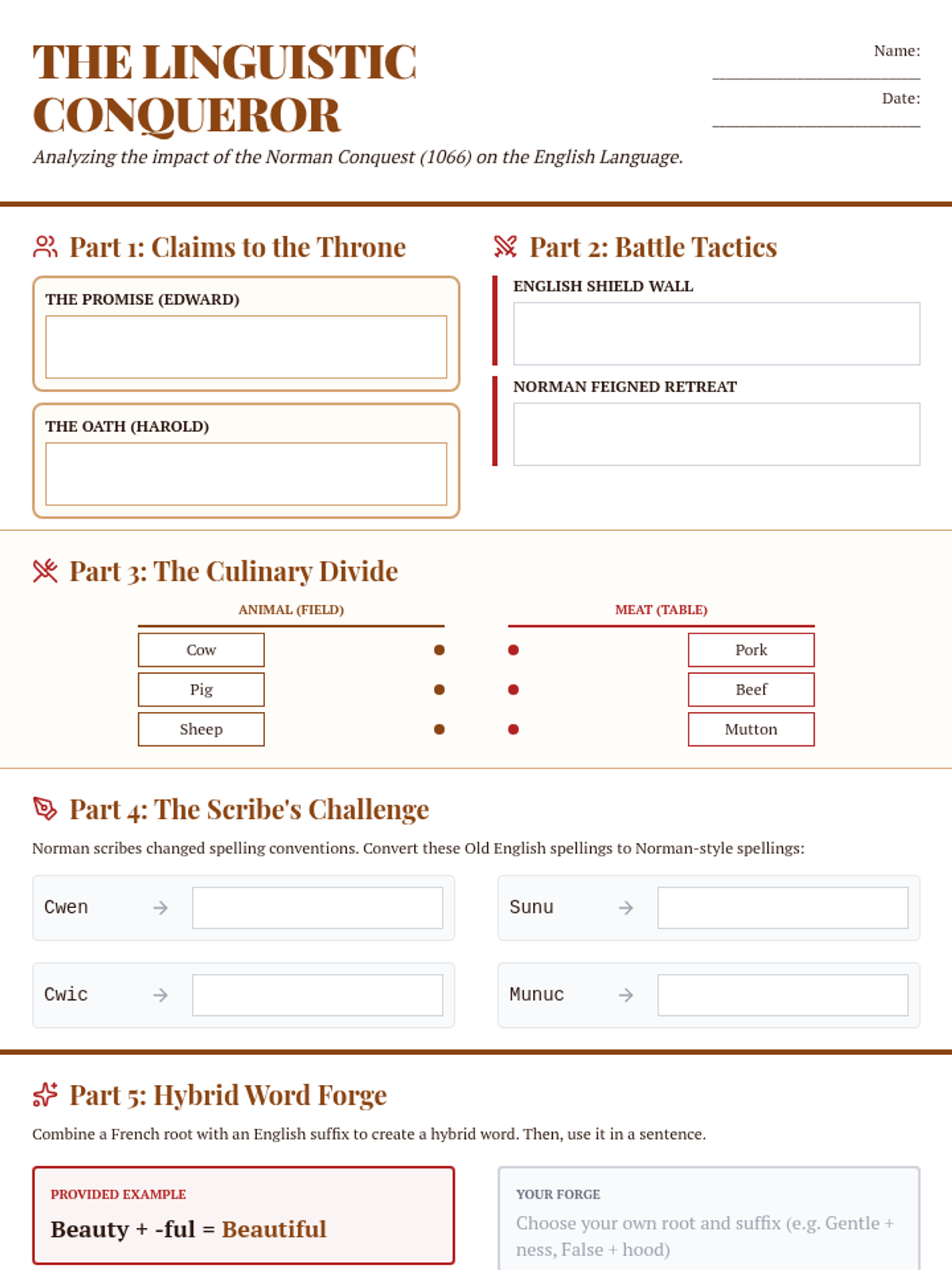
An expanded student worksheet featuring significant new linguistic activities on phonetic shifts, scribal spelling changes, hybrid word building, and grammar simplification.
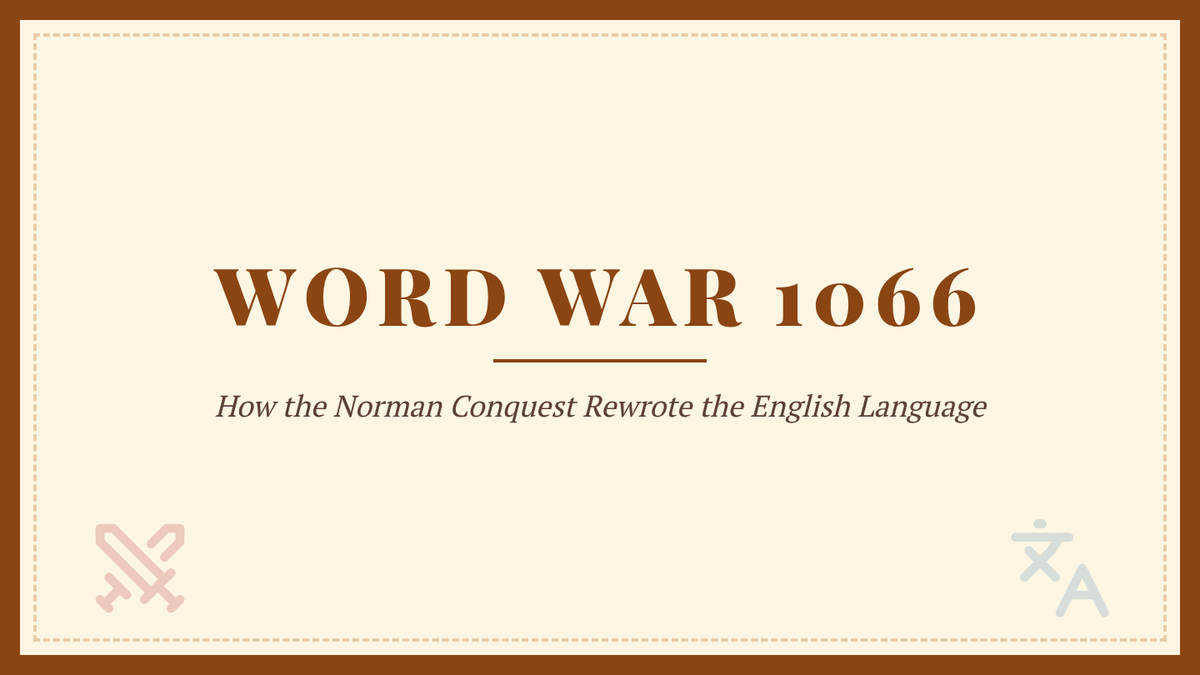
An expanded 18-slide presentation detailing the Battle of Hastings tactics and adding extensive linguistic sections including a new "Sound of the Conqueror" slide with phonetic examples of vowel shifts and consonant changes.
A revised slide deck for Week 3 focusing on visual irony and idioms. It provides a clear definition of 'Idiom' for ELL students, explains the 'Reality Gap' between literal and idiomatic meanings, and spotlights key examples from 'Diary of a Wimpy Kid'. It addresses layout and page flow issues for a perfect presentation.
A revised slide deck for Week 3 focusing on visual irony and idioms. It provides a clear definition of 'Idiom' for ELL students, explains the 'Reality Gap' between literal and idiomatic meanings, and spotlights key examples from 'Diary of a Wimpy Kid'. Each slide is designed to fit correctly within a 16:9 viewport with no content overlap.
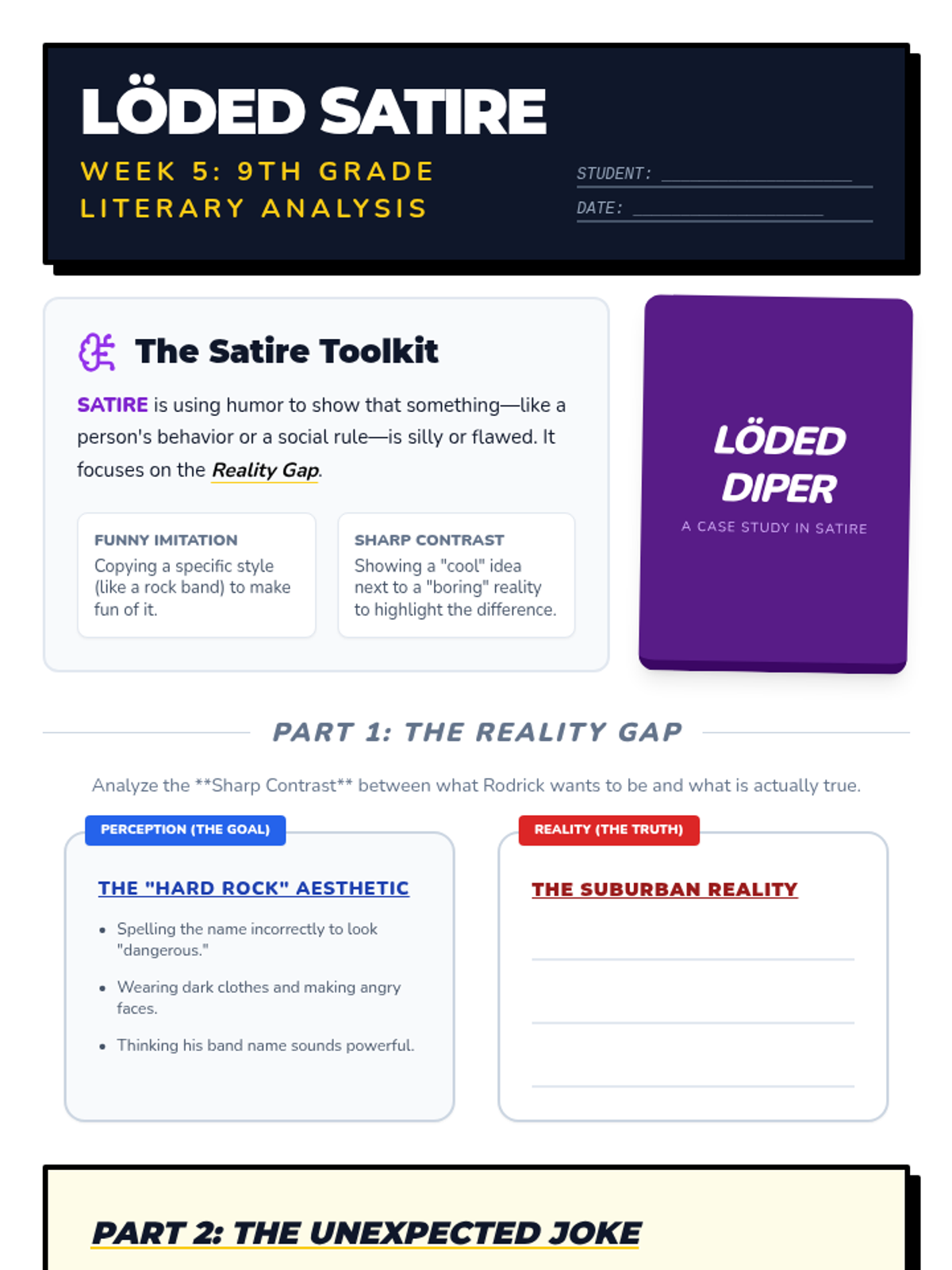
A high-quality 3-page 9th-grade level satire assignment for ELL students. It features a technical toolkit, a case study analysis of the 'Reality Gap', a logical analysis of situational irony, and a creative design pitch. The layout is optimized with light backgrounds for student work and professional page breaks.
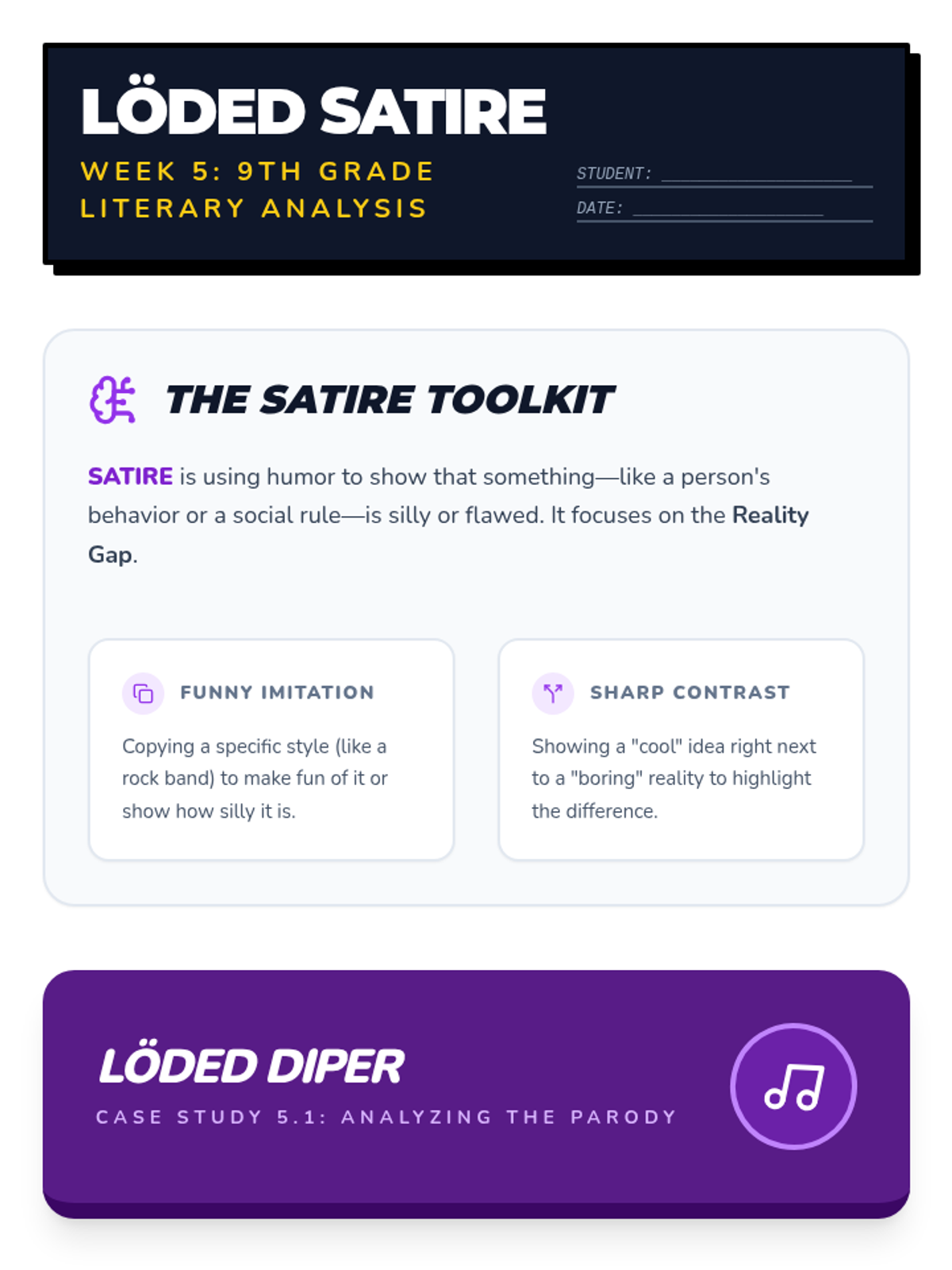
A revised 9th-grade level satire assignment for ELL students. It replaces technical terms like 'Parody' and 'Juxtaposition' with more accessible descriptors like 'Funny Imitation' and 'Sharp Contrast'. Complying with requests to remove drawing, it features a visual design pitch and analytical reflection. Optimized for two pages.
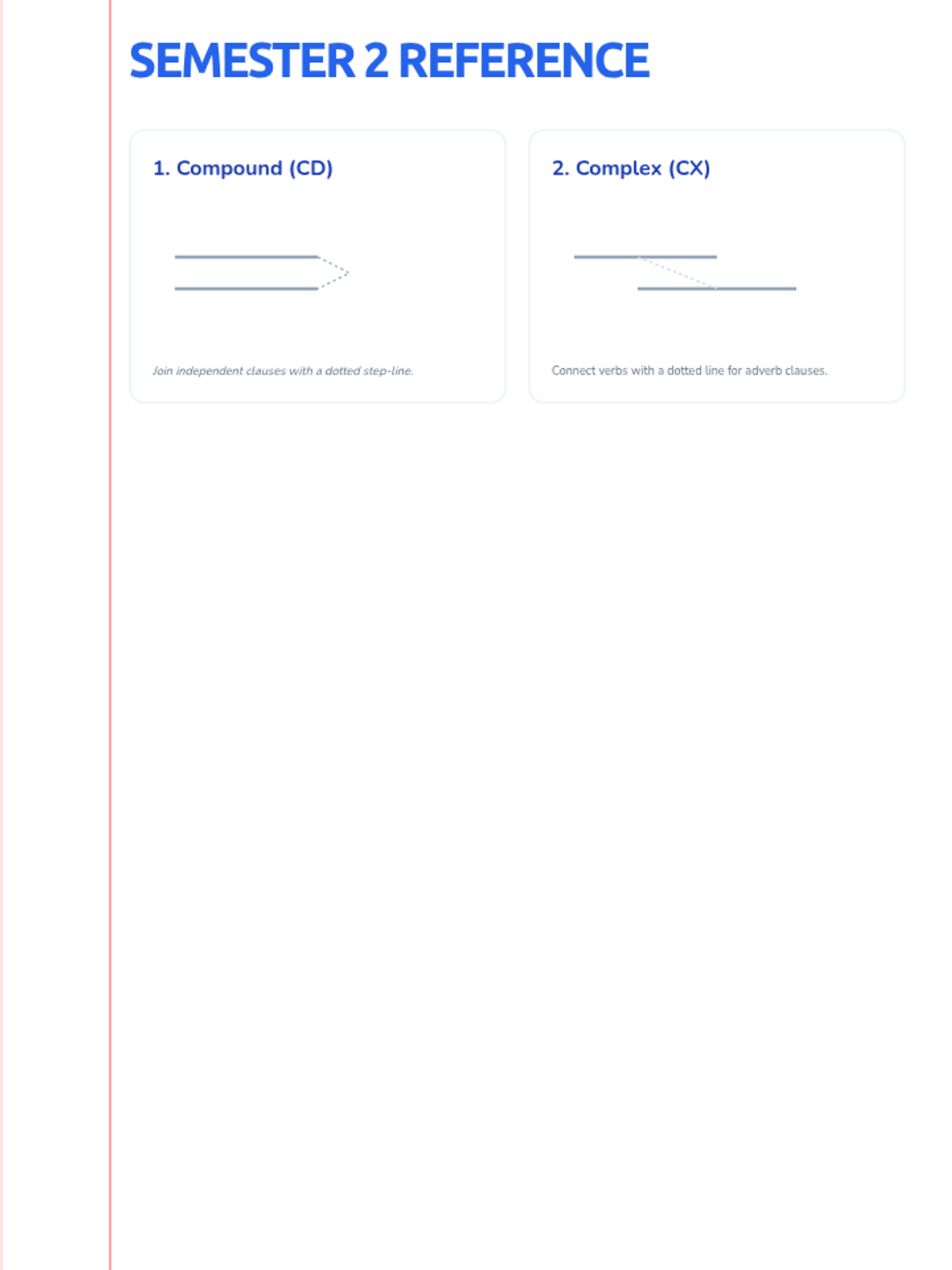
A comprehensive 19-page second-semester grammar workbook. This portrait handout includes daily tasks and unique hints for all 18 weeks (19-36), complex sentence analysis, and customized diagramming spaces with structural guides. Every page follows the user's color-coded daily task model.
A complete 19-page first-semester grammar practice workbook in portrait mode. Each page includes specific daily tasks (POS, Sentence Parts, Clauses, Correction) and a customized Friday diagramming area with structure-specific baselines and professional guidance. Each page matches the user's color-coded model.
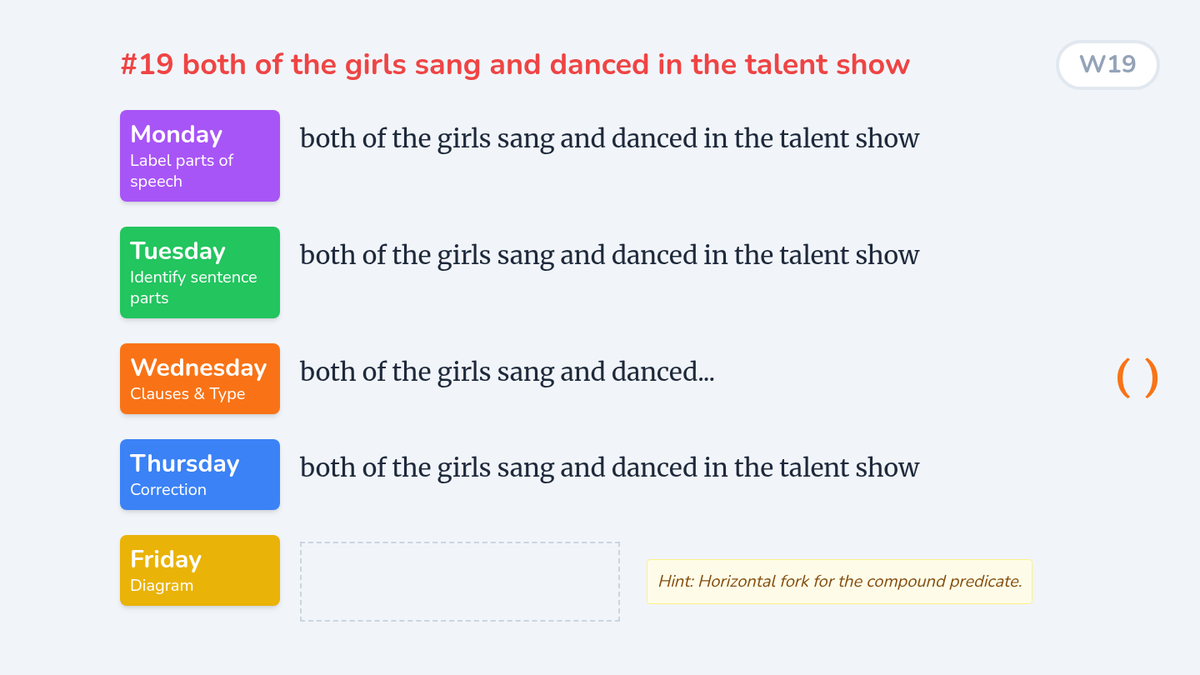
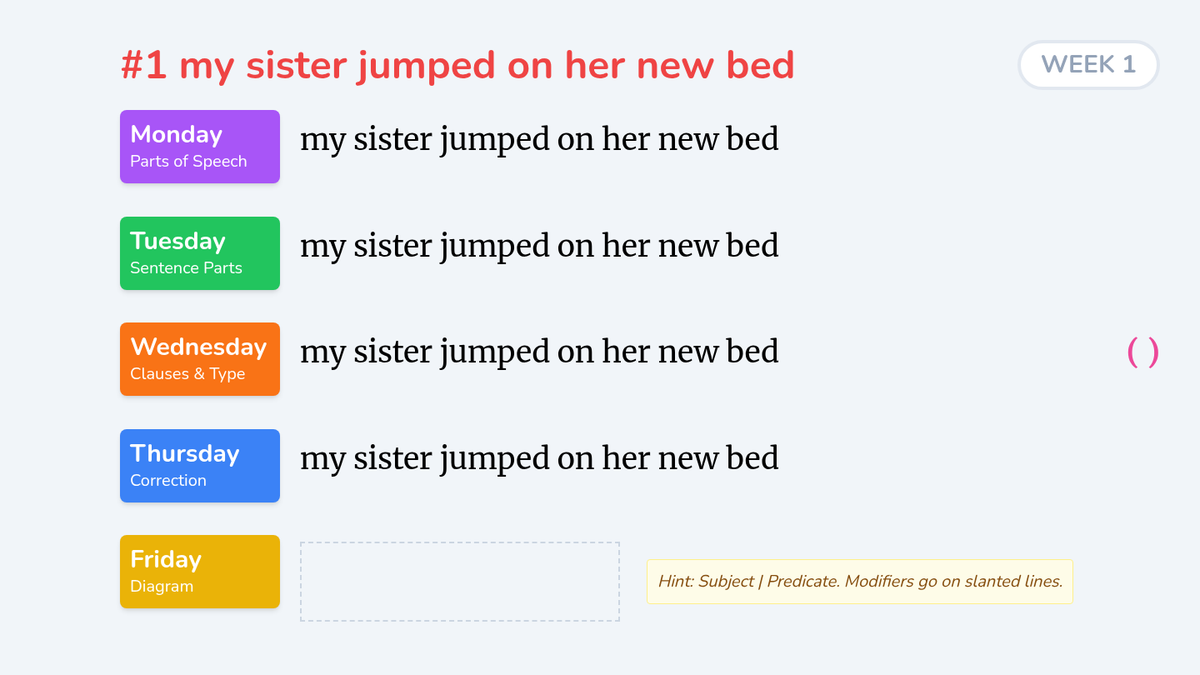
A presentation deck for the second semester of daily grammar practice (Weeks 19-36). Each slide focuses on a complex or compound-complex sentence with specific sections for daily analysis and hints.
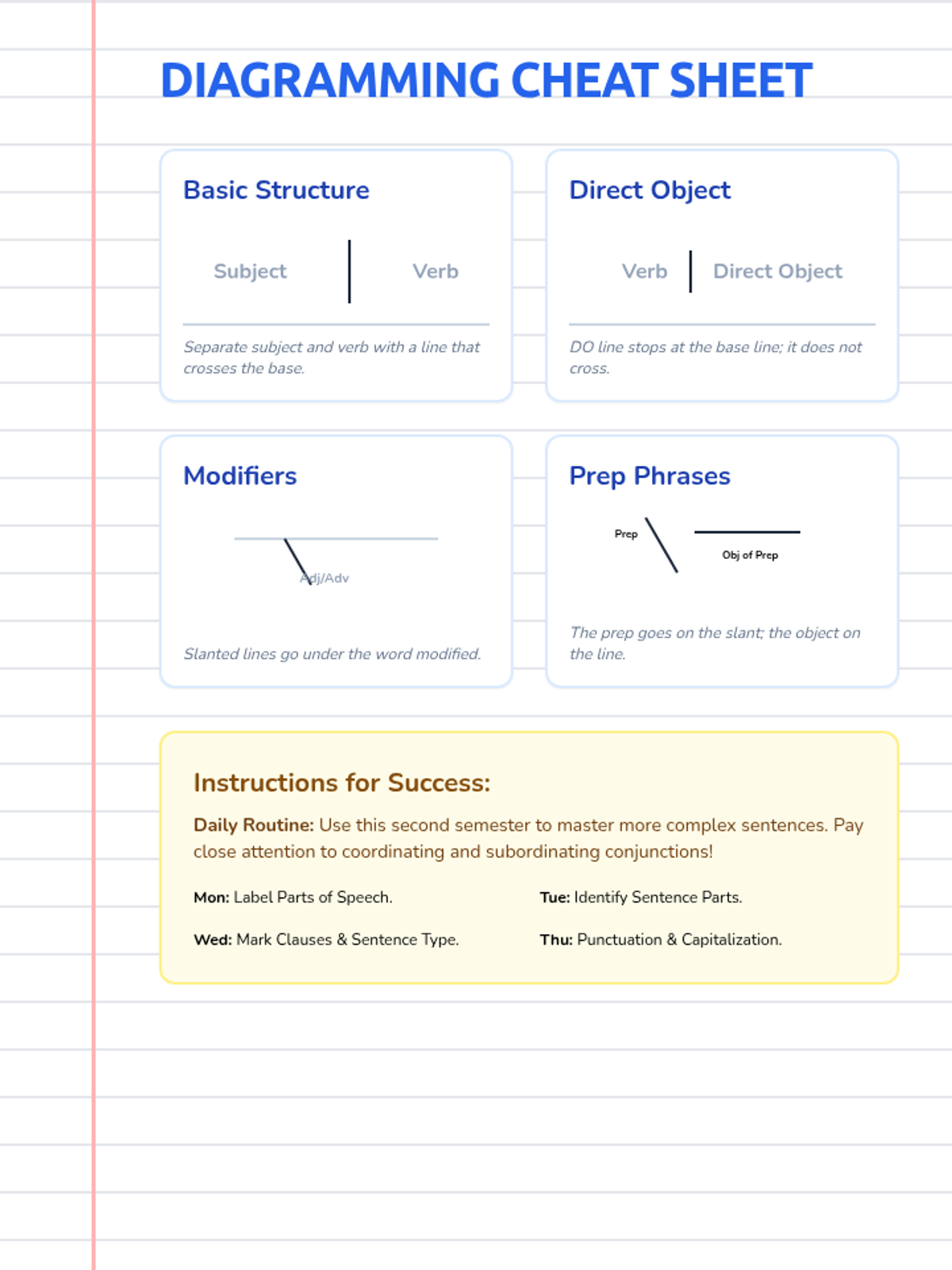
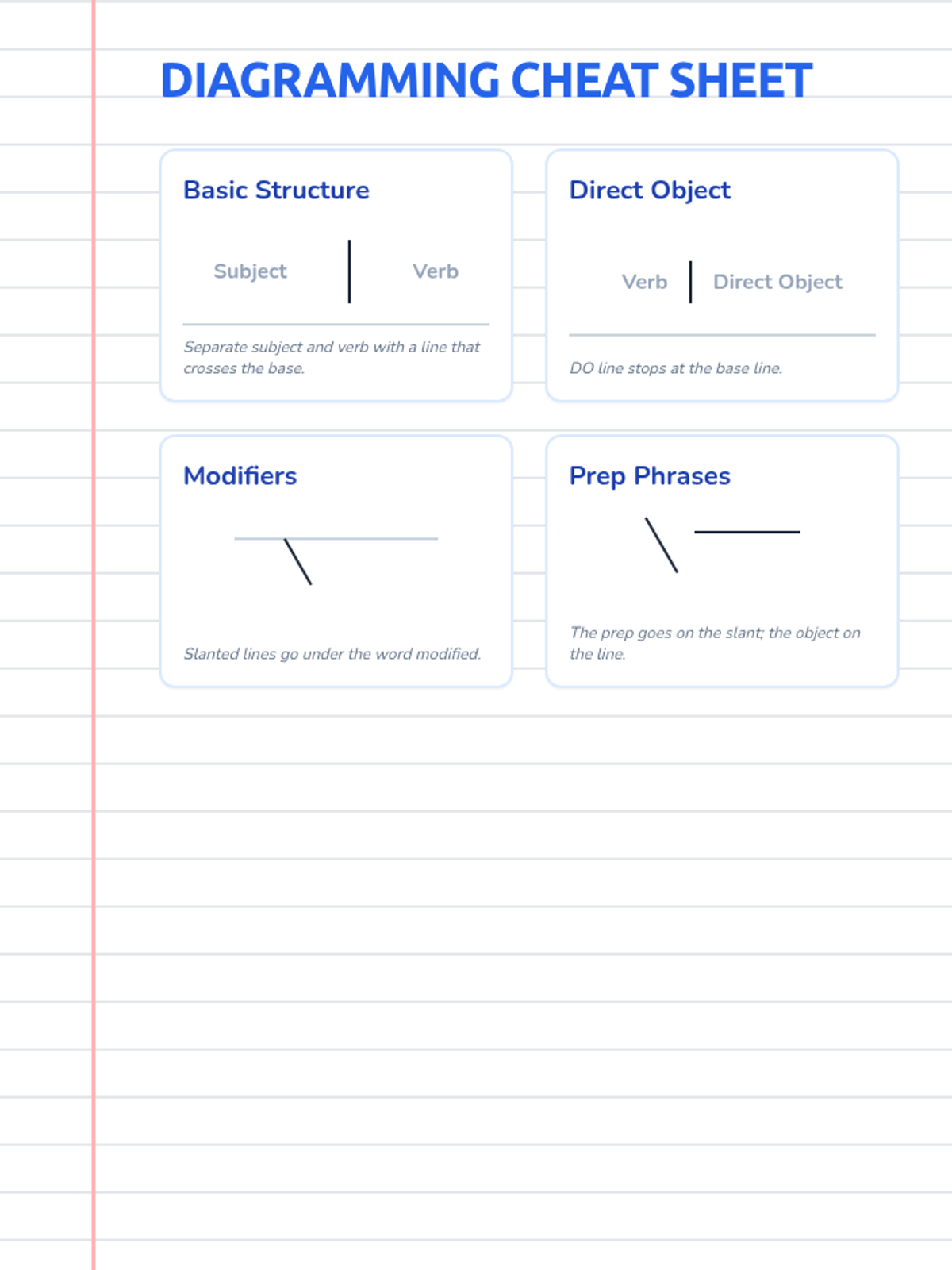
A 19-page second-semester grammar practice workbook, featuring Weeks 19-36 in portrait mode. Each page provides daily instructions and specific hints for complex and compound-complex sentence analysis, plus a diagramming reference guide.
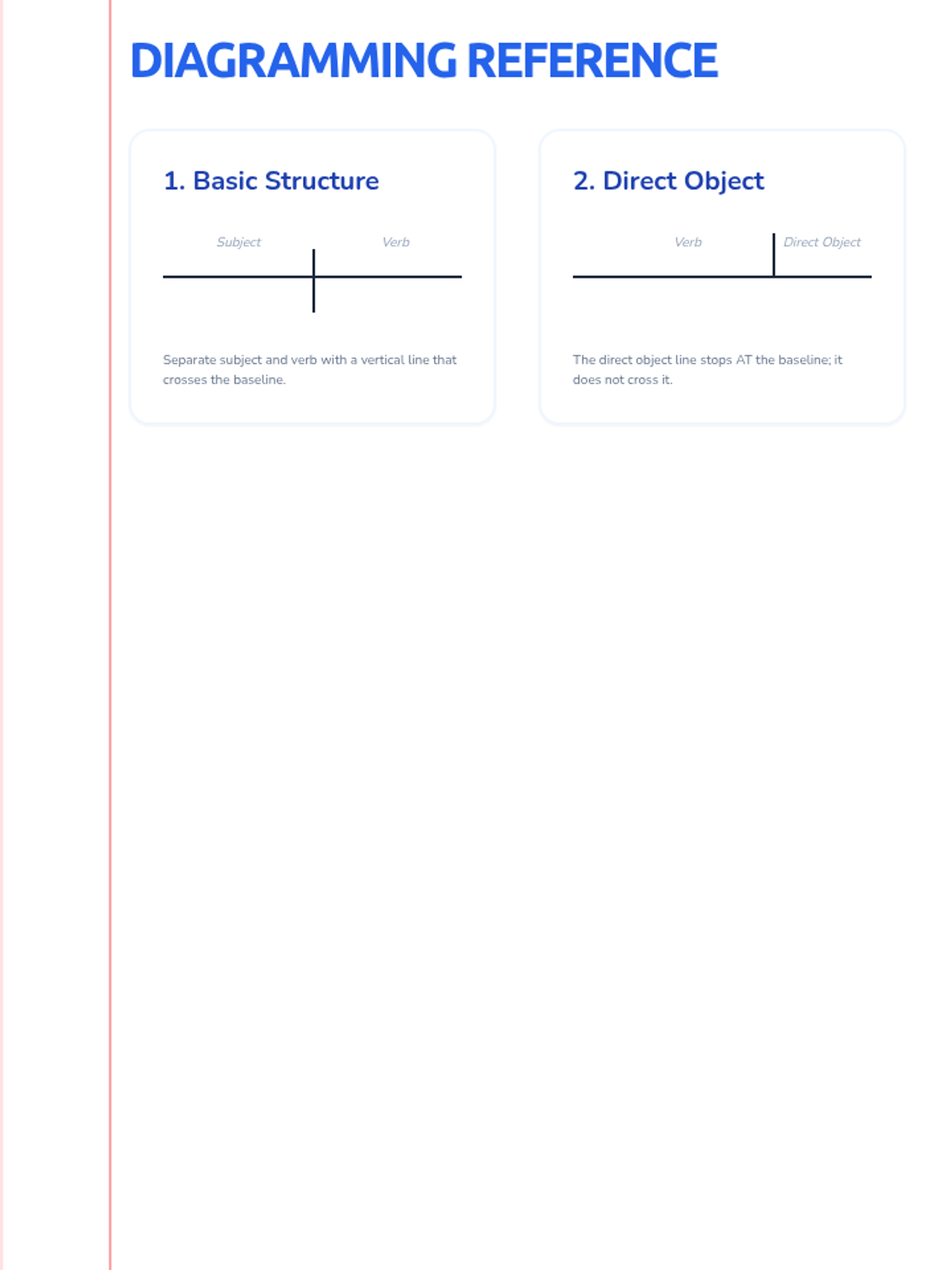
A 19-page comprehensive grammar practice workbook for the first semester, featuring one week per page in portrait mode. Each page includes specific daily instructions and tailored hints for parts of speech, sentence analysis, correction, and diagramming, plus a diagramming cheat sheet.
A 18-slide presentation for daily grammar practice, following a consistent weekly routine of part of speech identification, sentence analysis, and diagramming. Each slide features a notebook-style theme with colorful daily task indicators and space for student interaction.
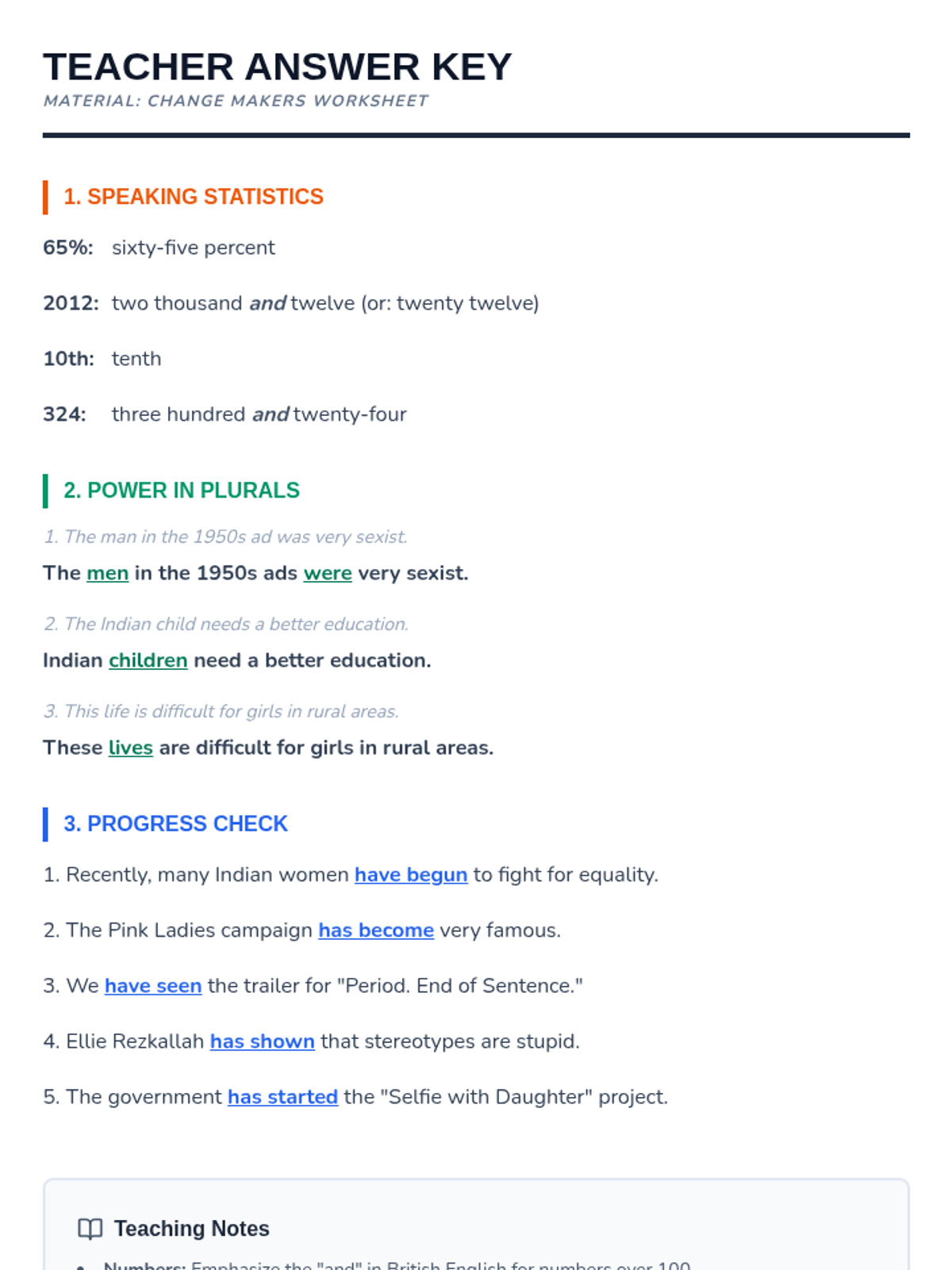
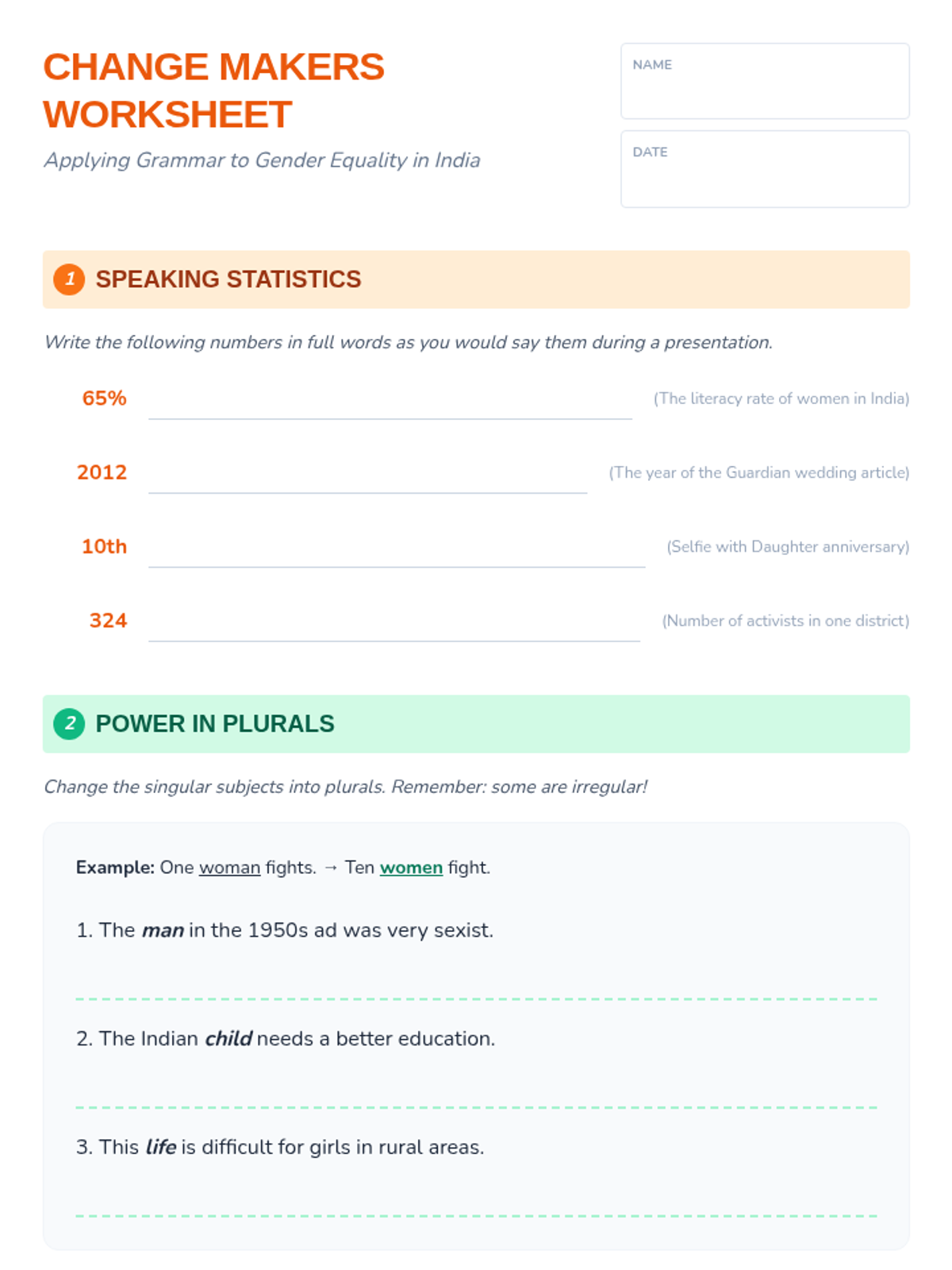
Teacher's answer key for the Change Makers Worksheet with additional pedagogical notes and extension ideas.
A comprehensive practice worksheet for A2 students applying numbers, irregular plurals, and the present perfect to topics like the Pink Ladies, Beti Bachao, and Ellie Rezkallah's work.
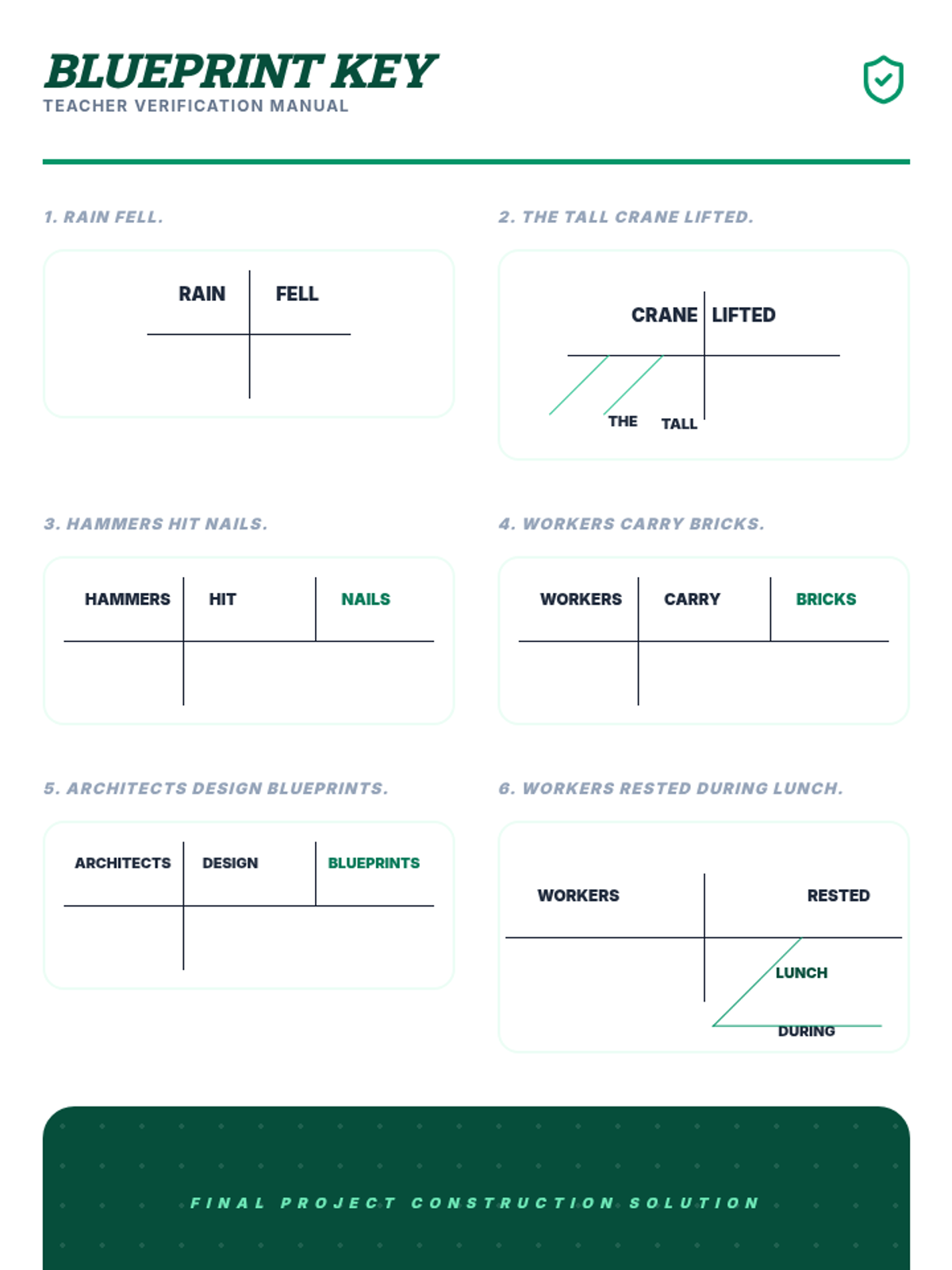
A comprehensive answer key with visual diagram solutions, featuring corrected Reed-Kellogg structures for complex sentences and prepositional phrases.
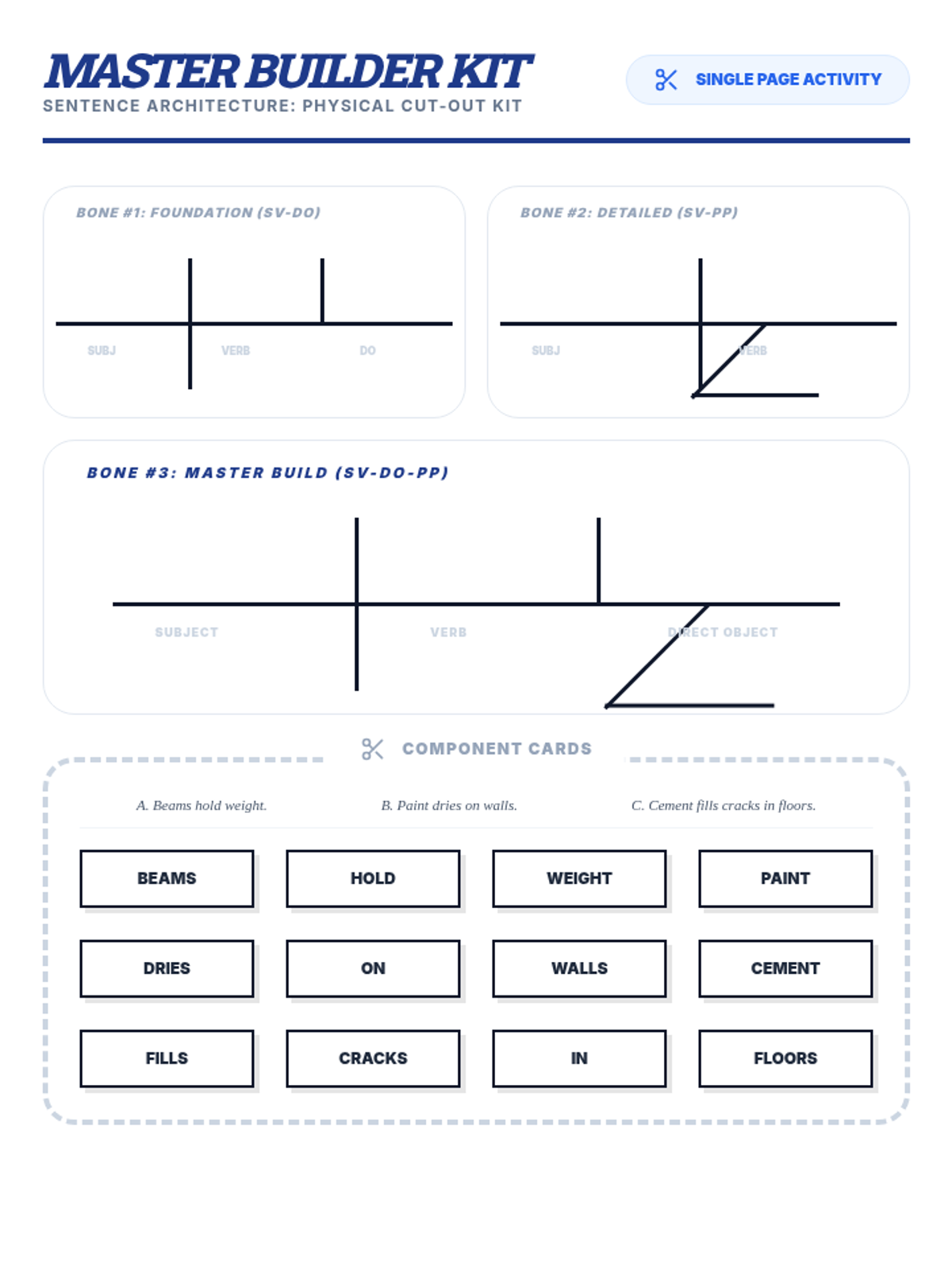
A hands-on "drag and drop" alternative for print, providing enlarged diagram frames and component cards for a physical sentence building activity on a single page.
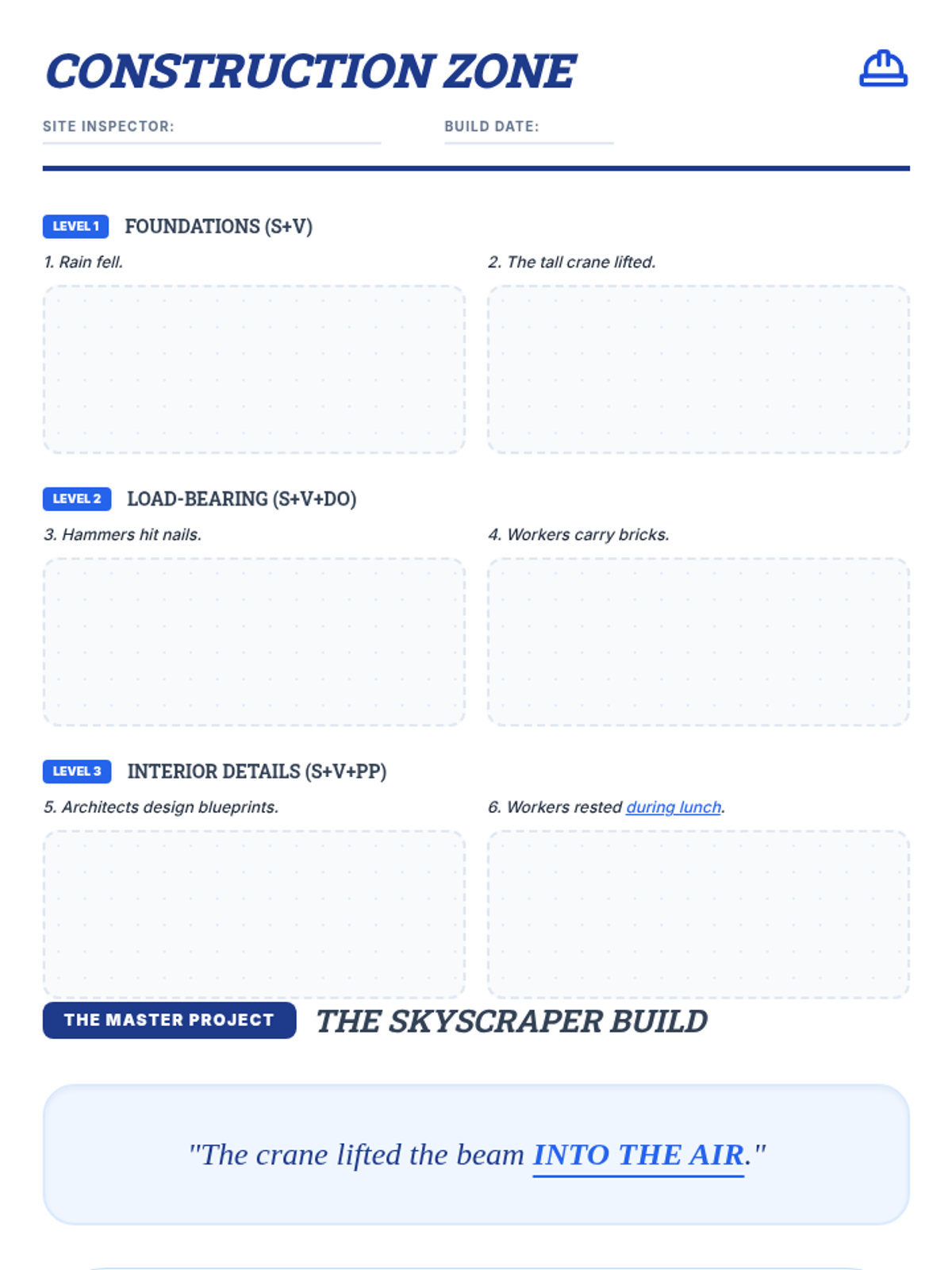
A sentence diagramming worksheet with three levels of increasing difficulty, plus a final challenge and a word bank to simulate interactive diagram building.
A visual guide to Reed-Kellogg diagramming, using an architectural theme to explain how to structure subjects, verbs, direct objects, and prepositional phrases.
A regal, attractive presentation slide deck for the Verse Voyagers lesson, featuring a rich Emerald Green and Royal Gold color palette. The deck includes learning targets, a full 20-round gamified Quiz Bee, TP-CASTT modeling, and an independent analysis guide. Fully revised for uniform answer choices, corrected headers, and visual polish.
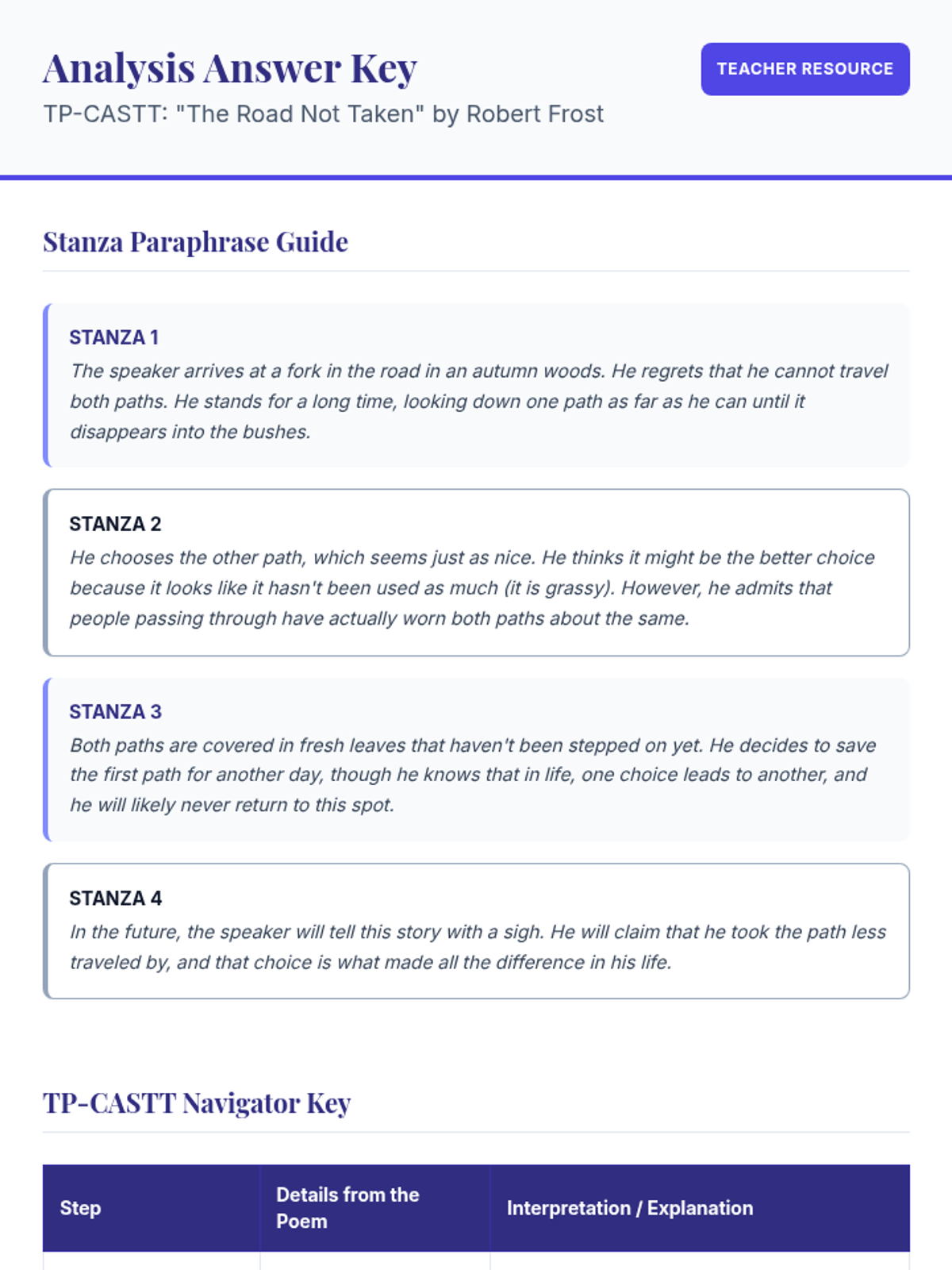
A comprehensive answer key for the 'The Road Not Taken' TP-CASTT analysis, including stanza-by-stanza paraphrasing and detailed interpretations for each step of the method.
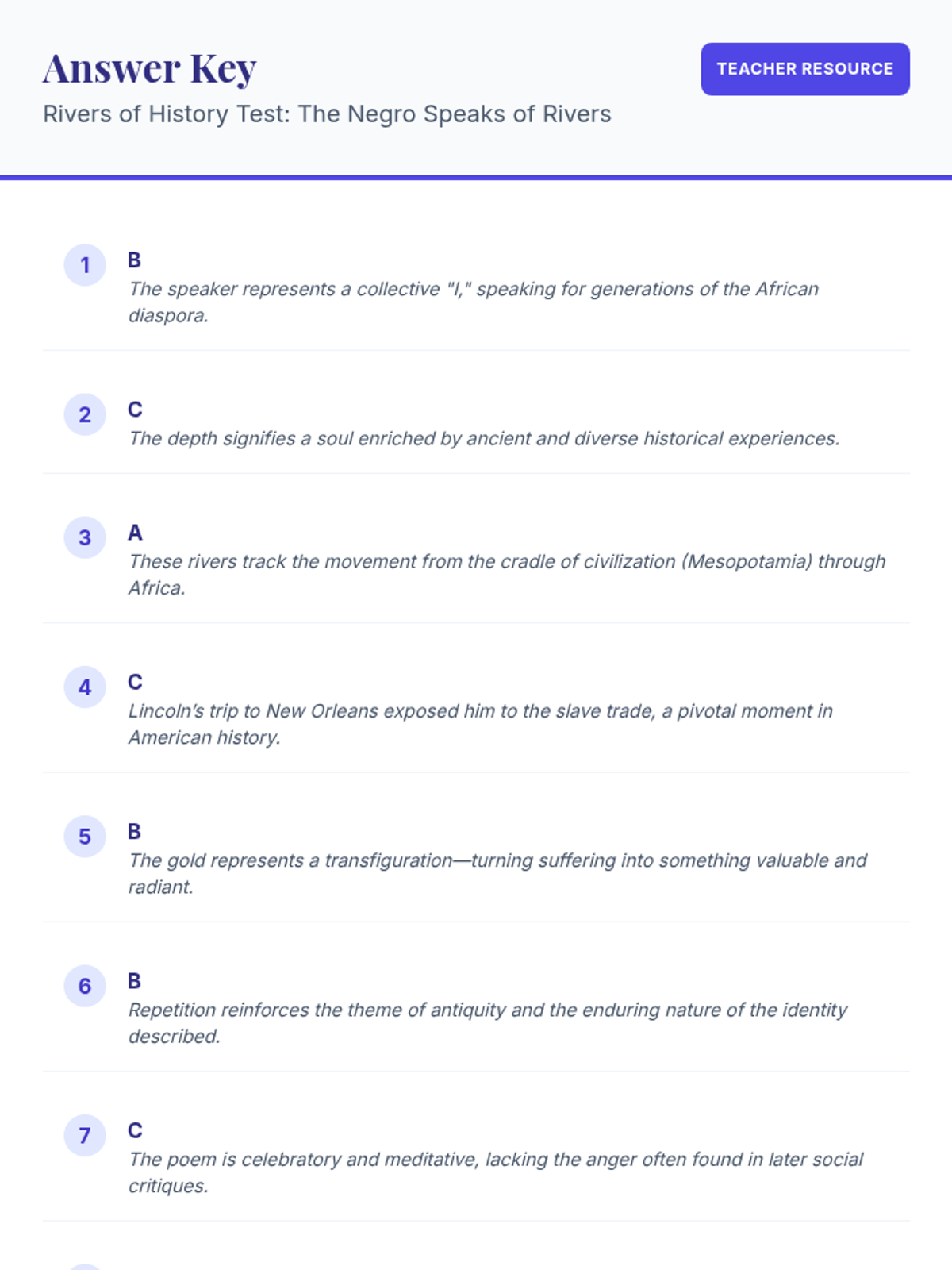
An answer key for the 'Rivers of History' test, including correct responses and brief pedagogical rationales for each question.
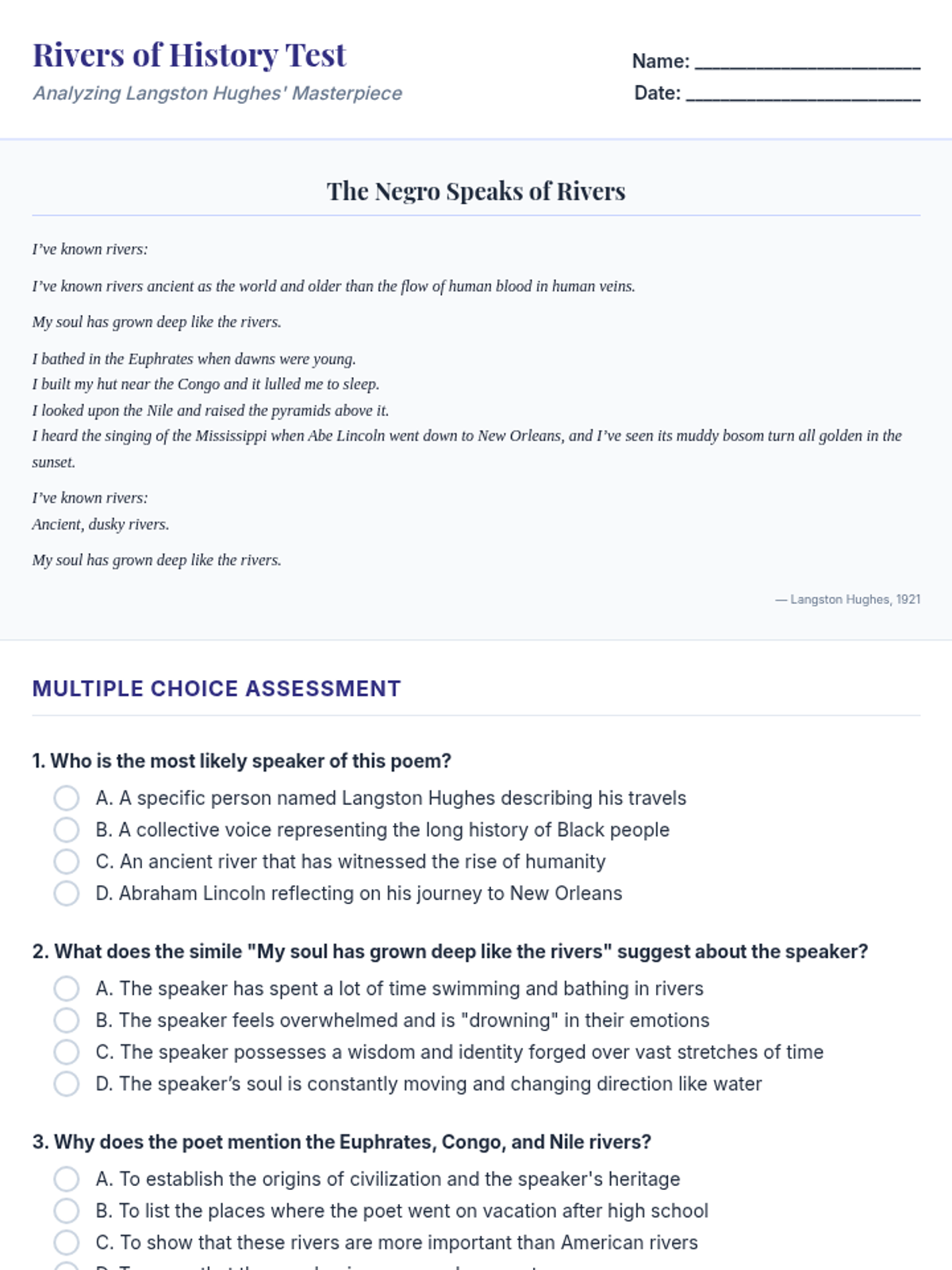
A 10-question multiple choice test worksheet based on Langston Hughes' 'The Negro Speaks of Rivers', focusing on symbolism, allusion, and theme.
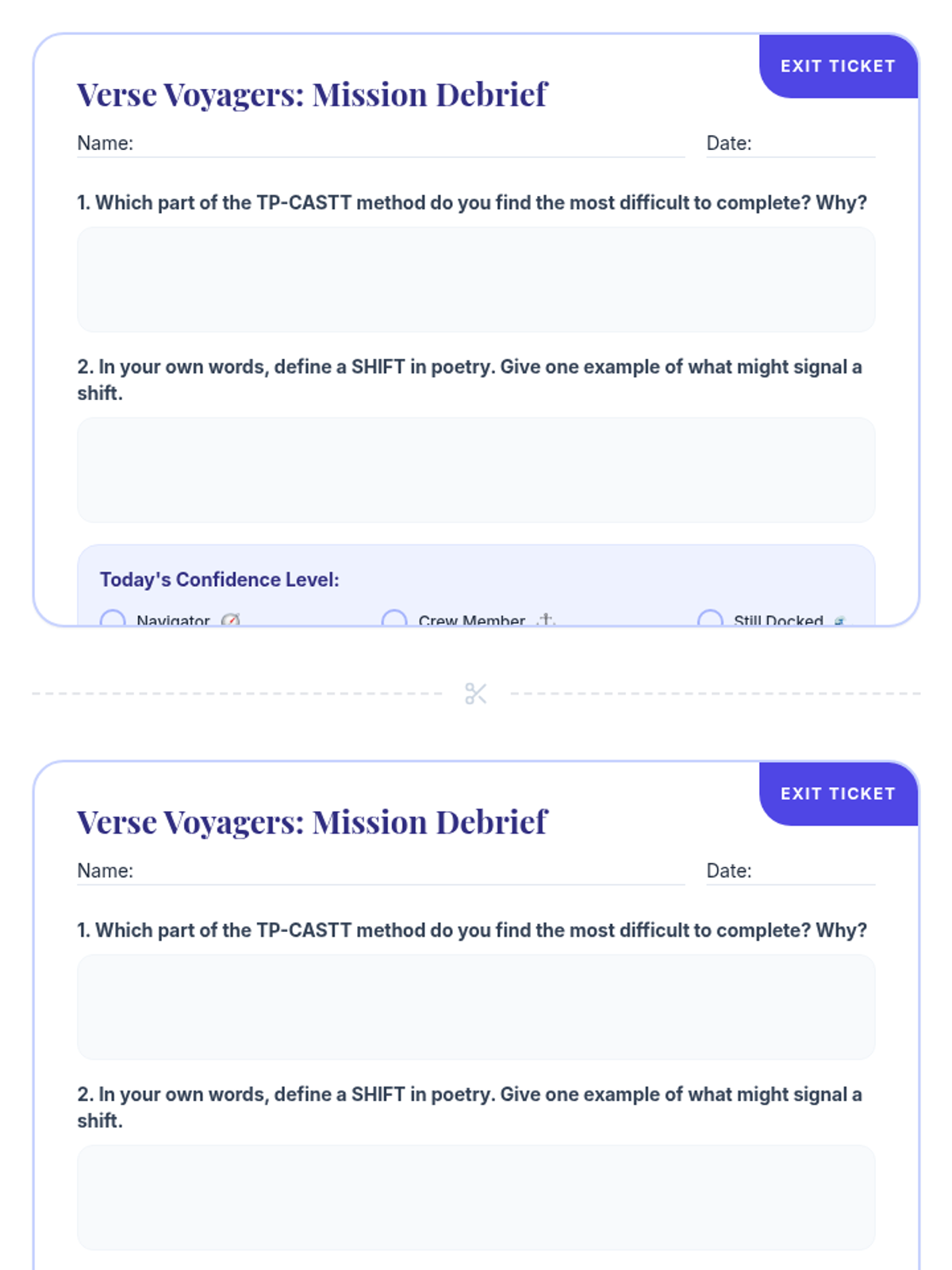
A half-sheet exit ticket for students to reflect on the TP-CASTT method and assess their understanding of poetic shifts, formatted as two per page for easy cutting.
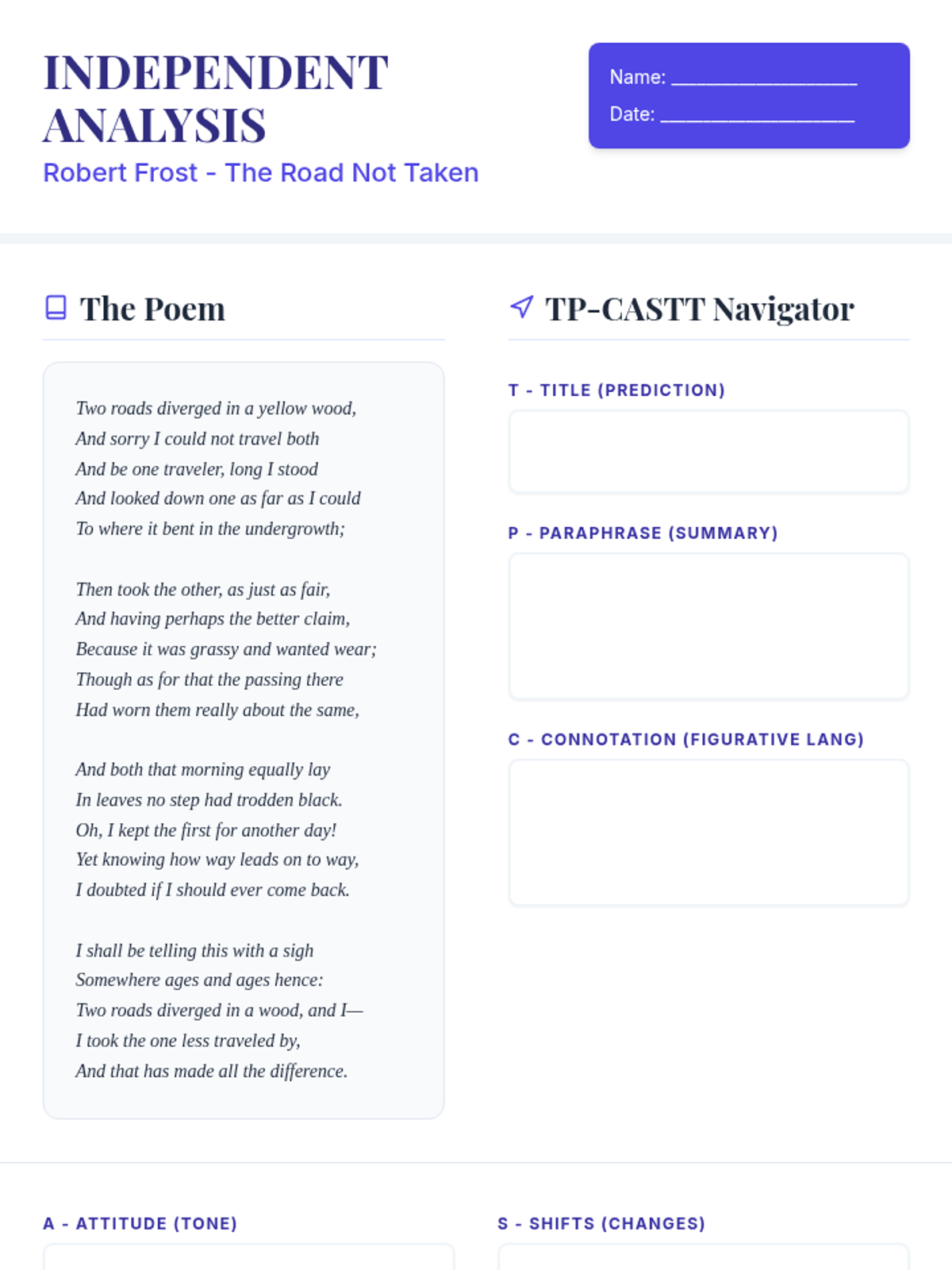
An independent practice worksheet for analyzing Robert Frost's 'The Road Not Taken' using the TP-CASTT method, featuring a full-text version and guided analysis blocks.
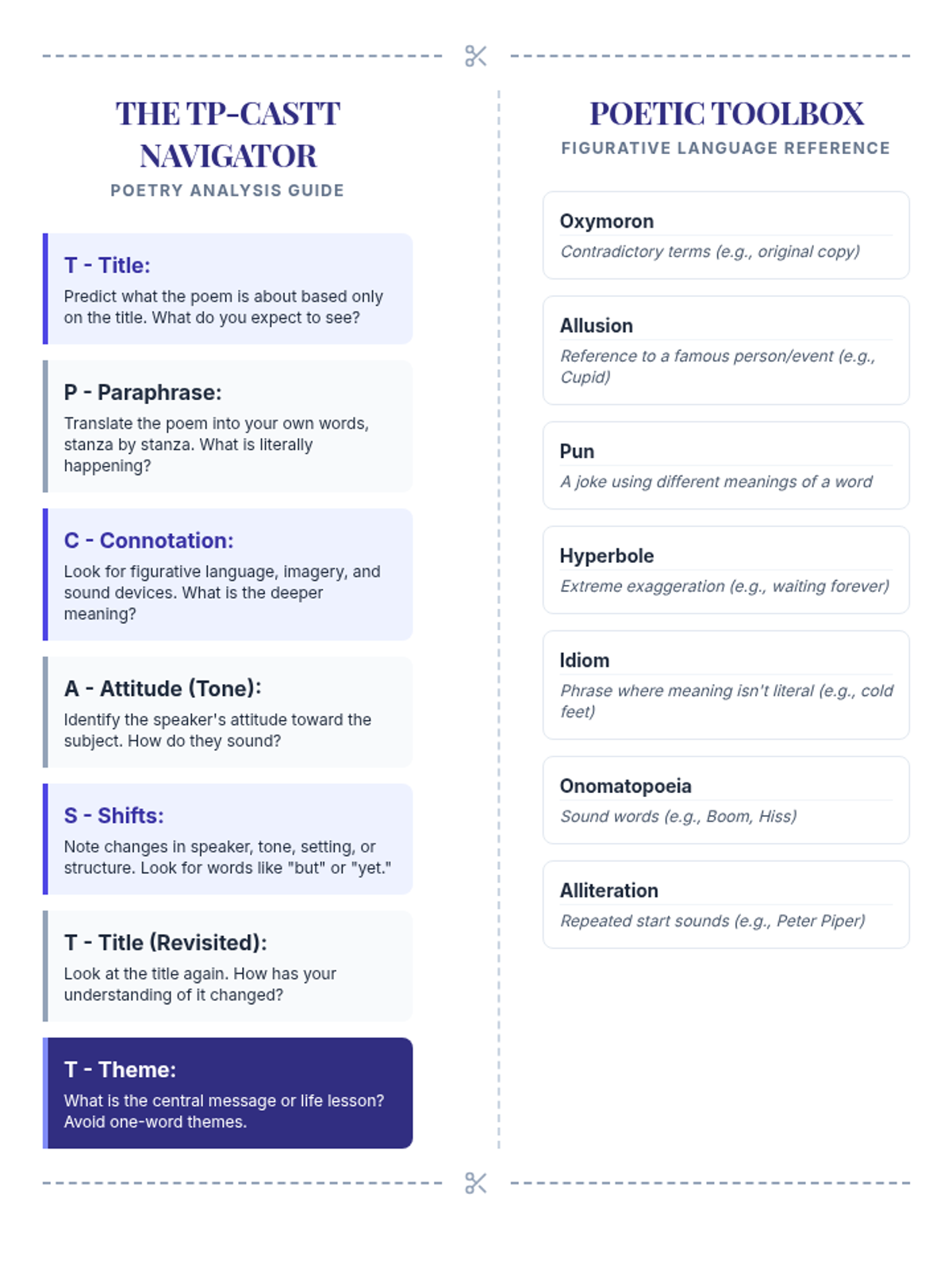
A two-part cut-out reference sheet containing the TP-CASTT analysis steps on one side and a figurative language toolbox on the other.
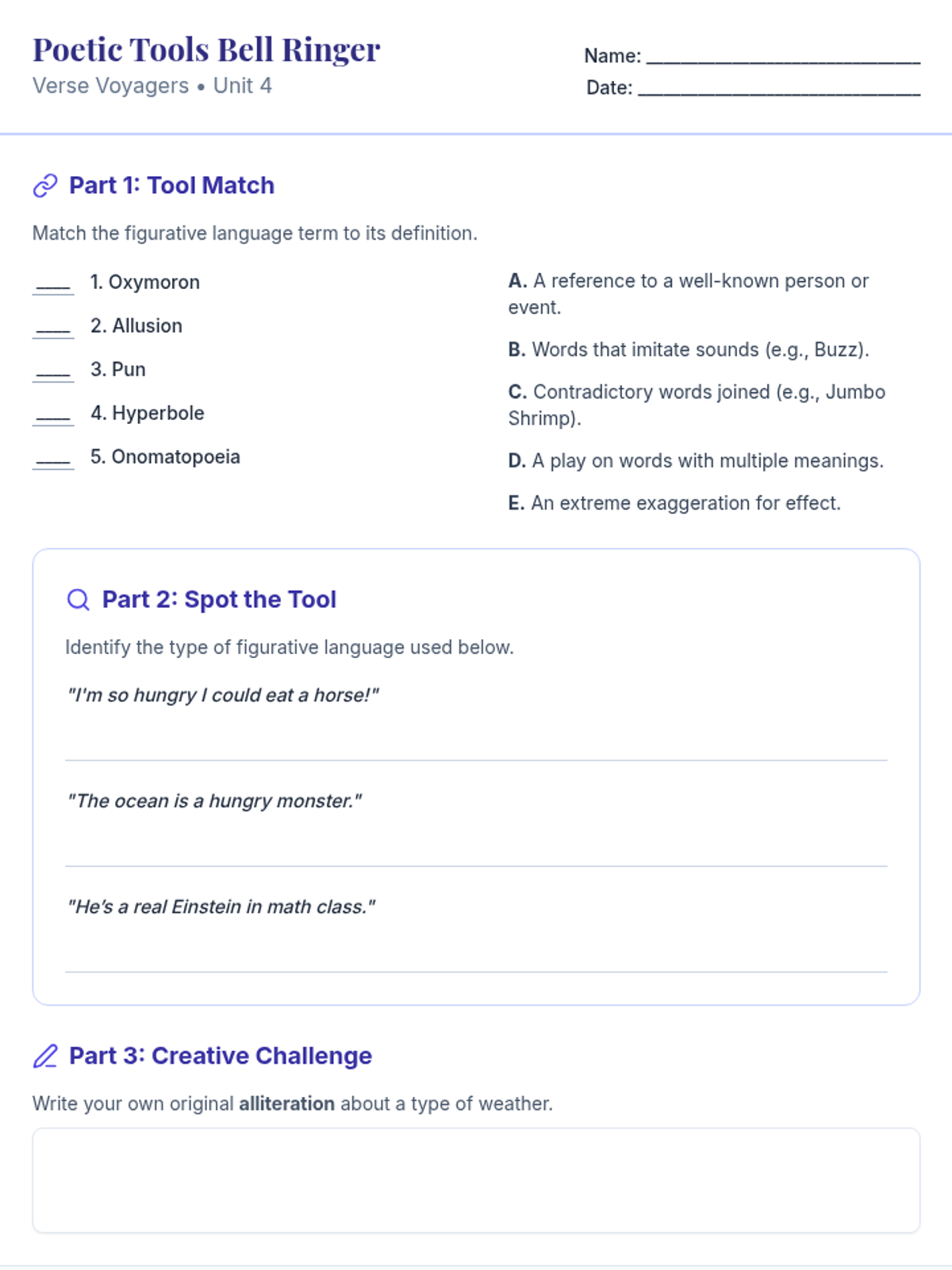
A bell ringer worksheet reviewing key figurative language terms like oxymoron, allusion, and pun through matching and identification exercises.
A comprehensive slide deck for the Verse Voyagers lesson, including a 20-question Quiz Bee and a step-by-step TP-CASTT modeling section for Langston Hughes' 'The Negro Speaks of Rivers'.
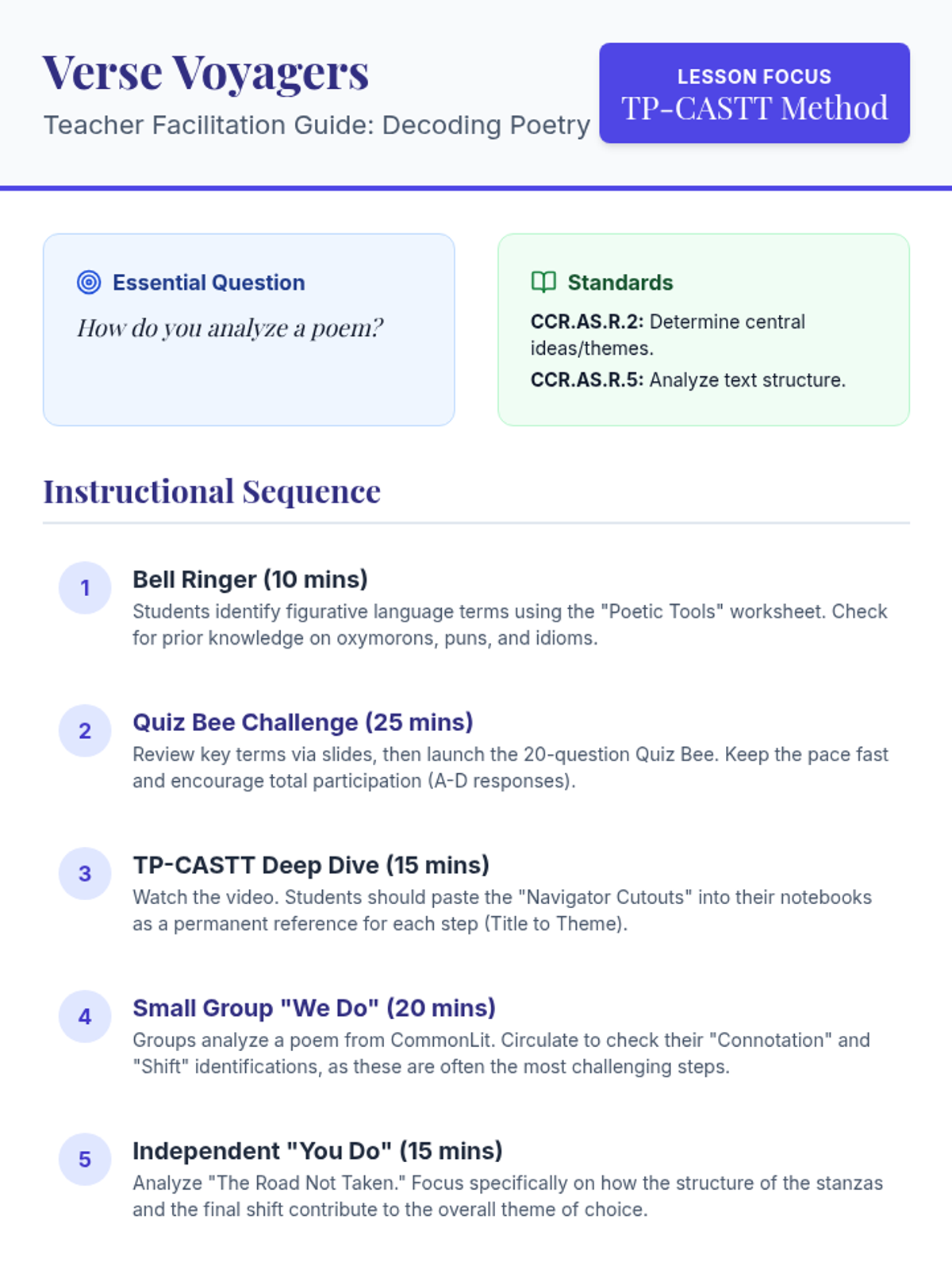
A teacher facilitation guide outlining the instructional flow, standards, and learning targets for the Verse Voyagers poetry lesson.
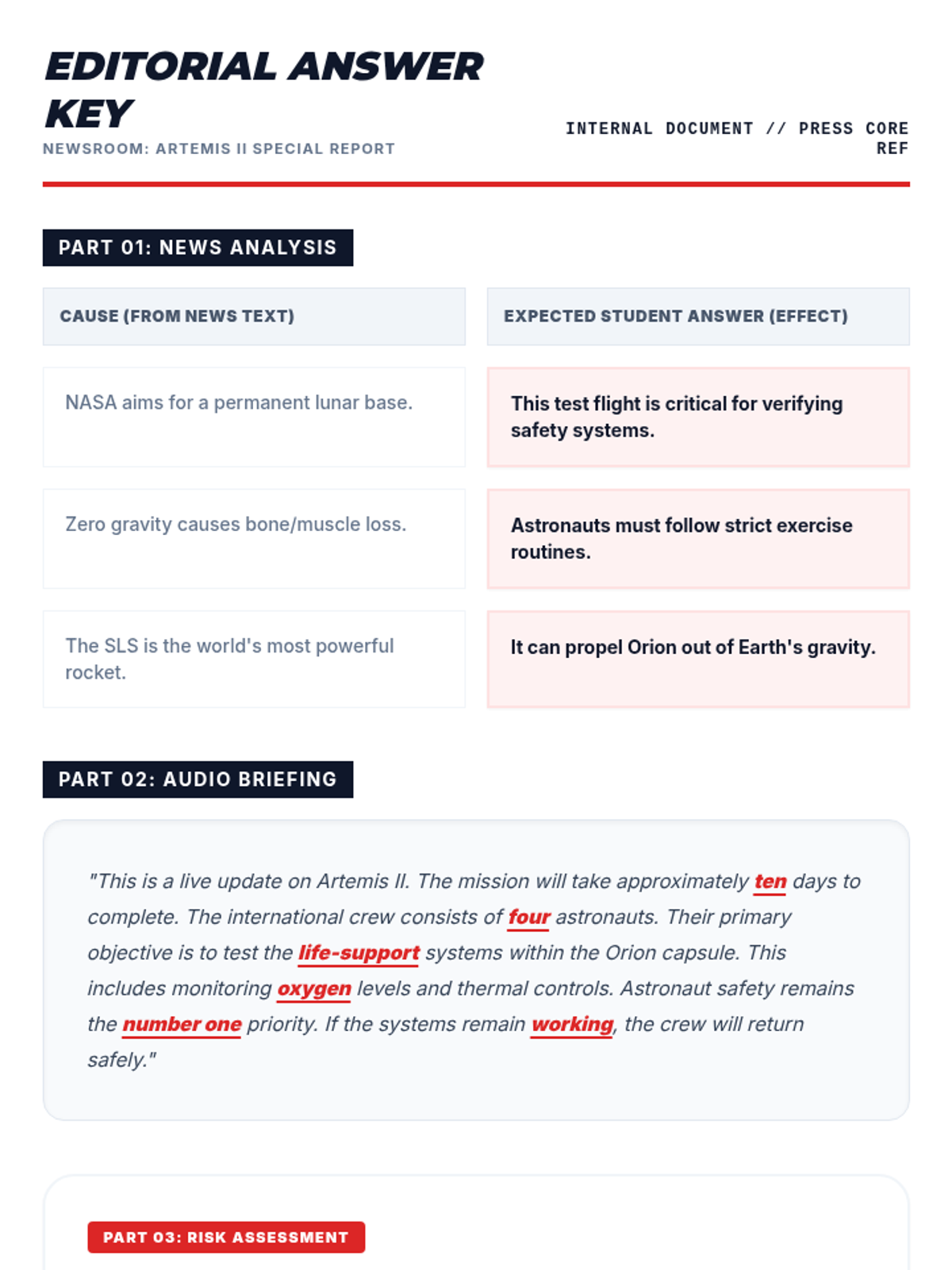
Updated teacher answer key for the ESL-focused Artemis II lesson, including matching solutions and language production goals for writing and speaking. Now with exemplar sentences.
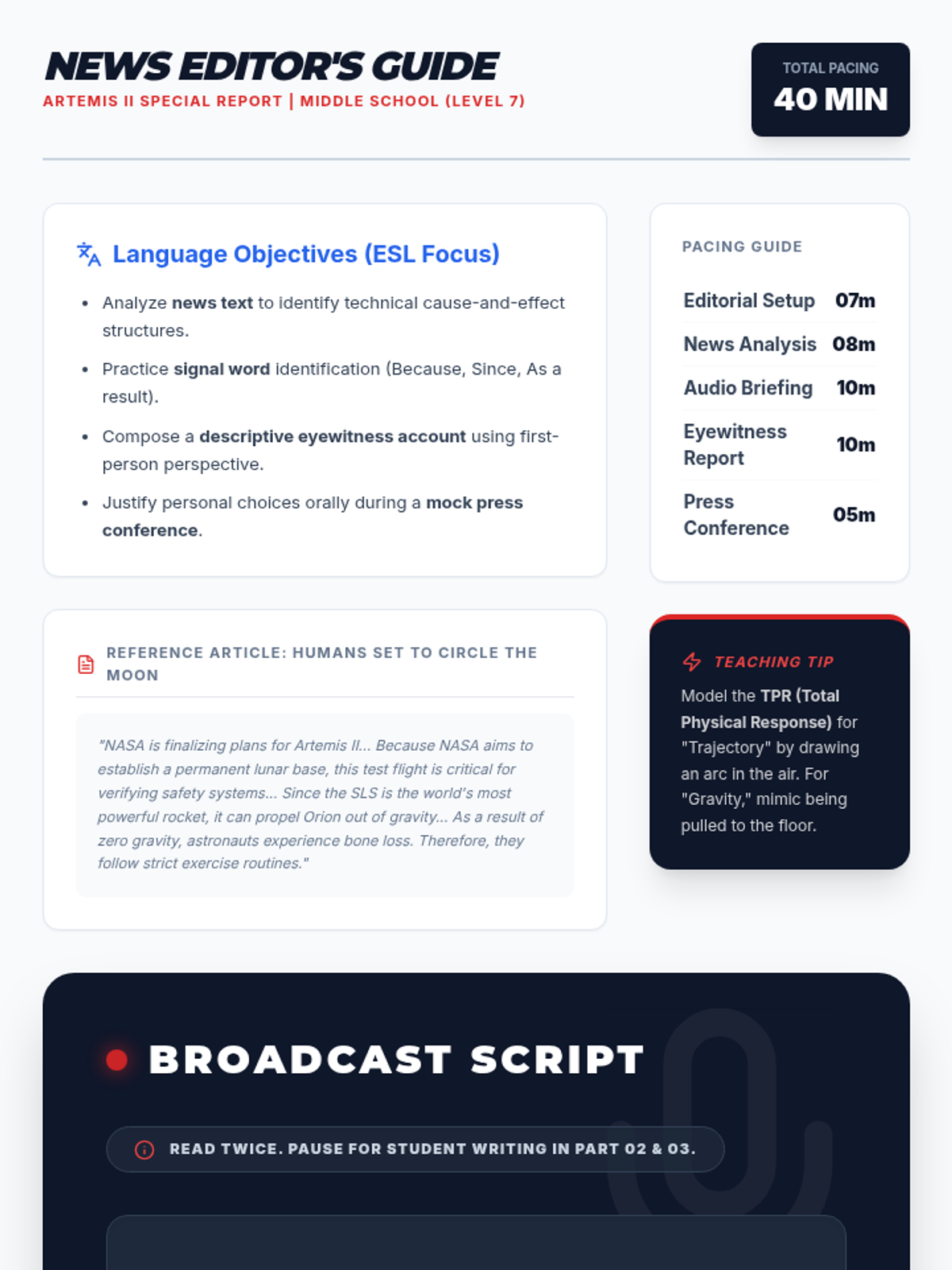
A specialized teacher's guide for the Artemis II lesson with an ESL focus, including content and language objectives, scaffolding strategies, and the listening script.
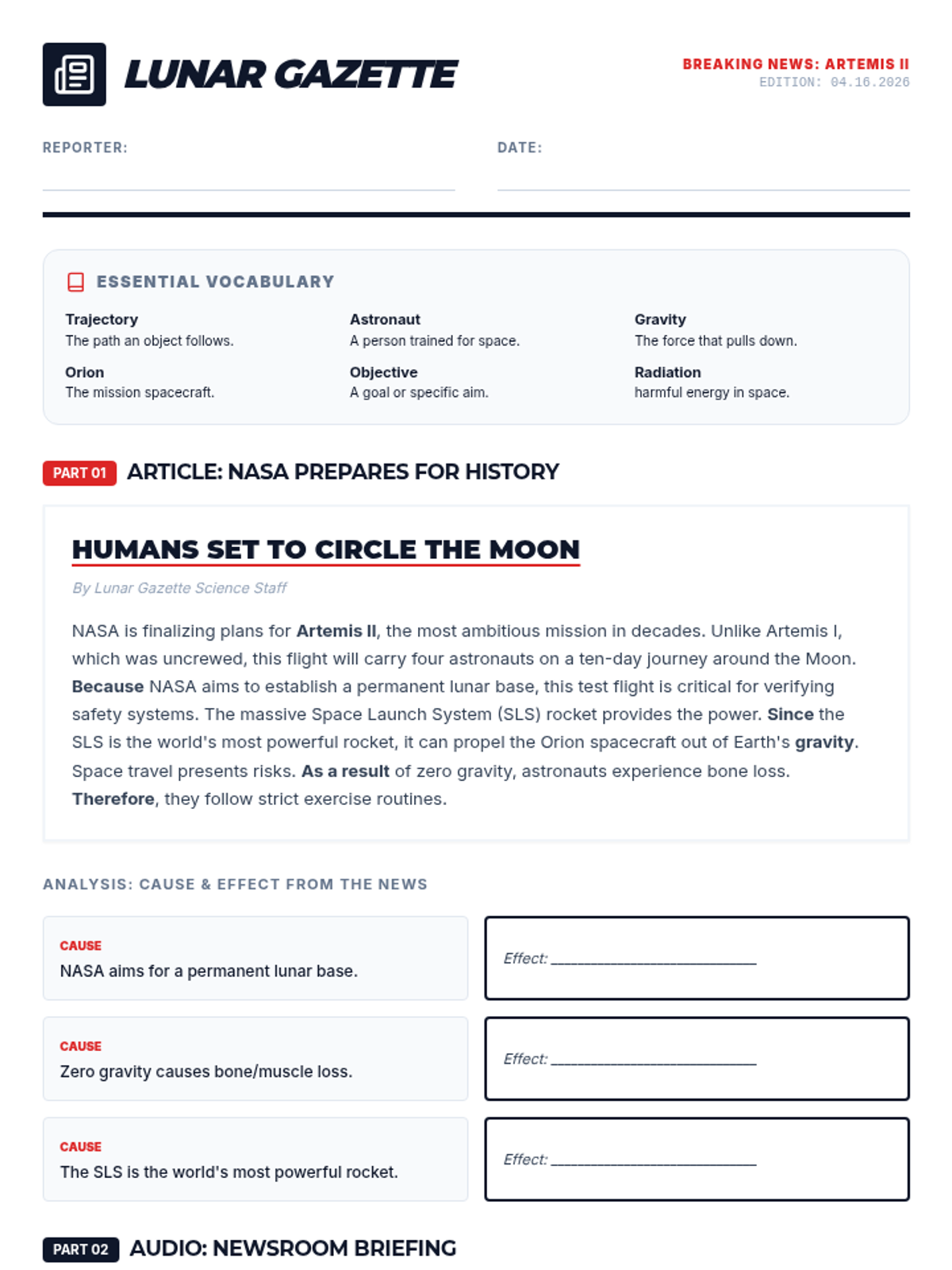
A comprehensive student worksheet tailored for ESL learners at a 7th-grade reading level, featuring a "Lunar Gazette" news article, cause-and-effect analysis, listening cloze, and news-themed writing/speaking activities. Consolidated into 3 pages.
Updated space-themed slides for ESL learners, including a visual vocabulary slide, a cause-and-effect signal word guide, and descriptive writing scaffolding. Now features a dedicated active listening graphic organizer slide and improved contrast.
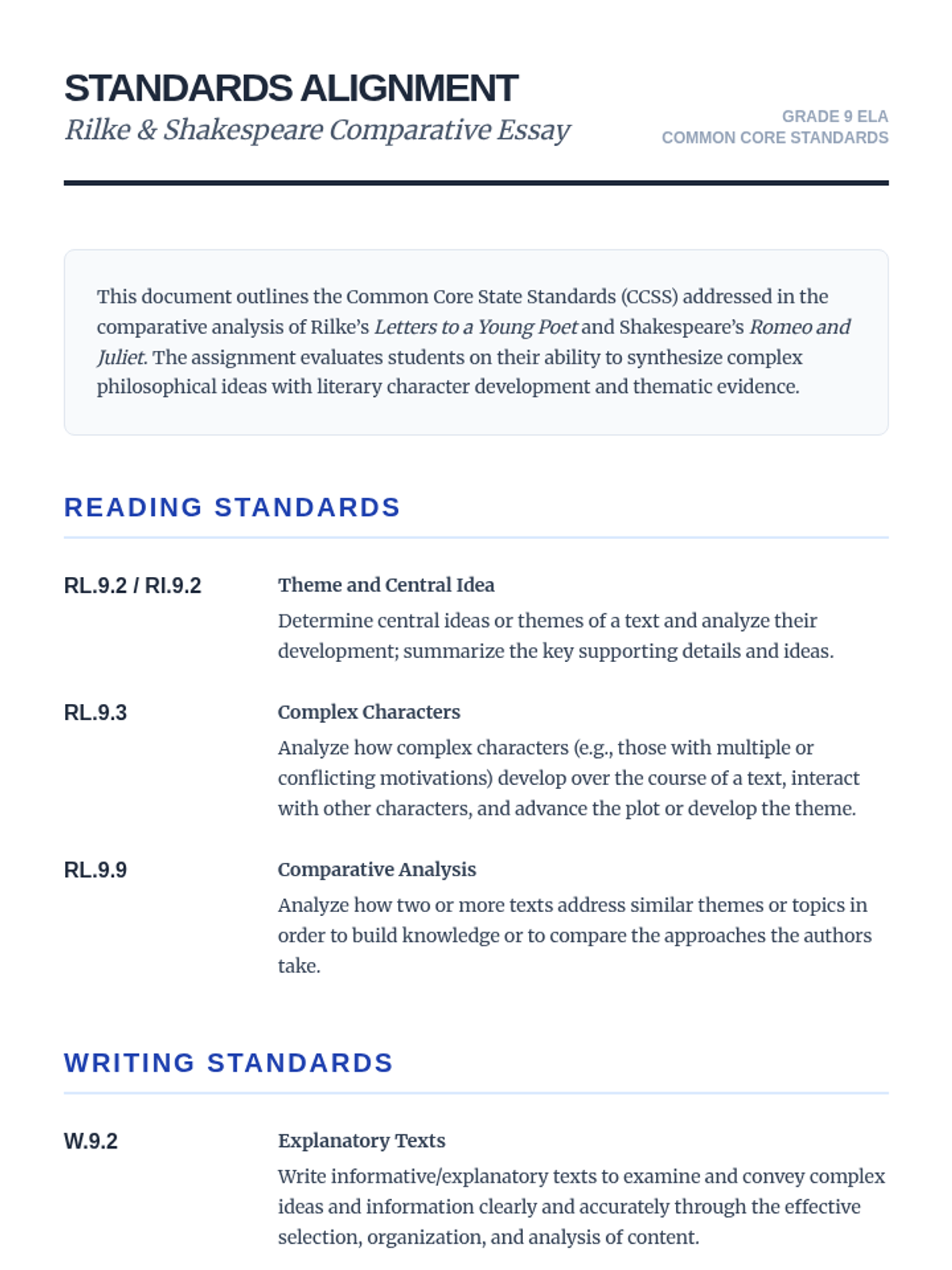
A professional reference document listing the Common Core State Standards addressed in the Rilke/Shakespeare comparative essay, including Reading, Writing, and Language standards for ninth grade. Now includes specific references to formal tone and third-person perspective.
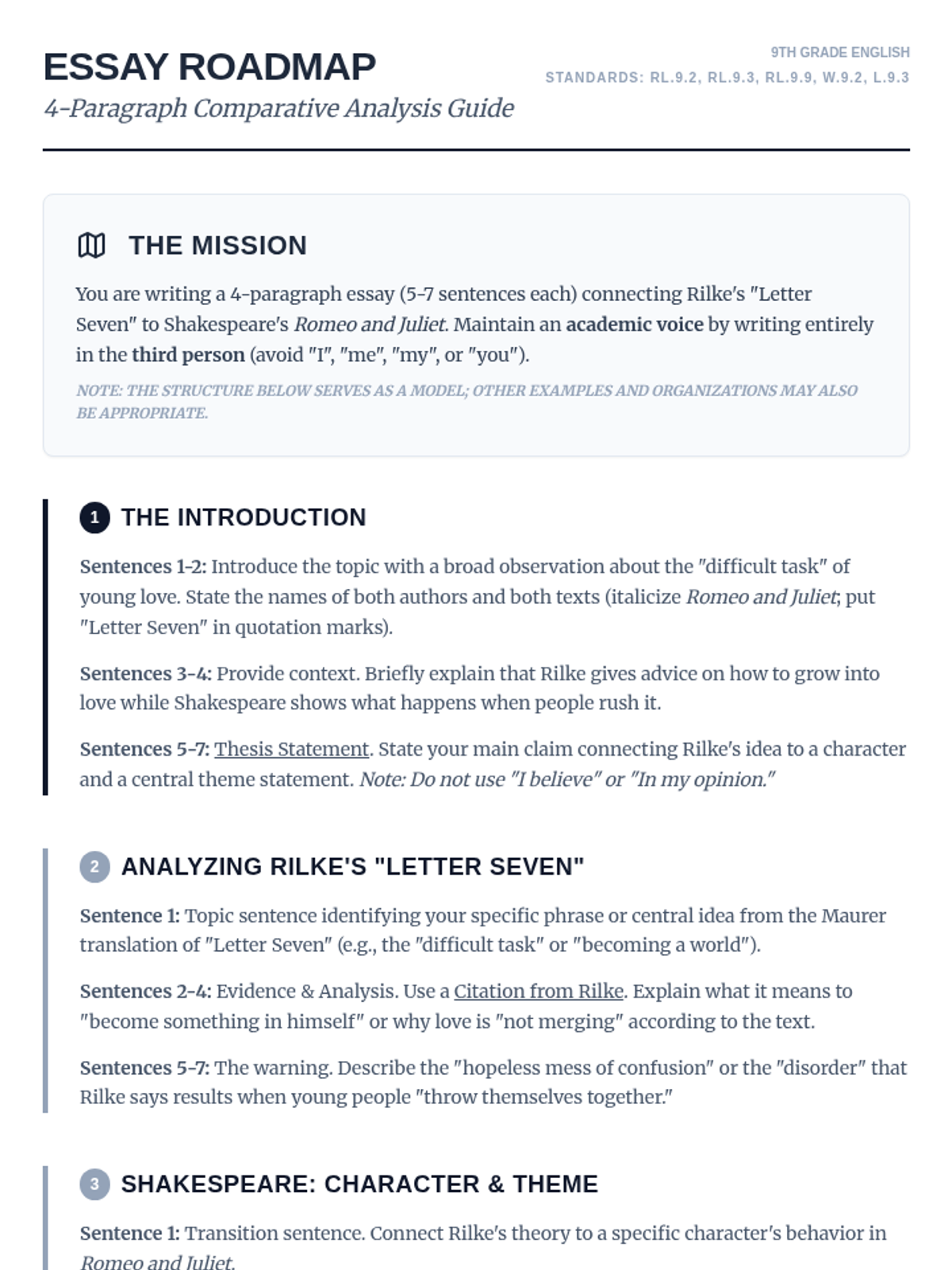
A step-by-step drafting guide for ninth-grade students to structure their 4-paragraph comparative essay, including sentence-by-sentence prompts and MLA requirements. Vocabulary has been simplified for 9th-grade clarity and the term "Hook" has been removed to encourage academic voice. Now uses the spacious vertical-block layout.
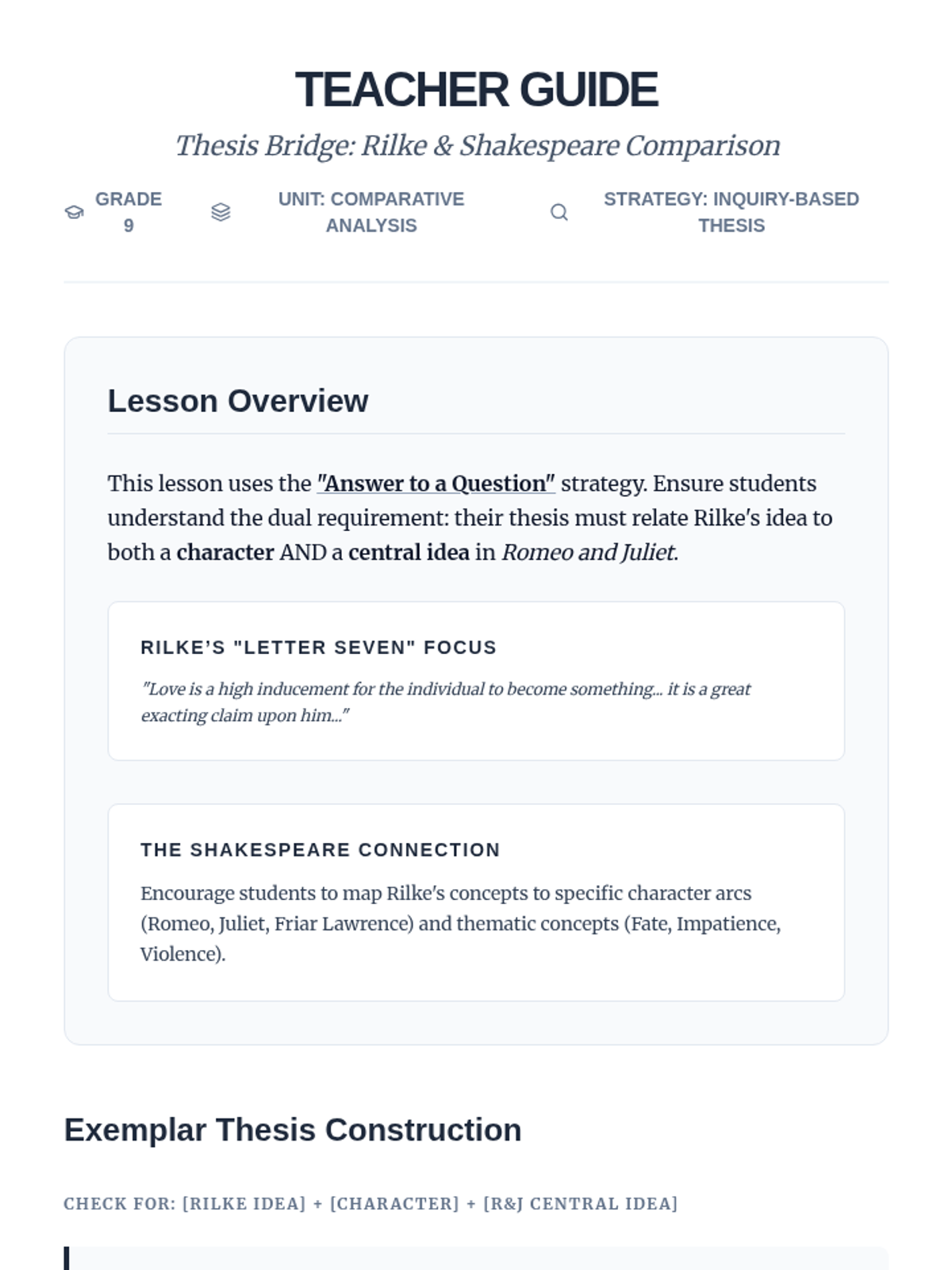
A guide for teachers that includes a comprehensive list of exemplar thesis statements (simple and complex) and common student pitfalls, specifically updated with quotes from the K.W. Maurer translation of Rilke's "Letter Seven" and accessible language. Now includes CCSS standards and third-person requirements. Header layout and text sizes adjusted for better readability.
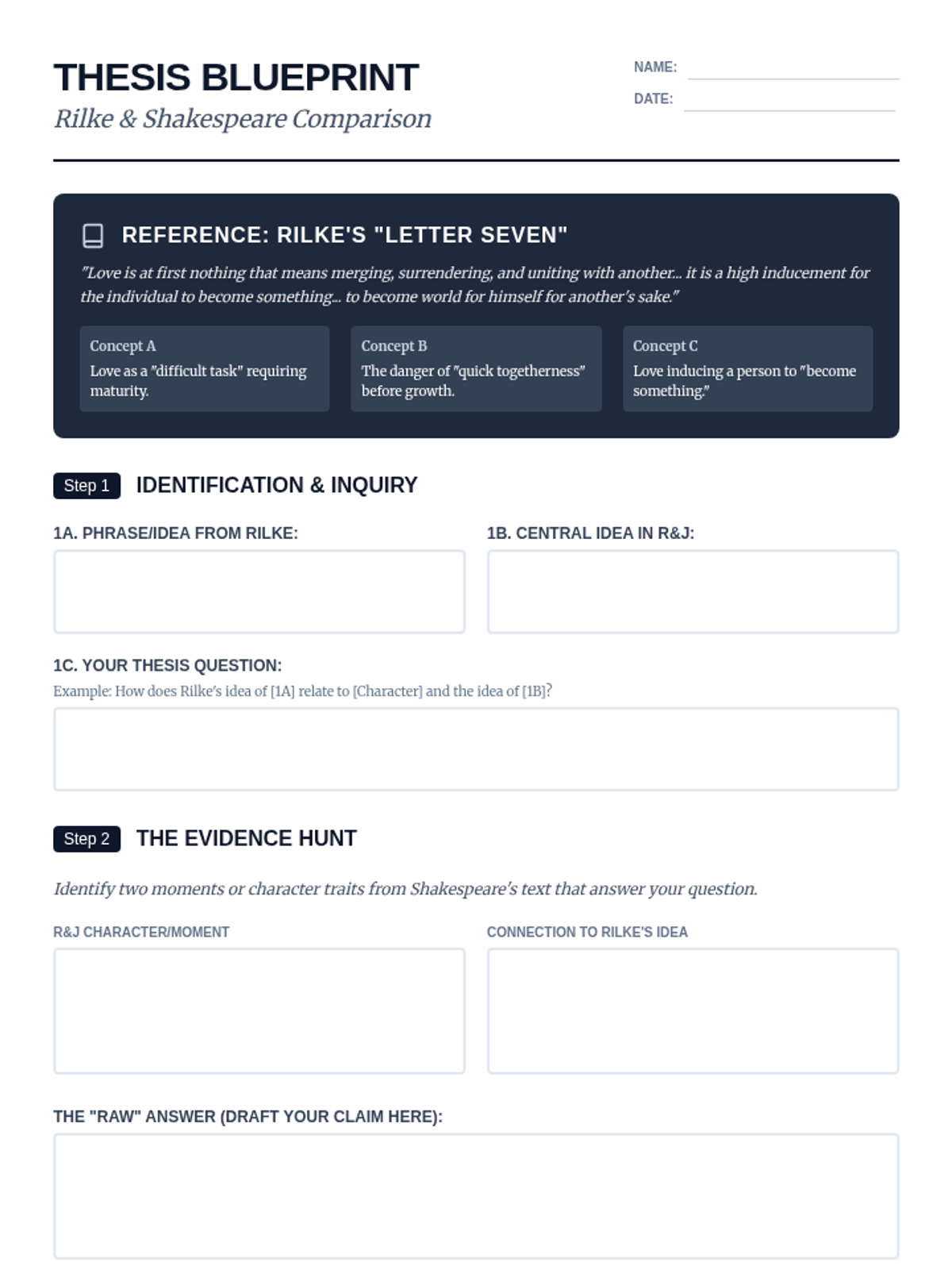
A structured worksheet updated with the K.W. Maurer translation of Rilke's "Letter Seven" and featuring exemplar thesis statements for student reference. Step 3 and the reflection section are now properly grouped to avoid awkward page breaks. Now includes explicit third-person instructions and CCSS references.
A comprehensive slide presentation updated with quotes from the K.W. Maurer translation of Rilke's "Letter Seven," guiding students through the process of crafting a comparative thesis statement with accessible ninth-grade language. Now includes slides on the "Apprenticeship of Love" concept and the 4-paragraph essay roadmap.
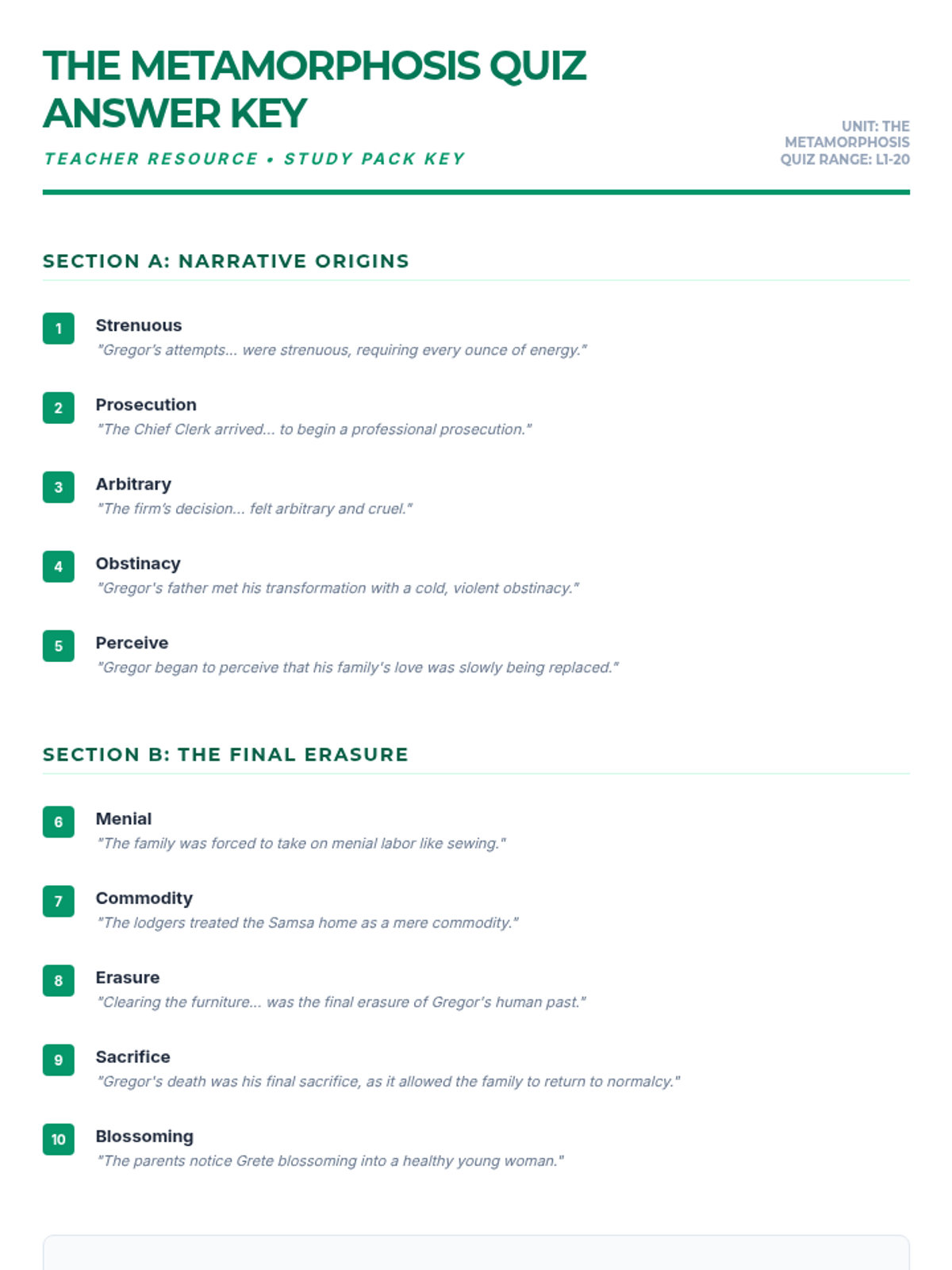
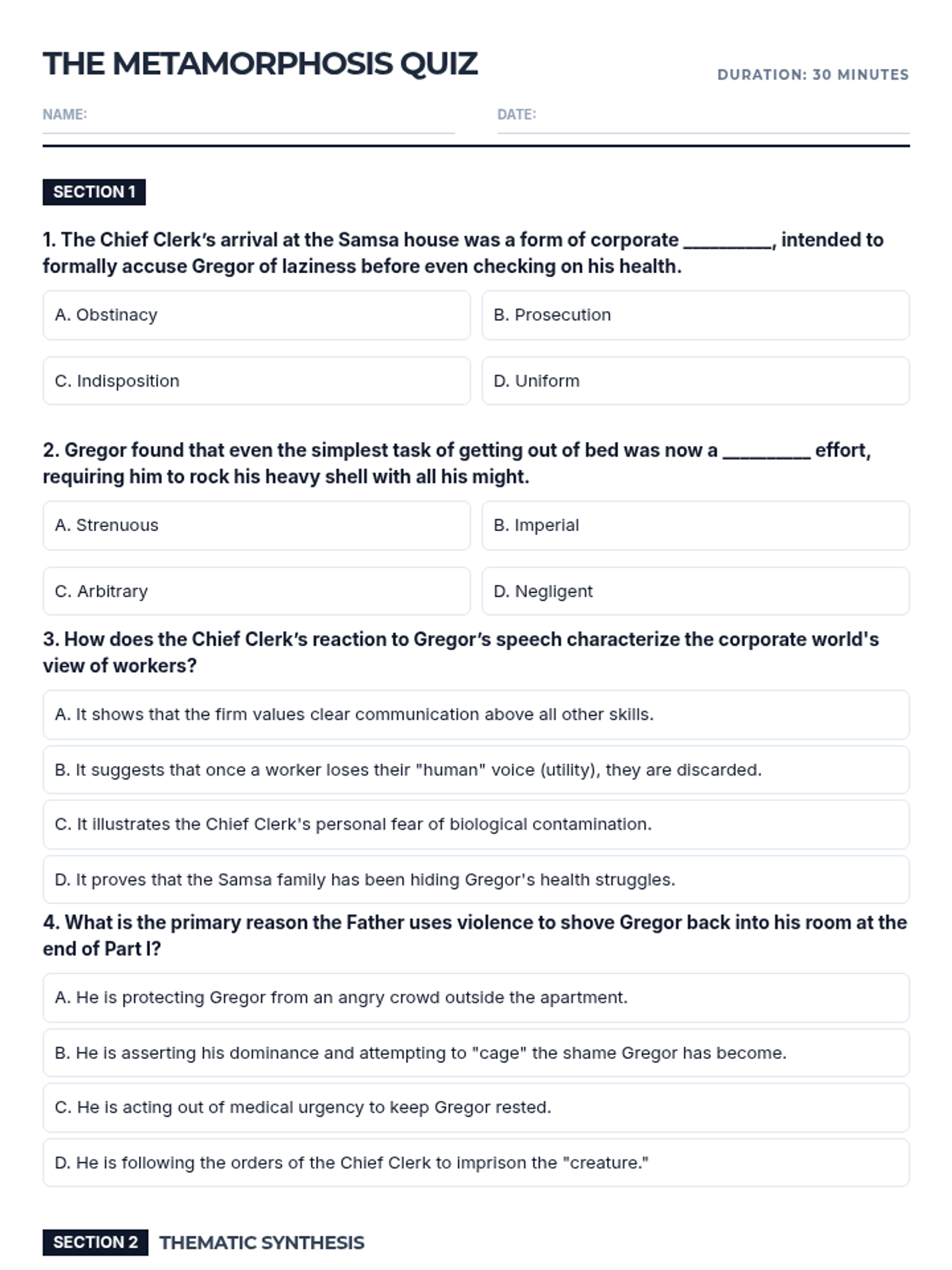
Teacher answer key for the unit-wide Vocabulary Mastery Quiz. Provides correct answers, full context sentences, and a suggested grading scale for the 10-item assessment included in the study pack. Strictly aligned with the Susan Bernofsky translation and the 60-word Lexical Ledger.
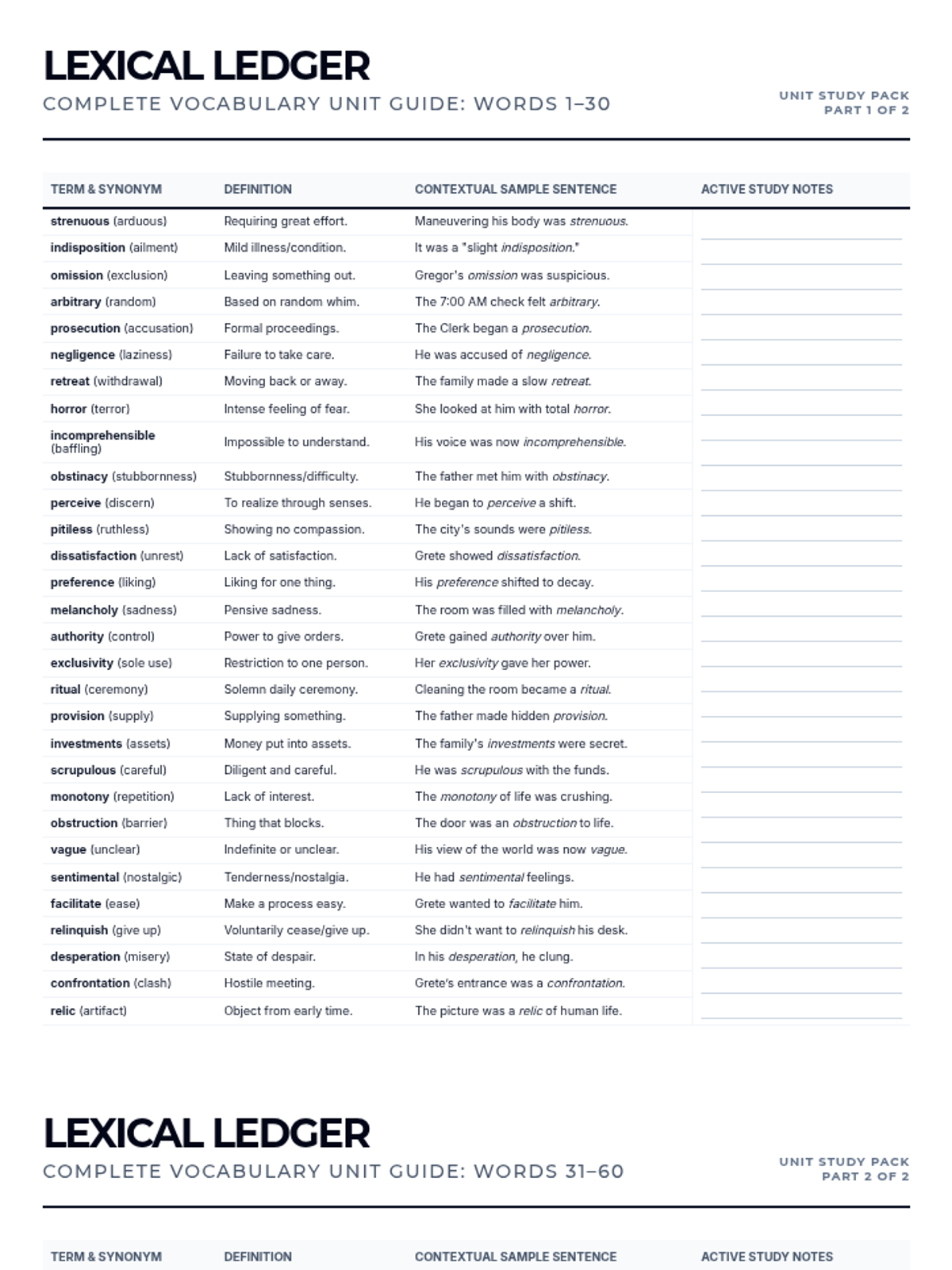
A comprehensive vocabulary study pack and cumulative quiz for The Metamorphosis, strictly aligned with the Susan Bernofsky translation. Features a 60-word Lexical Ledger with definitions, direct textual context, and page numbers, followed by a 10-question assessment. Optimized for print and student reference.
A summative student assessment for the first third of The Metamorphosis. Features vocabulary matching, multiple choice analytical questions, a short answer on the theme of 'The Firm', and a RACE response based on an excerpt from Gregor's reveal. Optimized for print with 'break-inside: avoid' on all questions. Fixed layout and spacing.
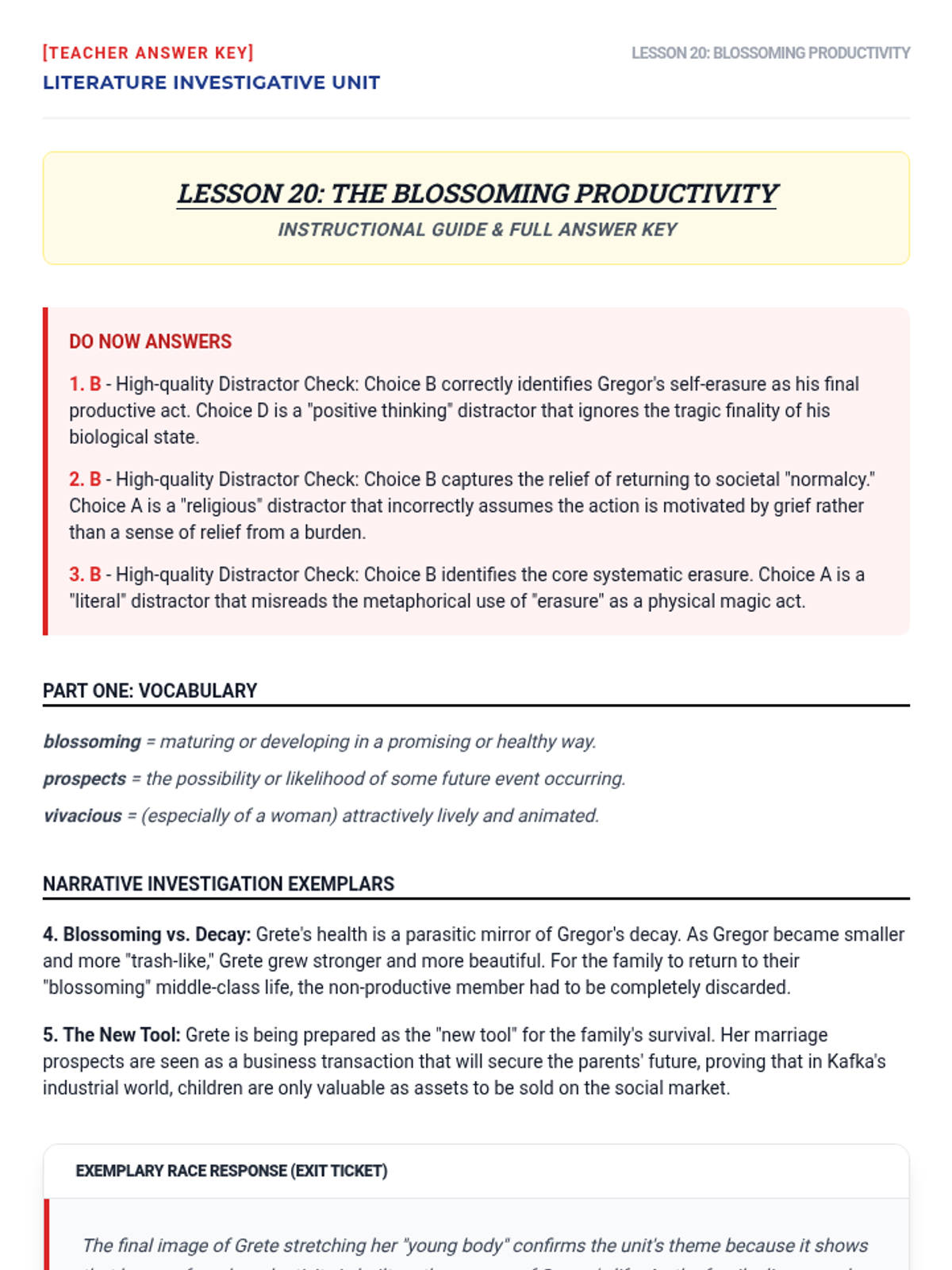
A comprehensive teacher answer key for Lesson 20. Synthesizes the themes of the unit and provides final push questions for middle grade students. Updated with specific Bernofsky page references (p. 64, 65). Removed branding.
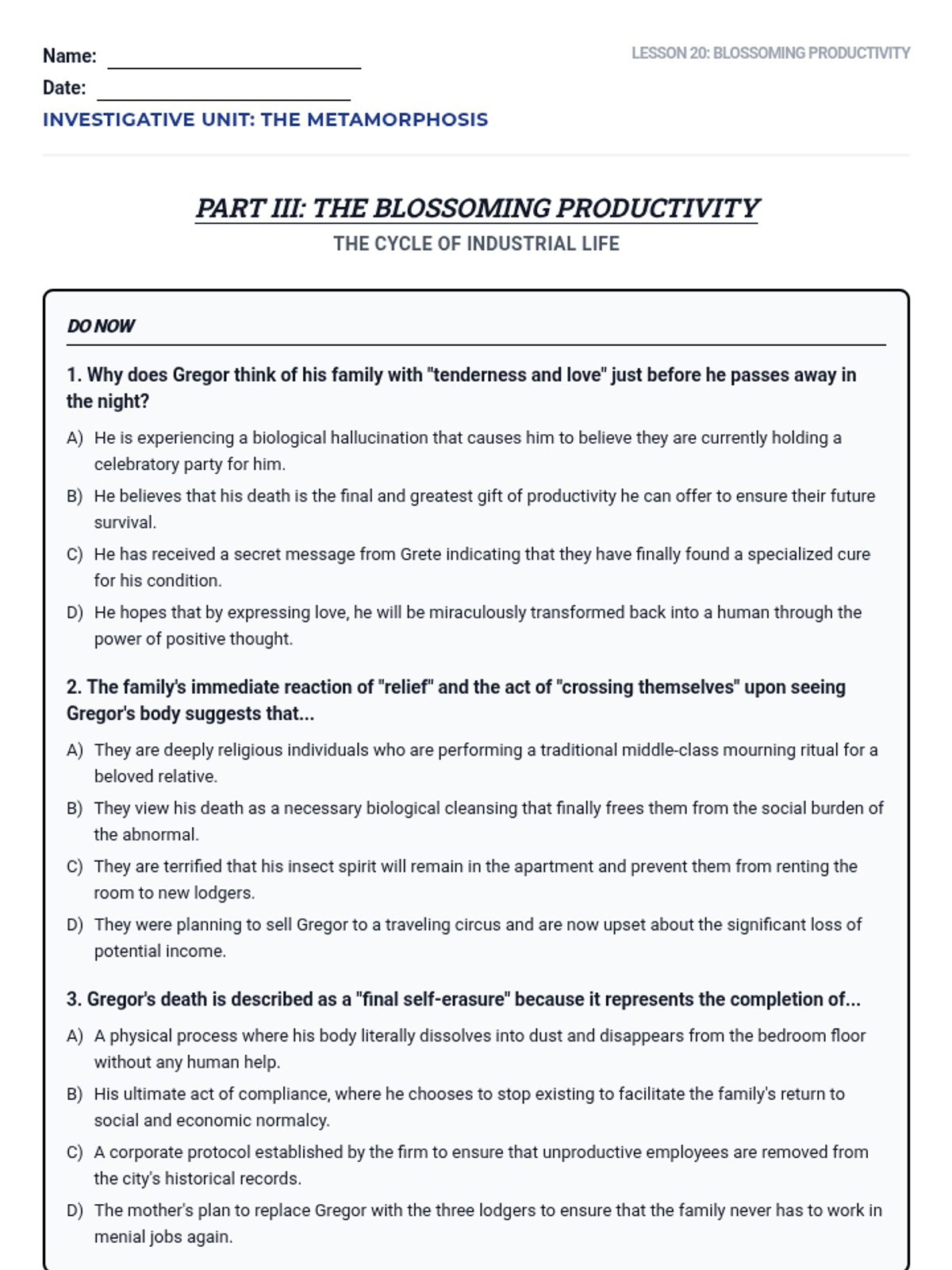
A final middle-grade worksheet for Lesson 20. Synthesizes the themes of the unit, focusing on Grete's transformation. Updated with definition lines in Part 1 and a comprehensive RACE checklist with 10 lines for the Exit Ticket. Time markers removed. Includes high-quality analytical distractors for the Do Now. Fixed checklist formatting and layout. Removed duplicate choice B.
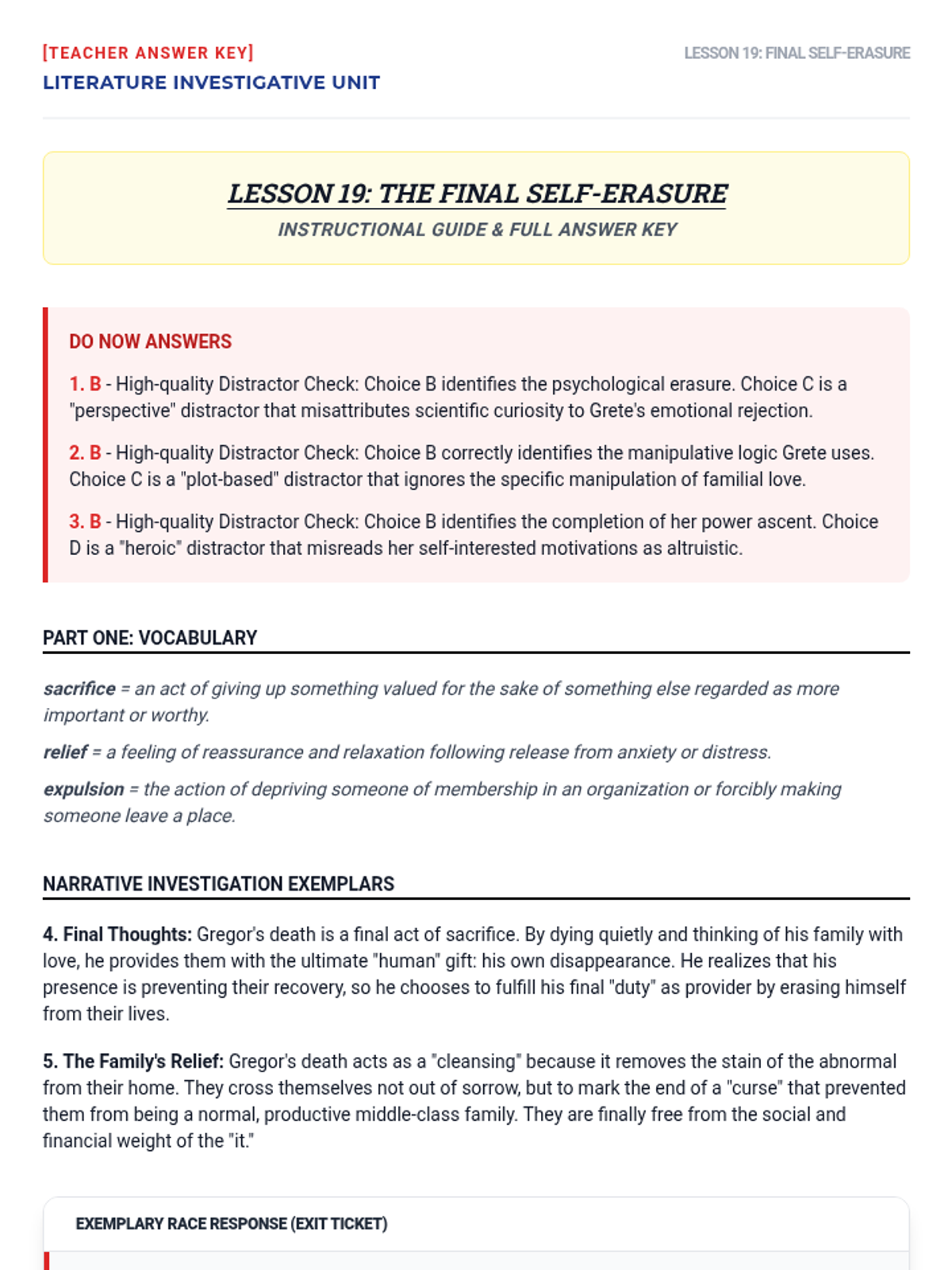
A comprehensive teacher answer key for Lesson 19. Includes exemplar responses, thematic synthesis (STAMP), and instructional push questions for middle grade students. Removed branding.
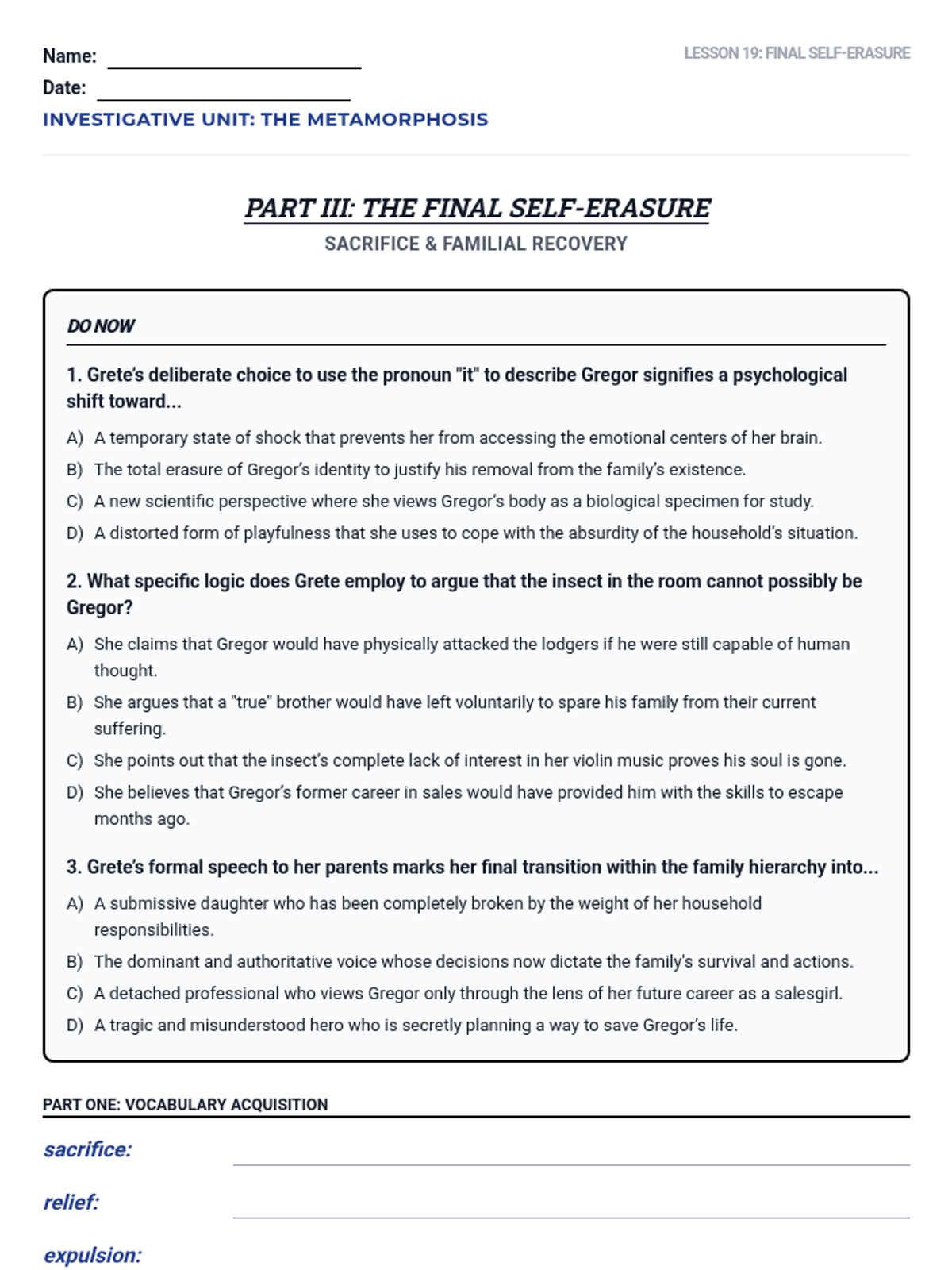
A middle-grade worksheet for Lesson 19 focusing on Gregor's death. Updated with definition lines in Part 1 and a comprehensive RACE checklist with 10 lines for the Exit Ticket. Time markers removed. Fixed checklist formatting and layout. Includes high-quality analytical distractors for the Do Now.
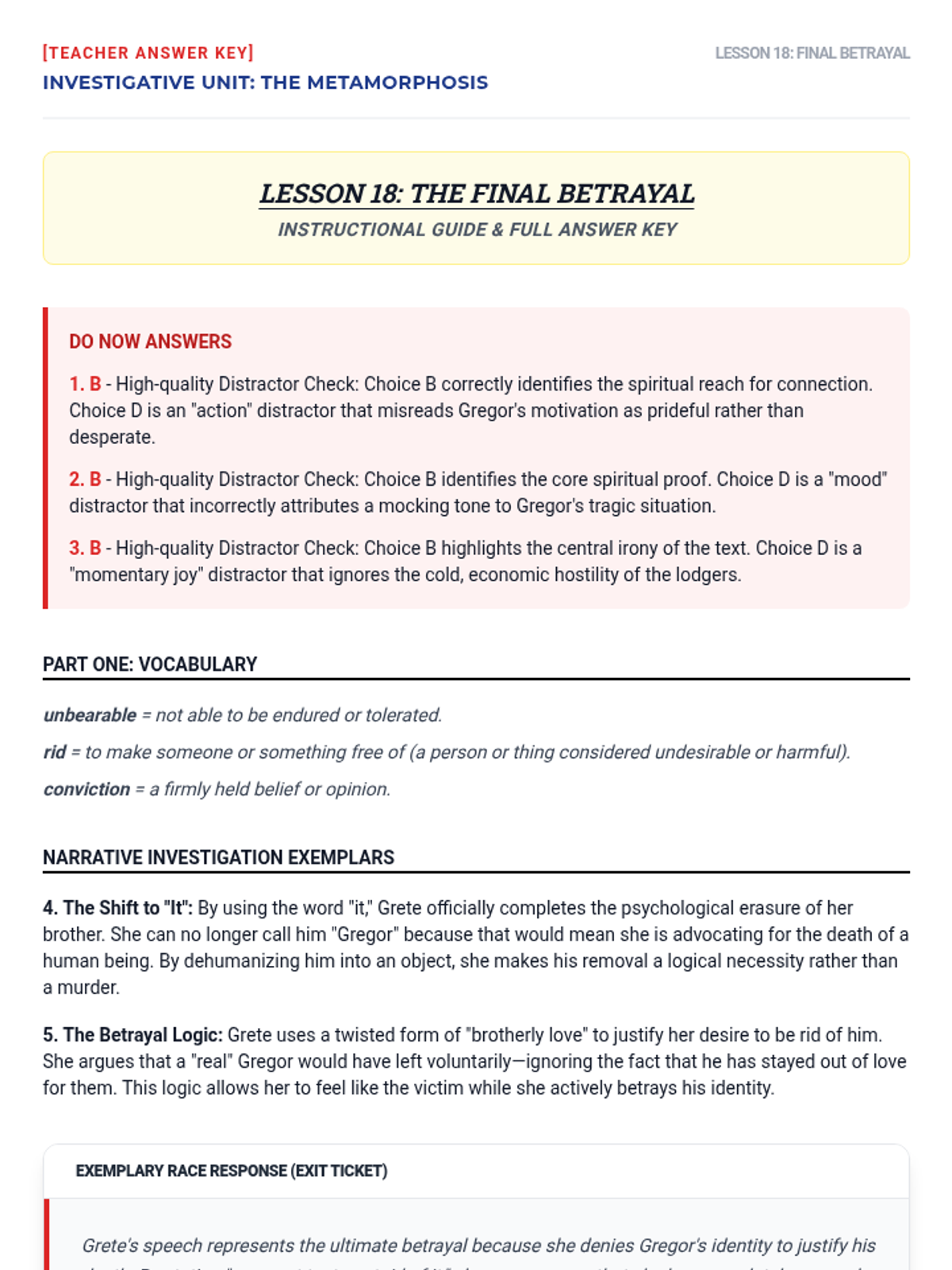
A comprehensive teacher answer key for Lesson 18. Includes exemplar responses, thematic synthesis (STAMP), and instructional push questions for middle grade students. Updated with specific Bernofsky page references. Removed branding.
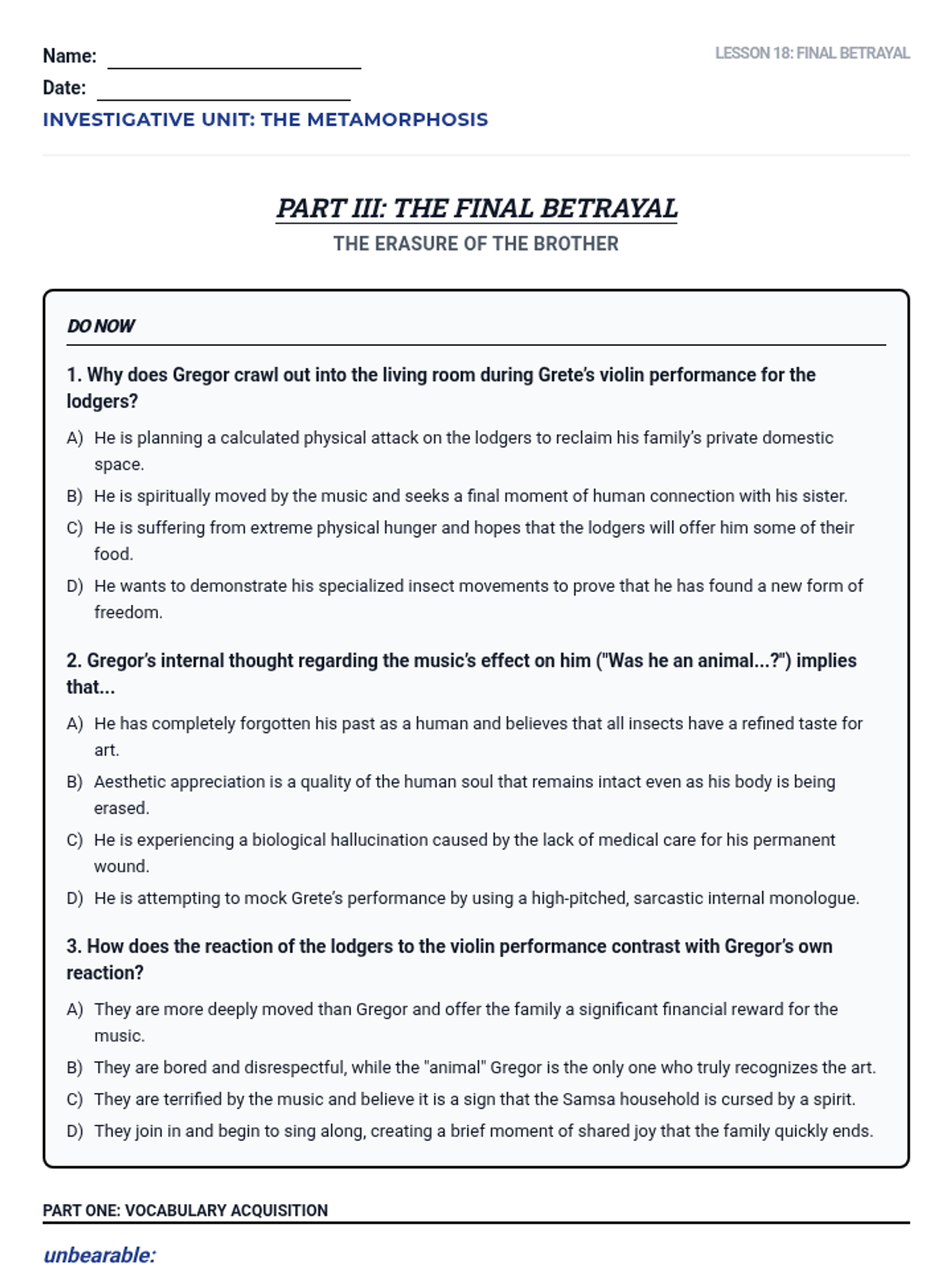
A middle-grade worksheet for Lesson 18 focusing on Grete's formal rejection of Gregor. Updated with definition lines in Part 1 and a comprehensive RACE checklist with 10 lines for the Exit Ticket. Time markers removed. Fixed checklist formatting and layout. Includes high-quality analytical distractors for the Do Now.
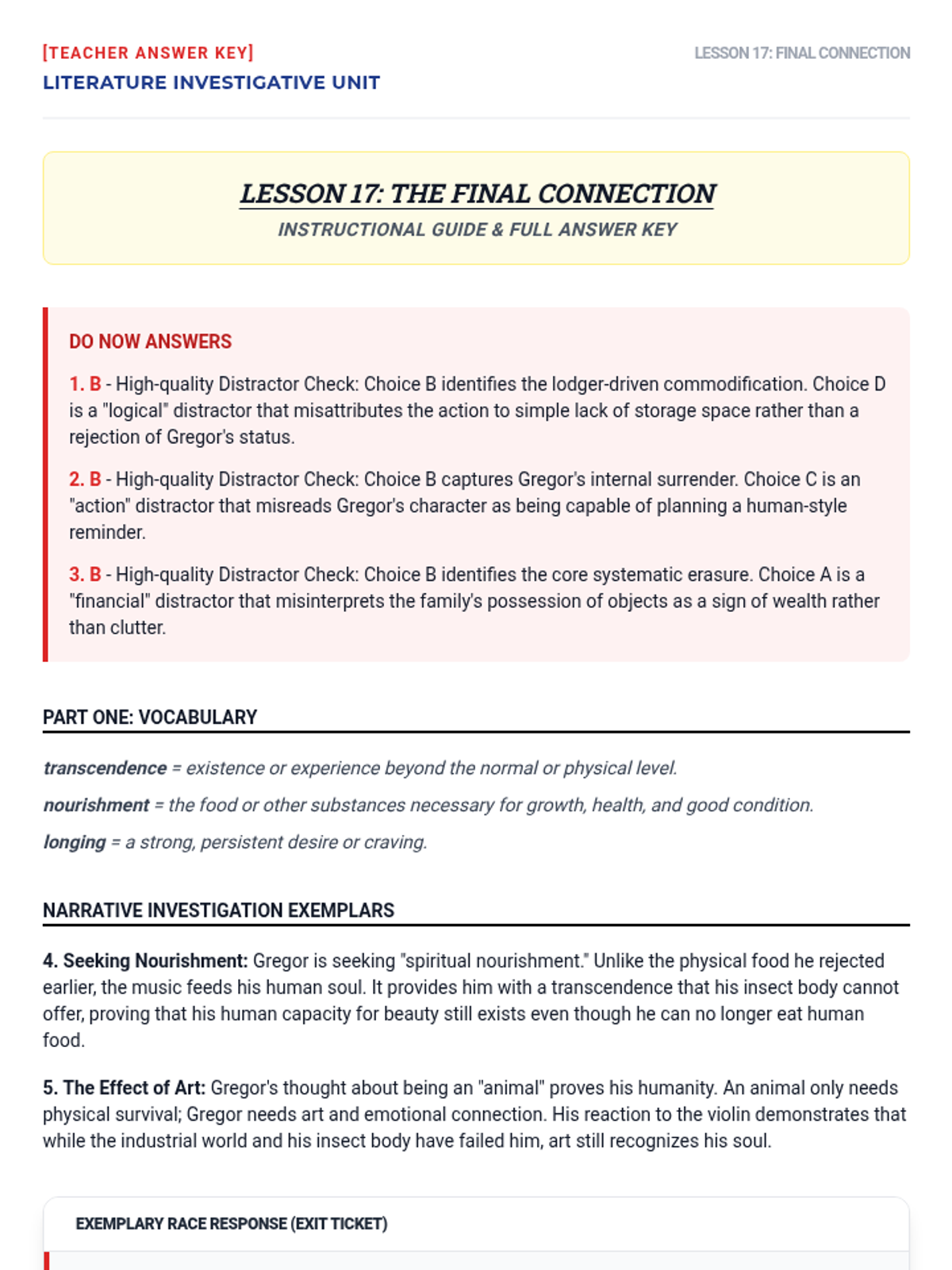
A comprehensive teacher answer key for Lesson 17. Includes exemplar responses, thematic synthesis (STAMP), and instructional push questions for middle grade students. Removed branding. Updated with specific Bernofsky page references.
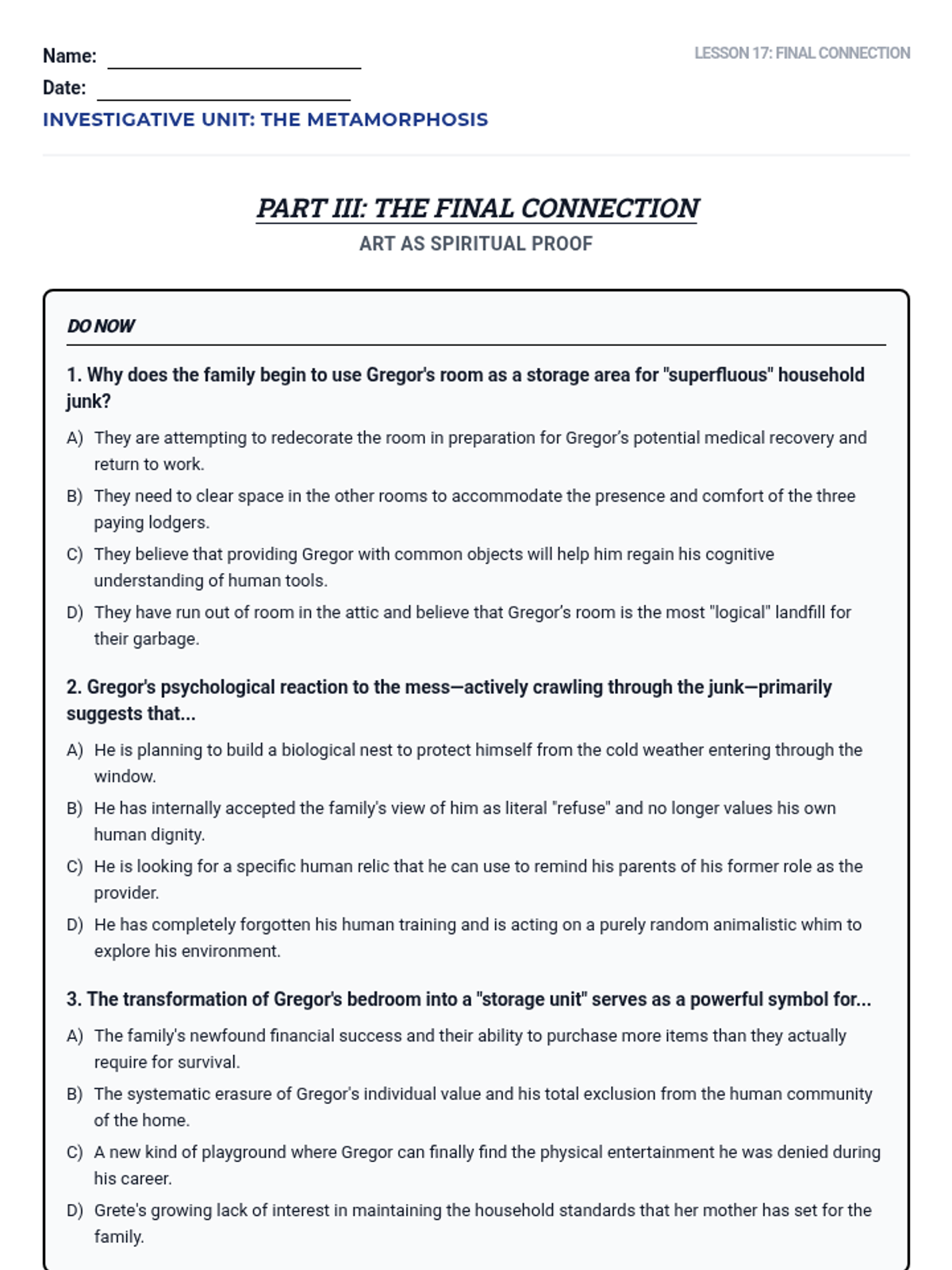
A middle-grade worksheet for Lesson 17 focusing on Grete's violin performance. Updated with definition lines in Part 1 and a comprehensive RACE checklist with 10 lines for the Exit Ticket. Time markers removed. Fixed checklist formatting and layout. Includes homogenous, high-quality analytical MC distractors.
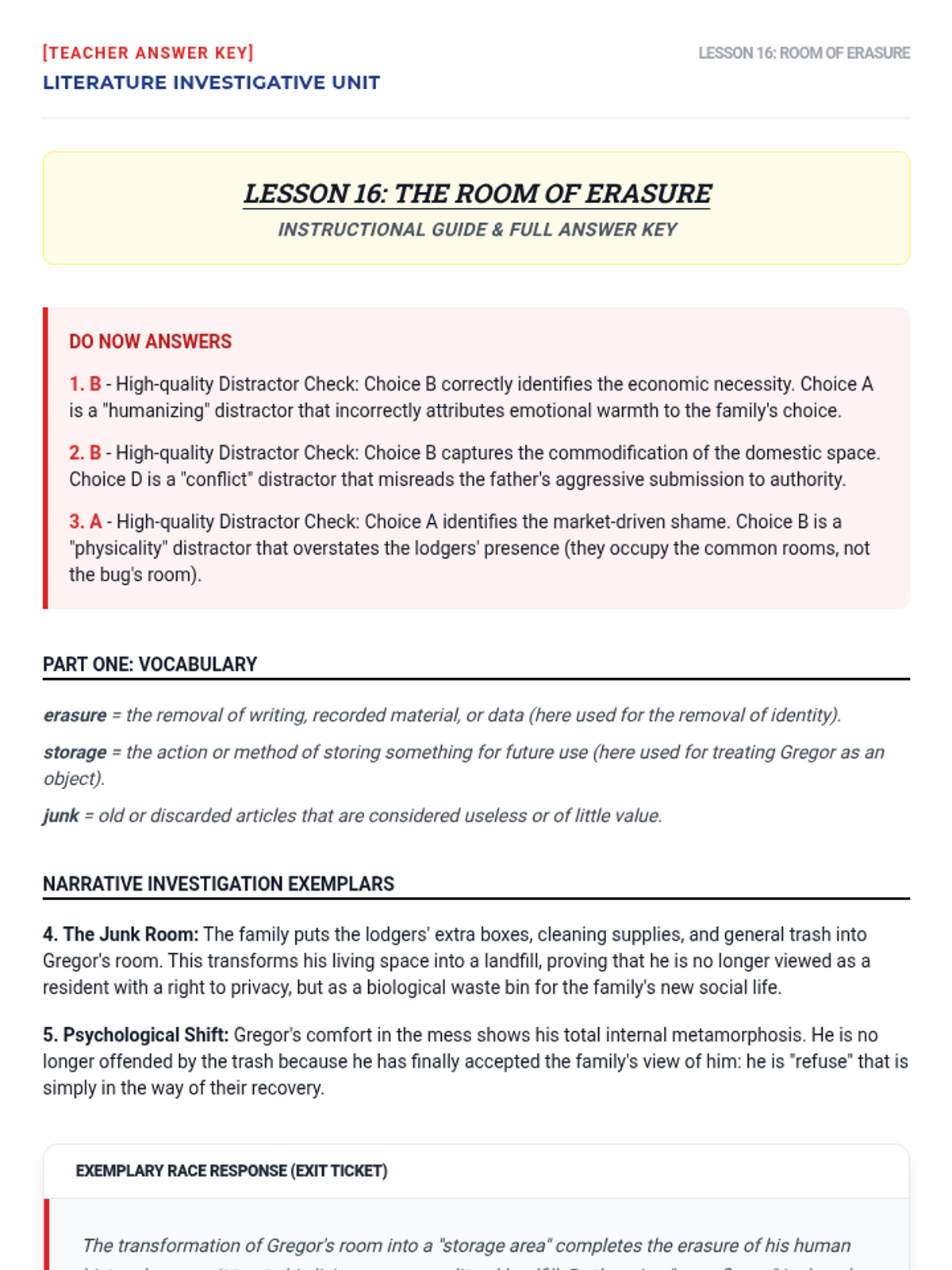
A comprehensive teacher answer key for Lesson 16. Includes exemplar responses, thematic synthesis (STAMP), and instructional push questions for middle grade students. Removed branding. Updated with specific Bernofsky page references.
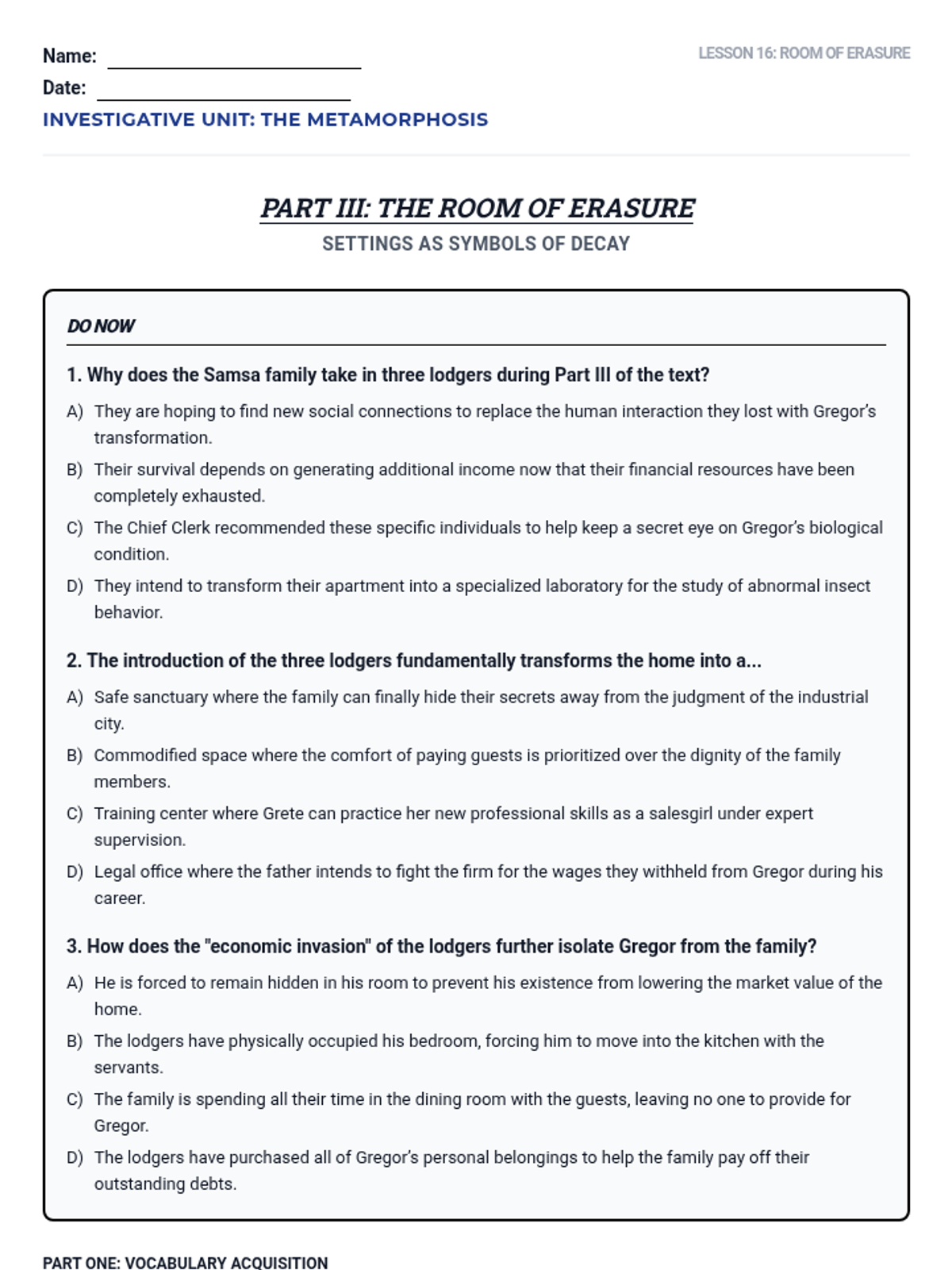
A middle-grade worksheet for Lesson 16 focusing on the erasure of Gregor's human space. Updated with definition lines in Part 1 and a comprehensive RACE checklist with 10 lines for the Exit Ticket. Time markers removed. Includes homogenous, high-quality analytical MC distractors.
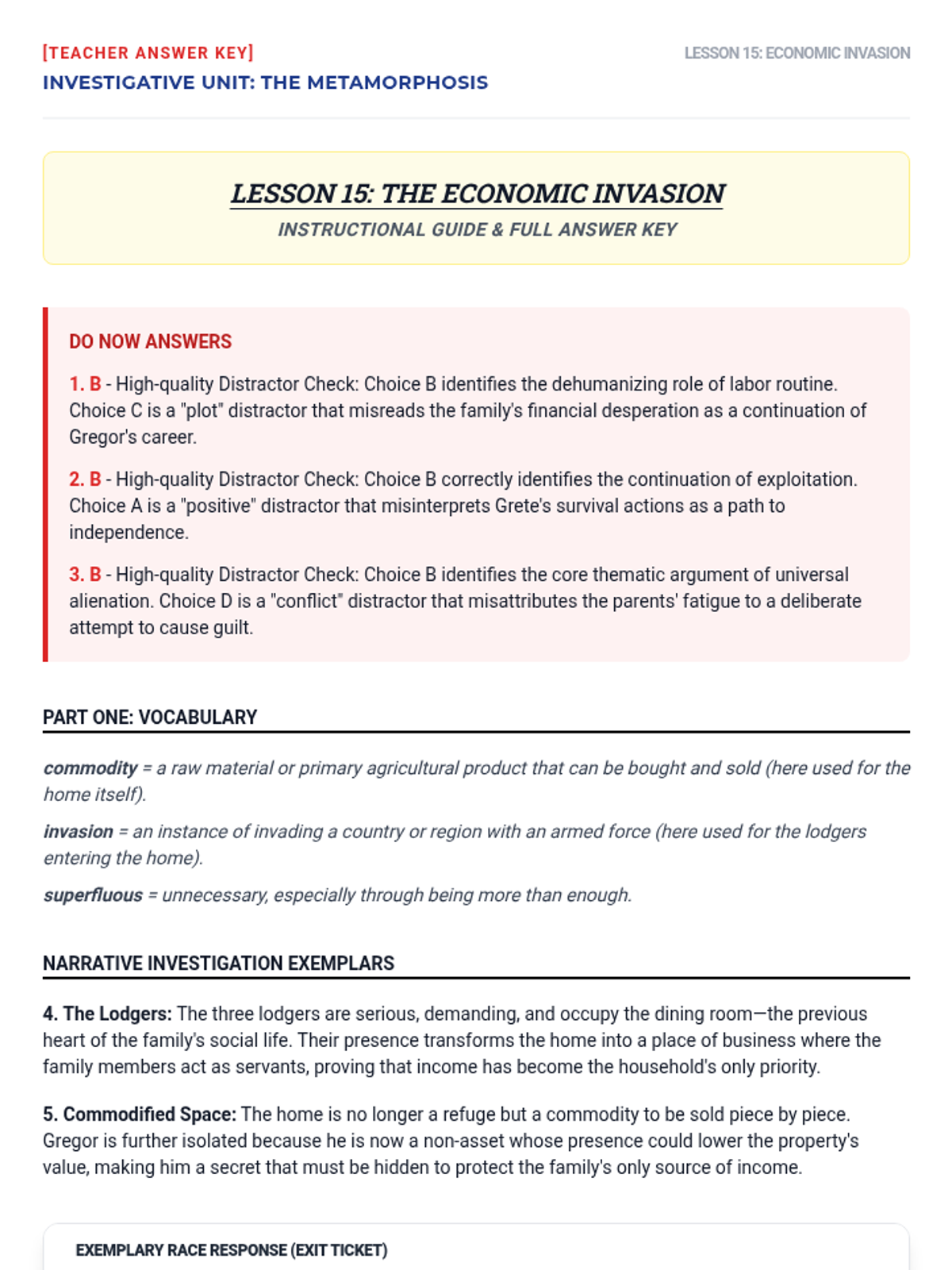
A comprehensive teacher answer key for Lesson 15. Includes exemplar responses, thematic synthesis (STAMP), and instructional push questions for middle grade students. Removed branding. Updated with specific Bernofsky page references.
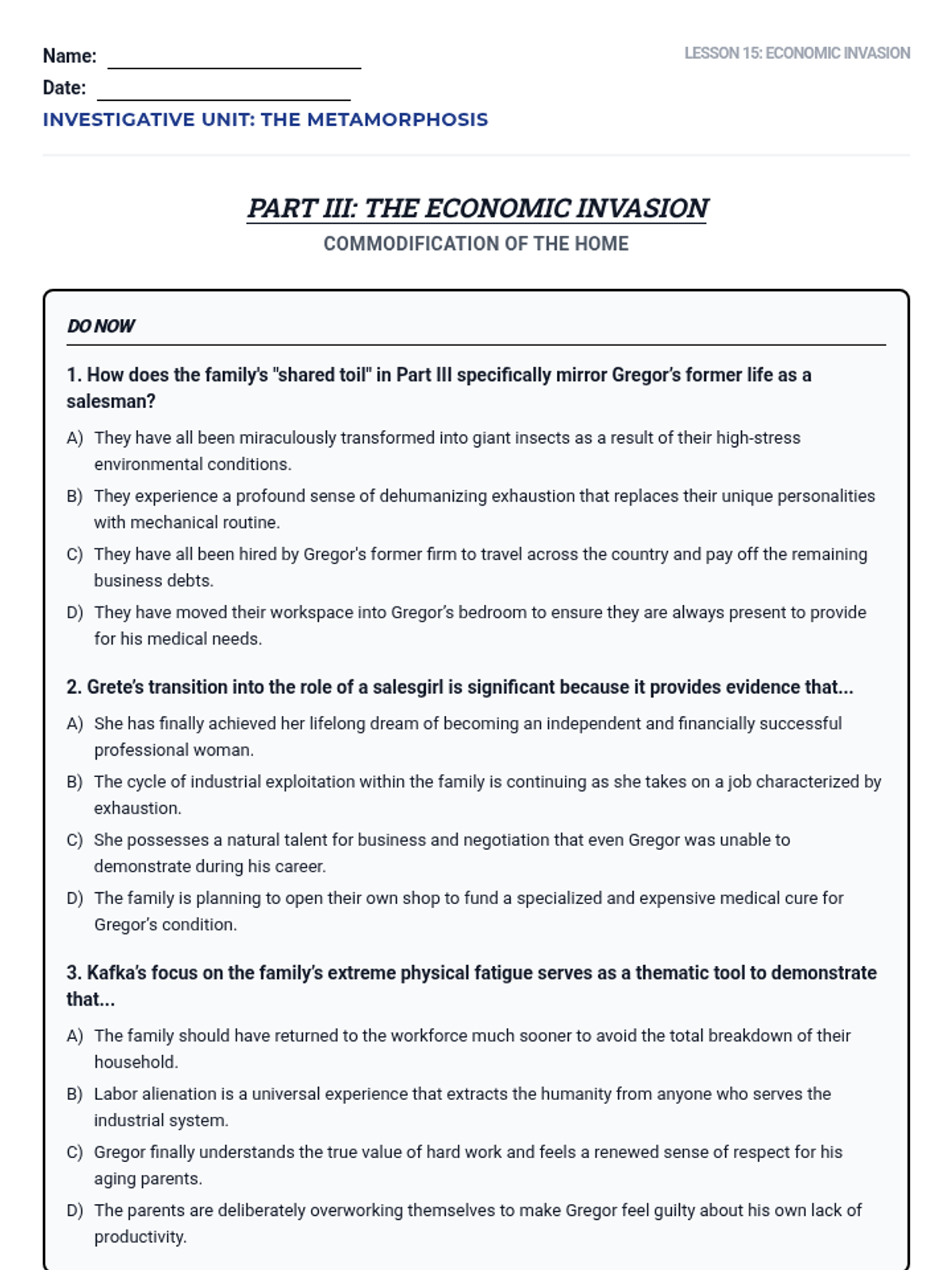
A middle-grade worksheet for Lesson 15 focusing on the introduction of the lodgers. Updated with definition lines in Part 1 and a comprehensive RACE checklist with 10 lines for the Exit Ticket. Time markers removed. Includes high-quality analytical MC distractors.
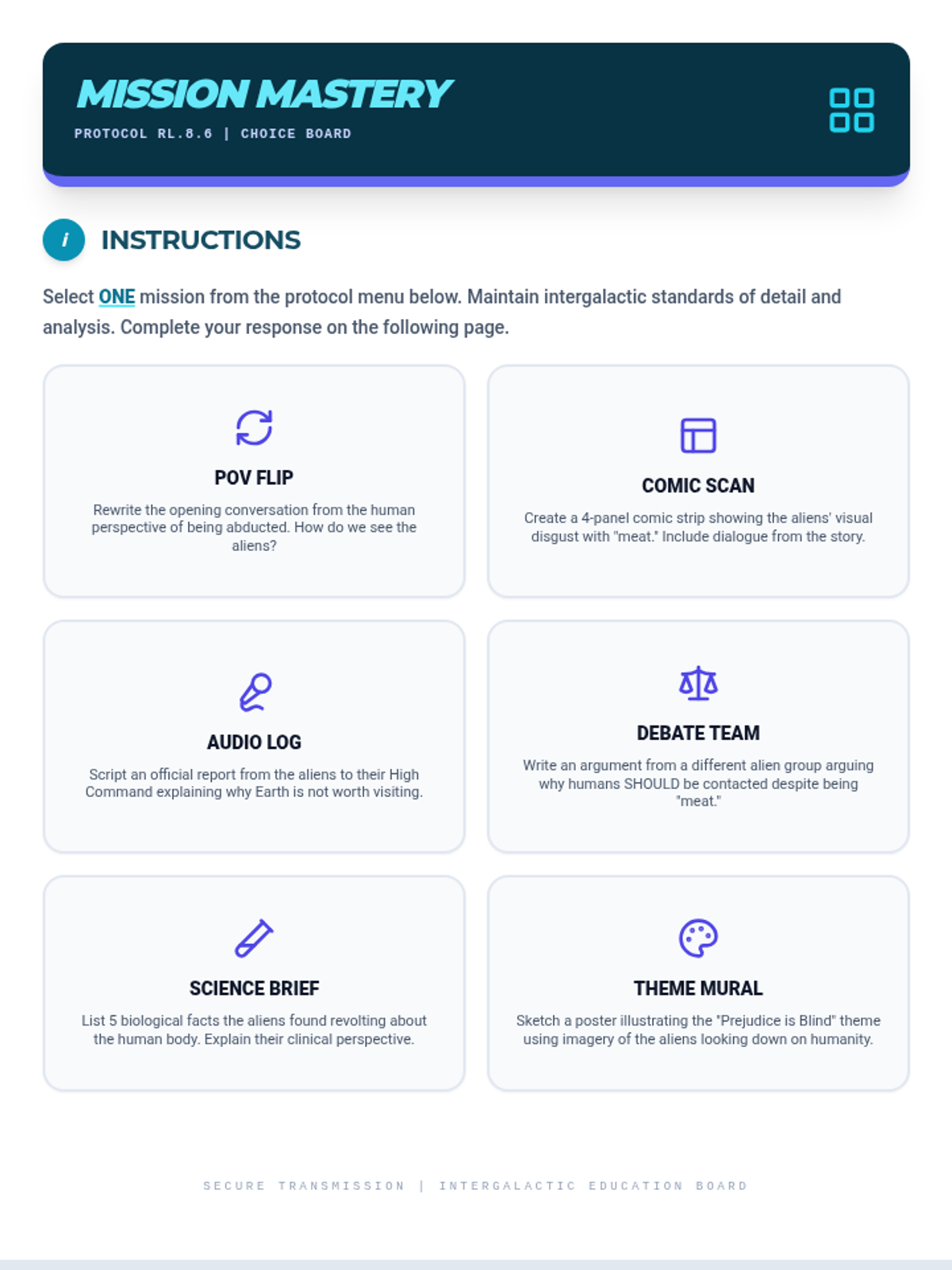
Differentiated Choice Board with 6 learner options focused on point of view, theme, and creative extension of 'They're Made out of Meat'. Includes a dedicated response sheet with ruled lines and a visual storyboard grid.
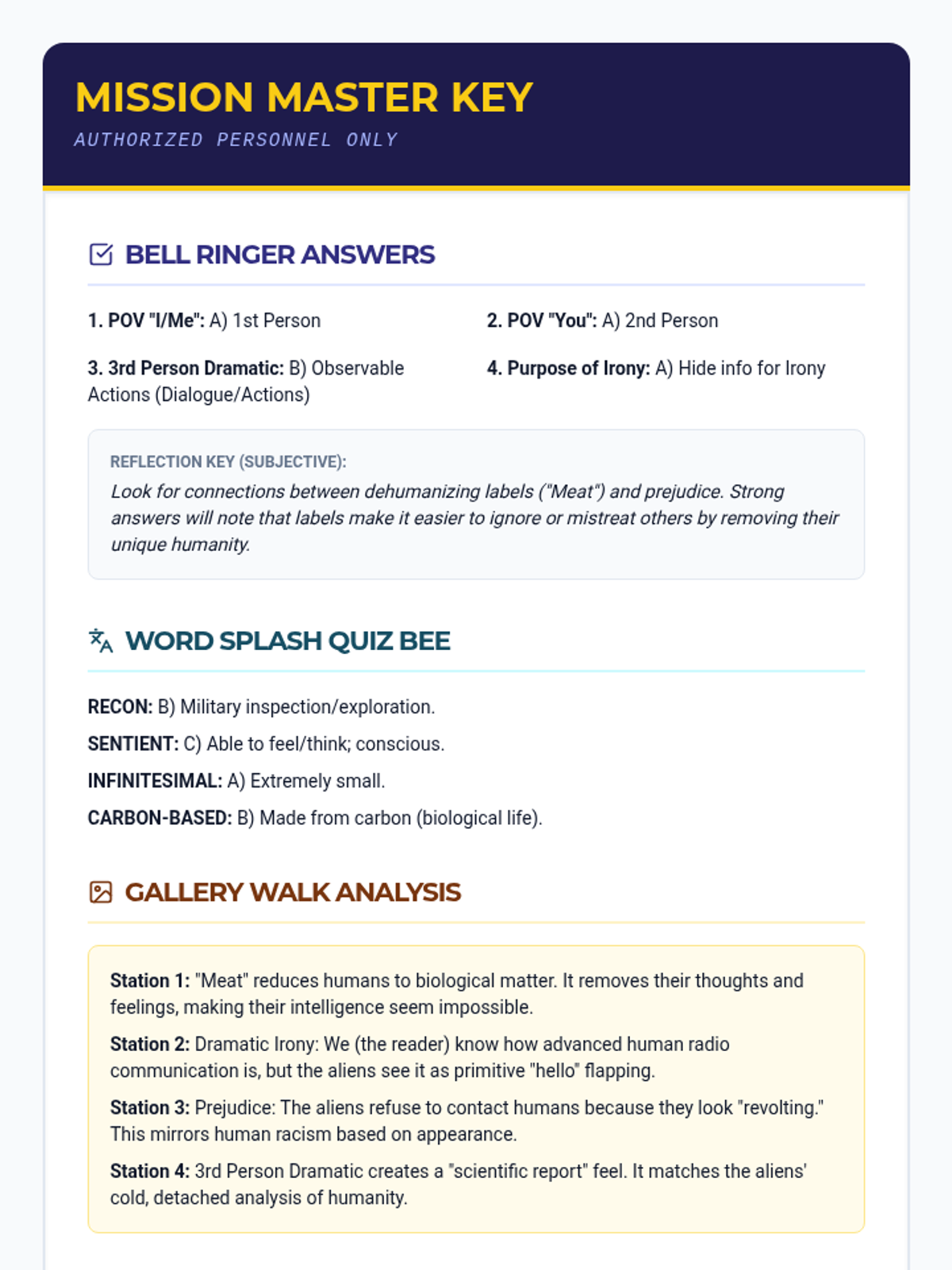
Comprehensive answer key for all lesson materials, including Bell Ringer MCQs, Word Splash vocabulary, Gallery Walk analysis prompts, Exit Ticket reflections, and a quantified Choice Board rubric (100 pts).
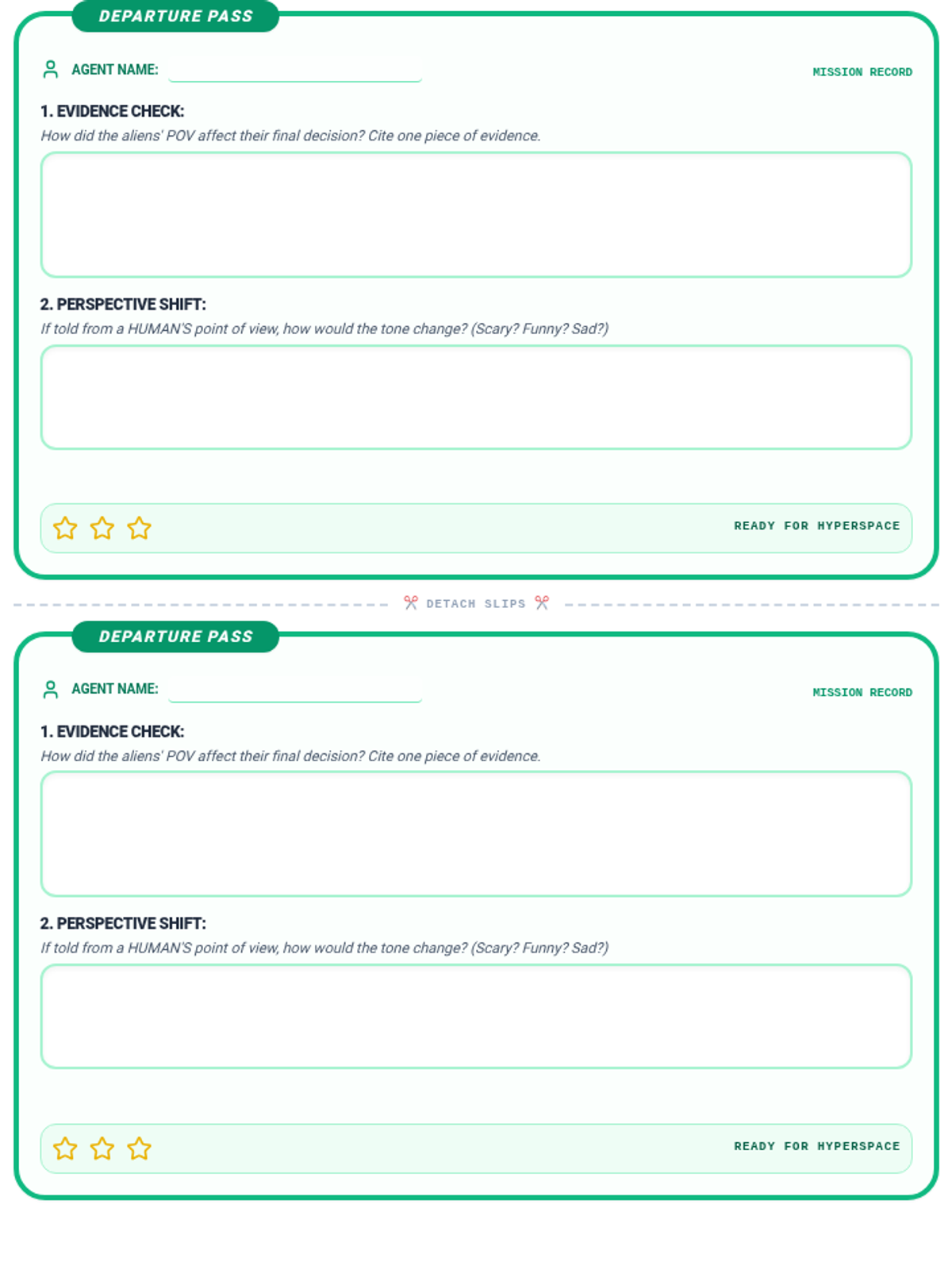
Double-sided cut-out exit tickets ('Departure Passes') designed for student reflection on how point of view influences theme and tone. Optimized for one-page printing.
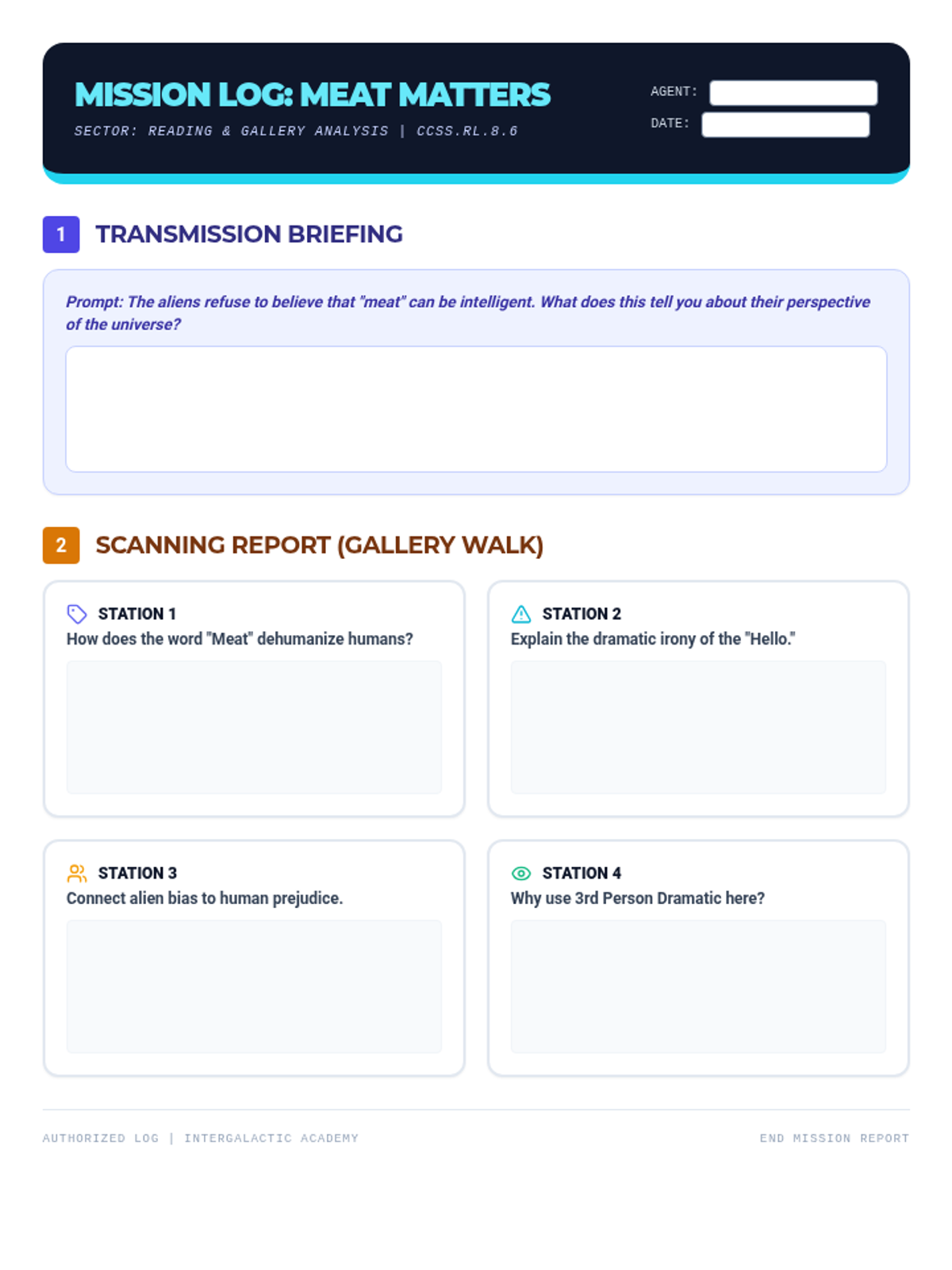
Master student activity packet containing the Think-Pair-Share log and a structured Gallery Walk evidence sheet. Optimized for student work with ample response areas on a single page.
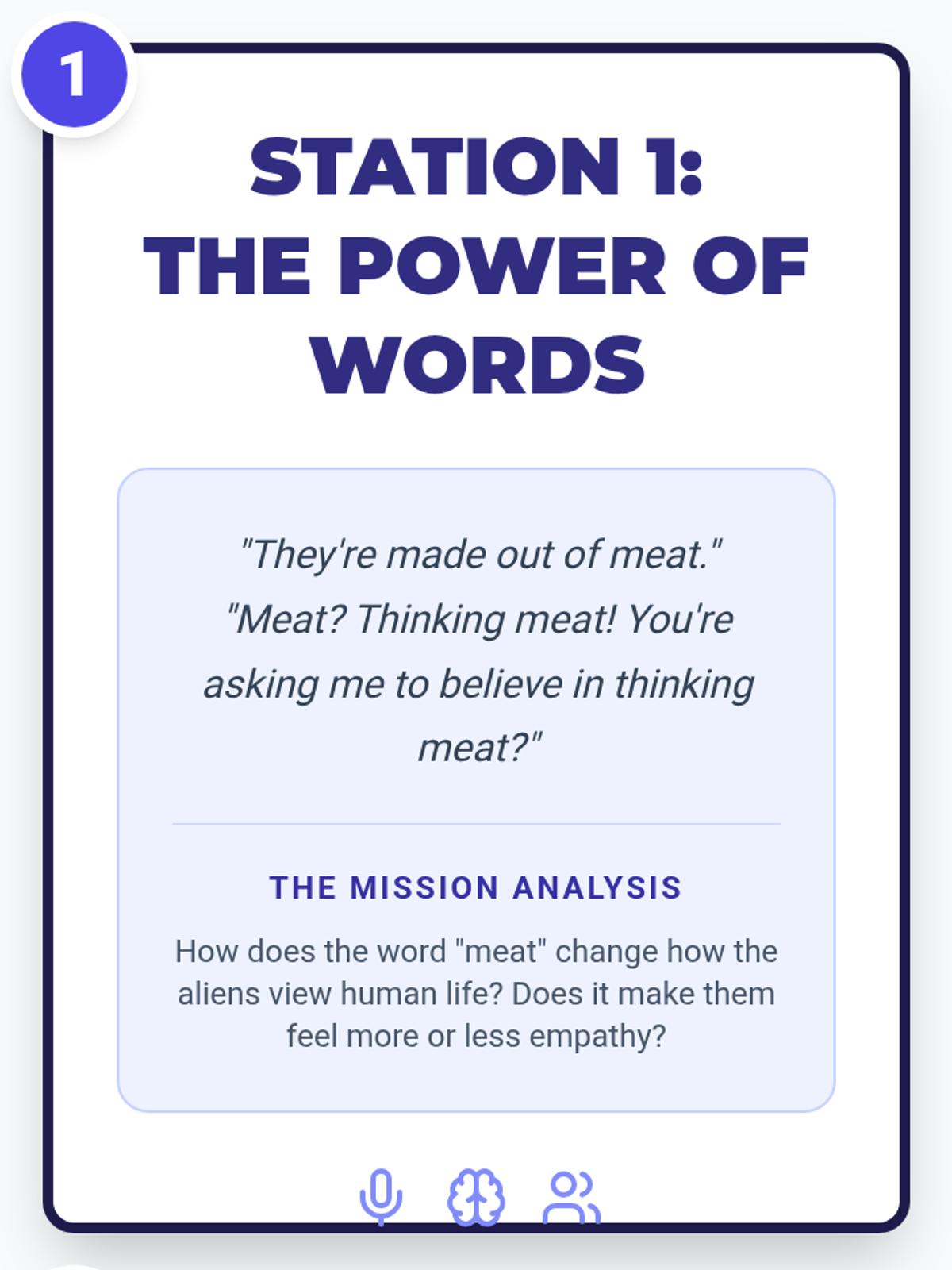
Four high-impact Gallery Walk posters designed for student rotation. Each station features a specific text excerpt and a guiding analysis question related to point of view, dramatic irony, and bias.
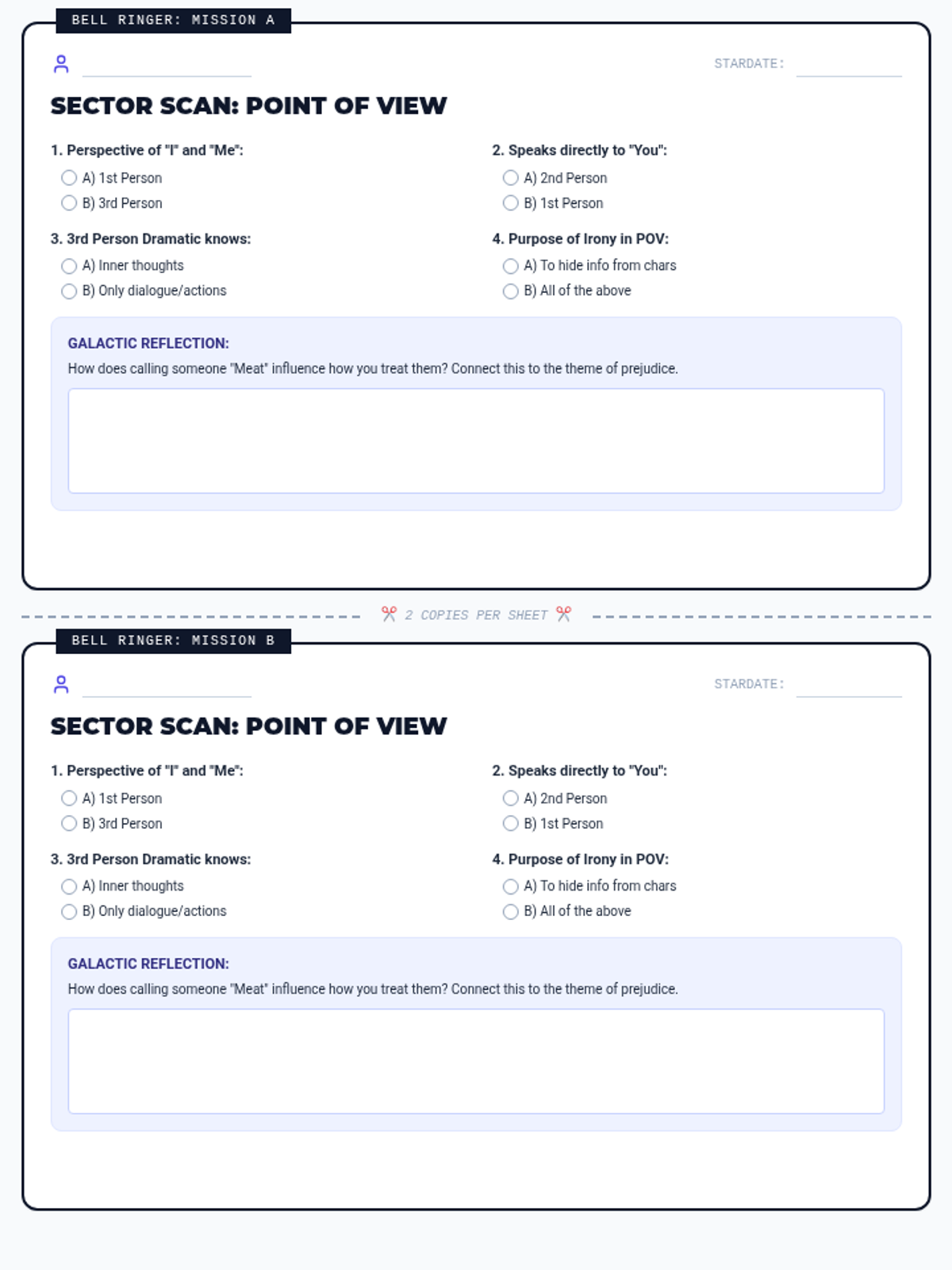
Two-per-page cut-out Bell Ringer focused on point of view basics (1st, 2nd, 3rd person) and a subjective question linking the story's terminology to themes of prejudice. Redesigned to fit on one page.
Visually striking alien-themed slide deck updated with author bio, dedicated Choice Board, Mission Rubric, Quantified Point Breakdown, and Exit Ticket slides. Includes 32 slides total, featuring POV definitions, CCSS RL.8.6 alignment, interactive vocabulary quizzes, and structured reflection prompts. Adjusted layout for optimal PDF rendering.
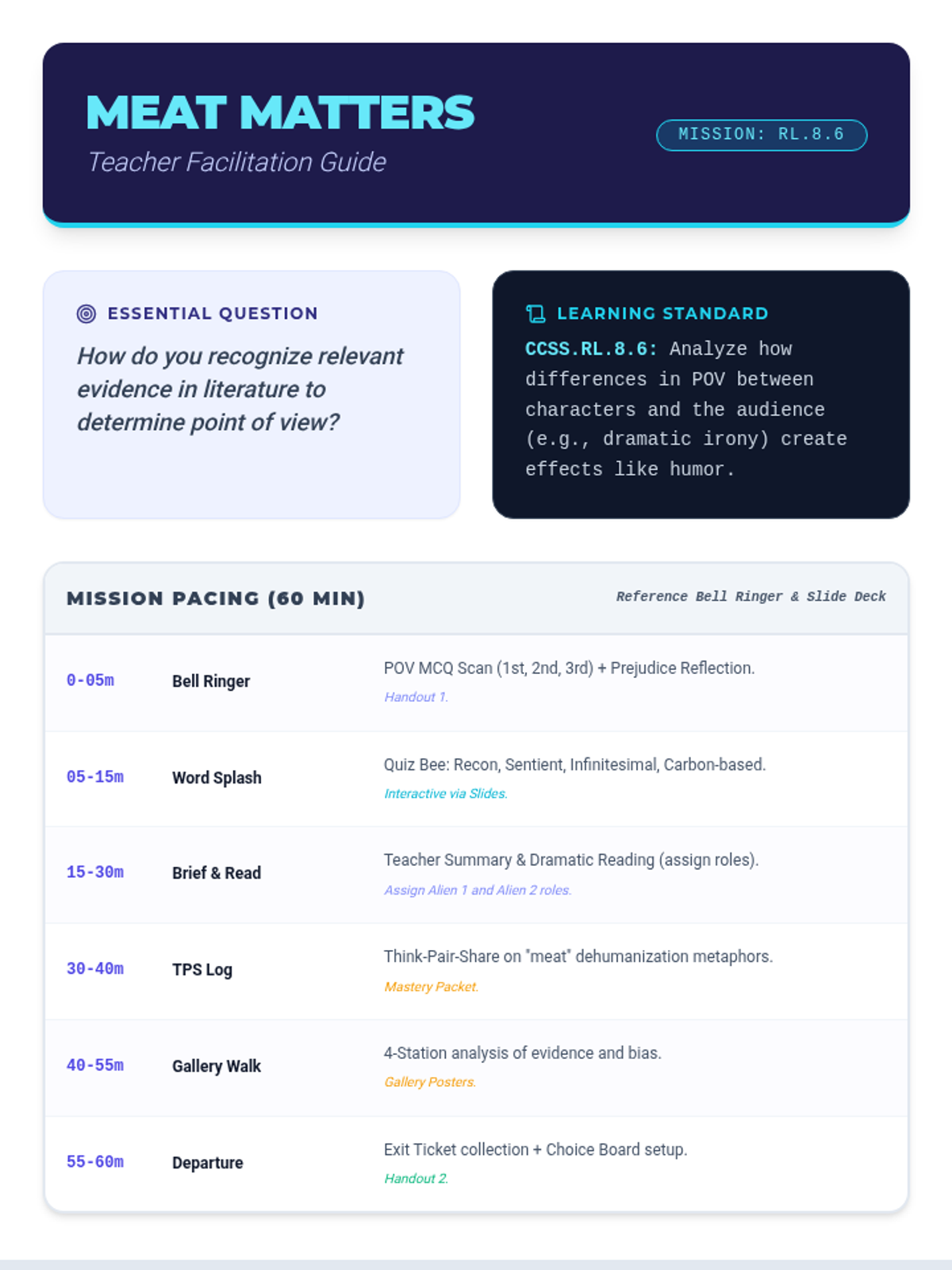
Comprehensive teacher's guide and lesson plan for 'They're Made out of Meat' featuring a 60-minute pacing guide, point of view content summaries, and CCSS standard integration. Includes guide for all 6 learner options.
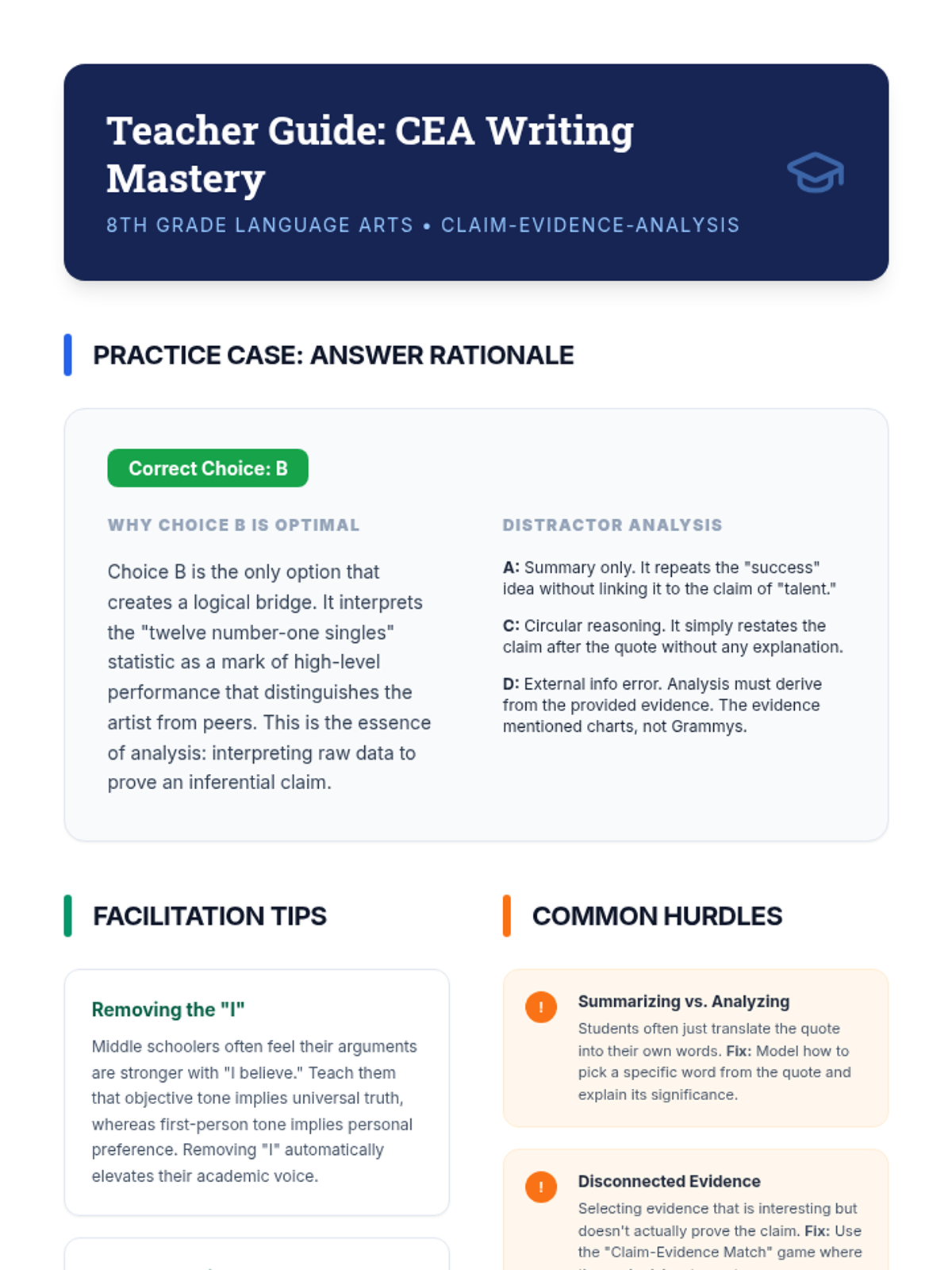
A teacher's reference guide for the CEA Writing lesson. It provides session goals, instructional strategies for academic writing, answer keys for practice activities, and solutions for common student writing misconceptions.
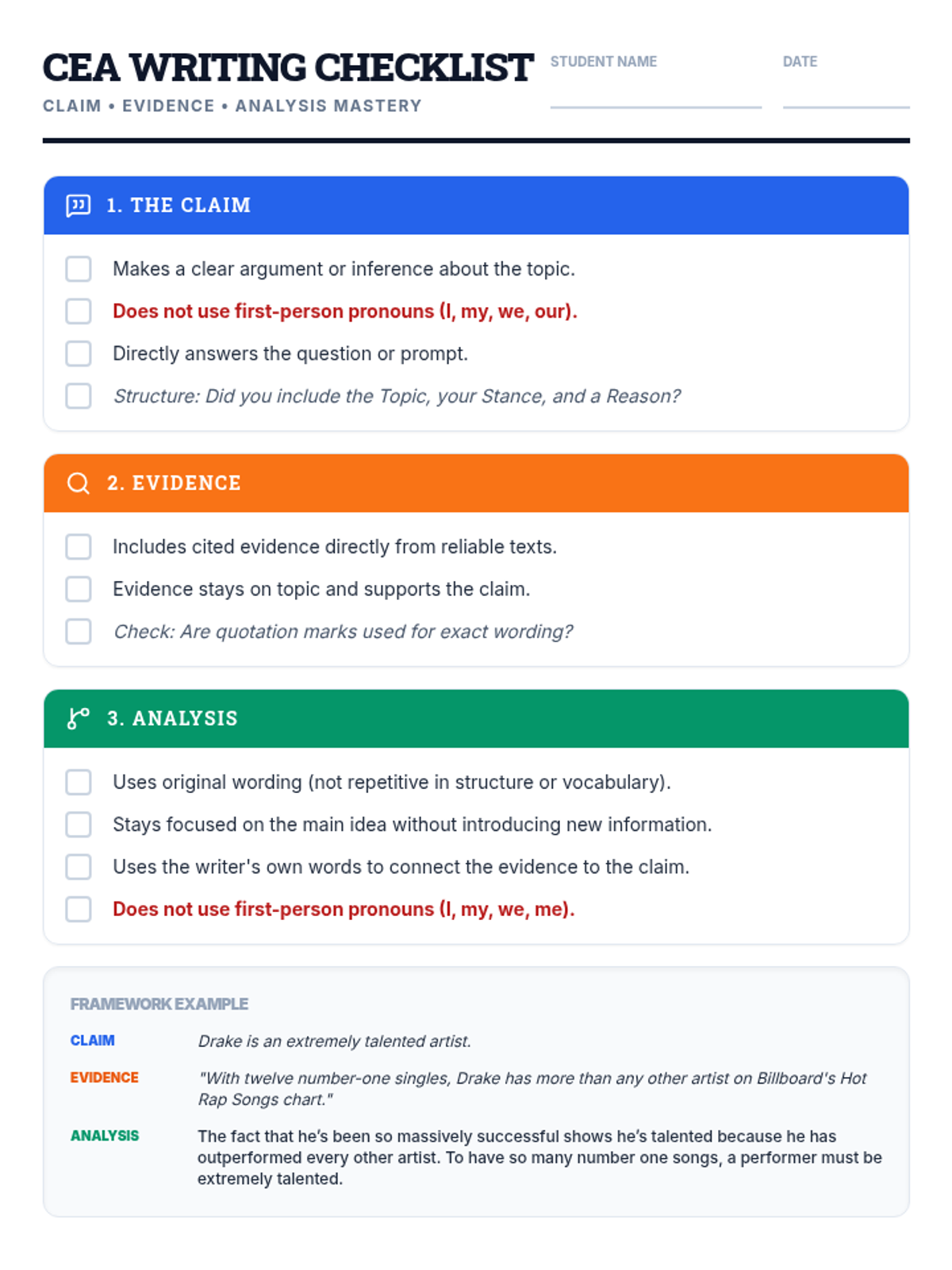
A student-facing checklist for constructing arguments using the Claim-Evidence-Analysis (CEA) framework. It includes specific criteria for each component and a modeled academic example about high school lunch periods.
A 9-slide presentation deck explaining the Claim-Evidence-Analysis (CEA) writing framework for 8th-grade students. It includes session goals, clear definitions, a simplified modeled paragraph on high school lunch breaks, and an interactive practice case.
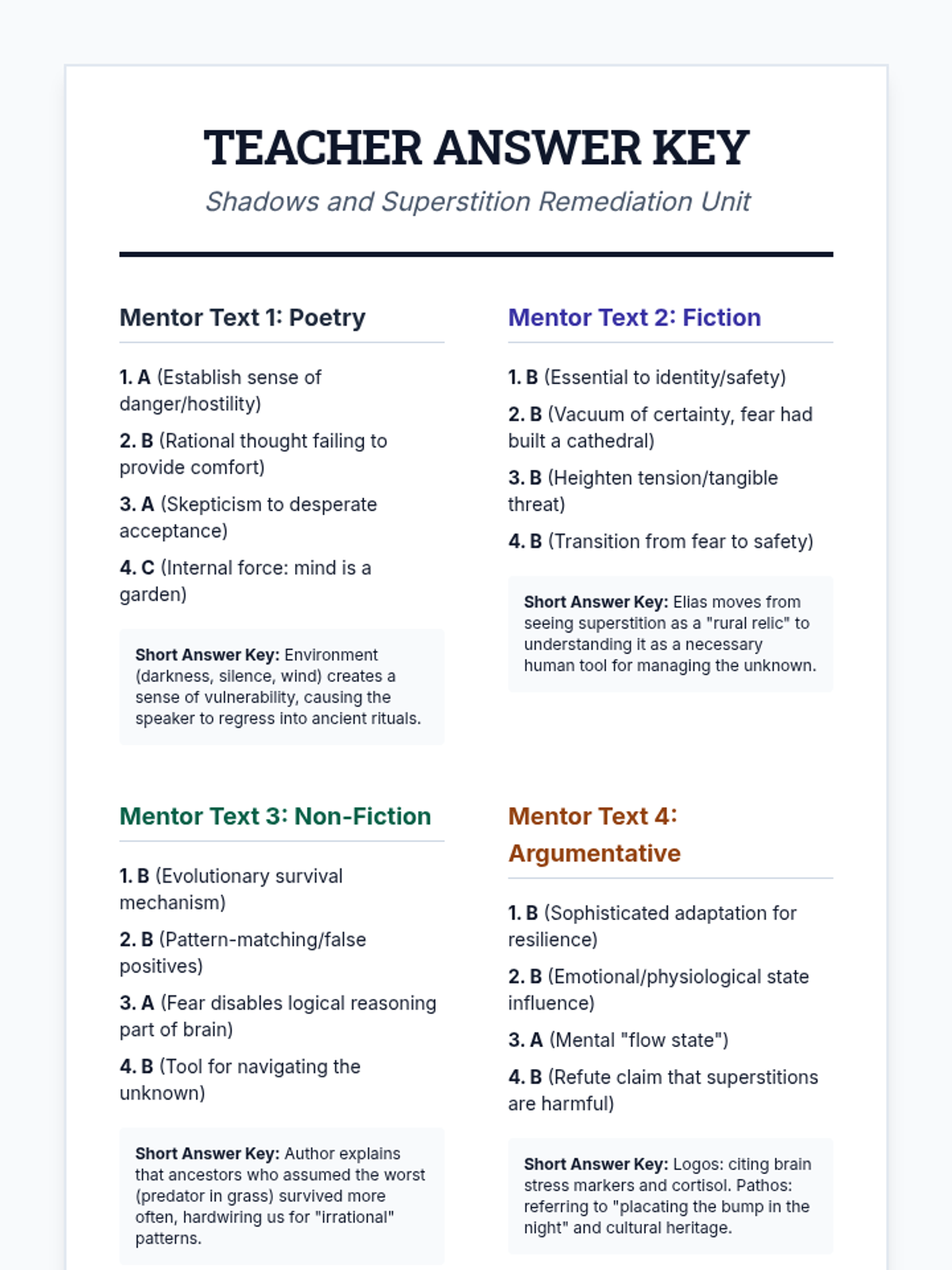
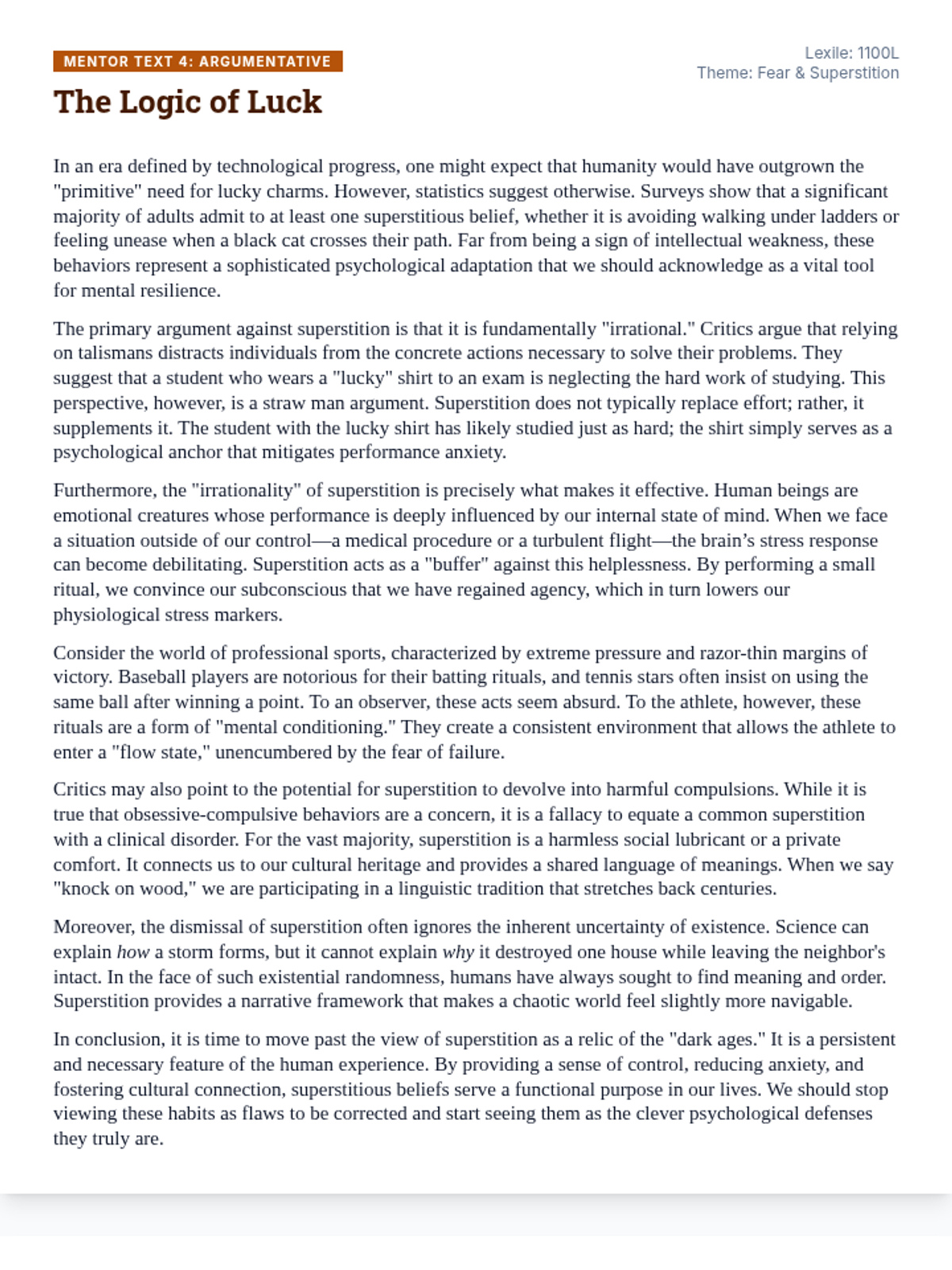
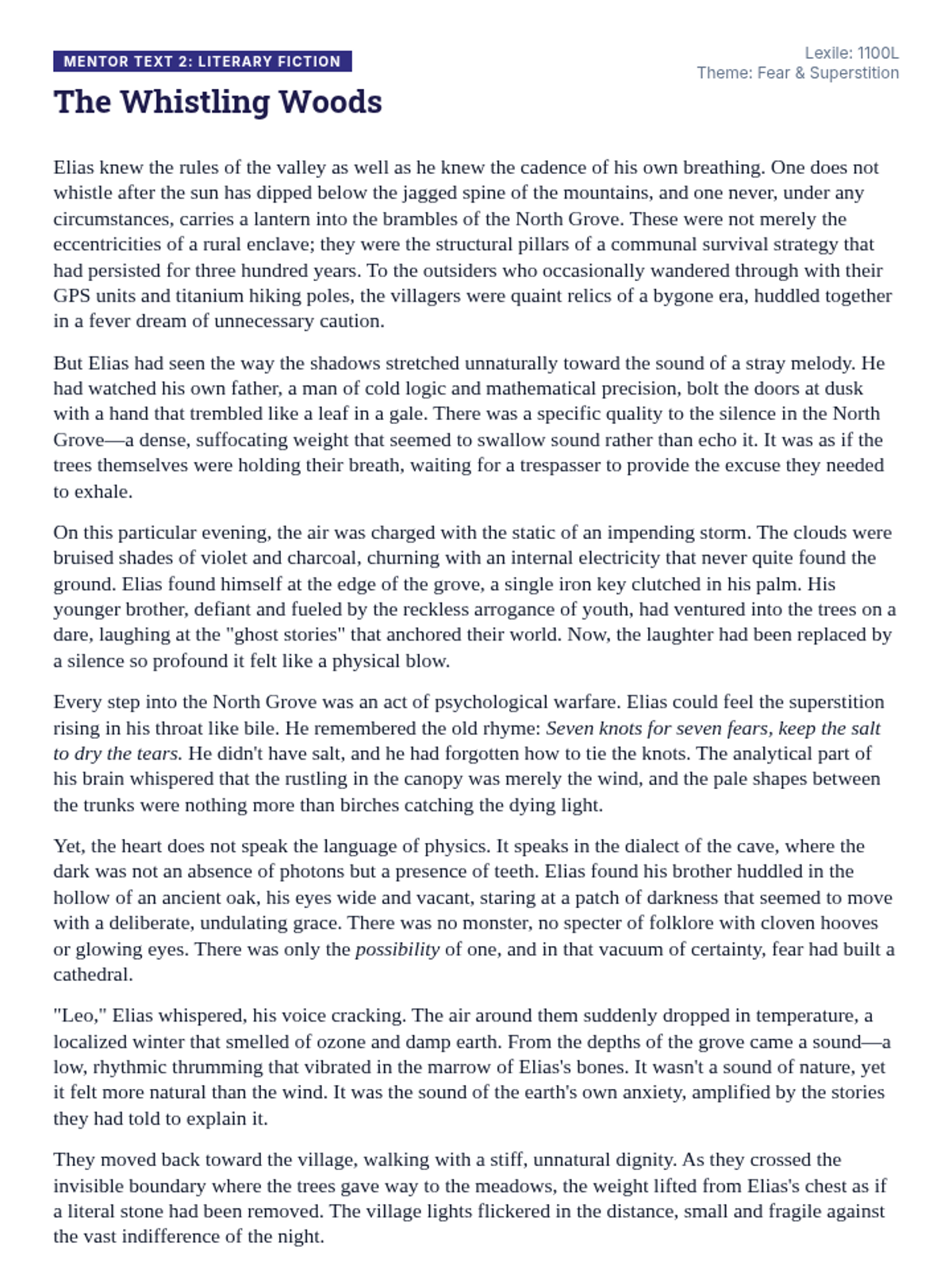
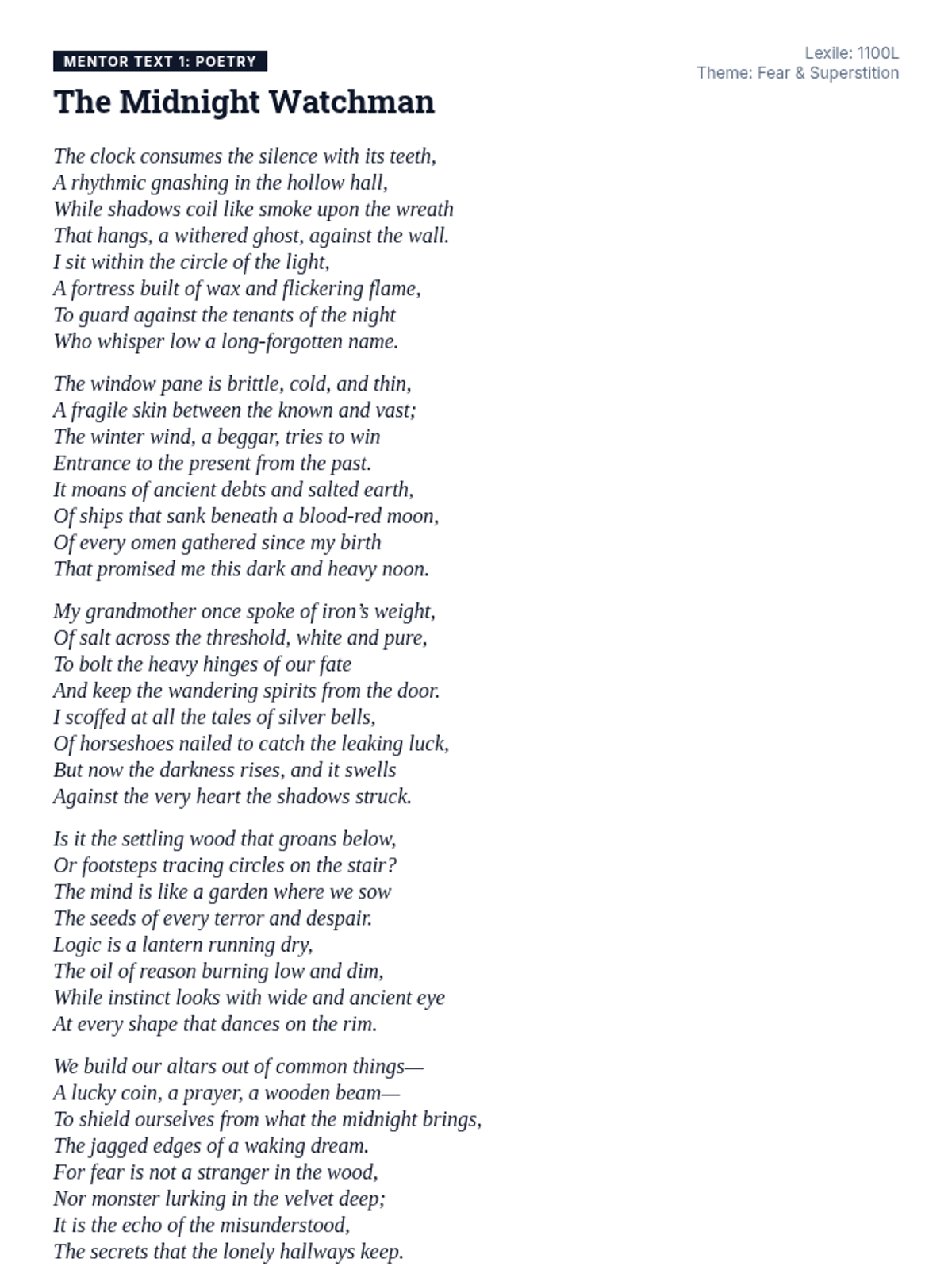
A comprehensive answer key for all mentor texts, revision/editing exercises, and the cumulative test in the Shadows and Superstition remediation packet. Revised to fit on a single page. Adjusted spacing and naming for consistency.
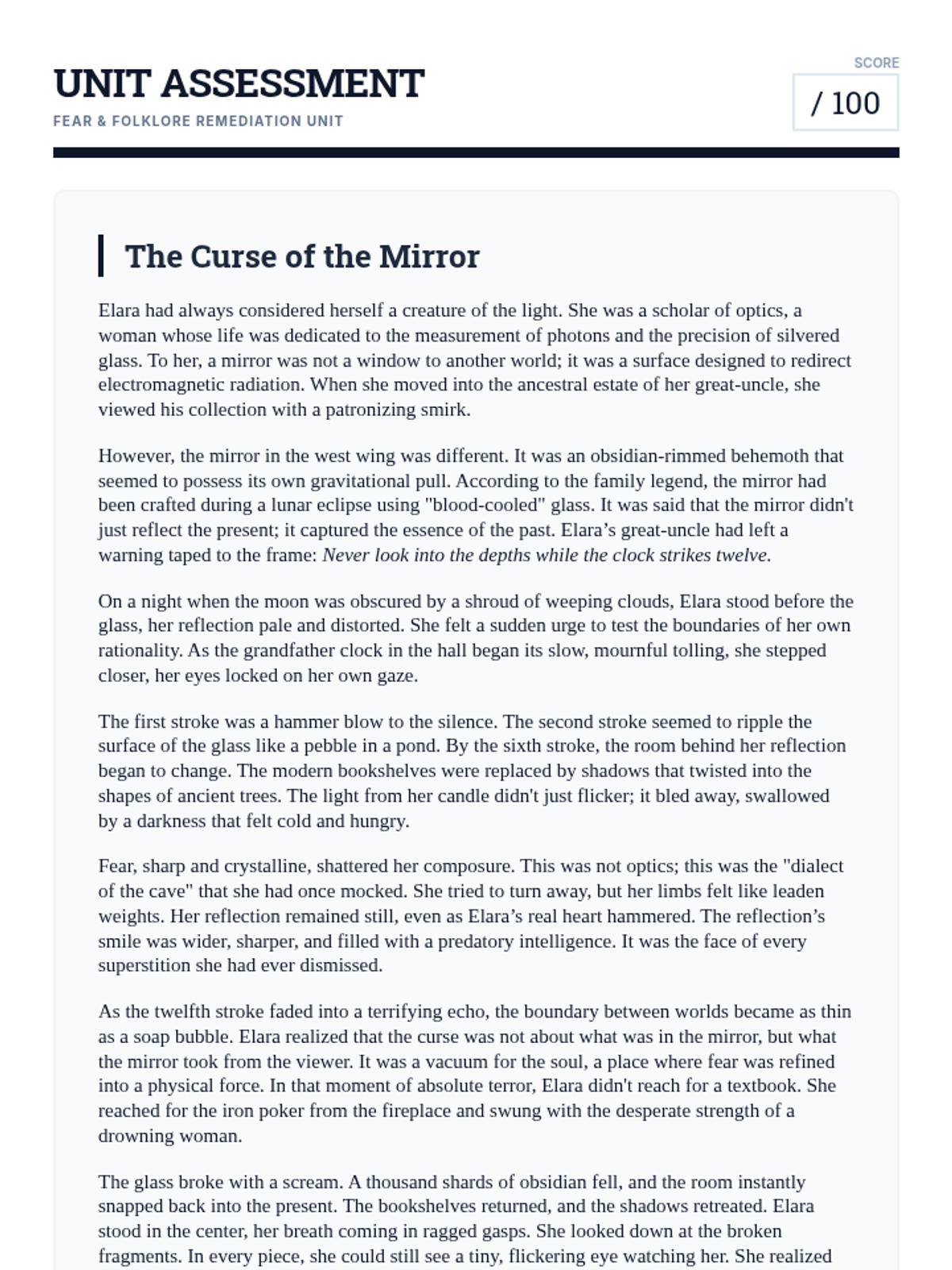
A grayscale version of the cumulative test, featuring the cold-read passage and assessment questions with all color removed. Fixed word spacing in headers and increased writing lines. Standardized distractor order.
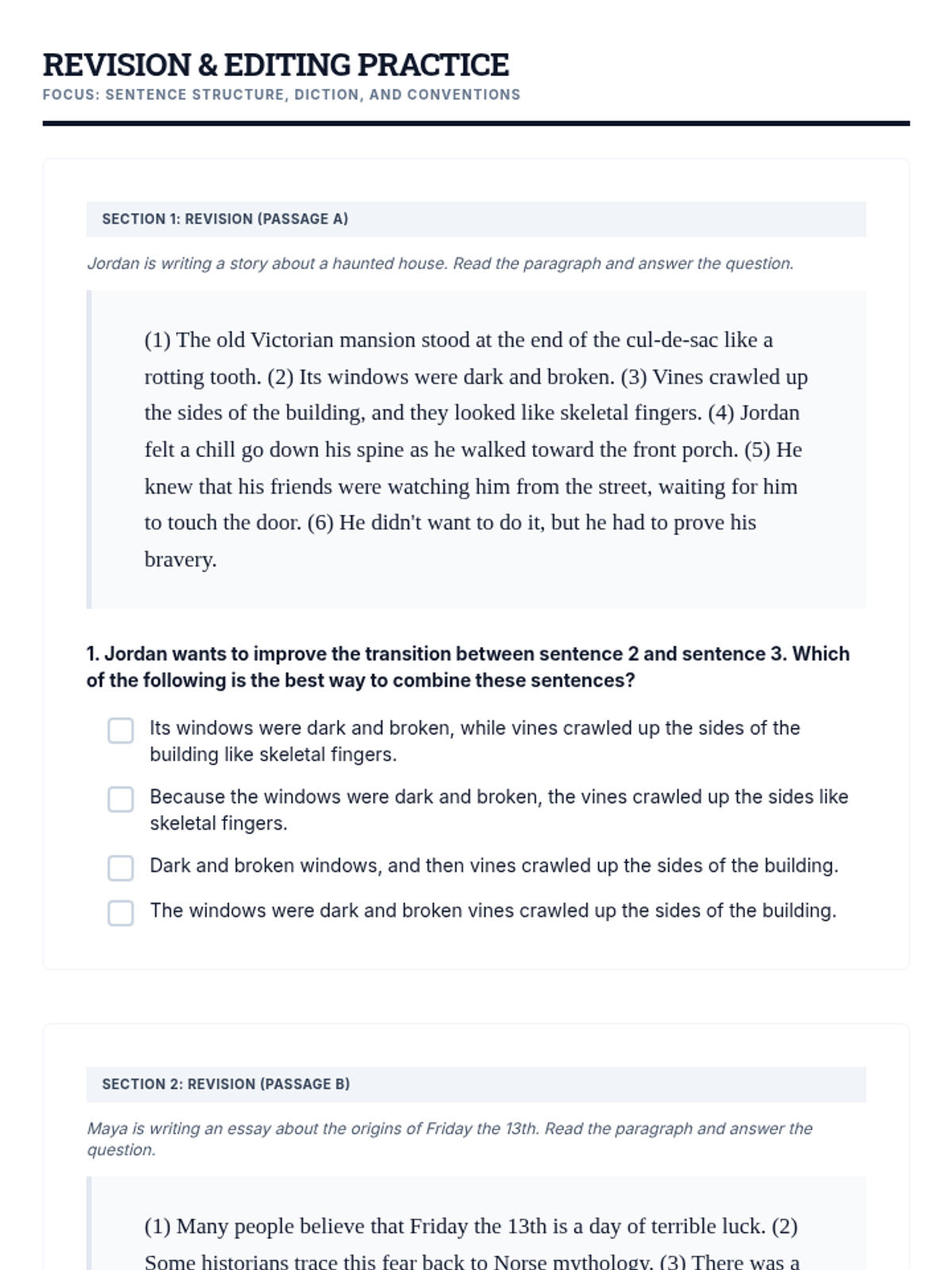
A grayscale version of the revision and editing practice passages, with the yellow highlight updated to gray. Consolidated layout to group Revision questions on Page 1 and Editing questions on Page 2. Fixed word spacing issues. Removed excessive whitespace and min-height constraints.
A grayscale version of the argumentative analysis document, with colors updated to slate shades and text references adjusted to reflect gray highlights. Consolidated layout to 2 pages and fixed work area line spacing. Fixed radio button alignment and constructed response container.
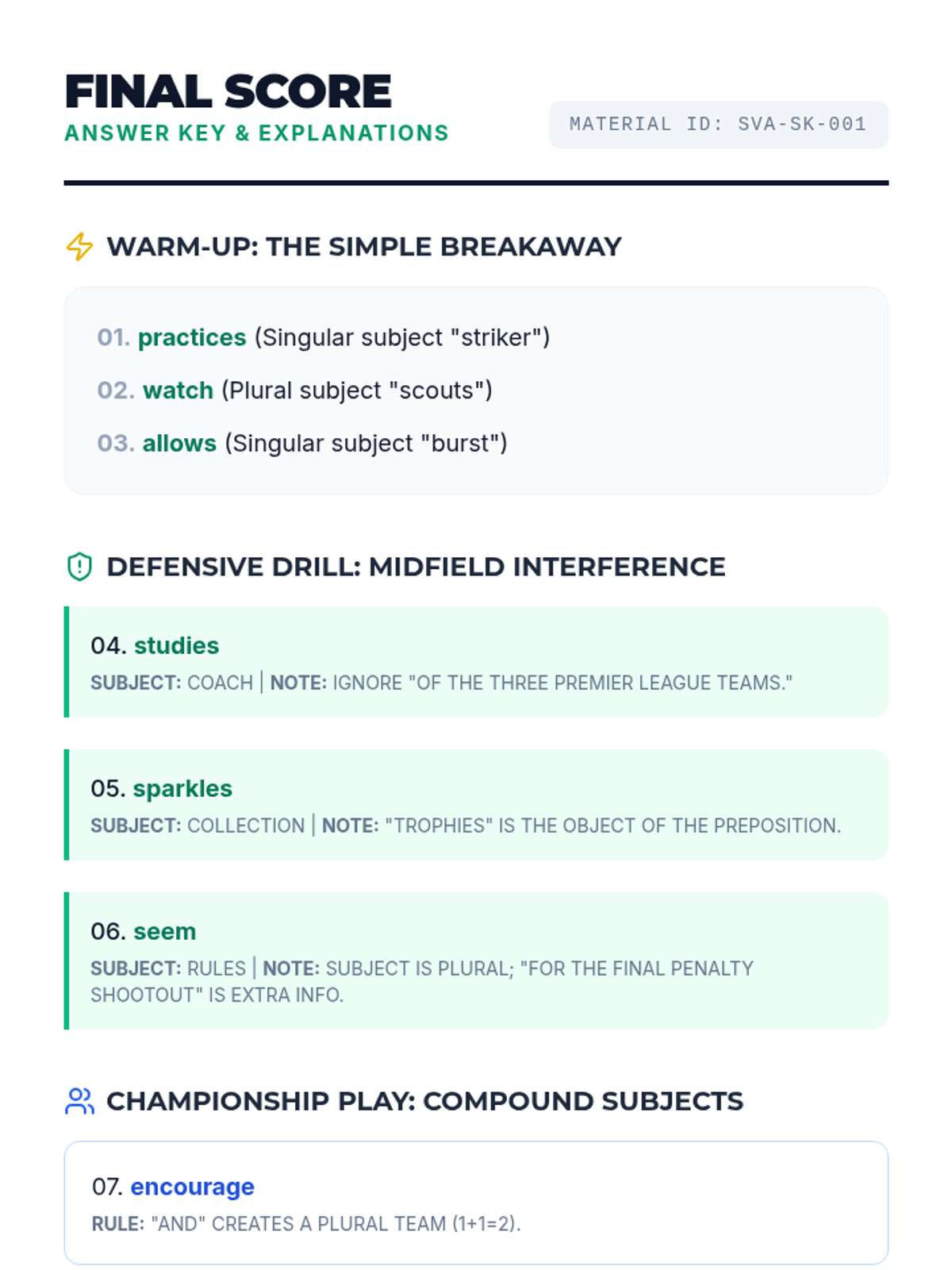
A comprehensive answer key for the Scouting Report worksheet, featuring clear explanations of grammatical rules and specific examples for the writing challenge.
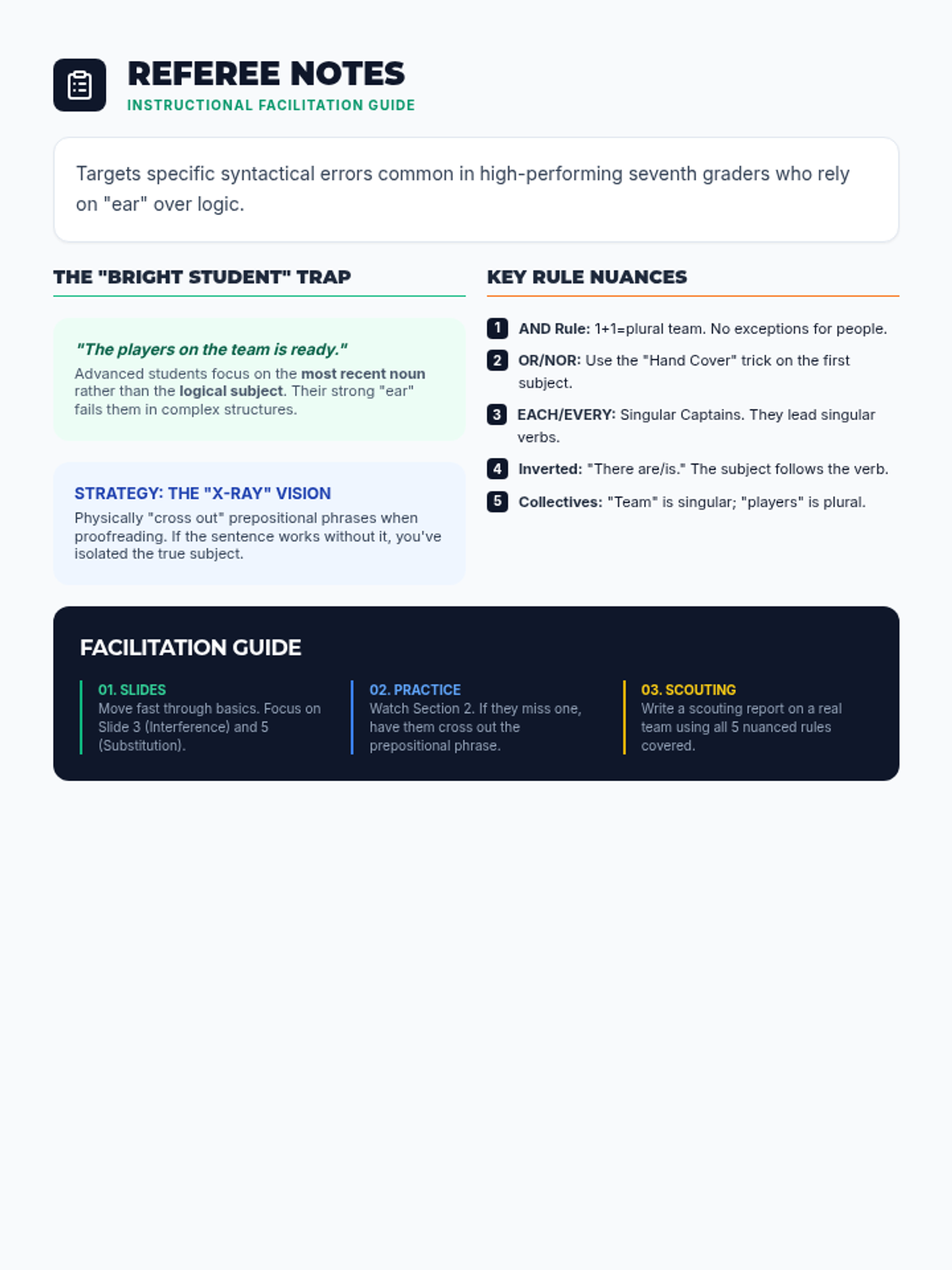
A teacher-facing guide focused on instructional strategies for bright seventh graders. Updated to fit a single page with improved layout and page break controls.
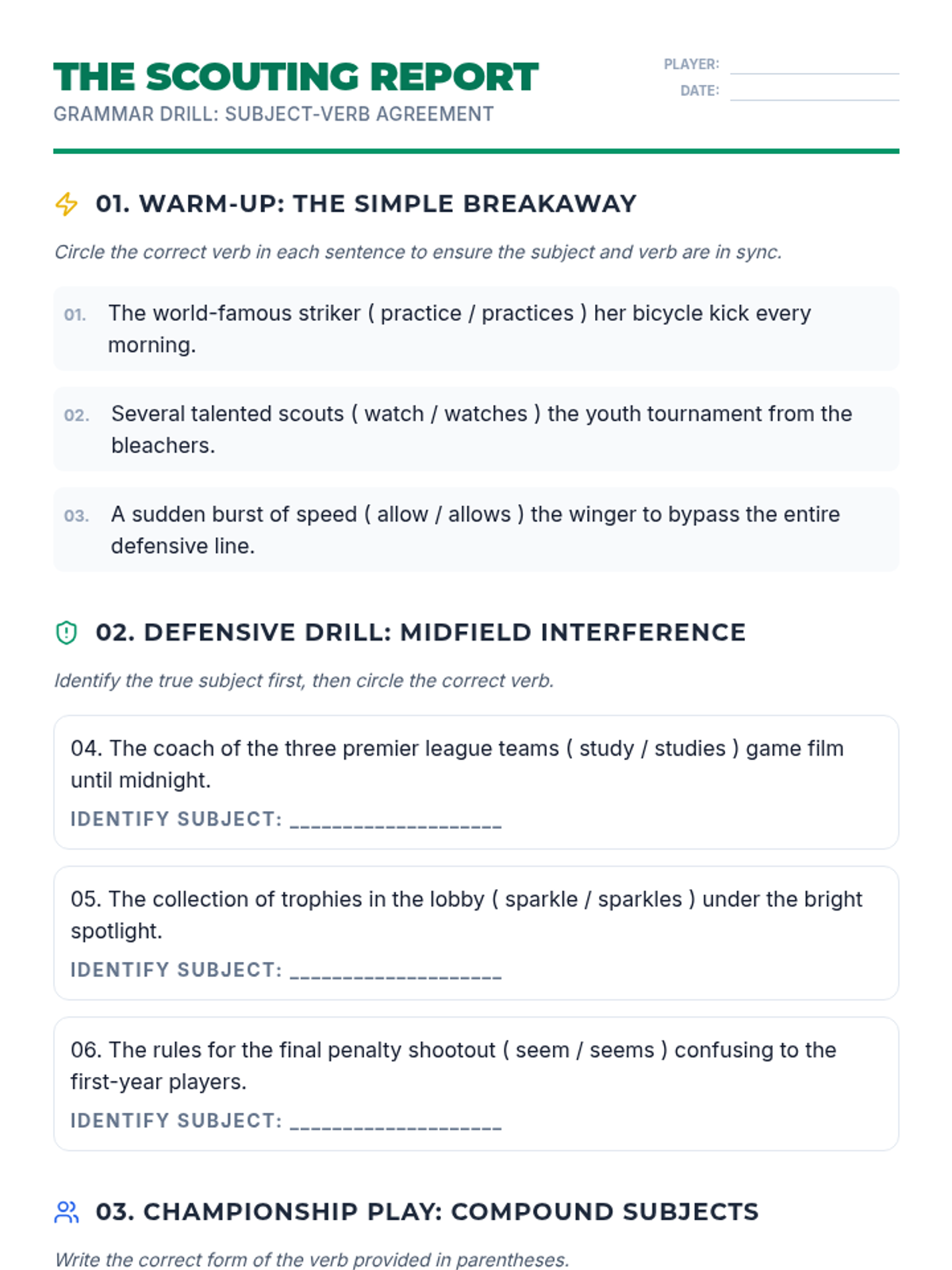
A soccer-themed worksheet for targeted grammar practice, focusing on simple subjects, prepositional phrase interference, and compound subjects. Updated with fixed page breaks and improved workspace for student input.
A high-energy presentation deck for seventh graders, using professional soccer terminology and visuals to explain subject-verb agreement rules, including compound subjects and prepositional interference. Updated with improved visual offsets for readability.
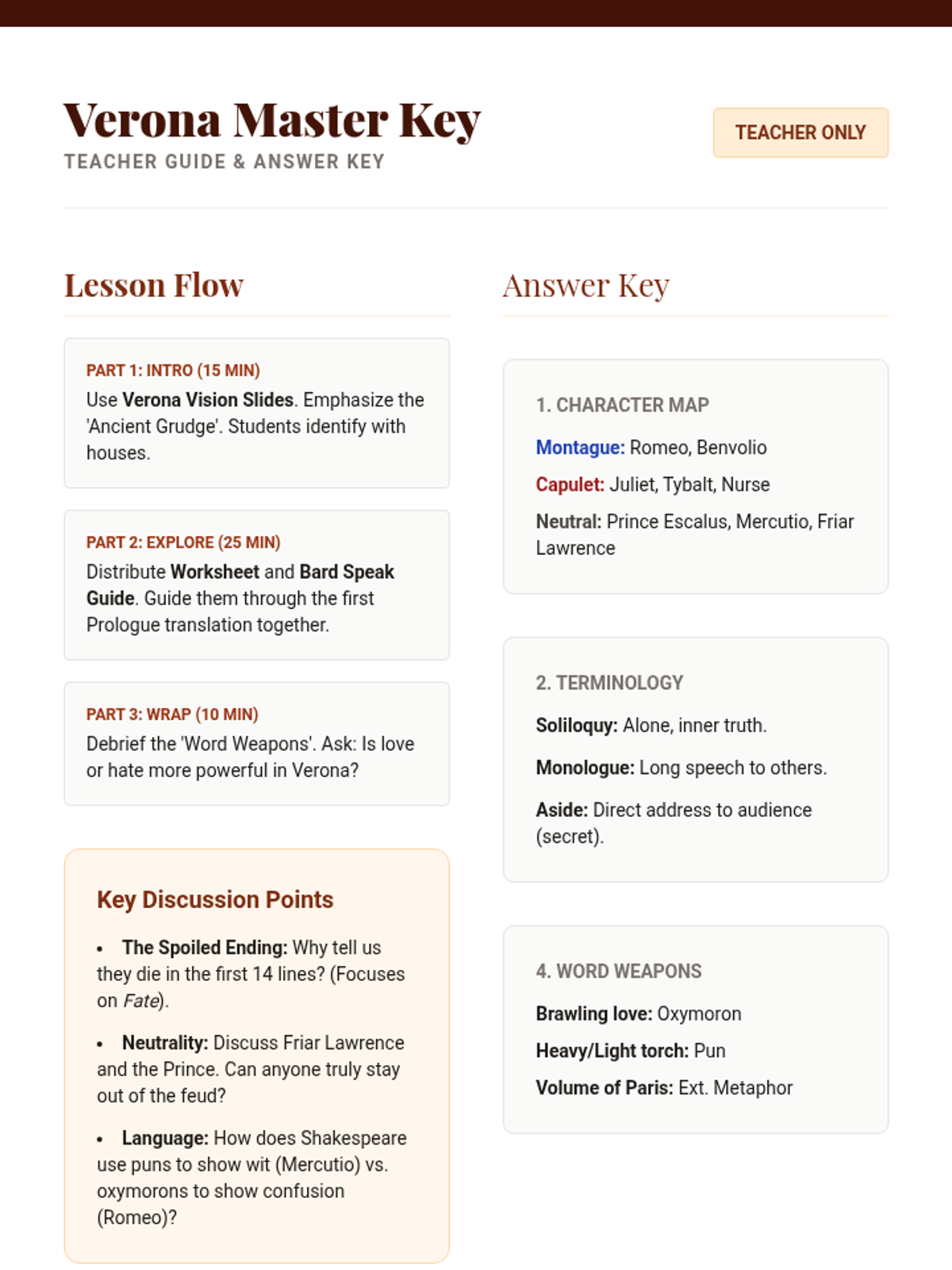
A teacher resource containing the answer key for the Star-Crossed Script Worksheet, lesson delivery tips, and discussion prompts.
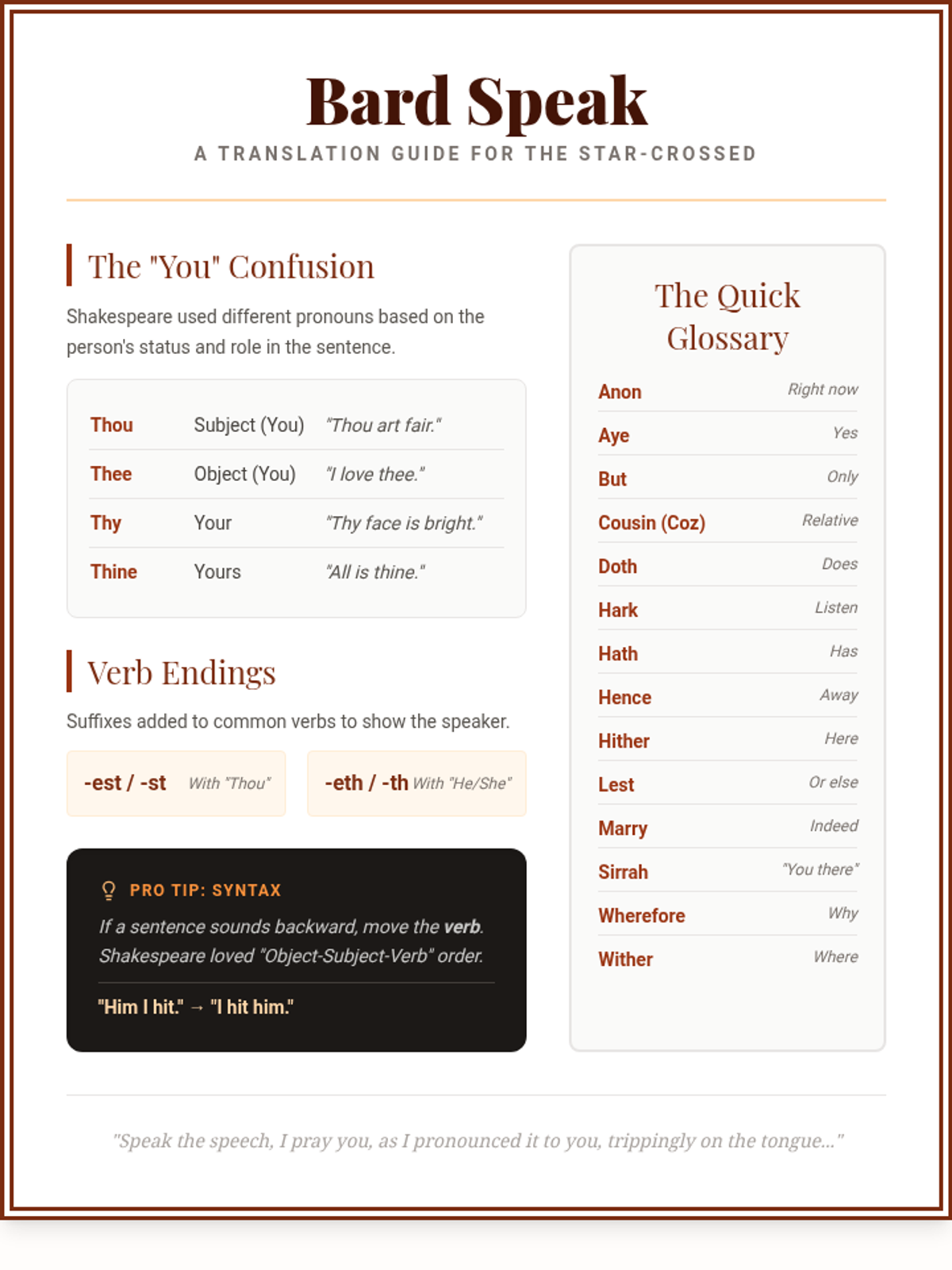
A handy glossary and grammar guide to help students navigate Shakespearean English, focusing on personal pronouns, verb endings, and common vocabulary.
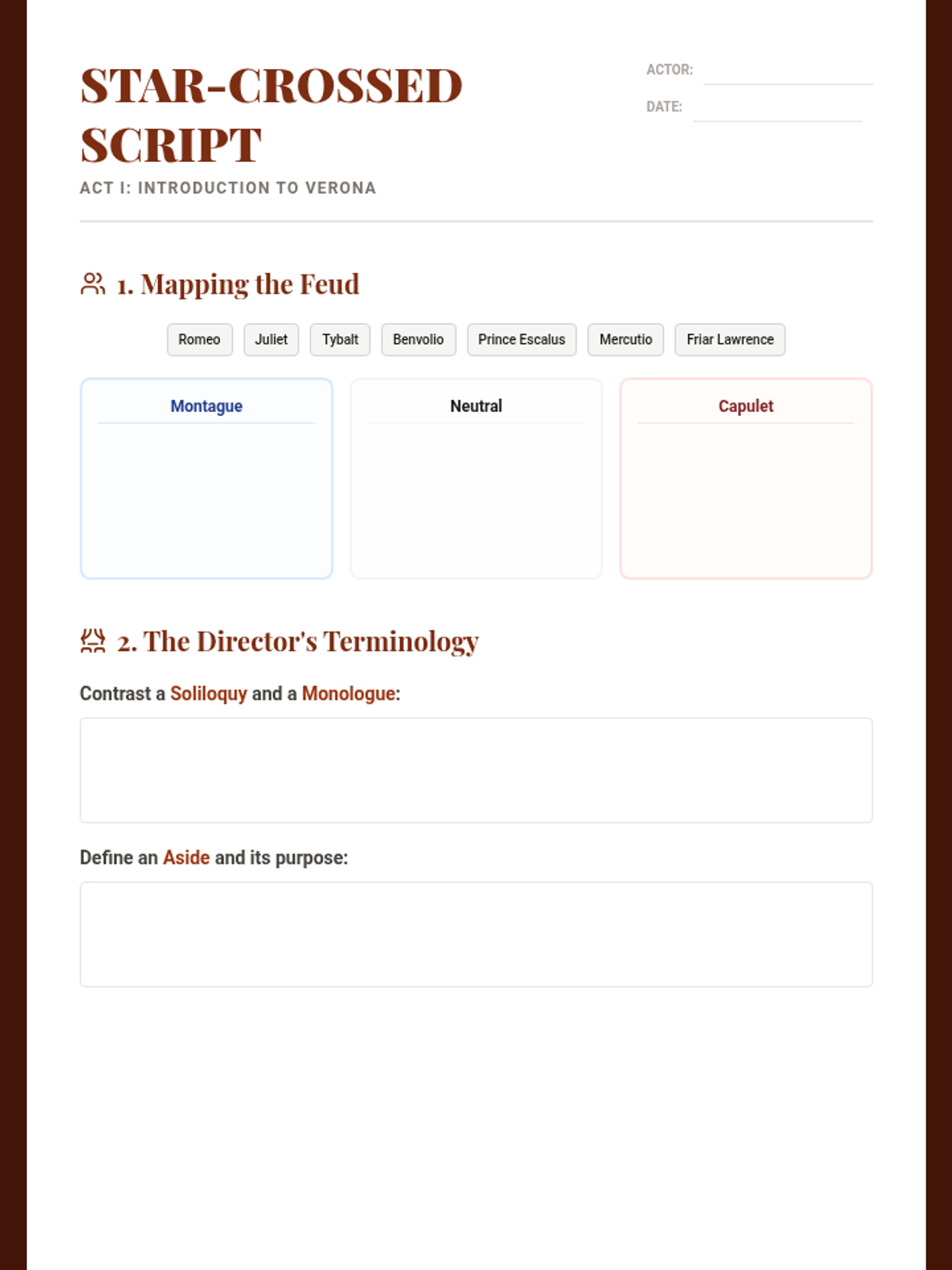
A two-page student activity sheet for mapping characters, defining stage devices, practicing translation of the Prologue, and identifying figurative language.
A visual presentation introducing the world of Verona, key characters, central themes, and the literary tools Shakespeare used to craft the tragedy.
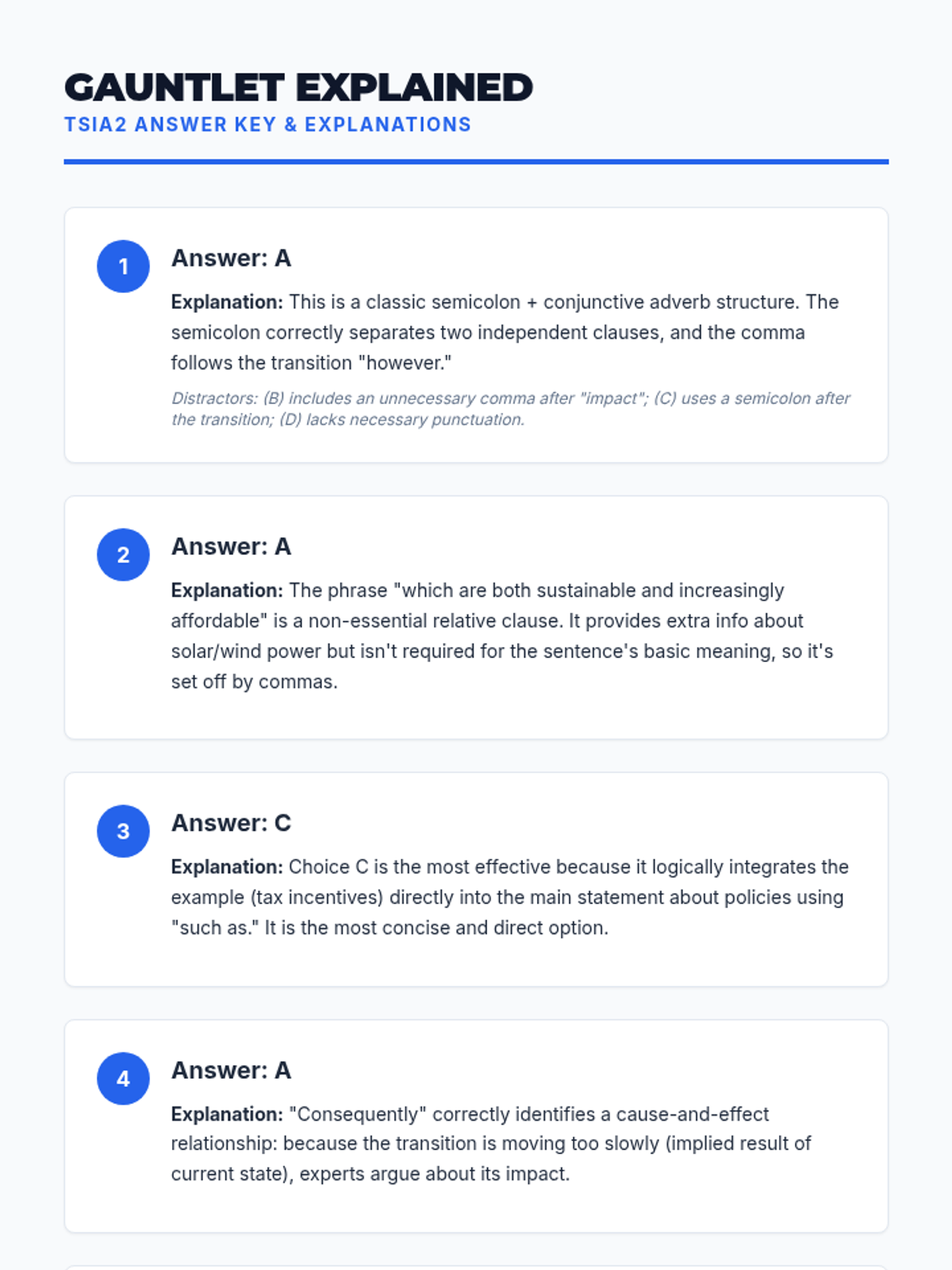
A detailed answer key for the Grammar Gauntlet Assessment, providing the correct answers and instructional explanations for each question.
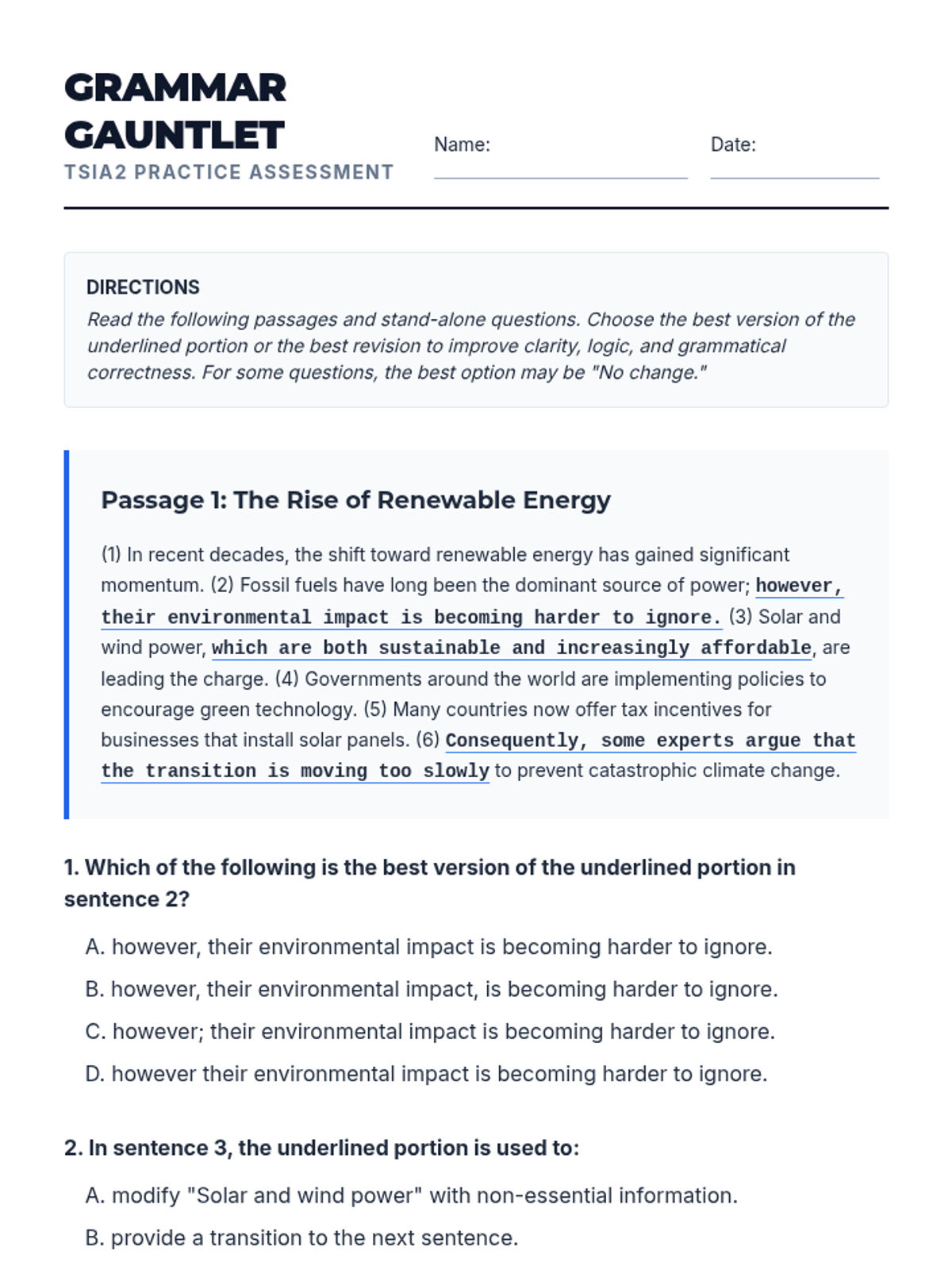
A 20-question multiple-choice practice assessment mirroring the TSIA2 revising and editing standards, including passage-based and stand-alone questions.
Instructional slide deck for the TSIA2 Grammar Gauntlet lesson, covering the four key focus areas of the exam with visual examples and strategy tips. All text updated to 24px minimum for visibility.
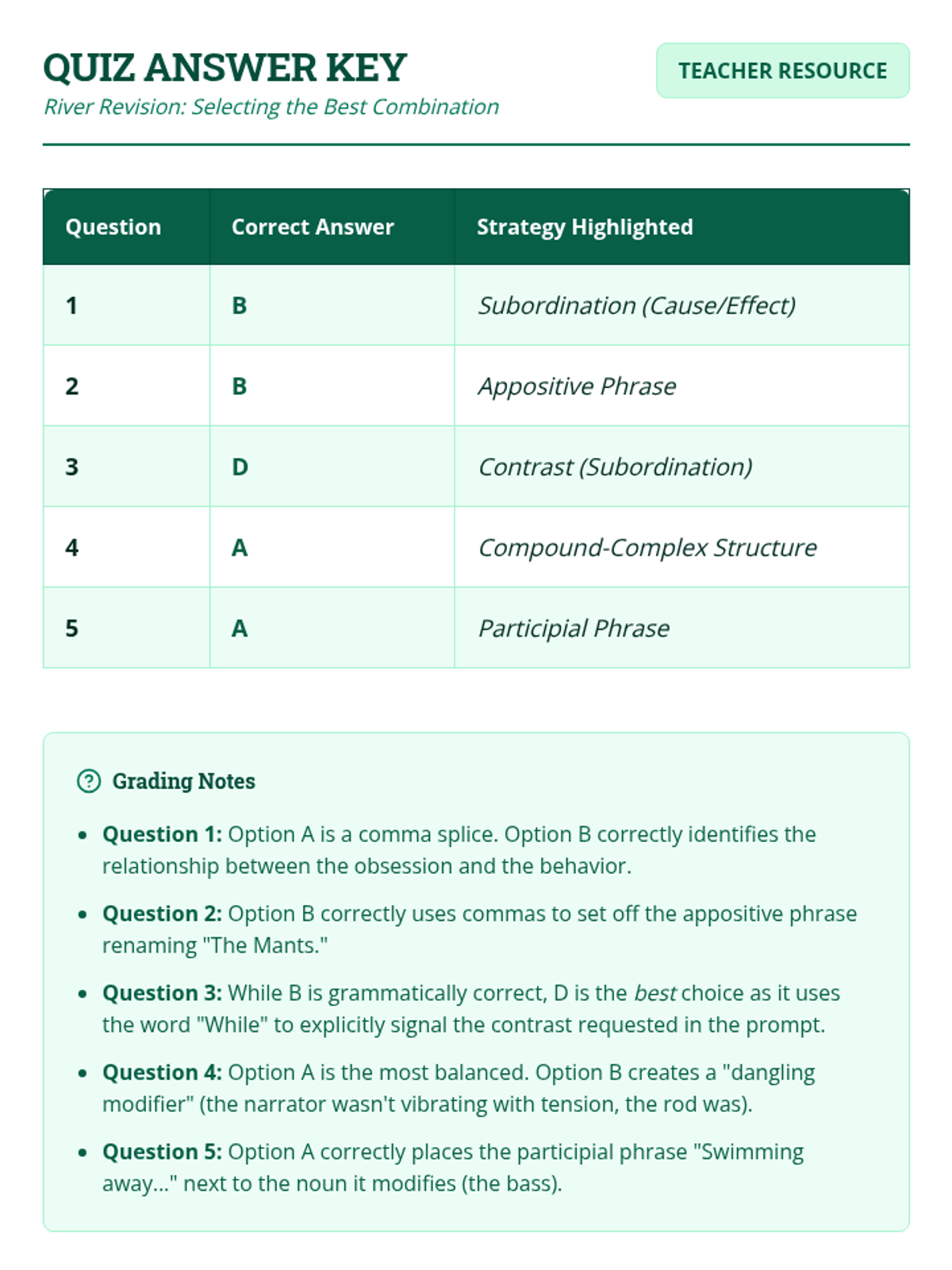
An answer key for the River Revision Quiz, including the correct letter for each question and brief explanations for the grammatical reasoning behind the correct choices.
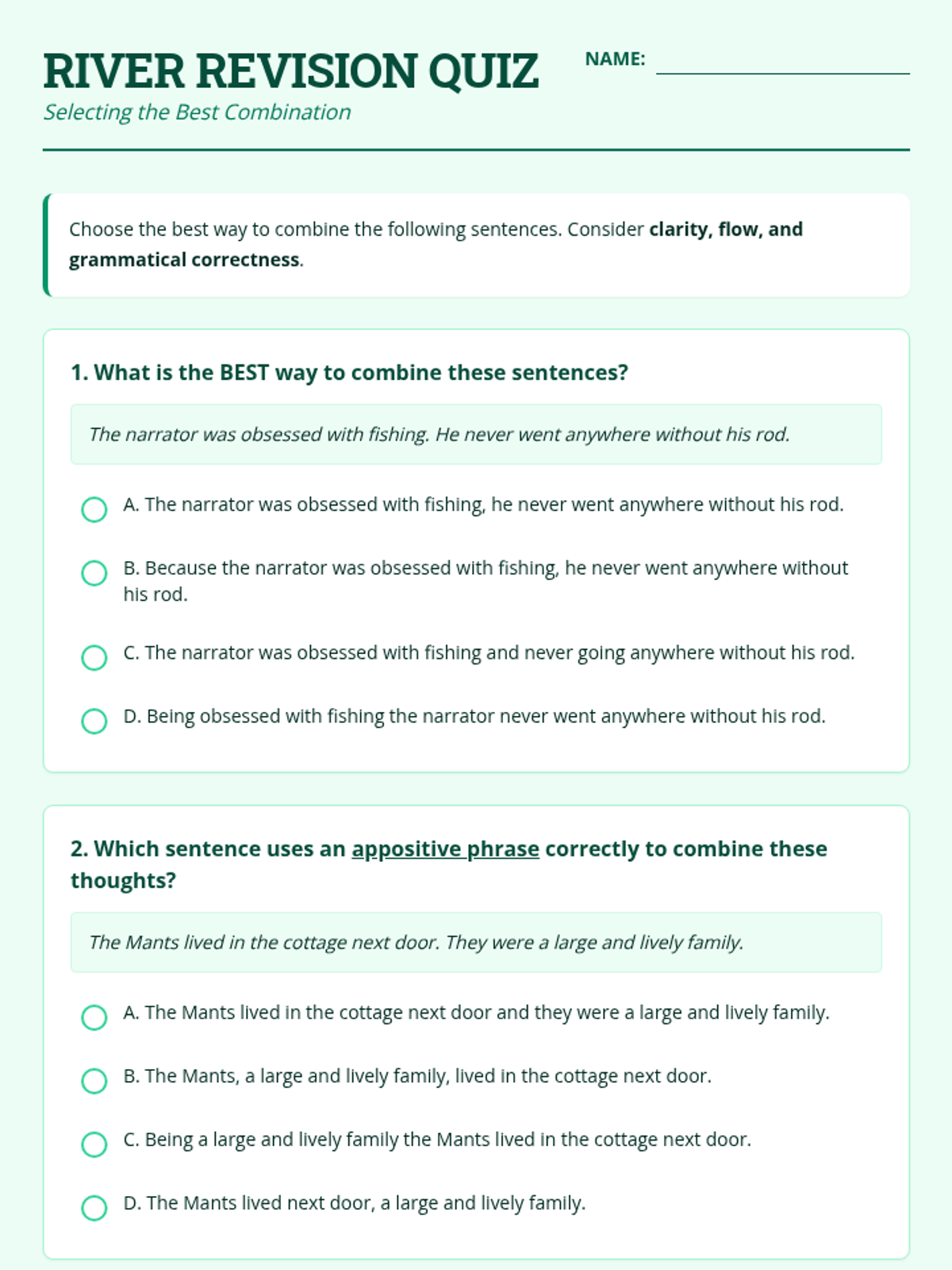
A 5-question multiple-choice quiz focusing on choosing the best sentence combinations based on clarity, flow, and grammatical sophistication, themed around 'The Bass, the River, and Sheila Mant'.
An instructional slide deck for teaching sentence combining strategies (FANBOYS, subordination, appositives, and participles) themed around 'The Bass, the River, and Sheila Mant'.
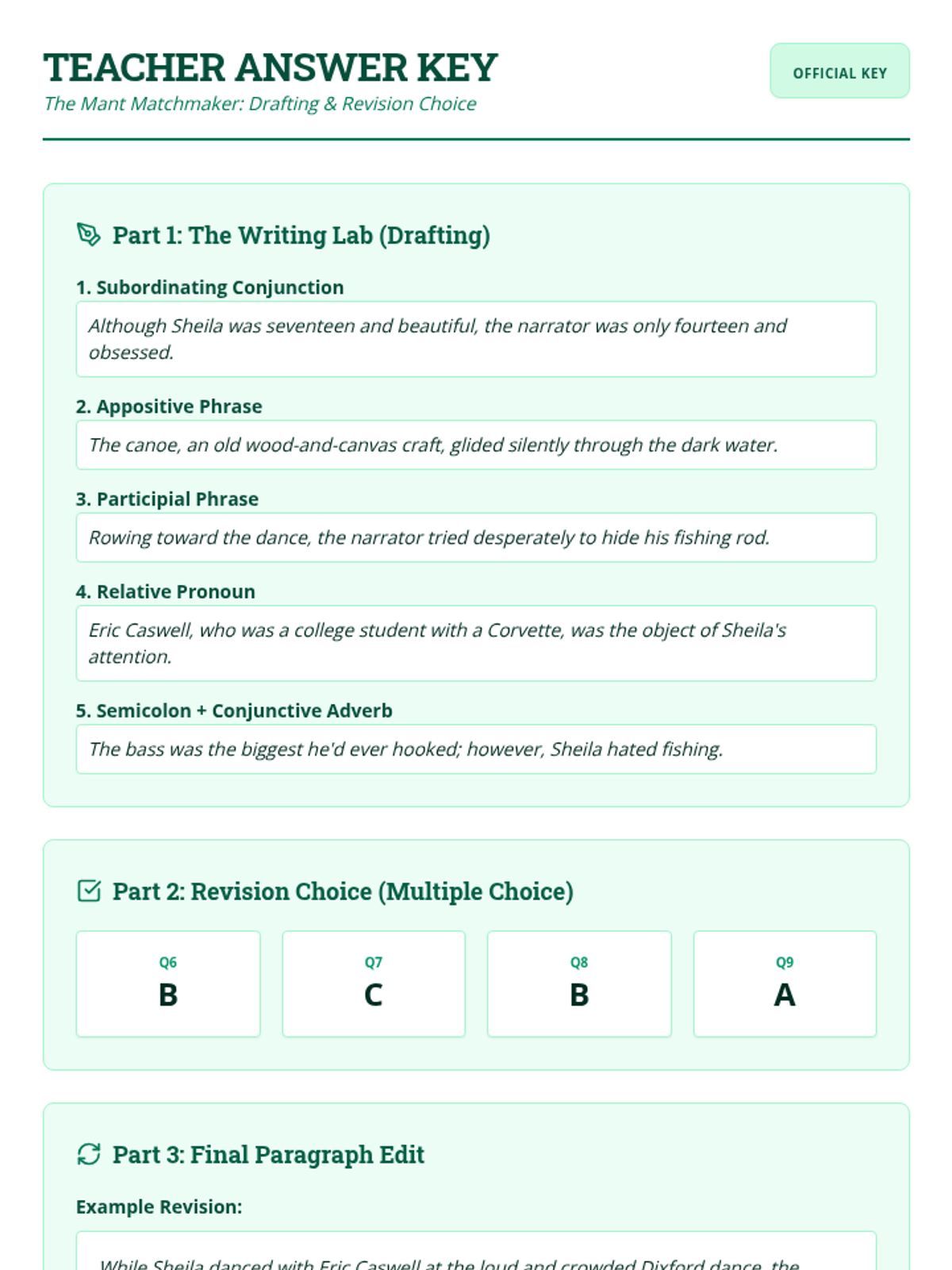
A comprehensive teacher answer key for the updated Mant Matchmaker Worksheet, covering the open-ended combining tasks, multiple-choice questions, and the final narrative flow challenge.
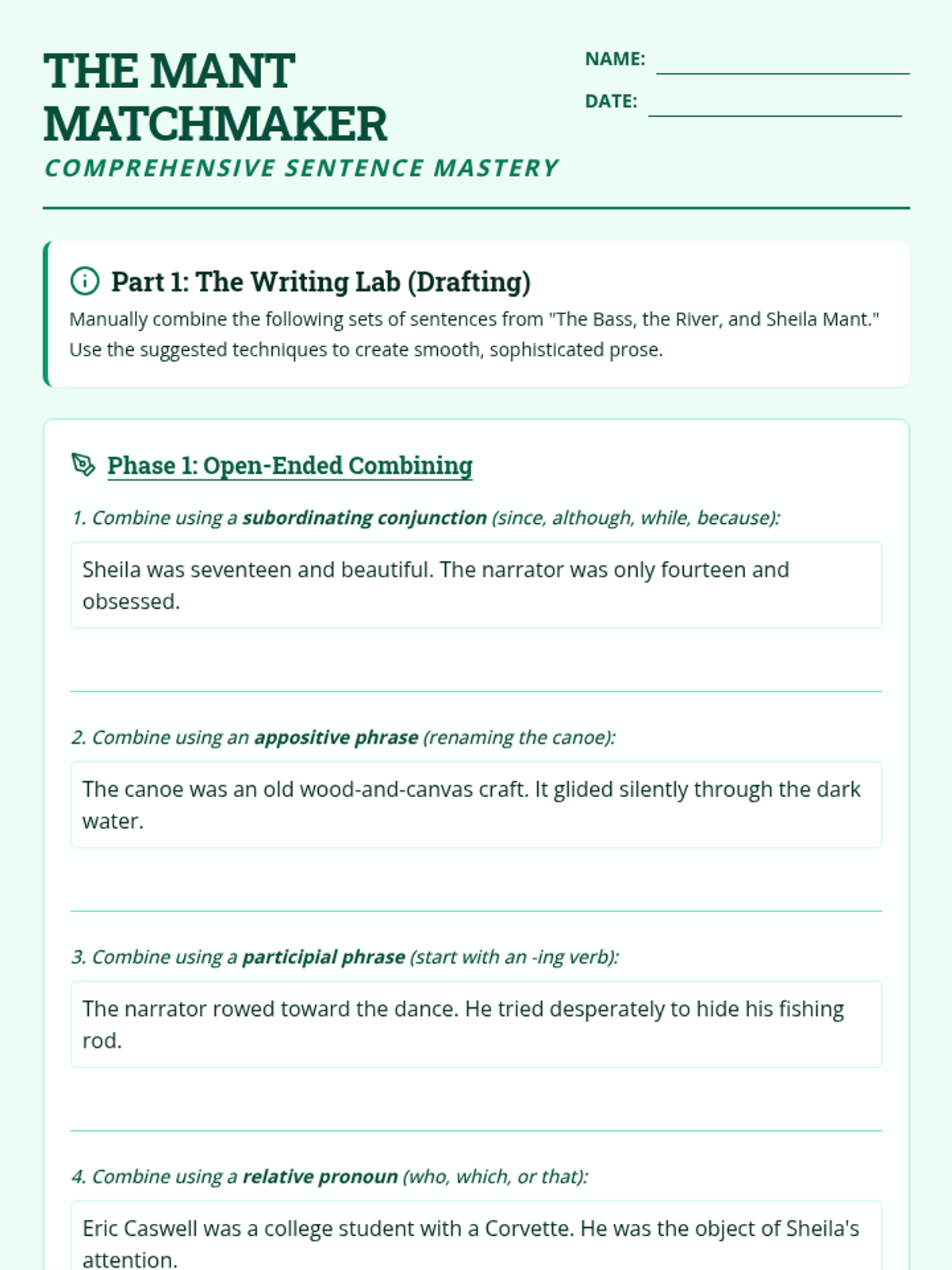
A comprehensive two-page combined worksheet featuring 5 open-ended drafting tasks, 4 multiple-choice revision questions with standardized styling, and a final paragraph editing challenge.
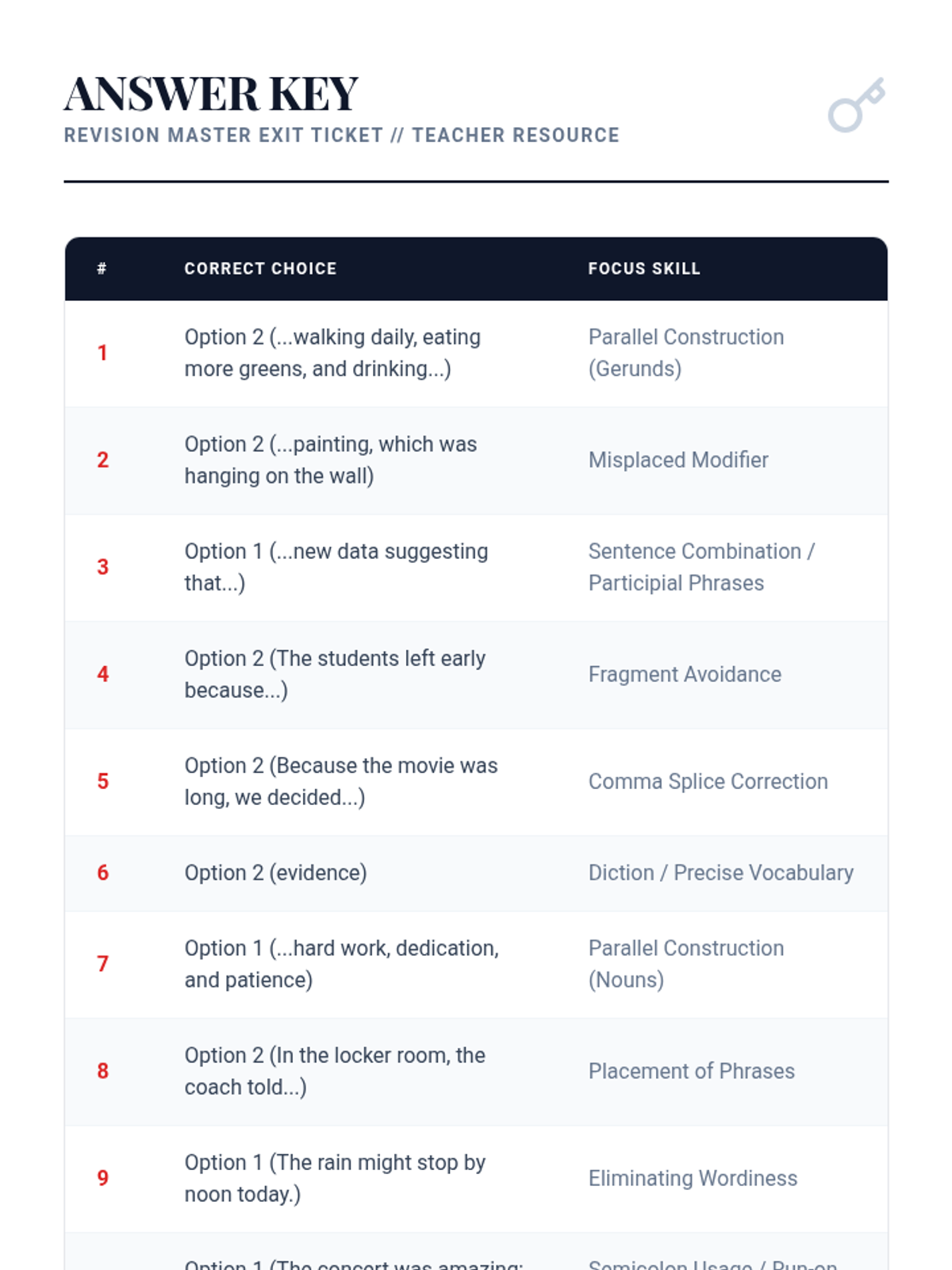
A teacher-facing answer key and grading guide for the Revision Master Exit Ticket. Includes focus skills for each question and common student misconceptions.
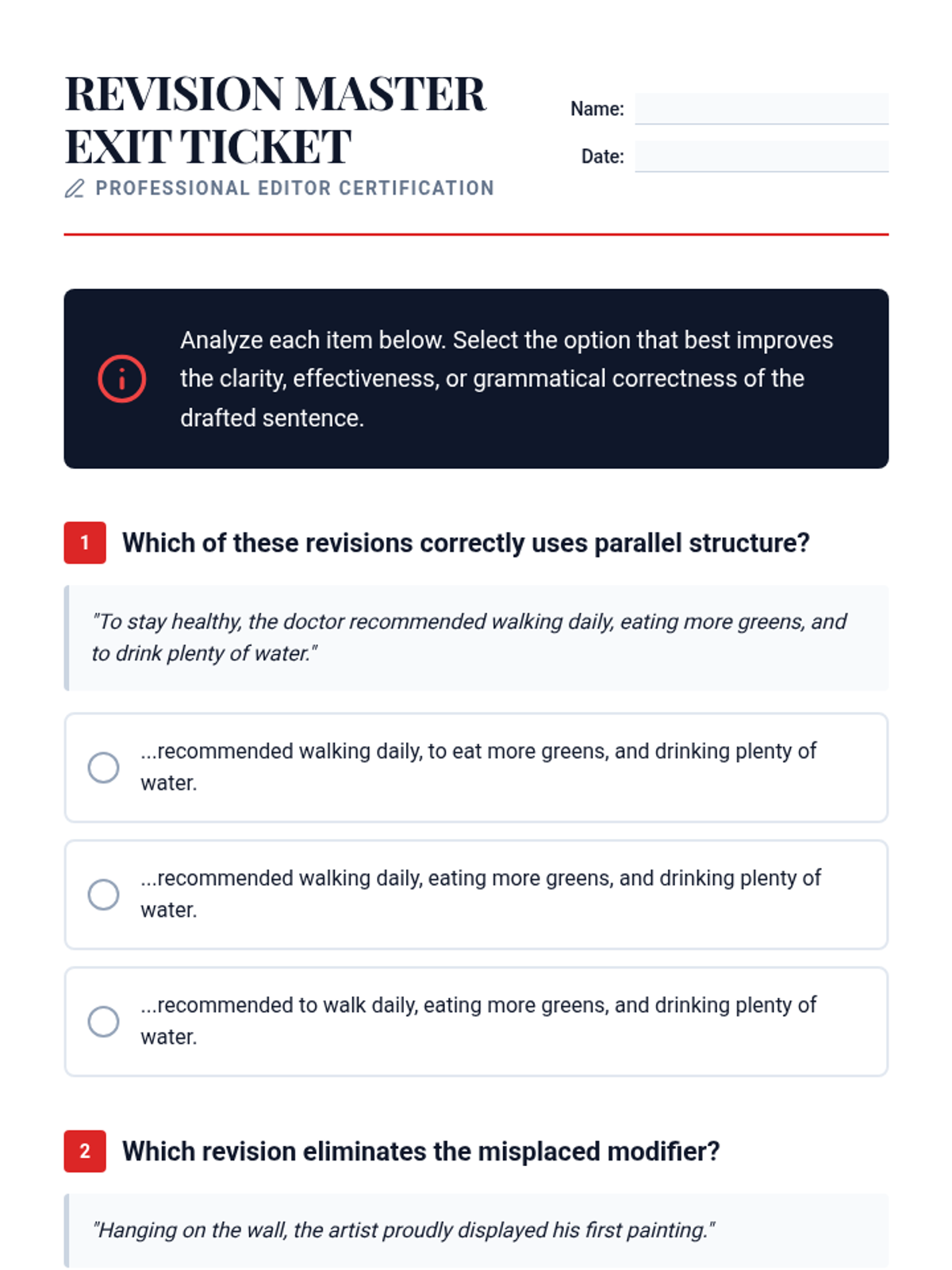
A 10-question multiple-choice exit ticket assessing student mastery of parallel structure, phrase placement, sentence effectiveness, and basic editing for fragments and run-ons. Includes break-inside-avoid to prevent question splitting.
A digital slide presentation guiding students through the revision process, focusing on parallel structure, phrase placement, and sentence effectiveness. Now updated with minimum 24px font size for all text elements.
The complete 10-day slide deck with Question 3 for each day as a Short Constructed Response (SCR). Includes high-contrast logic and model response slides for sentence combining and parallelism.
An updated tracking sheet designed for constructed response questions. Includes larger writing areas for Day 1-10 sentence combining and parallelism tasks.
An expanded interactive slide deck featuring 30 revising and editing questions. Each day now includes a third question focused specifically on sentence combining and parallel structure, with immediate feedback slides.
An expanded tracking sheet for students to record their answers for 30 EOC-style questions across 10 days. Includes a third slot for sentence combining and parallelism logic.
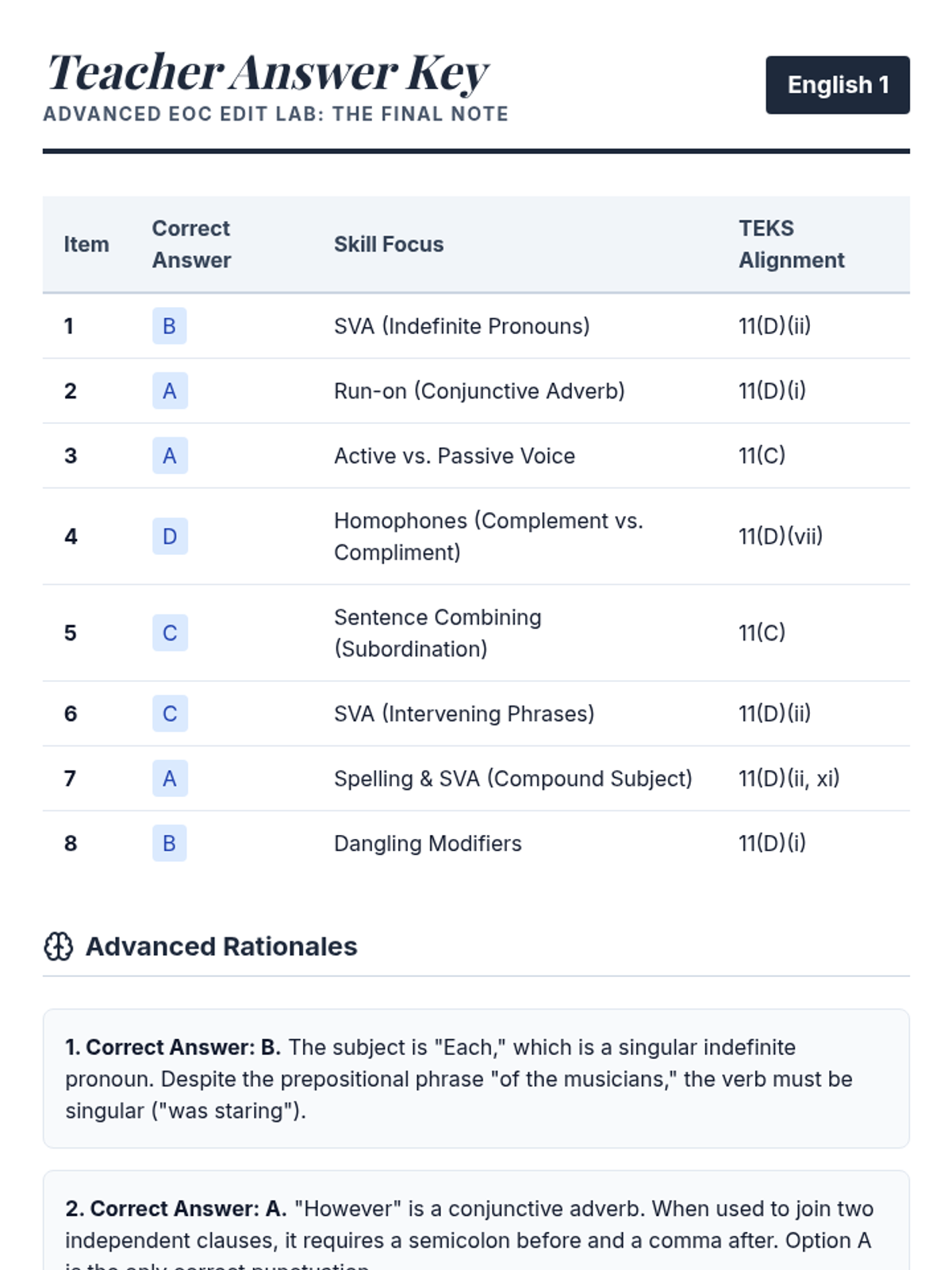
Advanced answer key and rationales for the EOC Edit Lab practice, focusing on sophisticated grammar concepts like dangling modifiers and indefinite pronouns.
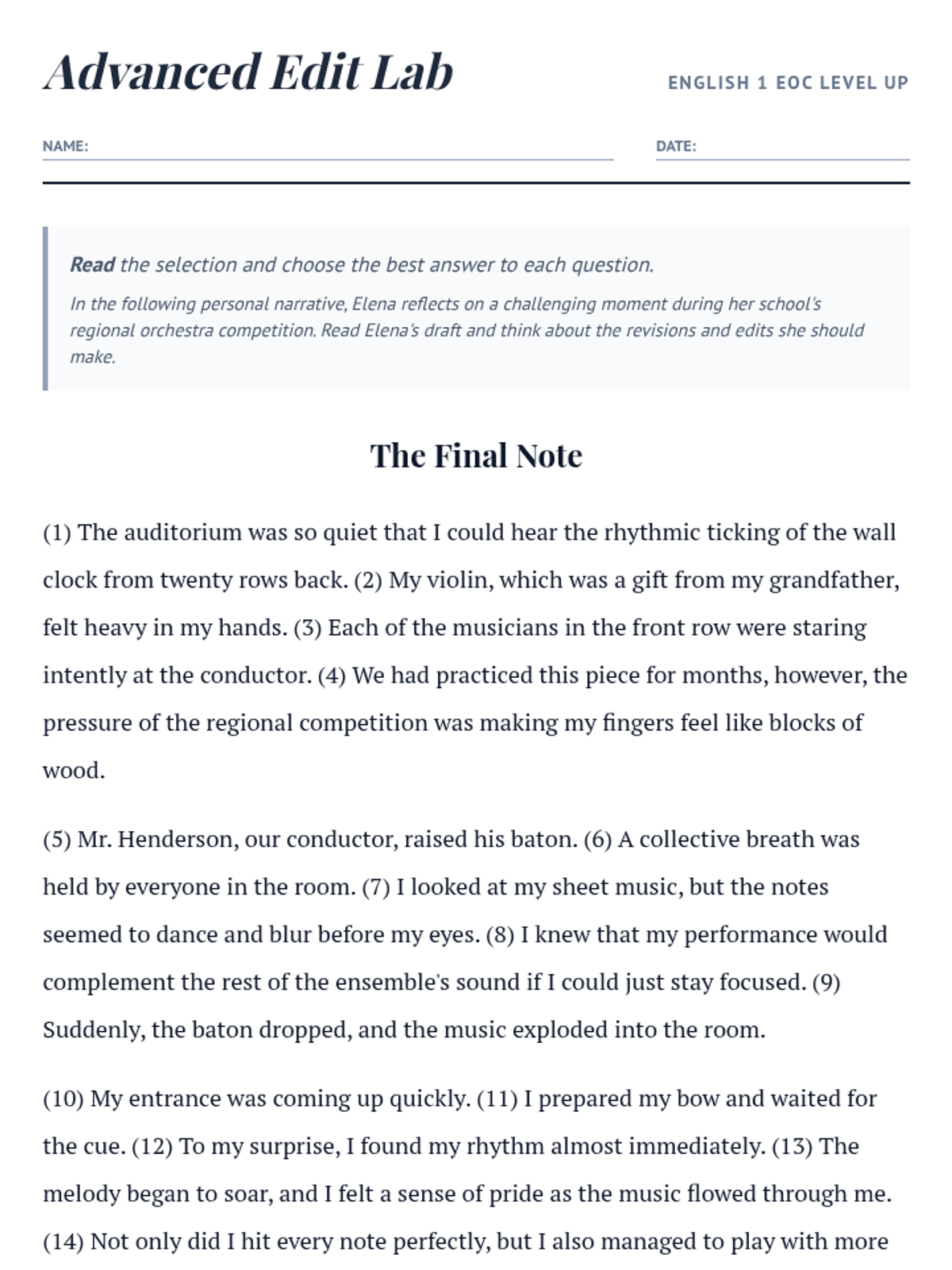
An advanced STAAR-style revising and editing practice featuring a high-stakes personal narrative about an orchestra competition, including more complex grammar and syntax questions.
Updated instructional slides for English 1 EOC revising and editing, now including advanced strategies for dangling modifiers and complex subject-verb agreement.
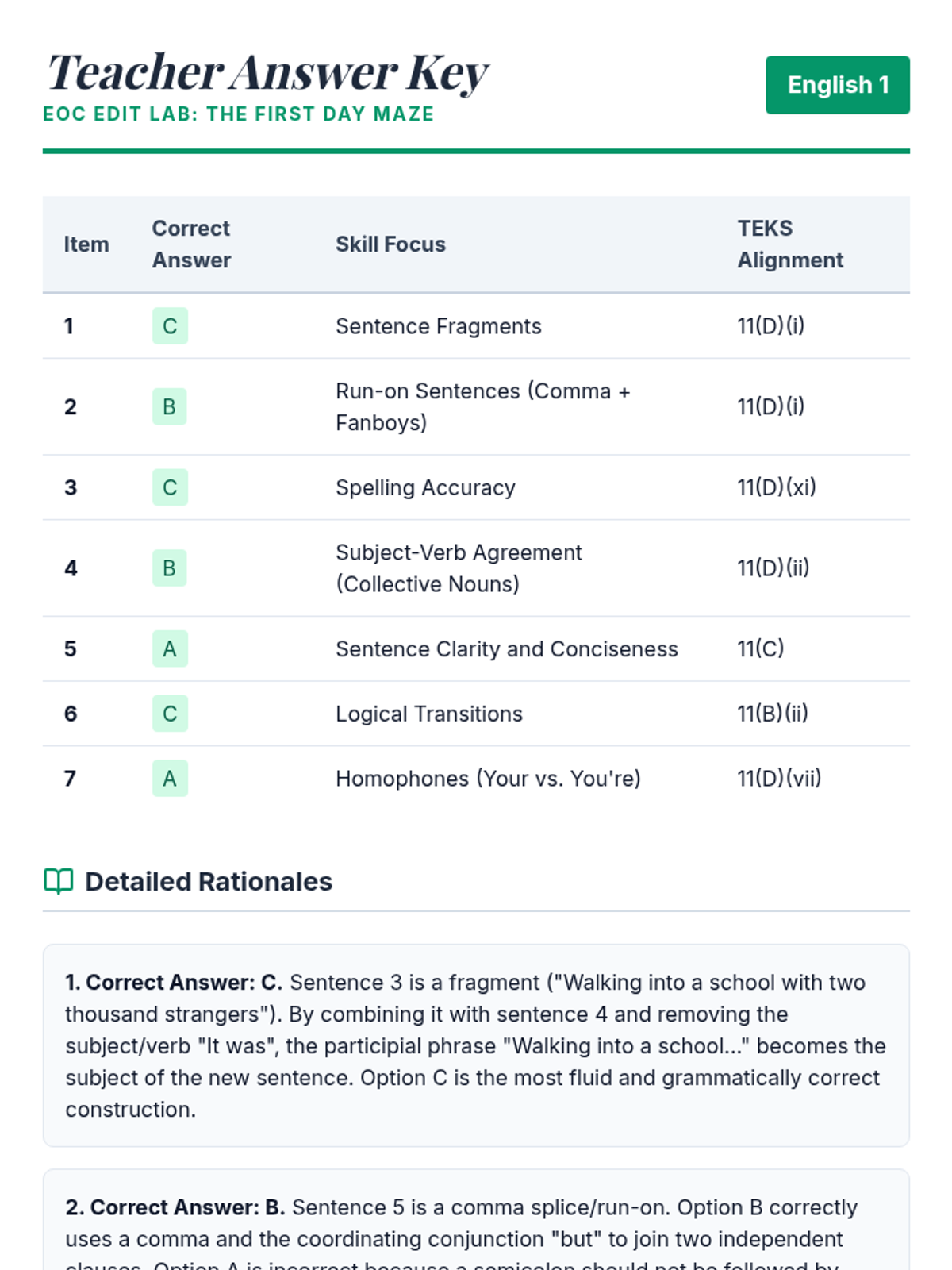
Detailed answer key and rationales for the EOC Edit Lab practice, providing skill focus and TEKS alignment for each question.
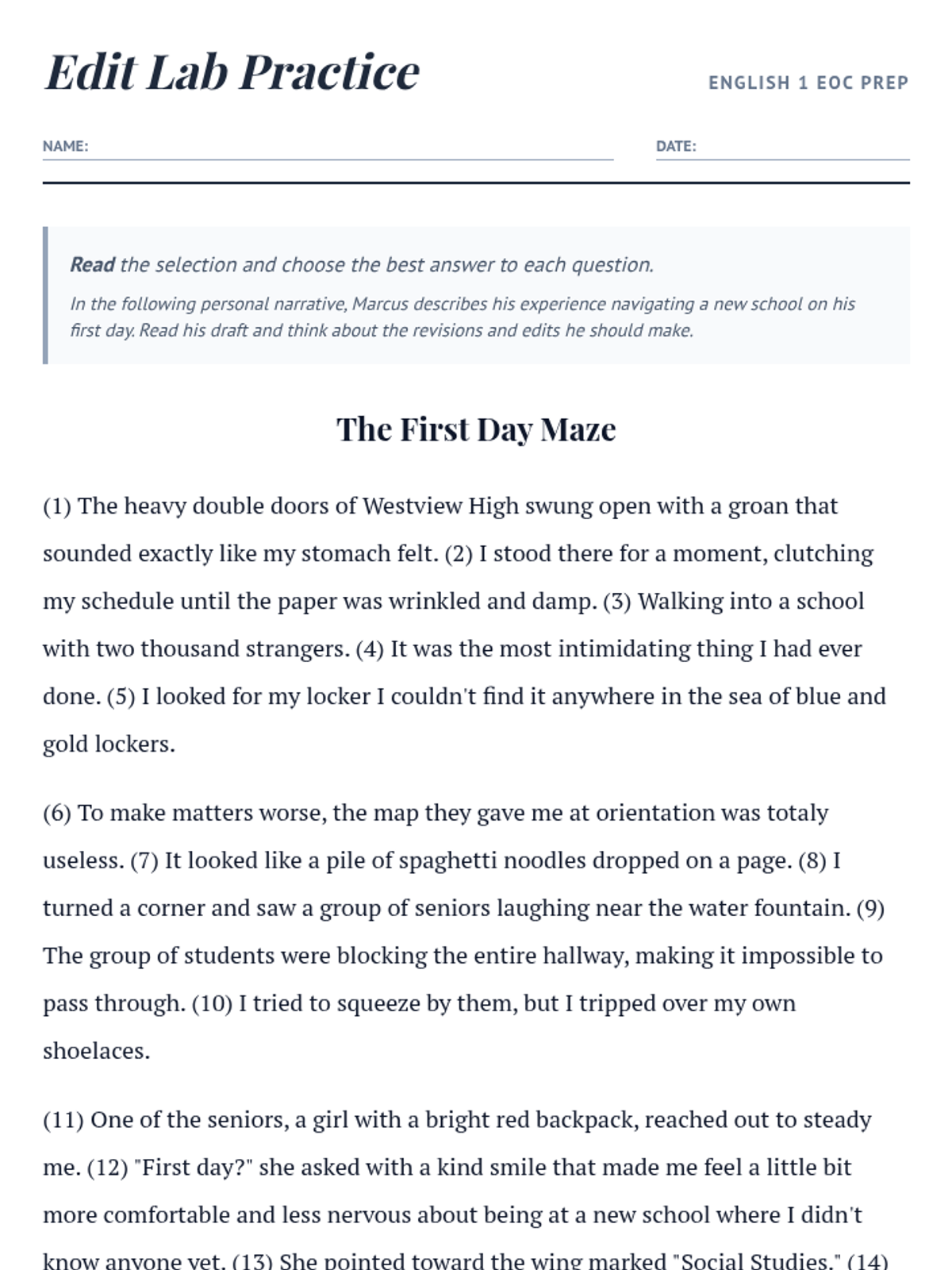
A STAAR-style revising and editing practice document featuring a personal narrative about a student's first day of school, including multiple-choice questions on grammar, mechanics, and style.
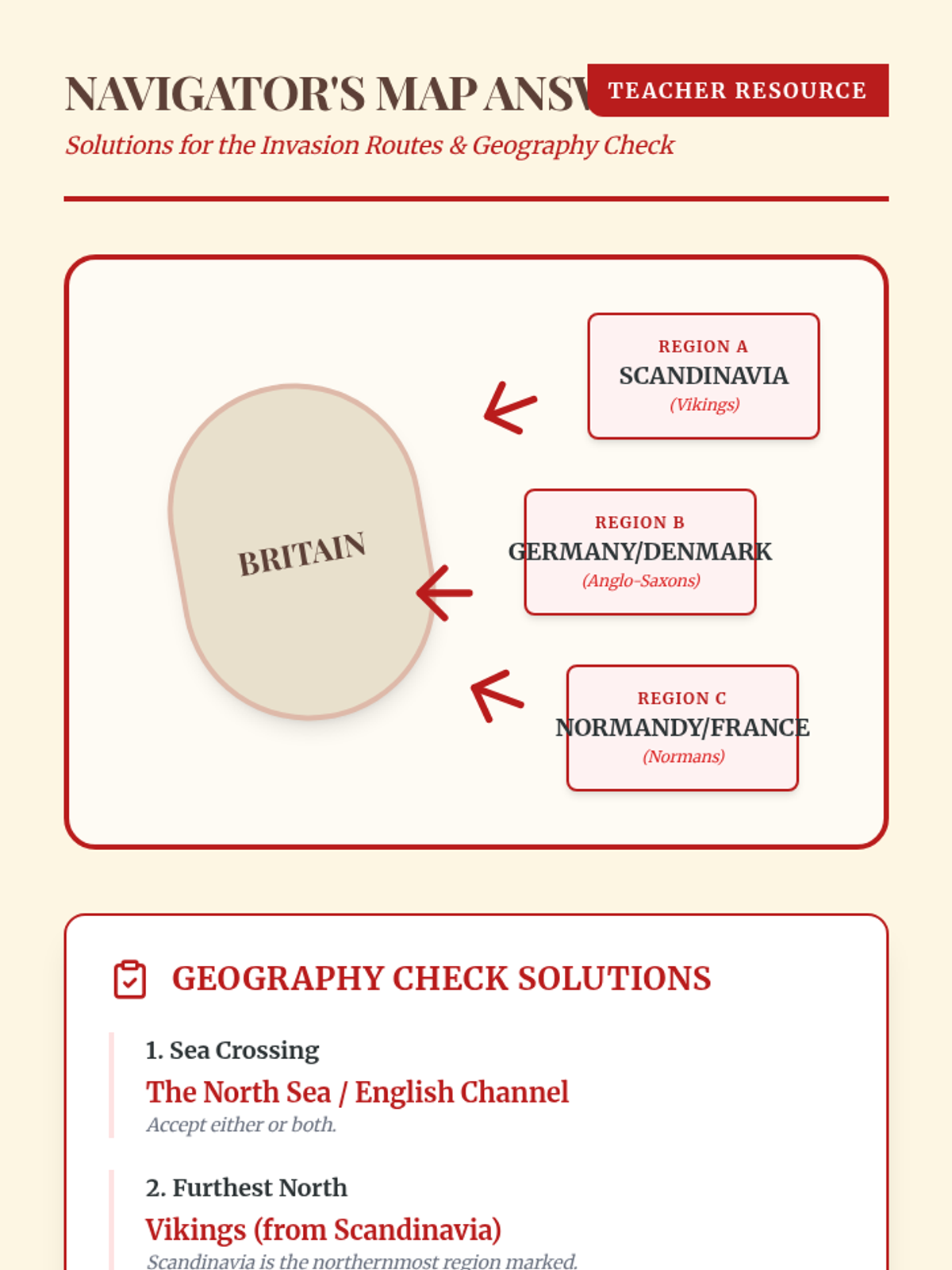
An answer key for the Navigator Map Activity, providing the names of the source regions and correct answers to the geography check questions.
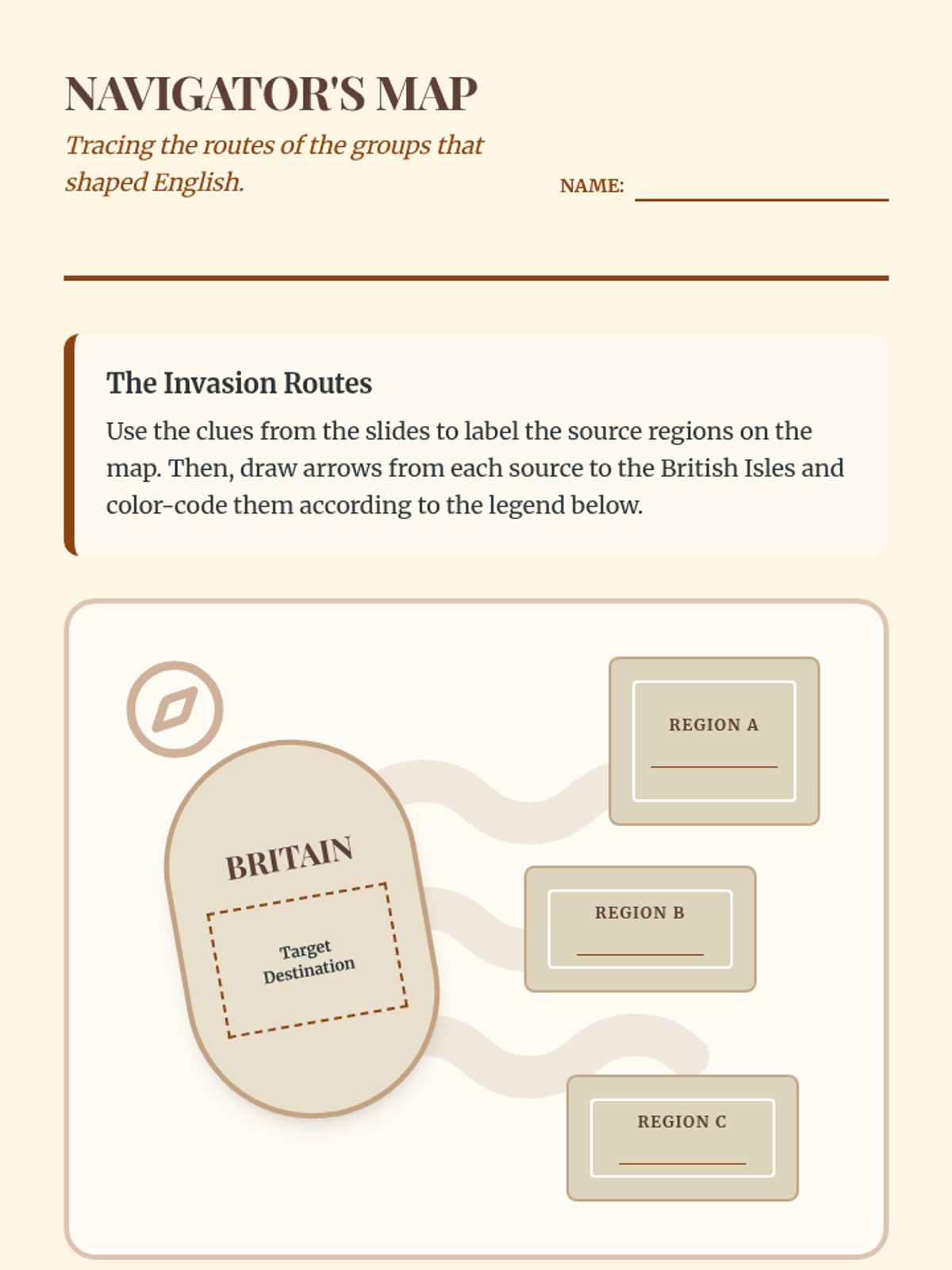
A map activity where students label regions like Scandinavia, Germany, and Normandy, and draw the invasion routes to the British Isles. It includes a geography check section for key sea crossings.
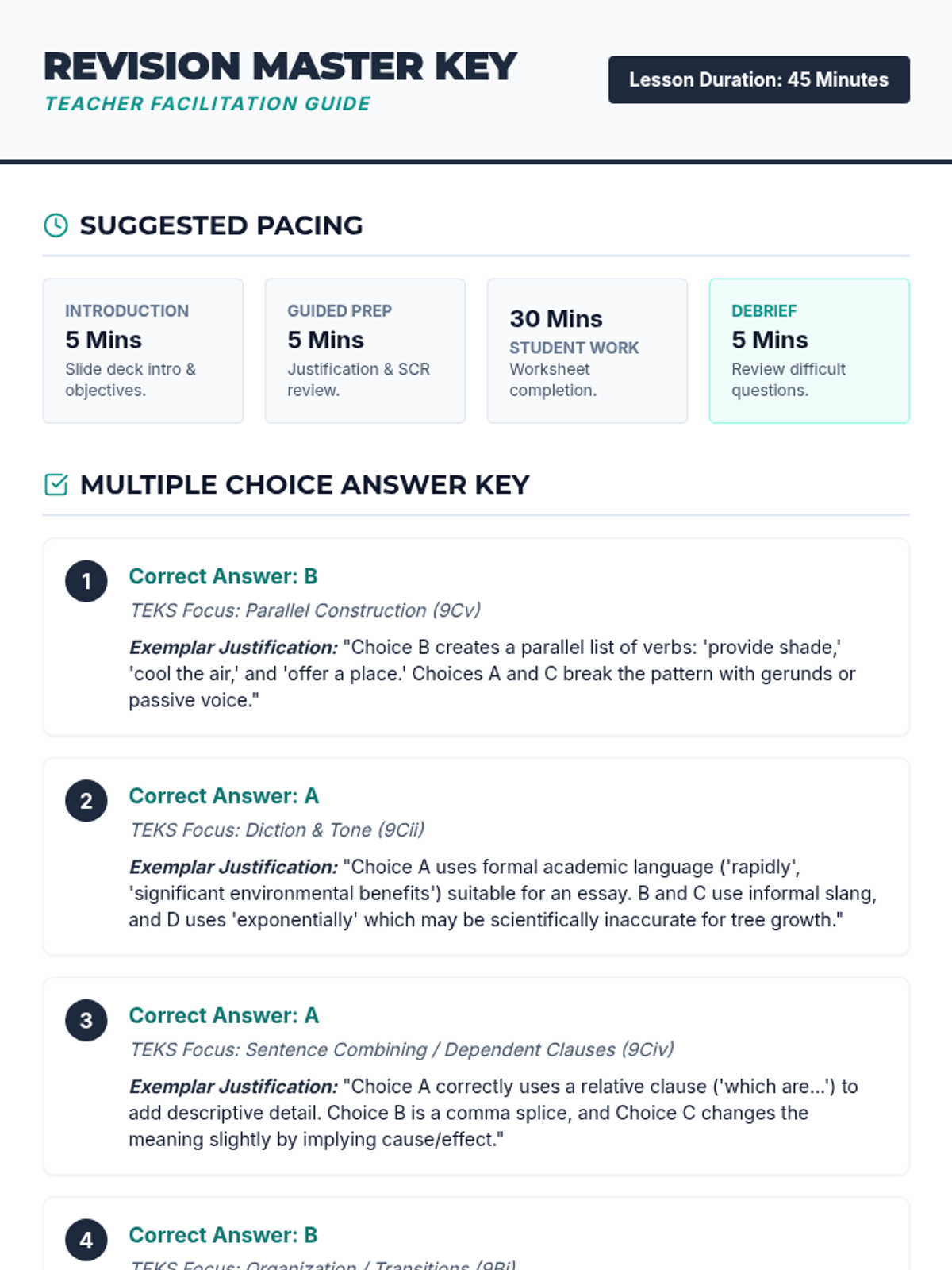
A comprehensive teacher facilitation guide containing a 45-minute pacing schedule, a detailed answer key for the multiple-choice questions with exemplar student justifications, and a sample Short Constructed Response with a STAAR-aligned 2-point rubric.
A visual presentation to guide the 45-minute revision workshop. Includes session objectives, a review of key STAAR revision TEKS, a strategy for writing justifications, and a formula for successful Short Constructed Responses.
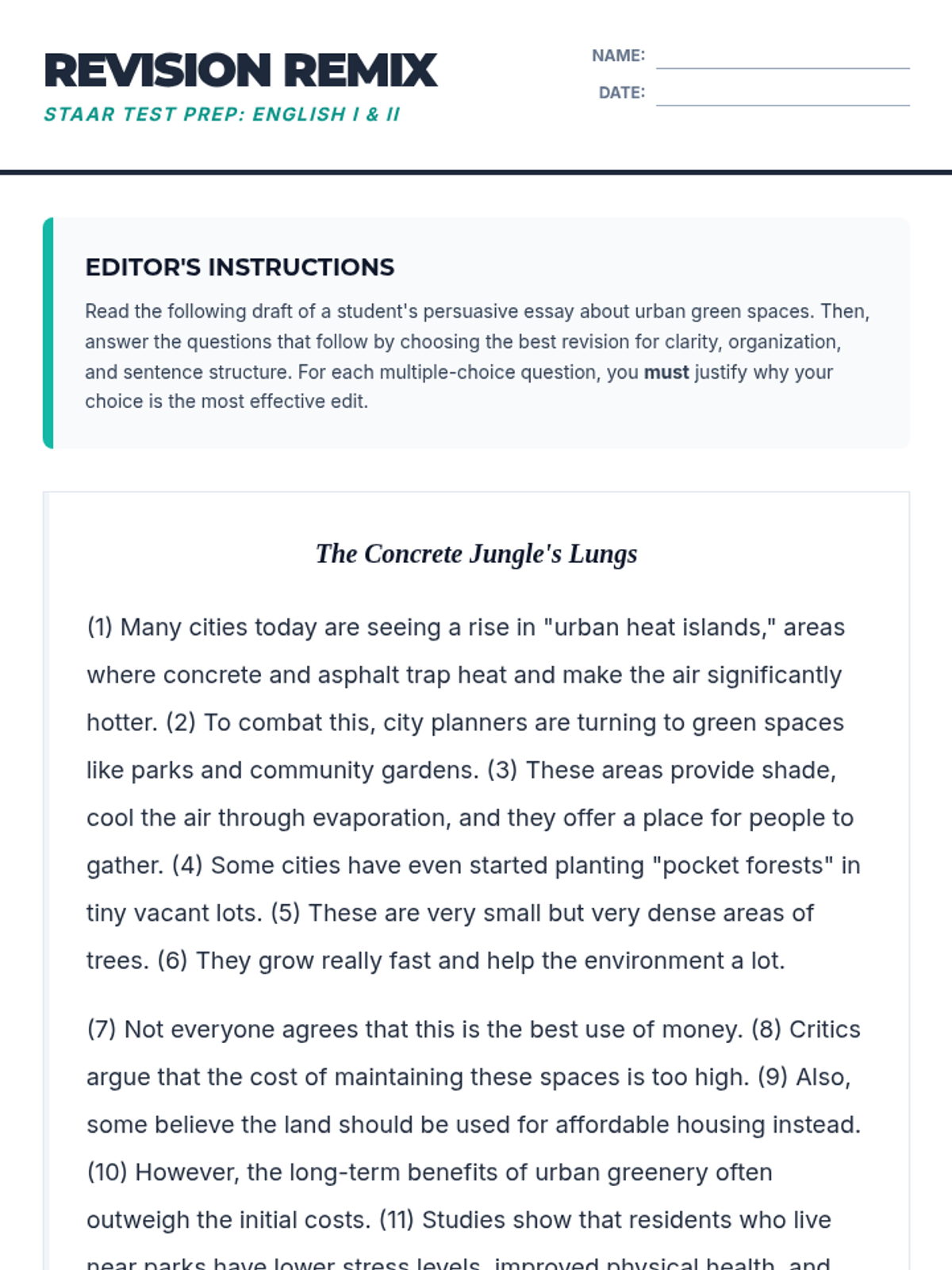
A STAAR-formatted revision worksheet featuring a multi-paragraph passage and six multiple-choice questions with justification areas. It concludes with a Short Constructed Response (SCR) prompt targeting specific grammatical and organizational TEKS.
A visual presentation for the Who vs. Whom lesson, following the Khan Academy aesthetic with neon highlights, including an embedded video and structured pauses for discussion.
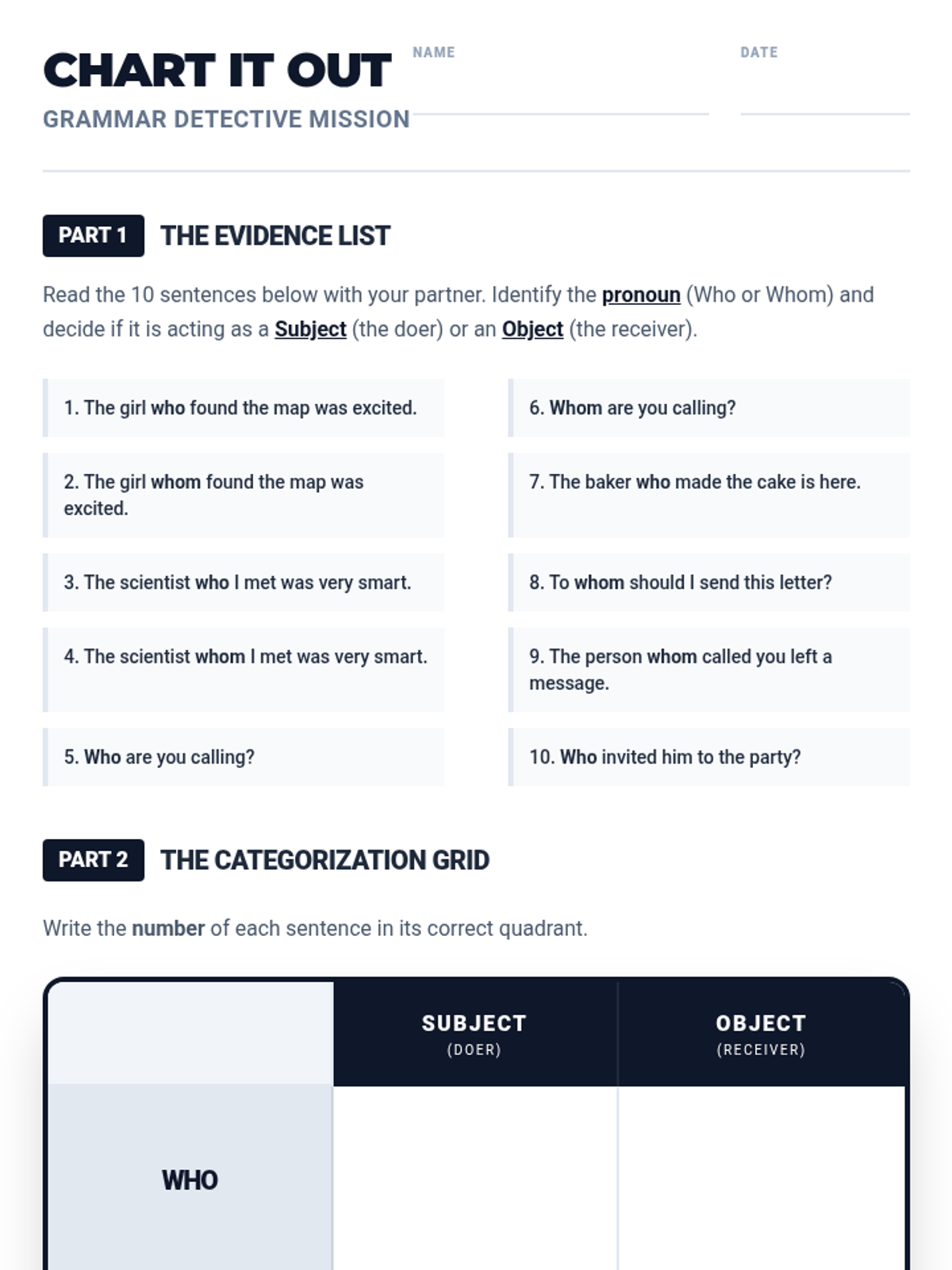
A student activity sheet for categorizing sentences into the 2x2 grid based on the 'One-Way Street' rule, including space for creating an 'impossible' sentence.
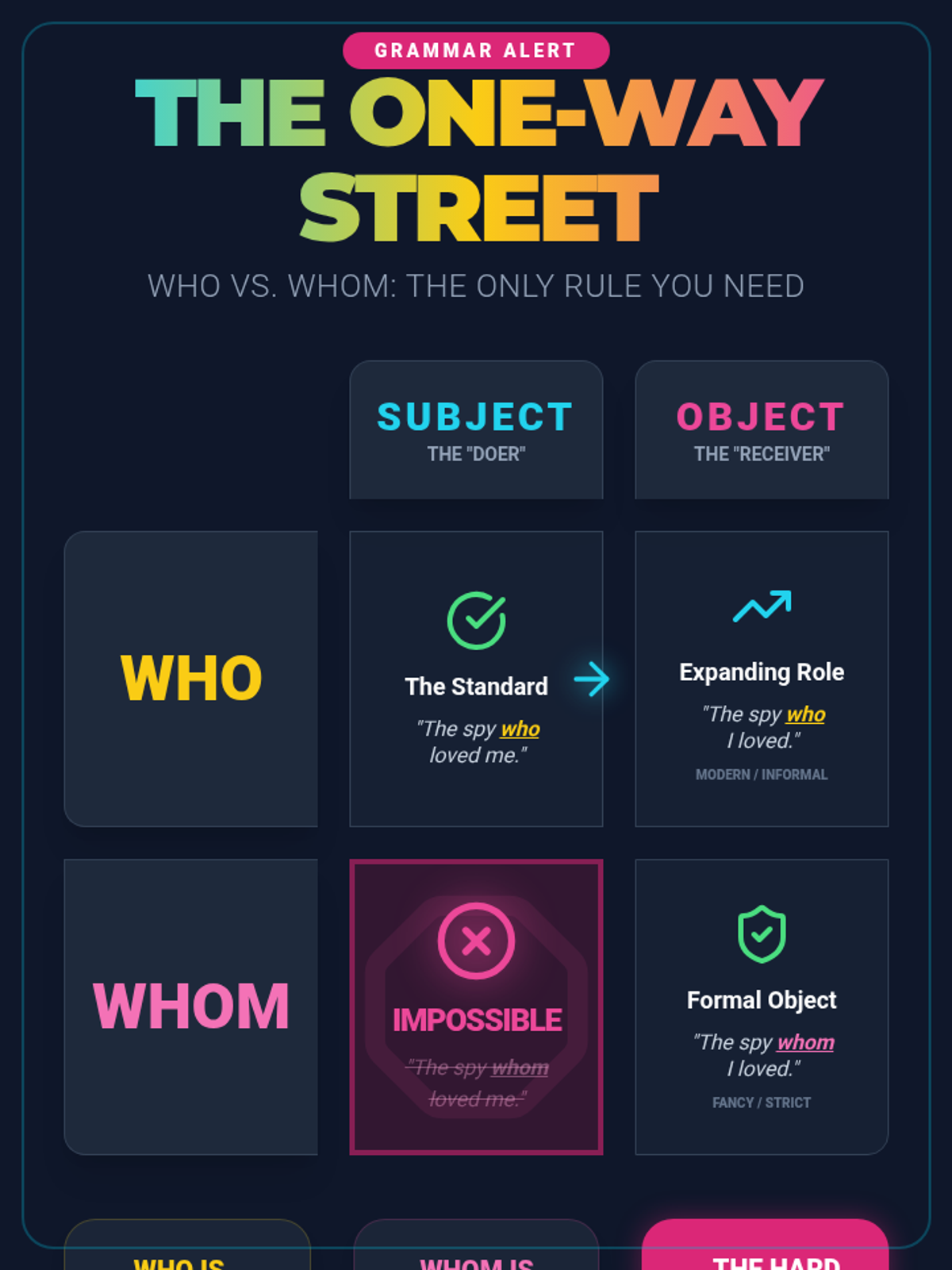
A high-contrast anchor chart for the 'One-Way Street' grammar rule, illustrating that 'who' is expanding into the object space while 'whom' remains strictly an object pronoun.
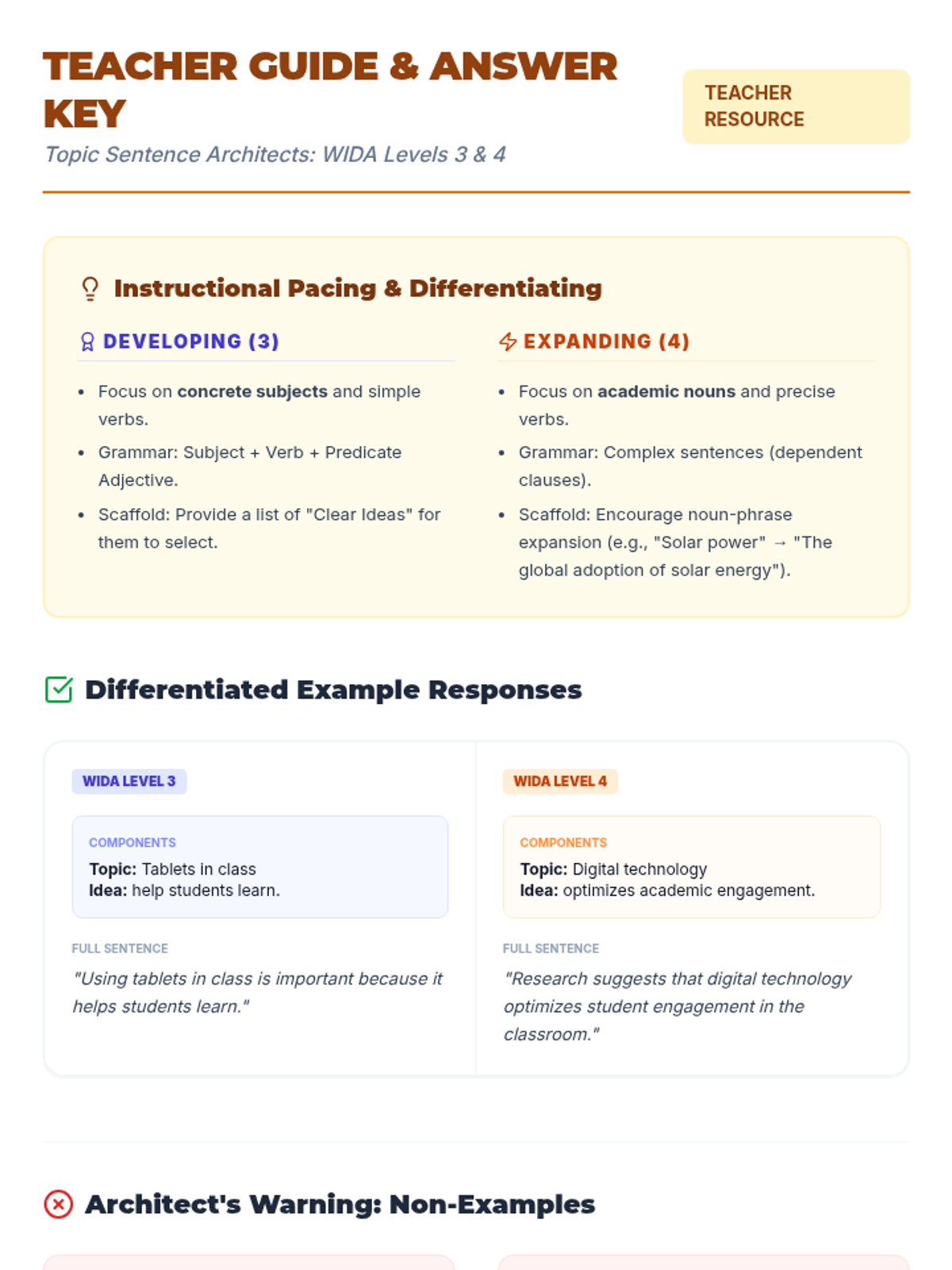
A facilitation guide and answer key for the Topic Sentence Architects lesson. It provides differentiated instructional focuses for WIDA level 3 and 4 students, sophisticated example responses, non-examples for teacher reference, and specific strategies for academic language growth.
A slide deck for introducing the concept of a two-part topic sentence (Topic + Clear Idea). It includes visual analogies, differentiated examples for WIDA levels 3 and 4, and sentence starters for Developing and Expanding learners.
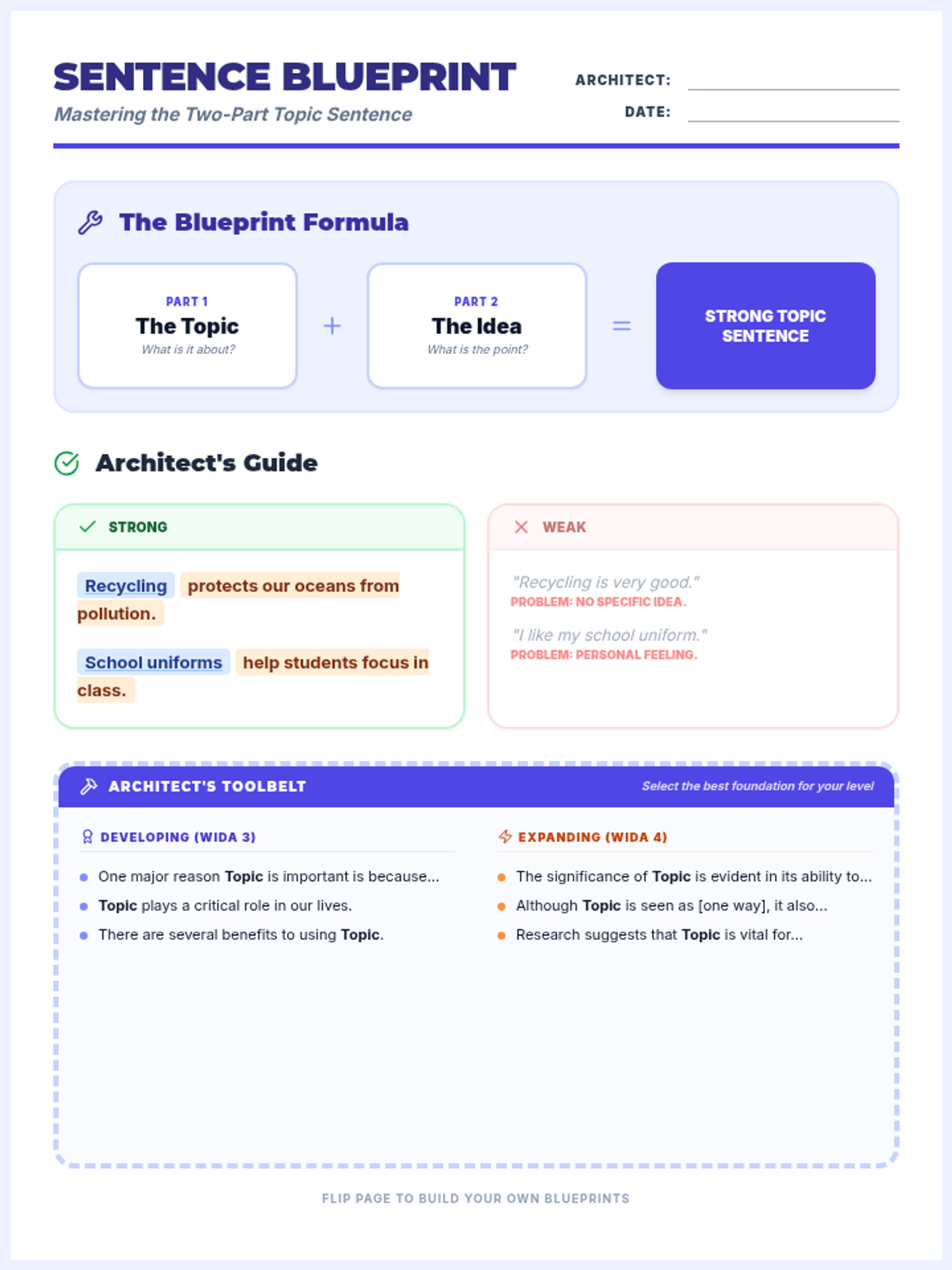
A worksheet for WIDA level 3-4 students to practice writing topic sentences. It includes a visual formula, differentiated sentence starters for Developing and Expanding levels, and a graphic organizer for guided practice.
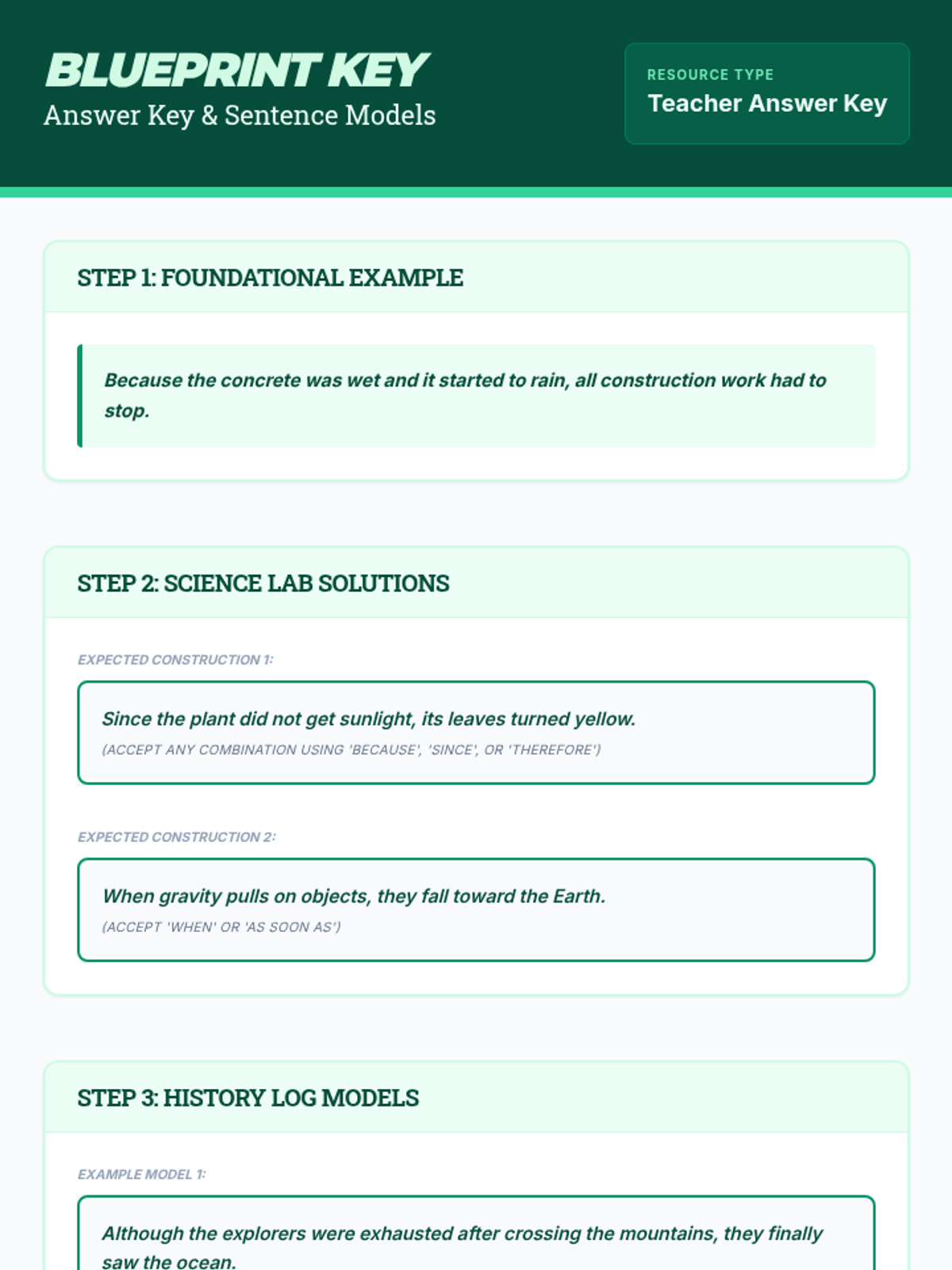
A detailed teacher answer key for the Sentence Blueprint worksheet, providing model complex and compound sentences using science and history themes.
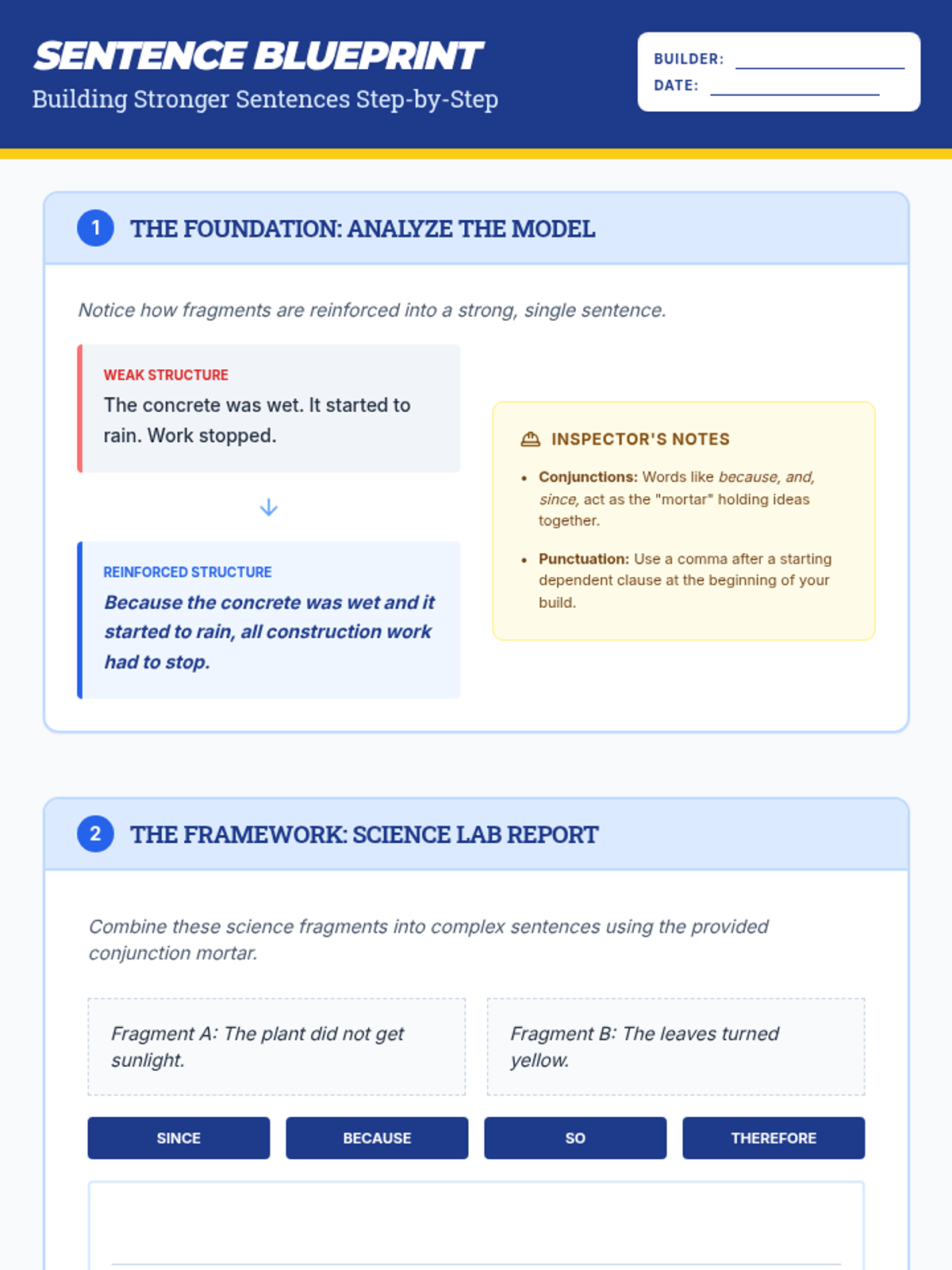
A 3-step guided practice worksheet with a construction theme, designed to help students combine fragments and simple sentences into compound and complex sentences within science and social studies contexts.
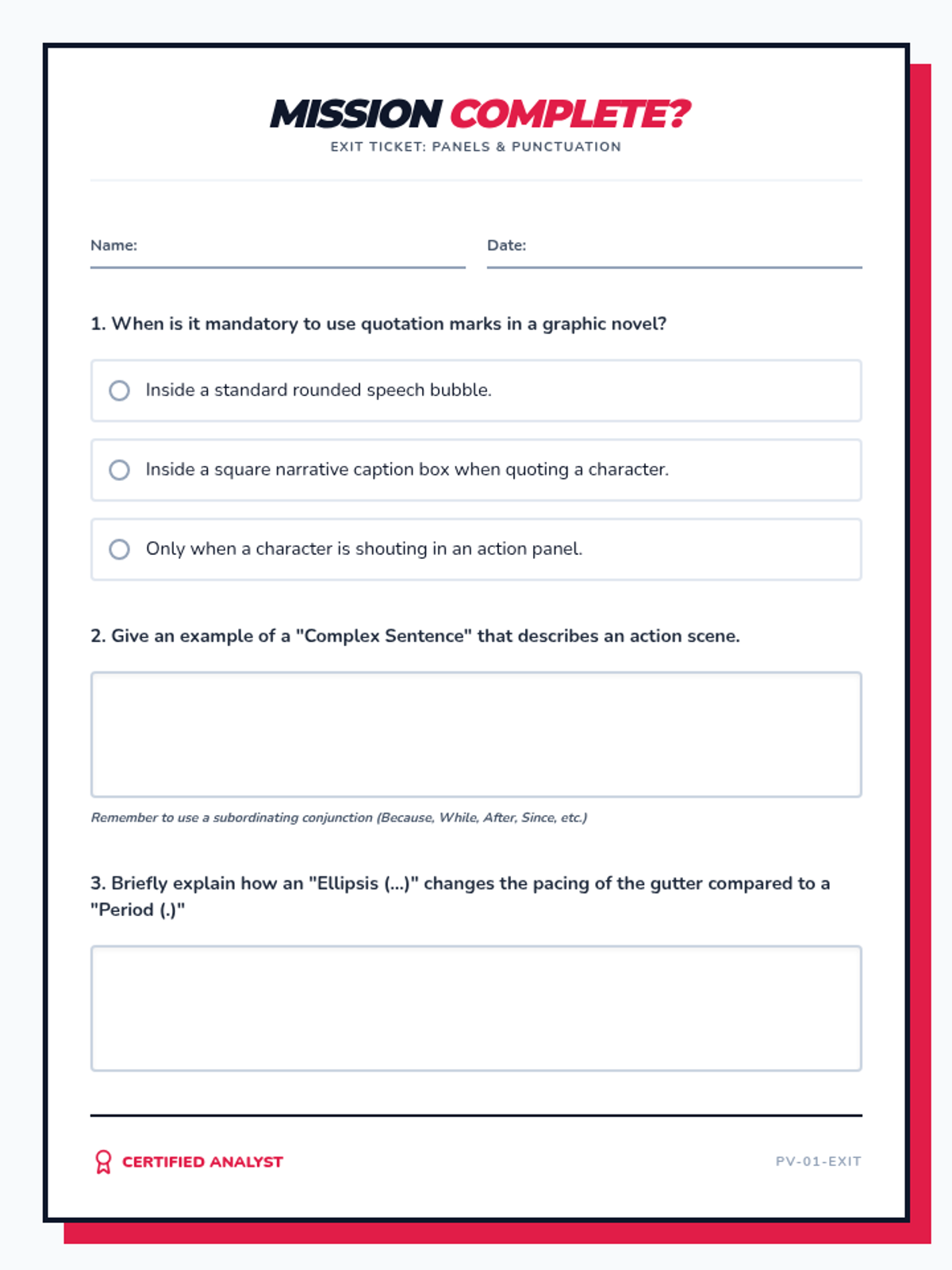
A quick assessment for the end of the lesson to check student understanding of quotation rules in comics, complex sentence construction, and visual pacing. Revised for better contrast and legibility.
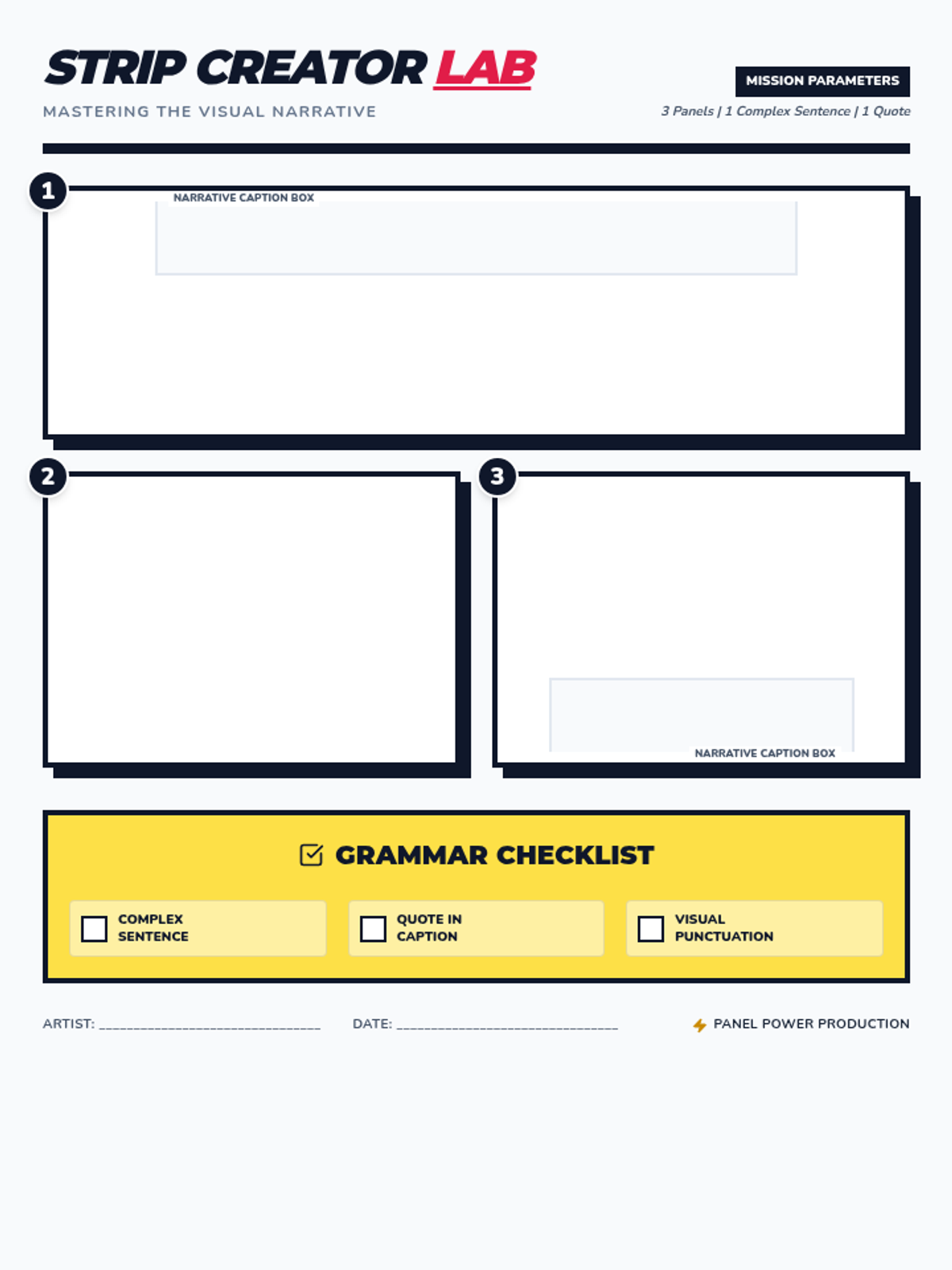
A creative comic strip template with a built-in grammar checklist, requiring students to apply complex sentences and quotation rules in a visual format. Revised for better label clarity and caption space.
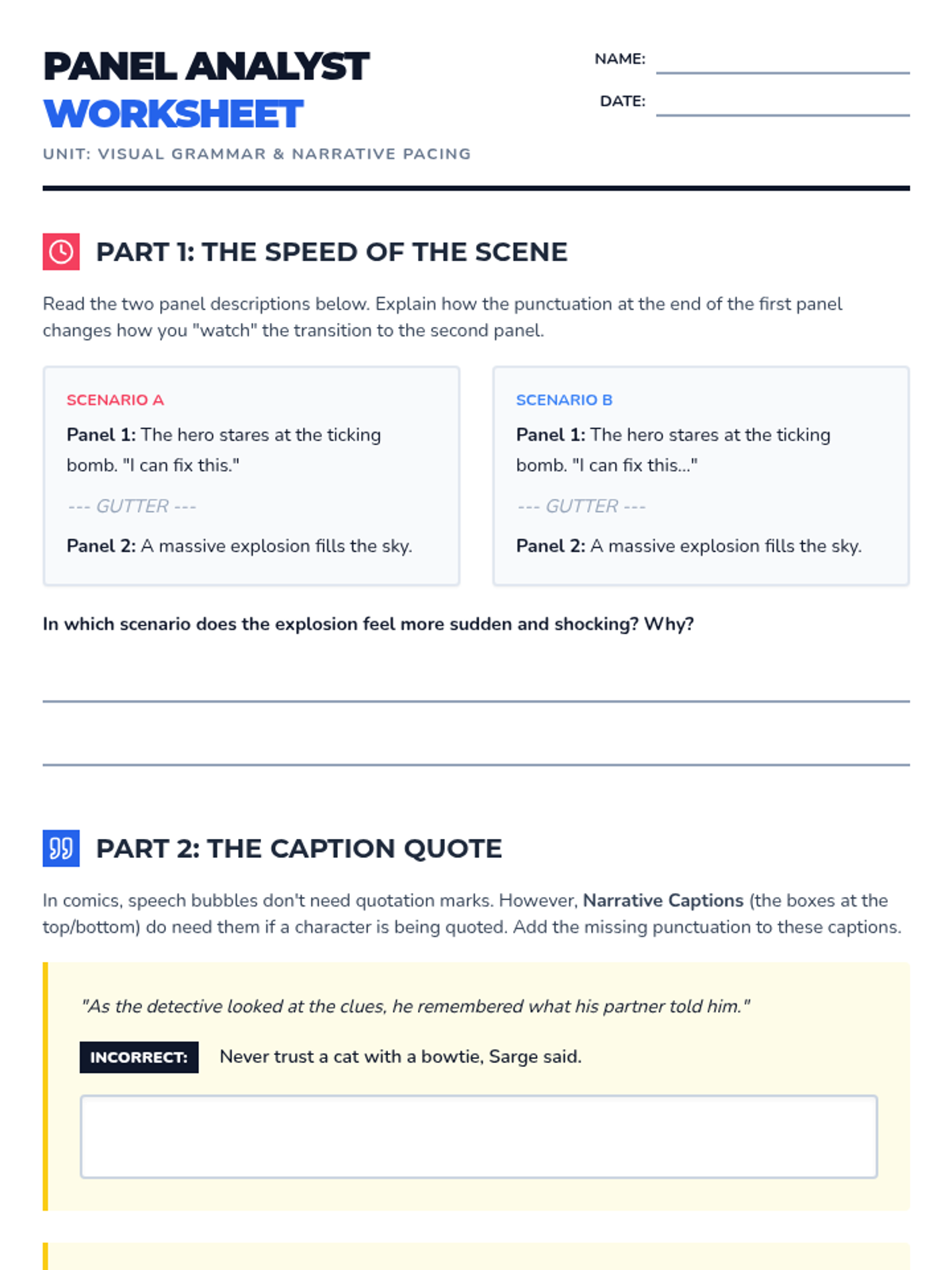
A student worksheet for analyzing the effect of punctuation on narrative pacing in comics and practicing the correct use of quotation marks in narrative captions. Final polish for page breaks and consistency.
High-energy, comic-themed presentation slides covering visual pacing, the 'grammar of the gutter', quotation mark rules in comics, and complex sentence structures. Revised for better label clarity and padding.
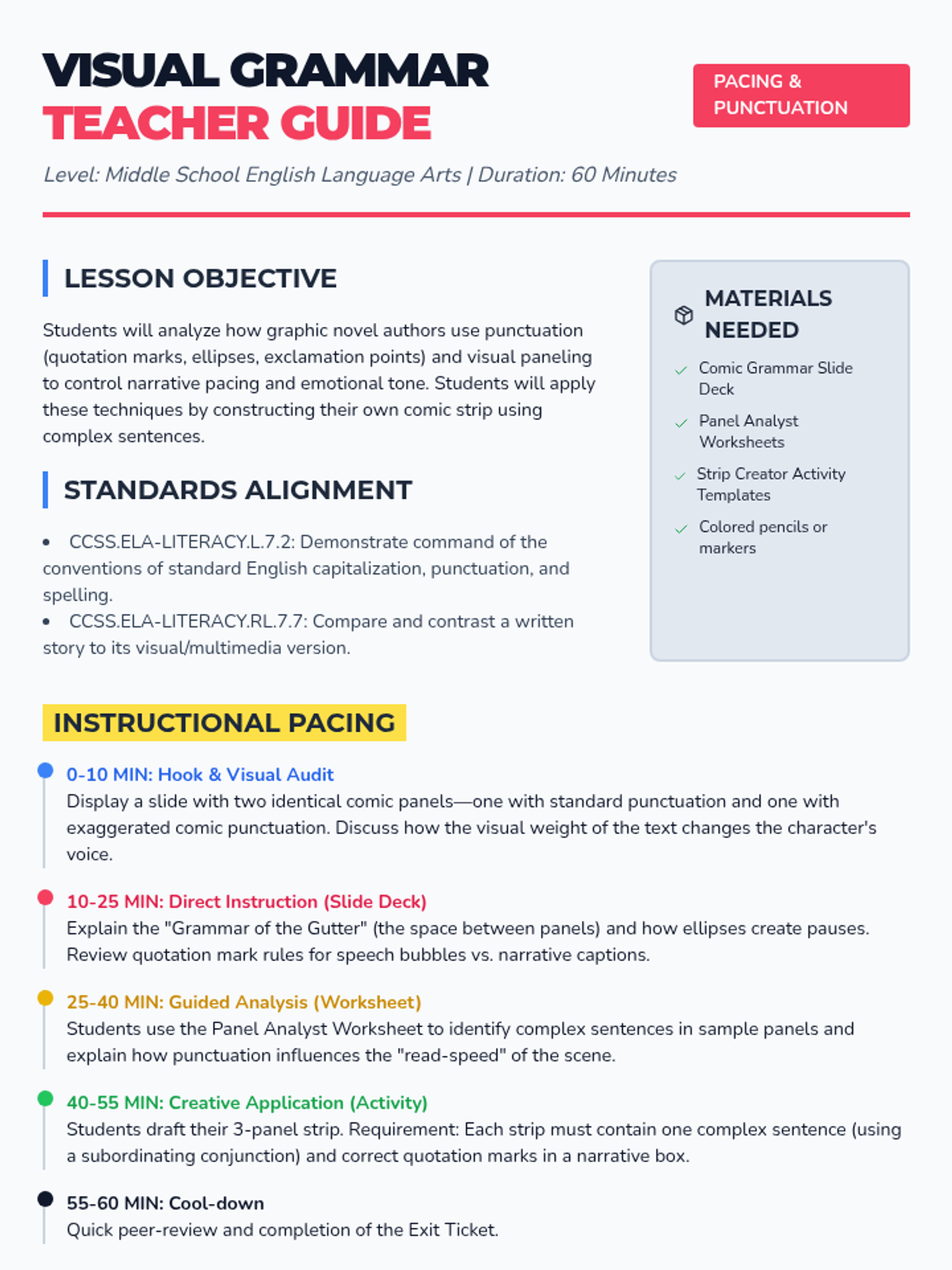
A detailed teacher guide for the 'Panels and Punctuation' lesson, including a timed pacing guide, lesson objectives, and discussion prompts for teaching visual grammar.
A Japanese educational slide deck covering the fundamentals of English sentence structure, including subjects, predicates, fragments, and run-on sentences. It provides all instructional content and explanations in Japanese while maintaining English example sentences for analysis.
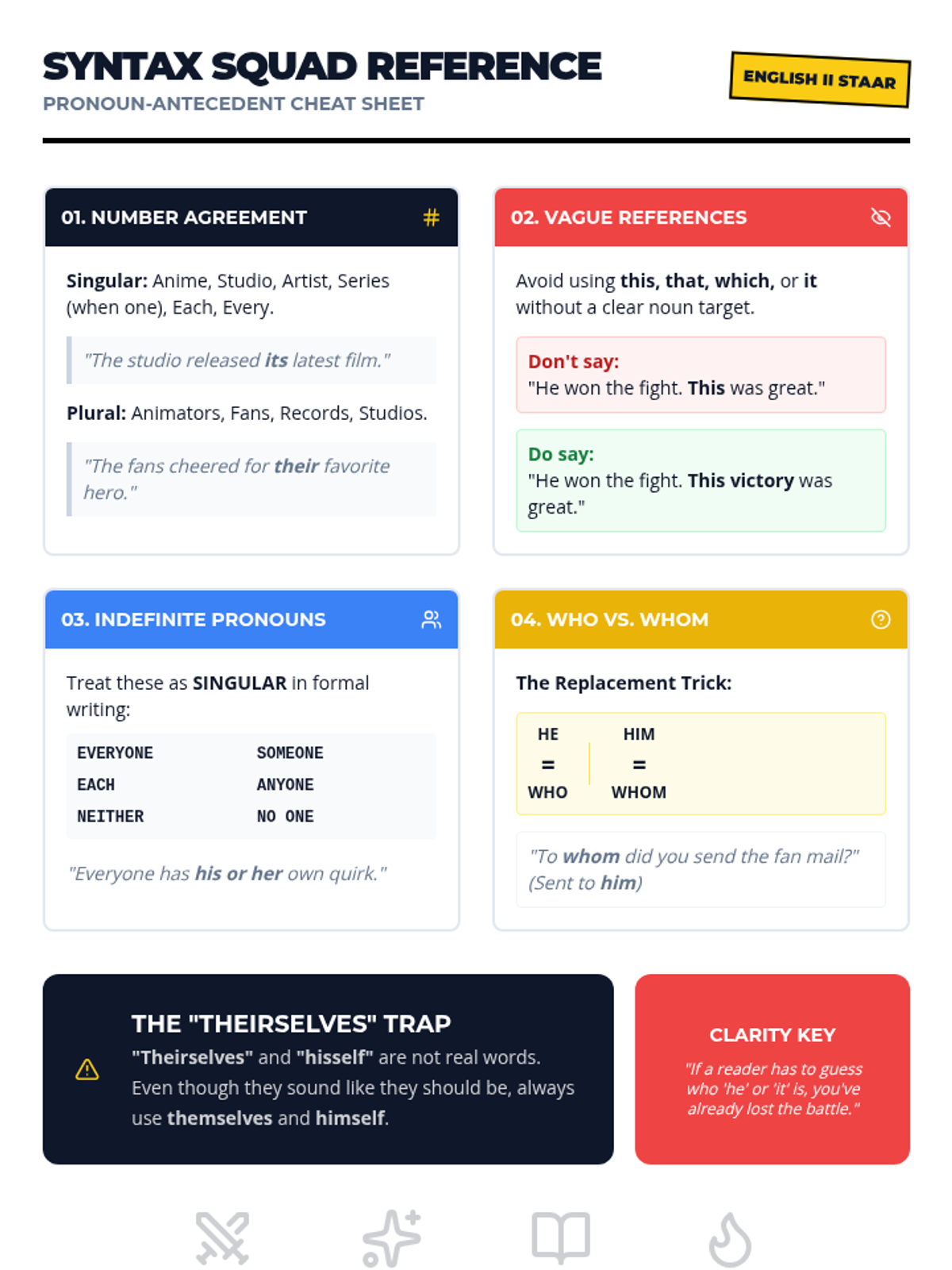
A concise one-page reference sheet or "cheat sheet" for students, summarizing the four major pronoun rules and providing the "He/Him" trick for Who/Whom. Designed for easy reference during the Anime Pronoun Play worksheet.
A vibrant, anime-themed slide deck for English II STAAR preparation, focusing on pronoun-antecedent agreement and clarity. Includes clear rules, "STAAR traps," and interactive checks for singular/plural agreement, ambiguous references, and who vs. whom.
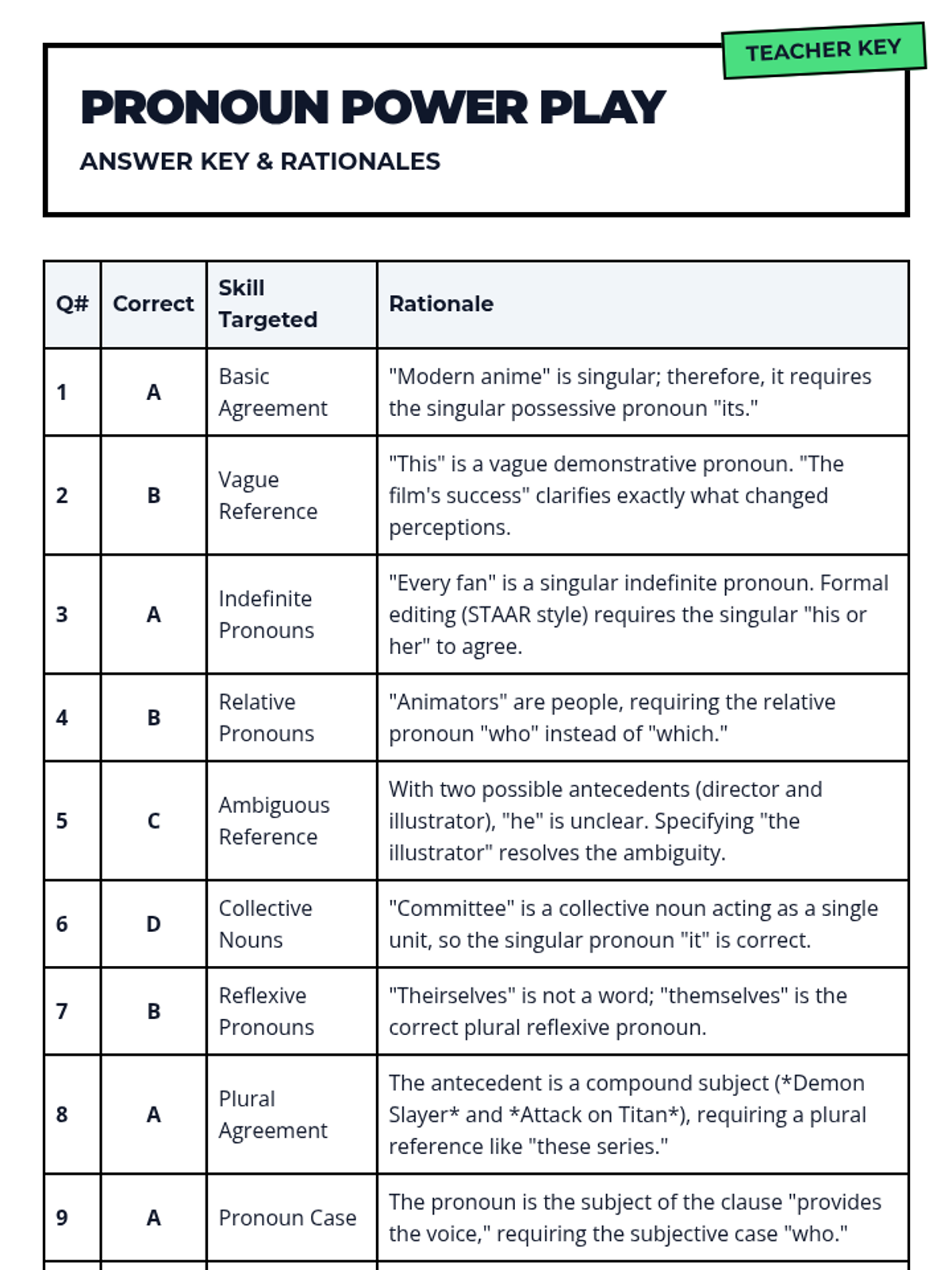
The answer key and teaching guide for the Anime Pronoun Power worksheet, providing correct answers, rationales, and targeted skills for each of the 10 STAAR-style questions.
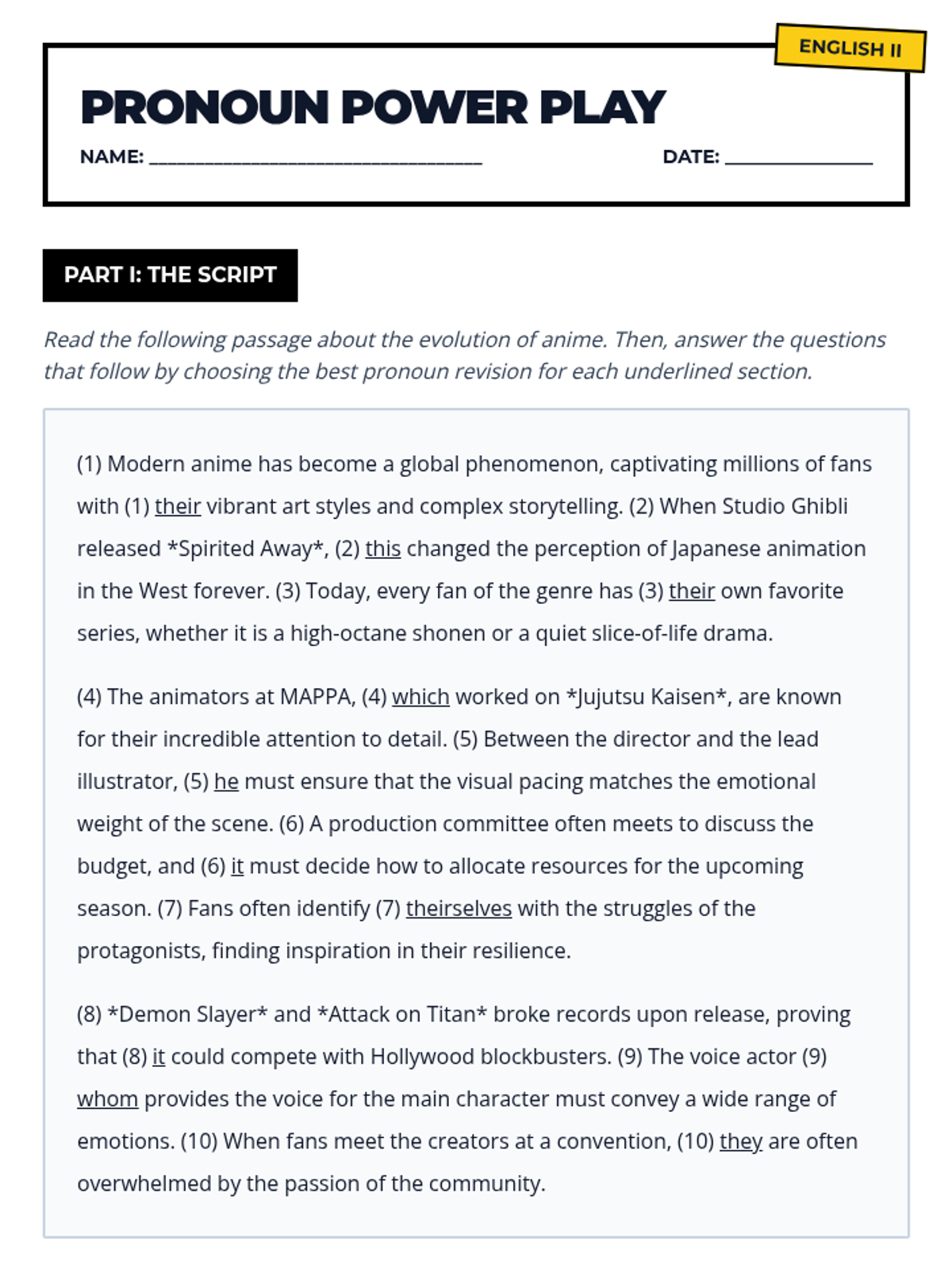
A STAAR-style editing worksheet focused on pronoun-antecedent agreement and clarity, featuring a high-interest passage about the history and production of anime. Restored to the original two-page layout.
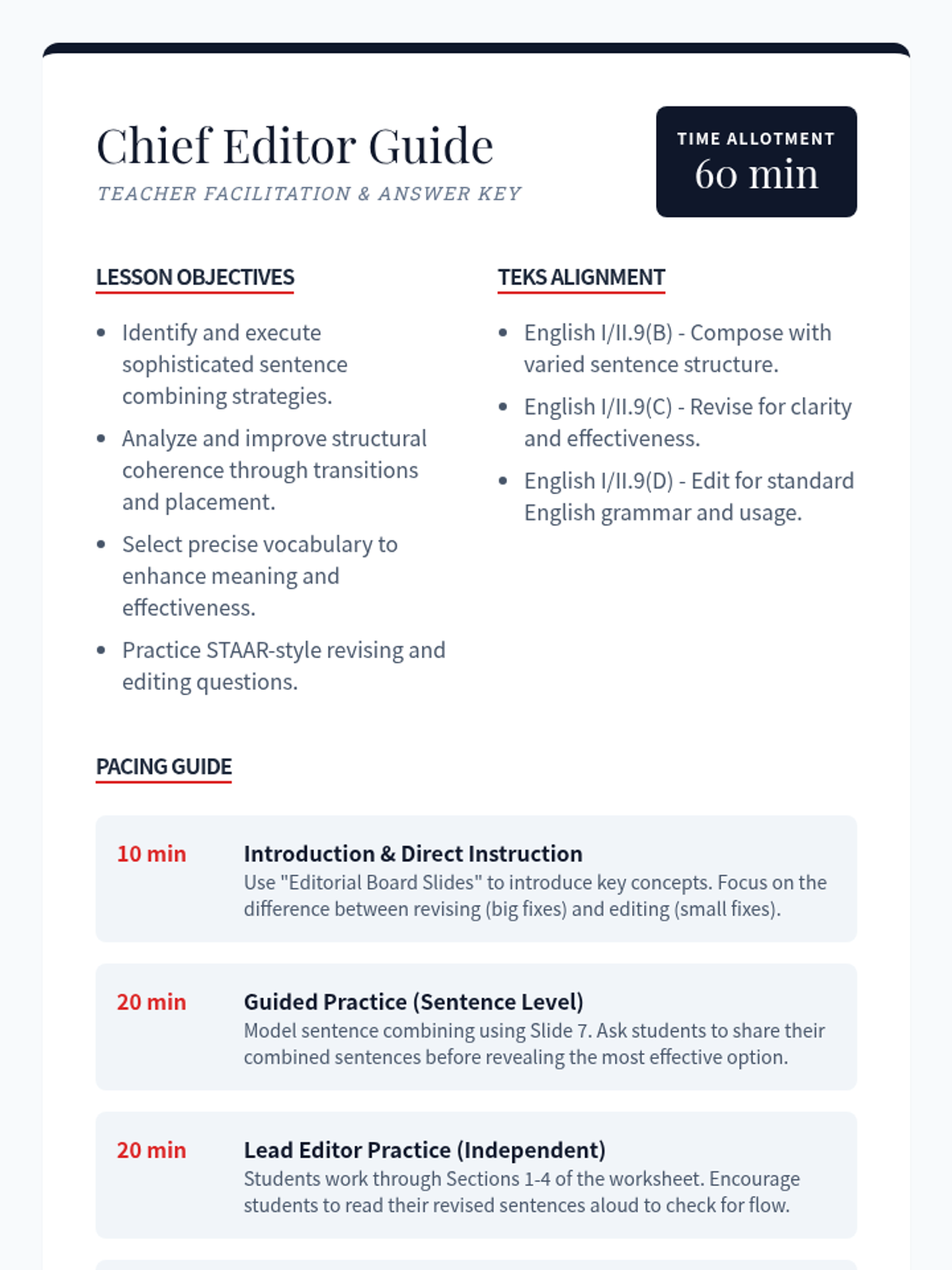
A detailed teacher facilitation guide including learning objectives, a 60-minute pacing guide, discussion prompts, and a comprehensive answer key with STAAR-aligned rationales.
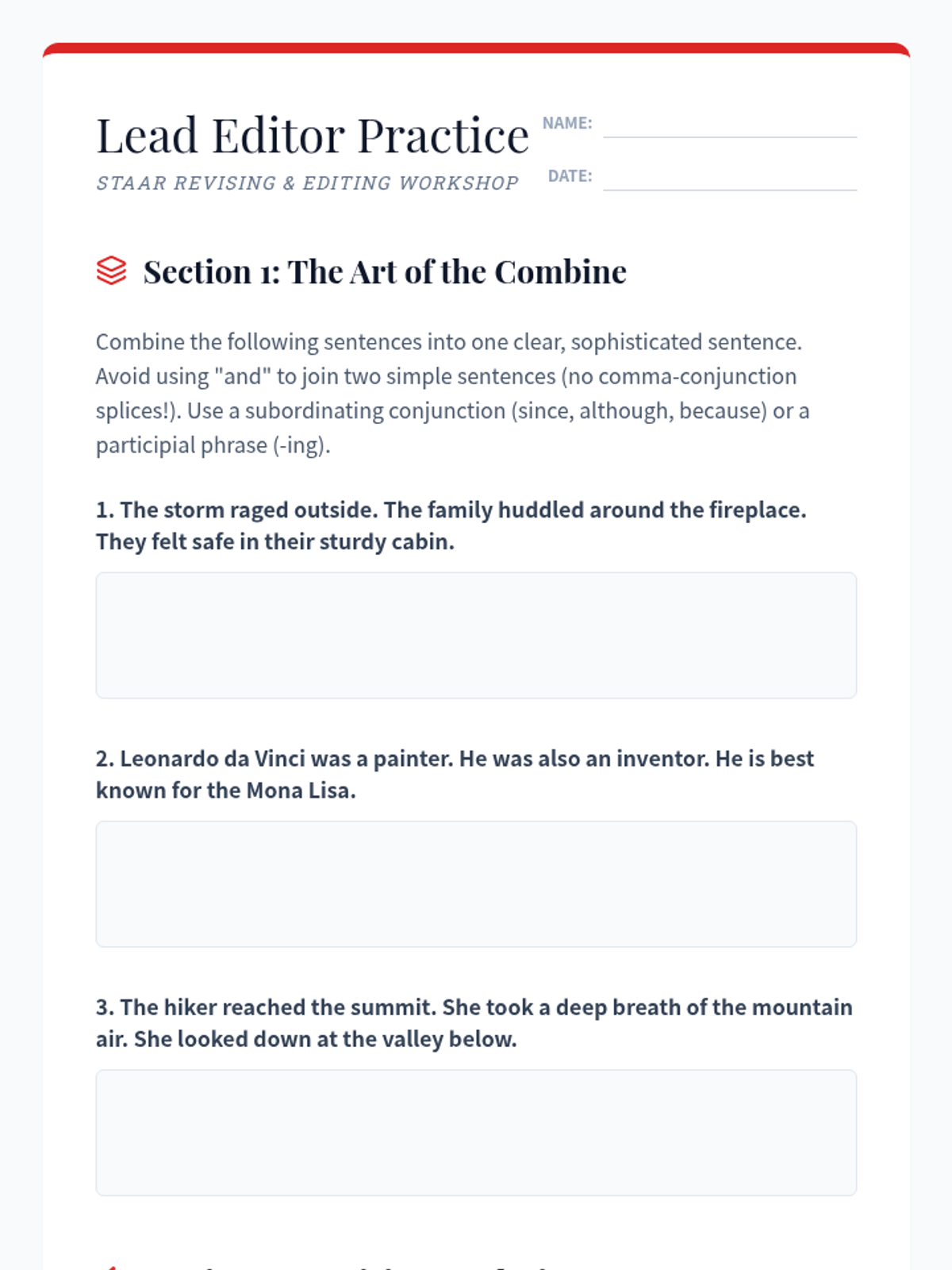
A comprehensive practice worksheet for English I & II students covering sentence combining, vocabulary precision, structural coherence, and transitional flow, modeled after STAAR EOC questions.
An instructional slide deck designed for English I & II students, focusing on the high-leverage revising skills tested on the STAAR EOC. It includes strategies for sentence combining, vocabulary precision, structural coherence, and practice questions with an editorial theme.
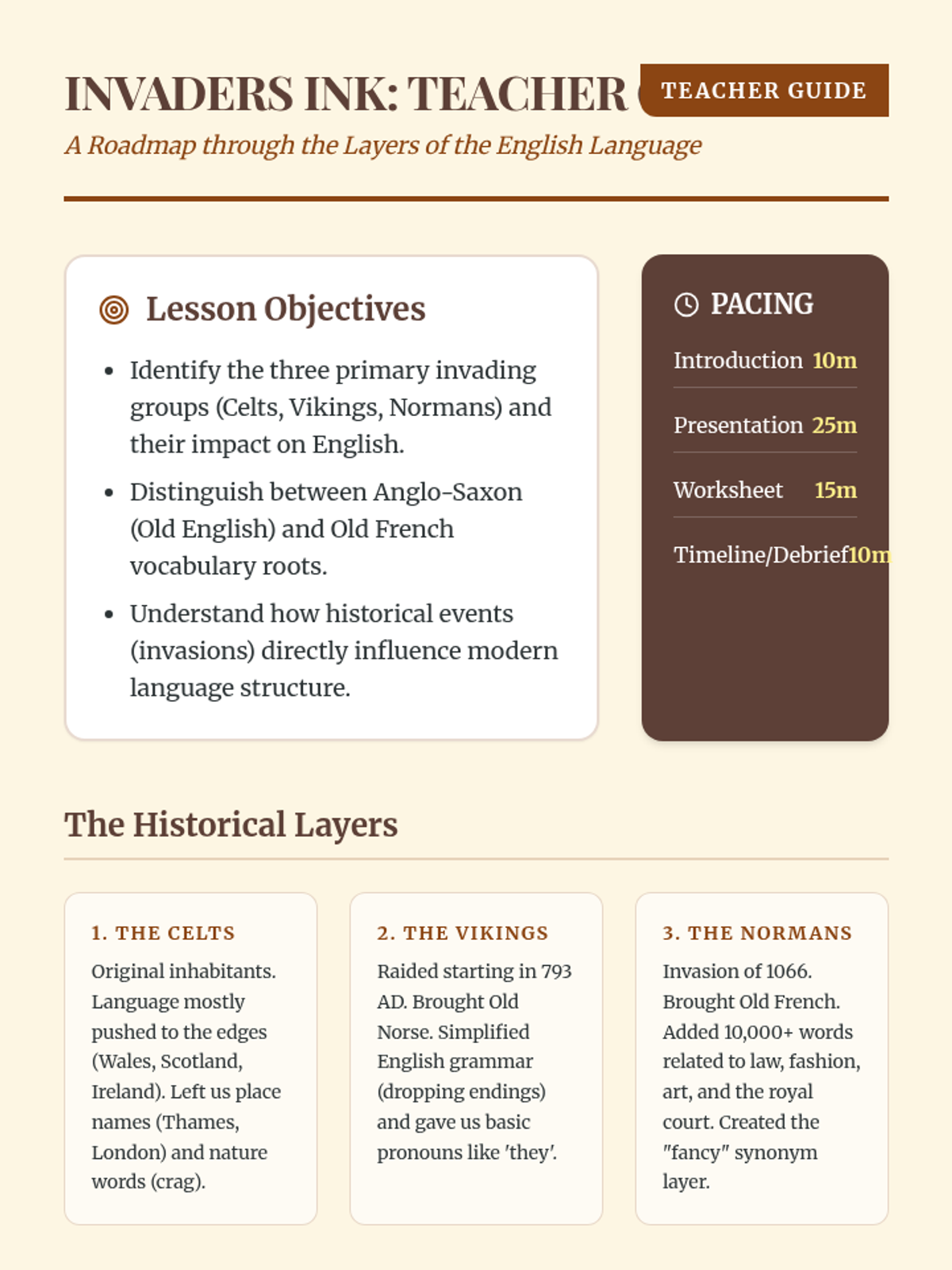
A comprehensive teacher guide for the Invaders Ink lesson. It includes lesson objectives, historical background summaries, slide-by-slide teaching notes, activity suggestions, and differentiation strategies.
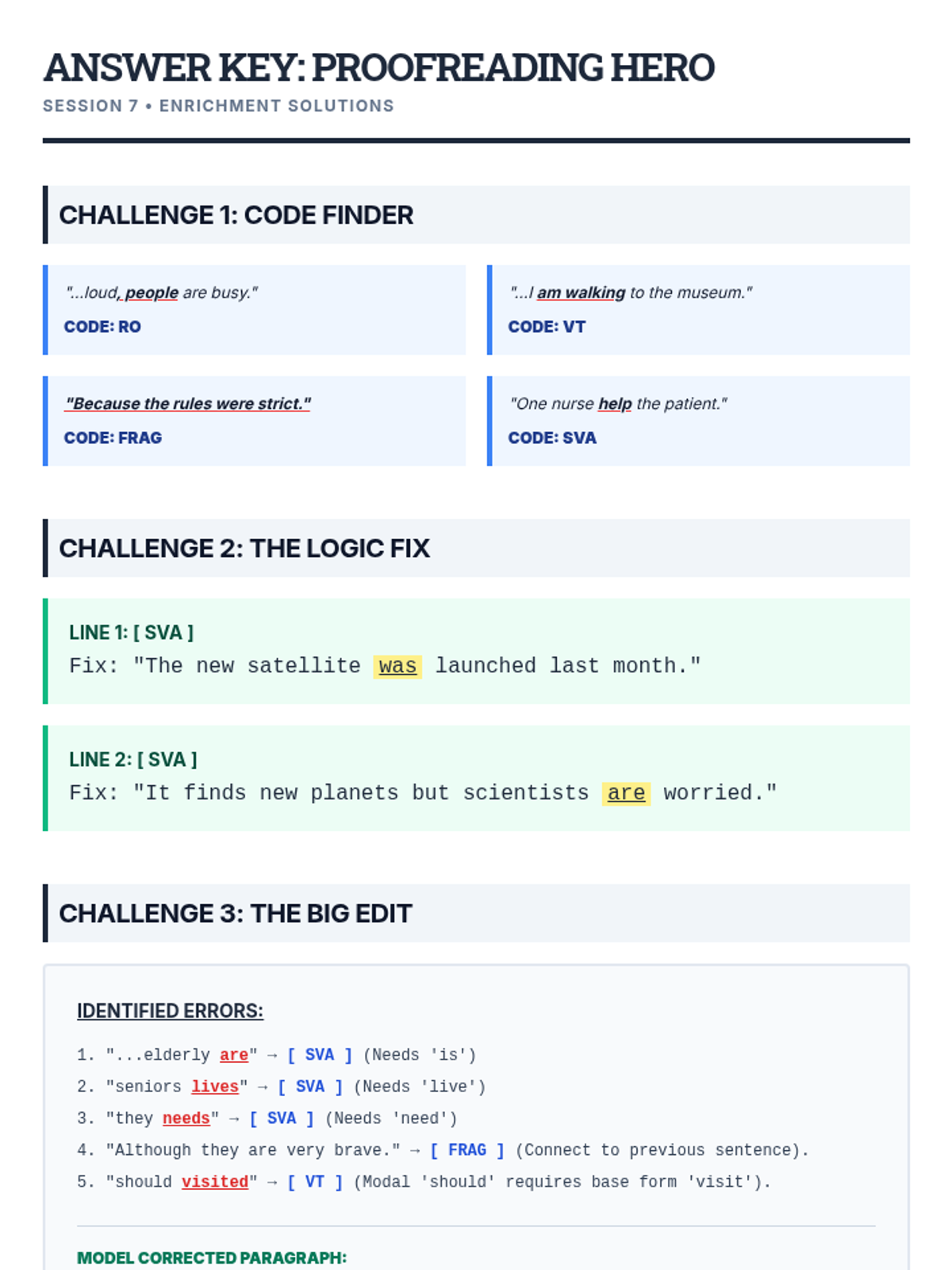
A teacher answer key for the Proofreading Hero Worksheet, including identified error codes and model corrected paragraphs for all challenges. Updated for matching expanded worksheet and includes a legend.
Instructional slides for the mock exam session, providing a visual pacing guide (10-30-5 breakdown) and specific phase-by-phase writing strategies.
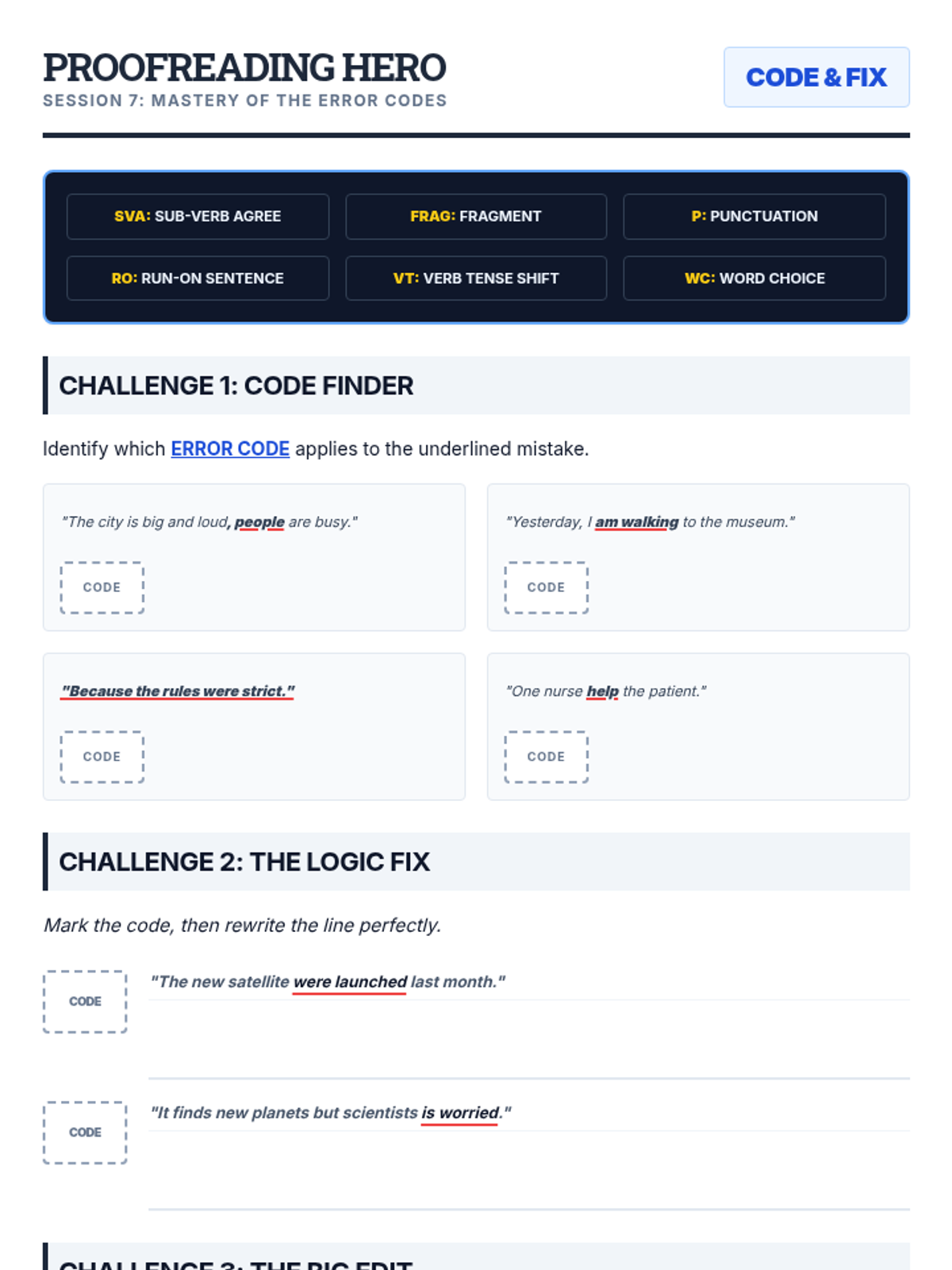
An interactive proofreading worksheet where students apply the teacher's Error Coding Key to identify and fix grammar, punctuation, and structure mistakes in sample texts. Updated with expanded items and unit-themed examples across two pages.
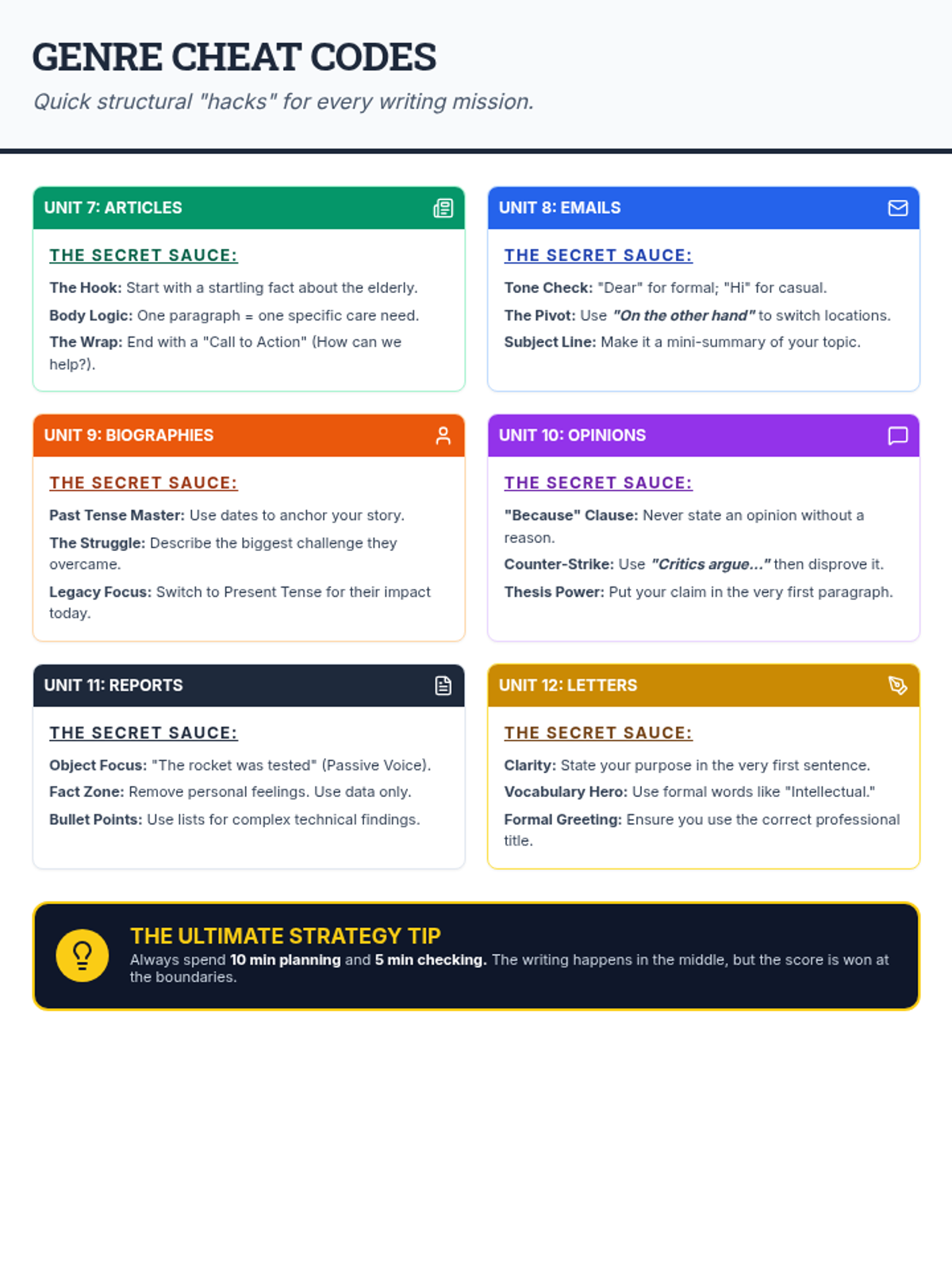
A one-page reference guide containing structural "hacks" and specific strategies for each of the six writing genres covered in the program. Updated for single-page efficiency.
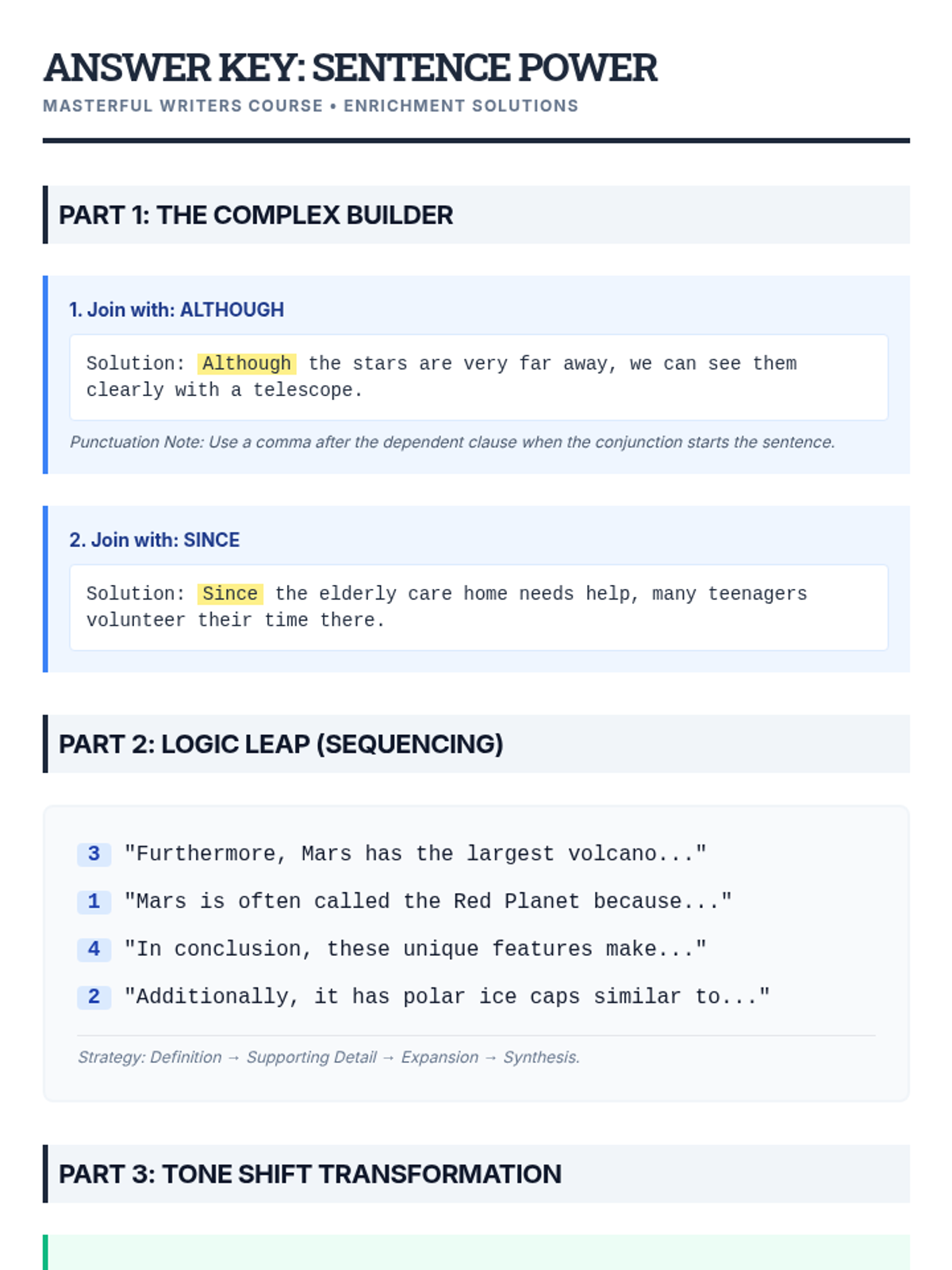
A teacher answer key for the Sentence Power Practice Worksheet, including model answers and grammar rationales. Updated for clarity and visual organization.
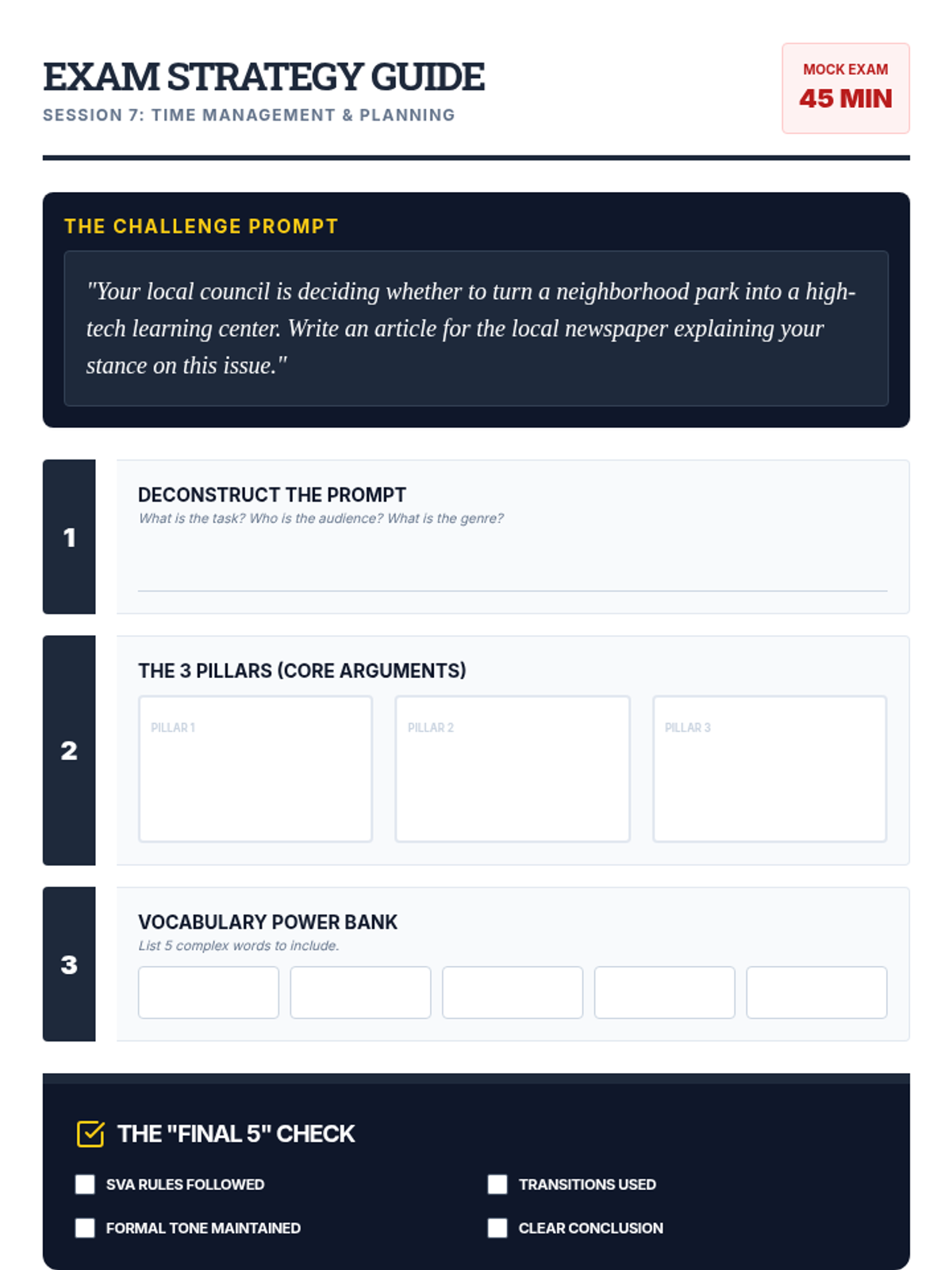
A strategic planning worksheet for students to use during exam preparation, featuring a practice prompt, increased workspace, and a consolidated single-page layout.
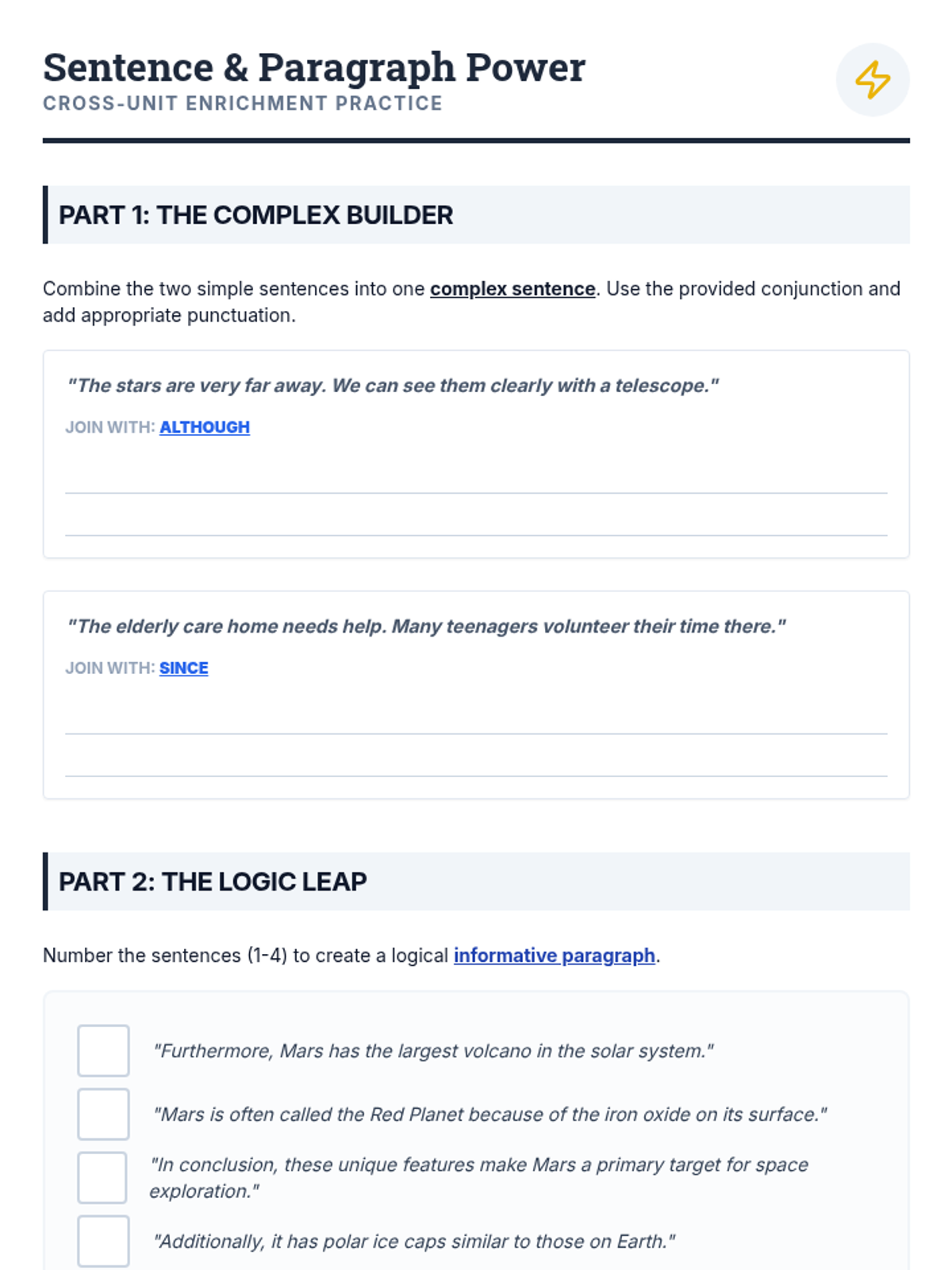
An enrichment worksheet focused on advanced sentence combining, logical paragraph sequencing, and tone transformation. Updated for handwriting legibility and clear instruction.
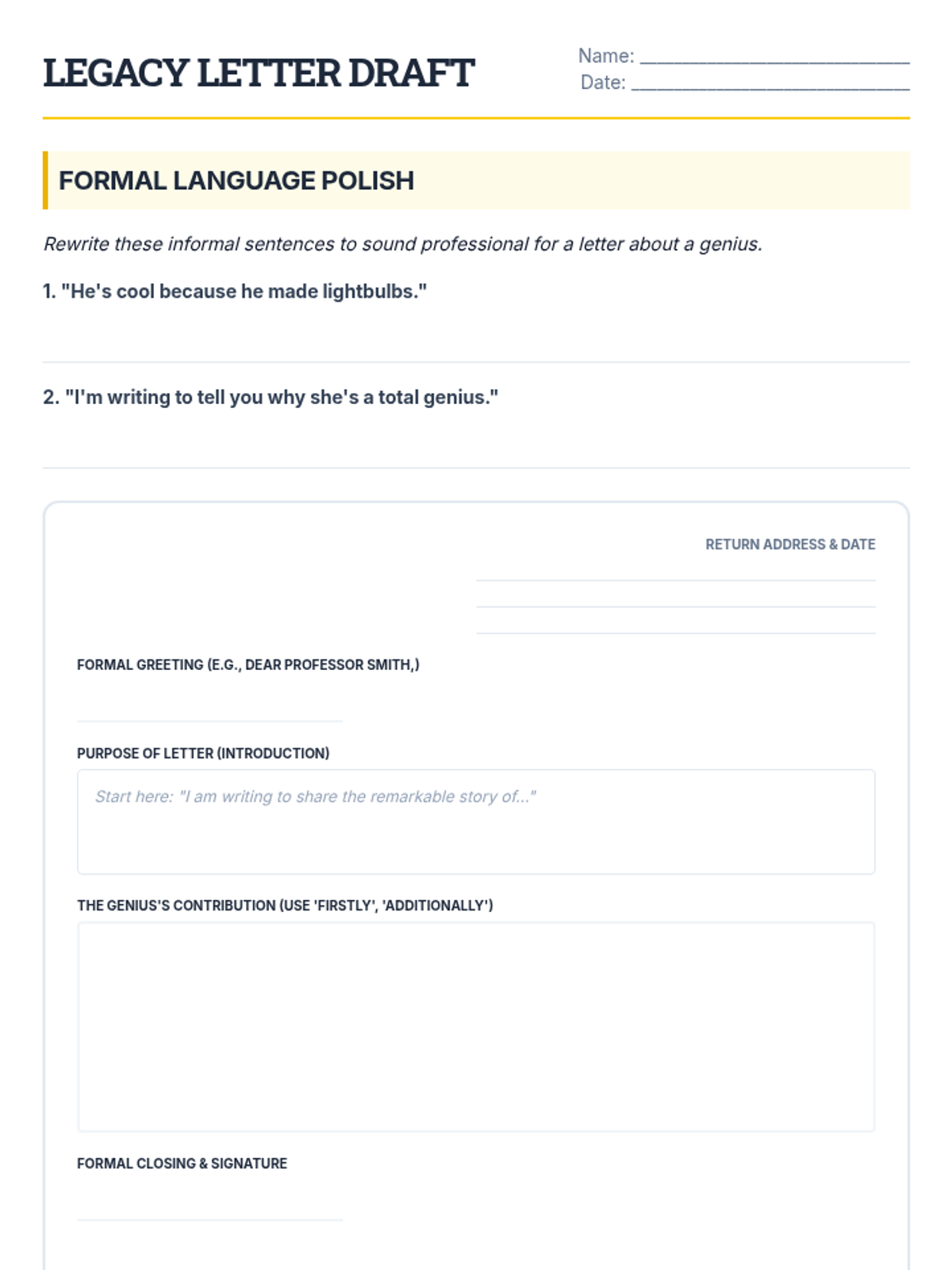
A student worksheet for formal letter writing about a genius. Includes a formal language rewrite activity and a structured letter template. Updated to fit one page and improve contrast.
Instructional slides for formal letter writing, focusing on the achievements of geniuses, formal tone vs. informal tone, and letter structure. Updated with specific examples and curriculum cohesion.
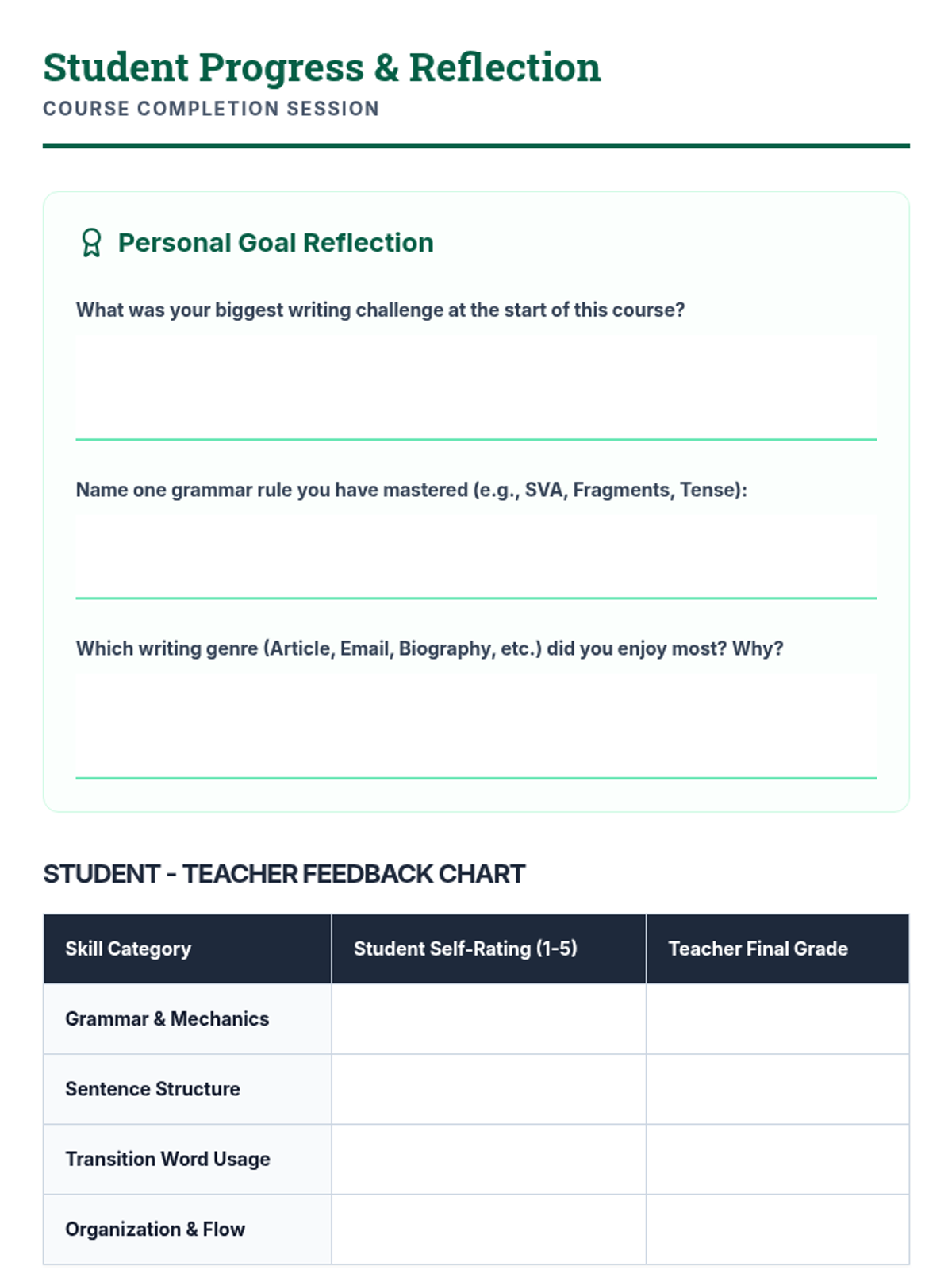
A final reflection and feedback document for students to self-assess their progress, receive teacher evaluations across core skill categories, and review strategy tips for future writing success.
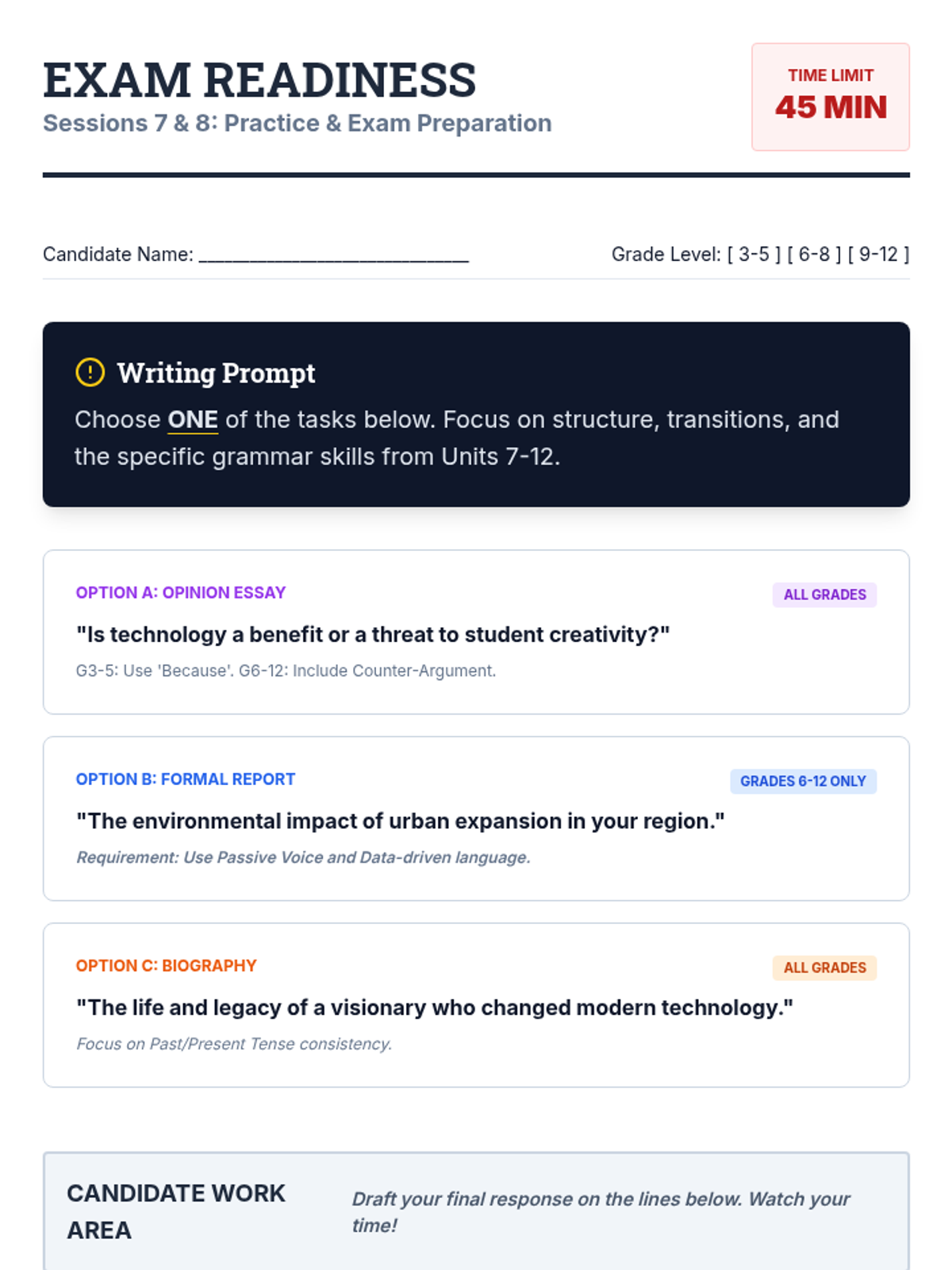
A mock exam writing prompt and workspace for sessions 7 and 8, featuring tiered options for different writing genres (essay, report, biography) and a lined writing area for timed practice.
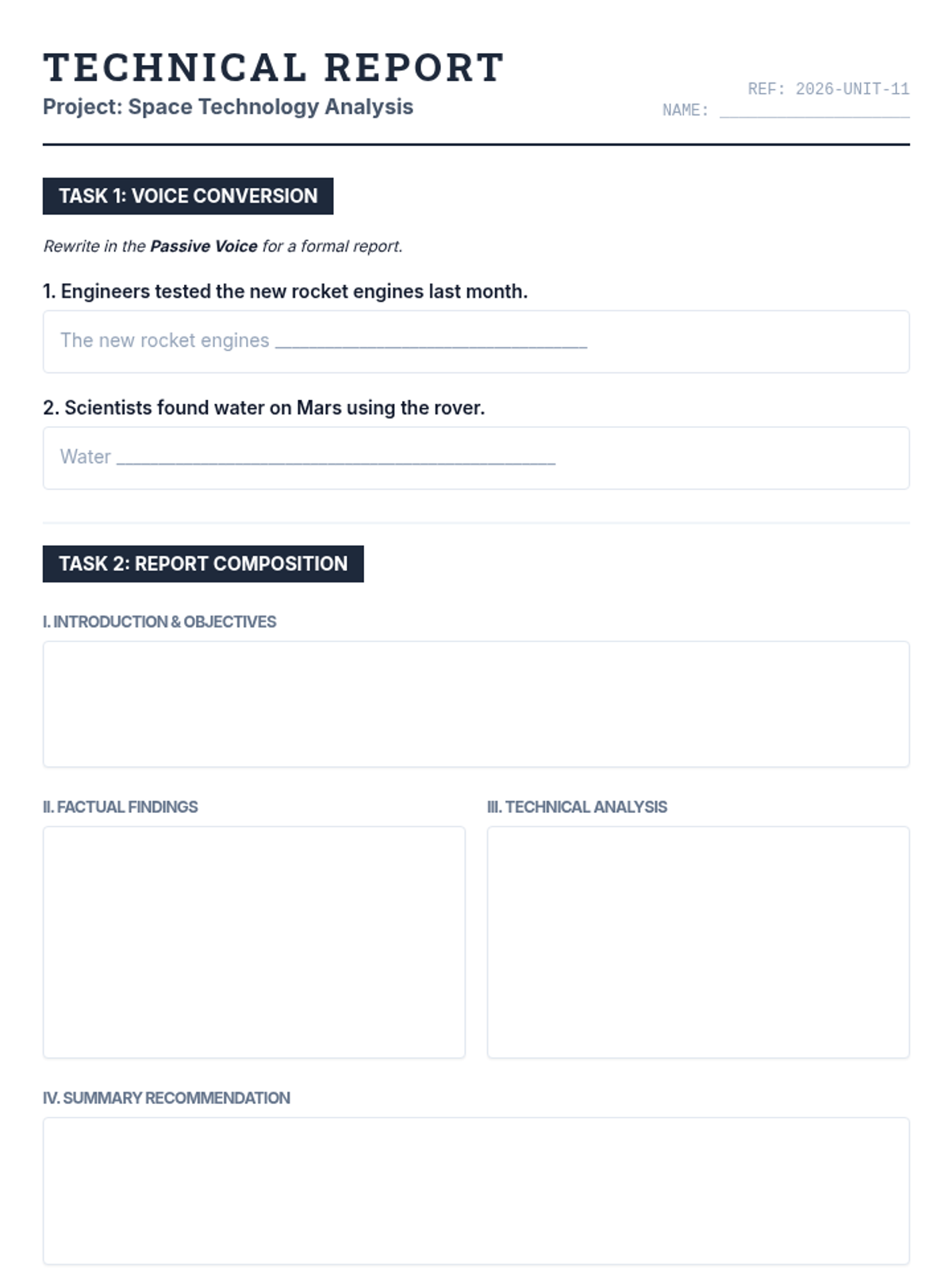
A technical report writing worksheet for students, including an active-to-passive voice conversion exercise and a structured four-part report layout for space technology analysis.
Instructional slides for report writing on space technology, focusing on the distinction between active and passive voice and the formal structure of a data-driven report.
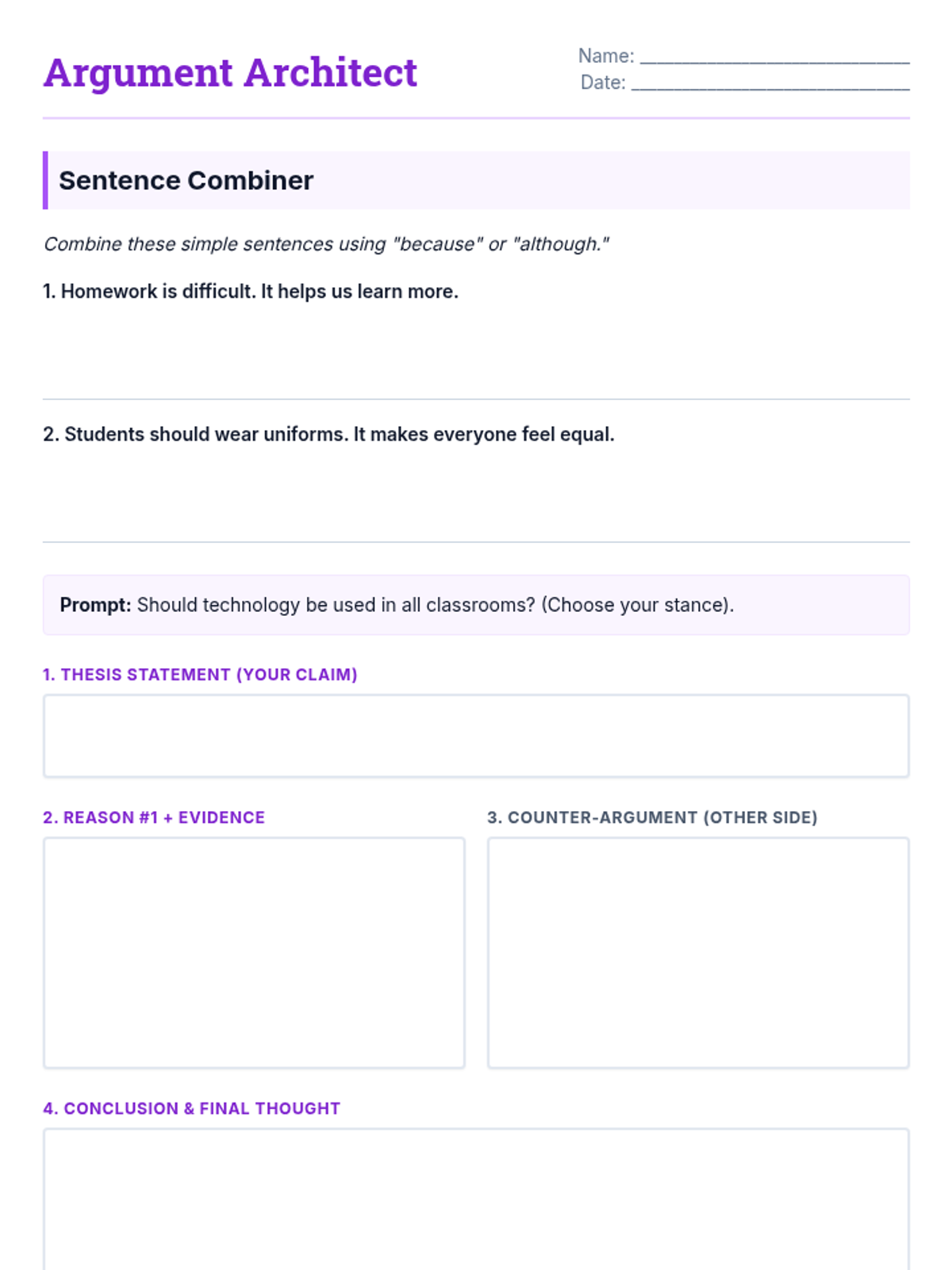
A student worksheet for opinion essay writing, featuring a conjunction-combining grammar activity and a structured multi-part outline for a thesis, evidence, counter-argument, and conclusion.
Instructional slides for opinion essay writing, emphasizing the use of conjunctions (because, although) and the structure of a multi-paragraph argument including counter-arguments.
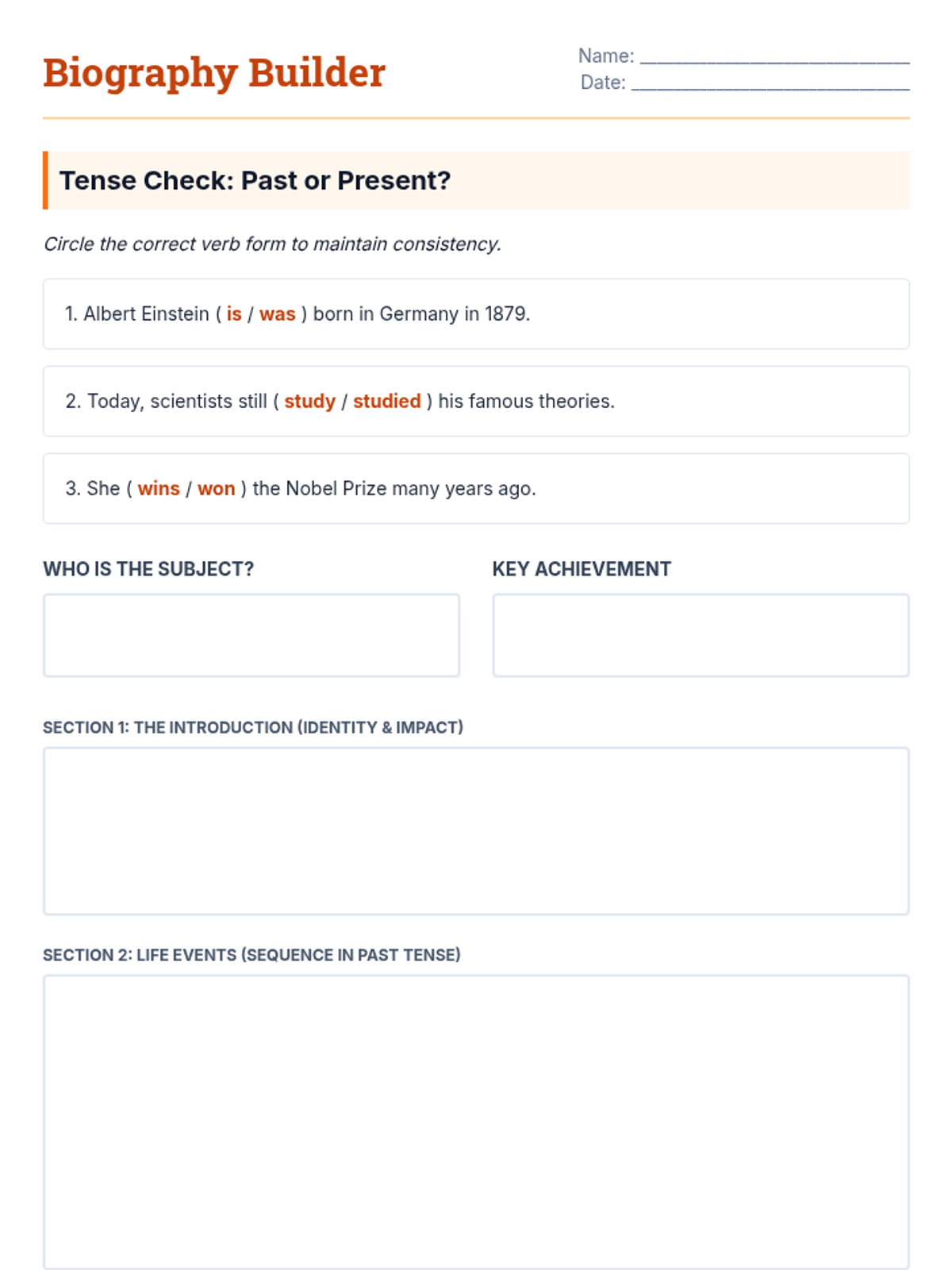
A student worksheet for biography writing, including a tense-selection warm-up activity and a three-section drafting organizer (Introduction, Life Events, Legacy).
Instructional slides for biography writing, focusing on tense consistency (past vs. present) and logical sequencing of life events for historical figures.
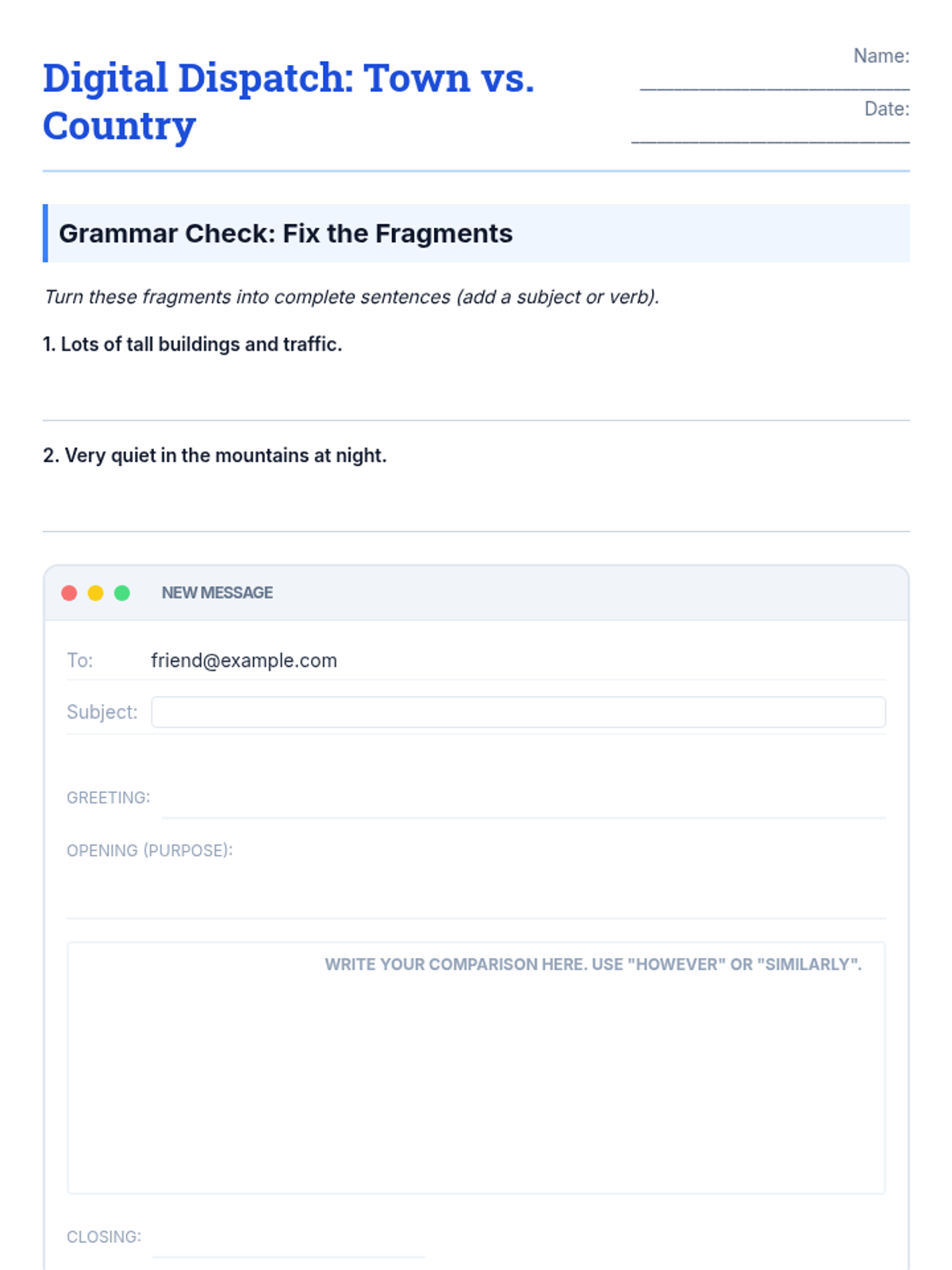
A student worksheet for writing an email comparing urban and rural life. Features a grammar activity to correct sentence fragments and a structured email template with comparison-word prompts.
Instructional slides for email writing, focusing on the comparison between urban and rural living, grammar instruction on sentence fragments, and transitional words for comparison.
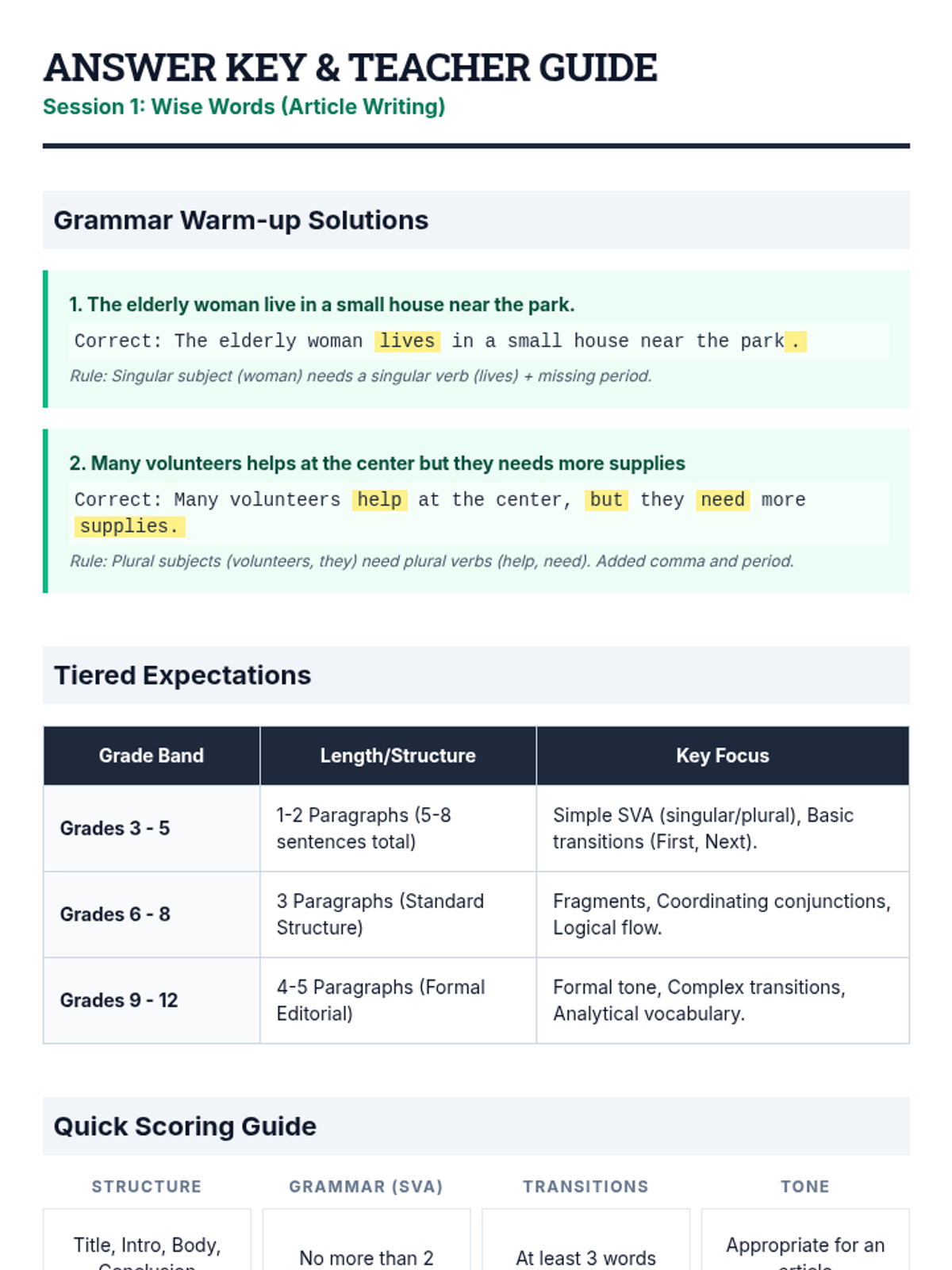
Teacher reference guide for Session 1, containing grammar solutions, tiered expectations for different grade bands, and a quick scoring rubric for the article writing task.
A grayscale version of the non-fiction analysis document, with colors updated to slate shades and text references adjusted to reflect gray highlights. Fixed invisible legend labels. Corrected work area rule thickness.
A grayscale version of the fiction analysis document, with colors updated to slate shades and text references adjusted to reflect gray highlights. Corrected prompt colors and consolidated layout to 2 pages. Fixed word spacing in sidebars.
A grayscale version of the poem analysis document, with colors updated to slate shades and text references adjusted to reflect gray highlights. Revised to fit entire poem and sidebars on a single page. Margin callouts precisely aligned.
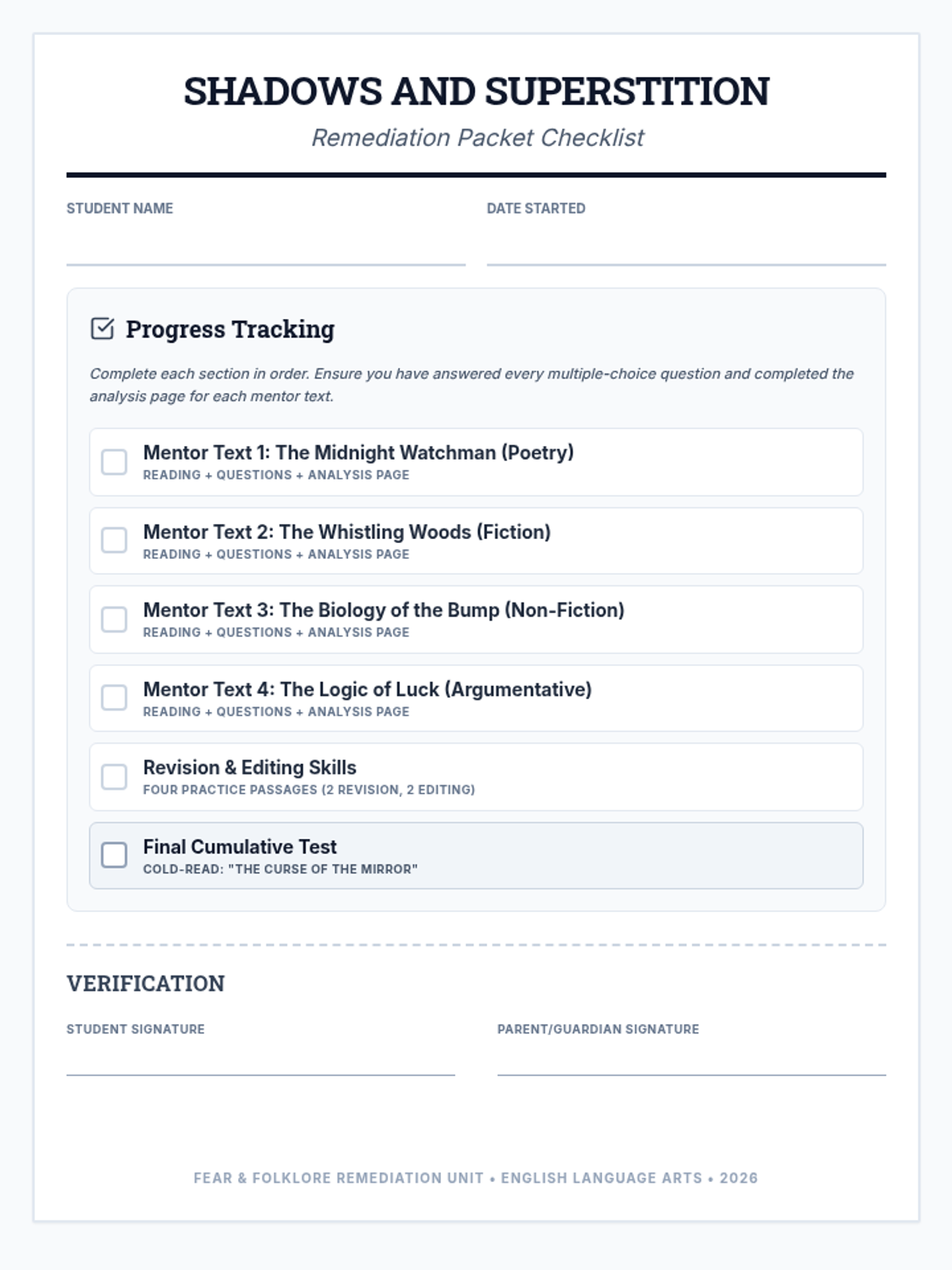
A grayscale version of the student progress checklist for the remediation packet, featuring a structured list of all required texts and activities.
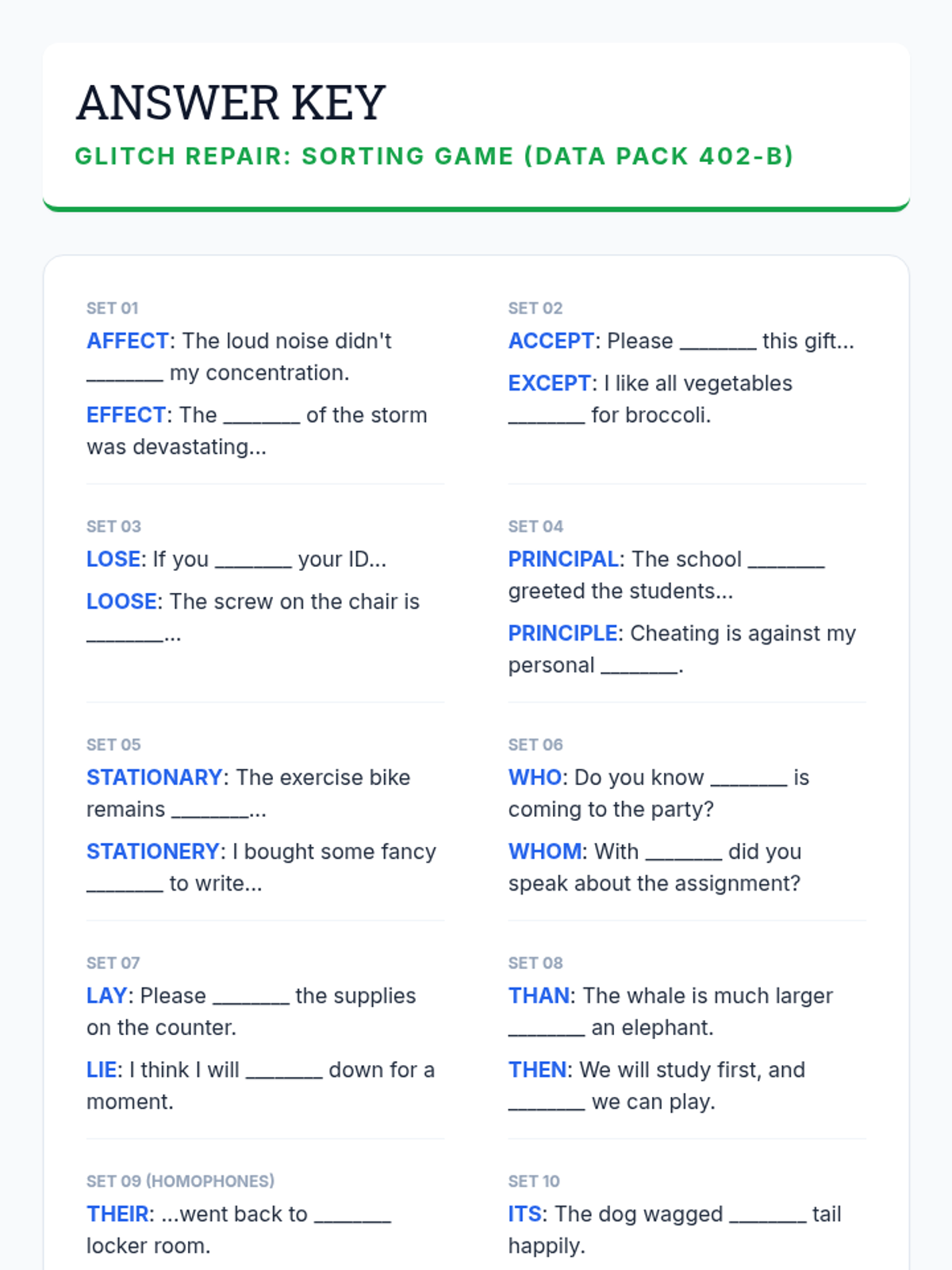
A teacher's answer key for the Glitch Repair sorting game, providing the correct matches for all word and sentence cards to facilitate quick grading and feedback.
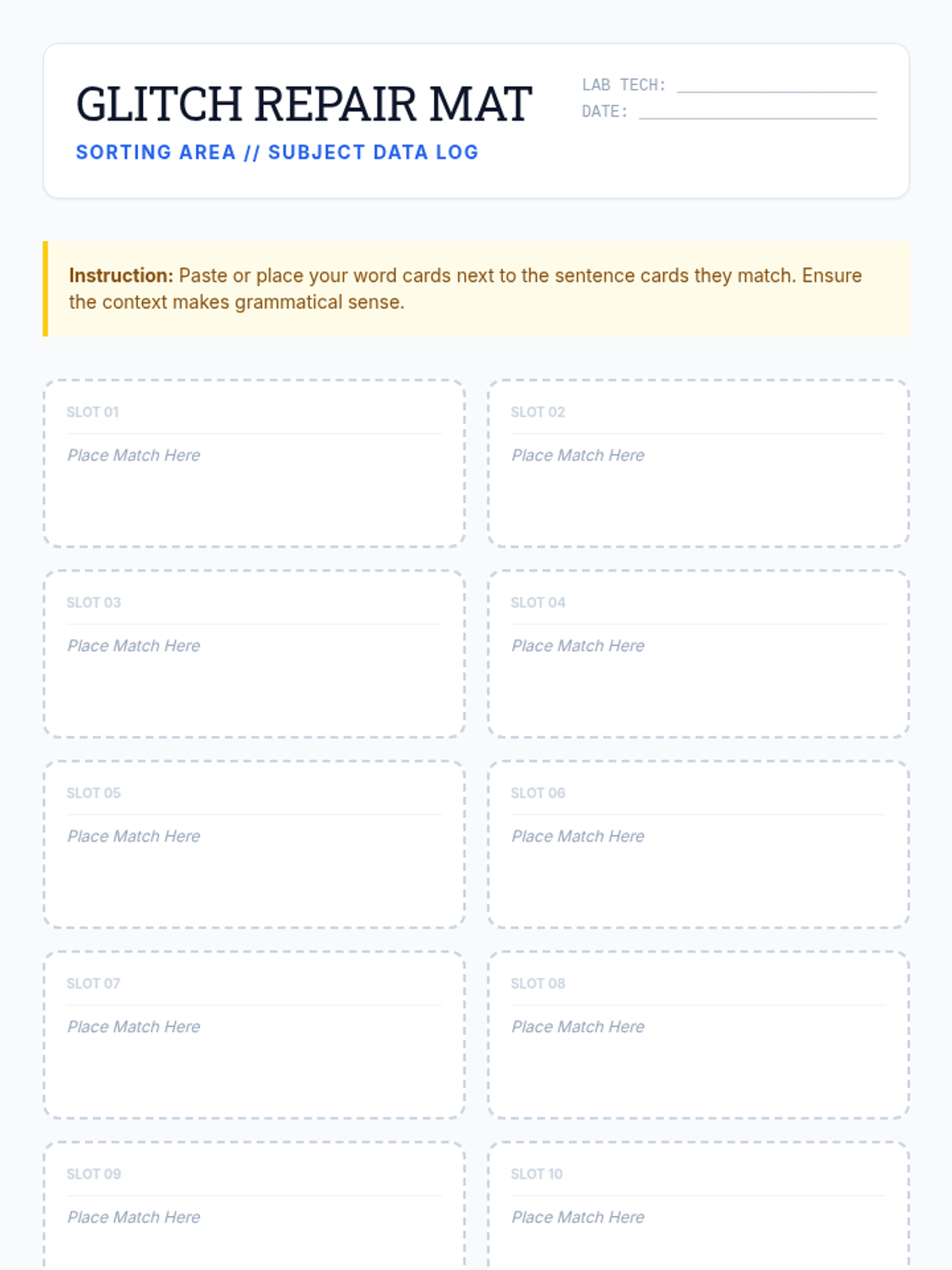
A printable sorting mat for the Glitch Repair game, providing students with a structured workspace to organize and match word and sentence cards.
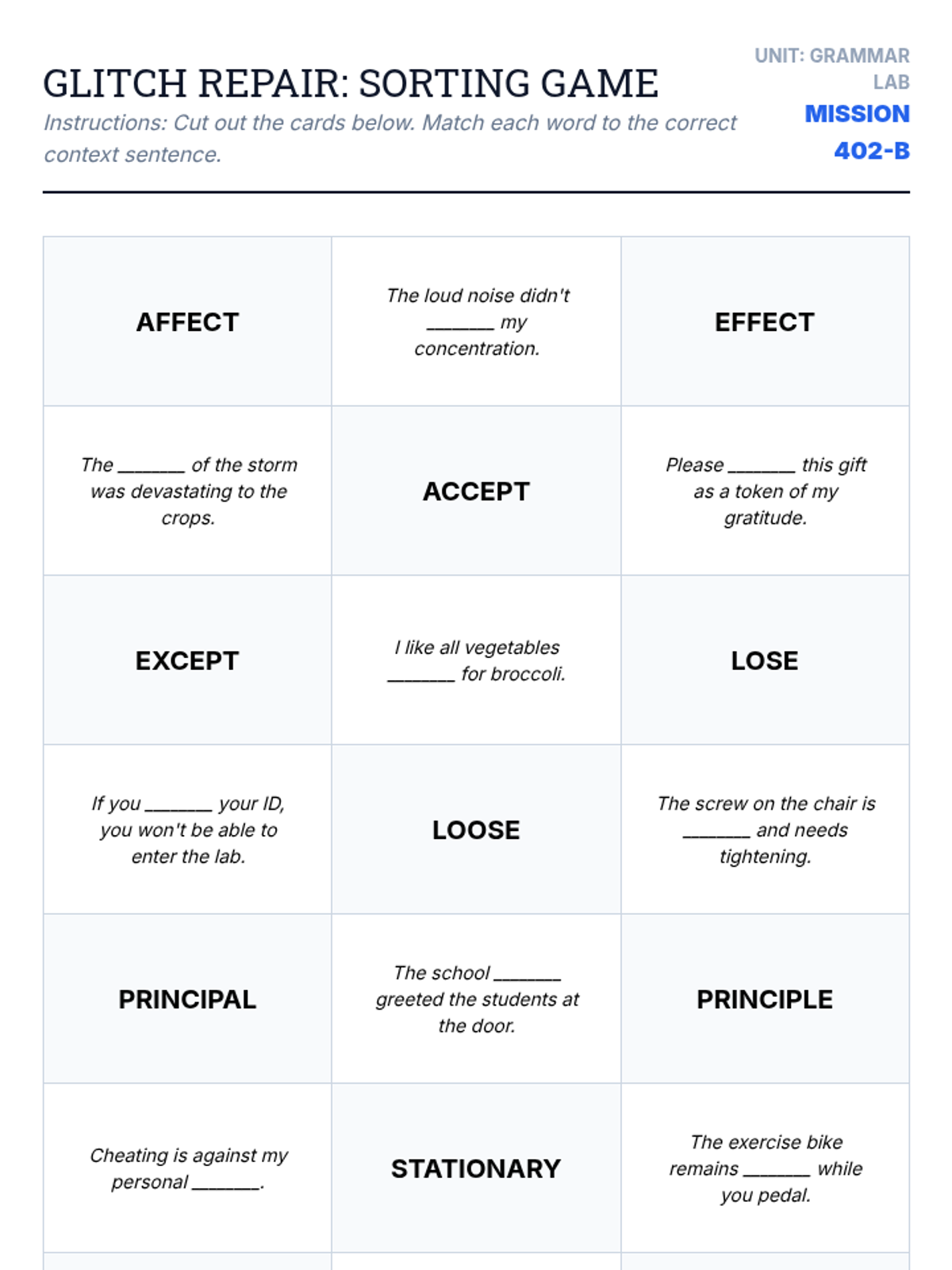
A set of 24 printable cards featuring words and context sentences for a sorting game. Students must match the correct commonly confused word with the sentence that fits its definition.
A visually striking slideshow designed for direct instruction on 12 pairs of commonly confused words. Includes memory triggers, definitions, visual hints, and interactive practice sentences for each word group.
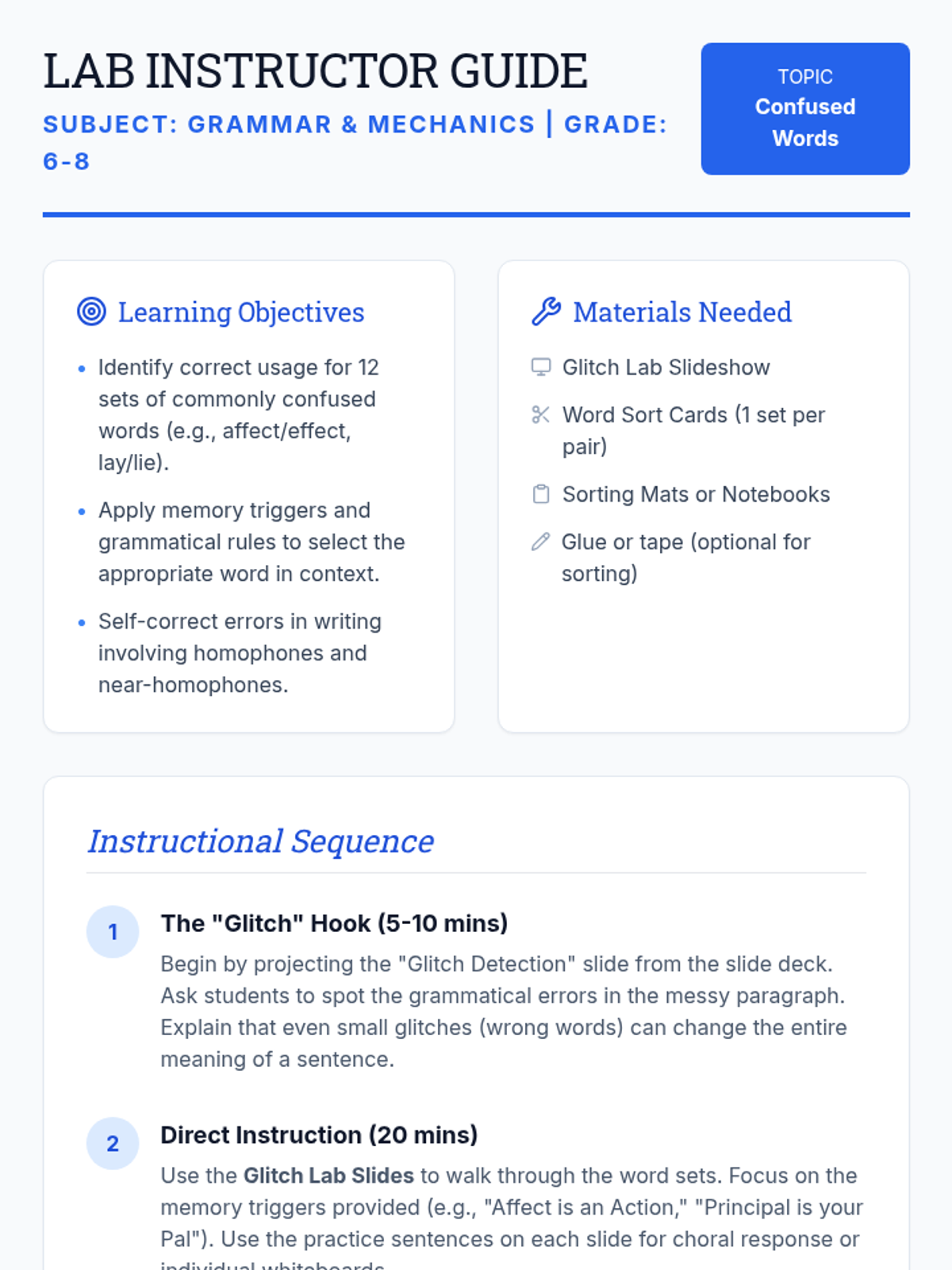
A detailed teacher's guide for the Grammar Lab lesson, including learning objectives, a list of required materials, a step-by-step instructional sequence, and practical teaching tips for middle school classrooms.
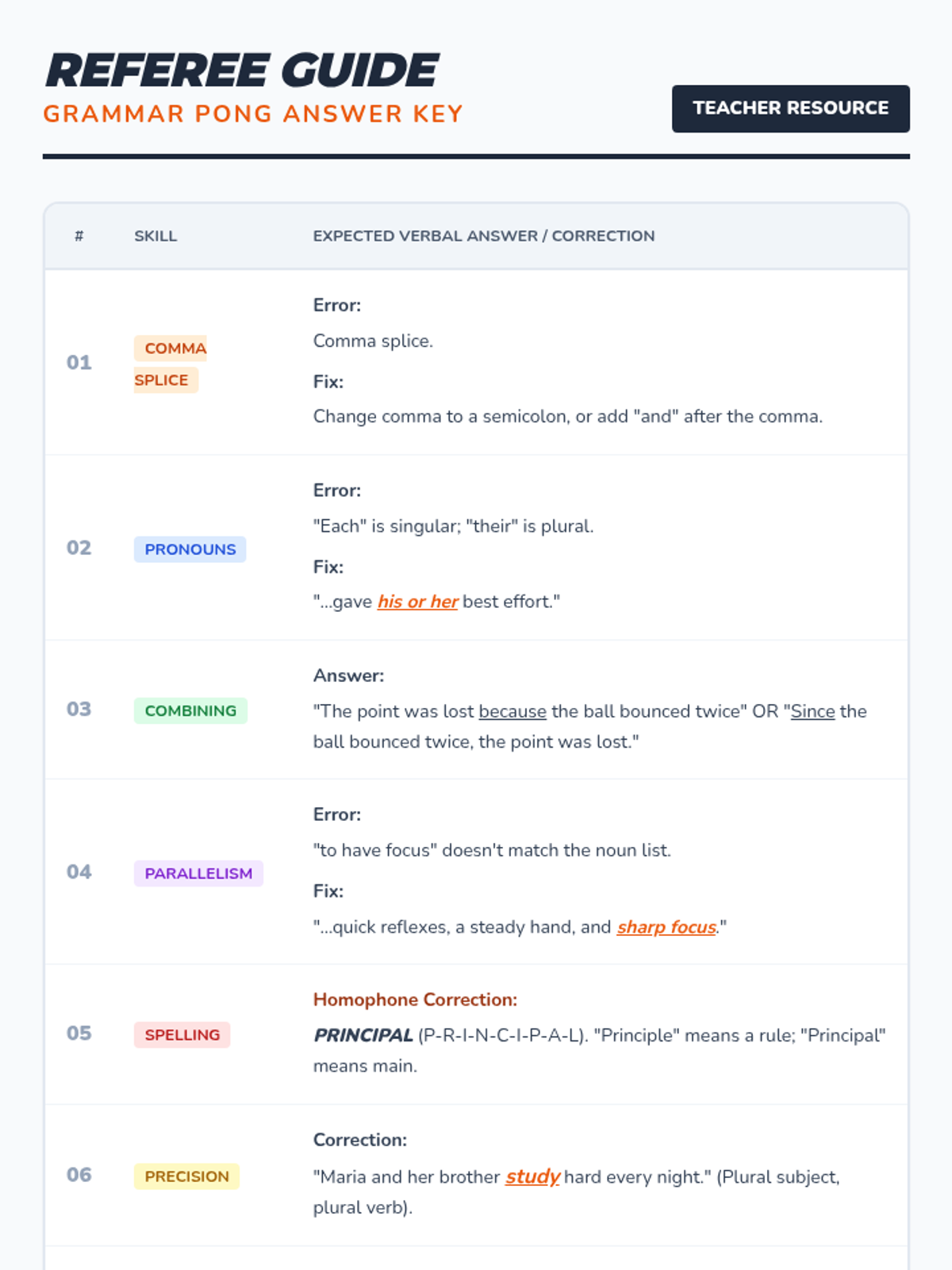
A teacher-facing answer key and quick-reference guide for the Grammar Pong game, ensuring fast and accurate judging during the verbal challenge.
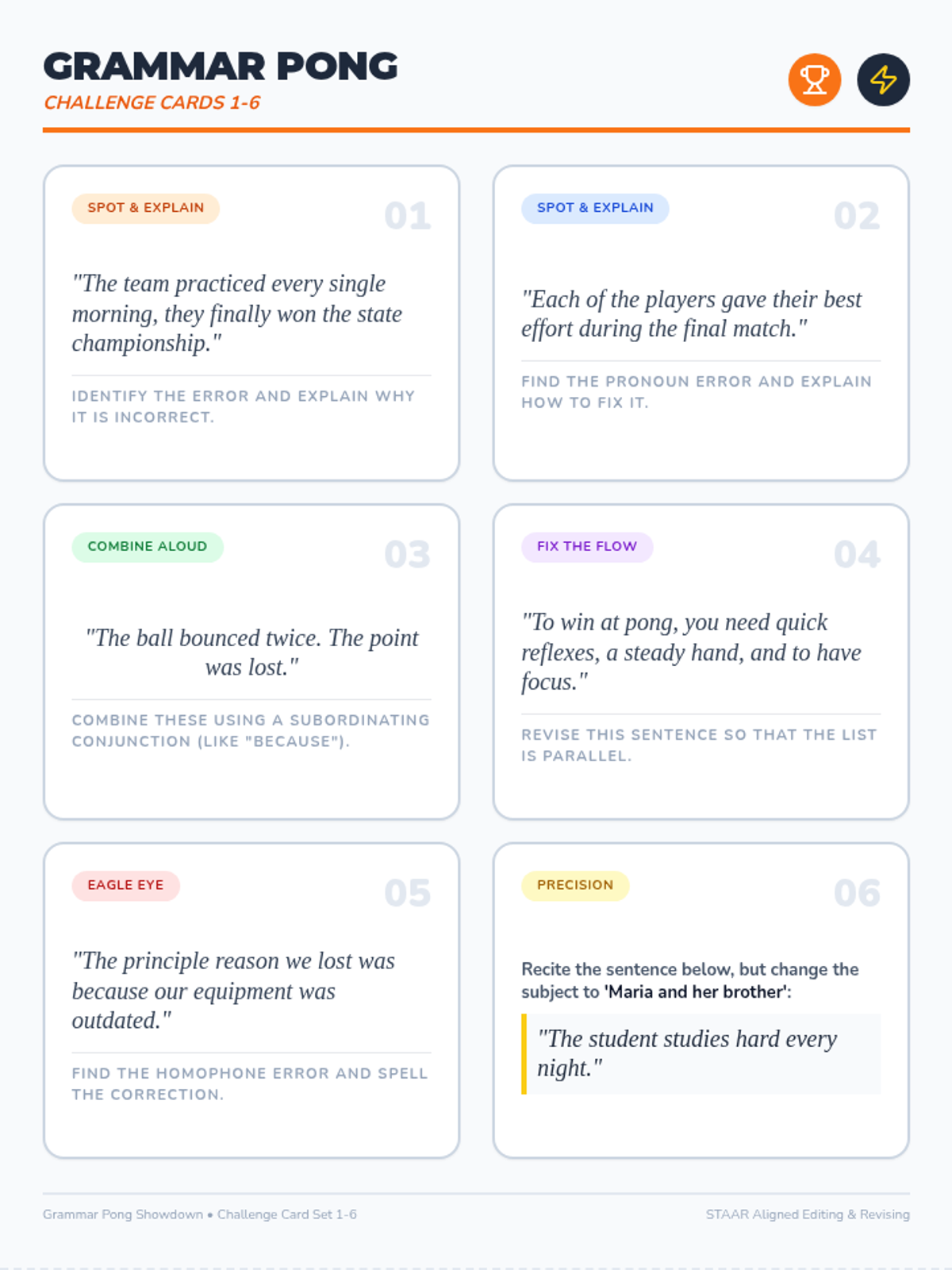
A set of 12 vibrant challenge cards for a classroom grammar game. Each card features an open-ended editing or revising question targeting specific skills like comma splices, parallelism, and pronoun agreement. Card sizing and text layout have been adjusted for optimal readability.
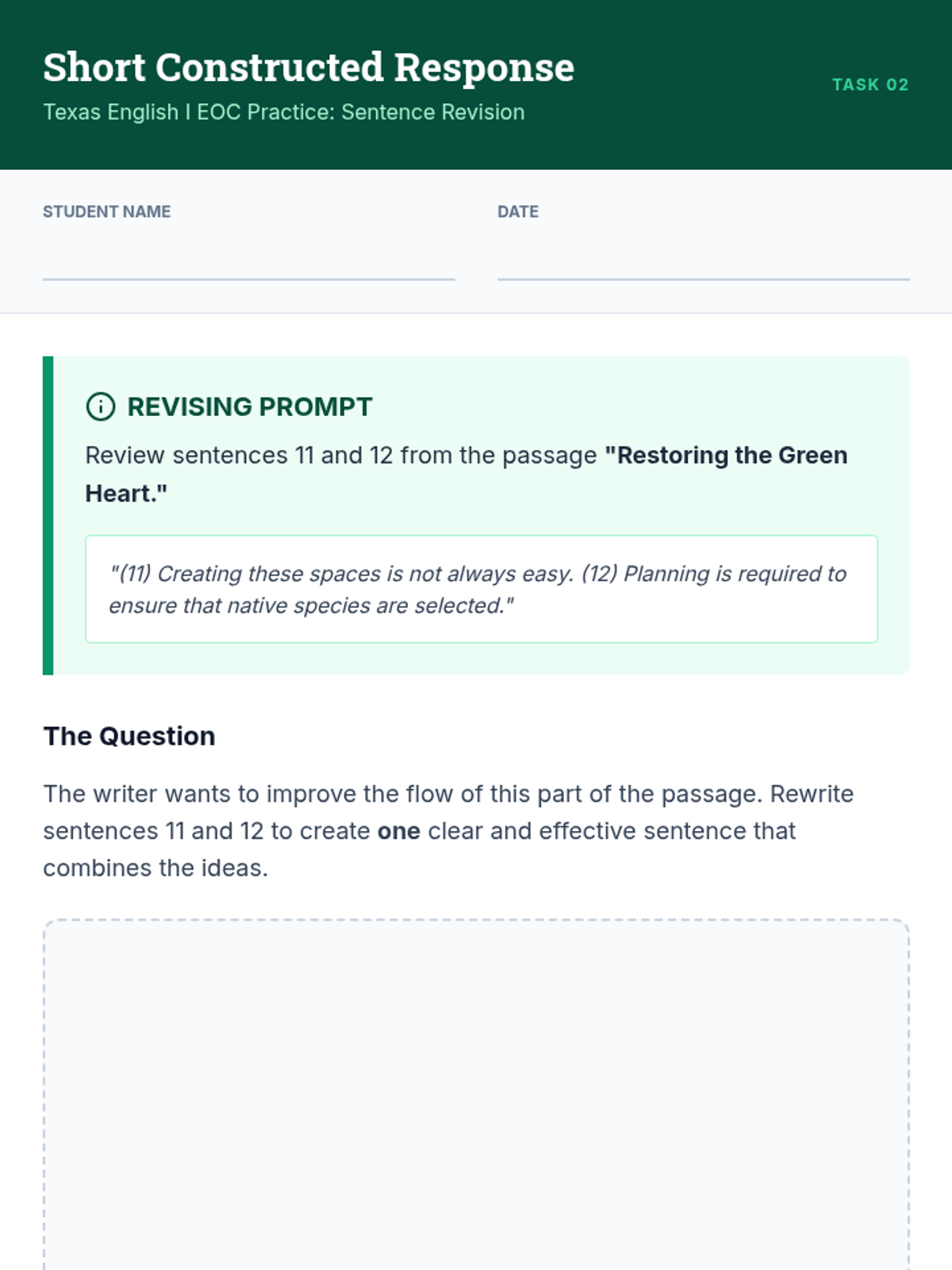
A short constructed response (SCR) task for Texas English I, requiring students to rewrite and combine two sentences from the practice passage to improve flow and clarity.
A visual presentation guiding students through key revising strategies for the Texas English I EOC, focusing on sentence combining, redundancy, and clarity.
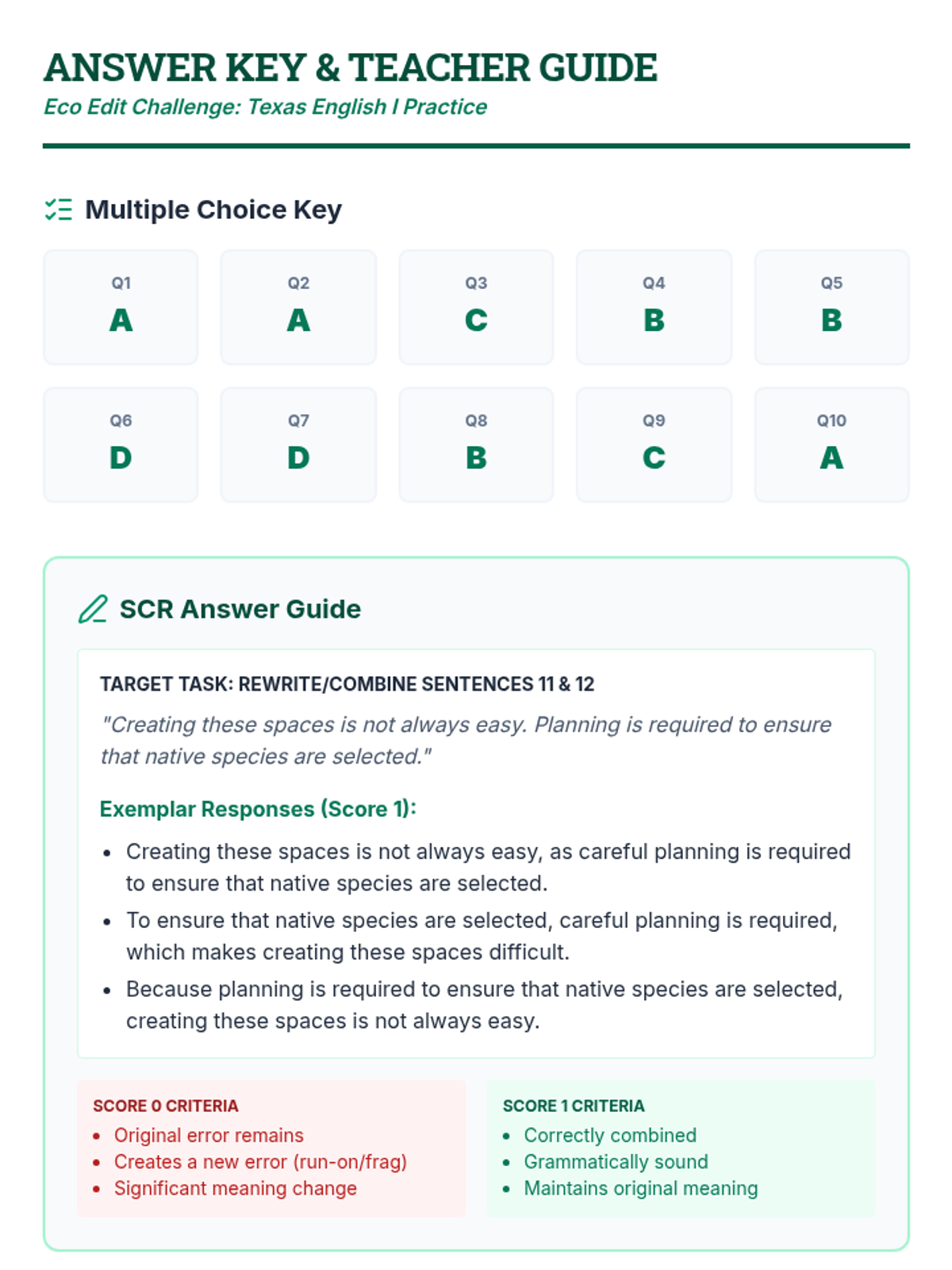
An updated answer key and teacher guide that includes a scoring rubric and exemplar responses for the short constructed response (SCR) revision task.
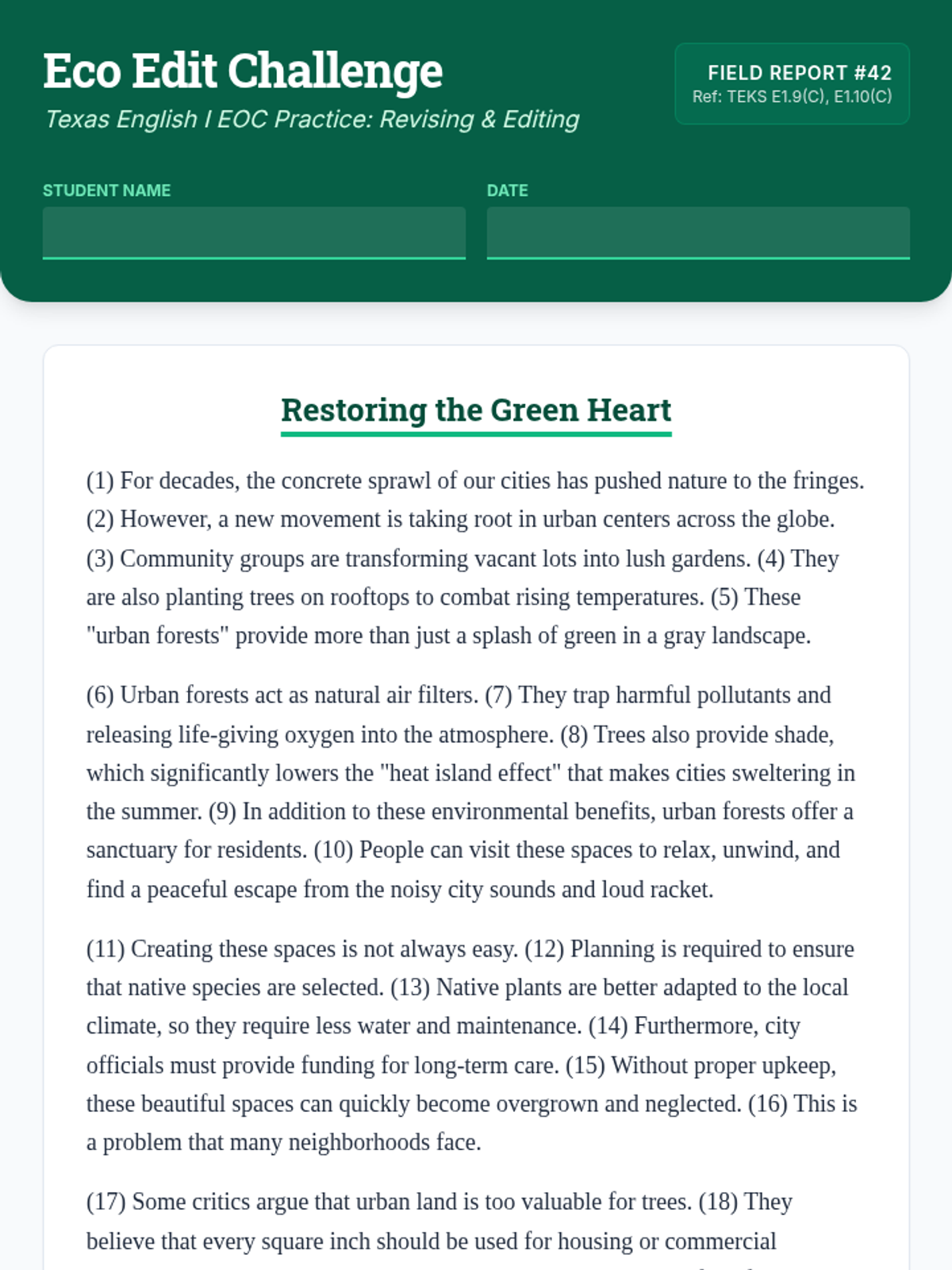
A STAAR-aligned practice test for Texas English I, featuring a passage on urban forestry with 10 multiple-choice questions focusing on sentence combining, word choice, transitions, and grammatical corrections.
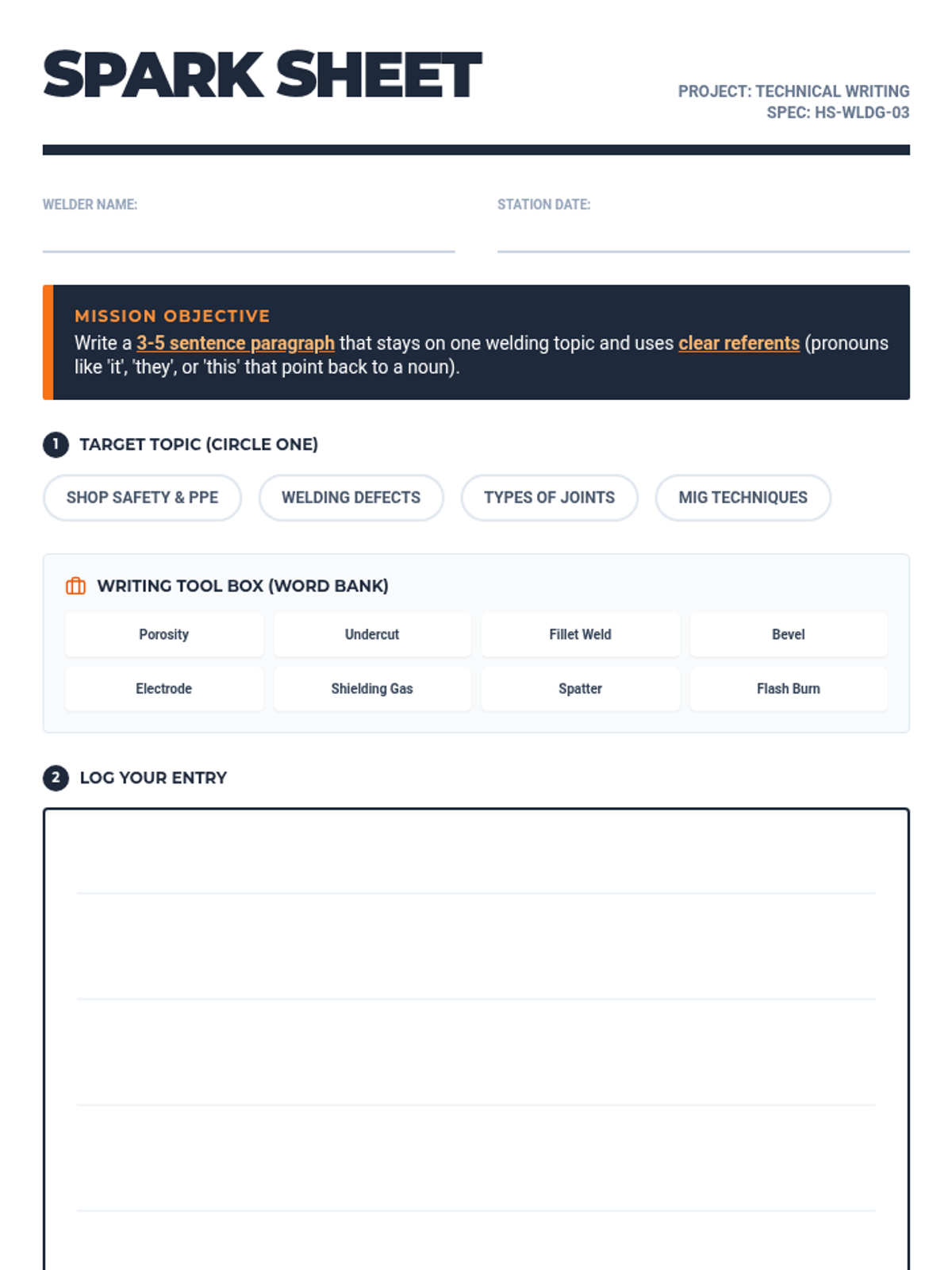
A guided worksheet that includes a technical word bank, referent tips, and structured writing space for practicing welding-focused paragraph construction.
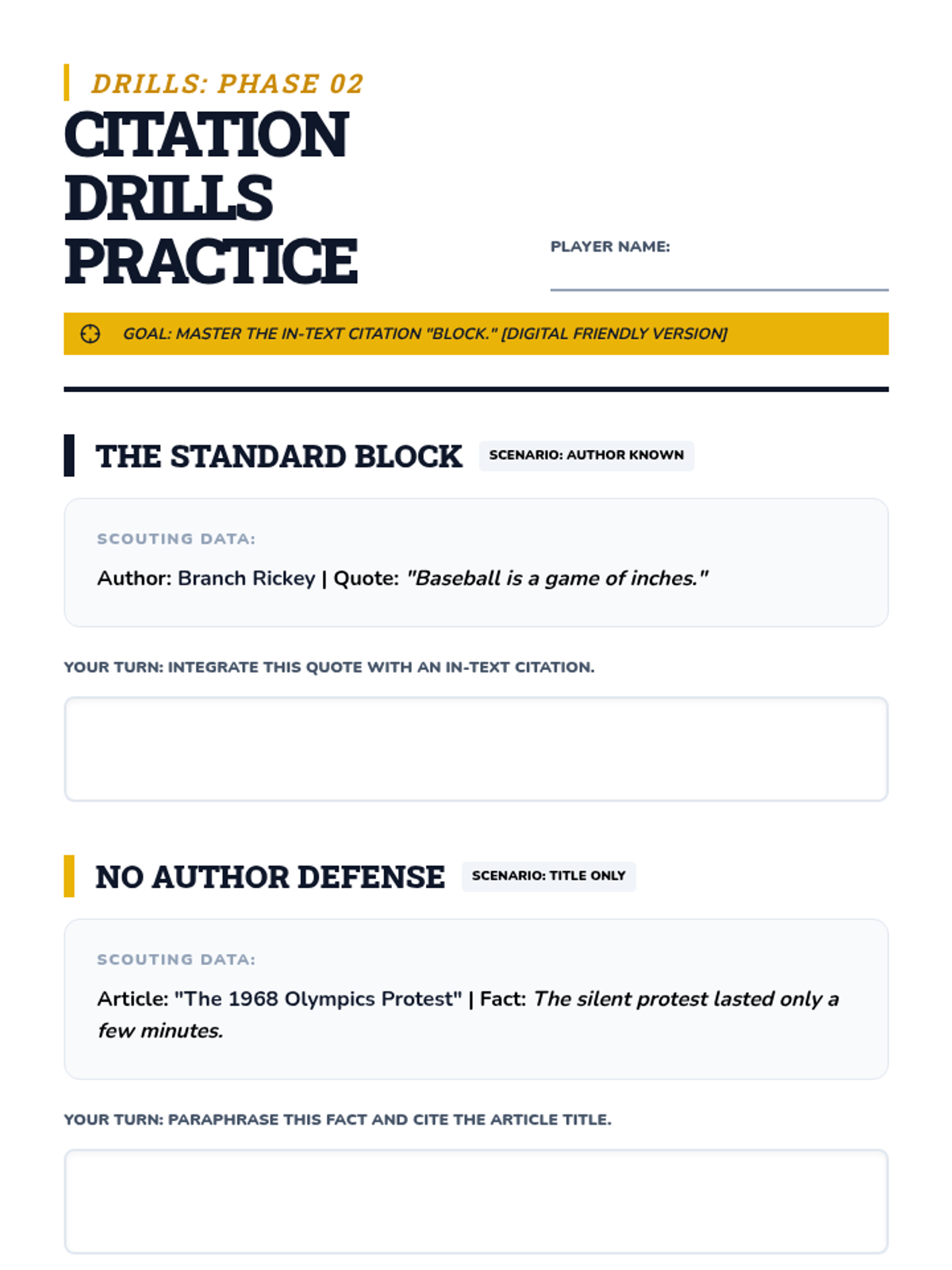
A practice worksheet focused on mastering MLA in-text citations for both authored sources and title-only sources, featuring signal phrase integration.
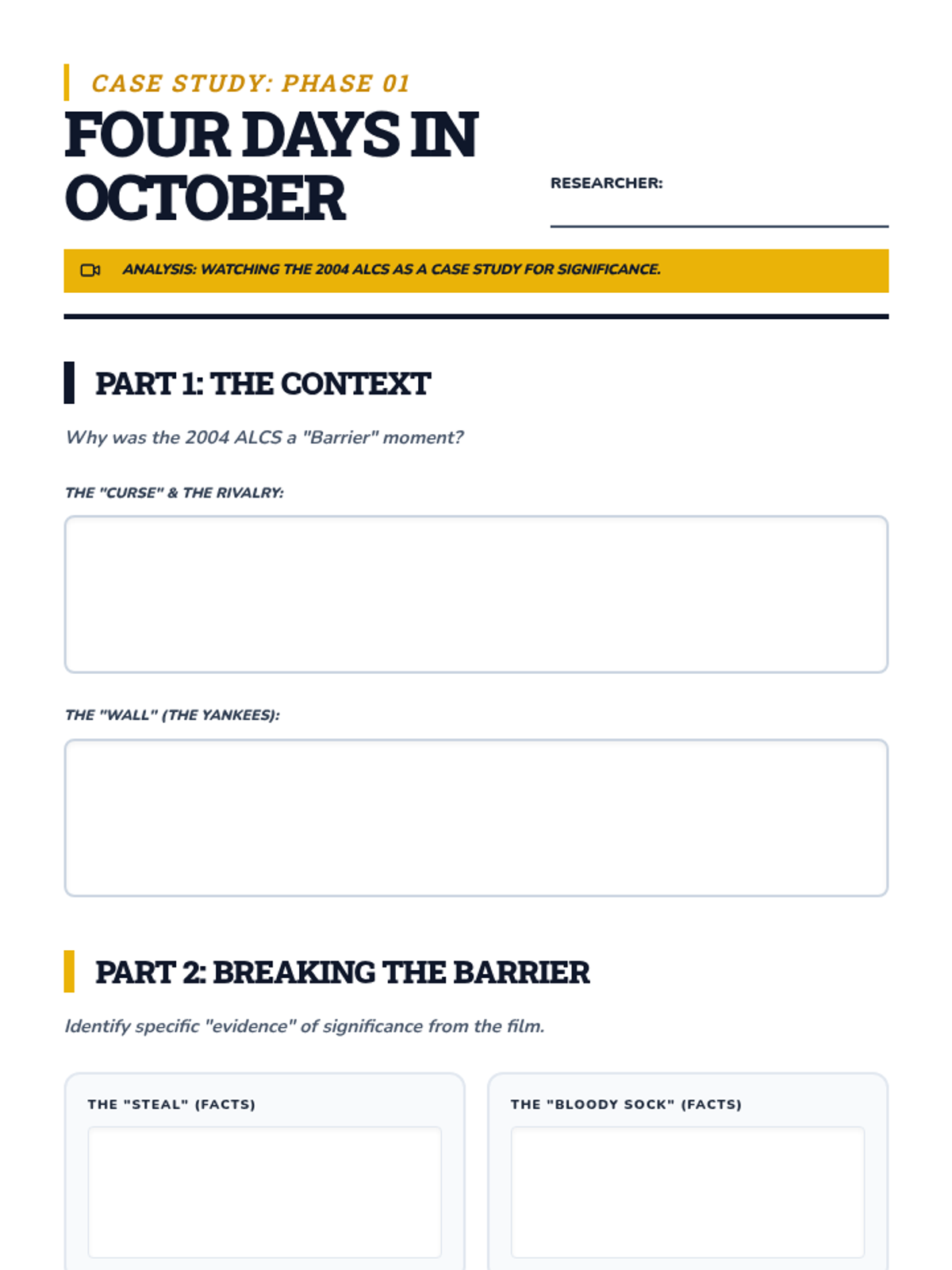
An analysis guide for the 'Four Days in October' documentary, optimized for digital use with large typing boxes instead of lines.
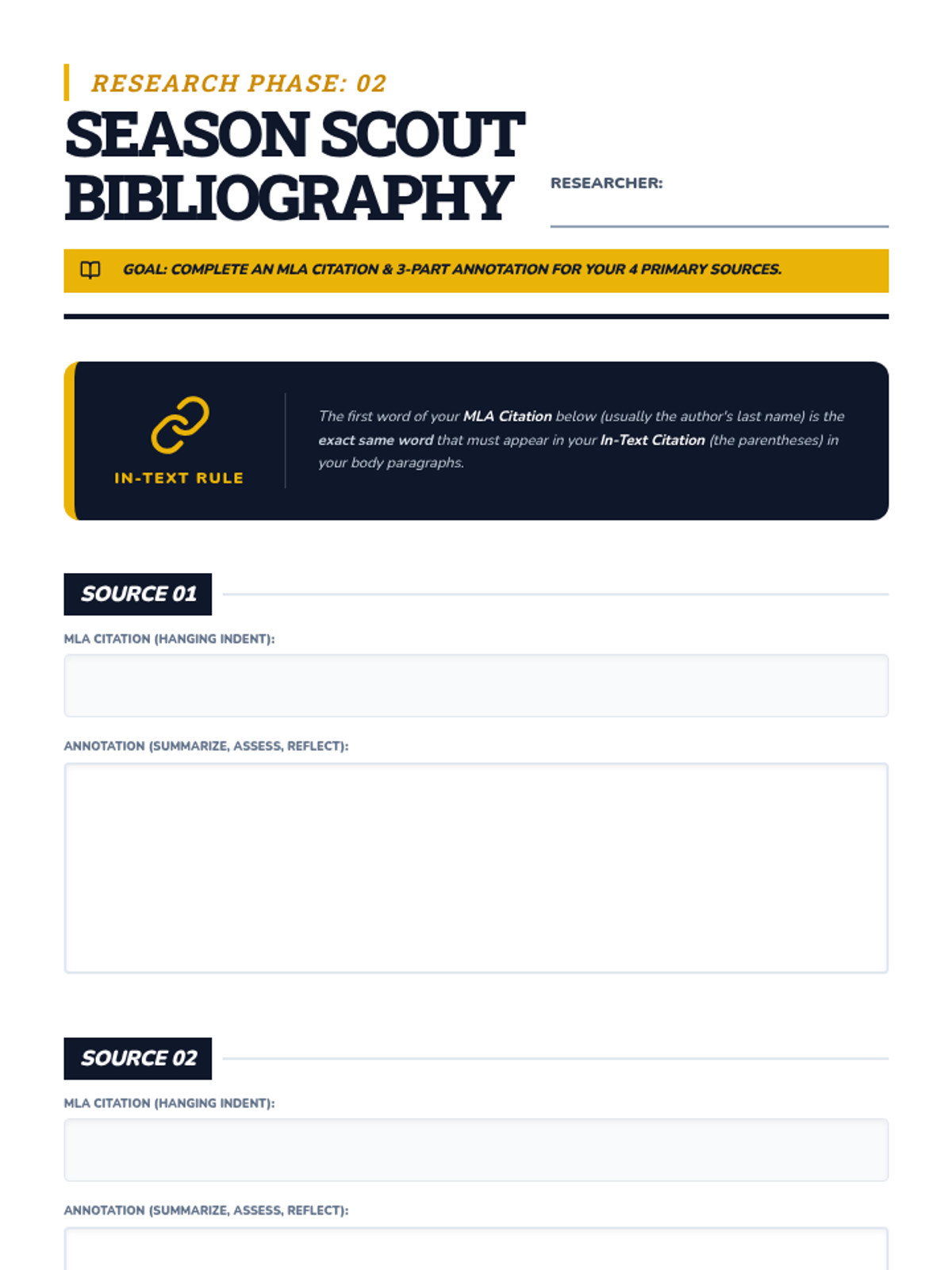
A scaffolded annotated bibliography worksheet for Lesson 2, where students record 4 sources with full MLA citations and three-part annotations (summary, assessment, reflection).
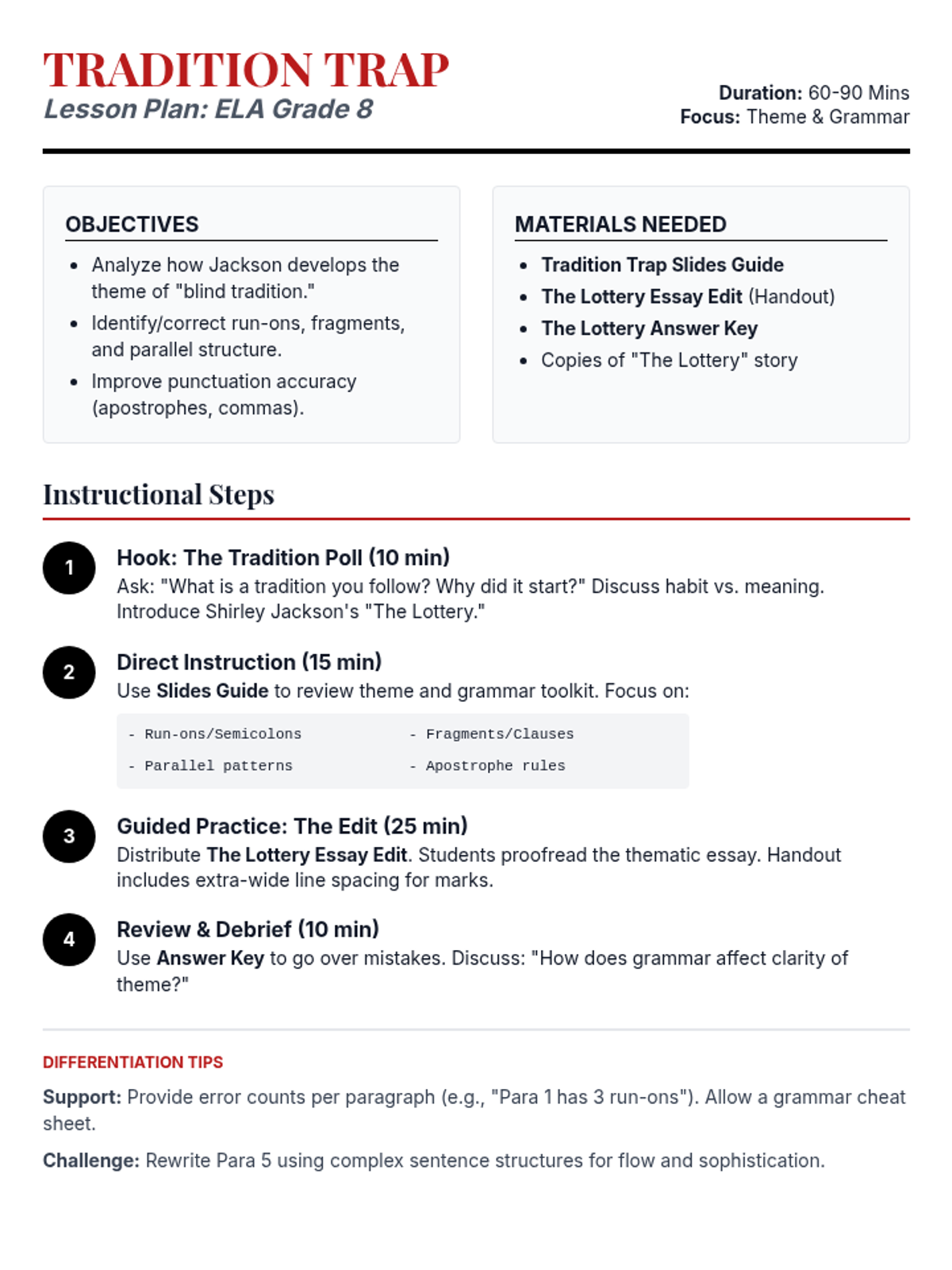
A comprehensive teacher guide for a lesson on 'The Lottery,' including instructional steps, hooks, and differentiation strategies centered around theme analysis and grammar correction.
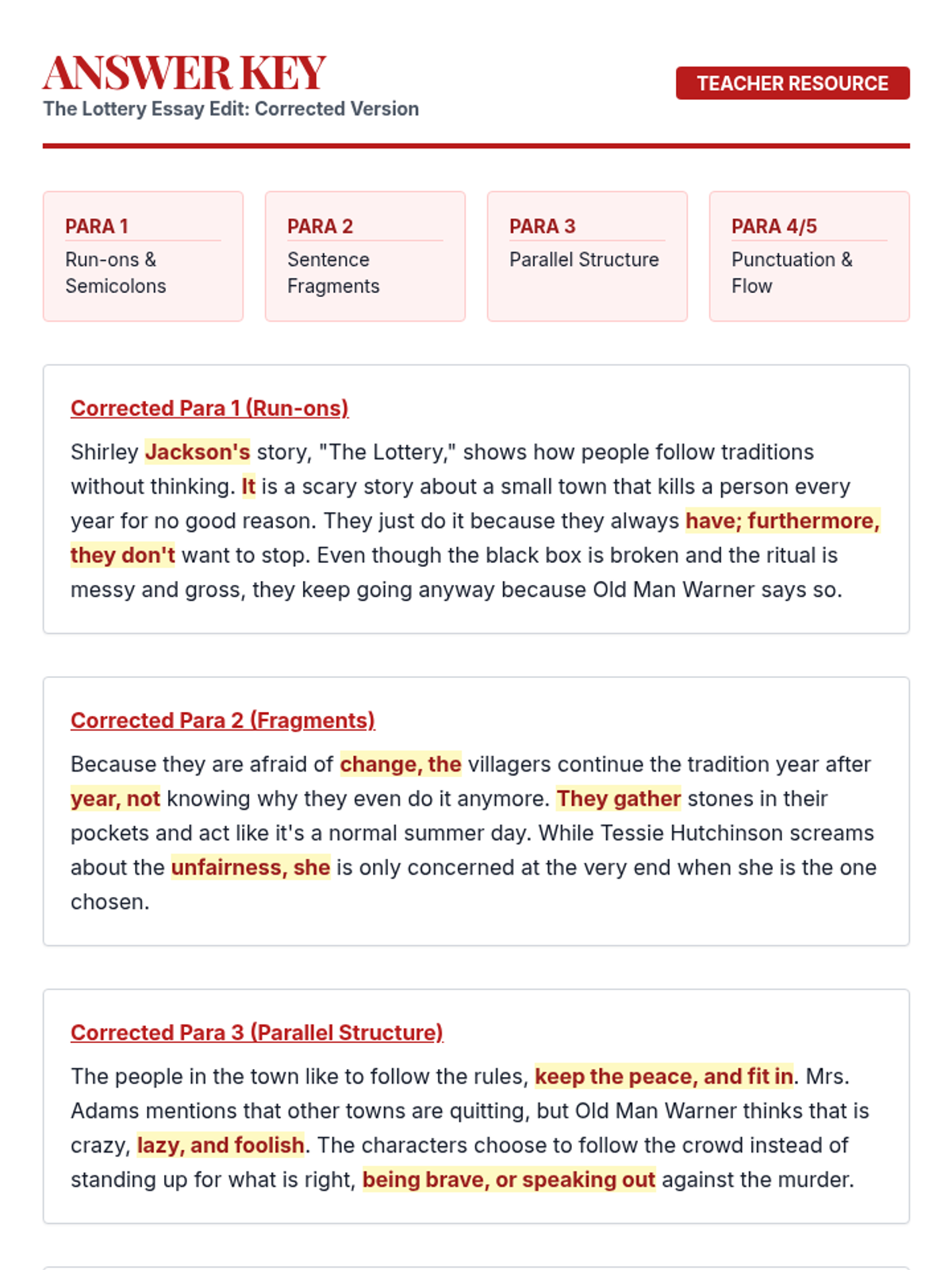
A teacher resource providing the corrected version of the 'Lottery Essay Edit' worksheet, with specific grammatical improvements highlighted for grading or review.
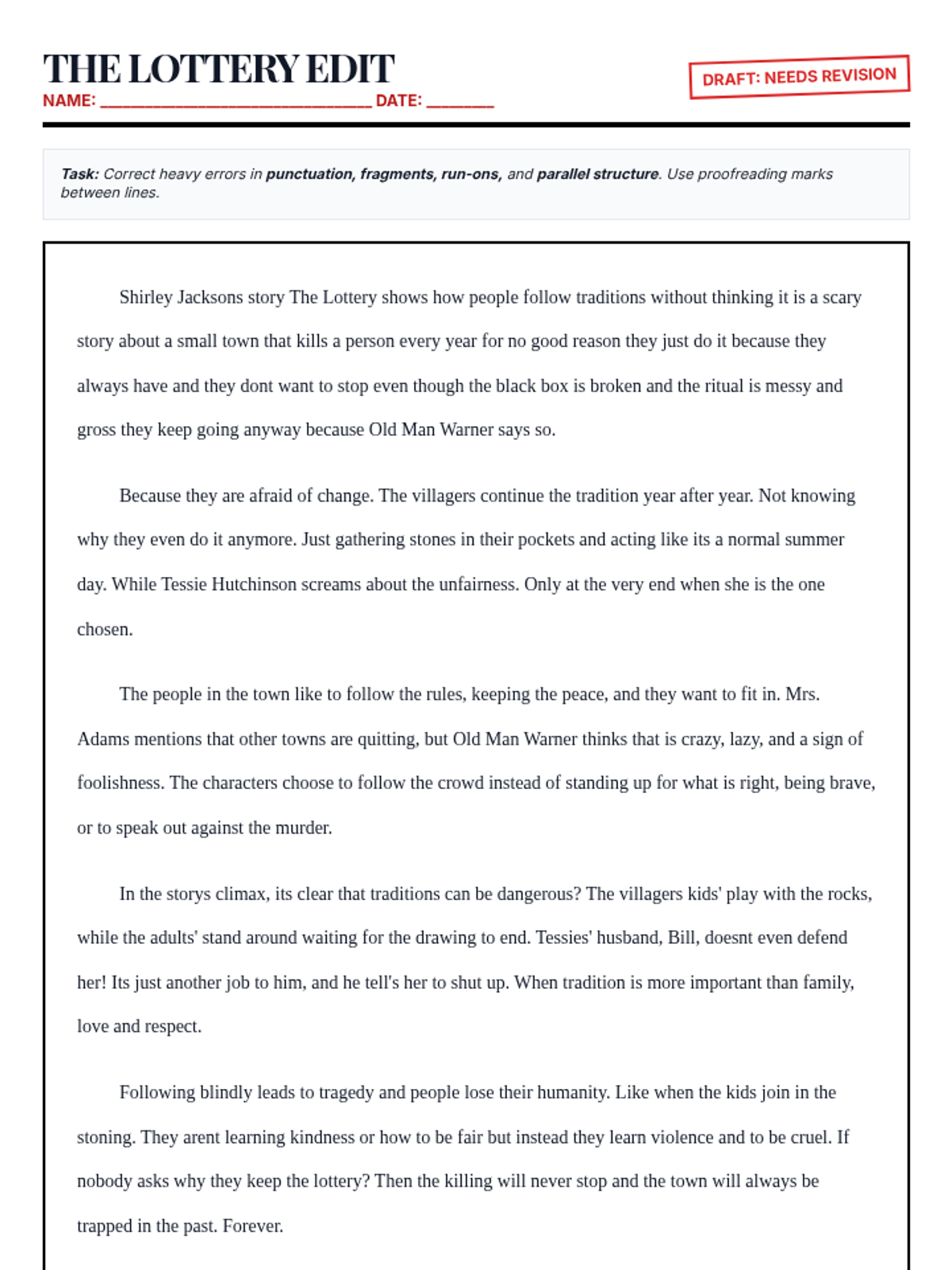
A student worksheet featuring a 5-paragraph essay on 'The Lottery' containing heavy grammatical errors (run-ons, fragments, parallel structure, and punctuation) for correction.
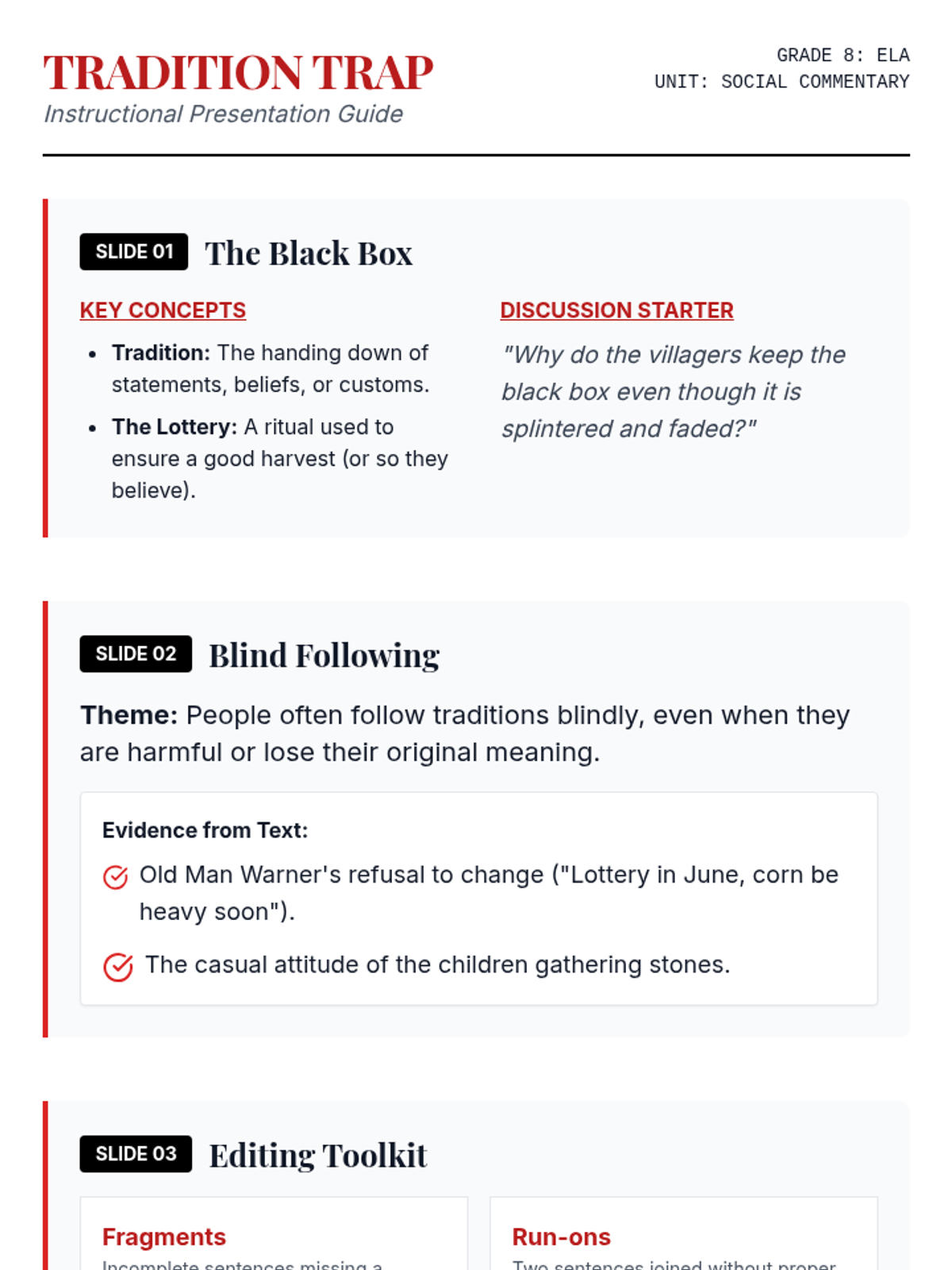
A teacher-facing slide guide providing instructional prompts for discussing 'The Lottery' and introducing common grammatical errors like fragments, run-ons, and parallel structure.
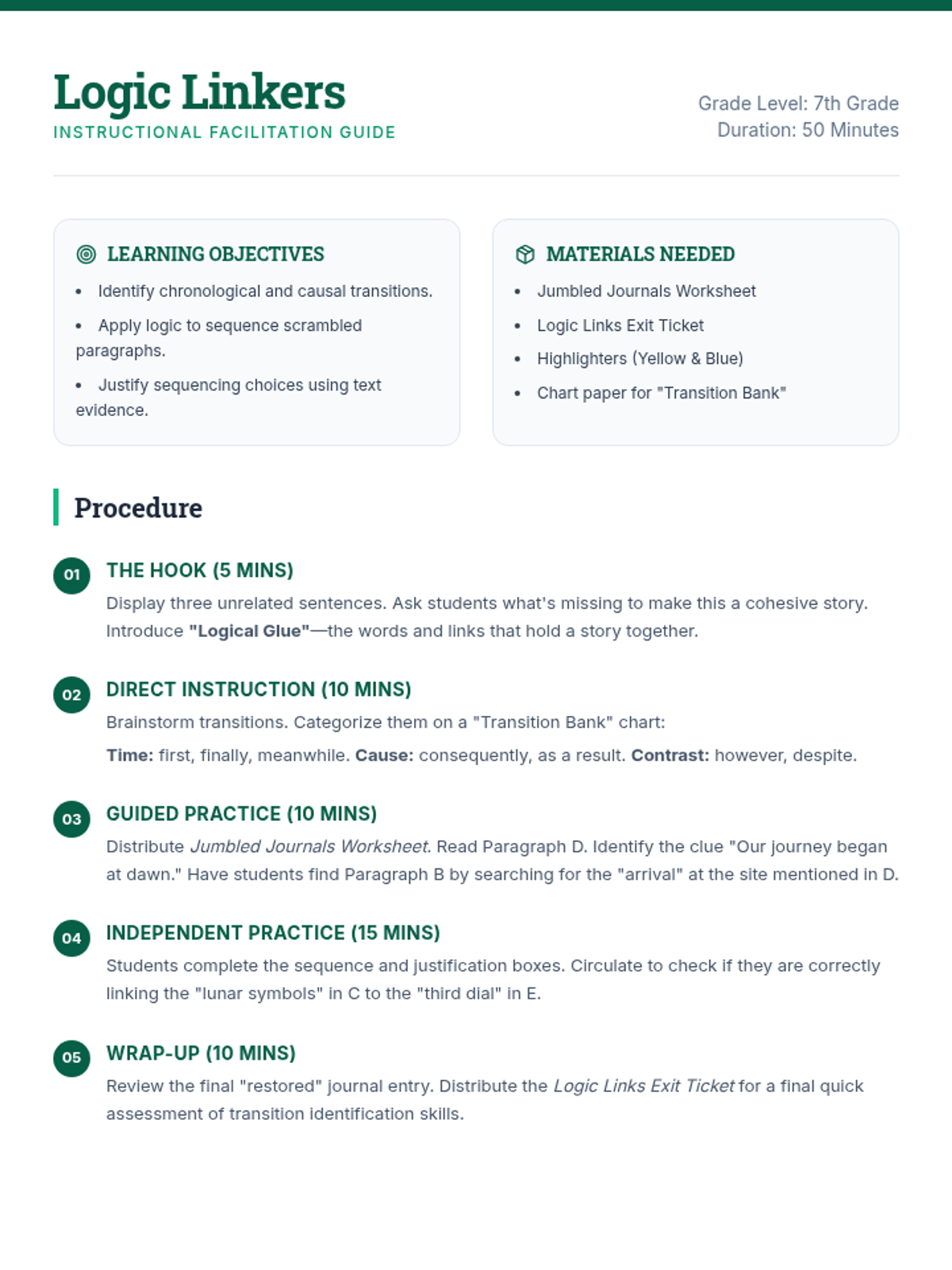
A comprehensive teacher-facing lesson plan for 'Logic Linkers', featuring learning objectives, a detailed 5-phase procedure, differentiation strategies, and common misconceptions.
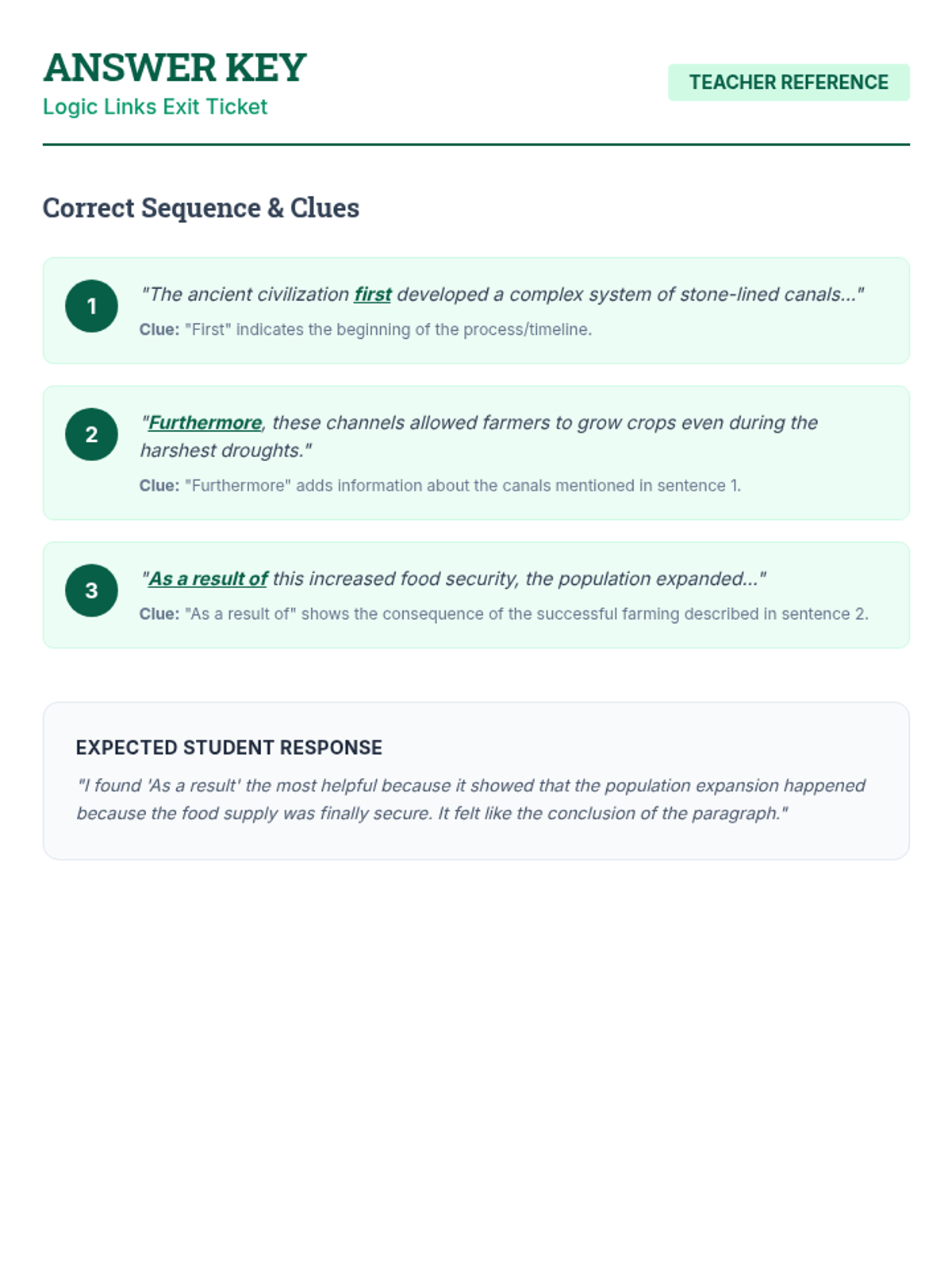
Answer key for the Logic Links Exit Ticket, highlighting the transition words 'first', 'furthermore', and 'as a result of' as sequencing clues.
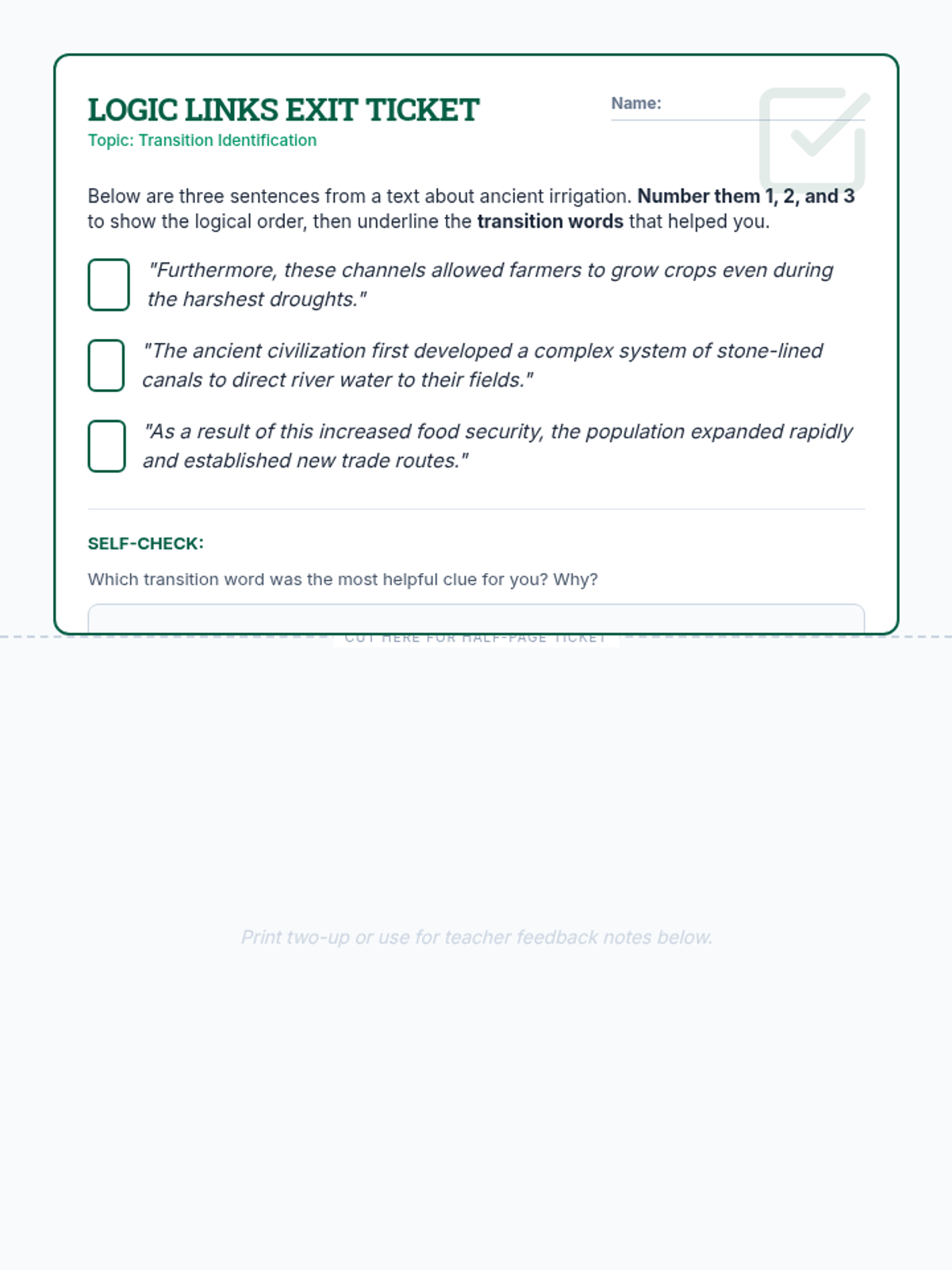
A short exit ticket where students sequence three sentences about ancient irrigation and identify transition words like 'furthermore' and 'as a result'. Includes a cut-line guide for efficient printing.
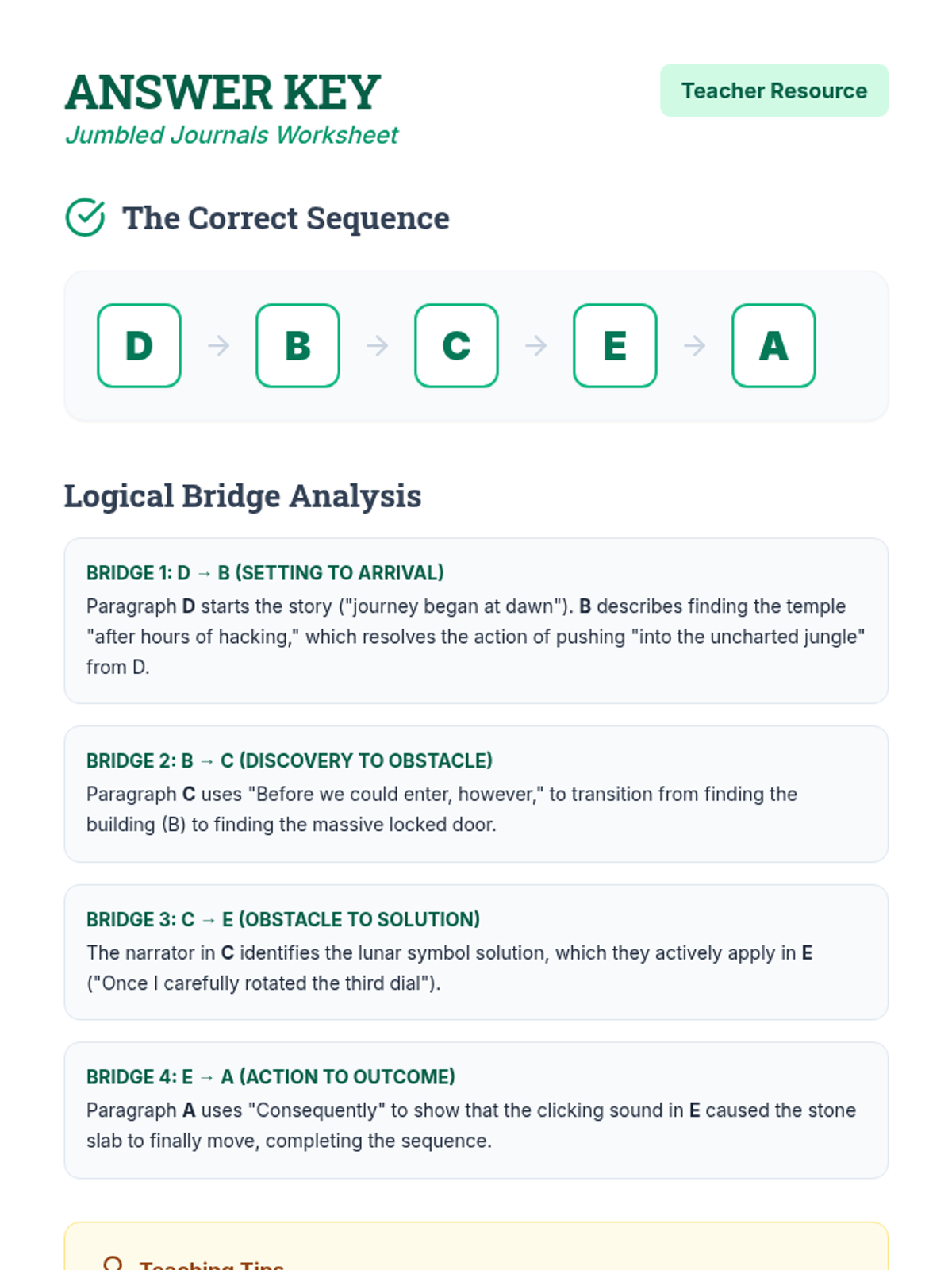
Detailed answer key for the Jumbled Journals worksheet, providing the correct sequence (D-B-C-E-A) and logical explanations for each connection.
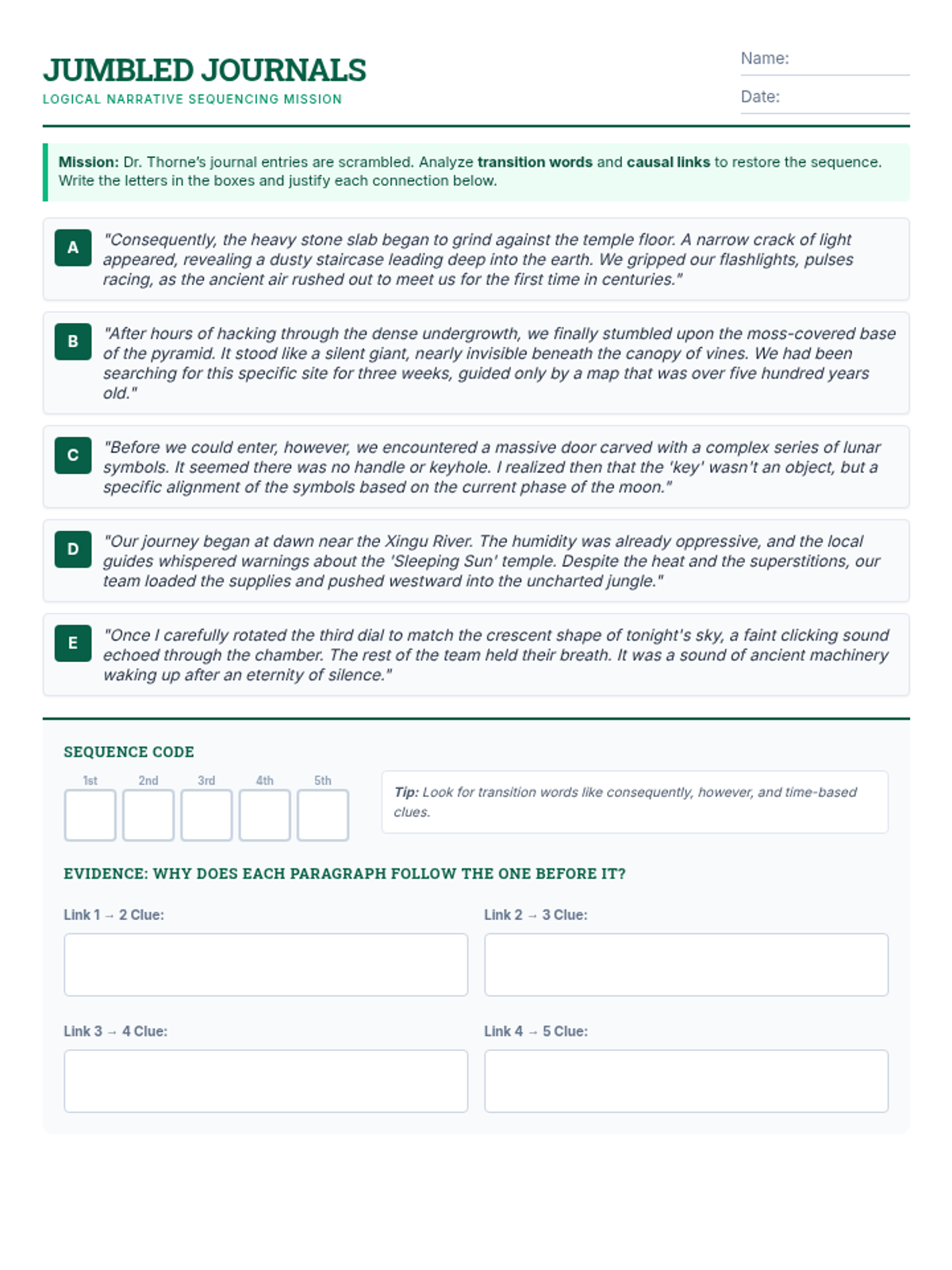
A worksheet where students must reorder five scrambled paragraphs from an explorer's journal by identifying transition words and logical narrative flow.
Slide deck for Lesson 4 focusing on drafting the conclusion, connecting to literary narratives, and preparing for final submission. Includes final assembly instructions and rubric audit drills.
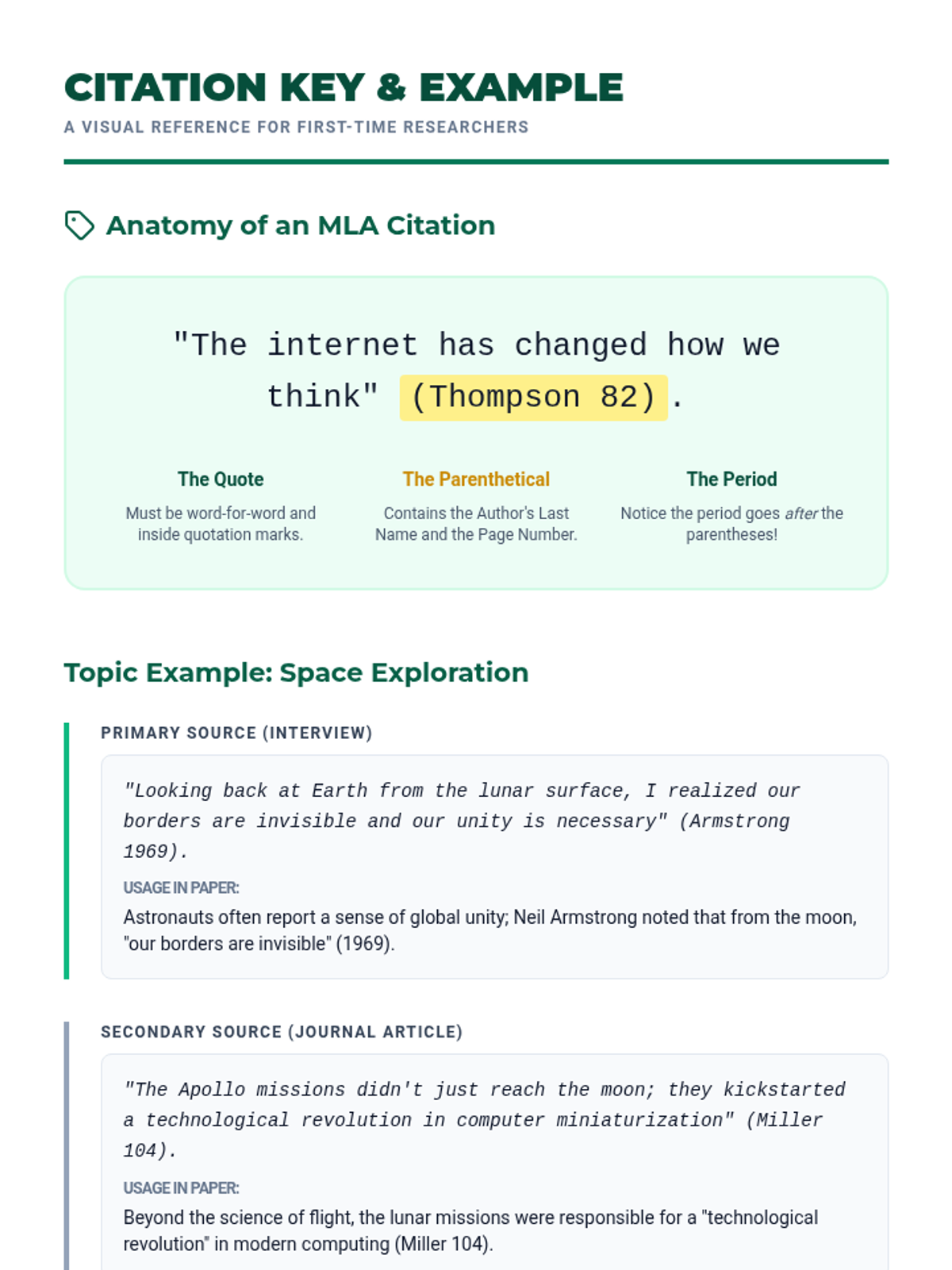
An accurate MLA citation reference sheet with visually rendered hanging indents and concrete examples of primary and secondary source integration.
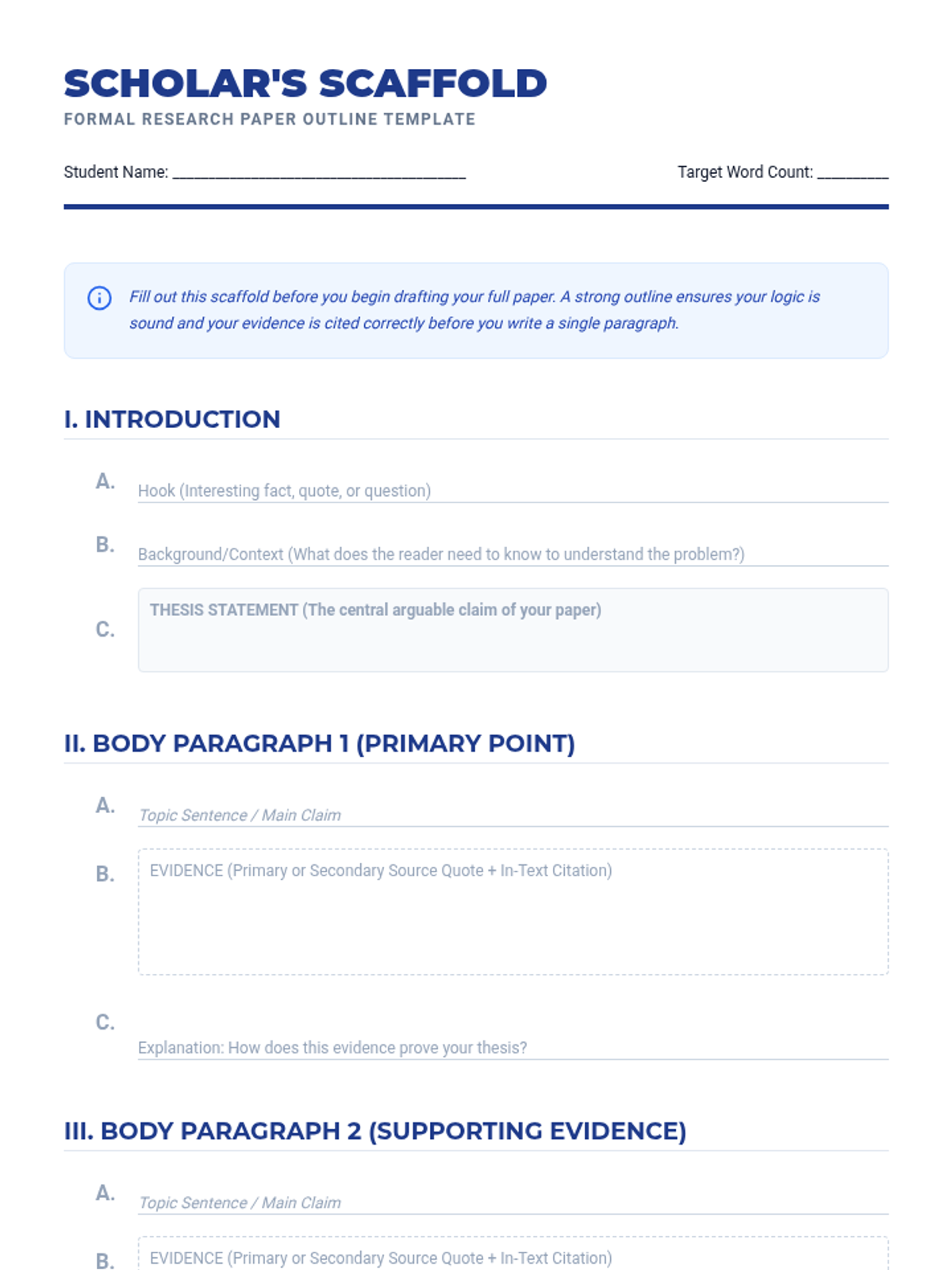
A structured outline template with enlarged writing areas and high-contrast labels to help students organize their first research paper.
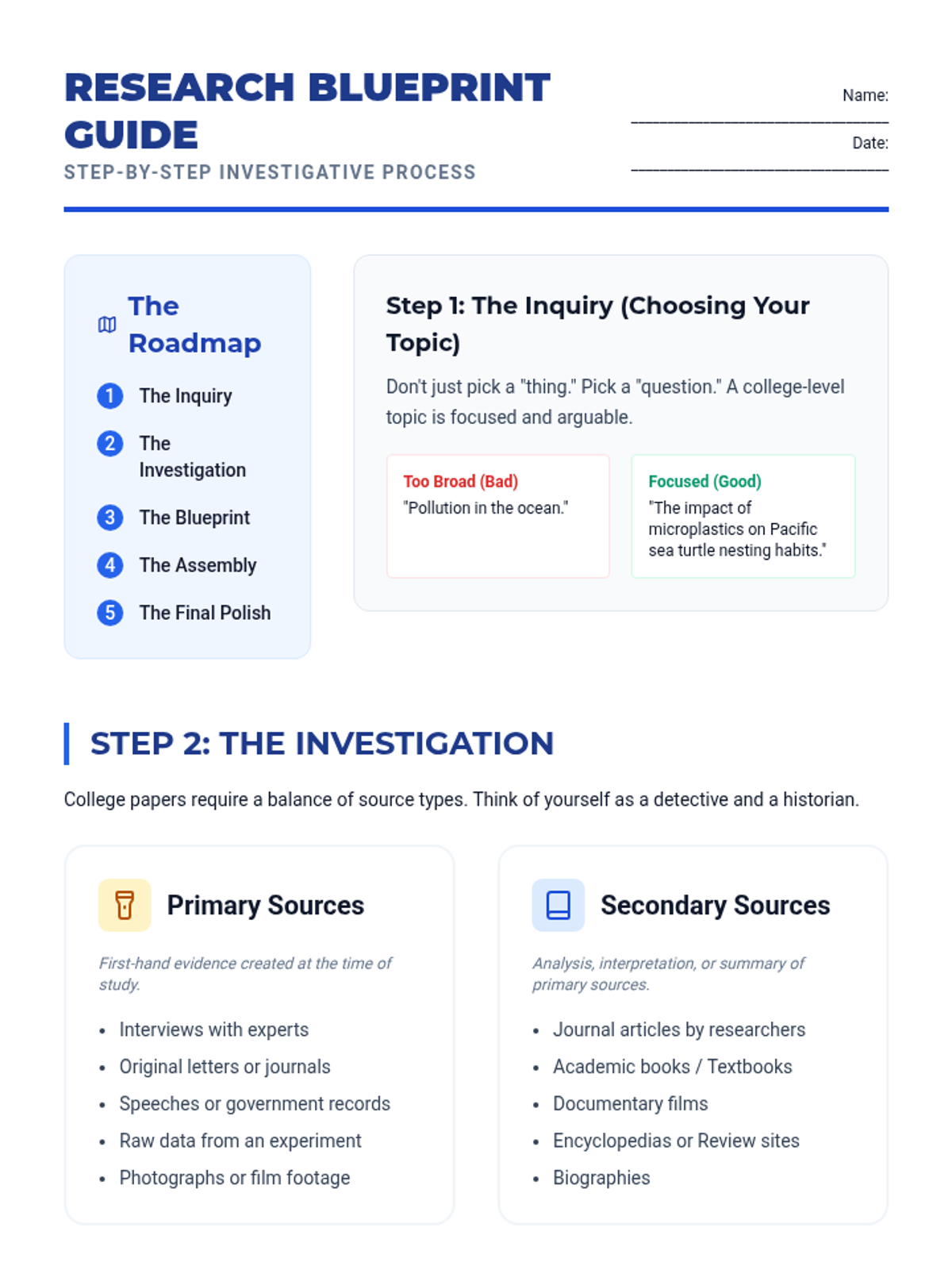
A step-by-step research guide for high school students including a concrete PEEL paragraph example and practice workspace.
A visual presentation guiding students through the core concepts of research writing, including source types, citation mechanics, and structural outlining with a worked example.
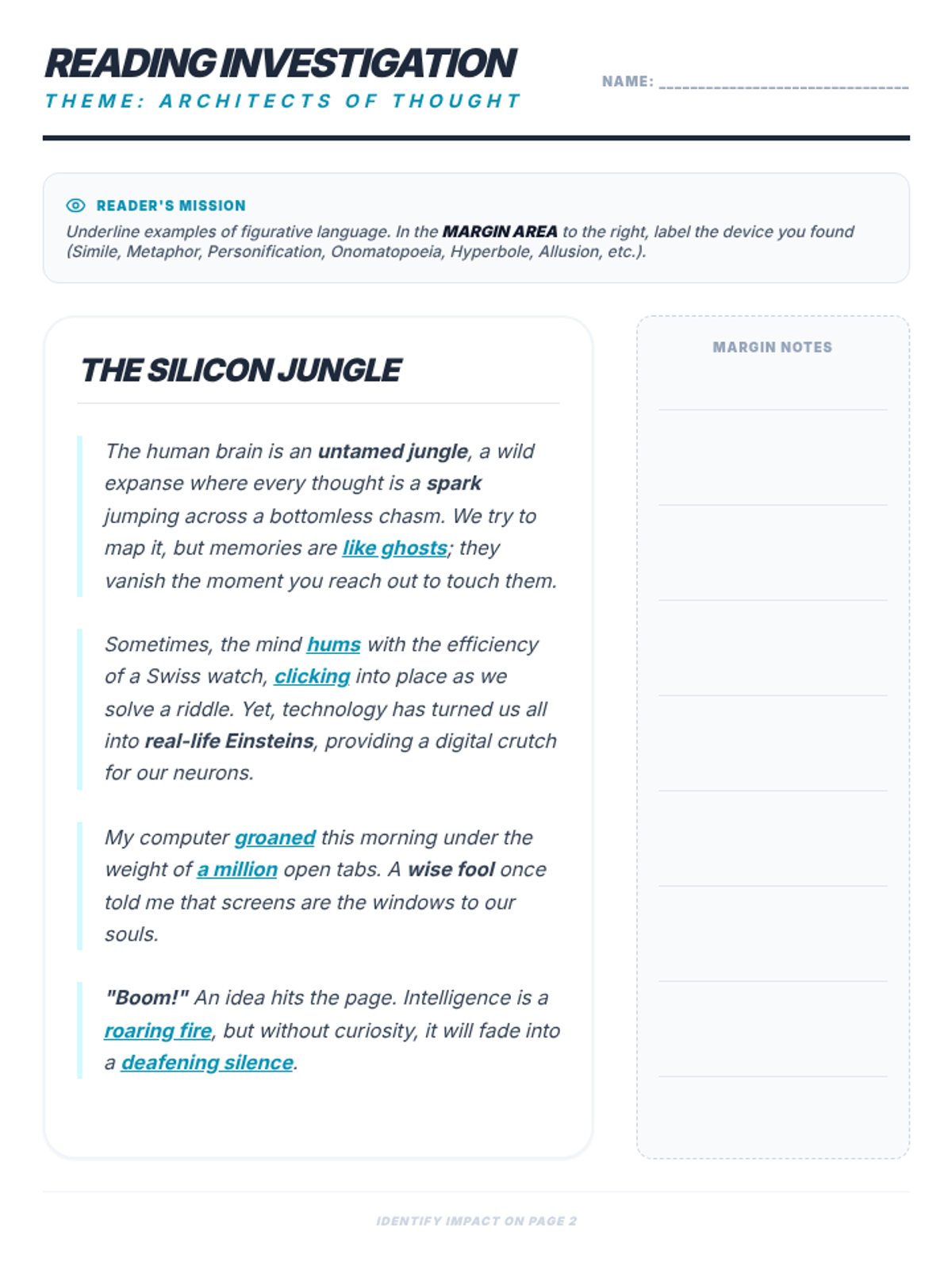
A two-page reading investigation document featuring an original thematic text "The Silicon Jungle" rich in figurative language. Includes a reader mission, identification chart, and a deep-analysis writing prompt. Updated for improved page breaks and workspace margins.
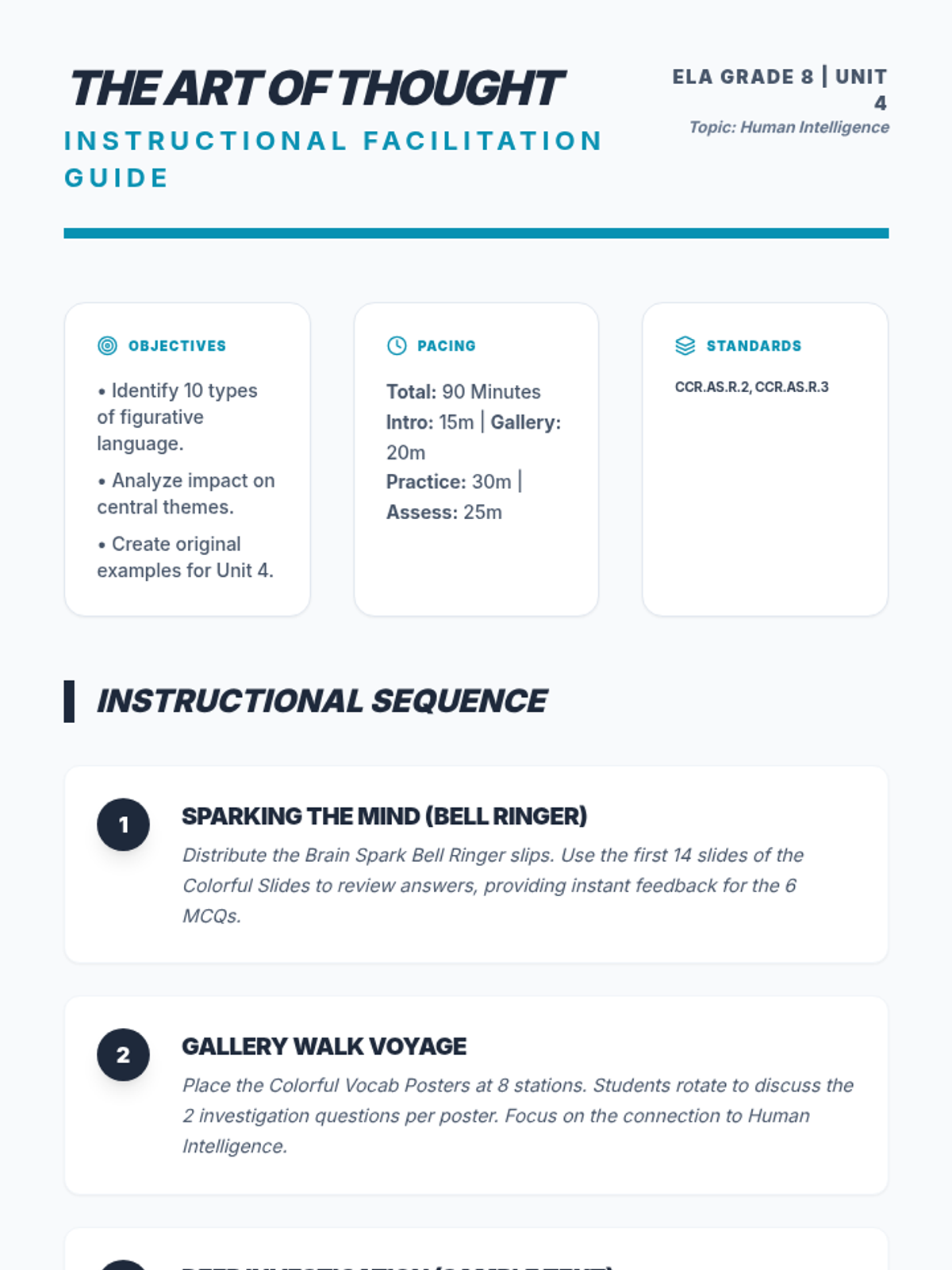
A comprehensive teacher facilitation guide for the "Art of Thought" lesson, including pacing, objectives, instructional flow, and integration tips for all lesson materials. Updated to include the Liora Vale case study application.
A set of 8 large-format gallery walk posters for figurative language. Each poster features a unique vibrant color theme (Purple, Pink, Green, Yellow, Red, Blue, Orange, Indigo), key terms, definitions, examples, and investigation questions for student reflection.
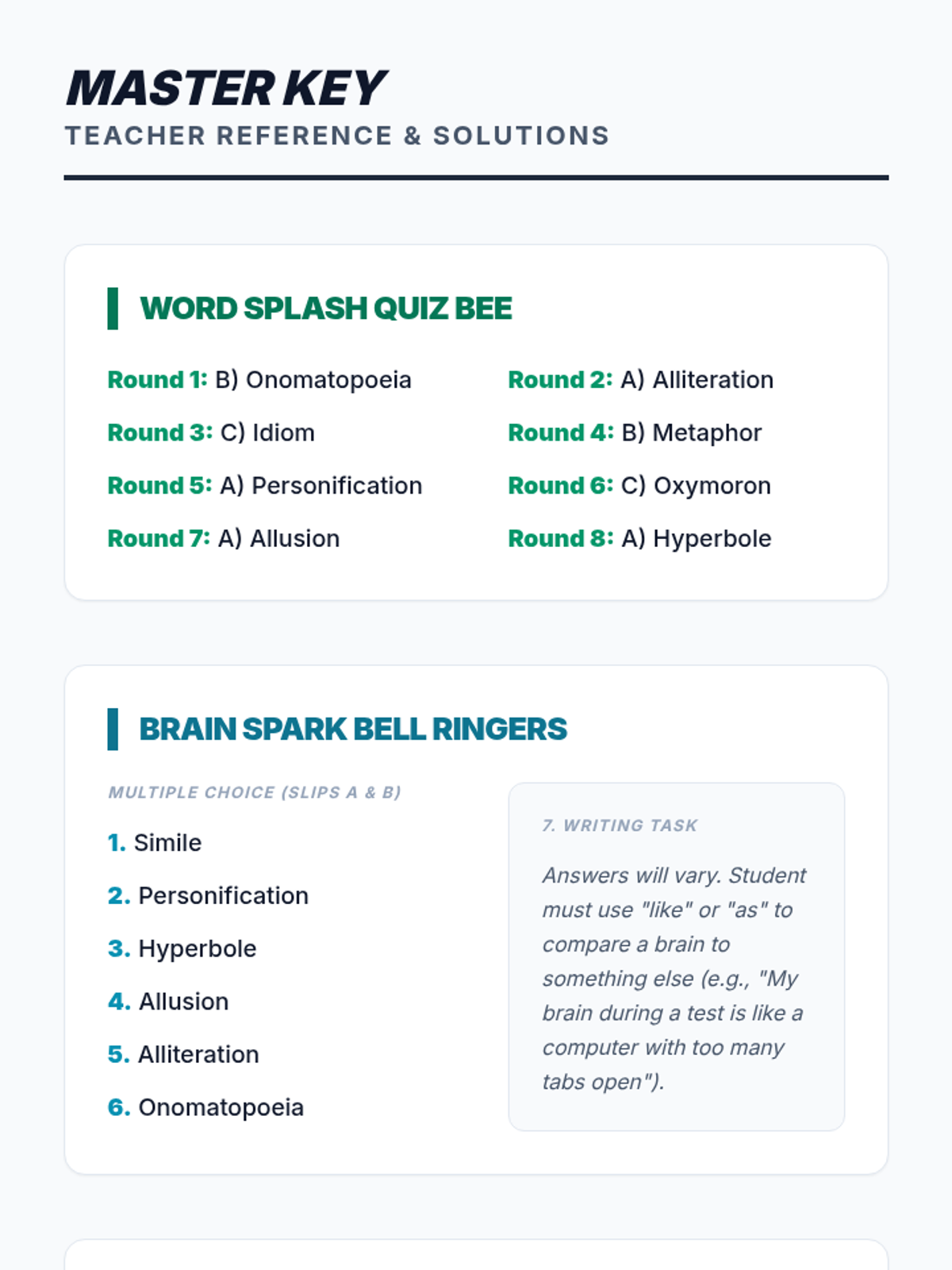
A comprehensive teacher's answer key for the bell ringers, formative quiz, task cards, the Word Splash Quiz Bee, and the Reading Investigation. Includes specific quote analysis and exemplar analysis responses. Updated to include the Liora Vale case study application.
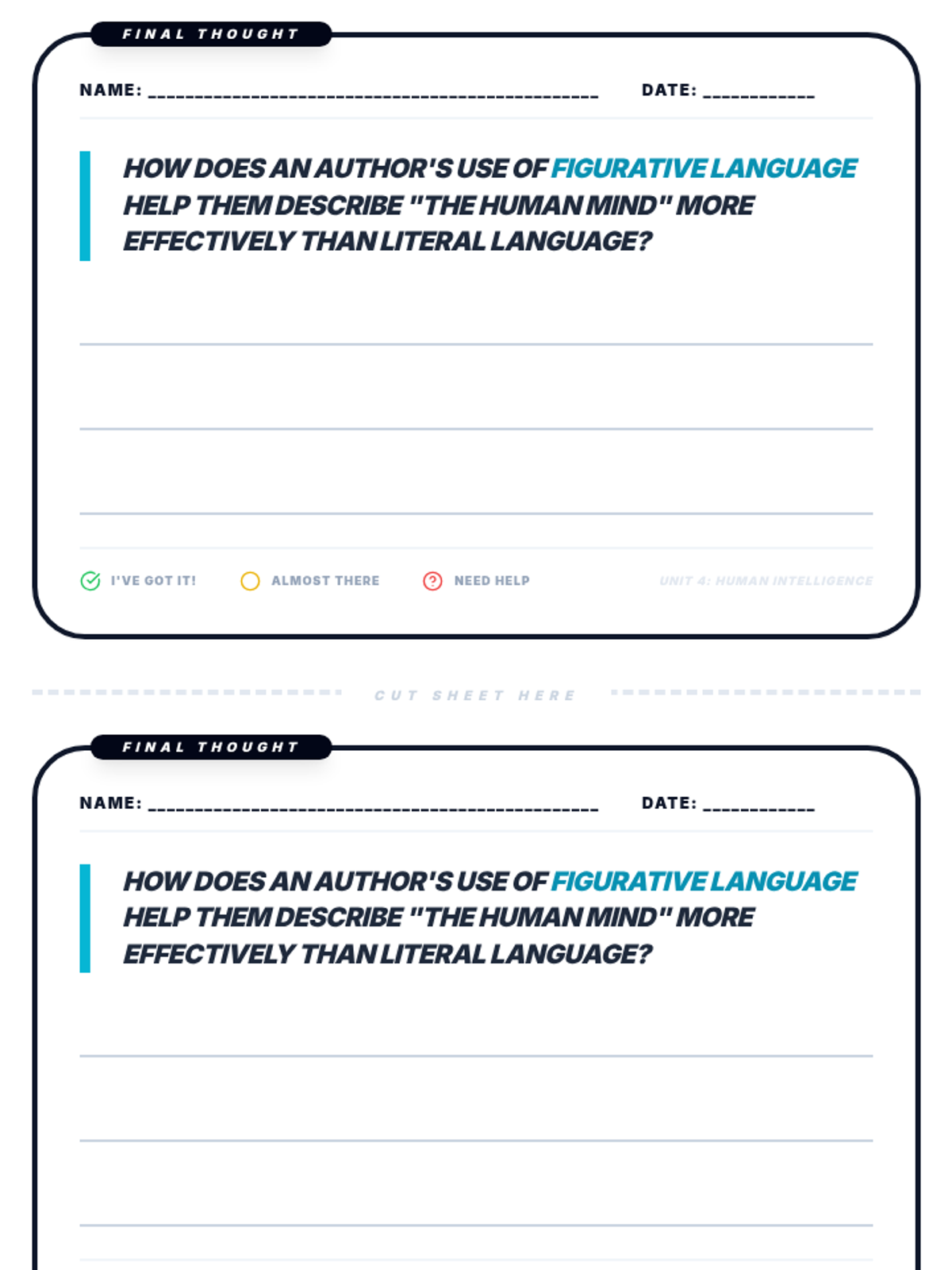
A cutout sheet with 2 large exit ticket slips, asking students to reflect on why figurative language is more effective than literal language for describing complex topics like the human mind. Revised for improved page layout and contrast.
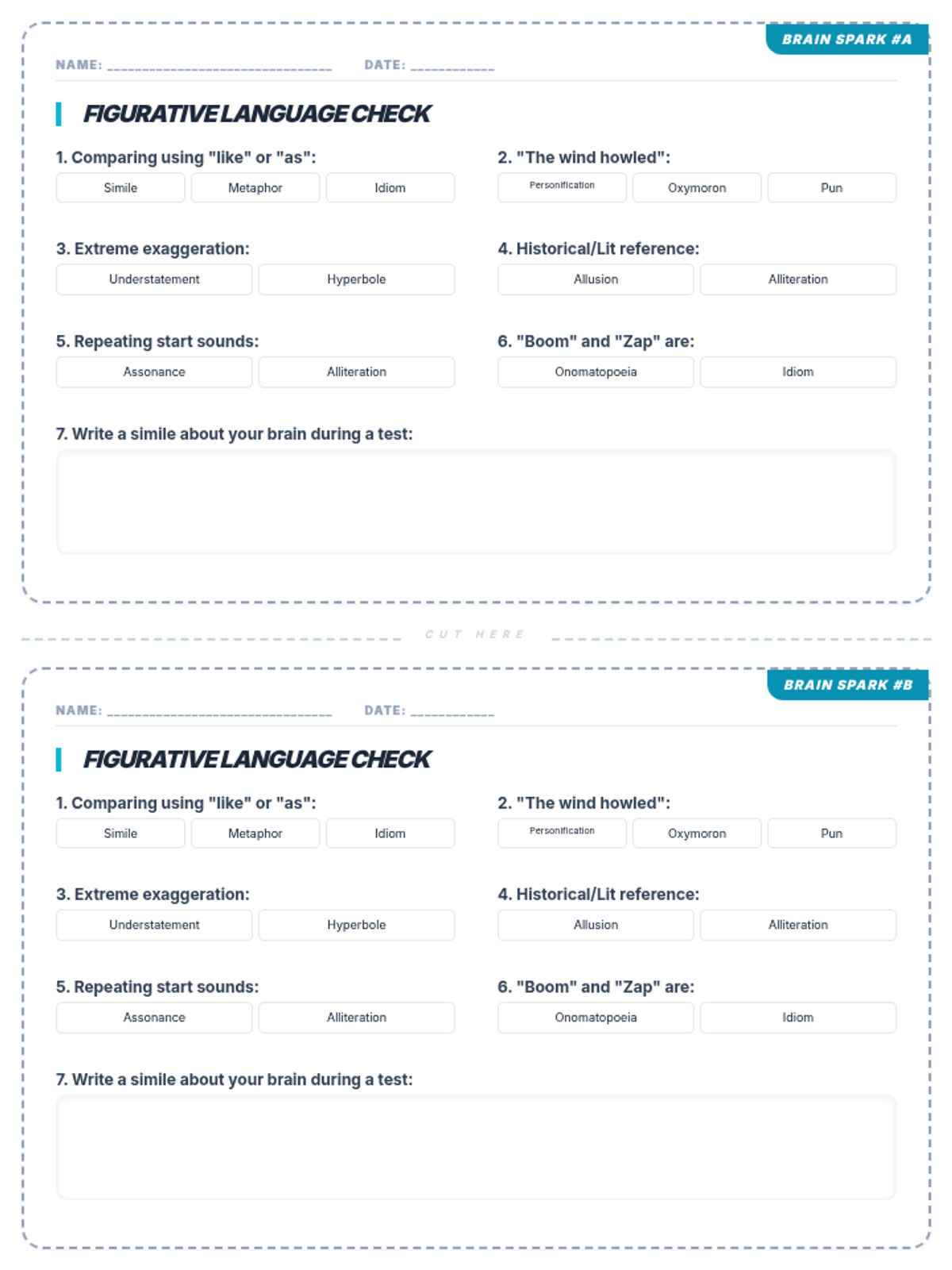
A bell ringer cutout sheet featuring two large, half-page slips. Each slip contains 6 multiple-choice questions and one creative writing prompt focused on figurative language and human intelligence. Updated for layout and content completeness.
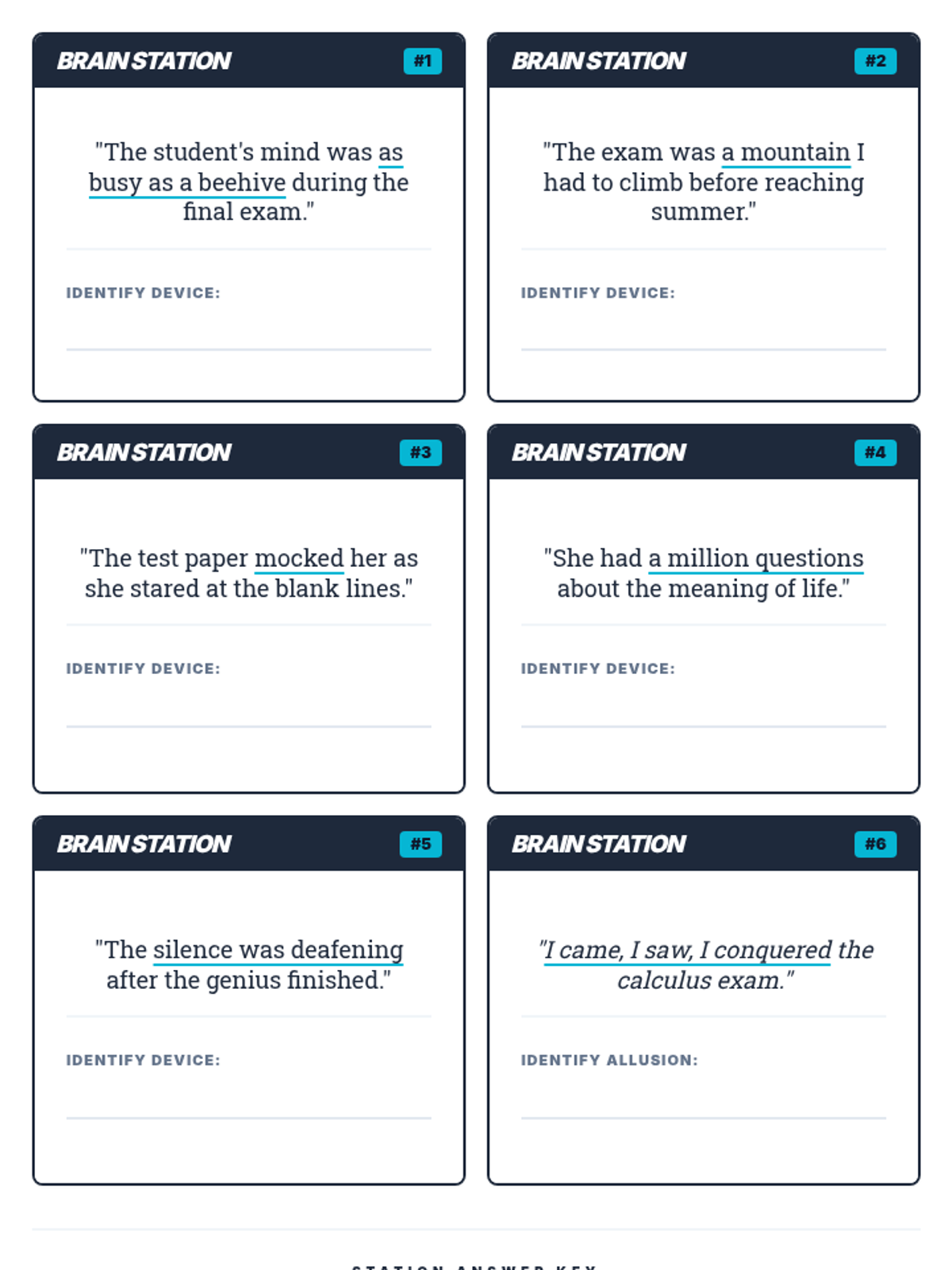
Six interactive station task cards featuring figurative language examples focused on themes of learning, exams, and intelligence. Updated with clearer examples and student response areas.
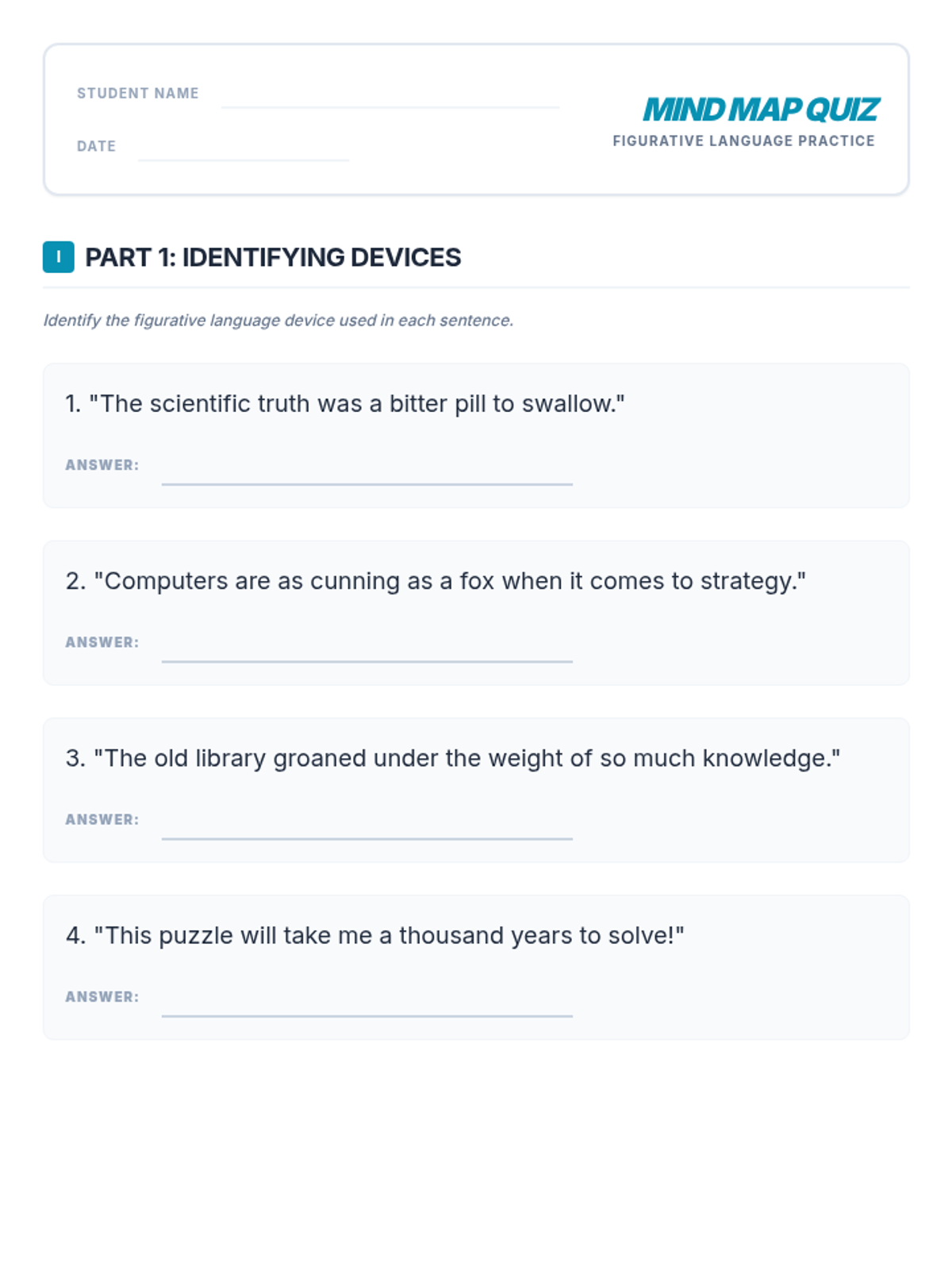
A formative quiz worksheet focusing on the identification, analysis, and creation of figurative language within themed passages about intelligence and technology. Updated for improved page breaks and writing space.
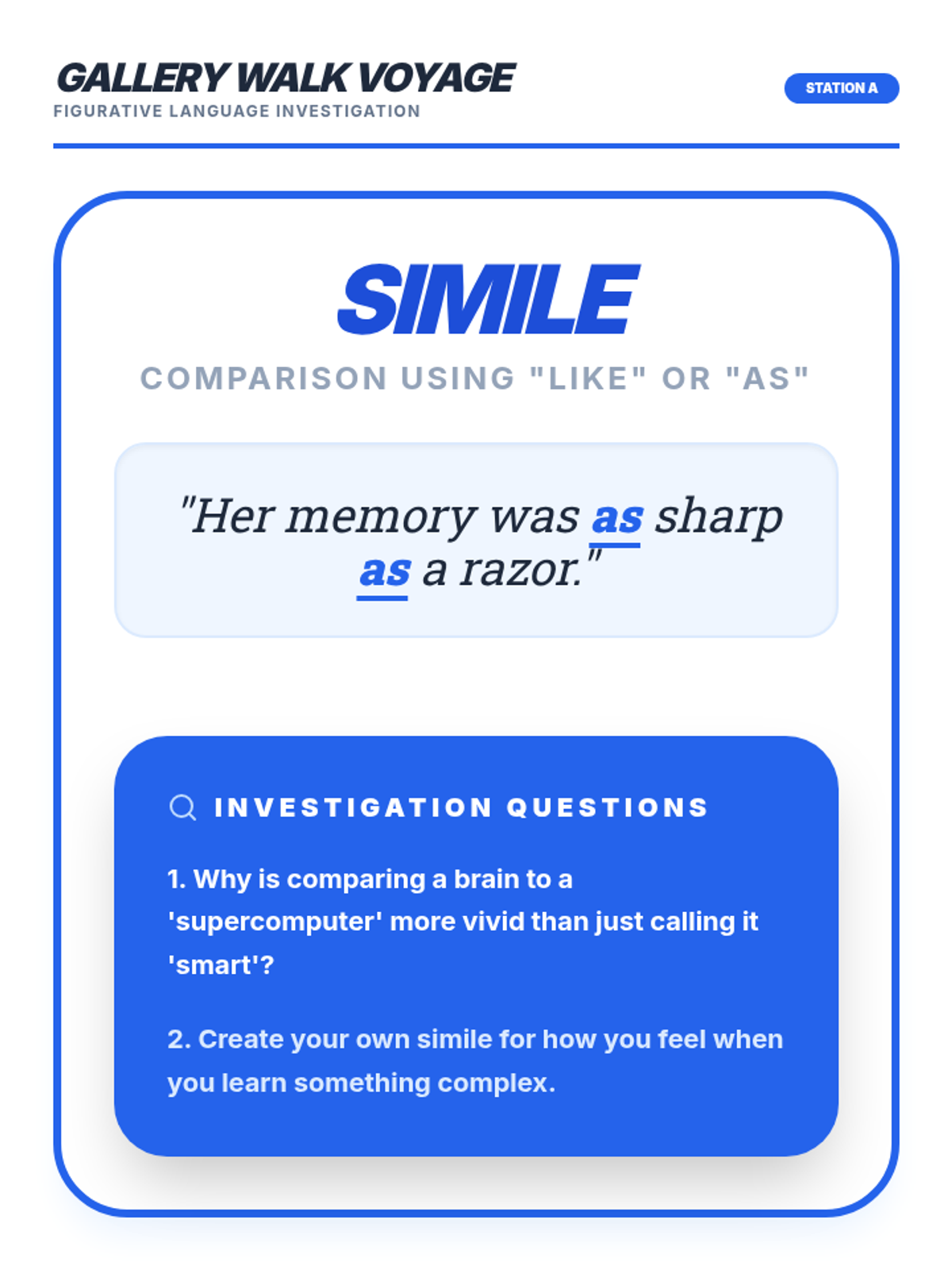
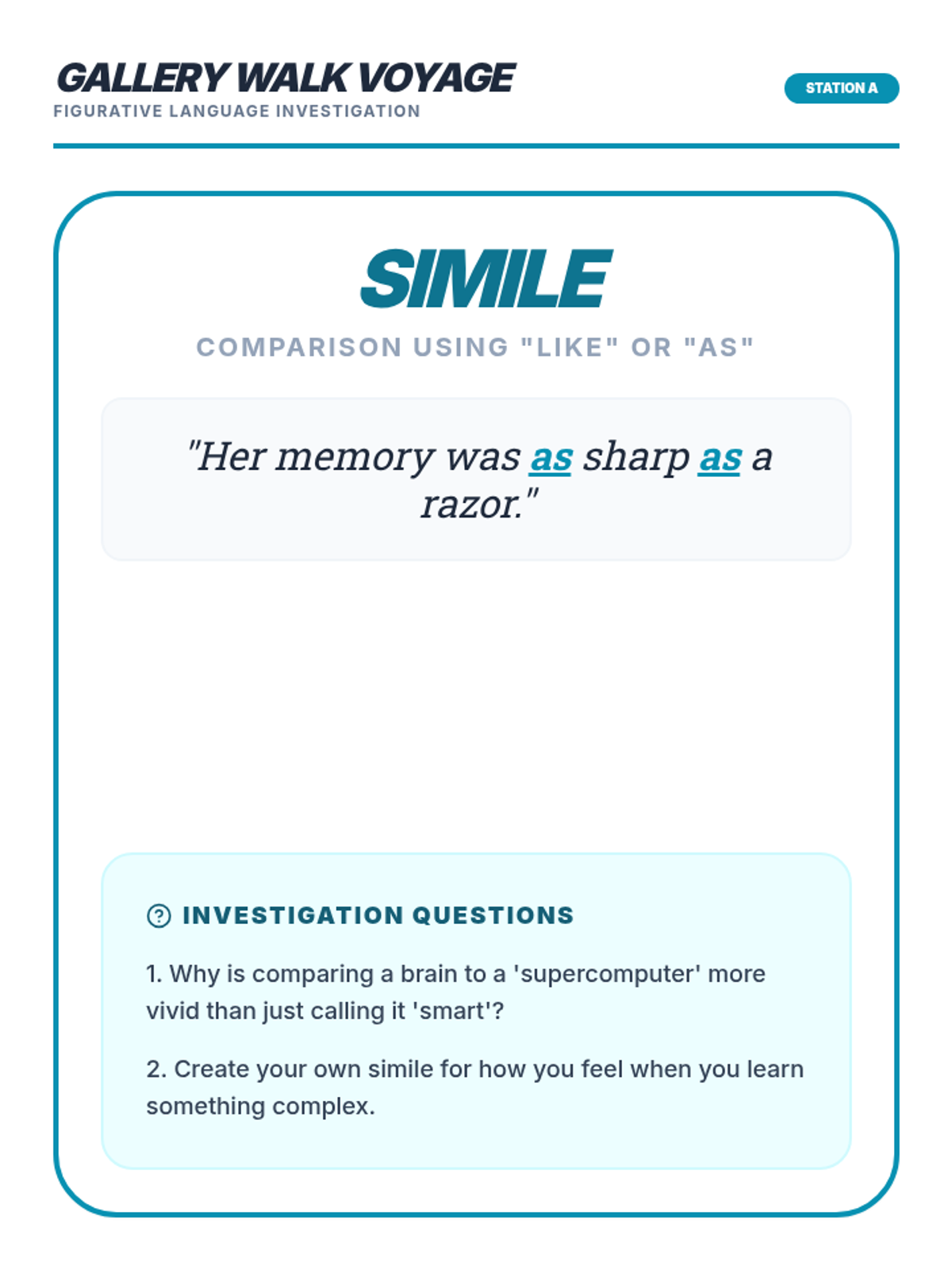
A set of 8 large-format gallery walk posters for figurative language. Each poster features a key term, definition, example, and two investigation questions for student reflection during the walk. Updated for better visibility and layout.
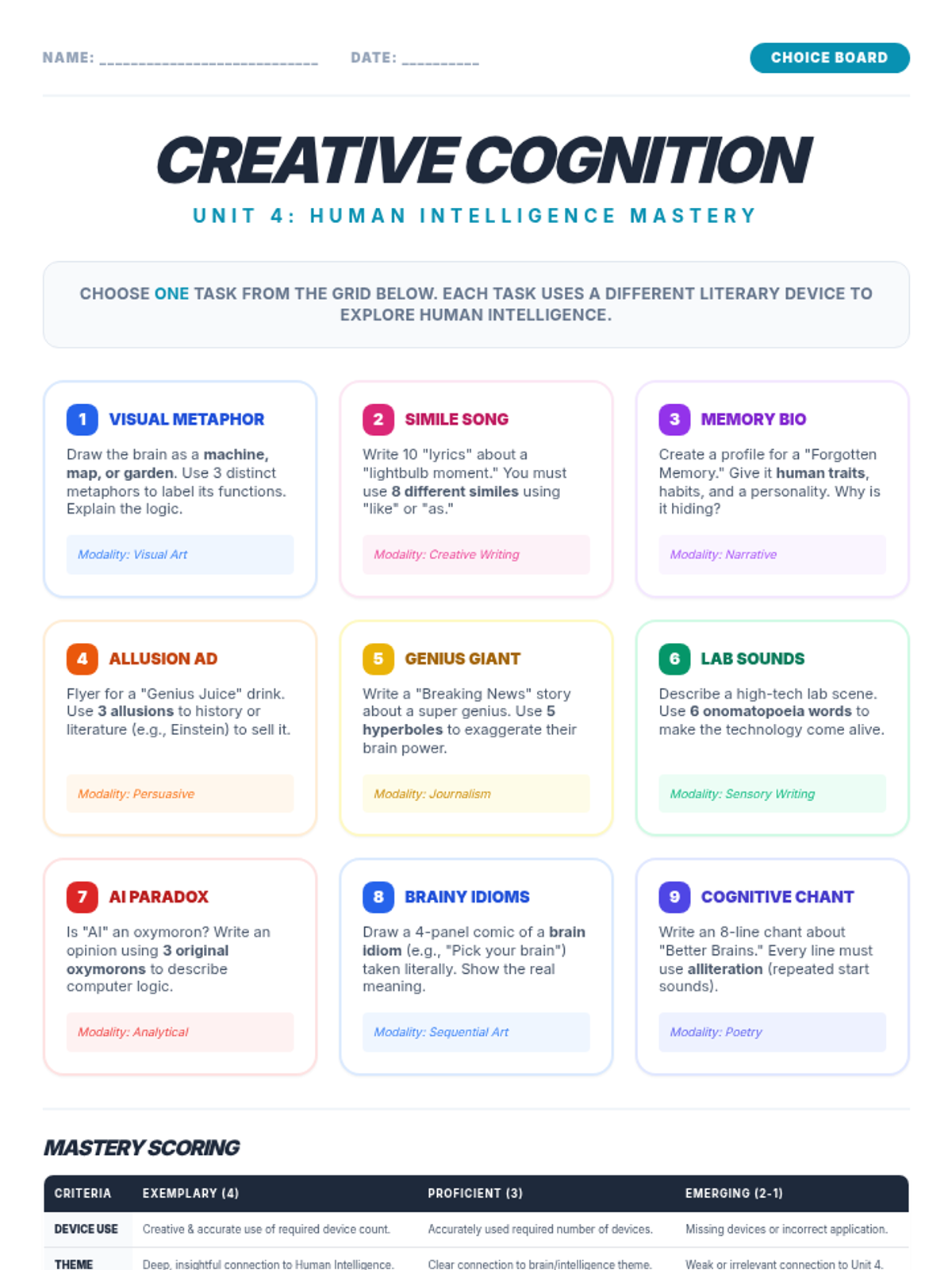
An expanded 3x3 choice board covering 9 different figurative language devices with differentiated tasks ranging from visual art to analytical writing. Includes an integrated rubric and dedicated workspaces for visual and written components.
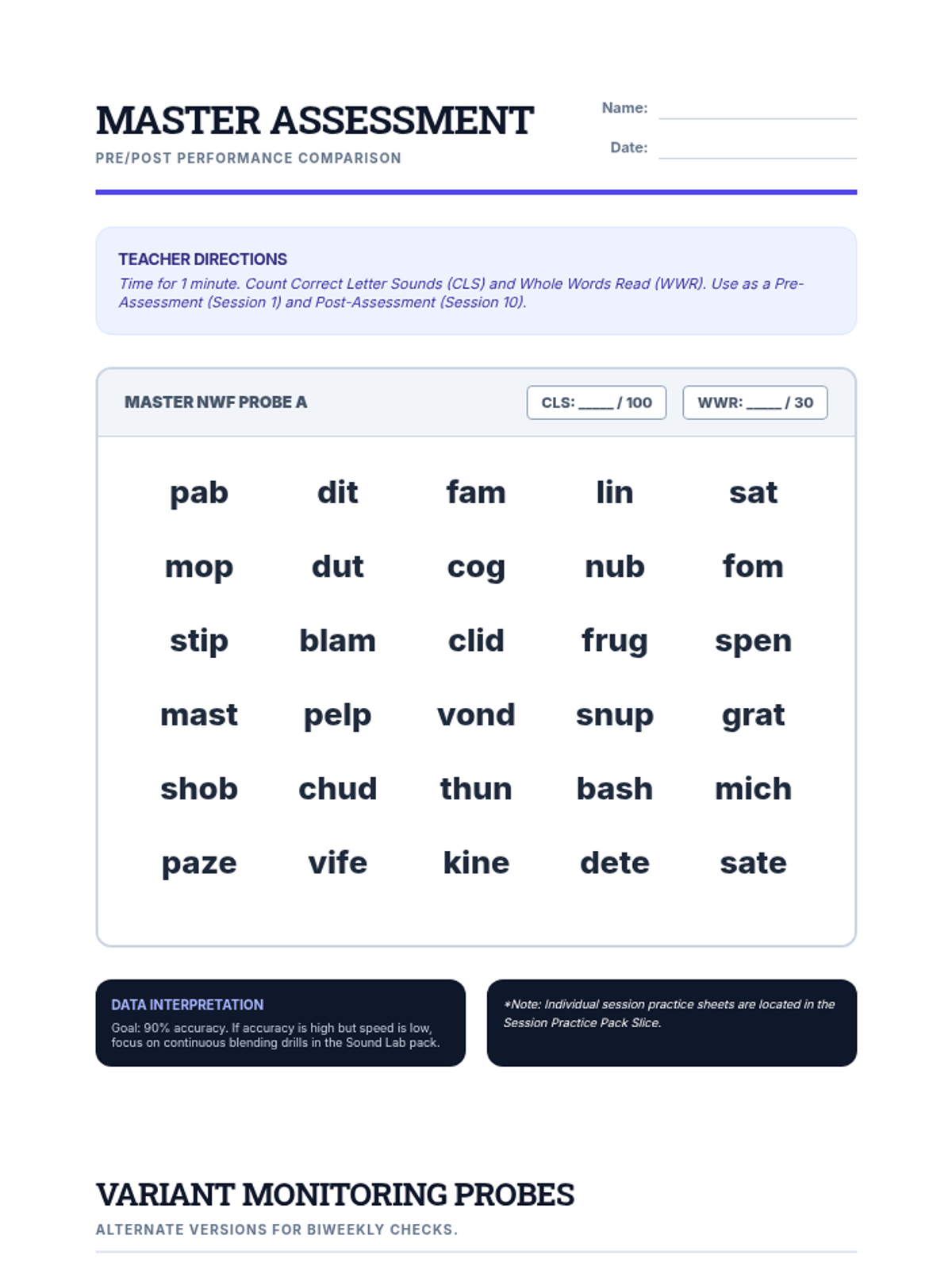
A comprehensive assessment pack including a Master Pre/Post probe and alternate mid-cycle probes, combining all phonics patterns (CVC, Blends, Digraphs, Magic E) with a robust 5-column layout for timed NWF assessments.
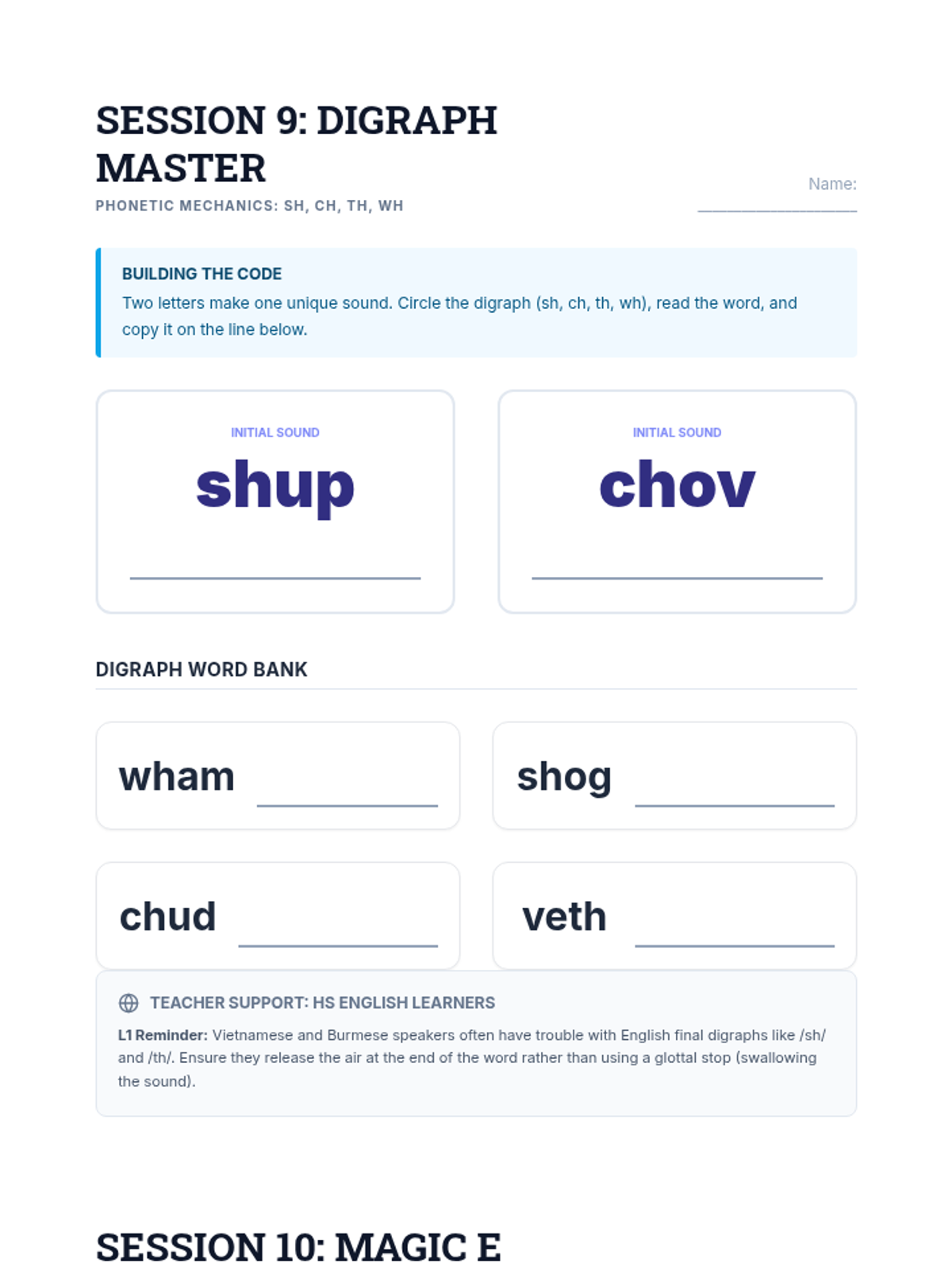
Extension practice and monitoring pages for Session 9 (Digraphs) and Session 10 (Magic E), featuring improved contrast, wider student work lines, and targeted teacher tips for EL support.
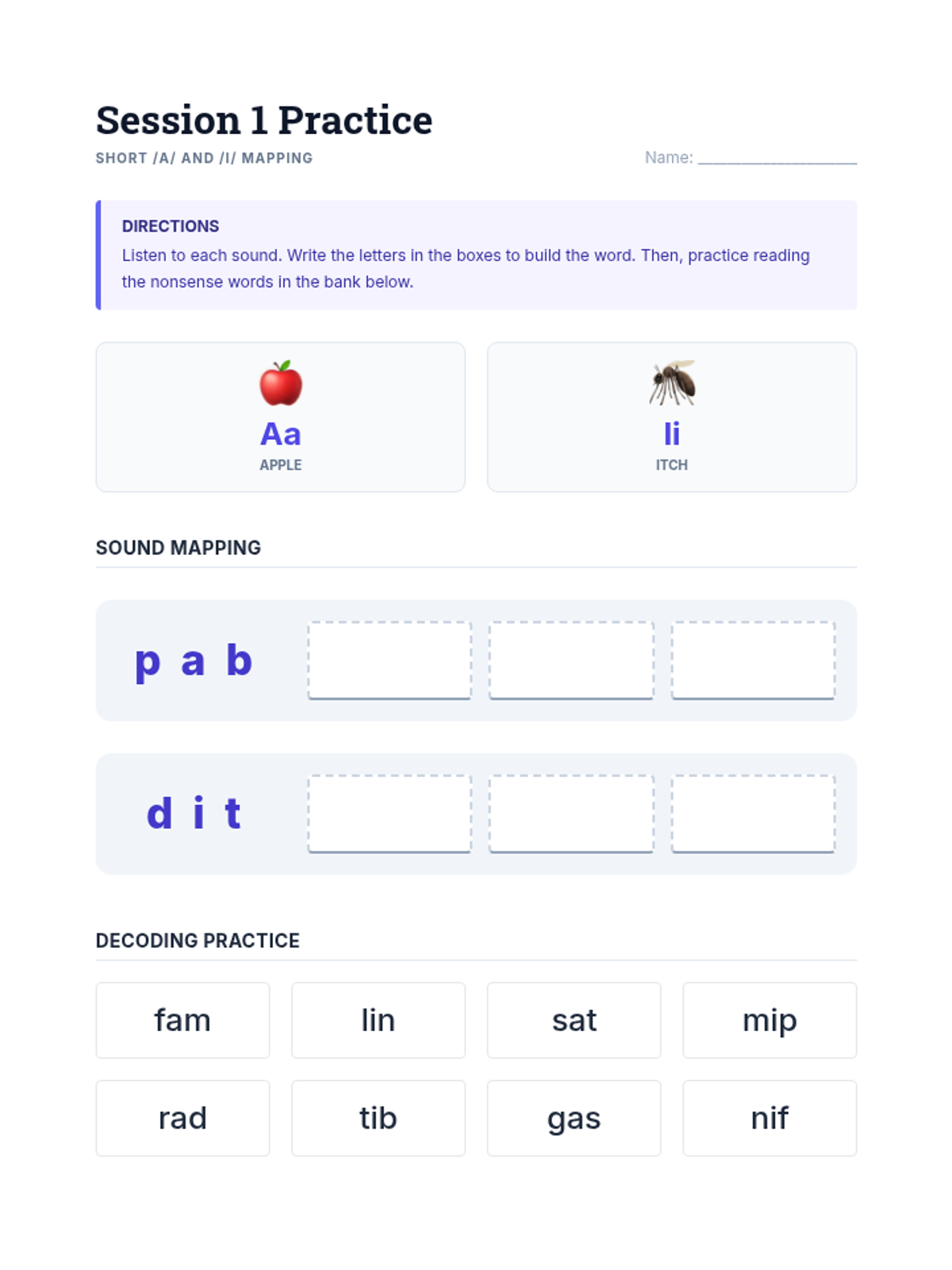
A comprehensive 10-page practice pack for high school ELs, providing dedicated nonsense word mapping, decoding, and fluency activities with clear student directions for every session. Includes visual vowel anchors and improved work areas.
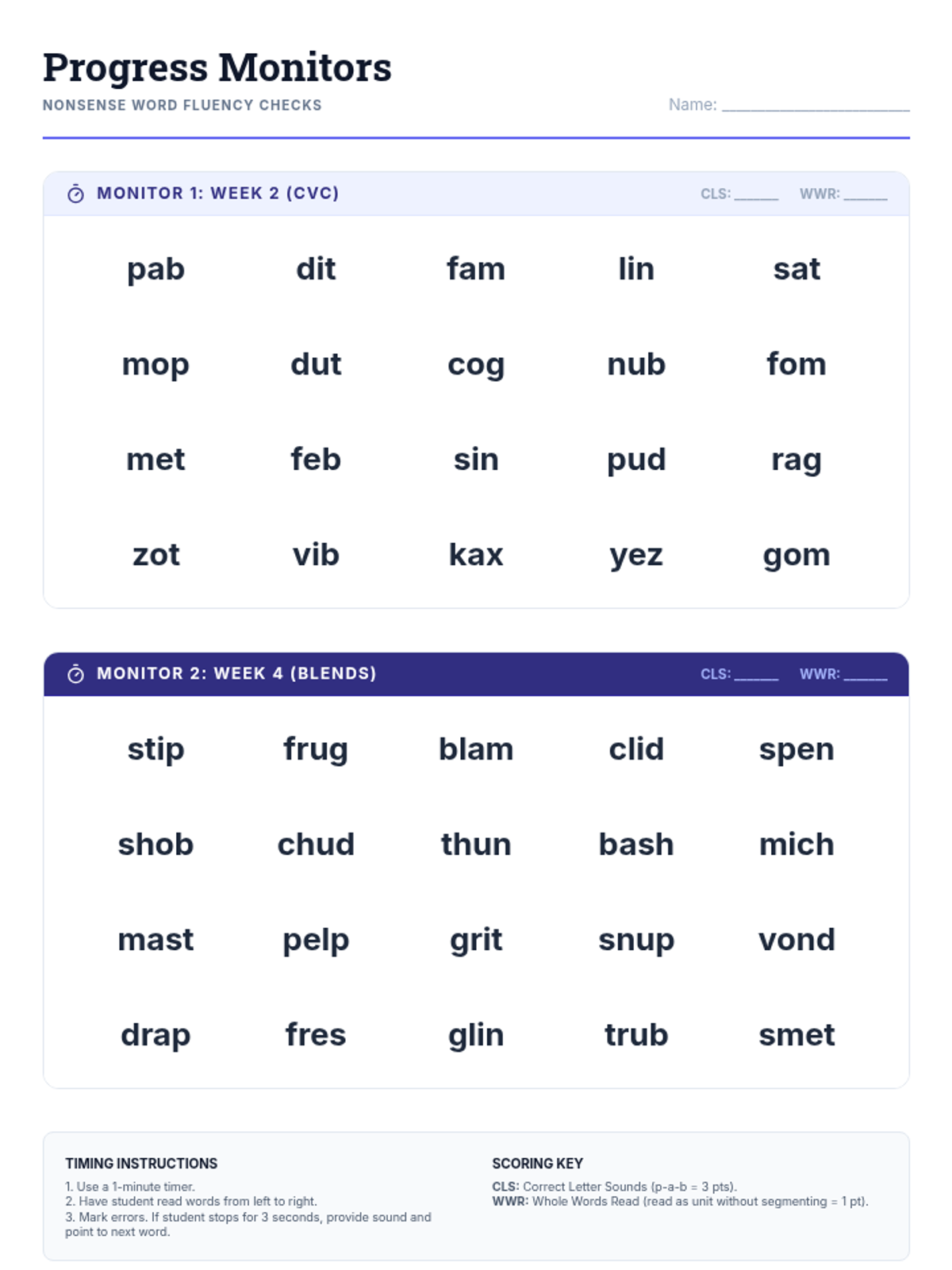
A dedicated student-facing material for biweekly progress monitoring of nonsense word fluency, featuring focused word lists for Week 2 and Week 4 assessments on a single page.
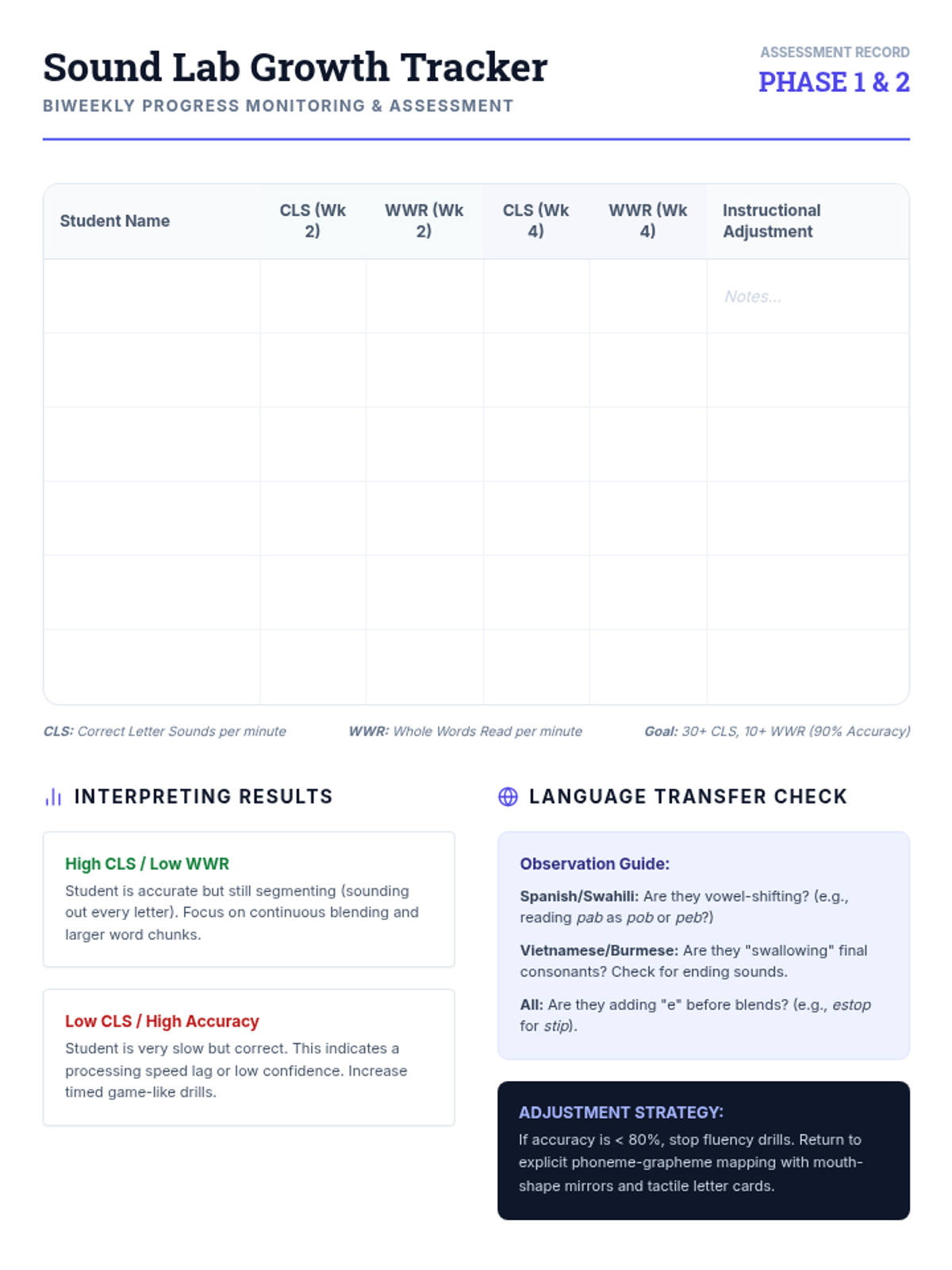
A biweekly progress monitoring and data tracking sheet for nonsense word fluency, including interpretation guides for instructional adjustments.
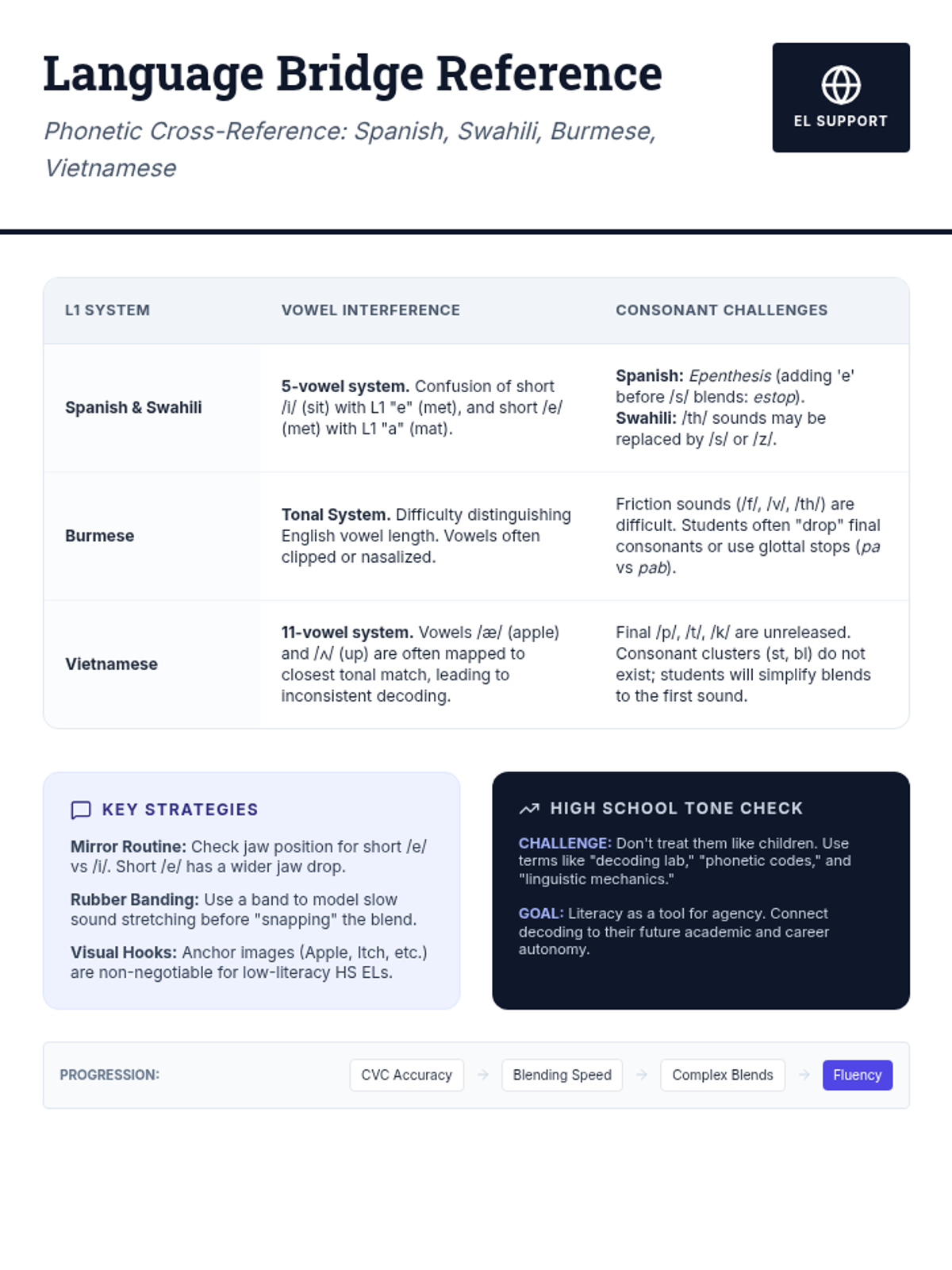
A consolidated one-page cross-reference sheet identifying phonetic challenges for speakers of Spanish, Swahili, Burmese, and Vietnamese.
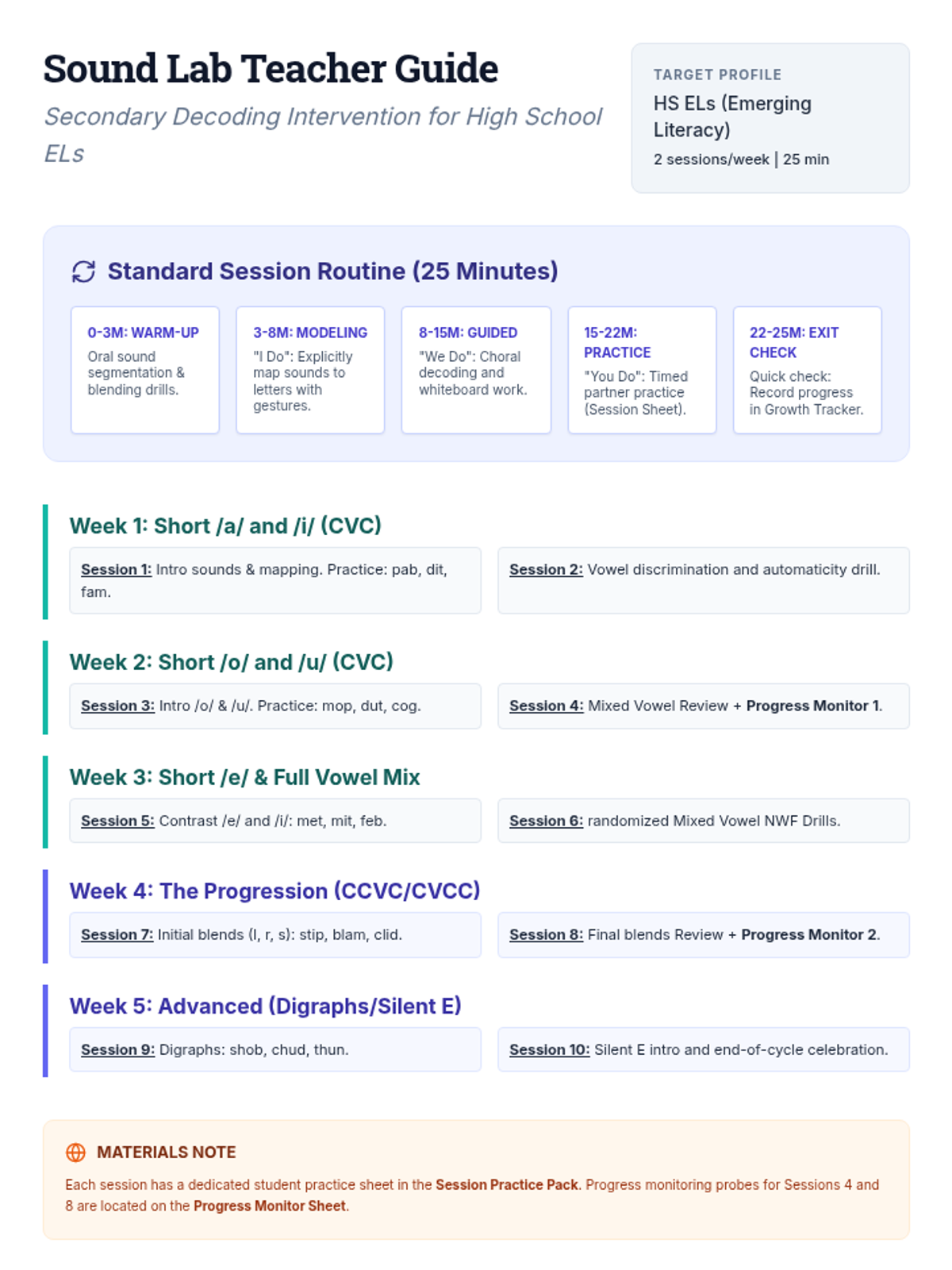
A concise 5-week teacher-facing intervention guide for high school ELs, detailing session routines and weekly objectives.
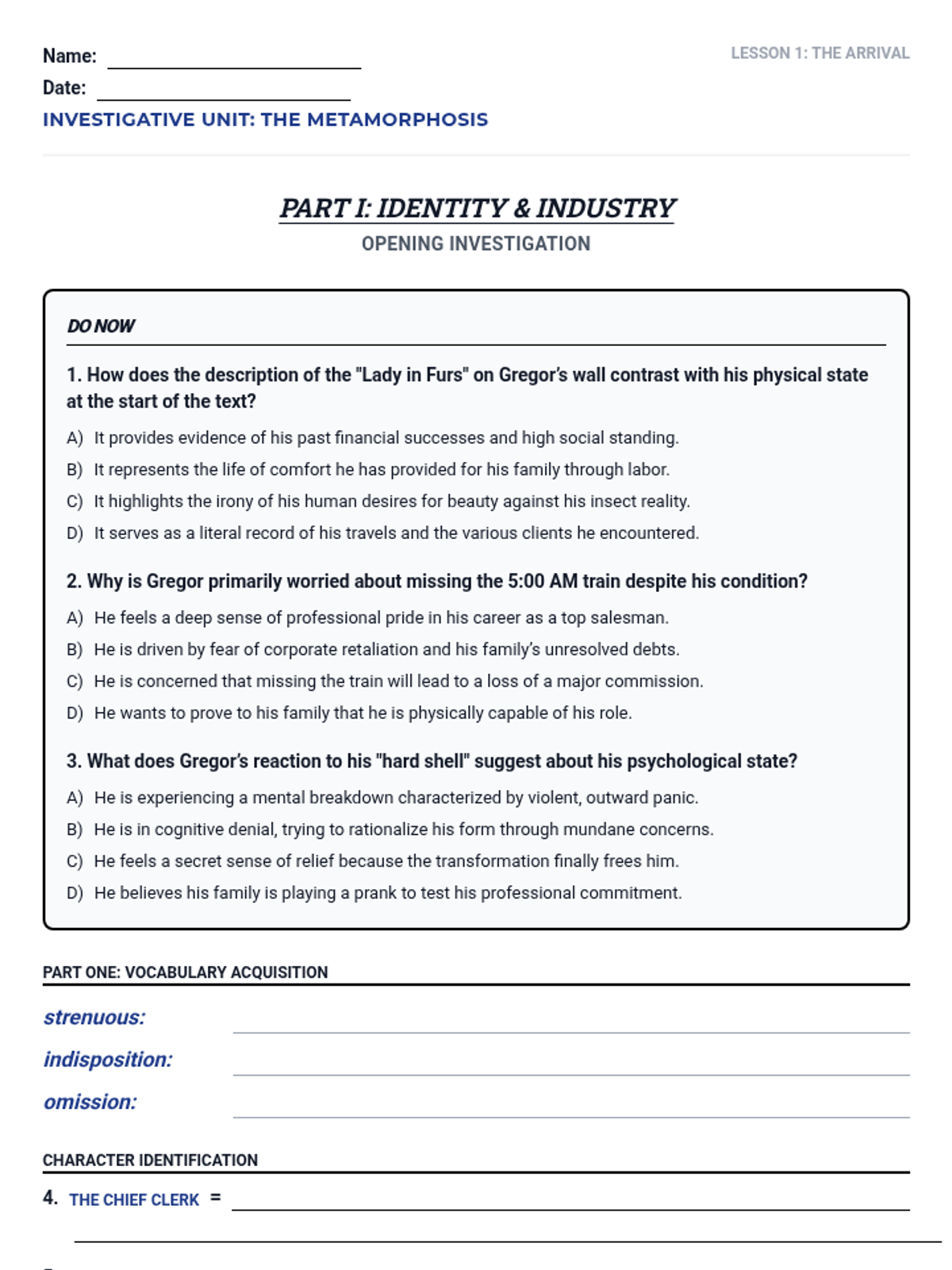
Middle-grade student worksheet for Lesson 1 updated with Bernofsky-specific terminology (General Manager, monstrous insect, carapace). Vocabulary section updated to include monstrous, melancholy, and indisposition. Removed references to "Chief Clerk" and "vermin" to ensure strict alignment with the provided text edition.
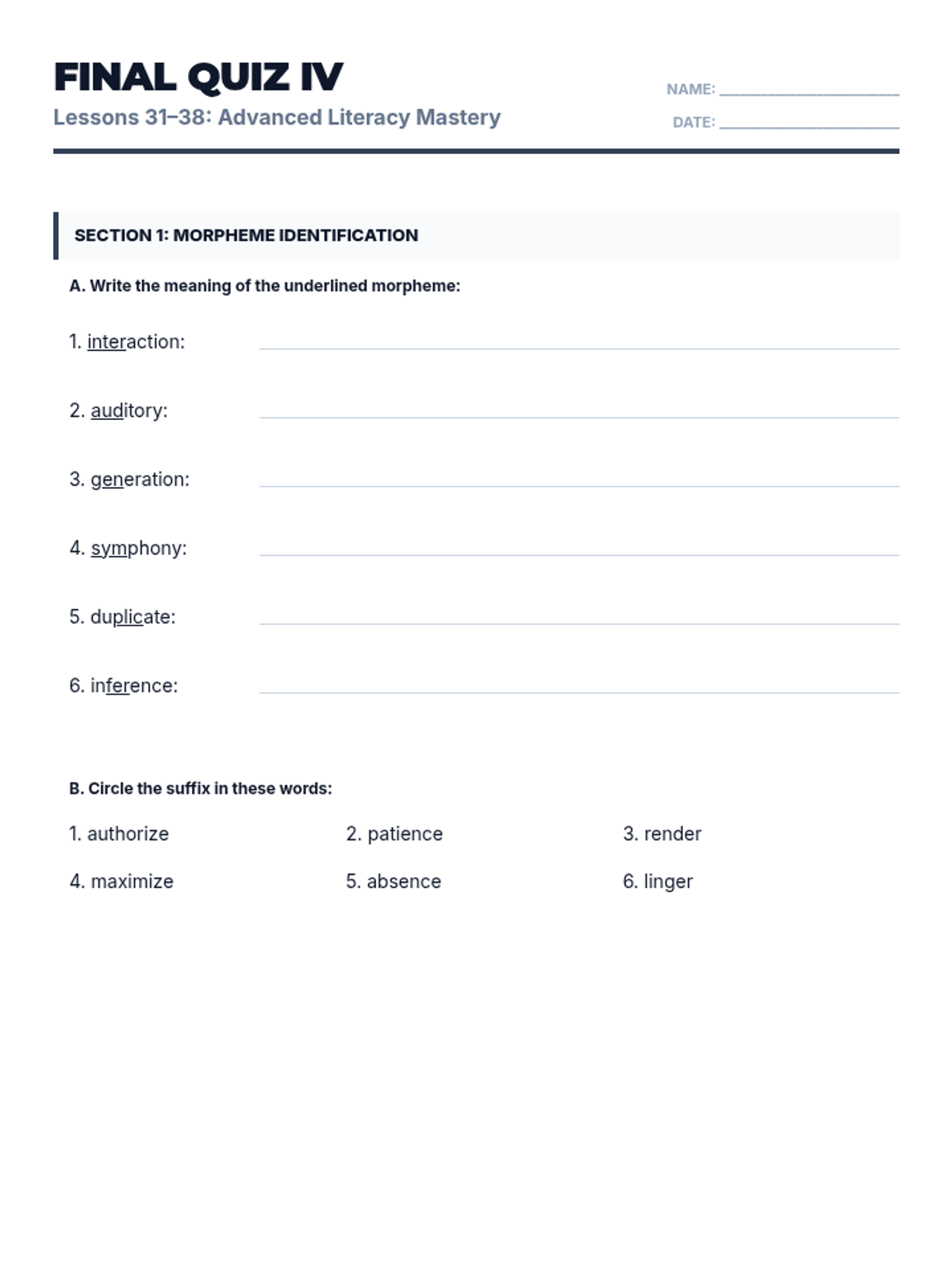
A final formal 4-page assessment for the Reading Power Pack, covering all morphology and complex vowel skills from Lessons 31-38. Includes morpheme meaning identification, academic vocabulary application, multisyllabic decoding challenge, and critical synthesis short-answer questions. Designed for high school TESOL students.
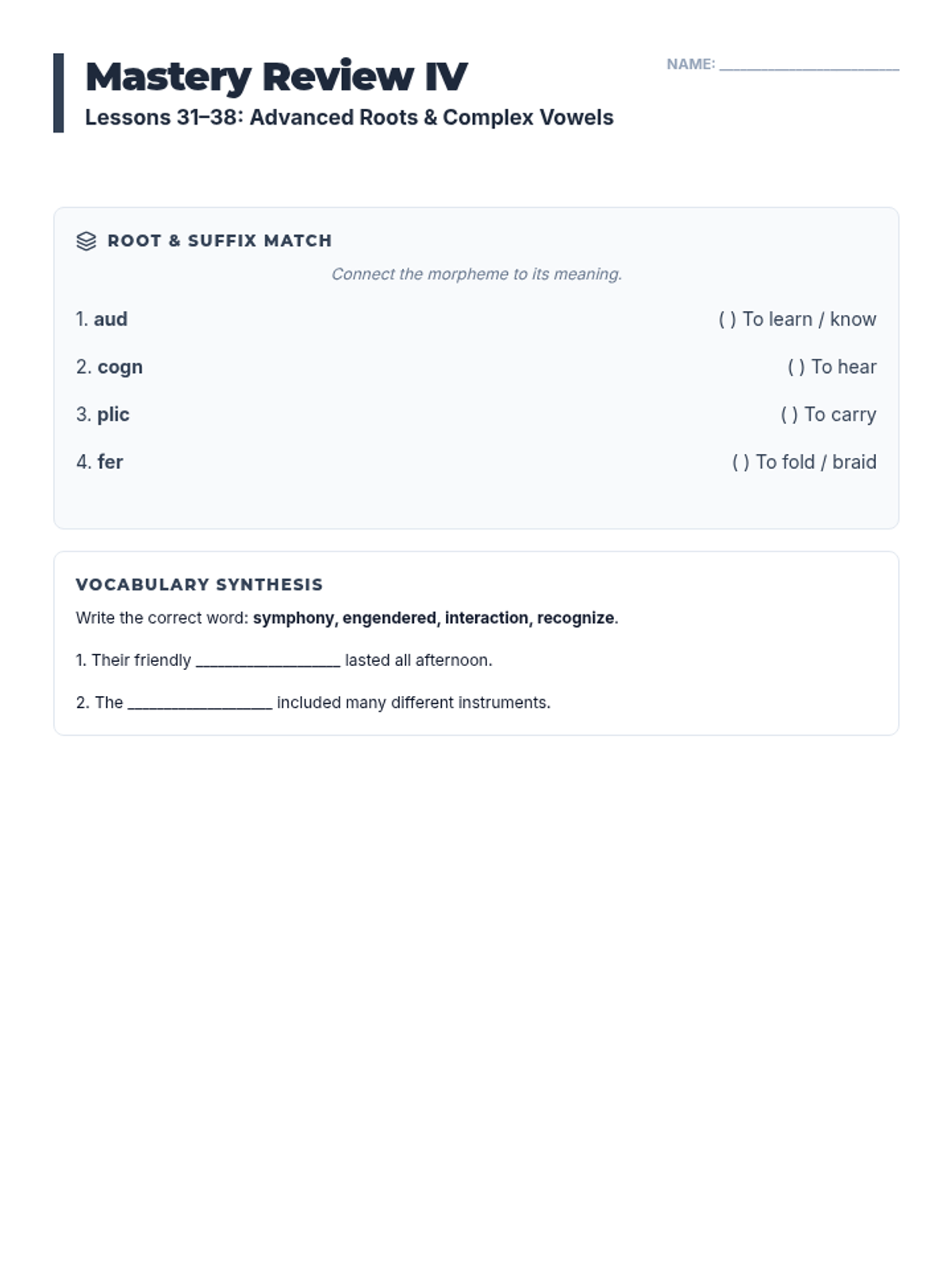
A comprehensive 4-page expansion for Lesson 39. This review lesson synthesizes the advanced morphology (sym, phone, gen, act, cogn, plic, aud, fer, sid) and complex vowel patterns from the previous units. It includes a morpheme match grid, a synthesis reading passage without underlines to encourage active word searching, and a high-level writing challenge. Designed for high school TESOL students.
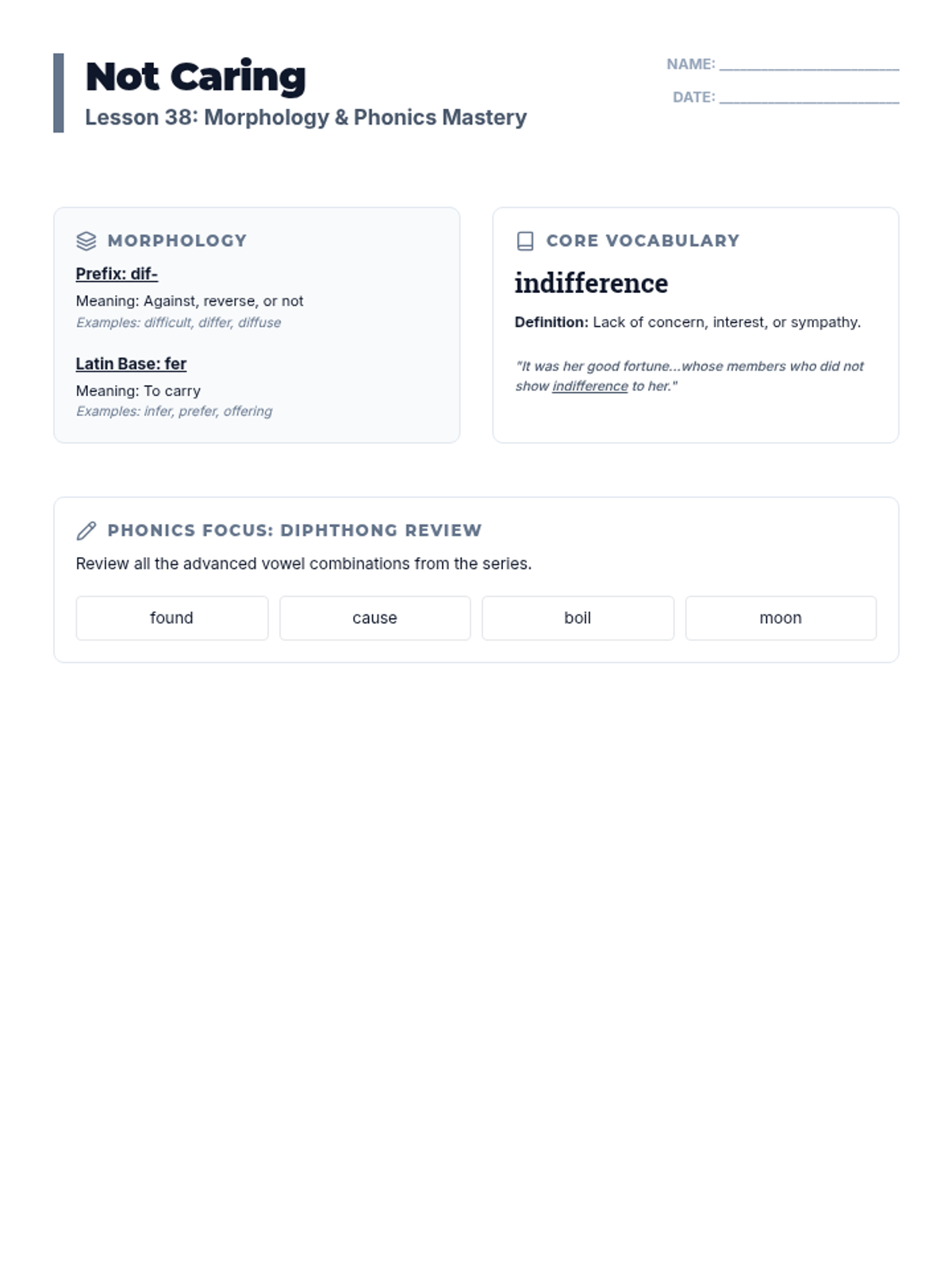
A 5-page expansion for Lesson 38. It focuses on the prefix dif- and root fer, with the vocabulary word 'indifference', alongside explicit instruction in synthesis of complex vowel patterns. It includes a foundational page, a reading passage without underlines to encourage active word searching, a new dedicated encoding mastery page, comprehension questions with discussion frames, and structured writing practice. Designed for high school TESOL students.
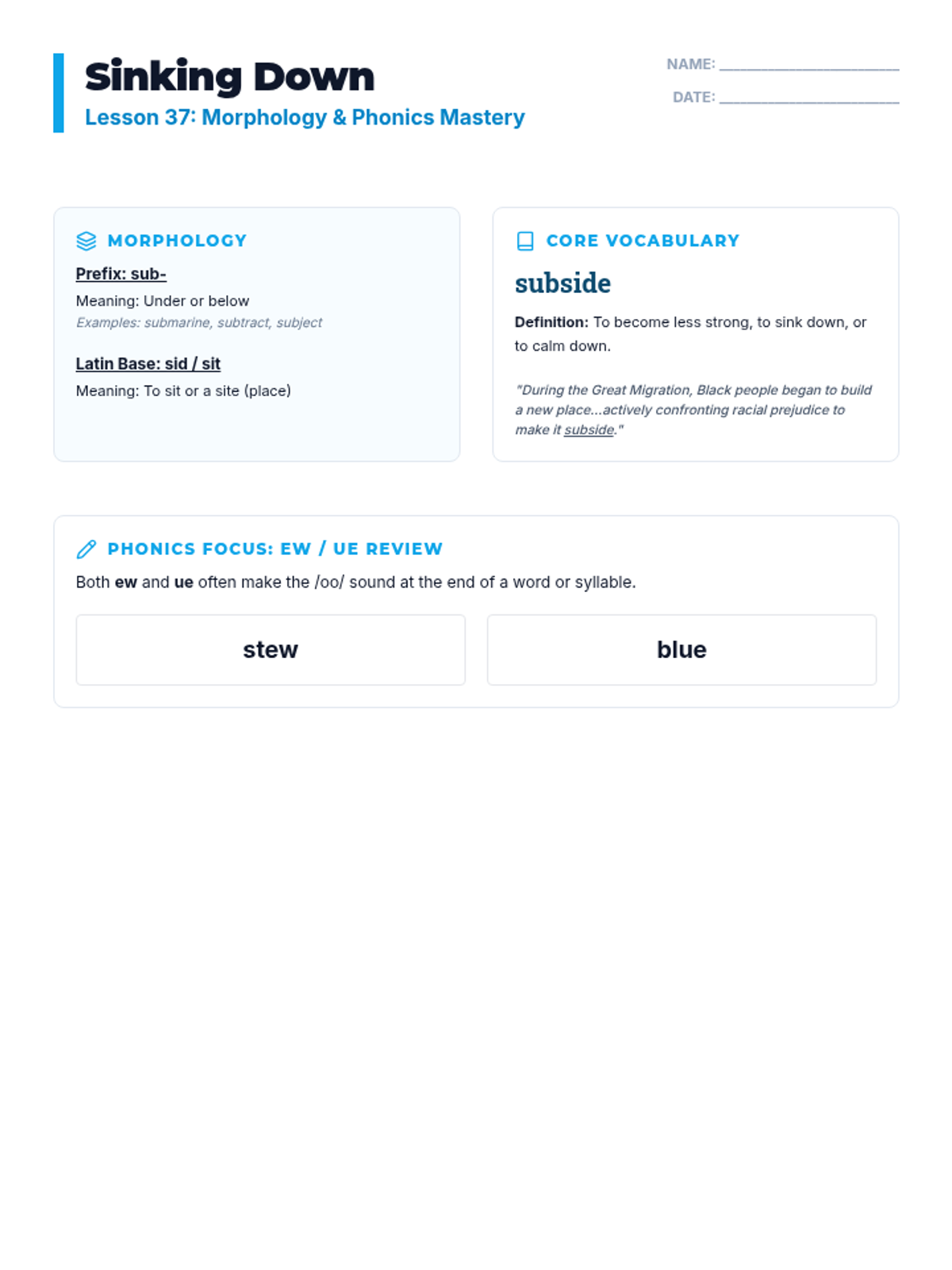
A comprehensive 5-page expansion for Lesson 37. It focuses on the prefix sub- and root sid/sit, with the vocabulary word 'subside', alongside explicit instruction in the diphthongs ew and ue review. It includes a foundational page, a reading passage without underlines to encourage active word searching, a new dedicated encoding mastery page, comprehension questions with discussion frames, and structured writing practice. Designed for high school TESOL students.
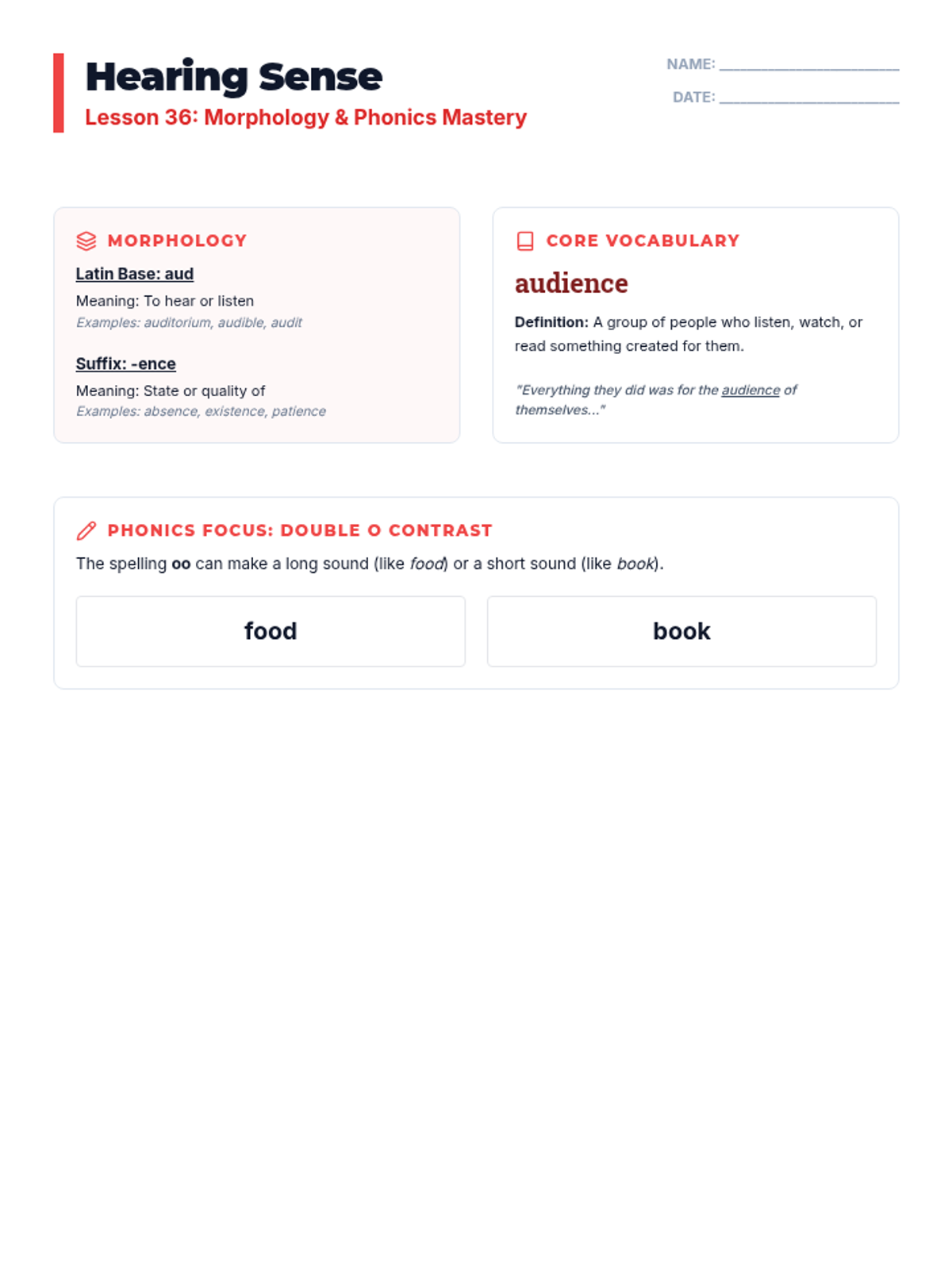
A comprehensive 5-page expansion for Lesson 36. It focuses on the root aud and suffix -ence, with the vocabulary word 'audience', alongside explicit instruction in the diphthong oo (food vs book). It includes a foundational page, a reading passage without underlines to encourage active word searching, a new dedicated encoding mastery page, comprehension questions with discussion frames, and structured writing practice. Designed for high school TESOL students.
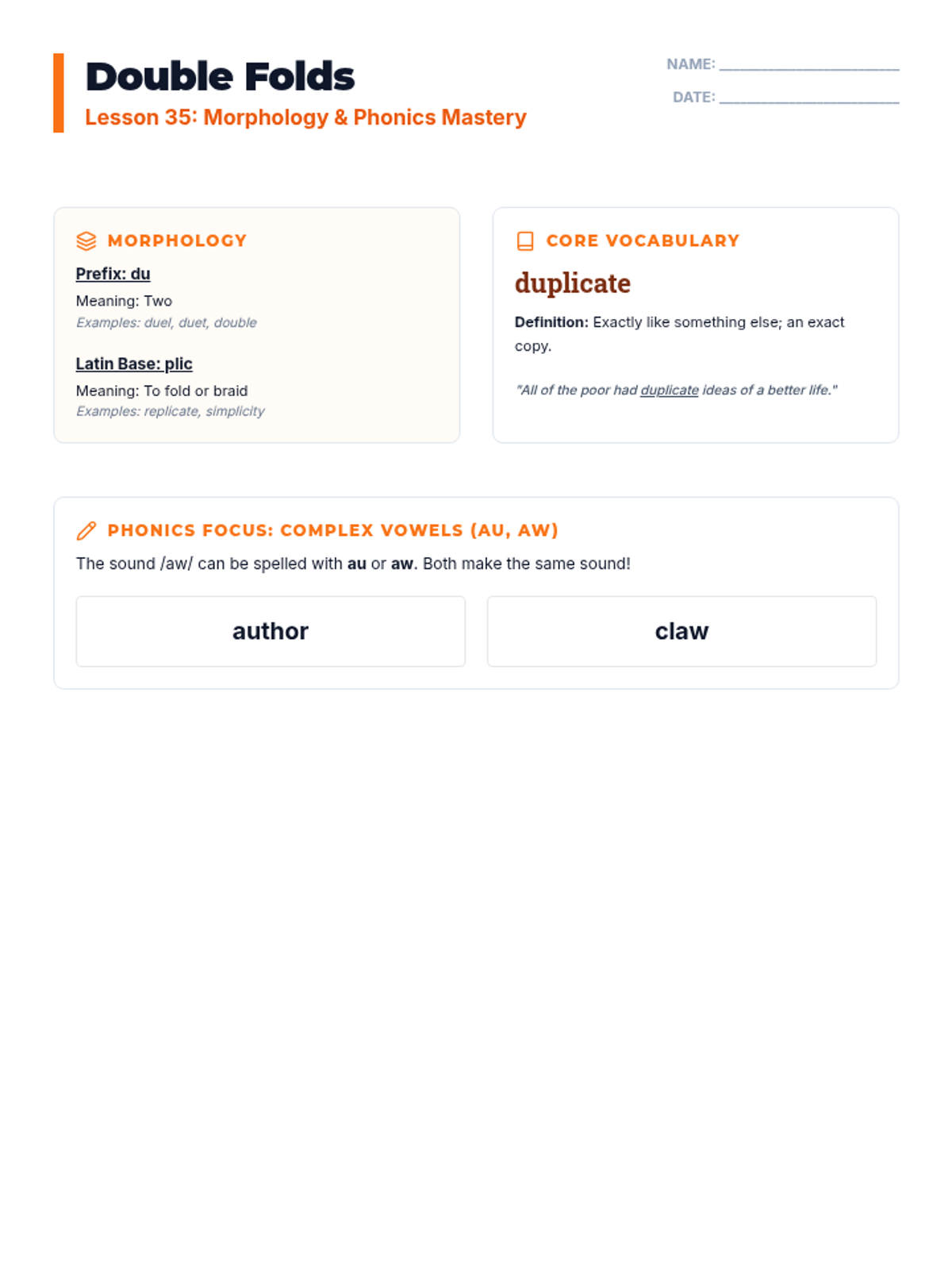
A comprehensive 5-page expansion for Lesson 35. It focuses on the prefix du and root plic, with the vocabulary word 'duplicate', alongside explicit instruction in the diphthongs au and aw. It includes a foundational page, a reading passage without underlines to encourage active word searching, a new dedicated encoding mastery page, comprehension questions with discussion frames, and structured writing practice. Designed for high school TESOL students.
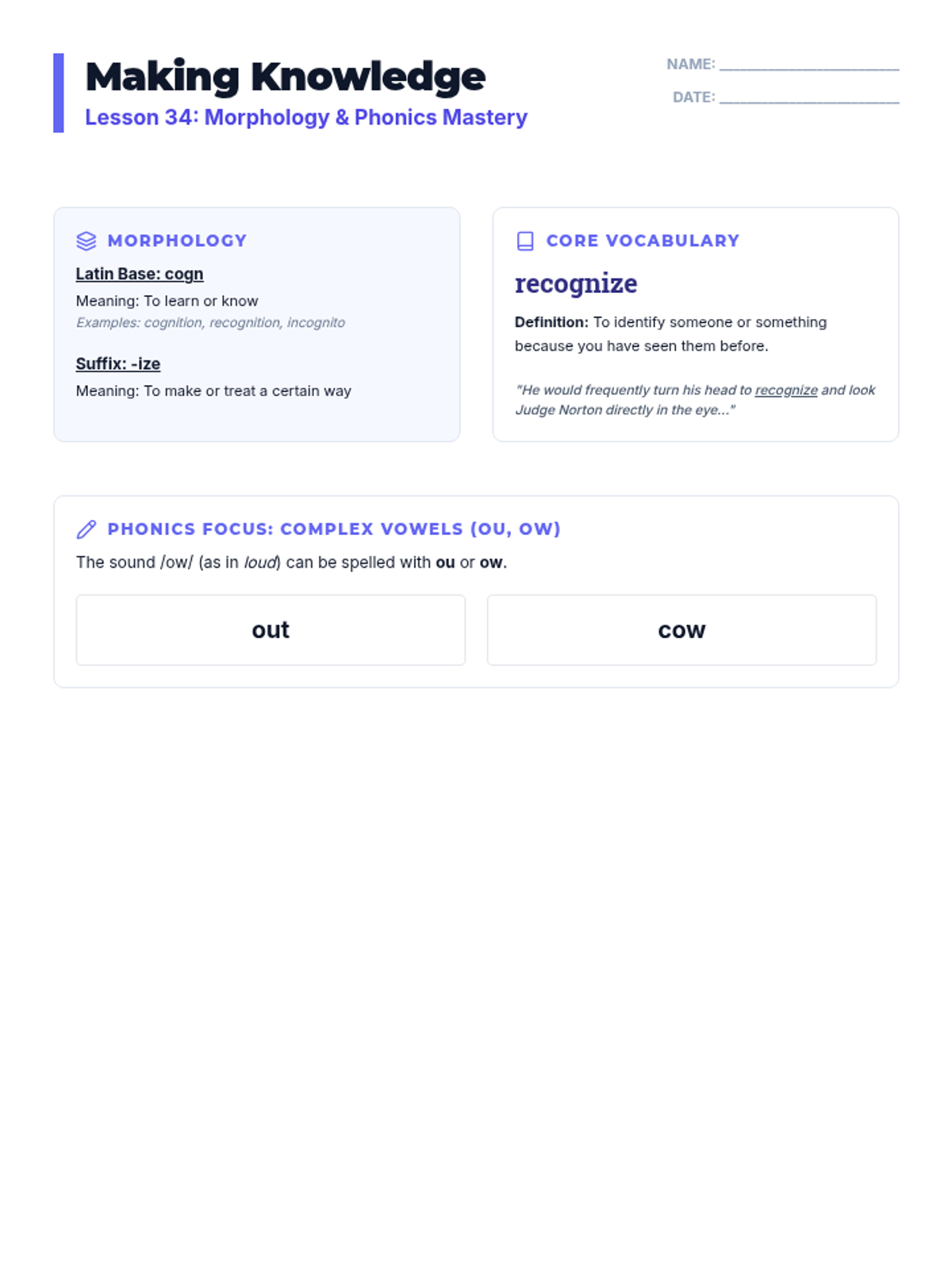
A comprehensive 5-page expansion for Lesson 34. It focuses on the root cogn and suffix -ize, with the vocabulary word 'recognize', alongside explicit instruction in the diphthongs ou and ow. It includes a foundational page, a reading passage without underlines to encourage active word searching, a new dedicated encoding mastery page, comprehension questions with discussion frames, and structured writing practice. Designed for high school TESOL students.
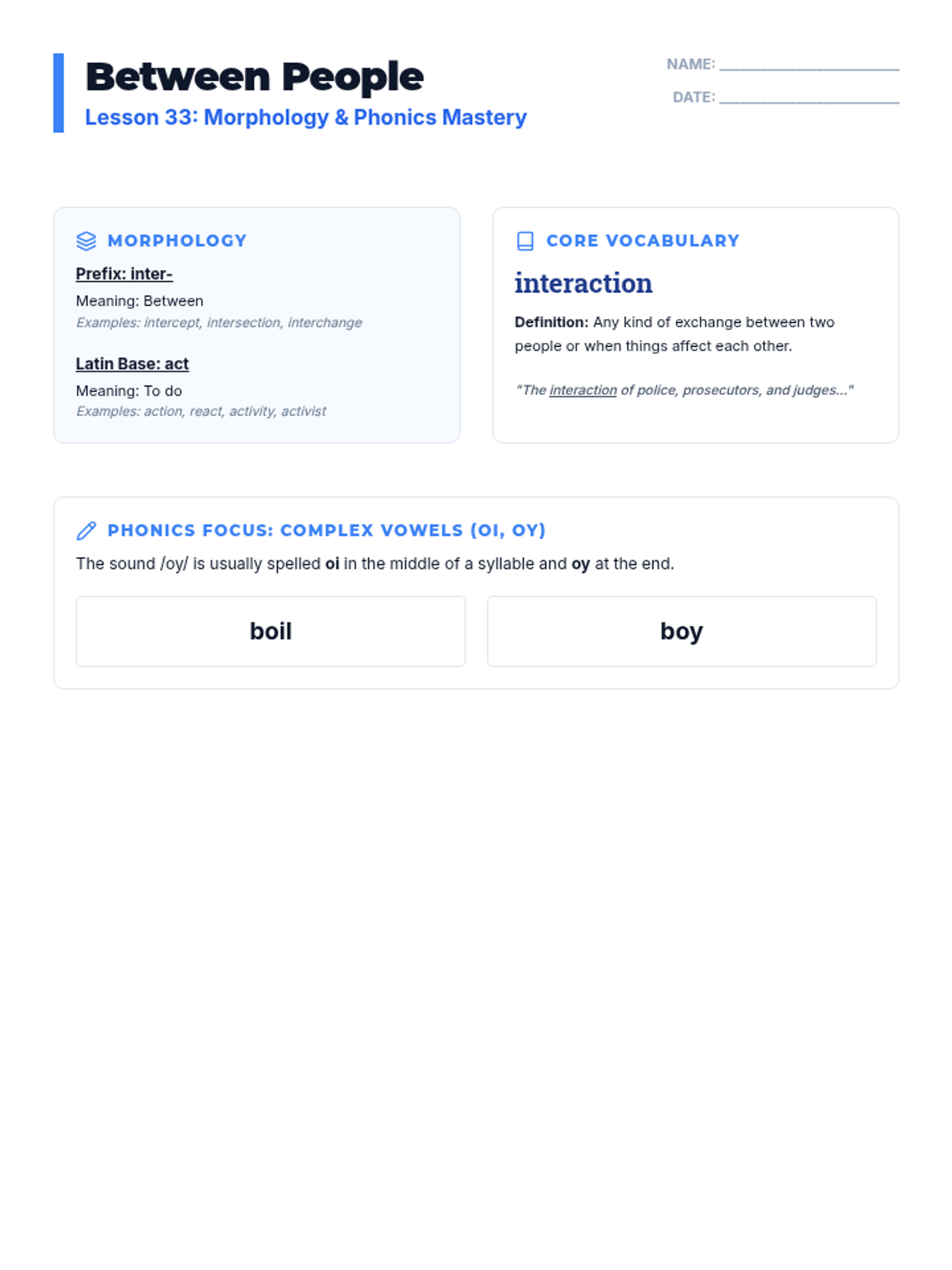
A comprehensive 5-page expansion for Lesson 33. It focuses on the prefix inter- and root act, with the vocabulary word 'interaction', alongside explicit instruction in the diphthongs oi and oy. It includes a foundational page, a reading passage without underlines to encourage active word searching, a new dedicated encoding mastery page, comprehension questions with discussion frames, and structured writing practice. Designed for high school TESOL students.
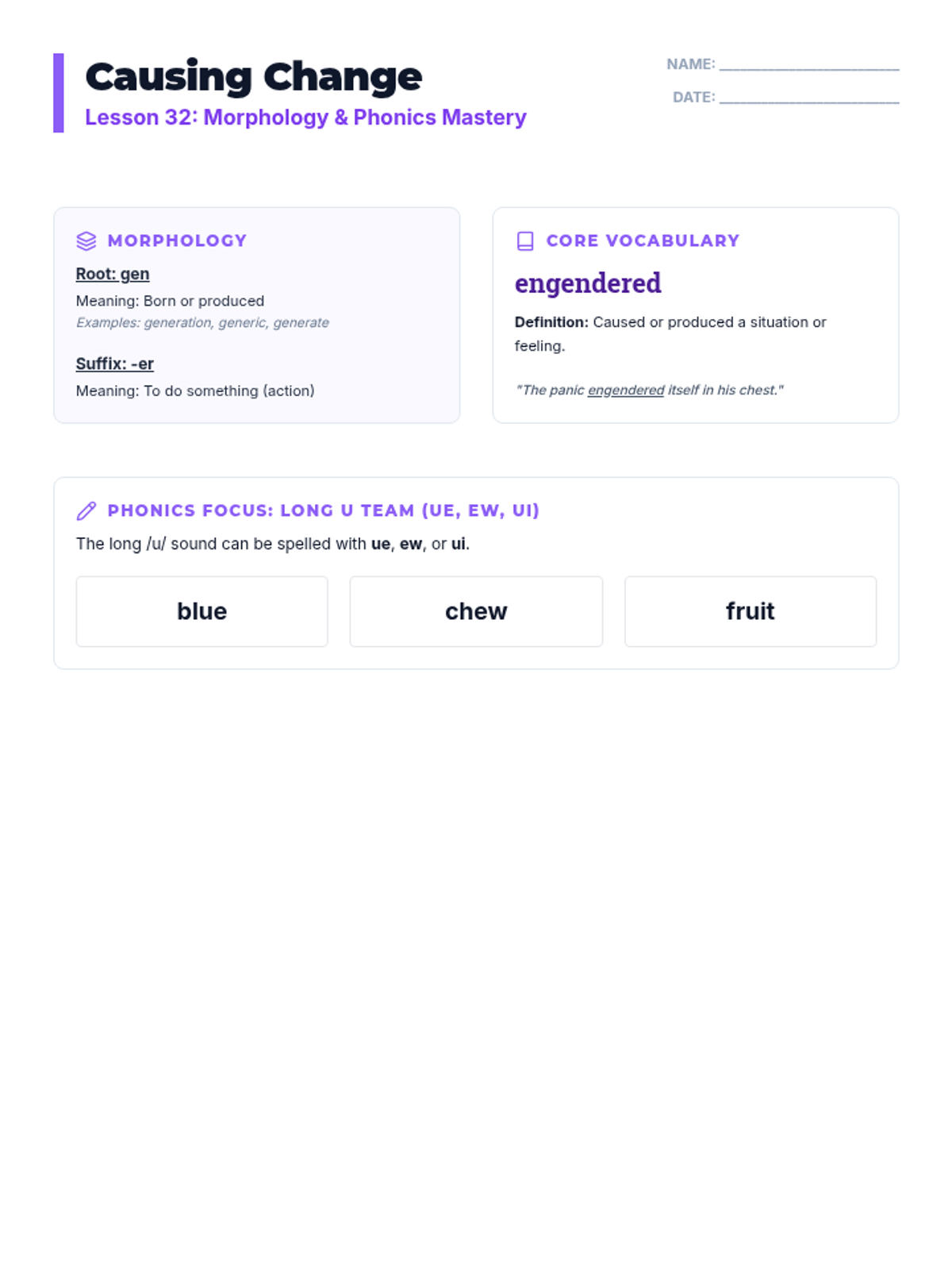
A comprehensive 4-page expansion for Lesson 32. It focuses on the root gen and suffix -er, with the vocabulary word 'engendered', alongside explicit instruction in the Long U vowel teams (ue, ew, ui). It includes a foundational page, a reading passage without underlines to encourage active searching, comprehension questions with discussion frames, and structured writing practice focusing on capitalization of proper nouns. Designed for high school TESOL students.
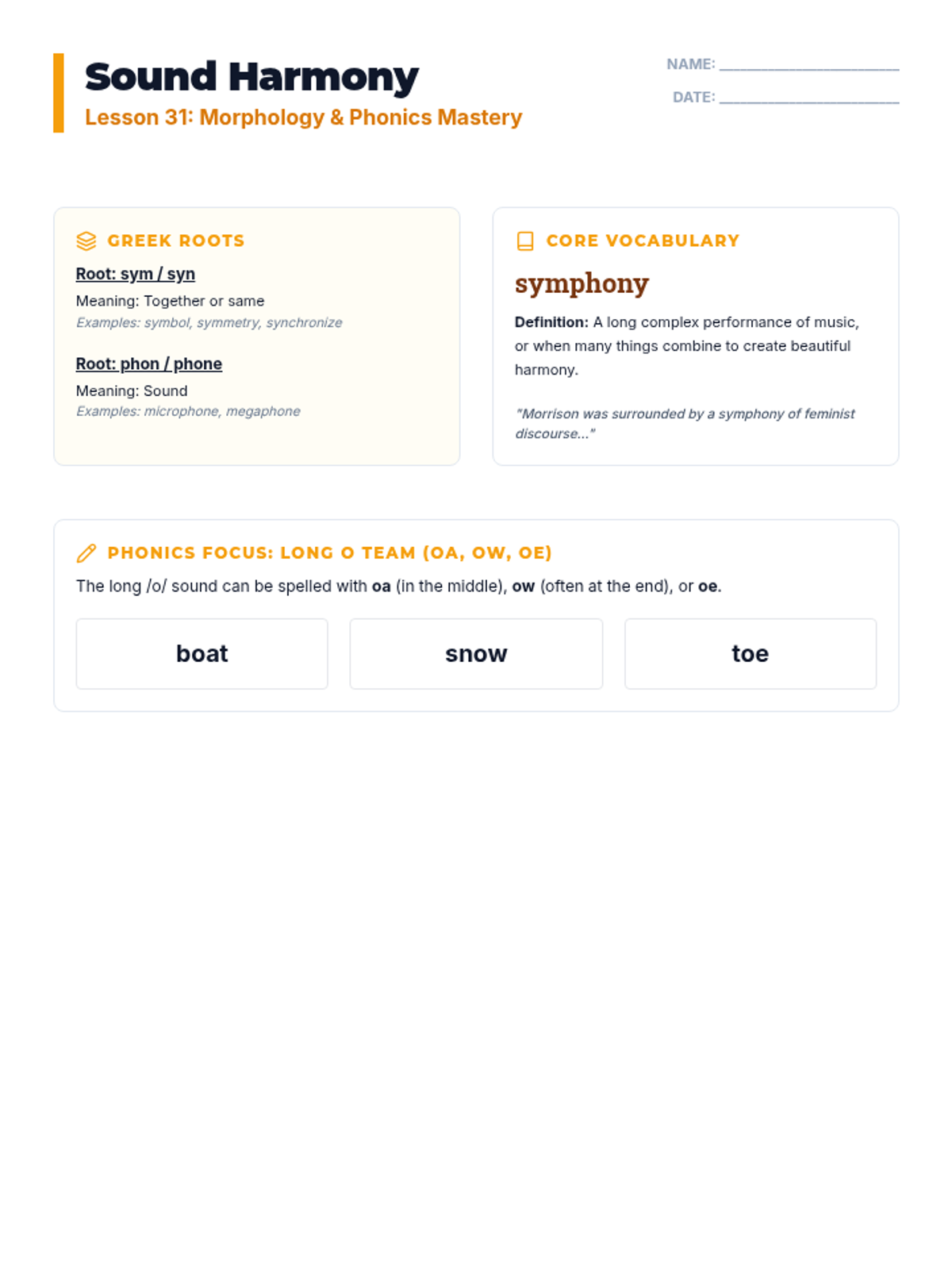
A comprehensive 5-page expansion for Lesson 31. It focuses on the Greek roots sym/syn and phon/phone, with the vocabulary word 'symphony', alongside explicit instruction in the Long O vowel teams (oa, ow, oe). It includes a foundational page, a reading passage without underlines to encourage active word searching, a new dedicated encoding mastery page, comprehension questions with discussion frames, and structured writing practice. Designed for high school TESOL students.
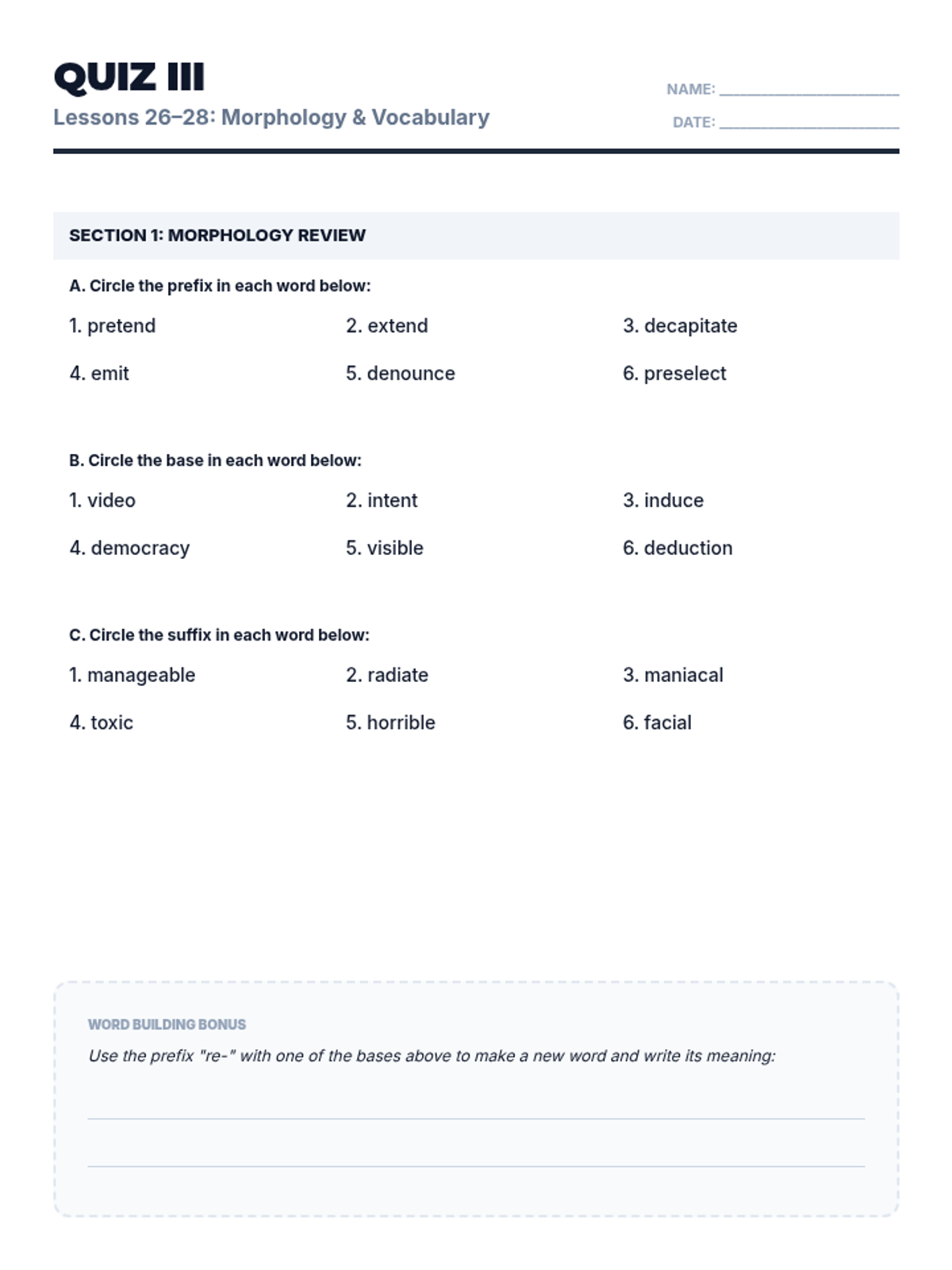
A formal 4-page assessment covering morphology, vocabulary, and word study skills for Lessons 26-28. Includes prefix/base/suffix identification, vocabulary in context, multisyllabic decoding with schwa labels, encoding dictation, and critical thinking short-answer questions. Designed for high school TESOL students.
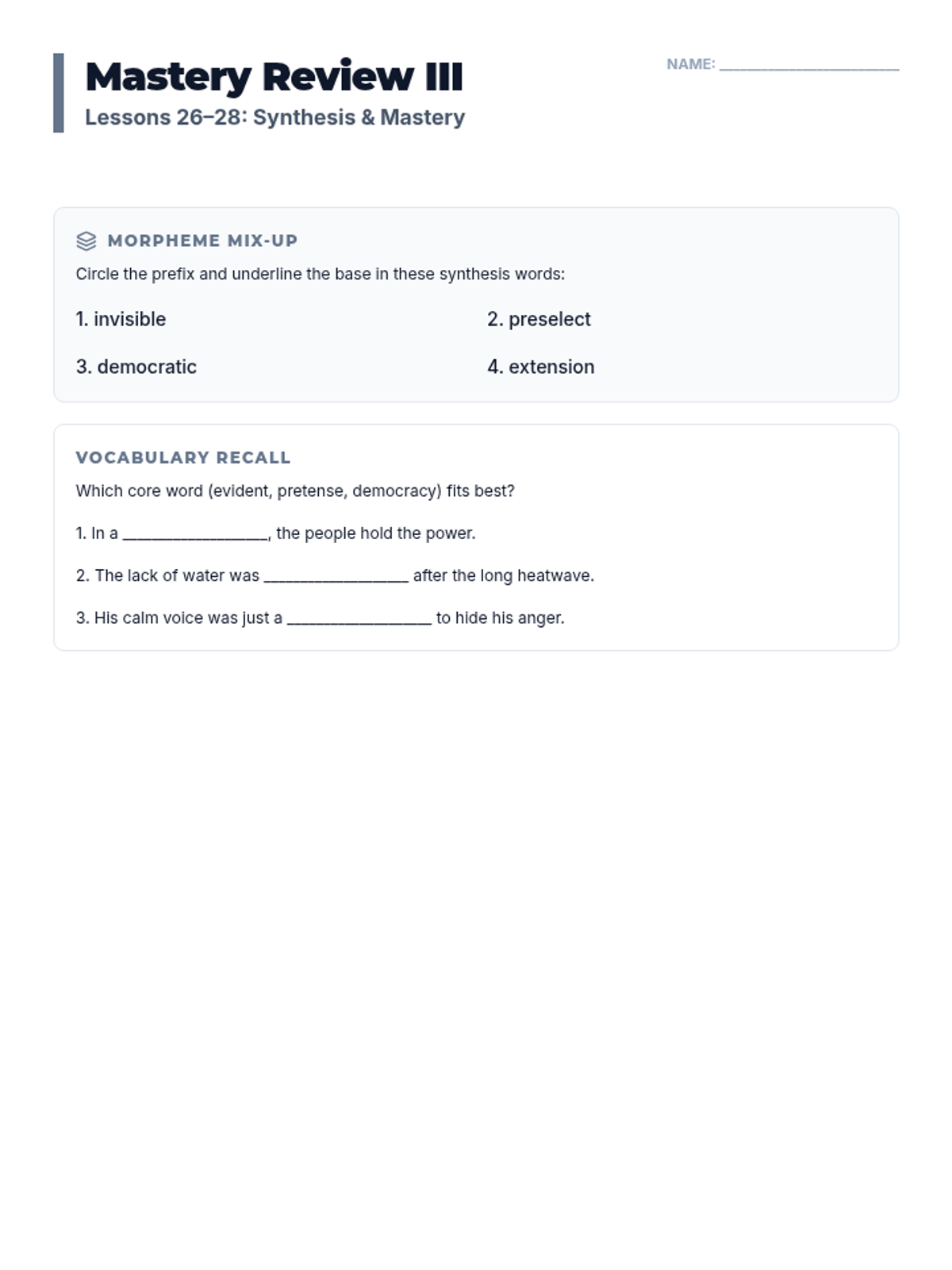
A comprehensive 5-page expansion for Lesson 29. This review lesson synthesizes the morphology (e-, pre-, dem, crat) and vowel team focus (A, E, I) from the previous three units. It includes a morpheme grid, a synthesis reading passage without underlines to encourage active word searching, a new dedicated encoding mastery page, connecting analysis questions, and a high-level writing challenge. Designed for high school TESOL students.
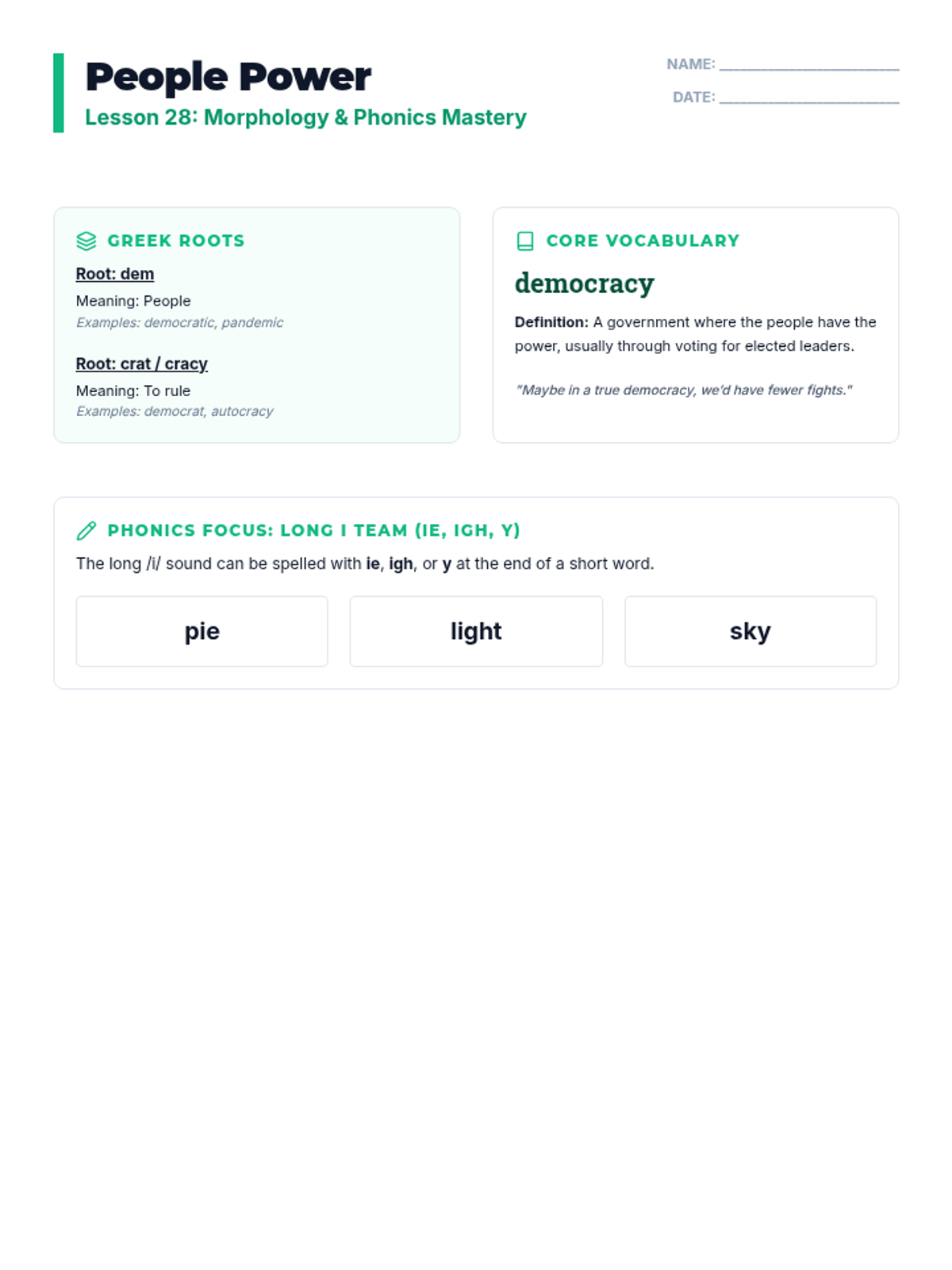
A comprehensive 5-page expansion for Lesson 28. It focuses on the Greek roots dem and crat/cracy, with the vocabulary word 'democracy', alongside explicit instruction in the Long I vowel teams (ie, igh, y). It includes a foundational page, a reading passage without underlines to encourage active word searching, a new dedicated encoding mastery page, comprehension questions with discussion frames, and structured writing practice. Designed for high school TESOL students.
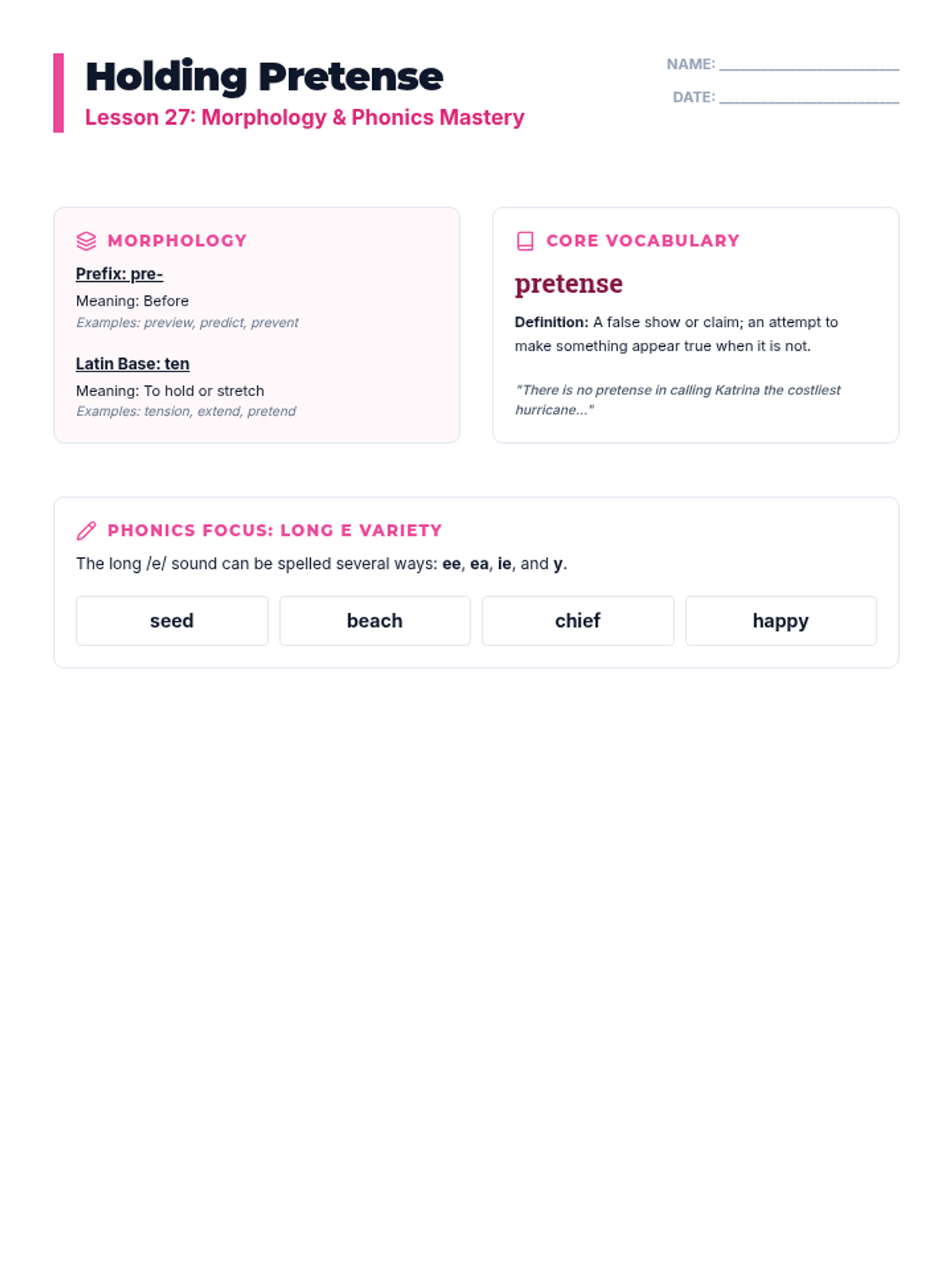
A 5-page expansion for Lesson 27. It focuses on the prefix pre- and the root ten, with the vocabulary word 'pretense', alongside explicit instruction in the Long E vowel teams (ee, ea, ie, y). It includes a foundational page, a reading passage without underlines to encourage active word searching, a new dedicated encoding mastery page, comprehension questions with discussion frames, and structured writing practice. Designed for high school TESOL students.
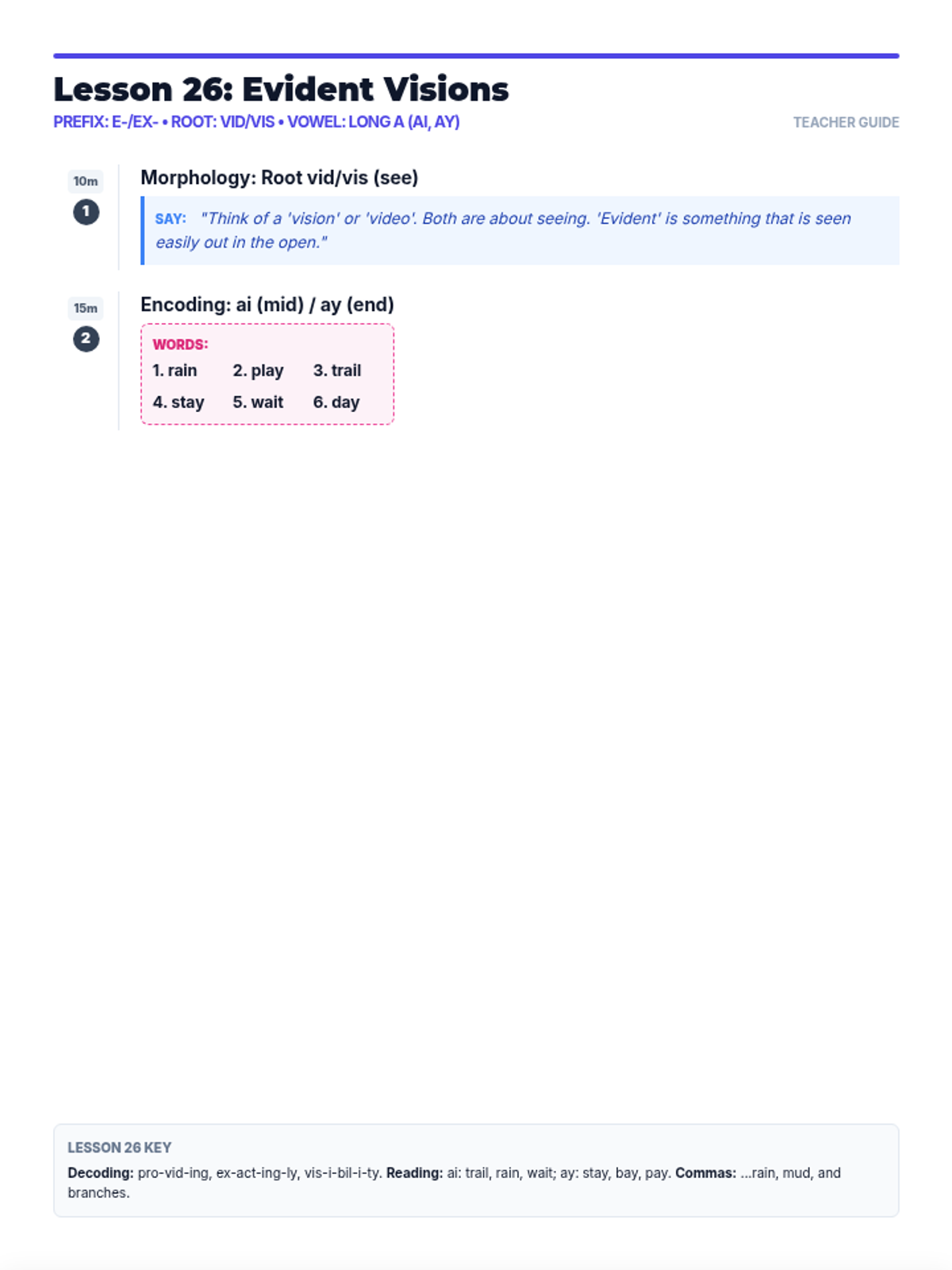
A comprehensive 15-page teacher guide for Lessons 26-40, with each lesson on its own printable page. Each guide includes a structured 60-minute lesson plan, explicit teacher scripts, encoding/dictation word lists for phonics mastery, and a complete answer key for the corresponding student handout. Includes specific focus on Vowel Teams and Diphthongs.
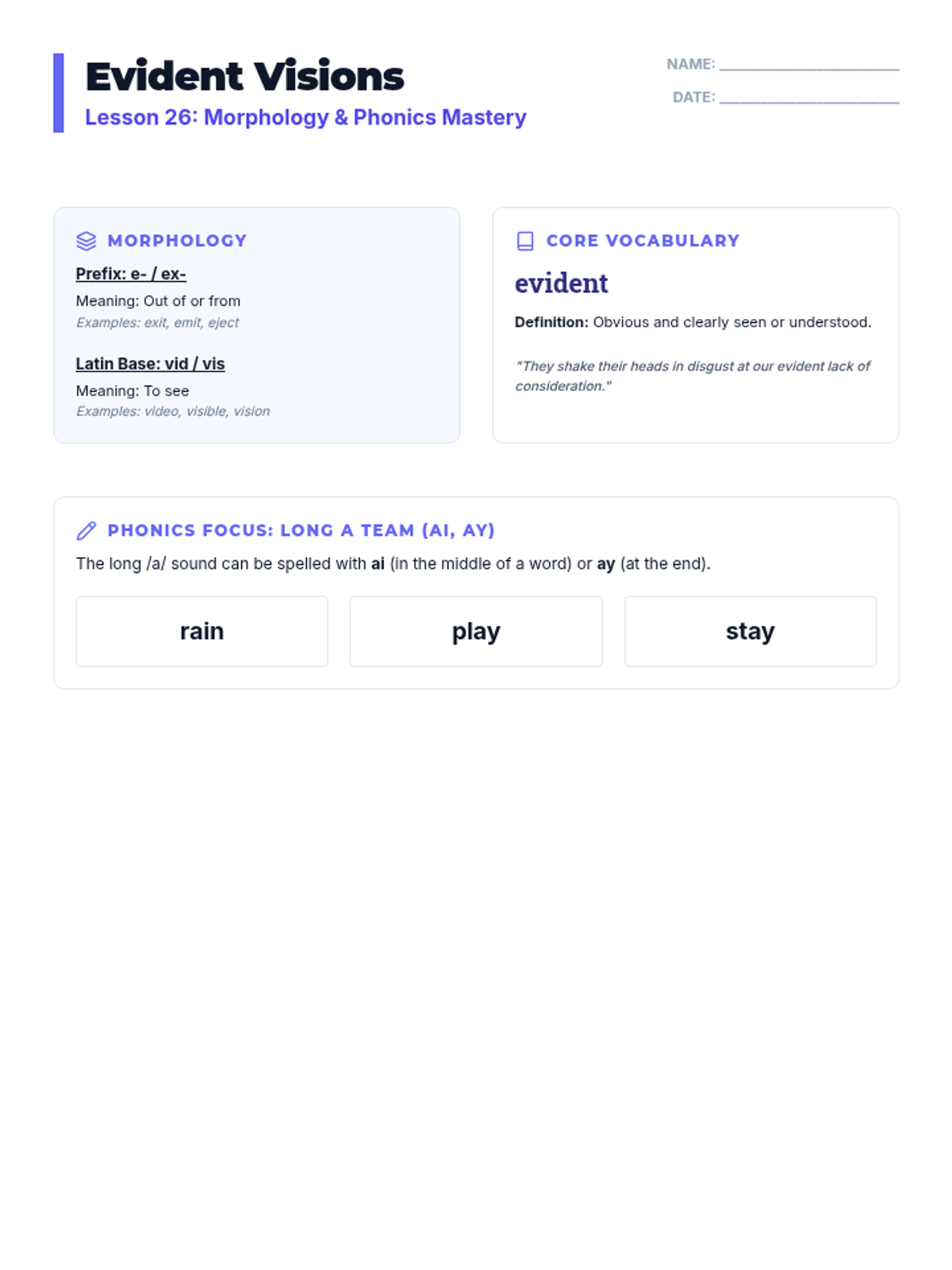
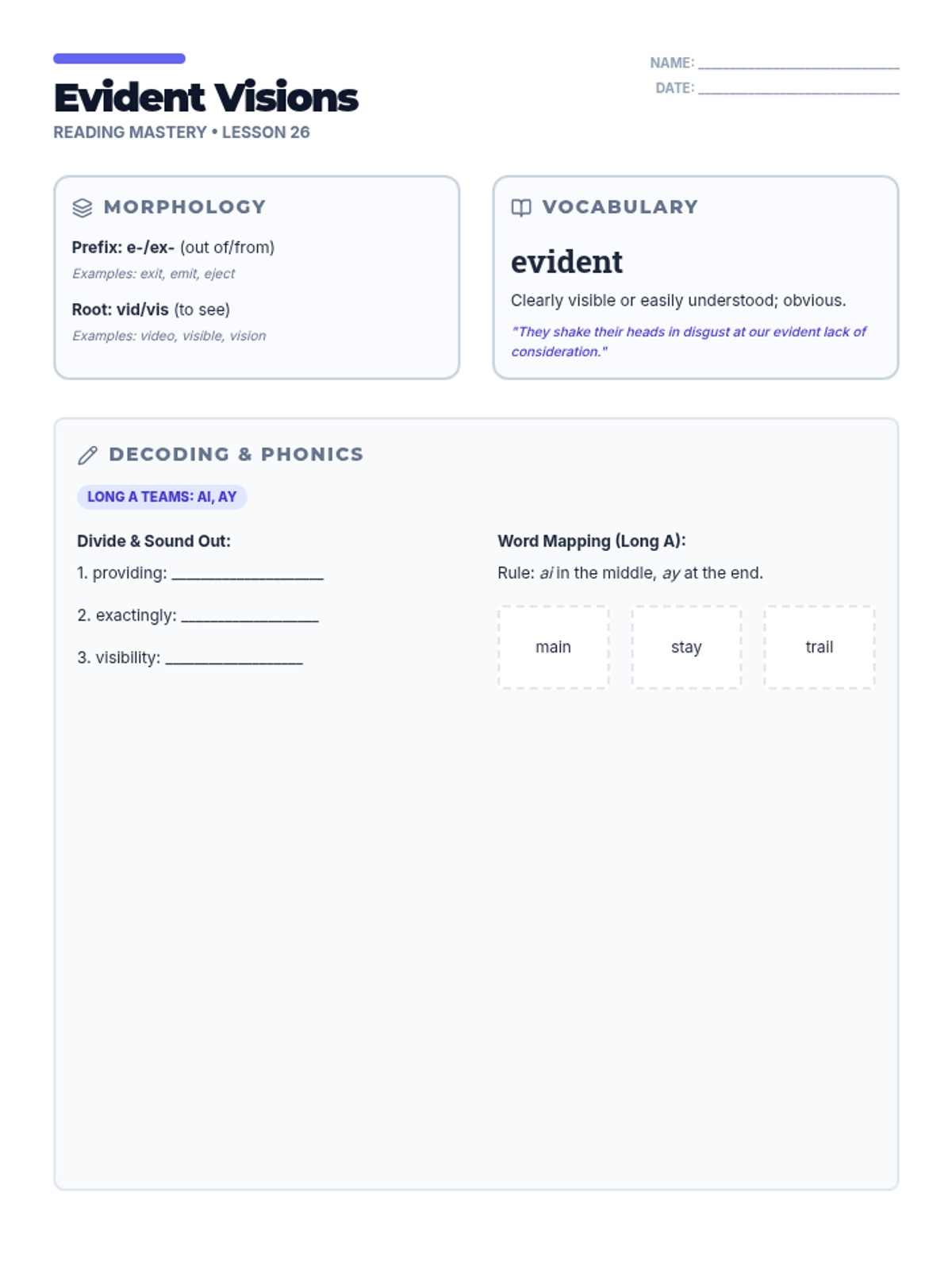
A comprehensive 4-page expansion for Lesson 26. It focuses on the prefix e-/ex- and the root vid/vis, with the vocabulary word 'evident', alongside explicit instruction in the Long A vowel team (ai, ay). It includes a foundational page, a reading passage without underlines to encourage active searching, comprehension questions with discussion frames, and structured writing practice. Designed for high school TESOL students.
A comprehensive 15-page reading intervention handout (Lessons 26-40) specifically tailored for high school TESOL students. Each page integrates user-provided morphology (prefixes, roots), academic vocabulary (definitions, text-based examples), and explicit phonics instruction focusing on Vowel Teams and Complex Diphthongs. Designed with clear work areas and high-school appropriate visuals.
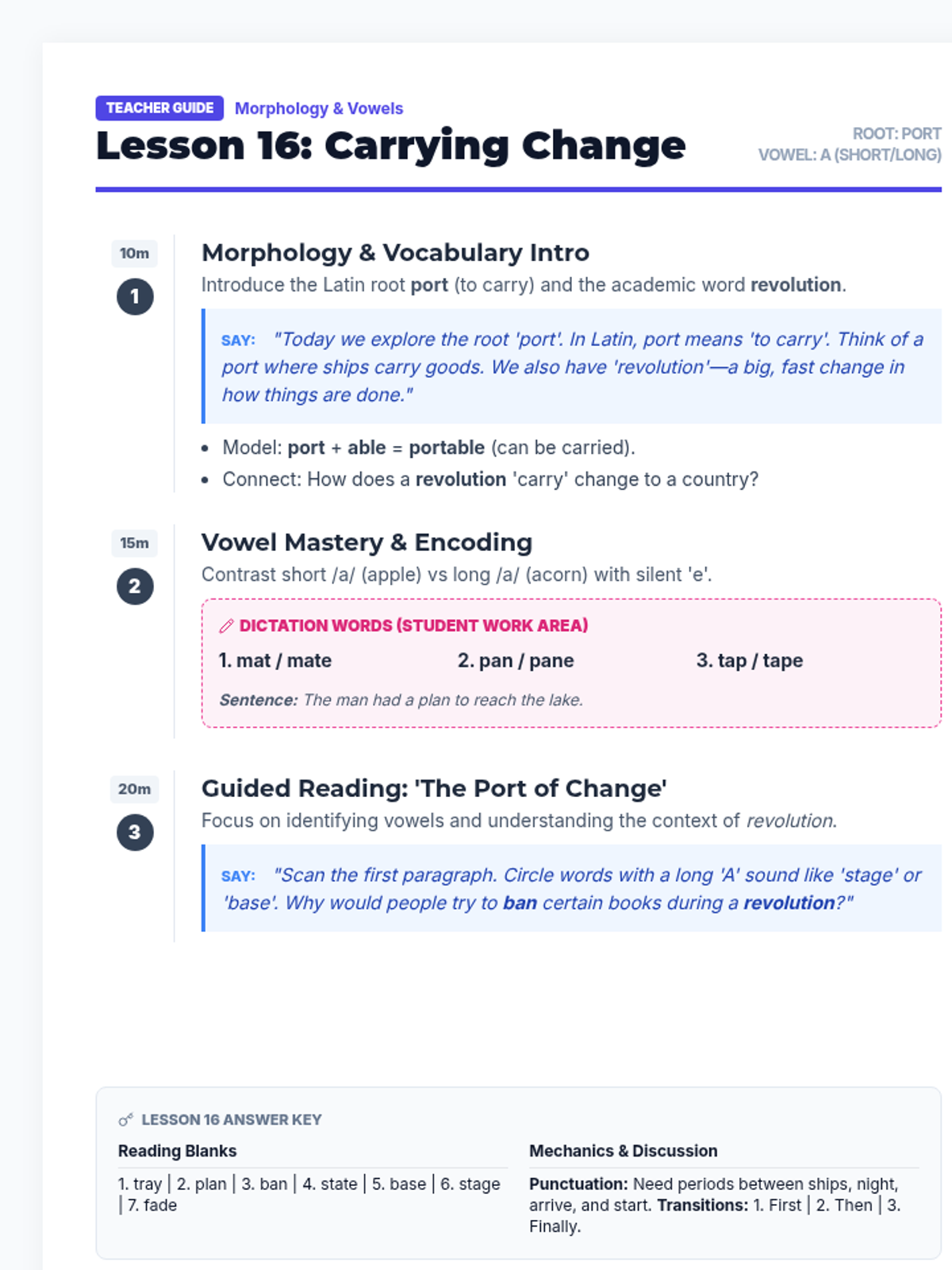
A 10-page comprehensive teacher guide for Lessons 16-25, with each lesson on its own printable page. Each guide includes a structured 60-minute lesson plan, explicit teacher scripts, encoding/dictation word lists for phonics mastery, and a complete answer key for the corresponding student handout.
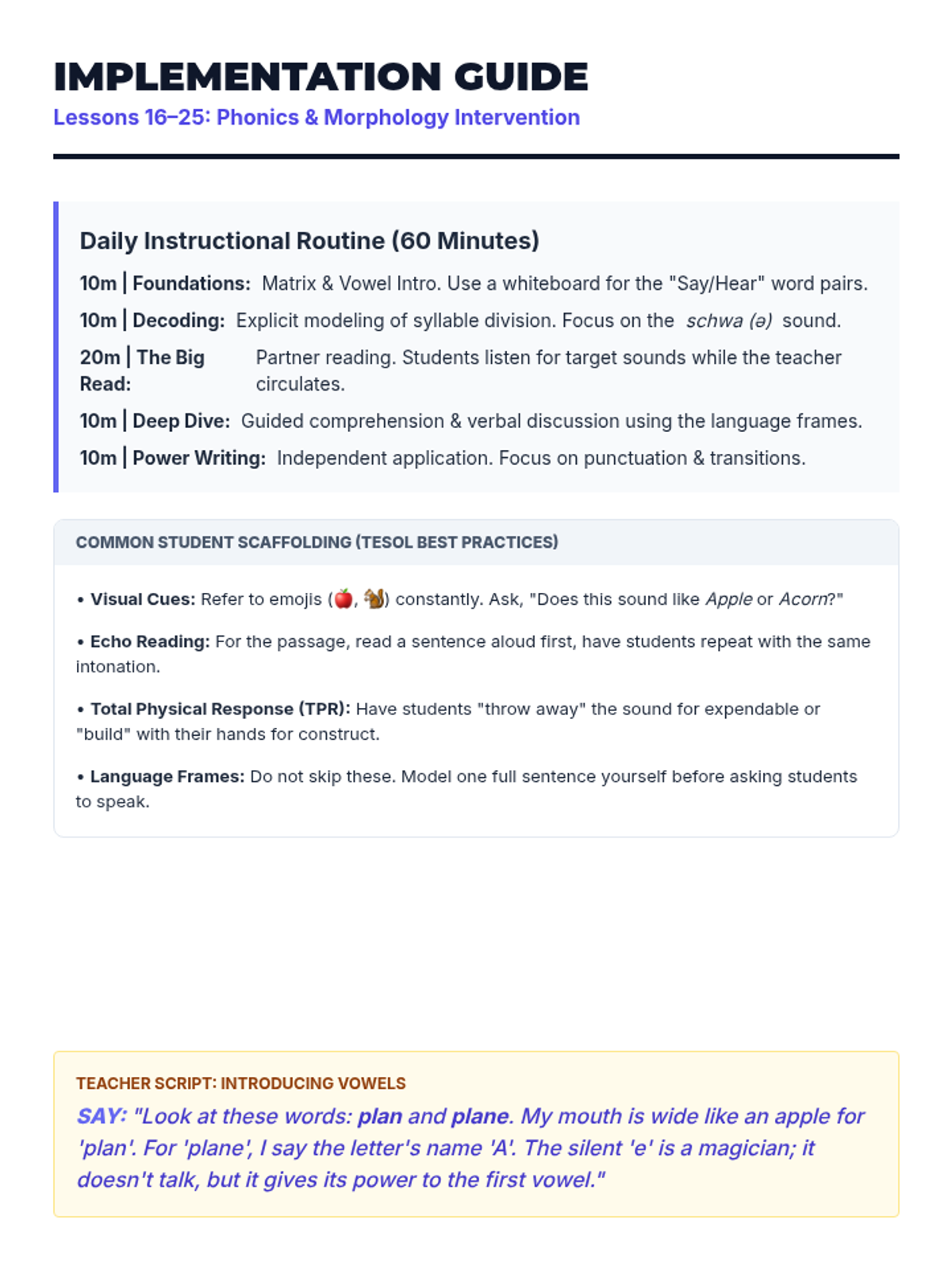
A comprehensive 4-page Teacher Key and Lesson Plan designed to support the implementation of Lessons 16-25. It includes a structured 60-minute daily routine, explicit teacher scripts for vowel instruction, scaffolding strategies for TESOL students, and a complete answer key for every blank, comprehension question, and mechanics exercise in the student handouts.
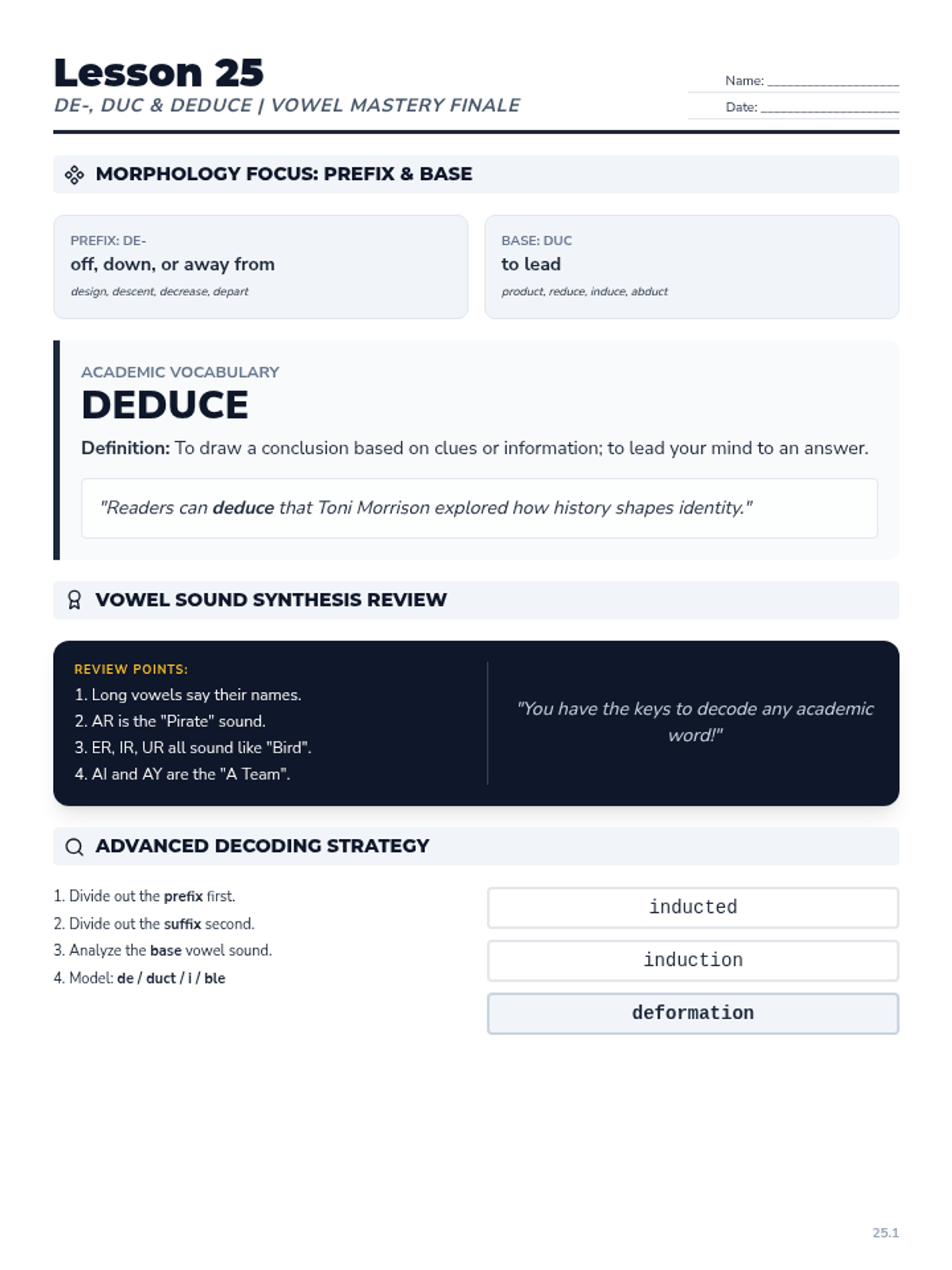
A comprehensive 4-page expansion for Lesson 25 of a reading intervention program. It focuses on the prefix 'de-', the Latin base 'duc' (to lead), and the vocabulary word 'deduce'. It includes a final synthesis reading passage, comprehension questions with discussion frames, and a final reflective writing task. Designed for high school TESOL students.
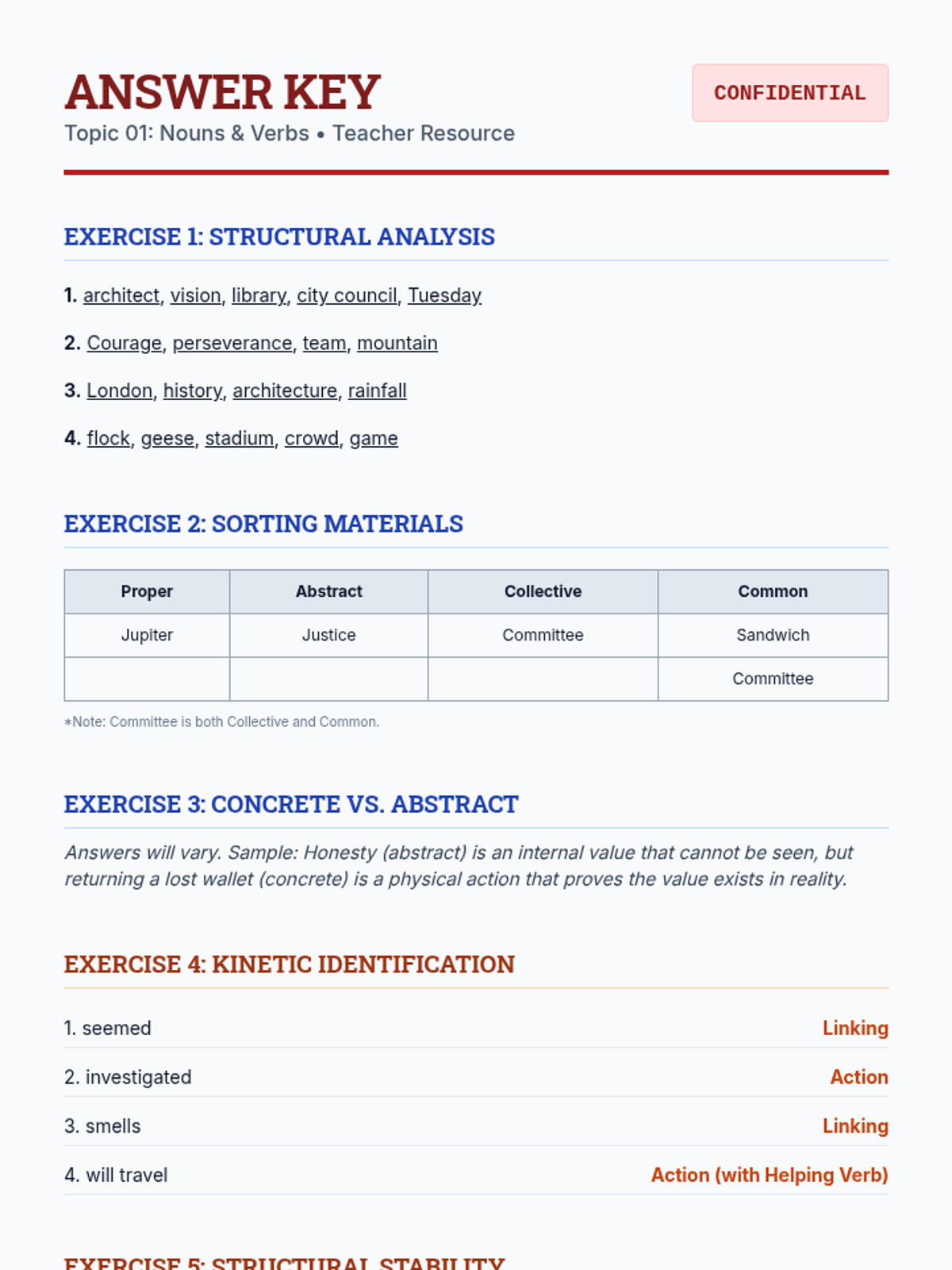
A comprehensive answer key for the "Parts of Speech Blueprint" worksheet, including sample answers for open-ended questions and grammatical explanations for subject-verb agreement choices.
An instructional slide deck for introducing nouns and verbs to 9th-grade students. Features a clean, professional "Architect Blueprint" theme with clear visual breakdowns of classifications and subject-verb agreement.