Sentence structure fundamentals, subject-verb agreement, and precise usage of parts of speech including pronouns, conjunctions, and adjectives. Targets technical accuracy through mastery of capitalization, punctuation, spelling, and verb mood.
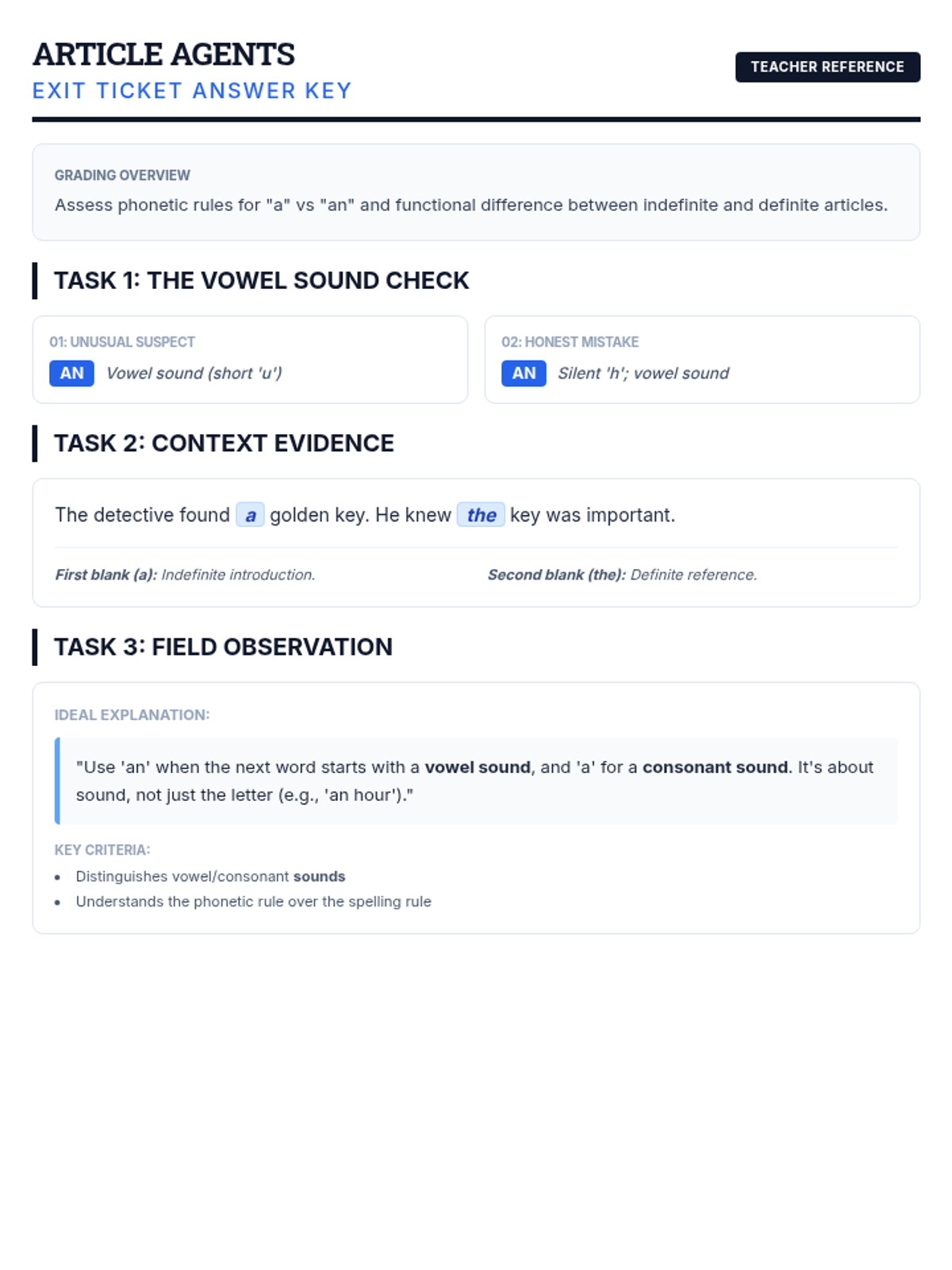
A dedicated answer key for the "Article Agents" exit ticket, providing correct answers and scoring criteria for the teacher. Revised with improved page break handling.
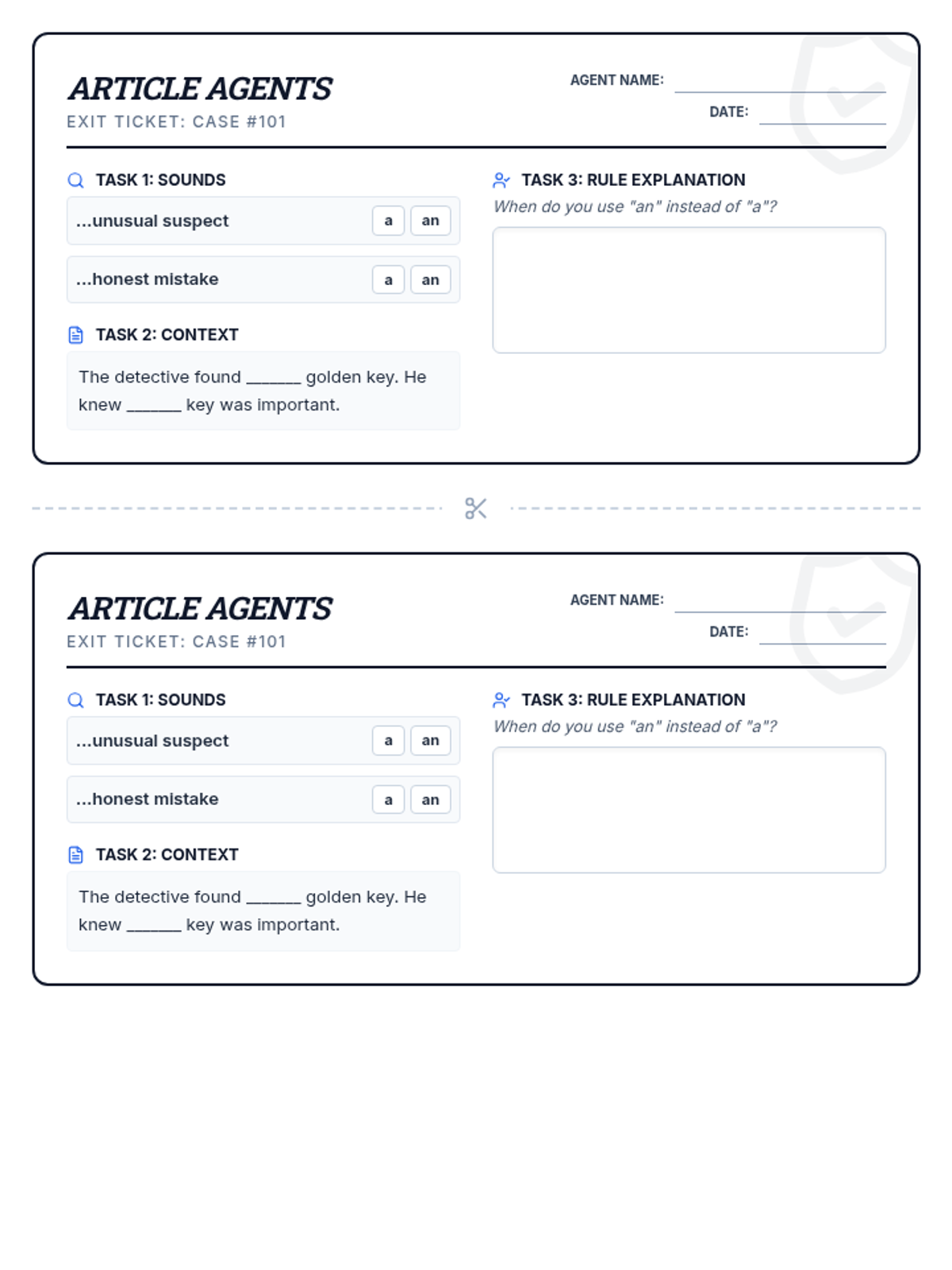
A themed exit ticket for the "Article Agents" lesson, containing two identical tickets per page for easy assessment. Covers a/an distinction and definite vs. indefinite context. Updated for better page-break handling and larger reflection space.
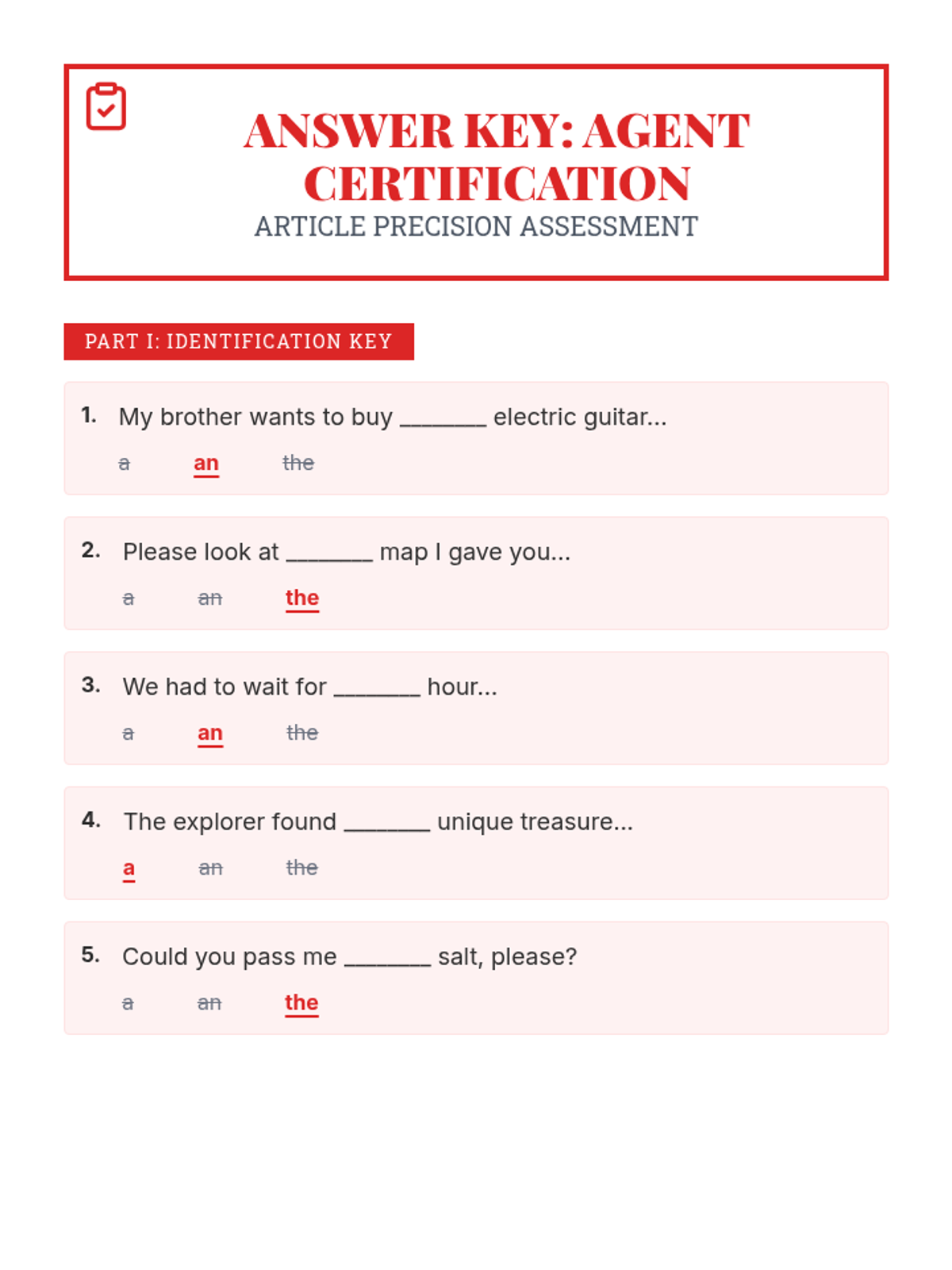
A dedicated answer key for the "Article Agents" quiz, providing correct answers and sample explanations for the teacher. Revised with improved page break handling.
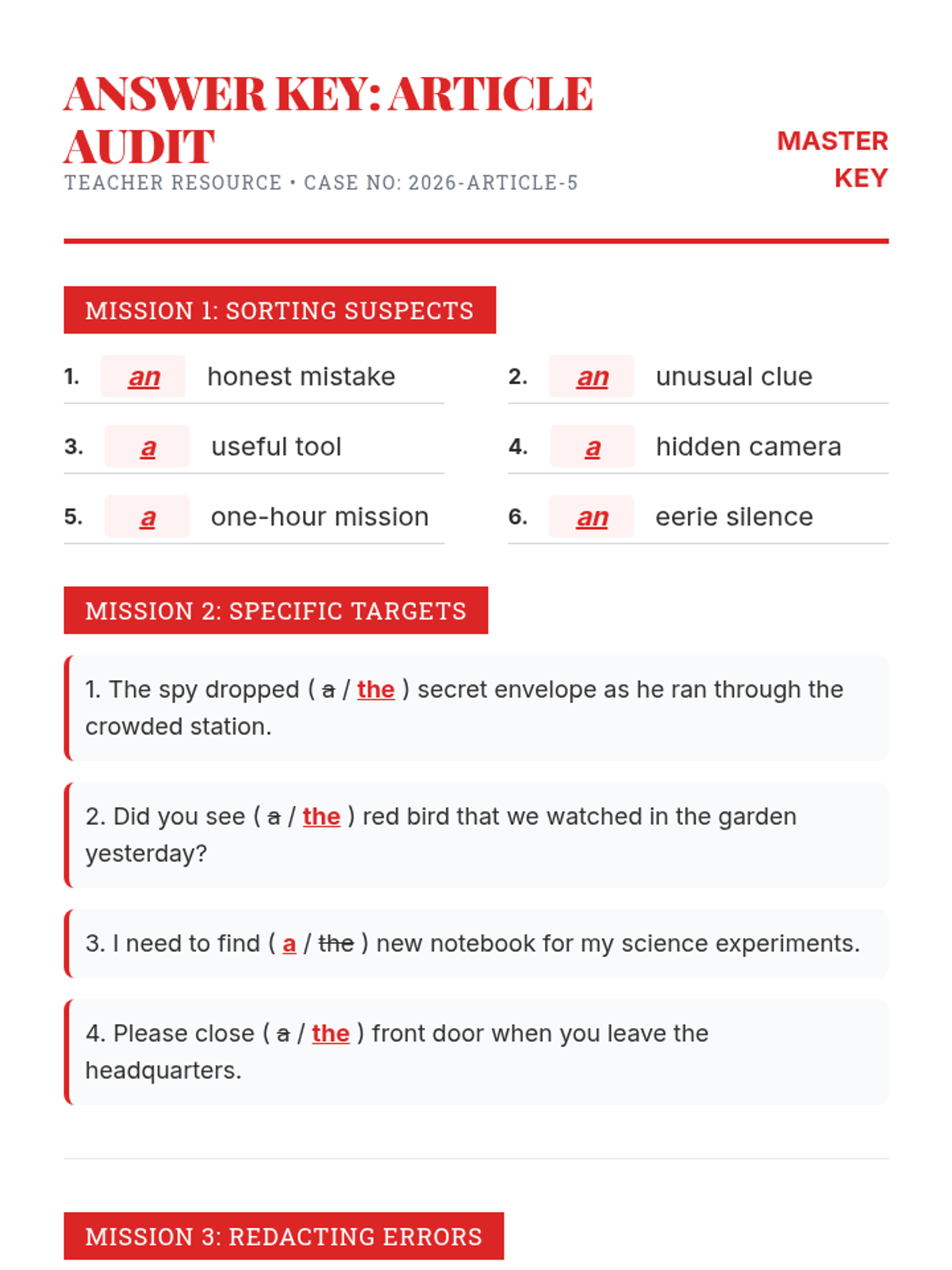
A dedicated answer key for the "Article Agents" worksheet, showing correct choices and edited text for easy grading. Revised with improved alignment for the editing challenge.
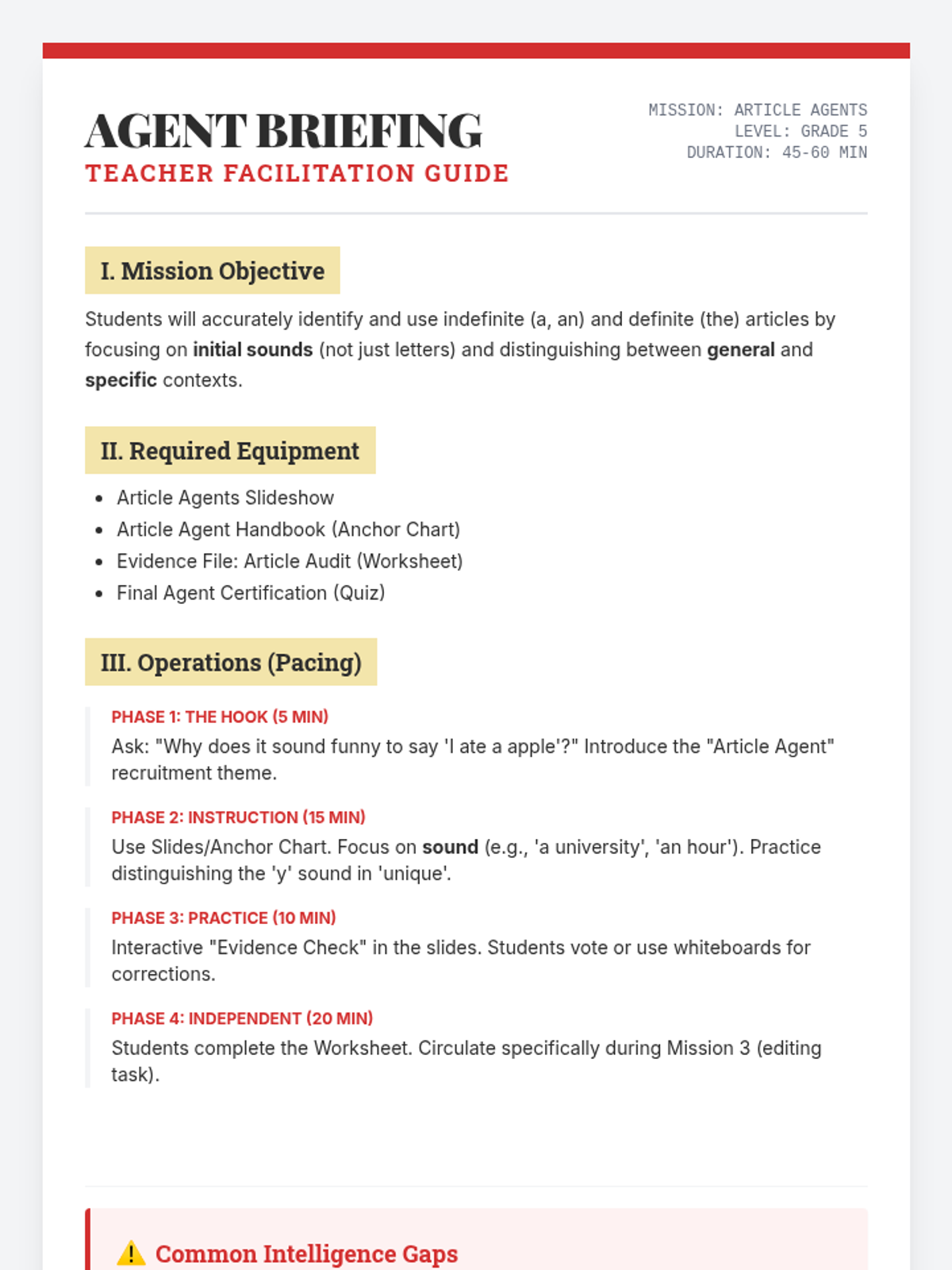
A teacher's facilitation guide for the "Article Agents" lesson, including pacing, discussion prompts, common misconceptions, and answer keys. Revised for better page breaks and formatting.
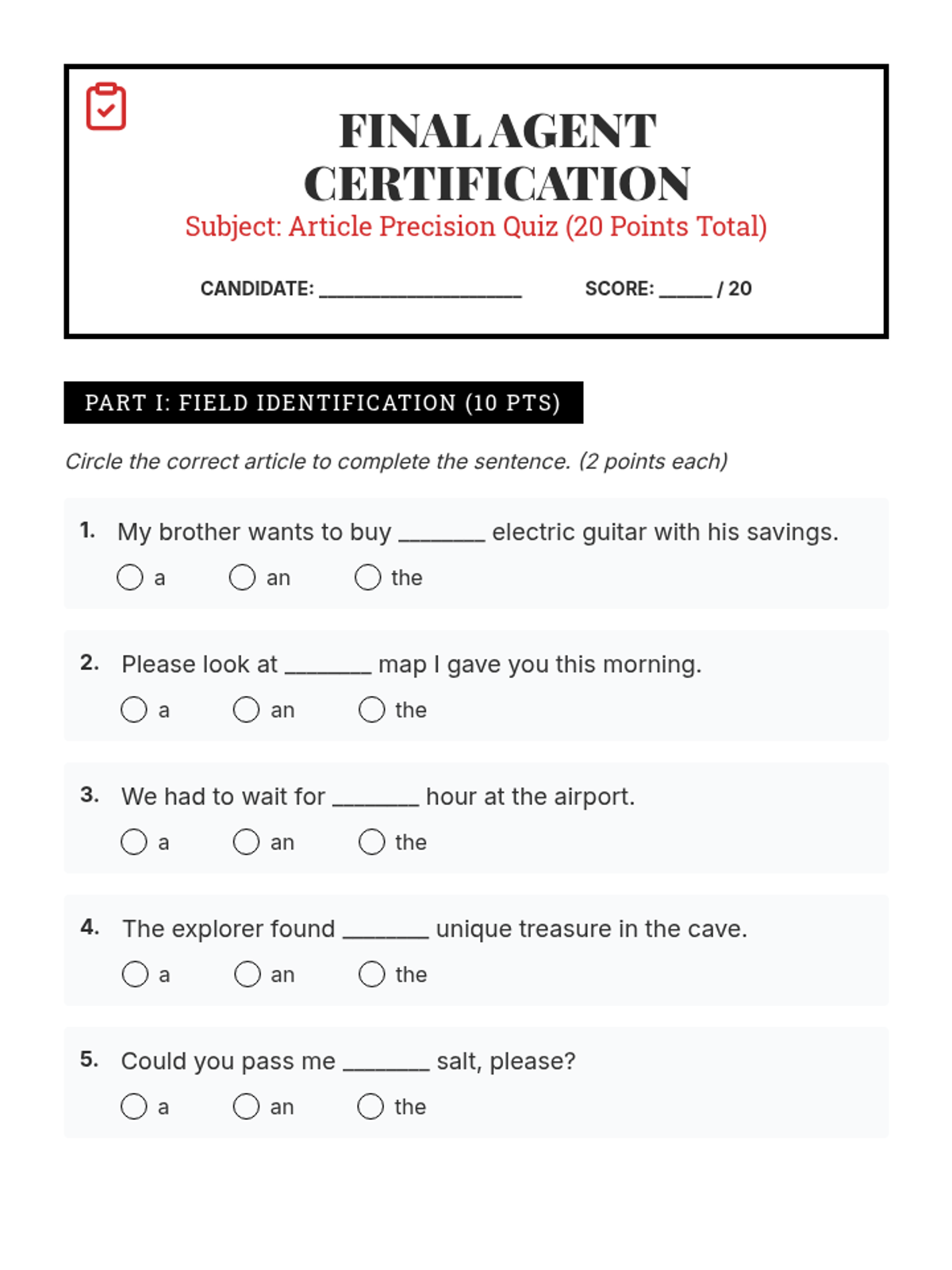
An assessment/quiz for the "Article Agents" lesson, testing student knowledge of article usage. Updated with improved page breaks, more writing space, and clearer scoring.
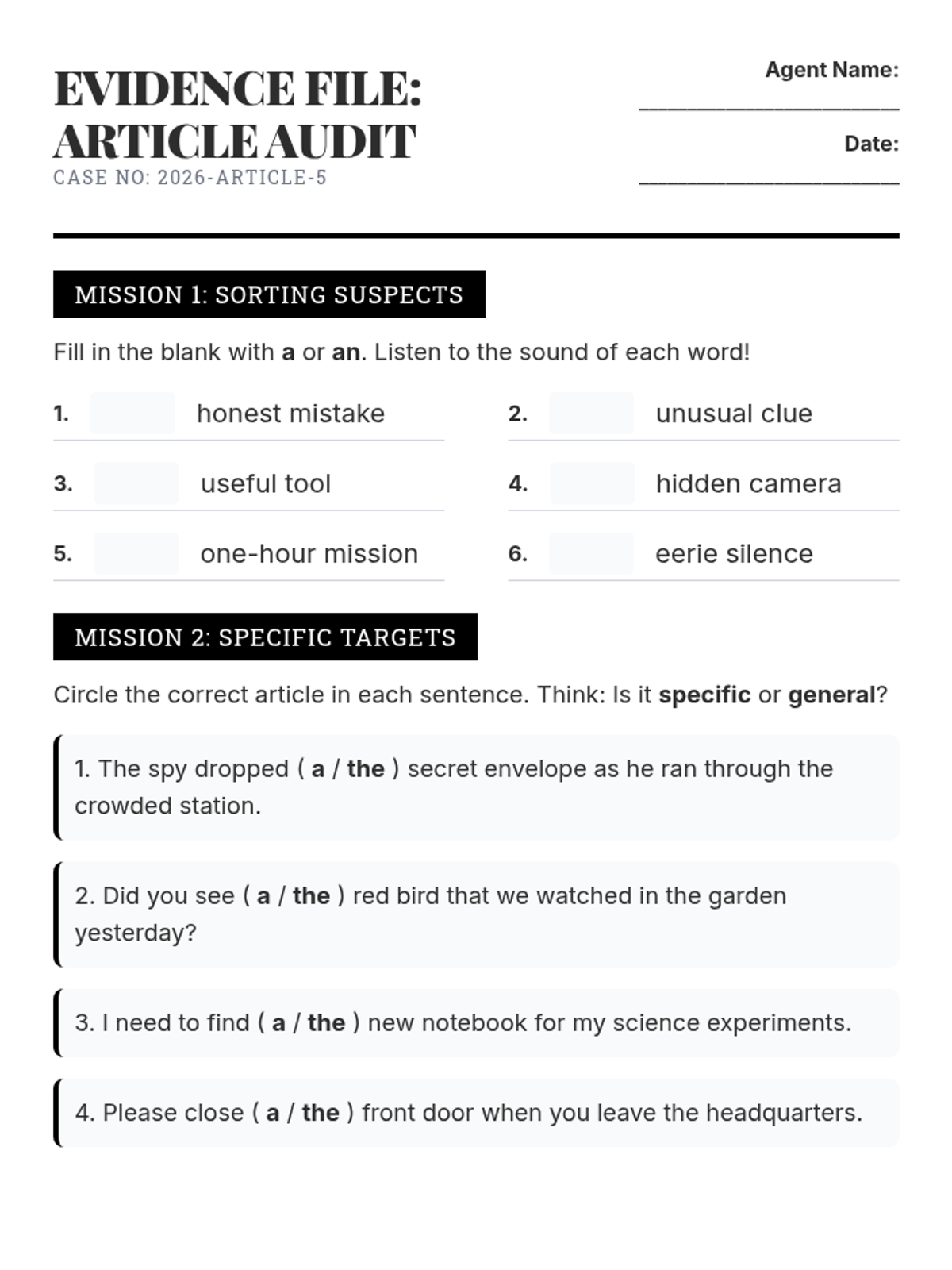
A practice worksheet where students audit article usage by filling in blanks, choosing between a/an/the, and editing a short report for errors. Optimized for 2-page printing with corrected error counts and better writing space.
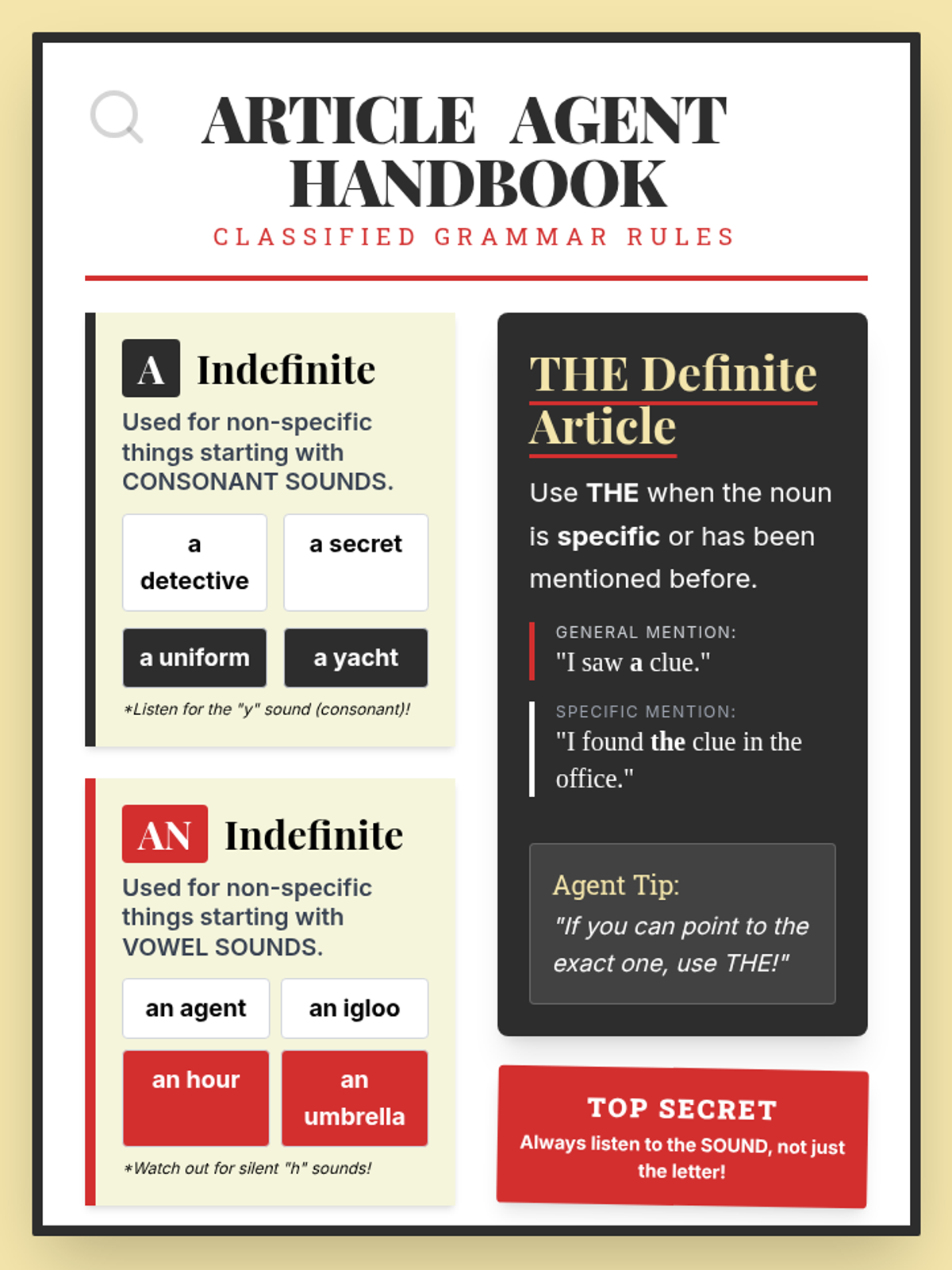
A classroom anchor chart summarizing the rules for a, an, and the, with visual examples and tips for vowel vs. consonant sounds. Redesigned to fit on a single page.
Instructional slides for the "Article Agents" lesson, covering the rules for indefinite (a, an) and definite (the) articles with a detective theme.
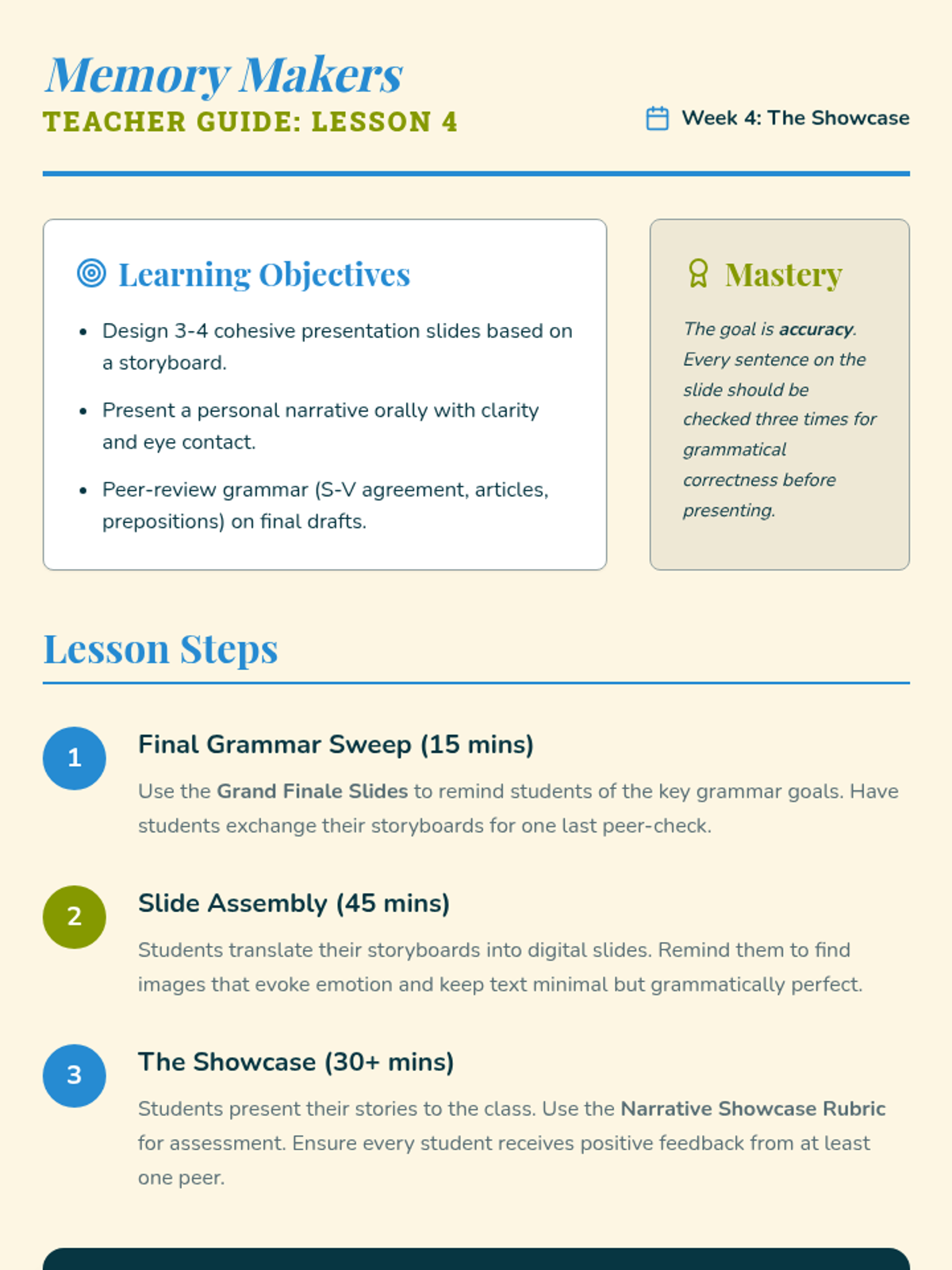
Teacher's guide for the final week of the program, focusing on slide creation, final grammar checks, and the oral presentation showcase.
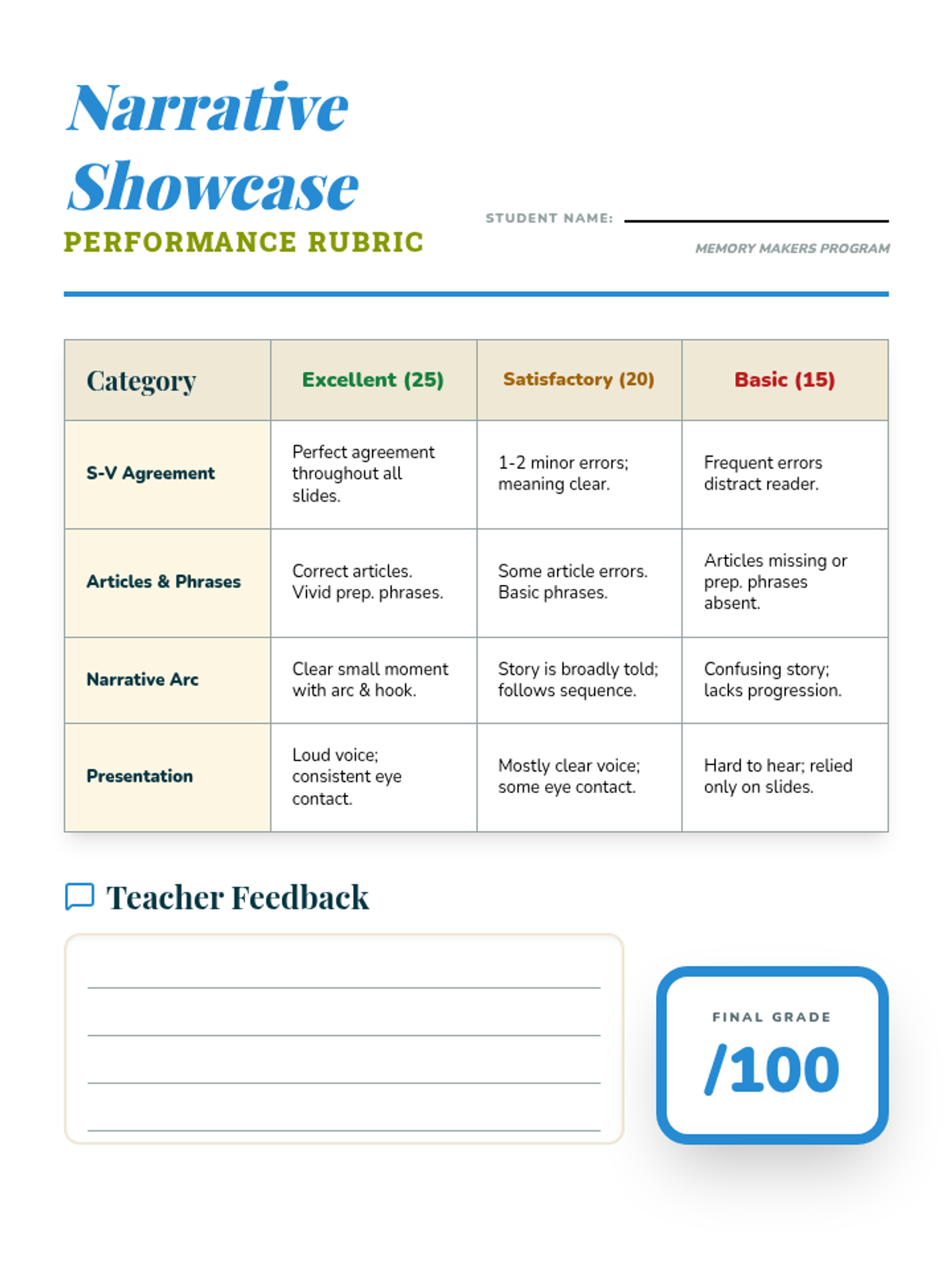
A comprehensive grading rubric for the final personal narrative oral presentation, including grammar, content, and delivery criteria.
Final slide deck for Lesson 4, guiding students through the preparation and delivery of their oral personal narrative presentations.
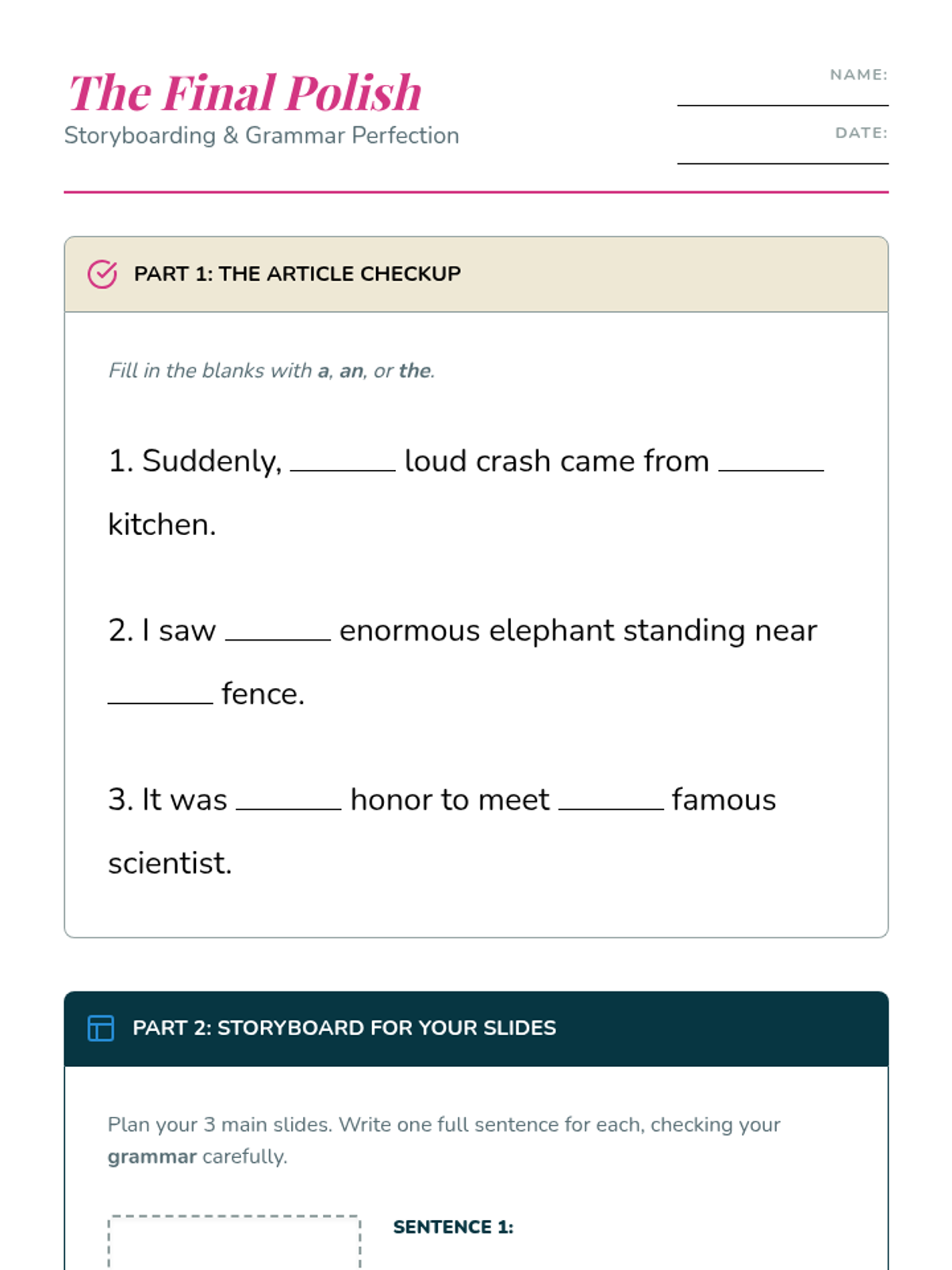
Worksheet for Lesson 3 to practice article usage and begin storyboarding for the final oral presentation slides.
Slides for Lesson 3 focusing on the correct use of definite and indefinite articles (a, an, the) within the context of a story.
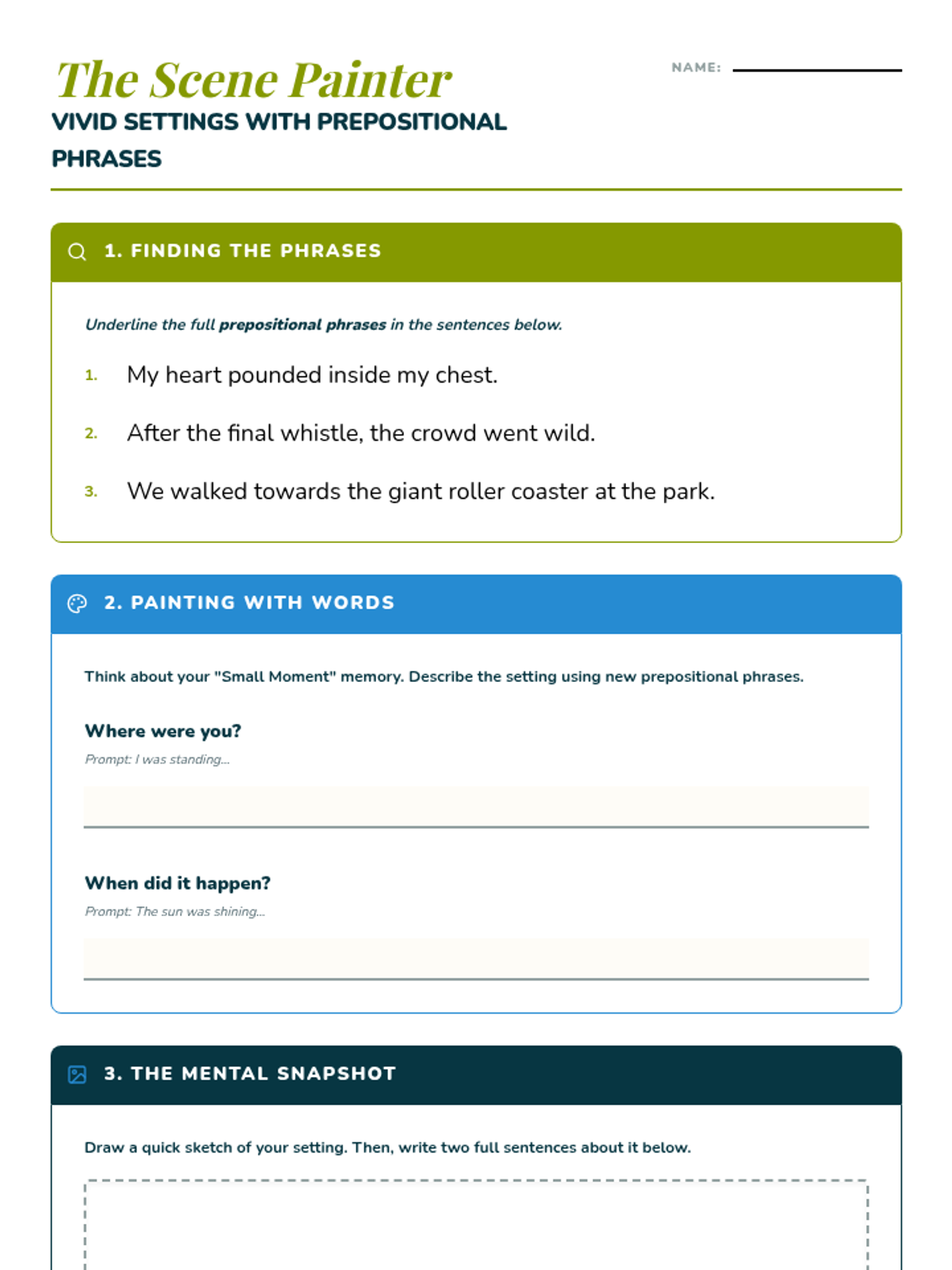
Worksheet for Lesson 2 focusing on identifying and using prepositional phrases to describe the setting of a personal narrative.
Slide presentation for Lesson 2 focusing on setting description and the use of prepositional phrases to add detail.
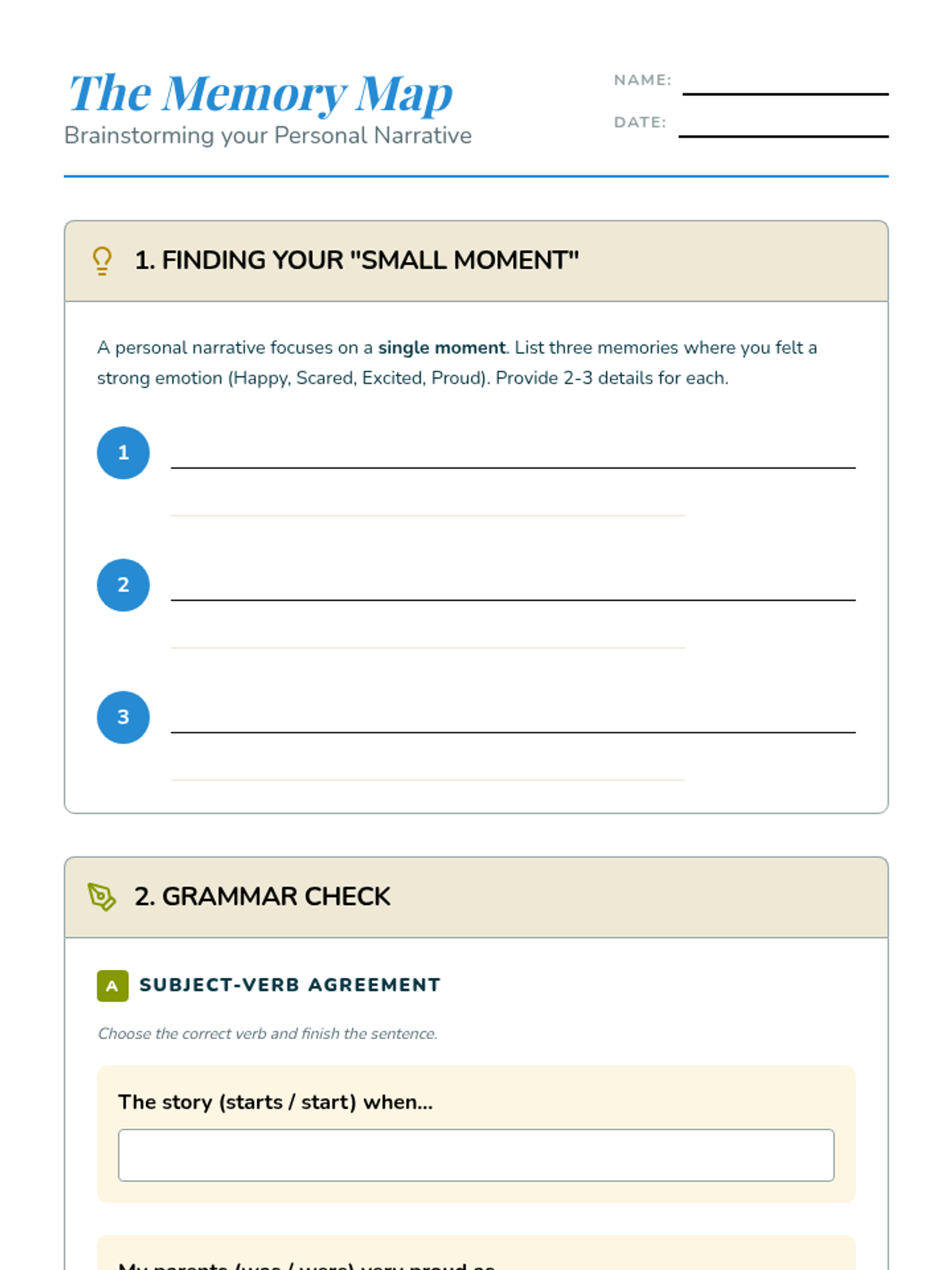
A student worksheet for brainstorming personal narrative topics and practicing subject-verb agreement.
Introductory presentation for Lesson 1, covering the concept of personal narratives and the rules of subject-verb agreement.
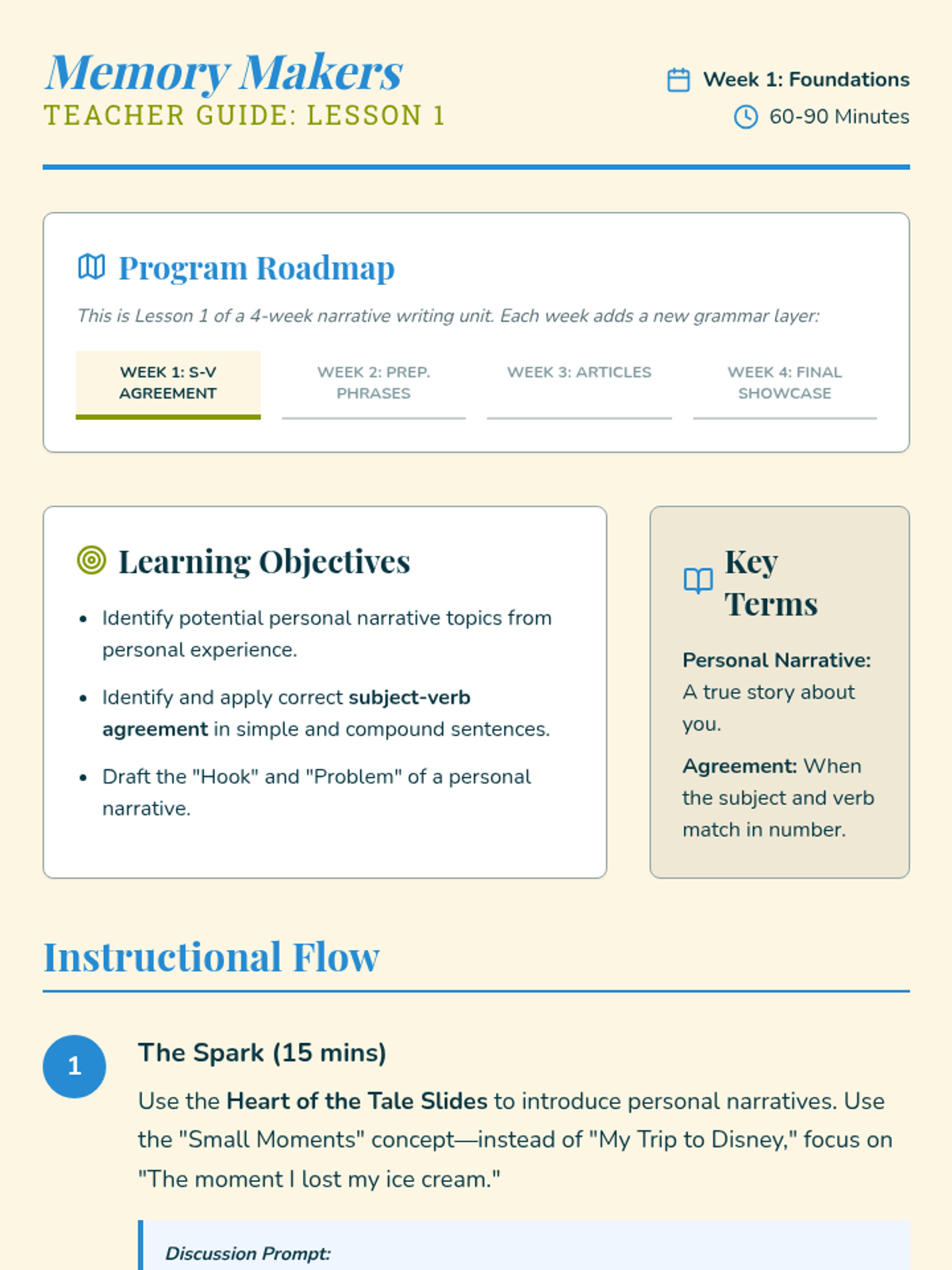
A teacher's guide for the first week of the Memory Makers program, covering personal narrative basics and subject-verb agreement instruction.
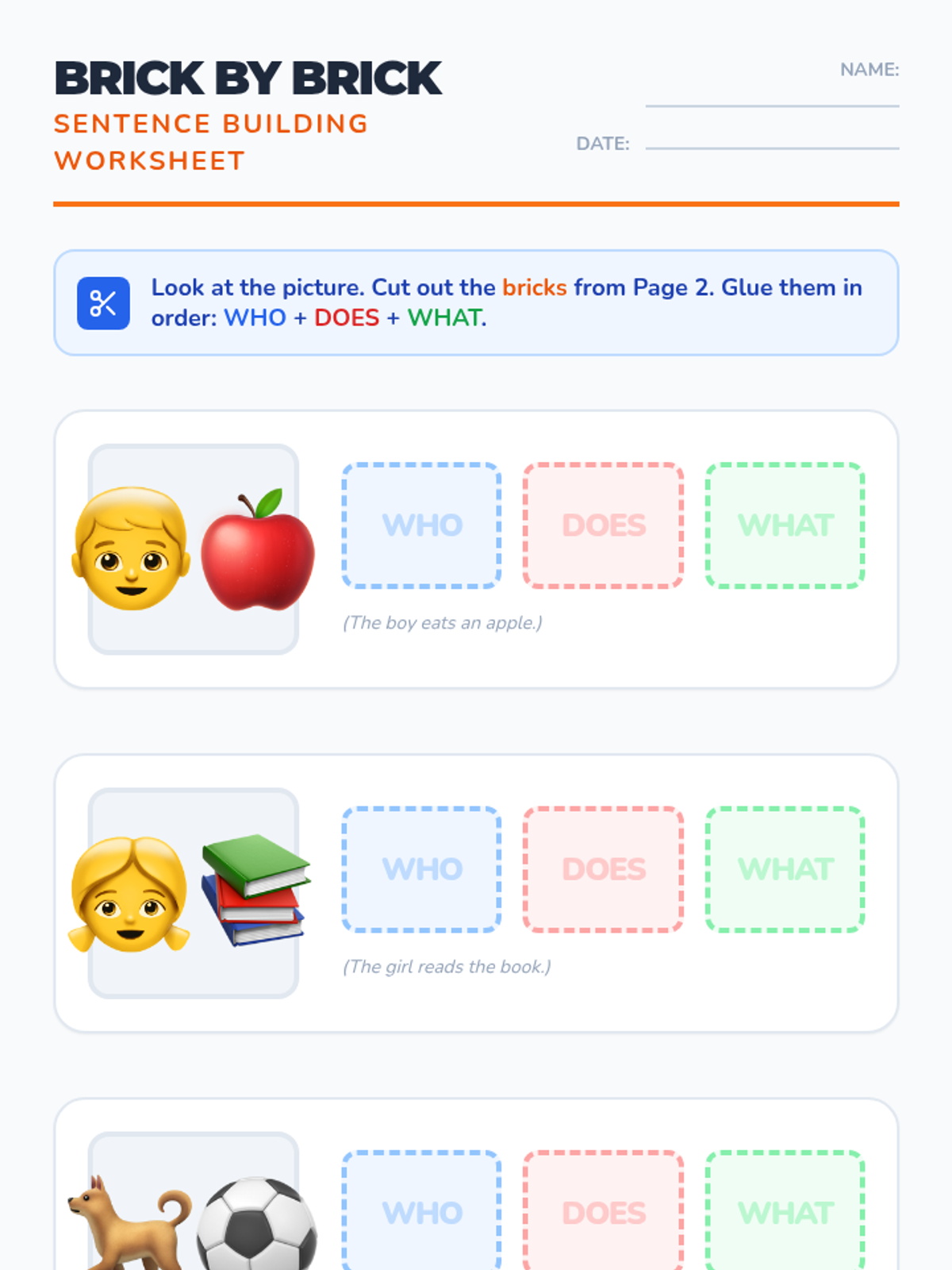
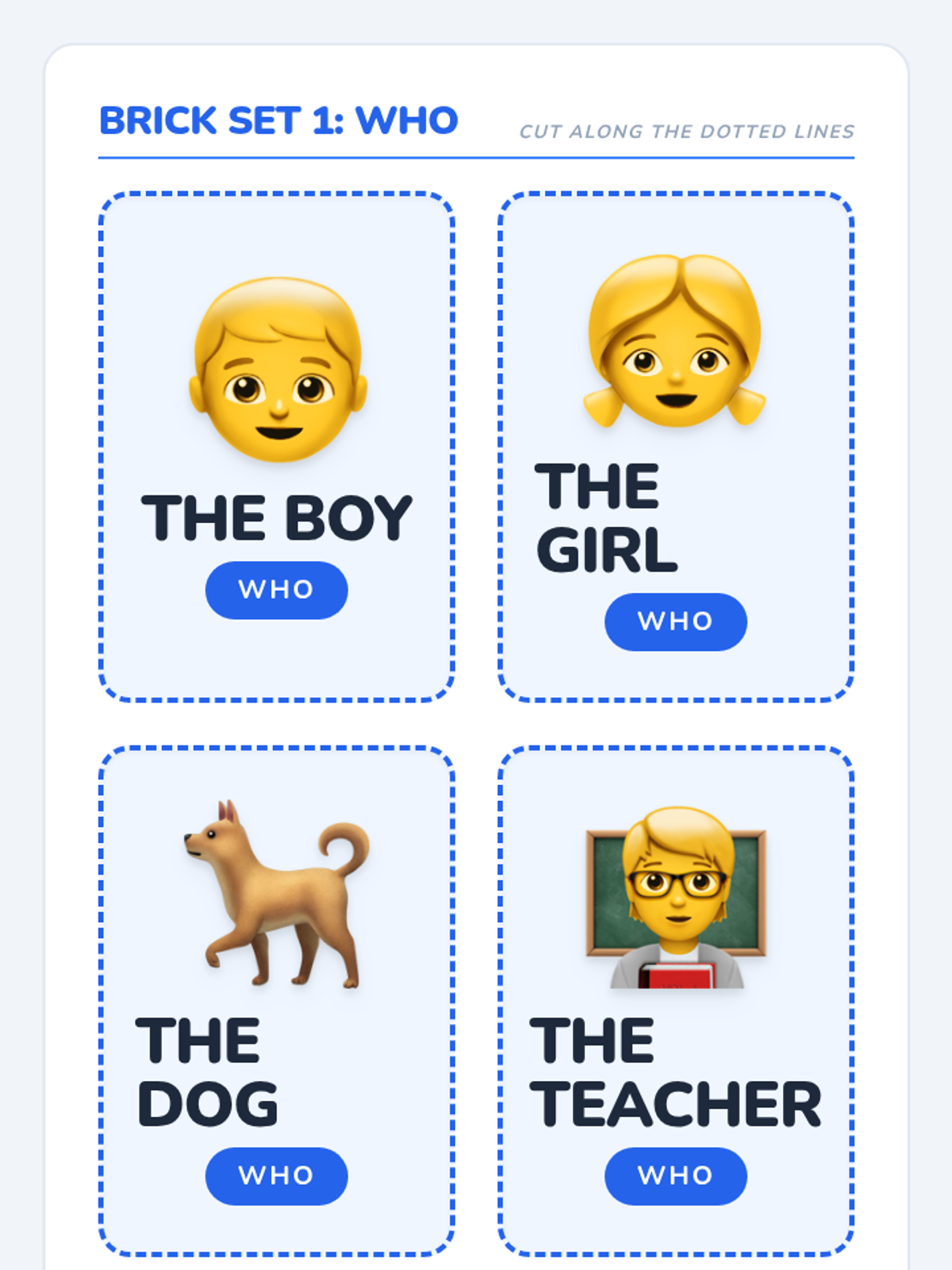
A picture-based sequencing worksheet where MLL students cut and paste words (Who, Does, What) to construct sentences matching visual prompts.
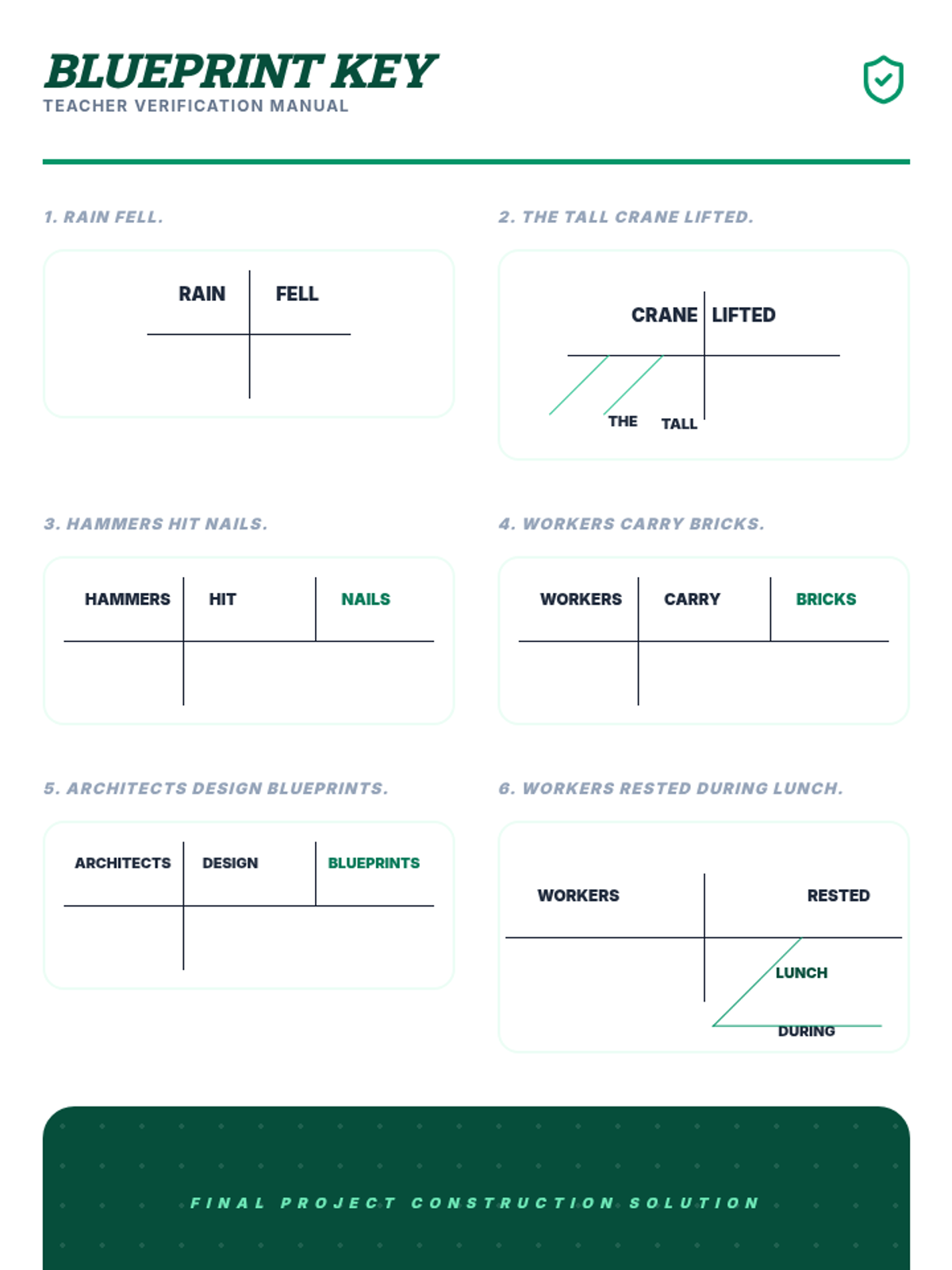
A comprehensive answer key with visual diagram solutions, featuring corrected Reed-Kellogg structures for complex sentences and prepositional phrases.
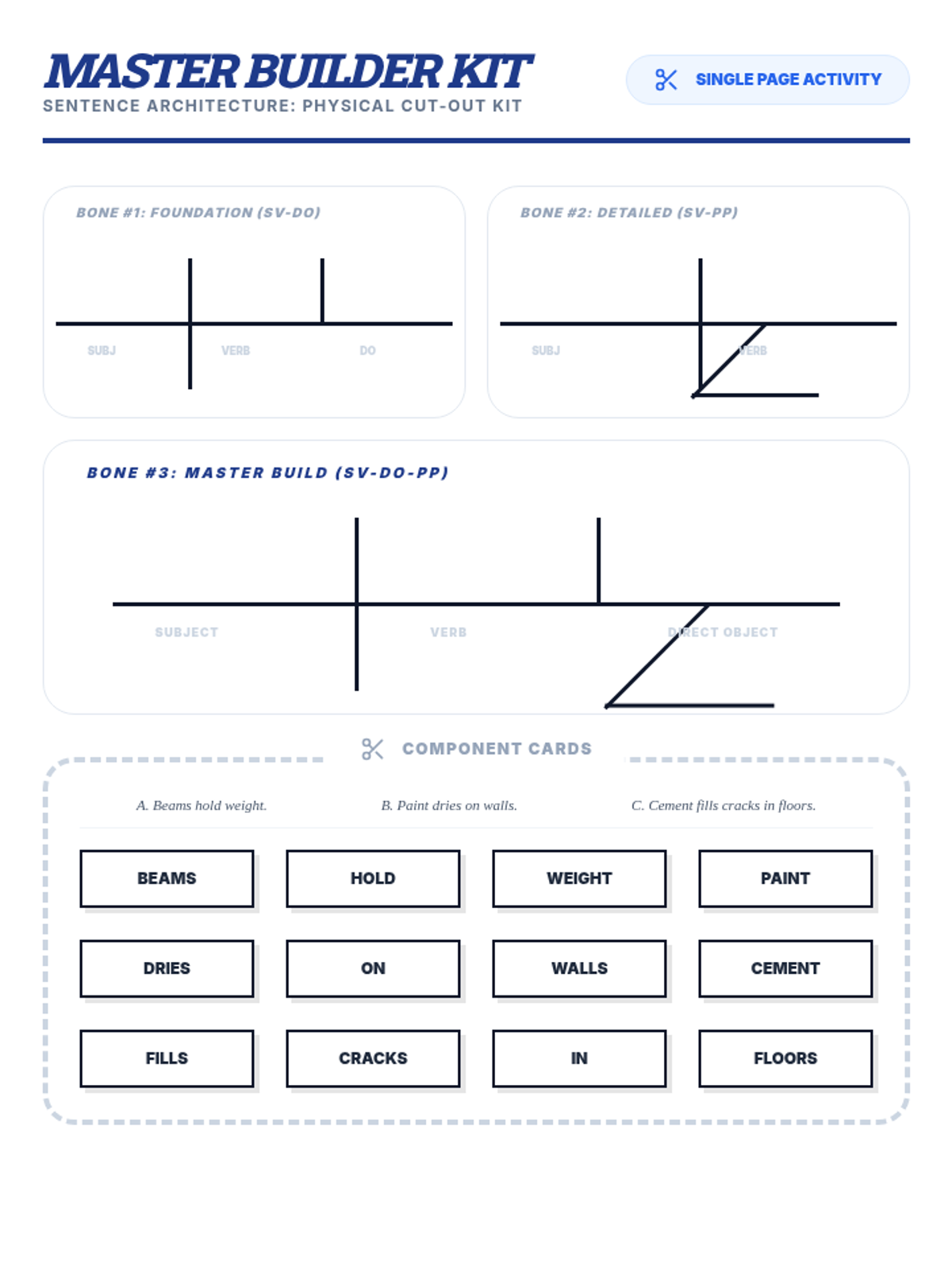
A hands-on "drag and drop" alternative for print, providing enlarged diagram frames and component cards for a physical sentence building activity on a single page.
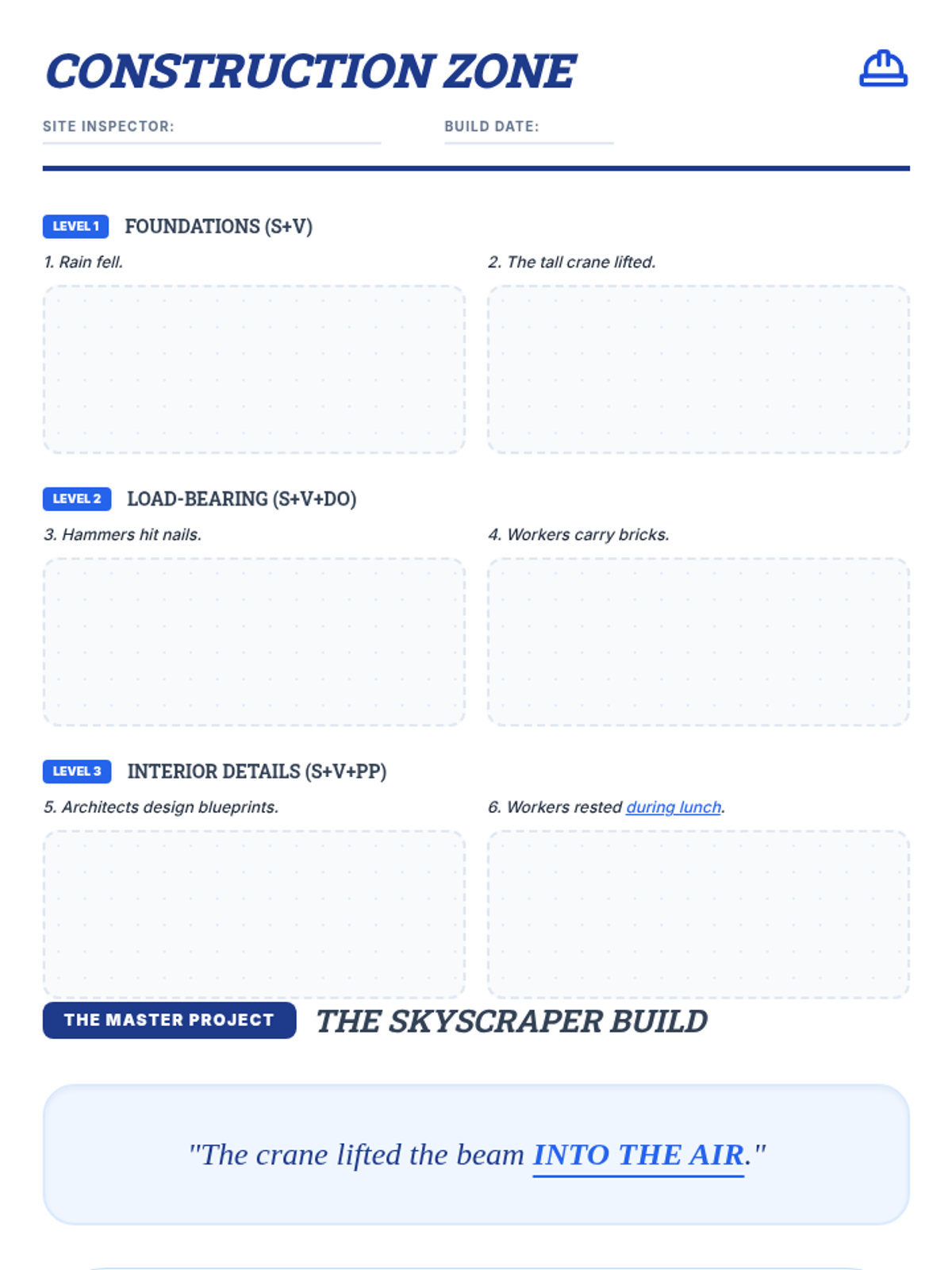
A sentence diagramming worksheet with three levels of increasing difficulty, plus a final challenge and a word bank to simulate interactive diagram building.
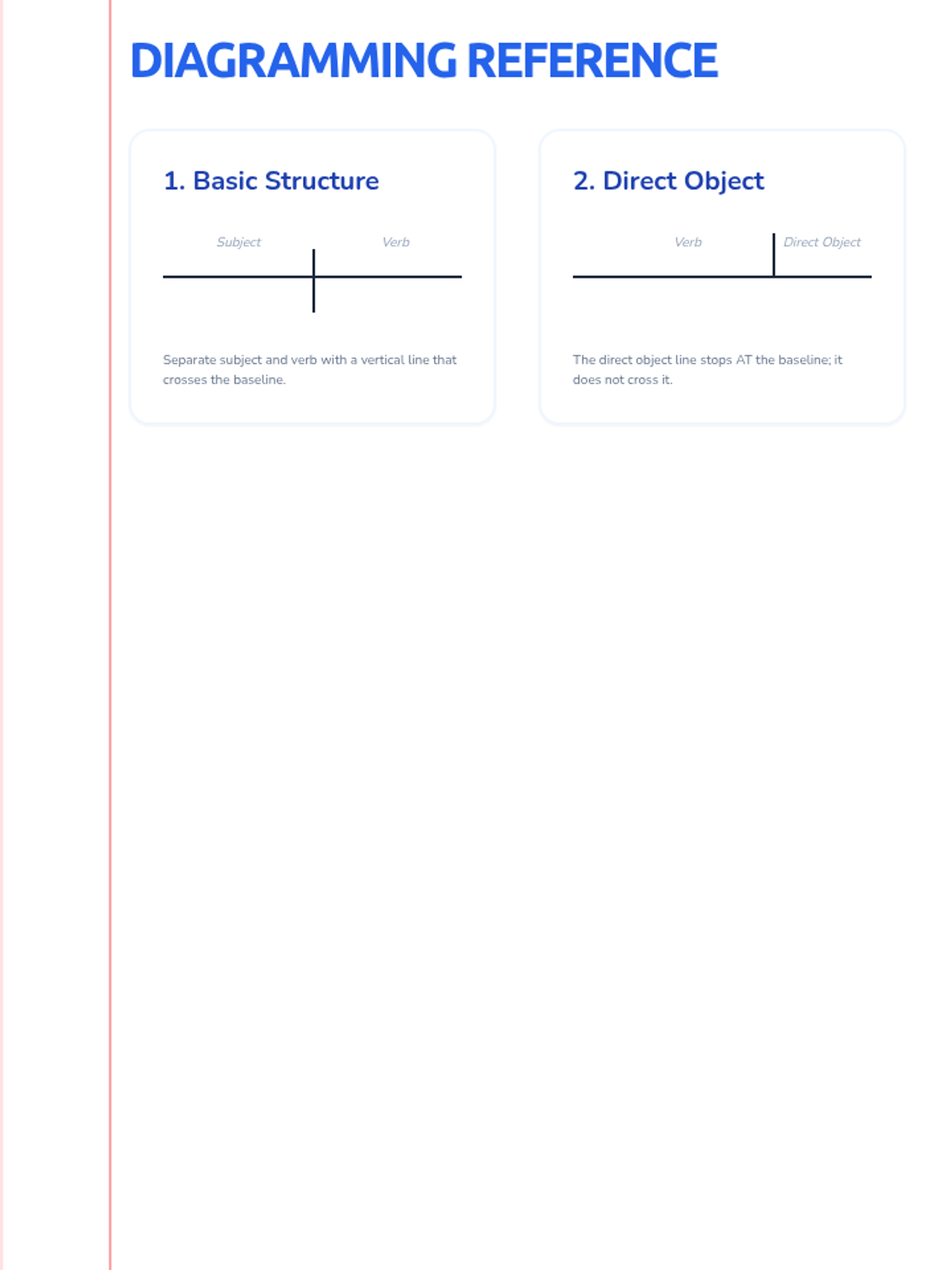
A visual guide to Reed-Kellogg diagramming, using an architectural theme to explain how to structure subjects, verbs, direct objects, and prepositional phrases.
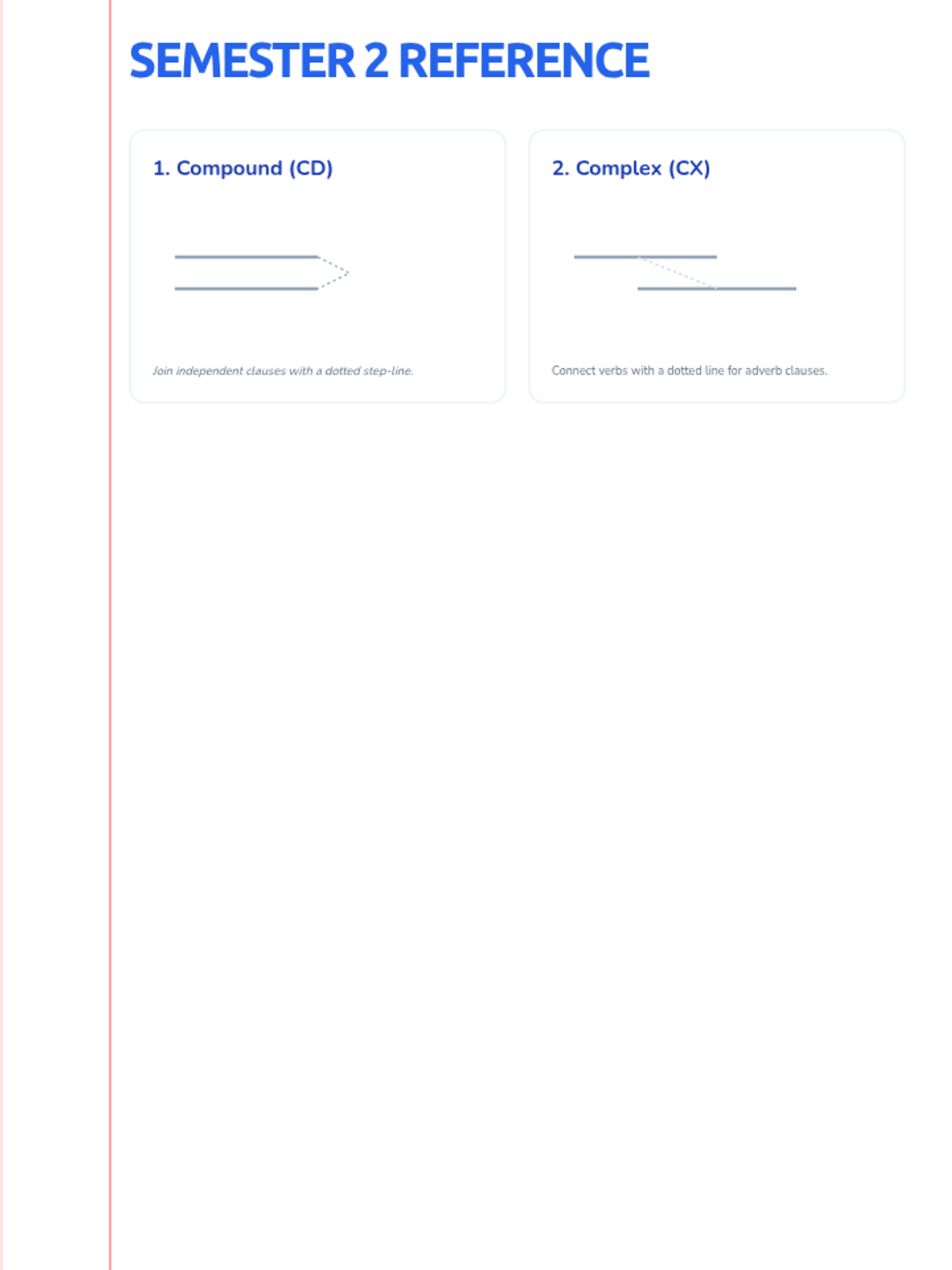
A comprehensive 19-page second-semester grammar workbook. This portrait handout includes daily tasks and unique hints for all 18 weeks (19-36), complex sentence analysis, and customized diagramming spaces with structural guides. Every page follows the user's color-coded daily task model.
A complete 19-page first-semester grammar practice workbook in portrait mode. Each page includes specific daily tasks (POS, Sentence Parts, Clauses, Correction) and a customized Friday diagramming area with structure-specific baselines and professional guidance. Each page matches the user's color-coded model.
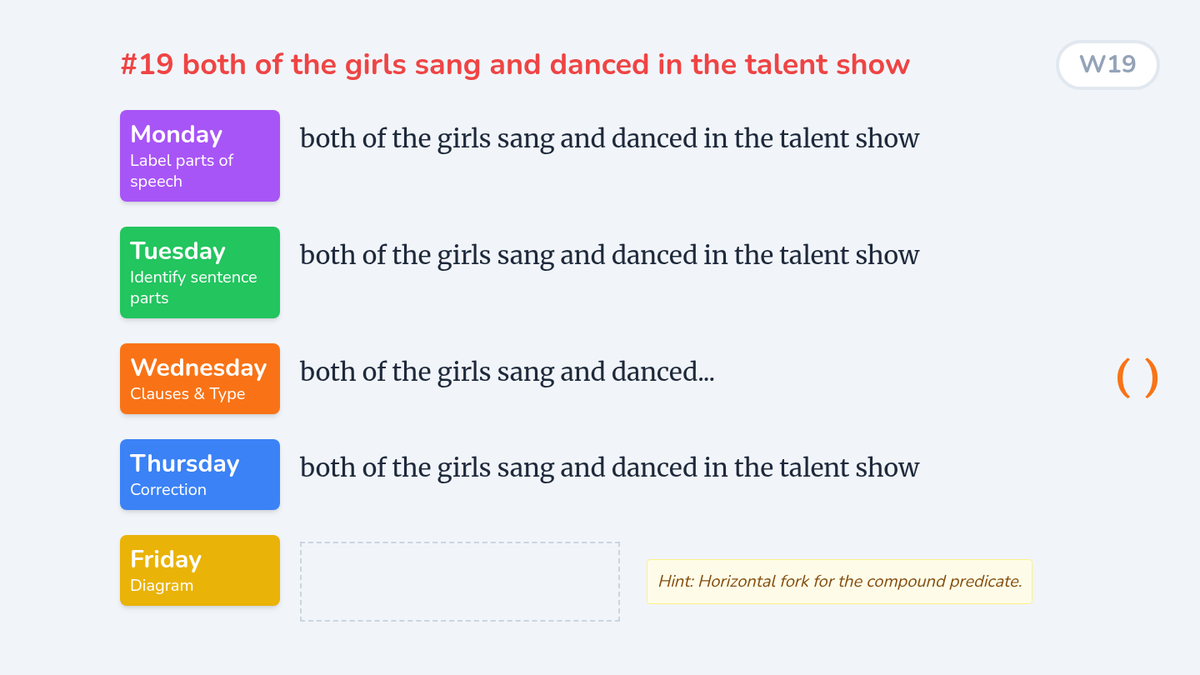
A presentation deck for the second semester of daily grammar practice (Weeks 19-36). Each slide focuses on a complex or compound-complex sentence with specific sections for daily analysis and hints.
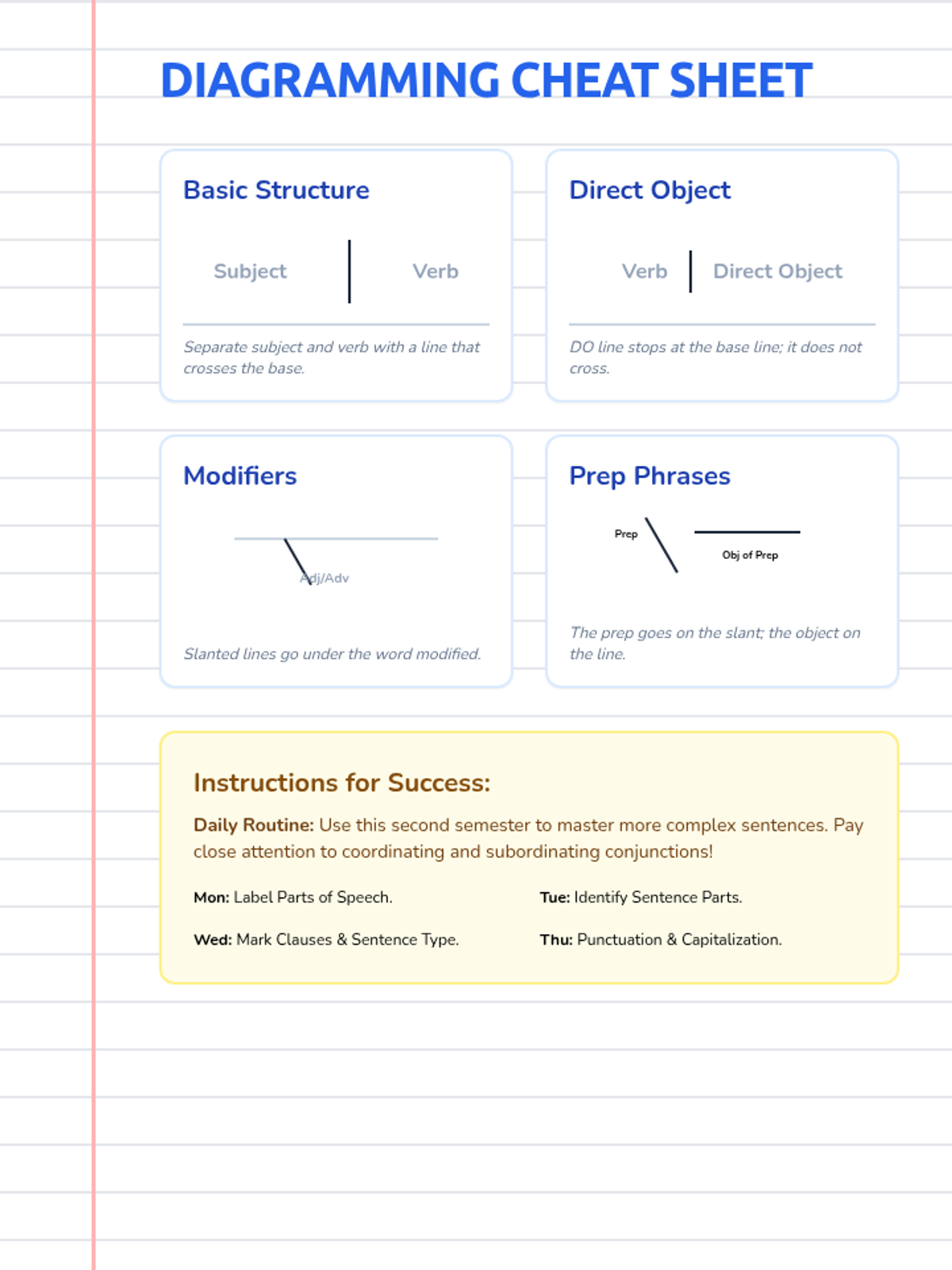
A 19-page second-semester grammar practice workbook, featuring Weeks 19-36 in portrait mode. Each page provides daily instructions and specific hints for complex and compound-complex sentence analysis, plus a diagramming reference guide.
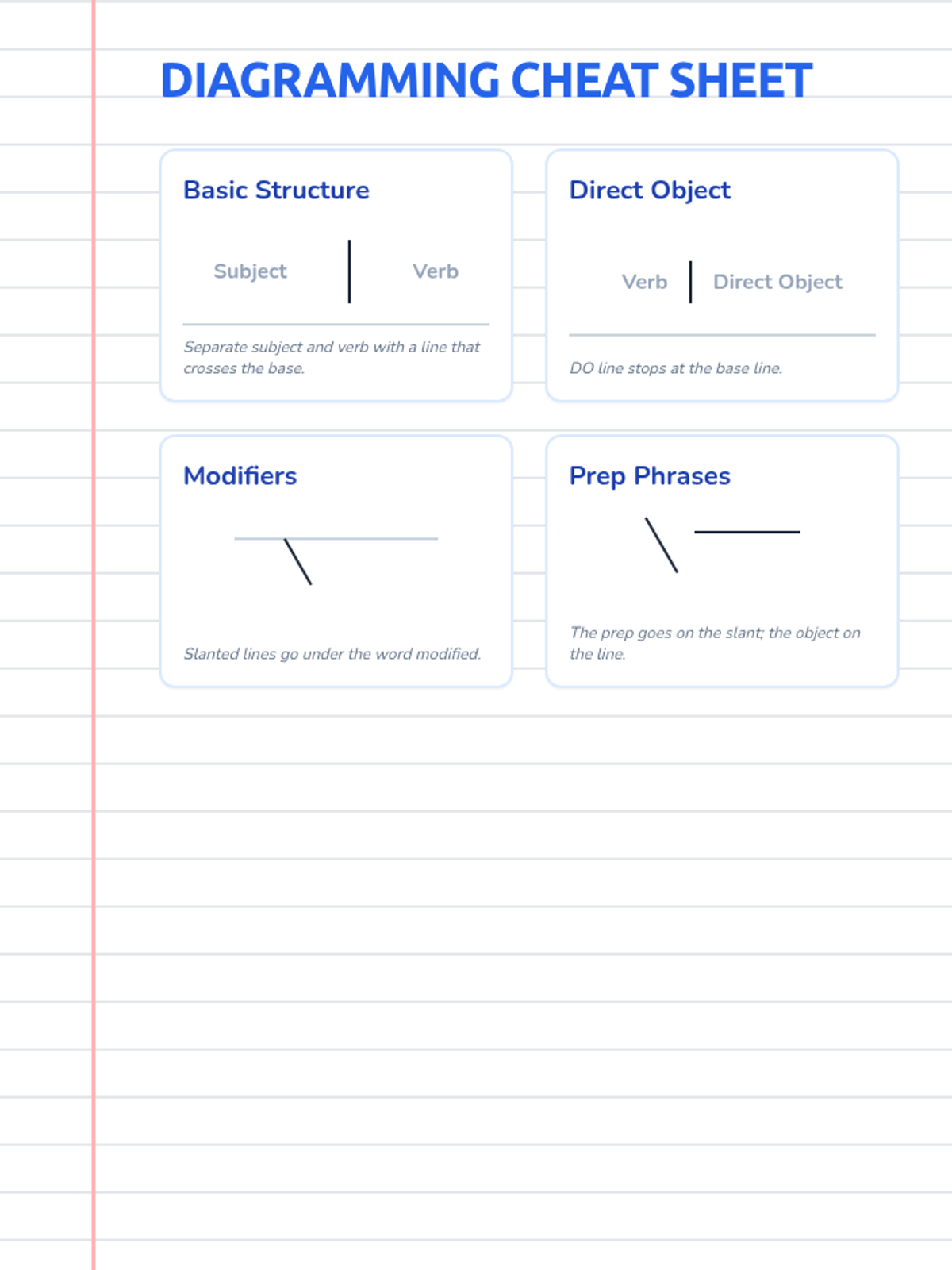
A 19-page comprehensive grammar practice workbook for the first semester, featuring one week per page in portrait mode. Each page includes specific daily instructions and tailored hints for parts of speech, sentence analysis, correction, and diagramming, plus a diagramming cheat sheet.
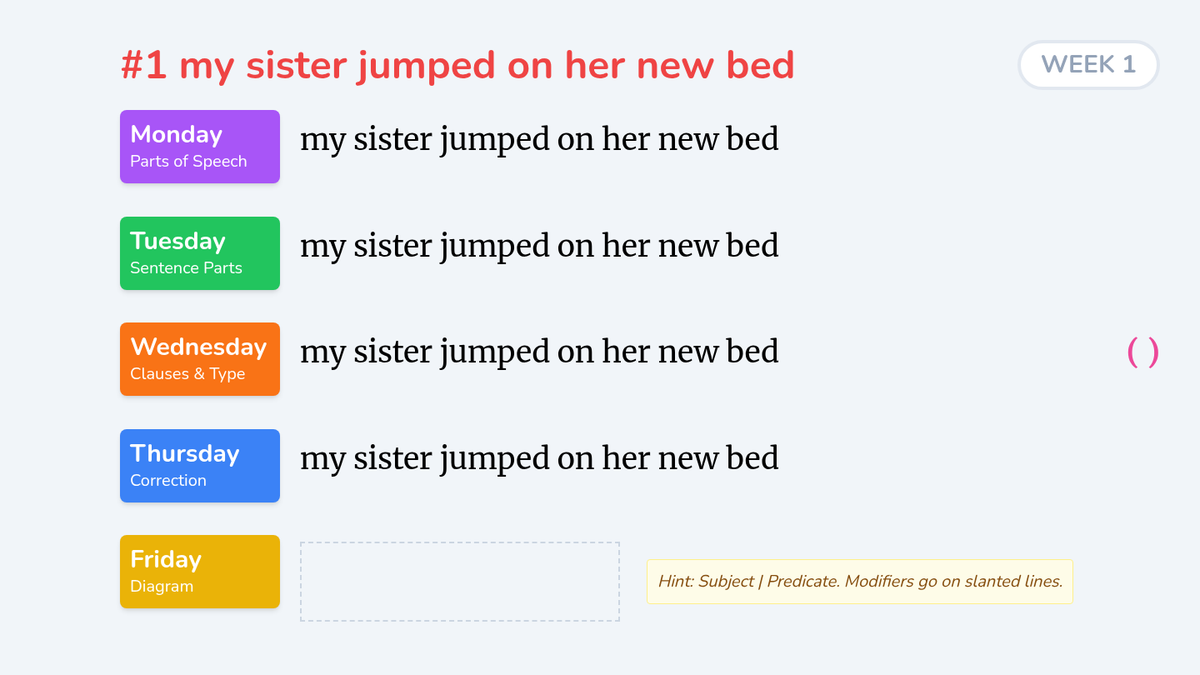
A 18-slide presentation for daily grammar practice, following a consistent weekly routine of part of speech identification, sentence analysis, and diagramming. Each slide features a notebook-style theme with colorful daily task indicators and space for student interaction.
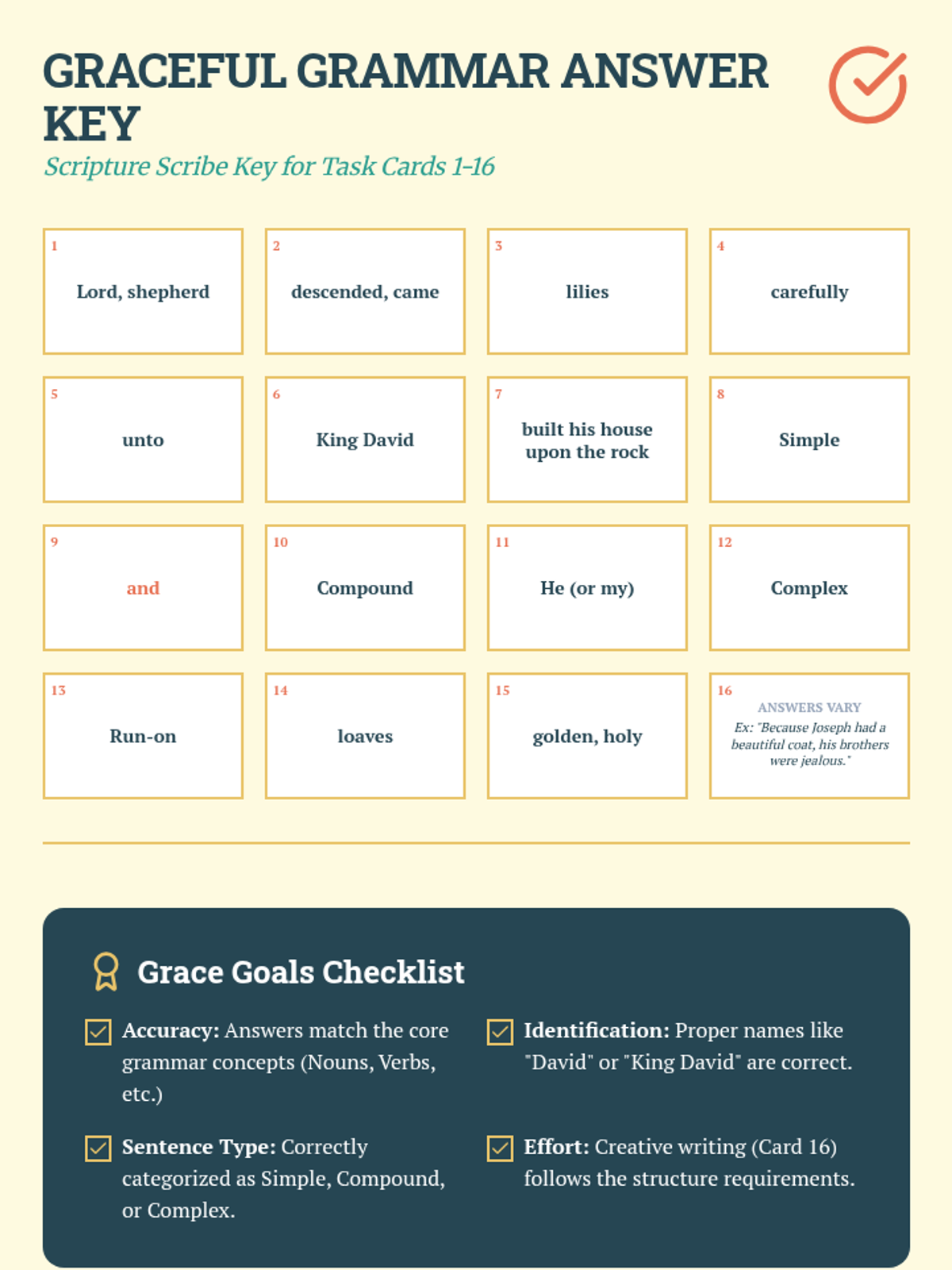
A standalone answer key for the Graceful Grammar task cards, formatted to match the student recording sheet for easy checking.
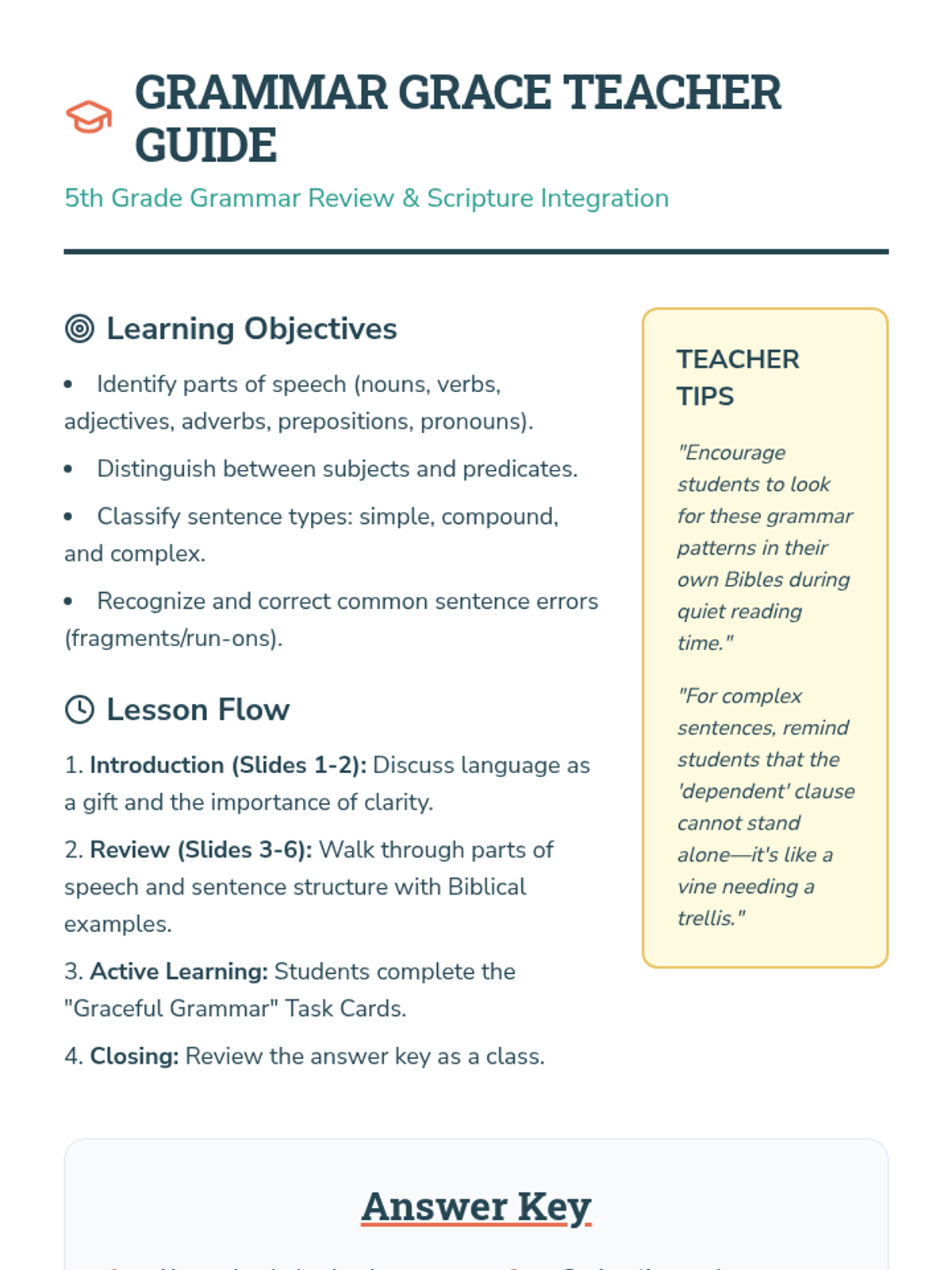
Teacher's guide for the Grammar Grace lesson. Includes learning objectives, instructional tips, and a complete answer key for the Graceful Grammar task cards.
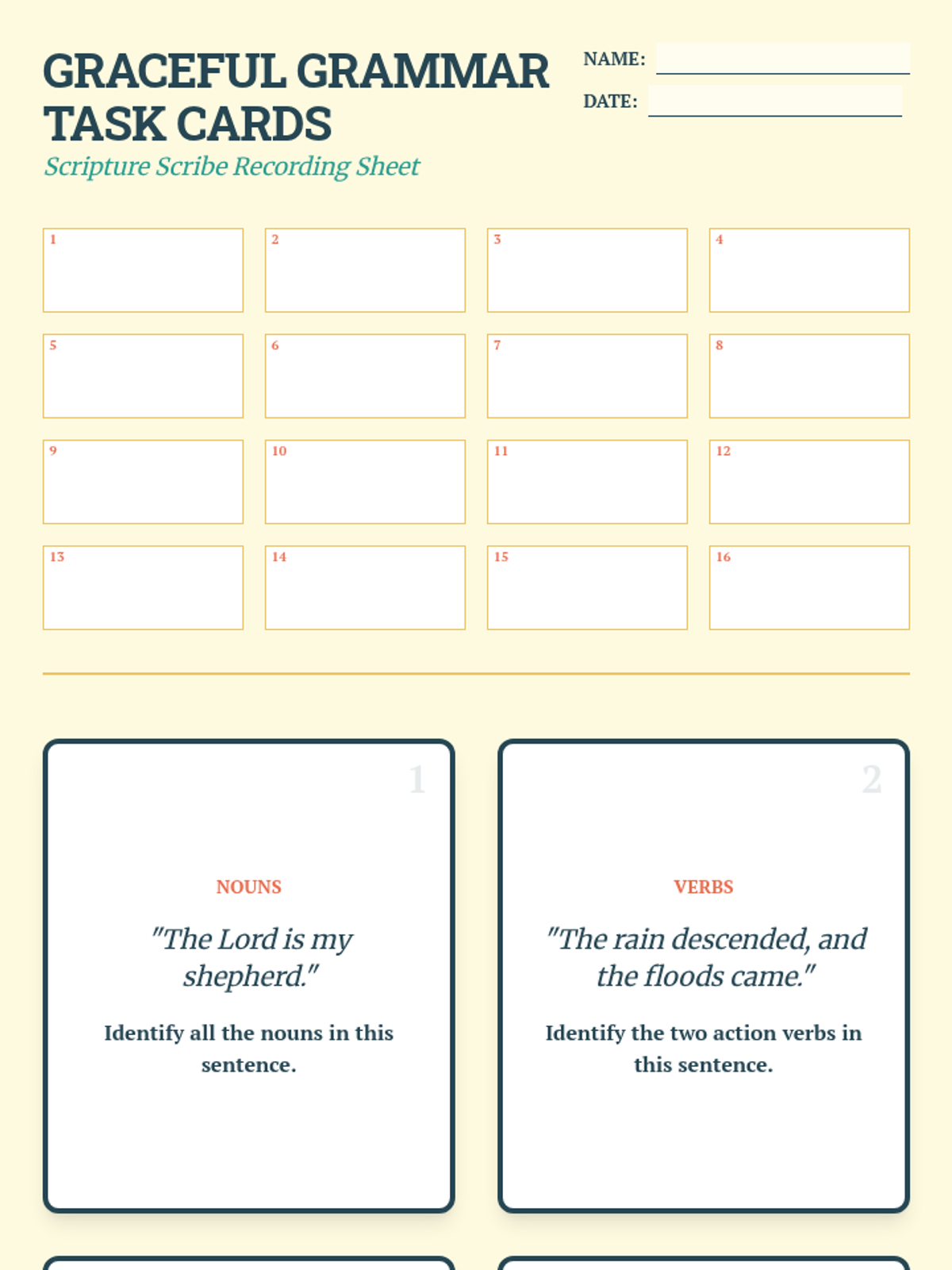
A set of 16 grammar task cards featuring Biblical verses and themes. Includes a student recording sheet. Topics cover parts of speech, sentence types, and basic sentence structure.
Instructional slides for a 5th-grade grammar review. The presentation covers parts of speech (nouns, verbs, adjectives, adverbs, prepositions) and sentence structure (subject/predicate, simple, compound, complex) using Biblical examples and themes.
A set of 12 color-coded flashcards (4 Who, 4 Does, 4 What) with large icons and words to help MLL students build Subject-Verb-Object sentences physically.
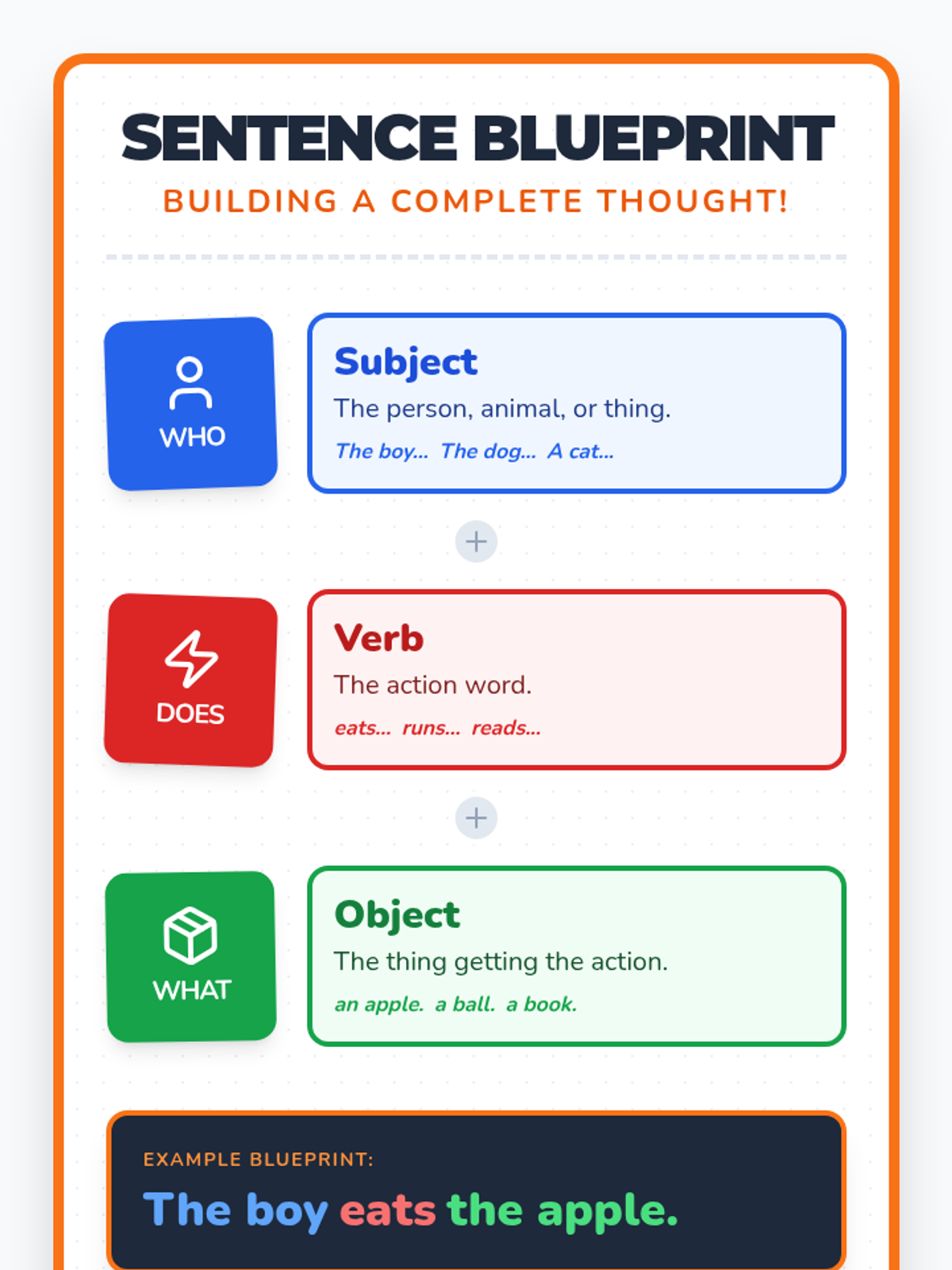
A visual anchor chart illustrating the Subject-Verb-Object sentence structure using color-coded blocks and simple icons to support MLL students.
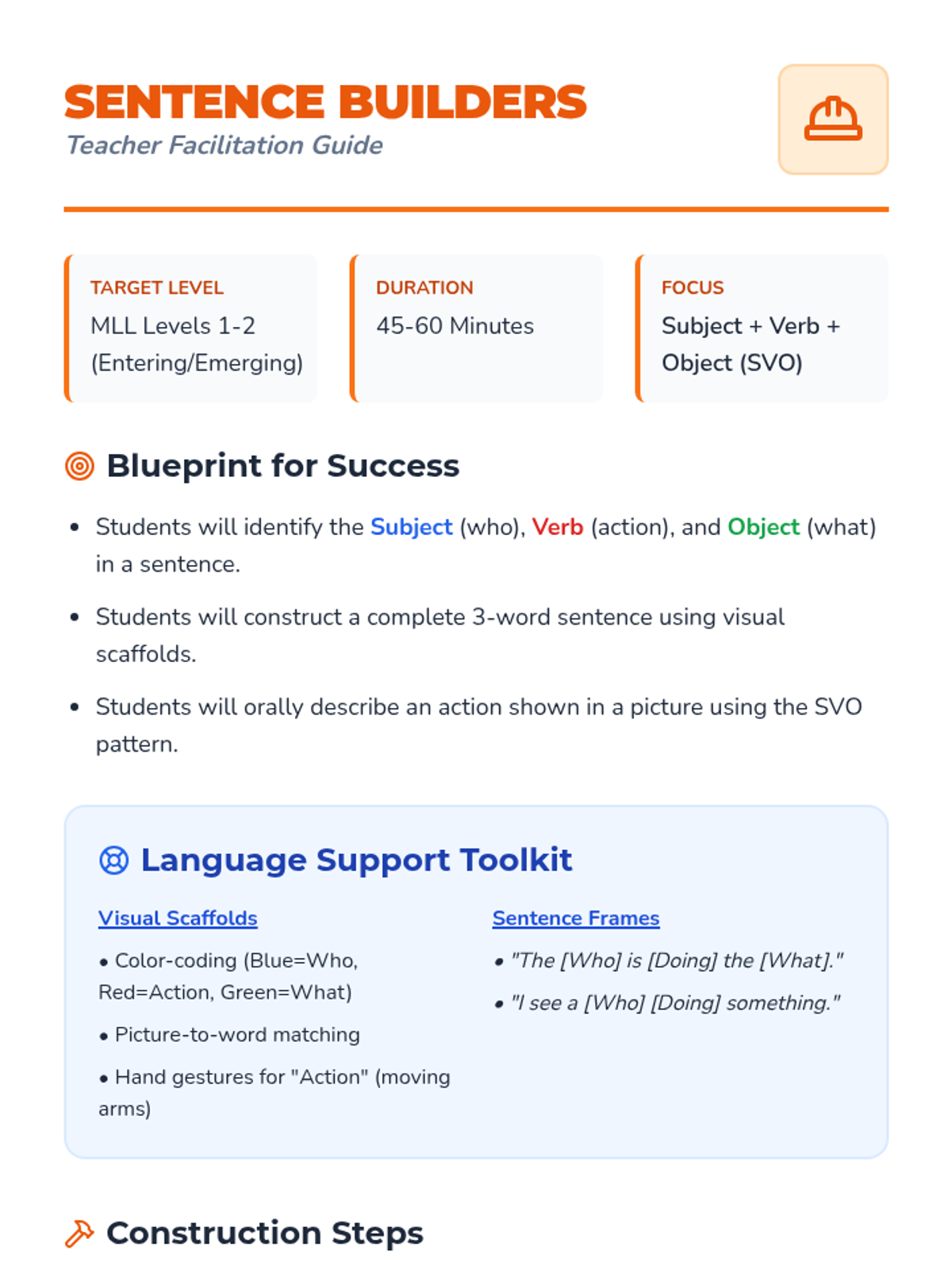
A comprehensive teacher facilitation guide for teaching basic SVO sentence structure to MLL students, featuring color-coded scaffolding, visual cues, and explicit instructional steps.
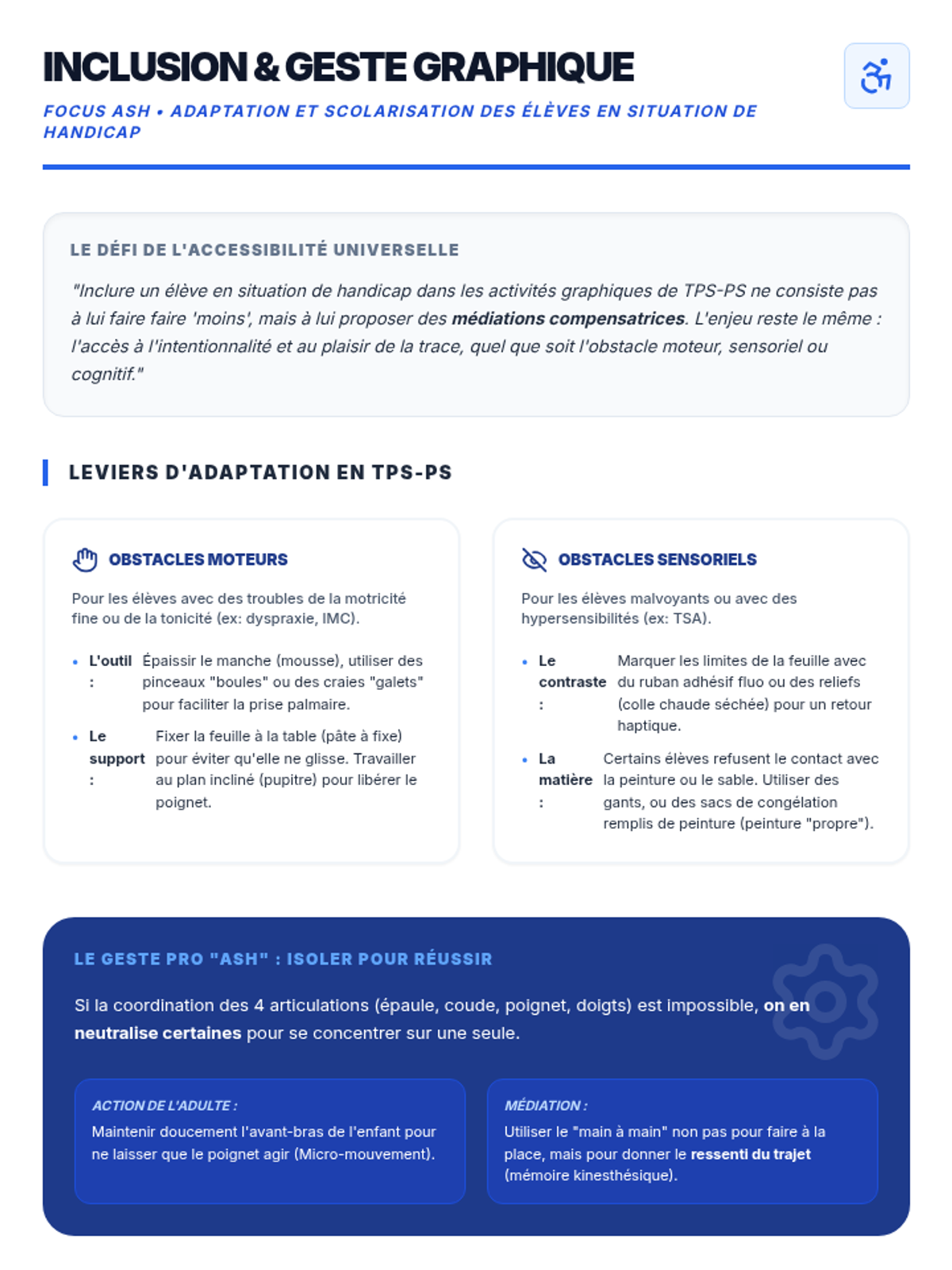
Ressource d'expertise sur l'adaptation des activités graphiques pour les élèves en situation de handicap (ASH) en maternelle. Propose des compensations motrices, sensorielles et cognitives pour garantir l'inclusion dans la construction du geste.
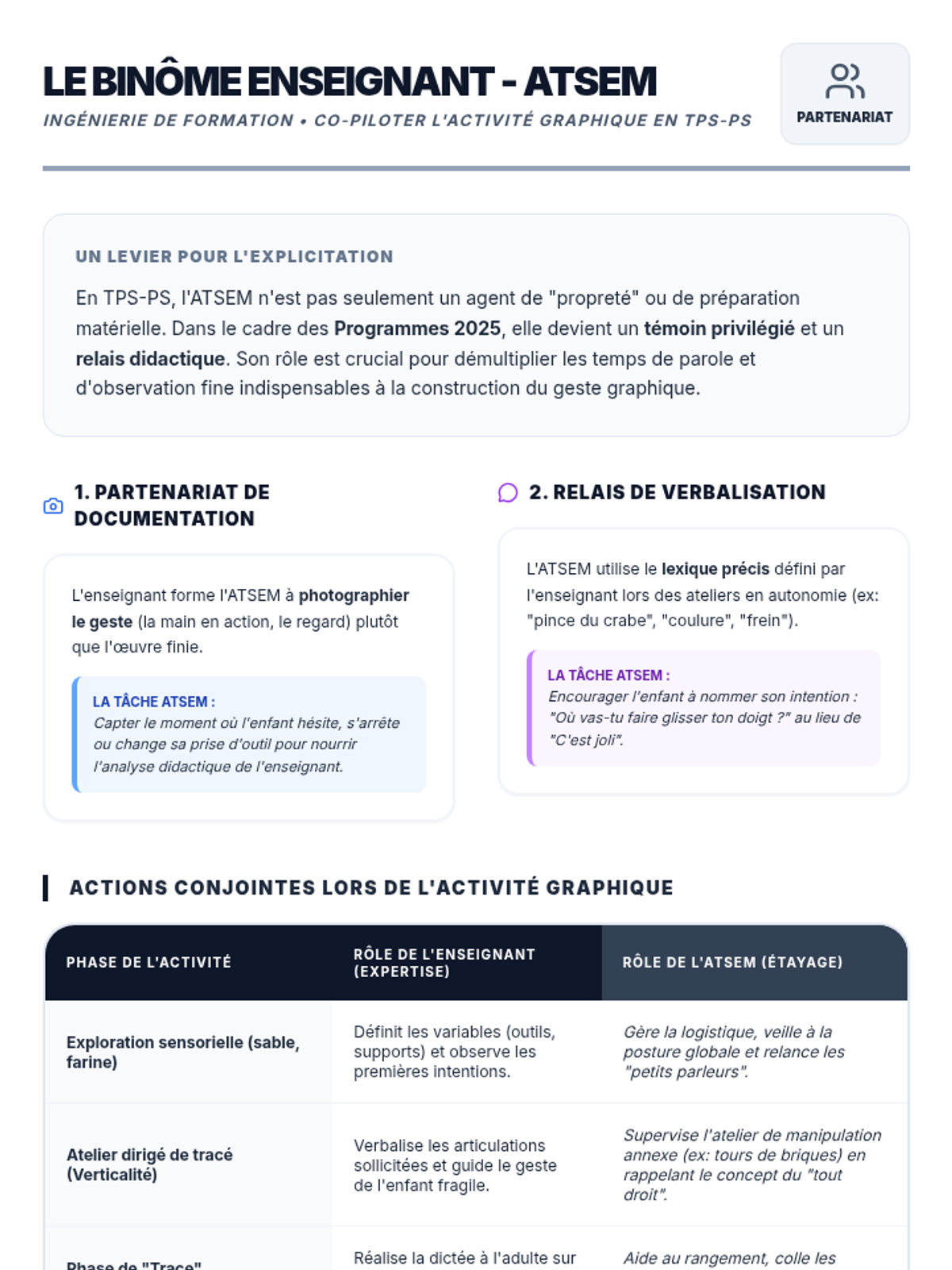
Guide méthodologique sur la collaboration entre l'enseignant et l'ATSEM en maternelle (TPS-PS) lors des activités graphiques. Définit les rôles respectifs pour l'observation, la verbalisation et la gestion de la trace selon les nouveaux programmes.
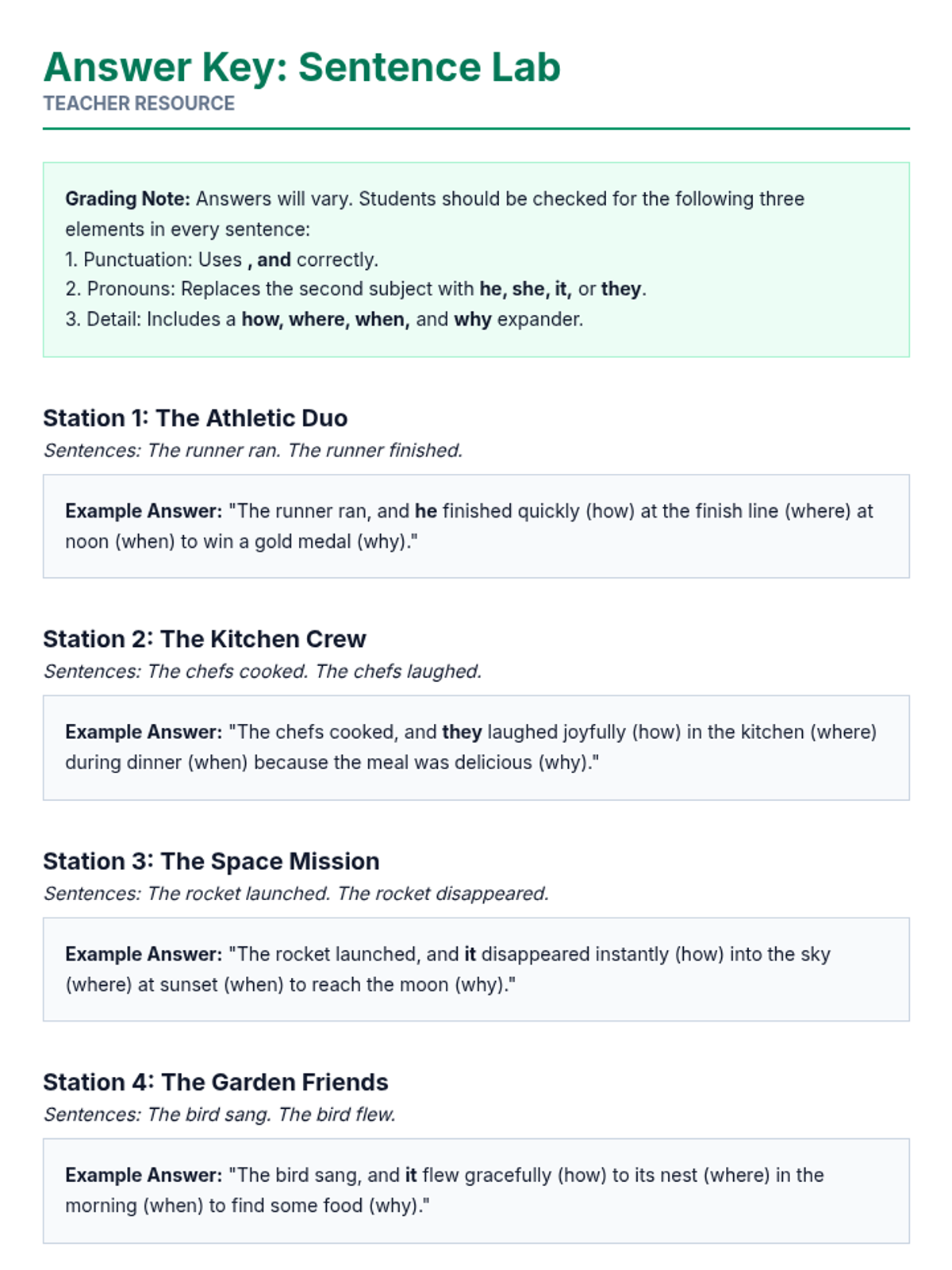
A Google Docs friendly version of the teacher's answer key, using standard text and table formatting that translates perfectly when copied into a digital document.
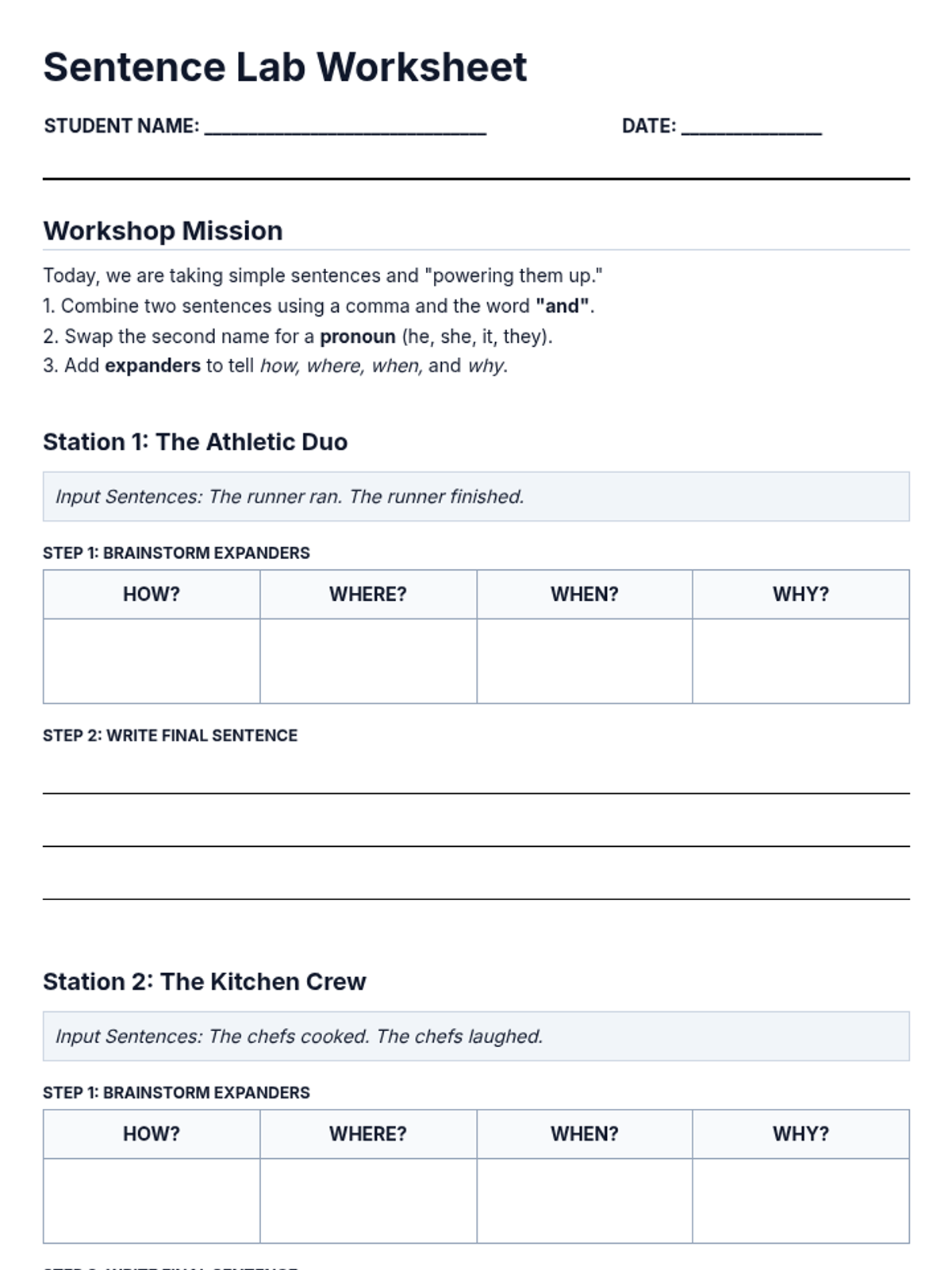
A Google Docs friendly version of the Sentence Lab worksheet, using a simplified table-based layout and standard formatting that translates easily when copied and pasted. Includes a bonus challenge station.
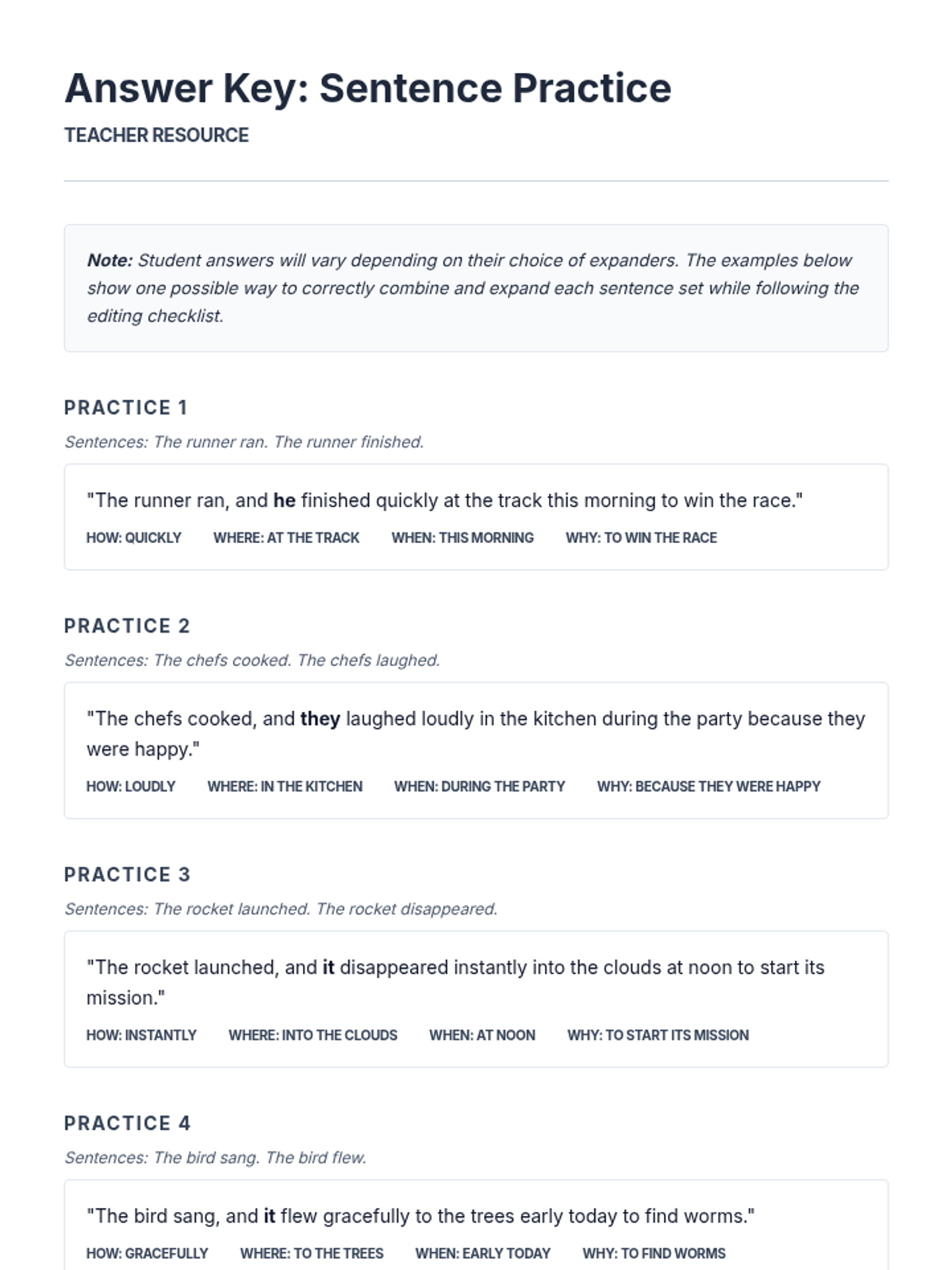
A teacher's answer key for the sentence practice worksheet, featuring example answers and a guide for the mobility punctuation rule.
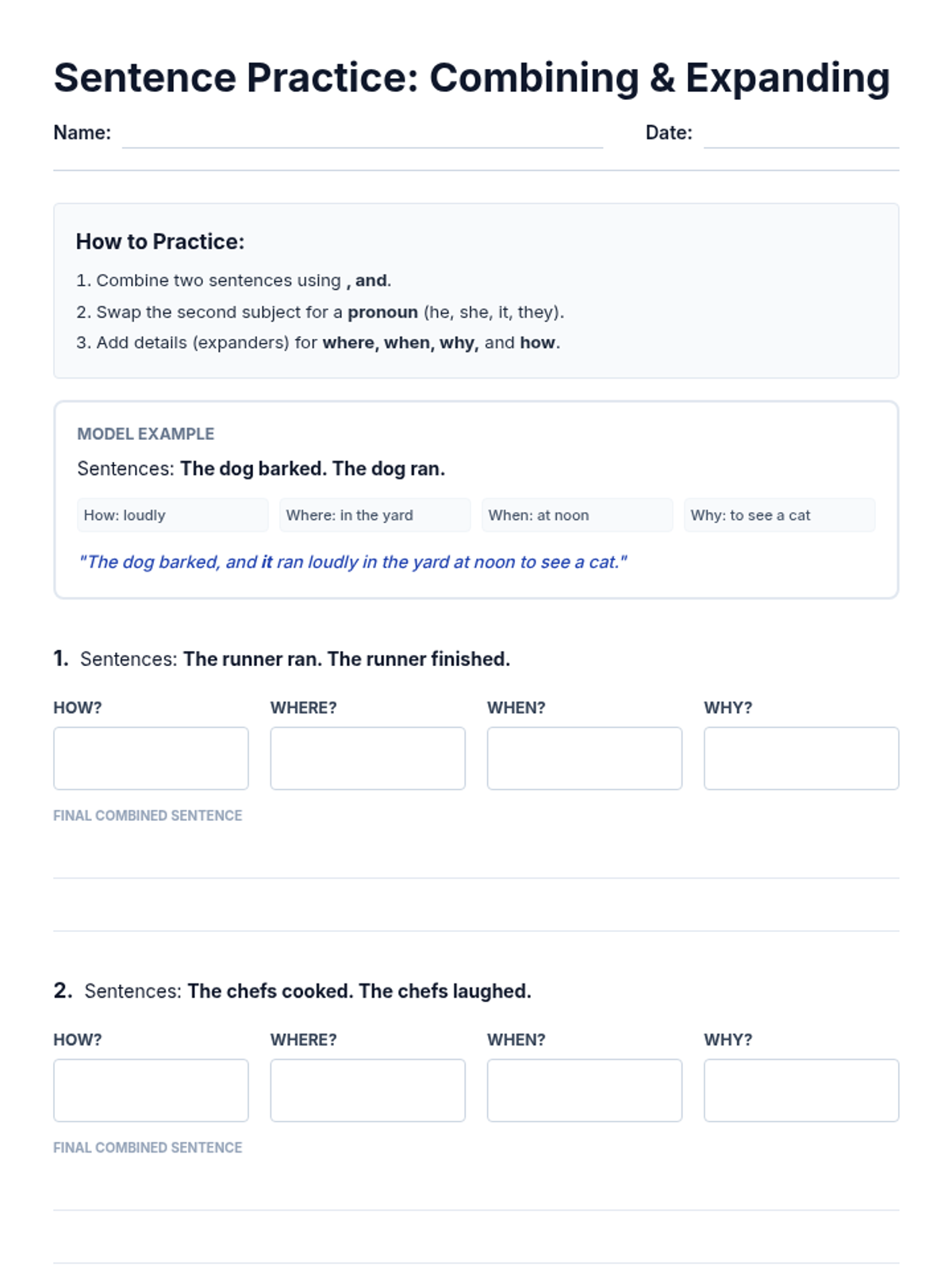
A basic sentence practice worksheet for middle school students, focusing on combining sentences with pronouns and adding predicate expanders. Includes a comprehensive editing checklist.
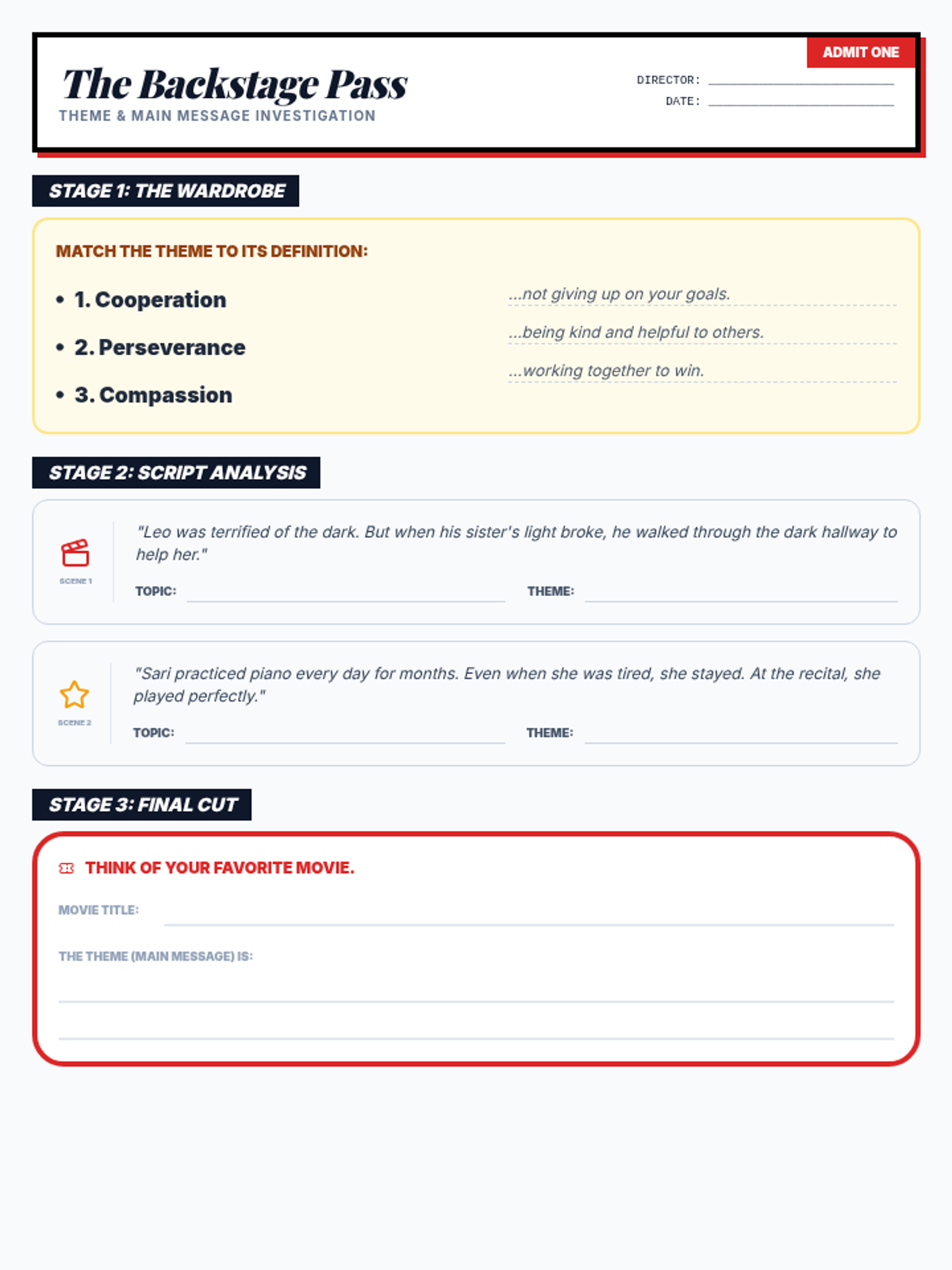
A student worksheet for the Theme Theatre lesson where students practice matching themes to definitions, identifying topics vs. themes in short "Micro-Scripts," and drafting their own theme statements for familiar media.
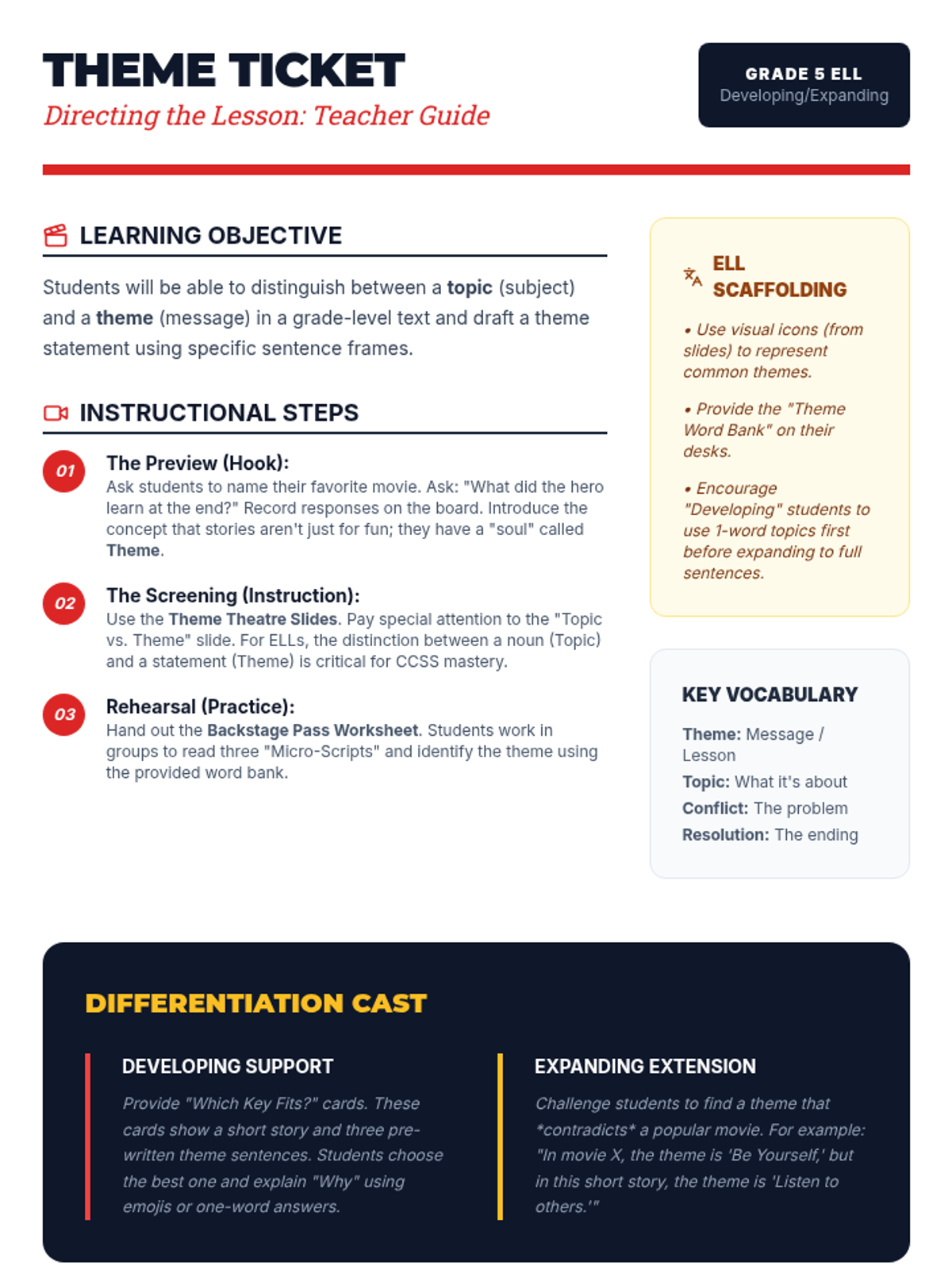
Teacher facilitation guide for the Theme Theatre lesson, providing instructional steps, ELL scaffolding techniques, and differentiation strategies for Grade 5 students.
A visually striking presentation using a "Movie Theatre" theme to teach 5th grade ELL students about identifying themes and distinguishing them from topics. Includes vocabulary support, clues for finding themes, and practice examples.
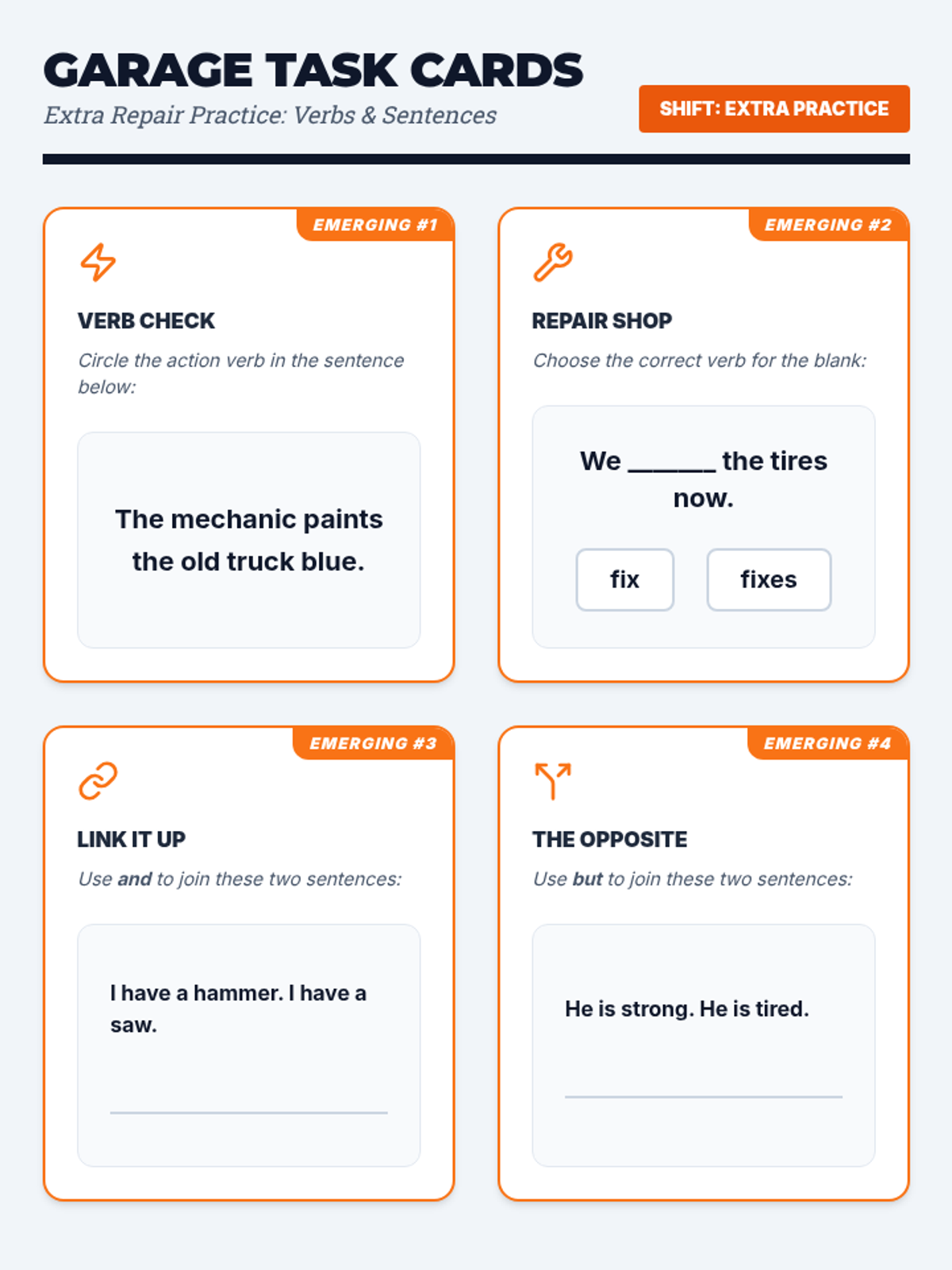
A set of 12 tiered task cards (4 per ELL level) providing extra practice with action verbs, compound sentences, and complex sentences with a Garage theme.
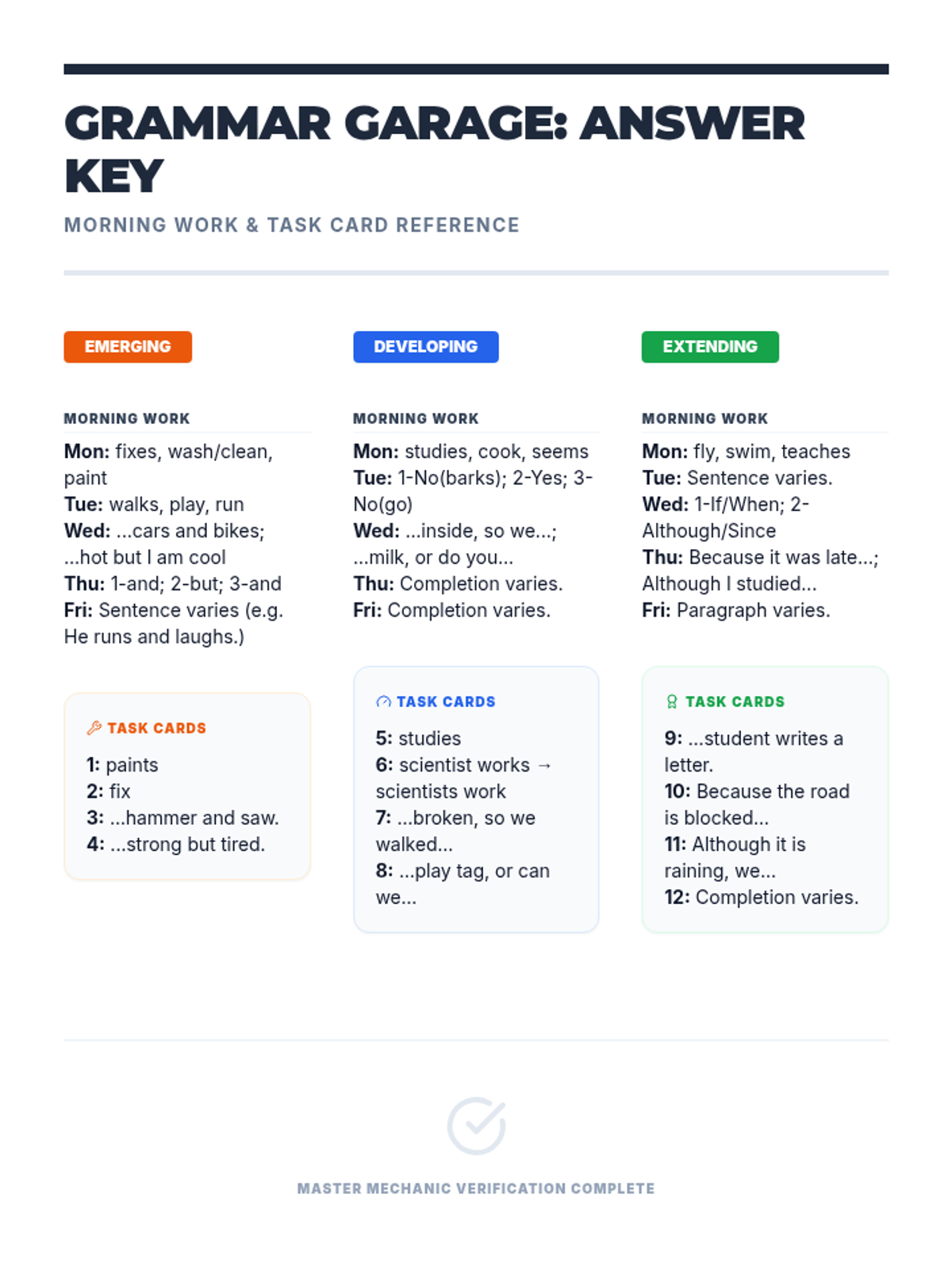
A comprehensive answer key for all three levels of the Grammar Garage morning work series and task cards.
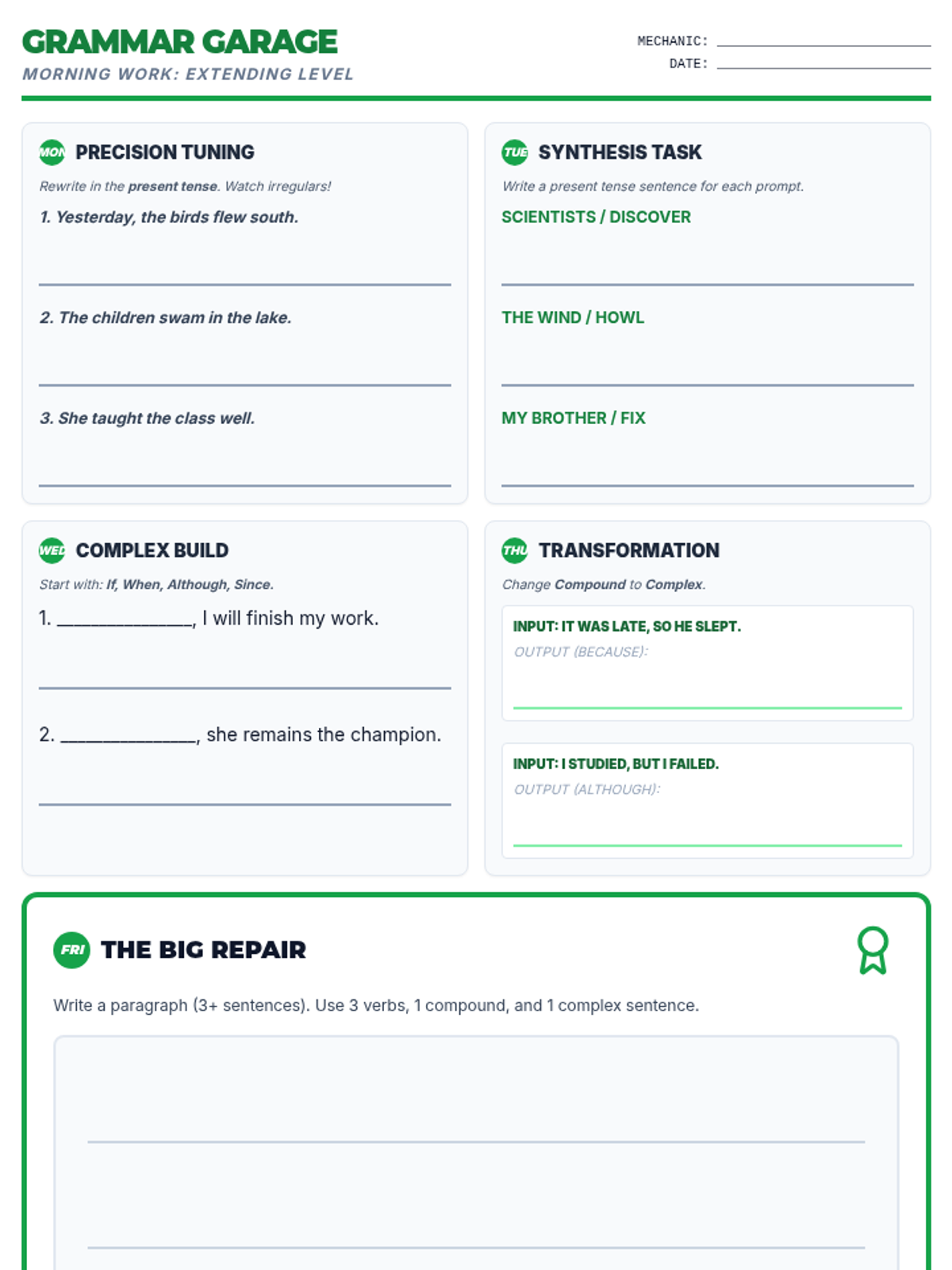
Extending level morning work for ELL students, focusing on irregular present tense verbs, complex sentence construction, and transforming sentence structures.
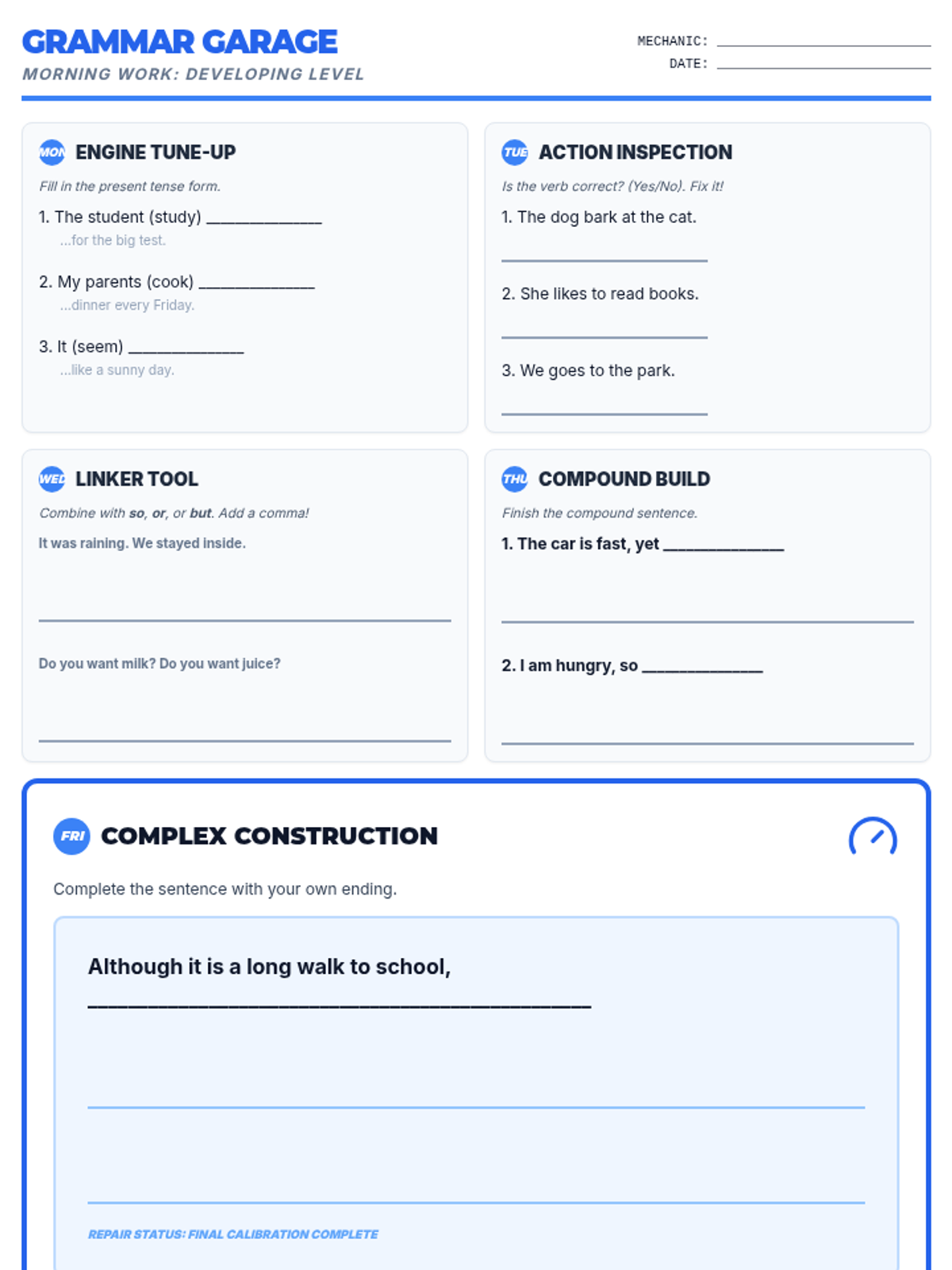
Developing level morning work for ELL students, focusing on subject-verb agreement and compound sentences using FANBOYS, with an introduction to complex sentences.
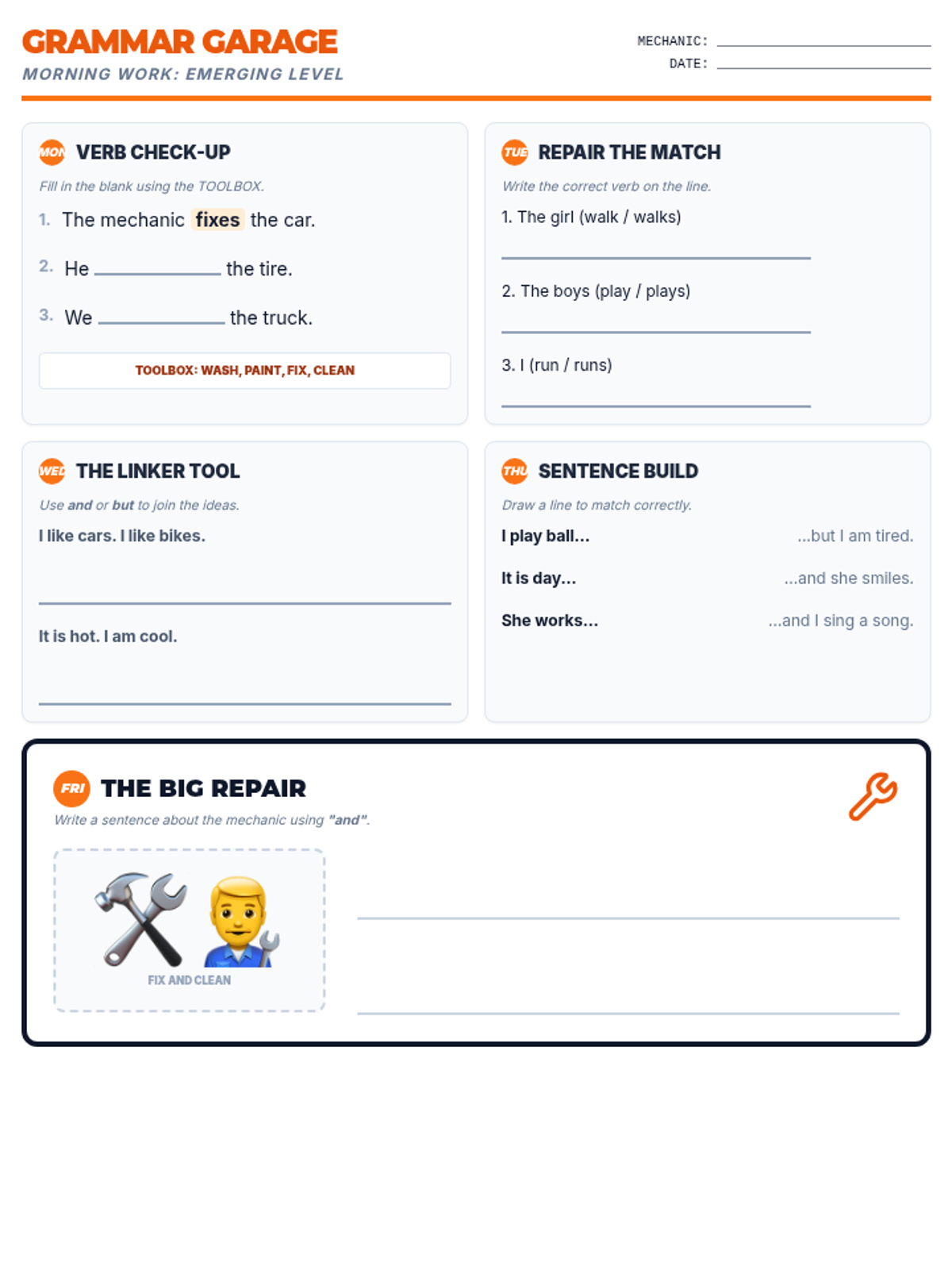
Emerging level morning work for ELL students, focusing on basic present tense action verbs and simple sentence joining with "and/but".
A high-energy presentation for reviewing verbs, compound sentences, and complex sentences with a garage theme. Suitable for 5th grade ELL students.
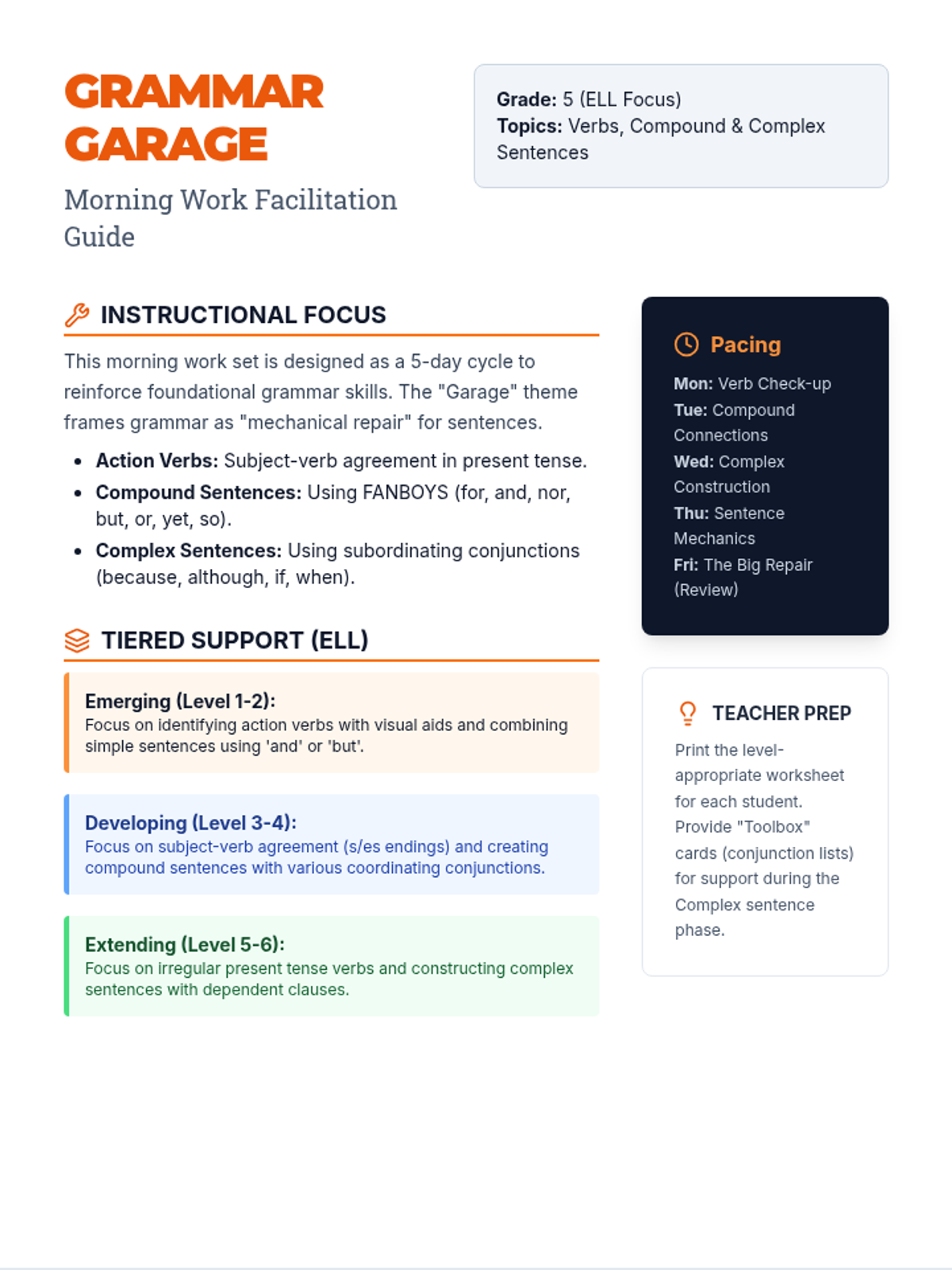
Teacher guide for the Grammar Garage morning work series, outlining differentiation strategies for Emerging, Developing, and Extending ELL students.
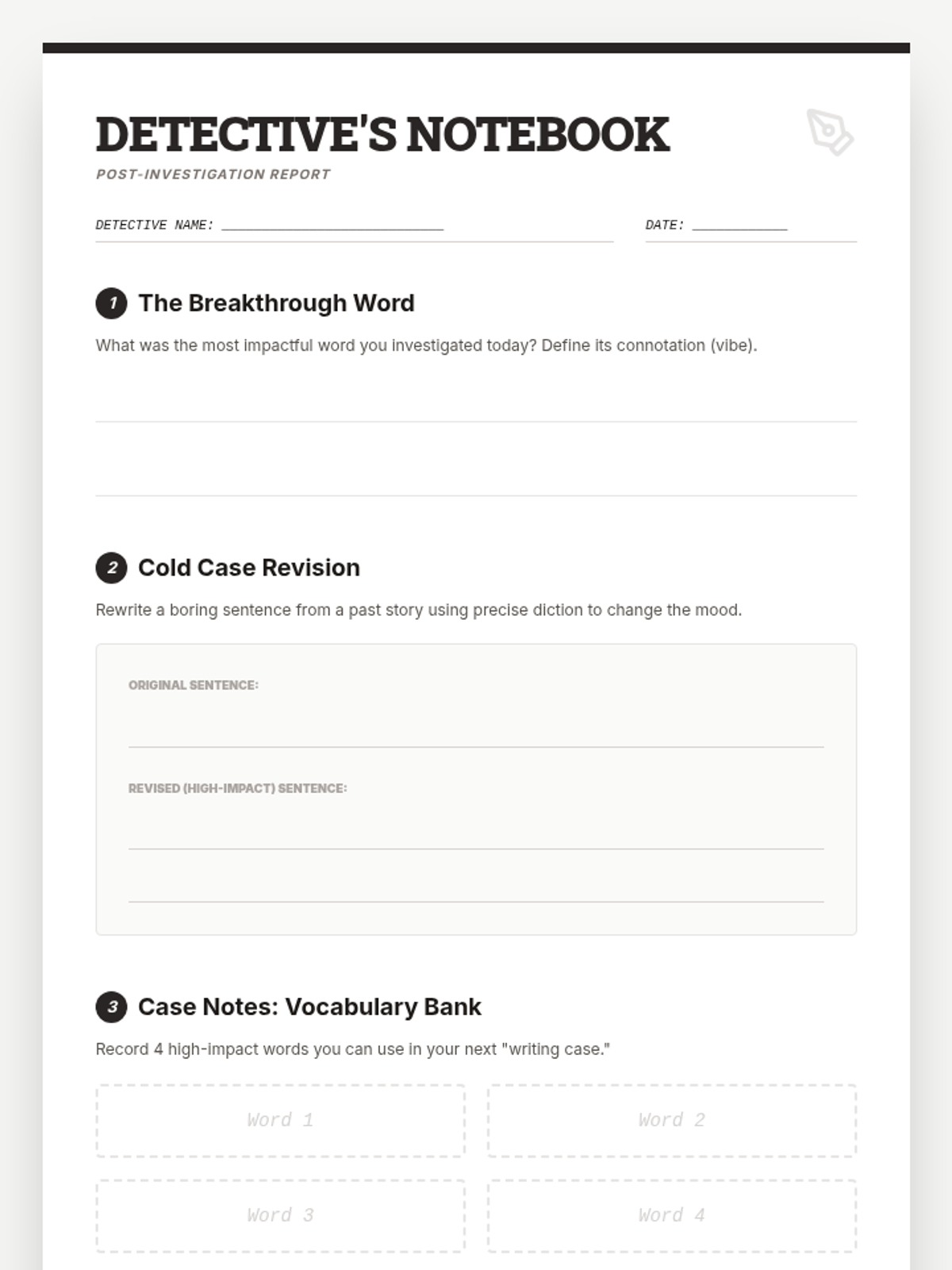
A reflection journal for students to document new vocabulary, revise previous writing using improved diction, and reflect on the importance of word choice in storytelling.
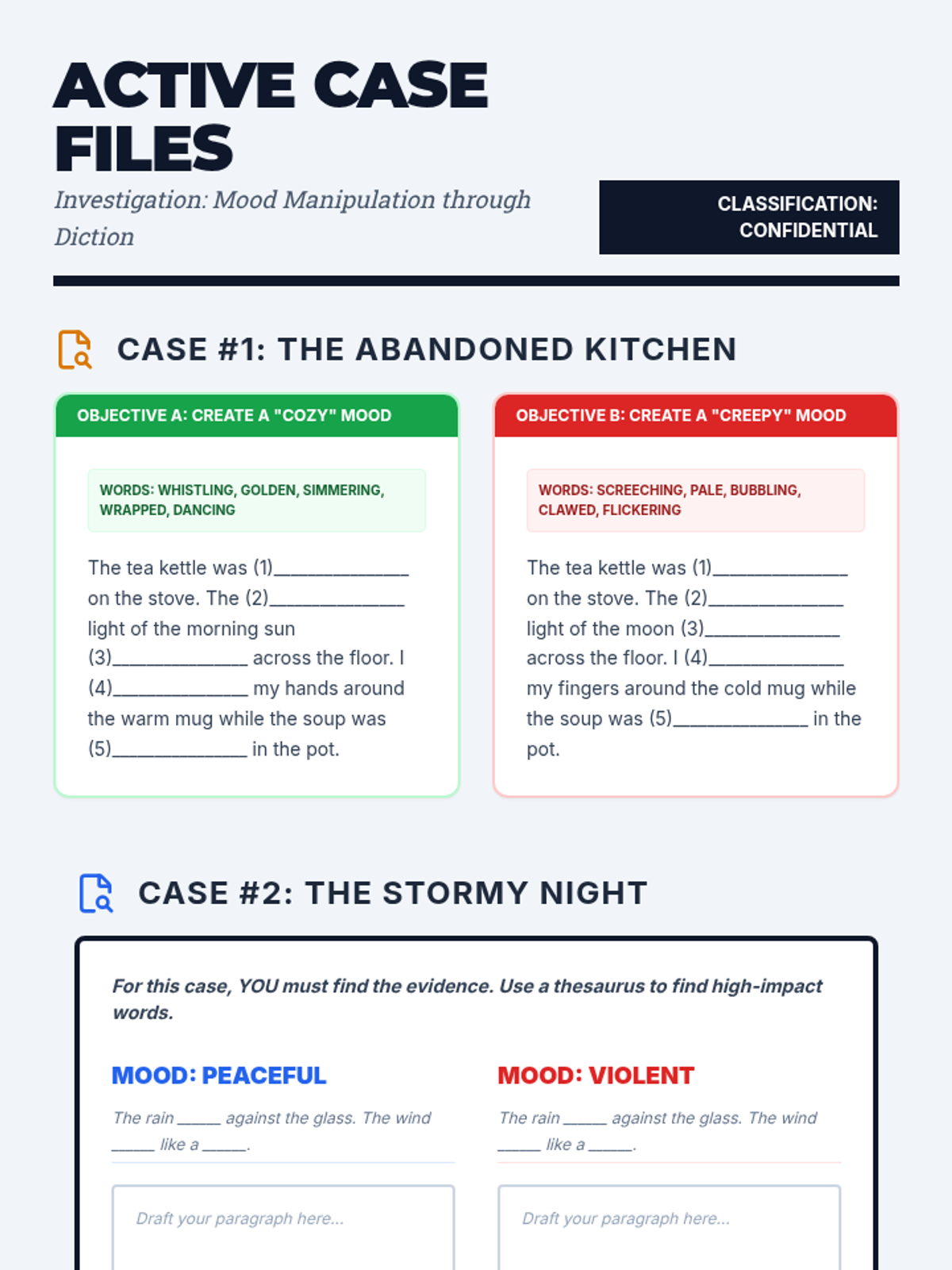
A "Case Files" activity where students use word banks and thesauruses to manipulate the mood of a scene. They practice applying different sets of diction to the same narrative structure to see the immediate emotional impact.
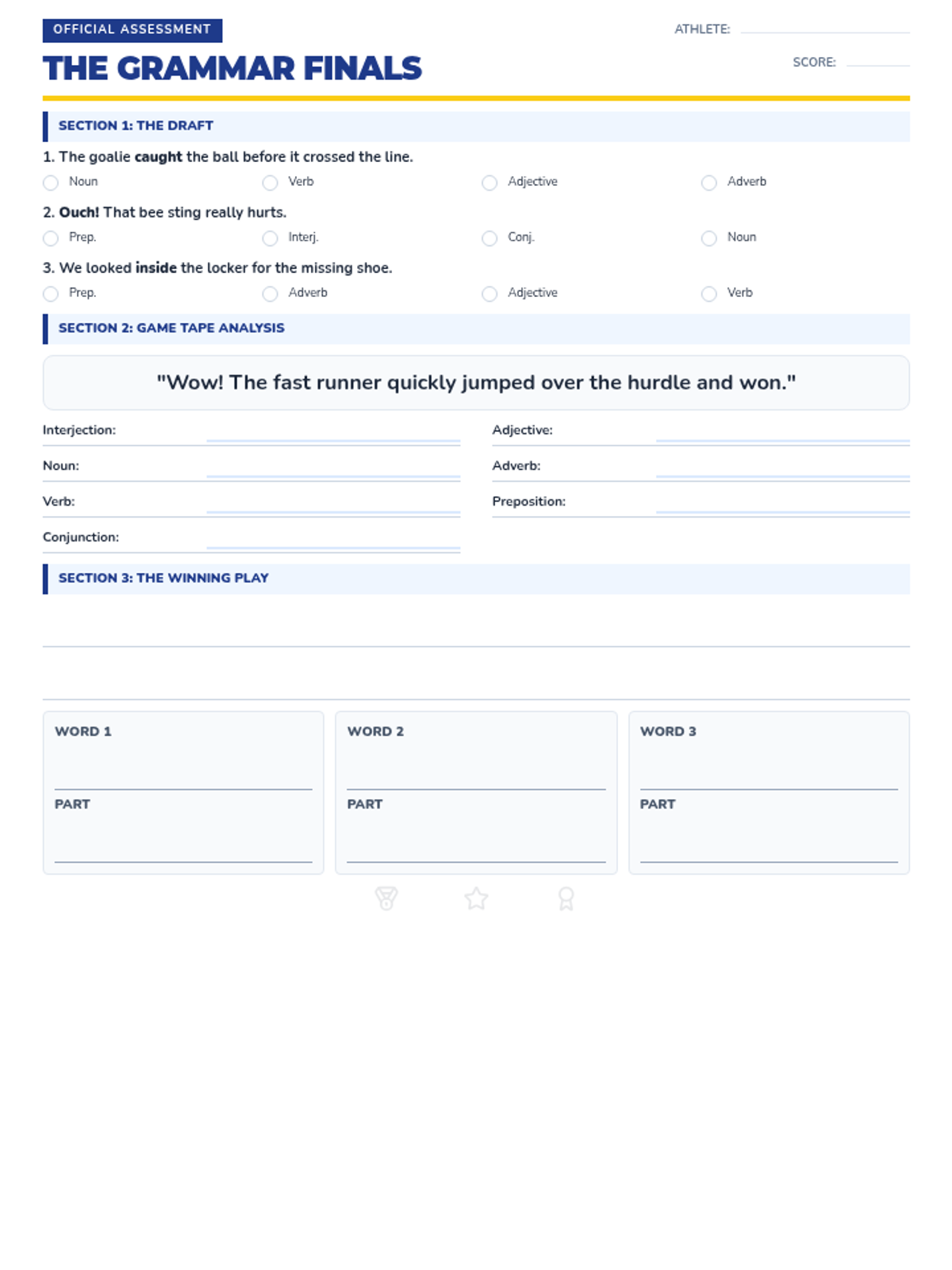
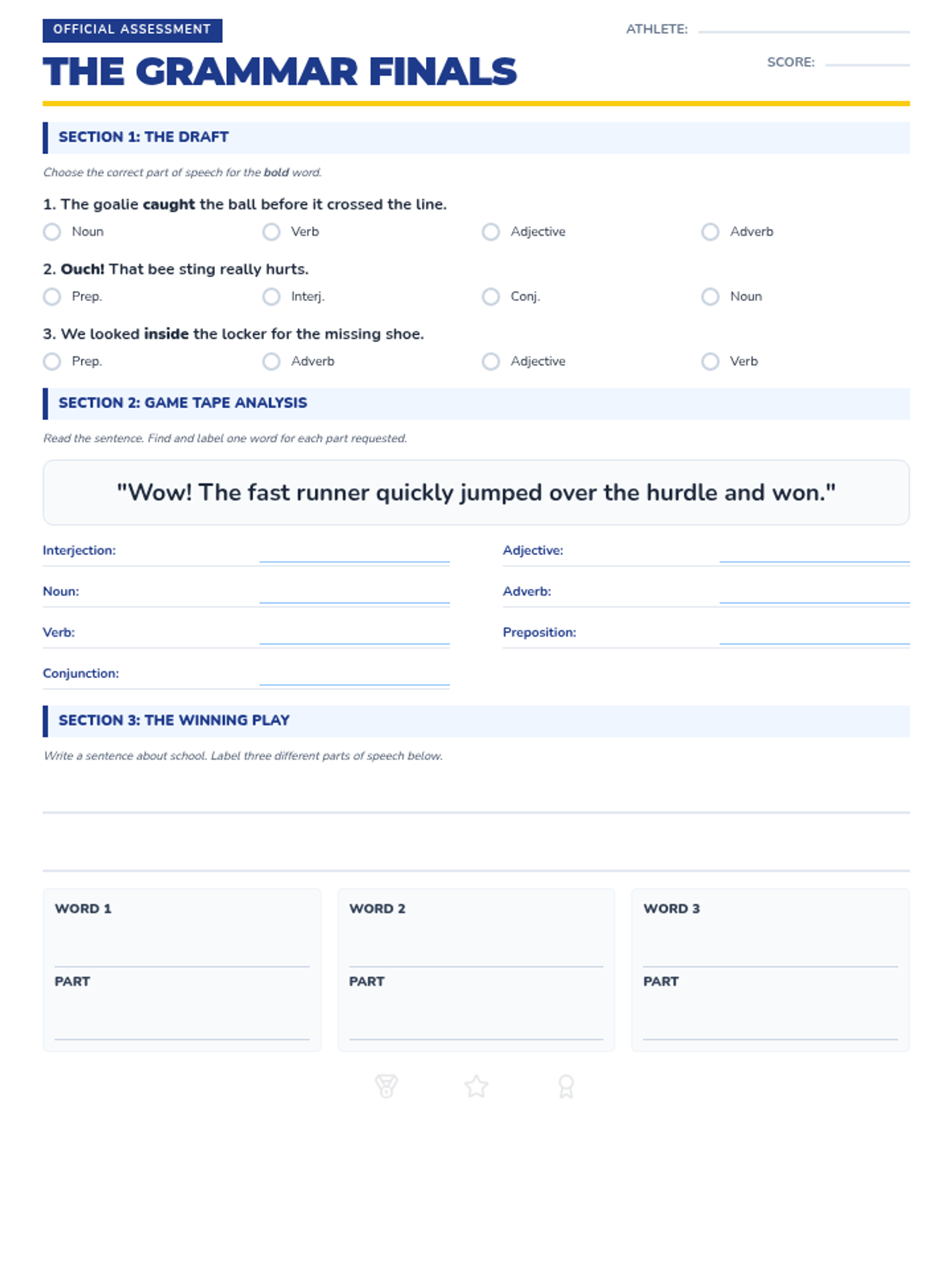
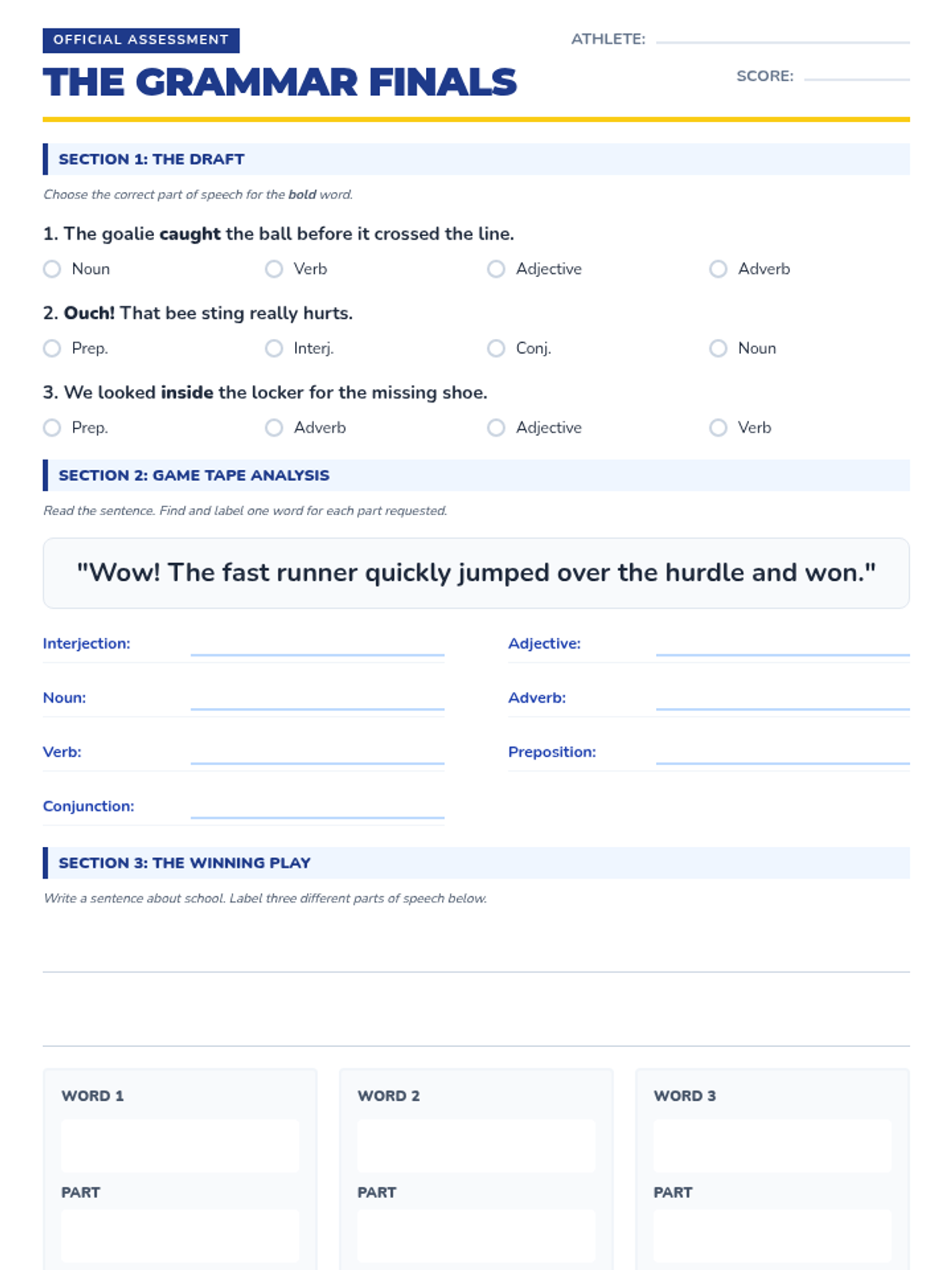
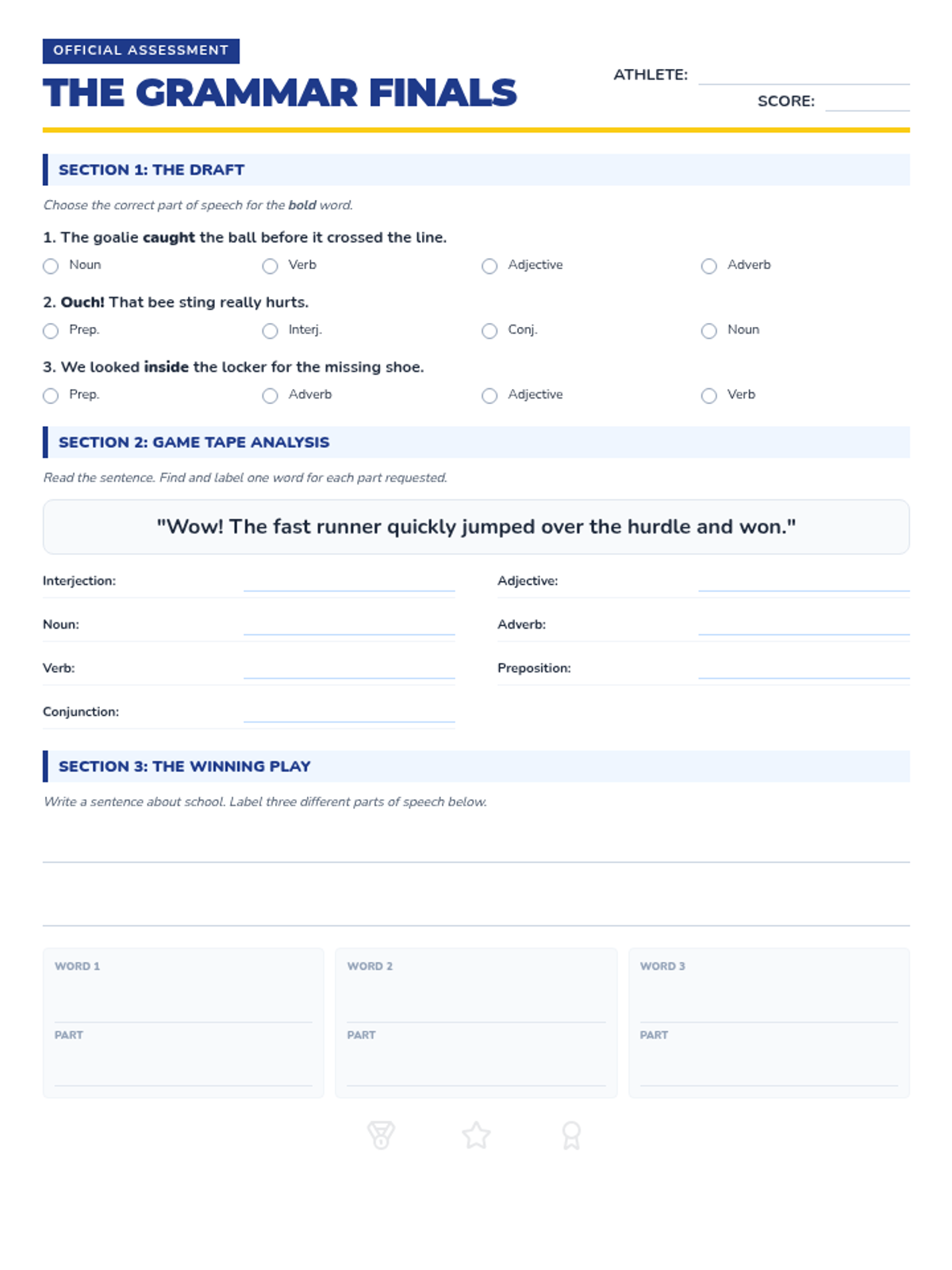
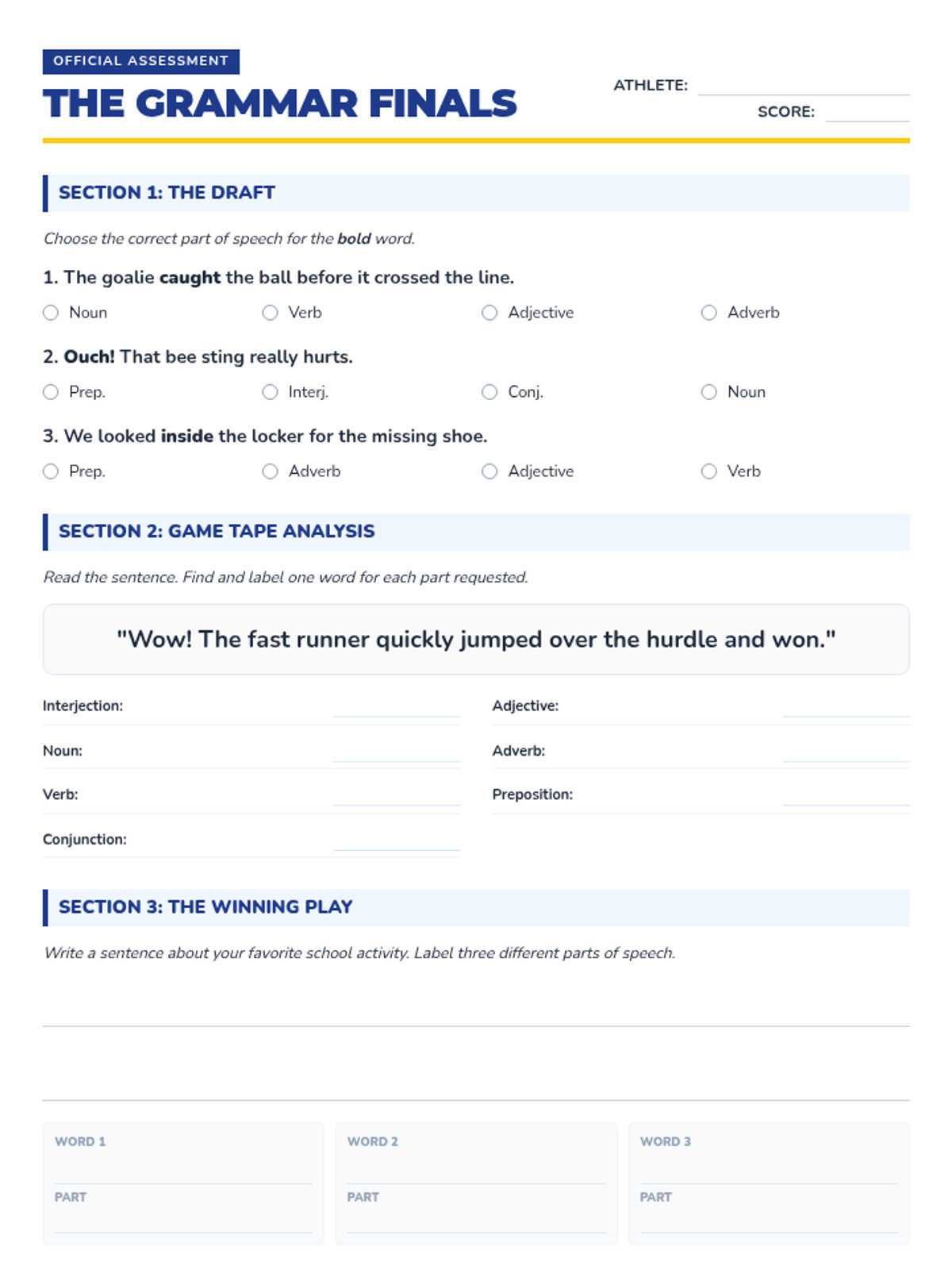
A comprehensive 1-page assessment quiz featuring multiple-choice identification, contextual analysis, and creative writing. Revised to fit on a single page with improved handwriting space.
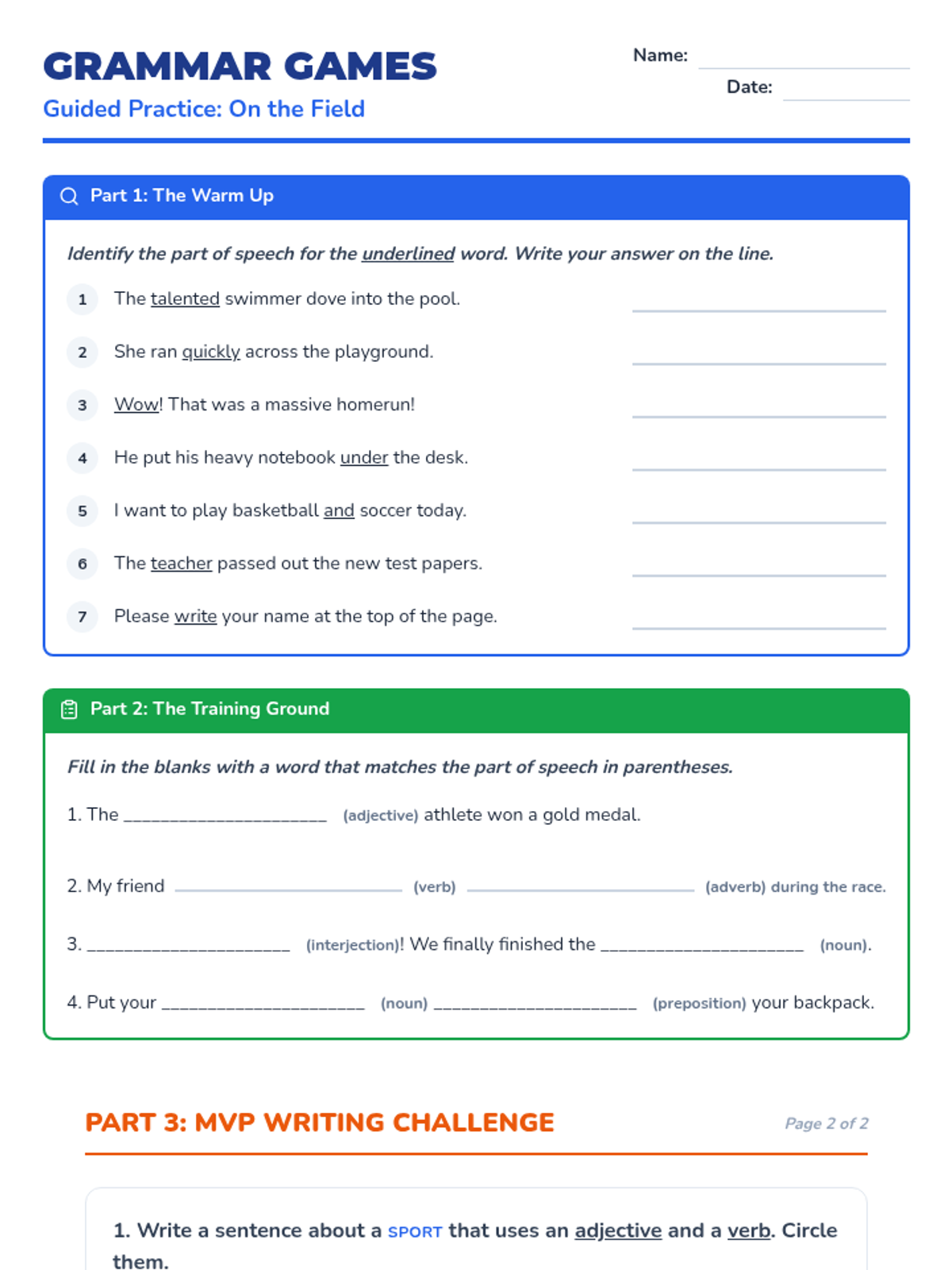
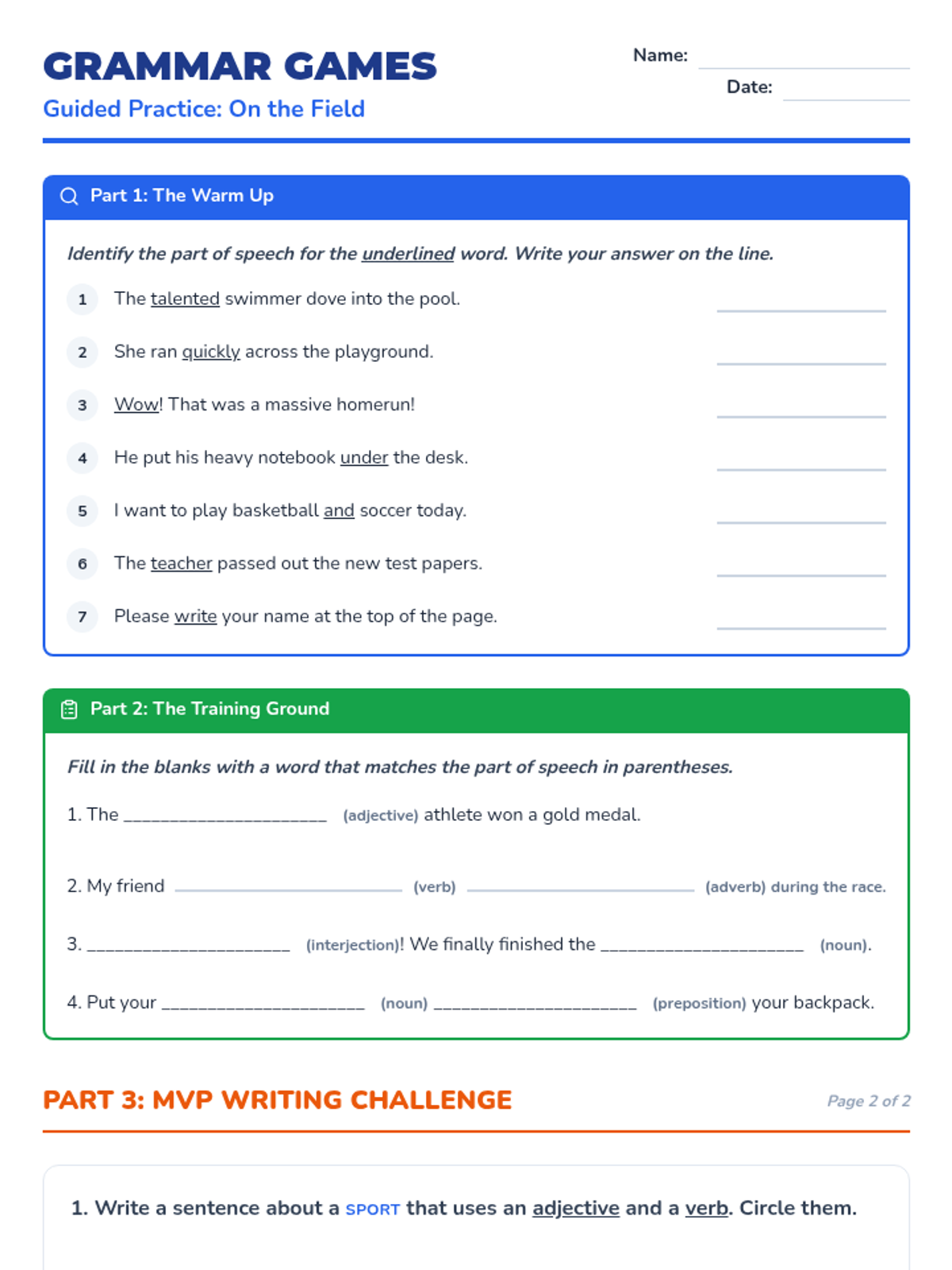
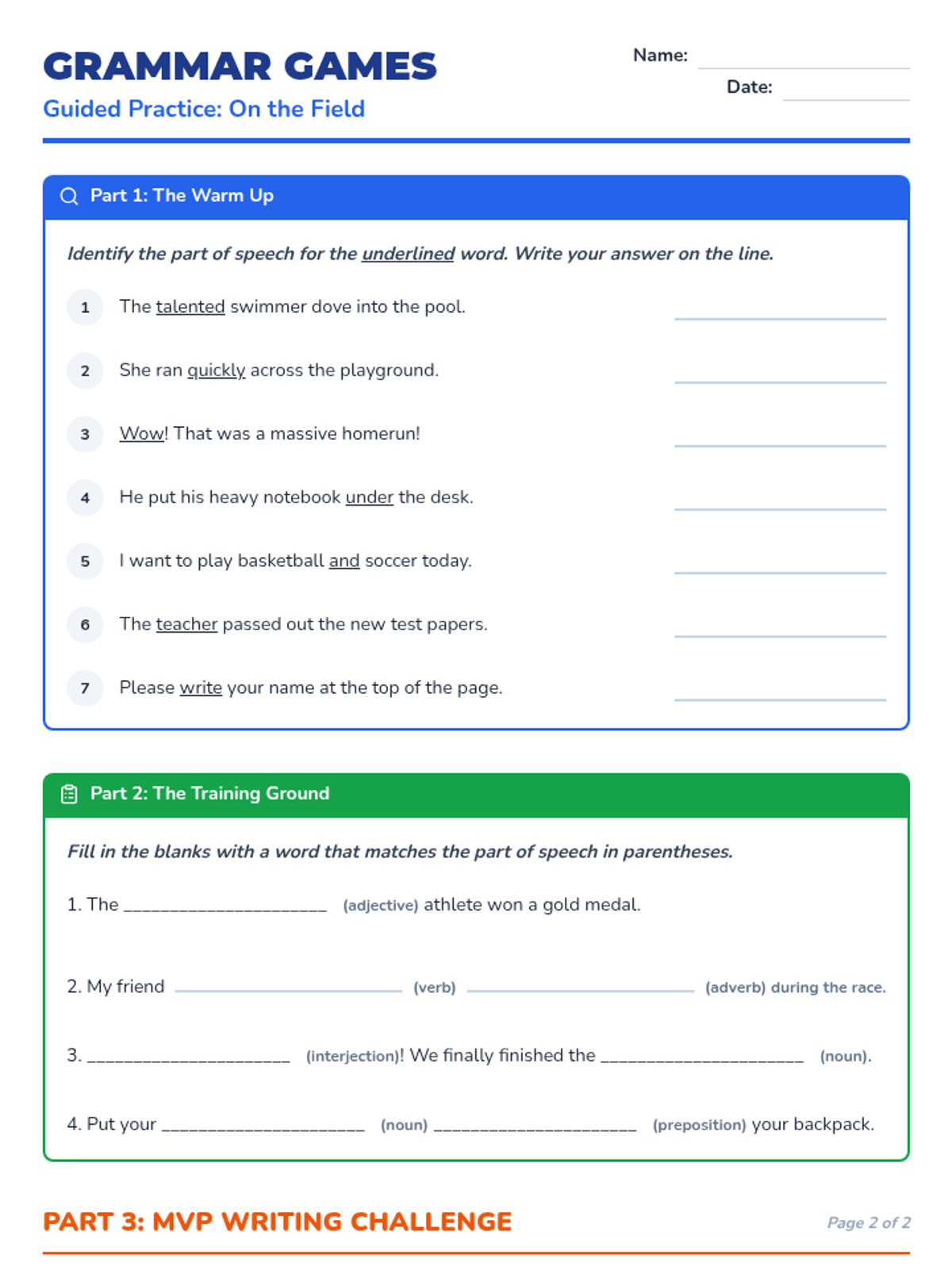
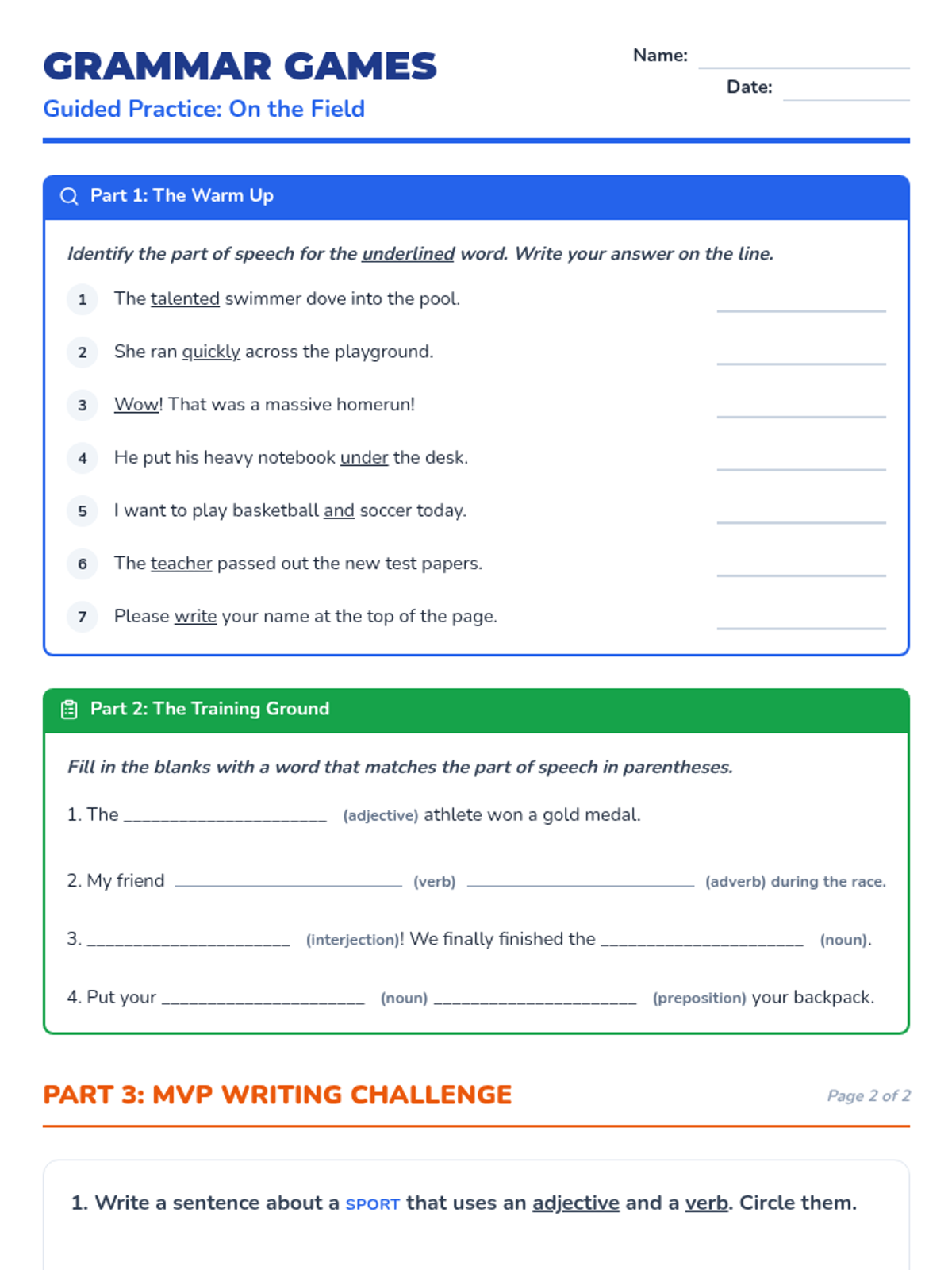
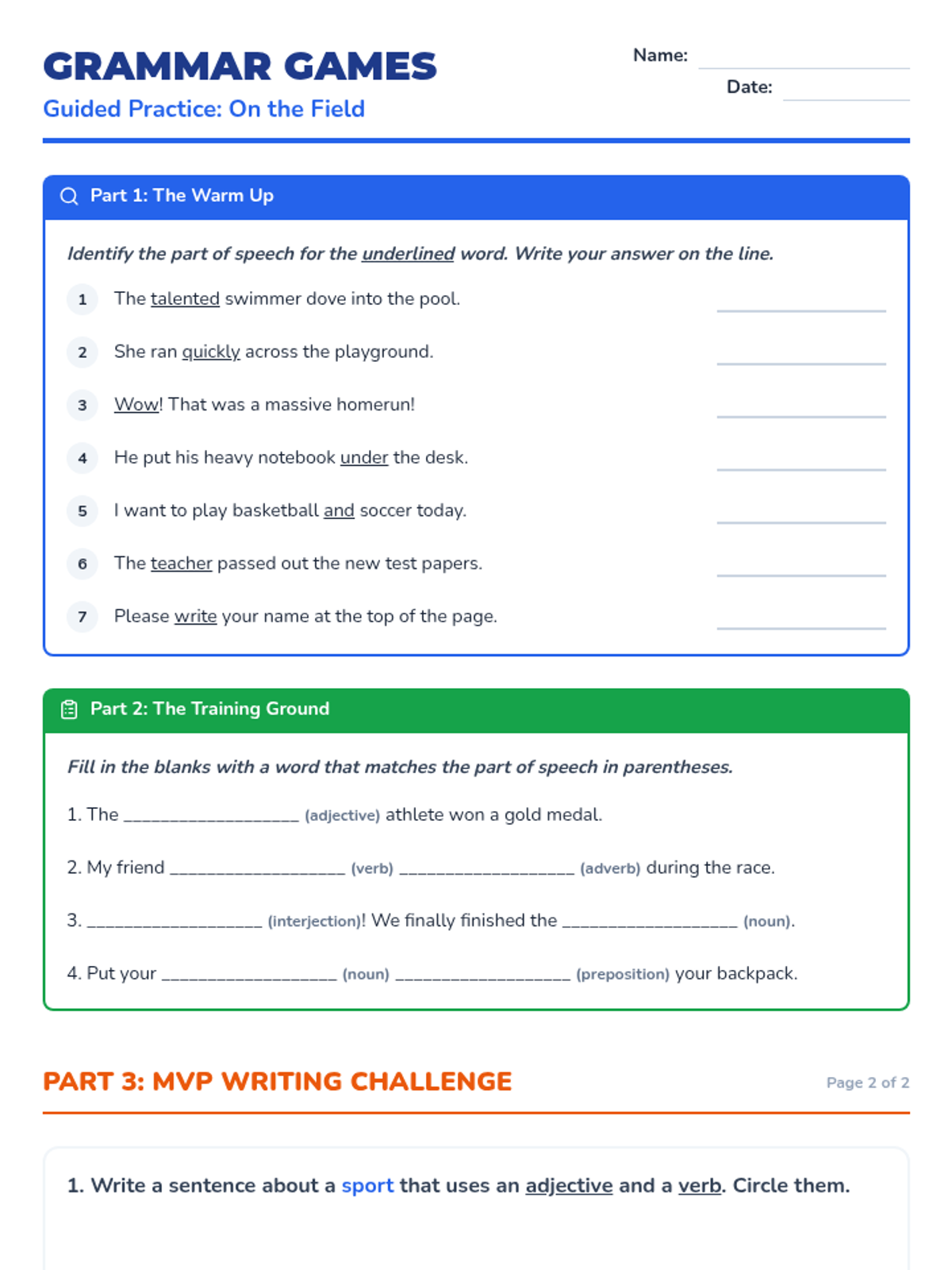
A 2-page guided practice worksheet where students identify parts of speech in athletic and academic contexts and apply their knowledge by writing original sentences. Revised for better page flow and student work areas.
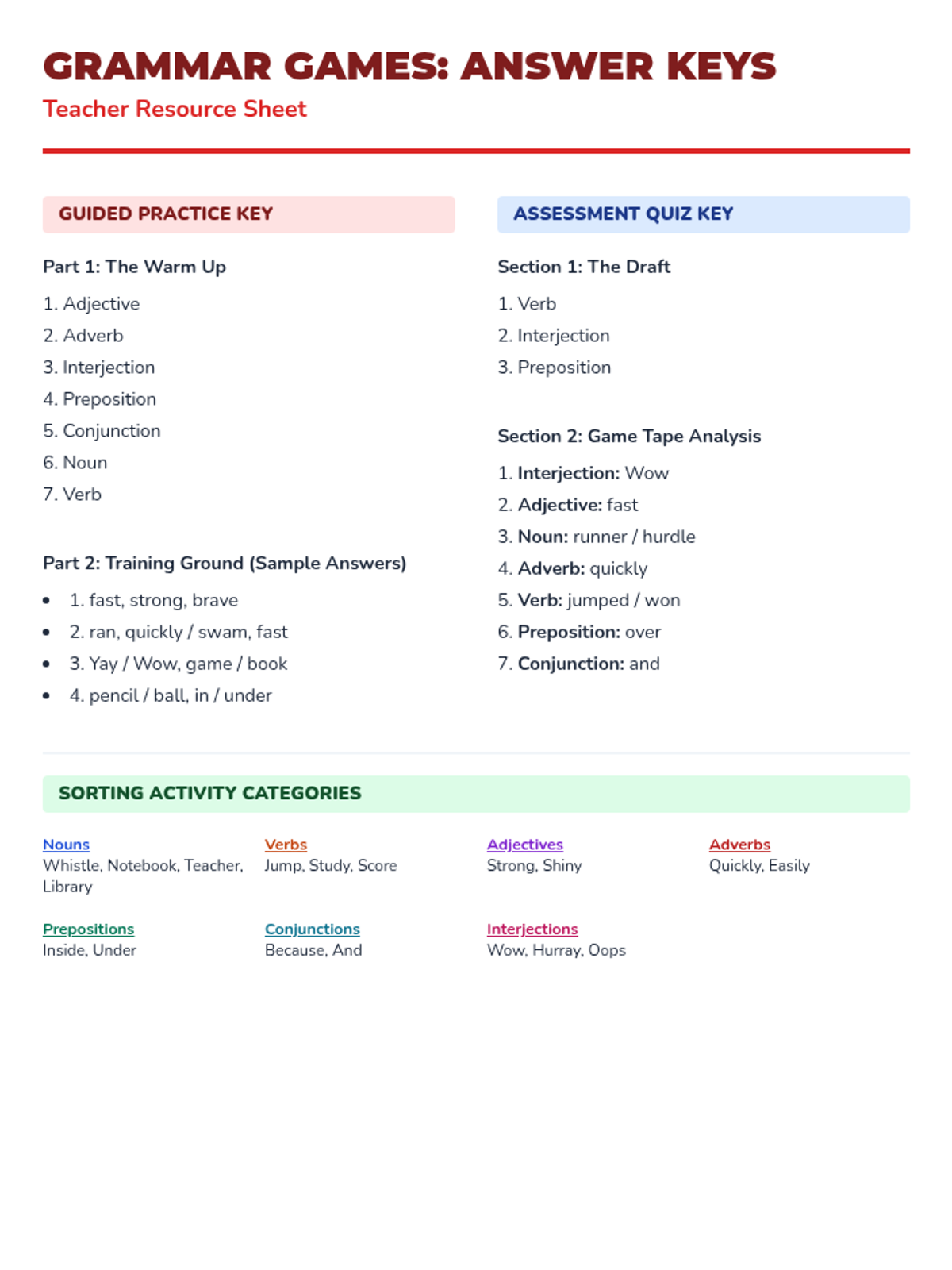
A comprehensive answer key for teachers, covering the guided practice worksheet, sorting activity, and assessment quiz. Updated to match revised layouts and word choices.
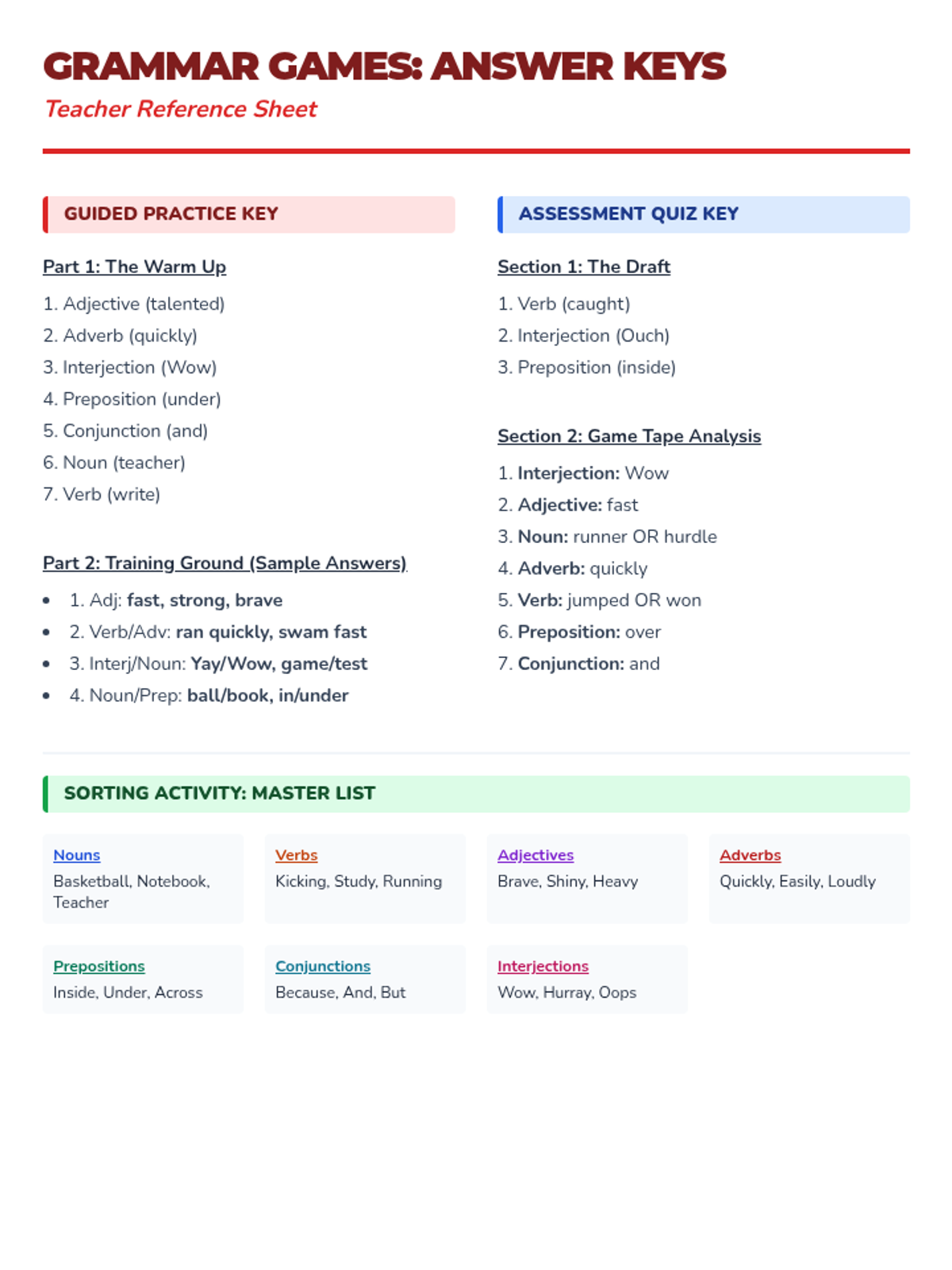
A comprehensive answer key for teachers, covering the guided practice worksheet, the sorting activity, and the assessment quiz. Includes sample answers for open-ended writing prompts.
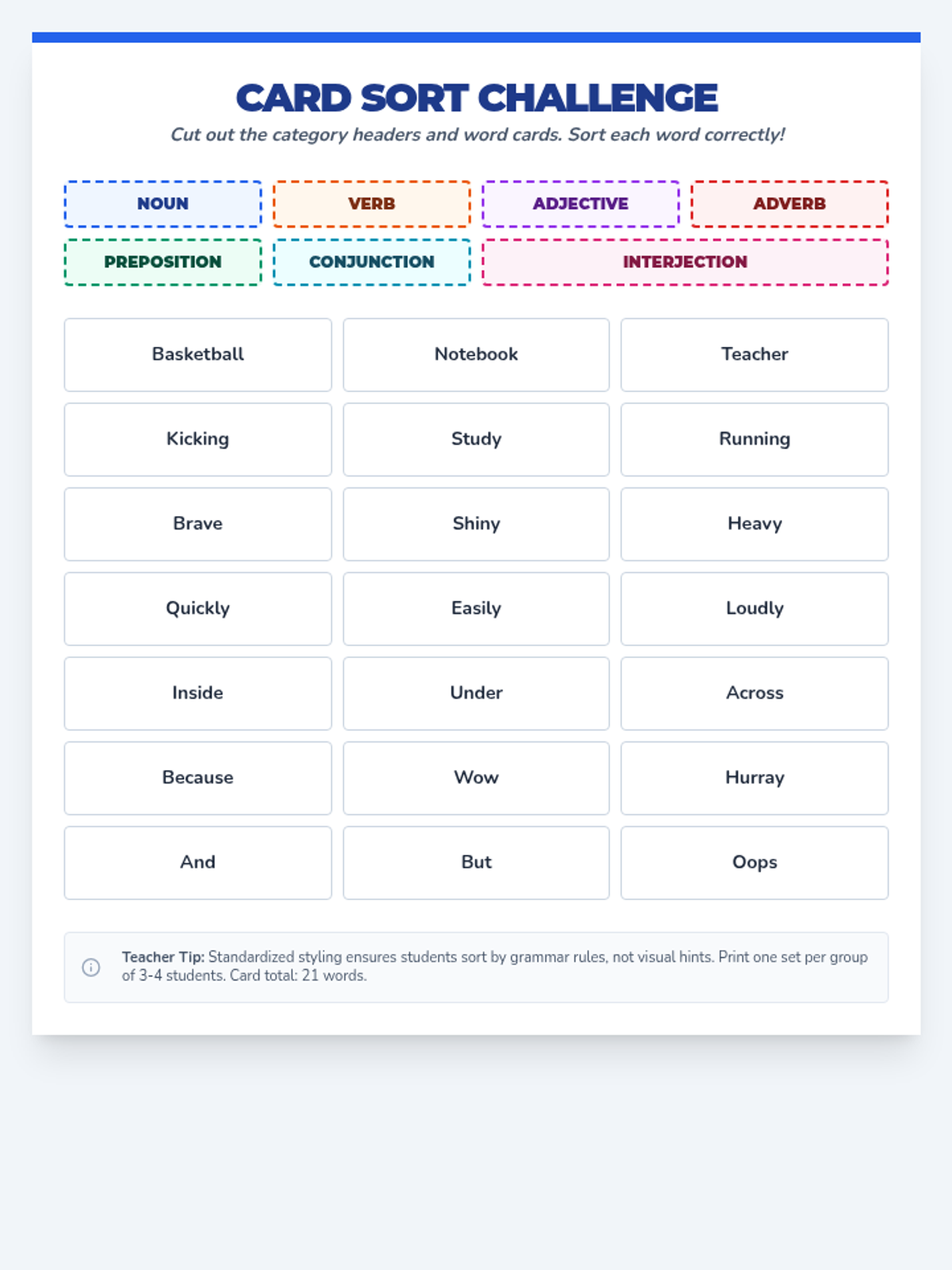
A hands-on small group activity featuring cut-out cards for all seven parts of speech. Revised to fit on a single page with standardized styling to prevent visual cues.
A set of 8 instructional slides defining the seven primary parts of speech with clear definitions and themed examples from sports and school life.
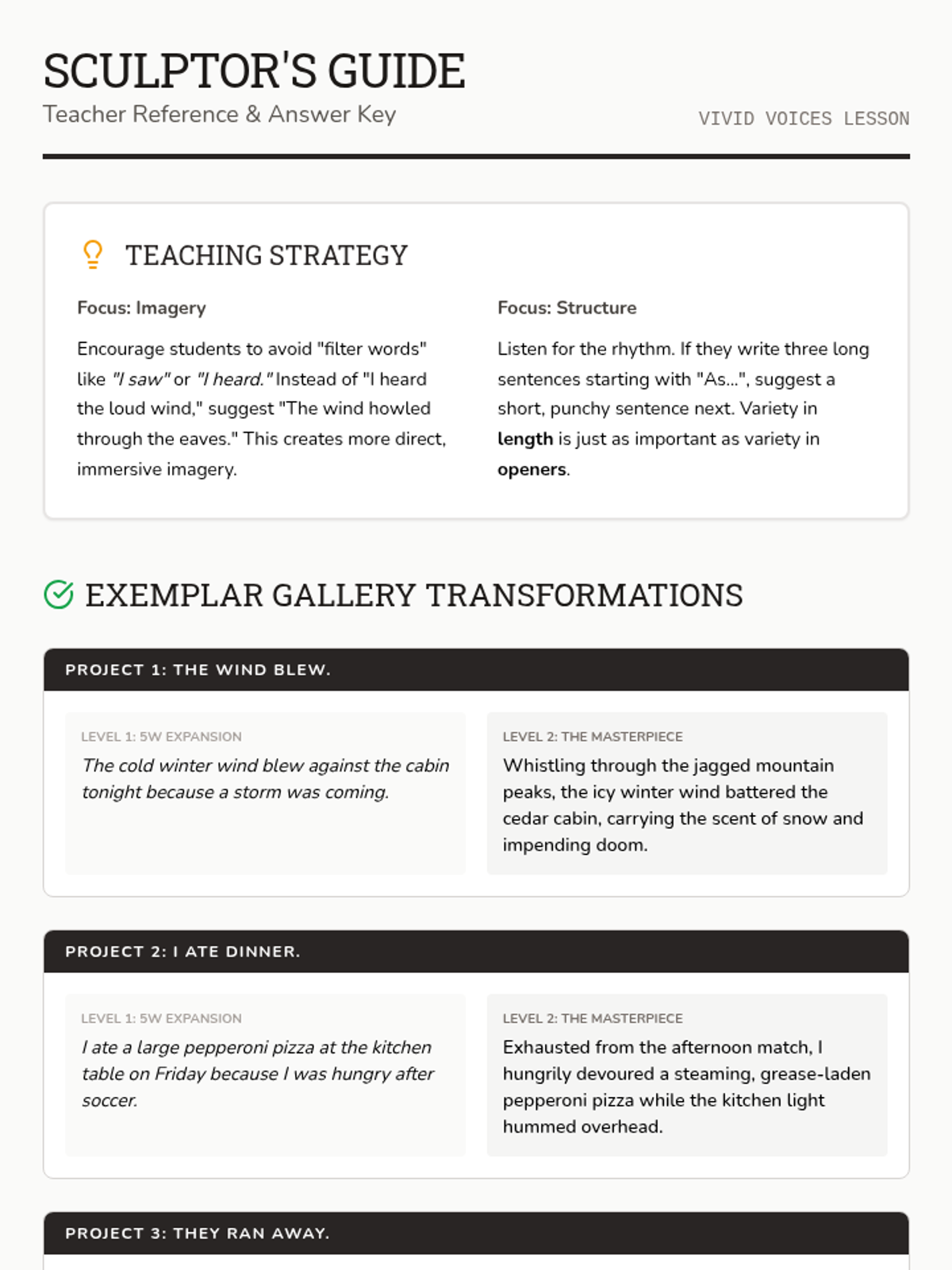
A teacher's answer key and reference guide providing exemplar sentence transformations and instructional tips for teaching imagery and sentence structure.
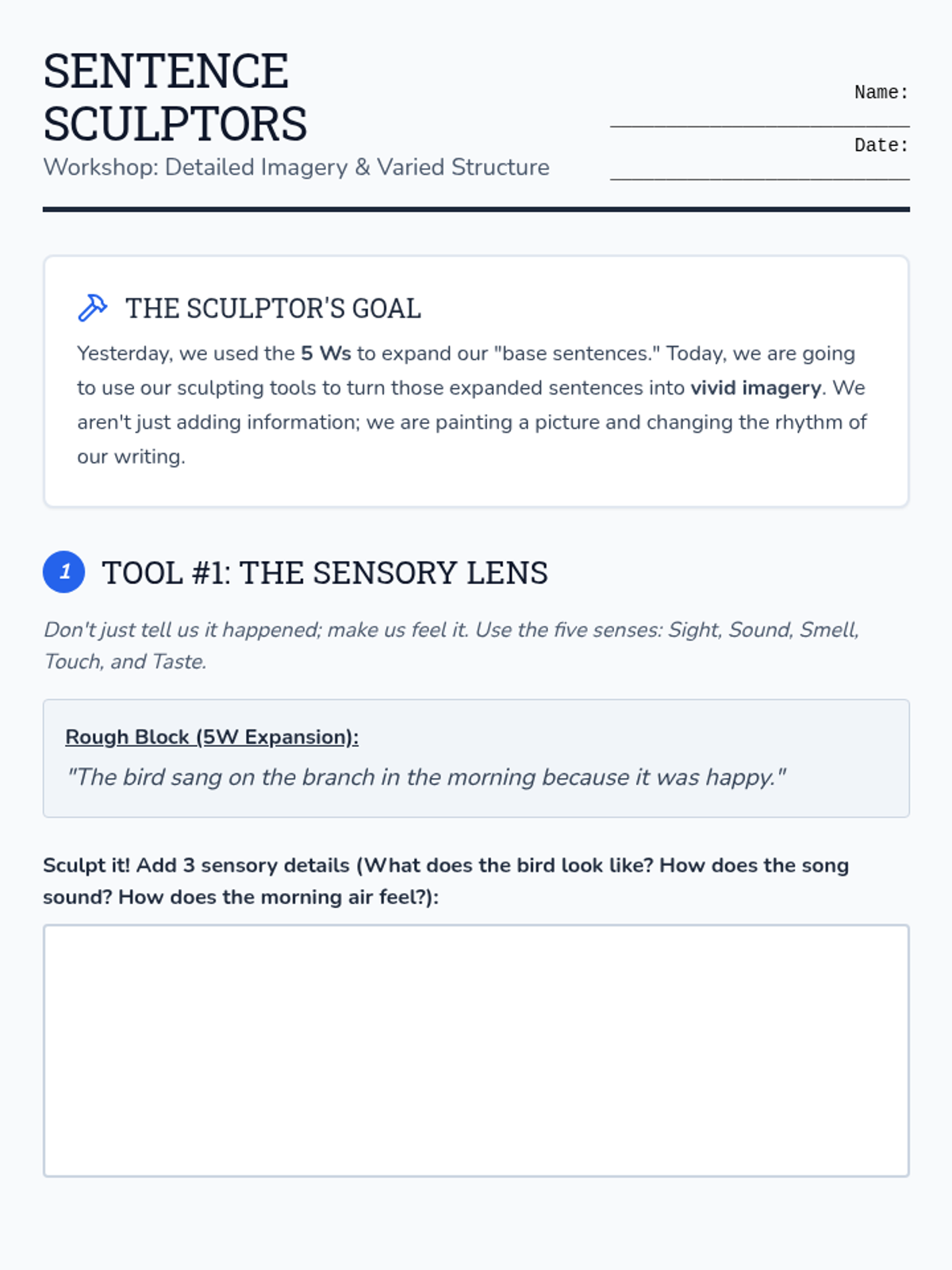
A creative writing worksheet where students 'sculpt' basic sentences into vivid descriptions using sensory details and varied sentence openers.
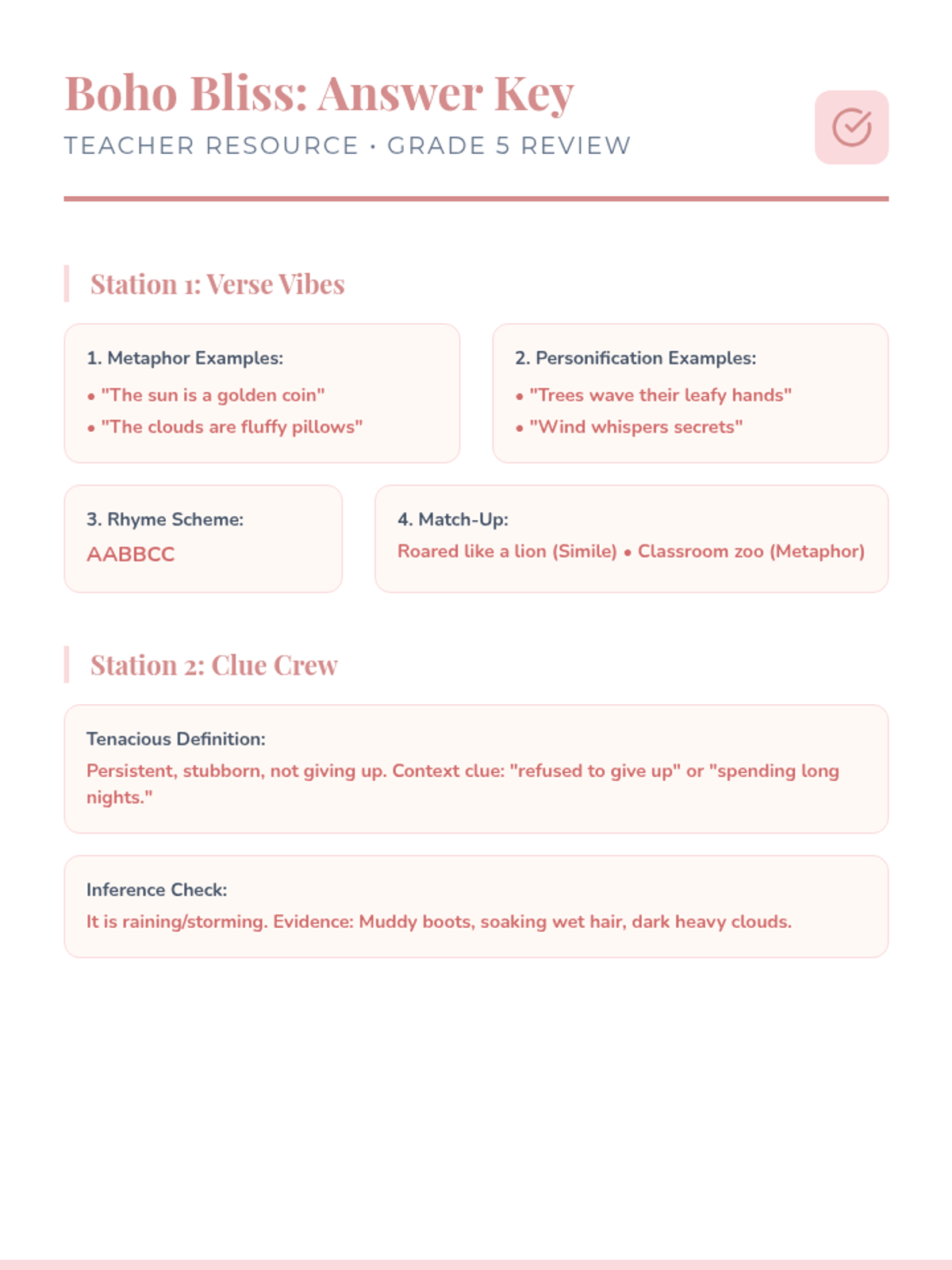
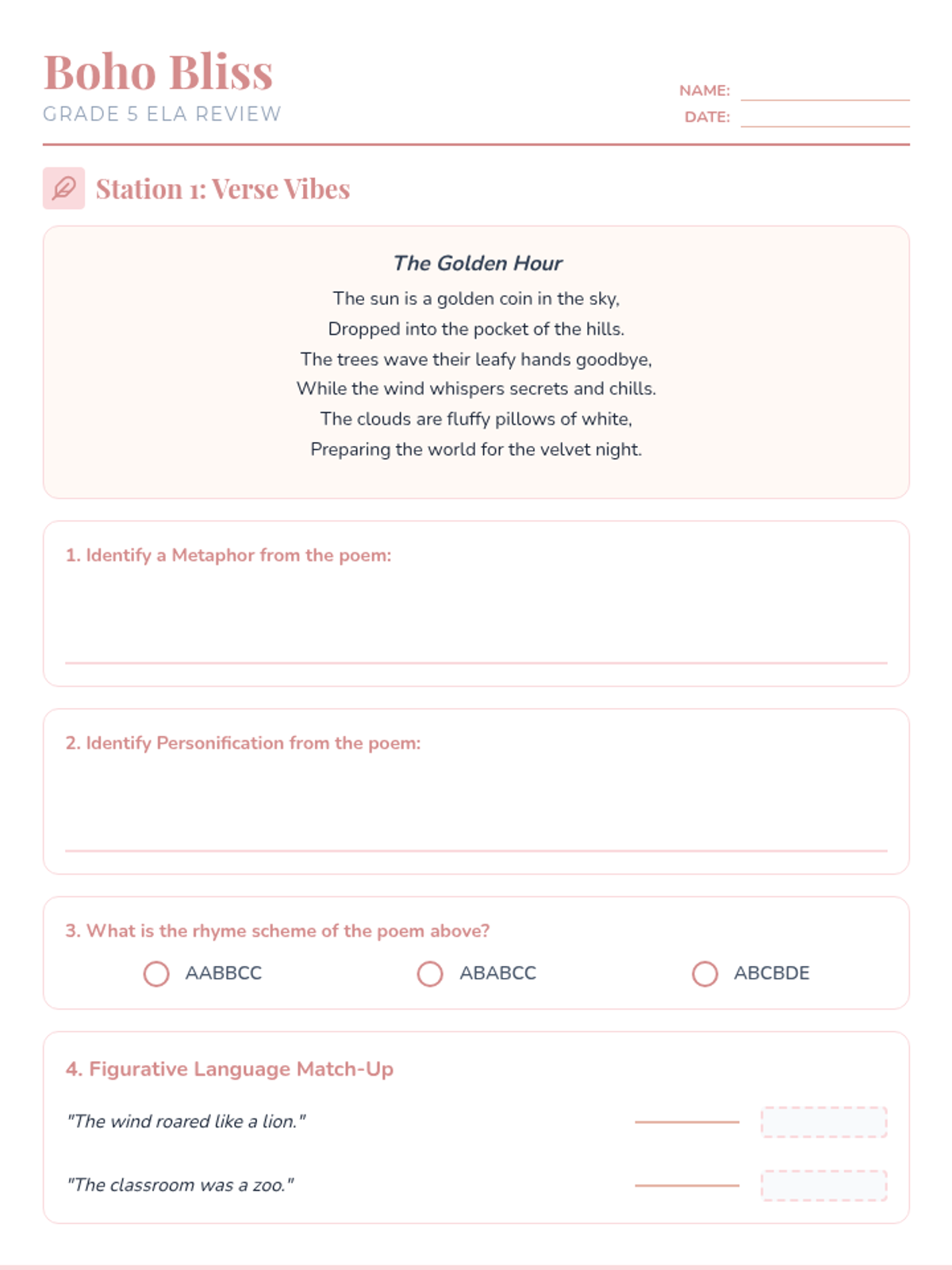
Teacher answer key for the Boho Bliss Review Packet, providing suggested answers for poetry analysis, inference, main idea, summarizing, and grammar exercises.
A 3-page ELA review packet for 5th graders with a boho-pink theme. It covers poetry, figurative language, context clues, inferencing, main idea, summarizing, and grammar in a fun, station-based format.
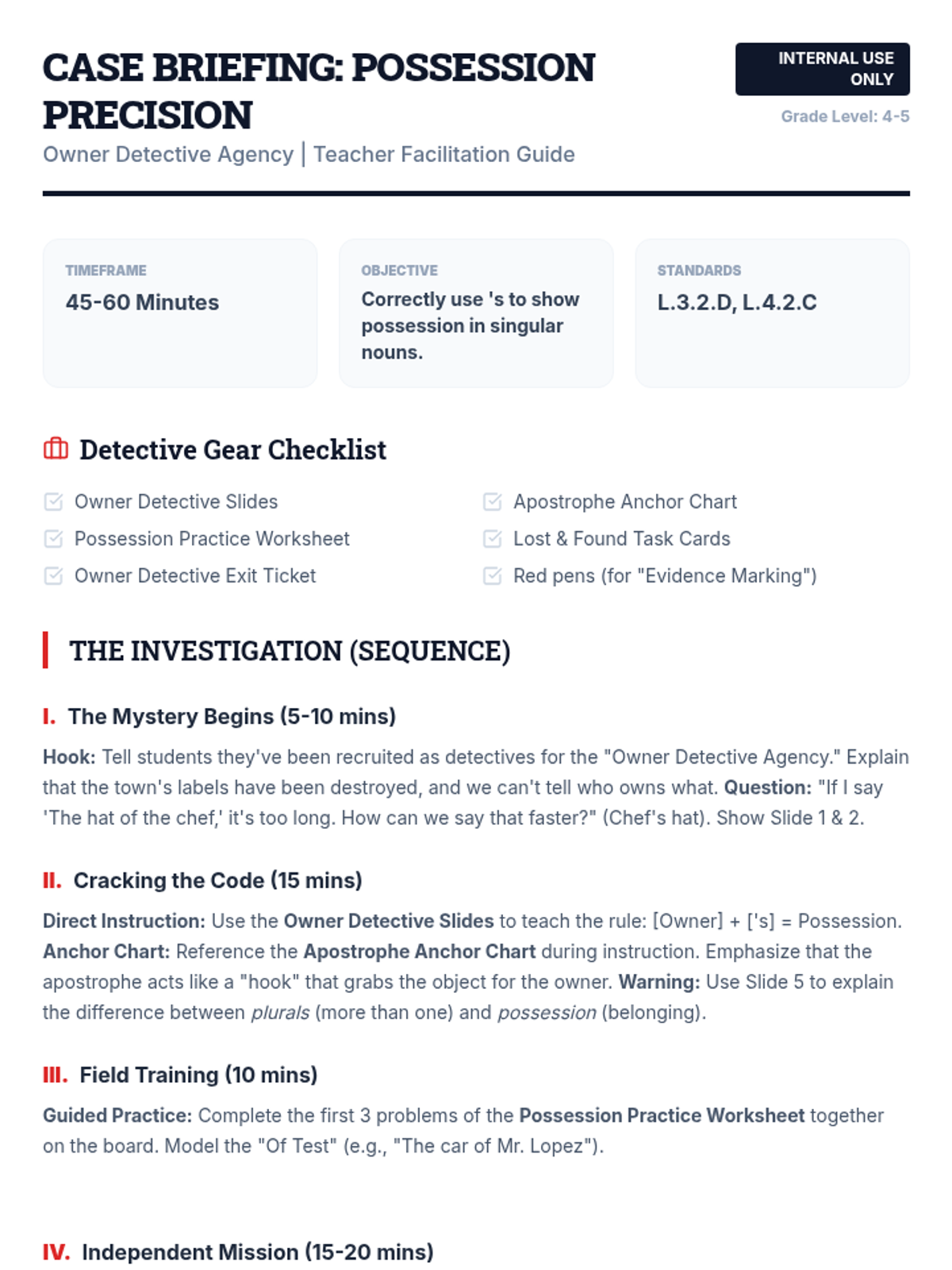
A comprehensive teacher lesson plan for the Possession Precision lesson, outlining objectives, materials, procedures, and differentiation strategies.
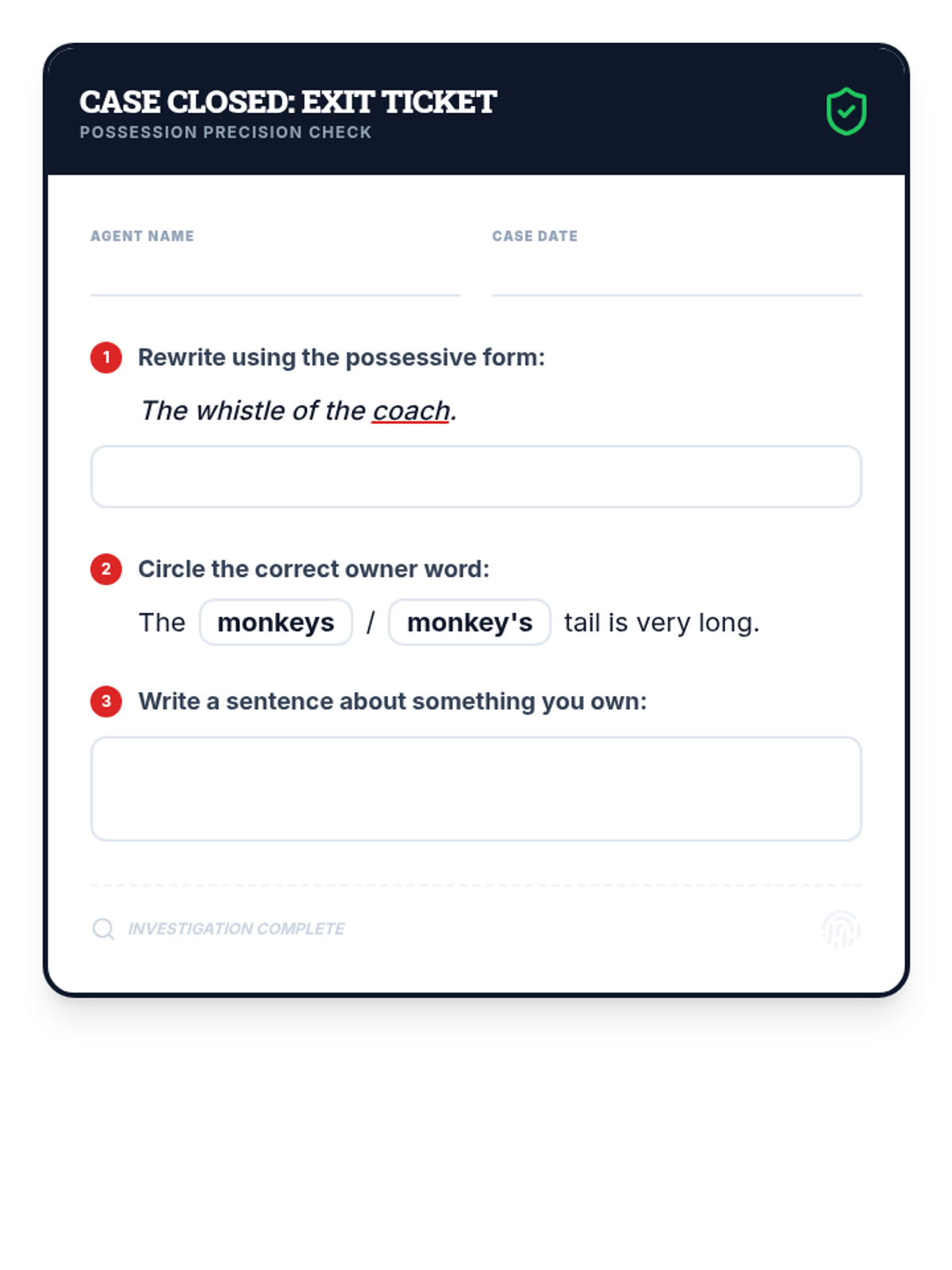
A detective-themed exit ticket for a quick end-of-lesson assessment of singular possessive noun rules.
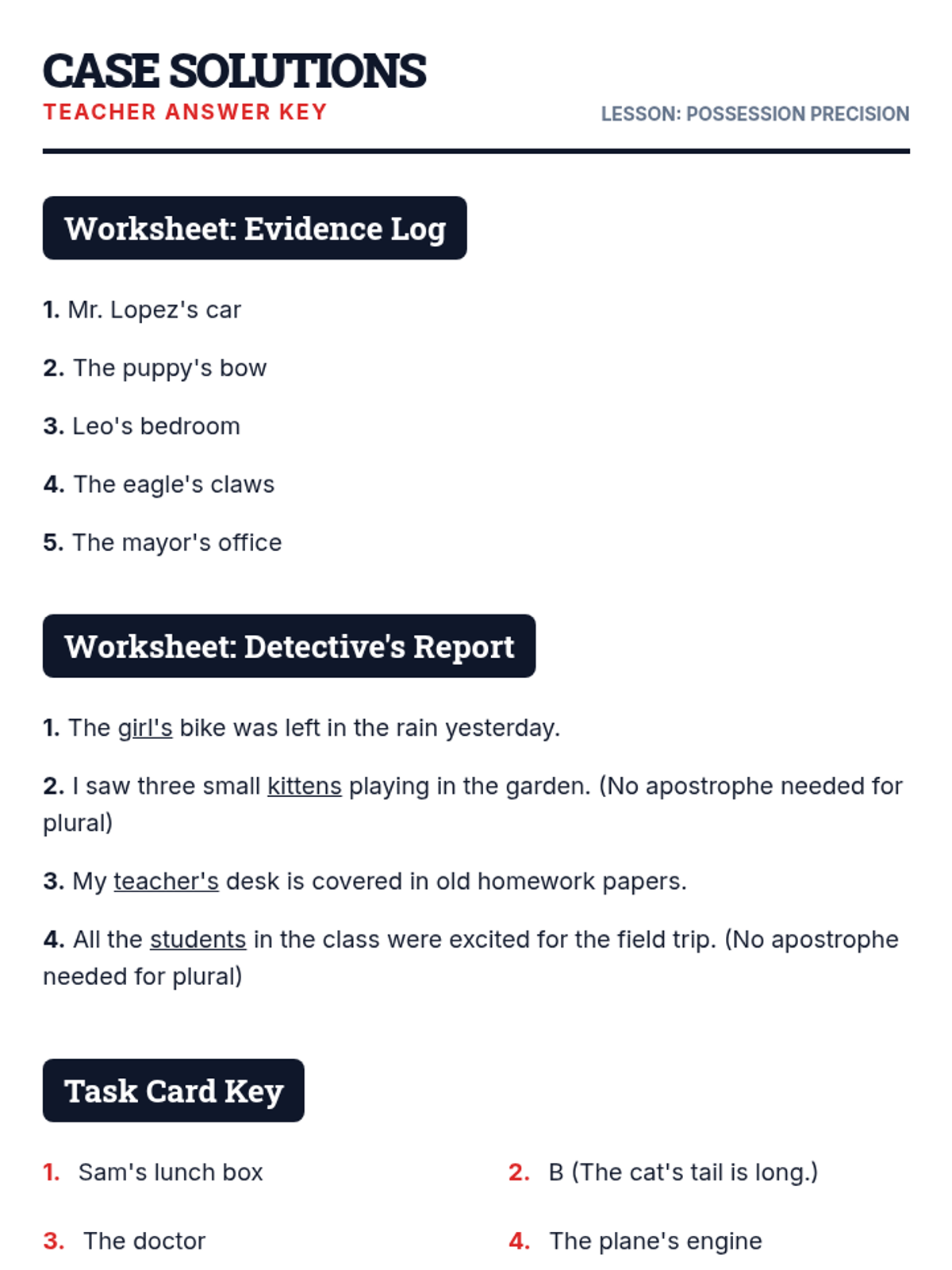
An answer key for the Possession Practice Worksheet and Lost and Found Task Cards, including teaching tips for identifying owners.
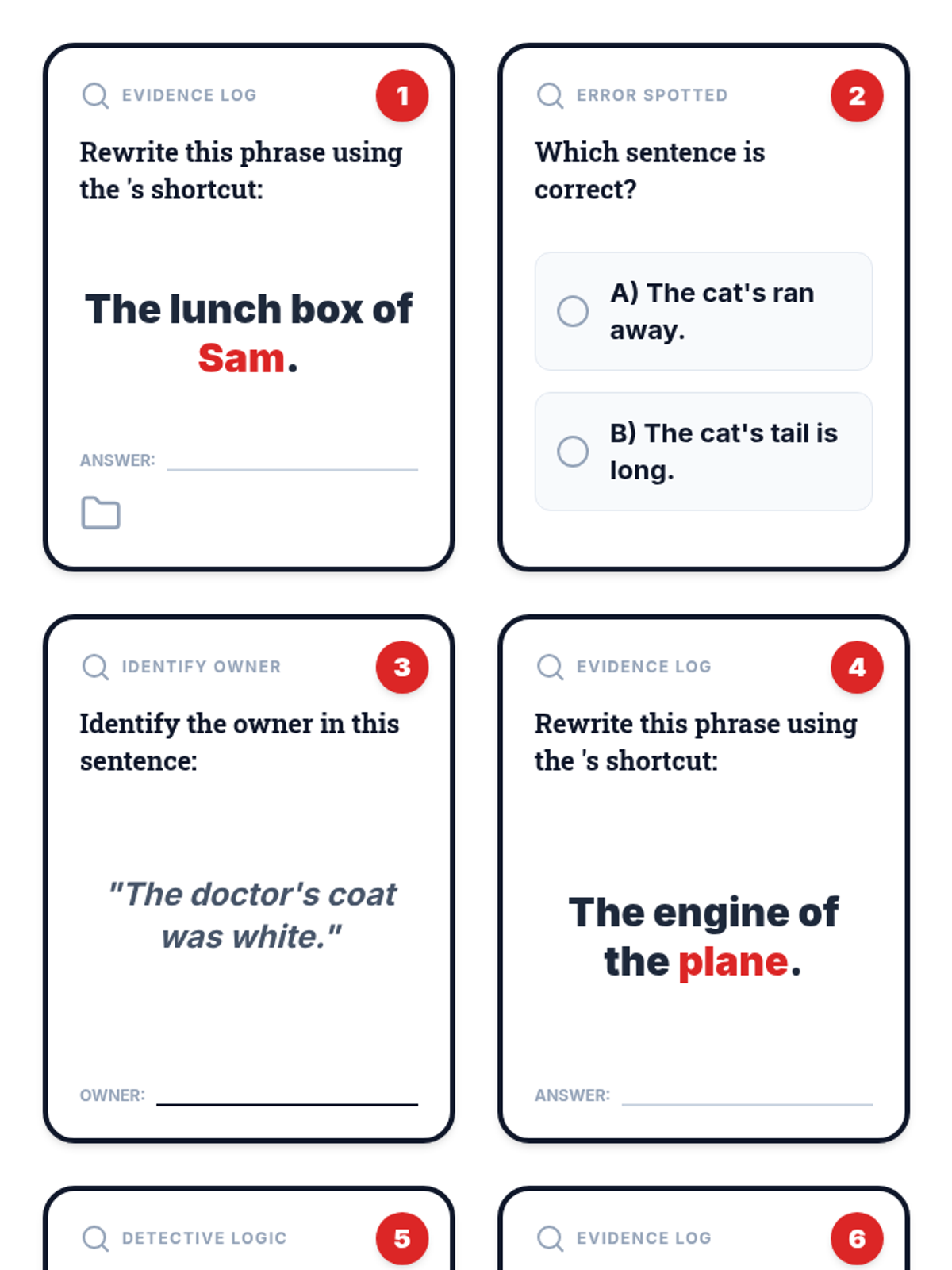
Eight detective-themed task cards for possessive noun practice, including rewriting phrases, identifying errors, and creative writing.
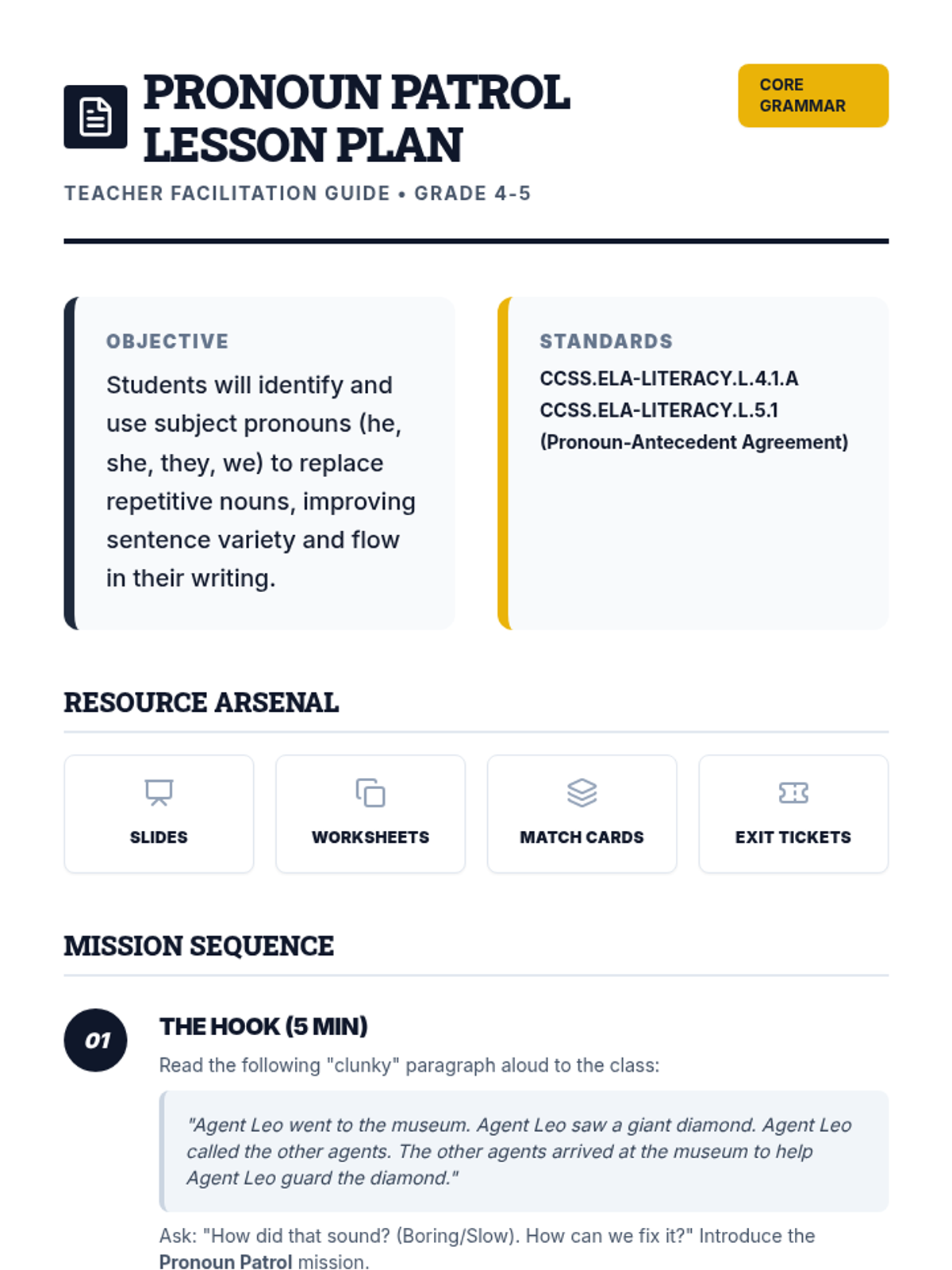
A comprehensive teacher's guide for the Pronoun Patrol lesson. Includes objectives, standards, a step-by-step facilitation sequence, and differentiation strategies for grades 4-5.
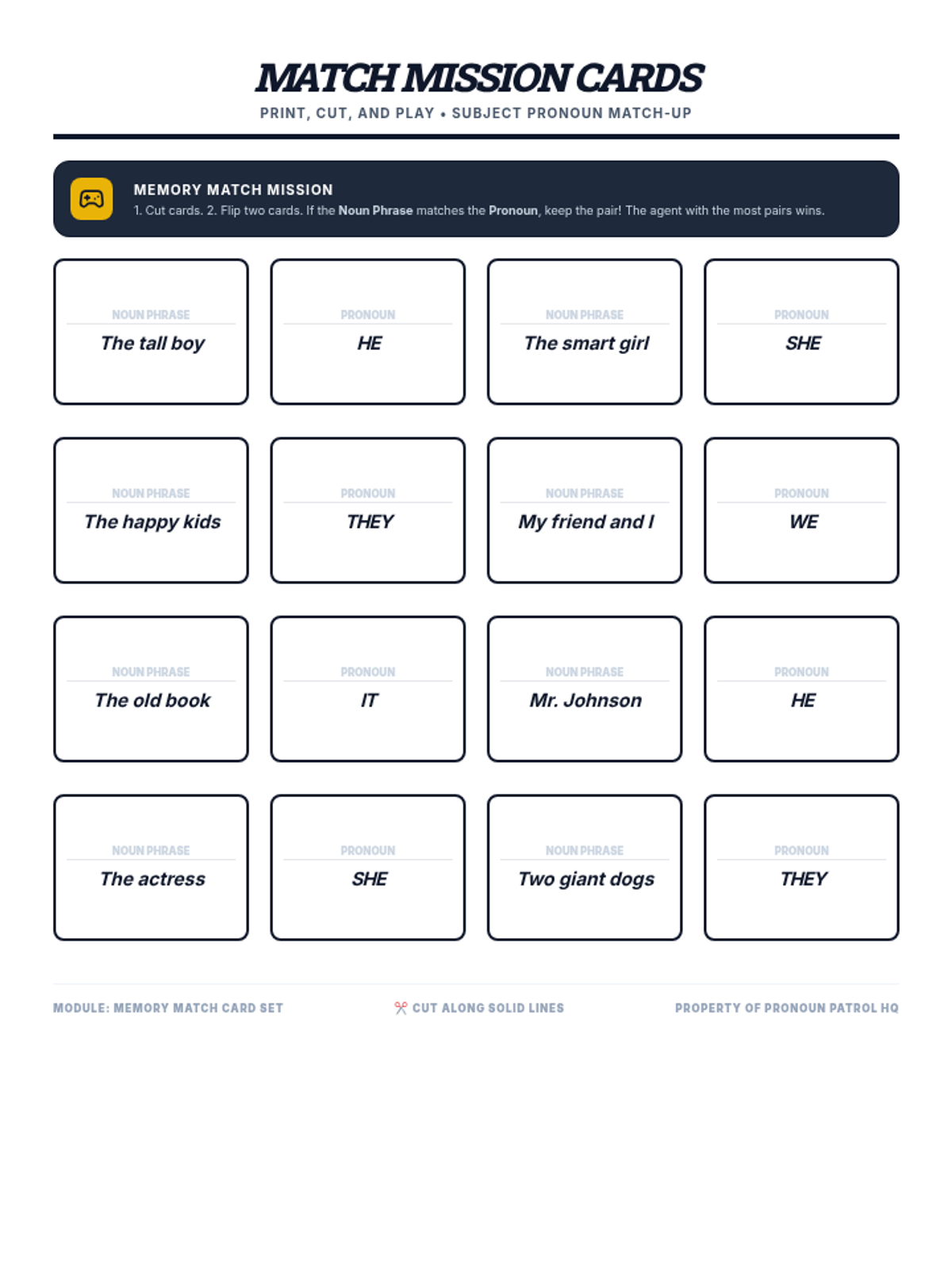
A matching game for kinesthetic learning. Revised to include 8 matches (16 cards total), uniform card styling for memory-game compatibility, and instructions on the same page. Card content was refined for natural phrasing.
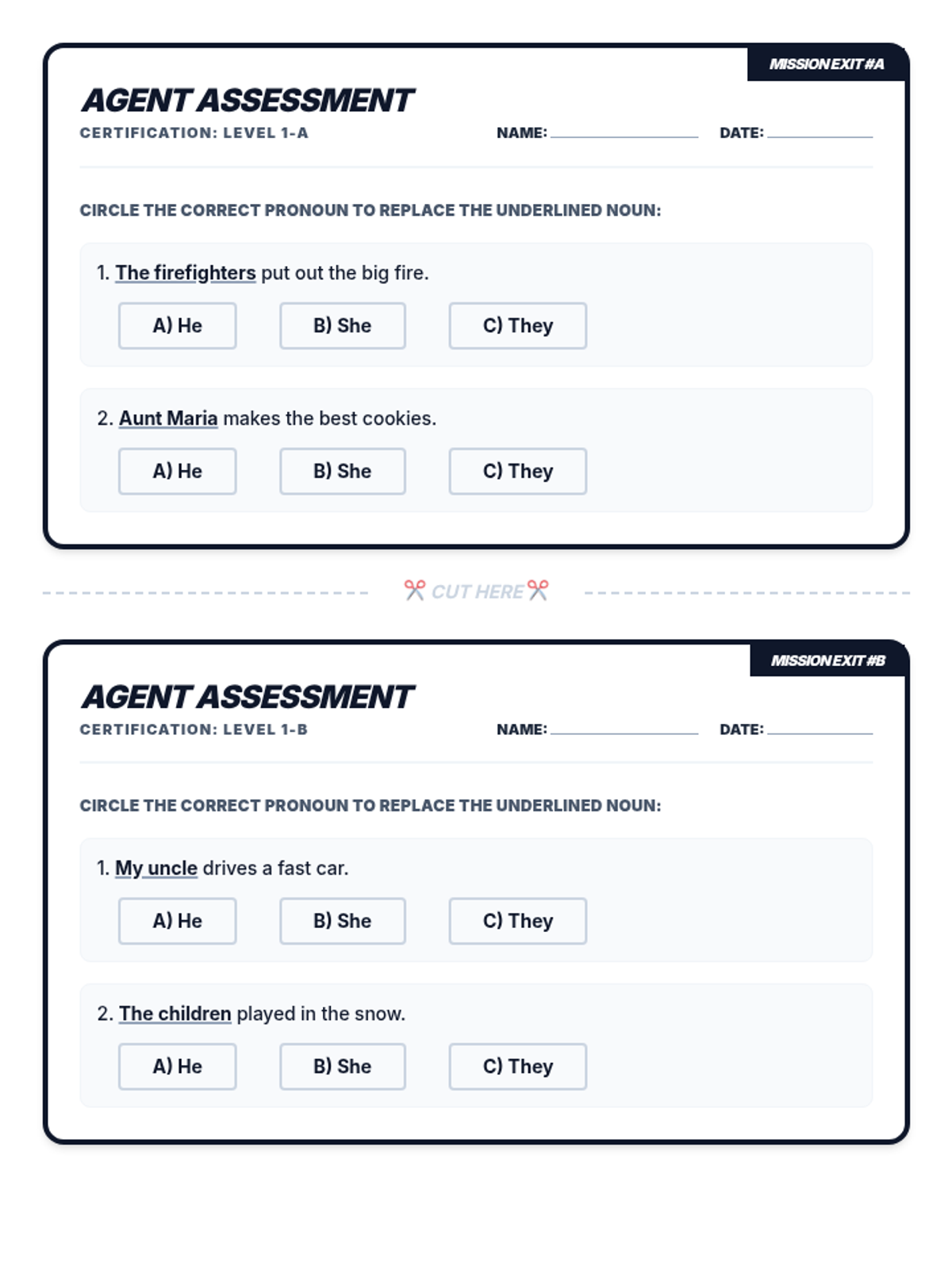
A two-per-page exit ticket for quick assessment. Revised for single-page layout, removed ink-heavy background, and improved contrast for student accessibility. version B includes unique questions.
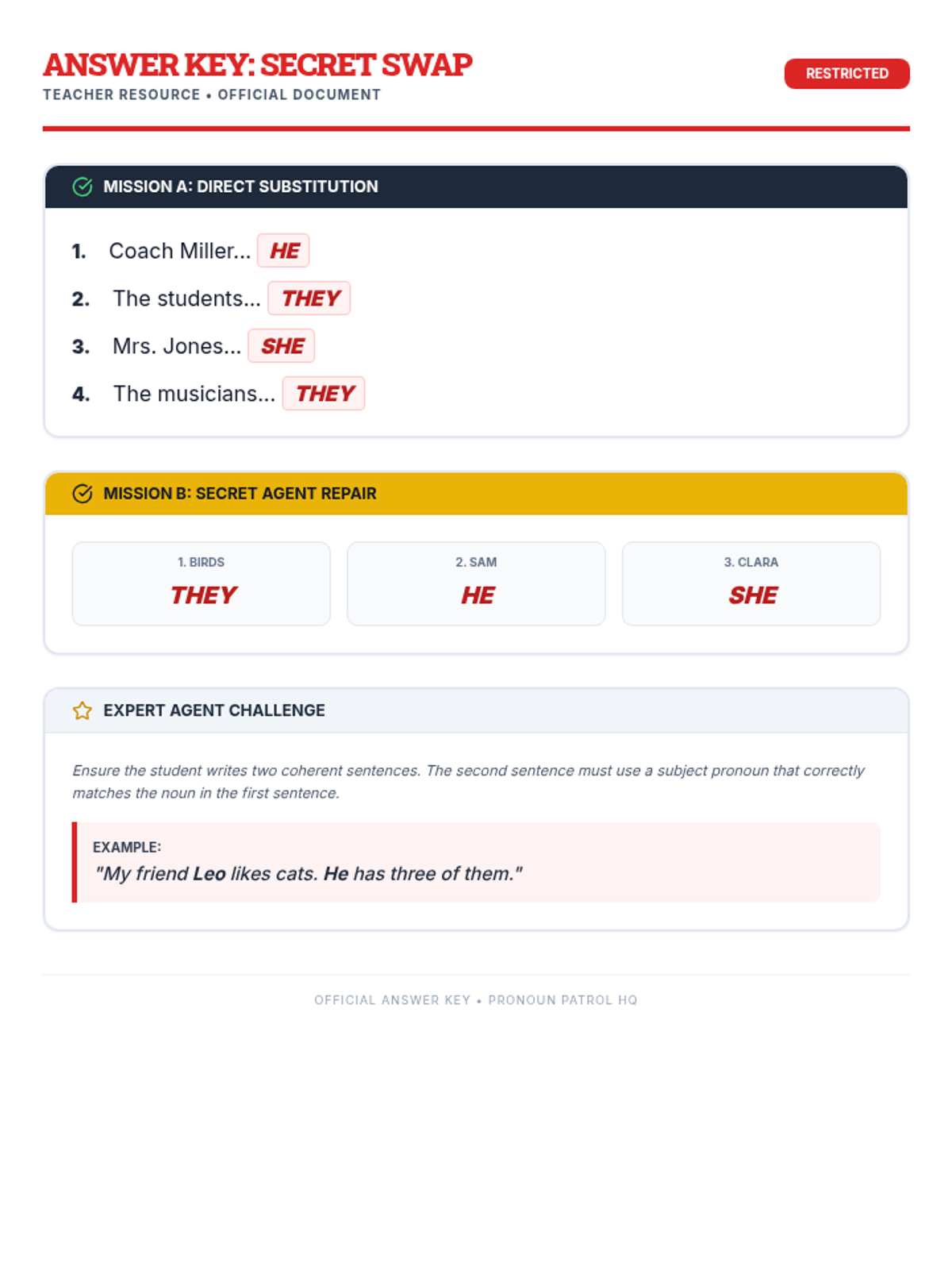
A clear, easy-to-use answer key for the 'Secret Swap' practice worksheet. Revised to fit on a single page, improved contrast for accessibility, and fixed potential page-break issues.
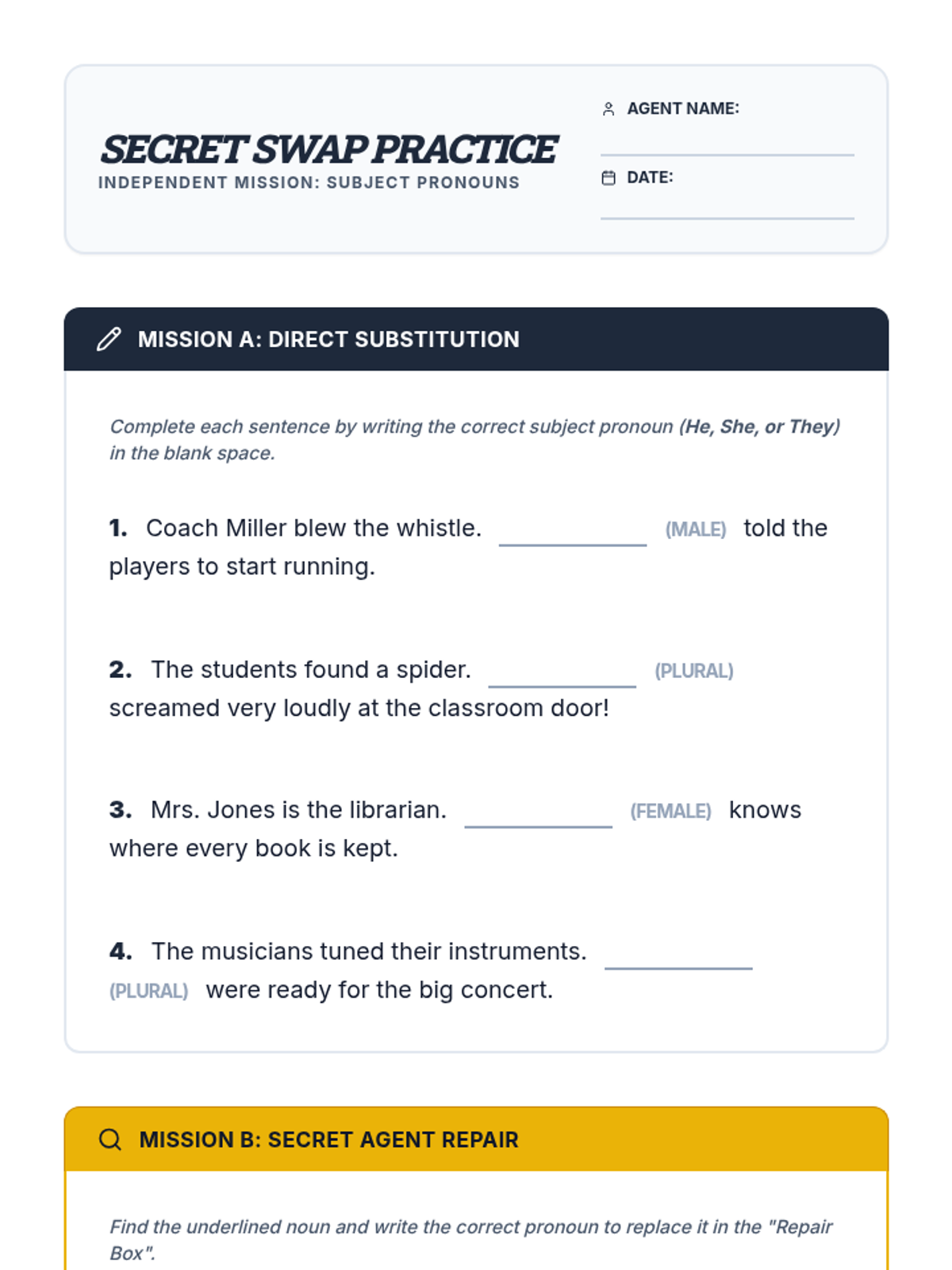
An independent practice worksheet with a 'Secret Agent Repair' theme. Revised for legibility in the Expert Challenge section, fixed page breaks for Mission B, and improved line wrapping in Mission A.
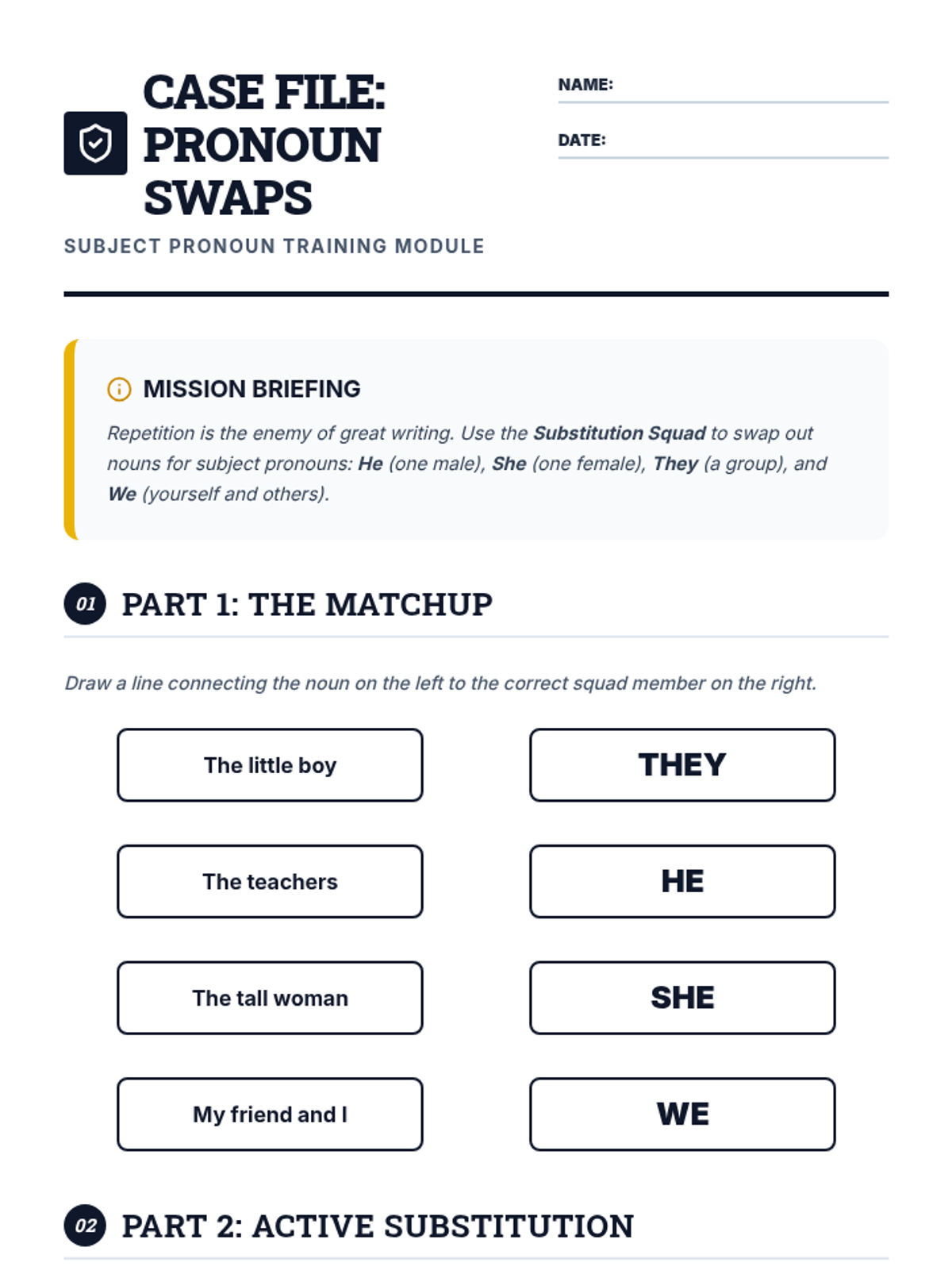
A guided practice worksheet following the 'Case File' theme. Includes a matching section and a sentence rewriting section. Revised for uniform answer styling, improved handwriting space, and removed duplicate options.
An engaging, high-contrast slide deck themed around a 'Pronoun Patrol' detective agency. Covers the basic use of subject pronouns (he, she, they) with examples and rules. Revised for PDF compatibility with separate answer slides.
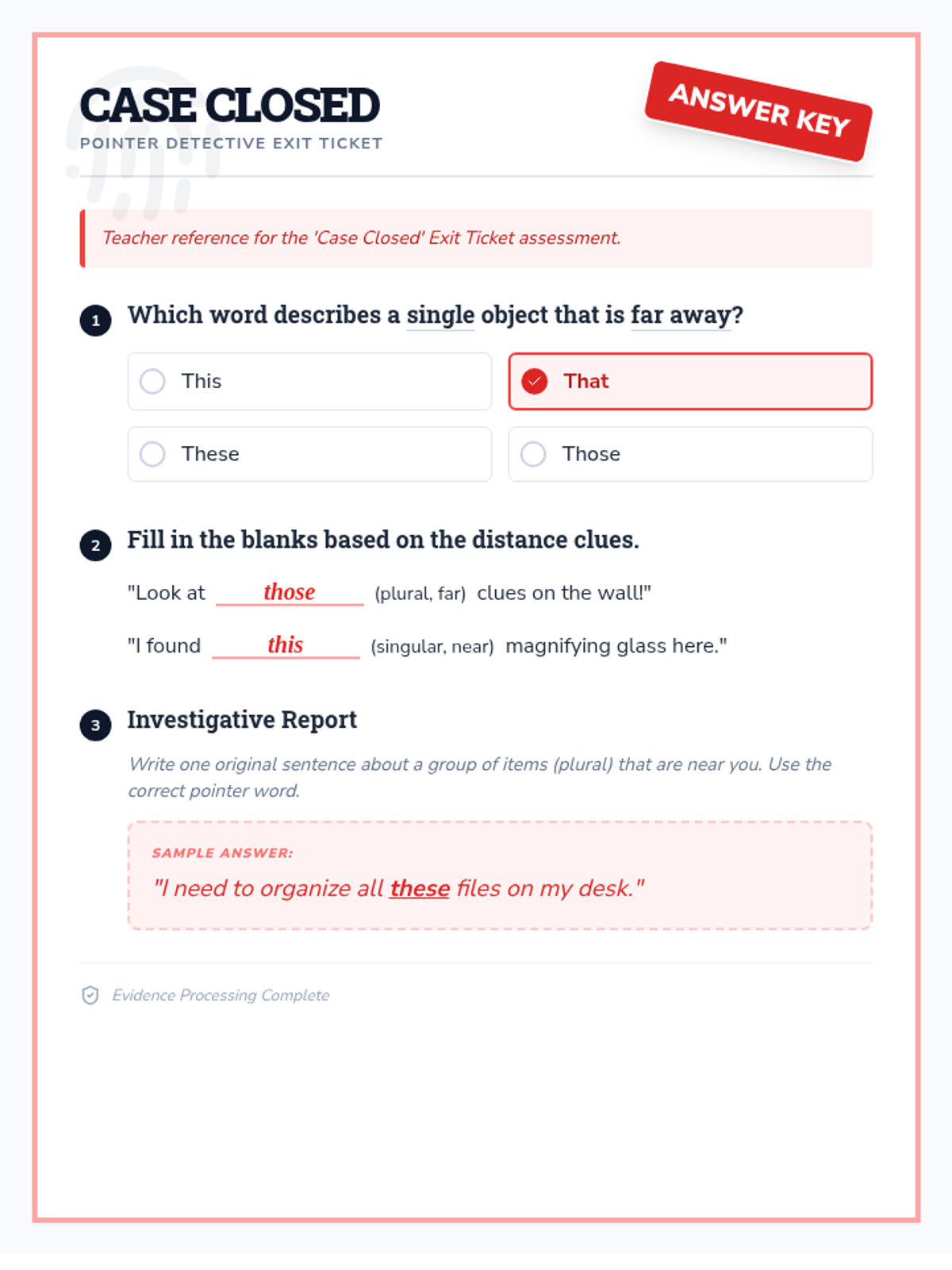
A teacher-facing answer key for the 'Case Closed' Exit Ticket, providing correct answers for multiple choice, fill-in-the-blank, and a sample sentence.
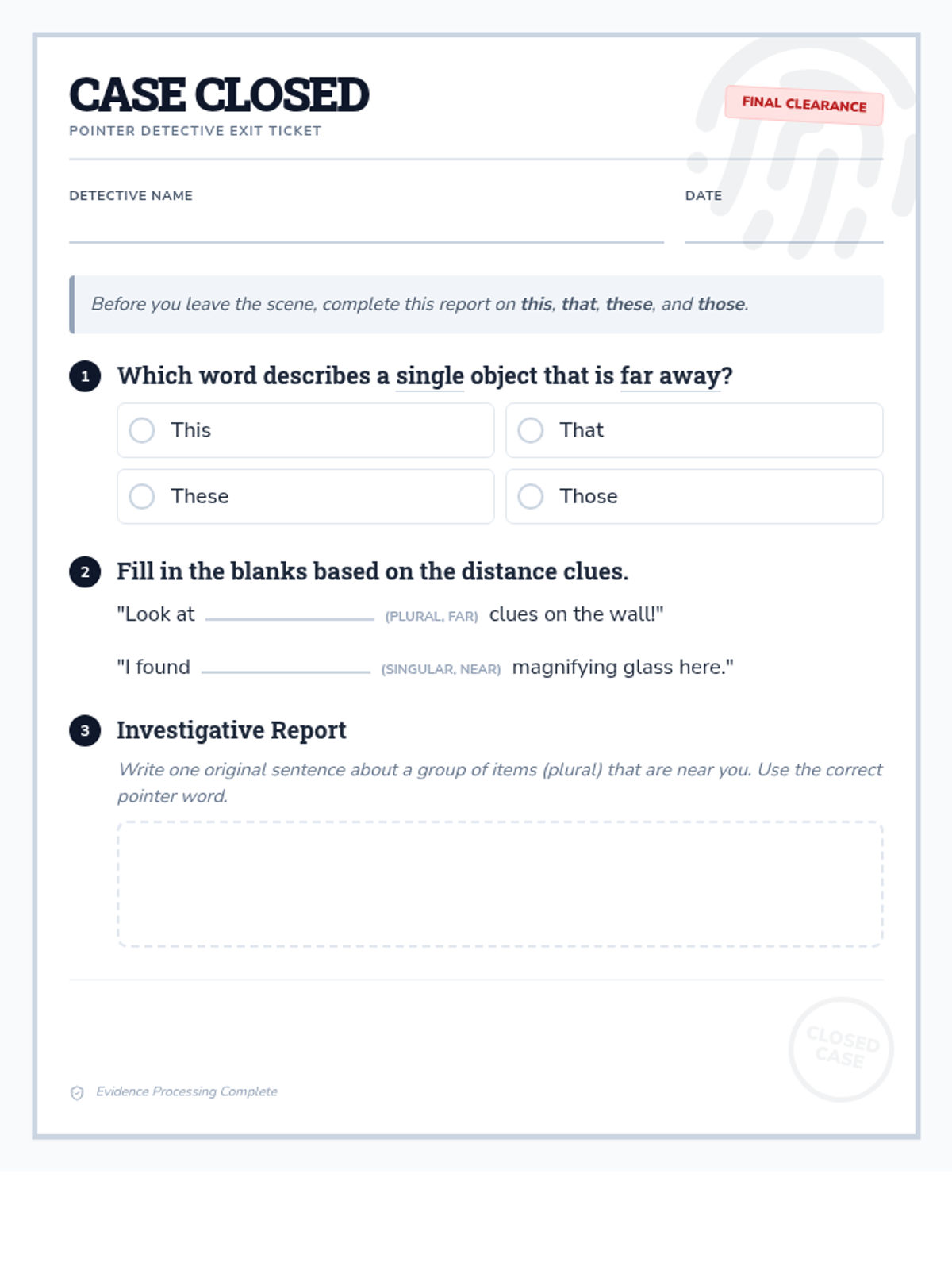
A detective-themed exit ticket titled 'Case Closed' that assesses student mastery of demonstrative pronouns (this, that, these, those) through multiple choice, fill-in-the-blank, and sentence writing exercises.
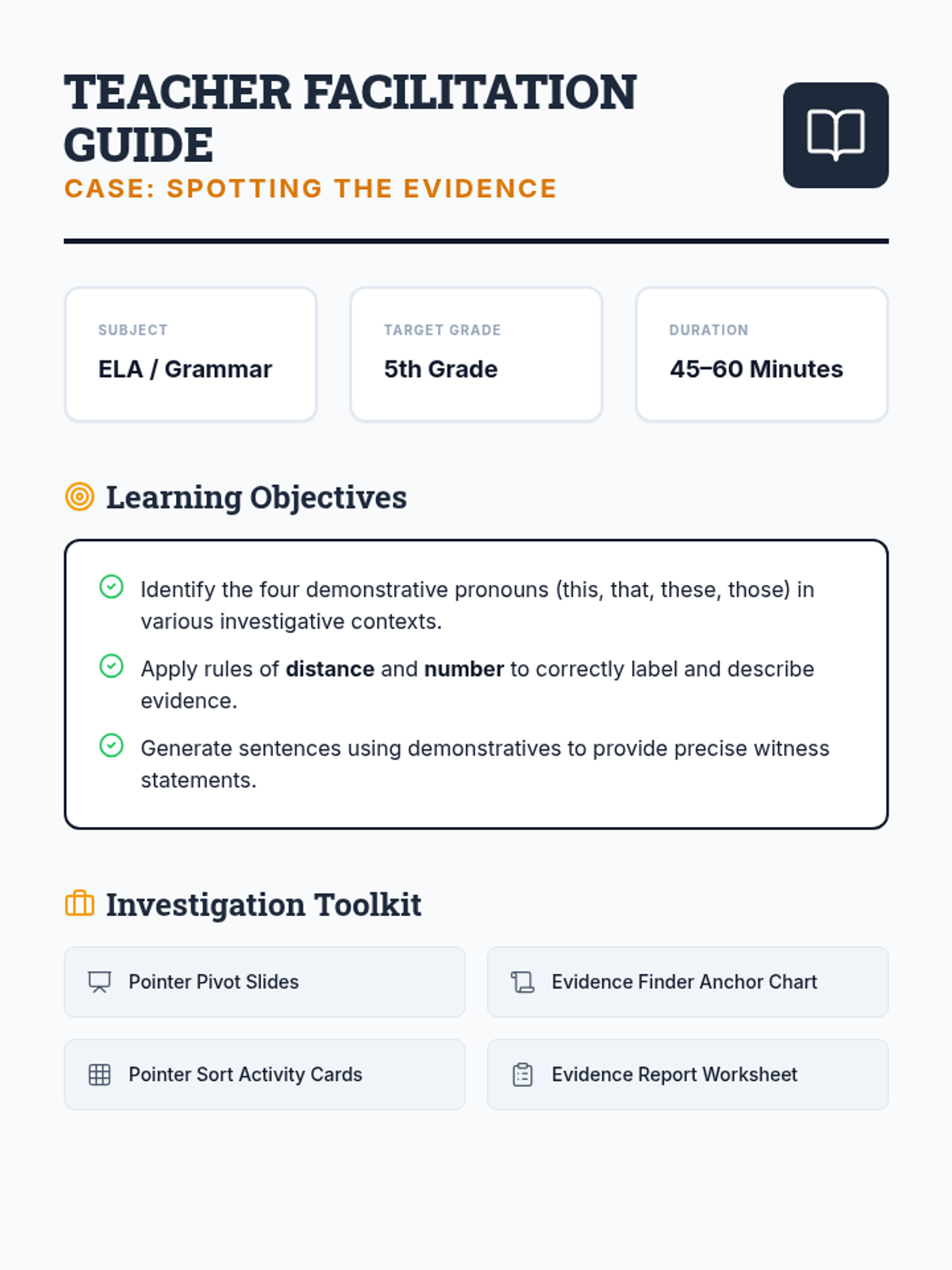
A comprehensive teacher-facing guide for the Pointer Detectives lesson, including instructional steps, differentiation strategies, and common student misconceptions.
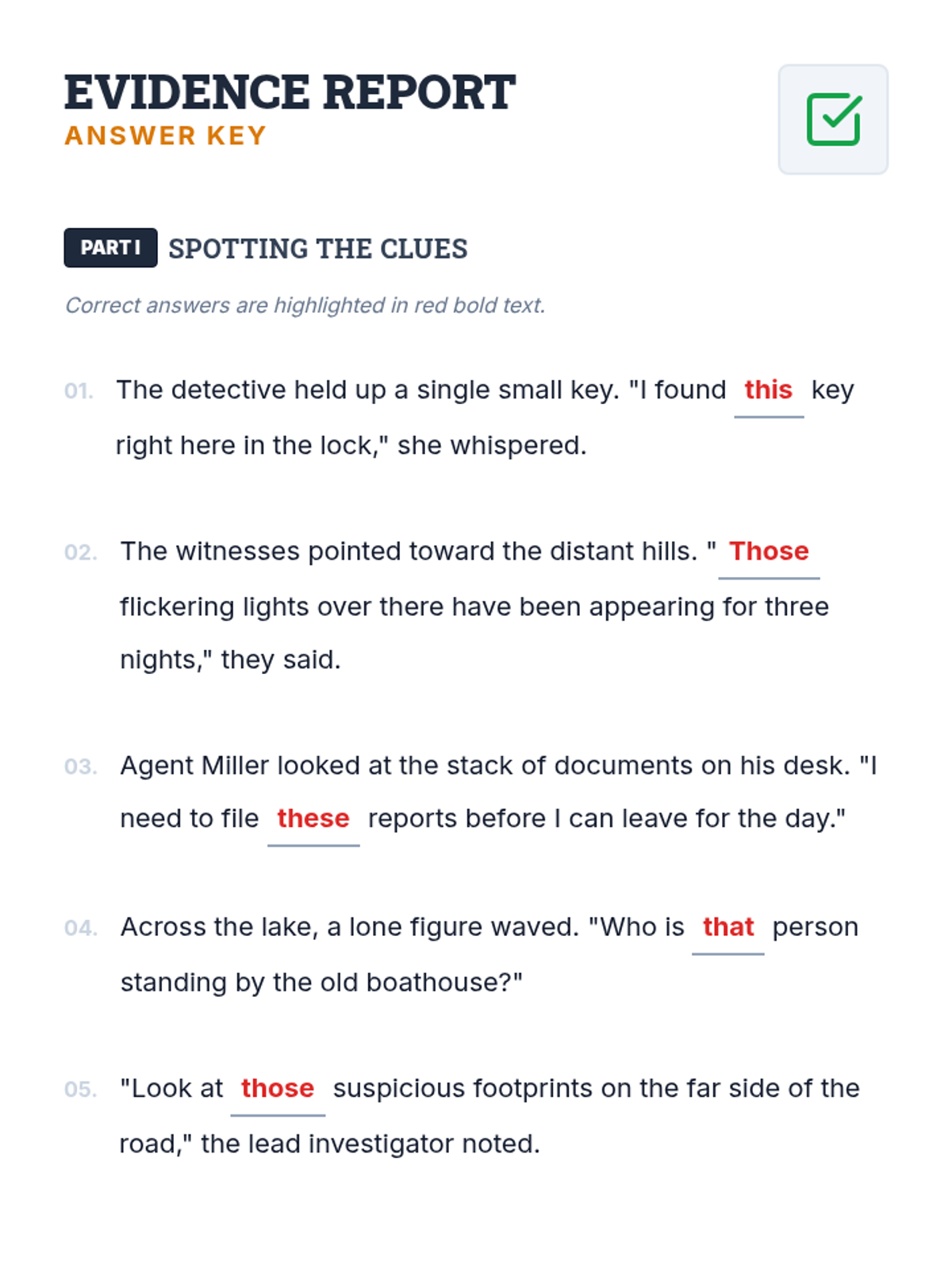
A teacher-facing answer key for the Evidence Report Worksheet, featuring correct answers for fill-in-the-blank and sentence rewriting tasks, along with a sample response for the creative writing section.
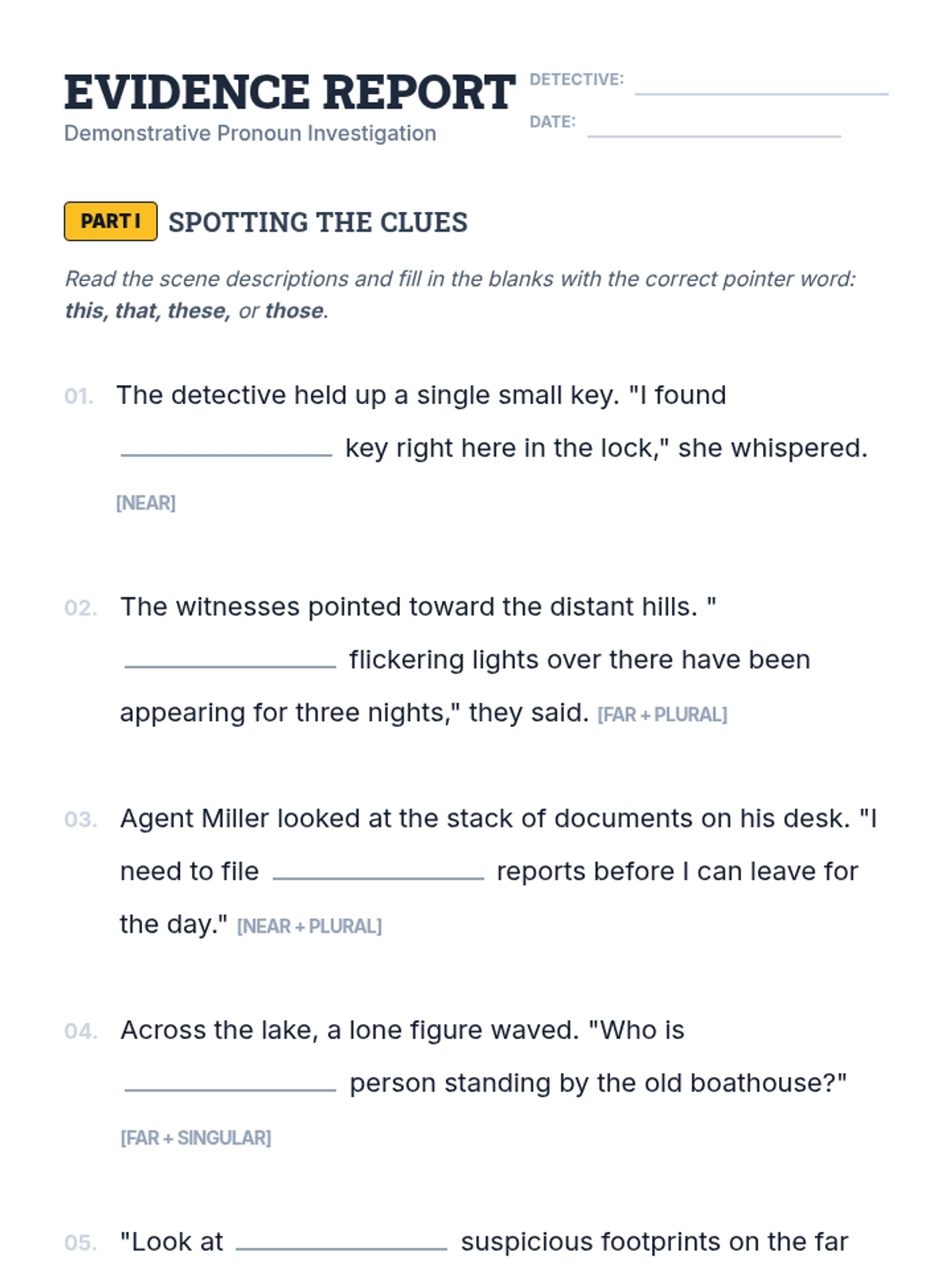
A practice worksheet titled 'Evidence Report' where students practice using 'this, that, these, and those' through fill-in-the-blank, rewriting sentences, and creative writing exercises.
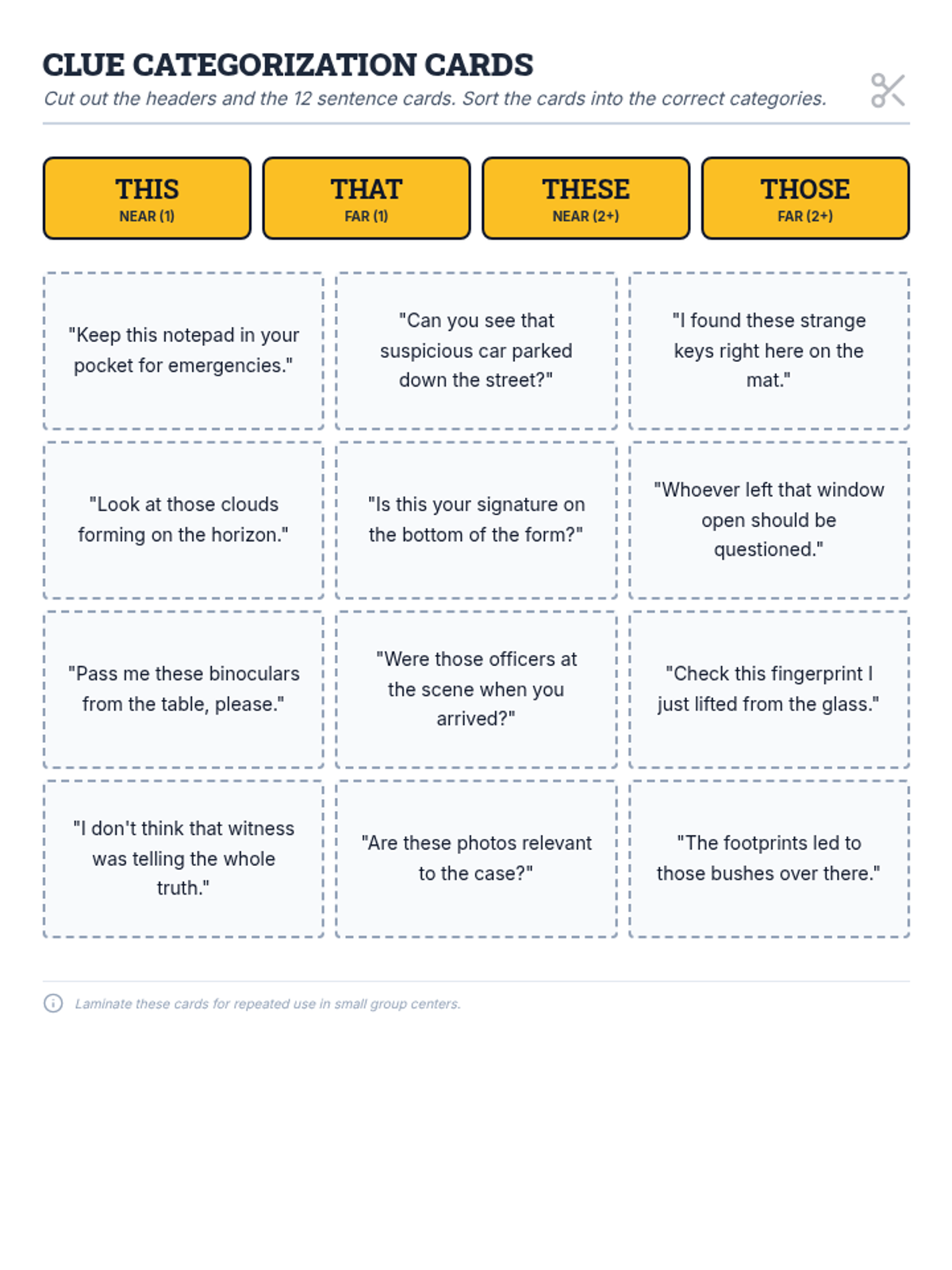
A set of printable sorting cards featuring 12 sentences that students must categorize into 'this, that, these, or those' based on distance and number.
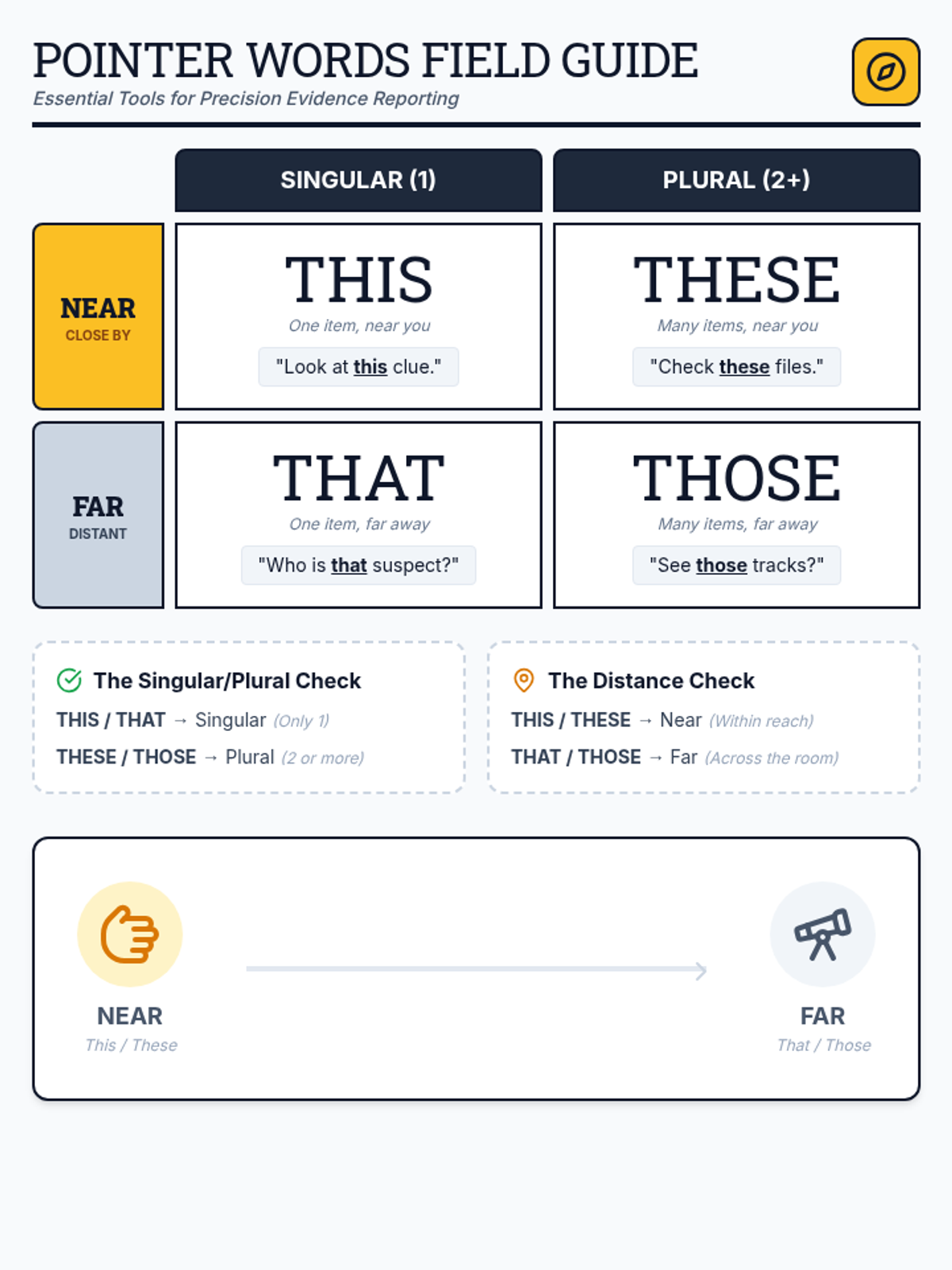
A printable anchor chart that summarizes the use of 'this, that, these, and those' through a 2x2 matrix and clear examples.
A visually engaging detective-themed slide deck for 5th graders teaching the use of demonstrative pronouns (this, that, these, those) based on distance and quantity.
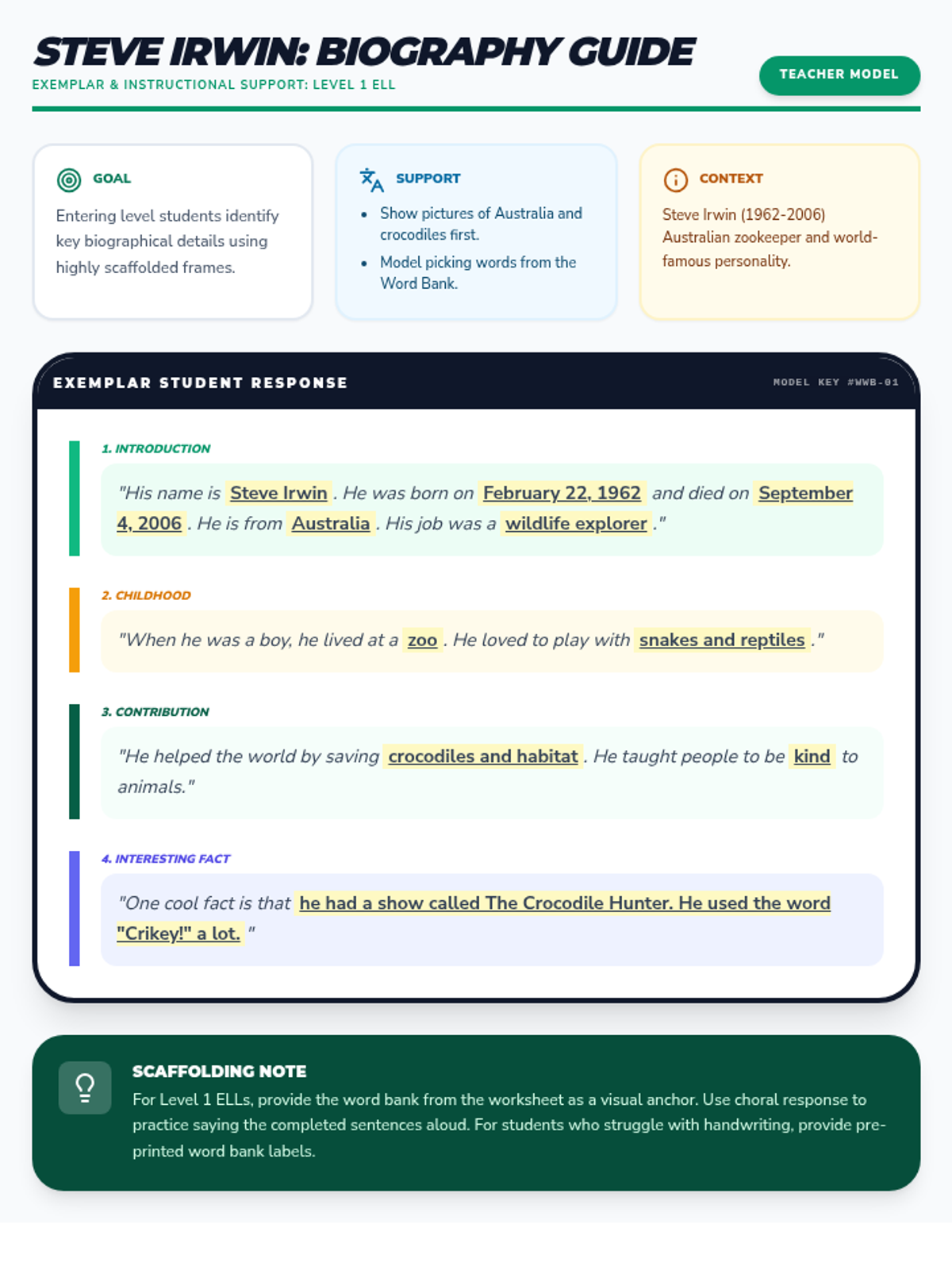
A teacher facilitator guide and exemplar response for the Steve Irwin biography unit. REVISED for single-page layout and better content flow.
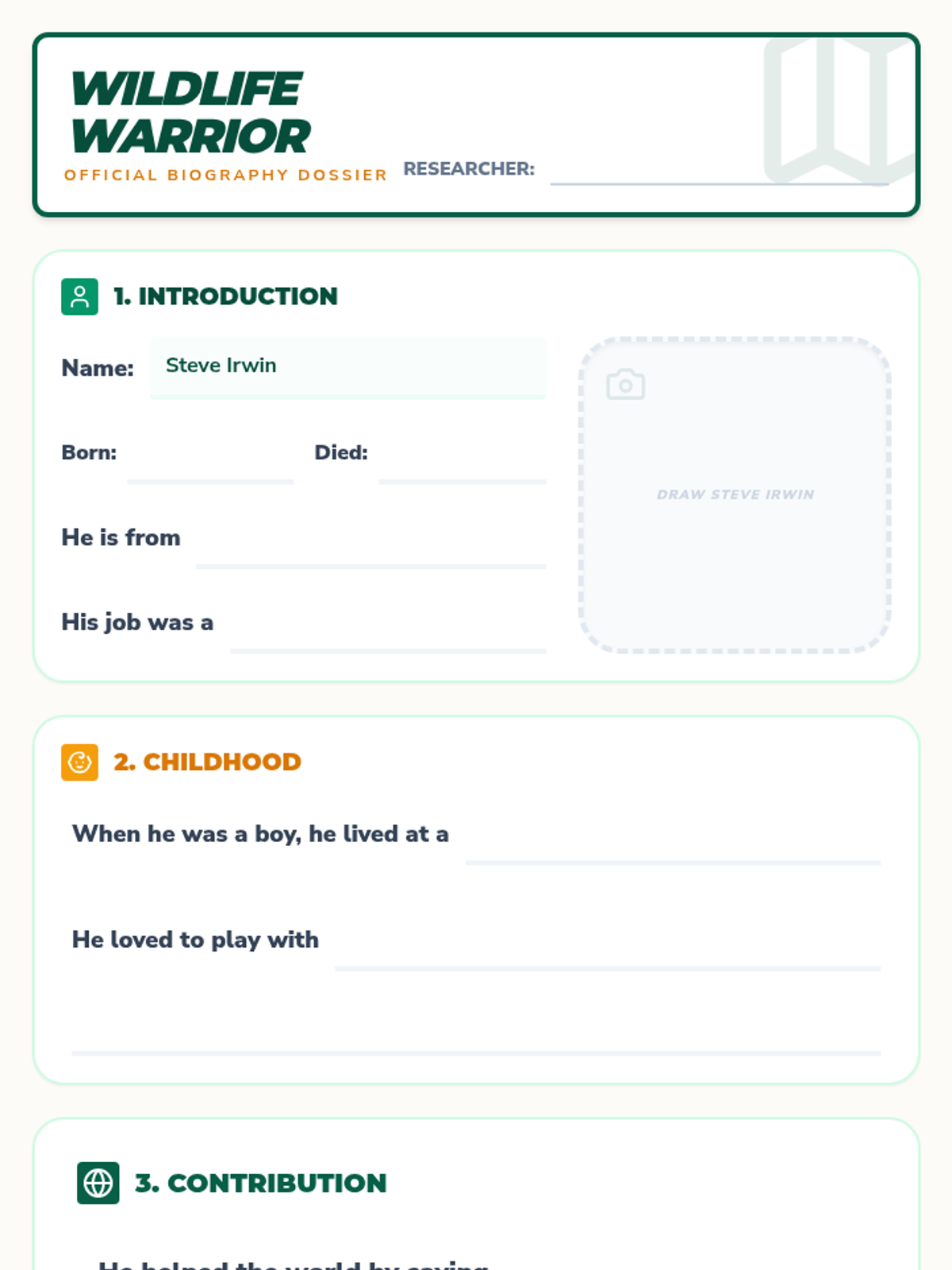
A highly scaffolded biography organizer for Entering level ELL students, featuring simplified sentence frames for Steve Irwin's life, a word bank, and a drawing space. REVISED for born/died field sizing and spacing before closing text.
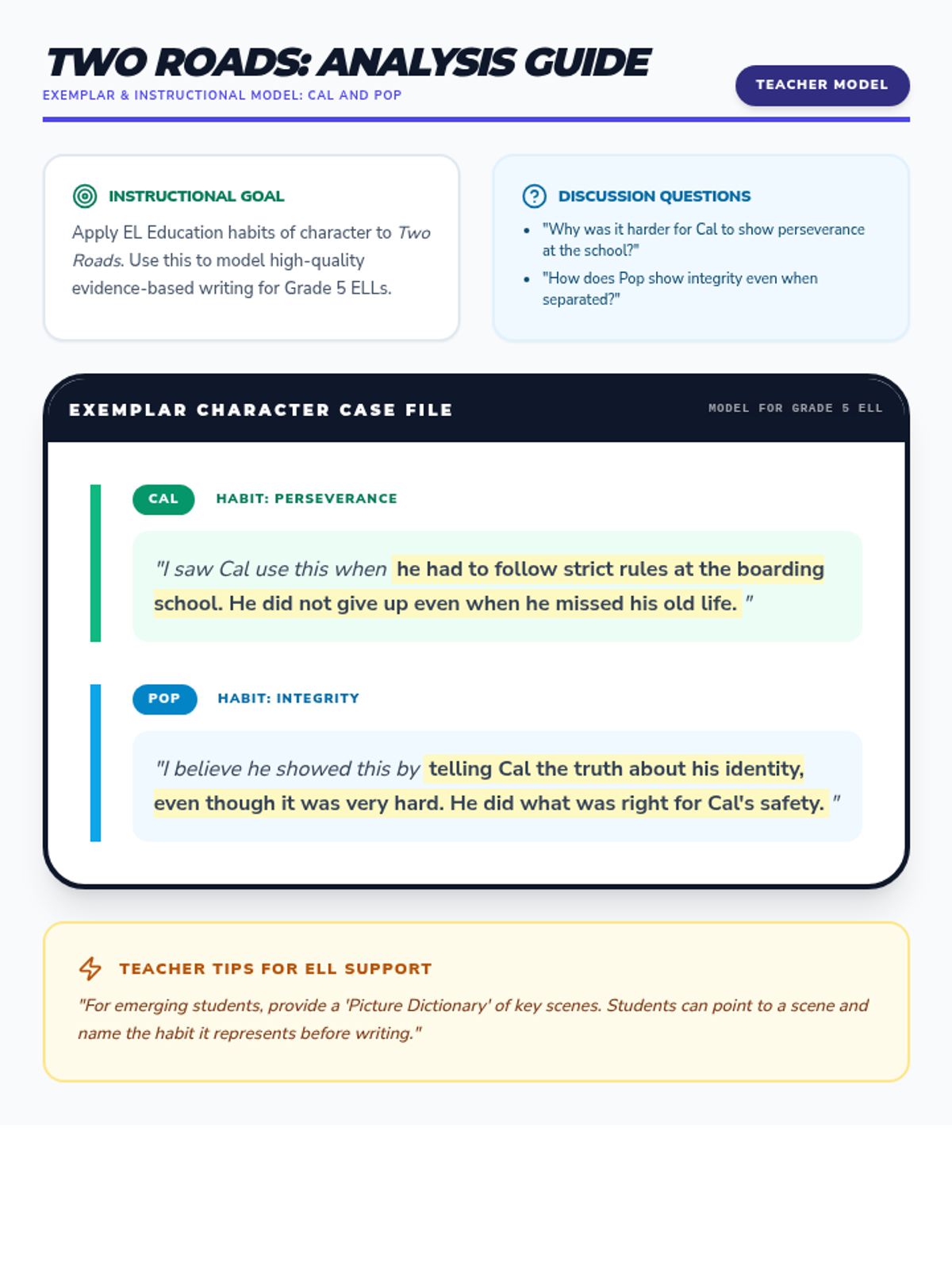
A teacher reference and model guide for the characters Cal and Pop in the book "Two Roads," providing exemplar habits of character analysis and instructional support for Grade 5 ELLs. REVISED for single-page layout.
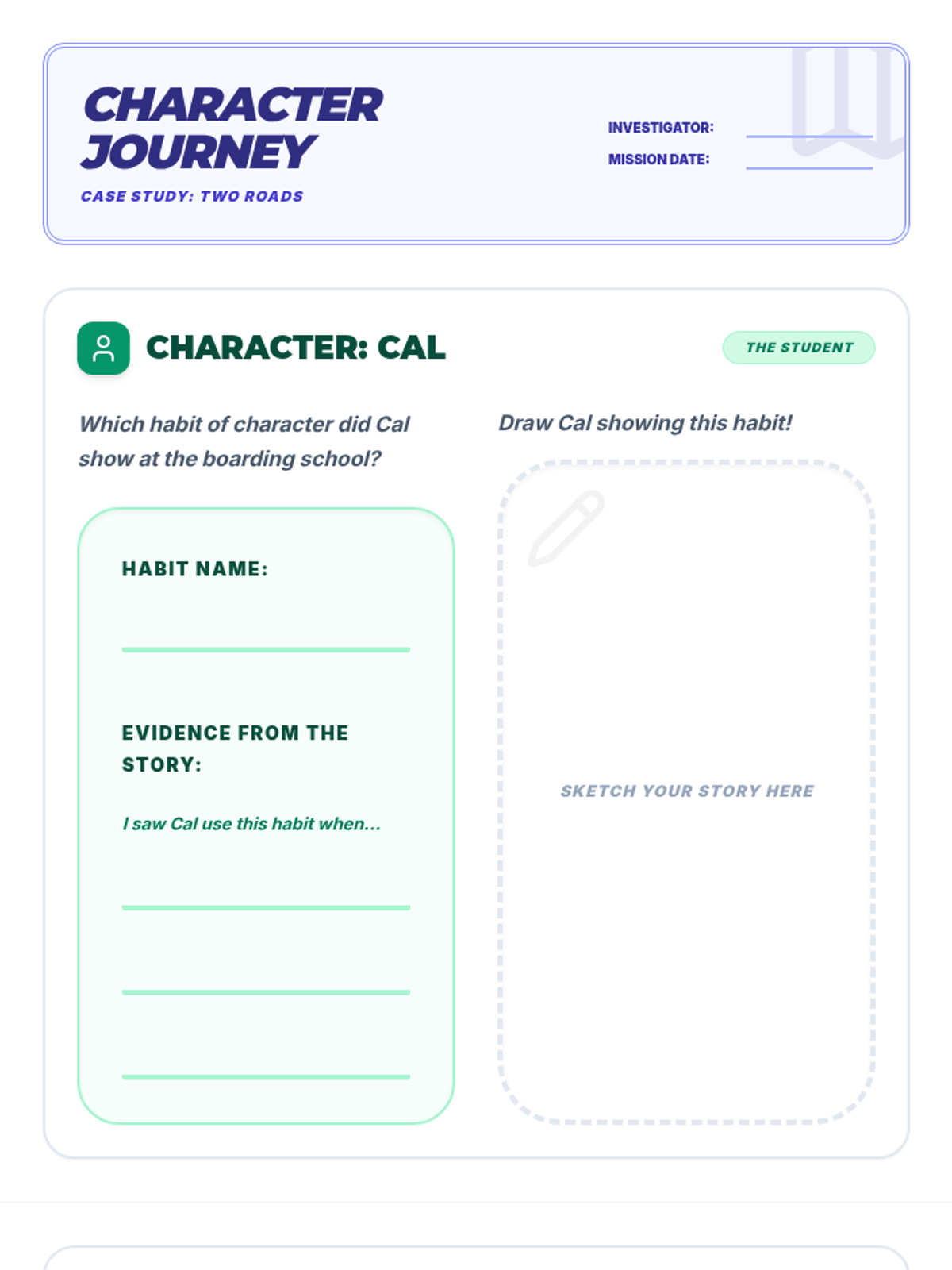
A character analysis worksheet for the book "Two Roads" by Joseph Bruchac, designed for Grade 5 ELL students to identify habits of character for Cal and Pop. REVISED for high-contrast headers, improved page layout, and larger writing areas.
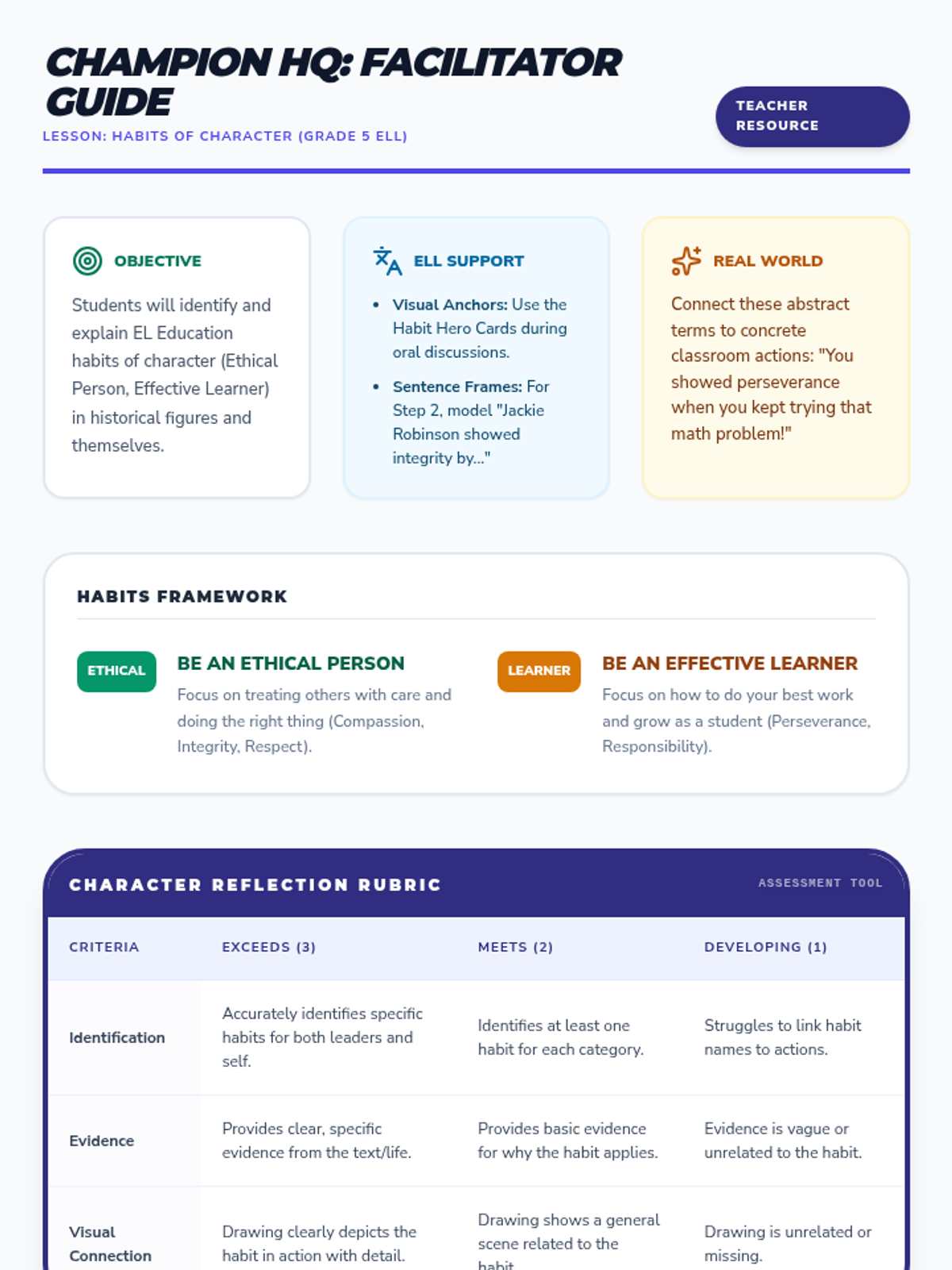
A teacher facilitator guide for the Character Champions lesson, providing EL Education habits of character framework, instructional strategies, and an assessment rubric.
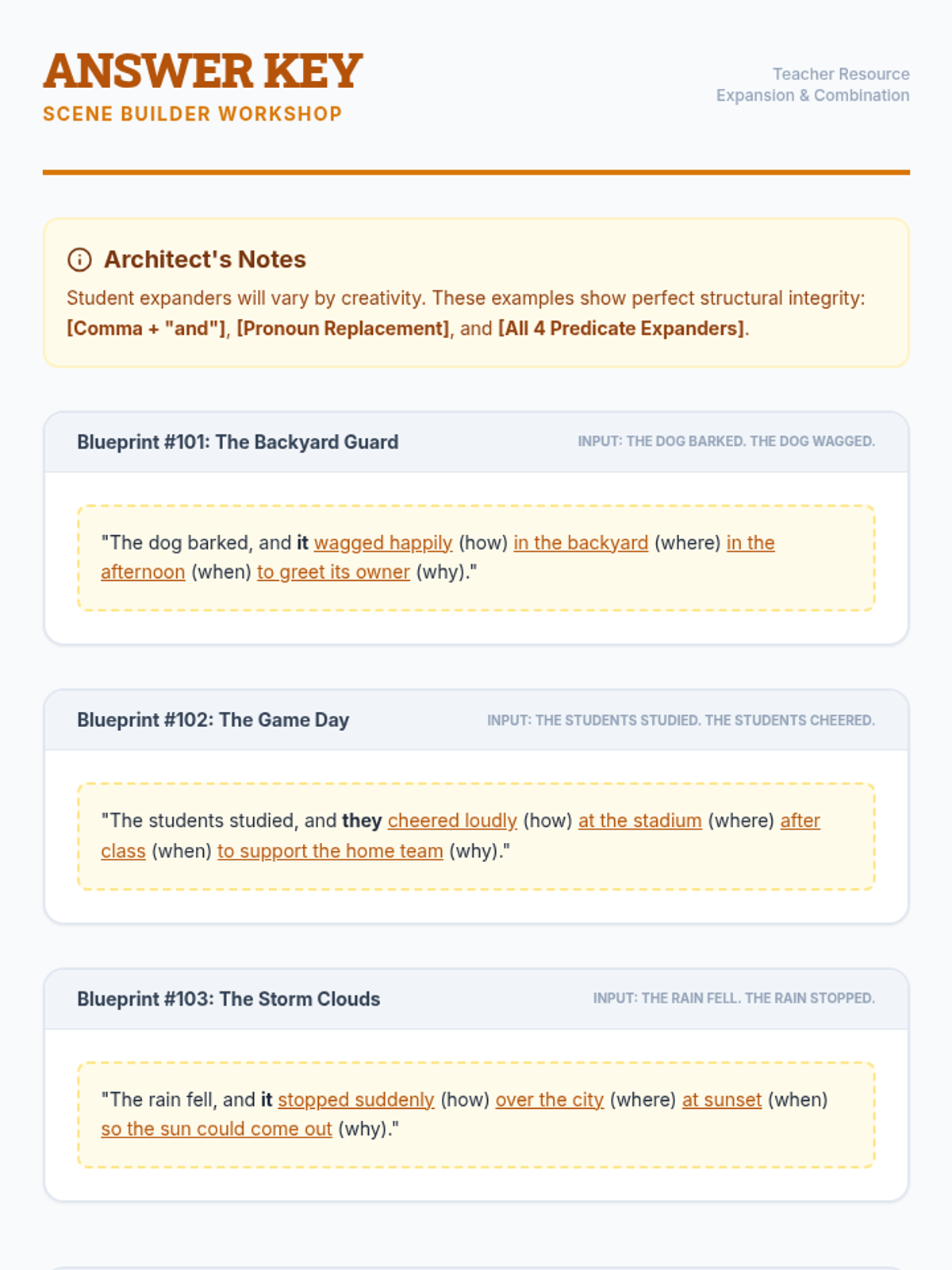
A teacher's answer key for the Scene Builder worksheet, featuring example answers and a structural grading rubric.
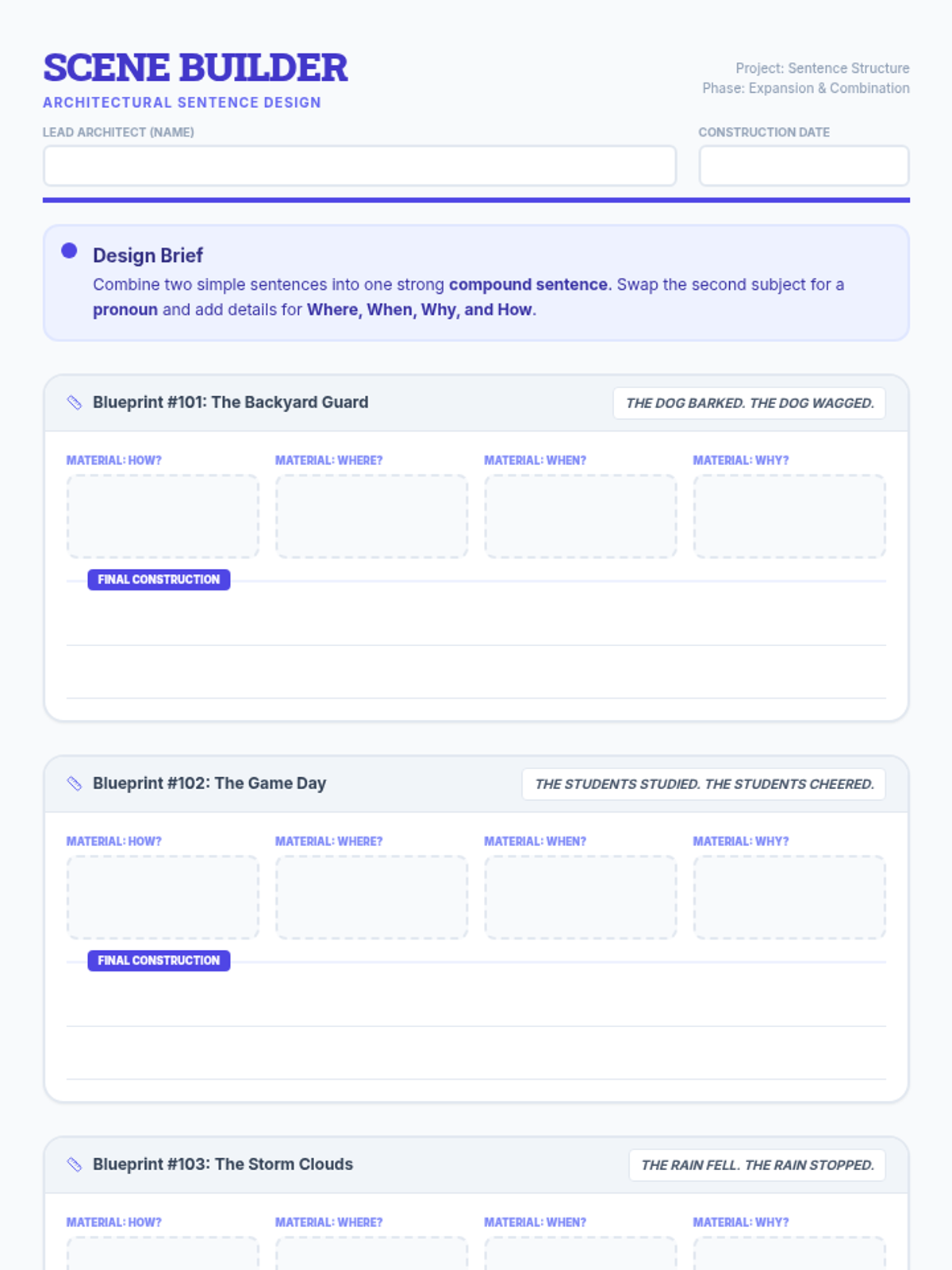
A second practice worksheet for the Sentence Lab lesson, using an architectural "Scene Builder" theme. Students combine simple sentences using pronouns and expand them with four descriptive predicates. Optimized for a 2-page layout.
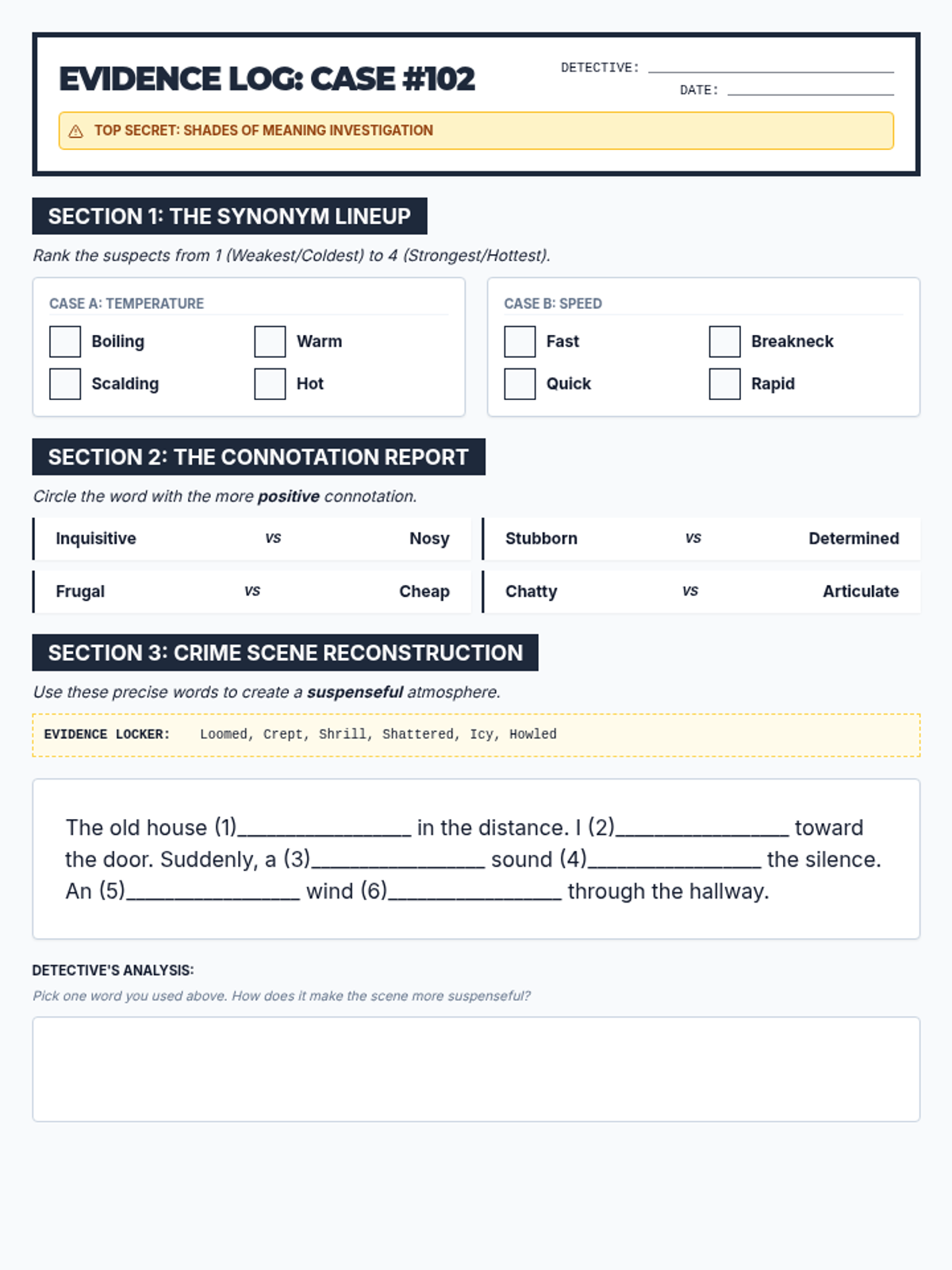
A student worksheet designed as an "Evidence Log" where students practice ranking synonyms by intensity, identifying connotations, and replacing dull verbs with precise diction to create suspense.
A visually engaging presentation using a detective/noir theme to teach 5th and 6th graders about diction, connotation, and word intensity. Includes clear examples and an intensity scale visualization.
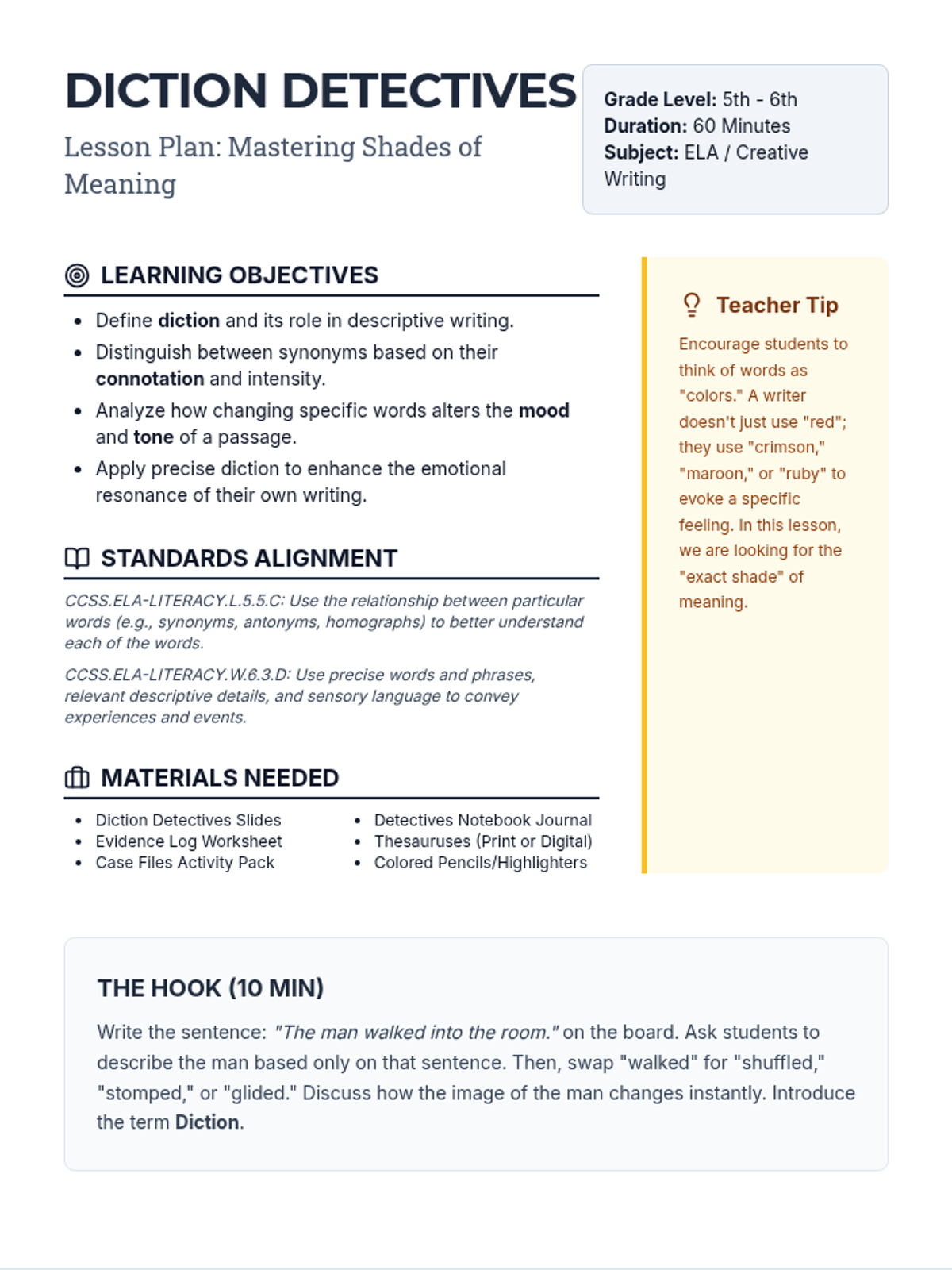
A comprehensive teacher guide for the Diction Detectives lesson, including learning objectives, CCSS alignment, a minute-by-minute instructional sequence, and differentiation strategies for 5th and 6th grade ELA.
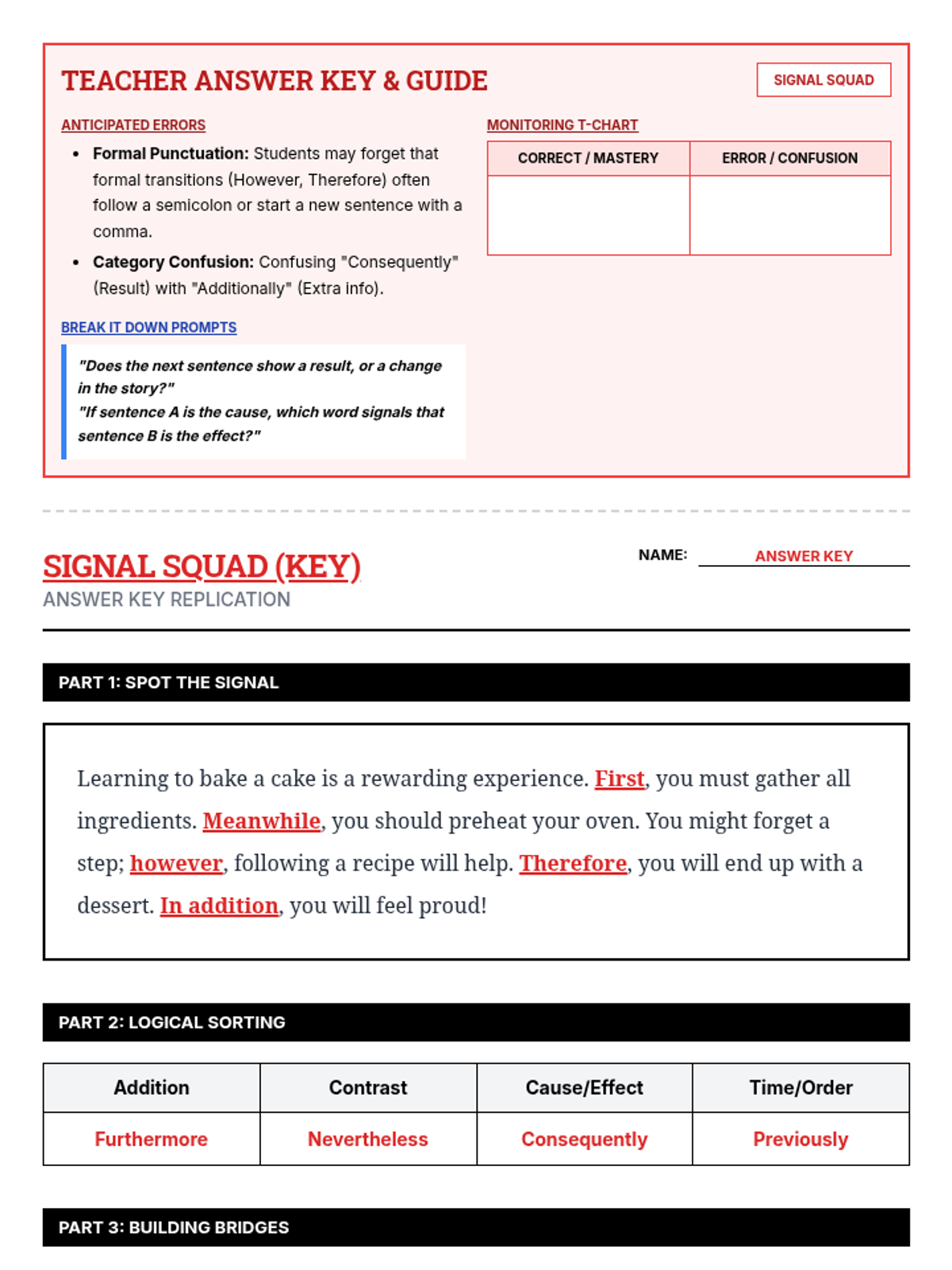
A comprehensive answer key for the Signal Squad handout. Includes teacher scaffolding with interrogative 'Break it down' prompts and marks challenging items with a star. Revised to exclude FANBOYS and fix spacing/fragment issues identified in review.
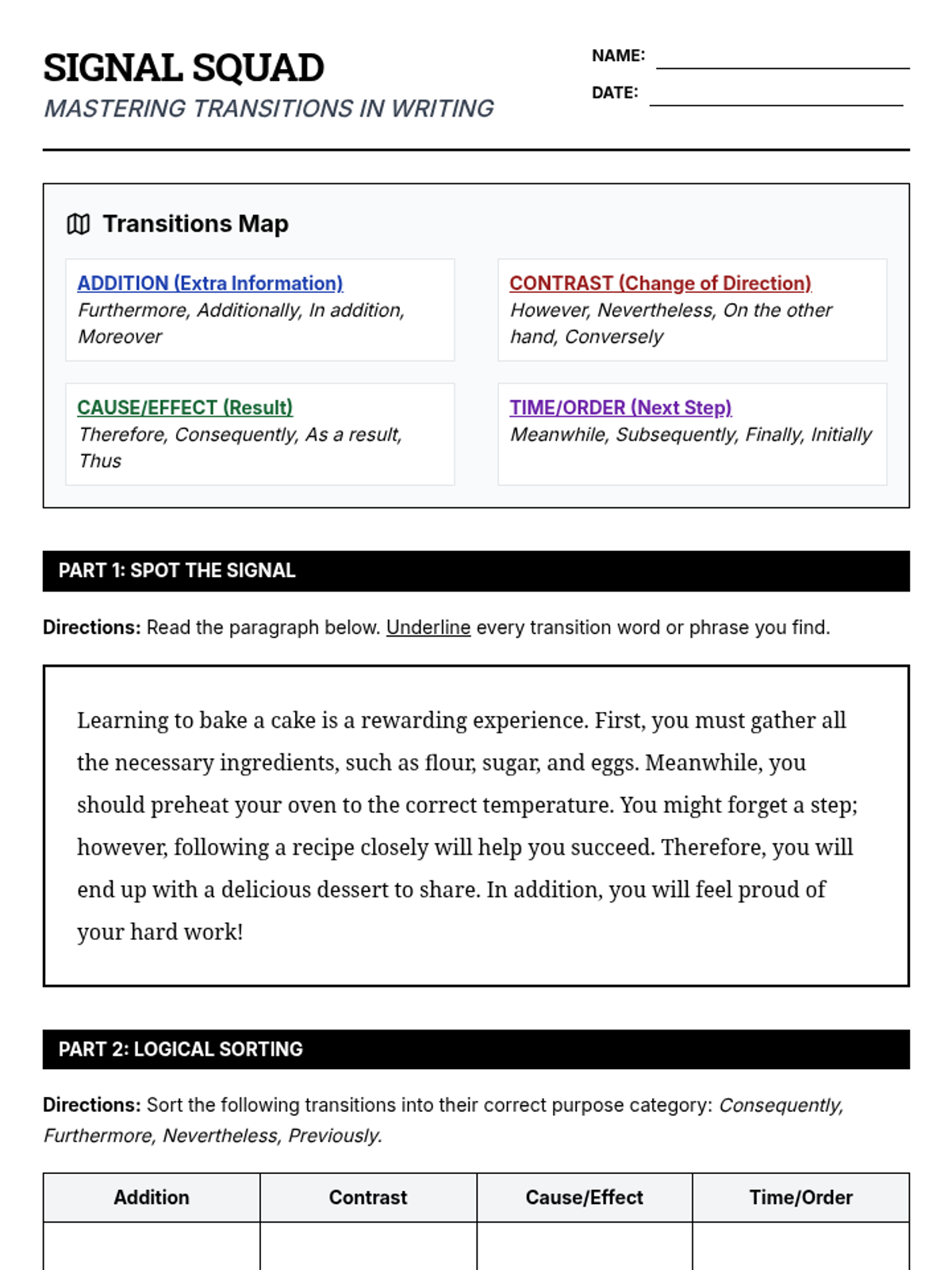
A student handout for identifying and categorizing transition words. Features three sections: identifying transitions in a paragraph, sorting words by purpose, and selecting the best transition to bridge two sentences. Revised to exclude FANBOYS and focus on formal transitions.
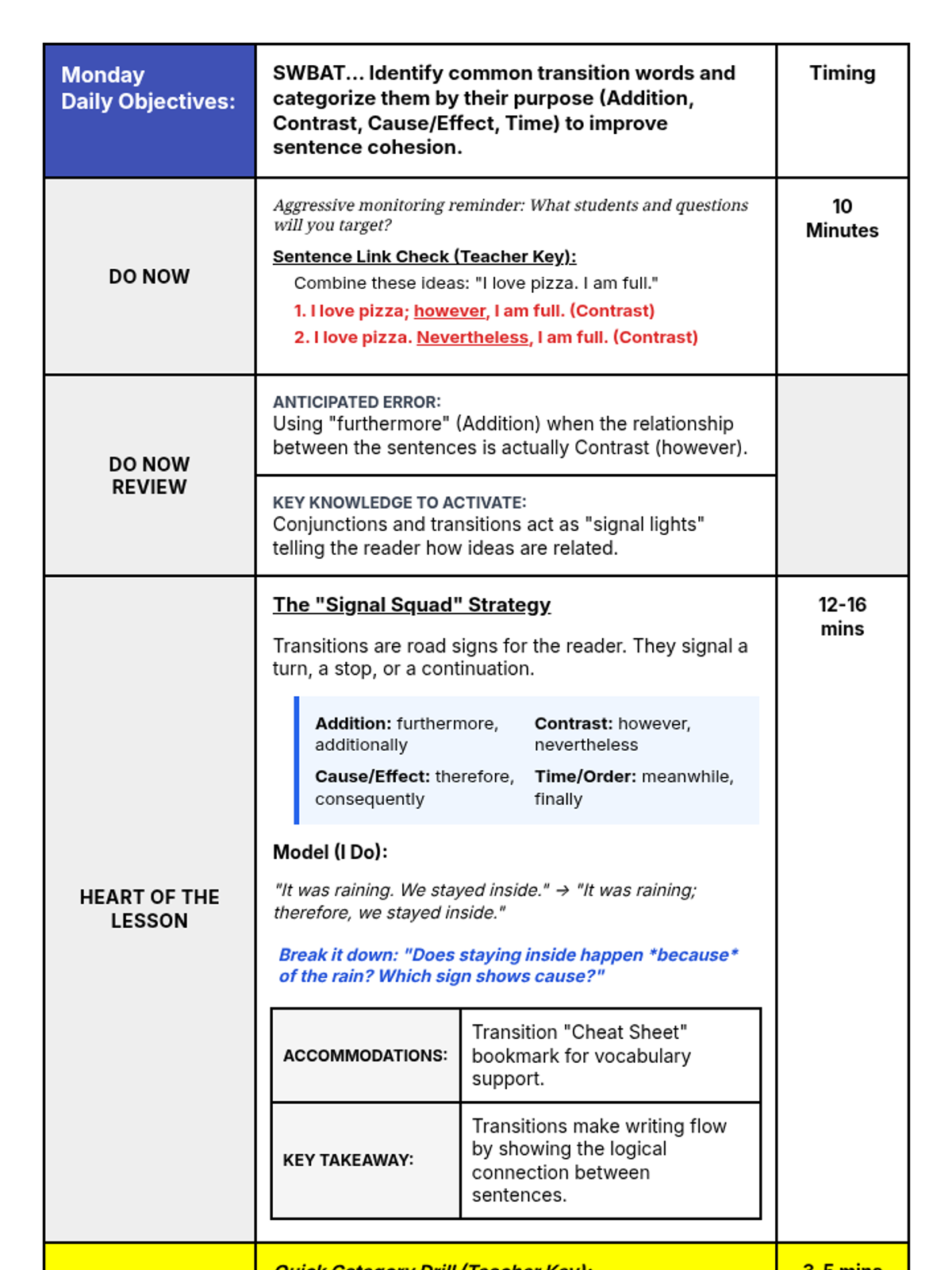
A structured lesson plan for teaching transition words, following the 'Impact LP Template'. Includes objectives, categorize-by-purpose strategies, and a monitoring T-chart. Revised to exclude coordinating conjunctions (FANBOYS) and include full context sentences in the teacher key.
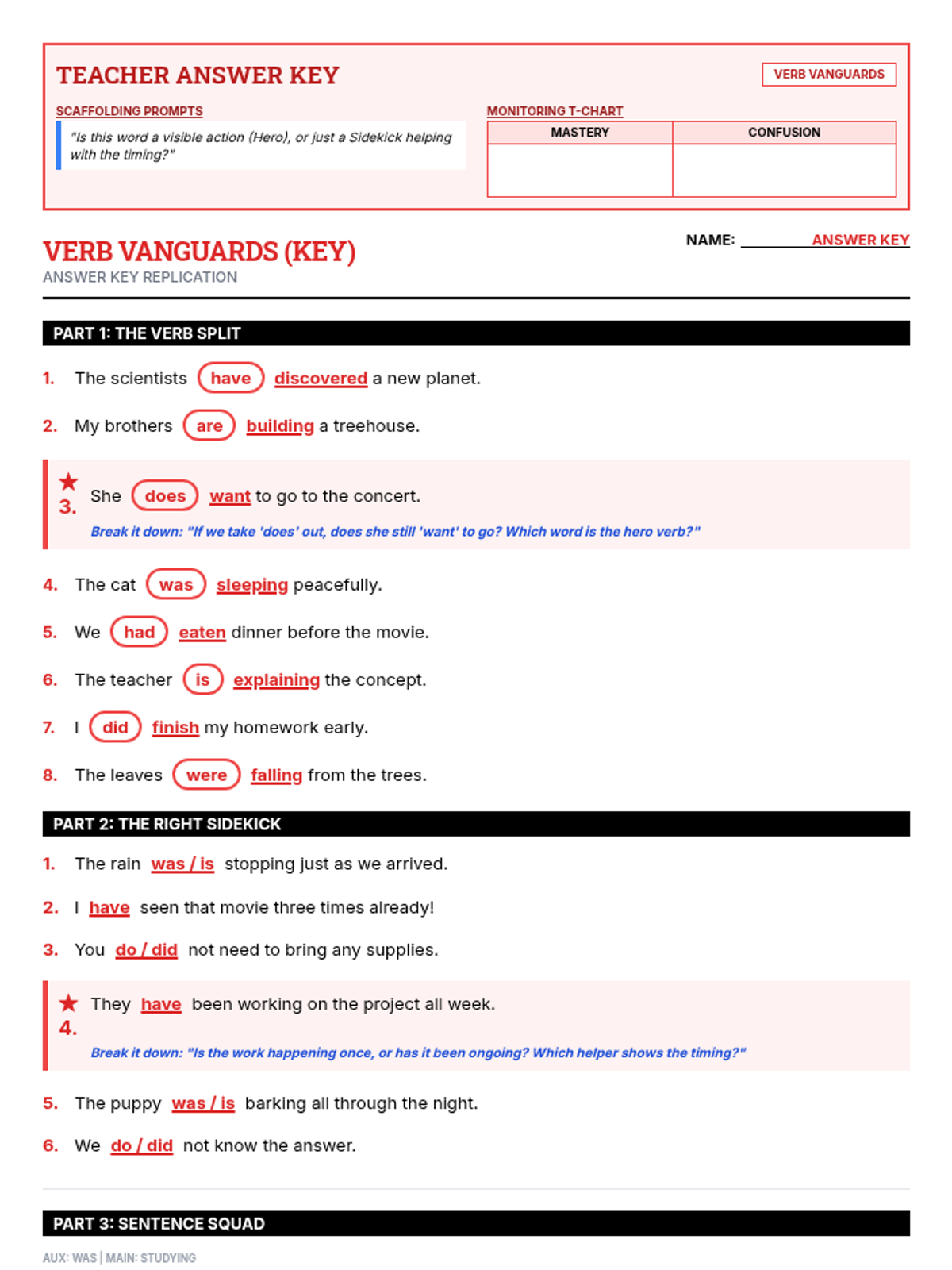
A comprehensive answer key for the Verb Vanguards handout. Includes teacher scaffolding with interrogative 'Break it down' prompts for struggling students and marks challenging items with a star for targeted monitoring. Replicates the student handout format with answers highlighted.
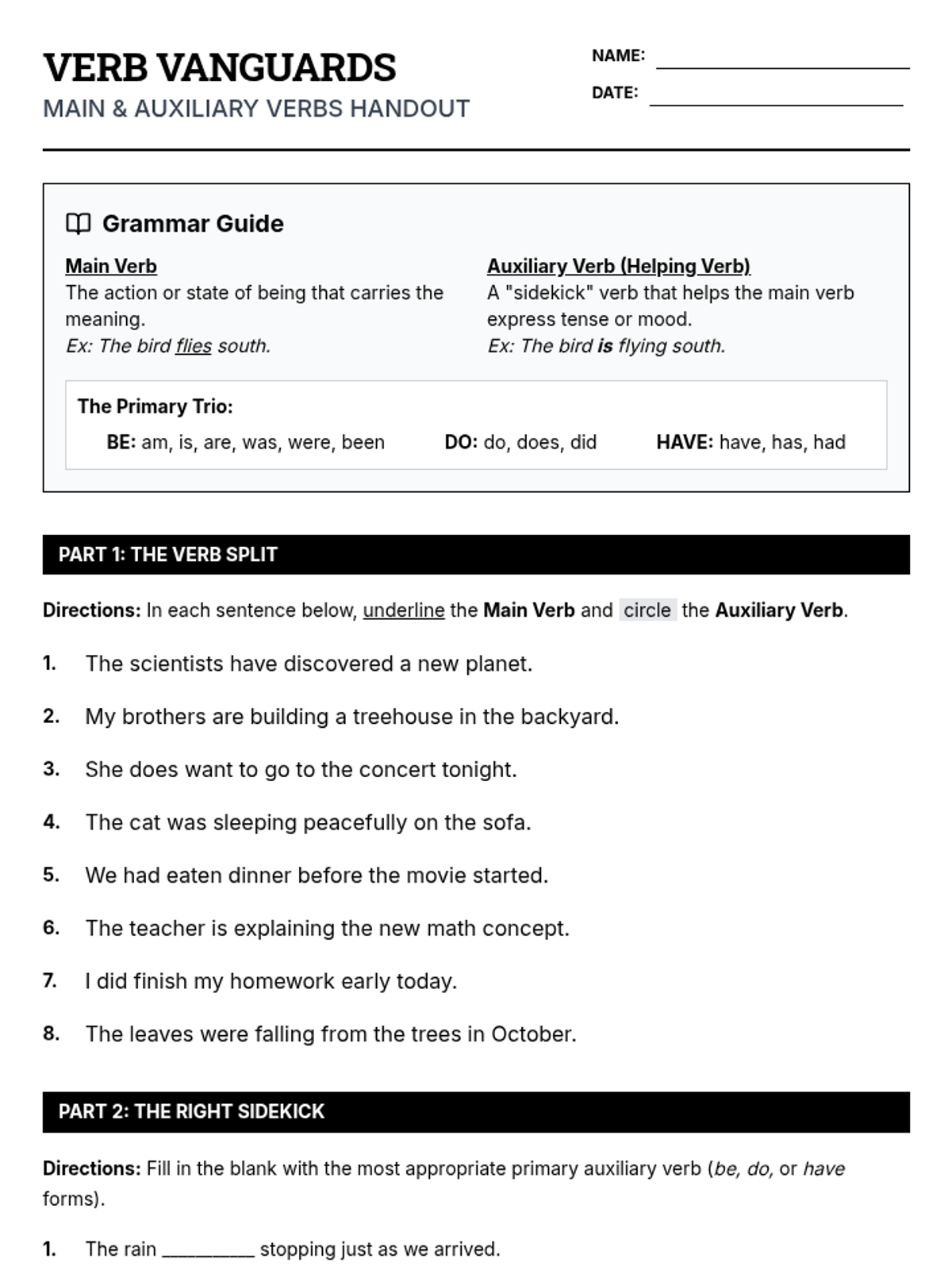
A student handout for identifying and using main and primary auxiliary verbs. Features three sections: identifying verbs in sentences, selecting the correct auxiliary verb, and constructing original sentences. Revised with improved spacing and additional practice items.
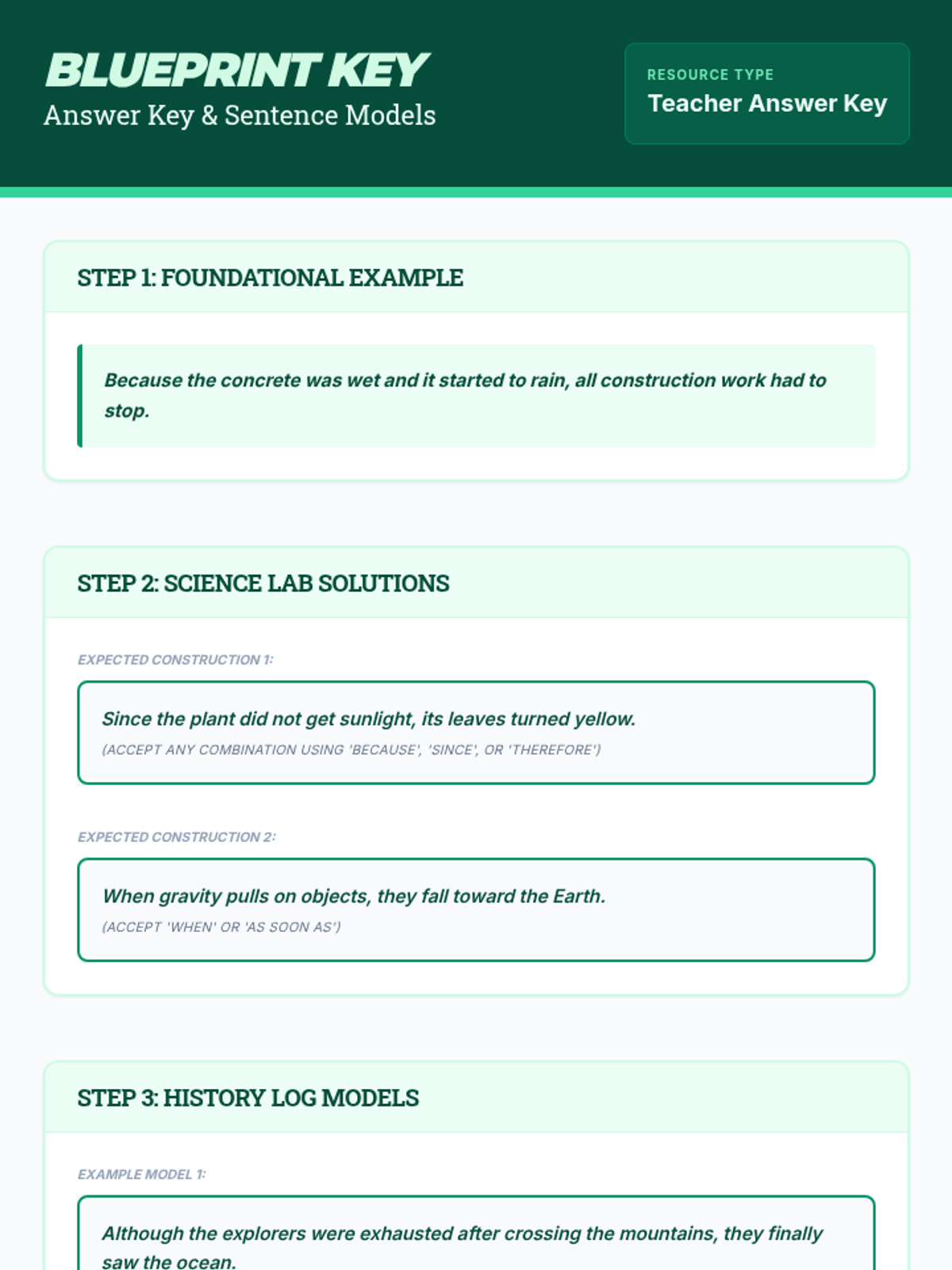
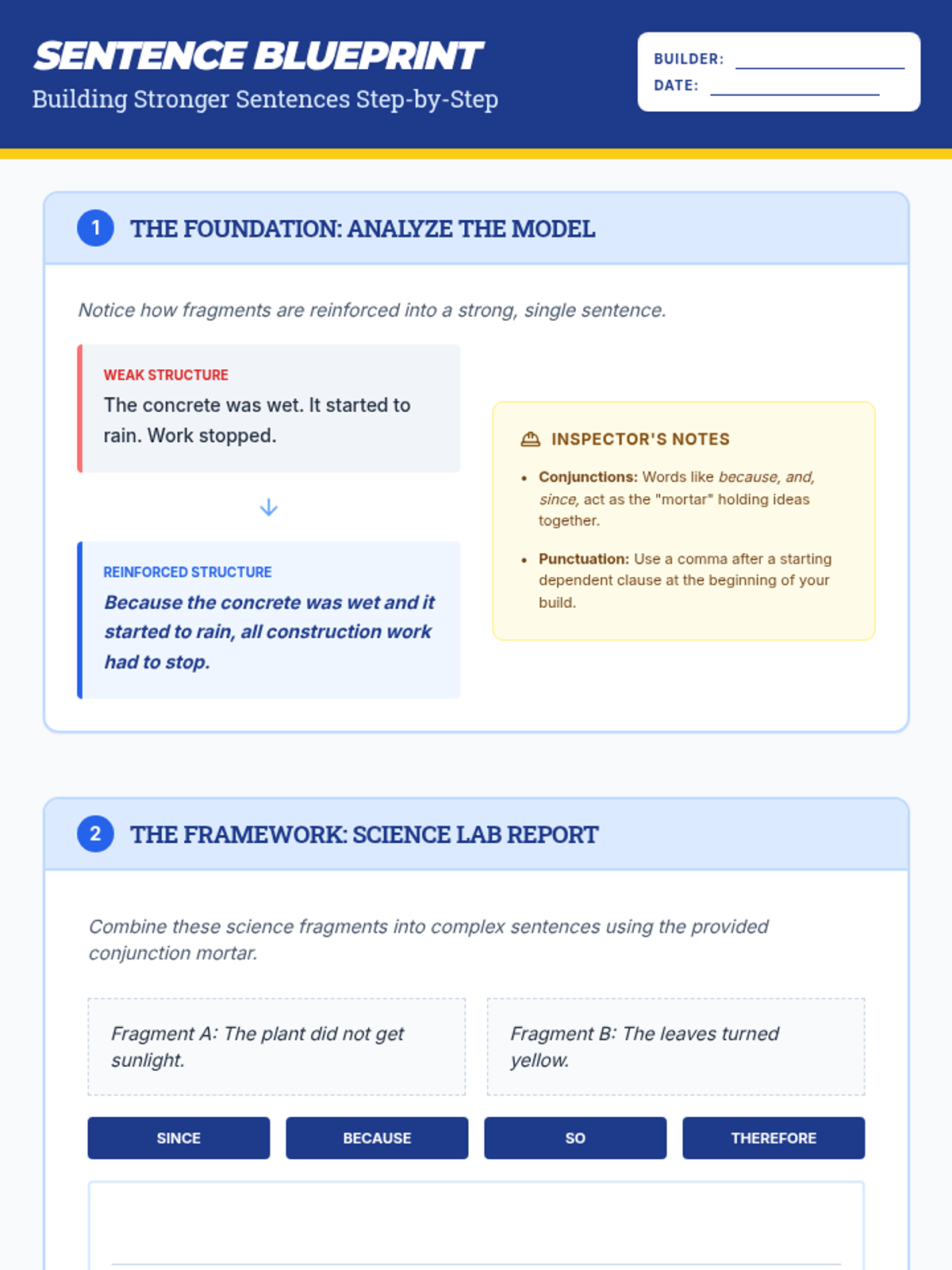
A detailed teacher answer key for the Sentence Blueprint worksheet, providing model complex and compound sentences using science and history themes.
A 3-step guided practice worksheet with a construction theme, designed to help students combine fragments and simple sentences into compound and complex sentences within science and social studies contexts.
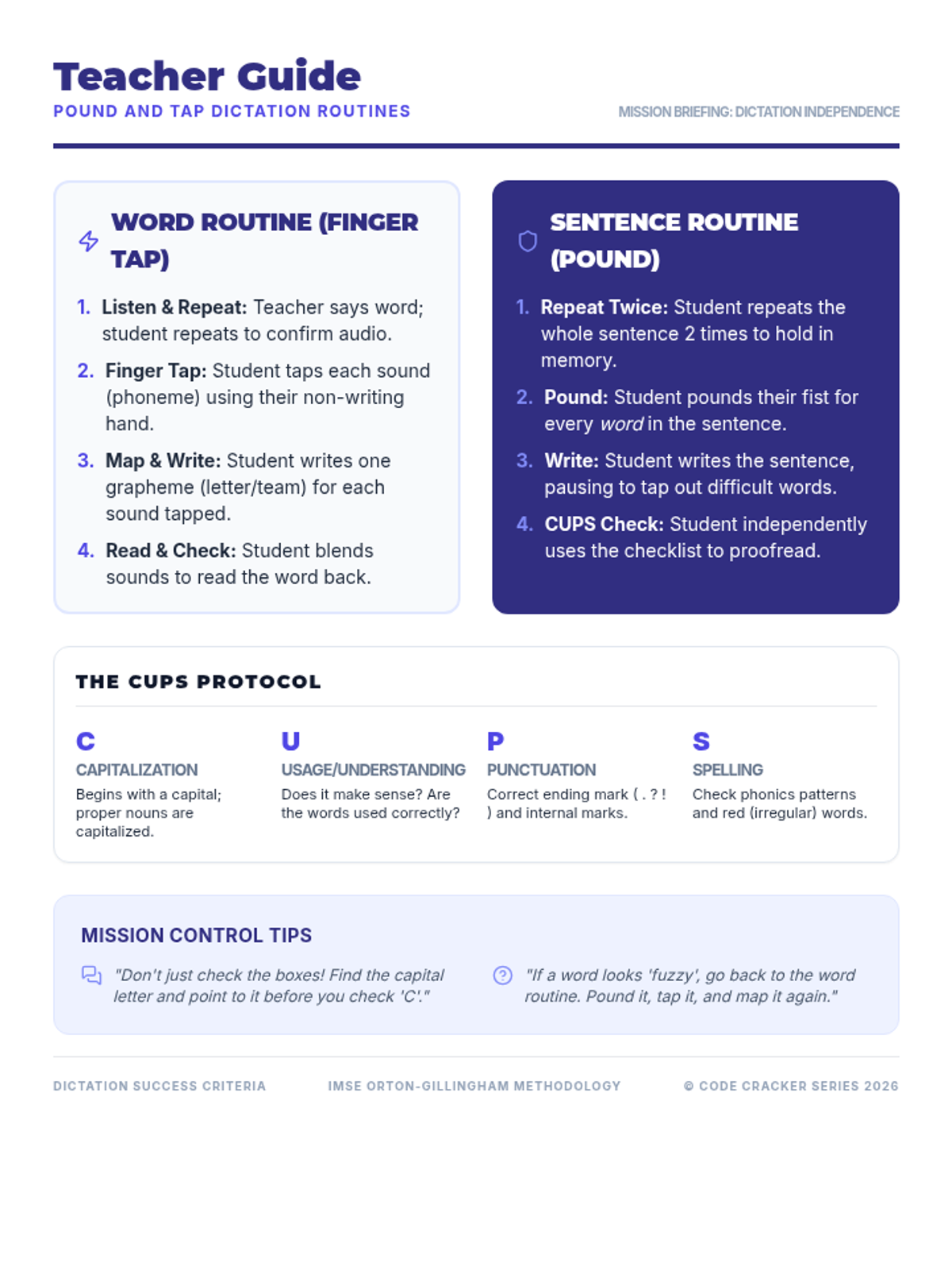
A comprehensive facilitator's guide. Revised to define CUPS, include 'Pound and Tap' routines, and integrate the Code Cracker theme onto one page.
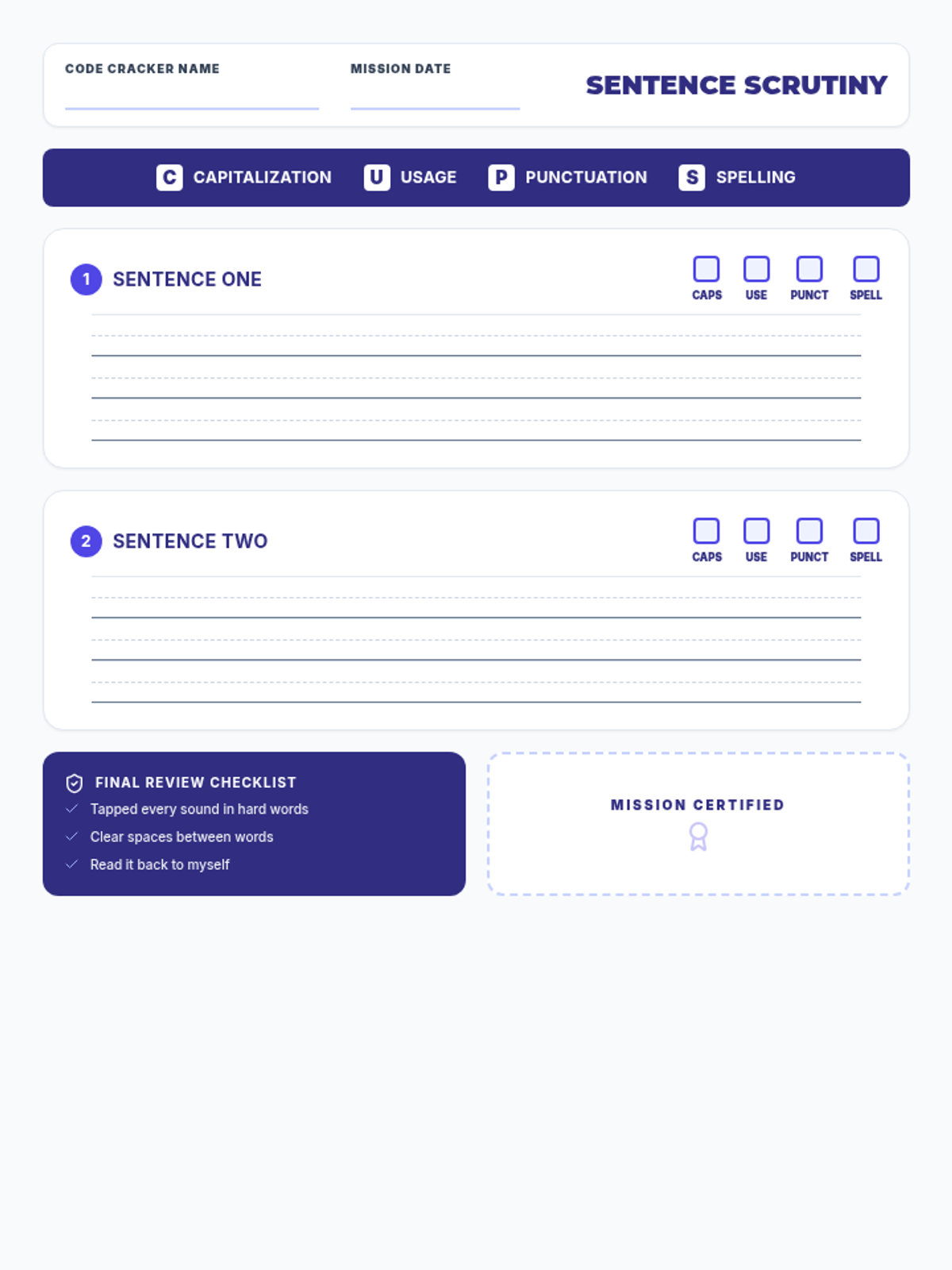
A structured worksheet for sentence dictation practice. Revised with primary handwriting lines, CUPS legend, and higher contrast labels. Consolidate to one page.
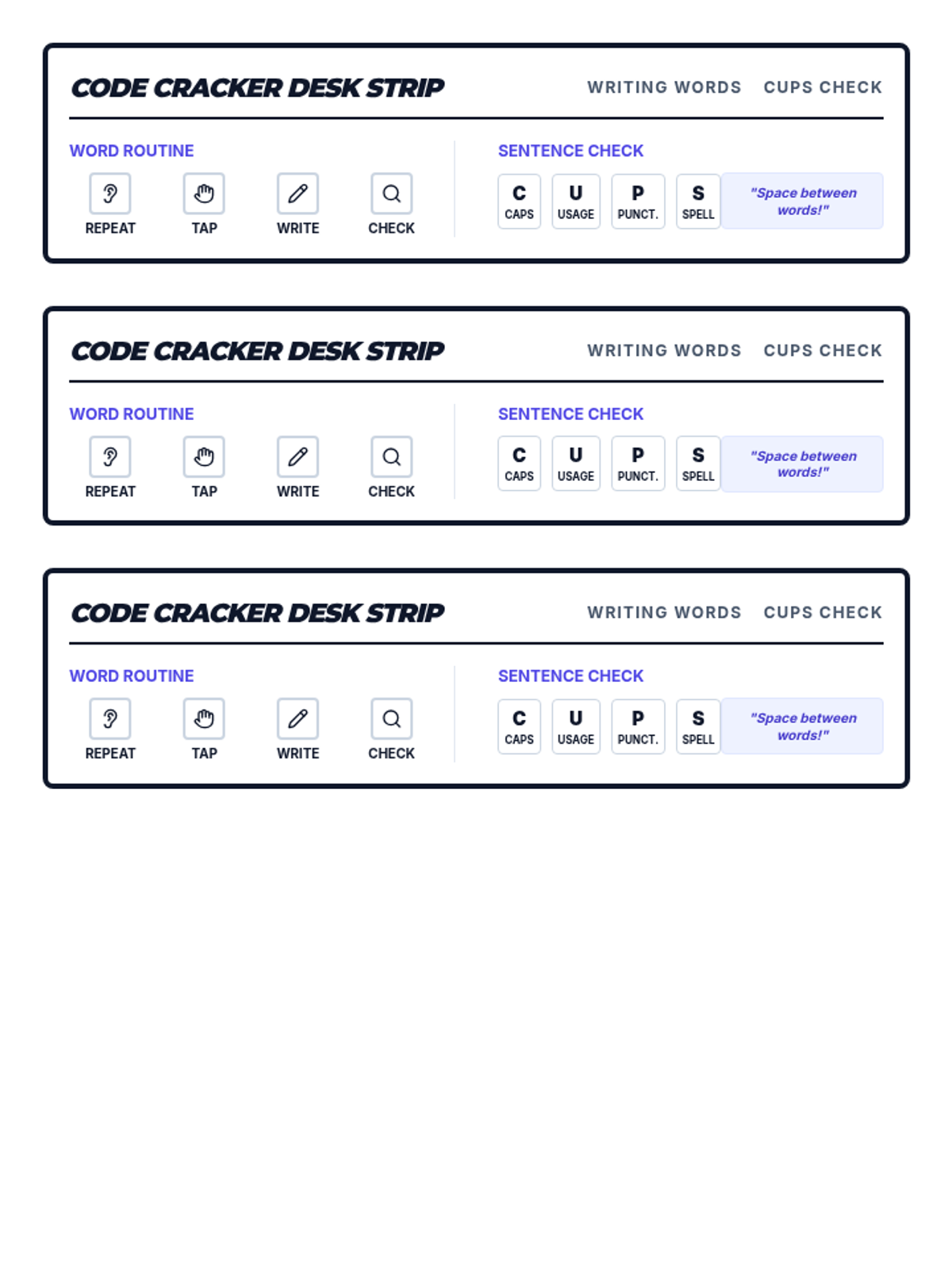
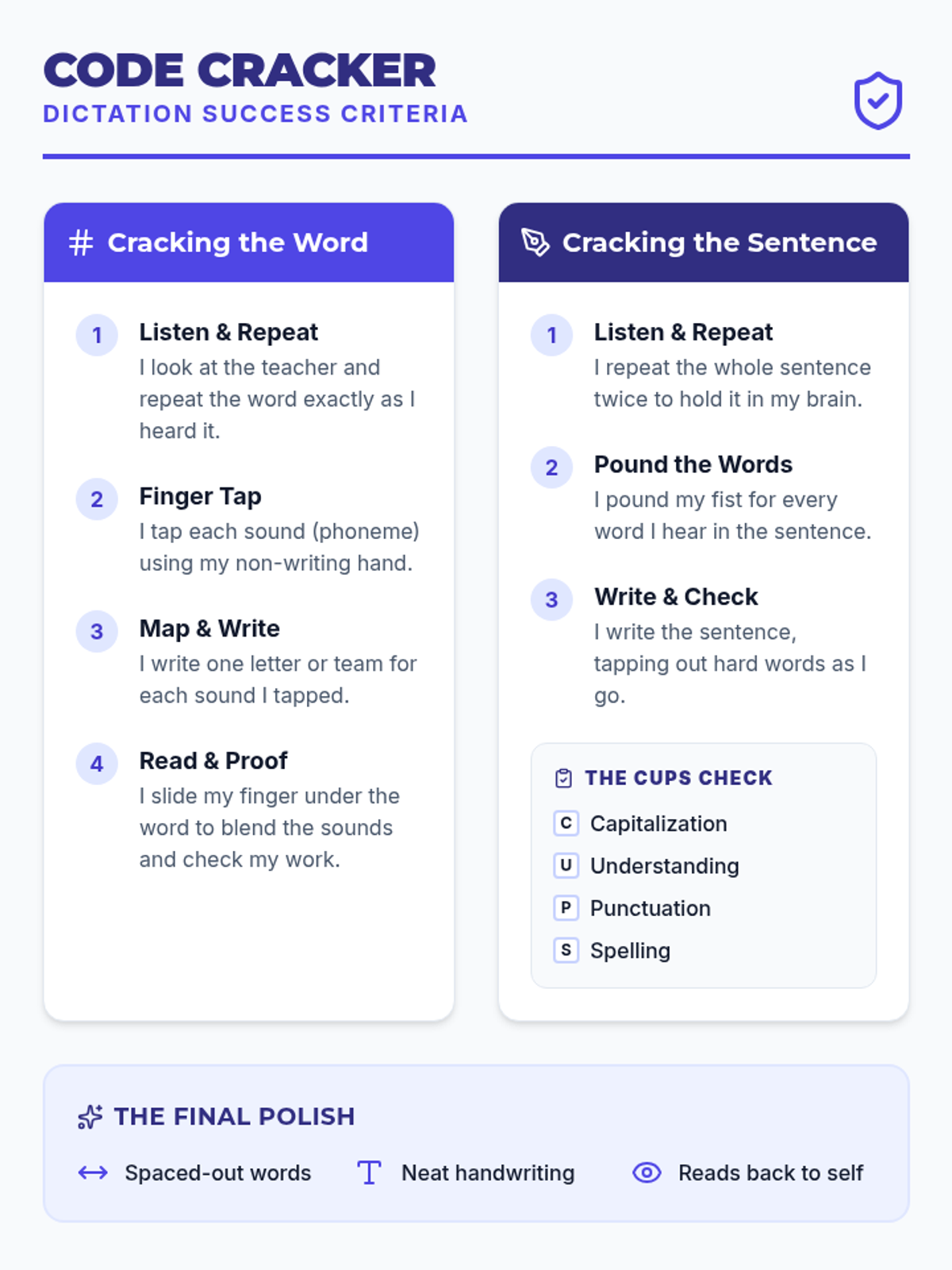
Printable desk strips for students to have a miniature version of the success criteria for dictation right at their workspace. Revised for higher contrast and clarity.
A visual success criteria reference sheet for students following the IMSE Orton-Gillingham dictation routines for words and sentences.
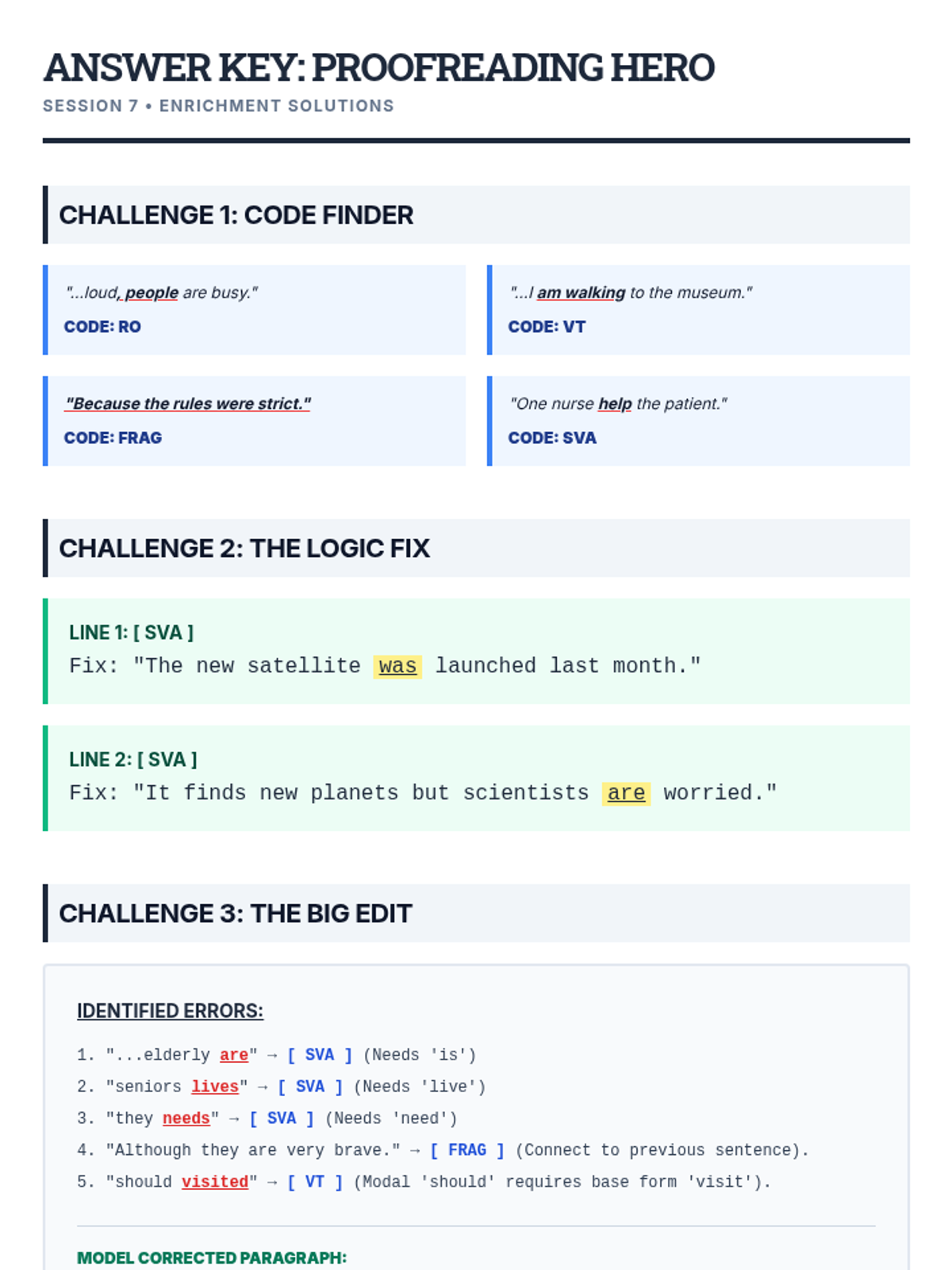
A teacher answer key for the Proofreading Hero Worksheet, including identified error codes and model corrected paragraphs for all challenges. Updated for matching expanded worksheet and includes a legend.
Instructional slides for the mock exam session, providing a visual pacing guide (10-30-5 breakdown) and specific phase-by-phase writing strategies.
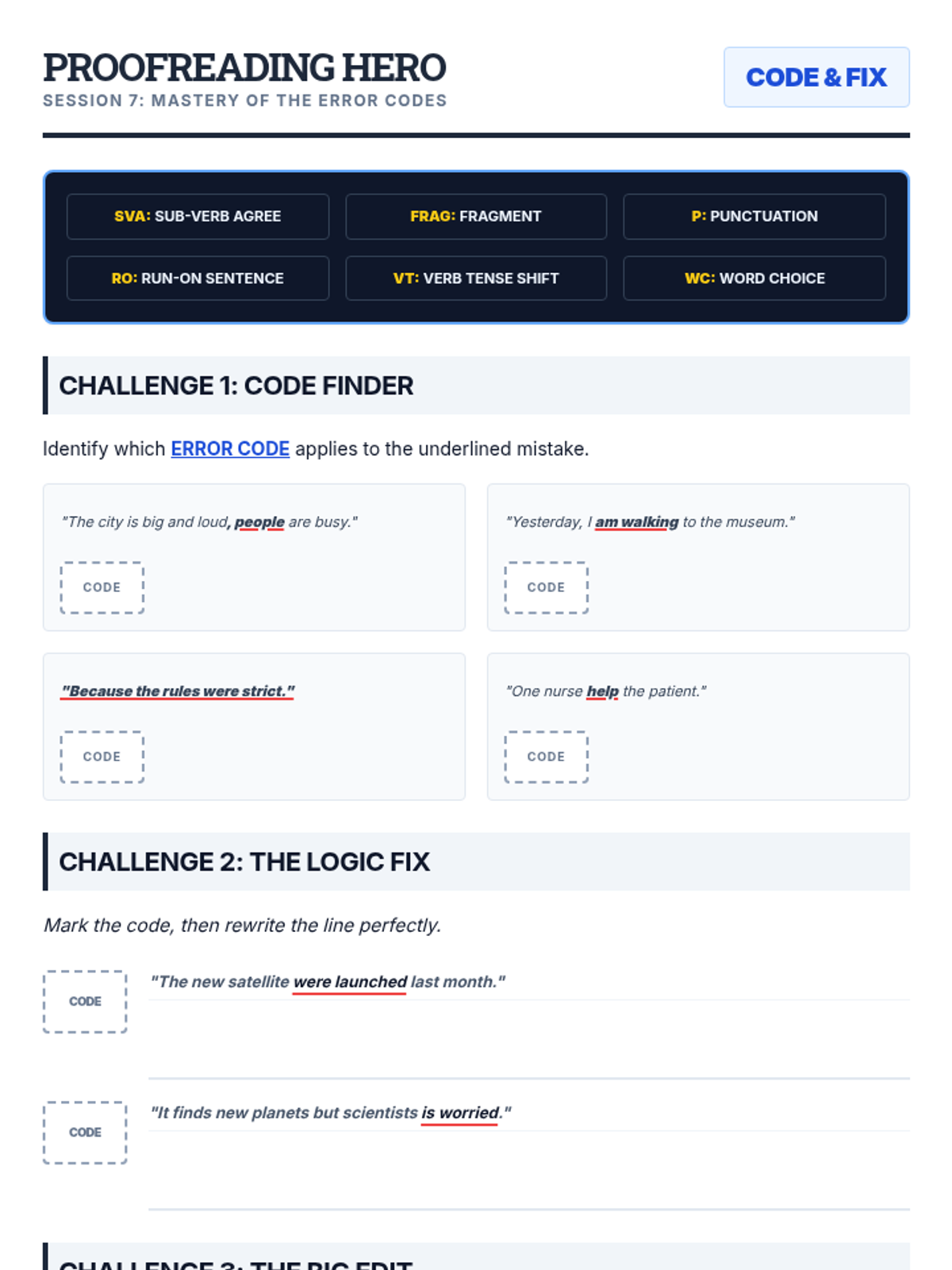
An interactive proofreading worksheet where students apply the teacher's Error Coding Key to identify and fix grammar, punctuation, and structure mistakes in sample texts. Updated with expanded items and unit-themed examples across two pages.
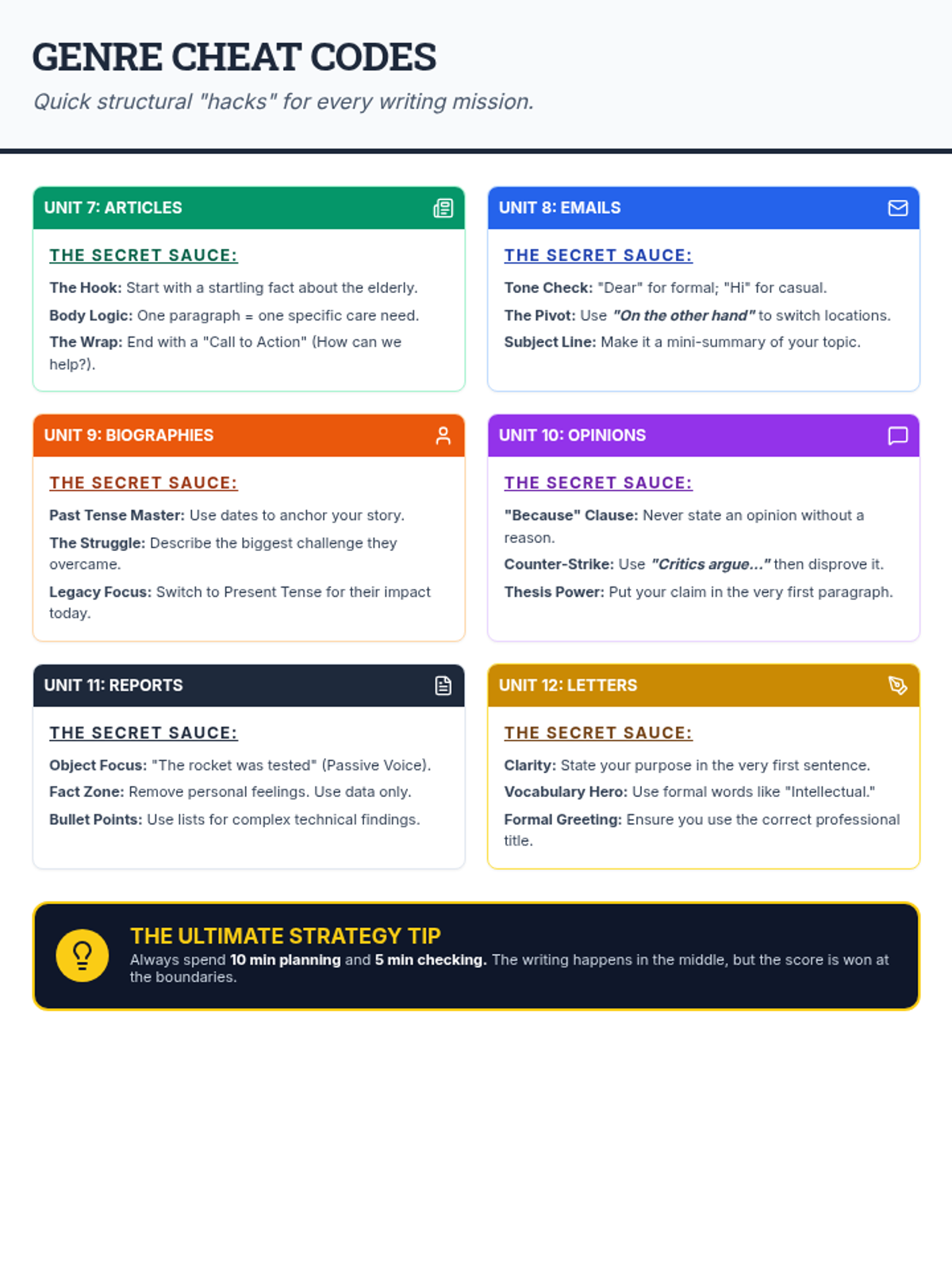
A one-page reference guide containing structural "hacks" and specific strategies for each of the six writing genres covered in the program. Updated for single-page efficiency.
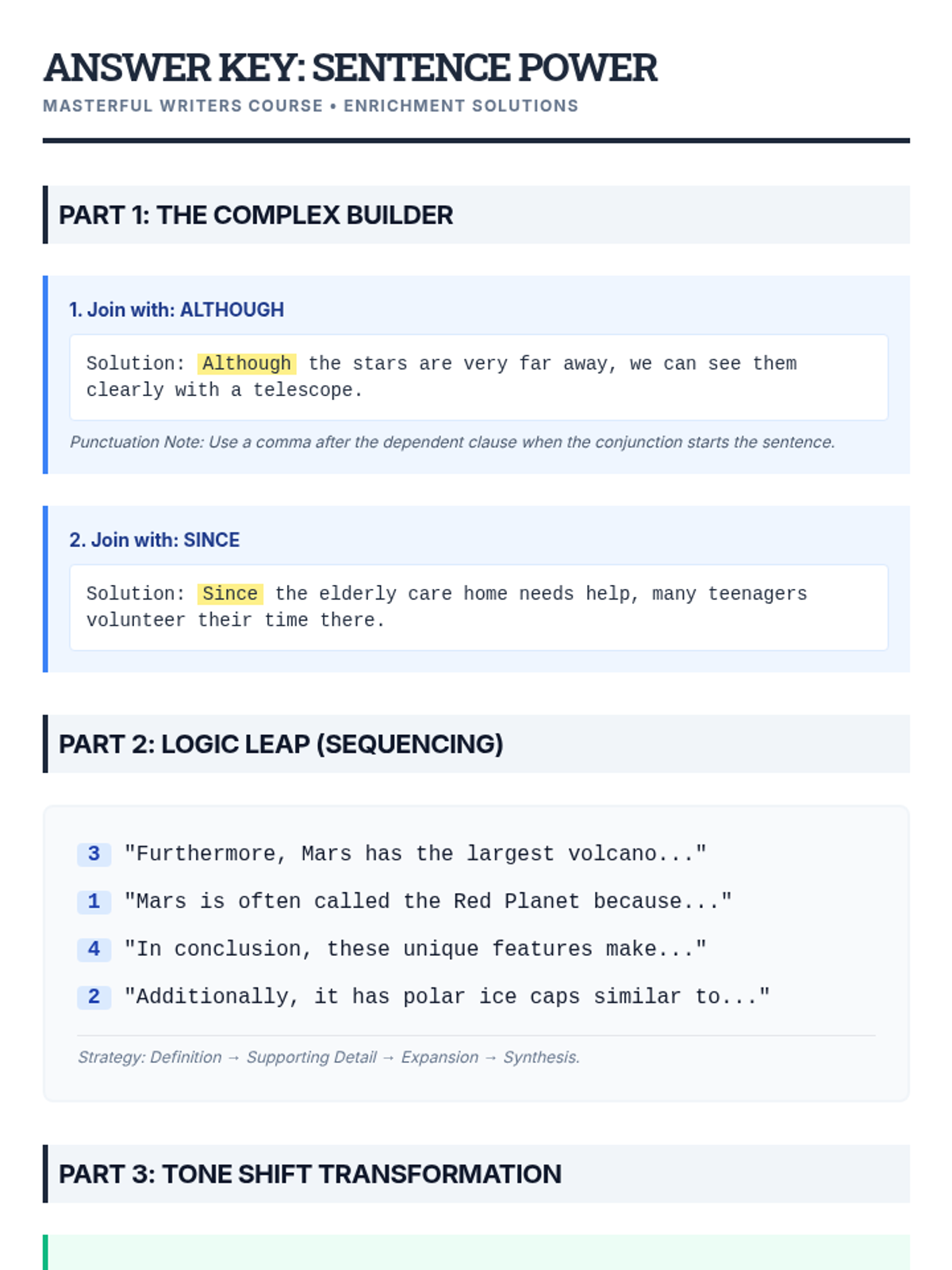
A teacher answer key for the Sentence Power Practice Worksheet, including model answers and grammar rationales. Updated for clarity and visual organization.
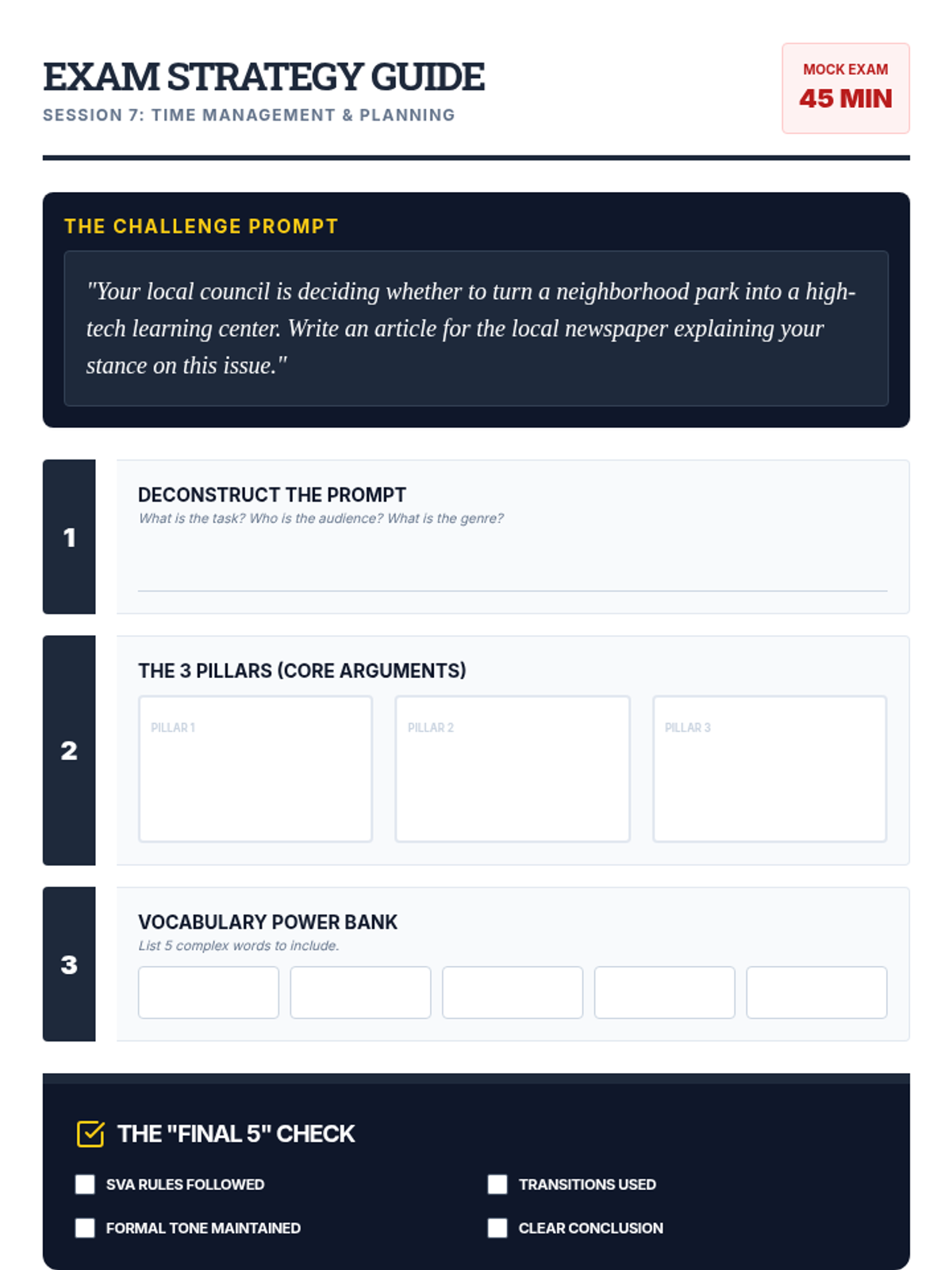
A strategic planning worksheet for students to use during exam preparation, featuring a practice prompt, increased workspace, and a consolidated single-page layout.
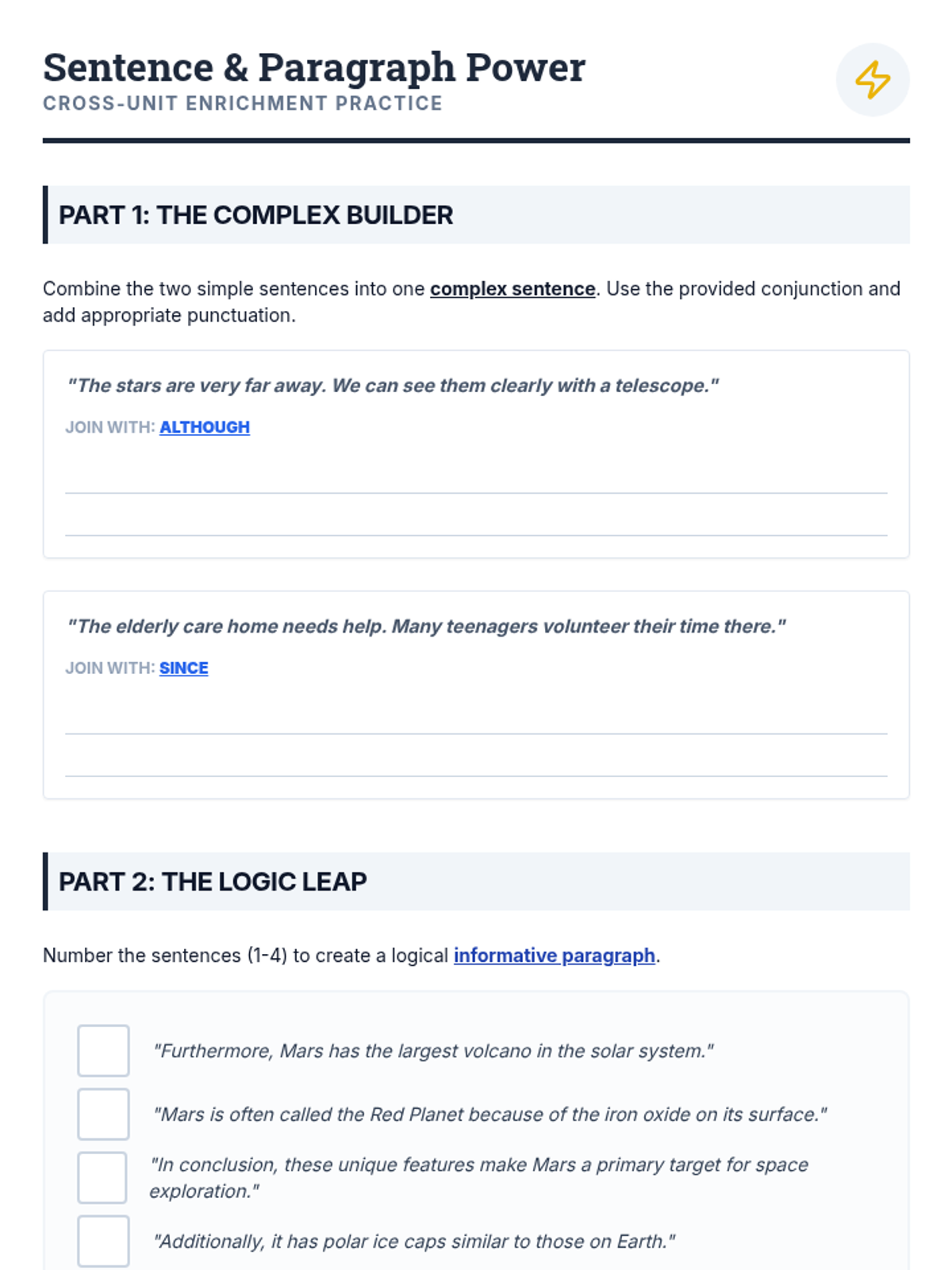
An enrichment worksheet focused on advanced sentence combining, logical paragraph sequencing, and tone transformation. Updated for handwriting legibility and clear instruction.
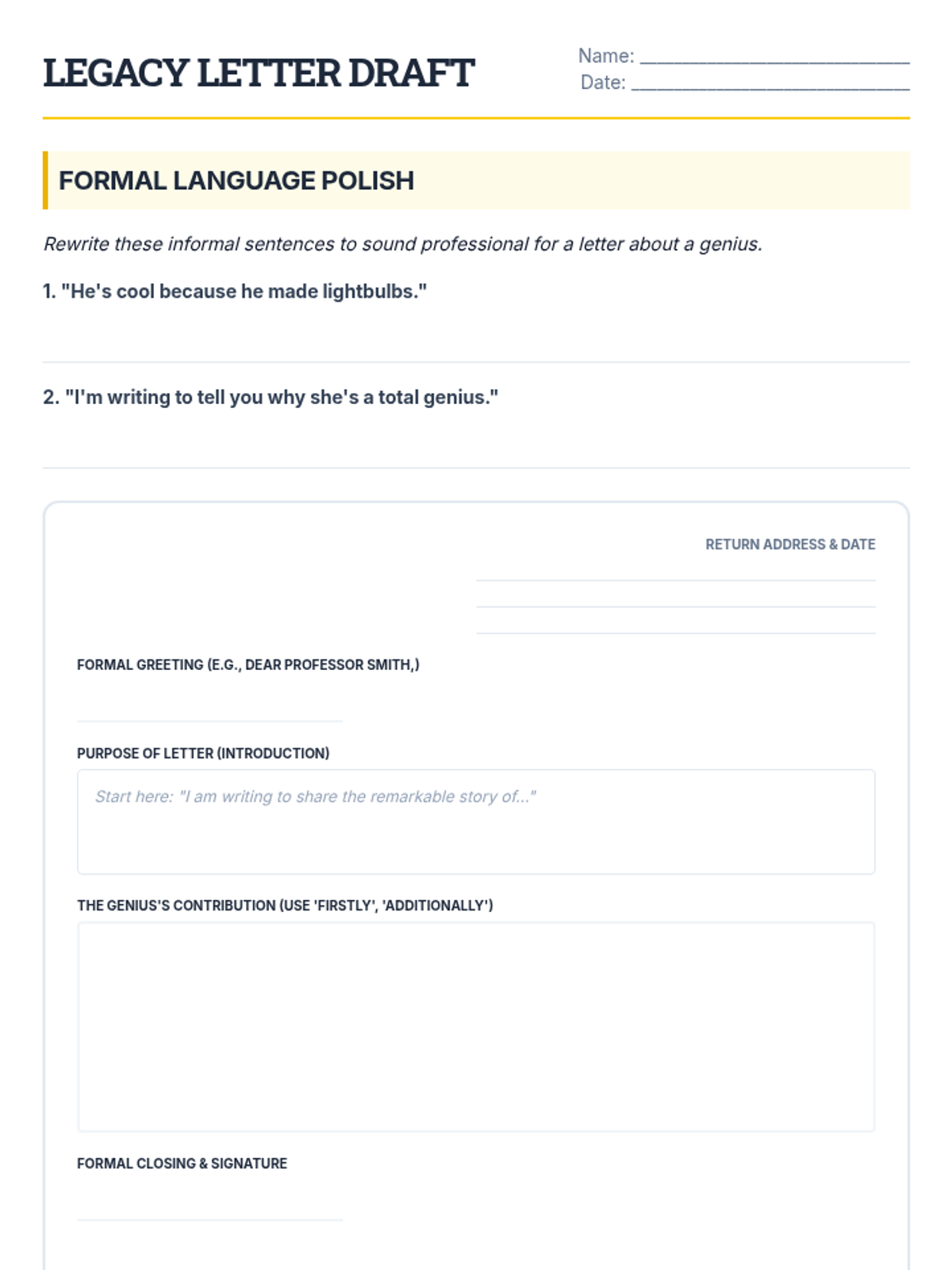
A student worksheet for formal letter writing about a genius. Includes a formal language rewrite activity and a structured letter template. Updated to fit one page and improve contrast.
Instructional slides for formal letter writing, focusing on the achievements of geniuses, formal tone vs. informal tone, and letter structure. Updated with specific examples and curriculum cohesion.
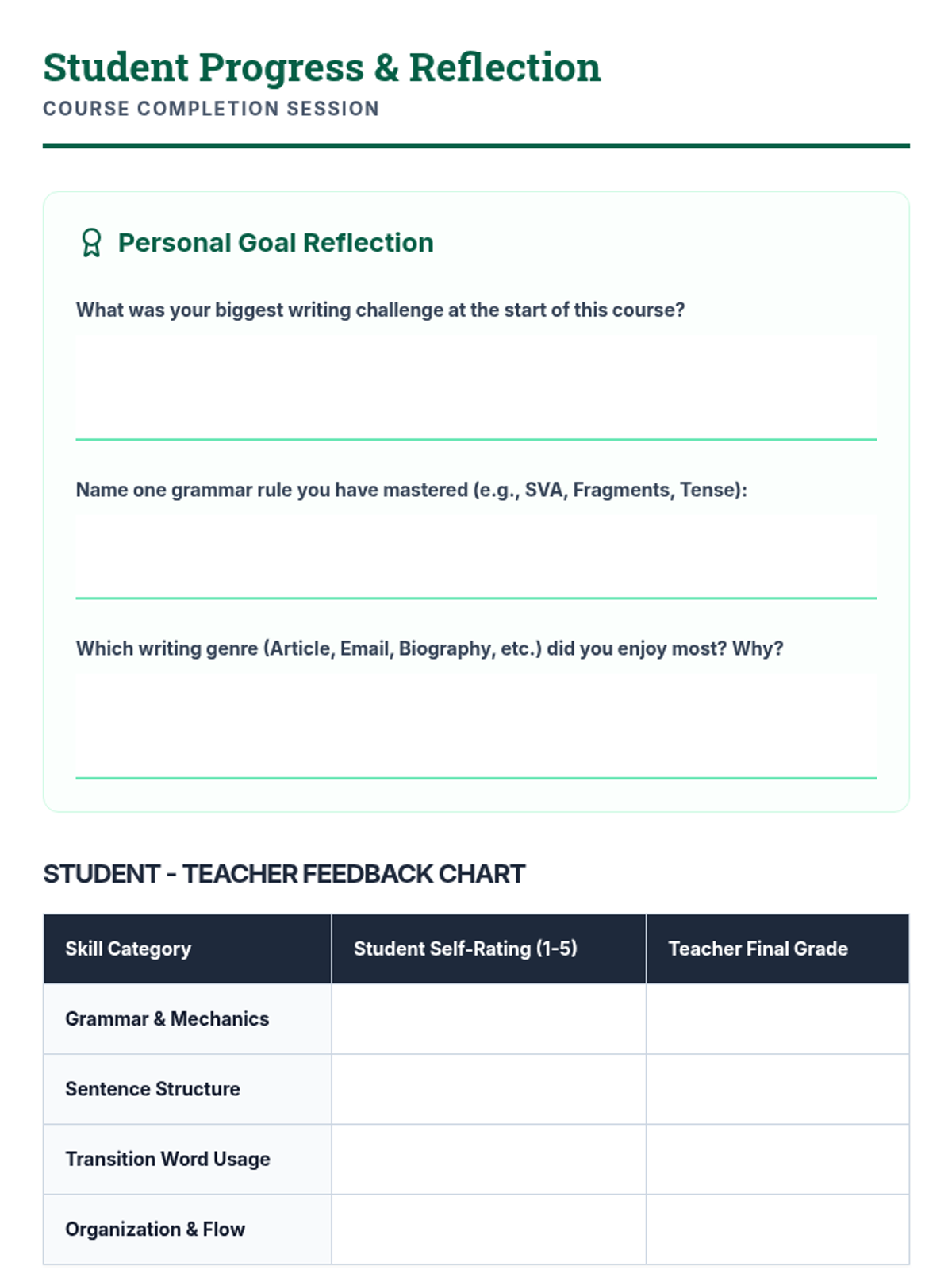
A final reflection and feedback document for students to self-assess their progress, receive teacher evaluations across core skill categories, and review strategy tips for future writing success.
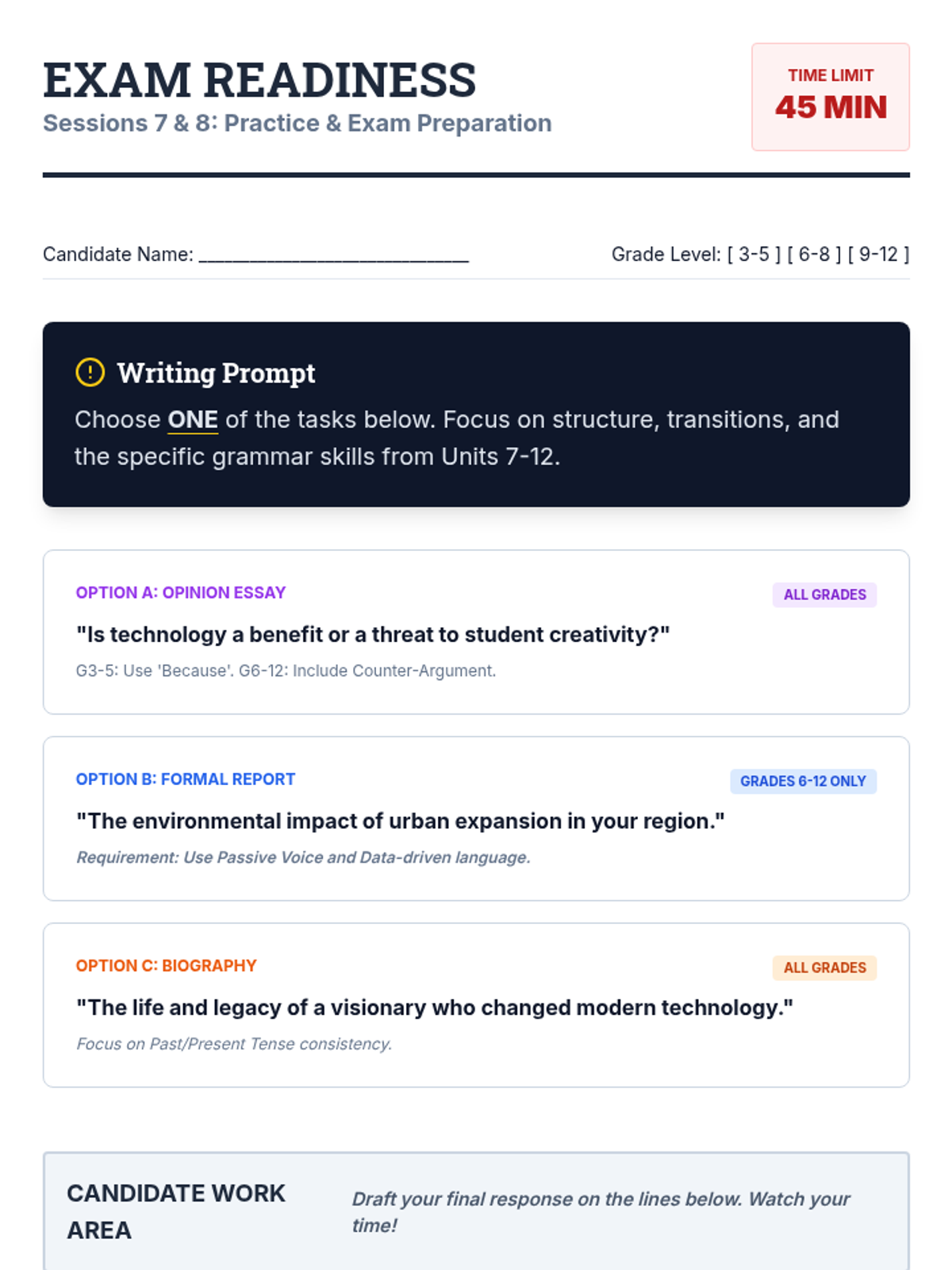
A mock exam writing prompt and workspace for sessions 7 and 8, featuring tiered options for different writing genres (essay, report, biography) and a lined writing area for timed practice.
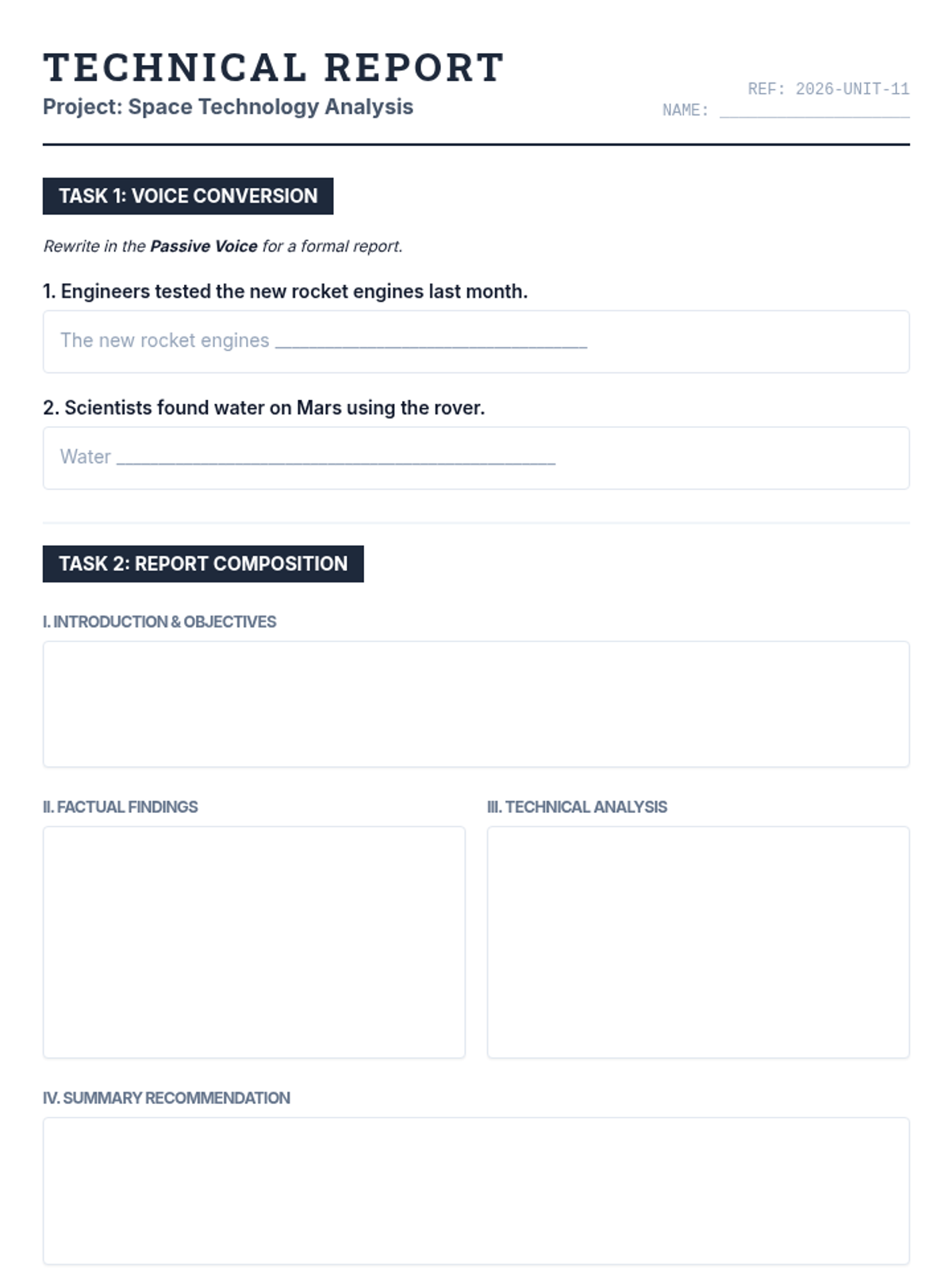
A technical report writing worksheet for students, including an active-to-passive voice conversion exercise and a structured four-part report layout for space technology analysis.
Instructional slides for report writing on space technology, focusing on the distinction between active and passive voice and the formal structure of a data-driven report.
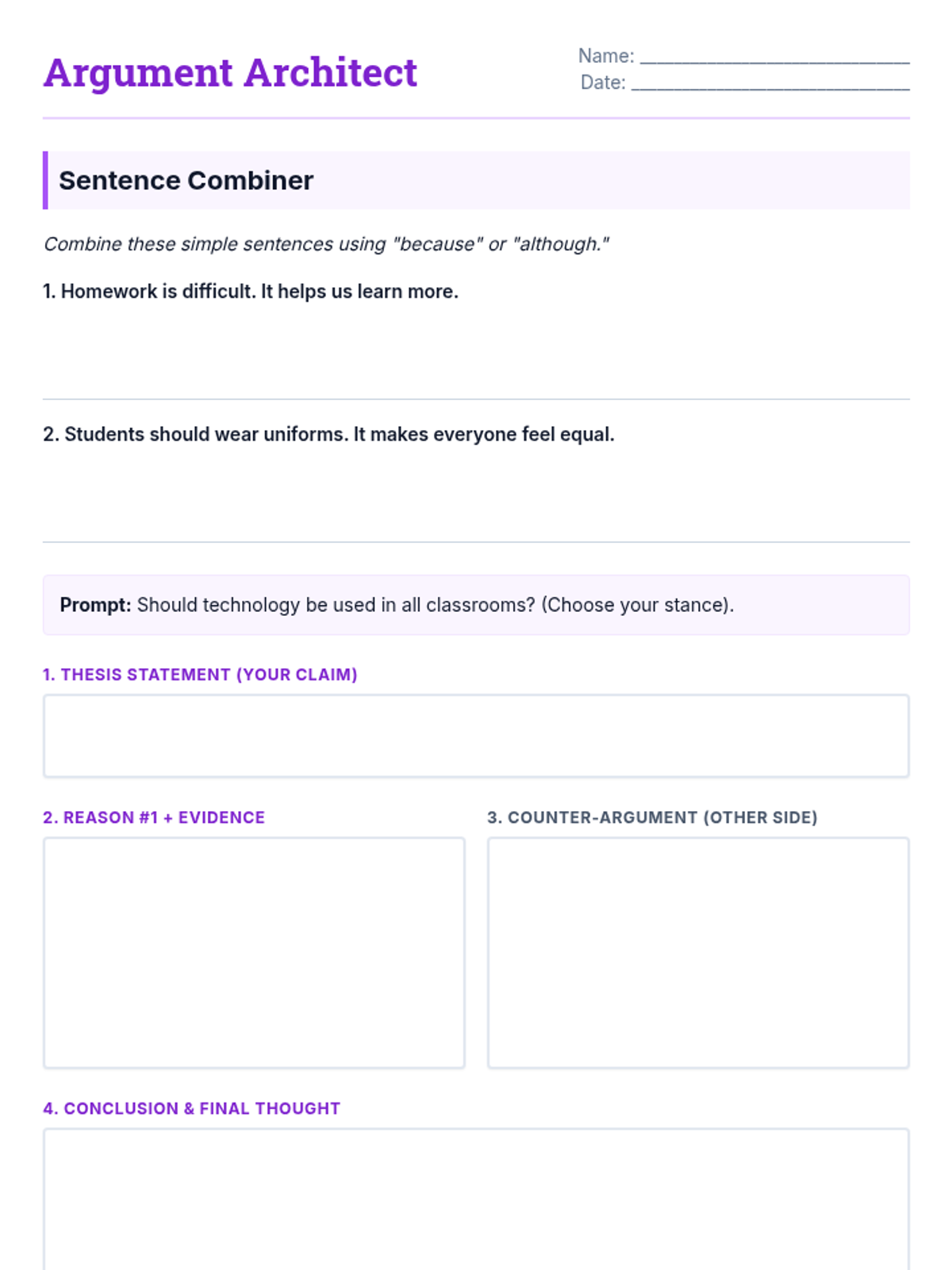
A student worksheet for opinion essay writing, featuring a conjunction-combining grammar activity and a structured multi-part outline for a thesis, evidence, counter-argument, and conclusion.
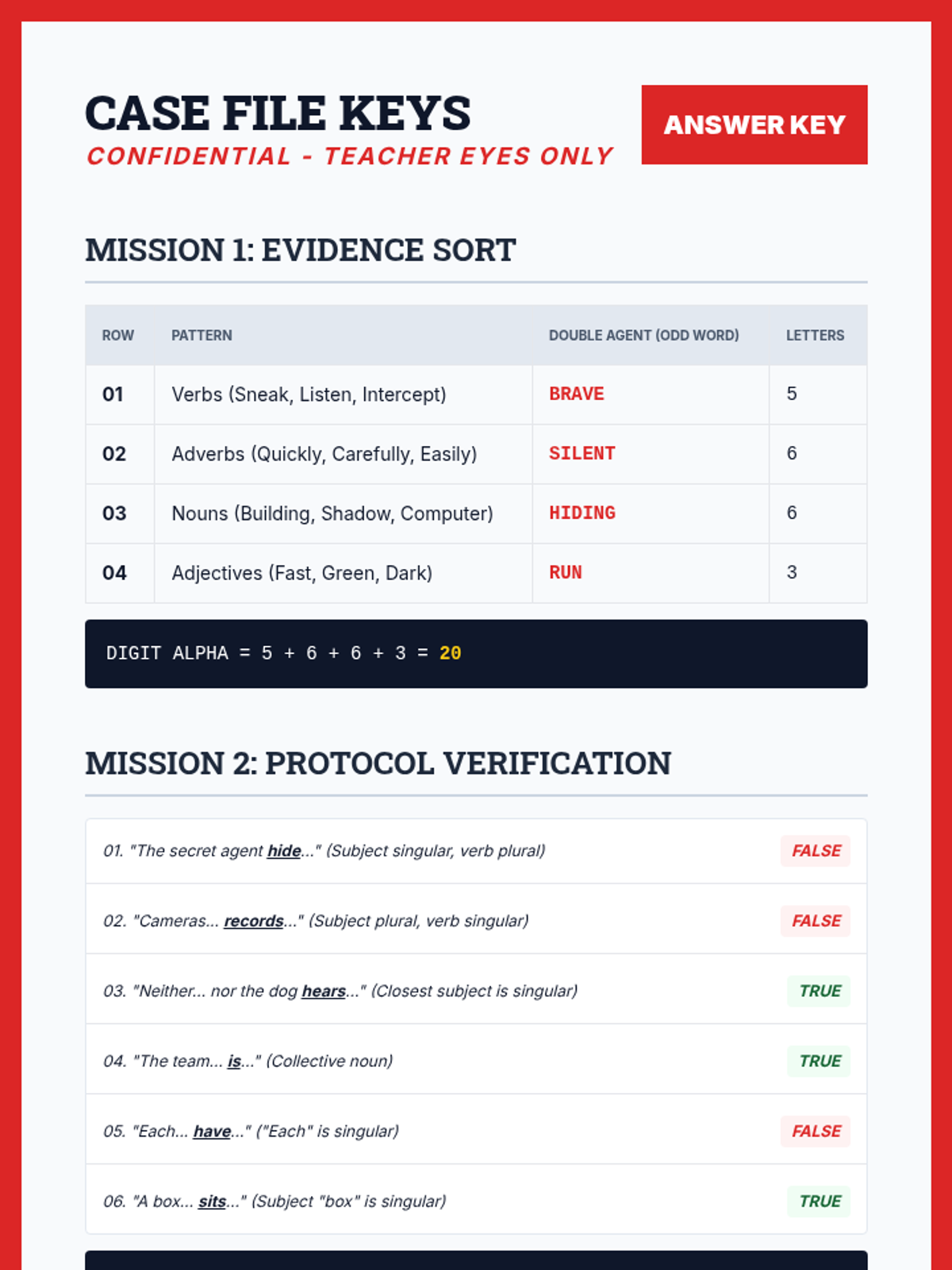
An answer key for the teacher. It provides the solutions for both missions, the letter counts for Mission 1, the identification of correct/incorrect subject-verb agreement for Mission 2, and the final step-by-step math solution for the code. Revised for clarity and improved page breaks.
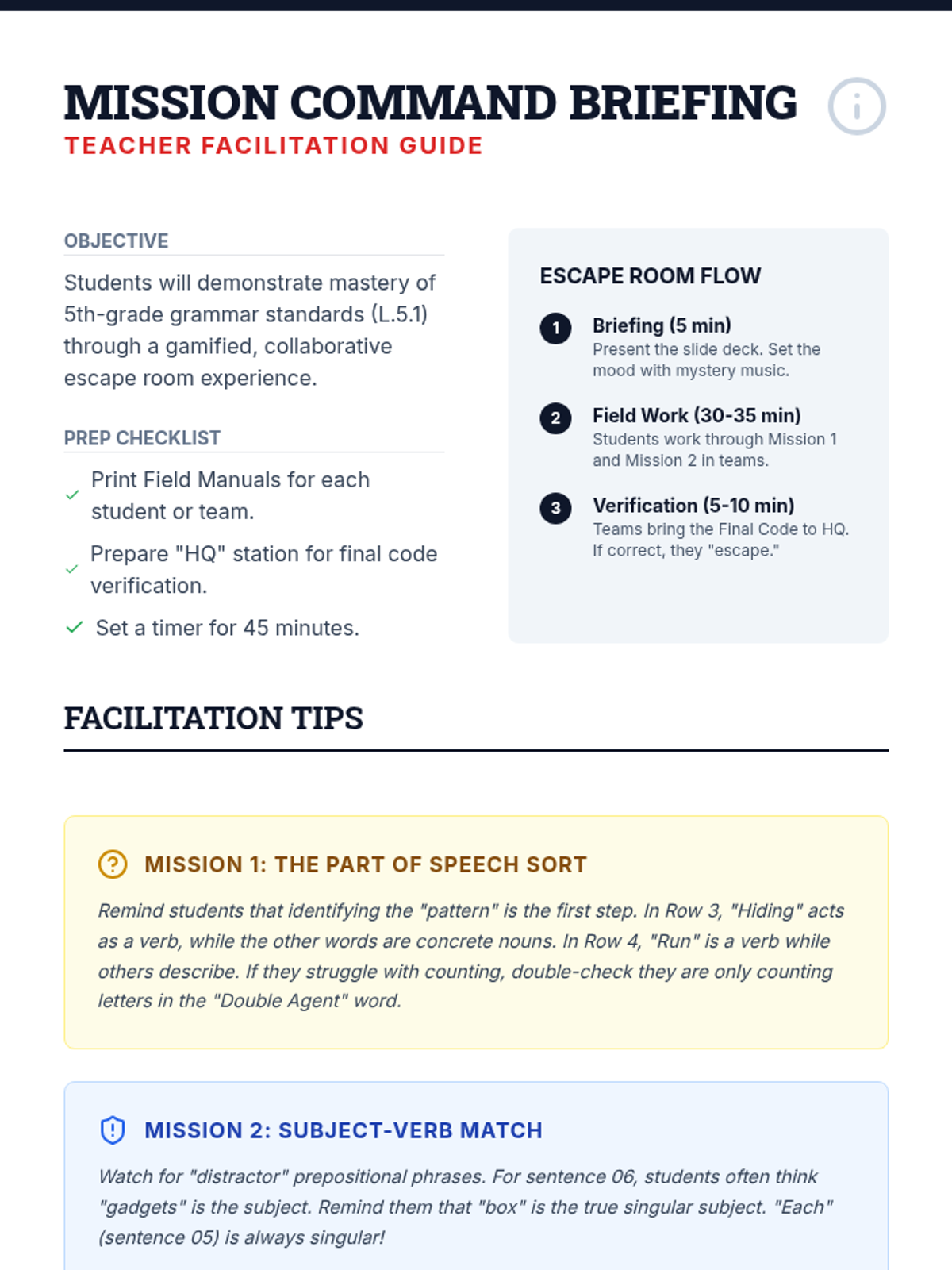
A comprehensive facilitation guide for the teacher. Includes pacing, setup checklists, facilitation tips for each mission, and the logic behind the final code cracker. Revised to prevent content splitting across page breaks.
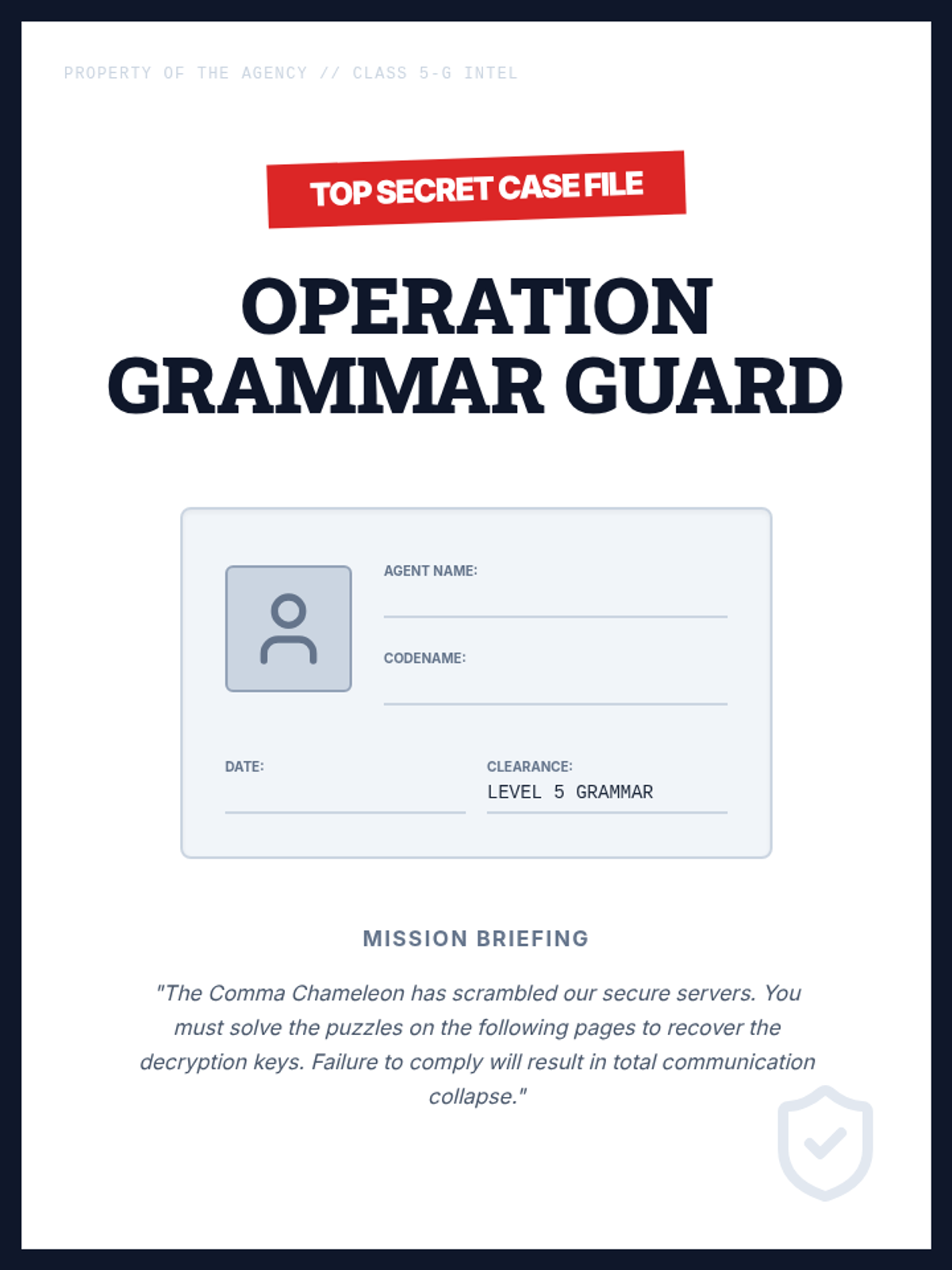
A 4-page student workbook designed as a top-secret mission file. It includes missions on parts of speech and subject-verb agreement, leading to a multi-step math-based code puzzle to 'escape' the room. Revised for better page breaks and clearer student work areas.
A visually engaging slide deck that sets the scene for the "Operation Grammar Guard" escape room. It introduces the Mystery Spy theme, reviews parts of speech and subject-verb agreement, and outlines the rules of the mission.
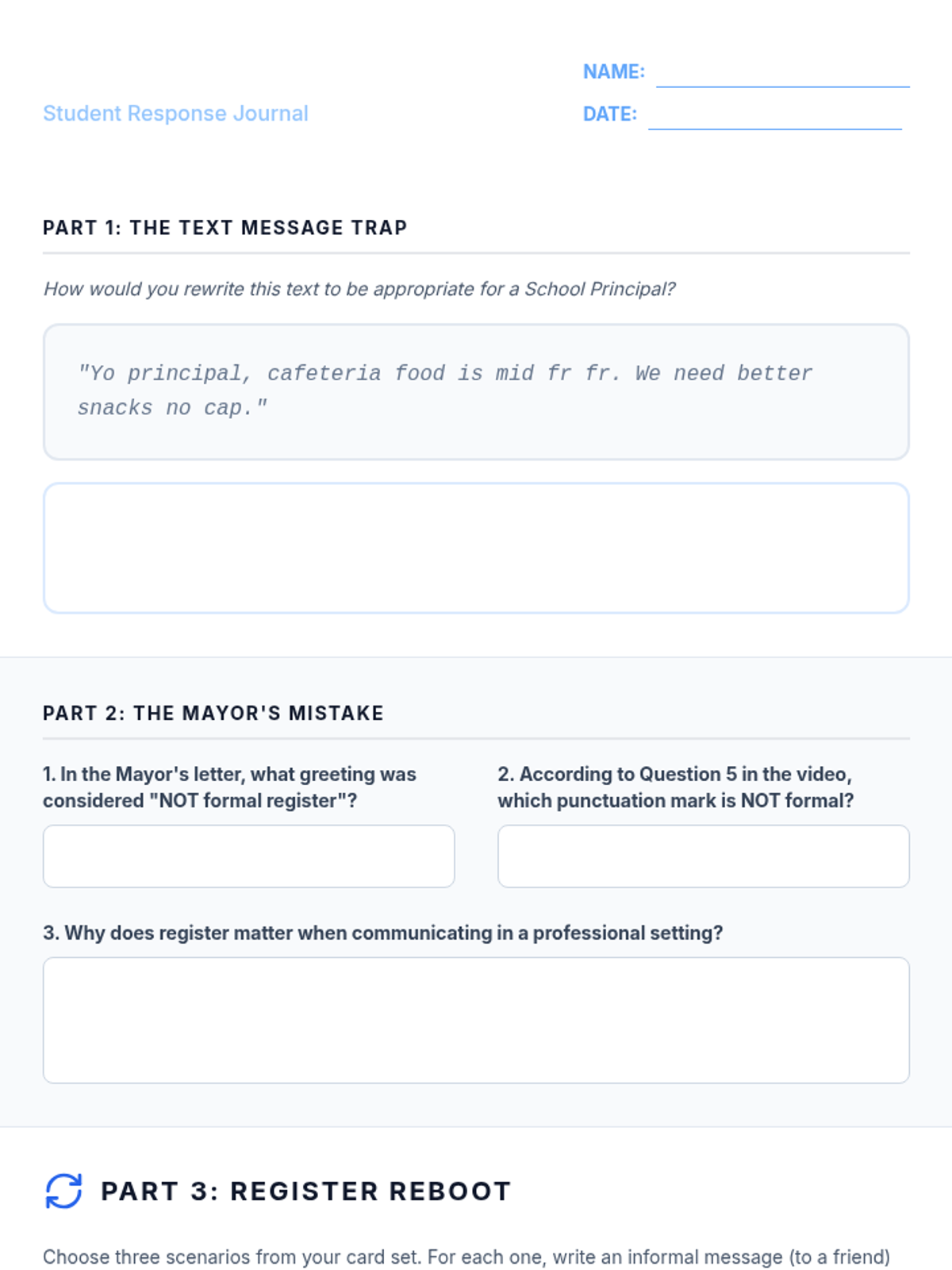
A structured student worksheet for the Register Reboot lesson. It includes sections for the warm-up rewrite, video notes on the Mayor's letter, and a large workspace for students to 'reboot' messages from informal to formal registers across three different scenarios.
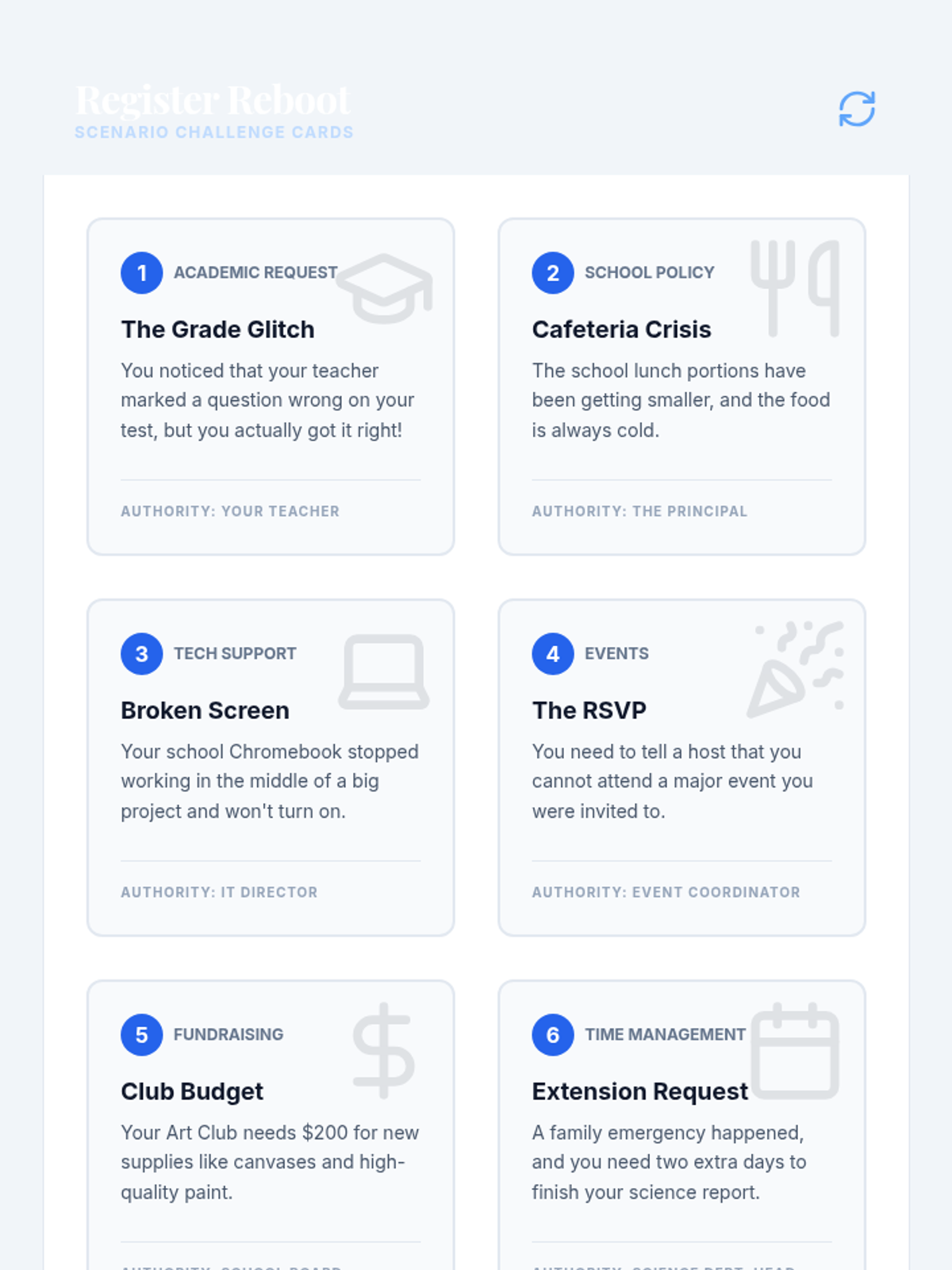
A set of 6 scenario cards designed for the Register Reboot activity. Each card provides a realistic situation where students must communicate a request or issue to both a friend (informal) and an authority figure (formal).
A high-energy presentation to guide students through the Register Reboot lesson. It includes a warm-up, clear visual definitions of register types, an embedded video segment of the Mayor's Letter, and a "Formal Register Checklist" based on the video's quiz.
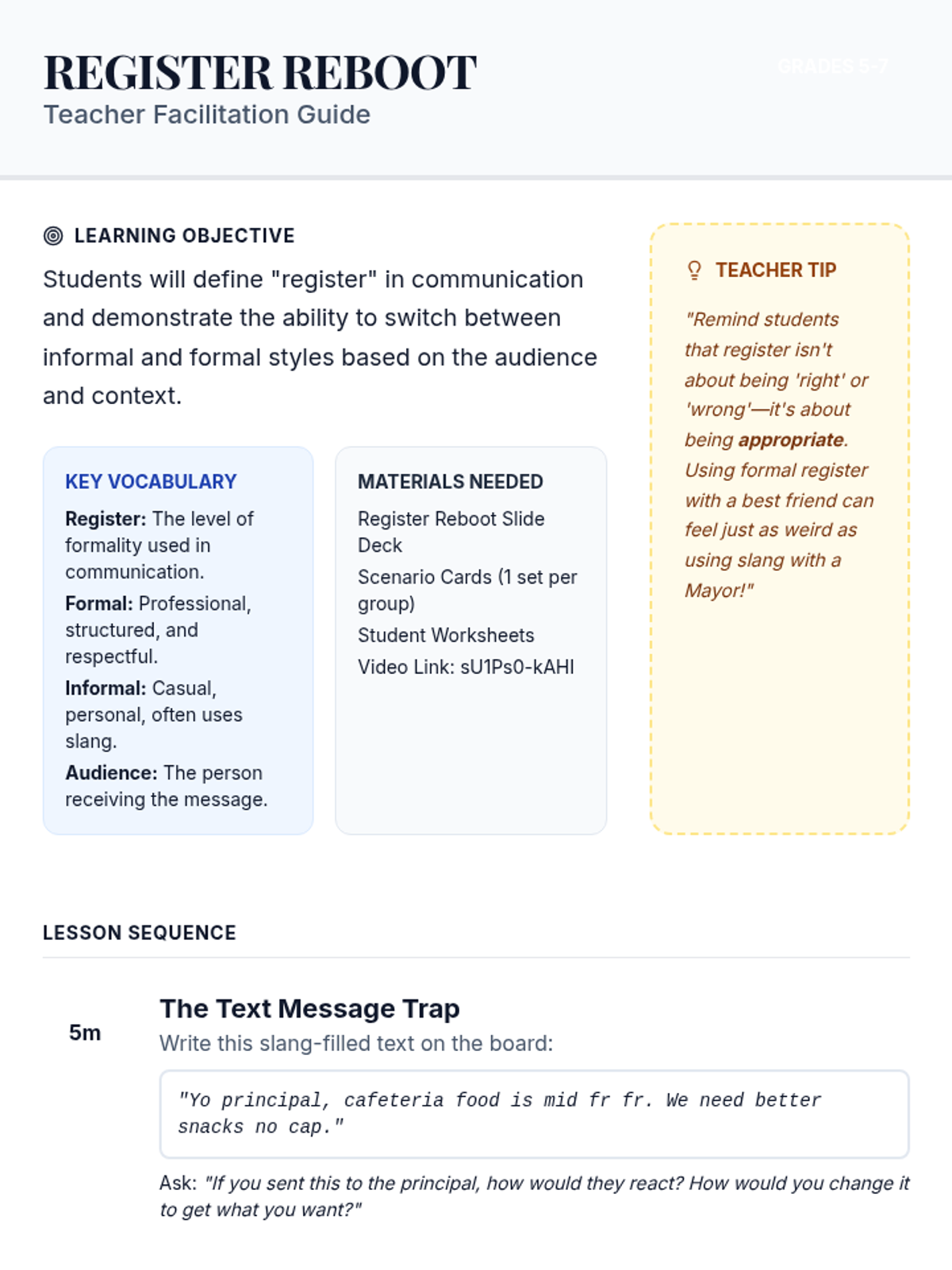
A comprehensive teacher facilitation guide for the Register Reboot lesson, including learning objectives, a detailed lesson sequence, and an answer key for the student materials.
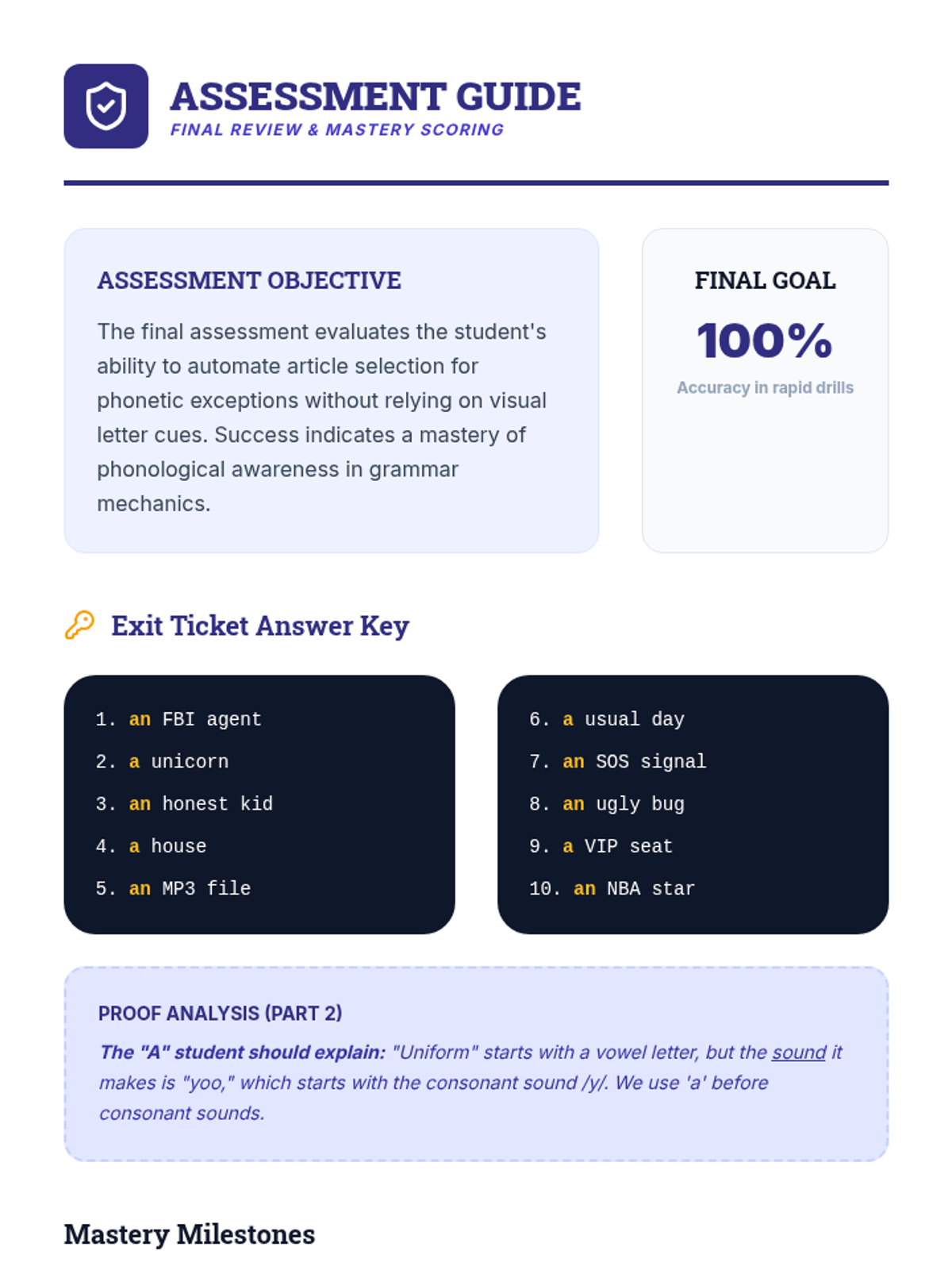
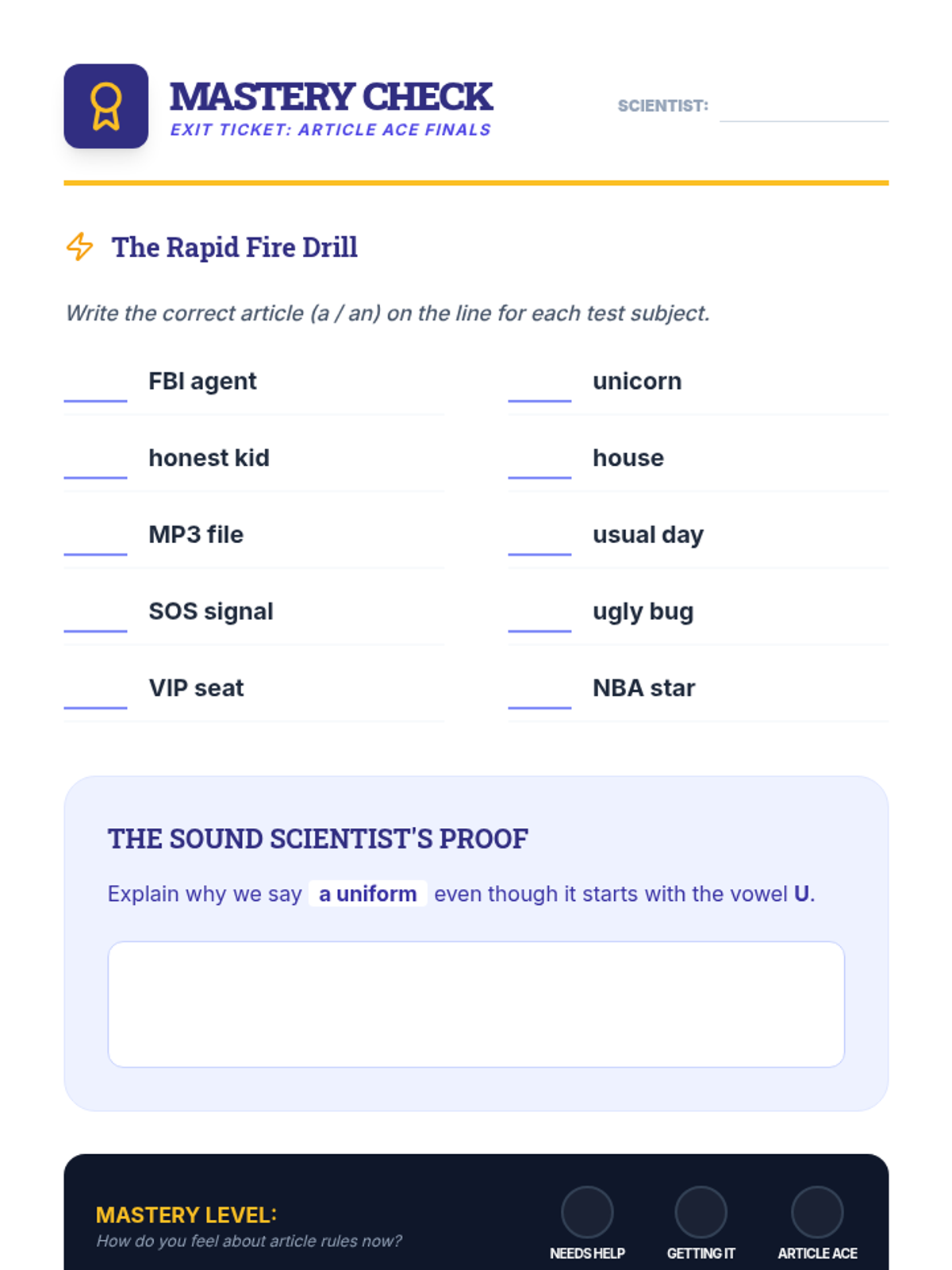
Teaching notes and answer key for the final assessment, including mastery milestones and debrief discussion prompts.
A final assessment exit ticket to verify student mastery of phonetic article exceptions.
Slides for Lesson 5 focusing on rapid-fire assessment and game-show style drills for article mechanics.
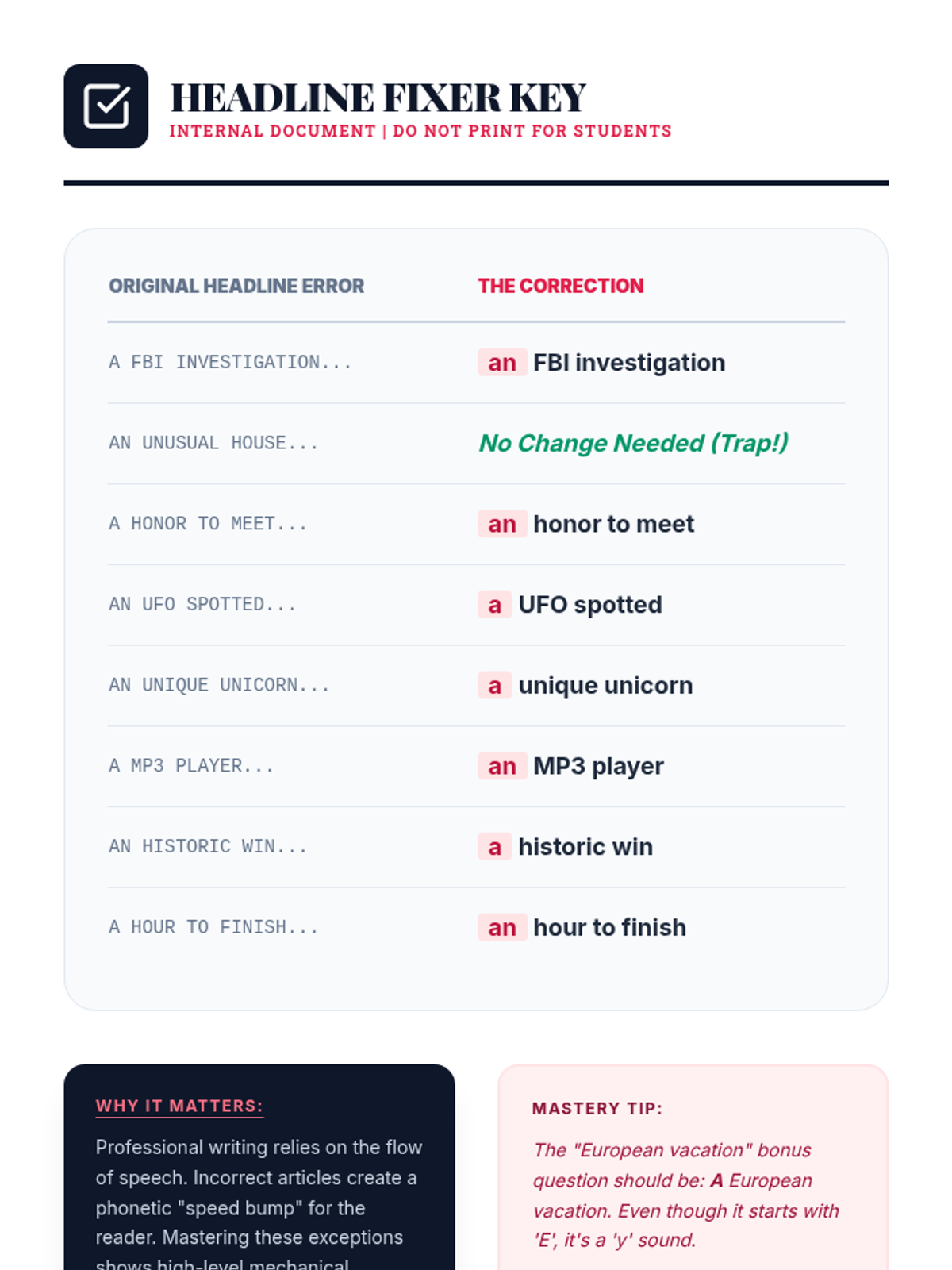
Answer key for the Headline Fixer worksheet, providing the correct article for each news headline.
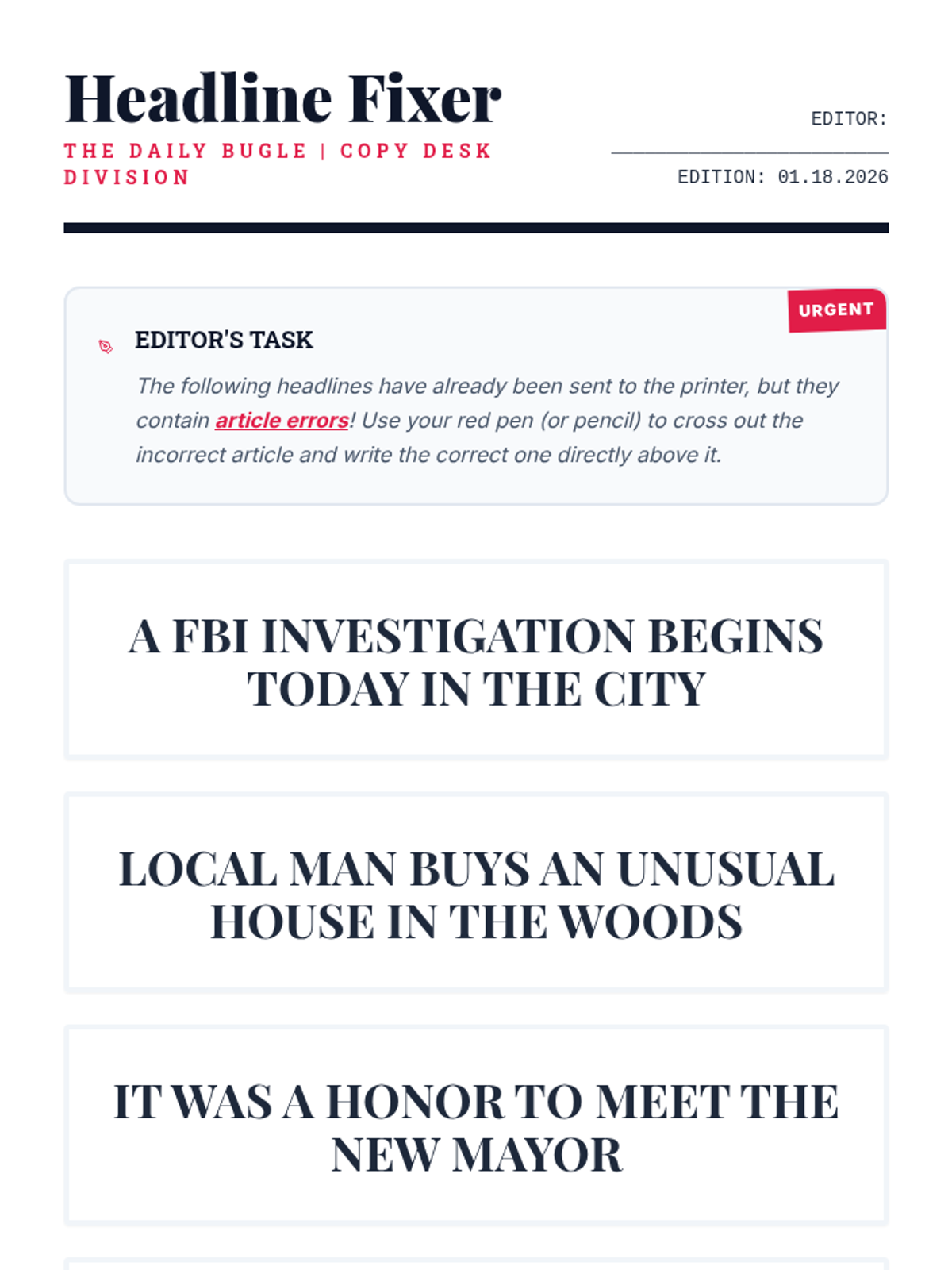
A student worksheet where they act as copy editors, using proofreading marks to correct article errors in newspaper headlines.
Slides for Lesson 4 focusing on identifying and correcting article errors using proofreading techniques and newsroom themes.
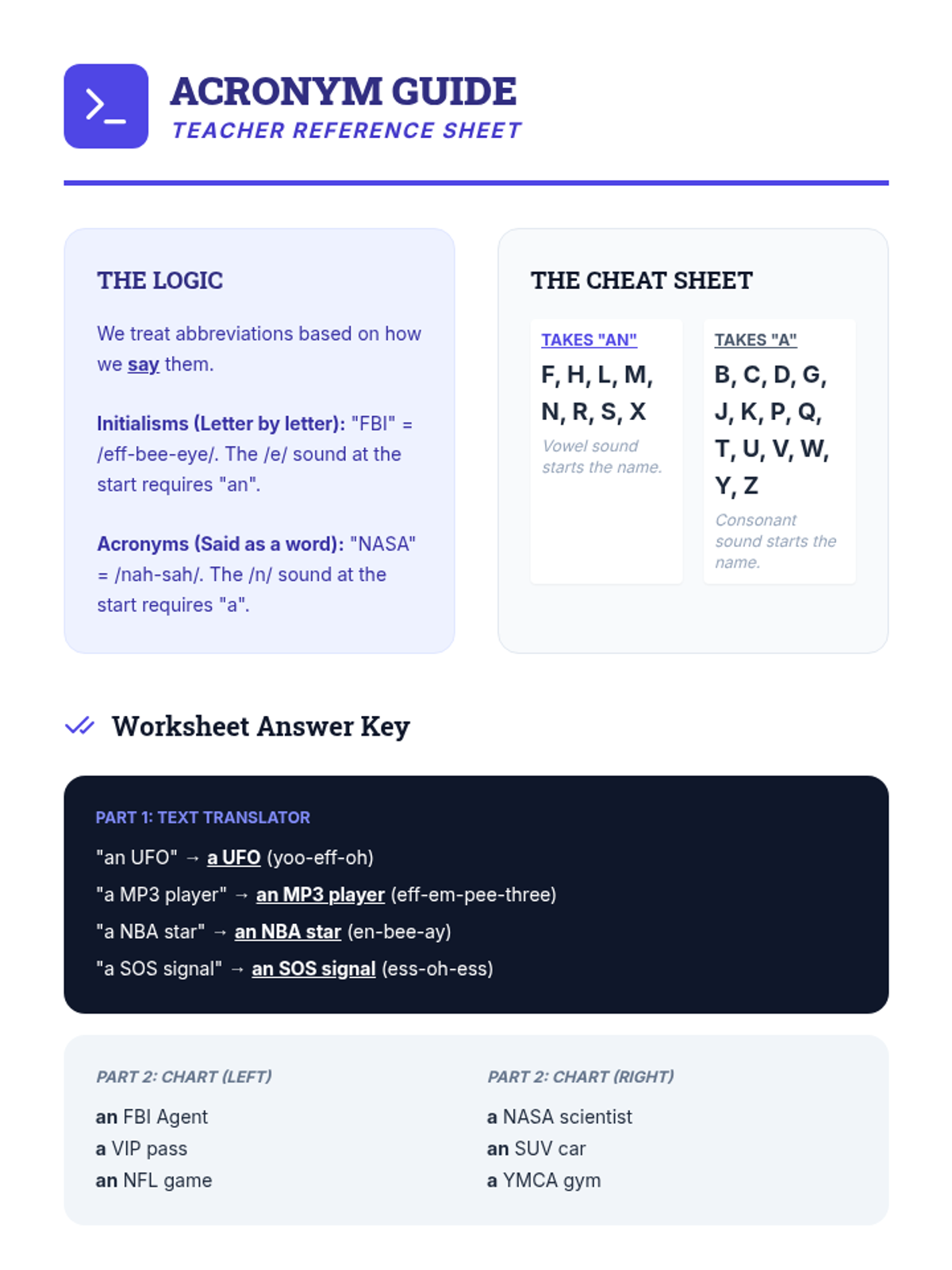
Teaching notes and answer key for the acronyms lesson, including the 'letter-name' logic and common pitfalls.
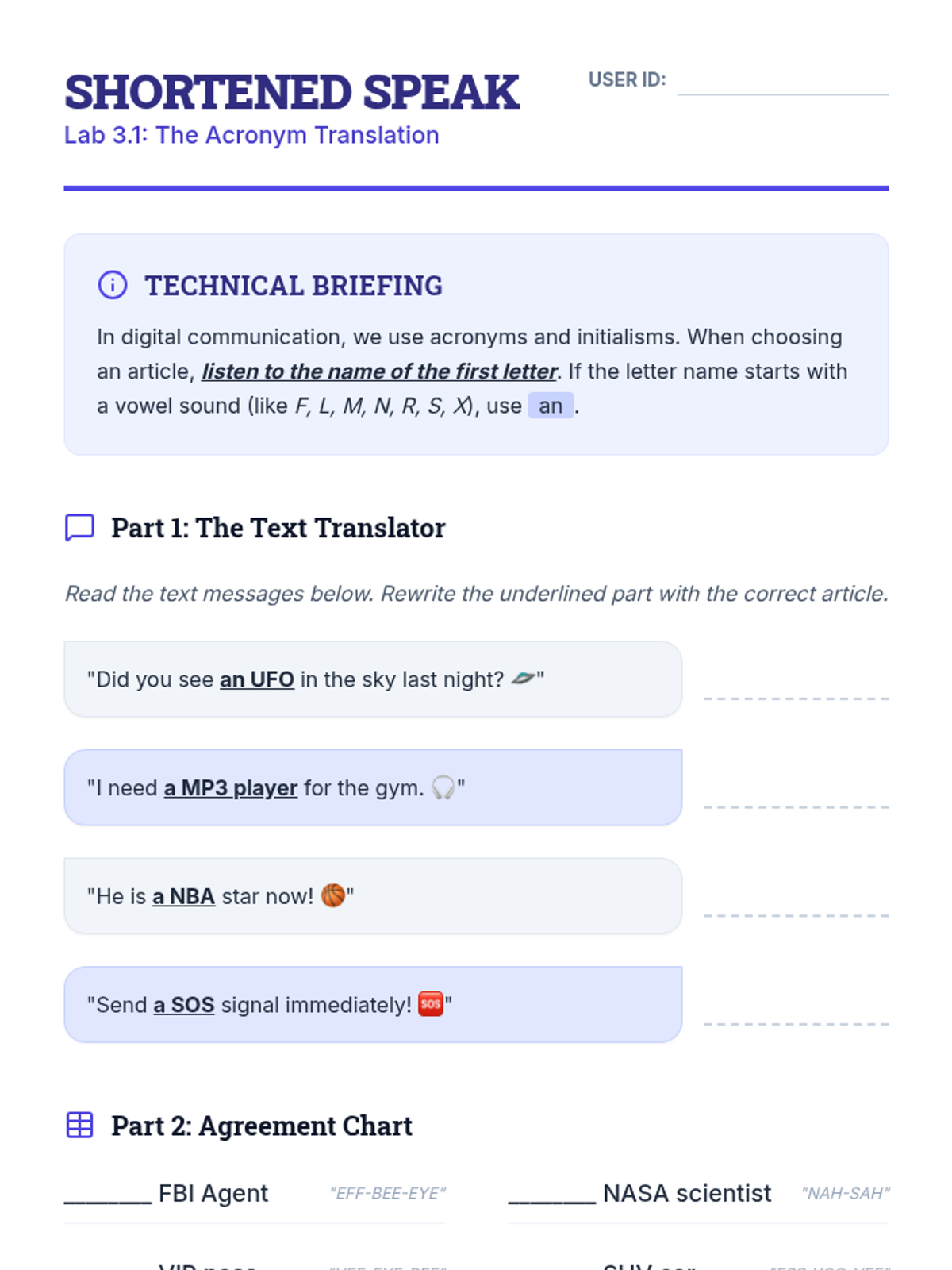
A student worksheet focusing on article agreement with acronyms and initialisms in digital and technical contexts.
Slides for Lesson 3 focusing on article agreement with acronyms and initialisms, emphasizing phonetic letter names.
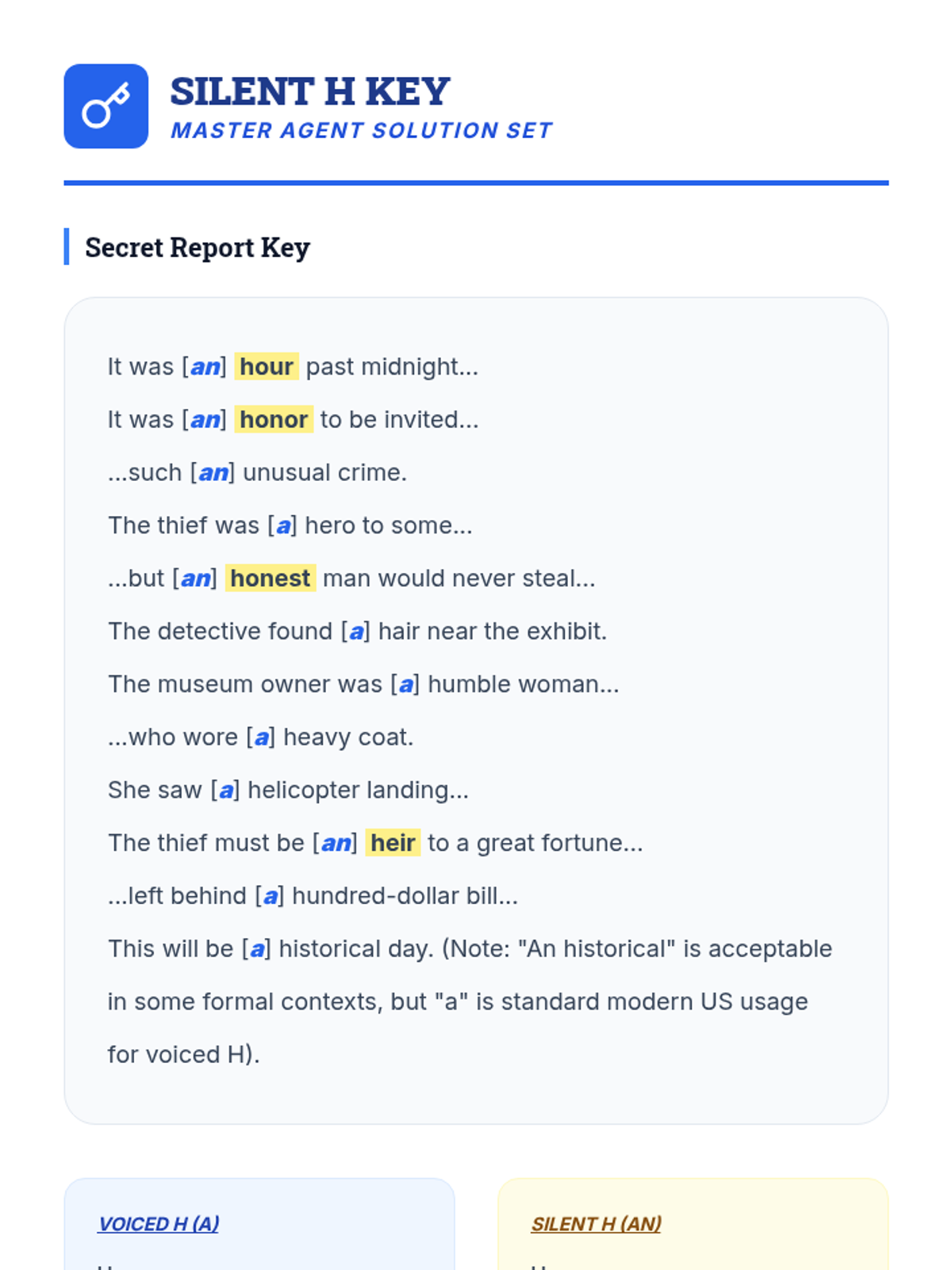
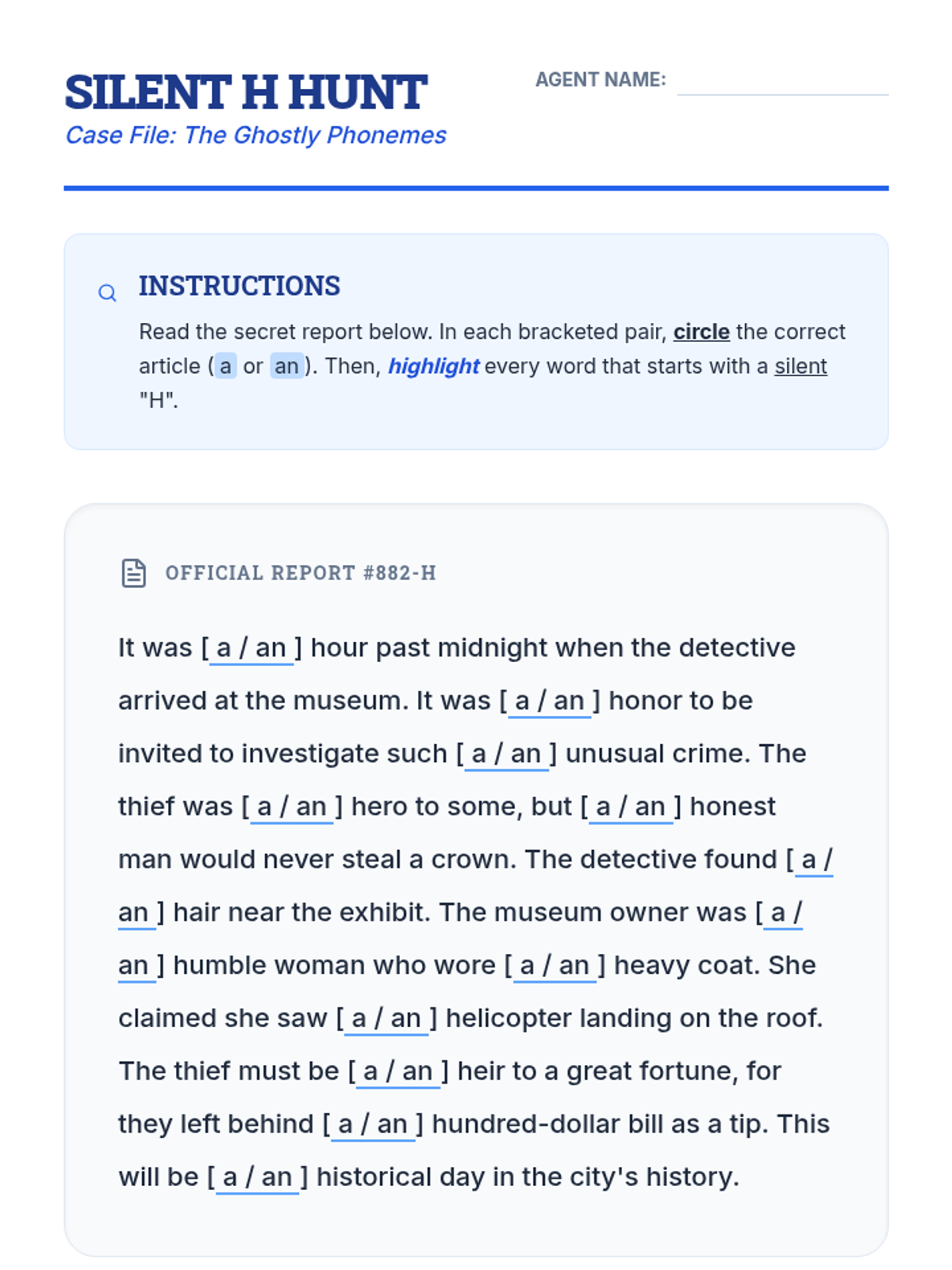
Answer key and teacher reference for the Silent H Hunt activity, highlighting silent vs voiced H words.
A student reading activity where they identify correct articles for 'h' words and distinguish between silent and voiced sounds in a narrative context.
Slides for Lesson 2 focusing on the silent 'h' rule, using the 'Breath Test' to distinguish between voiced and silent sounds.
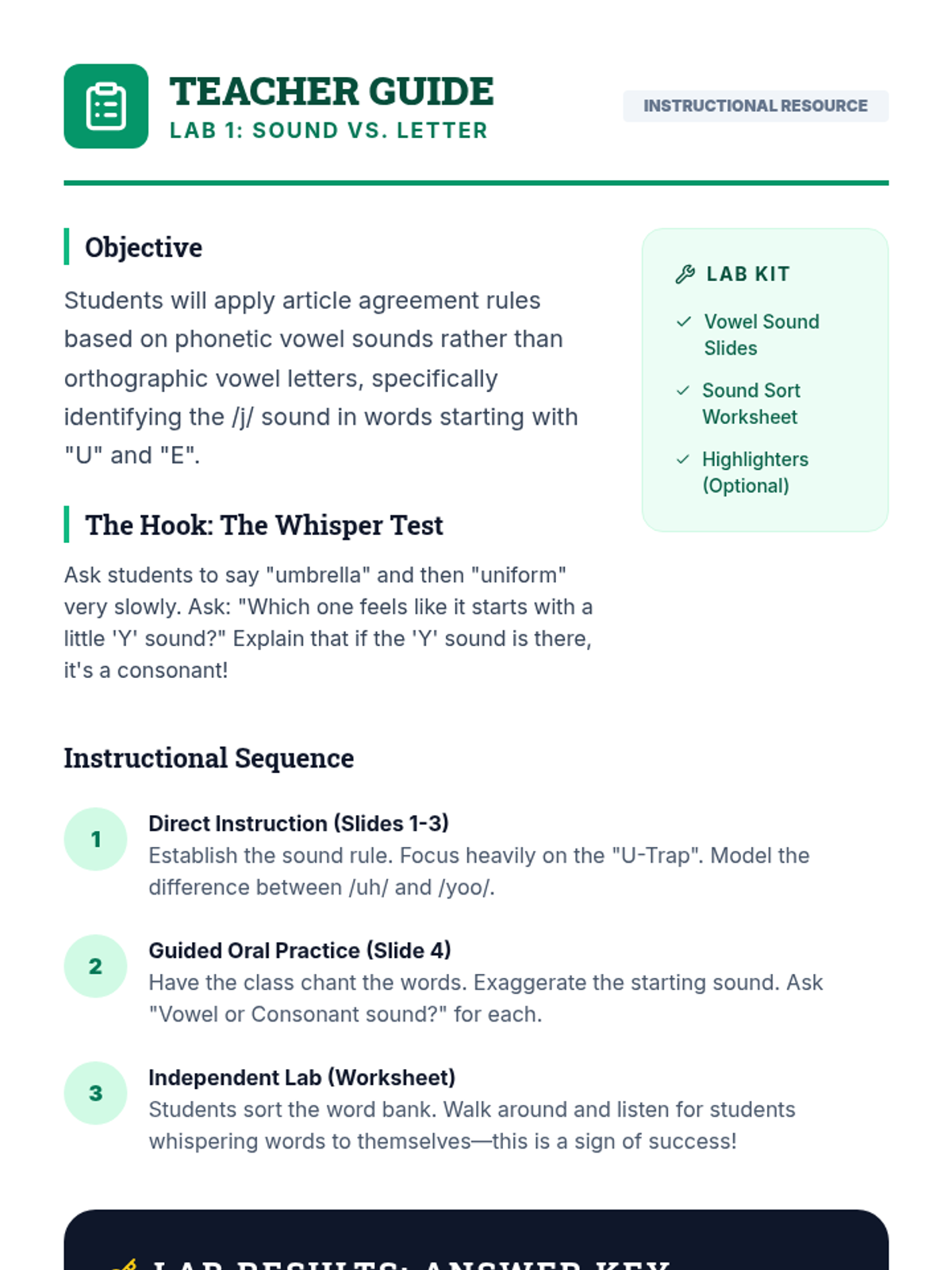
Teaching notes and answer key for the first lesson on vowels vs. vowel sounds, including instructional steps and the whisper test hook.
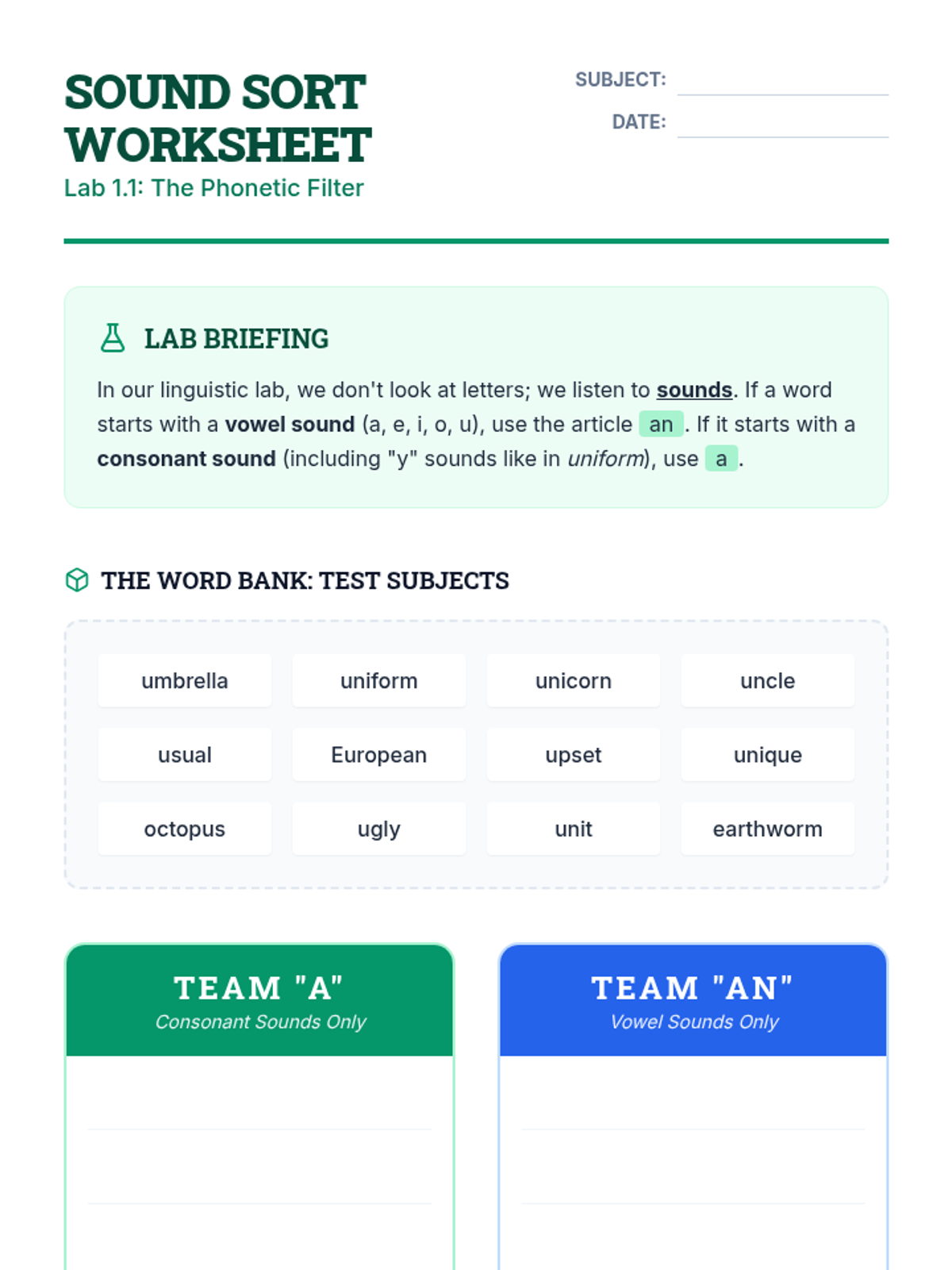
A student sorting activity where they categorize words starting with vowels based on their phonetic sound rather than their spelling.
Visual presentation for the first lesson on vowels vs. vowel sounds, featuring the 'U-trap' and auditory practice.
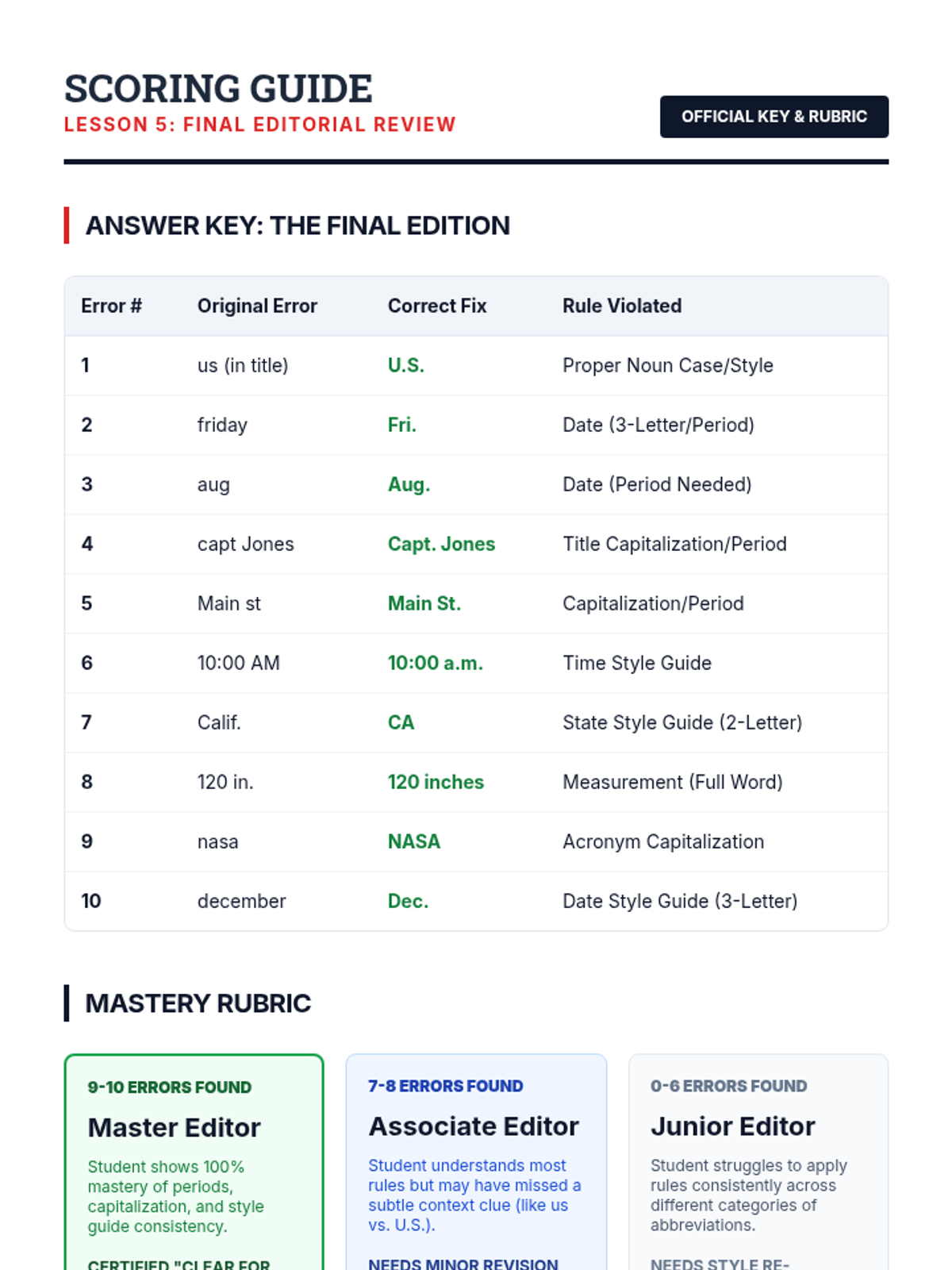
Scoring rubric and answer key for the 'Final Edition' assessment. Includes a breakdown of all 10 errors and mastery level descriptors.
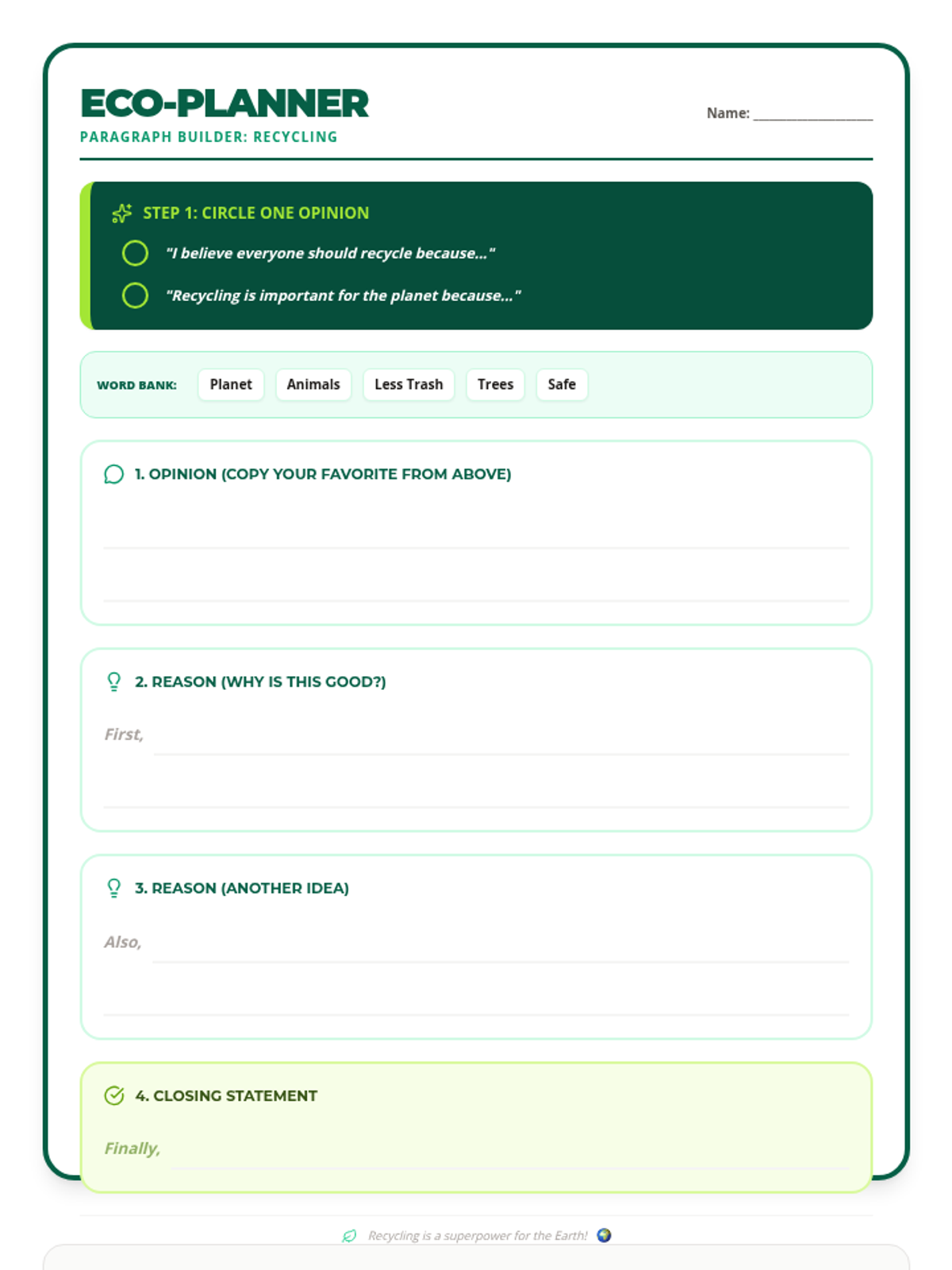
A highly scaffolded persuasive writing graphic organizer for 5th-grade emerging ELL students. Features simple sentence frames, a word bank, and transition words embedded in the work areas to help students build a basic paragraph about recycling.
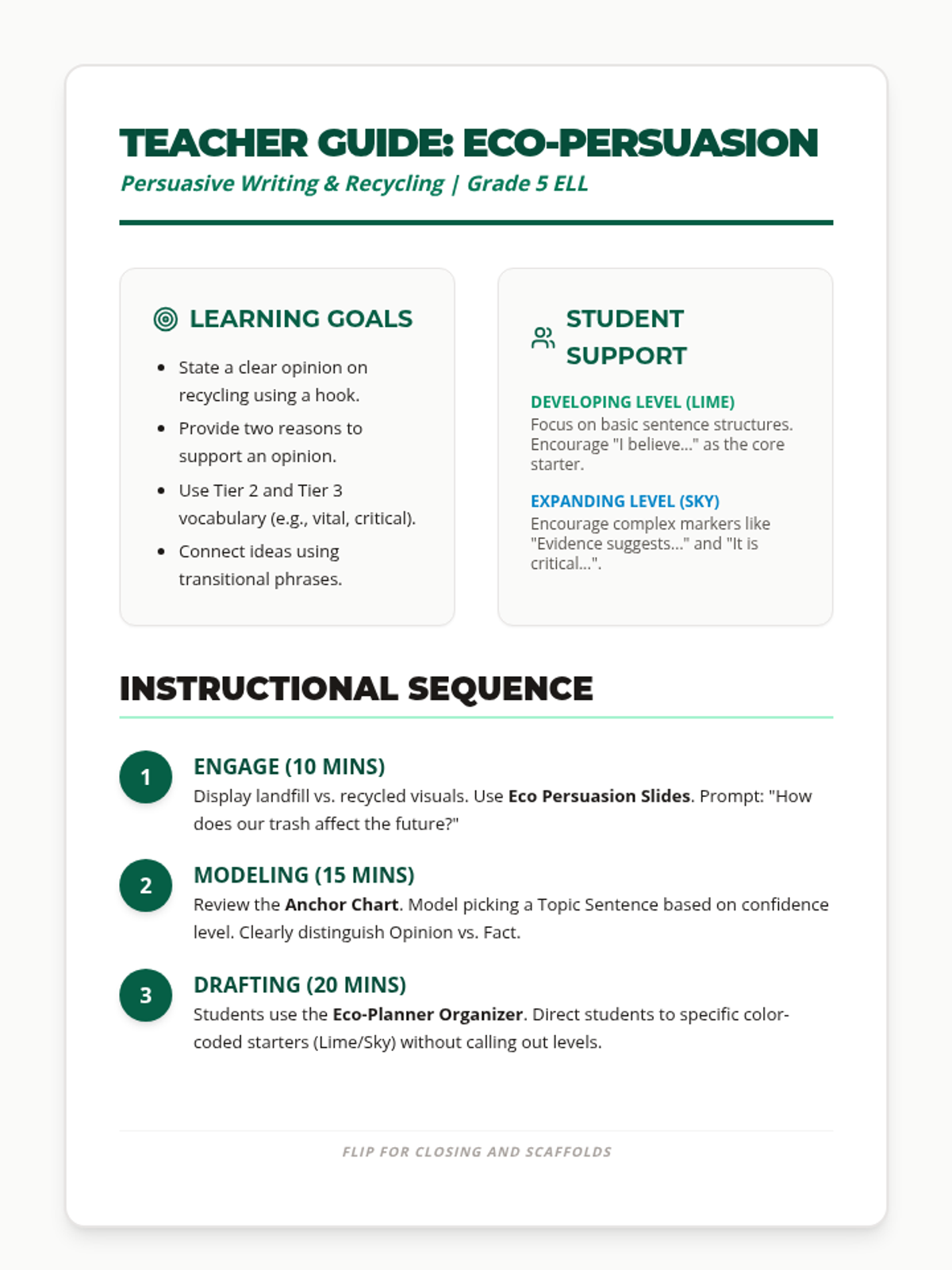
A step-by-step teacher guide for leading a 5th-grade persuasive writing lesson on recycling. Includes learning goals, pacing, and specific linguistic scaffolds for ELL learners. Layout has been fixed for better page flow.
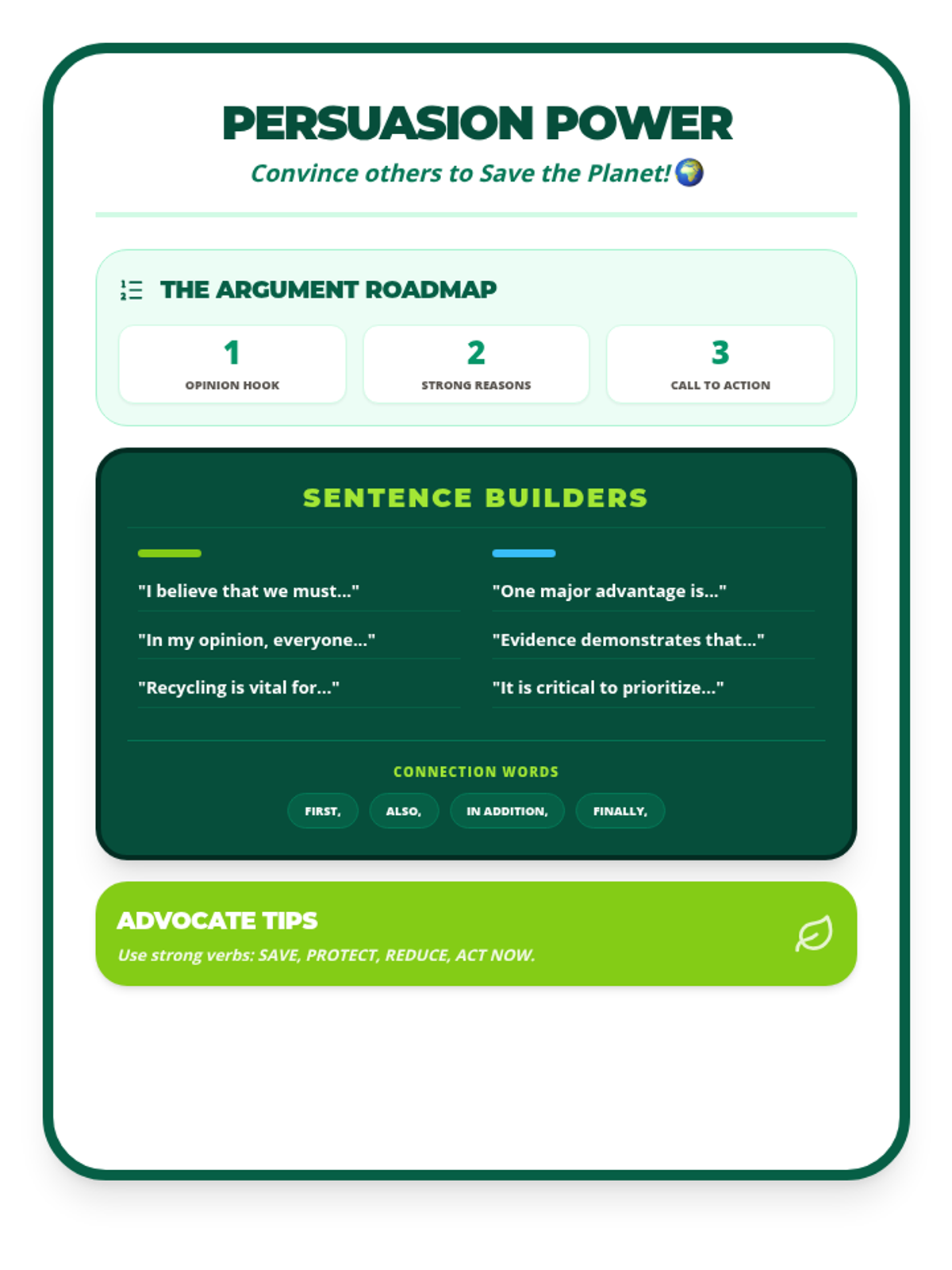
A high-visual anchor chart for persuasive writing about recycling. Outlines argument steps and provides tiered sentence starters for 5th-grade ELLs in a compact, one-page format. Includes a teacher reference page with scaffolded discussion questions. Layout optimized to fit standard printing.
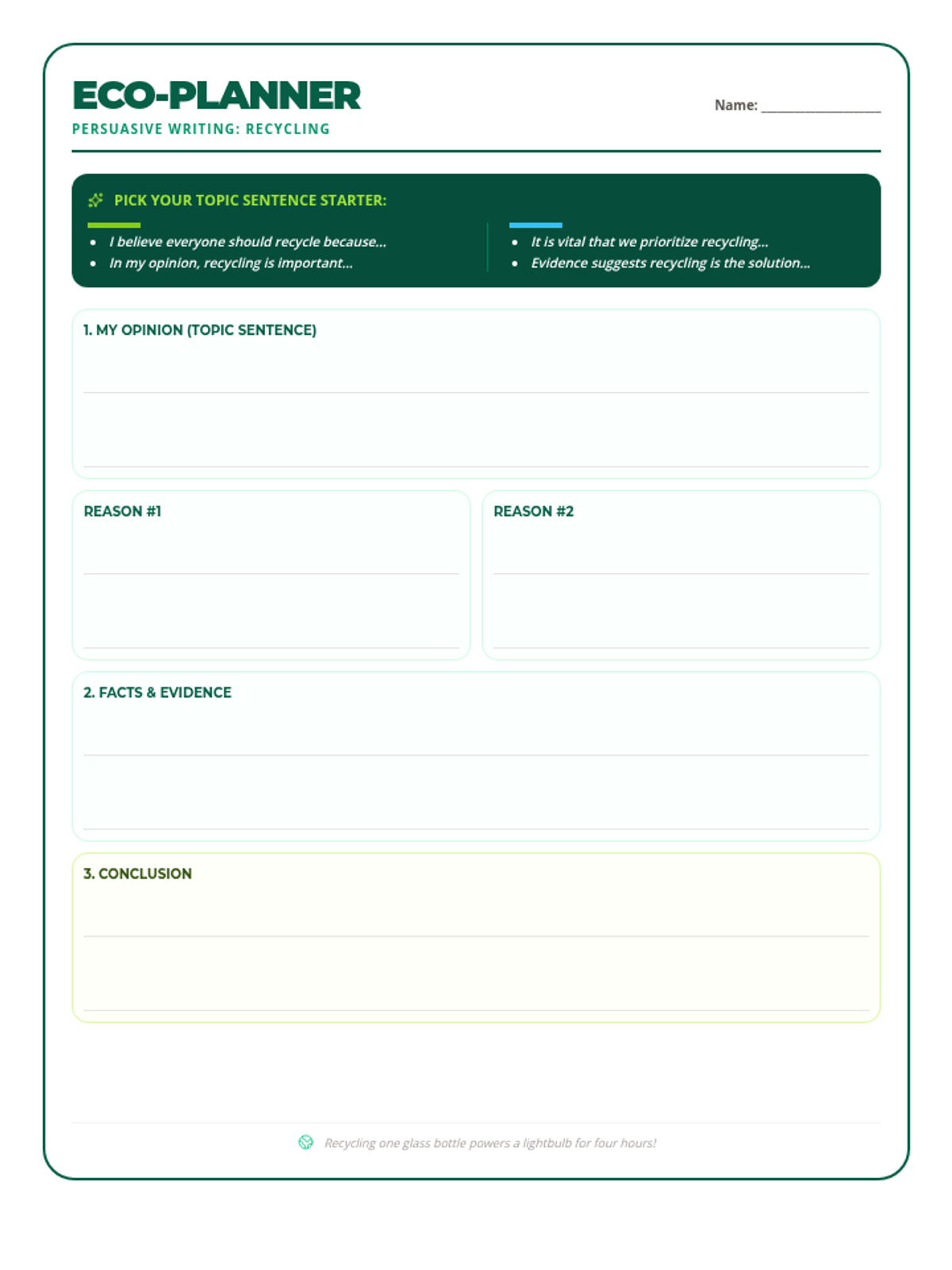
A single-page persuasive writing graphic organizer for 5th-grade students to plan a paragraph about recycling. Features multiple writing lines for each section and scaffolded topic sentence starters. Includes a separate teacher implementation page. Layout has been optimized to prevent bleeding across pages.
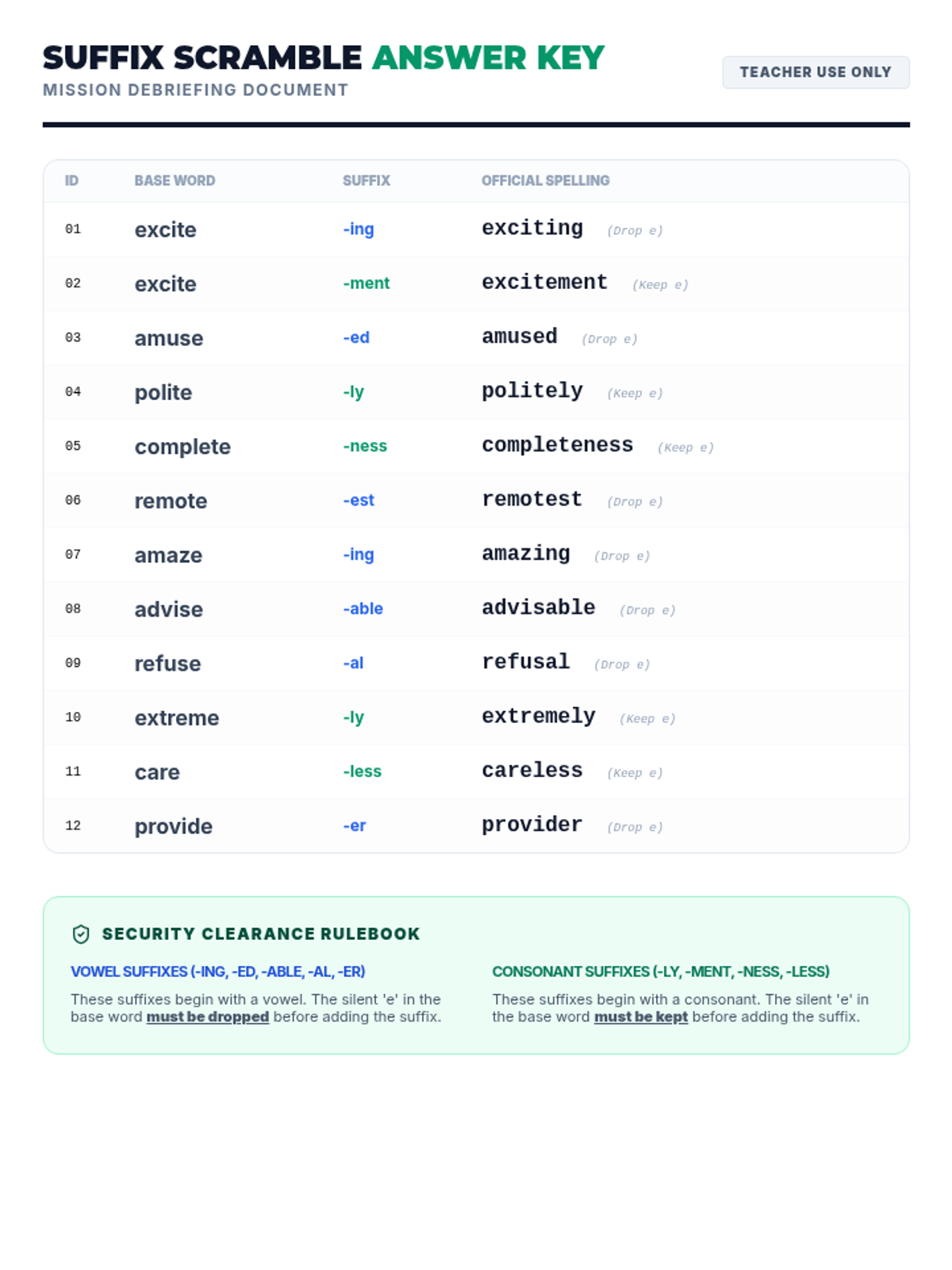
The teacher's answer key for the Suffix Scramble Worksheet, including the logic for dropping or keeping the silent 'e'. (Revised for space and more content).
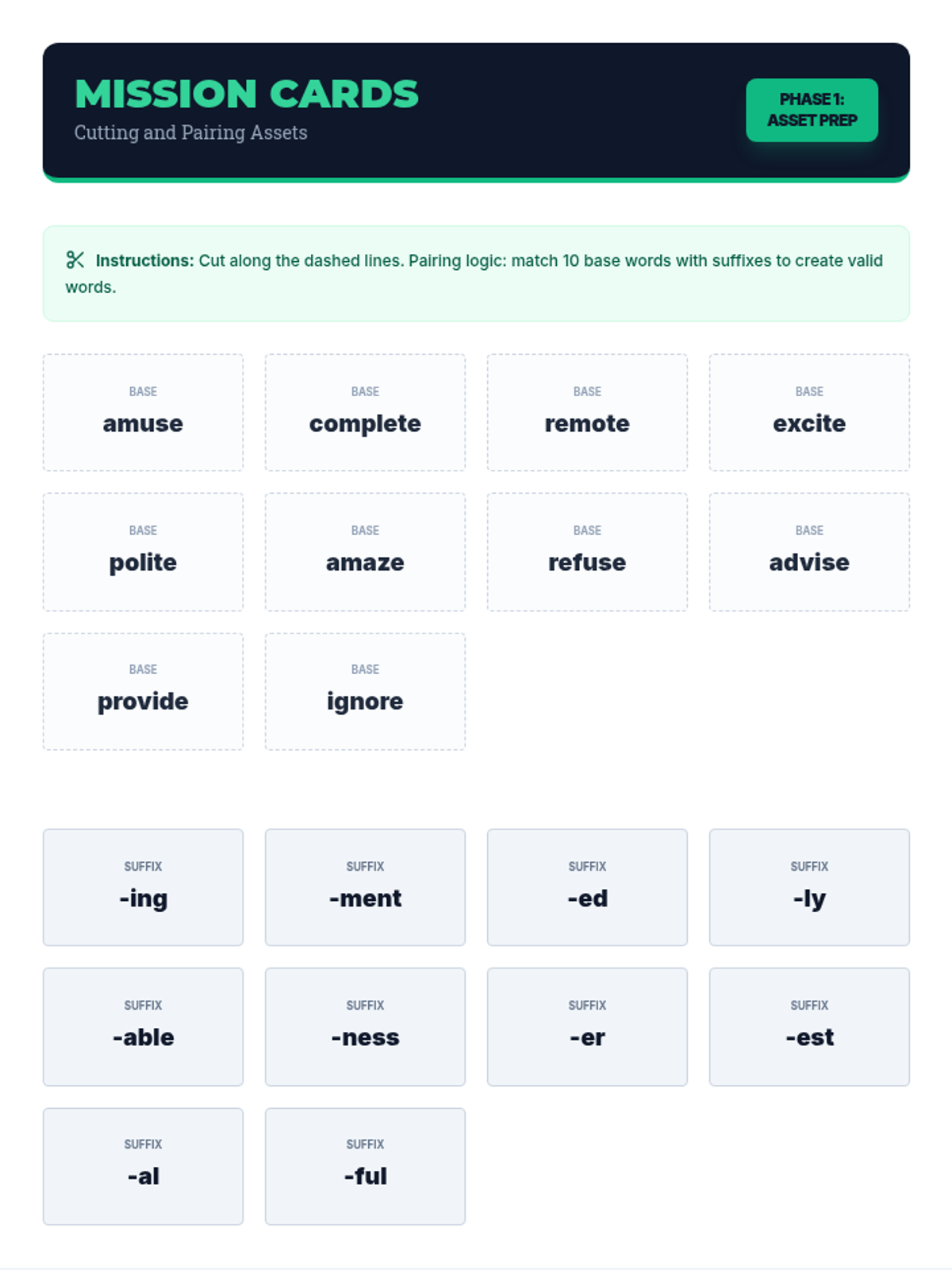
A hands-on word sorting activity where students pair base words with suffixes and categorize them based on whether the silent 'e' is dropped or kept. (Revised for space and usability).
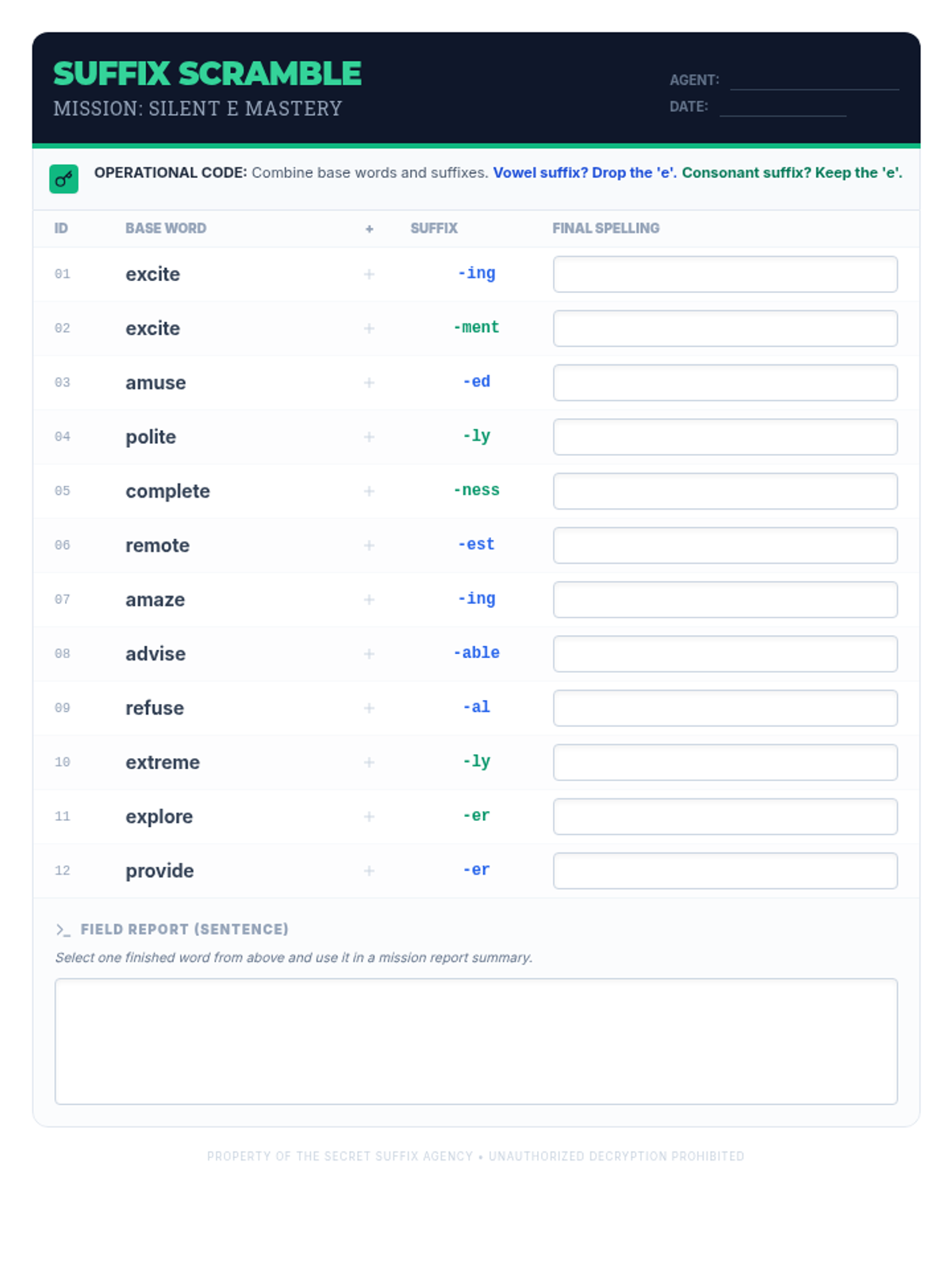
A practice worksheet where students combine multi-syllabic base words ending in silent 'e' with various vowel and consonant suffixes. (Revised for space and content).
A visual slide deck explaining the rules for adding vowel and consonant suffixes to multi-syllabic words ending in silent 'e', featuring a spy-themed design.
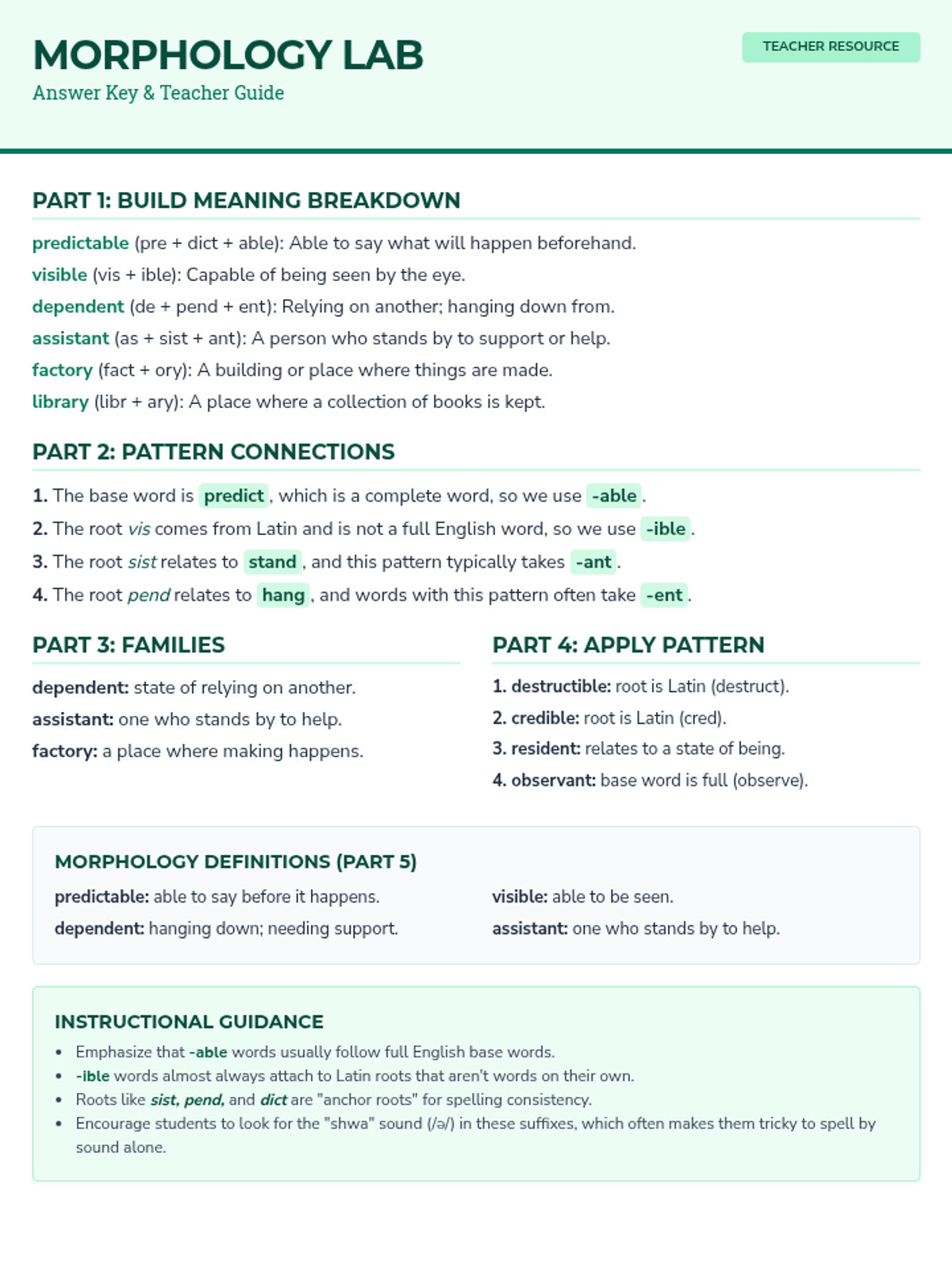
Answer key for the Morphology Lab worksheet. Revised to be a single-page teacher resource with full explanatory sentences and instructional tips.
Instructional slides for the Morphology Lab lesson, explaining suffix rules (-able/-ible, -ant/-ent, -ary/-ery/-ory) with visual examples and a quick challenge.
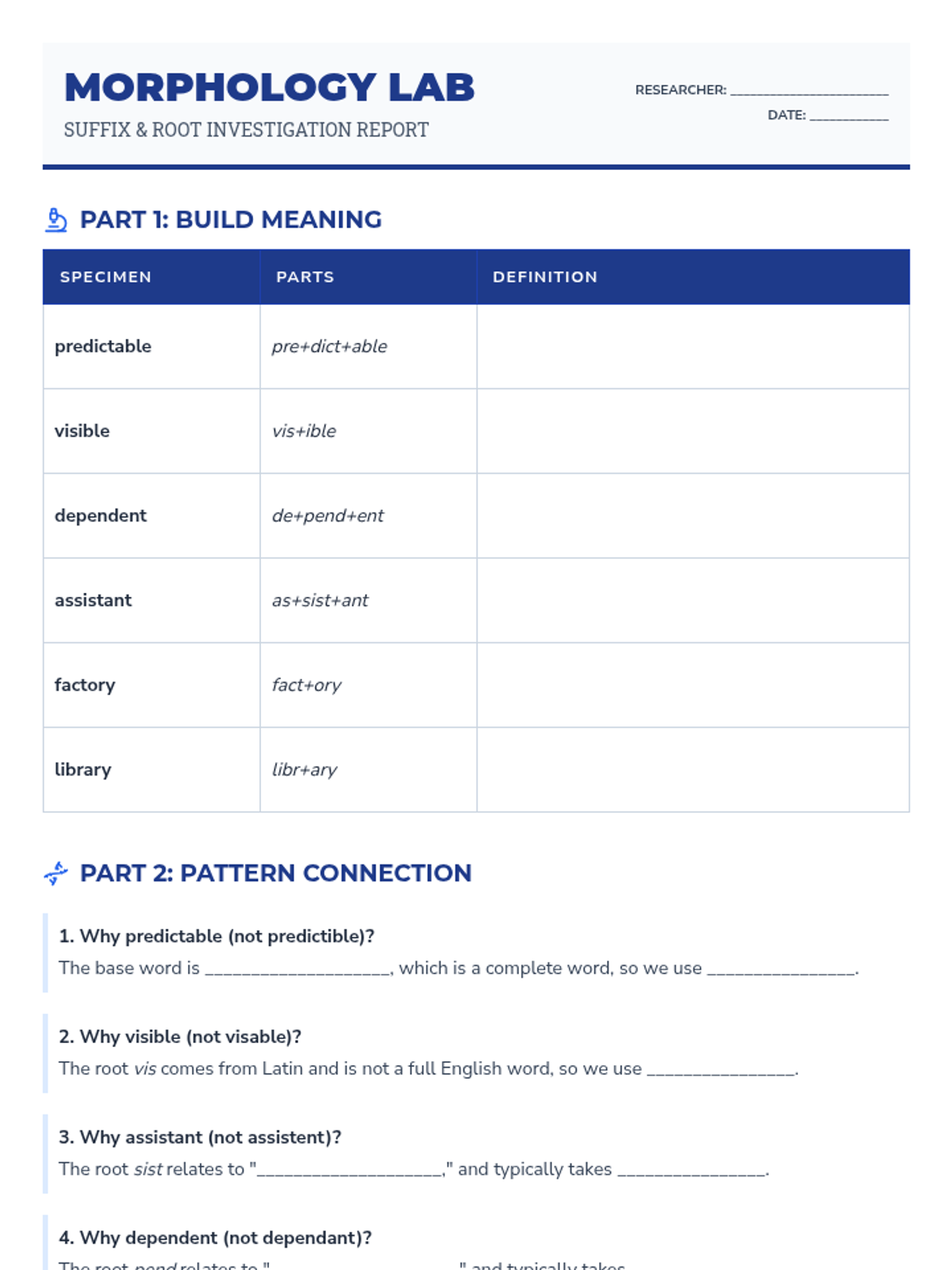
A comprehensive morphology worksheet focusing on Latin roots and suffix patterns (-able, -ible, -ant, -ent, etc.) with structured analysis sections. Revised for better page flow and work area legibility.
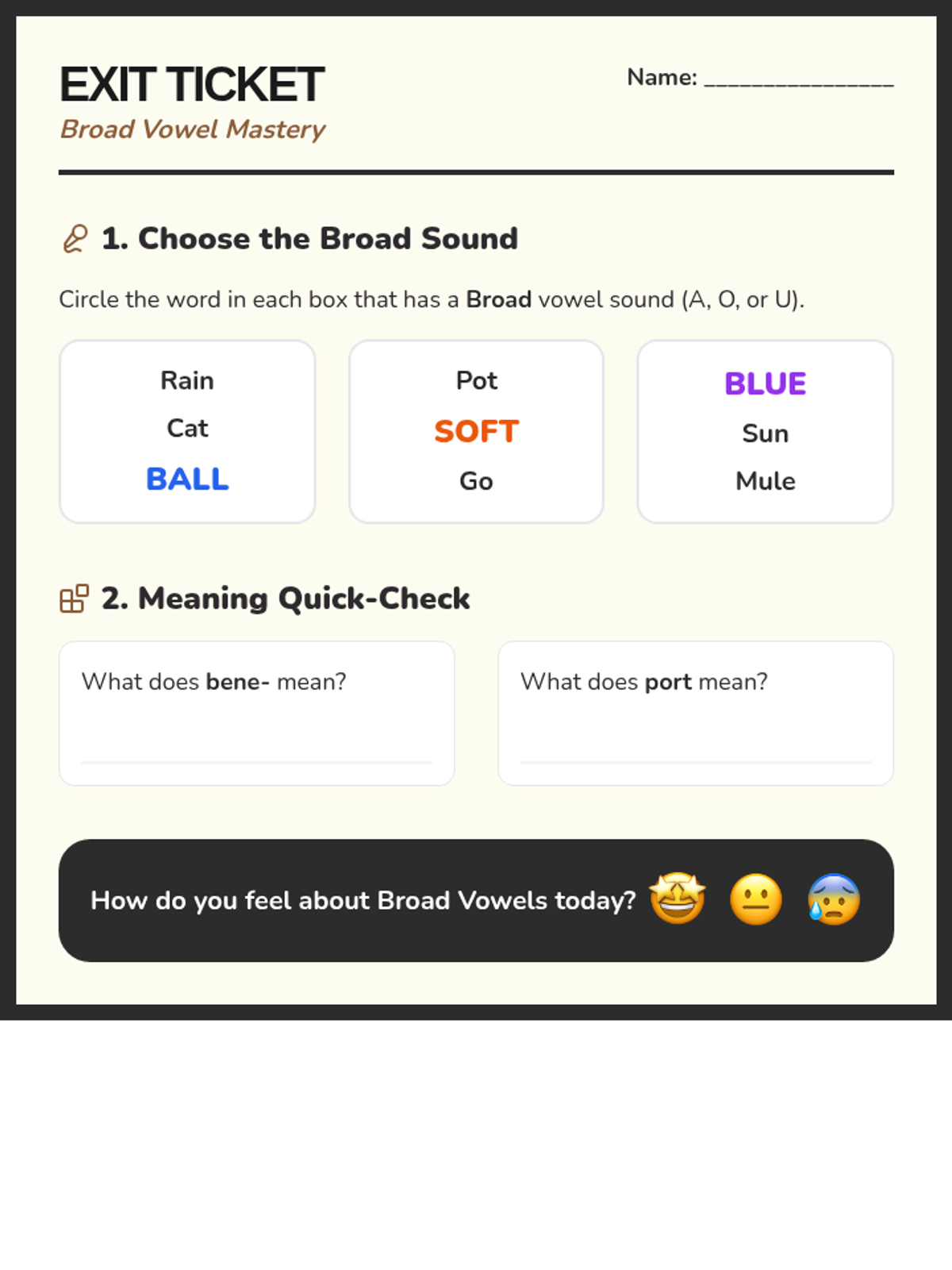
A quick exit ticket for the end of the lesson, testing students on identifying Broad A, O, and U sounds and recalling the meanings of key morphemes like bene- and port. Aligned with the lesson's visual theme.
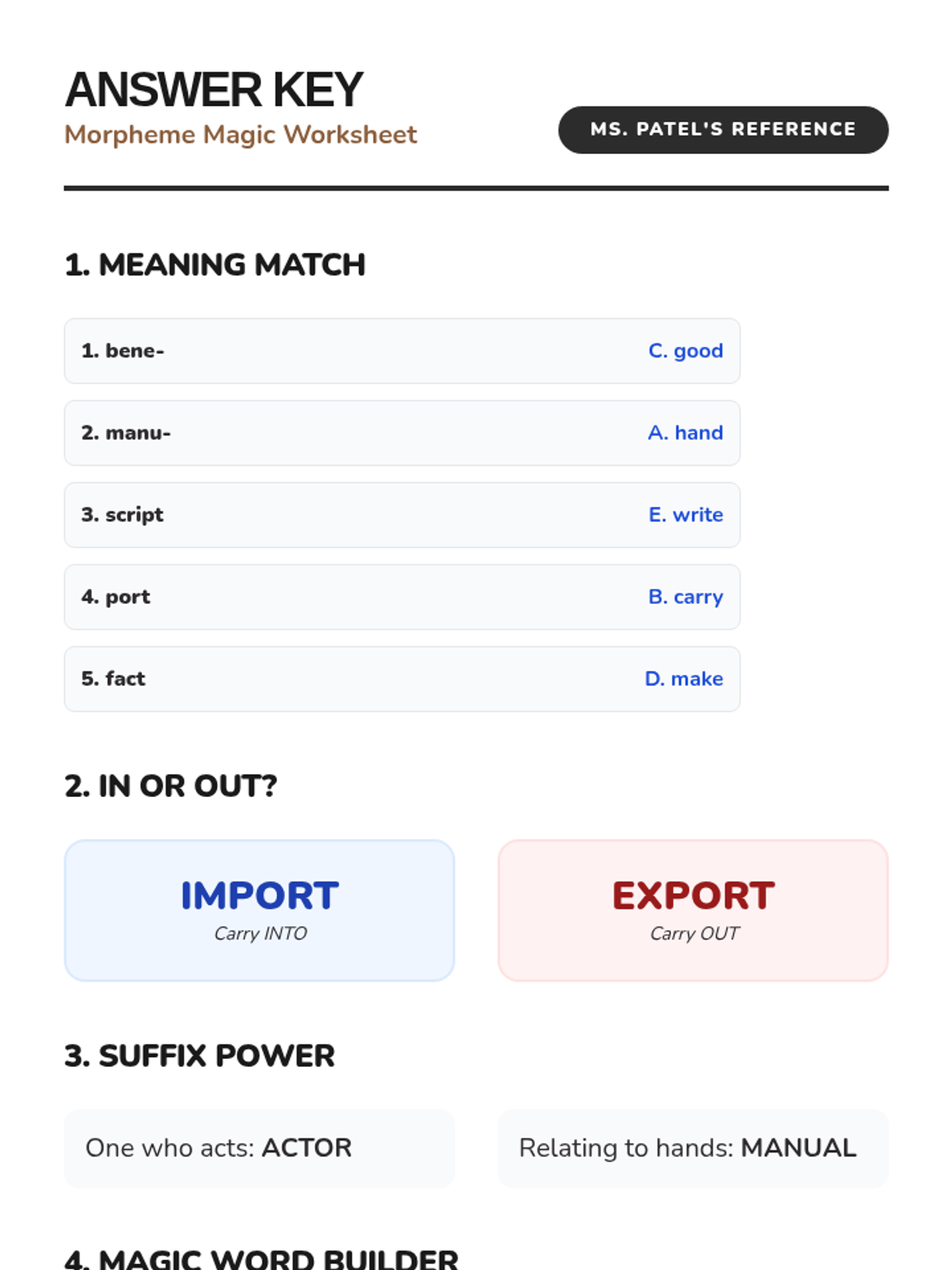
Answer key for the Morpheme Magic Worksheet, providing correct matches, word completions, and the final "magic word" challenge solution.
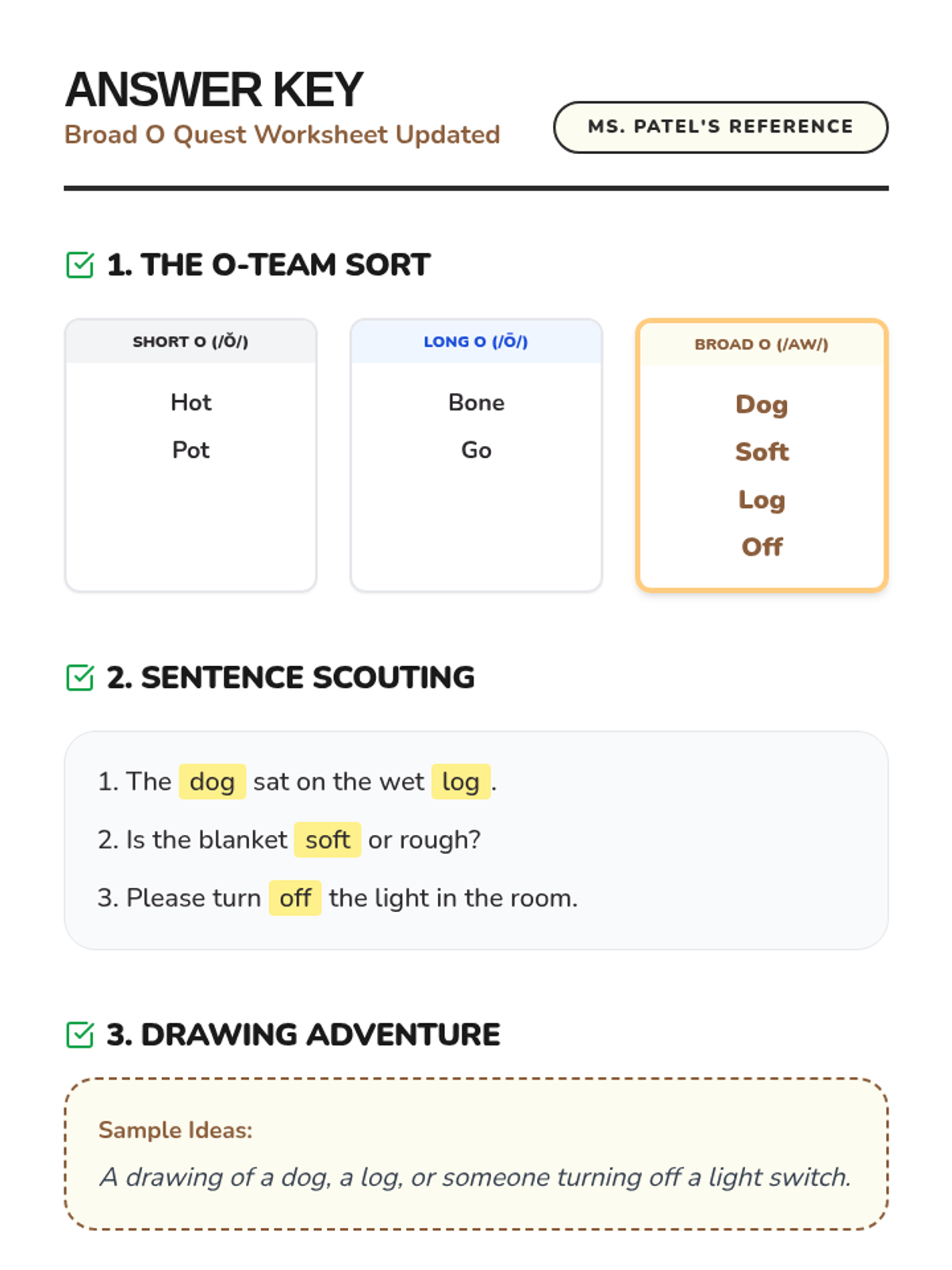
Answer key for the Broad O Quest Worksheet, providing correct categorizations for the sorting task and identified words in the sentence section.
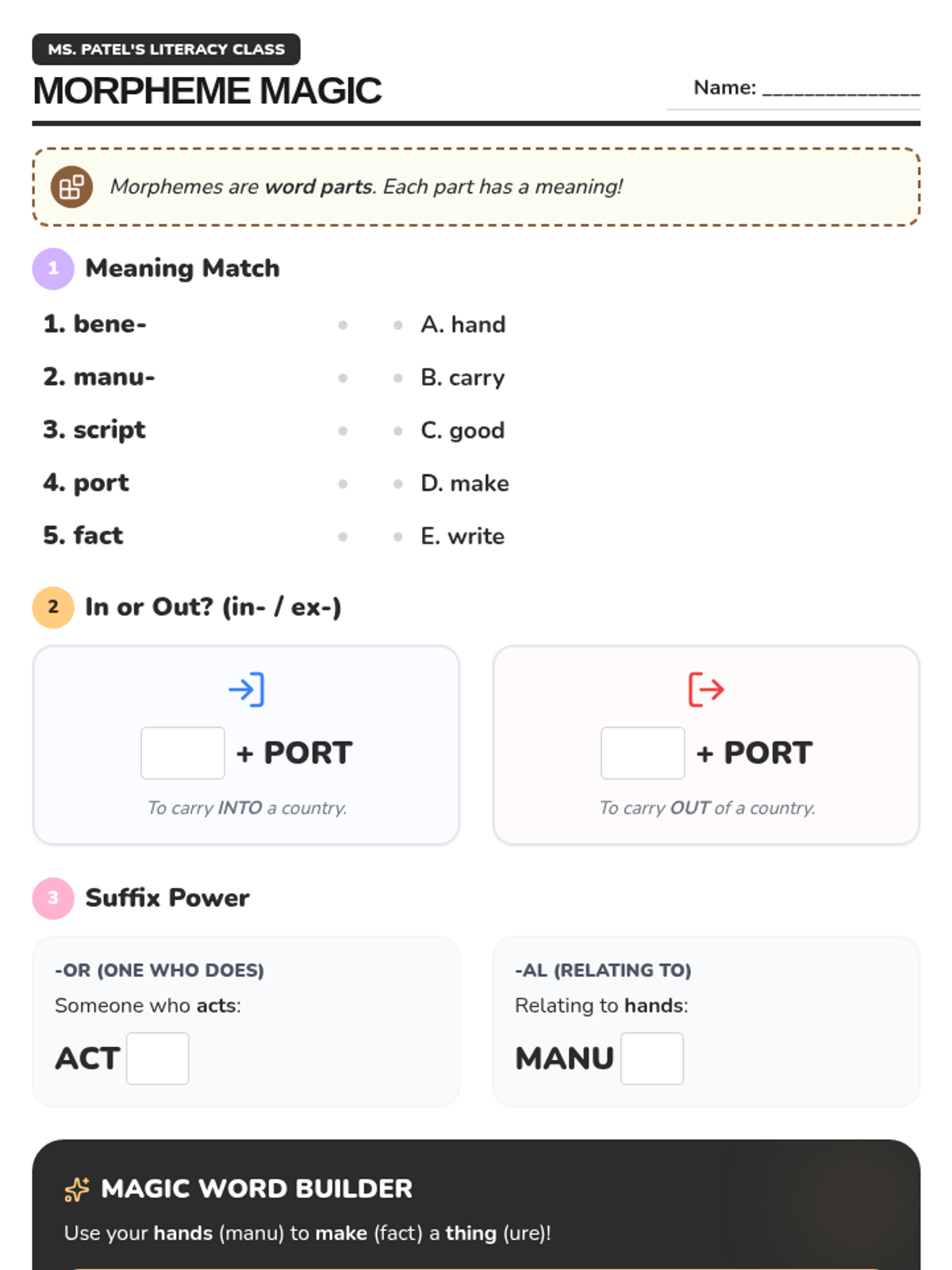
A one-page morpheme mastery worksheet covering bene-, -or, fact, script, manu-, -al, in-, port, and ex-. It includes matching, word building with prefixes and suffixes, and a final "magic word" challenge, all aligned with Ms. Patel's class branding. Revised for single-page layout and better handwriting areas.
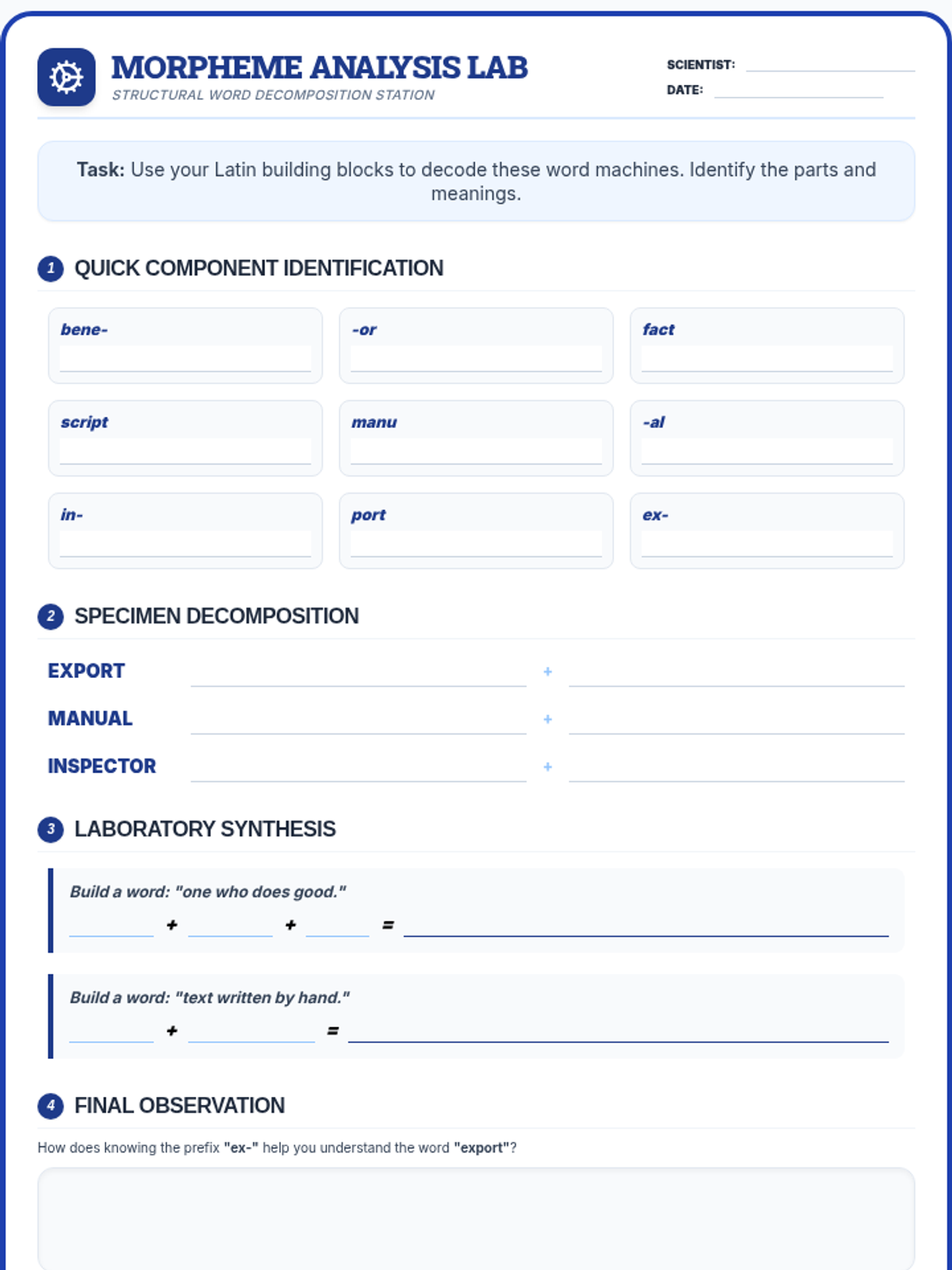
A comprehensive morpheme analysis worksheet. Students practice matching morpheme definitions, decomposing complex words into their constituent parts, and synthesizing new words from morpheme blocks. Professional laboratory blueprint theme. Revised for perfect single-page layout and full content coverage.
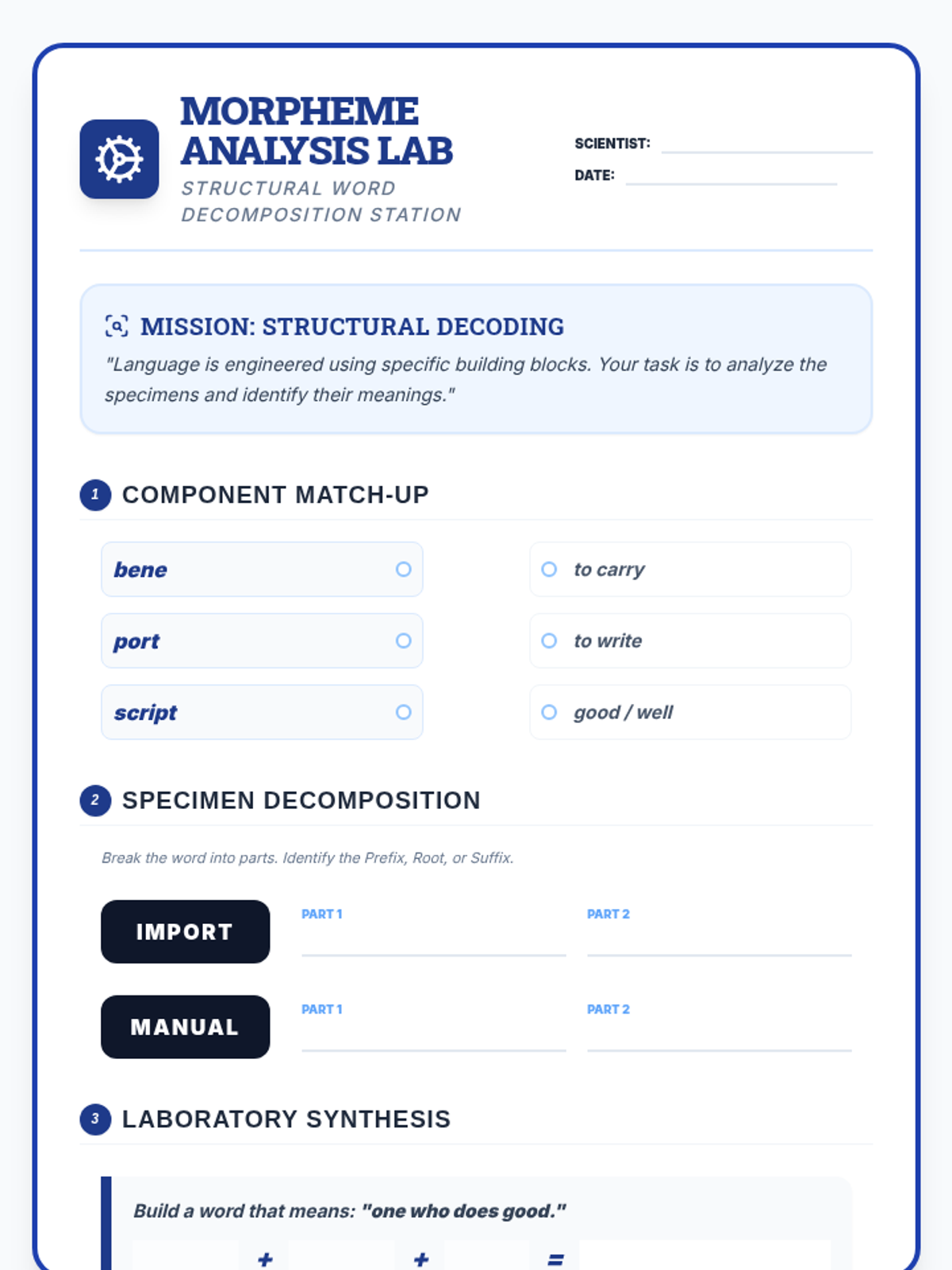
A comprehensive morpheme analysis worksheet. Students practice matching morpheme definitions, decomposing complex words into their constituent parts, and synthesizing new words from morpheme blocks. Professional laboratory blueprint theme.
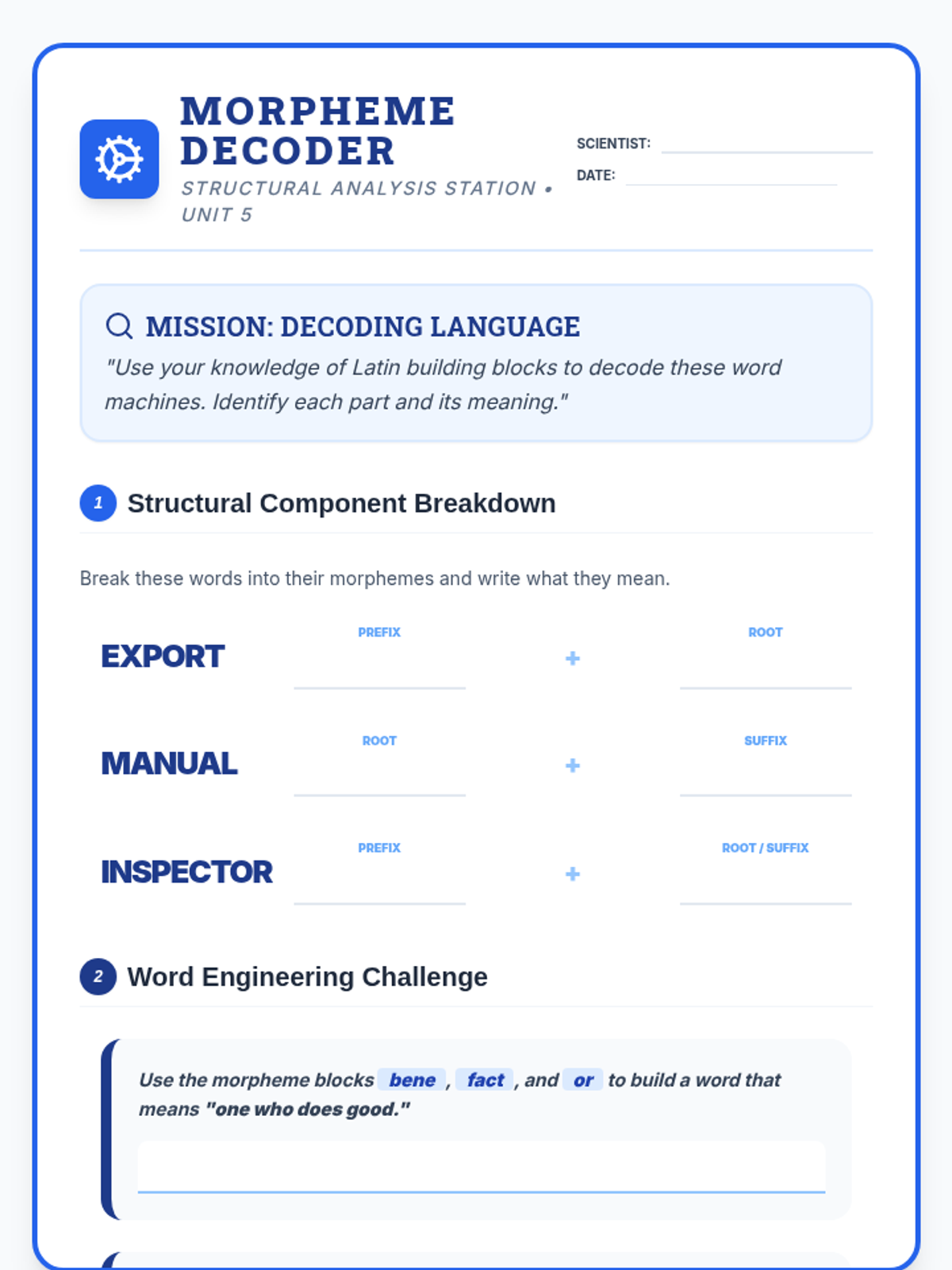
A comprehensive morpheme decoder worksheet. Students break down complex words (export, manual, inspector) into their constituent Latin morphemes and meanings, and practice building new words from blocks. Laboratory theme with high-contrast design.
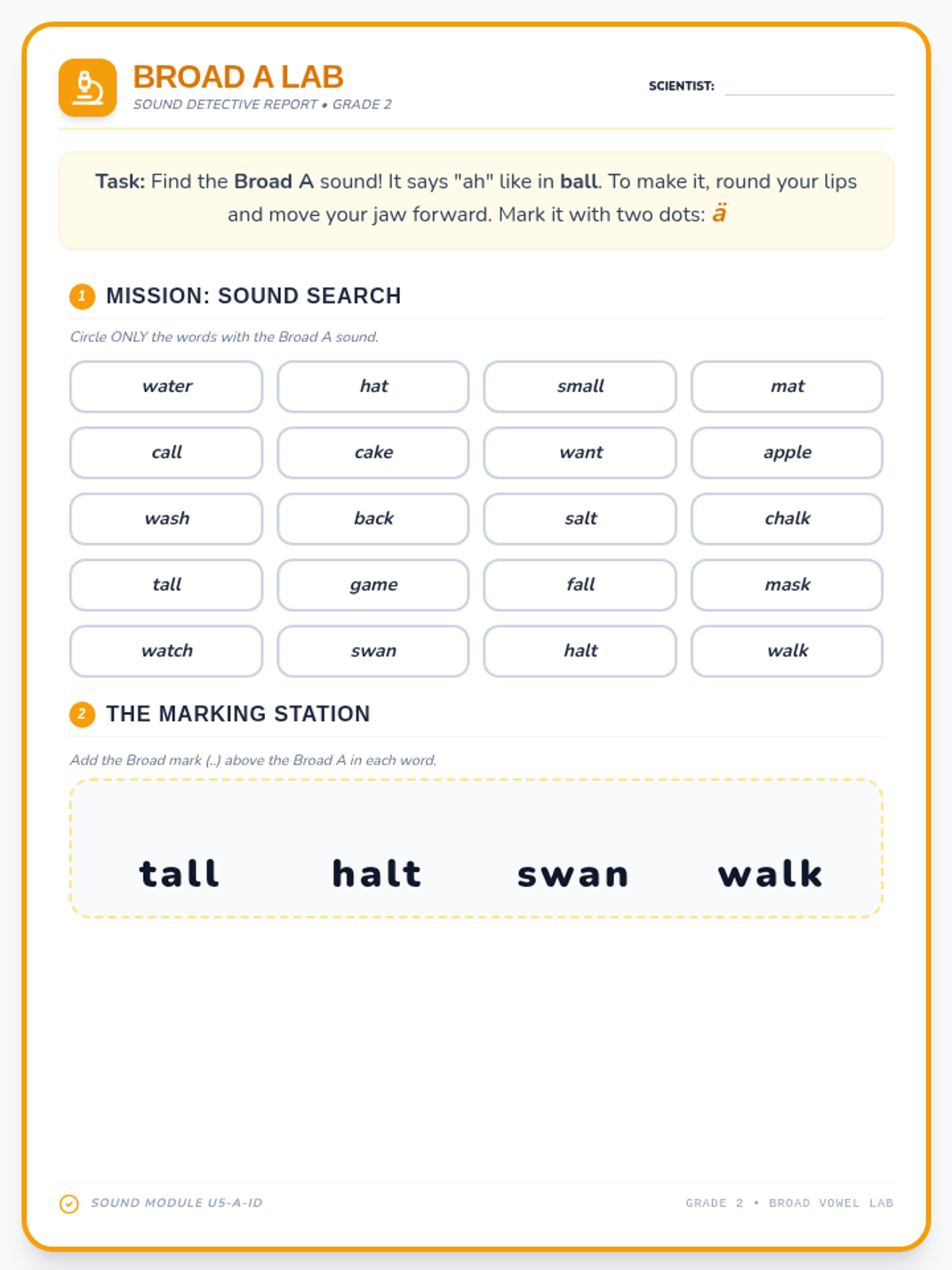
A Grade 2 worksheet focused on identifying the Broad A sound. It includes a "Lab Briefing" explanation of mouth positioning, a sound search grid with 20 words for discrimination, and a marking activity for phonetic analysis. Terminology updated to use 'Broad mark' instead of 'umlaut'. Revised for perfect single-page layout.
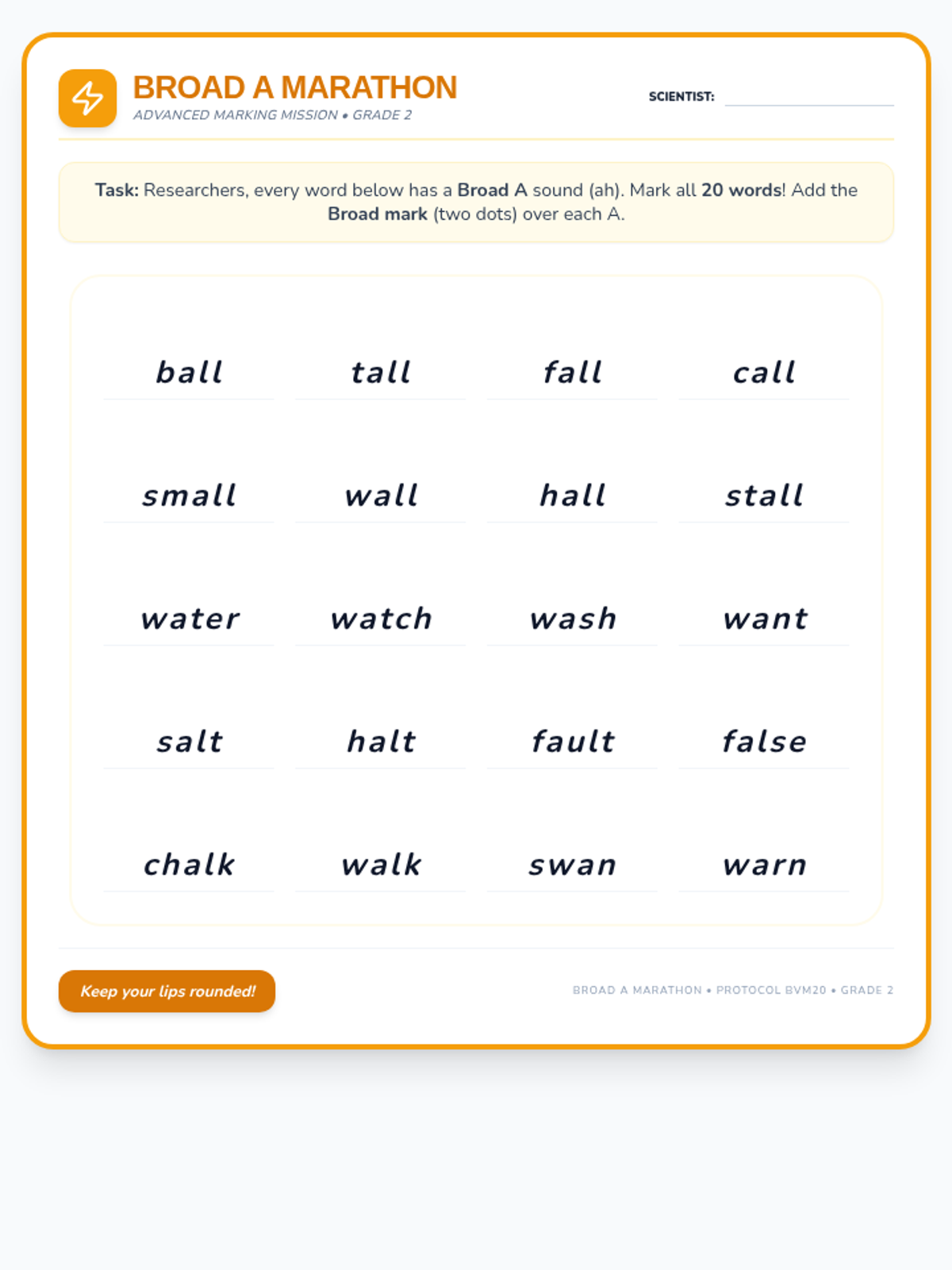
A marathon marking worksheet for Grade 2 focusing on the Broad A sound. Students must mark 20 different words with the Broad mark (two dots). Terminology updated to avoid 'umlaut'. Layout optimized to fit on a single page.
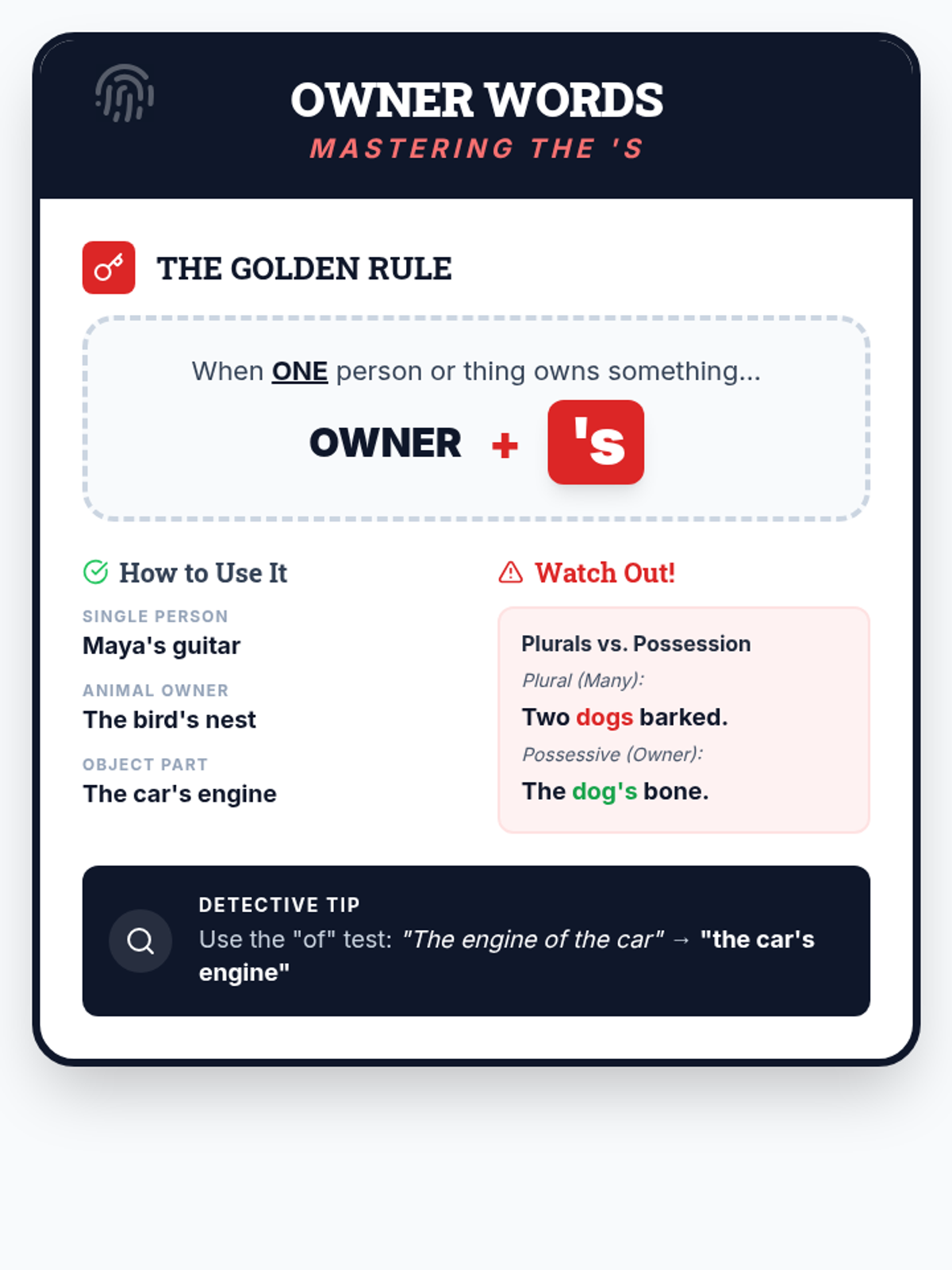
A high-contrast, visually engaging anchor chart poster that explains the rule for singular possessive nouns and warns against plural confusion.
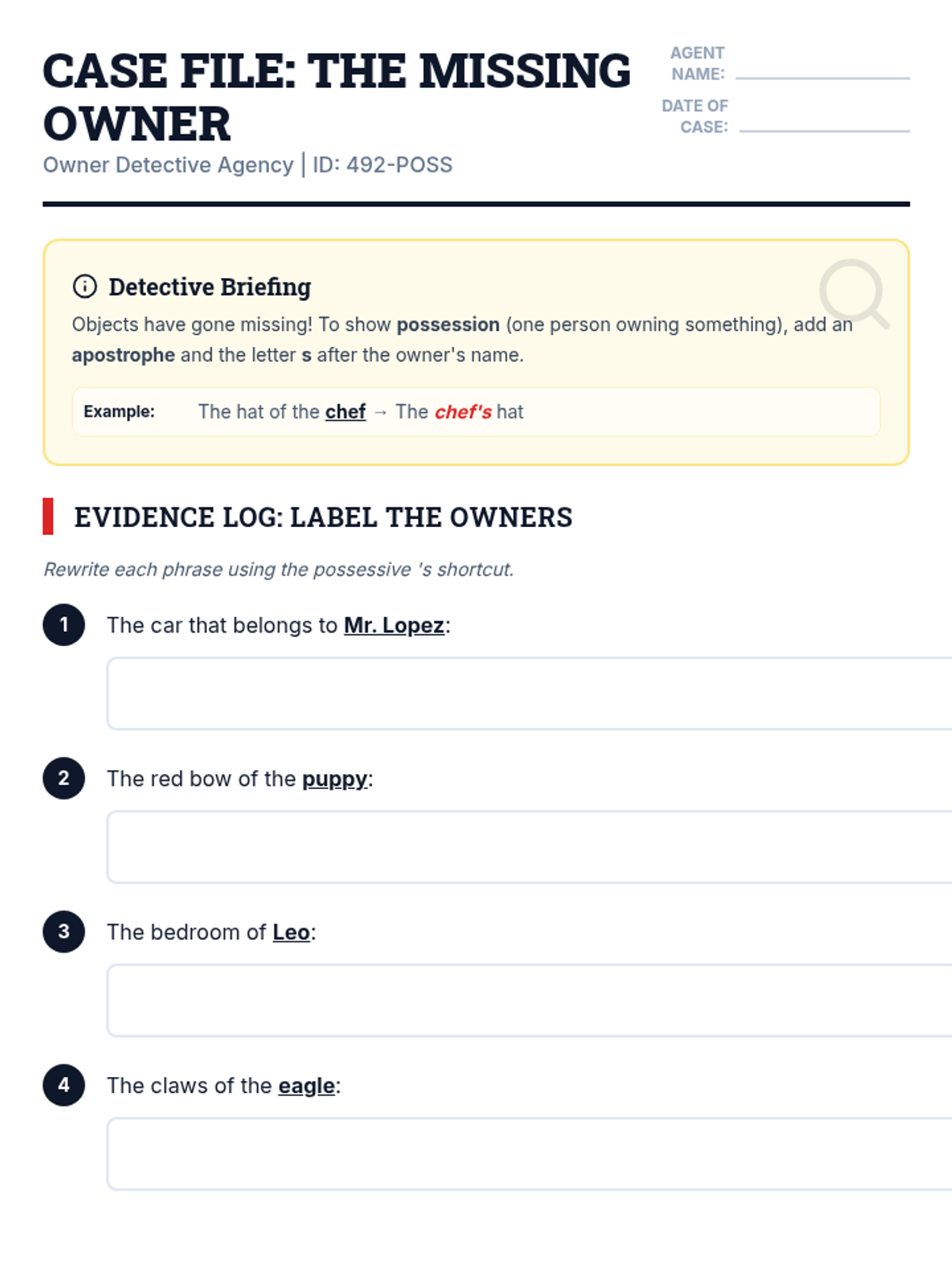
A practice worksheet where students rewrite phrases into possessive forms and correct errors involving plural vs. possessive nouns.
A detective-themed slide deck that teaches students how to use 's to show possession, including common pitfalls like plural vs. possessive nouns.
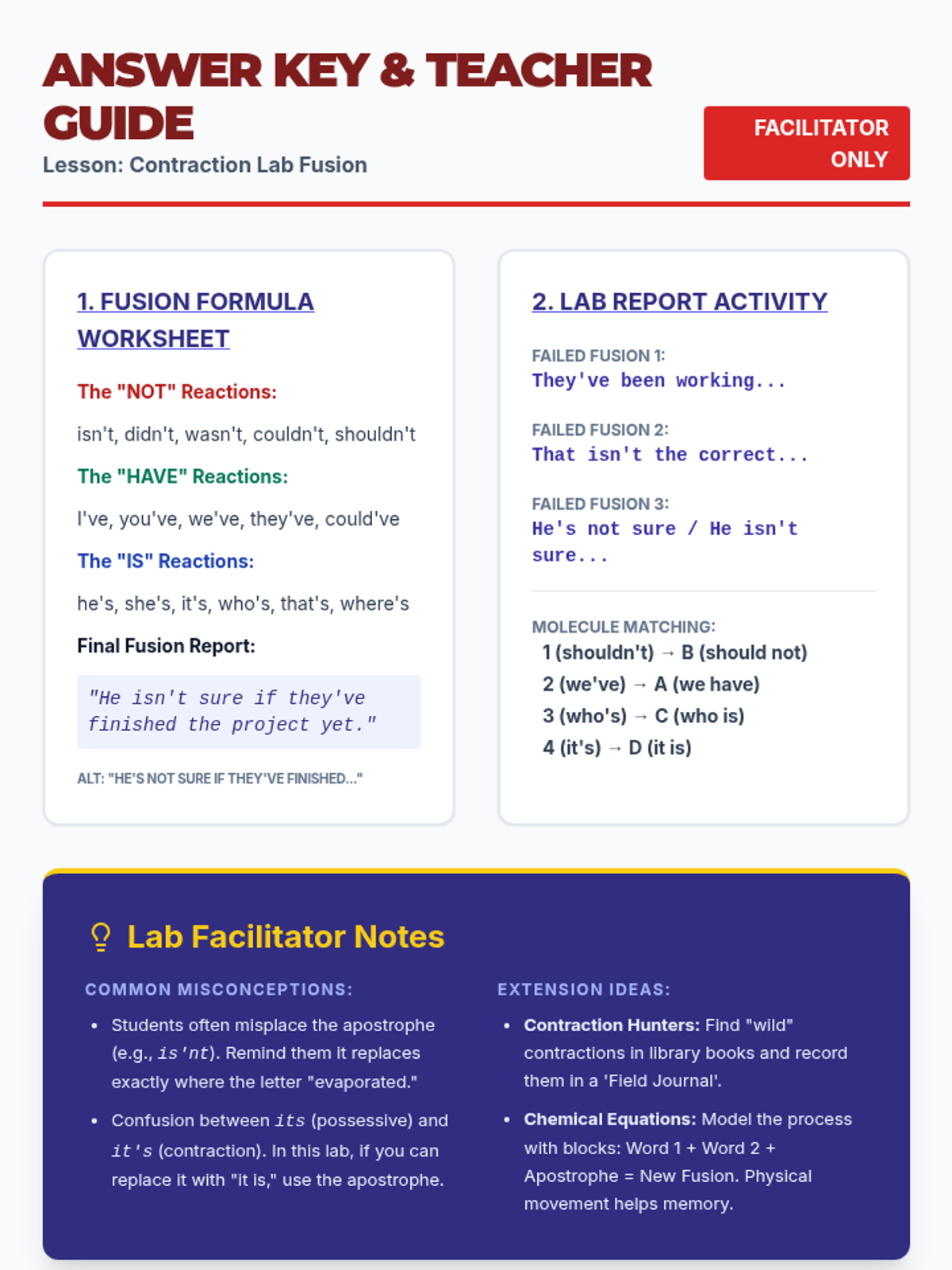
A comprehensive answer key and teacher guidance document for the Contraction Lab Fusion lesson. Includes common misconceptions, extensions, and clear answers with high-contrast text.
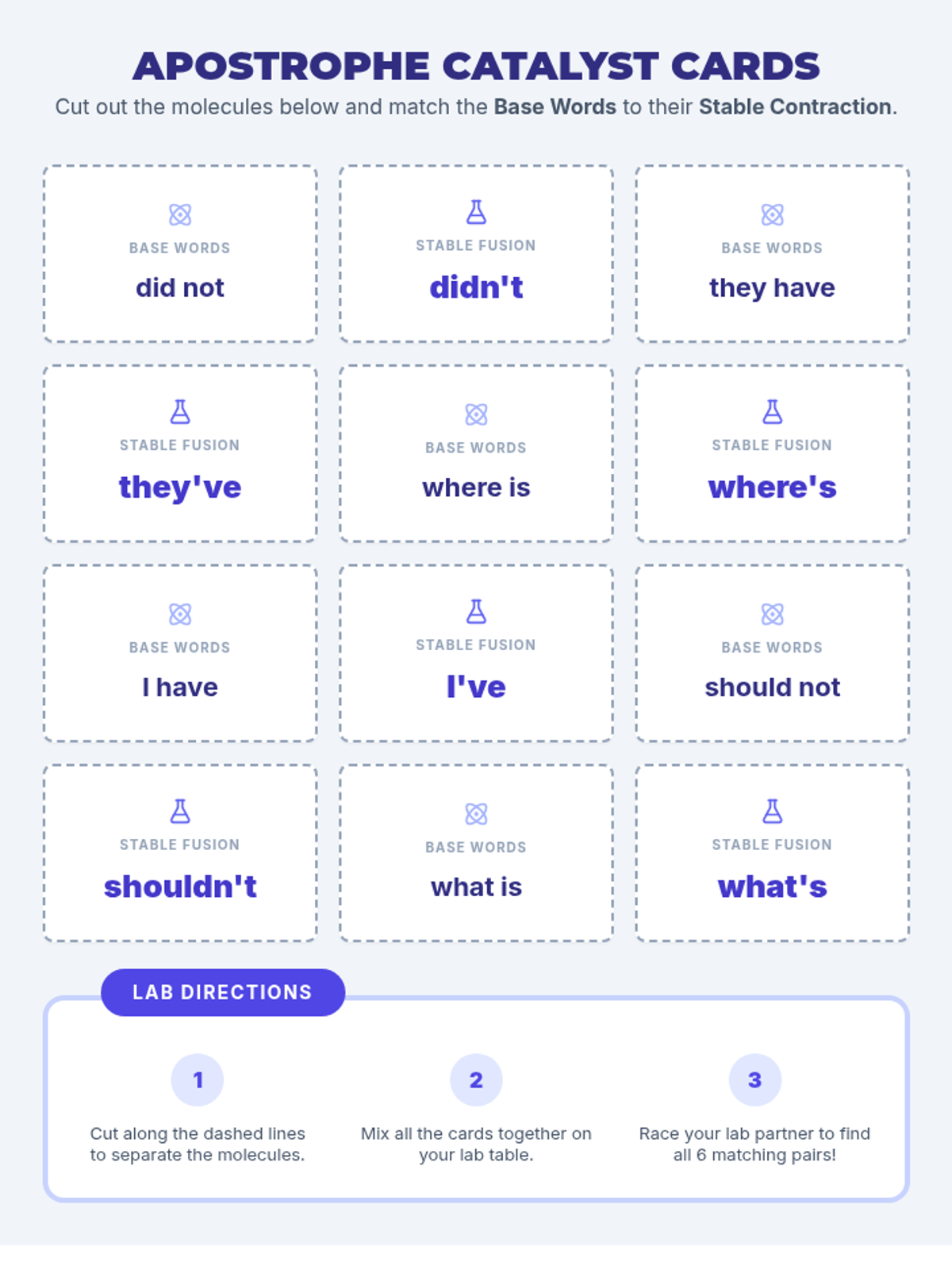
A set of cut-and-match cards for hands-on practice. Students match base word pairs to their corresponding contractions. All cards share uniform backgrounds to ensure the matching task requires reading.
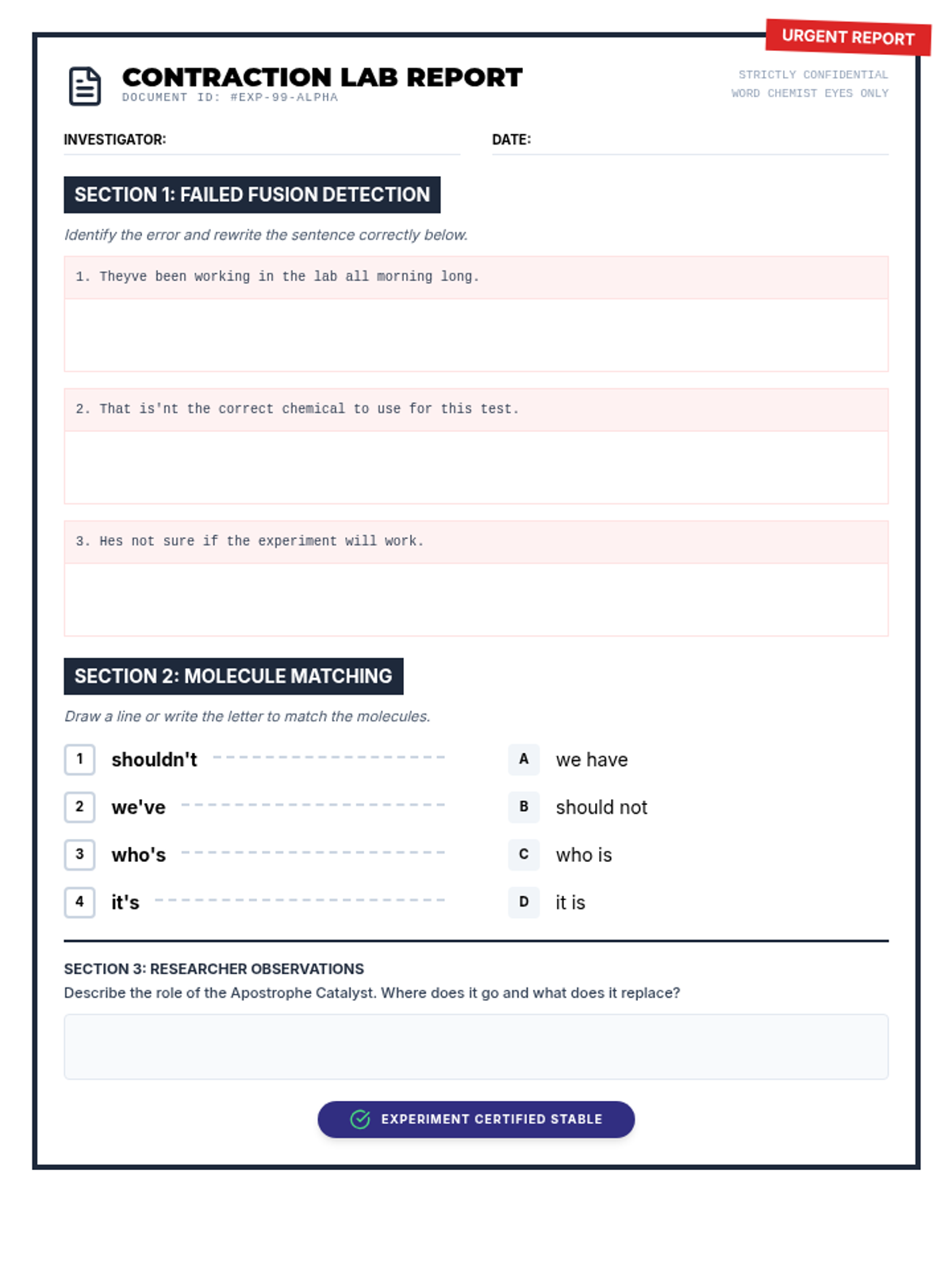
An interactive activity page designed as a scientific lab report. Students identify errors in failed fusions and match contractions to their base words. Sized correctly for single-page printing with optimized student work areas.
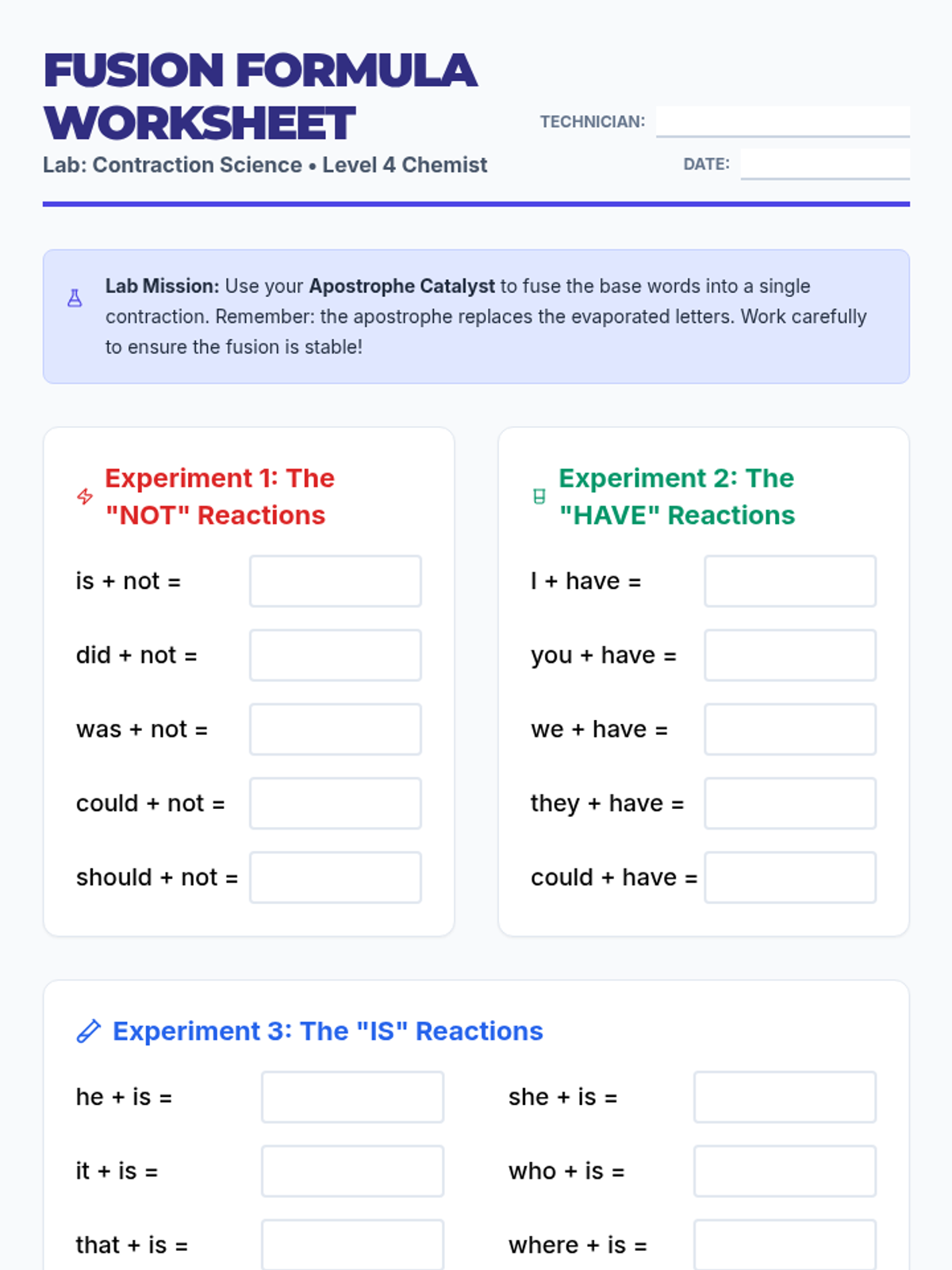
A guided practice worksheet where students practice fusing words using contractions with 'not', 'have', and 'is'. Includes a final sentence rewrite task with optimized legibility for handwriting.
A high-energy, science-themed slide deck that introduces the concept of contractions and provides visual demonstrations of fusing words with 'not', 'have', and 'is'.
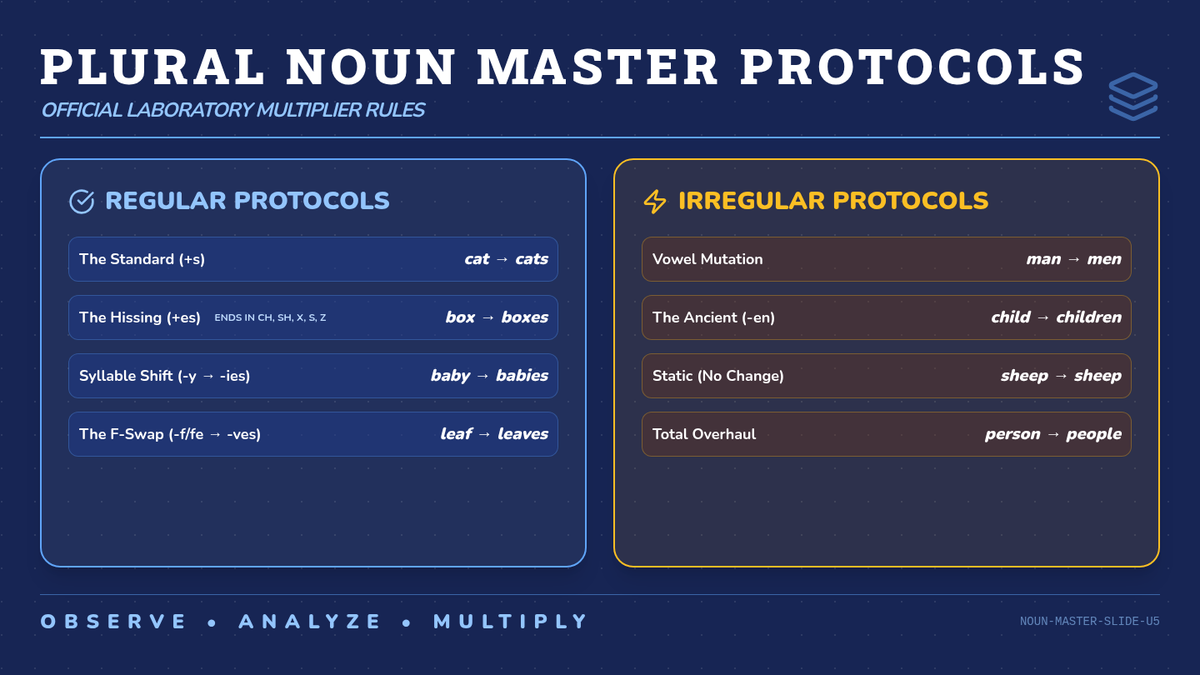
A comprehensive summary slide for plural nouns. It details regular rules (+s, +es, -ies, -ves), irregular protocols (vowel mutations, -en endings), static specimens (no change), and total transformations (people, mice) with clear examples and technical lab styling.
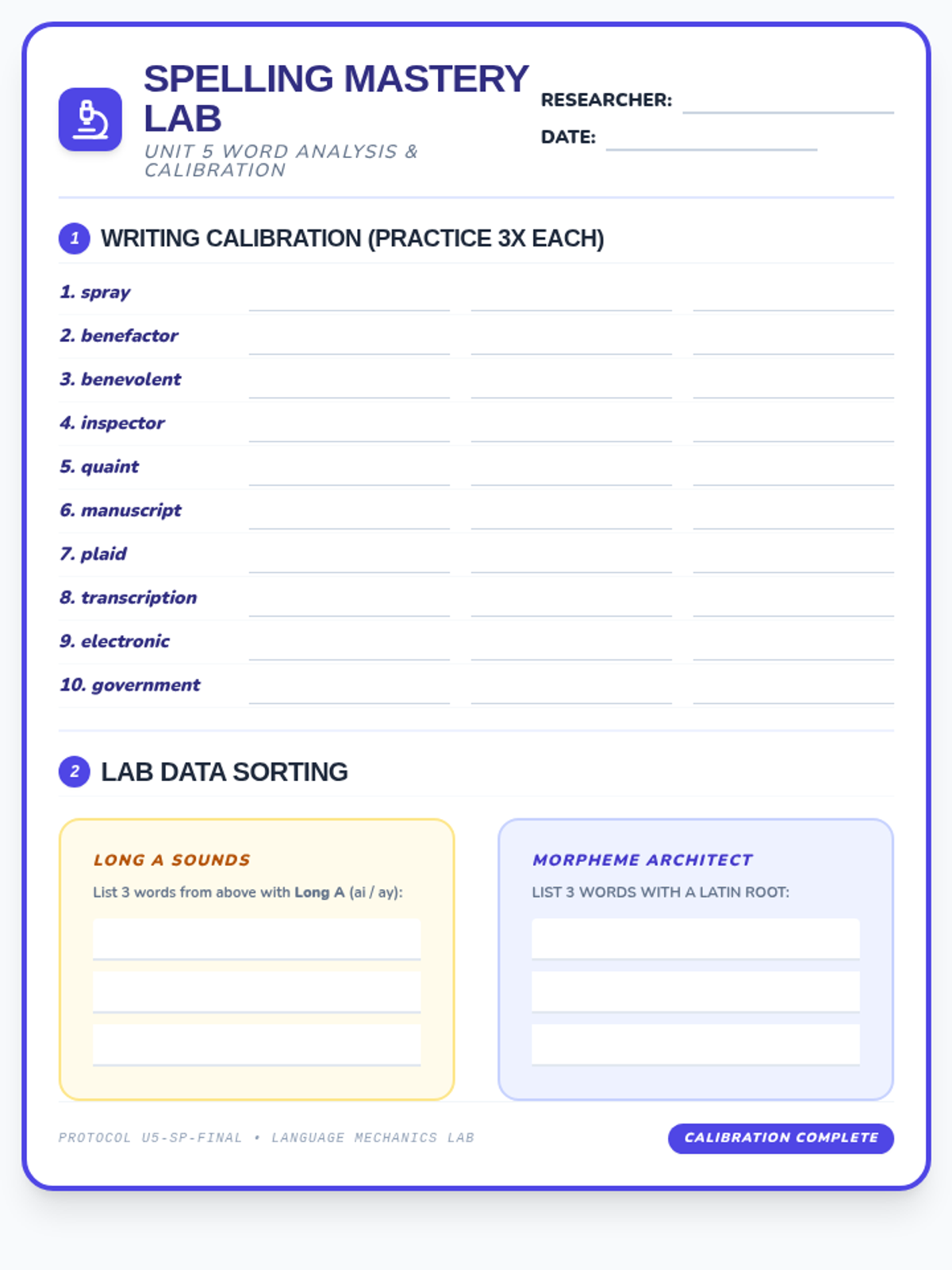
A comprehensive practice worksheet for the Unit 5 spelling words (spray, benefactor, benevolent, etc.). Includes a writing practice section where students write each word three times and a 'Lab Classification' task where students identify words with Long A sounds and Latin roots. Revised for single-page printing. Corrected Broad A/Long A terminology. Expanded classification count. Reduced word list to 15 to ensure ample handwriting height.
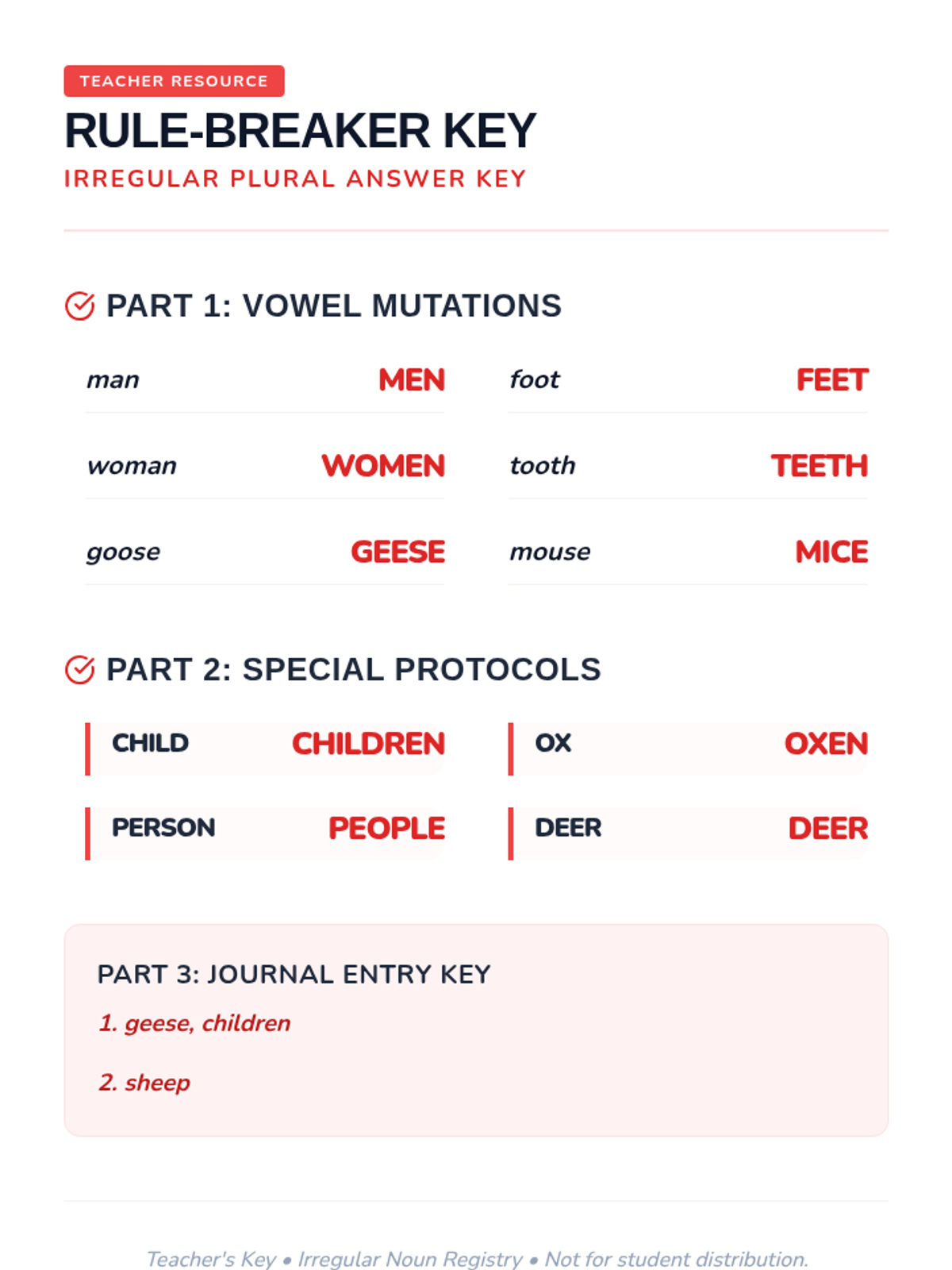
Answer key for the Irregular Noun Registry Worksheet, providing the correct irregular plural forms for various specimens.
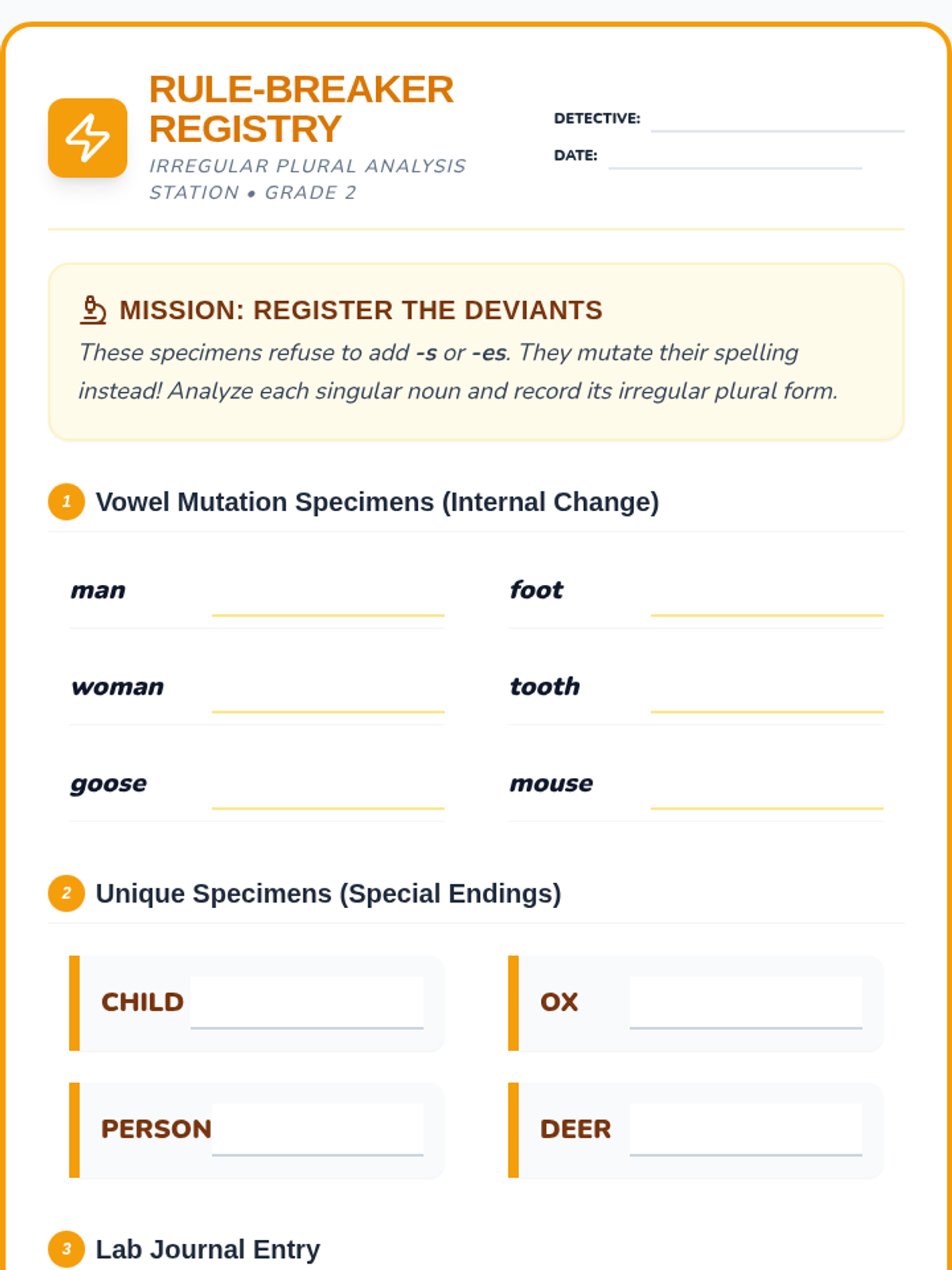
A targeted irregular plural noun worksheet for Grade 2. It focuses on internal vowel changes (man/men, tooth/teeth), the -en suffix (child/children), and nouns with no change (deer/sheep), following the 'Rule-Breaker Roundup' laboratory theme. Revised for layout stability and better student work areas.
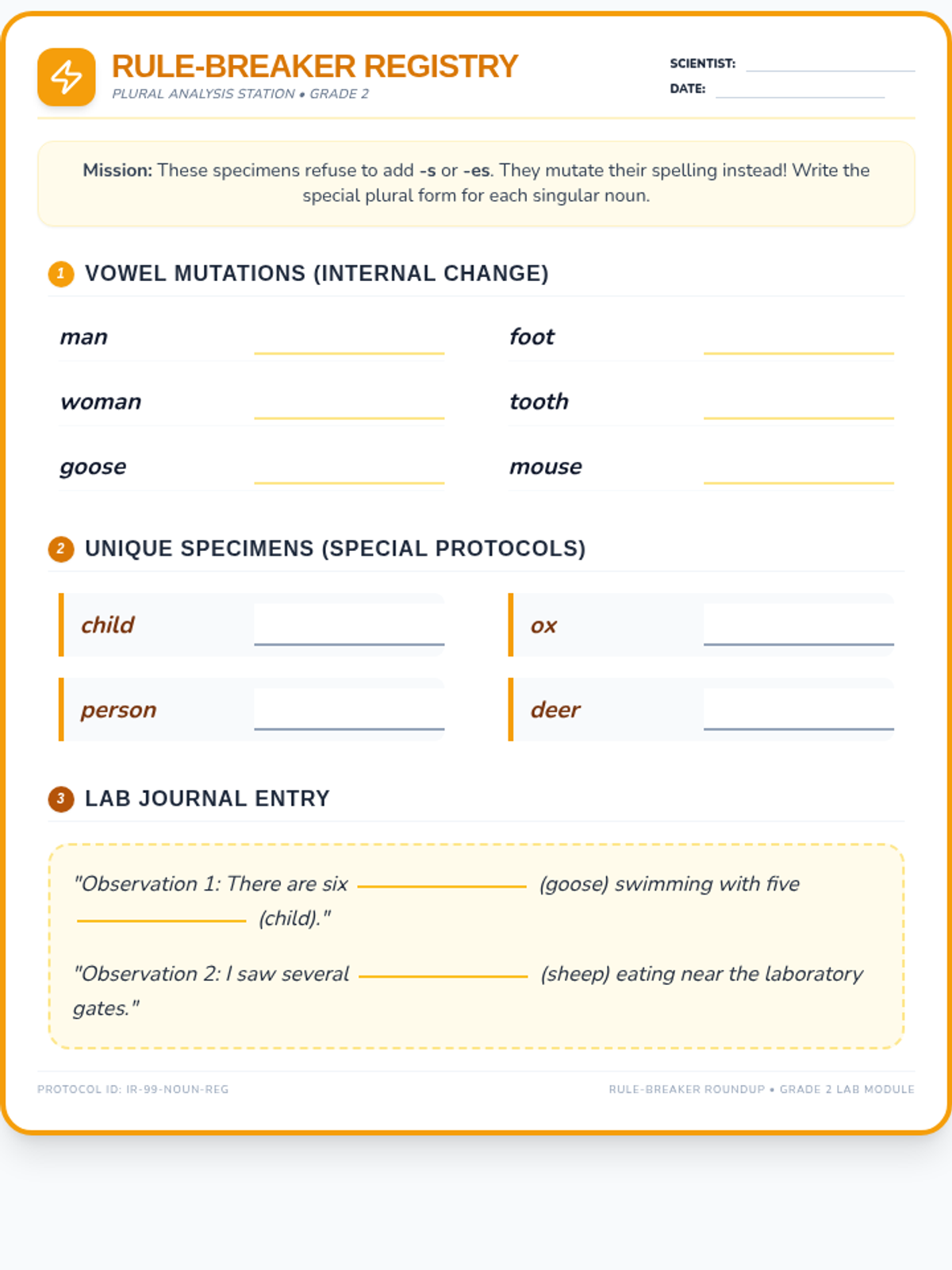
A targeted irregular plural noun worksheet for Grade 2. It focuses on internal vowel changes (man/men, tooth/teeth), the -en suffix (child/children), and nouns with no change (deer/sheep), following the 'Rule-Breaker Roundup' laboratory theme.
A deep-dive slide deck focusing exclusively on irregular plural nouns. It covers internal vowel changes (man/men), the -en ending (child/children), nouns with no change (sheep/fish), and total transformations (mouse/mice), all within a technical 'Rule-Breaker Roundup' lab theme.
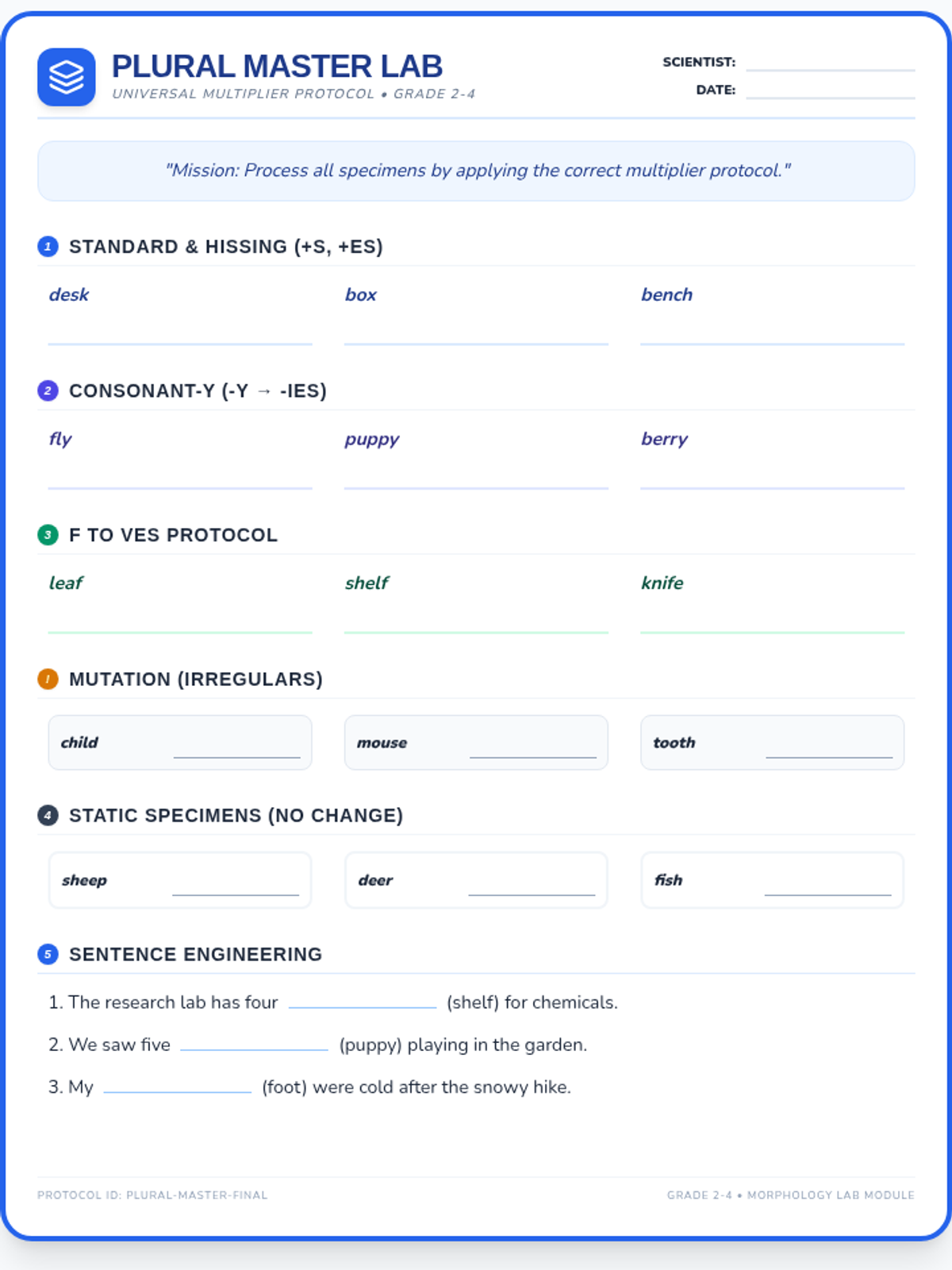
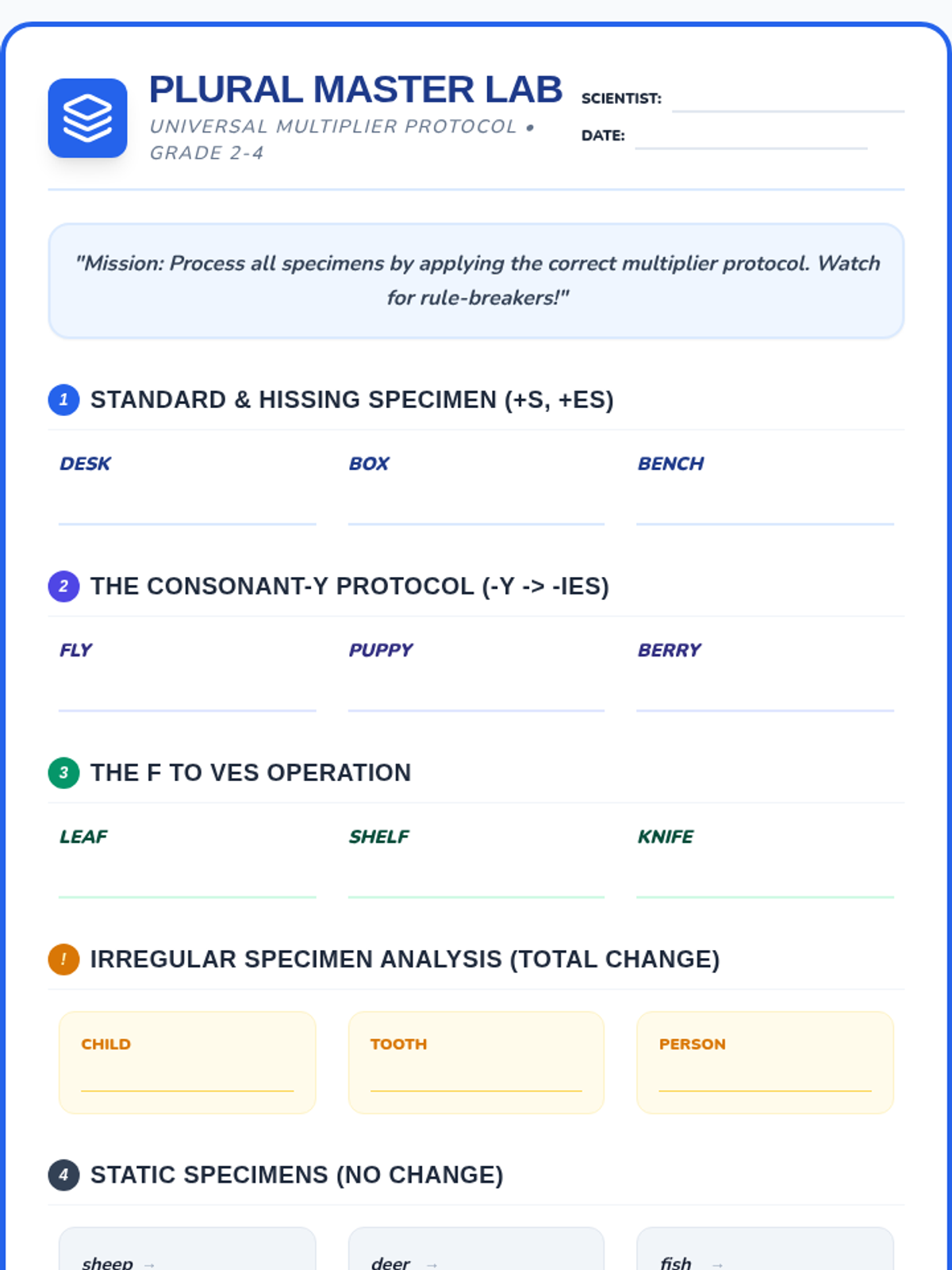
A comprehensive plural noun mastery worksheet covering regular plurals (+s, +es), consonant-y endings (-ies), f/fe endings (-ves), irregular nouns (internal change), and no-change nouns. Designed with a consistent laboratory theme and optimized for single-page use. Revised for better page break management and spacing.
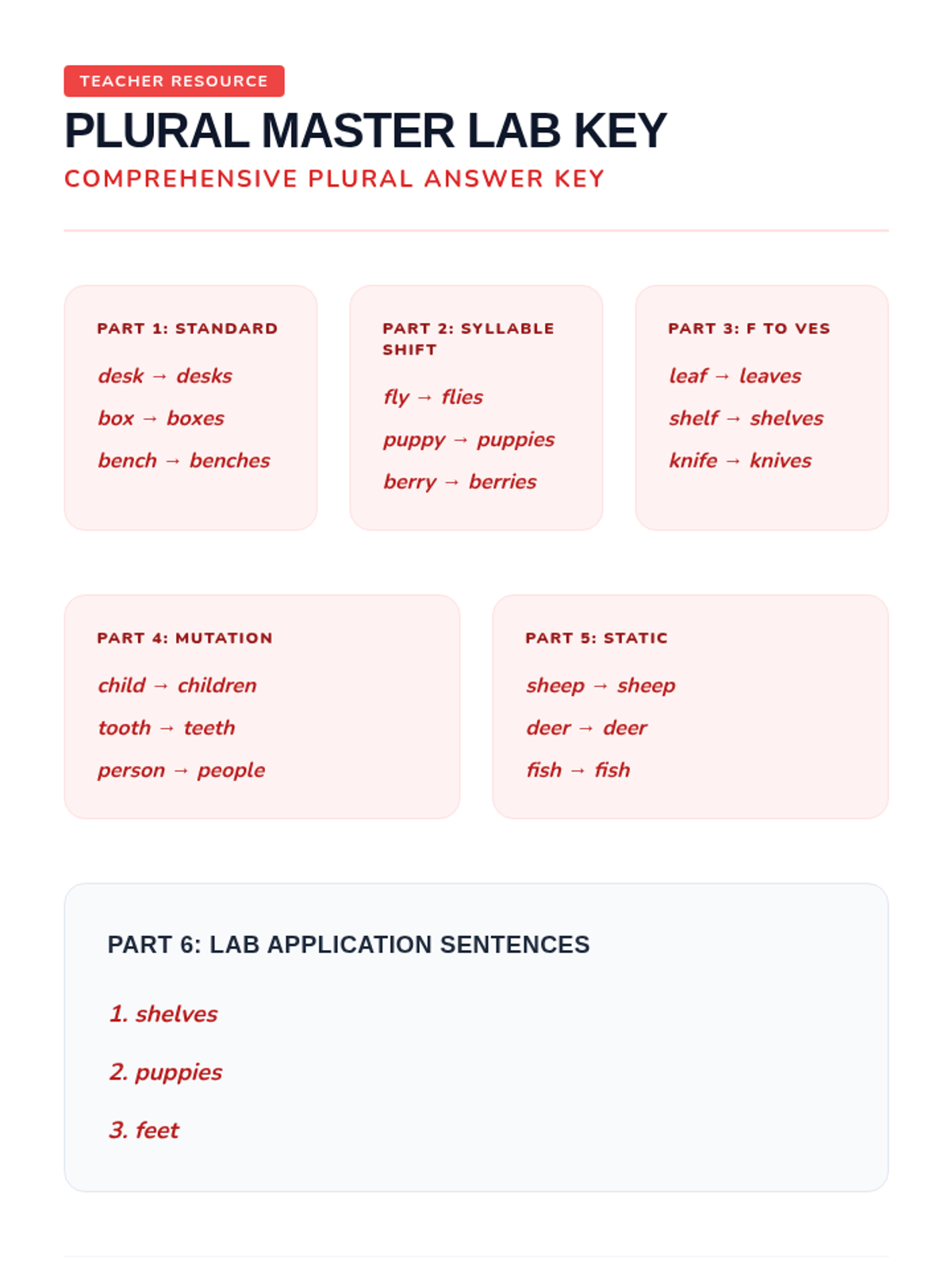
Answer key for the Plural Master Lab Worksheet, providing correctly formed plural nouns for regular, y-ending, f-ending, irregular, and no-change specimens.
A comprehensive plural noun mastery worksheet covering regular plurals (+s, +es), consonant-y endings (-ies), f/fe endings (-ves), irregular nouns (internal change), and no-change nouns. Designed with a consistent laboratory theme and optimized for single-page use.
Instructional slides for opinion essay writing, emphasizing the use of conjunctions (because, although) and the structure of a multi-paragraph argument including counter-arguments.
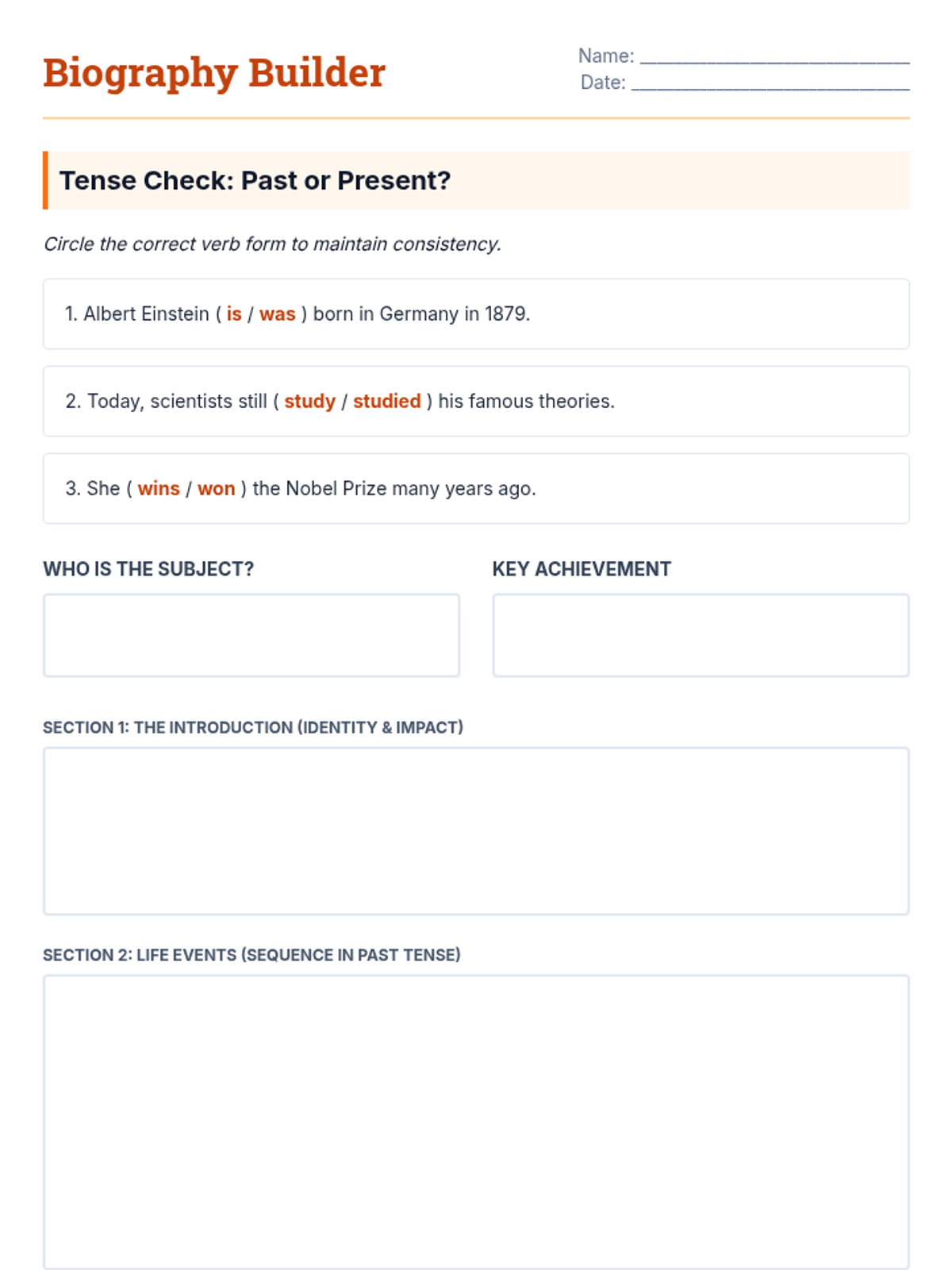
A student worksheet for biography writing, including a tense-selection warm-up activity and a three-section drafting organizer (Introduction, Life Events, Legacy).
Instructional slides for biography writing, focusing on tense consistency (past vs. present) and logical sequencing of life events for historical figures.
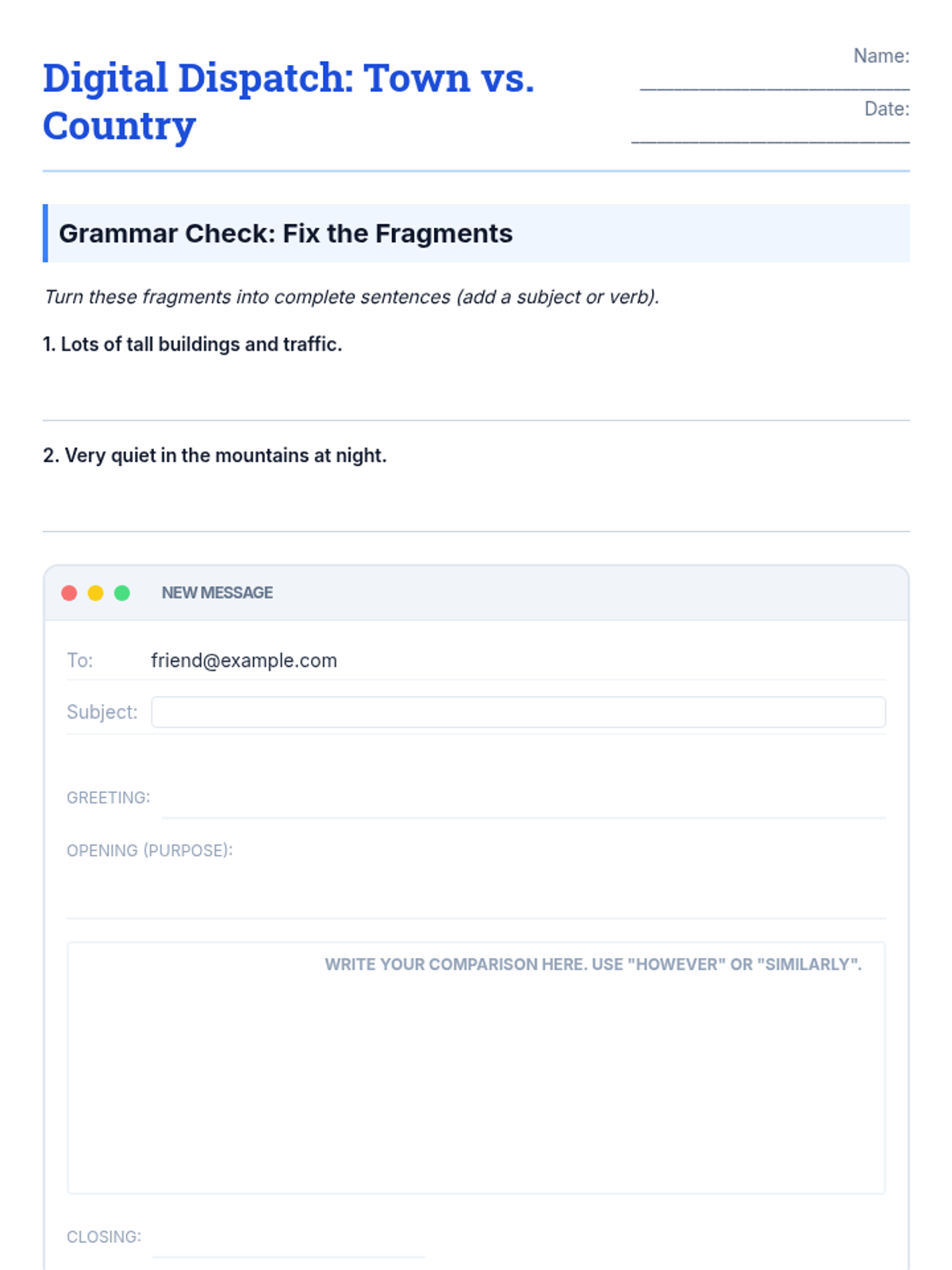
A student worksheet for writing an email comparing urban and rural life. Features a grammar activity to correct sentence fragments and a structured email template with comparison-word prompts.
Instructional slides for email writing, focusing on the comparison between urban and rural living, grammar instruction on sentence fragments, and transitional words for comparison.
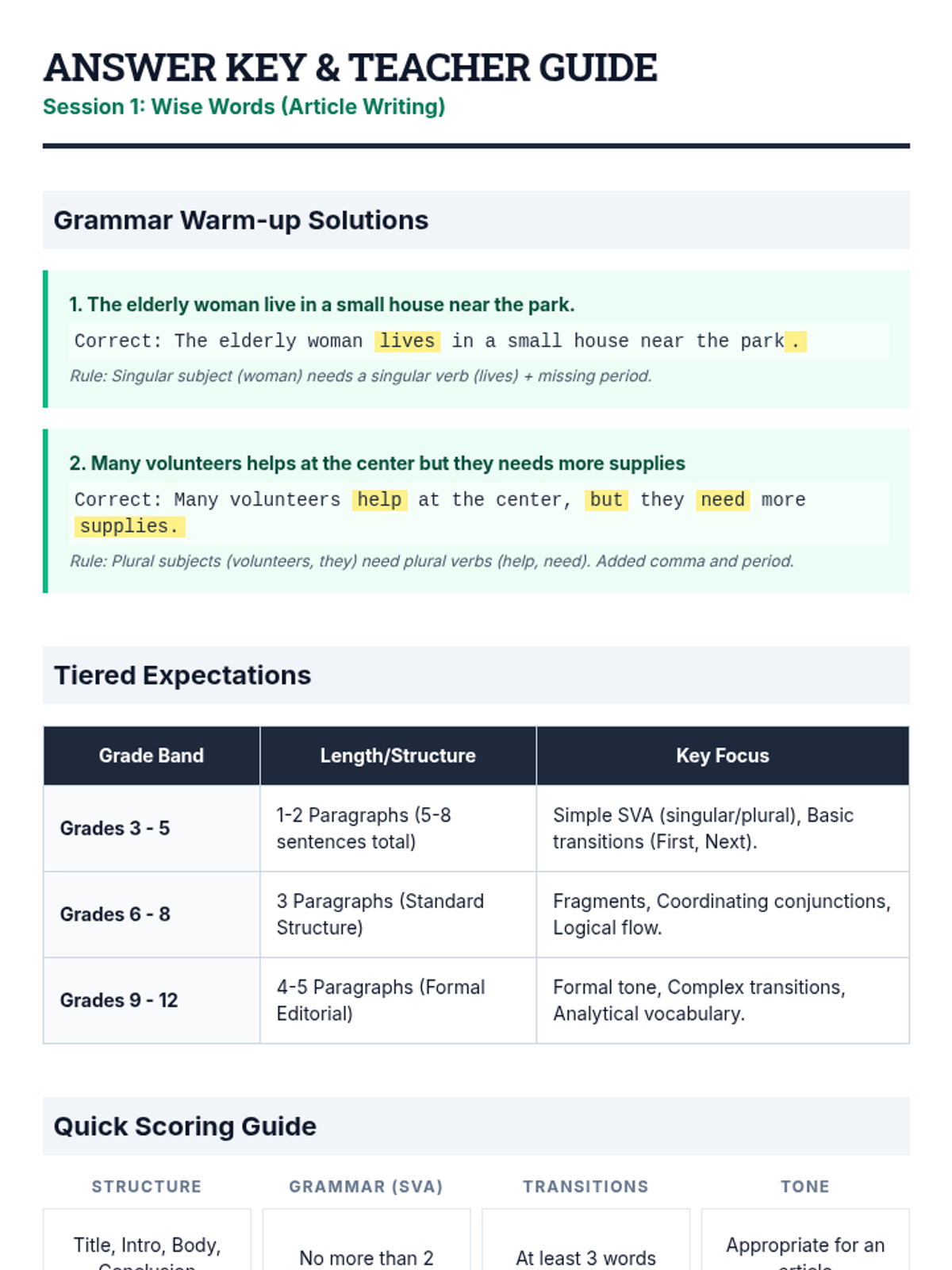
Teacher reference guide for Session 1, containing grammar solutions, tiered expectations for different grade bands, and a quick scoring rubric for the article writing task.
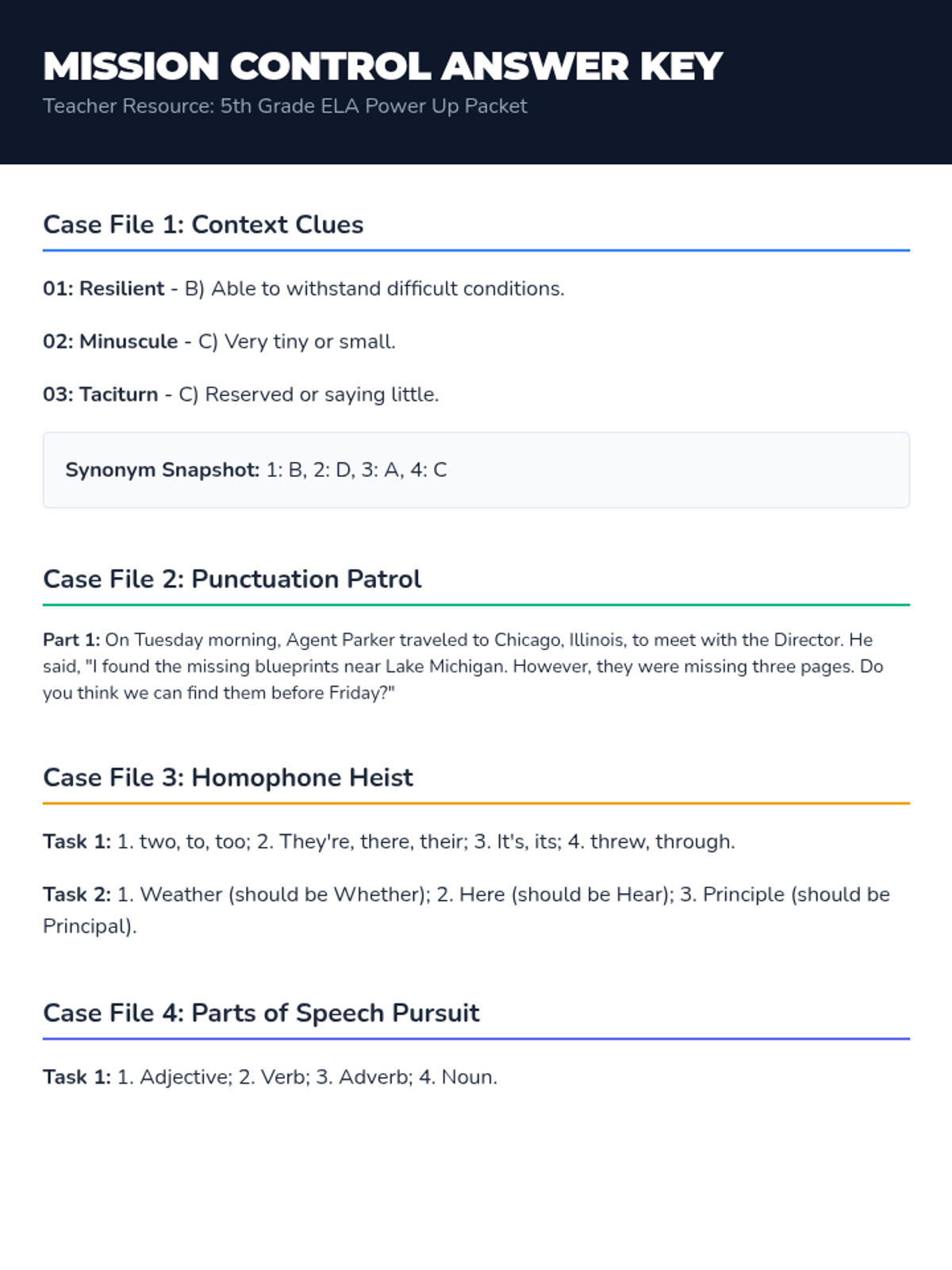
An answer key for teachers to grade the 5th Grade ELA review packet, providing solutions for context clues, mechanics, homophones, and grammar.
An introductory slide deck for the 5th Grade ELA review packet, introducing concepts of context clues, homophones, and mechanics through a detective agency theme.
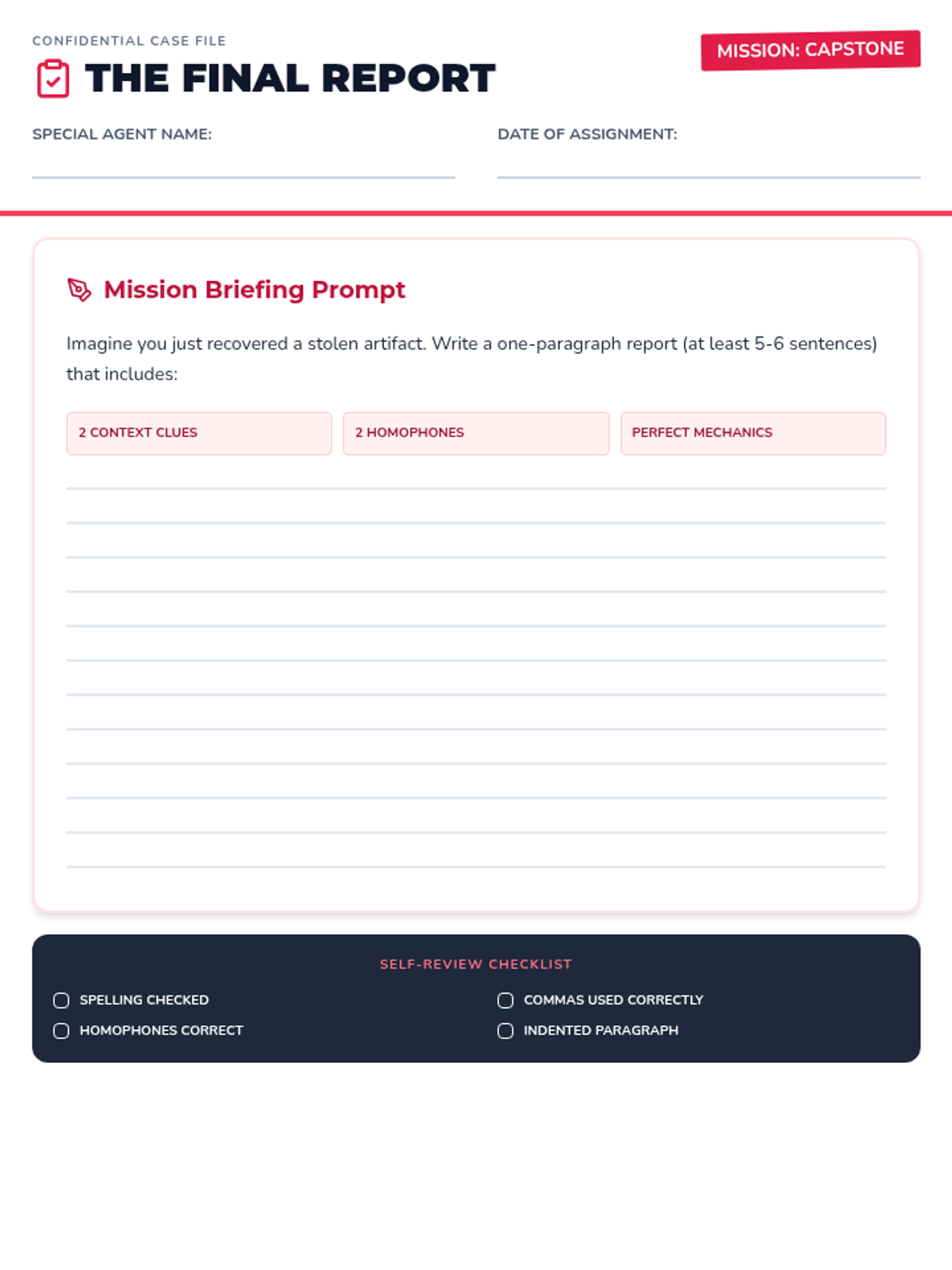
A final writing assessment for the ELA review packet where students must apply context clues, vocabulary, homophones, and grammar skills in a short mission report.
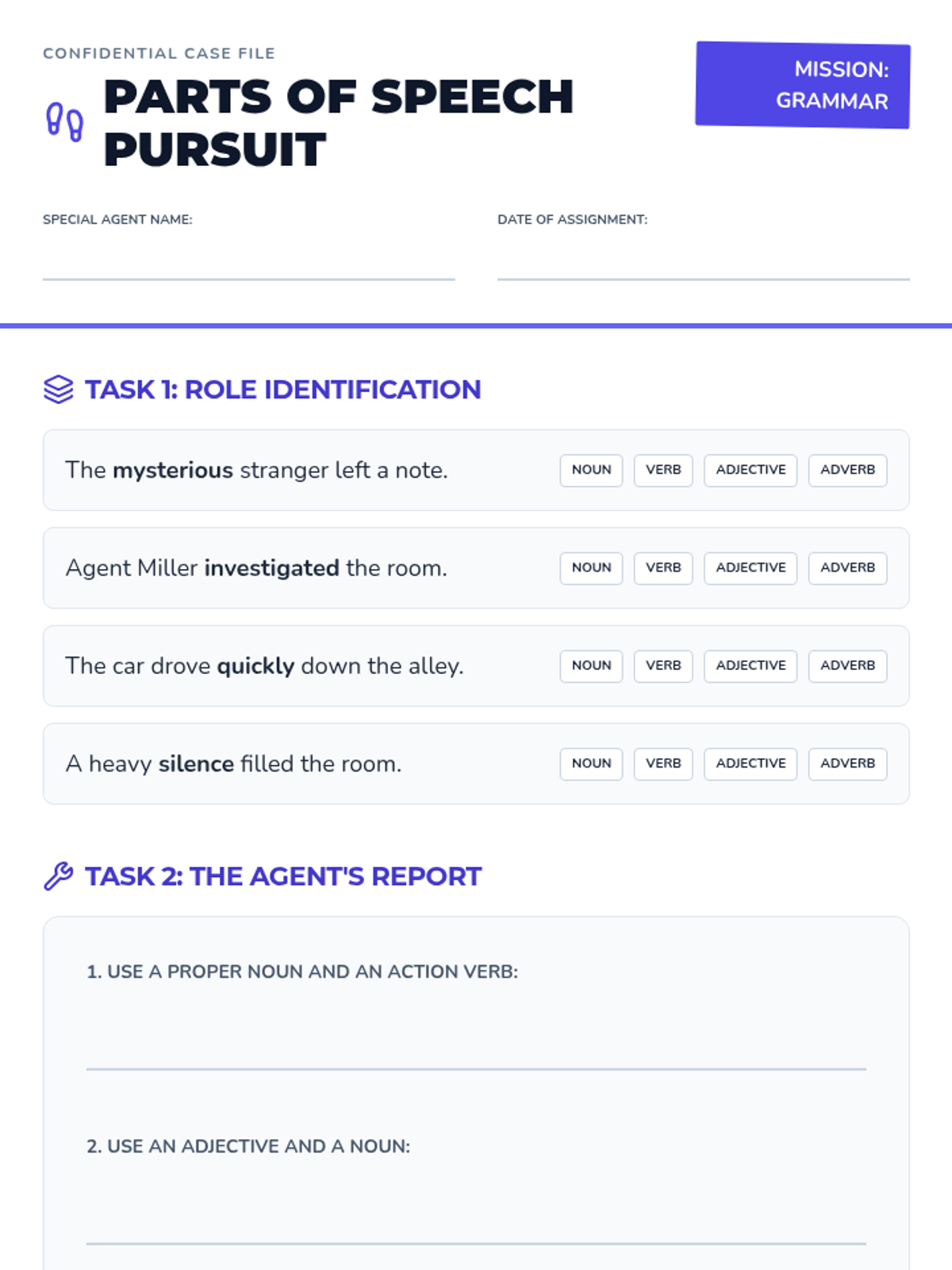
A parts of speech worksheet for 5th grade students to identify and use nouns, verbs, adjectives, and adverbs in a detective agency context.
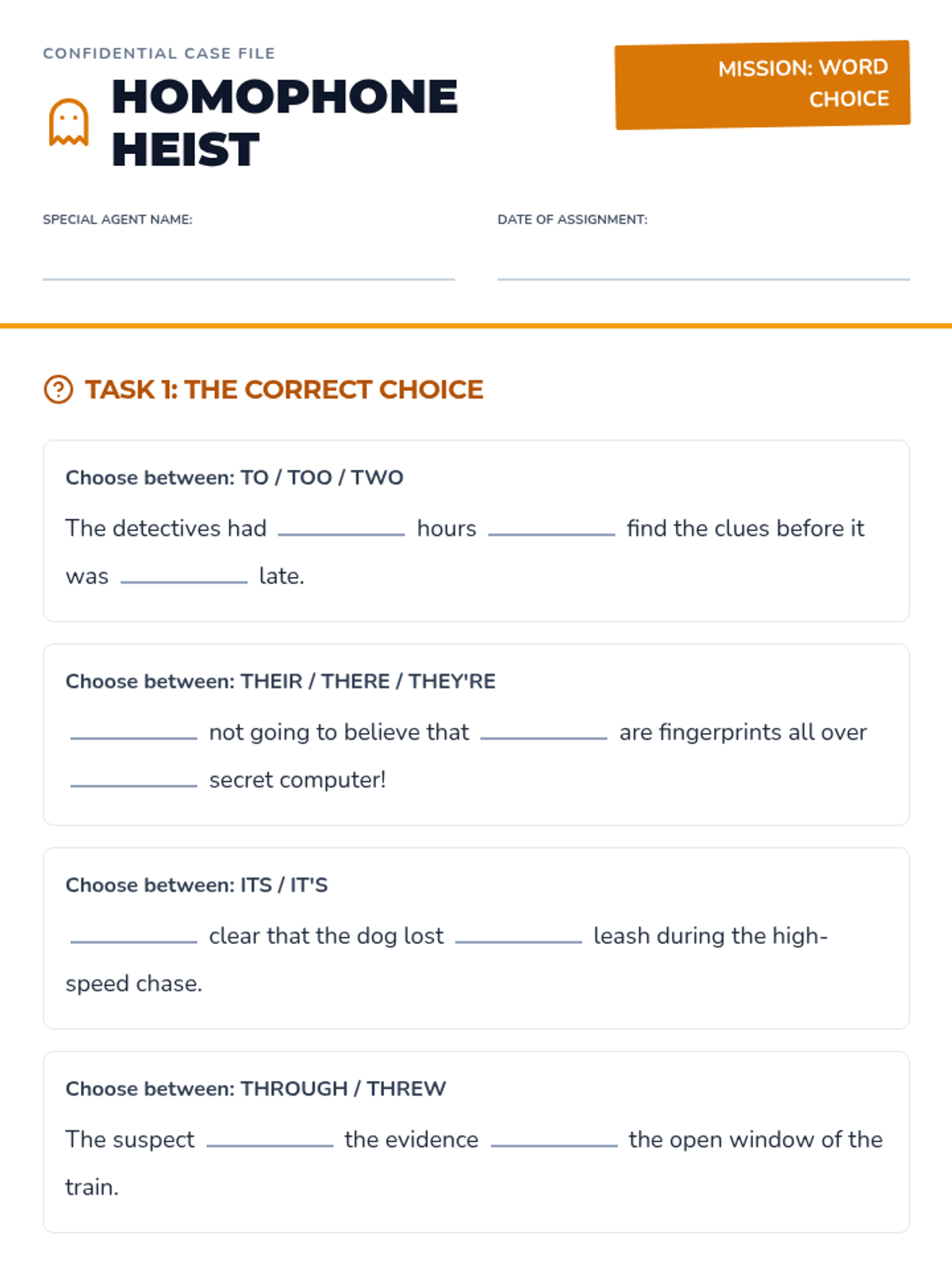
A homophone review worksheet where 5th graders must choose the correct spelling of commonly confused words to solve a detective-themed mystery.
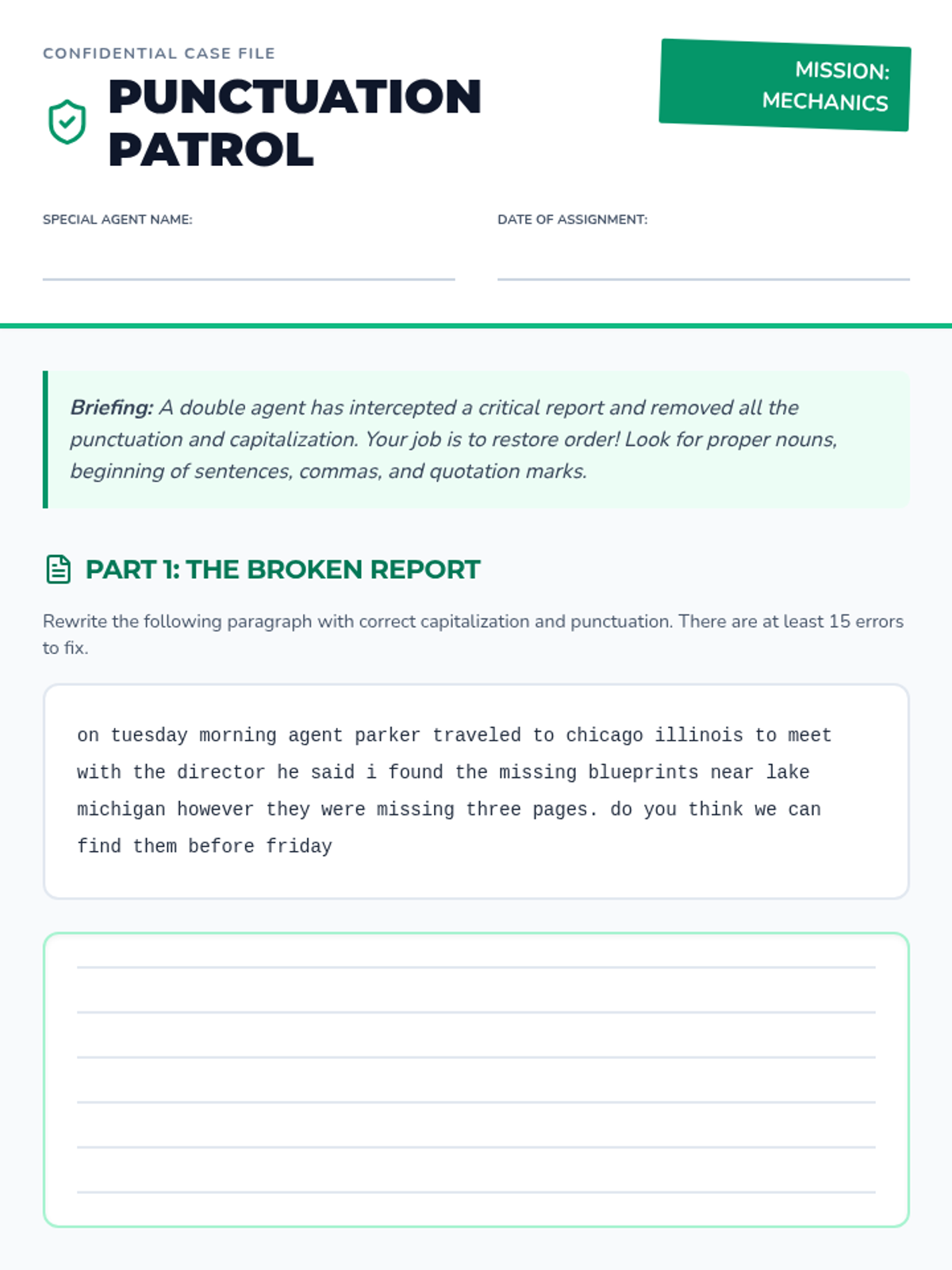
A 5th-grade mechanics worksheet focusing on fixing capitalization errors and correctly placing commas and other punctuation in a detective-themed context.
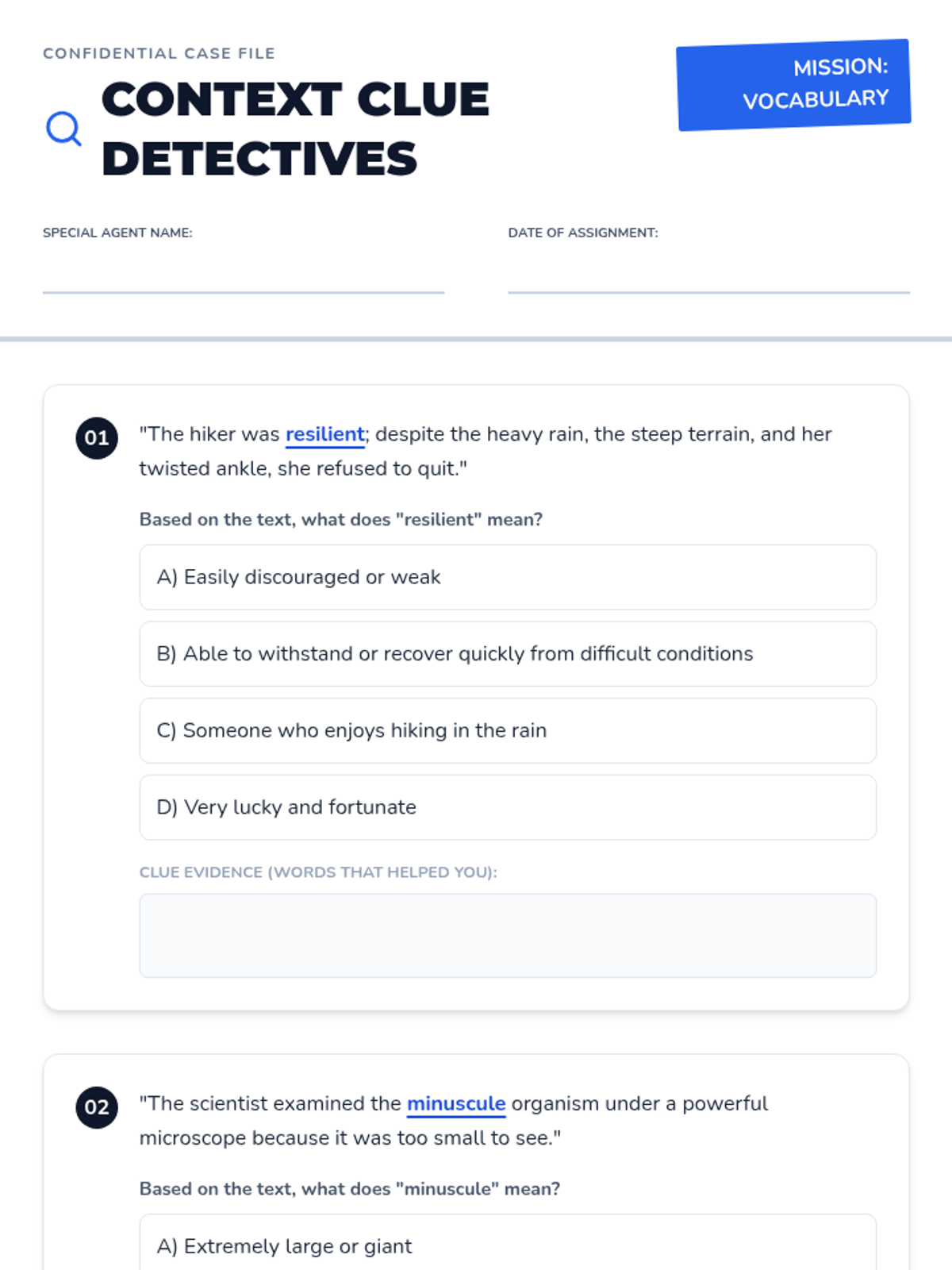
A detective-themed worksheet focusing on using context clues to determine the meaning of unfamiliar 5th-grade vocabulary words.
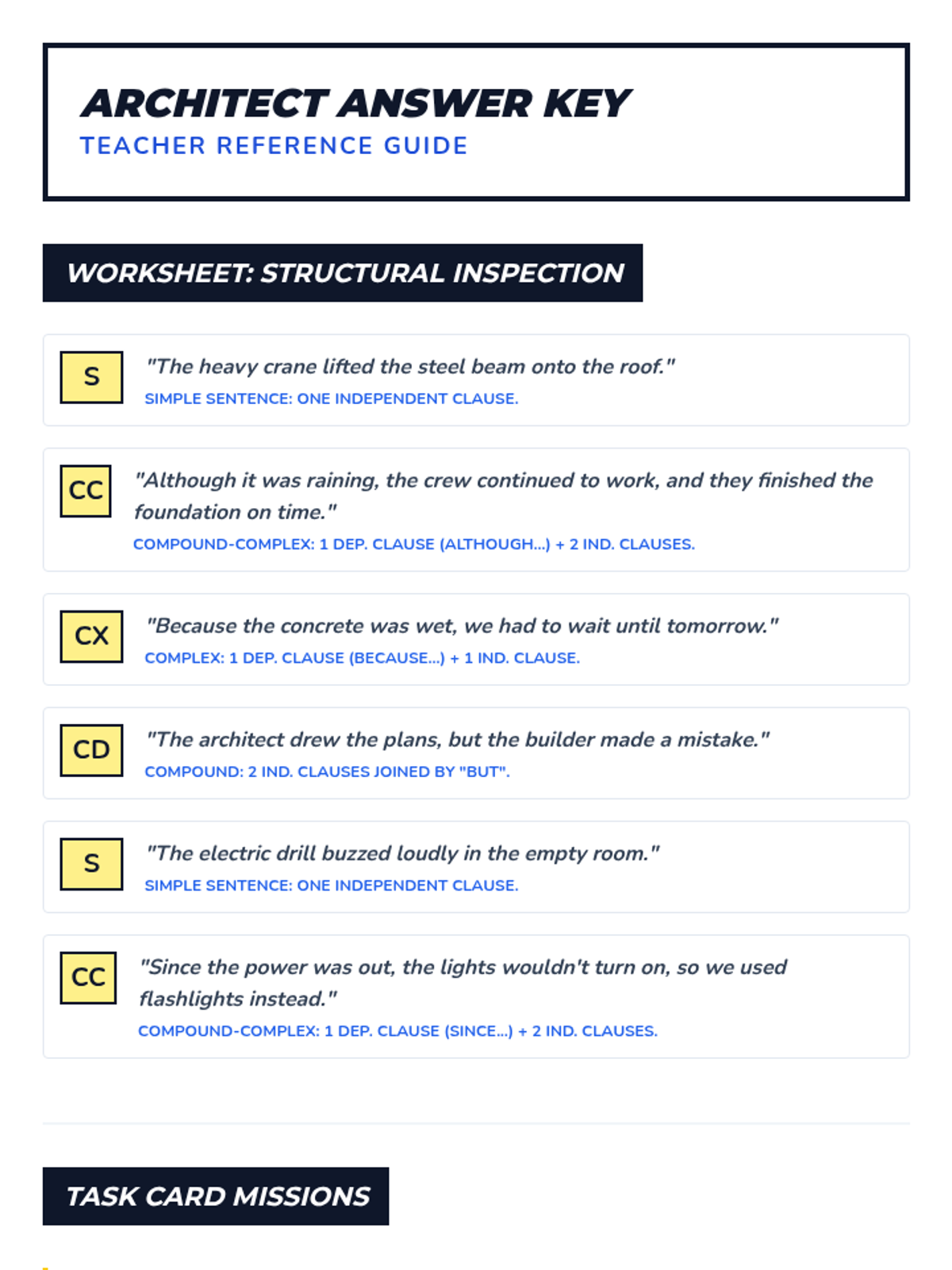
A comprehensive answer key for both the Sentence Blueprints worksheet and the Structure Squad task cards, designed for easy teacher reference. Updated with improved contrast and layout.
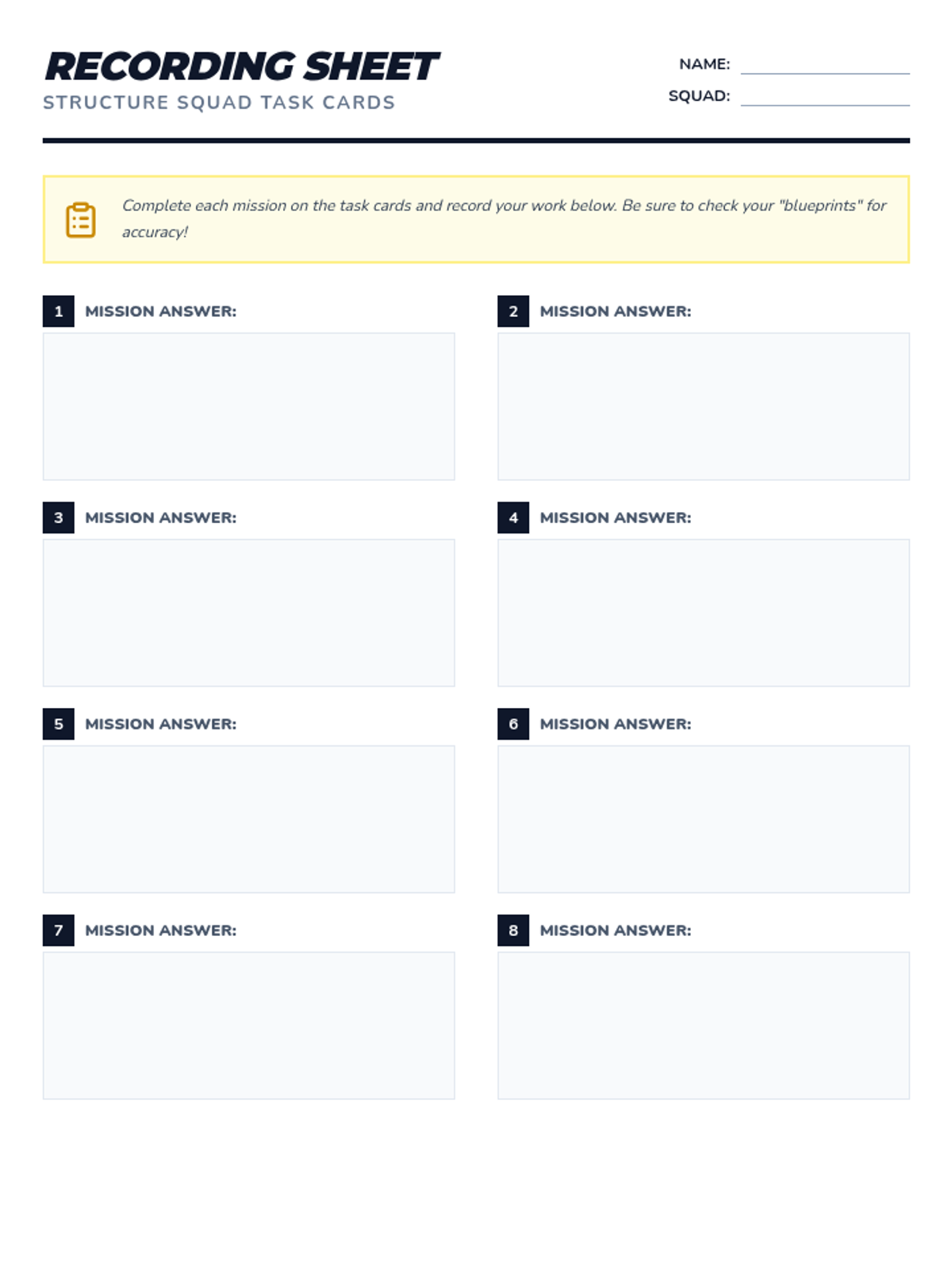
A student recording sheet for the Structure Squad task cards, providing organized spaces for students to write their answers to each mission. Optimized to fit on a single page.
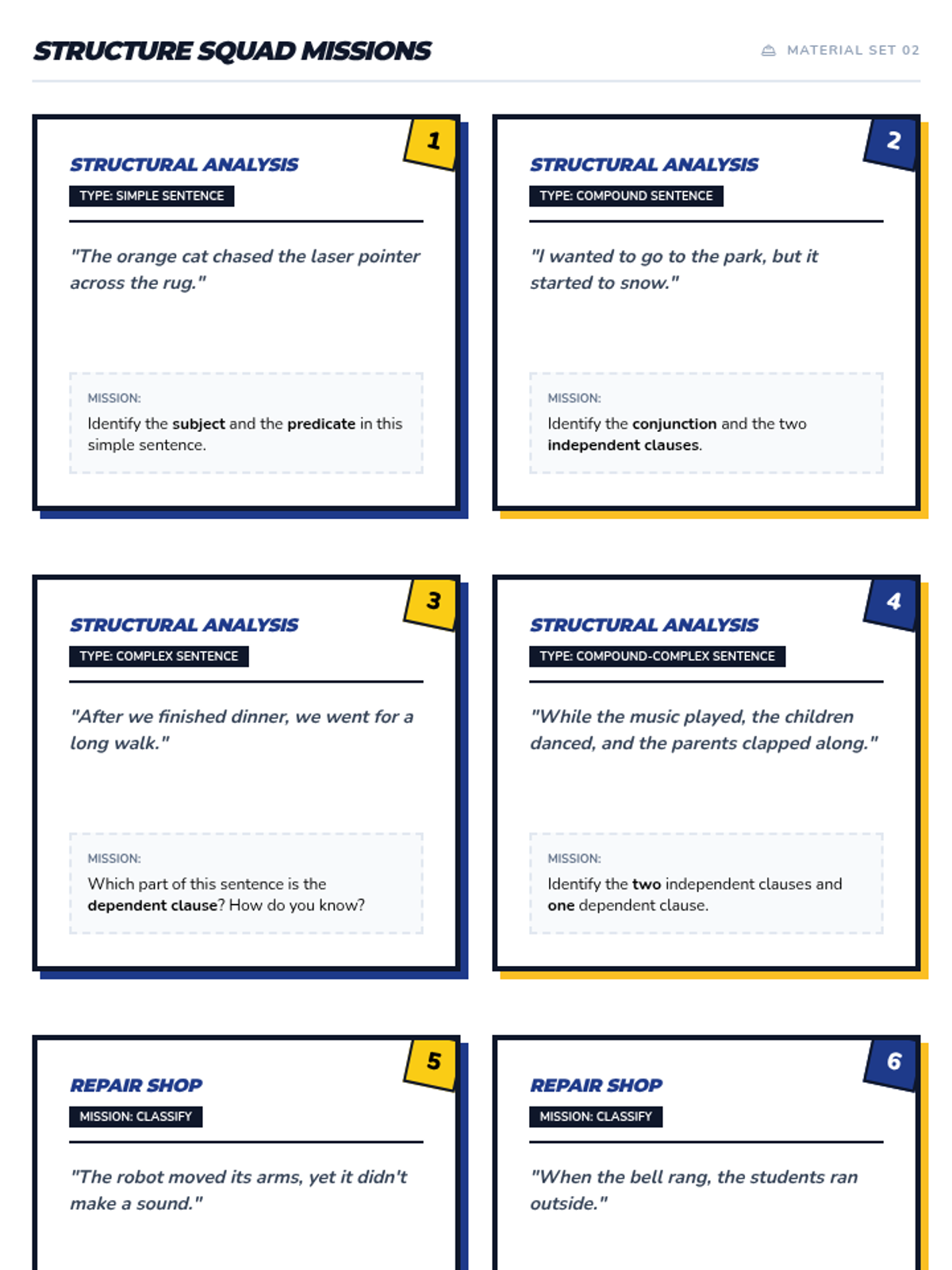
Eight construction-themed task cards for small group review of sentence structures. Each card challenges students to analyze, classify, or build simple, compound, complex, and compound-complex sentences. Features fixed page breaks and standardized terminology.
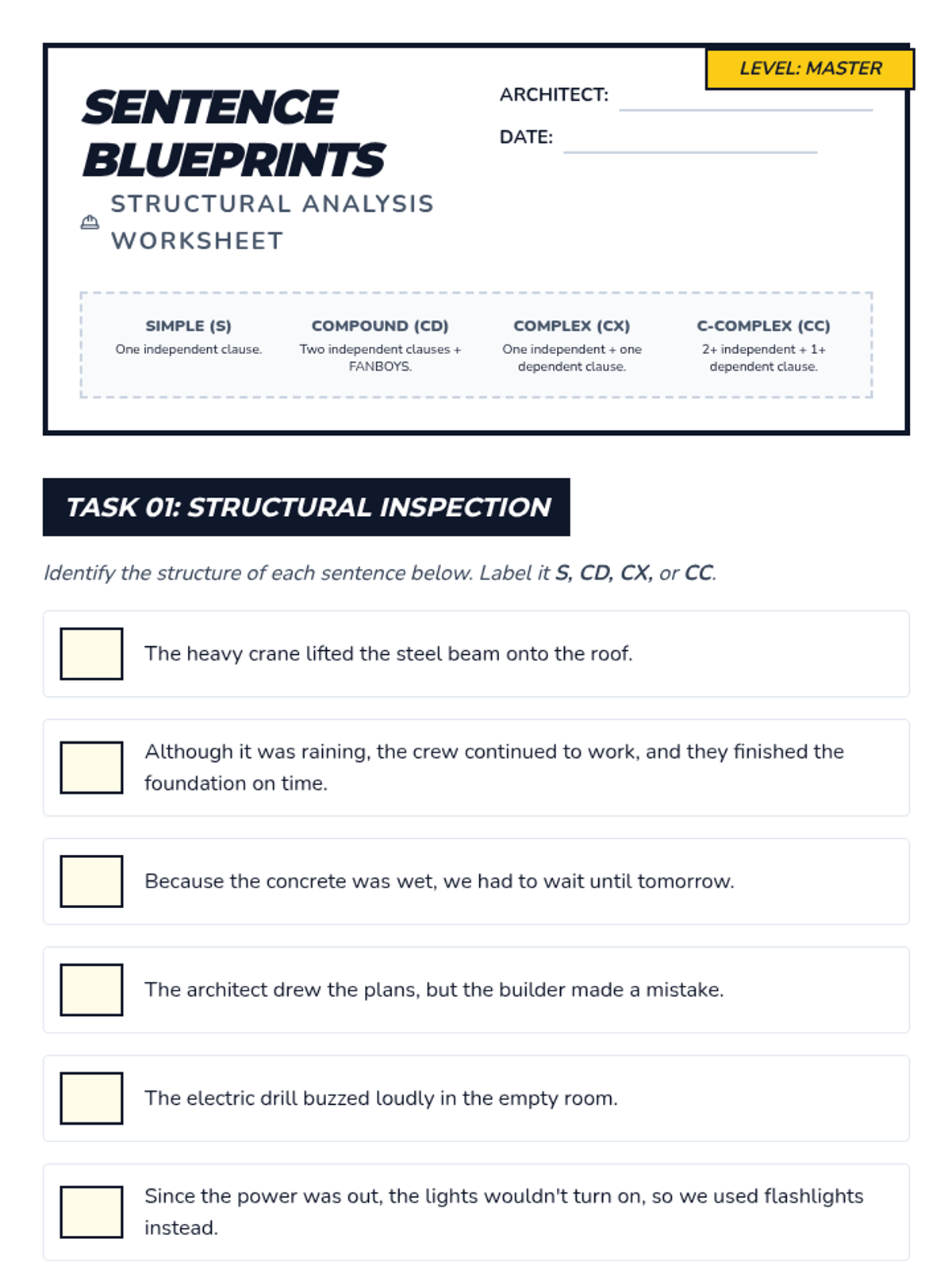
A construction-themed worksheet for 4th graders to practice identifying and writing simple, compound, complex, and compound-complex sentences. Features a 'Sentence Blueprints' motif with clear identification tasks and creative building prompts.
A complete 11-page printable grammar packet including a preppy cover, two reference pages, and eight skill-focused practice pages.
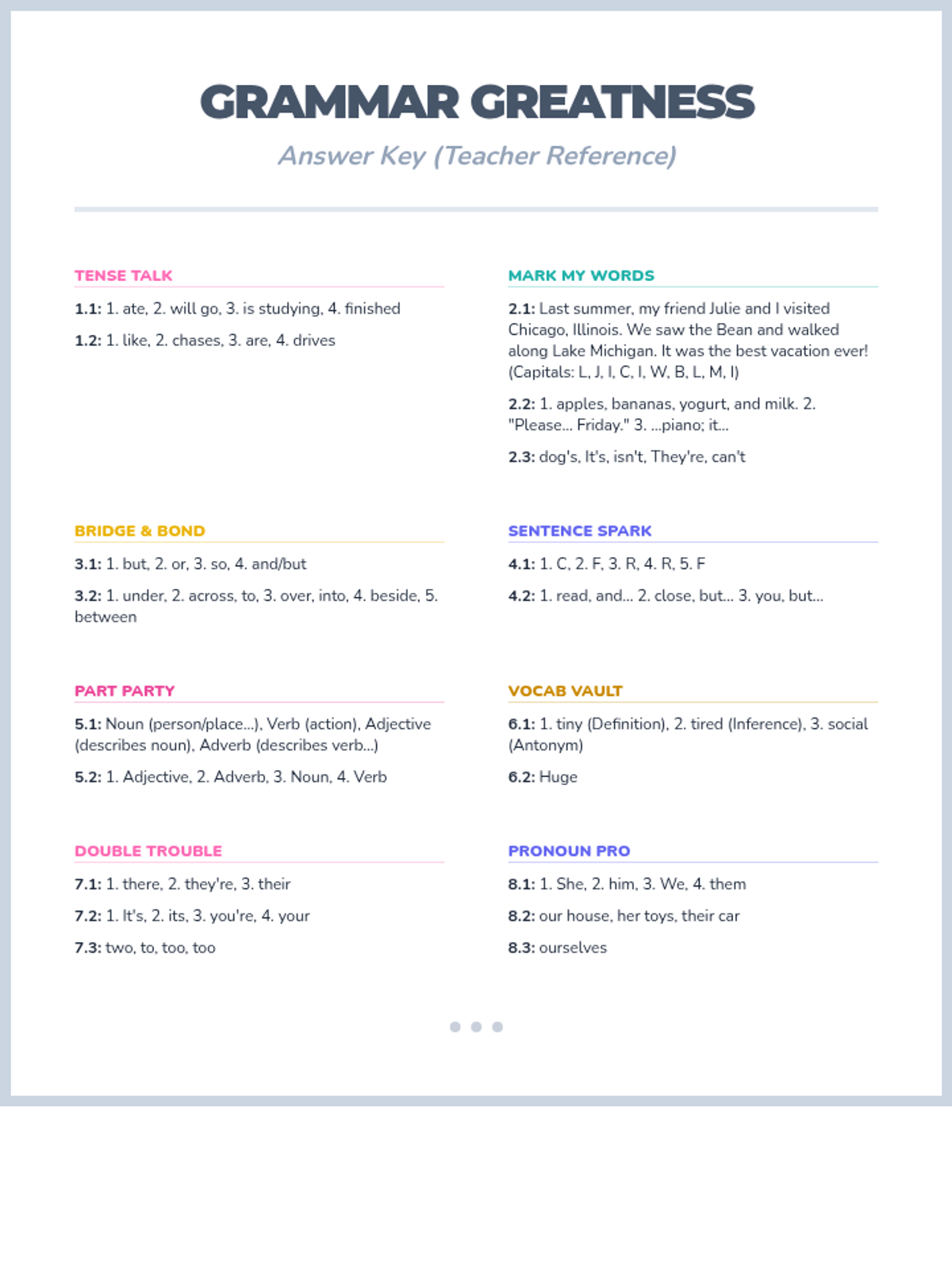
A condensed answer key for all practice sheets in the Grammar Greatness packet.
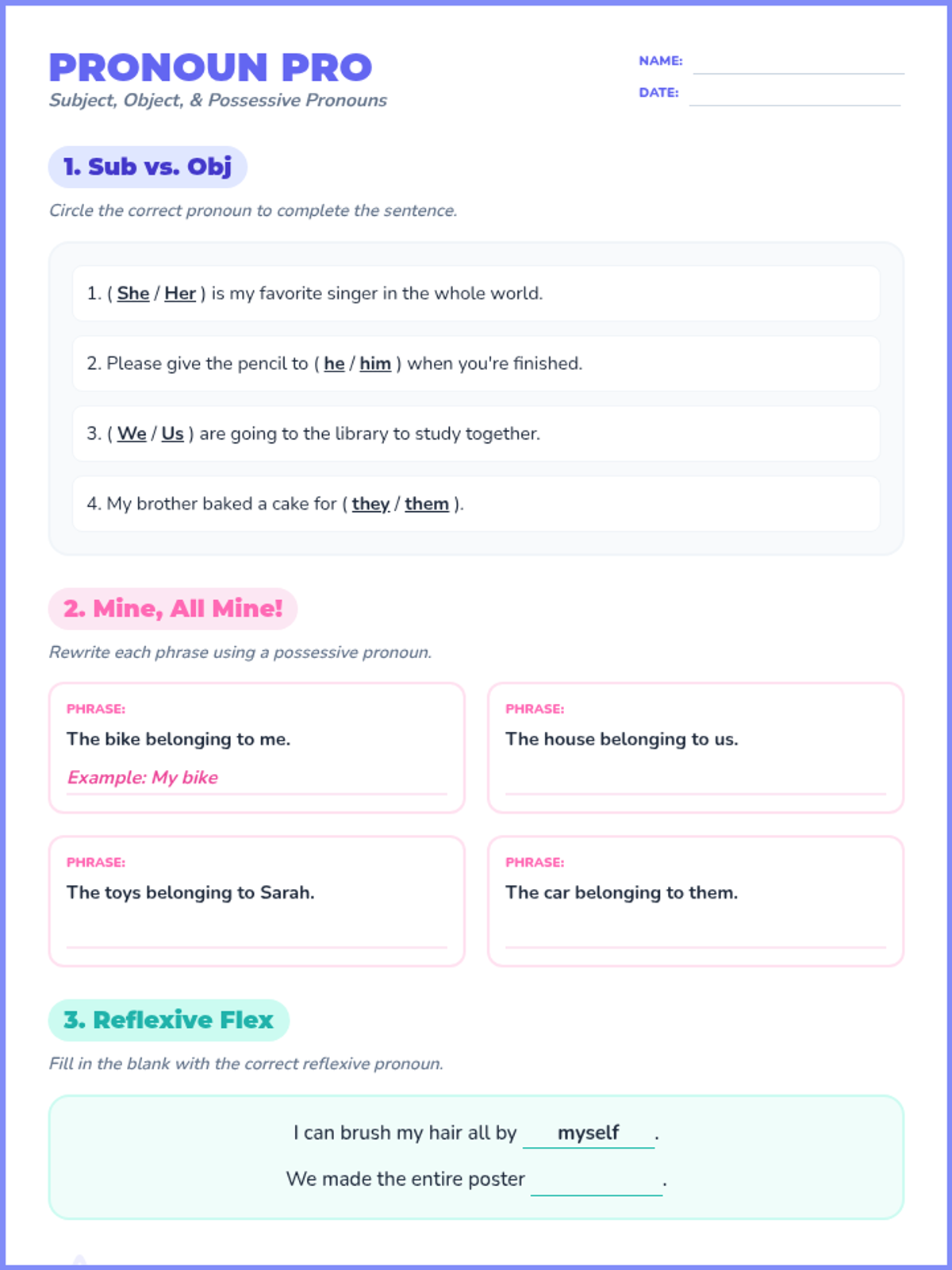
A practice sheet focusing on subject, object, possessive, and reflexive pronouns.
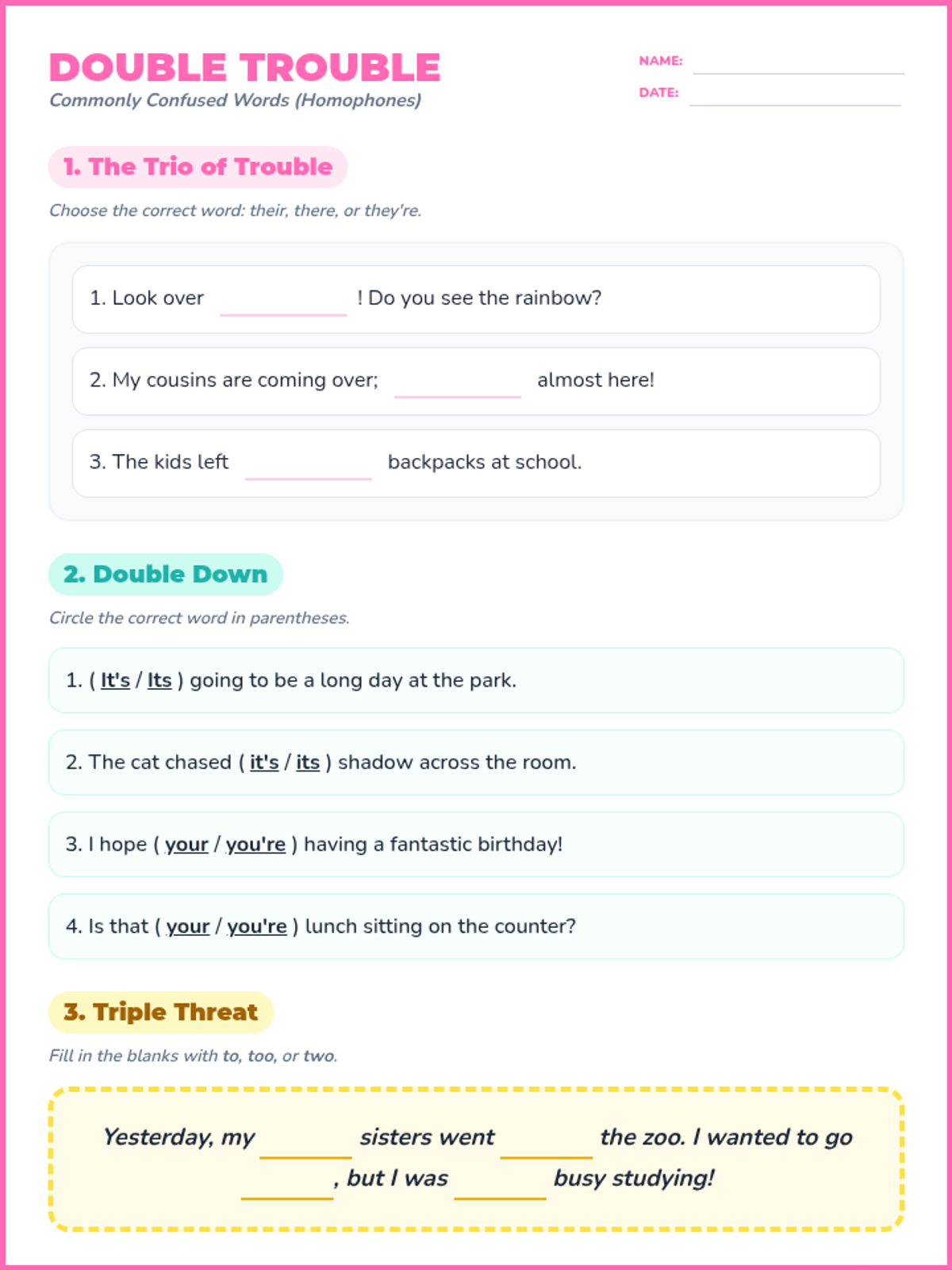
A practice sheet for commonly confused words including their/there/they're, it's/its, your/you're, and to/too/two.
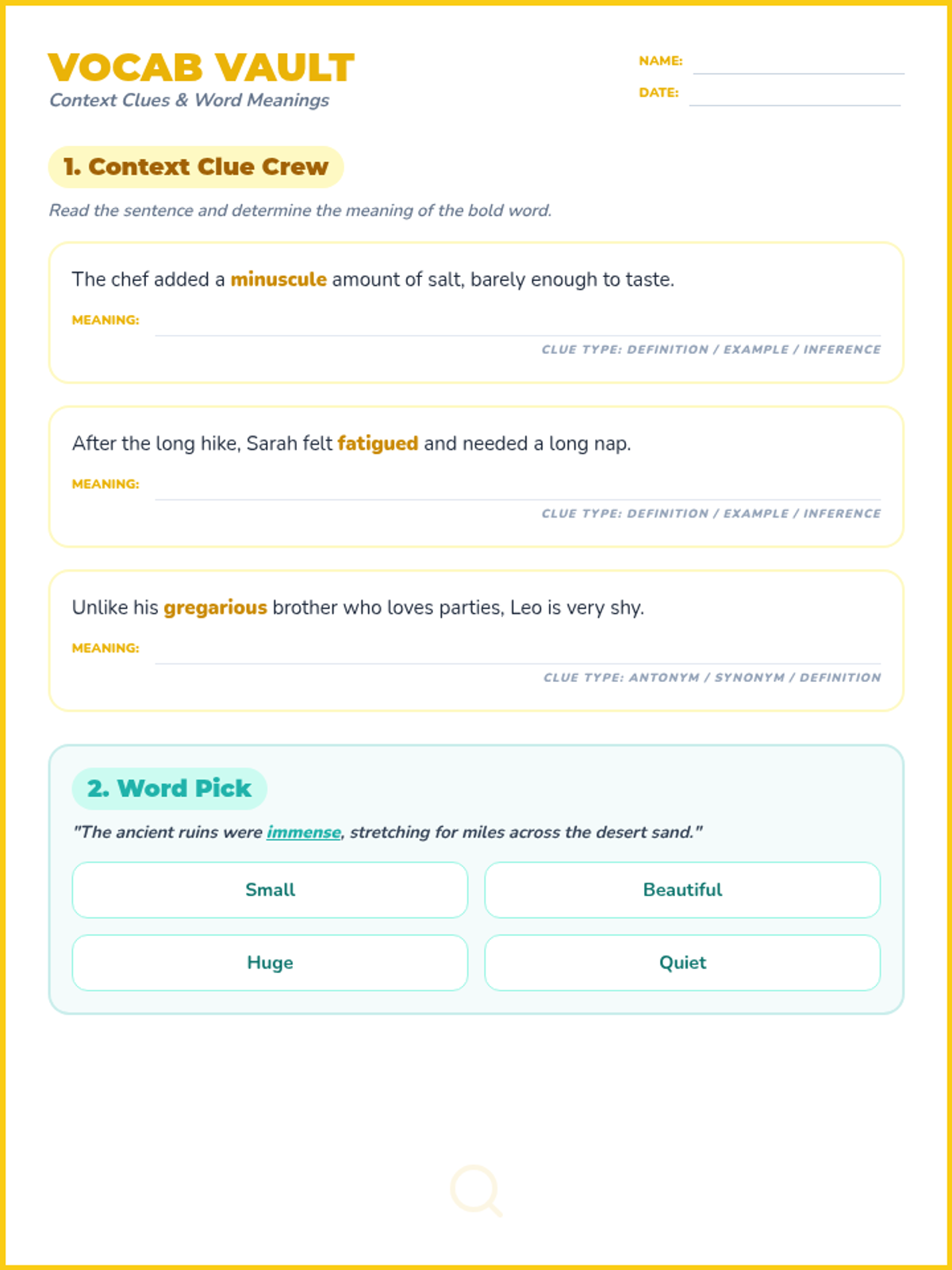
A vocabulary practice sheet focusing on using context clues (synonyms, antonyms, definitions, and inference) to find word meanings.
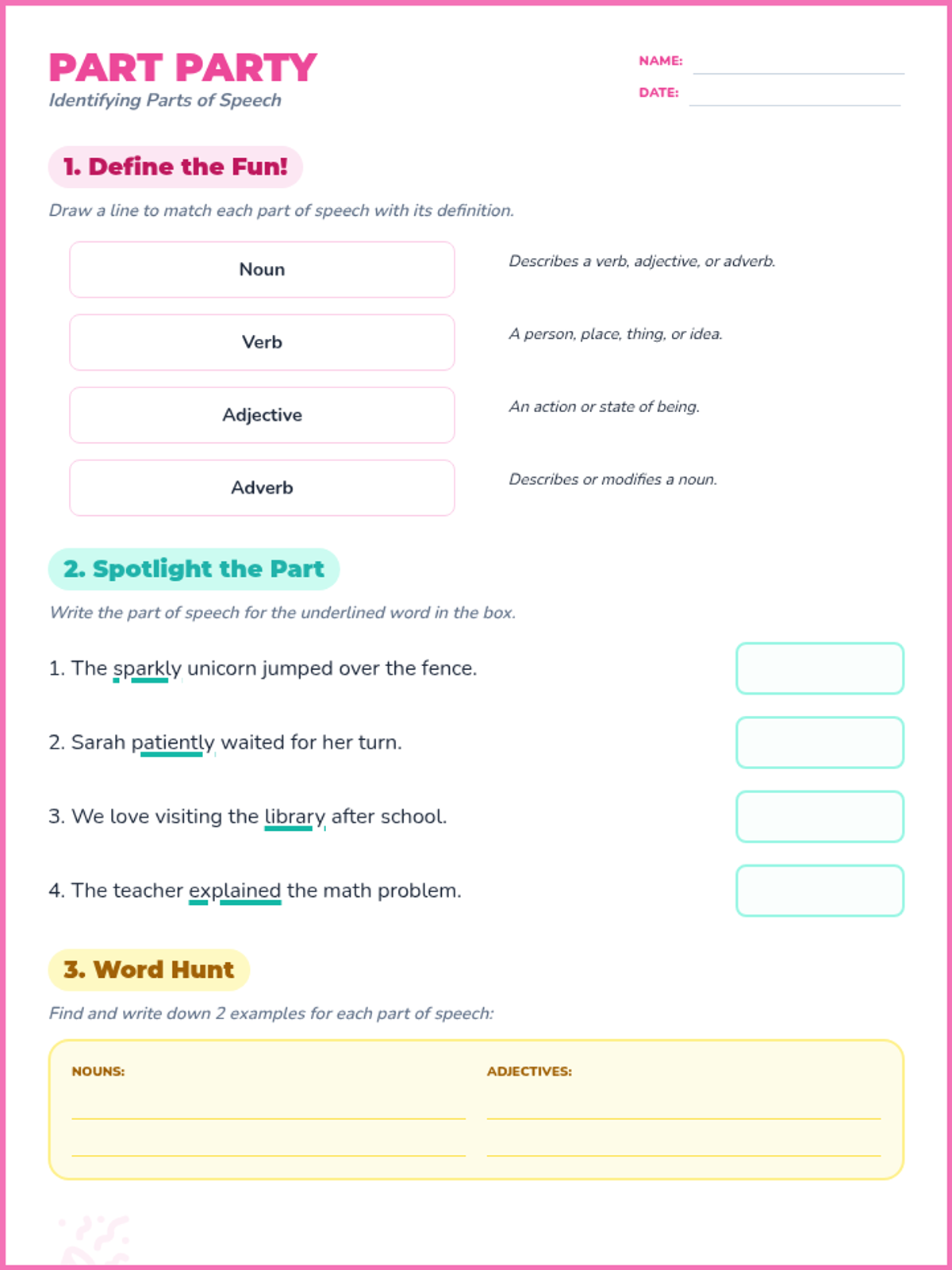
A fun practice sheet for matching parts of speech definitions and identifying them in sentences.
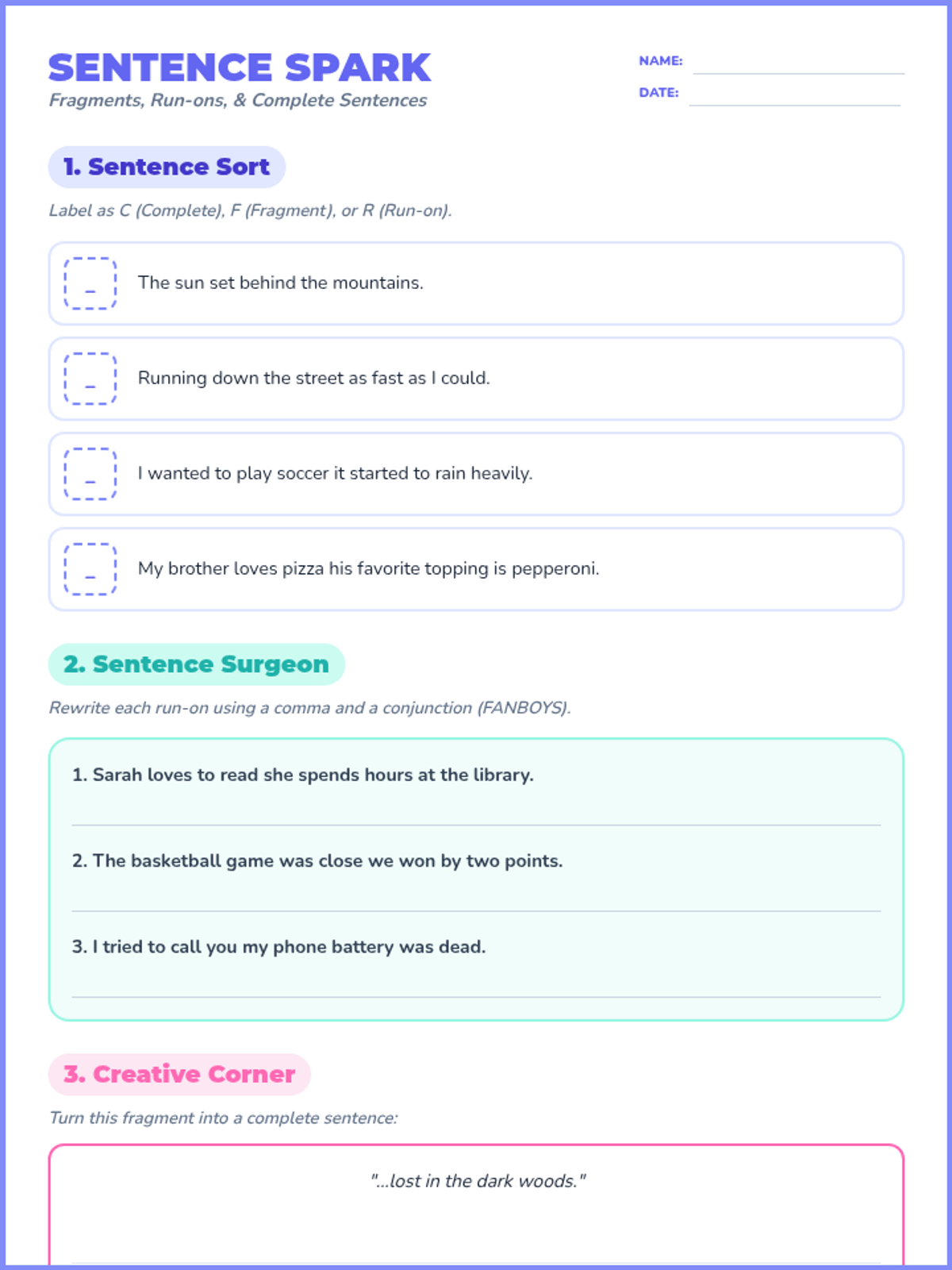
A practice sheet for identifying and correcting fragments, run-on sentences, and complete sentences.
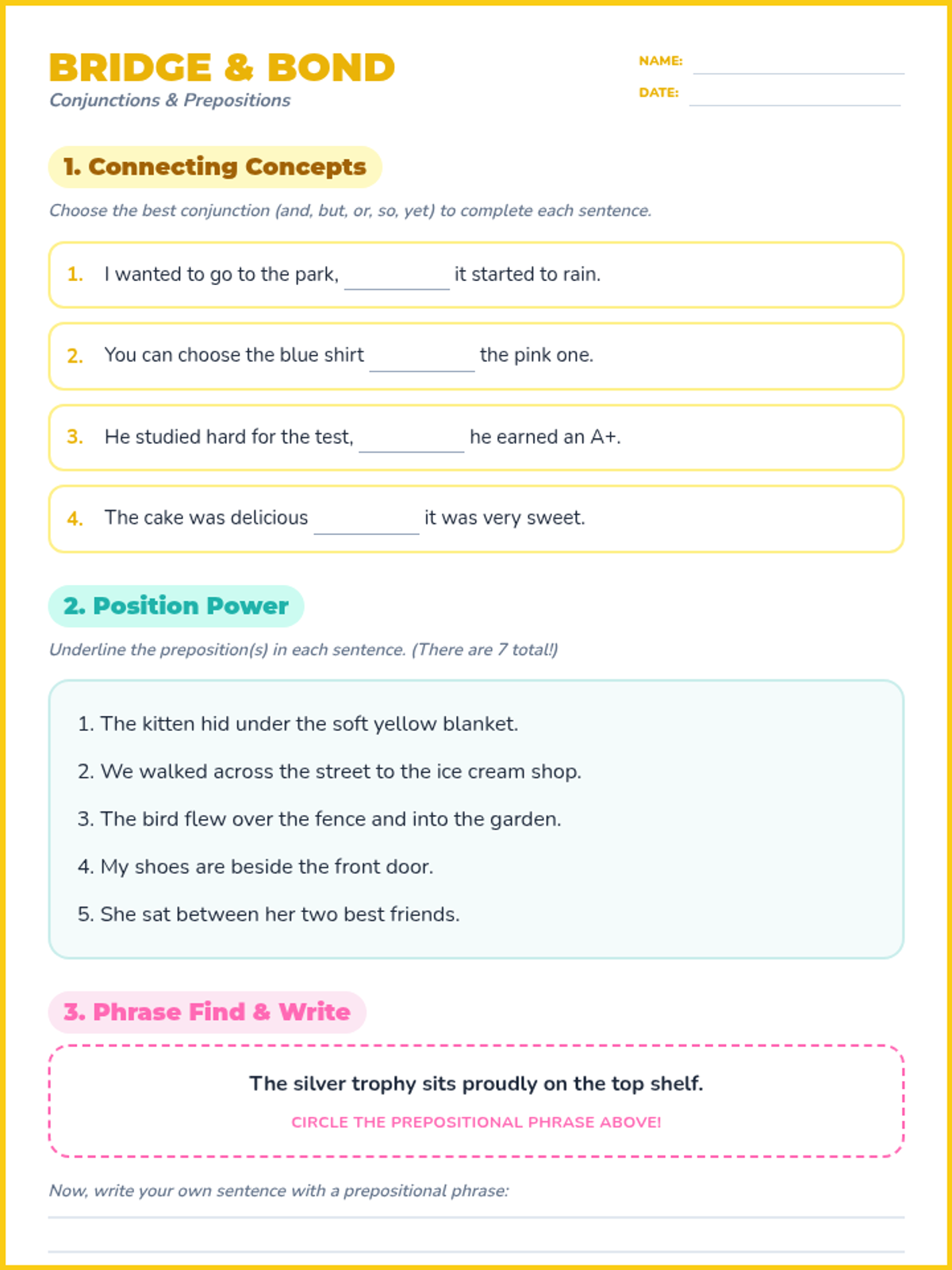
A practice sheet for conjunctions (FANBOYS) and prepositions, including identifying prepositions and prepositional phrases.
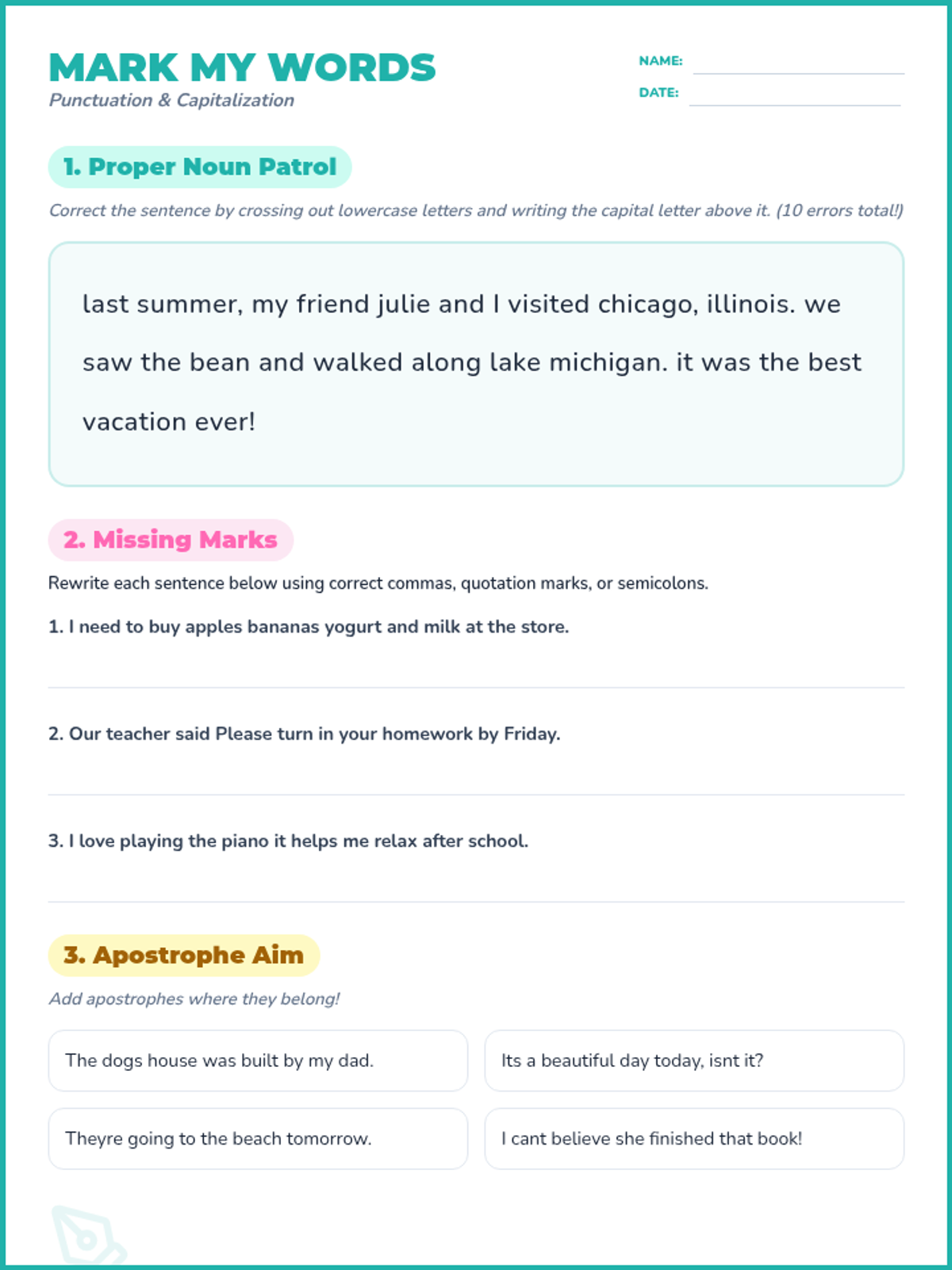
A practice sheet focused on capitalization, commas in lists, quotation marks for dialogue, and apostrophes for possession and contractions.
Instructions for the Mystery Performance Lab, guiding students through solo reading, role assignment with tie-breakers, plot analysis, fluency practice, and final presentation.
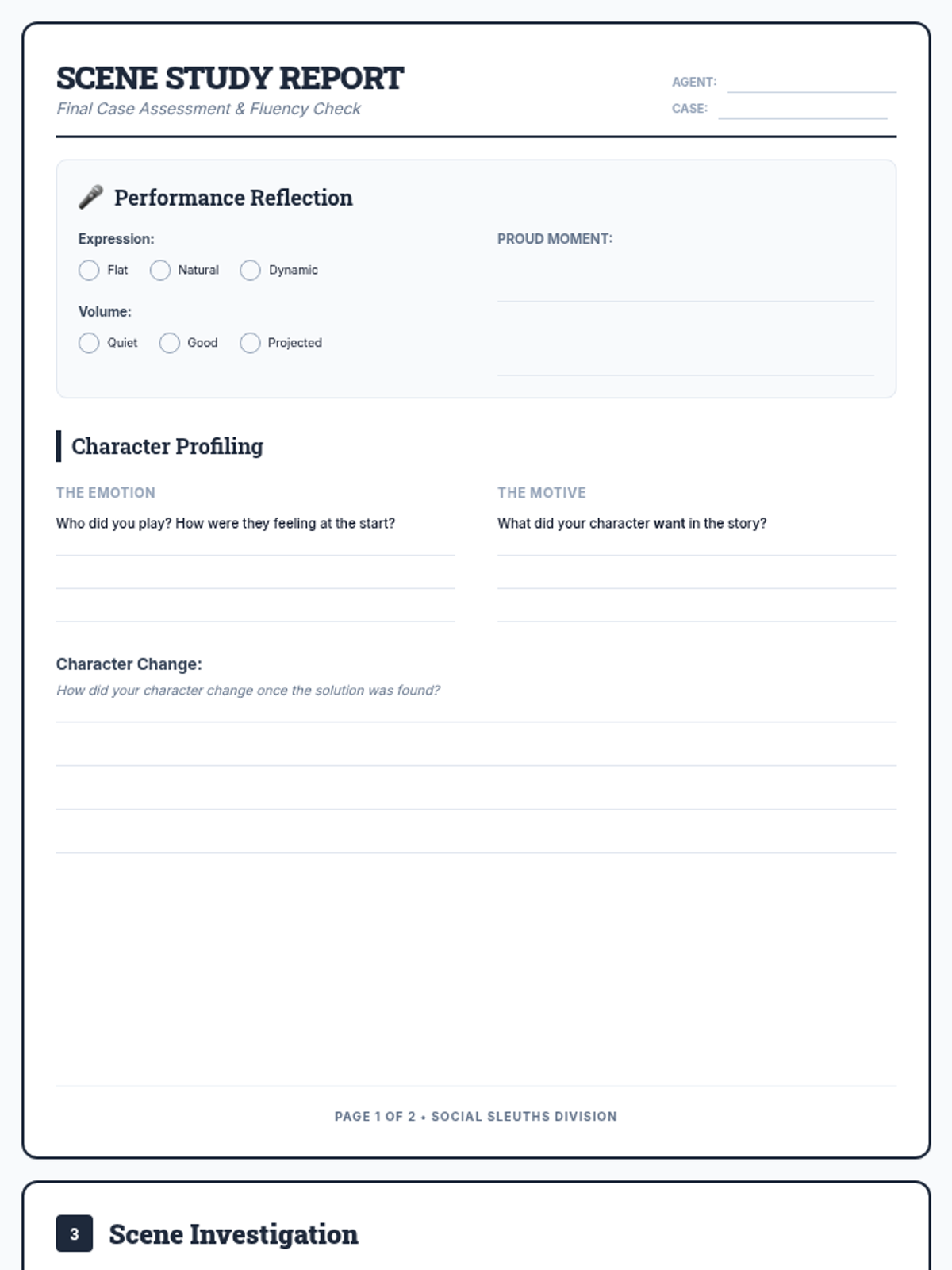
A comprehensive 2-page follow-up worksheet for students to complete after performing or watching mystery plays. Focuses on fluency self-reflection, high-rigor character analysis, comprehension of plot devices like red herrings, and social-emotional debriefing. Optimized for print with writing lines instead of boxes. Updated terminology to "Character Change".
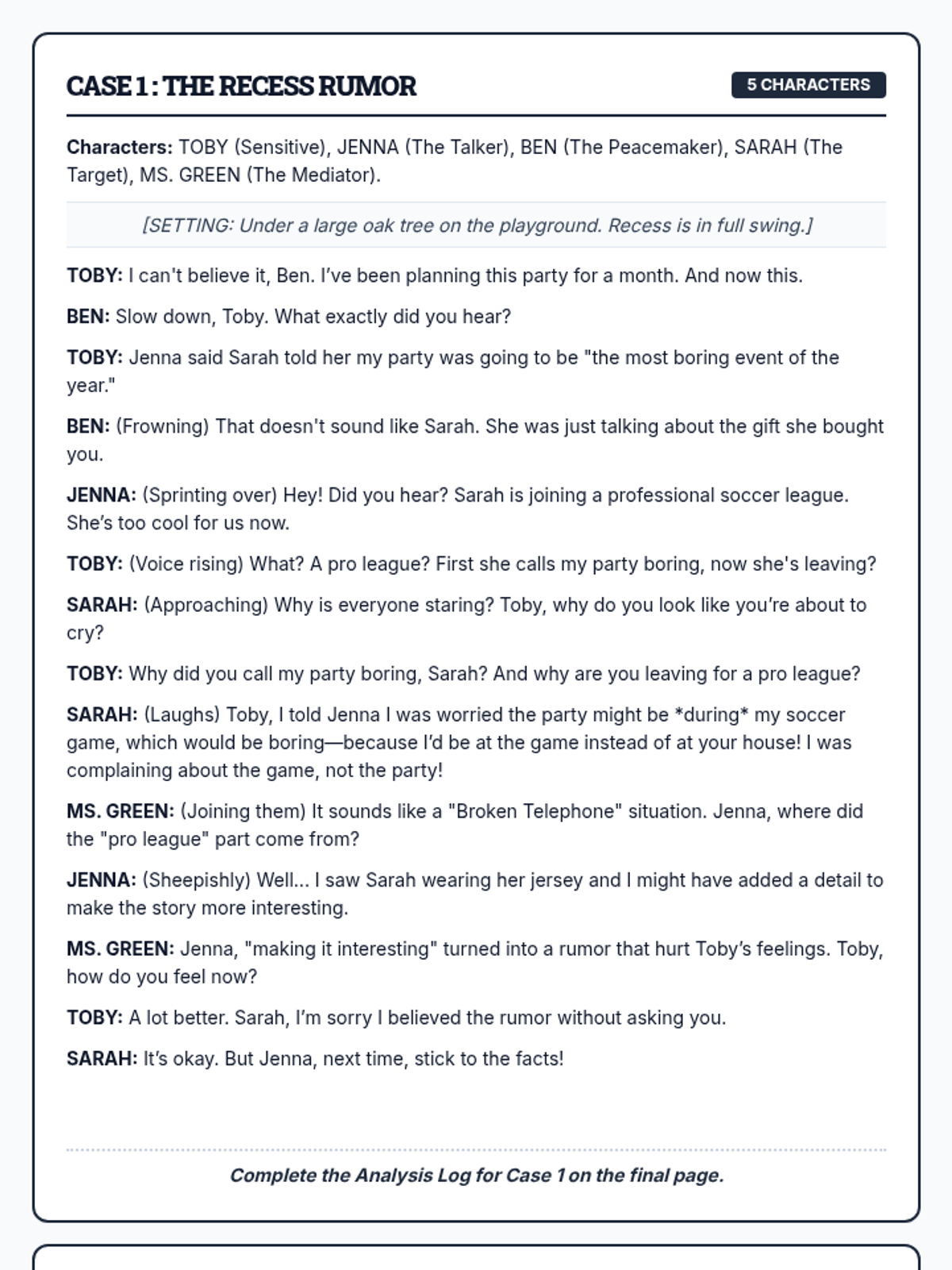
Six lengthened mystery/problem-solving plays featuring 4-5 characters each. Each play includes increased plot complexity, red herrings, and higher rigor dialogue focused on social-emotional conflicts. Includes a reusable analysis log template. Themes are strictly school-based with no space or weapon-related content. Every script and the analysis log are formatted to fit on a single page. Optimized with writing lines and no heavy boxes.
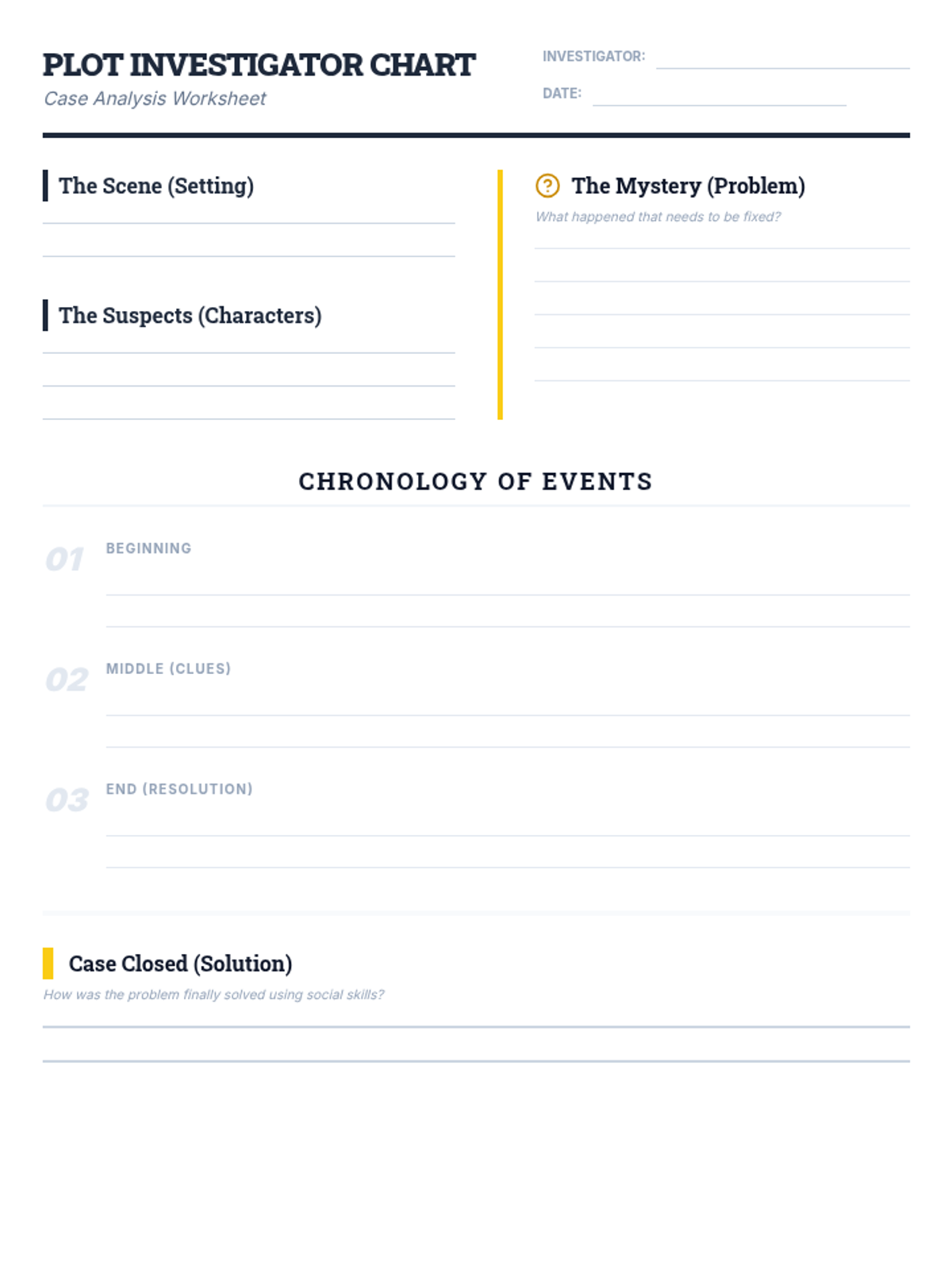
A student worksheet for analyzing the plot structure of a play, including sections for setting, characters, beginning, middle, end, problem, and solution. Optimized with writing lines and no heavy boxes. fits on one page.
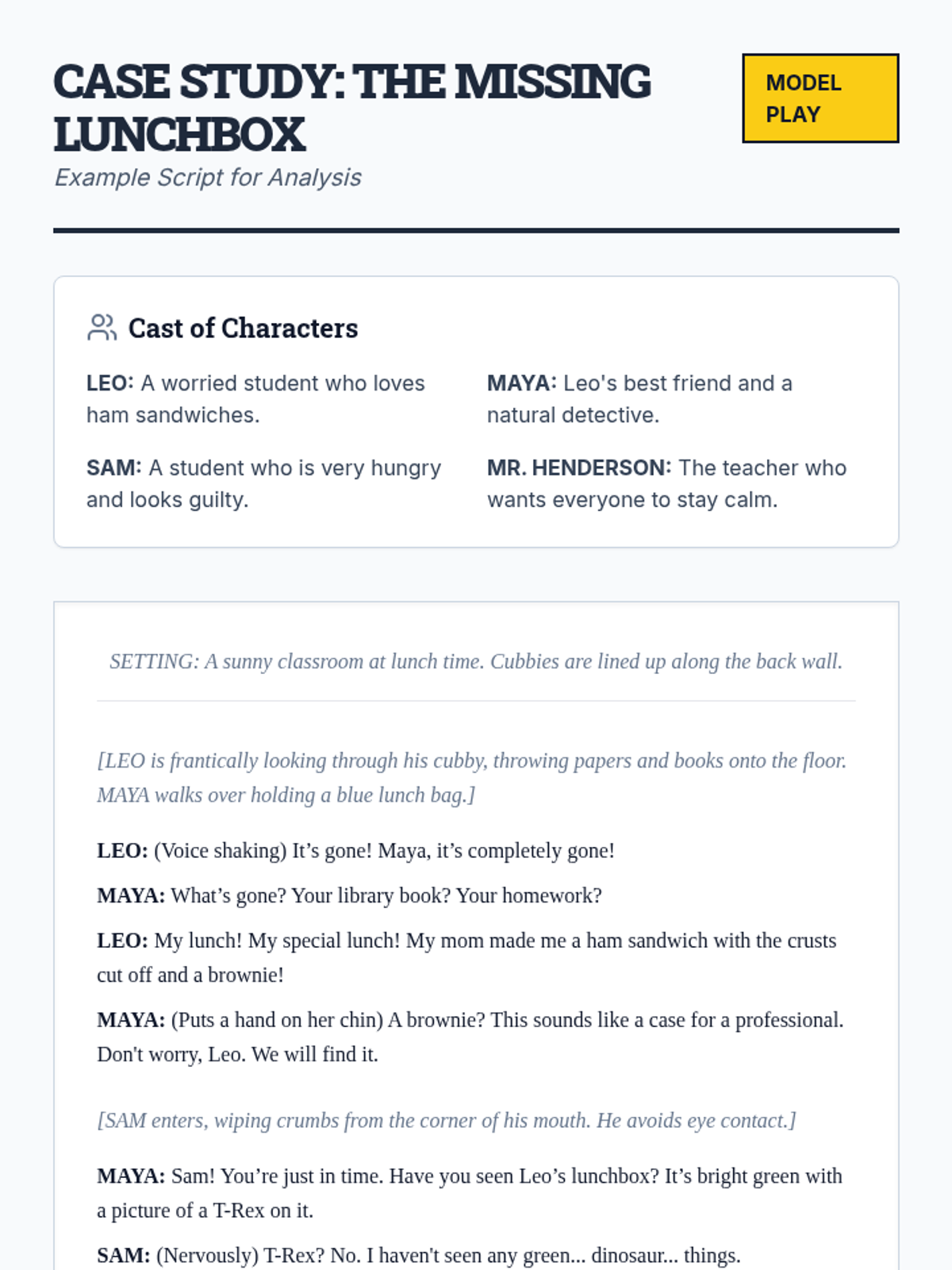
A short model play script titled "The Missing Lunchbox" used to demonstrate play structure, characters, and dialogue. Features a friendship-based problem and solution. Dinosaur theme used for the lunchbox.
Instructional slides teaching the components of a play script (dialogue, stage directions), plot elements (beginning, middle, end, problem, solution), and fluency skills.
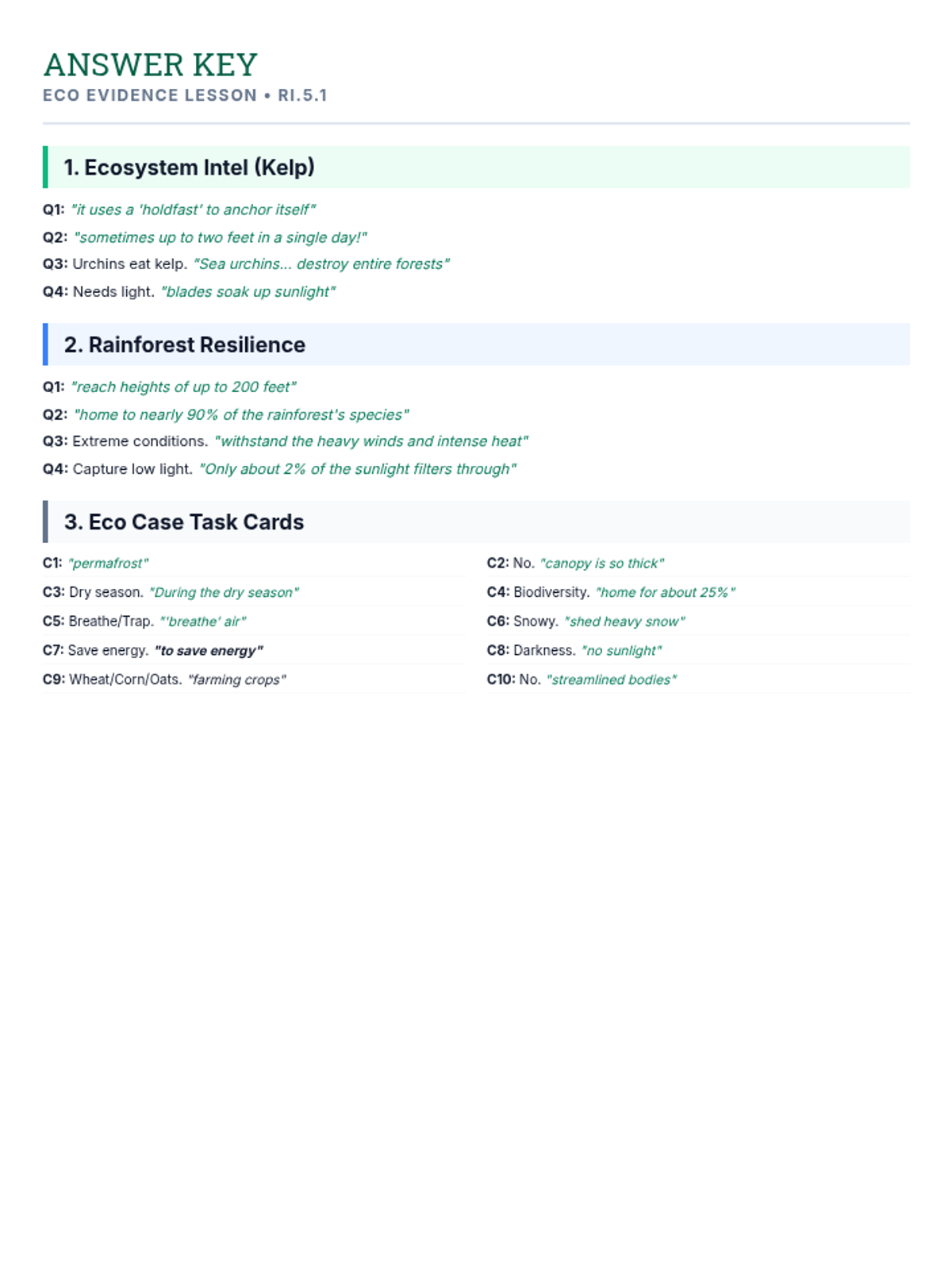
A single-page answer key for both reading worksheets and the task cards, providing accurate quotes and logical inferences for all questions in a condensed layout.
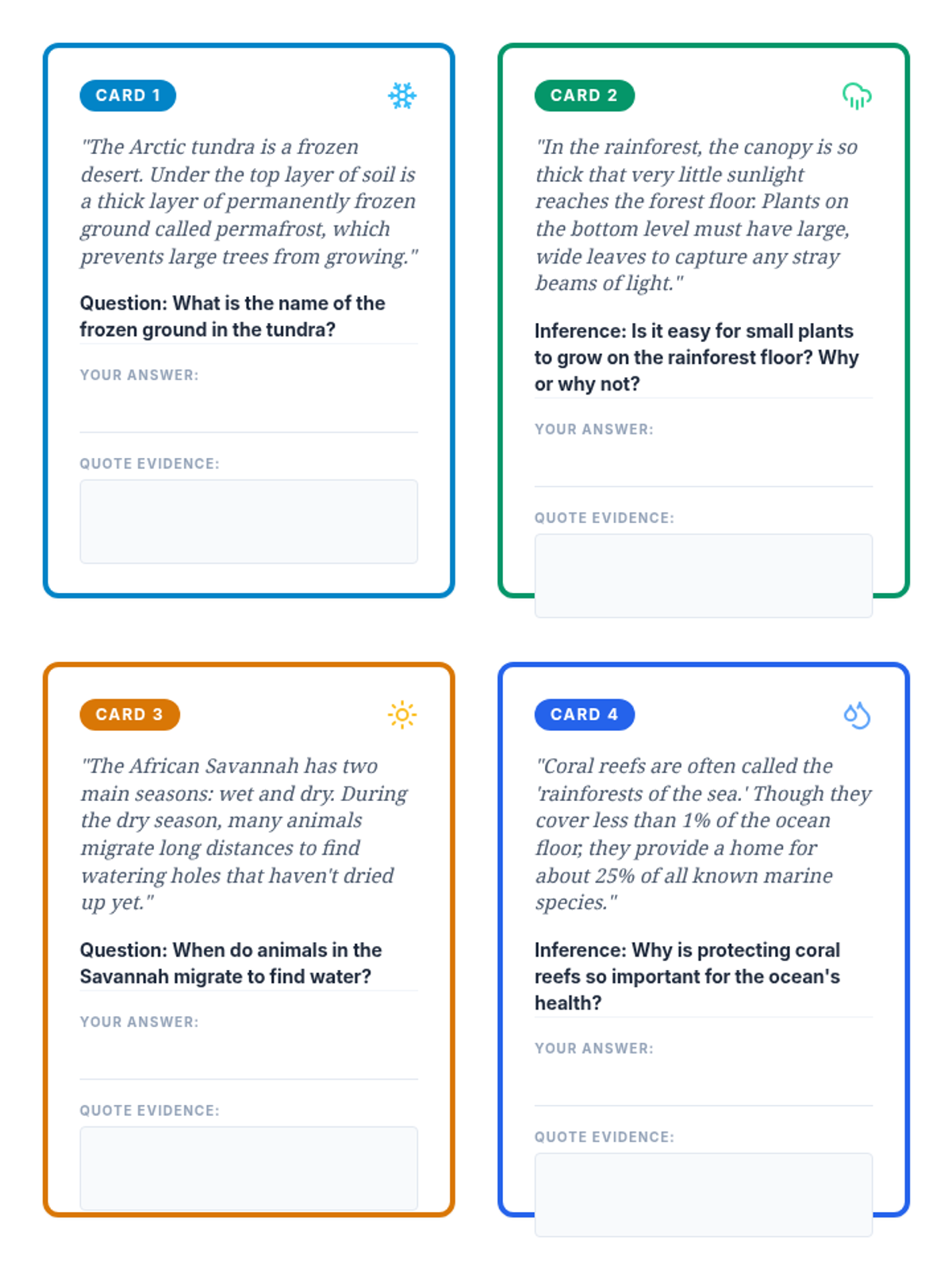
A set of 10 task cards focused on various ecosystems. Each card provides a short reading snippet followed by a question that requires students to either find explicit information or make an inference, always using text evidence. Updated with student response areas.
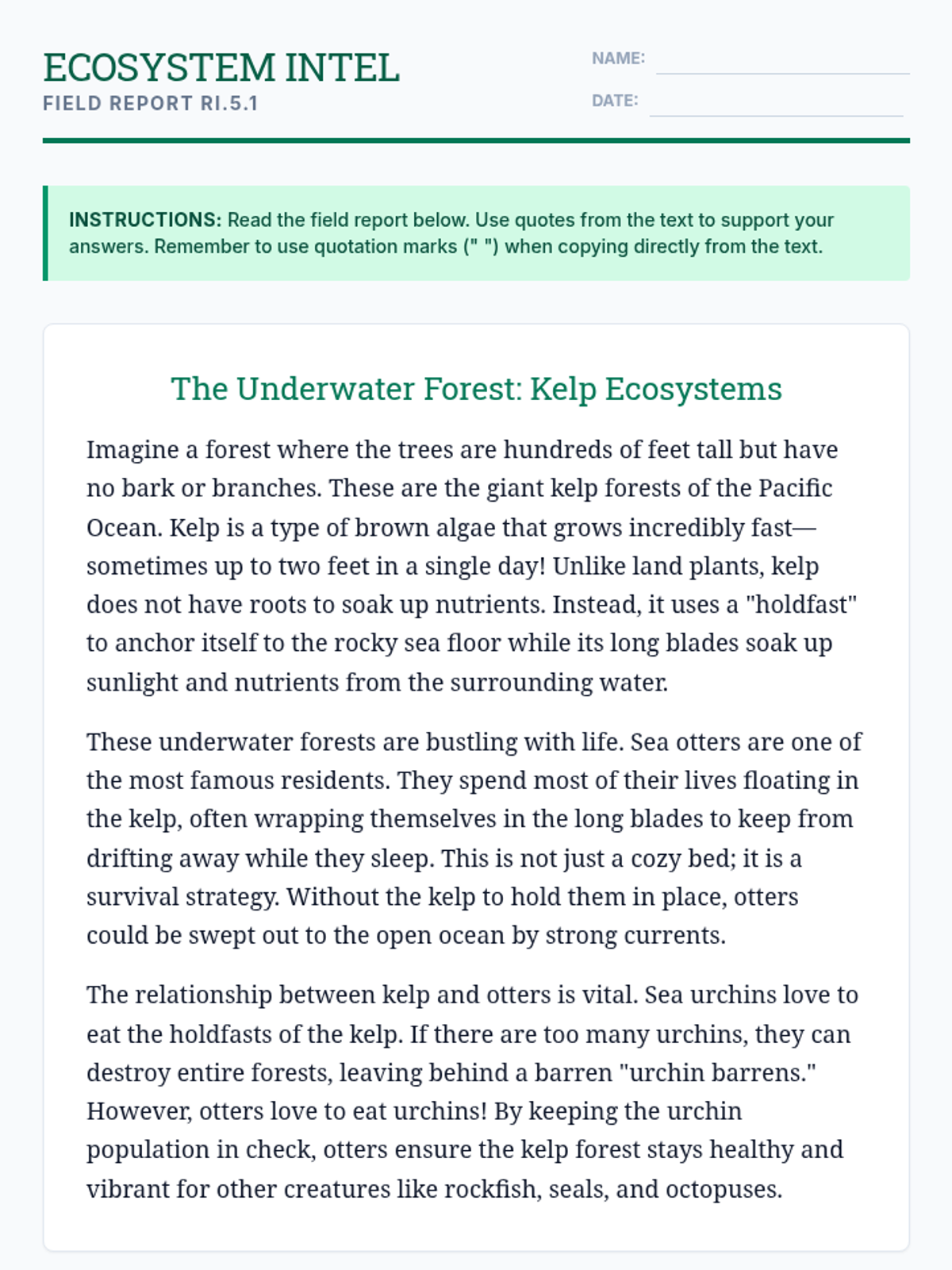
A guided reading worksheet featuring a passage about Kelp Forests. It includes four questions that require students to find explicit information and make inferences, all while quoting accurately from the text.
A 5-slide presentation introducing RI.5.1 within the context of ecosystems. It covers quoting accurately, explicit vs. inferential evidence, and provides clear examples for direct instruction.