Fundamental principles of supply, demand, and monetary systems alongside micro- and macroeconomic structures. Examines the impact of corporate power, labor market dynamics, and global systems on social mobility and class inequality.
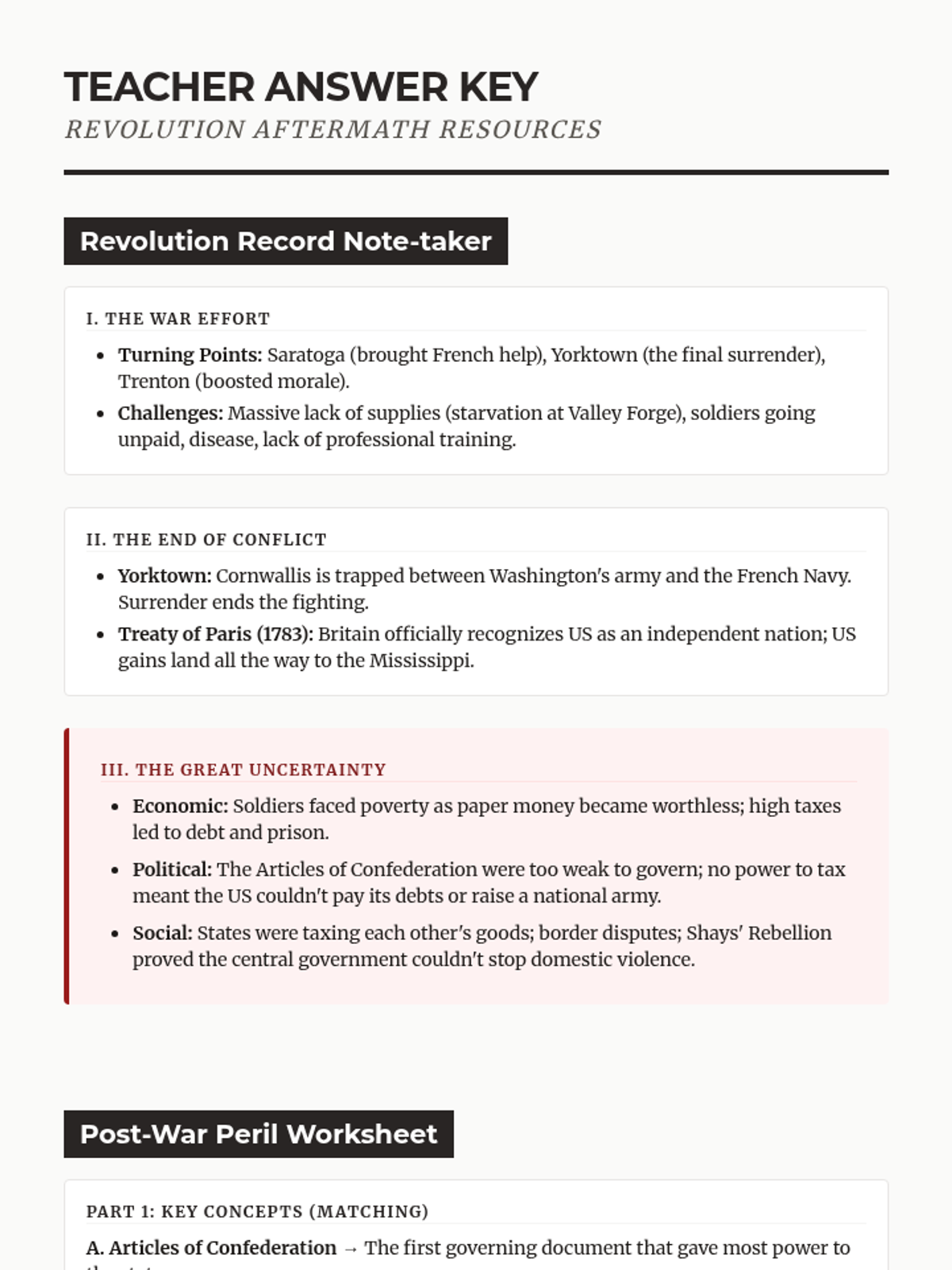
A comprehensive teacher answer key for both the Revolution Record Note-taker and the Post-War Peril Worksheet, including sample critical thinking responses.
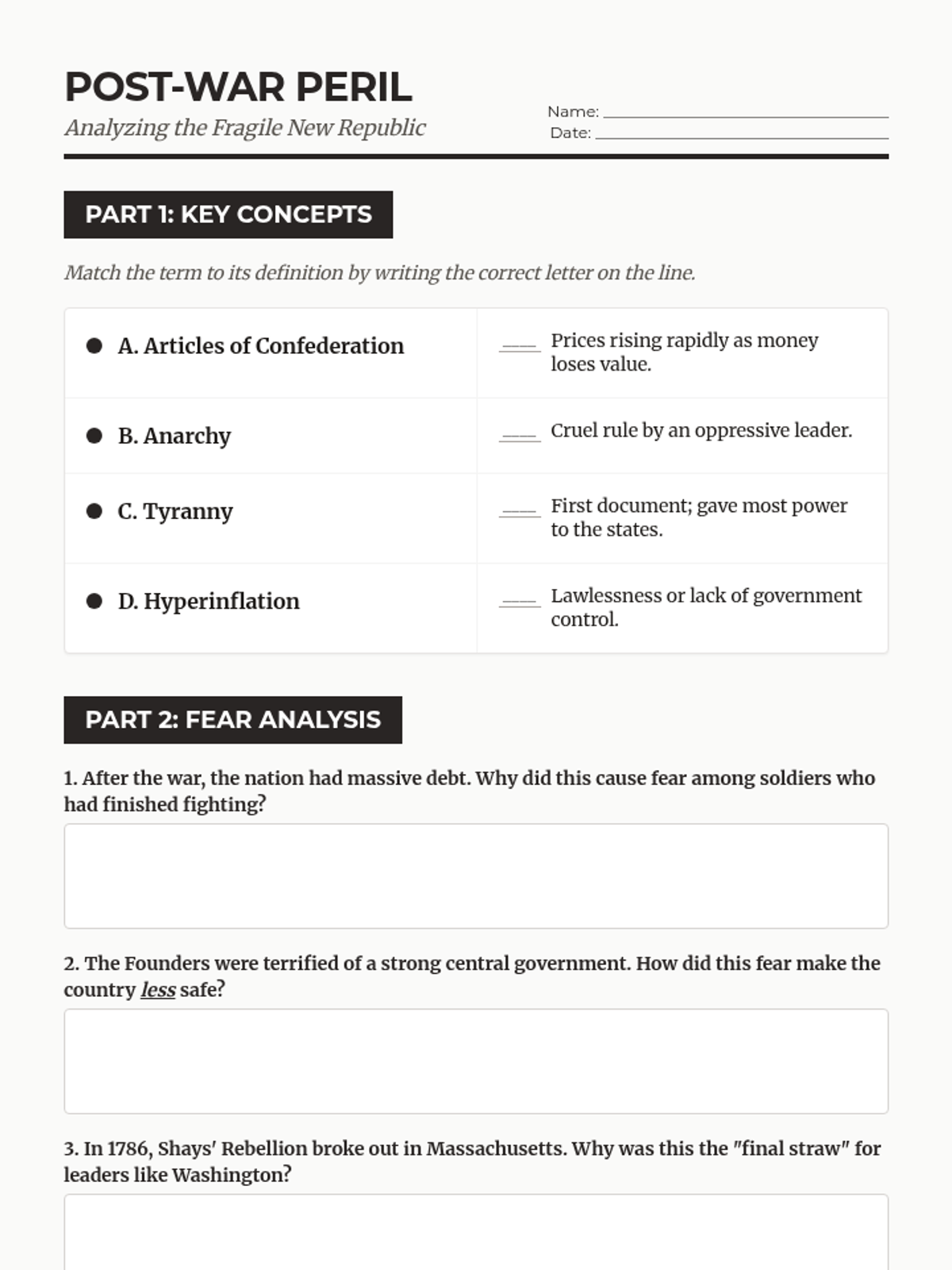
A follow-up worksheet for GED students focused on the economic, political, and social fears following the American Revolution, including a GED-style reading comprehension skill exercise.
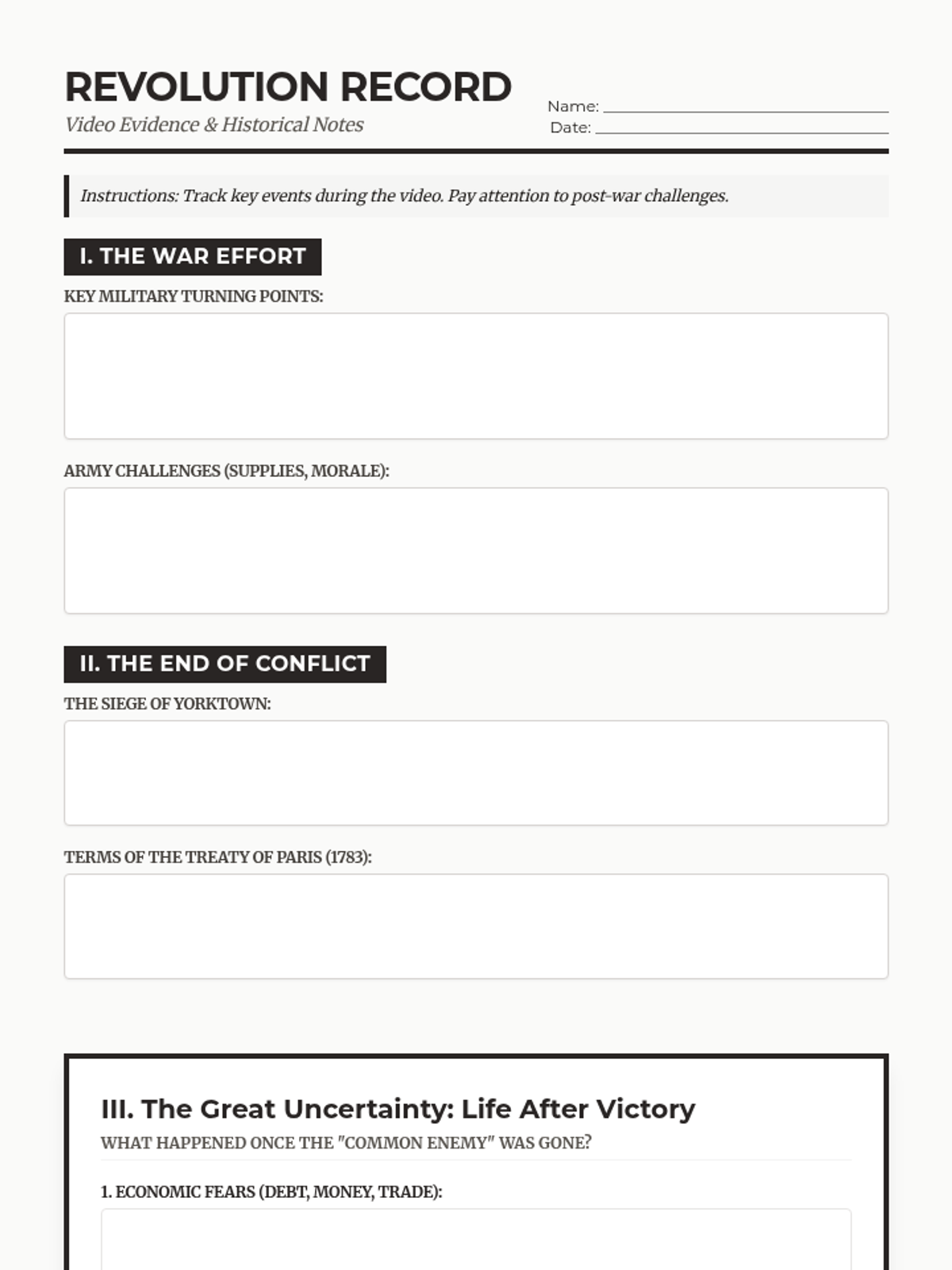
A guided note-taking document for GED students to use while watching a 23-minute video on the American Revolution, with a specific focus on post-war instability and fear.
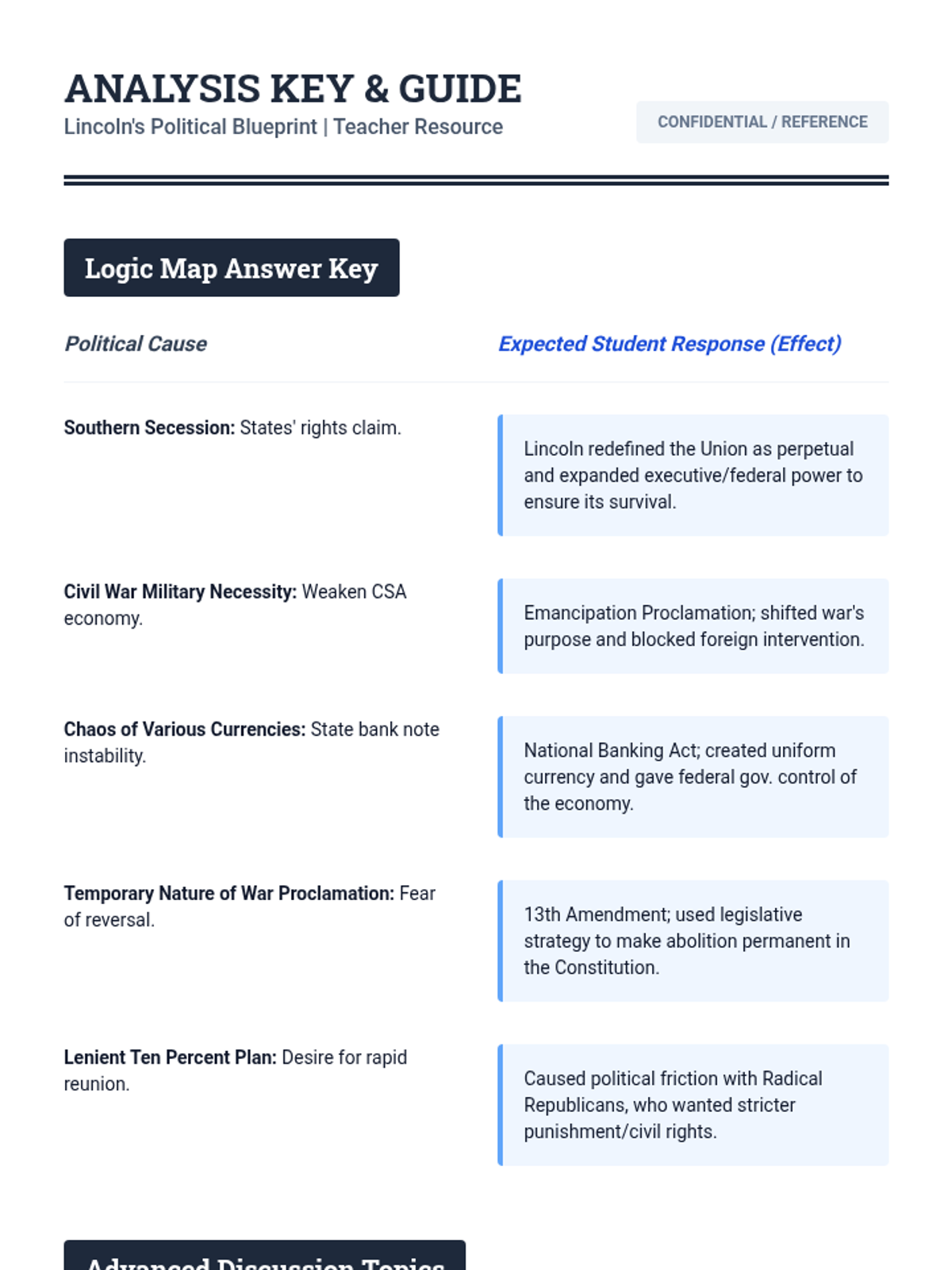
A teacher resource providing an answer key for the logic map, discussion prompts for classroom use, and a guide to common student misconceptions.
An expanded visual slide deck outlining Lincoln's political philosophy, adding depth on the Gettysburg Address, the National Banking Act, the Election of 1864, and the 13th Amendment.
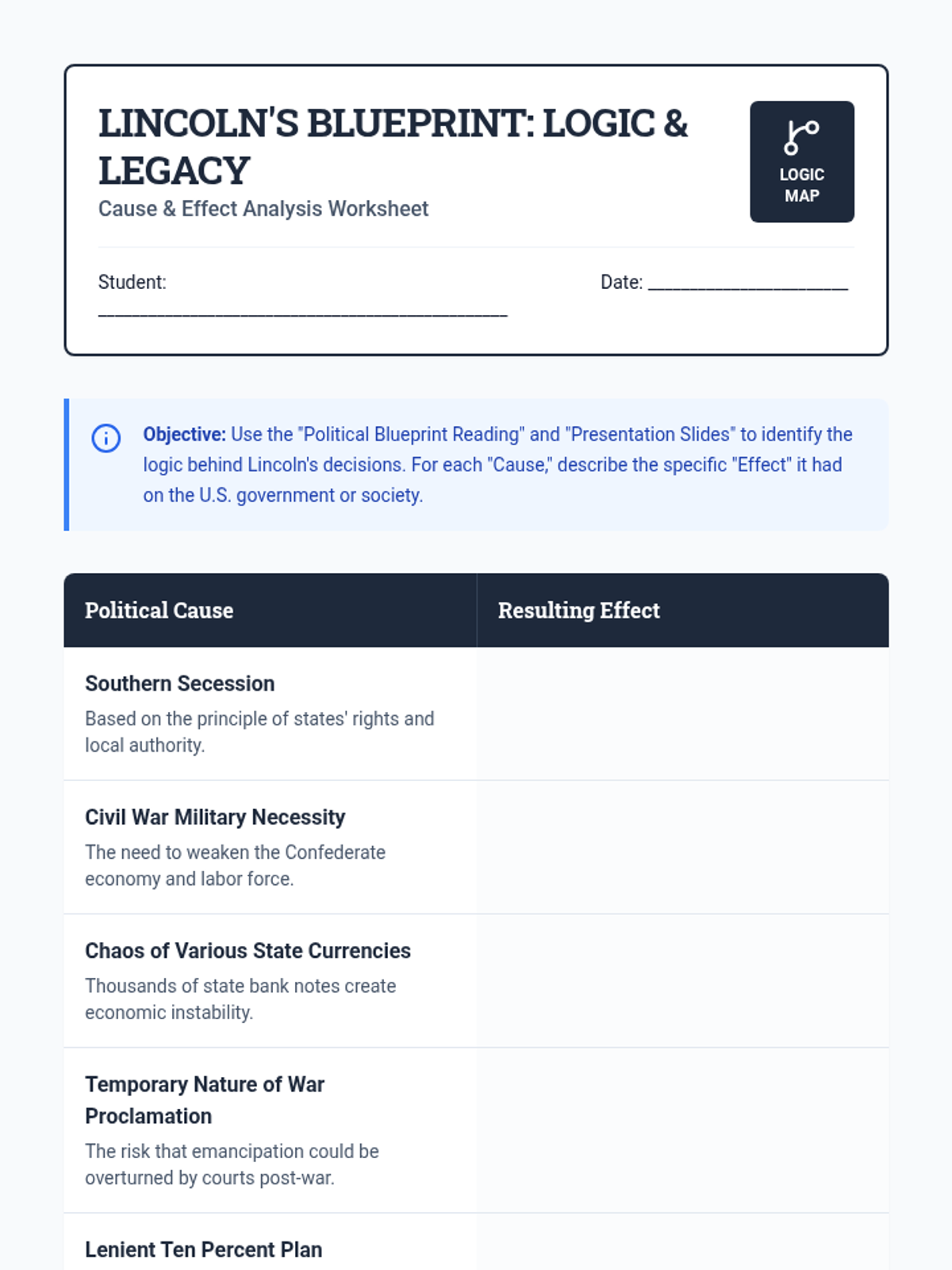
A cause-and-effect analysis worksheet where students identify the outcomes of Lincoln's major political decisions and explain the shift in federal power.
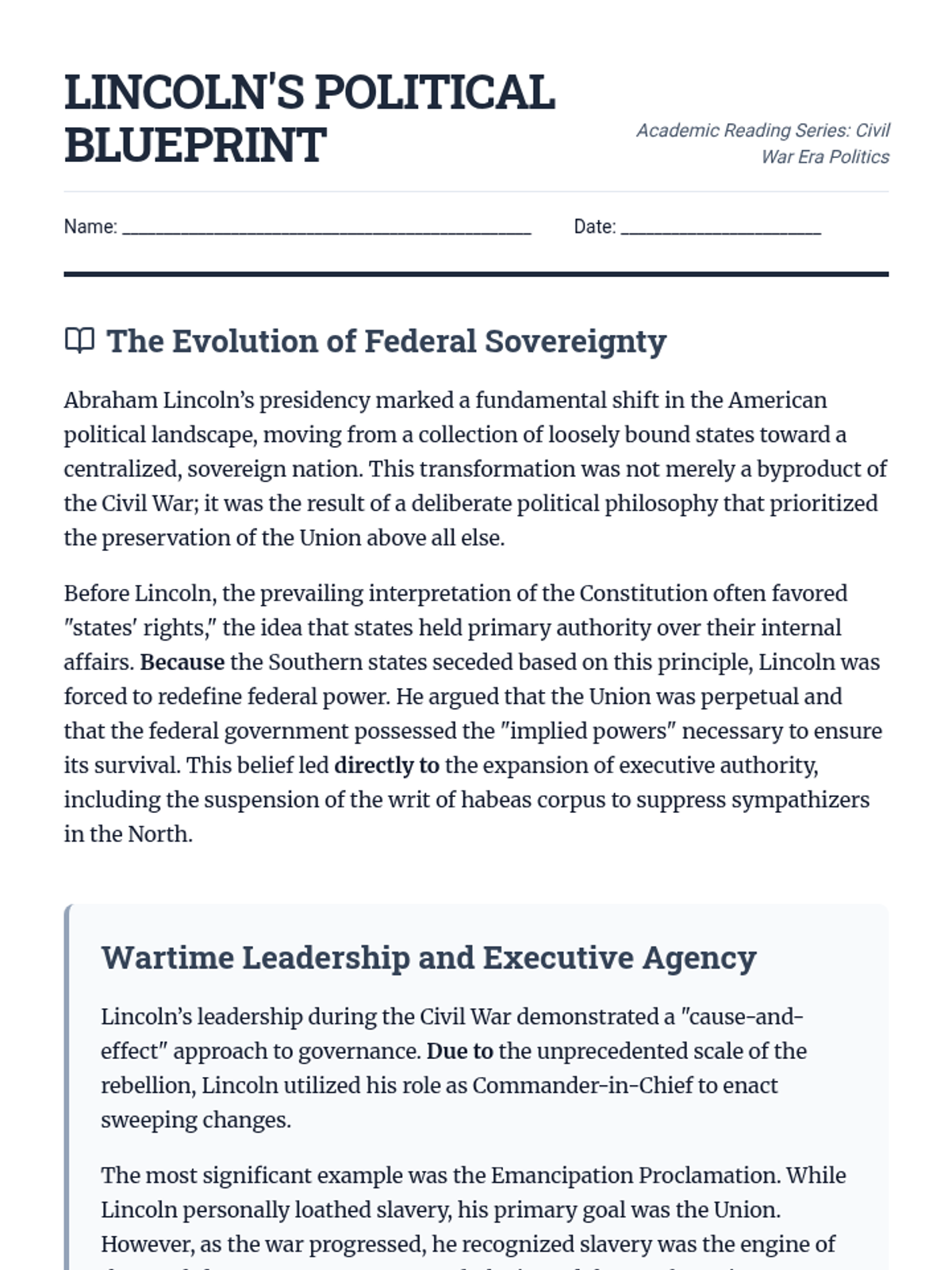
A comprehensive academic reading document focusing on Abraham Lincoln's political philosophy, executive power, and economic policies using cause-and-effect structures.
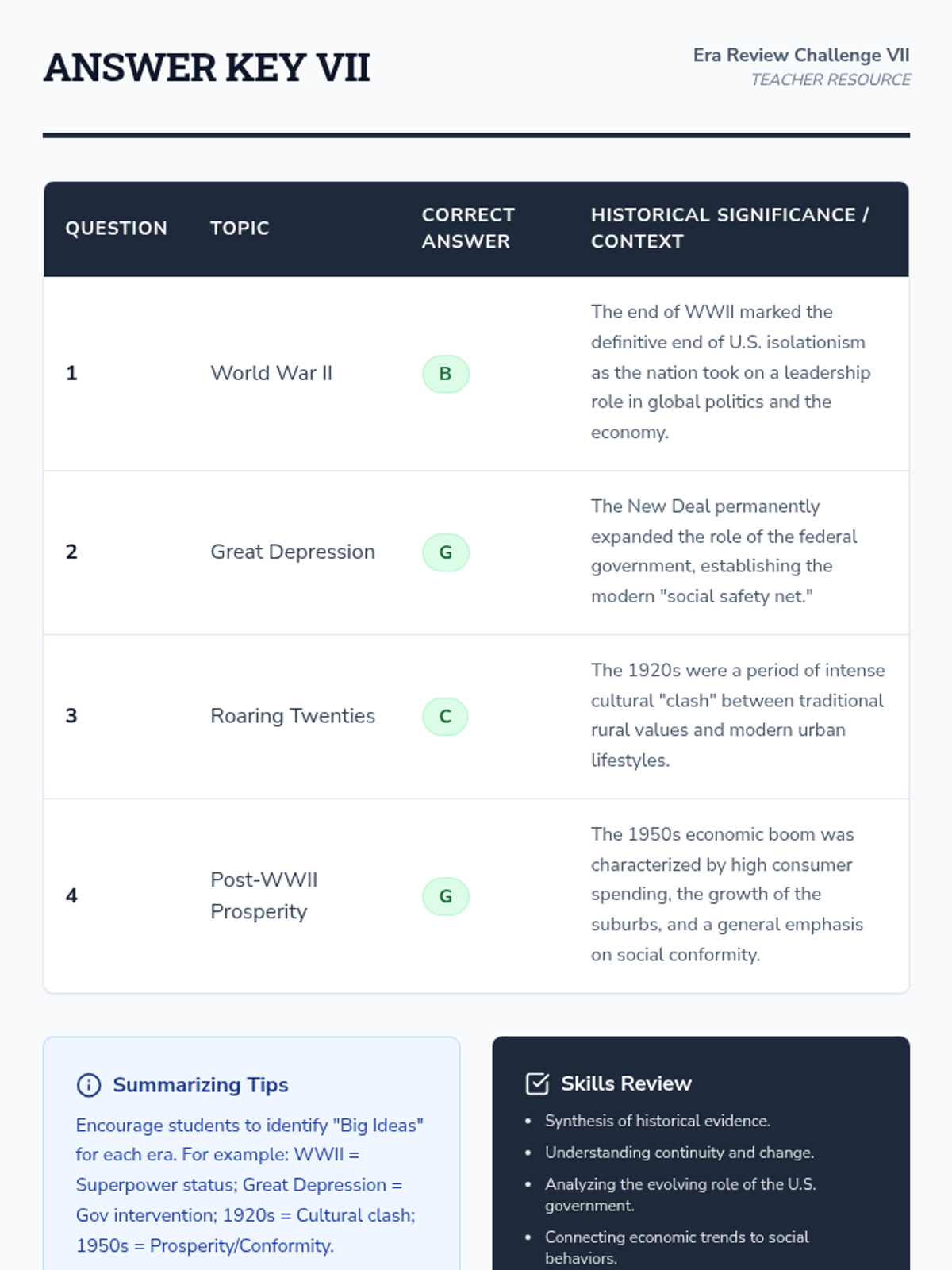
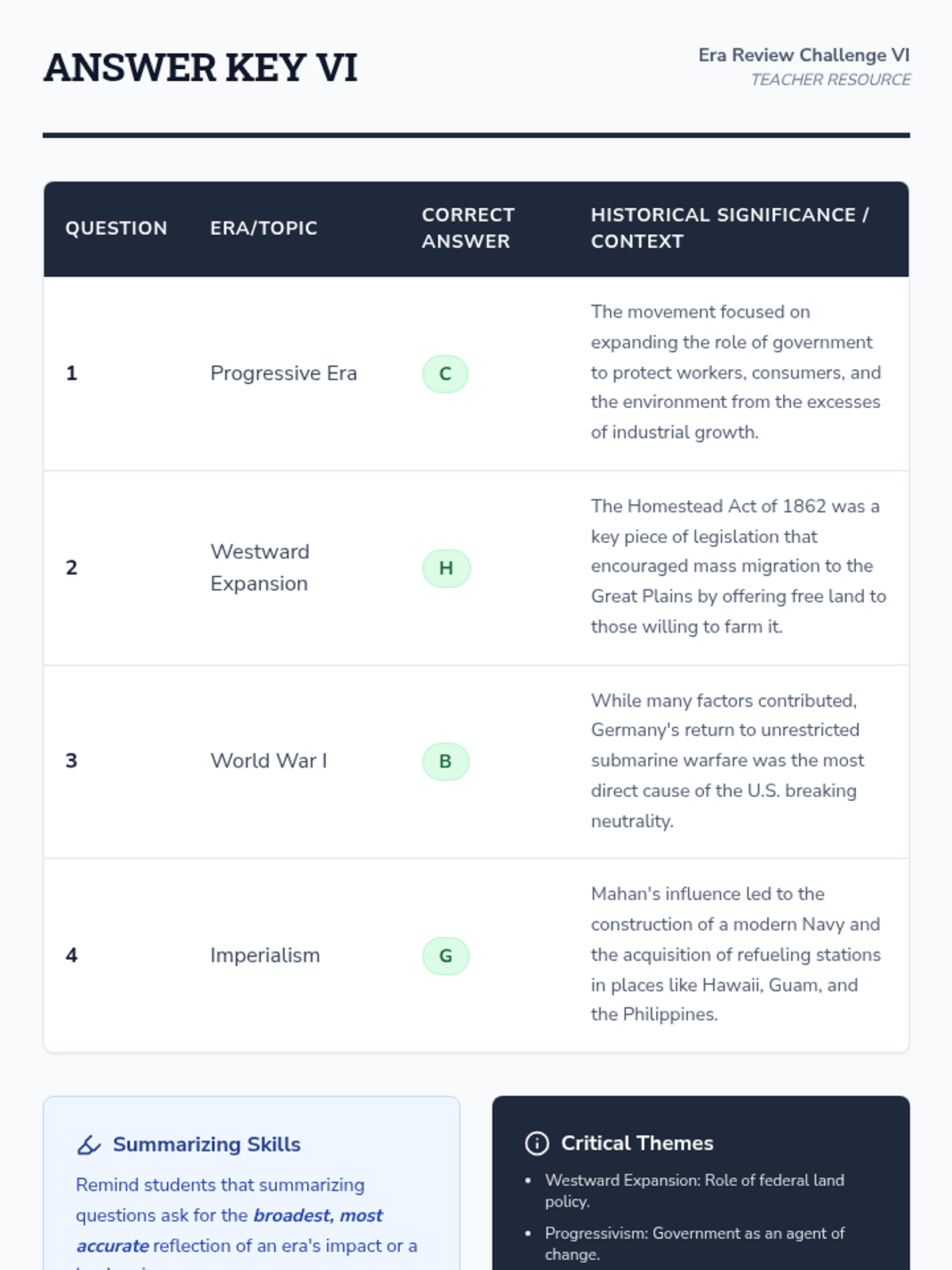
An answer key and teacher resource guide for the seventh Era Review Challenge practice sheet, providing correct answers and historical context for summarizing major US history themes.
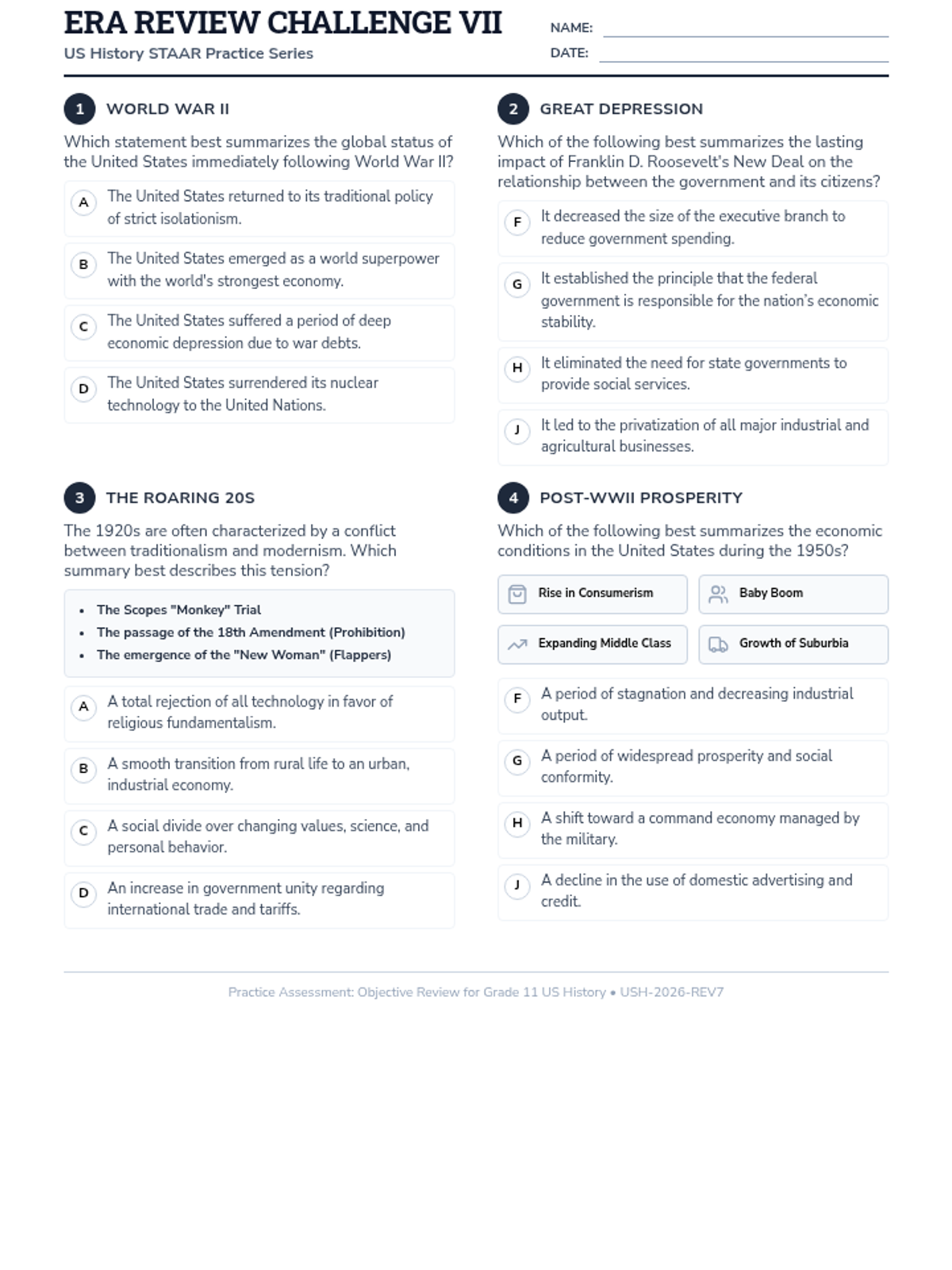
A seventh practice sheet containing 4 STAAR-style questions focused on summarizing broad themes for WWII, the Great Depression, the Roaring 20s, and Post-WWII Prosperity. Reformatted into a clean 2-column layout to fit on a single 8.5x11 page with 0.5-inch margins and no top margin.
An answer key and teacher resource guide for the sixth Era Review Challenge practice sheet, providing correct answers and historical context for summarizing concepts in US History.
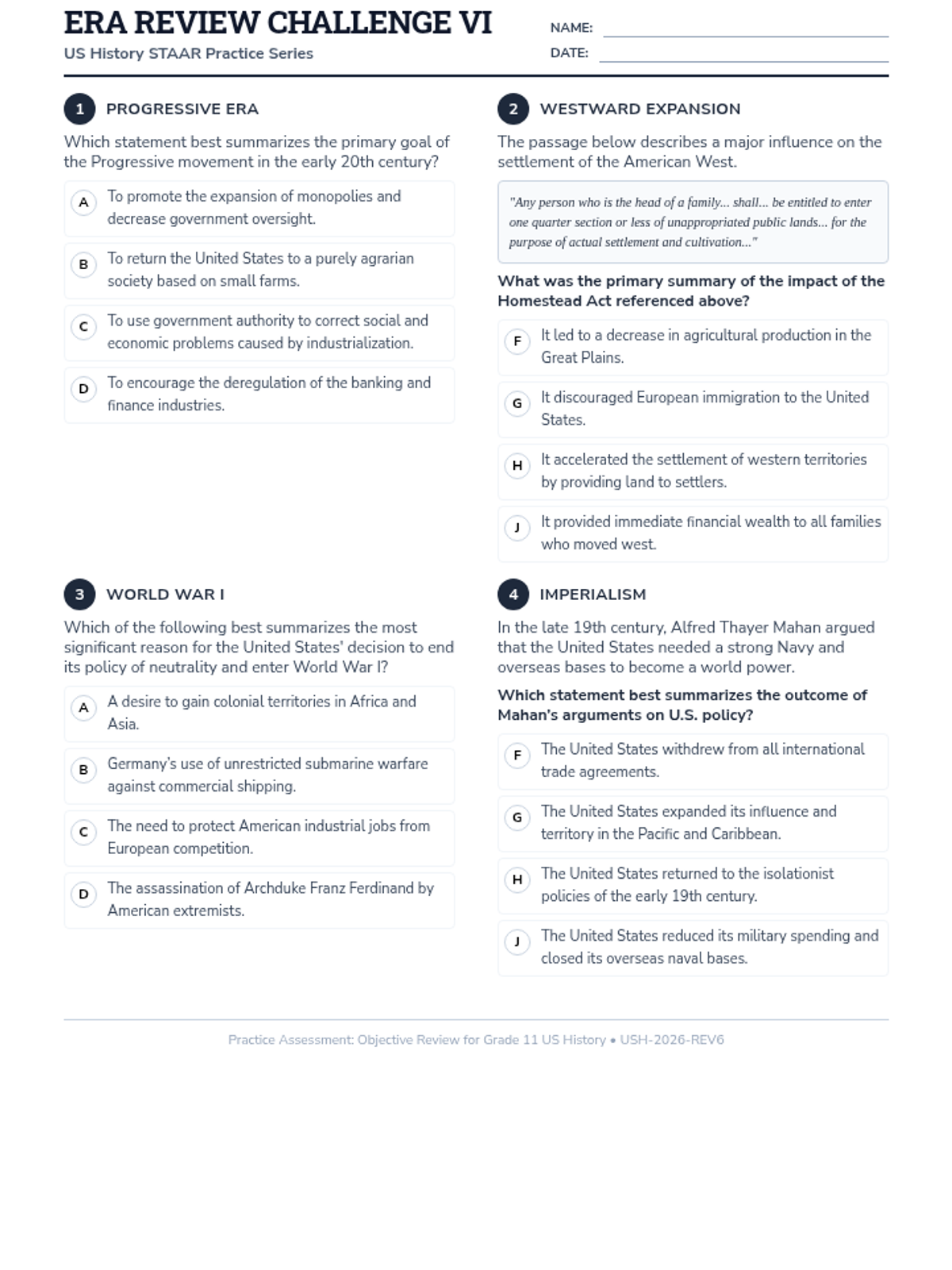
A sixth practice sheet containing 4 STAAR-style questions focused on summarizing key concepts of the Progressive Era, Westward Expansion, WWI, and Imperialism. Reformatted into a clean 2-column layout to fit on a single 8.5x11 page with 0.5-inch margins and no top margin.
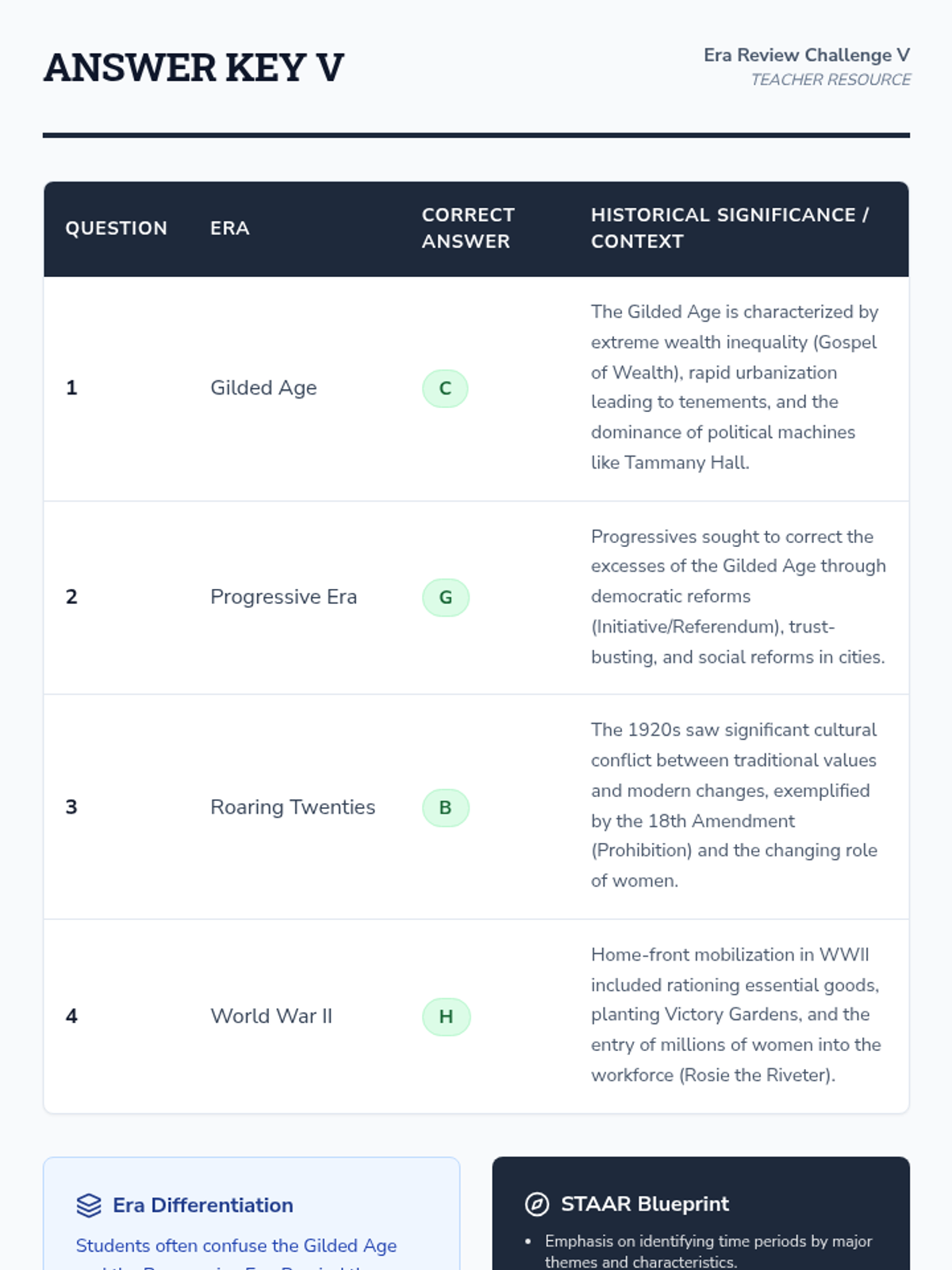
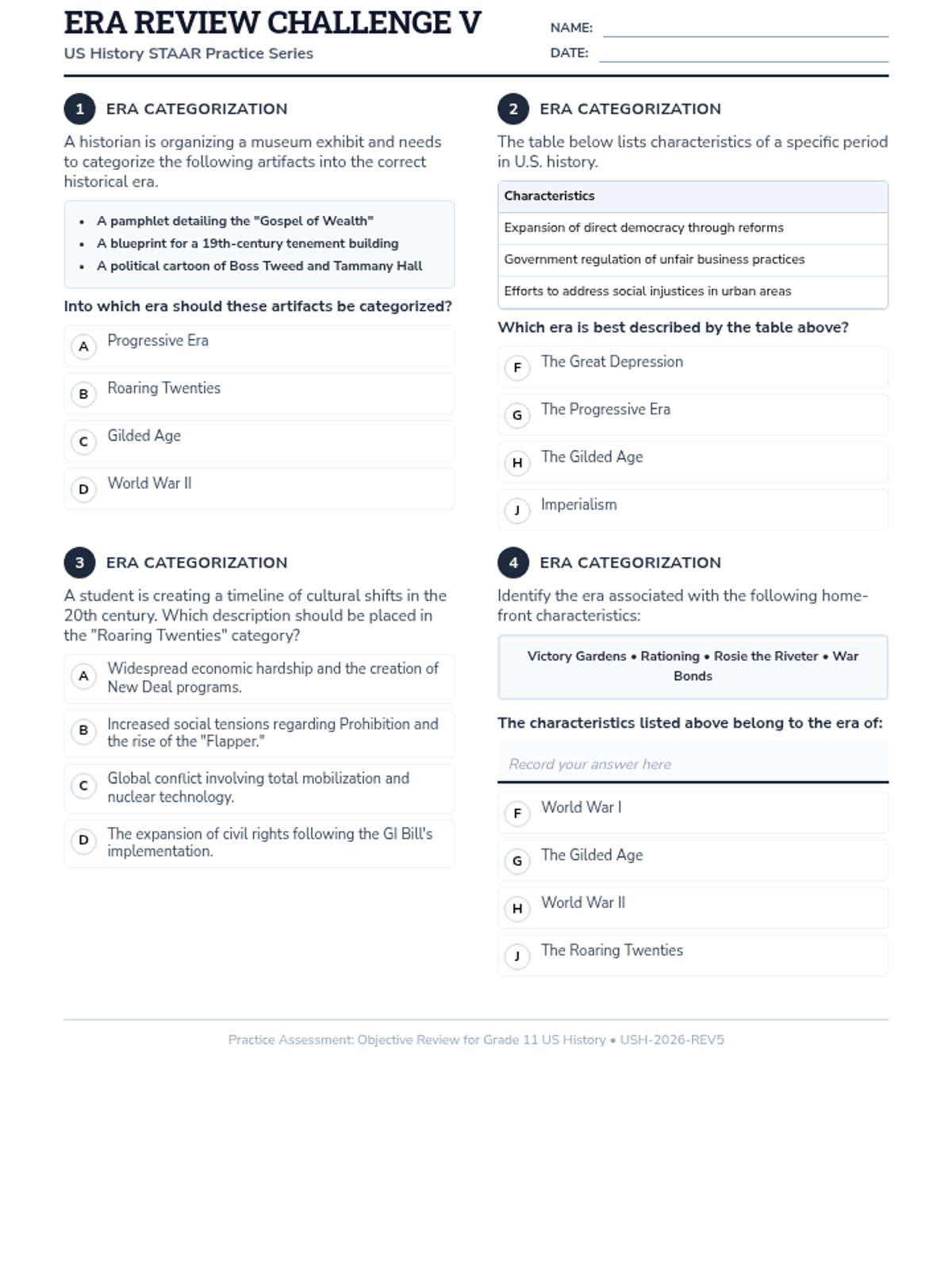
An answer key and teacher resource guide for the fifth Era Review Challenge practice sheet, providing correct answers and historical context for categorizing the Gilded Age, Progressive Era, Roaring Twenties, and WWII.
A fifth practice sheet containing 4 STAAR-style questions focused on categorizing and identifying major eras: the Gilded Age, the Progressive Era, the Roaring Twenties, and WWII. Reformatted into a clean 2-column layout to fit on a single 8.5x11 page with 0.5-inch margins and no top margin.
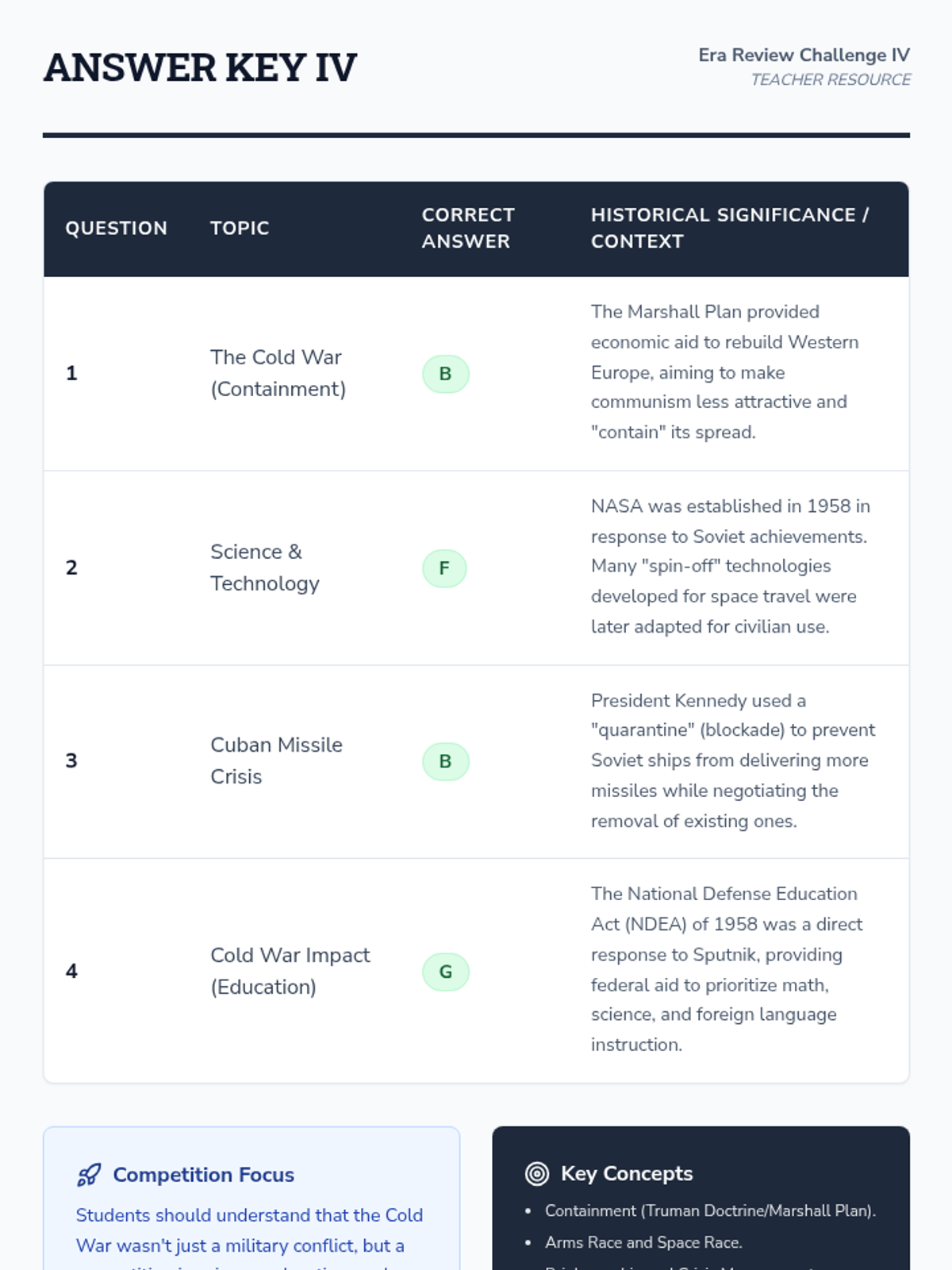
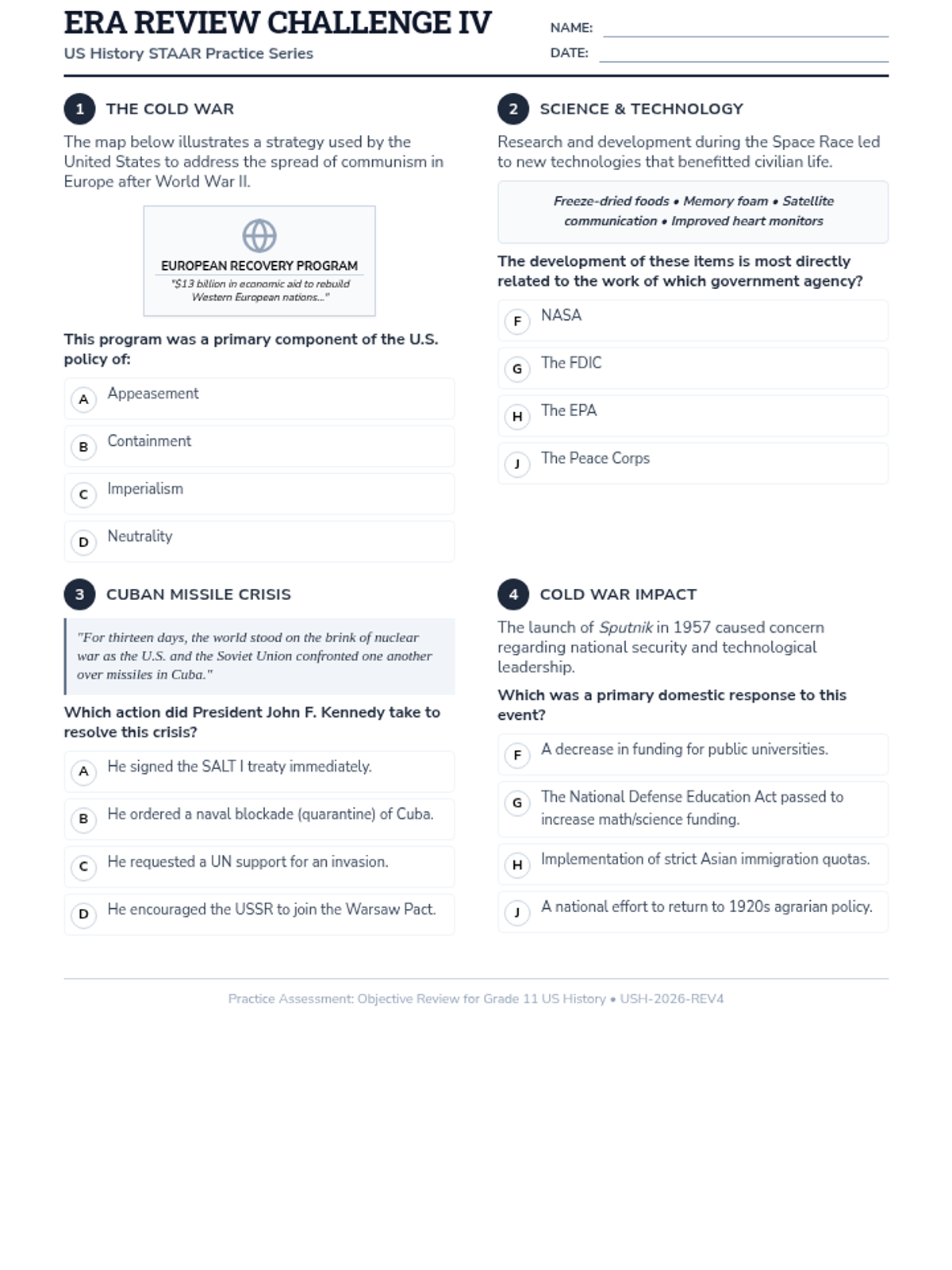
An answer key and teacher resource guide for the fourth Era Review Challenge practice sheet, including correct answers, historical context, and instructional strategies for the Cold War era.
A fourth practice sheet containing 4 STAAR-style questions covering the Cold War, including Containment (Marshall Plan), Space Race technologies (NASA), the Cuban Missile Crisis, and the National Defense Education Act. Reformatted into a clean 2-column layout to fit on a single 8.5x11 page with 0.5-inch margins and no top margin.
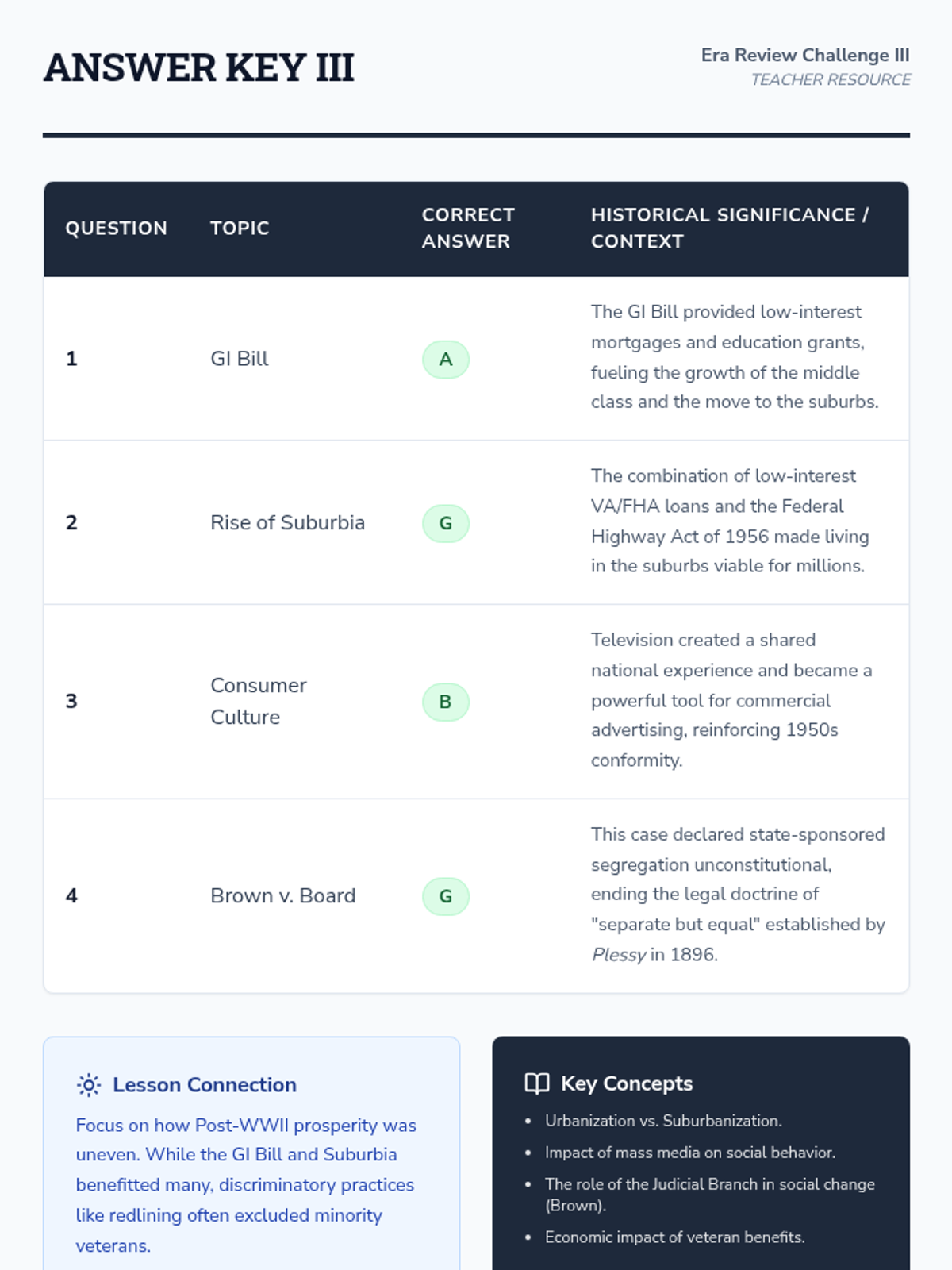
An answer key and teacher resource guide for the third Era Review Challenge practice sheet, including correct answers, historical context, and instructional strategies for Post-WWII America.
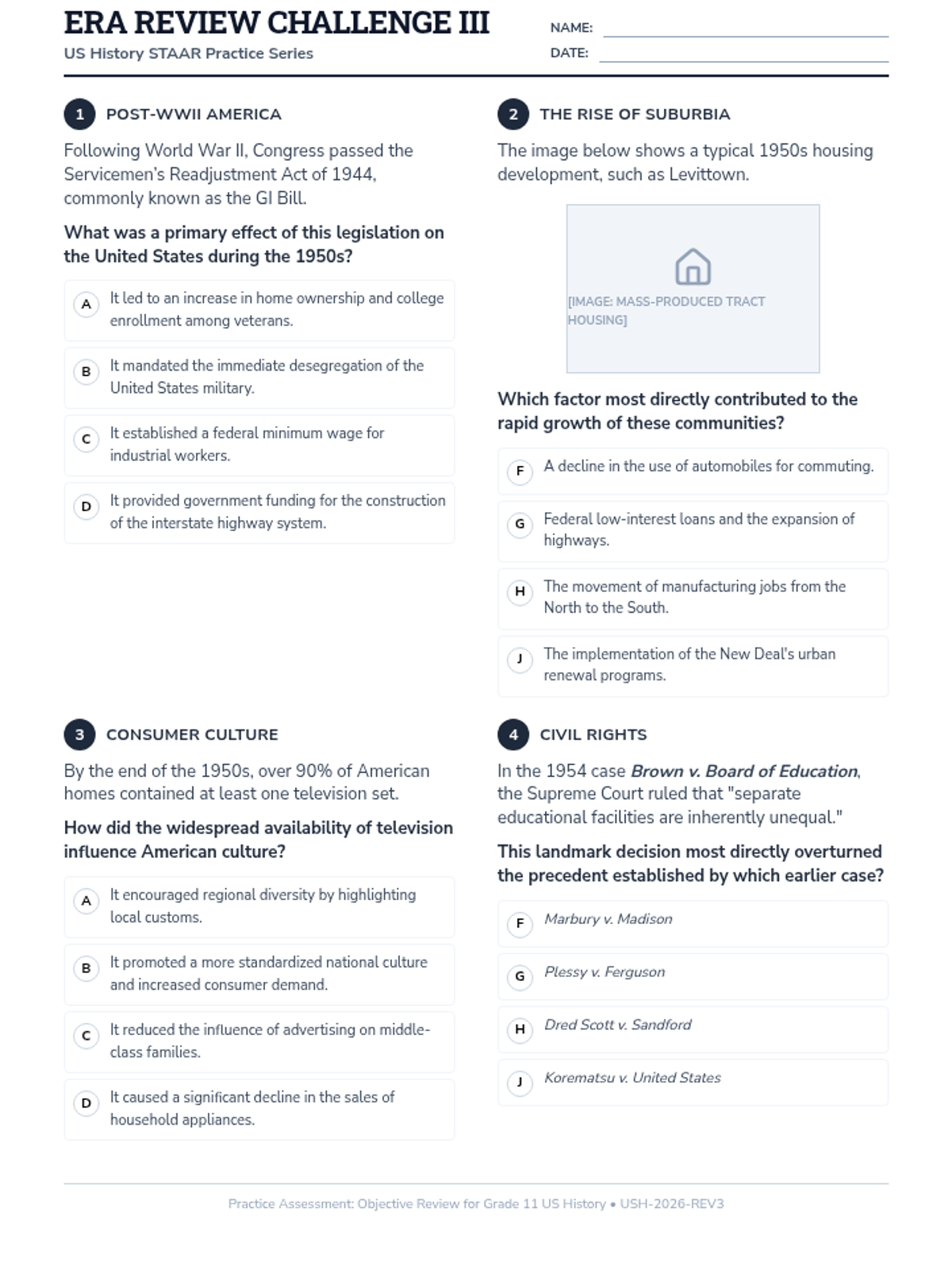
A third practice sheet containing 4 STAAR-style questions covering Post-WWII America, including the GI Bill, the rise of suburbia, consumer culture (TV), and Brown v. Board of Education. Reformatted into a clean 2-column layout to fit on a single 8.5x11 page with 0.5-inch margins and no top margin.
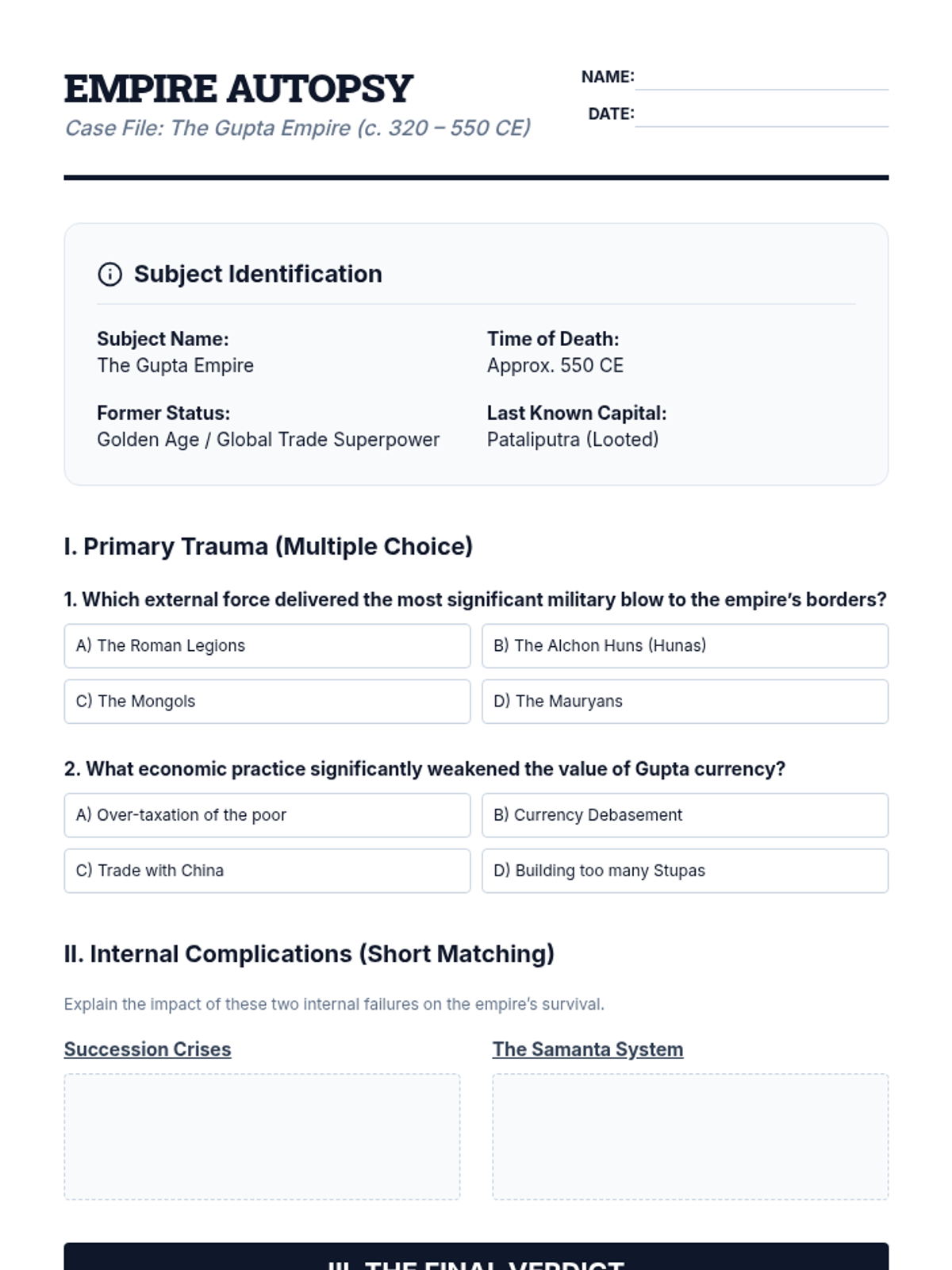
Final synthesis assessment where students 'diagnose' the fall of the Gupta Empire using evidence from the 5-day unit.
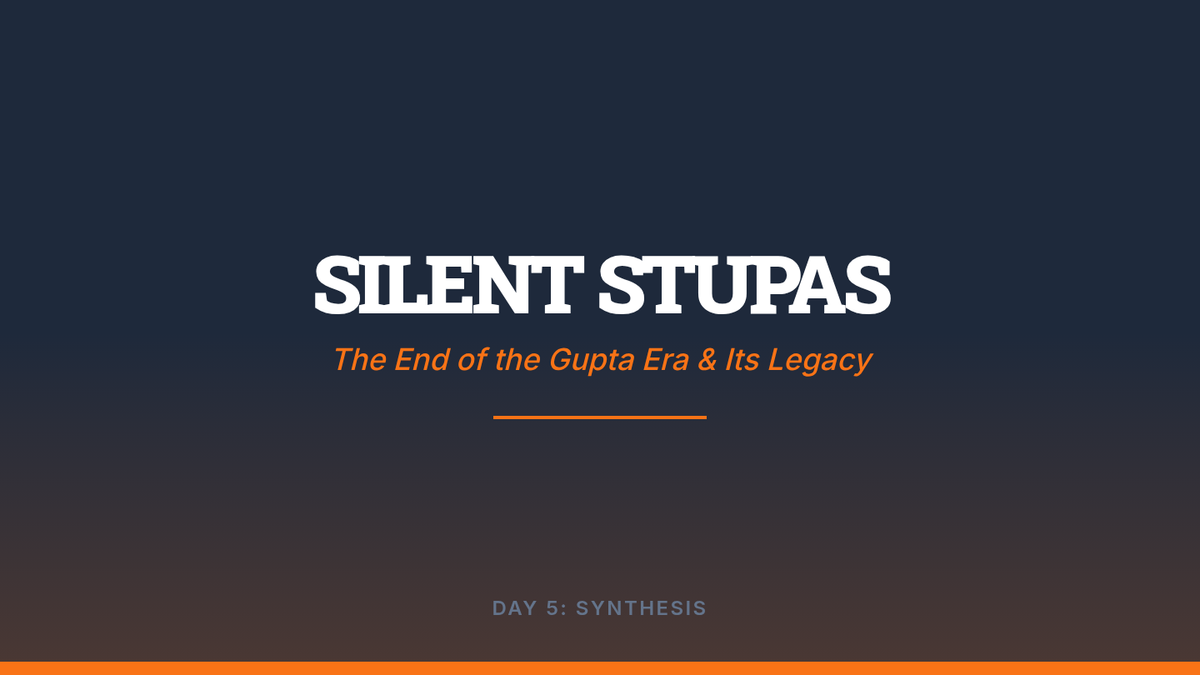
Day 5 slide deck exploring the synthesis of the empire's collapse and the lasting cultural legacy of the Gupta period.
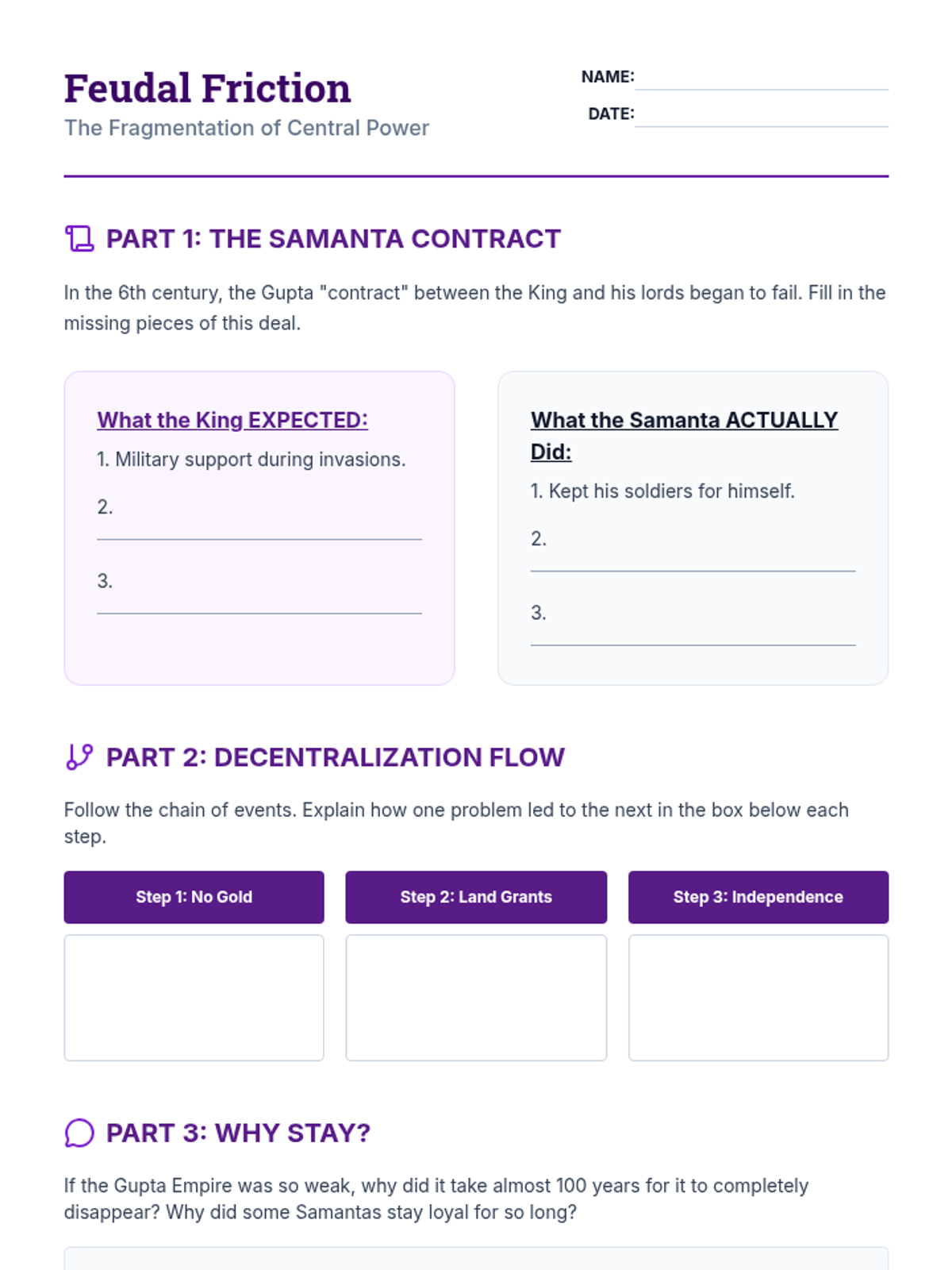
Day 4 graphic organizer where students analyze the shifting relationship between the Gupta central authority and regional feudal lords (Samantas).
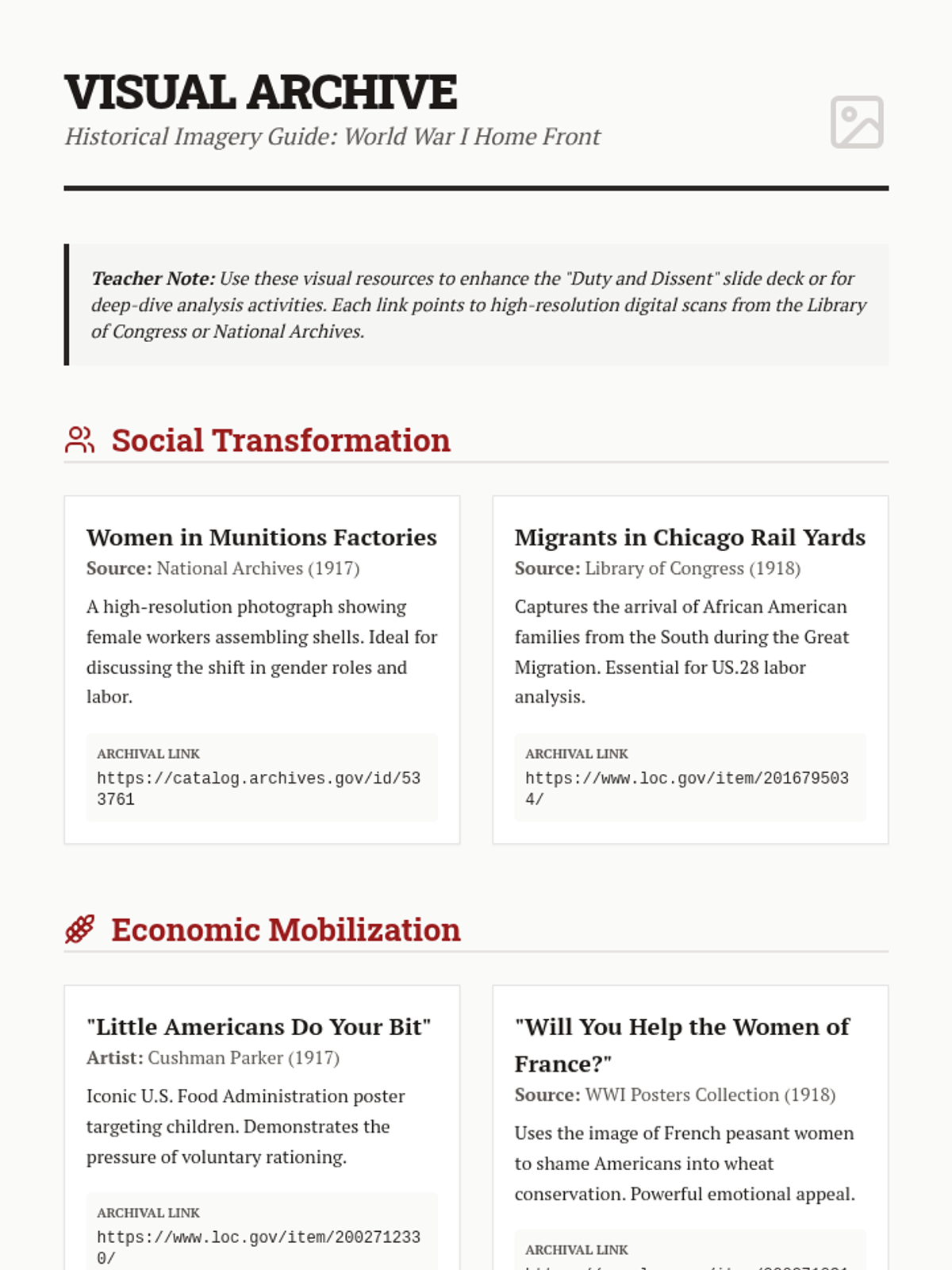
A curated list of high-quality primary source visuals for the WWI Home Front, including recruitment posters, propaganda, and rare archival photographs of social shifts and political dissent. Each entry includes verified links to the Library of Congress or National Archives. Updated for improved layout and contrast.
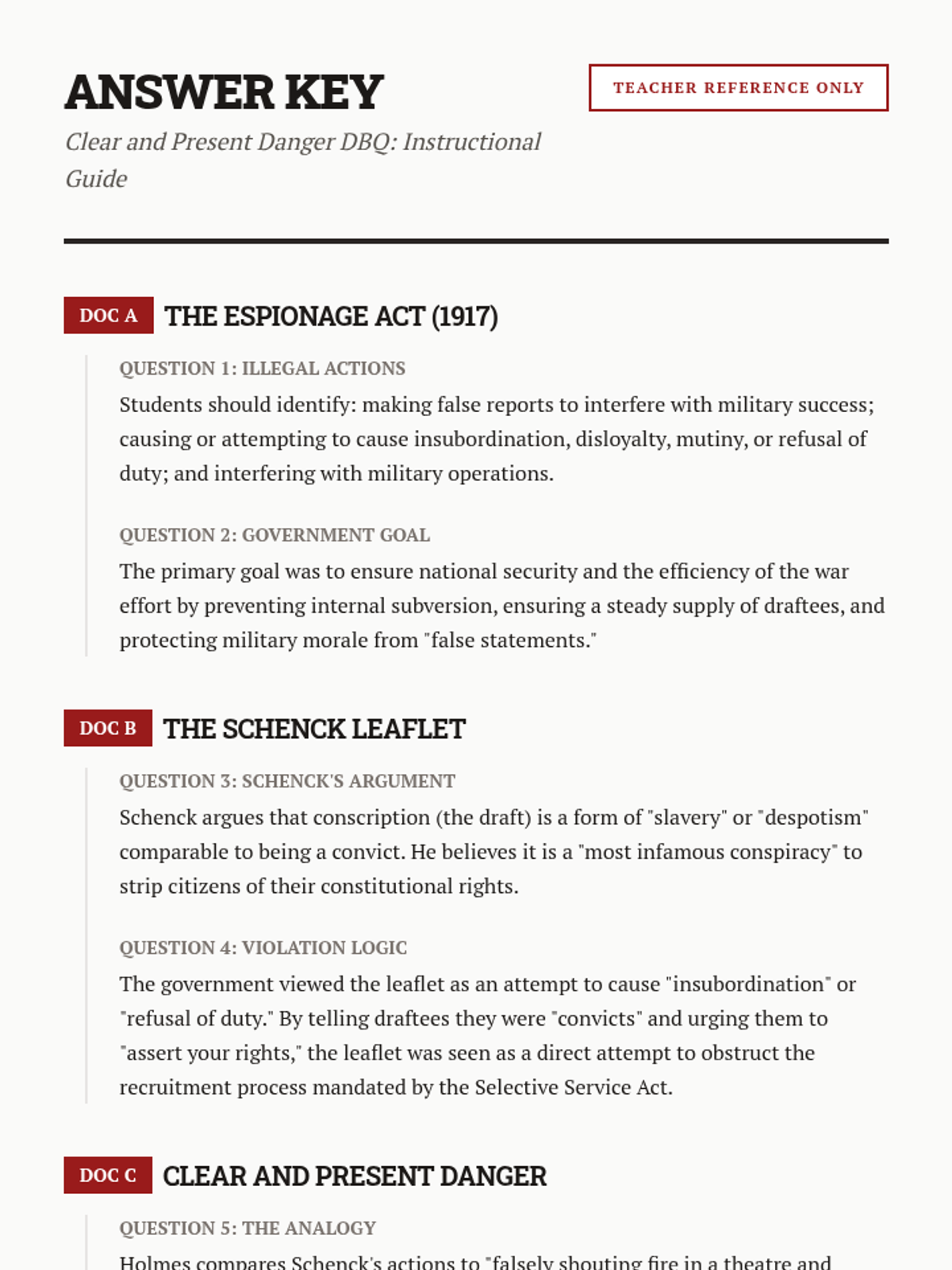
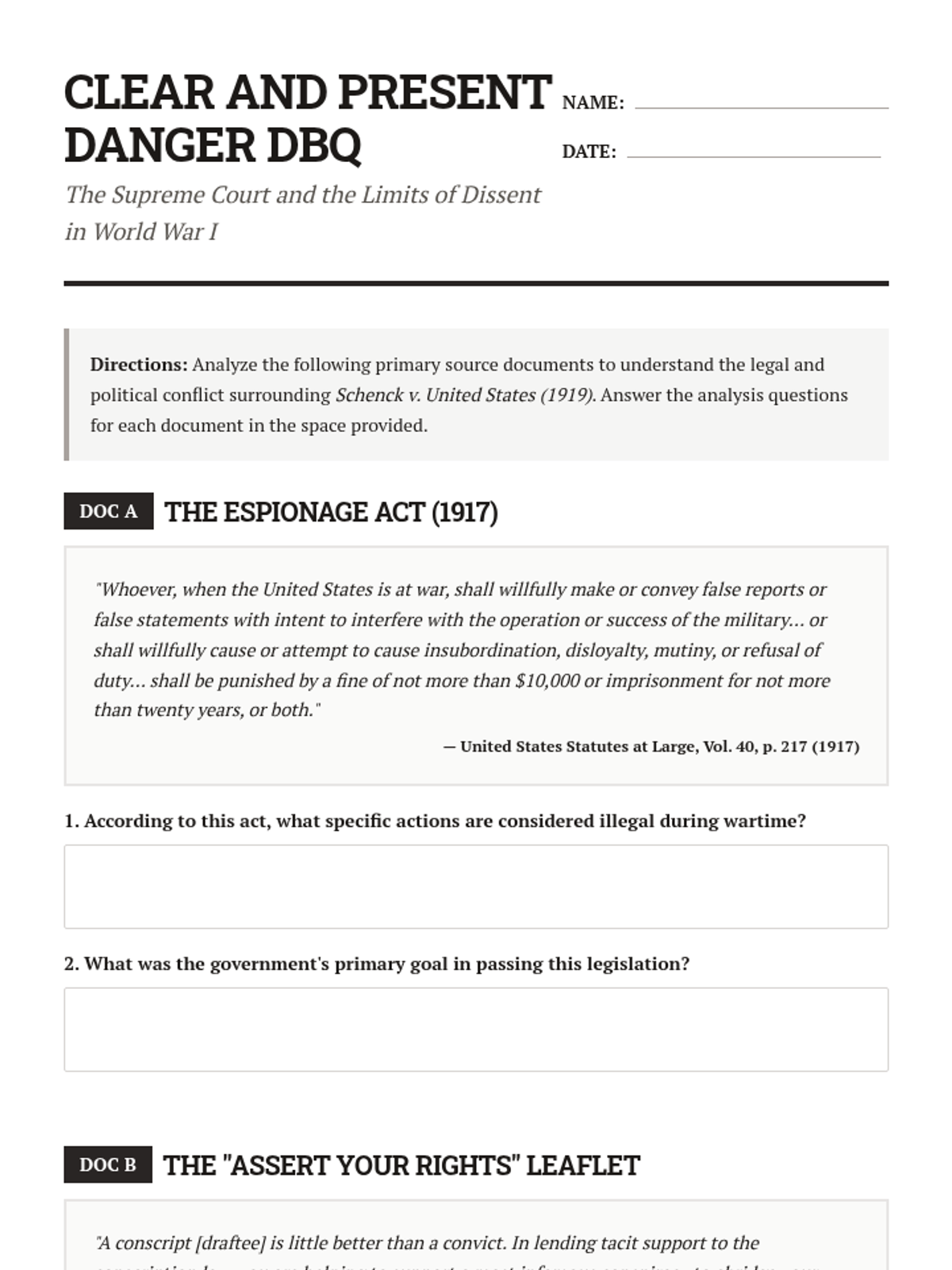
A comprehensive answer key and instructional guide for the "Clear and Present Danger" DBQ worksheet. Provides detailed evidence-based answers, archival context, and a scoring rubric for the synthesis challenge. Updated for improved layout and page-break handling.
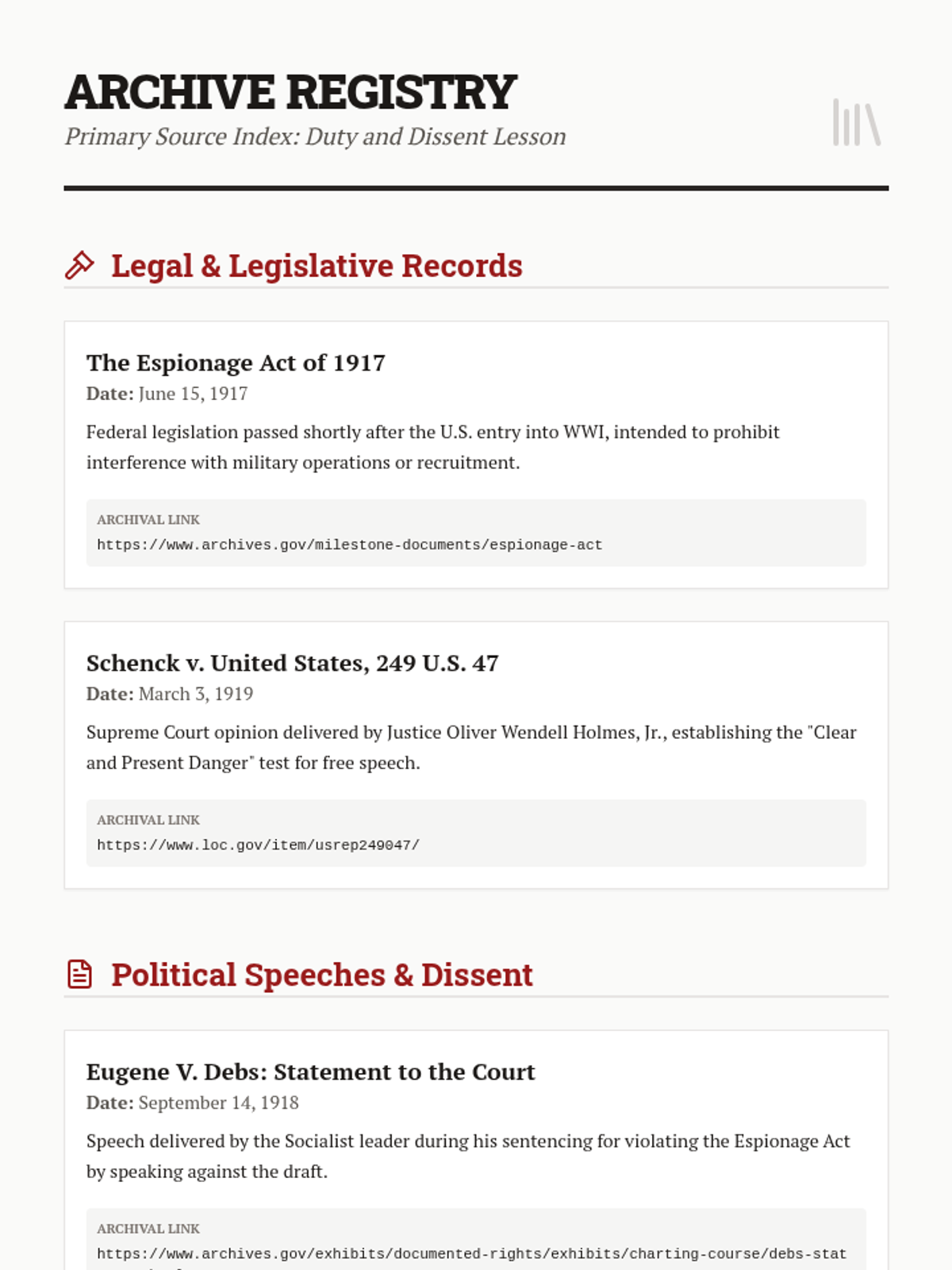
A comprehensive reference sheet for teachers and students listing all primary sources used in the "Duty and Dissent" lesson, including full titles, specific dates, historical context, and verified archival links. Updated for improved readability and layout.
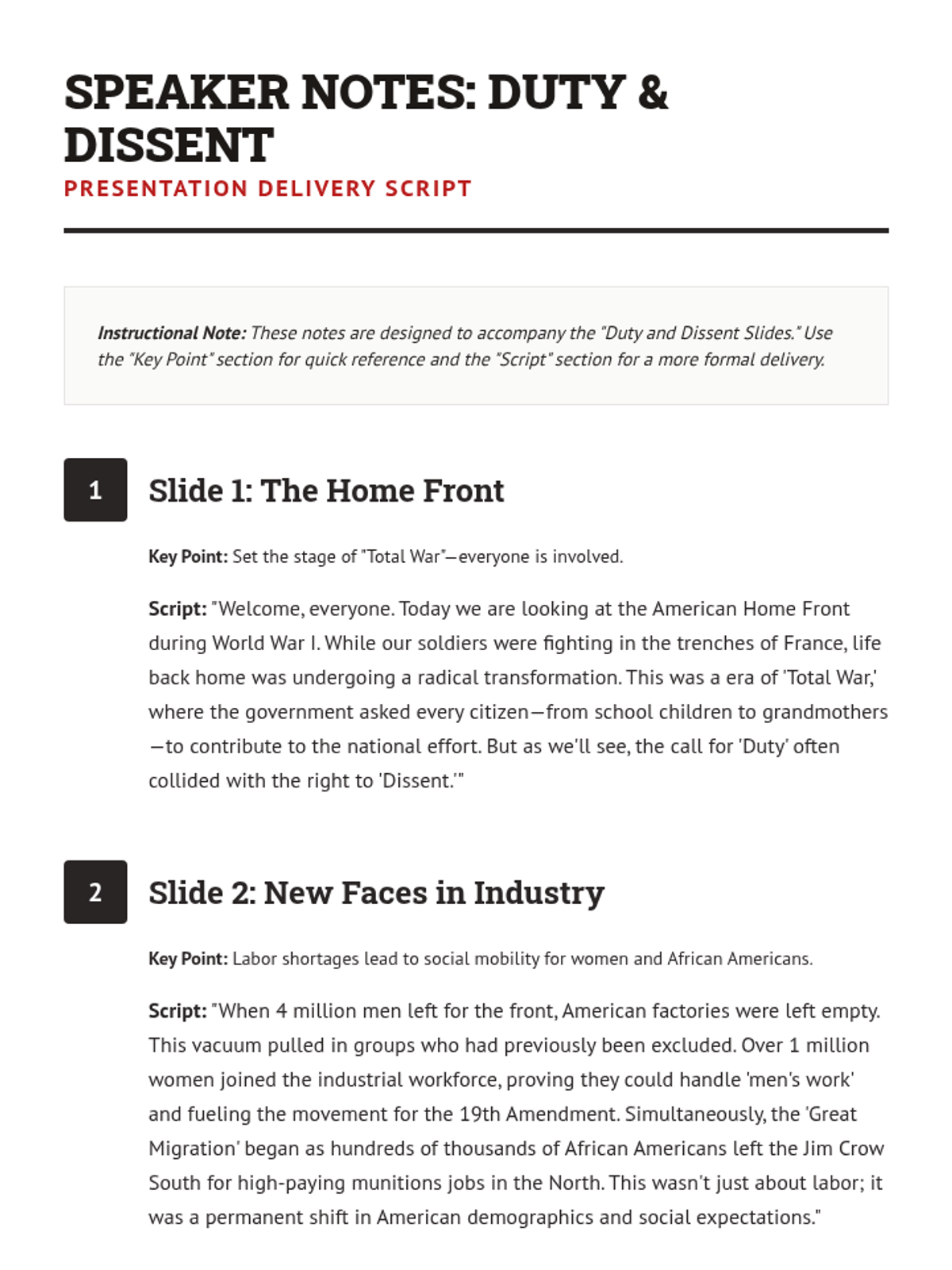
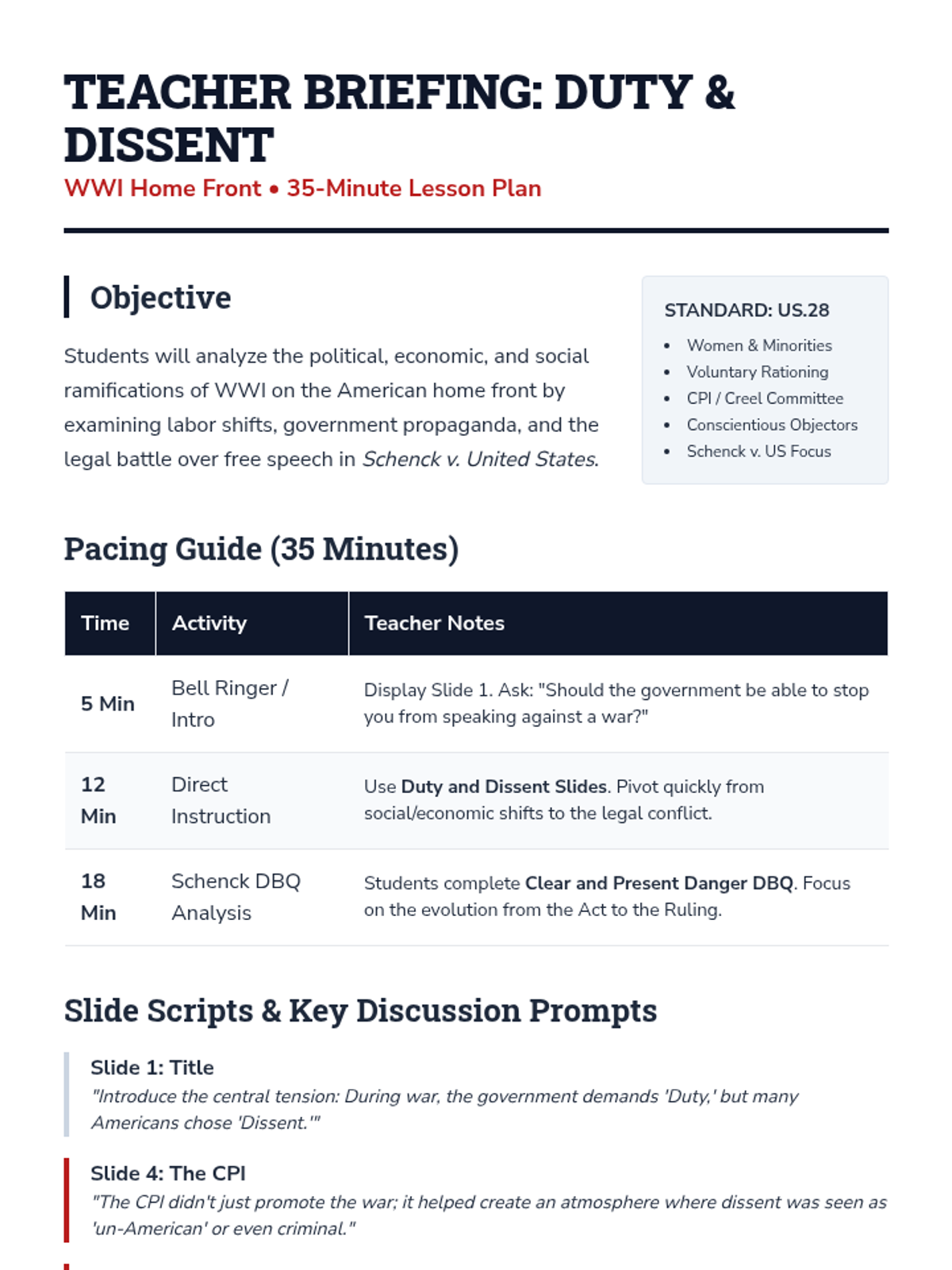
A dedicated speaker notes document for the "Duty and Dissent" presentation. It provides slide-by-slide scripts, key points, and instructional cues for the teacher to use during the lesson.
Updated teacher's guide for the Schenck-focused DBQ lesson. Includes a refined pacing guide, instructional scripts focusing on the legal conflict, and a detailed answer key for the "Clear and Present Danger" analysis.
Refocused primary source analysis worksheet centered on the legal conflict of Schenck v. United States. Updated to ensure all primary source attributions include names and dates.
A comprehensive visual presentation covering Tennessee State Standard US.28. Updated to include names and dates for all primary source quotes.
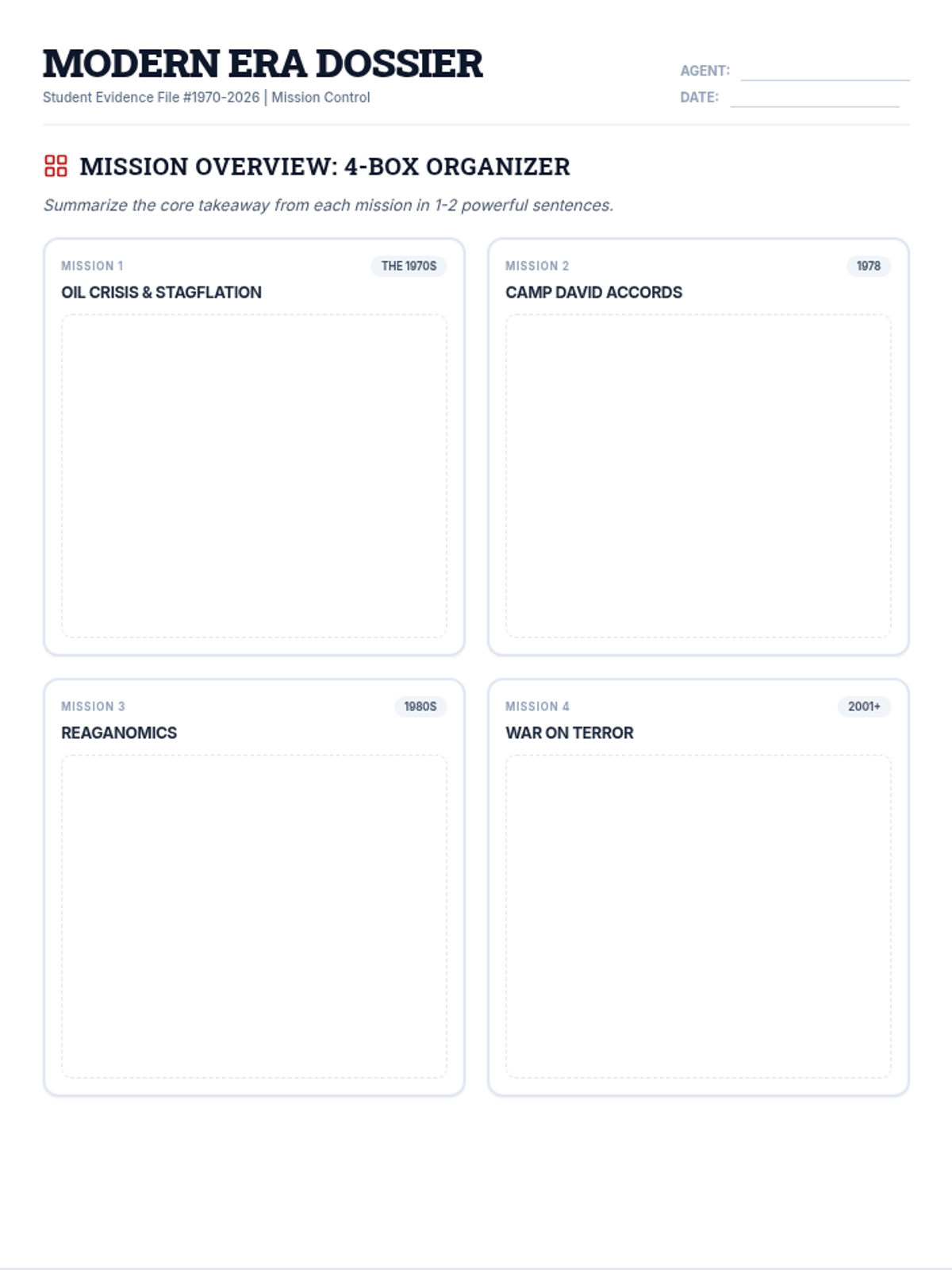
A multi-page student packet containing the 4-box graphic organizer, consolidated guided notes, and a new 3rd page featuring STAAR-style assessment questions for all four missions. Fixed severe page break issues and layout overflow. Added white backgrounds to work areas. Standardized answer labels.
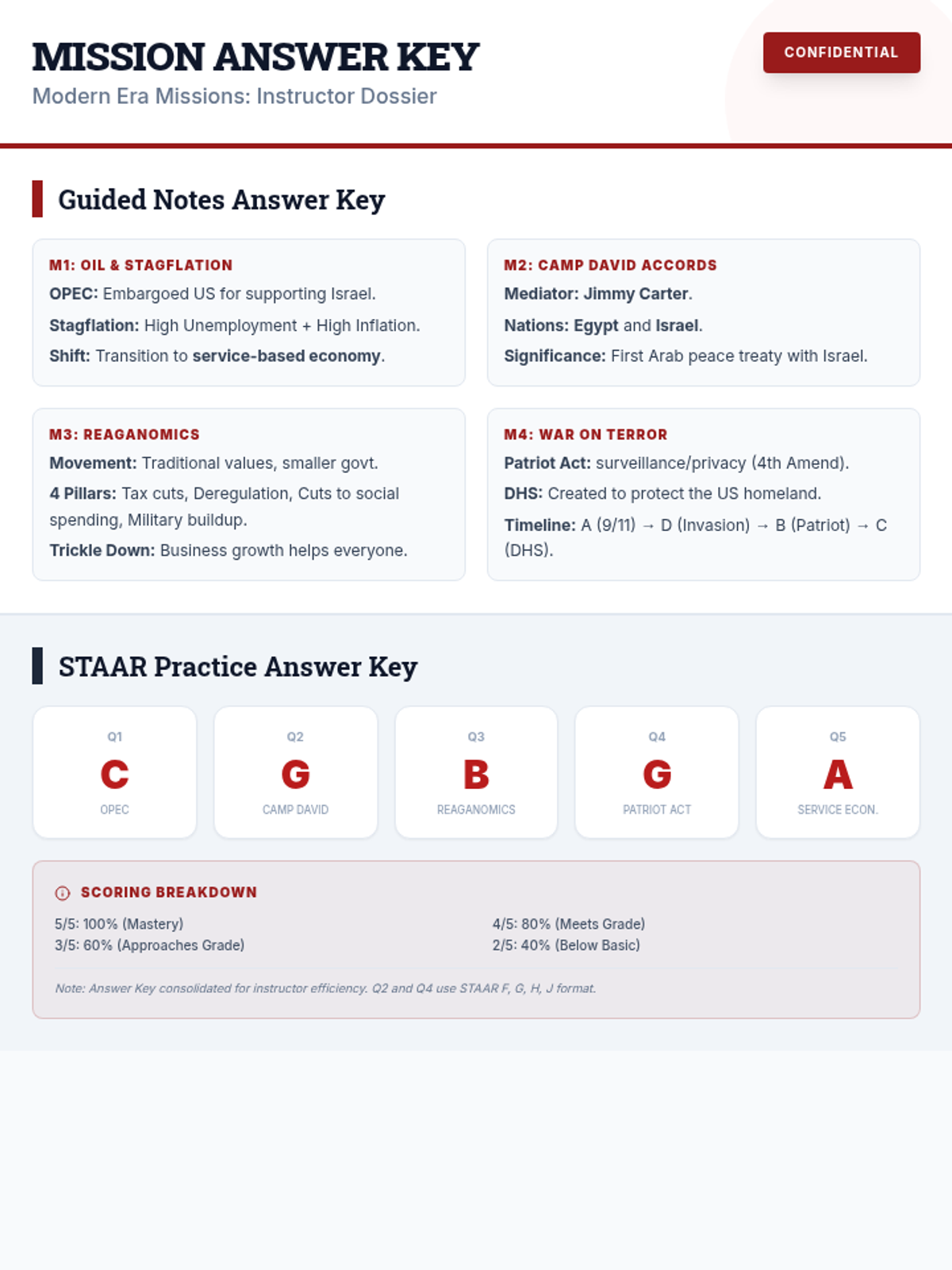
A comprehensive answer key for the Modern Era Missions lesson. Updated with 0.3in margins. Includes both guided notes answers and the 5-question STAAR practice key. Fixed page break issues.
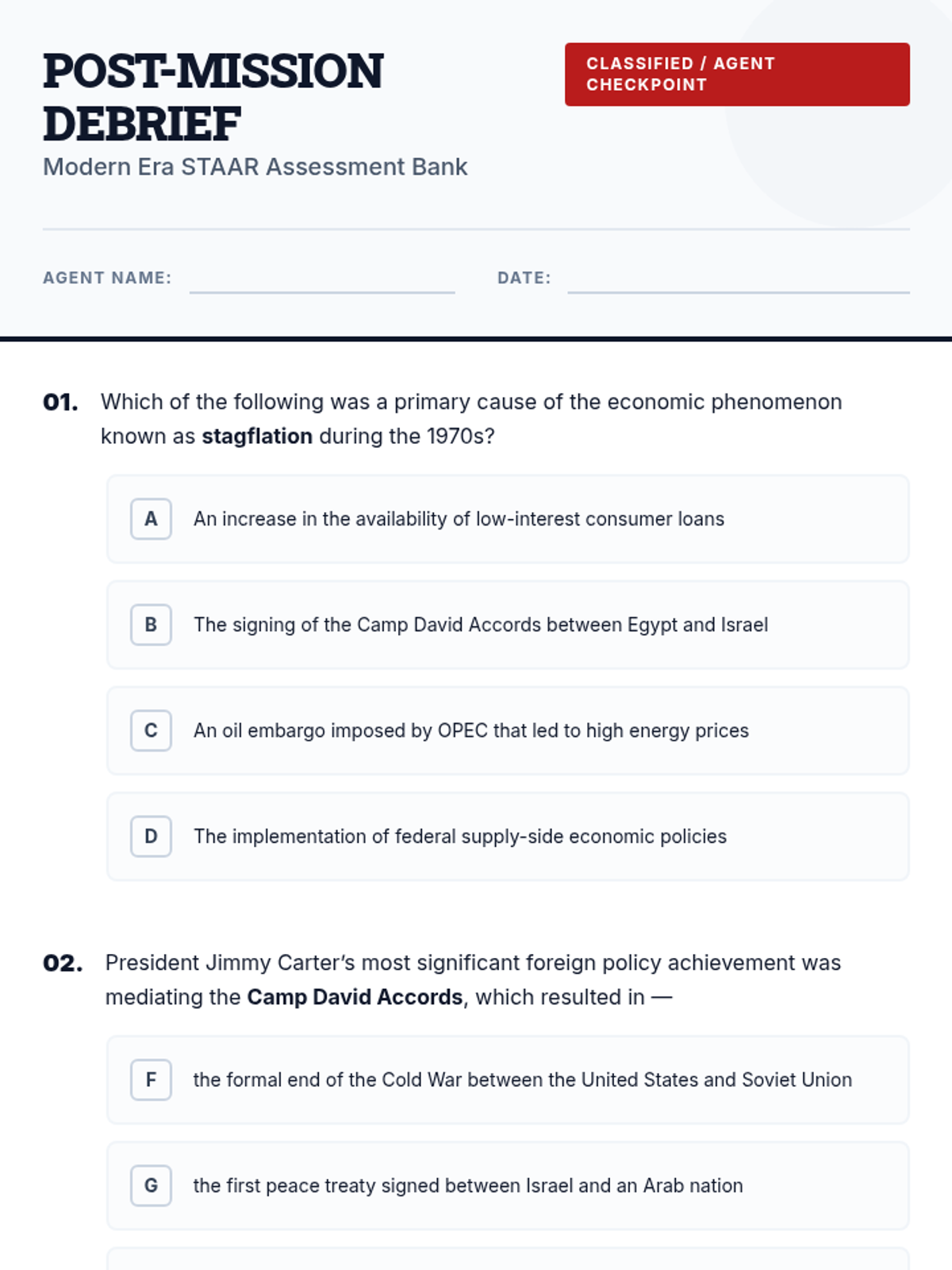
An updated STAAR-style question bank featuring 5 high-yield multiple-choice questions covering OPEC, Camp David, Reaganomics, the War on Terror, and the transition to a service-based economy. Theme aligned with the Mission Briefing.
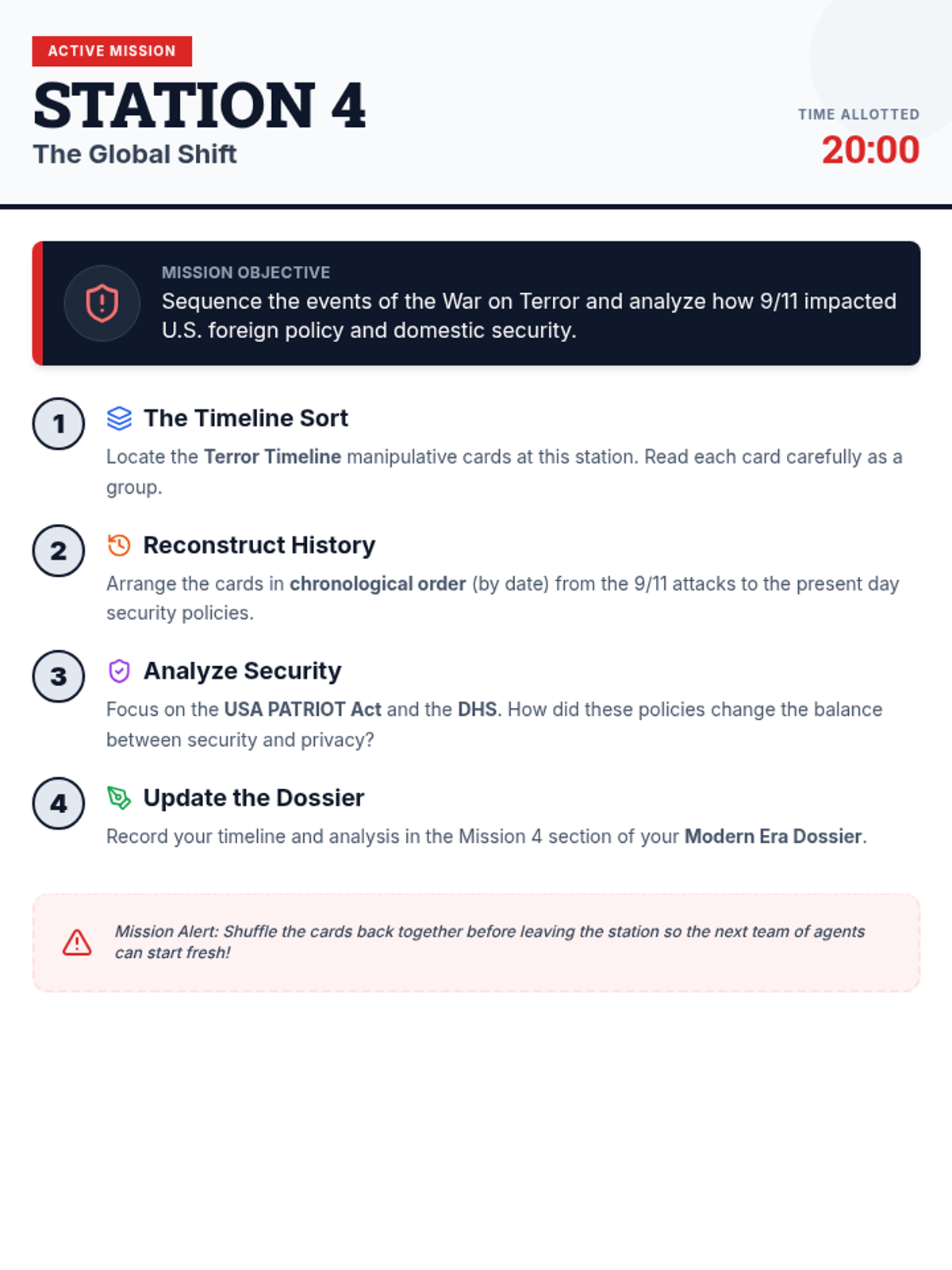
A station sign for Station 4, guiding students through the manipulative timeline sort activity on the War on Terror and 9/11. Fixed page break issues.
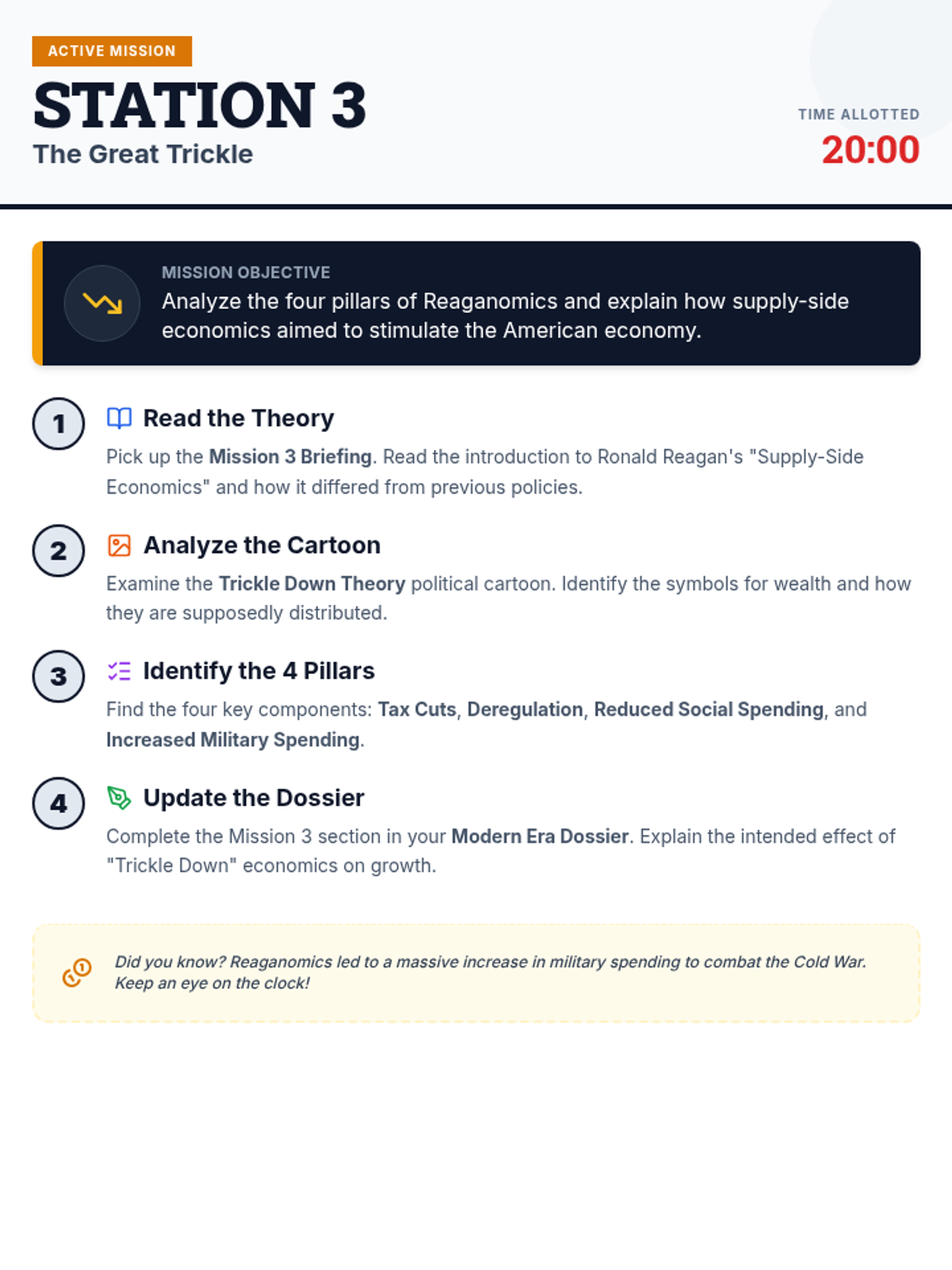
A station sign for Station 3, guiding students through the analysis of Reaganomics and the trickle-down theory. Fixed page break issues.
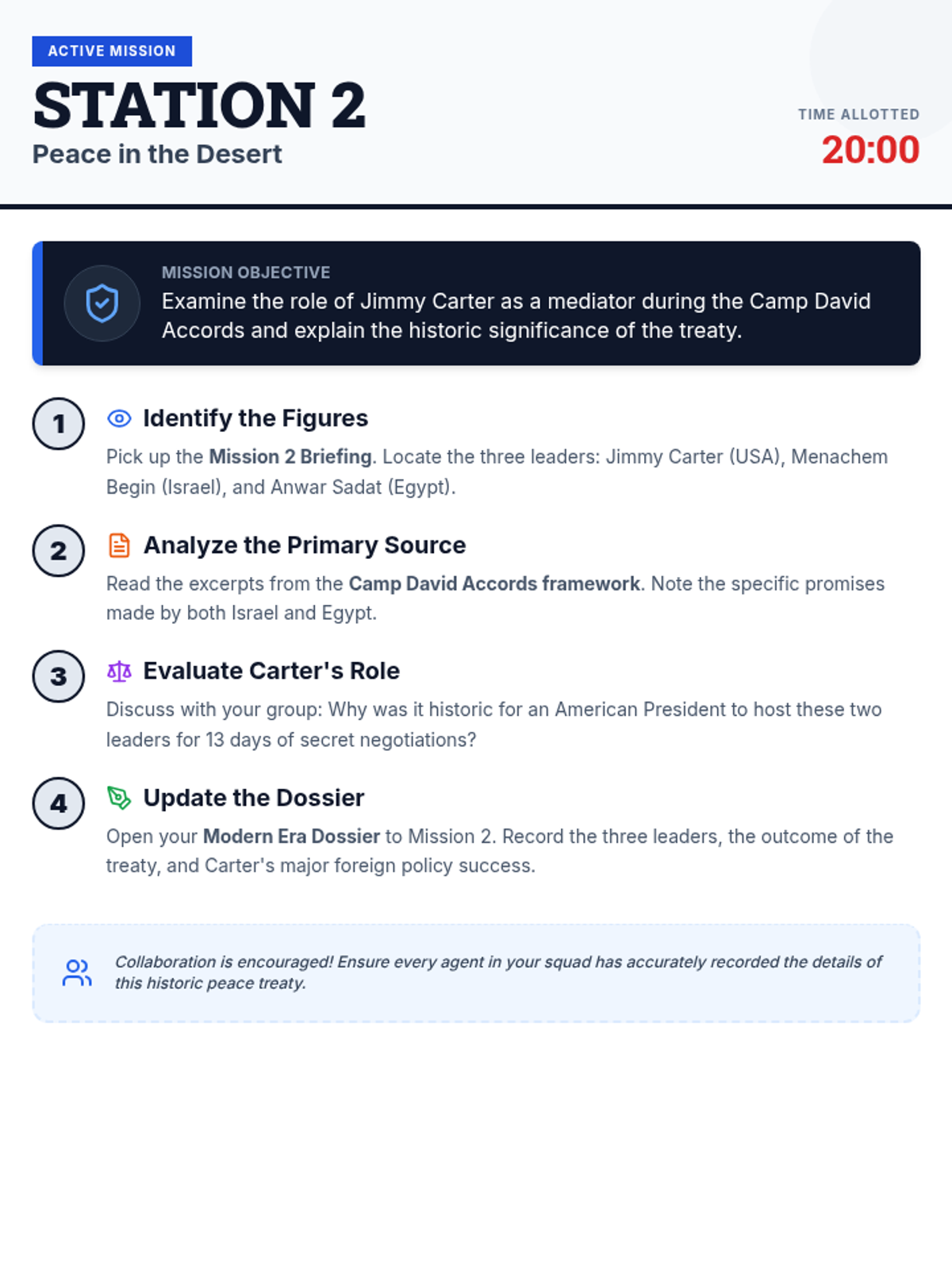
A station sign for Station 2, guiding students through the analysis of the Camp David Accords and the diplomatic role of Jimmy Carter. Fixed page break issues.
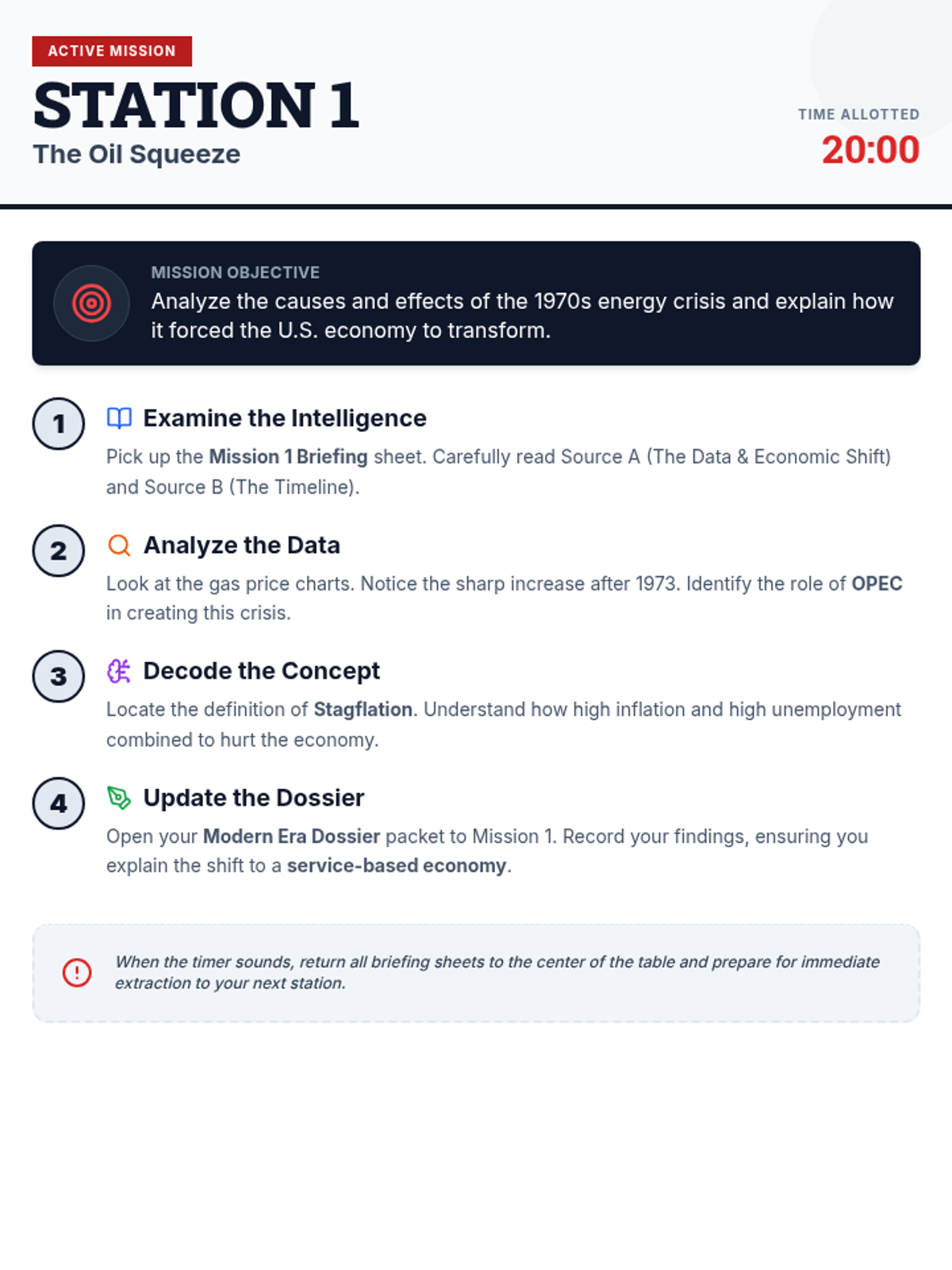
A clear, visually engaging directions sign for Station 1, providing students with step-by-step instructions for analyzing the 1970s oil crisis and stagflation. Fixed page break issues.
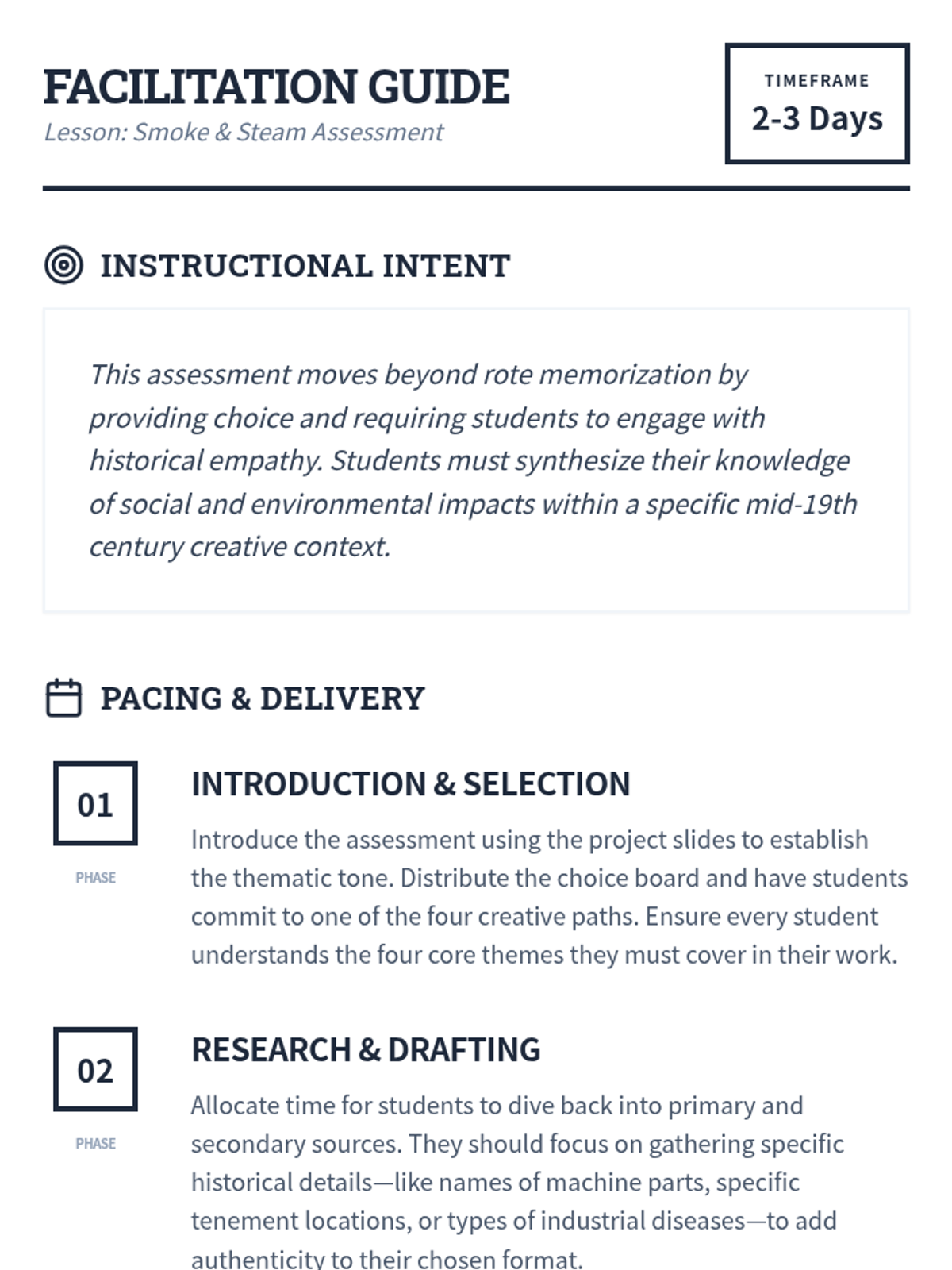
A teacher's facilitation guide for the Industrial Revolution assessment. Background is now solid white.
A visually striking presentation to introduce the Smoke & Steam creative assessment. The theme has been updated to a clean white background with bold slate-colored accents for high legibility.
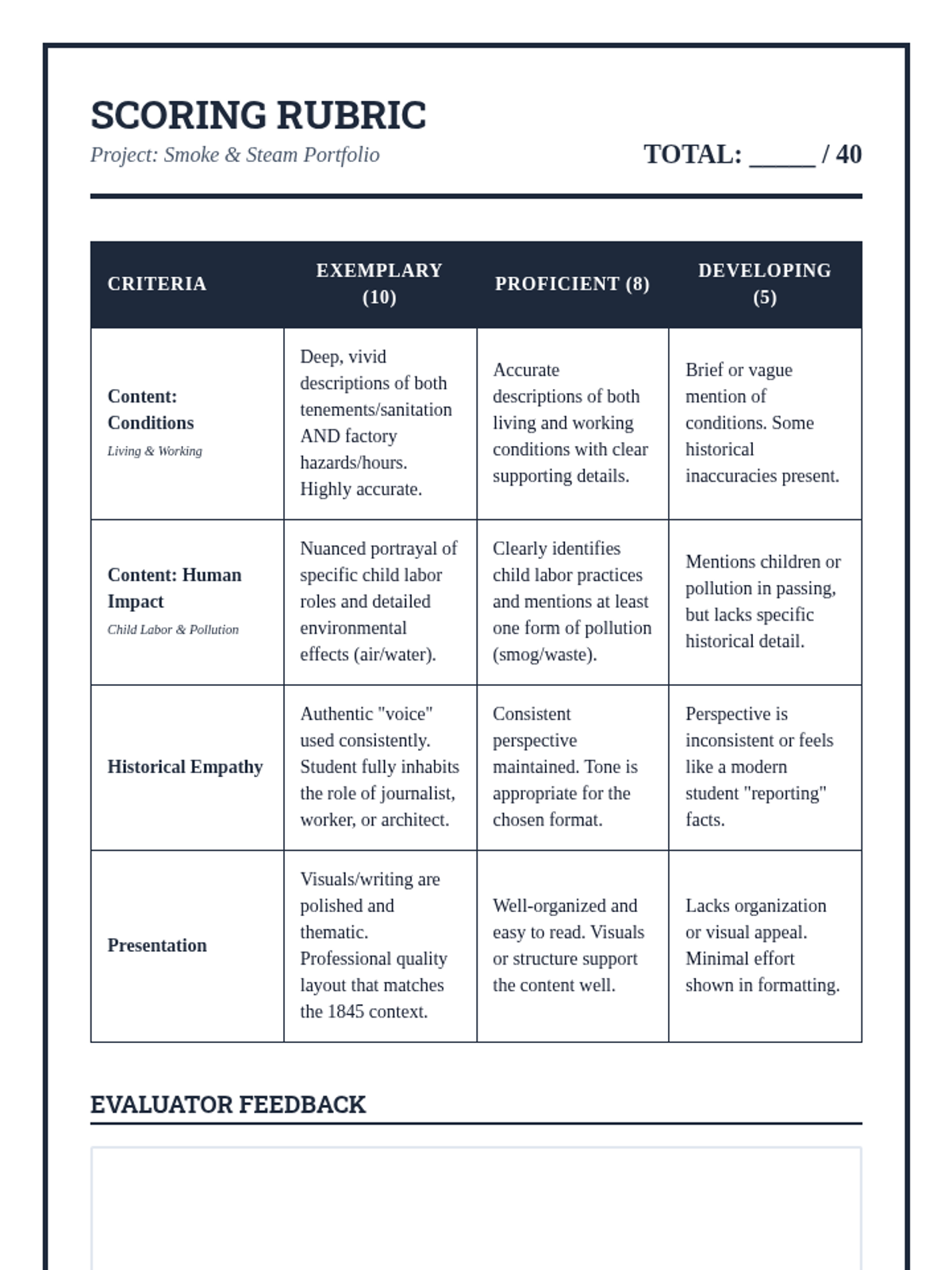
A detailed teacher-facing scoring rubric for the Industrial Revolution creative assessment. Background is now solid white.
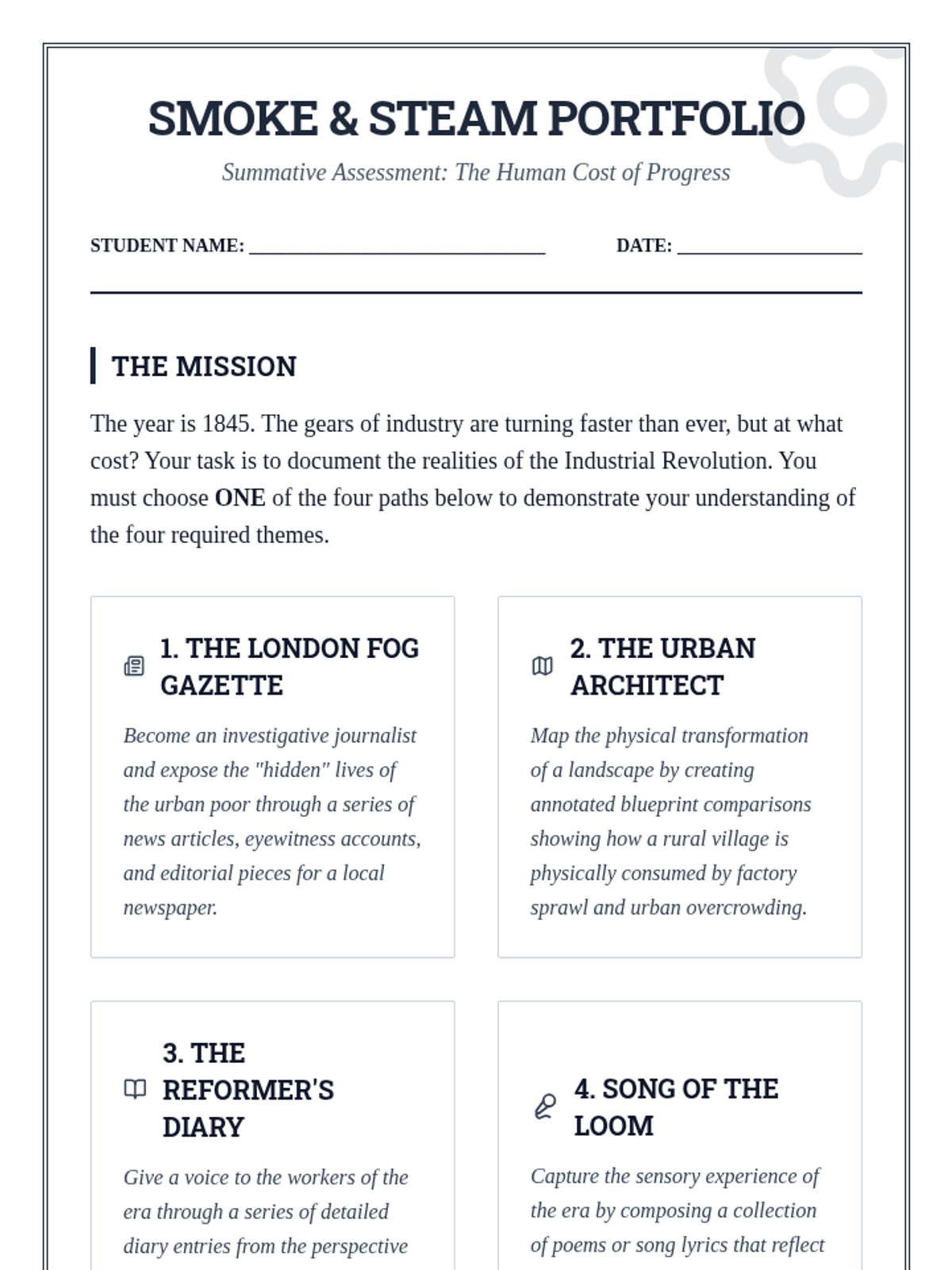
A student-facing choice board offering four creative project options (journalism, architecture, diary, or poetry) to assess understanding of the Industrial Revolution's impacts. Background is now solid white.
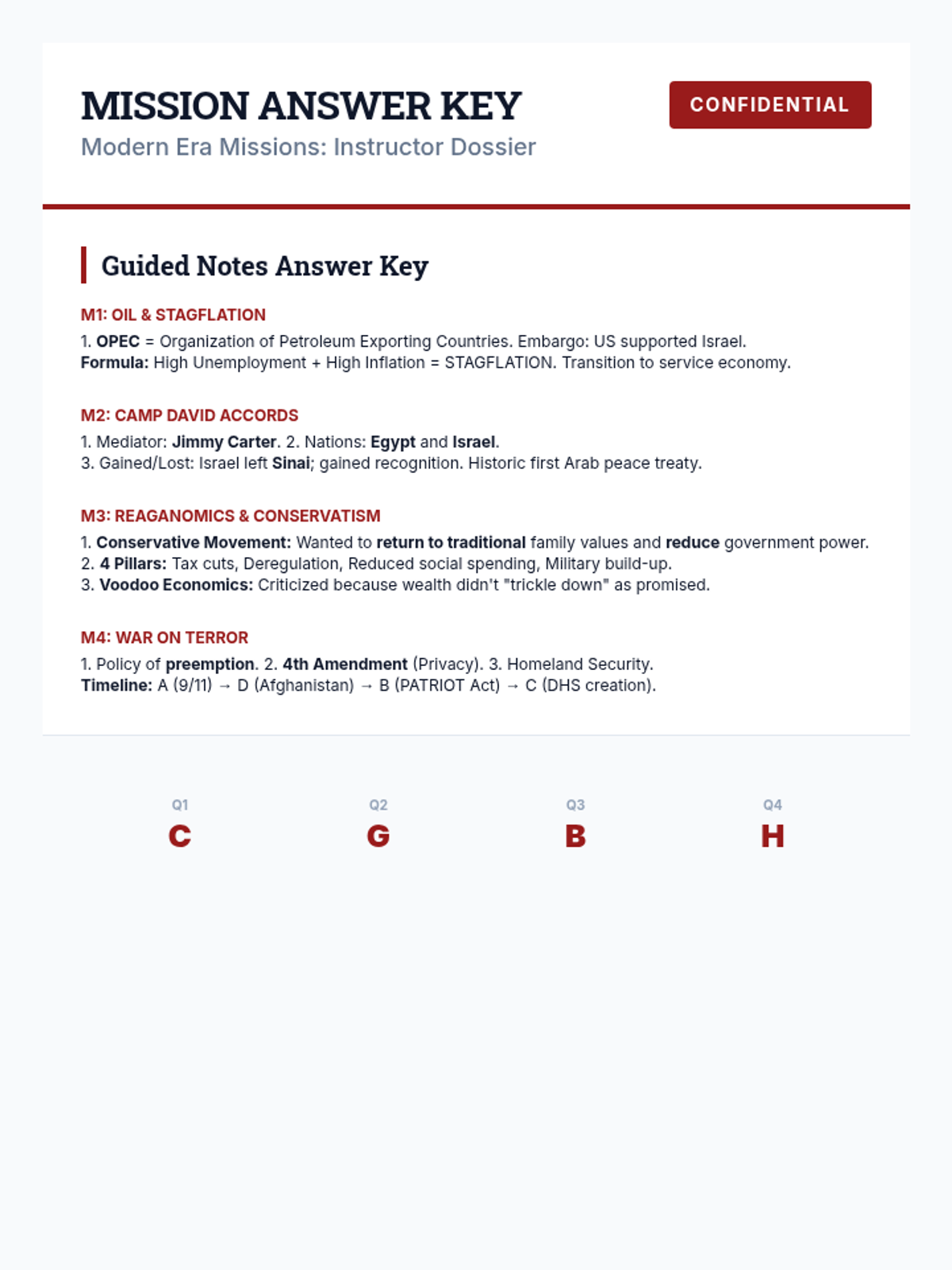
A comprehensive answer key for the Modern Era Missions lesson. Updated with 0.3in margins. Reverted Mission 3 to non-OPTIC answers.
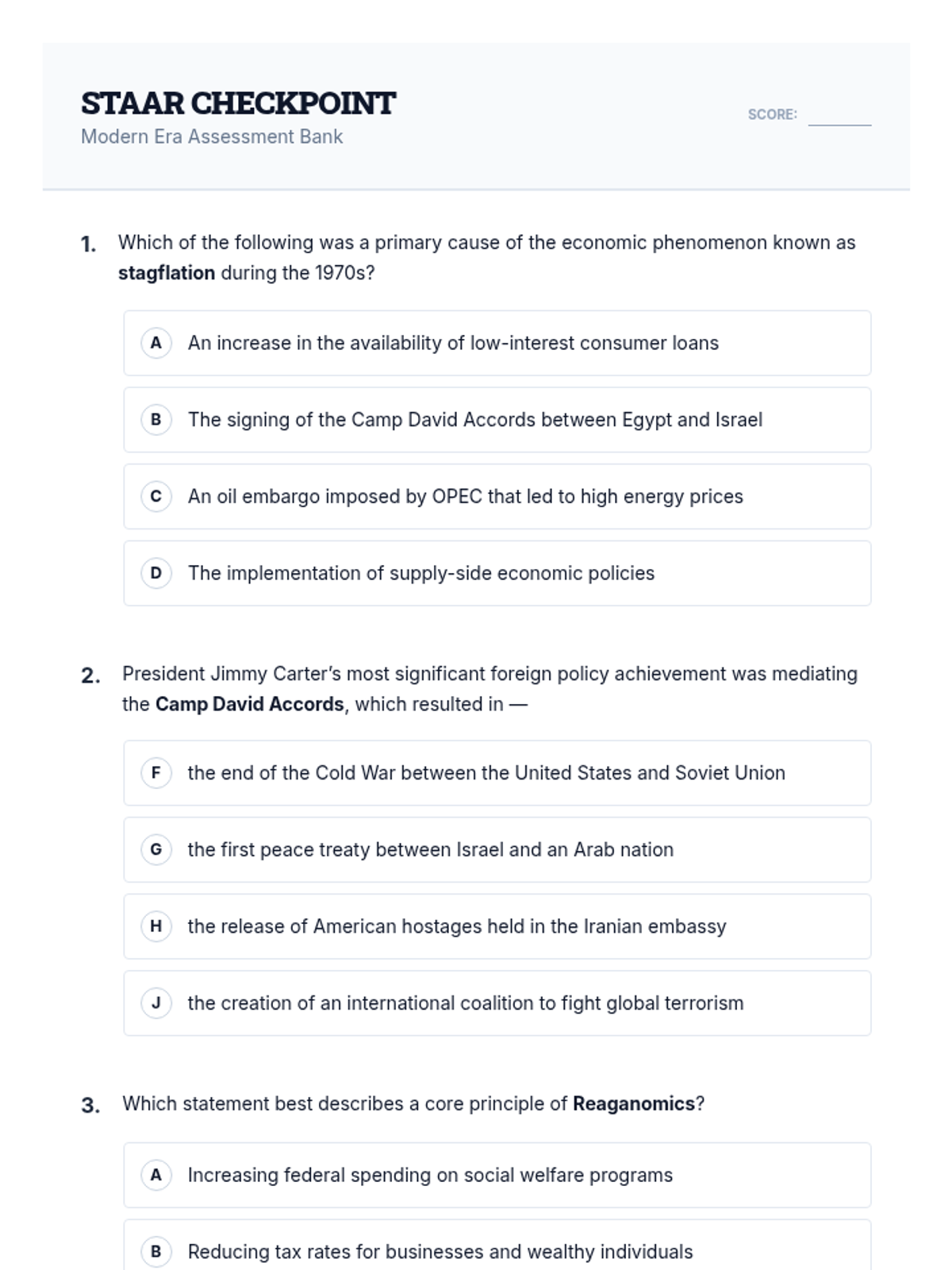
A STAAR-style question bank featuring multiple-choice questions. Updated with 0.3in margins.
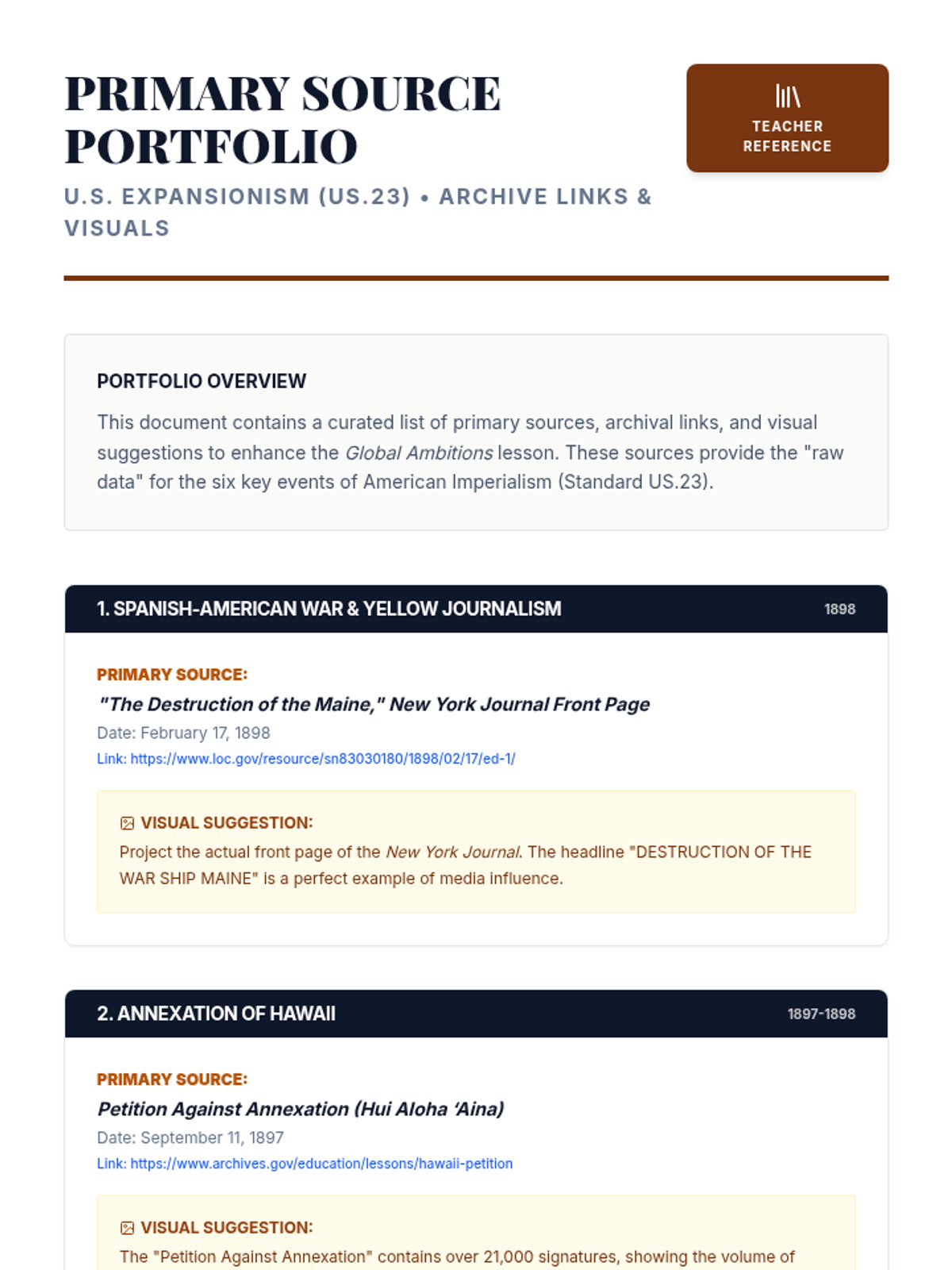
A teacher reference document listing key primary sources for the lesson, including archival links and visual suggestions. Now includes a specific primary source map from the Library of Congress suggested for the Part 2 spatial association activity.
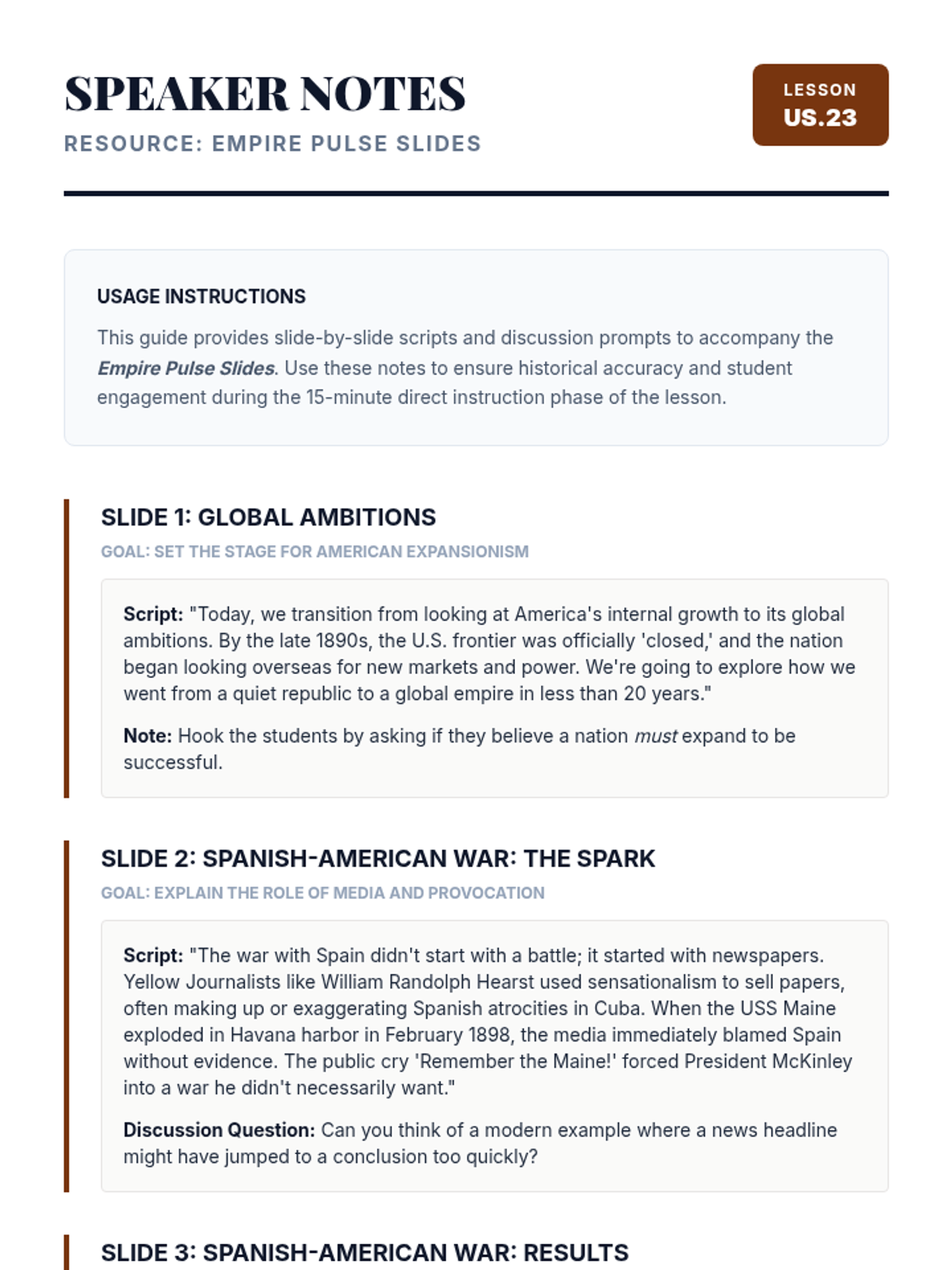
Slide-by-slide speaker notes for the Empire Pulse Slides, providing a detailed script, discussion prompts, and historical context for teachers.
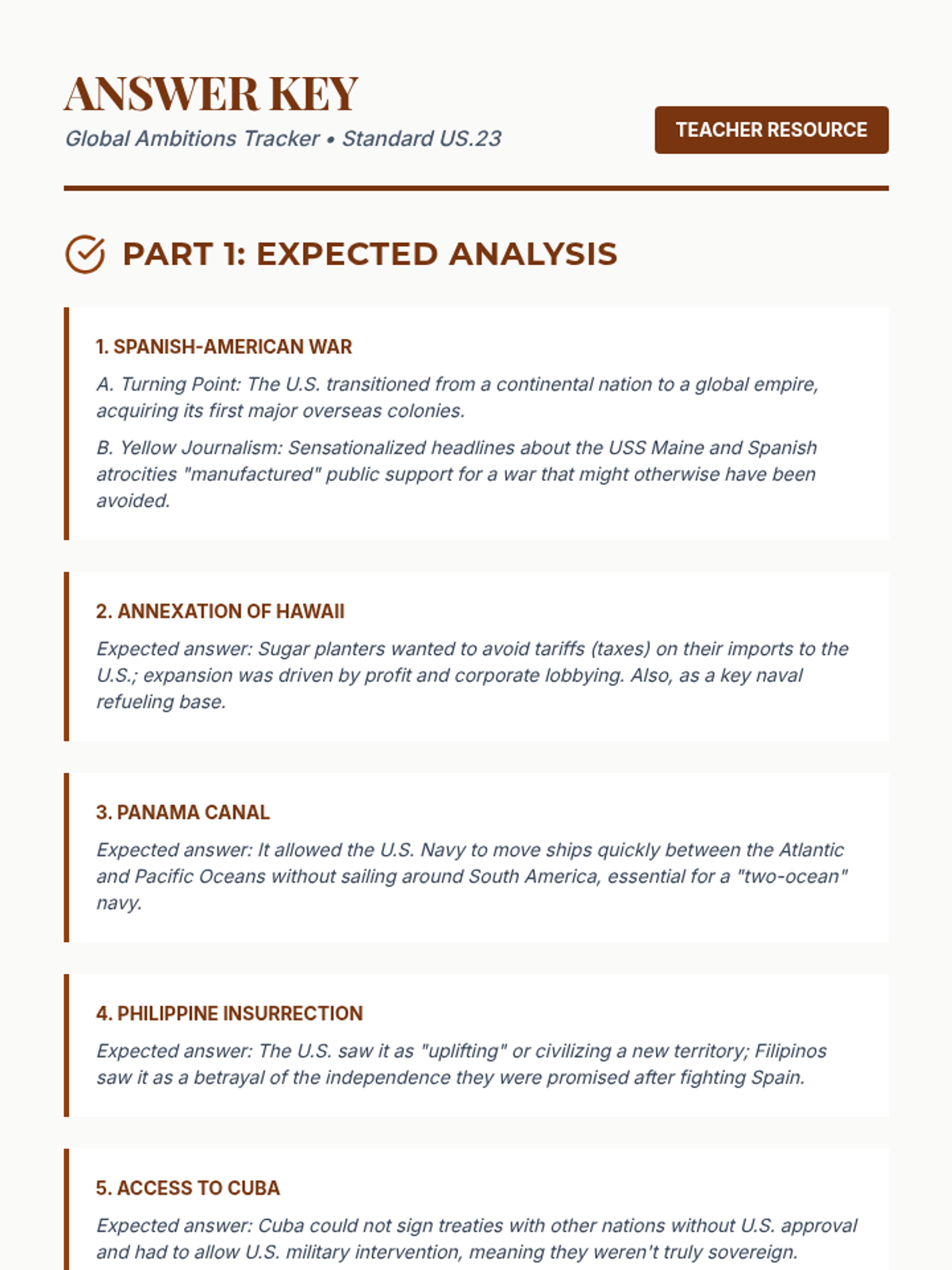
Complete answer key for the Global Ambitions Tracker Worksheet, updated with responses for the expanded Spanish-American War section and the new Social Studies Practice 6 spatial analysis tasks.
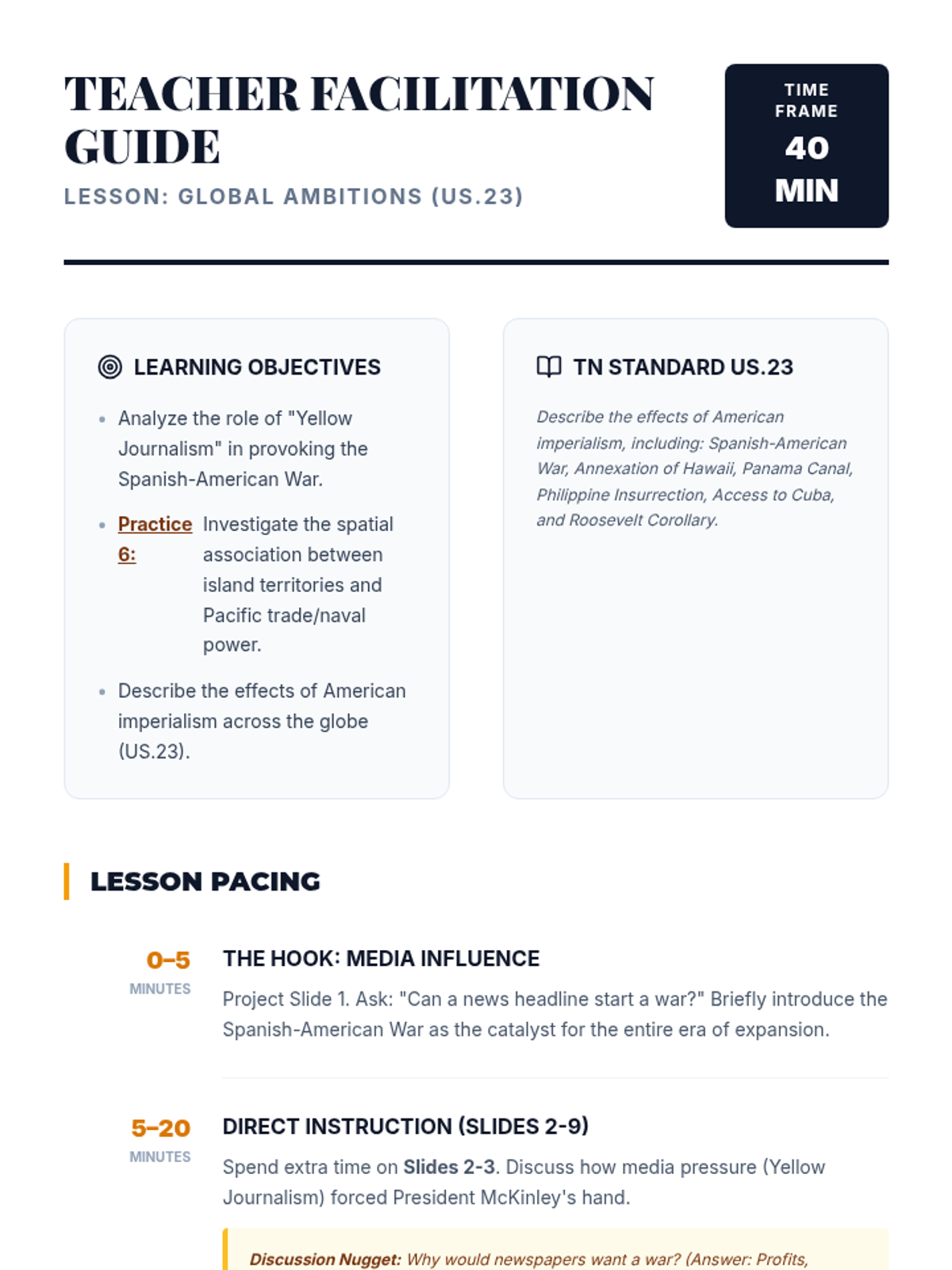
Instructional guide for teachers, providing pacing, discussion prompts, and facilitation tips for the 40-minute American imperialism lesson, with added emphasis on the Spanish-American War and Social Studies Practice 6.
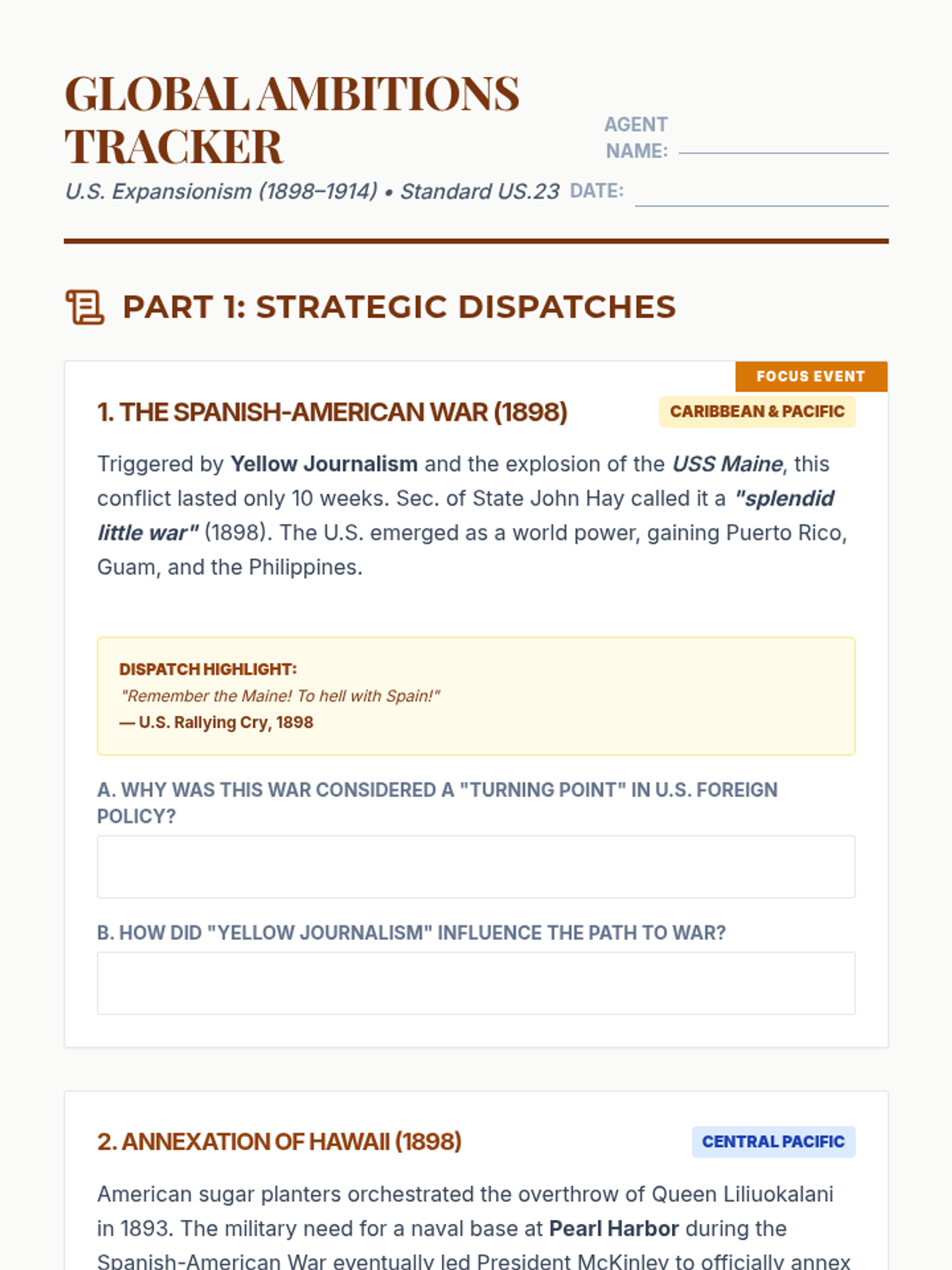
A structured reading and map activity worksheet updated with Tennessee Social Studies Practice 6, focusing on spatial associations and geographical connections. Restored to the schematic layout. All historical quotes now include attribution and dates.
Visual presentation providing a high-level overview of the six key events of American imperialism, with an expanded focus on the causes and outcomes of the Spanish-American War. All historical quotes now include attribution and dates.
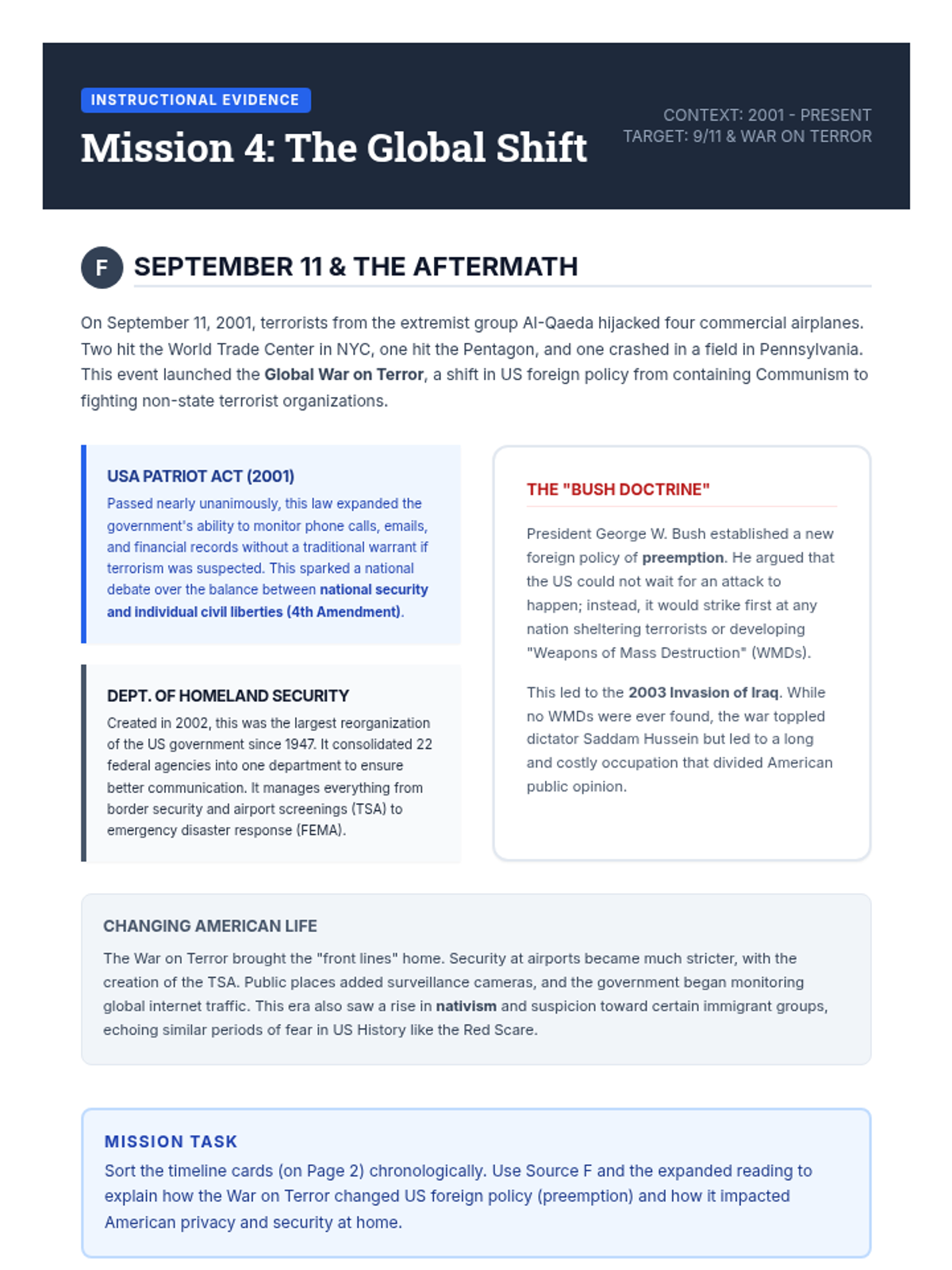
Station 4 material covering the War on Terror. Updated with 0.3in margins and expanded reading content. Manipulatives are now on their own dedicated page with increased size.
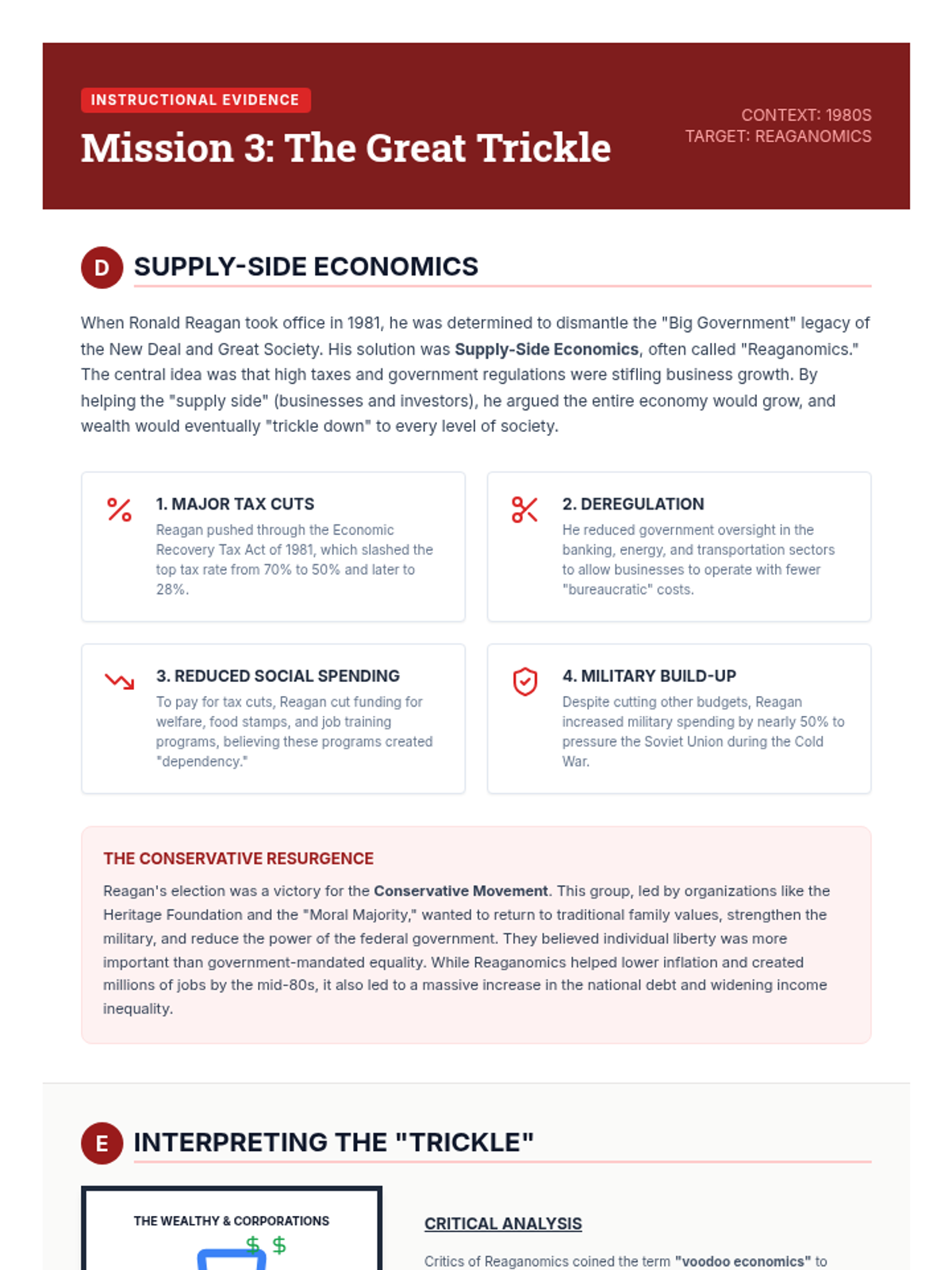
Station 3 material focusing on Reaganomics (Supply-Side Economics). Updated with 0.3in margins and expanded reading content. Reverted to the previous non-OPTIC activity.
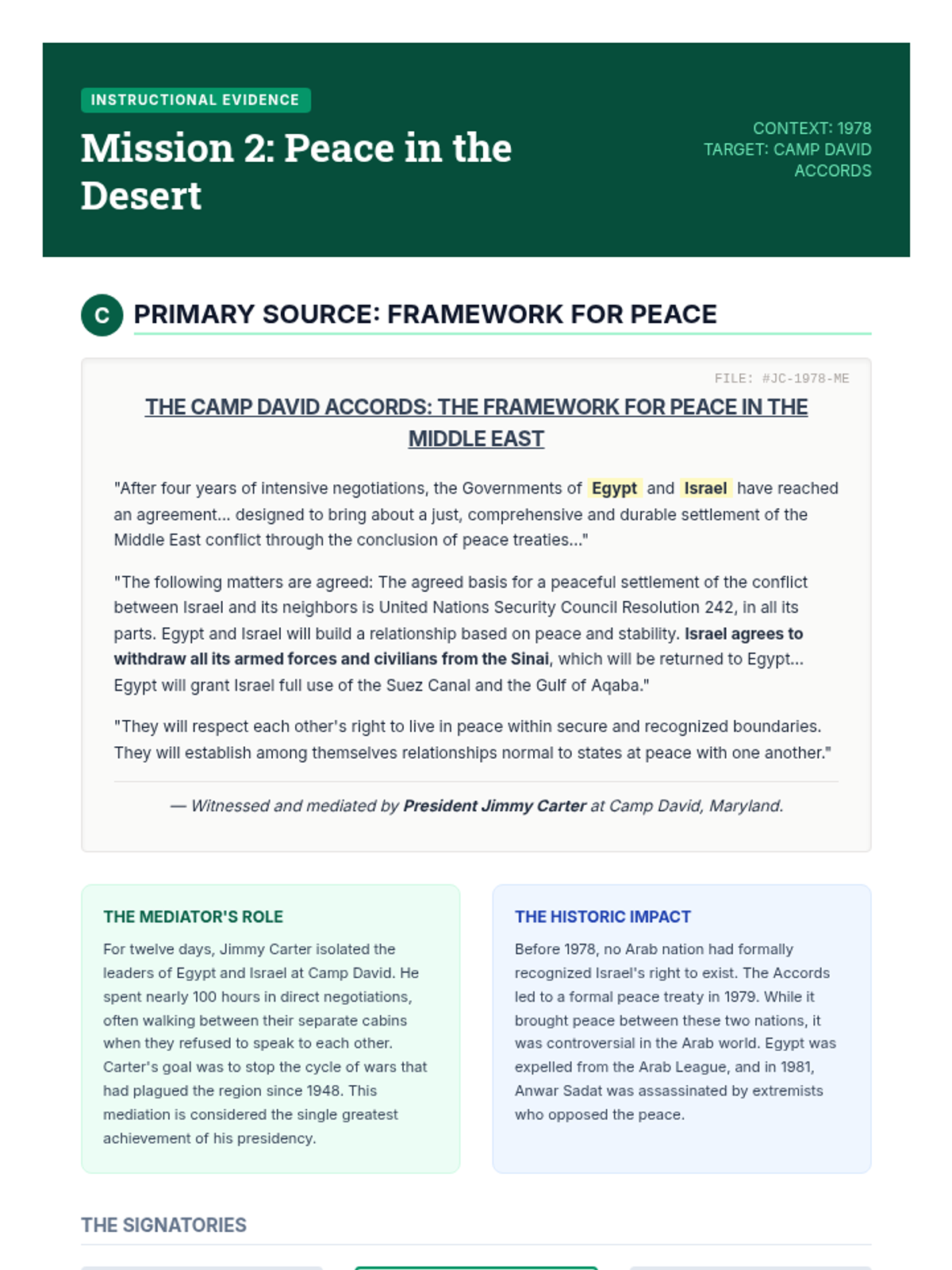
Station 2 material covering the Camp David Accords. Updated with 0.3in margins and expanded reading content.
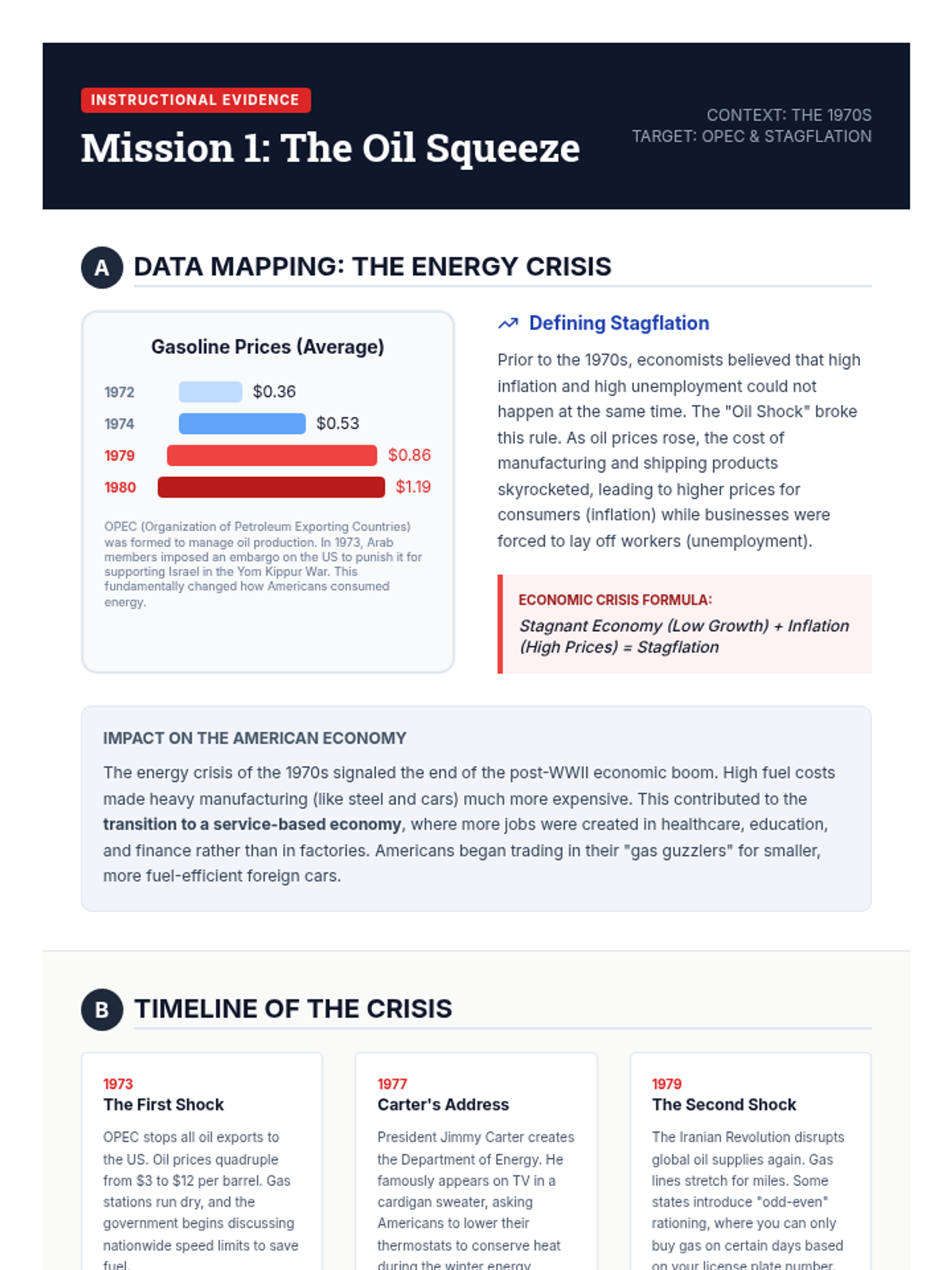
Station 1 material focusing on the OPEC crisis and Stagflation of the 1970s. Updated with 0.3in margins and expanded reading content.
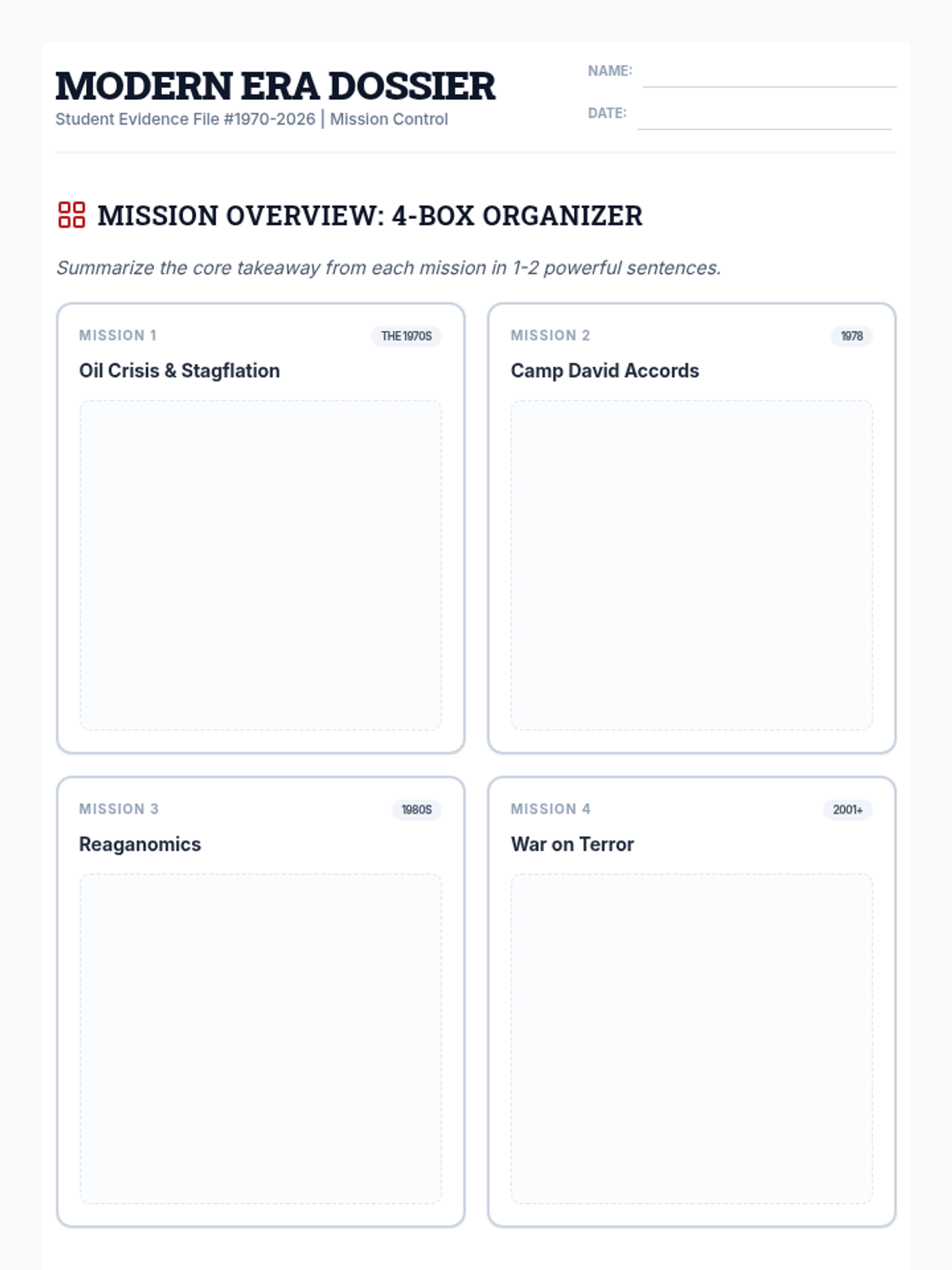
A multi-page student packet containing the 4-box graphic organizer and a consolidated one-page guided notes section for all four stations. Reverted Mission 3 to non-OPTIC questions.
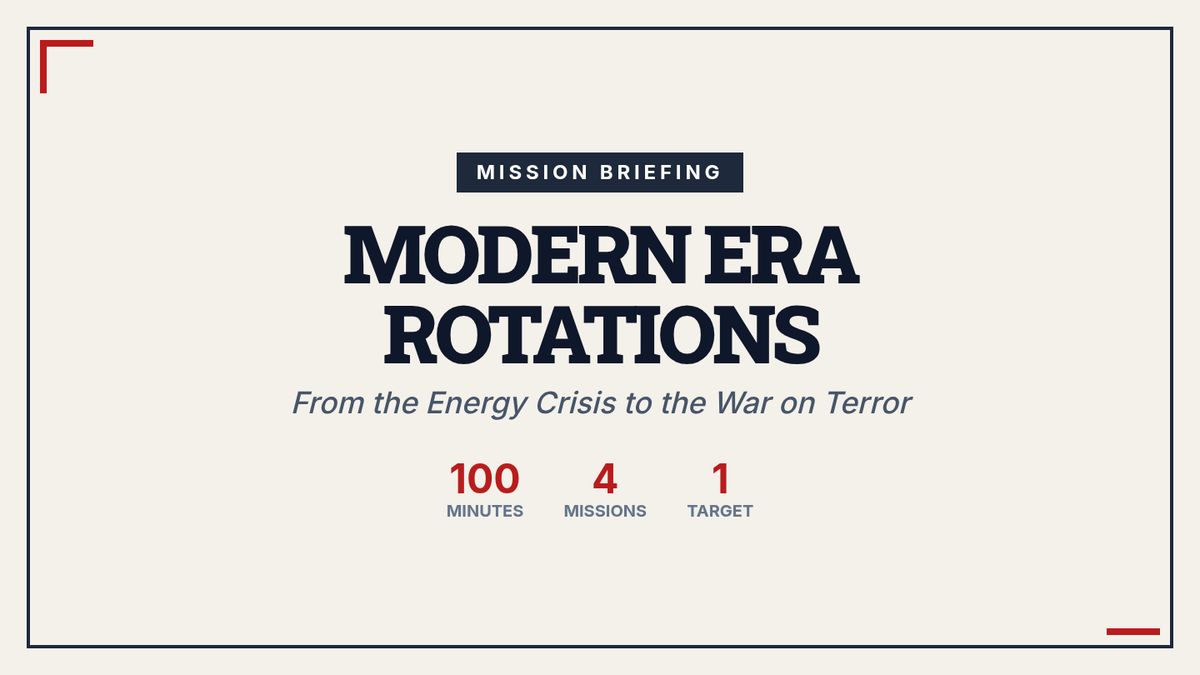
A visually engaging slide deck to launch the lesson, providing students with their mission objectives, rotation logistics, and essential framing questions for the content.
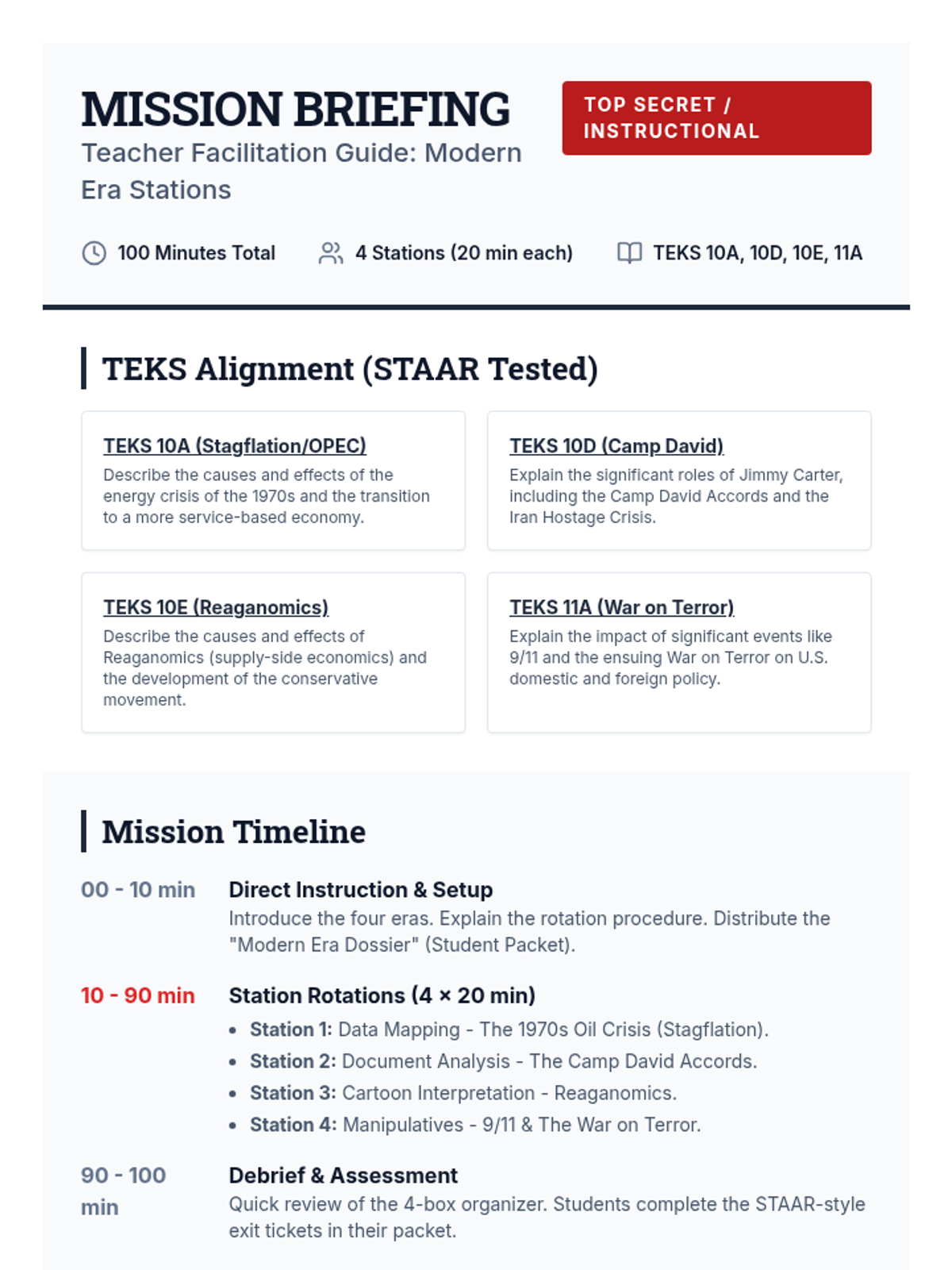
A comprehensive teacher facilitation guide for the station-based lesson, including TEKS alignment, timing, preparation checklists, and detailed mission briefs for each of the four content areas. Updated with 0.3in margins.
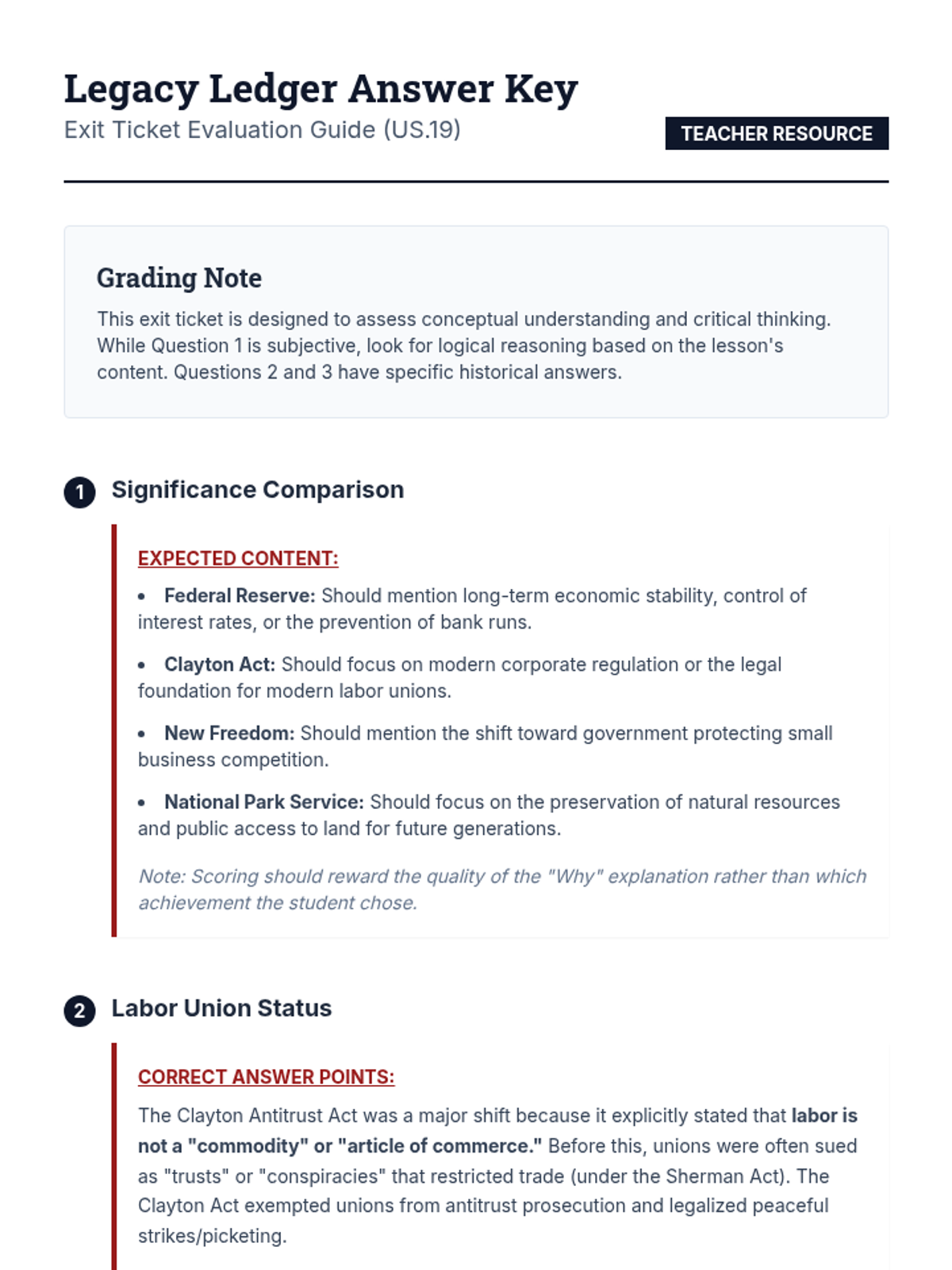
An official answer key and evaluation guide for the Legacy Ledger Exit Ticket, providing teachers with sample responses and key grading points for the three assessment questions.
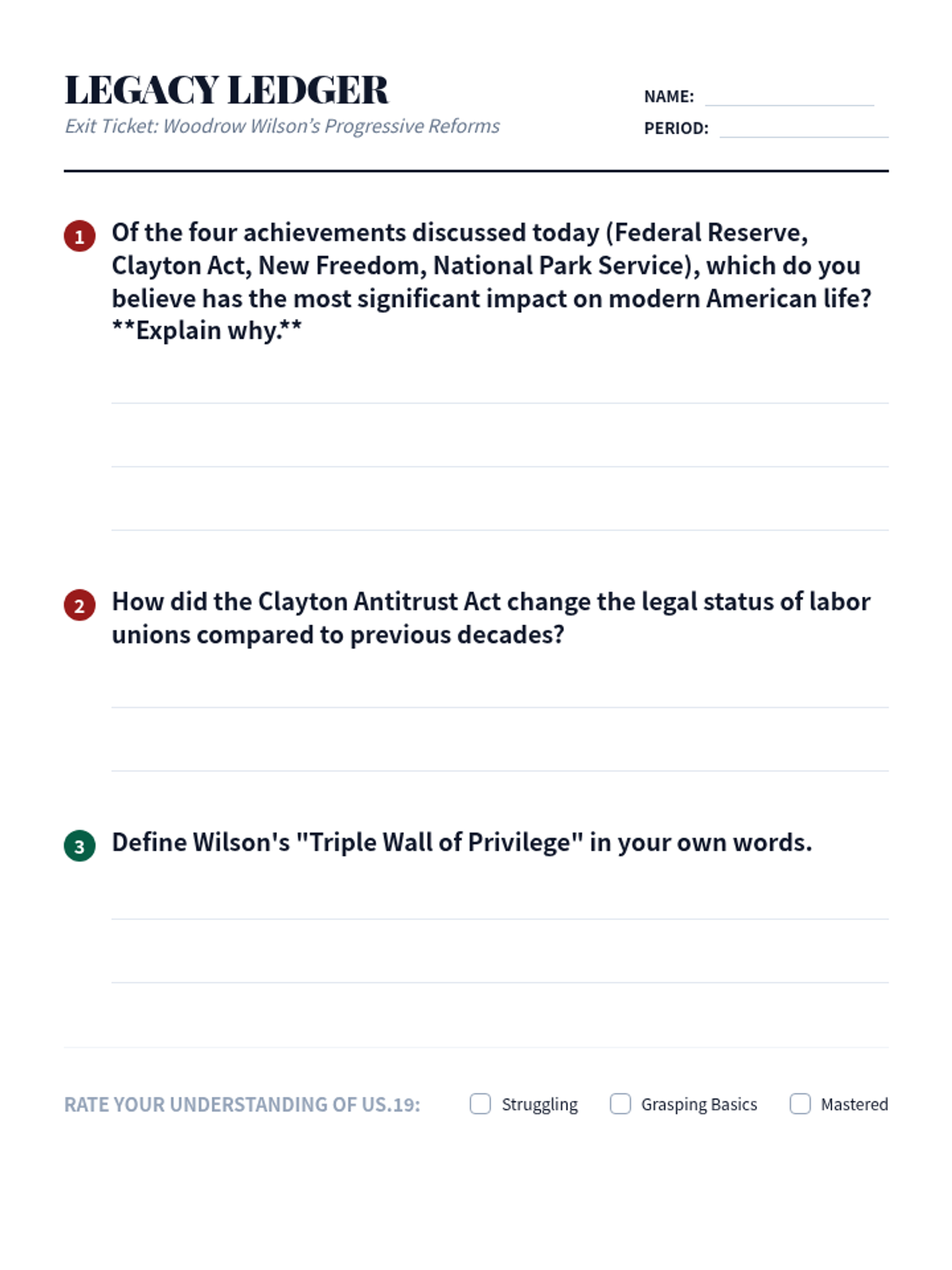
A quick assessment for the end of the lesson, featuring three short-response questions focused on Wilson's four major progressive achievements and a self-reflection scale for students.
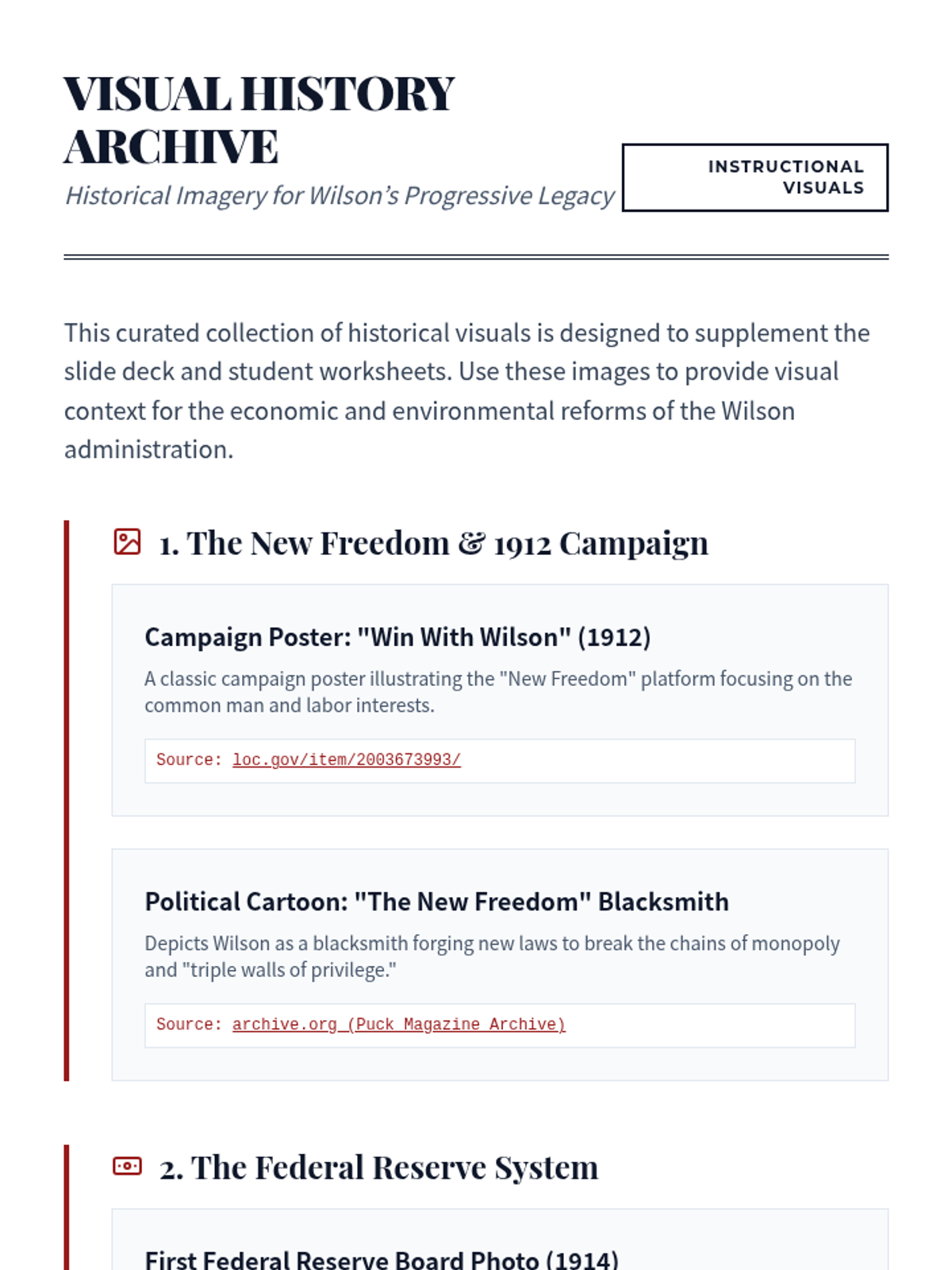
A curated list of historical images, political cartoons, and archival photographs to accompany the Wilson's Progressive Legacy lesson, complete with descriptions and digital repository links for classroom use.
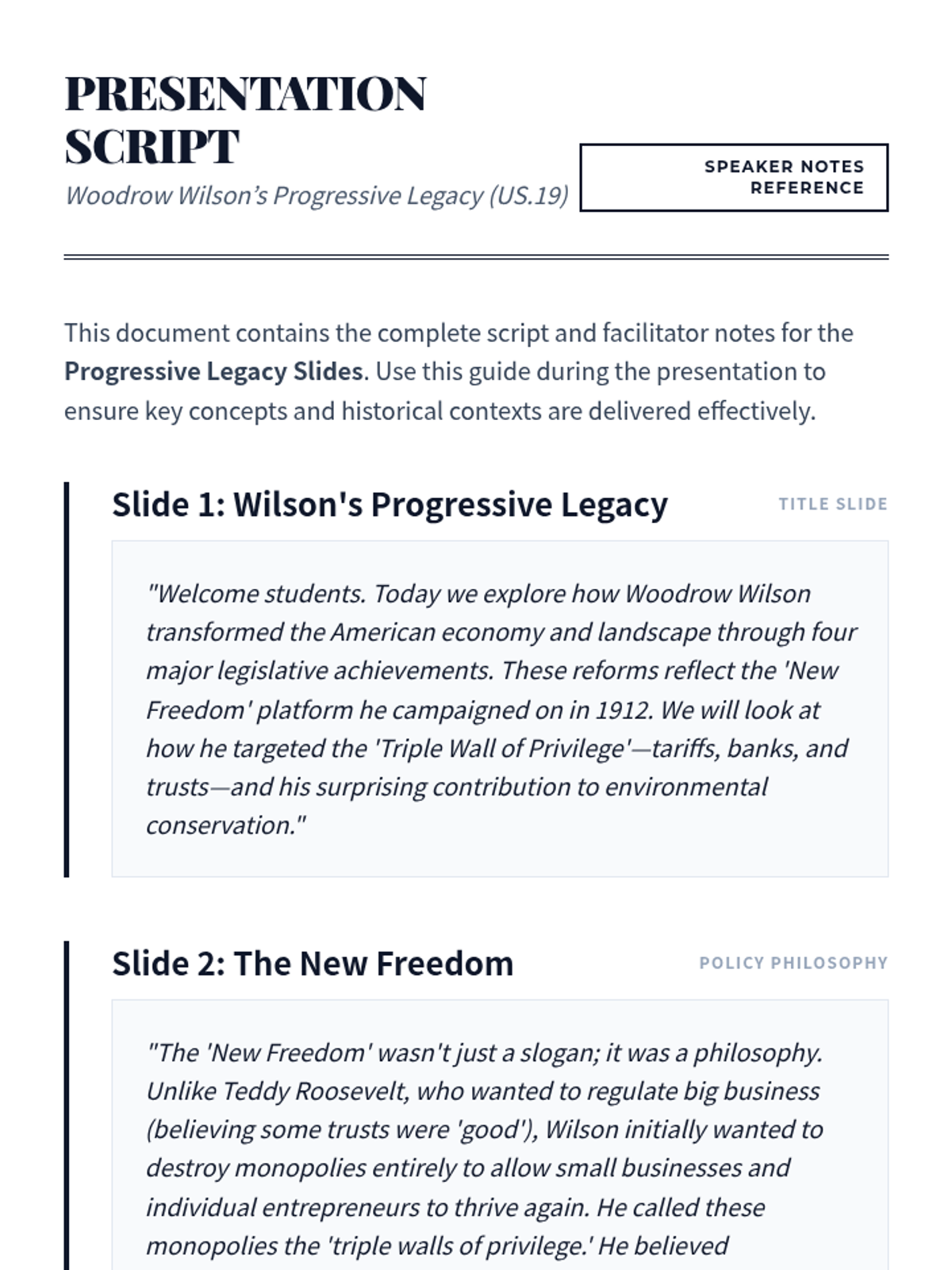
A dedicated reference document containing the full speaker notes and presentation script for each slide in the Wilson's Progressive Legacy presentation. Includes slide-by-slide script blocks for the teacher.
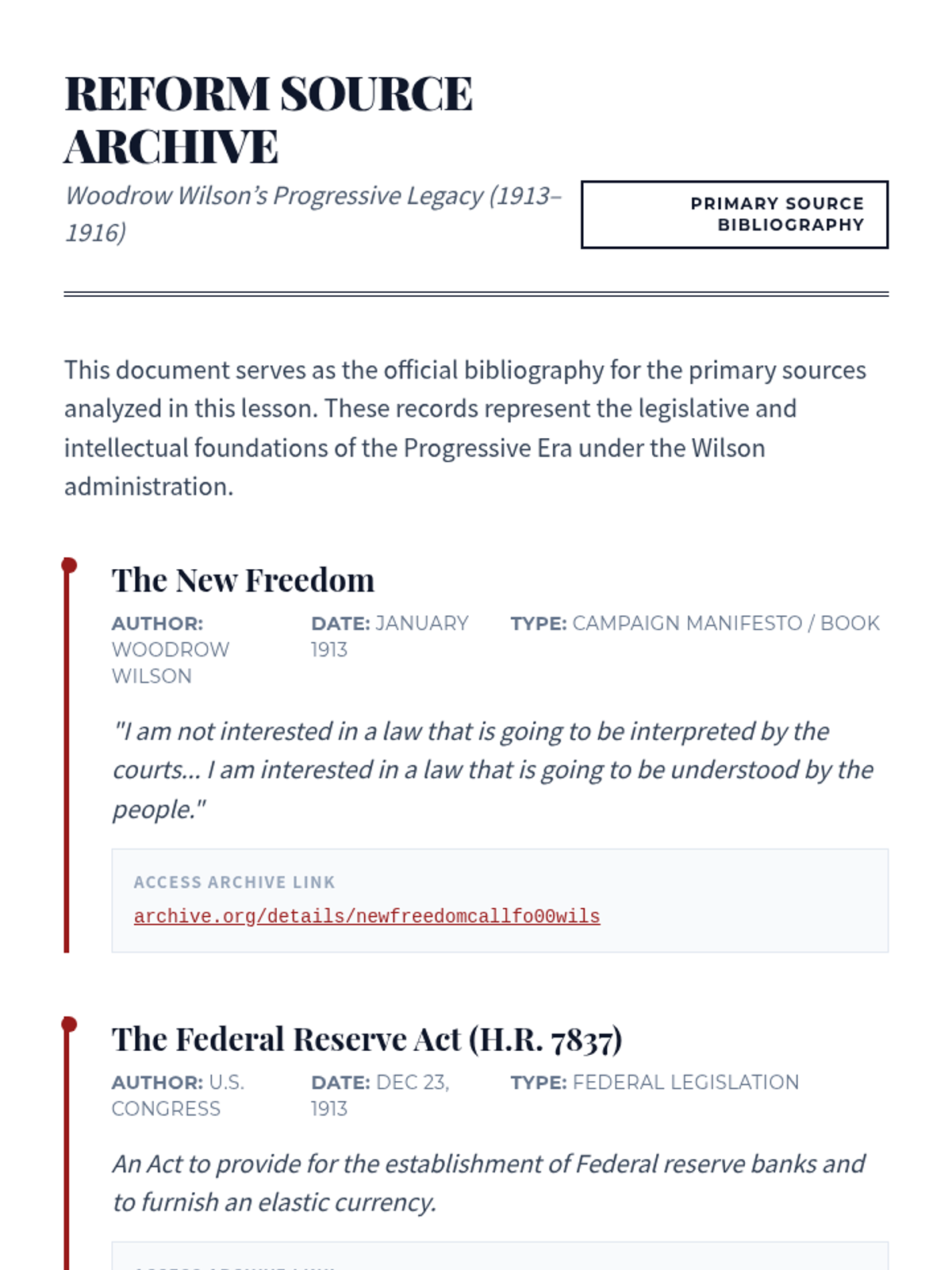
A dedicated primary source bibliography for the lesson, featuring full citations (name, author, date, and document type) along with direct archive links for the New Freedom, the Federal Reserve Act, the Clayton Antitrust Act, and the National Park Service Organic Act.
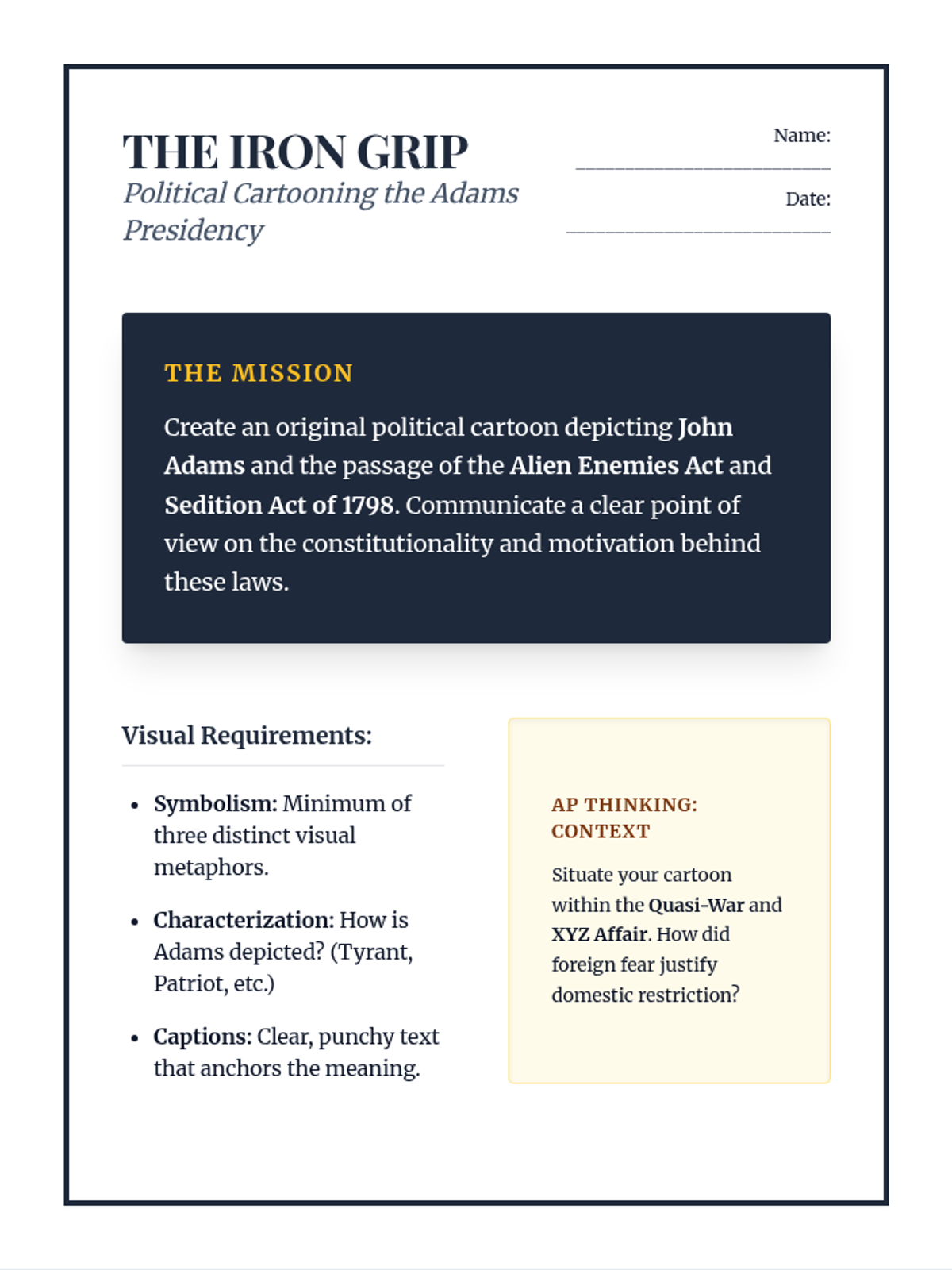
A creative packet for the 'Iron Grip' political cartoon assignment, focusing on the Alien and Sedition Acts. It includes a symbolism planner, a sketching area, and a rubric centered on APUSH Contextualization and visual rhetoric.
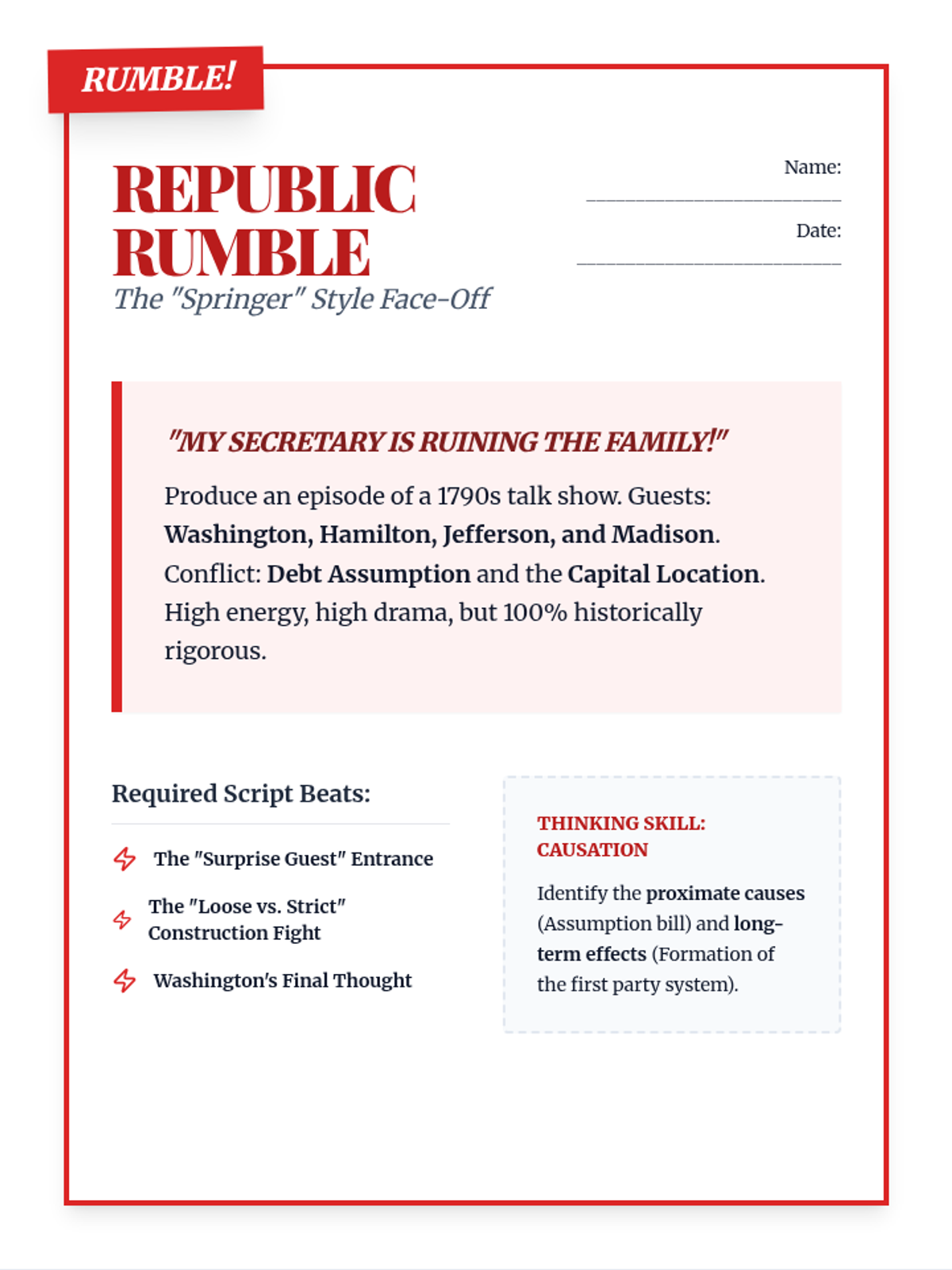
A satirical yet academically rigorous packet for the 'Republic Rumble' talk-show role-play assignment. It focuses on historical causation through the lens of early American political conflict, featuring a character motivation matrix and a specific rubric.
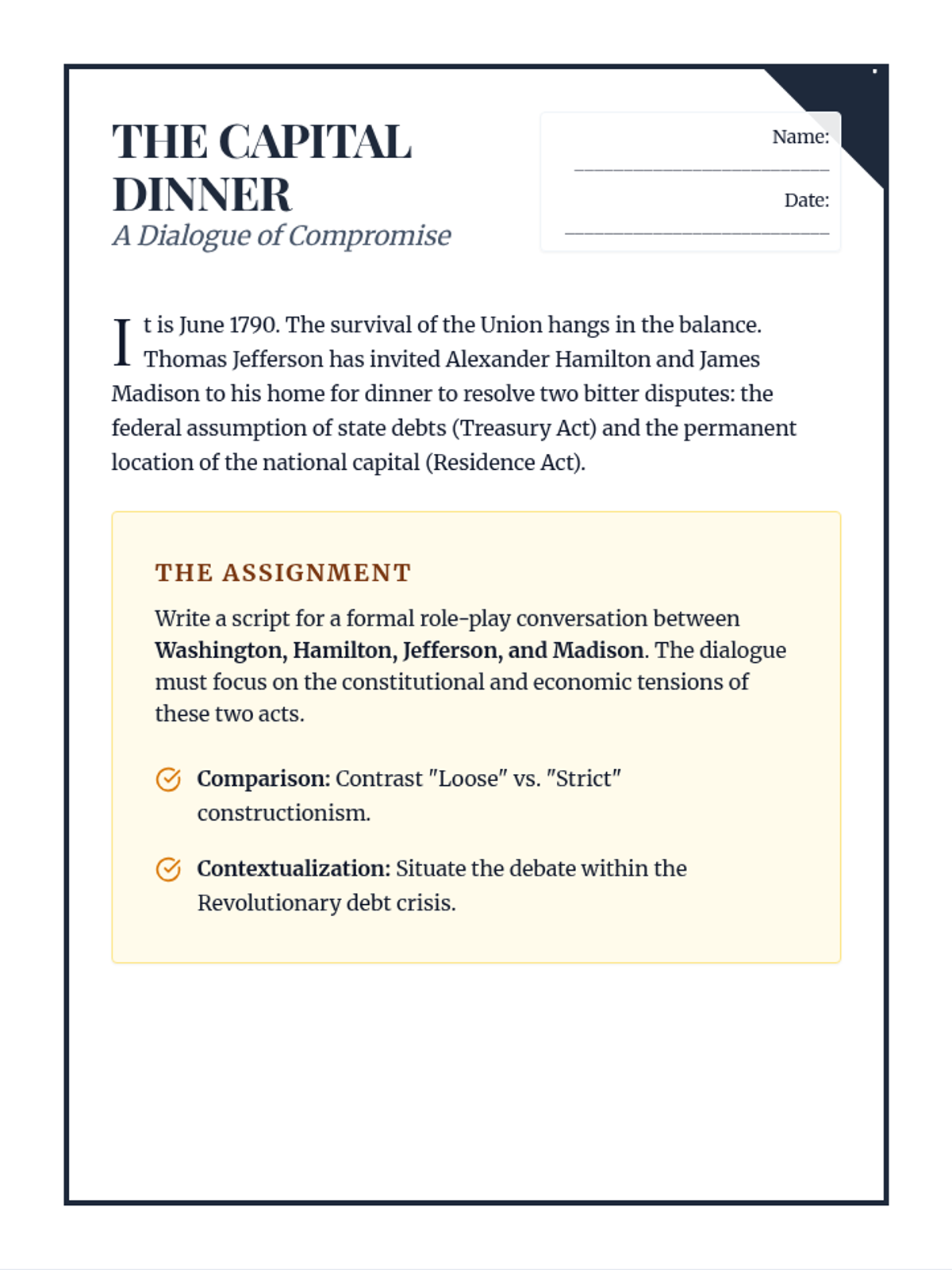
A detailed packet for 'The Capital Dinner' role-play assignment, covering the Treasury and Residence Acts of 1790. Includes an argument-mapping graphic organizer and a rubric focused on APUSH Comparison and Contextualization skills.
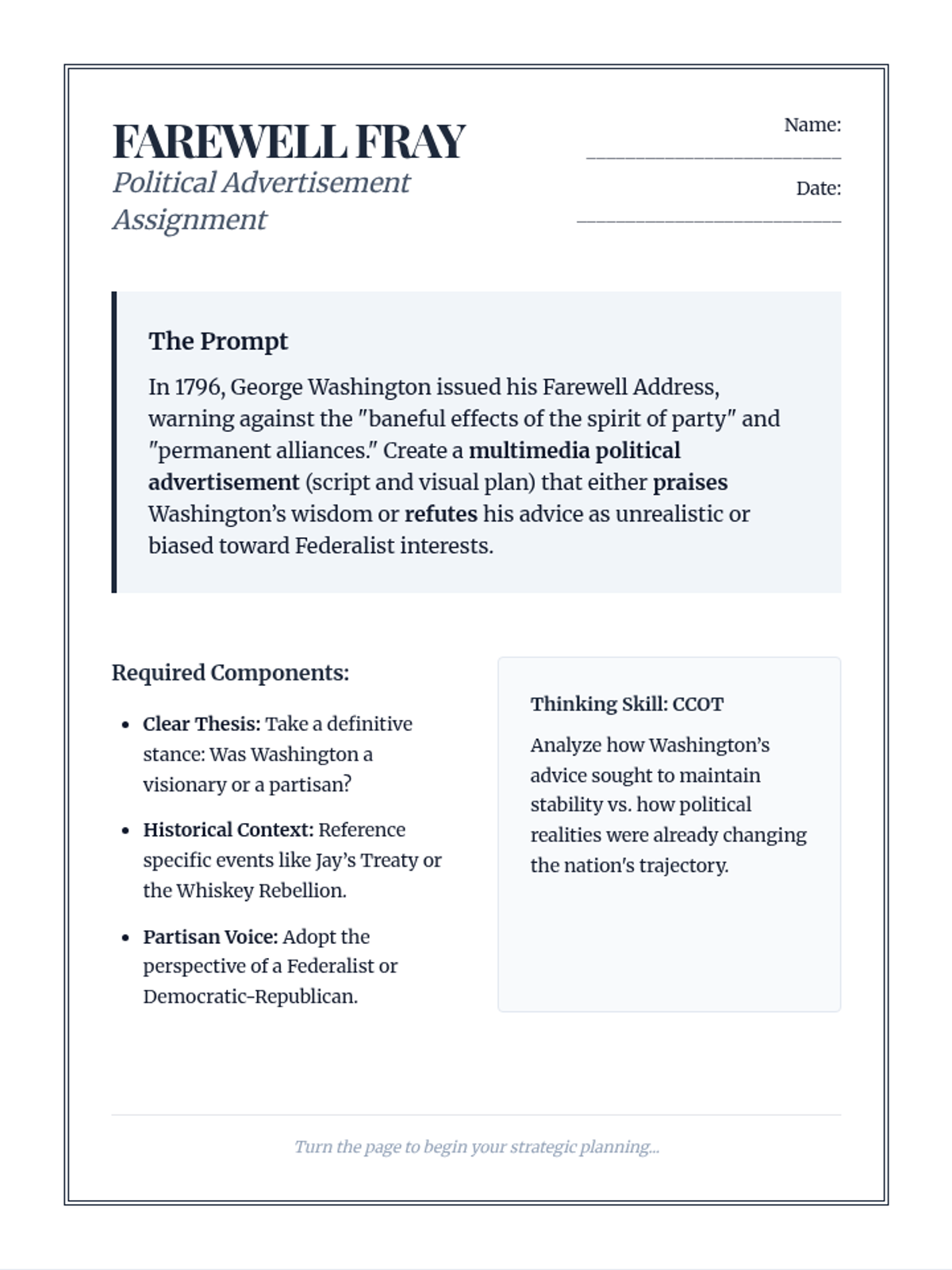
A comprehensive packet for the 'Farewell Fray' political advertisement assignment, including detailed instructions, a strategic graphic organizer, and a specific APUSH-aligned rubric focusing on Continuity and Change Over Time (CCOT).
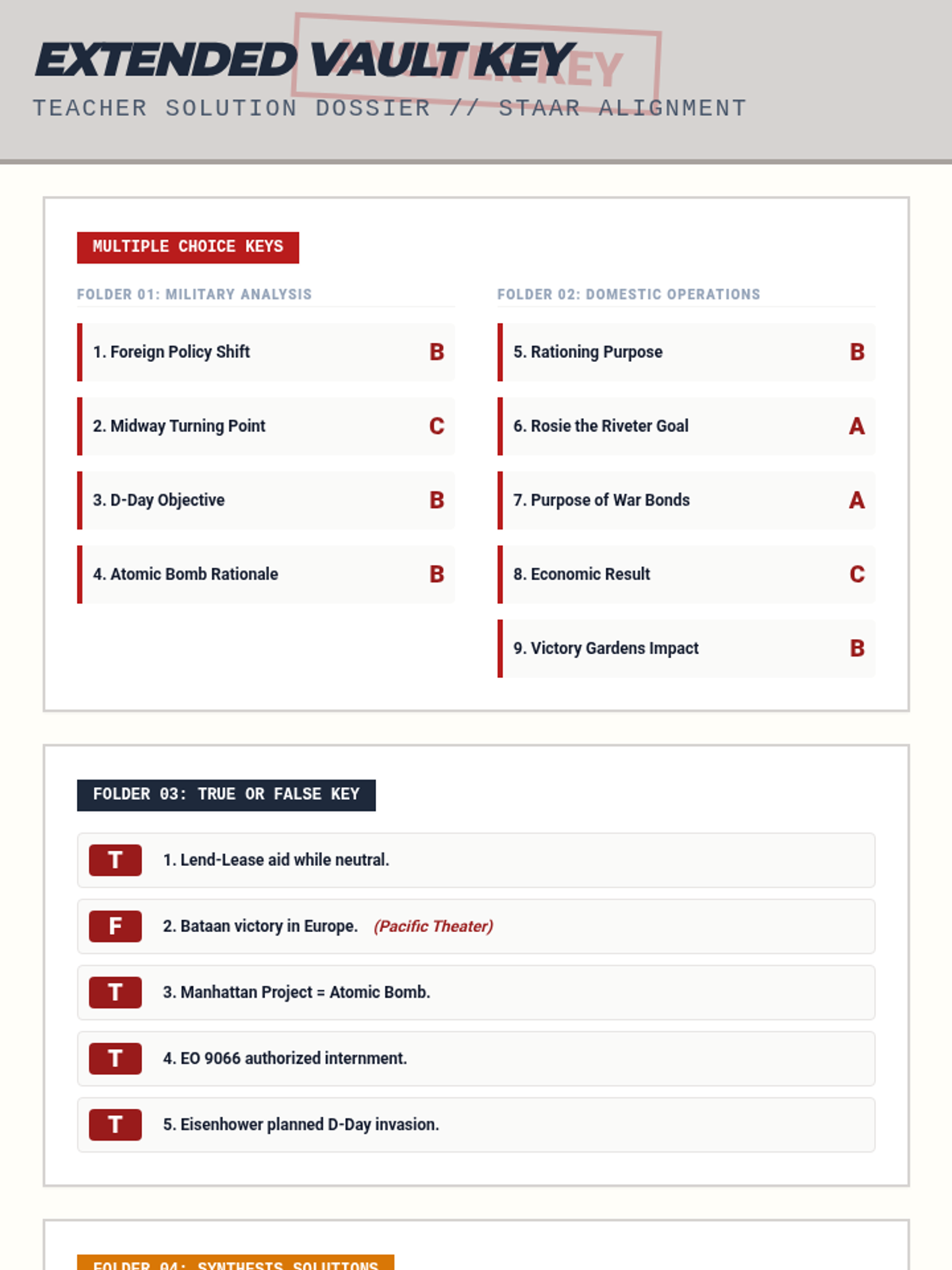
The comprehensive teacher answer key for the Extended Victory Vault WWII Worksheet. Includes keys for multiple choice, true/false, and sample synthesis responses in a clear, contrasting red format. Revised for improved page breaks and spacing.
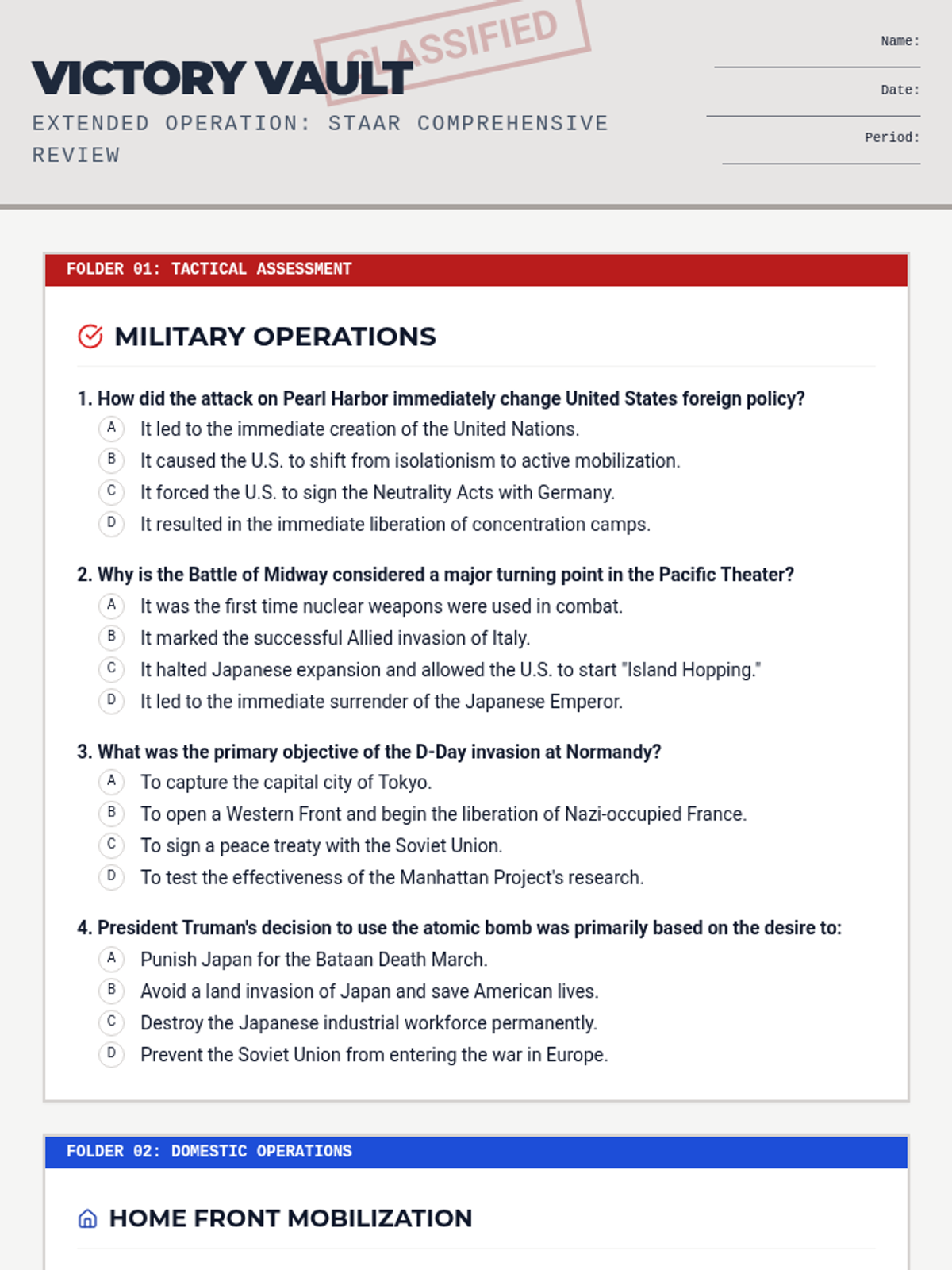
An extended STAAR-aligned review worksheet for WWII. Includes two pages of multiple choice questions (Military & Home Front), true/false verification, and short-answer synthesis tasks, all within the "Top Secret" dossier theme. Intelligence briefing removed for space efficiency and layout improved for professional print-readiness. Revised to fit onto 2-3 pages.
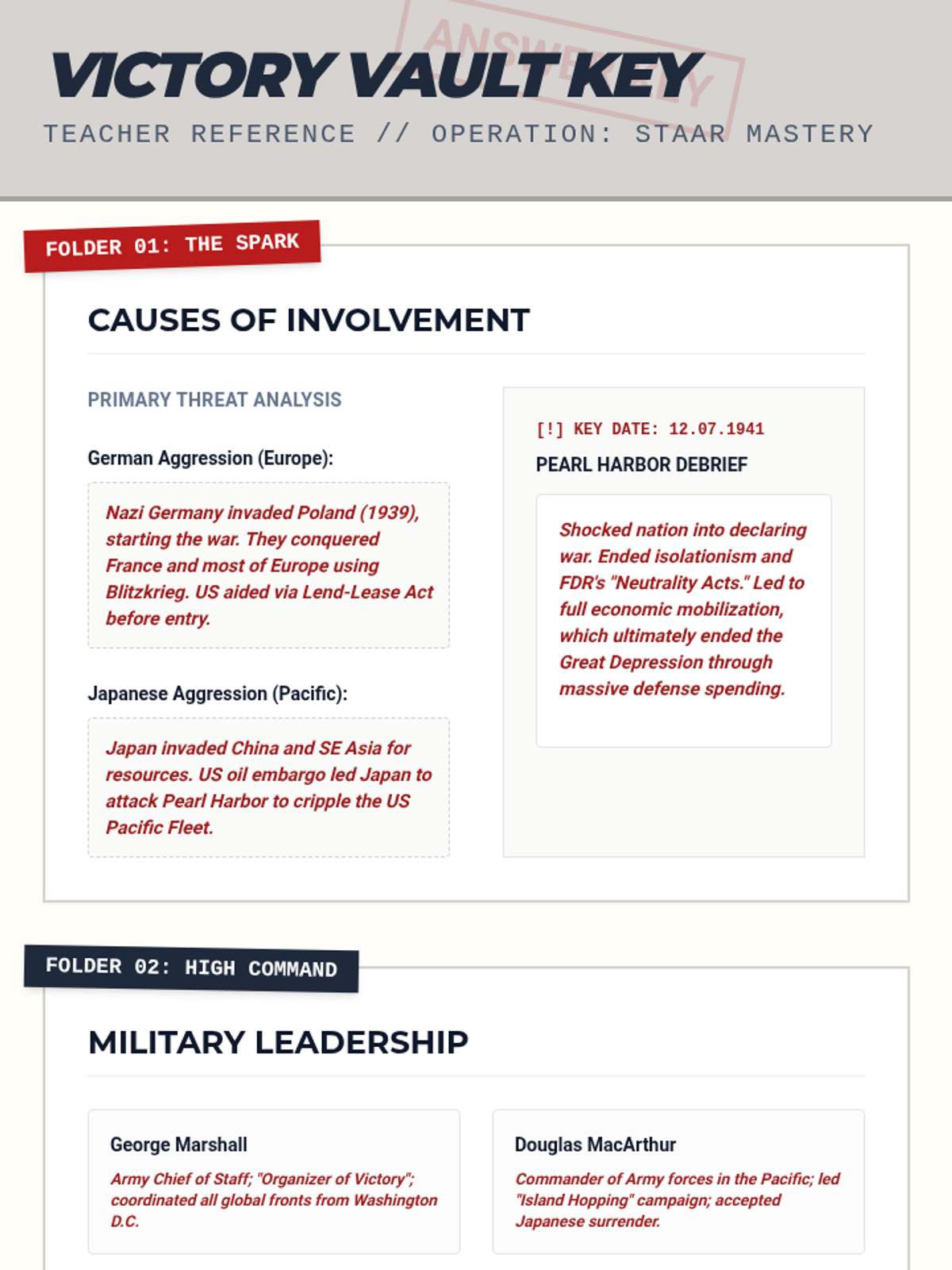
A comprehensive teacher answer key for the Victory Vault WWII Dossier Worksheet, with sample responses provided in a contrasting red handwritten style. Revised for improved page breaks and spacing.
A visually striking 9-slide presentation for WWII review. It follows the "Top Secret" military dossier theme and covers all major STAAR-aligned TEKS, including leaders, battles, and home front mobilization.
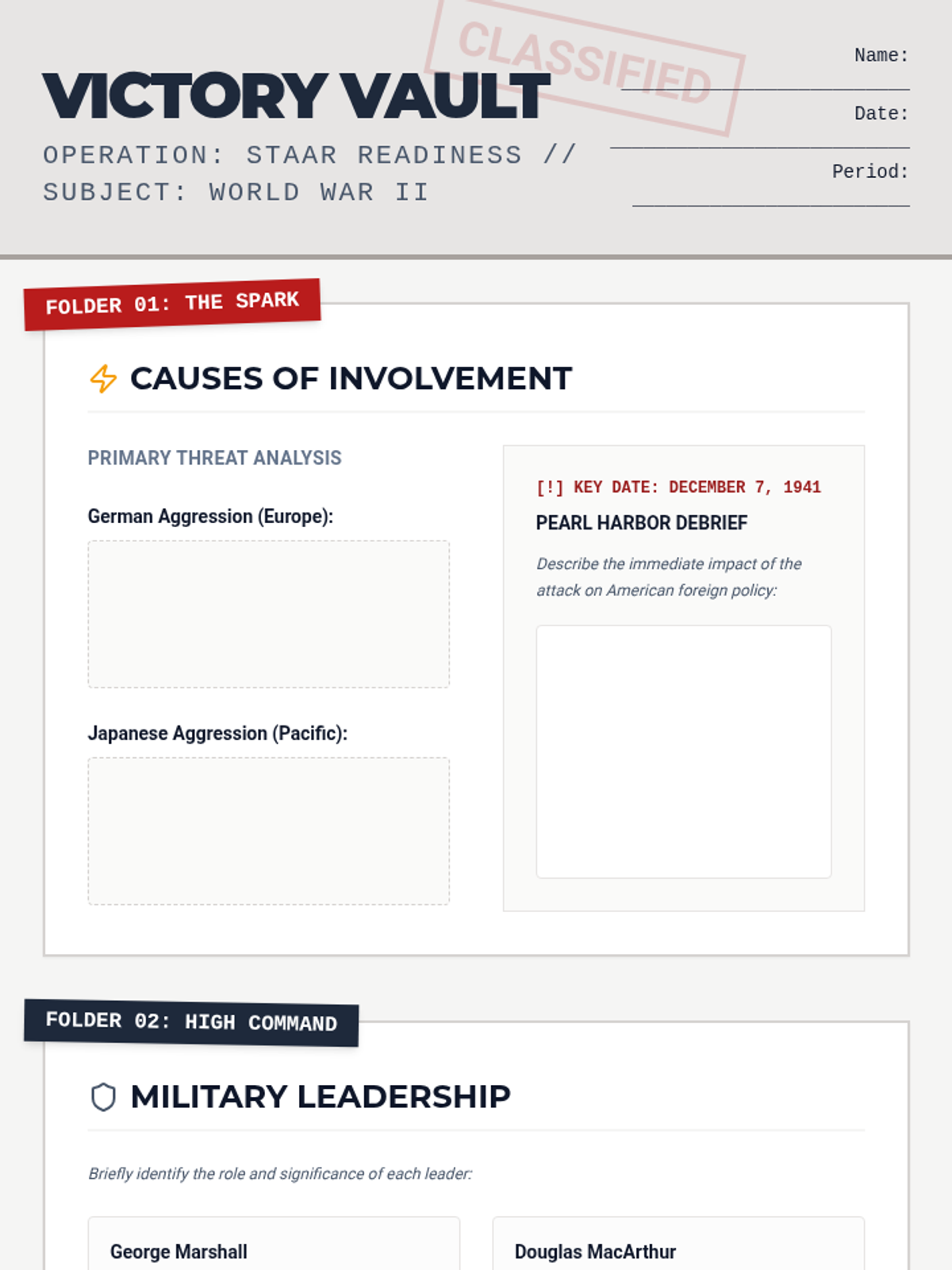
A comprehensive STAAR review worksheet for WWII structured as a "Top Secret" military dossier. It includes sections on causes of involvement, key military leaders, turning point battles, and home front mobilization. Revised for improved student work areas and spacing.
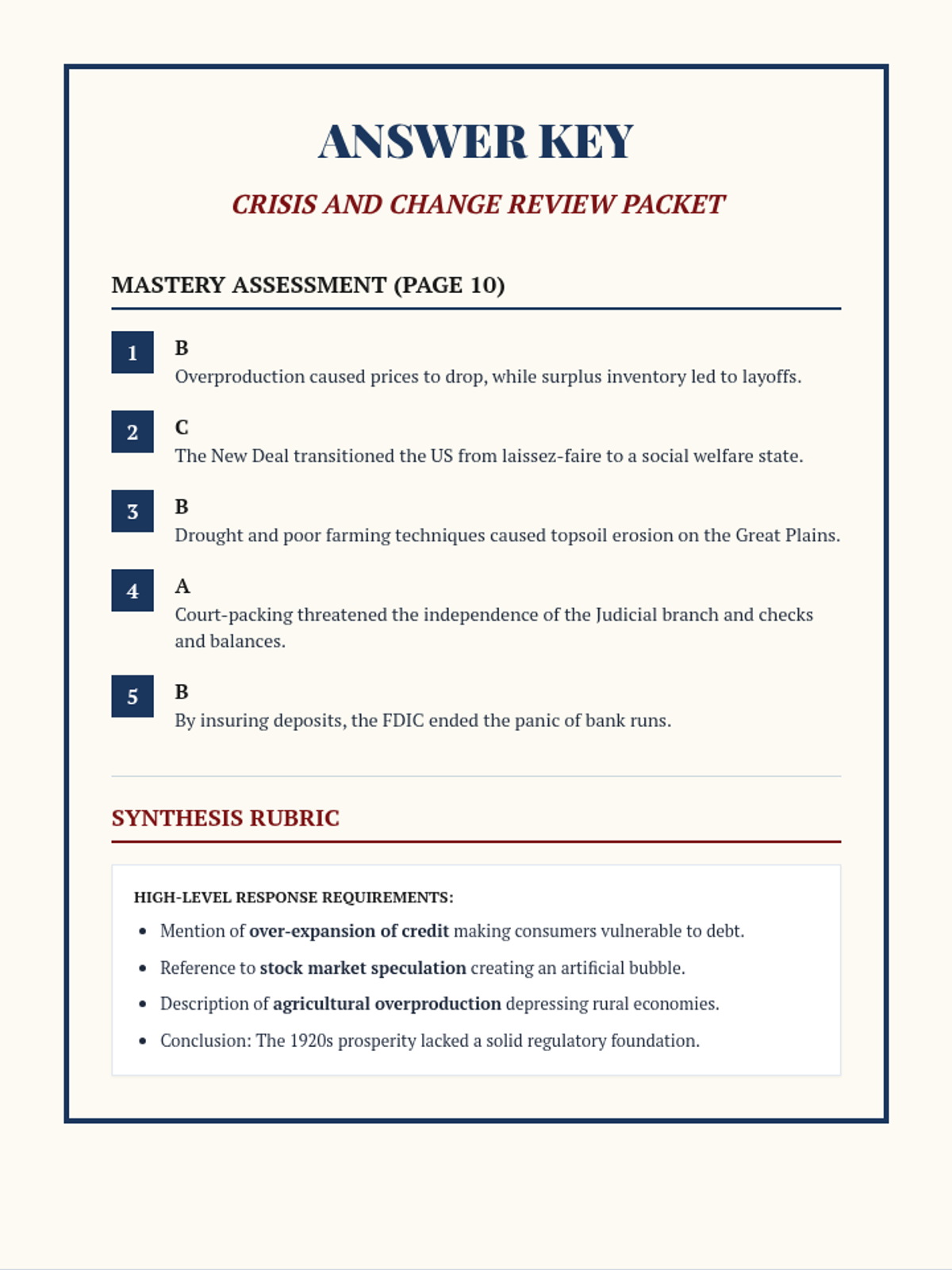
Teacher answer key and grading guide for the Crisis and Change Review Packet, including detailed rationales for multiple-choice questions and rubric points for critical writing tasks.
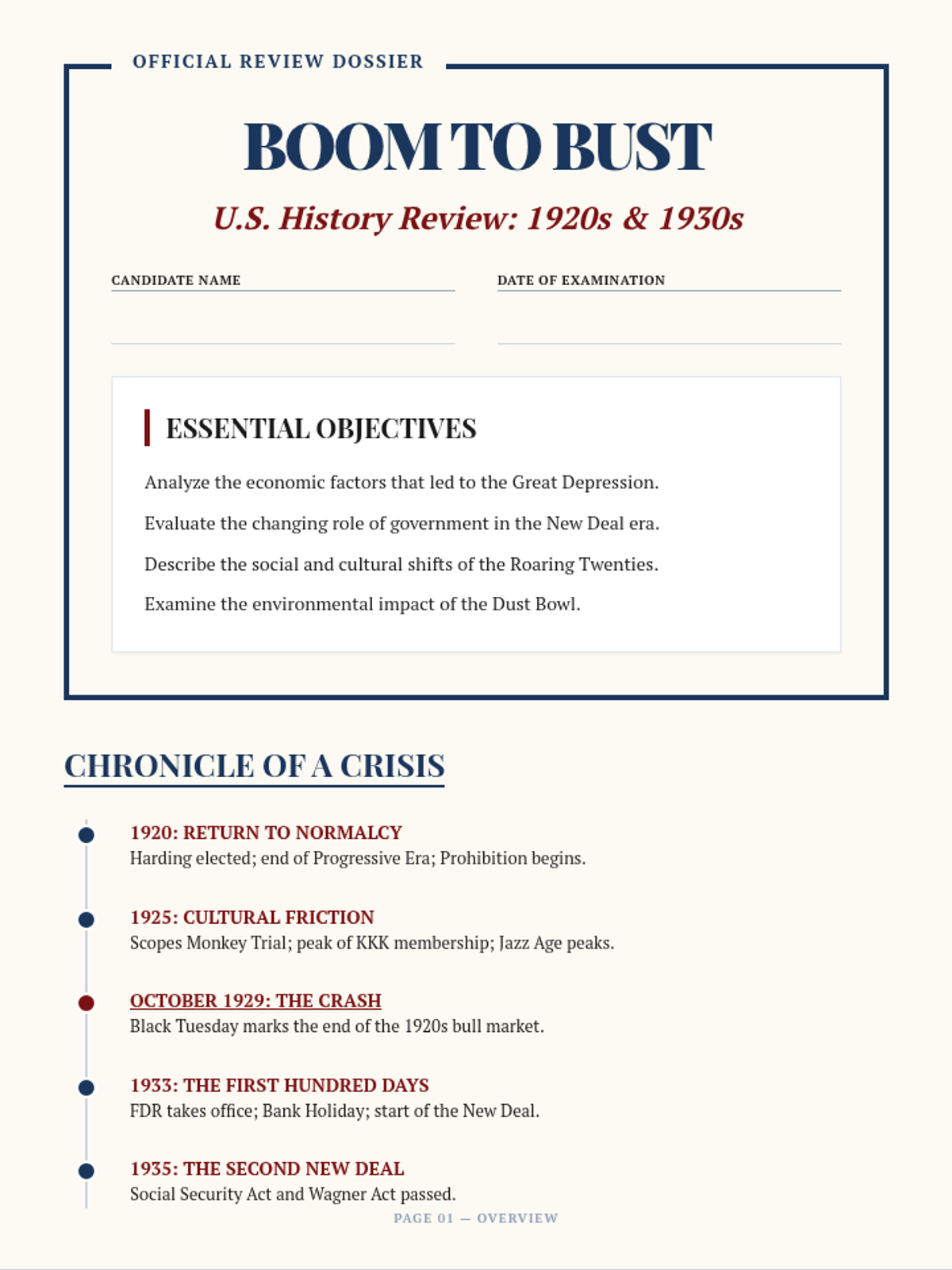
A comprehensive 10-page study guide for the 1920s and 1930s U.S. History STAAR test. It covers the economic boom, social tensions, structural causes of the Great Depression, the New Deal, and its constitutional impact.
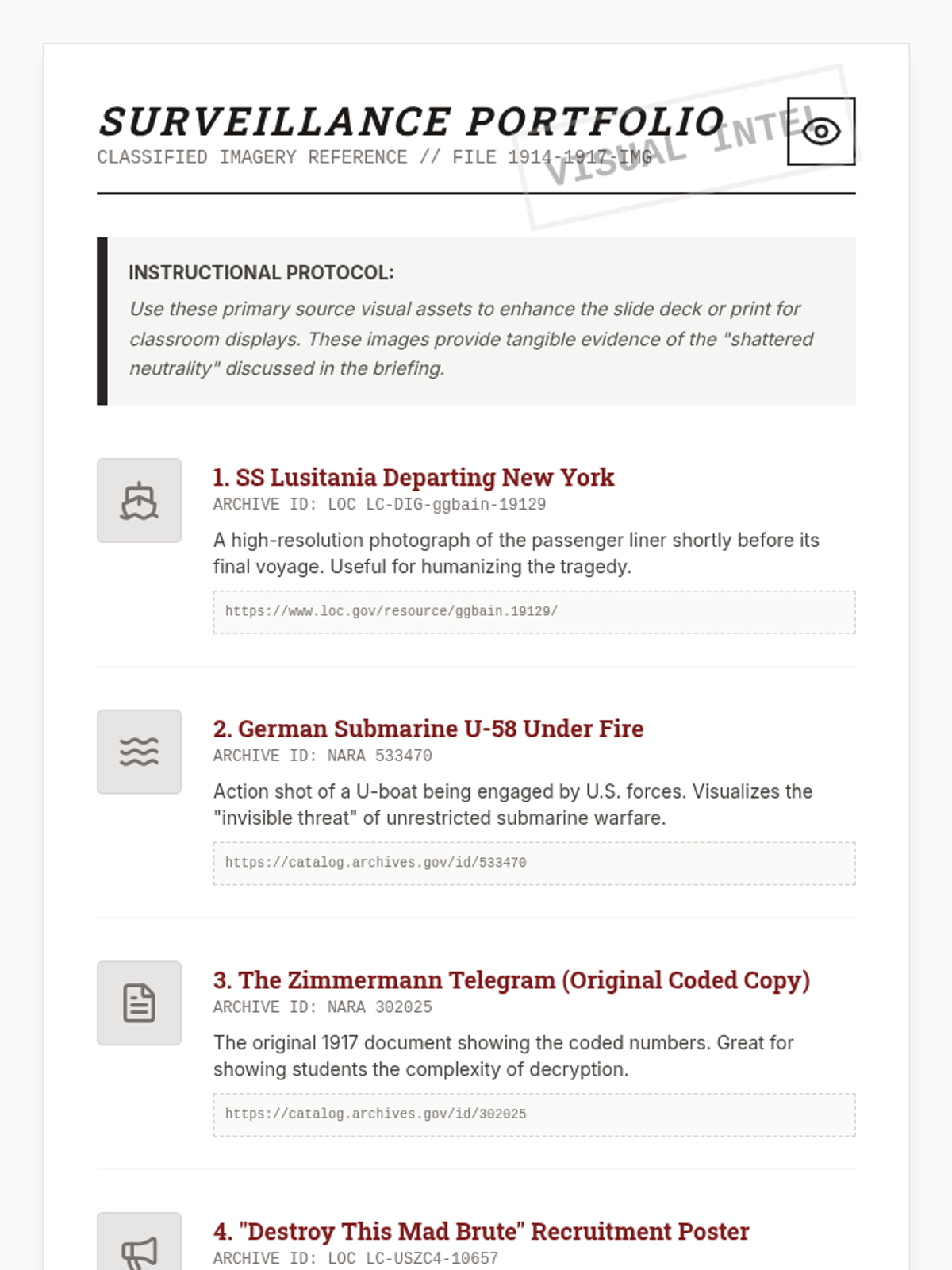
A visual evidence library document providing teacher and student resources for historical images, photographs, and posters related to U.S. entry into WWI, including direct archival links.
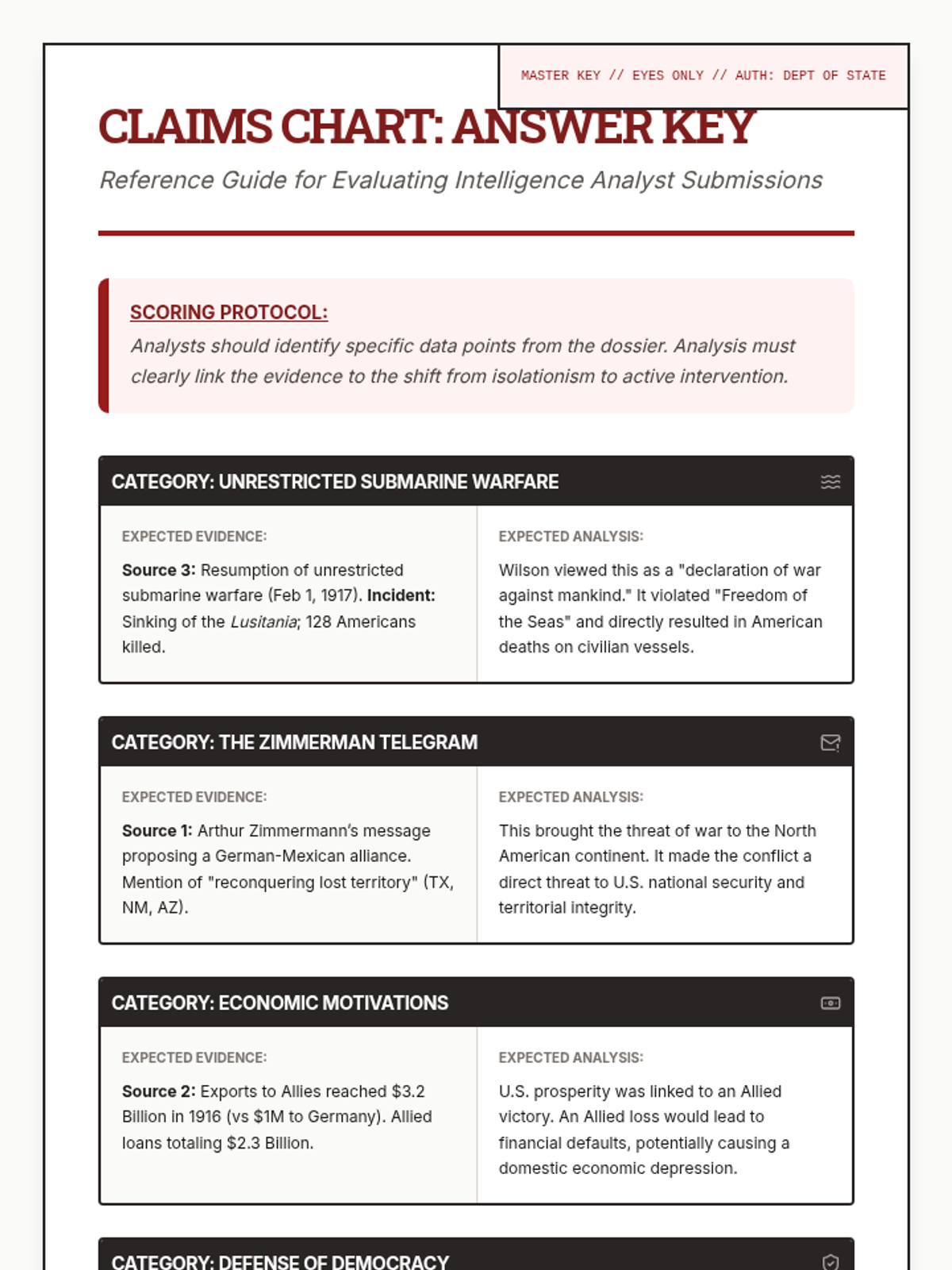
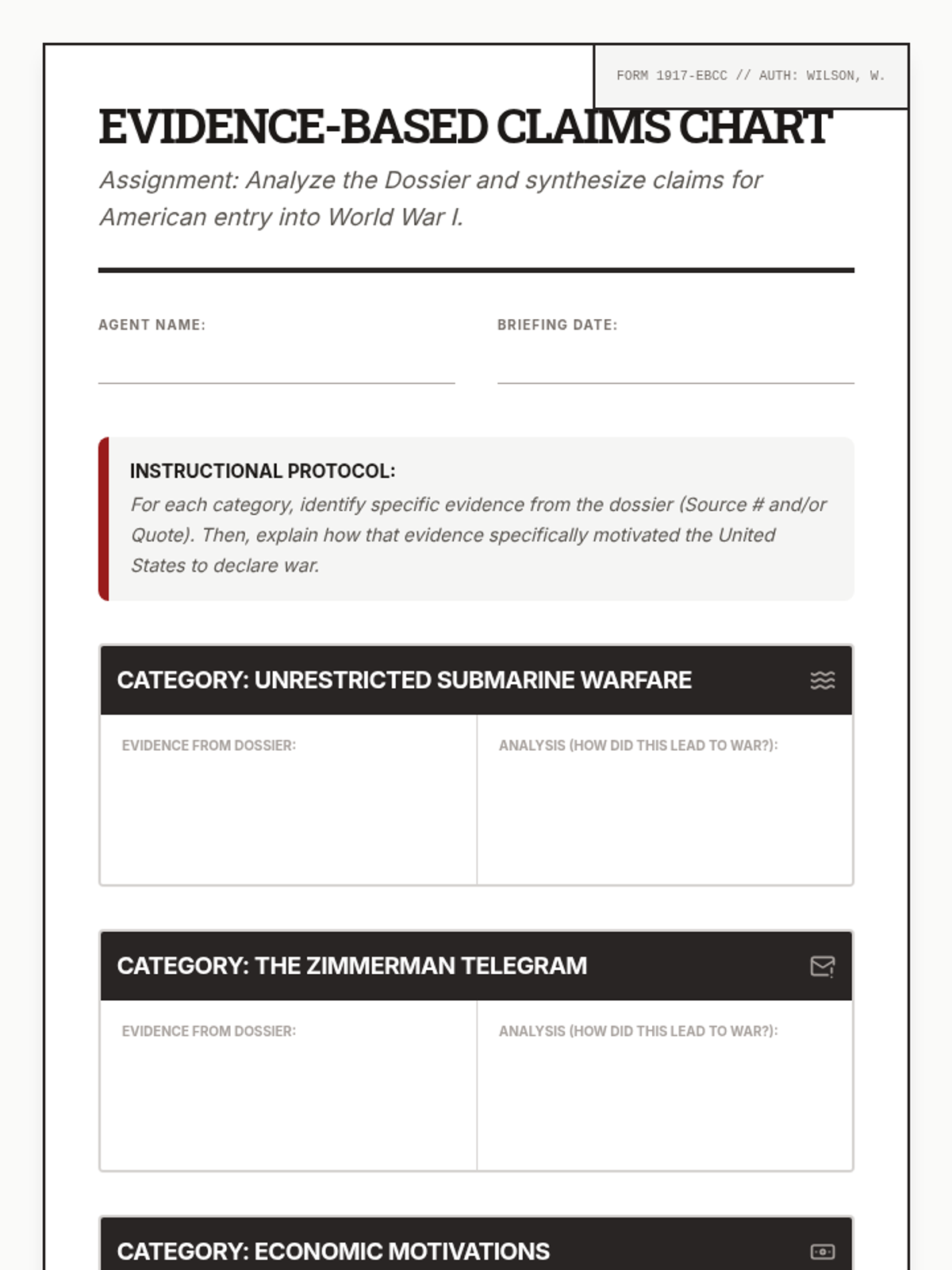
A teacher answer key for the Entry Claims Chart, providing expected evidence and analysis for all four categories of U.S. entry into WWI based on the primary source dossier.
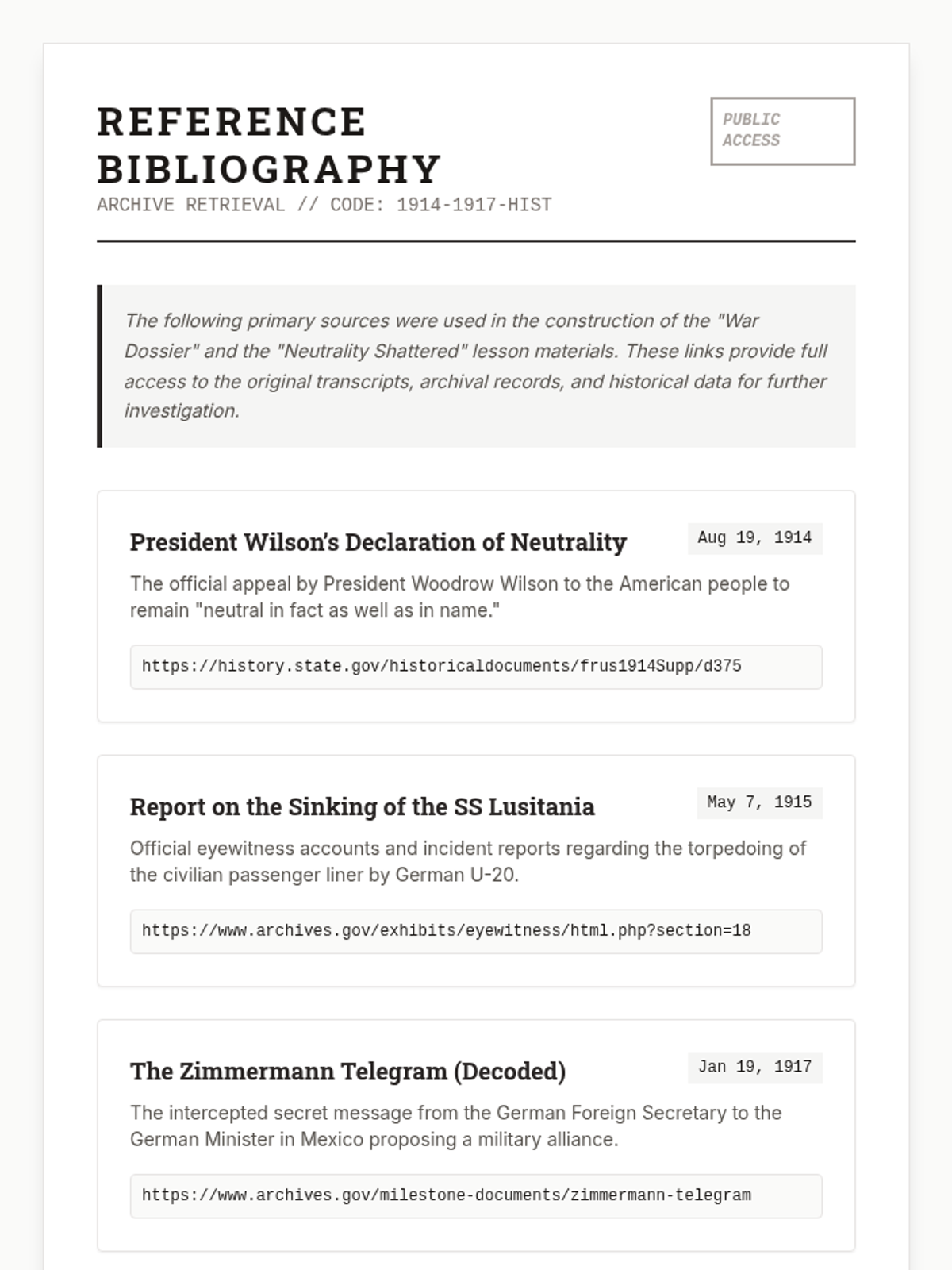
A comprehensive bibliography page for the teacher and students, listing all primary sources used in the lesson with their full names, dates, and original archival URLs.
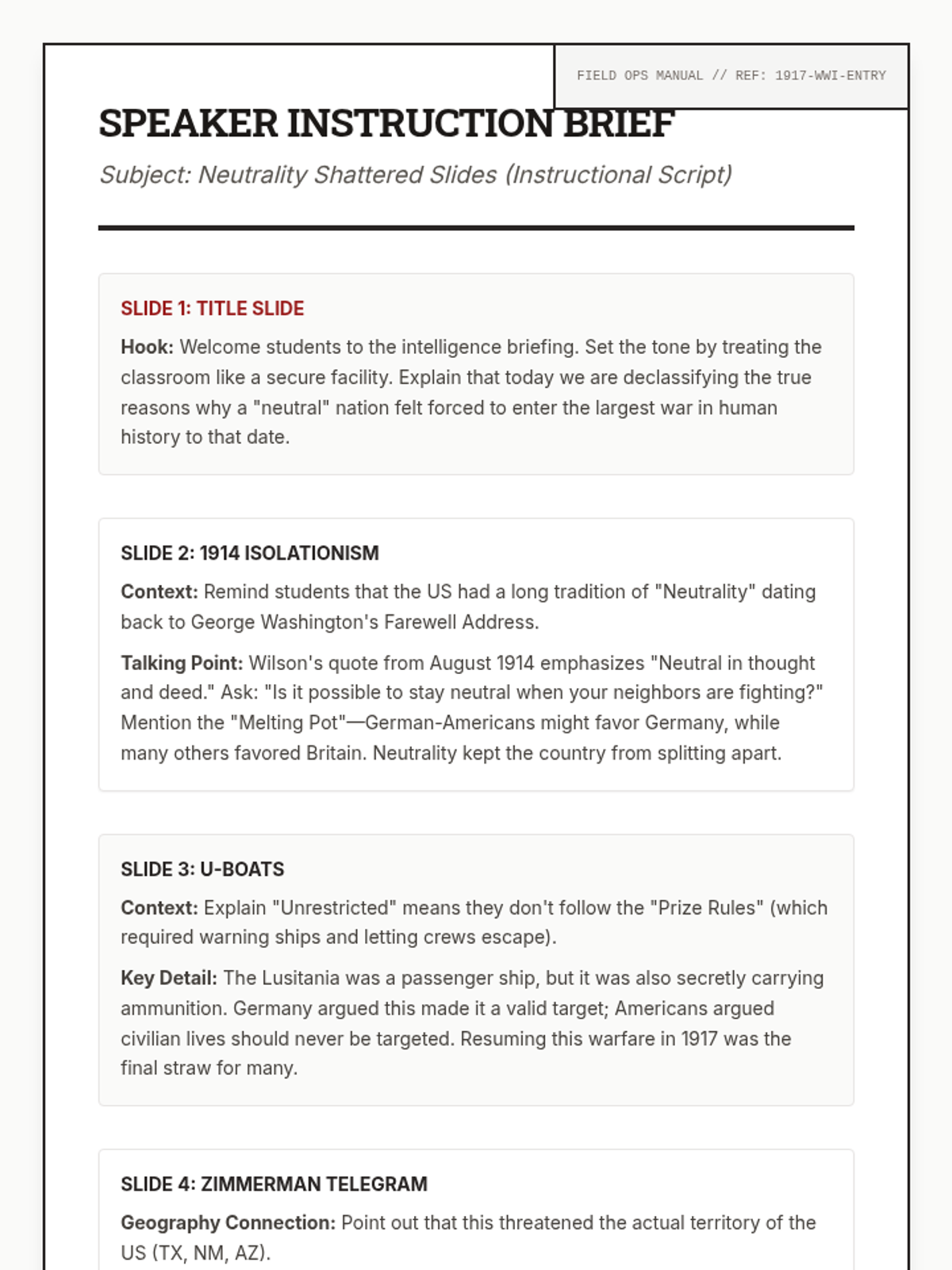
A detailed document providing talking points, historical context, and discussion prompts for each slide in the Neutrality Shattered presentation, styled as a teacher-facing field manual.
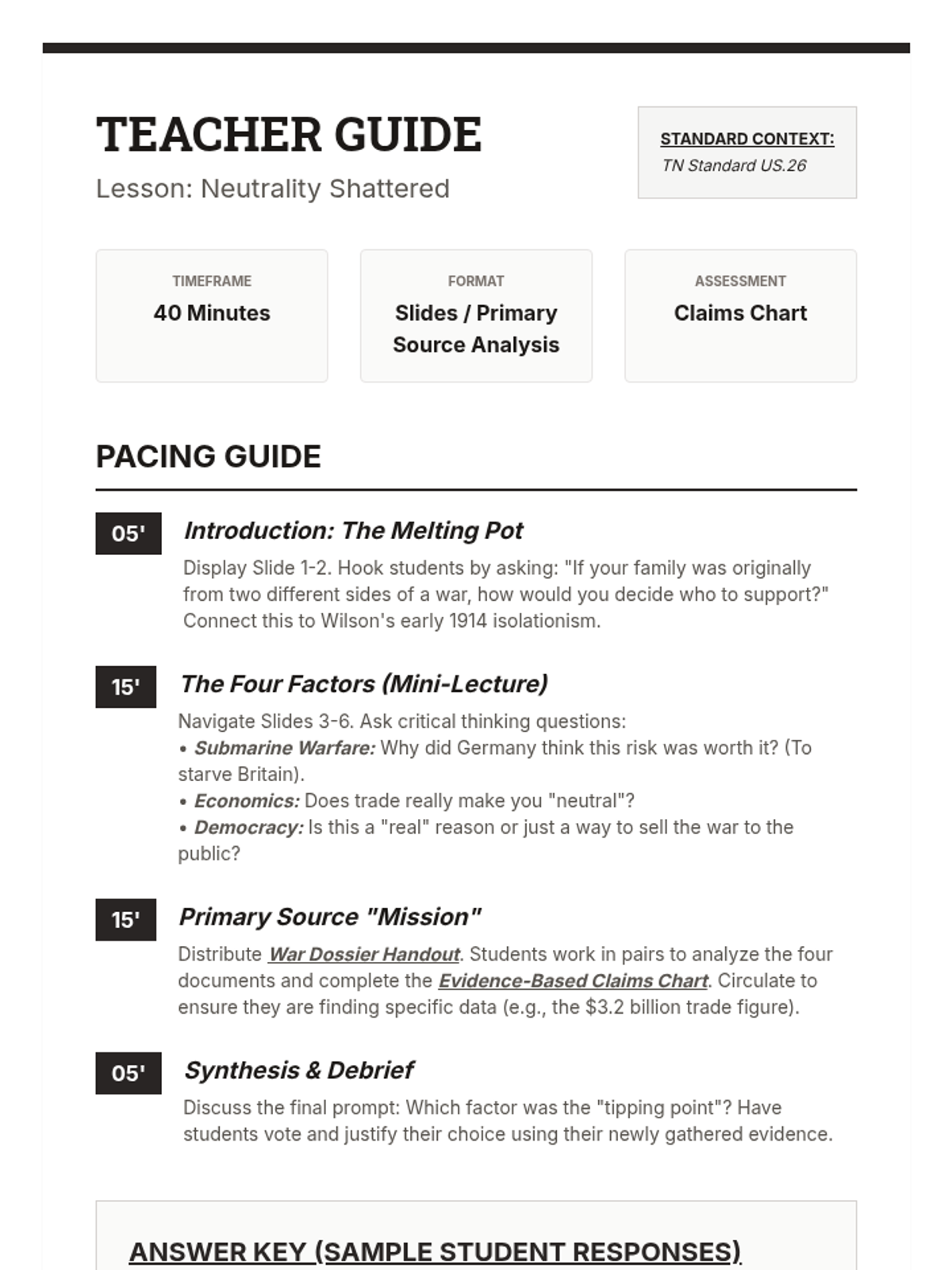
A comprehensive teacher guide for the Neutrality Shattered lesson, providing pacing, discussion prompts, differentiated instruction tips, and an answer key for the claims chart.
An evidence-based claims chart for students to analyze and categorize primary source evidence regarding U.S. entry into WWI, featuring four major categories and a synthesis prompt.
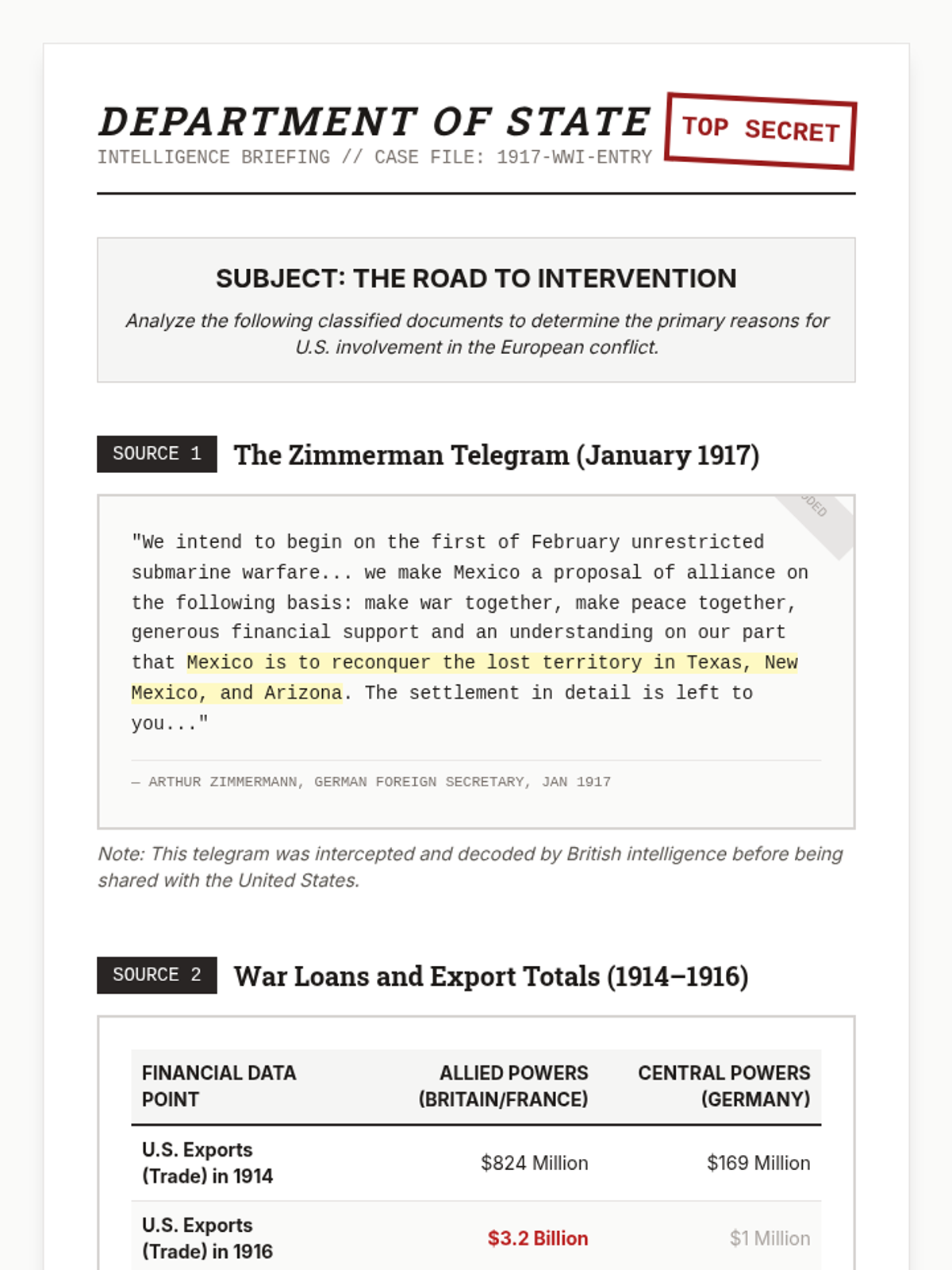
A 2-page primary source document set styled as a classified government dossier, featuring the Zimmerman Telegram, economic data, U-boat reports, and Wilson's "Safe for Democracy" speech. Now with improved attribution and dates.
A 7-slide interactive presentation outlining the four main reasons for U.S. entry into World War I, featuring a "dossier" aesthetic and specific historical evidence. Now with dated and attributed quotes.
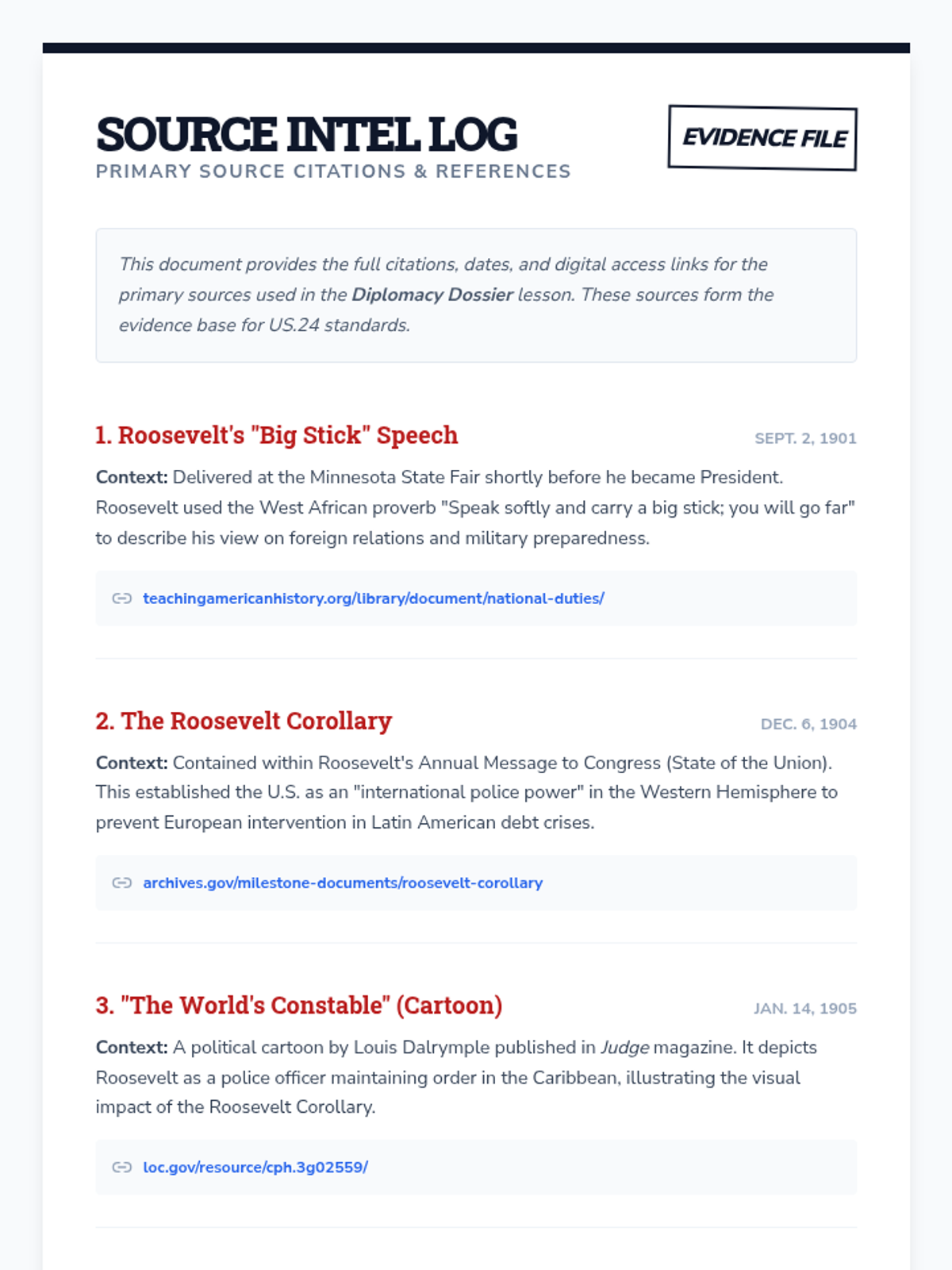
A comprehensive reference document listing all primary sources used in the lesson, including specific dates, historical context, and links to official digital archives like the Library of Congress and National Archives.
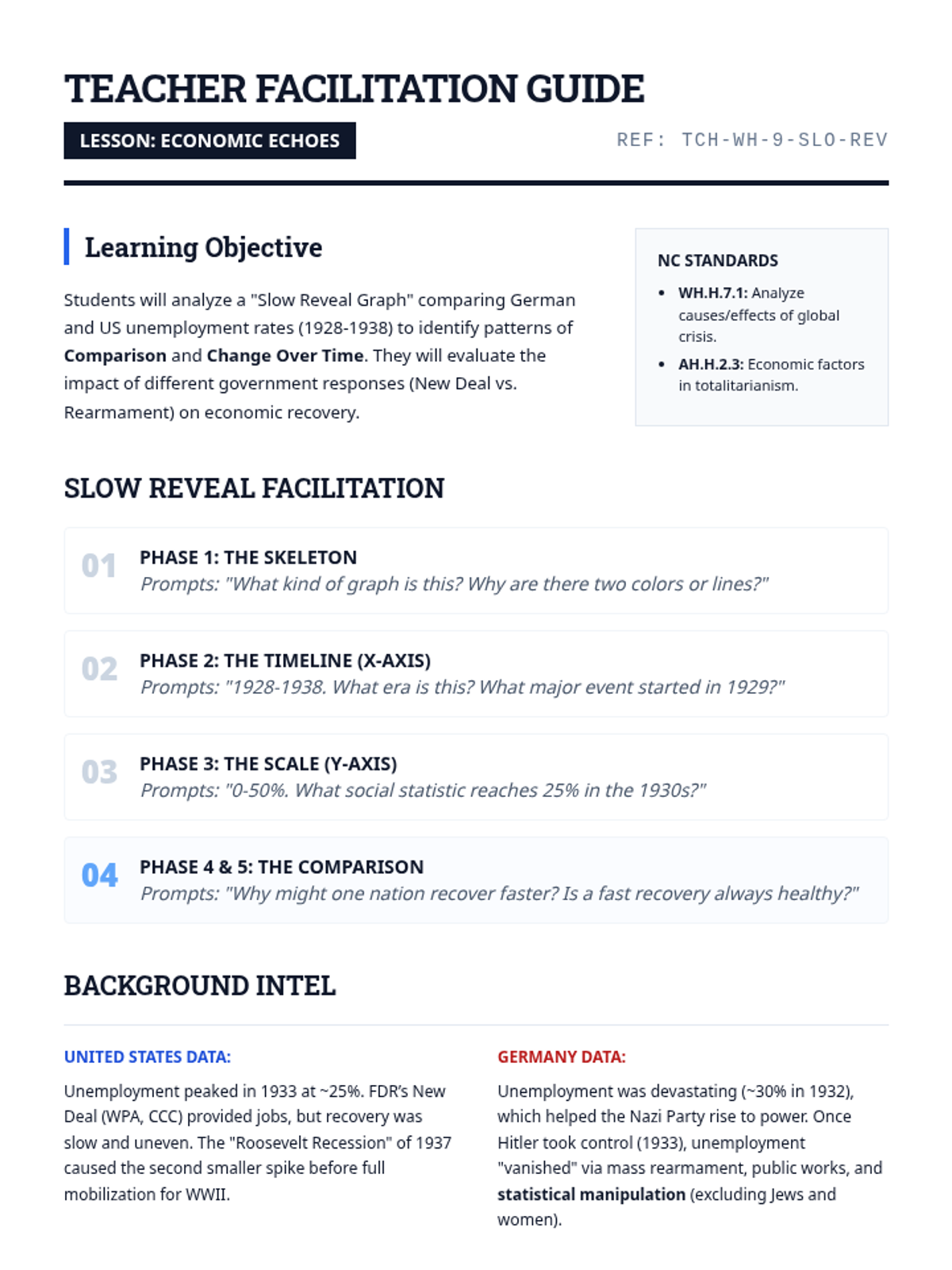
A teacher guide for facilitating the slow-reveal graph lesson, including historical context, discussion prompts, and an answer key for comparing US and German unemployment.
A presentation featuring a slow-reveal graph that progressively unveils the comparison of unemployment rates between Germany and the USA during the Great Depression.
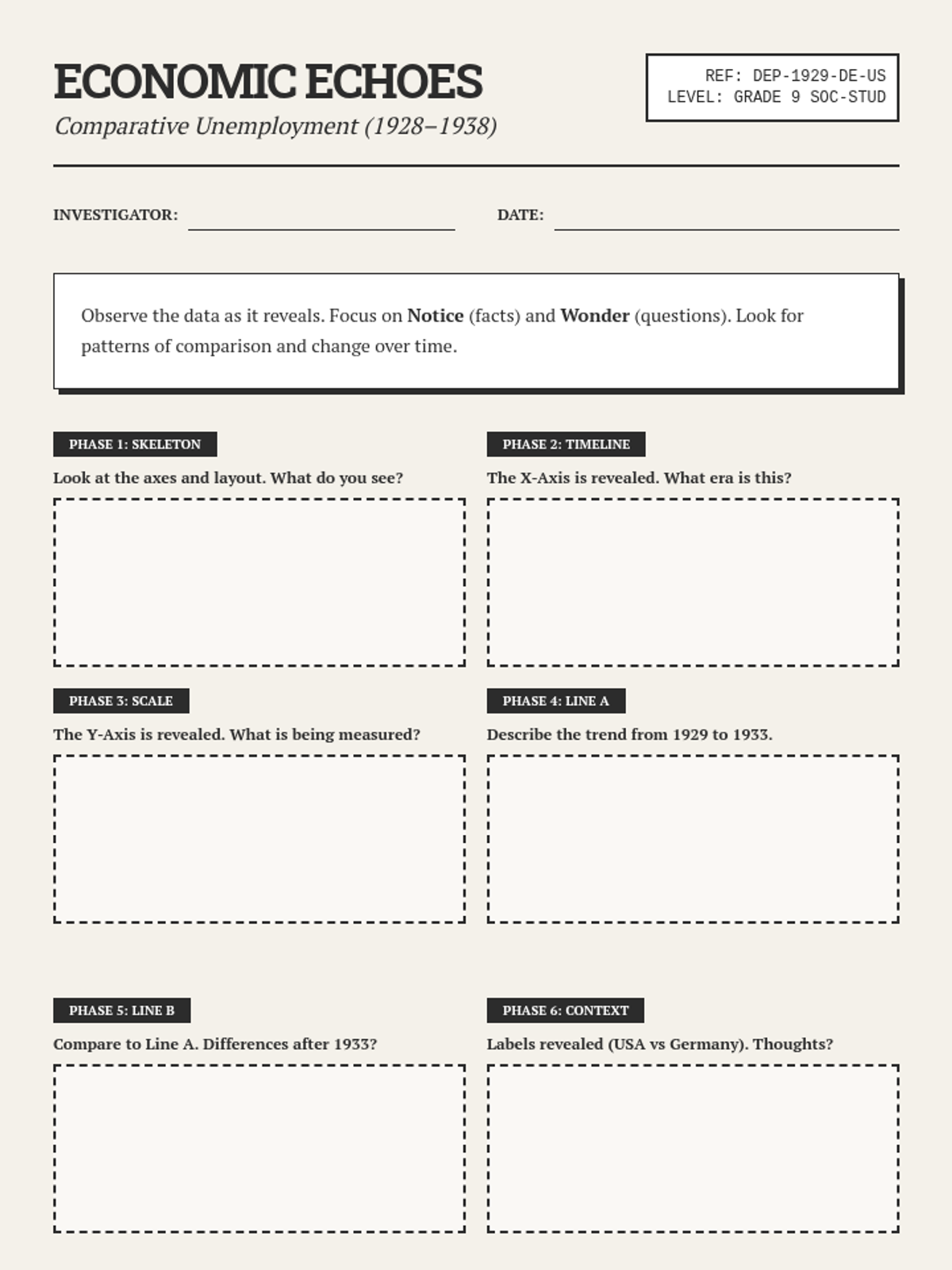
A student worksheet designed to accompany a slow-reveal graph activity, providing structured space for observations and historical analysis of US and German unemployment data.
An interactive slide deck introducing the fundamentals of fiscal policy, exploring the federal budget, national debt, and the mechanics of expansionary vs. contractionary tools. Includes practice activities, scenario matching, and critical thinking prompts for students. All text adheres to the 24px minimum font size requirement.
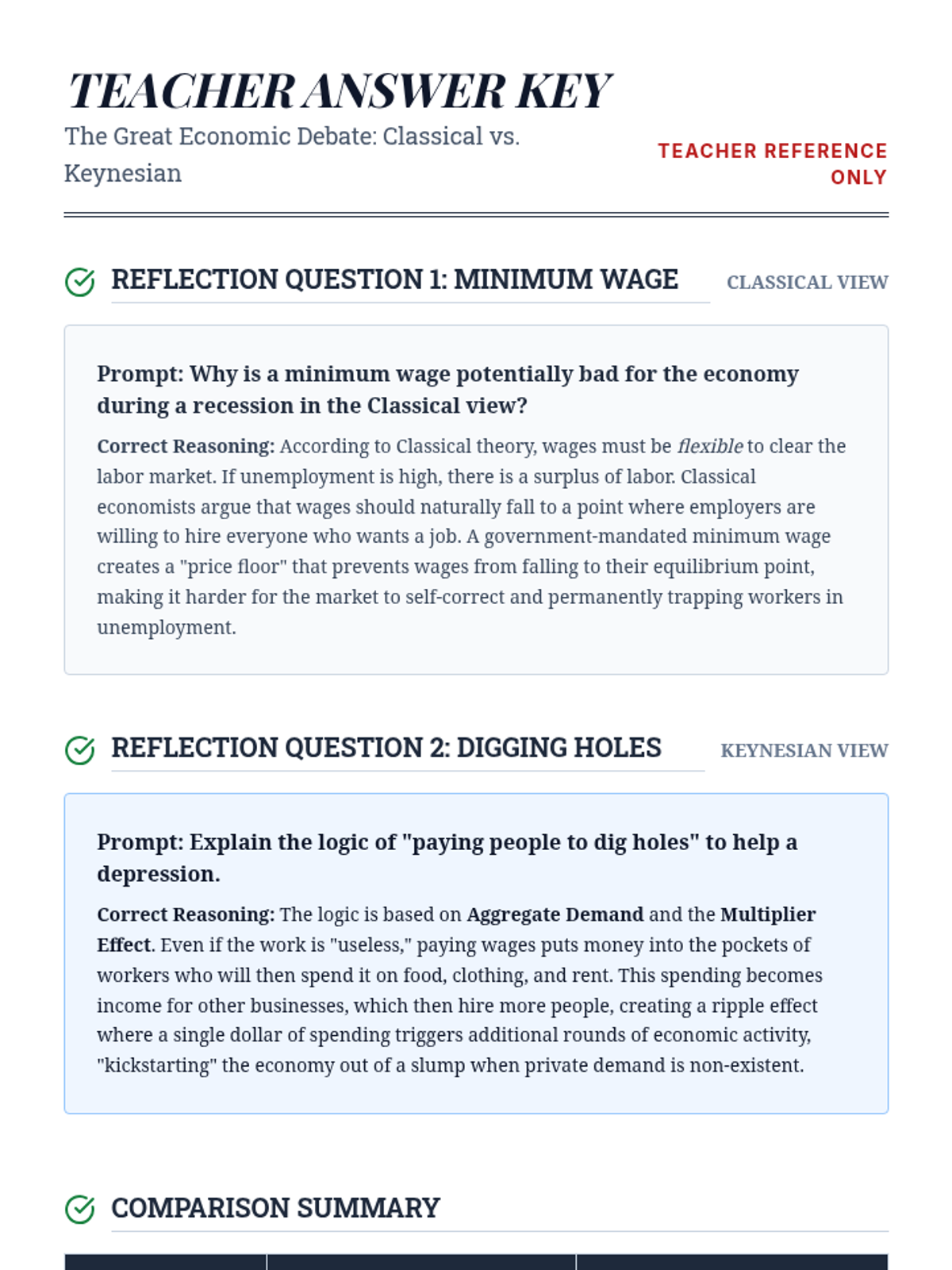
Teacher reference guide containing sample responses and detailed economic reasoning for the Market Tug of War worksheet, including answers for the quick-check quiz. Now includes a dedicated comparison summary table for teacher reference.
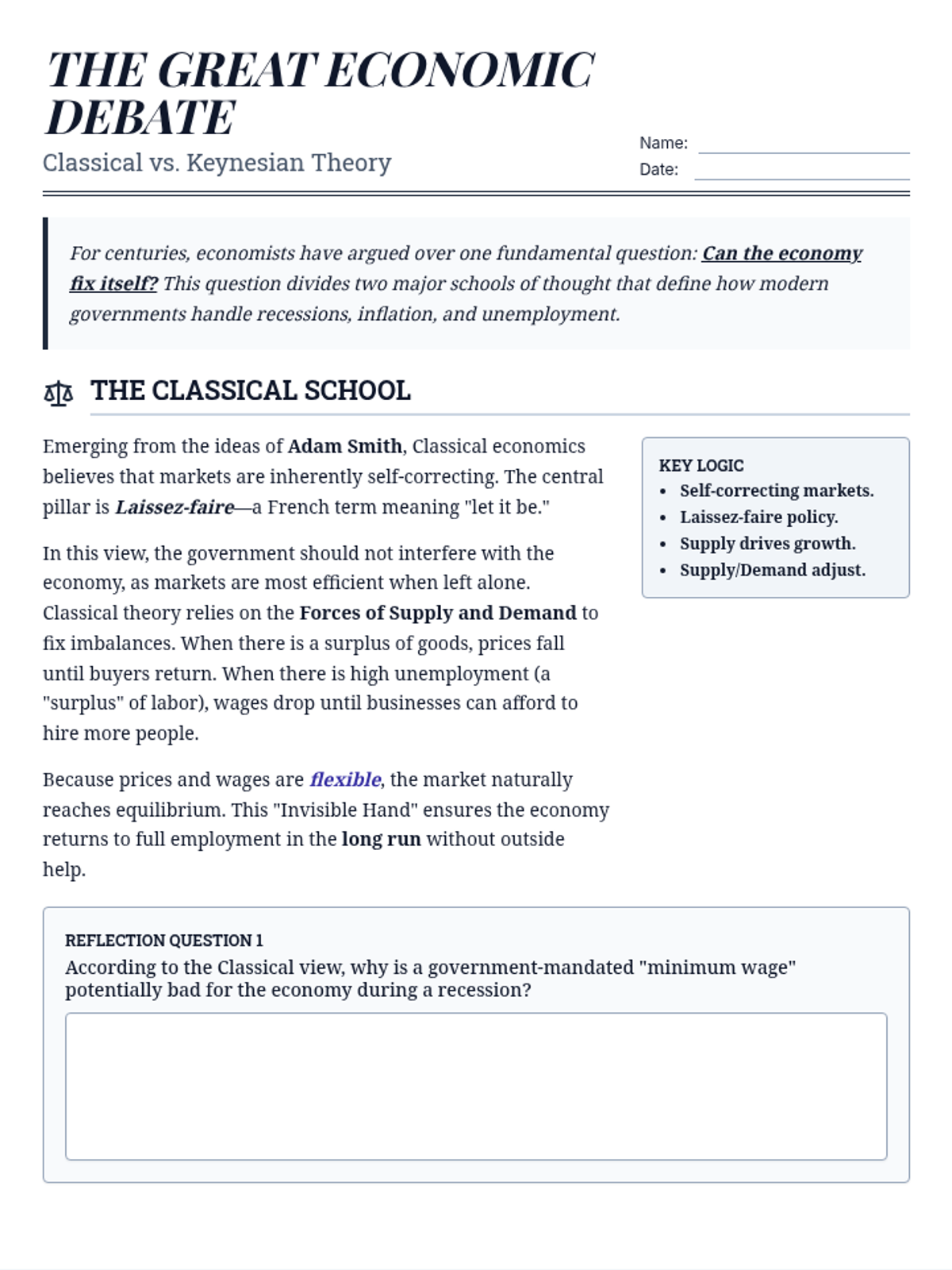
A structured reading and response handout that explores the core differences between Classical and Keynesian economics, featuring Laissez-faire, price flexibility, aggregate demand, and government intervention. Now includes a detailed explanation of the multiplier effect and market self-correction through supply and demand.
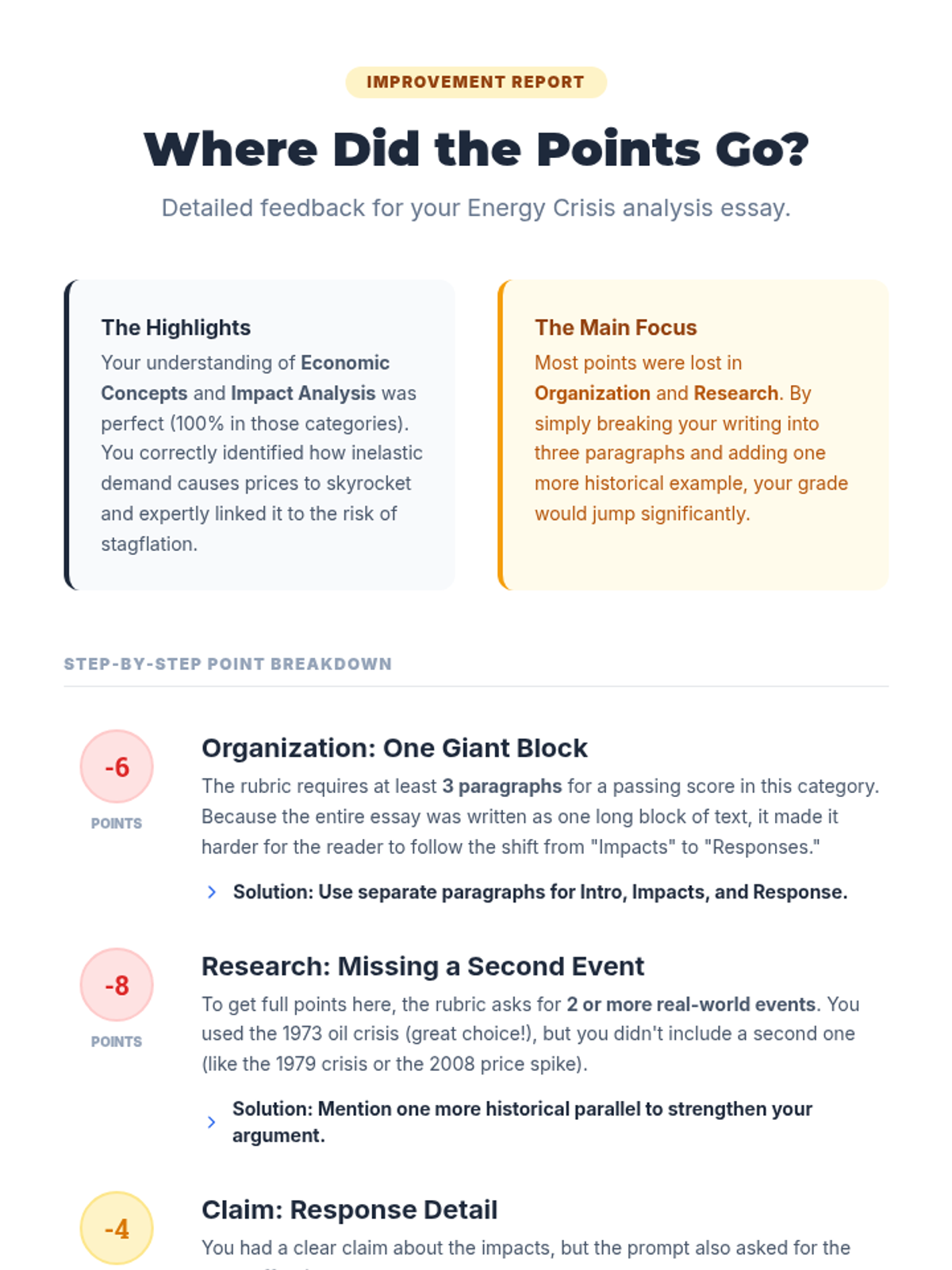
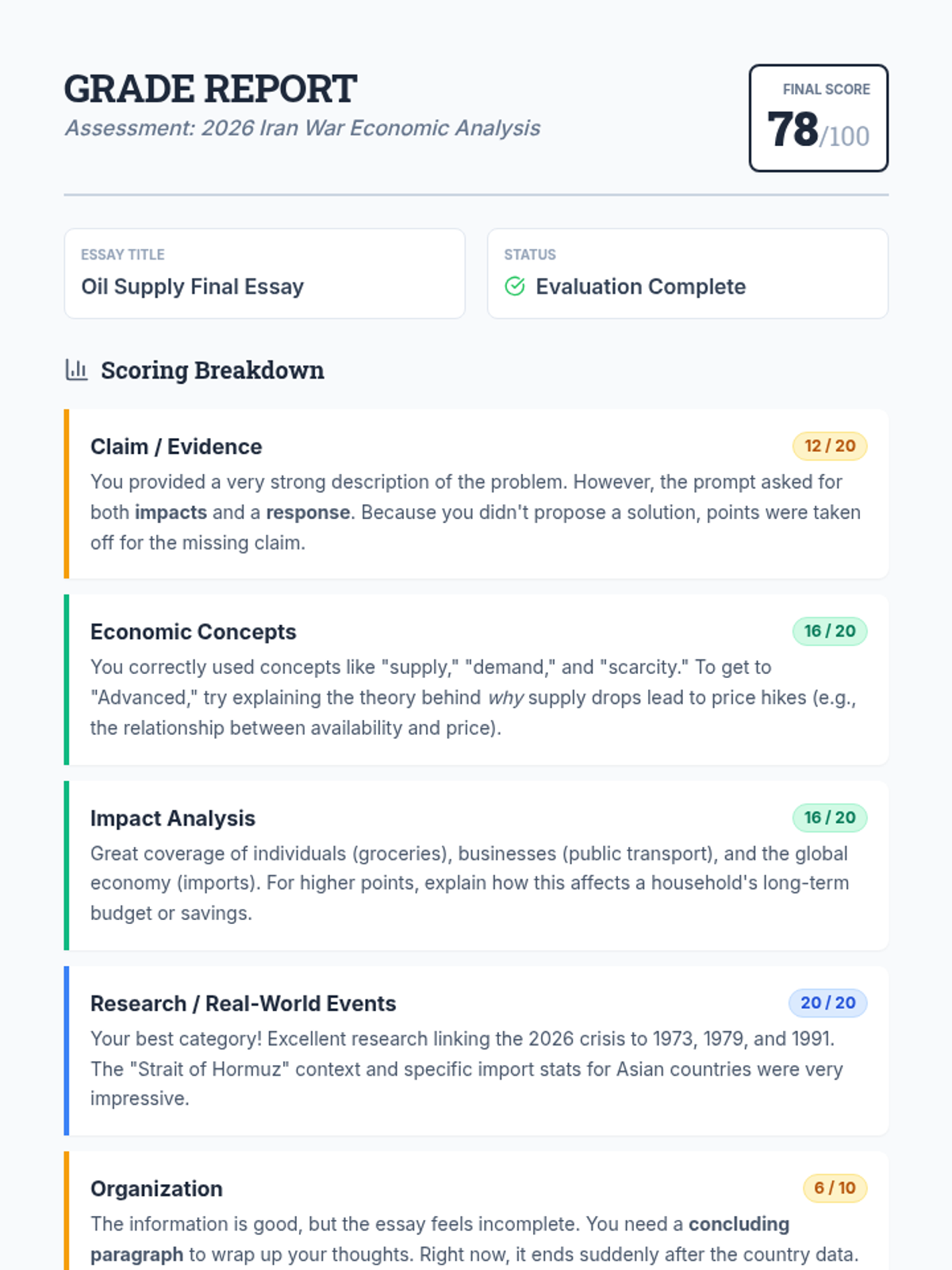
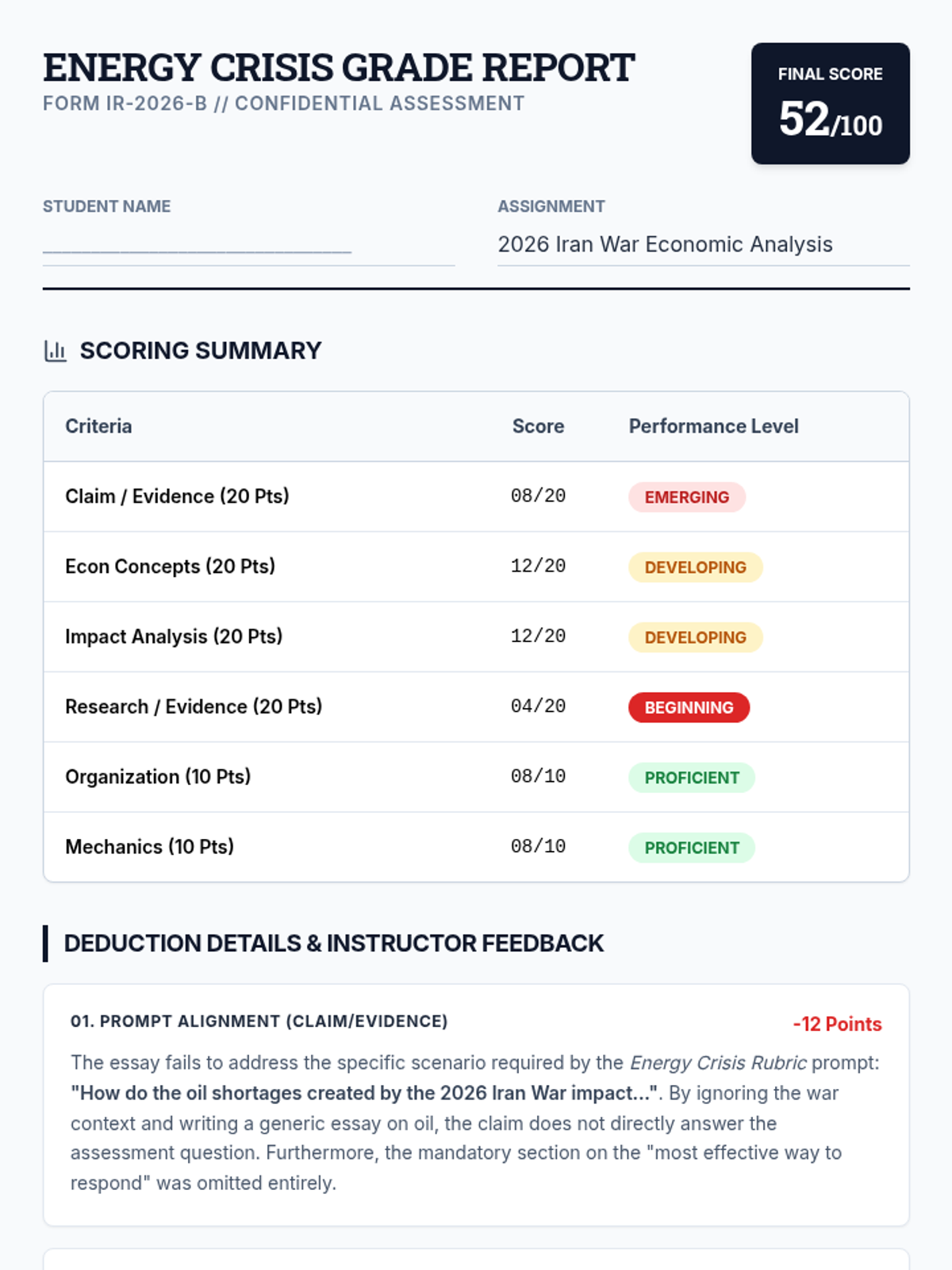
A detailed feedback sheet explaining exactly why points were deducted from the student's essay, with clear sections on organization, research, and mechanics.
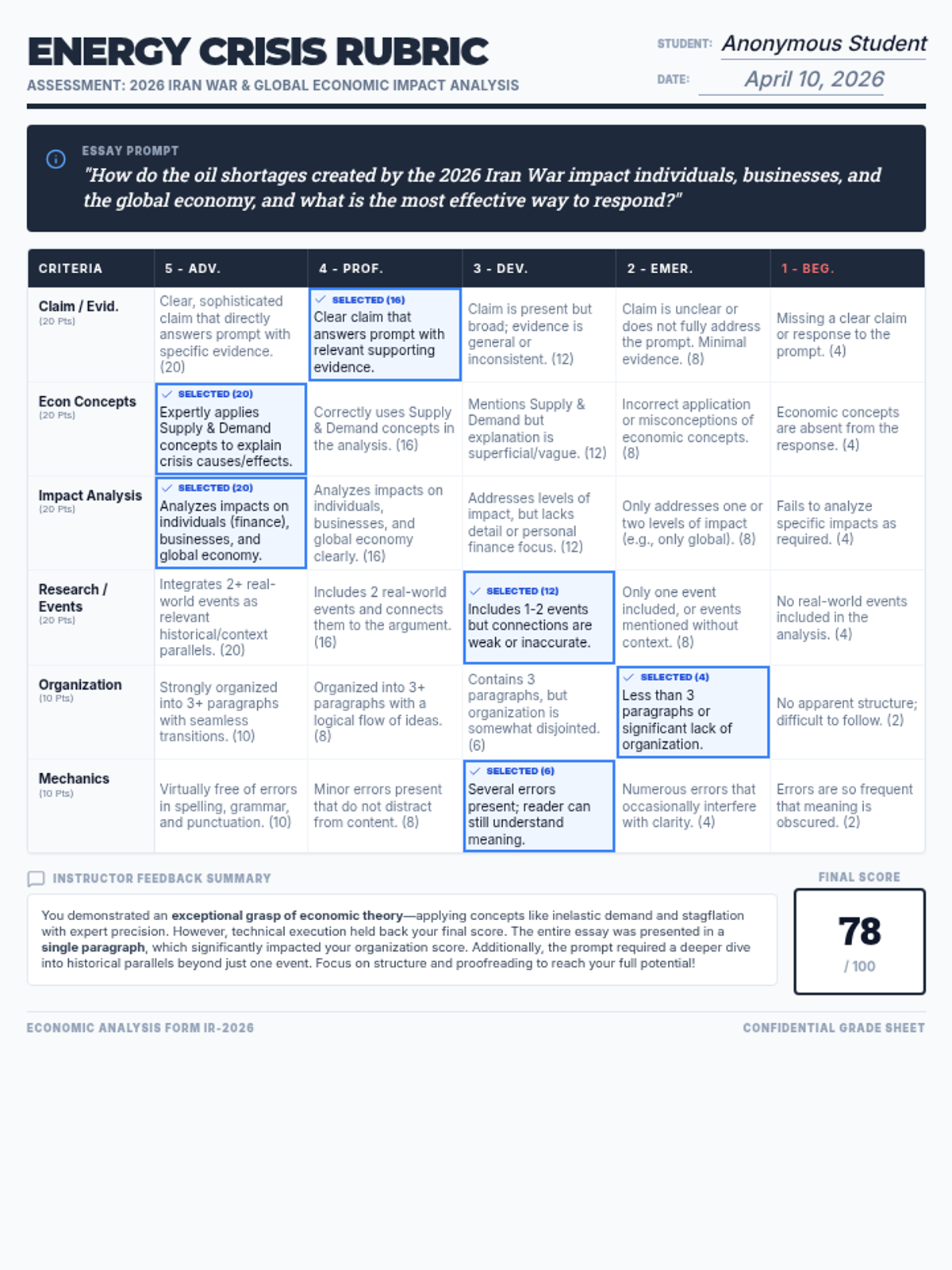
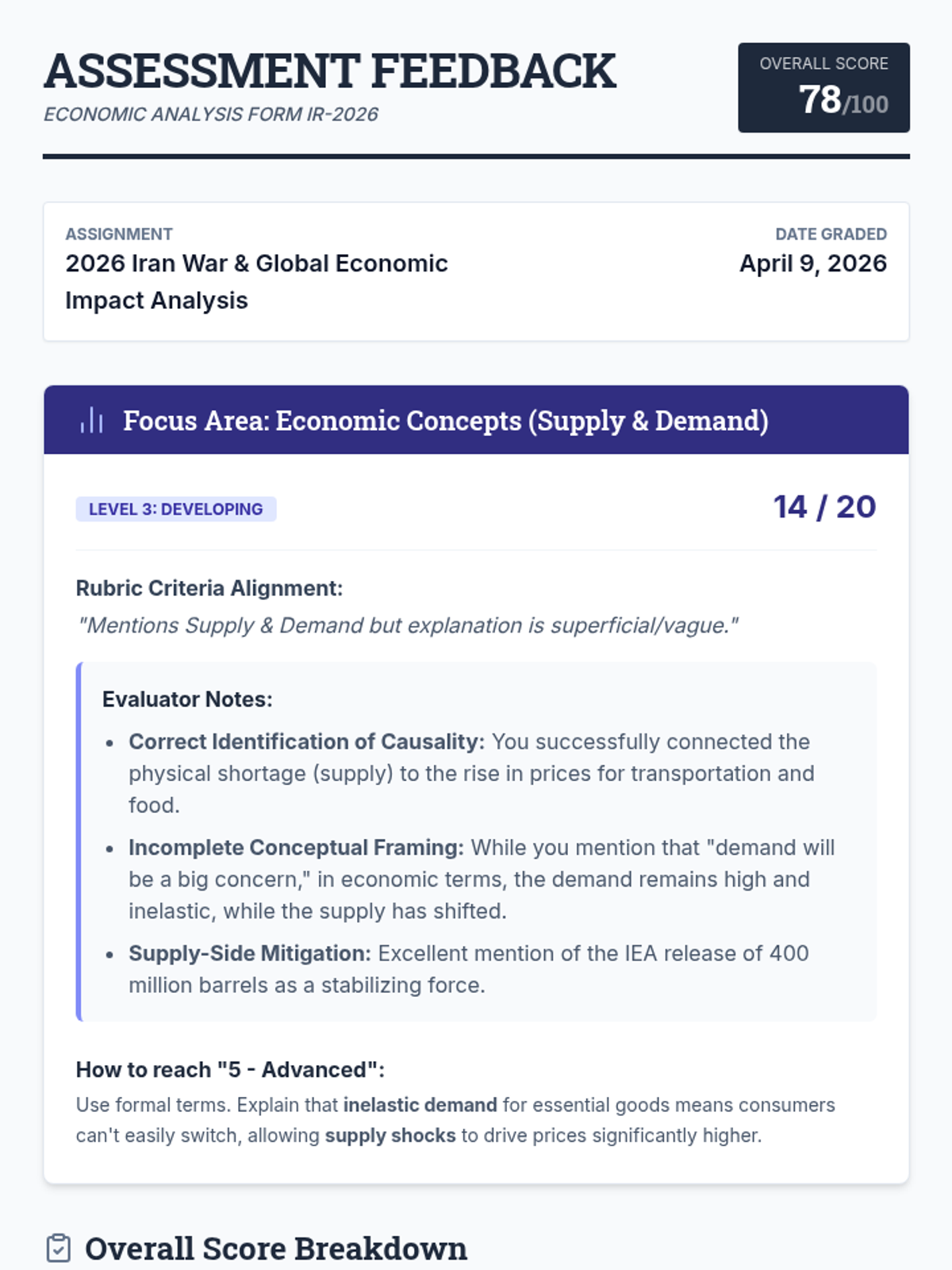
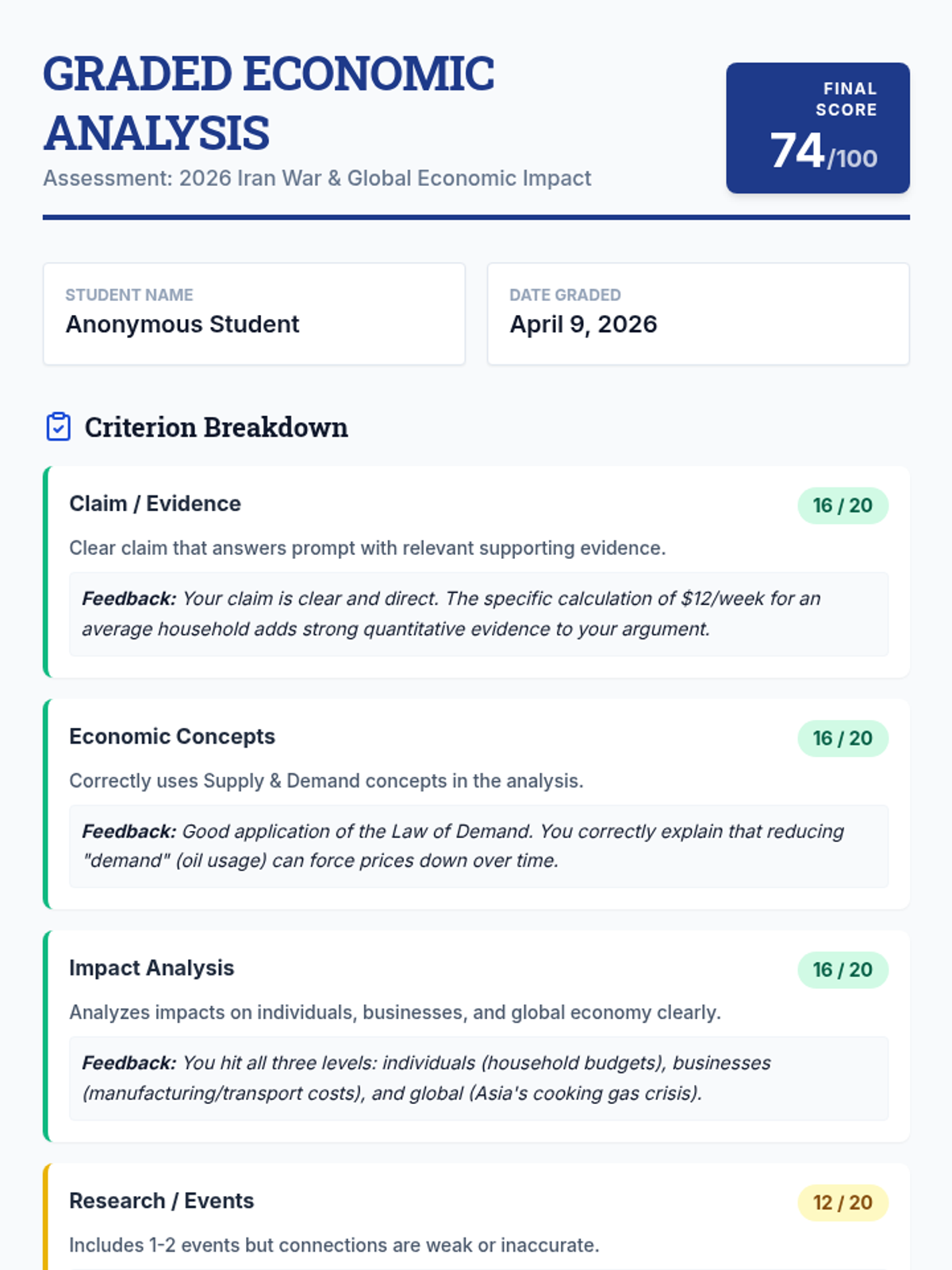
A completed grading rubric for the Energy Crisis essay, showing scores for claim, economic concepts, impact analysis, research, organization, and mechanics with a final total of 78/100.
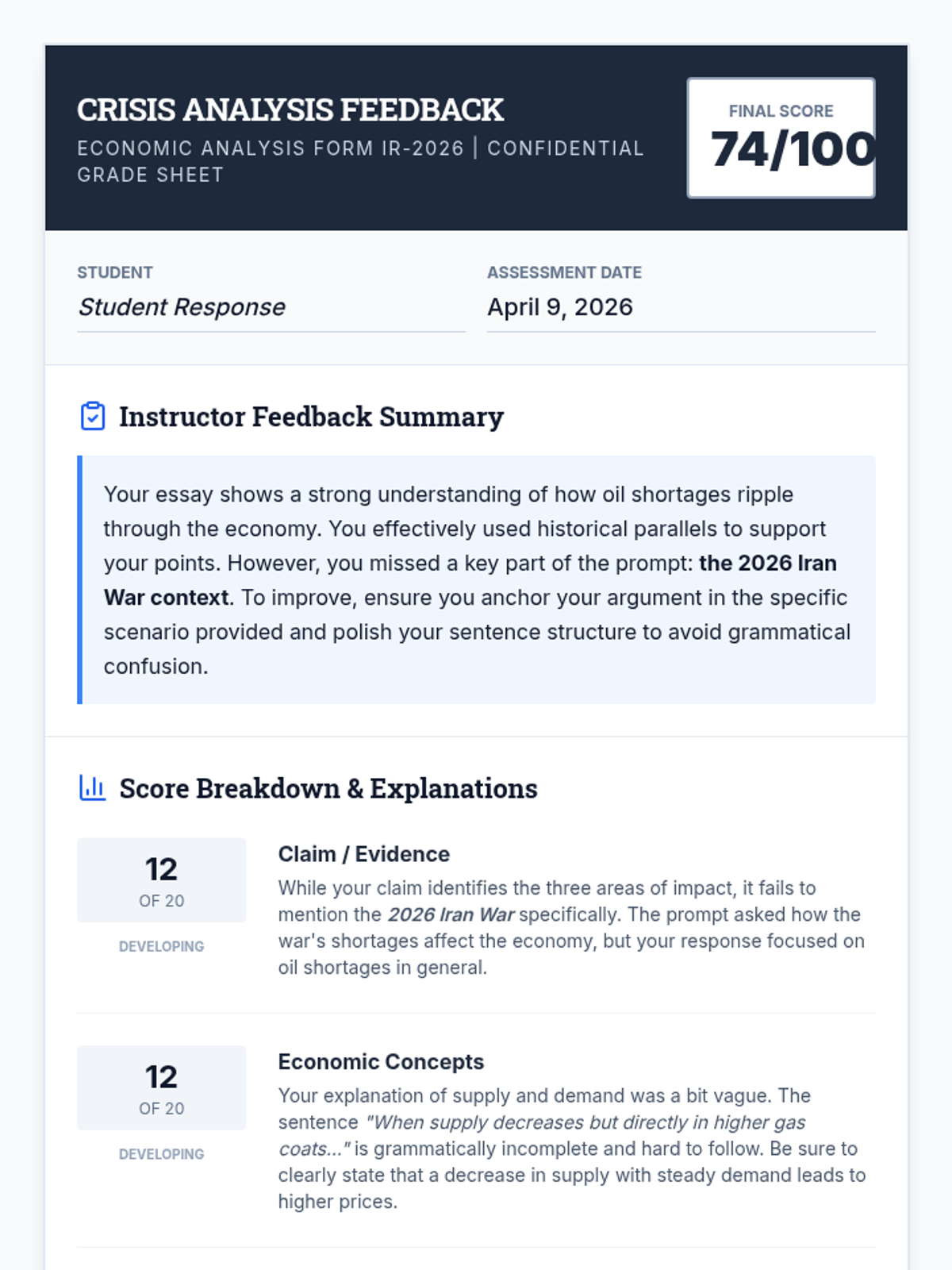
A detailed feedback report for a student's essay on the 2026 energy crisis, featuring a clear points breakdown, specific reasons for score deductions, and encouraging instructor notes based on a provided rubric.
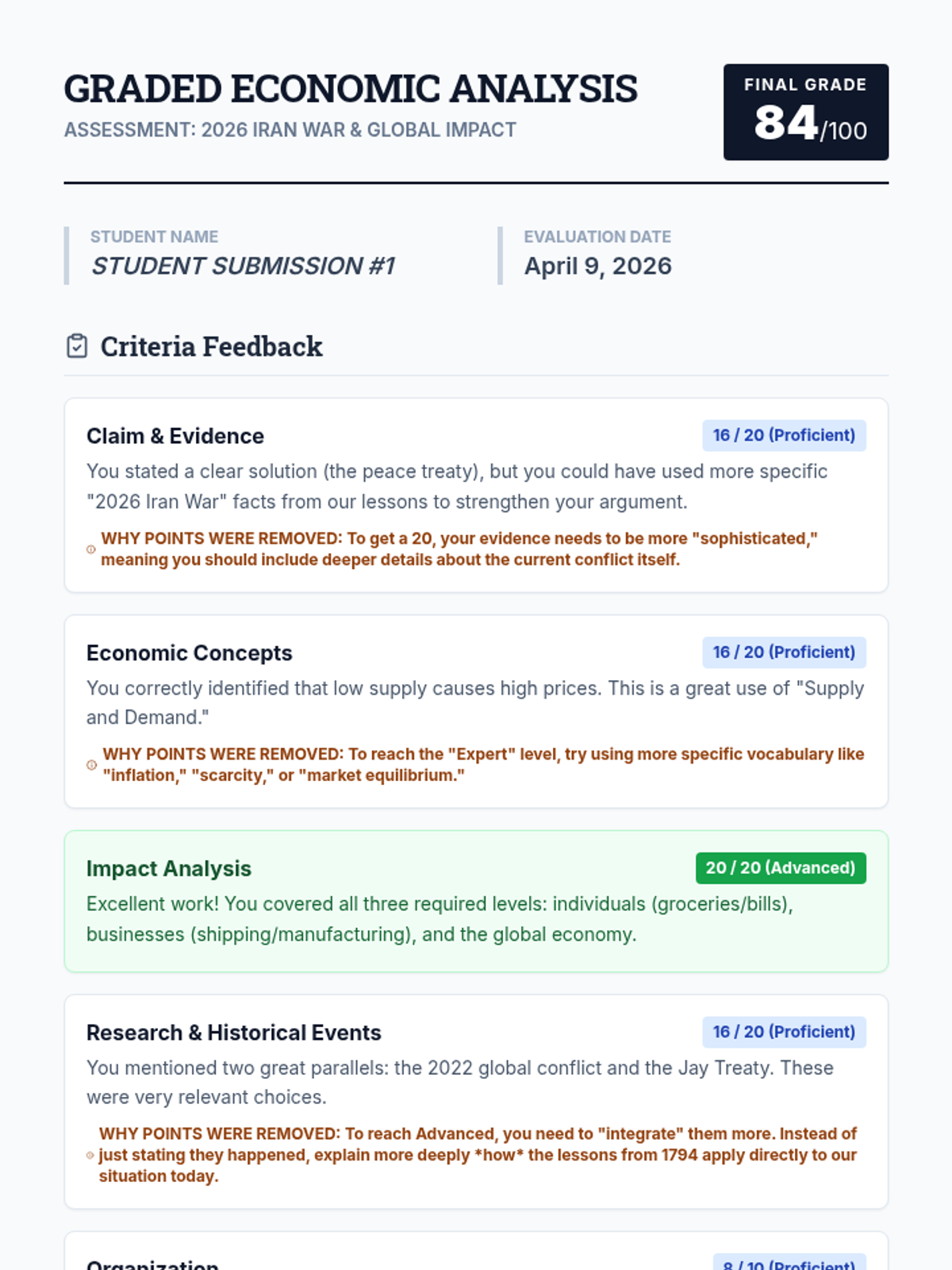
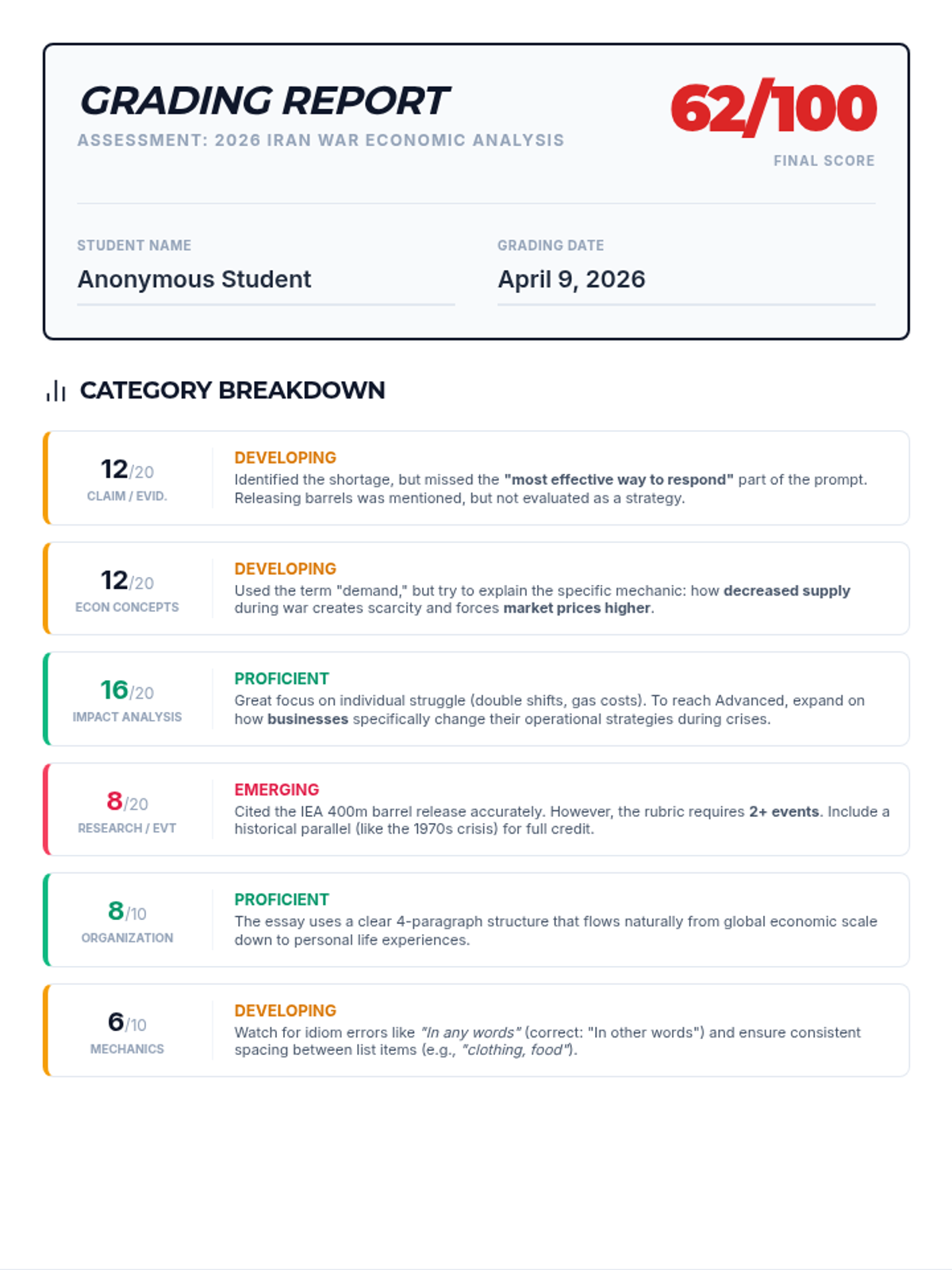
A comprehensive grading report for an essay on the economic impact of the 2026 Iran War oil shortage. It includes score breakdowns by rubric category and actionable feedback for the student.
A student-facing feedback report explaining the specific reasons for a lower score on the energy crisis essay, including tips for consolidation and historical context.
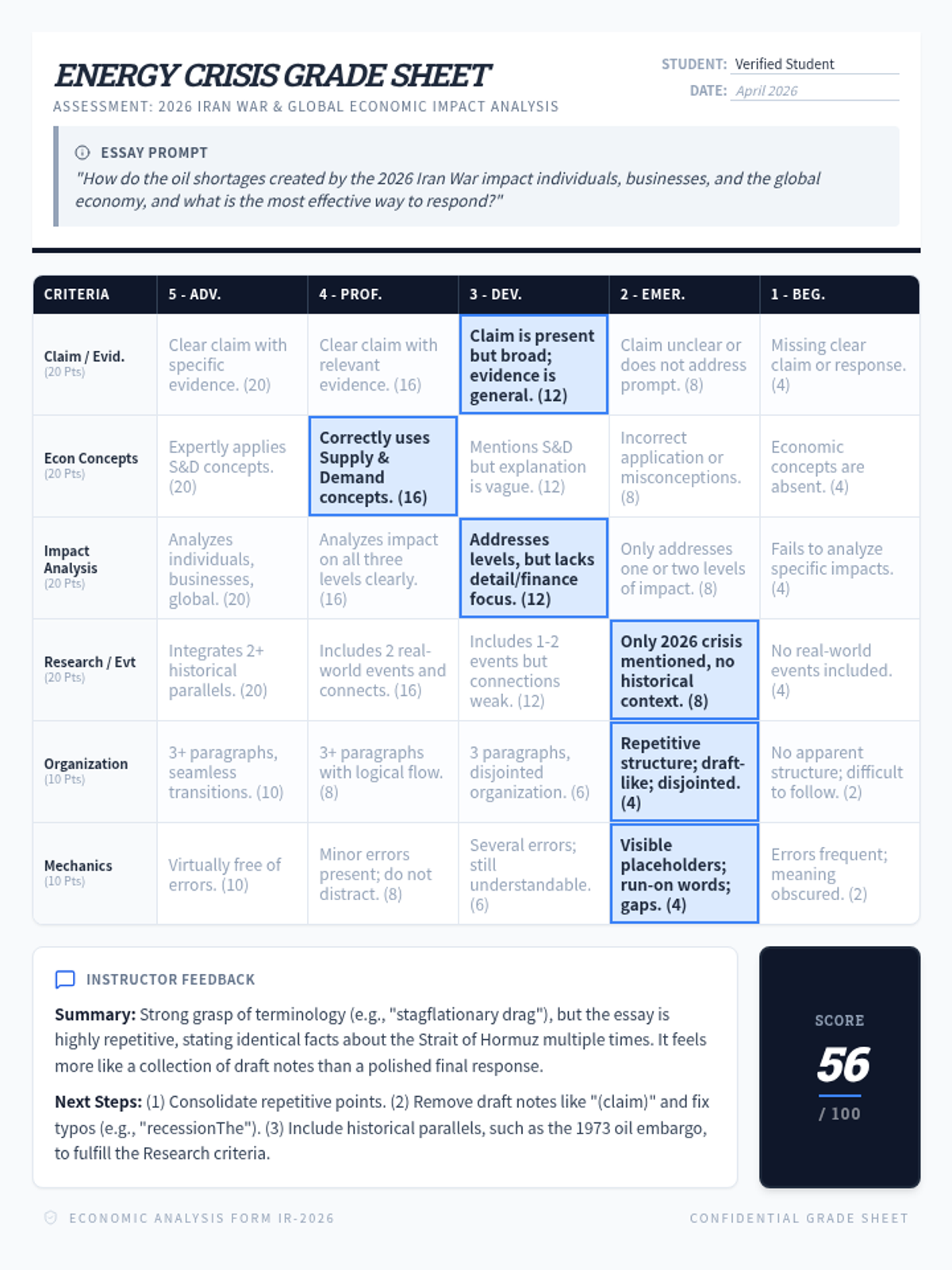
A graded rubric for an economics essay on the 2026 energy crisis, featuring specific scoring across six criteria and instructor feedback.
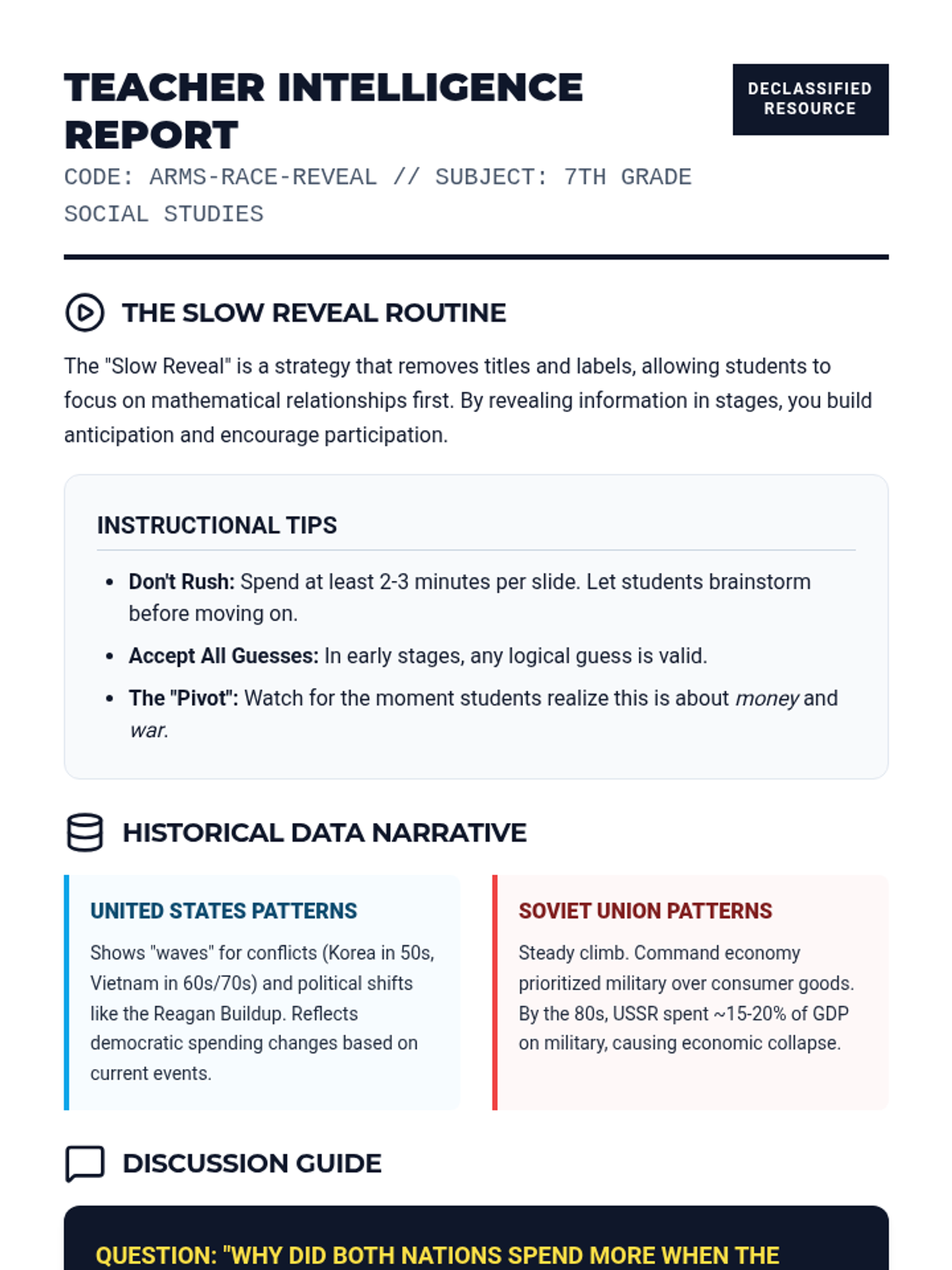
A comprehensive teacher's guide for facilitating the 'Arms Race Arsenal' slow-reveal graph routine, including pedagogical strategies, historical context, and discussion prompts. Revised for better page flow, improved text contrast, and consistent styling. Optimized for 2-page print layout.
A detailed grading report for a student essay on the 2026 oil crisis. It includes a numeric breakdown based on the provided rubric and specific, student-friendly feedback on areas for improvement.
A detailed grade report based on the Energy Crisis Rubric, featuring a breakdown of scores and clear, constructive feedback for the student's essay.
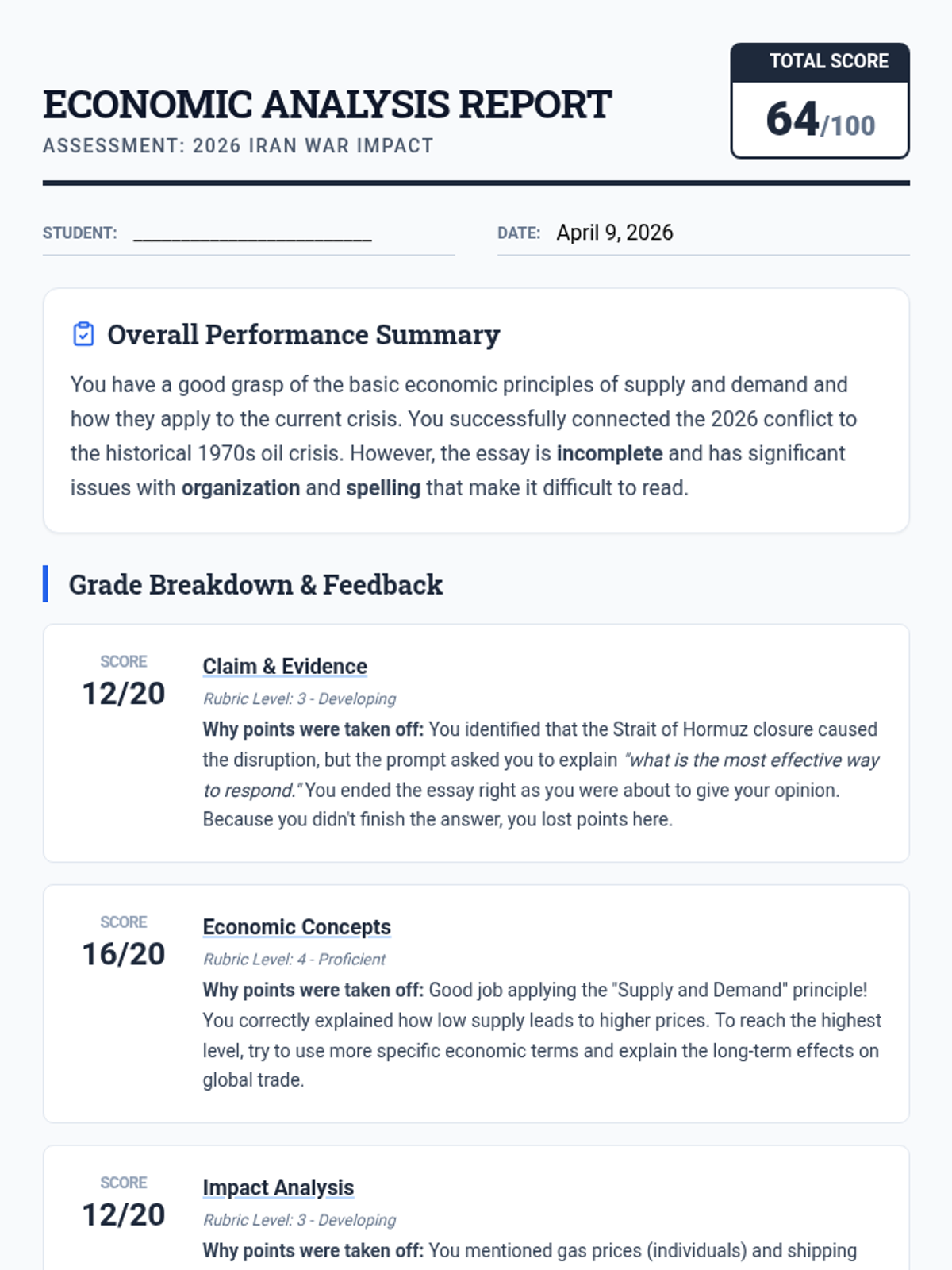
A graded evaluation report for an essay on the 2026 Iran War energy crisis, providing a detailed point-by-point breakdown and clear feedback based on the provided rubric.
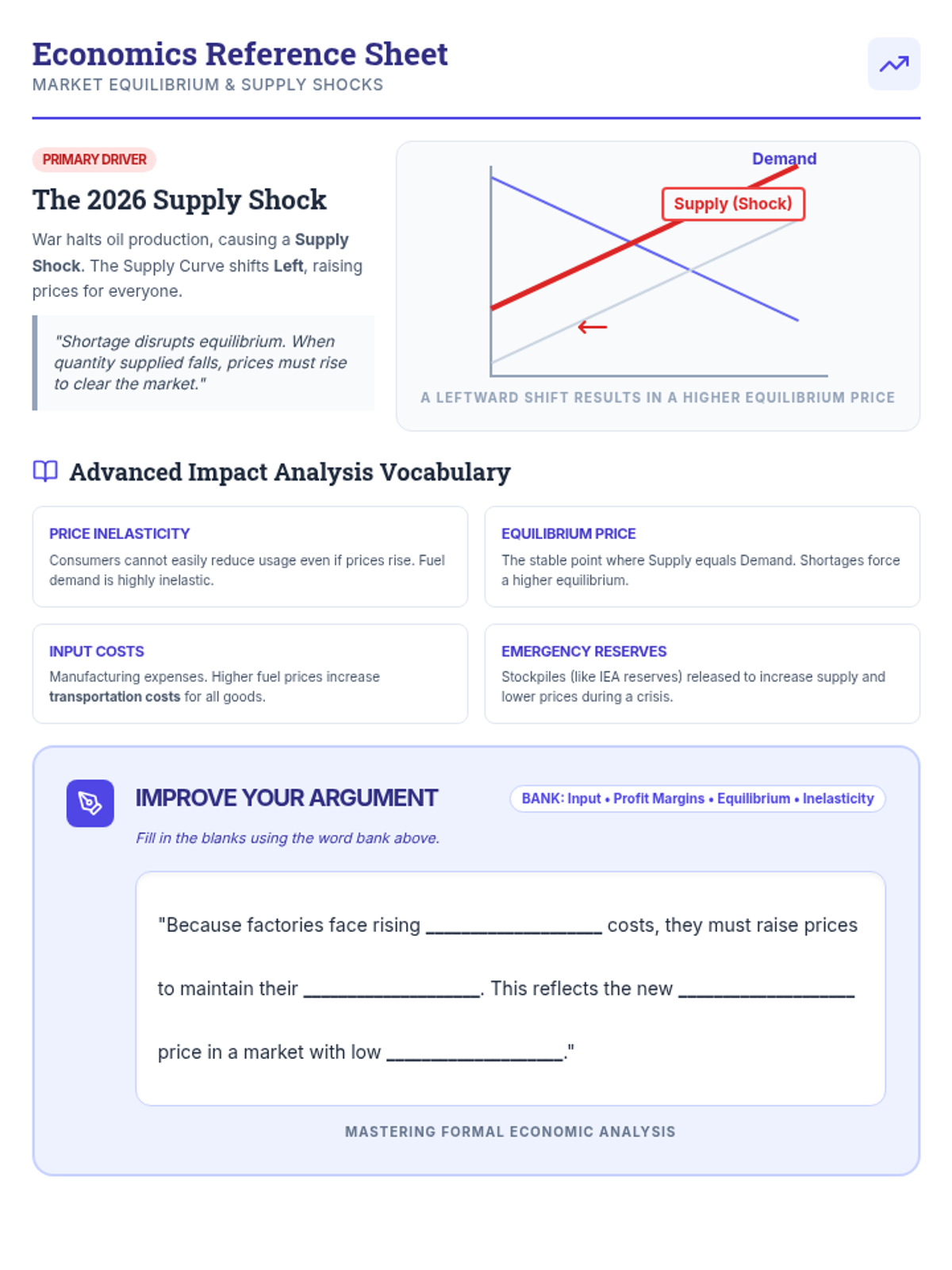
A reference sheet for students explaining the economic mechanics of supply shocks and oil shortages, designed to help them incorporate formal terminology like price inelasticity and input costs into their analysis.
A formal assessment feedback document evaluating a student's essay on the oil shortage, highlighting performance in economic concepts, research, and impact analysis based on the provided rubric.
A comprehensive feedback report for an essay on the 2026 Iran War energy crisis, providing detailed scoring and constructive feedback based on a specific economic rubric.
A detailed grade report for the student essay, breaking down specific point deductions based on the Energy Crisis Rubric. It provides constructive feedback on how to improve content regarding historical context and economic theory.
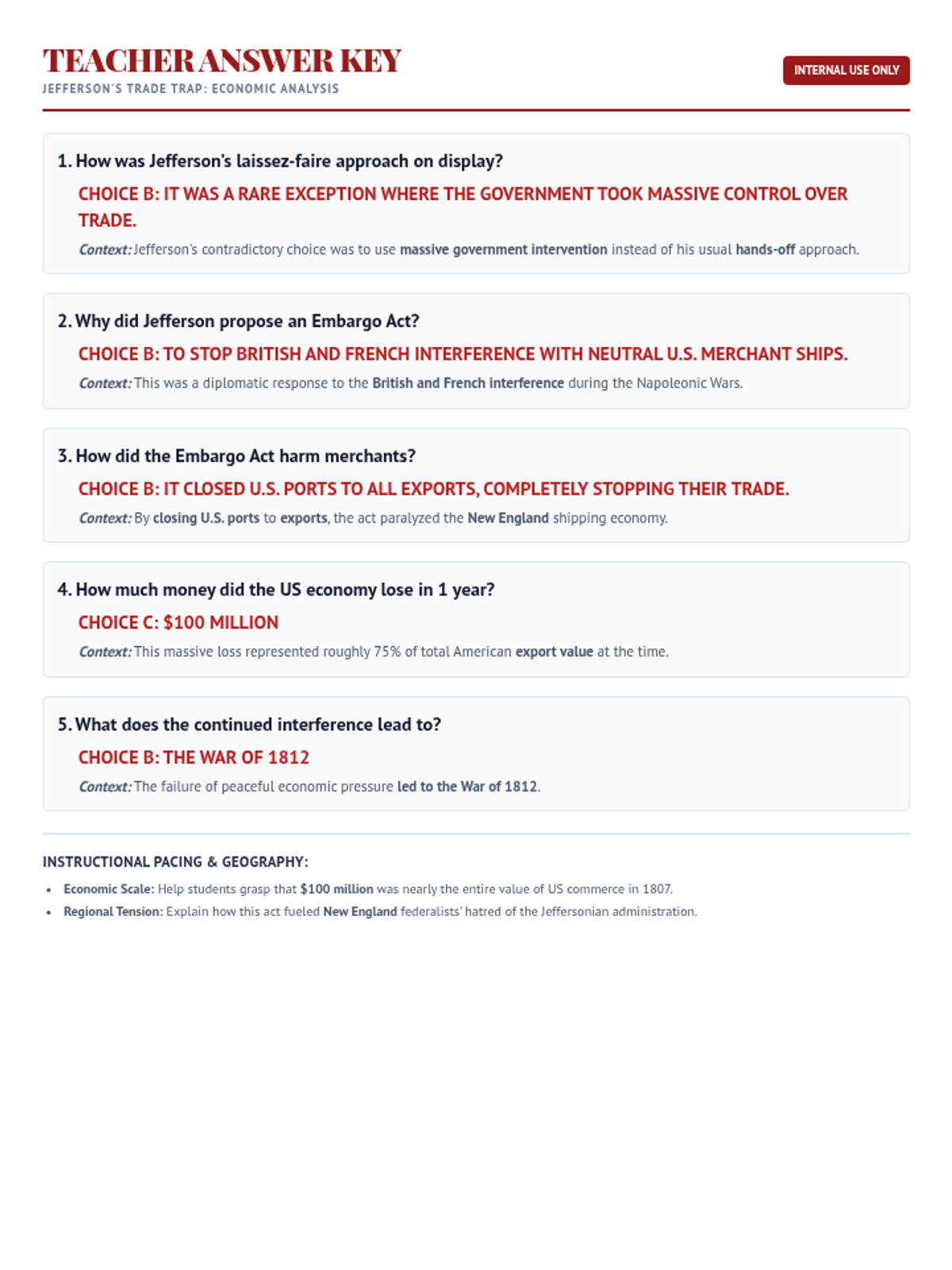
Answer key identifying correct multiple-choice choices with full text for teacher reference. Includes bolded keywords and historical context. Fits on a single page.
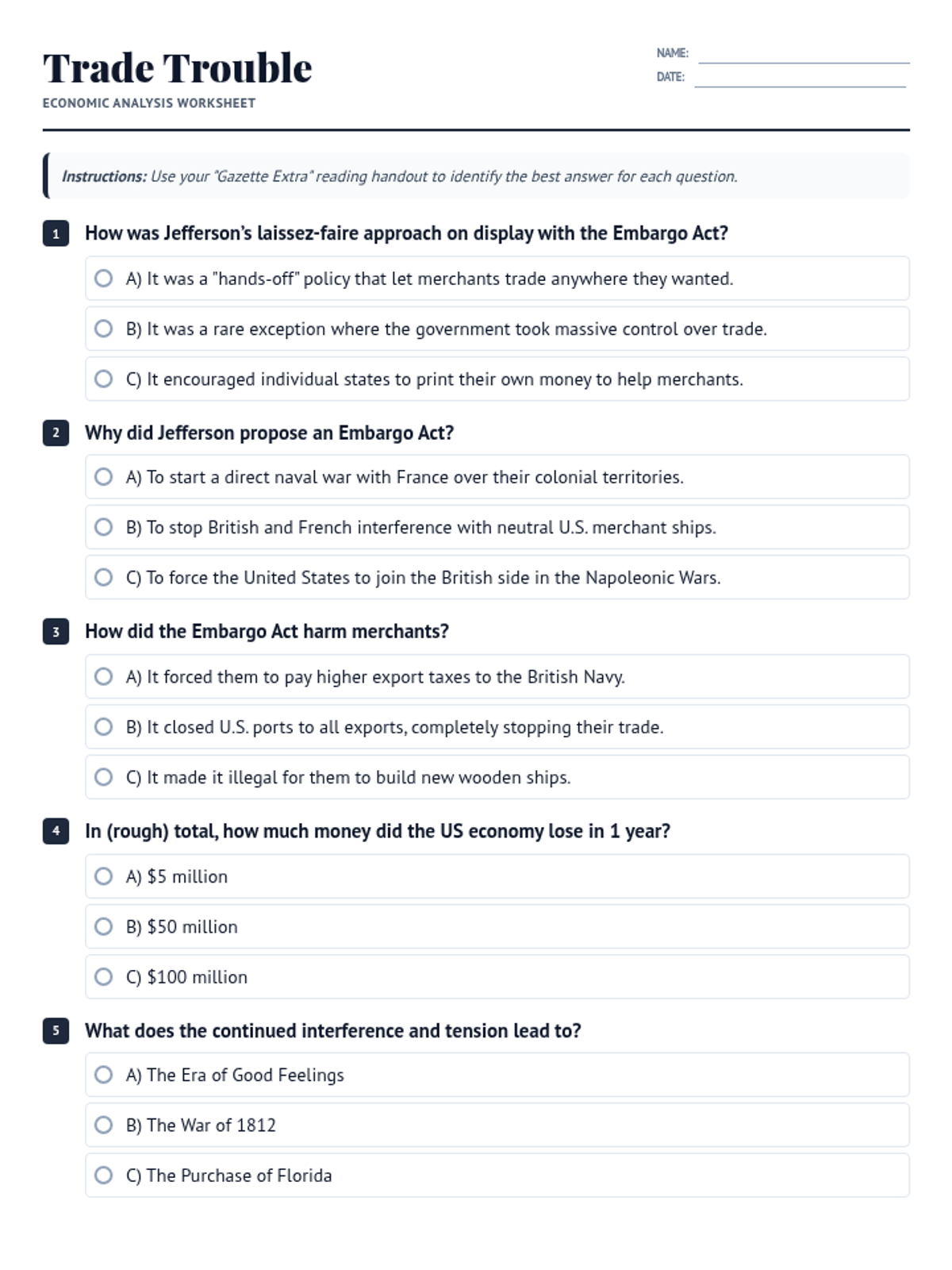
A one-page multiple-choice worksheet with 5 questions. Spacing and font-weights adjusted for perfect single-page layout and legibility. Now explicitly references the handout.
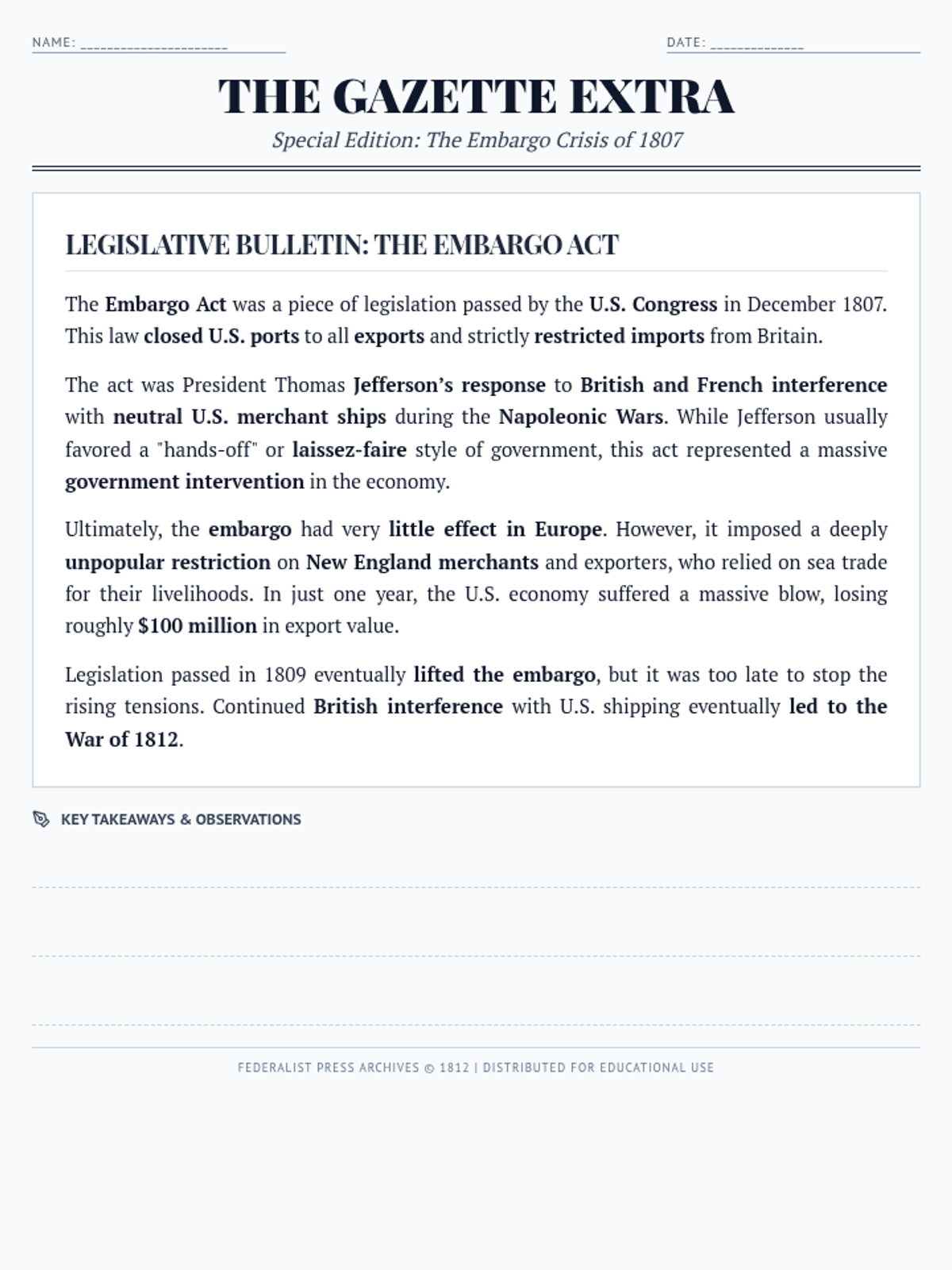
A guided reading handout featuring the text about the Embargo Act with bolded keywords and a vintage newspaper aesthetic. Fits on a single page with expanded space for student observations. Fixes icon rendering and page break issues.
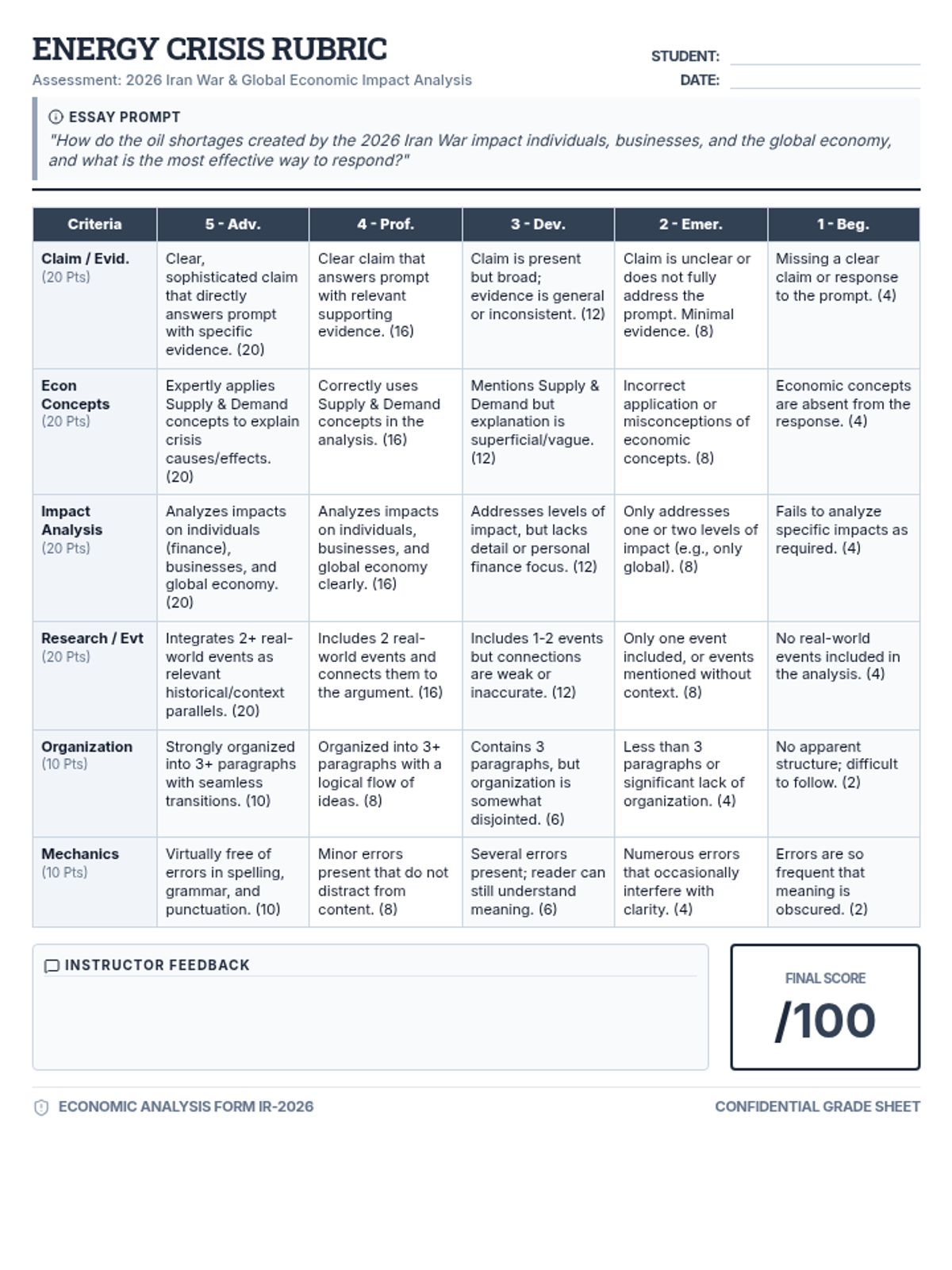
A professional 5-point rubric for evaluating an essay on the economic impacts of the 2026 Iran War oil shortage. It breaks down 100 total points across six categories including claim quality, economic concepts, impact analysis, research, organization, and mechanics.
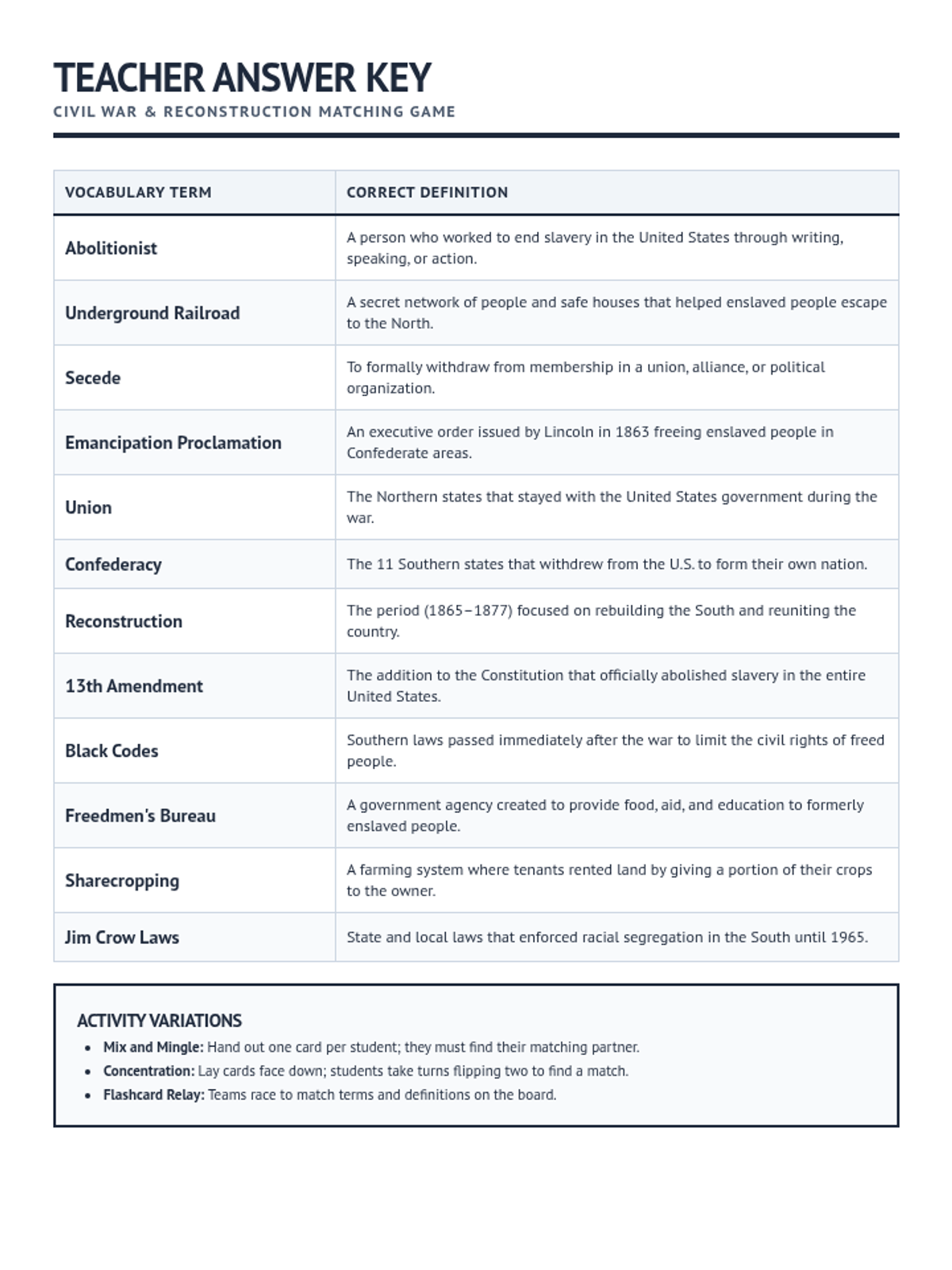
A clear answer key for the vocabulary matching game, providing all 12 term-definition pairs and three variations for classroom play.
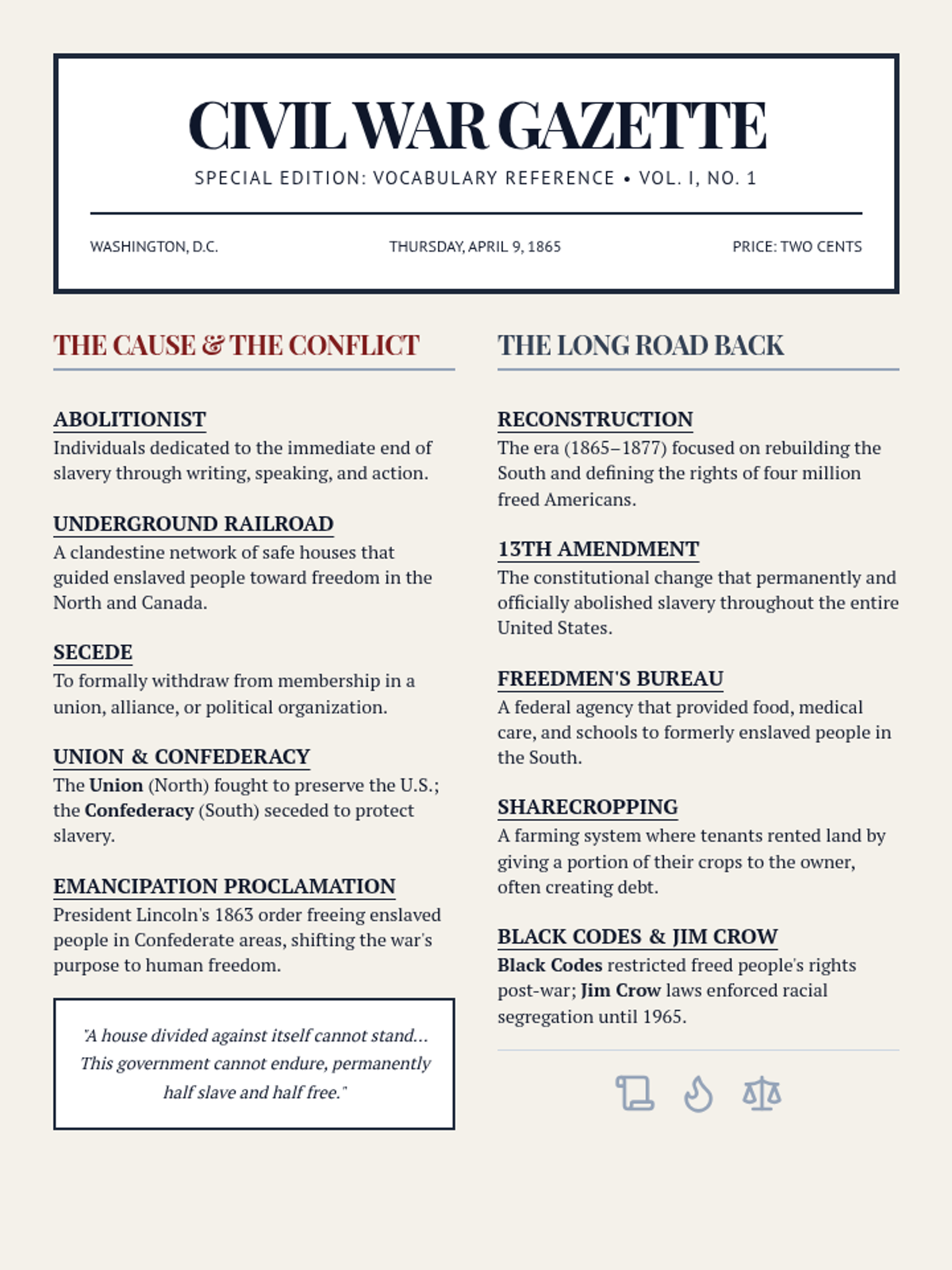
A student reference sheet designed as a 19th-century newspaper. It provides context and definitions for all 12 vocabulary terms, organized into thematic sections for easy review and study.
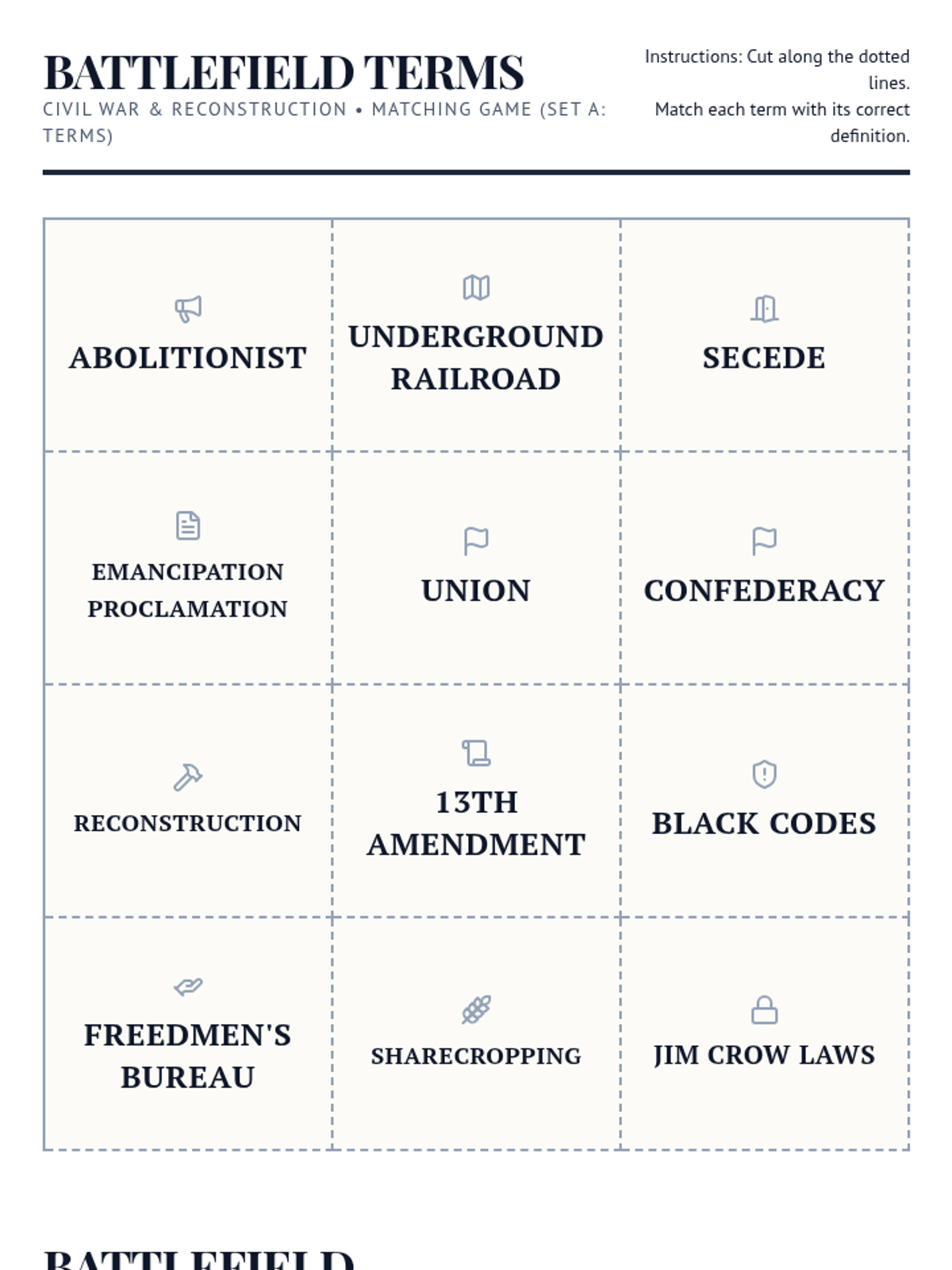
A printable set of matching cards for an interactive classroom game. One page contains 12 key vocabulary terms, and the second page contains their corresponding definitions, styled with a vintage newspaper aesthetic for cutting and pairing.
A slide presentation designed to introduce core Civil War vocabulary, featuring distinct visual themes for different eras and historical contexts. It includes key terms, definitions, and primary source excerpts to build background knowledge before the matching activity.
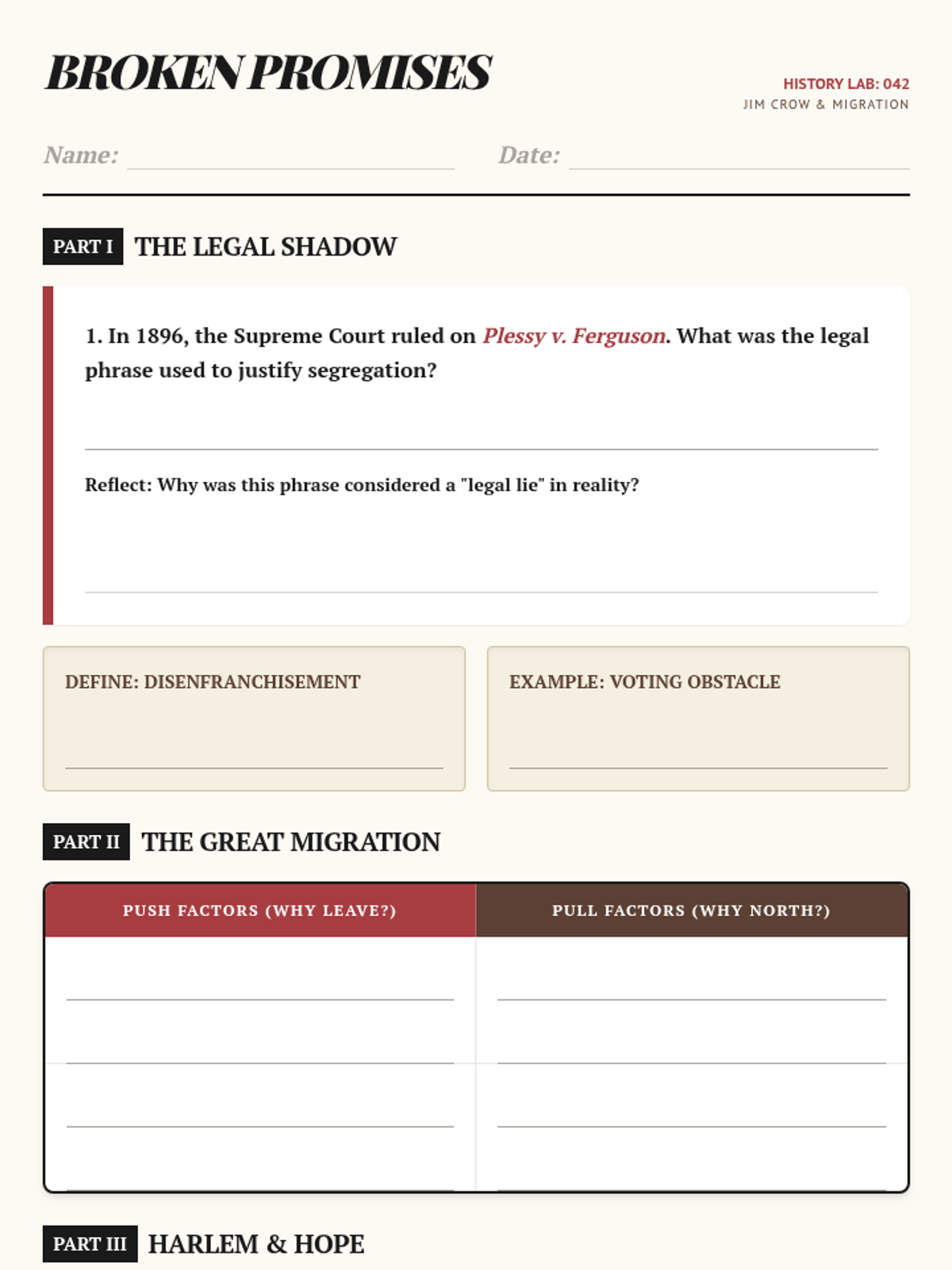
A student worksheet designed to accompany the "Shadows of the South" lesson, featuring note-taking sections on Jim Crow laws and a push/pull factor analysis of the Great Migration.
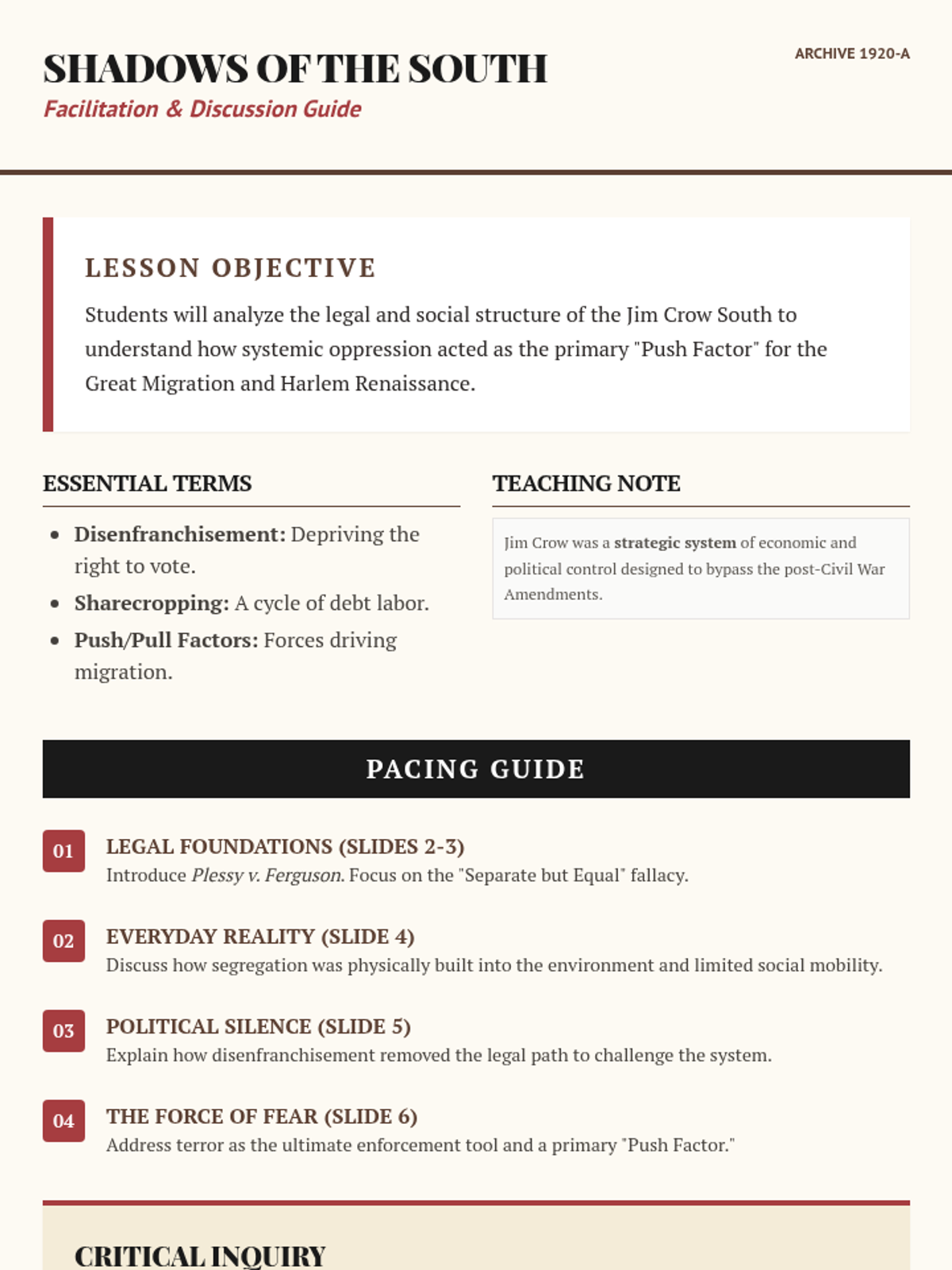
A comprehensive facilitation guide for teachers to lead the "Shadows of the South" slideshow, including discussion prompts, key terms, and historical context notes.
A visual presentation covering the Jim Crow era, focusing on its legal, social, and economic impact, and how it served as a primary catalyst for the Great Migration and the subsequent Harlem Renaissance.
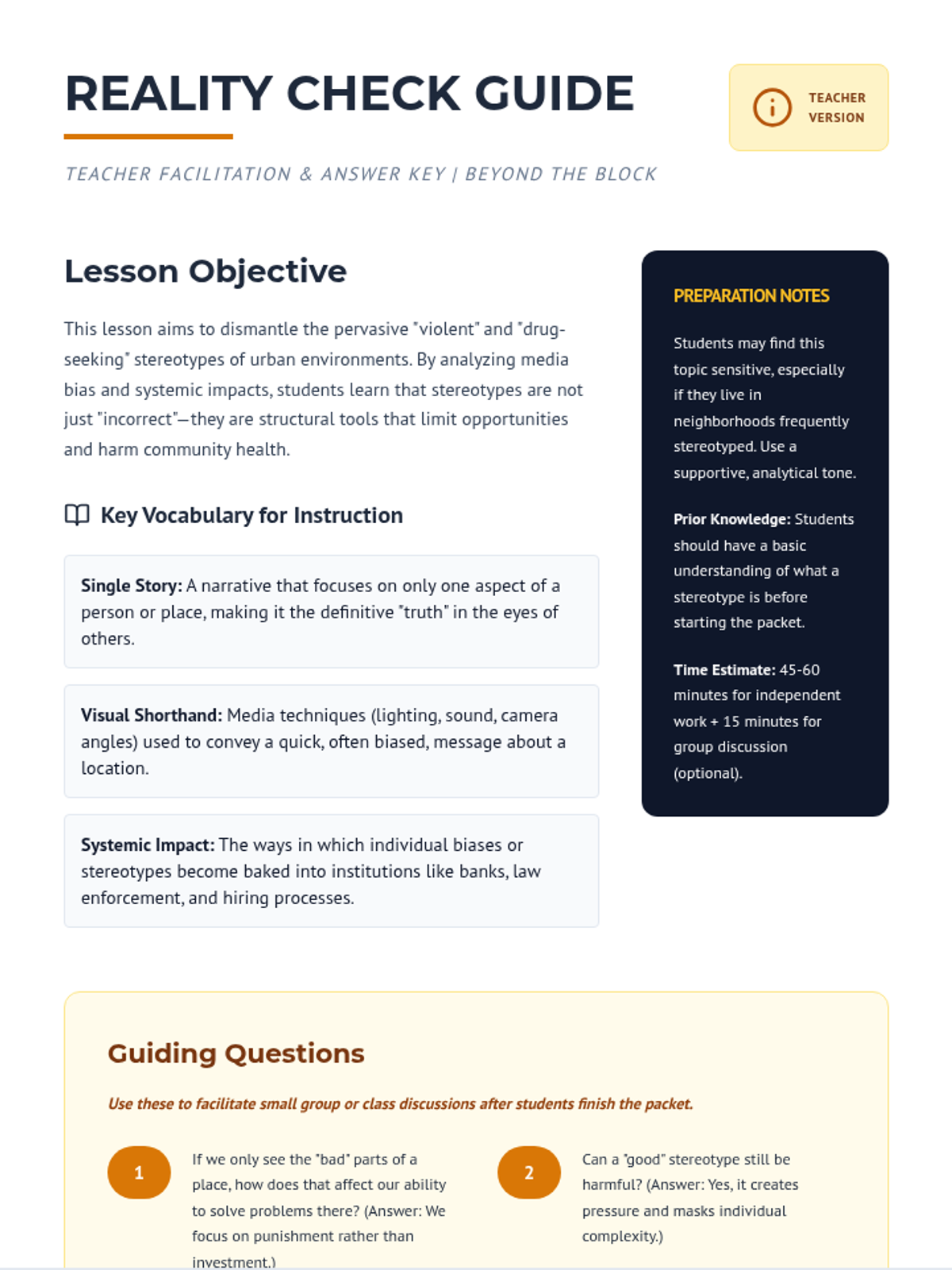
A teacher's facilitation guide and answer key for the Concrete Stories Packet. It includes key concepts, discussion prompts, and evaluation criteria for student responses.
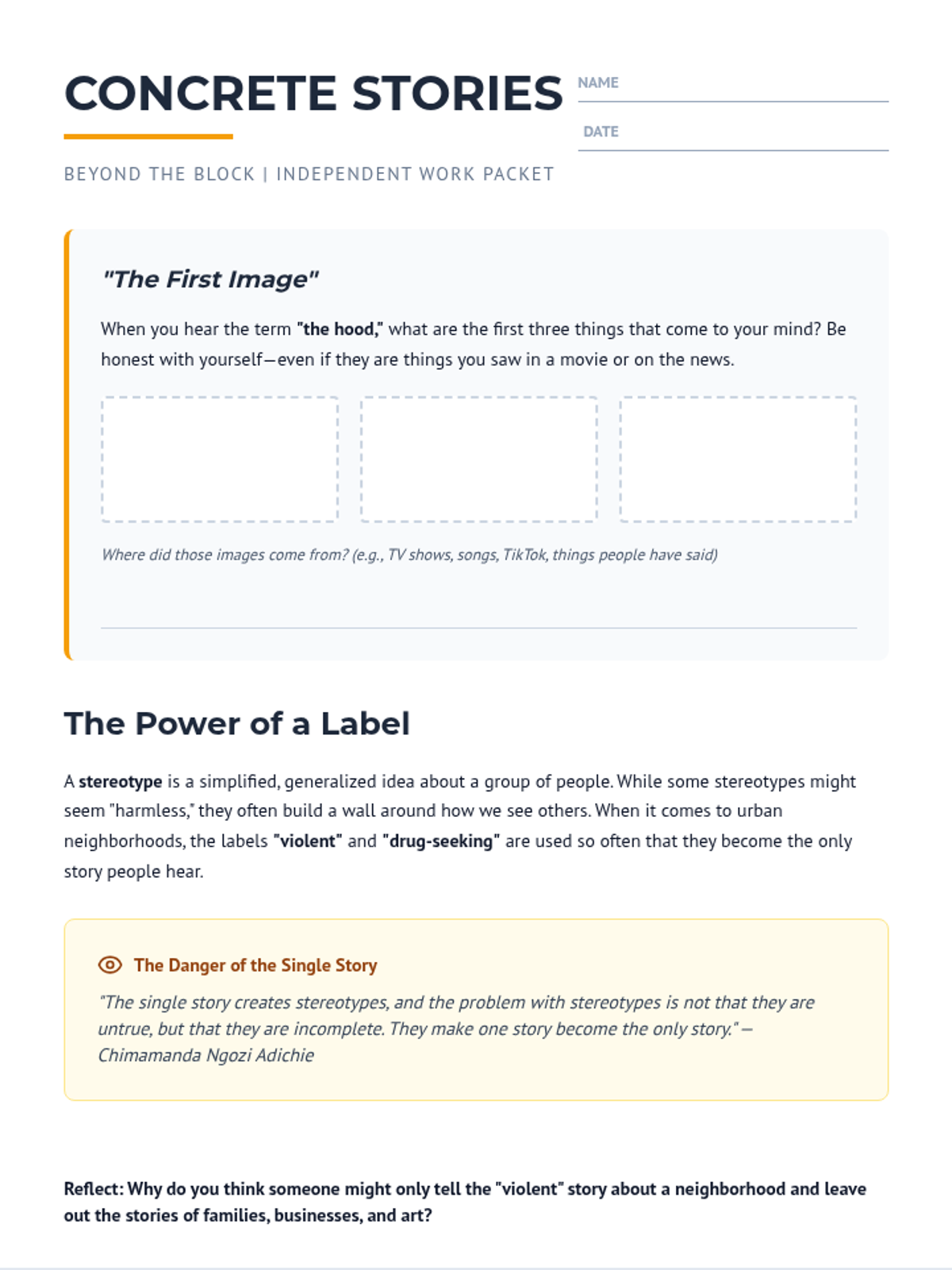
A 4-page student work packet designed for independent study. It guides students through identifying stereotypes, analyzing media bias, understanding systemic harm, and practice reframing narratives about urban communities.
A no-frills, high-density review presentation. Each slide focuses on a core STAAR concept (Economic Boom, Social Tension, Depression Causes, and New Deal Solutions) using clear, large text and minimal distractions.
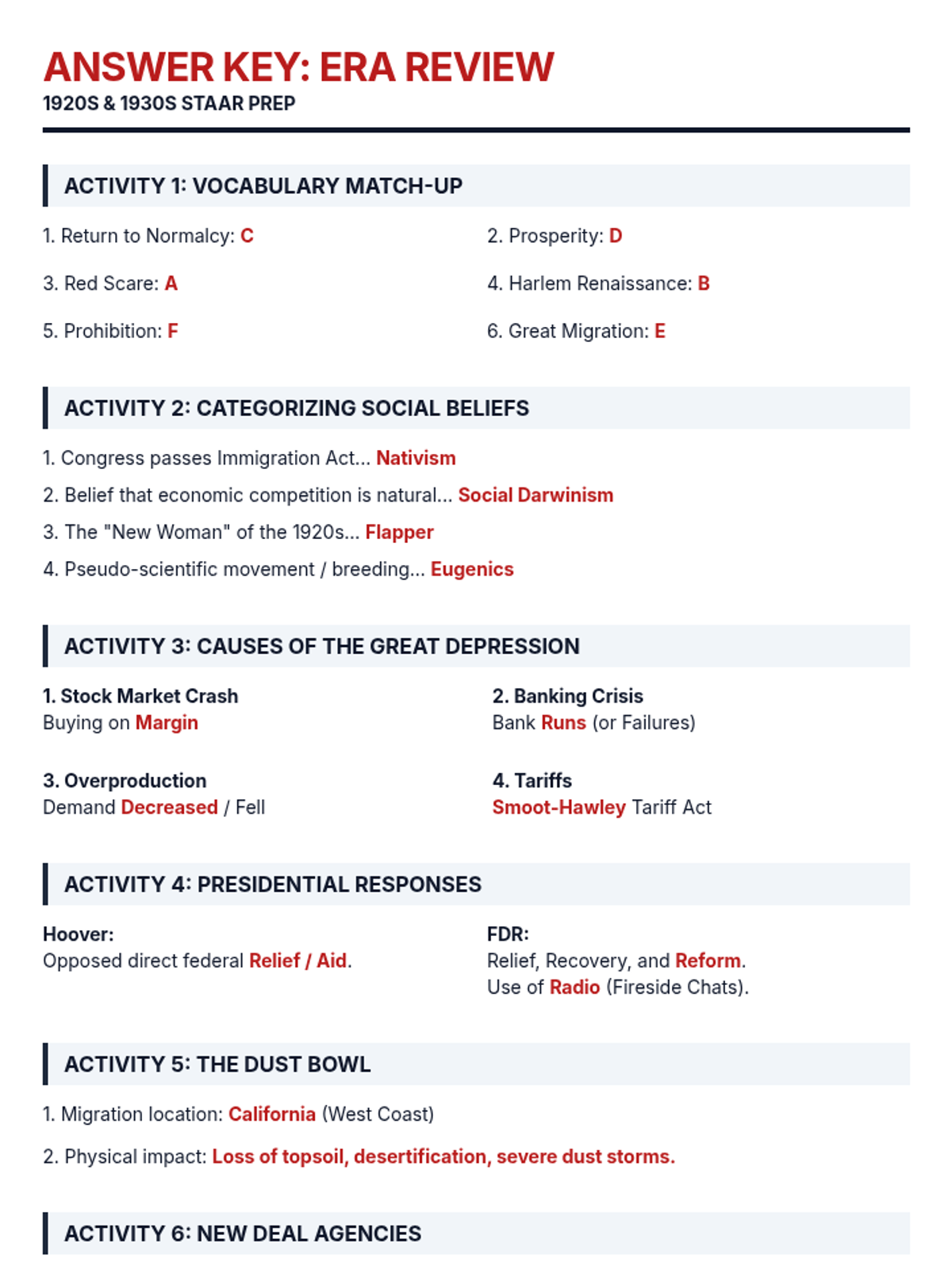
A clear and organized answer key for the Era Review Worksheet, highlighting correct answers in red for easy grading.
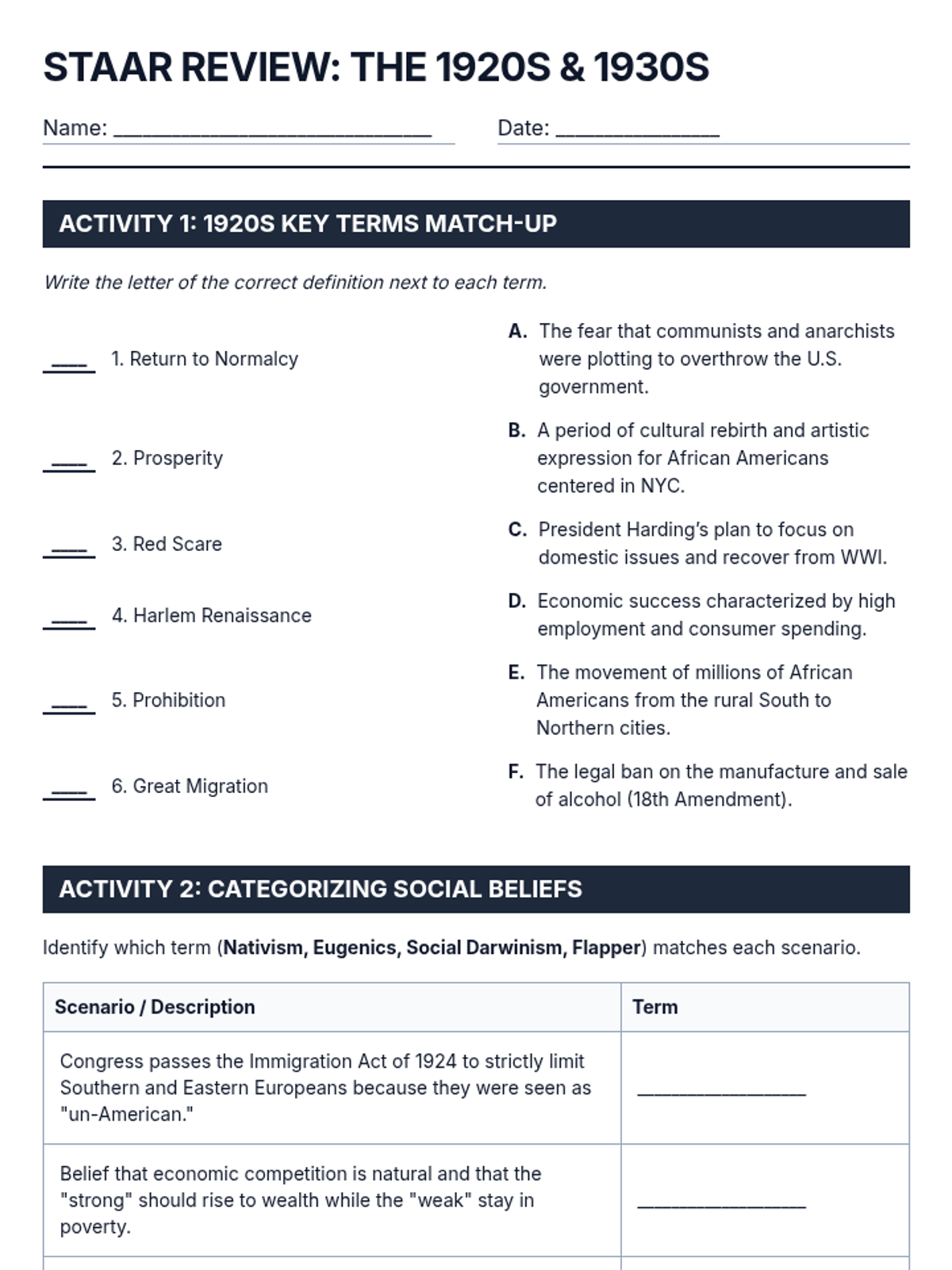
A comprehensive two-page STAAR review worksheet. It includes vocabulary matching, categorization of social trends like Nativism and Eugenics, a cause-and-effect breakdown of the Great Depression, and a comparison of Hoover and FDR's policies.
A high-impact visual presentation for reviewing the 1920s. Slides cover economic prosperity, the cultural boom of the Harlem Renaissance, the fear of the Red Scare, and the social theories of Social Darwinism and Eugenics.
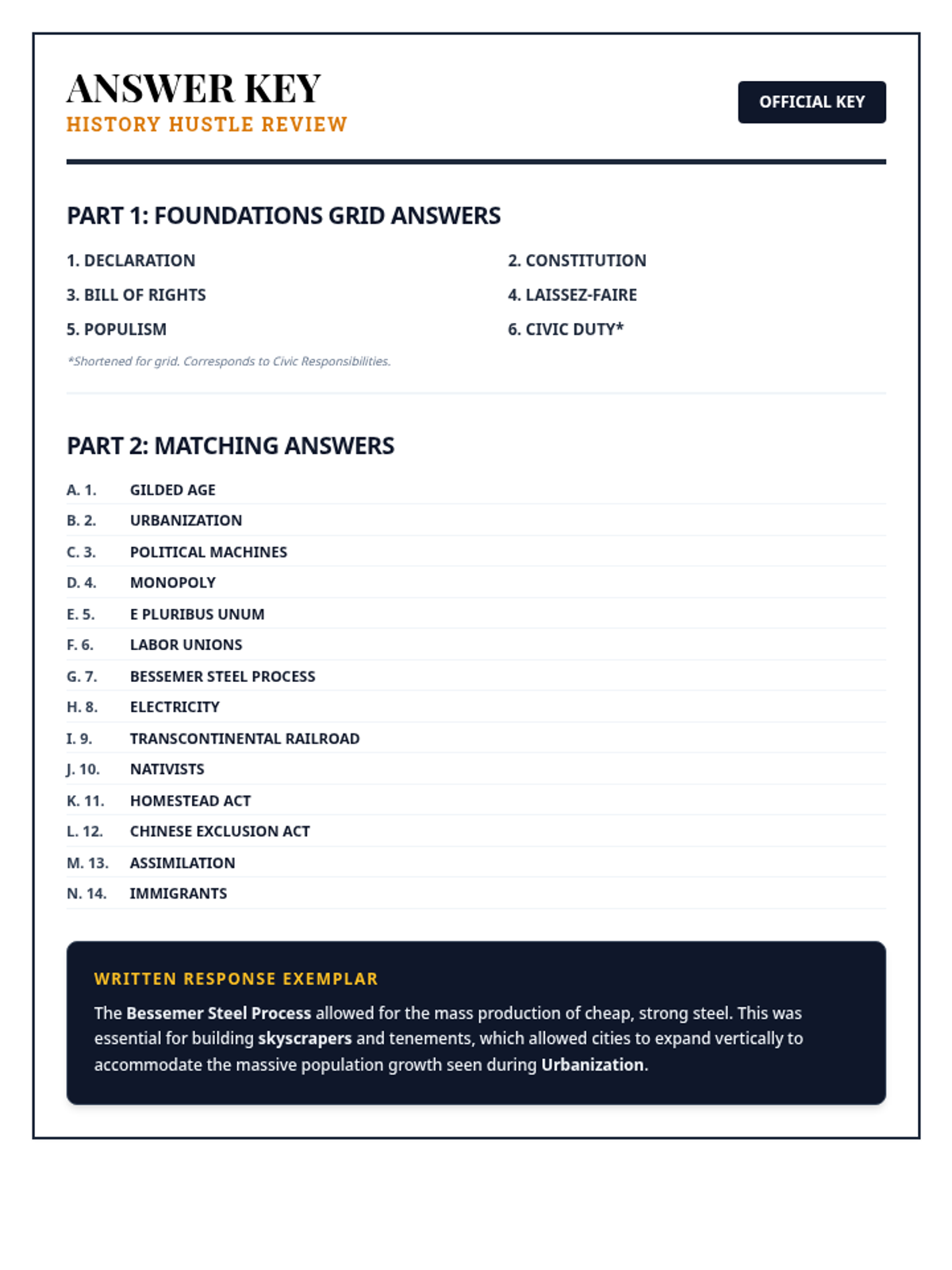
A comprehensive one-page answer key for the two-part History Hustle Review worksheet. Features clear mappings for the intersecting crossword and the matching section, plus a written response exemplar. Consolidates all teaching notes onto a single page. Ink-friendly design. High contrast text.
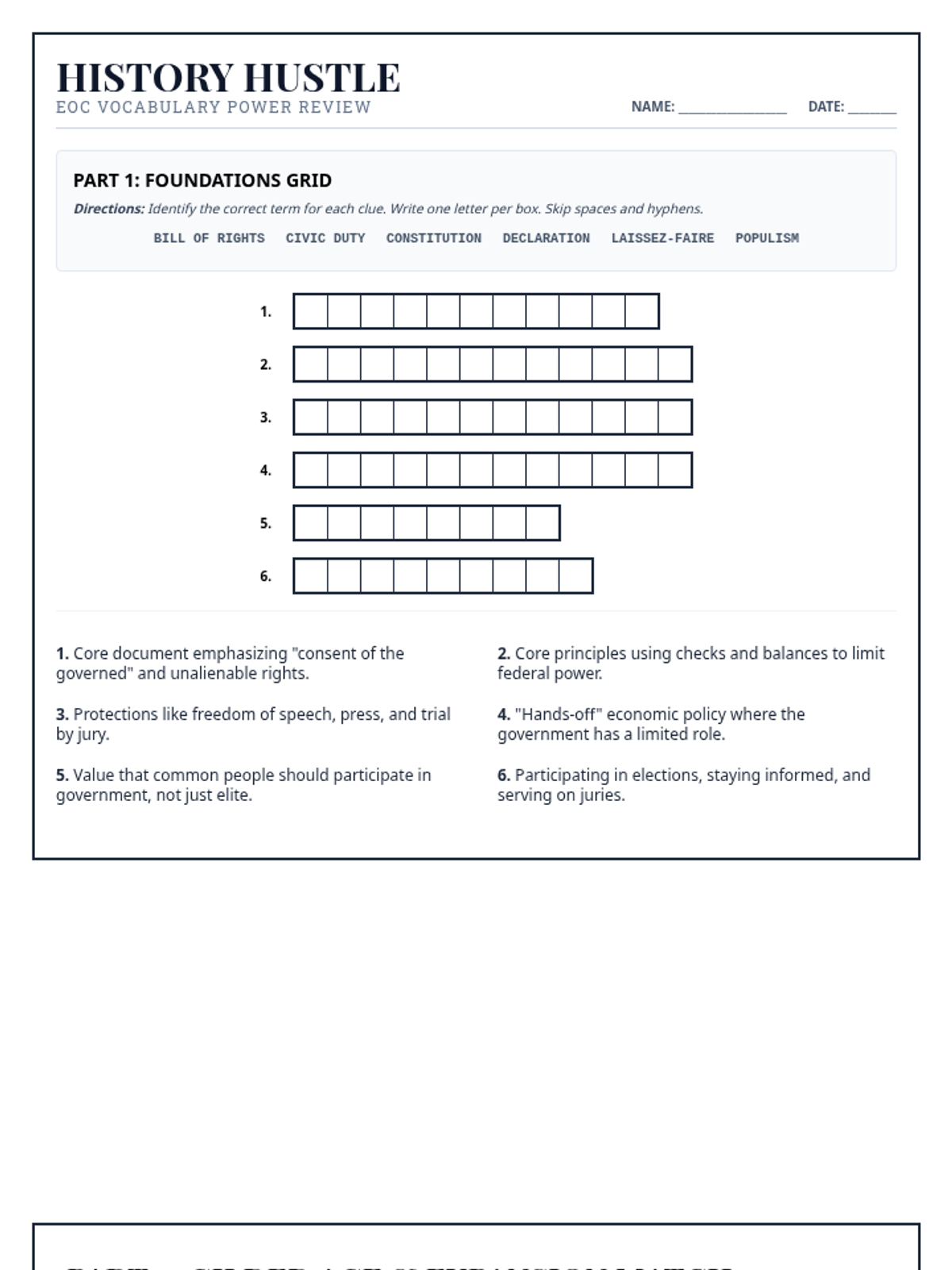
A two-page student worksheet featuring a functional, manual-logic intersecting crossword on foundational documents and a matching challenge for the Gilded Age and Westward Expansion. Includes a master word bank with spaced terms and a cause-and-effect short response. Consolidates crossword and clues on page 1. Every crossword cell matches the clue length.
A visual review presentation for US History EOC prep, featuring foundational documents, Tocqueville's values, and Gilded Age industrialization. Includes high-contrast text and clear icons for instructional clarity.
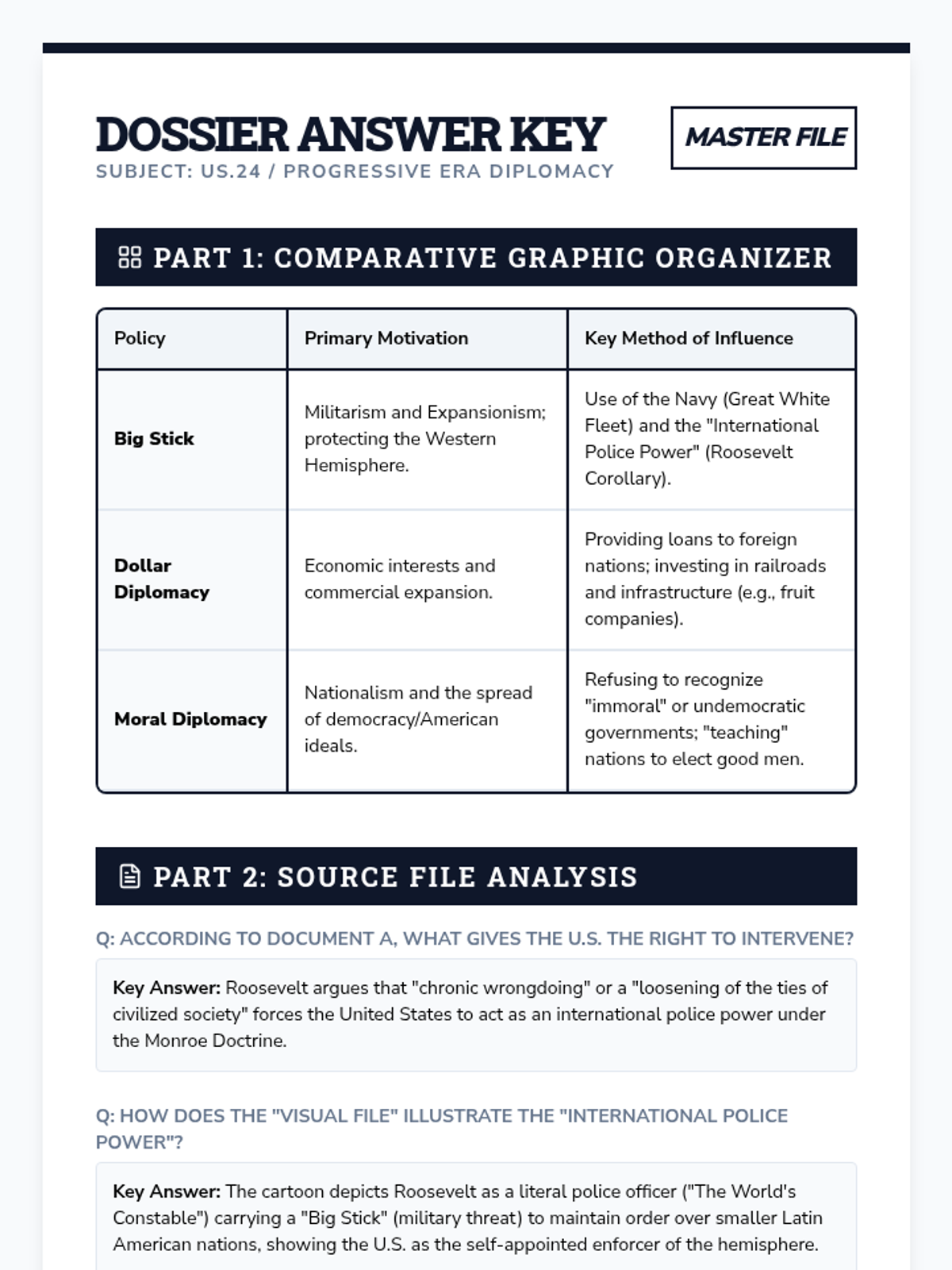
A comprehensive standalone answer key for the Diplomacy Dossier student packet, including correct entries for the graphic organizer, source analysis, and matching scenarios.
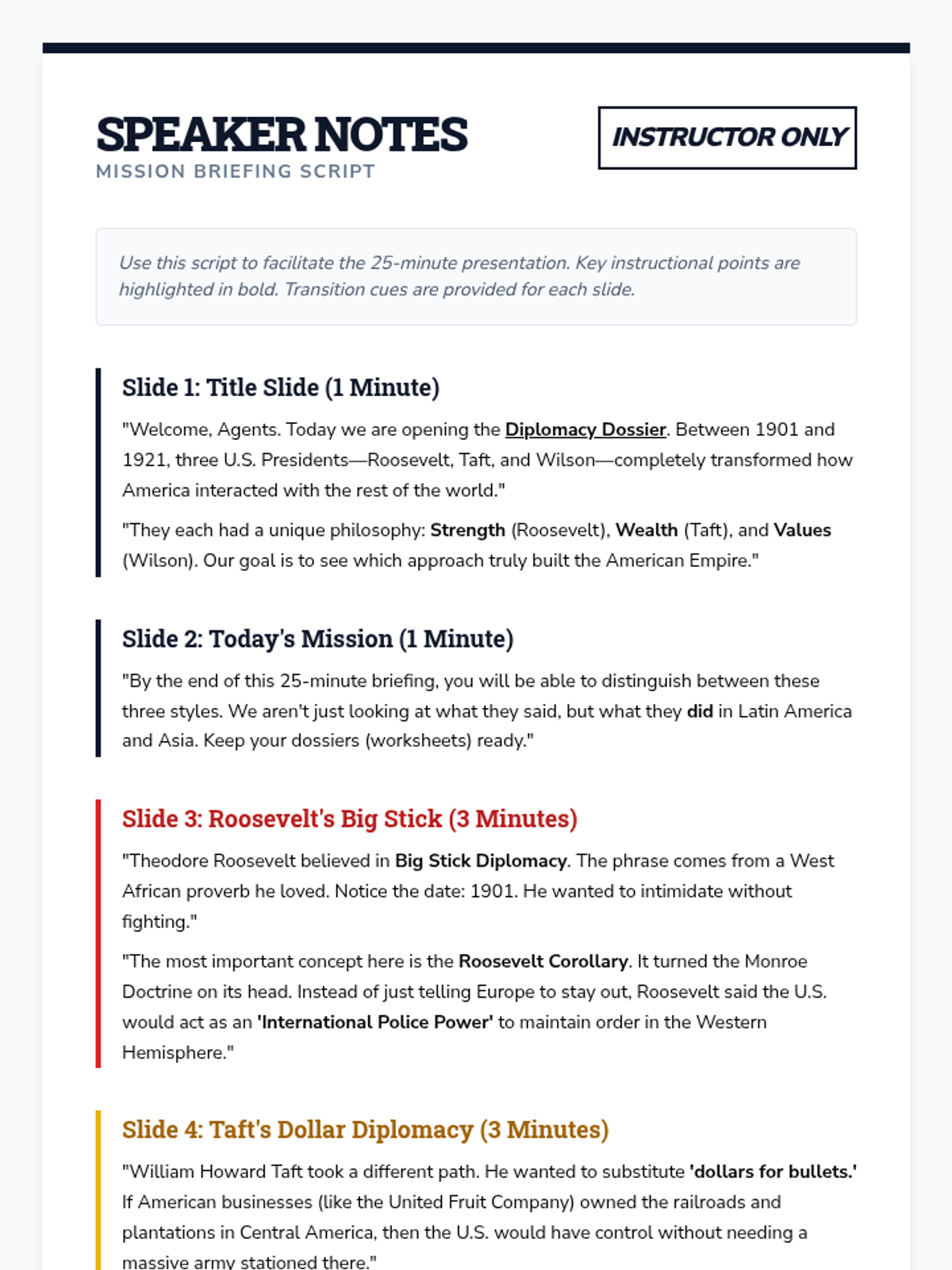
A 2-page document providing slide-by-slide speaker notes, scripts, and facilitation tips for the Diplomacy Dossier presentation. Designed to help the teacher maintain a high-speed pacing for the 25-minute lesson.
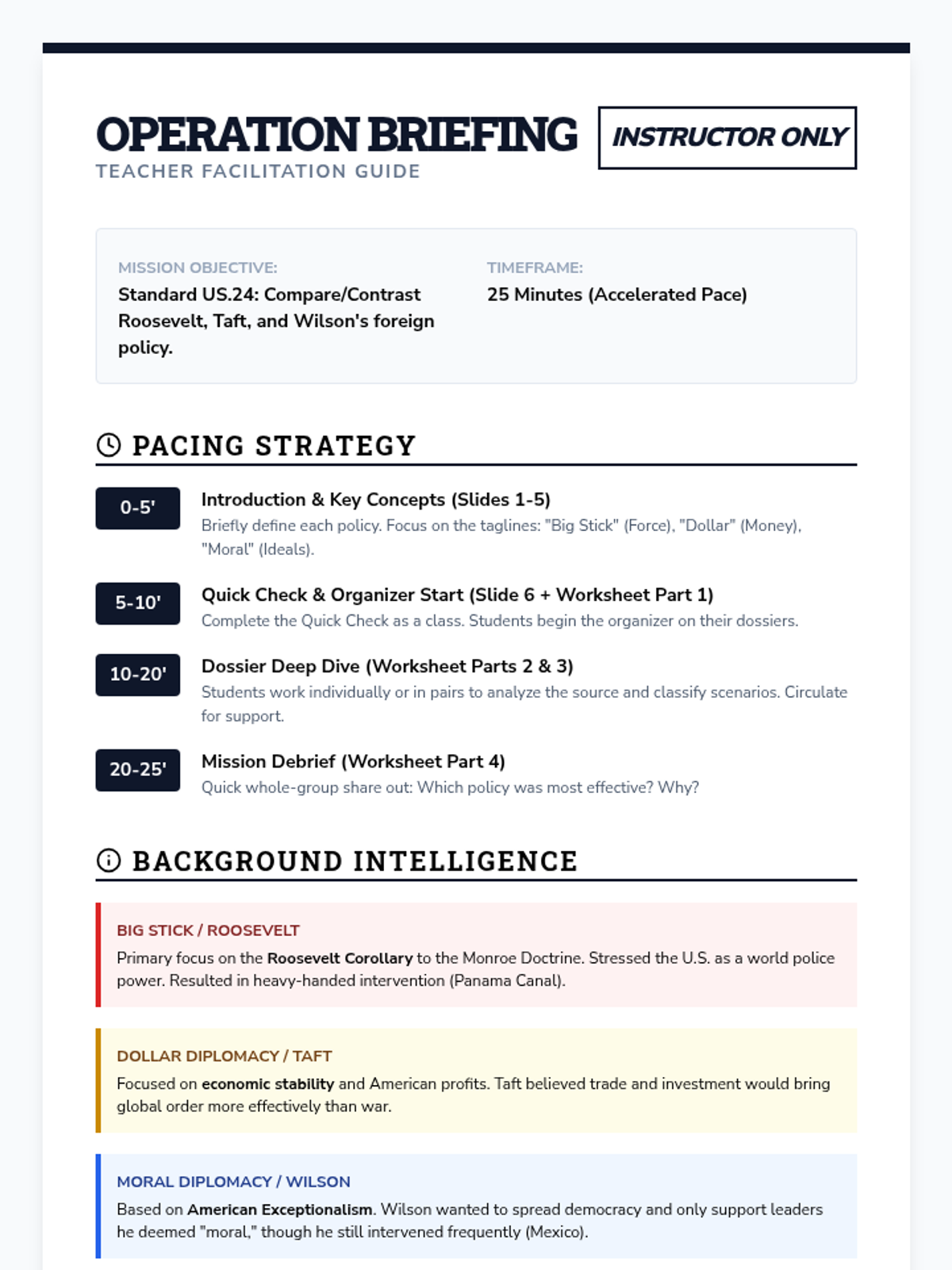
A teacher resource providing a 25-minute pacing guide, key instructional points for each presidency, a full answer key for the student packet, and differentiation strategies for the accelerated lesson format. Updated with matching scenario dates.
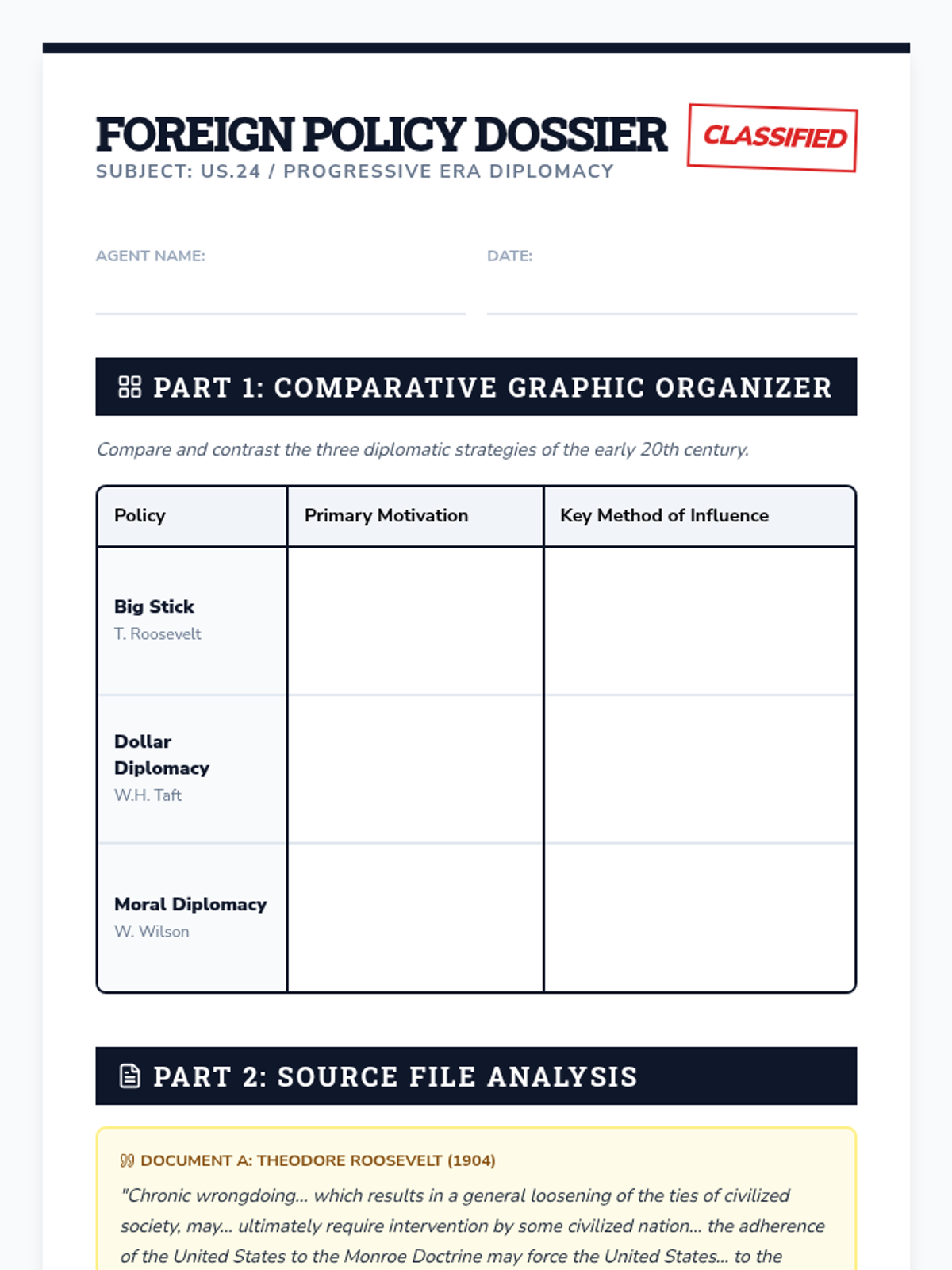
A 2-page student worksheet featuring a comparative graphic organizer, a primary source and political cartoon analysis task, and a scenario-matching application activity. All primary sources now include specific names, dates, and attributions. Updated with improved work area backgrounds and spacing.
A 7-slide presentation designed for a 25-minute lesson. It introduces Roosevelt's Big Stick, Taft's Dollar Diplomacy, and Wilson's Moral Diplomacy with specific quotes, names, and dates for each philosophy. Updated with larger text and shuffled quick-check order.
The teacher guide for the Gilded Gears activity, including TEKS alignment, suggested connection pathways, and facilitation tips.
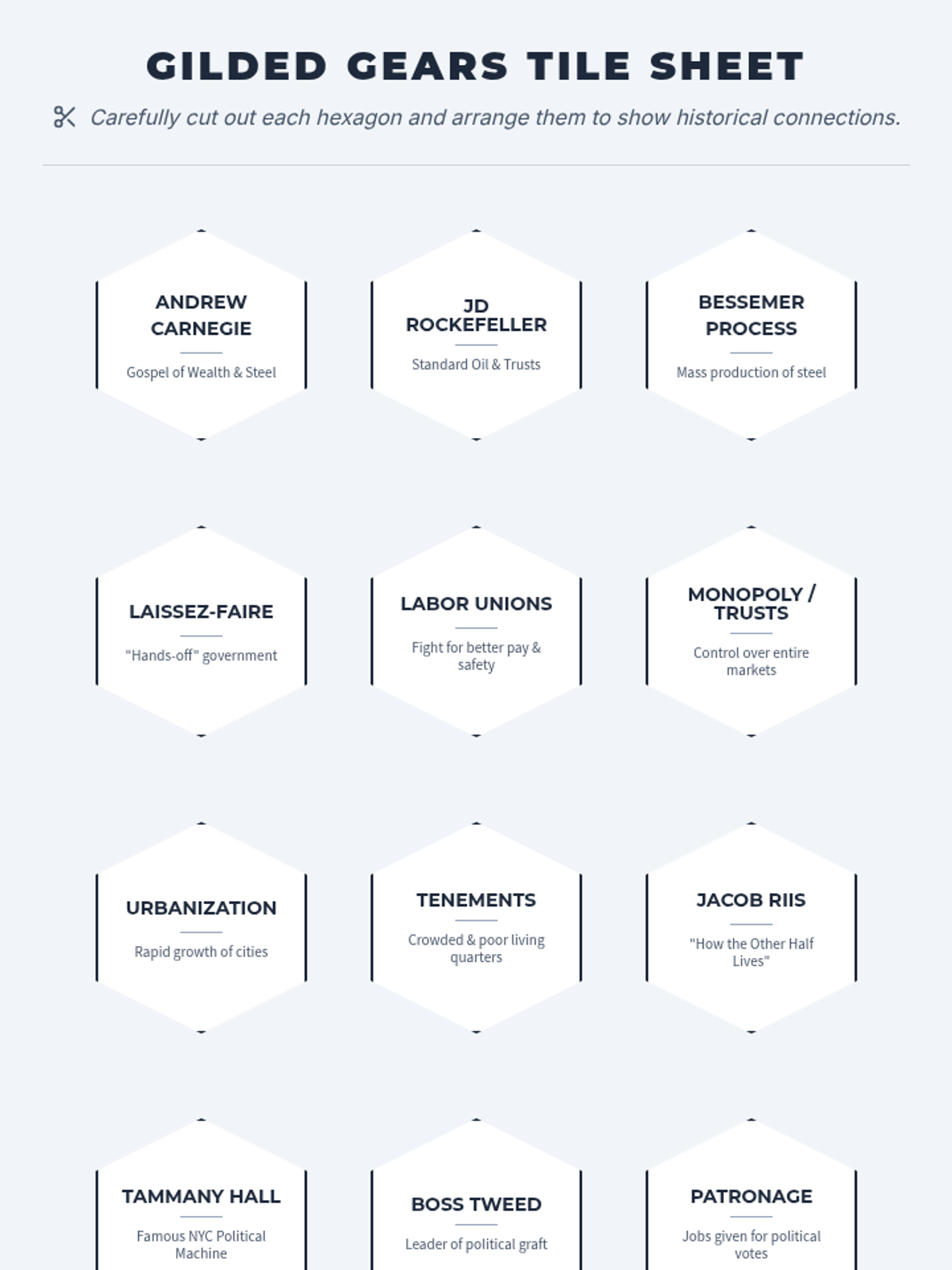
The hexagon tile sheet containing 18 concepts from the Gilded Age to be cut out and matched by students.
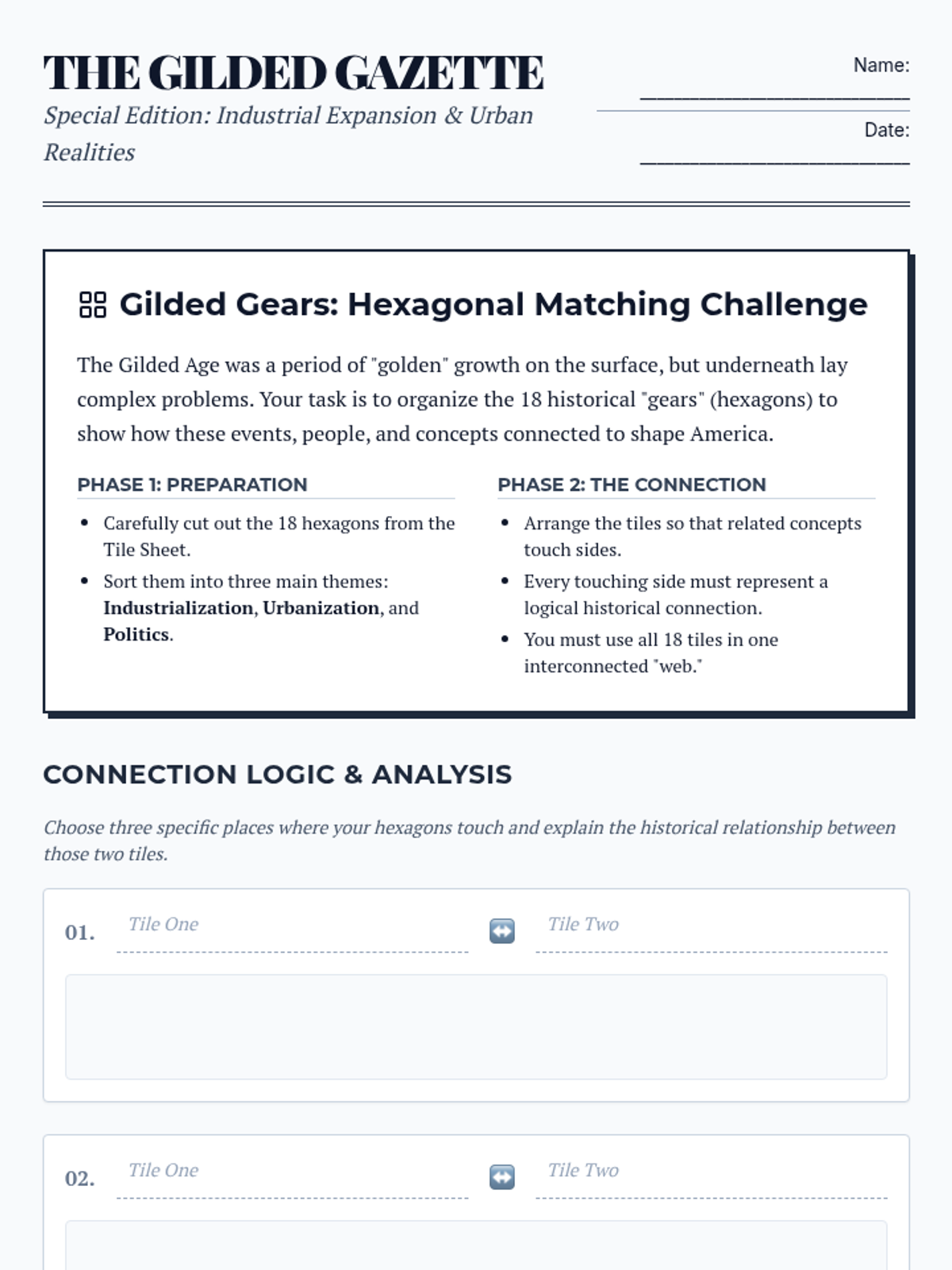
The instruction and analysis worksheet for the Gilded Age hexagonal matching activity, featuring student work areas for connection logic and a summary reflection.
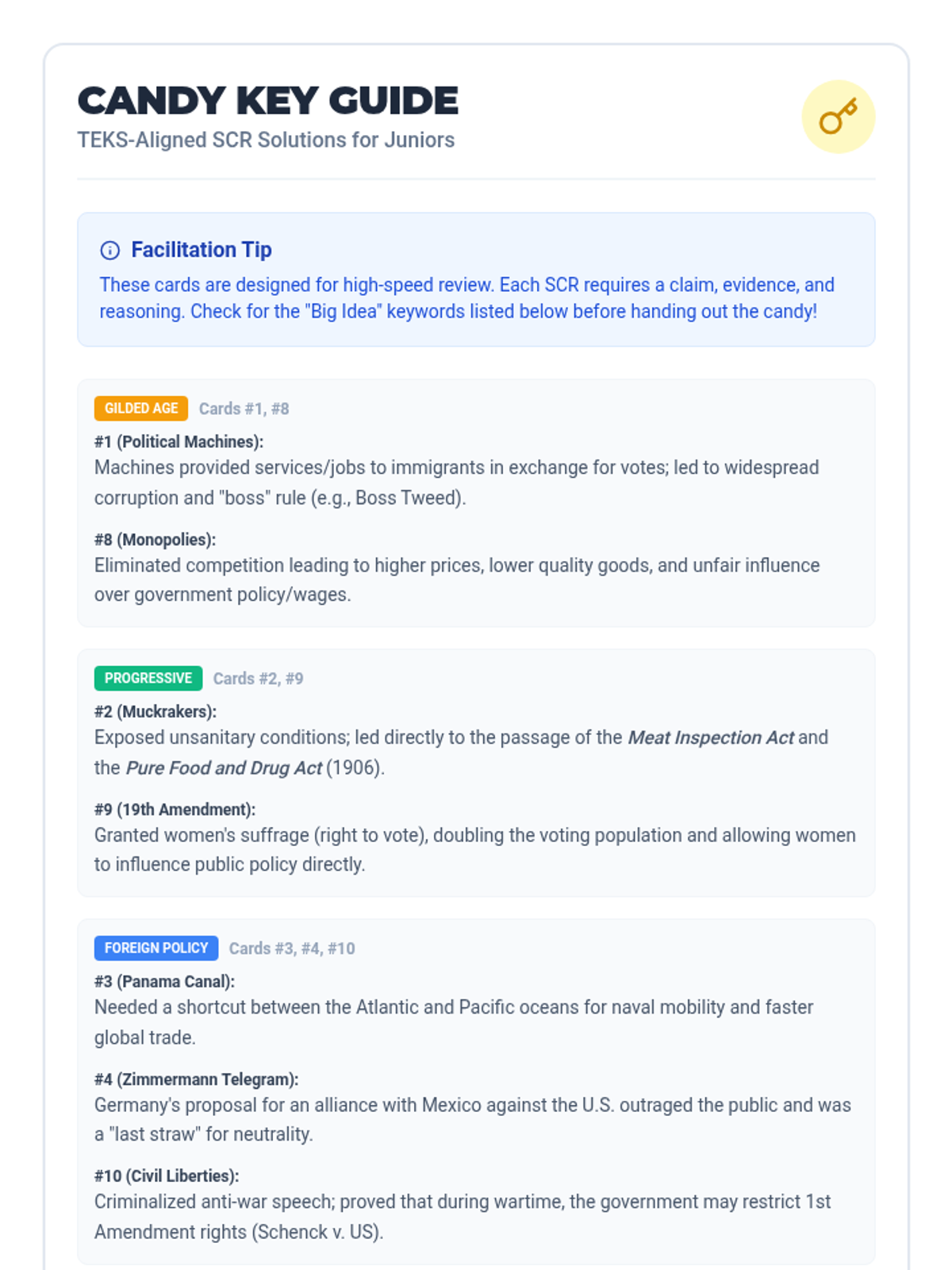
A teacher's answer key for the 'History Bites' task cards, featuring concise solutions and 'Big Idea' keywords for each of the 12 SCR questions. Includes TEKS cross-references and facilitation tips for classroom implementation.
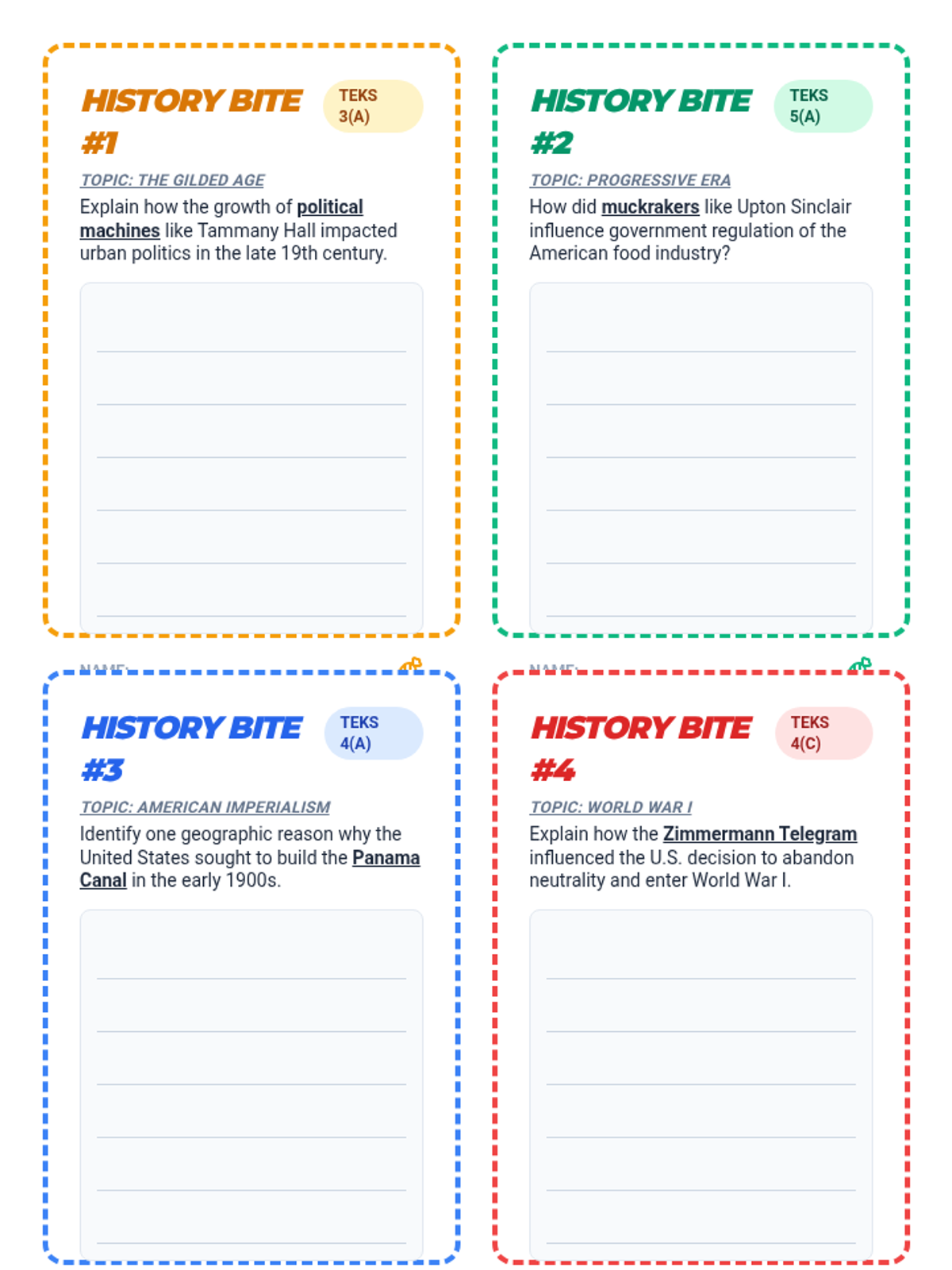
A collection of 12 Short Constructed Response (SCR) task cards covering US History eras from the Gilded Age to WWII. Each card features a punchy title, TEKS alignment, a specific historical question, and a handwriting-friendly student work area with 6 generous lines (40px height per line), designed to be cut out for a 'History Bites' candy challenge.
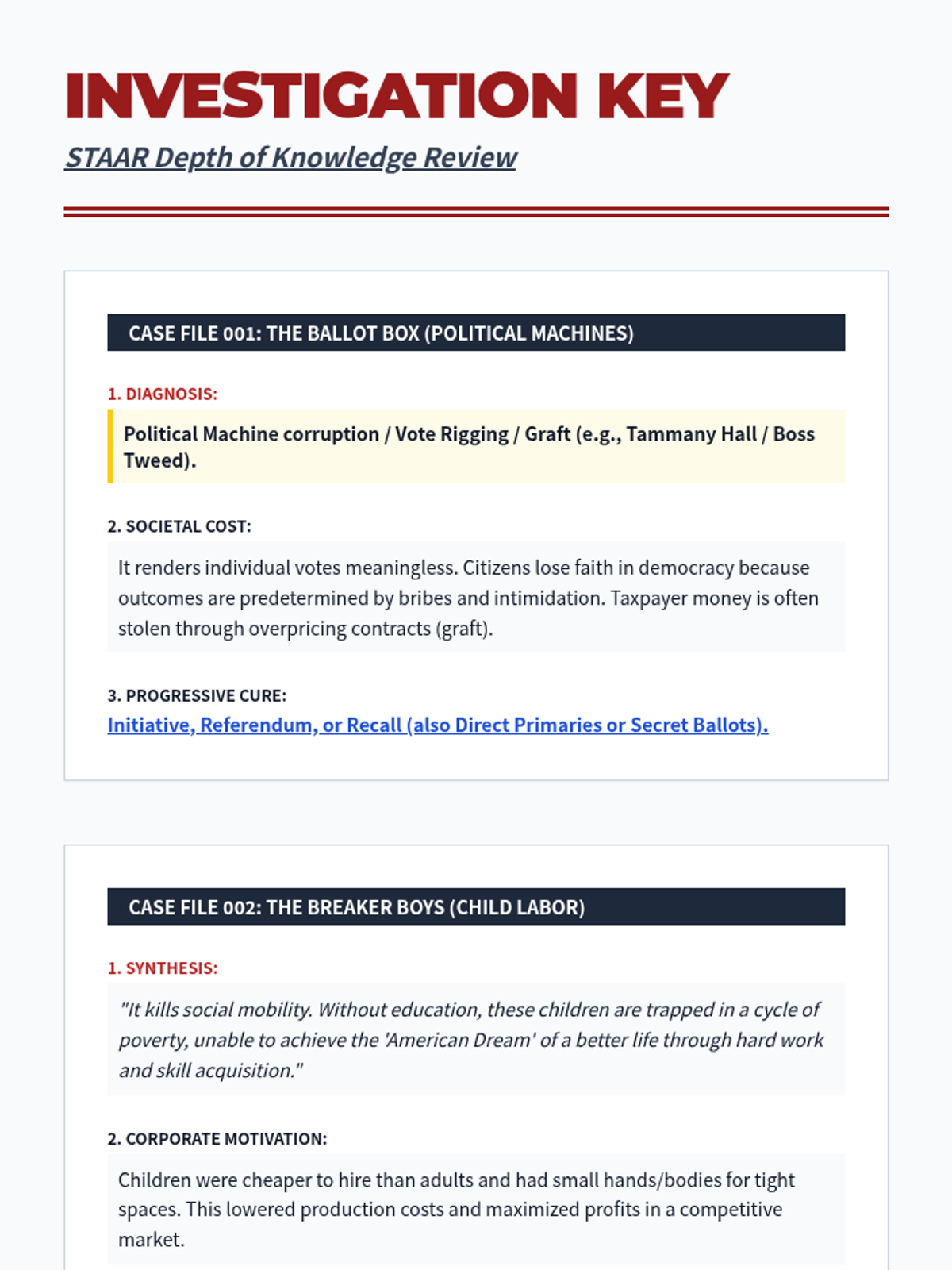
An answer key for the Muckraker Investigation Worksheet, providing detailed historical context and correct reform identifications for teachers.
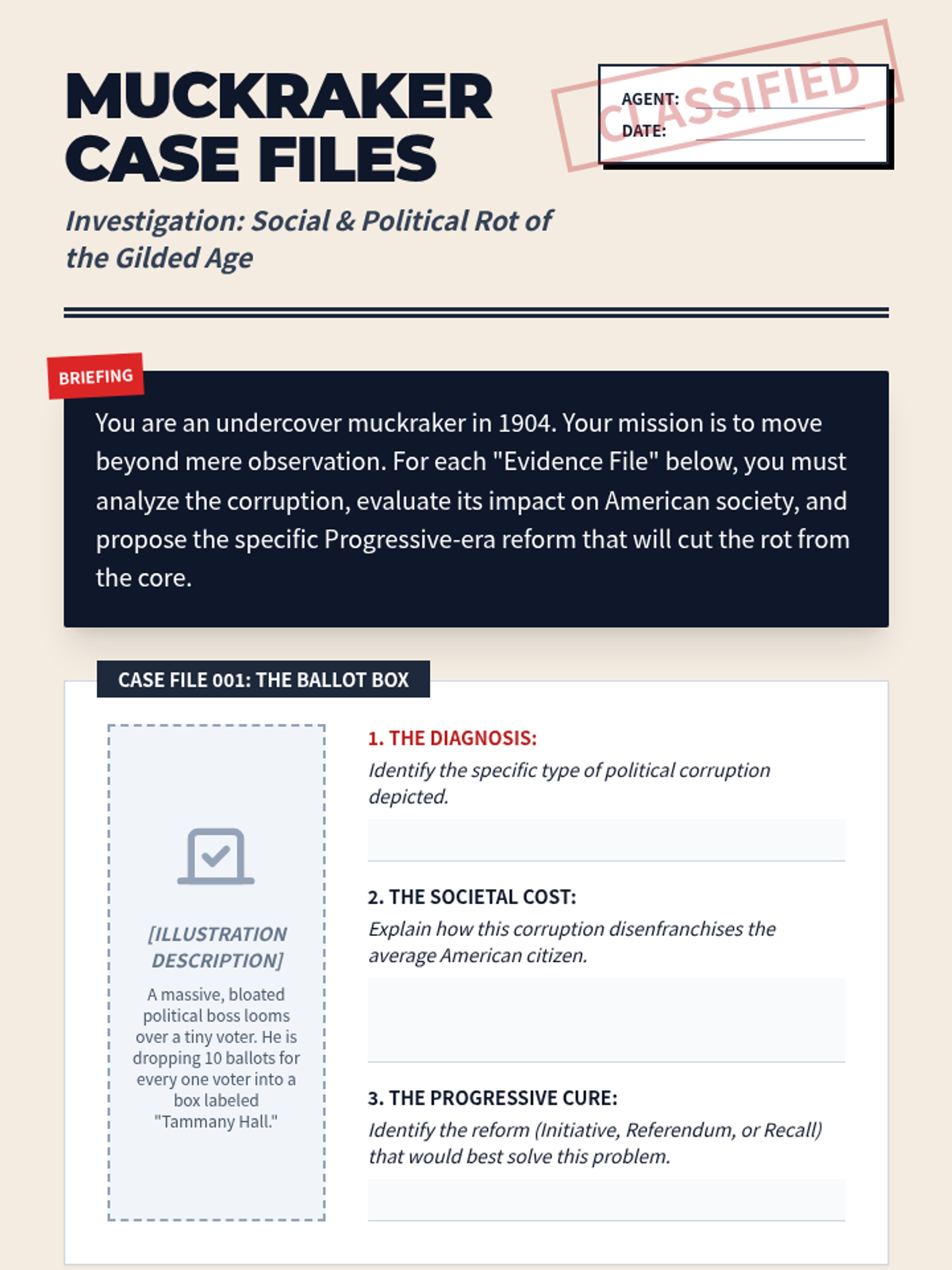
A high-depth-of-knowledge investigation worksheet where students act as muckrakers to analyze political, social, and economic corruption and propose specific historical reforms.
A slide deck for classroom instruction and review, visualizing key images and concepts of the Gilded Age and Progressive Era to supplement the worksheet activity.
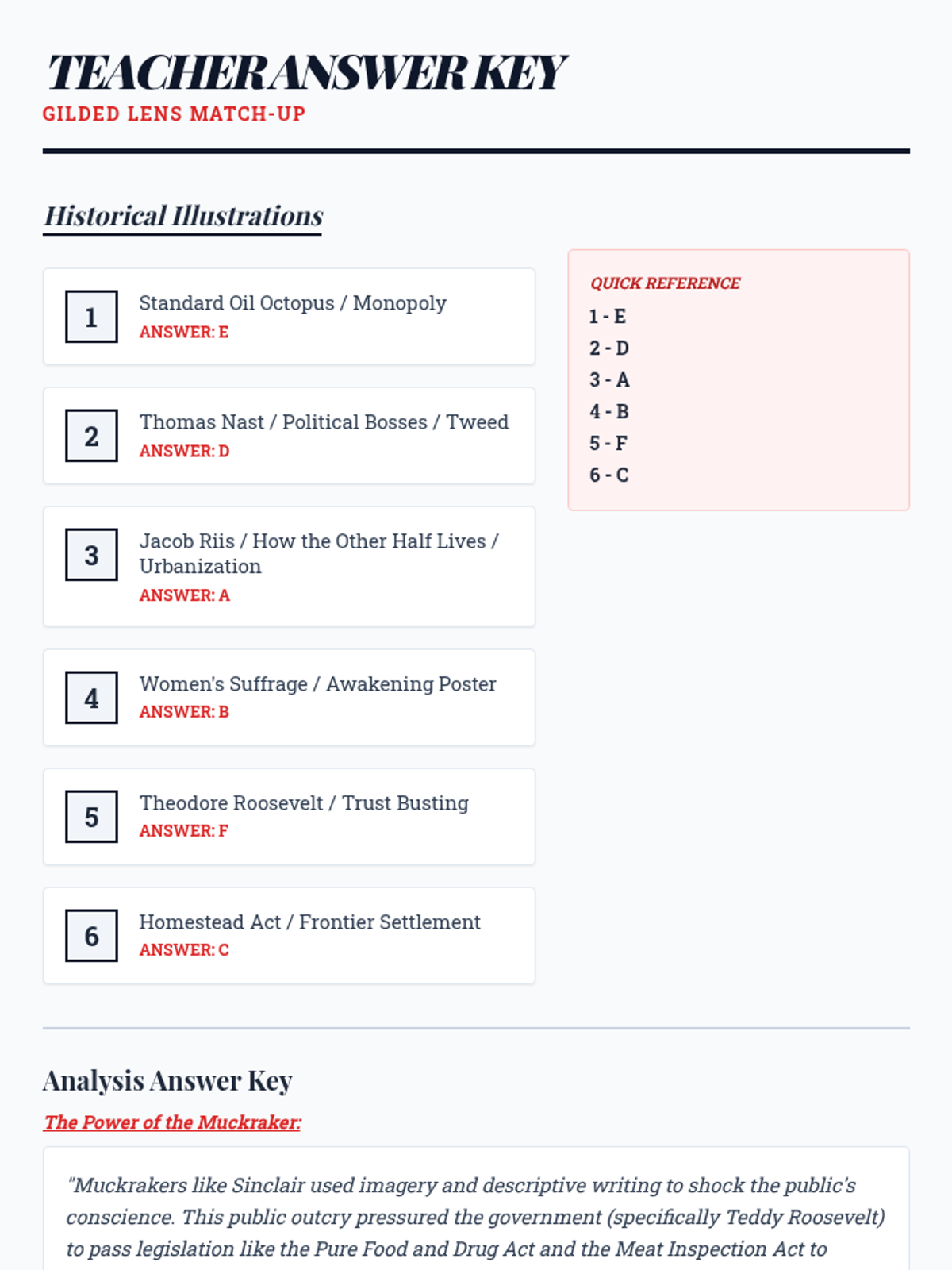
An answer key for the Gilded Lens Worksheet, providing the correct matching pairs and a sample response for the critical thinking question.
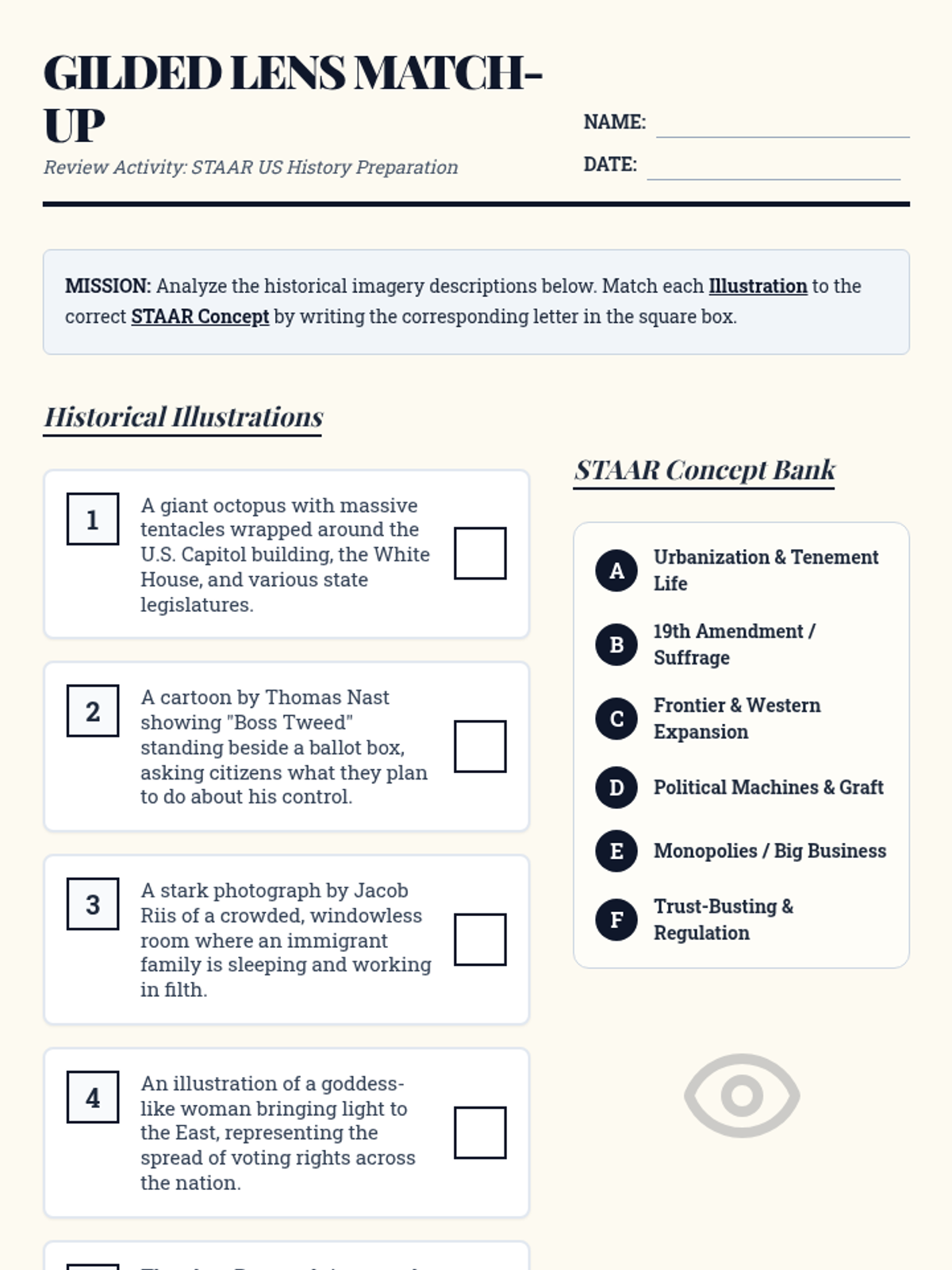
A student matching activity focusing on iconic visuals from the Gilded Age and Progressive Era, including political cartoons and photography descriptions paired with their historical concepts.
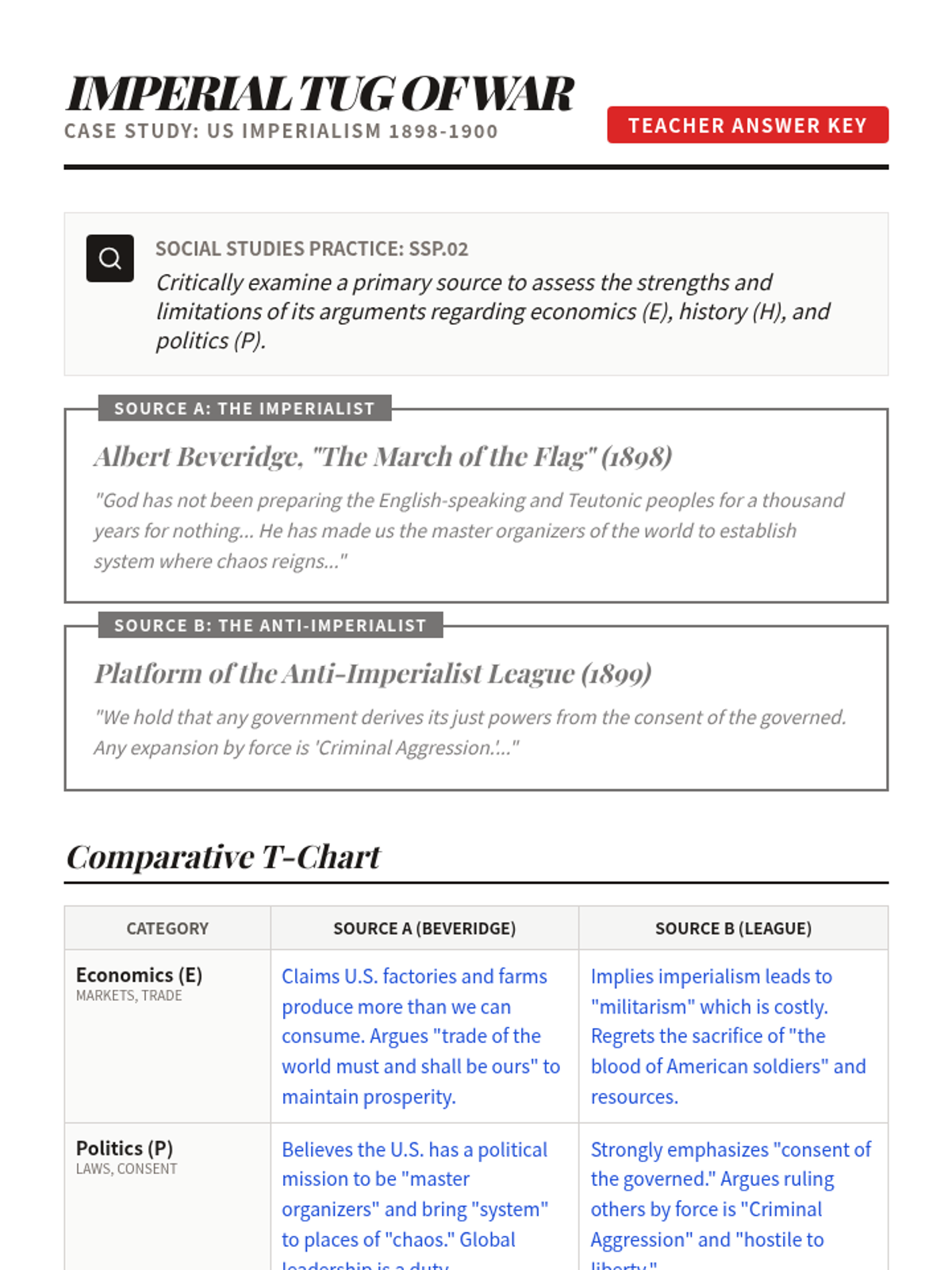
A complete teacher answer key for the Empire Analysis Worksheet, featuring sample responses for the comparative T-chart and critical assessment questions. Structured to match the worksheet's 2-page print layout.
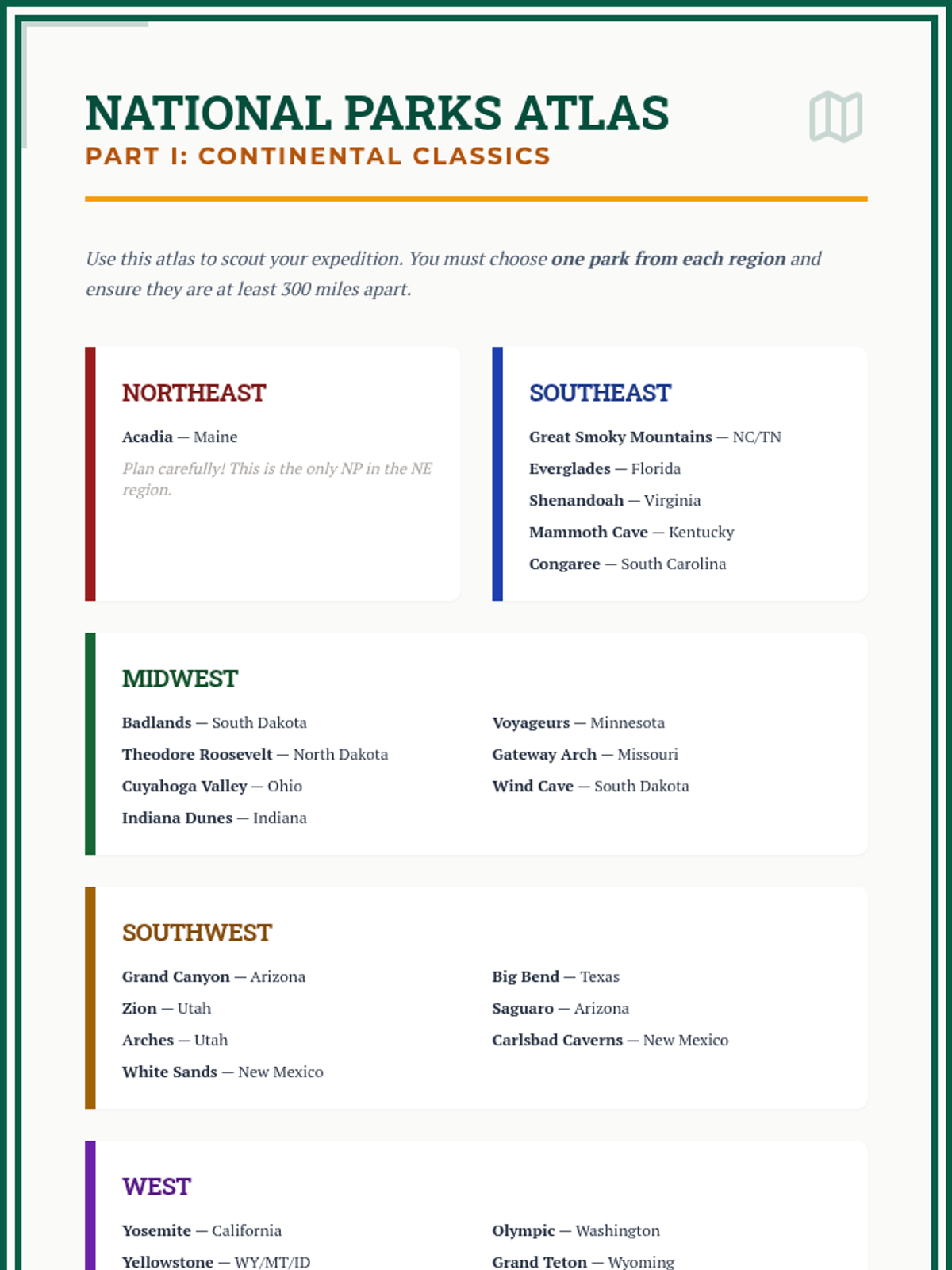
A reference sheet for students listing National Parks by region, including a second page with "hidden gems" and off-shore parks in Alaska, Hawaii, and US territories.
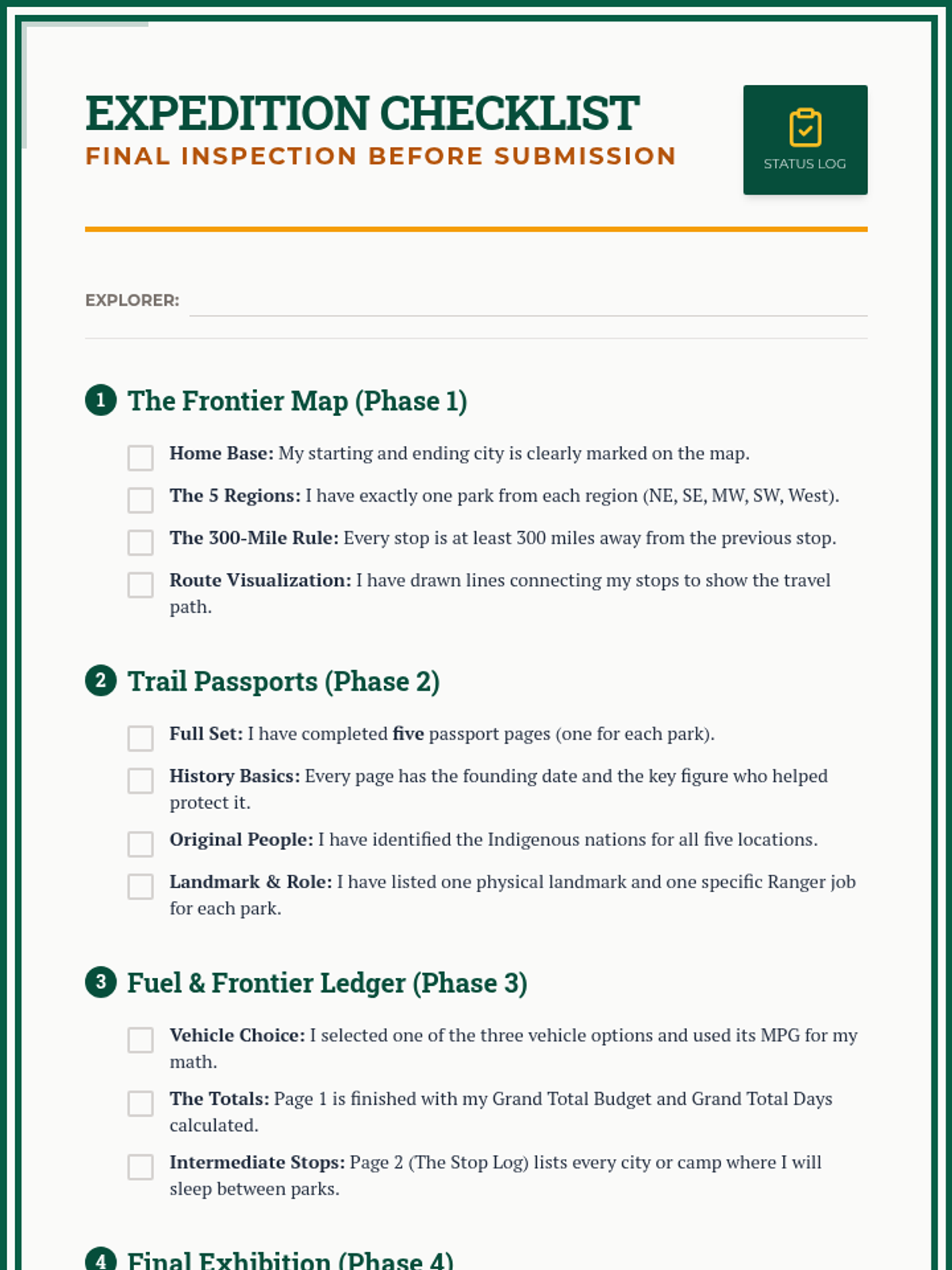
A comprehensive final checklist for students to ensure all project components—map, research, budget, and presentation—are complete and meet the required standards.
A visual design and layout guide for students creating digital slide presentations for their National Parks project. Includes tips on font size, image balance, and slide structure.
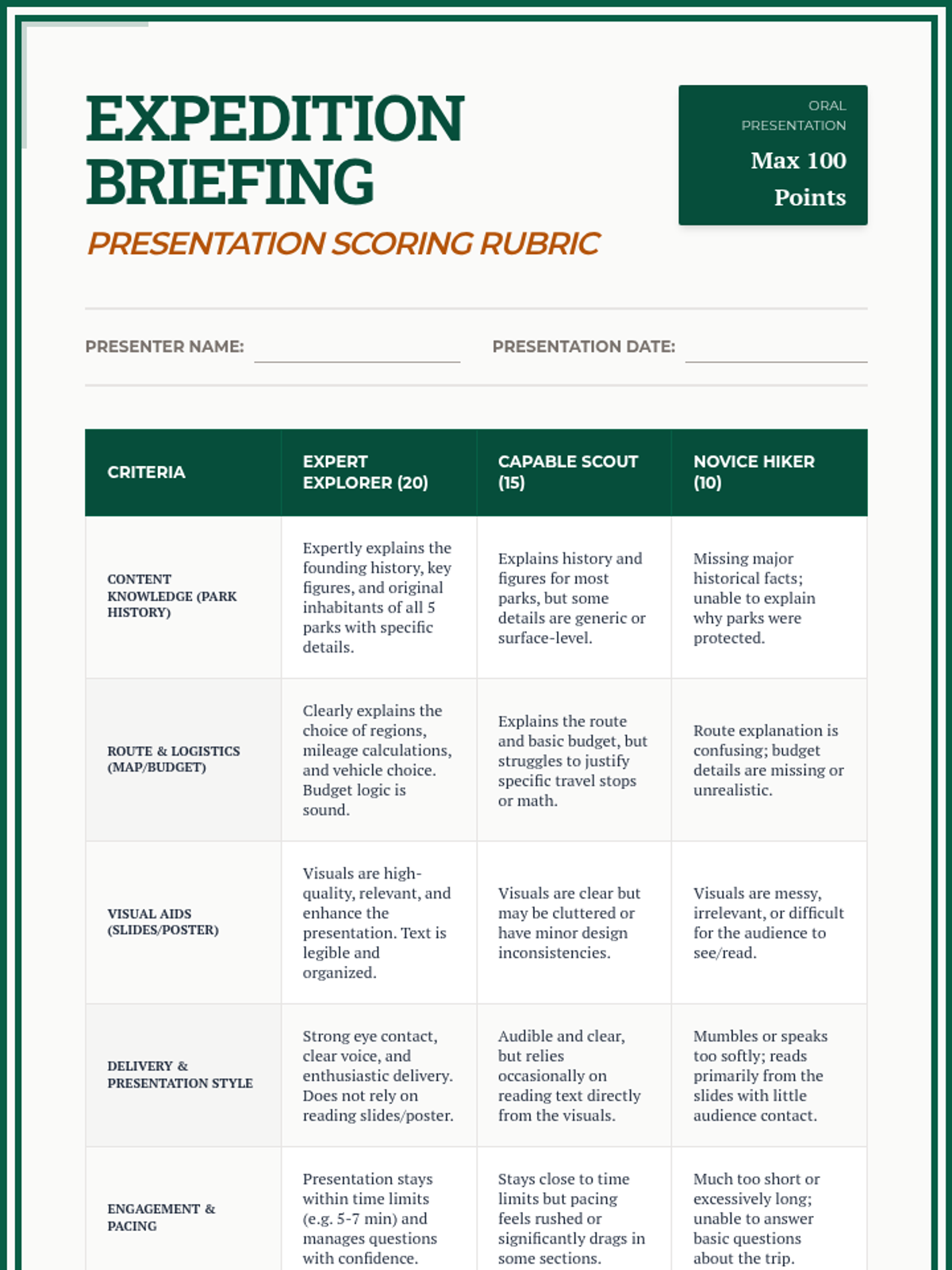
A grading rubric for student presentations of their National Parks expedition project, covering content knowledge, logistics, visual quality, delivery, and engagement.
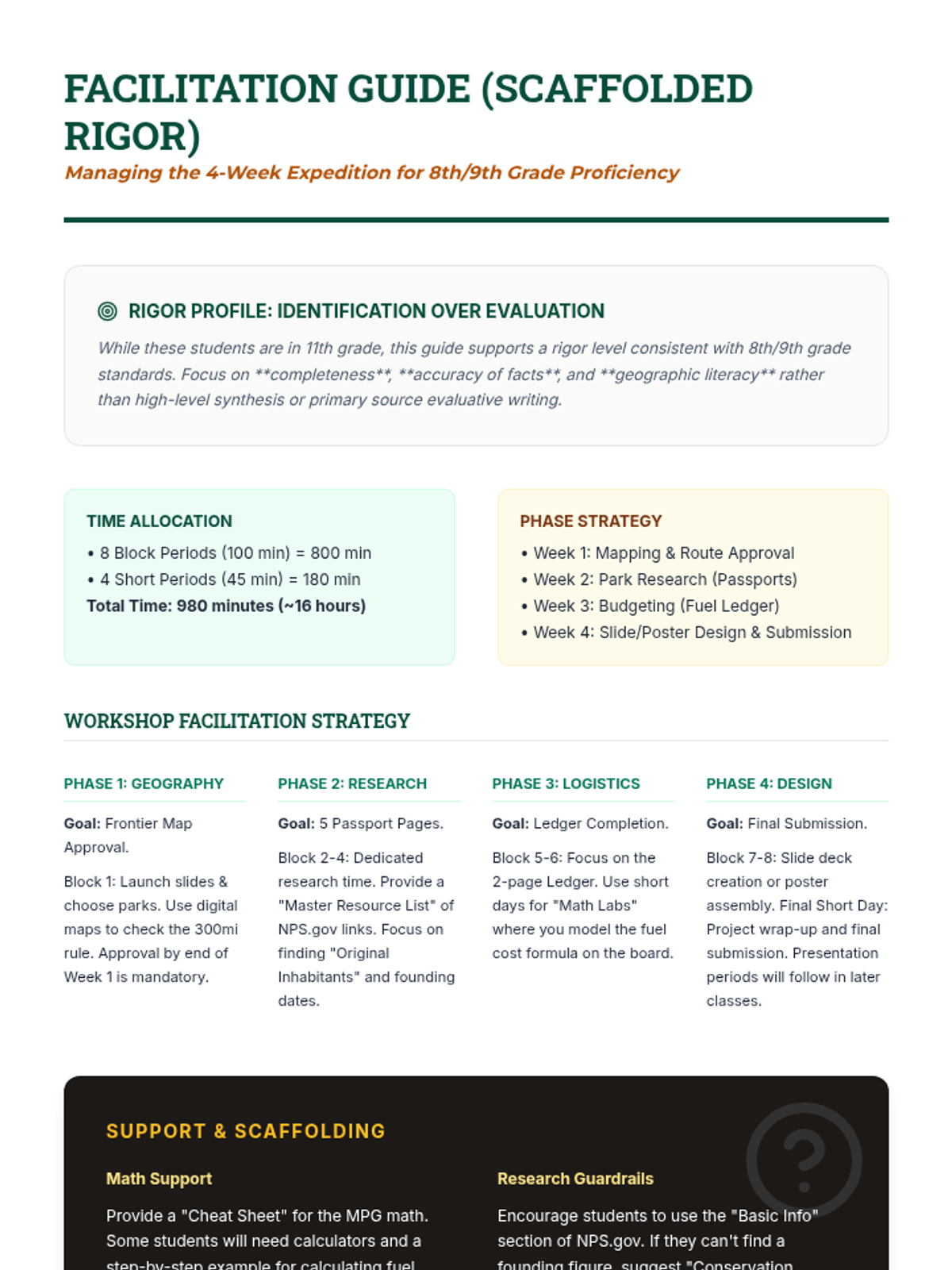
A comprehensive facilitation guide for teachers to manage the 16-hour National Parks project, adjusted for 8th/9th grade rigor. Includes weekly phase goals, scaffolding tips for math and research, and a schedule for block and standard periods. Updated to remove the gallery walk.
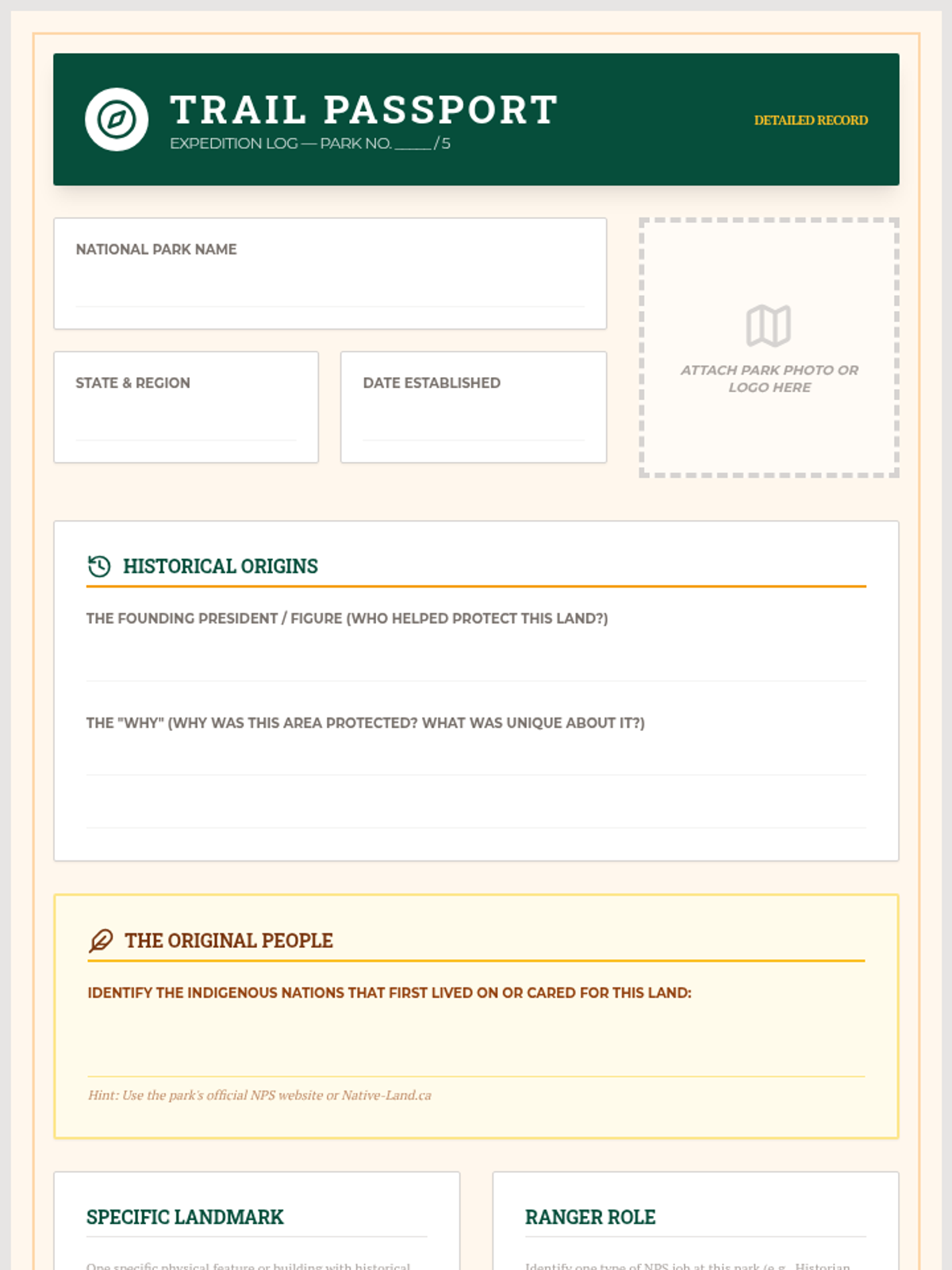
A research organizer for students to document the history and features of each National Park. Simplified for 8th/9th grade rigor with a focus on identification and specific landmarks.
The core project guide for the National Parks expedition, adjusted for 8th/9th grade rigor. Includes simplified deliverables and rubric focused on identification and descriptive research. Updated to reflect project submission and remove the gallery walk.
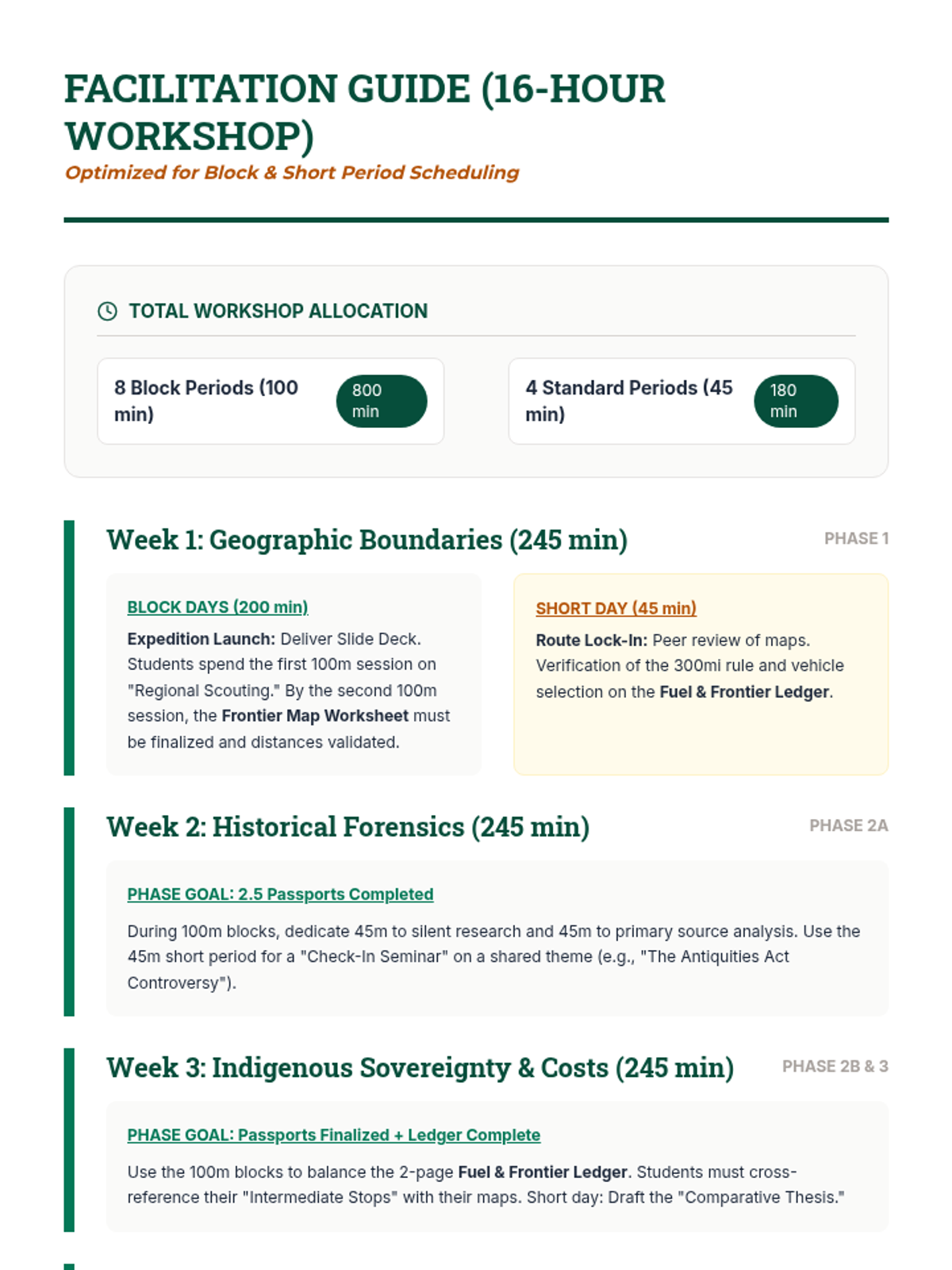
A comprehensive facilitation guide for teachers to manage the 16-hour National Parks project, optimized for a combination of 100-minute blocks and 45-minute standard periods. Includes weekly focus areas, phase goals, and rigor checks. Updated to remove the gallery walk.
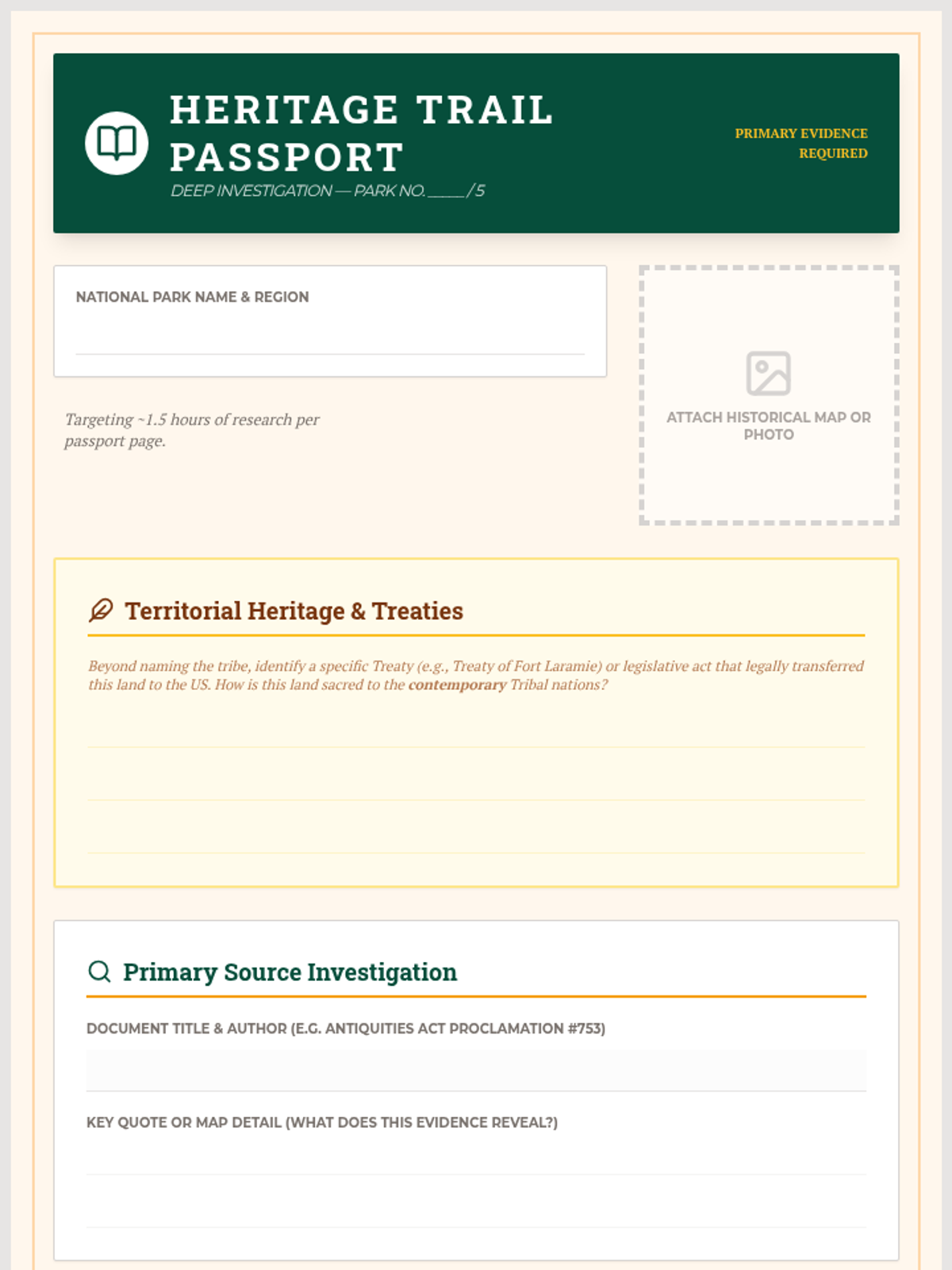
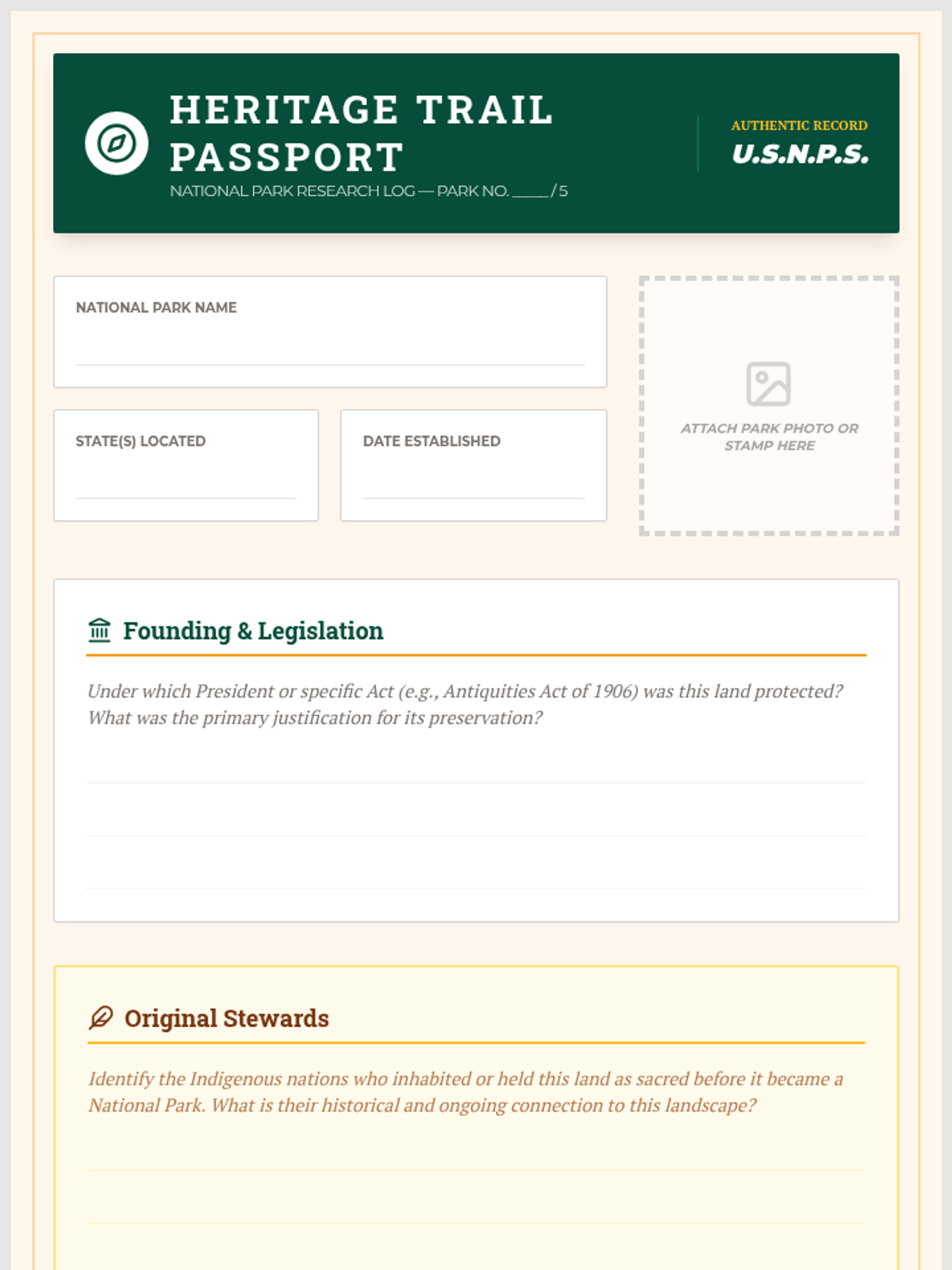
A research organizer for students to document the historical establishment, Indigenous heritage, and key figures of each National Park visited during their project. Updated with increased academic rigor including primary source analysis and "Then vs. Now" comparisons.
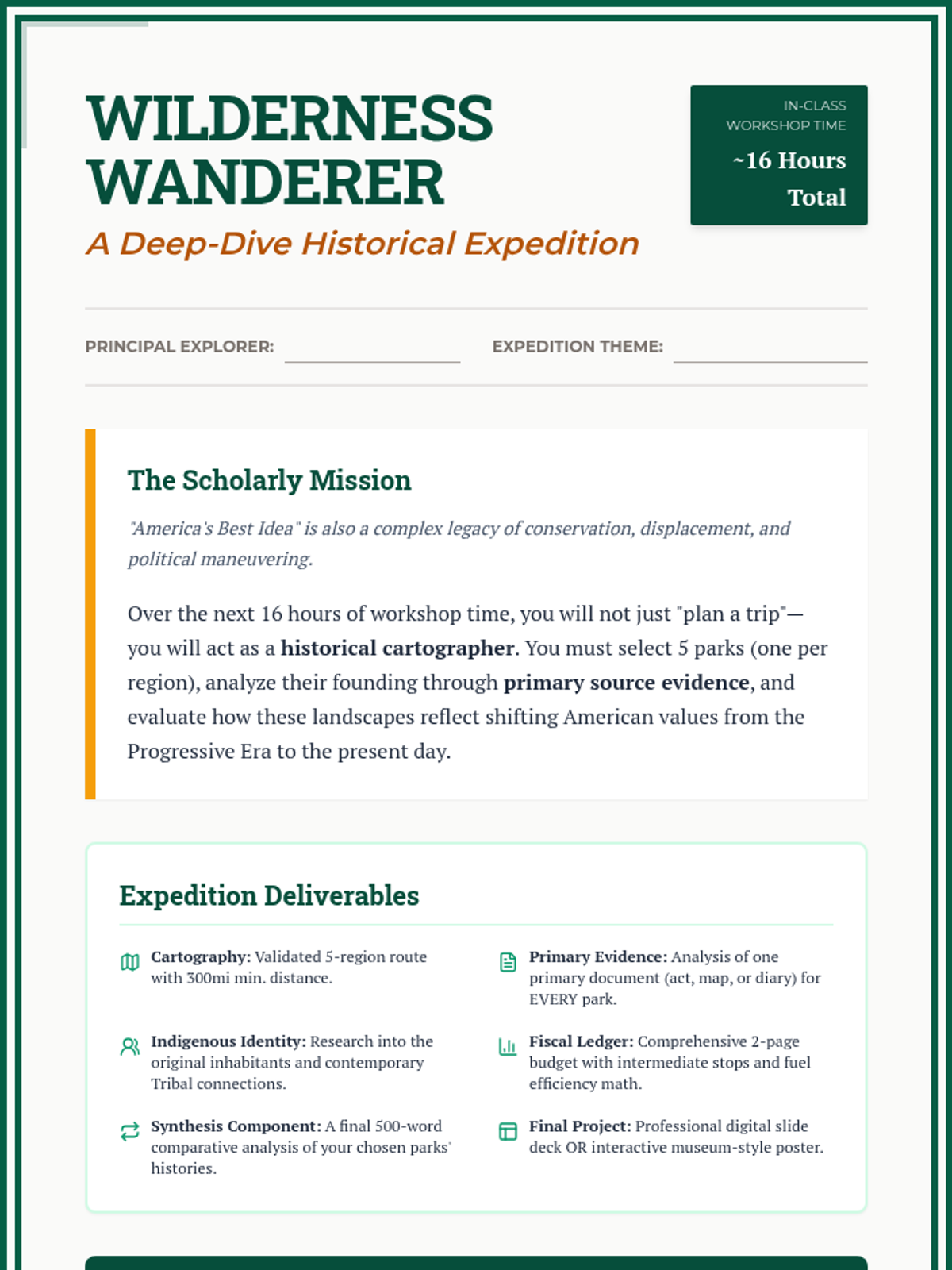
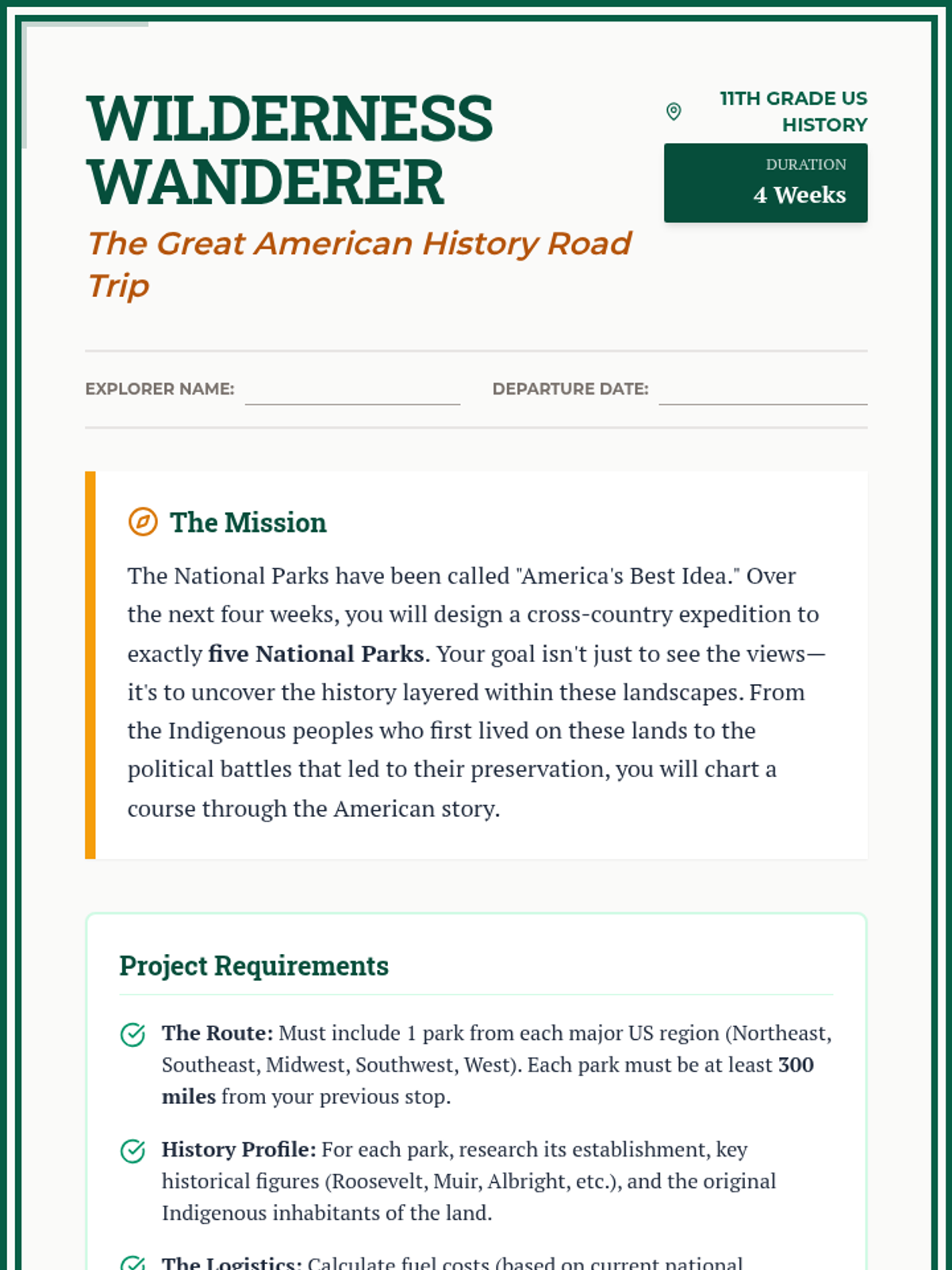
The core project guide for the National Parks expedition, outlining requirements, a 4-week timeline, and a detailed grading rubric for 11th grade US History students. Updated to remove the gallery walk and emphasize project submission.
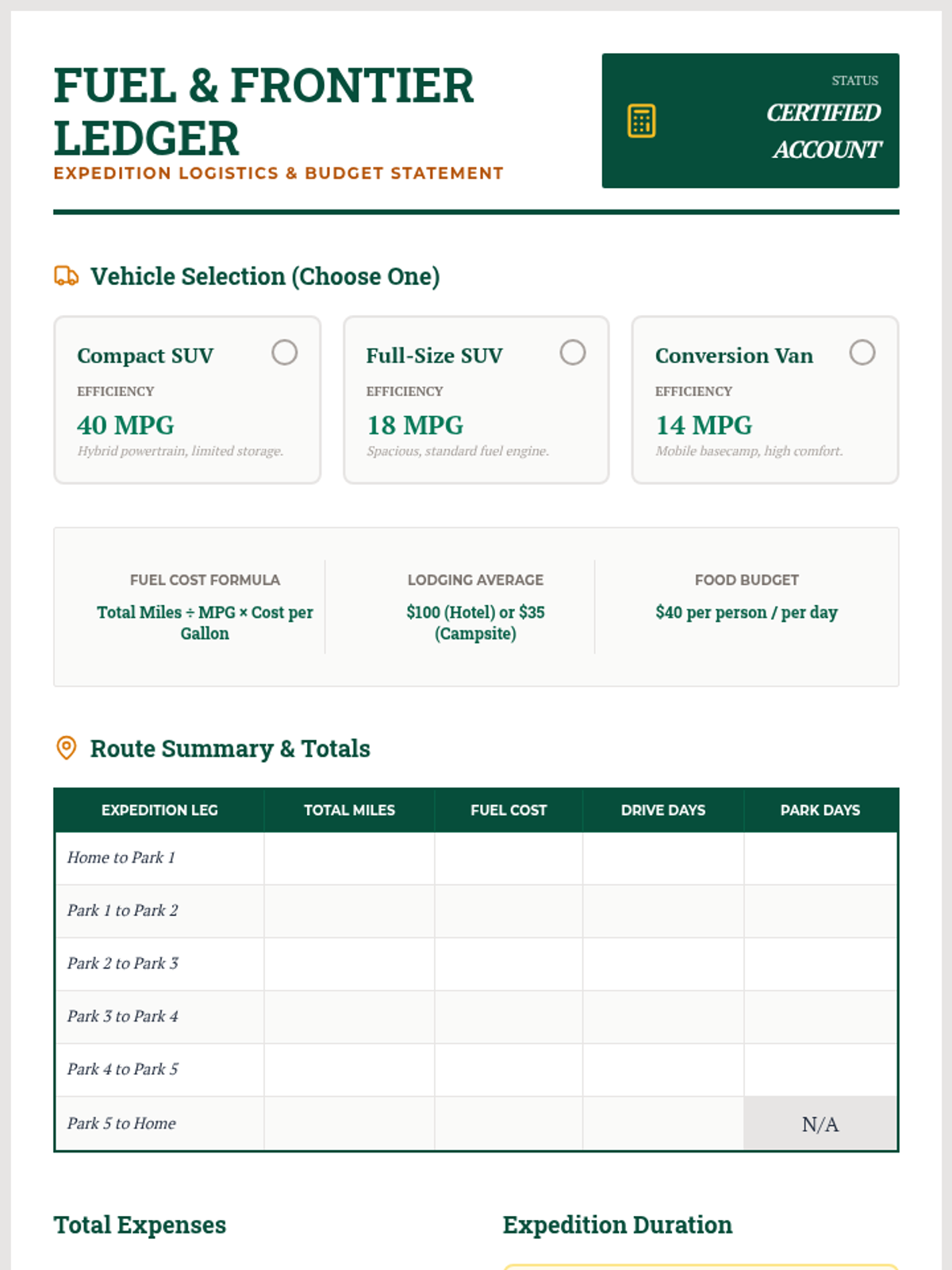
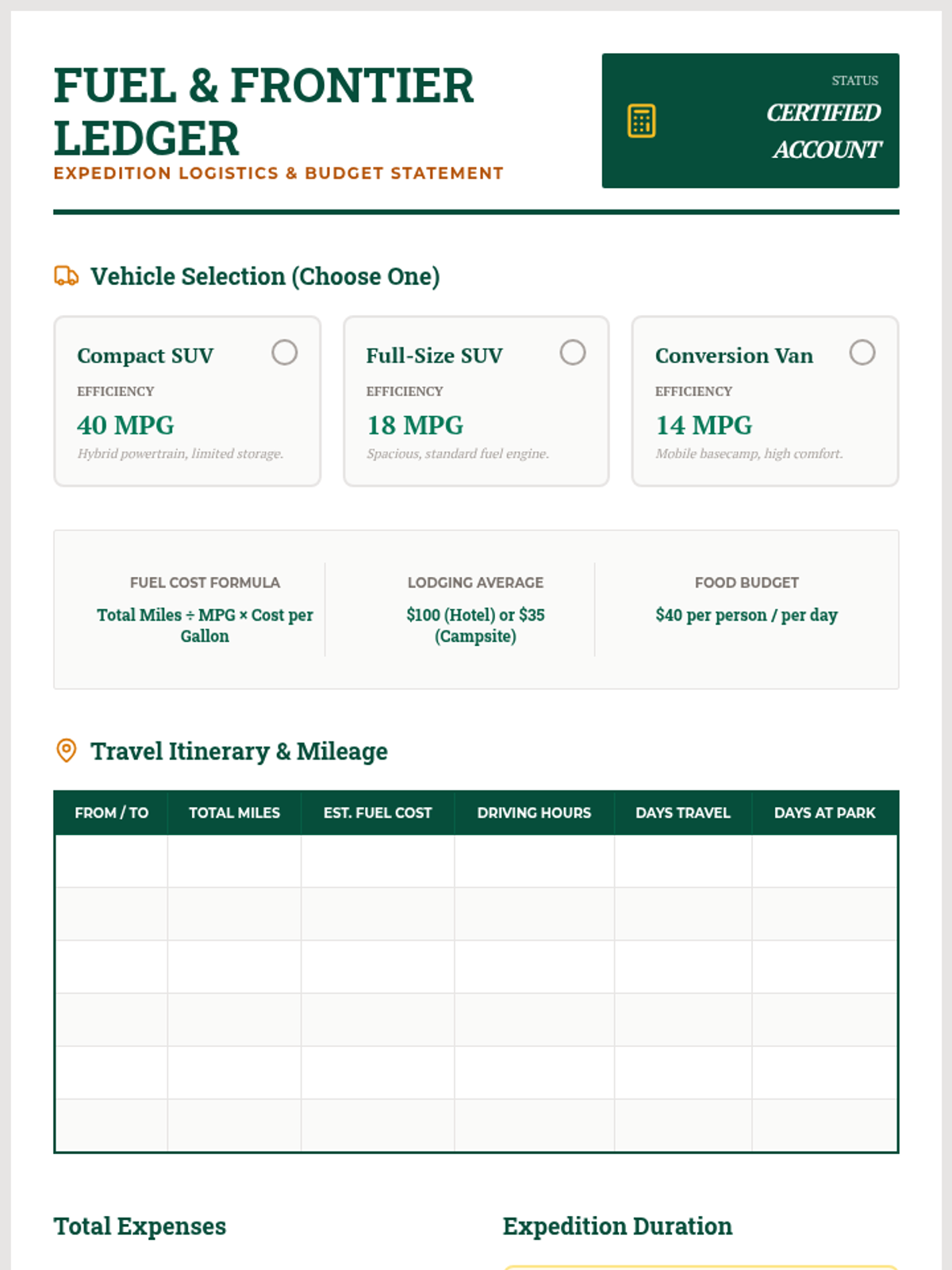
A logistical planning worksheet for calculating mileage, fuel costs, lodging, and time duration for the cross-country National Parks journey. Updated with vehicle selection options and a second page for recording intermediate stops.
A comprehensive facilitation guide for teachers to manage the 4-week National Parks project, including weekly objectives, differentiation strategies, and material checklists.
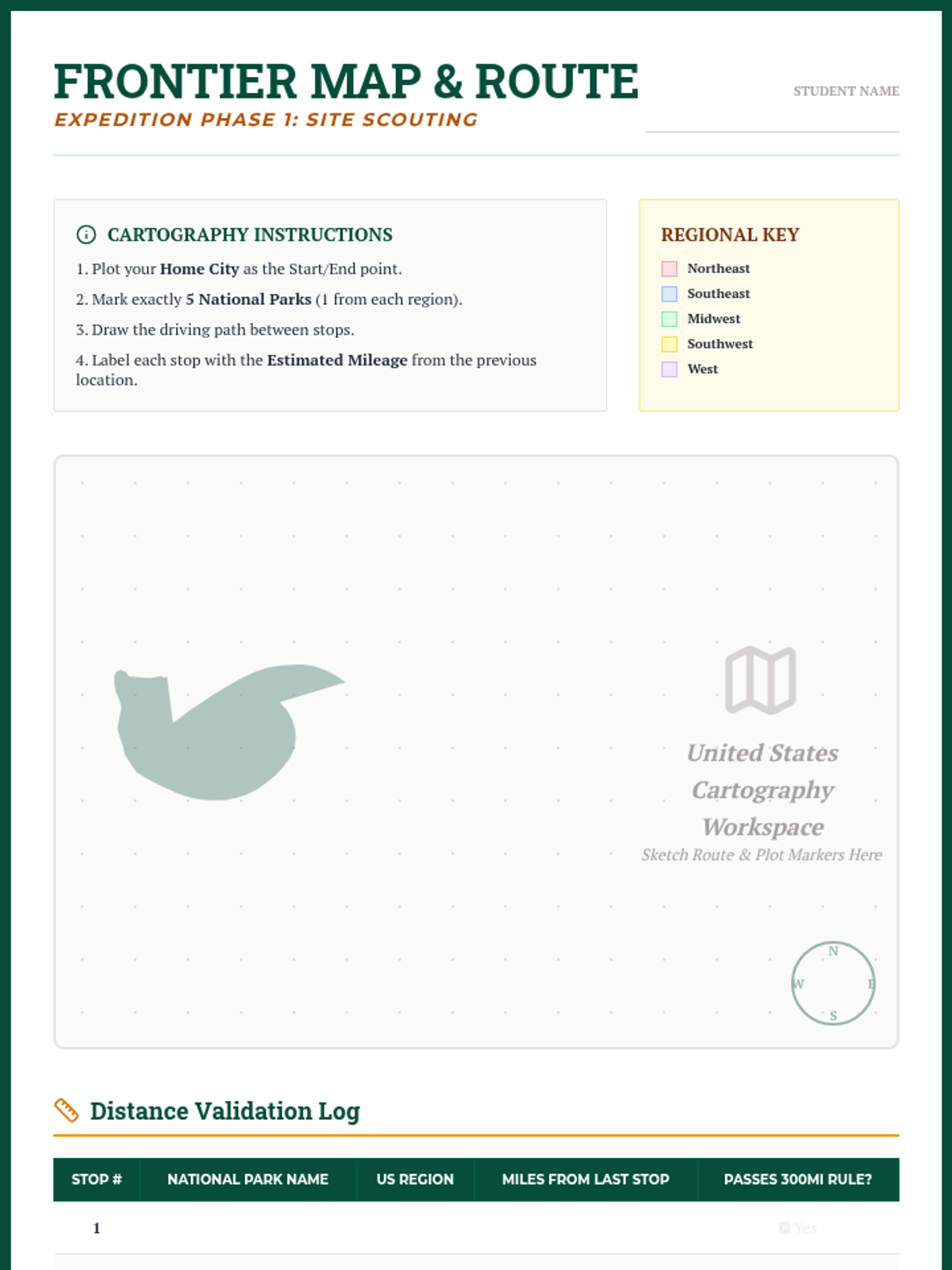
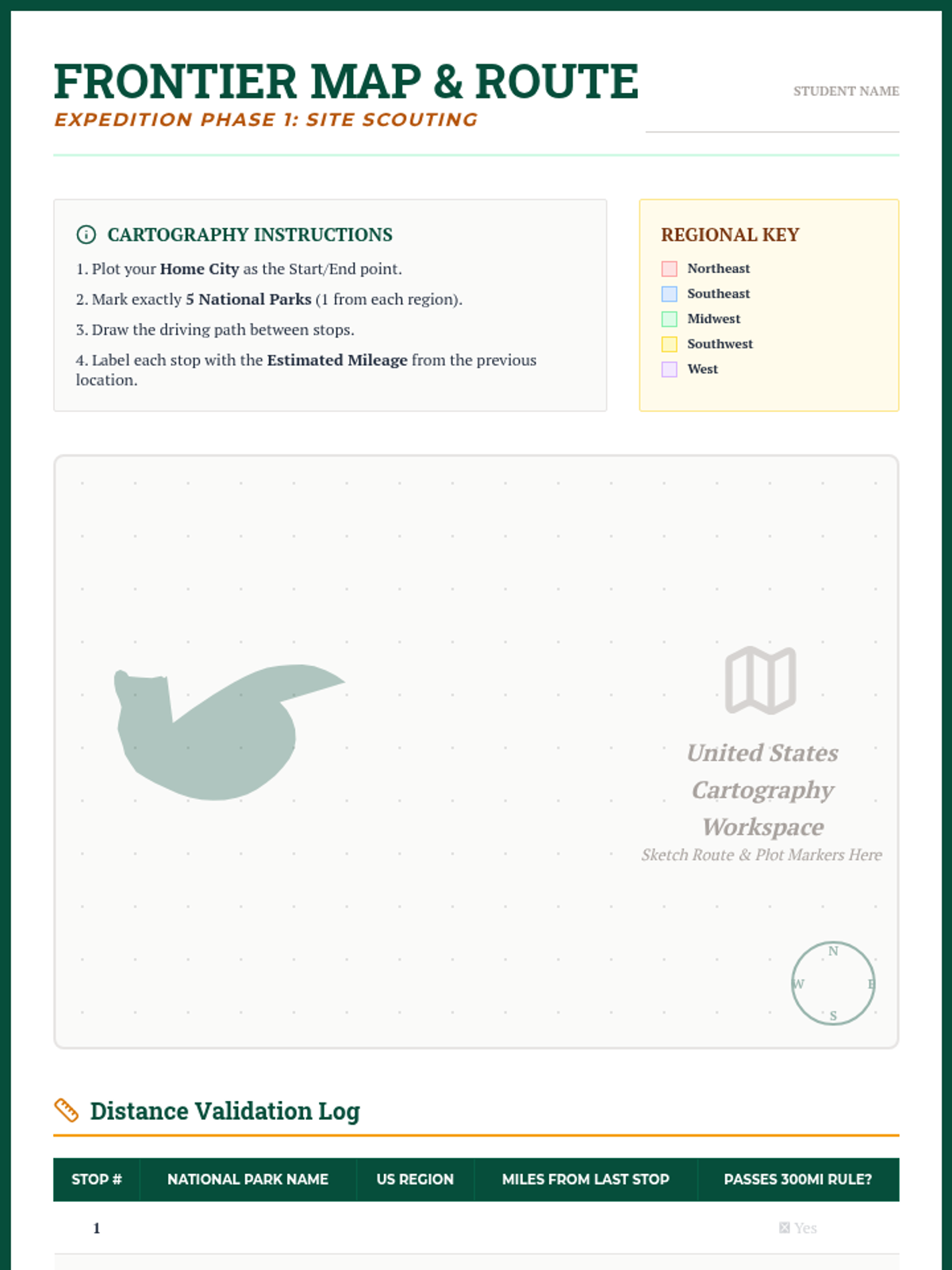
A mapping worksheet for students to plot their 5-park journey, including a regional key and a distance validation log to ensure project requirements are met.
Introductory slide presentation for the National Parks project, setting the historical context and project expectations. Updated with regional and distance requirements.
A logistical planning worksheet for calculating mileage, fuel costs, lodging, and time duration for the cross-country National Parks journey. Updated with vehicle selection options.
A research organizer for students to document the historical establishment, Indigenous heritage, and key figures of each National Park visited during their project.
The core project guide for the National Parks expedition, outlining requirements, a 4-week timeline, and a detailed grading rubric for 11th grade US History students. Updated with regional and distance requirements.
Bilingual (English/Spanish) station instructional cards for the Monsoon Missions lesson, optimized to fit each station on a single letter-sized (8.5x11) page with clear headers and high-contrast design.
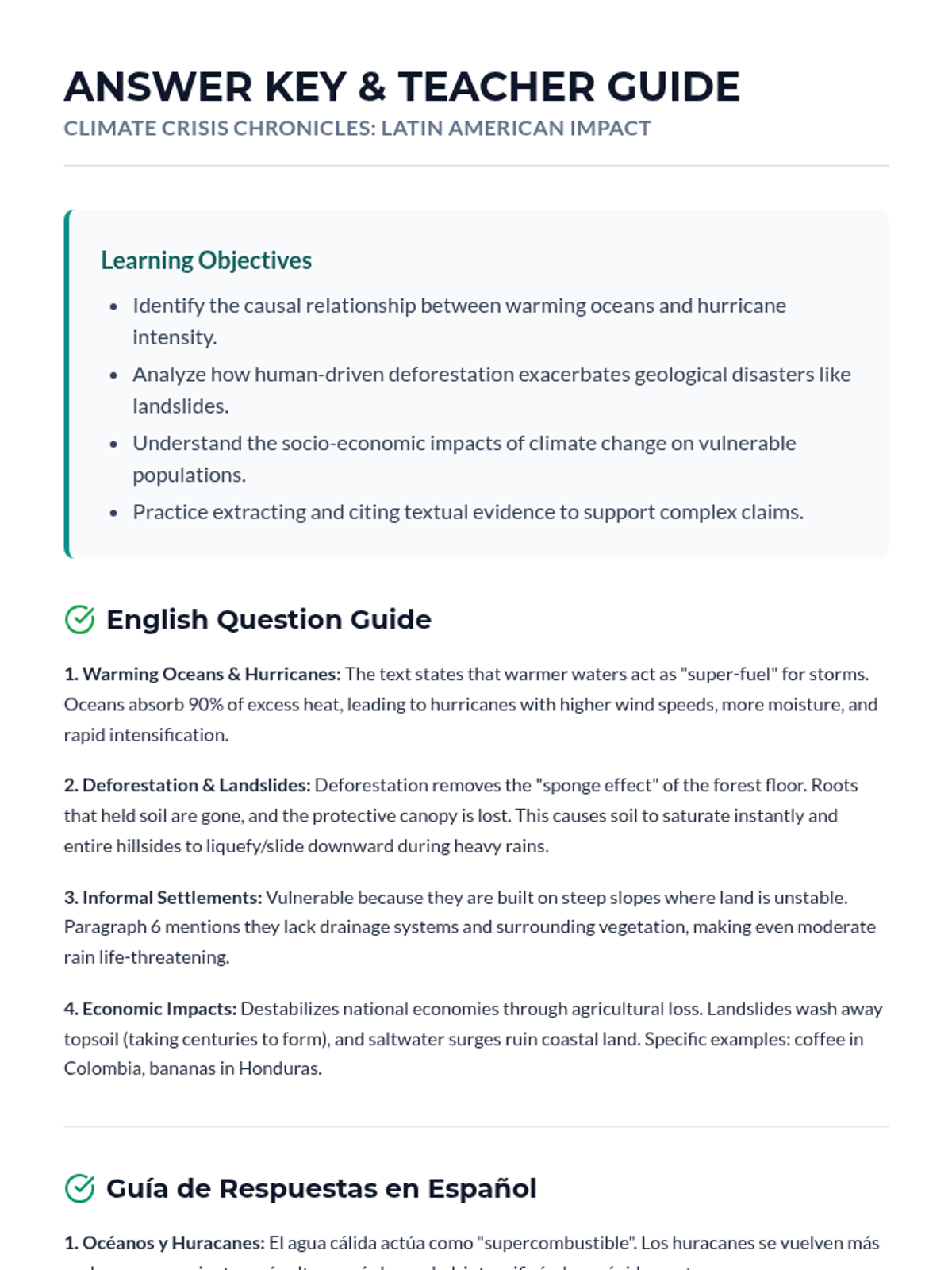
A comprehensive teacher answer key and instructional guide for both the English and Spanish versions of the Climate Crisis Report, featuring four evidence-based analysis questions.
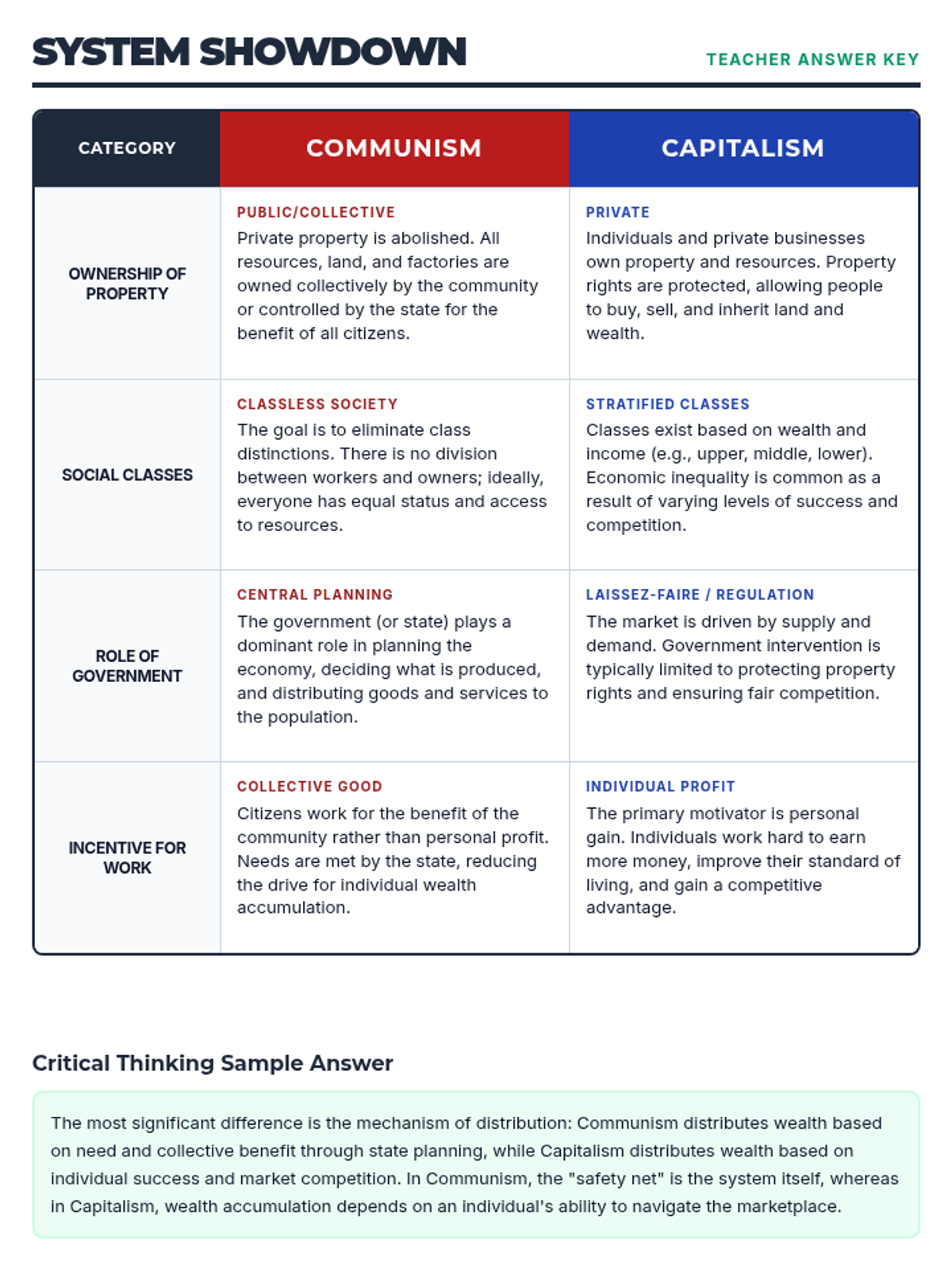
An answer key for the System Showdown graphic organizer, providing clear comparisons between Communism and Capitalism across property ownership, social classes, government role, and work incentives.
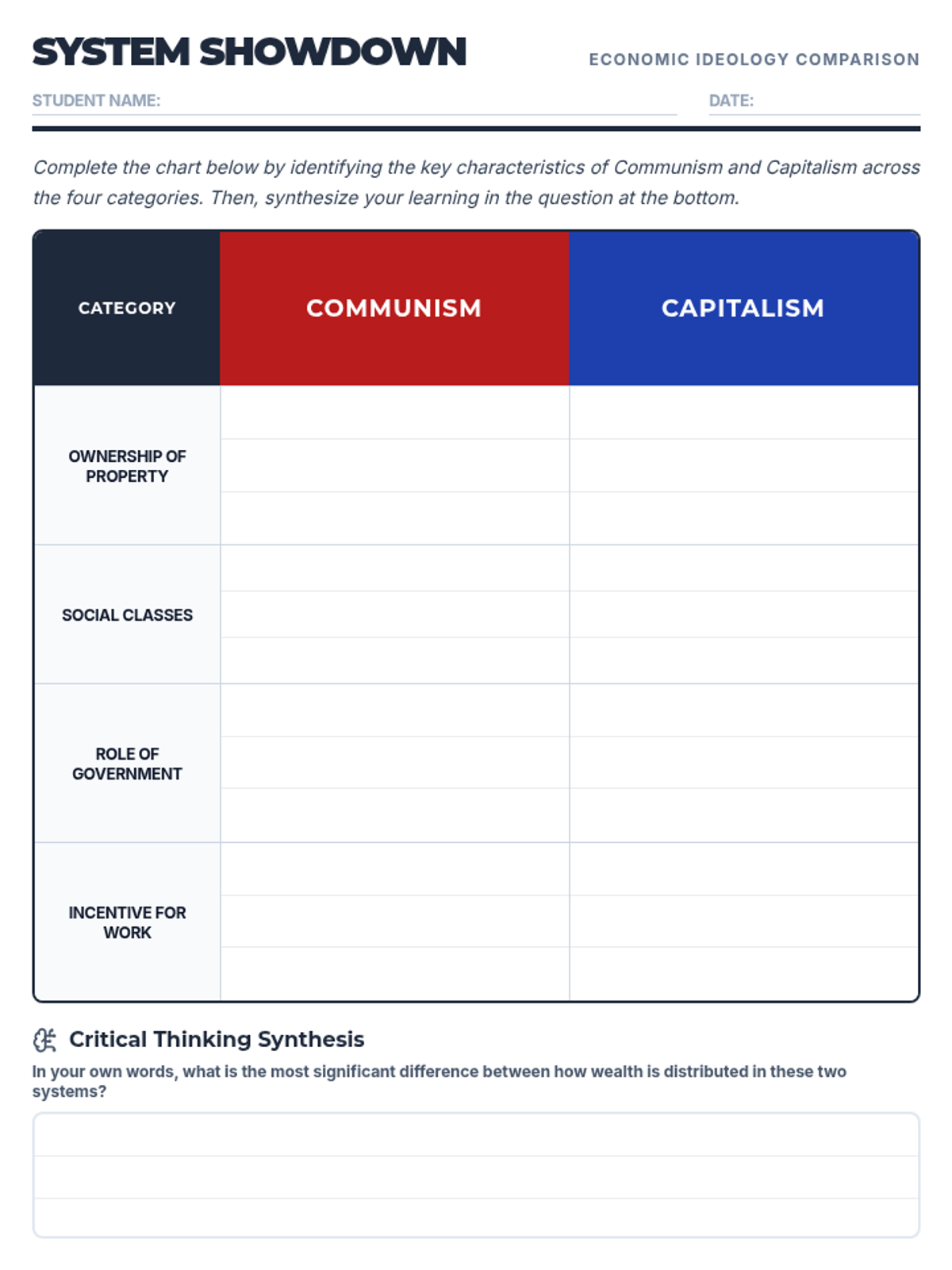
A structured graphic organizer for students to compare Communism and Capitalism across four key dimensions: property ownership, social classes, government role, and work incentives. Includes a critical thinking synthesis question.