Examining foundational arguments from major thinkers alongside contemporary debates on morality, governance, and the nature of existence. Addresses core concepts like political structures, consciousness, and the conflict between agency and fate.
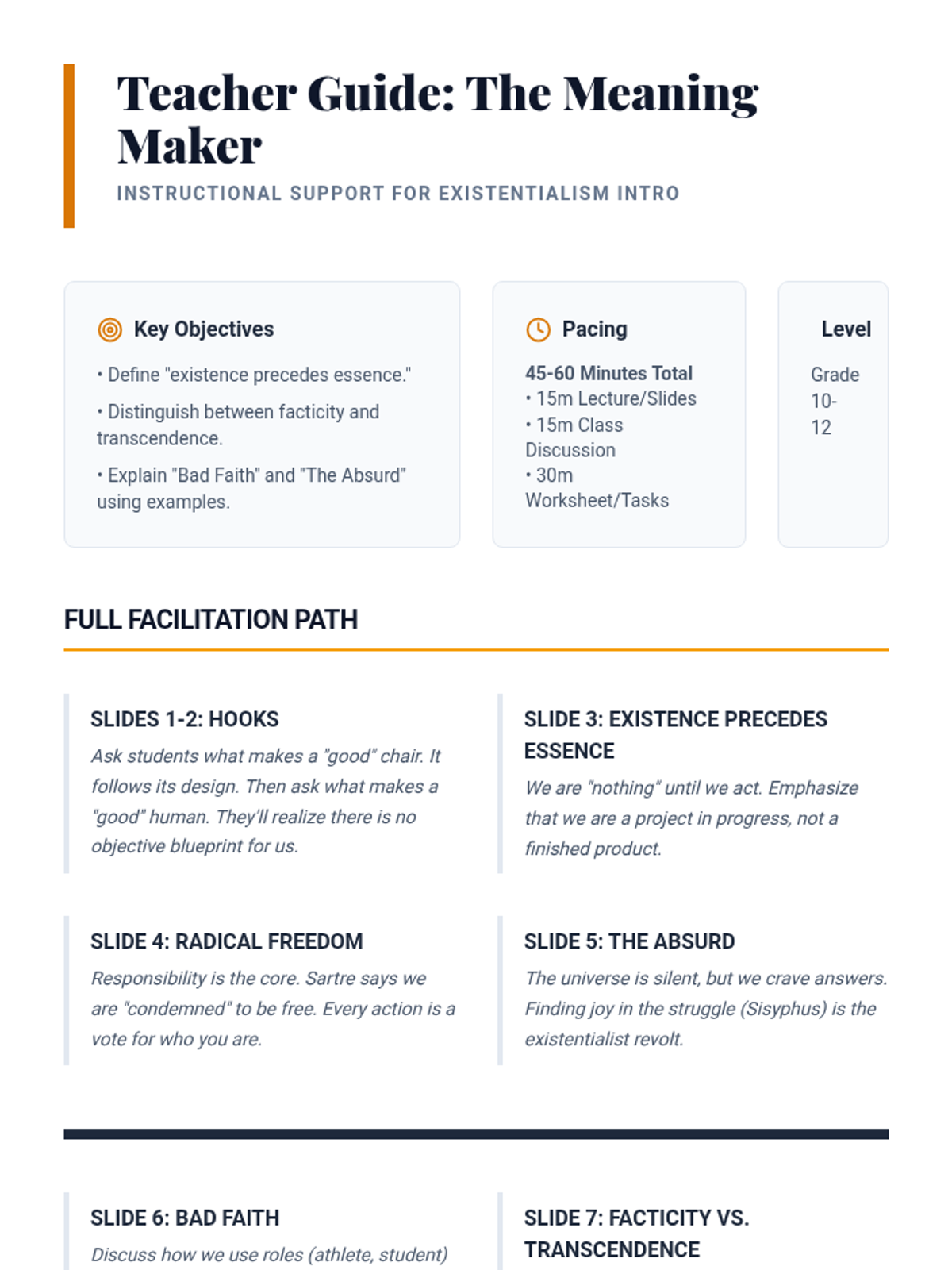
A comprehensive teacher facilitation guide for the "Meaning Maker" lesson on existentialism. Includes slide-by-slide prompts, pacing guides, strategy notes for every slide, and student misconception management. Updated for better page flow and complete slide coverage.
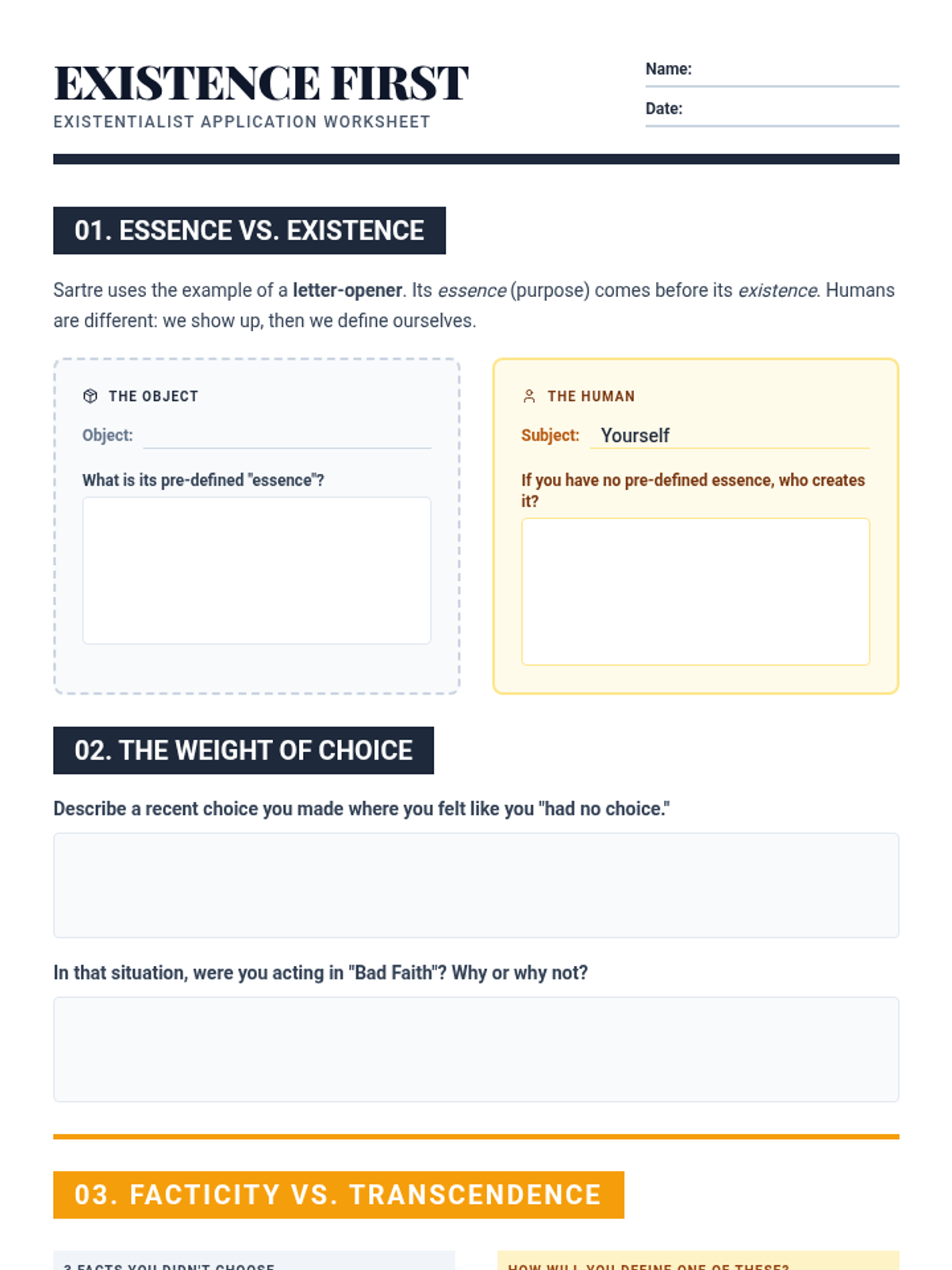
A two-page student worksheet that applies existentialist concepts (Essence vs. Existence, Facticity, The Absurd) to personal life. Includes reflection prompts and analysis of Jean-Paul Sartre and Albert Camus' ideas. Updated for better page breaks and writing area visibility.
A visually striking introductory slide deck on existentialism, covering core concepts like radical freedom, existence preceding essence, the absurd, and bad faith. Uses an industrial "Foundry of Meaning" theme.
Une carte mentale visuelle présentant l'organisation des 17 notions du programme de philosophie du baccalauréat en 5 grands domaines conceptuels. Layout optimisé pour une clarté maximale.
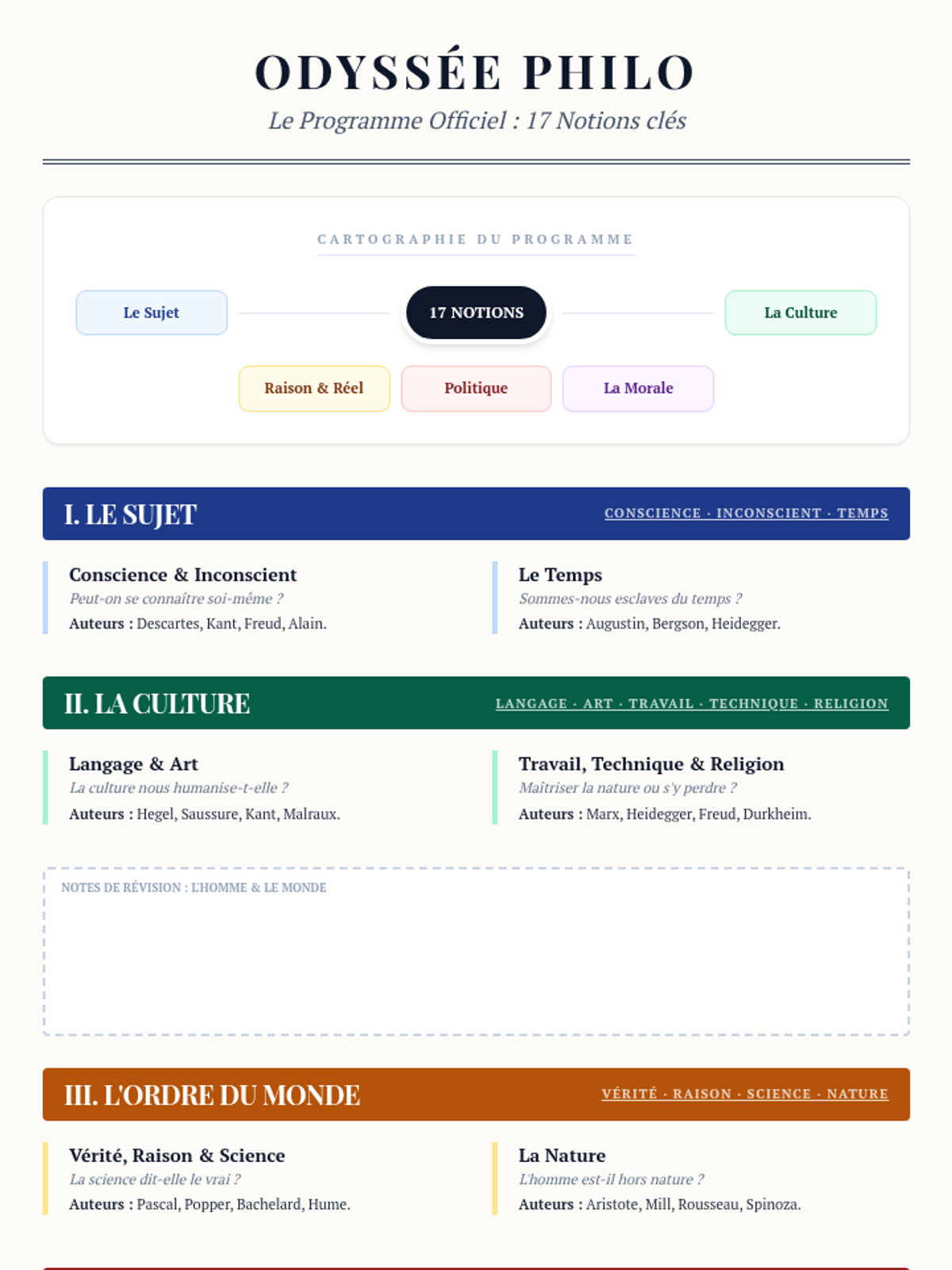
Un guide d'étude complet présentant les 17 notions du programme de philosophie, organisées par thèmes avec définitions, auteurs clés et problématiques pour les révisions du baccalauréat. Inclut une cartographie visuelle et des zones de notes pour l'étudiant.
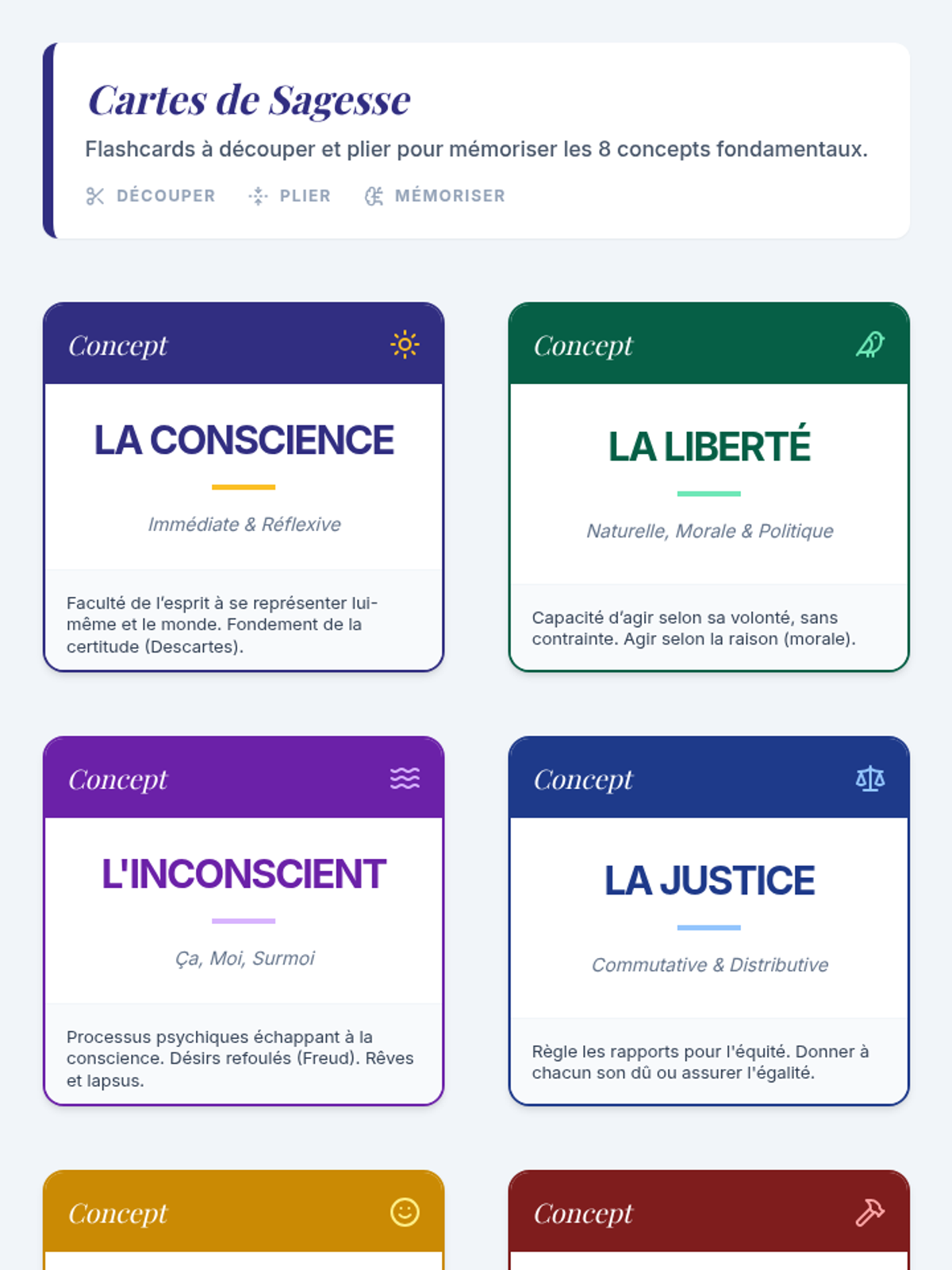
Un ensemble de huit flashcards à découper, présentant au recto le concept philosophique et au verso sa définition synthétique pour une mémorisation rapide.
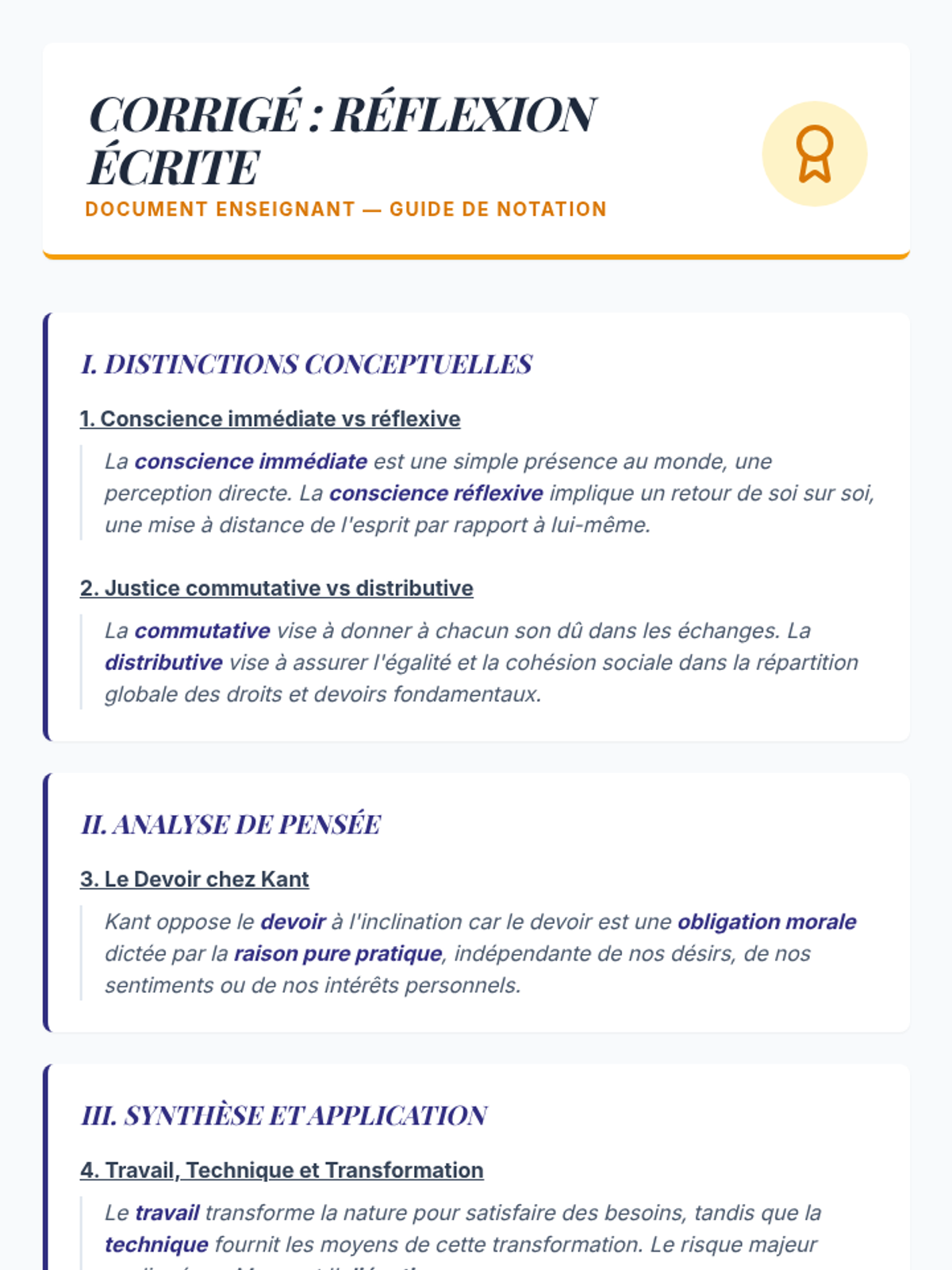
Corrigé détaillé de la fiche de réflexion écrite Sagesse Flash pour l'enseignant, incluant des pistes de notation et les points clés.
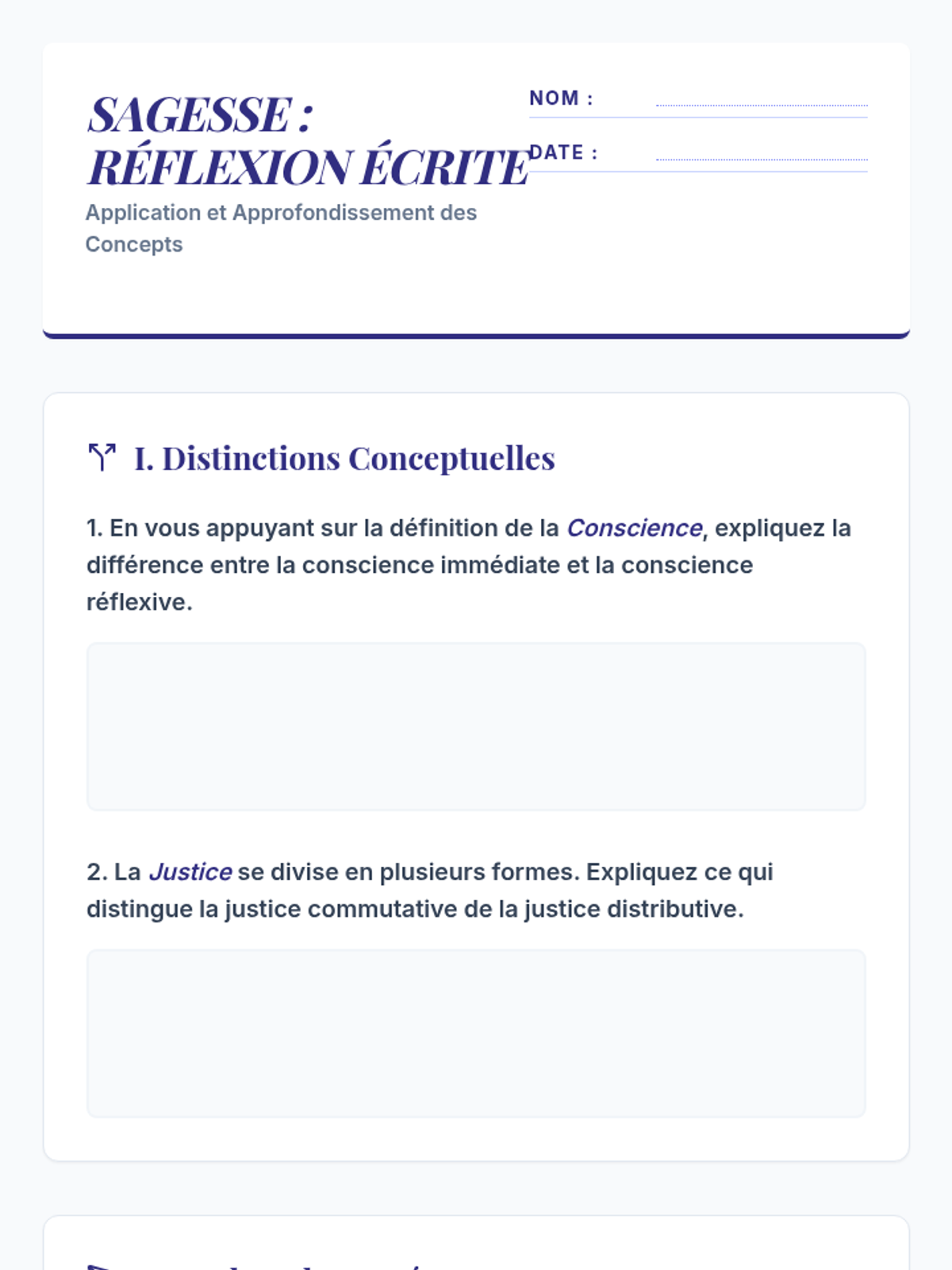
Une fiche d'exercices écrits demandant aux élèves d'expliquer les distinctions et les nuances des huit concepts philosophiques étudiés.
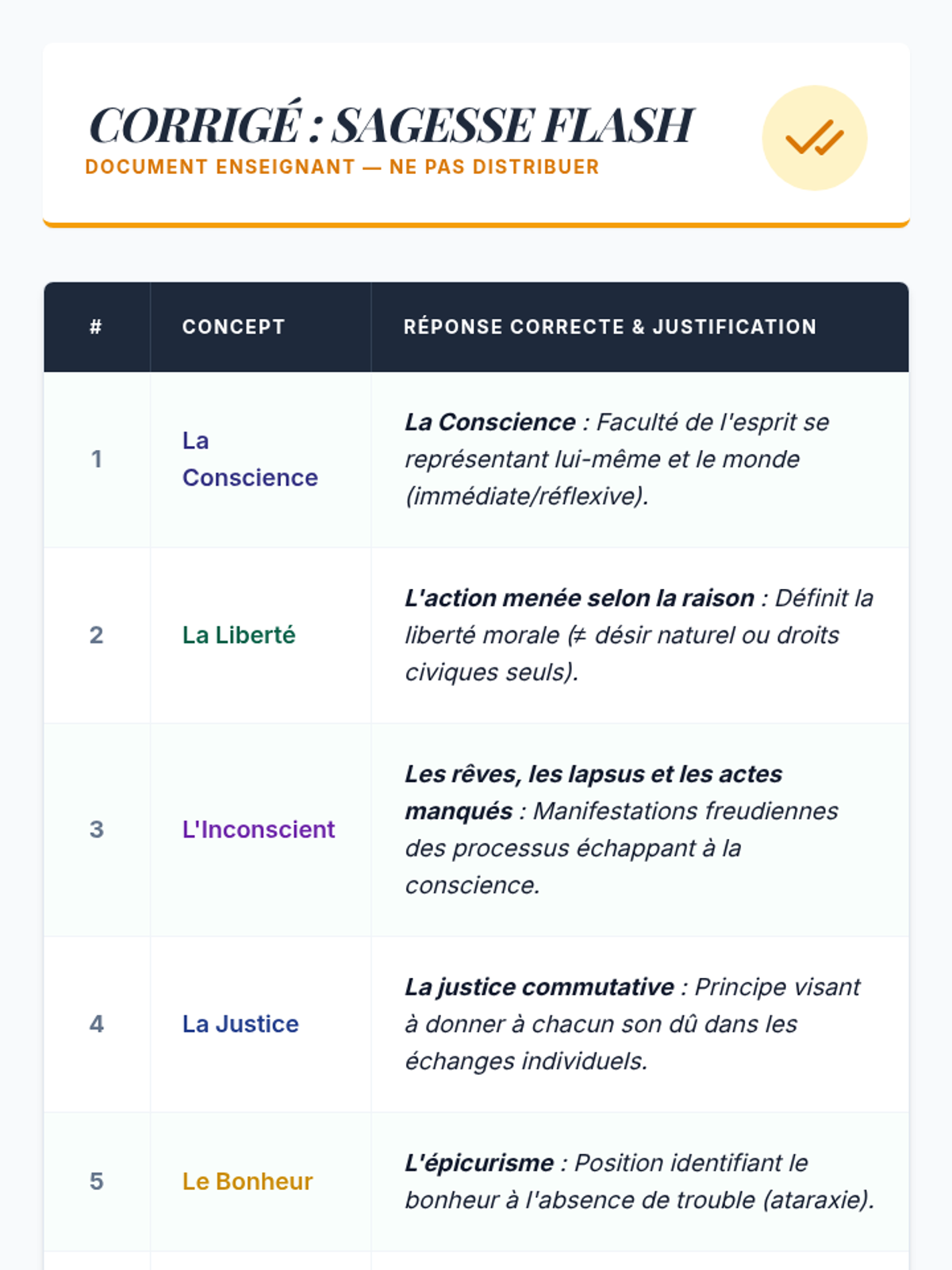
Corrigé détaillé du quiz QCM Sagesse Flash avec justifications basées sur les textes sources pour l'enseignant.
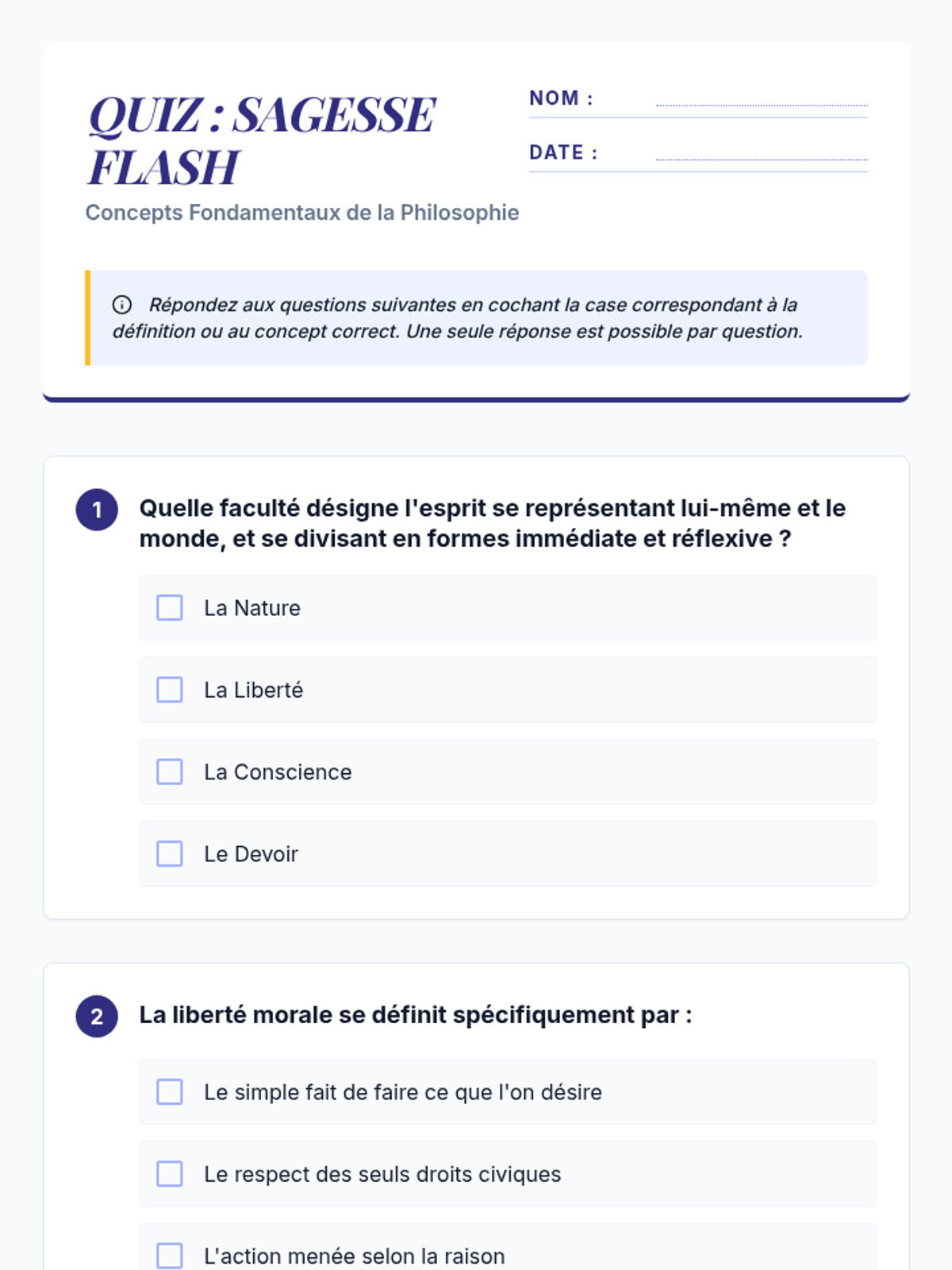
Un questionnaire à choix multiples (QCM) de huit questions testant la compréhension des définitions philosophiques fournies.
Une présentation visuelle reprenant les huit définitions philosophiques demandées pour une révision rapide en classe.
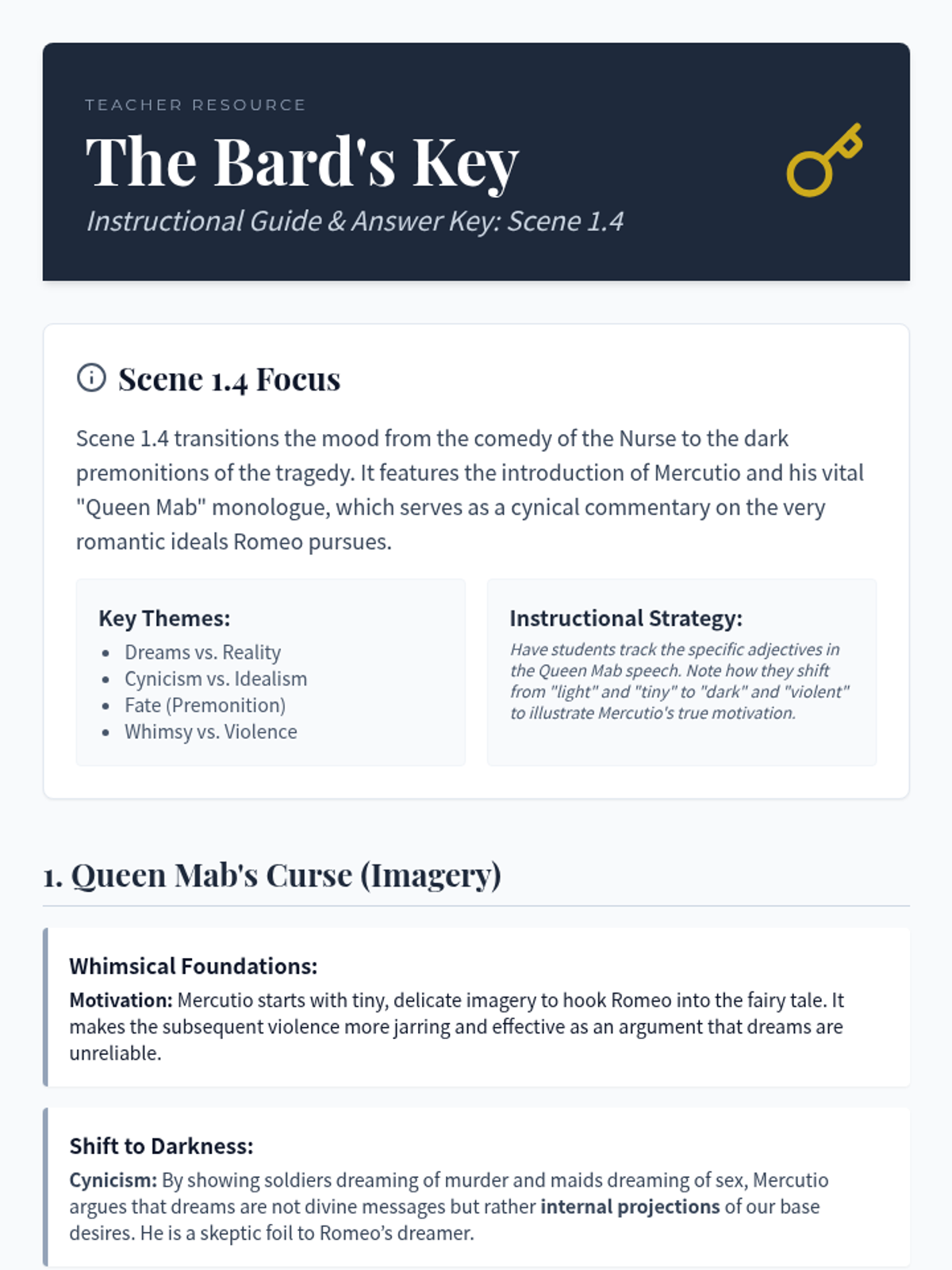
A teacher-facing guide providing an answer key and instructional tips for the Scene 1.4 worksheets. Includes analysis of Mercutio's cynical worldview and Romeo's fatalistic ship metaphor.
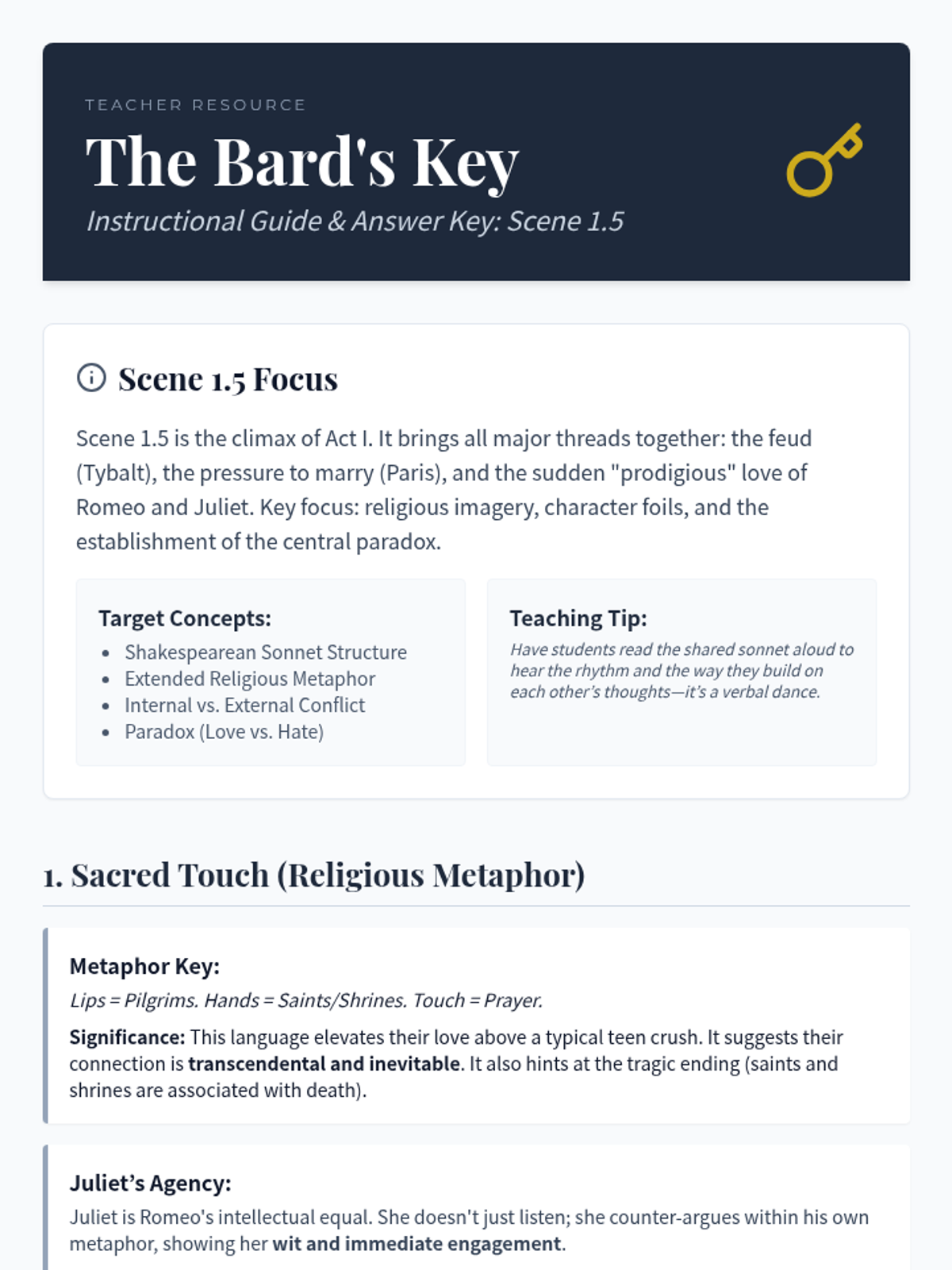
A teacher-facing guide providing an answer key and instructional tips for the Scene 1.5 worksheets. Includes analysis of the shared sonnet, Tybalt's rage, and the central paradox of love and hate.
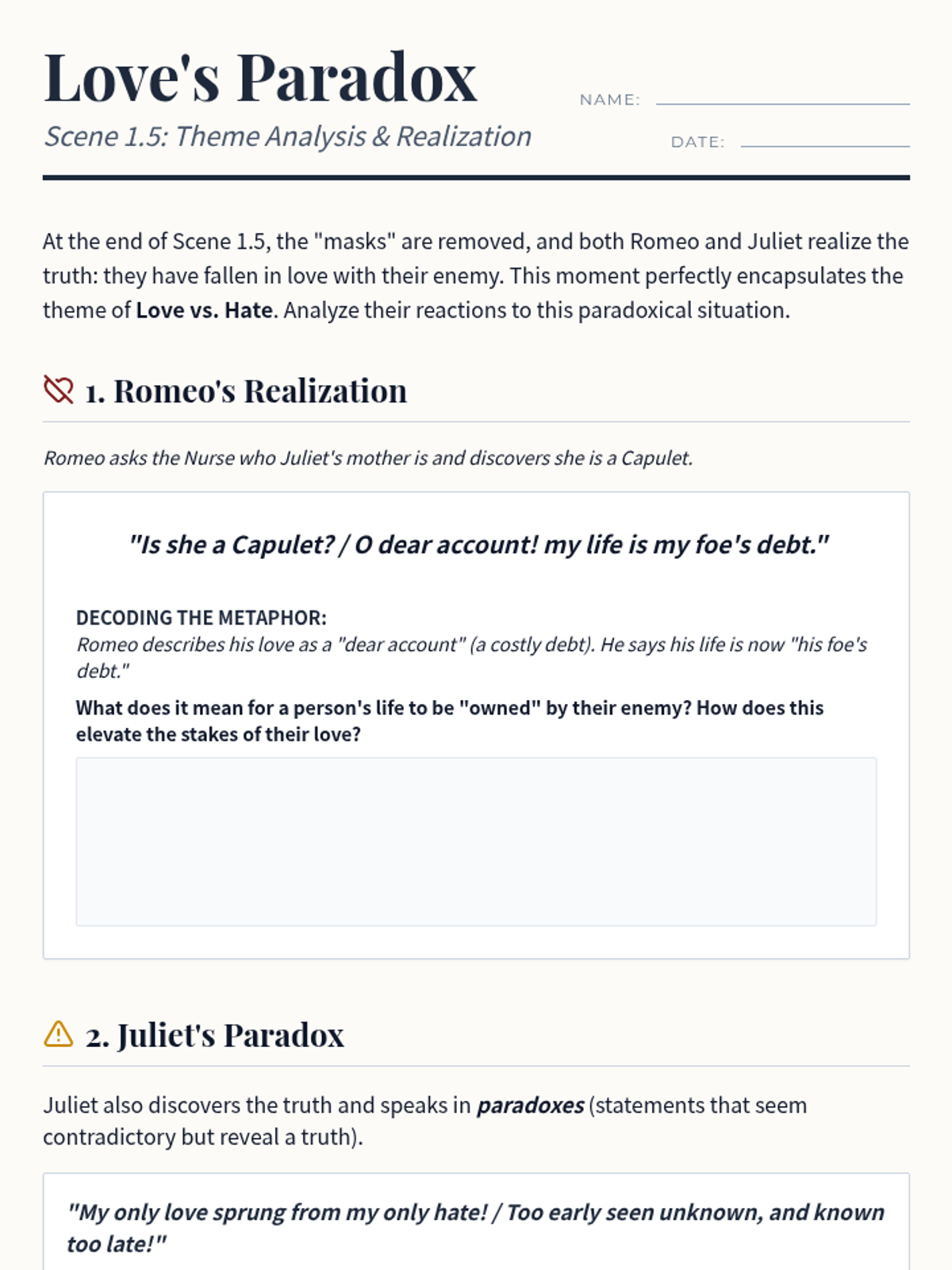
A student worksheet for Act 1, Scene 5 focusing on the realization of the "prodigious birth of love" and the theme of Love vs. Hate. Analyzes the paradoxes spoken by Juliet and Romeo's "foe's debt."
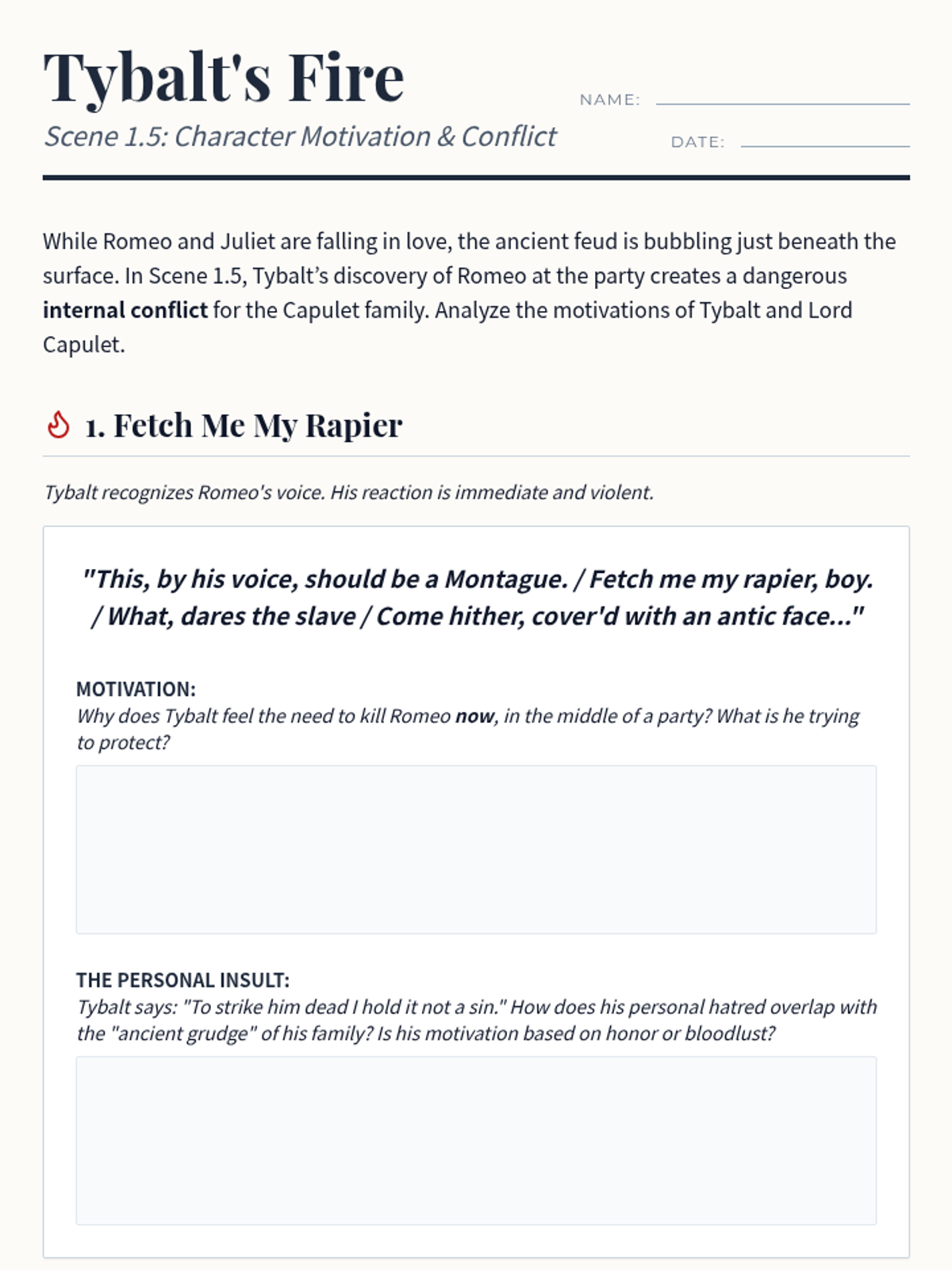
A student worksheet for Act 1, Scene 5 focusing on character motivation and conflict. Analyzes Tybalt's rage vs. Lord Capulet's hospitality and the foreshadowing of future violence.
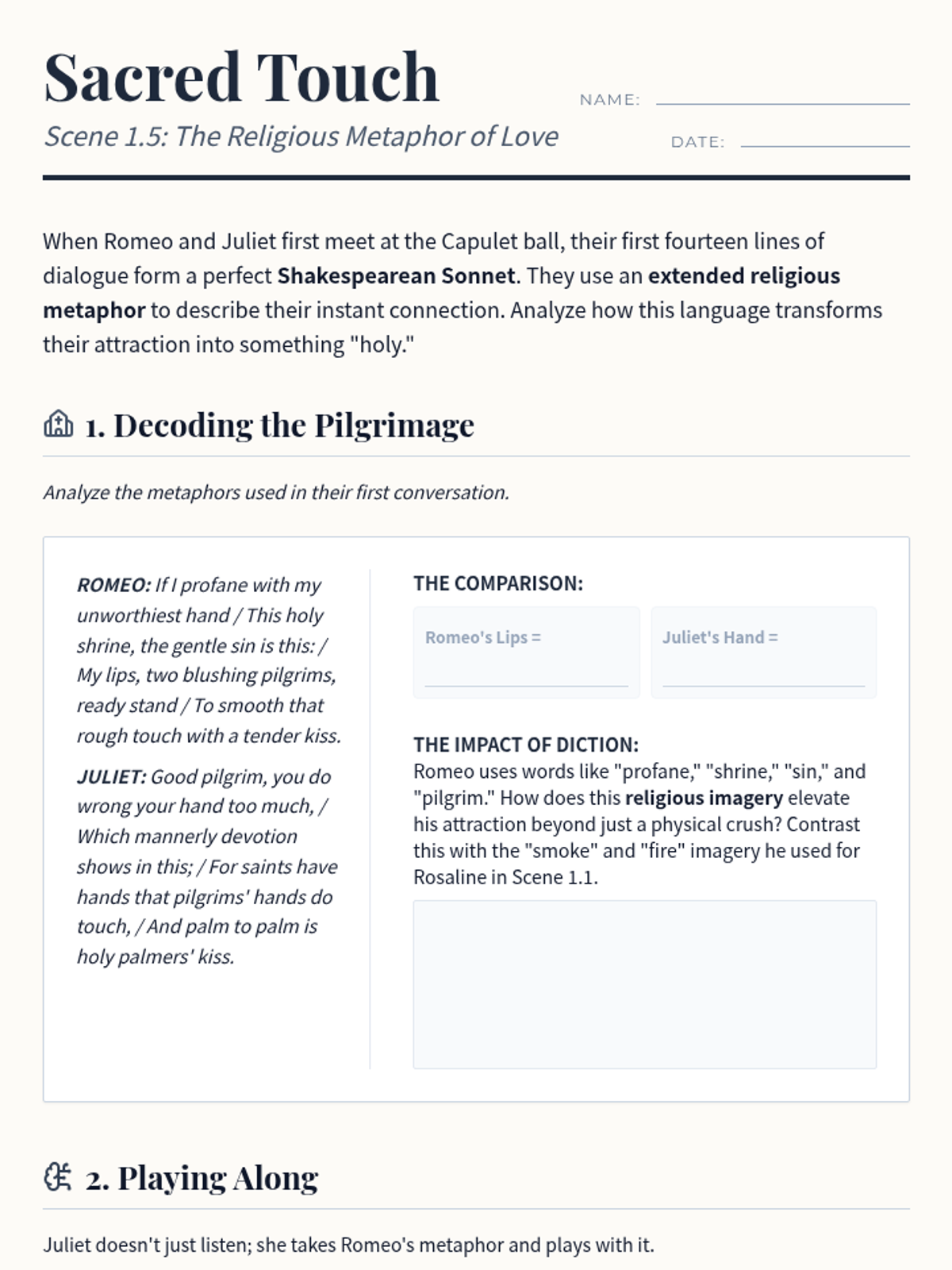
A student worksheet for Act 1, Scene 5 focusing on the first meeting of Romeo and Juliet. Analyzes the shared sonnet and the use of religious metaphors to elevate their connection.
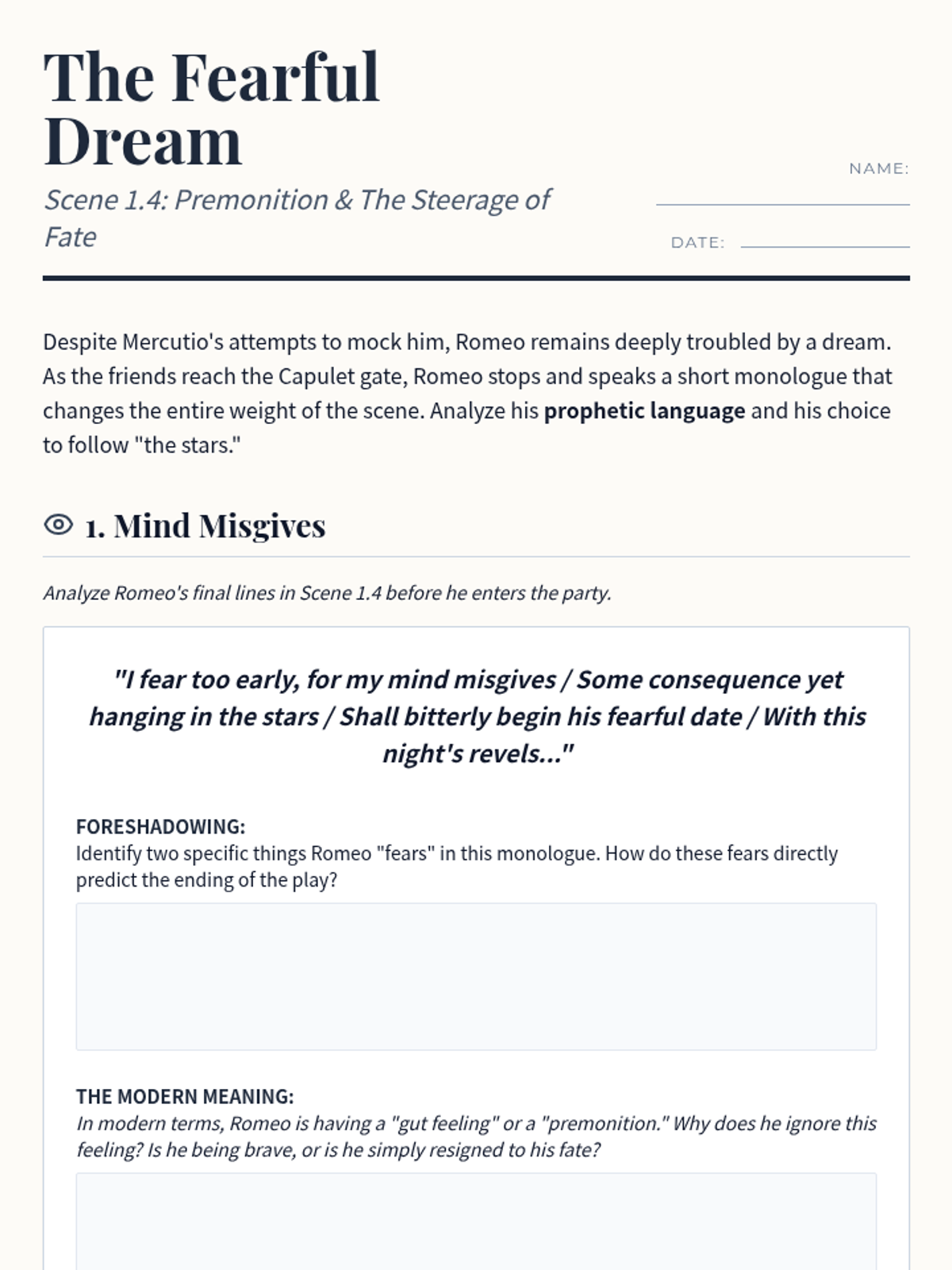
A student worksheet for Act 1, Scene 4 focusing on Romeo's premonition and the theme of fate. Analyzes his "fearful dream" and the decision to enter the party.
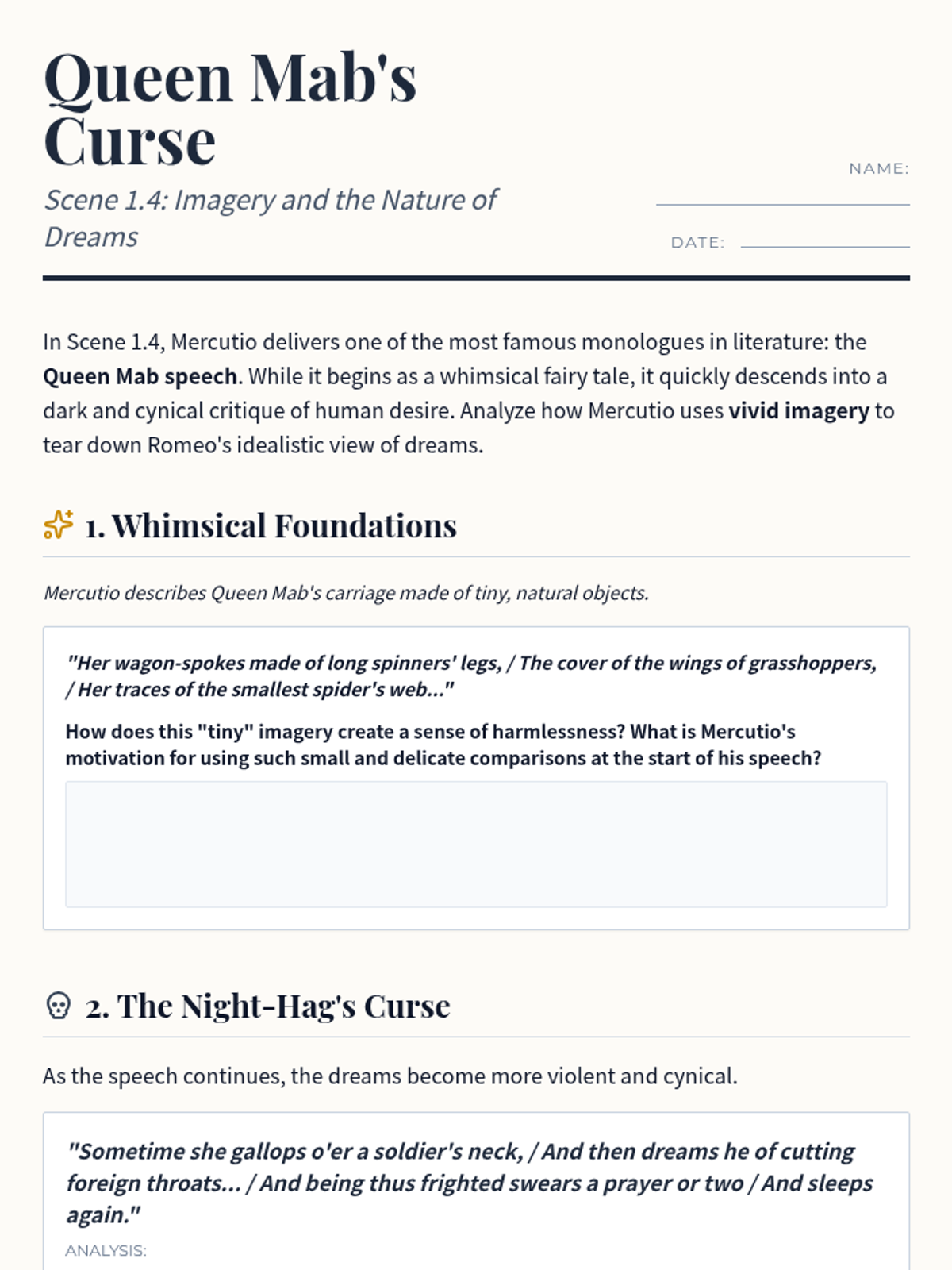
A student worksheet for Act 1, Scene 4 focusing on Mercutio's Queen Mab speech. Analyzes the shift from whimsical to dark imagery and the theme of dreams vs. reality.
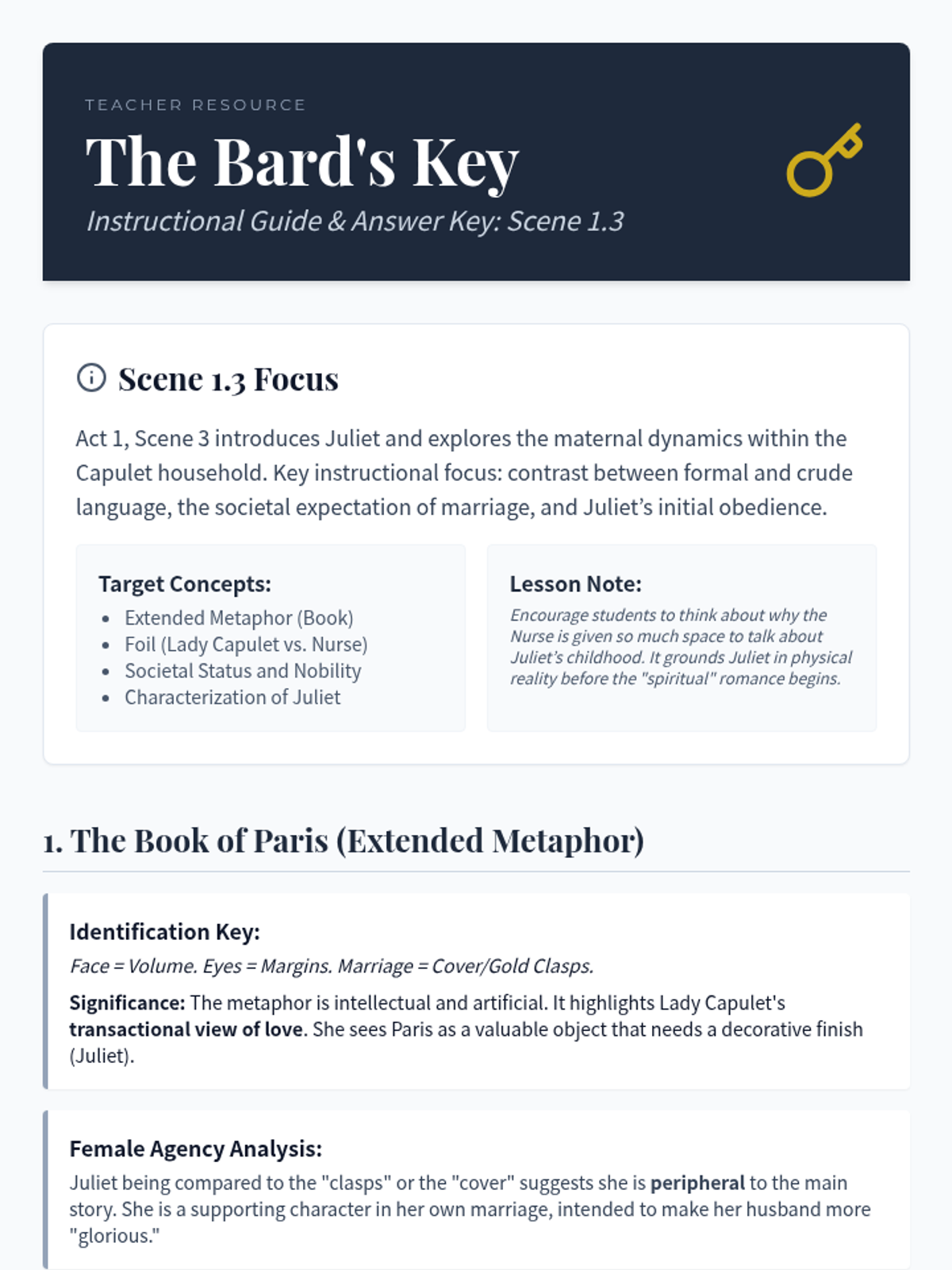
A teacher-facing guide providing an answer key and instructional tips for the Scene 1.3 worksheets. Includes analysis of Lady Capulet's book metaphor, the Nurse as a foil, and Juliet's initial obedience.
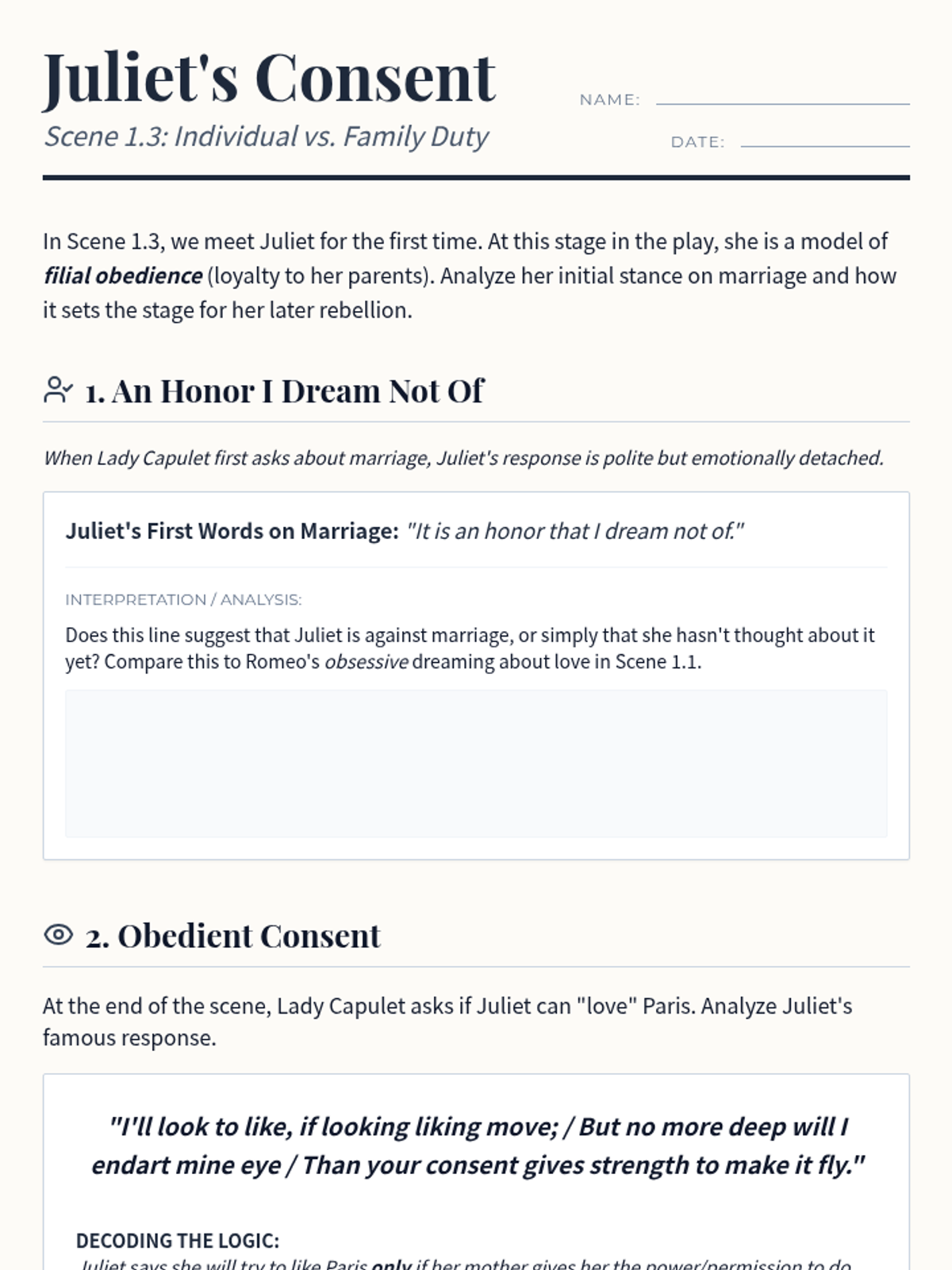
A student worksheet for Act 1, Scene 3 focusing on Juliet's initial stance on marriage and obedience. Analyzes her famous "look to like" speech and the theme of Individual vs. Society.
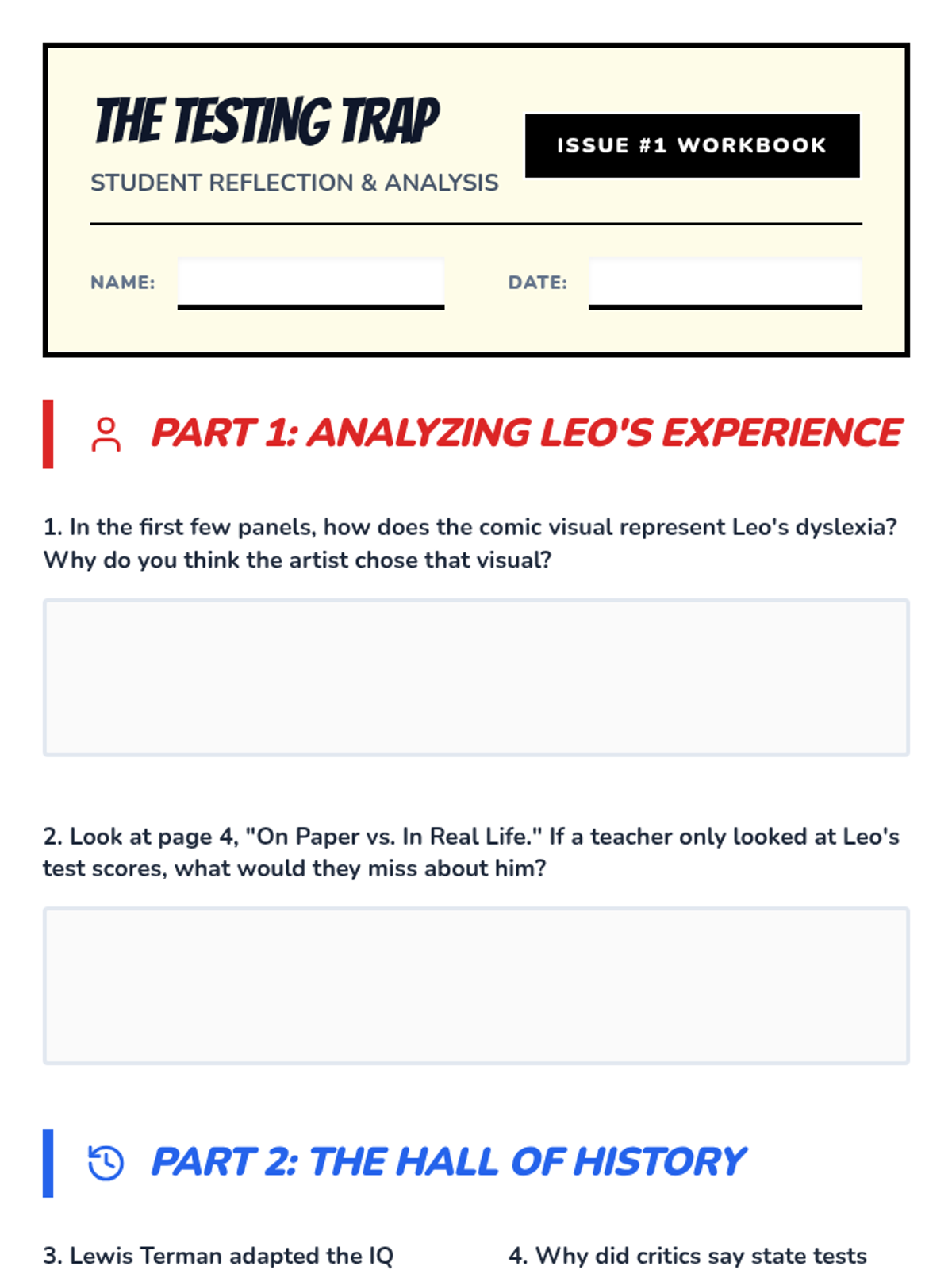
A student worksheet designed to accompany the Testing Trap Comic. It includes analysis questions about the comic's story, comprehension questions on the history of testing (Terman, bias, 1970s shifts), and a reflection section on interpersonal intelligence.
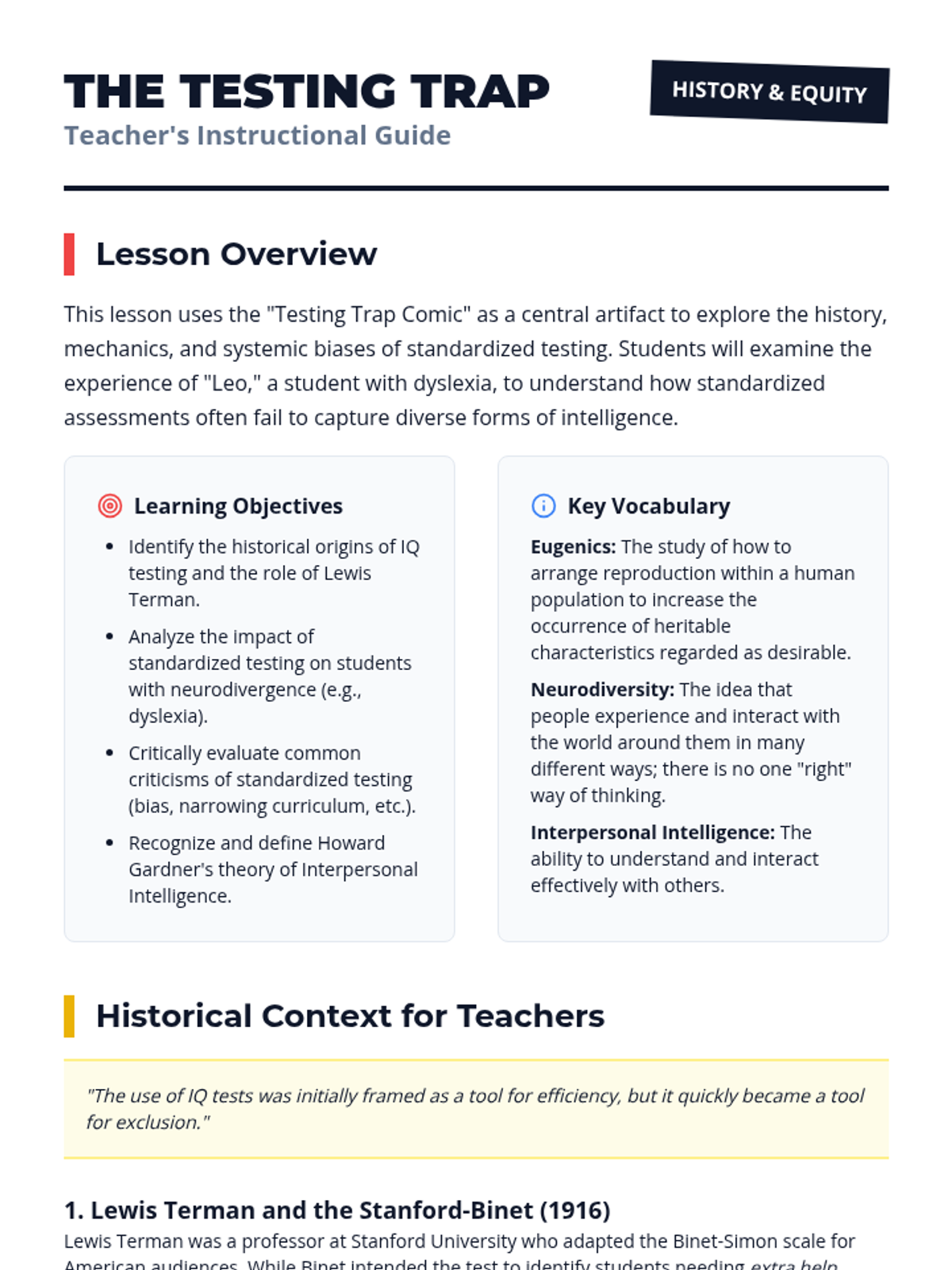
A comprehensive guide for teachers to facilitate a lesson using the Testing Trap Comic. It includes background on Lewis Terman, discussion prompts regarding neurodiversity and systemic bias, and differentiation strategies for students.
A multi-page retro-style comic book following Leo, a high-school student with dyslexia, as he navigates the high-pressure world of standardized testing. The comic integrates the history of testing (from Terman to the 1970s) and celebrates non-traditional intelligences.
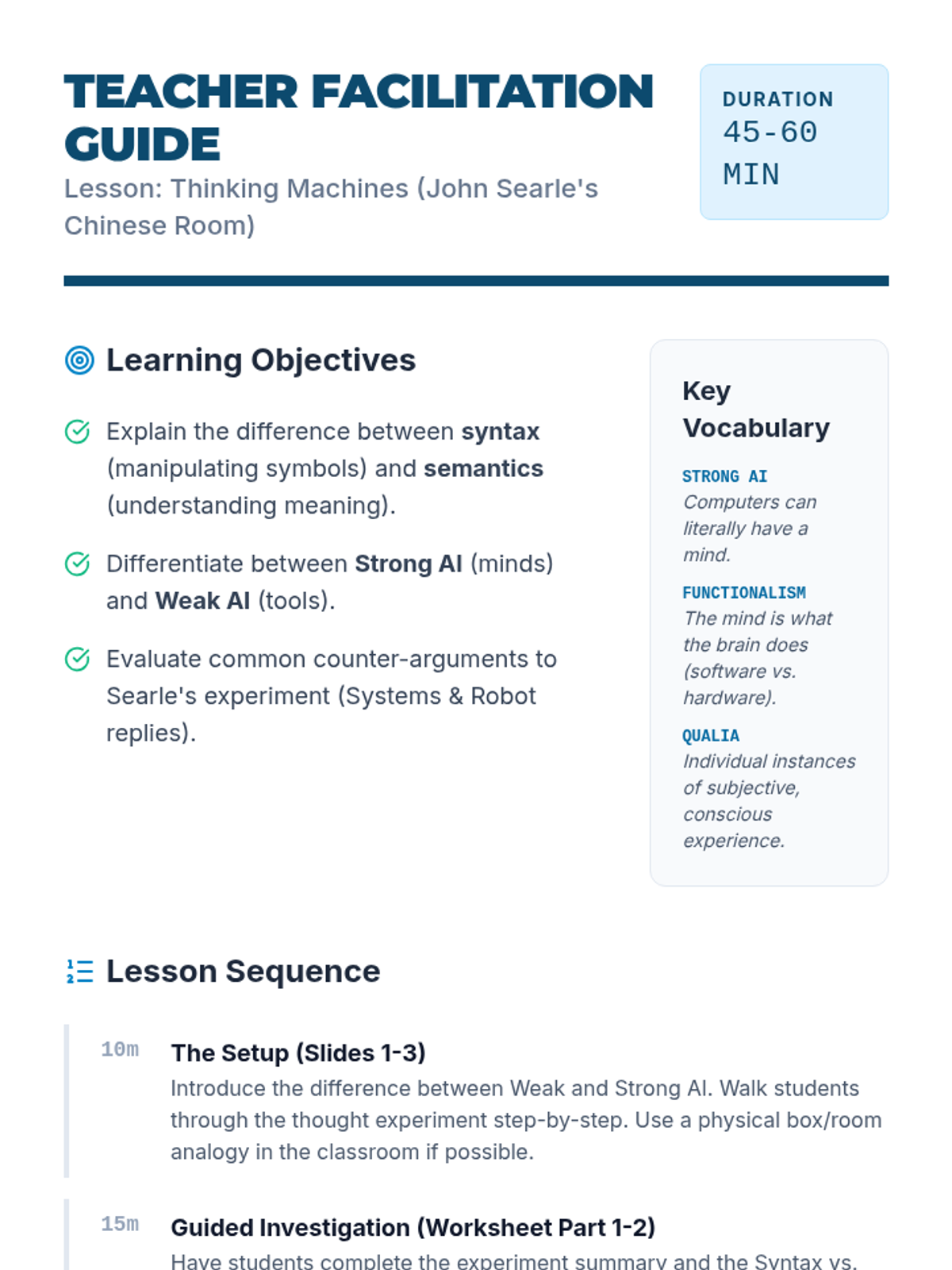
A comprehensive facilitator guide for the Thinking Machines lesson, including instructional sequences, discussion prompts, and an answer key.
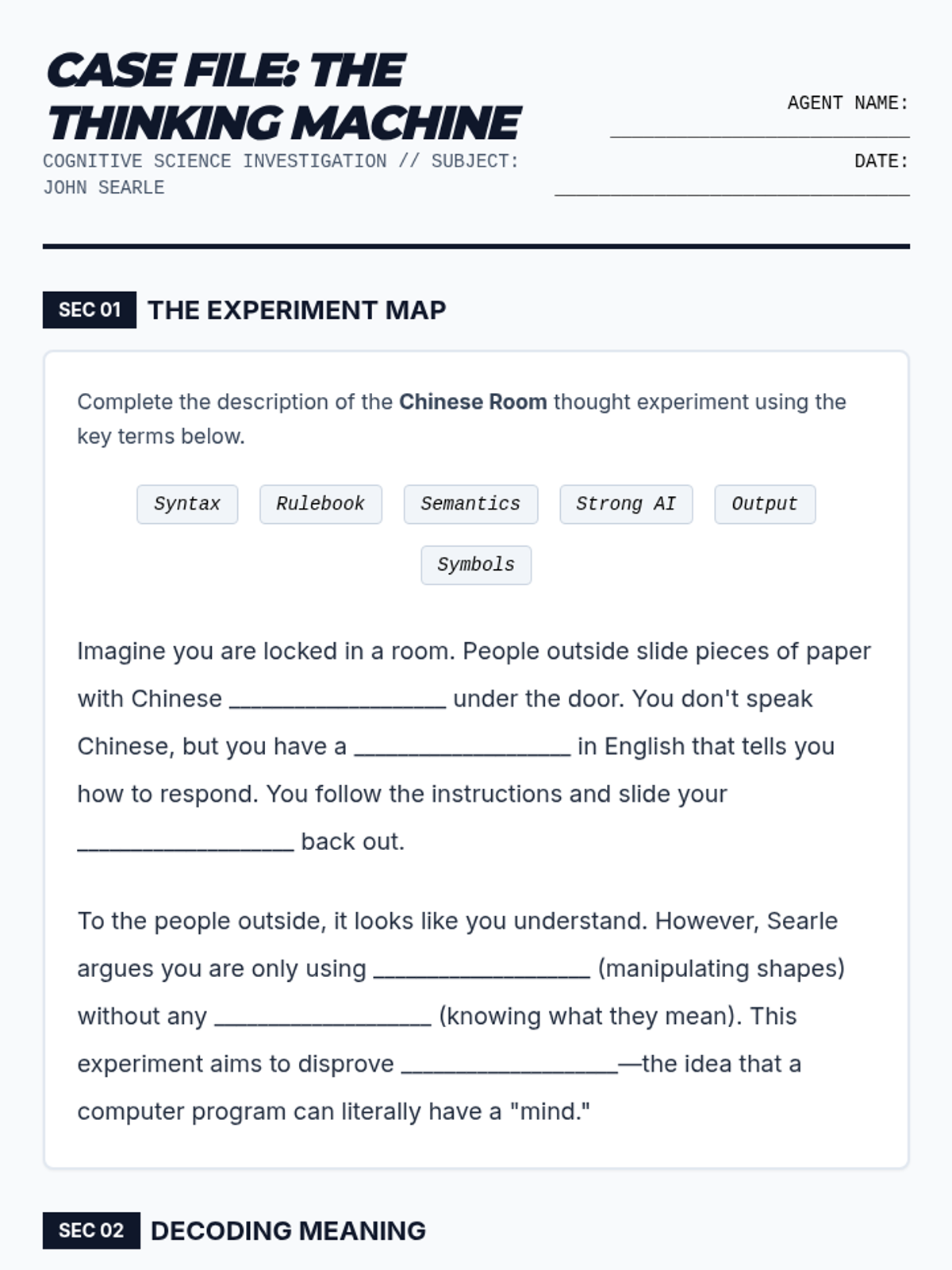
A student investigation worksheet structured as a "case file" to help students process the Chinese Room thought experiment and its counter-arguments.
A visual presentation exploring the Chinese Room thought experiment, comparing Strong vs. Weak AI and syntax vs. semantics.
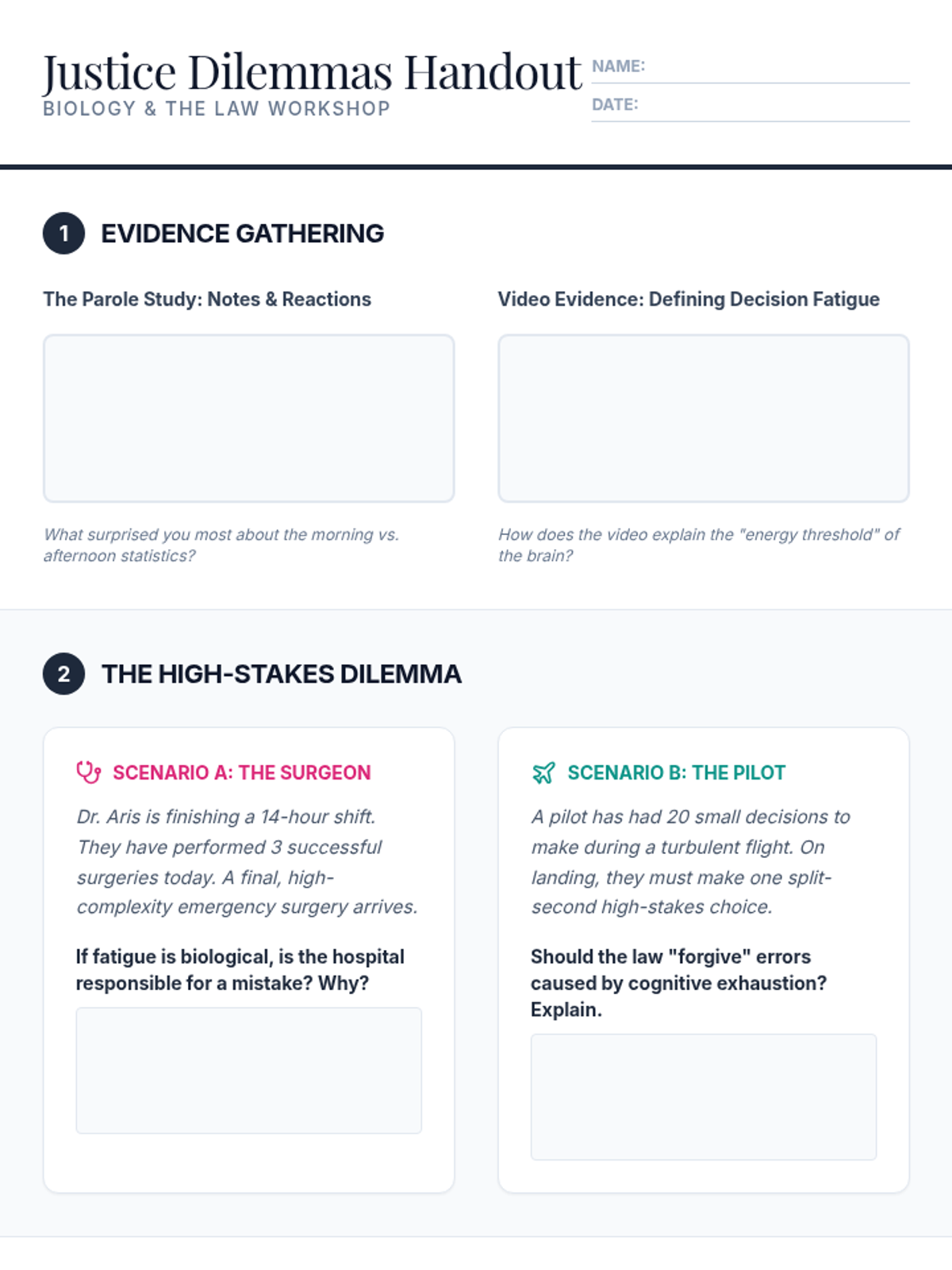
A structured student handout featuring observation areas, cross-disciplinary role-play scenarios about decision fatigue, and a formal policy recommendation template for court reform.
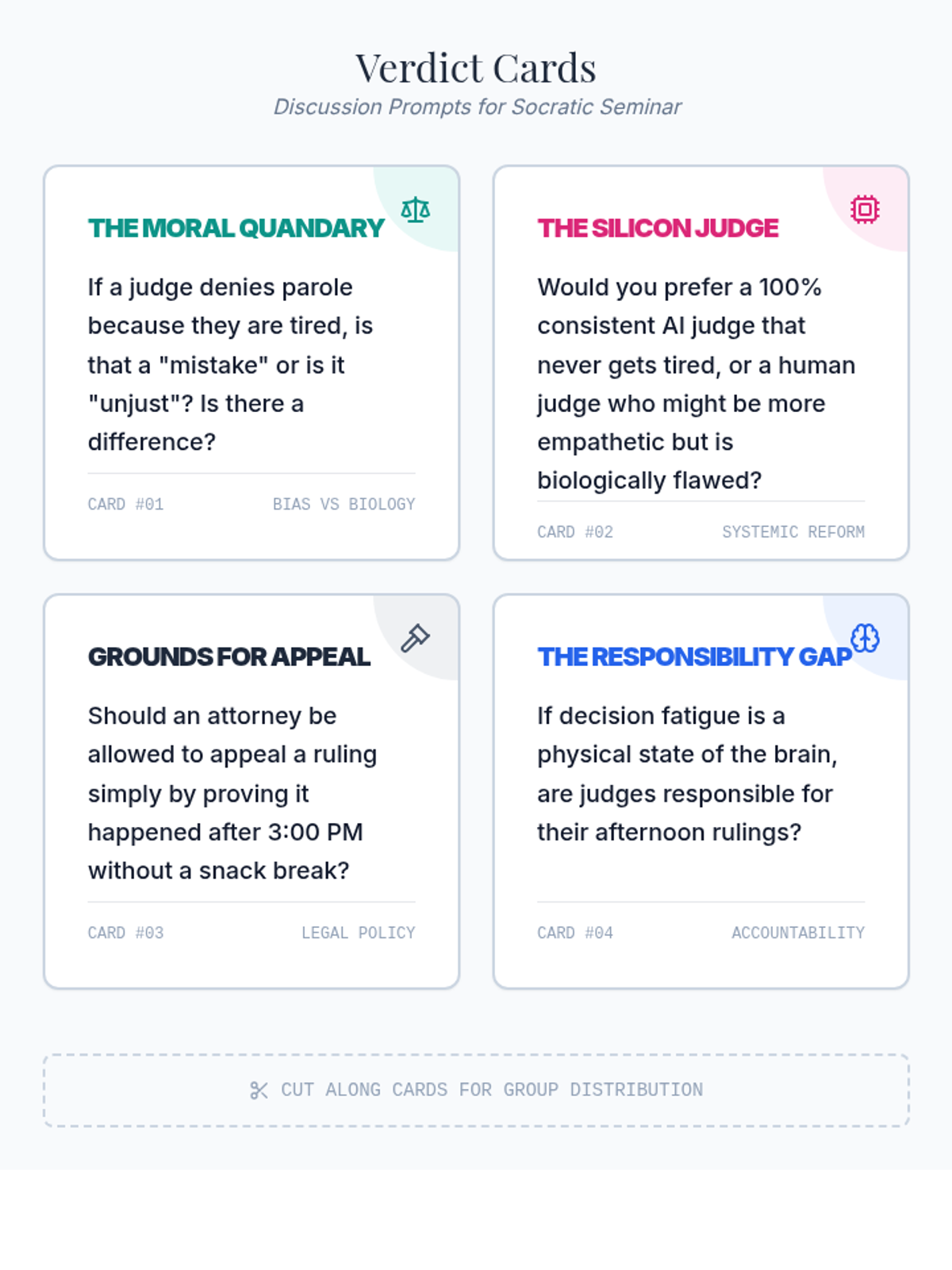
Set of four provocative discussion cards for a Socratic Seminar focused on the ethical and systemic implications of decision fatigue in the courtroom.
A visual presentation for the 'Justice and Biology' lesson, featuring the parole study case study, video embed, definitions of decision fatigue, and Socratic seminar prompts.
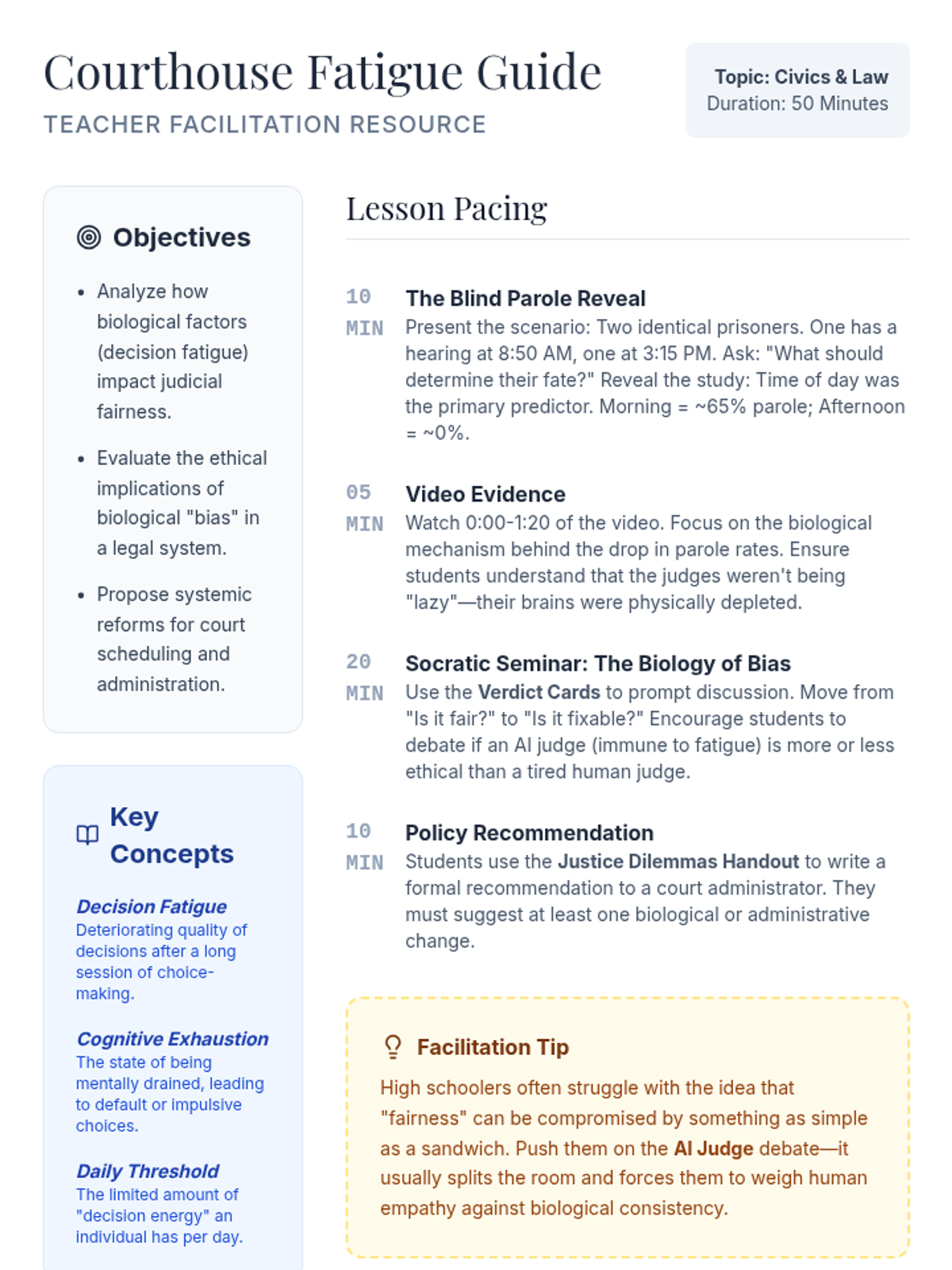
A comprehensive teacher facilitation guide for the 'Justice and Biology' lesson, including pacing, key concept definitions, discussion extensions, and a policy recommendation rubric.
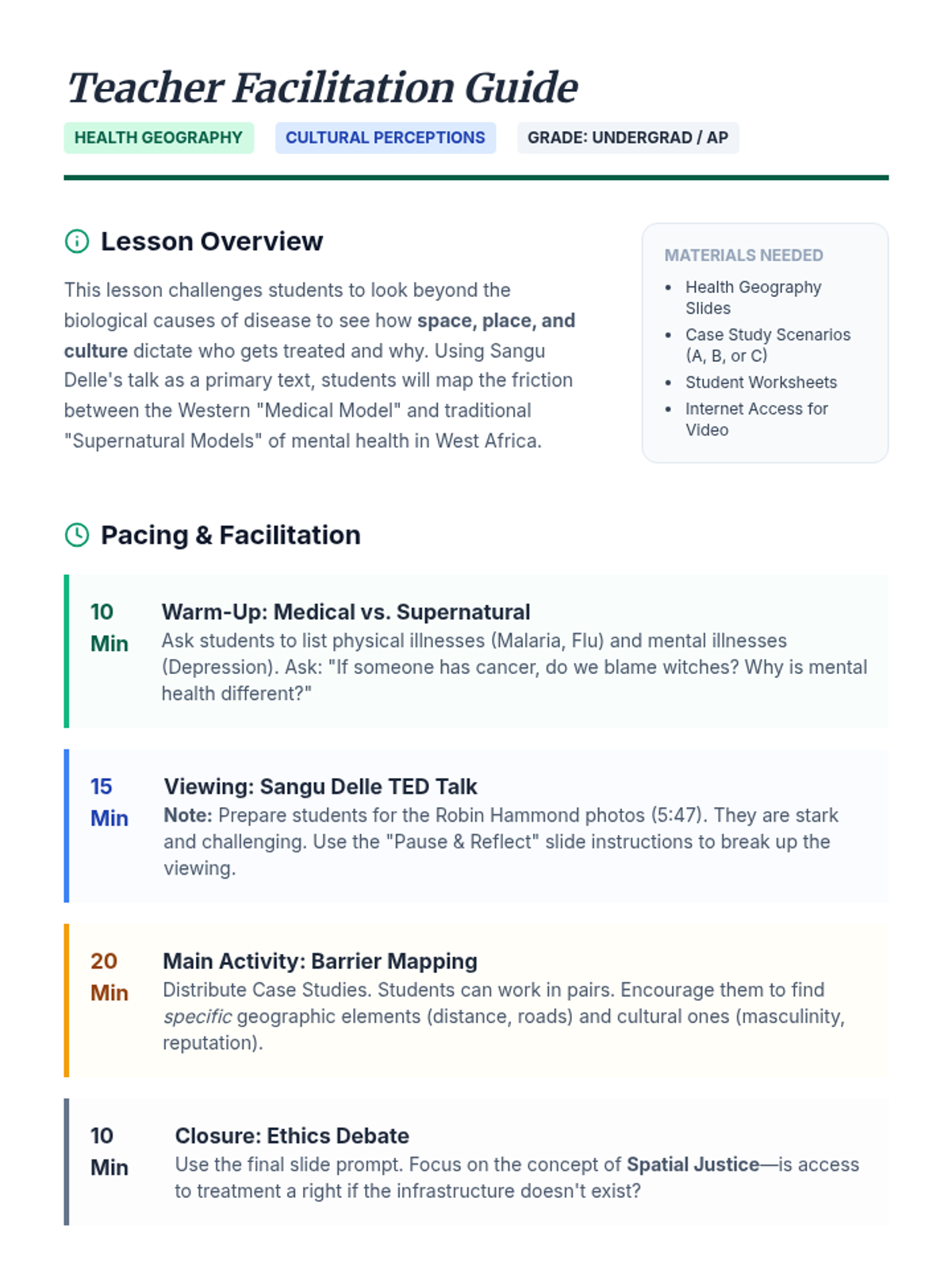
A detailed guide for teachers to facilitate the Health Geography lesson, including pacing, expected student responses for the barrier map, and deep-dive discussion questions.
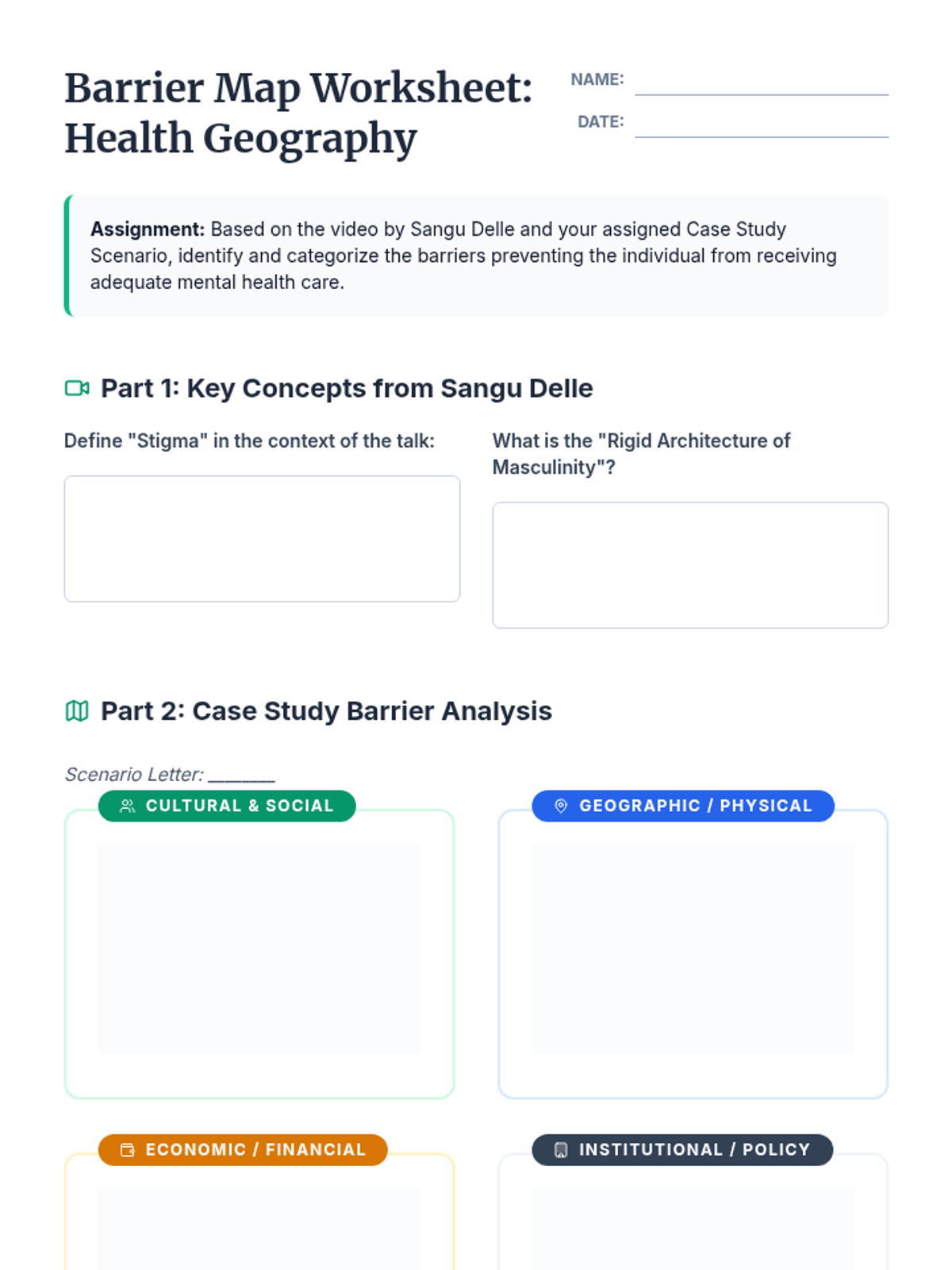
A comprehensive student worksheet for mapping barriers to healthcare access based on case studies and Sangu Delle's TED Talk. Includes conceptual and reflective sections.
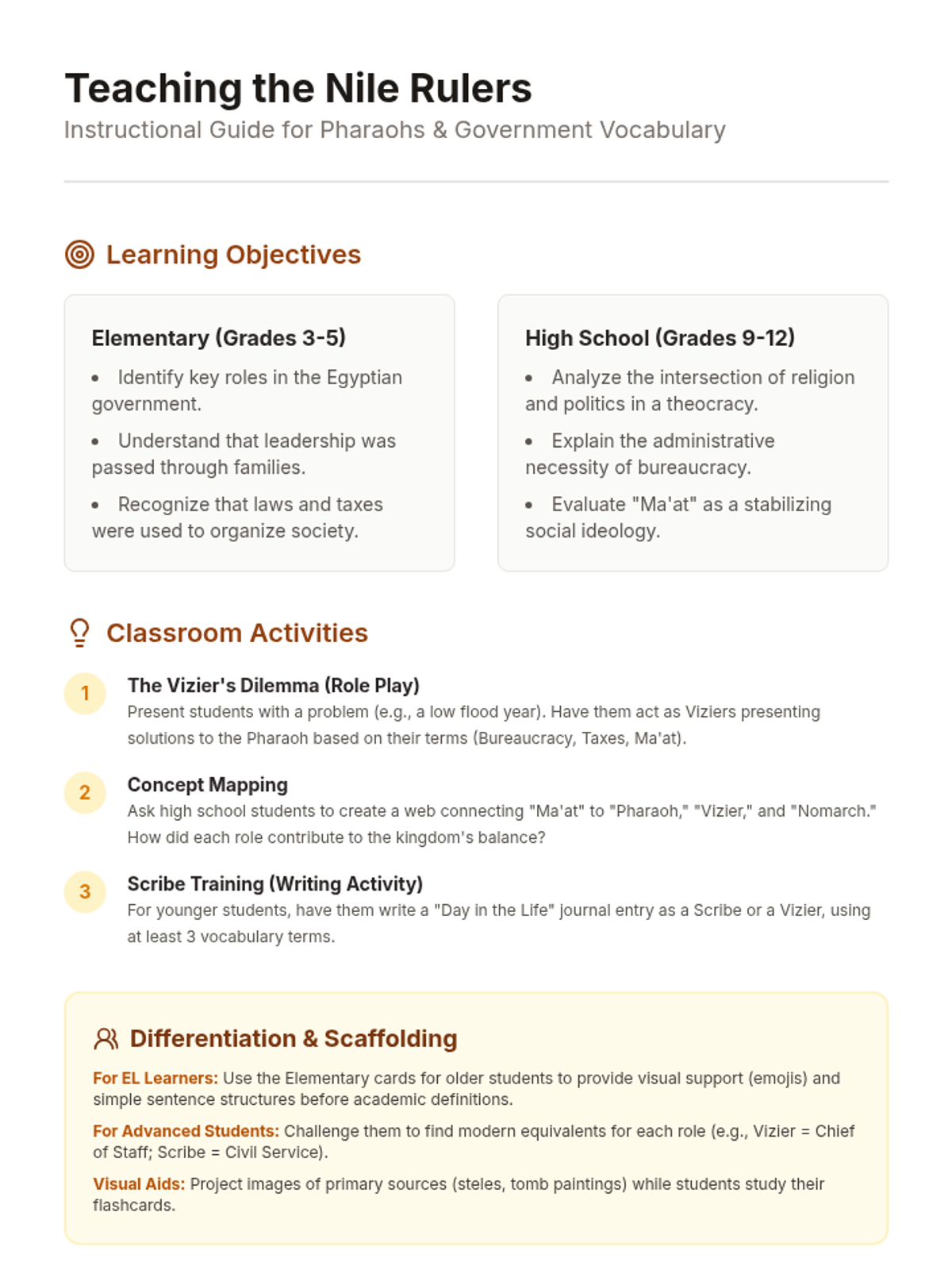
A teacher's guide providing instructional strategies, activities, and differentiation tips for using the Nile Rulers vocabulary flashcards in both elementary and high school classrooms.
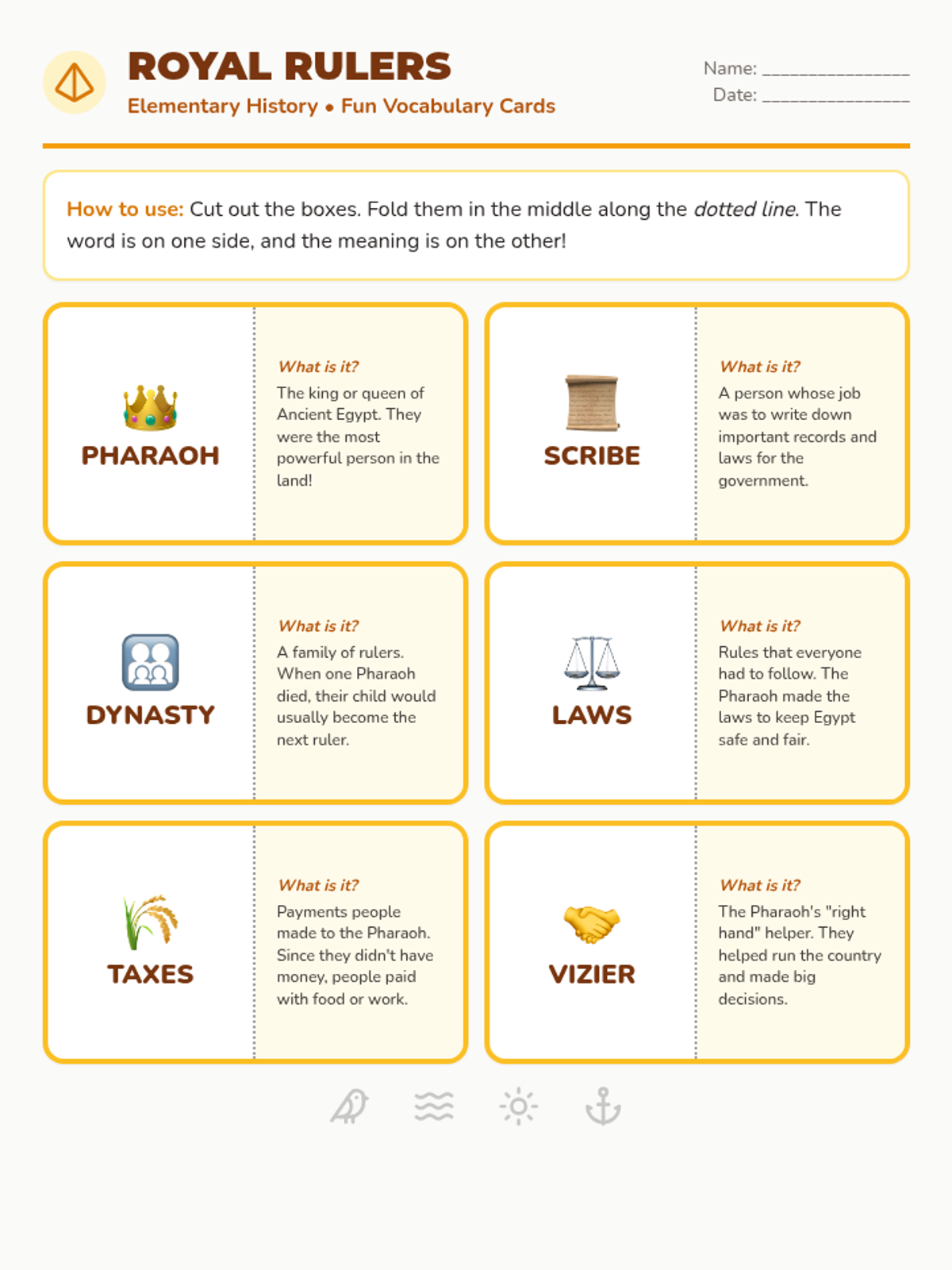
Elementary-level vocabulary flashcards for Ancient Egyptian government, using simple definitions and emojis to explain roles like the Pharaoh, Scribes, and Viziers. Added fold guides and optimized layout.
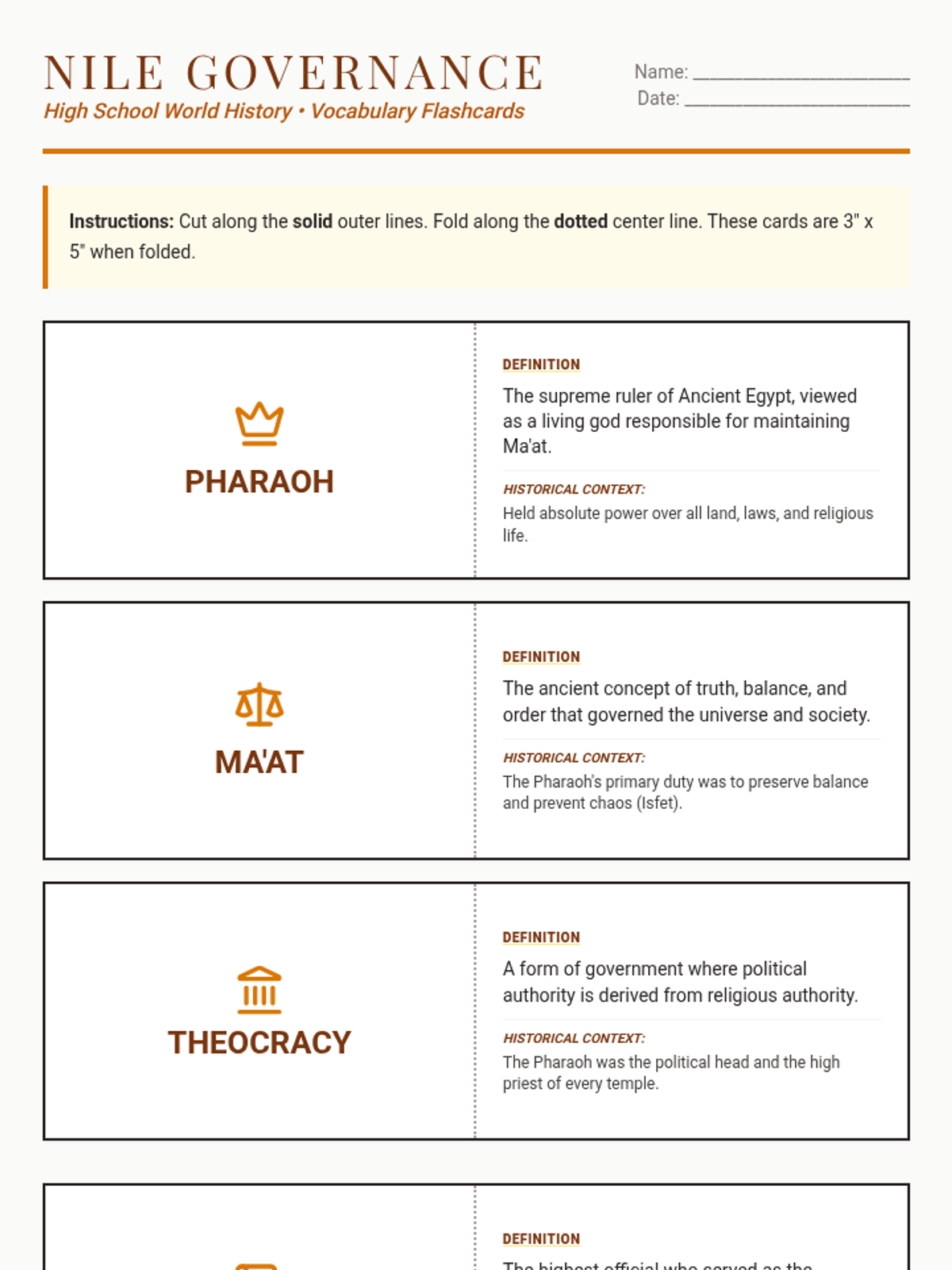
High school level vocabulary flashcards for Ancient Egyptian government, focusing on complex political and religious concepts like Ma'at, Theocracy, and Bureaucracy. Redesigned layout for improved readability and printing. Added fold guides and optimized layout.
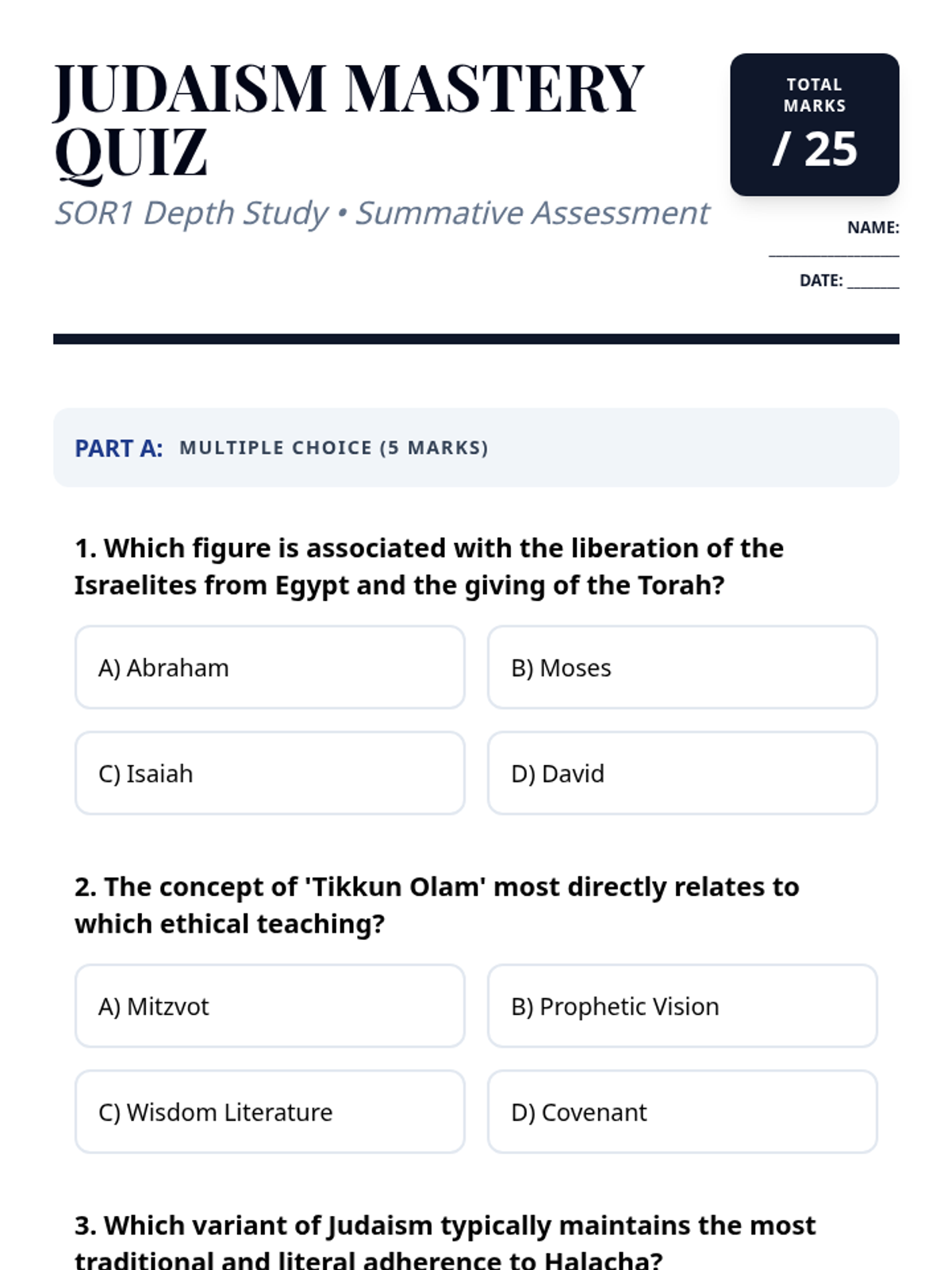
A summative assessment task covering the core outcomes of the Judaism depth study, including multiple-choice and short-answer questions. Revised for page breaks and response depth.
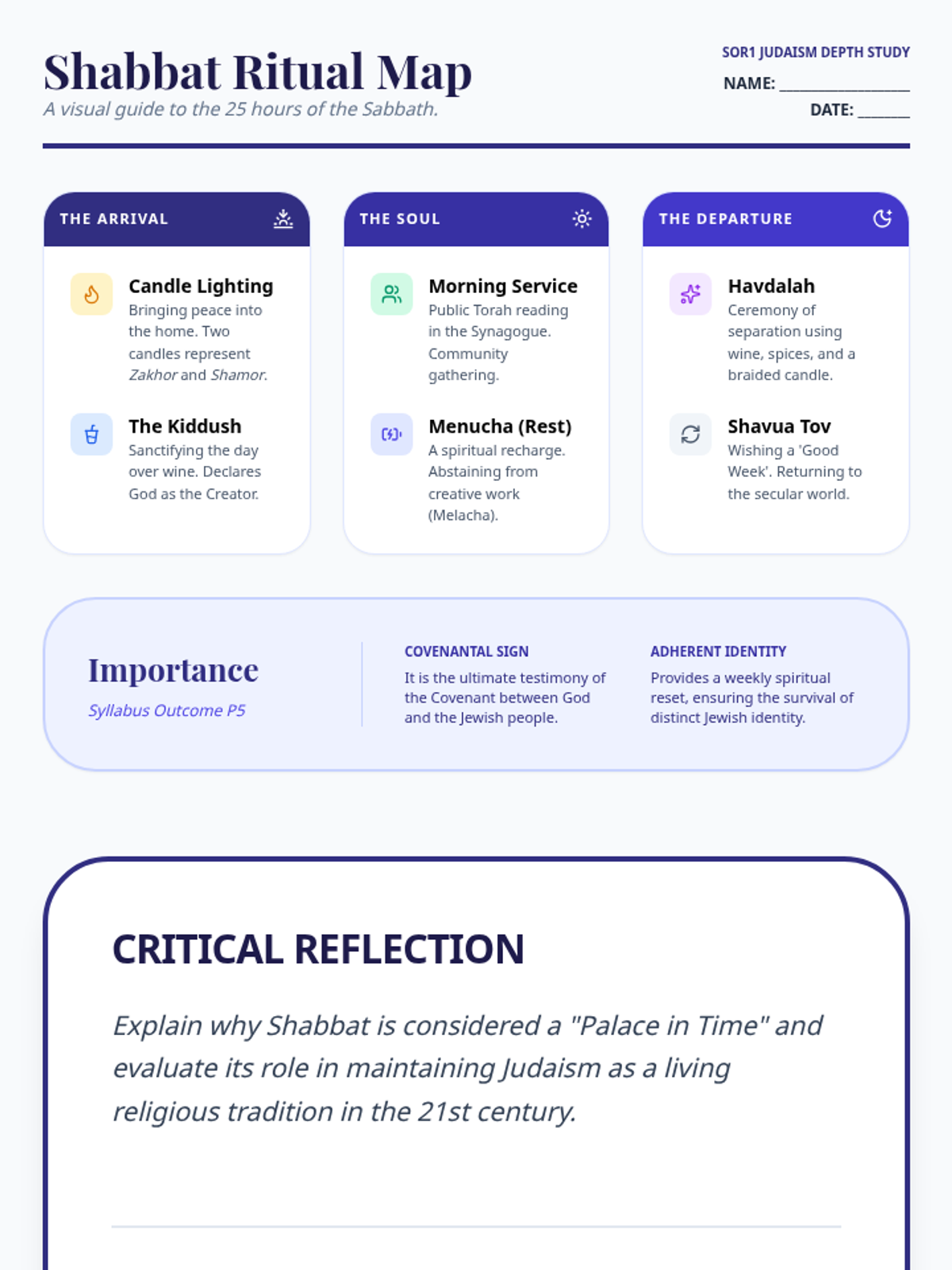
A visual infographic handout summarizing the rituals and significance of Shabbat for student reference and study. Revised for page breaks and reflection space.
A slide deck investigating the significance of Shabbat as the primary ritual expression of Jewish life, covering its meaning, rituals, and prohibitions.
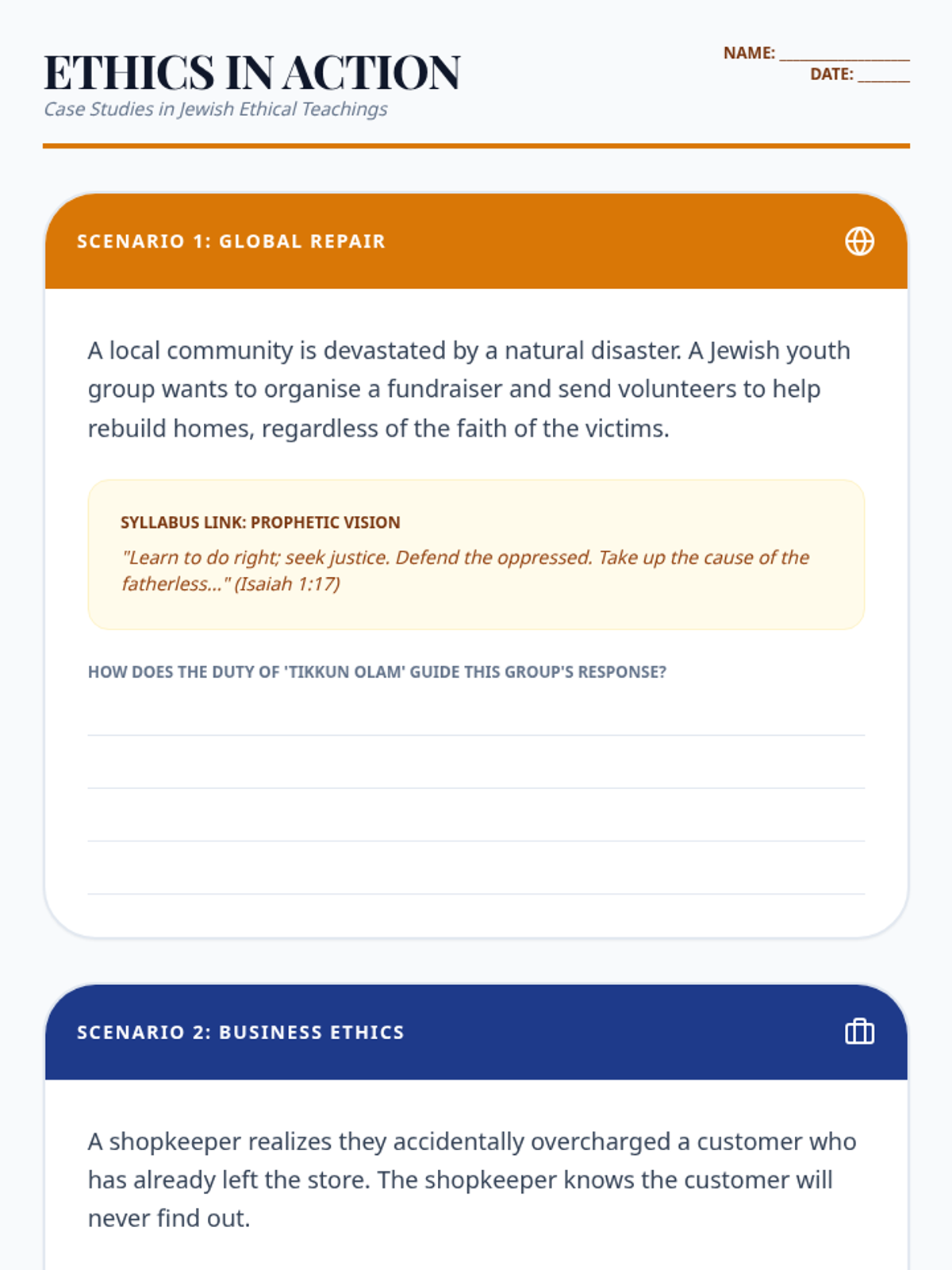
A student activity involving modern scenarios where Jewish ethical teachings (Mitzvot, Prophetic Vision, Proverbs) must be applied to solve dilemmas. Revised for page breaks and writing space.
A slide deck covering the core ethical teachings of Judaism, including the 613 Mitzvot, the Prophetic Vision (Tikkun Olam), and the Book of Proverbs.
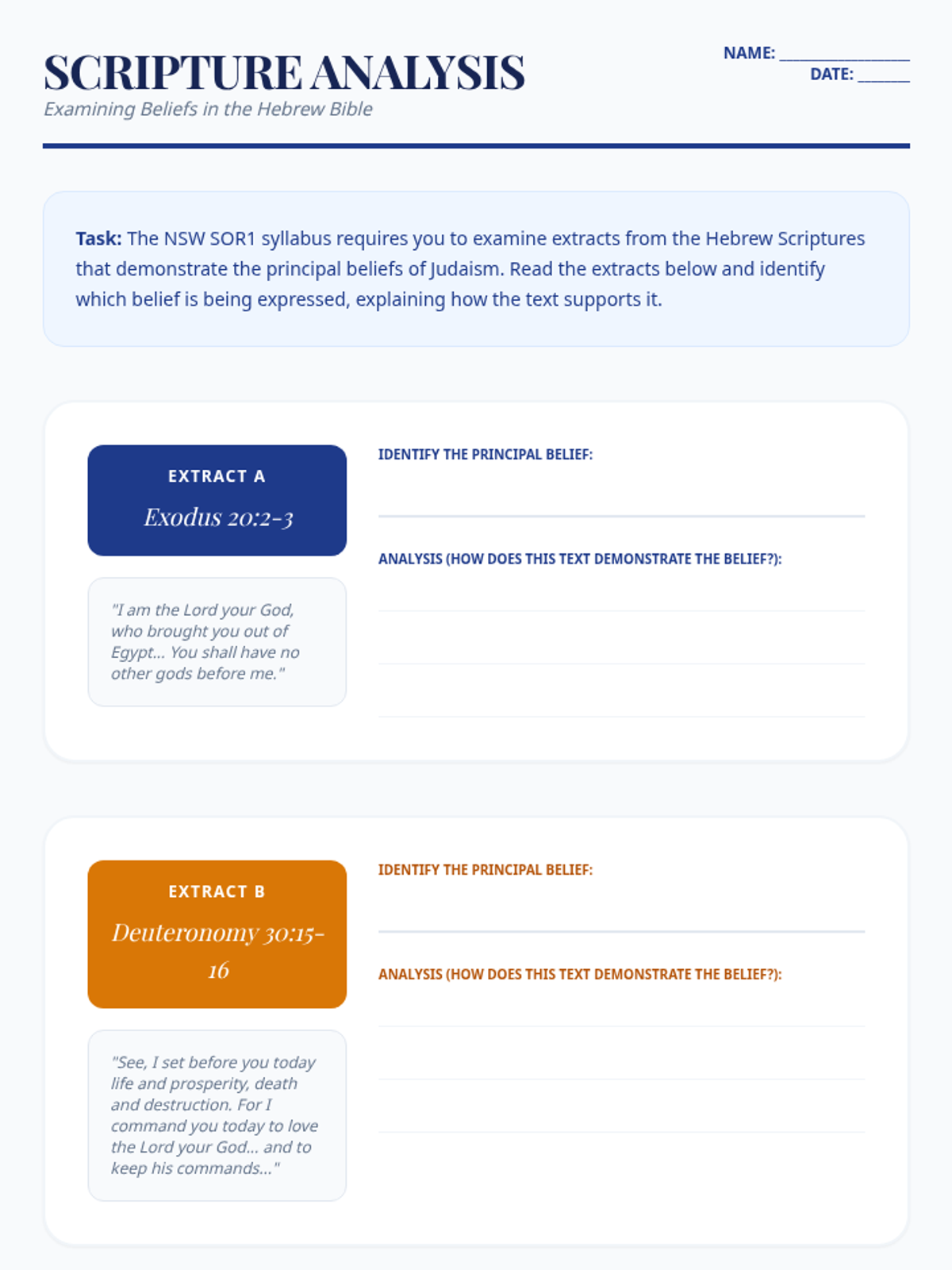
A student activity focused on examining extracts from the Hebrew Scriptures to identify and analyze principal beliefs (Monotheism, Moral Law, Covenant). Revised with synthesis lines.
A slide deck exploring the principal beliefs of Judaism (Monotheism, Moral Law, Covenant) and the role of the Tanakh and Talmud as sacred texts.
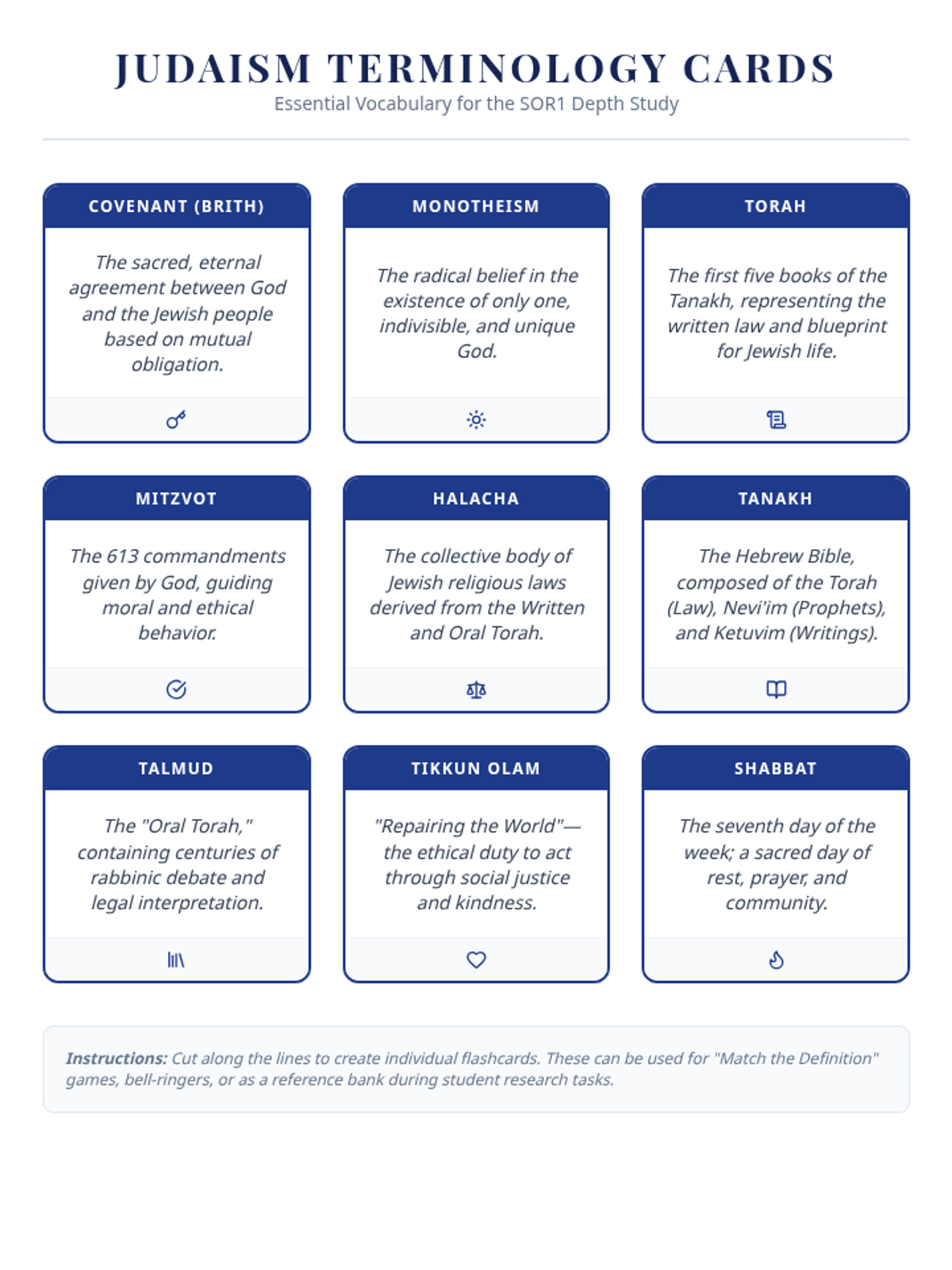
A set of nine vocabulary flashcards featuring essential terminology for the SOR1 Judaism Depth Study, complete with definitions and symbolic icons.
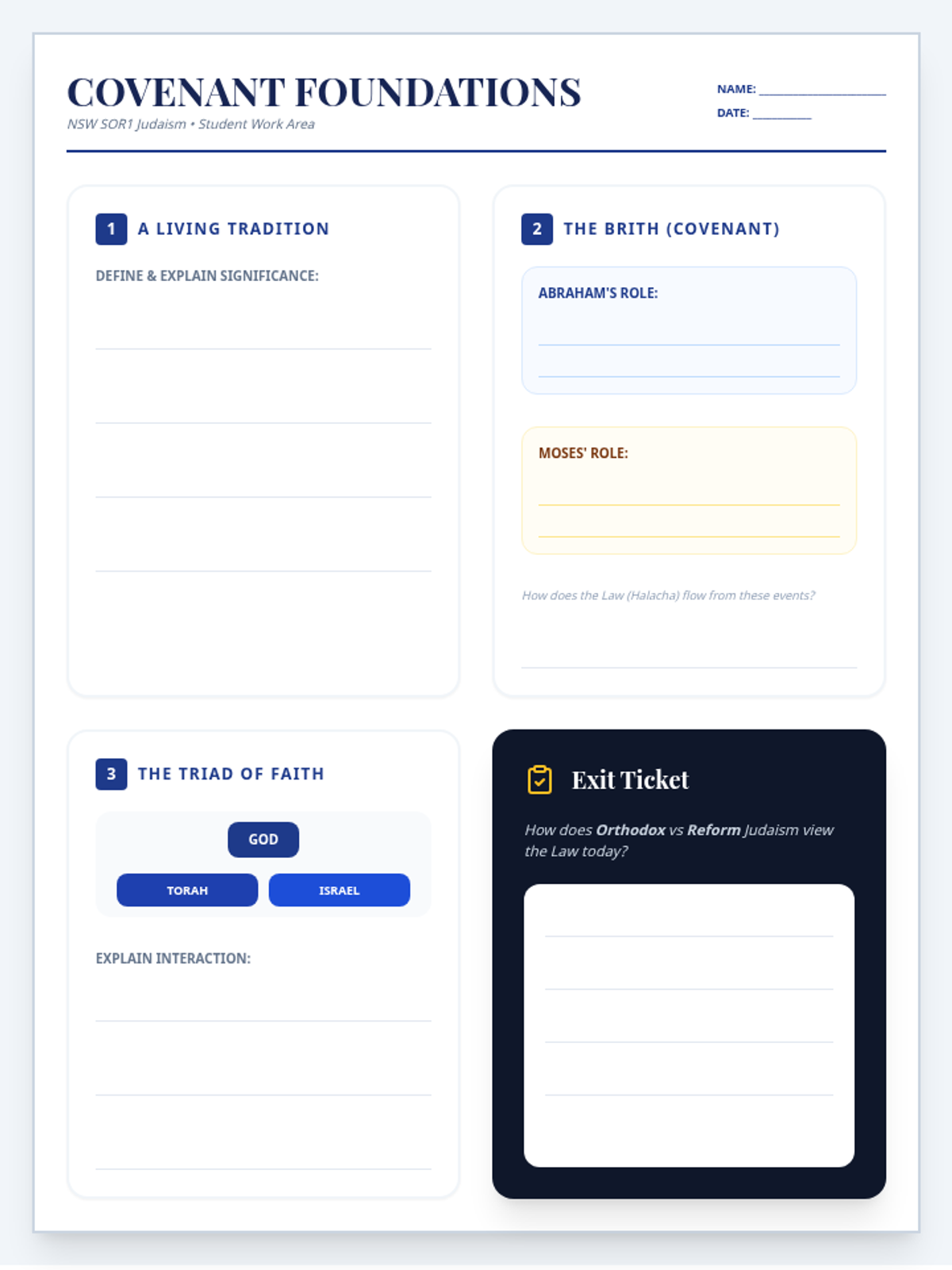
A guided student worksheet to accompany the introductory lesson on Judaism, featuring sections on the Living Tradition, the Covenant phases, and the Pillars of Judaism. Revised for usability and clarity.
A slide deck for the introductory lesson on Judaism, covering the concept of a living religious tradition, the Covenant, the roles of Abraham and Moses, and the major modern variants.
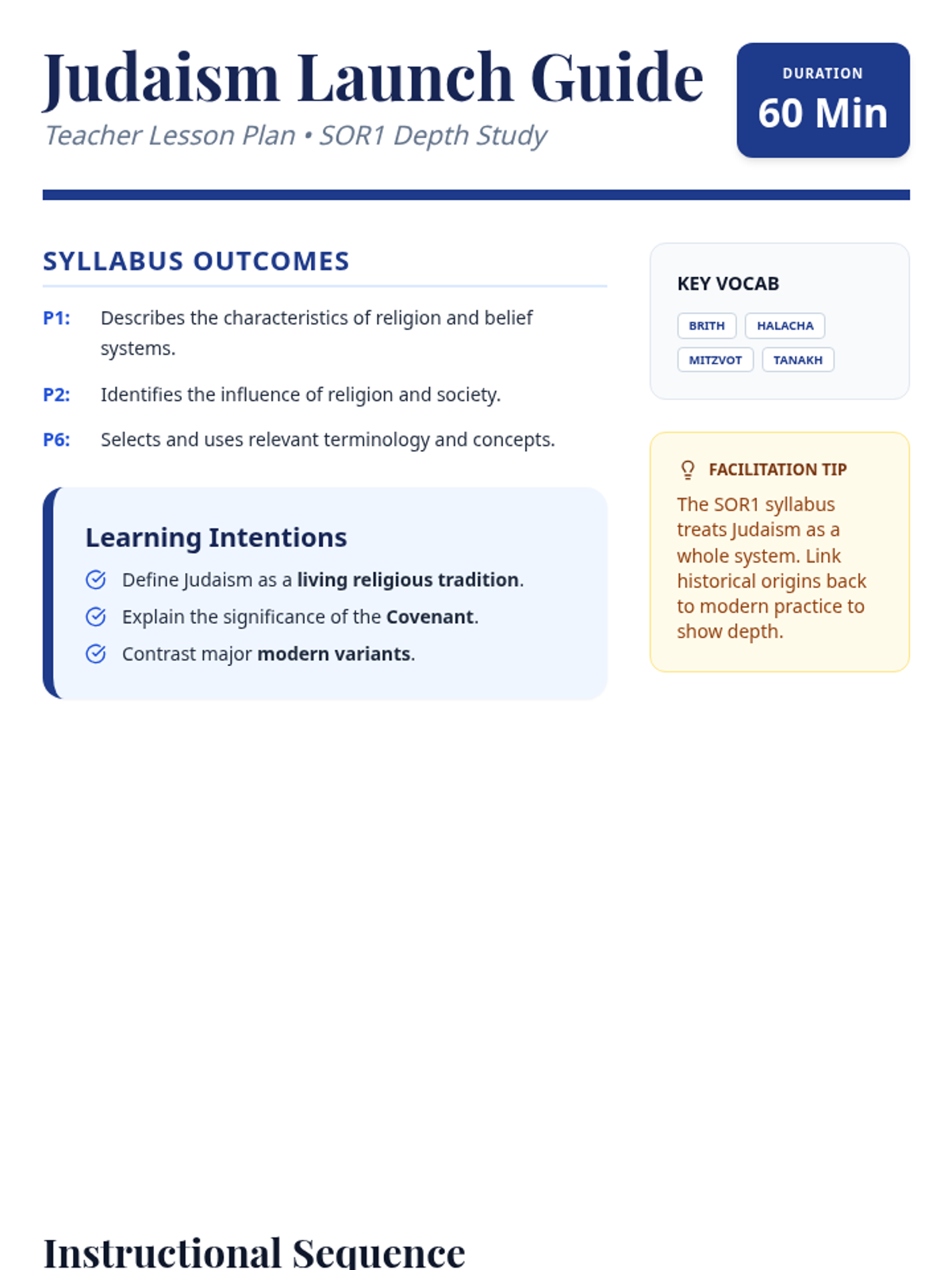
A comprehensive teacher guide for the introductory lesson on Judaism, including syllabus links, learning intentions, and a detailed 60-minute instructional sequence. Revised for better layout and icon rendering.
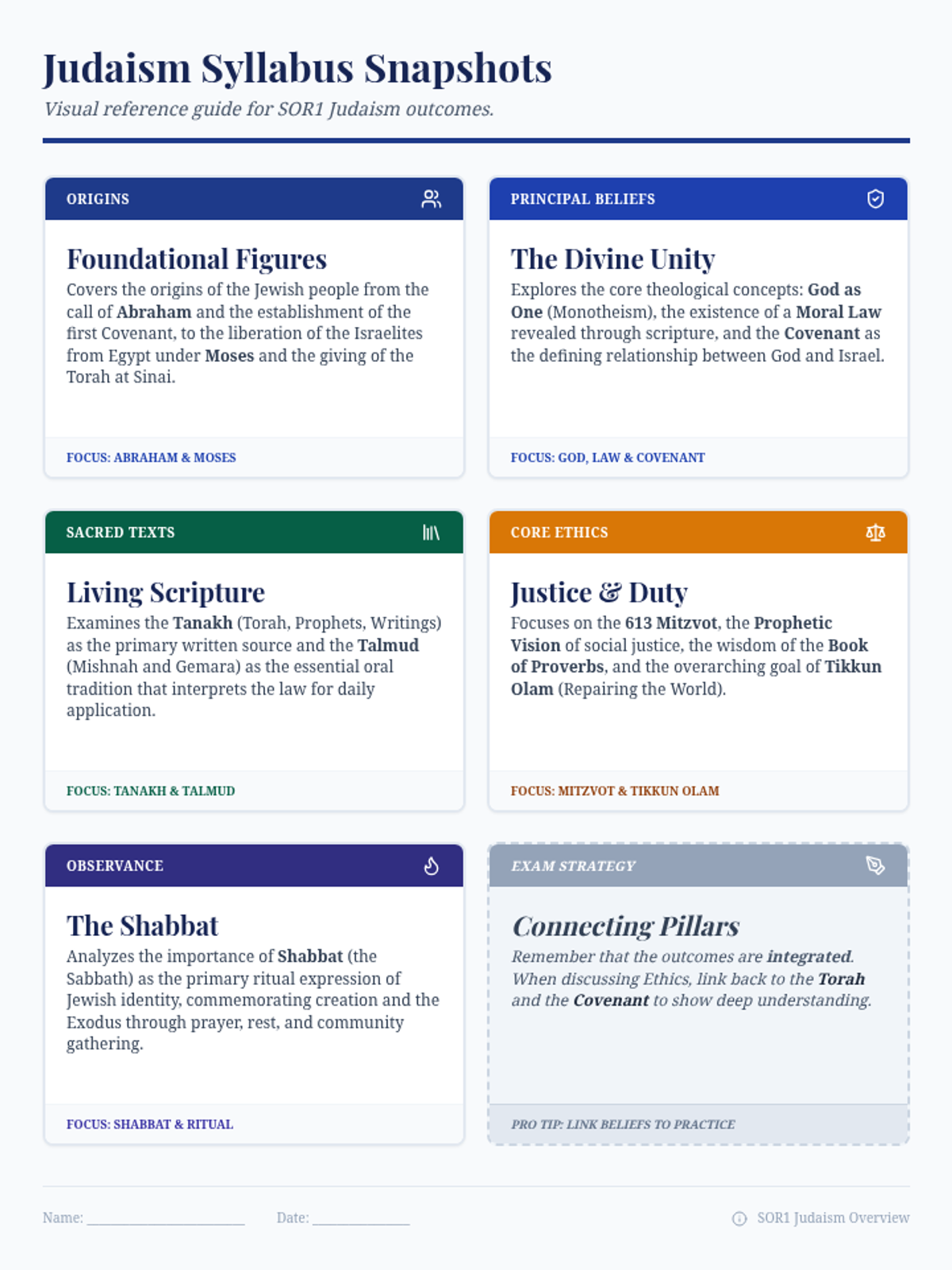
A printable handout featuring six "snapshot cards" that summarize the primary syllabus outcomes for Judaism. Revised to fit onto a single page and ensure correct icon rendering.
A series of visually striking slides summarizing the core syllabus outcomes for Judaism in Studies of Religion 1, including Origins, Beliefs, Sacred Texts, Ethics, and Observance. Revised to ensure correct icon rendering and high visual contrast.
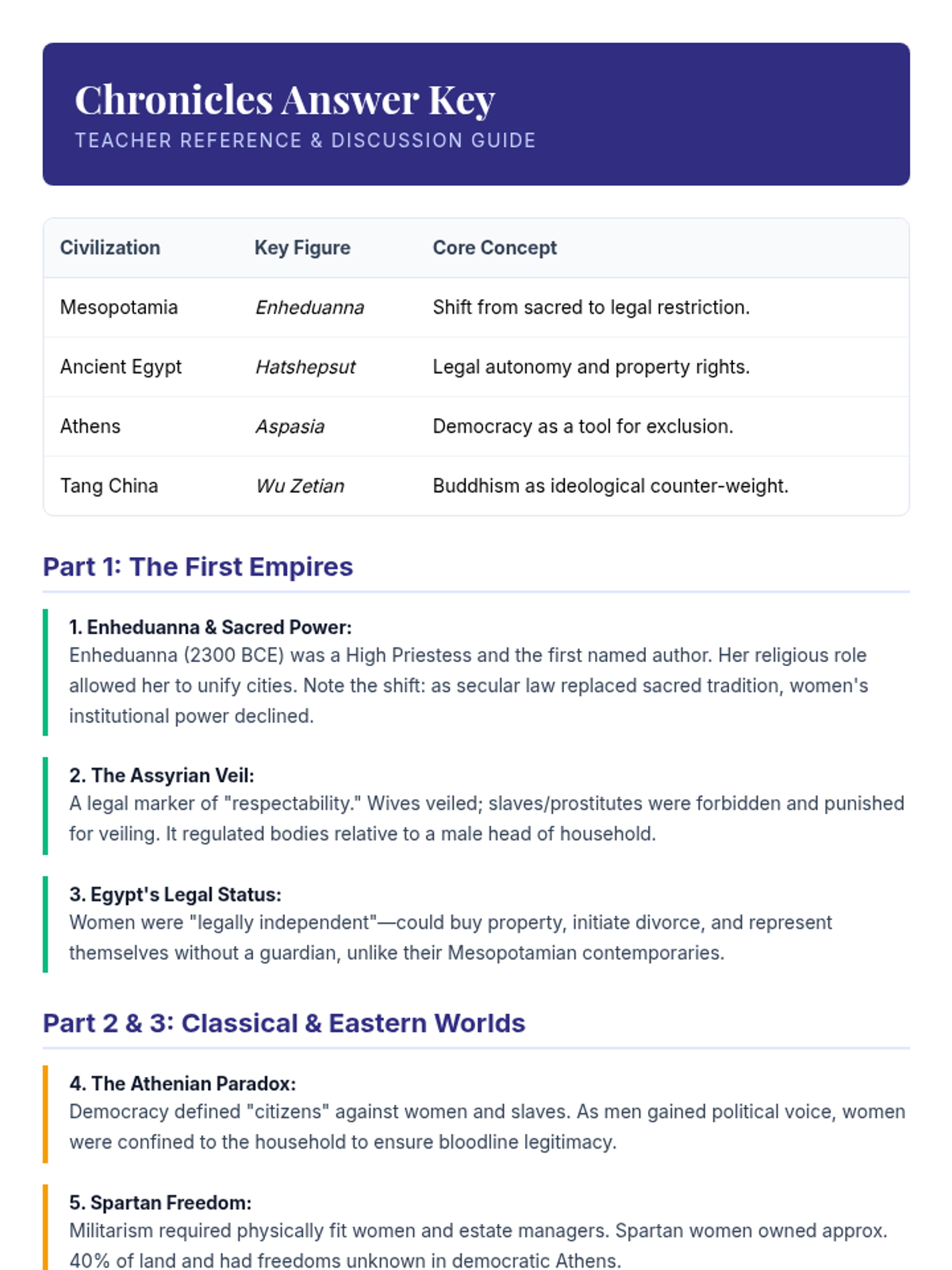
An answer key and teacher discussion guide for the Ascent of Women reflection booklet. Corrected numbering errors and page breaks for better readability. Tightened layout to fit on fewer pages.
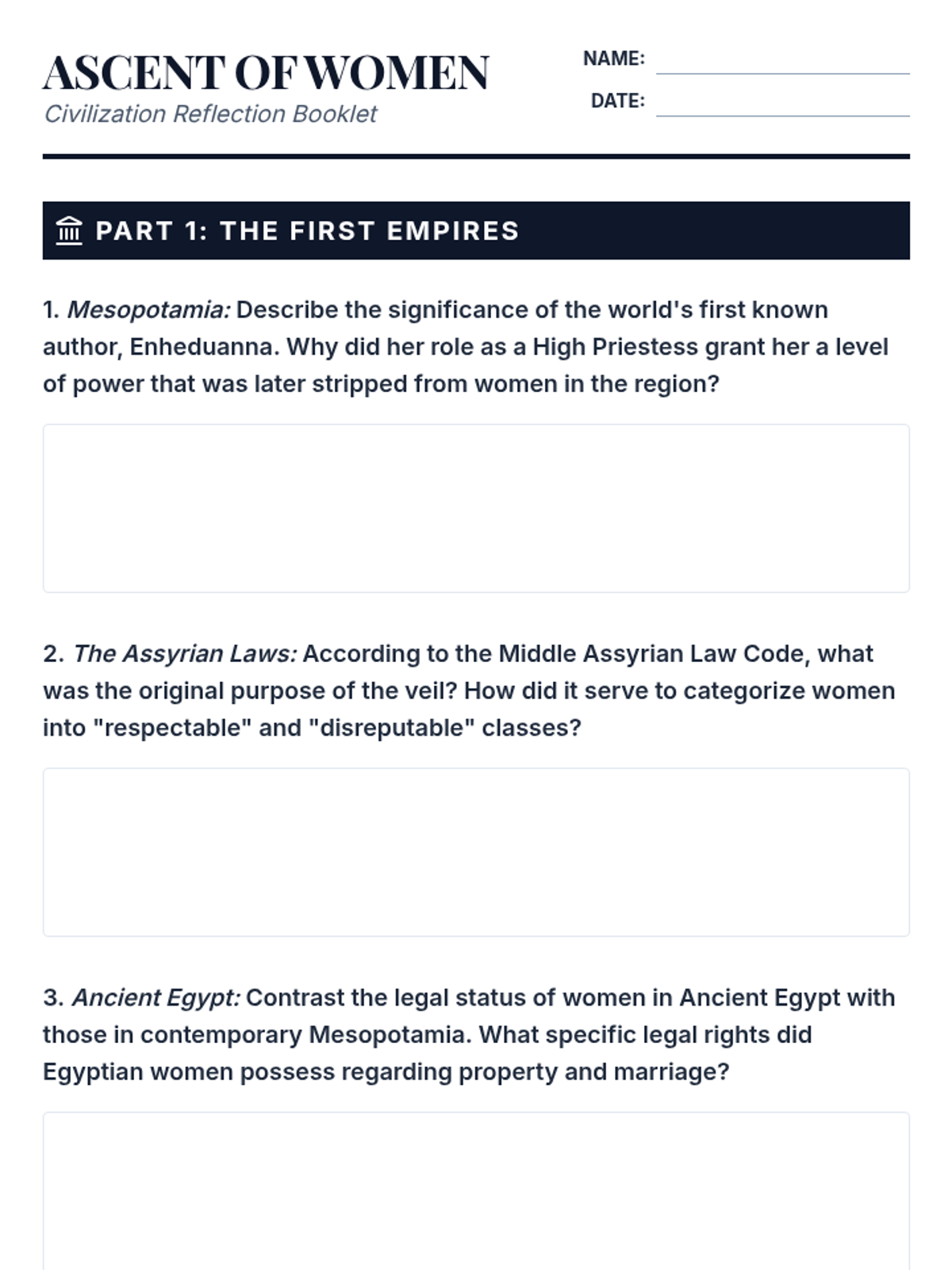
A printable reflection booklet for students with short-answer questions covering the civilizations discussed in the Ascent of Women series. Corrected page breaks and layout spacing.
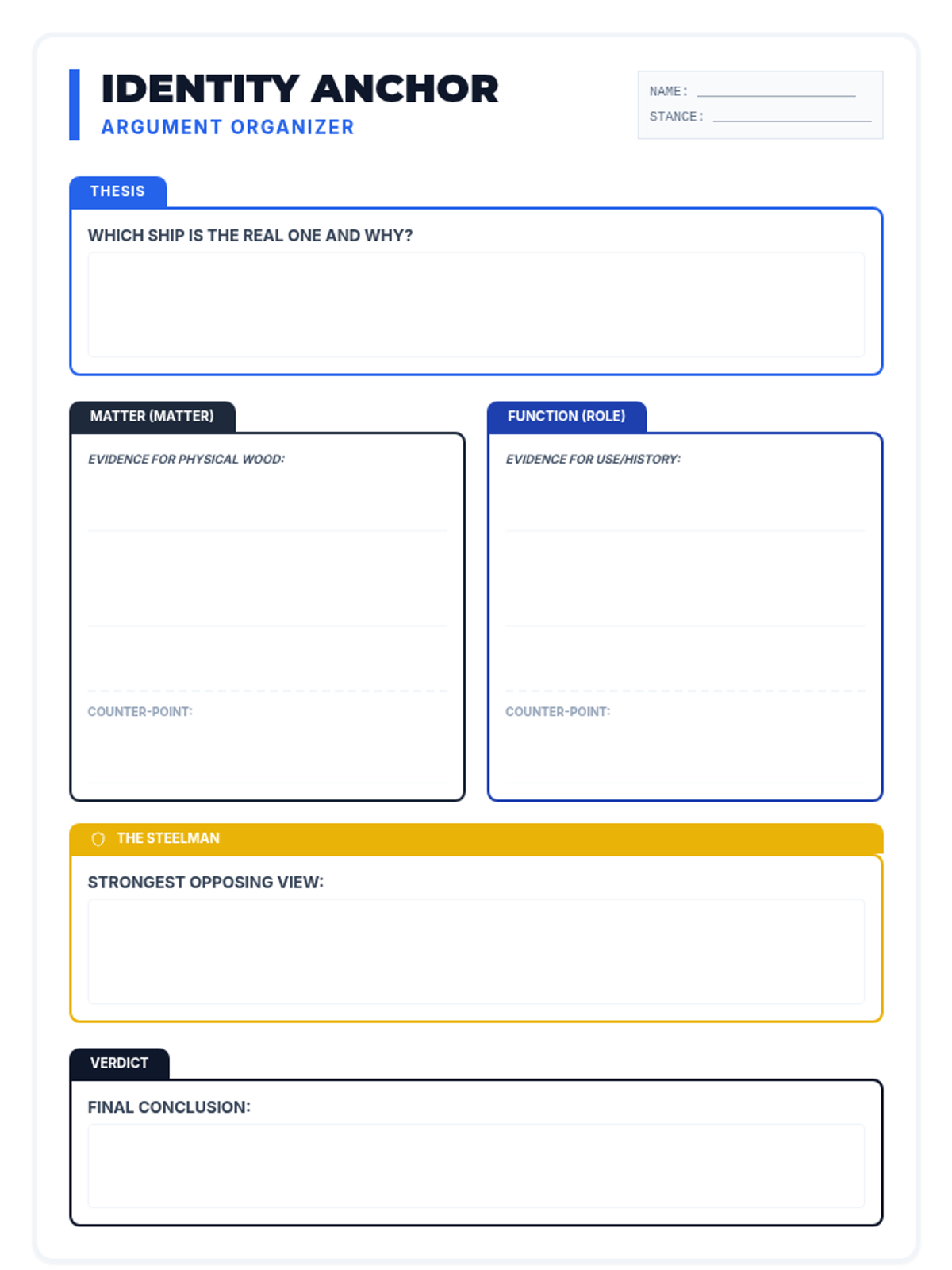
A graphic organizer for structuring philosophical arguments, featuring dedicated spaces for core claims, supporting evidence, counter-points, and steelmanning.
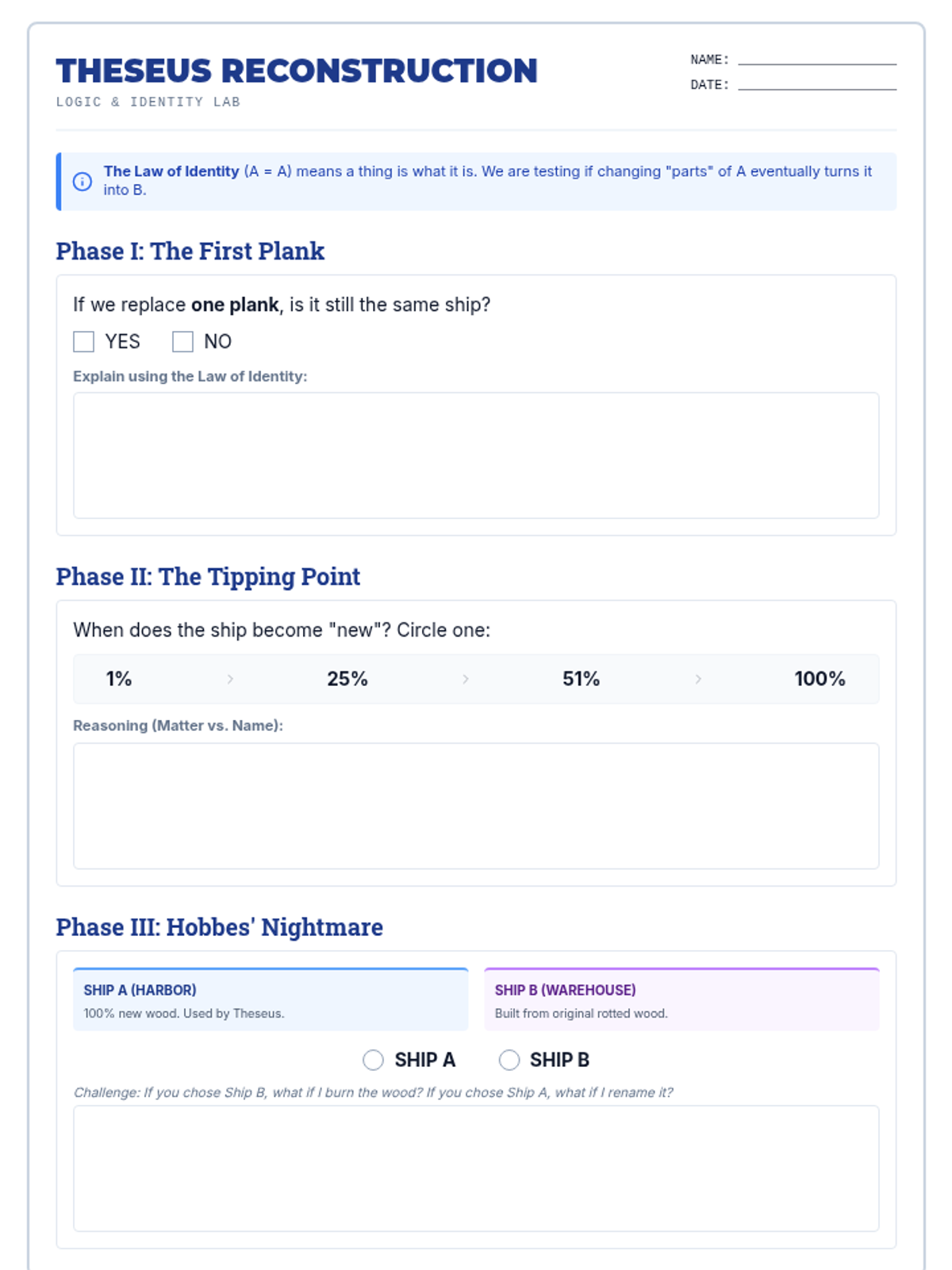
A logic worksheet exploring the Ship of Theseus through progressive scenarios, ranging from simple part replacement to the complex "Two Ships" paradox.
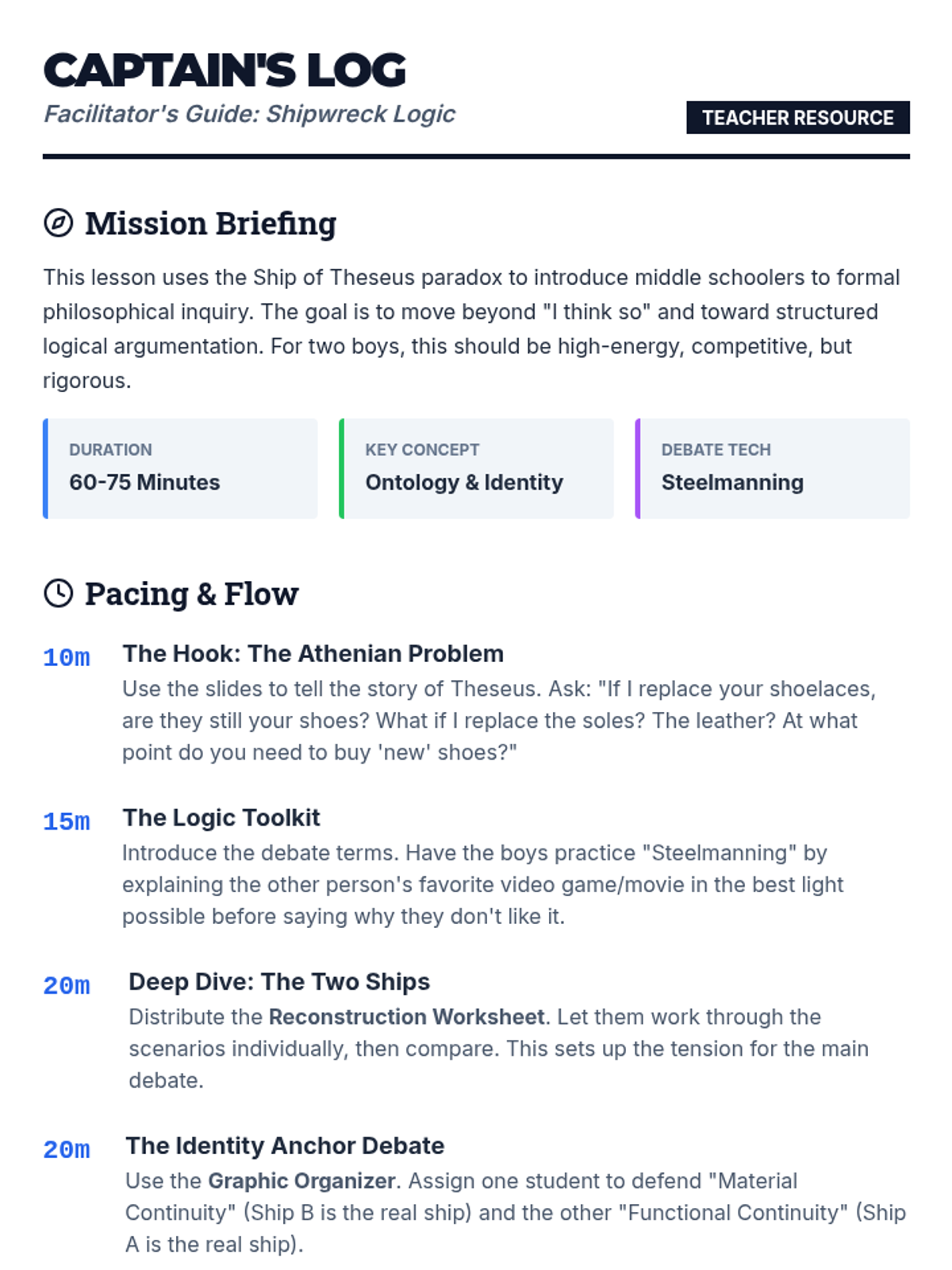
A teacher's guide for facilitating the Ship of Theseus lesson, featuring pacing suggestions, Socratic questions, and historical context.
Visual presentation for a lesson on the Ship of Theseus paradox, covering the historical legend, the philosophical question, and key logic terms for debate.
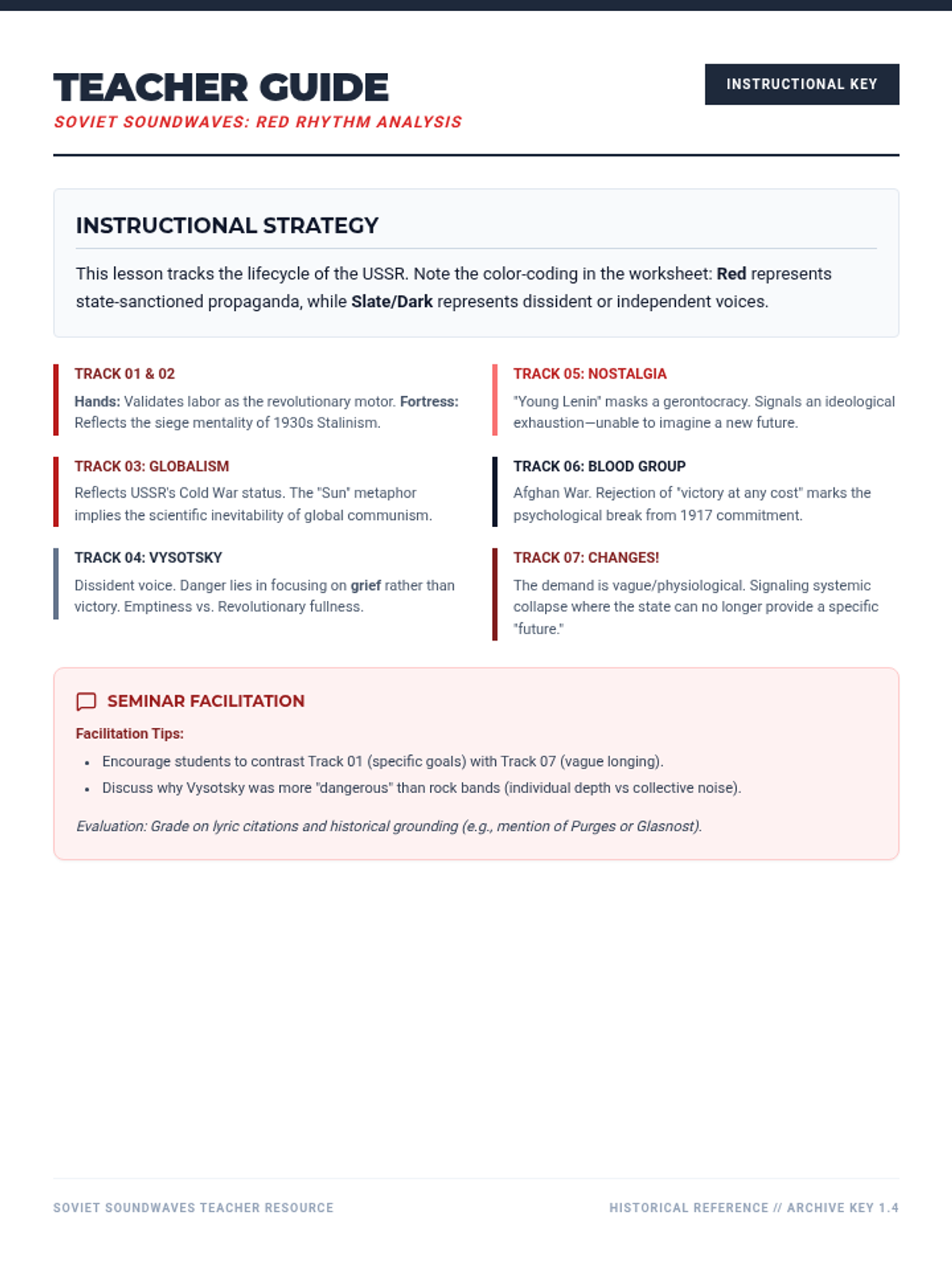
A teacher guide providing historical context, key analysis points, and expected student responses for the Red Rhythm lyric worksheet. It explores the transition from state-led collective ideology to individualist and dissident sentiments.
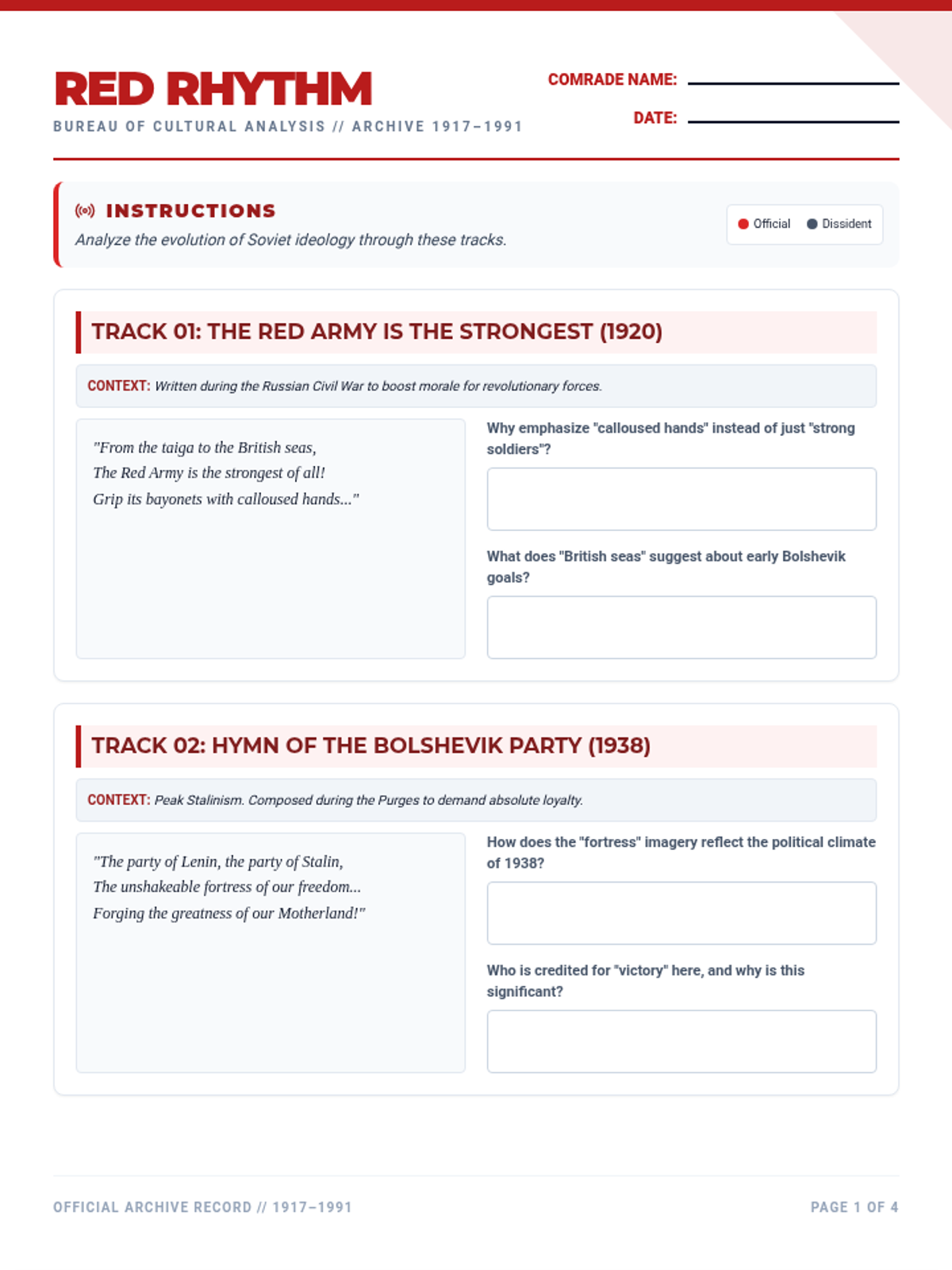
A 4-page comprehensive worksheet for analyzing Soviet songs. It features historical context boxes for 7 key tracks, specific analysis questions for each, and a dedicated student-led discussion page for seminar preparation.
A comprehensive slide presentation based on the French Revolution reading, detailing the transition from the National Convention and the Reign of Terror to the Directory and the eventual rise of Napoleon.
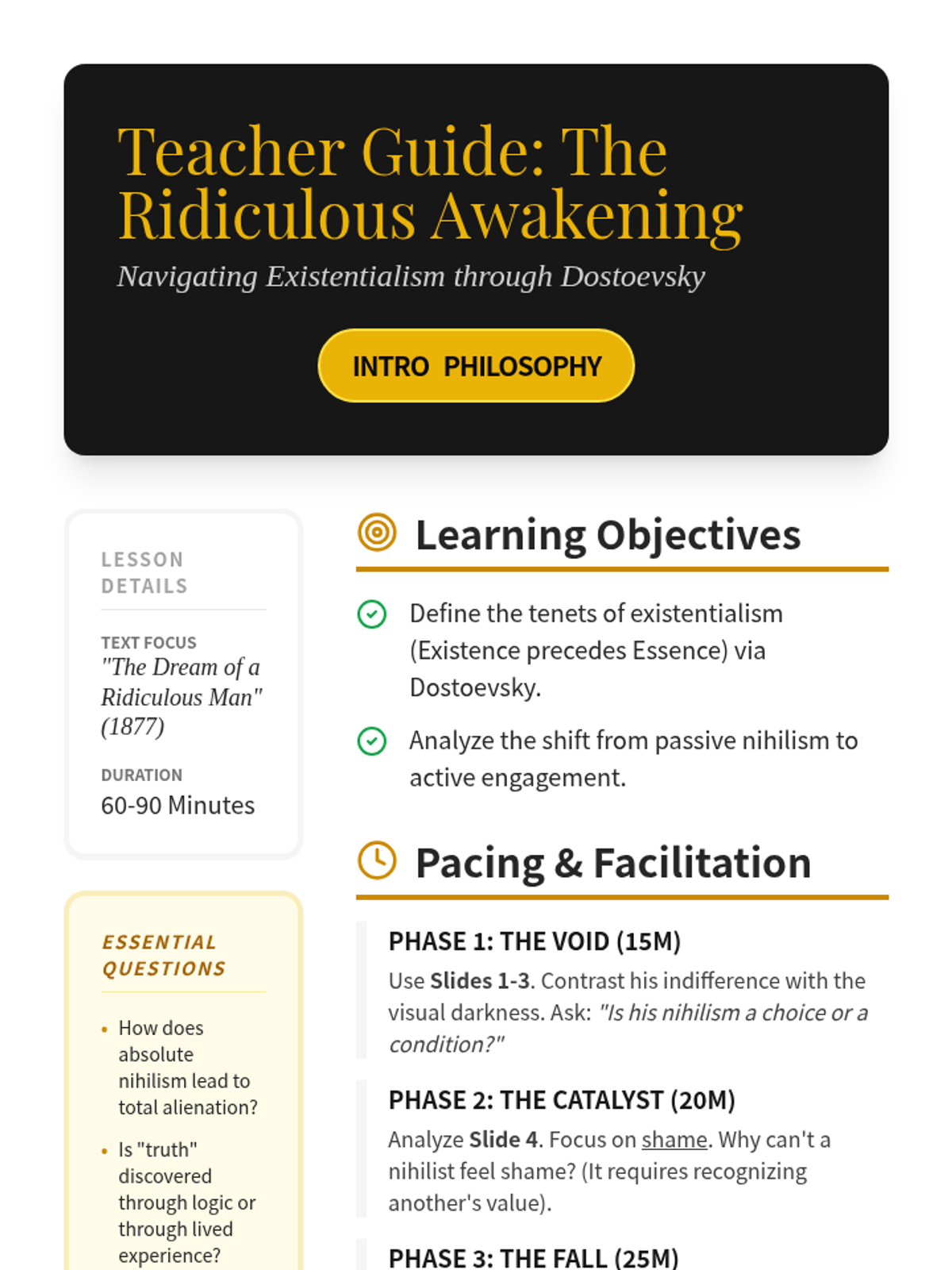
A comprehensive teacher's guide for the 'Ridiculous Awakening' lesson. Includes learning objectives, pacing suggestions, discussion prompts, and common student misconceptions about existentialism.
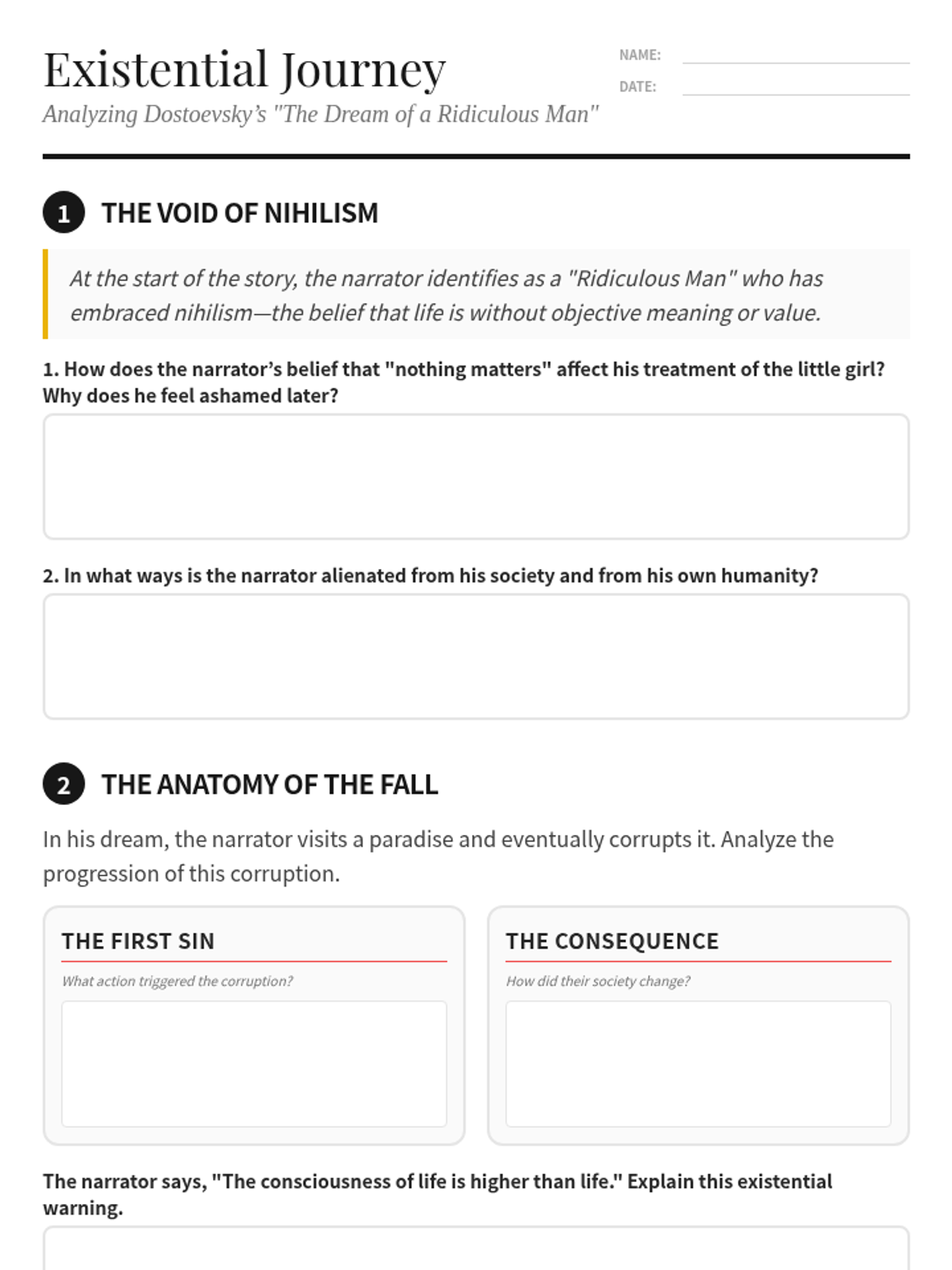
A student worksheet for analyzing Dostoevsky's 'The Dream of a Ridiculous Man'. Includes sections on nihilism, the anatomy of the corruption of paradise, and the existentialist leap into meaningful action.
A visually striking 10-slide presentation introducing existentialist philosophy through Fyodor Dostoevsky's 'The Dream of a Ridiculous Man'. Explores nihilism, the 'Fall' of paradise, and the transformative power of individual choice.
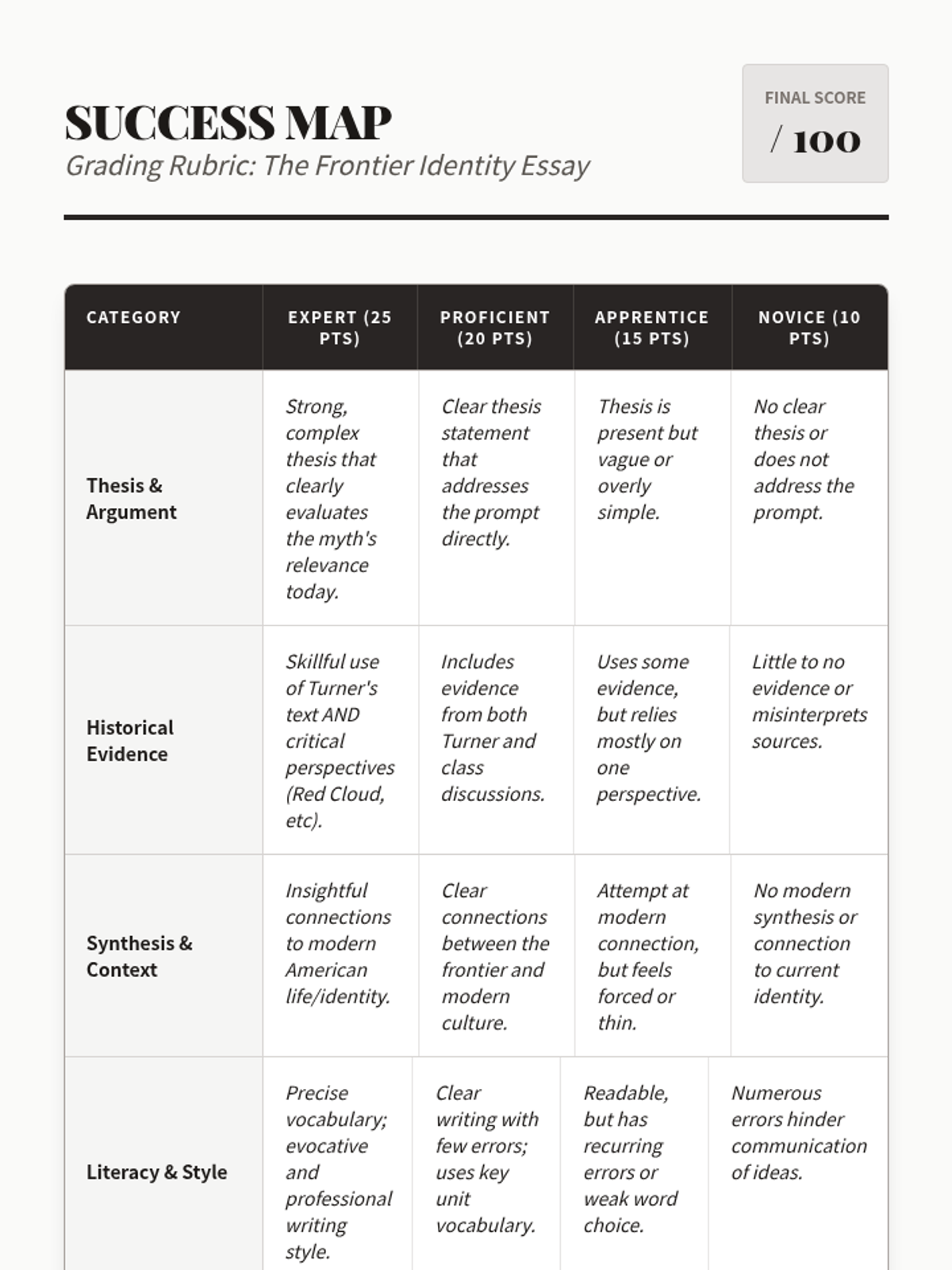
A comprehensive grading rubric for the final assessment, focusing on thesis strength, historical evidence usage, modern synthesis, and literacy skills. Designed for both teacher grading and student self-assessment.
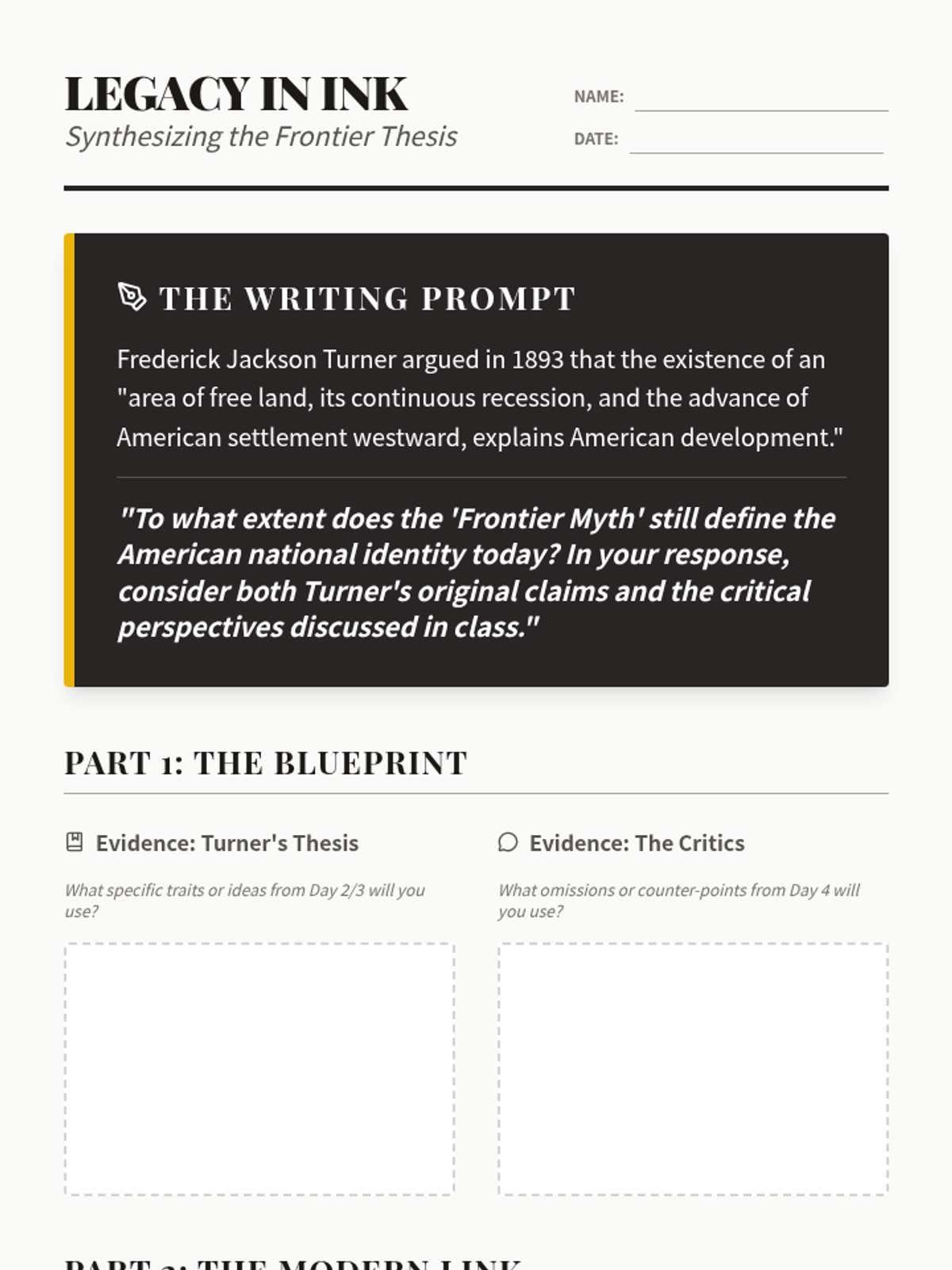
A final writing assessment prompt and structured planning guide for Day 5, asking students to evaluate the continued relevance of the Frontier Myth in modern American identity. Includes space for evidence mapping and thesis statement drafting.
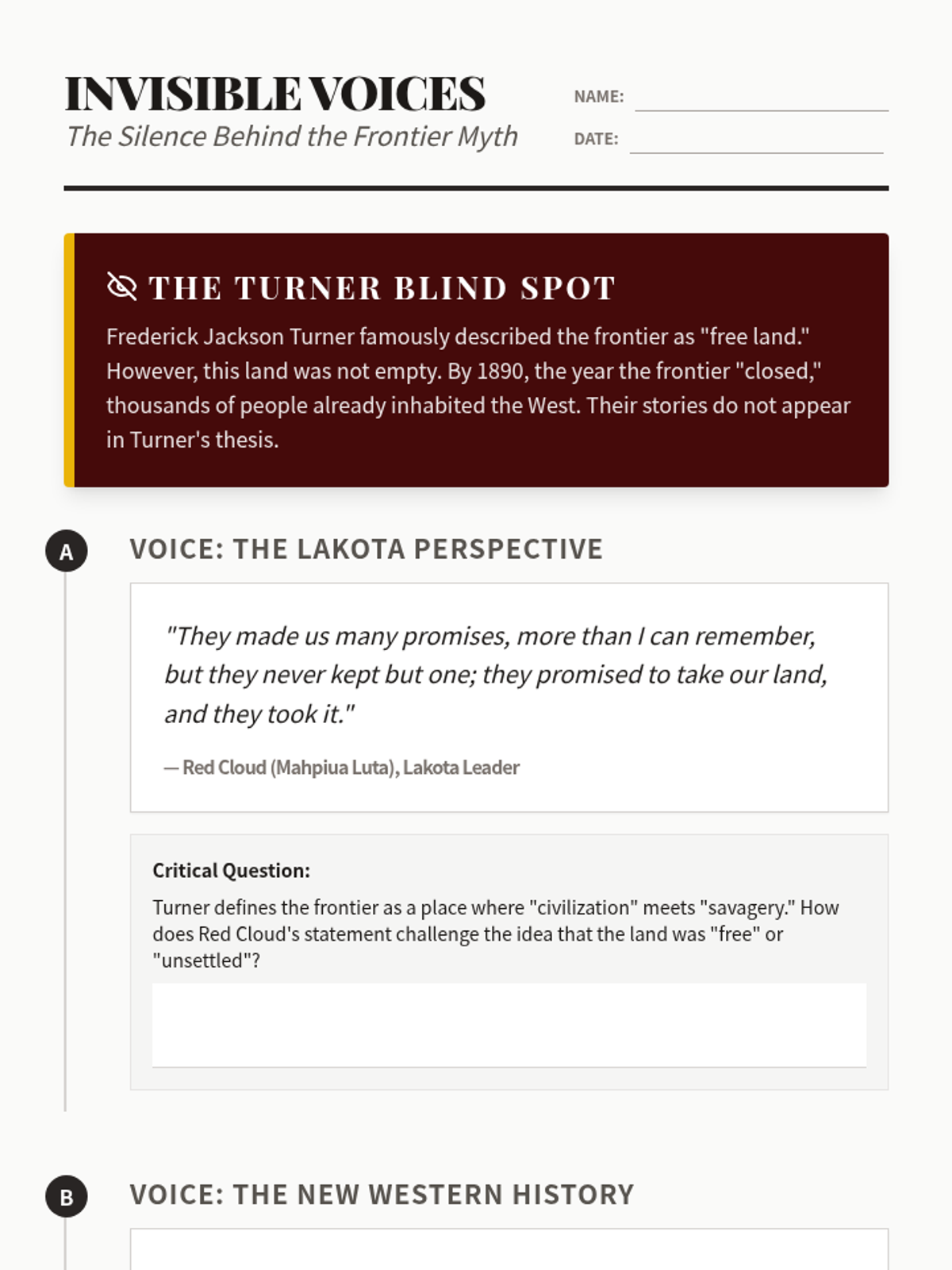
A critical analysis worksheet for Day 4, examining perspectives excluded from Frederick Jackson Turner's narrative, including Native American leaders, pioneer women, and modern historians. It prepares students for a Socratic Seminar on the ethical implications of the frontier myth.
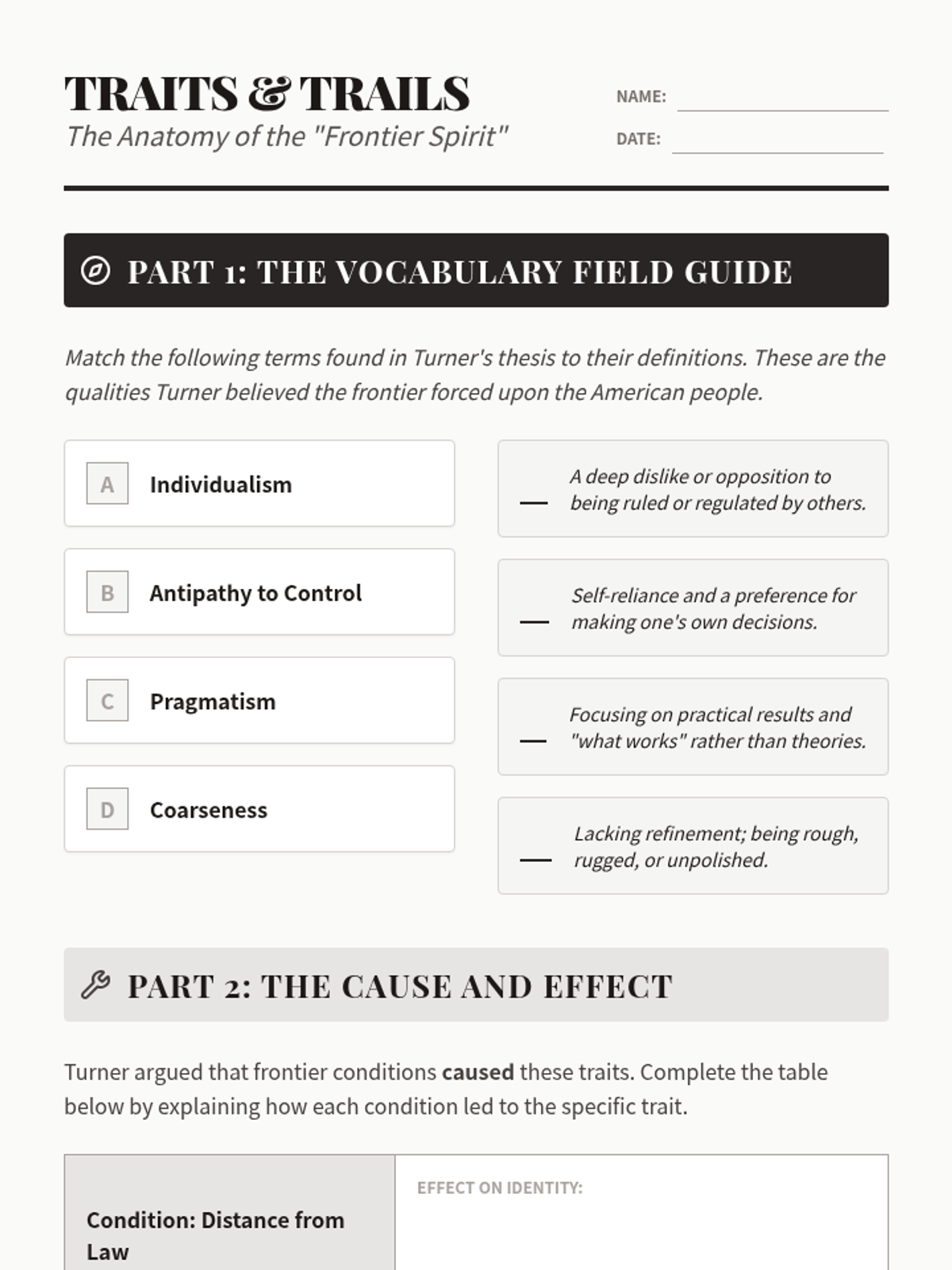
Examination of the specific personality traits Turner attributed to frontier life: individualism, practicality, and democratic spirit. Students analyze how these traits became embedded in the American identity.
A guided analysis slide presentation for Day 2, helping students unpack Turner's complex academic prose and the central metaphor of the wilderness as a transformative force in American development.
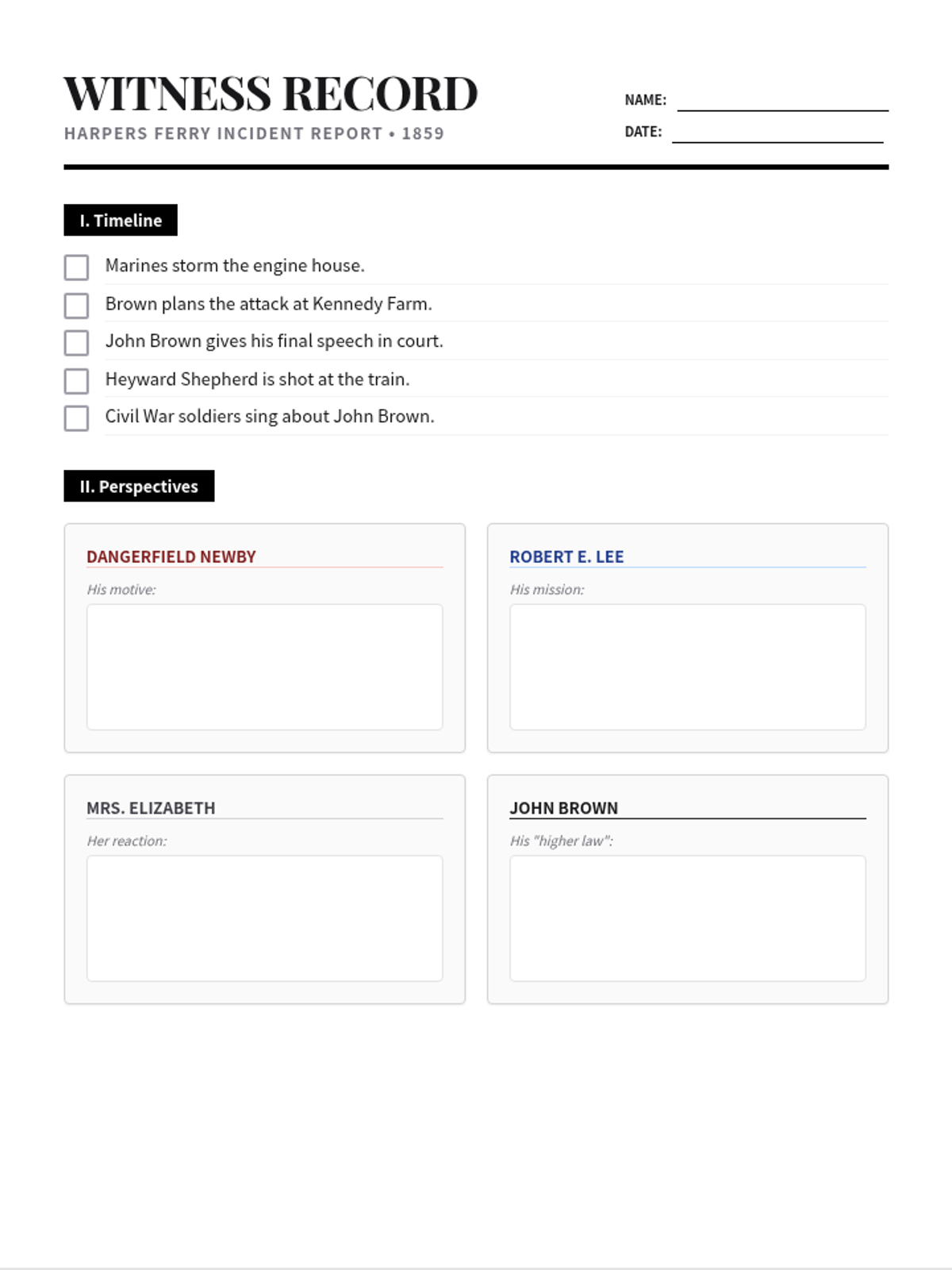
A student worksheet for the "Thunder at the Ferry" play. Includes plot sequencing, character perspective analysis, thematic reflection questions, and a creative newspaper writing activity.
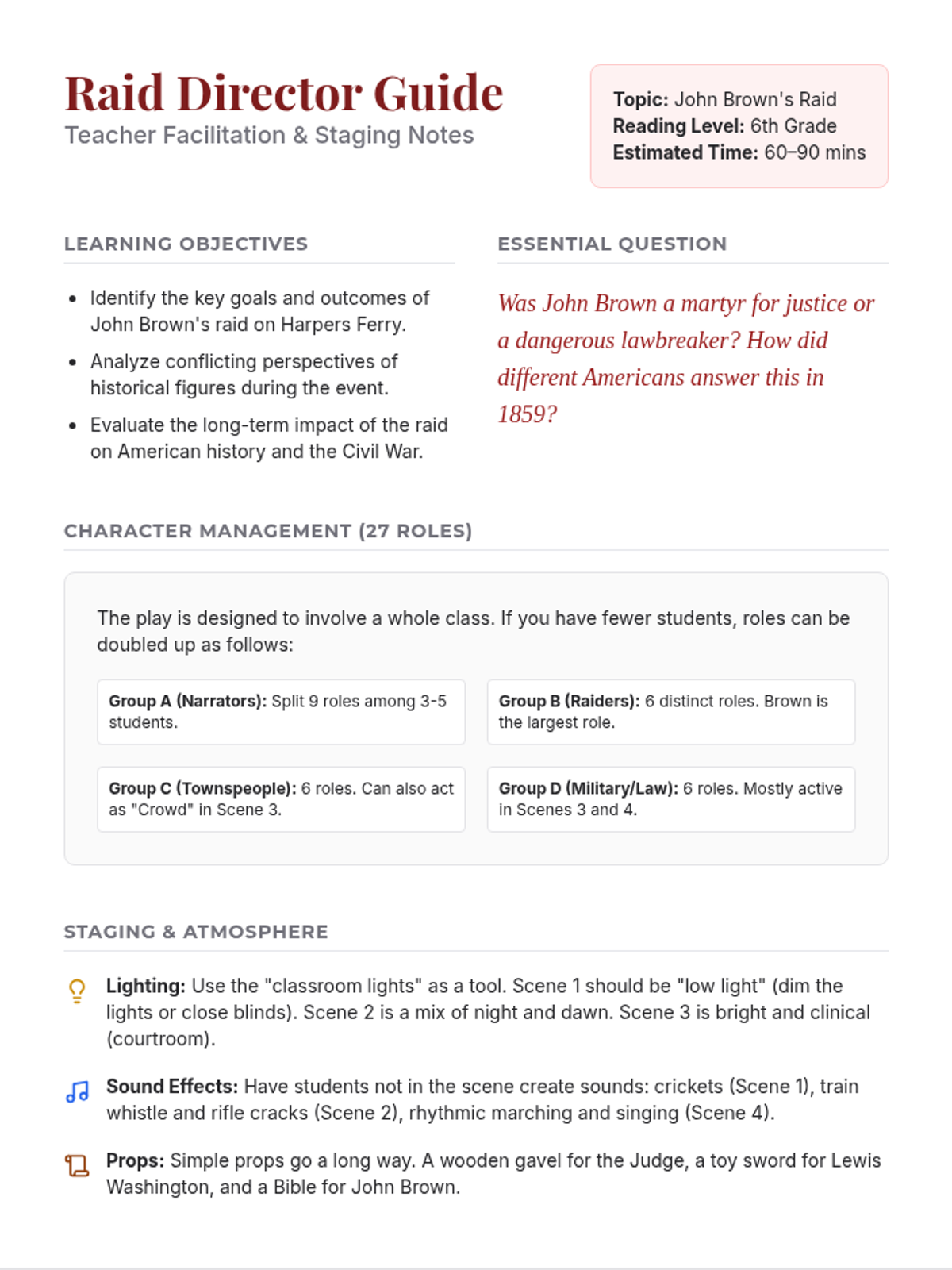
A comprehensive guide for teachers to facilitate the play "Thunder at the Ferry." Includes character management strategies, staging tips, historical context, and deep-dive discussion prompts for 6th-grade students.
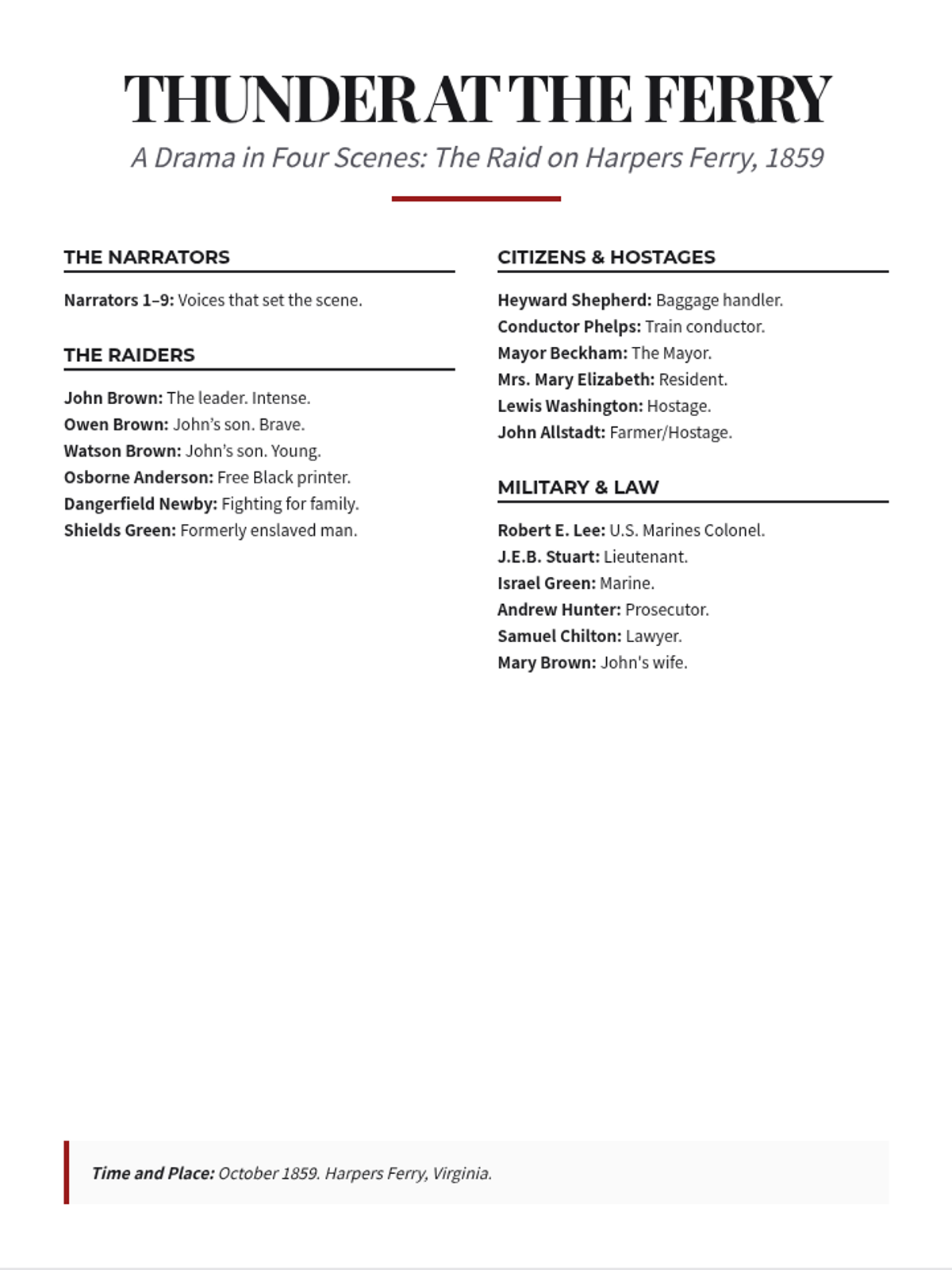
A 4-scene play about John Brown's raid on Harpers Ferry, featuring 18 historical characters and 9 narrators. Written at a 6th-grade level, it explores the planning, execution, trial, and lasting impact of the raid through multiple perspectives.
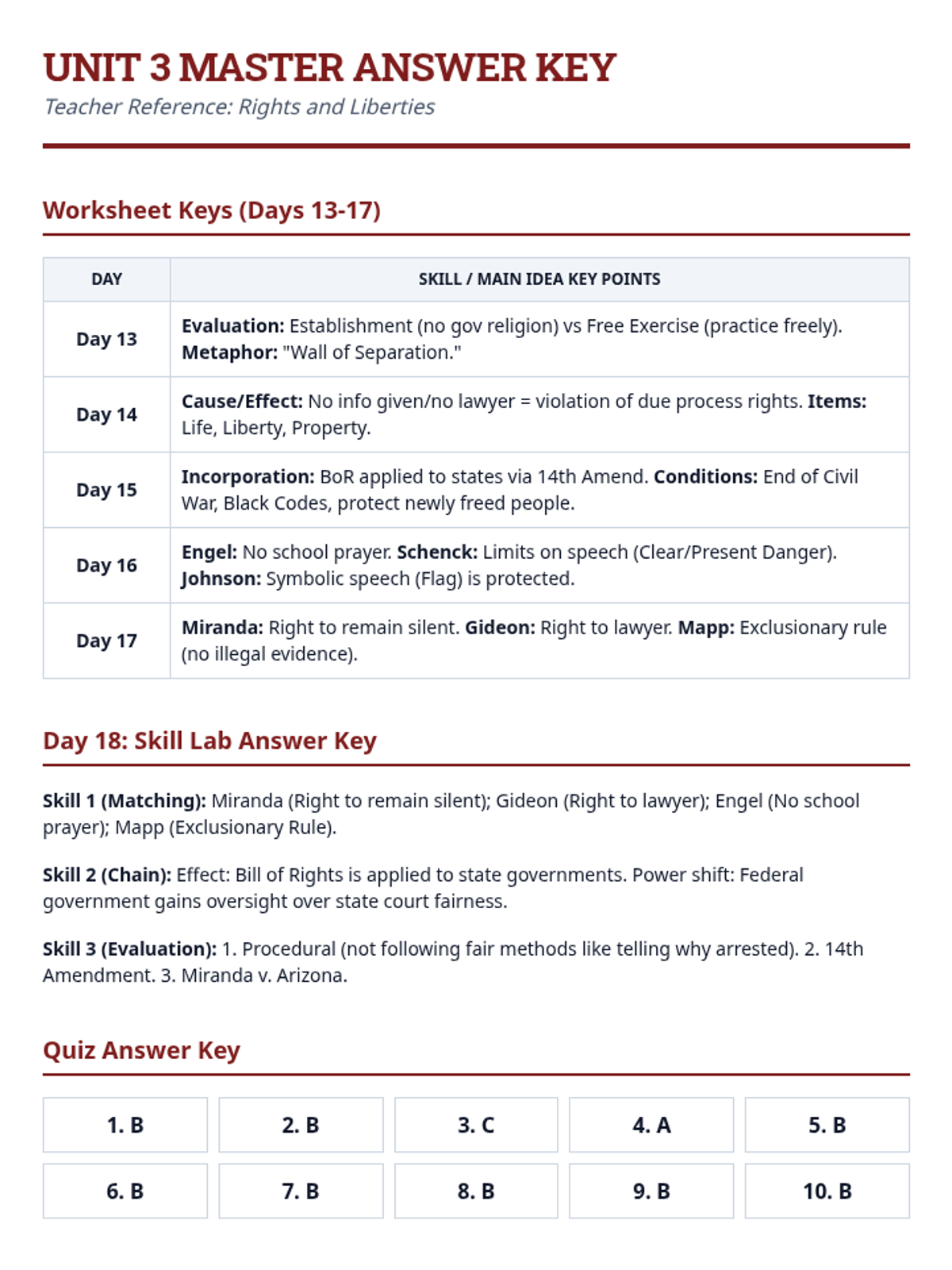
Teacher Master Answer Key for Unit 3 (Rights and Liberties). Includes answer points for Days 13-17 worksheets, the Day 18 Skill Lab, and the unit comprehension quiz.
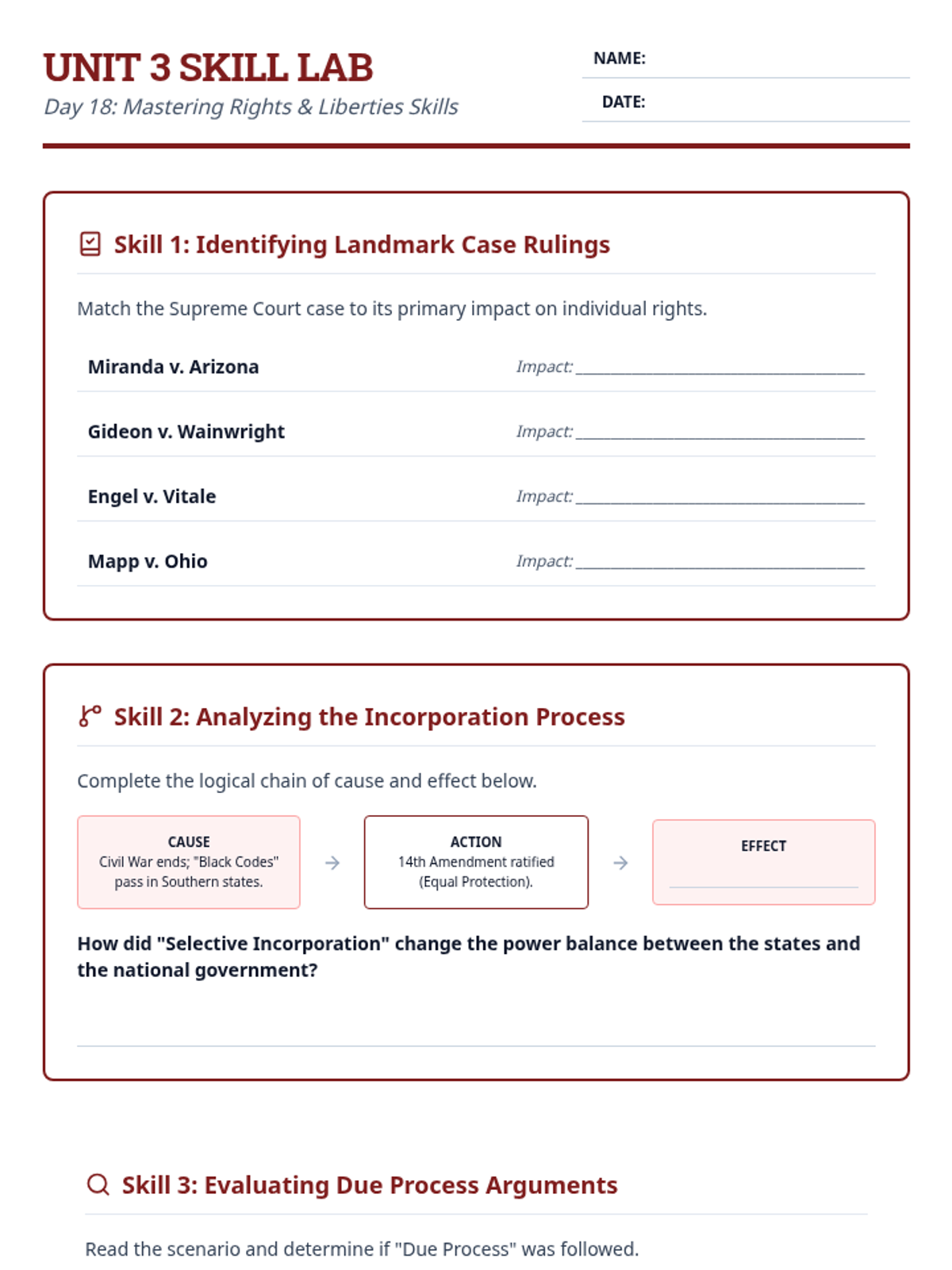
Day 18 Skill Lab for Unit 3. Features case matching for landmark SCOTUS decisions, analyzing the cause-and-effect chain of incorporation, and evaluating a due process scenario.
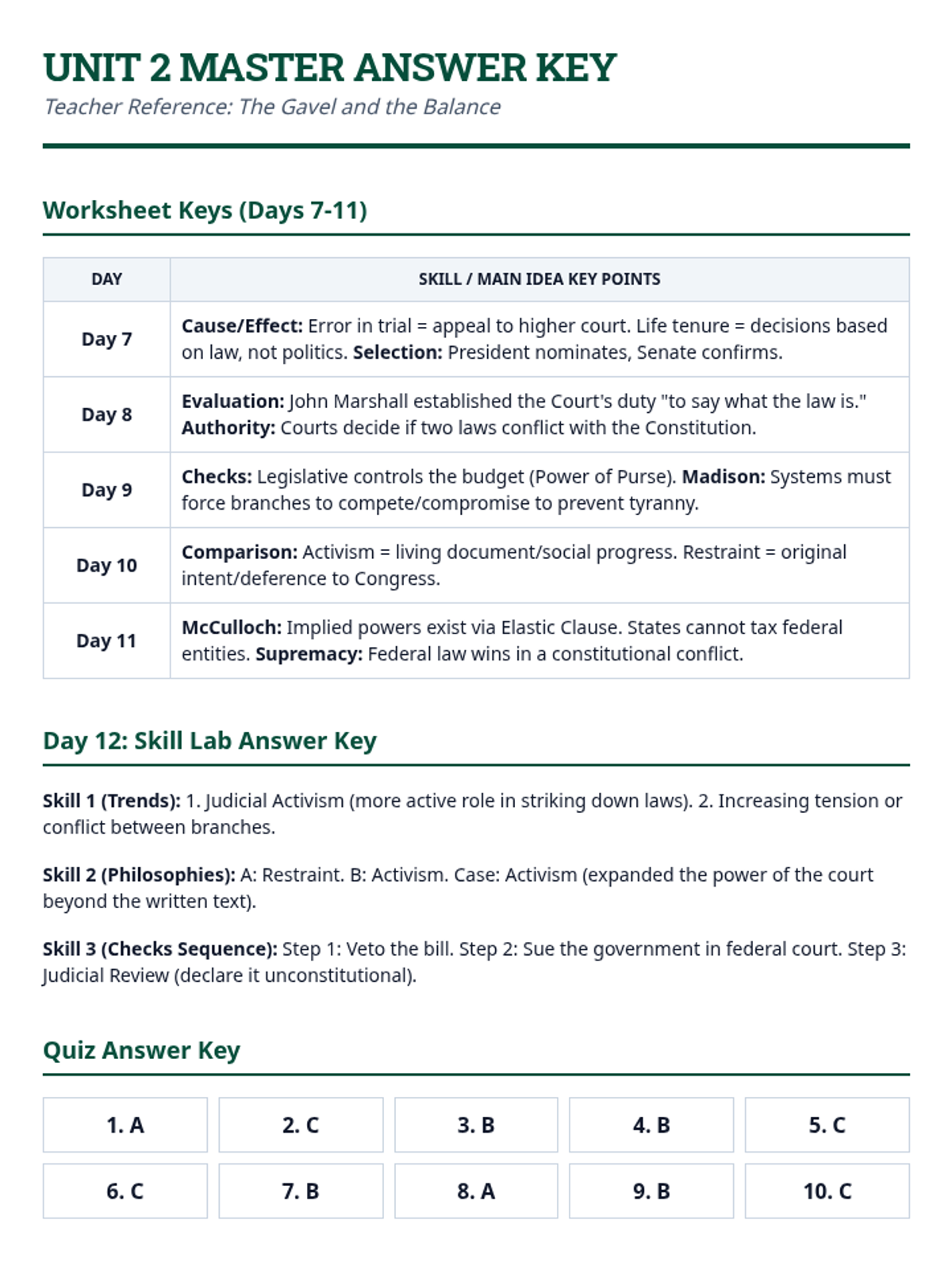
Teacher Master Answer Key for Unit 2 (The Gavel and the Balance). Includes answer points for Days 7-11 worksheets, the Day 12 Skill Lab, and the unit comprehension quiz.
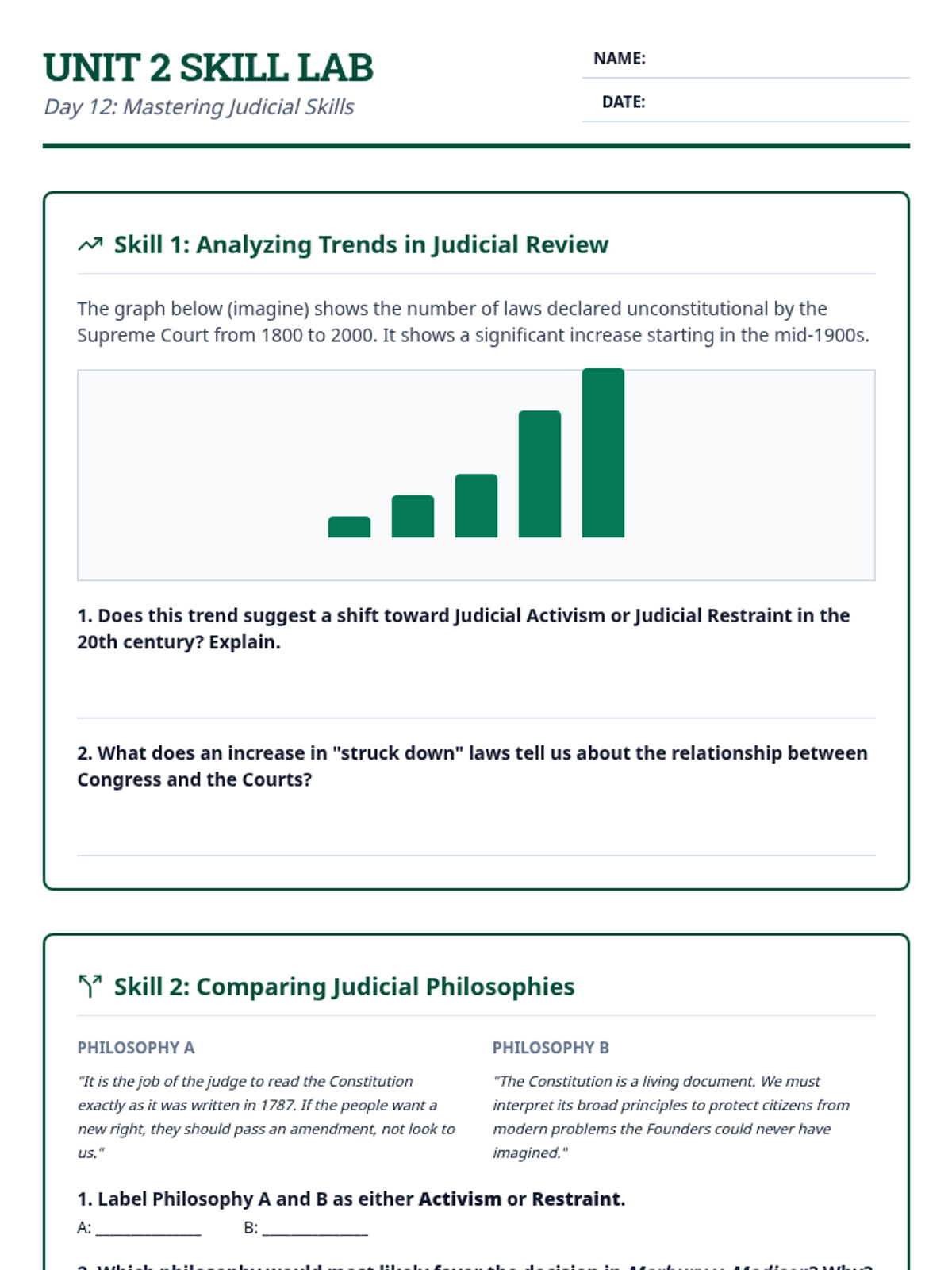
Day 12 Skill Lab for Unit 2. Features trend analysis for judicial review, comparing judicial philosophies, and sequencing the checks and balances process for a hypothetical law.
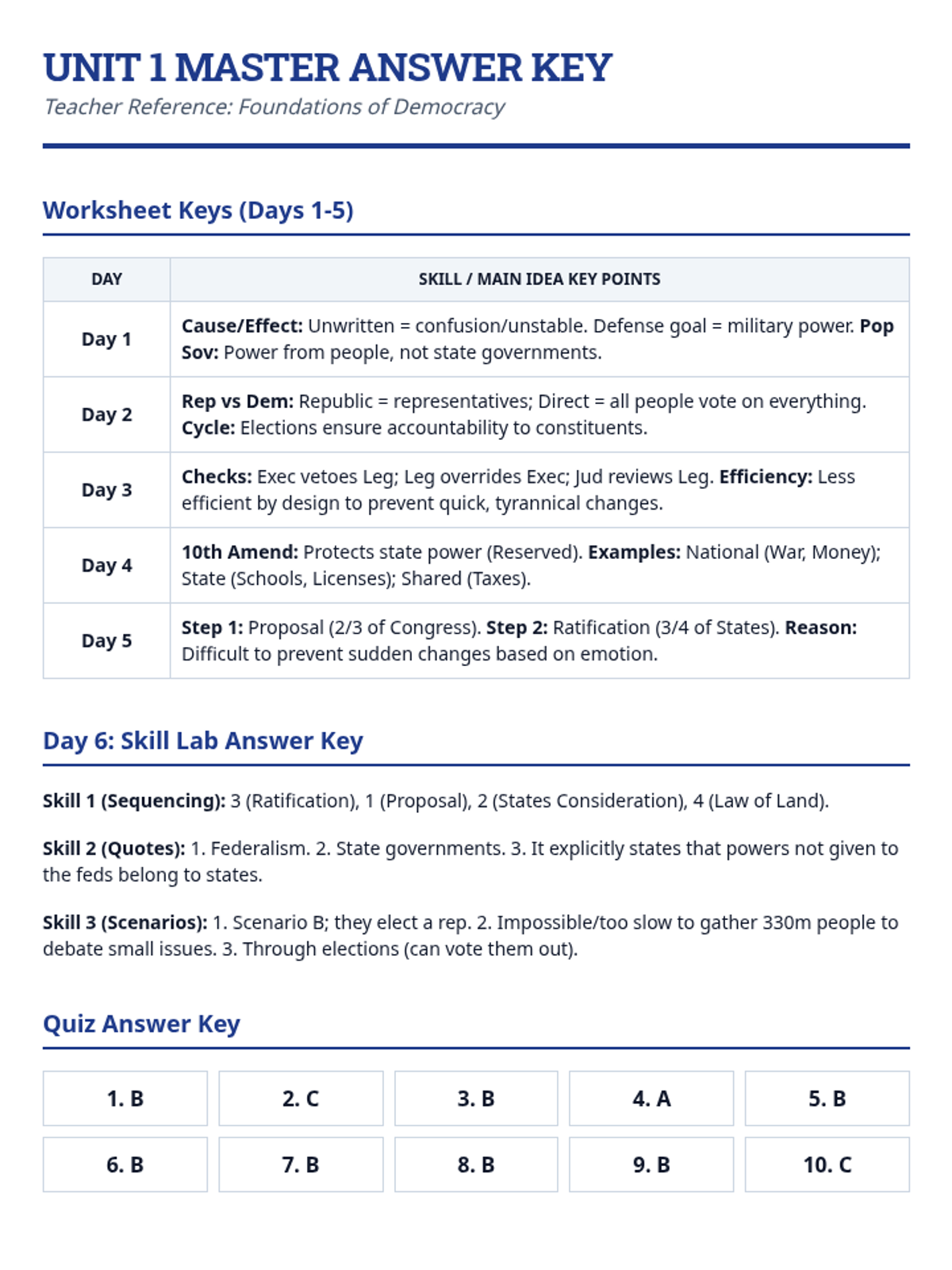
Teacher Master Answer Key for Unit 1 (Foundations of Democracy). Includes answer points for Days 1-5 worksheets, the Day 6 Skill Lab, and the unit comprehension quiz.
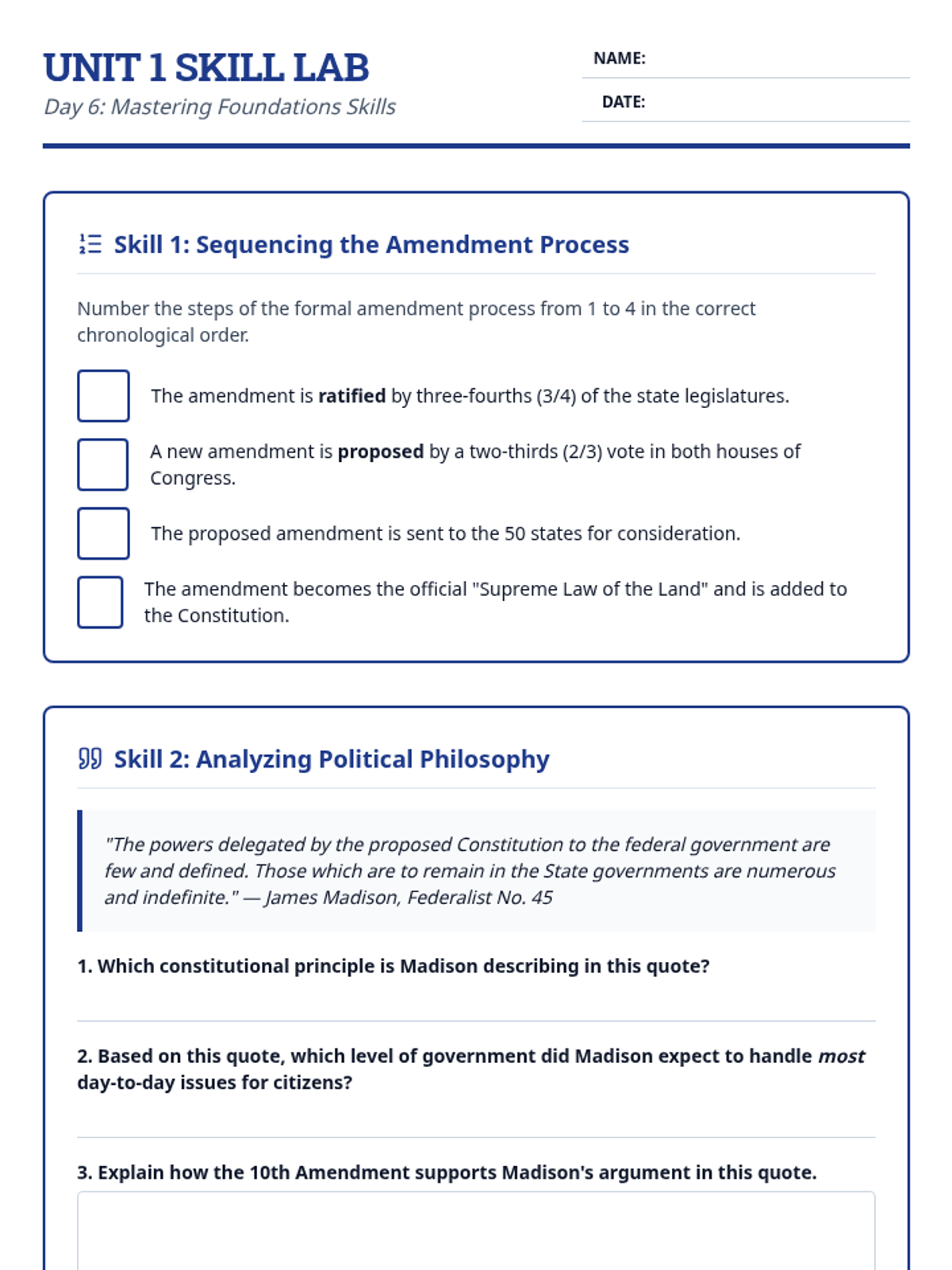
Day 6 Skill Lab for Unit 1. Features sequencing the amendment process, analyzing James Madison's quotes on federalism, and comparing direct democracy vs. republicanism scenarios.
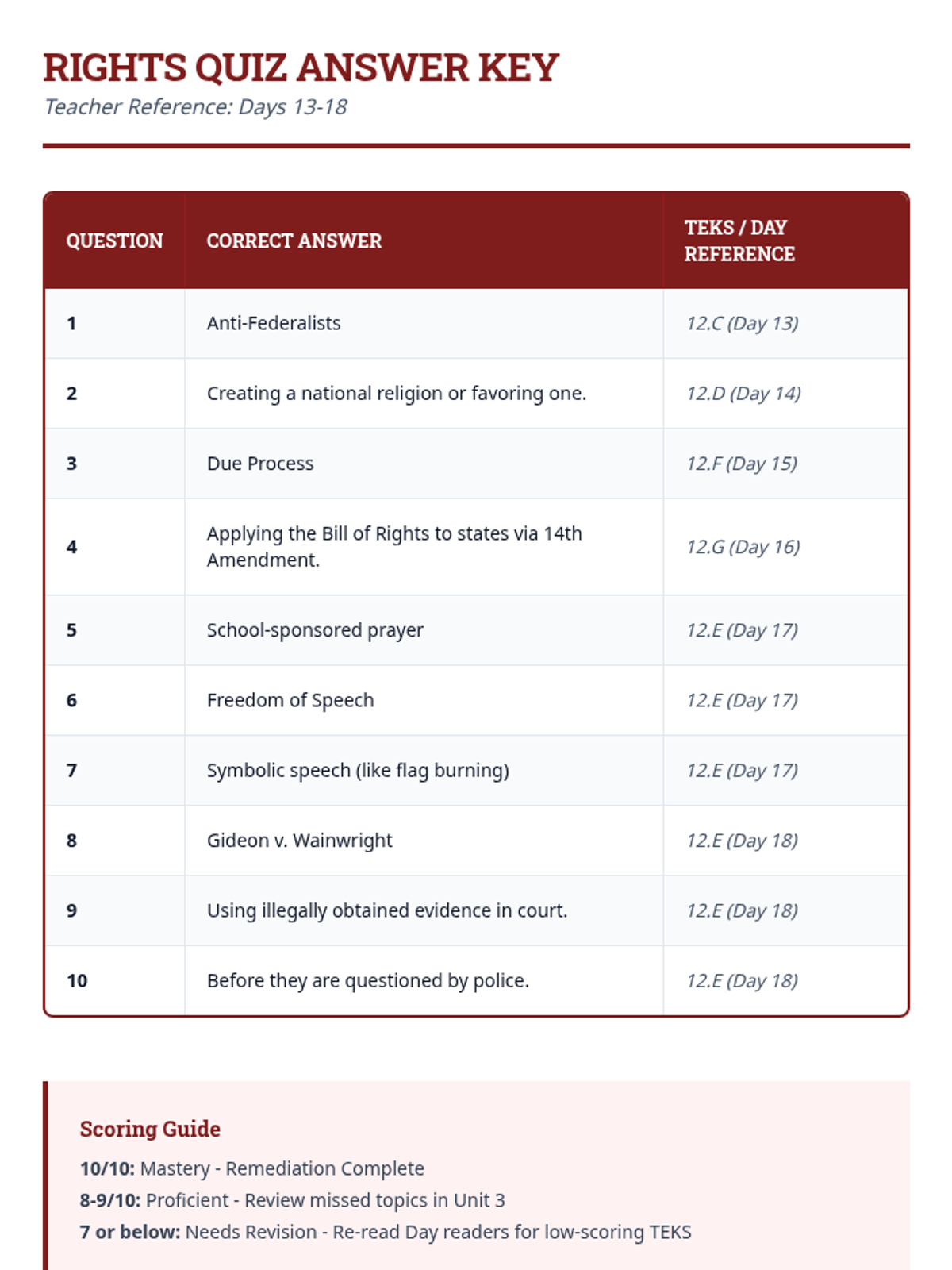
Teacher Answer Key for the Rights Comprehension Quiz. Includes correct answers, TEKS/Day alignment, and a scoring guide.
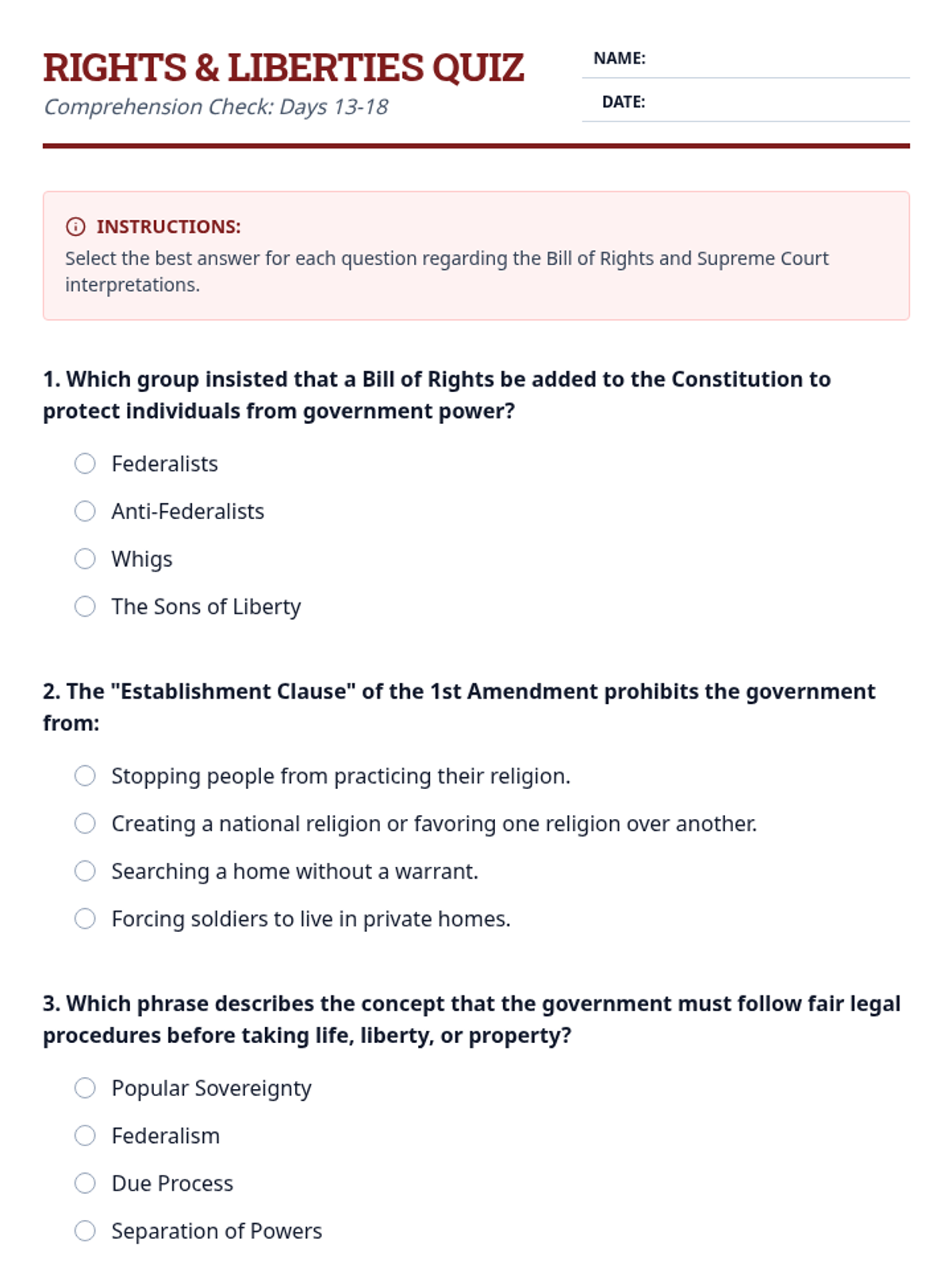
A 10-question multiple-choice comprehension check quiz covering the Rights and Liberties unit (Days 13-18). Tests knowledge on the Bill of Rights, religious freedom, due process, incorporation, and landmark Supreme Court cases.
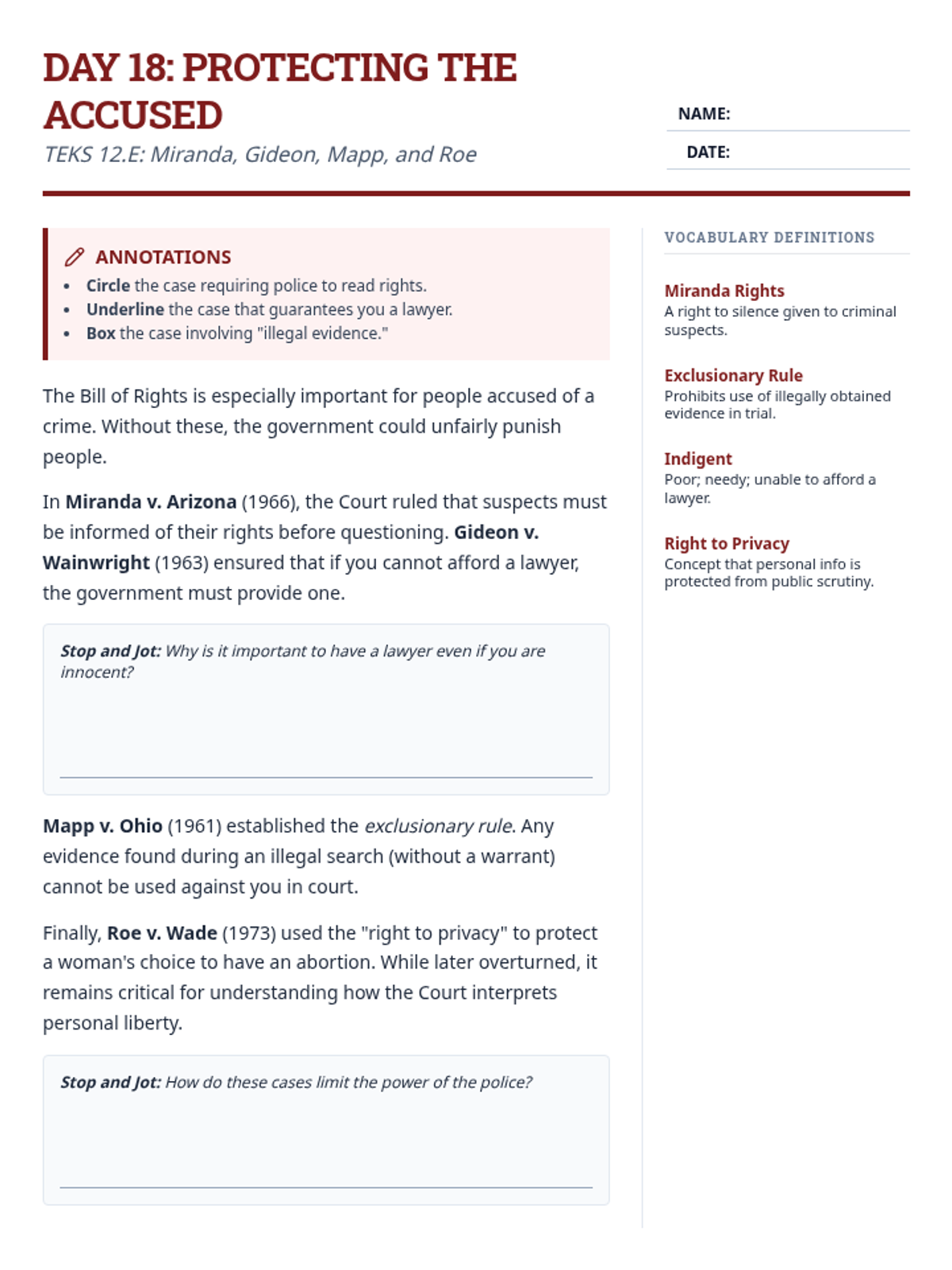
Revised Day 18 Reader and Worksheet. Focuses on Due Process Supreme Court cases (TEKS 12E). Improved Stop and Jot height and vocabulary definition area. Verified TEKS citation alignment.
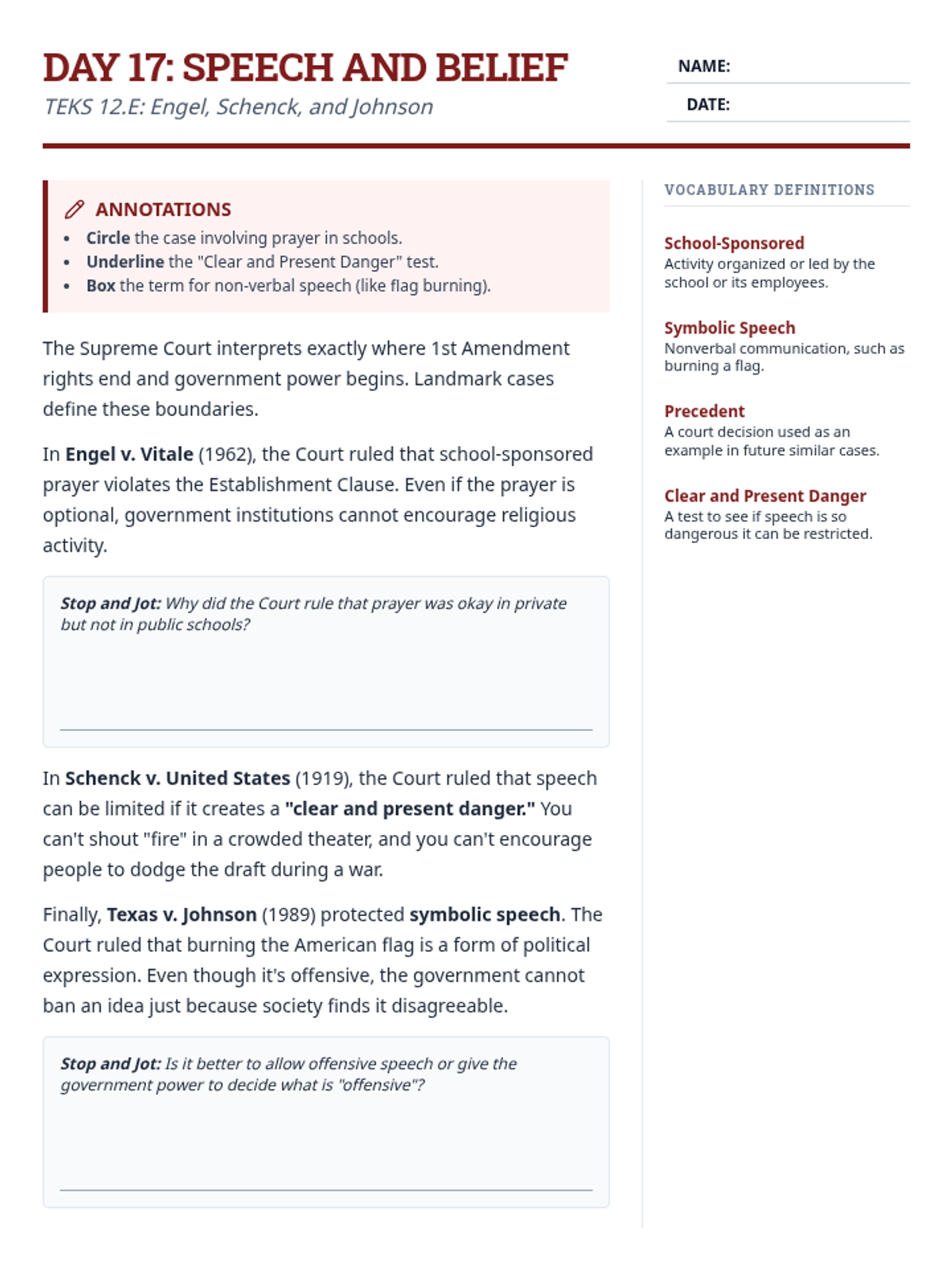
Revised Day 17 Reader and Worksheet. Focuses on 1st Amendment Supreme Court cases (TEKS 12E). Improved Stop and Jot height and vocabulary label layout.
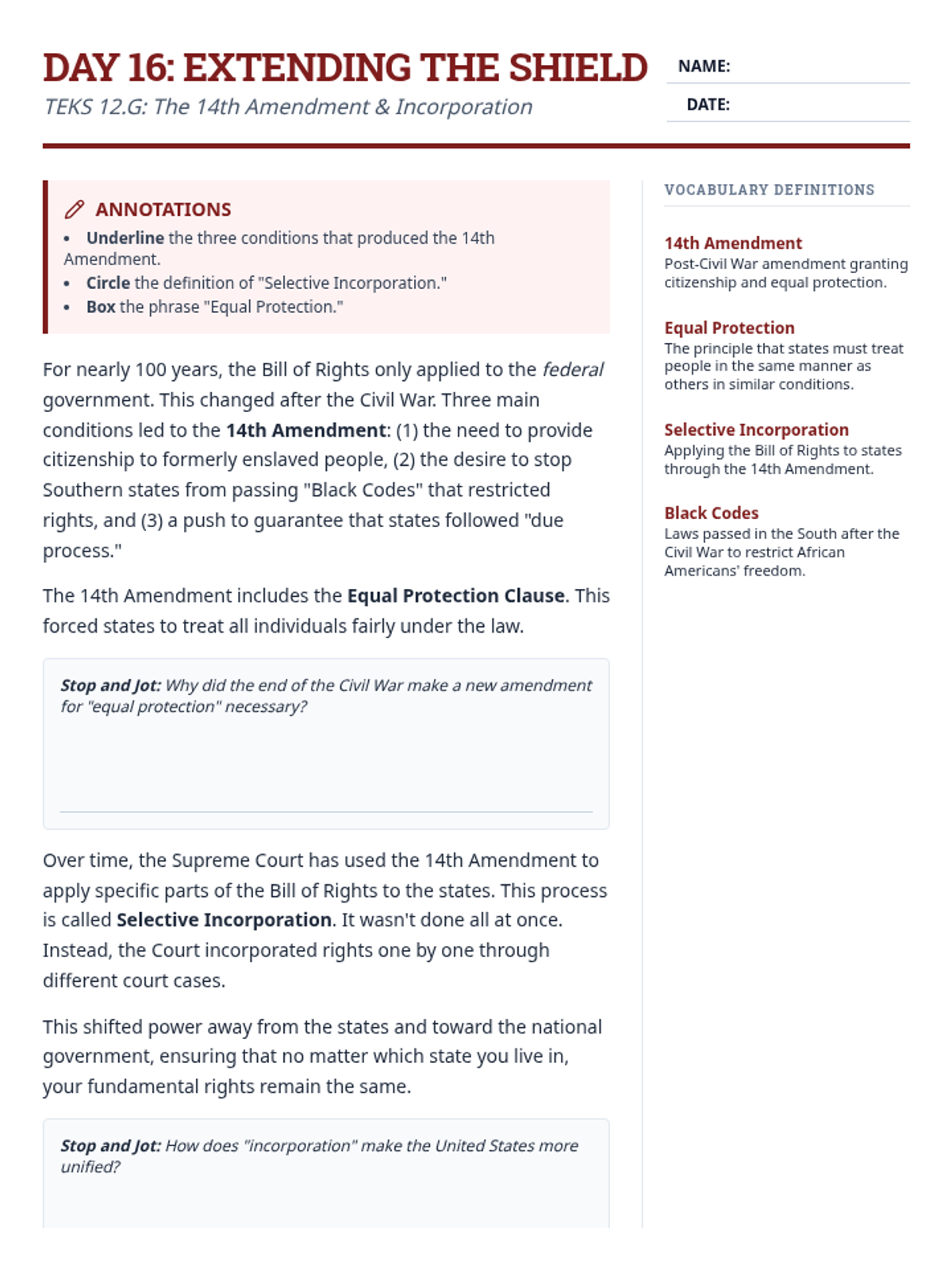
Revised Day 16 Reader and Worksheet. Focuses on the 14th Amendment and Selective Incorporation (TEKS 12G). Updated to explicitly list three conditions for the amendment and fixed typos.
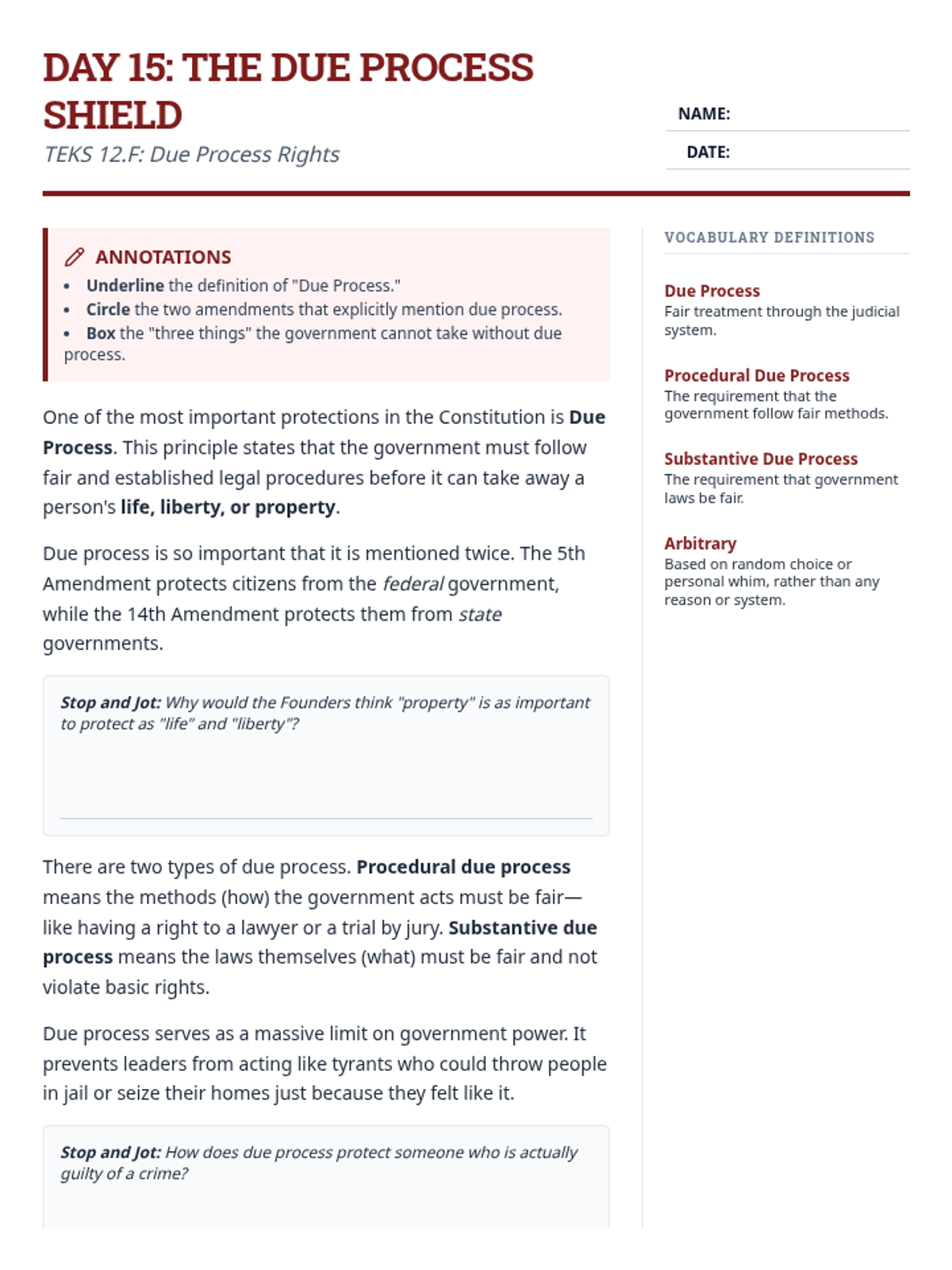
Day 15 of the remediation packet focusing on Due Process Rights (TEKS 12F). Explains the difference between procedural and substantive due process and their roles in limiting government power.
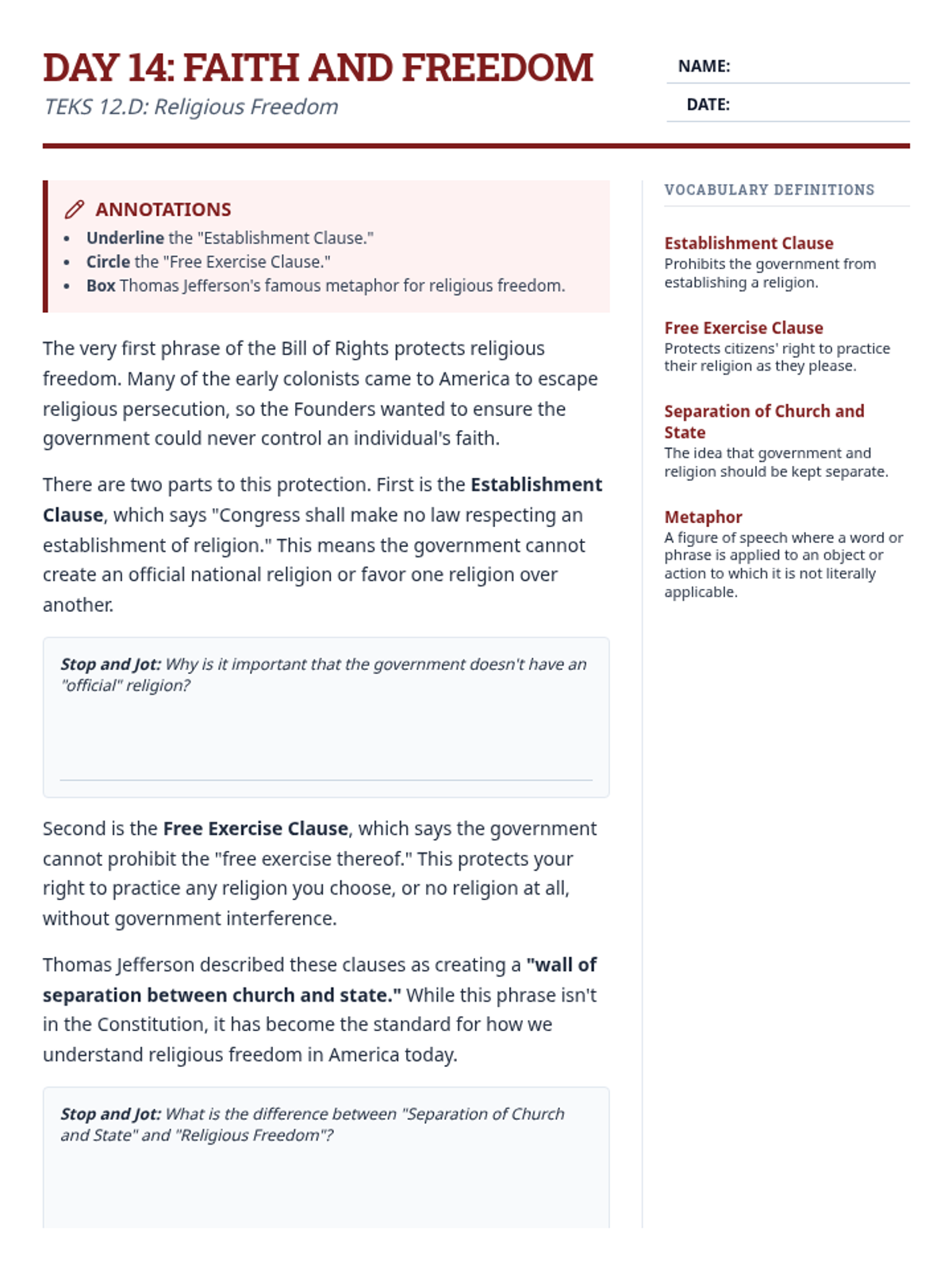
Day 14 of the remediation packet focusing on Religious Freedom (TEKS 12D). Covers the Establishment Clause, Free Exercise Clause, and the concept of separation of church and state.
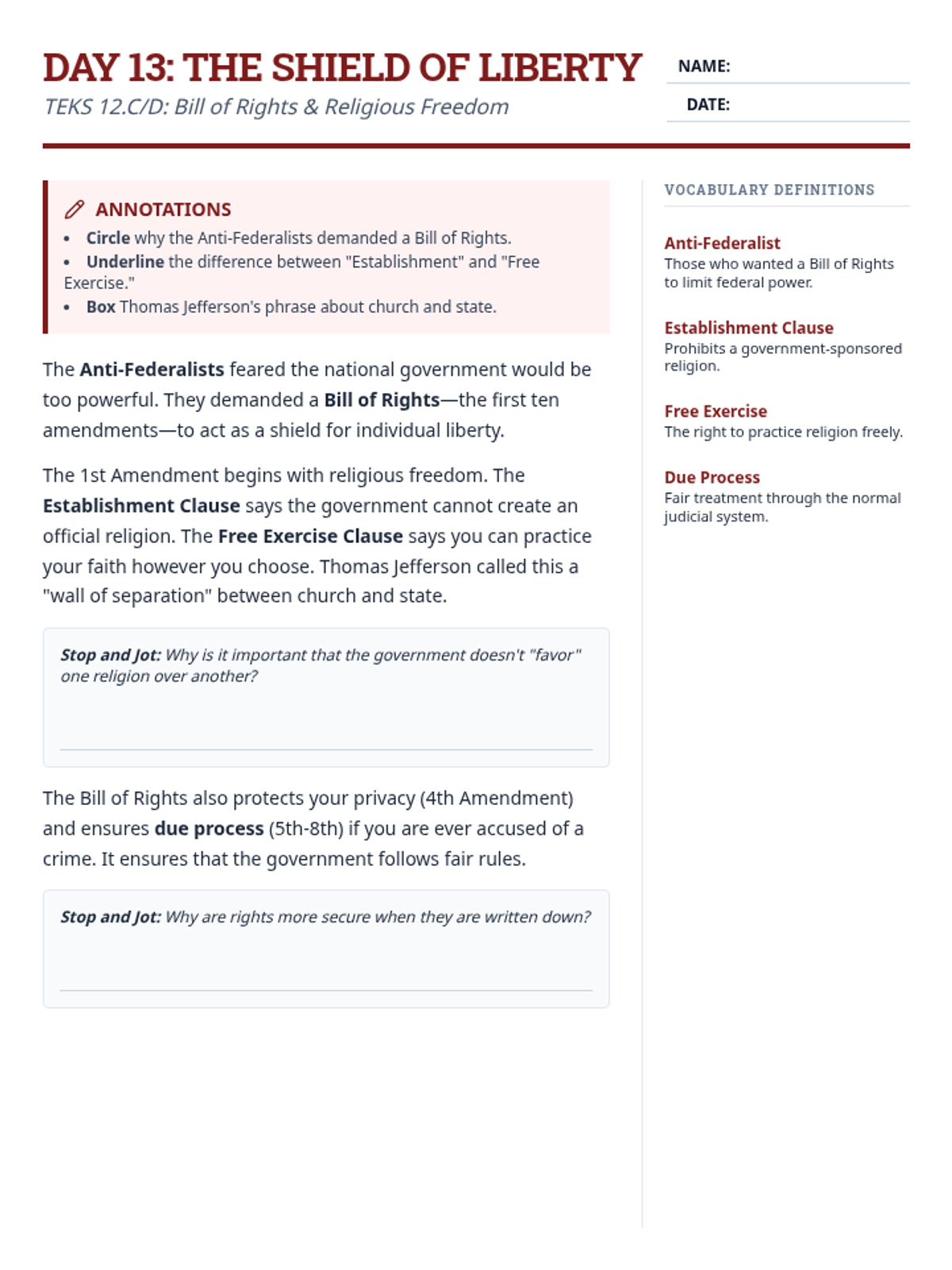
Combined Day 13 Reader and Worksheet. Covers the Bill of Rights overview, the Anti-Federalist debate, and Religious Freedom (Establishment and Free Exercise clauses) (TEKS 12C, 12D).
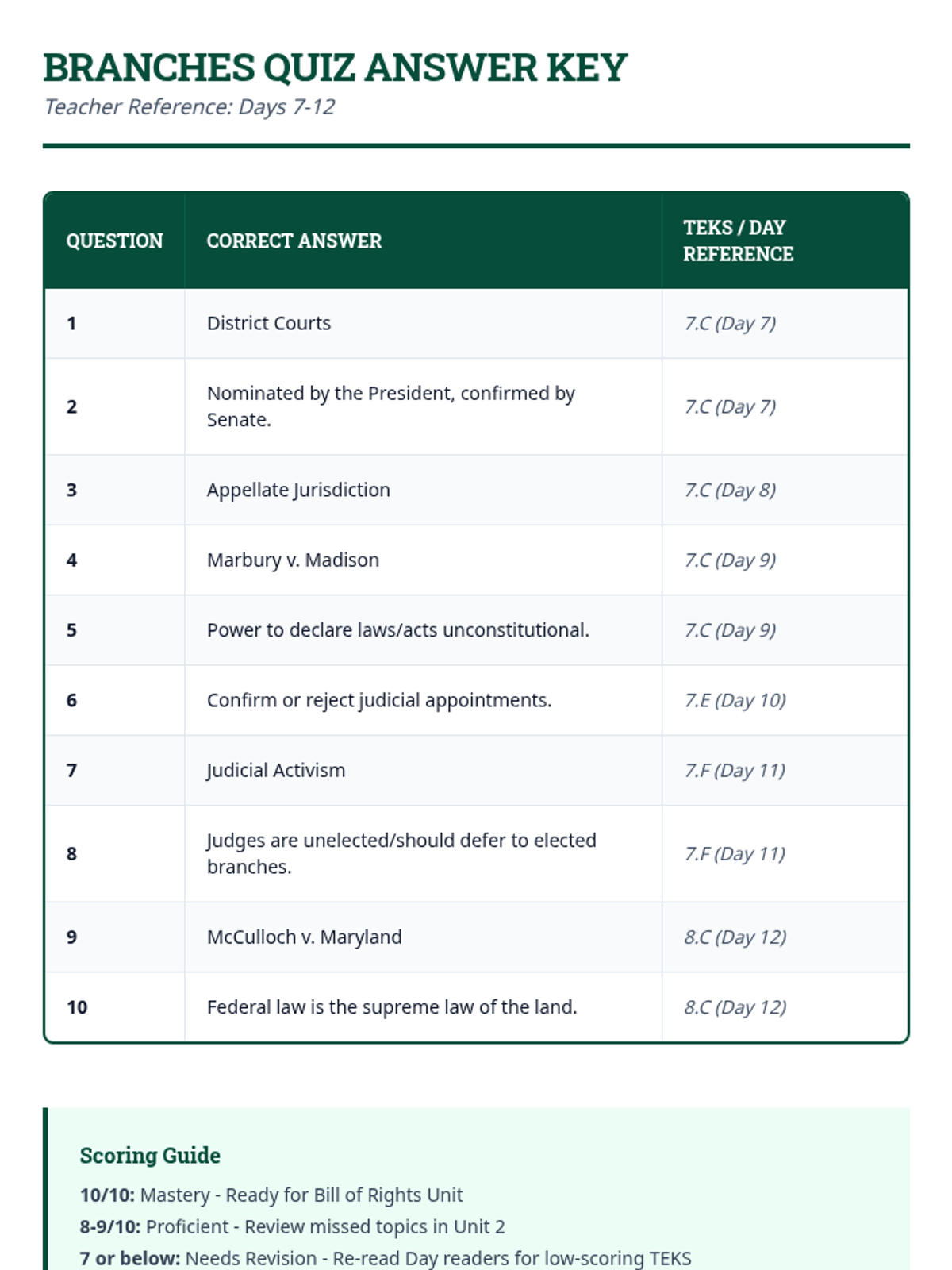
Teacher Answer Key for the Branches & Balances Quiz. Includes correct answers, TEKS/Day alignment, and a scoring guide.
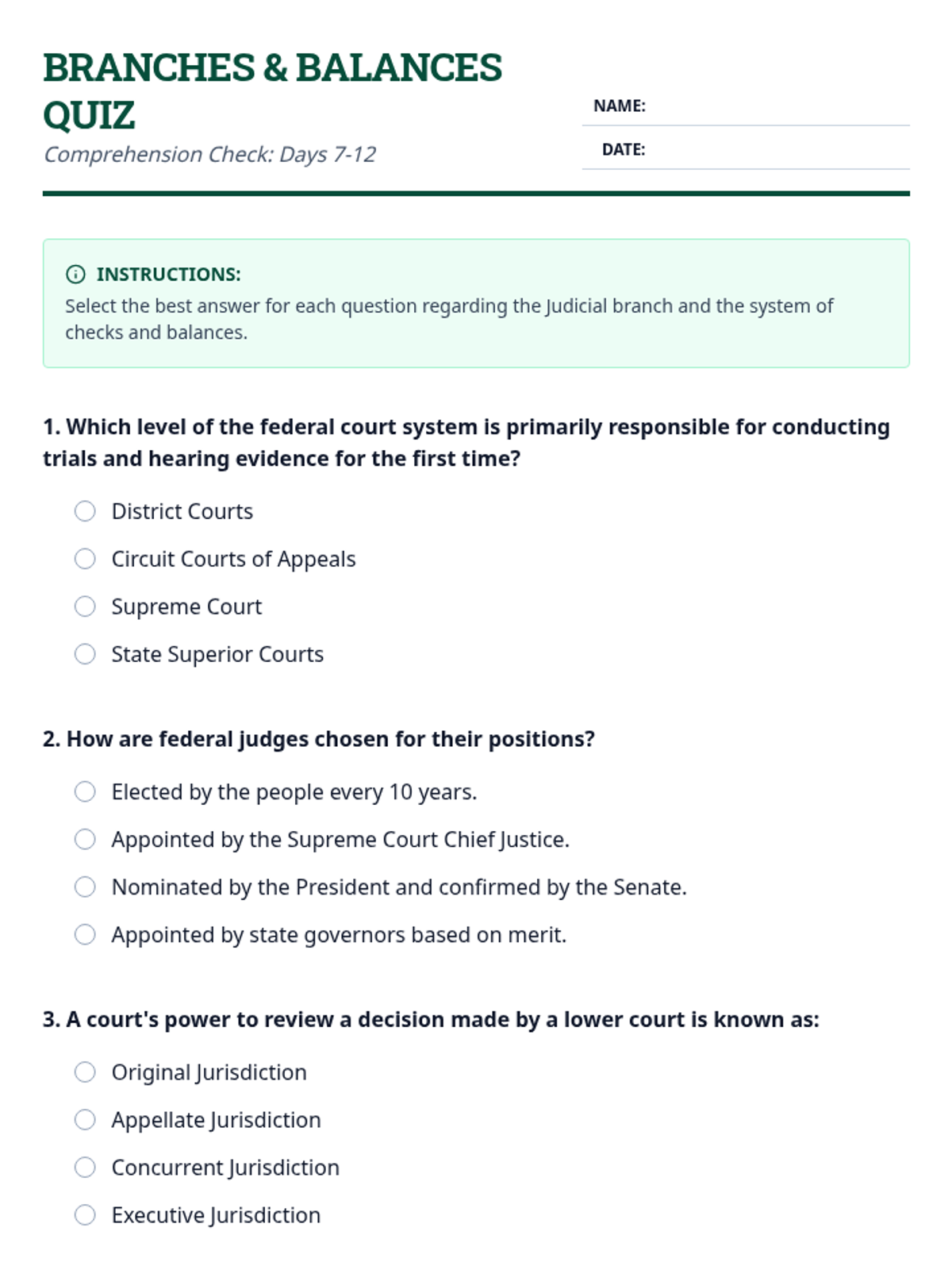
A 10-question multiple-choice comprehension check quiz covering the Judicial Branch and Checks & Balances (Days 7-12). Tests knowledge on court structure, jurisdiction, Marbury v. Madison, judicial philosophies, and federal-state conflicts.