Lenny LearningLenny
Create
Explore
Workspace
LoginSign up
MathEnglish Language ArtsScience & EngineeringSocial StudiesGlobal LanguagesHealth & Physical EducationSpecial EducationCounseling & Life SkillsArts & CreativityESL
Lenny LearningLenny
Lenny Learning
About
Training
Pricing
Support
Contact
© 2026 Lenny Learning Inc.

Debate & Public Speaking

SequencesLessonsMaterialsVideos
  1. English Language Arts

Debate & Public Speaking

SequencesLessonsMaterialsVideos

Systematic research, evidence evaluation, and logical reasoning skills for formal discourse. Equips speakers to organize persuasive arguments, identify fallacies, and execute strategic impact calculus during competitive engagement.

English Language ArtsPhonics & Reading FoundationsLetter IdentificationLearn Letters A-ZLowercase and Uppercase LettersConsonants and VowelsLetter-Sound AssociationsLetter-Sound Associations: LowercaseLetter-Sound Associations: UppercaseBeginning and Ending SoundsRhymingBlending And SegmentingShort VowelsShort Vowel SoundsConsonant BlendsConsonant DigraphsBlends, Digraphs, and TrigraphsDigraphs, Blends, and Silent LettersLong Vowel SoundsLong Vowel PatternsShort and Long VowelsShort and Long Vowel PatternsSilent EVowel SoundsVowel TeamsR-Controlled VowelsDiphthongs: Oi, Oy, Ou, OwVariant VowelsVariant, Diphthong, And R Vowel PatternsSoft G And CSight WordsIrregular WordsWord RecognitionSyllablesSyllable TypesTwo-Syllable WordsMultisyllabic WordsPhoneme ManipulationDecodable TextsVocabularyAction WordsQuestion WordsNouns and AdjectivesClassify WordsCompound WordsSynonyms and AntonymsHomophonesHomophones and HomonymsShades of MeaningContext CluesPrefixes and SuffixesGreek and Latin RootsAnalogiesIdioms and AdagesForeign Words and ExpressionsWord Choice and UsageReference SkillsReading ComprehensionRead-Along Literary TextsRead-Along Informational TextsReality vs. FictionStory ElementsCharacterSequenceMain IdeaCause And EffectCompare And ContrastReading StrategiesText StructureAuthor's PurposeAuthor's Purpose And ToneAuthor's PerspectivePoint Of ViewThemeInference And ThemeInference And AnalysisPoetry ElementsLiterary DevicesAnalyzing LiteratureAnalyzing Informational TextsComparing TextsAudience, Purpose, And ToneBusiness DocumentsNovel StudyNonfiction Book StudyGrammar & MechanicsSentencesNounsVerbsAdjectivesPronounsCapitalizationPunctuationContractionsConjunctionsPrepositionsArticlesAdjectives And AdverbsVerb TypesVerb TensePronouns And AntecedentsPronoun TypesSubject-Verb AgreementDirect And Indirect ObjectsSentences, Fragments, And Run-OnsPhrases And ClausesCommasSemicolons, Colons, And CommasDashes, Hyphens, And EllipsesSpellingAbbreviationsFormattingVerb Tense And MoodMisplaced ModifiersWritingDescriptive DetailsCreative WritingOpinion WritingTopic SentencesOrganizing WritingLinking WordsSentence VarietyIntroductions And ConclusionsPersuasive And Opinion WritingExpository WritingPersuasive StrategiesDeveloping And Supporting ArgumentsTopic Sentences And Thesis StatementsSummarizingResearch SkillsEditing And RevisingActive And Passive Voice=Writing Clearly And ConciselyDebate & Public SpeakingPublic Speaking BasicsPersuasive TechniquesClaims and EvidenceTypes of ArgumentsReasoning TypesLogical FallaciesTopic ResearchOrganizing EvidenceDebate Speech OrganizationAttacking and Defending ArgumentsClash and EngagementImpact CalculusQuestioning and Cross-ExaminationCritical ThinkingInformal LogicFormal LogicInductive Reasoning
Public Speaking BasicsFundamental techniques for vocal projection, body language, and effective eye contact. Builds confidence through speech structure, delivery exercises, and strategies for managing performance anxiety.
Persuasive TechniquesClassical rhetorical appeals, structural argument development, and identification of common logical fallacies. Equips learners with tools for crafting compelling narratives and evidence-based rebuttals.
Claims and EvidenceIdentification of central arguments and the selection of supporting data from diverse texts. Develops the ability to evaluate source credibility and connect evidence through logical reasoning.
Types of ArgumentsDistinguishes between logical, emotional, and ethical appeals used in persuasive communication. Examines deductive and inductive reasoning structures to strengthen case construction and rebuttal strategies.
Reasoning TypesDeductive, inductive, and analogical frameworks for constructing logical arguments. Identifies common fallacies and evaluates the structural integrity of persuasive claims.
Logical FallaciesIdentification and analysis of flawed reasoning in spoken and written arguments. Categorizes common errors like ad hominem, straw man, and slippery slope to strengthen critical thinking and rhetorical skills.
Topic ResearchAdvanced techniques for identifying credible sources, evaluating evidence, and organizing information into structured debate briefs. Develops critical digital literacy and data synthesis skills necessary for building evidence-based arguments.
Organizing EvidenceStrategic categorization of research data, logical flow structures, and the claim-evidence-warrant model. Equips speakers to integrate diverse sources into cohesive, persuasive arguments.
Debate Speech OrganizationStructural frameworks for formal arguments including claim, warrant, and impact models. Equips speakers to organize constructive speeches, rebuttals, and summaries for logical flow and persuasive clarity.
Attacking and Defending ArgumentsRebuttal structures, logical fallacy identification, and impact weighing techniques. Equips speakers to systematically dismantle opposing claims while reinforcing their own positions through evidence-based defense.
Clash and EngagementRefutation techniques and direct response strategies for competitive debate. Addresses argument weighing, impact analysis, and the systematic breakdown of opposing claims.
Questioning and Cross-ExaminationStrategic techniques for posing targeted questions and responding under pressure during formal debates. Refines skills in identifying logical fallacies, clarifying opponent arguments, and exposing evidentiary weaknesses.
Sequence
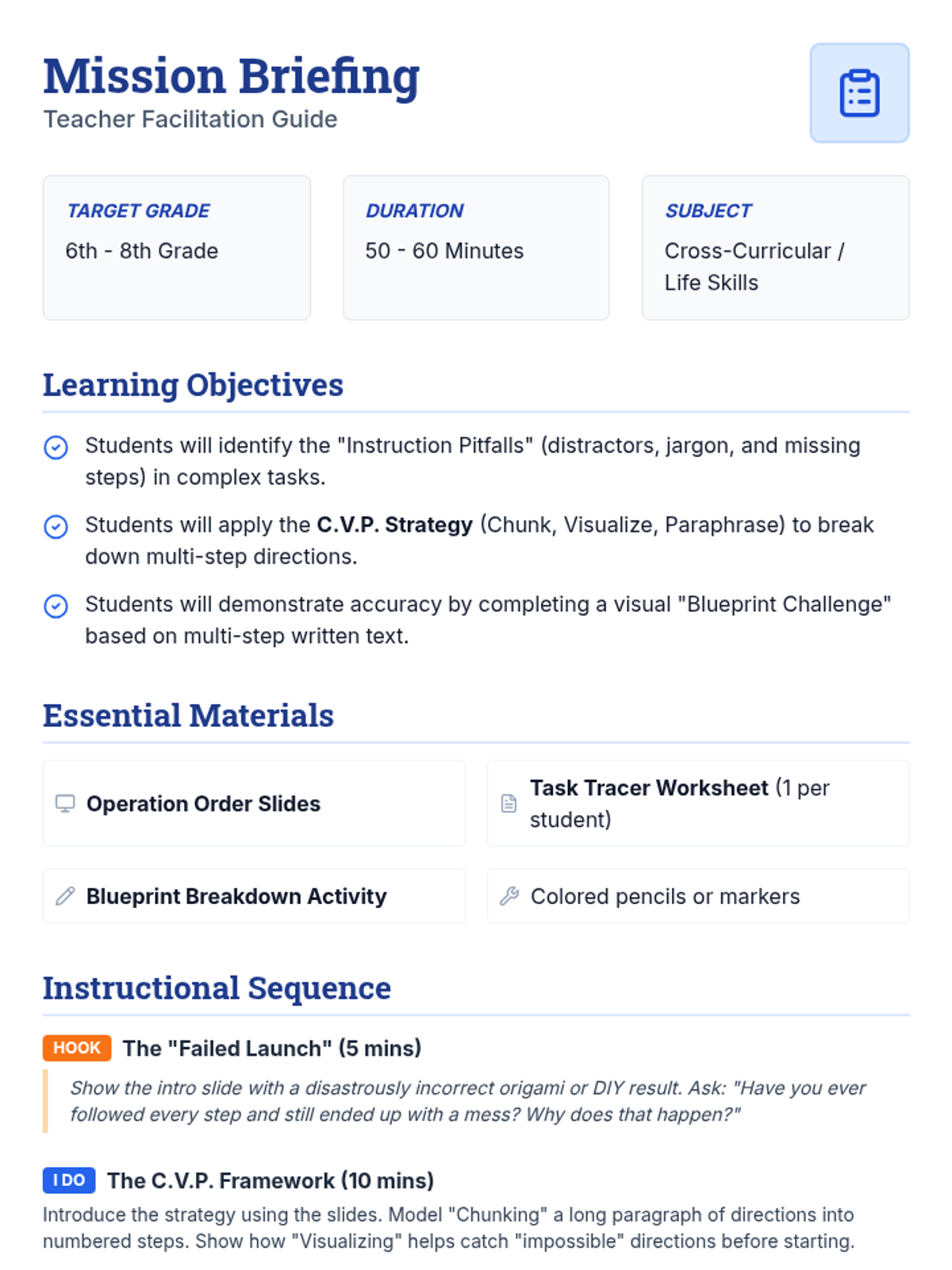
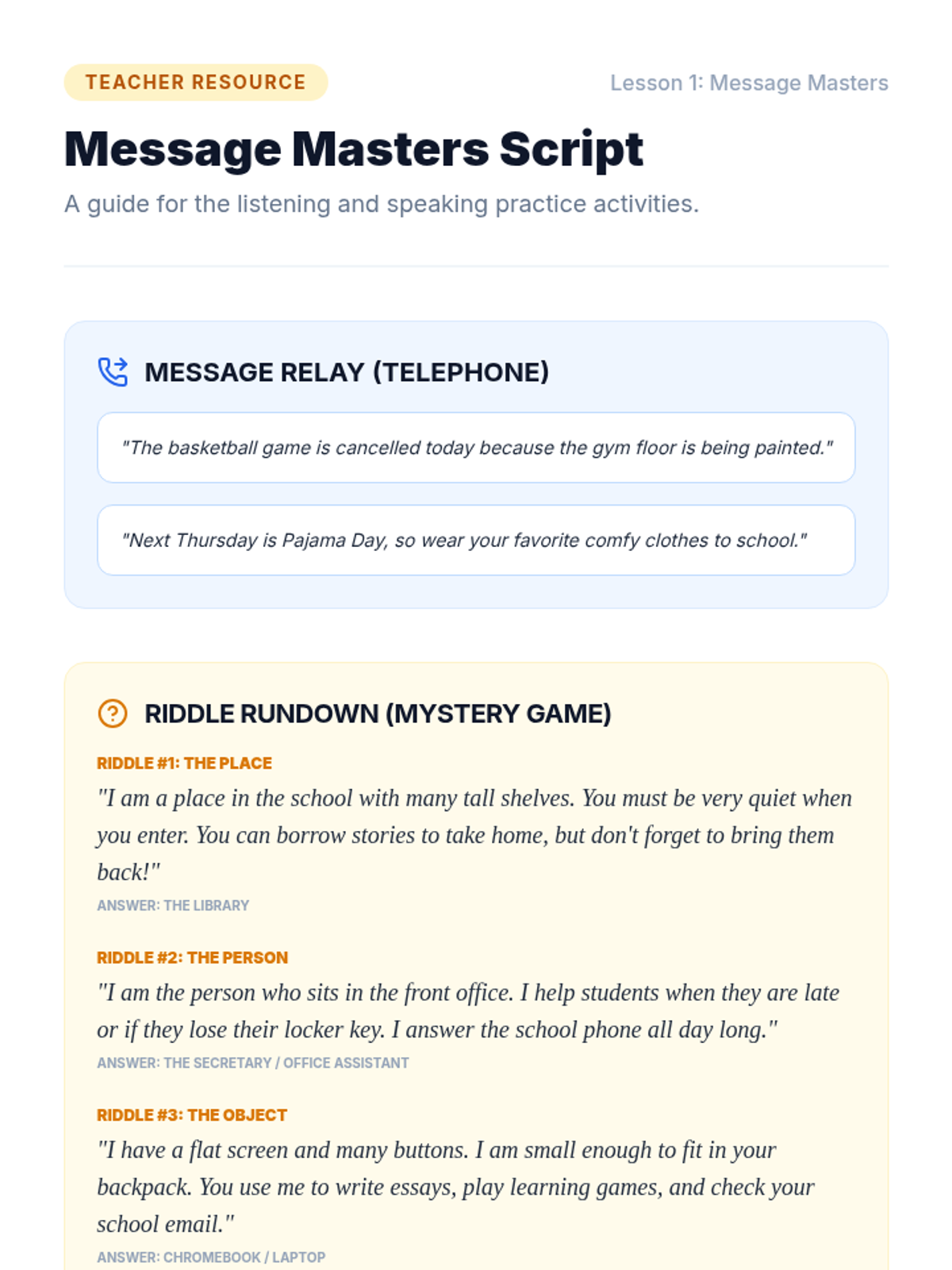
Mission Briefing Lesson Plan
Operation Order Slides
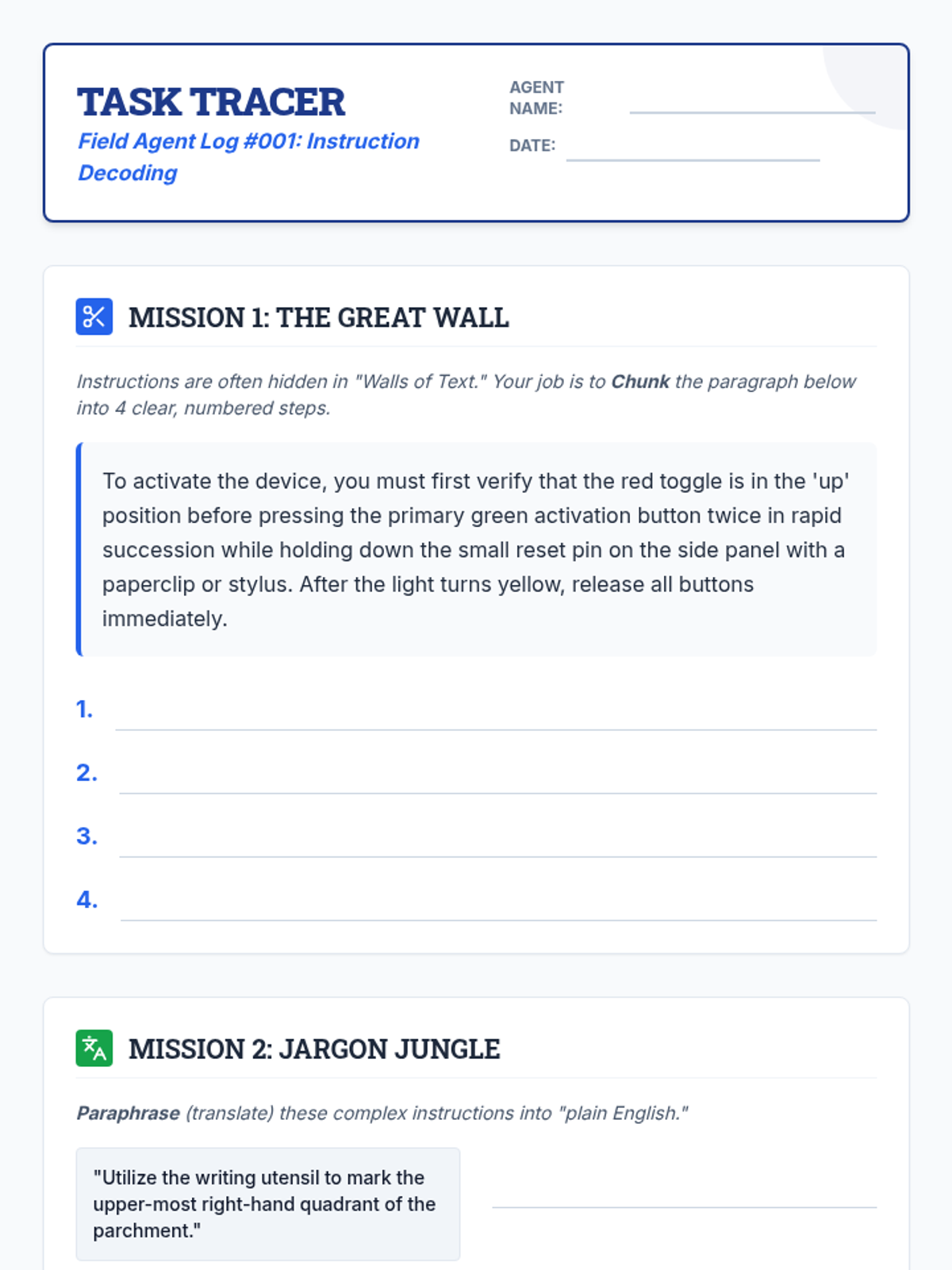
Task Tracer Worksheet
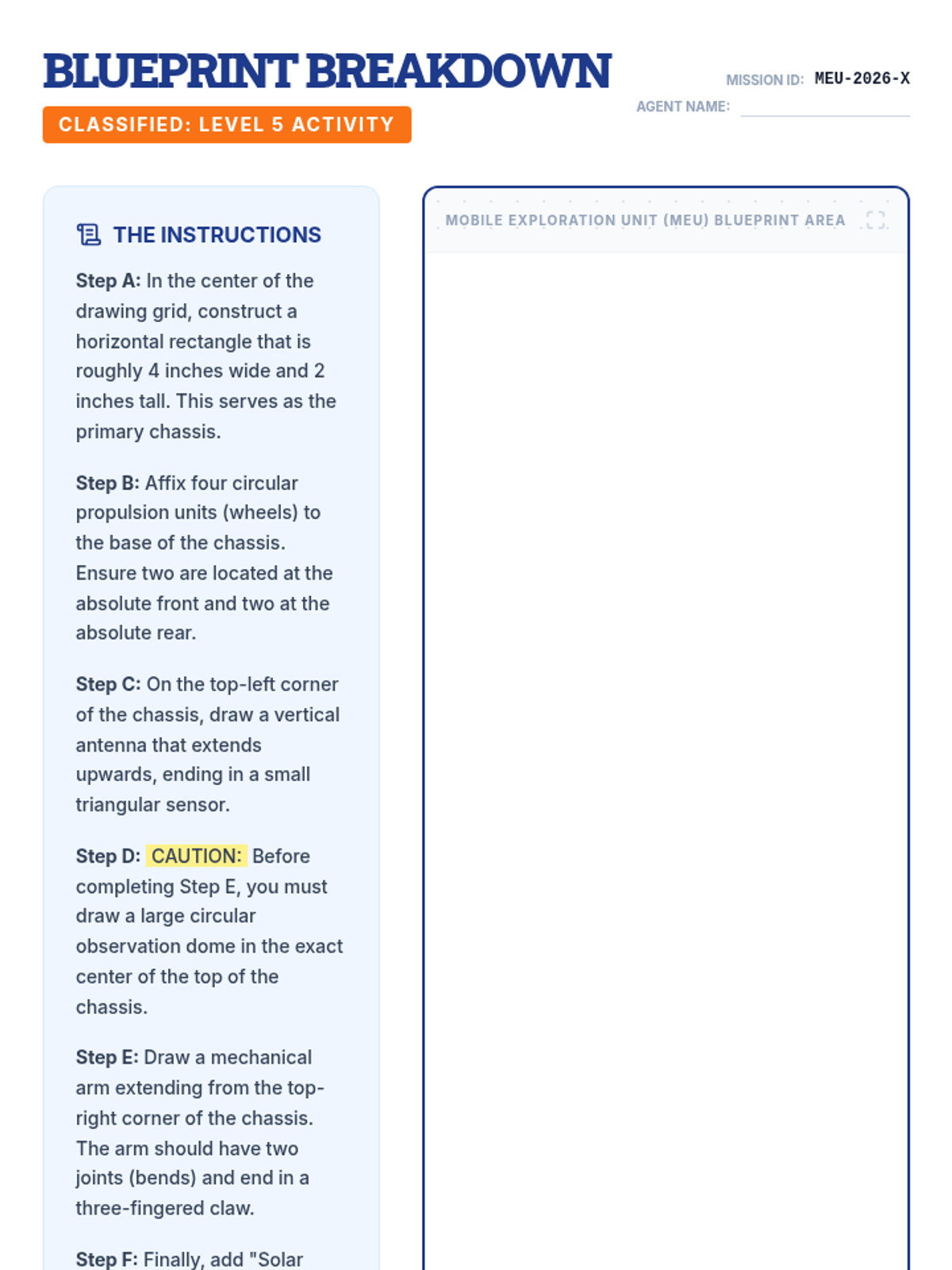
Blueprint Breakdown Activity
Answer Key Decoders
Decoder Quiz

Smart Strategies Unit

A middle school curriculum unit focused on critical thinking, information literacy, and strategic task management across digital and physical media.

TD

Tondra Dillard-Cobb

Special Education Teacher
2/2
Sequence
Setting Sleuth Slides
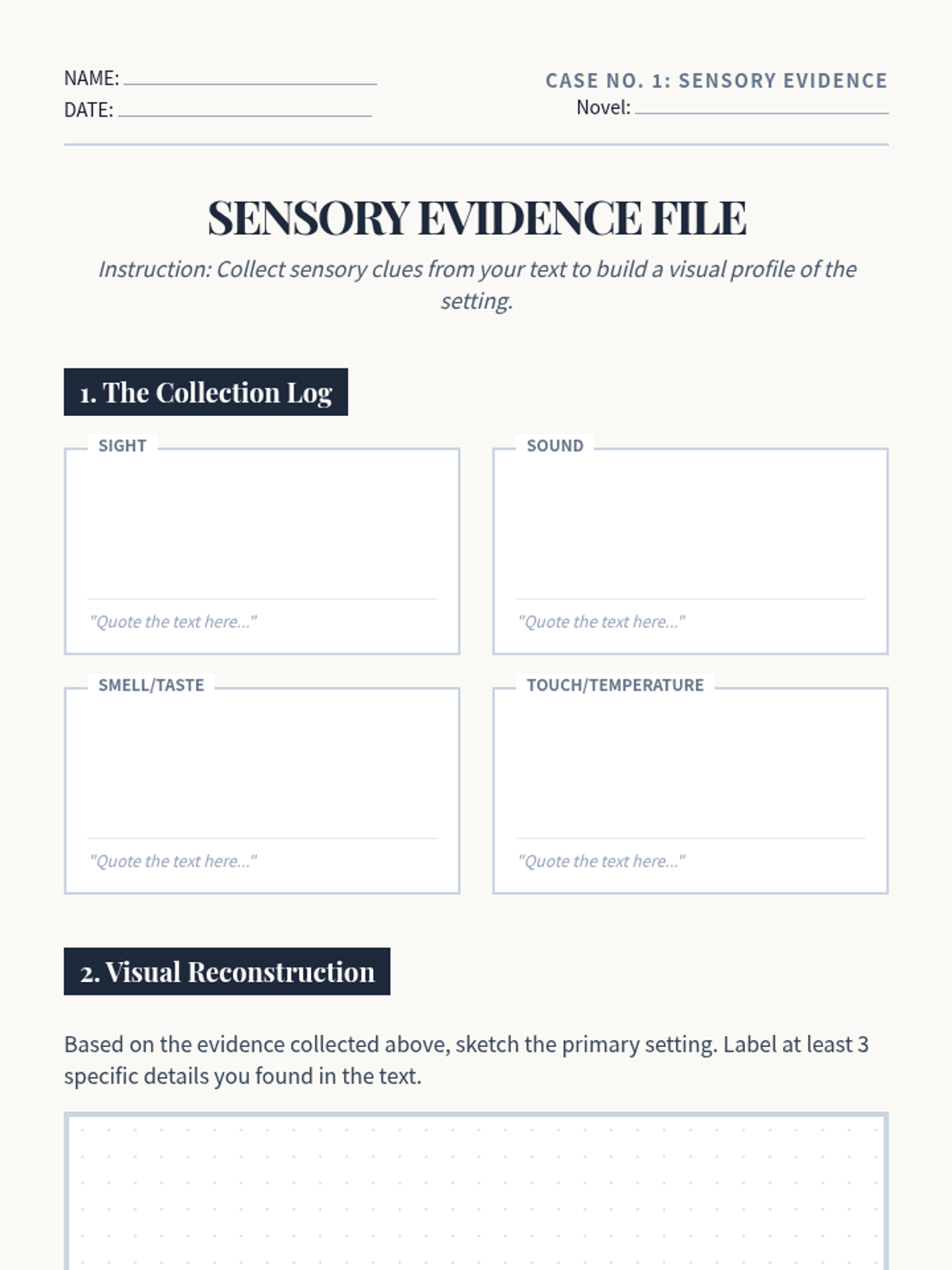
Sensory Evidence File Worksheet
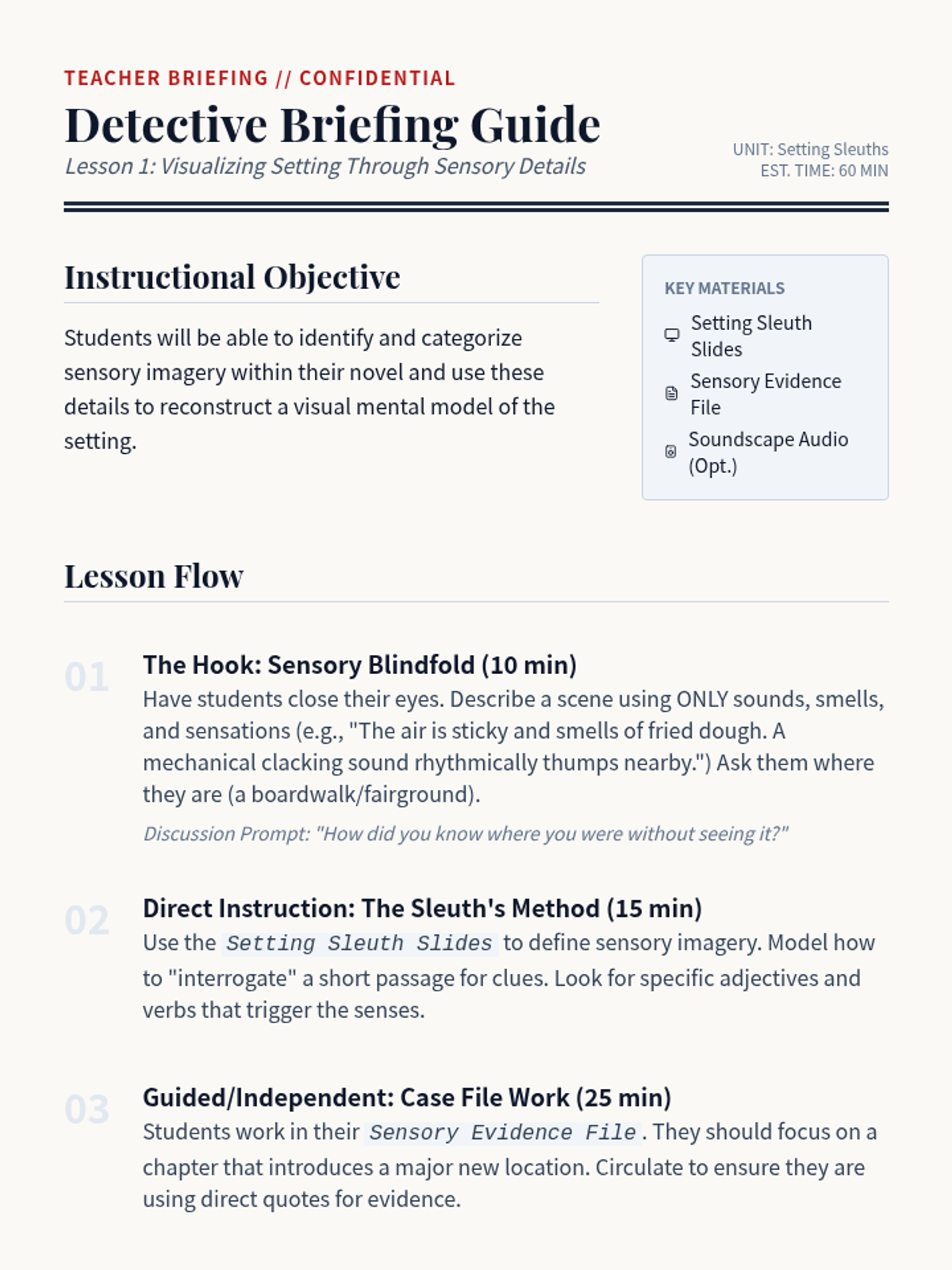
Detective Briefing Guide

Setting Sleuths and World Builders

A project-based unit where students investigate how the setting of a novel (historical and geographical) acts as a crucial force in the story, culminating in the creation of a 'World Guide' presentation.

Lenny Avatar
Lenny
1/18
Sequence
Word Origins Slides
Word Ancestry Investigation Worksheet

Linguistic Archaeology

This inquiry-driven sequence focuses on etymology as a reference skill, teaching students to trace word origins to understand language evolution and historical context. Students move from decoding individual roots to analyzing how historical events shape the English lexicon, culminating in a 'word biography' project.

Lenny Avatar
Lenny
1/18
Sequence
Targeted Inquiry Slides
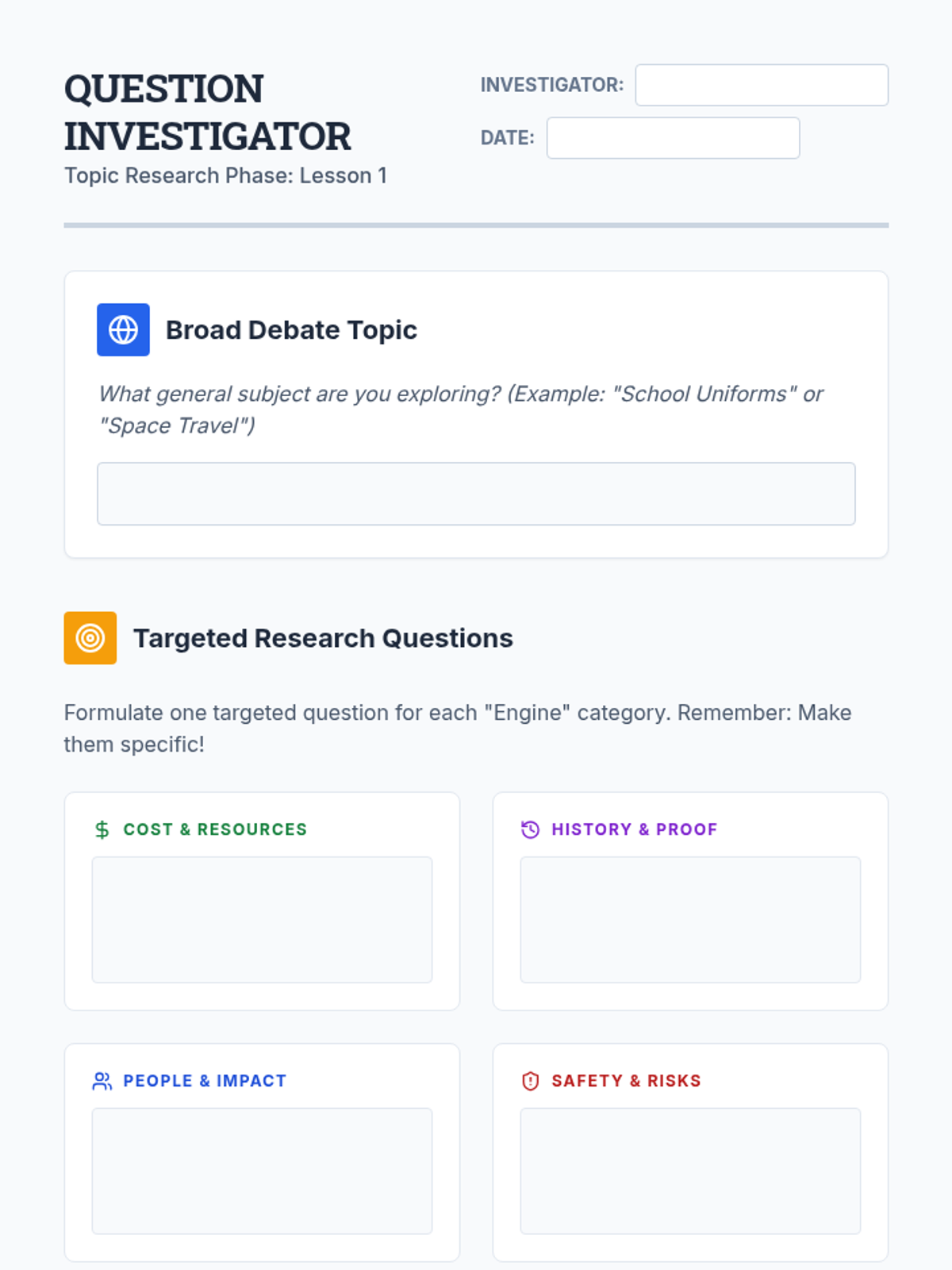
Question Investigator Worksheet

Constructing Evidence-Based Arguments and Briefs

Students learn to research, synthesize, and organize evidence into a structured debate brief, moving from broad curiosity to targeted logical arguments.

Lenny Avatar
Lenny
1/17
Sequence
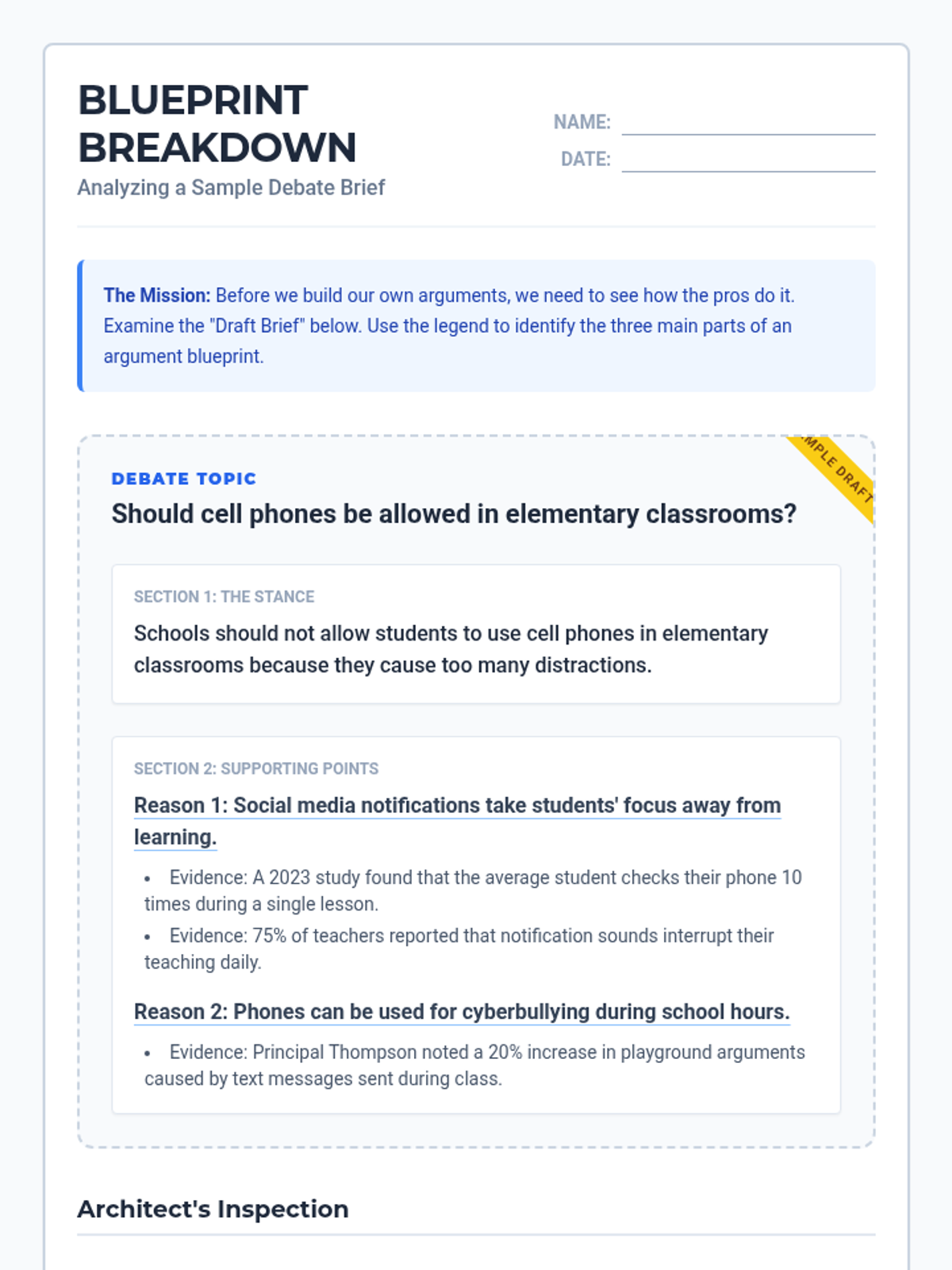
Sample Brief Analysis Worksheet
Blueprint Breakdown Slides
Blueprint Facilitation Guide

Argument Architects

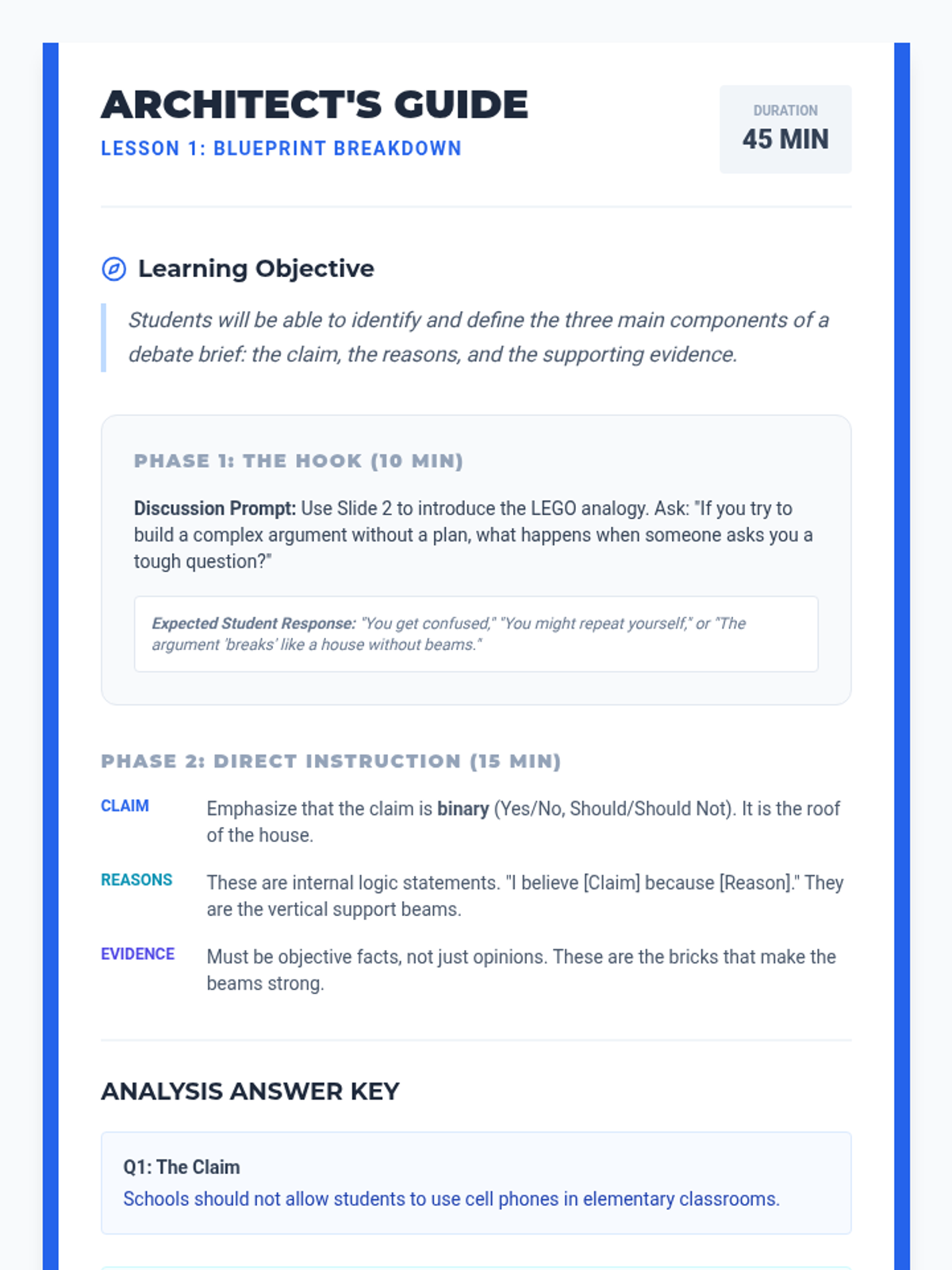
Students move beyond finding sources to organizing scattered information into a structured debate brief. They learn to categorize evidence, rank its strength, and group facts into cohesive reasons to build a powerful argument.

Lenny Avatar
Lenny
1/17
Sequence
Etymology Intro Slides
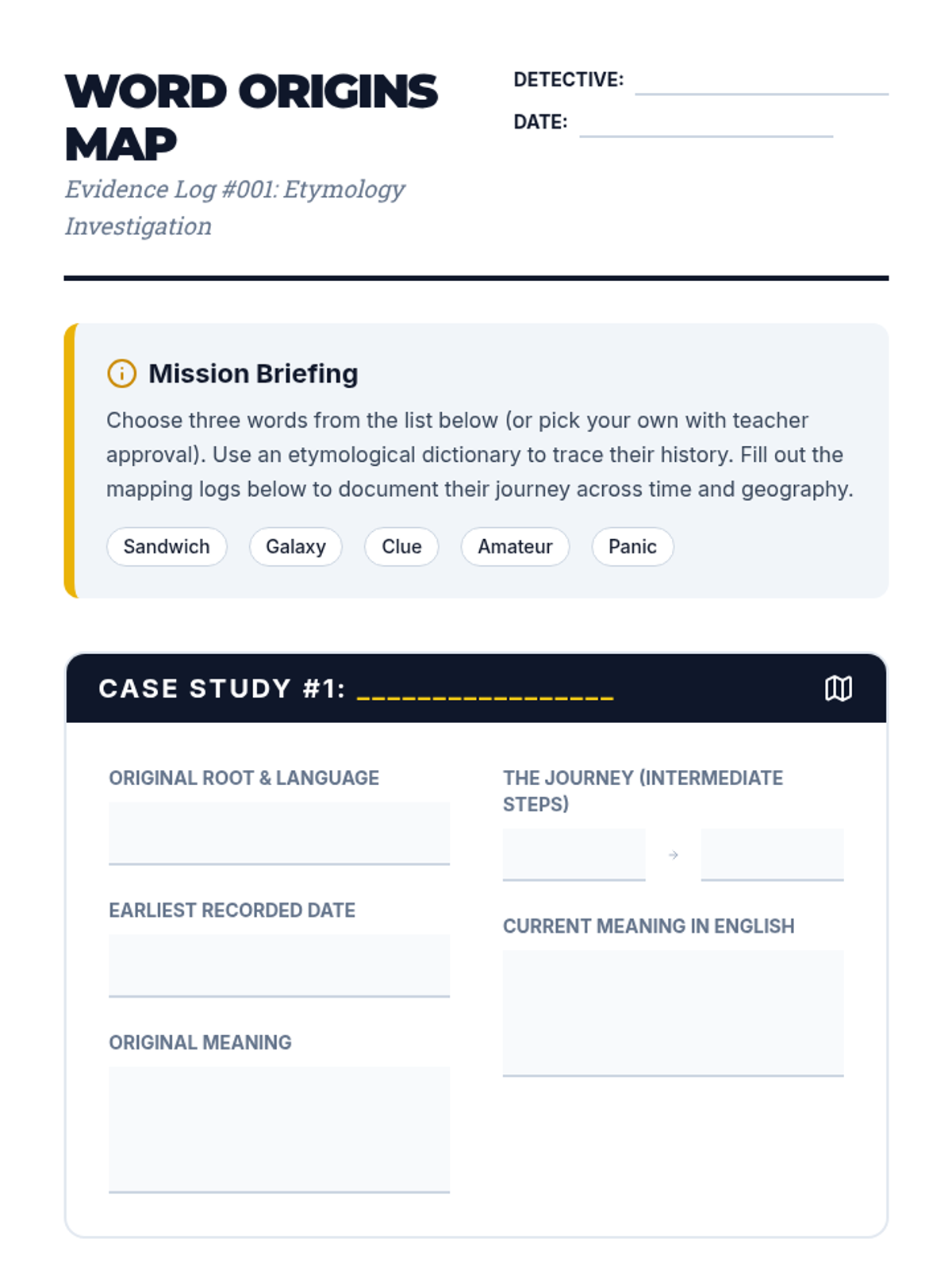
Word Origins Worksheet

Word Detectives: The Secret Life of Language

Students become linguistic historians, investigating the etymology, cultural origins, and evolution of advanced English vocabulary through research and creative projects.

Lenny Avatar
Lenny
1/17
Sequence
Vantage Point Slides
Story Ownership Worksheet
Memoir Master Teacher Guide

Vantage Point

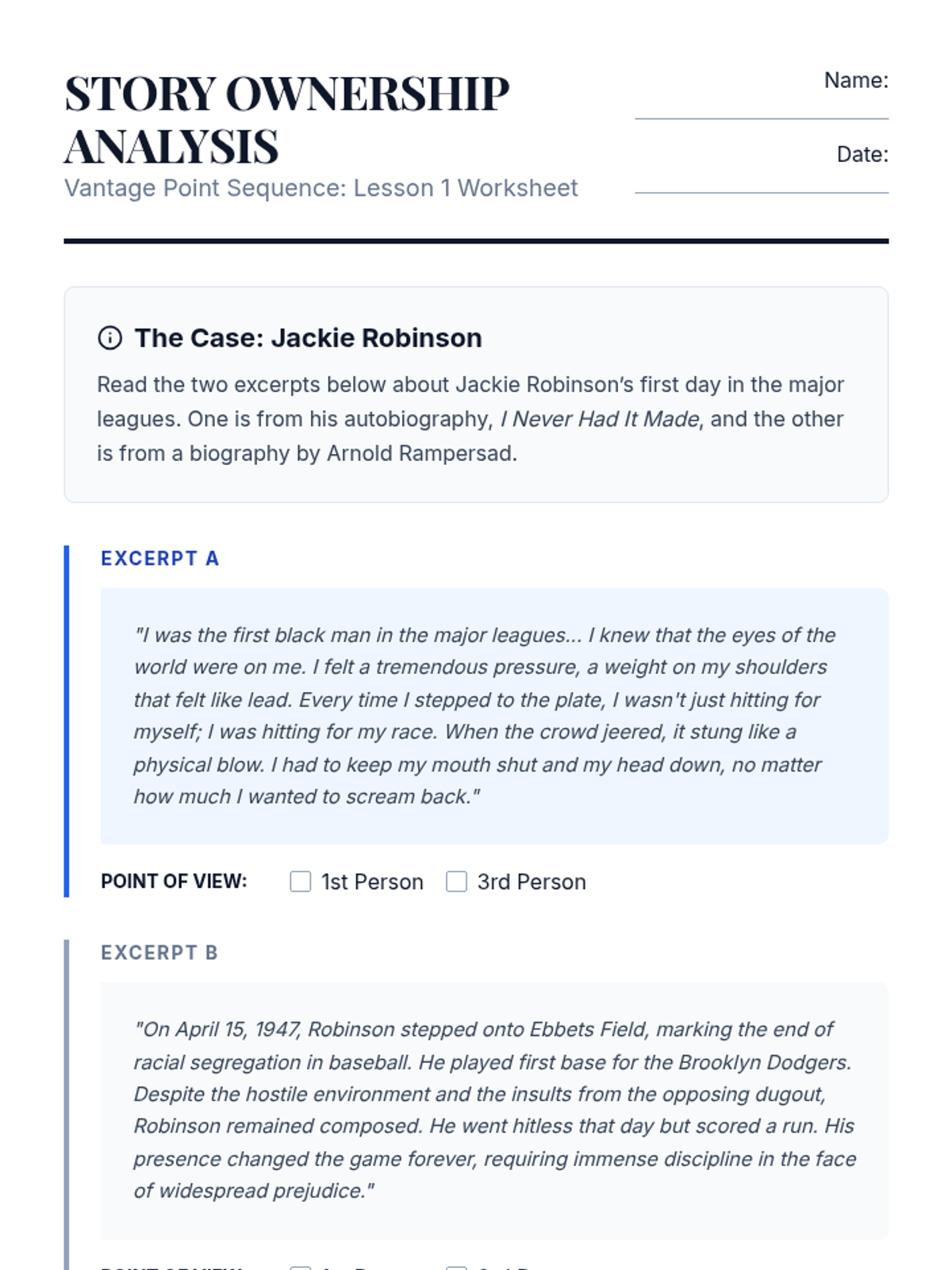
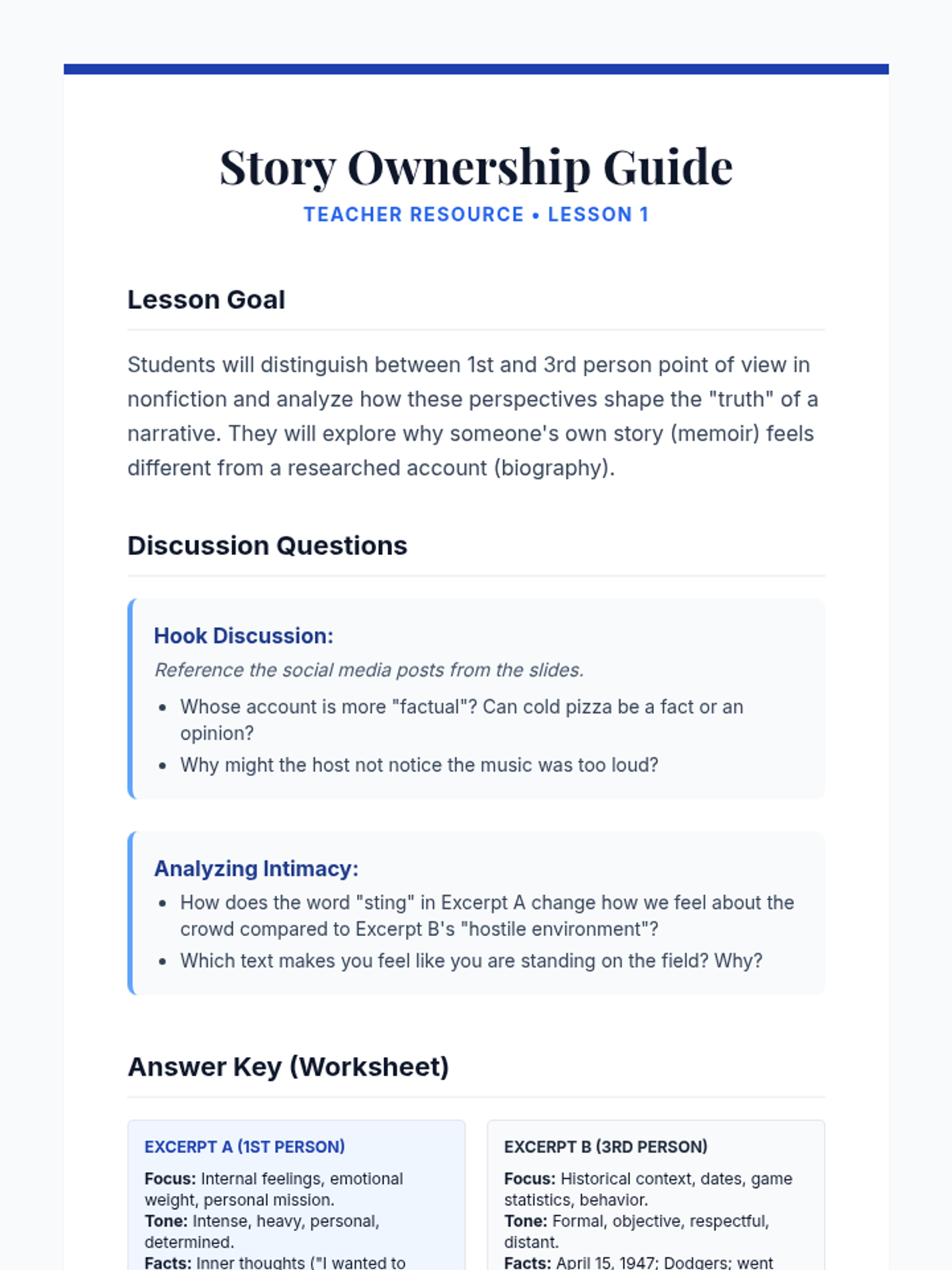
A 6th-grade ELA unit exploring how point of view shapes nonfiction and media. Students analyze the differences between first-person memoirs and third-person biographies, identify bias in journalism, and examine historical narratives through multiple lenses.

Lenny Avatar
Lenny
1/17
Sequence
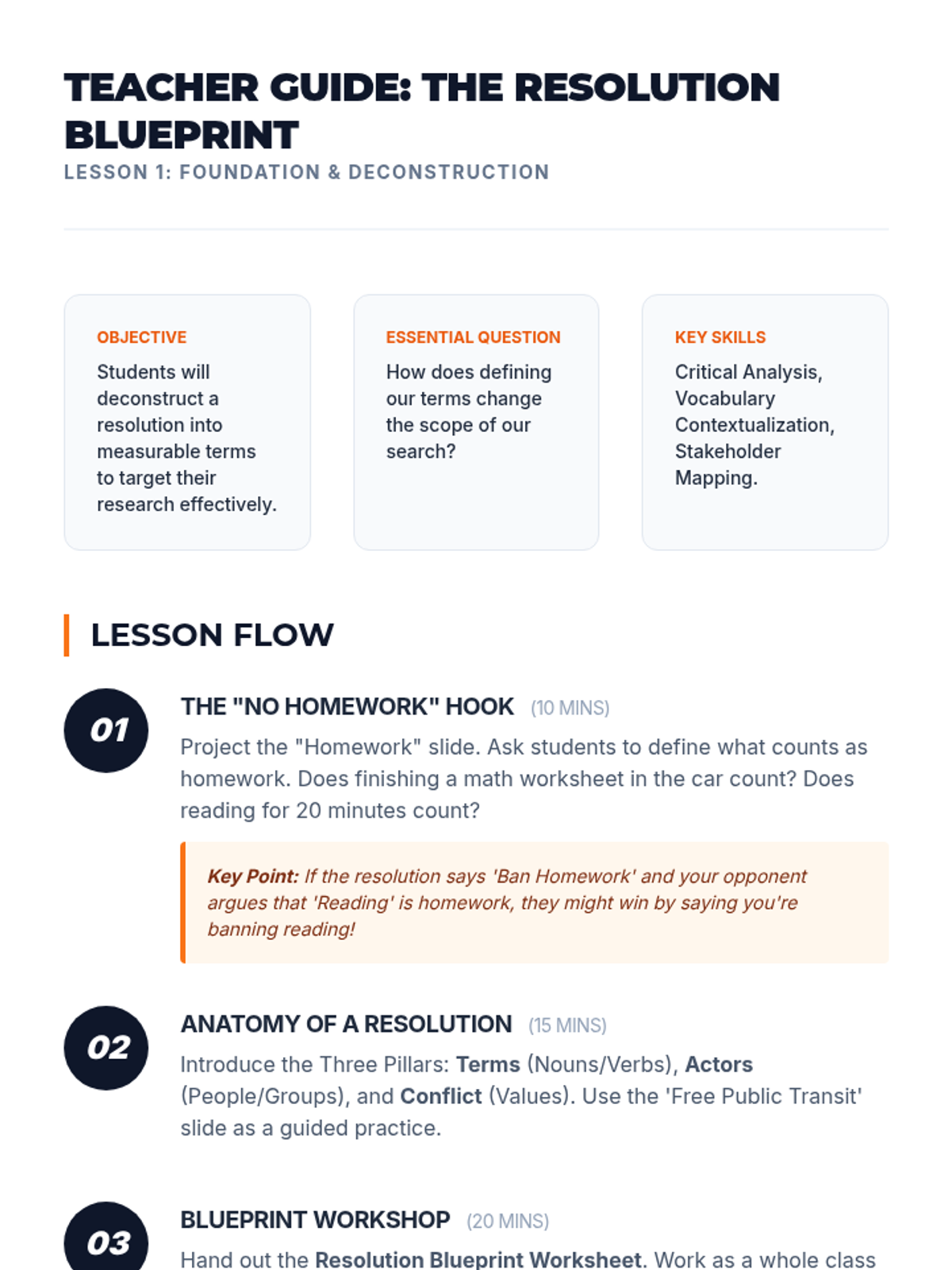
Resolution Blueprint Slides
Resolution Blueprint Worksheet
Resolution Blueprint Teacher Guide

Argument Architecture

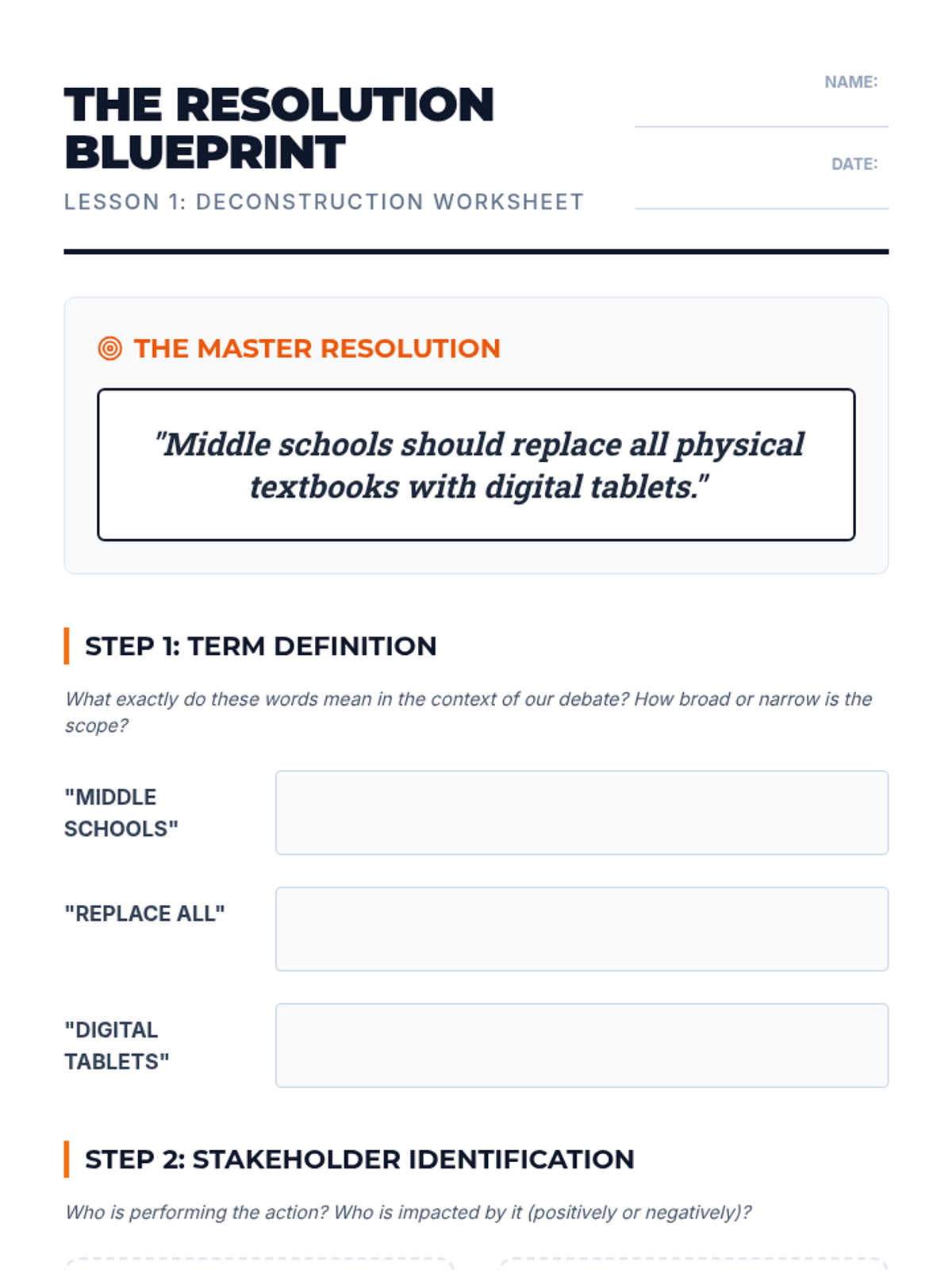
A project-based sequence where 6th-grade students learn to deconstruct debate resolutions, conduct multi-layered research, and synthesize diverse sources into cohesive arguments. Students progress from initial topic analysis to defending their findings before a peer panel.

Lenny Avatar
Lenny
1/17
Sequence
Case of the Fact Slides
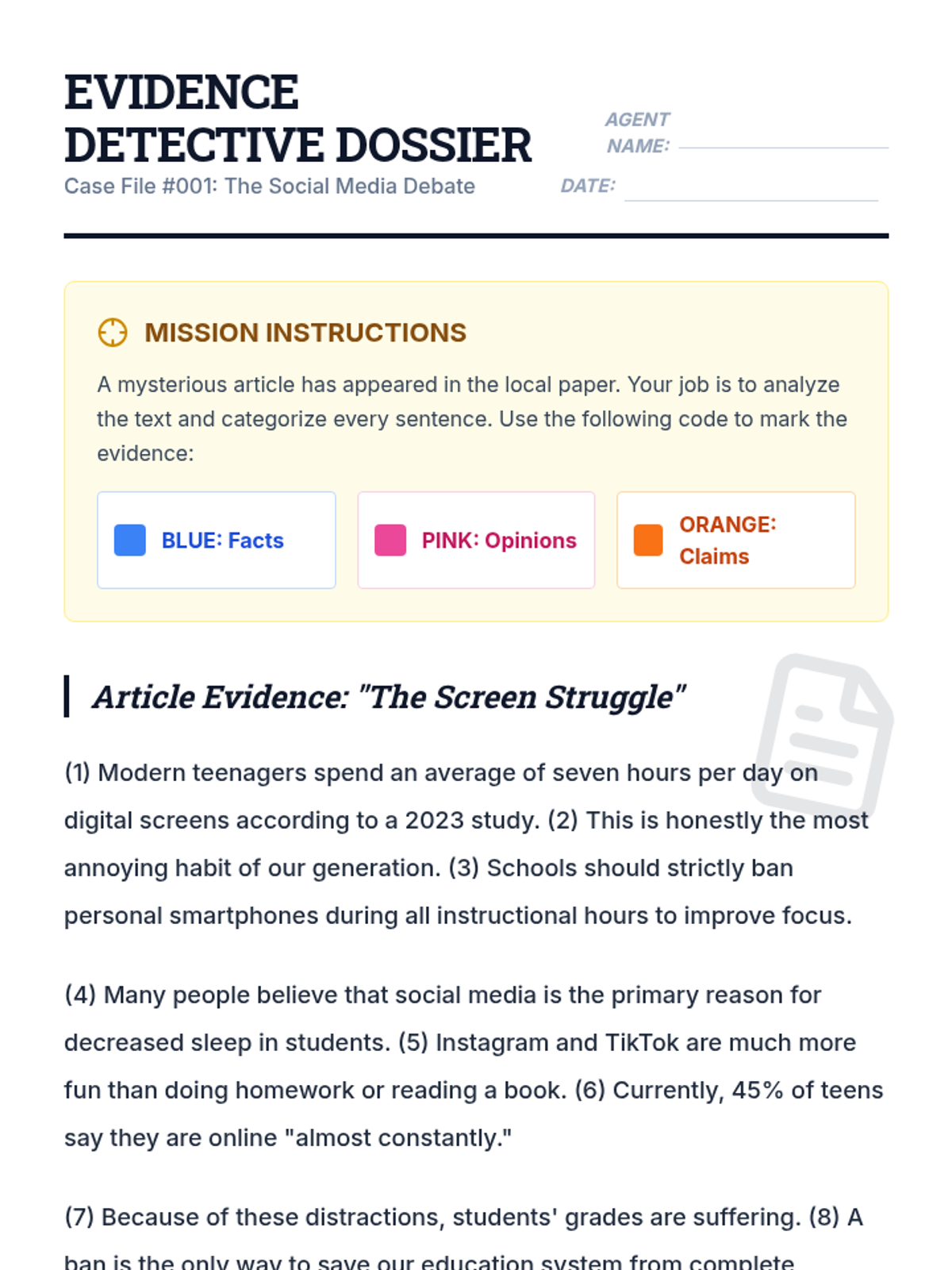
Case of the Fact Worksheet
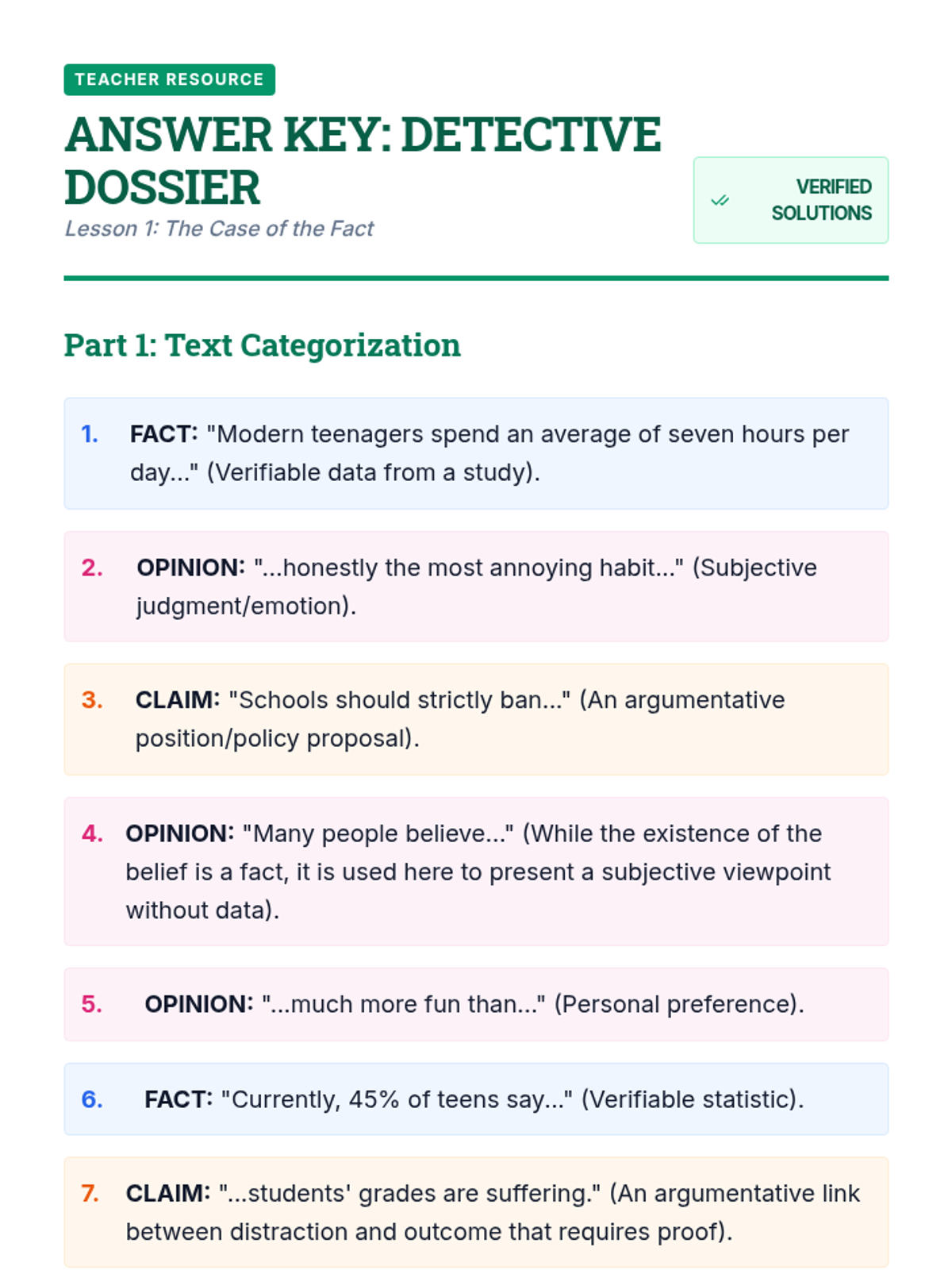
Case of the Fact Answer Key

Evidence Detectives

This sequence guides 6th-grade students through the process of identifying, categorizing, and evaluating evidence for debate. Students progress from distinguishing facts from opinions to masterfully ranking the quality of evidence based on authority, relevance, and recency.

Lenny Avatar
Lenny
1/17
Sequence
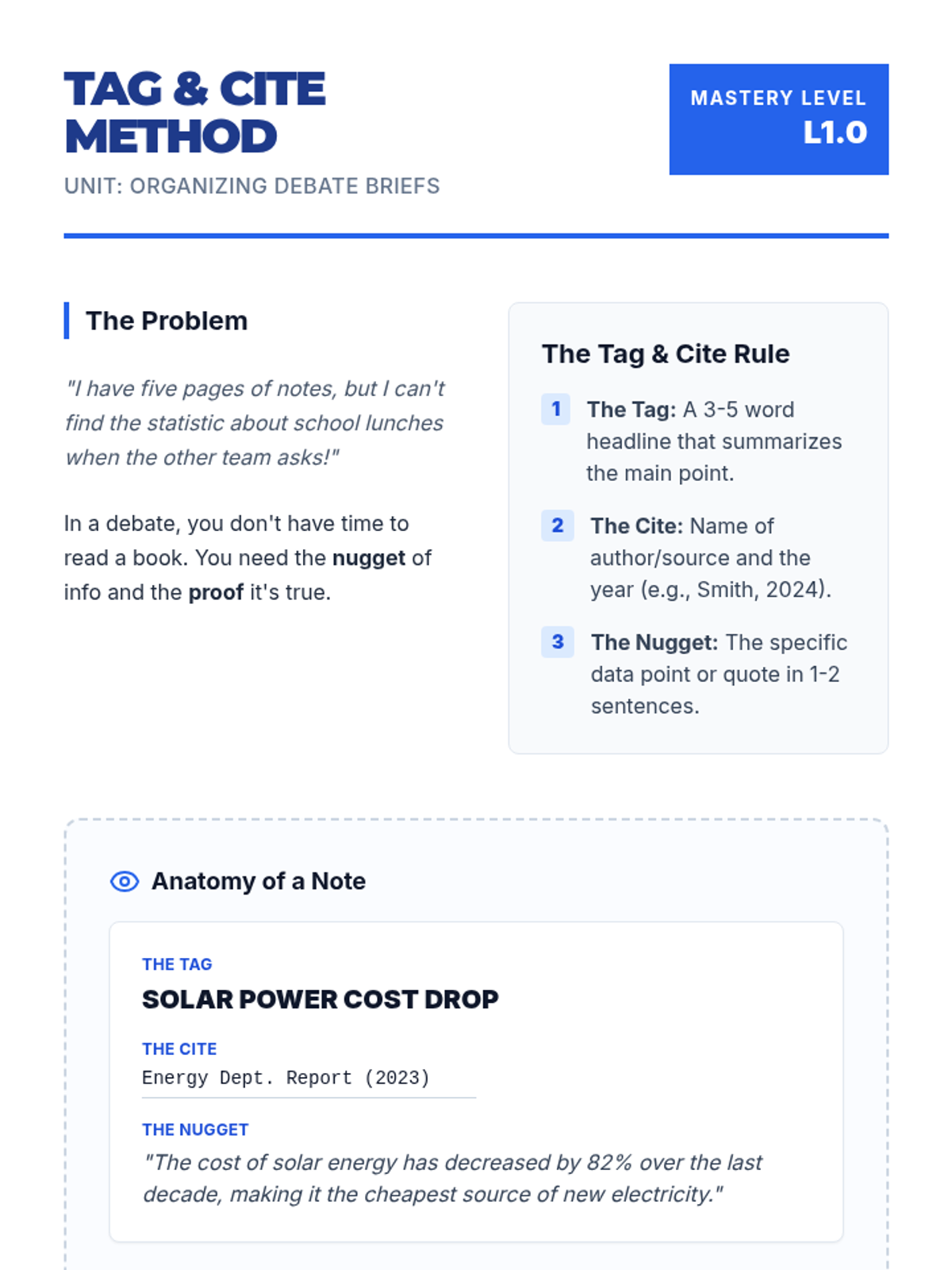
Tag and Cite Worksheet

Organizing Research into Debate Briefs

A sequence for 6th-grade students focused on transforming raw research into organized debate briefs using the 'Tag and Cite' method and the SEP categorization framework. Students learn to structure arguments through the Claim-Warrant-Data-Impact model and practice rapid information retrieval.

Lenny Avatar
Lenny
1/17
Sequence
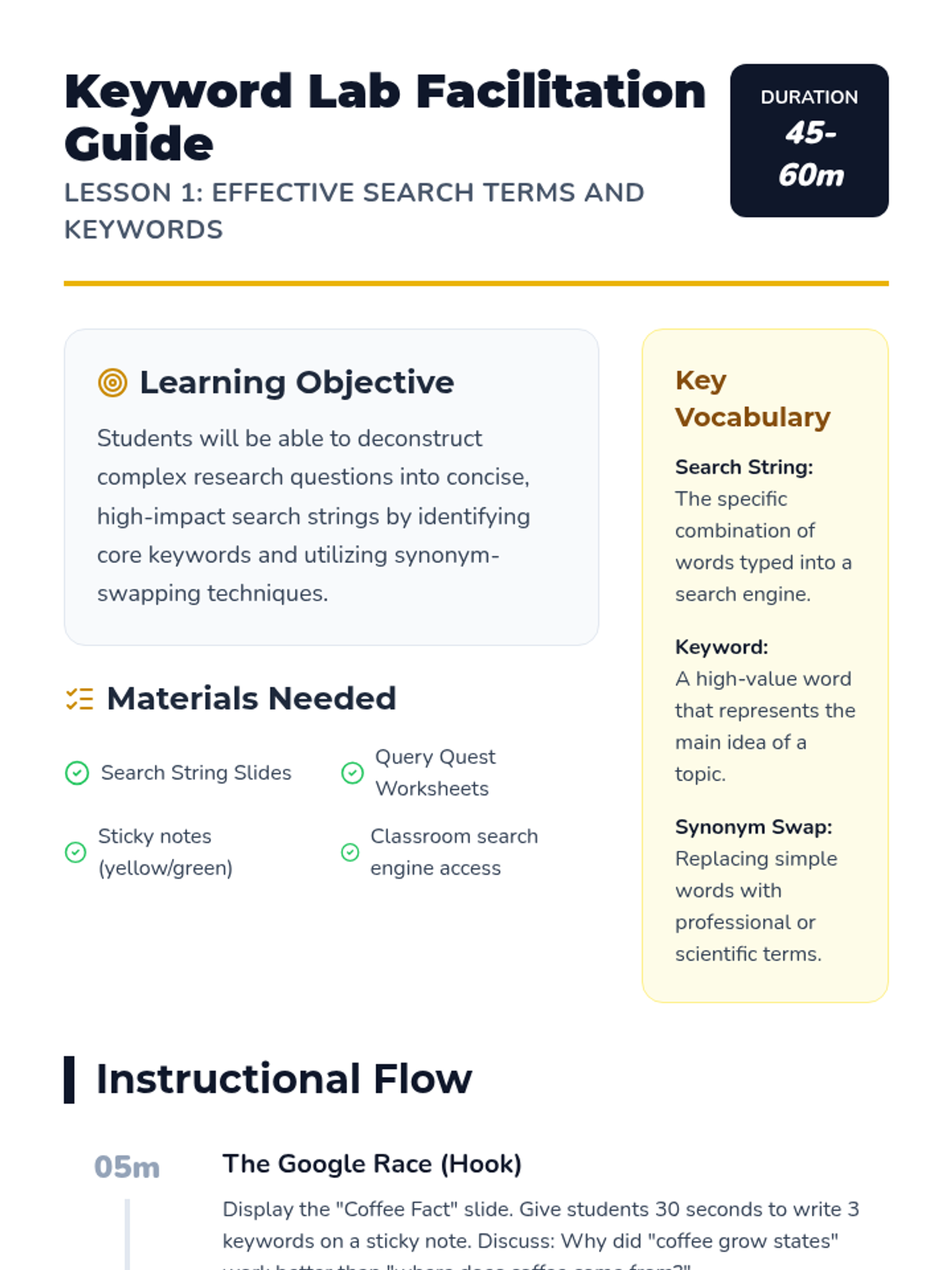
Search String Slides
Keyword Lab Teacher Guide
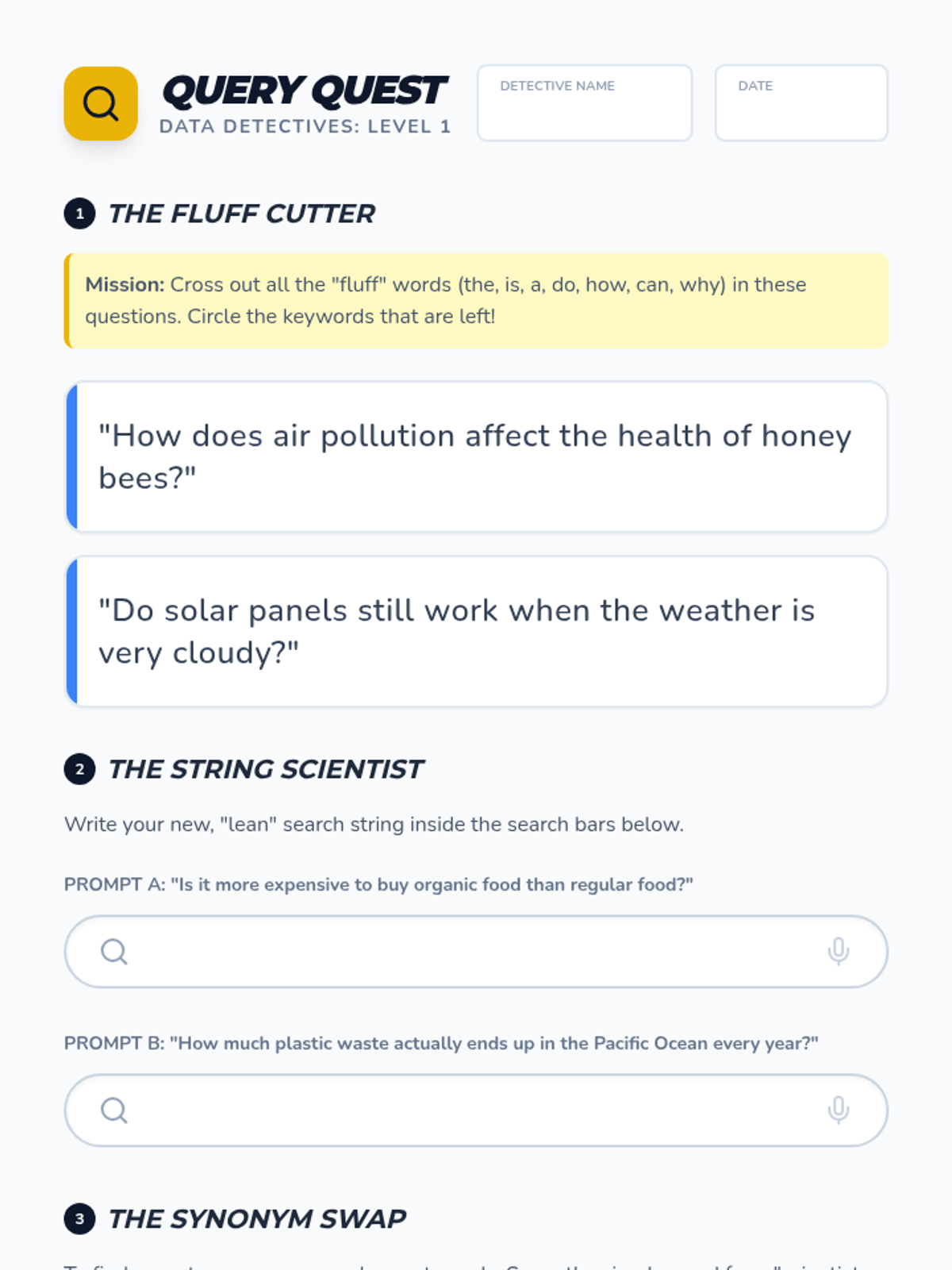
Query Quest Worksheet

Data Detectives Research Lab

A comprehensive 4th-grade sequence on research mechanics for debate, covering search strategies, skimming, paraphrasing, quoting, and organization. Students move from raw data to 'clean', ready-to-use debate notes while maintaining academic integrity.

Lenny Avatar
Lenny
1/17
Sequence
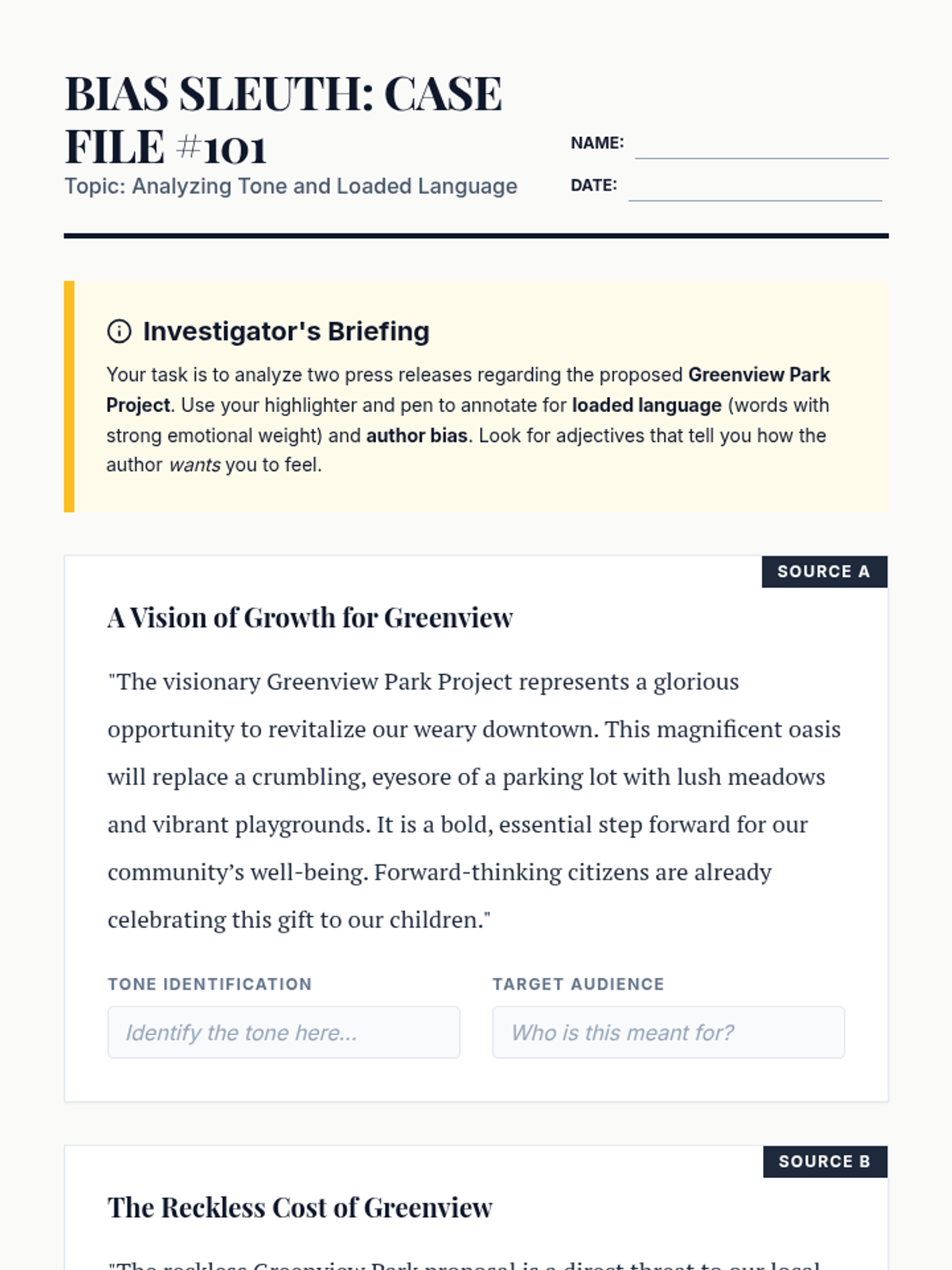
Bias and Tone Slides
Bias Sleuth Worksheet
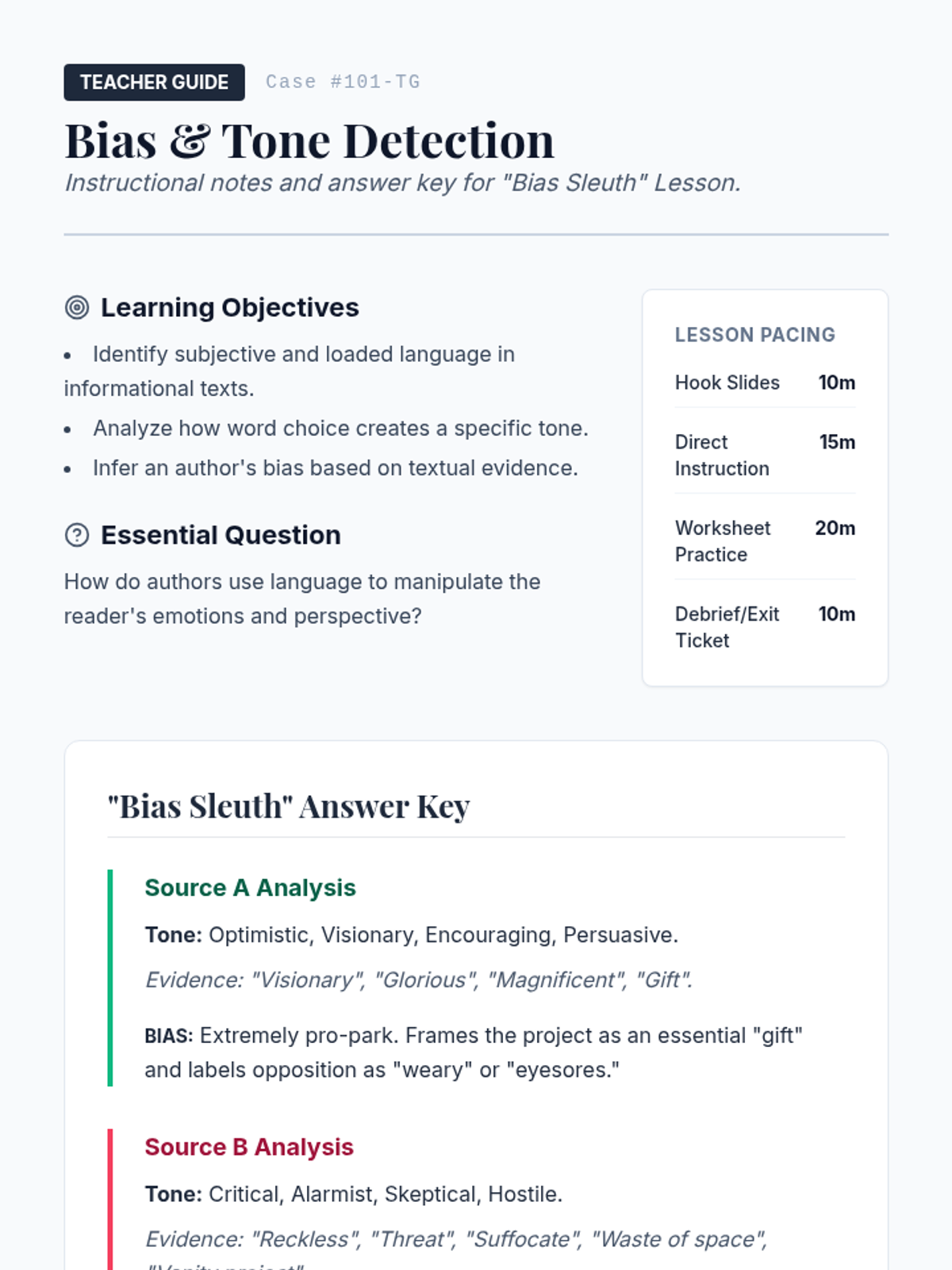
Bias and Tone Teacher Guide

Conflicting Perspectives

This sequence focuses on the critical thinking skills required to analyze conflicting information and differing perspectives within informational texts. Students progress from identifying bias and tone to evaluating evidence credibility and synthesizing multiple viewpoints into balanced accounts.

Lenny Avatar
Lenny
1/17
Sequence
Argument Armor Slides
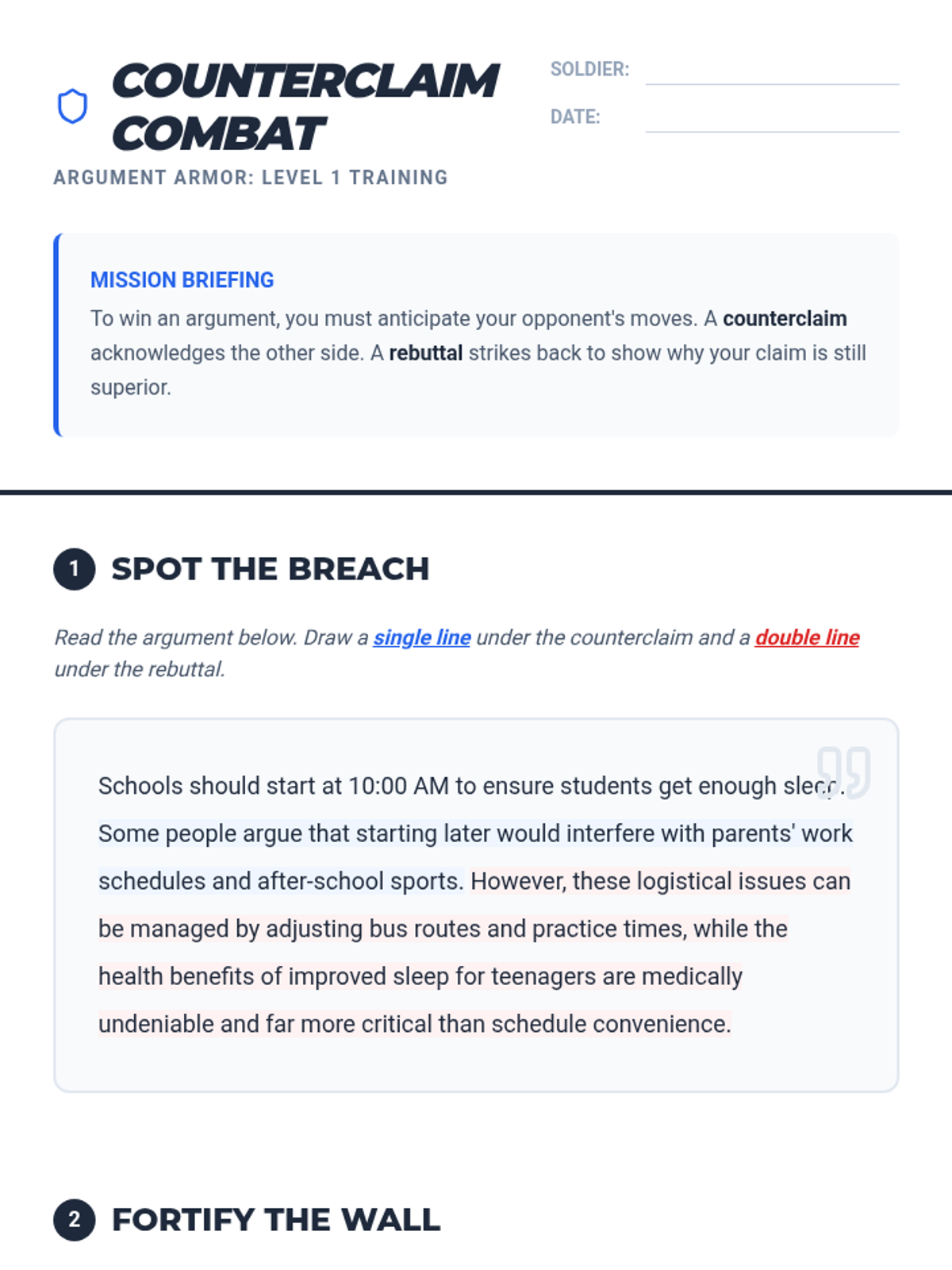
Counterclaim Combat Worksheet
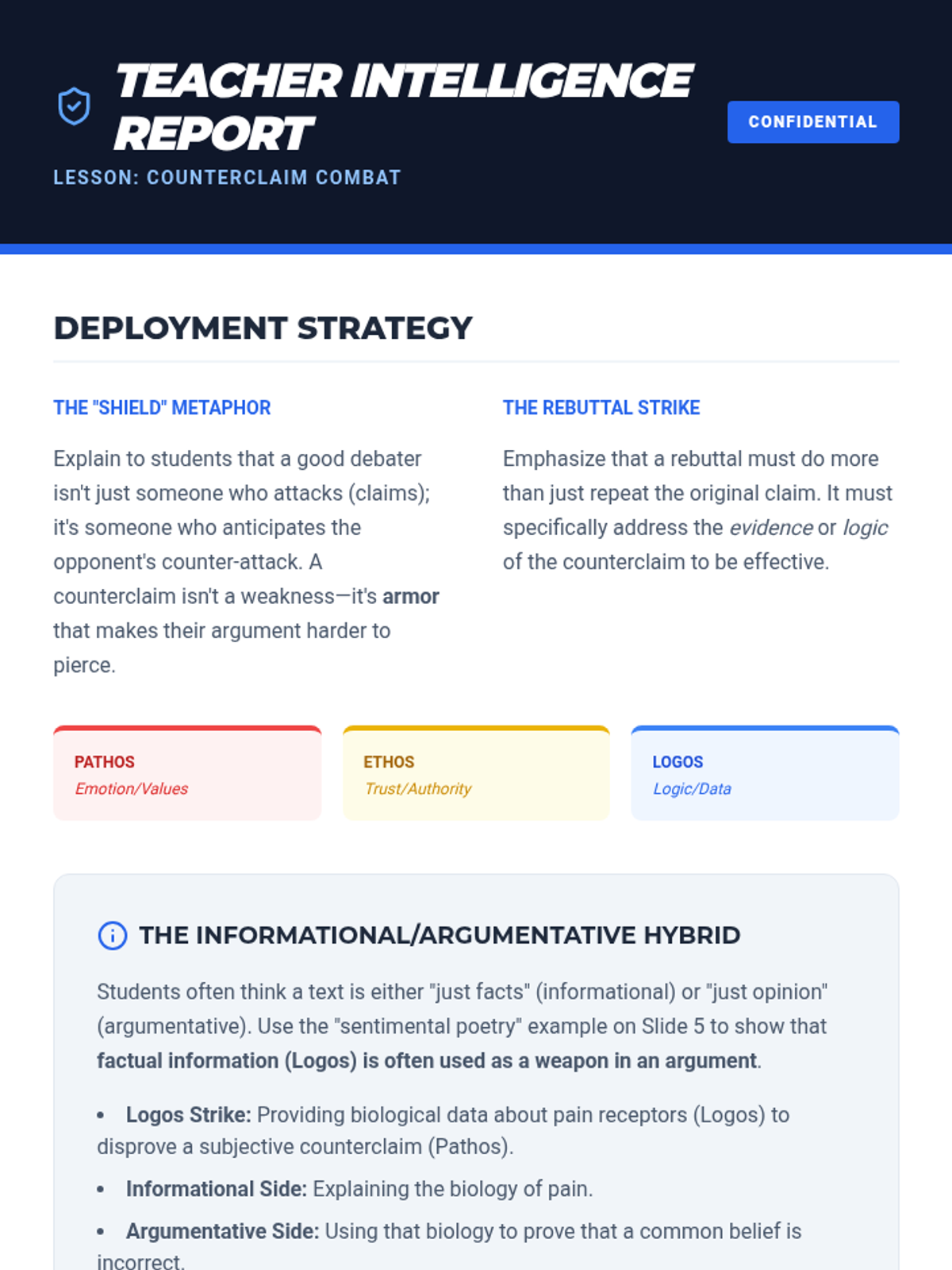
Counterclaim Combat Teacher Guide

Argument Armor

A series of lessons focused on mastering the art of persuasion and argumentative writing, from building claims to defending them against opposition.

TH

Terrie Huff

Special Education Teacher
2/17
Sequence
Gauntlet Slides
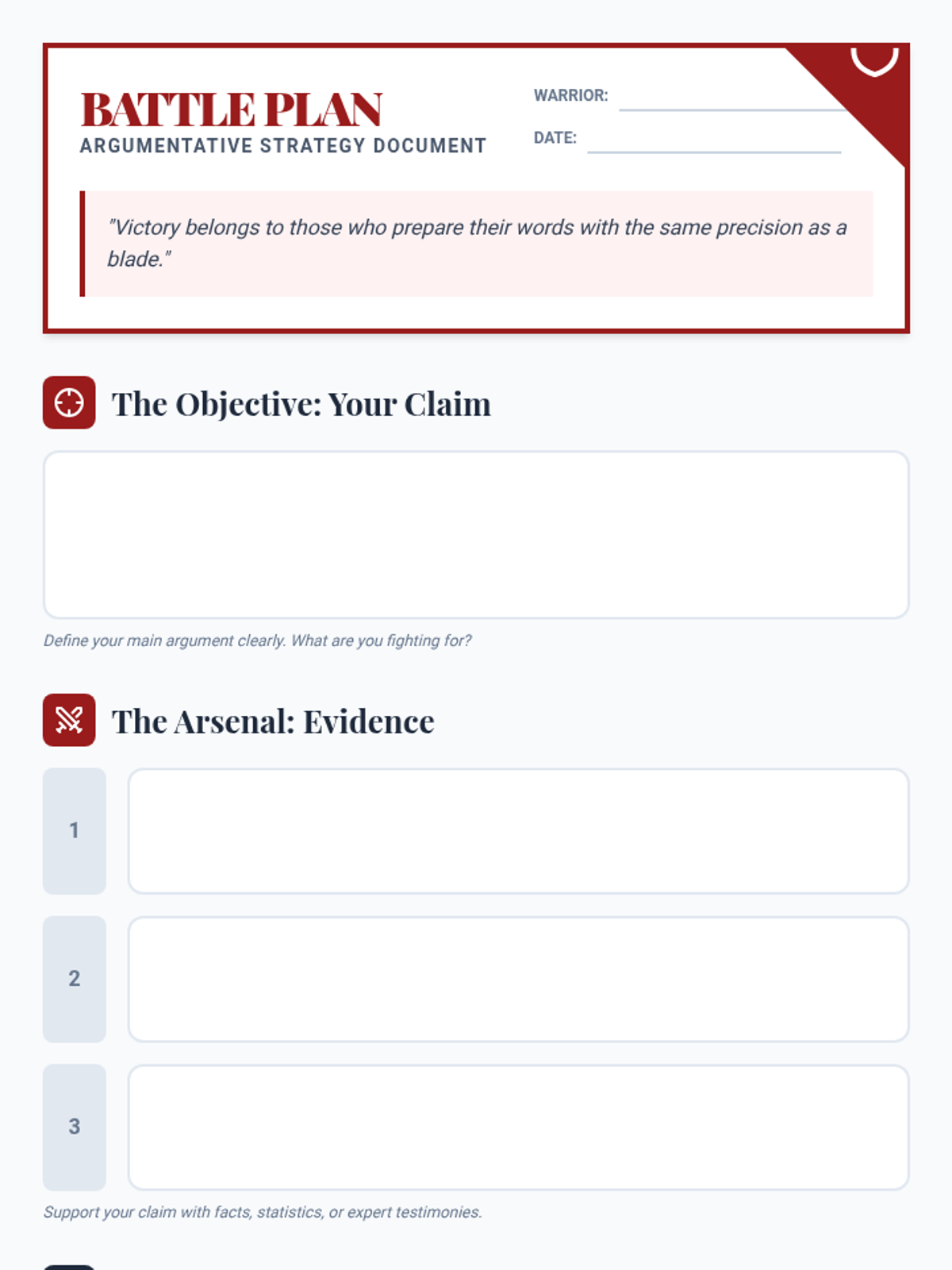
Battle Plan Worksheet
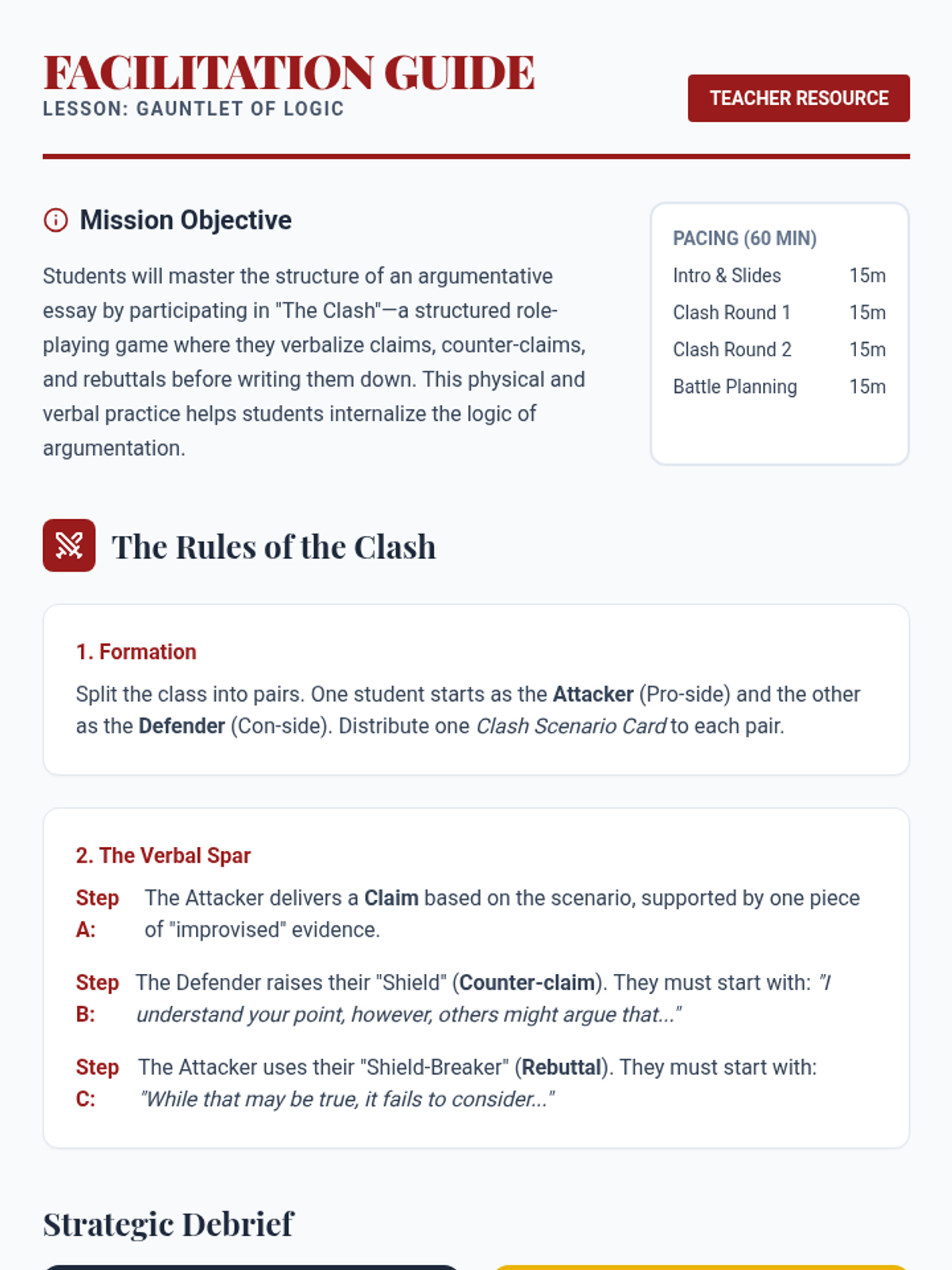
Gauntlet Facilitation Guide

Argument Arsenal

A series of lessons focused on mastering argumentative writing through immersive, game-based activities and role-playing scenarios.

MR

Mary Rayburn

English Language Arts Teacher
2/14
Sequence
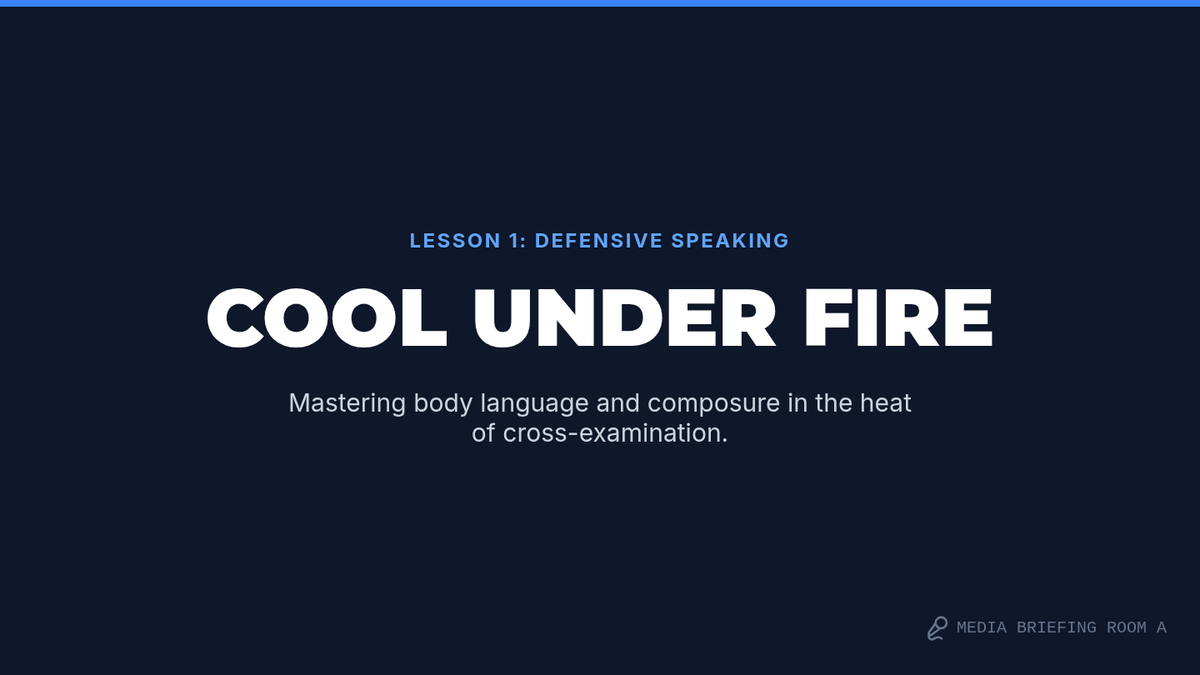
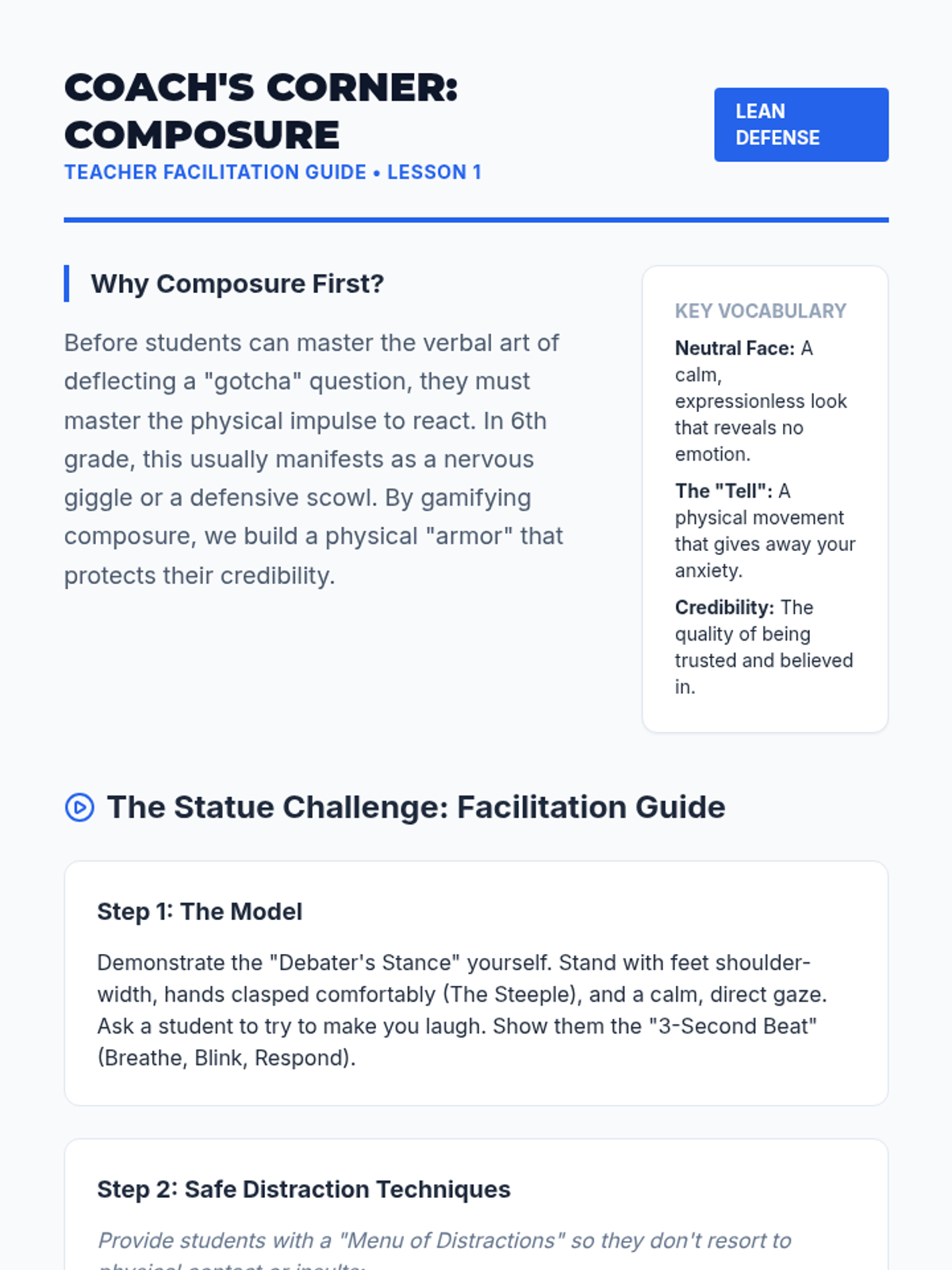
Cool Under Fire Slides
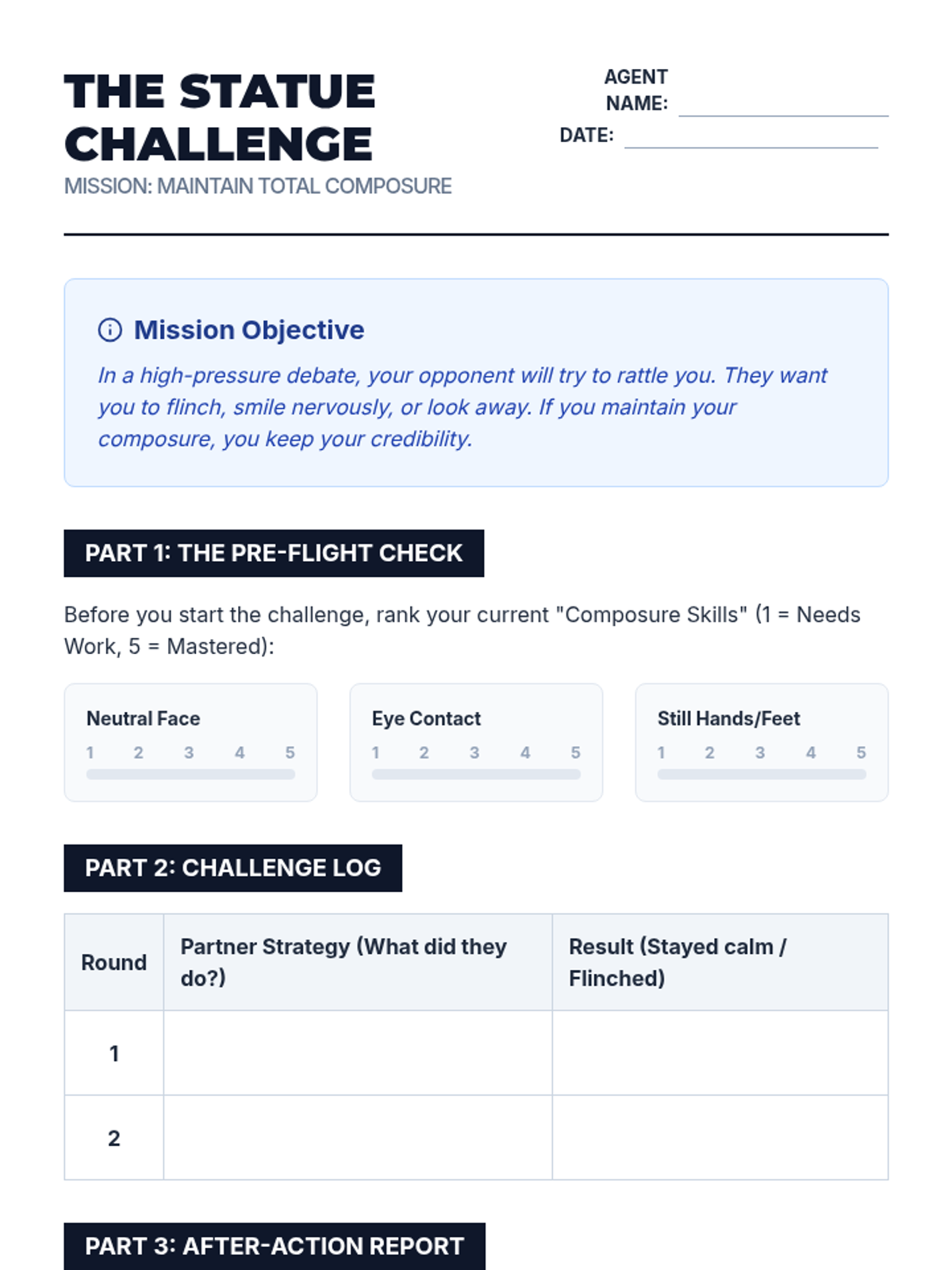
Statue Challenge Worksheet
Composure Coaching Guide

Defensive Speaking and Responding Under Pressure

A sequence focused on the defensive side of debate, teaching 6th-grade students how to maintain composure, identify rhetorical traps, and pivot back to evidence during cross-examination. Students will move from non-verbal techniques to full-scale rapid-fire defense simulations.

Lenny Avatar
Lenny
1/18
Sequence
Anatomy Argument Slides
Argument Autopsy Worksheet
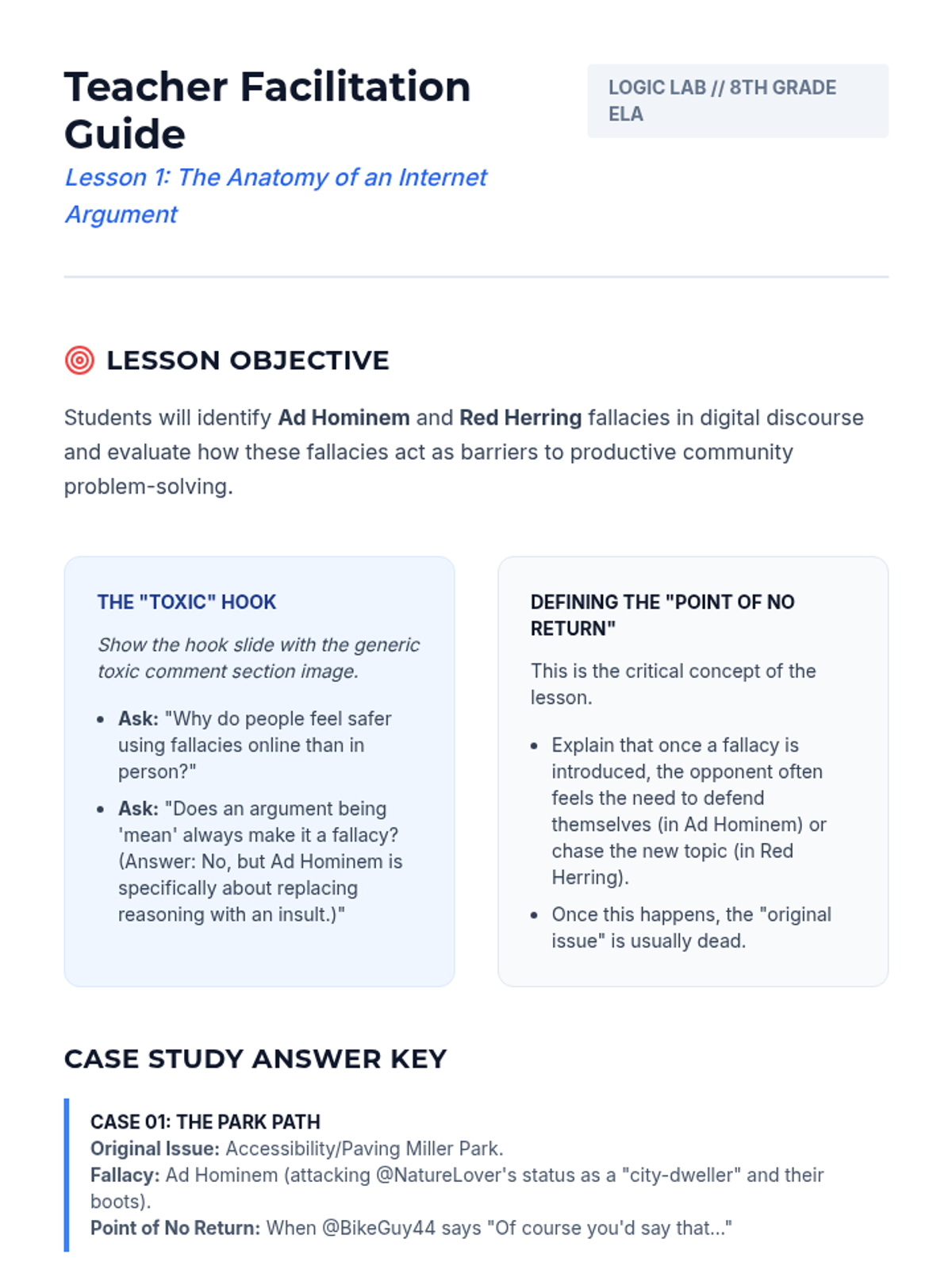
Anatomy Argument Teacher Guide

Evaluating the Impact of Fallacies in Social Discourse

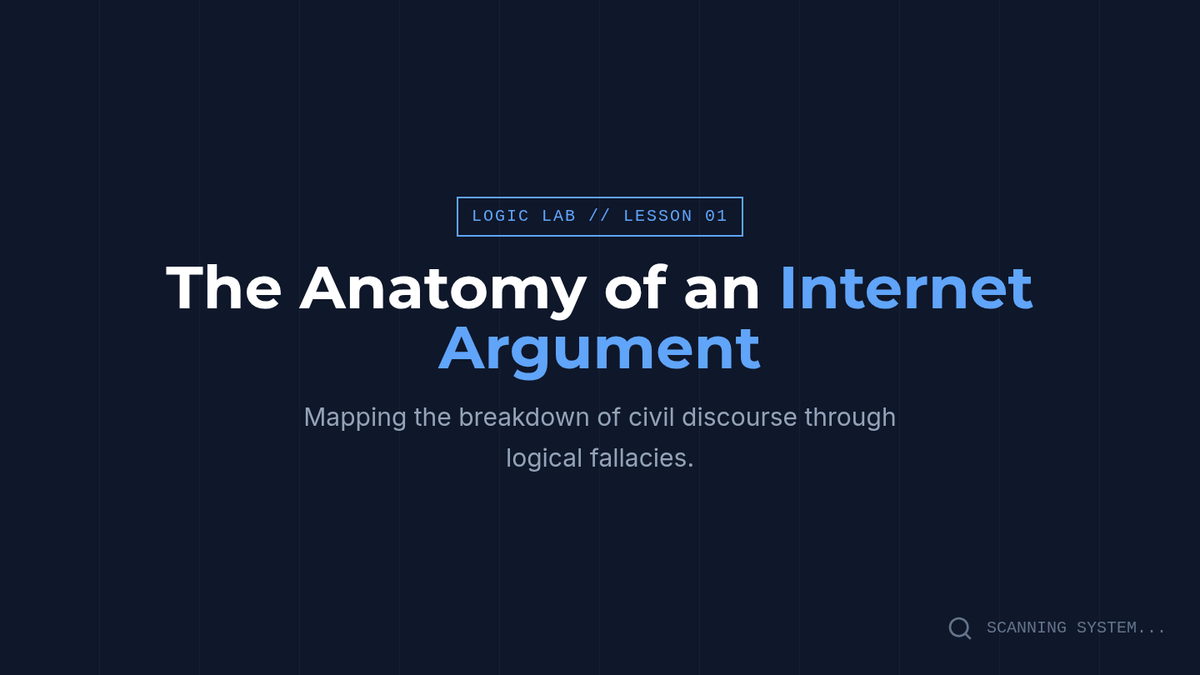
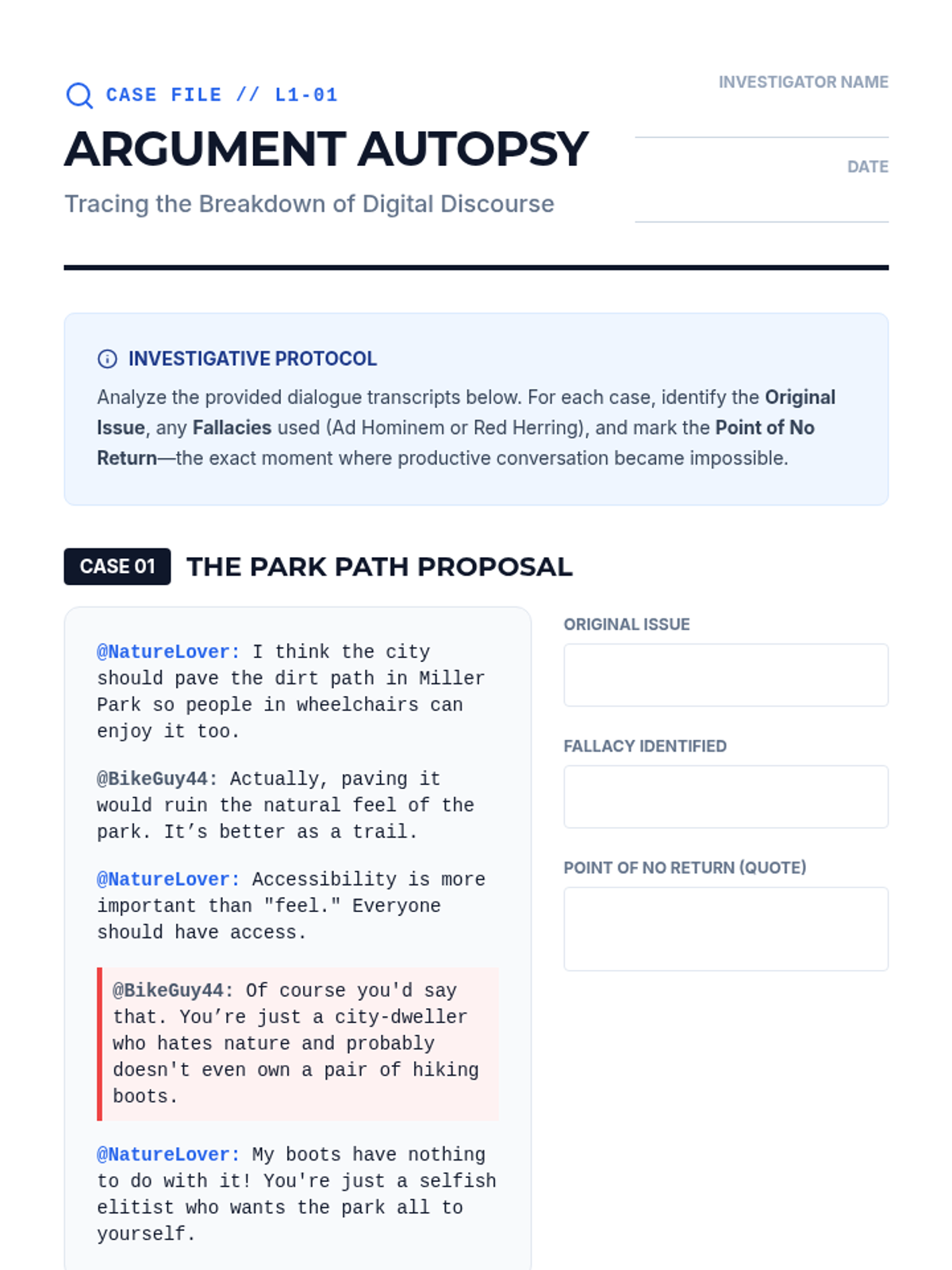
A middle school ELA unit focusing on the social impact of logical fallacies. Students analyze digital discourse, learn to identify 'whataboutism', practice Socratic discussion, and develop strategies for 'steel-manning' arguments to foster healthier community conversations.

Lenny Avatar
Lenny
1/17
Sequence
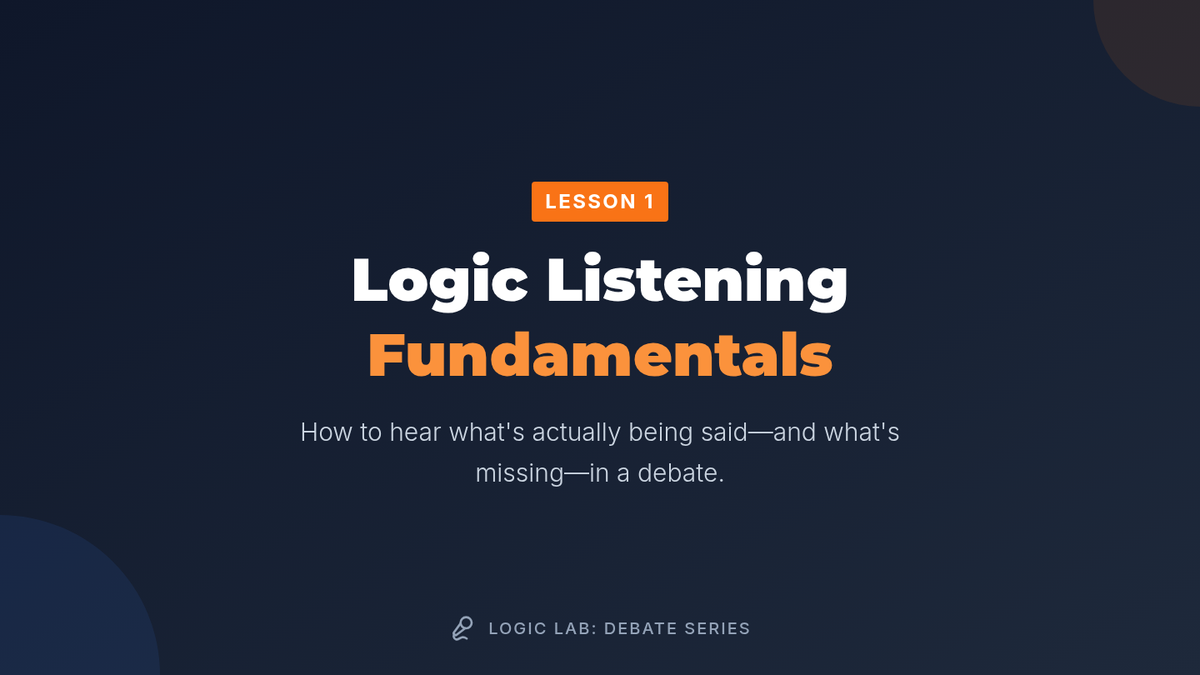
Logic Listening Slides
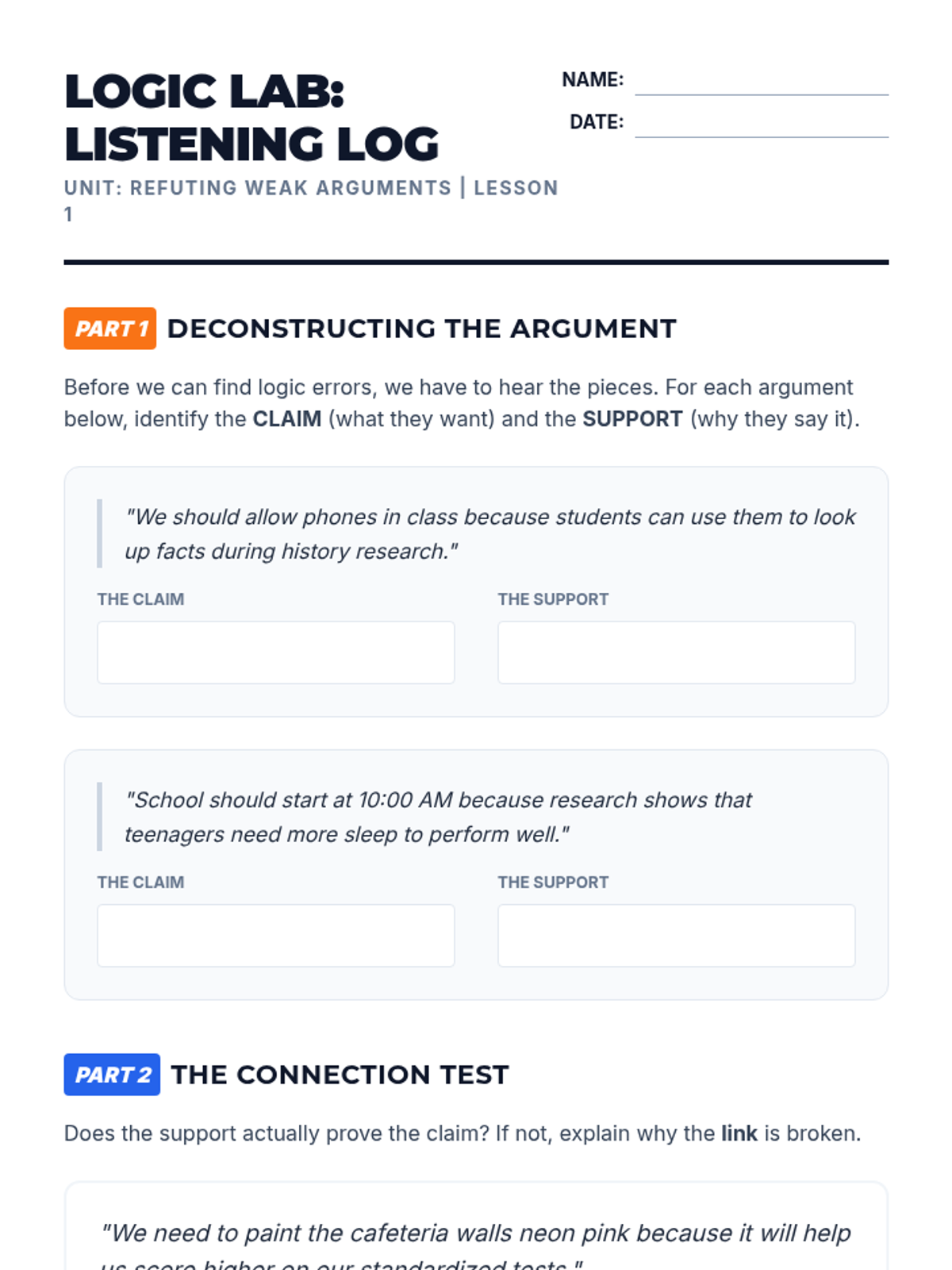
Listening Log Worksheet
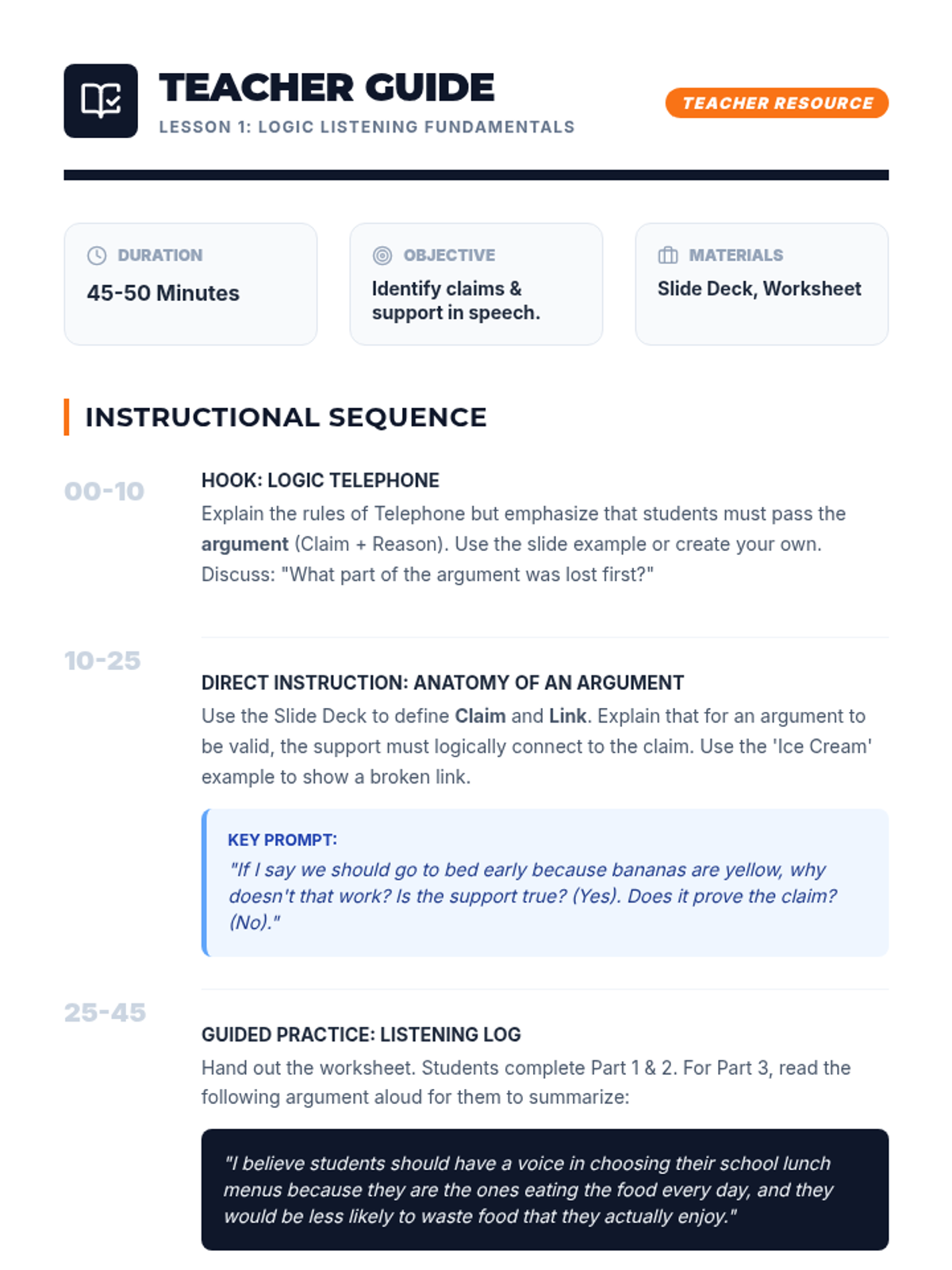
Logic Listener Teacher Guide

Logic Lab Debate Sequence

A 5-lesson sequence for 6th-grade students focused on identifying and refuting logical fallacies (Red Herrings and False Dilemmas) in live debate settings. Students develop active listening skills, learn polite rebuttal stems, and apply their knowledge in a structured, logic-focused debate simulation.

Lenny Avatar
Lenny
1/17
Sequence
Claim Conviction Slides
Statement Sorting Worksheet
Claim Conviction Answer Key

Claim Commanders

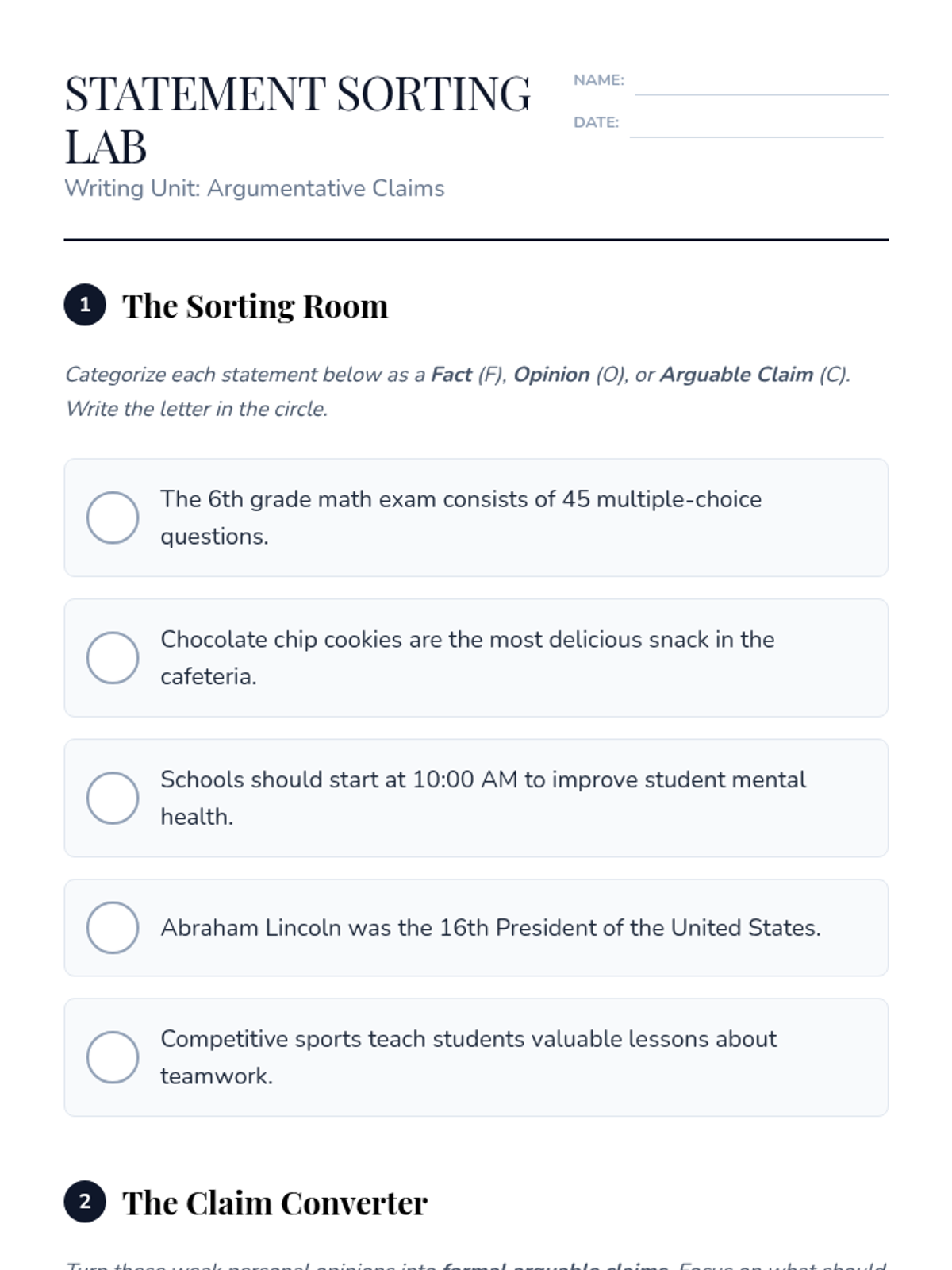
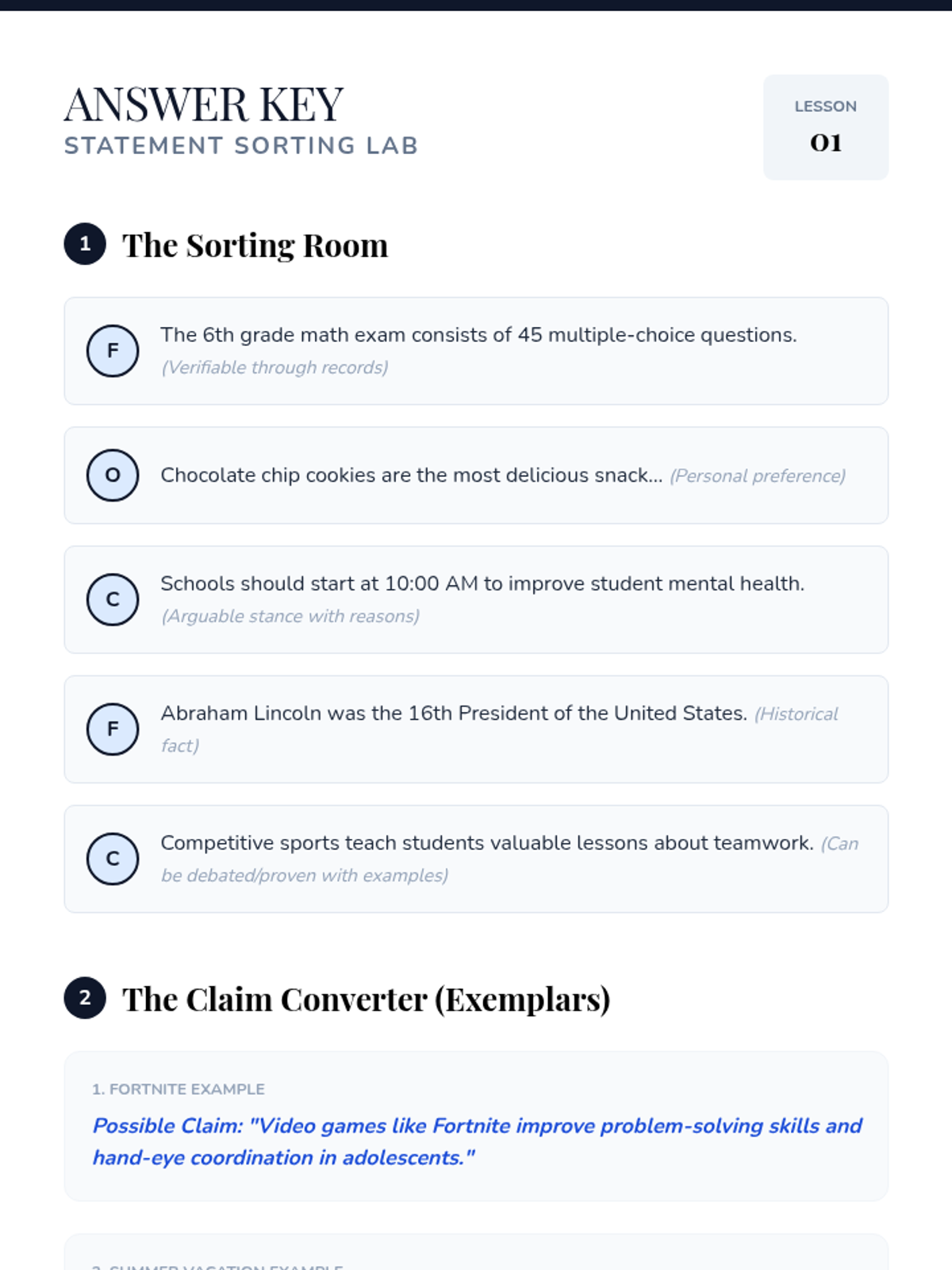
This sequence teaches 6th-grade students how to construct strong, debatable argumentative claims. Students move from identifying facts and opinions to crafting authoritative thesis statements with reasoning, ultimately testing their arguments through a town hall simulation and counter-claim analysis.

Lenny Avatar
Lenny
1/17
Sequence
Spar Mastery Slides
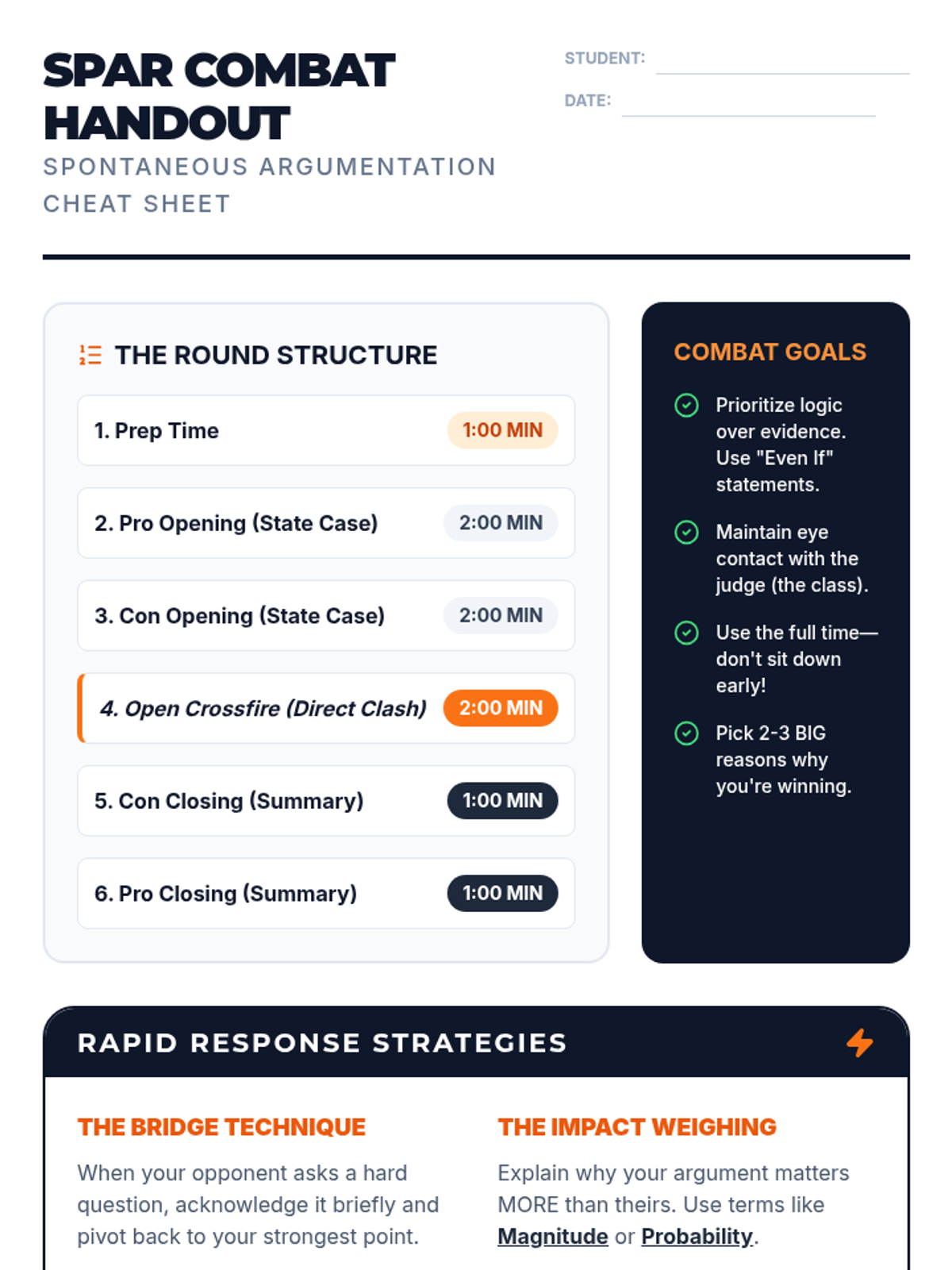
Spar Combat Handout
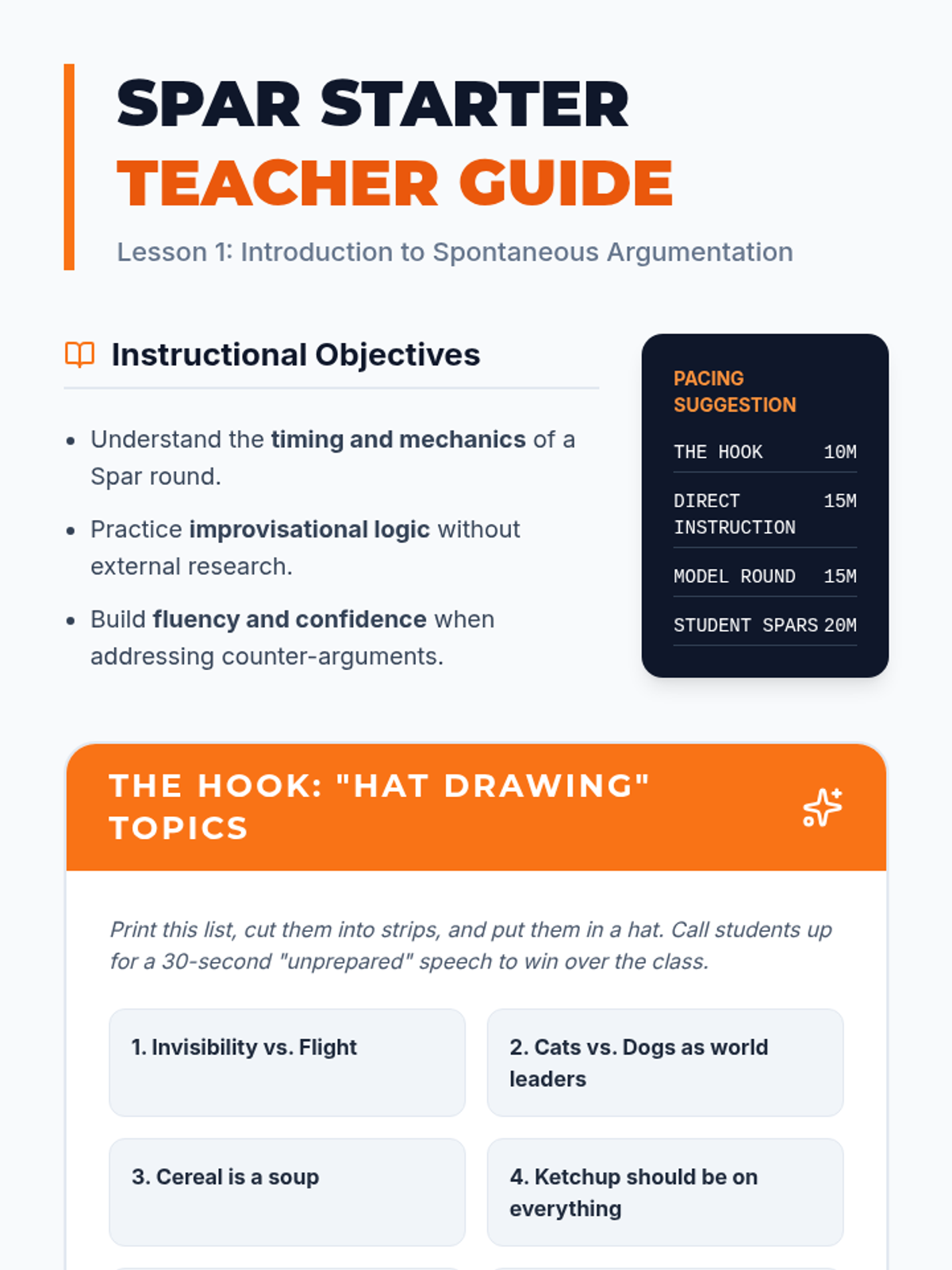
Spar Starter Teacher Guide

Applied Rebuttal and Spar Strategies

This sequence synthesizes refutation, weighing, and listening into short-form 'Spar' debates. Students learn to prioritize arguments, extend logic, and judge peer performances to build adaptability and engagement skills under strict time constraints.

Lenny Avatar
Lenny
1/17
Sequence
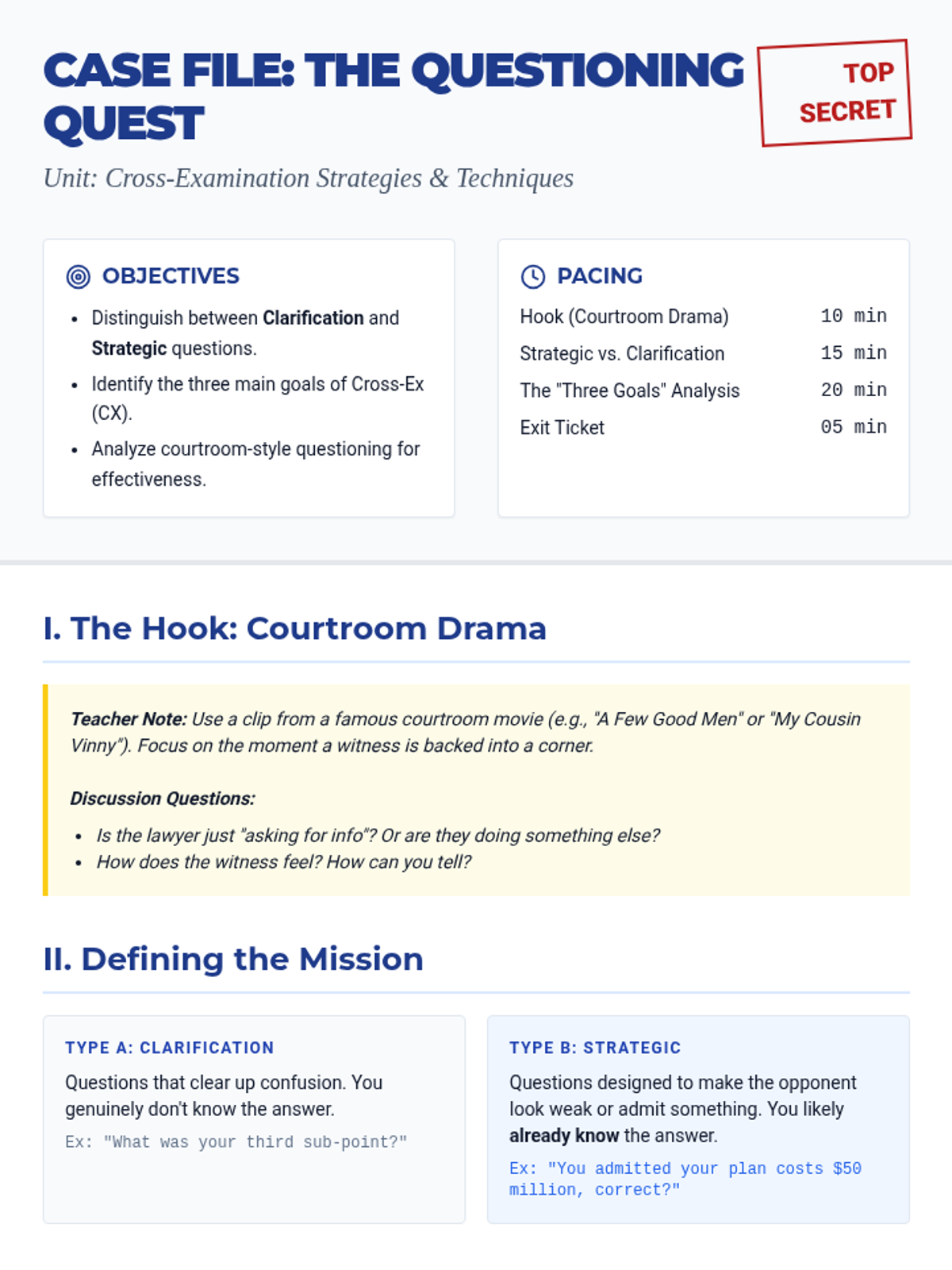
Quest Purpose Teacher Guide
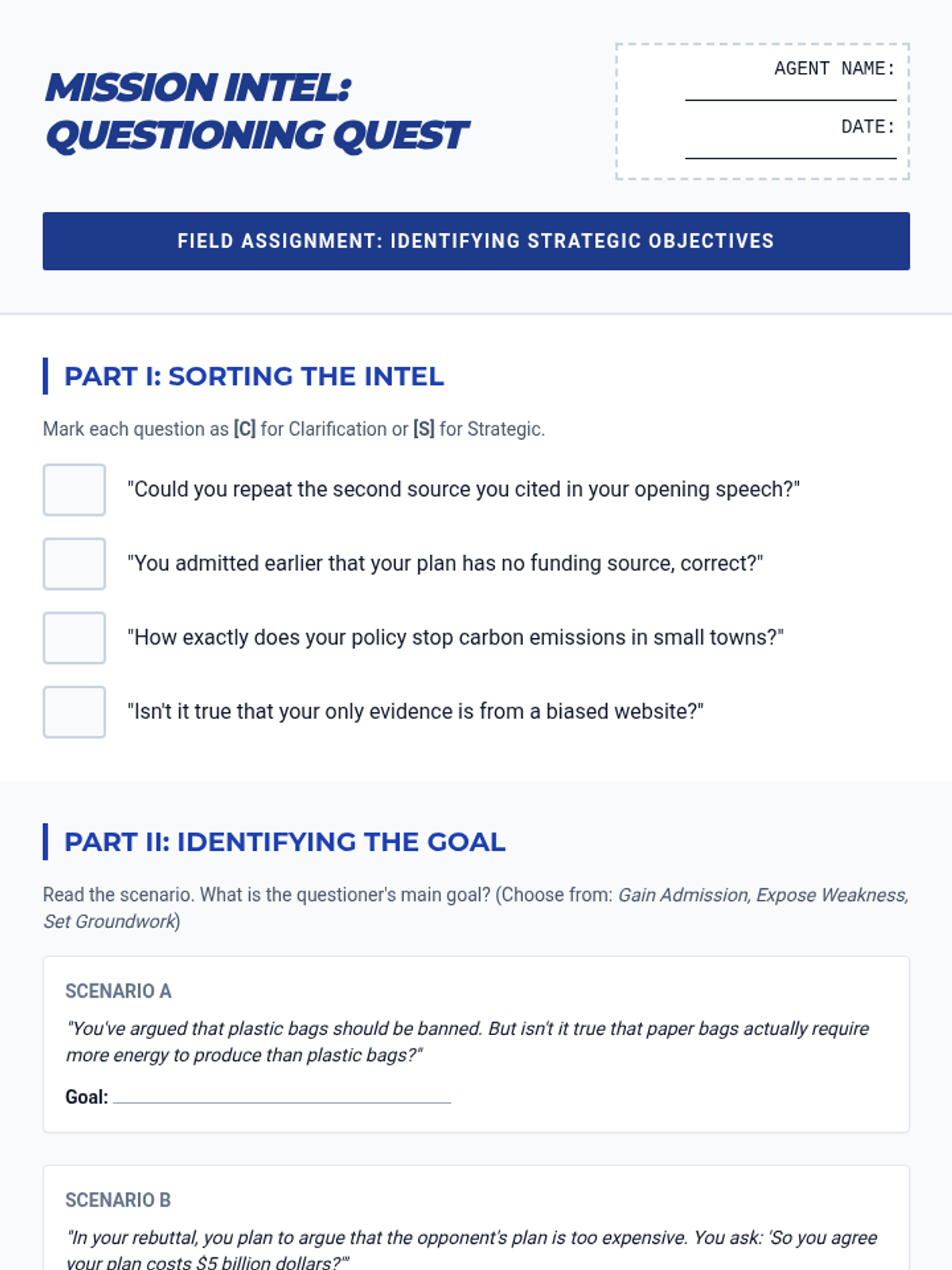
Mission Intel Worksheet

Cross Examination Strategies and Techniques

A comprehensive unit on Cross-Examination for middle school debaters, focusing on strategic questioning, rhetorical control, and integrating admissions into rebuttal speeches. Students move from understanding the purpose of questioning to executing complex 'question traps' in high-pressure simulations.

Lenny Avatar
Lenny
1/17
Sequence
Flowing Basics Slides
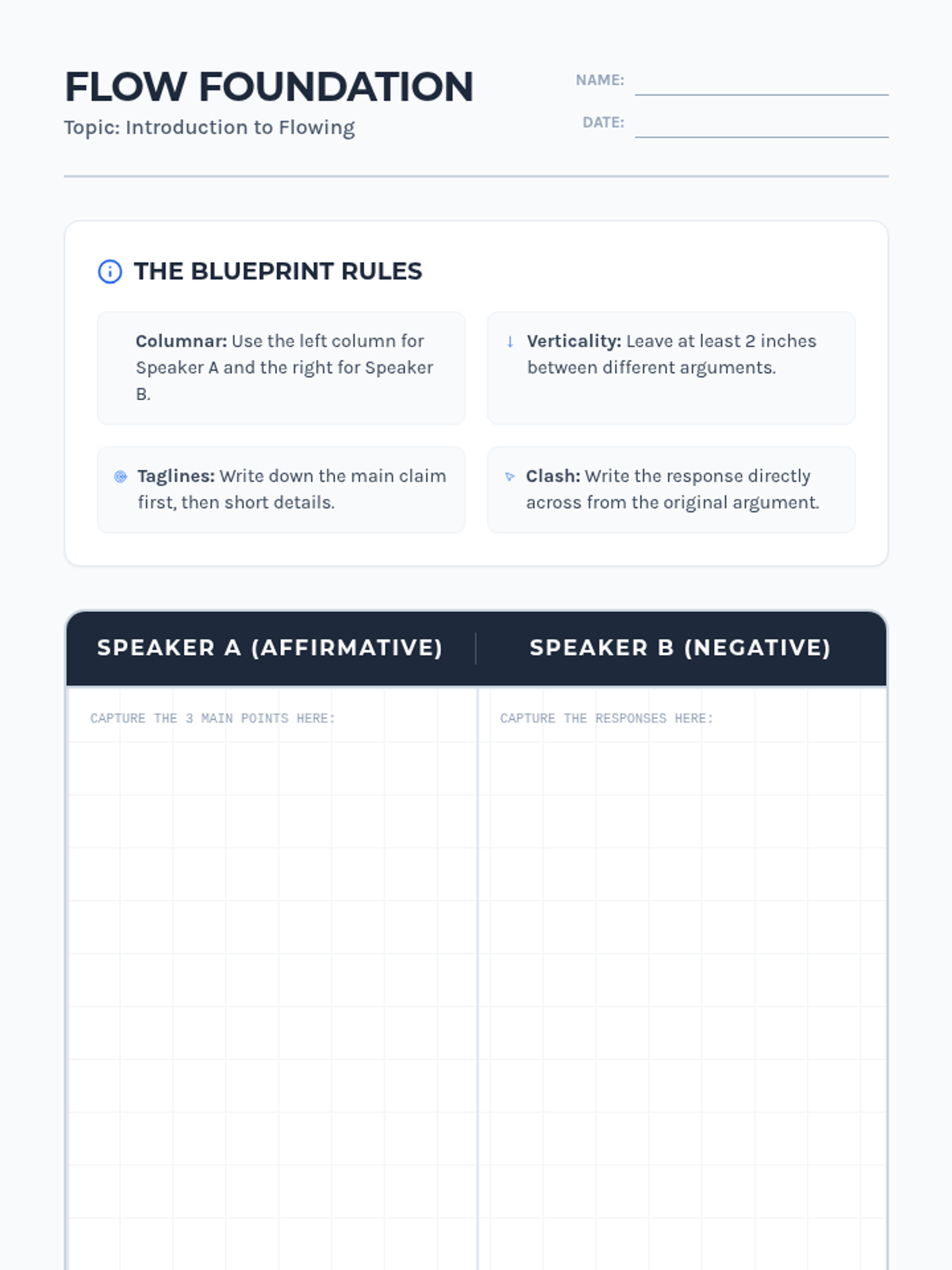
Flow Foundation Worksheet
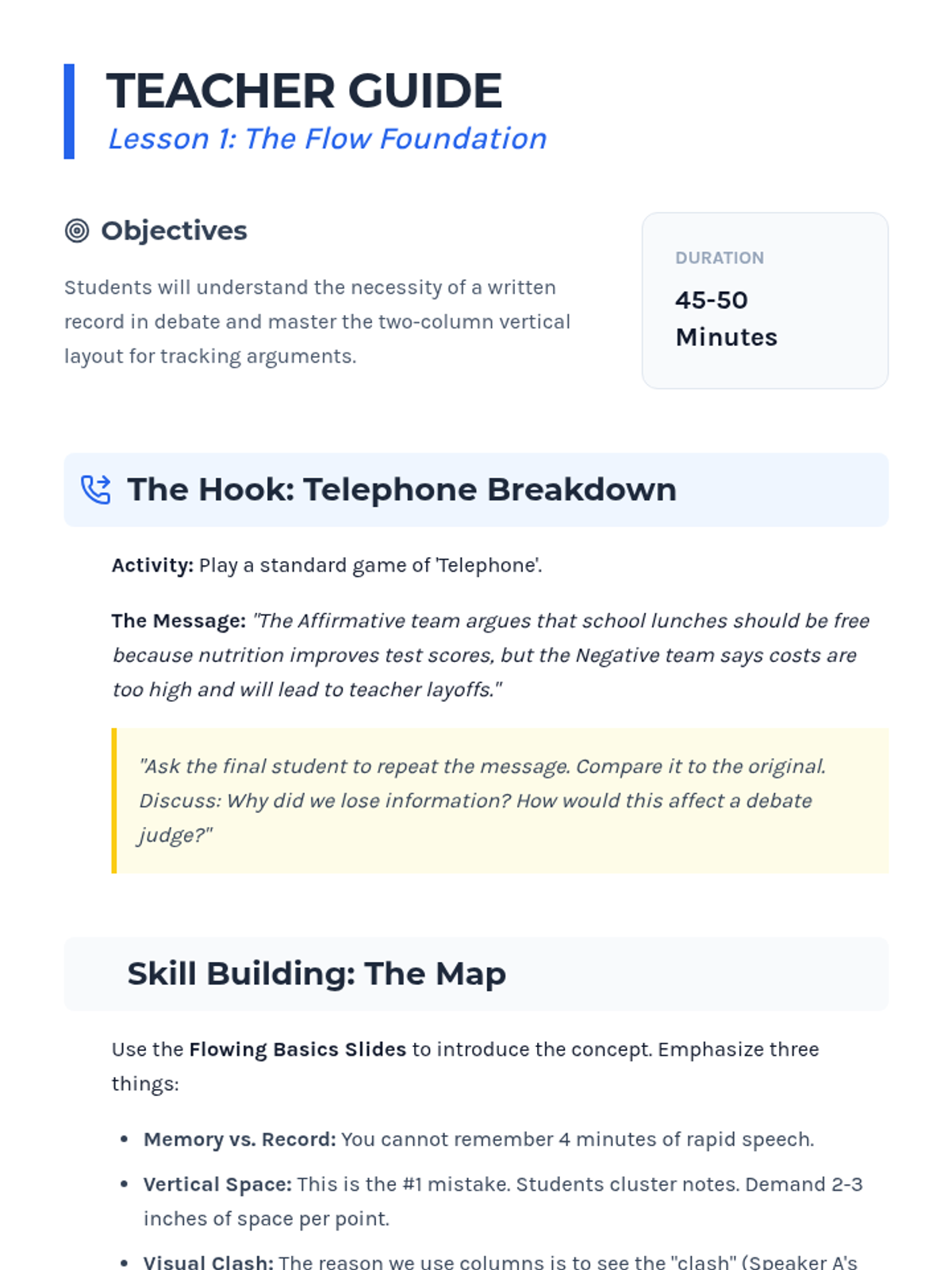
Flowing Intro Teacher Guide

Argument Tracking and Refutation

A technical debate unit for 6th graders focused on 'flowing' (note-taking), shorthand symbols, tracking argument exchanges, and mastering line-by-line refutation to ensure no argument is left unanswered.

Lenny Avatar
Lenny
1/17
Sequence
Logic Lab Slides
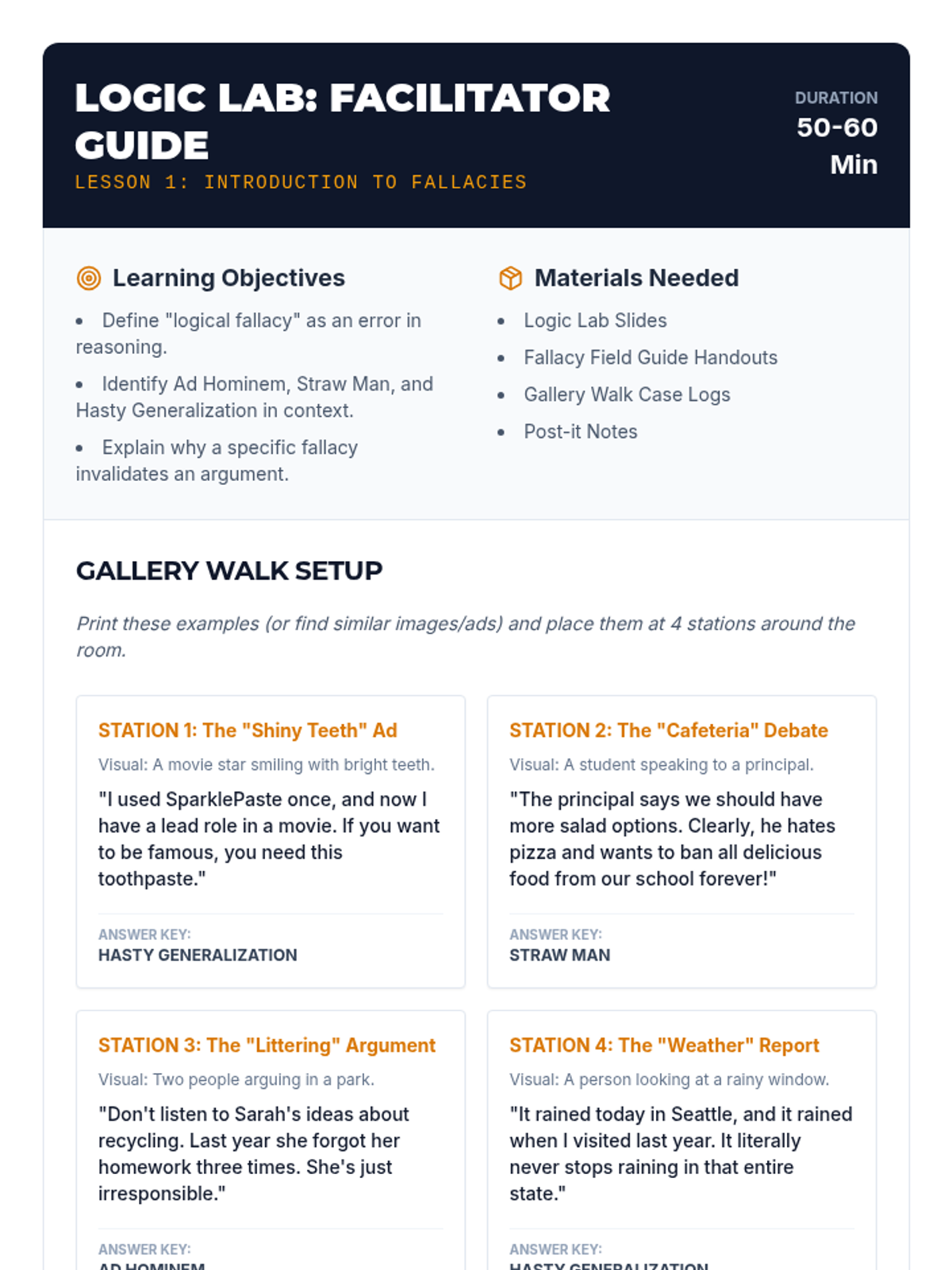
Fallacy Field Guide Handout
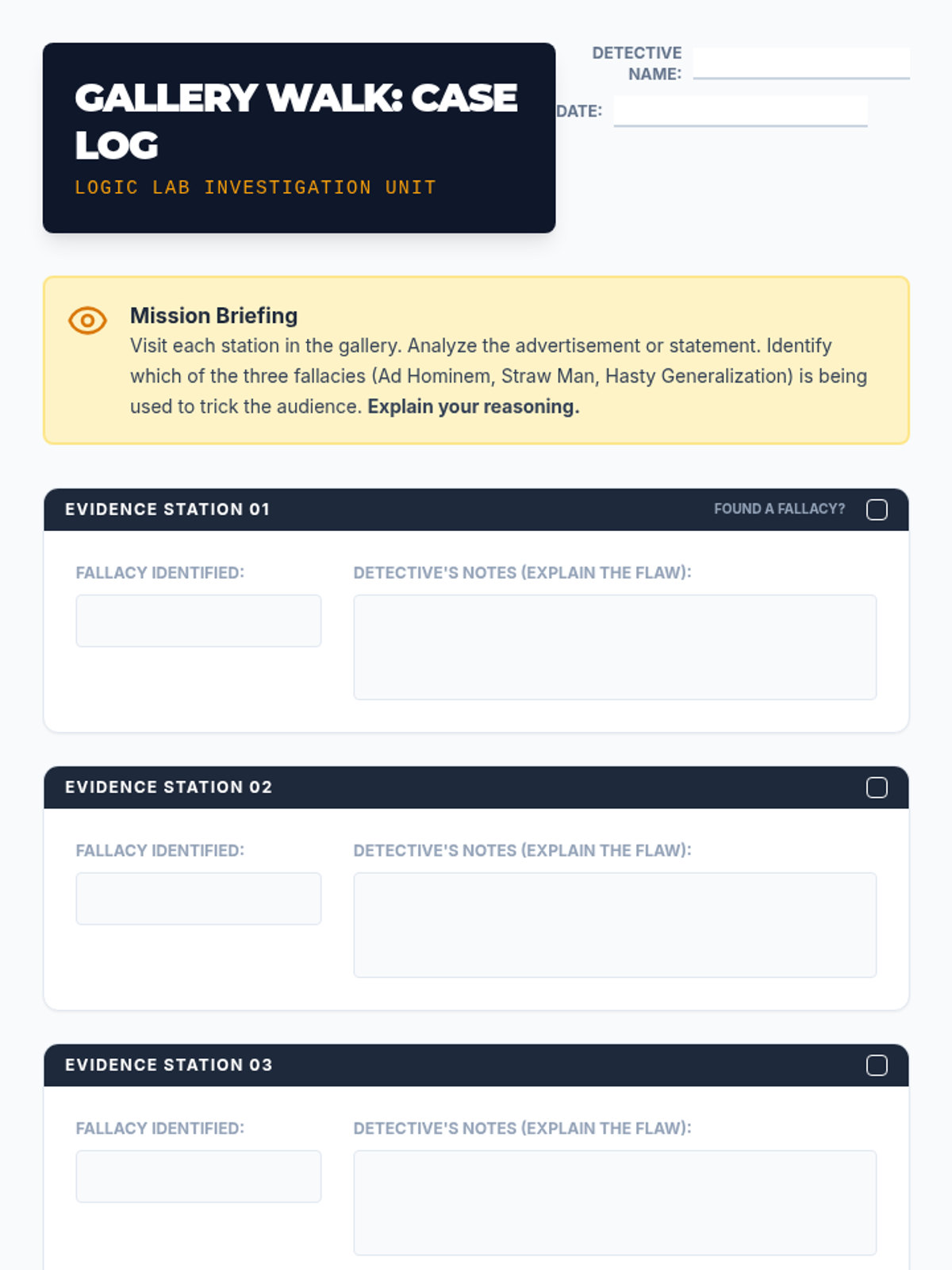
Gallery Walk Case Log
Logic Lab Teacher Guide

Fallacy Detectives

A comprehensive sequence for 6th-grade students to identify and challenge logical fallacies in debate. Students act as 'Fallacy Detectives' to uncover errors in reasoning like Ad Hominem, Straw Man, and Slippery Slope.

Lenny Avatar
Lenny
1/17
Sequence
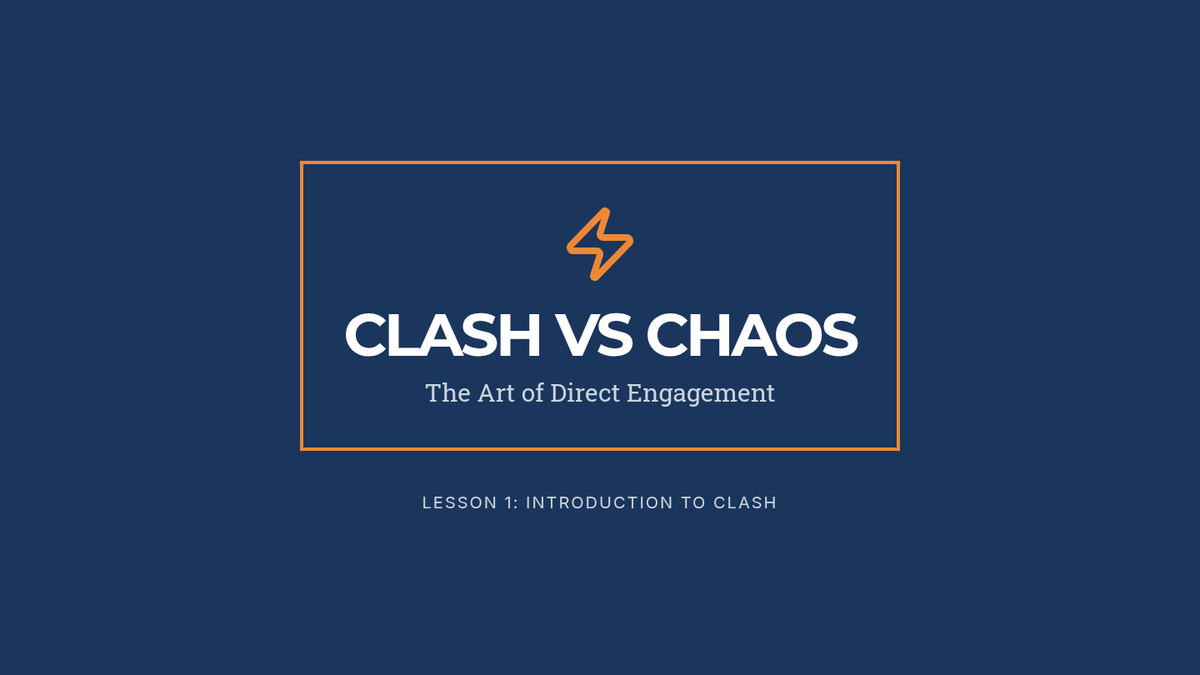
Clash Intro Slides
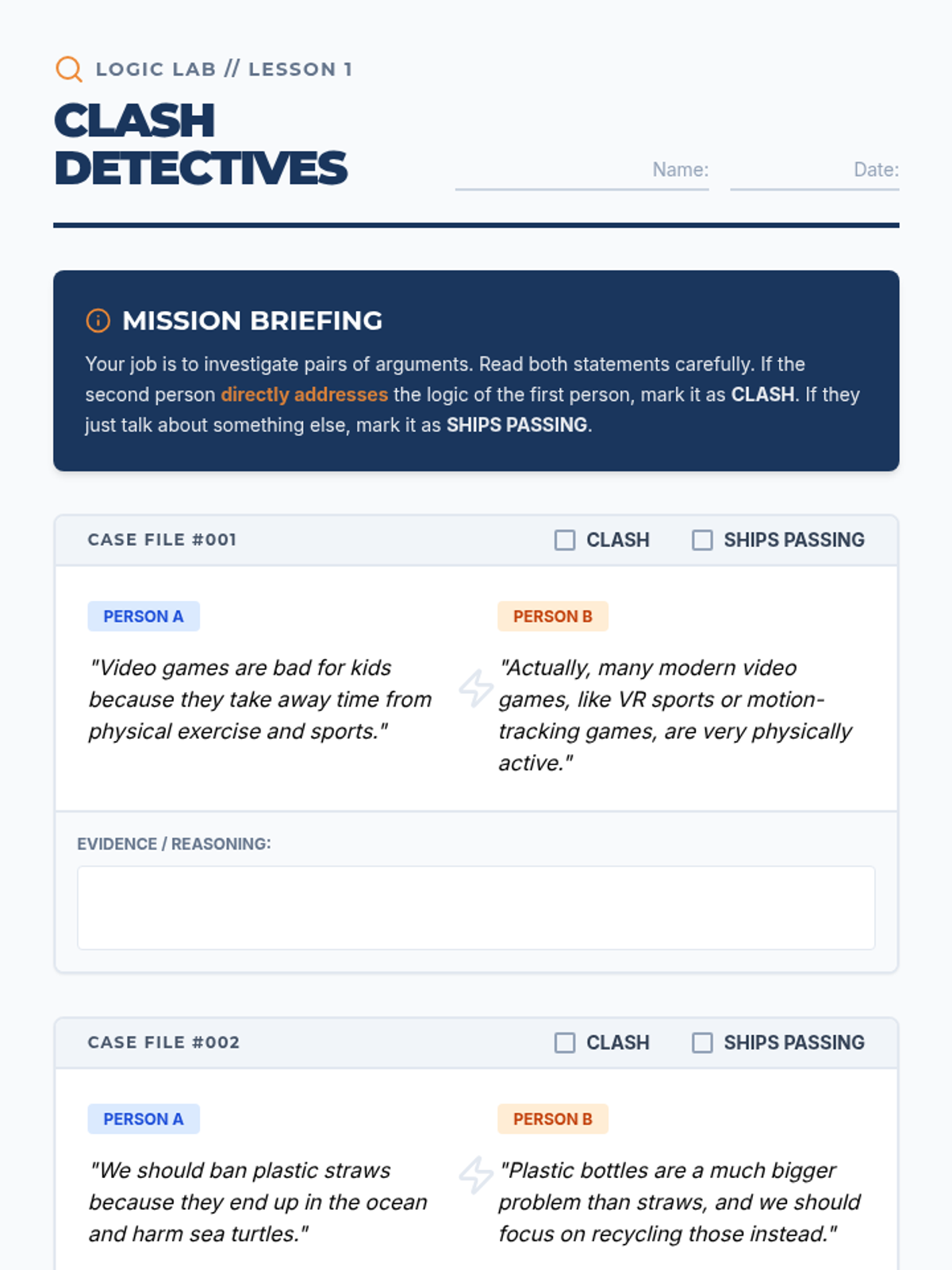
Clash Detectives Worksheet
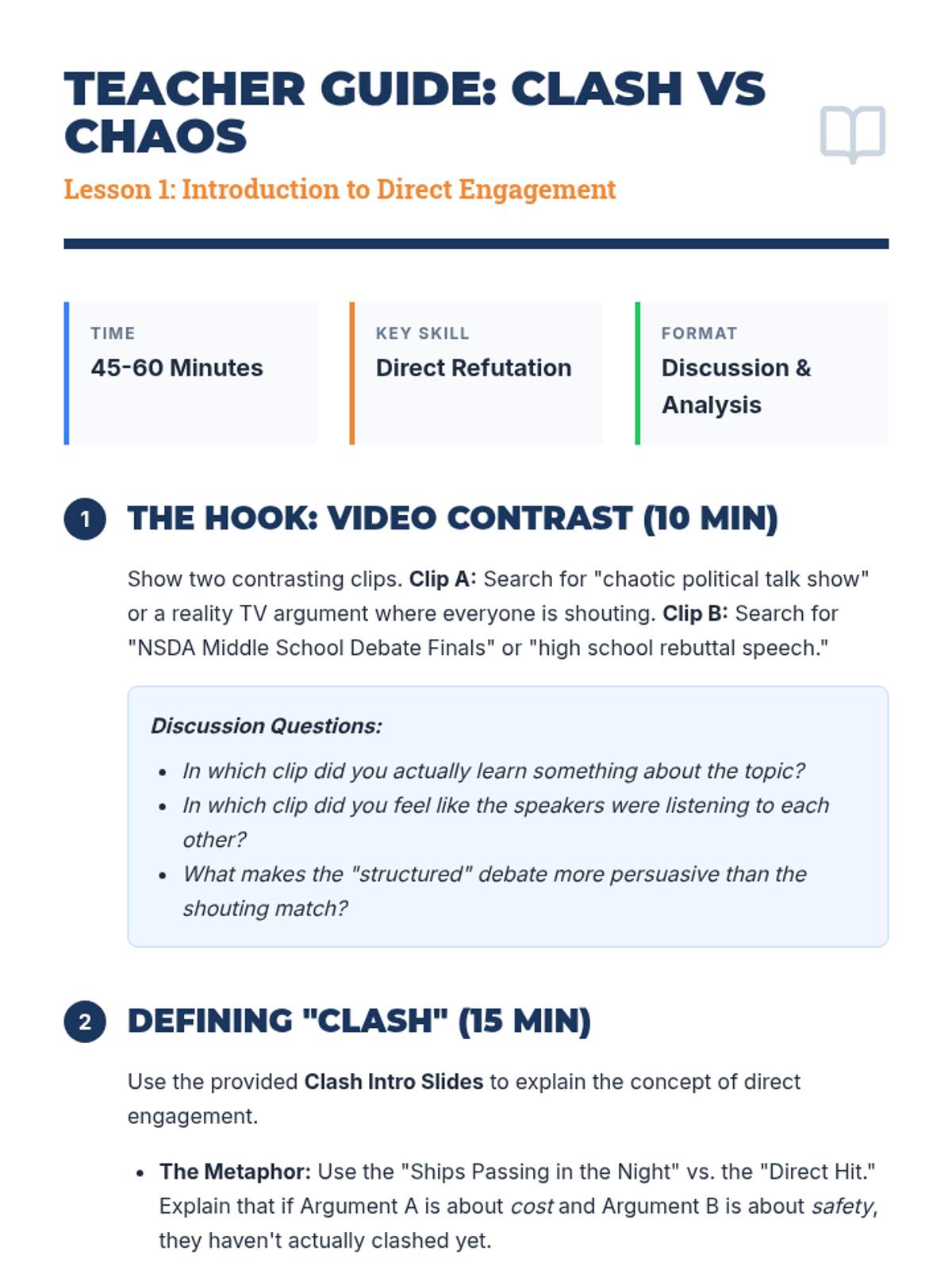
Clash Engagement Teacher Guide

Logic Lab Refutation Fundamentals

A comprehensive sequence for 6th-grade students to master the art of 'clash' and the Four-Step Refutation model in competitive and academic debate. Students move from identifying direct engagement to performing real-time rebuttals and rebuilding their own arguments after critique.

Lenny Avatar
Lenny
1/17
Sequence
Trust the Storyteller Slides
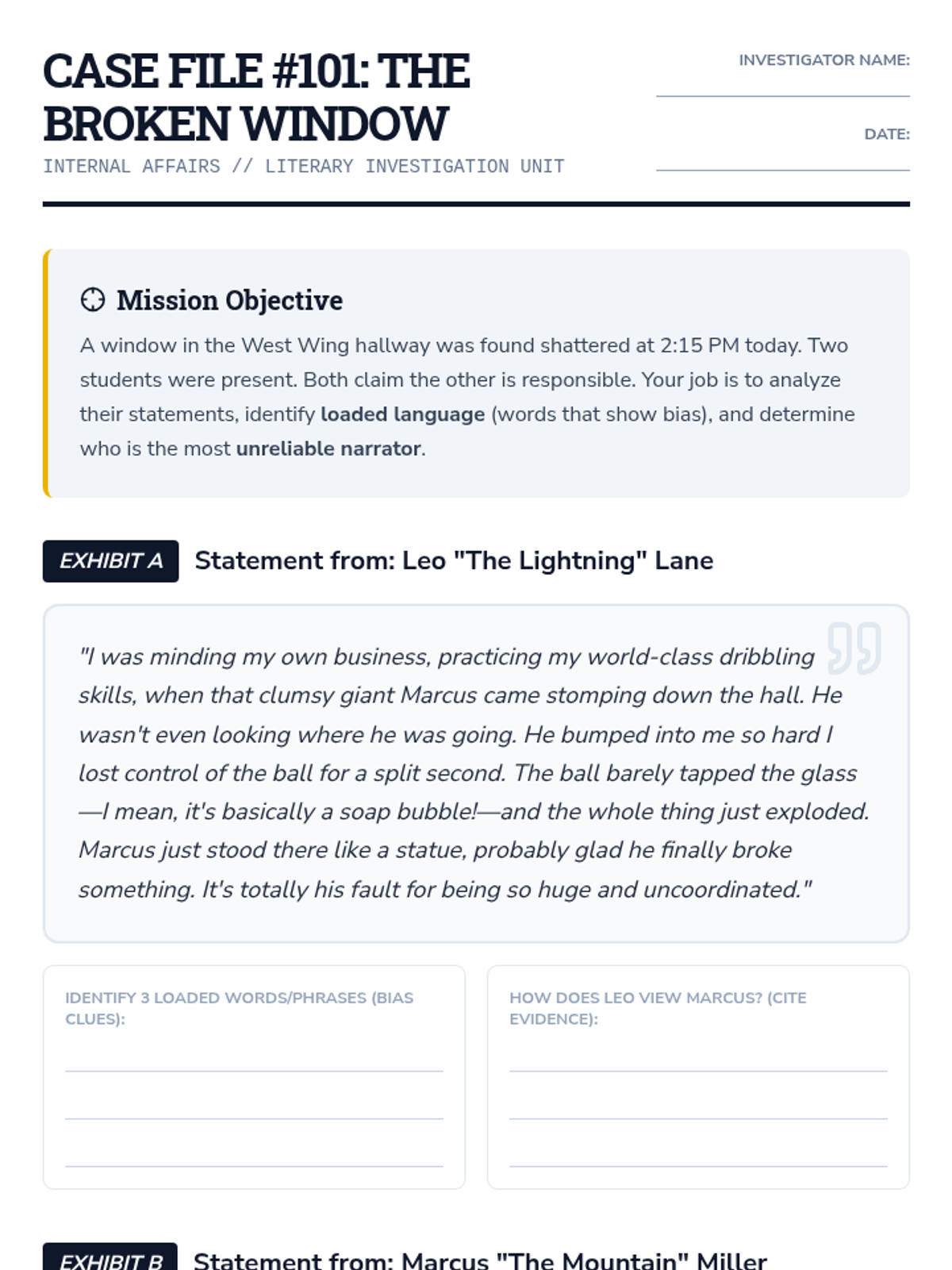
Broken Window Case Worksheet
Reliability Investigator Teacher Guide

Narrator Files Inquiry

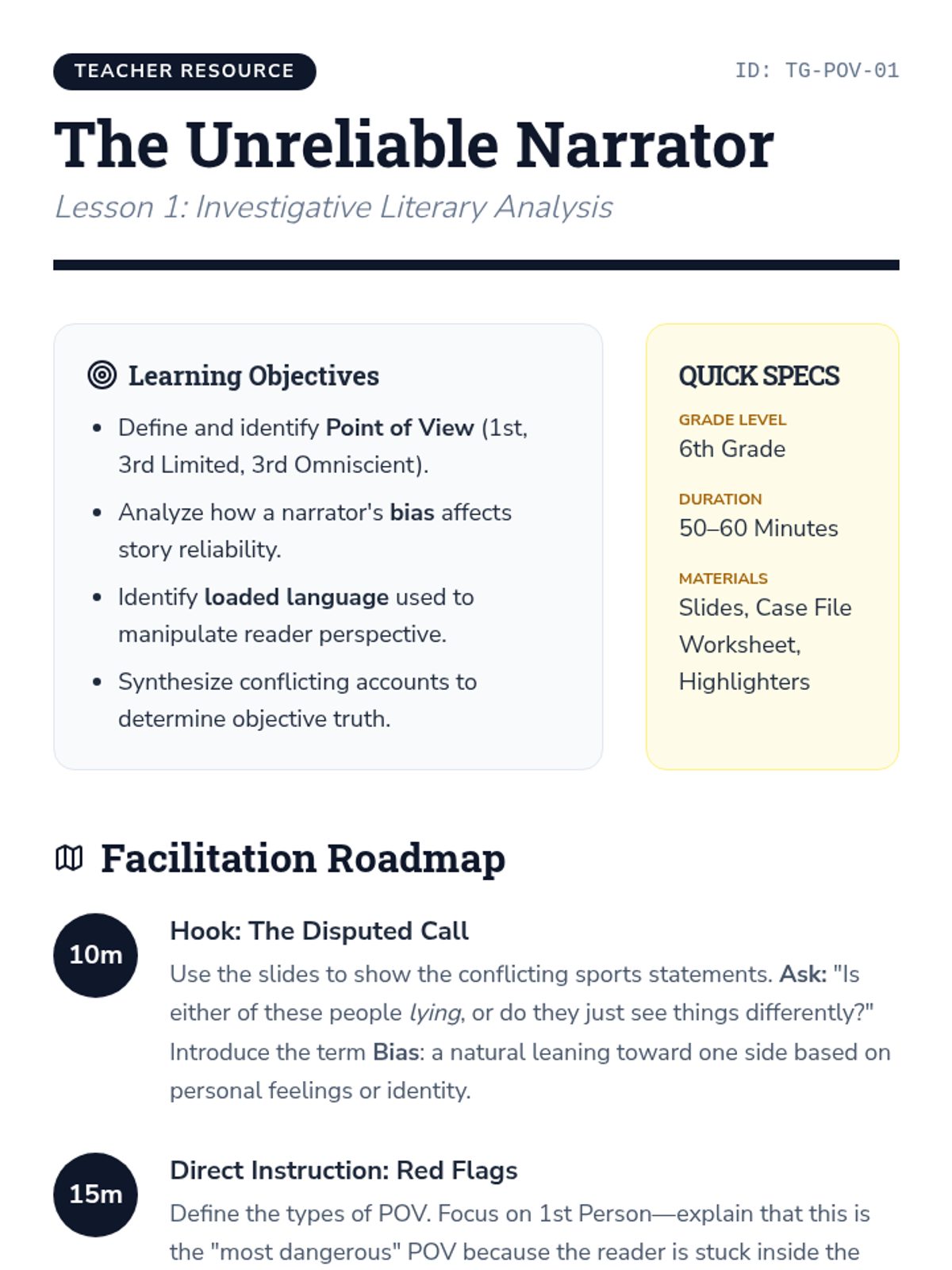
In this 6th-grade ELA sequence, students move beyond identifying point of view to analyzing narrator reliability and bias. Through flipped fairy tales, investigative case studies, and a final synthesis seminar, students explore how a storyteller's perspective shapes the reader's understanding of the truth.

Lenny Avatar
Lenny
1/17
Sequence
Timeline of Terror Slides
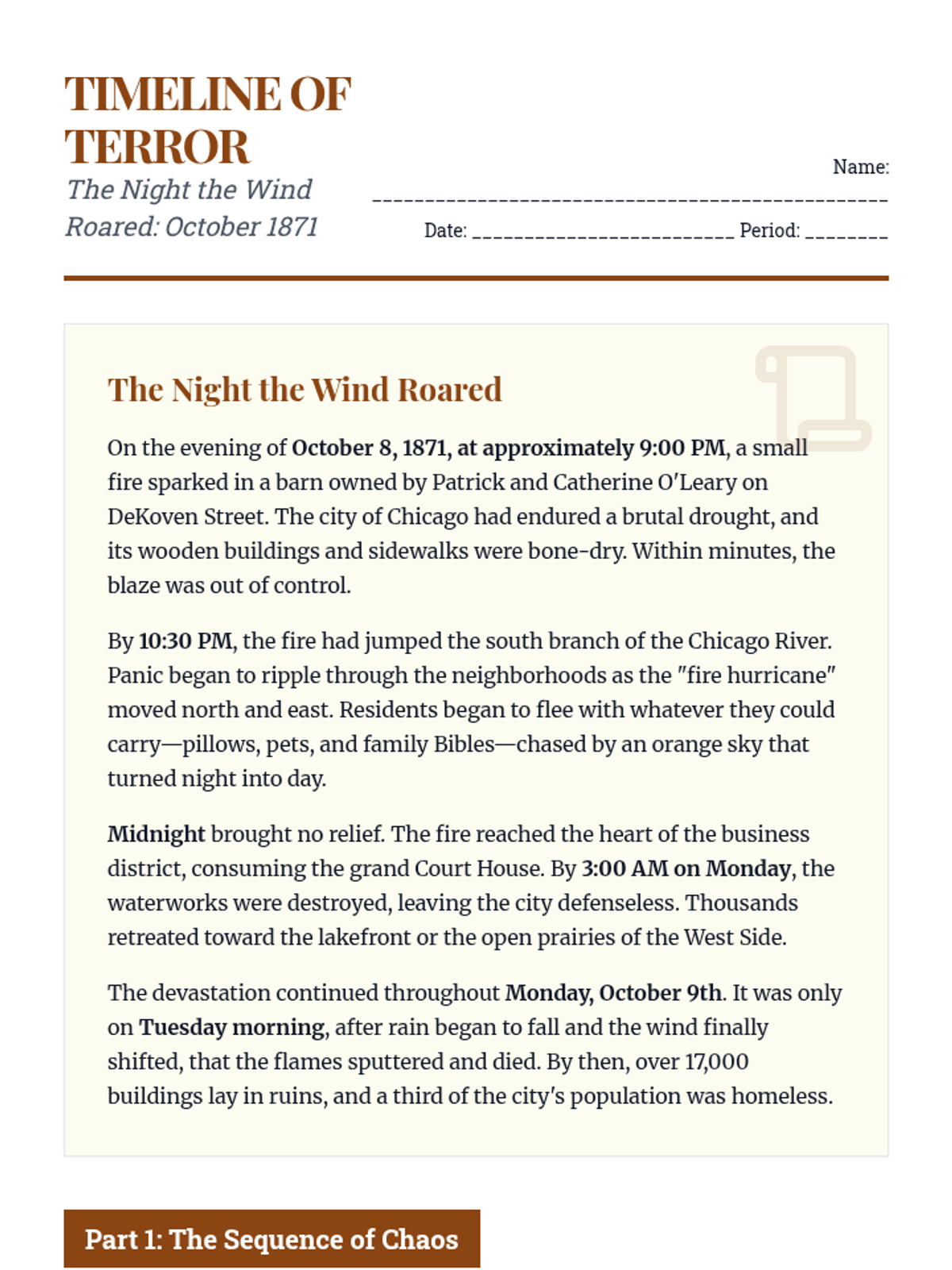
Timeline of Terror Worksheet
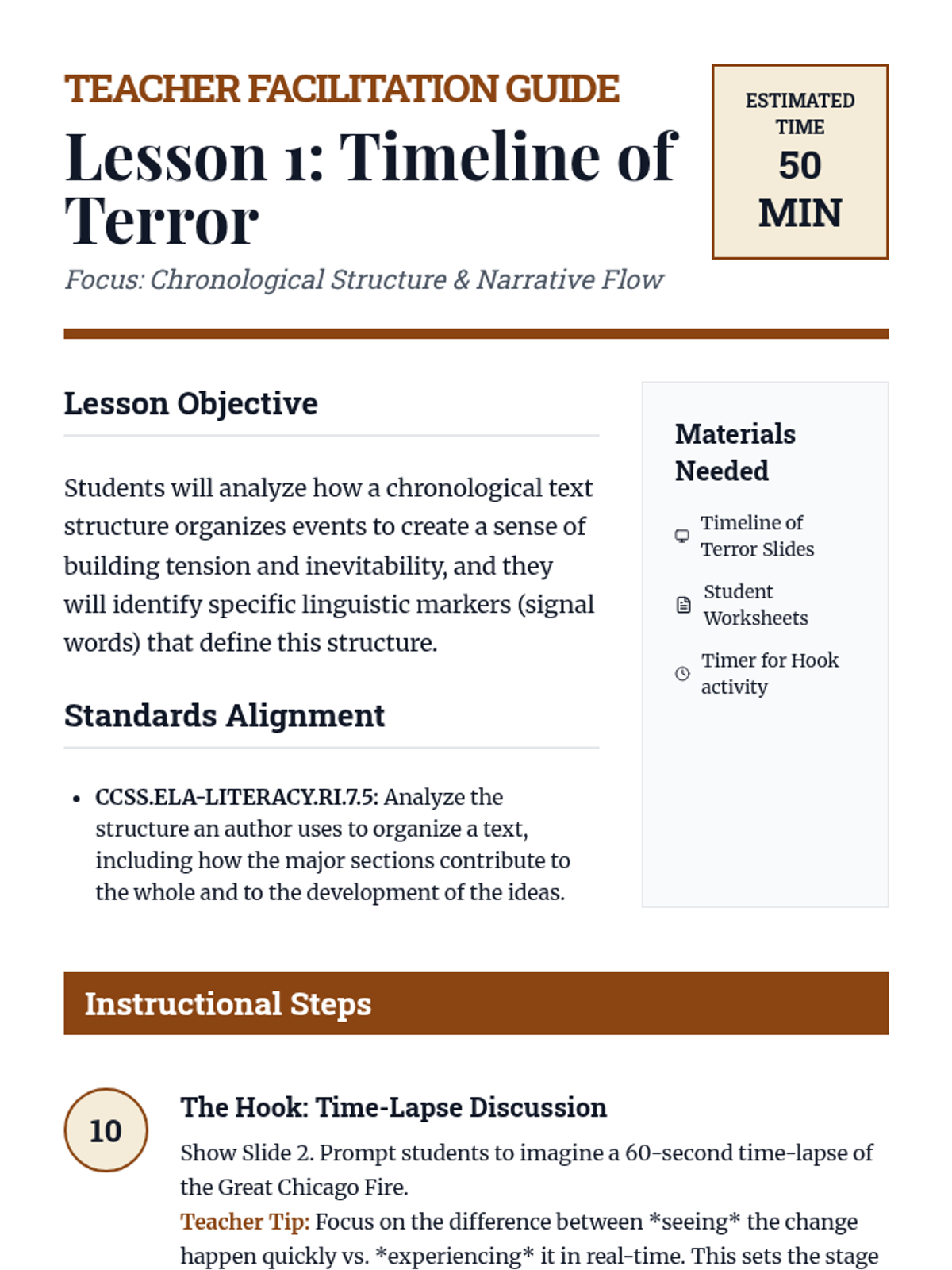
Timeline of Terror Teacher Guide

Structure and Meaning

Students explore how text structure influences meaning and authorial intent by analyzing multiple texts on the Great Chicago Fire. Each lesson focuses on a different organizational pattern (chronology, problem-solution, cause-effect, and description) to understand how structure shapes the reader's perspective.

Lenny Avatar
Lenny
1/17
Sequence
Bias and Tone Slides
Bias Sleuth Worksheet
Bias and Tone Teacher Guide

Conflicting Perspectives

This sequence focuses on the critical thinking skills required to analyze conflicting information and differing perspectives within informational texts. Students progress from identifying bias and tone to evaluating evidence credibility and synthesizing multiple viewpoints into balanced accounts.

Lenny Avatar
Lenny
1/17
Sequence
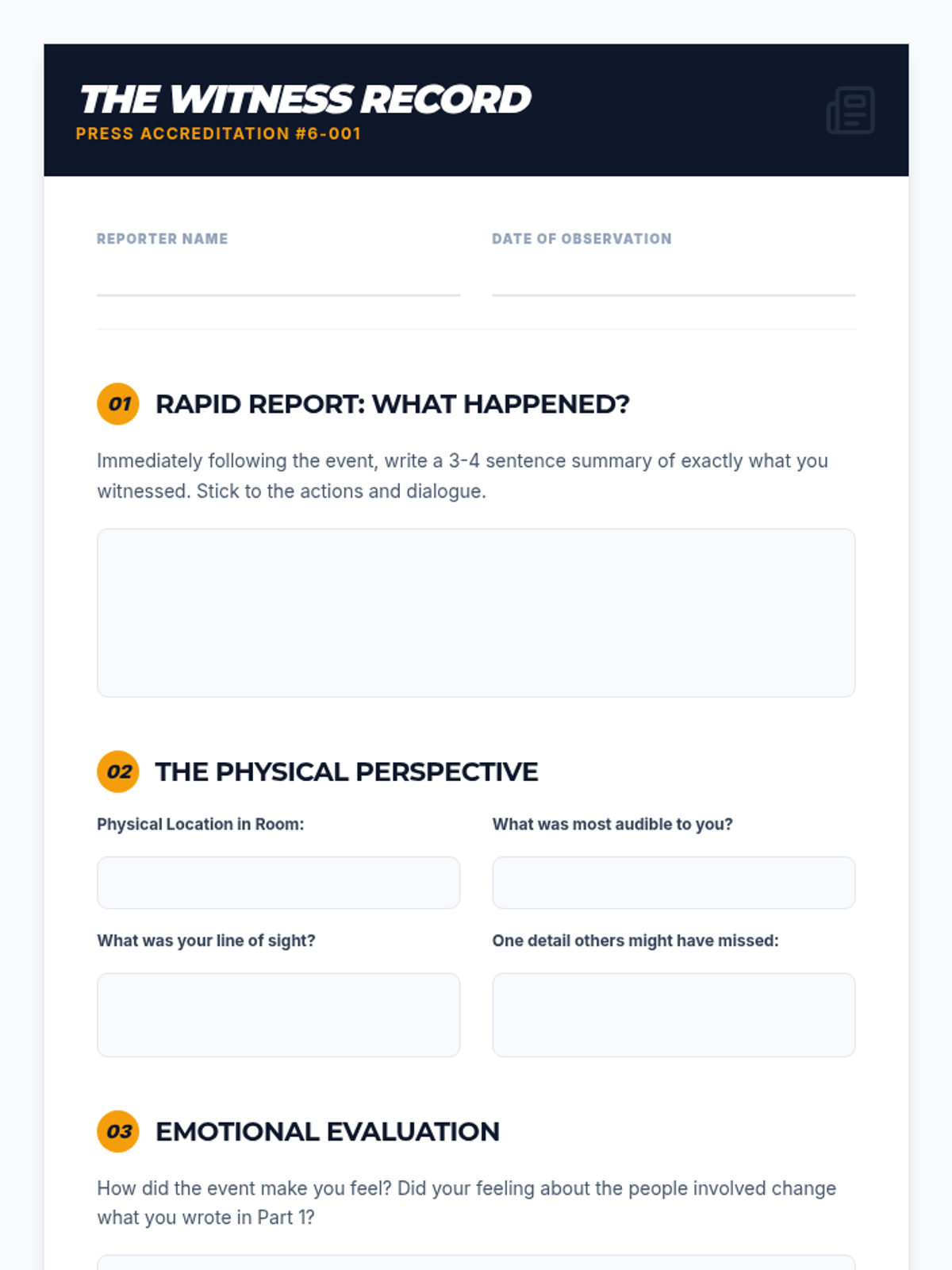
Eyewitness Slides
Witness Report Sheet
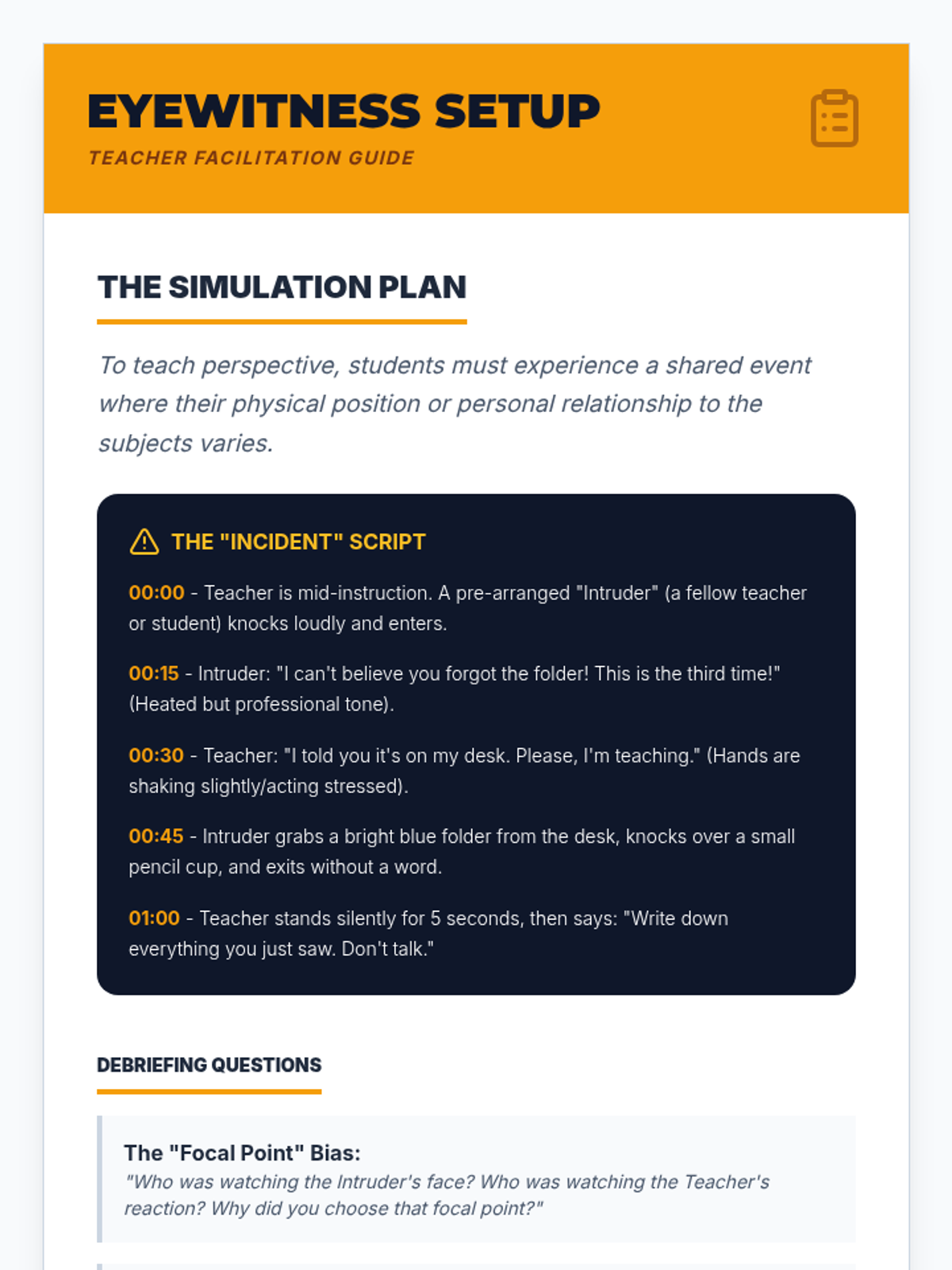
Eyewitness Setup Guide

Perspective Playback

A 6th-grade ELA sequence focused on media literacy and critical reading, where students analyze how different perspectives and presentation styles shape nonfiction accounts of the same event.

Lenny Avatar
Lenny
1/17
Sequence
Blueprint for Proof Slides
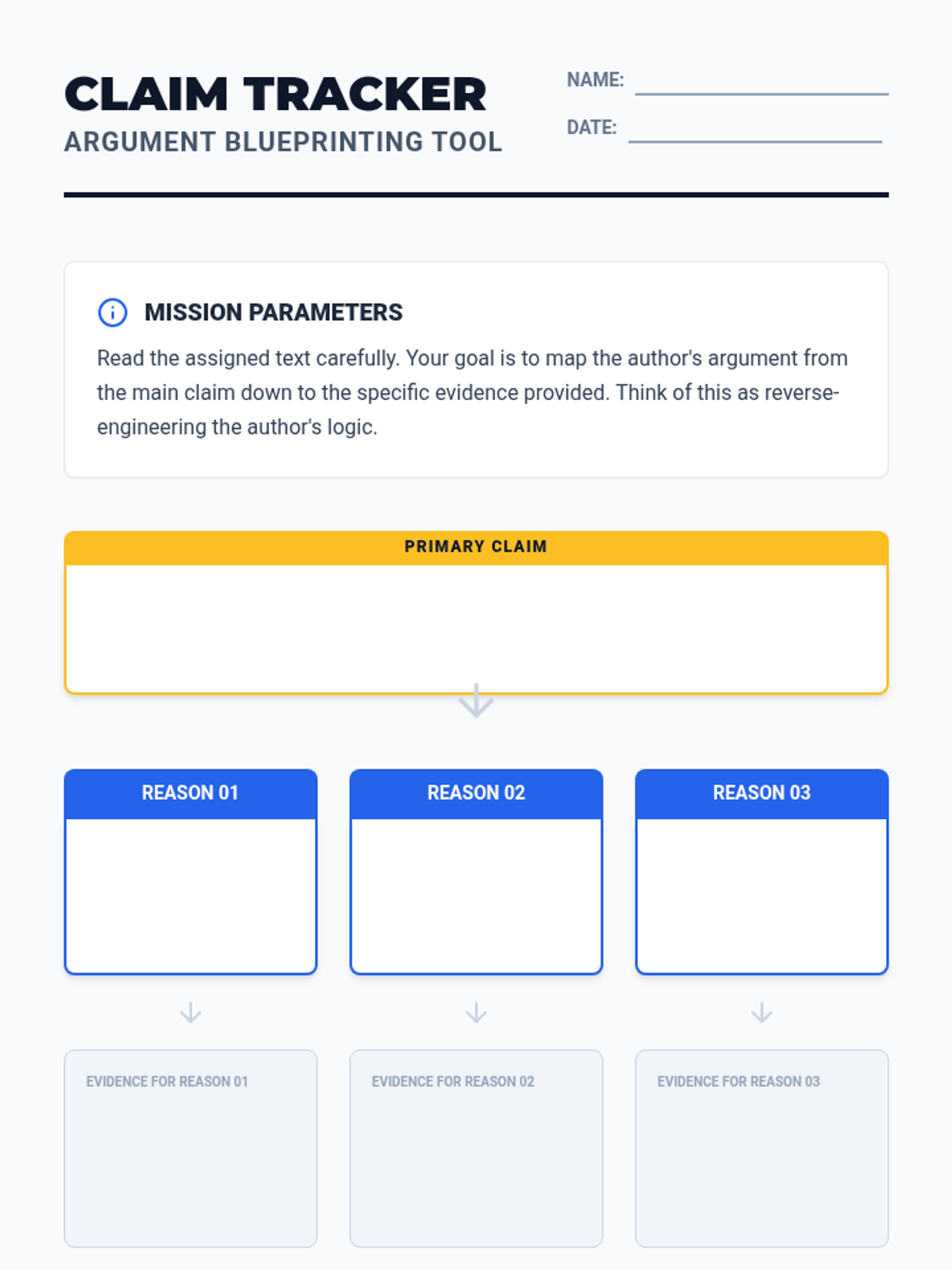
Claim Tracker Worksheet

Argument Architects

Students investigate how authors build persuasive arguments in nonfiction texts. They learn to trace claims, distinguish between facts and opinions, evaluate the sufficiency of evidence, and detect bias to determine the credibility of a text.

Lenny Avatar
Lenny
1/18
Sequence
Cool Under Fire Slides
Statue Challenge Worksheet
Composure Coaching Guide

Defensive Speaking and Responding Under Pressure

A sequence focused on the defensive side of debate, teaching 6th-grade students how to maintain composure, identify rhetorical traps, and pivot back to evidence during cross-examination. Students will move from non-verbal techniques to full-scale rapid-fire defense simulations.

Lenny Avatar
Lenny
1/18
Sequence
Anatomy Argument Slides
Argument Autopsy Worksheet
Anatomy Argument Teacher Guide

Evaluating the Impact of Fallacies in Social Discourse

A middle school ELA unit focusing on the social impact of logical fallacies. Students analyze digital discourse, learn to identify 'whataboutism', practice Socratic discussion, and develop strategies for 'steel-manning' arguments to foster healthier community conversations.

Lenny Avatar
Lenny
1/17
Sequence
Logic Listening Slides
Listening Log Worksheet
Logic Listener Teacher Guide

Logic Lab Debate Sequence

A 5-lesson sequence for 6th-grade students focused on identifying and refuting logical fallacies (Red Herrings and False Dilemmas) in live debate settings. Students develop active listening skills, learn polite rebuttal stems, and apply their knowledge in a structured, logic-focused debate simulation.

Lenny Avatar
Lenny
1/17
Sequence
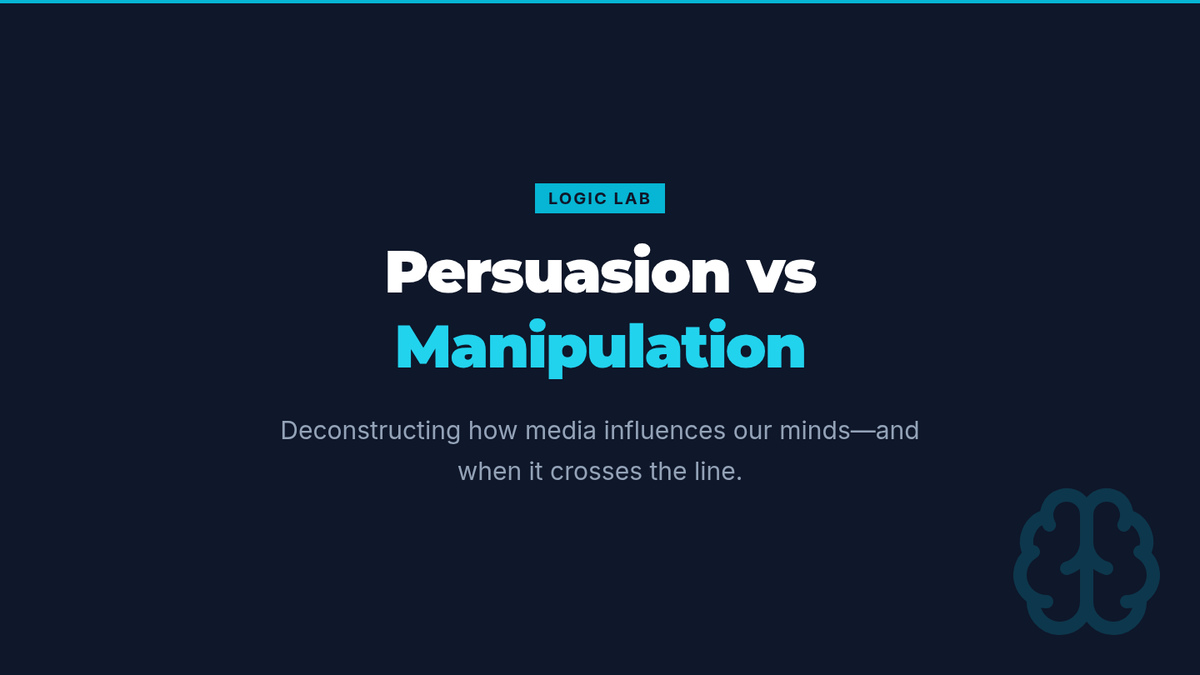
Persuasion Lab Slides
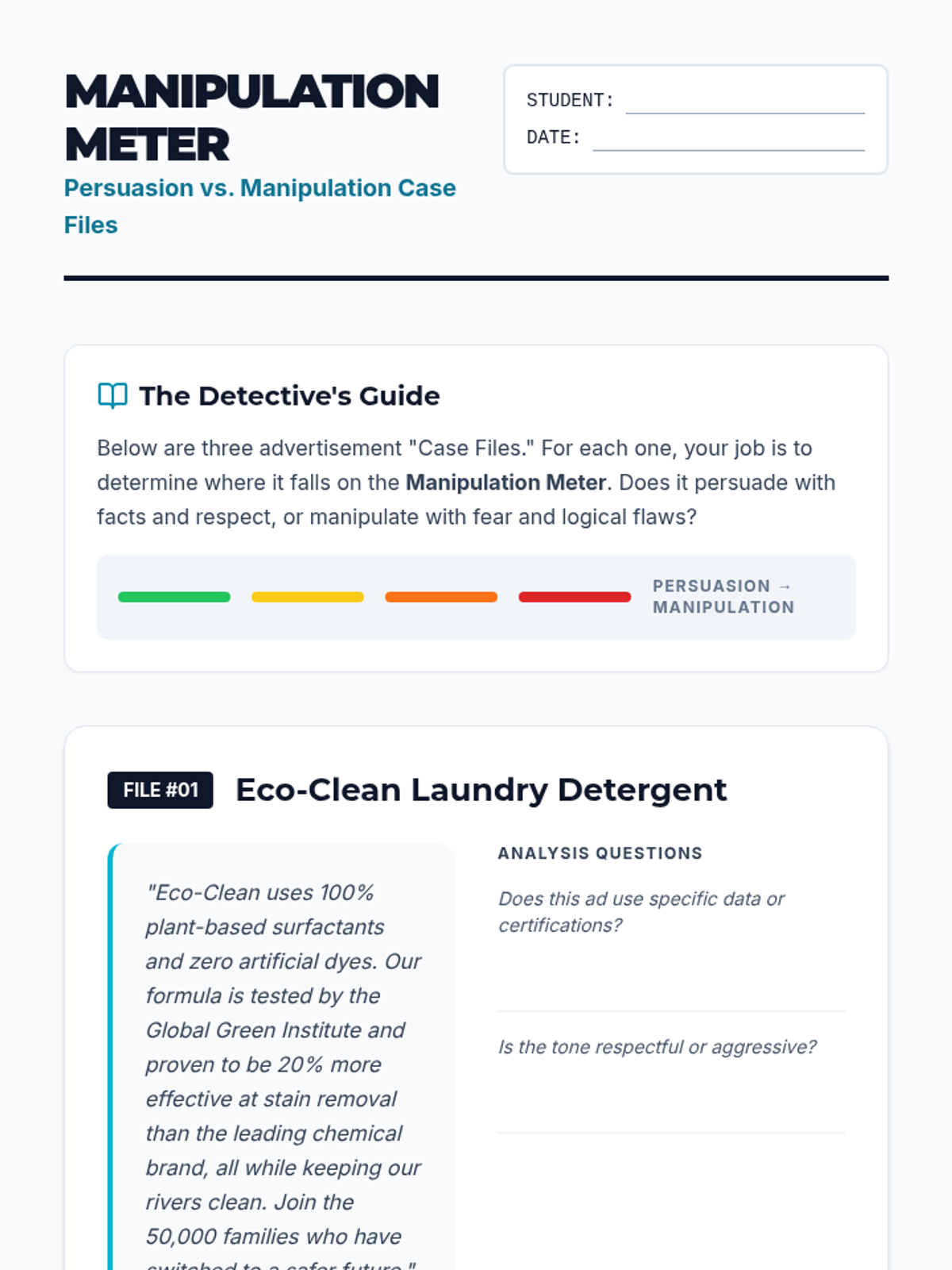
Manipulation Meter Worksheet
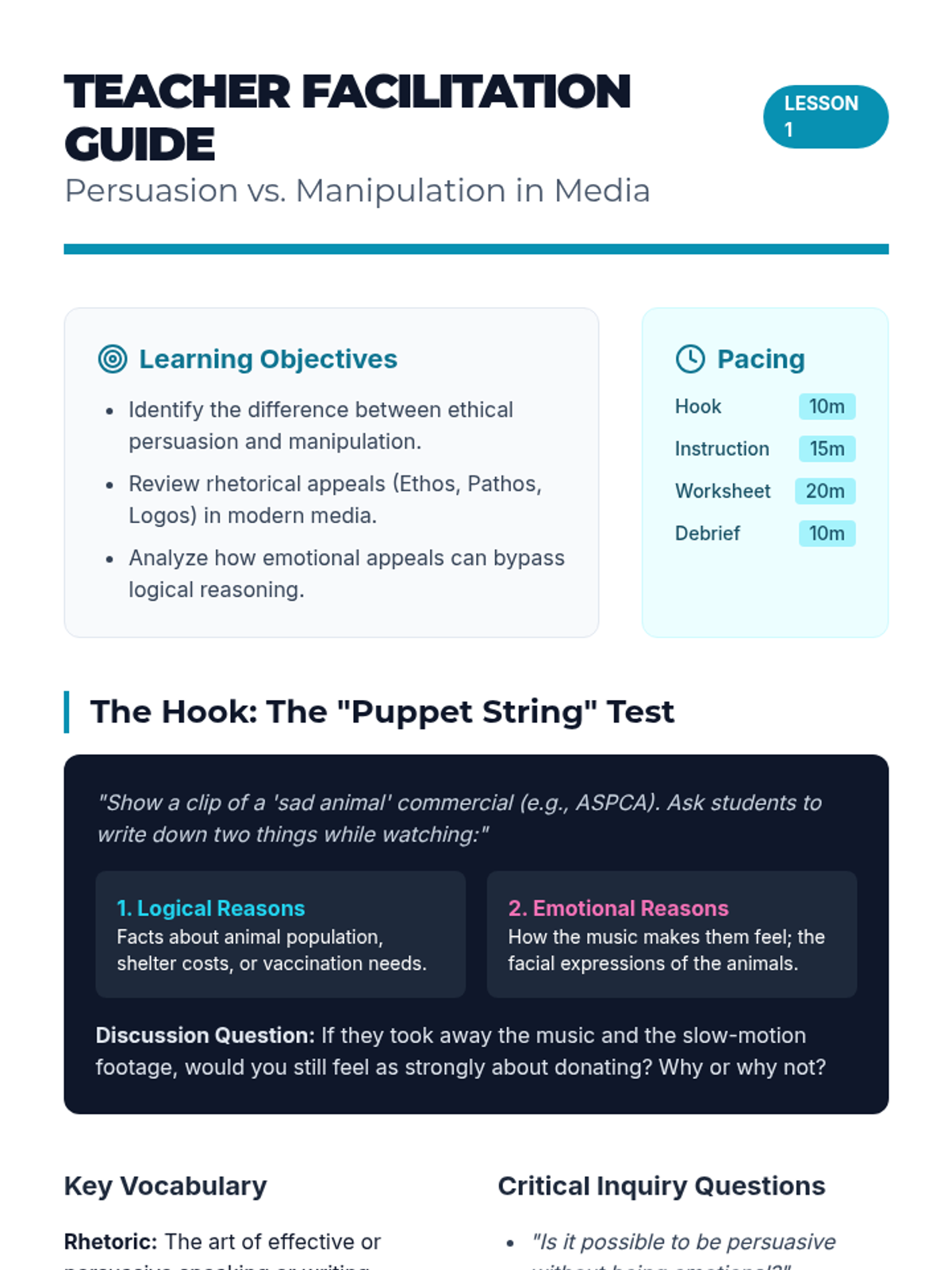
Persuasion vs Manipulation Teacher Guide

Logic Lab Media Detectives

A middle school ELA sequence focused on identifying and deconstructing logical fallacies in modern media, culminating in a critical analysis project. Students learn to distinguish between ethical persuasion and manipulative tactics like False Authority, False Dilemmas, and Straw Man arguments.

Lenny Avatar
Lenny
1/17
Sequence
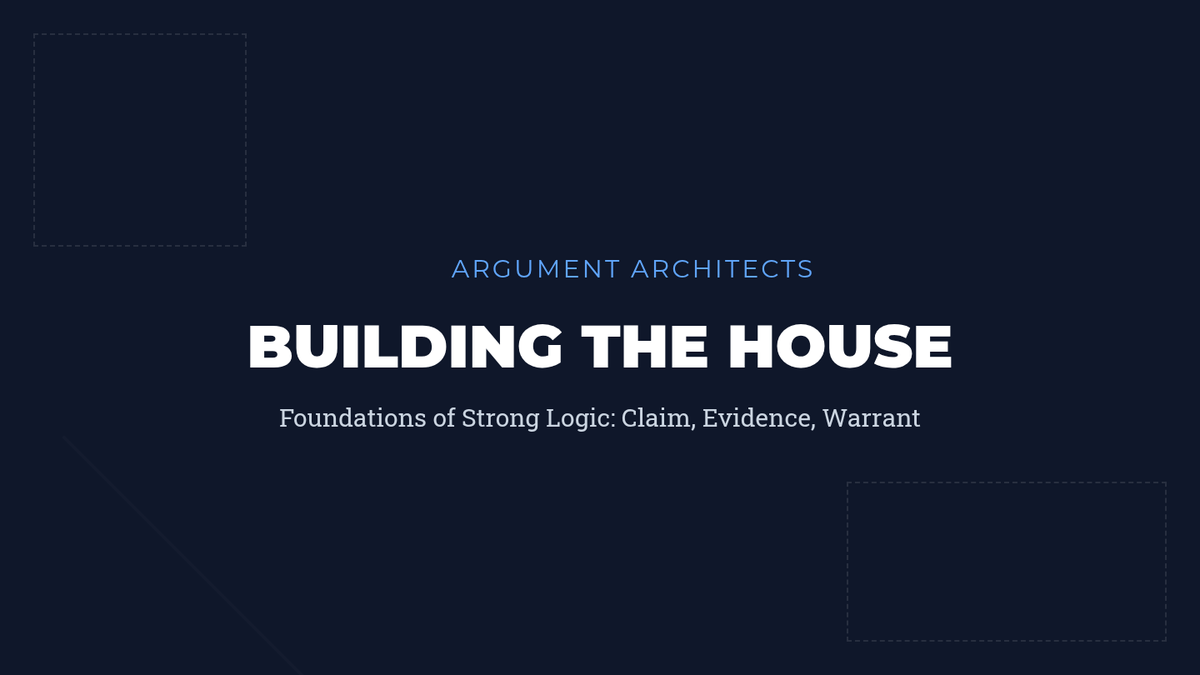
Building House Slides
Argument Blueprint Worksheet
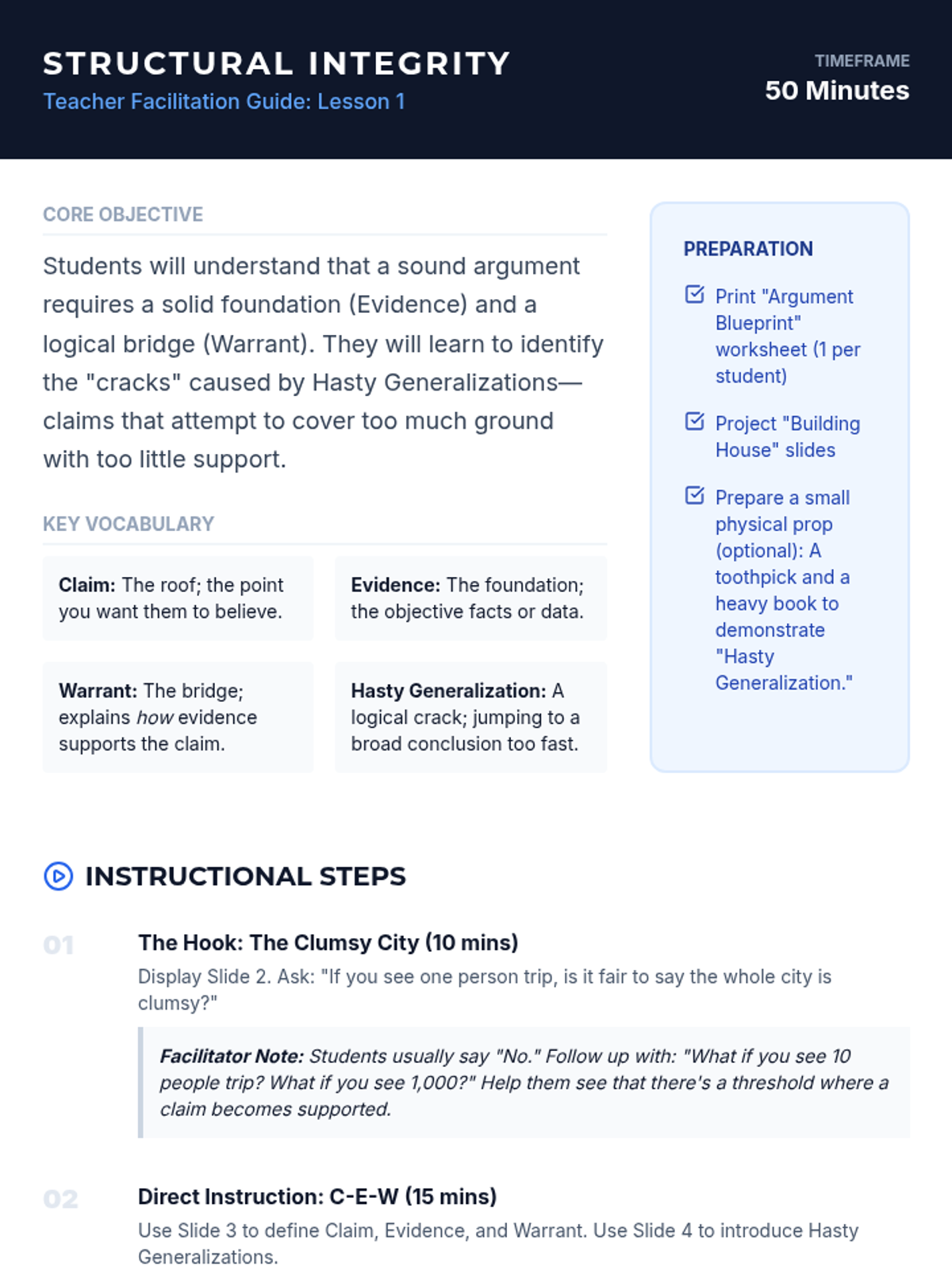
Structural Integrity Guide

Argument Architects

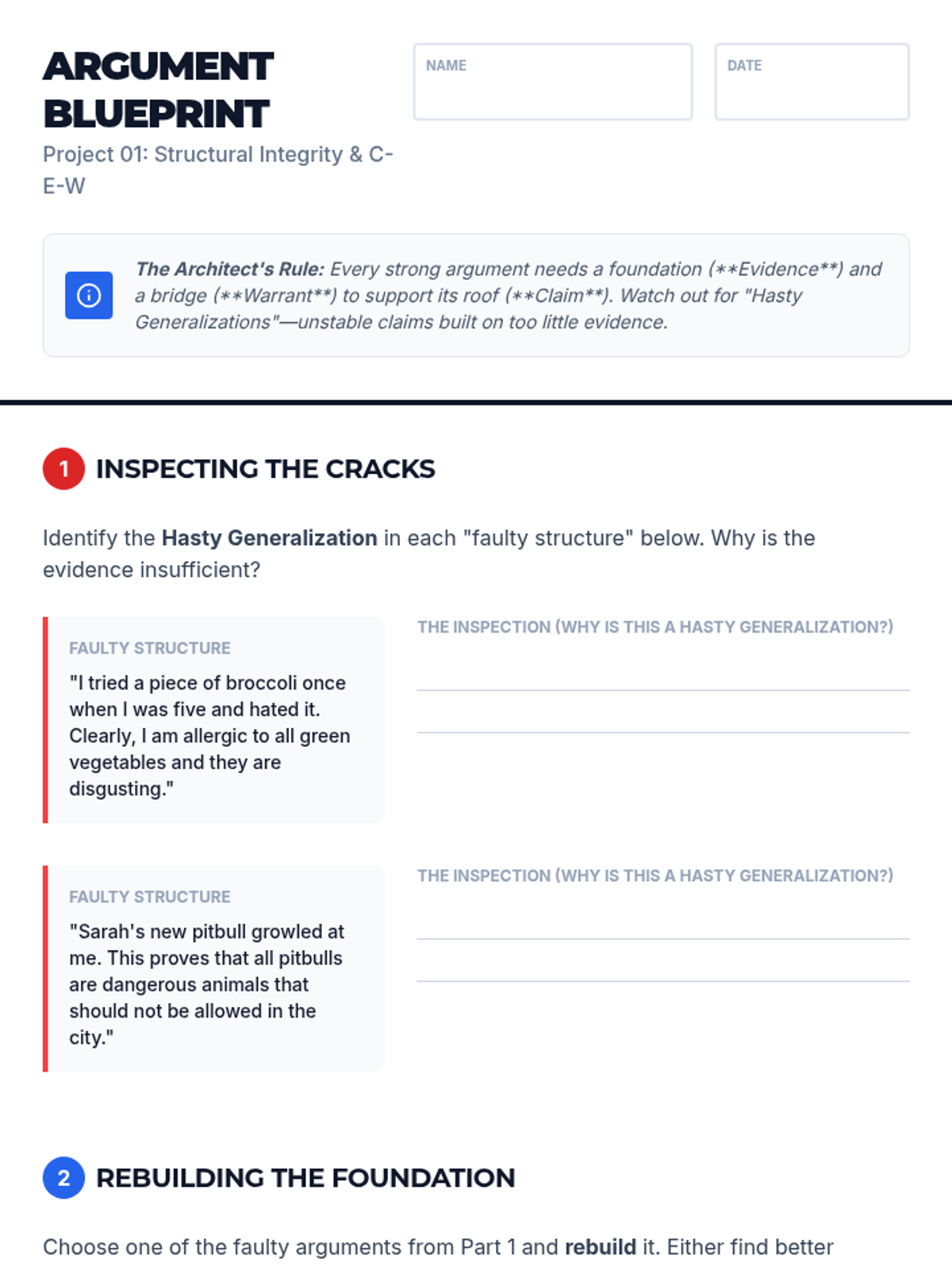
A workshop-style series designed to help 7th grade students strengthen their persuasive writing and speaking by identifying and eliminating logical fallacies. Students learn the Claim-Evidence-Warrant model and focus on avoiding Hasty Generalizations, Red Herrings, and Circular Reasoning.

Lenny Avatar
Lenny
1/17
Sequence
Logic Lab Slides
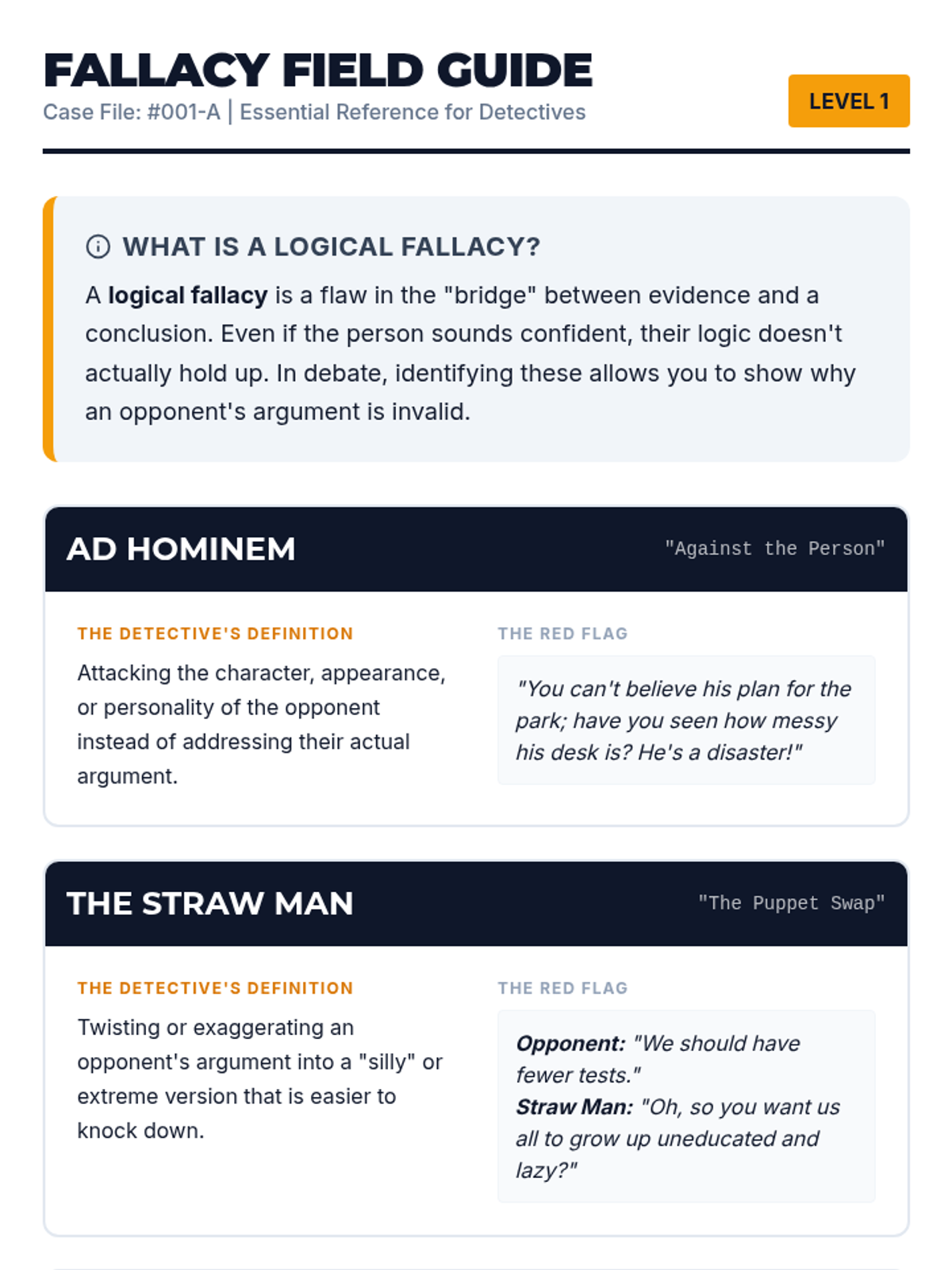
Fallacy Field Guide Handout
Gallery Walk Case Log
Logic Lab Teacher Guide

Fallacy Detectives

A comprehensive sequence for 6th-grade students to identify and challenge logical fallacies in debate. Students act as 'Fallacy Detectives' to uncover errors in reasoning like Ad Hominem, Straw Man, and Slippery Slope.

Lenny Avatar
Lenny
1/17
Sequence
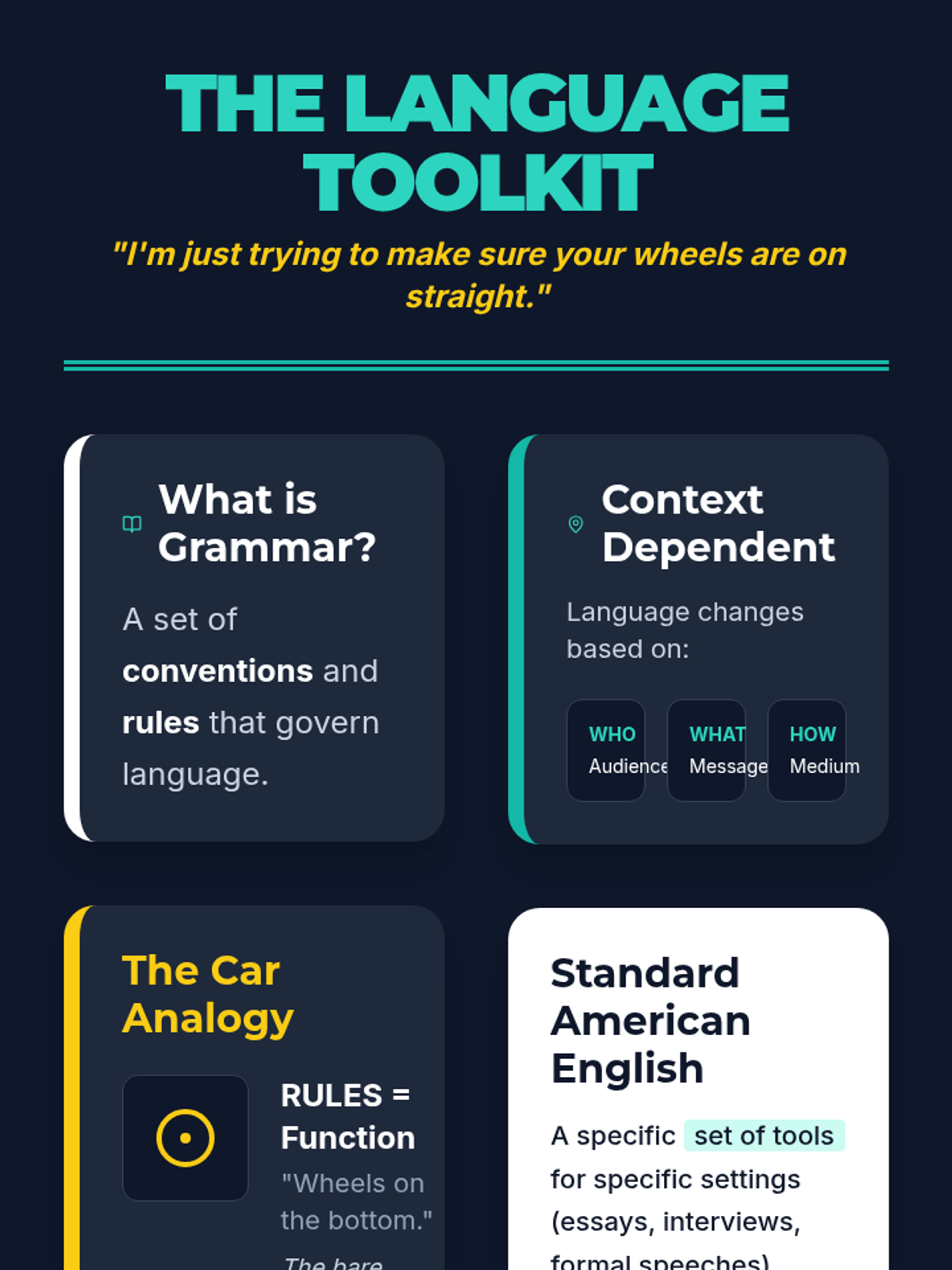
Language Toolkit Slides
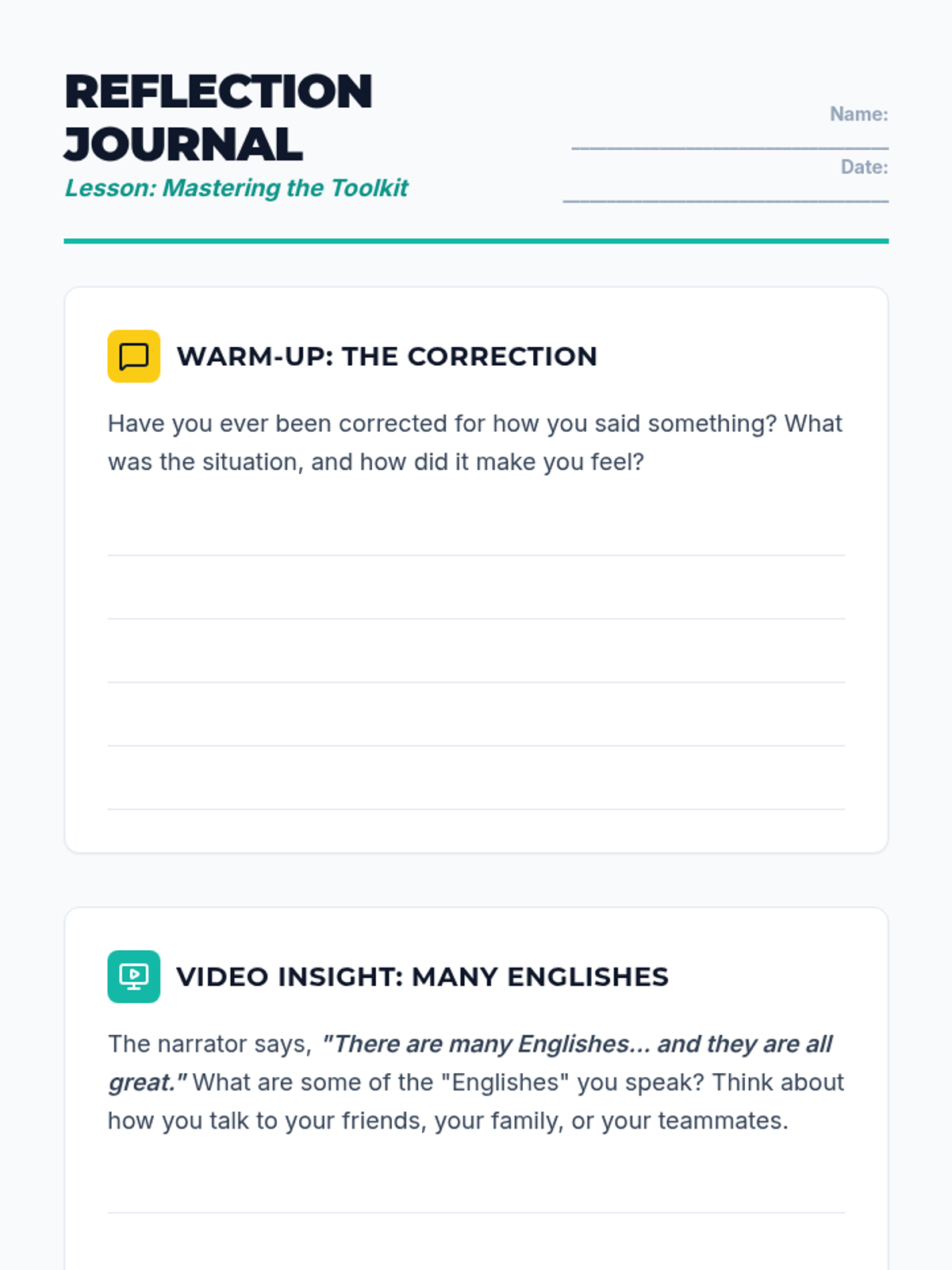
Reflection Journal Prompts
Language Toolkit Anchor Chart
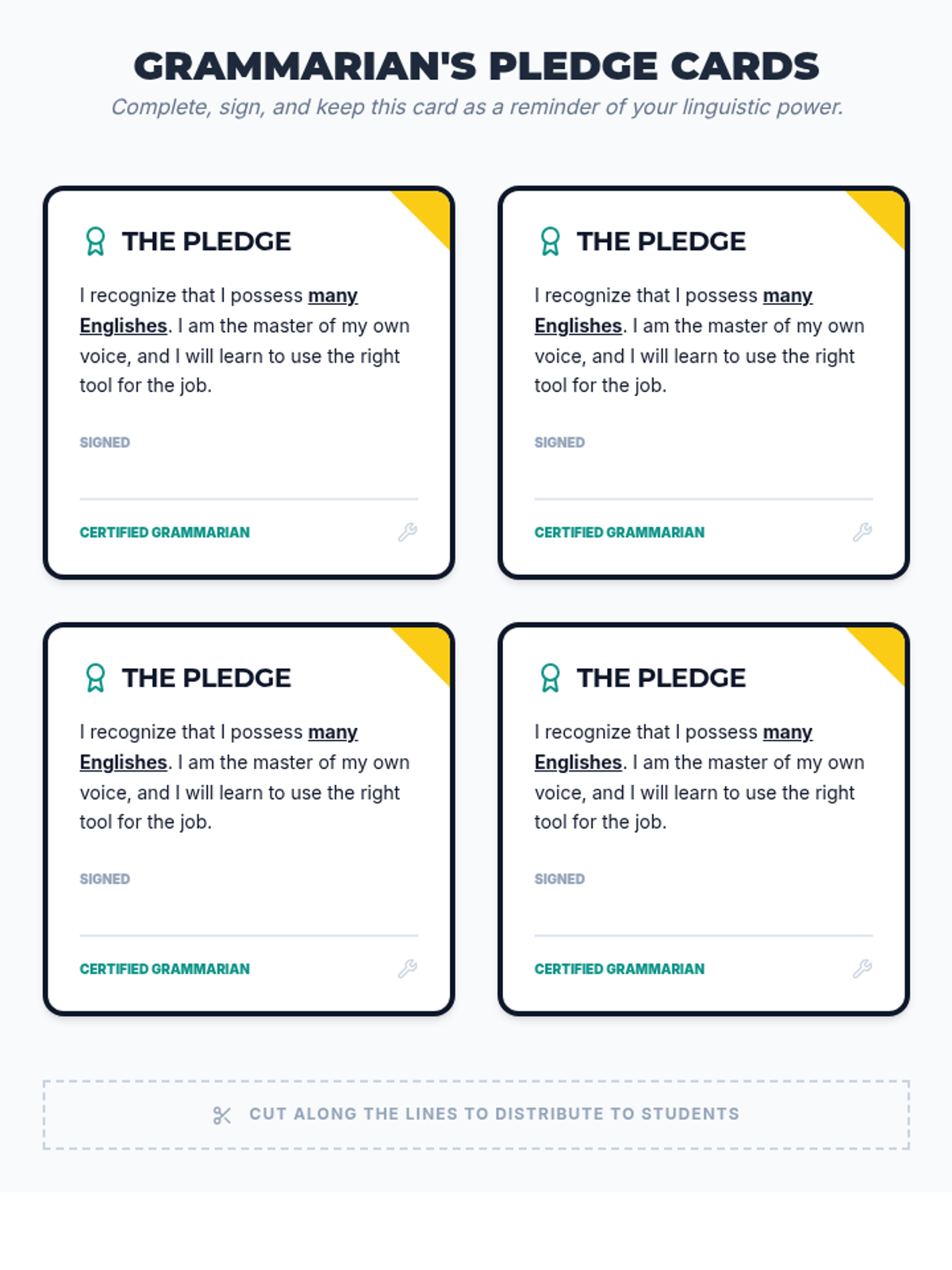
Grammarian Pledge Cards
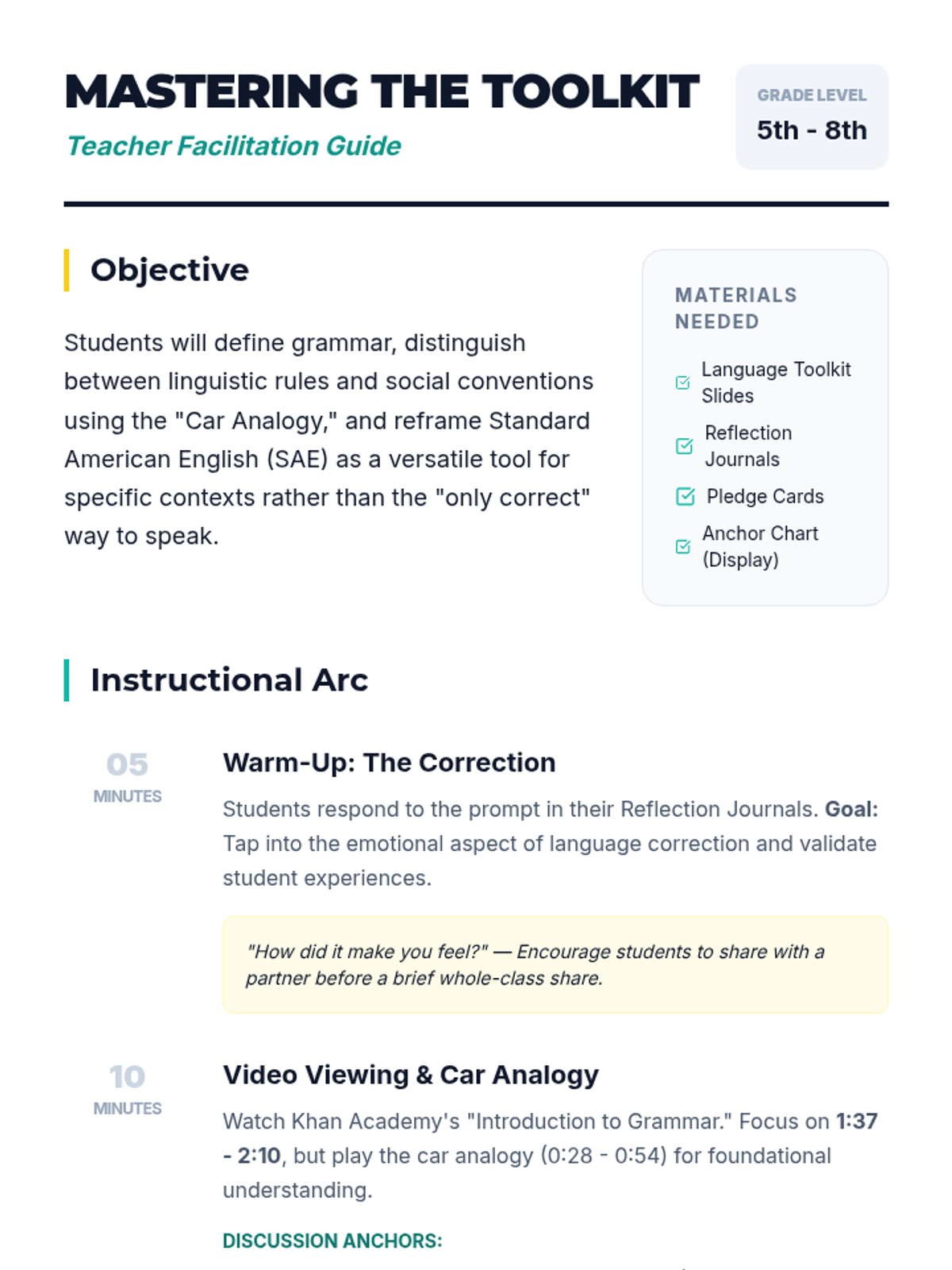
Mastering the Toolkit Teacher Guide

Language Toolkit

A lesson sequence exploring the concept of Standard American English as a versatile tool for communication, emphasizing that language varies by context and that all dialects are valid. Students analyze the 'car analogy' from Khan Academy to distinguish between fundamental grammar rules and social conventions.

Lenny Avatar
Lenny
1/19
Sequence
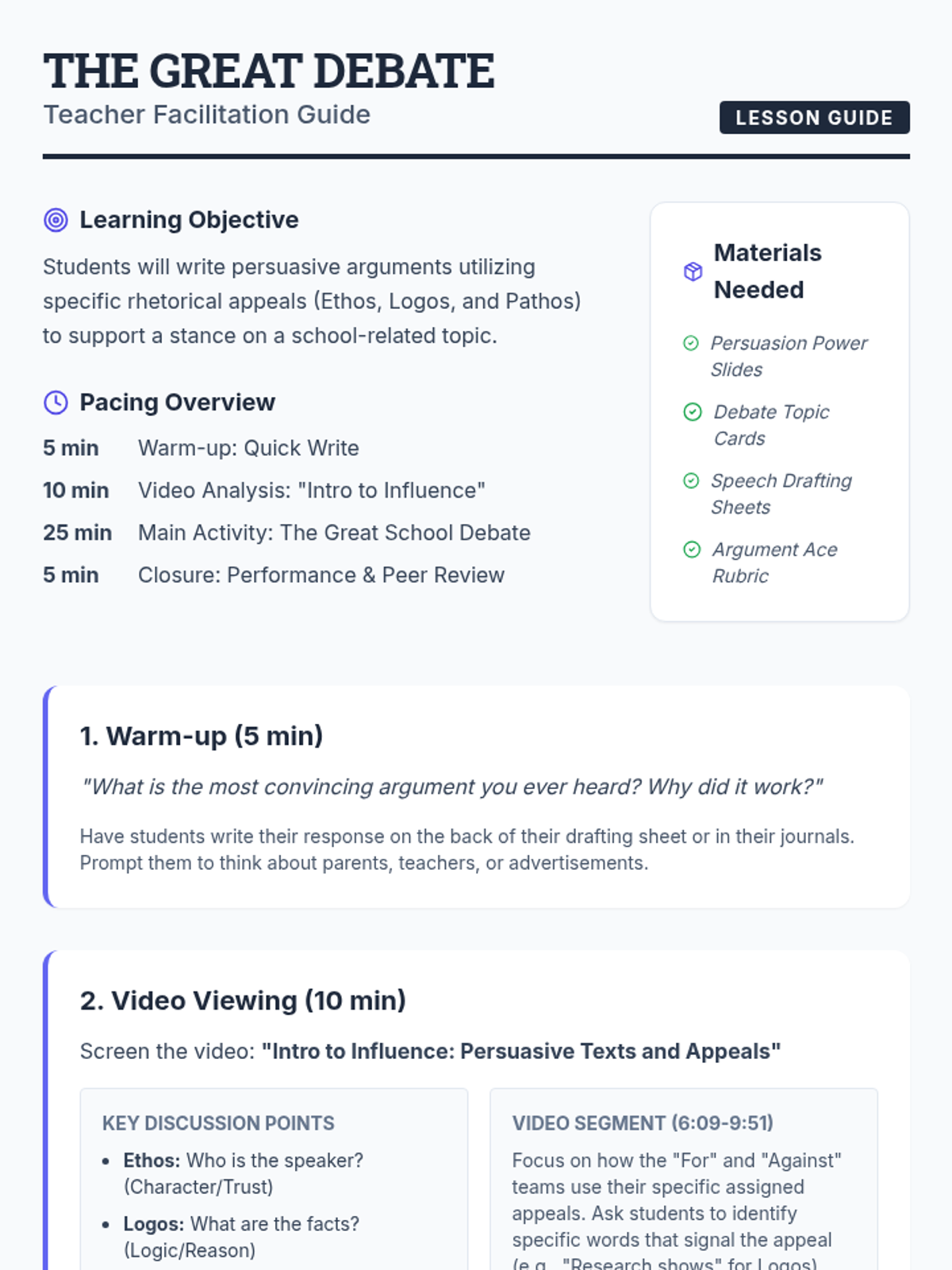
Debate Facilitation Guide
Persuasion Power Slides
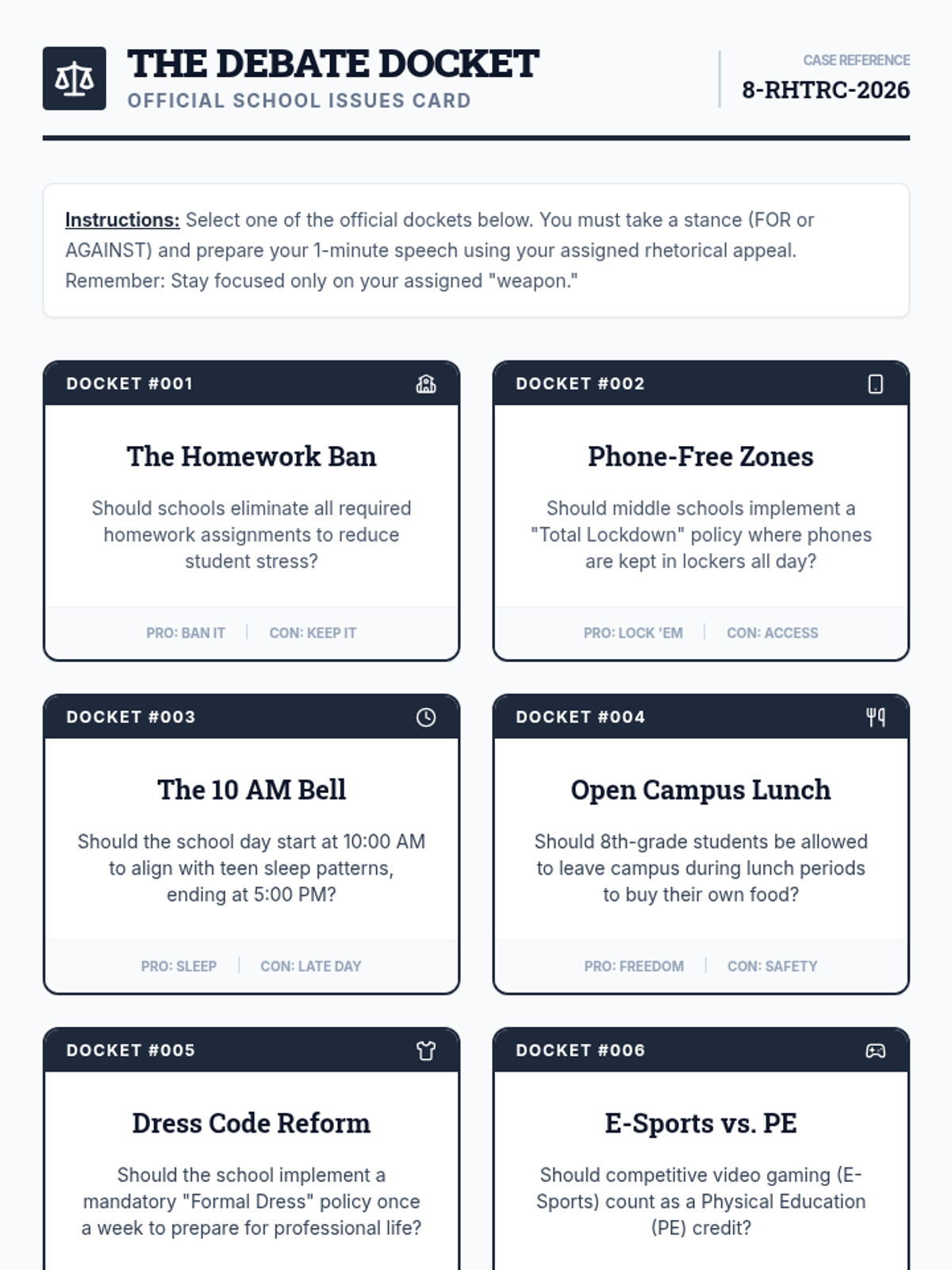
Debate Topic Cards
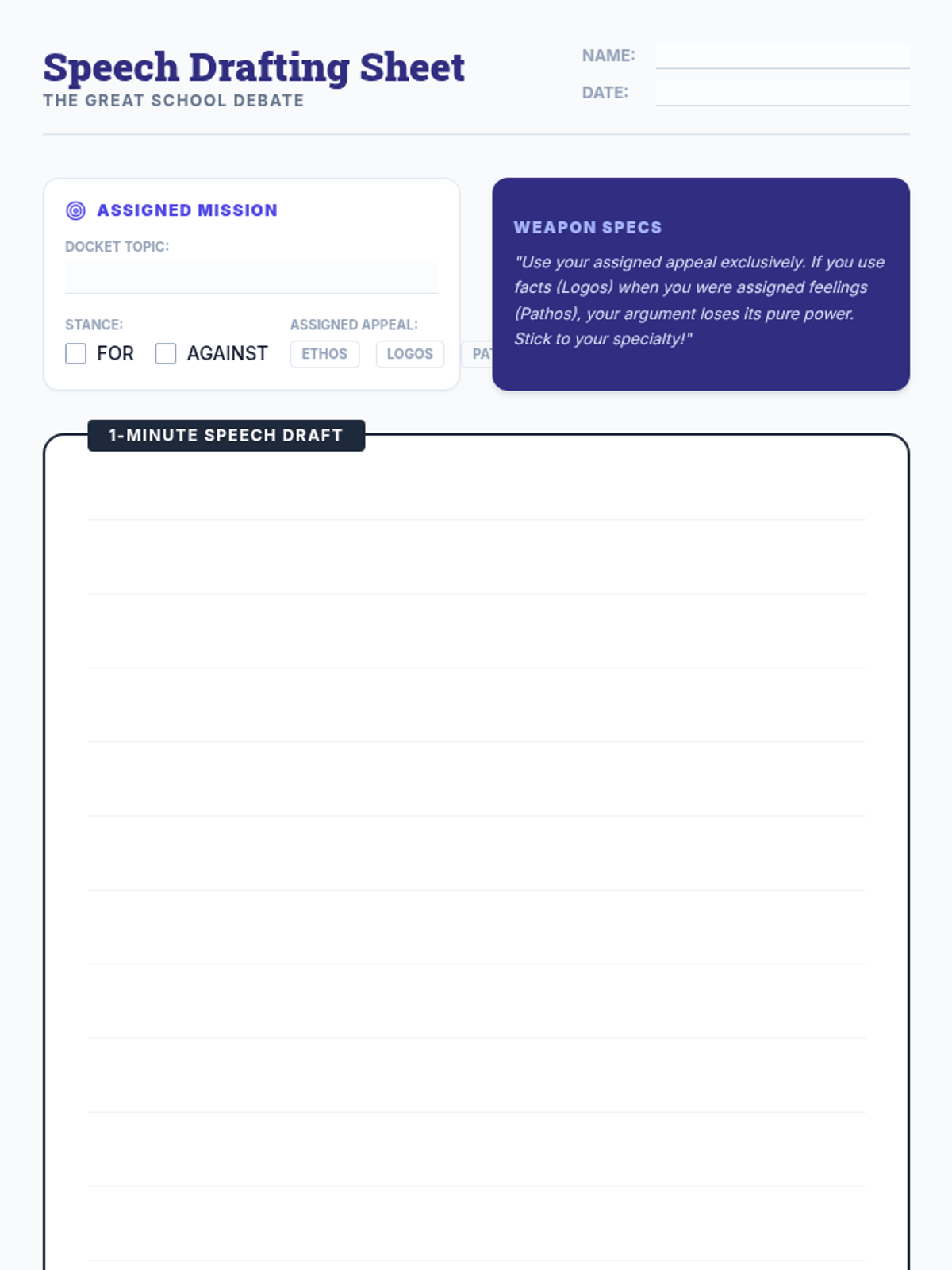
Speech Drafting Sheet
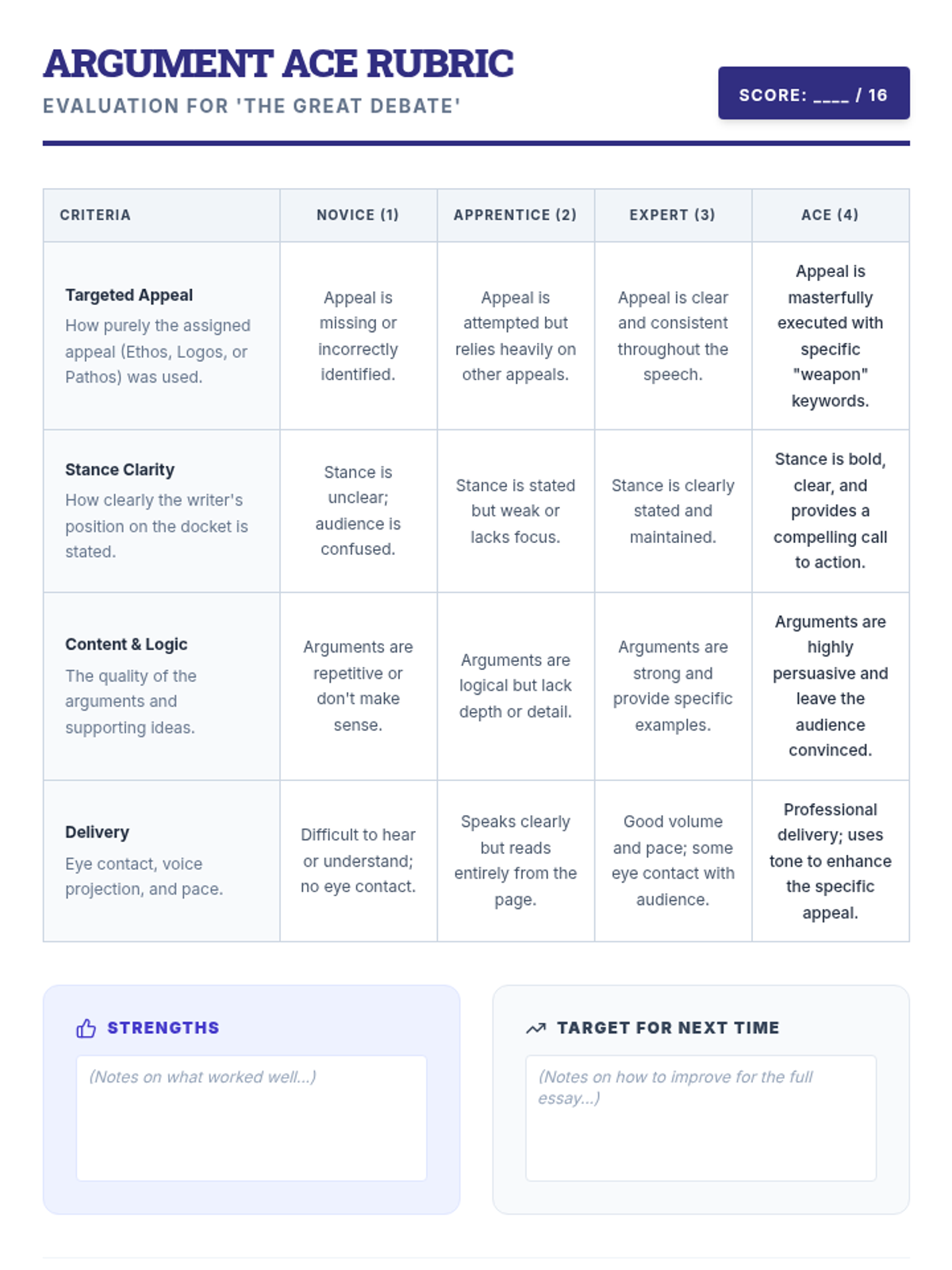
Argument Ace Rubric
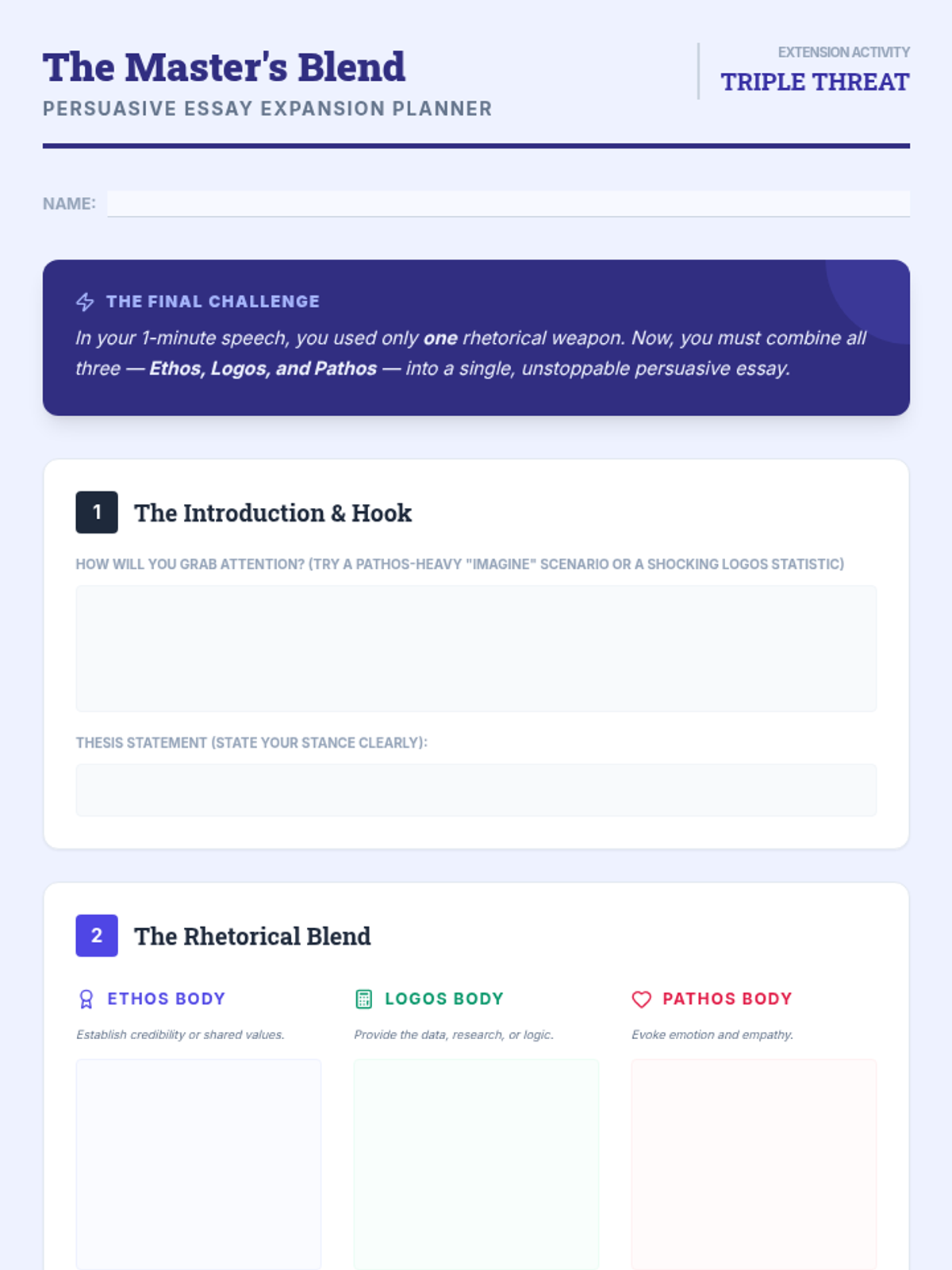
Mastering the Blend Essay Planner

Persuasion Mastery

A lesson sequence focused on mastering the three rhetorical appeals (Ethos, Logos, and Pathos) through video analysis and a simulated school debate.

Lenny Avatar
Lenny
1/19
Sequence
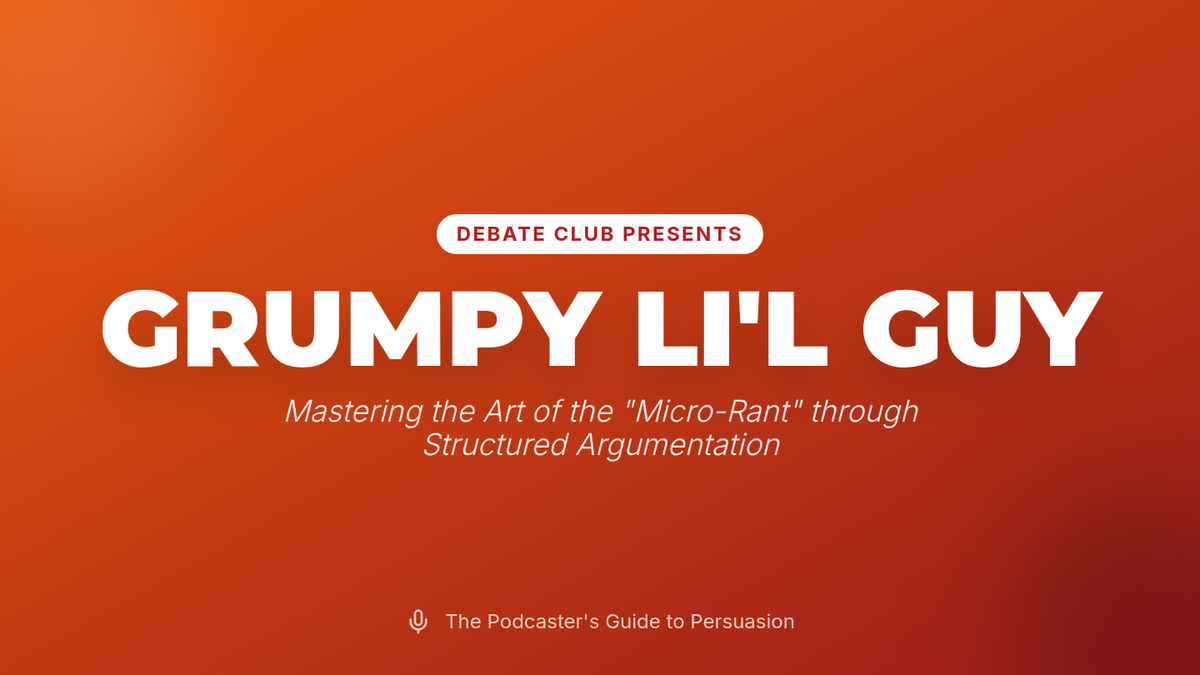
Grumpy Guise Slides
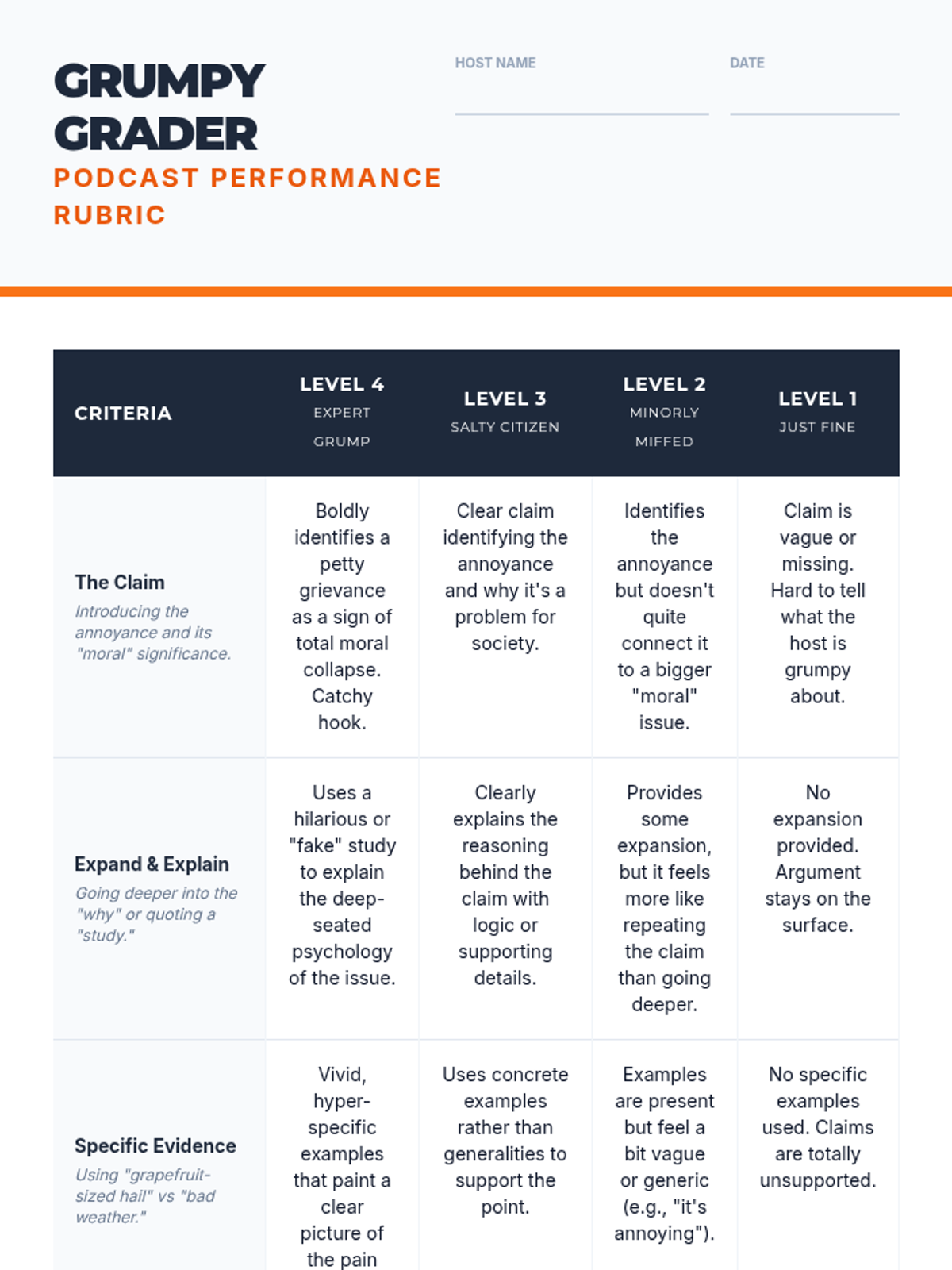
Grumpy Grader Rubric
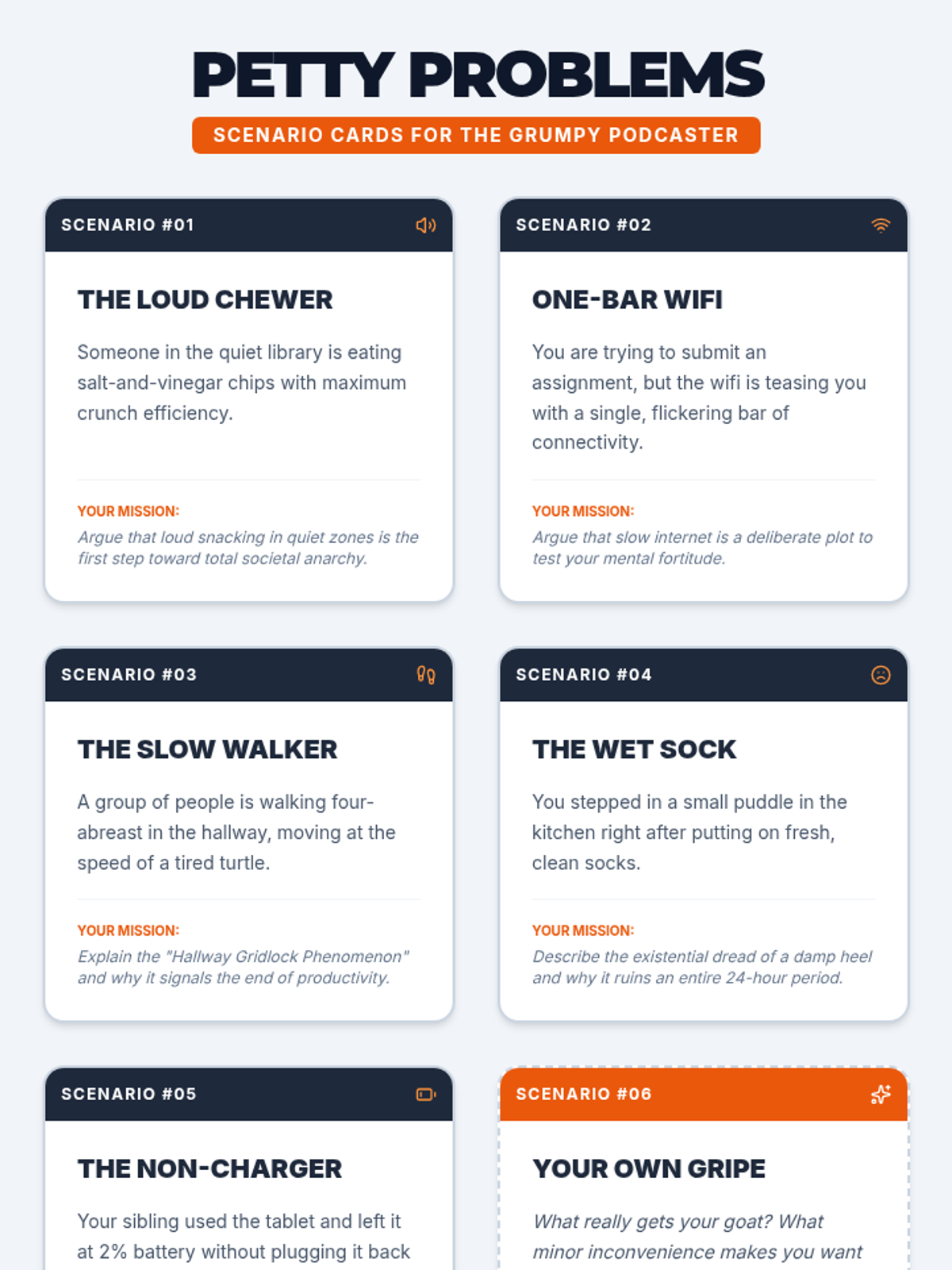
Petty Problems Scenario Cards
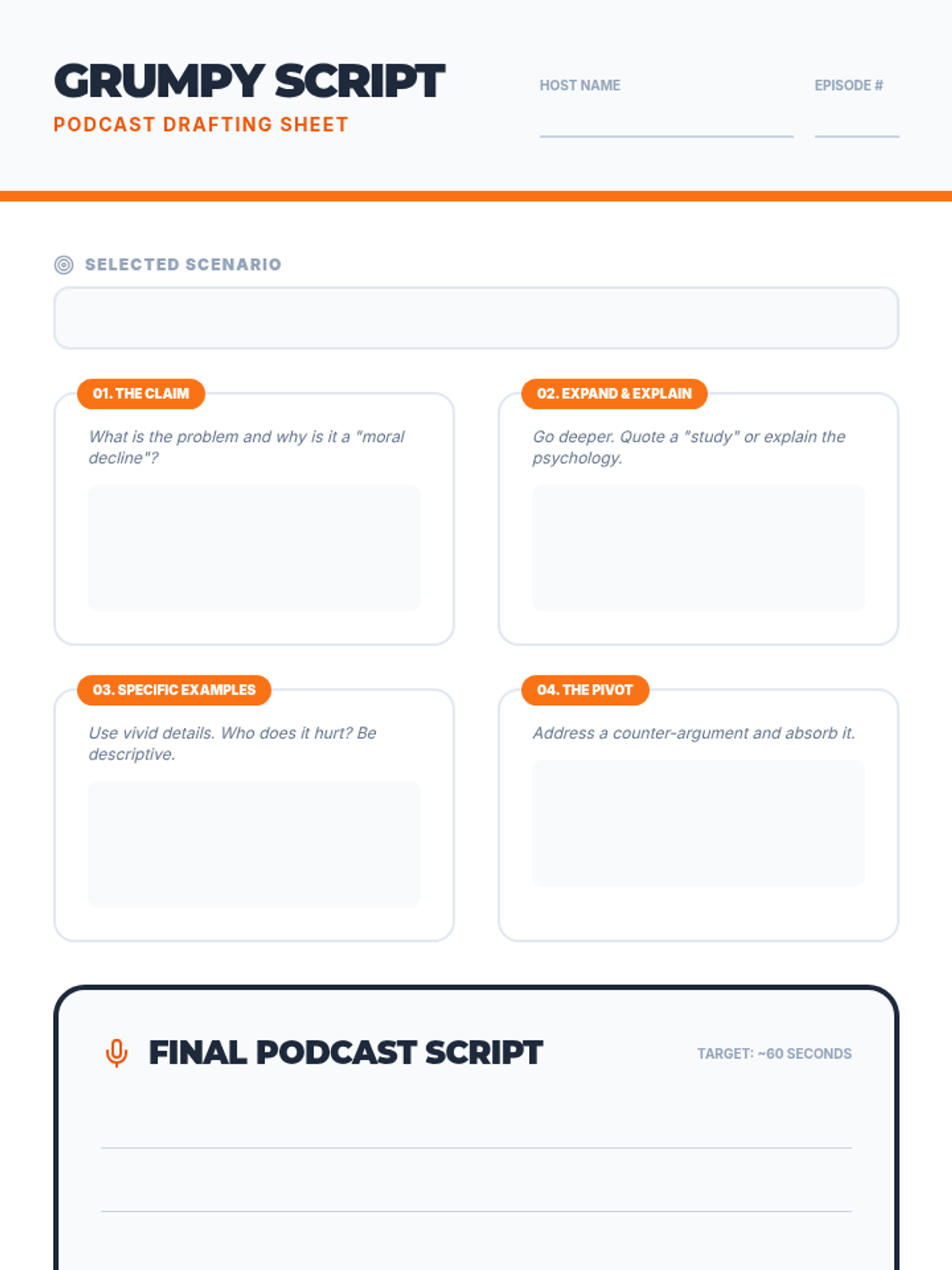
Grumpy Script Sheet

Persuasion Power Play

A debate and communication sequence focused on teaching middle schoolers how to build persuasive arguments through creative performance and structured analysis.

Lenny Avatar
Lenny
1/19
Sequence
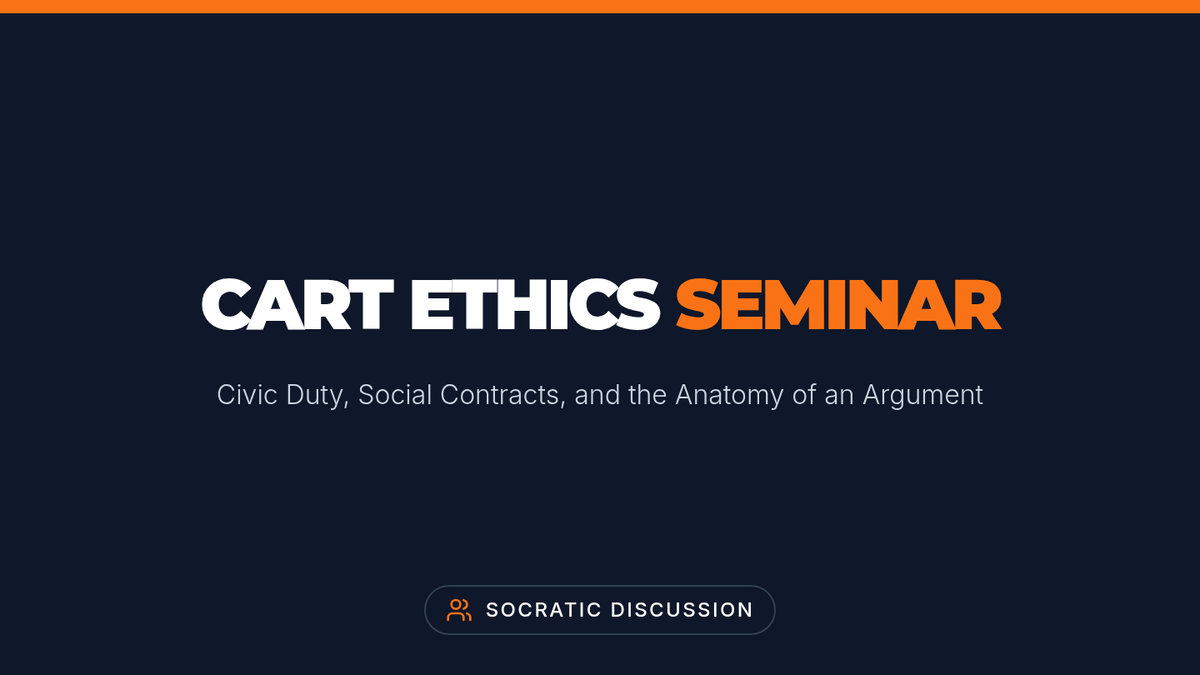
Cart Ethics Slides
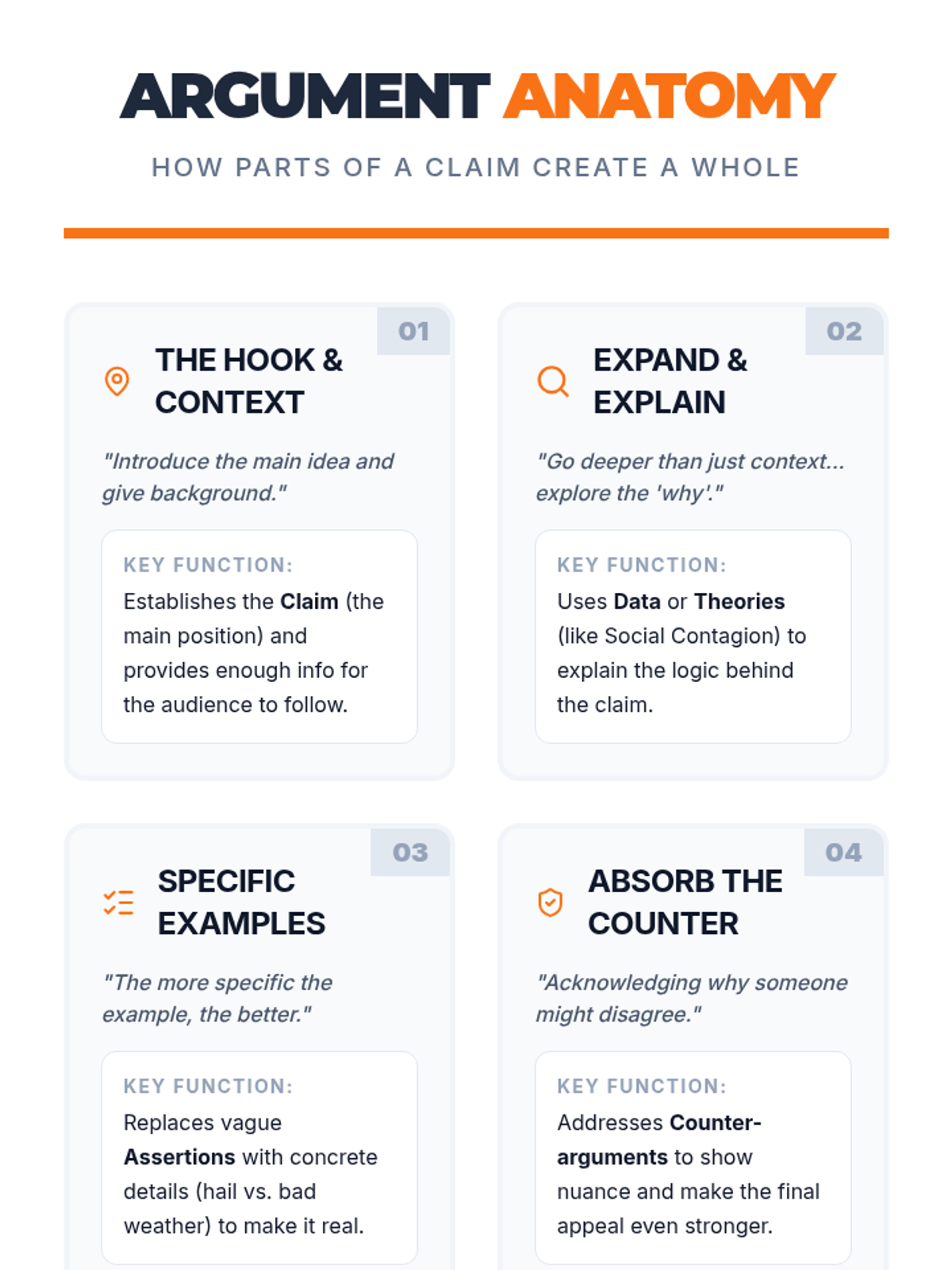
Argument Anatomy Anchor Chart
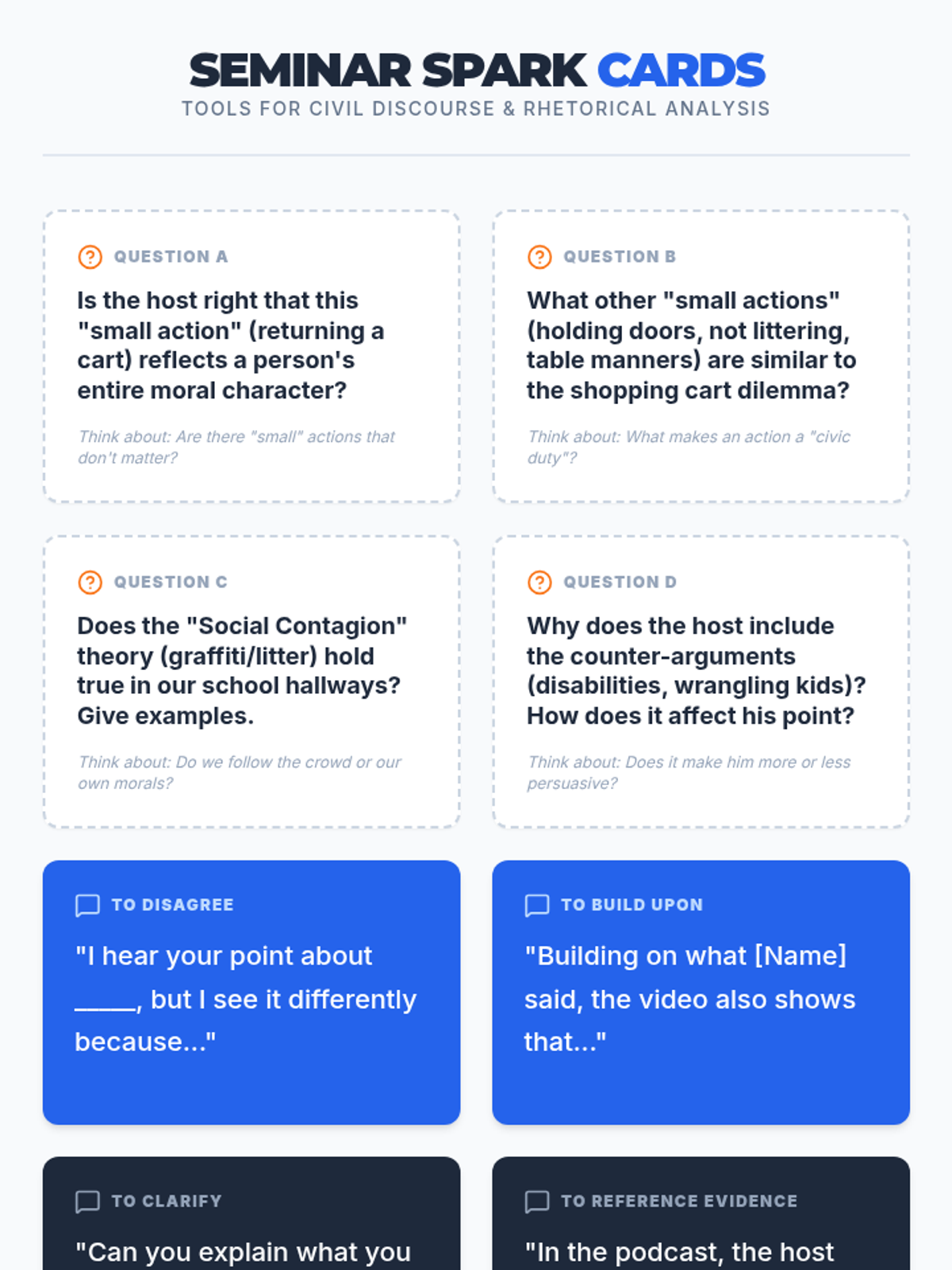
Seminar Spark Cards
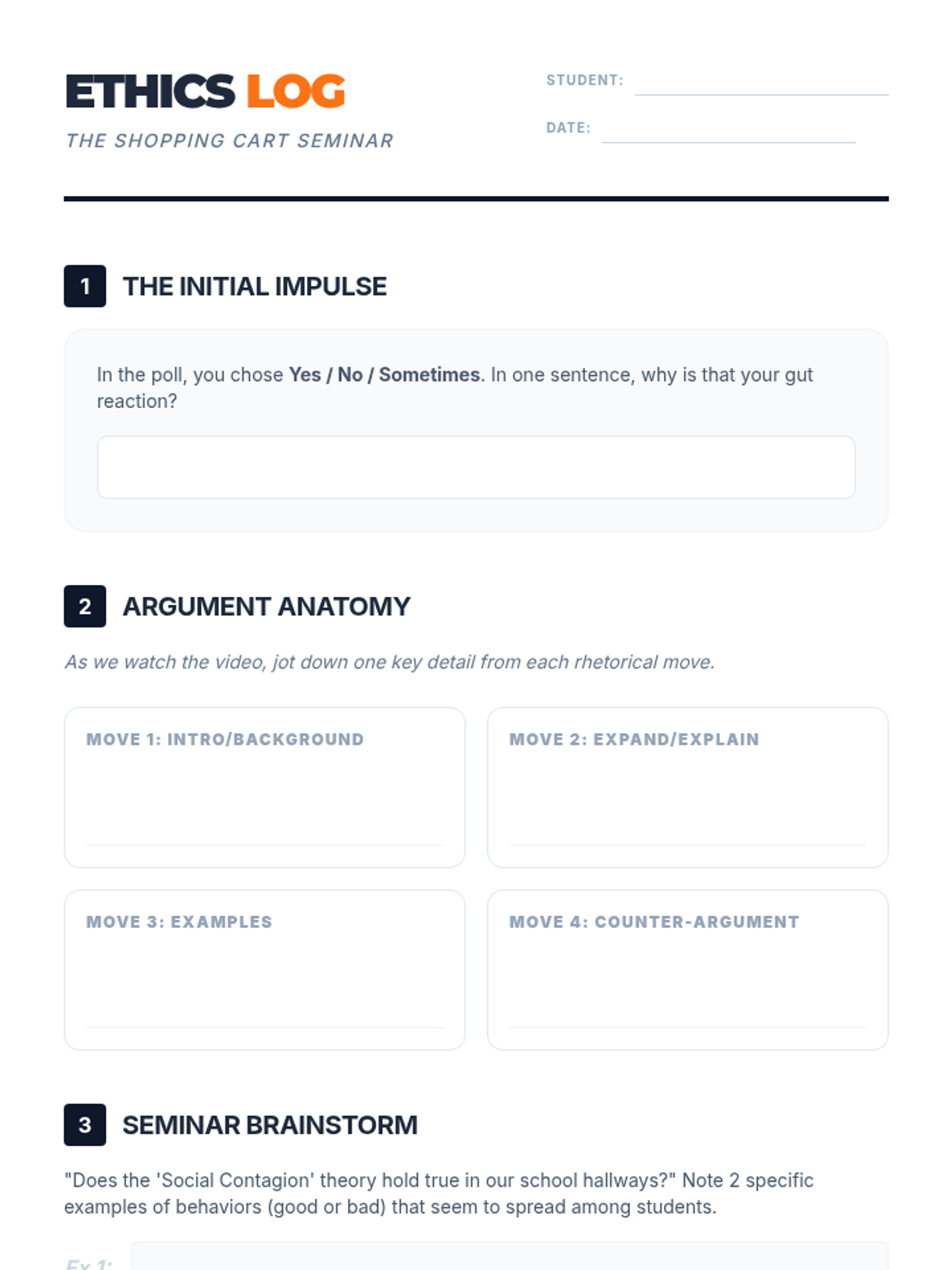
Ethics Log Handout
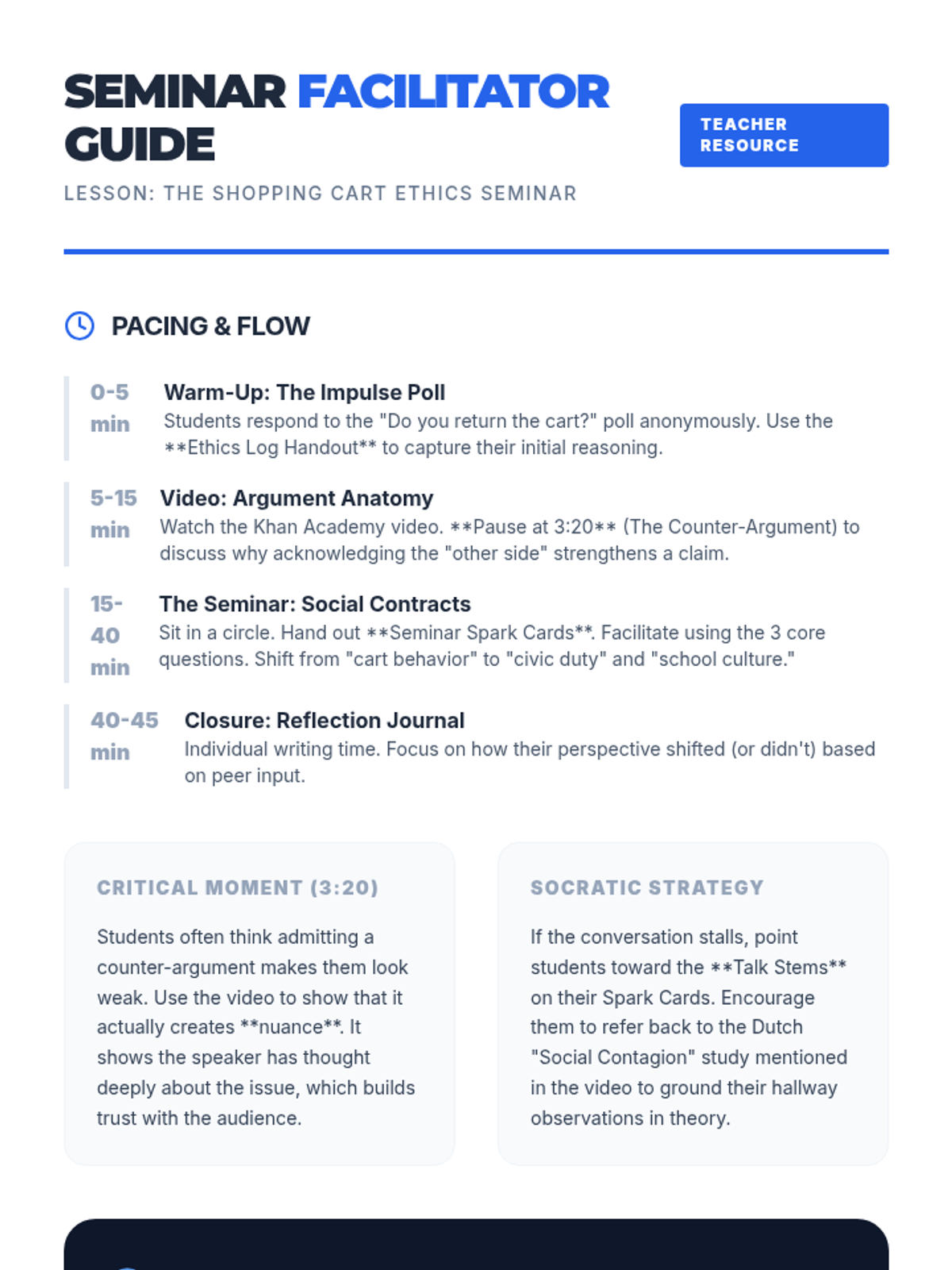
Seminar Facilitator Guide

Civic Duty and Social Contracts

A lesson sequence exploring the intersection of civic duty, social contracts, and rhetorical analysis through the lens of the 'Shopping Cart Theory'. Students analyze a structured argument and participate in a Socratic Seminar.

Lenny Avatar
Lenny
1/19
Sequence
Brainstorming Blitz Slides
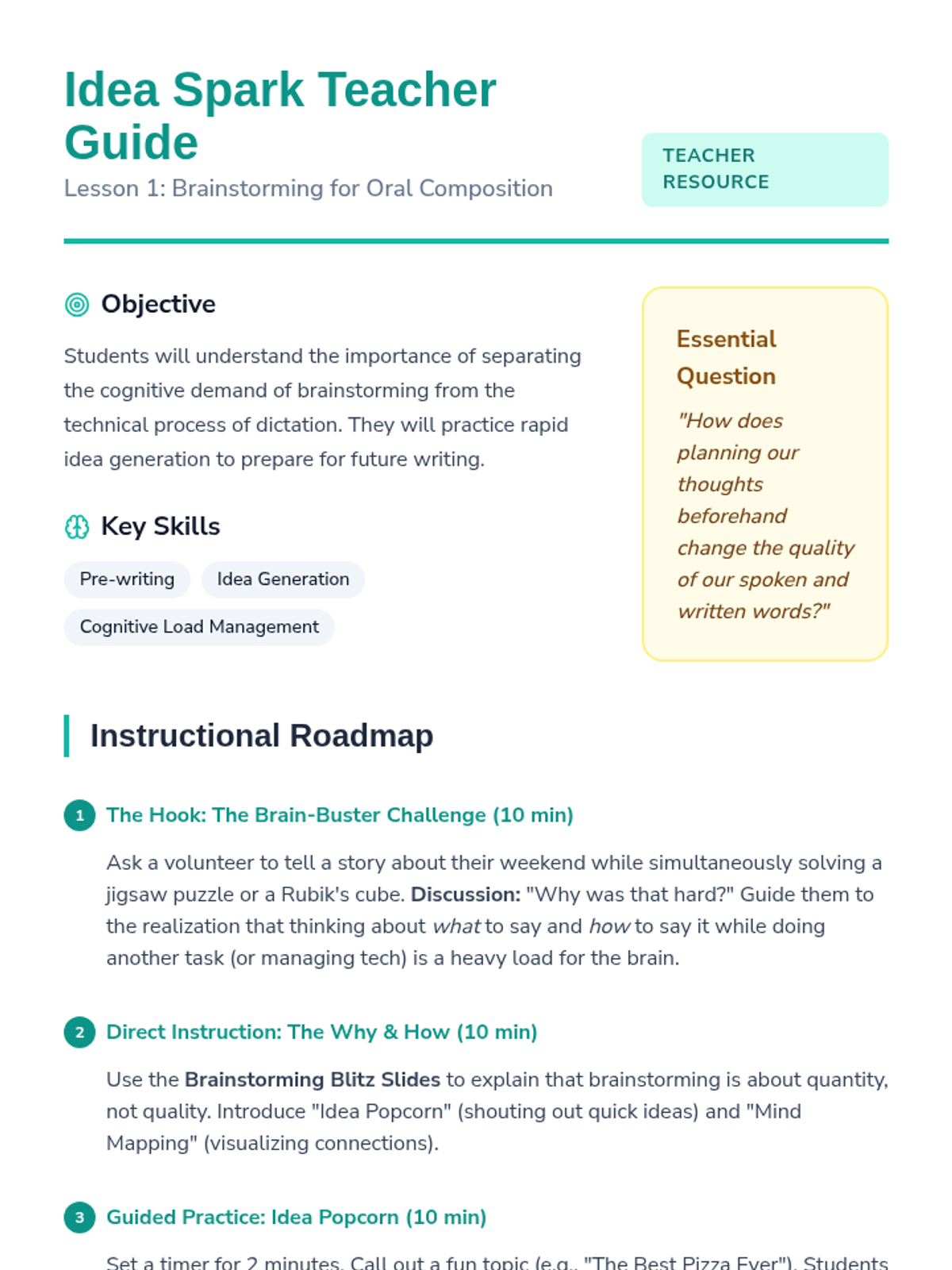
Idea Spark Teacher Guide
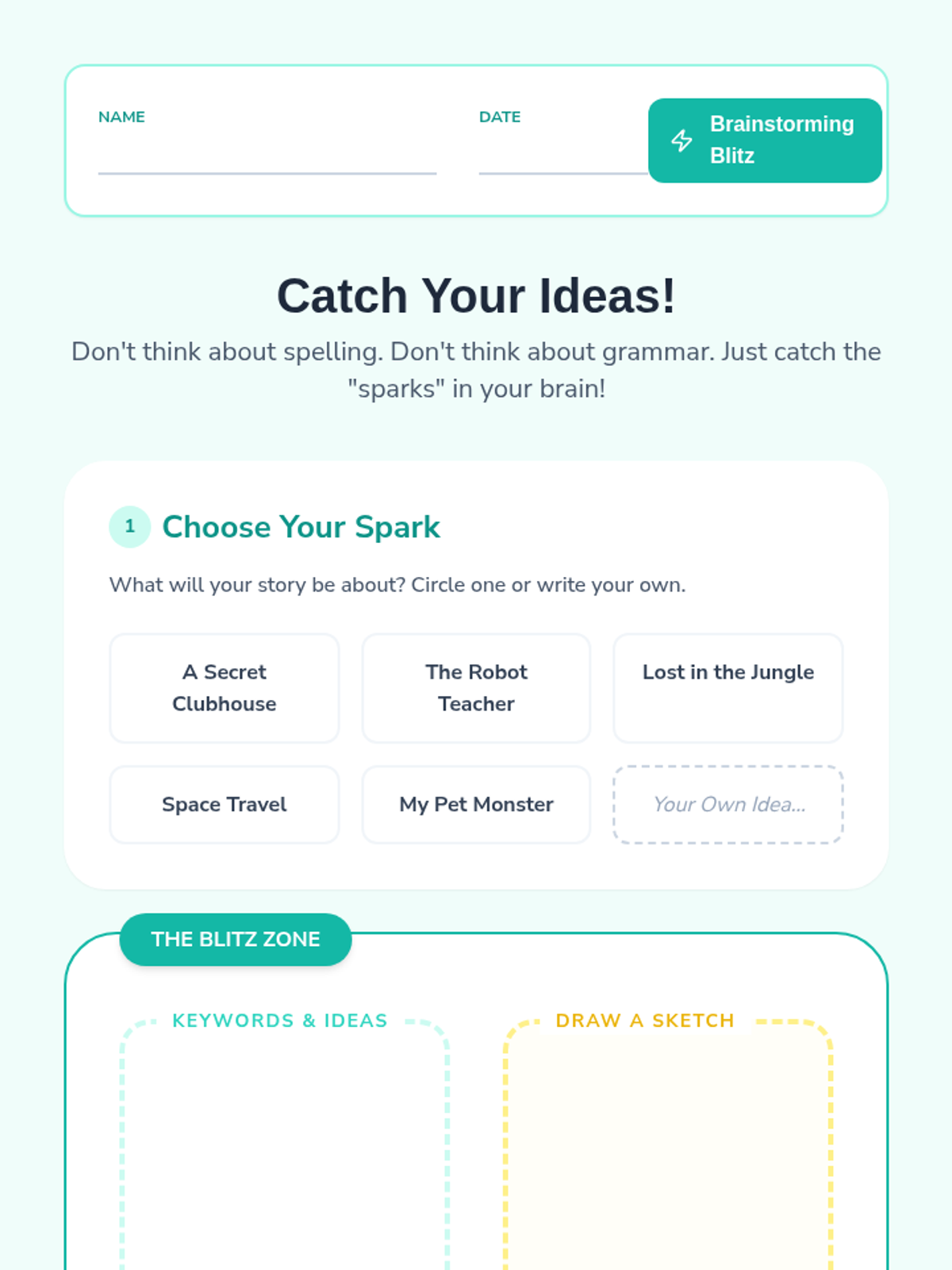
Brainstorming Blitz Worksheet

Oral Planning and Composition Strategies

This sequence focuses on the cognitive planning required before activating the microphone, bridging the gap between thought and oral expression. Students explore how to organize their ideas using graphic organizers and bullet points to prevent rambling during dictation.

Lenny Avatar
Lenny
1/18
Sequence
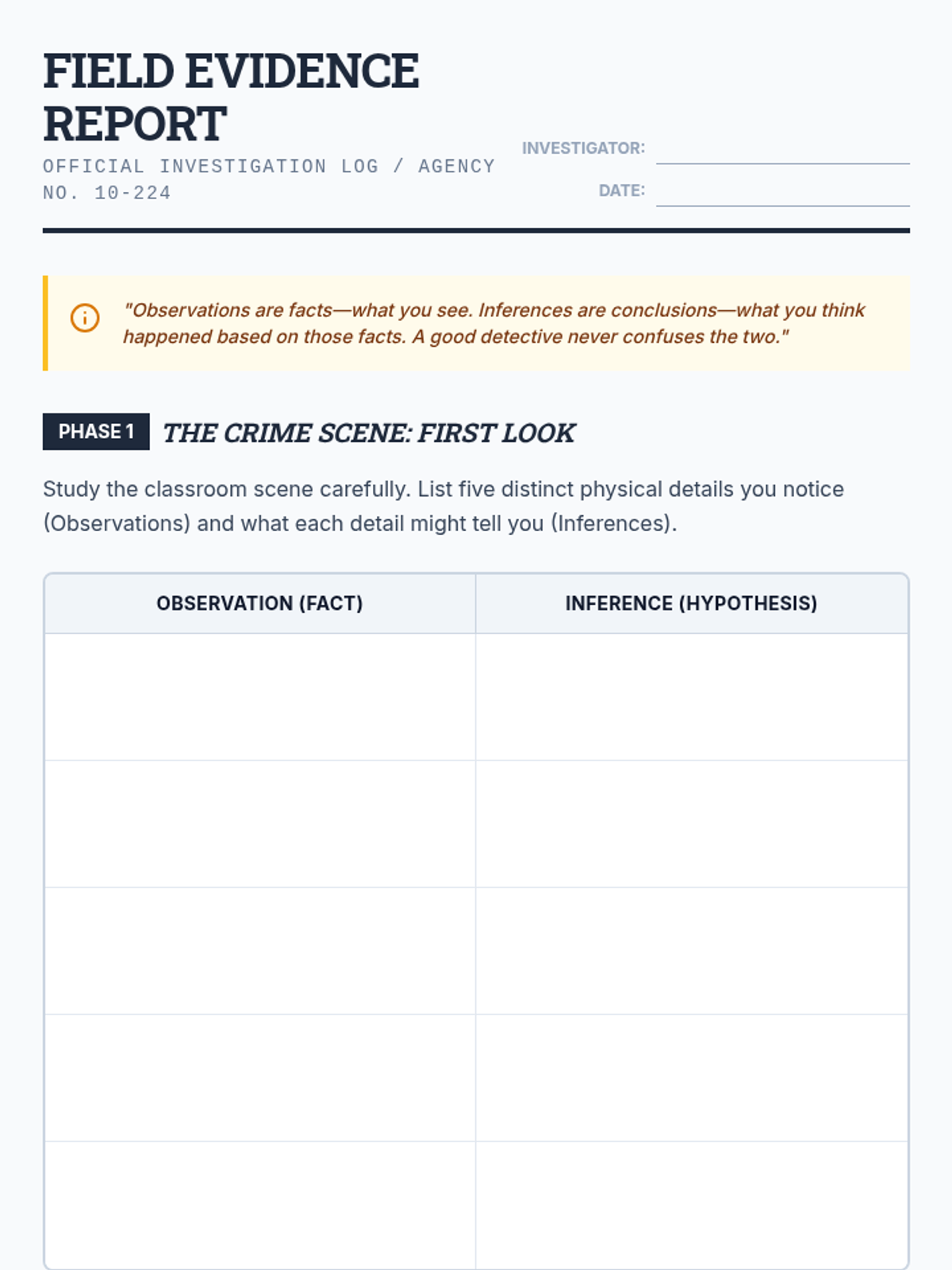
Field Evidence Worksheet
Scene Analysis Slides
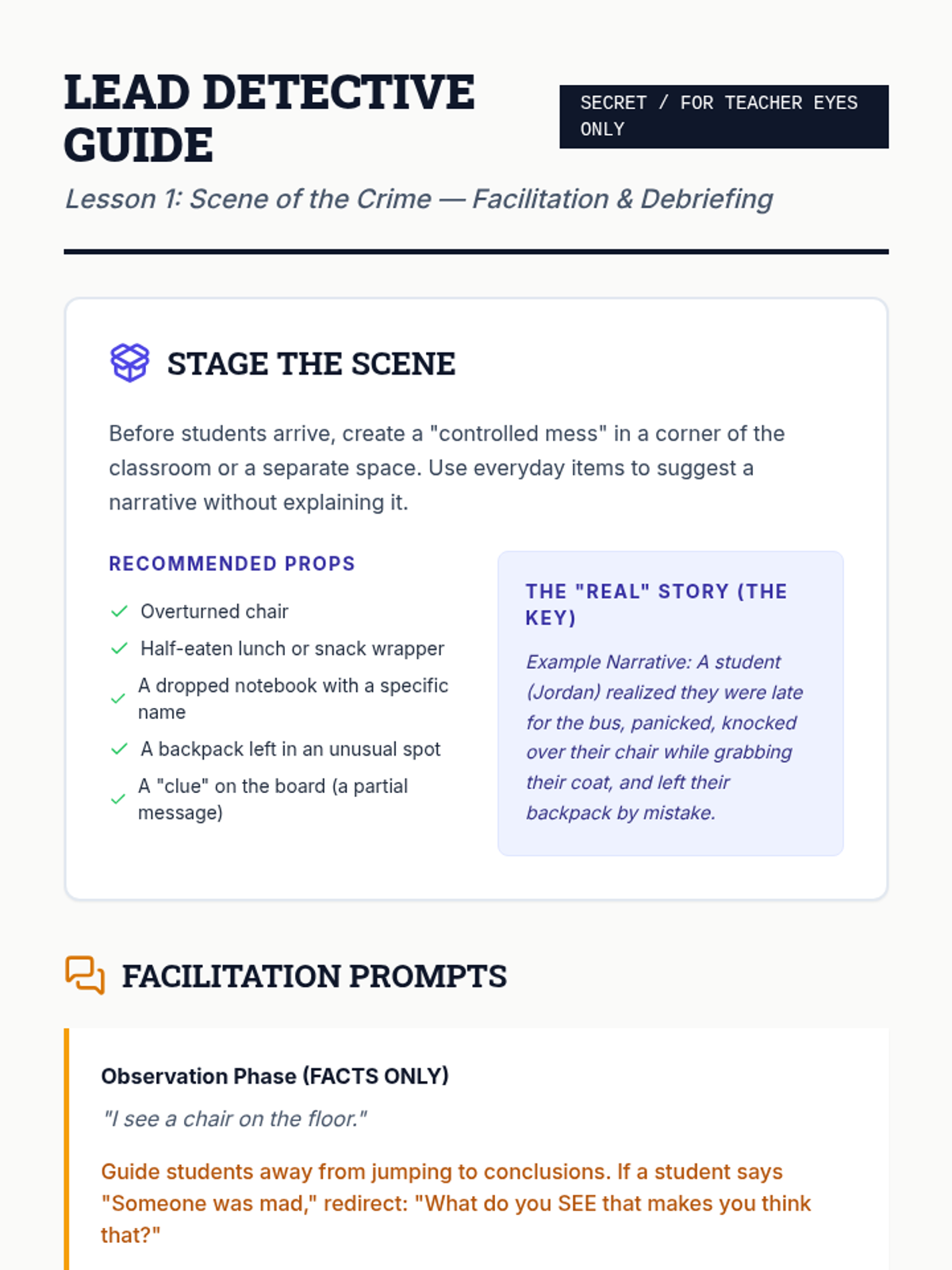
Forensic Debrief Teacher Guide

Narrative Detectives

A forensic-themed reading comprehension unit where students act as investigators to master predictions and inferences. Through case studies and evidence tracking, students learn to bridge literal text with deep narrative meaning.

Lenny Avatar
Lenny
1/18
Sequence
Onomatopoeia Intro Slides
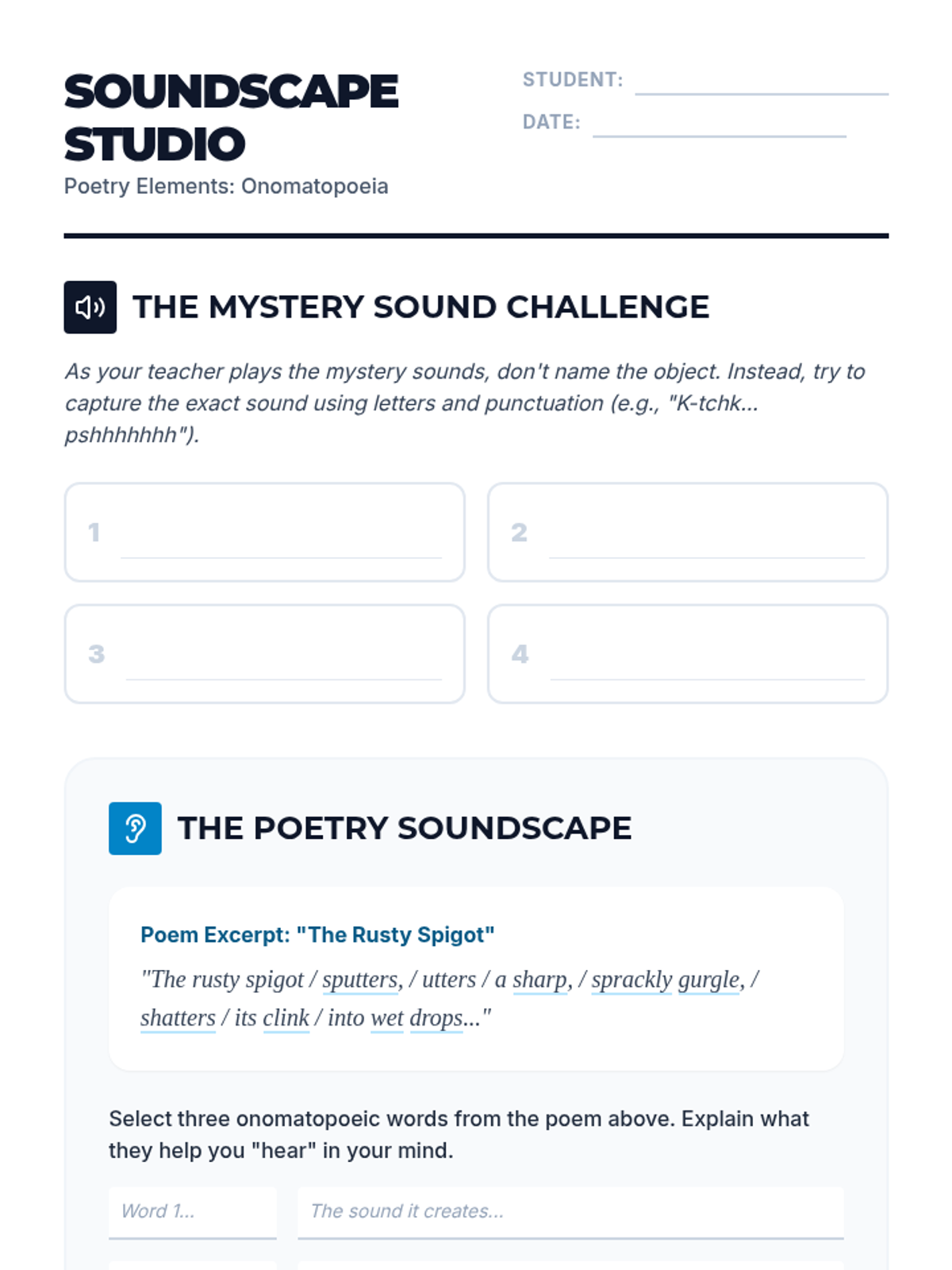
Soundscape Studio Worksheet
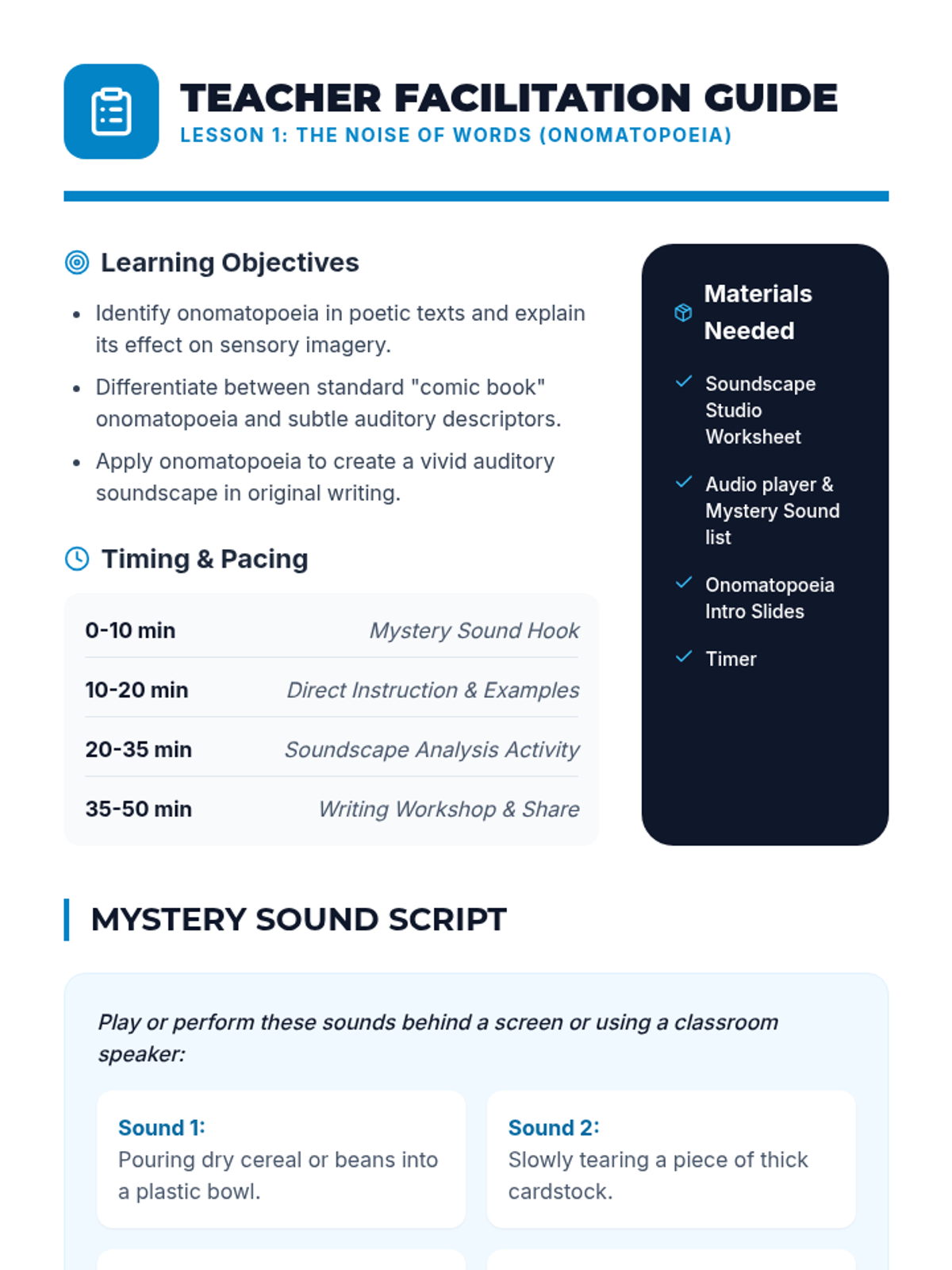
Onomatopoeia Teacher Guide

Sonic Echoes

A 5-lesson unit for 6th-grade students focused on the auditory elements of poetry, including onomatopoeia, alliteration, assonance, repetition, and performance. Students explore how sound creates mood and meaning through game-based learning and performance-oriented analysis.

Lenny Avatar
Lenny
1/18
Sequence
Soundtrack Tracker Worksheet
Soundtrack Presentation Slides
Soundtrack Teacher Guide

Verse and Vibration

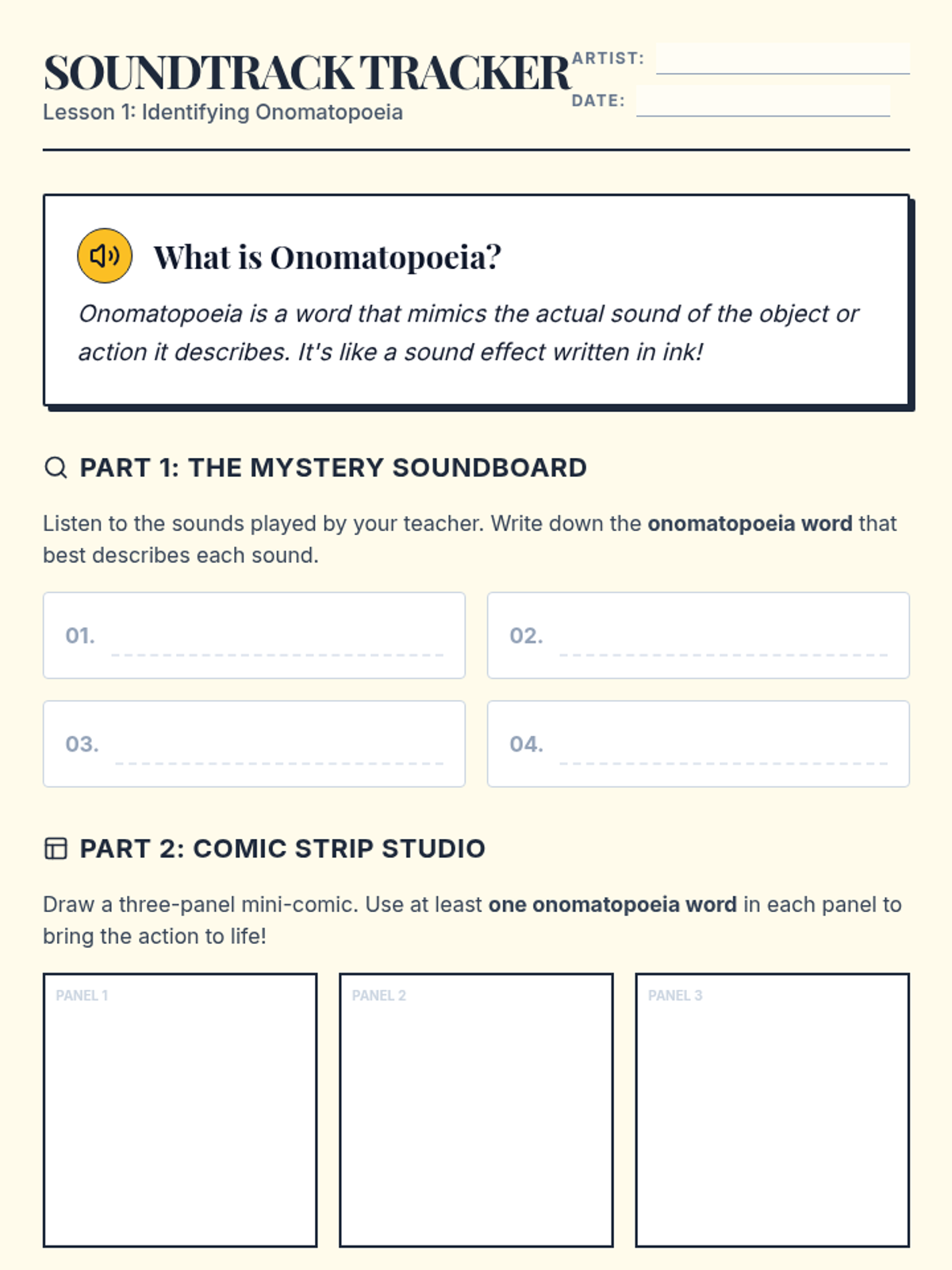
This immersive sequence focuses on the auditory experience of poetry, emphasizing that poems are meant to be heard. Students investigate sound devices like onomatopoeia, alliteration, and consonance to understand how sound creates mood and prepares them for oral performance.

Lenny Avatar
Lenny
1/18
Sequence
Setting Sleuth Slides
Sensory Evidence File Worksheet
Detective Briefing Guide

Setting Sleuths and World Builders

A project-based unit where students investigate how the setting of a novel (historical and geographical) acts as a crucial force in the story, culminating in the creation of a 'World Guide' presentation.

Lenny Avatar
Lenny
1/18
Sequence
Cool Under Fire Slides
Statue Challenge Worksheet
Composure Coaching Guide

Defensive Speaking and Responding Under Pressure

A sequence focused on the defensive side of debate, teaching 6th-grade students how to maintain composure, identify rhetorical traps, and pivot back to evidence during cross-examination. Students will move from non-verbal techniques to full-scale rapid-fire defense simulations.

Lenny Avatar
Lenny
1/18
Sequence
Word Origins Slides
Word Ancestry Investigation Worksheet

Linguistic Archaeology

This inquiry-driven sequence focuses on etymology as a reference skill, teaching students to trace word origins to understand language evolution and historical context. Students move from decoding individual roots to analyzing how historical events shape the English lexicon, culminating in a 'word biography' project.

Lenny Avatar
Lenny
1/18
Sequence
Wisdom Decoder Slides
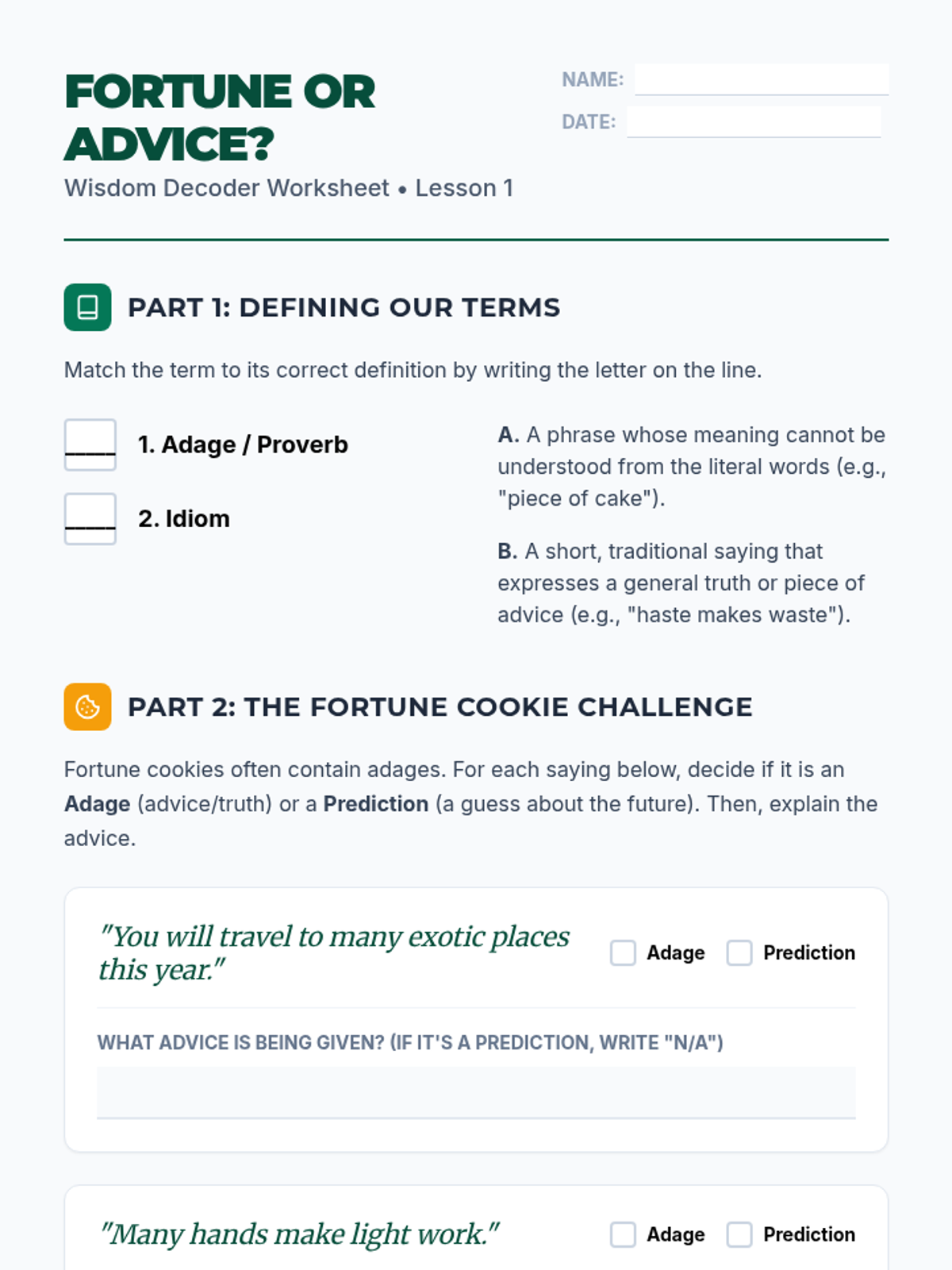
Fortune Cookie Worksheet
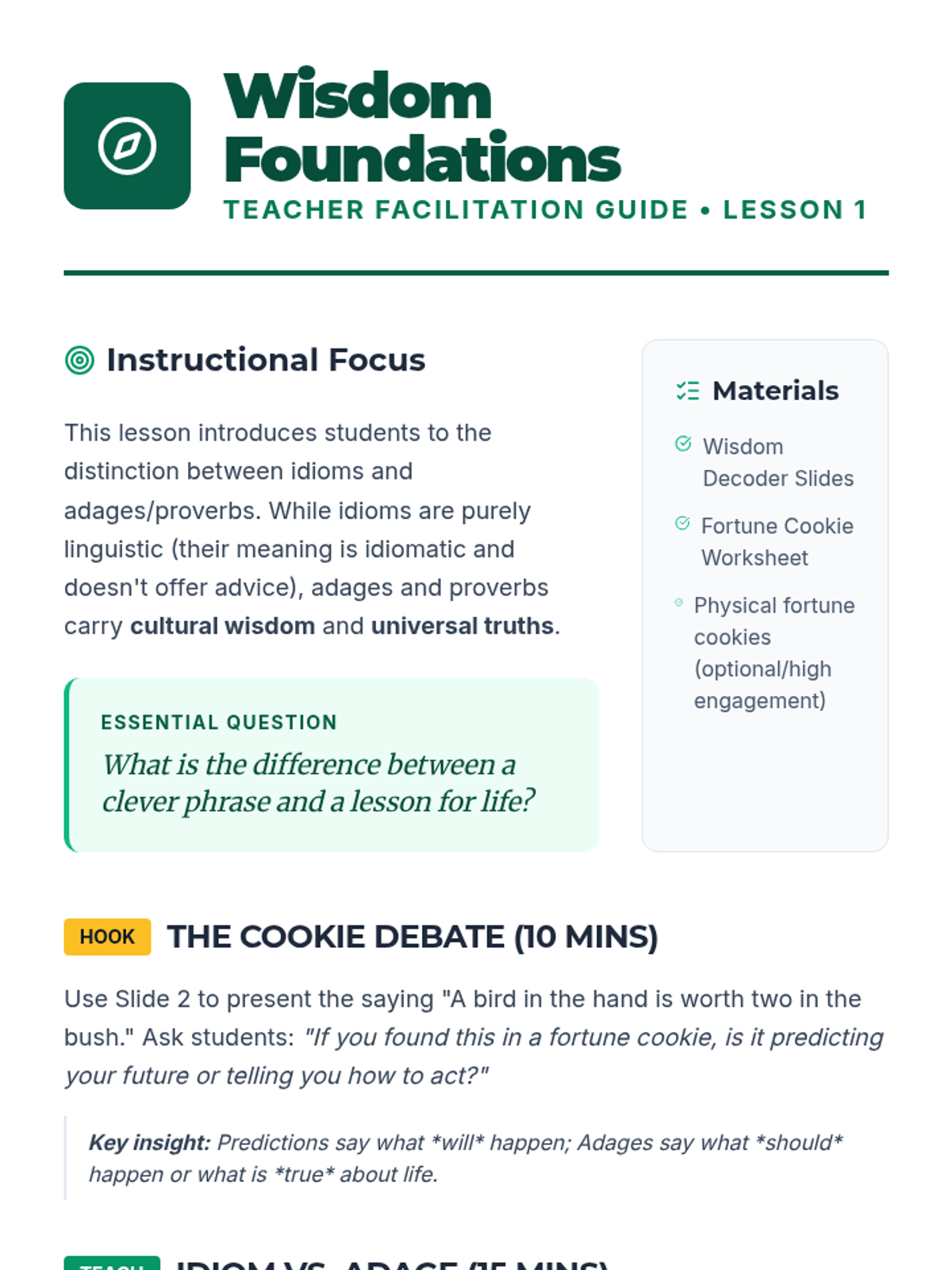
Wisdom Foundations Teacher Guide

Wisdom of the Ages

This sequence explores adages and proverbs as cultural artifacts that convey values and wisdom. Students distinguish them from idioms, compare global examples, connect them to fables, apply them to modern life, and debate their nuances in a Socratic Seminar.

Lenny Avatar
Lenny
1/18
Sequence
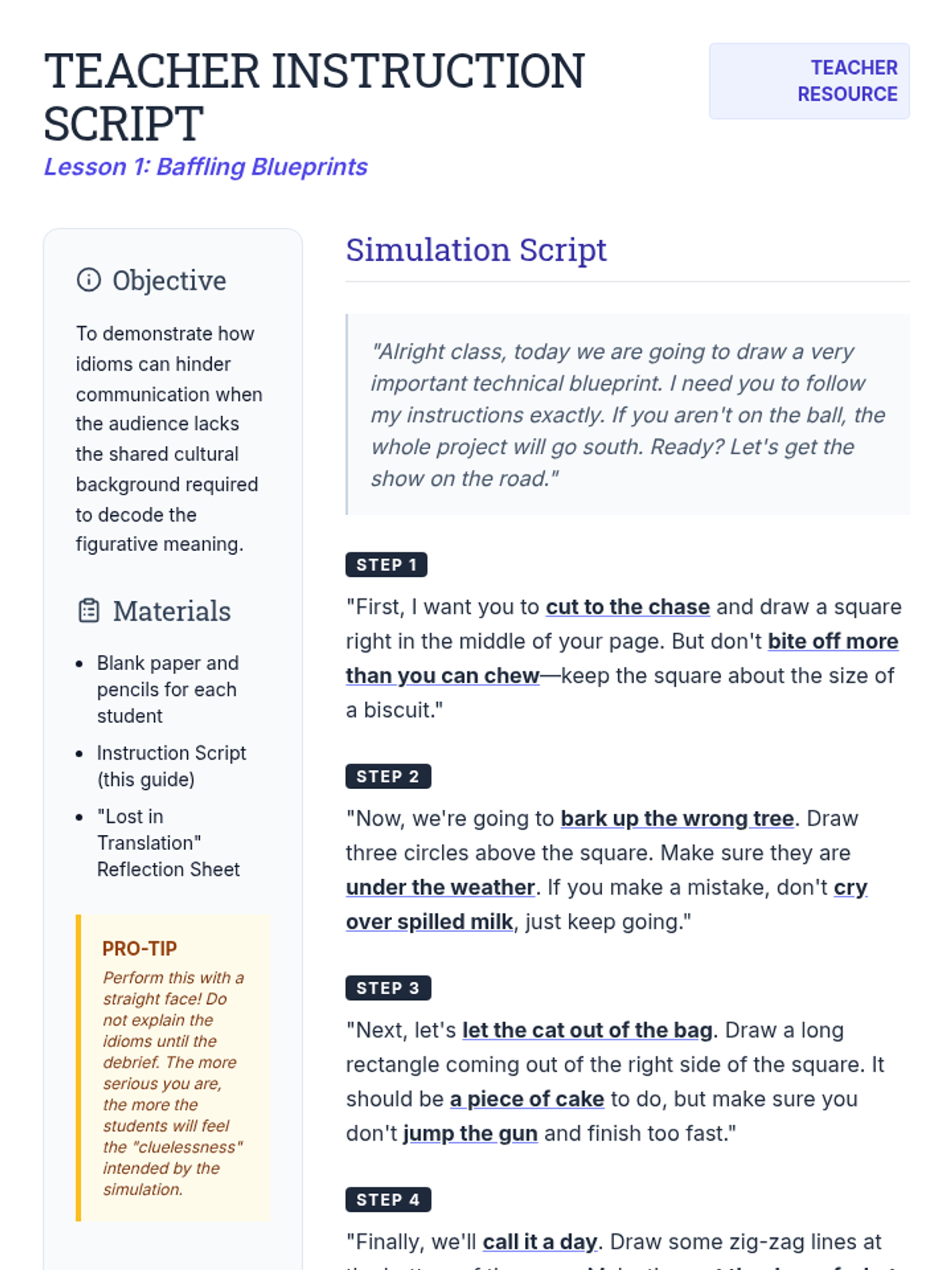
Baffling Blueprints Teacher Script
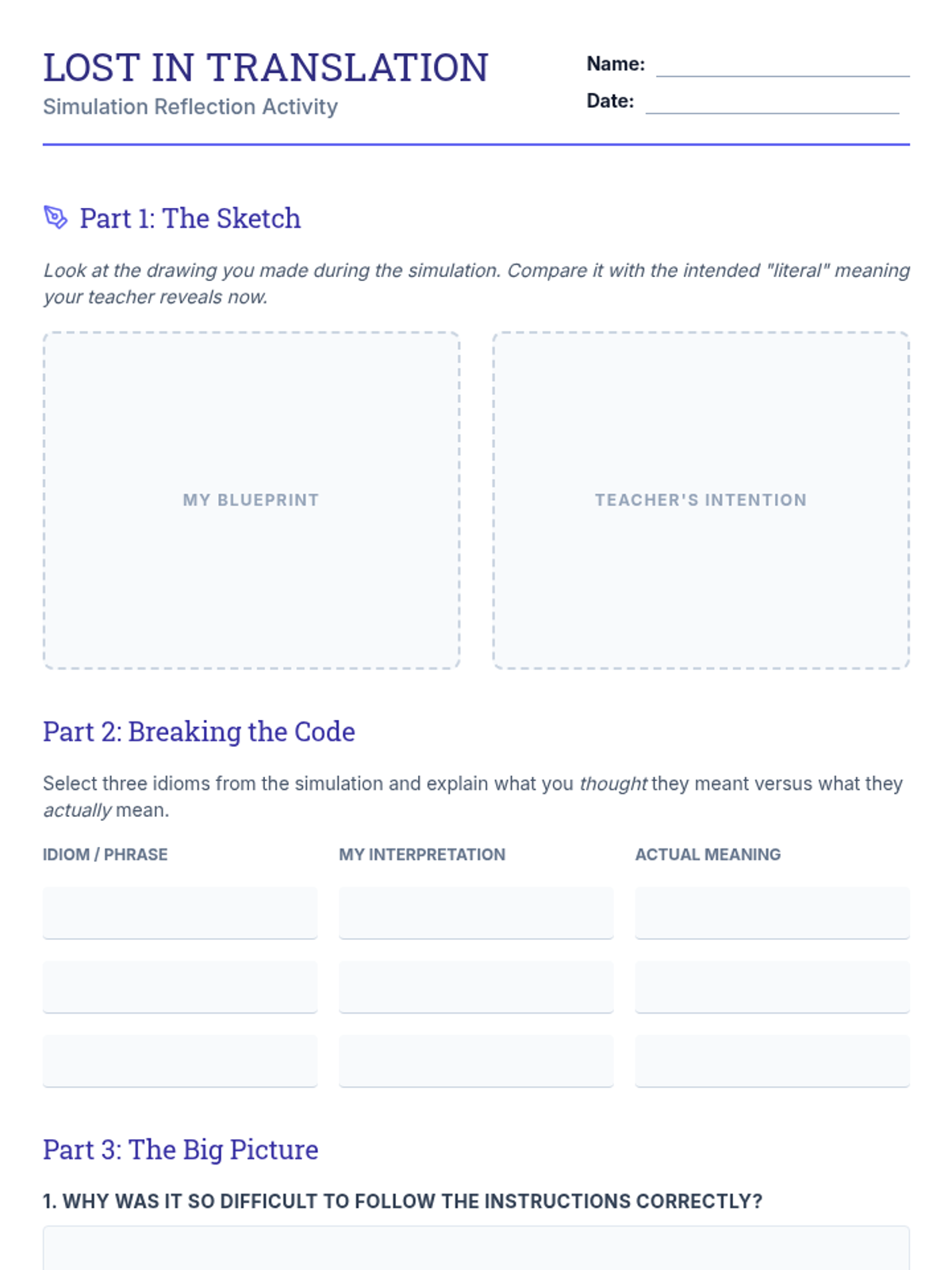
Lost in Translation Reflection Sheet

Phrase Phase Sequence

This sequence guides 6th-grade students through the production side of idioms and adages, focusing on when figurative language enhances or hinders communication in various contexts. Students will explore misinterpretation through simulation, adapt their speech for different settings, develop character voices in dialogue, and use proverbs as persuasive tools.

Lenny Avatar
Lenny
1/18
Sequence
Pun Power Slides
Pun Detective Worksheet

Wordplay and Ambiguity

This sequence explores the creative and literary side of homophones and homonyms through puns, riddles, and advertising. Students move from deconstructing humor to creating their own intentional wordplay, culminating in a showcase of their comedic and creative linguistic skills.

Lenny Avatar
Lenny
1/18
Sequence
Context Quest Slides
Translator's Log Worksheet
Log Decoder Answer Key

Linguistic Globetrotters

This sequence teaches 6th-grade students how to identify, understand, and use common foreign words and expressions in English. Through a mix of context clue analysis, tone comparison, pronunciation practice, and creative writing, students learn to enhance the sophistication and precision of their communication.

Lenny Avatar
Lenny
1/18
Sequence
Origin Lab Slides
Principal Investigation Sheet
Root Word Guide

Mastering Advanced Homophones and Roots

An advanced exploration of 6th-grade homophones using etymology and root word analysis. Students investigate complex word pairs like principal/principle and capital/capitol through case studies and simulations.

Lenny Avatar
Lenny
1/18
Sequence
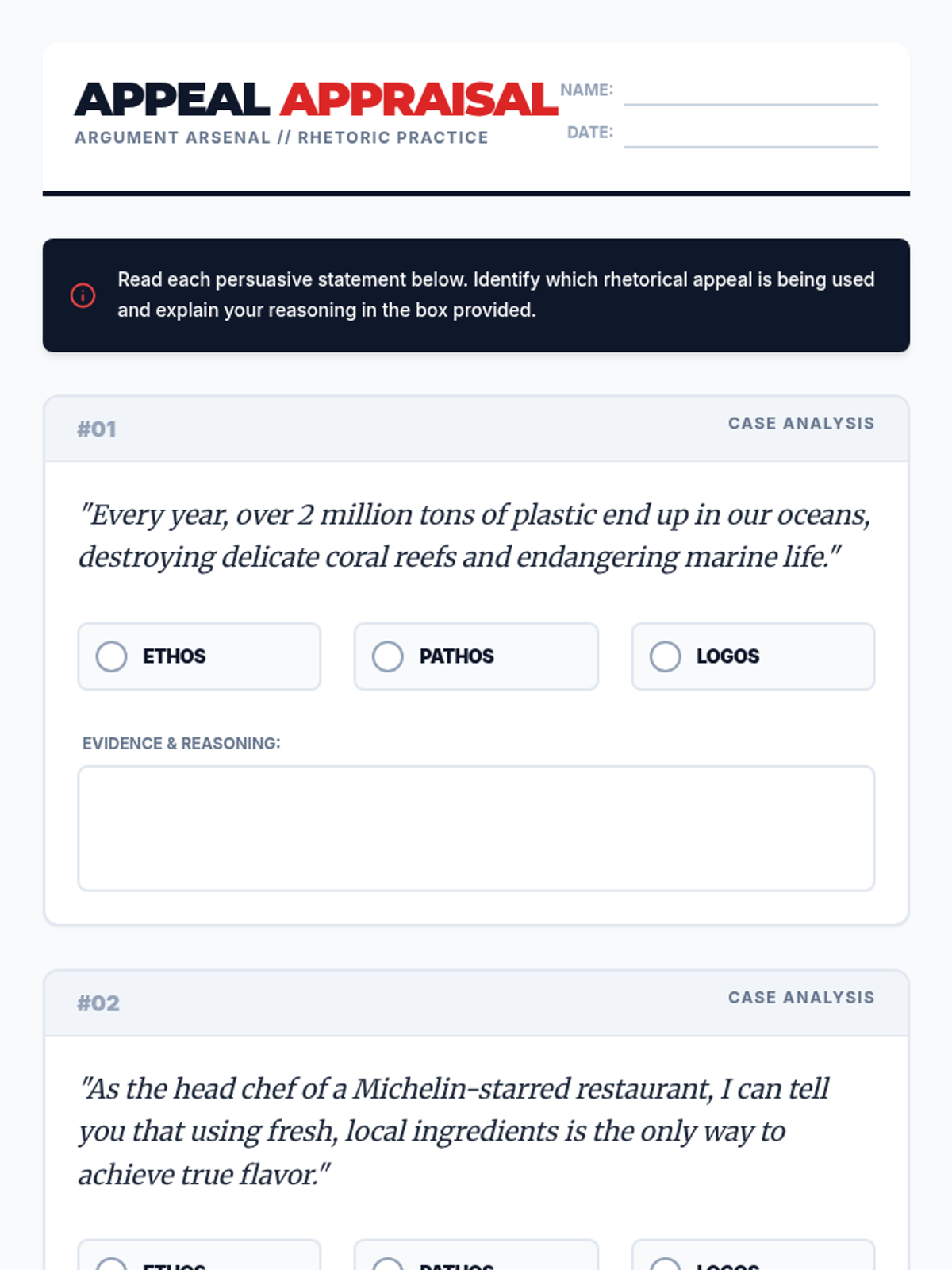
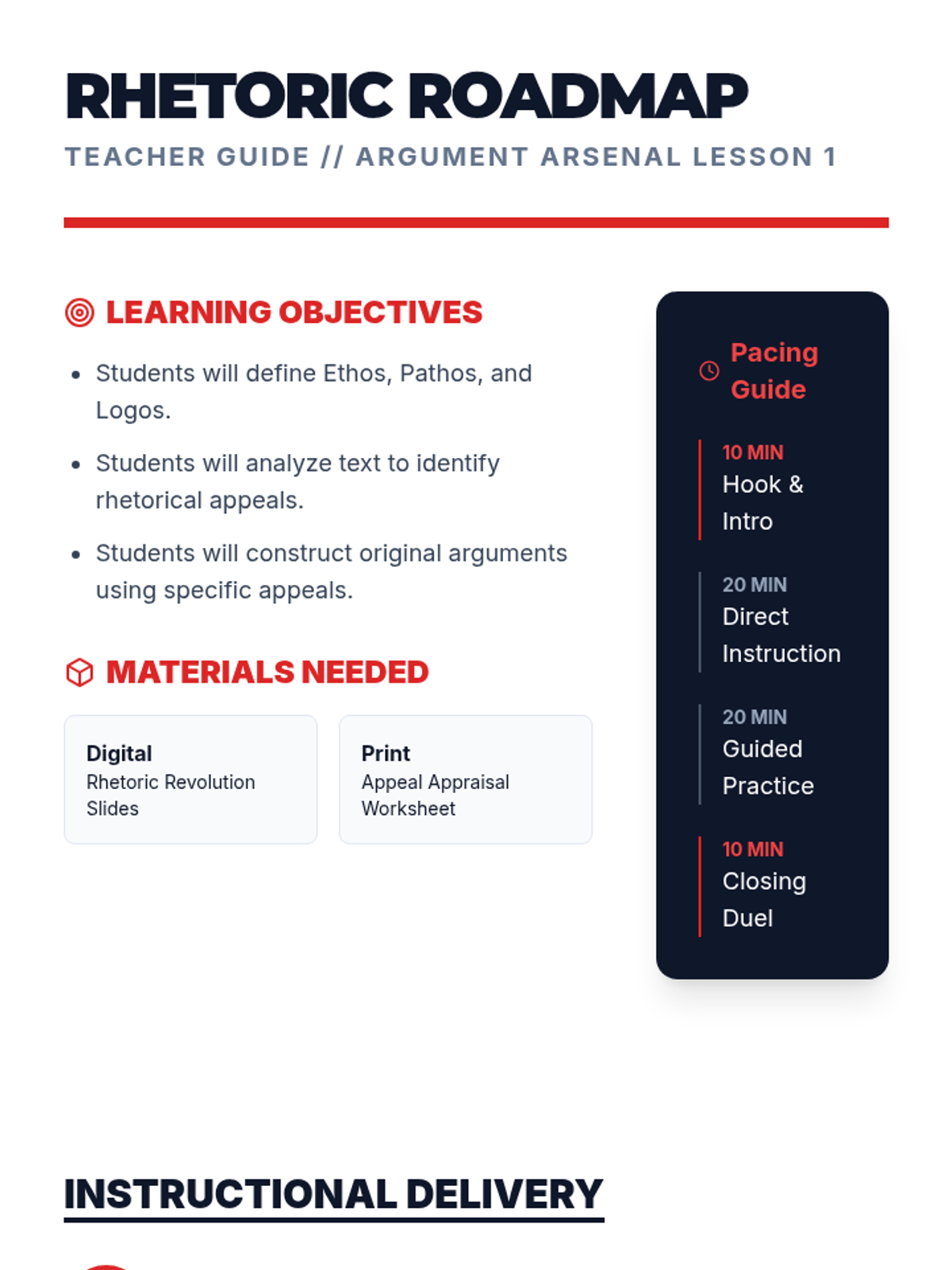
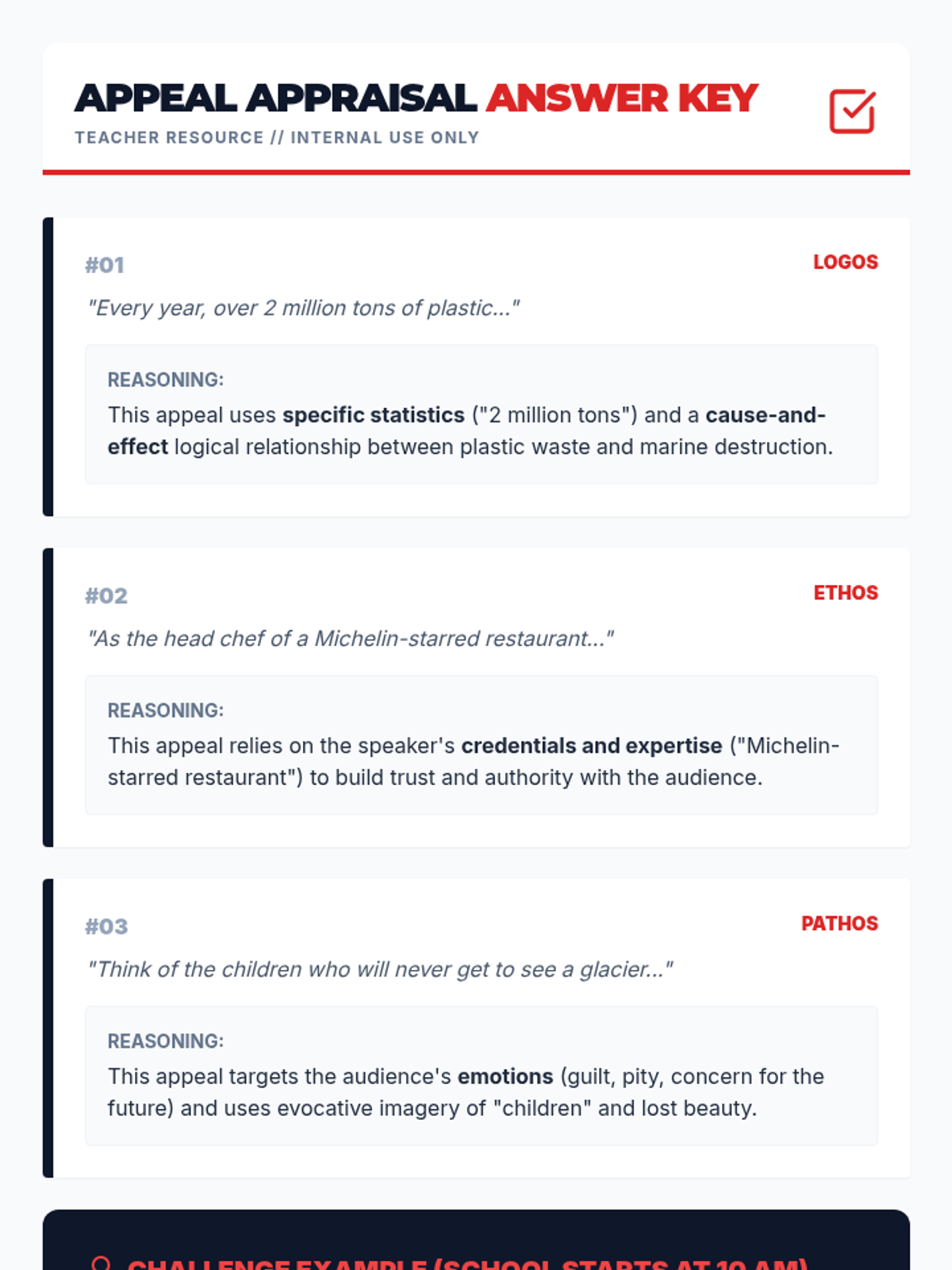
Rhetoric Revolution Slides
Appeal Appraisal Worksheet
Rhetoric Roadmap Teacher Guide
Appeal Appraisal Answer Key

Argument Arsenal

A comprehensive introduction to the art of persuasion, focusing on rhetorical appeals and crafting compelling arguments for middle school students.

Lenny Avatar
Lenny
1/17
Sequence
Dreamers and Diplomats Slides
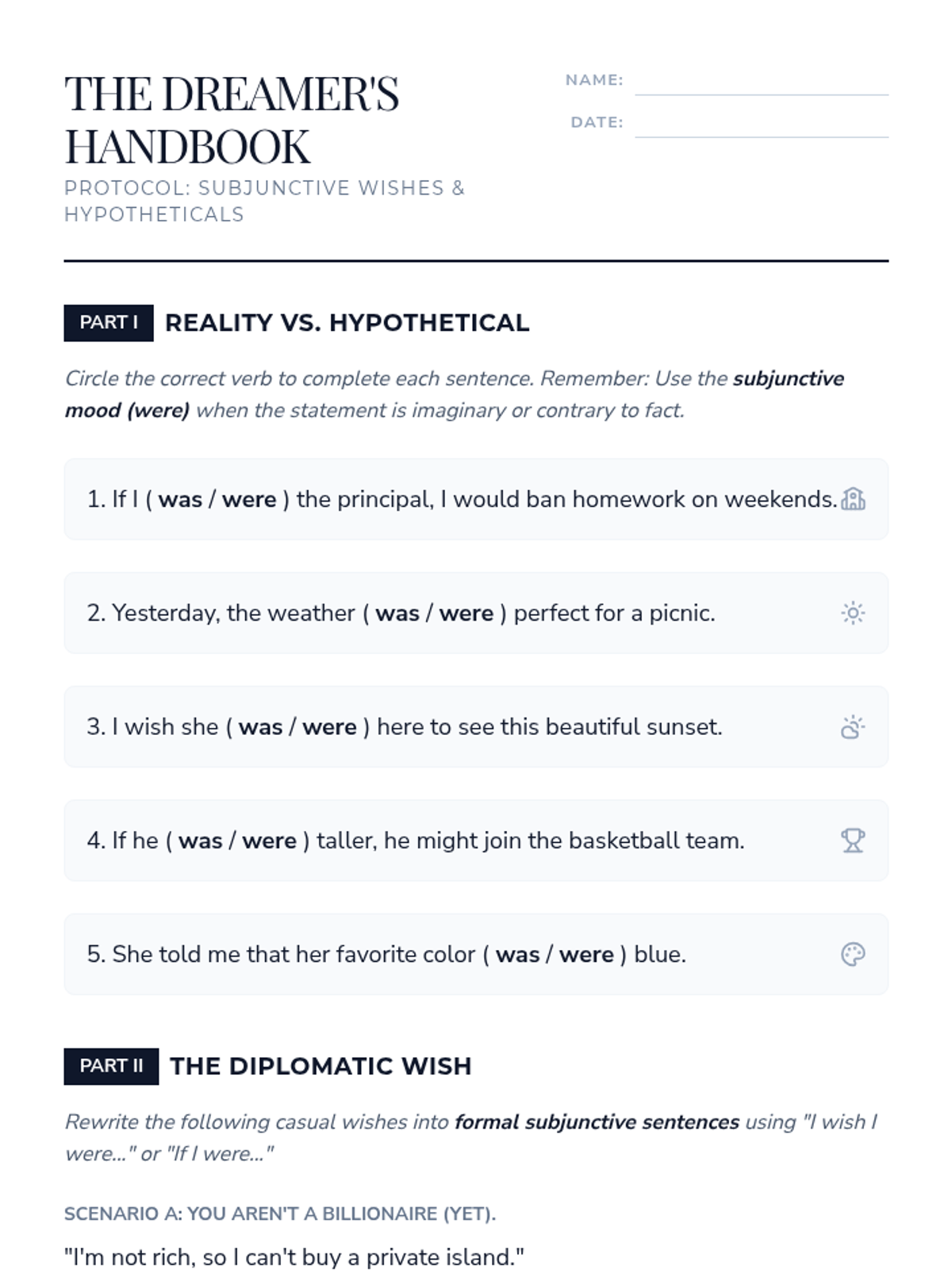
Dreamers Handbook Worksheet
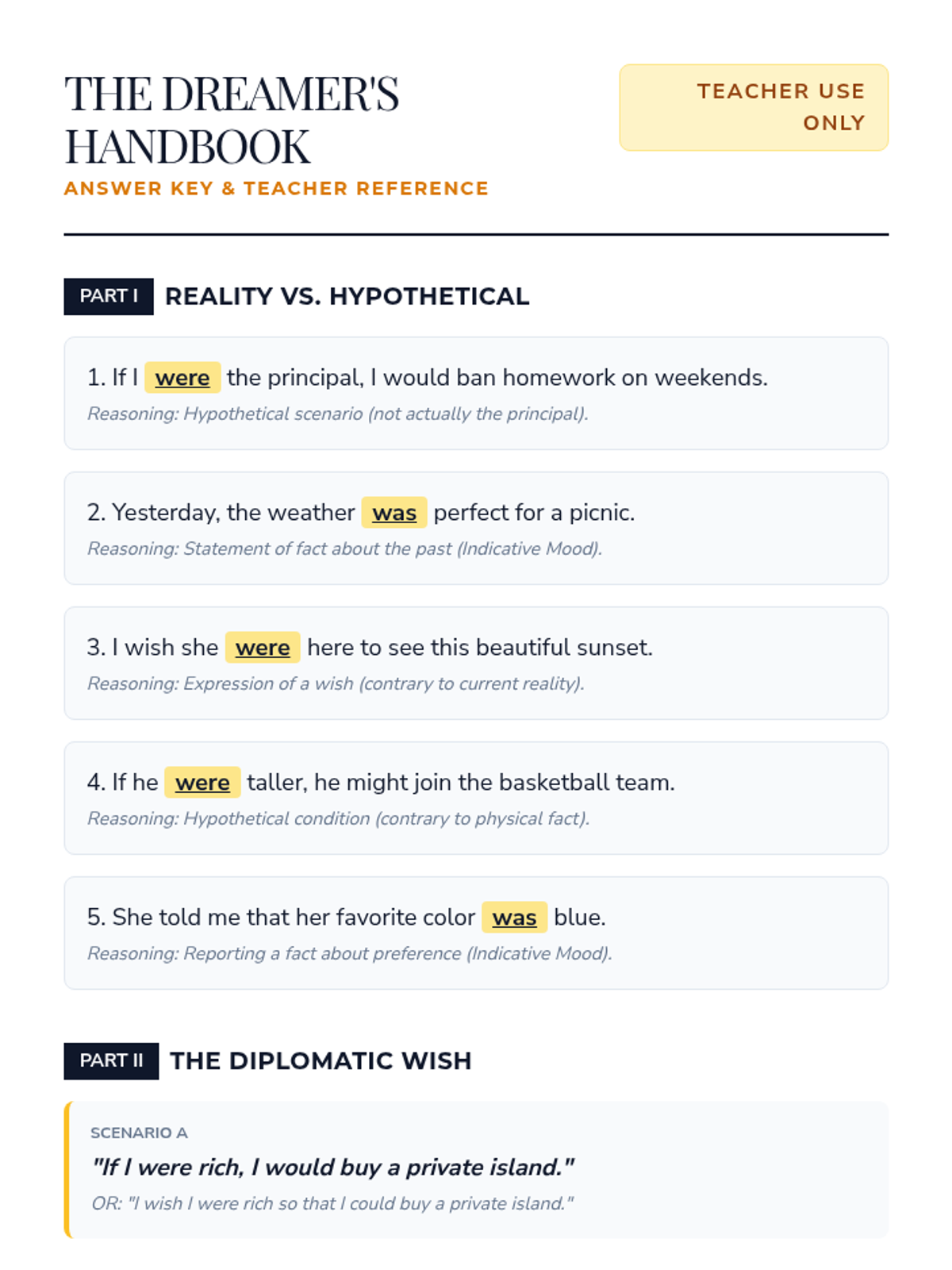
Dreamers Handbook Answer Key

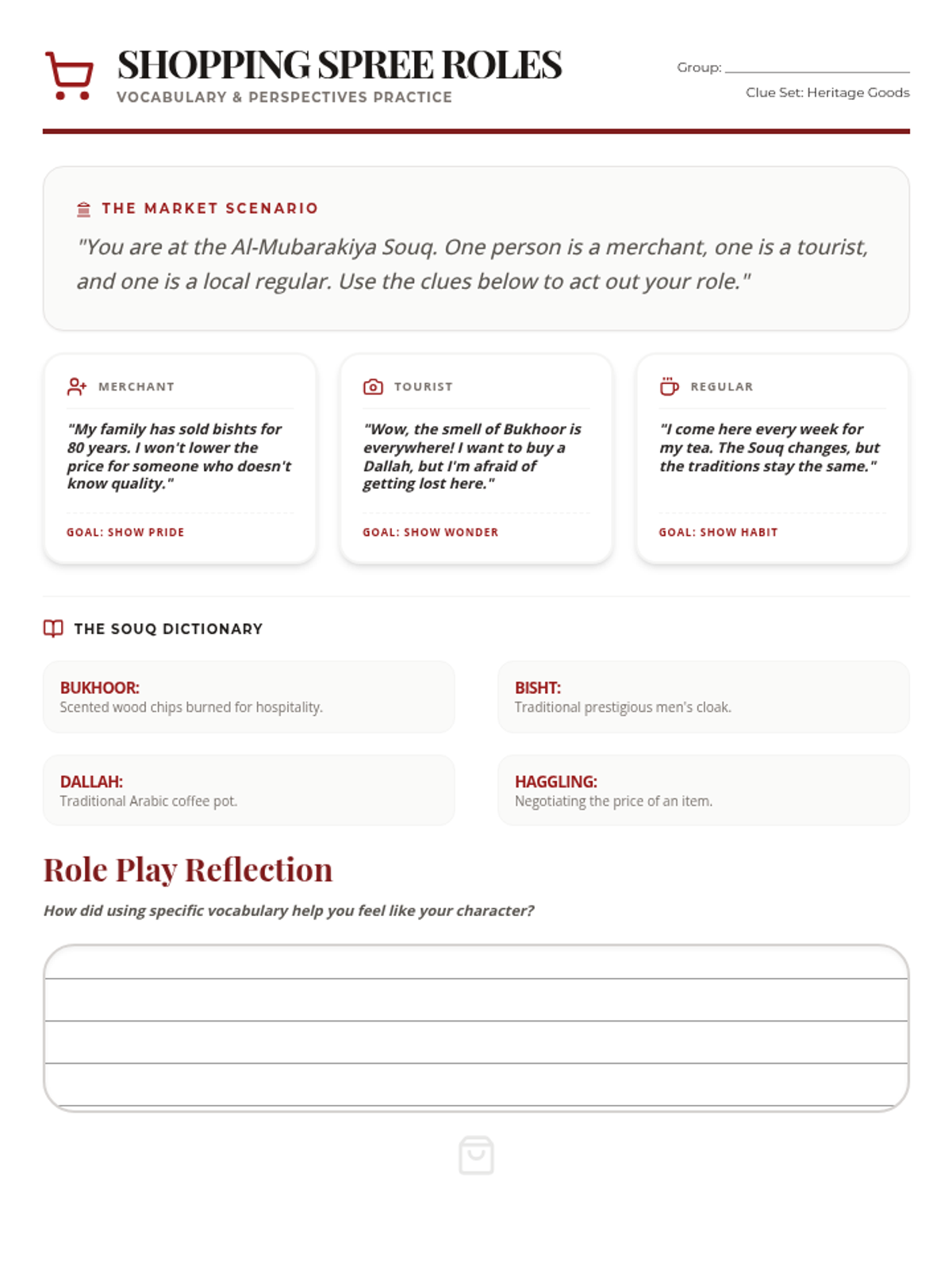
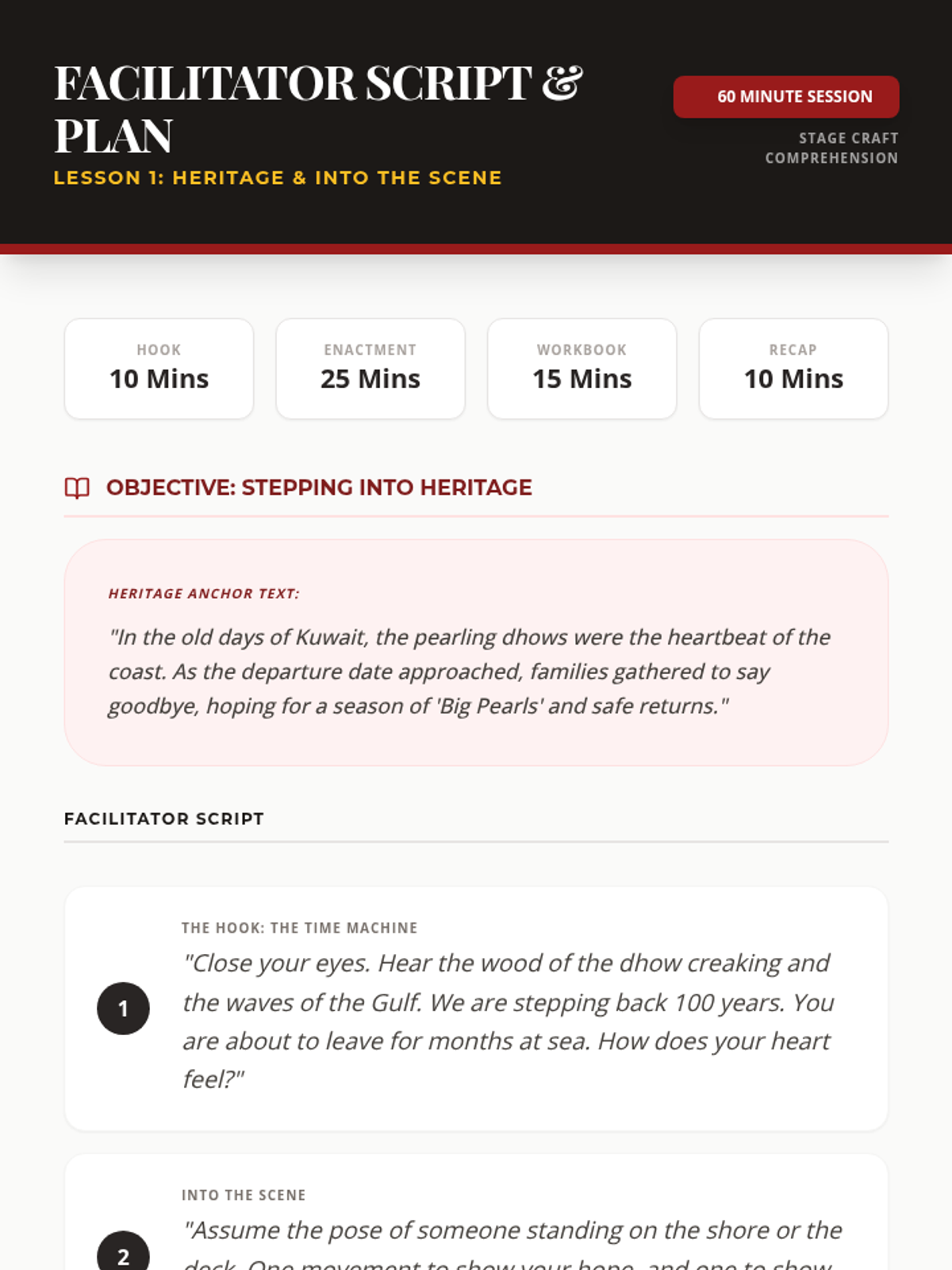
The Subjunctive Protocol

A comprehensive unit on the subjunctive mood, focusing on formal suggestions, demands, and wishes in high-level academic and professional communication. Students engage in simulations and formal writing to master complex grammatical structures.
Lenny Avatar
Lenny
1/17
Sequence
Etymology Intro Slides
Word Origins Worksheet

Word Detectives: The Secret Life of Language

Students become linguistic historians, investigating the etymology, cultural origins, and evolution of advanced English vocabulary through research and creative projects.

Lenny Avatar
Lenny
1/17
Sequence
Word Graveyard Teacher Guide
Neologism Detective Worksheet

Word Builders Lab

A project-based ELA sequence where 6th-grade students analyze the morphology of English, use affixes to create neologisms, and pitch inventions named using linguistic rules.

Lenny Avatar
Lenny
1/17
Sequence
Argument Armor Slides
Counterclaim Combat Worksheet
Counterclaim Combat Teacher Guide

Argument Armor

A series of lessons focused on mastering the art of persuasion and argumentative writing, from building claims to defending them against opposition.

TH

Terrie Huff

Special Education Teacher
2/17
Sequence
Debate Facilitation Guide
Persuasion Power Slides
Debate Topic Cards
Speech Drafting Sheet
Argument Ace Rubric
Mastering the Blend Essay Planner

Persuasion Mastery

A lesson sequence focused on mastering the three rhetorical appeals (Ethos, Logos, and Pathos) through video analysis and a simulated school debate.

Lenny Avatar
Lenny
1/19
Sequence
Foundational Frames Slides
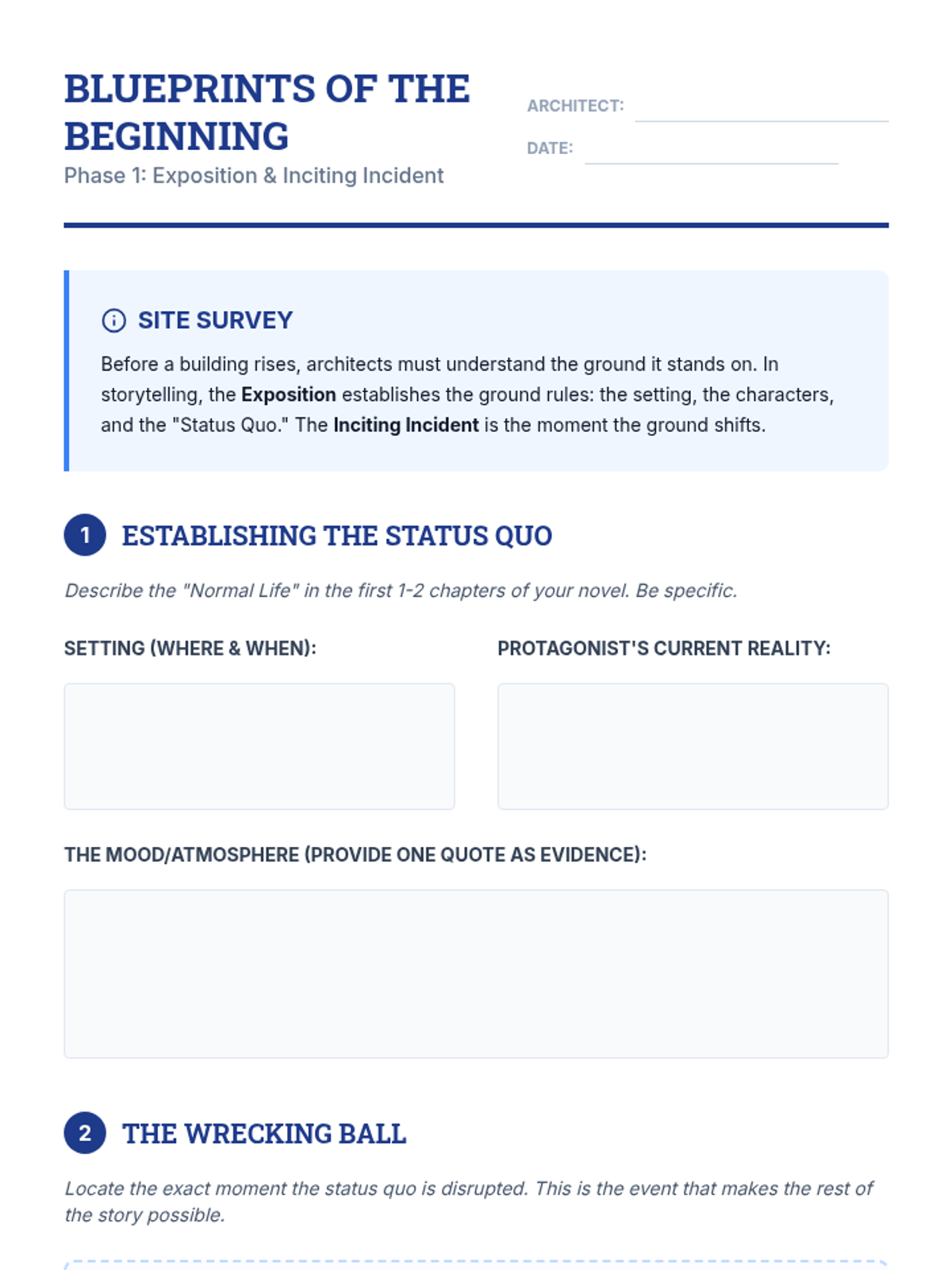
Foundational Frames Worksheet
Foundational Frames Teacher Guide

Plot Blueprint Sequence

A project-based unit where 6th-grade students deconstruct the architecture of storytelling. Students analyze how plot structure, pacing, and tension drive narrative engagement through the lens of a novel study.

Lenny Avatar
Lenny
1/18
Sequence
Wisdom Decoder Slides
Fortune Cookie Worksheet
Wisdom Foundations Teacher Guide

Wisdom of the Ages

This sequence explores adages and proverbs as cultural artifacts that convey values and wisdom. Students distinguish them from idioms, compare global examples, connect them to fables, apply them to modern life, and debate their nuances in a Socratic Seminar.

Lenny Avatar
Lenny
1/18
Sequence
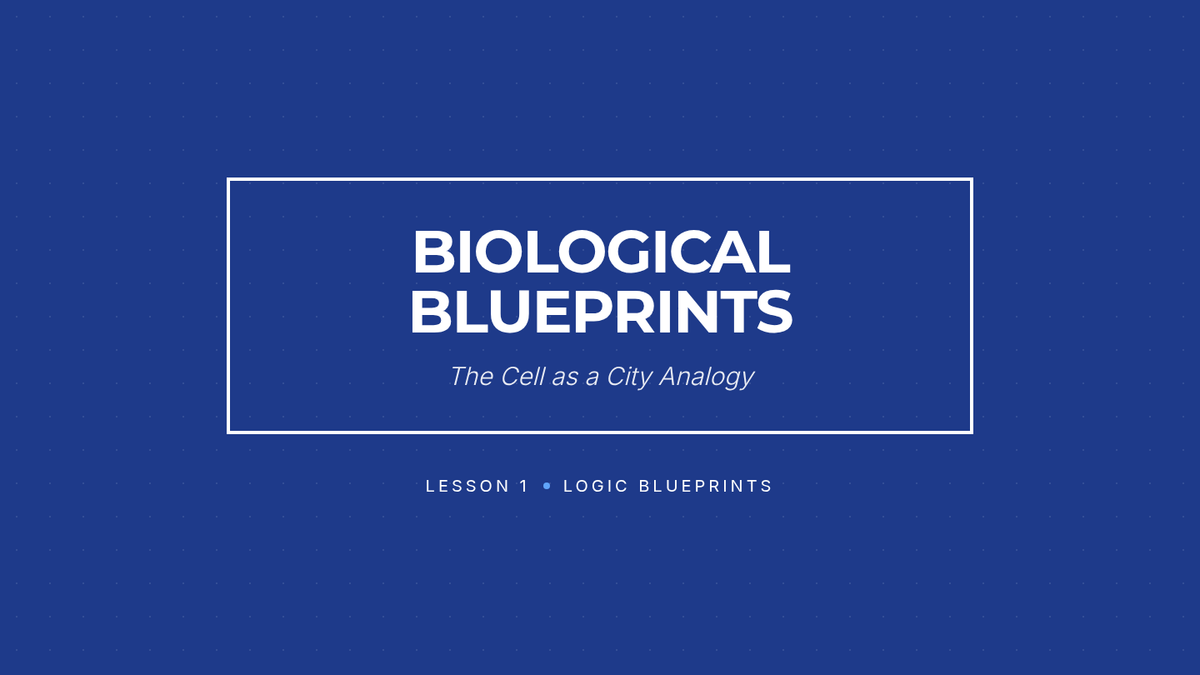
Cell City Slides
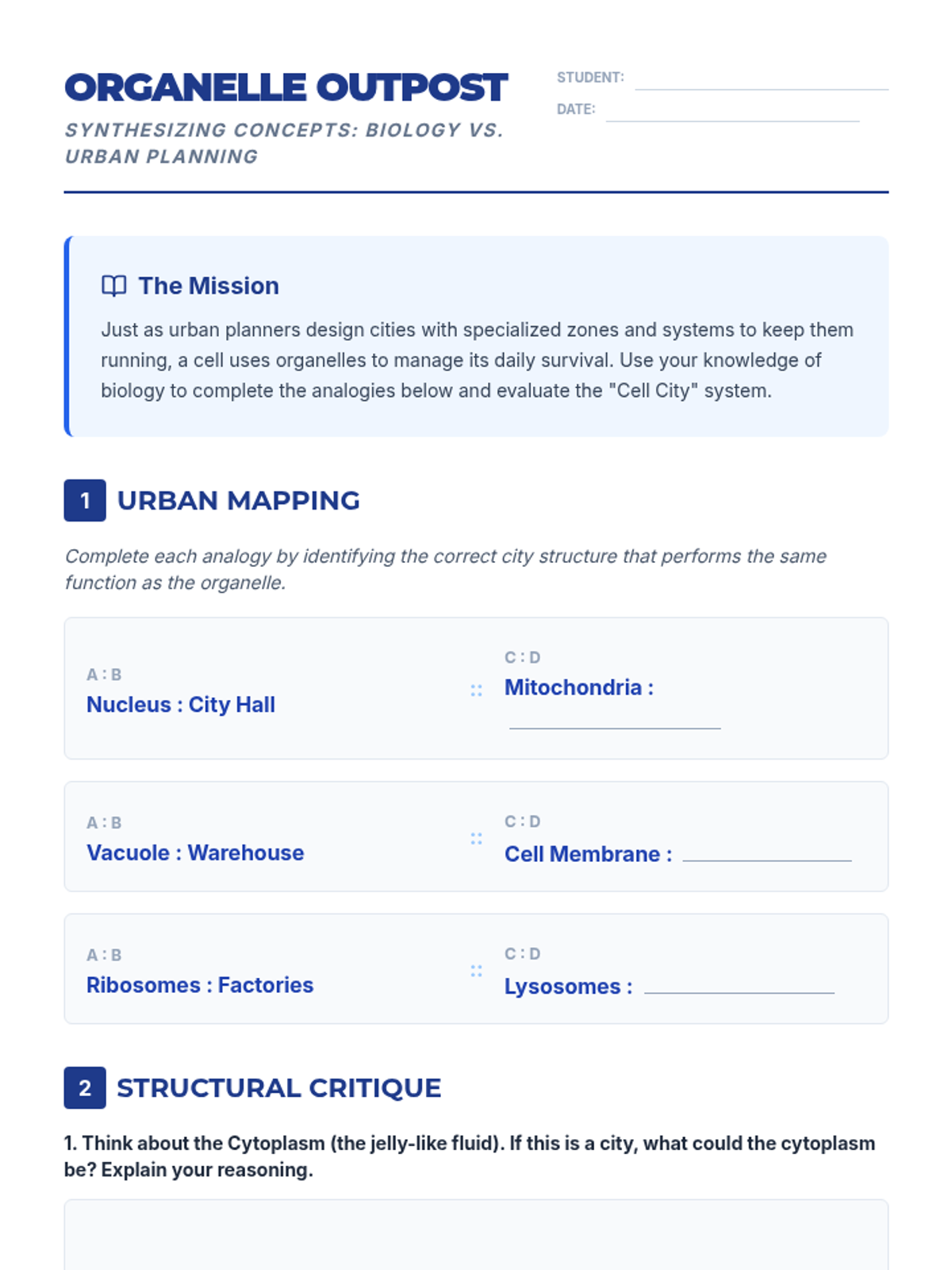
Organelle Outpost Worksheet
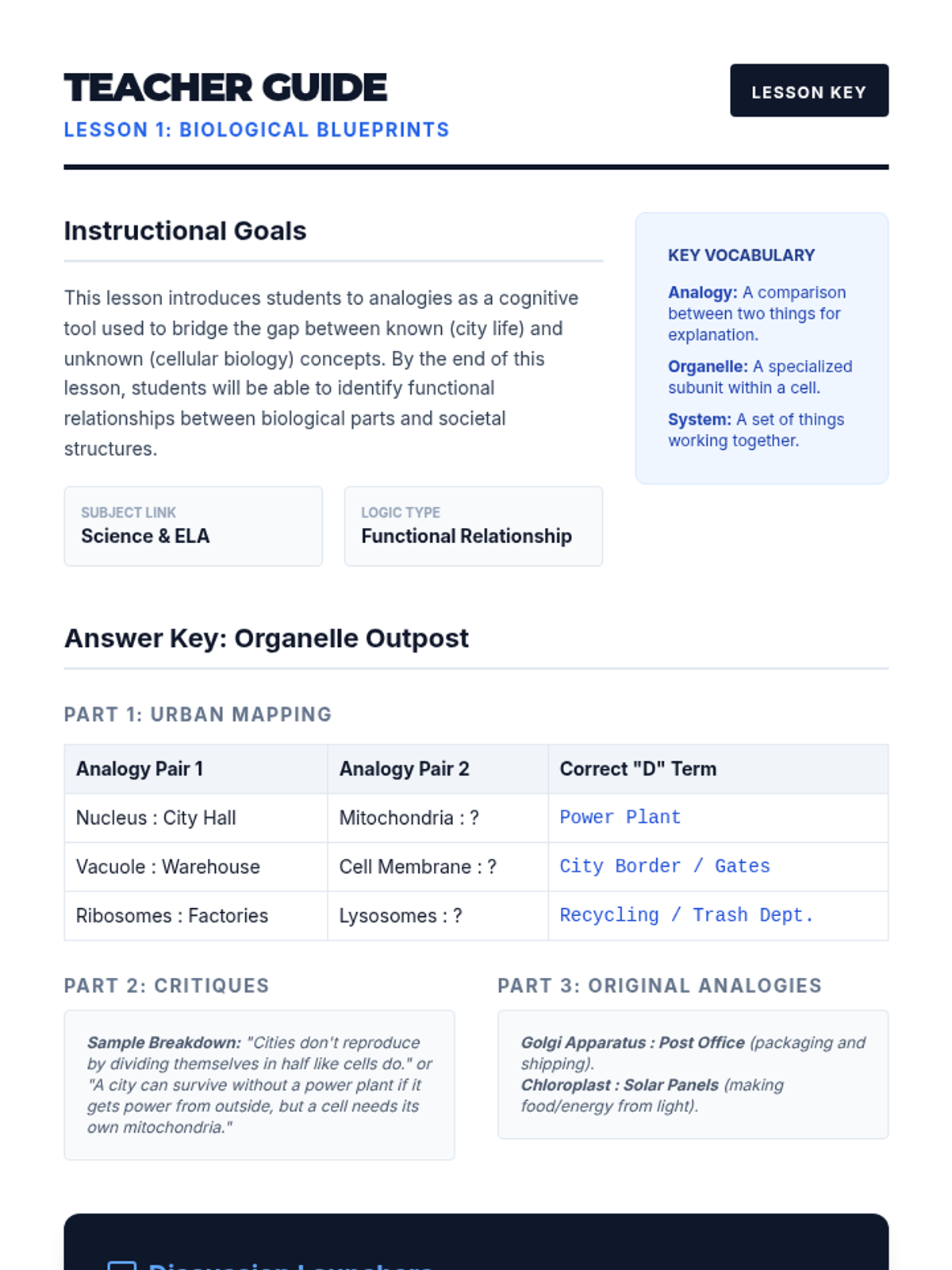
Cell City Teacher Guide

Logic Blueprints Cross-Curricular Analogies

This sequence connects 6th grade vocabulary standards with science, social studies, and math by using analogies as cognitive tools. Students analyze complex systems and historical events through structural comparisons, culminating in an original analogy-based concept map project.

Lenny Avatar
Lenny
1/18
Sequence
Persuasion Lab Slides
Manipulation Meter Worksheet
Persuasion vs Manipulation Teacher Guide

Logic Lab Media Detectives

A middle school ELA sequence focused on identifying and deconstructing logical fallacies in modern media, culminating in a critical analysis project. Students learn to distinguish between ethical persuasion and manipulative tactics like False Authority, False Dilemmas, and Straw Man arguments.

Lenny Avatar
Lenny
1/17
Sequence
Building House Slides
Argument Blueprint Worksheet
Structural Integrity Guide

Argument Architects

A workshop-style series designed to help 7th grade students strengthen their persuasive writing and speaking by identifying and eliminating logical fallacies. Students learn the Claim-Evidence-Warrant model and focus on avoiding Hasty Generalizations, Red Herrings, and Circular Reasoning.

Lenny Avatar
Lenny
1/17
Sequence
Spar Mastery Slides
Spar Combat Handout
Spar Starter Teacher Guide

Applied Rebuttal and Spar Strategies

This sequence synthesizes refutation, weighing, and listening into short-form 'Spar' debates. Students learn to prioritize arguments, extend logic, and judge peer performances to build adaptability and engagement skills under strict time constraints.

Lenny Avatar
Lenny
1/17
Sequence
Logic Lab Slides
Fallacy Field Guide Handout
Gallery Walk Case Log
Logic Lab Teacher Guide

Fallacy Detectives

A comprehensive sequence for 6th-grade students to identify and challenge logical fallacies in debate. Students act as 'Fallacy Detectives' to uncover errors in reasoning like Ad Hominem, Straw Man, and Slippery Slope.

Lenny Avatar
Lenny
1/17
Sequence
Clash Intro Slides
Clash Detectives Worksheet
Clash Engagement Teacher Guide

Logic Lab Refutation Fundamentals

A comprehensive sequence for 6th-grade students to master the art of 'clash' and the Four-Step Refutation model in competitive and academic debate. Students move from identifying direct engagement to performing real-time rebuttals and rebuilding their own arguments after critique.

Lenny Avatar
Lenny
1/17
Sequence
Trust the Storyteller Slides
Broken Window Case Worksheet
Reliability Investigator Teacher Guide

Narrator Files Inquiry

In this 6th-grade ELA sequence, students move beyond identifying point of view to analyzing narrator reliability and bias. Through flipped fairy tales, investigative case studies, and a final synthesis seminar, students explore how a storyteller's perspective shapes the reader's understanding of the truth.

Lenny Avatar
Lenny
1/17
Sequence
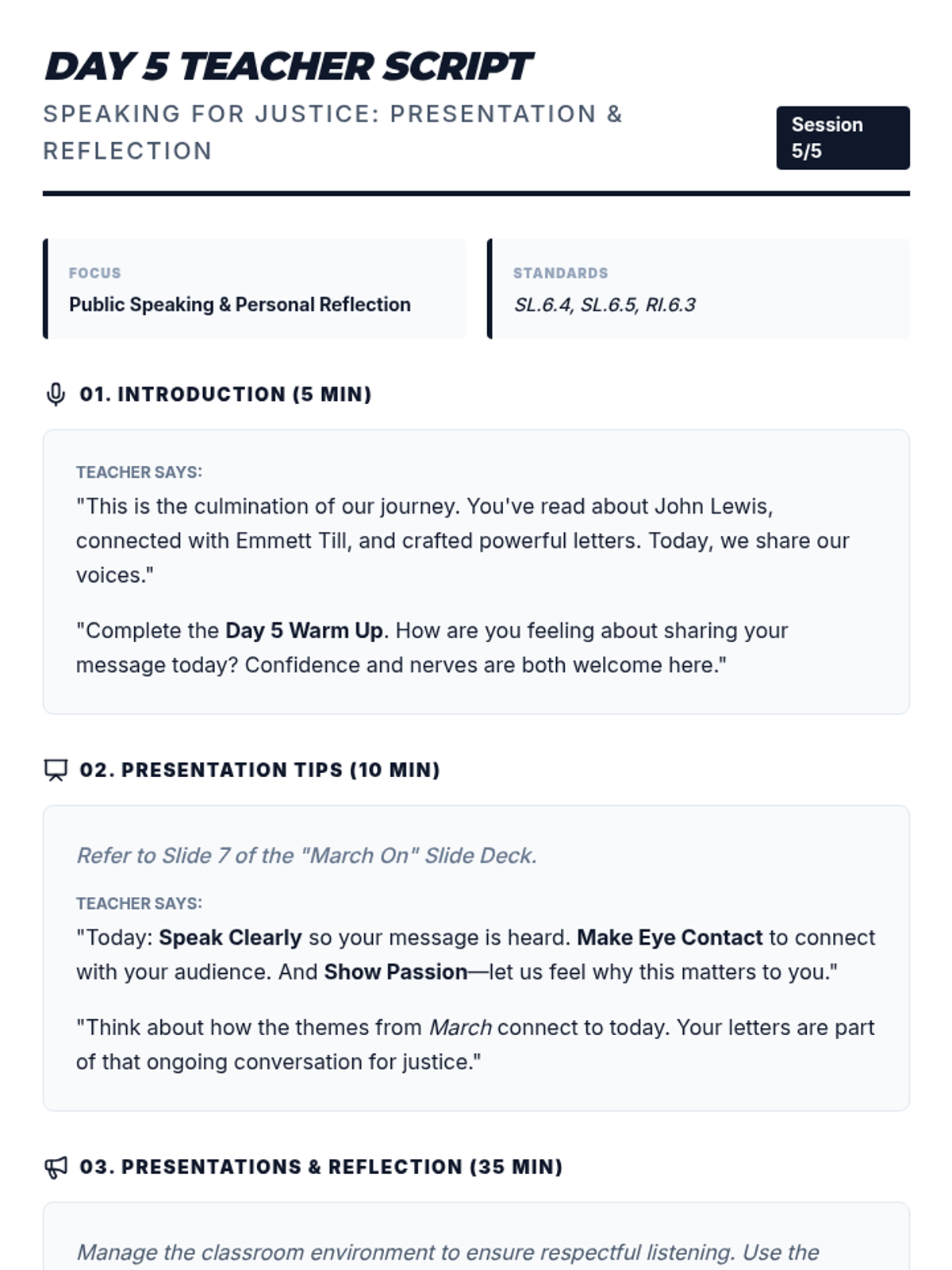
Justice Journey Lesson Plan
March On Unit Slides
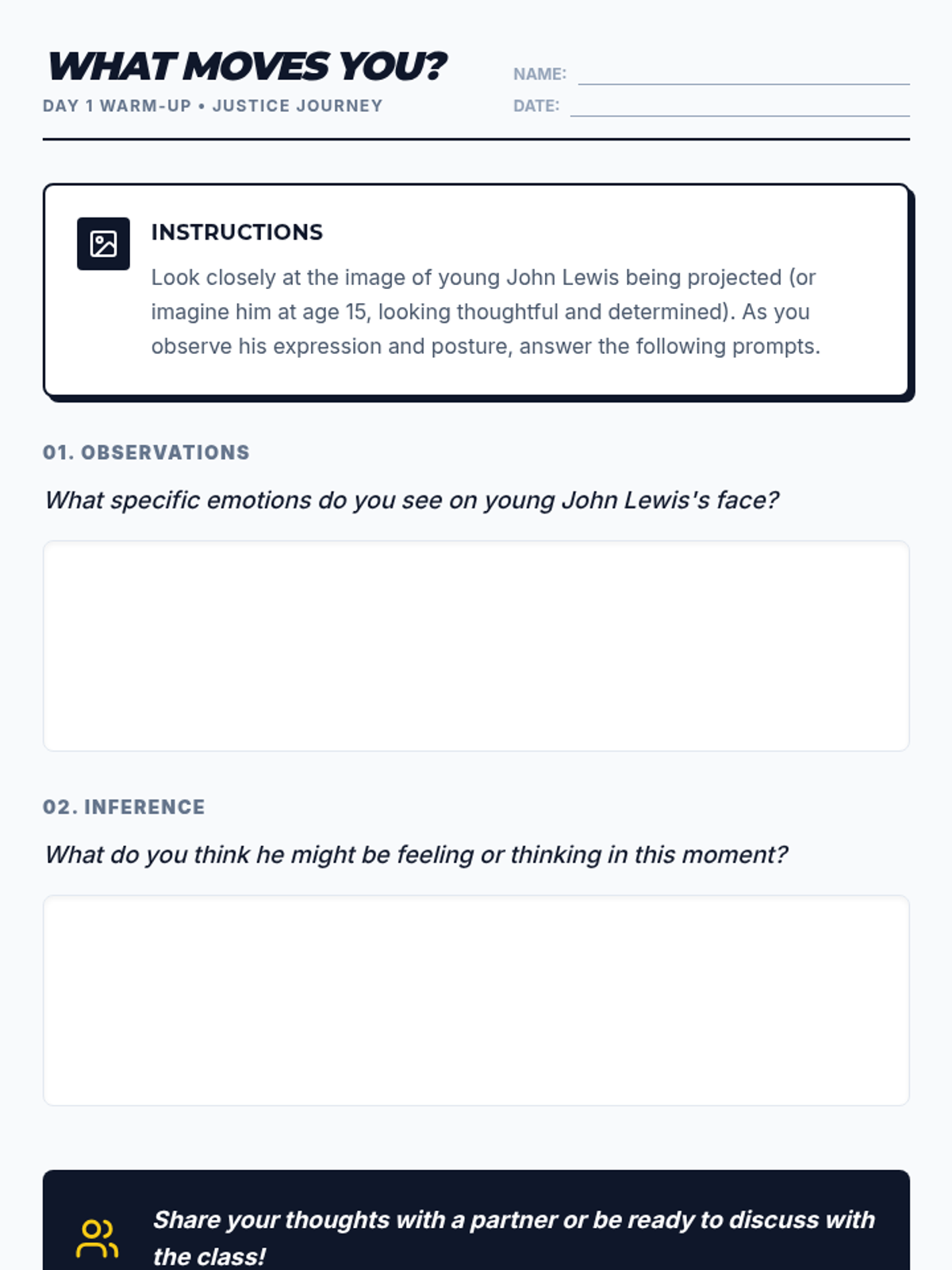
Day 1 Warm Up What Moves You
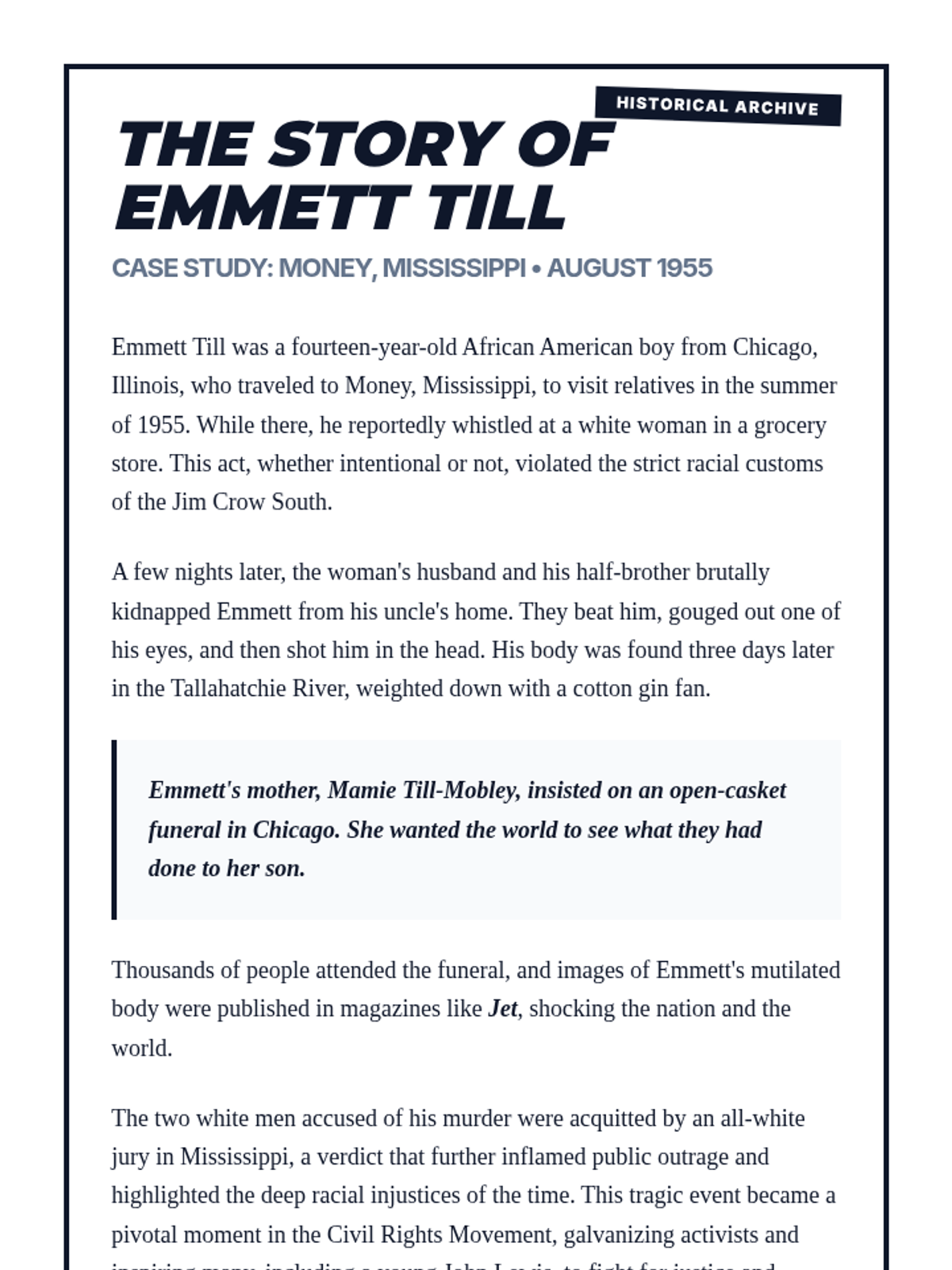
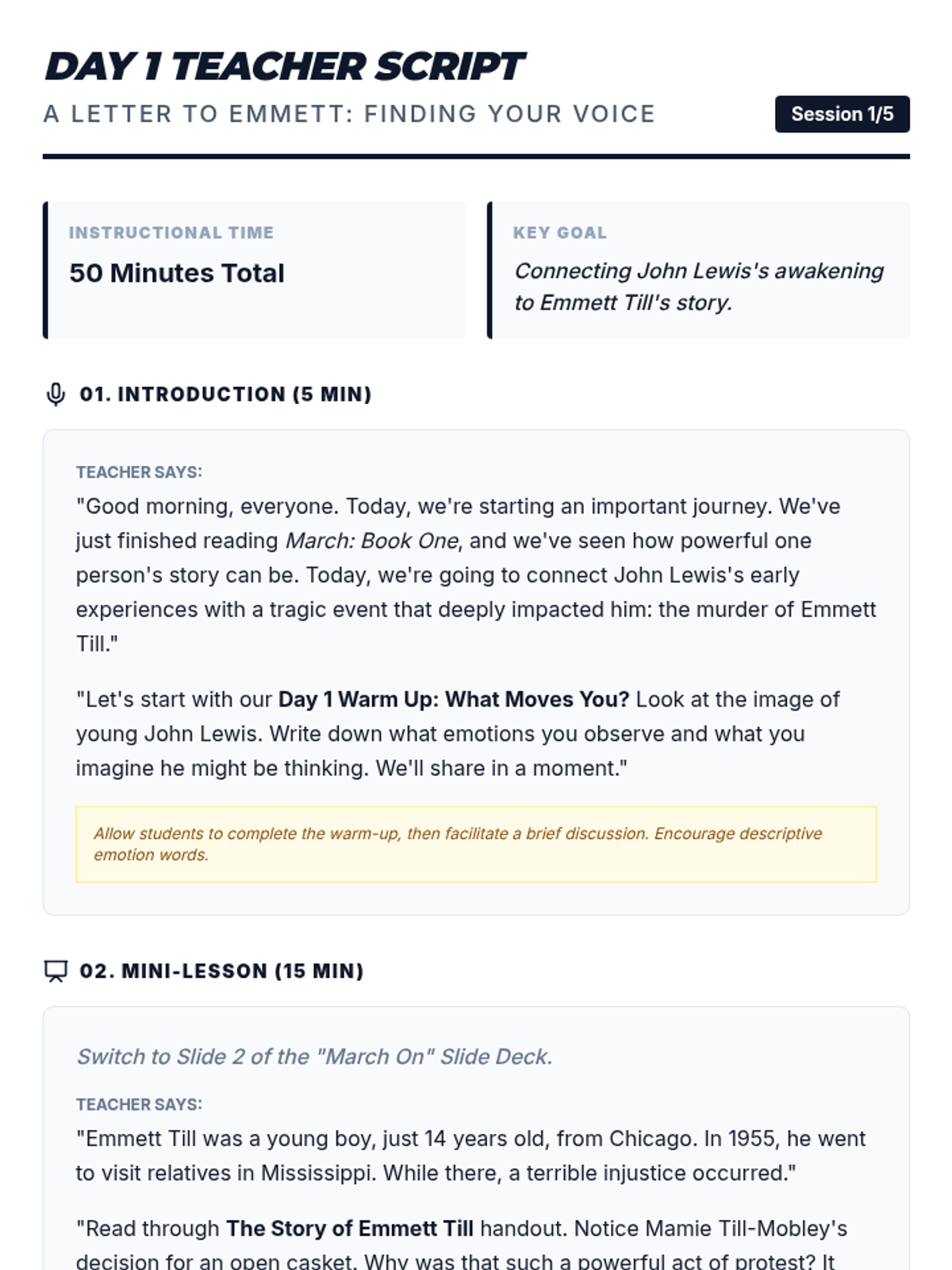
Day 1 Reading Story of Emmett Till
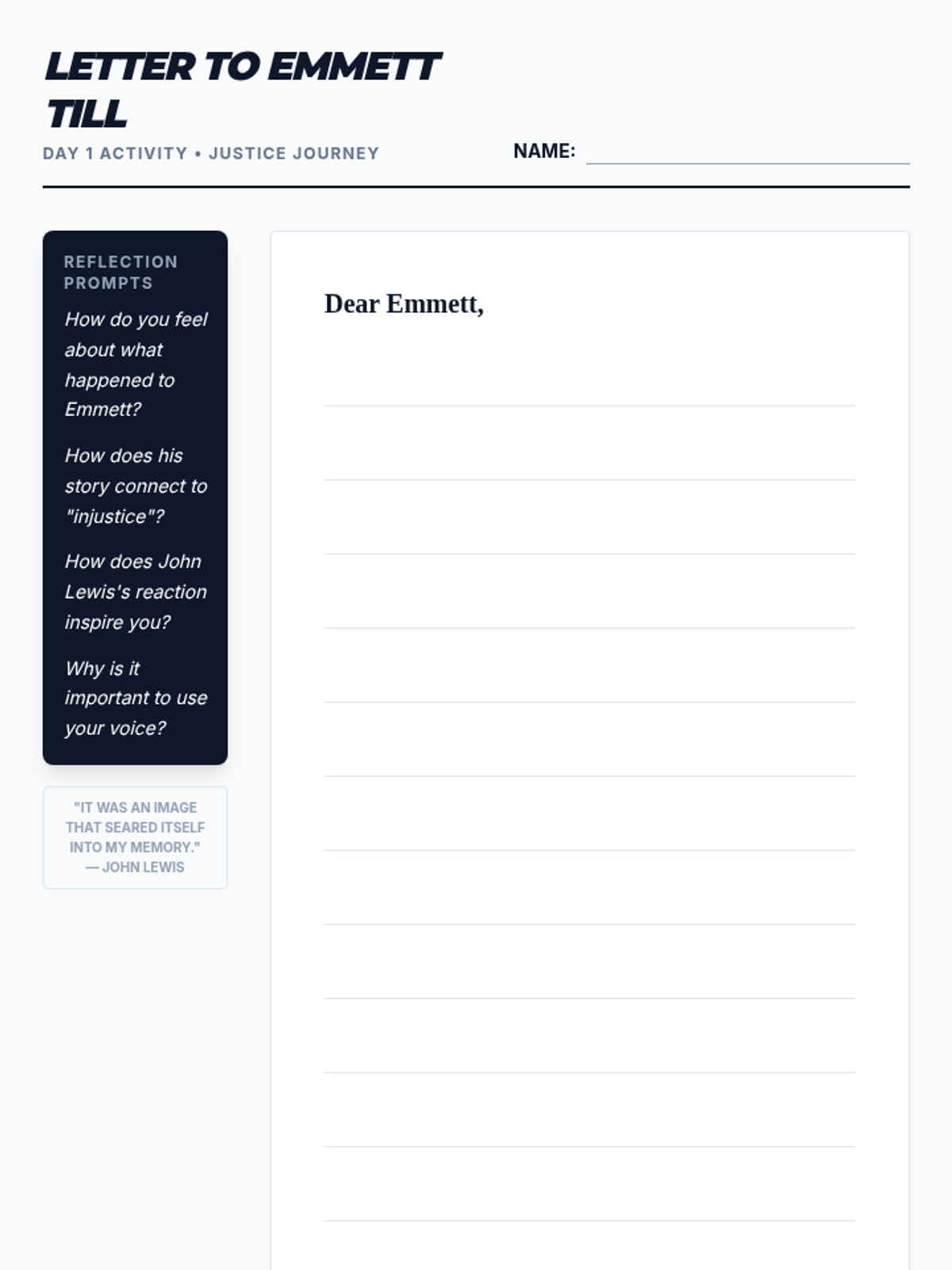
Day 1 Activity Letter to Emmett Till
Day 1 Script Letter to Emmett Till
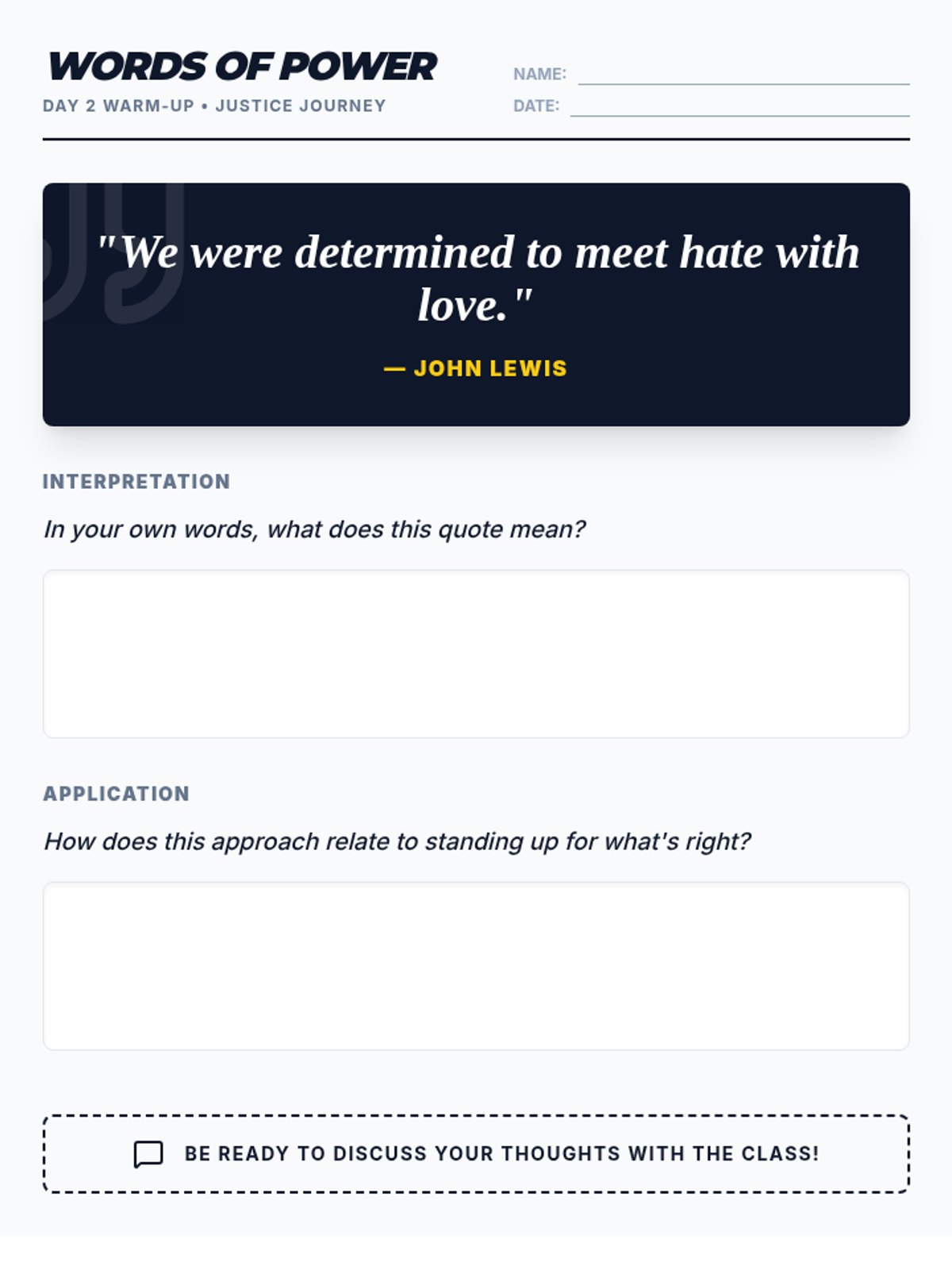
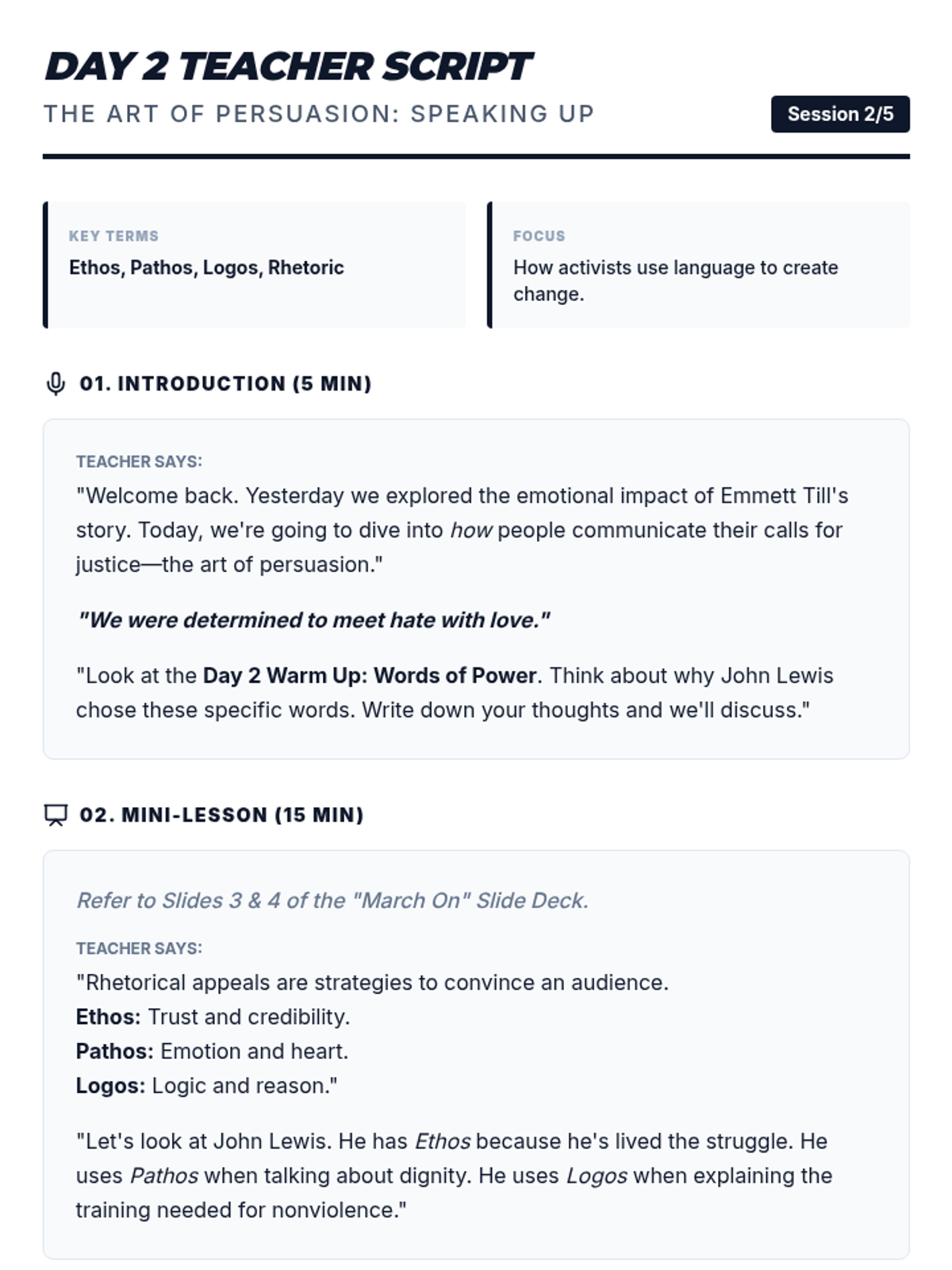
Day 2 Warm Up Words of Power
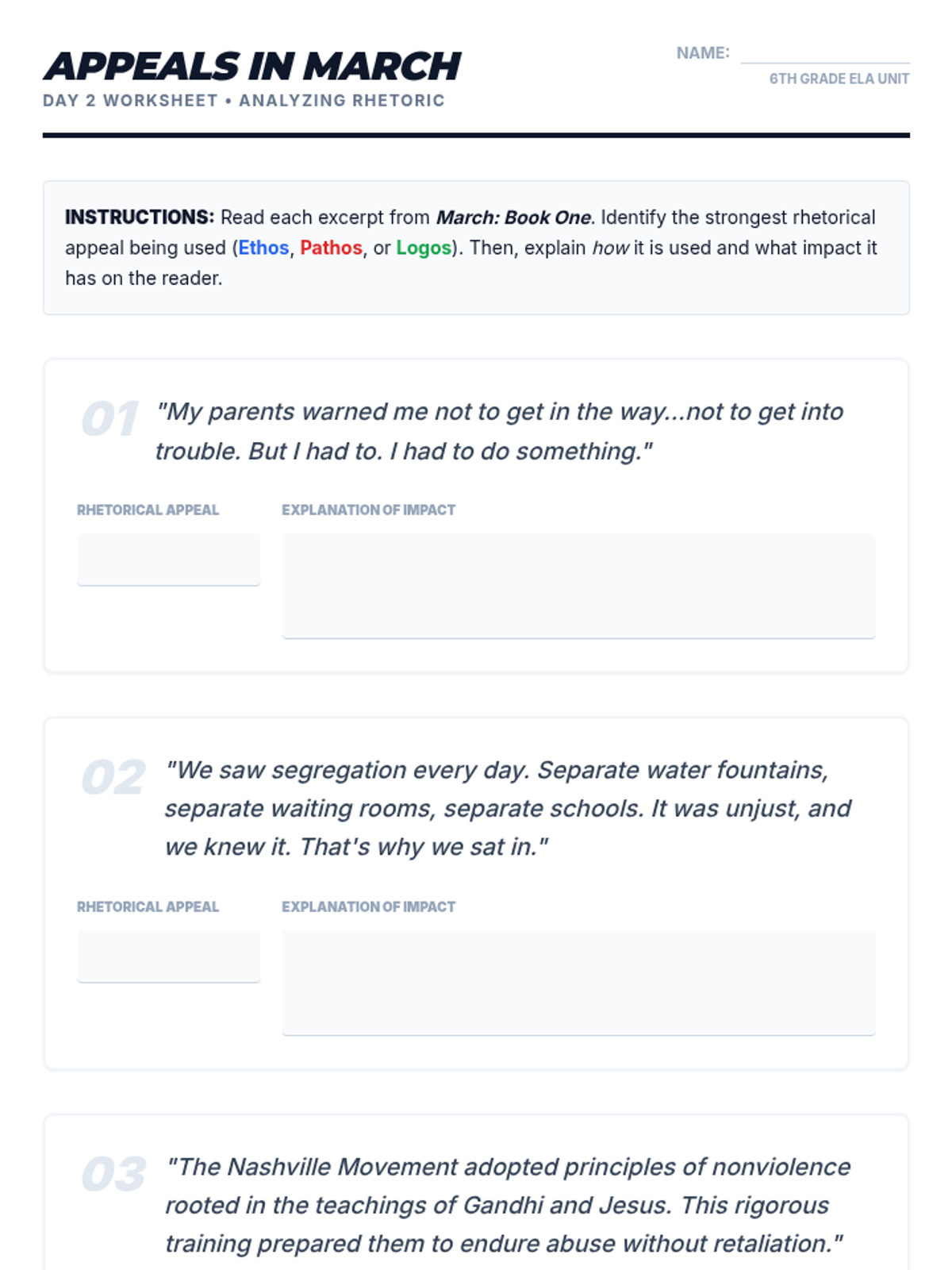
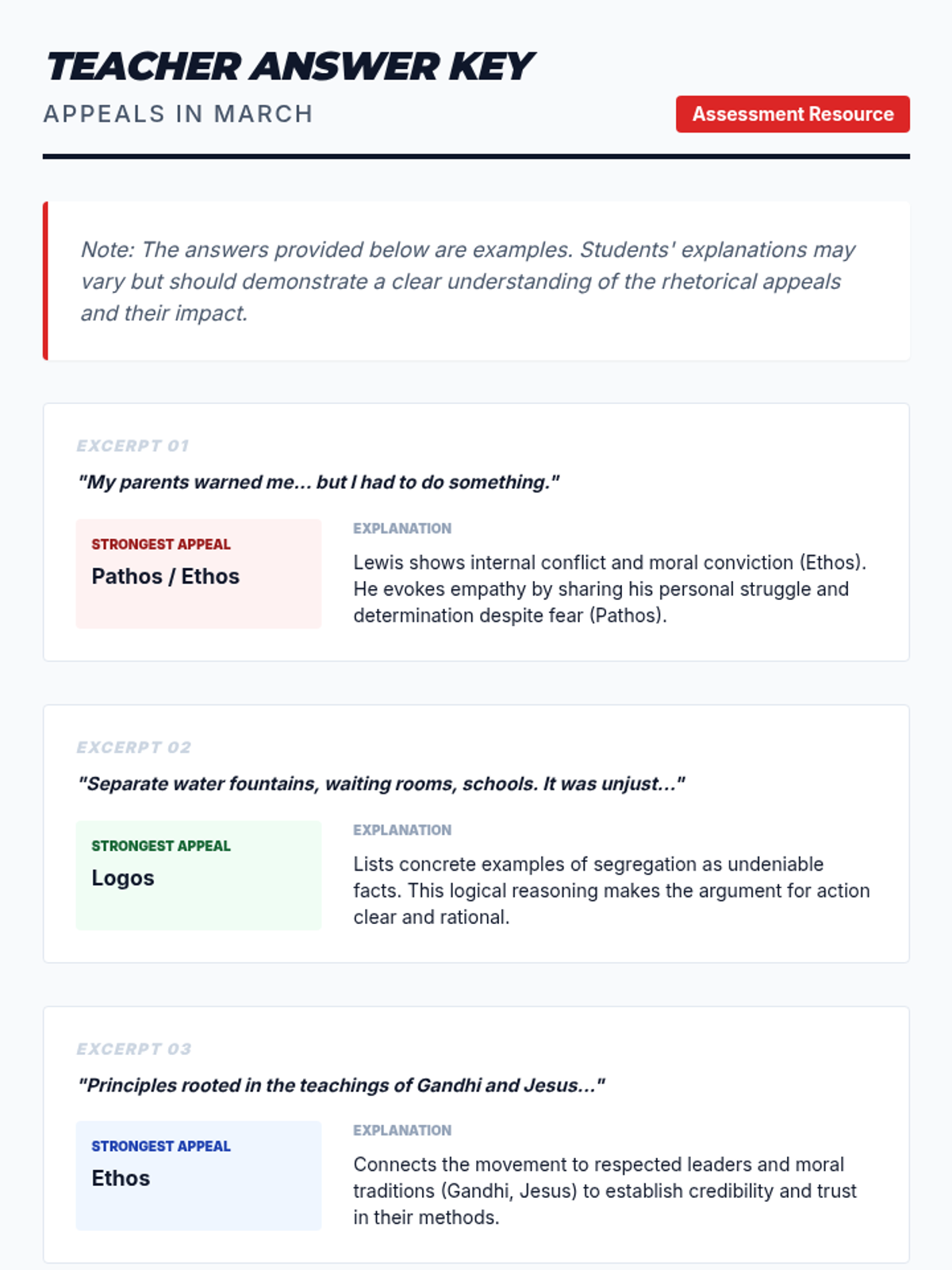
Day 2 Worksheet Appeals in March
Day 2 Answer Key Appeals in March
Day 2 Script Analyzing Appeals
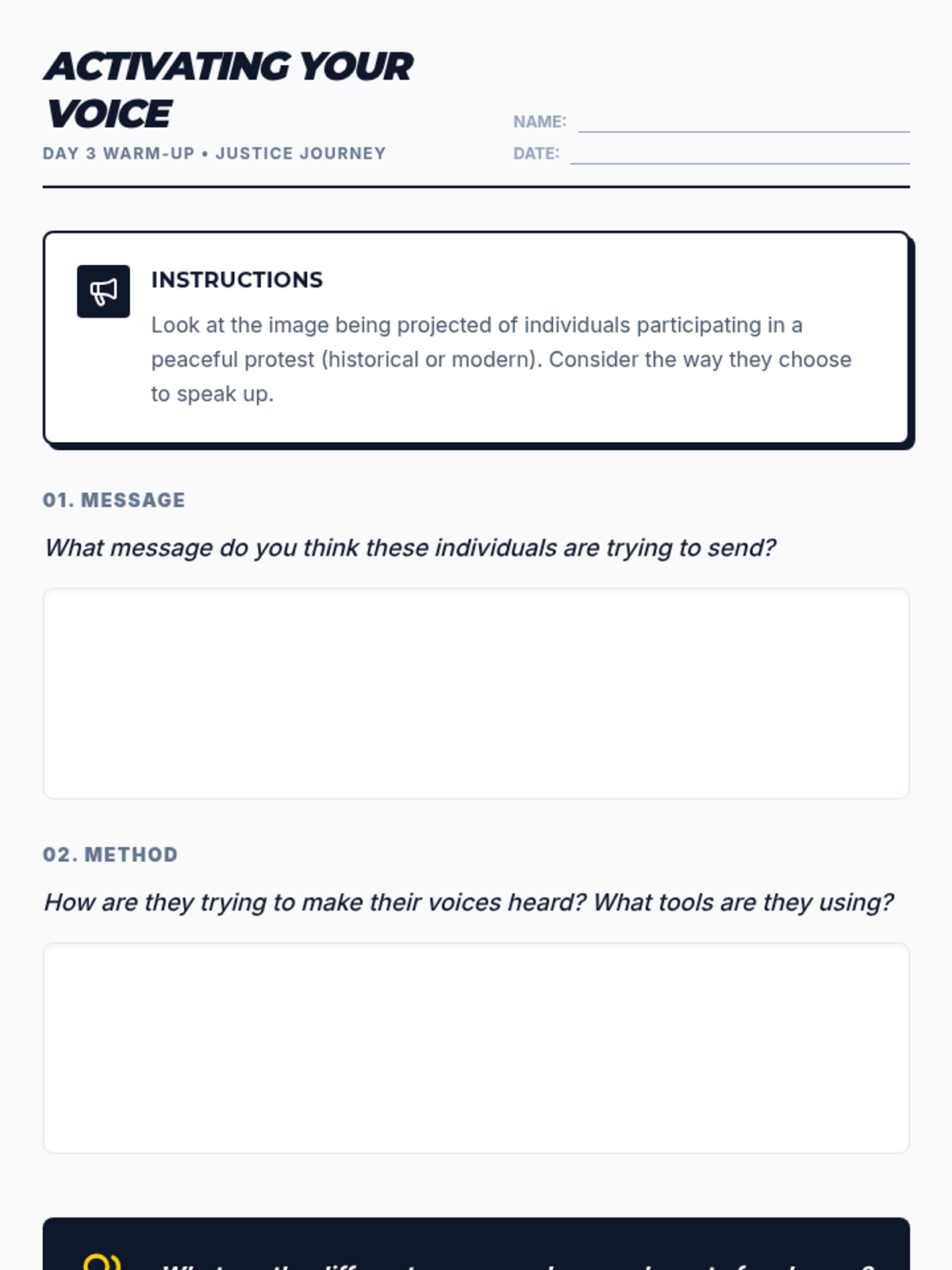
Day 3 Warm Up Activating Your Voice
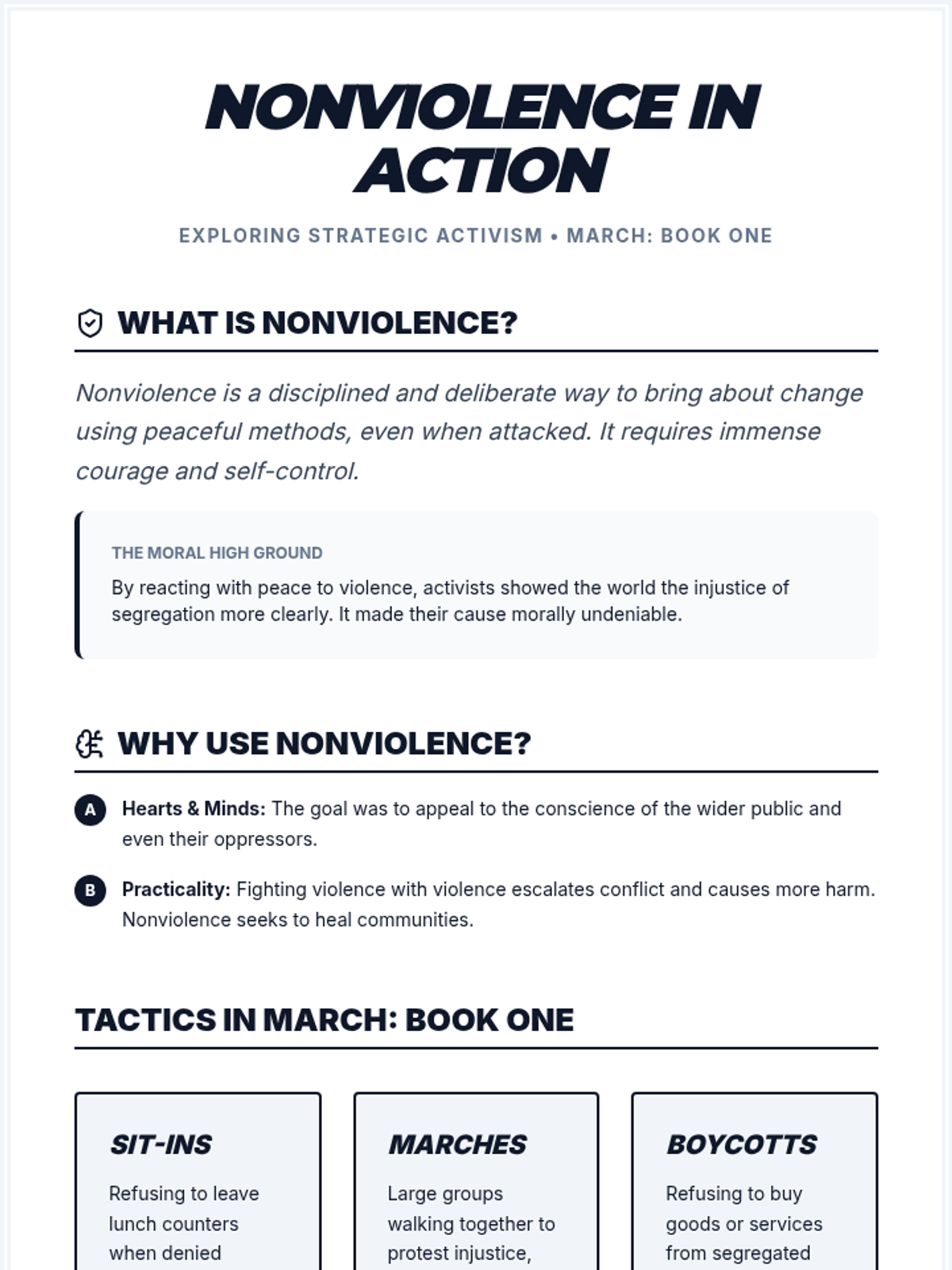
Day 3 Reading Nonviolence in Action
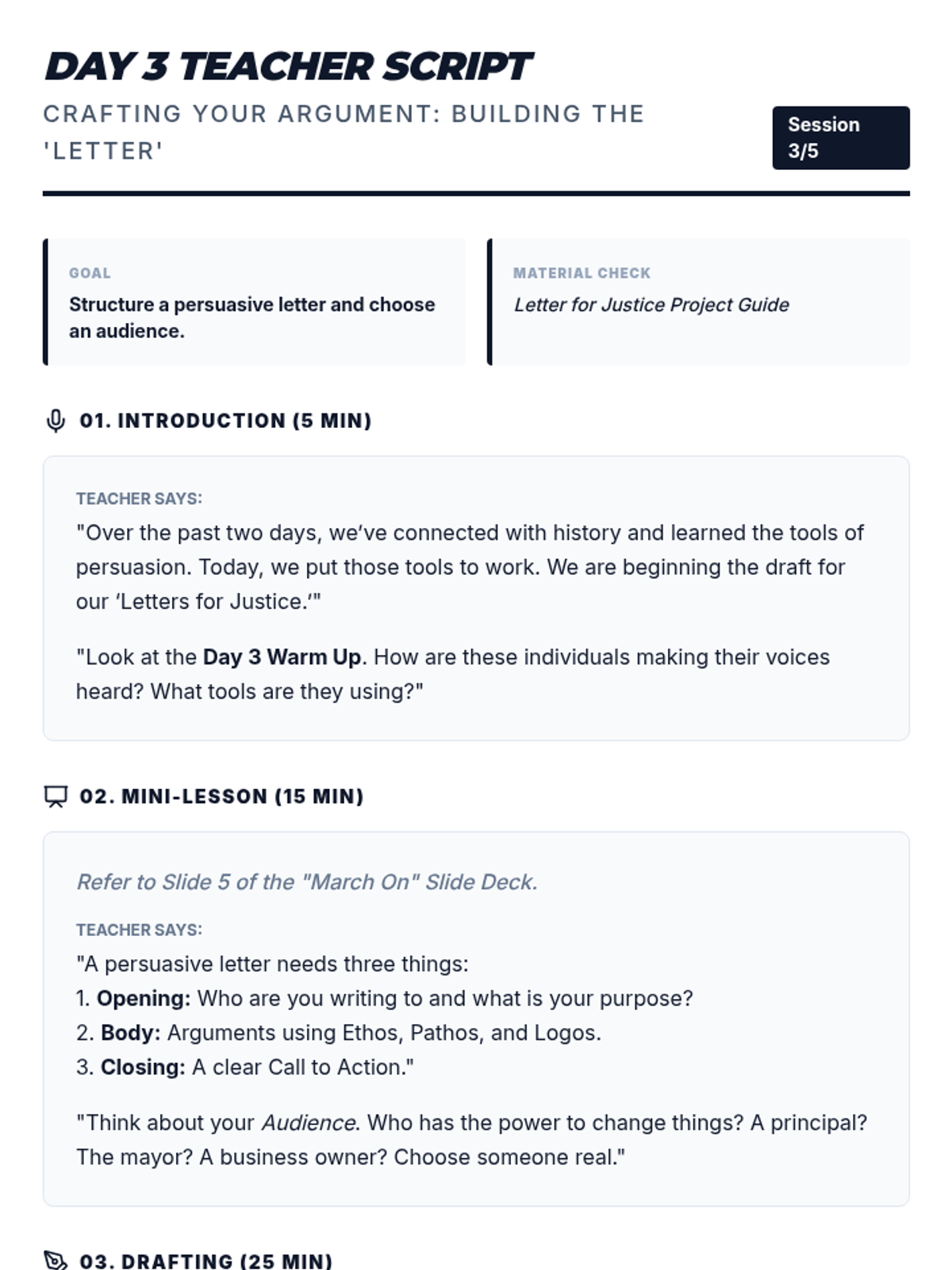
Day 3 Script Building the Letter
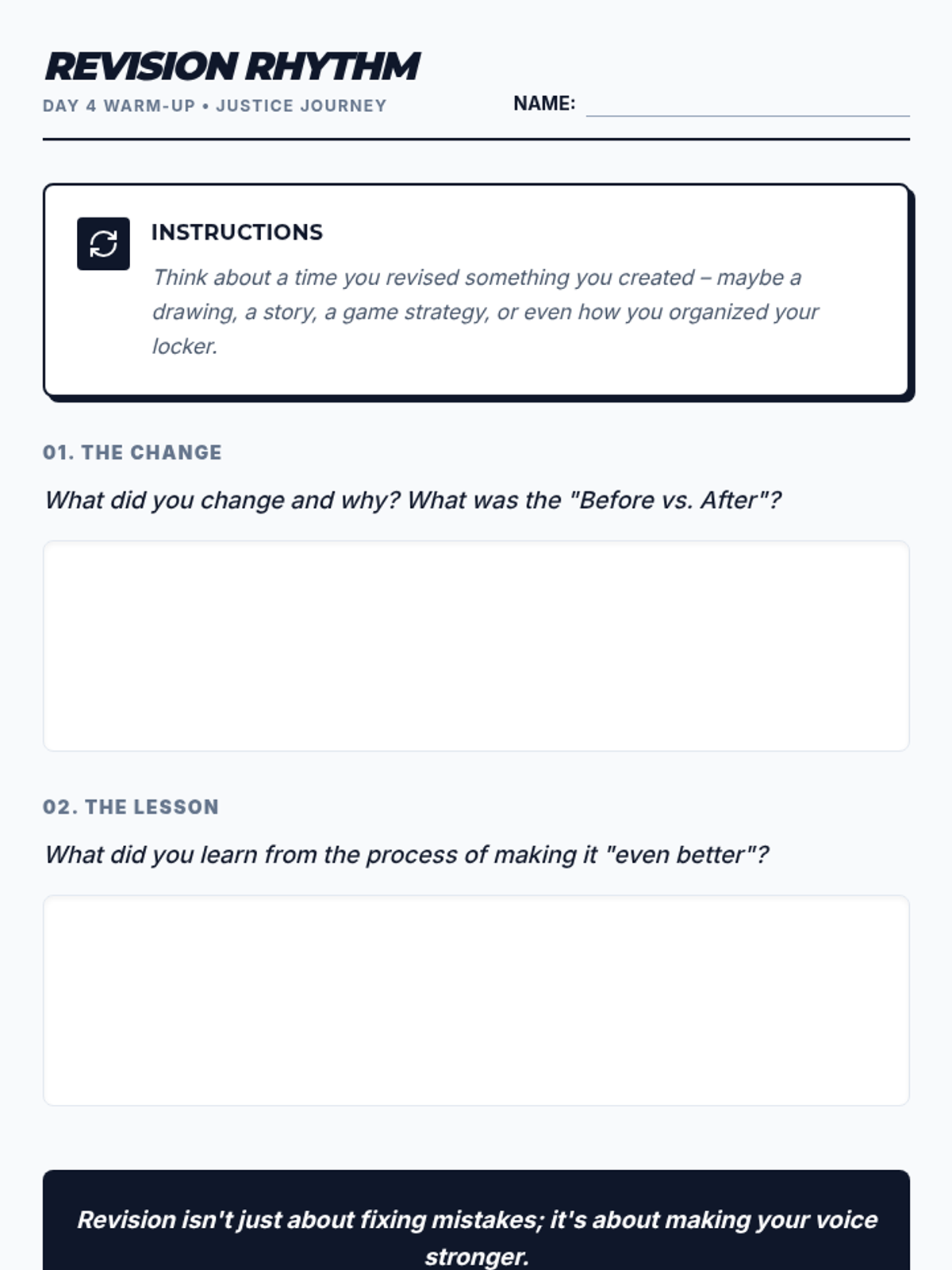
Day 4 Warm Up Revision Rhythm
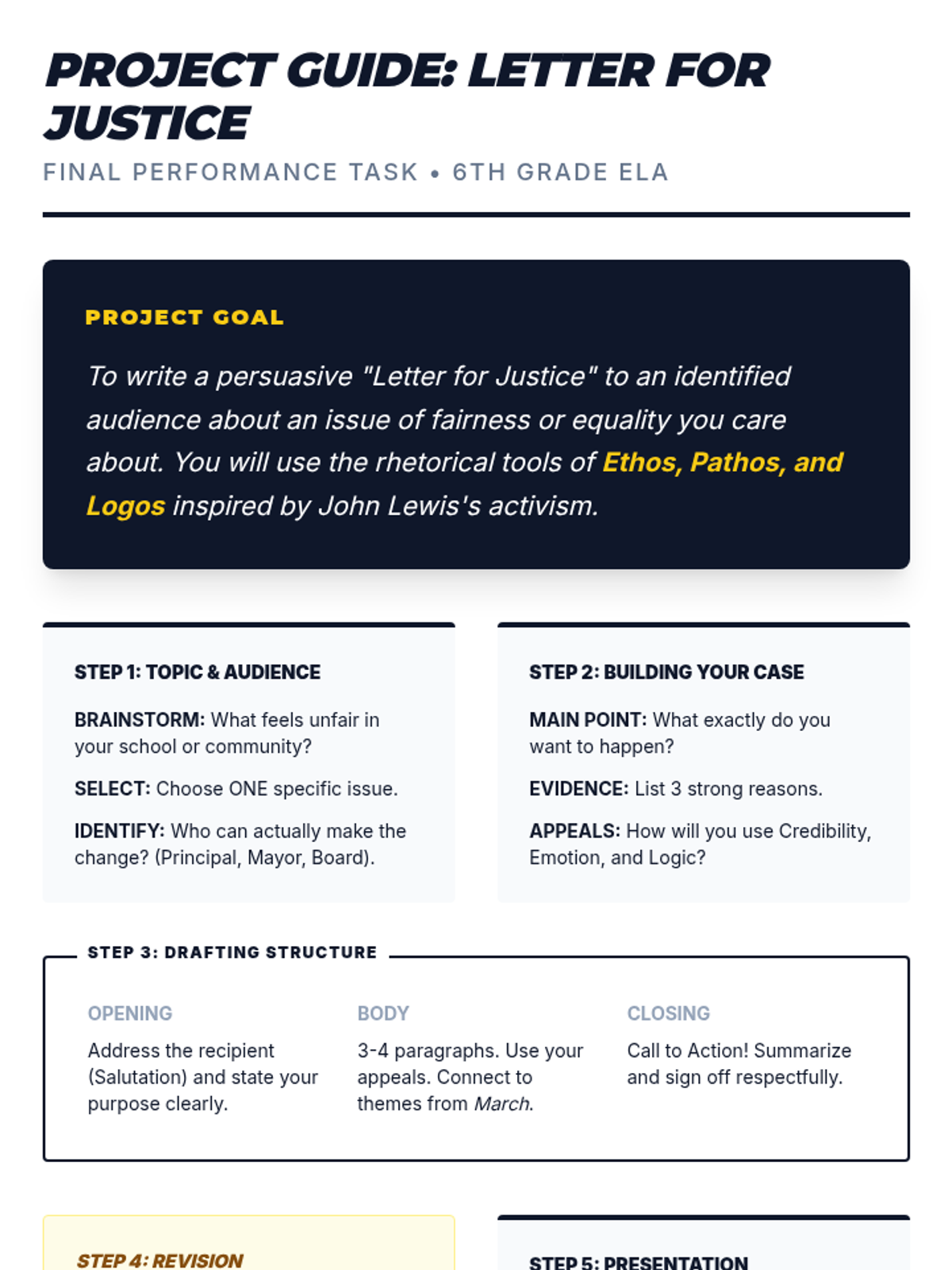
Day 4 Project Guide Letter for Justice
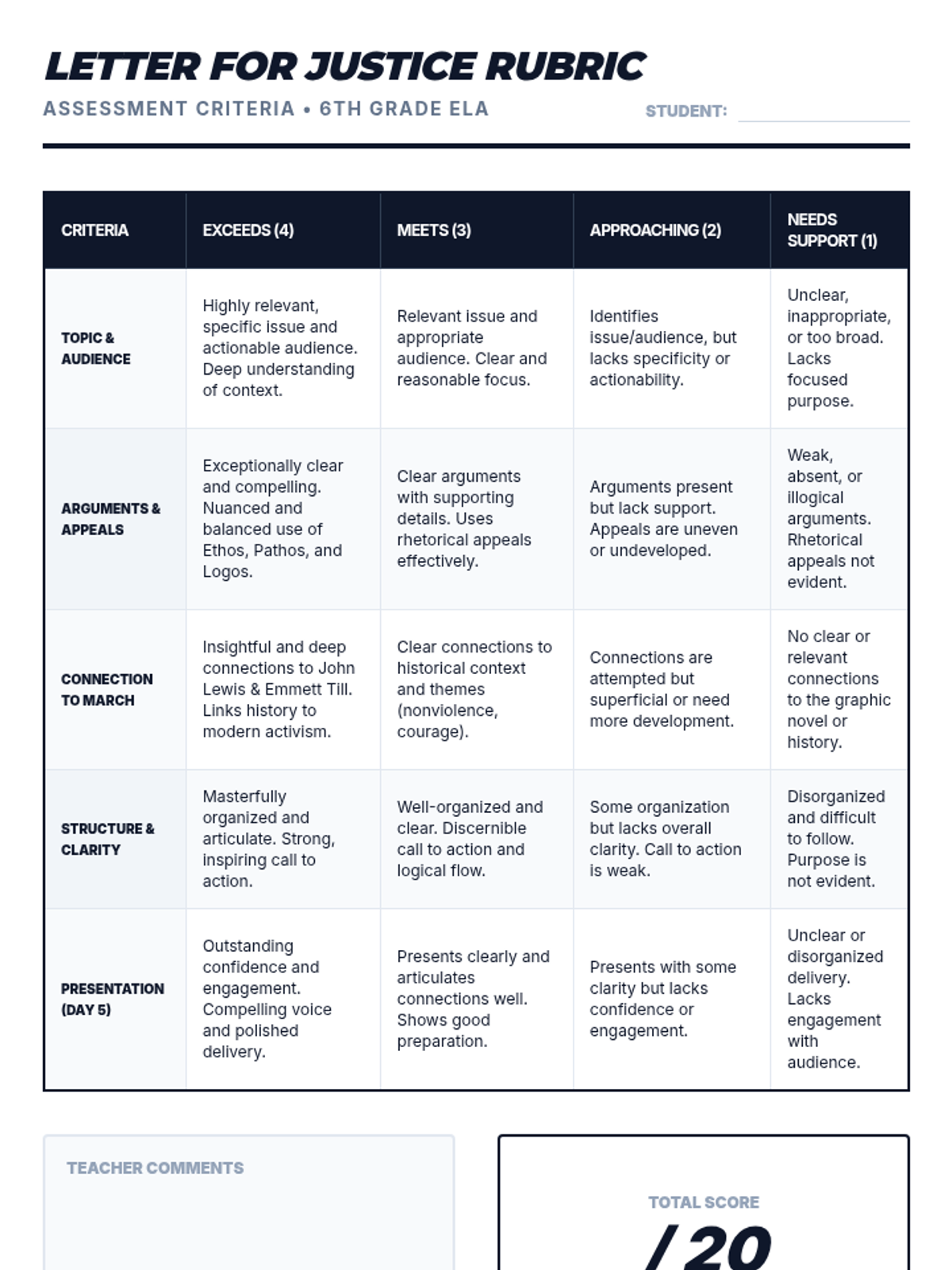
Letter for Justice Rubric
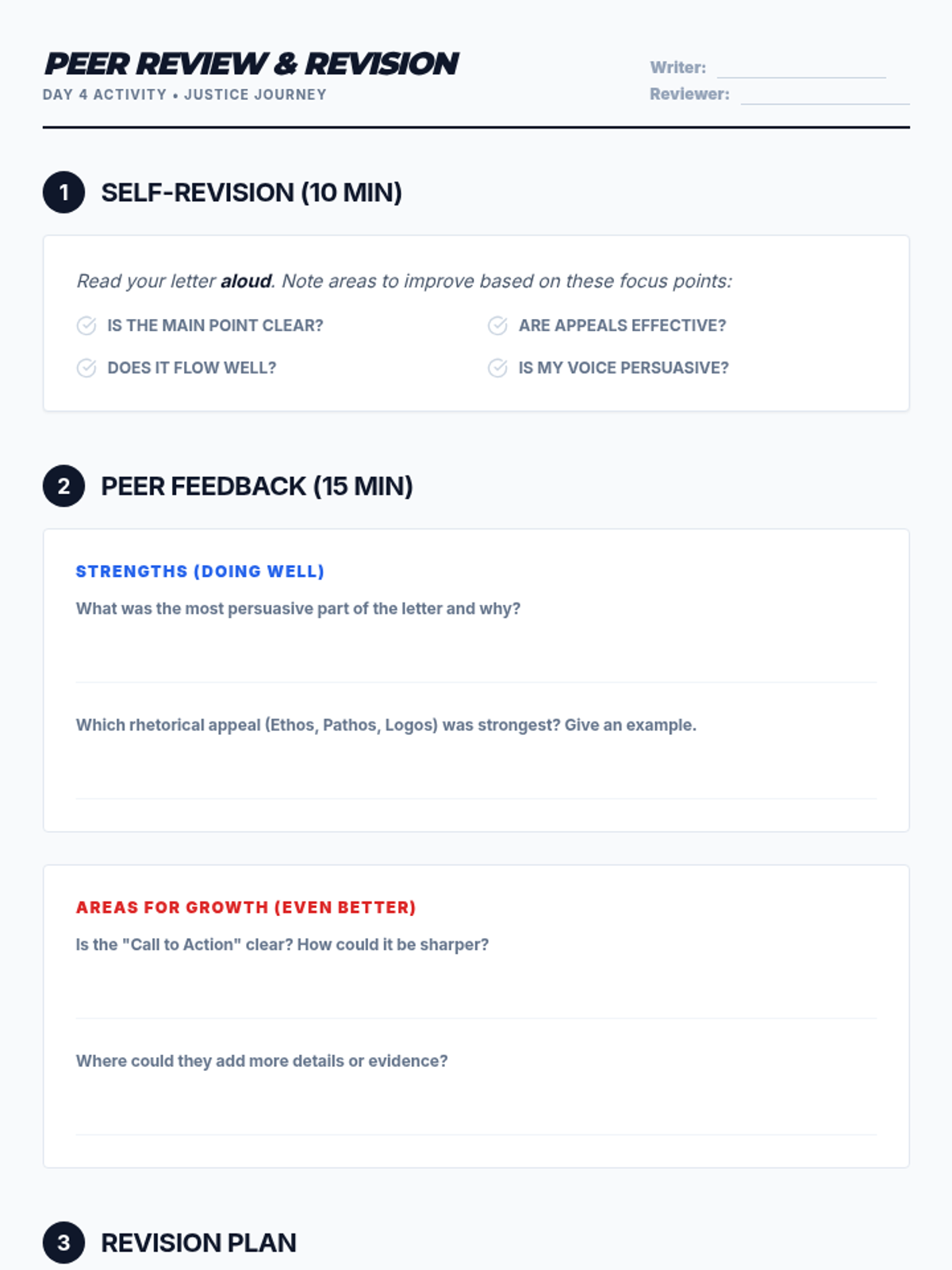
Day 4 Activity Peer Review and Revision
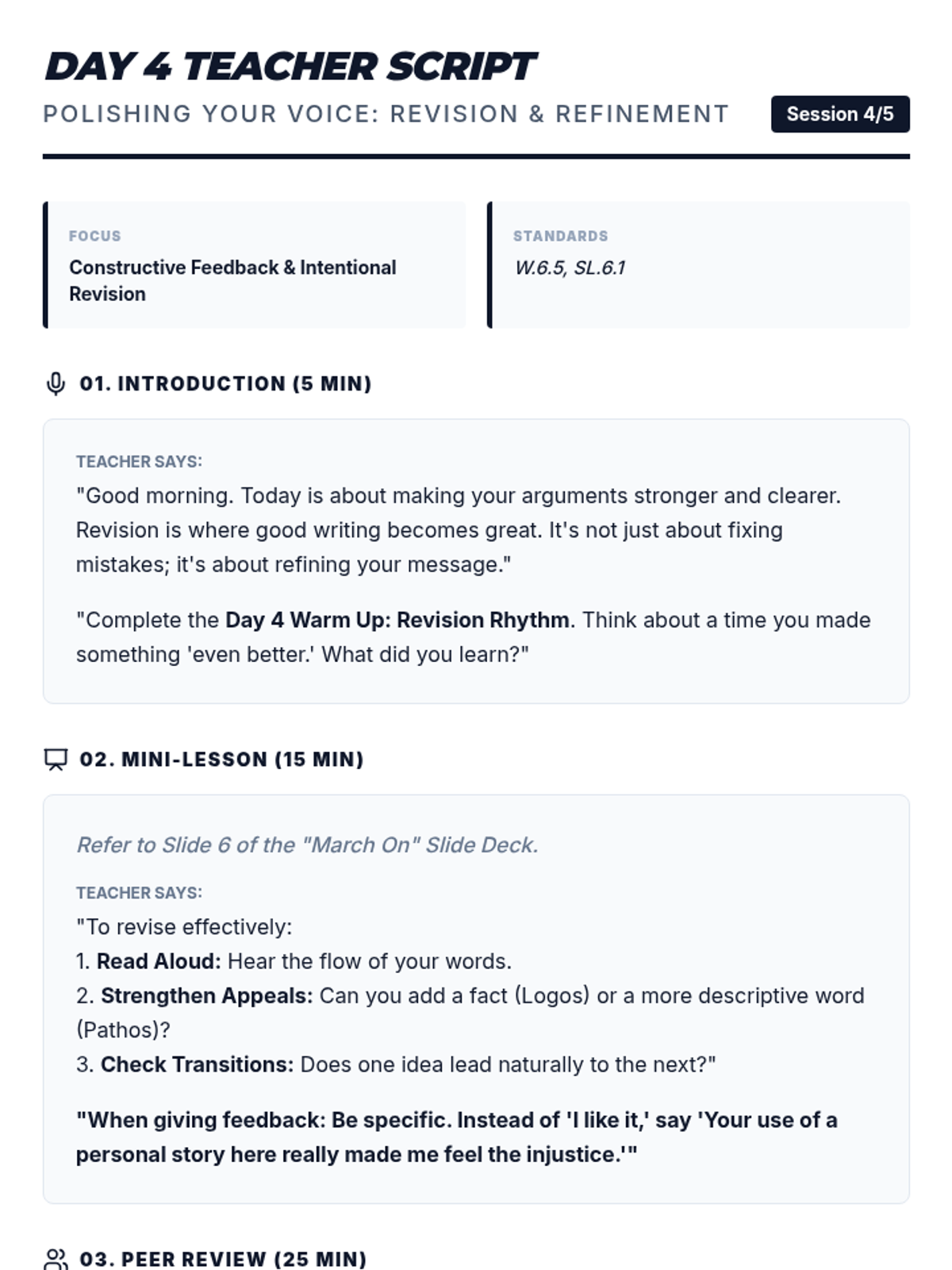
Day 4 Script Revision Rhythm
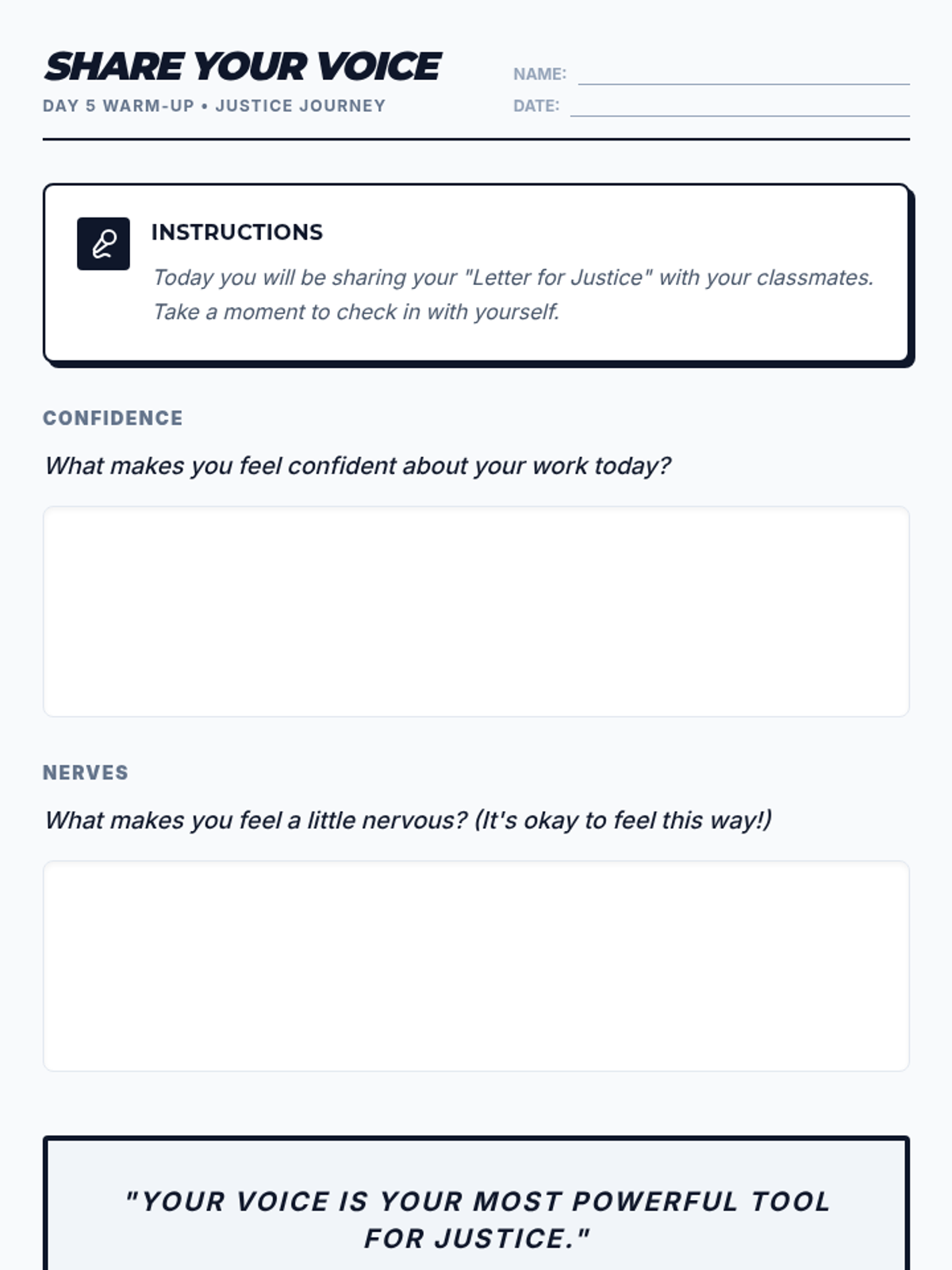
Day 5 Warm Up Share Your Voice
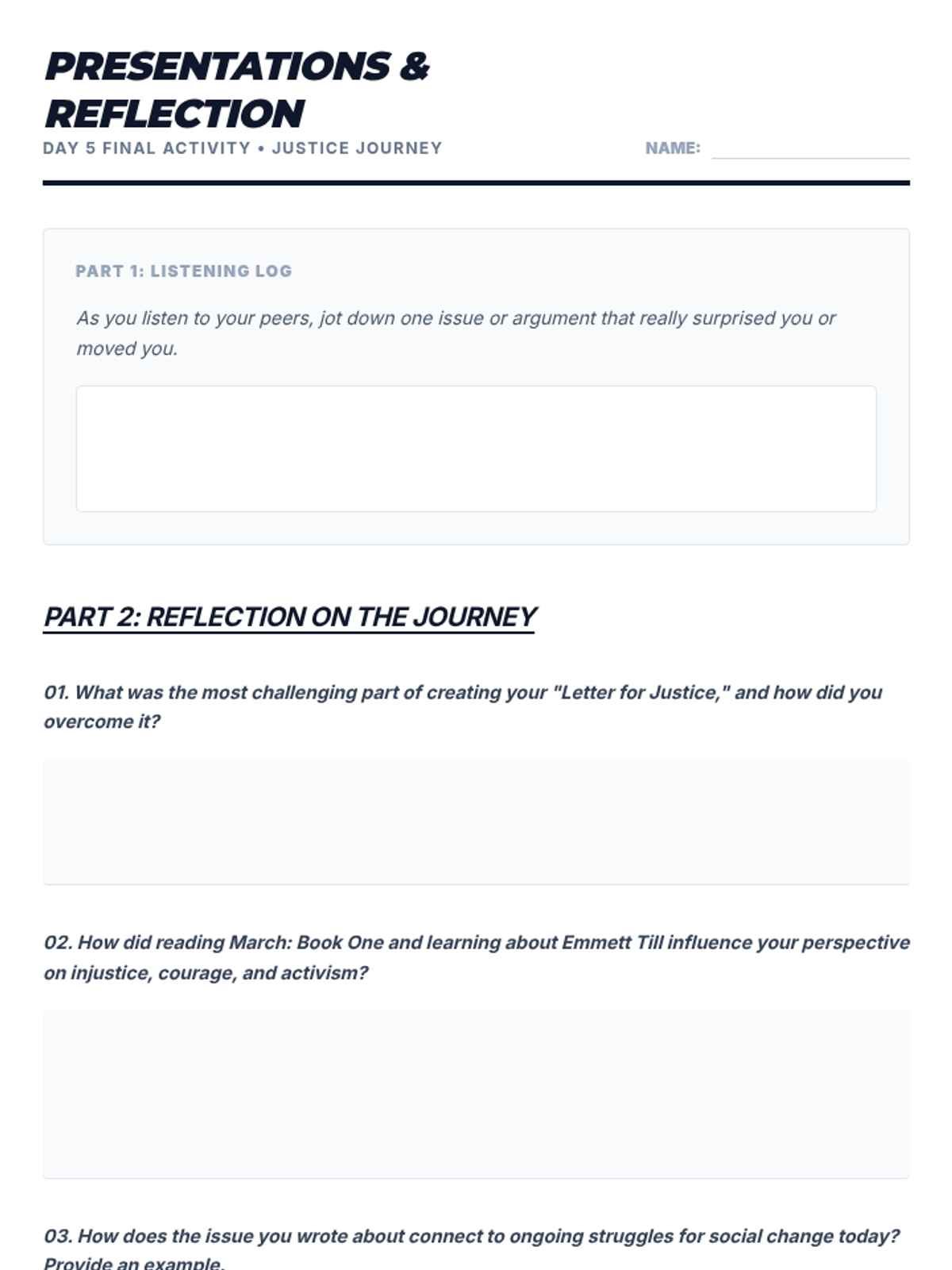
Day 5 Activity Presentations and Reflection
Day 5 Script Presentation and Reflection

Justice Journey March On

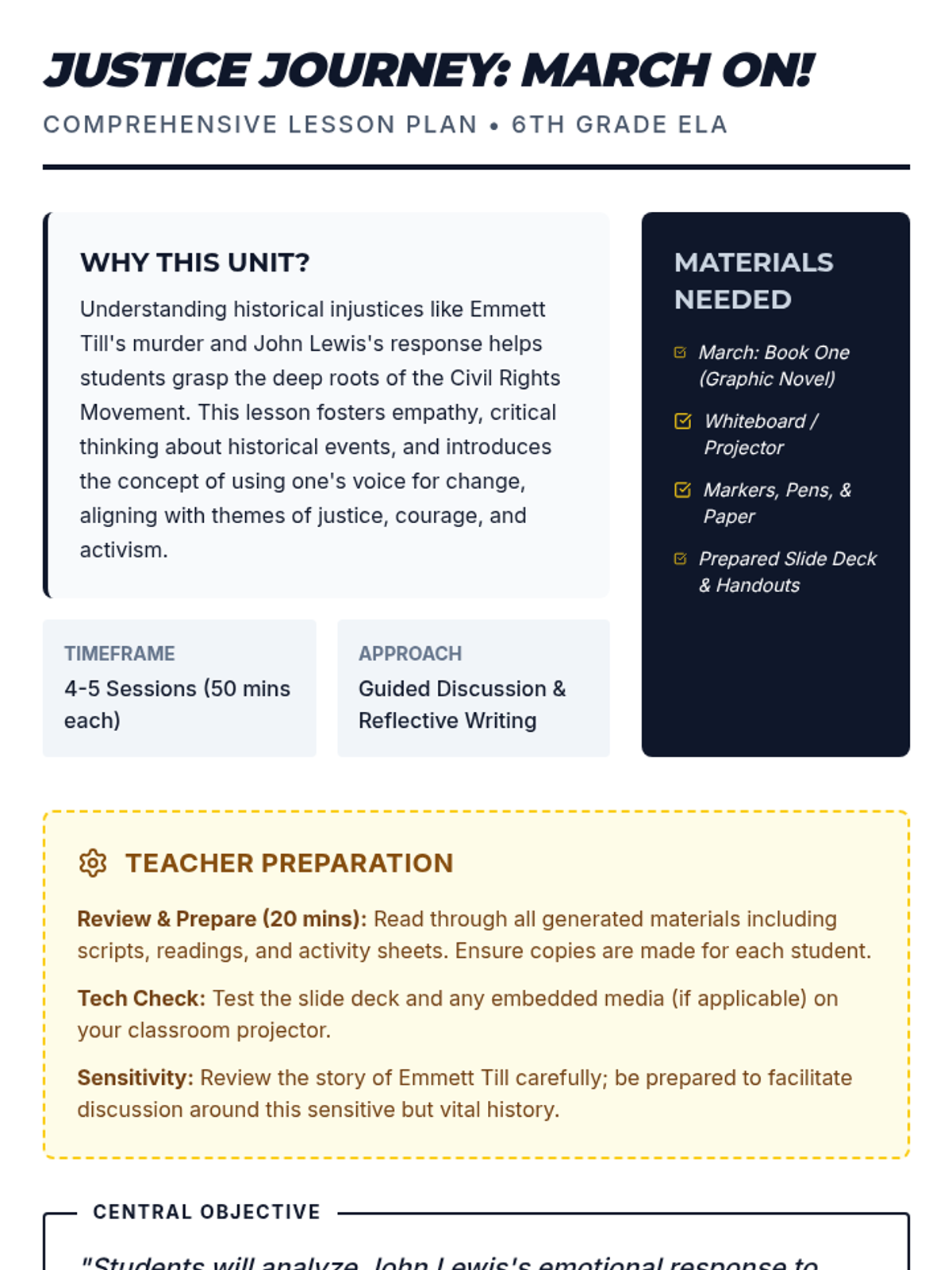
A 5-day ELA unit for 6th grade exploring John Lewis's 'March: Book One,' connecting historical events like Emmett Till's murder to contemporary activism through persuasive writing.

SM

Sancia Morgan

English Language Arts Teacher
11/9/25
Sequence
Field Evidence Worksheet
Scene Analysis Slides
Forensic Debrief Teacher Guide

Narrative Detectives

A forensic-themed reading comprehension unit where students act as investigators to master predictions and inferences. Through case studies and evidence tracking, students learn to bridge literal text with deep narrative meaning.

Lenny Avatar
Lenny
1/18
Sequence
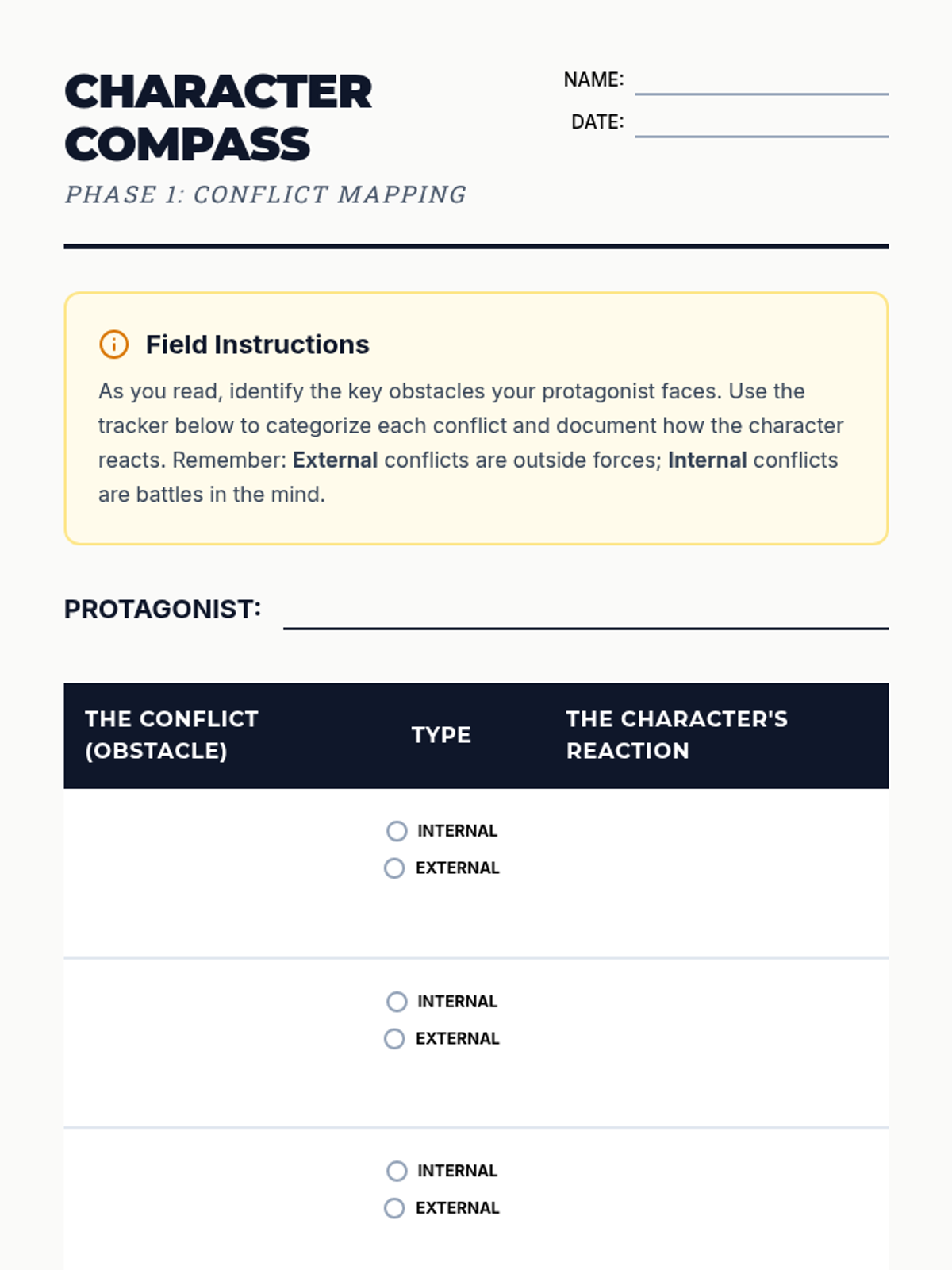
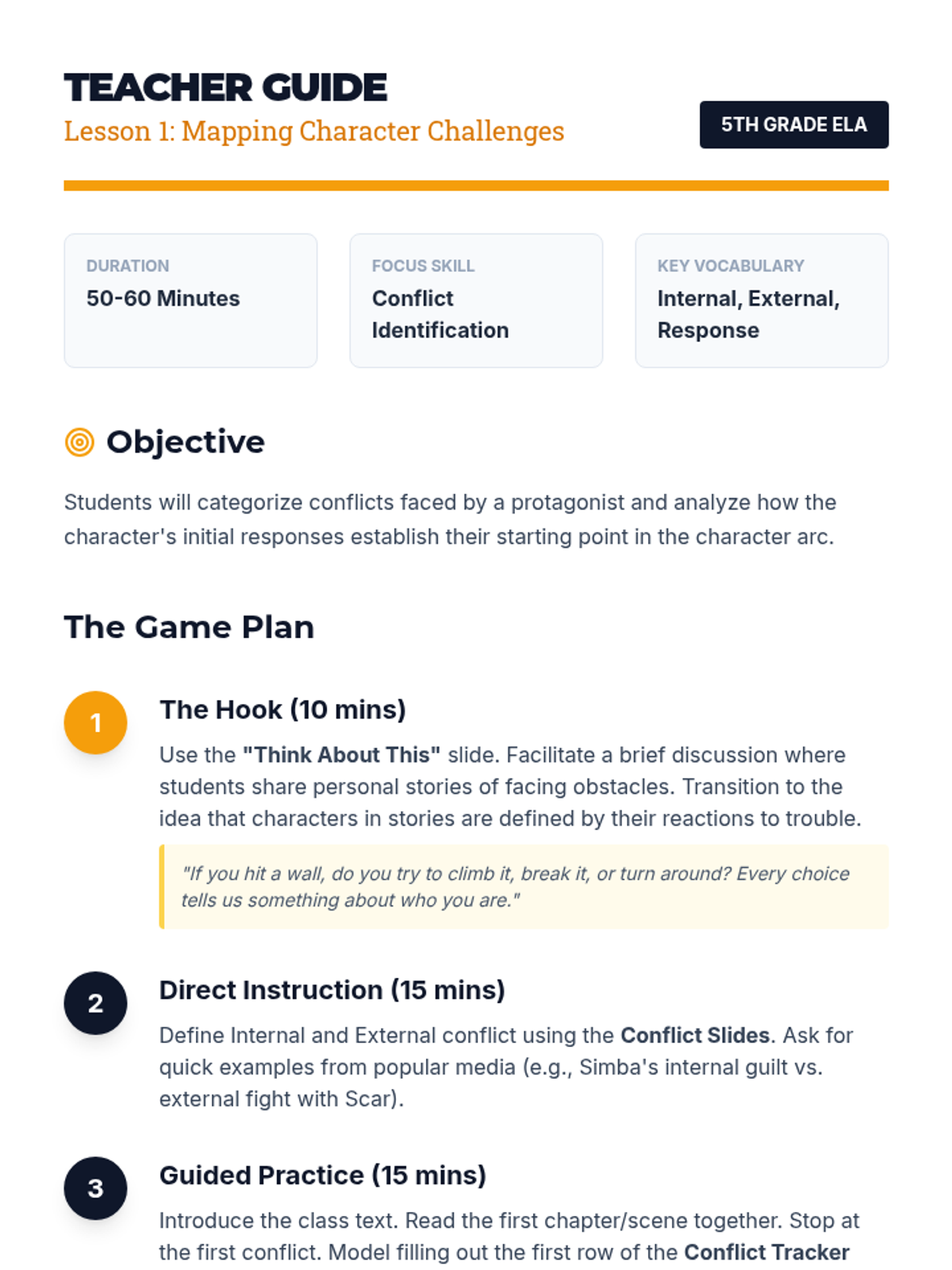
Conflict Map Slides
Conflict Tracker Worksheet
Conflict Map Teacher Guide

Character Compass

This inquiry-based sequence explores how character development reveals an author's theme. Students track a protagonist's journey through conflicts and choices to formulate and debate universal truths.

Lenny Avatar
Lenny
1/18
Sequence
Theme Builder Slides
Theme Builder Worksheet
Theme Builder Key

Thematic Threads

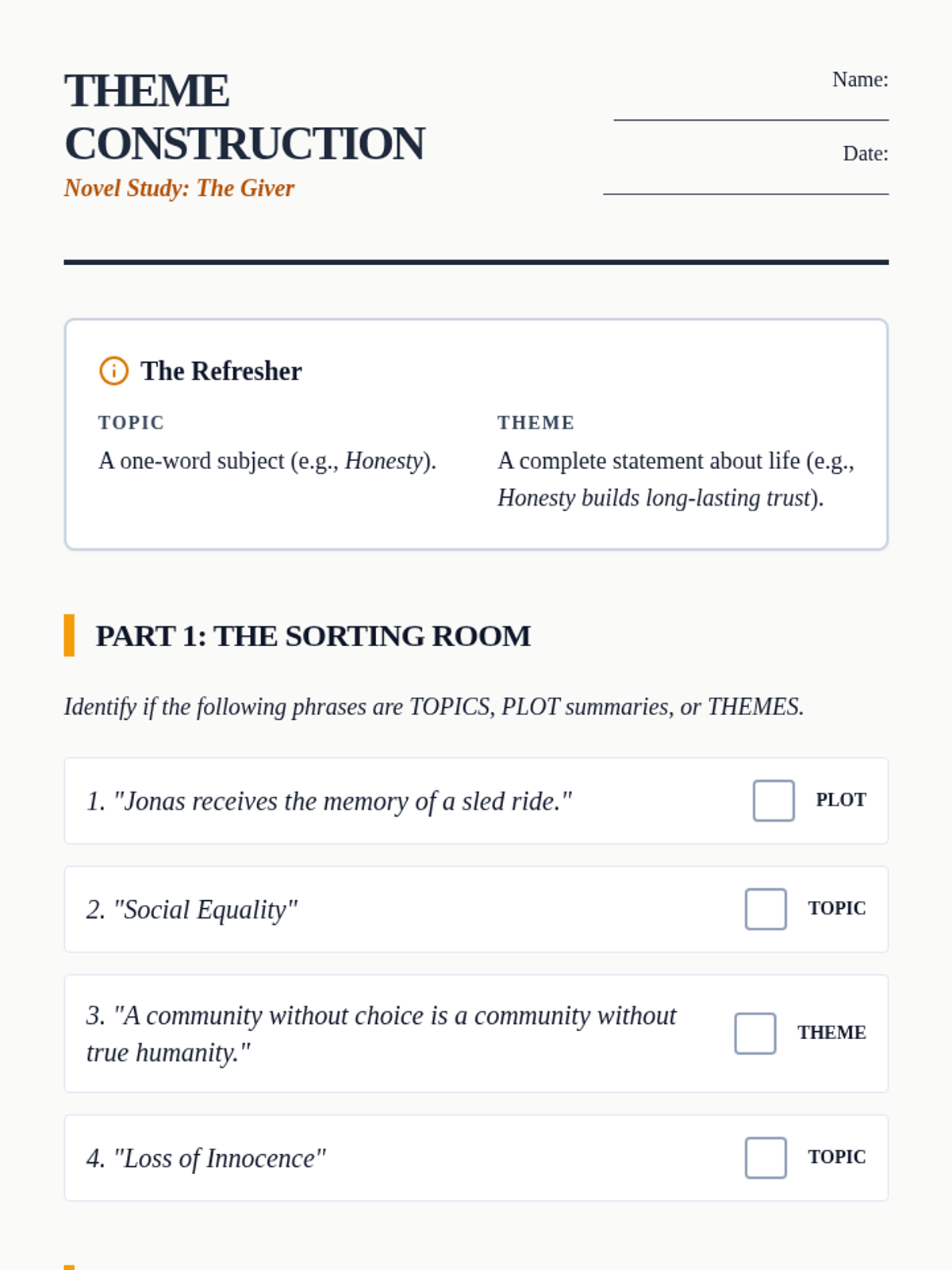
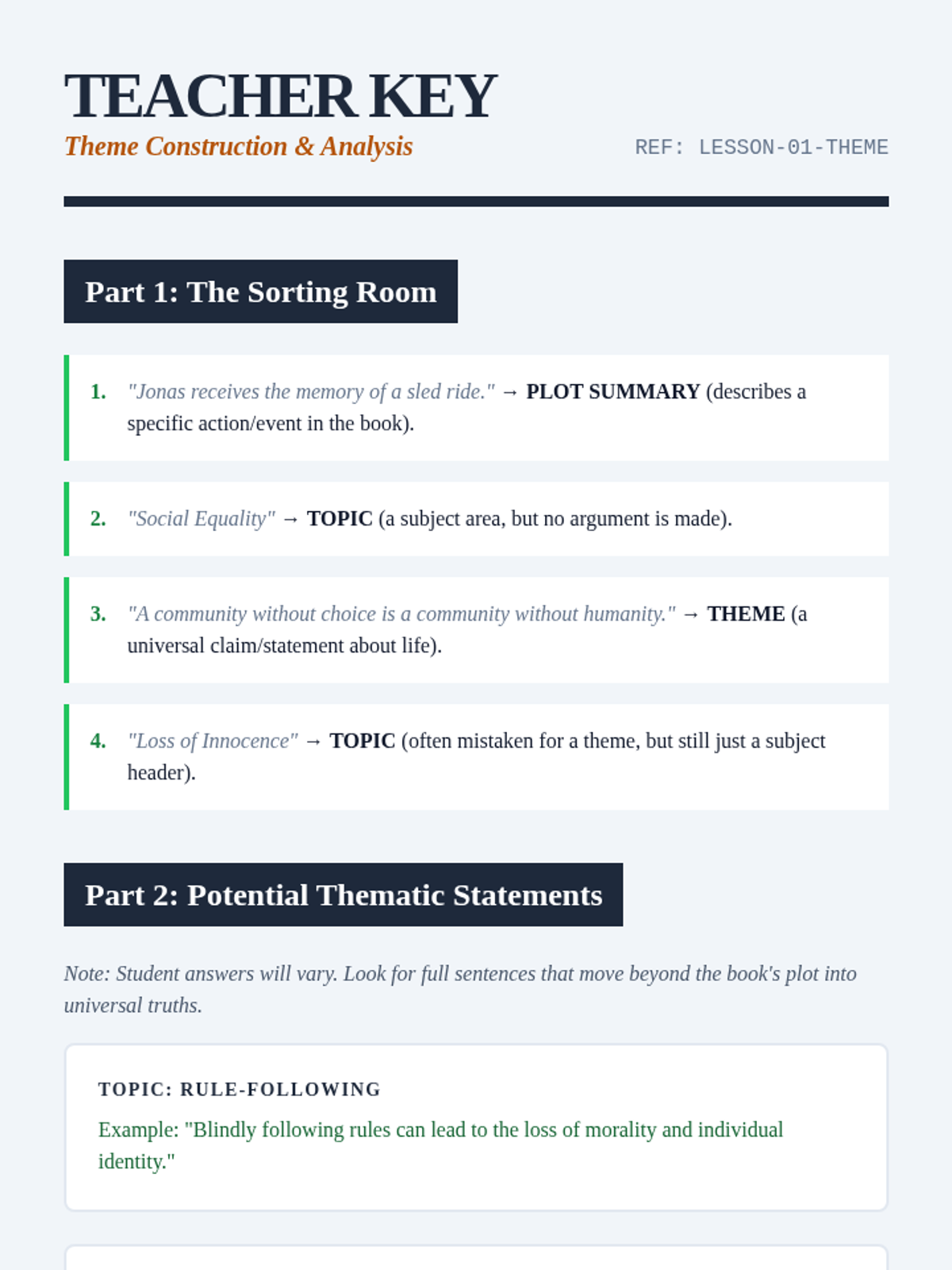
A comprehensive 6th-grade ELA unit focused on identifying, tracking, and discussing universal themes in literature. Students move from defining thematic statements to participating in high-level Socratic seminars, using 'The Giver' as a primary text.

Lenny Avatar
Lenny
1/18
Sequence
Cool Under Fire Slides
Statue Challenge Worksheet
Composure Coaching Guide

Defensive Speaking and Responding Under Pressure

A sequence focused on the defensive side of debate, teaching 6th-grade students how to maintain composure, identify rhetorical traps, and pivot back to evidence during cross-examination. Students will move from non-verbal techniques to full-scale rapid-fire defense simulations.

Lenny Avatar
Lenny
1/18
Sequence
Anatomy Argument Slides
Argument Autopsy Worksheet
Anatomy Argument Teacher Guide

Evaluating the Impact of Fallacies in Social Discourse

A middle school ELA unit focusing on the social impact of logical fallacies. Students analyze digital discourse, learn to identify 'whataboutism', practice Socratic discussion, and develop strategies for 'steel-manning' arguments to foster healthier community conversations.

Lenny Avatar
Lenny
1/17
Sequence
Quest Purpose Teacher Guide
Mission Intel Worksheet

Cross Examination Strategies and Techniques

A comprehensive unit on Cross-Examination for middle school debaters, focusing on strategic questioning, rhetorical control, and integrating admissions into rebuttal speeches. Students move from understanding the purpose of questioning to executing complex 'question traps' in high-pressure simulations.

Lenny Avatar
Lenny
1/17
Sequence
Argument Armor Slides
Counterclaim Combat Worksheet
Counterclaim Combat Teacher Guide

Argument Armor

A series of lessons focused on mastering the art of persuasion and argumentative writing, from building claims to defending them against opposition.

TH

Terrie Huff

Special Education Teacher
2/17
Sequence
Gauntlet Slides
Battle Plan Worksheet
Gauntlet Facilitation Guide

Argument Arsenal

A series of lessons focused on mastering argumentative writing through immersive, game-based activities and role-playing scenarios.

MR

Mary Rayburn

English Language Arts Teacher
2/14
Sequence
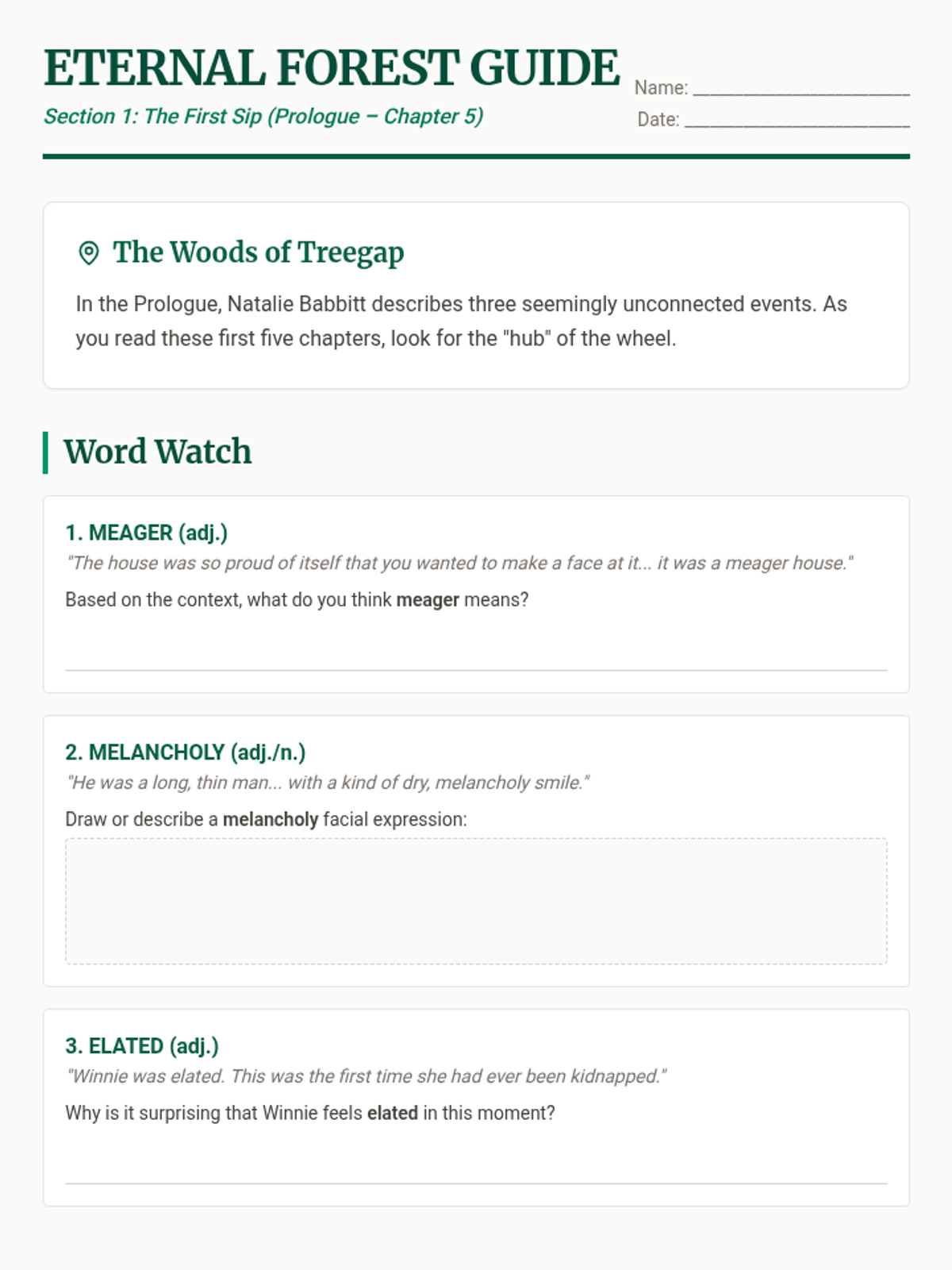
Eternal Forest Guide 1
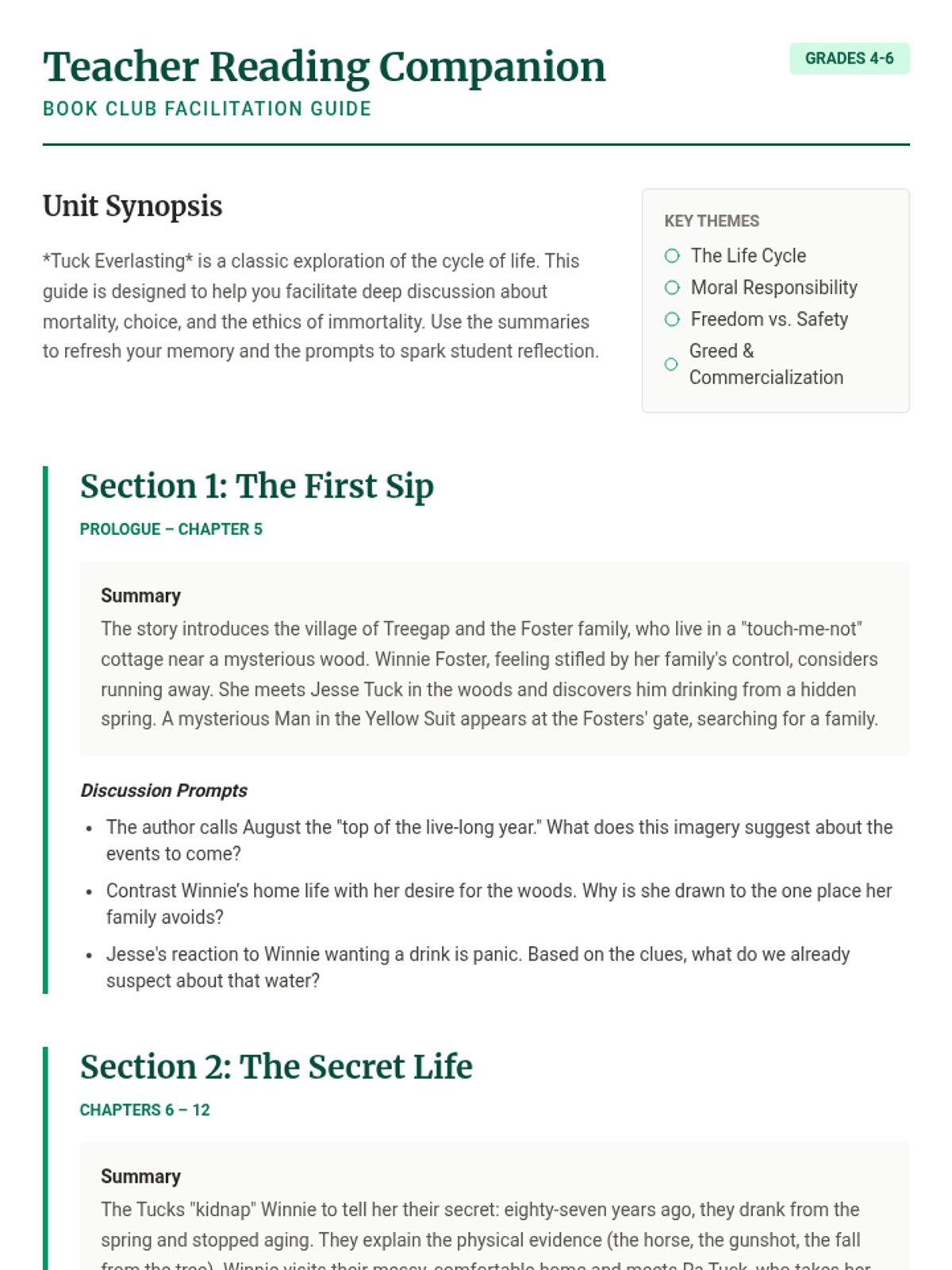
Reading Companion Teacher Guide
Everlasting Intro Slides

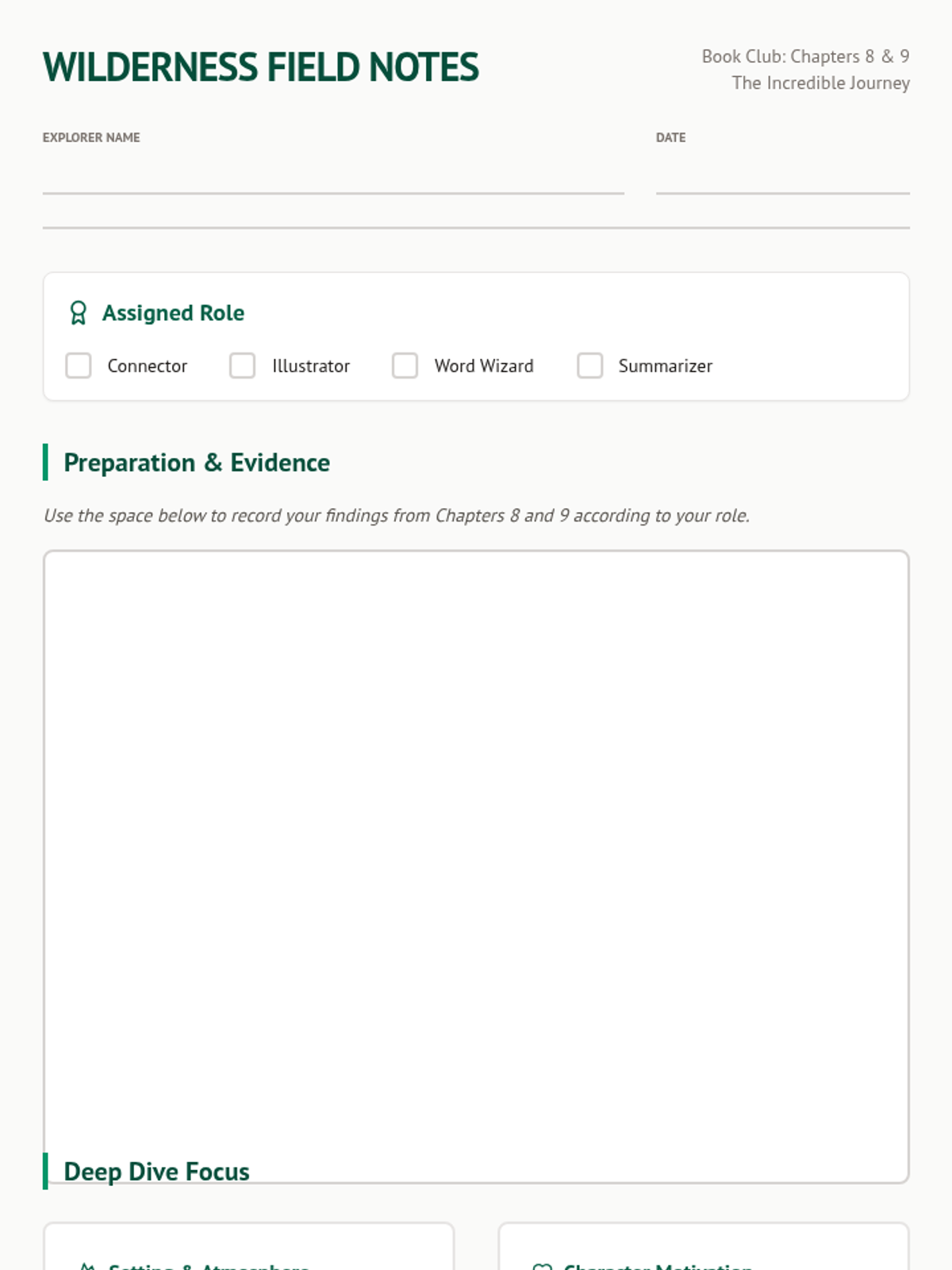
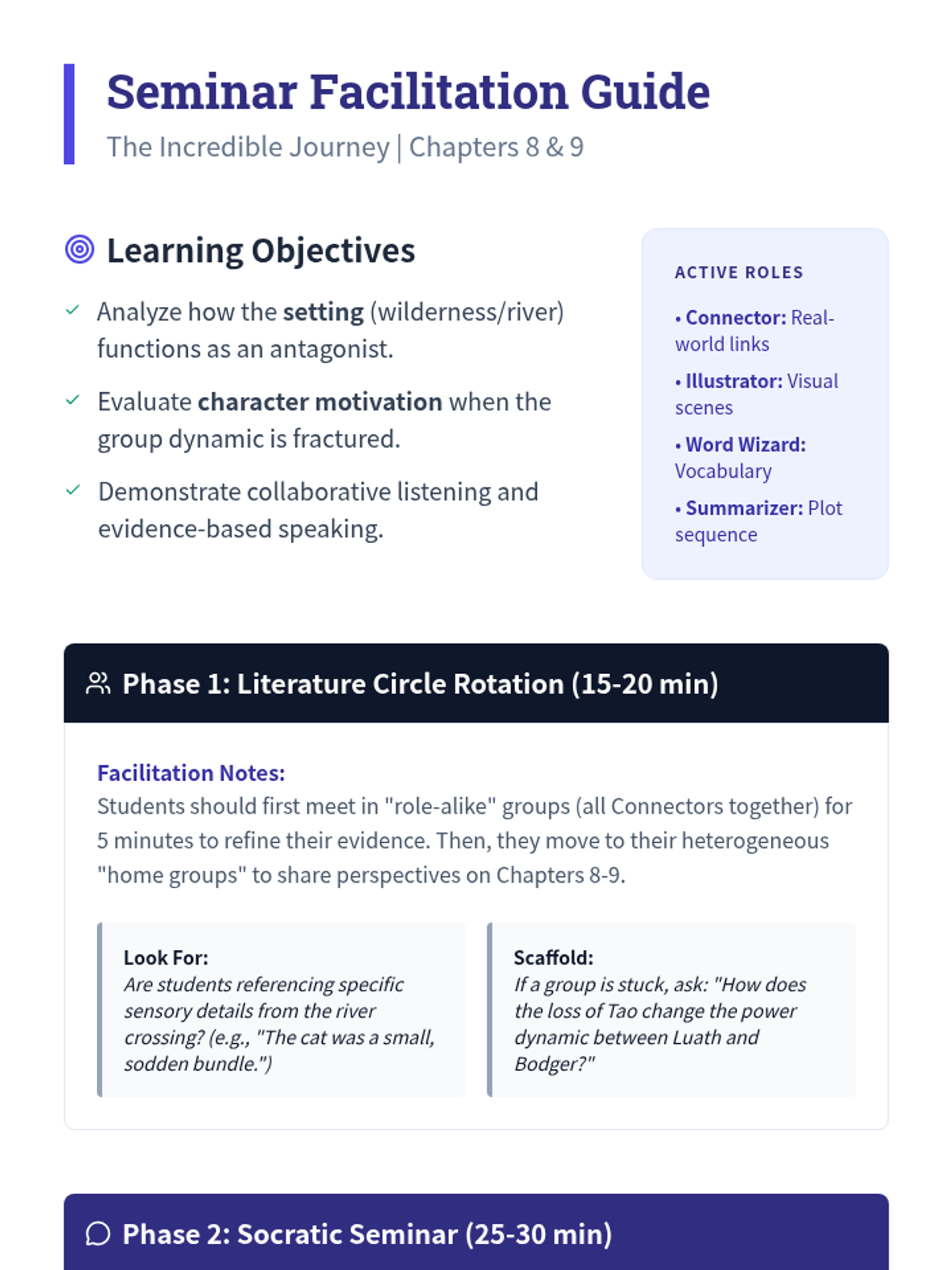
Everlasting Forest Book Club

A comprehensive book club unit for Natalie Babbitt's *Tuck Everlasting*, exploring themes of immortality, nature's cycles, and moral choices through guided discussion, vocabulary expansion, and project-based learning.

KL

Kim Leary

Math Teacher
2/13
Sequence
Mission Briefing Lesson Plan
Operation Order Slides
Task Tracer Worksheet
Blueprint Breakdown Activity
Answer Key Decoders
Decoder Quiz

Smart Strategies Unit

A middle school curriculum unit focused on critical thinking, information literacy, and strategic task management across digital and physical media.

TD

Tondra Dillard-Cobb

Special Education Teacher
2/2
Sequence
Grumpy Guise Slides
Grumpy Grader Rubric
Petty Problems Scenario Cards
Grumpy Script Sheet

Persuasion Power Play

A debate and communication sequence focused on teaching middle schoolers how to build persuasive arguments through creative performance and structured analysis.

Lenny Avatar
Lenny
1/19
Sequence
Cart Ethics Slides
Argument Anatomy Anchor Chart
Seminar Spark Cards
Ethics Log Handout
Seminar Facilitator Guide

Civic Duty and Social Contracts

A lesson sequence exploring the intersection of civic duty, social contracts, and rhetorical analysis through the lens of the 'Shopping Cart Theory'. Students analyze a structured argument and participate in a Socratic Seminar.

Lenny Avatar
Lenny
1/19
Sequence
Brainstorming Blitz Slides
Idea Spark Teacher Guide
Brainstorming Blitz Worksheet

Oral Planning and Composition Strategies

This sequence focuses on the cognitive planning required before activating the microphone, bridging the gap between thought and oral expression. Students explore how to organize their ideas using graphic organizers and bullet points to prevent rambling during dictation.

Lenny Avatar
Lenny
1/18
Sequence
Field Evidence Worksheet
Scene Analysis Slides
Forensic Debrief Teacher Guide

Narrative Detectives

A forensic-themed reading comprehension unit where students act as investigators to master predictions and inferences. Through case studies and evidence tracking, students learn to bridge literal text with deep narrative meaning.

Lenny Avatar
Lenny
1/18
Sequence
Argument Blueprints Slides
Argument Blueprint Worksheet
Argument Blueprint Teacher Guide

Argument Blueprints

This sequence focuses on using text structure graphic organizers as blueprints for argumentative writing. Students transition from analyzing model essays to building their own logically structured arguments, including counter-claims and refutations, using visual tools.

Lenny Avatar
Lenny
1/18
Sequence
Conflict Map Slides
Conflict Tracker Worksheet
Conflict Map Teacher Guide

Character Compass

This inquiry-based sequence explores how character development reveals an author's theme. Students track a protagonist's journey through conflicts and choices to formulate and debate universal truths.

Lenny Avatar
Lenny
1/18
Sequence
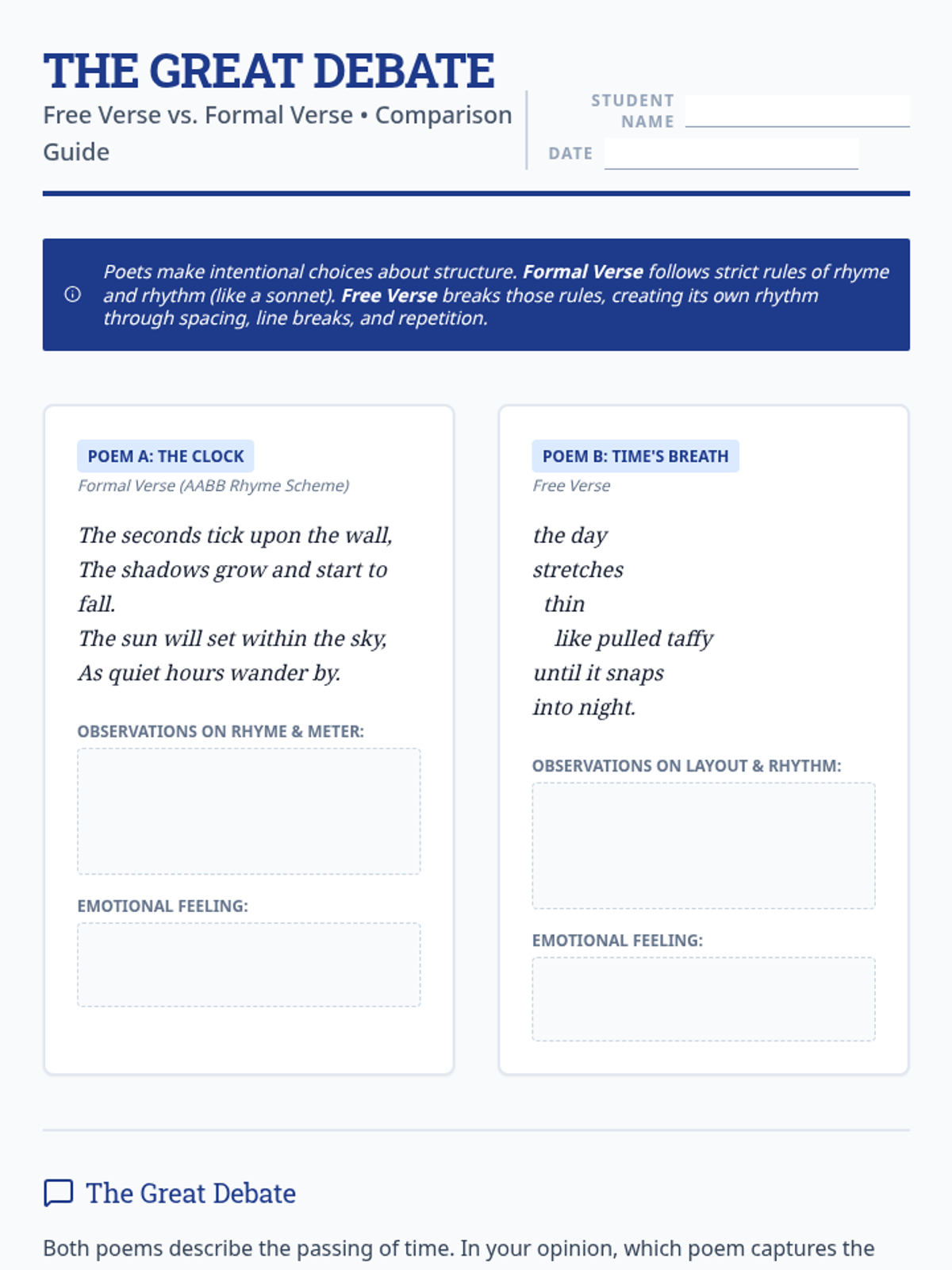
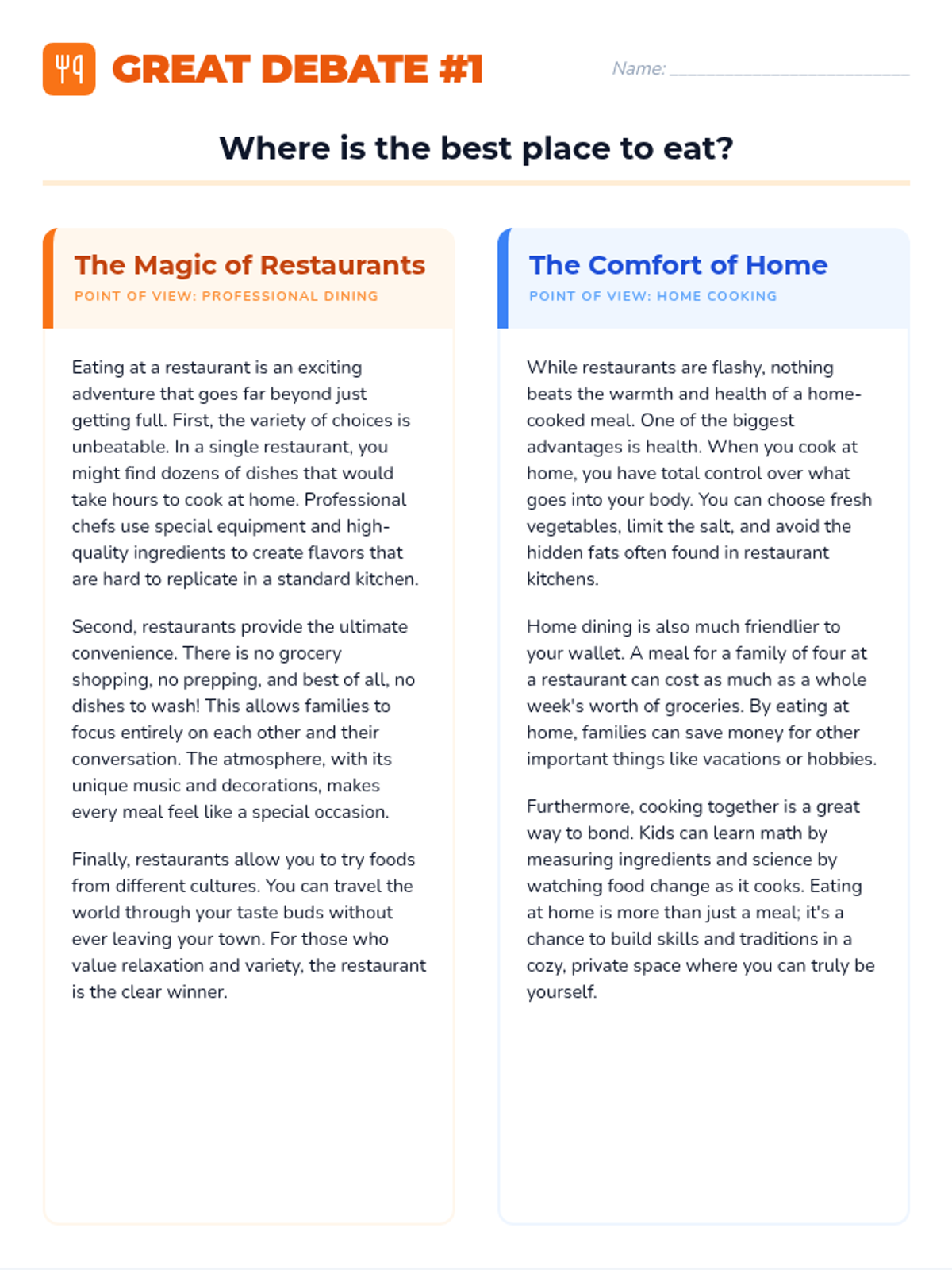
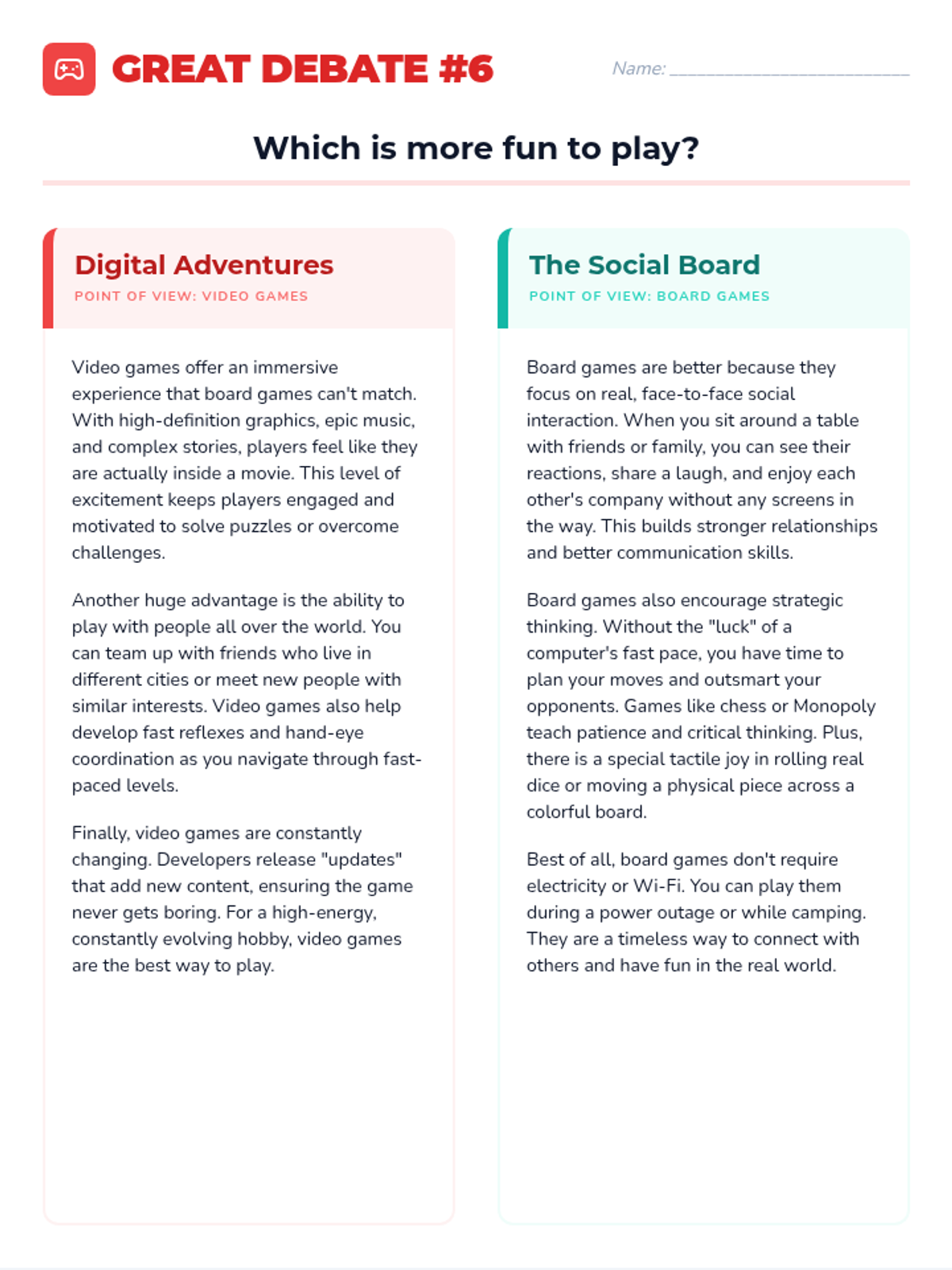
Great Debate Comparison Worksheet
Great Debate Slides
Great Debate Teacher Guide

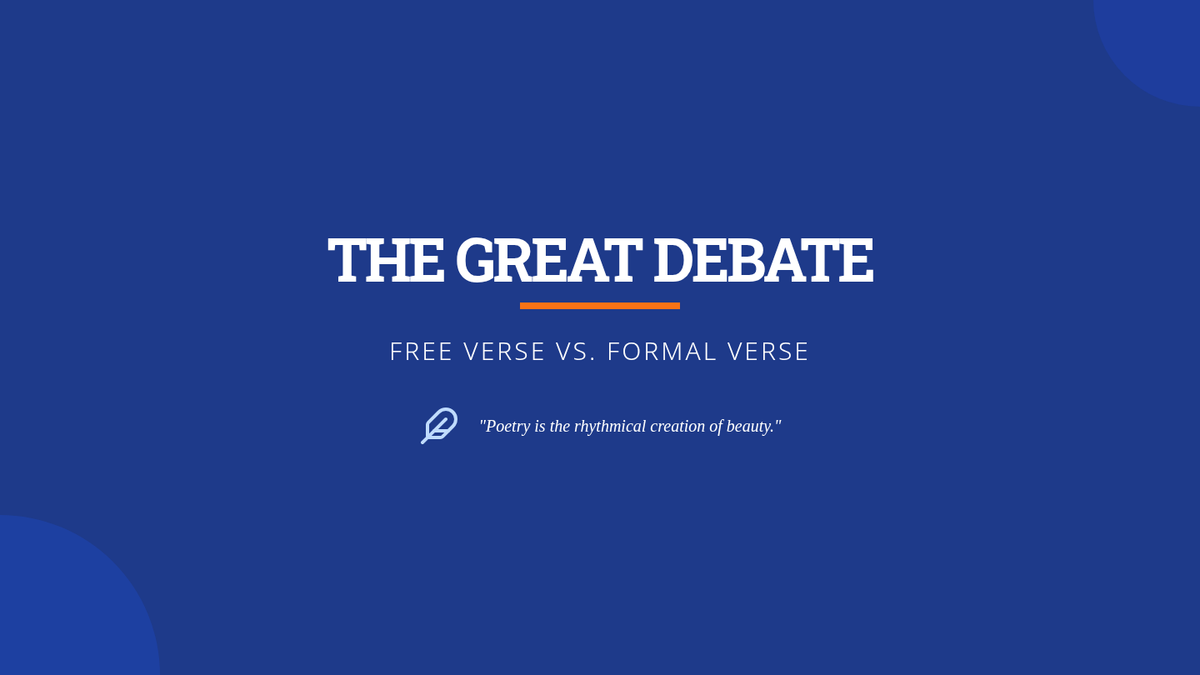
Poetic Patterns

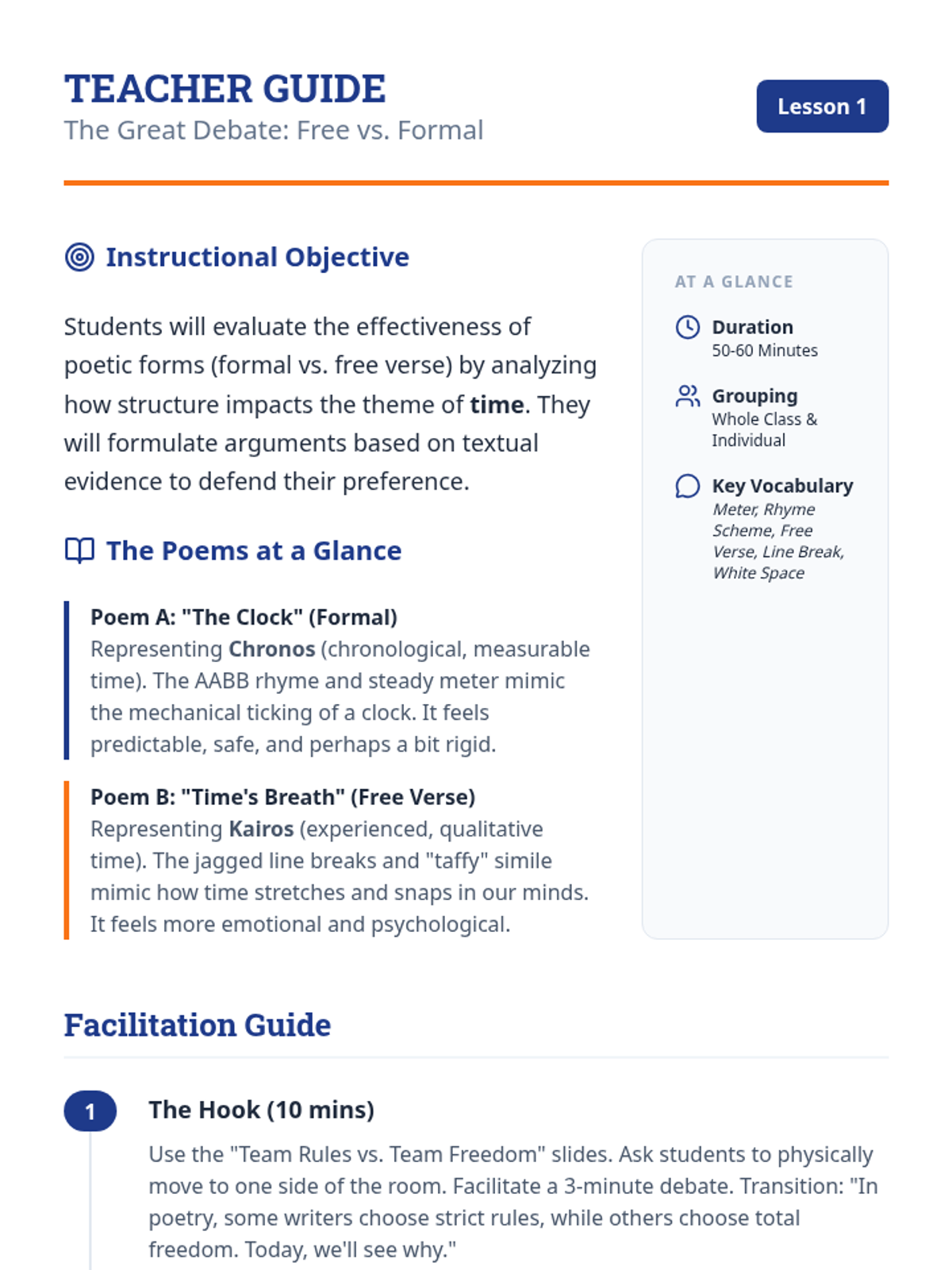
This sequence moves to a higher level of analysis, asking students to compare and contrast how different poetic forms handle similar themes. Using a discussion and case-study approach, students examine 'Free Verse' versus 'Formal Verse' to understand the intentional choices poets make. The arc focuses on critical thinking, debate, and the synthesis of the elements learned in previous sequences.

Lenny Avatar
Lenny
1/18
Sequence
Blueprint for Proof Slides
Claim Tracker Worksheet

Argument Architects

Students investigate how authors build persuasive arguments in nonfiction texts. They learn to trace claims, distinguish between facts and opinions, evaluate the sufficiency of evidence, and detect bias to determine the credibility of a text.

Lenny Avatar
Lenny
1/18
Sequence
Setting Sleuth Slides
Sensory Evidence File Worksheet
Detective Briefing Guide

Setting Sleuths and World Builders

A project-based unit where students investigate how the setting of a novel (historical and geographical) acts as a crucial force in the story, culminating in the creation of a 'World Guide' presentation.

Lenny Avatar
Lenny
1/18
Sequence
Theme Builder Slides
Theme Builder Worksheet
Theme Builder Key

Thematic Threads

A comprehensive 6th-grade ELA unit focused on identifying, tracking, and discussing universal themes in literature. Students move from defining thematic statements to participating in high-level Socratic seminars, using 'The Giver' as a primary text.

Lenny Avatar
Lenny
1/18
Sequence
Foundational Frames Slides
Foundational Frames Worksheet
Foundational Frames Teacher Guide

Plot Blueprint Sequence

A project-based unit where 6th-grade students deconstruct the architecture of storytelling. Students analyze how plot structure, pacing, and tension drive narrative engagement through the lens of a novel study.

Lenny Avatar
Lenny
1/18
Sequence
Word Origins Slides
Word Ancestry Investigation Worksheet

Linguistic Archaeology

This inquiry-driven sequence focuses on etymology as a reference skill, teaching students to trace word origins to understand language evolution and historical context. Students move from decoding individual roots to analyzing how historical events shape the English lexicon, culminating in a 'word biography' project.

Lenny Avatar
Lenny
1/18
Sequence
Wisdom Decoder Slides
Fortune Cookie Worksheet
Wisdom Foundations Teacher Guide

Wisdom of the Ages

This sequence explores adages and proverbs as cultural artifacts that convey values and wisdom. Students distinguish them from idioms, compare global examples, connect them to fables, apply them to modern life, and debate their nuances in a Socratic Seminar.

Lenny Avatar
Lenny
1/18
Sequence
Cell City Slides
Organelle Outpost Worksheet
Cell City Teacher Guide

Logic Blueprints Cross-Curricular Analogies

This sequence connects 6th grade vocabulary standards with science, social studies, and math by using analogies as cognitive tools. Students analyze complex systems and historical events through structural comparisons, culminating in an original analogy-based concept map project.

Lenny Avatar
Lenny
1/18
Sequence
Context Quest Slides
Translator's Log Worksheet
Log Decoder Answer Key

Linguistic Globetrotters

This sequence teaches 6th-grade students how to identify, understand, and use common foreign words and expressions in English. Through a mix of context clue analysis, tone comparison, pronunciation practice, and creative writing, students learn to enhance the sophistication and precision of their communication.

Lenny Avatar
Lenny
1/18
Sequence
Targeted Inquiry Slides
Question Investigator Worksheet

Constructing Evidence-Based Arguments and Briefs

Students learn to research, synthesize, and organize evidence into a structured debate brief, moving from broad curiosity to targeted logical arguments.

Lenny Avatar
Lenny
1/17
Sequence
Argument Armor Slides
Counterclaim Combat Worksheet
Counterclaim Combat Teacher Guide

Argument Armor

A series of lessons focused on mastering the art of persuasion and argumentative writing, from building claims to defending them against opposition.

TH

Terrie Huff

Special Education Teacher
2/17
Sequence
Eternal Forest Guide 1
Reading Companion Teacher Guide
Everlasting Intro Slides

Everlasting Forest Book Club

A comprehensive book club unit for Natalie Babbitt's *Tuck Everlasting*, exploring themes of immortality, nature's cycles, and moral choices through guided discussion, vocabulary expansion, and project-based learning.

KL

Kim Leary

Math Teacher
2/13
Sequence
Mission Briefing Lesson Plan
Operation Order Slides
Task Tracer Worksheet
Blueprint Breakdown Activity
Answer Key Decoders
Decoder Quiz

Smart Strategies Unit

A middle school curriculum unit focused on critical thinking, information literacy, and strategic task management across digital and physical media.

TD

Tondra Dillard-Cobb

Special Education Teacher
2/2
Sequence
Language Toolkit Slides
Reflection Journal Prompts
Language Toolkit Anchor Chart
Grammarian Pledge Cards
Mastering the Toolkit Teacher Guide

Language Toolkit

A lesson sequence exploring the concept of Standard American English as a versatile tool for communication, emphasizing that language varies by context and that all dialects are valid. Students analyze the 'car analogy' from Khan Academy to distinguish between fundamental grammar rules and social conventions.

Lenny Avatar
Lenny
1/19
Sequence
Debate Facilitation Guide
Persuasion Power Slides
Debate Topic Cards
Speech Drafting Sheet
Argument Ace Rubric
Mastering the Blend Essay Planner

Persuasion Mastery

A lesson sequence focused on mastering the three rhetorical appeals (Ethos, Logos, and Pathos) through video analysis and a simulated school debate.

Lenny Avatar
Lenny
1/19
Sequence
Grumpy Guise Slides
Grumpy Grader Rubric
Petty Problems Scenario Cards
Grumpy Script Sheet

Persuasion Power Play

A debate and communication sequence focused on teaching middle schoolers how to build persuasive arguments through creative performance and structured analysis.

Lenny Avatar
Lenny
1/19
Sequence
Cart Ethics Slides
Argument Anatomy Anchor Chart
Seminar Spark Cards
Ethics Log Handout
Seminar Facilitator Guide

Civic Duty and Social Contracts

A lesson sequence exploring the intersection of civic duty, social contracts, and rhetorical analysis through the lens of the 'Shopping Cart Theory'. Students analyze a structured argument and participate in a Socratic Seminar.

Lenny Avatar
Lenny
1/19
Sequence
Argument Blueprints Slides
Argument Blueprint Worksheet
Argument Blueprint Teacher Guide

Argument Blueprints

This sequence focuses on using text structure graphic organizers as blueprints for argumentative writing. Students transition from analyzing model essays to building their own logically structured arguments, including counter-claims and refutations, using visual tools.

Lenny Avatar
Lenny
1/18
Sequence
Onomatopoeia Intro Slides
Soundscape Studio Worksheet
Onomatopoeia Teacher Guide

Sonic Echoes

A 5-lesson unit for 6th-grade students focused on the auditory elements of poetry, including onomatopoeia, alliteration, assonance, repetition, and performance. Students explore how sound creates mood and meaning through game-based learning and performance-oriented analysis.

Lenny Avatar
Lenny
1/18
Sequence
Great Debate Comparison Worksheet
Great Debate Slides
Great Debate Teacher Guide

Poetic Patterns

This sequence moves to a higher level of analysis, asking students to compare and contrast how different poetic forms handle similar themes. Using a discussion and case-study approach, students examine 'Free Verse' versus 'Formal Verse' to understand the intentional choices poets make. The arc focuses on critical thinking, debate, and the synthesis of the elements learned in previous sequences.

Lenny Avatar
Lenny
1/18
Sequence
Soundtrack Tracker Worksheet
Soundtrack Presentation Slides
Soundtrack Teacher Guide

Verse and Vibration

This immersive sequence focuses on the auditory experience of poetry, emphasizing that poems are meant to be heard. Students investigate sound devices like onomatopoeia, alliteration, and consonance to understand how sound creates mood and prepares them for oral performance.

Lenny Avatar
Lenny
1/18
Sequence
Wisdom Decoder Slides
Fortune Cookie Worksheet
Wisdom Foundations Teacher Guide

Wisdom of the Ages

This sequence explores adages and proverbs as cultural artifacts that convey values and wisdom. Students distinguish them from idioms, compare global examples, connect them to fables, apply them to modern life, and debate their nuances in a Socratic Seminar.

Lenny Avatar
Lenny
1/18
Sequence
Baffling Blueprints Teacher Script
Lost in Translation Reflection Sheet

Phrase Phase Sequence

This sequence guides 6th-grade students through the production side of idioms and adages, focusing on when figurative language enhances or hinders communication in various contexts. Students will explore misinterpretation through simulation, adapt their speech for different settings, develop character voices in dialogue, and use proverbs as persuasive tools.

Lenny Avatar
Lenny
1/18
Sequence
Pun Power Slides
Pun Detective Worksheet

Wordplay and Ambiguity

This sequence explores the creative and literary side of homophones and homonyms through puns, riddles, and advertising. Students move from deconstructing humor to creating their own intentional wordplay, culminating in a showcase of their comedic and creative linguistic skills.

Lenny Avatar
Lenny
1/18
Sequence
Rhetoric Revolution Slides
Appeal Appraisal Worksheet
Rhetoric Roadmap Teacher Guide
Appeal Appraisal Answer Key

Argument Arsenal

A comprehensive introduction to the art of persuasion, focusing on rhetorical appeals and crafting compelling arguments for middle school students.

Lenny Avatar
Lenny
1/17
Sequence
Dreamers and Diplomats Slides
Dreamers Handbook Worksheet
Dreamers Handbook Answer Key

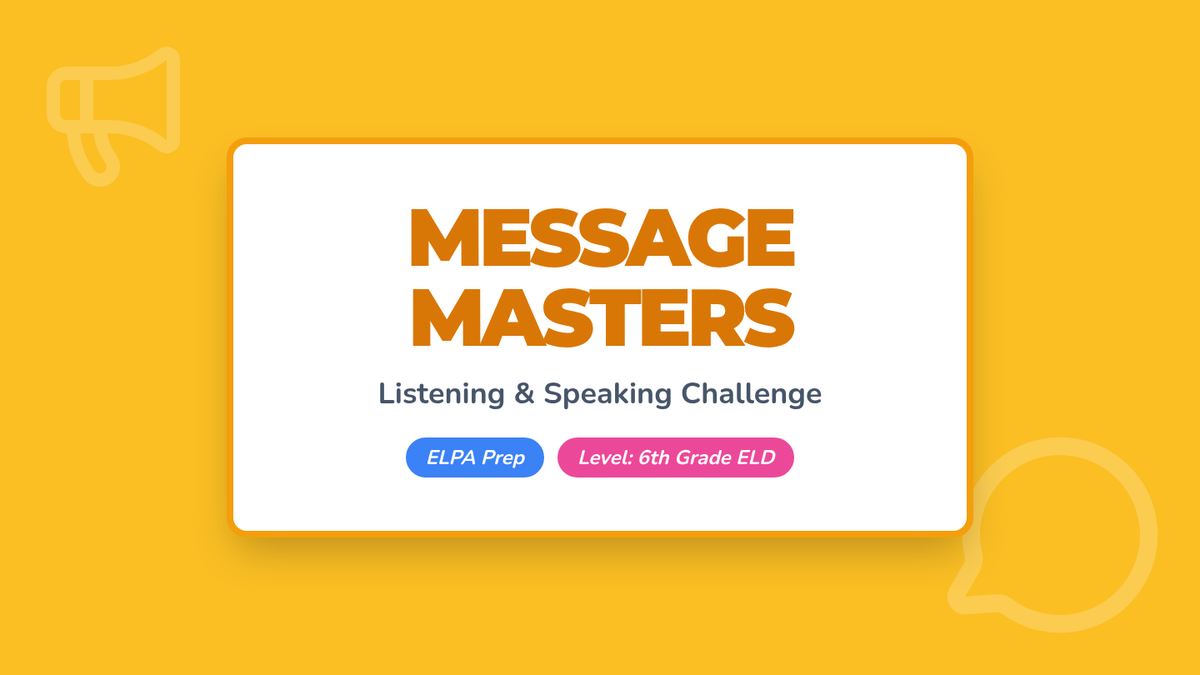
The Subjunctive Protocol

A comprehensive unit on the subjunctive mood, focusing on formal suggestions, demands, and wishes in high-level academic and professional communication. Students engage in simulations and formal writing to master complex grammatical structures.
Lenny Avatar
Lenny
1/17
Sequence
Connotation Intro Slides
Charge Sorting Worksheet

Word Lab Nuance Quest

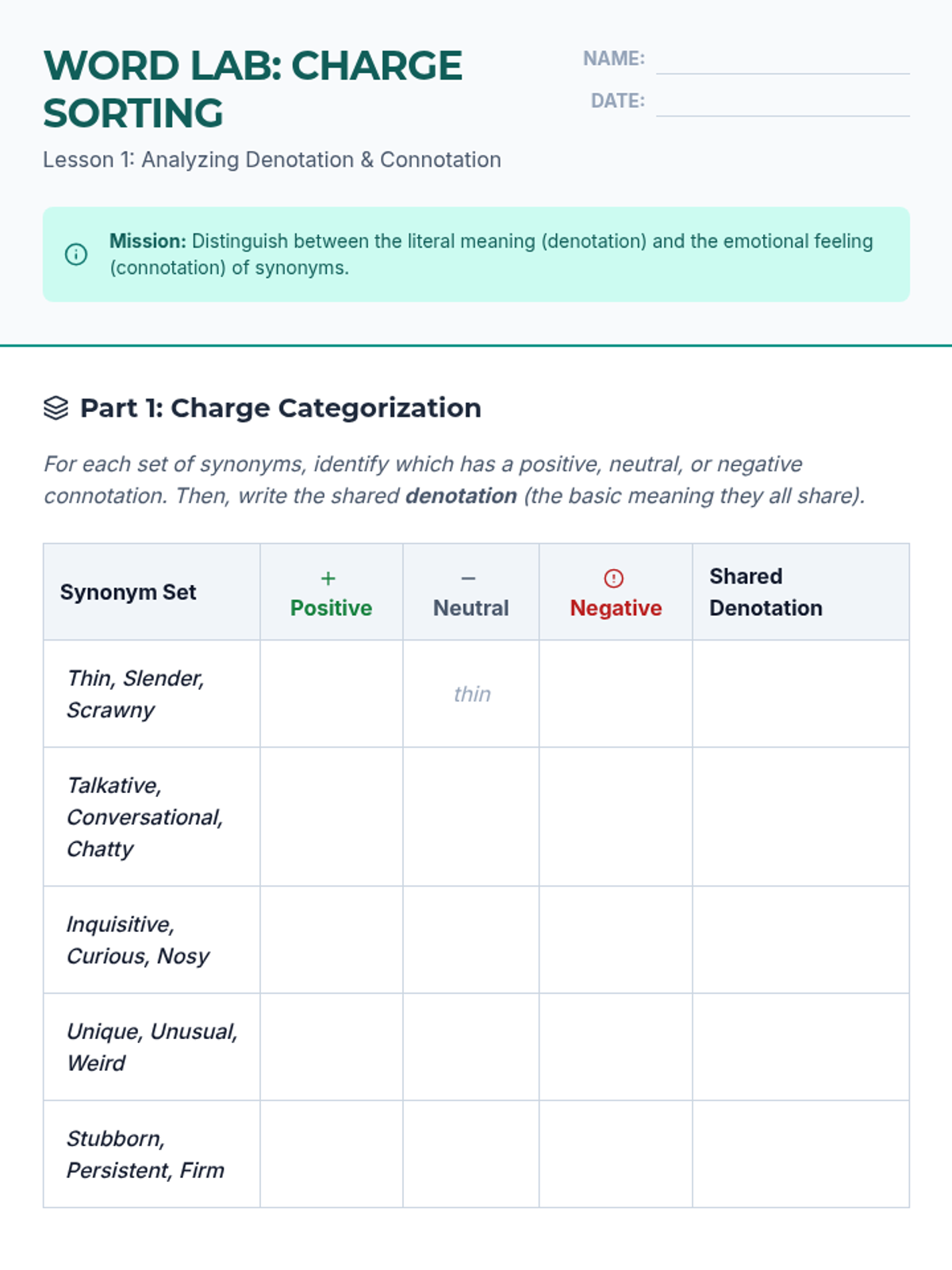
A comprehensive sequence for 6th Grade students to explore the emotional weight and implied meaning of words. Students move from basic definitions to analyzing bias in media and refining their own writing for specific impact.

Lenny Avatar
Lenny
1/17
Sequence
Word Graveyard Teacher Guide
Neologism Detective Worksheet

Word Builders Lab

A project-based ELA sequence where 6th-grade students analyze the morphology of English, use affixes to create neologisms, and pitch inventions named using linguistic rules.

Lenny Avatar
Lenny
1/17
Sequence
Anatomy Argument Slides
Argument Autopsy Worksheet
Anatomy Argument Teacher Guide

Evaluating the Impact of Fallacies in Social Discourse

A middle school ELA unit focusing on the social impact of logical fallacies. Students analyze digital discourse, learn to identify 'whataboutism', practice Socratic discussion, and develop strategies for 'steel-manning' arguments to foster healthier community conversations.

Lenny Avatar
Lenny
1/17
Sequence
Logic Listening Slides
Listening Log Worksheet
Logic Listener Teacher Guide

Logic Lab Debate Sequence

A 5-lesson sequence for 6th-grade students focused on identifying and refuting logical fallacies (Red Herrings and False Dilemmas) in live debate settings. Students develop active listening skills, learn polite rebuttal stems, and apply their knowledge in a structured, logic-focused debate simulation.

Lenny Avatar
Lenny
1/17
Sequence
Cart Ethics Slides
Argument Anatomy Anchor Chart
Seminar Spark Cards
Ethics Log Handout
Seminar Facilitator Guide

Civic Duty and Social Contracts

A lesson sequence exploring the intersection of civic duty, social contracts, and rhetorical analysis through the lens of the 'Shopping Cart Theory'. Students analyze a structured argument and participate in a Socratic Seminar.

Lenny Avatar
Lenny
1/19
Sequence
Brainstorming Blitz Slides
Idea Spark Teacher Guide
Brainstorming Blitz Worksheet

Oral Planning and Composition Strategies

This sequence focuses on the cognitive planning required before activating the microphone, bridging the gap between thought and oral expression. Students explore how to organize their ideas using graphic organizers and bullet points to prevent rambling during dictation.

Lenny Avatar
Lenny
1/18
Sequence
Field Evidence Worksheet
Scene Analysis Slides
Forensic Debrief Teacher Guide

Narrative Detectives

A forensic-themed reading comprehension unit where students act as investigators to master predictions and inferences. Through case studies and evidence tracking, students learn to bridge literal text with deep narrative meaning.

Lenny Avatar
Lenny
1/18
Sequence
Argument Blueprints Slides
Argument Blueprint Worksheet
Argument Blueprint Teacher Guide

Argument Blueprints

This sequence focuses on using text structure graphic organizers as blueprints for argumentative writing. Students transition from analyzing model essays to building their own logically structured arguments, including counter-claims and refutations, using visual tools.

Lenny Avatar
Lenny
1/18
Sequence
Conflict Map Slides
Conflict Tracker Worksheet
Conflict Map Teacher Guide

Character Compass

This inquiry-based sequence explores how character development reveals an author's theme. Students track a protagonist's journey through conflicts and choices to formulate and debate universal truths.

Lenny Avatar
Lenny
1/18
Sequence
Setting Sleuth Slides
Sensory Evidence File Worksheet
Detective Briefing Guide

Setting Sleuths and World Builders

A project-based unit where students investigate how the setting of a novel (historical and geographical) acts as a crucial force in the story, culminating in the creation of a 'World Guide' presentation.

Lenny Avatar
Lenny
1/18
Sequence
Theme Builder Slides
Theme Builder Worksheet
Theme Builder Key

Thematic Threads

A comprehensive 6th-grade ELA unit focused on identifying, tracking, and discussing universal themes in literature. Students move from defining thematic statements to participating in high-level Socratic seminars, using 'The Giver' as a primary text.

Lenny Avatar
Lenny
1/18
Sequence
Foundational Frames Slides
Foundational Frames Worksheet
Foundational Frames Teacher Guide

Plot Blueprint Sequence

A project-based unit where 6th-grade students deconstruct the architecture of storytelling. Students analyze how plot structure, pacing, and tension drive narrative engagement through the lens of a novel study.

Lenny Avatar
Lenny
1/18
Sequence
Word Origins Slides
Word Ancestry Investigation Worksheet

Linguistic Archaeology

This inquiry-driven sequence focuses on etymology as a reference skill, teaching students to trace word origins to understand language evolution and historical context. Students move from decoding individual roots to analyzing how historical events shape the English lexicon, culminating in a 'word biography' project.

Lenny Avatar
Lenny
1/18
Sequence
Targeted Inquiry Slides
Question Investigator Worksheet

Constructing Evidence-Based Arguments and Briefs

Students learn to research, synthesize, and organize evidence into a structured debate brief, moving from broad curiosity to targeted logical arguments.

Lenny Avatar
Lenny
1/17
Sequence
Sample Brief Analysis Worksheet
Blueprint Breakdown Slides
Blueprint Facilitation Guide

Argument Architects

Students move beyond finding sources to organizing scattered information into a structured debate brief. They learn to categorize evidence, rank its strength, and group facts into cohesive reasons to build a powerful argument.

Lenny Avatar
Lenny
1/17
Sequence
Resolution Blueprint Slides
Resolution Blueprint Worksheet
Resolution Blueprint Teacher Guide

Argument Architecture

A project-based sequence where 6th-grade students learn to deconstruct debate resolutions, conduct multi-layered research, and synthesize diverse sources into cohesive arguments. Students progress from initial topic analysis to defending their findings before a peer panel.

Lenny Avatar
Lenny
1/17
Sequence
Case of the Fact Slides
Case of the Fact Worksheet
Case of the Fact Answer Key

Evidence Detectives

This sequence guides 6th-grade students through the process of identifying, categorizing, and evaluating evidence for debate. Students progress from distinguishing facts from opinions to masterfully ranking the quality of evidence based on authority, relevance, and recency.

Lenny Avatar
Lenny
1/17
Sequence
Tag and Cite Worksheet

Organizing Research into Debate Briefs

A sequence for 6th-grade students focused on transforming raw research into organized debate briefs using the 'Tag and Cite' method and the SEP categorization framework. Students learn to structure arguments through the Claim-Warrant-Data-Impact model and practice rapid information retrieval.

Lenny Avatar
Lenny
1/17
Sequence
Search String Slides
Keyword Lab Teacher Guide
Query Quest Worksheet

Data Detectives Research Lab

A comprehensive 4th-grade sequence on research mechanics for debate, covering search strategies, skimming, paraphrasing, quoting, and organization. Students move from raw data to 'clean', ready-to-use debate notes while maintaining academic integrity.

Lenny Avatar
Lenny
1/17
Sequence
Timeline of Terror Slides
Timeline of Terror Worksheet
Timeline of Terror Teacher Guide

Structure and Meaning

Students explore how text structure influences meaning and authorial intent by analyzing multiple texts on the Great Chicago Fire. Each lesson focuses on a different organizational pattern (chronology, problem-solution, cause-effect, and description) to understand how structure shapes the reader's perspective.

Lenny Avatar
Lenny
1/17
Sequence
Bias and Tone Slides
Bias Sleuth Worksheet
Bias and Tone Teacher Guide

Conflicting Perspectives

This sequence focuses on the critical thinking skills required to analyze conflicting information and differing perspectives within informational texts. Students progress from identifying bias and tone to evaluating evidence credibility and synthesizing multiple viewpoints into balanced accounts.

Lenny Avatar
Lenny
1/17
Sequence
Structure Secrets Slides
Titanic Text Set Handout
Architectural Analysis Organizer
Blueprint Basics Teacher Guide

Structure Secrets

A comprehensive 6th-grade ELA unit exploring how authors use text structure (sequence, cause/effect, compare/contrast, problem/solution, description) as a deliberate craft choice to shape reader perspective and emphasize specific information. Students analyze text sets, evaluate persuasive impact, deconstruct mixed structures, and rewrite segments to observe shifts in meaning.

Lenny Avatar
Lenny
1/17
Sequence
Argument Armor Slides
Counterclaim Combat Worksheet
Counterclaim Combat Teacher Guide

Argument Armor

A series of lessons focused on mastering the art of persuasion and argumentative writing, from building claims to defending them against opposition.

TH

Terrie Huff

Special Education Teacher
2/17
Sequence
Gauntlet Slides
Battle Plan Worksheet
Gauntlet Facilitation Guide

Argument Arsenal

A series of lessons focused on mastering argumentative writing through immersive, game-based activities and role-playing scenarios.

MR

Mary Rayburn

English Language Arts Teacher
2/14
Sequence
Grumpy Guise Slides
Grumpy Grader Rubric
Petty Problems Scenario Cards
Grumpy Script Sheet

Persuasion Power Play

A debate and communication sequence focused on teaching middle schoolers how to build persuasive arguments through creative performance and structured analysis.

Lenny Avatar
Lenny
1/19
Sequence
Cart Ethics Slides
Argument Anatomy Anchor Chart
Seminar Spark Cards
Ethics Log Handout
Seminar Facilitator Guide

Civic Duty and Social Contracts

A lesson sequence exploring the intersection of civic duty, social contracts, and rhetorical analysis through the lens of the 'Shopping Cart Theory'. Students analyze a structured argument and participate in a Socratic Seminar.

Lenny Avatar
Lenny
1/19
Sequence
Argument Blueprints Slides
Argument Blueprint Worksheet
Argument Blueprint Teacher Guide

Argument Blueprints

This sequence focuses on using text structure graphic organizers as blueprints for argumentative writing. Students transition from analyzing model essays to building their own logically structured arguments, including counter-claims and refutations, using visual tools.

Lenny Avatar
Lenny
1/18
Sequence
Conflict Map Slides
Conflict Tracker Worksheet
Conflict Map Teacher Guide

Character Compass

This inquiry-based sequence explores how character development reveals an author's theme. Students track a protagonist's journey through conflicts and choices to formulate and debate universal truths.

Lenny Avatar
Lenny
1/18
Sequence
Great Debate Comparison Worksheet
Great Debate Slides
Great Debate Teacher Guide

Poetic Patterns

This sequence moves to a higher level of analysis, asking students to compare and contrast how different poetic forms handle similar themes. Using a discussion and case-study approach, students examine 'Free Verse' versus 'Formal Verse' to understand the intentional choices poets make. The arc focuses on critical thinking, debate, and the synthesis of the elements learned in previous sequences.

Lenny Avatar
Lenny
1/18
Sequence
Foundational Frames Slides
Foundational Frames Worksheet
Foundational Frames Teacher Guide

Plot Blueprint Sequence

A project-based unit where 6th-grade students deconstruct the architecture of storytelling. Students analyze how plot structure, pacing, and tension drive narrative engagement through the lens of a novel study.

Lenny Avatar
Lenny
1/18
Sequence
Cool Under Fire Slides
Statue Challenge Worksheet
Composure Coaching Guide

Defensive Speaking and Responding Under Pressure

A sequence focused on the defensive side of debate, teaching 6th-grade students how to maintain composure, identify rhetorical traps, and pivot back to evidence during cross-examination. Students will move from non-verbal techniques to full-scale rapid-fire defense simulations.

Lenny Avatar
Lenny
1/18
Sequence
Wisdom Decoder Slides
Fortune Cookie Worksheet
Wisdom Foundations Teacher Guide

Wisdom of the Ages

This sequence explores adages and proverbs as cultural artifacts that convey values and wisdom. Students distinguish them from idioms, compare global examples, connect them to fables, apply them to modern life, and debate their nuances in a Socratic Seminar.

Lenny Avatar
Lenny
1/18
Sequence
Cell City Slides
Organelle Outpost Worksheet
Cell City Teacher Guide

Logic Blueprints Cross-Curricular Analogies

This sequence connects 6th grade vocabulary standards with science, social studies, and math by using analogies as cognitive tools. Students analyze complex systems and historical events through structural comparisons, culminating in an original analogy-based concept map project.

Lenny Avatar
Lenny
1/18
Sequence
Targeted Inquiry Slides
Question Investigator Worksheet

Constructing Evidence-Based Arguments and Briefs

Students learn to research, synthesize, and organize evidence into a structured debate brief, moving from broad curiosity to targeted logical arguments.

Lenny Avatar
Lenny
1/17
Sequence
Dreamers and Diplomats Slides
Dreamers Handbook Worksheet
Dreamers Handbook Answer Key

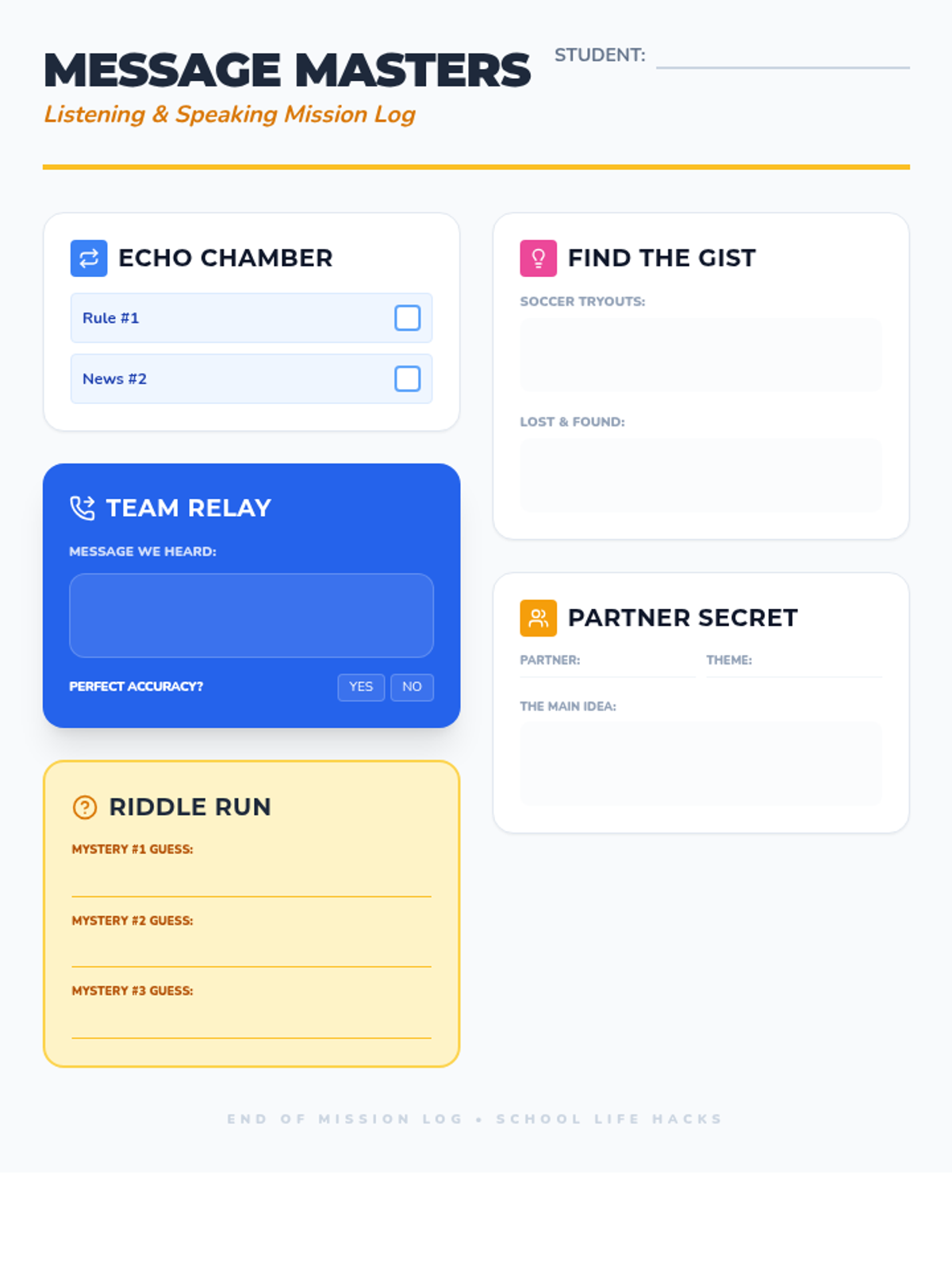
The Subjunctive Protocol

A comprehensive unit on the subjunctive mood, focusing on formal suggestions, demands, and wishes in high-level academic and professional communication. Students engage in simulations and formal writing to master complex grammatical structures.
Lenny Avatar
Lenny
1/17
Sequence
Connotation Intro Slides
Charge Sorting Worksheet

Word Lab Nuance Quest

A comprehensive sequence for 6th Grade students to explore the emotional weight and implied meaning of words. Students move from basic definitions to analyzing bias in media and refining their own writing for specific impact.

Lenny Avatar
Lenny
1/17
Sequence
Anatomy Argument Slides
Argument Autopsy Worksheet
Anatomy Argument Teacher Guide

Evaluating the Impact of Fallacies in Social Discourse

A middle school ELA unit focusing on the social impact of logical fallacies. Students analyze digital discourse, learn to identify 'whataboutism', practice Socratic discussion, and develop strategies for 'steel-manning' arguments to foster healthier community conversations.

Lenny Avatar
Lenny
1/17
Sequence
Logic Listening Slides
Listening Log Worksheet
Logic Listener Teacher Guide

Logic Lab Debate Sequence

A 5-lesson sequence for 6th-grade students focused on identifying and refuting logical fallacies (Red Herrings and False Dilemmas) in live debate settings. Students develop active listening skills, learn polite rebuttal stems, and apply their knowledge in a structured, logic-focused debate simulation.

Lenny Avatar
Lenny
1/17
Sequence
Persuasion Lab Slides
Manipulation Meter Worksheet
Persuasion vs Manipulation Teacher Guide

Logic Lab Media Detectives

A middle school ELA sequence focused on identifying and deconstructing logical fallacies in modern media, culminating in a critical analysis project. Students learn to distinguish between ethical persuasion and manipulative tactics like False Authority, False Dilemmas, and Straw Man arguments.

Lenny Avatar
Lenny
1/17
Sequence
Building House Slides
Argument Blueprint Worksheet
Structural Integrity Guide

Argument Architects

A workshop-style series designed to help 7th grade students strengthen their persuasive writing and speaking by identifying and eliminating logical fallacies. Students learn the Claim-Evidence-Warrant model and focus on avoiding Hasty Generalizations, Red Herrings, and Circular Reasoning.

Lenny Avatar
Lenny
1/17
Sequence
Claim Conviction Slides
Statement Sorting Worksheet
Claim Conviction Answer Key

Claim Commanders

This sequence teaches 6th-grade students how to construct strong, debatable argumentative claims. Students move from identifying facts and opinions to crafting authoritative thesis statements with reasoning, ultimately testing their arguments through a town hall simulation and counter-claim analysis.

Lenny Avatar
Lenny
1/17
Sequence
Spar Mastery Slides
Spar Combat Handout
Spar Starter Teacher Guide

Applied Rebuttal and Spar Strategies

This sequence synthesizes refutation, weighing, and listening into short-form 'Spar' debates. Students learn to prioritize arguments, extend logic, and judge peer performances to build adaptability and engagement skills under strict time constraints.

Lenny Avatar
Lenny
1/17
Sequence
Gauntlet Slides
Battle Plan Worksheet
Gauntlet Facilitation Guide

Argument Arsenal

A series of lessons focused on mastering argumentative writing through immersive, game-based activities and role-playing scenarios.

MR

Mary Rayburn

English Language Arts Teacher
2/14
Sequence
Grumpy Guise Slides
Grumpy Grader Rubric
Petty Problems Scenario Cards
Grumpy Script Sheet

Persuasion Power Play

A debate and communication sequence focused on teaching middle schoolers how to build persuasive arguments through creative performance and structured analysis.

Lenny Avatar
Lenny
1/19
Sequence
Cart Ethics Slides
Argument Anatomy Anchor Chart
Seminar Spark Cards
Ethics Log Handout
Seminar Facilitator Guide

Civic Duty and Social Contracts

A lesson sequence exploring the intersection of civic duty, social contracts, and rhetorical analysis through the lens of the 'Shopping Cart Theory'. Students analyze a structured argument and participate in a Socratic Seminar.

Lenny Avatar
Lenny
1/19
Sequence
Brainstorming Blitz Slides
Idea Spark Teacher Guide
Brainstorming Blitz Worksheet

Oral Planning and Composition Strategies

This sequence focuses on the cognitive planning required before activating the microphone, bridging the gap between thought and oral expression. Students explore how to organize their ideas using graphic organizers and bullet points to prevent rambling during dictation.

Lenny Avatar
Lenny
1/18
Sequence
Field Evidence Worksheet
Scene Analysis Slides
Forensic Debrief Teacher Guide

Narrative Detectives

A forensic-themed reading comprehension unit where students act as investigators to master predictions and inferences. Through case studies and evidence tracking, students learn to bridge literal text with deep narrative meaning.

Lenny Avatar
Lenny
1/18
Sequence
Argument Blueprints Slides
Argument Blueprint Worksheet
Argument Blueprint Teacher Guide

Argument Blueprints

This sequence focuses on using text structure graphic organizers as blueprints for argumentative writing. Students transition from analyzing model essays to building their own logically structured arguments, including counter-claims and refutations, using visual tools.

Lenny Avatar
Lenny
1/18
Sequence
Conflict Map Slides
Conflict Tracker Worksheet
Conflict Map Teacher Guide

Character Compass

This inquiry-based sequence explores how character development reveals an author's theme. Students track a protagonist's journey through conflicts and choices to formulate and debate universal truths.

Lenny Avatar
Lenny
1/18
Sequence
Blueprint for Proof Slides
Claim Tracker Worksheet

Argument Architects

Students investigate how authors build persuasive arguments in nonfiction texts. They learn to trace claims, distinguish between facts and opinions, evaluate the sufficiency of evidence, and detect bias to determine the credibility of a text.

Lenny Avatar
Lenny
1/18
Sequence
Foundational Frames Slides
Foundational Frames Worksheet
Foundational Frames Teacher Guide

Plot Blueprint Sequence

A project-based unit where 6th-grade students deconstruct the architecture of storytelling. Students analyze how plot structure, pacing, and tension drive narrative engagement through the lens of a novel study.

Lenny Avatar
Lenny
1/18
Sequence
Wisdom Decoder Slides
Fortune Cookie Worksheet
Wisdom Foundations Teacher Guide

Wisdom of the Ages

This sequence explores adages and proverbs as cultural artifacts that convey values and wisdom. Students distinguish them from idioms, compare global examples, connect them to fables, apply them to modern life, and debate their nuances in a Socratic Seminar.

Lenny Avatar
Lenny
1/18
Sequence
Targeted Inquiry Slides
Question Investigator Worksheet

Constructing Evidence-Based Arguments and Briefs

Students learn to research, synthesize, and organize evidence into a structured debate brief, moving from broad curiosity to targeted logical arguments.

Lenny Avatar
Lenny
1/17
Sequence
Sample Brief Analysis Worksheet
Blueprint Breakdown Slides
Blueprint Facilitation Guide

Argument Architects

Students move beyond finding sources to organizing scattered information into a structured debate brief. They learn to categorize evidence, rank its strength, and group facts into cohesive reasons to build a powerful argument.

Lenny Avatar
Lenny
1/17
Sequence
Dreamers and Diplomats Slides
Dreamers Handbook Worksheet
Dreamers Handbook Answer Key

The Subjunctive Protocol

A comprehensive unit on the subjunctive mood, focusing on formal suggestions, demands, and wishes in high-level academic and professional communication. Students engage in simulations and formal writing to master complex grammatical structures.
Lenny Avatar
Lenny
1/17
Sequence
Etymology Intro Slides
Word Origins Worksheet

Word Detectives: The Secret Life of Language

Students become linguistic historians, investigating the etymology, cultural origins, and evolution of advanced English vocabulary through research and creative projects.

Lenny Avatar
Lenny
1/17
Sequence
Logic Listening Slides
Listening Log Worksheet
Logic Listener Teacher Guide

Logic Lab Debate Sequence

A 5-lesson sequence for 6th-grade students focused on identifying and refuting logical fallacies (Red Herrings and False Dilemmas) in live debate settings. Students develop active listening skills, learn polite rebuttal stems, and apply their knowledge in a structured, logic-focused debate simulation.

Lenny Avatar
Lenny
1/17
Sequence
Claim Conviction Slides
Statement Sorting Worksheet
Claim Conviction Answer Key

Claim Commanders

This sequence teaches 6th-grade students how to construct strong, debatable argumentative claims. Students move from identifying facts and opinions to crafting authoritative thesis statements with reasoning, ultimately testing their arguments through a town hall simulation and counter-claim analysis.

Lenny Avatar
Lenny
1/17
Sequence
Confusion Slides
News Blunder Analysis Worksheet
Case Study Teacher Guide

Precision in Informational Writing

A journalism-themed sequence where 6th-grade students master pronoun-antecedent agreement by writing and editing news reports, exploring how grammatical precision prevents misinformation and libel.

Lenny Avatar
Lenny
1/17
Sequence
Spar Mastery Slides
Spar Combat Handout
Spar Starter Teacher Guide

Applied Rebuttal and Spar Strategies

This sequence synthesizes refutation, weighing, and listening into short-form 'Spar' debates. Students learn to prioritize arguments, extend logic, and judge peer performances to build adaptability and engagement skills under strict time constraints.
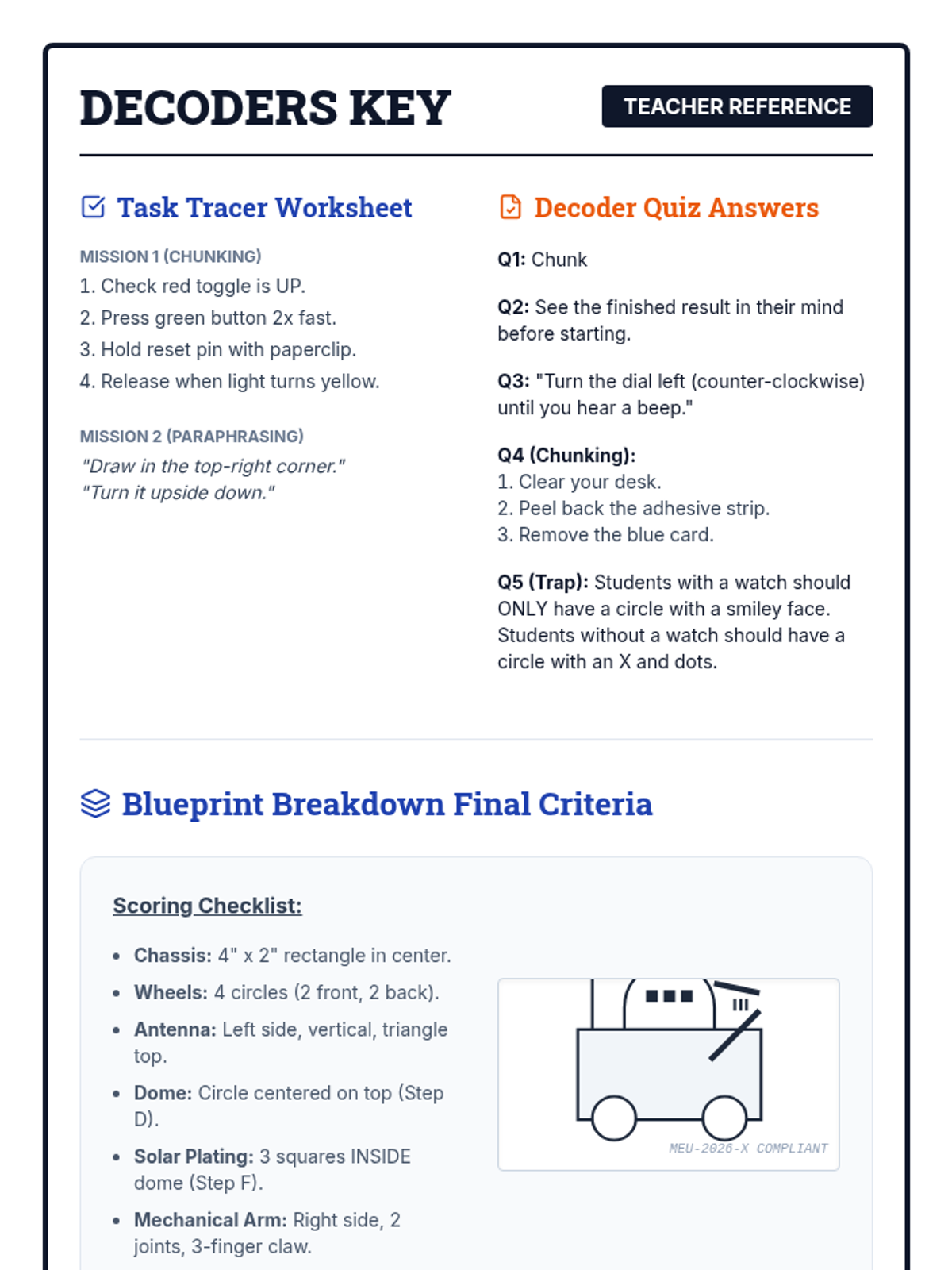
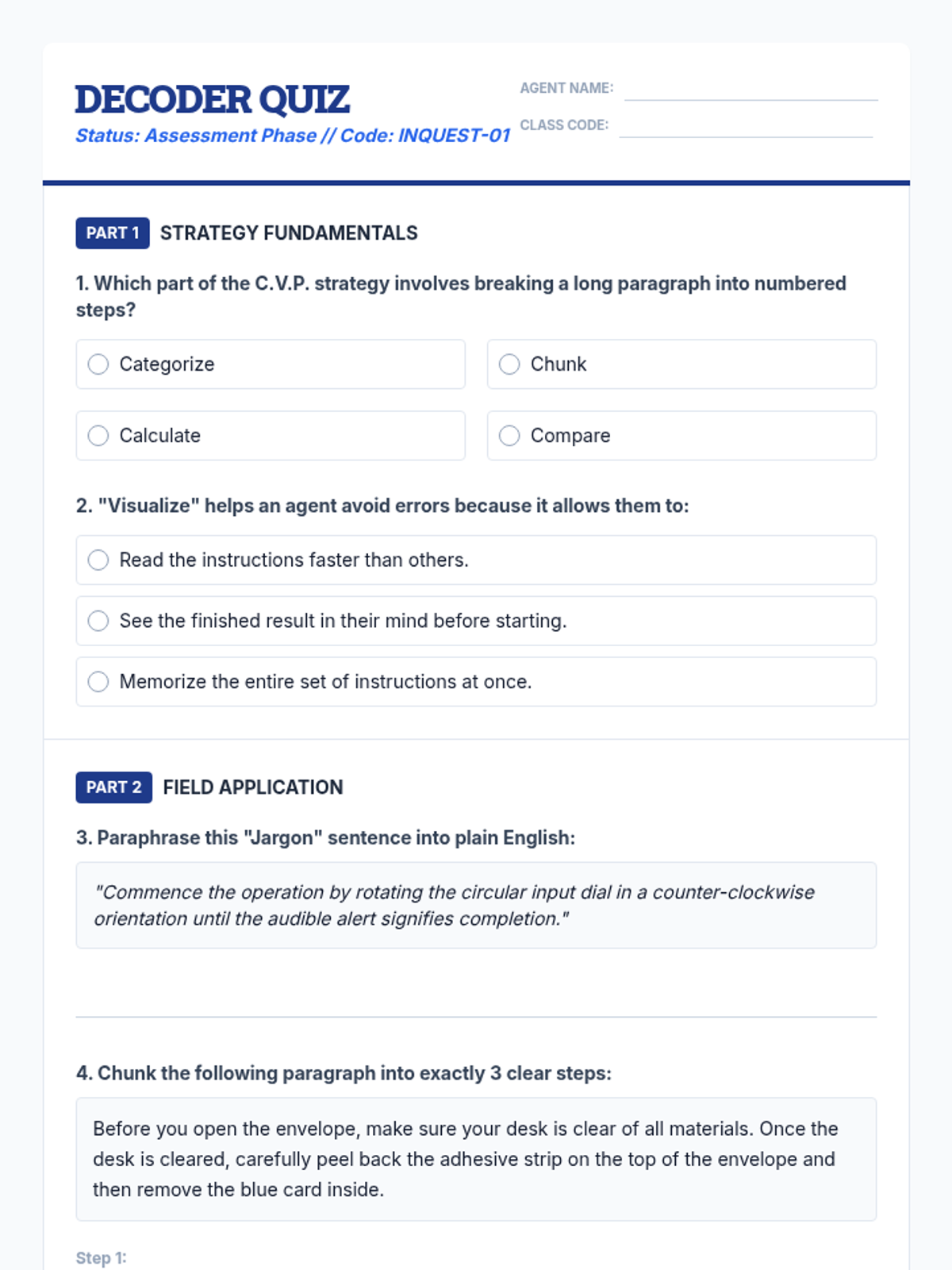
Lenny Avatar
Lenny
1/17
Sequence
Quest Purpose Teacher Guide
Mission Intel Worksheet

Cross Examination Strategies and Techniques

A comprehensive unit on Cross-Examination for middle school debaters, focusing on strategic questioning, rhetorical control, and integrating admissions into rebuttal speeches. Students move from understanding the purpose of questioning to executing complex 'question traps' in high-pressure simulations.
Lenny Avatar
Lenny
1/17
Sequence
Flowing Basics Slides
Flow Foundation Worksheet
Flowing Intro Teacher Guide

Argument Tracking and Refutation

A technical debate unit for 6th graders focused on 'flowing' (note-taking), shorthand symbols, tracking argument exchanges, and mastering line-by-line refutation to ensure no argument is left unanswered.

Lenny Avatar
Lenny
1/17
Sequence
Argument Armor Slides
Counterclaim Combat Worksheet
Counterclaim Combat Teacher Guide

Argument Armor

A series of lessons focused on mastering the art of persuasion and argumentative writing, from building claims to defending them against opposition.

TH

Terrie Huff

Special Education Teacher
2/17
Sequence
Mission Briefing Lesson Plan
Operation Order Slides
Task Tracer Worksheet
Blueprint Breakdown Activity
Answer Key Decoders
Decoder Quiz

Smart Strategies Unit

A middle school curriculum unit focused on critical thinking, information literacy, and strategic task management across digital and physical media.

TD

Tondra Dillard-Cobb

Special Education Teacher
2/2
Sequence
Debate Facilitation Guide
Persuasion Power Slides
Debate Topic Cards
Speech Drafting Sheet
Argument Ace Rubric
Mastering the Blend Essay Planner

Persuasion Mastery

A lesson sequence focused on mastering the three rhetorical appeals (Ethos, Logos, and Pathos) through video analysis and a simulated school debate.

Lenny Avatar
Lenny
1/19
Sequence
Conflict Map Slides
Conflict Tracker Worksheet
Conflict Map Teacher Guide

Character Compass

This inquiry-based sequence explores how character development reveals an author's theme. Students track a protagonist's journey through conflicts and choices to formulate and debate universal truths.

Lenny Avatar
Lenny
1/18
Sequence
Great Debate Comparison Worksheet
Great Debate Slides
Great Debate Teacher Guide

Poetic Patterns

This sequence moves to a higher level of analysis, asking students to compare and contrast how different poetic forms handle similar themes. Using a discussion and case-study approach, students examine 'Free Verse' versus 'Formal Verse' to understand the intentional choices poets make. The arc focuses on critical thinking, debate, and the synthesis of the elements learned in previous sequences.
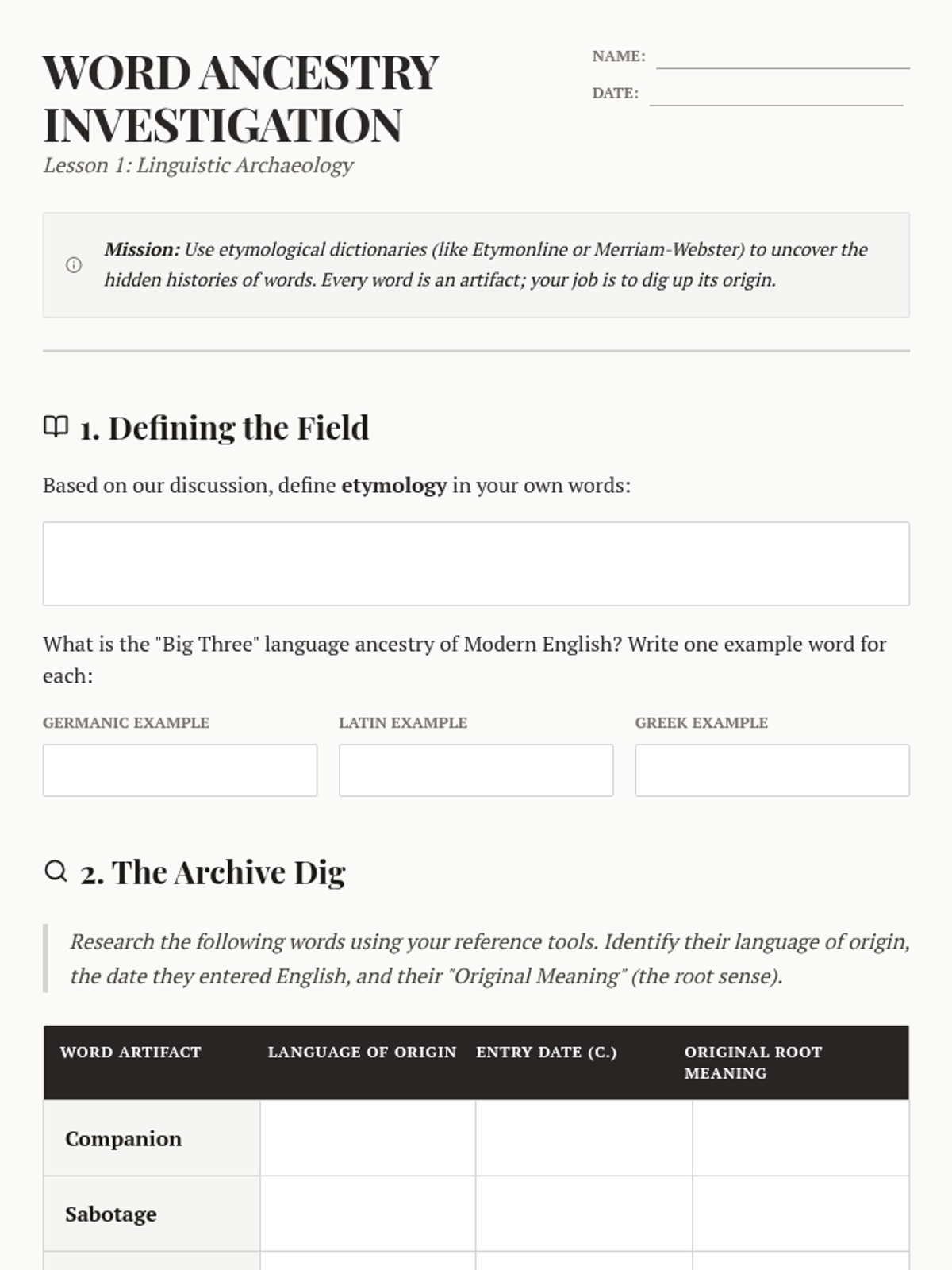
Lenny Avatar
Lenny
1/18
Sequence
Blueprint for Proof Slides
Claim Tracker Worksheet

Argument Architects

Students investigate how authors build persuasive arguments in nonfiction texts. They learn to trace claims, distinguish between facts and opinions, evaluate the sufficiency of evidence, and detect bias to determine the credibility of a text.
Lenny Avatar
Lenny
1/18
Sequence
Theme Builder Slides
Theme Builder Worksheet
Theme Builder Key

Thematic Threads

A comprehensive 6th-grade ELA unit focused on identifying, tracking, and discussing universal themes in literature. Students move from defining thematic statements to participating in high-level Socratic seminars, using 'The Giver' as a primary text.

Lenny Avatar
Lenny
1/18
Sequence
Wisdom Decoder Slides
Fortune Cookie Worksheet
Wisdom Foundations Teacher Guide

Wisdom of the Ages

This sequence explores adages and proverbs as cultural artifacts that convey values and wisdom. Students distinguish them from idioms, compare global examples, connect them to fables, apply them to modern life, and debate their nuances in a Socratic Seminar.

Lenny Avatar
Lenny
1/18
Sequence
Baffling Blueprints Teacher Script
Lost in Translation Reflection Sheet

Phrase Phase Sequence

This sequence guides 6th-grade students through the production side of idioms and adages, focusing on when figurative language enhances or hinders communication in various contexts. Students will explore misinterpretation through simulation, adapt their speech for different settings, develop character voices in dialogue, and use proverbs as persuasive tools.

Lenny Avatar
Lenny
1/18
Sequence
Cell City Slides
Organelle Outpost Worksheet
Cell City Teacher Guide

Logic Blueprints Cross-Curricular Analogies

This sequence connects 6th grade vocabulary standards with science, social studies, and math by using analogies as cognitive tools. Students analyze complex systems and historical events through structural comparisons, culminating in an original analogy-based concept map project.

Lenny Avatar
Lenny
1/18
Sequence
Rhetoric Revolution Slides
Appeal Appraisal Worksheet
Rhetoric Roadmap Teacher Guide
Appeal Appraisal Answer Key

Argument Arsenal

A comprehensive introduction to the art of persuasion, focusing on rhetorical appeals and crafting compelling arguments for middle school students.

Lenny Avatar
Lenny
1/17
Sequence
Connotation Intro Slides
Charge Sorting Worksheet

Word Lab Nuance Quest

A comprehensive sequence for 6th Grade students to explore the emotional weight and implied meaning of words. Students move from basic definitions to analyzing bias in media and refining their own writing for specific impact.

Lenny Avatar
Lenny
1/17
Sequence
Persuasion Lab Slides
Manipulation Meter Worksheet
Persuasion vs Manipulation Teacher Guide

Logic Lab Media Detectives

A middle school ELA sequence focused on identifying and deconstructing logical fallacies in modern media, culminating in a critical analysis project. Students learn to distinguish between ethical persuasion and manipulative tactics like False Authority, False Dilemmas, and Straw Man arguments.

Lenny Avatar
Lenny
1/17
Sequence
Claim Conviction Slides
Statement Sorting Worksheet
Claim Conviction Answer Key

Claim Commanders

This sequence teaches 6th-grade students how to construct strong, debatable argumentative claims. Students move from identifying facts and opinions to crafting authoritative thesis statements with reasoning, ultimately testing their arguments through a town hall simulation and counter-claim analysis.

Lenny Avatar
Lenny
1/17
Sequence
Logic Lab Slides
Fallacy Field Guide Handout
Gallery Walk Case Log
Logic Lab Teacher Guide

Fallacy Detectives

A comprehensive sequence for 6th-grade students to identify and challenge logical fallacies in debate. Students act as 'Fallacy Detectives' to uncover errors in reasoning like Ad Hominem, Straw Man, and Slippery Slope.

Lenny Avatar
Lenny
1/17
Sequence
Vantage Point Slides
Story Ownership Worksheet
Memoir Master Teacher Guide

Vantage Point

A 6th-grade ELA unit exploring how point of view shapes nonfiction and media. Students analyze the differences between first-person memoirs and third-person biographies, identify bias in journalism, and examine historical narratives through multiple lenses.

Lenny Avatar
Lenny
1/17
Sequence
Trust the Storyteller Slides
Broken Window Case Worksheet
Reliability Investigator Teacher Guide

Narrator Files Inquiry

In this 6th-grade ELA sequence, students move beyond identifying point of view to analyzing narrator reliability and bias. Through flipped fairy tales, investigative case studies, and a final synthesis seminar, students explore how a storyteller's perspective shapes the reader's understanding of the truth.

Lenny Avatar
Lenny
1/17
Sequence
Case of the Fact Slides
Case of the Fact Worksheet
Case of the Fact Answer Key

Evidence Detectives

This sequence guides 6th-grade students through the process of identifying, categorizing, and evaluating evidence for debate. Students progress from distinguishing facts from opinions to masterfully ranking the quality of evidence based on authority, relevance, and recency.

Lenny Avatar
Lenny
1/17
Sequence
Elevator Pitch Slides
Thirty Second Storyboard Worksheet
Elevator Pitch Teacher Guide

Persuasive Powerhouse

A project-based writing sequence focused on crafting powerful introductions and conclusions using rhetorical strategies like ethos, pathos, and counter-arguments. Students move from 30-second elevator pitches to full persuasive presentations, learning how to 'hook' an audience and leave a lasting emotional impact.

Lenny Avatar
Lenny
1/17
Sequence
Timeline of Terror Slides
Timeline of Terror Worksheet
Timeline of Terror Teacher Guide

Structure and Meaning

Students explore how text structure influences meaning and authorial intent by analyzing multiple texts on the Great Chicago Fire. Each lesson focuses on a different organizational pattern (chronology, problem-solution, cause-effect, and description) to understand how structure shapes the reader's perspective.

Lenny Avatar
Lenny
1/17