Fundamental techniques for racket sports, track and field, and gymnastics maneuvers. Develops physical literacy through martial arts disciplines and self-defense strategies.
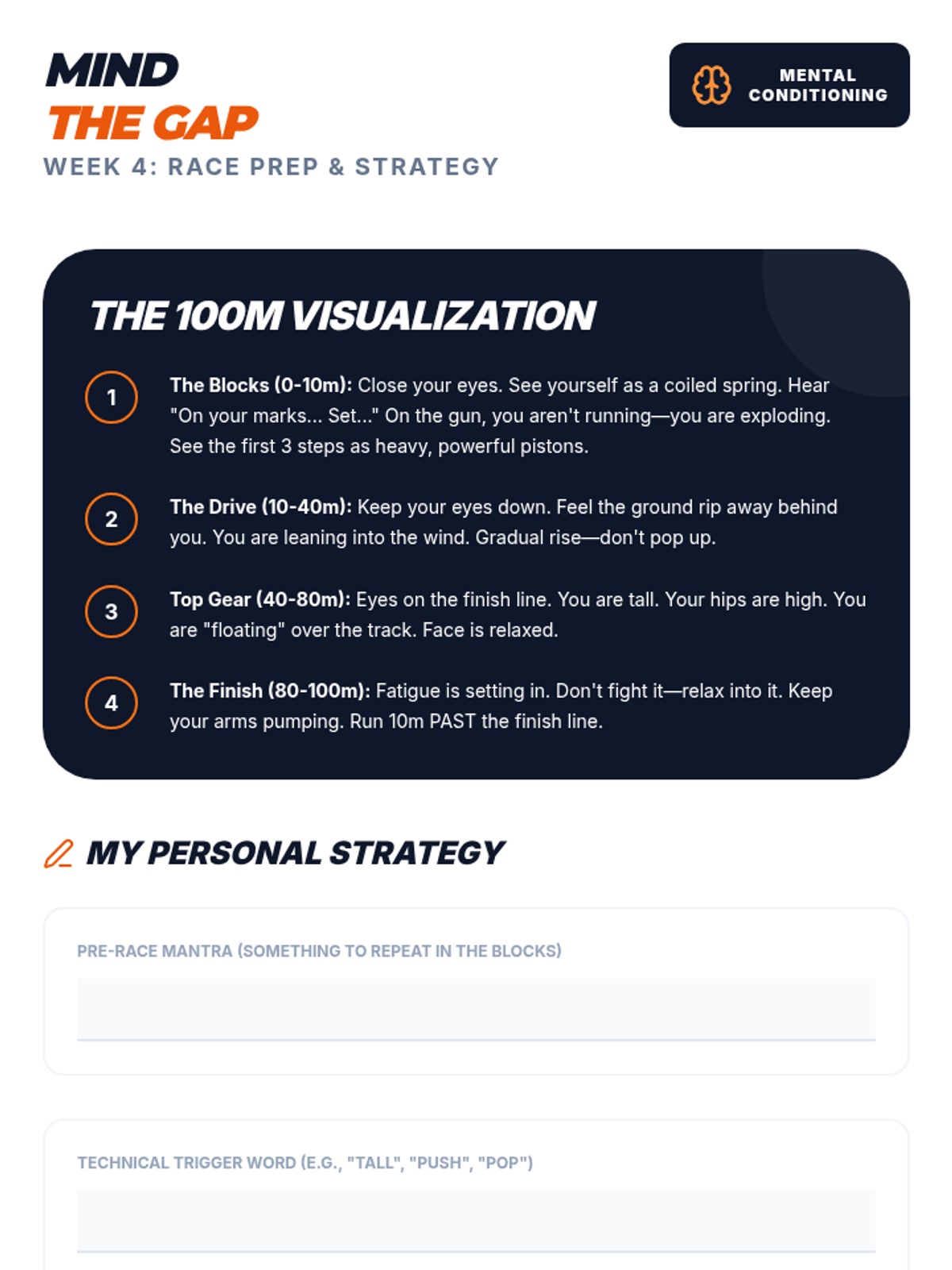
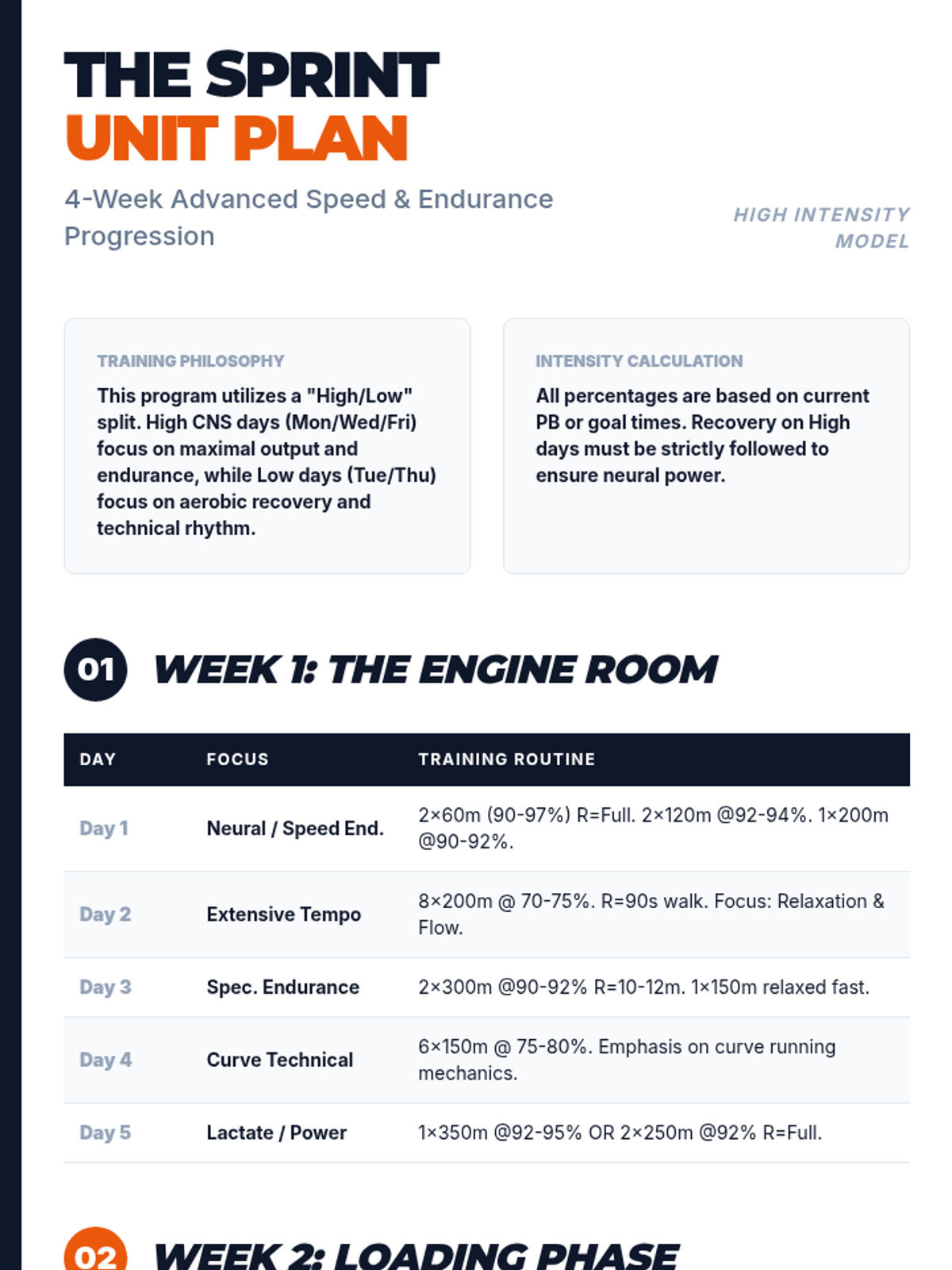
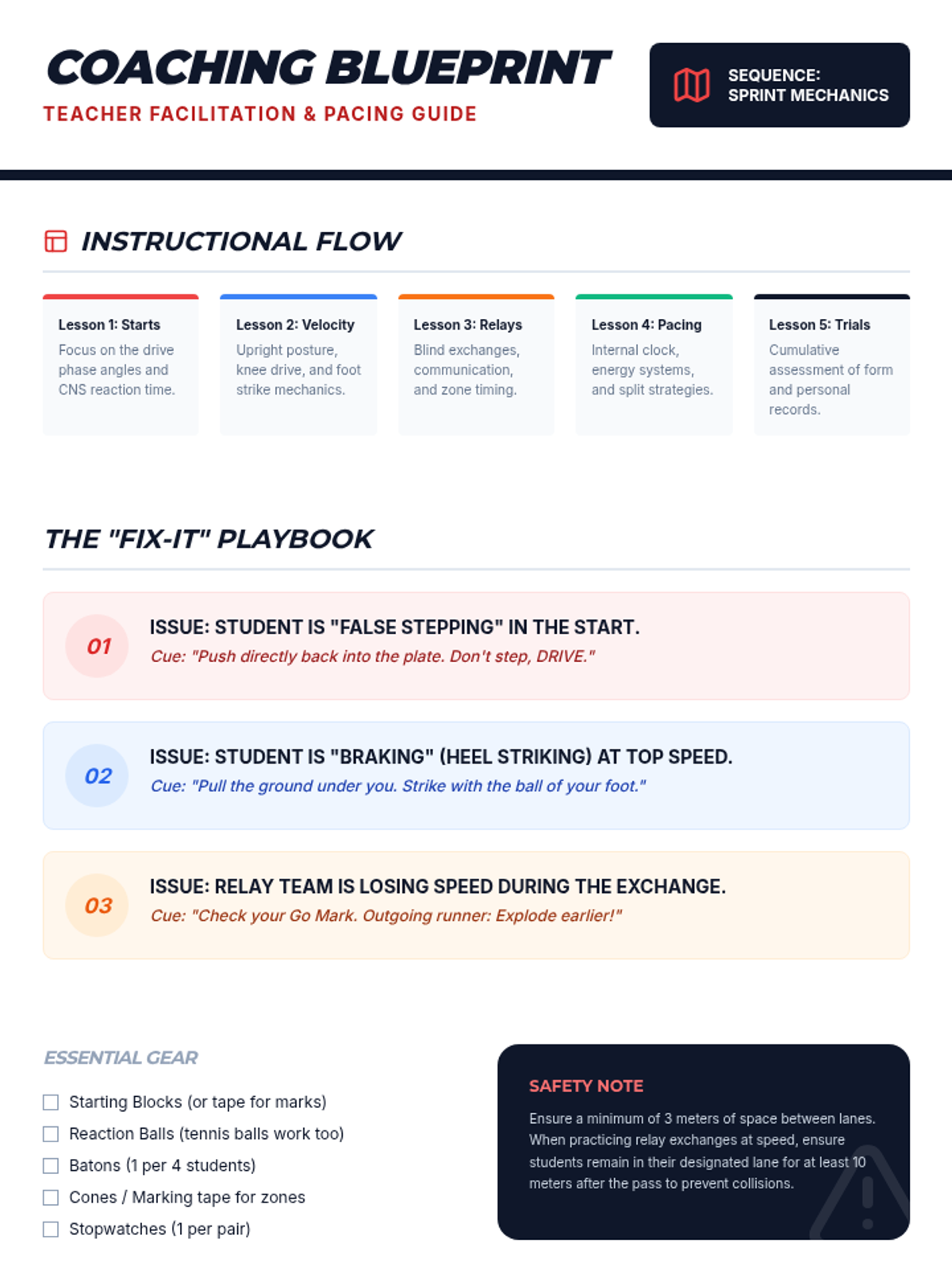
Fine-tuning starts, speed endurance intervals, and preparing for competition-style sprinting.
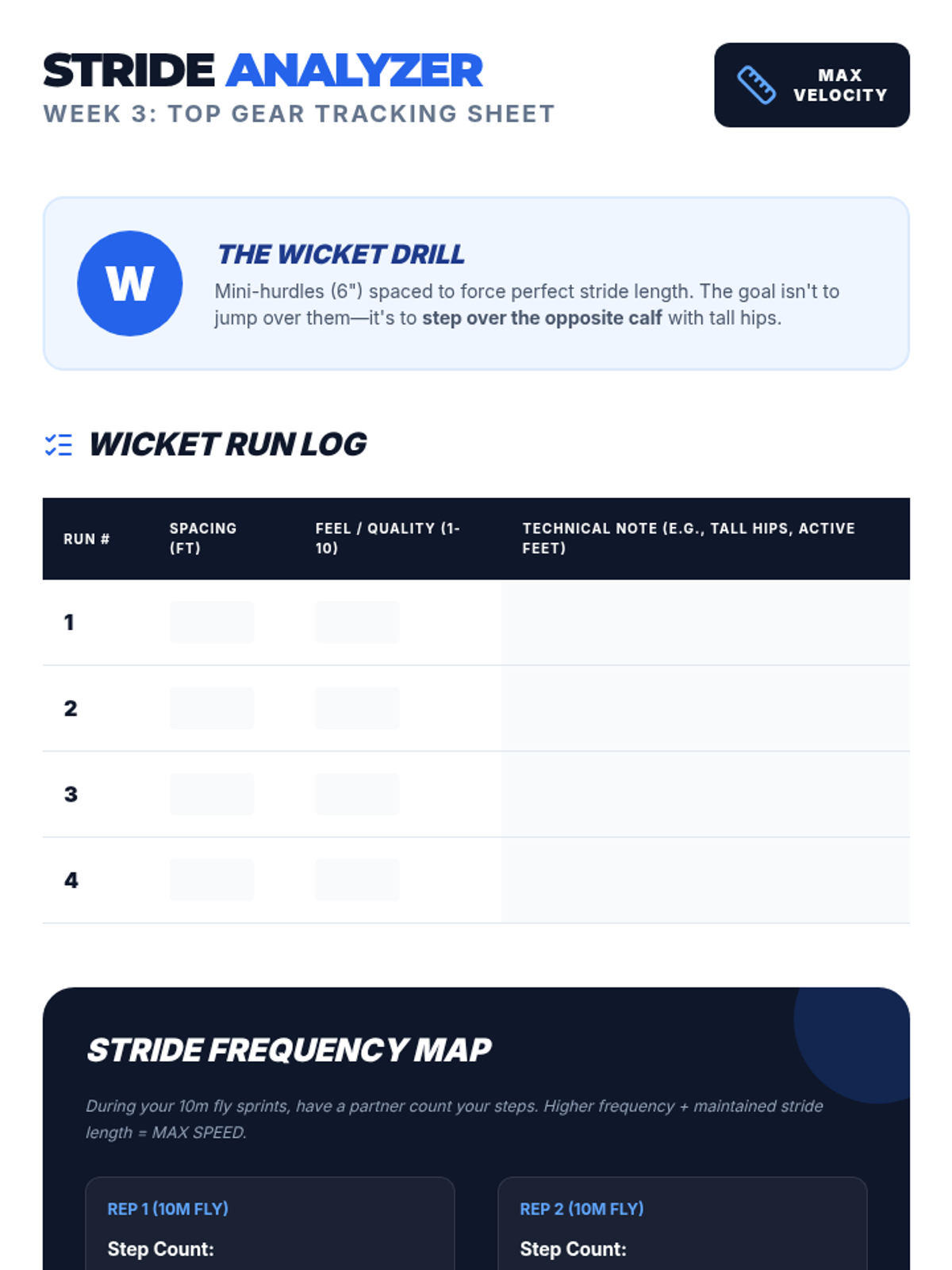
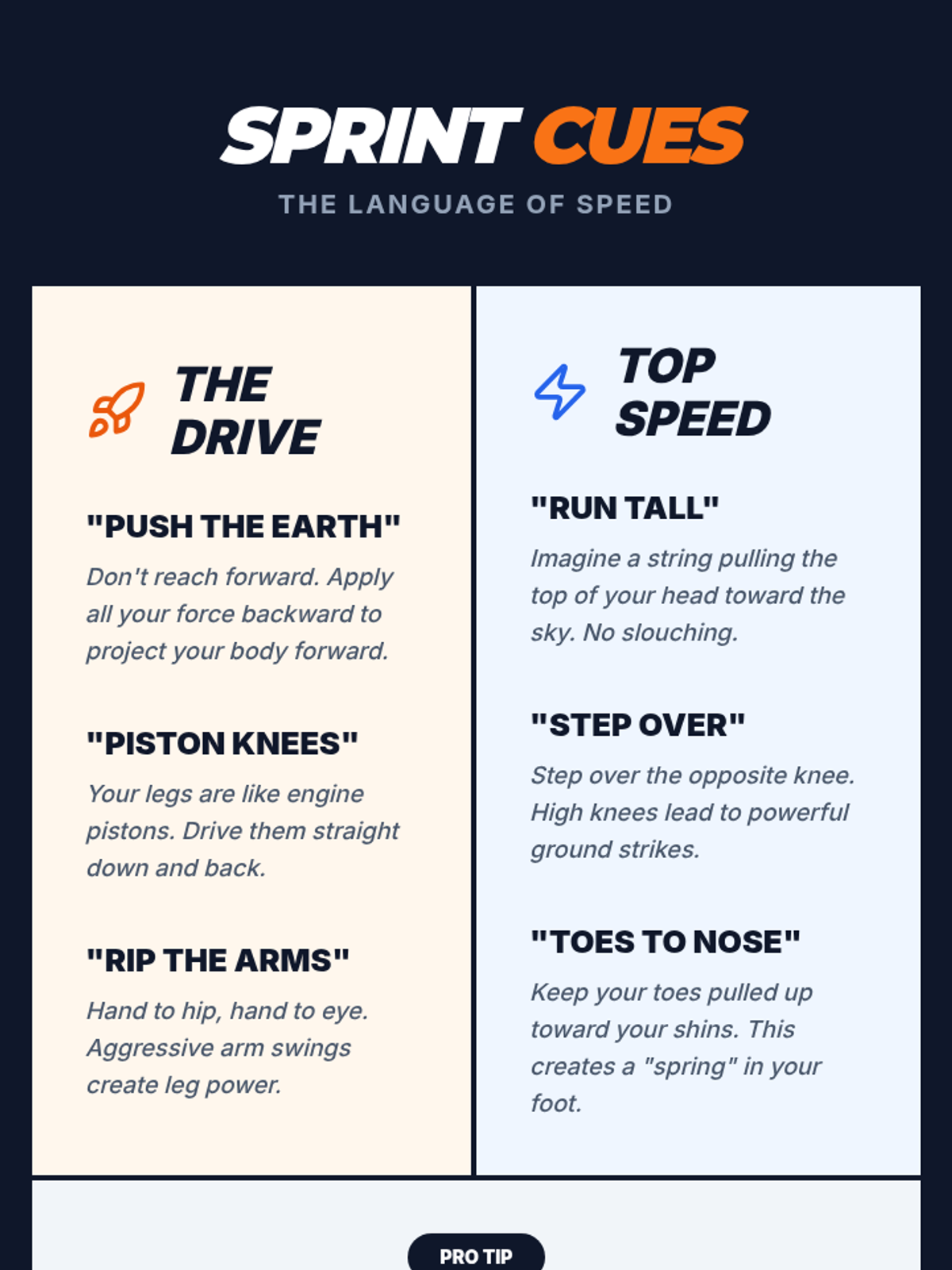
Training upright sprinting mechanics, stride frequency through wicket drills, and maximum velocity maintenance.
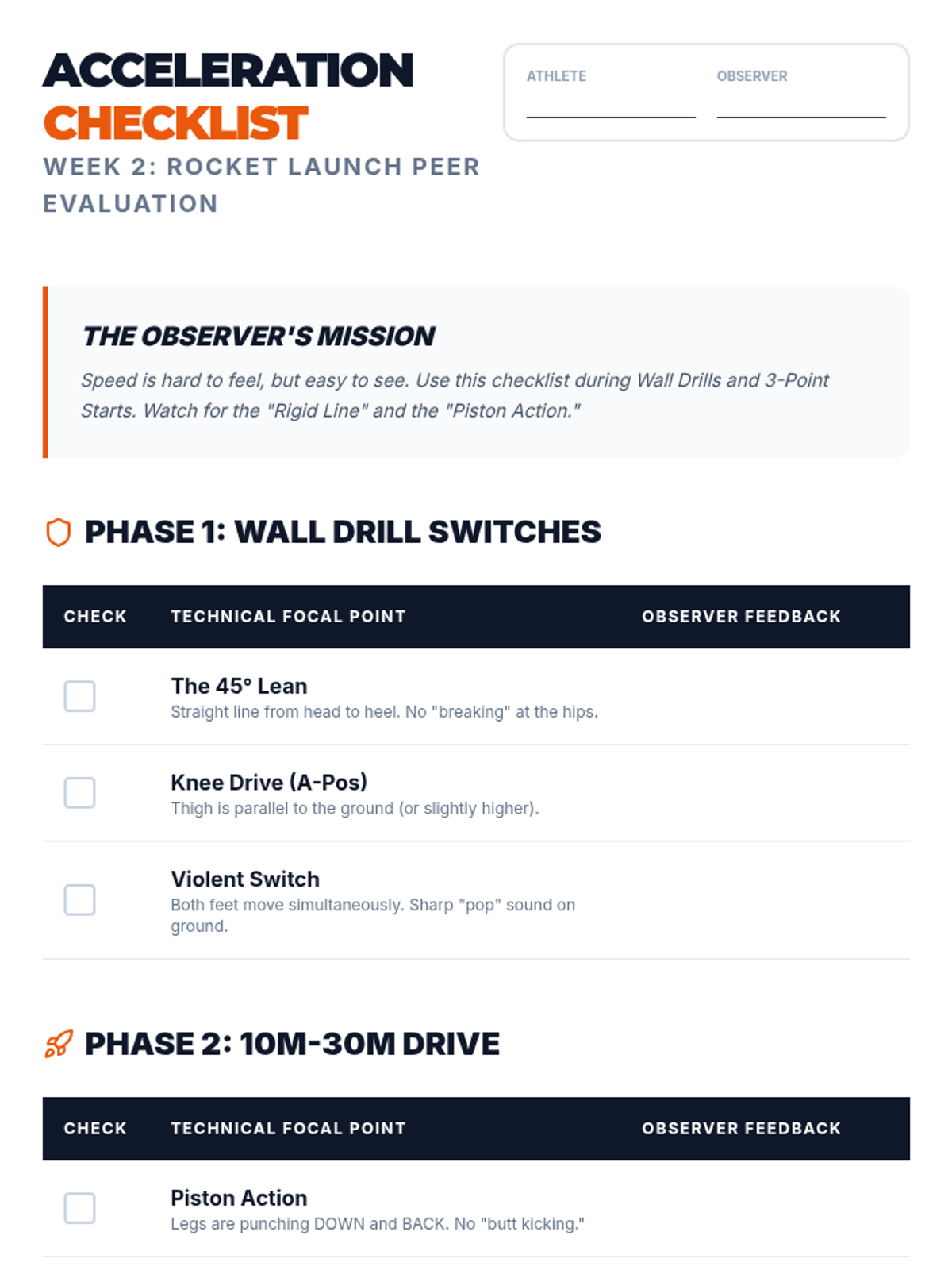
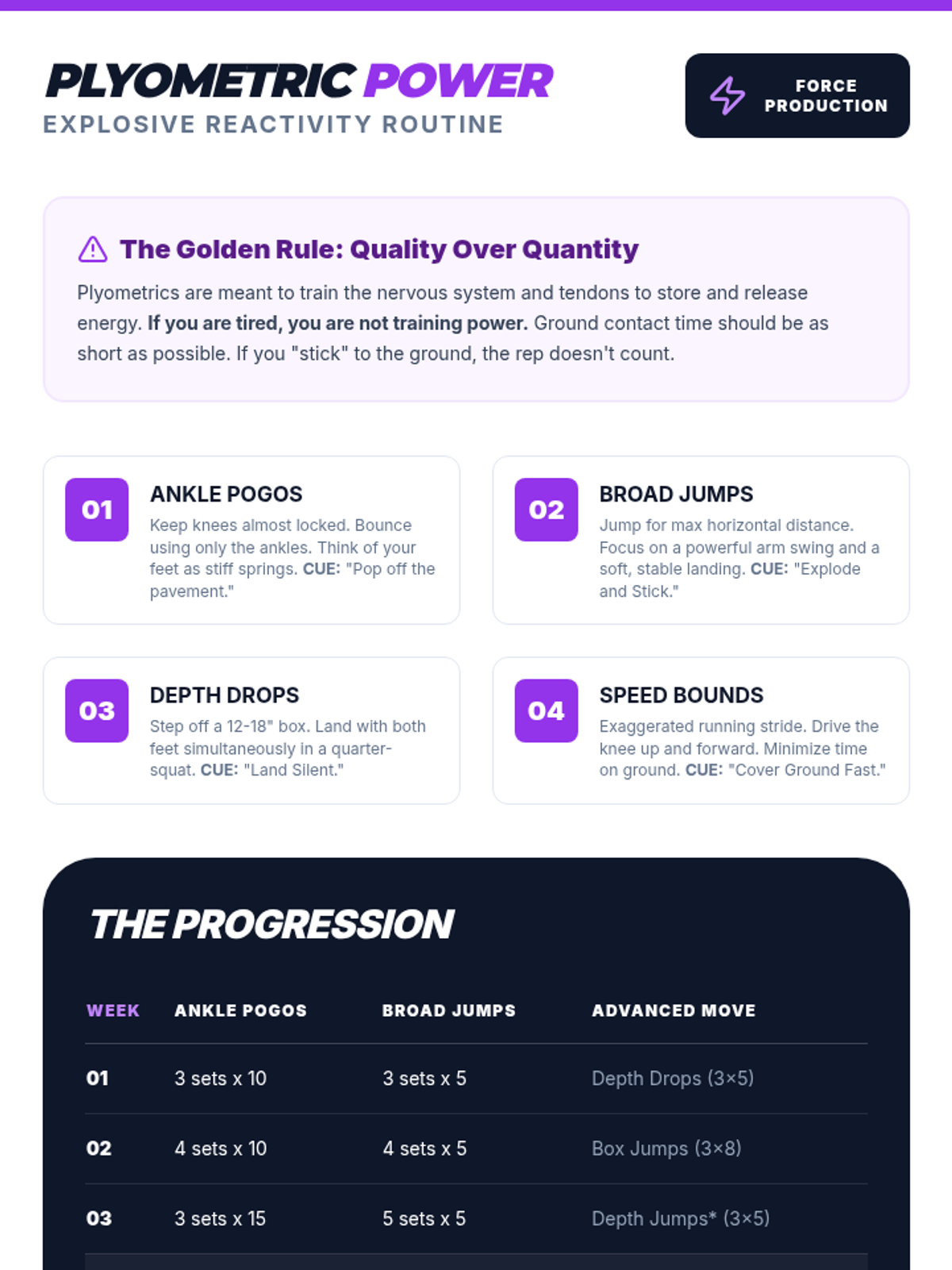
Introducing the drive phase, explosive wall drills, and higher-intensity plyometrics to build raw power.
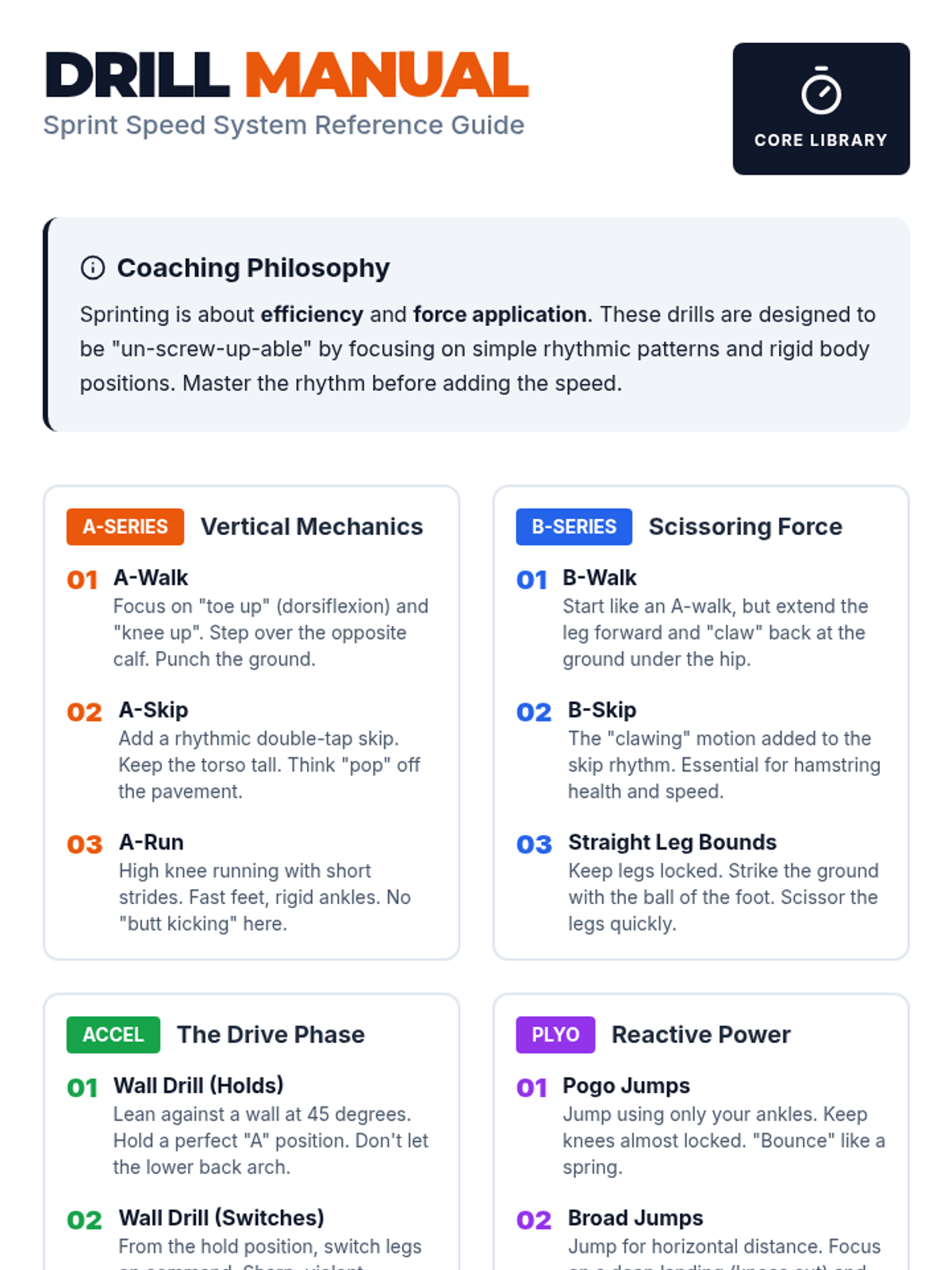
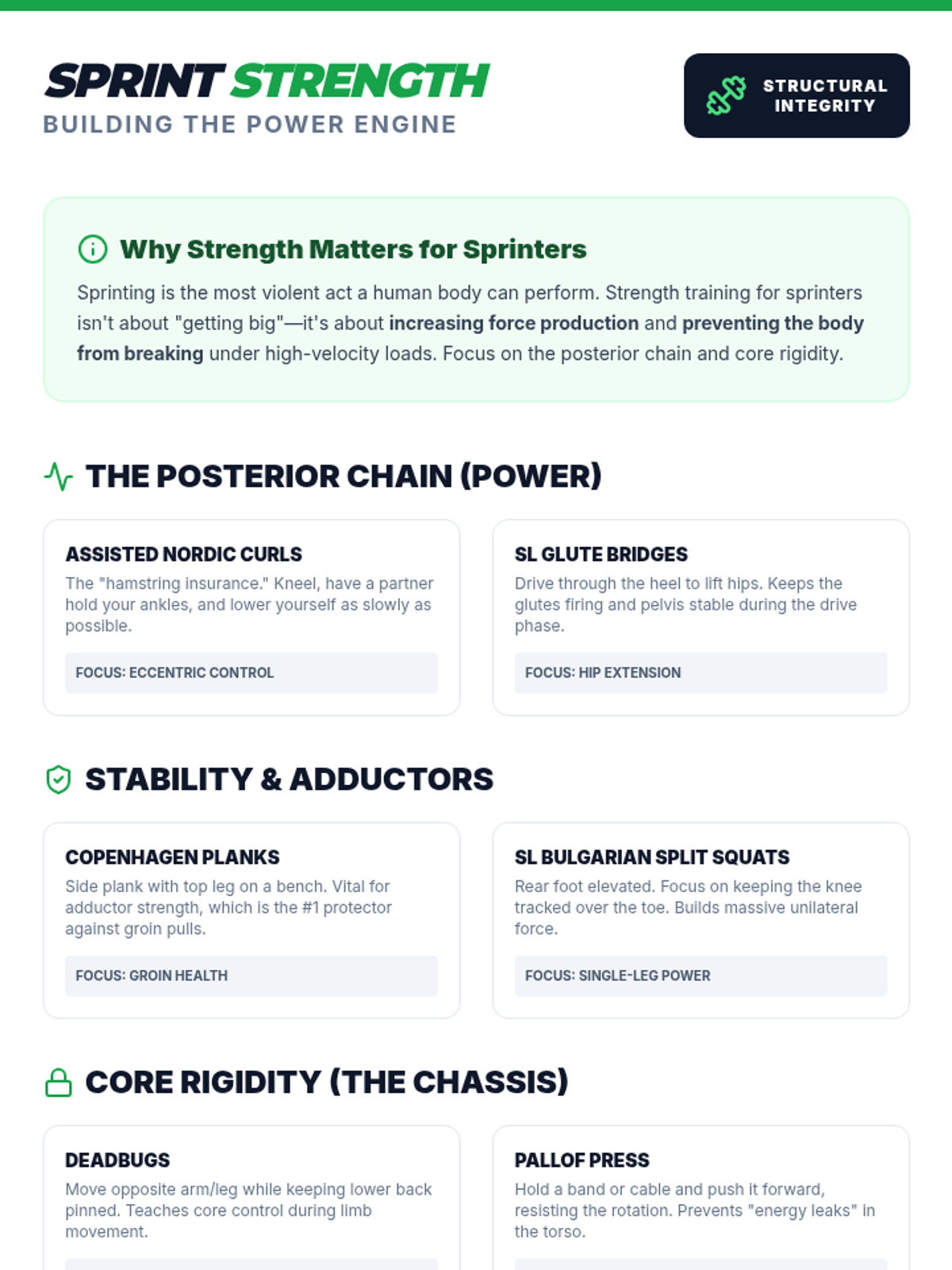
Focus on establishing proper sprint posture, rhythmic drills (A-skips), and basic core strength to prevent injury.
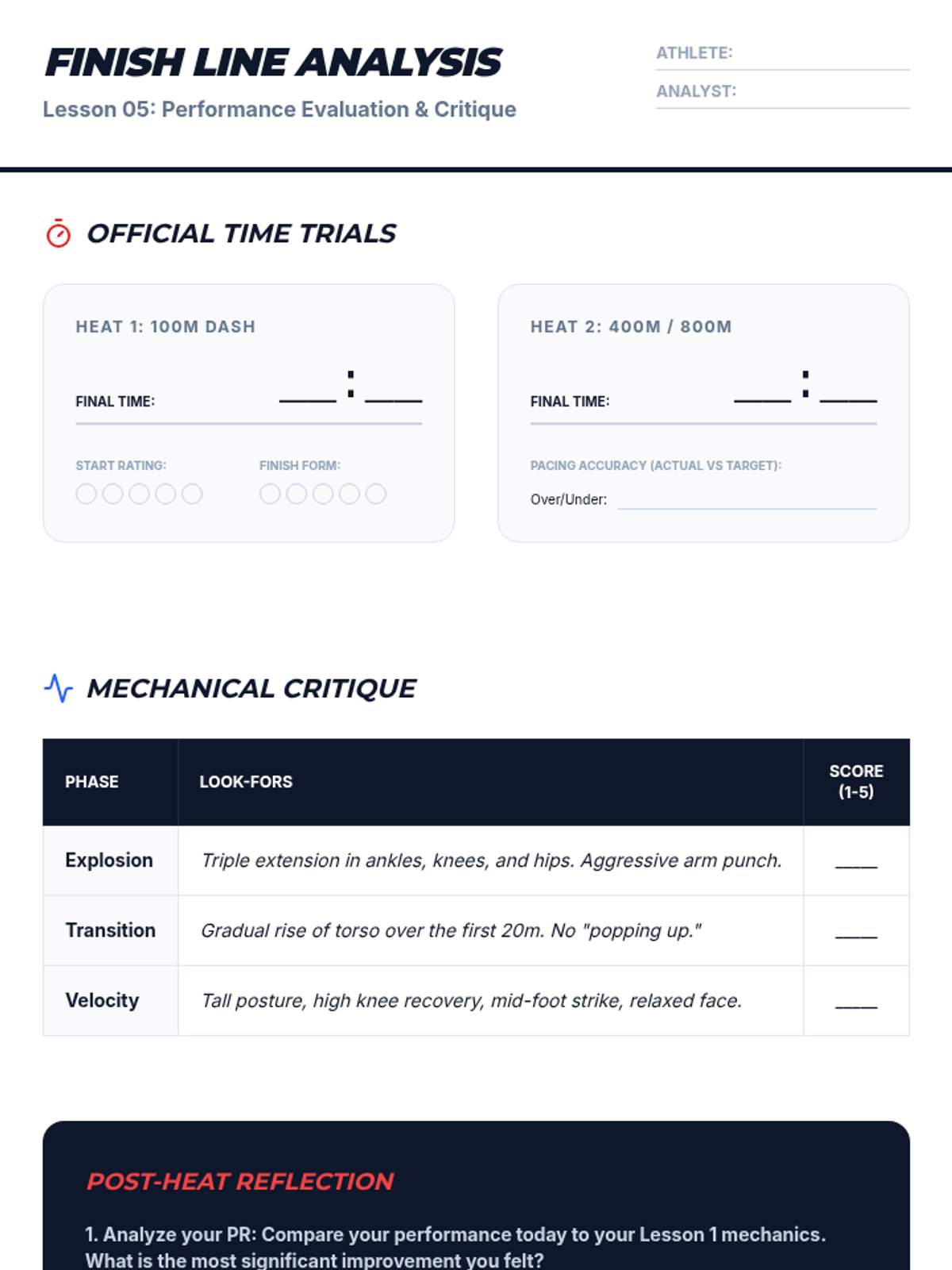
A culminating lesson where students participate in timed heats and utilize peer rubrics to analyze running form. Students reflect on their progress and set personal records.
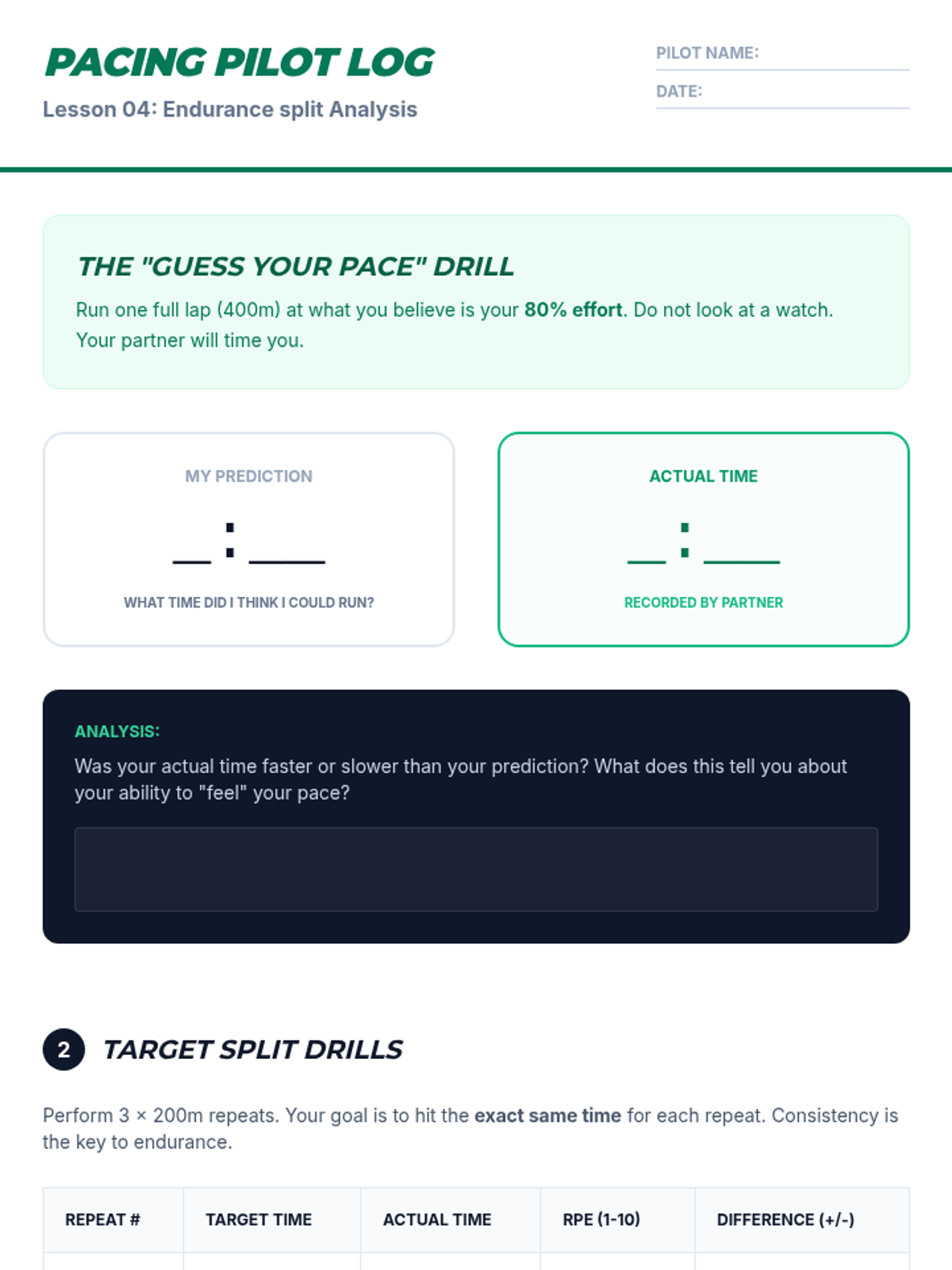
Students explore energy conservation and pacing for middle-distance events. Activities involve running specific segments at target paces to align perceived exertion with actual split times.
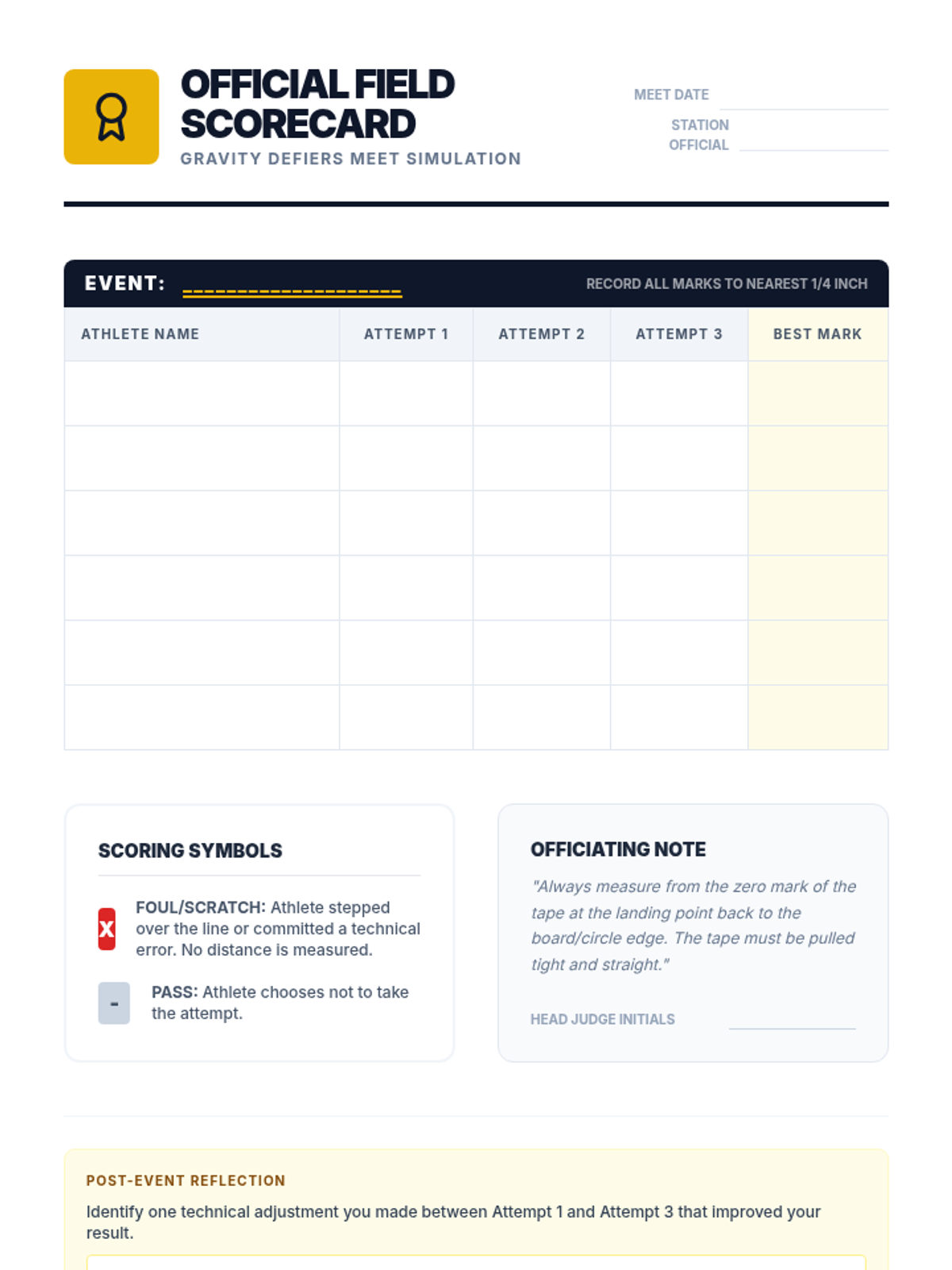
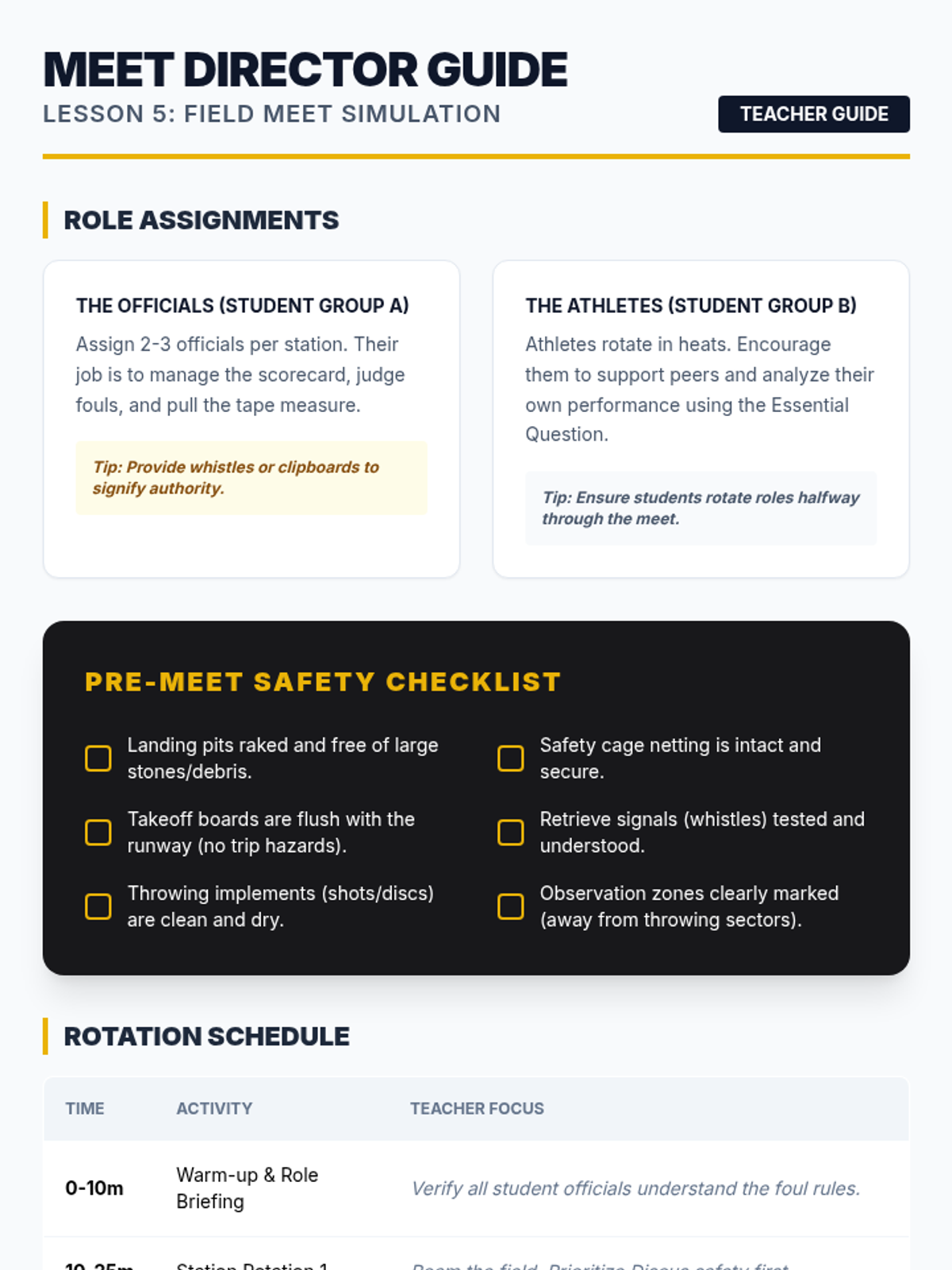
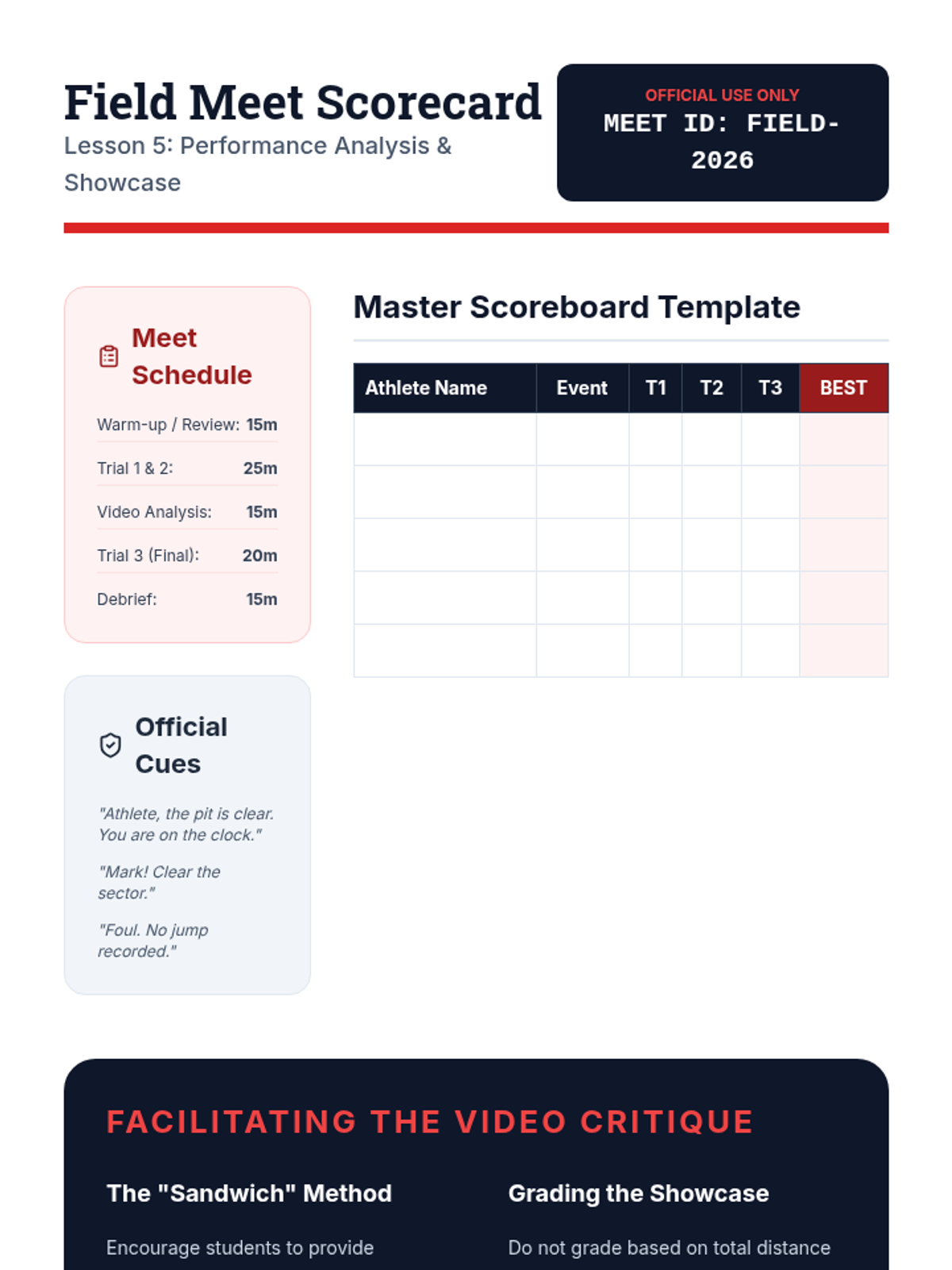
A culminating simulated track meet where students apply their technical skills as both athletes and officials, managing measurement and safety.
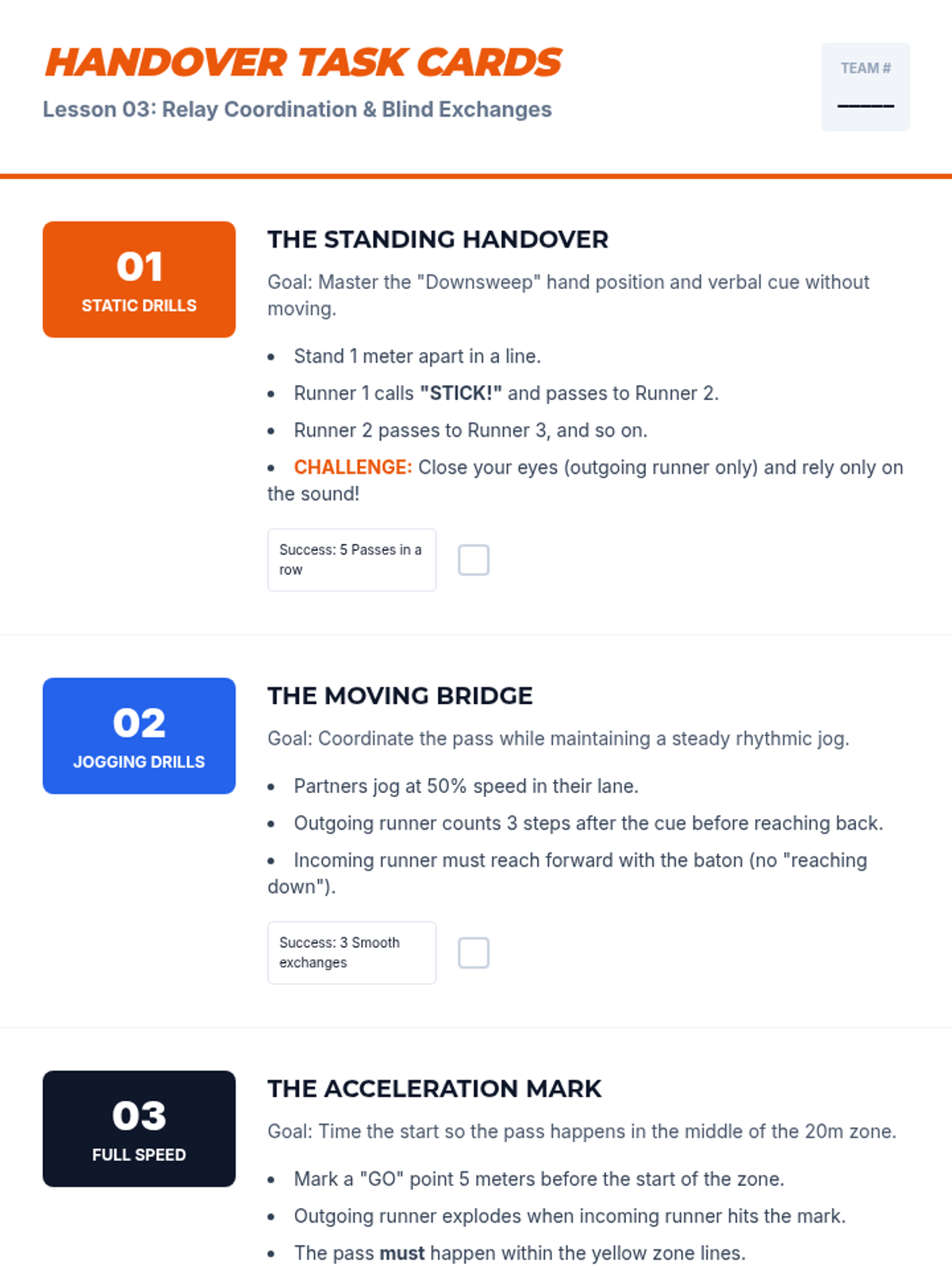
Focuses on the technical coordination of the 4x100m relay, specifically the non-visual blind baton exchange. Students practice communication and timing within exchange zones.
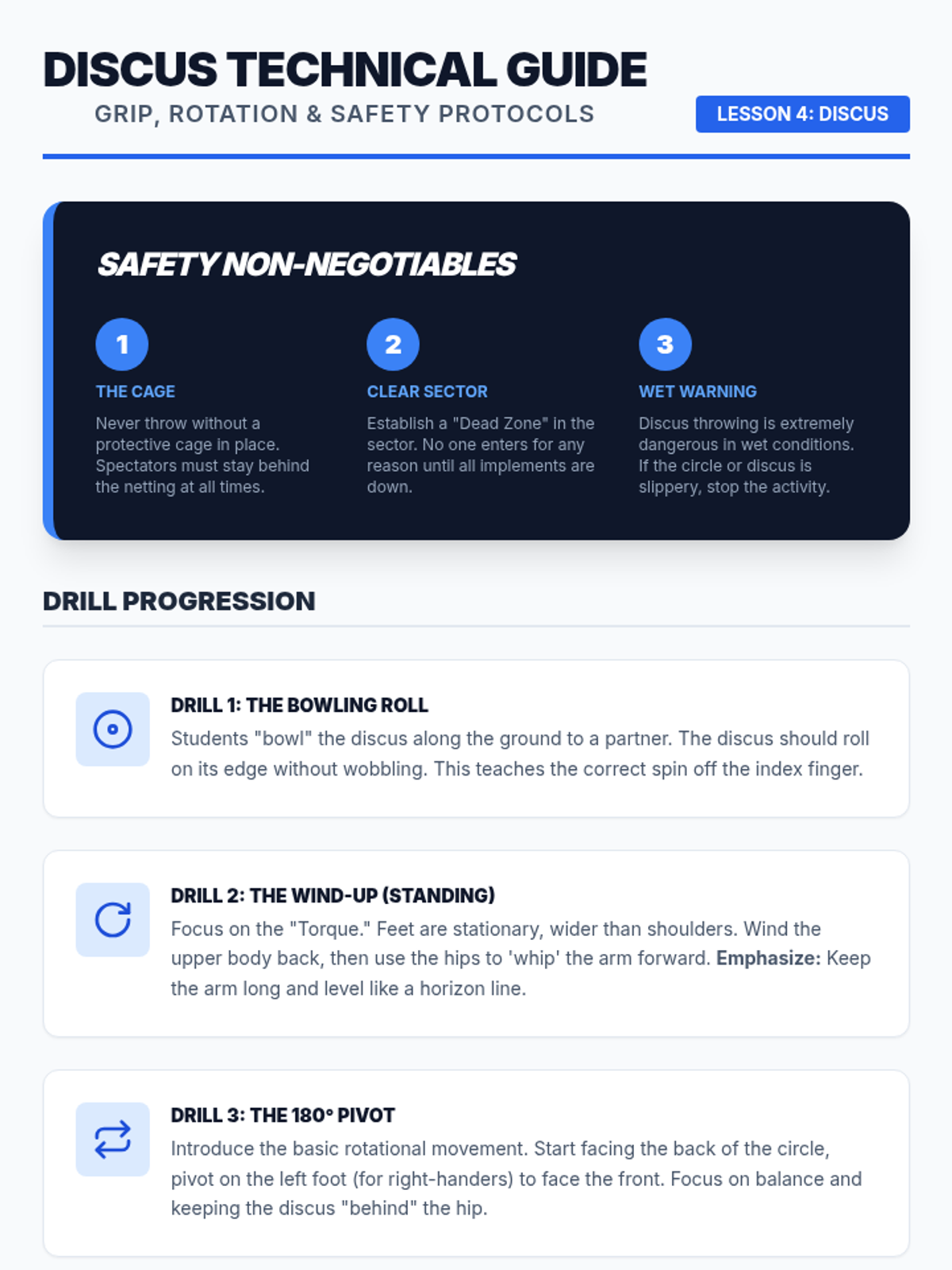
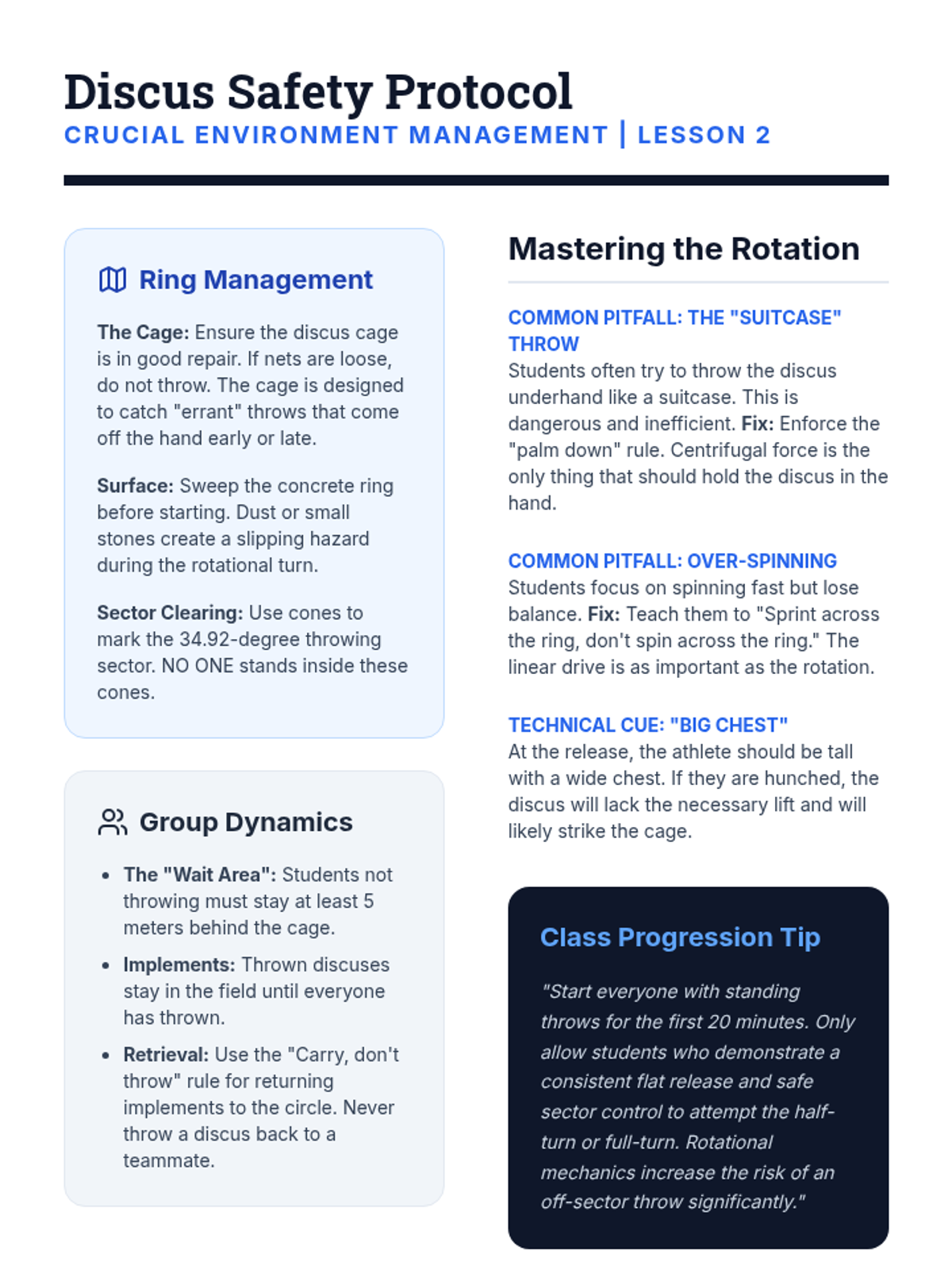
Introduces discus grip and rotational mechanics, teaching students how to harness centrifugal force for maximum distance and flight stability.
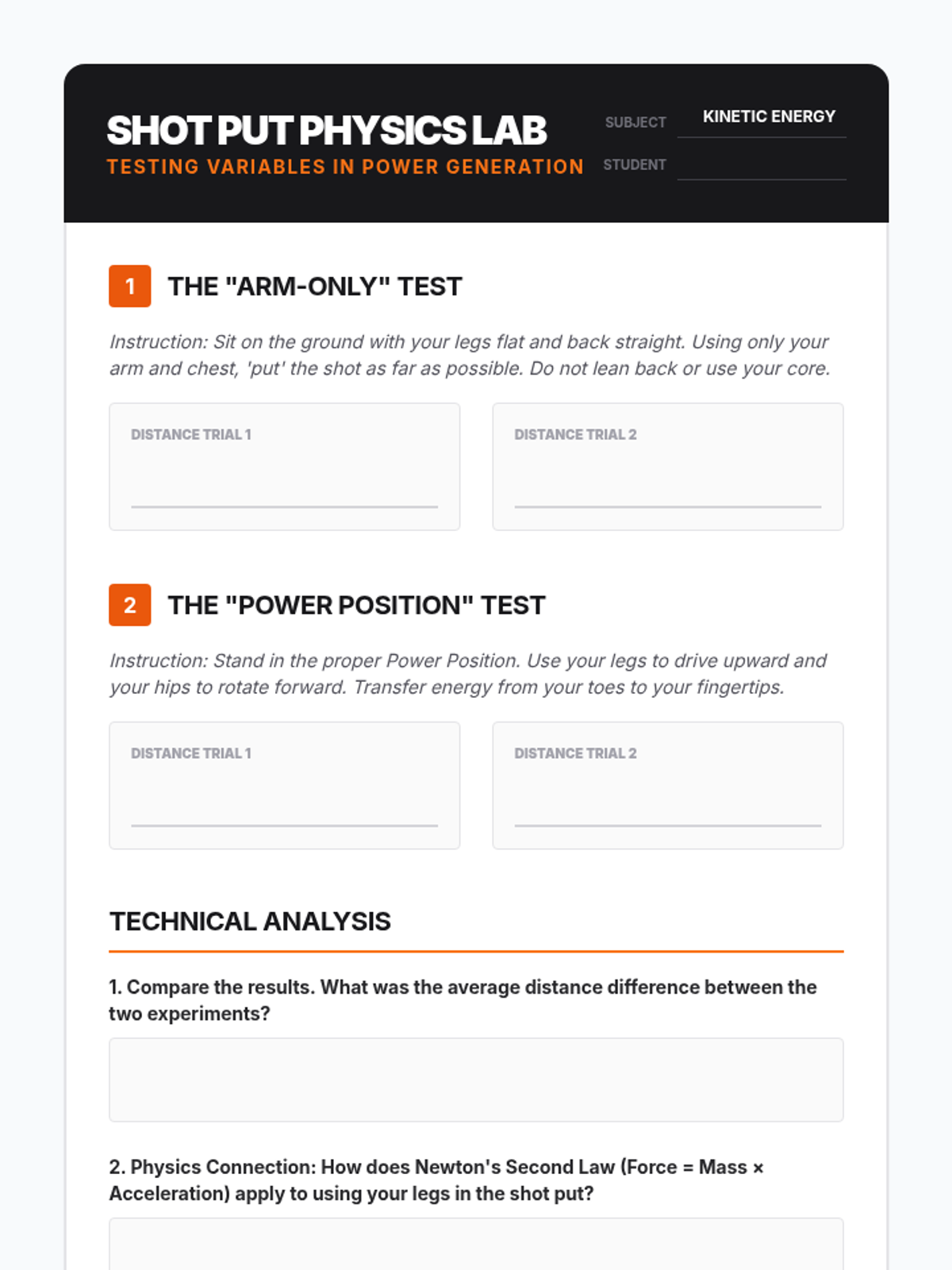
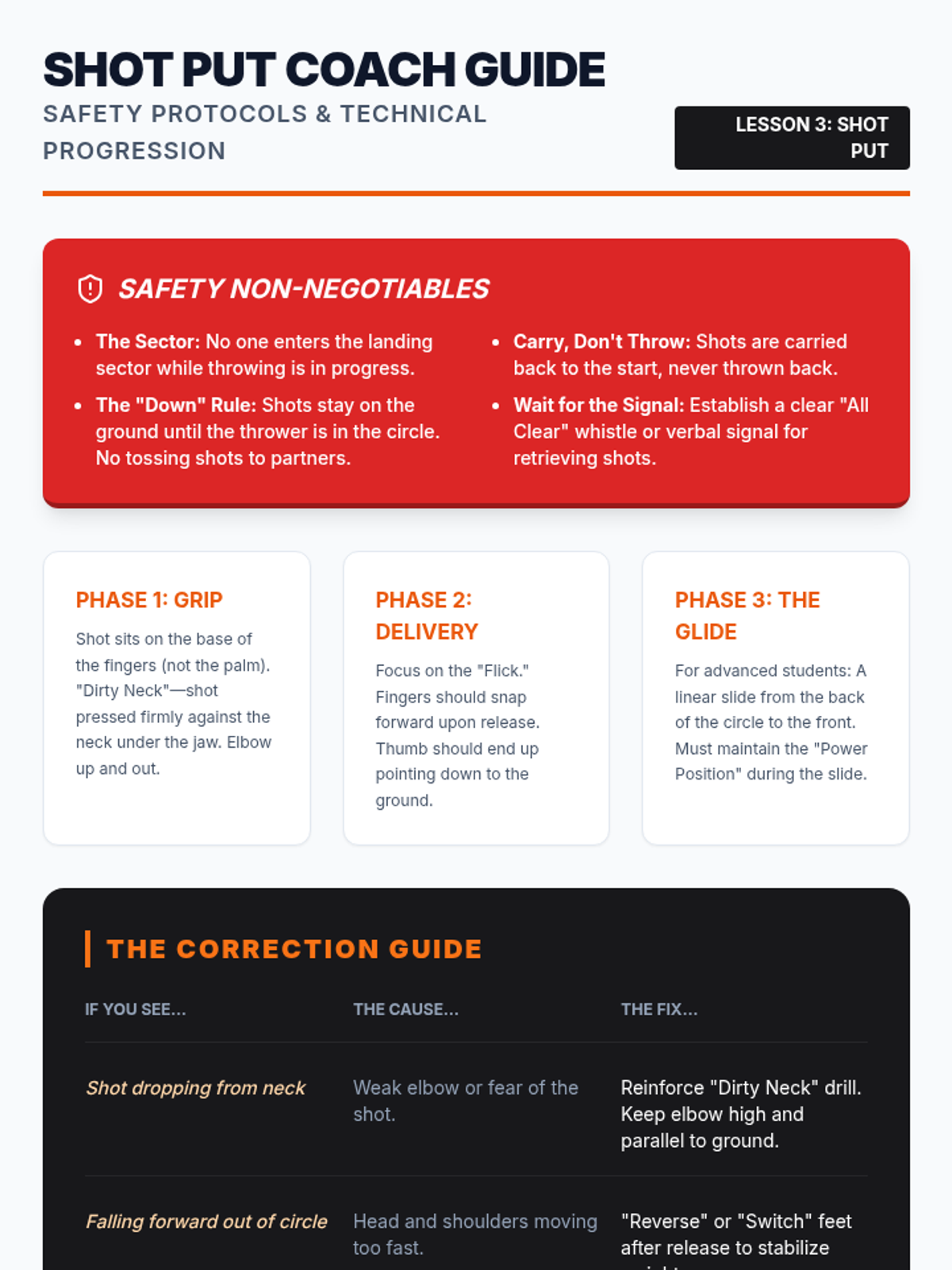
Focuses on the shot put 'power position' and glide technique, highlighting safety and the use of the lower body to generate explosive force.
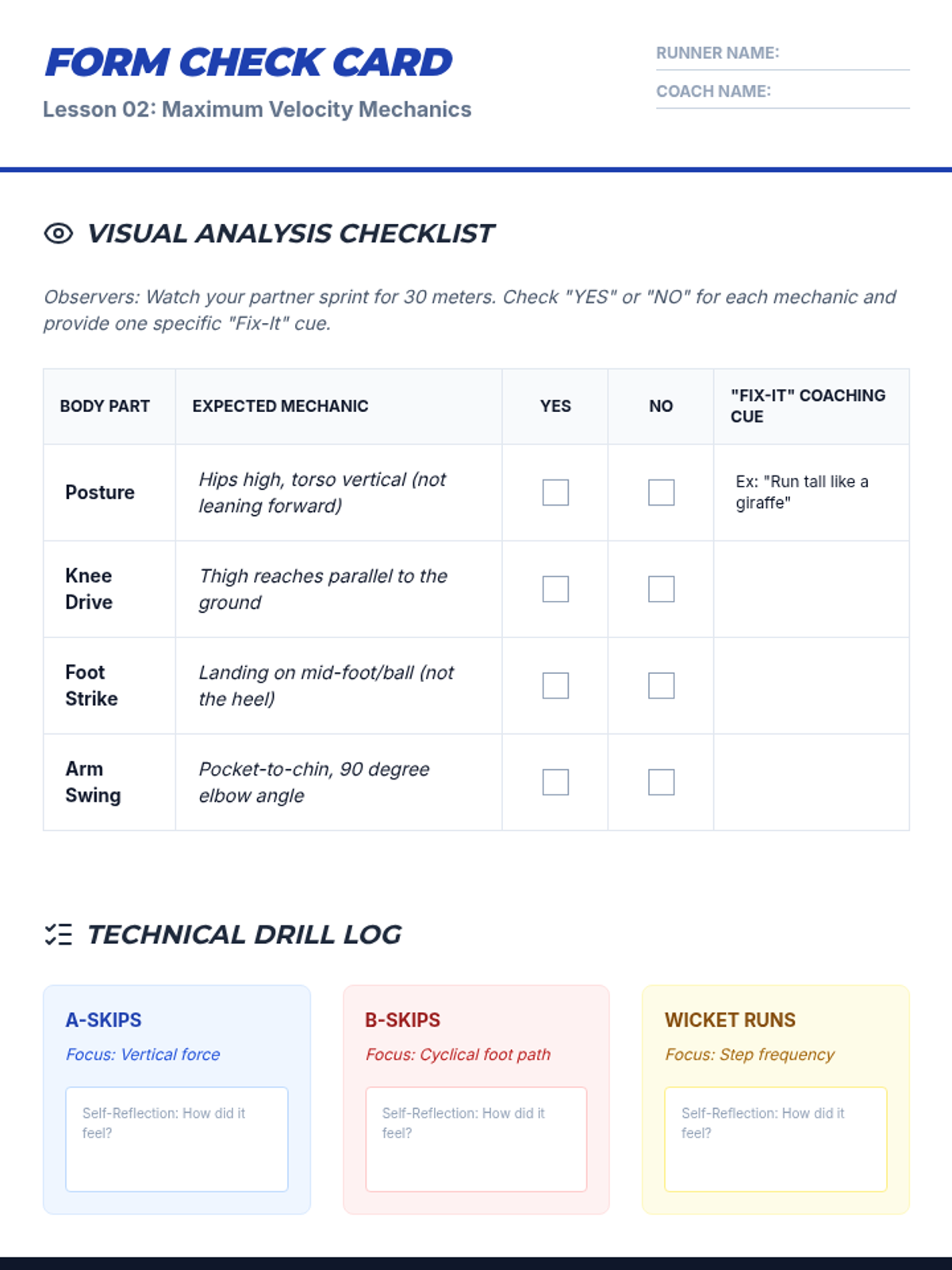
Students practice top-speed mechanics, including front-side mechanics, proper arm swing, and foot strike placement. The lesson uses video analysis to help students emulate professional sprinters' upright posture.
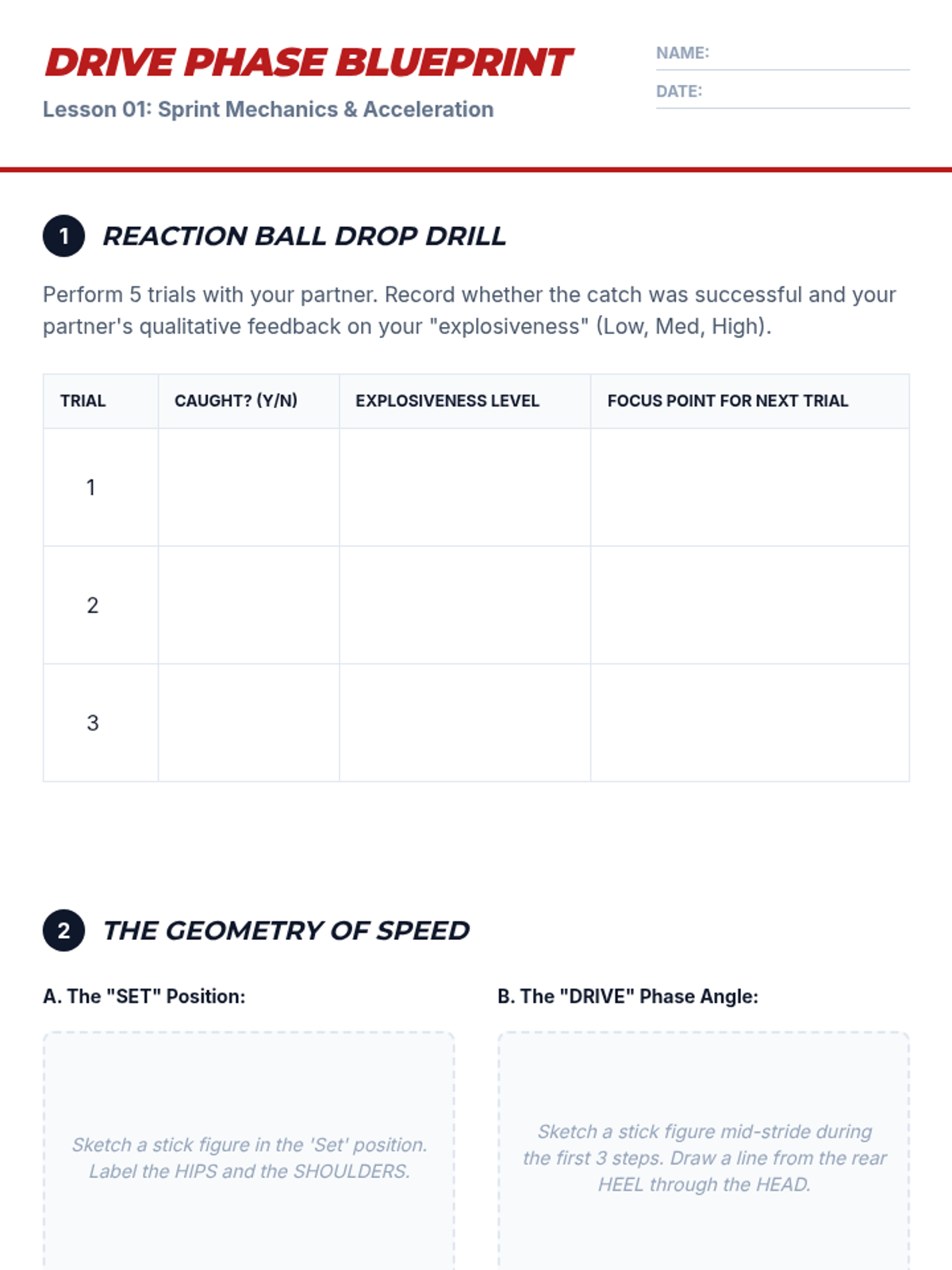
Students focus on the 'drive phase' of sprinting, learning how to set up starting blocks and maintain a low center of gravity for initial acceleration. The lesson emphasizes reaction time and the geometric angles required to generate maximum force.
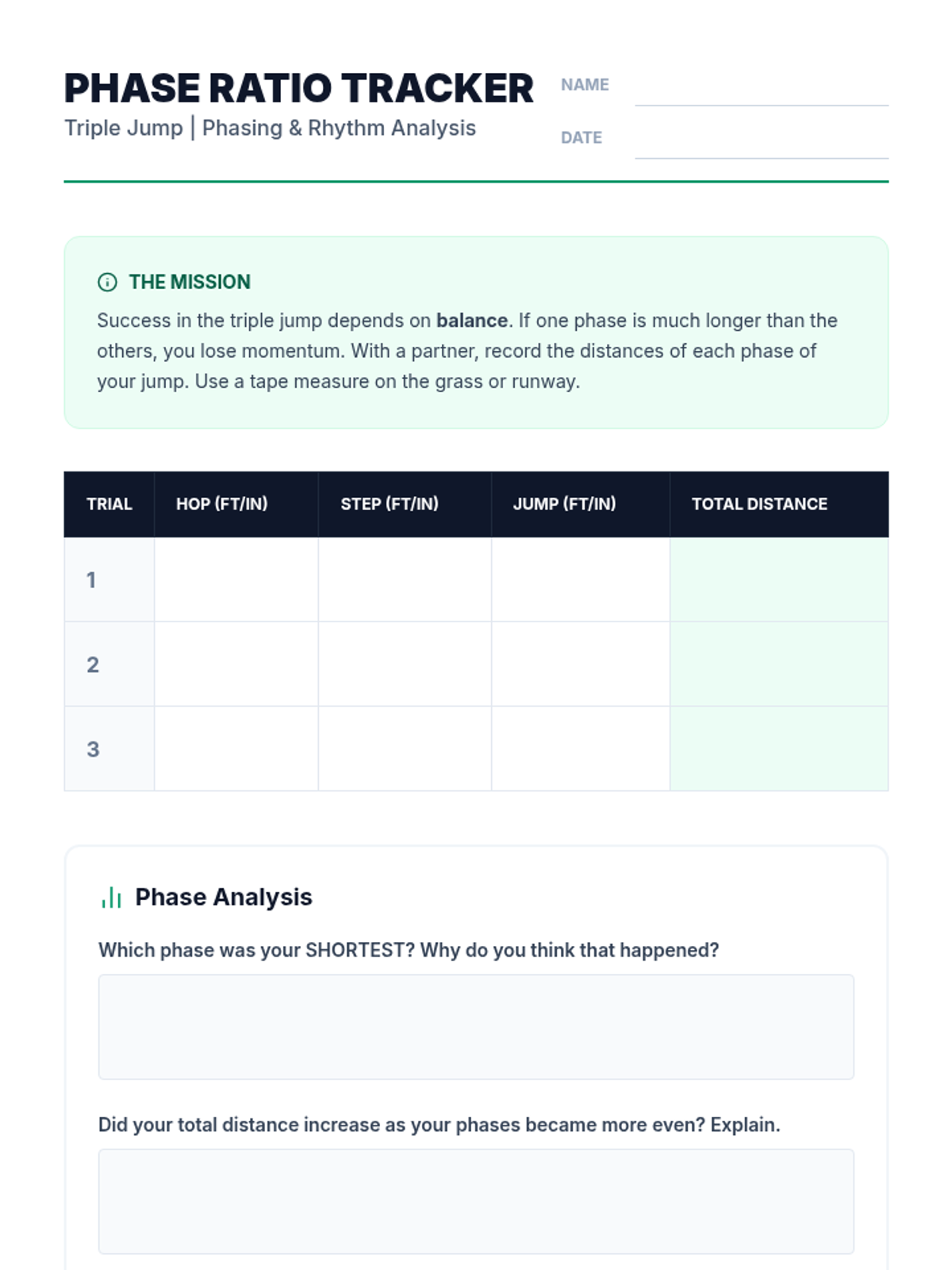
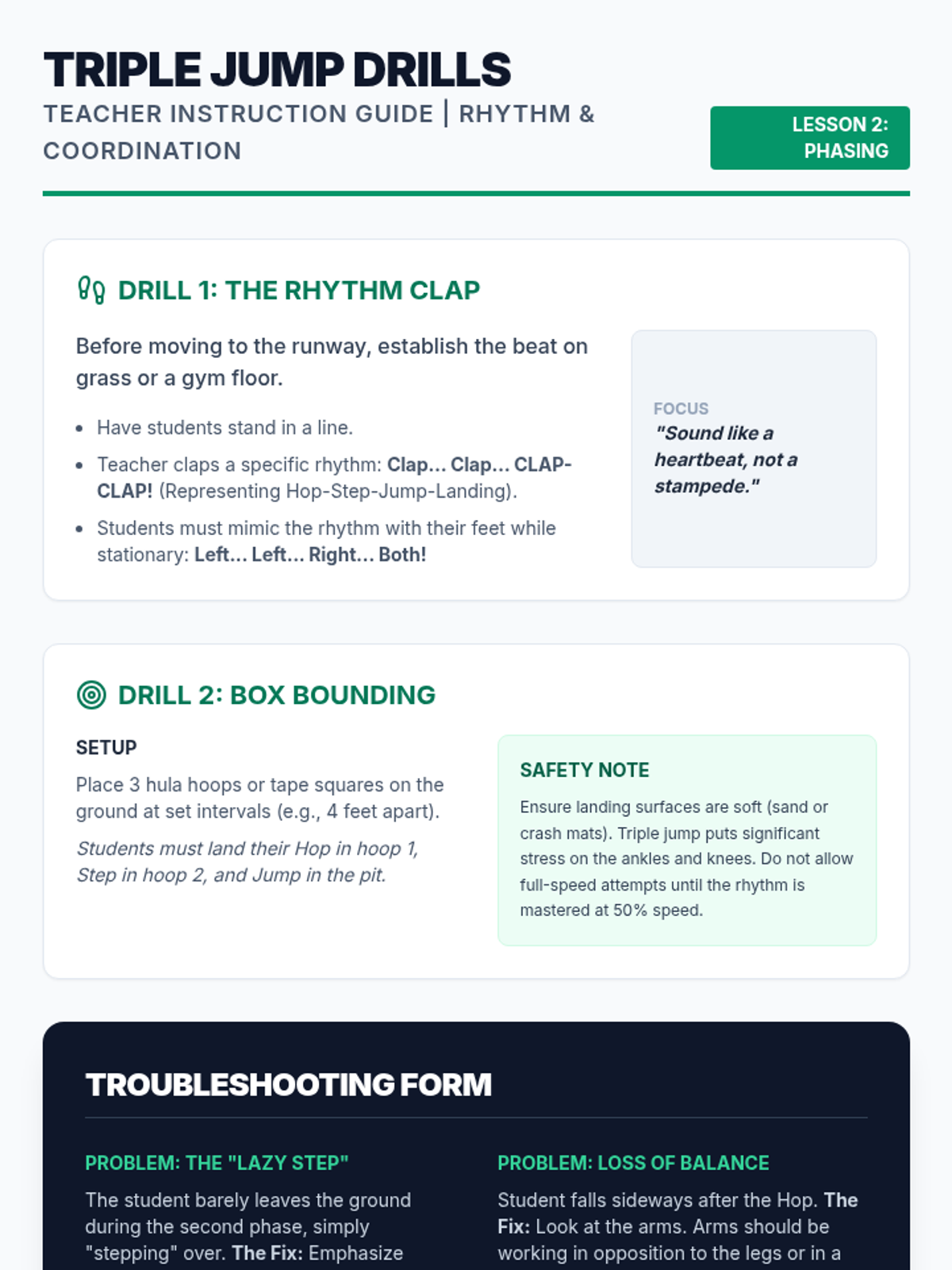
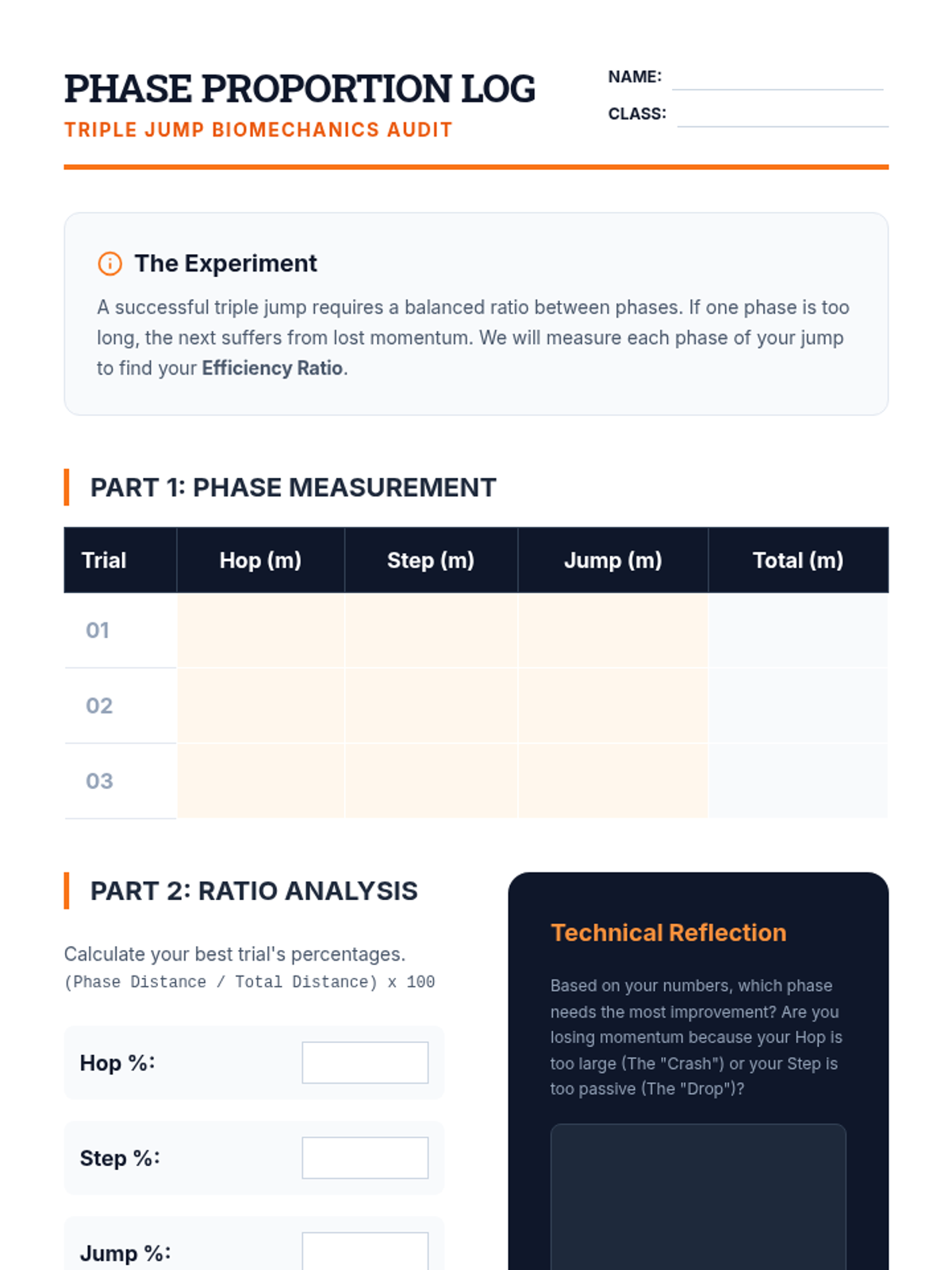
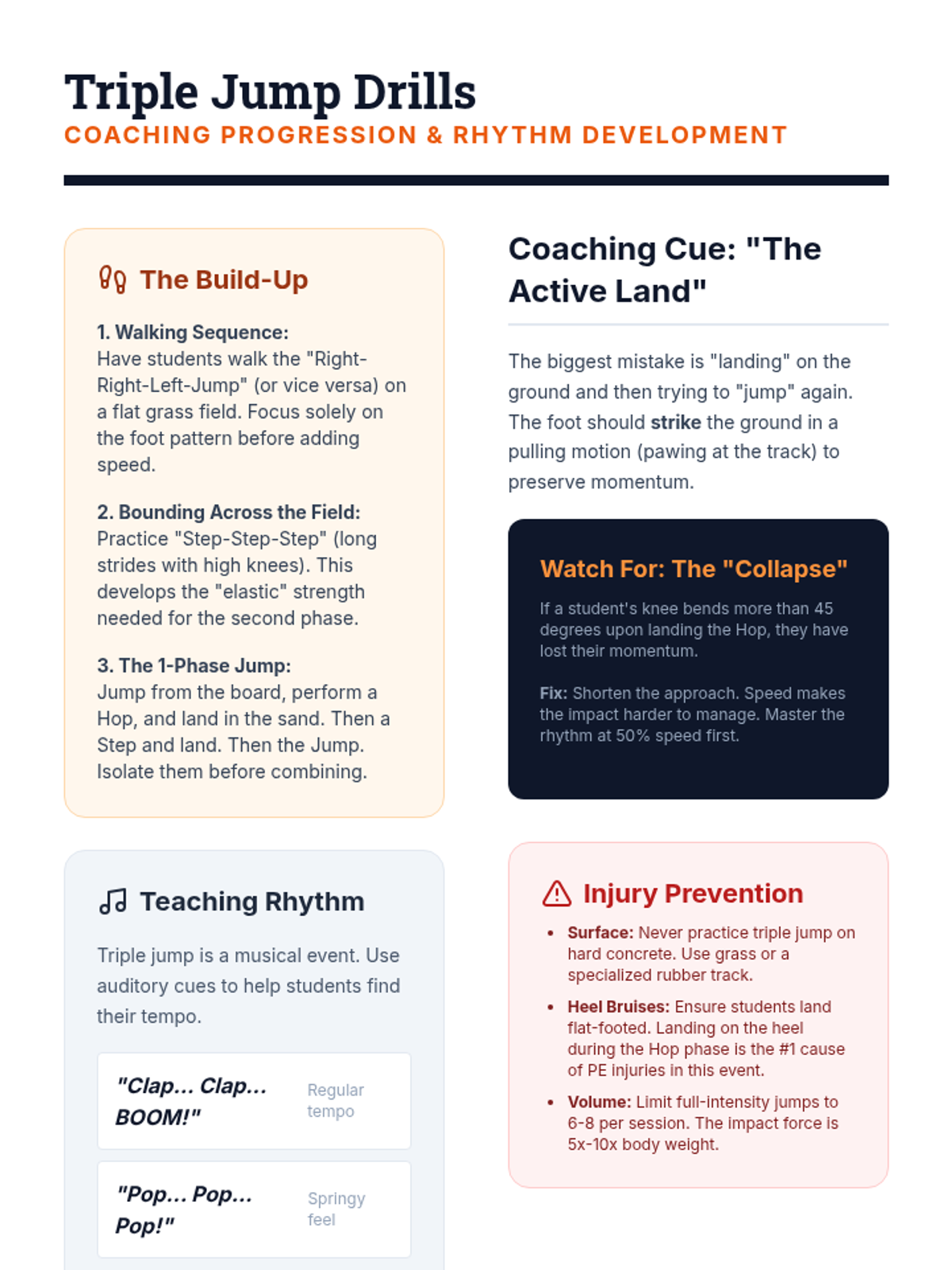
An exploration of the hop-step-jump sequence, emphasizing the rhythmic coordination and maintenance of momentum across all three phases.
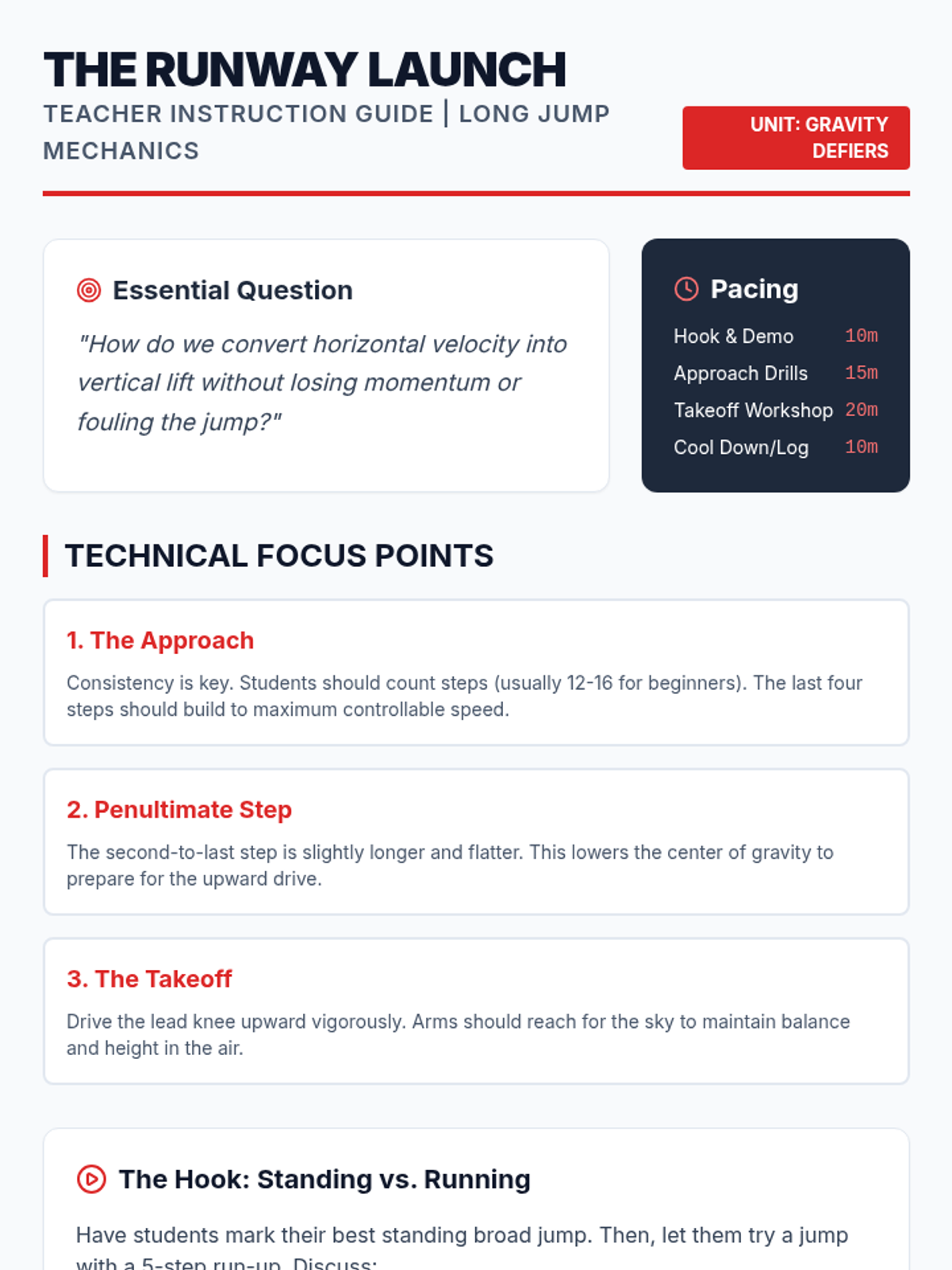
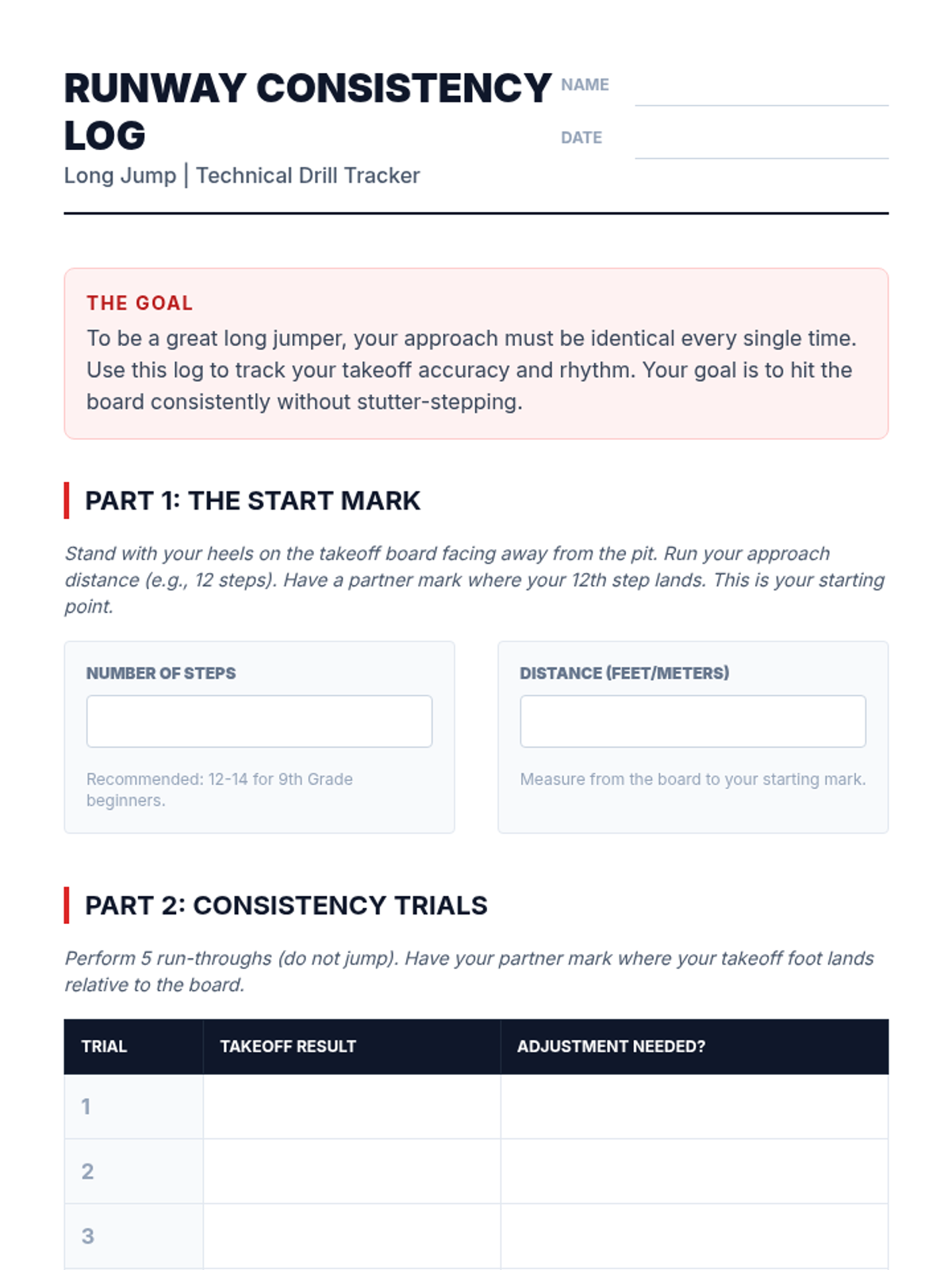
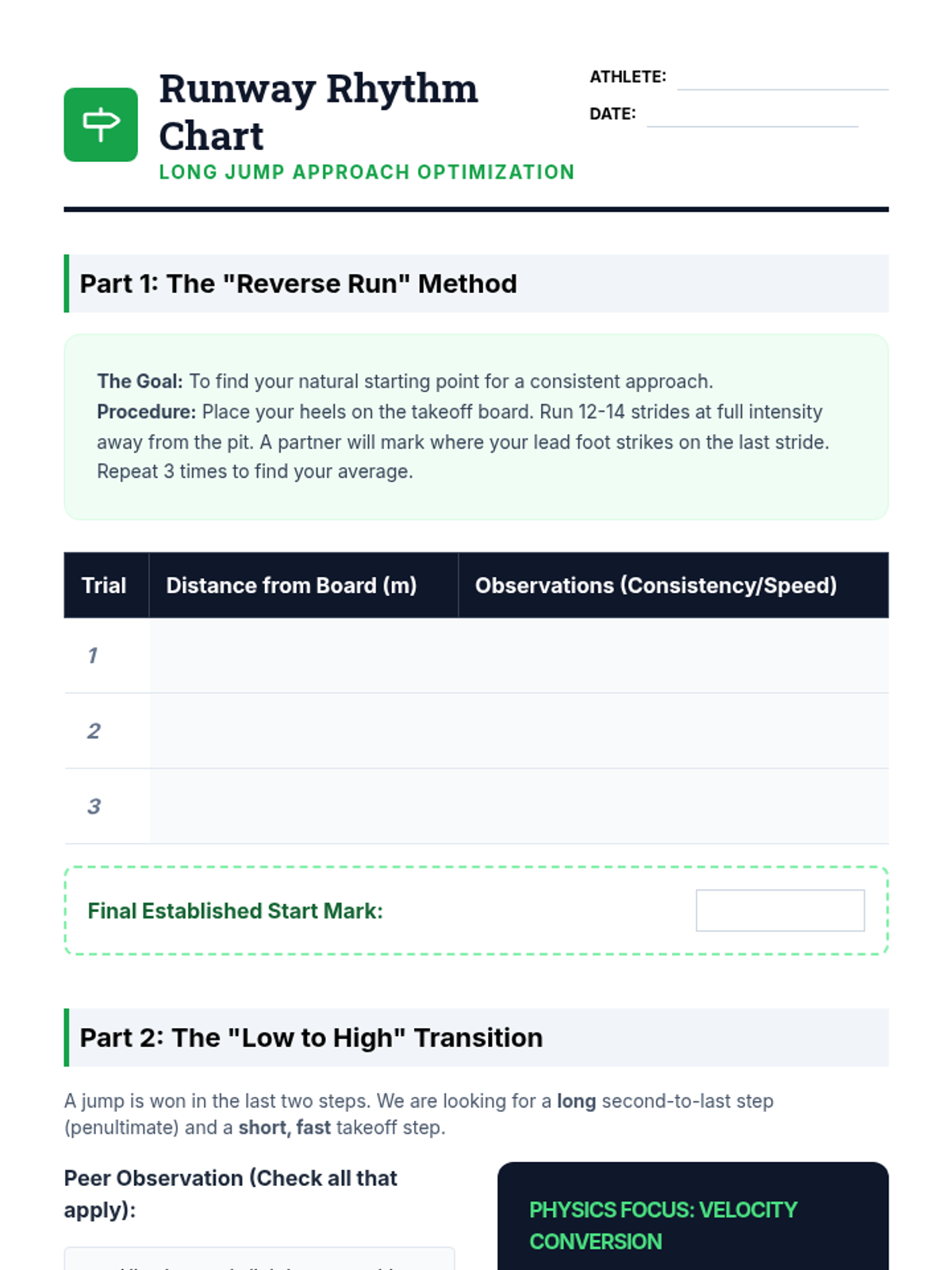
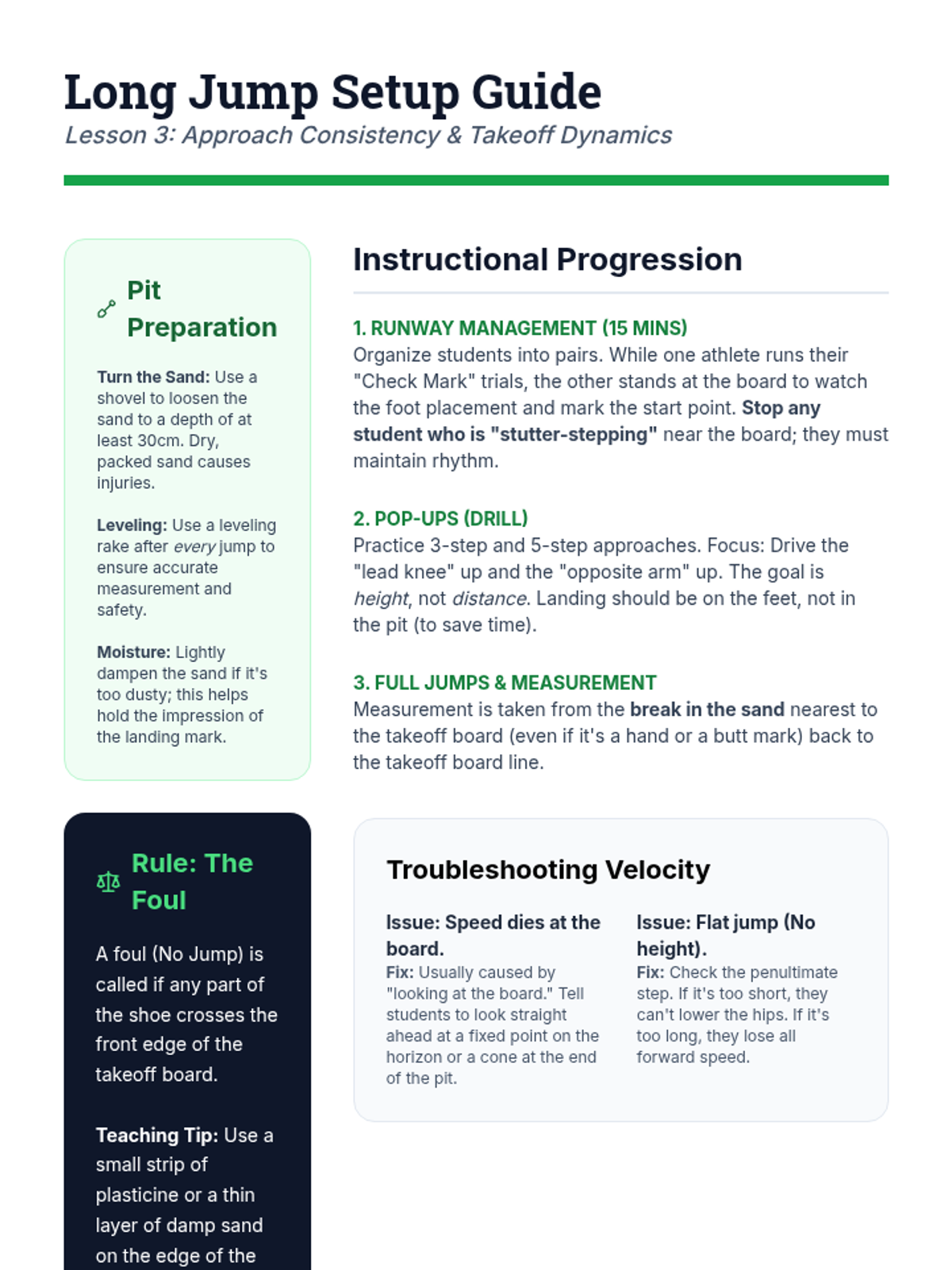
Students master the three phases of the long jump: the approach, the penultimate step, and the takeoff, focusing on runway consistency and vertical lift.
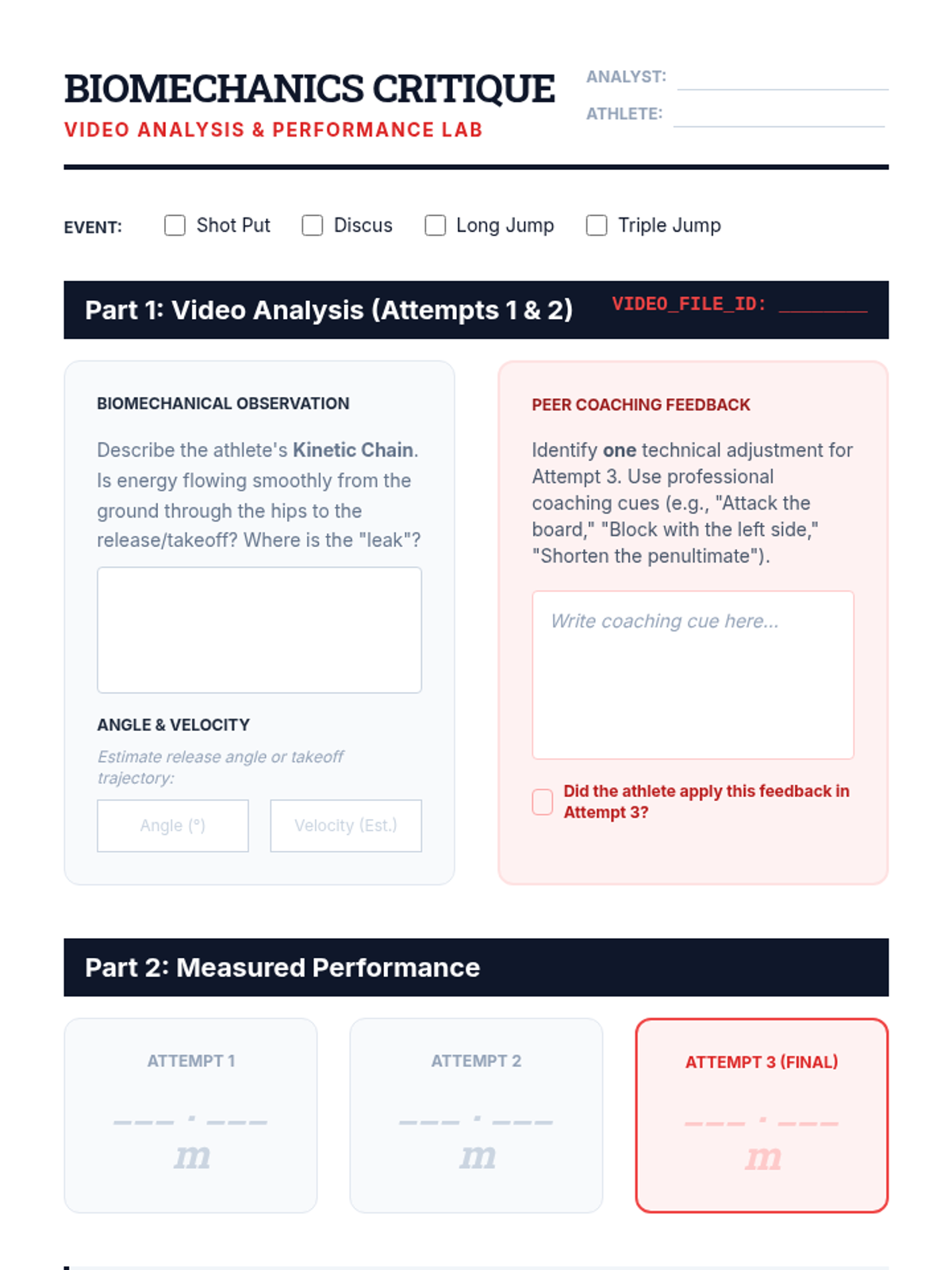
The culmination of the unit where students use video analysis to critique form and compete in a field event showcase, adhering to official competition rules.
Introduction to the complex 'hop, step, jump' coordination of the triple jump. Students practice rhythmic bounding and maintaining momentum through multiple impact phases.
A deep dive into the four phases of the long jump. Students focus on runway consistency, converting horizontal velocity to vertical lift, and perfecting the landing.
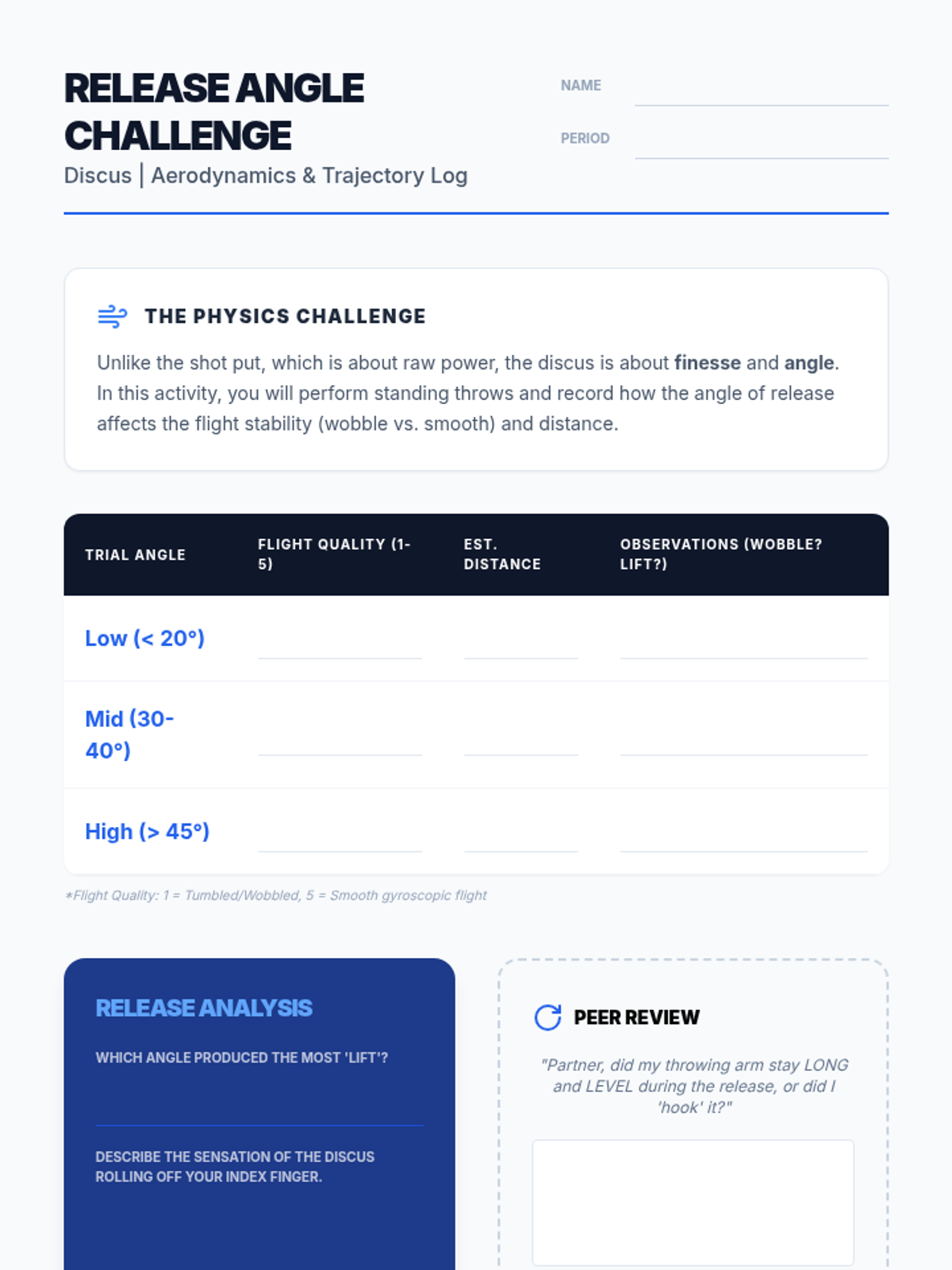
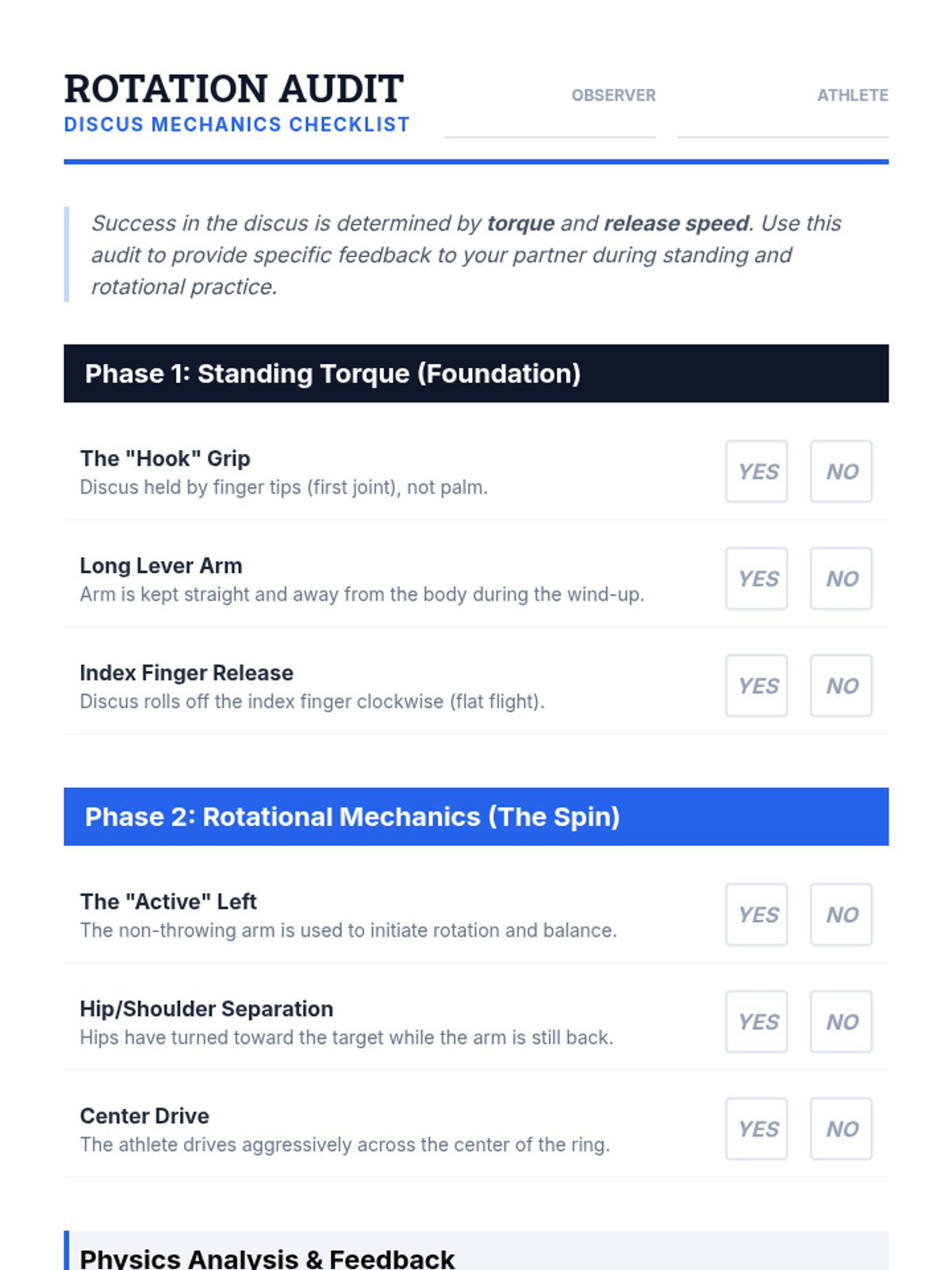
Exploring the rotational mechanics of the discus throw. Students learn about torque, centrifugal force, and aerodynamics while practicing the transition from standing throws to rotational movement.
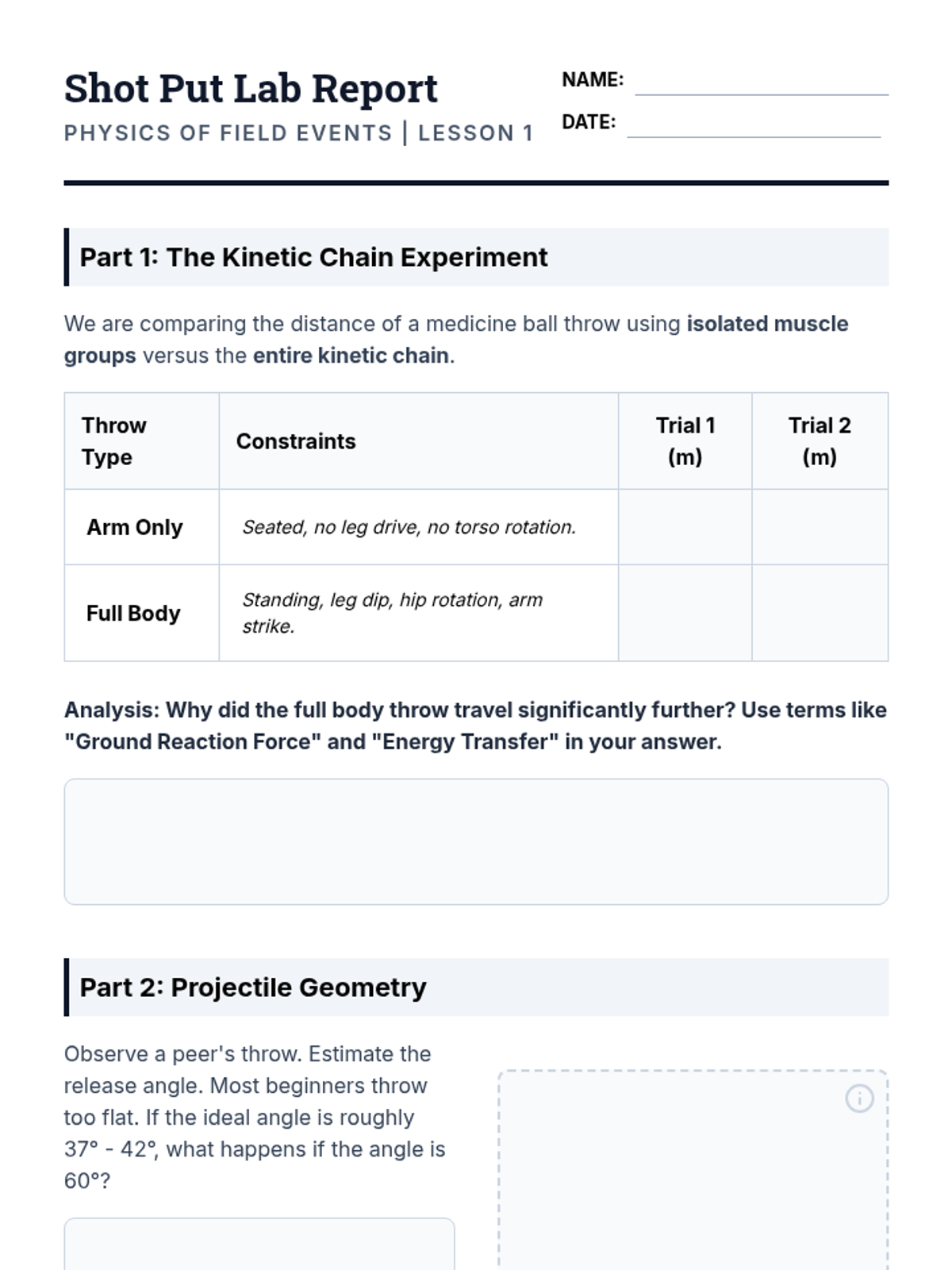
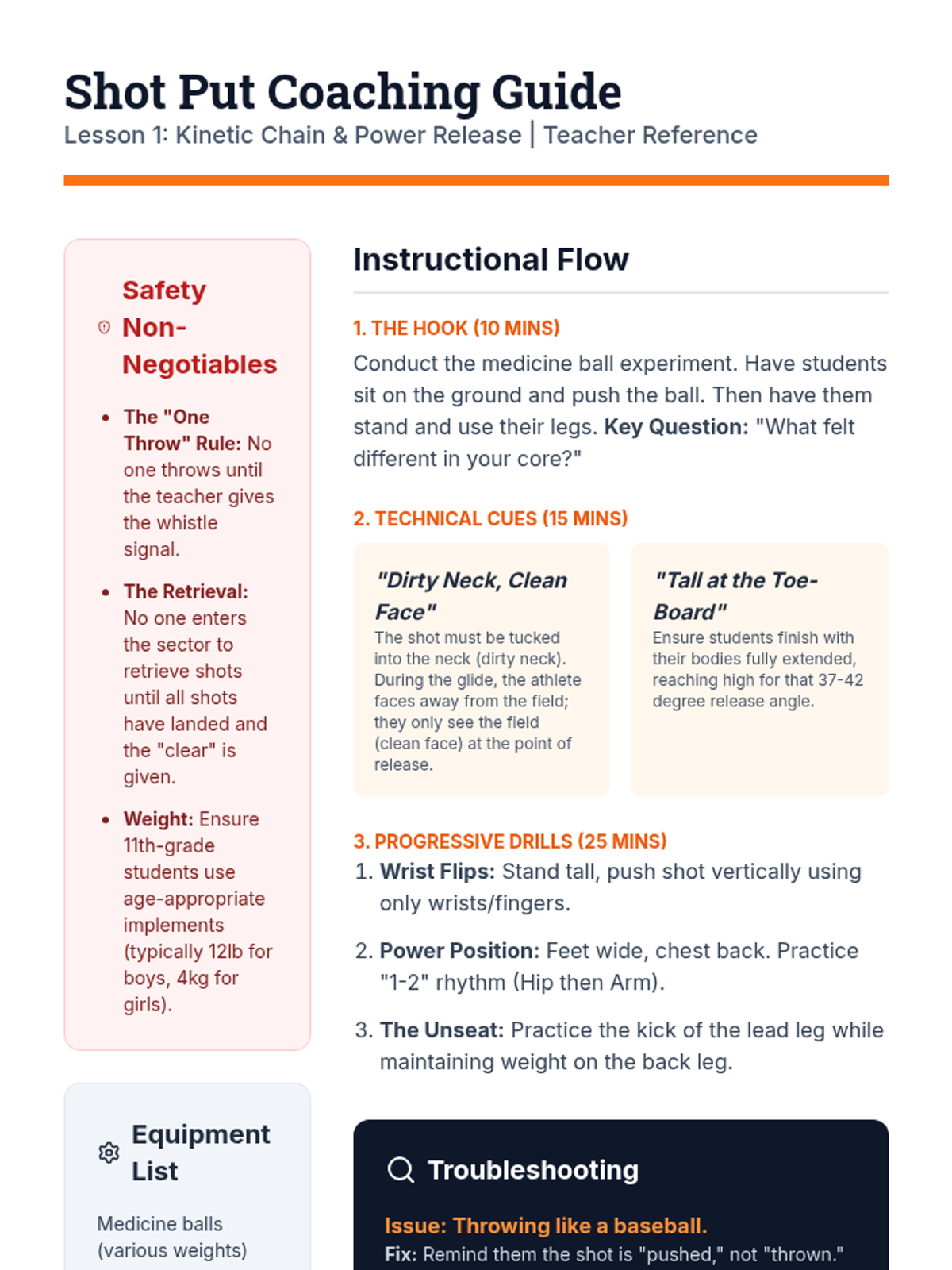
Introduction to shot put technique with a focus on the kinetic chain and the physics of projectile motion. Students compare different throwing methods to understand how leg drive generates power.
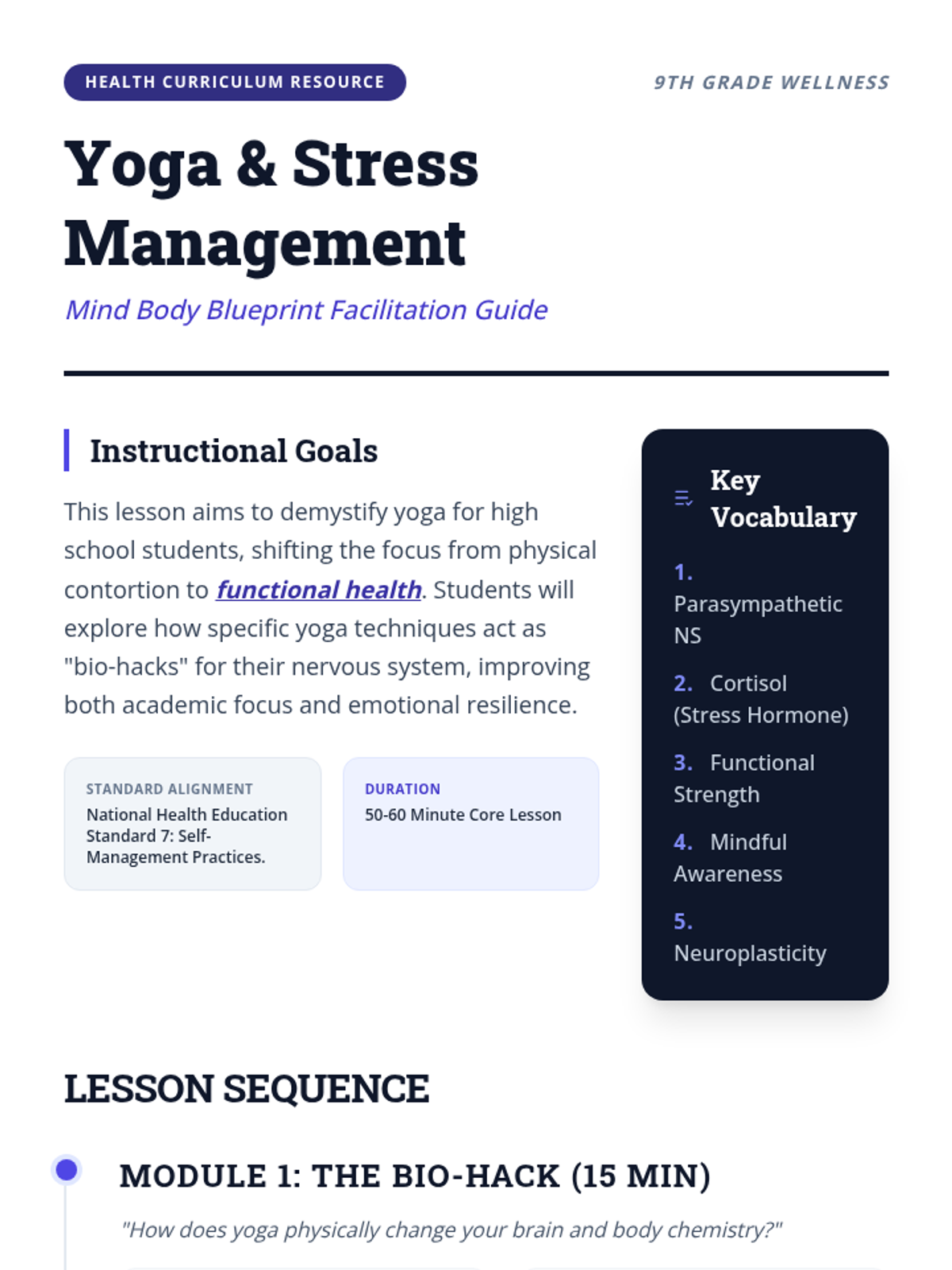
This lesson introduces 9th-grade health students to the holistic benefits of yoga, focusing on physical fitness, stress management, and emotional regulation. Students will explore how yoga acts as a tool for overall wellness and mental clarity during the high school years.
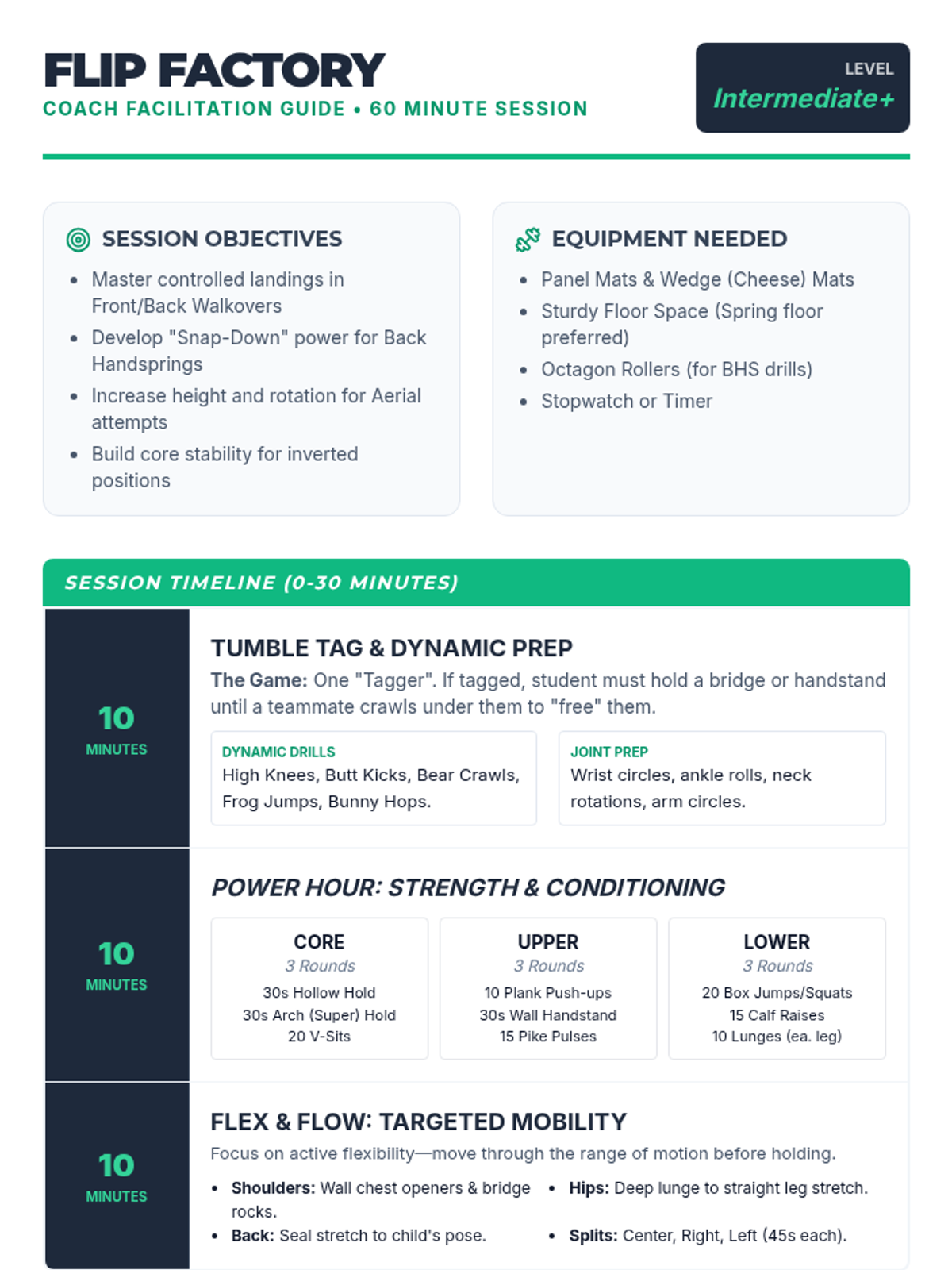
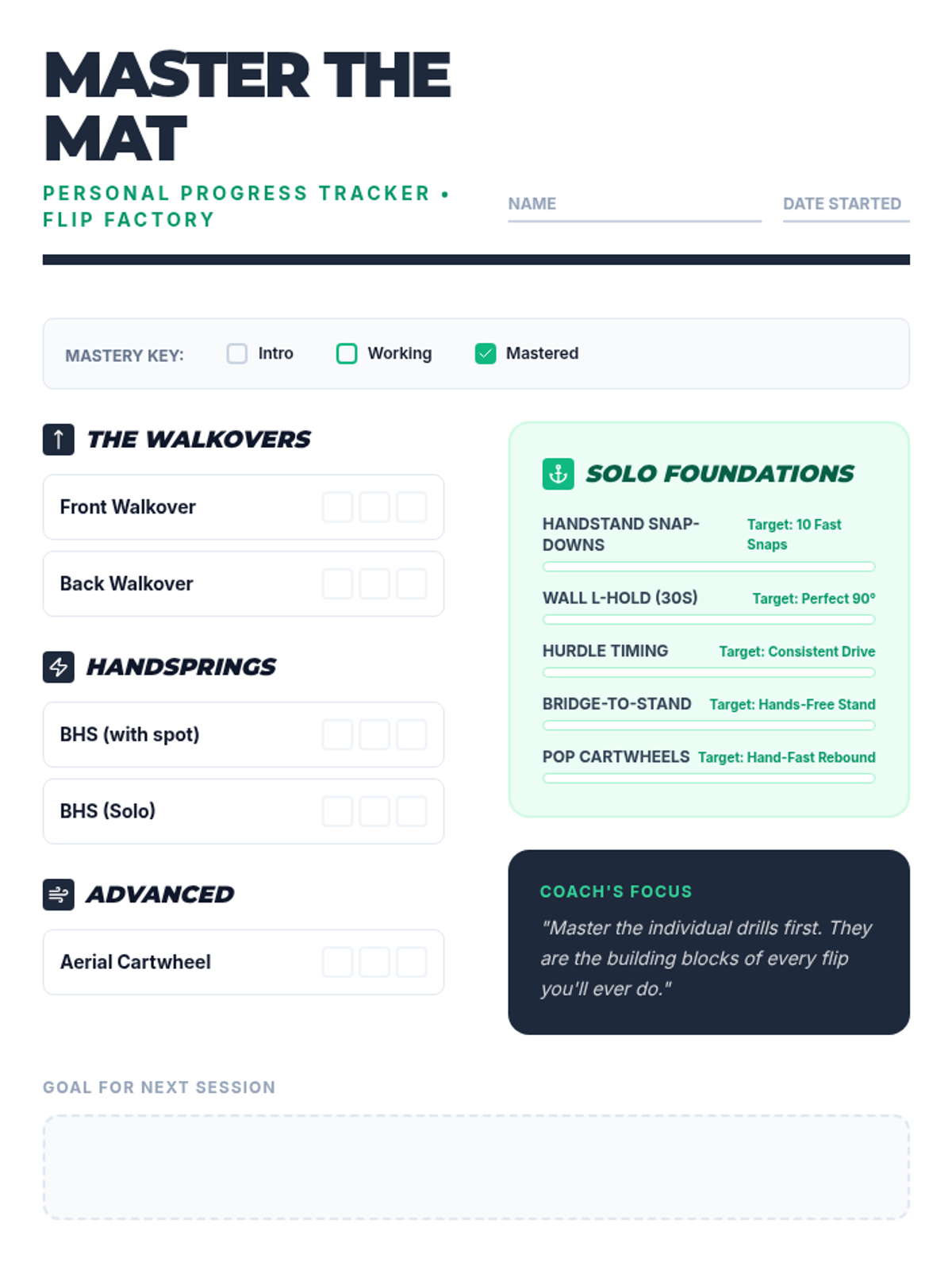
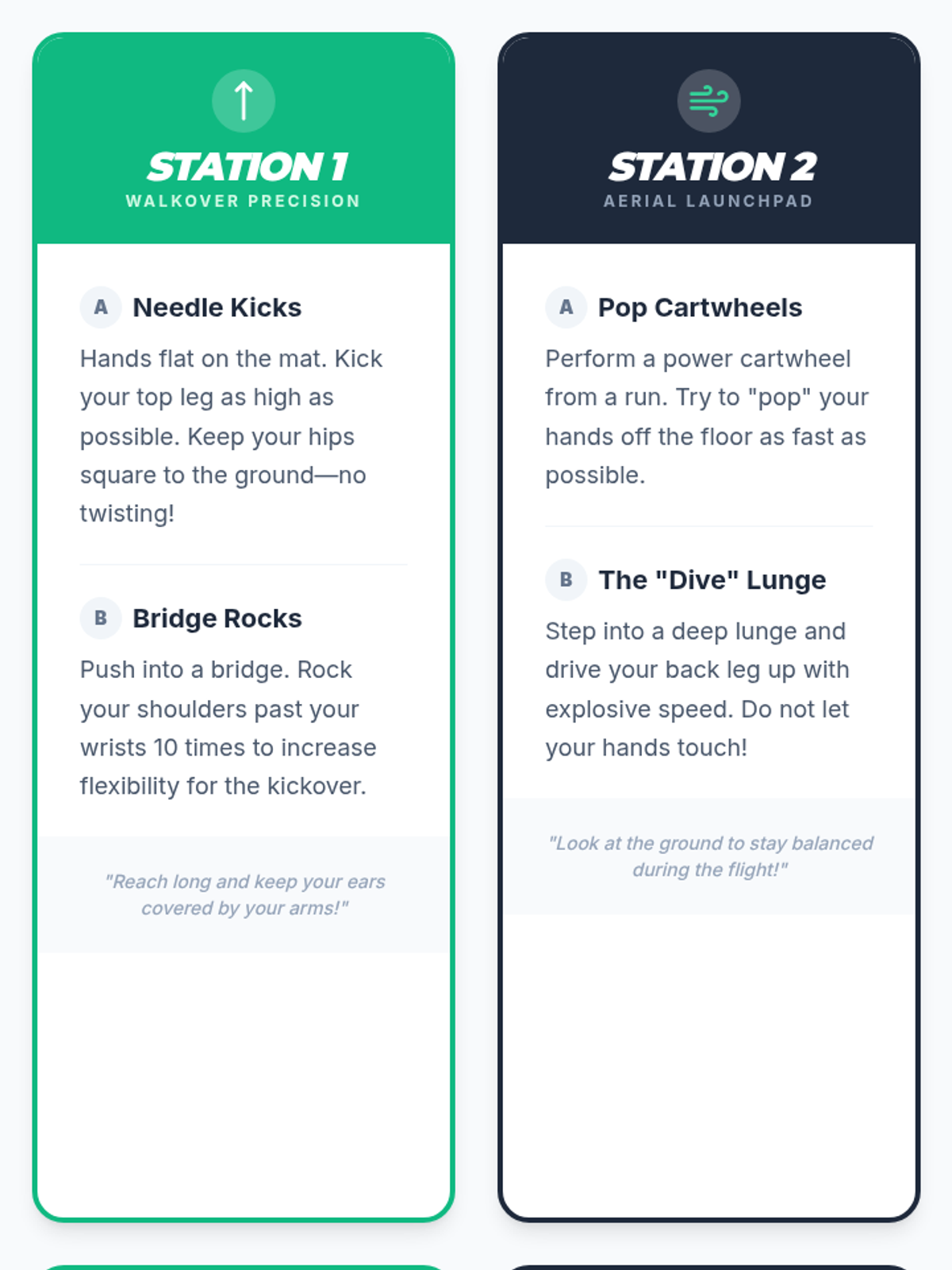
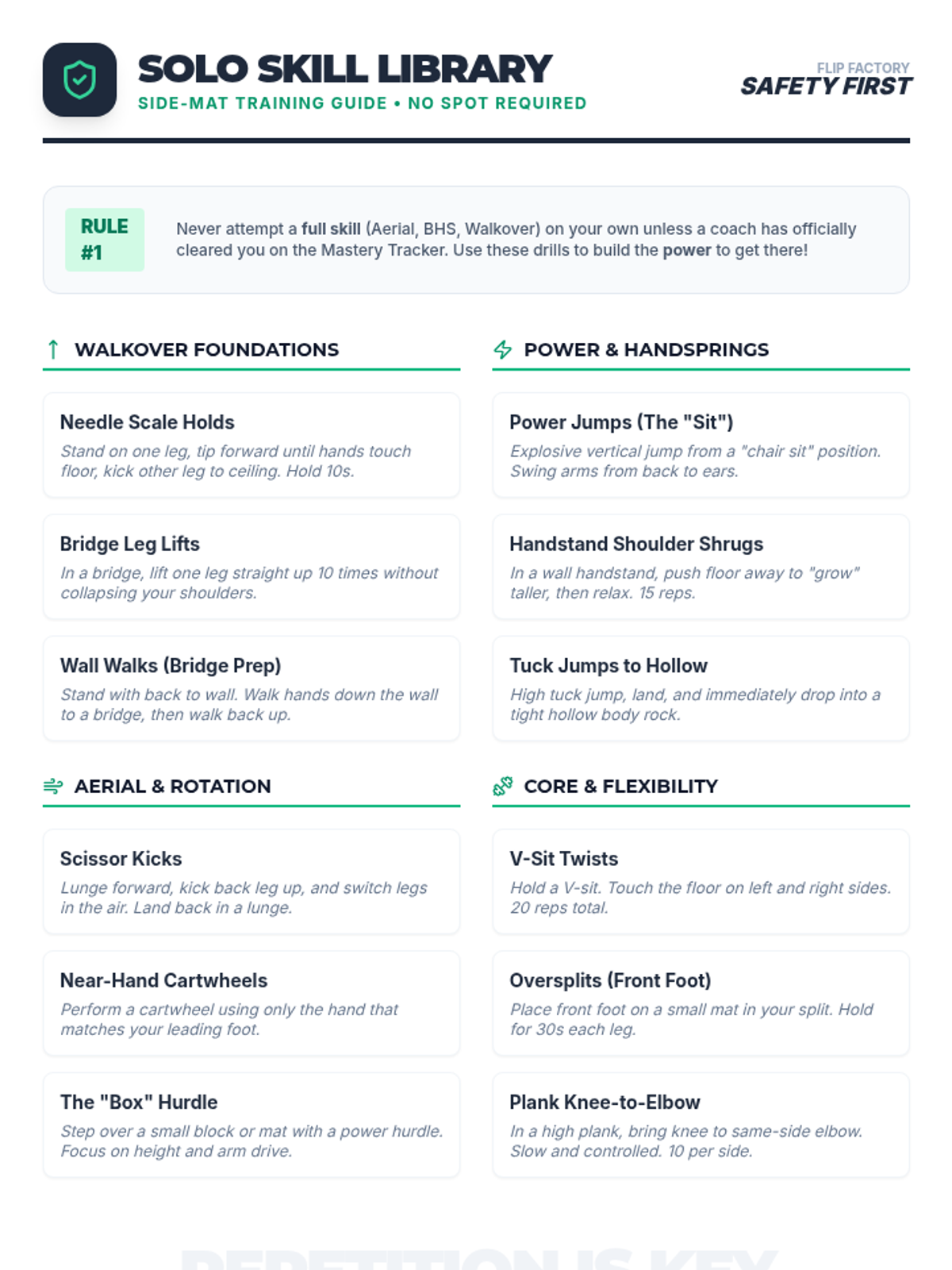
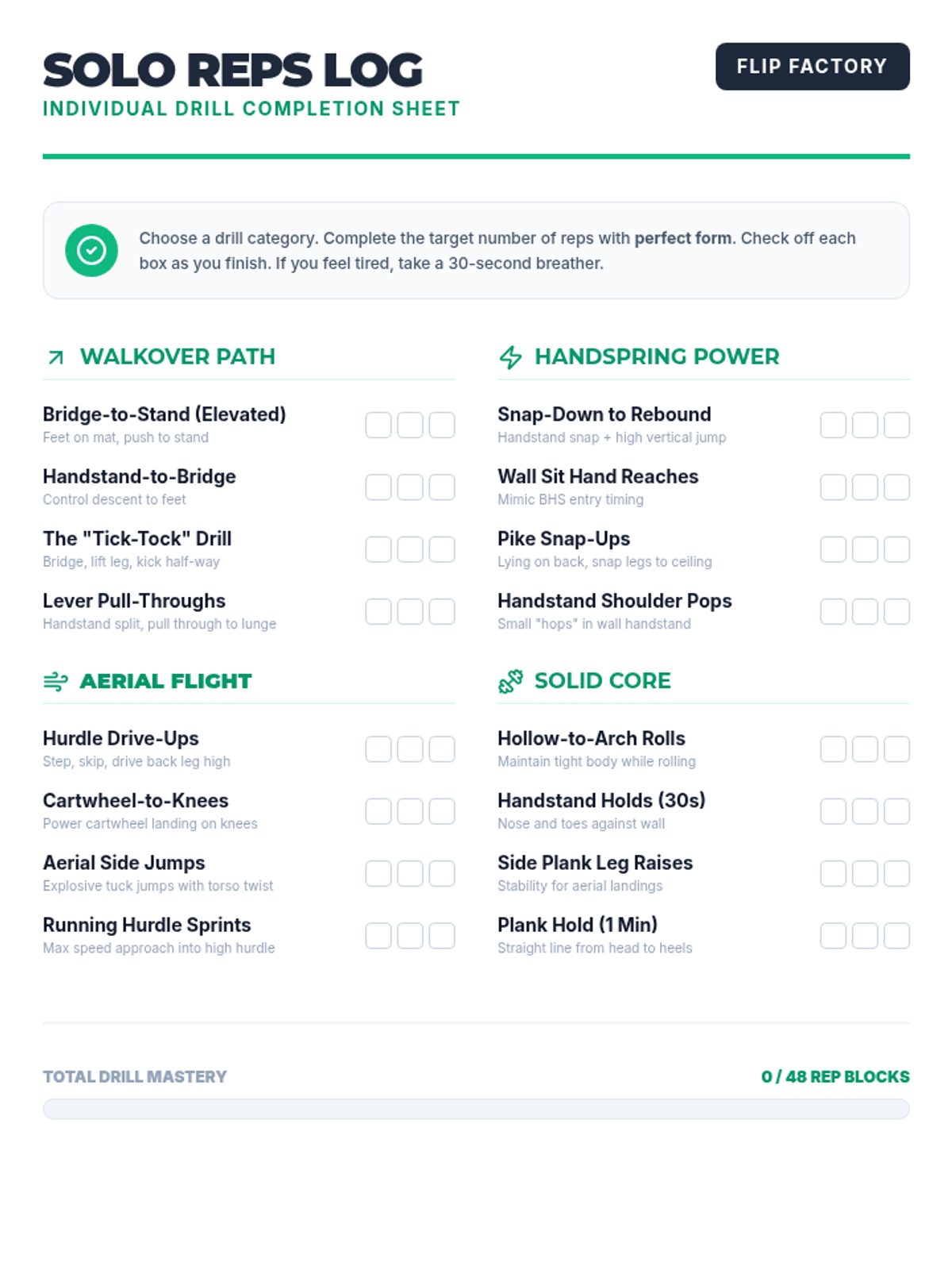
A high-energy 60-minute tumbling lesson focused on intermediate to advanced floor skills including walkovers, handsprings, and aerials. Includes a comprehensive coach guide, visual drills, and a student progress tracker.
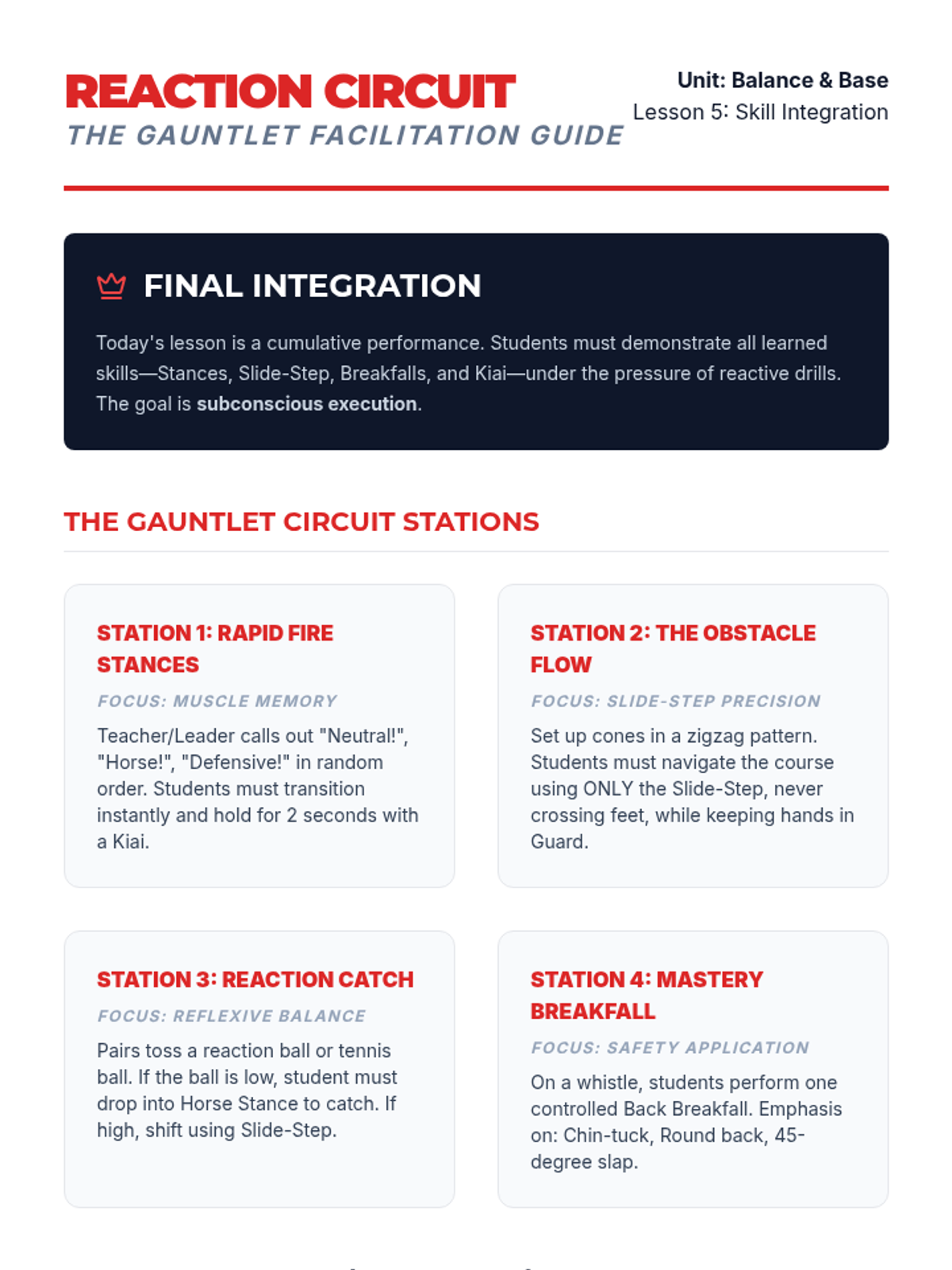
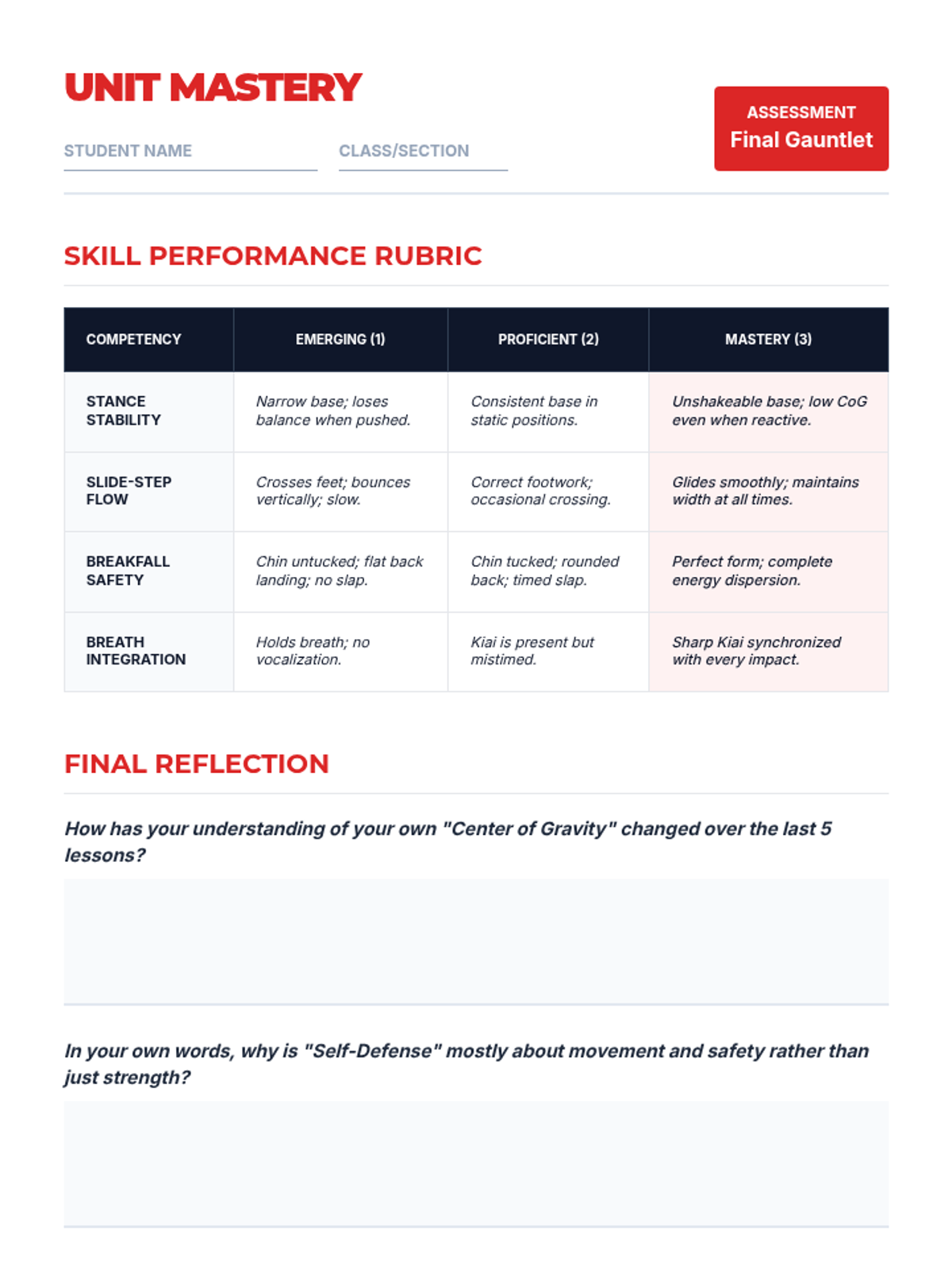
A high-energy culmination of the unit where students combine stances, footwork, and breath in reaction-based drills and agility circuits to improve motor recall.
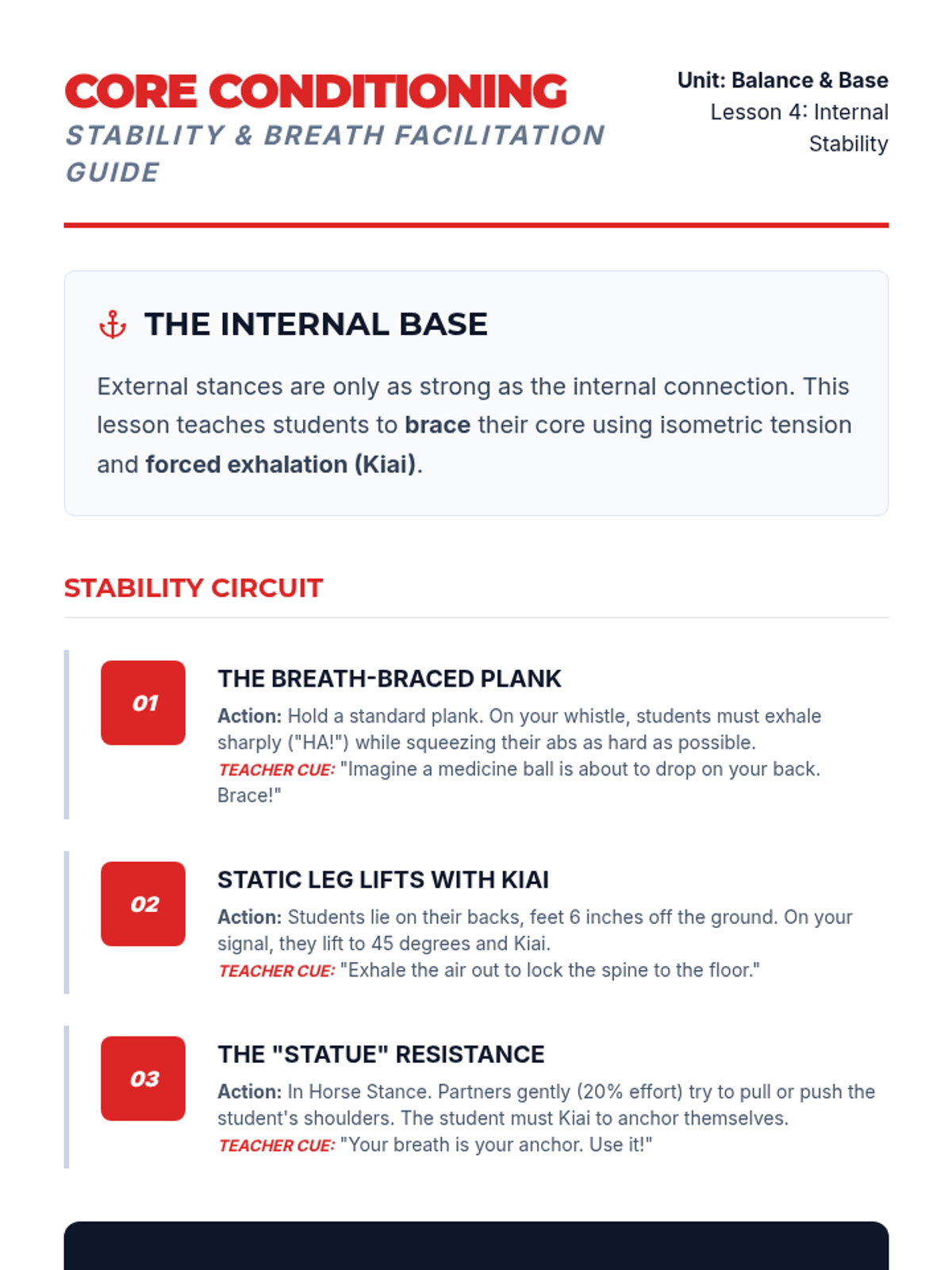
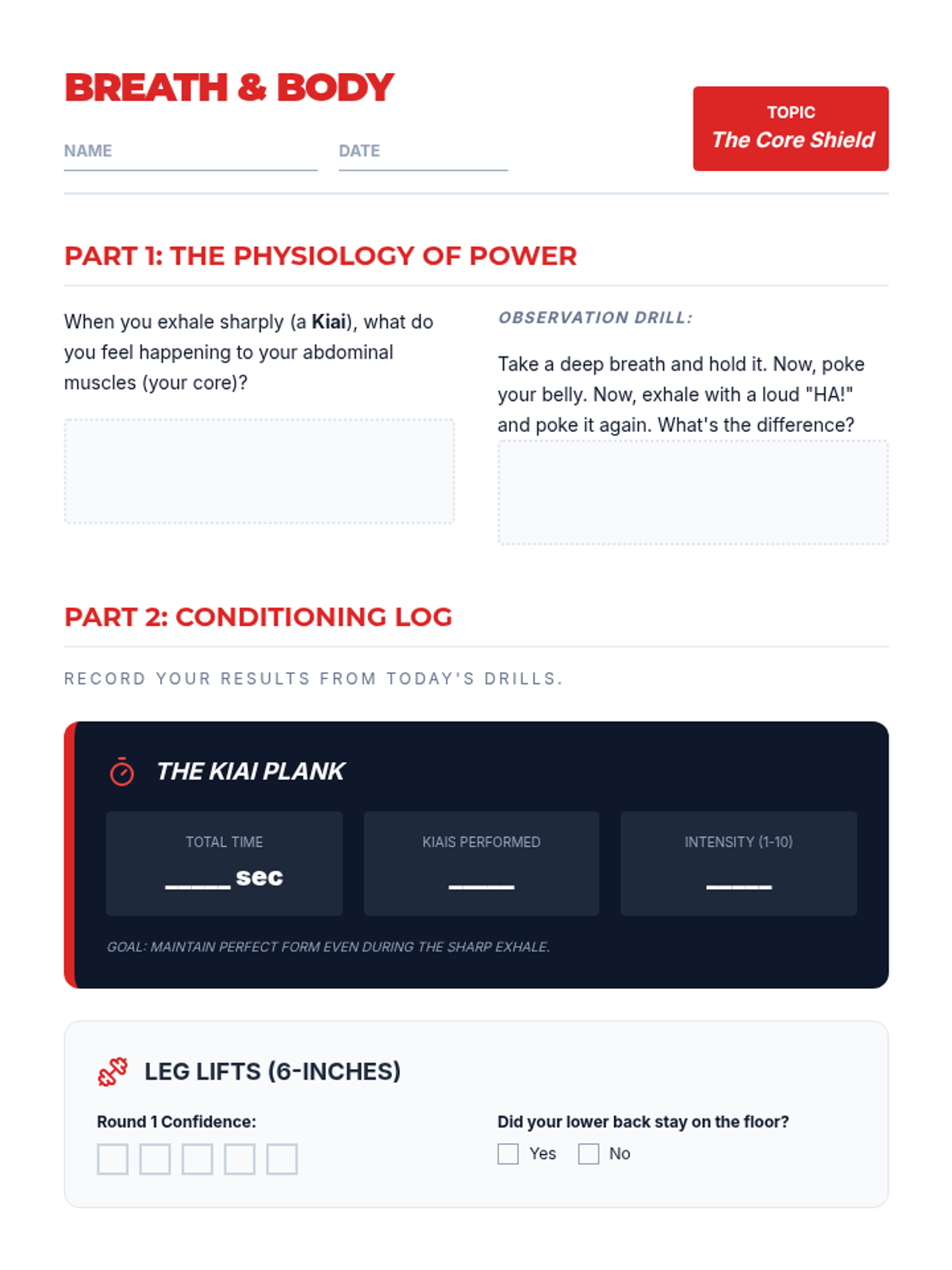
This lesson integrates isometric exercises and kiai breathing techniques to tighten the core during exertion, synchronizing breath with muscular contraction for stability.
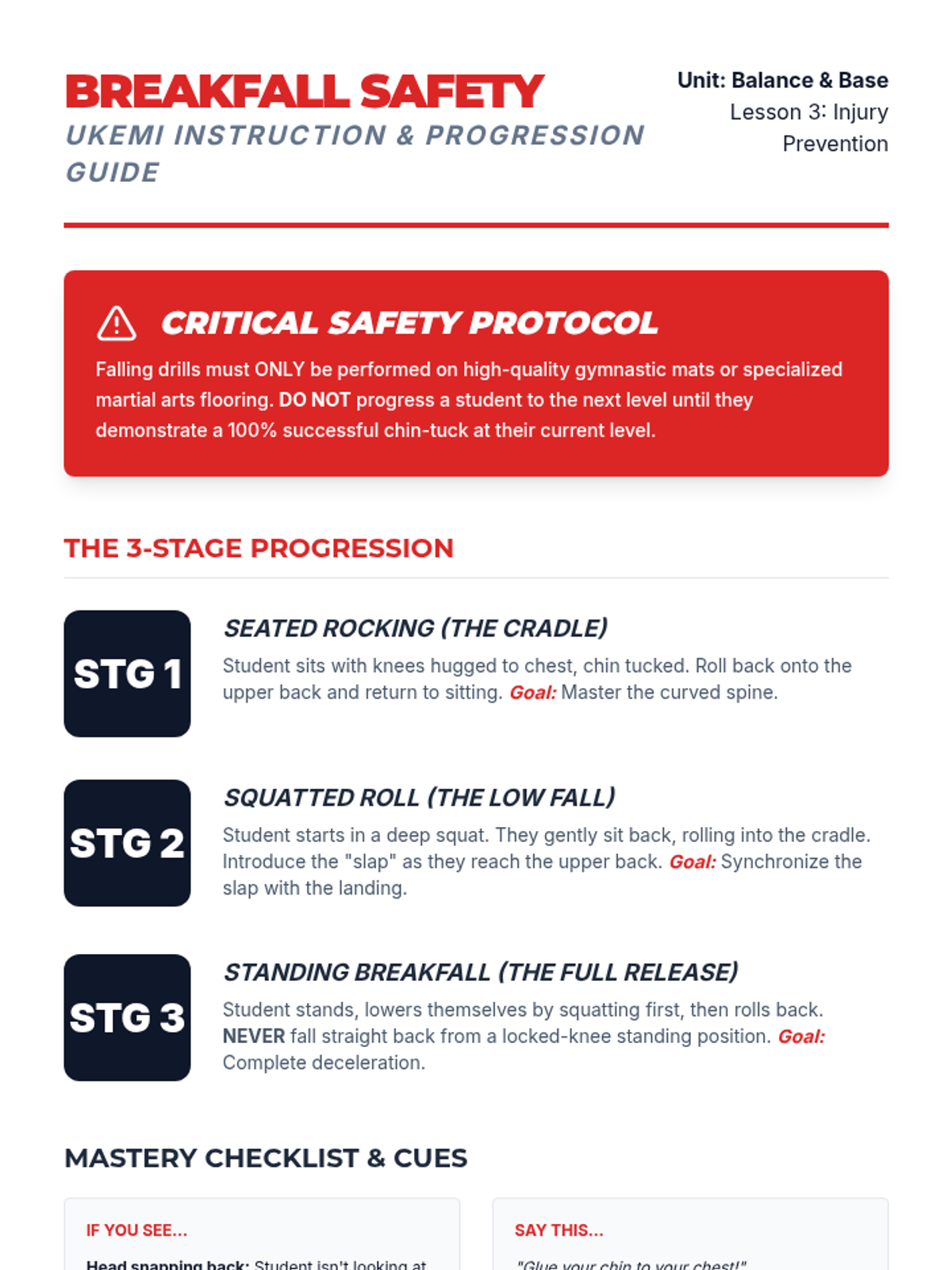
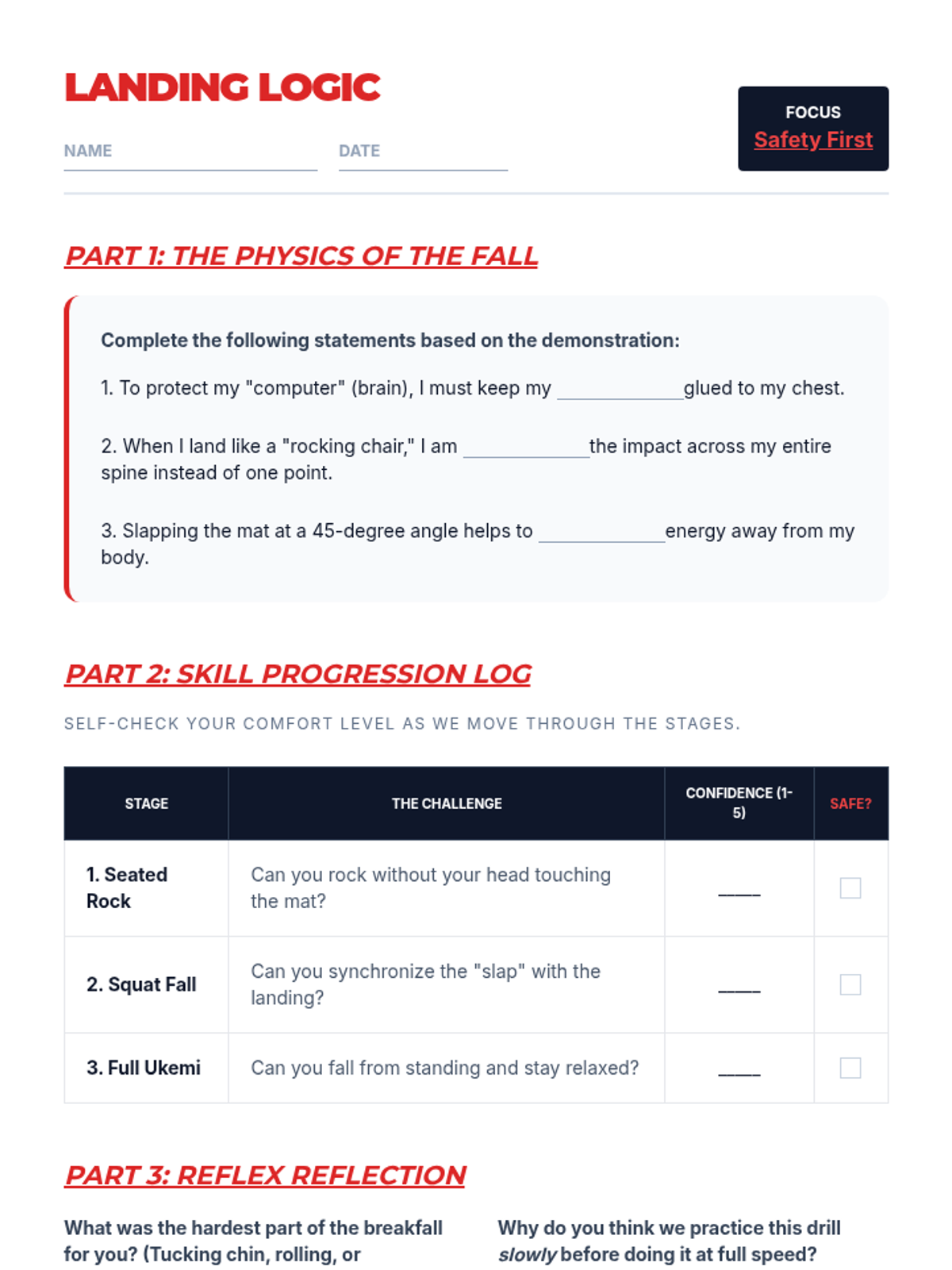
Students learn the mechanics of dispersing impact when falling (Ukemi), focusing on tucking the chin, rounding the back, and using 'slaps' to absorb shock safely.
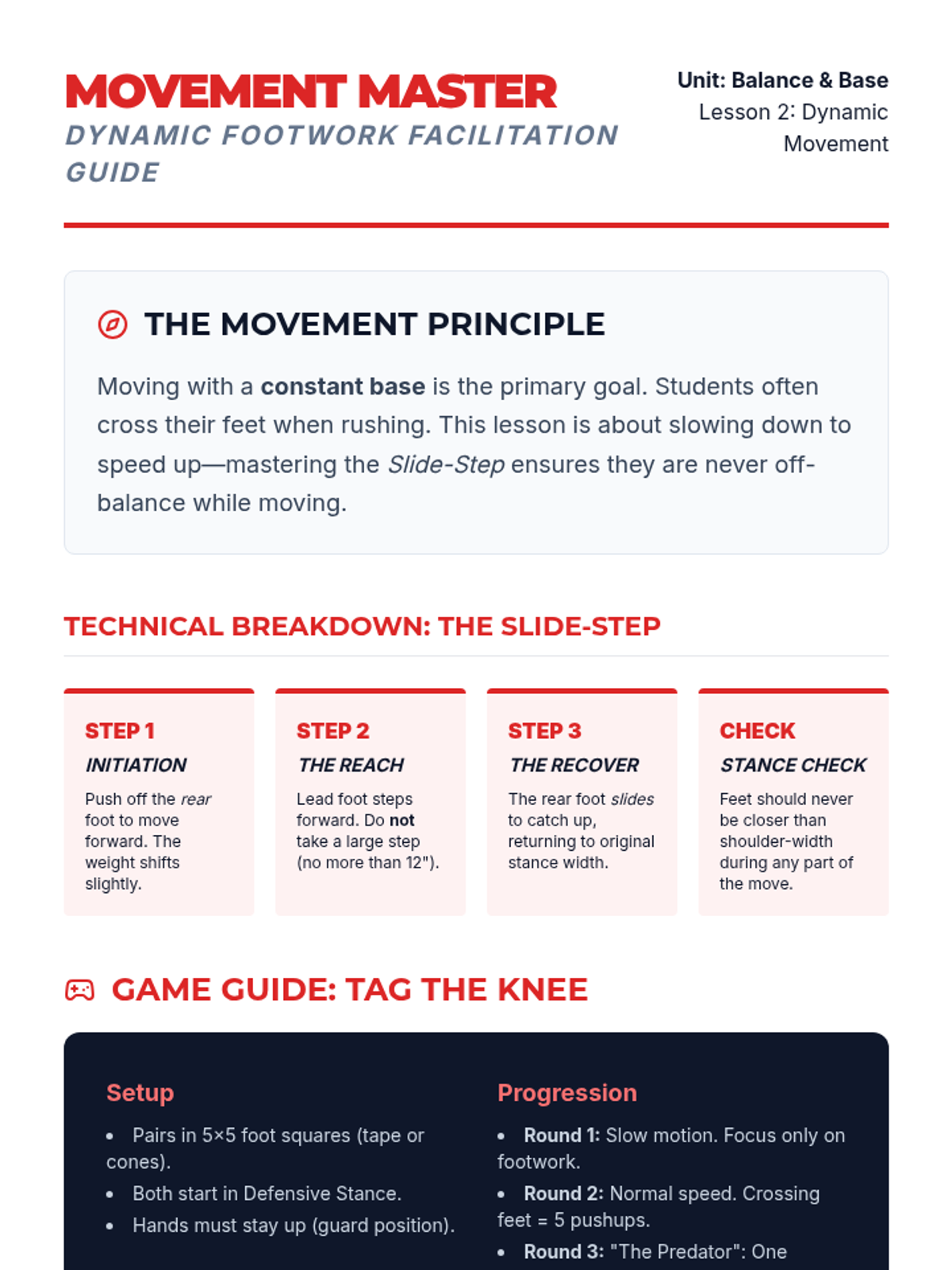
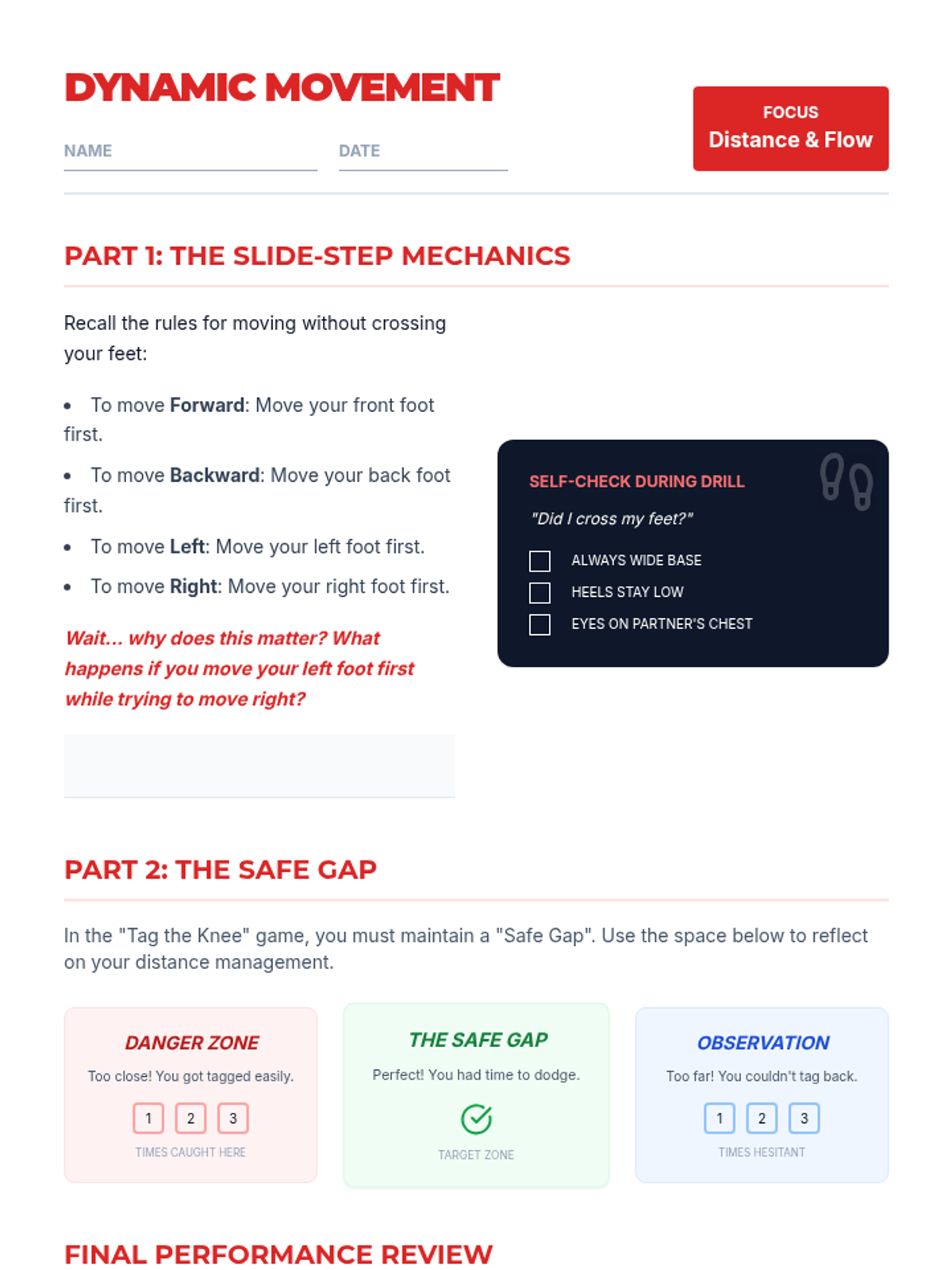
Focusing on the 'slide-step' and pivot, students practice moving without crossing their feet to maintain readiness and manage distance from potential threats.
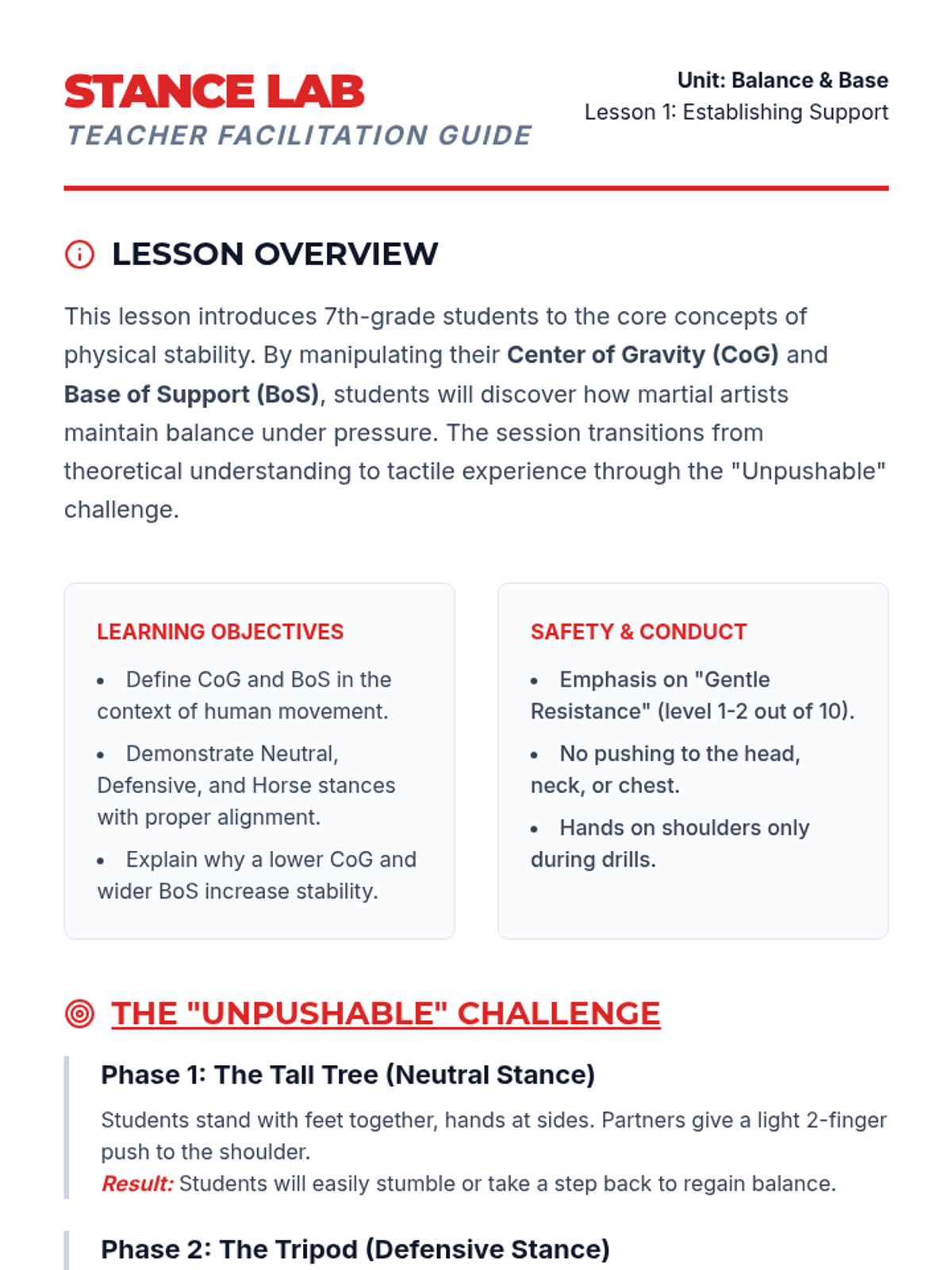
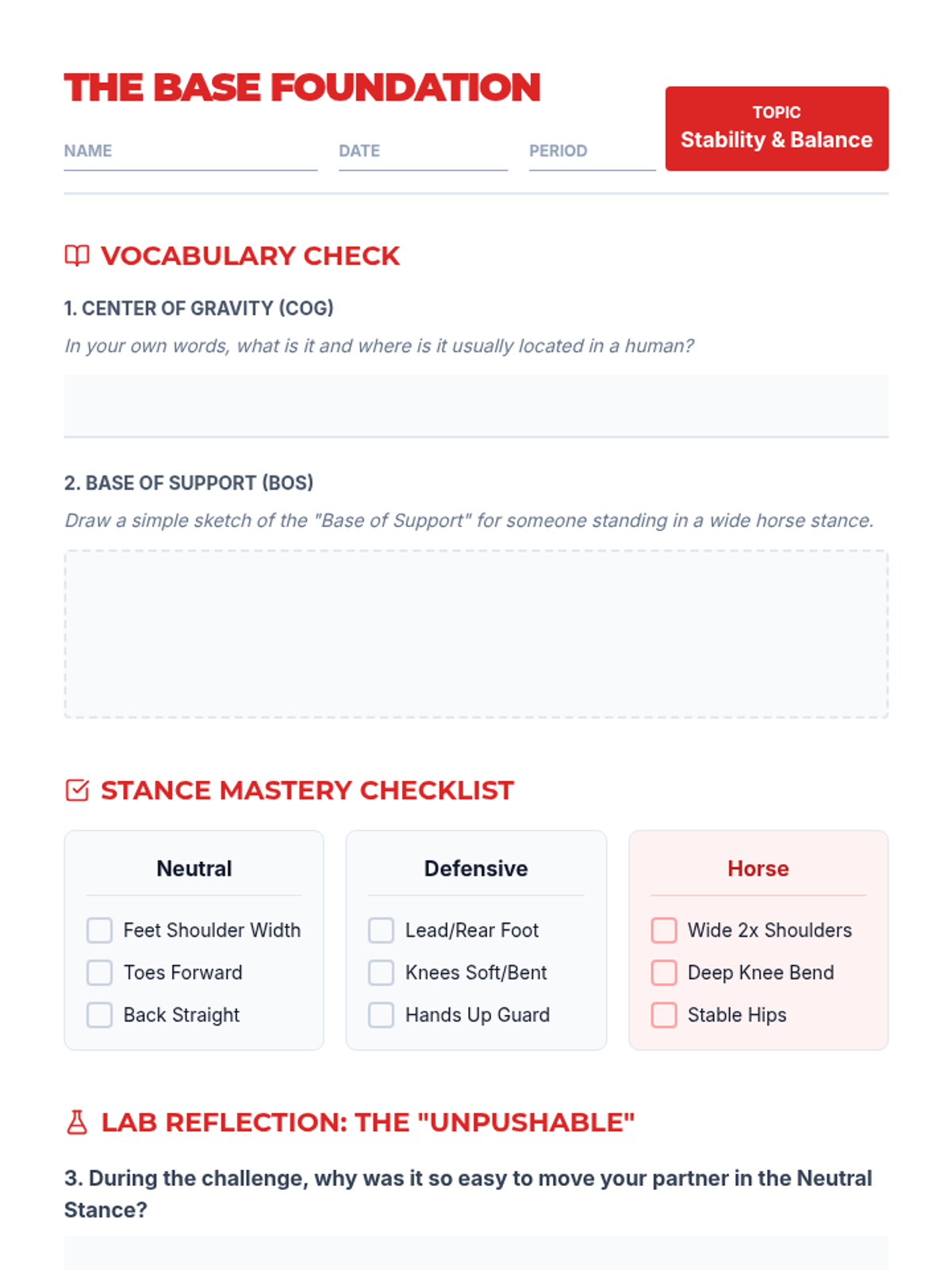
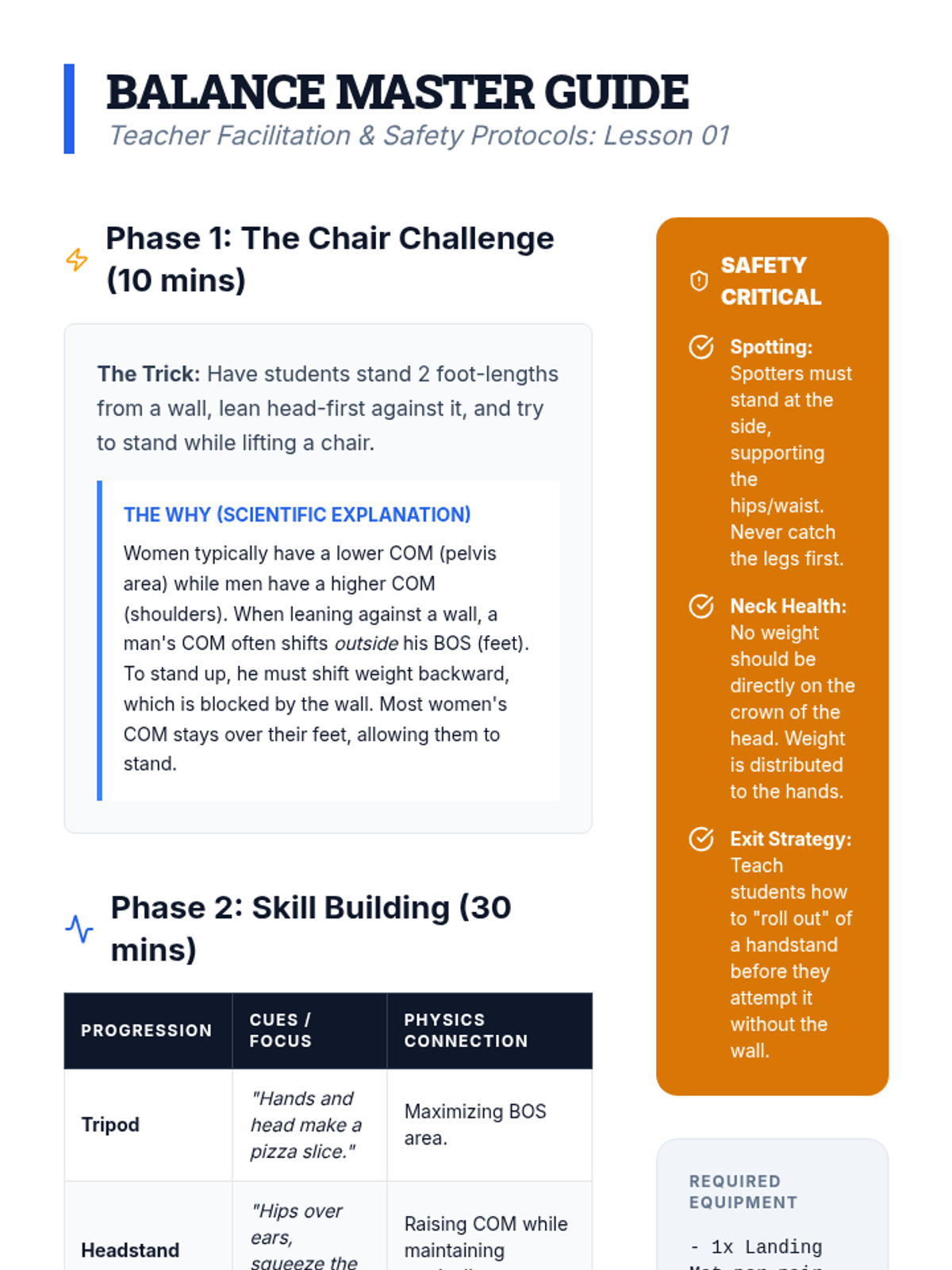
Students explore stability and center of gravity by mastering three fundamental stances: neutral, defensive, and horse stance, learning how a wide base and low center prevent being knocked off balance.
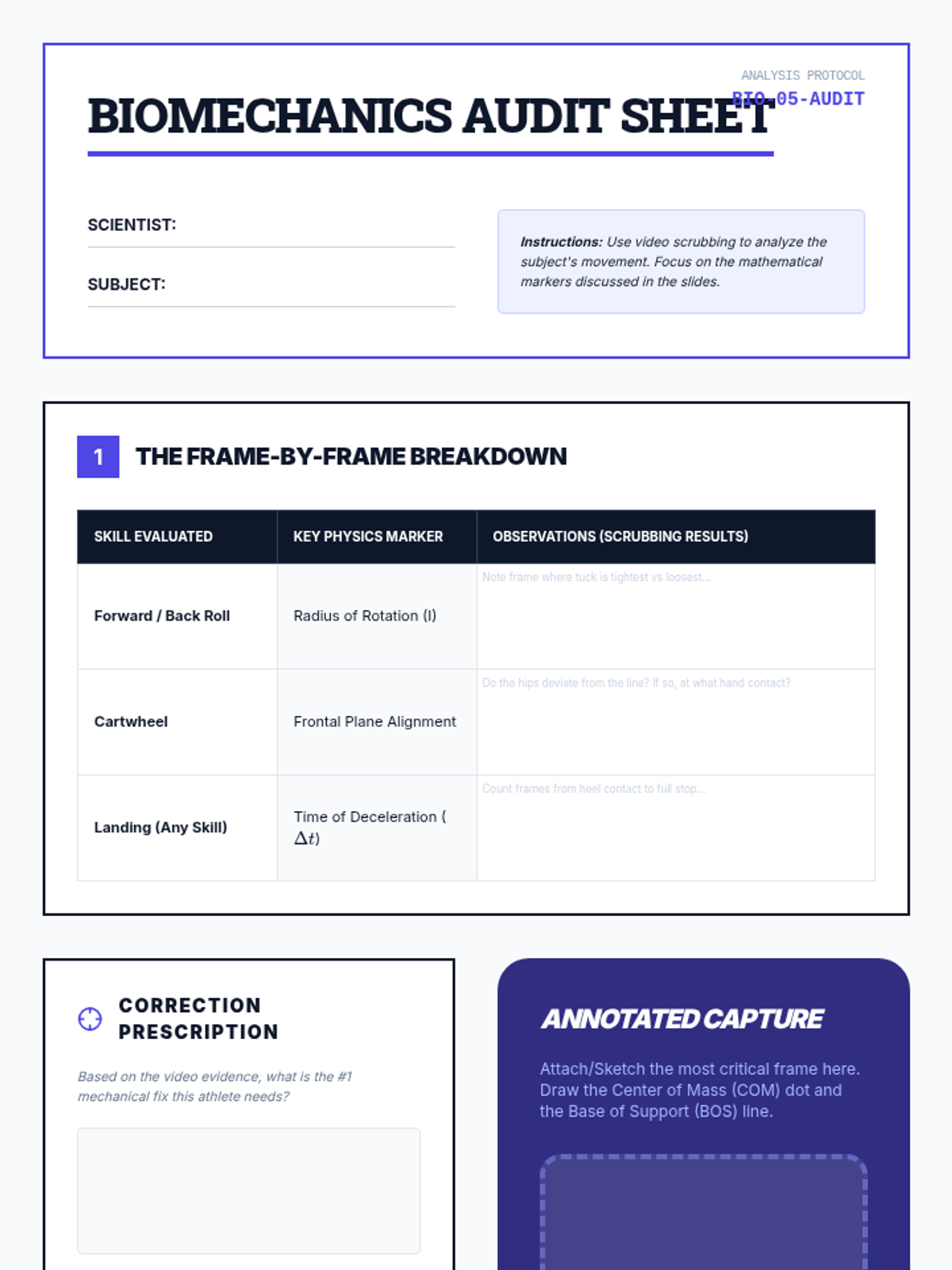
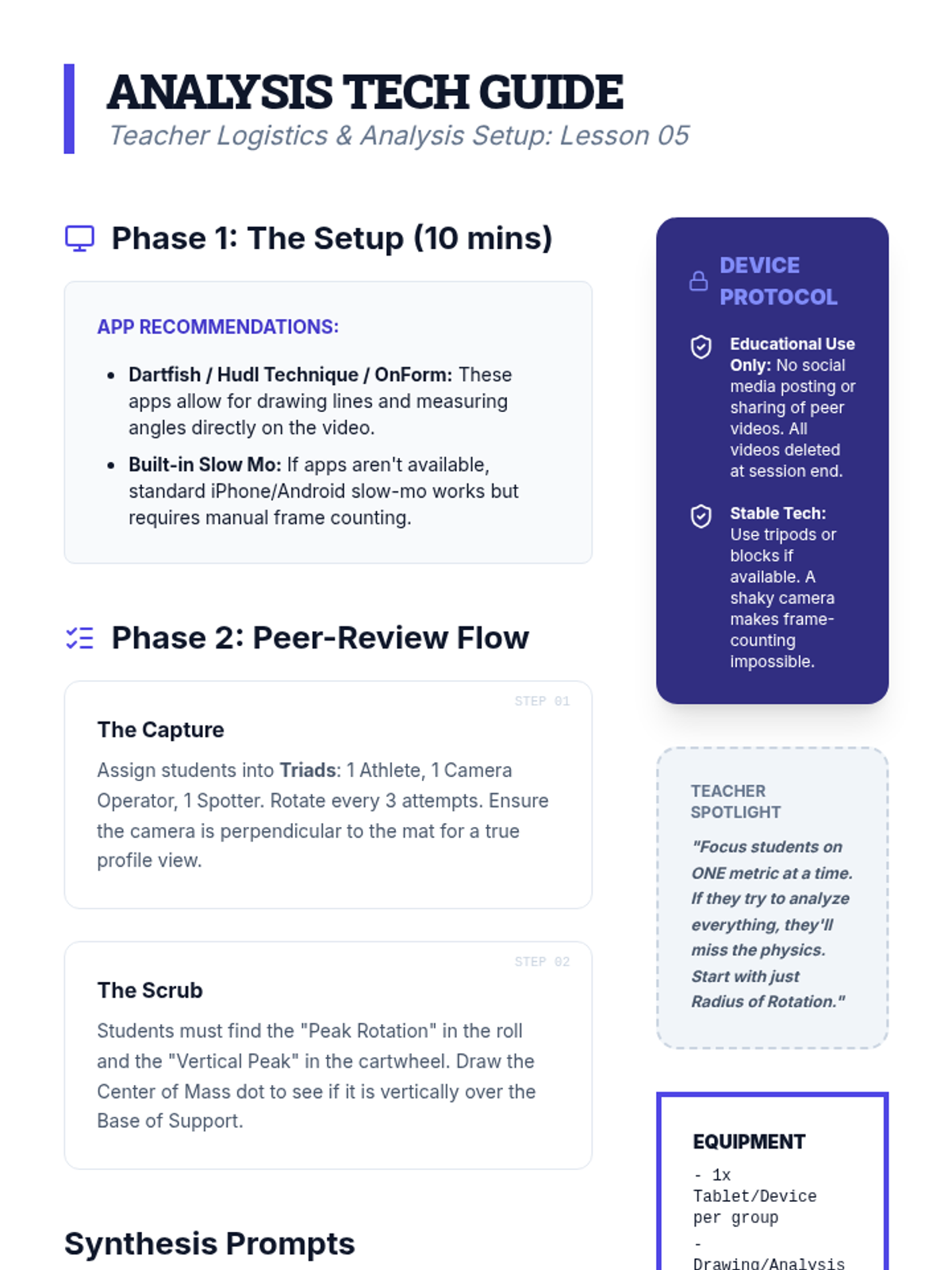
Using tablets, students record their tumbling skills and use slow-motion playback to identify deviations from ideal biomechanical models. They set specific goals for correction based on their findings.
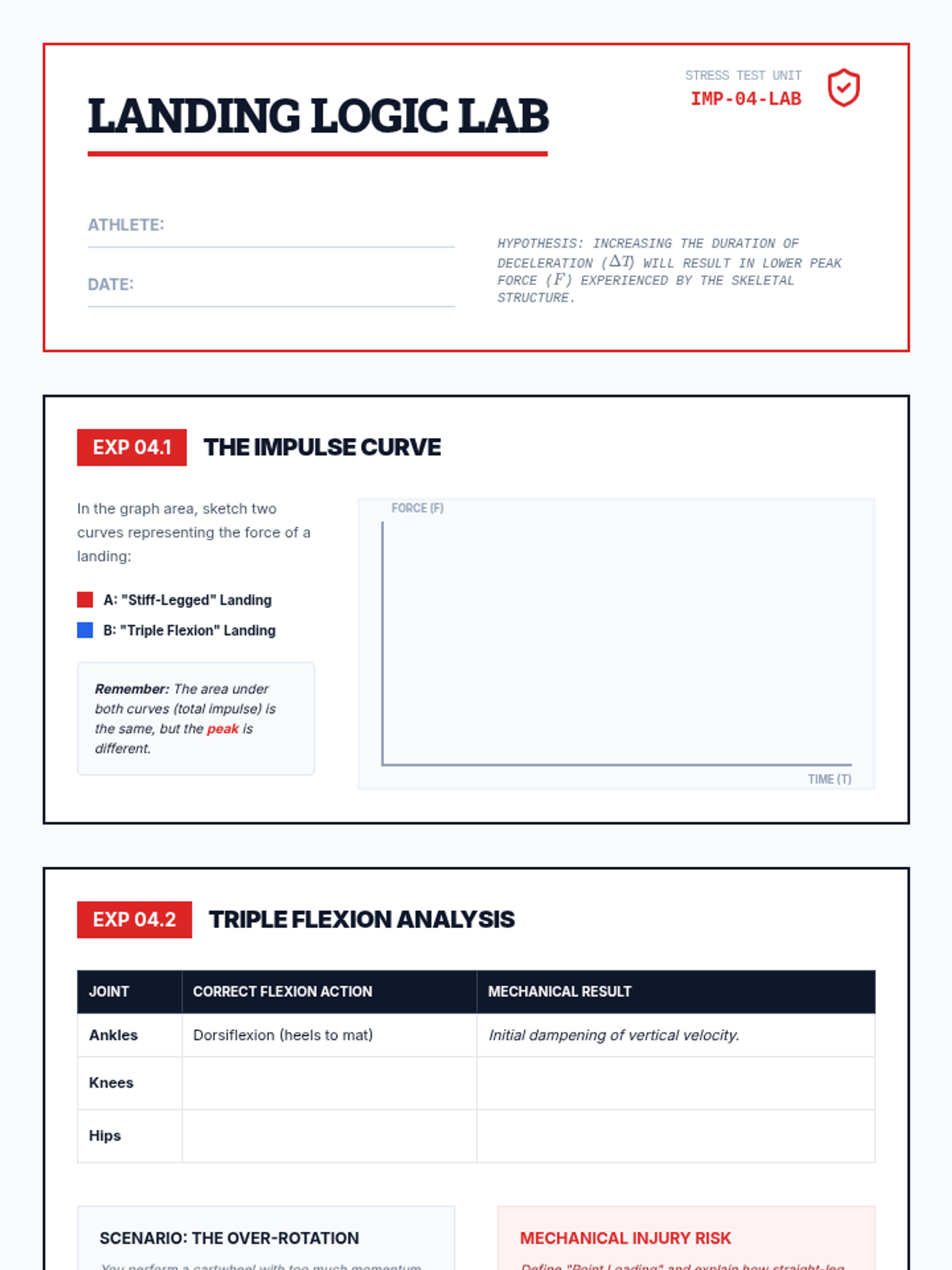
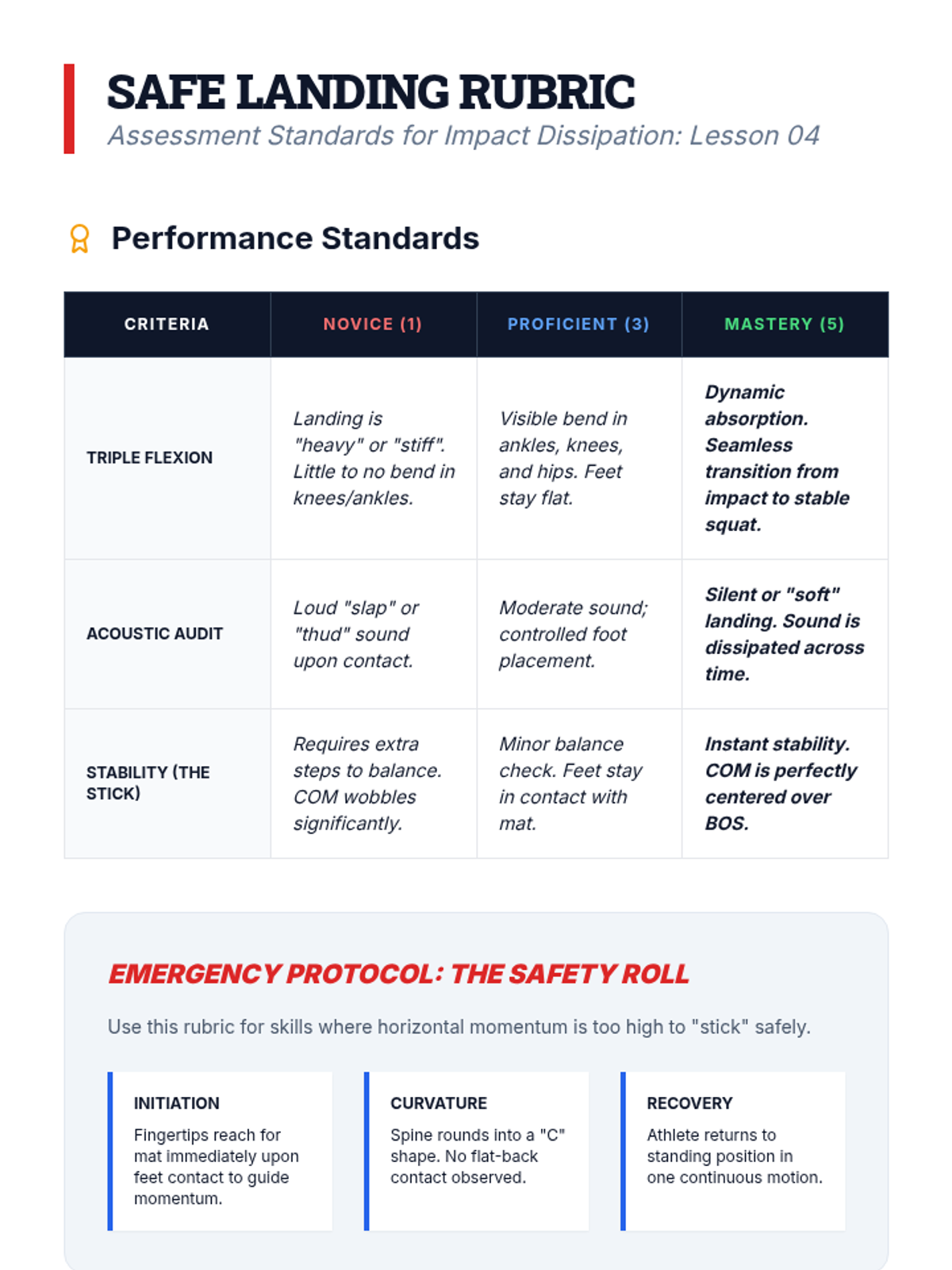
Students practice various landings from different heights and skills, analyzing the physics of impulse. They learn how increasing the time of impact reduces force on joints to prevent injury.
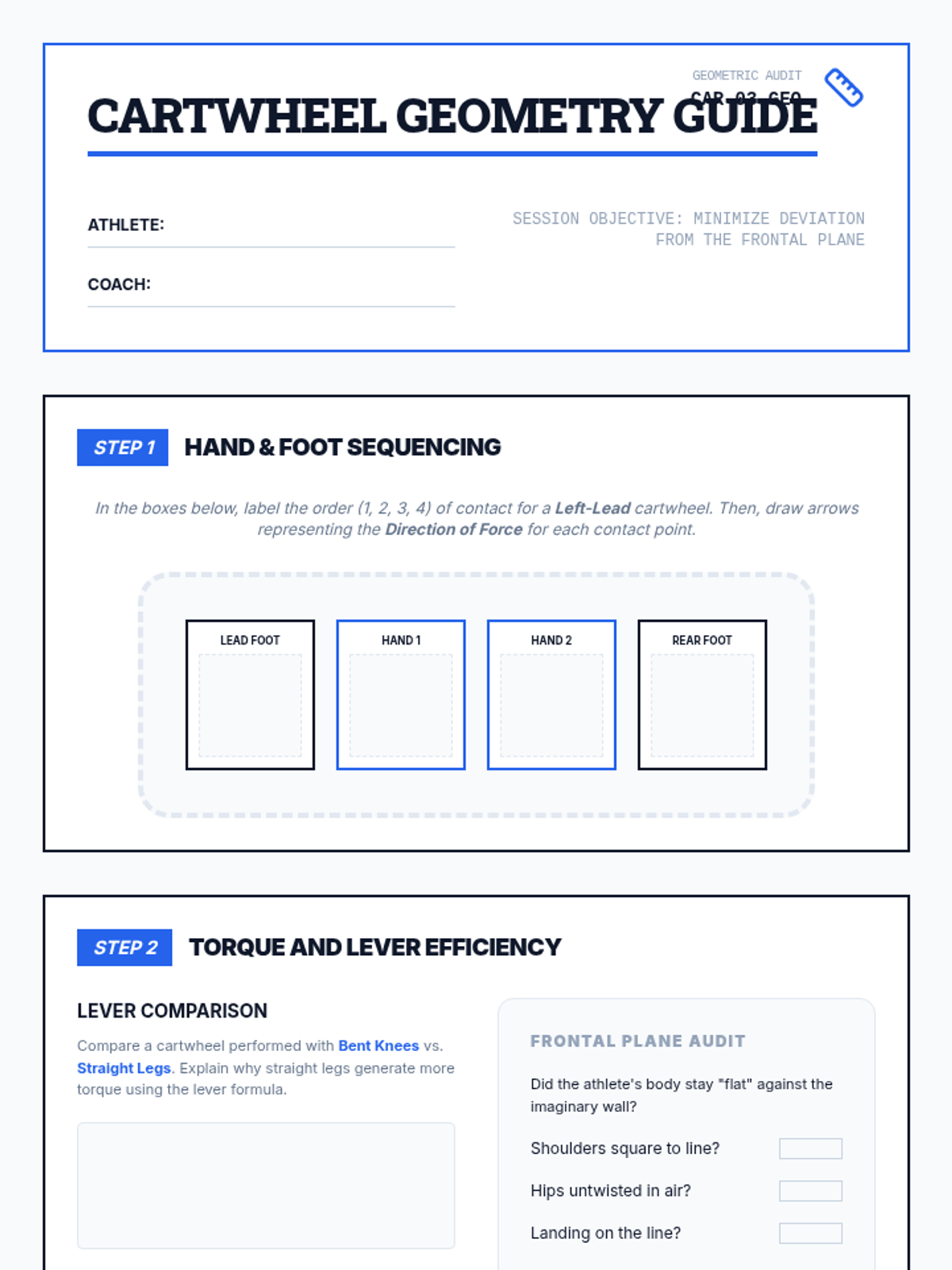
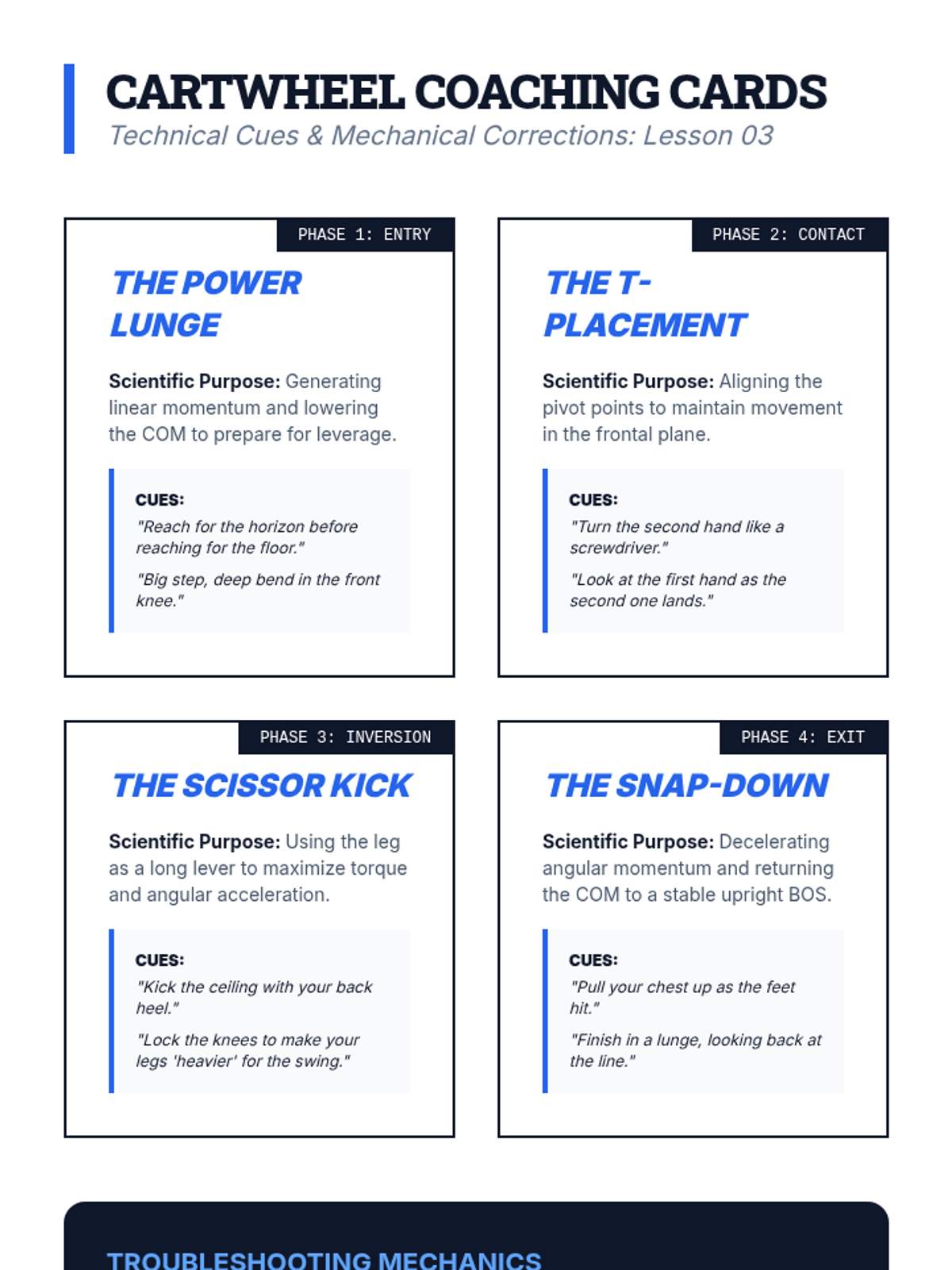
Students learn the hand-hand-foot-foot rhythm of the cartwheel, focusing on the lever action of the legs and the lateral movement plane. They use momentum to return to a standing position safely.
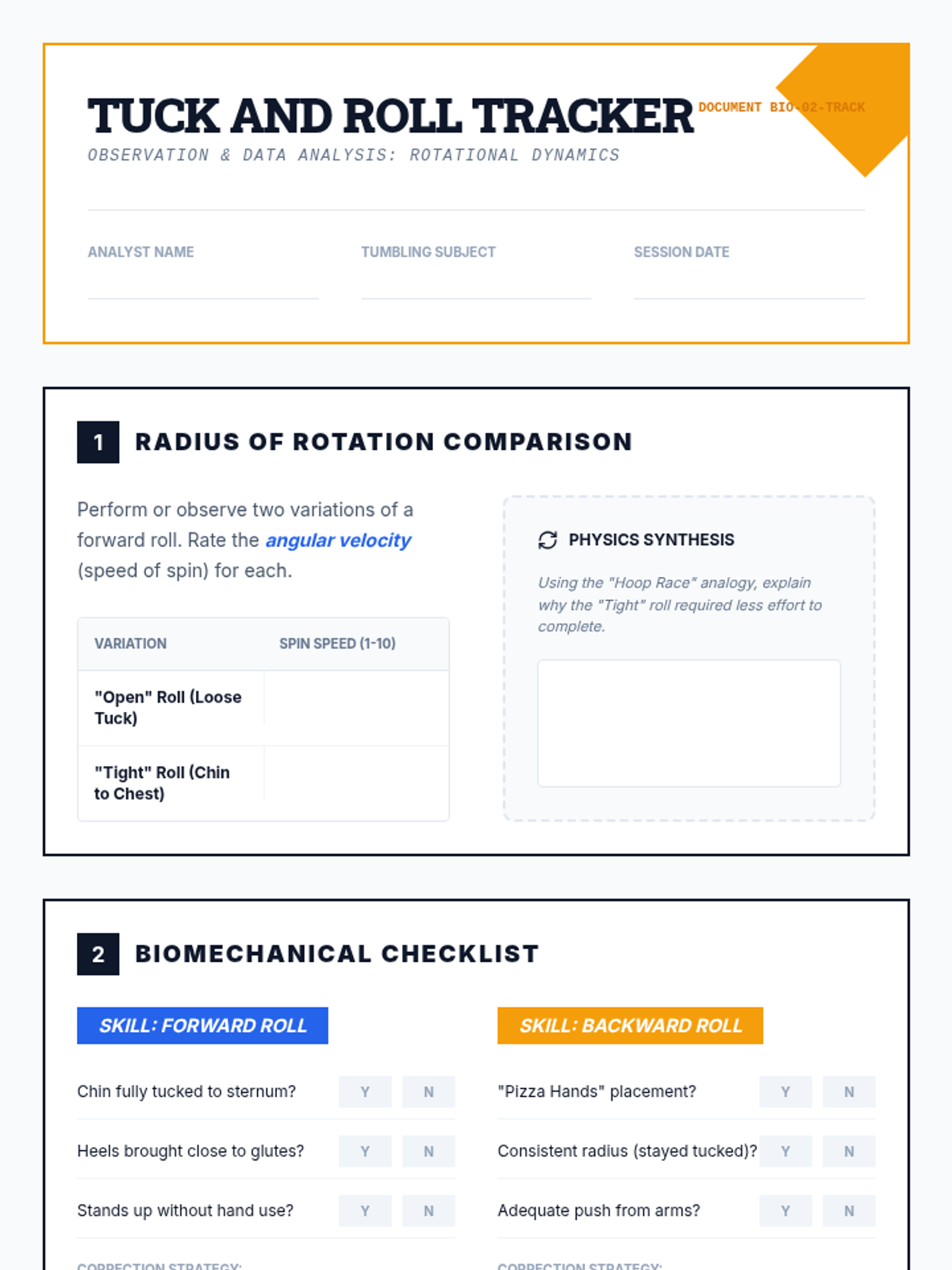
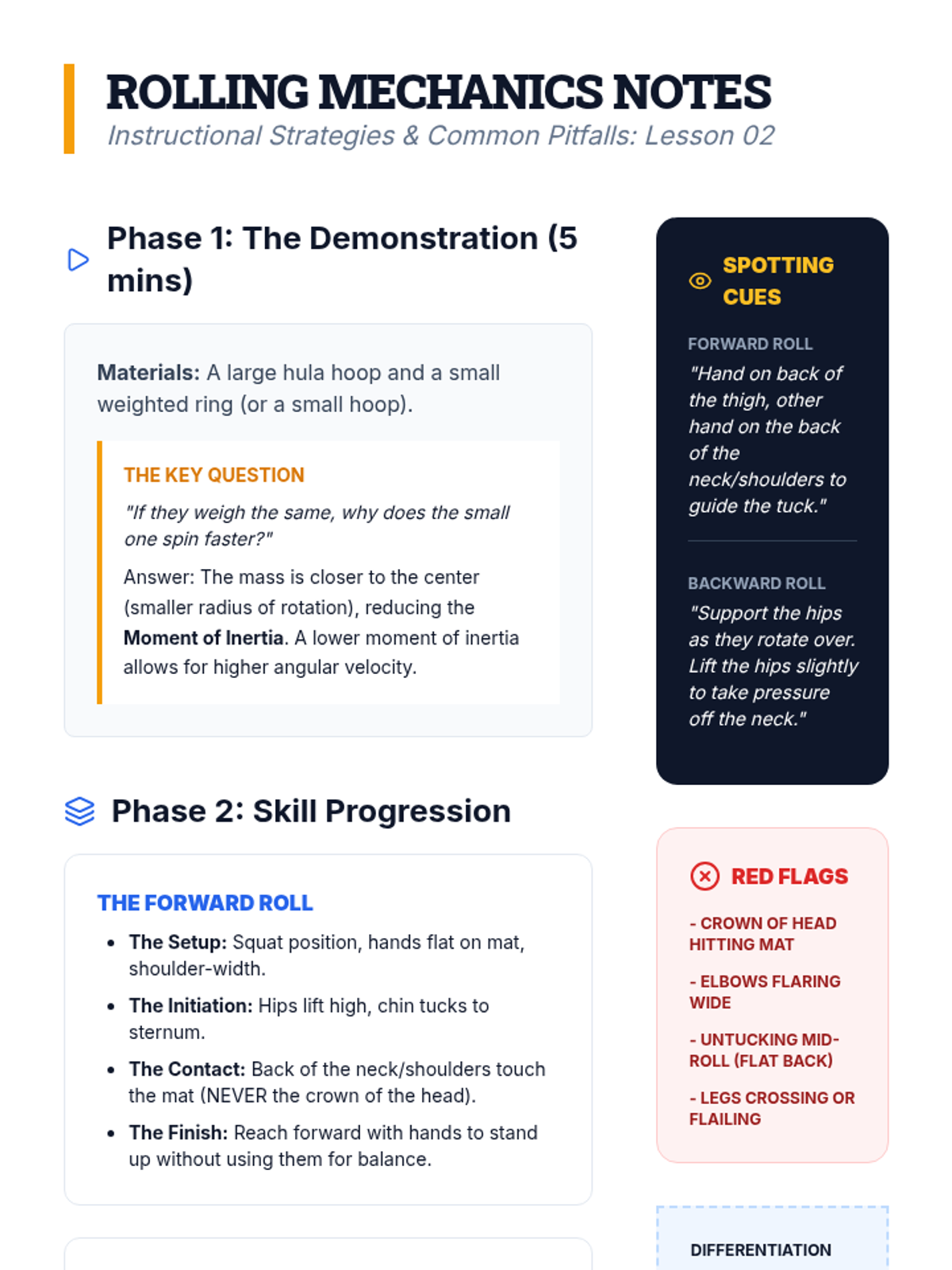
Focusing on tucked shapes, students practice forward and backward rolls to understand how reducing the radius of rotation increases speed. Peer observation focuses on spinal alignment and chin tucking.
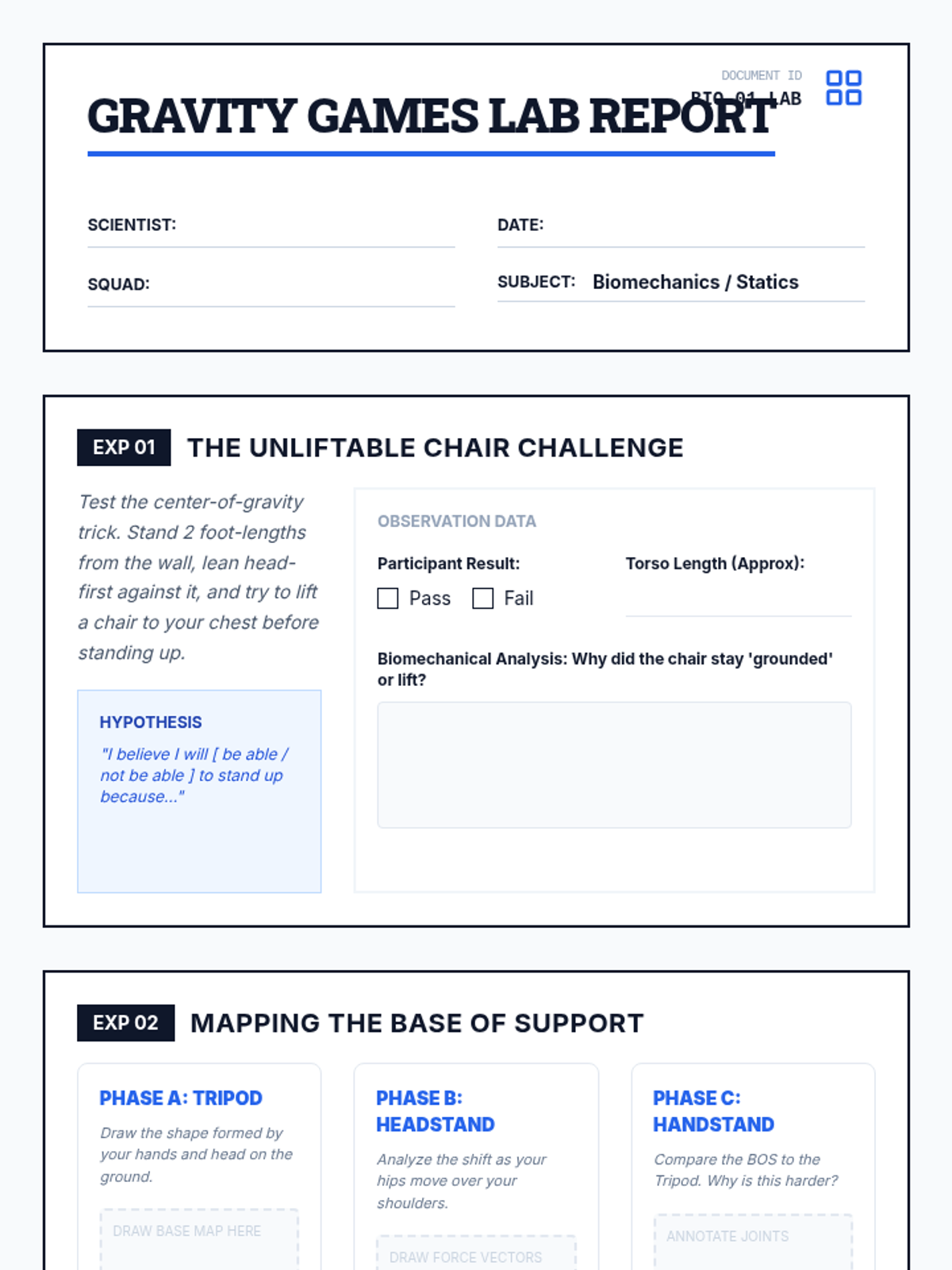
Students explore static balance by manipulating their center of gravity in relation to their base of support through tripods, headstands, and handstand progressions. They analyze how body alignment affects stability using biomechanical principles.
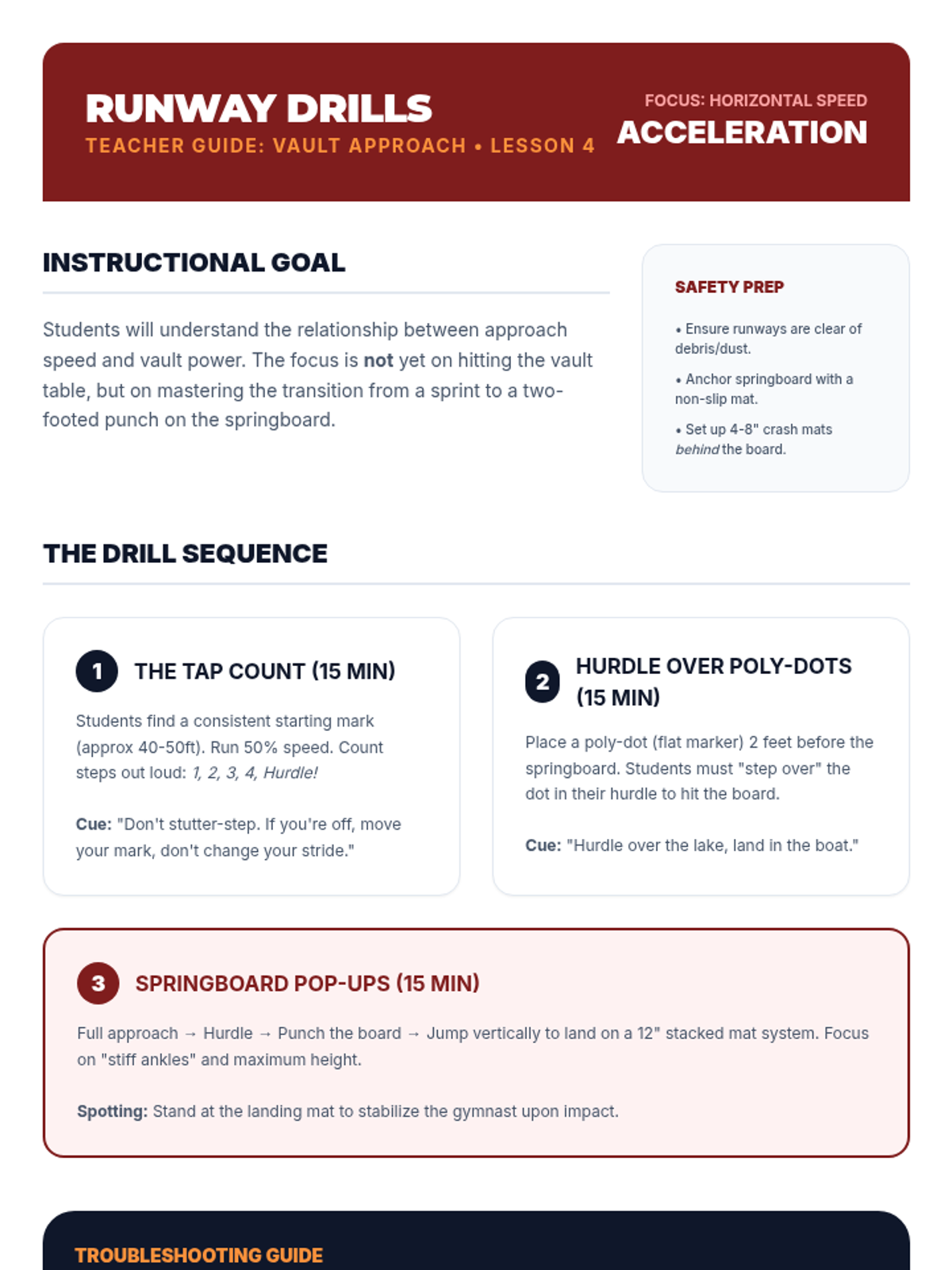
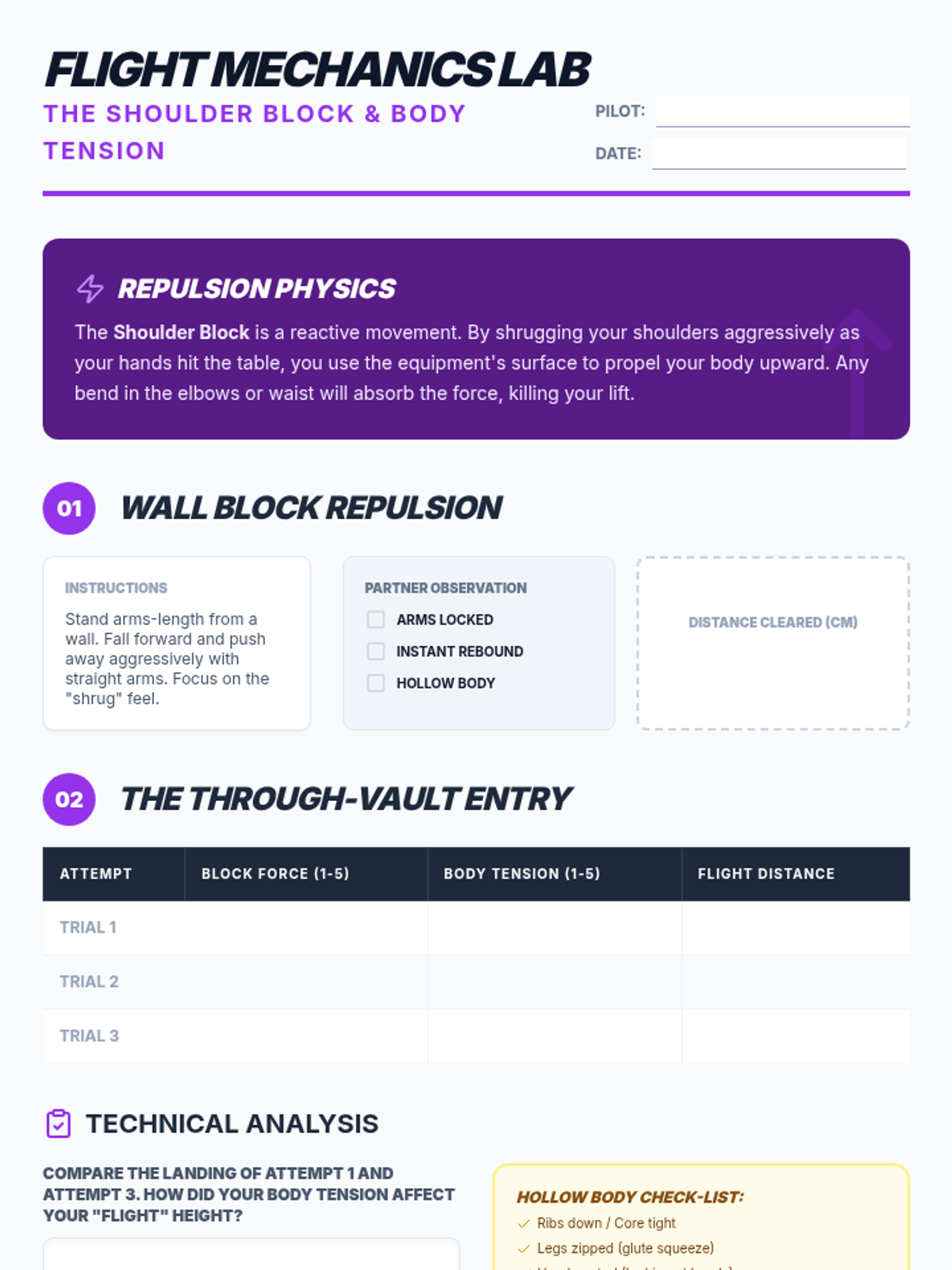
Combines the approach with basic vaulting skills like the squat-on. Students focus on the 'block' (pushing off the apparatus) and maintaining body tension during flight.
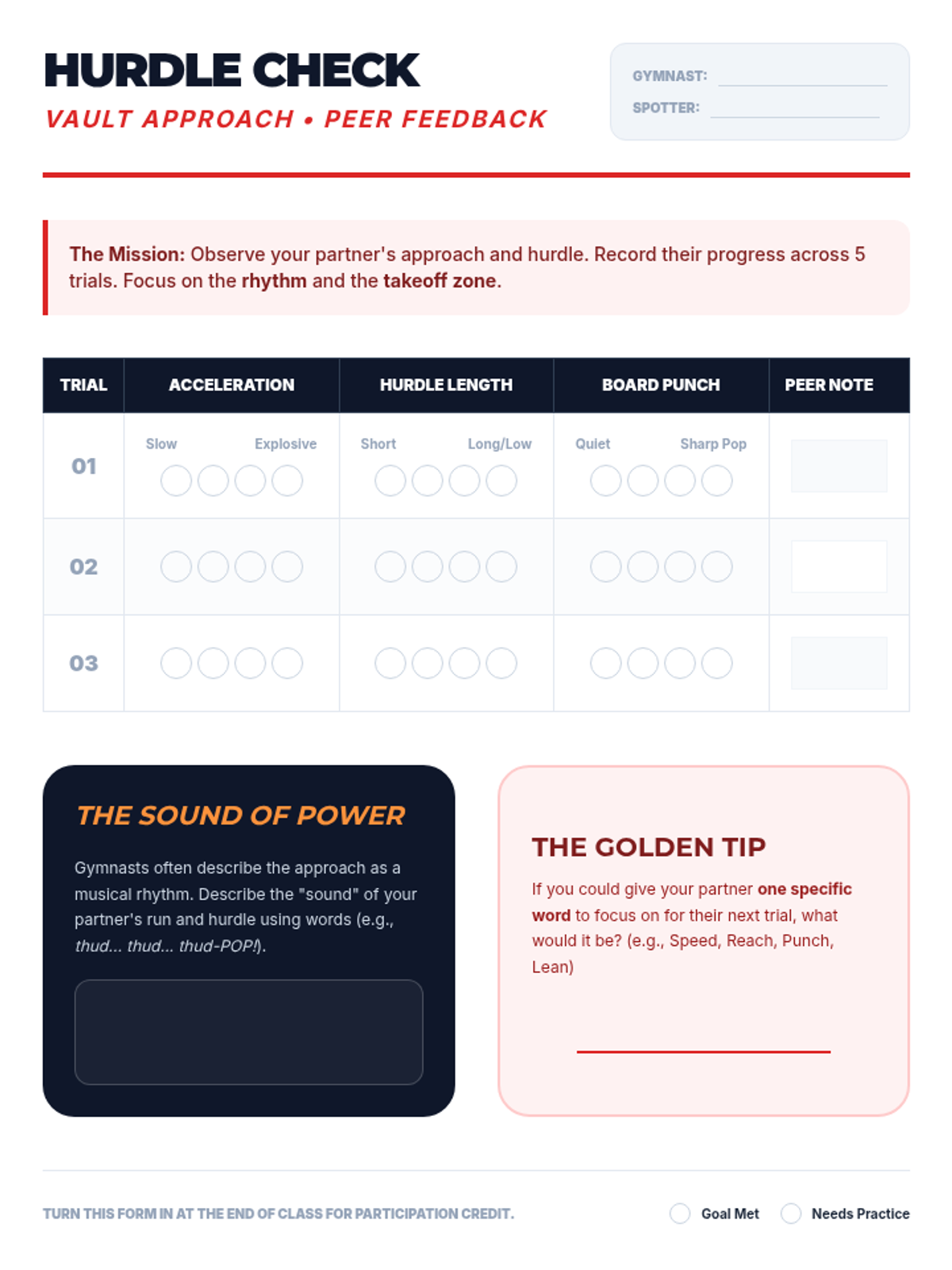
Isolates the runway portion of the vault, focusing on acceleration, the hurdle step, and springboard timing. Drills emphasize rhythm and takeoff precision.
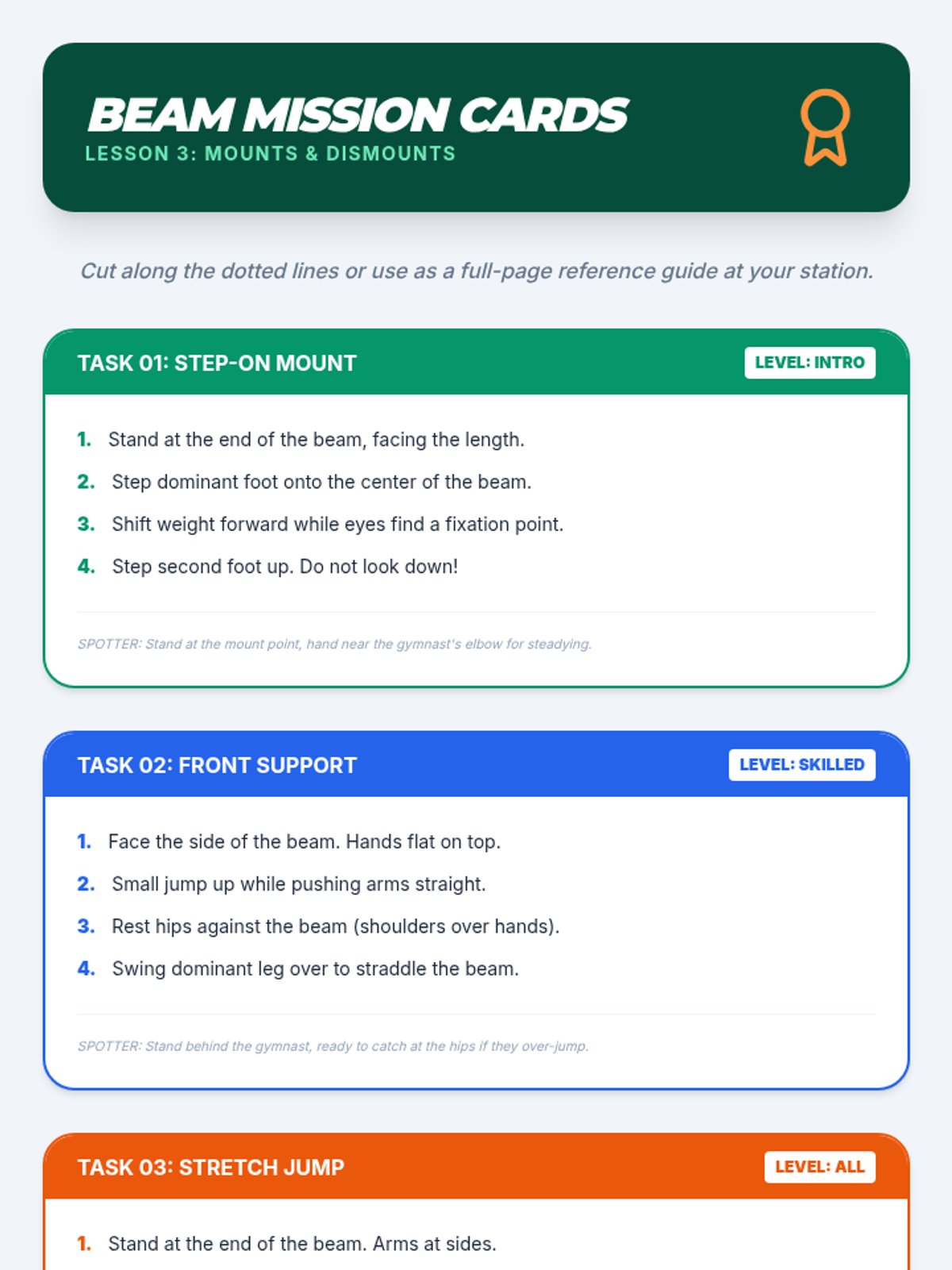
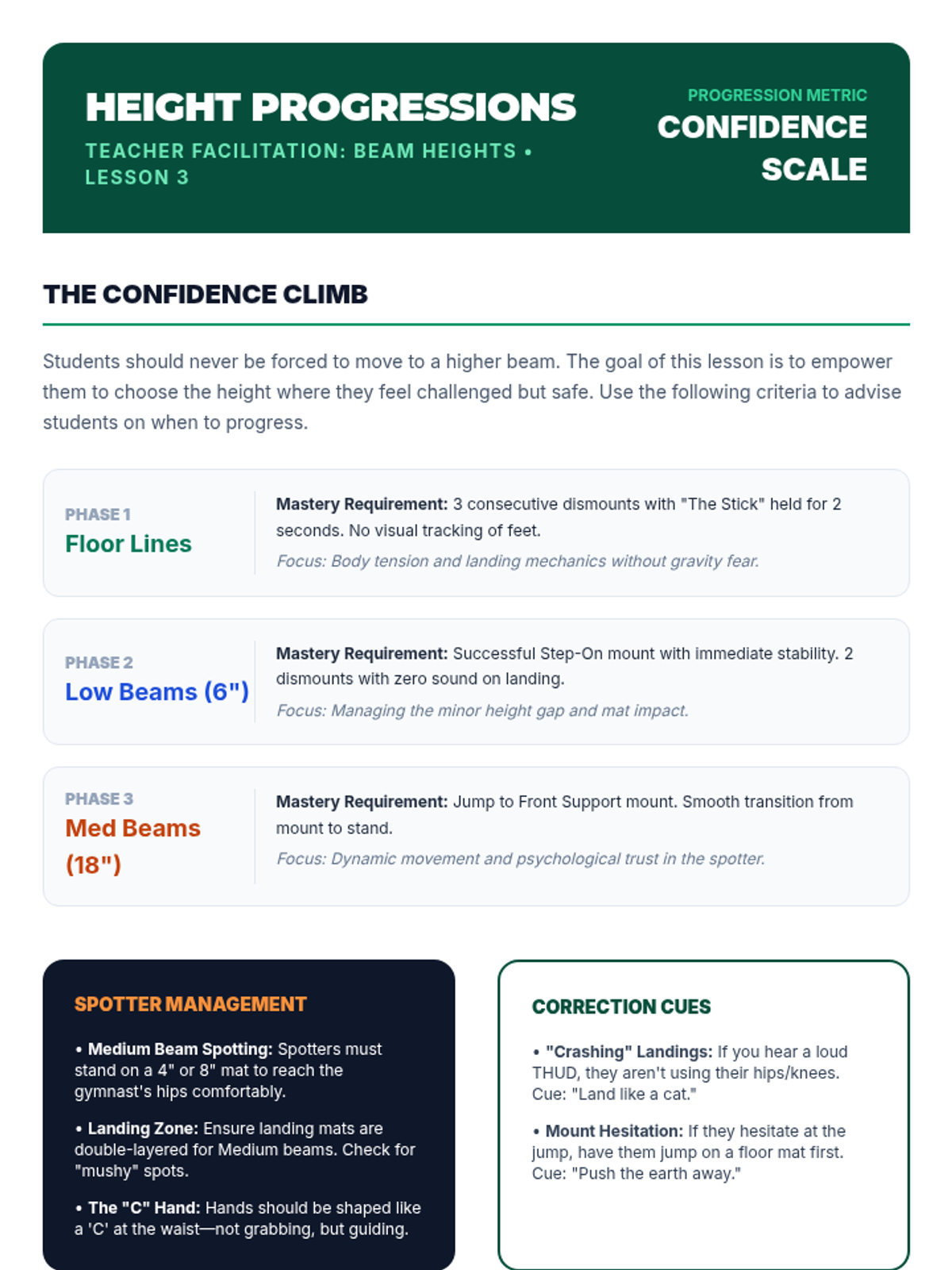
Introduces safe methods to mount and dismount the beam, with a focus on controlled landings to absorb impact. Students progress through varying heights as confidence grows.
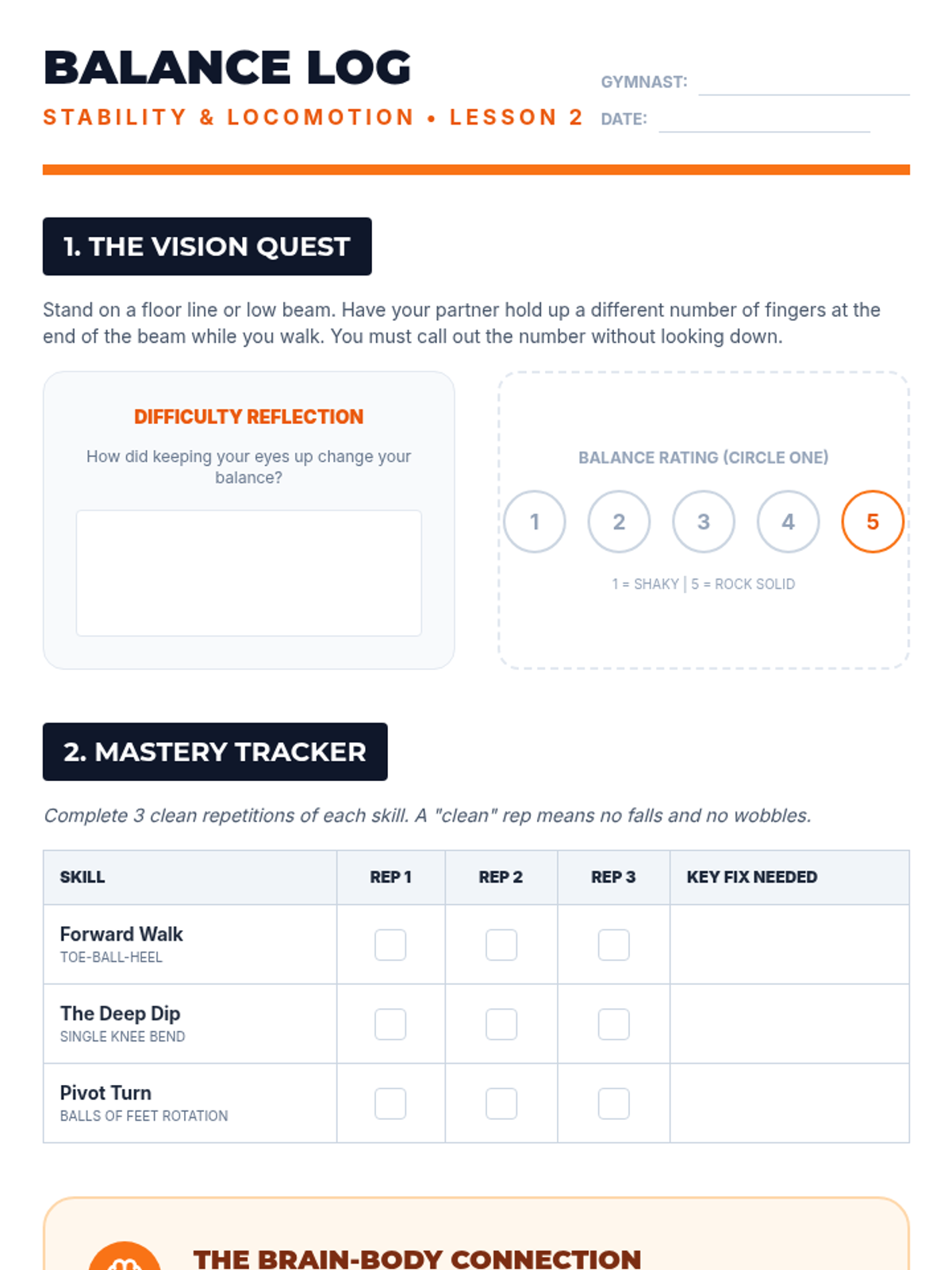
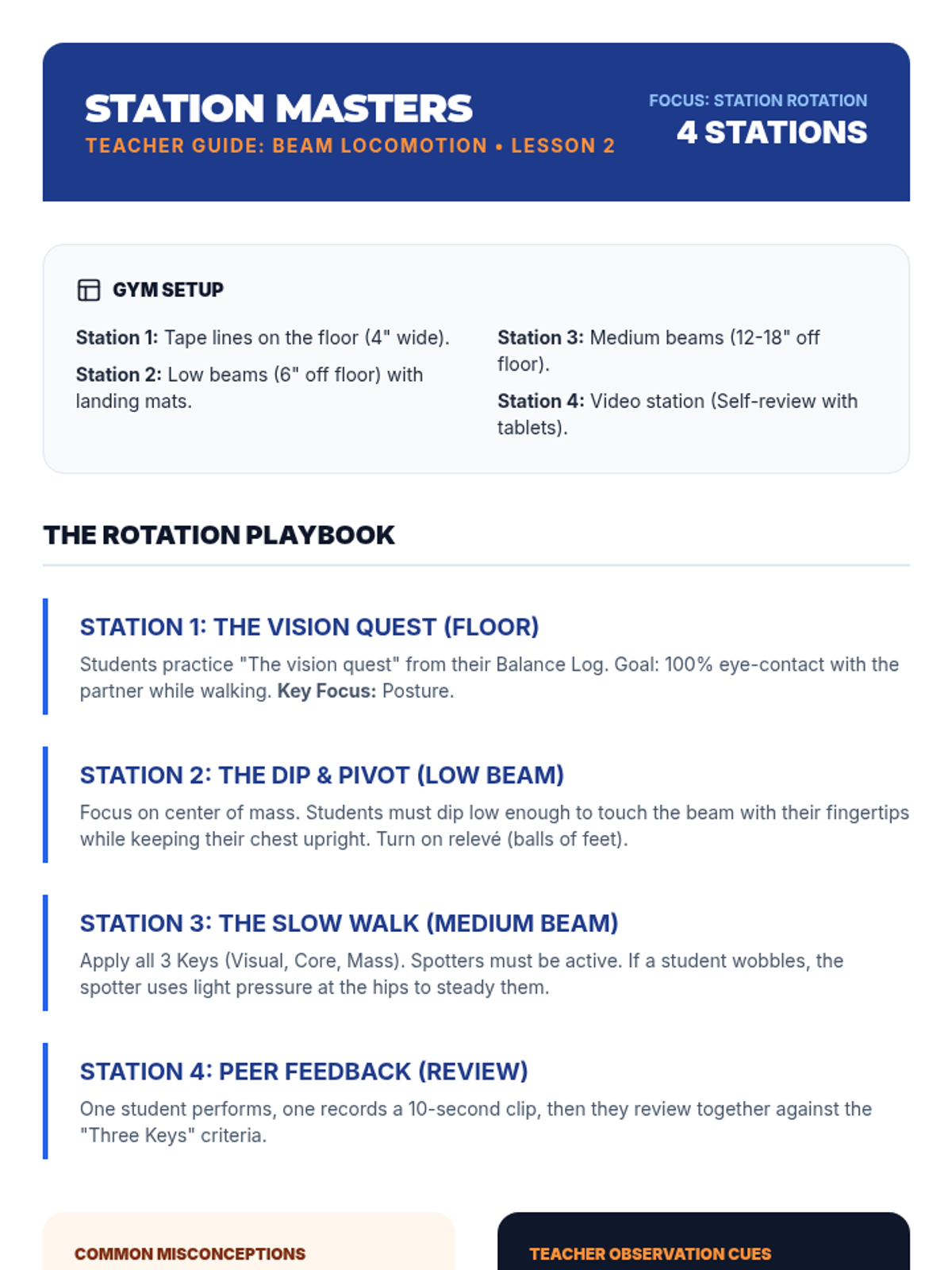
Focuses on dynamic balance and stability on the balance beam. Students practice walking, dipping, and turning while learning the importance of visual fixation points and core engagement.
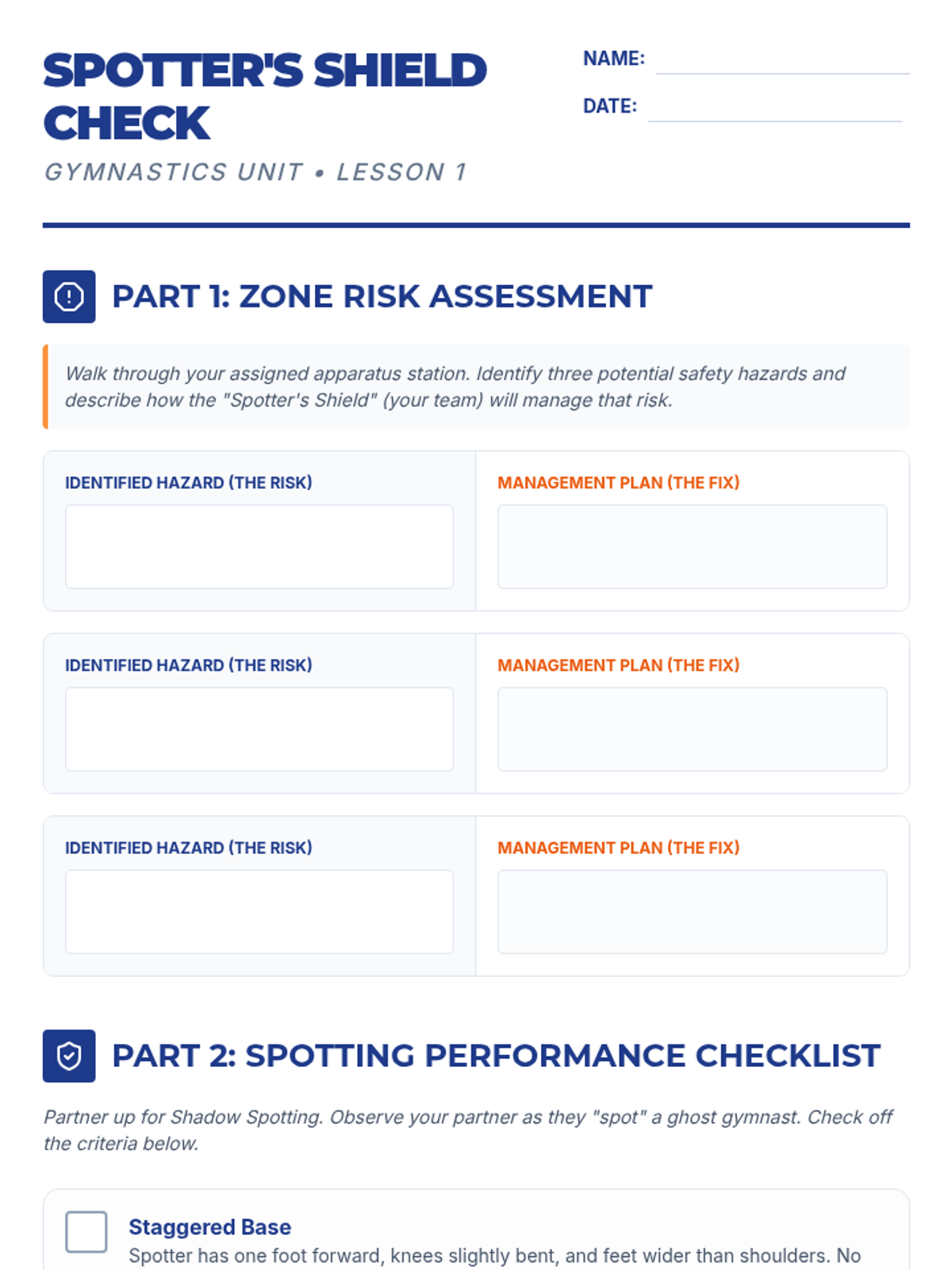
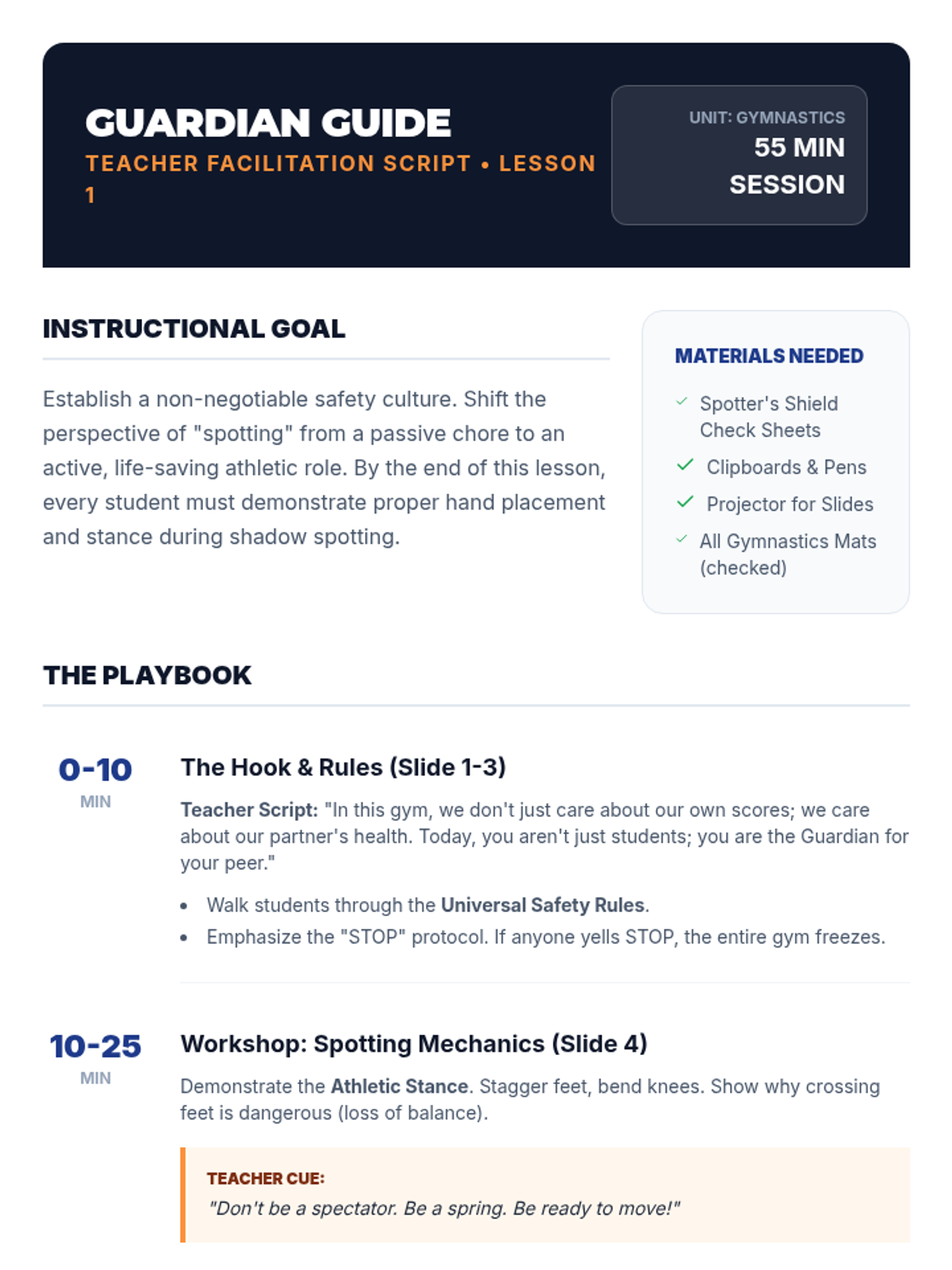
Students learn the universal safety rules of the gym and the specific mechanics of spotting (assisting) peers. The lesson establishes a culture of trust and communication through shadow spotting and risk assessment drills.
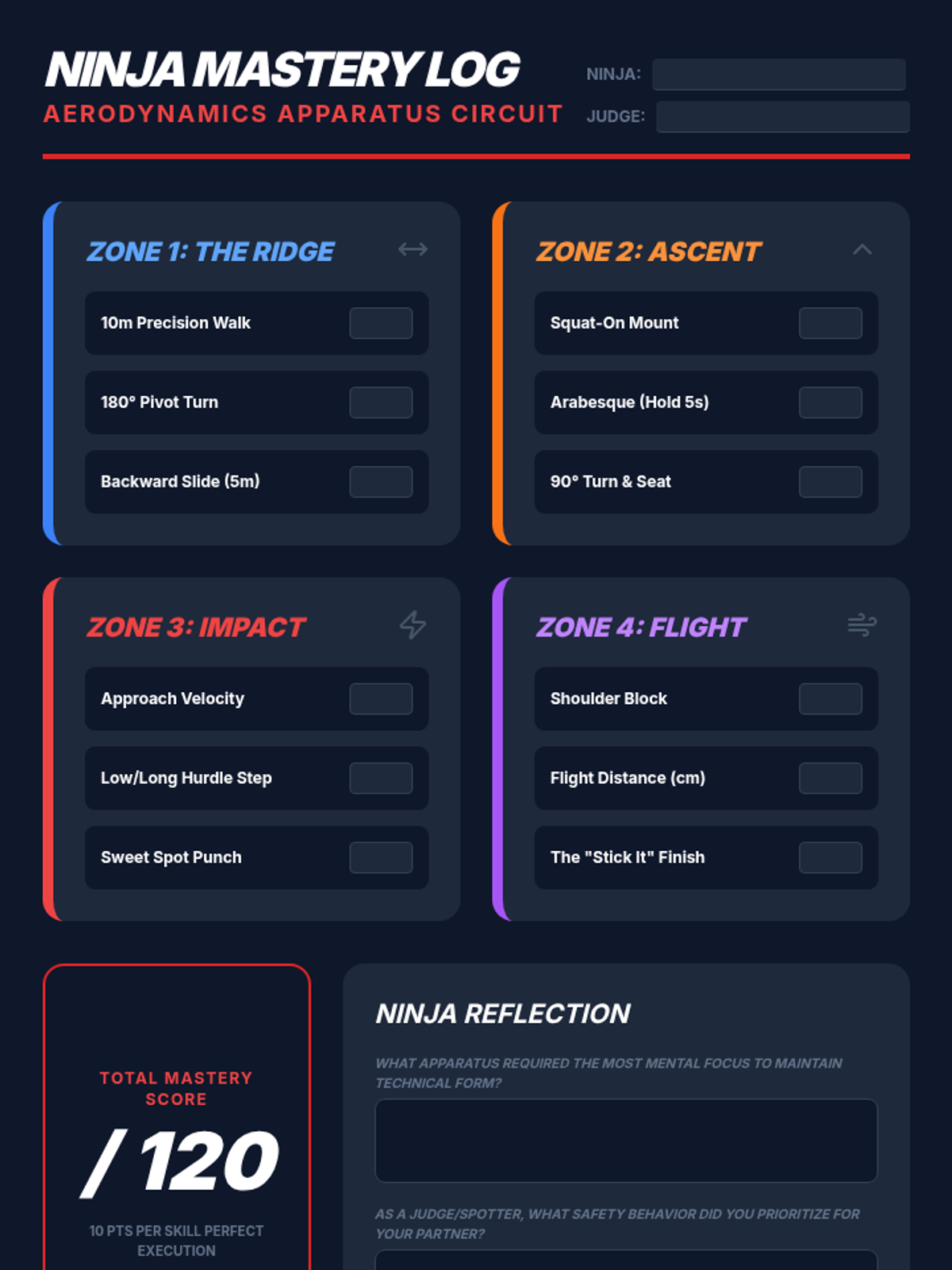
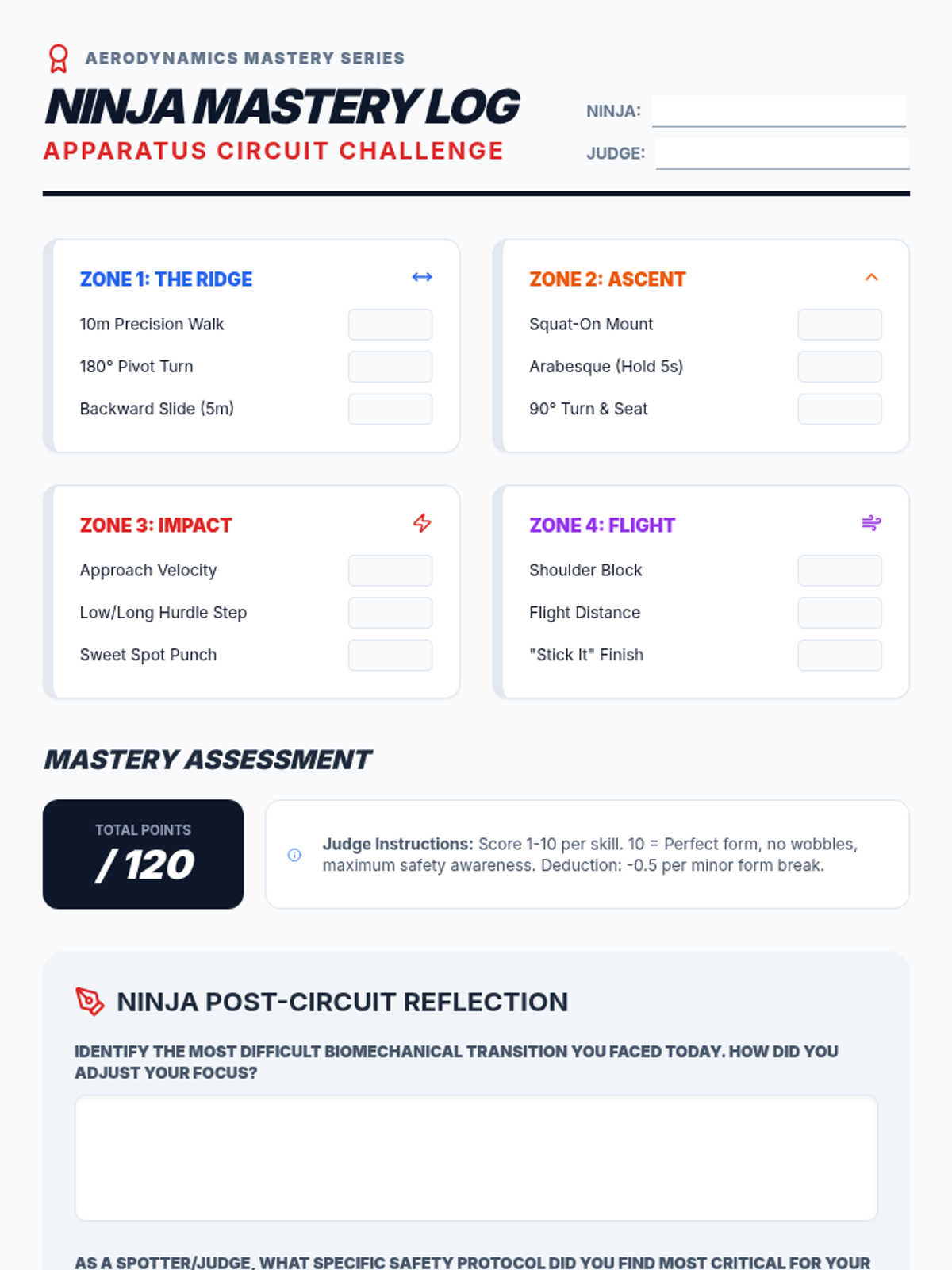
A culminating station-based challenge where students demonstrate their mastery of balance and vaulting skills. The circuit requires adaptability, endurance, and technical precision in a 'Ninja Warrior' style flow.
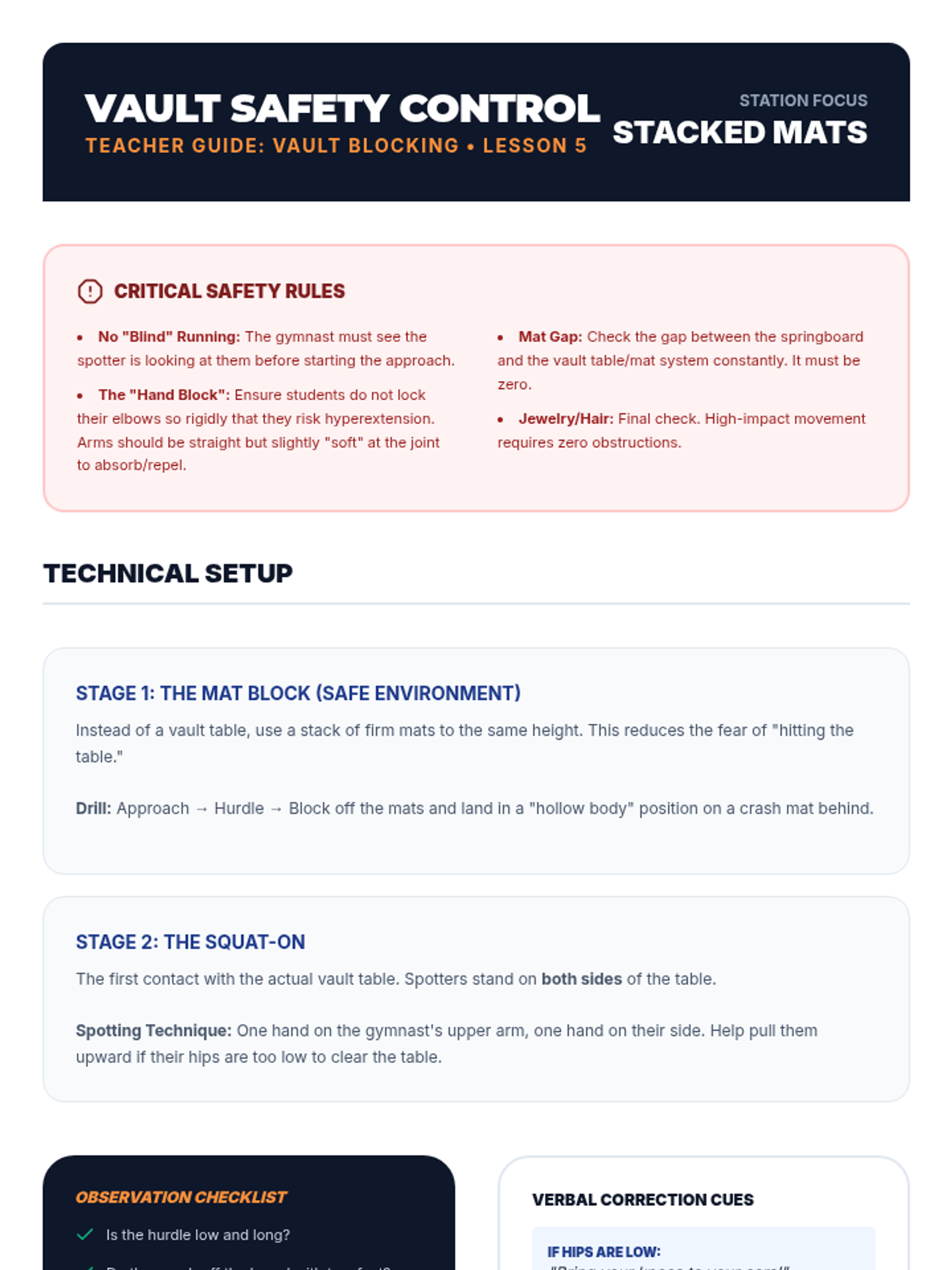
Students advance to interacting with the vault box, focusing on the 'block'—an explosive push-off from the shoulders. The lesson emphasizes body tension and the flight phase of basic vaulting progressions.
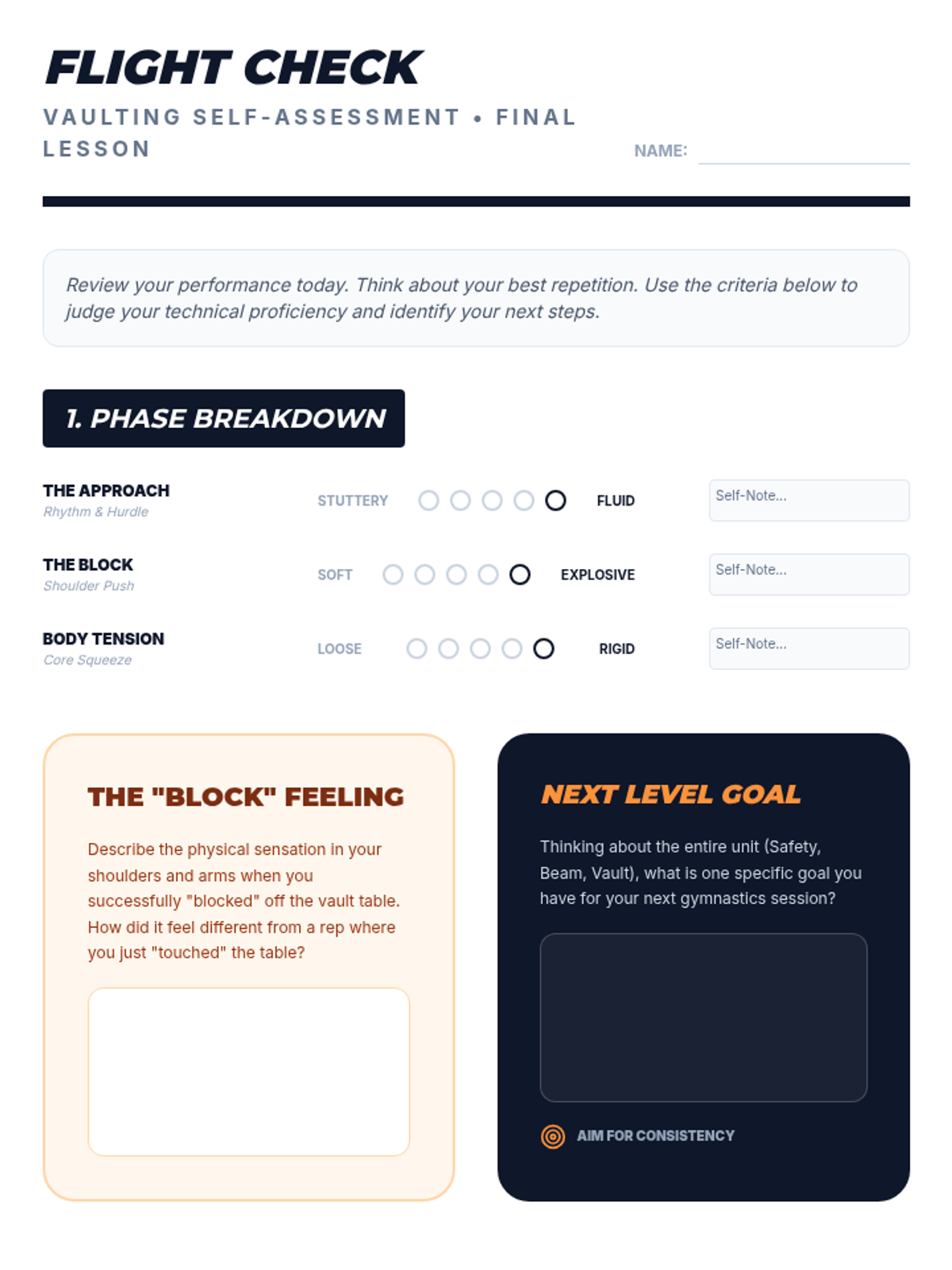
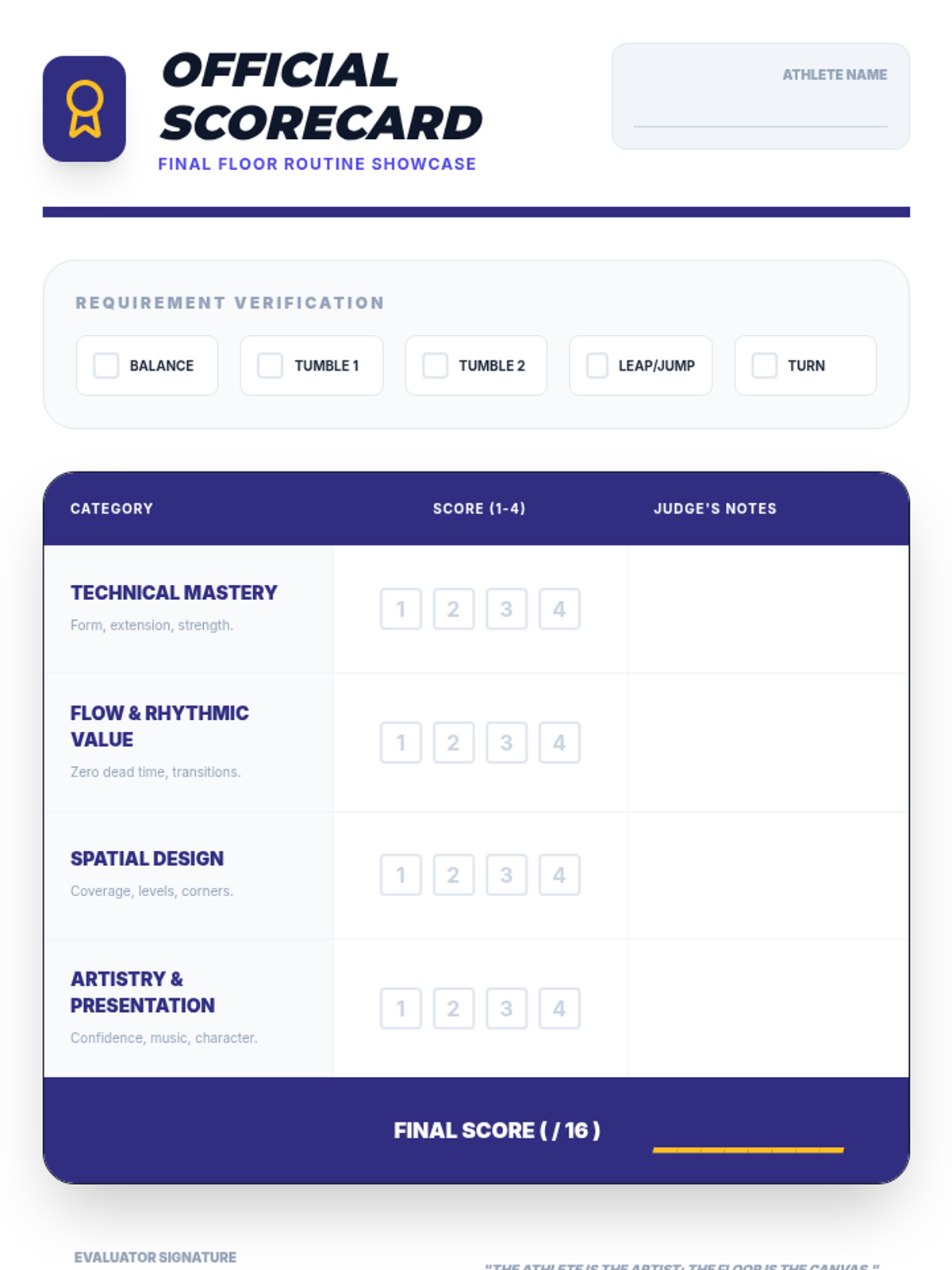
The summative performance where students showcase their routines and reflect on their growth throughout the unit.
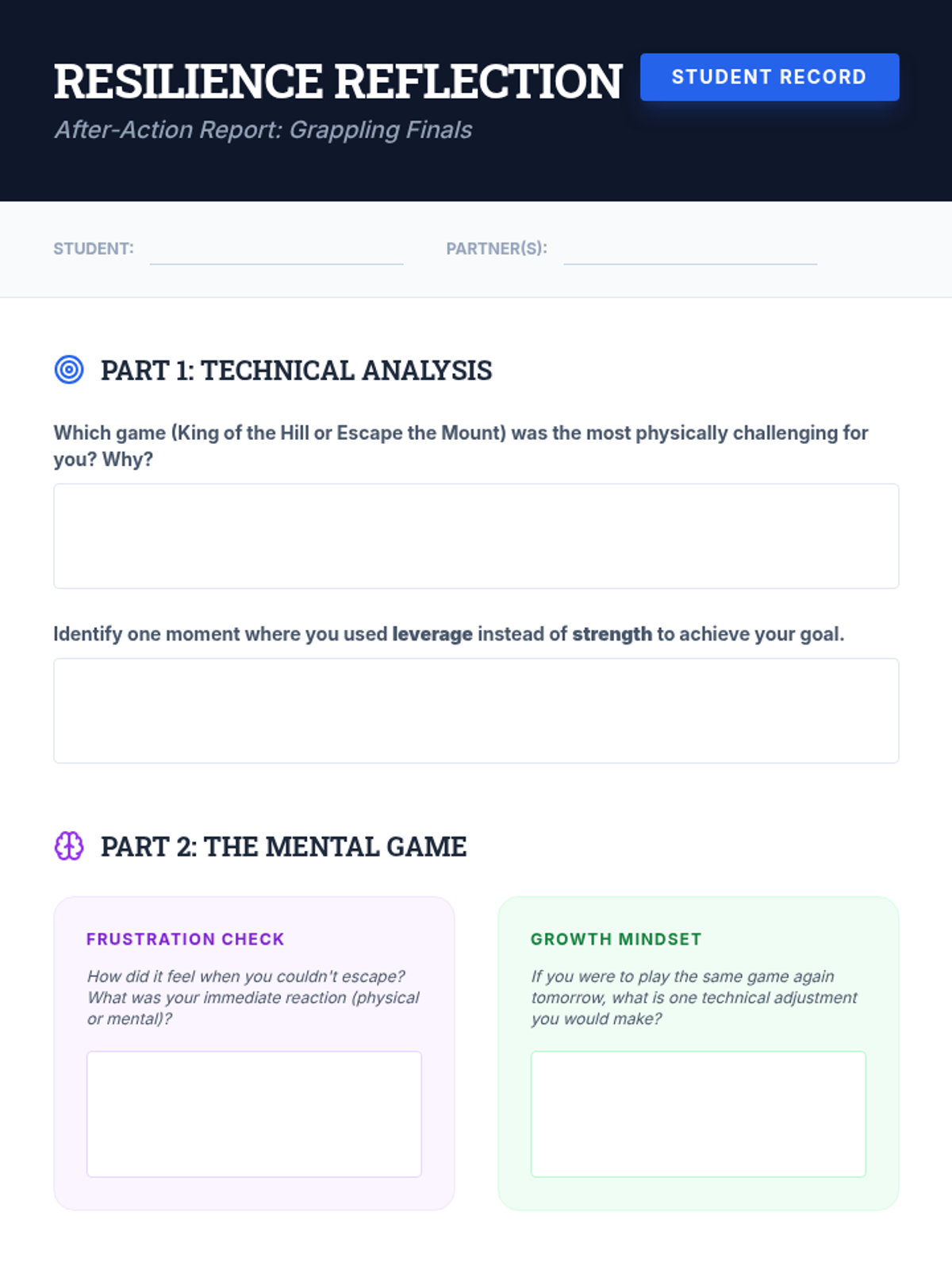
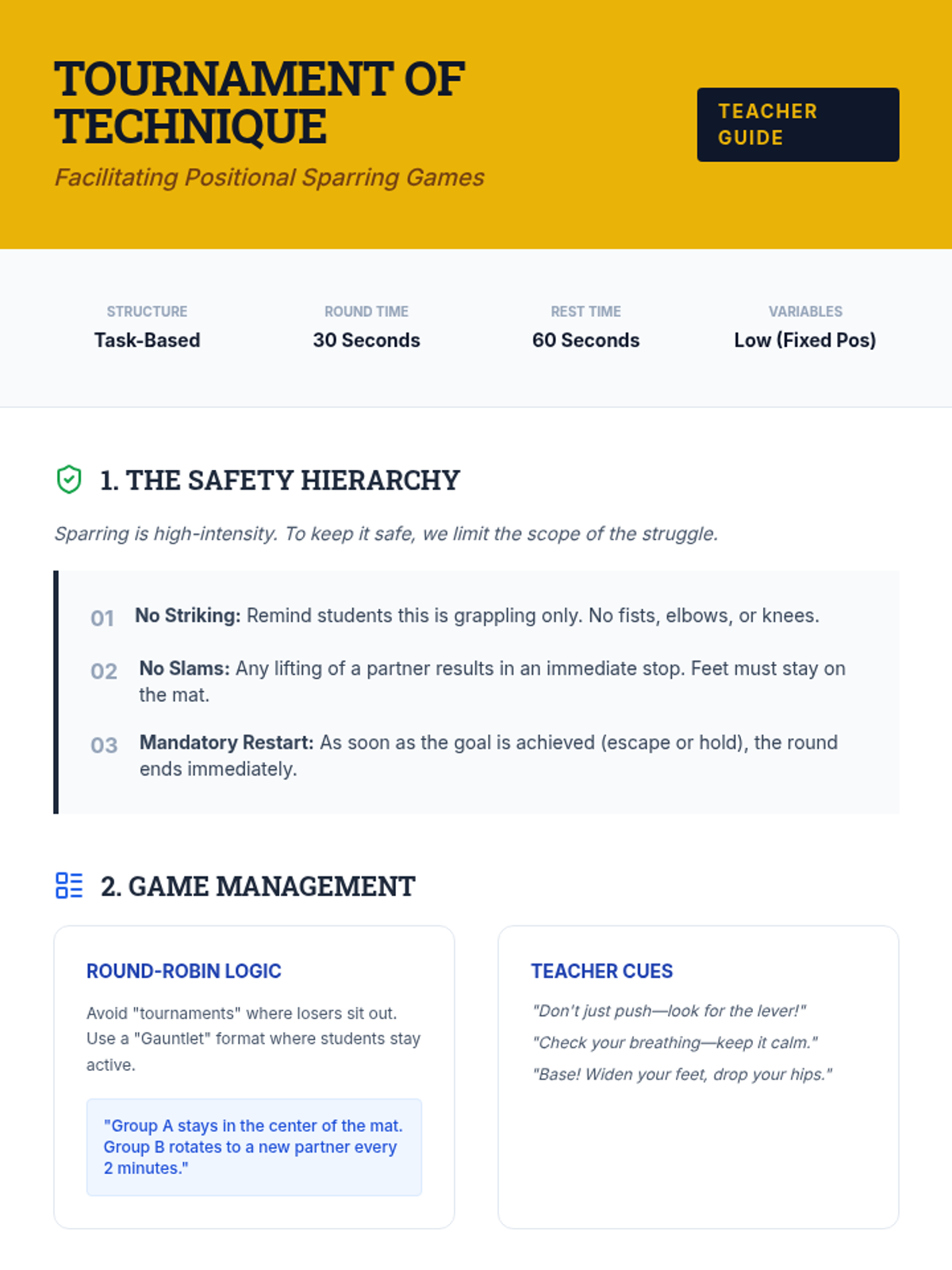
Students engage in specific task-based grappling games, such as 'King of the Hill' or 'Escape the Mount.' They start in a specific position with a clear goal (e.g., hold the position for 10 seconds or escape). This allows for full-effort practice with limited variables for safety.
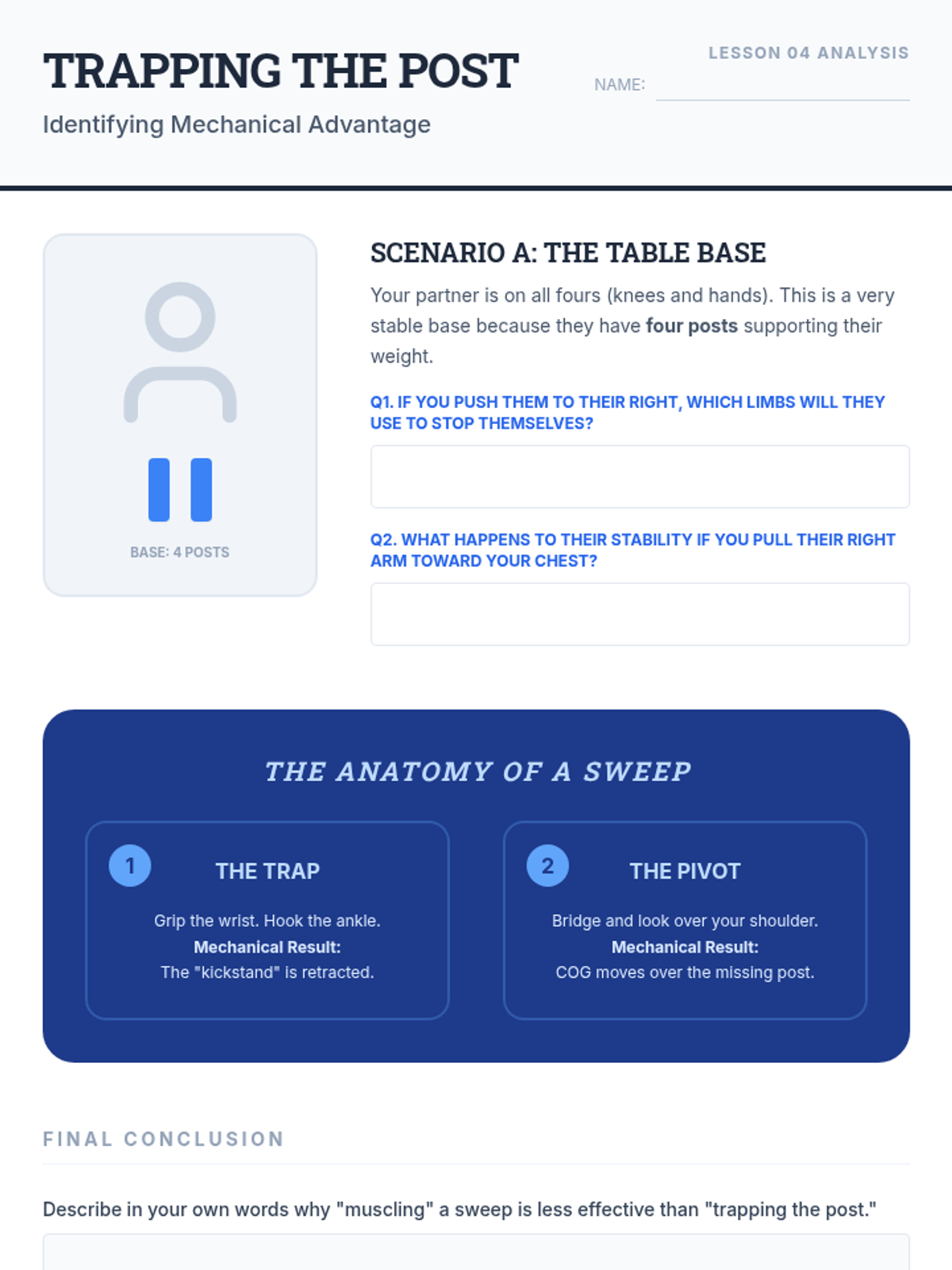
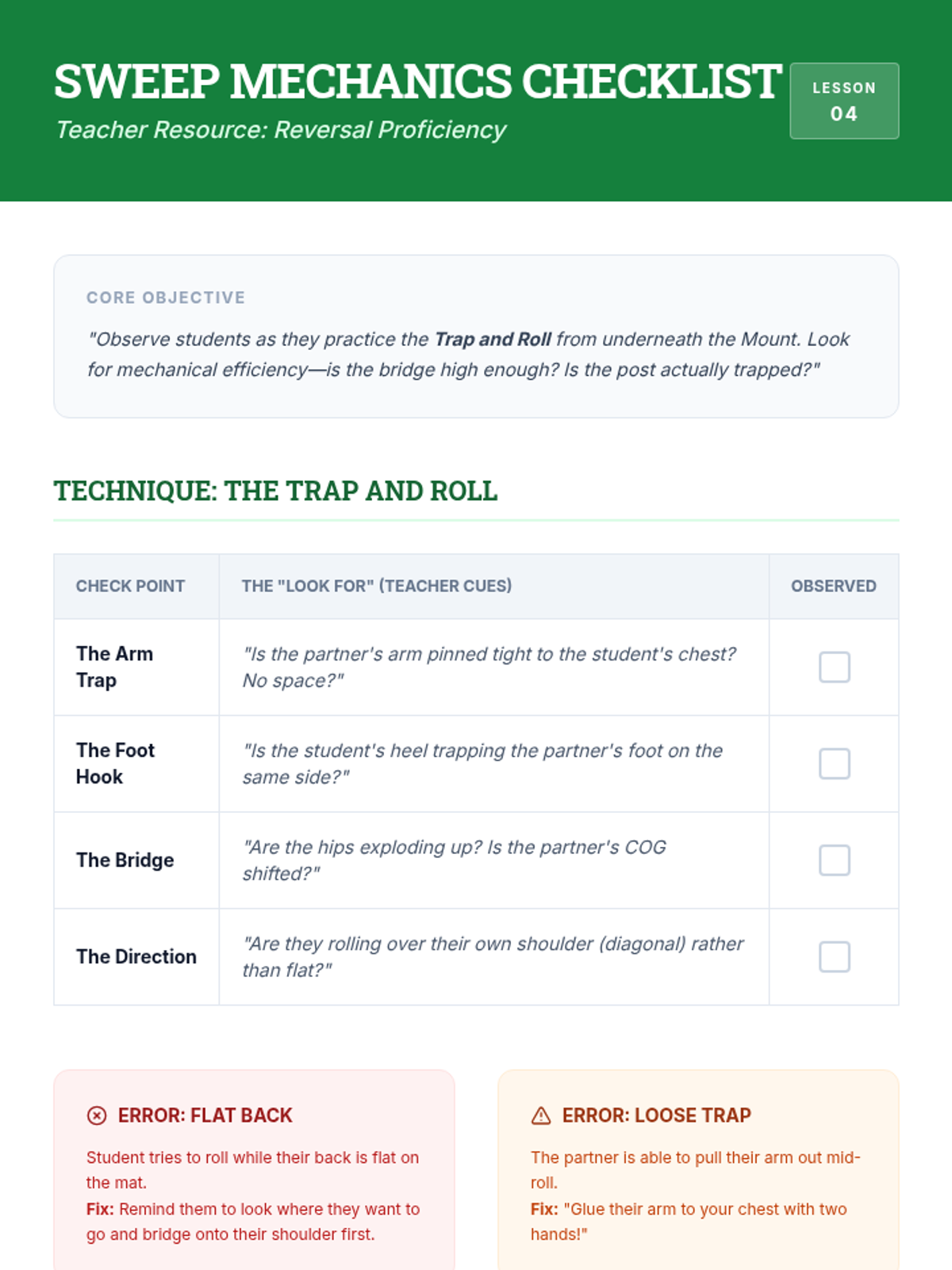
Students explore how to reverse a position from the bottom using bridges and rolls. They apply the concept of 'trapping' a post (arm or leg) to flip a partner over. This lesson highlights the use of leverage over strength.
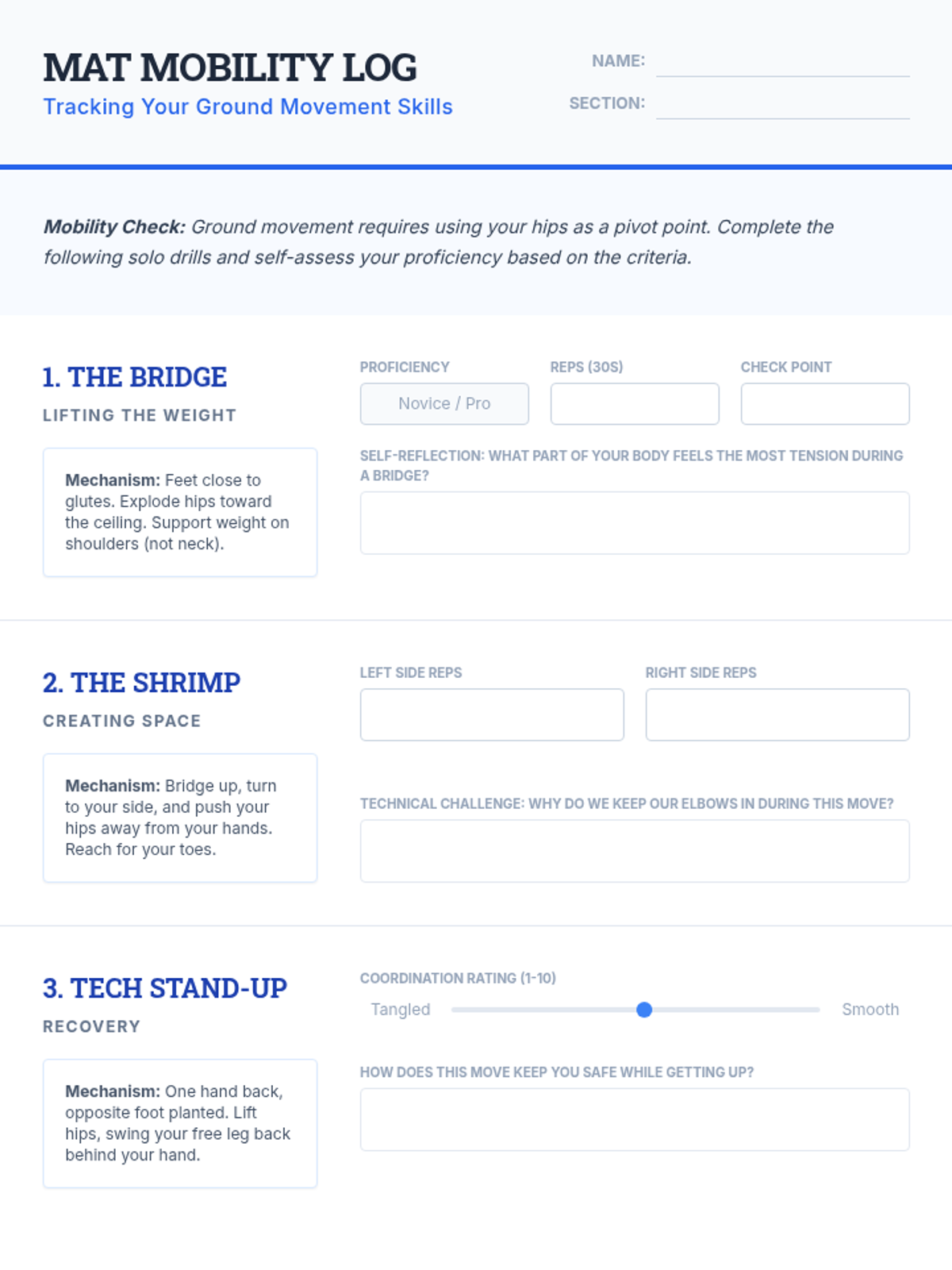
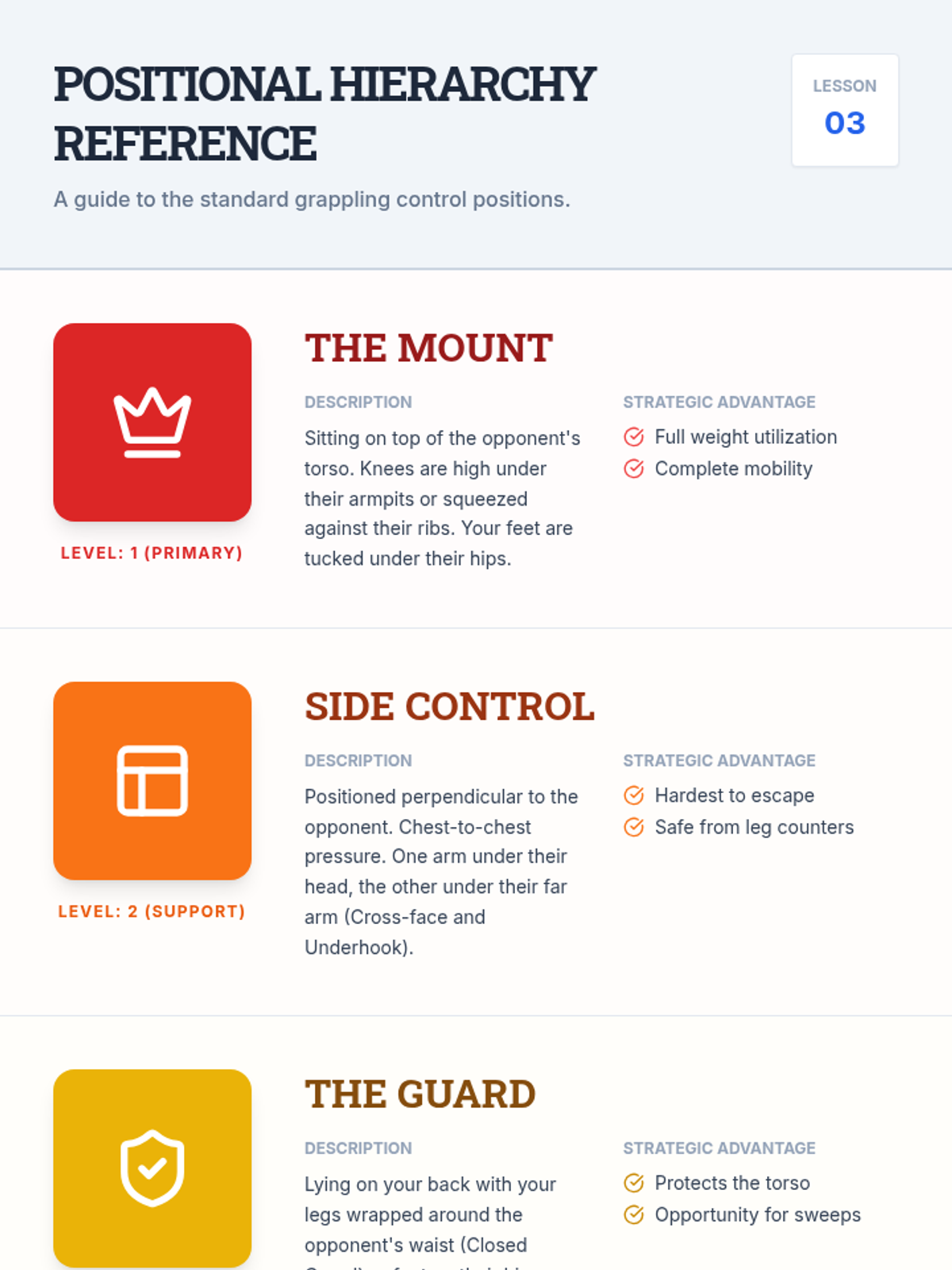
This lesson introduces standard grappling positions: Mount, Side Control, and Guard. Students learn the hierarchy of these positions based on mobility and safety. Solo drills on the mats help students understand hip movement (shrimping/bridging) required for ground movement.
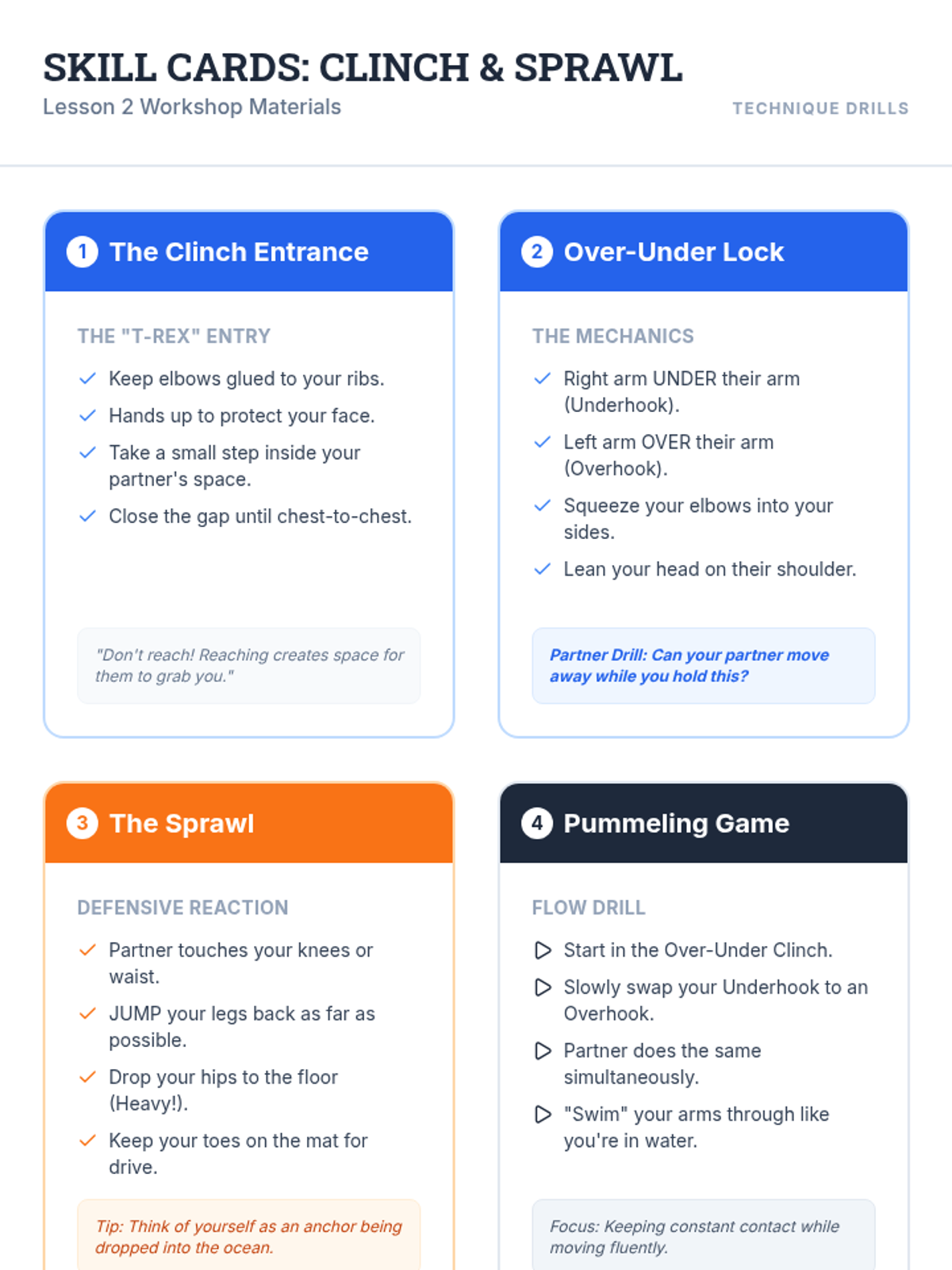
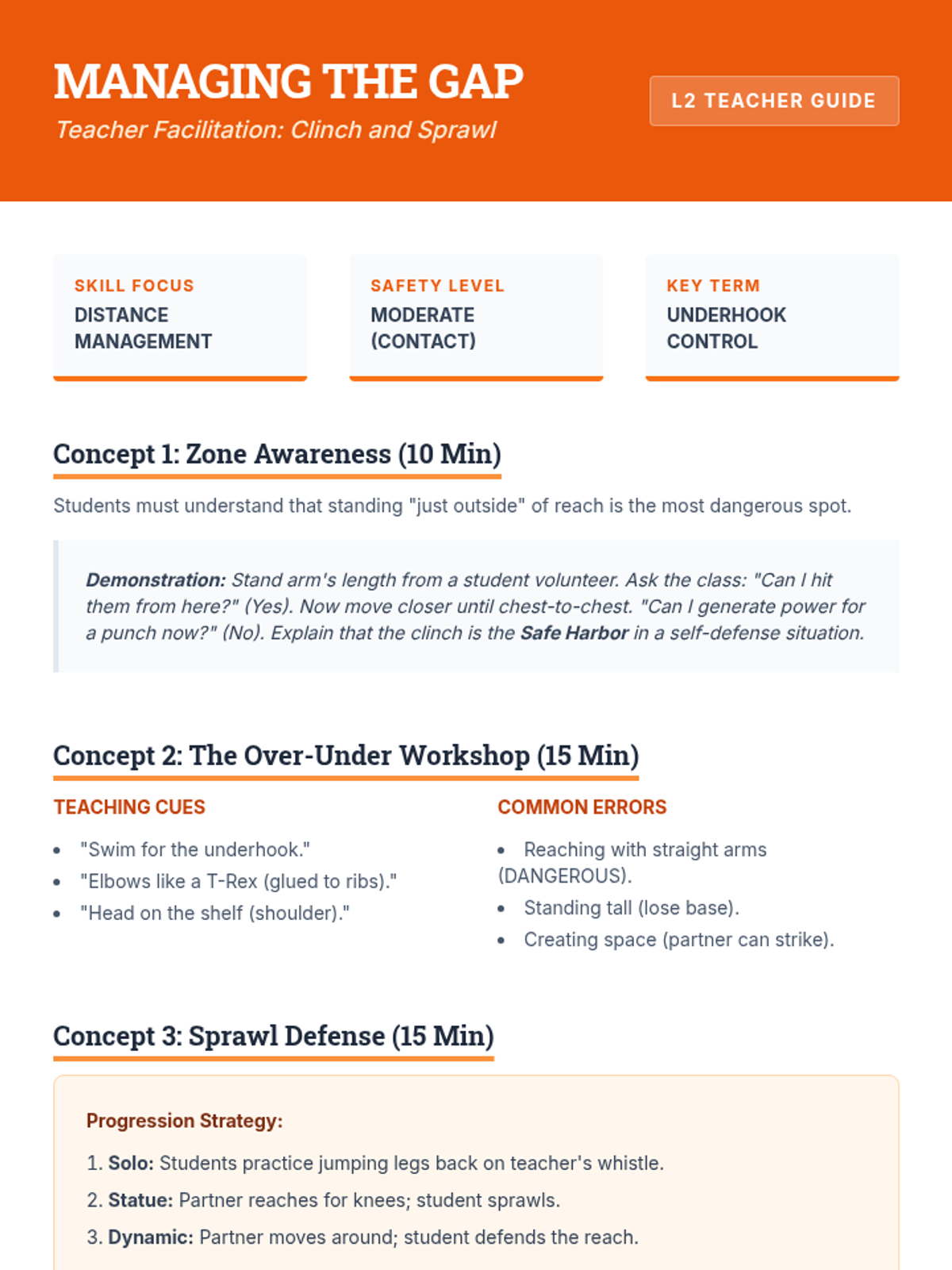
Students learn how to safely close the distance and establish a clinch position to control an opponent's upper body. They practice 'sprawling' to defend against leg tackles, focusing on driving hips down and legs back. The lesson emphasizes control over aggression.
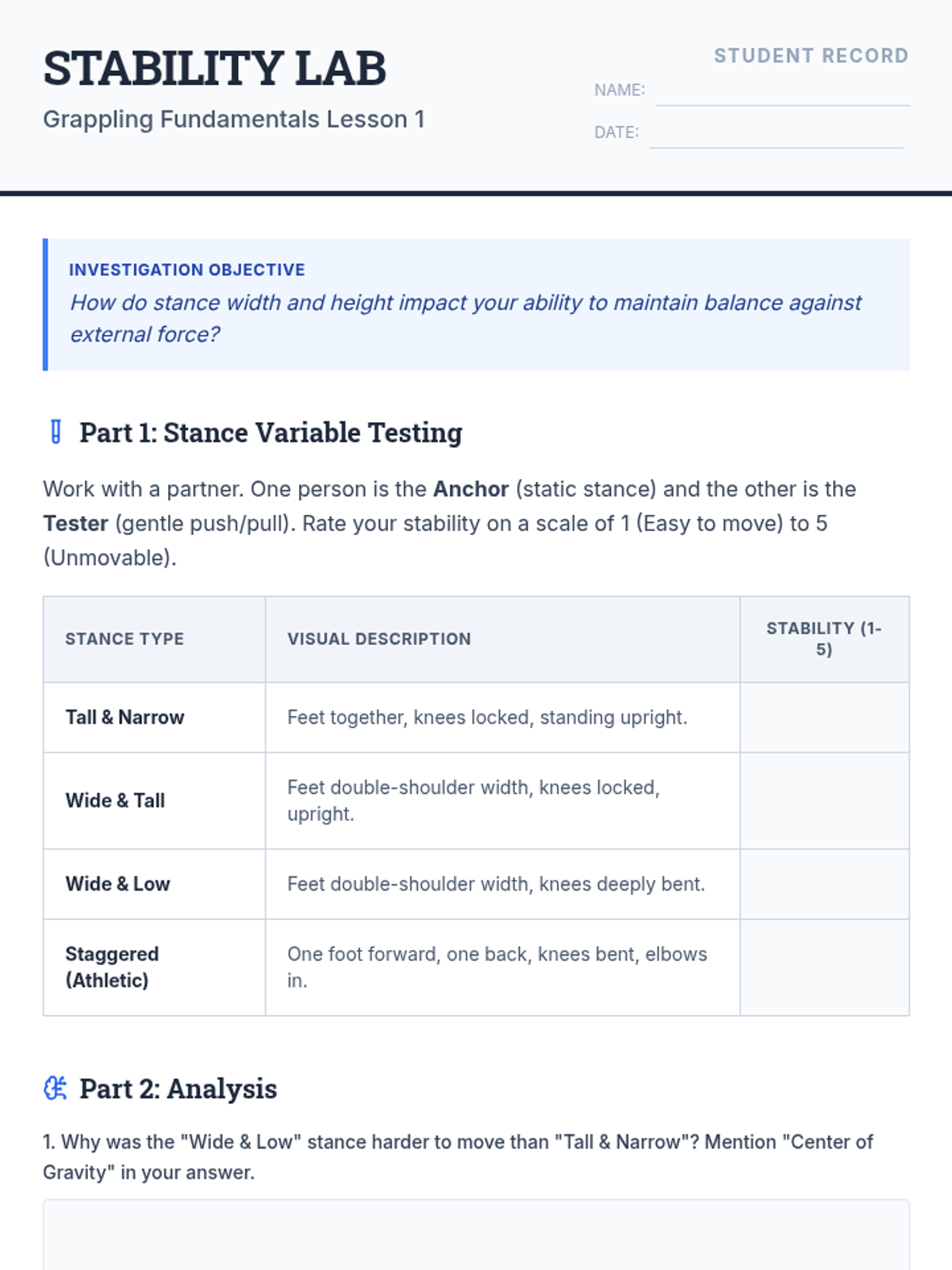
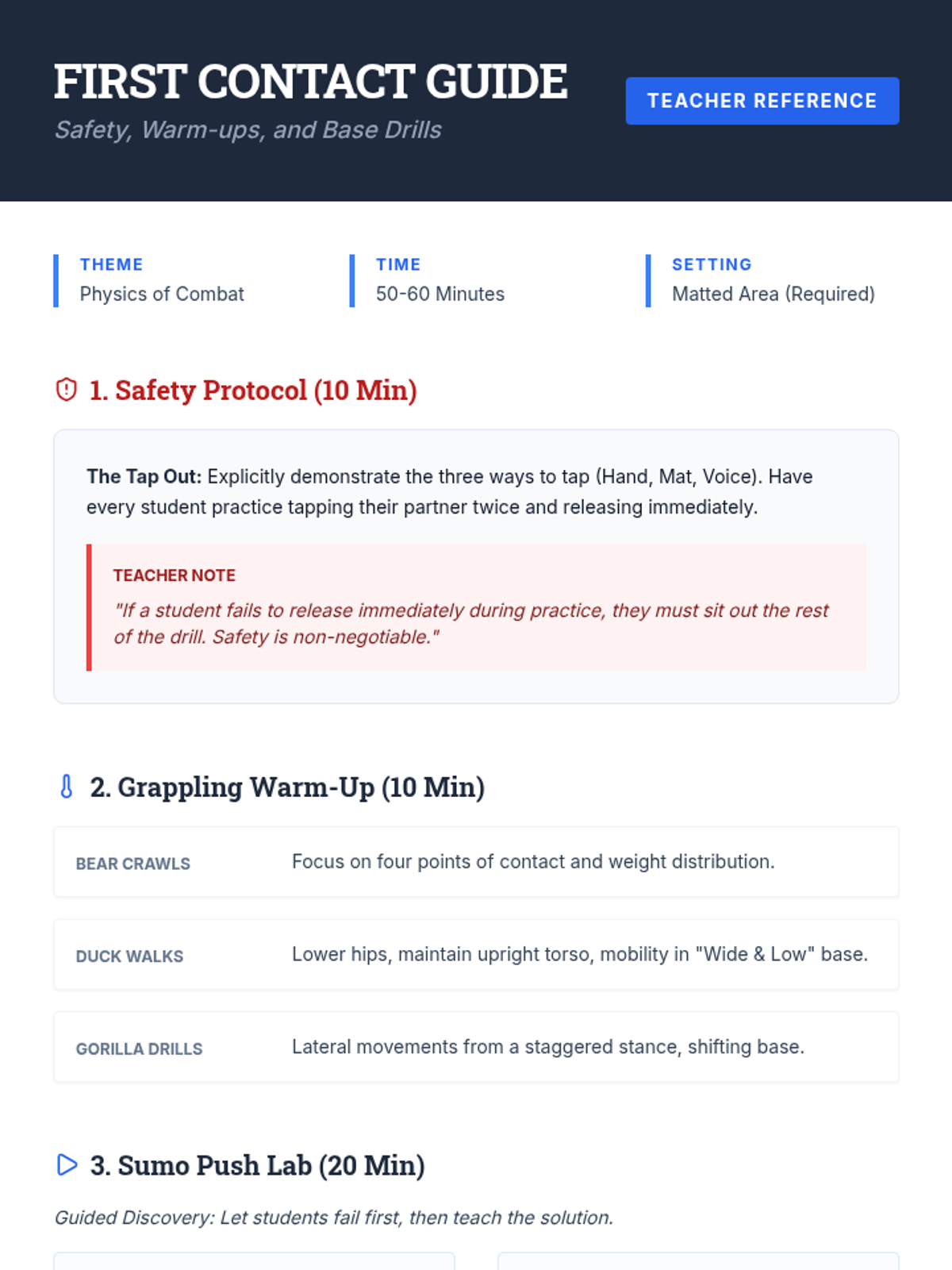
Students investigate the concept of 'base' through push-pull games, learning how stance width and knee bend affect stability. They practice recovering their balance when disrupted by a partner. The lesson establishes the rules of safe contact and tapping out.
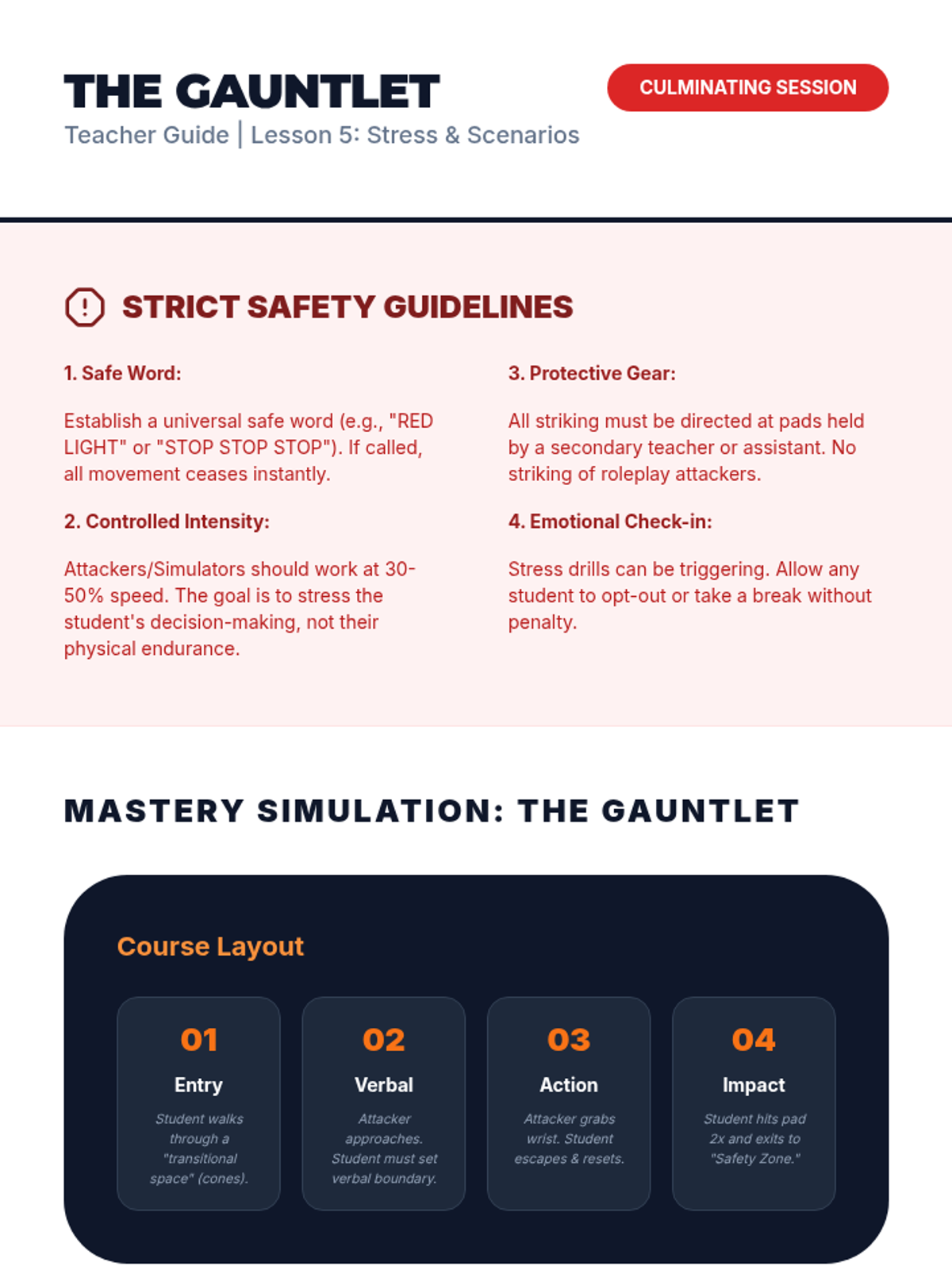
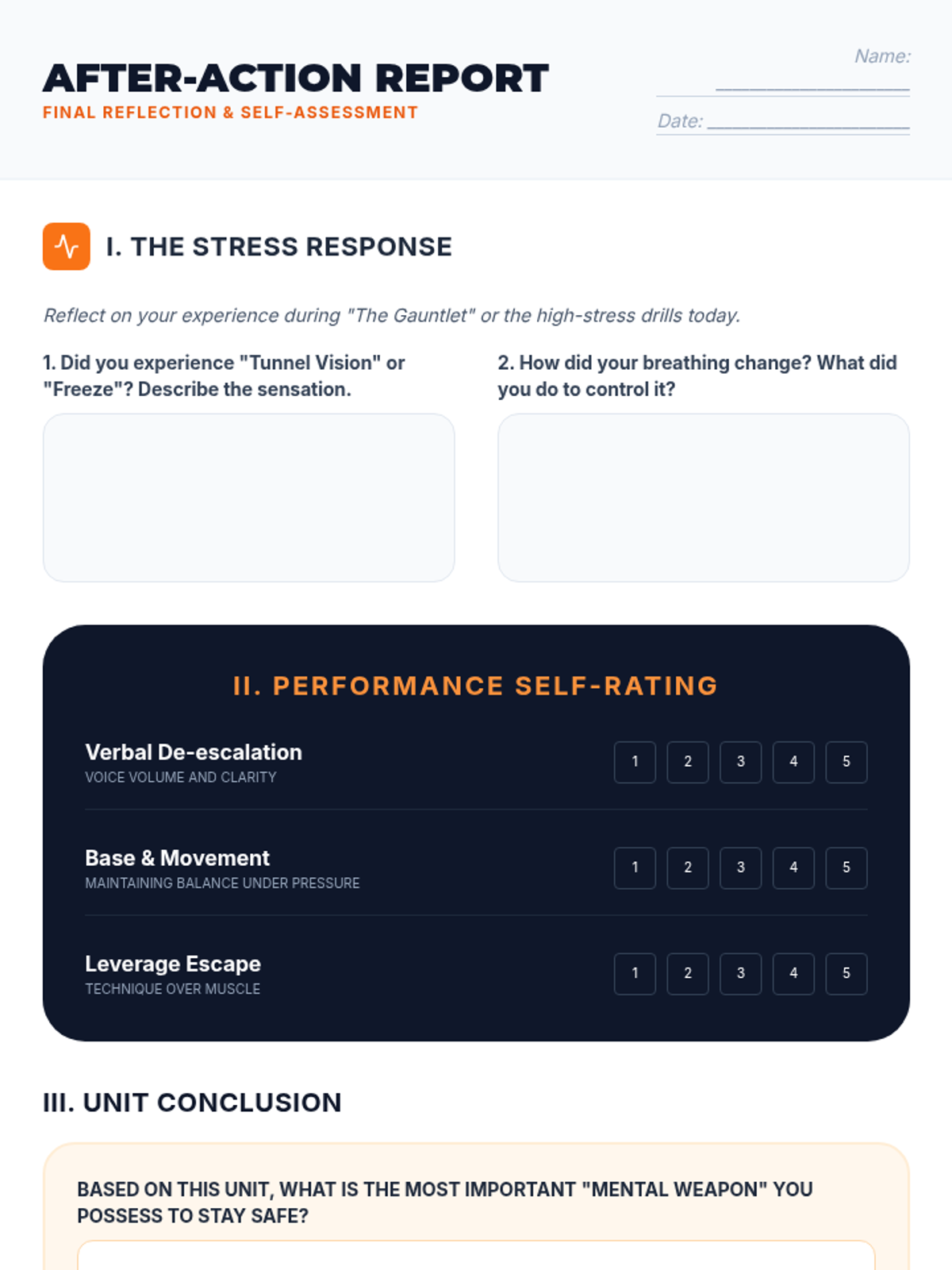
A culminating session where students apply skills in high-intensity stress drills and simulated scenarios to test technique and decision-making.
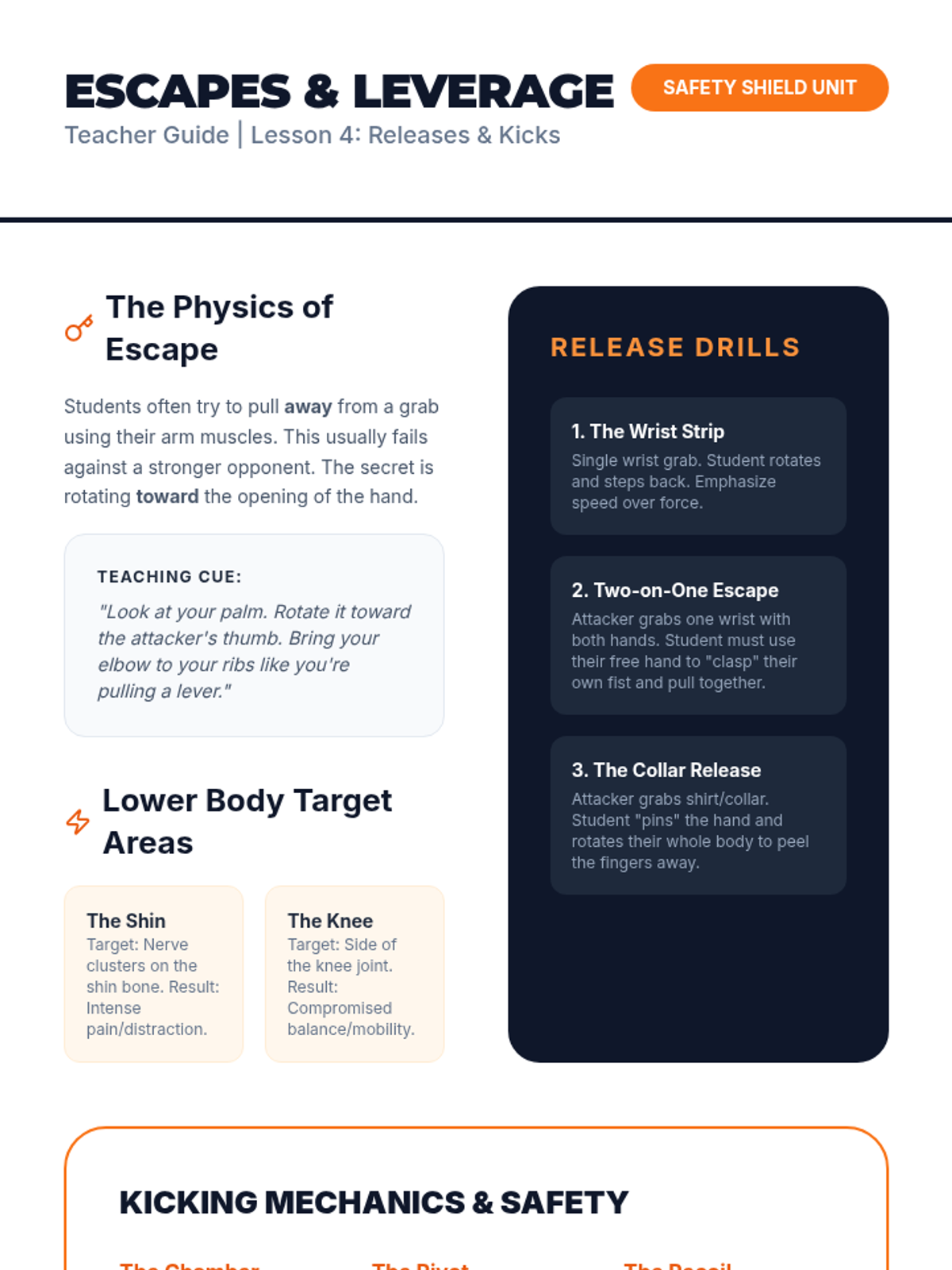
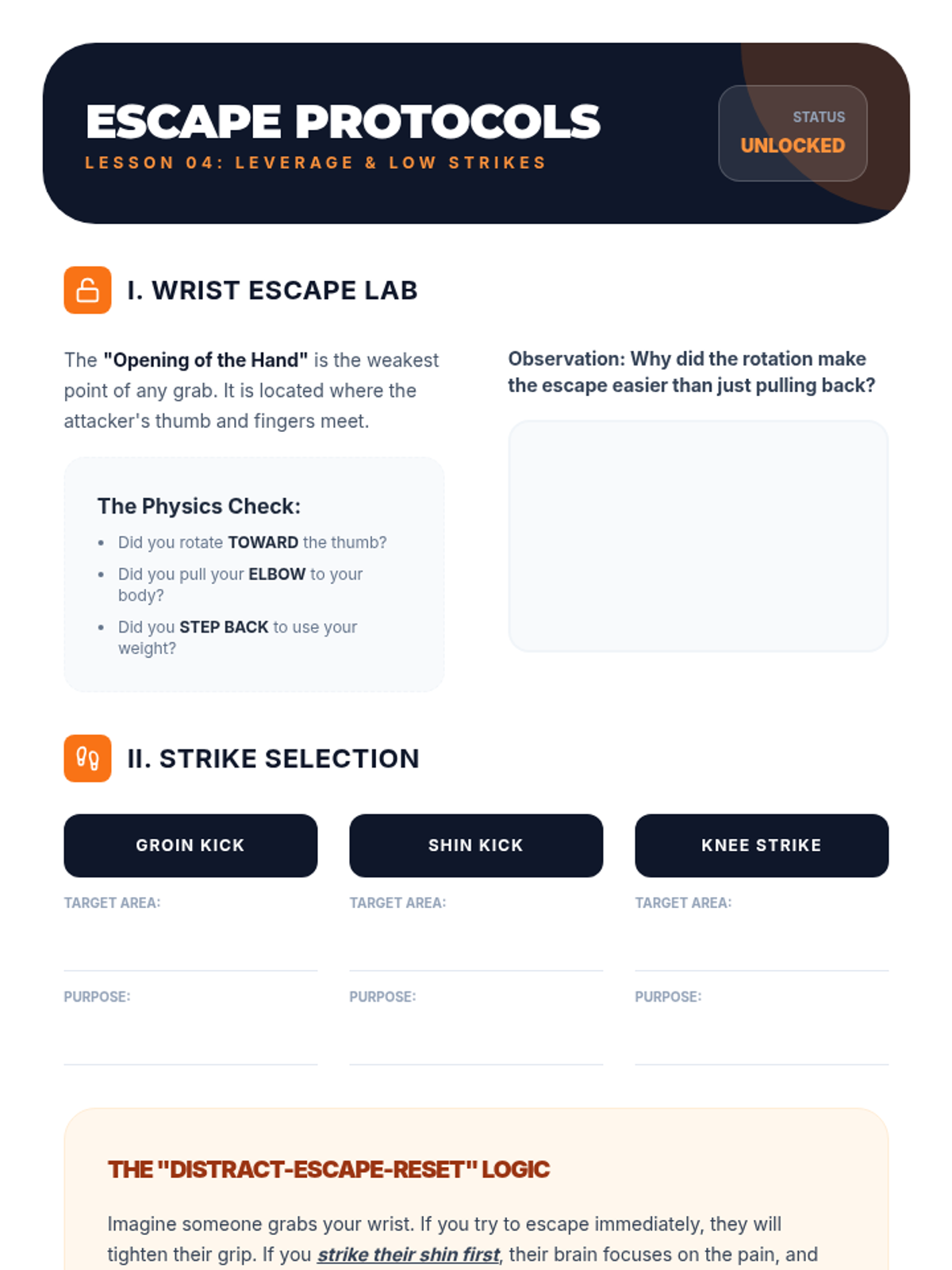
Teaches leverage-based release techniques for common grabs alongside low-line kicks and knee strikes for creating distance.
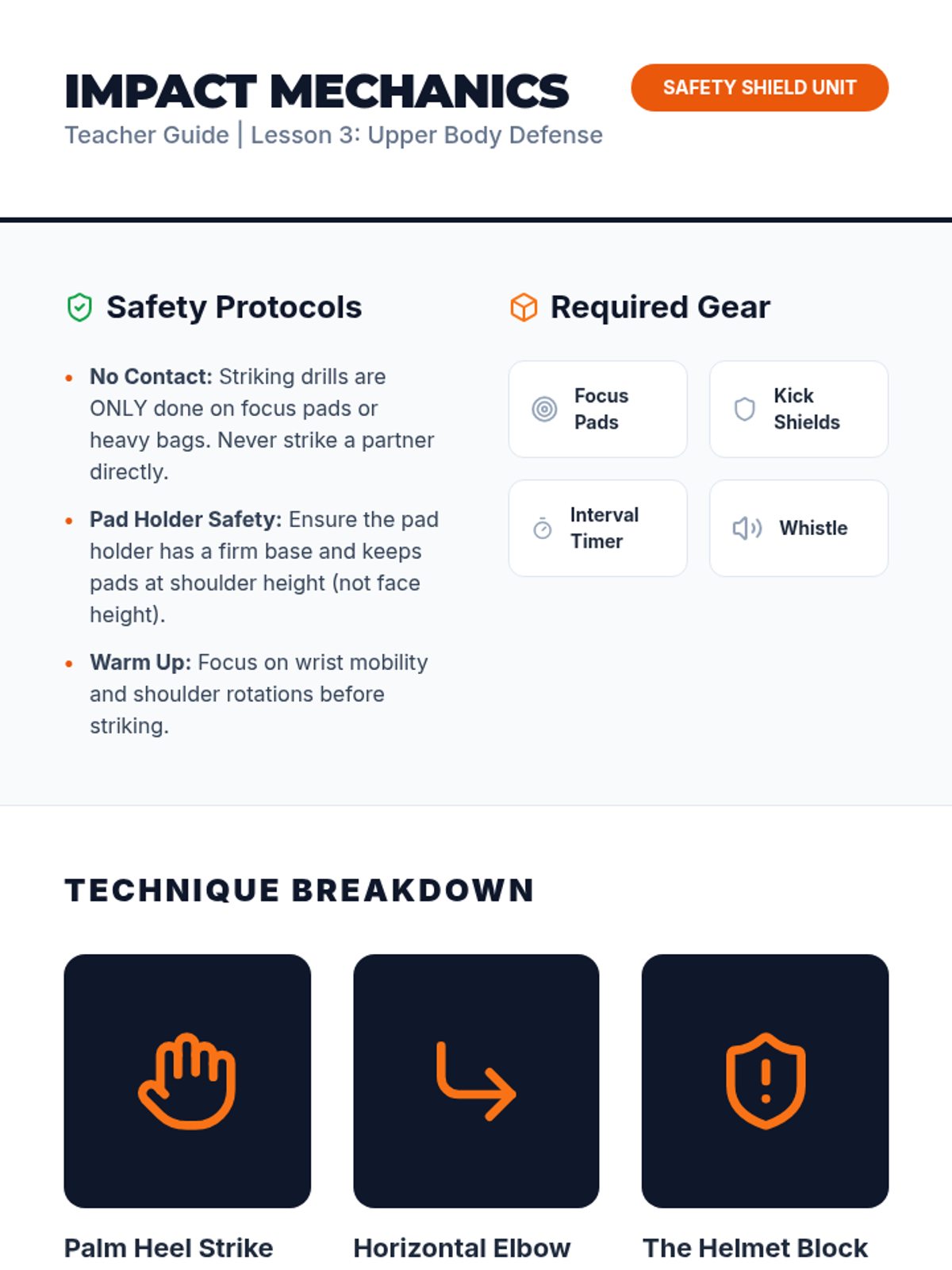
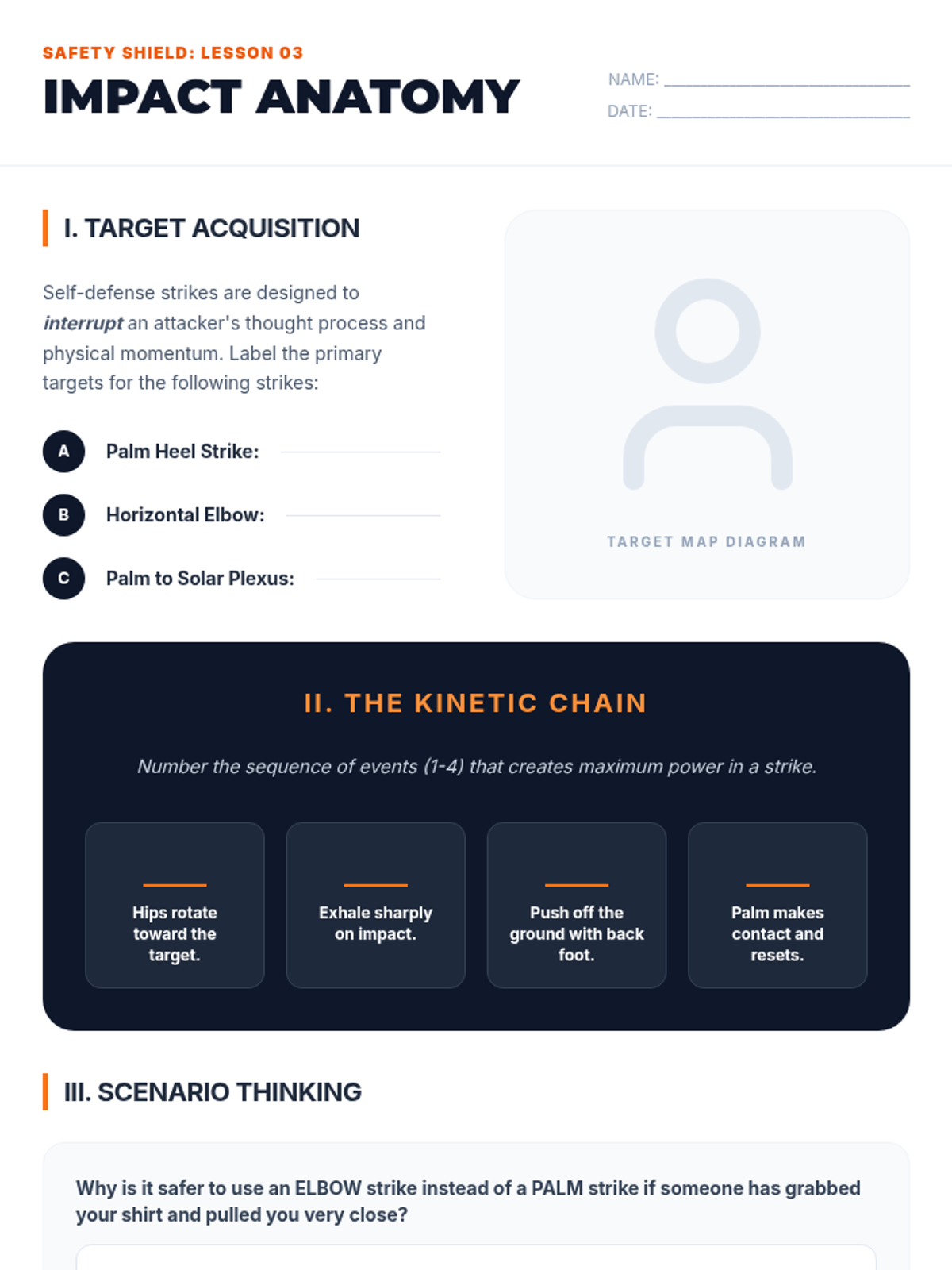
Introduces fundamental upper body strikes (palm heels, elbows) and basic blocking techniques with an emphasis on the kinetic chain.
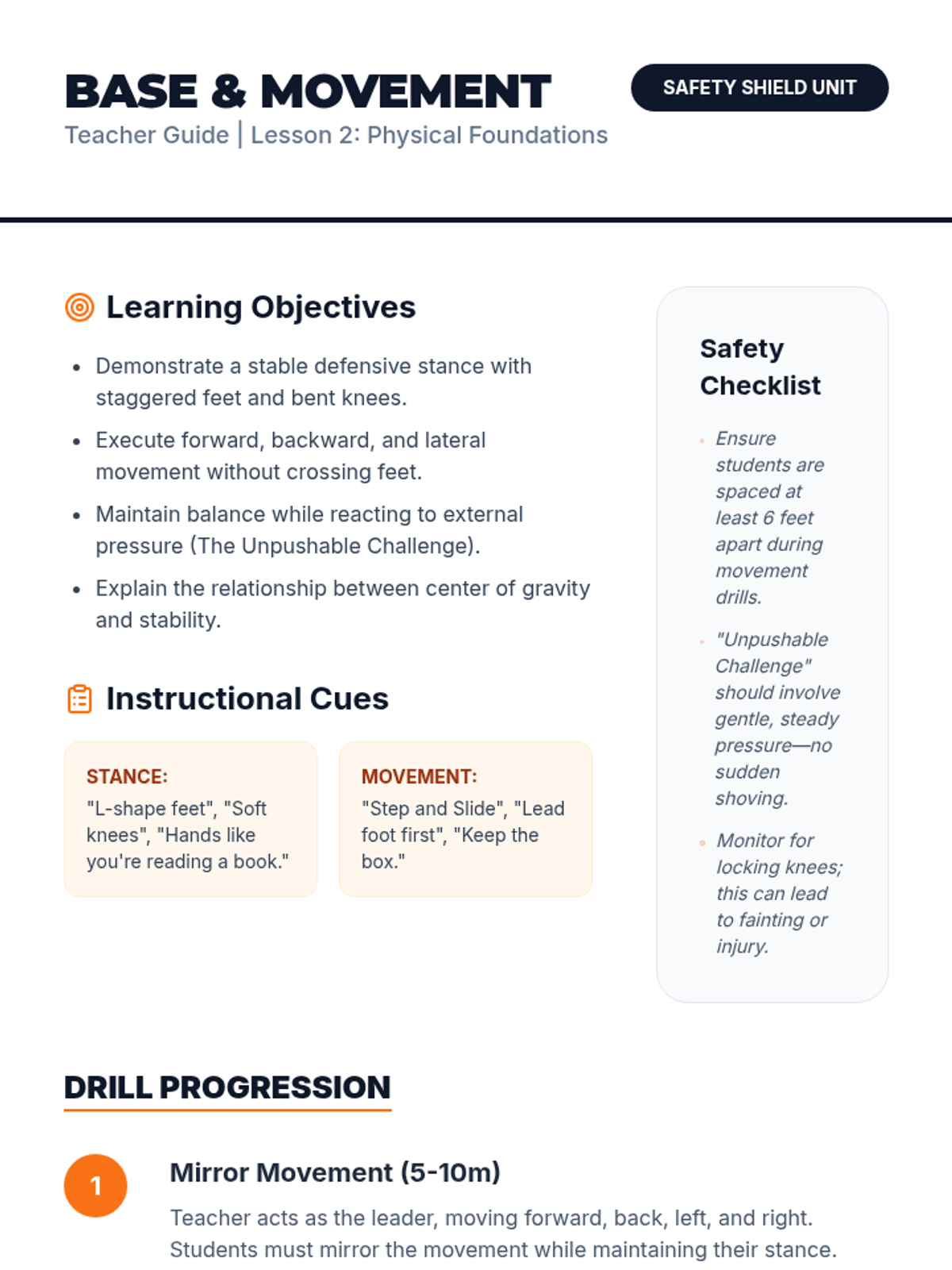
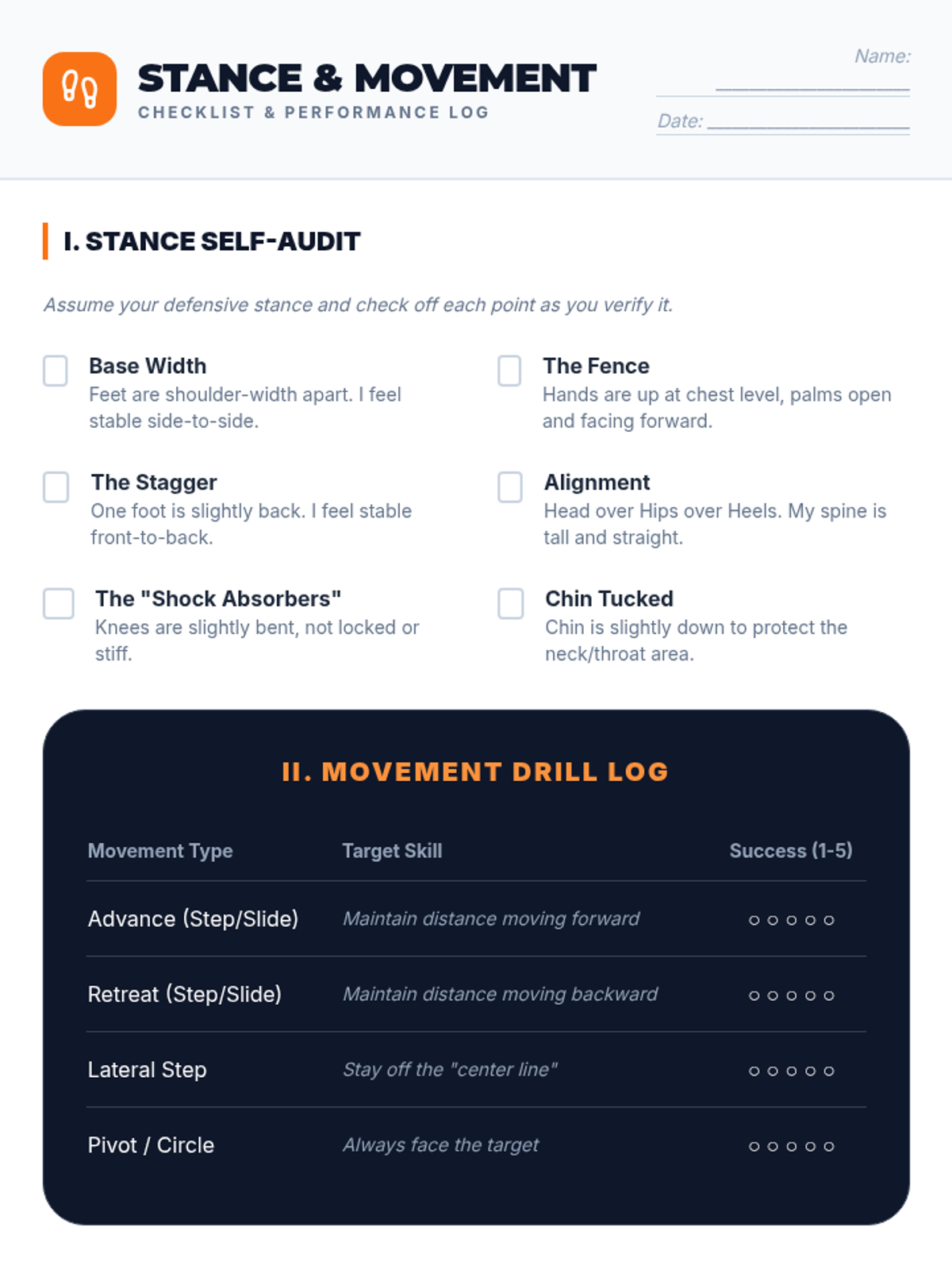
Focuses on establishing a stable base through proper defensive stances and fluid movement patterns to maintain balance and readiness.
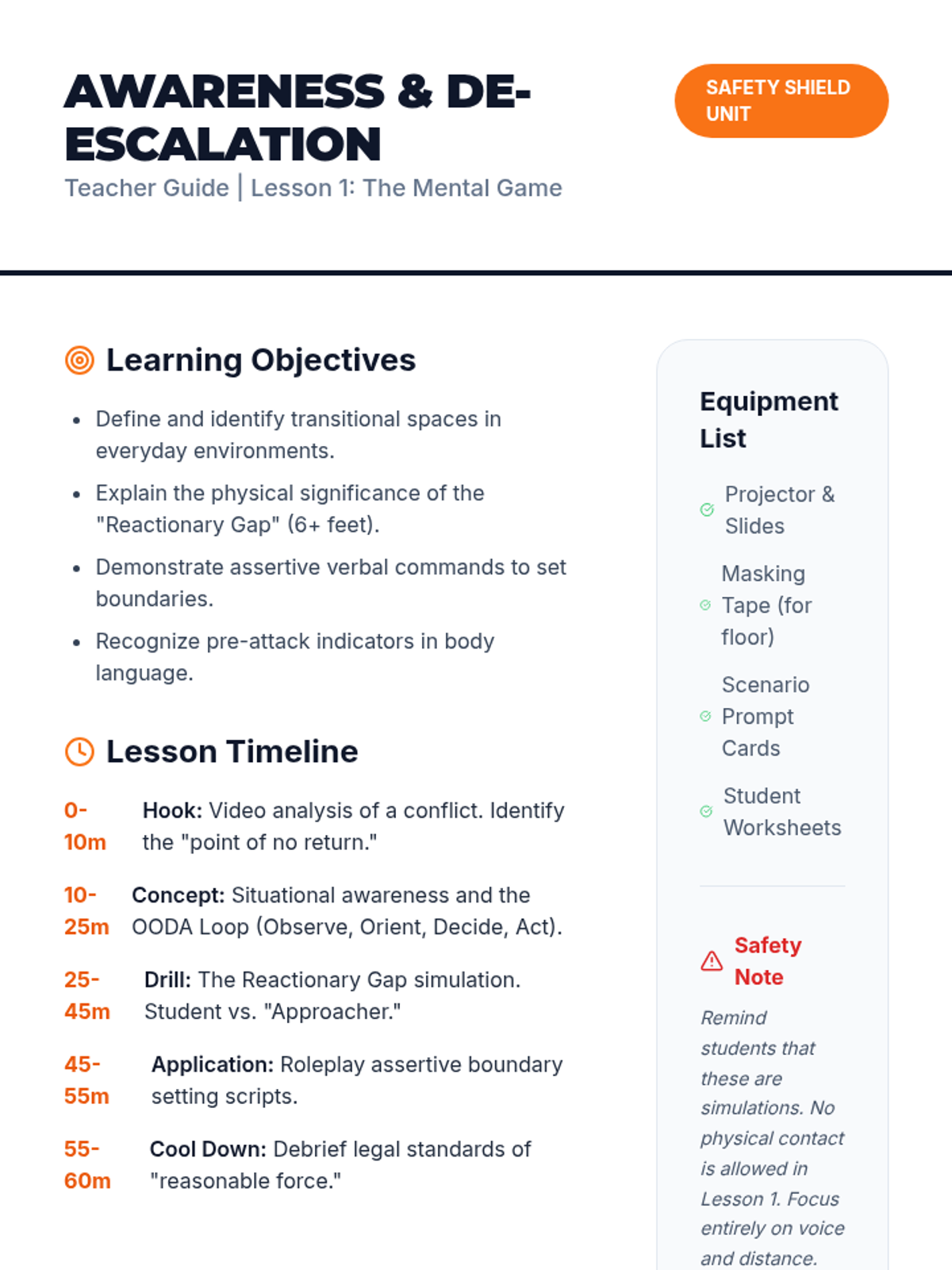
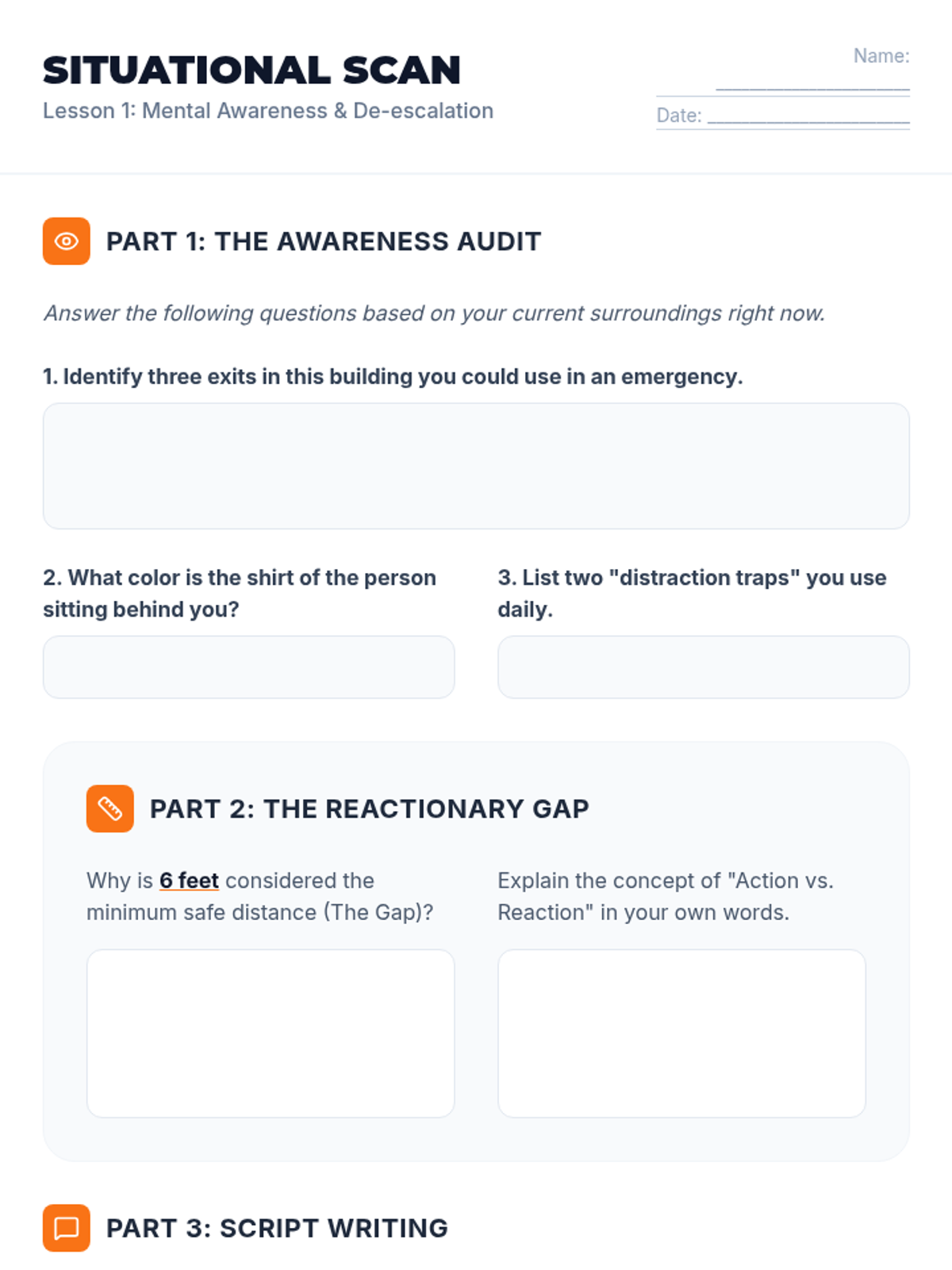
Students explore situational awareness and the 'reactionary gap' while practicing assertive verbal de-escalation and boundary setting.
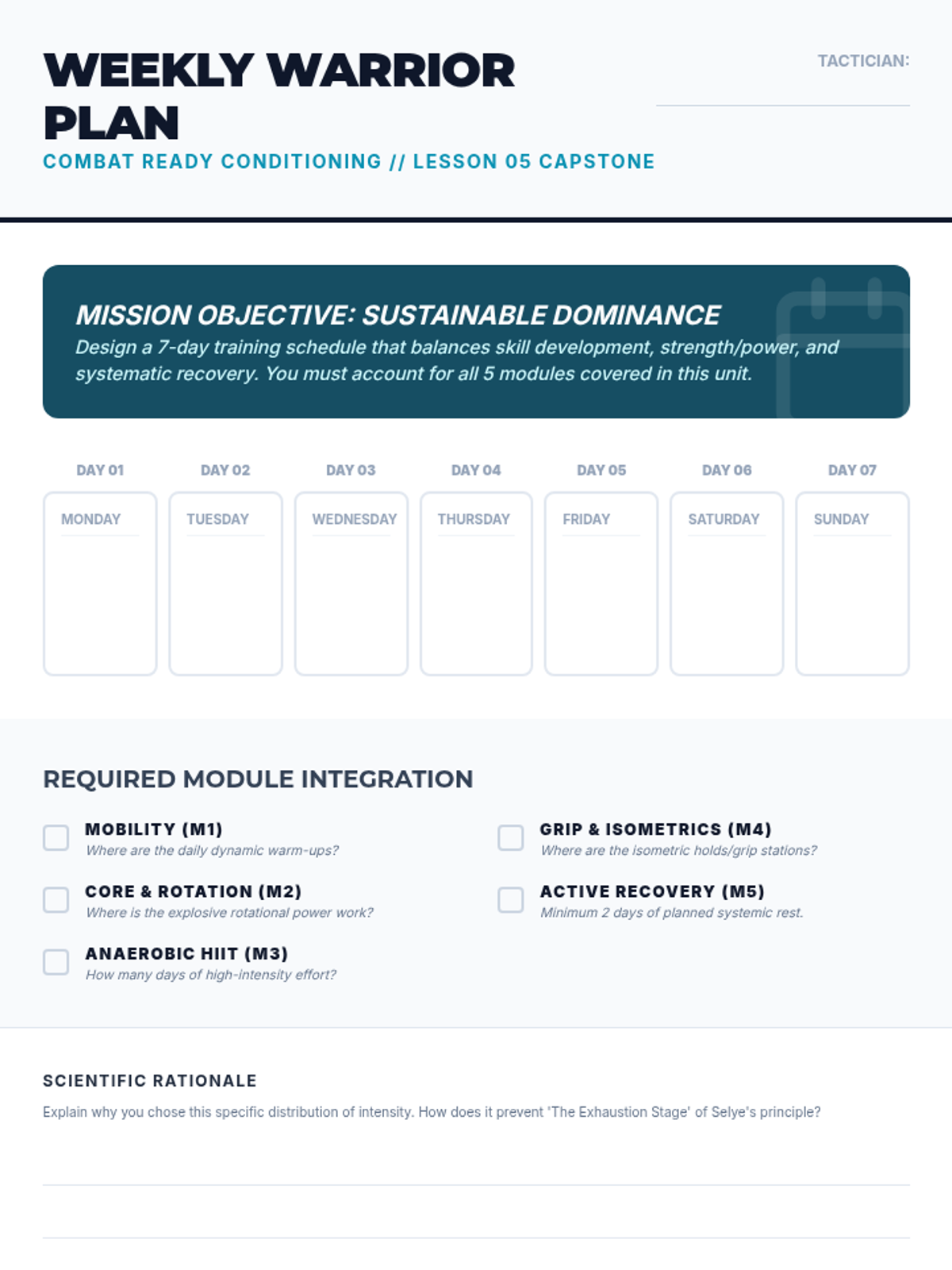
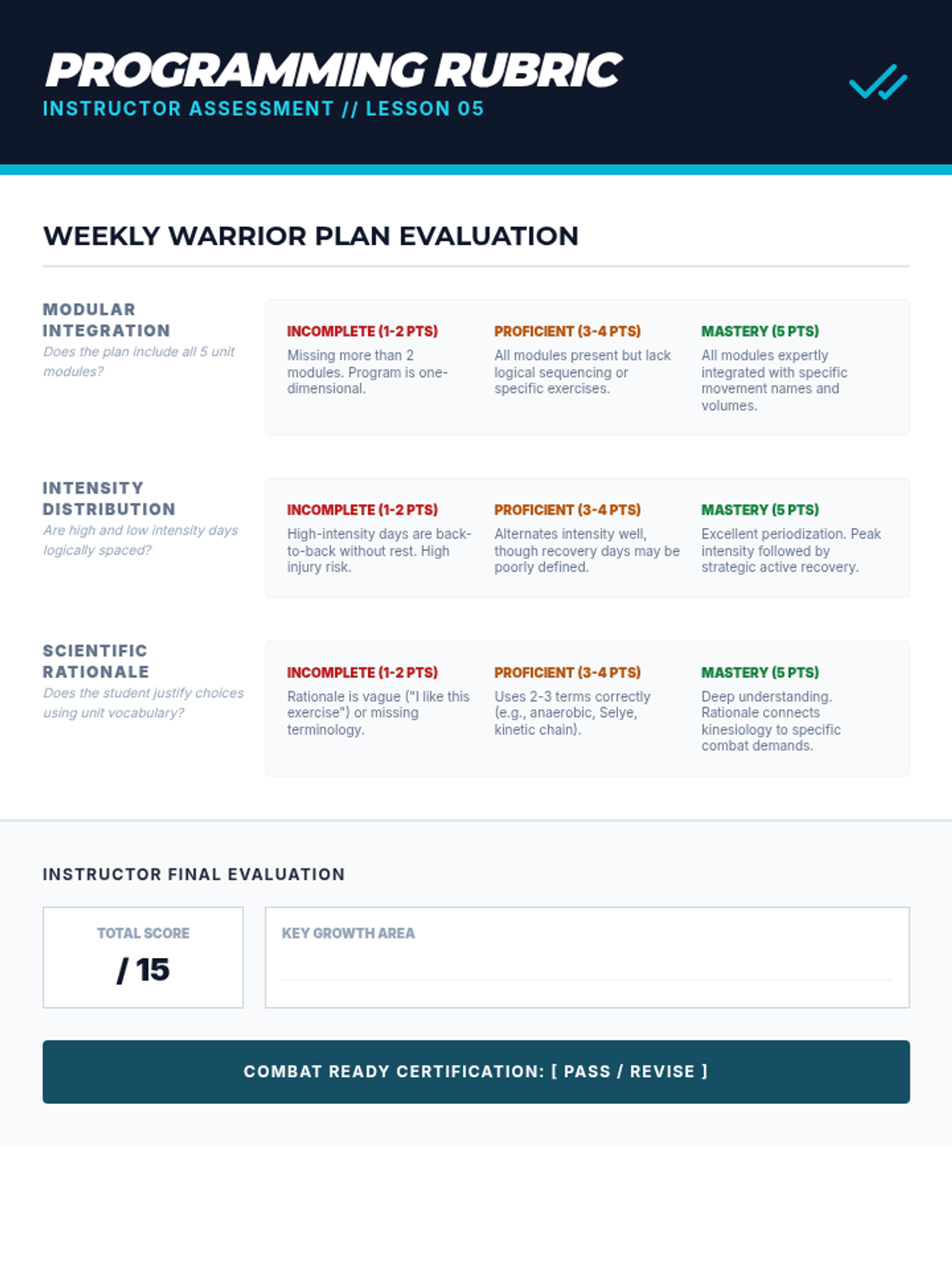
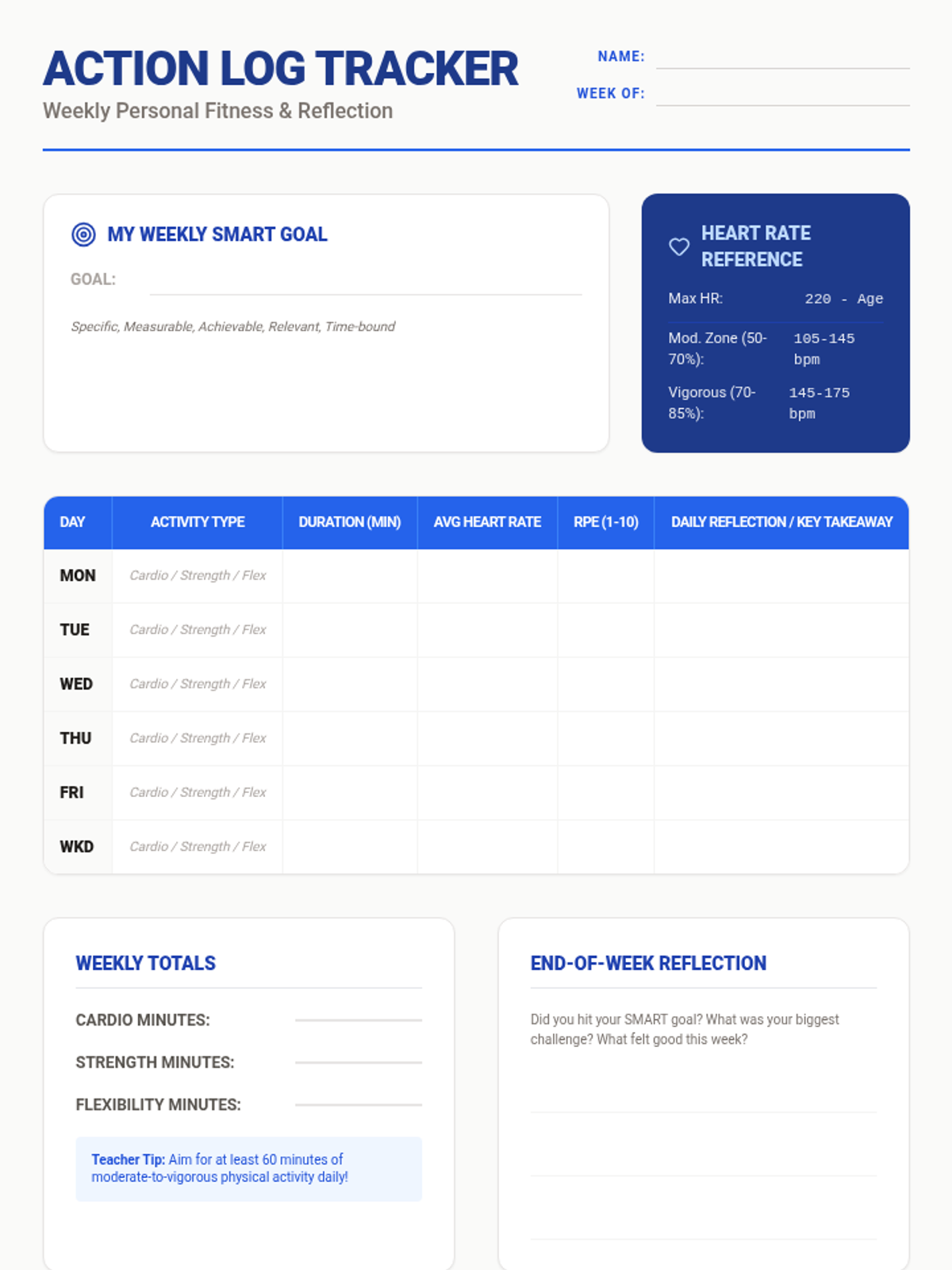
Covers the science of recovery and program design, culminating in students creating a sustainable weekly training protocol.
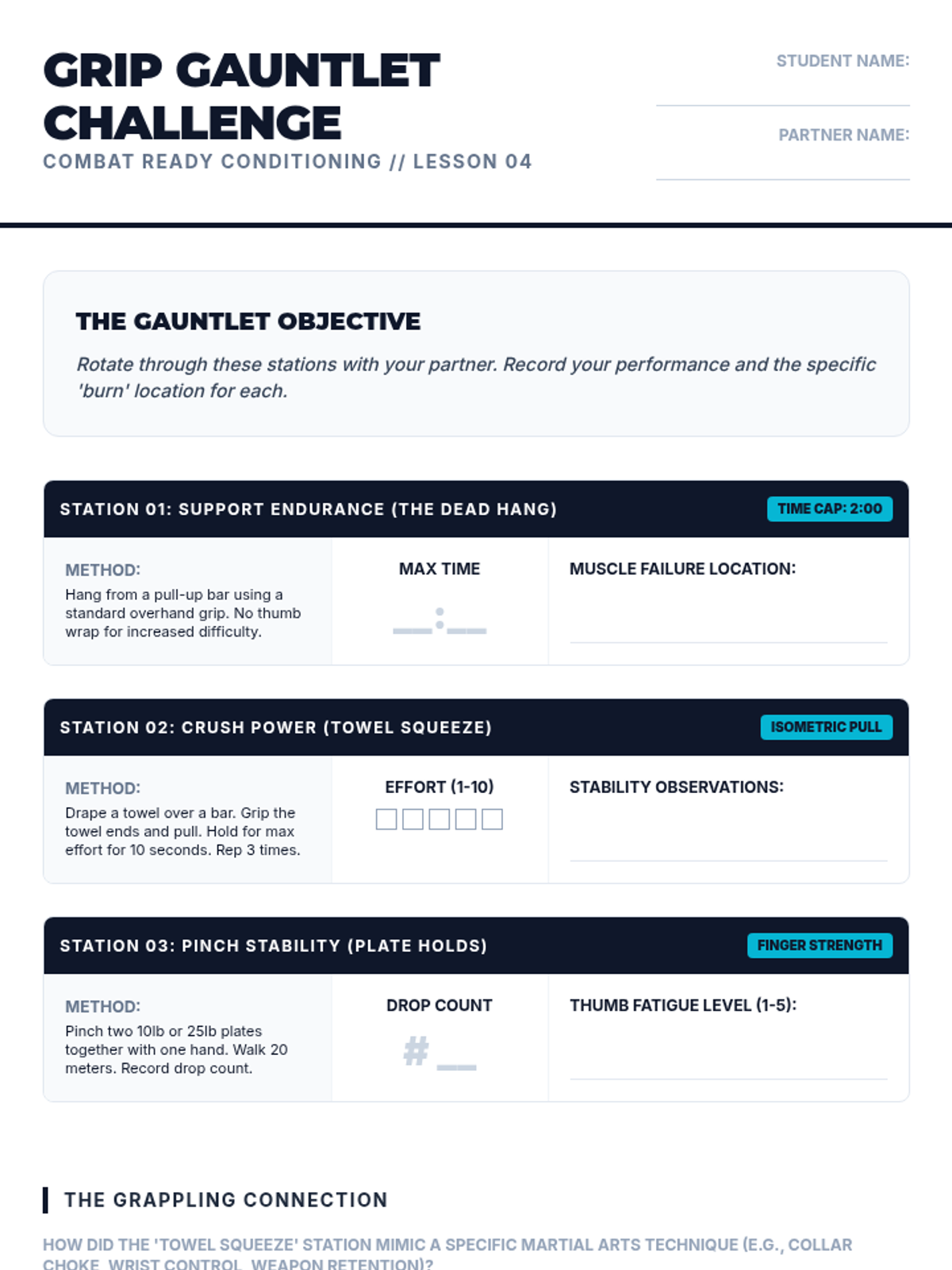
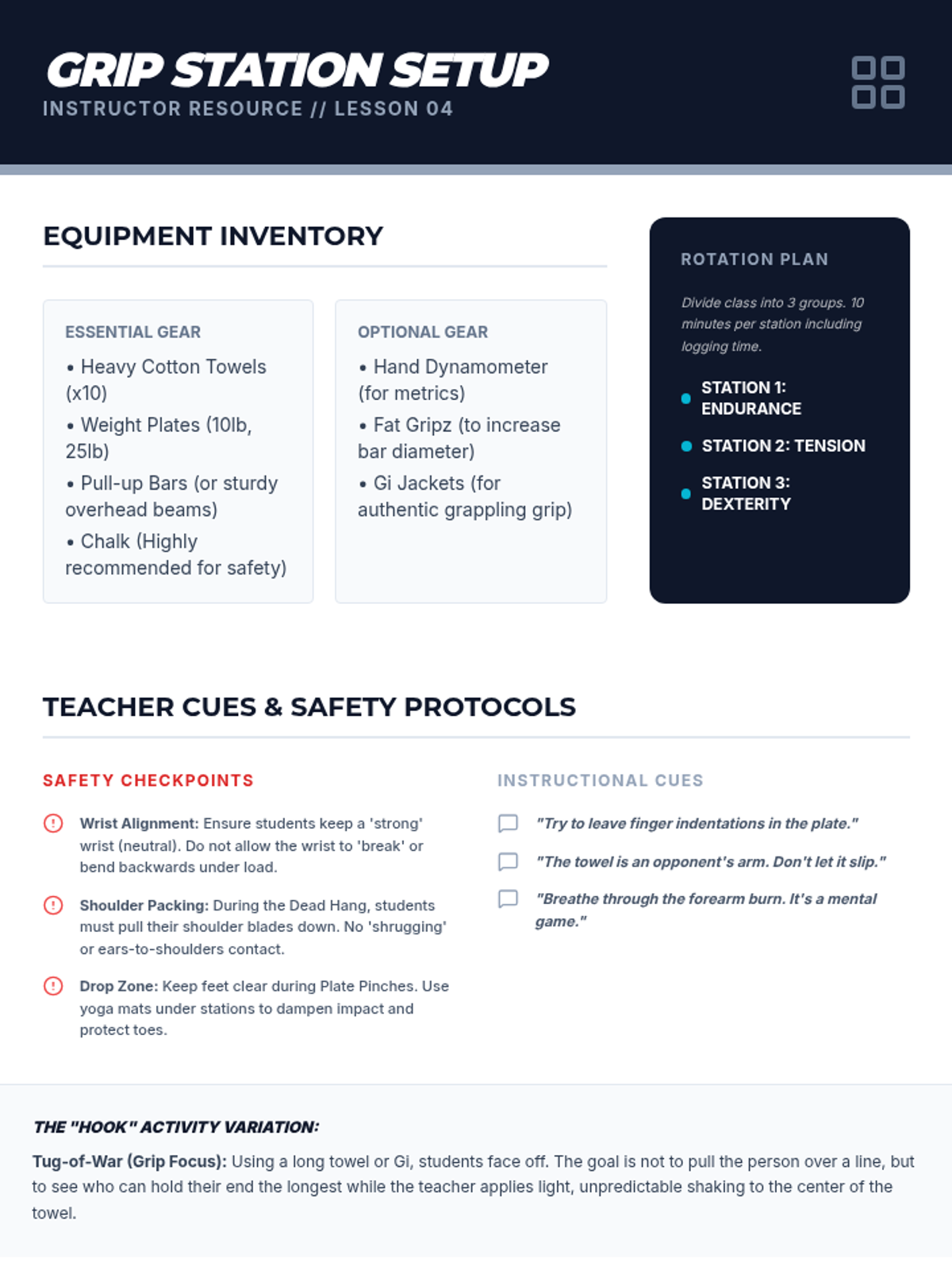
Explores the mechanics of grip and isometric tension, vital for grappling and weapon retention in martial arts.
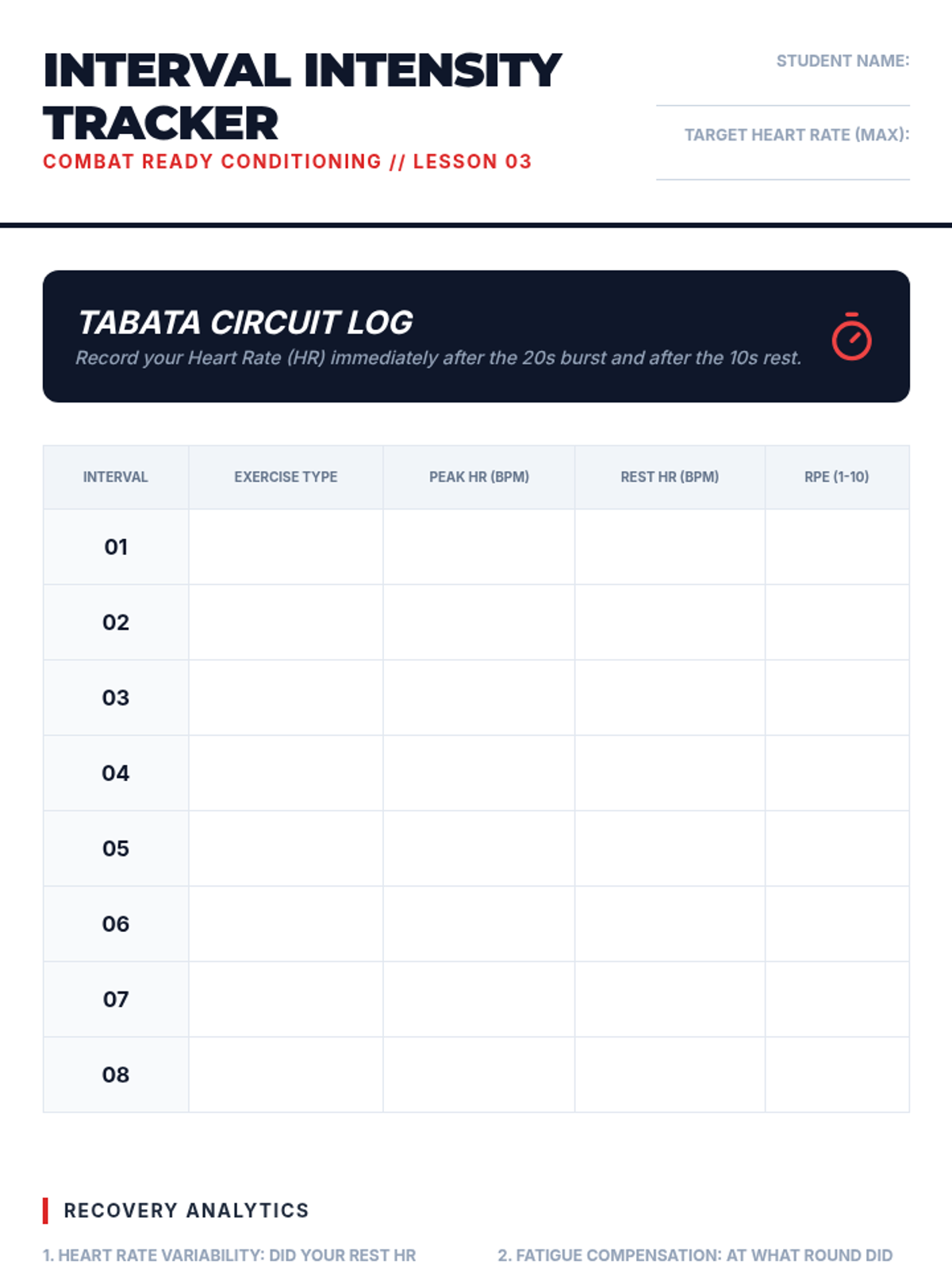
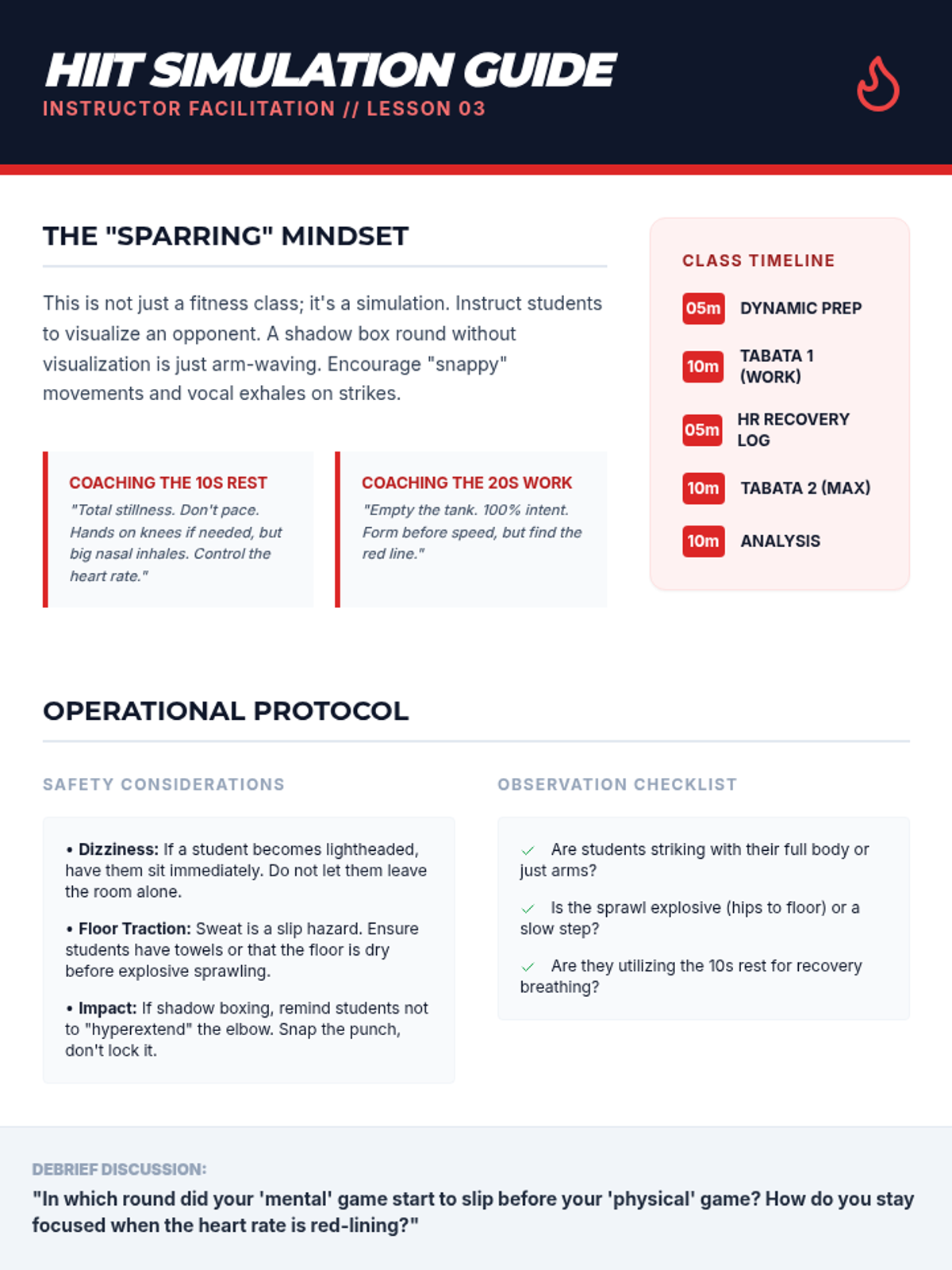
Simulates the high-intensity energy demands of combat through HIIT, focusing on anaerobic capacity and rapid recovery.
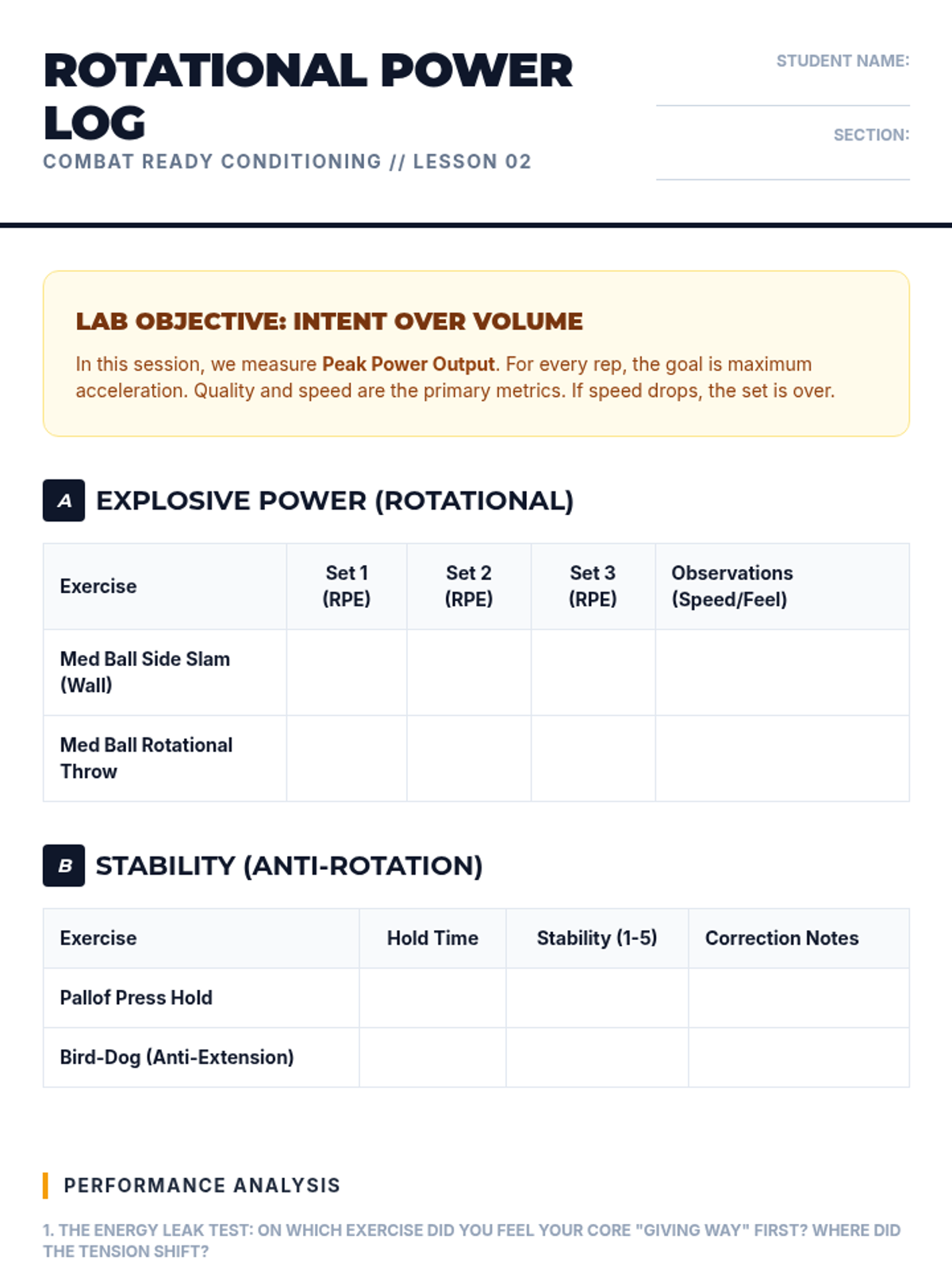
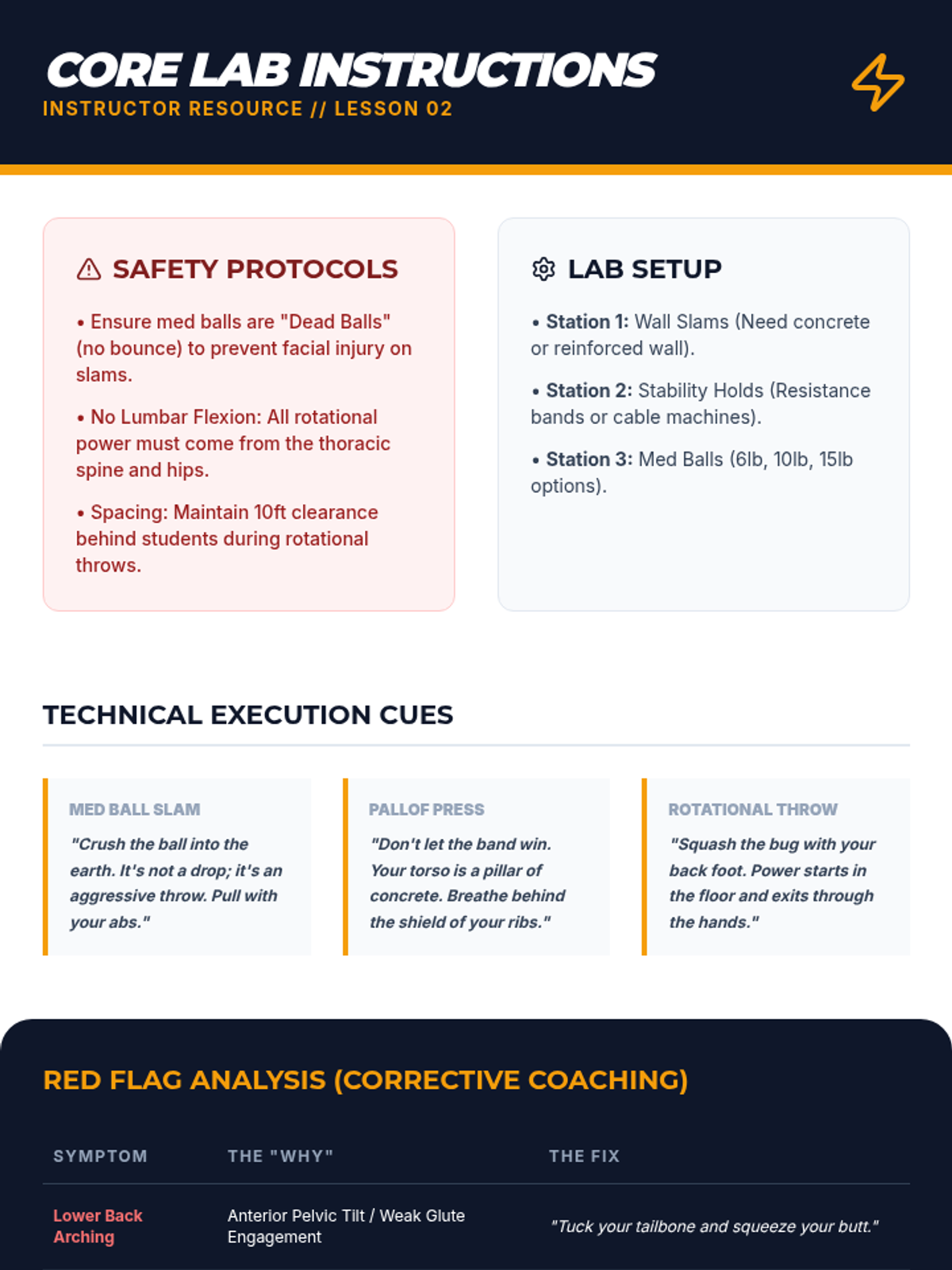
Focuses on the core's role as a power transmitter, teaching students how to generate rotational force and maintain spinal stability.
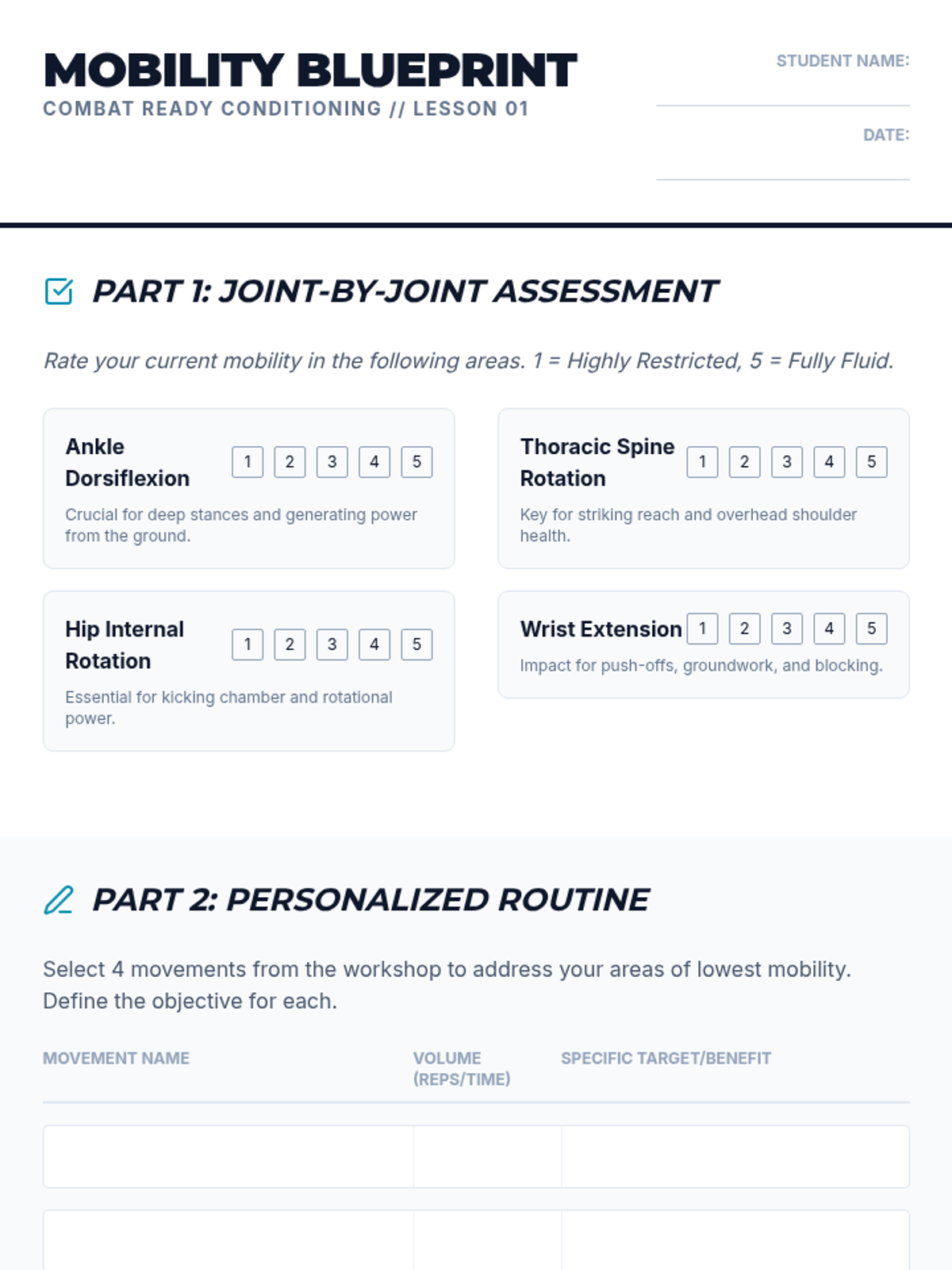
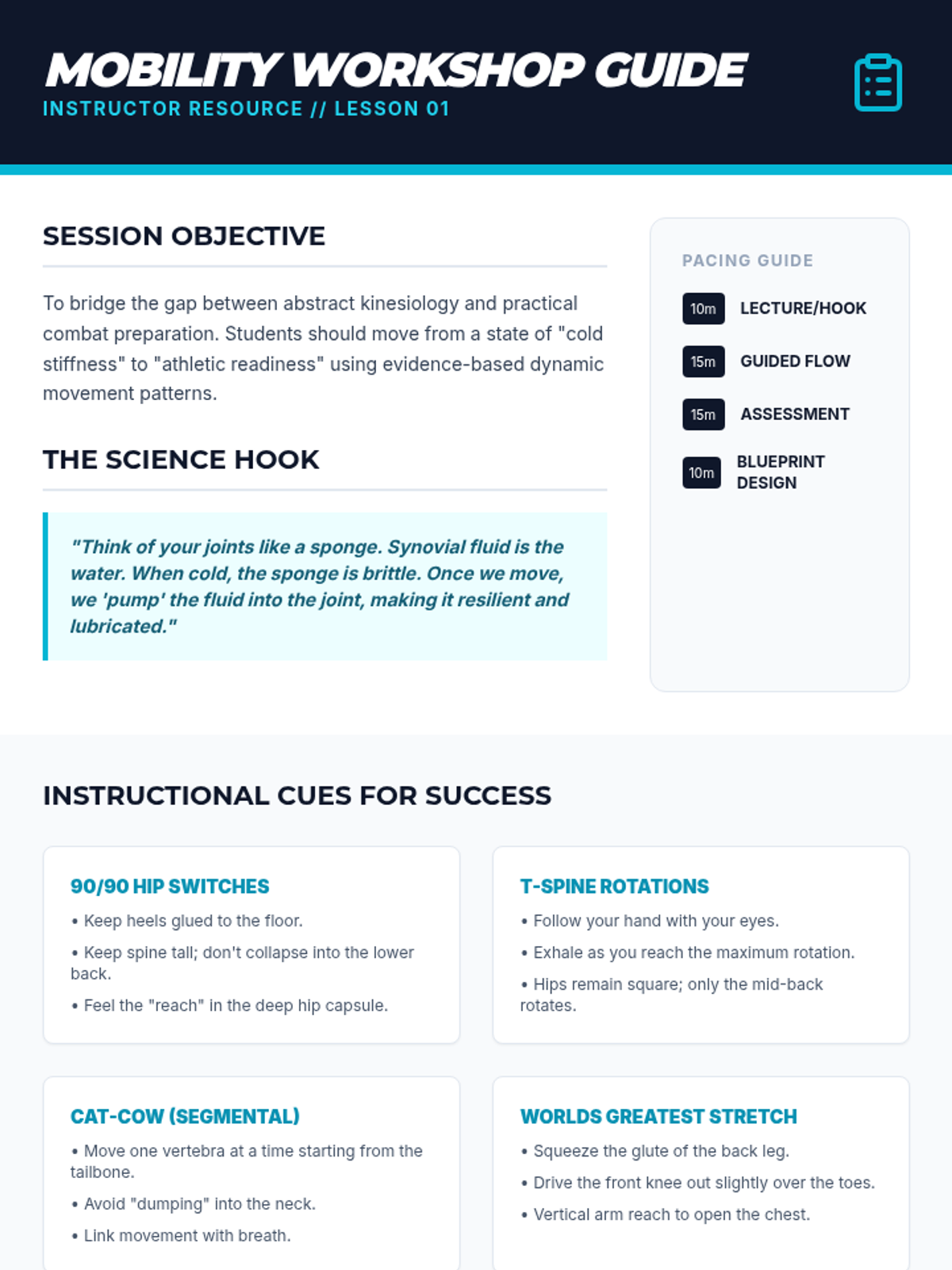
Students explore the science of mobility, learning dynamic routines to prepare the body for the high-impact demands of striking and grappling.
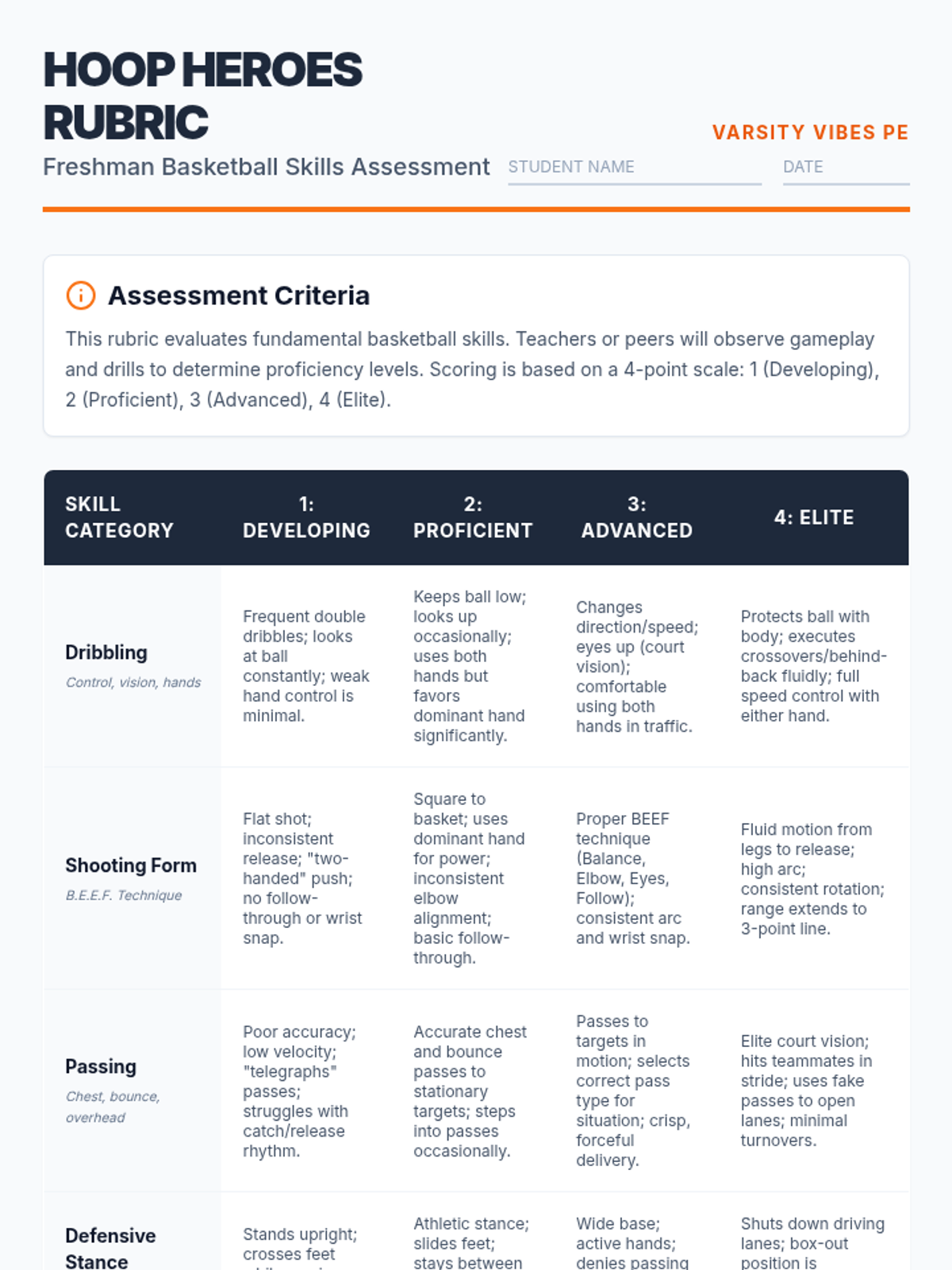
Assessment tools for mastering basketball fundamentals including shooting, dribbling, and defensive positioning.
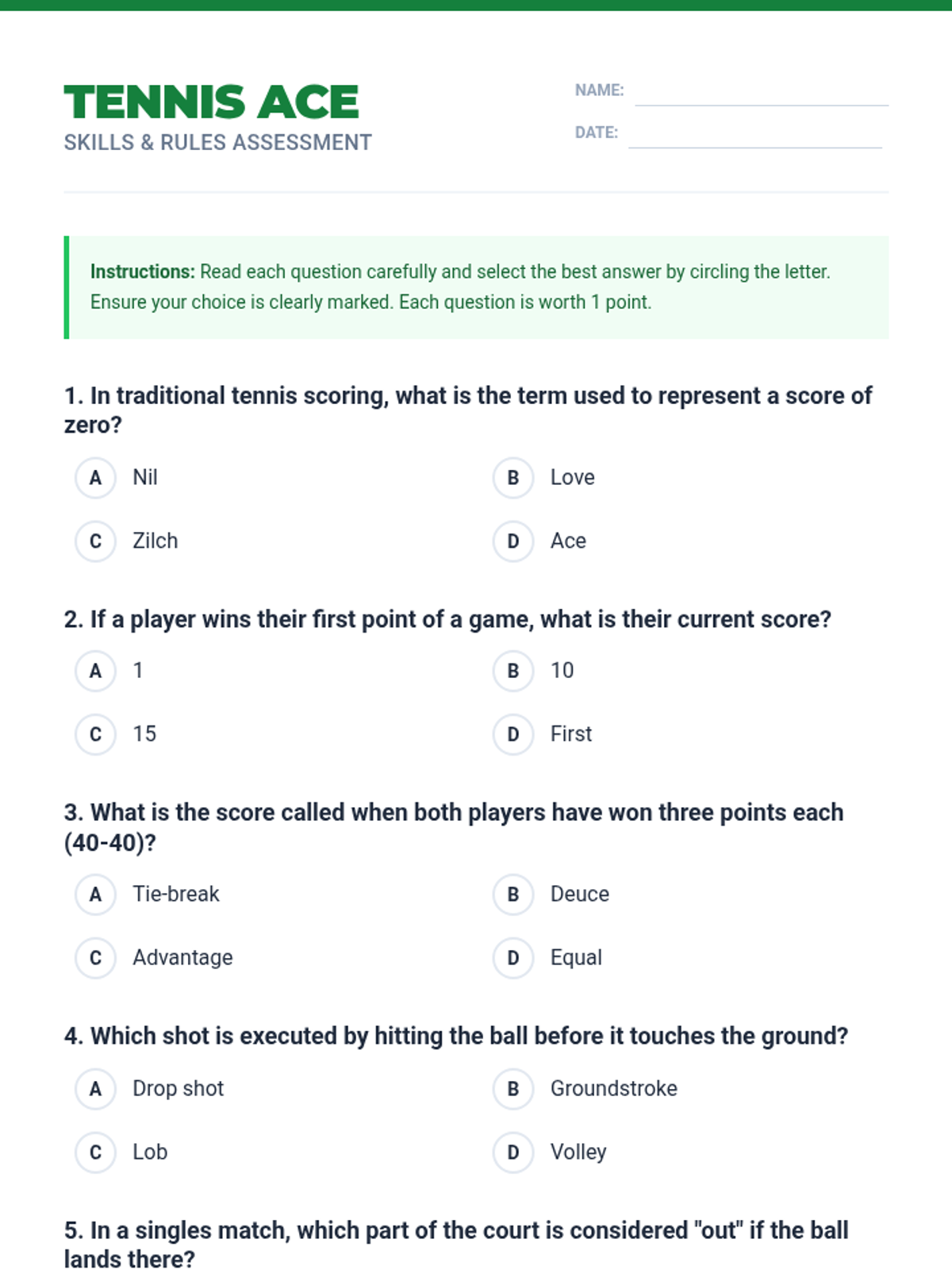
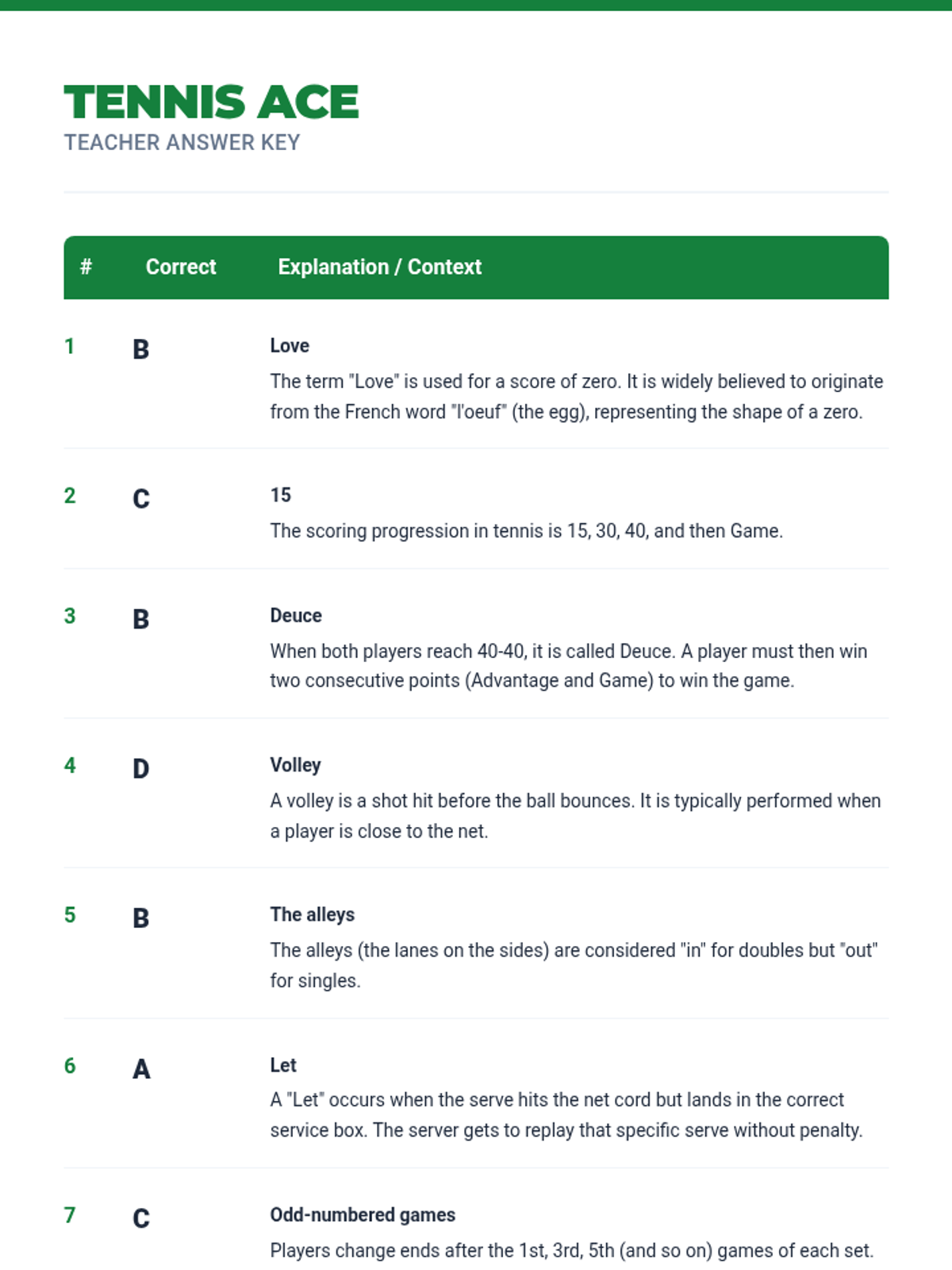
A foundational lesson covering tennis rules, scoring, strokes, and court positioning, designed to prepare students for gameplay and officiating.
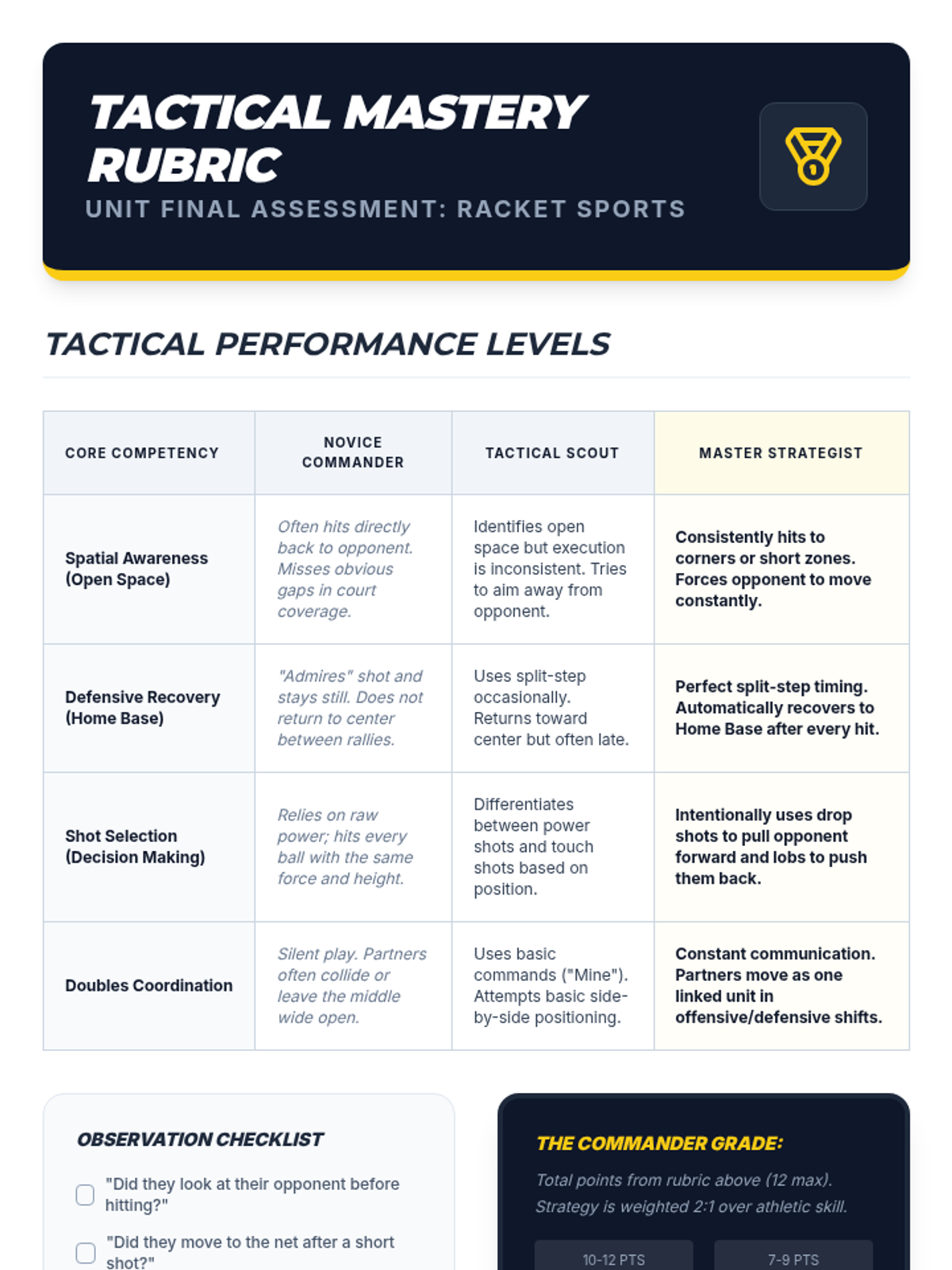
Students participate in modified gameplay, applying all learned tactics and reflecting on shot selection.
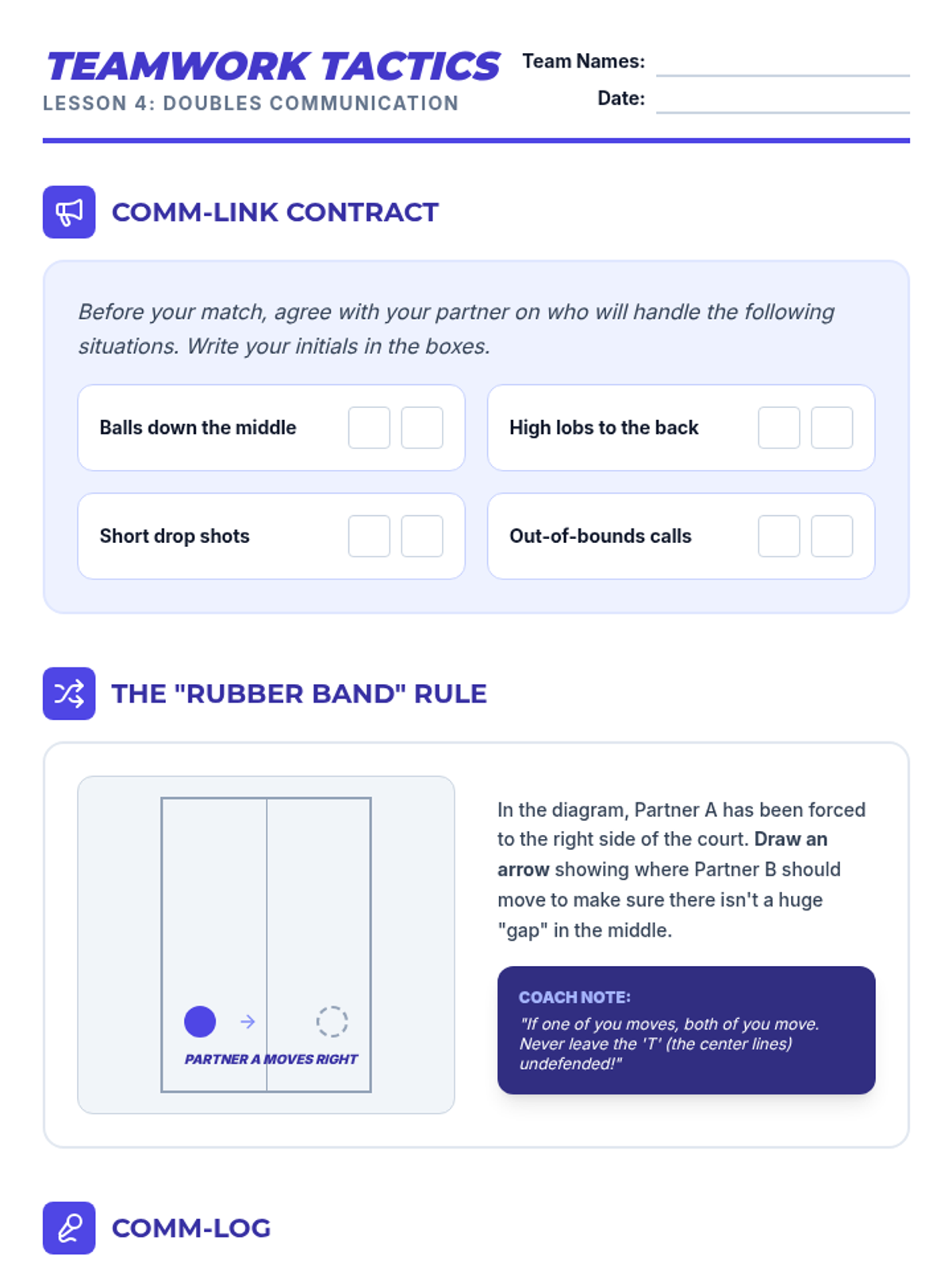
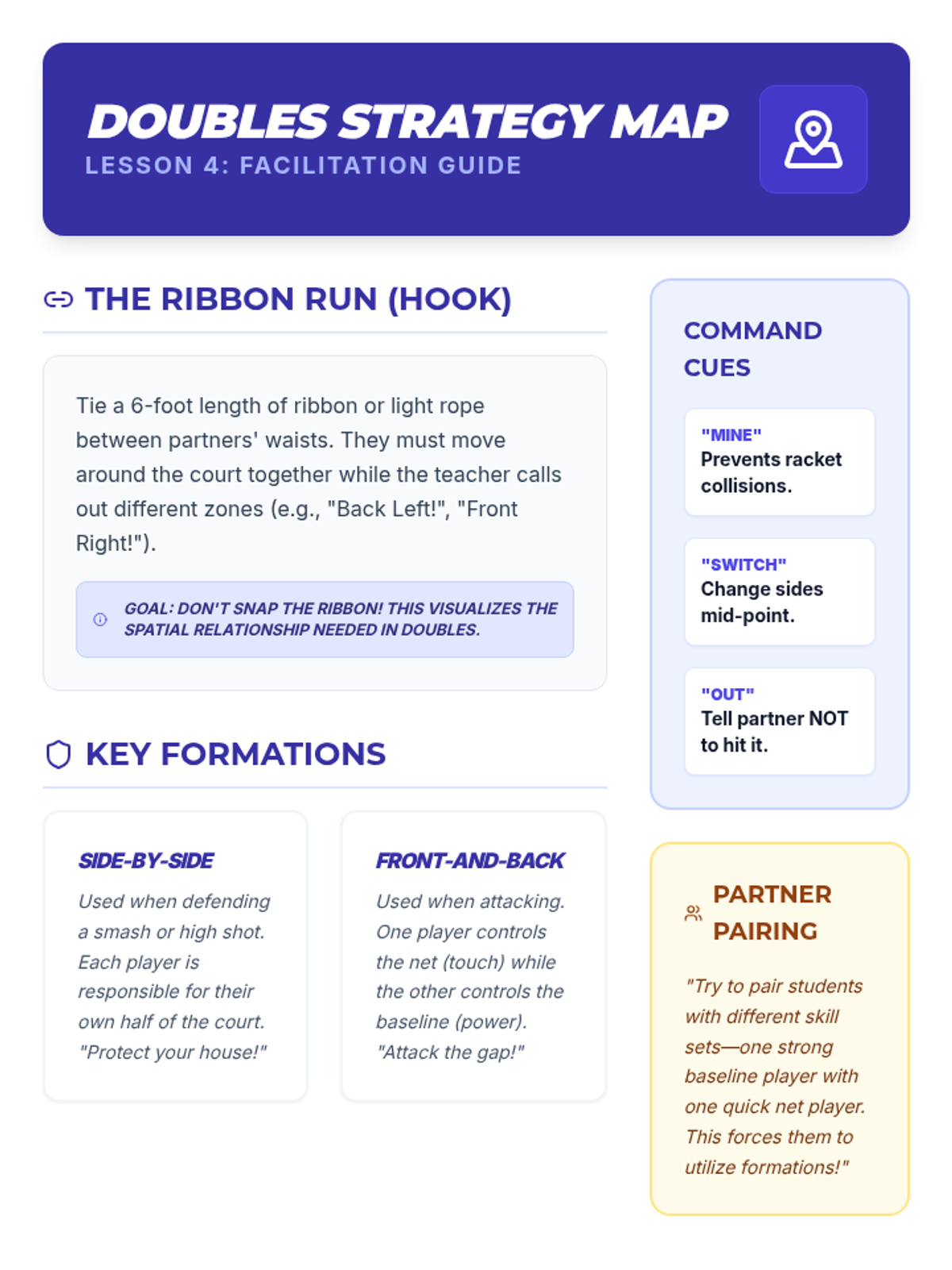
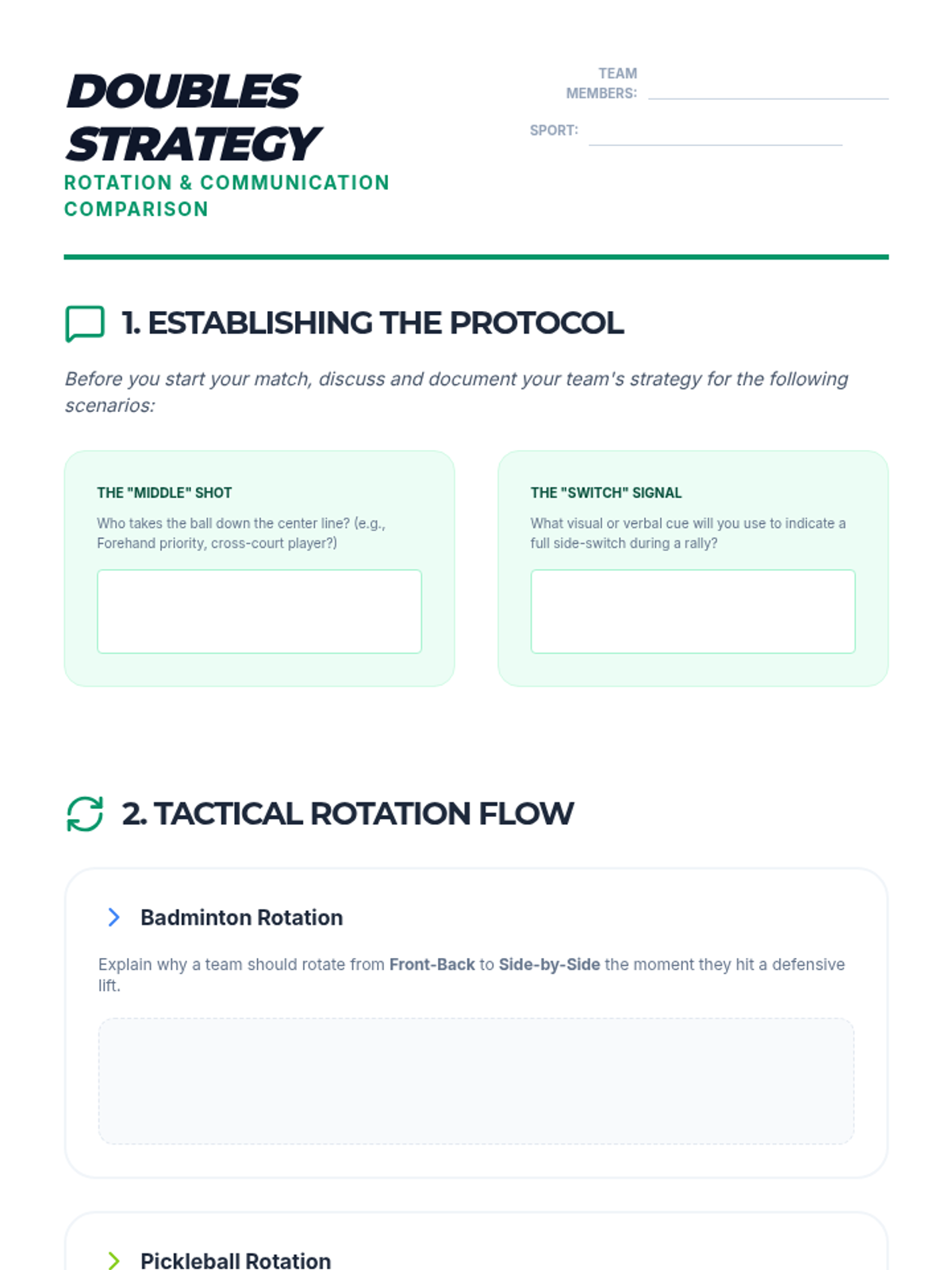
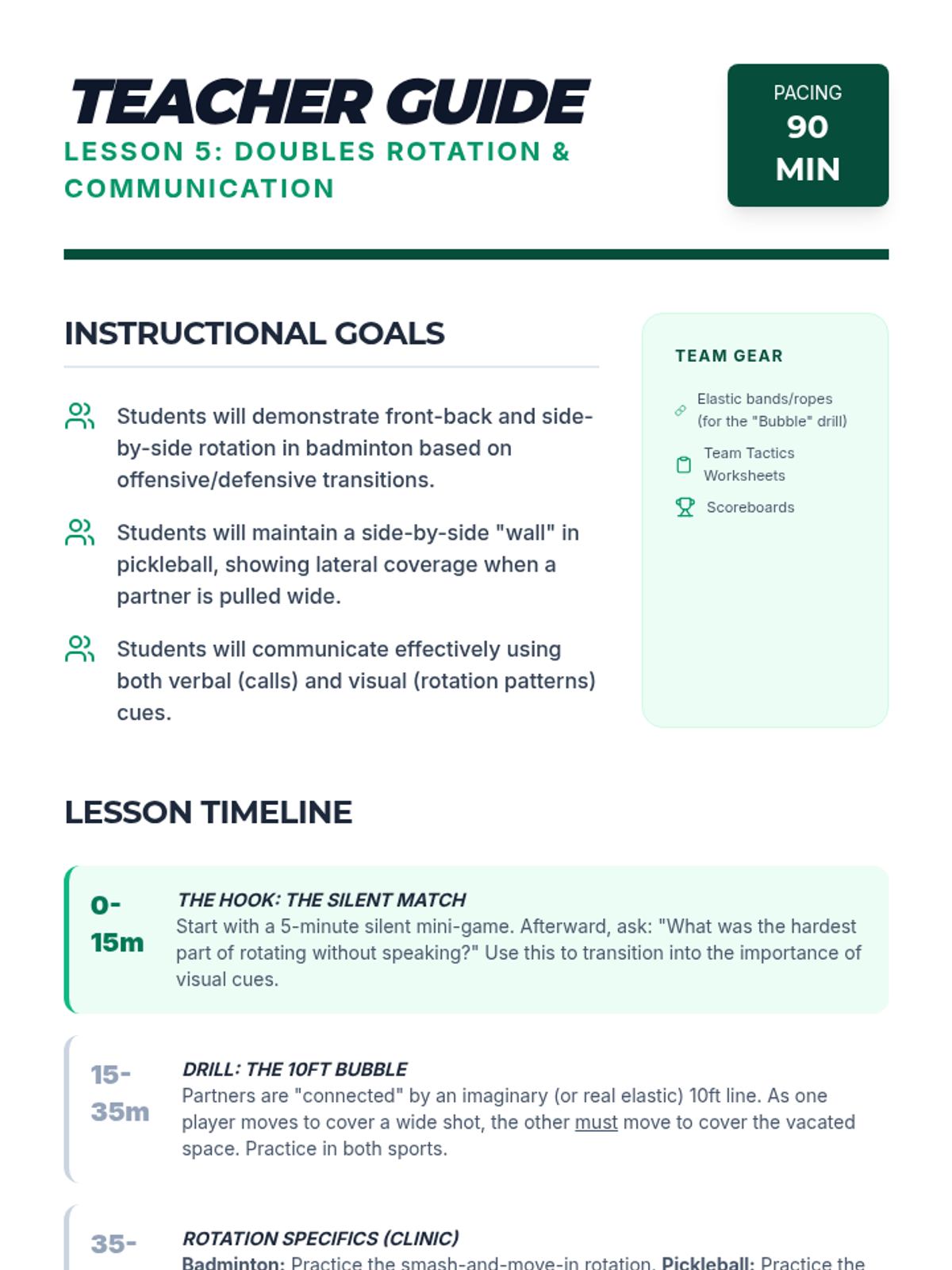
Students learn doubles strategies like side-by-side and front-back positioning with an emphasis on verbal communication.
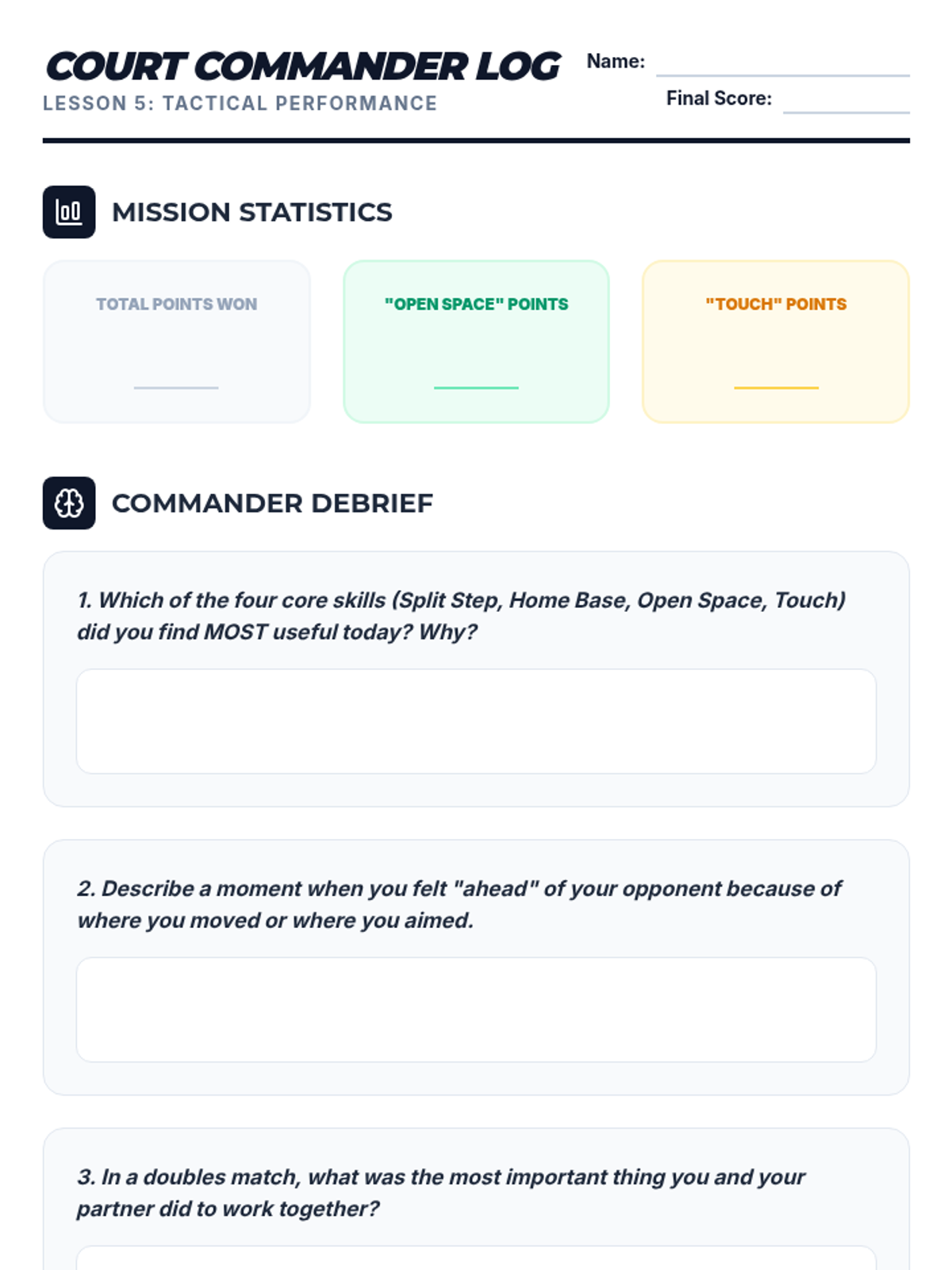
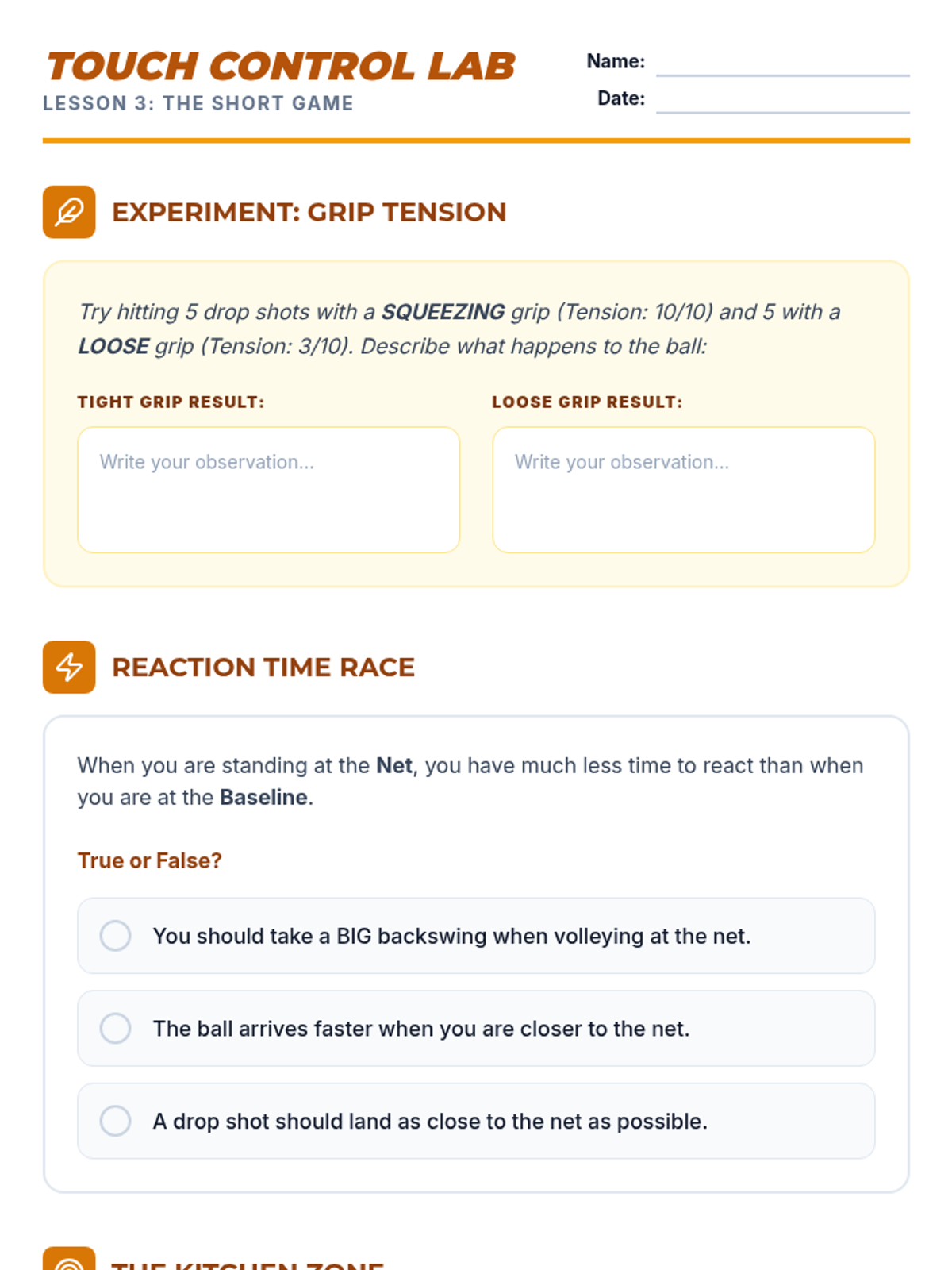
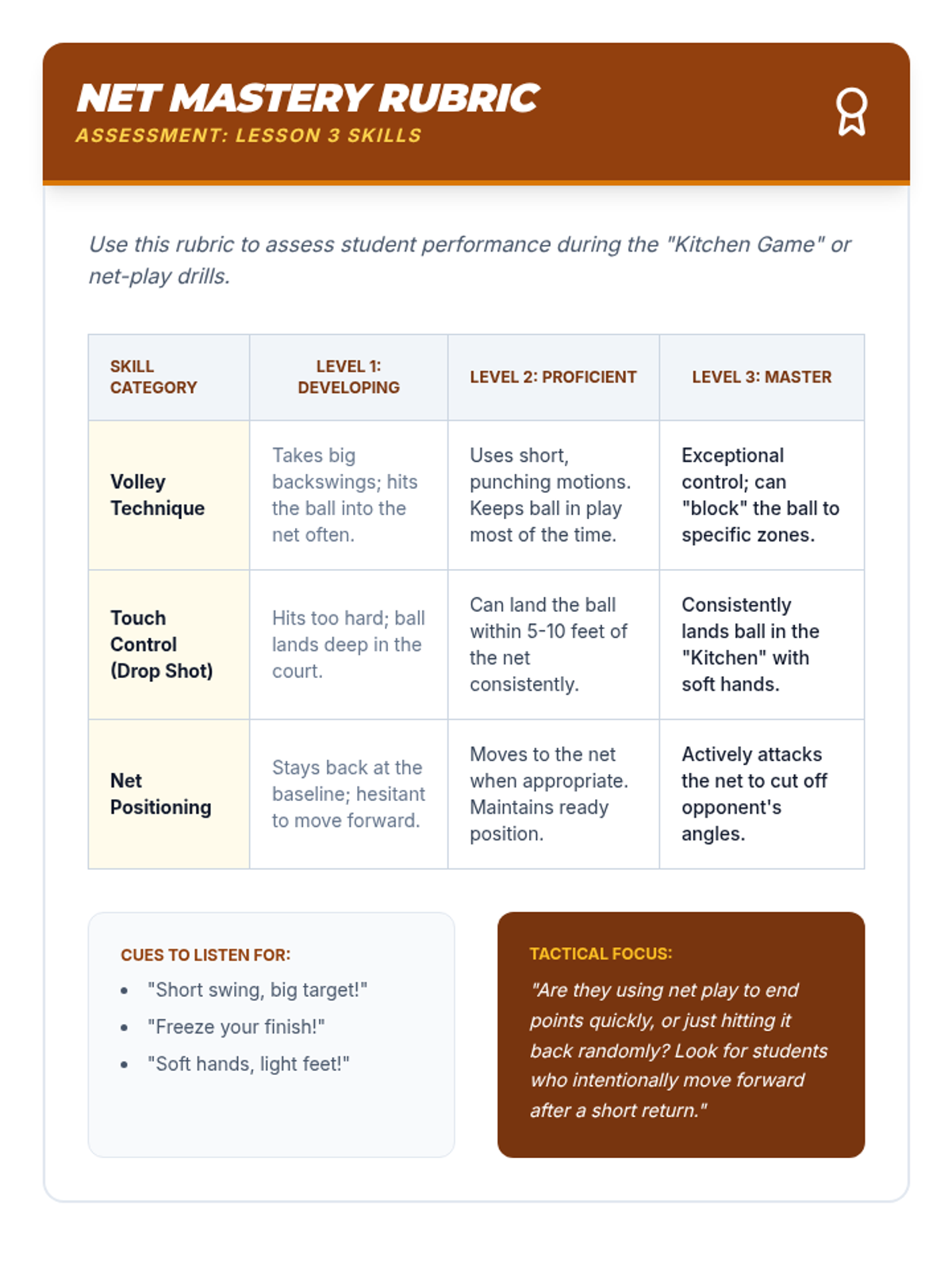
This lesson focuses on volleys and drop shots near the net, teaching students when to attack and how to use touch control.
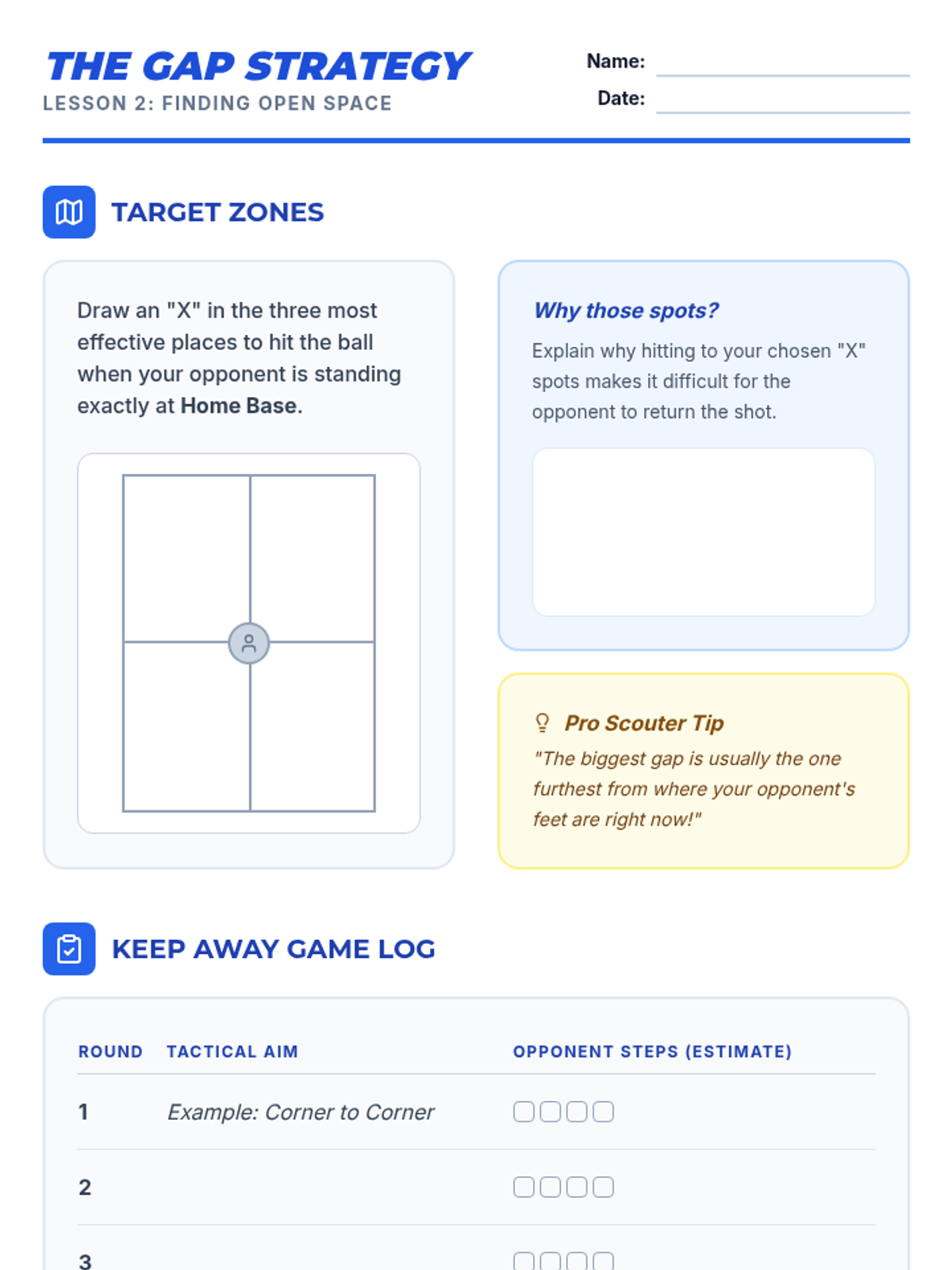
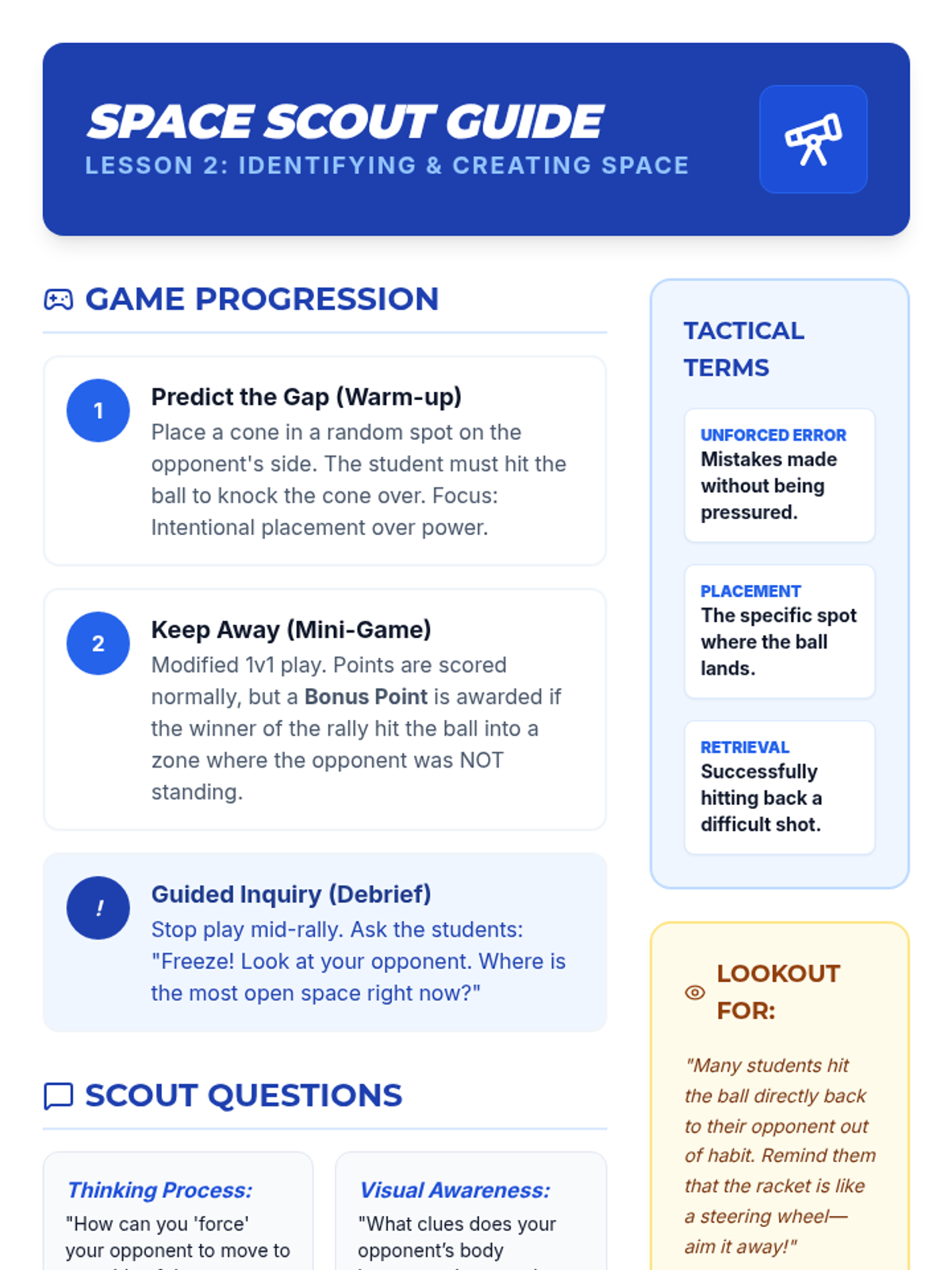
Learners analyze the court to identify undefended areas and practice hitting 'away' from the opponent to force movement.
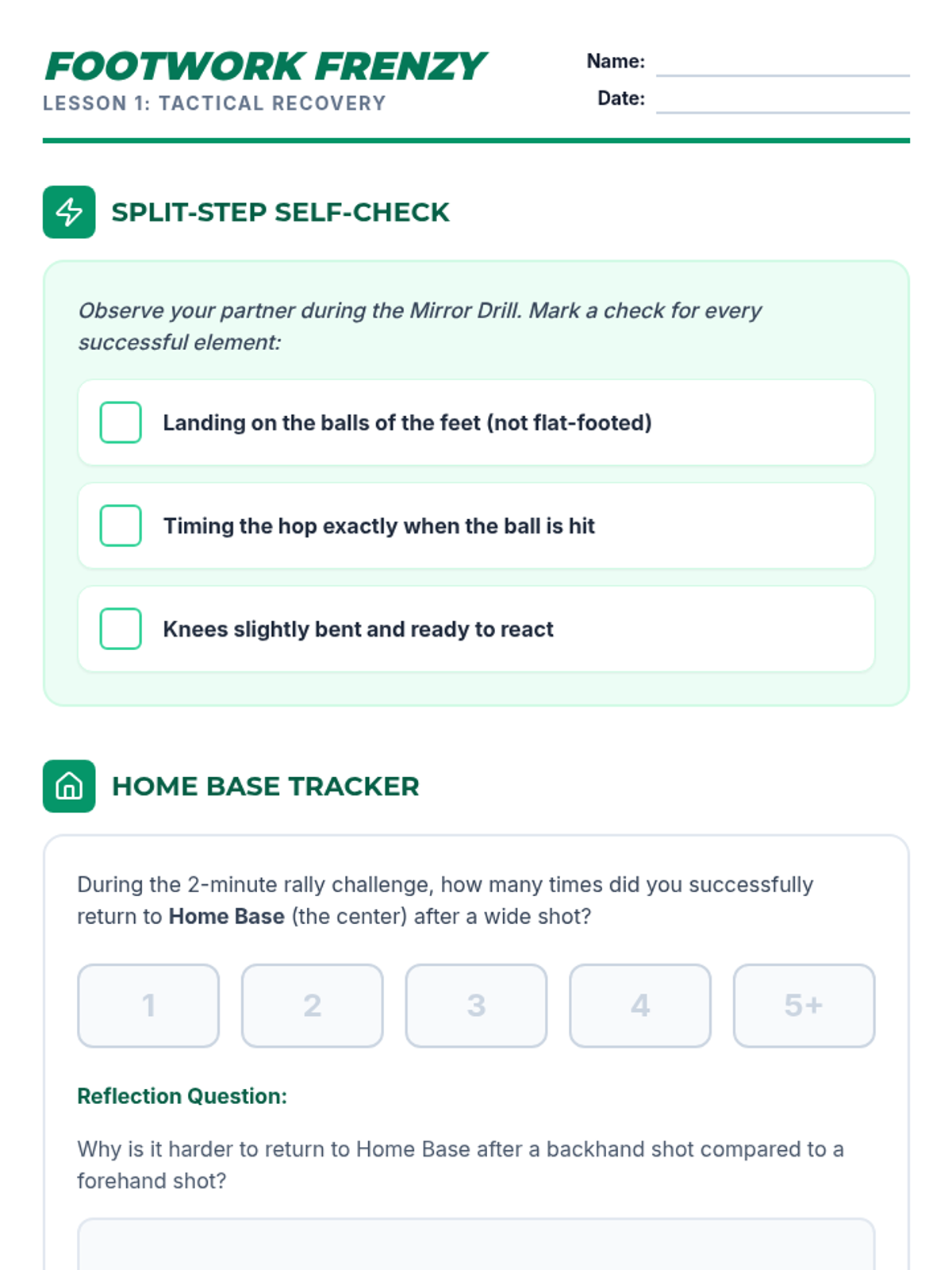
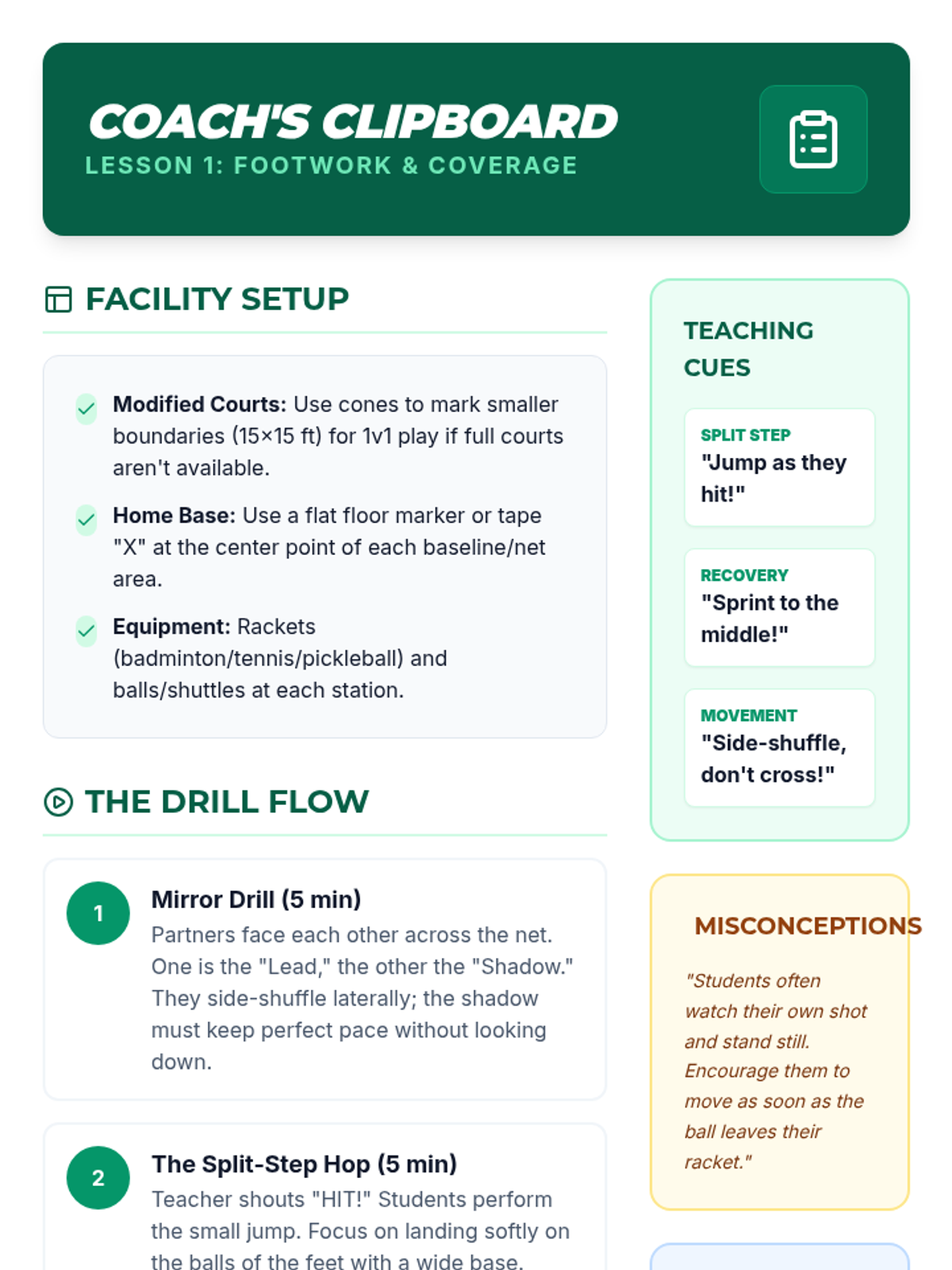
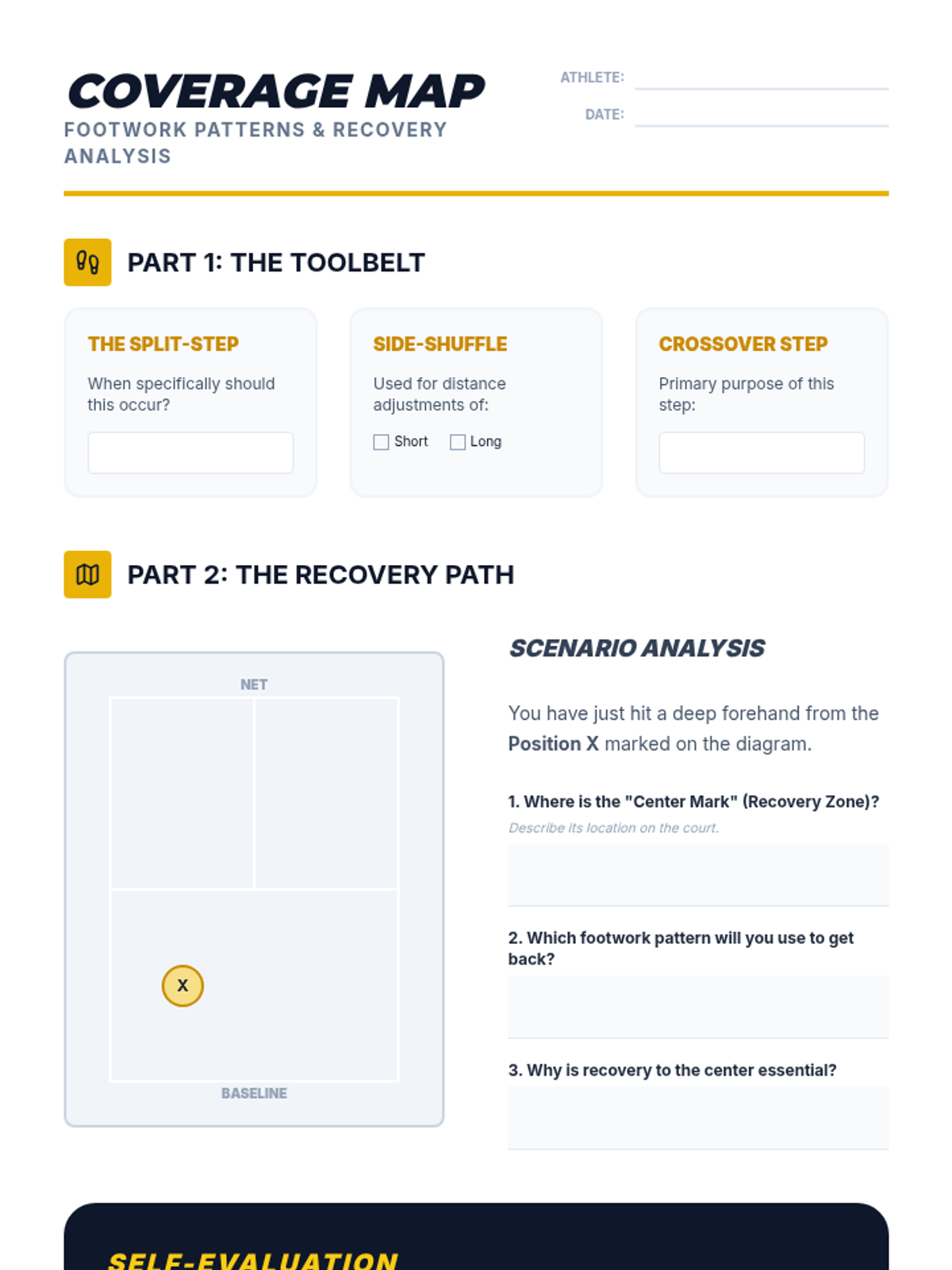
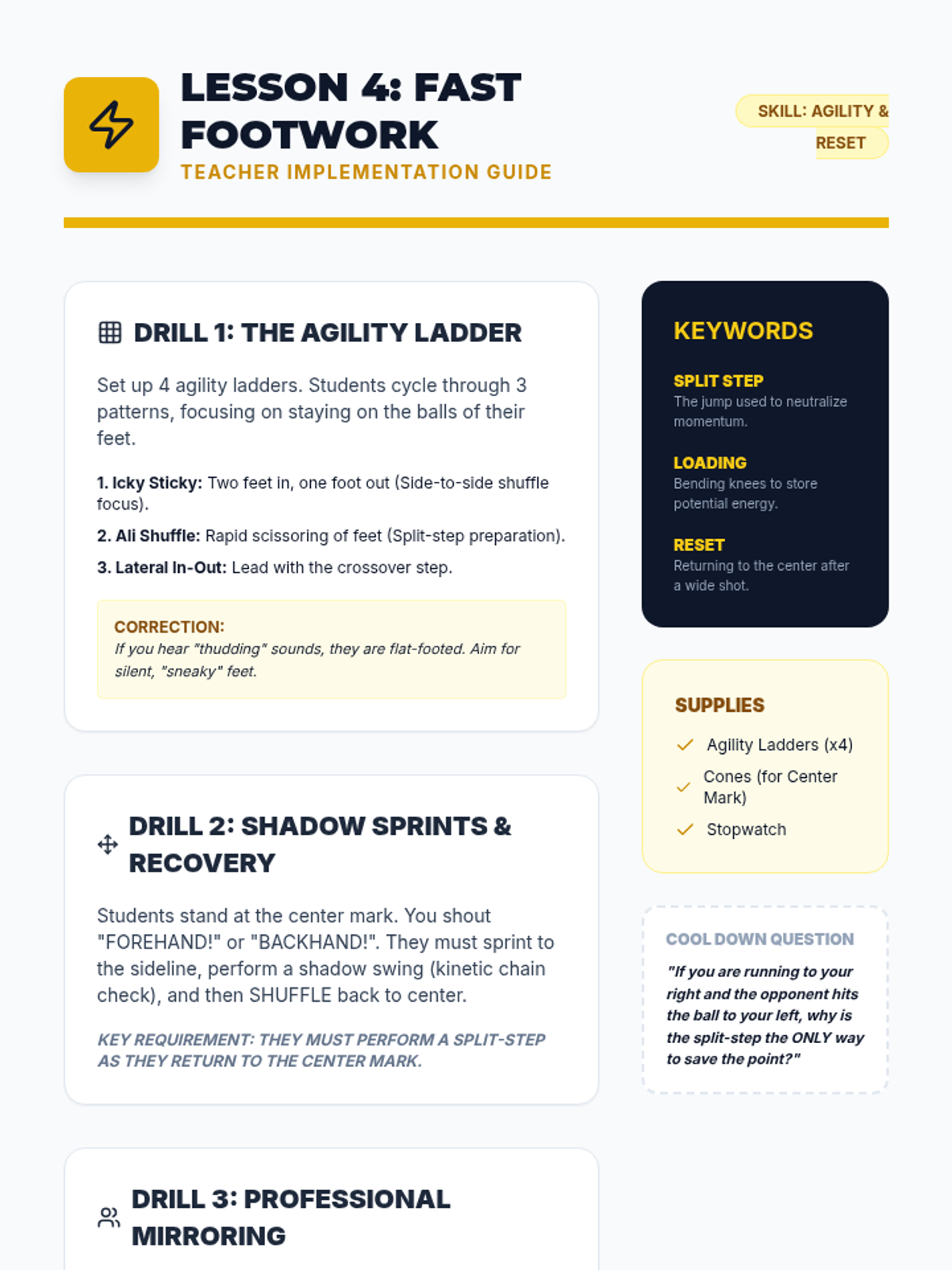
Students practice specific footwork techniques including the split-step and side-shuffle, focusing on returning to 'home base' after every shot.
The sequence concludes with advanced doubles tactics, contrasting the front-back formation often used in badminton attacks with the side-by-side wall of pickleball. Students practice communicating switches and coverage areas in live play.
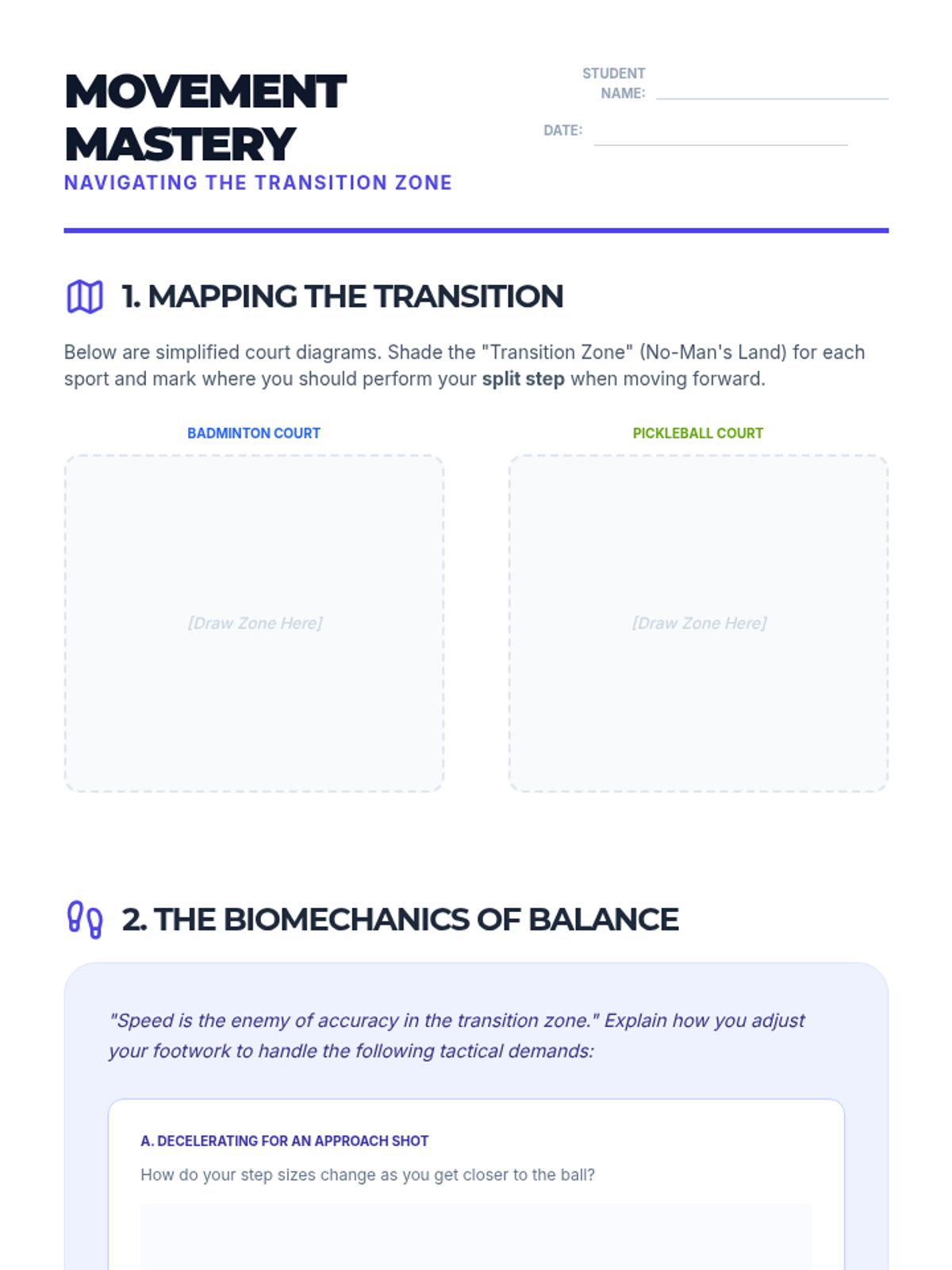
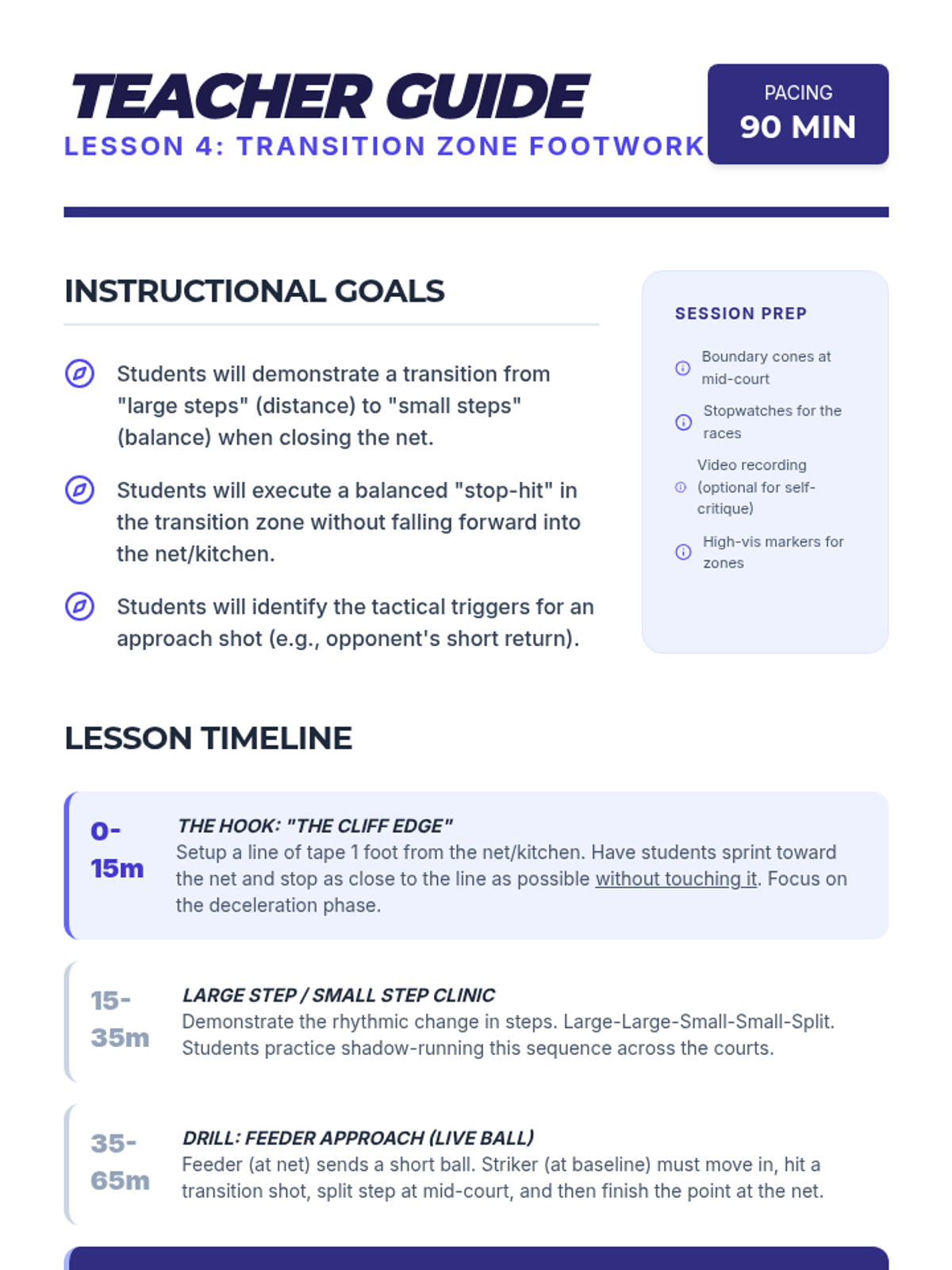
Students analyze the 'no-man's land' in both sports, learning how to move safely from the baseline to the net. The lesson breaks down approach shots and the specific footwork needed to close the gap without being lobbed or passed.
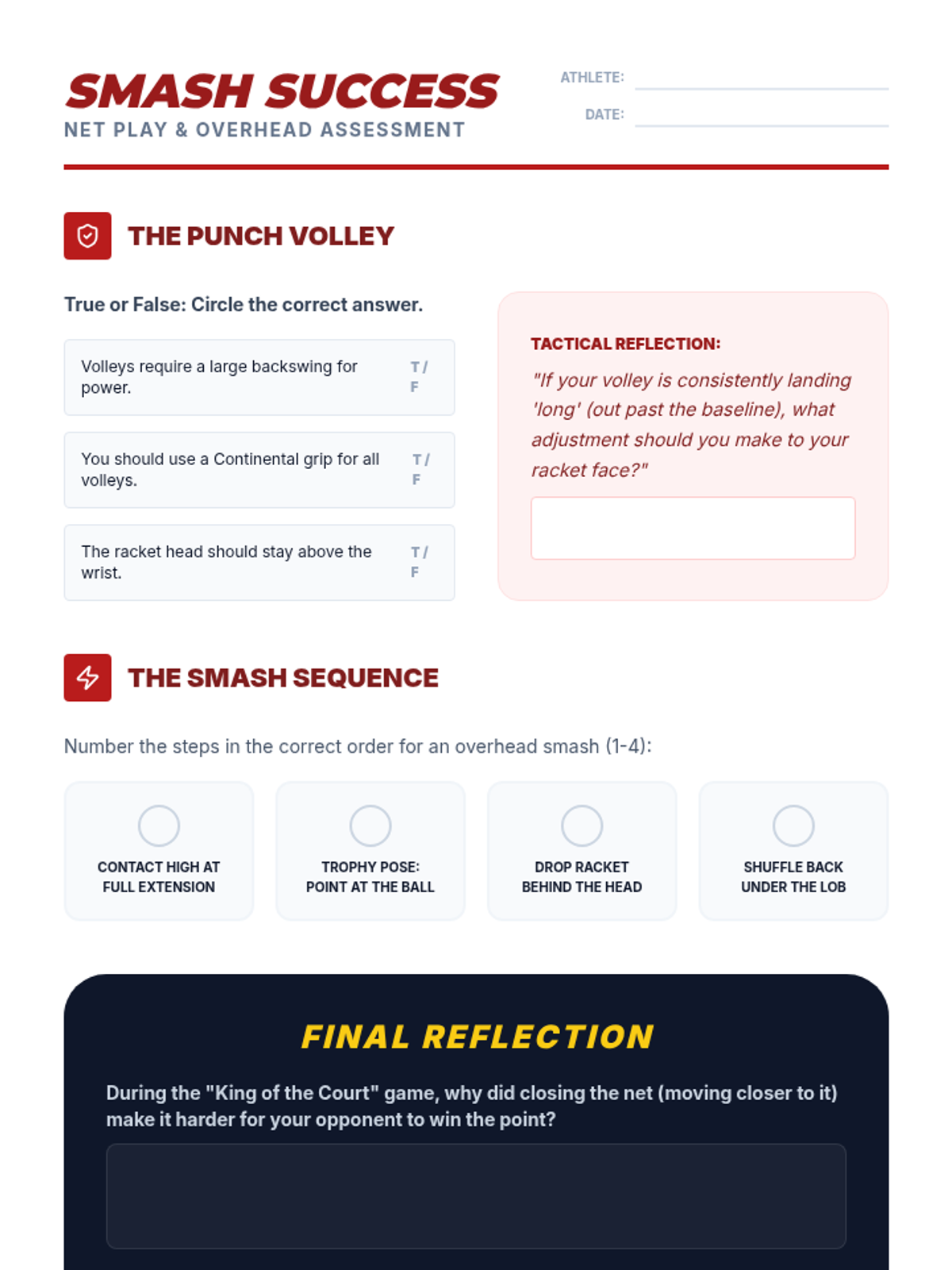
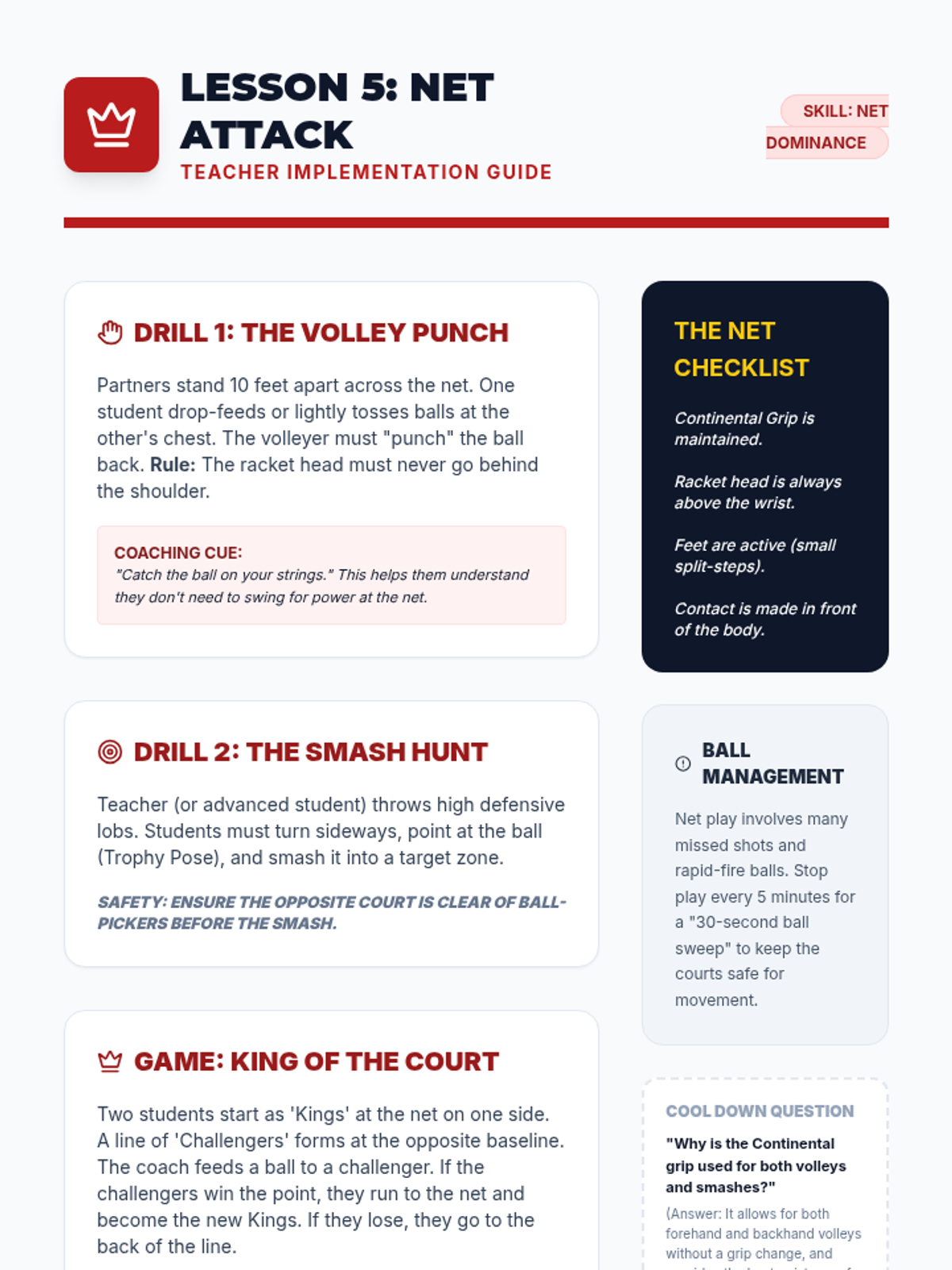
Focuses on aggressive net play through the punch-volley technique and the high-power overhead smash. Students practice closing the net and executing finishing shots under pressure, culminating in a "King of the Court" game.
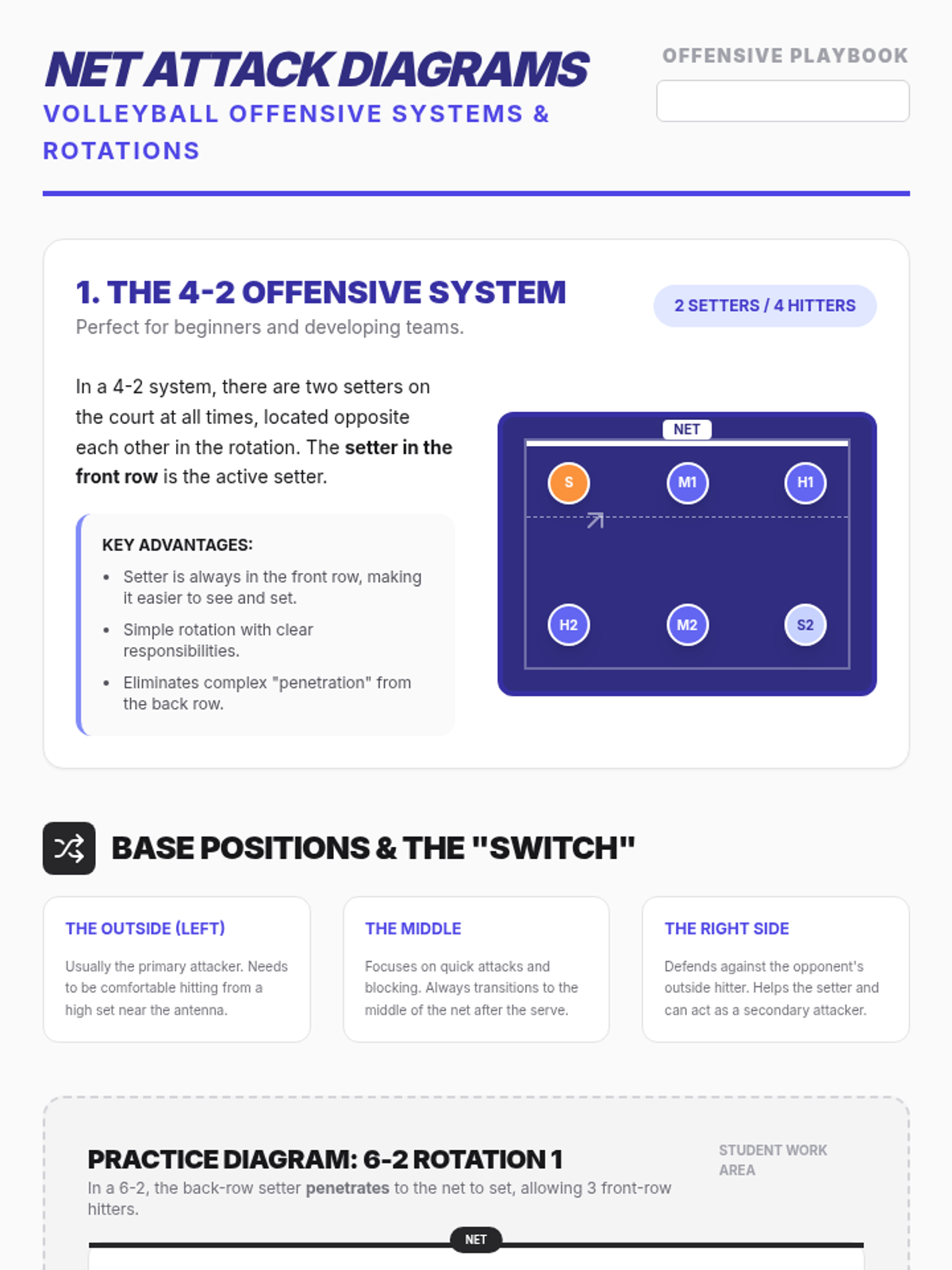
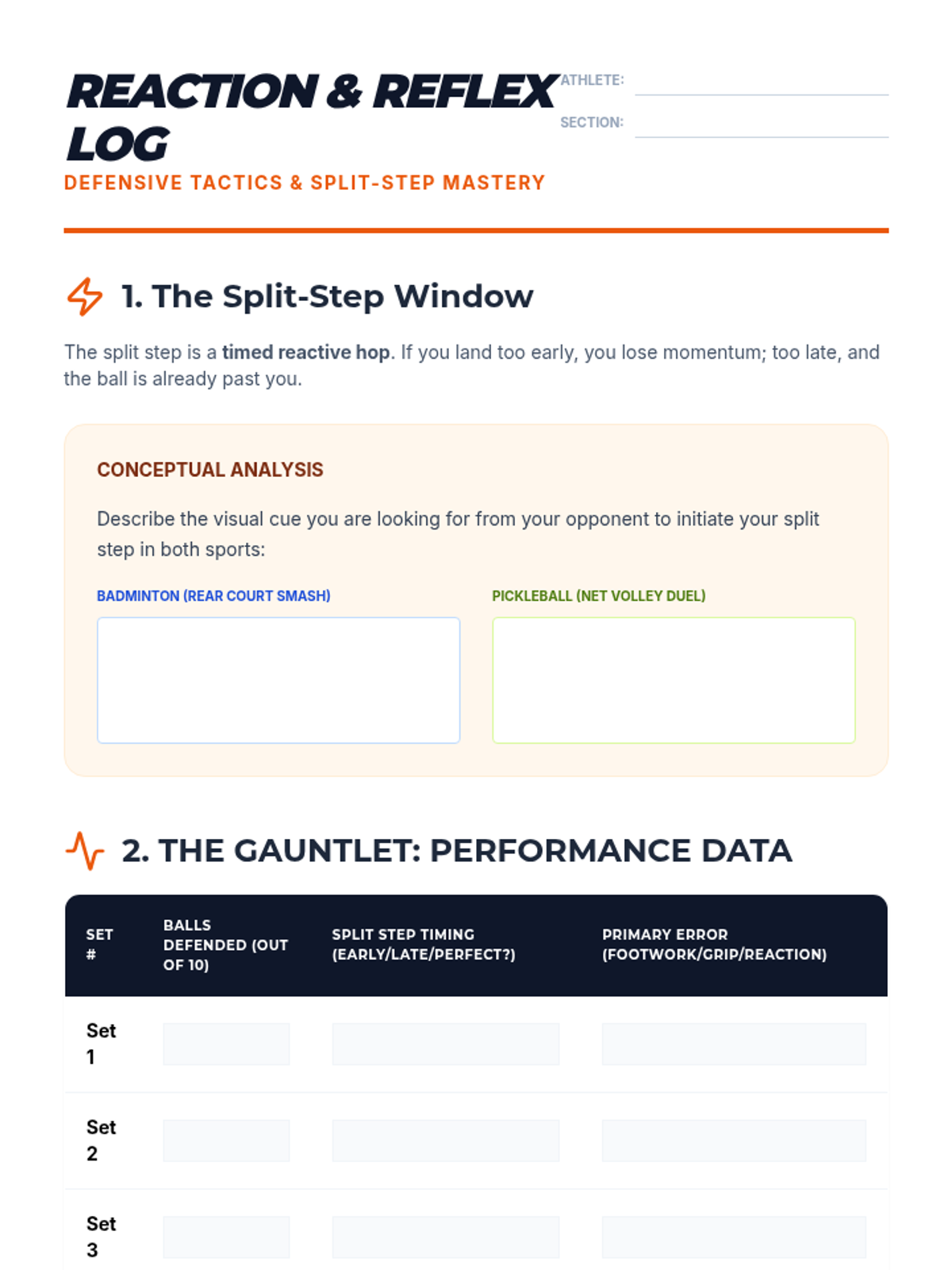
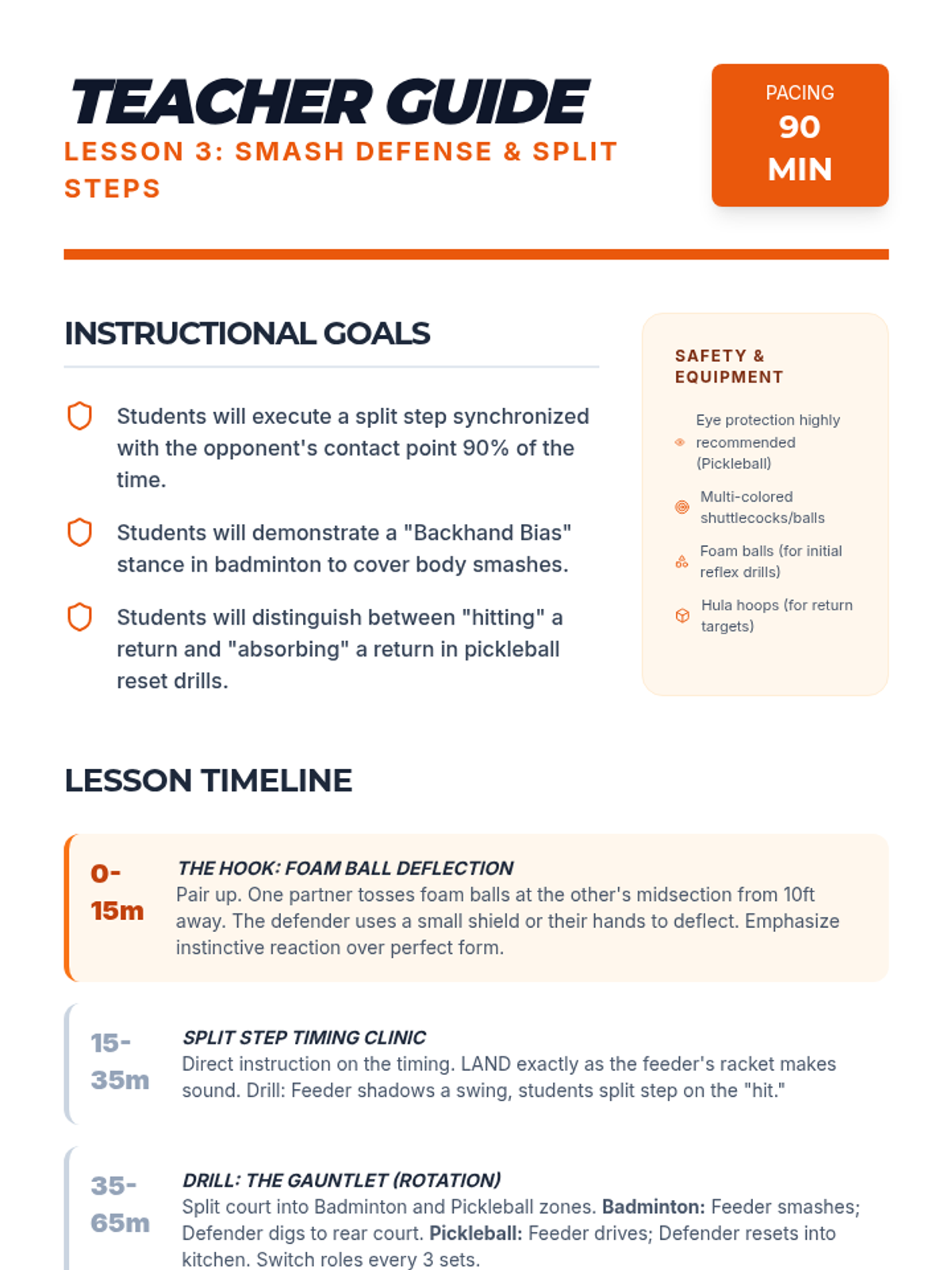
This lesson focuses on defensive transitions, specifically the split step required right before an opponent contacts the ball. Drills cover digging smashes in badminton and resetting hard volleys in pickleball.
Focuses on essential court movement: the split-step, side shuffle, and recovery. Students use agility drills and shadow swinging to synchronize their lower body with stroke execution for maximum balance.
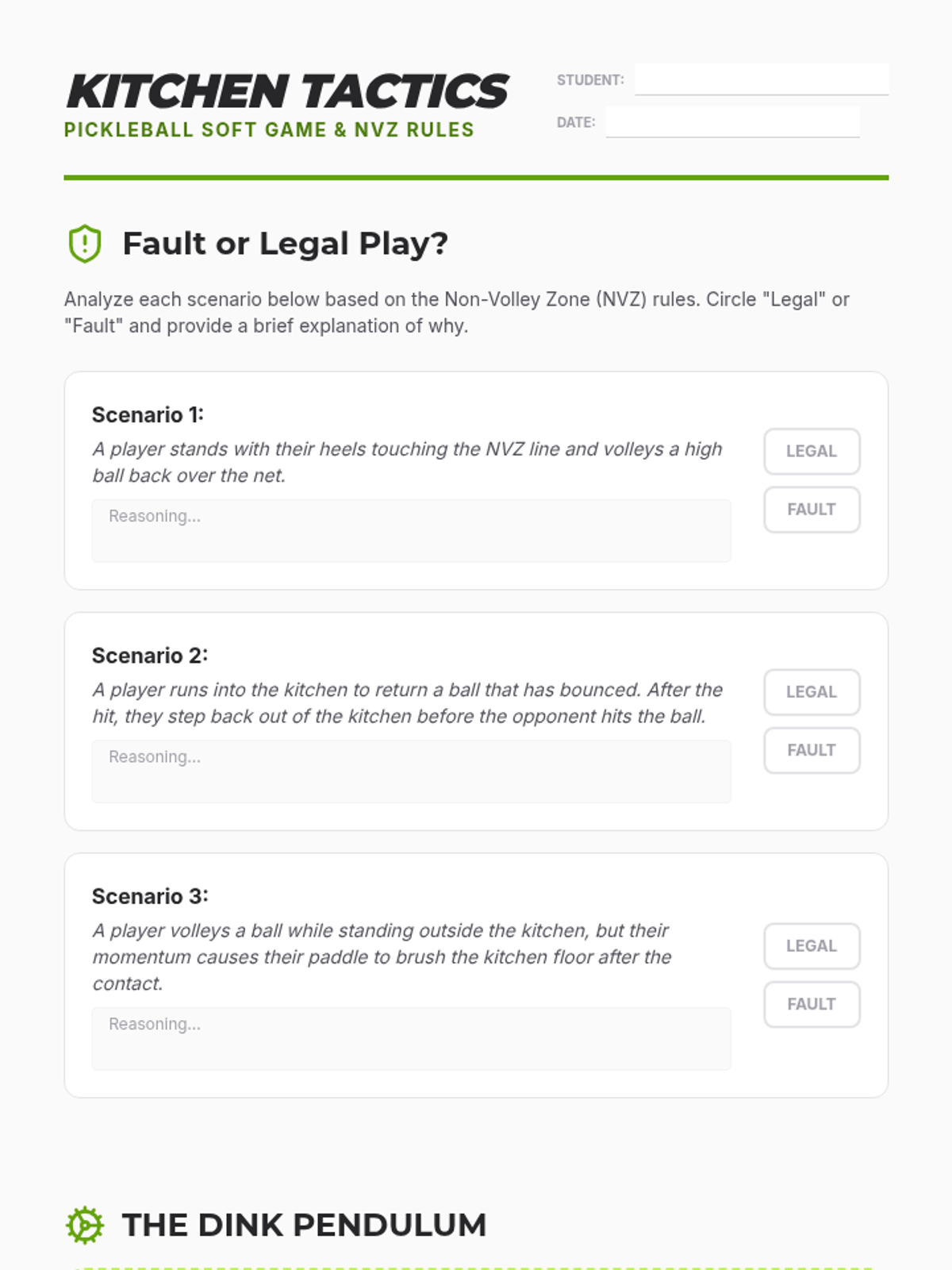
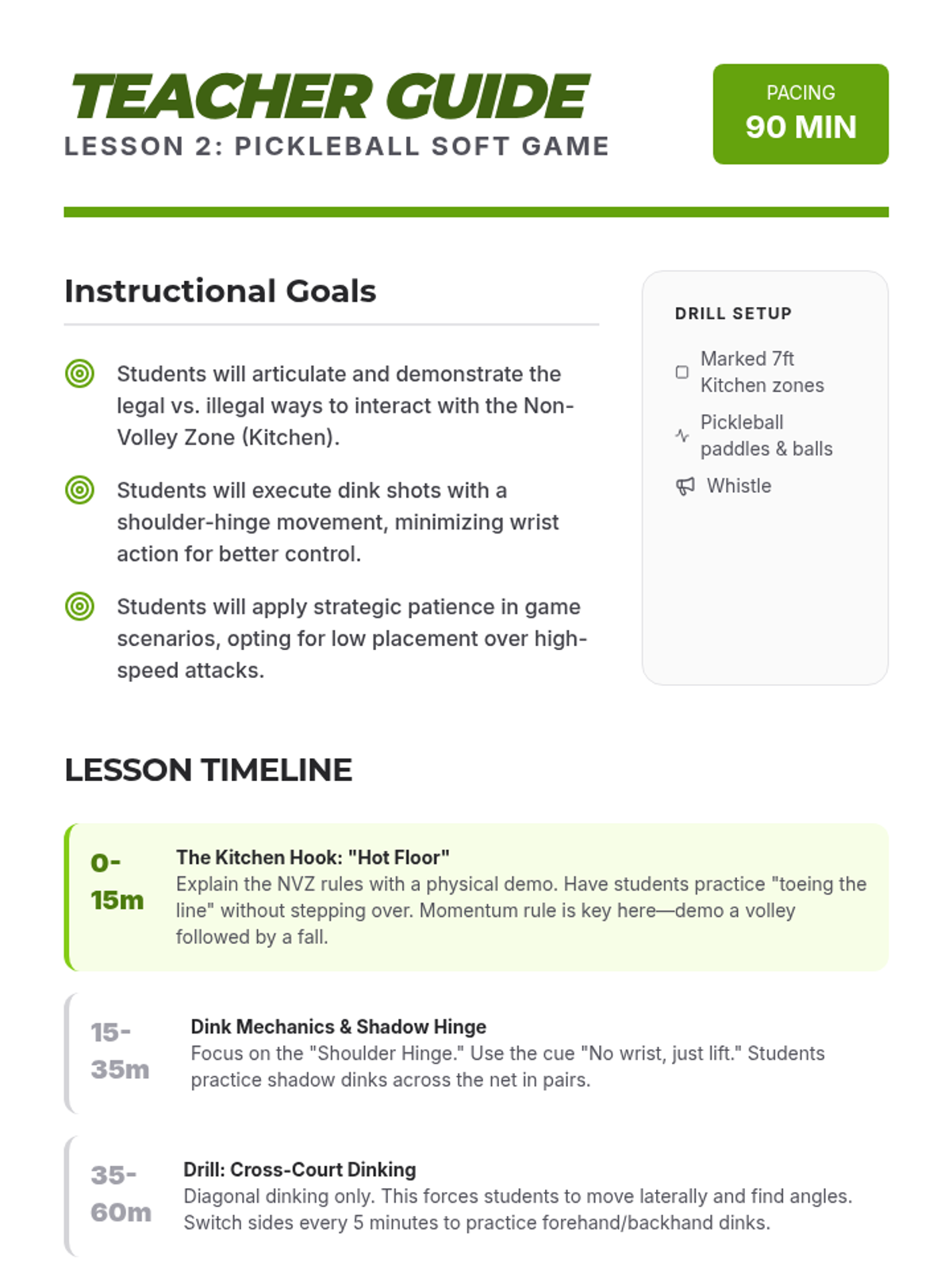
Transitioning to the lower net, students master the 'soft game' essential to pickleball. They practice patience and touch at the Non-Volley Zone (Kitchen), learning to neutralize hard hitters with low, unattackable shots.
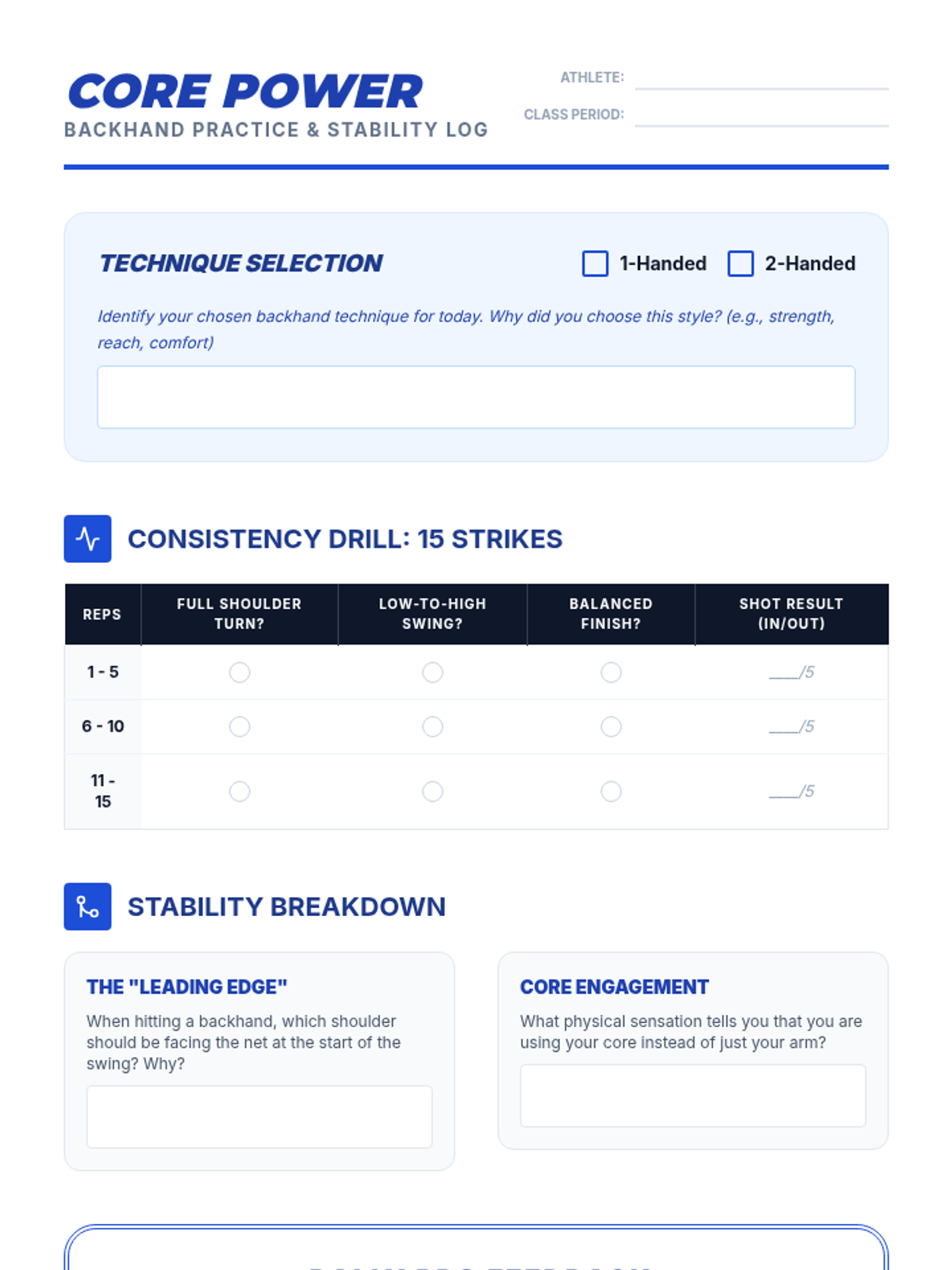
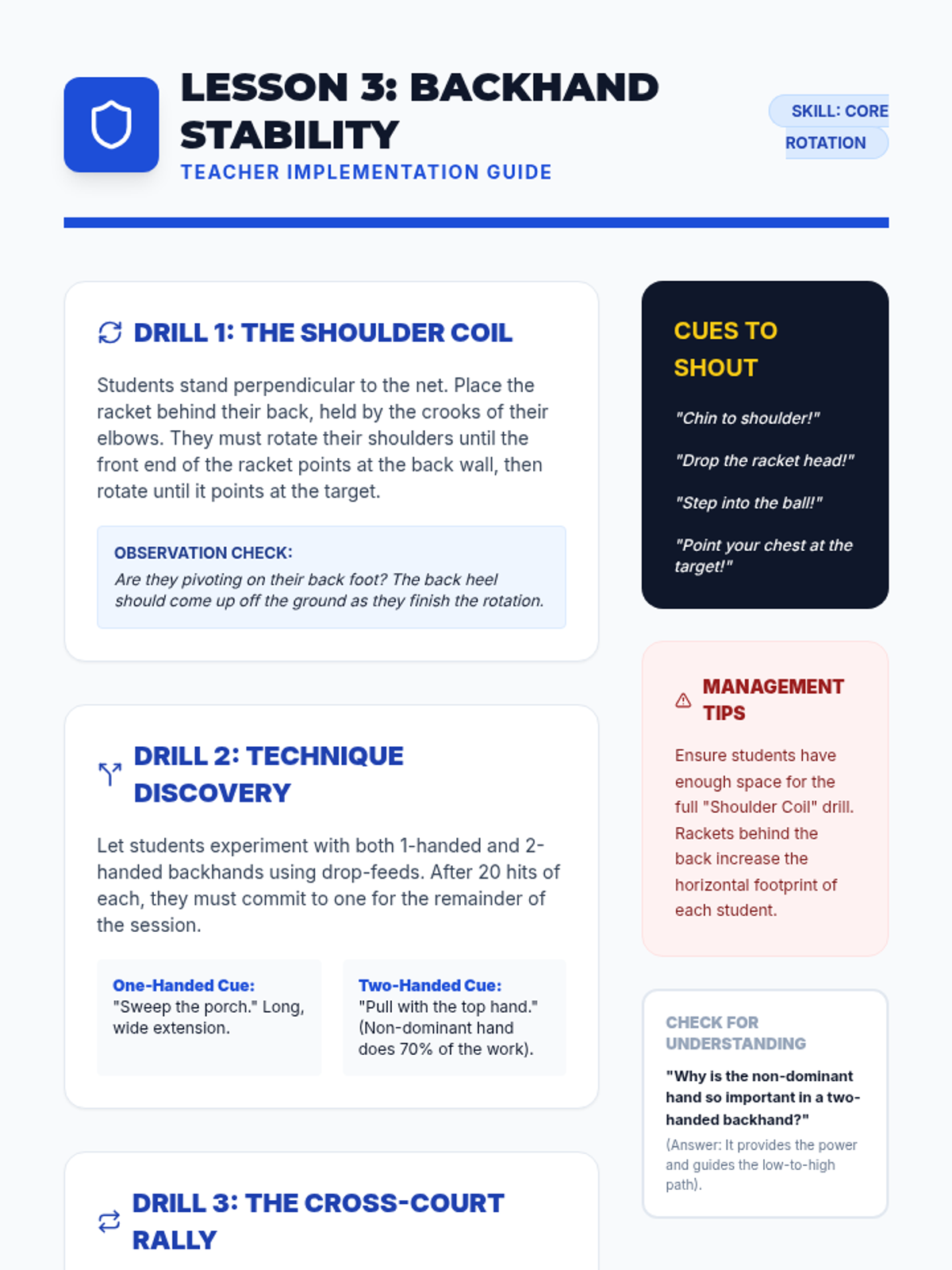
Students master the backhand stroke, focusing on shoulder rotation and core stability. The lesson compares one-handed and two-handed techniques and uses partner rallies to build consistency and confidence on the non-dominant side.
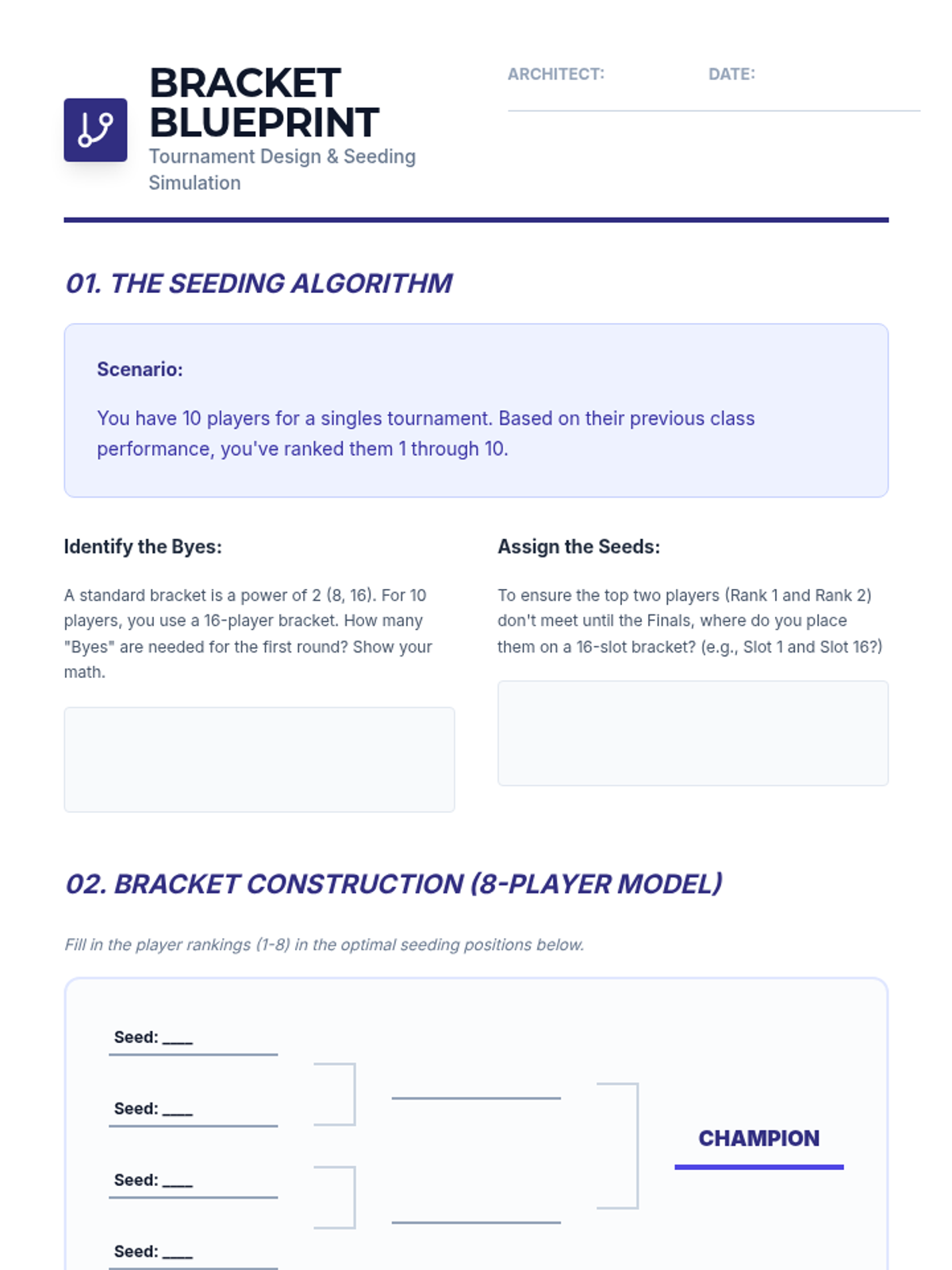
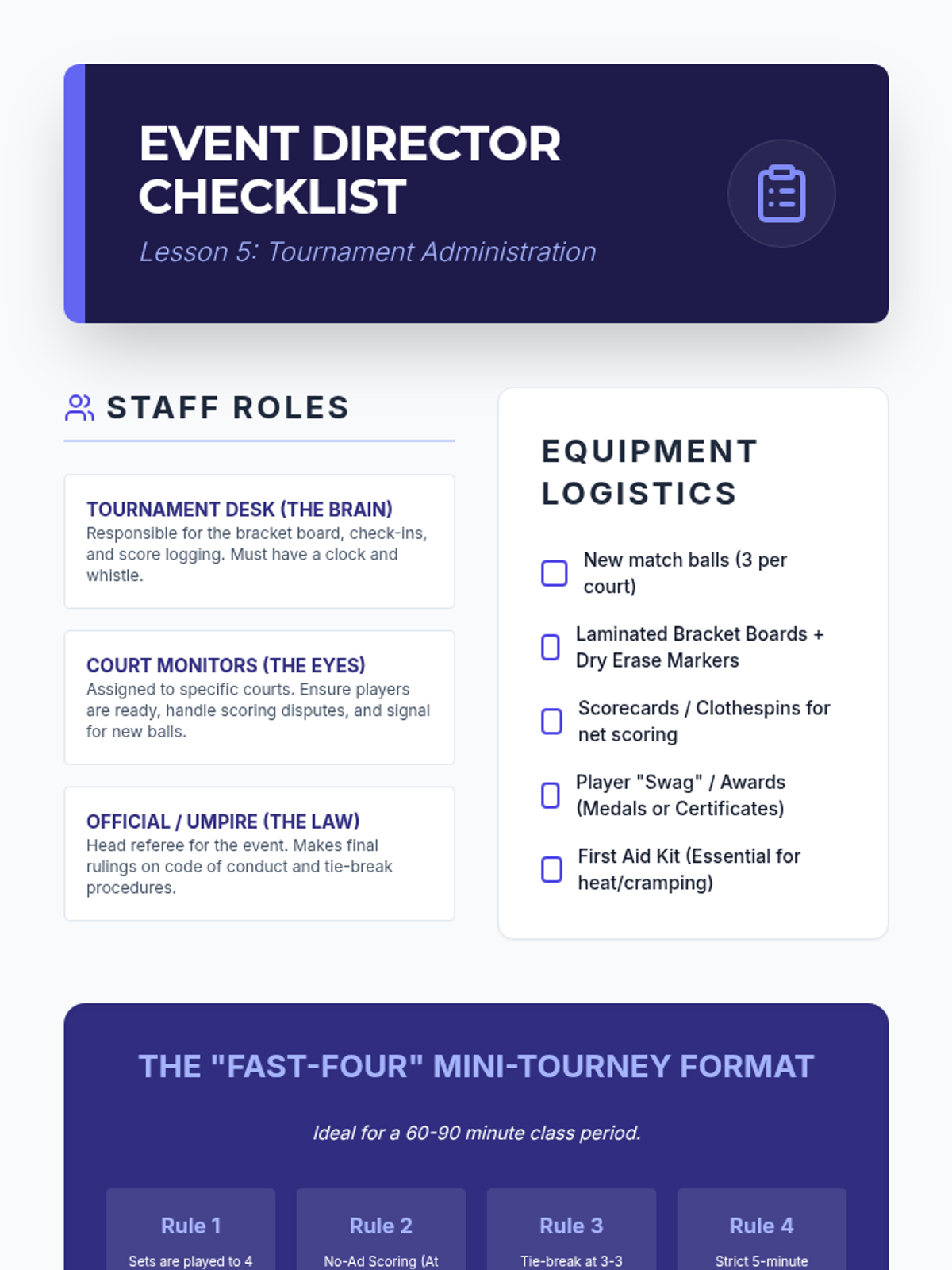
Students learn the logistics of tournament organization, including seeding, bracket structures, and administrative duties for running a successful competition.
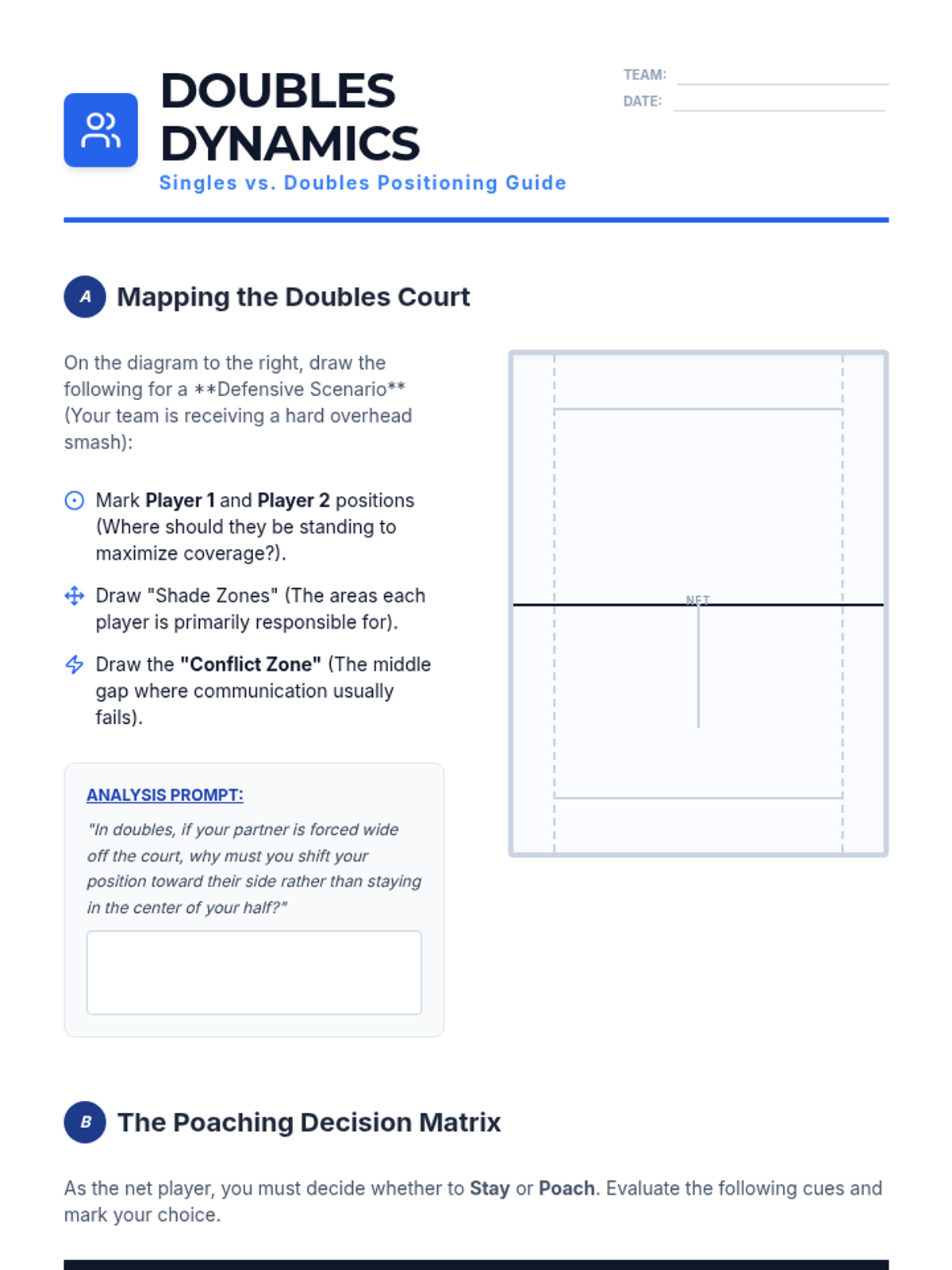
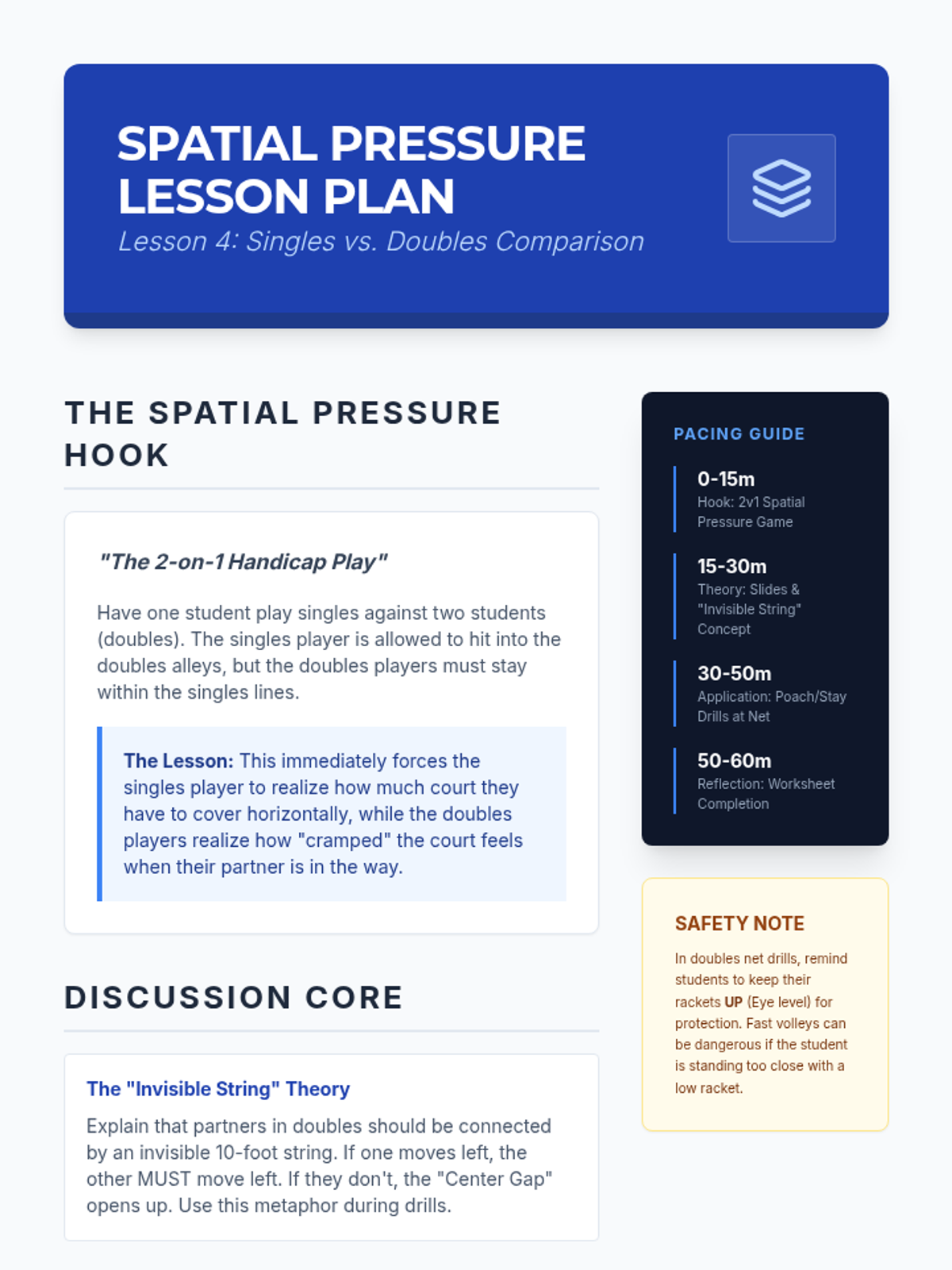
A comparative study of spatial dynamics between singles and doubles play, focusing on court coverage, partner communication, and net-play strategies.
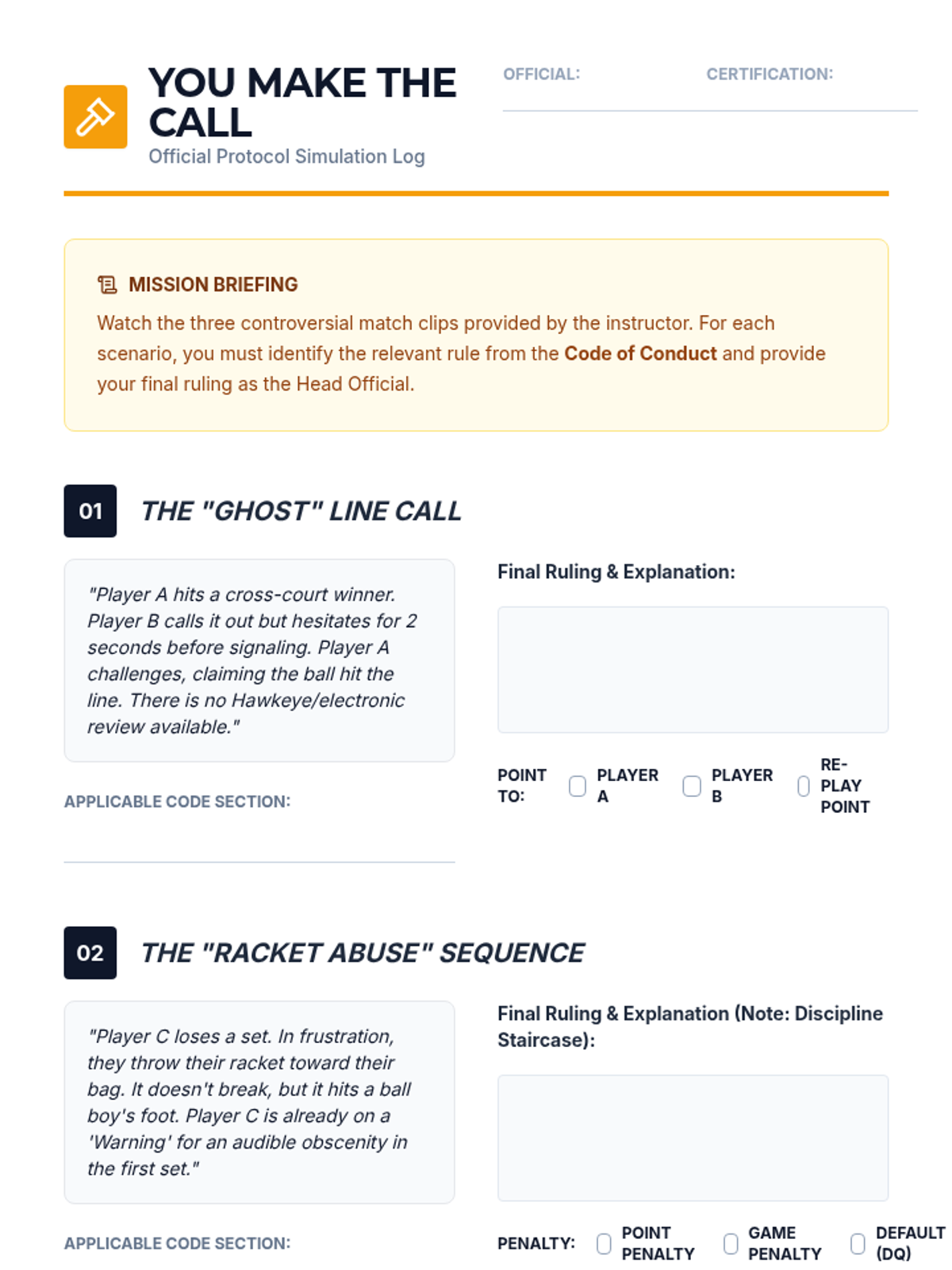
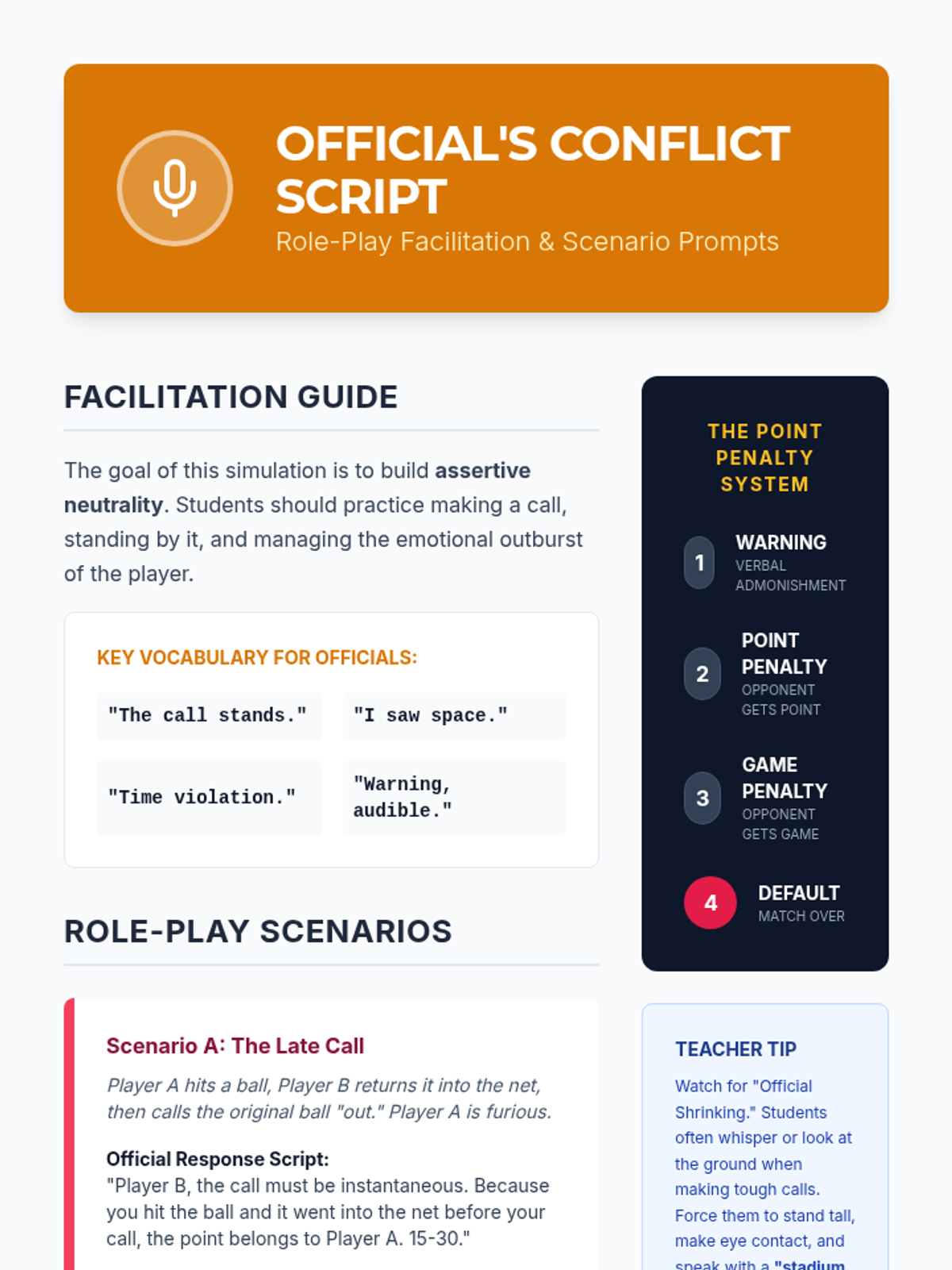
Students study official rulebooks and the Code of Conduct, participating in officiating simulations to manage line calls, scoring disputes, and player ethics.
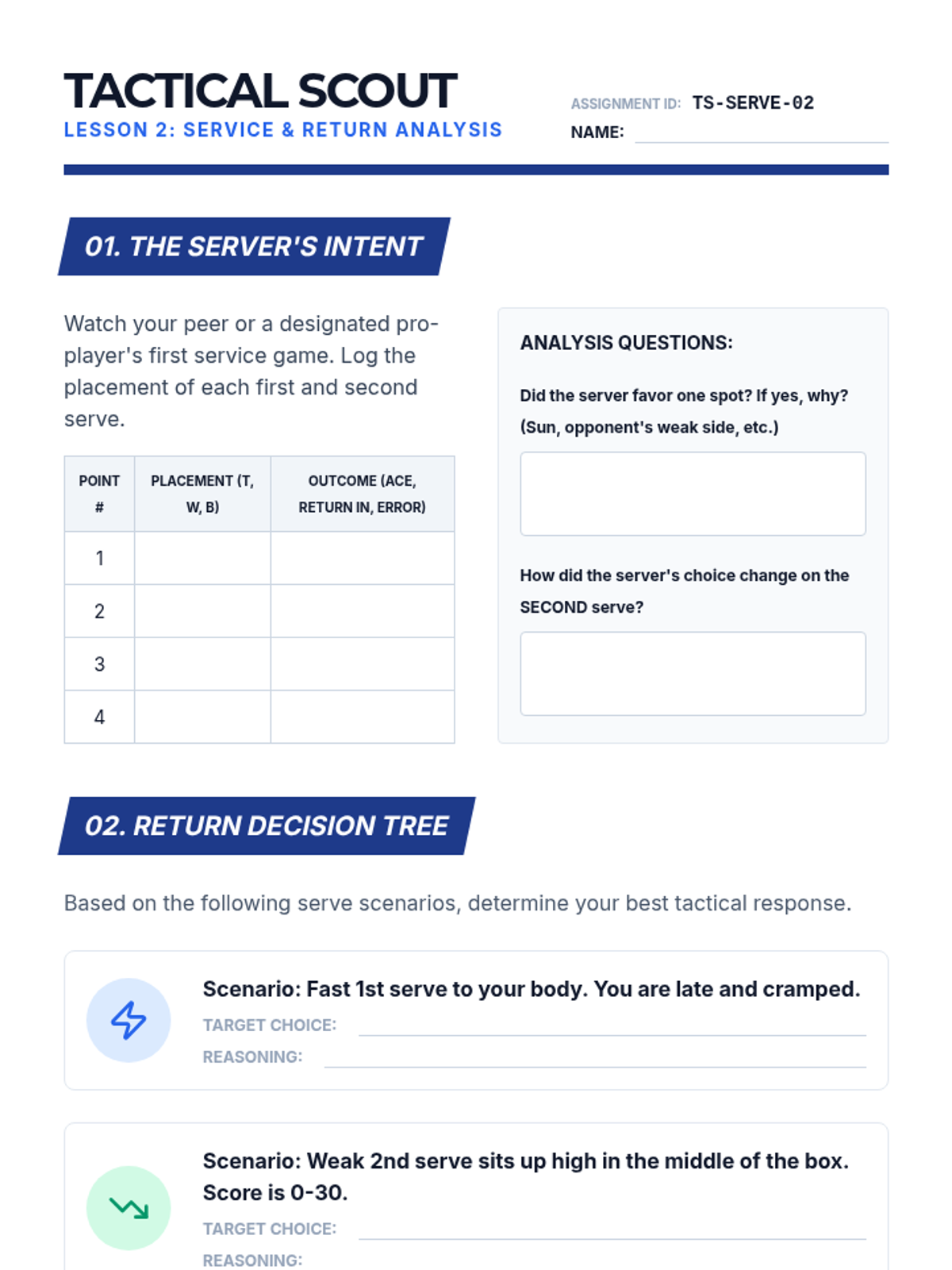
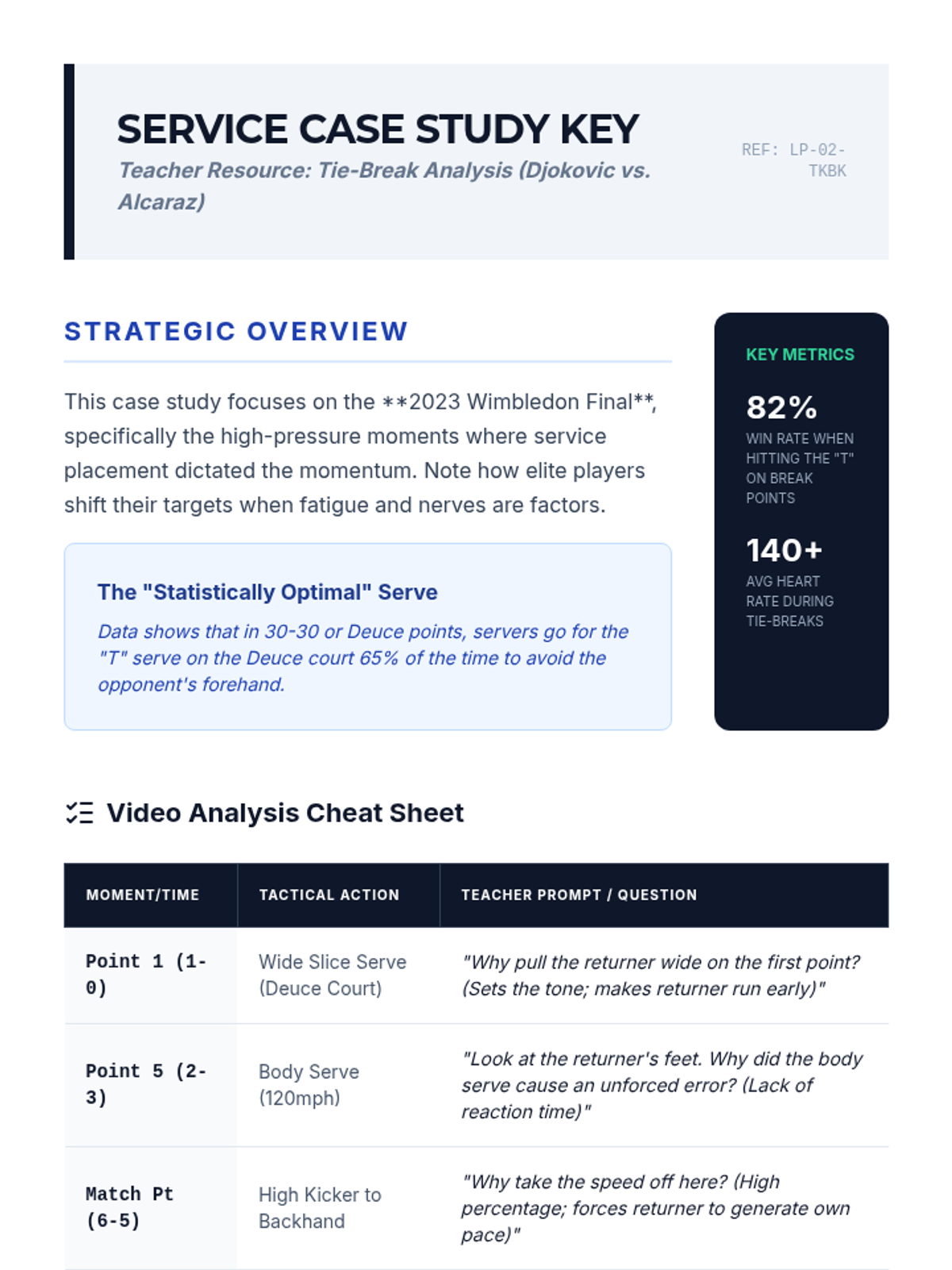
An exploration of serving tactics, including placement and spin, paired with return strategies that account for match score and opponent weaknesses.
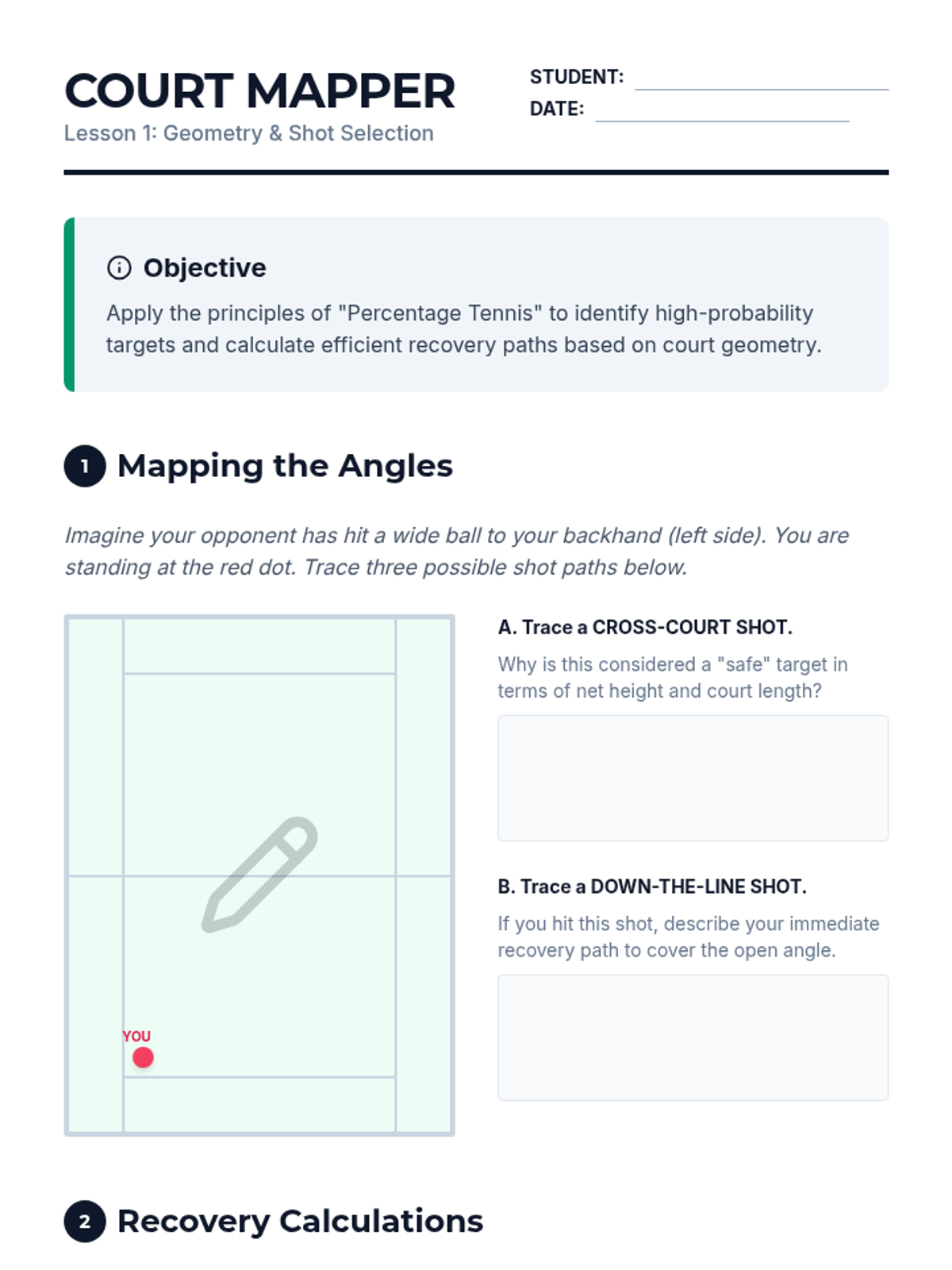
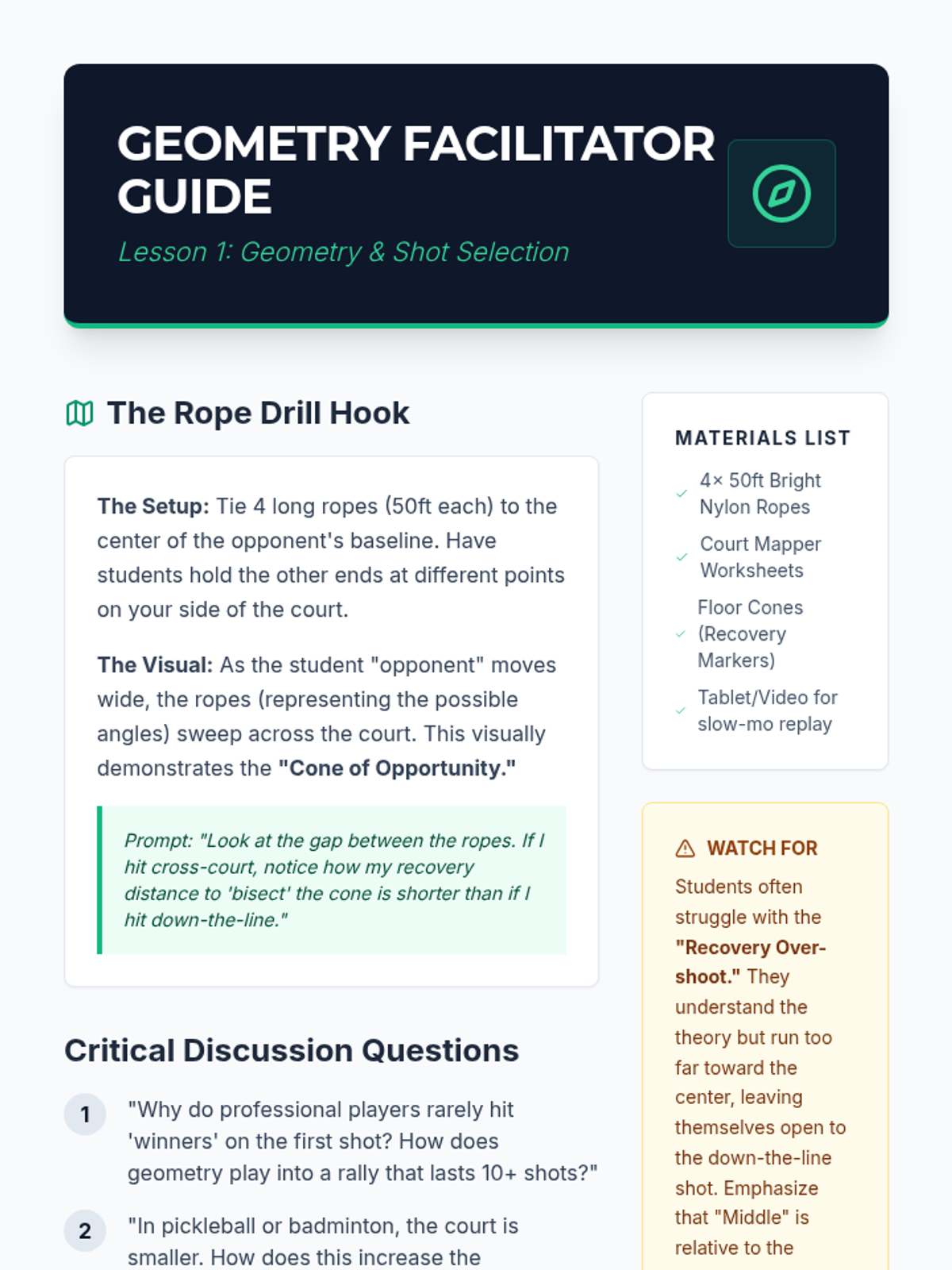
Students analyze the mathematical and spatial aspects of court play, focusing on percentage tennis, angular geometry, and efficient recovery paths to maximize winning probabilities.
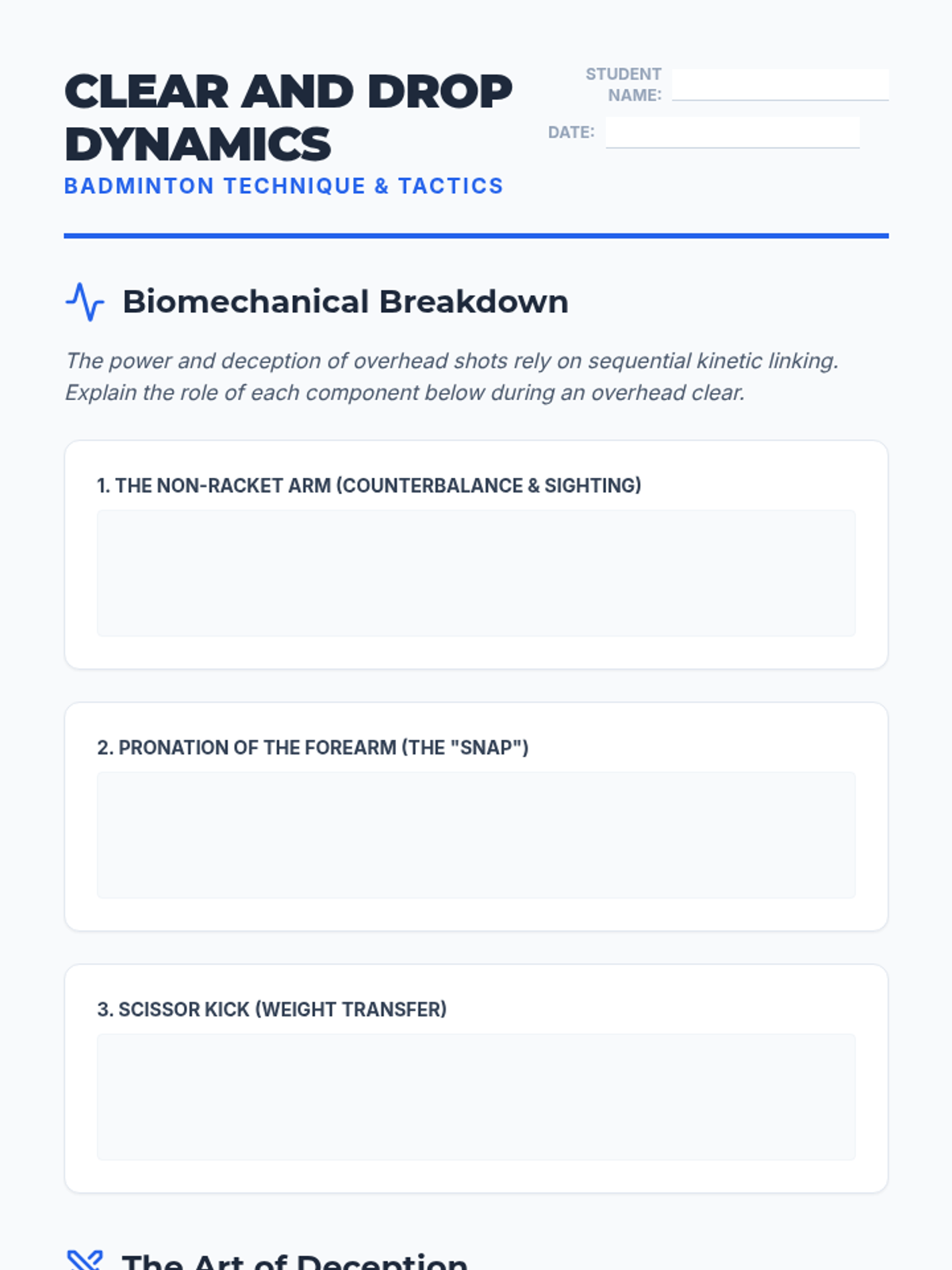
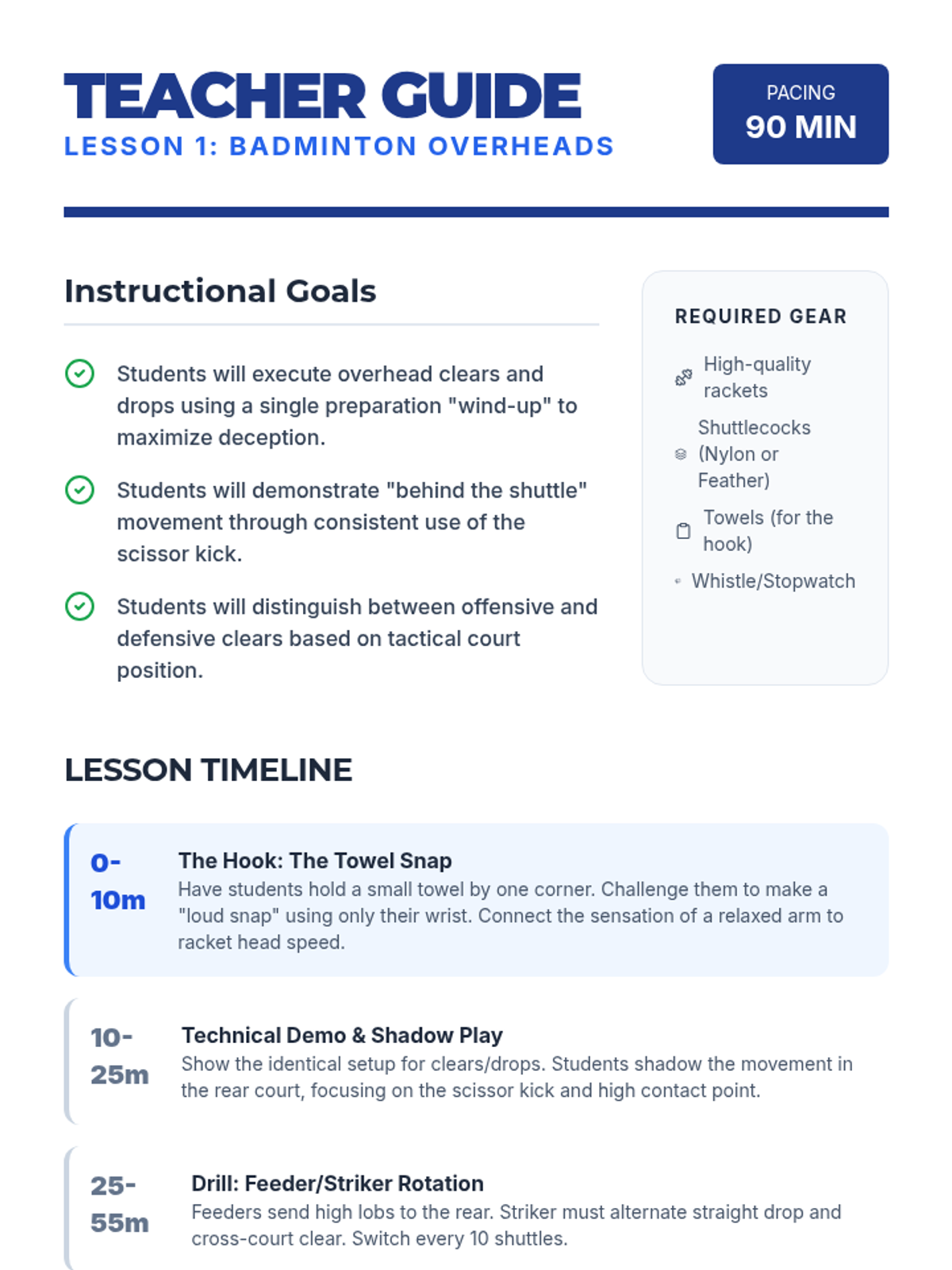
Students explore the deceptive similarities between the clear and the drop shot in badminton, focusing on wrist snap, disguise, and aggressive court positioning.