Fundamental techniques for drawing, painting, sculpture, and photography alongside modern digital design principles. Analyzes historical artistic movements while building skills in printmaking and graphic media.
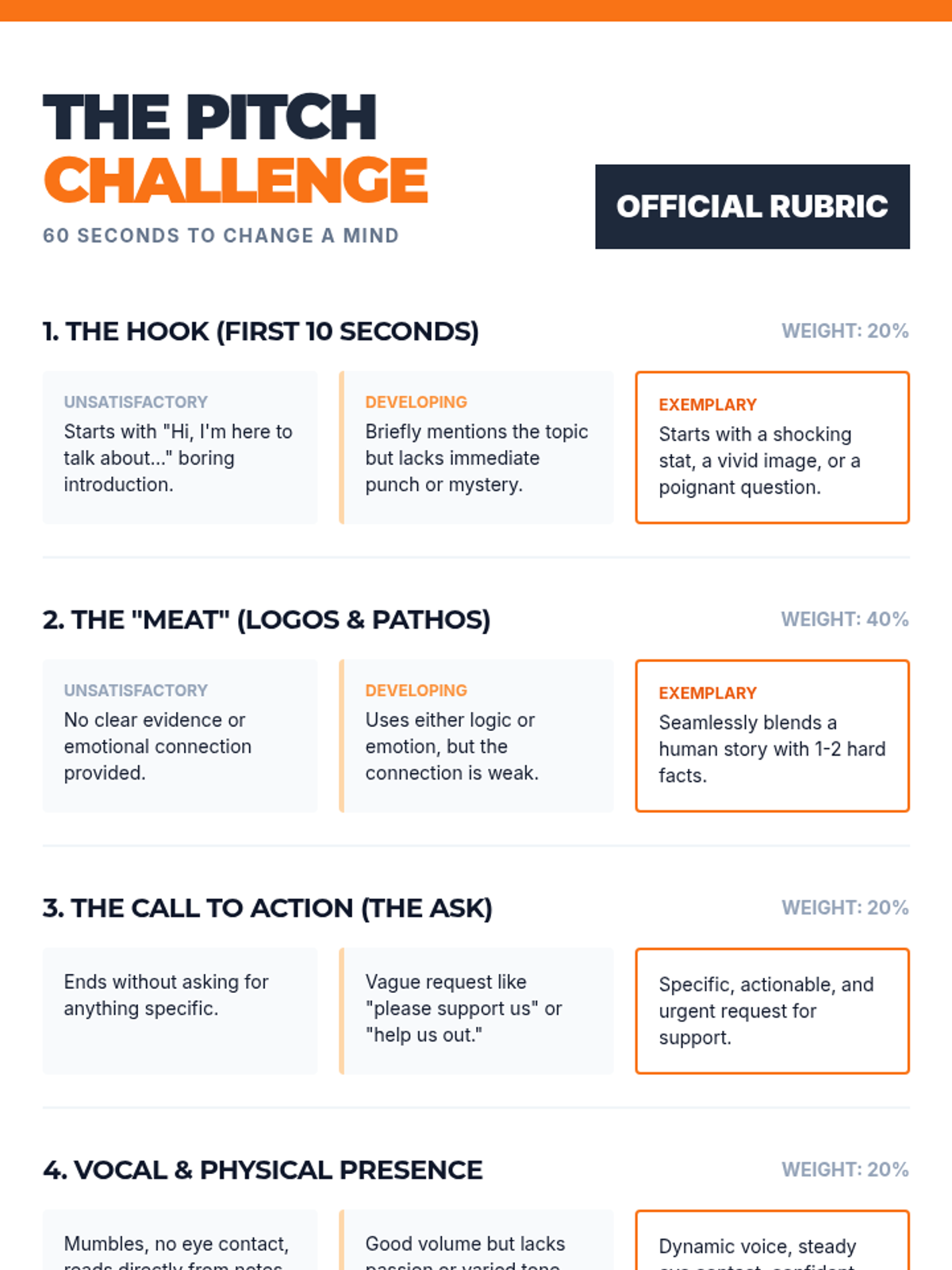
Students present their comprehensive campaigns to a mock panel and practice high-stakes elevator pitches.
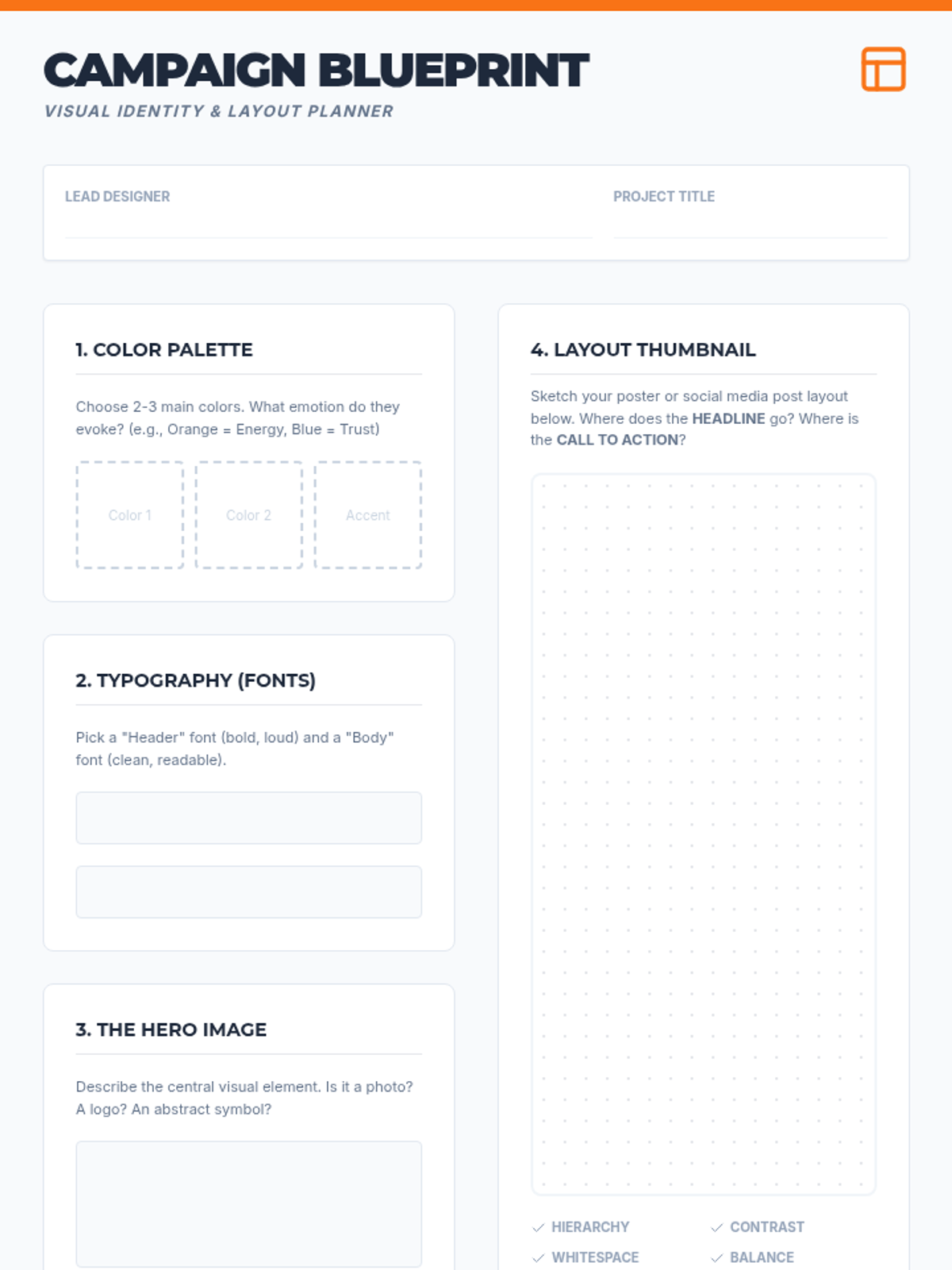
Students design visual advocacy materials, focusing on branding and media literacy to capture public attention.
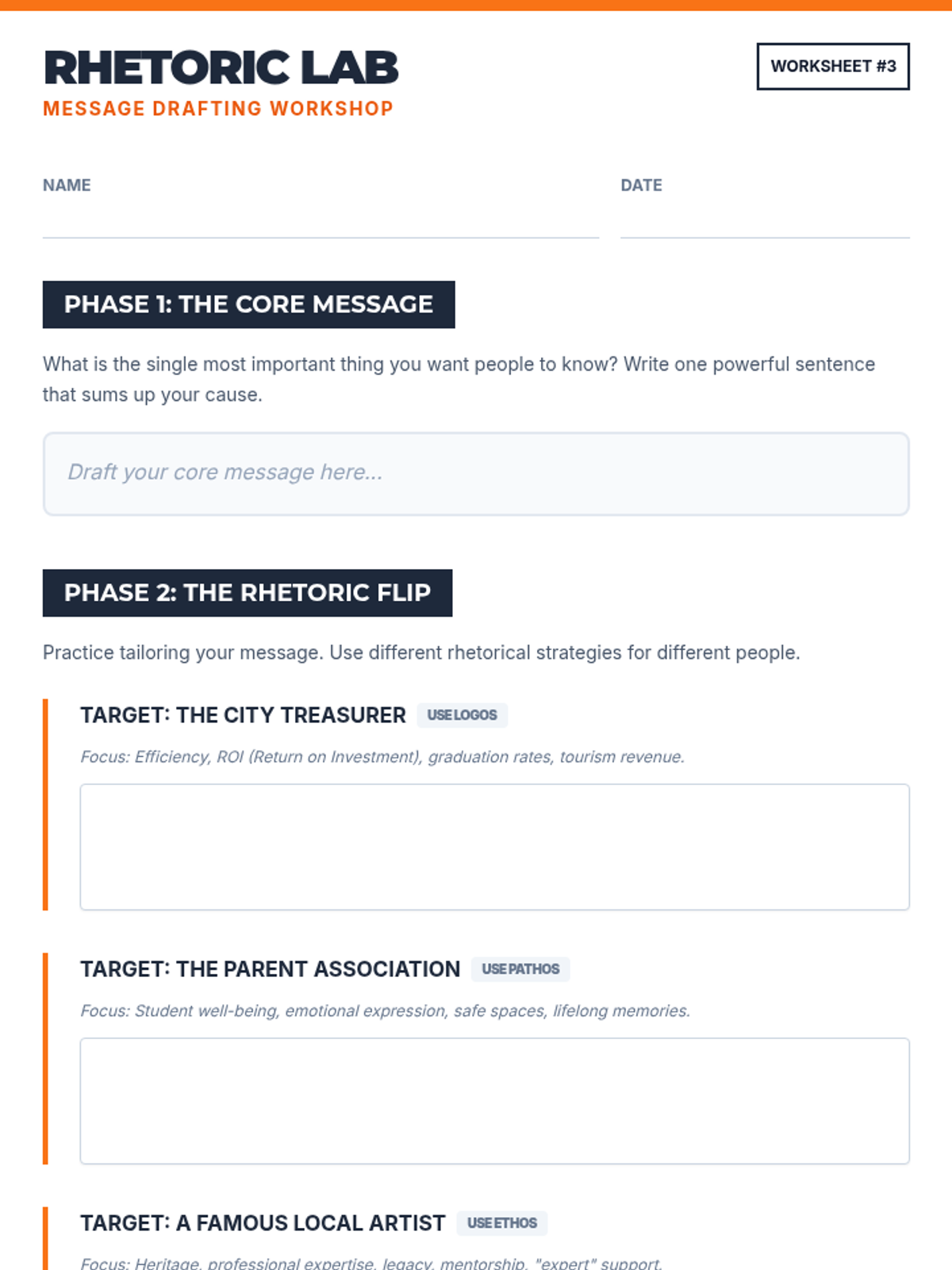
Students learn to blend emotional appeals and factual evidence to craft a compelling persuasive narrative for their arts cause.
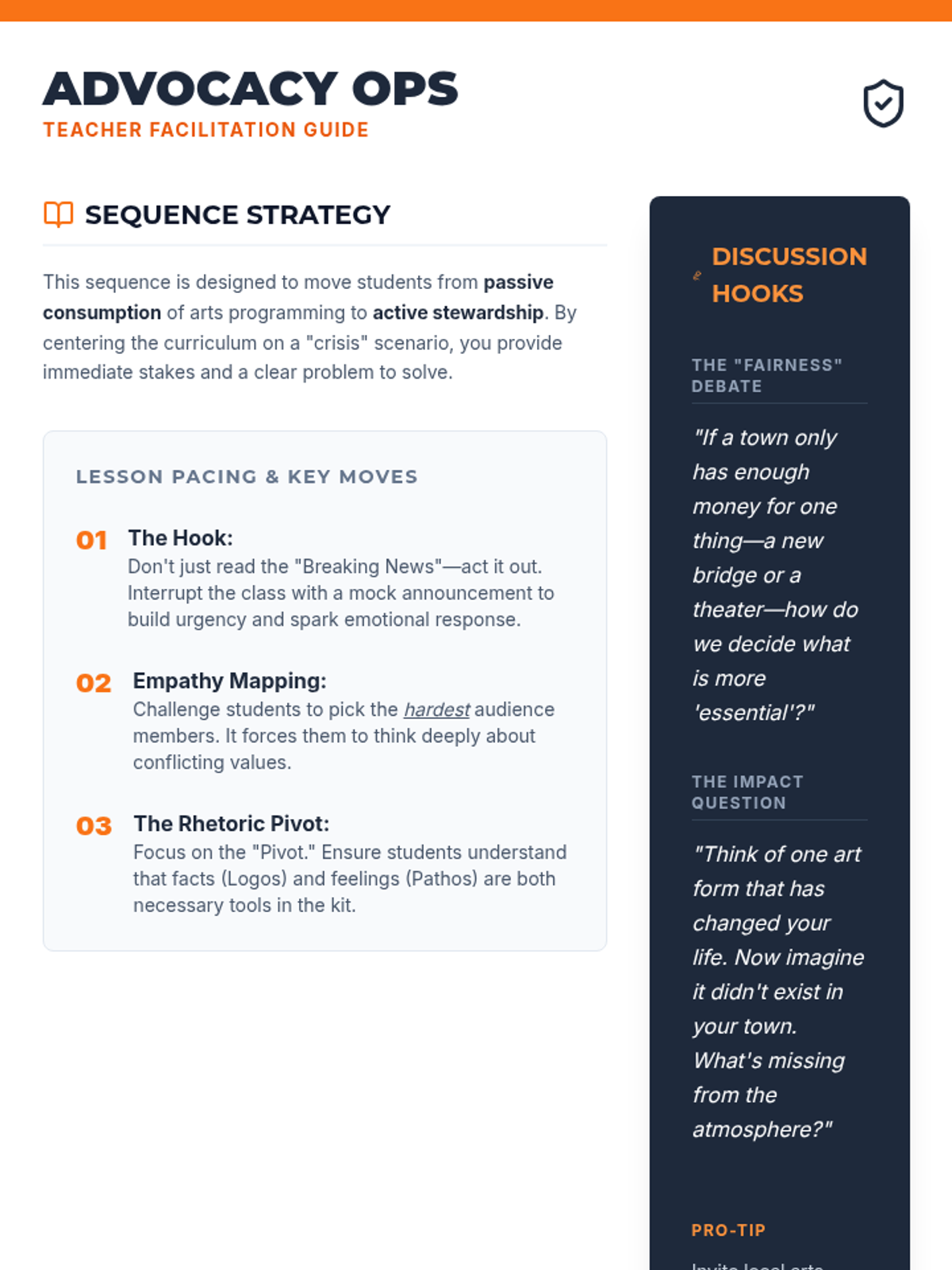
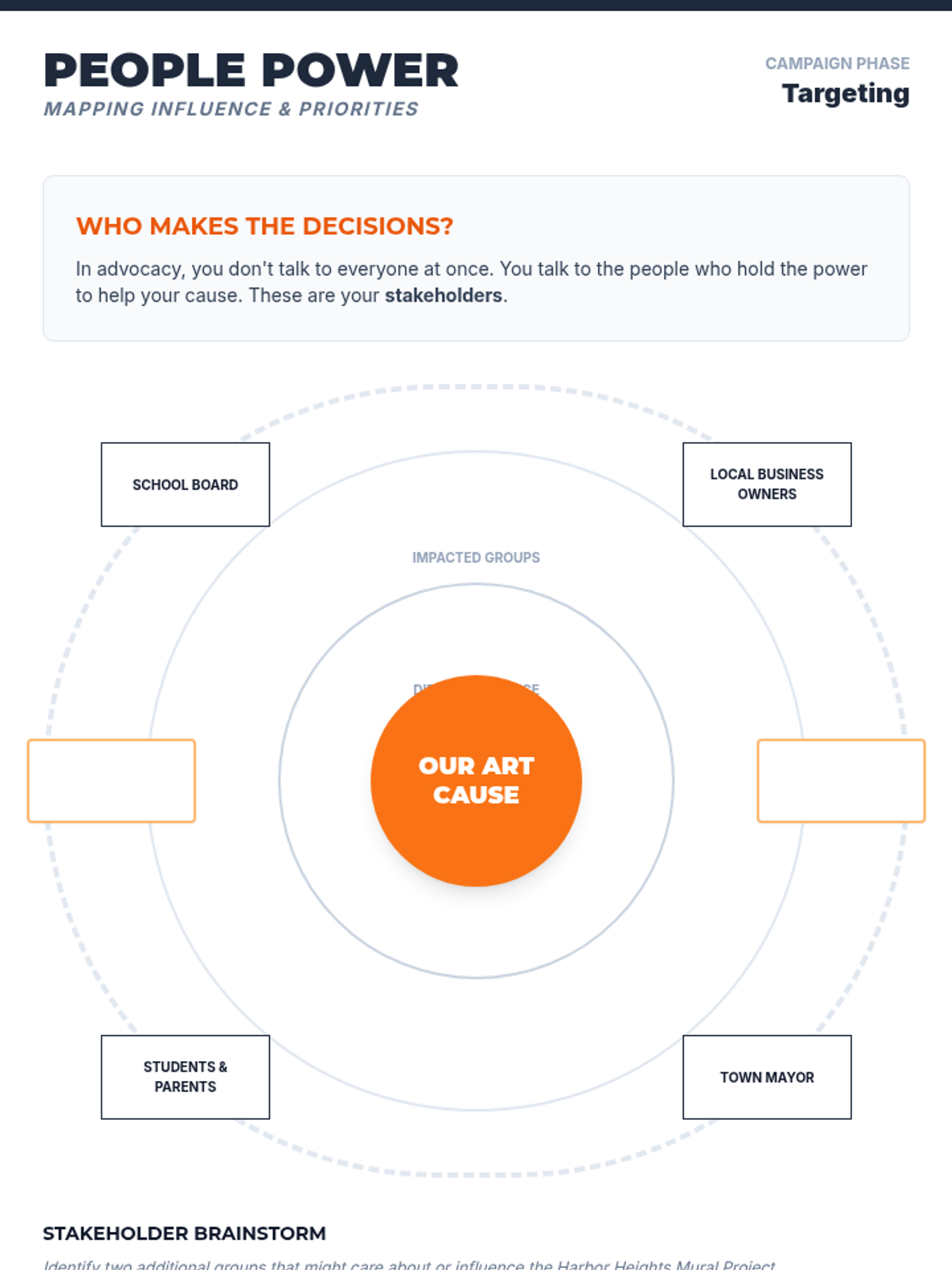
Learners map out stakeholders and use empathy mapping to understand the values and priorities of different audience groups.
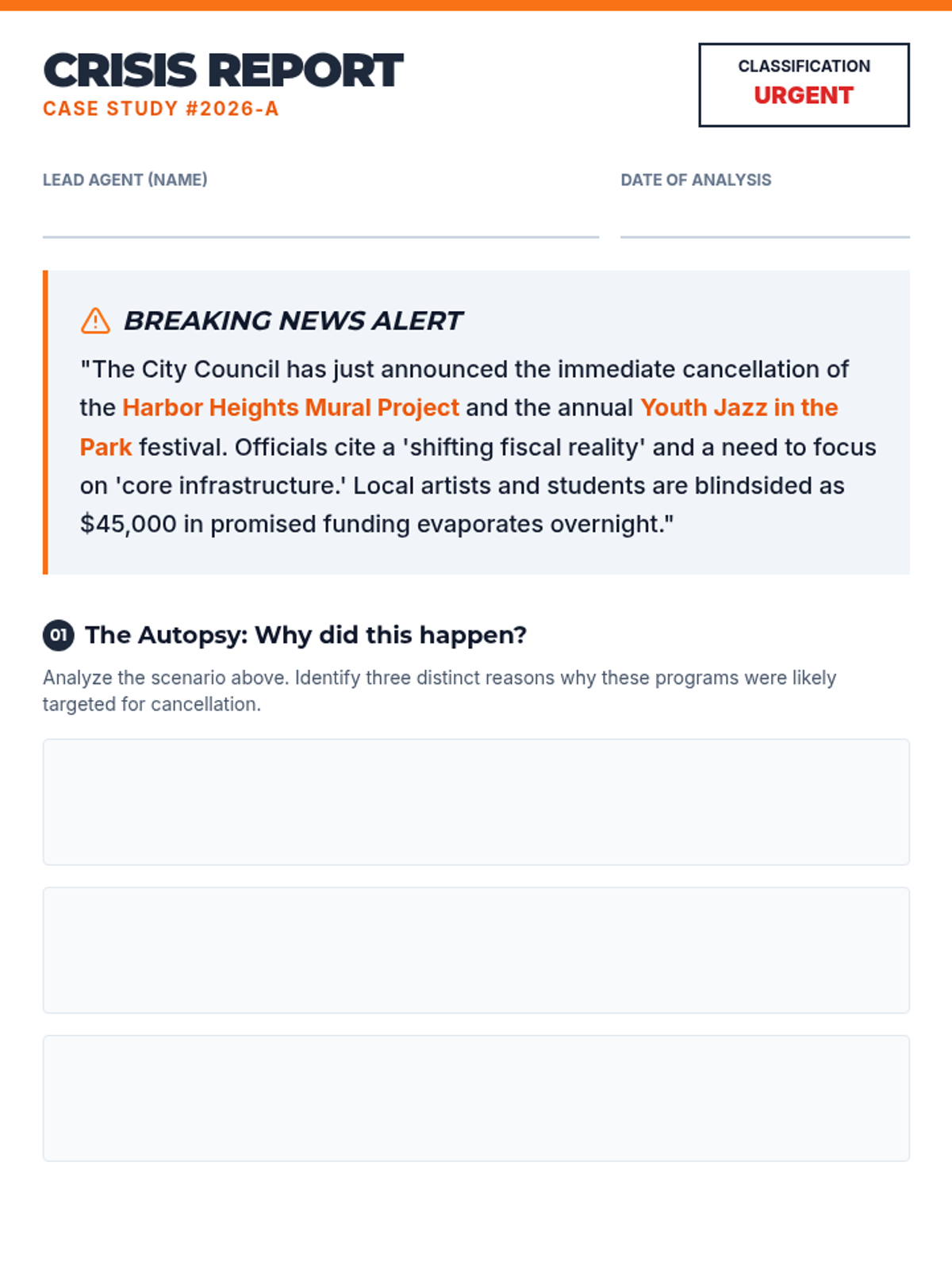
Students analyze hypothetical scenarios where arts programs face budget cuts or closure to identify root causes and specific advocacy needs.
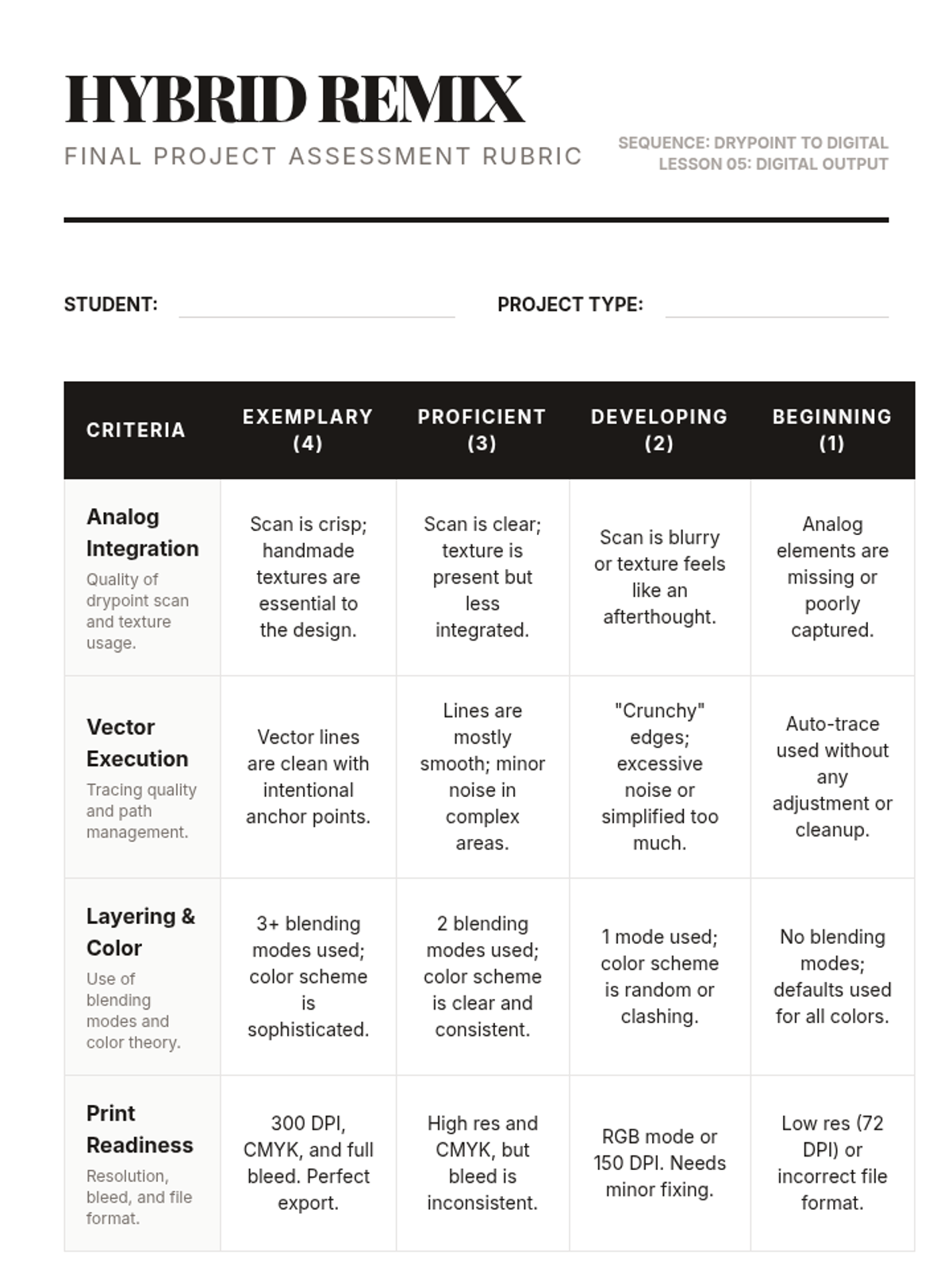
Students finalize a digital composition that serves a specific function (e.g., an album cover or book jacket). They prepare the file for digital printing, considering resolution, bleed, and file formats.
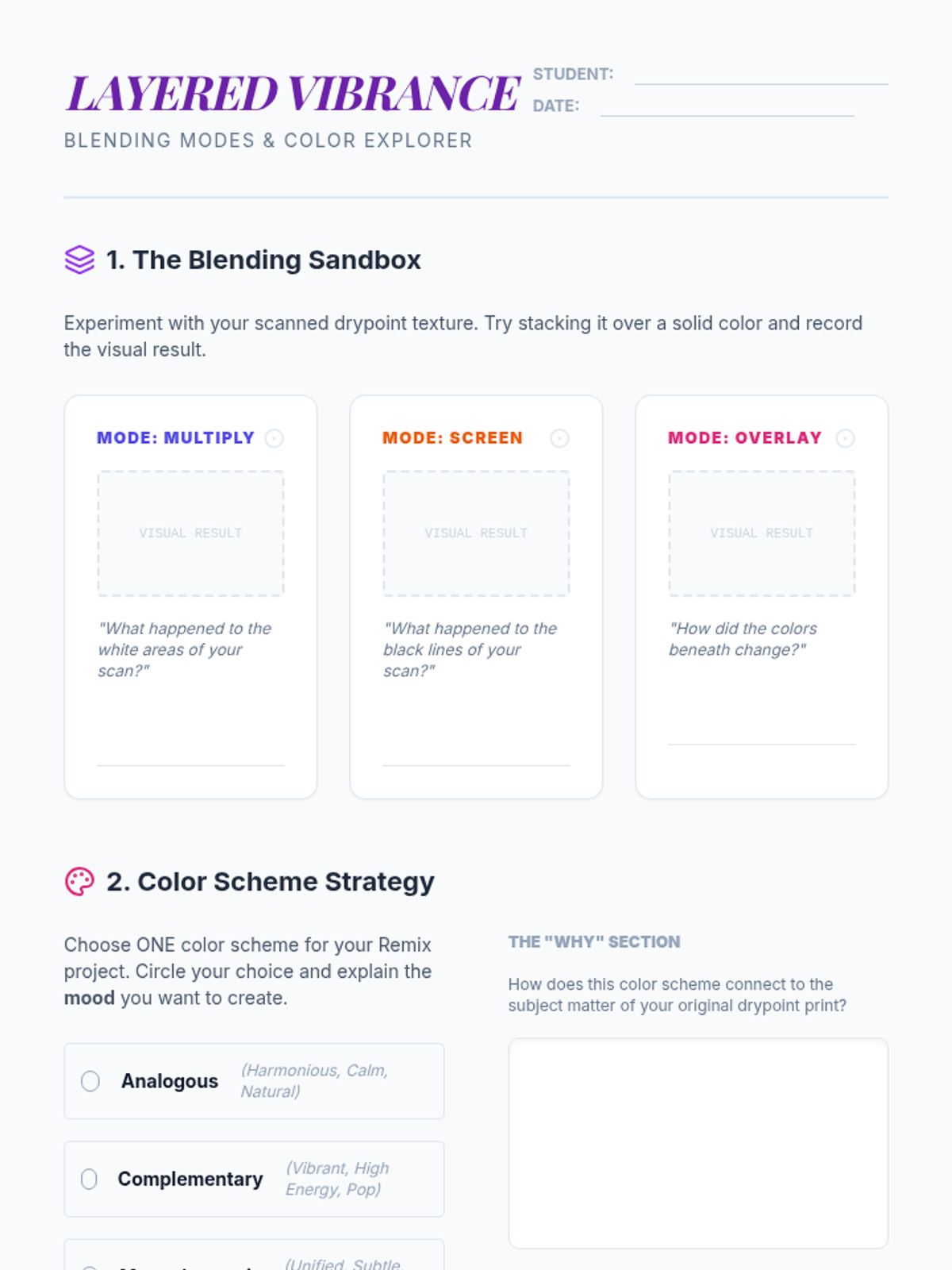
Using their scanned textures and new vector shapes, students experiment with digital layering modes (multiply, overlay, screen). They apply color theory schemes to re-imagine their black and white prints as vibrant graphic compositions.
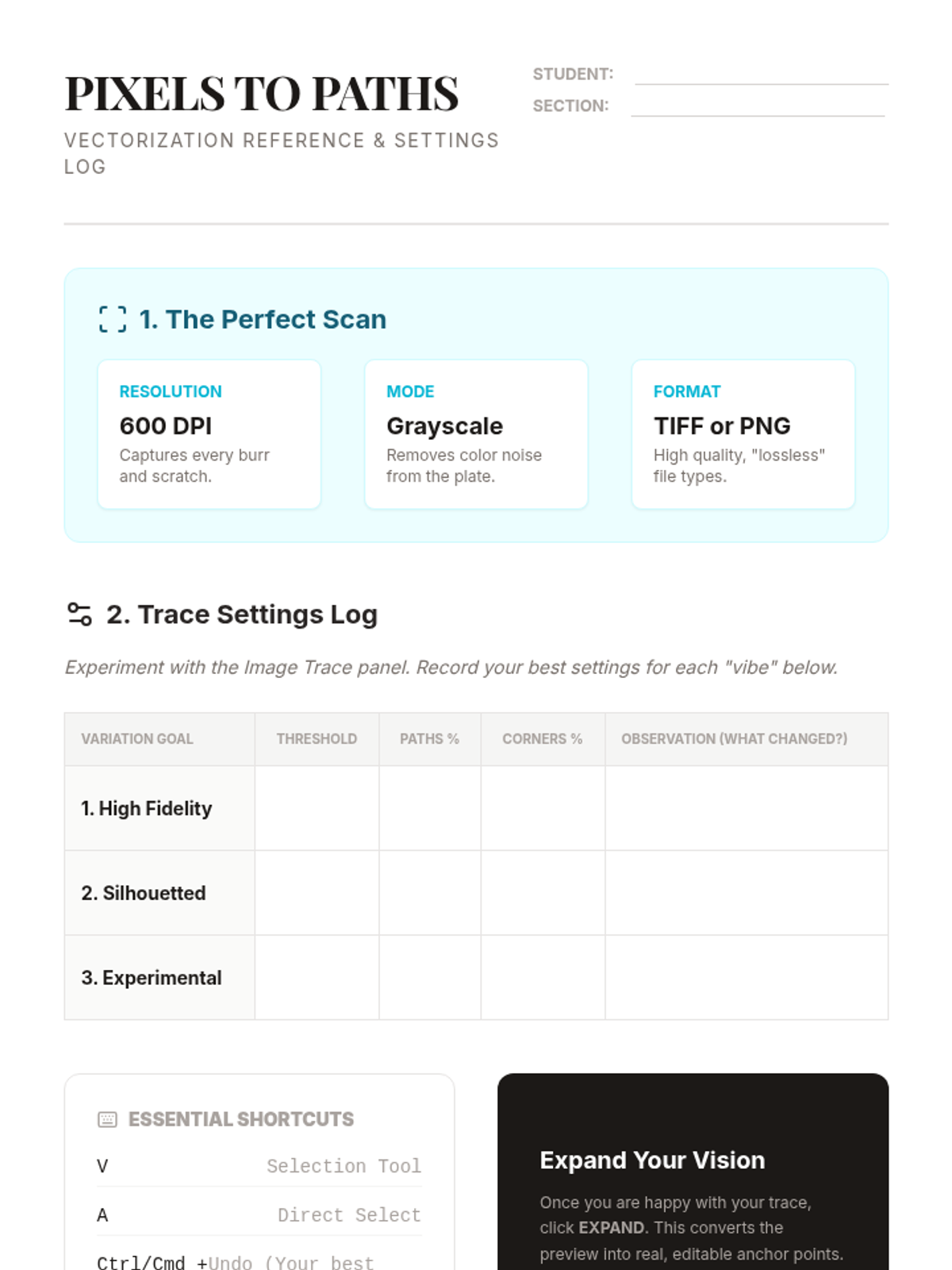
Students scan their best drypoint prints at high resolution. They are introduced to graphic design software to trace key elements of their print, converting organic lines into scalable vector graphics.
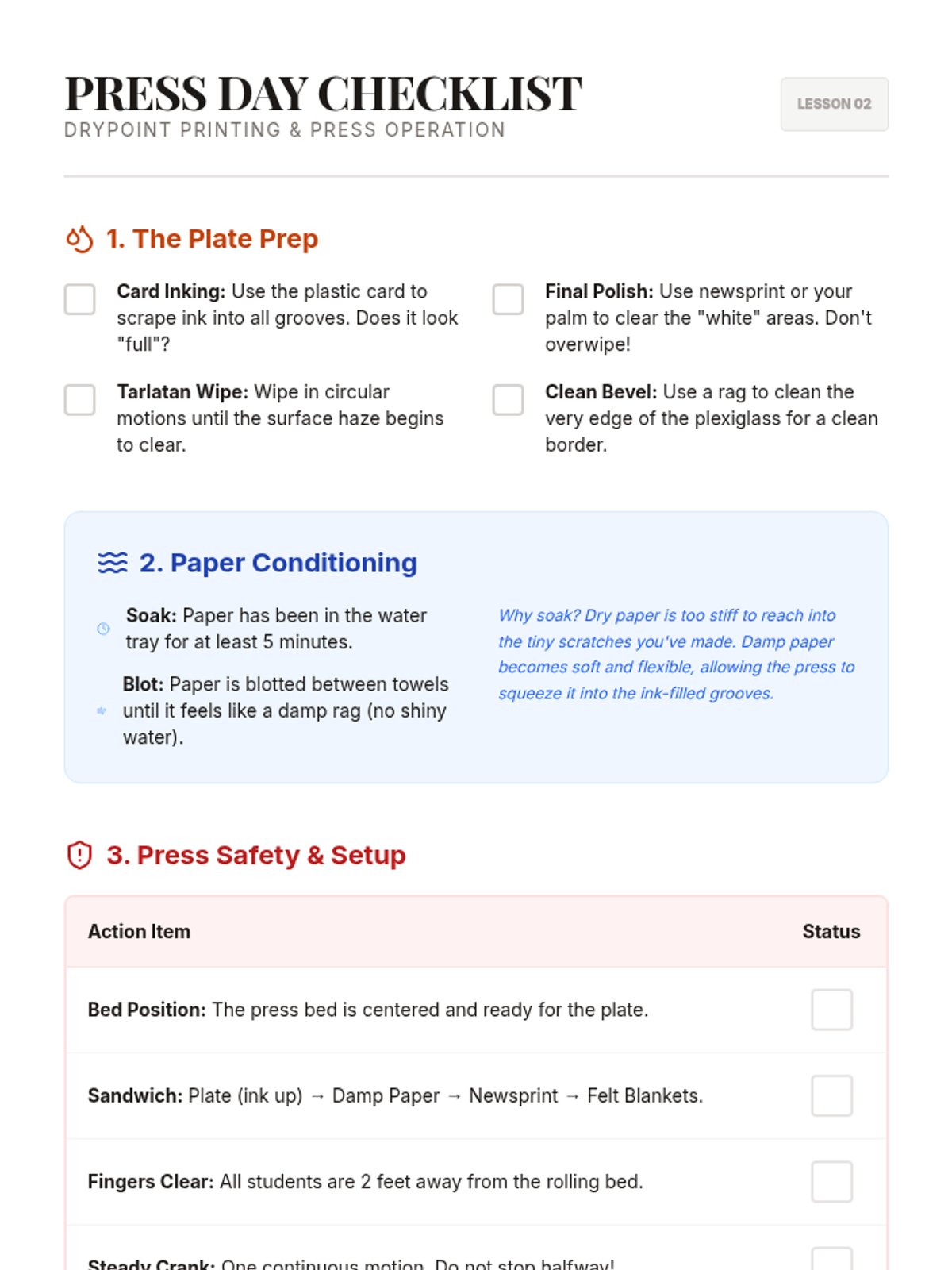
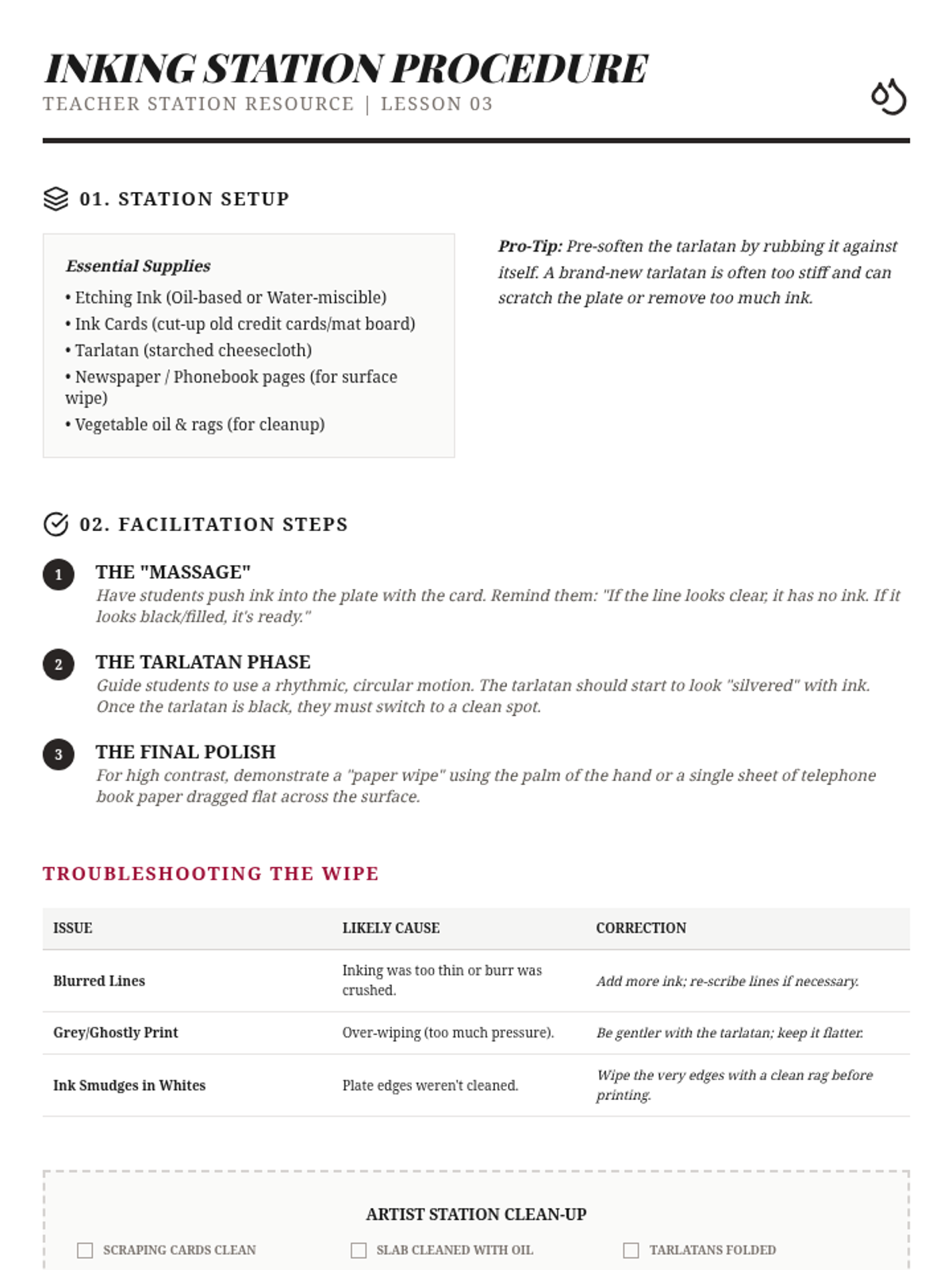
This lesson covers the specific 'card and tarlatan' wiping method required for intaglio. Students learn to push ink into grooves and wipe the surface clean to create a crisp image, printing their plates using an etching press.
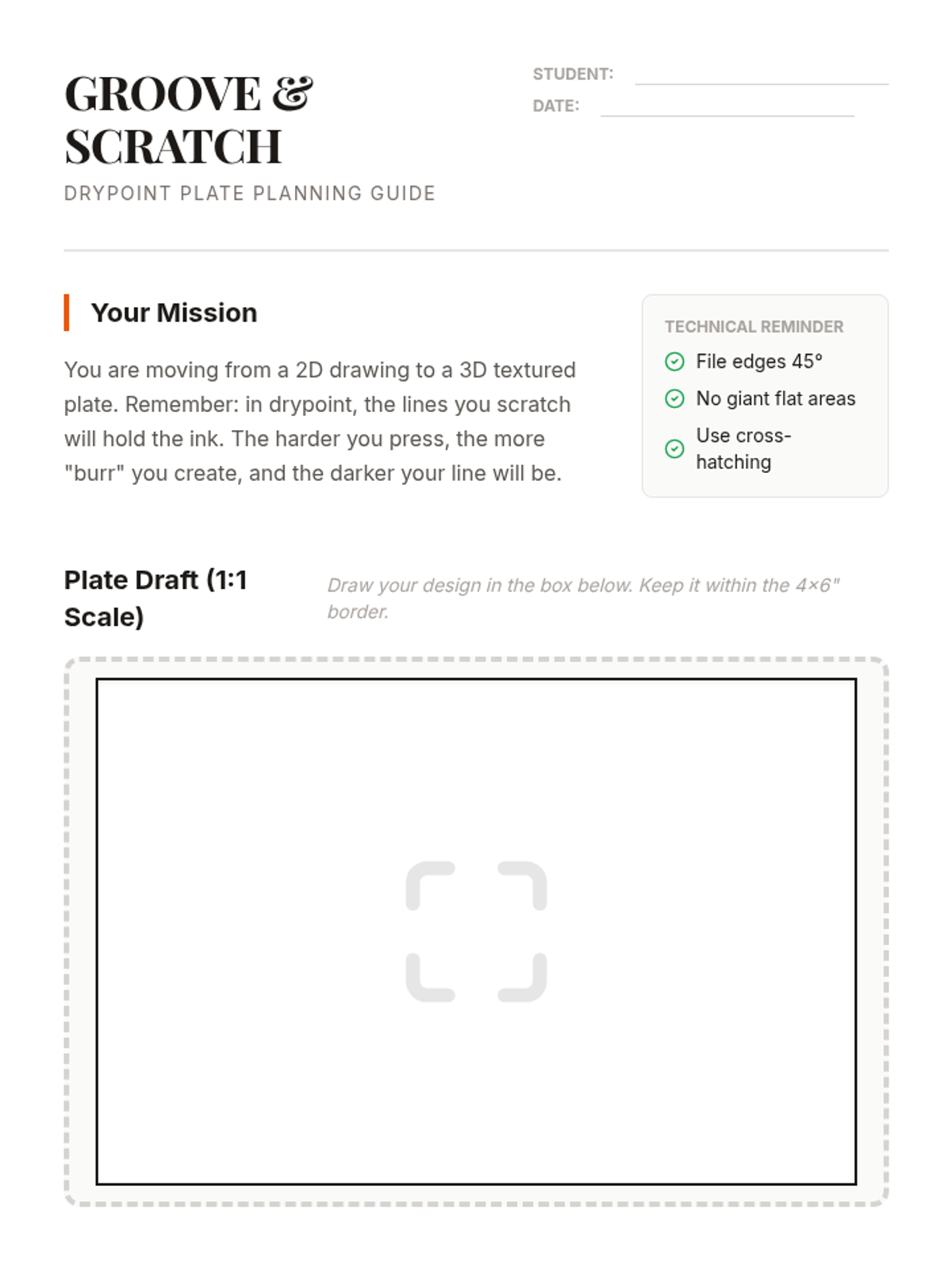
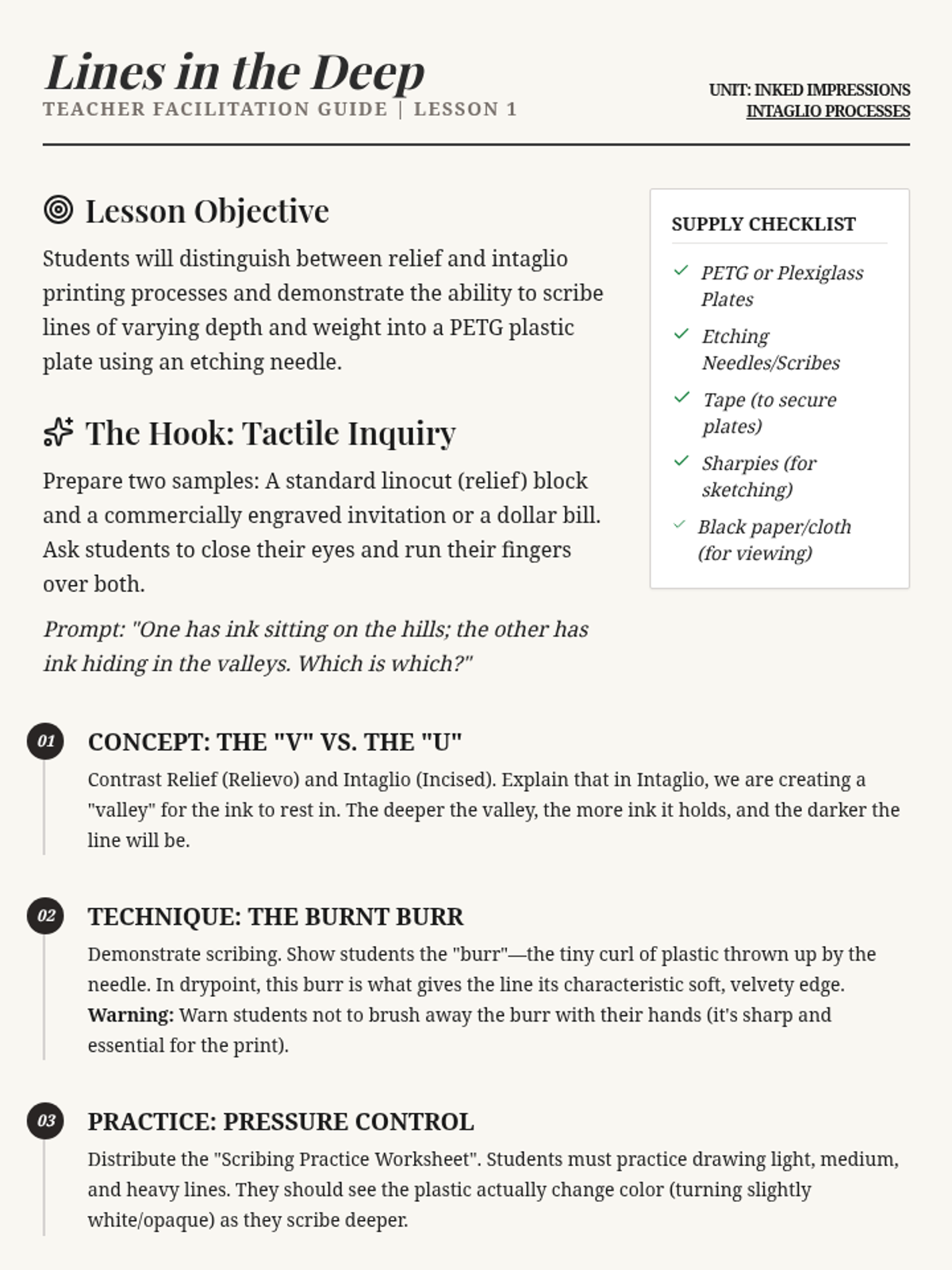
Students learn the history of intaglio printing and how it differs from relief. They prepare small plexiglass plates by filing edges and scratching initial line drawings using etching needles.
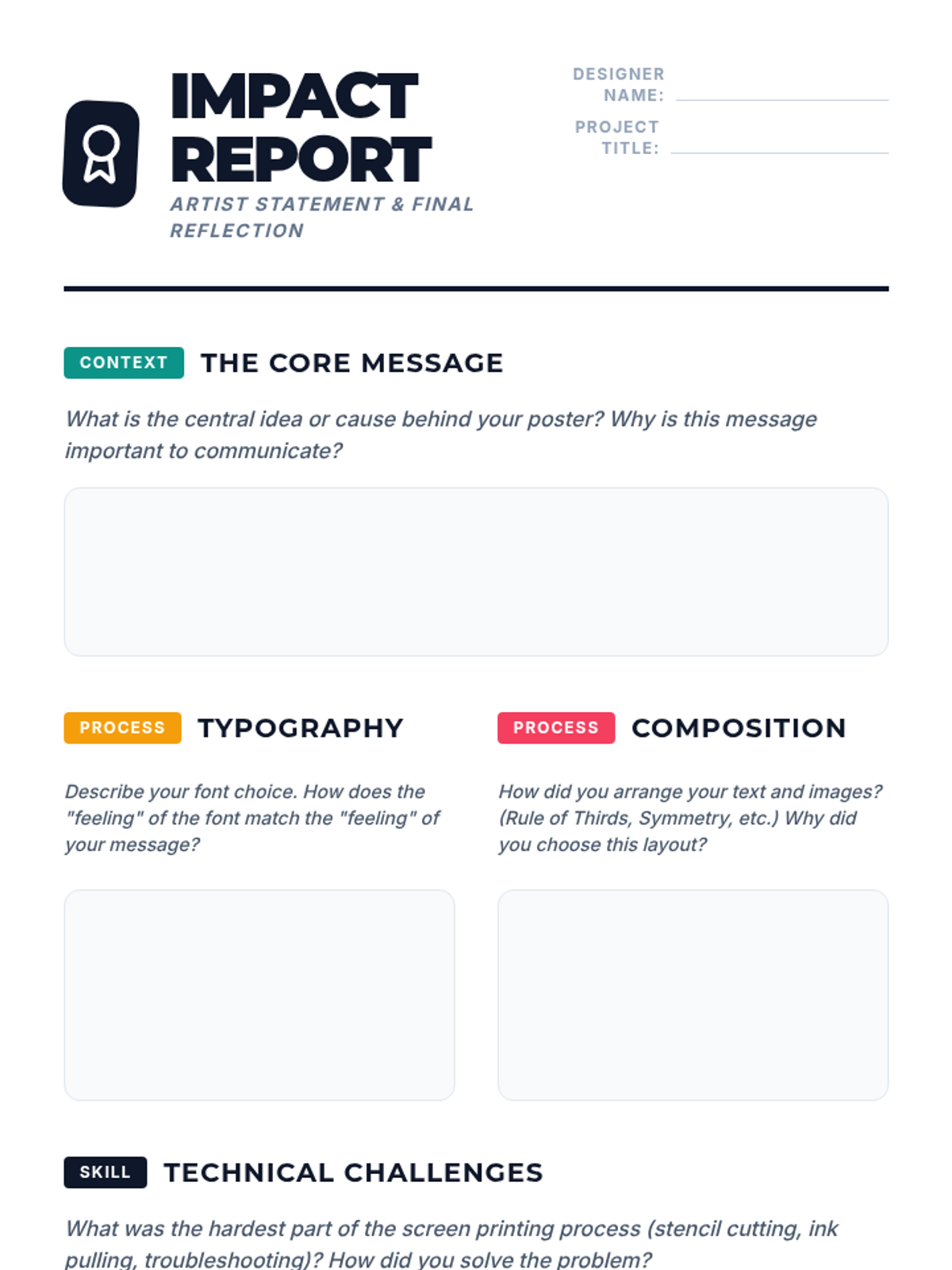
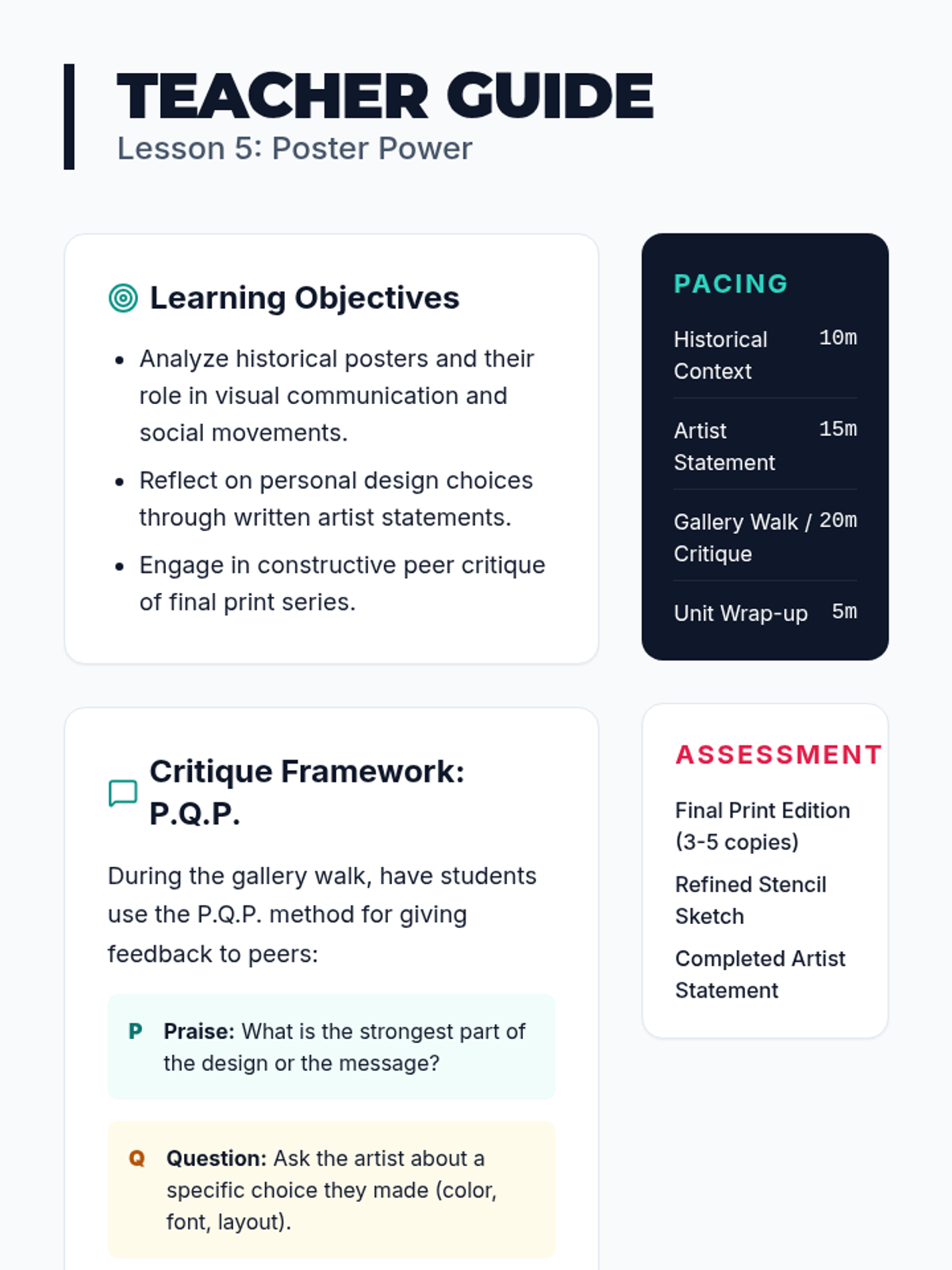
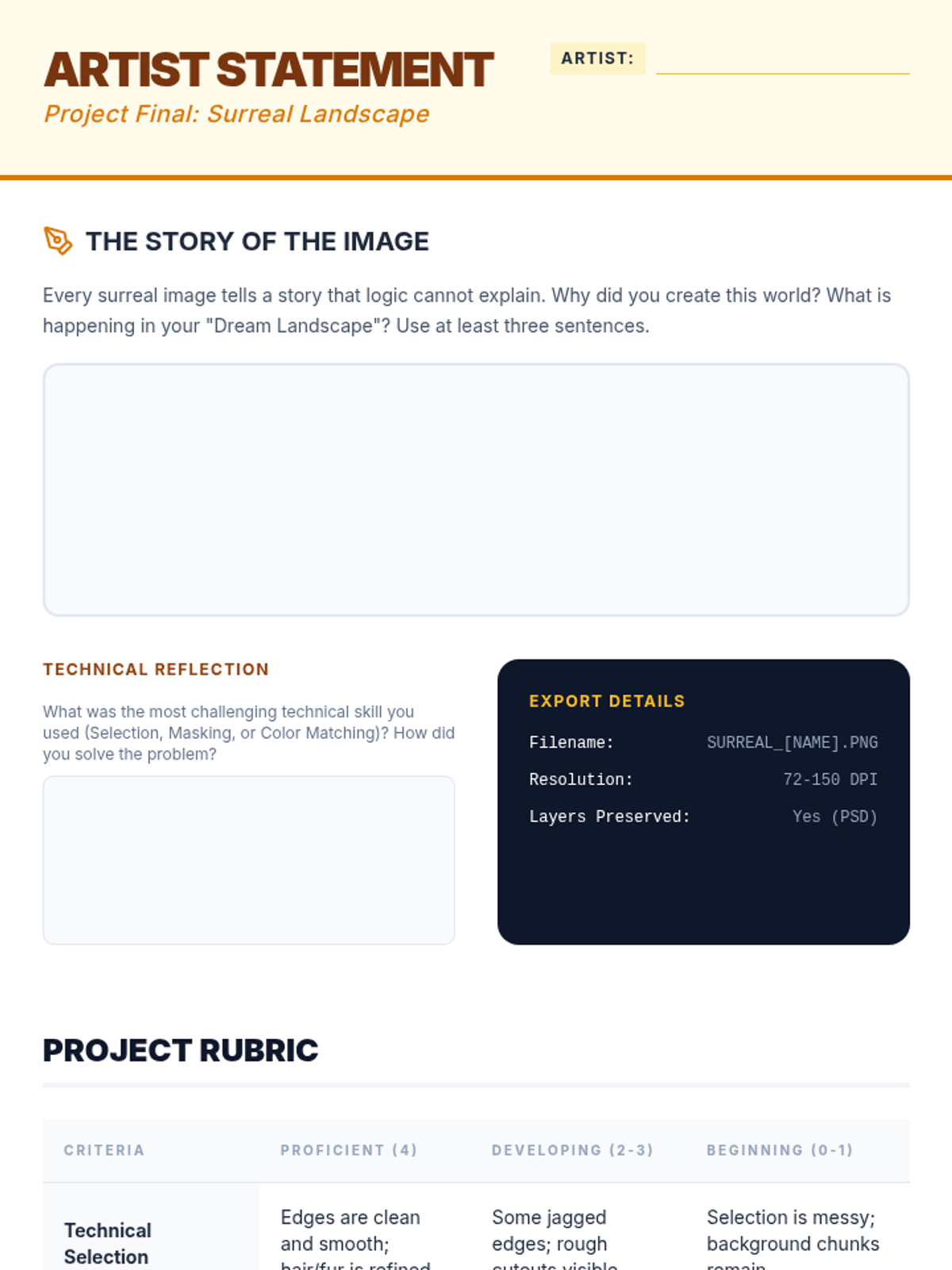
Students review their final prints and explore the historical role of posters in social movements. They conclude the sequence by writing an artist statement reflecting on their design choices.
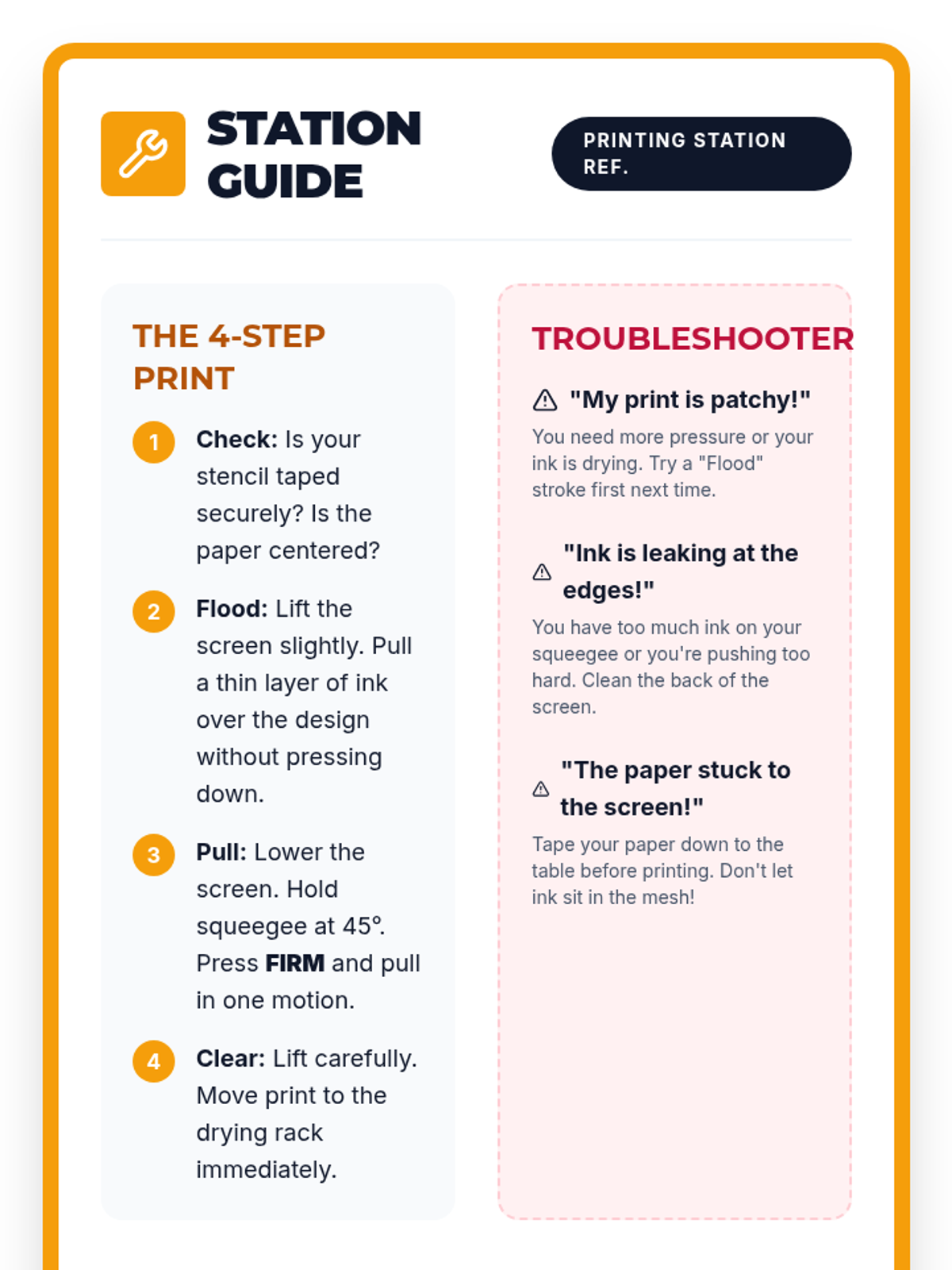
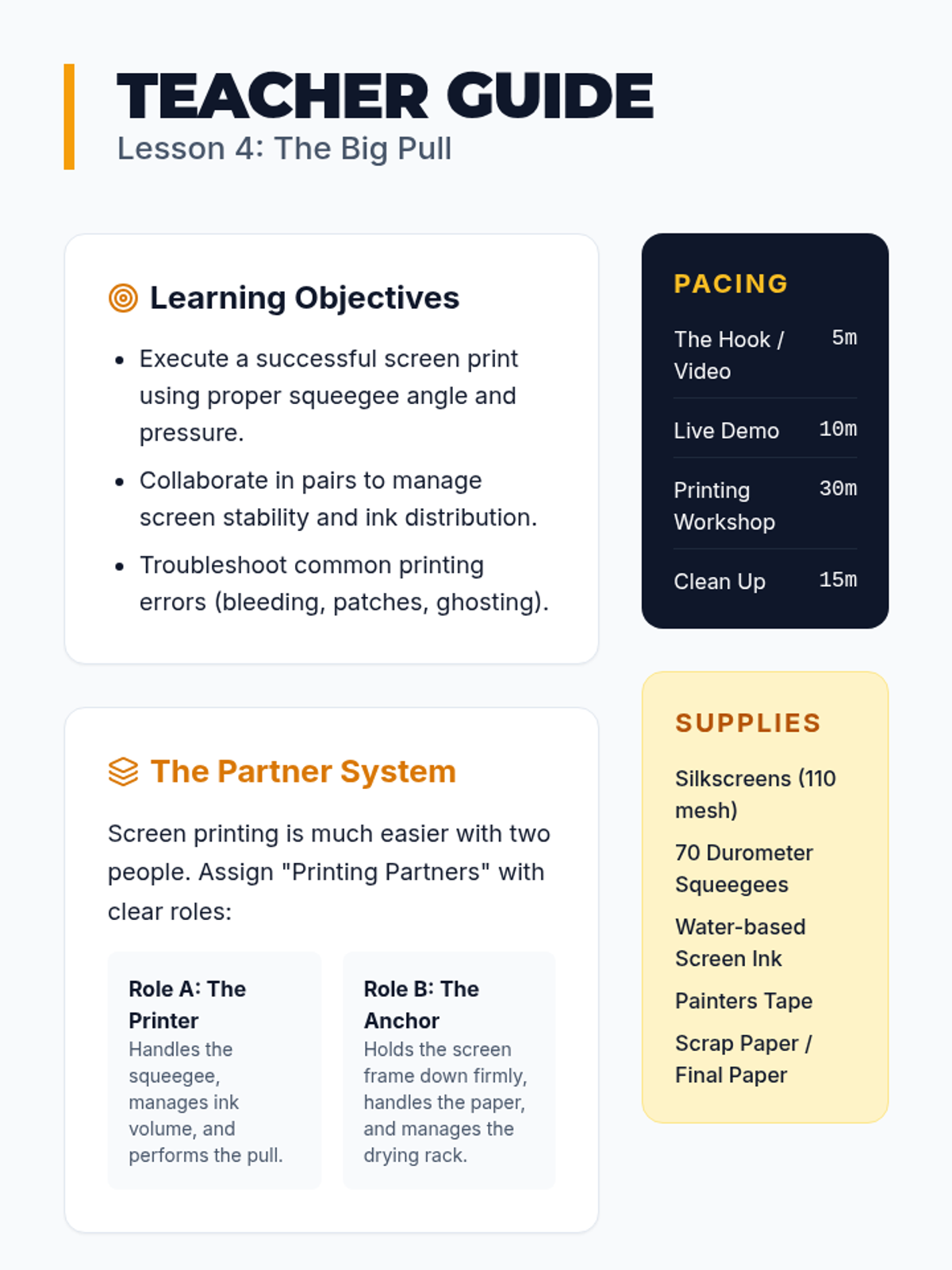
Working in pairs, students learn the physical mechanics of screen printing, including the squeegee pull, ink management, and troubleshooting common printing issues.
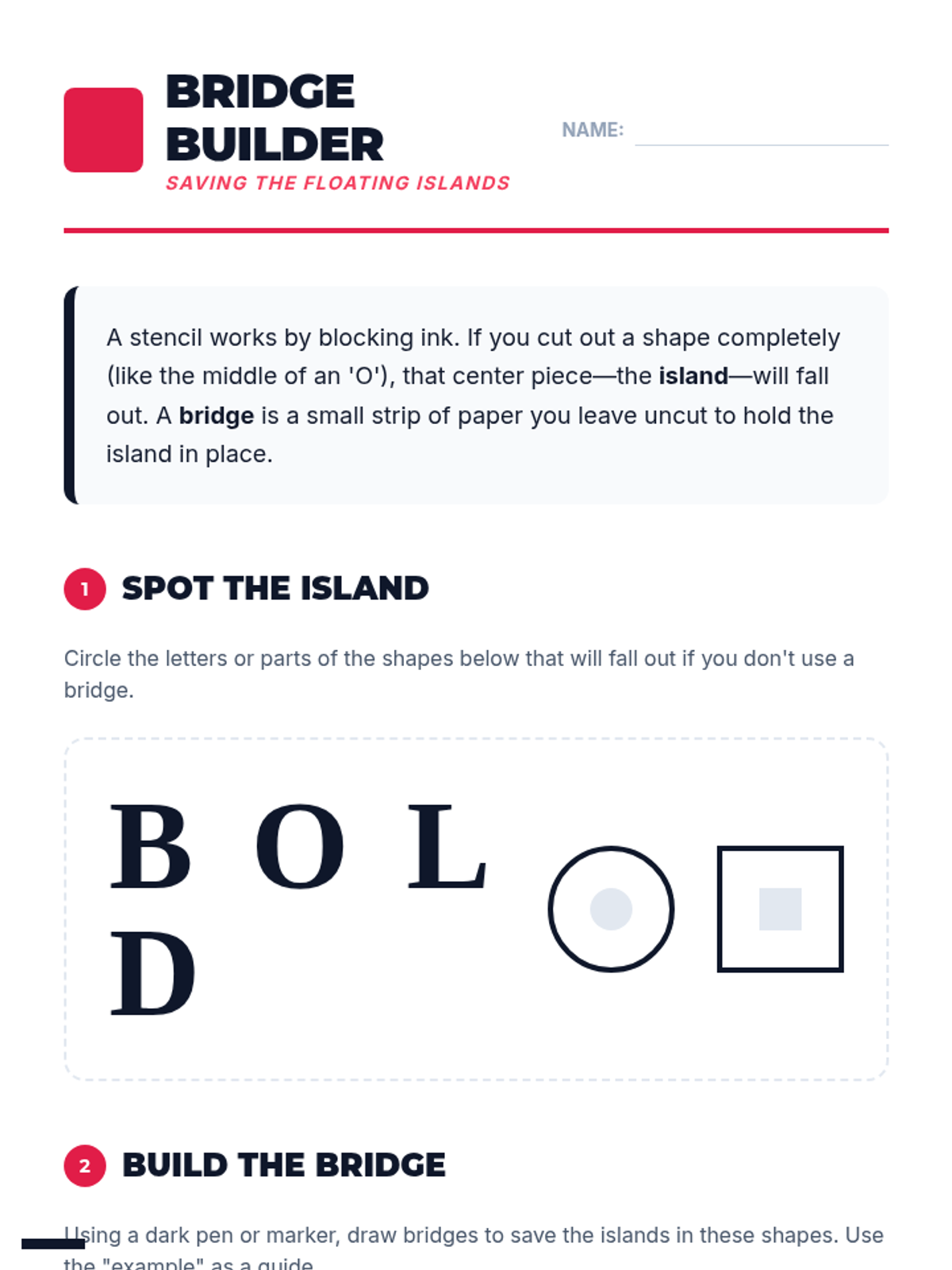
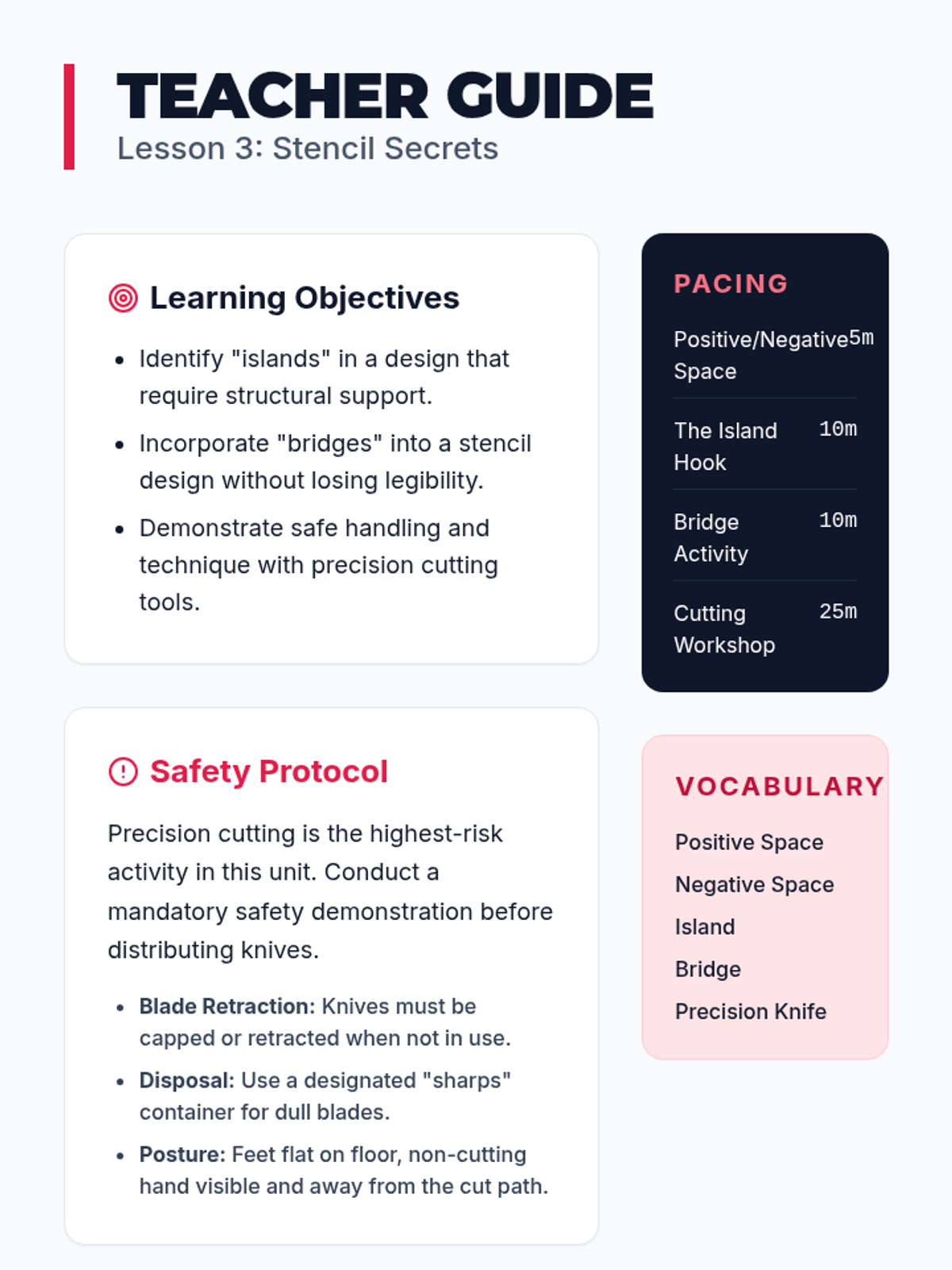
Students transfer their designs to stencil paper and learn the technical requirements of stenciling, specifically focusing on the 'island' problem and precision cutting techniques.
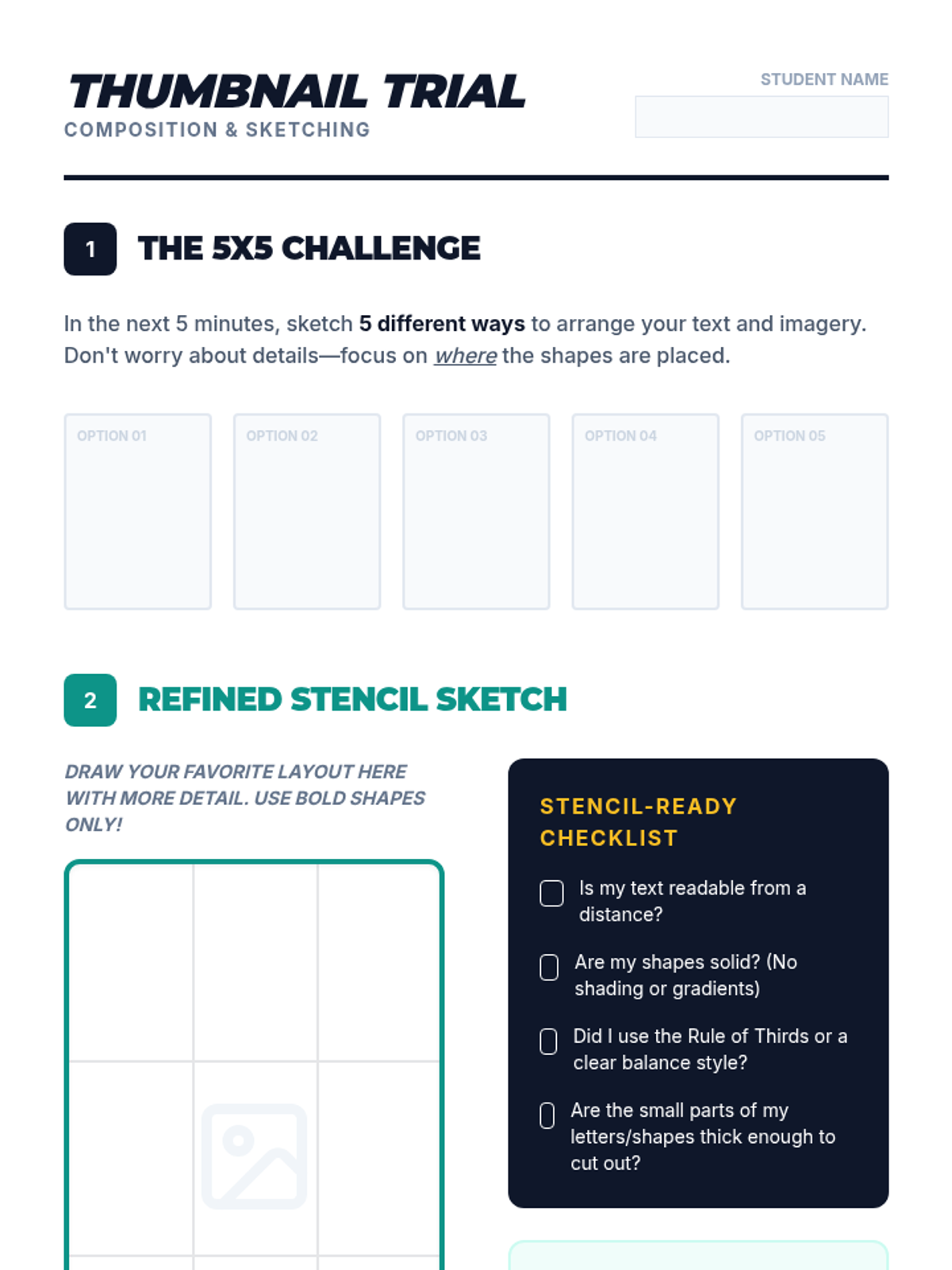
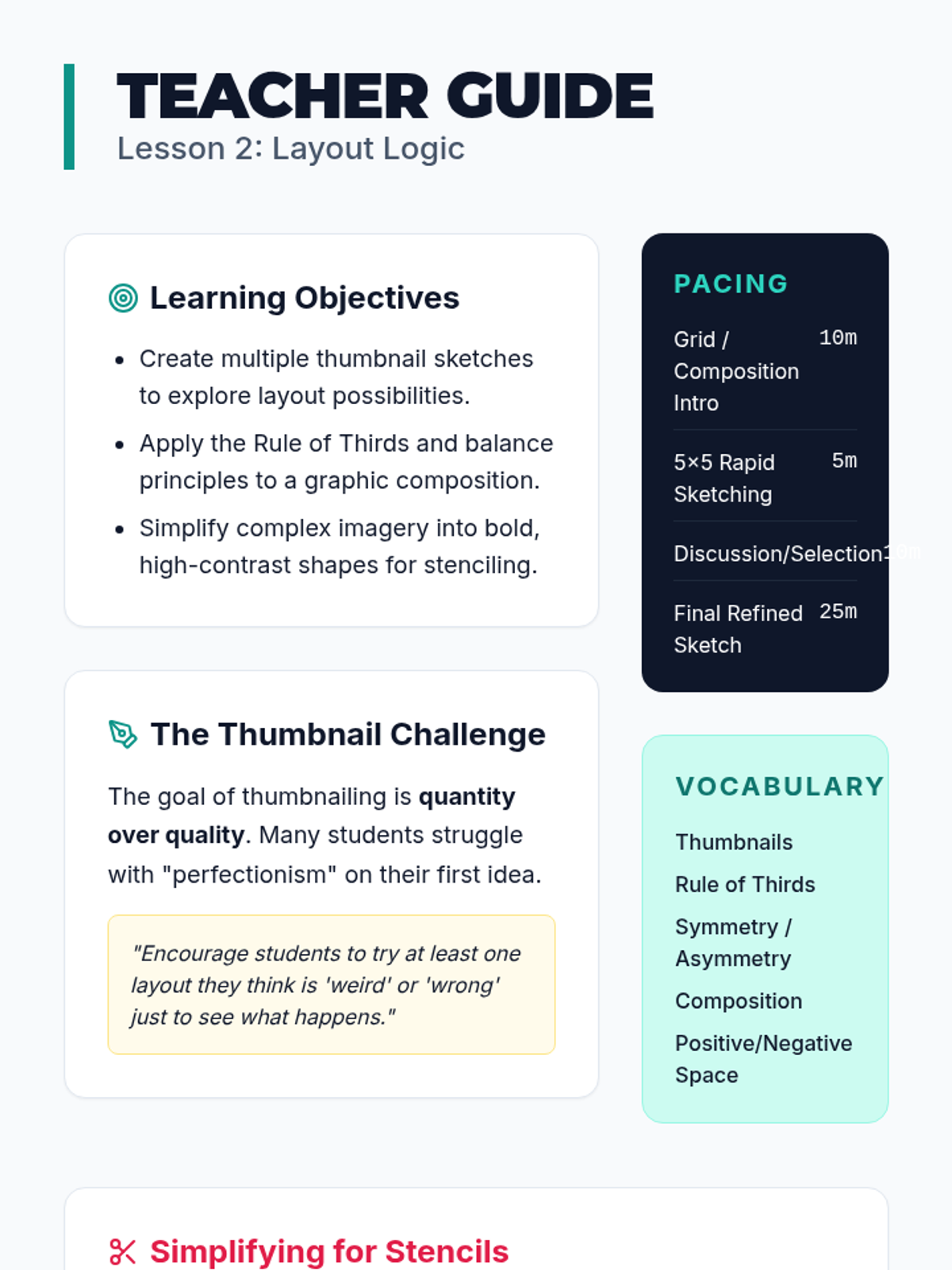
Students focus on composition by sketching multiple thumbnail layouts that integrate text and imagery. They refine their designs by simplifying them into shapes suitable for the stenciling process.
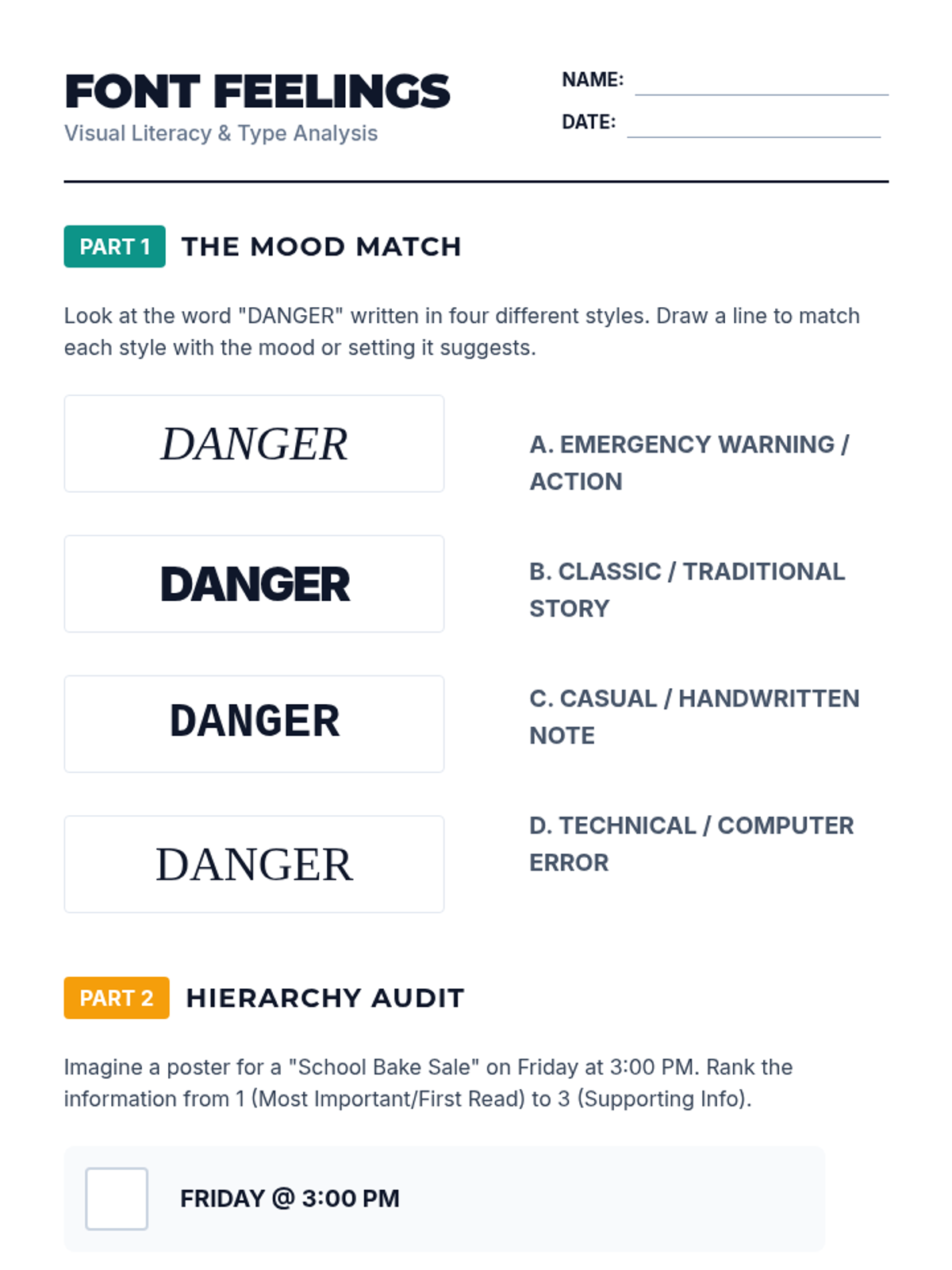
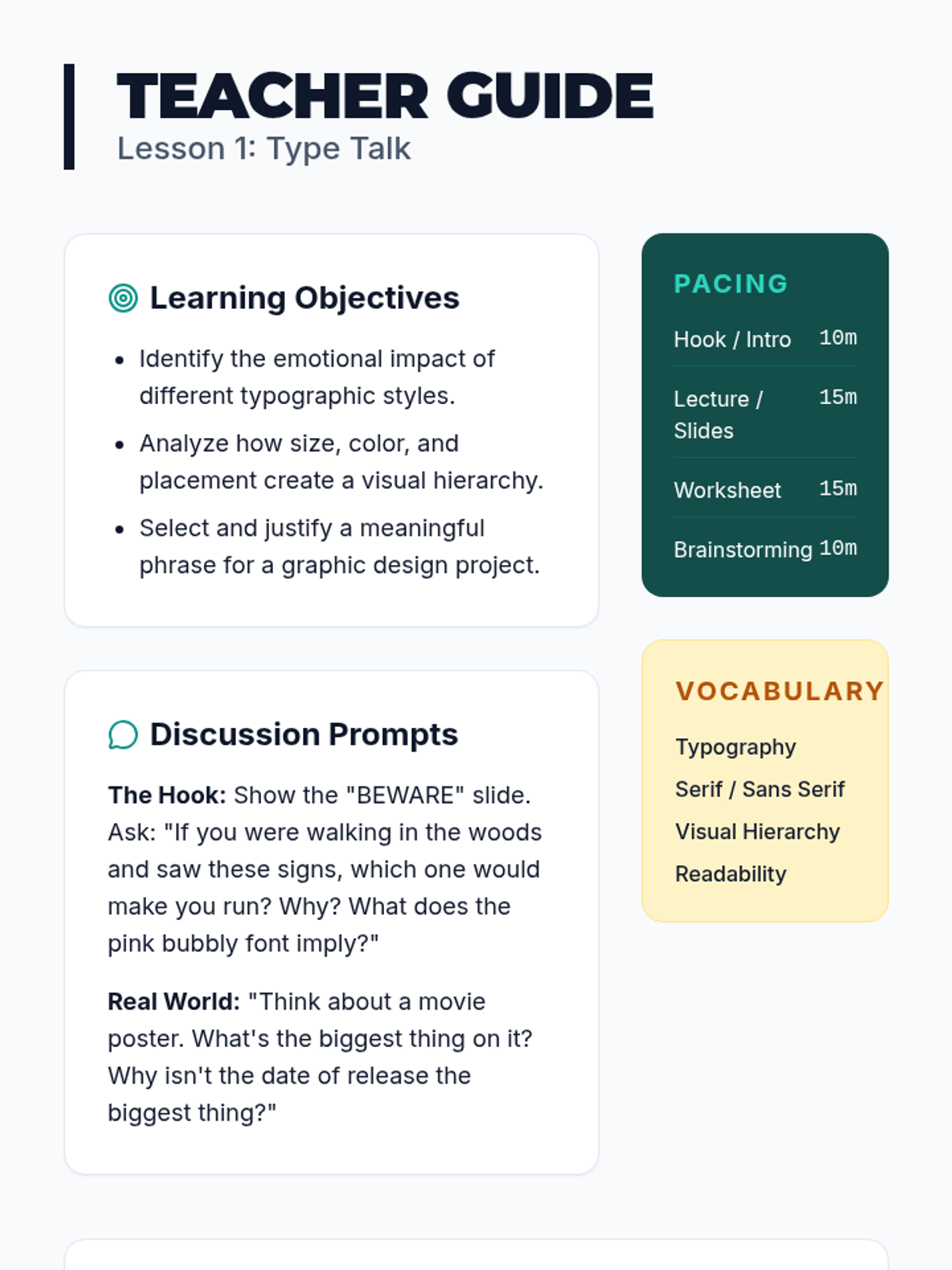
Students investigate how font choice and placement impact the meaning of a message by analyzing movie posters and advertisements. They learn to identify hierarchy of information and select a short phrase for their own project.
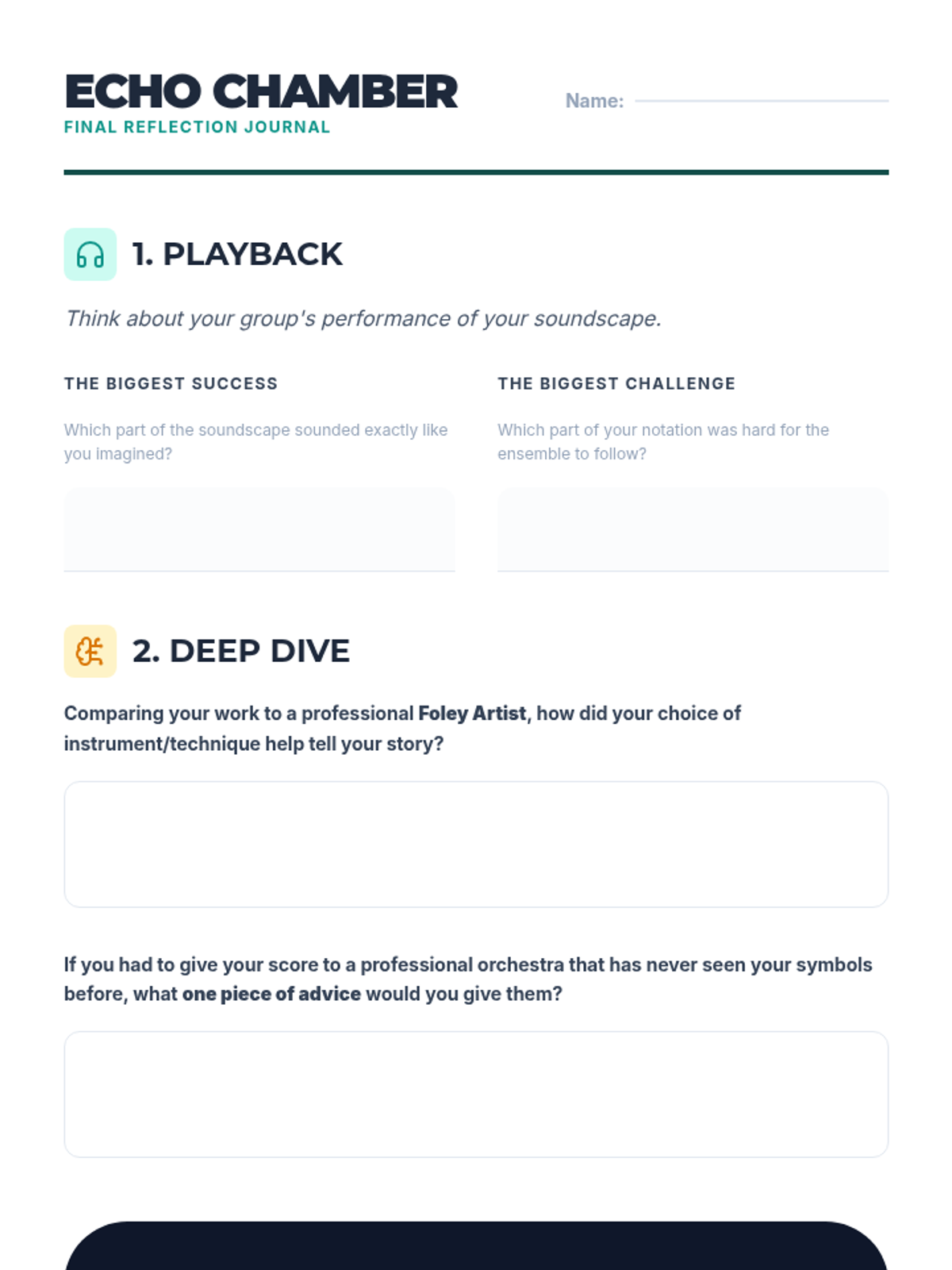
Students reflect on their compositions and performances, comparing their work to professional Foley artists.
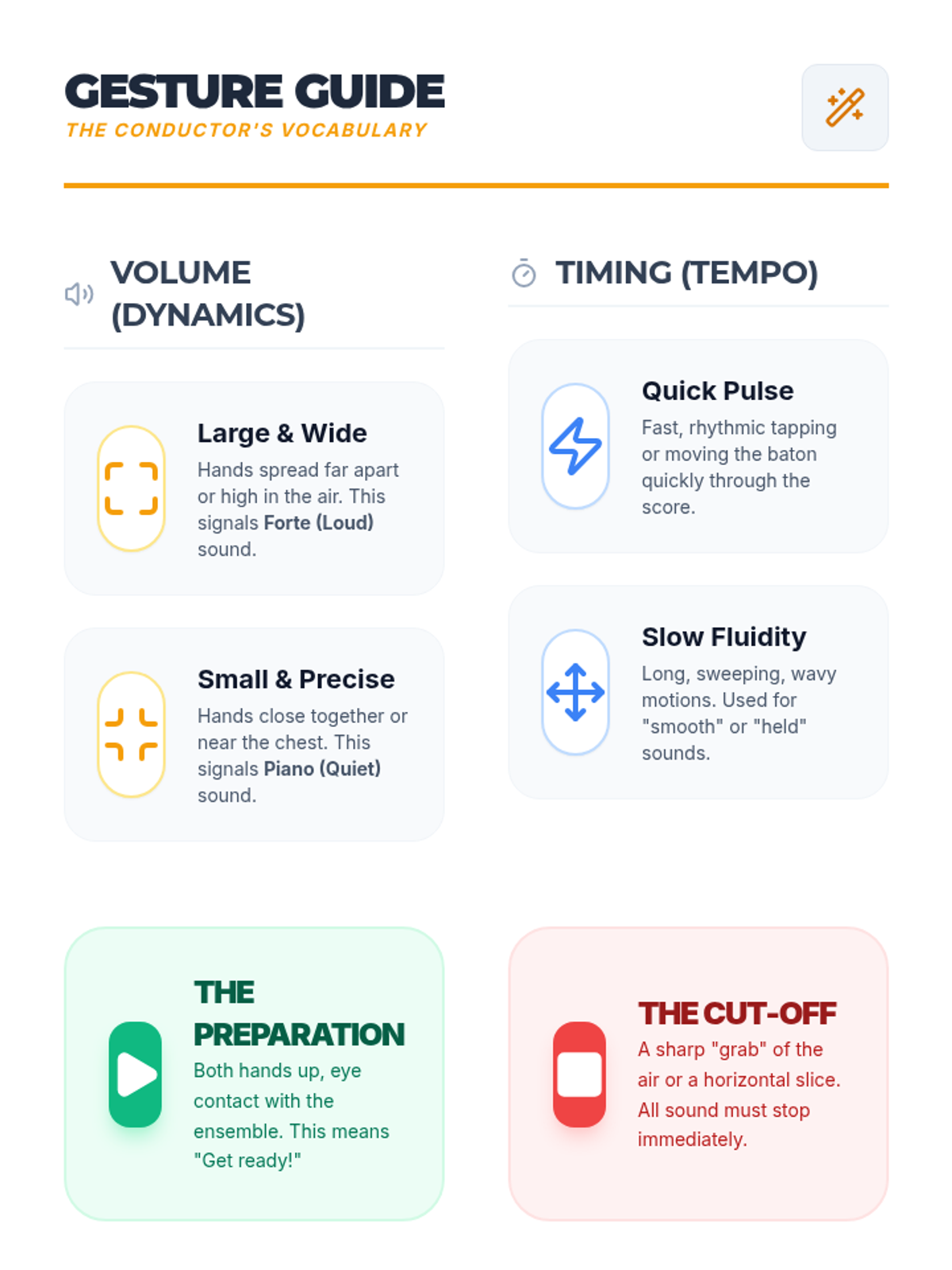
Young composers practice conducting their scores, using gestures to lead their peers through the visual music.
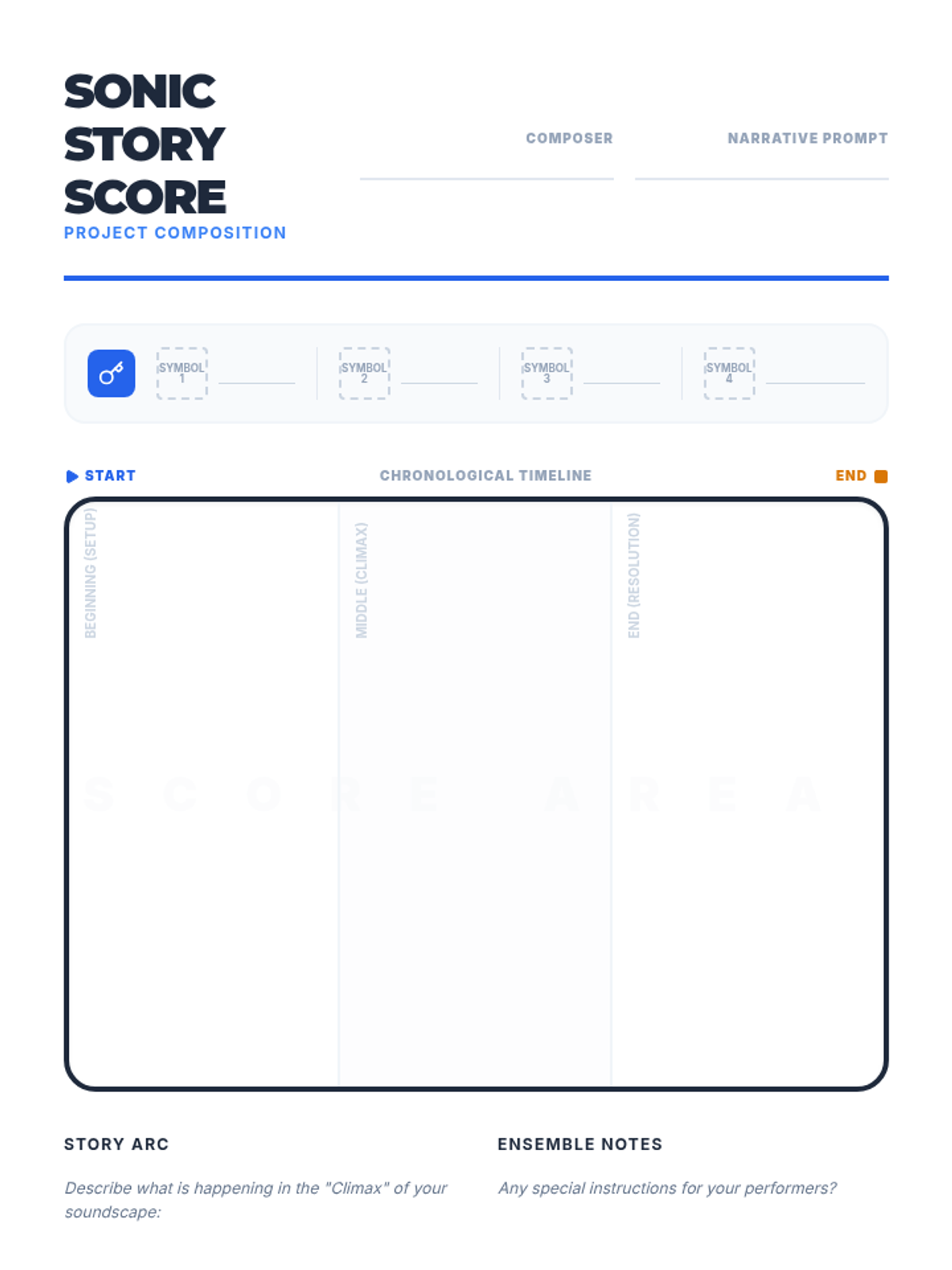
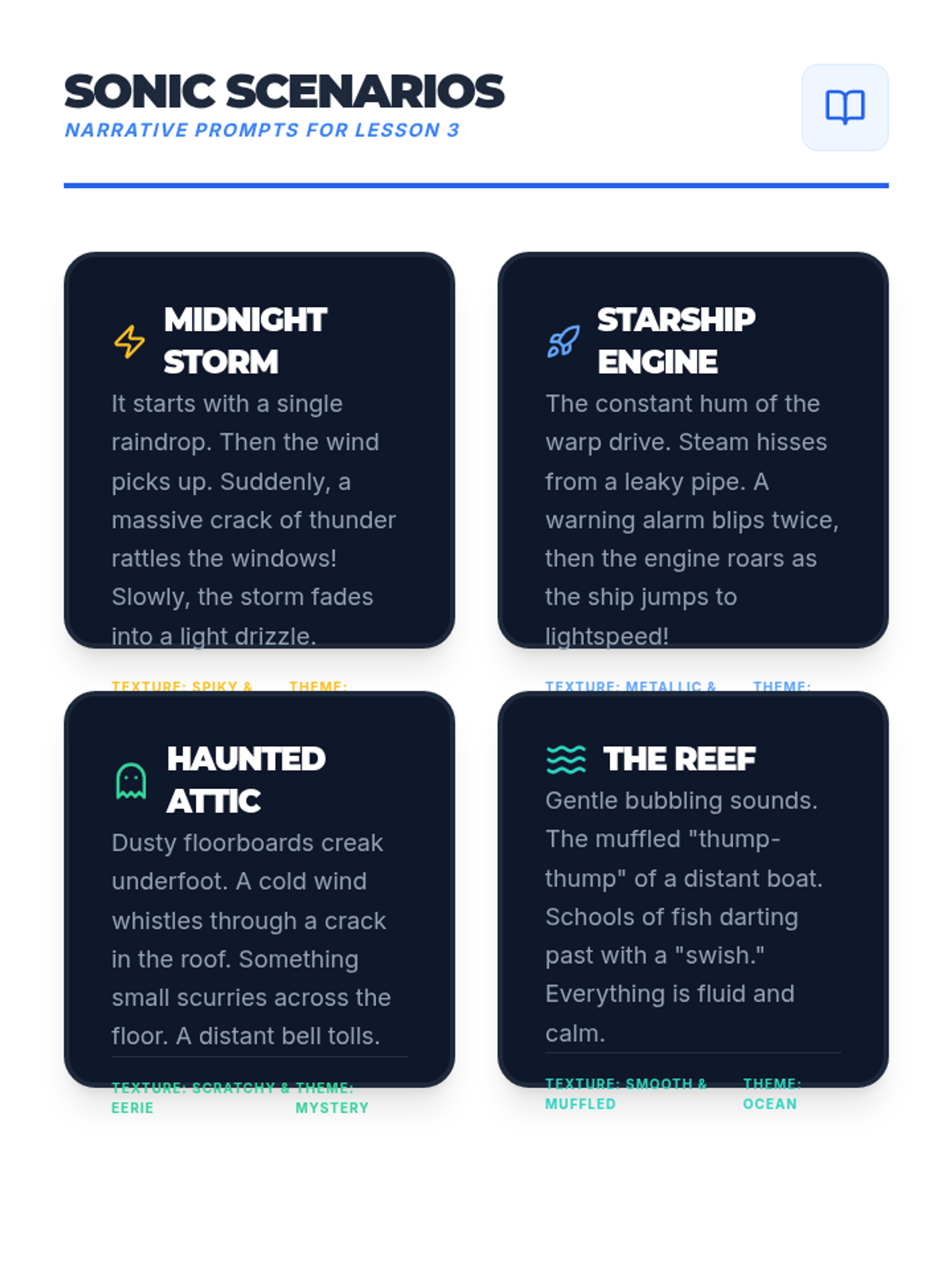
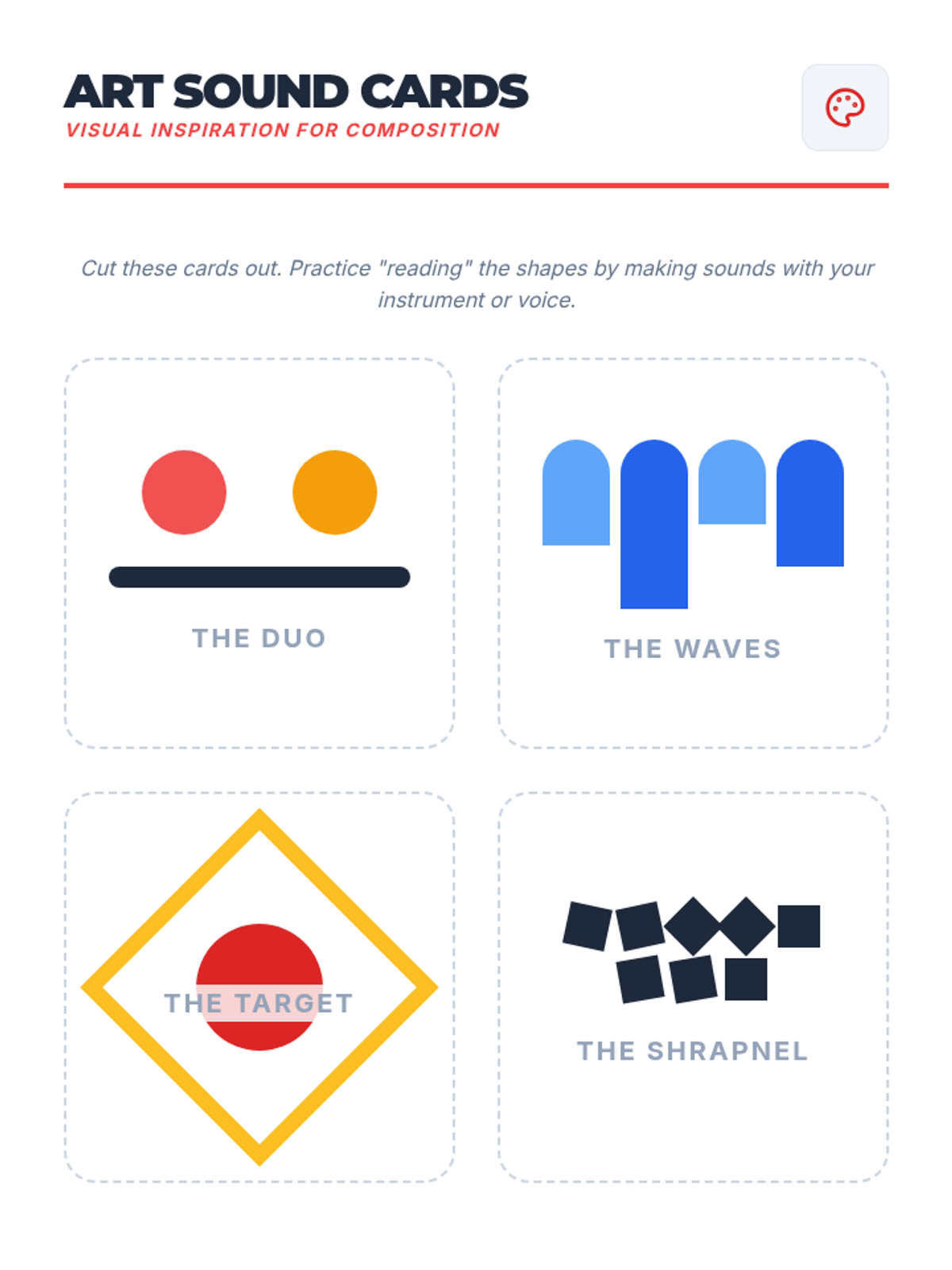
Students compose a narrative-driven graphic score that uses their symbols to tell a sonic story.
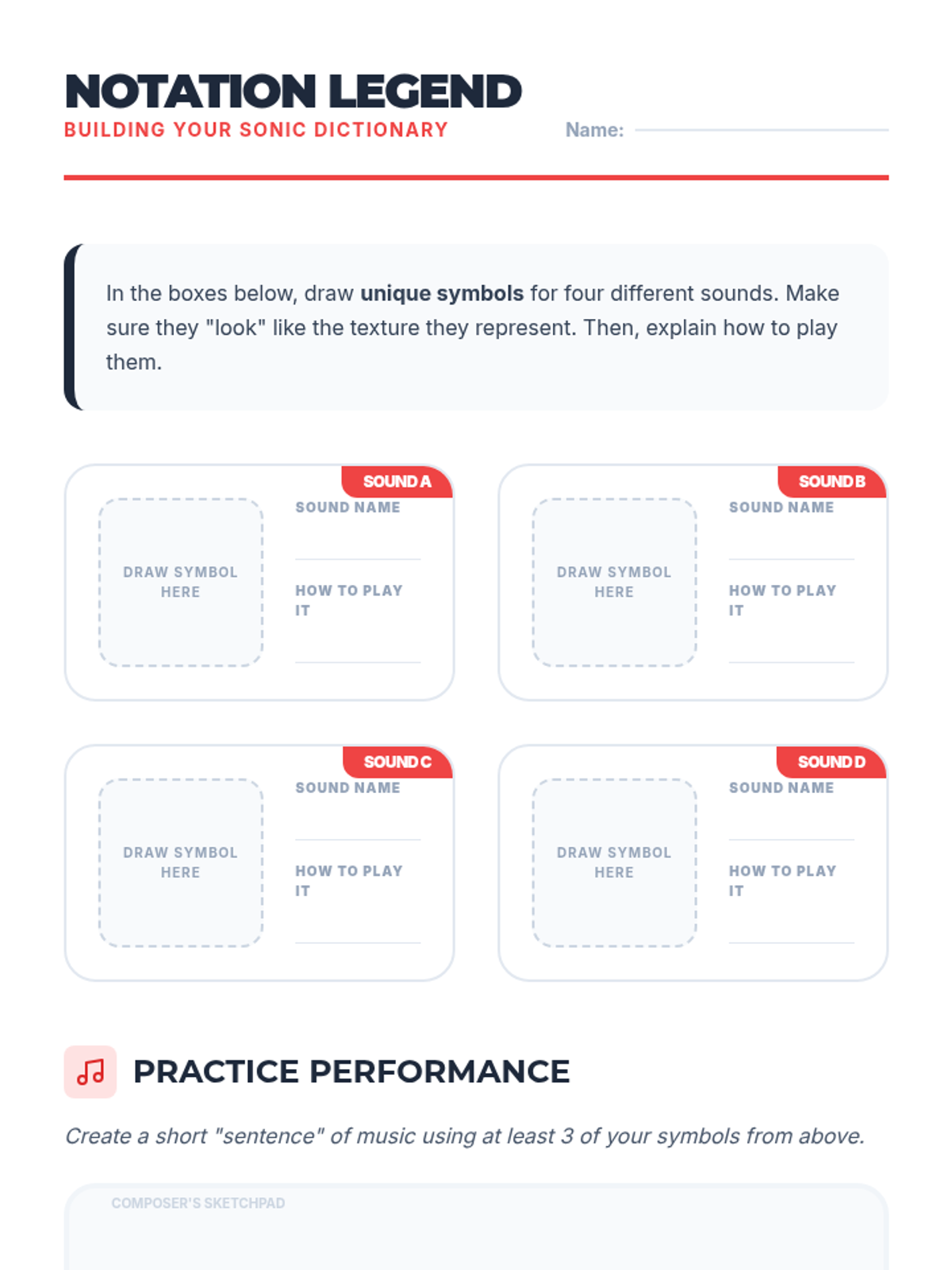
Learners translate sounds into visual symbols, creating a legend that maps shapes and colors to specific audio qualities.
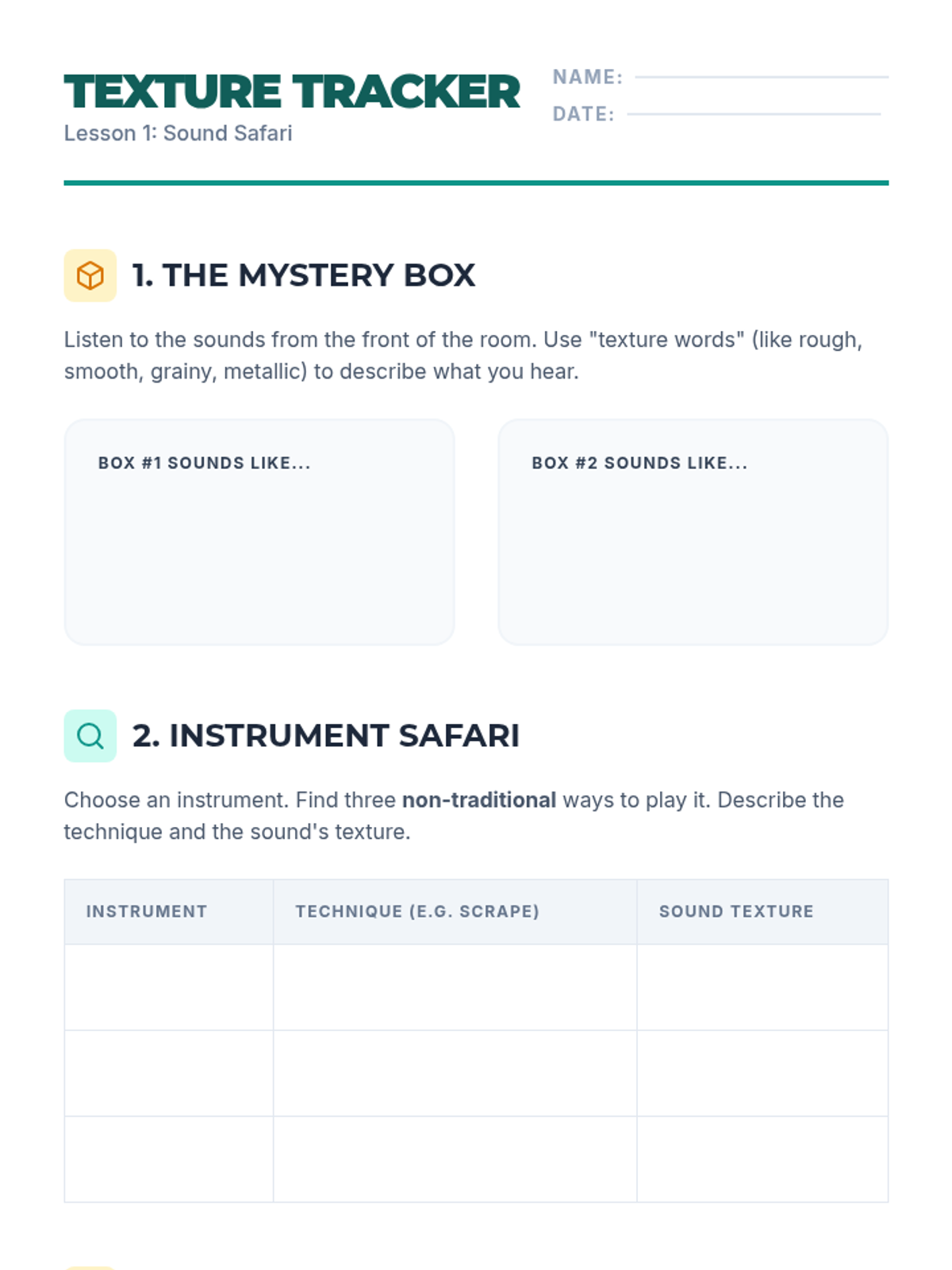
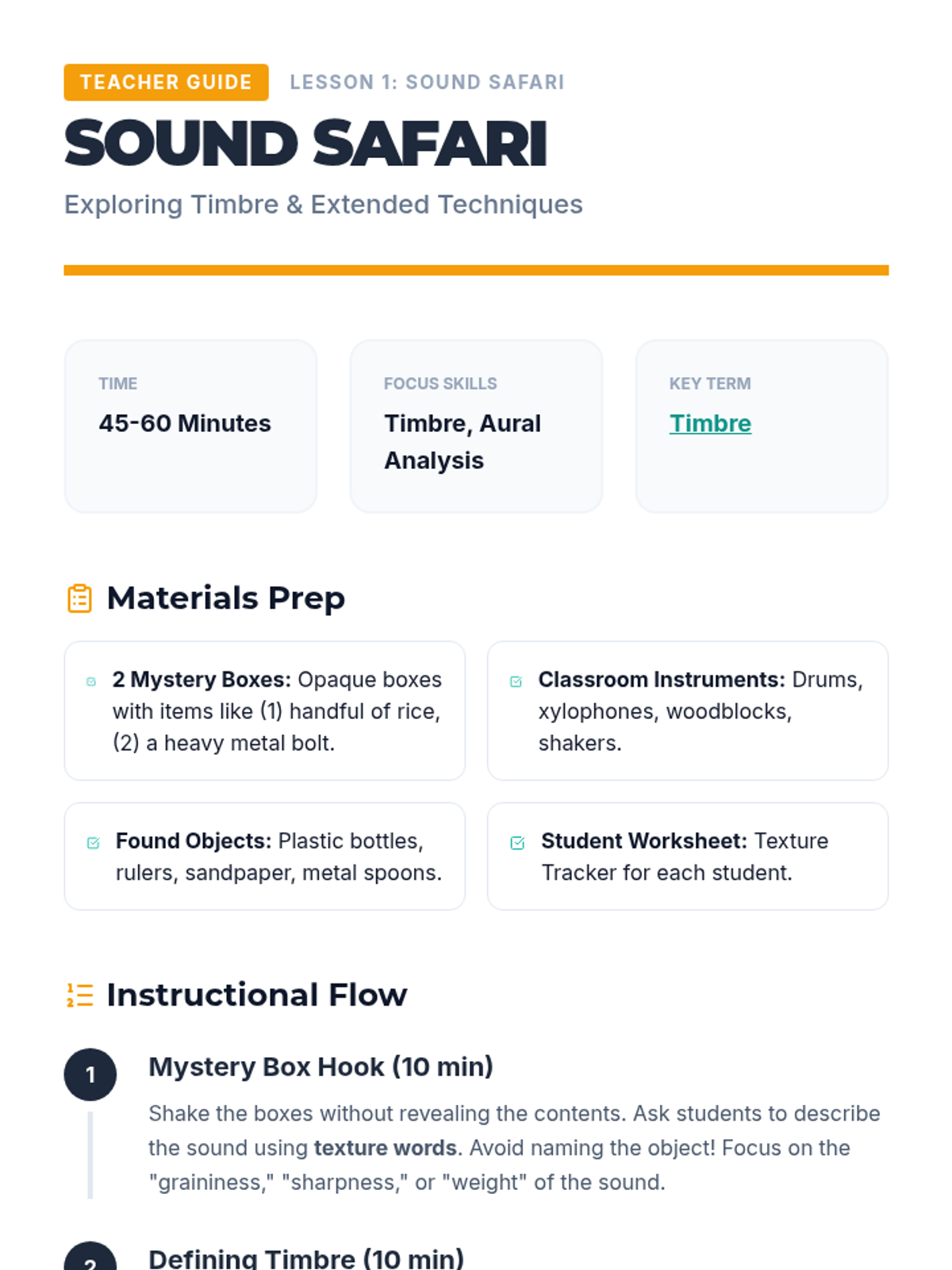
Students explore non-traditional sounds using classroom instruments and found objects, categorizing them by texture.
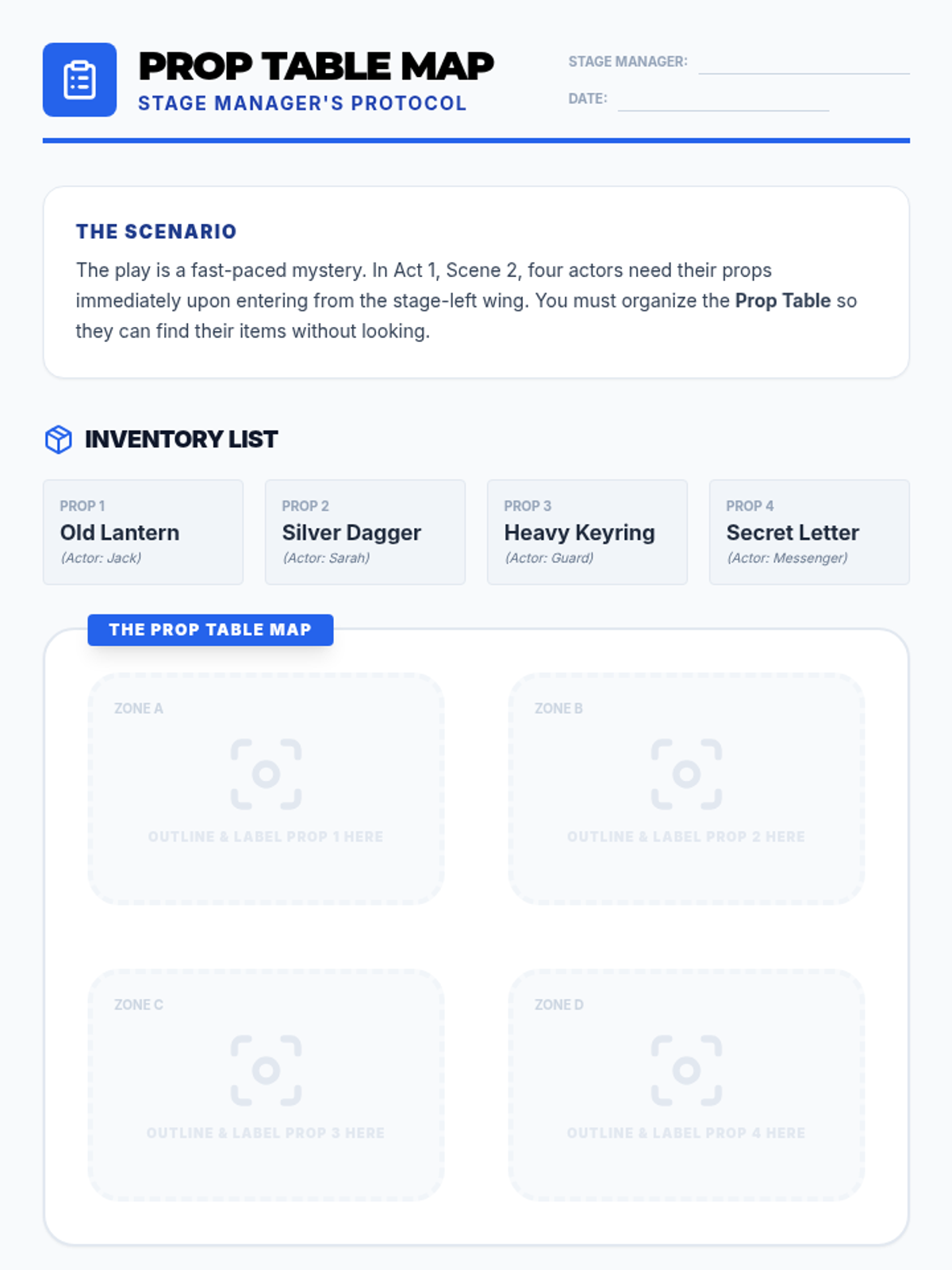
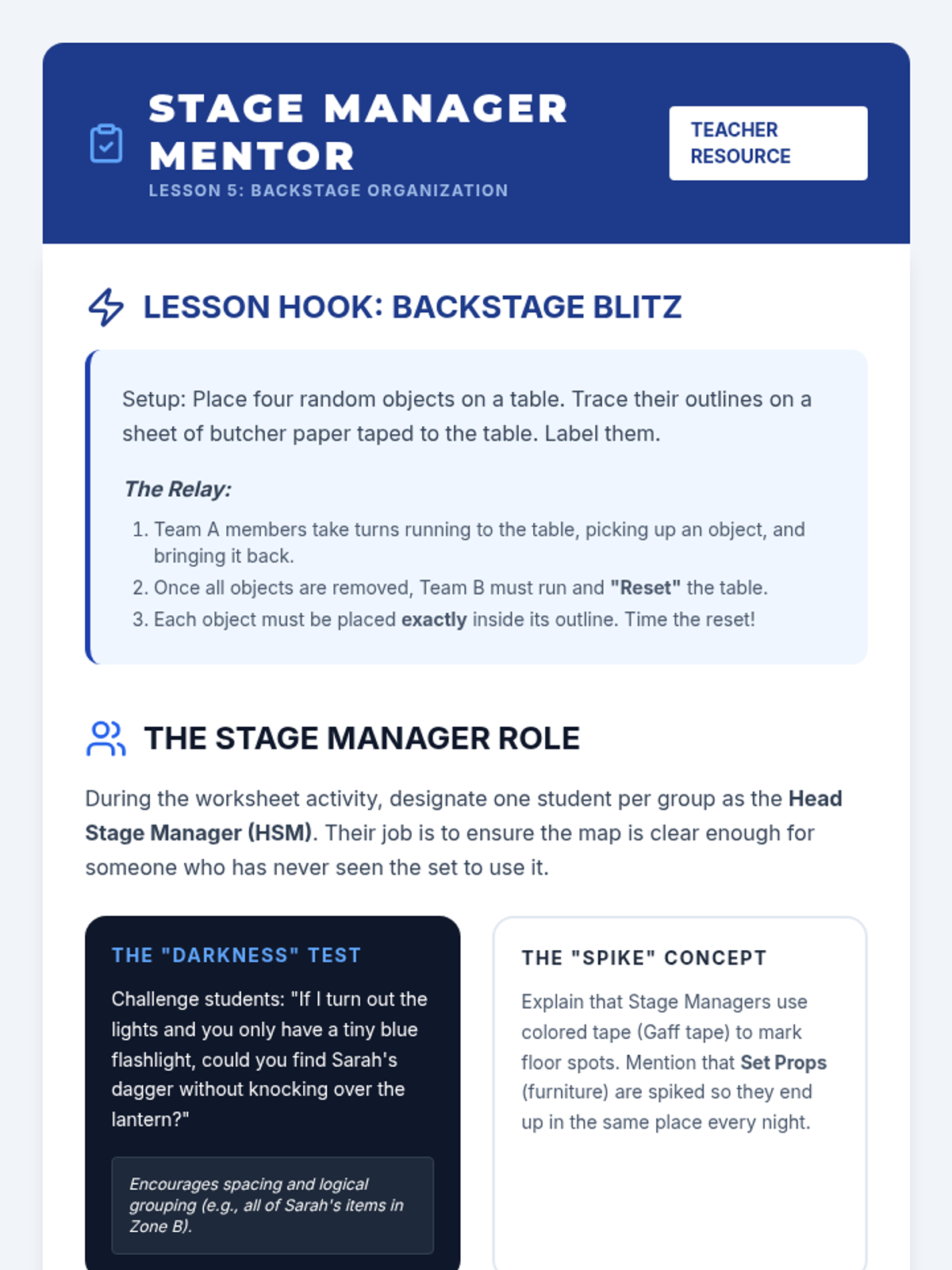
Students step into the role of Stage Managers to learn about organization. They create a 'prop table' map, outlining where items go ensuring actors can find them in the dark, and practice resetting a scene quickly.
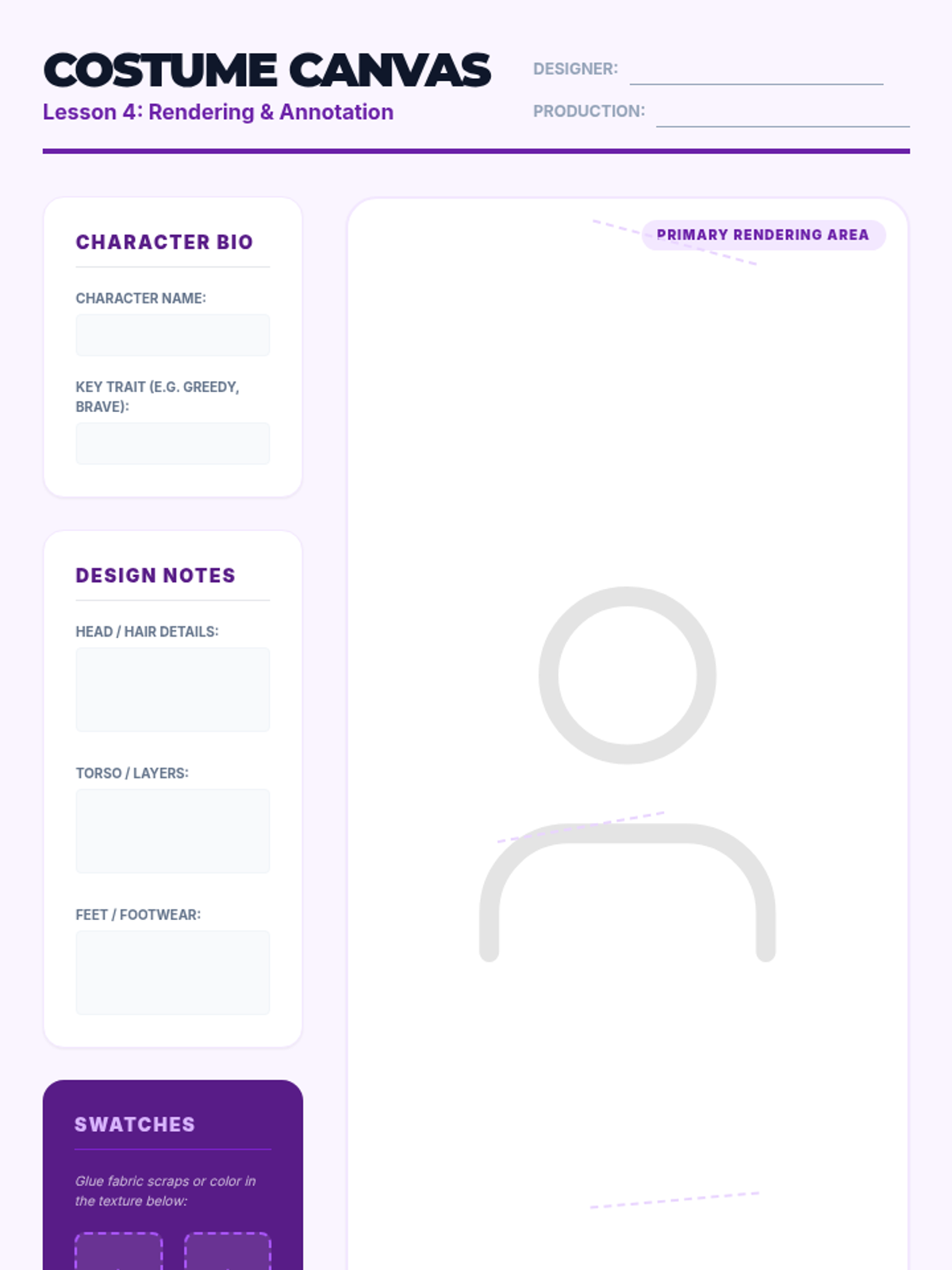
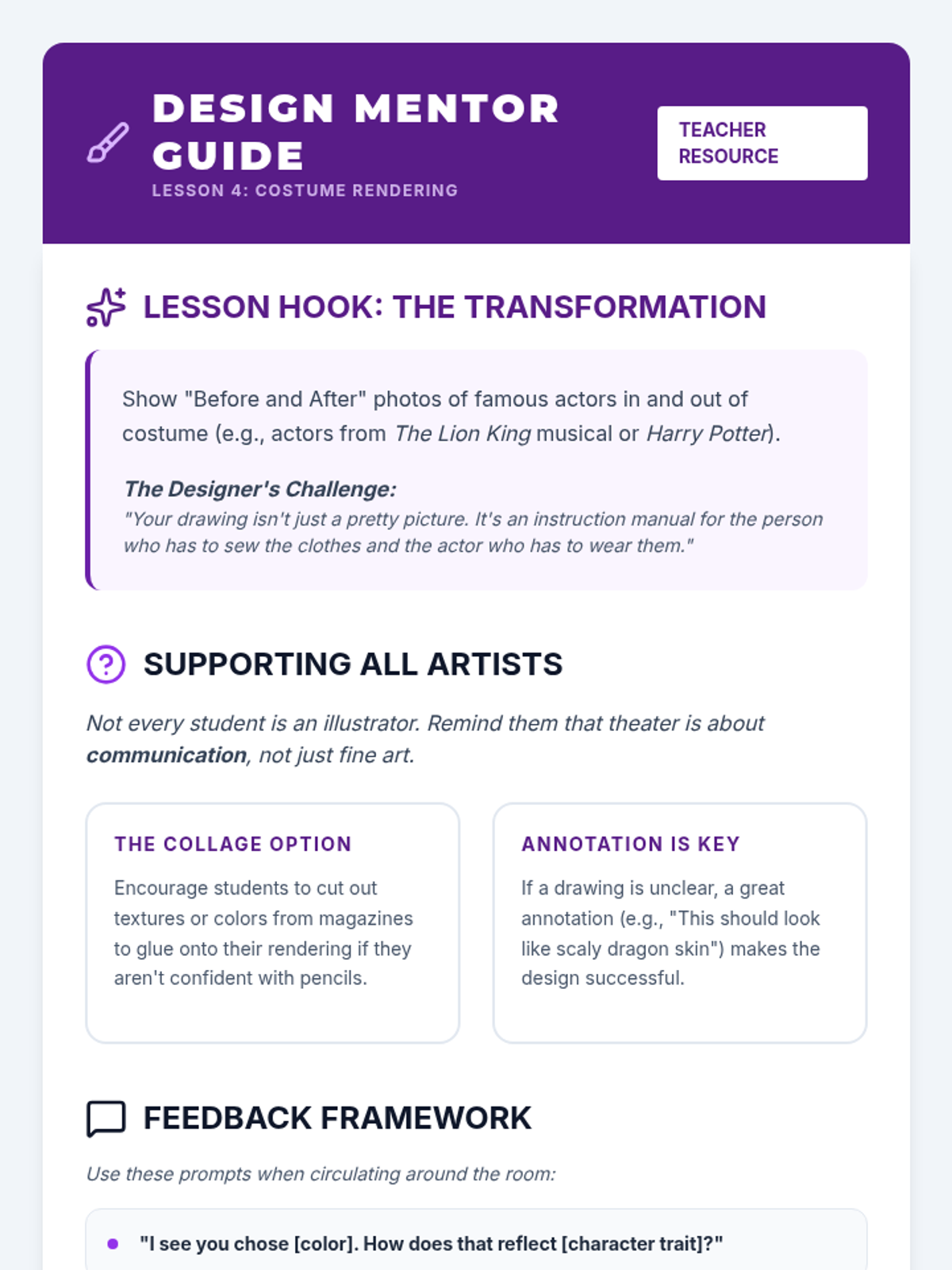
Students create a costume rendering for a specific character using drawing or collage techniques. They must annotate their design to explain how their choices relate to the character's age, job, and personality.
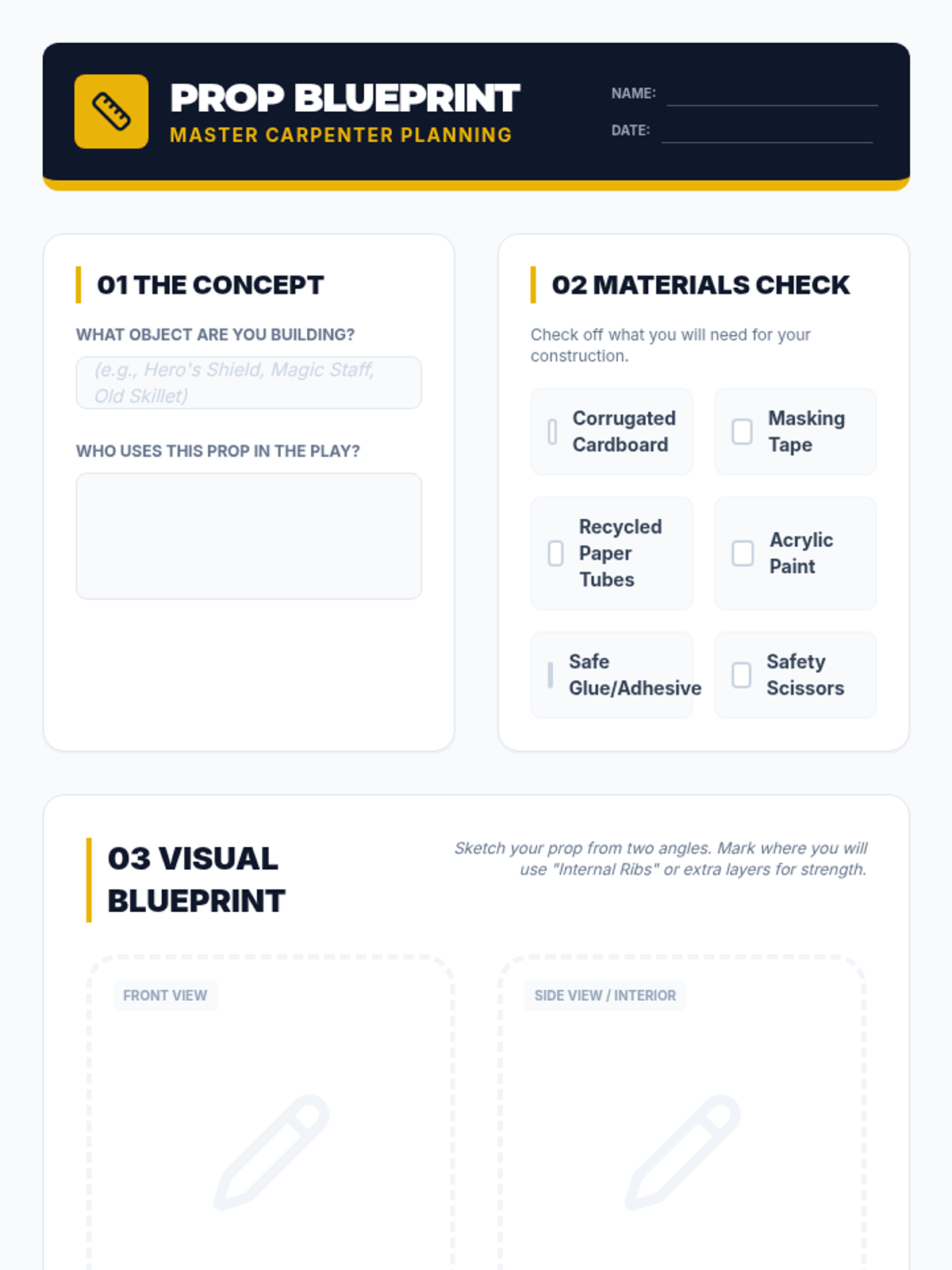
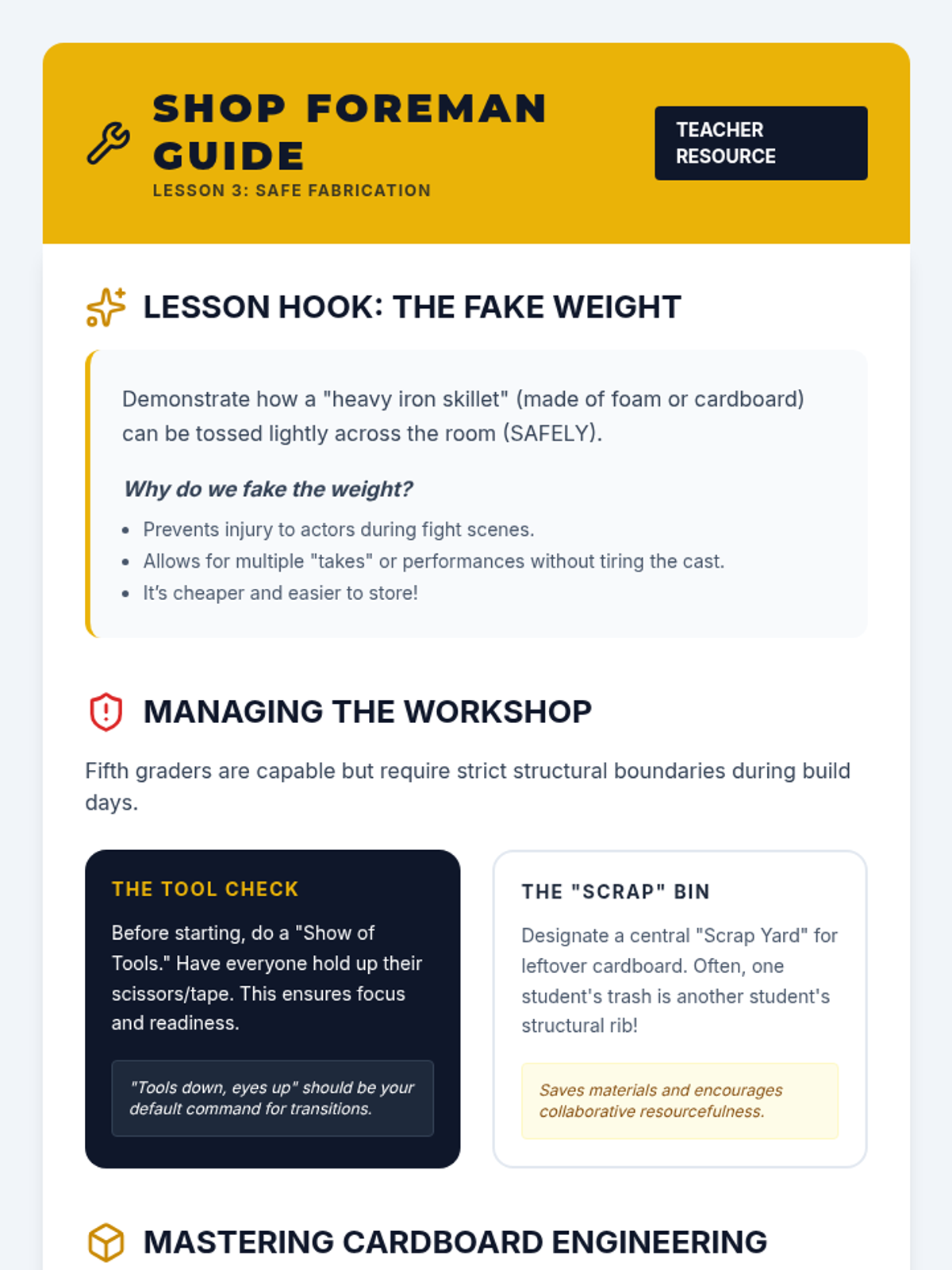
Focusing on safety and resourcefulness, students learn to build a specific hand prop using cardboard, tape, and safe adhesives. The lesson covers structural integrity and how to make lightweight objects look heavy or metallic.
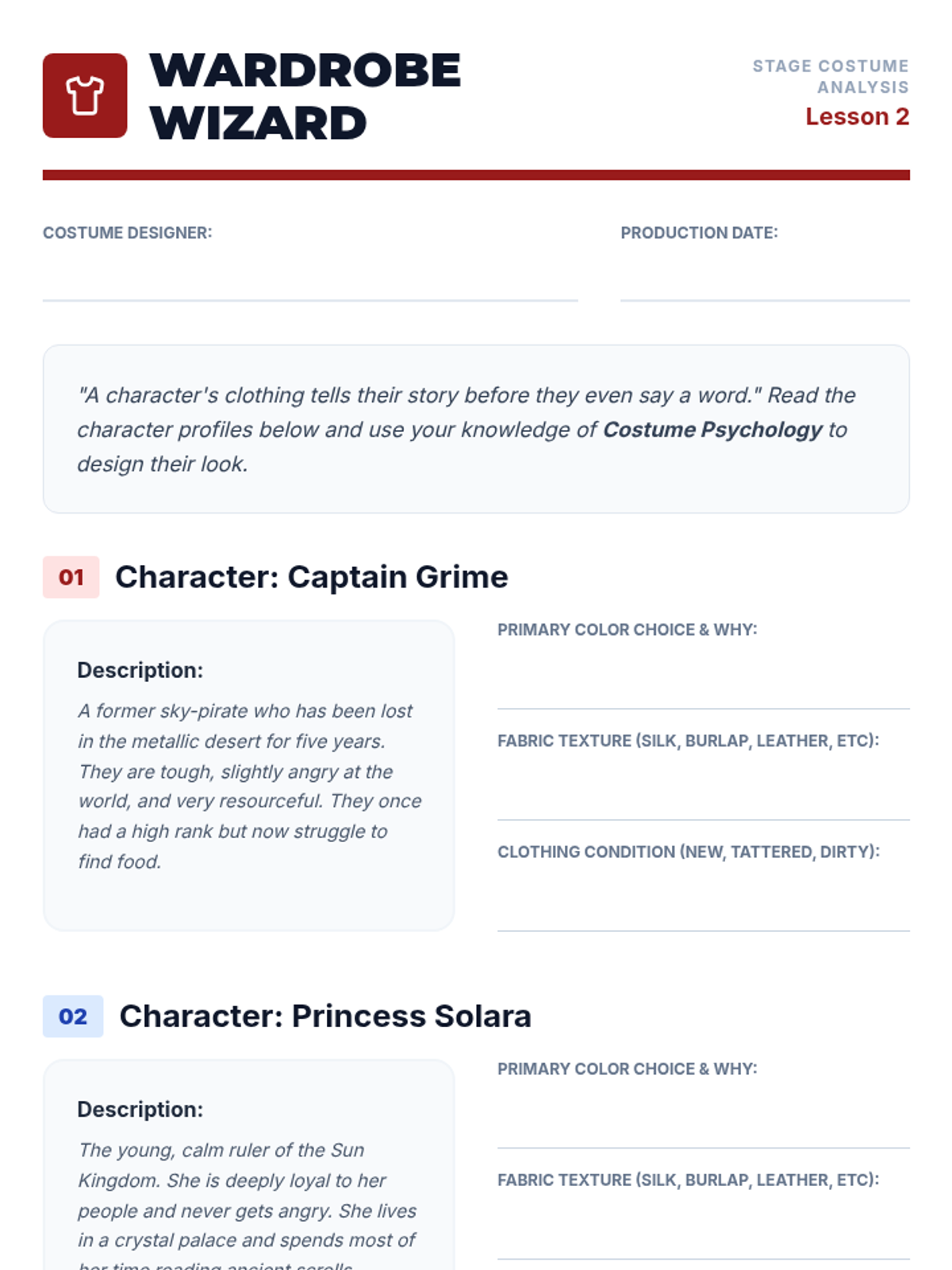
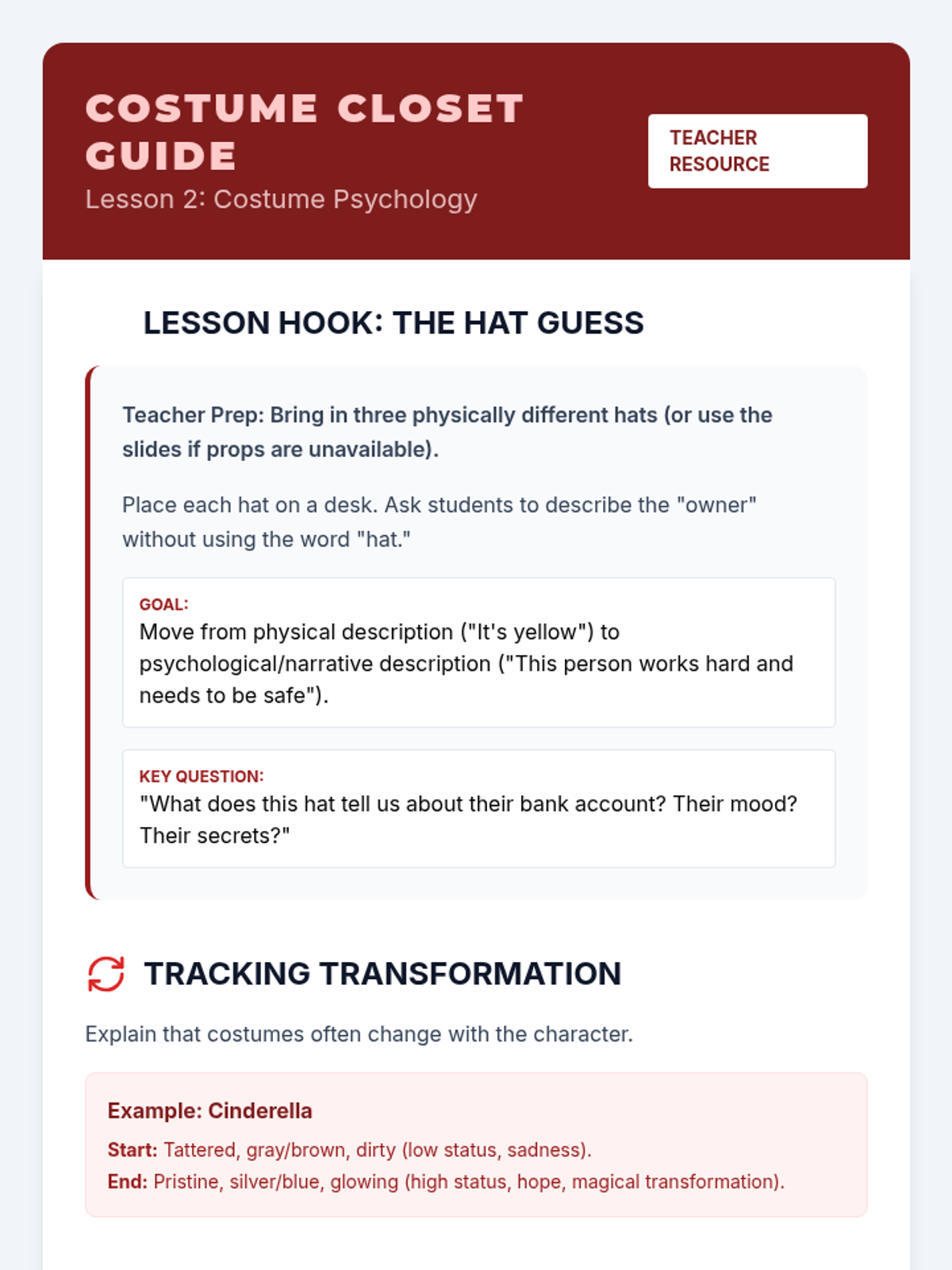
Students explore how color, condition, and fit of clothing communicate character traits. They analyze character descriptions and select fabric swatches or colors that represent the character's personality and status.
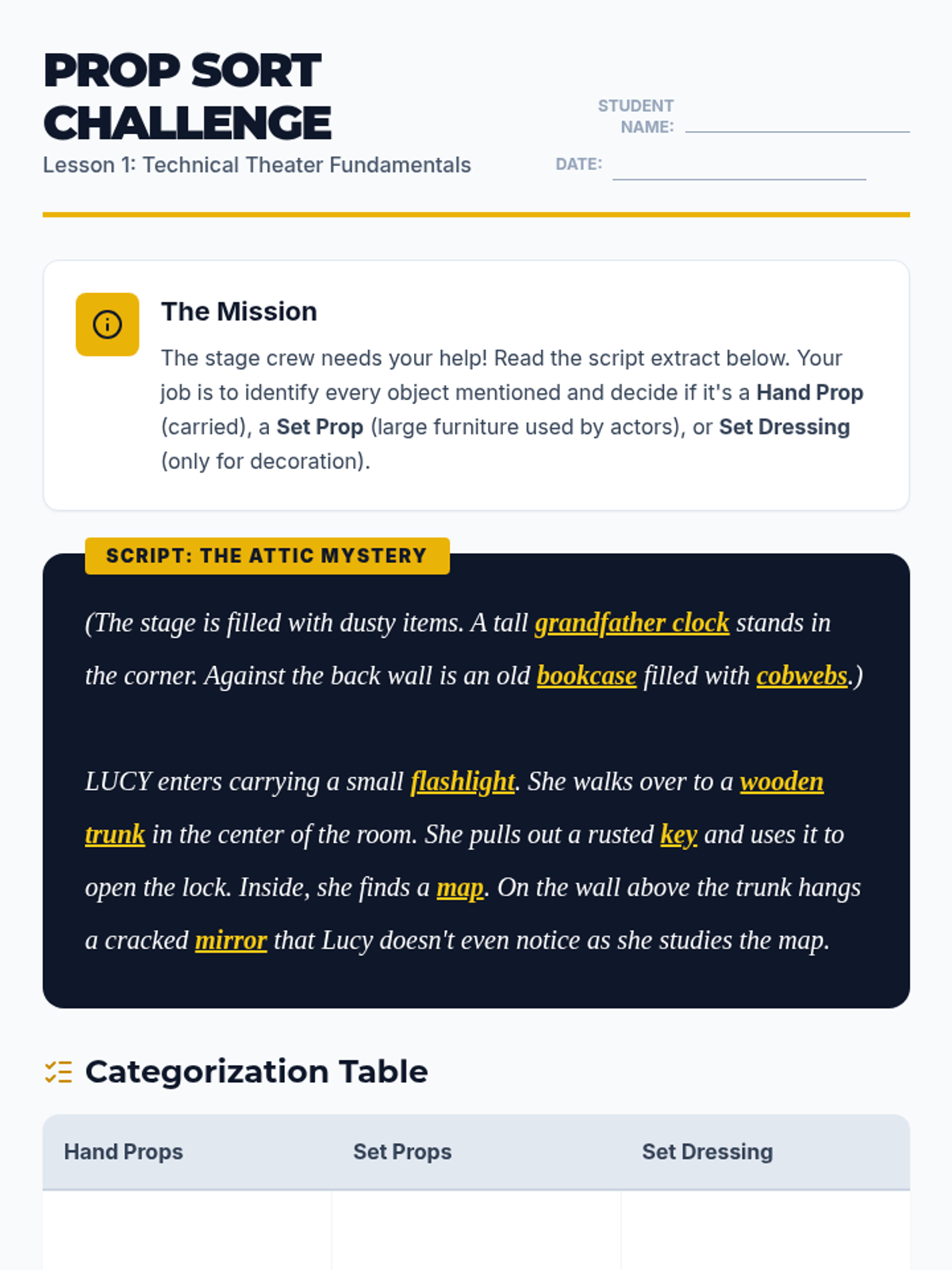
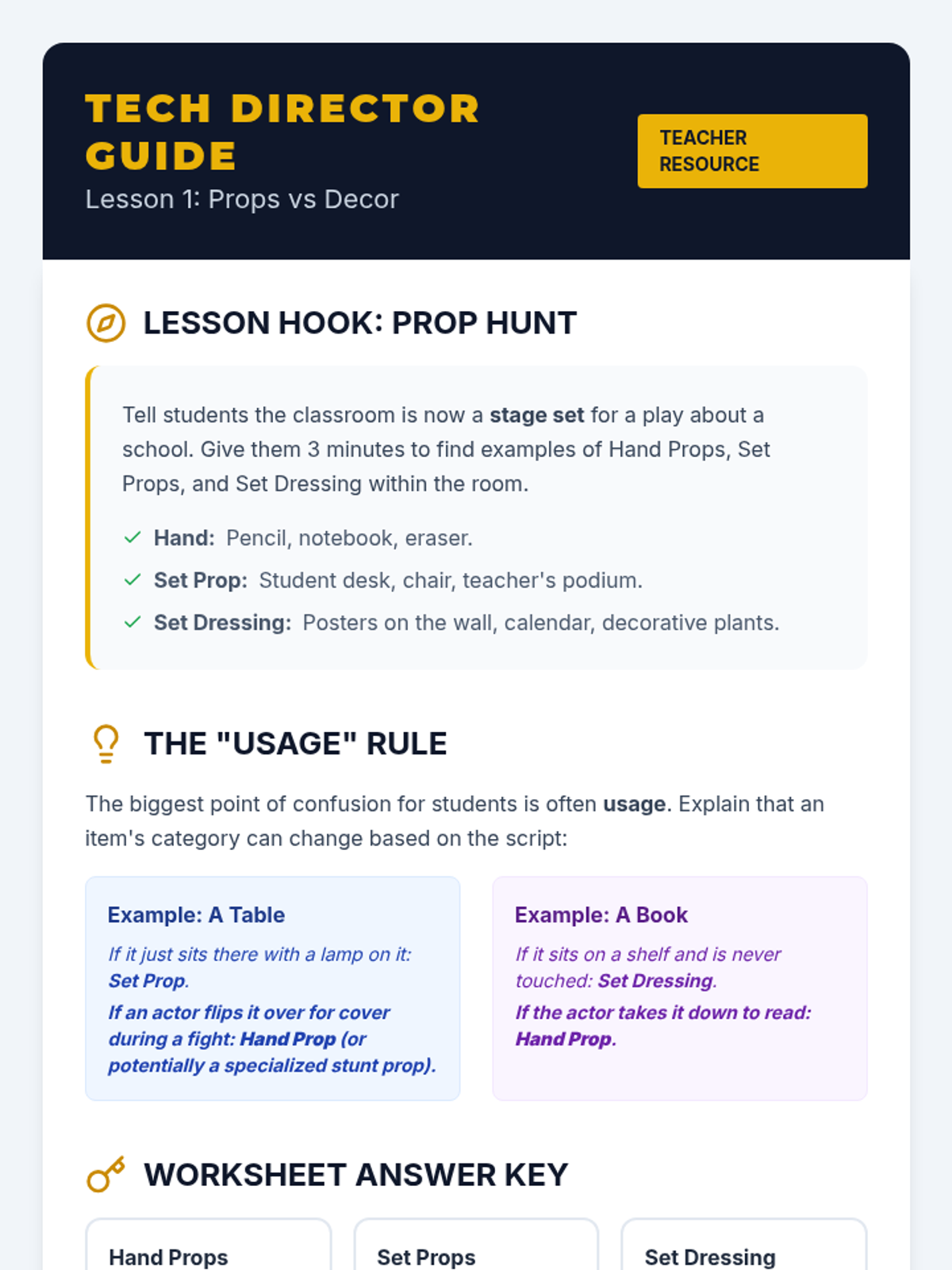
Students learn to categorize items as Hand Props, Set Props, or Set Dressing through sorting activities. They analyze a scene to determine which items are handled by actors versus which items just set the scene.
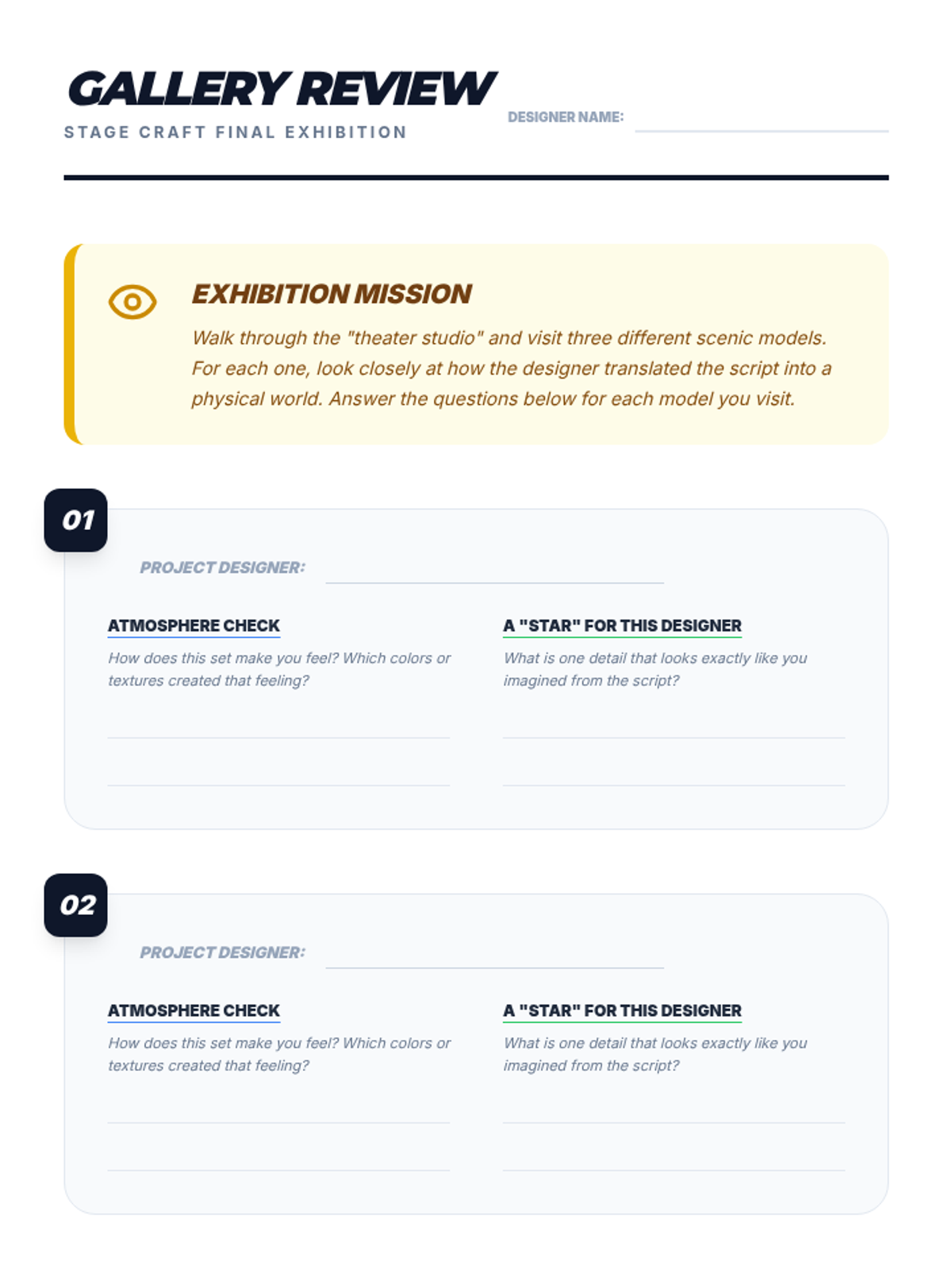
Students complete their models by adding furniture pieces, architectural details, and applying color or texture. The sequence concludes with a gallery walk where students critique how well the designs serve the script.
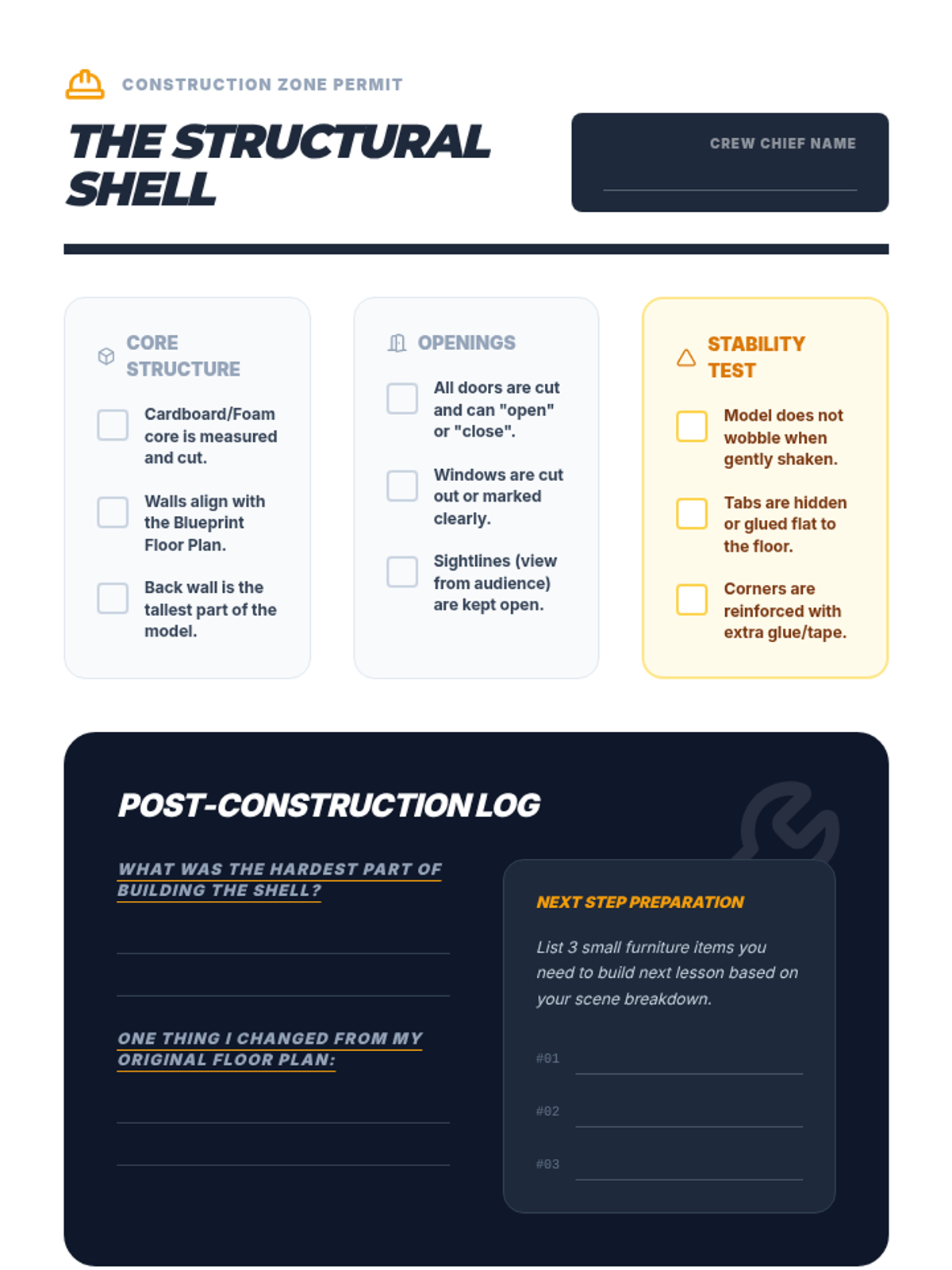
Students begin the hands-on construction of their scale model using cardstock, foam core, or shoeboxes. They build the perimeter walls and floor based on their earlier floor plans.
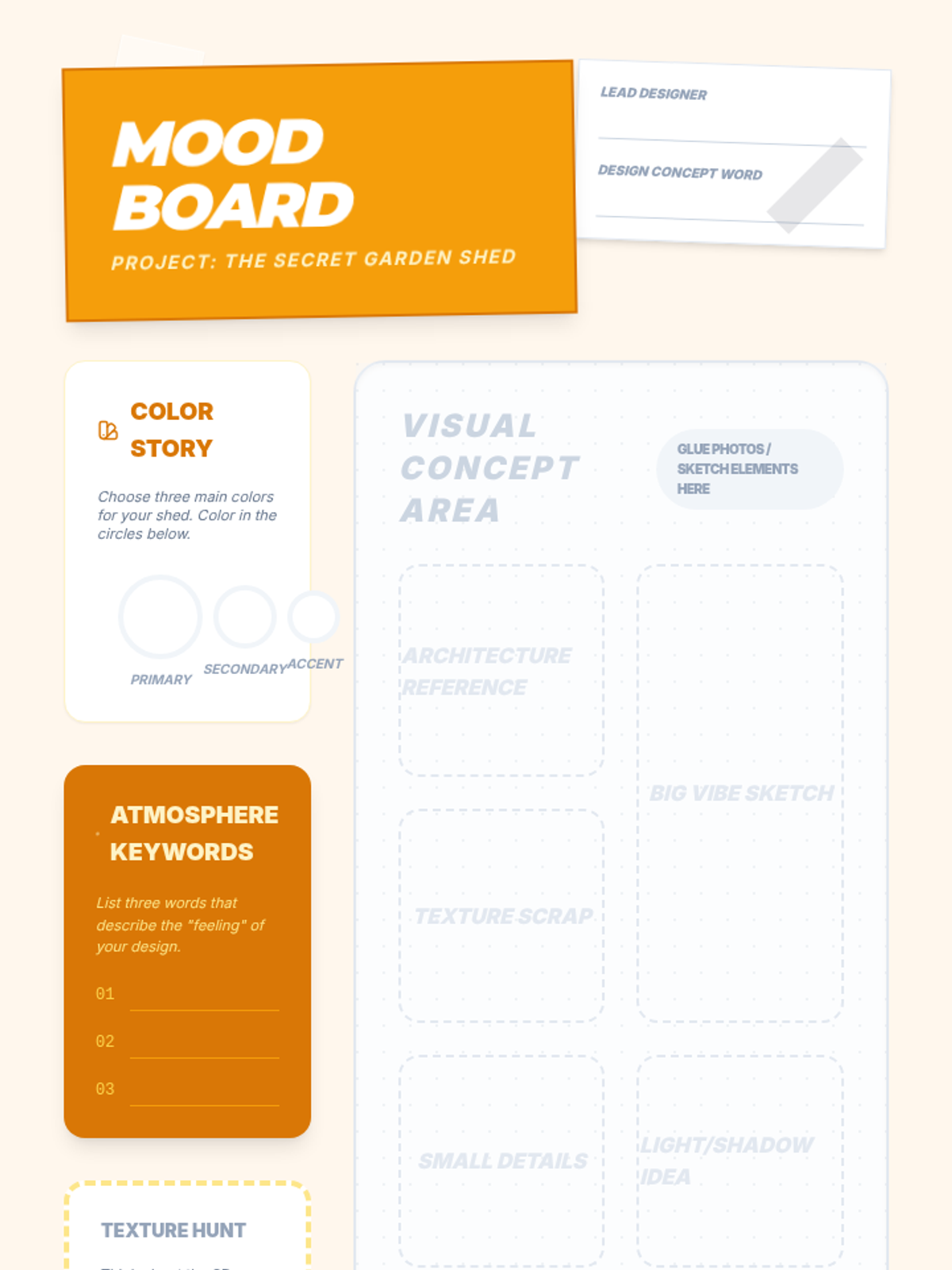
Focusing on the artistic atmosphere, students select color palettes, textures, and reference images that evoke the emotion of the scene. They compile these into a mood board that serves as the aesthetic guide for their final model.
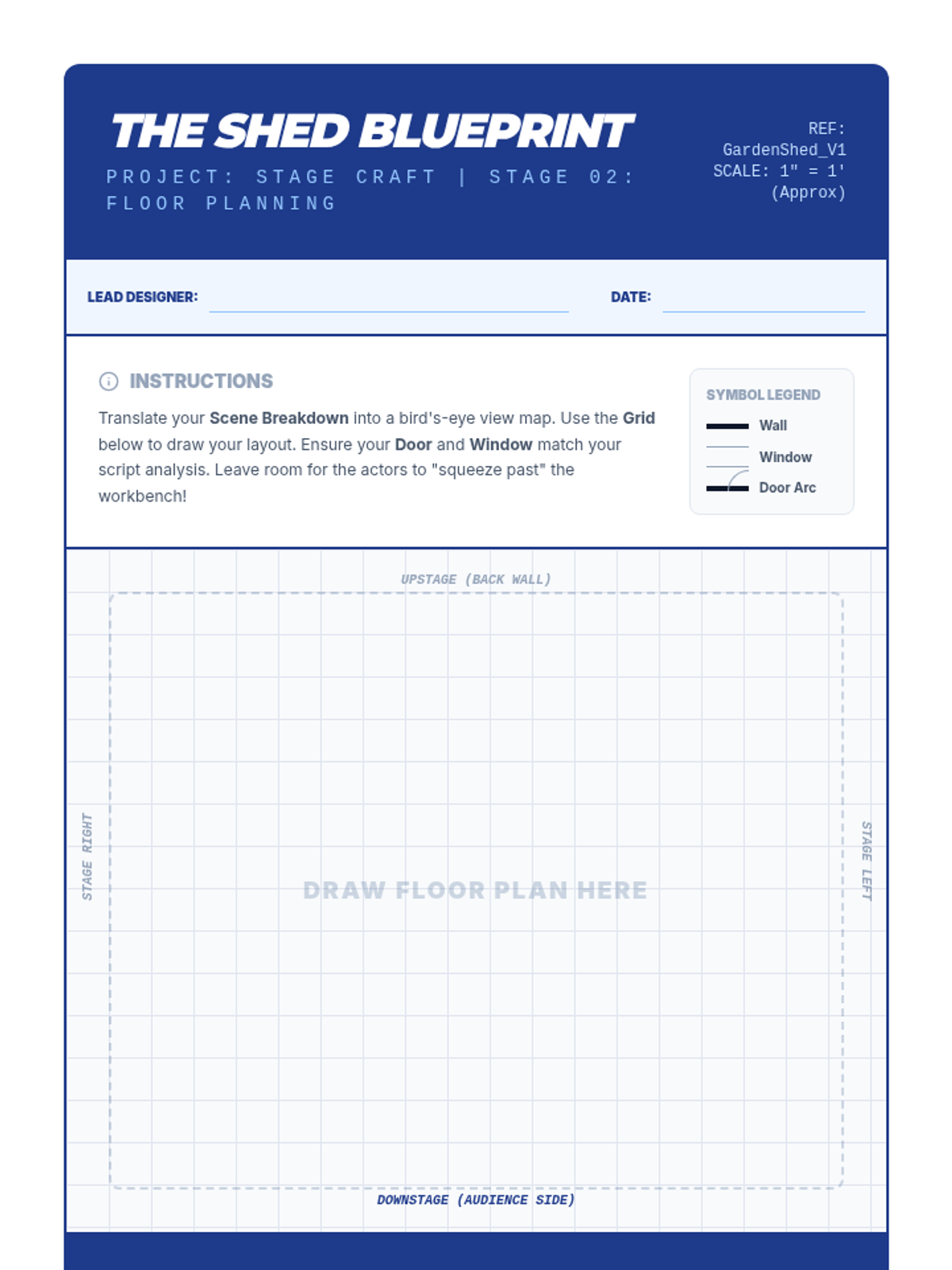
Students learn to translate their scene breakdown into a bird's-eye view floor plan, focusing on placement of furniture and walls to ensure actors have room to move and sightlines remain clear.
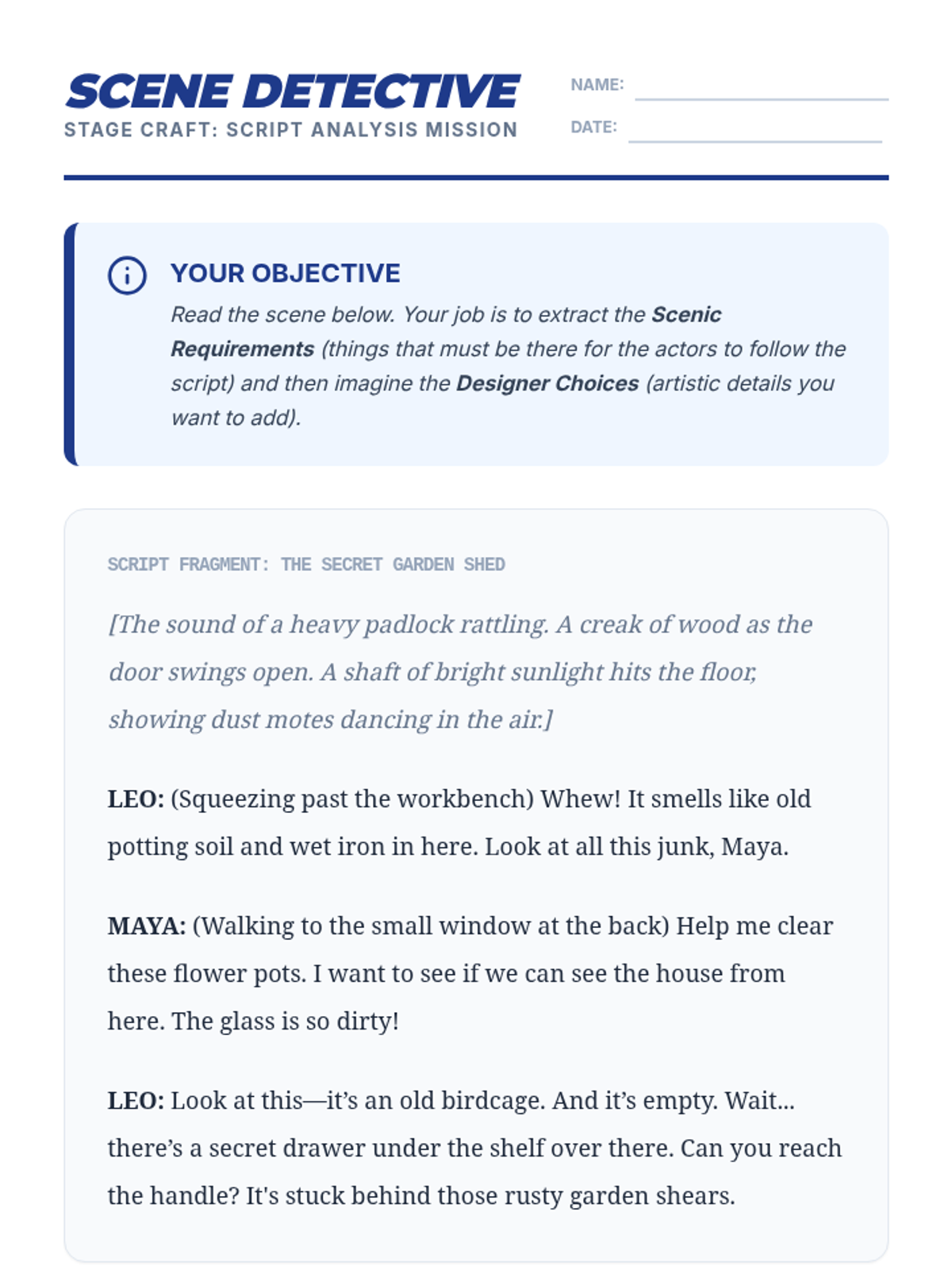
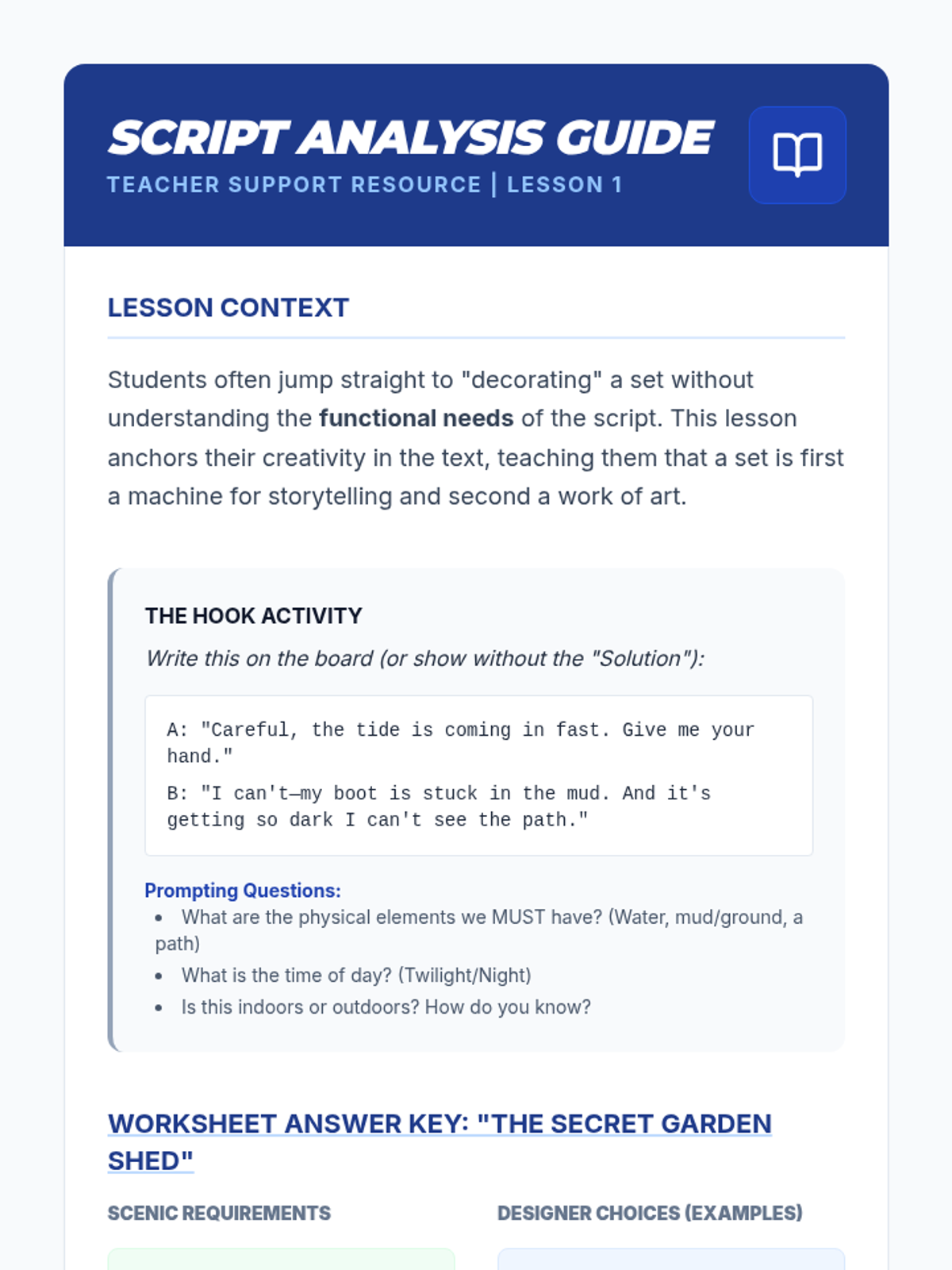
Students read a short scene to identify specific scenic needs, such as entrances, exits, furniture, and time period clues. They create a 'scene breakdown' list that categorizes these necessary elements versus artistic possibilities.
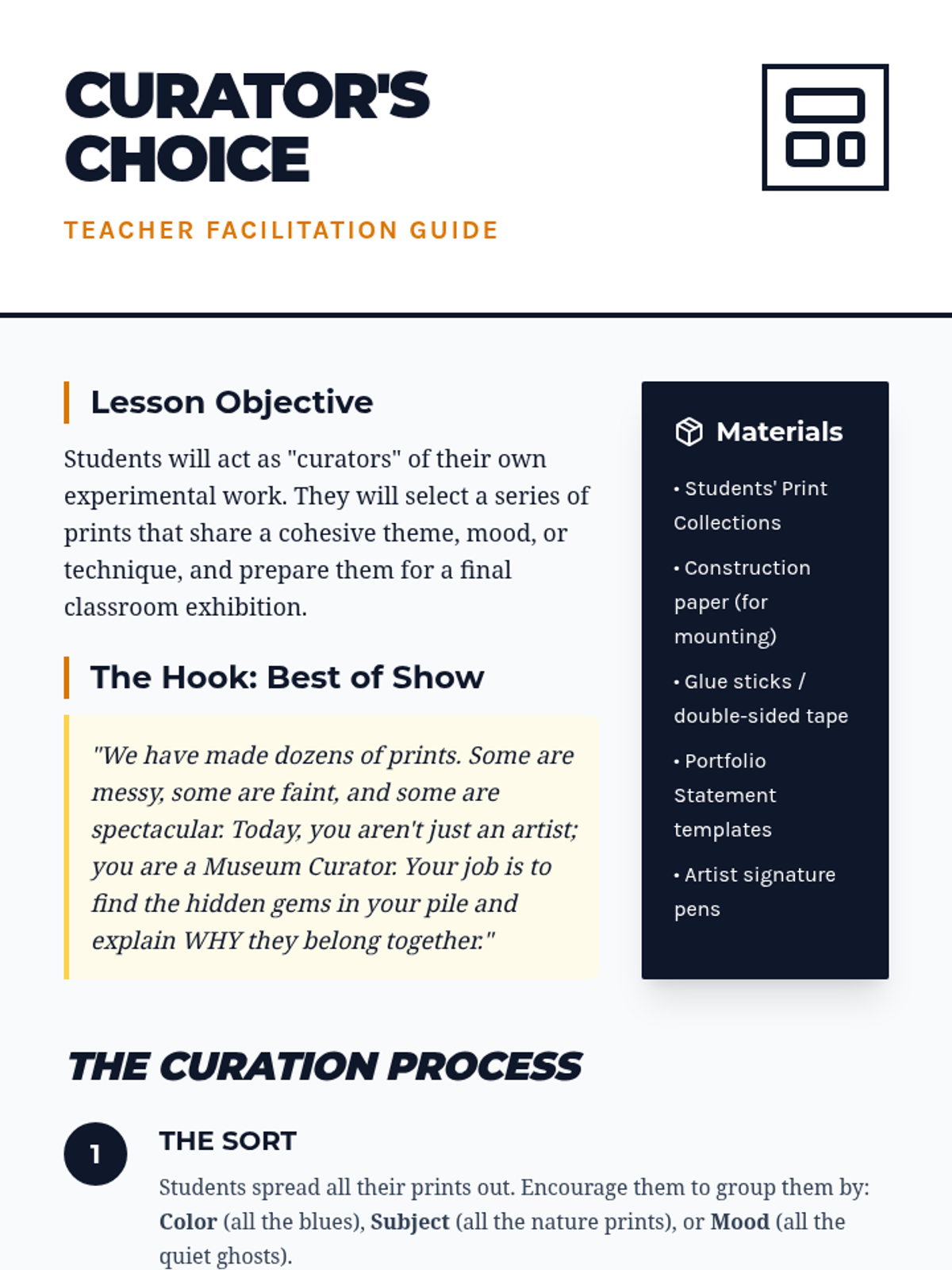
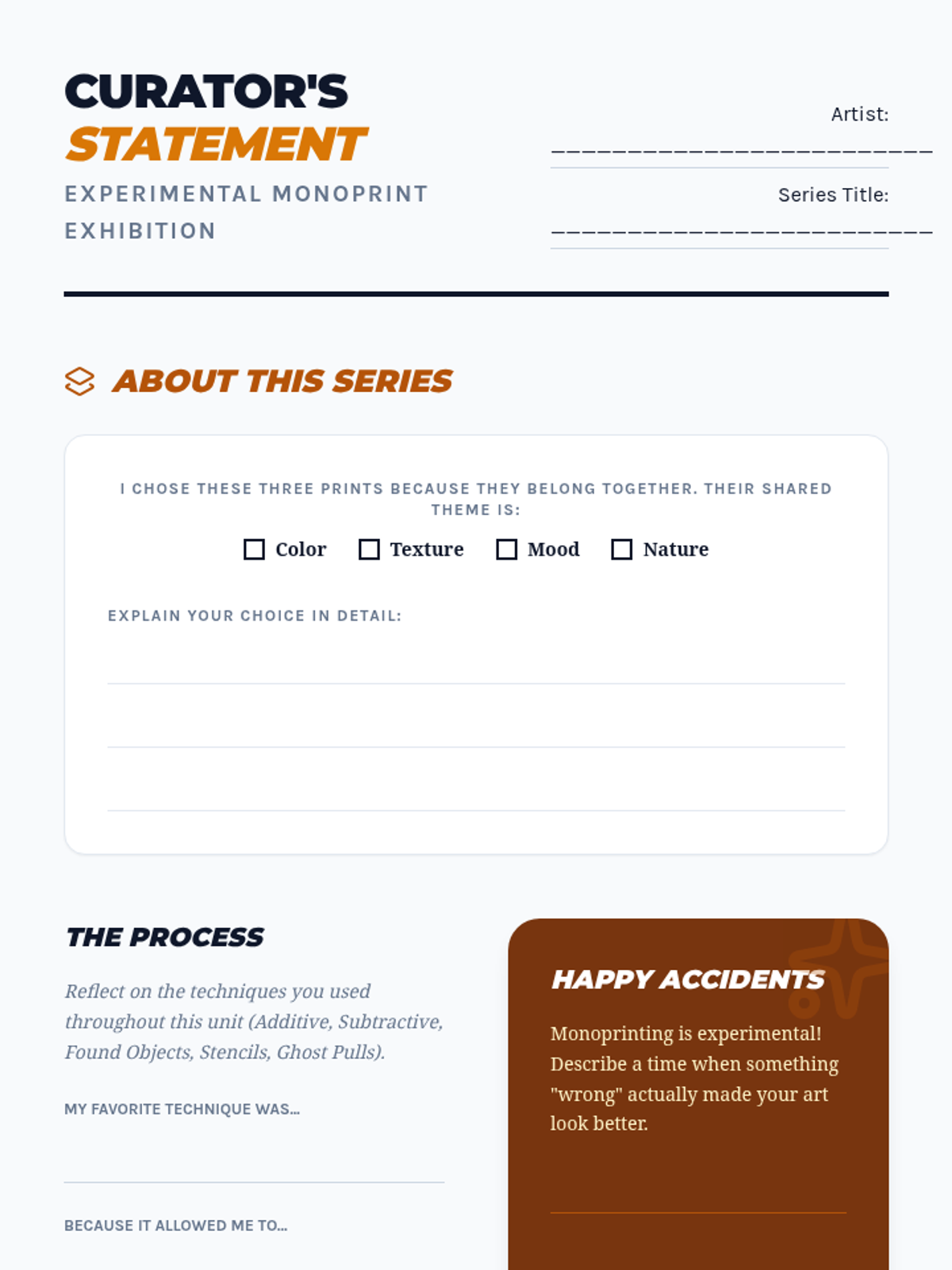
Students curate their experimental prints and select a cohesive series. They add finishing touches with drawing materials and write a brief curator's statement about their process.
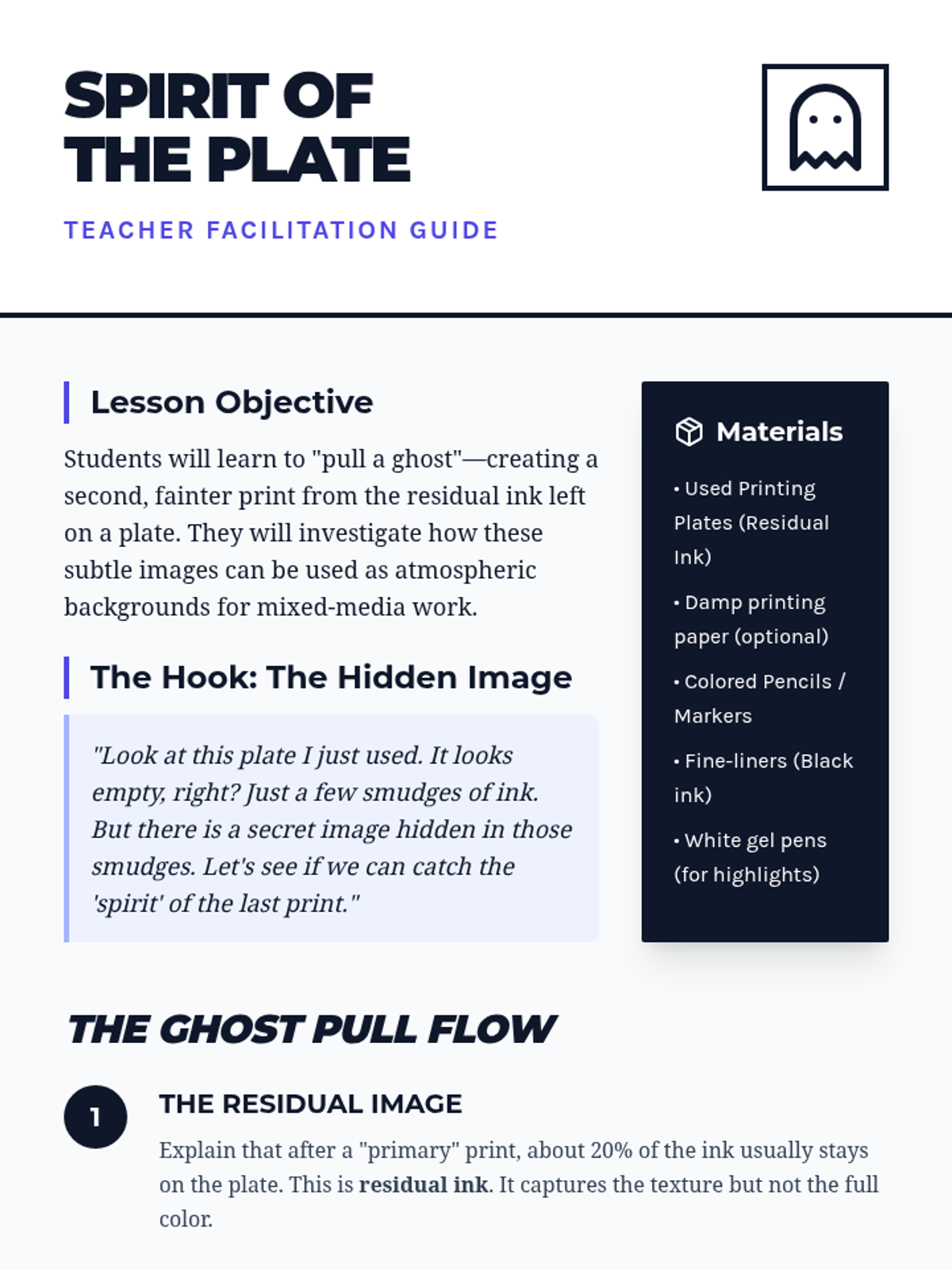
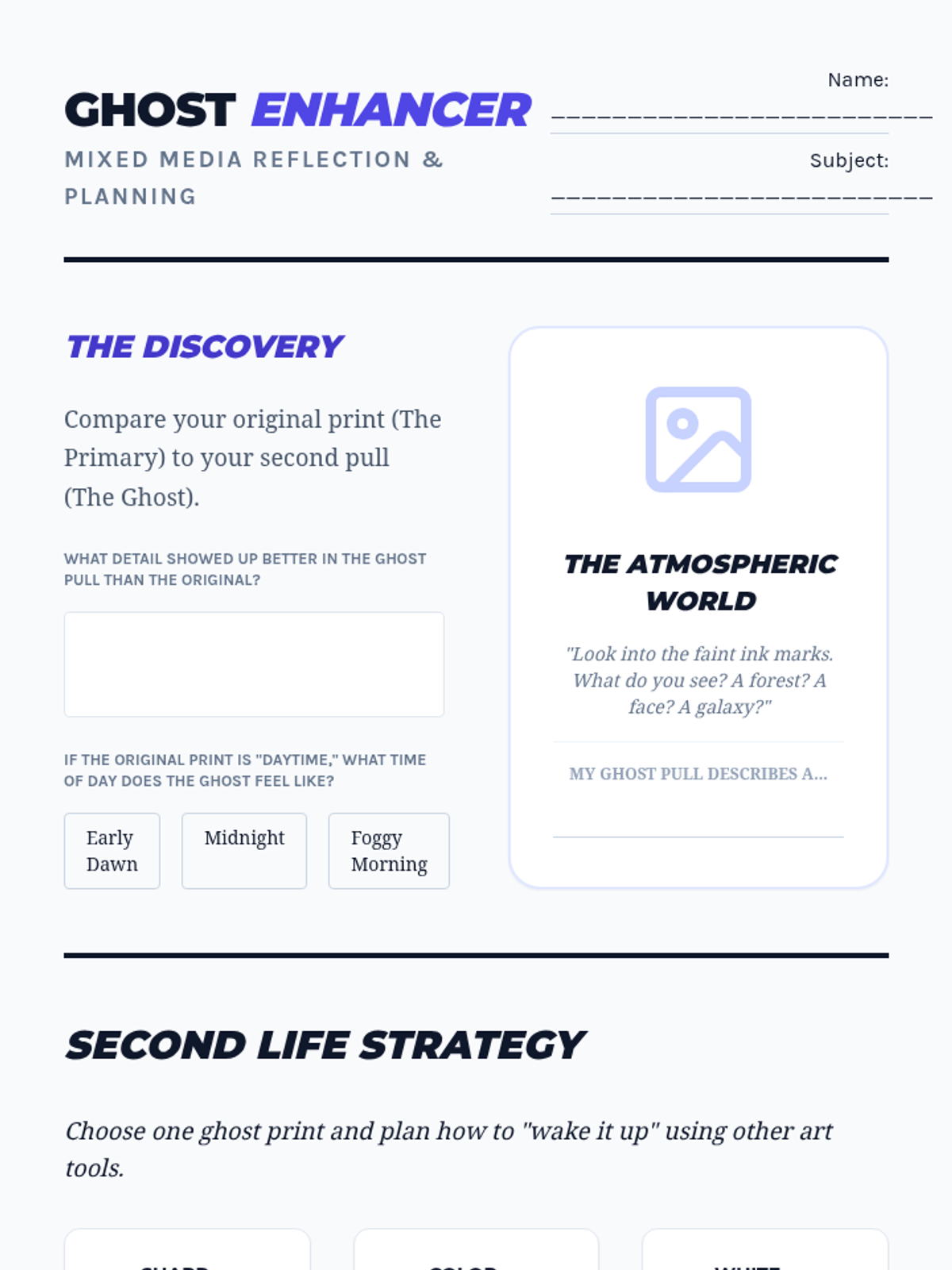
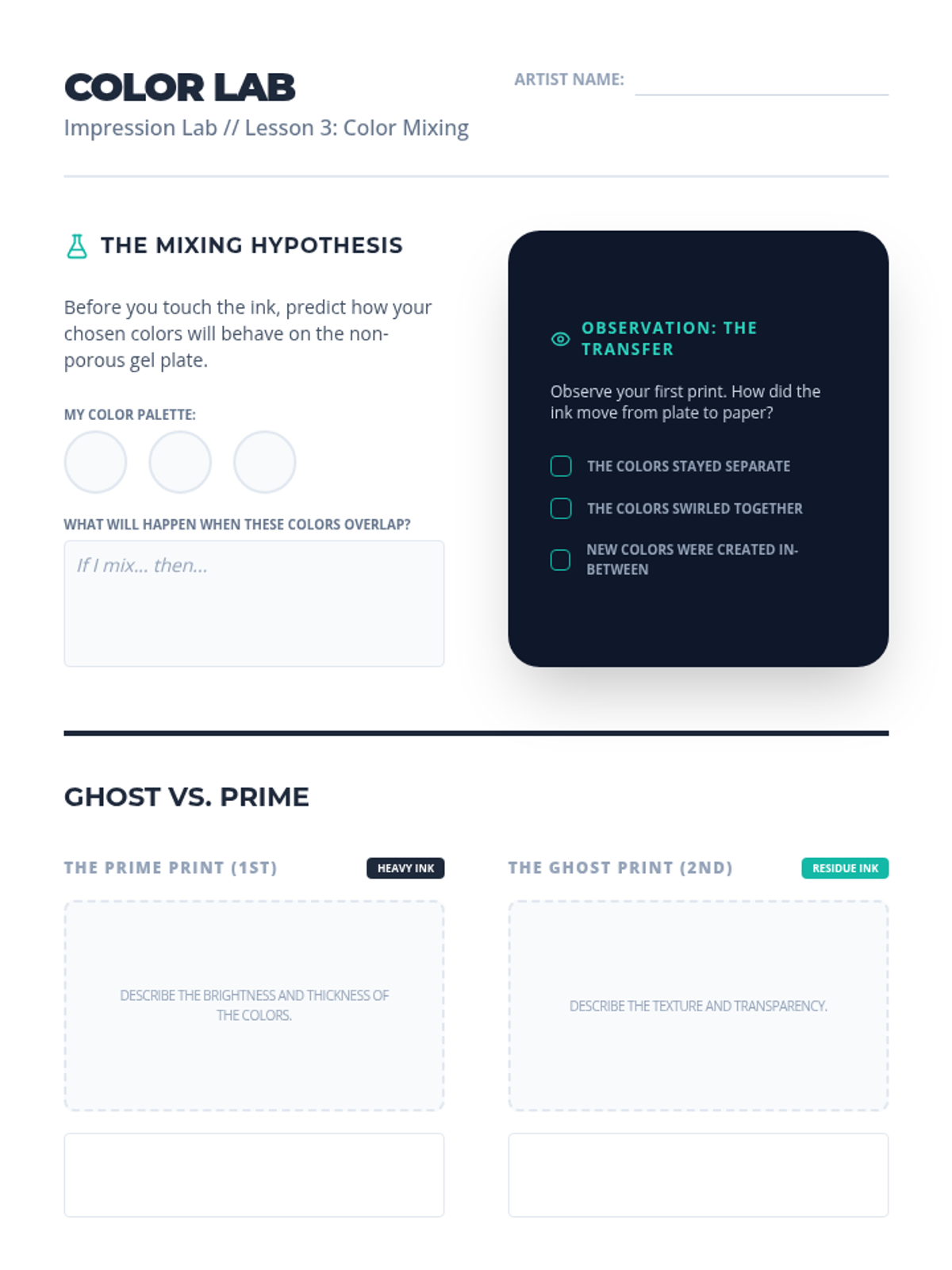
Students explore the concept of residual ink by pulling 'ghost prints'. They investigate how faint images can serve as backgrounds for further artistic development.
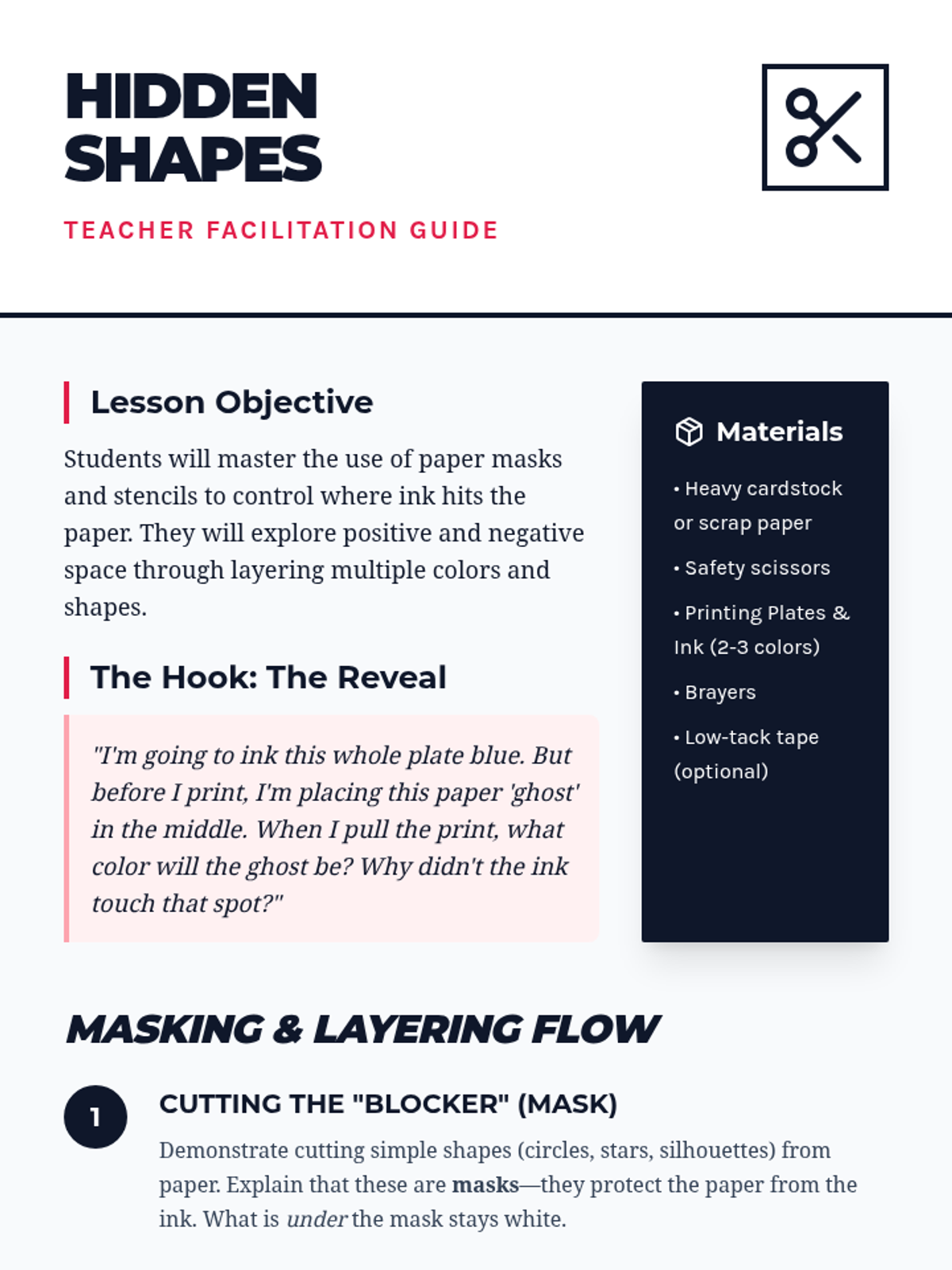
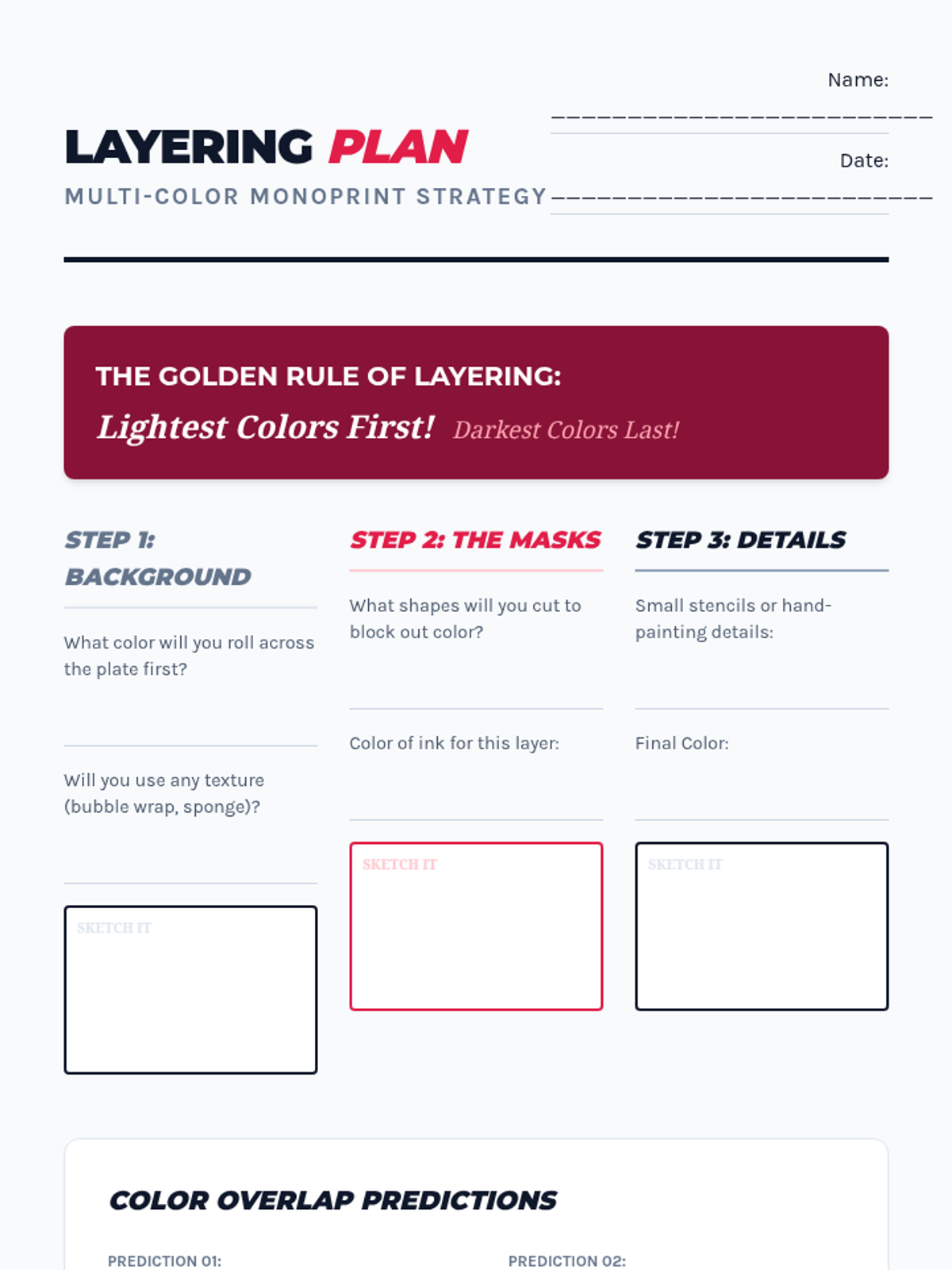
Students create paper masks to block areas of the plate, exploring positive and negative space. They learn to layer colors and preserve white space in their compositions.
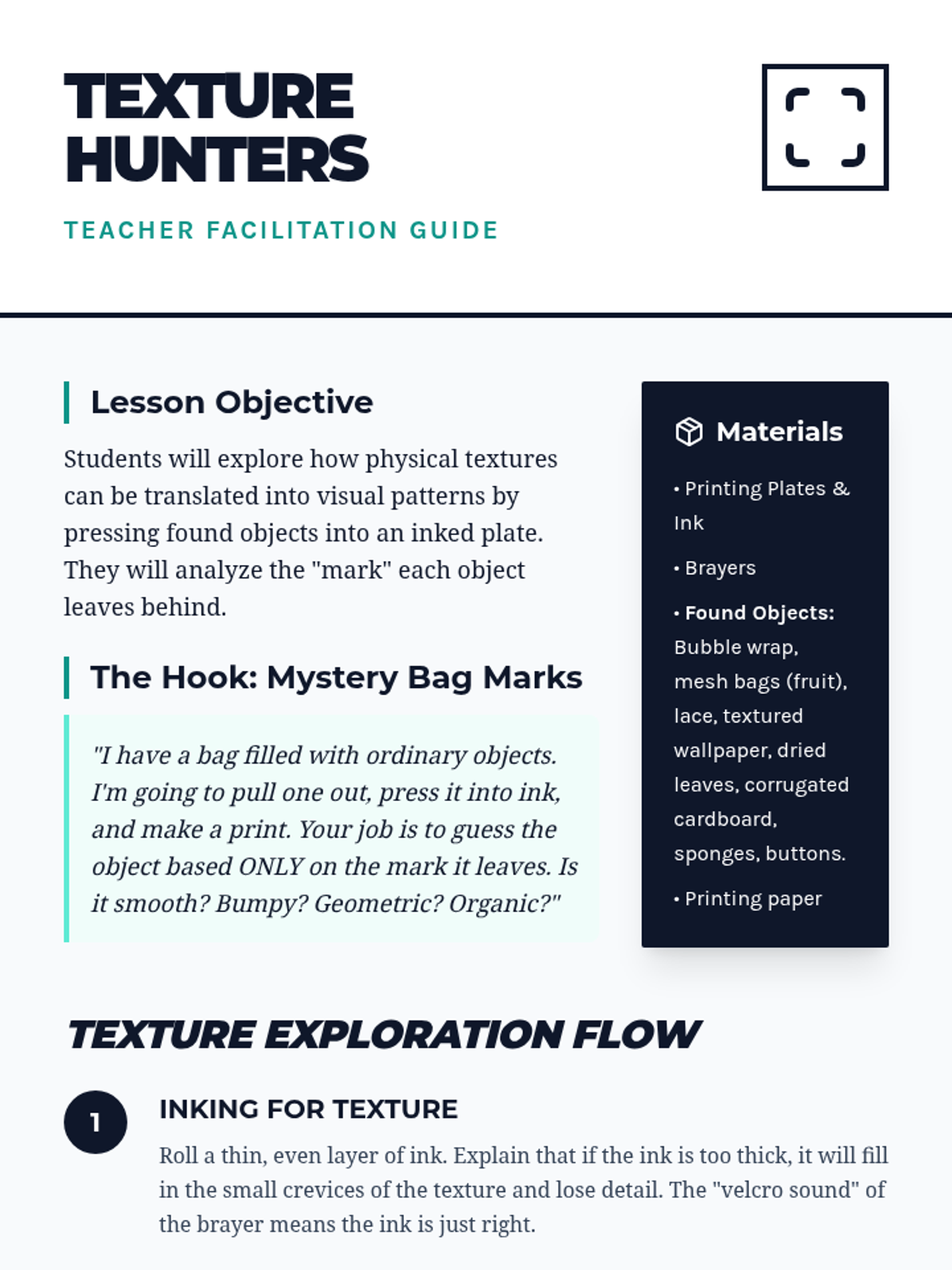
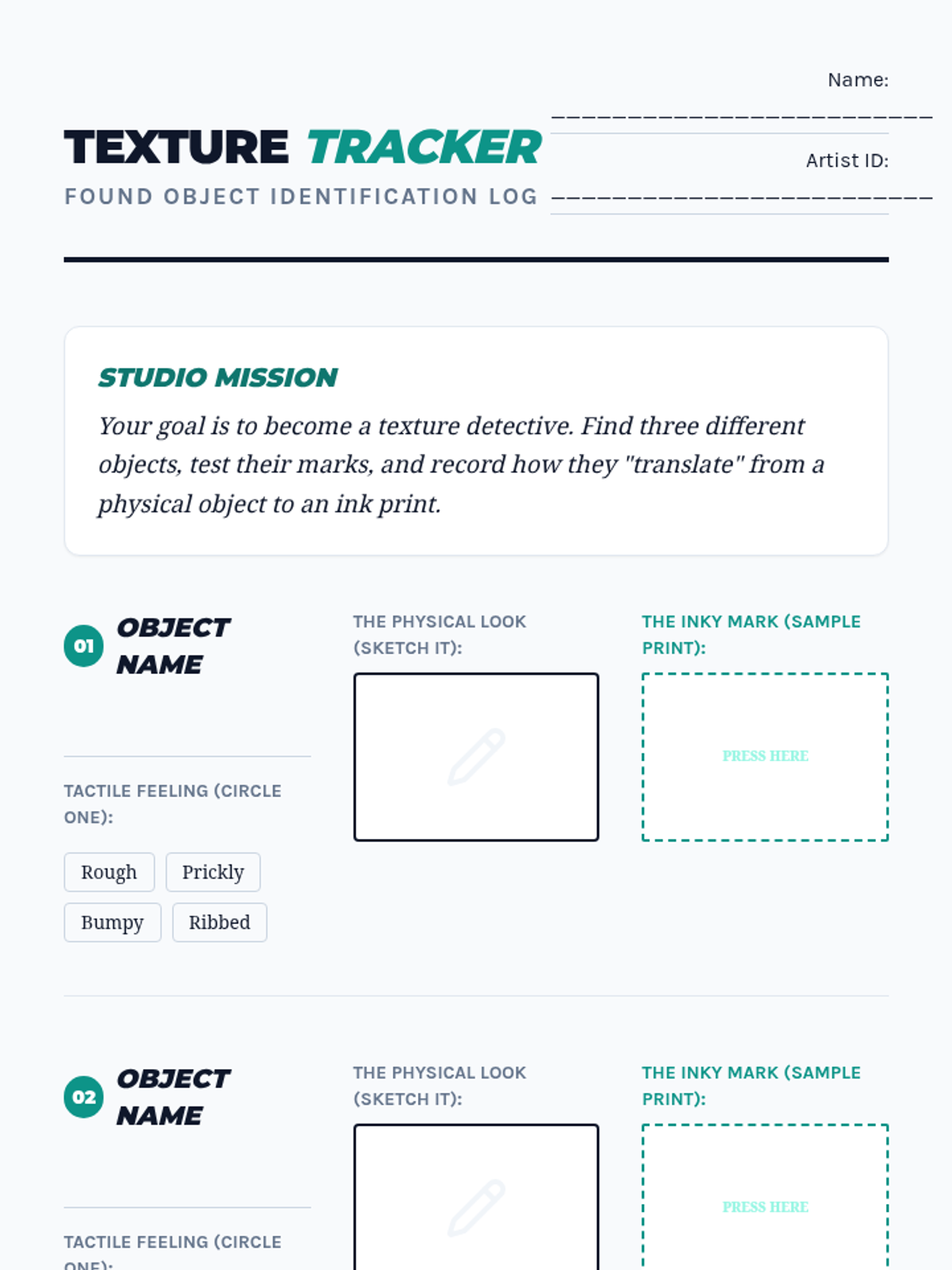
Students use textured materials like bubble wrap and lace to transfer patterns. They analyze how different materials leave distinct visual imprints on the printing plate.
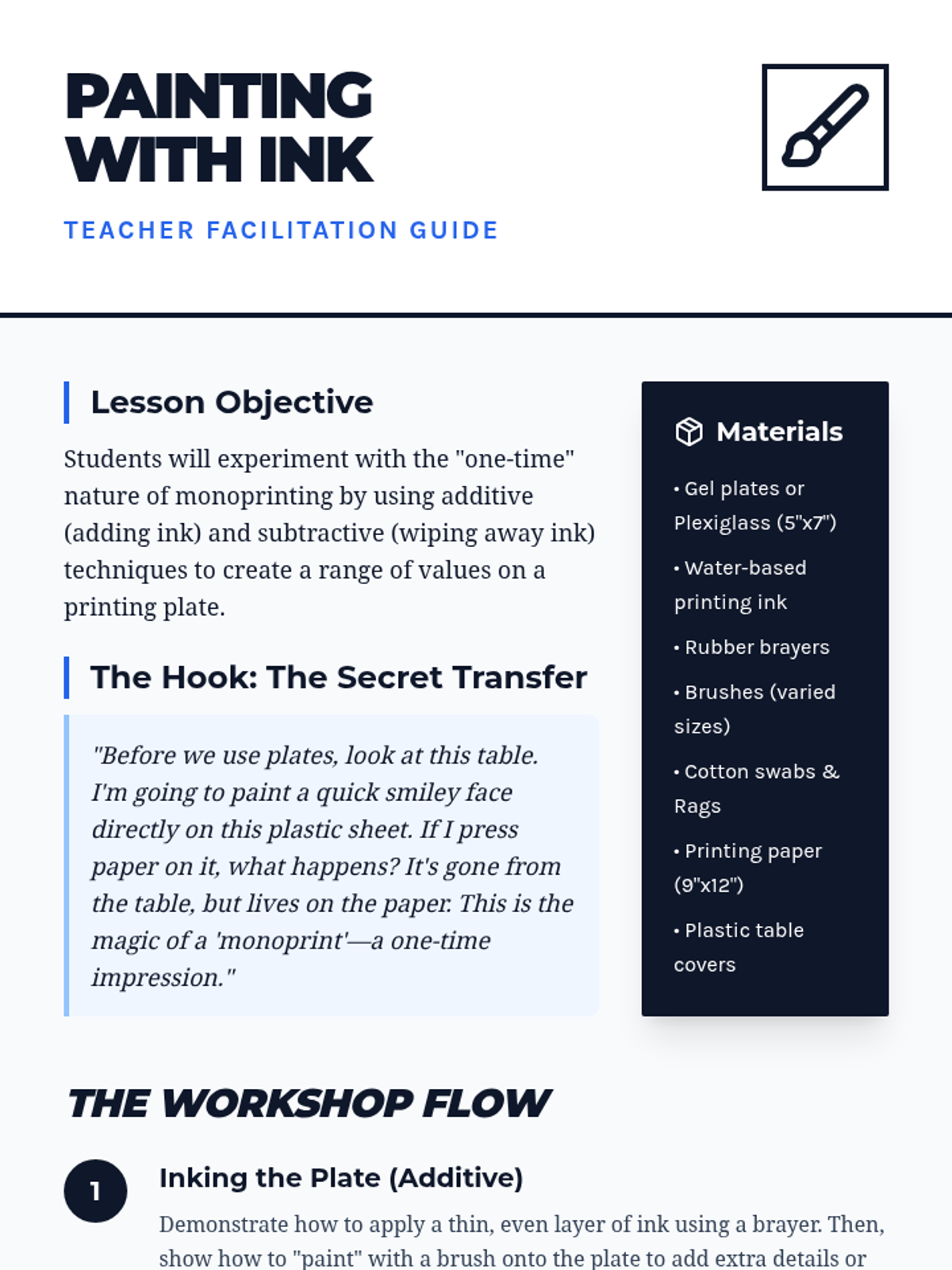
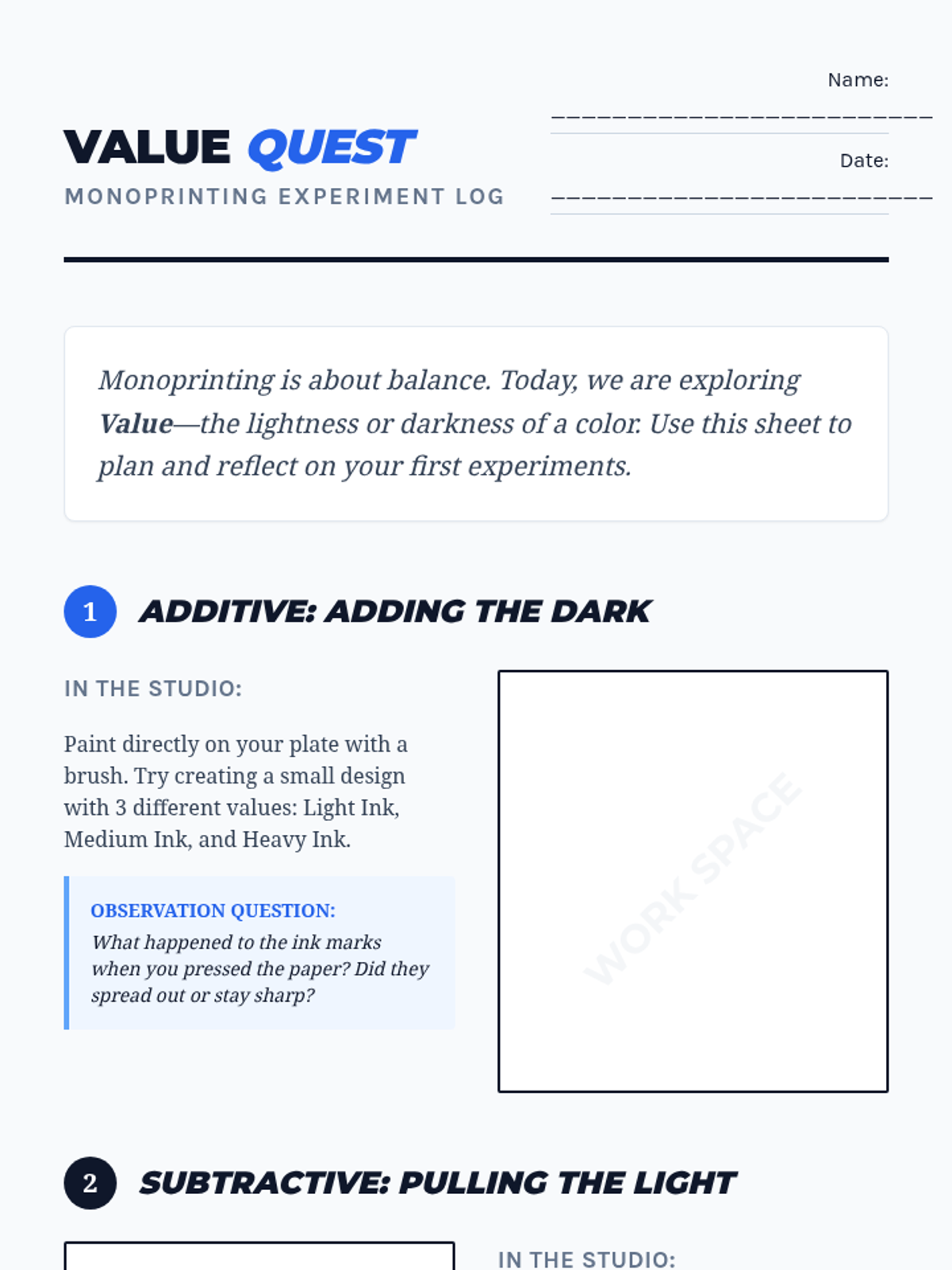
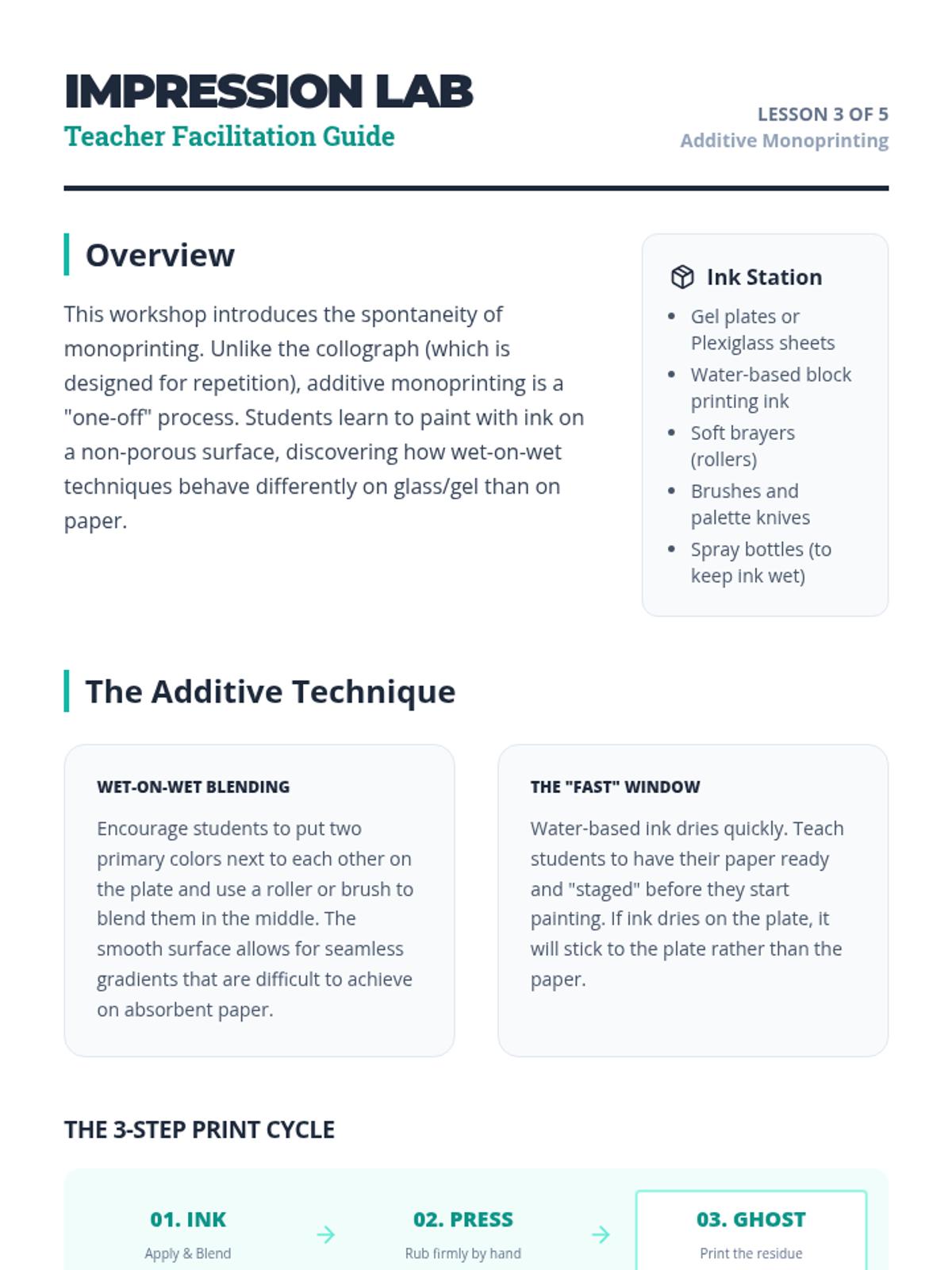
Students explore the printing plate as a surface for painting and wiping away ink. They learn additive and subtractive techniques to create light and dark values in a 'one-time' print.
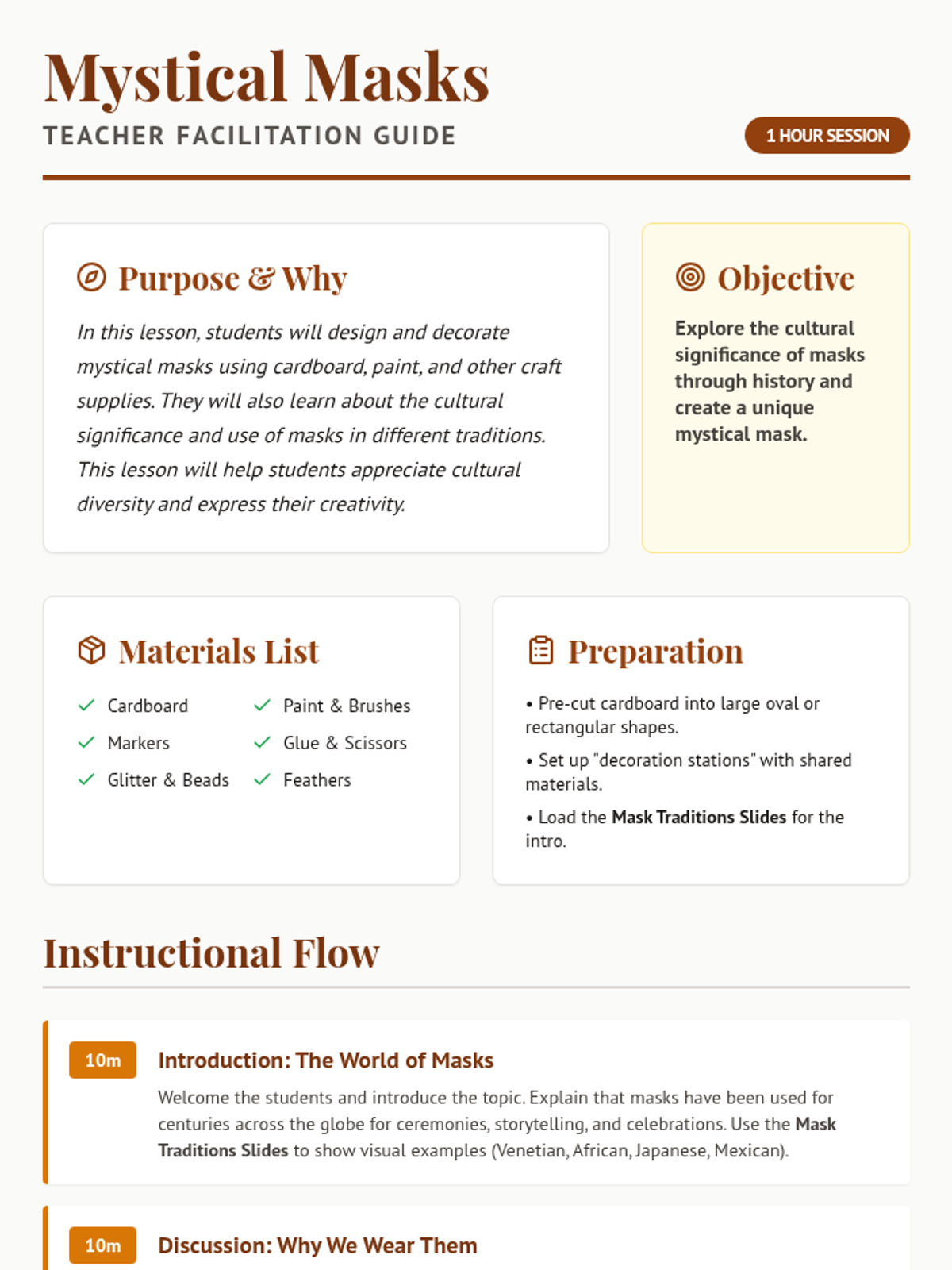
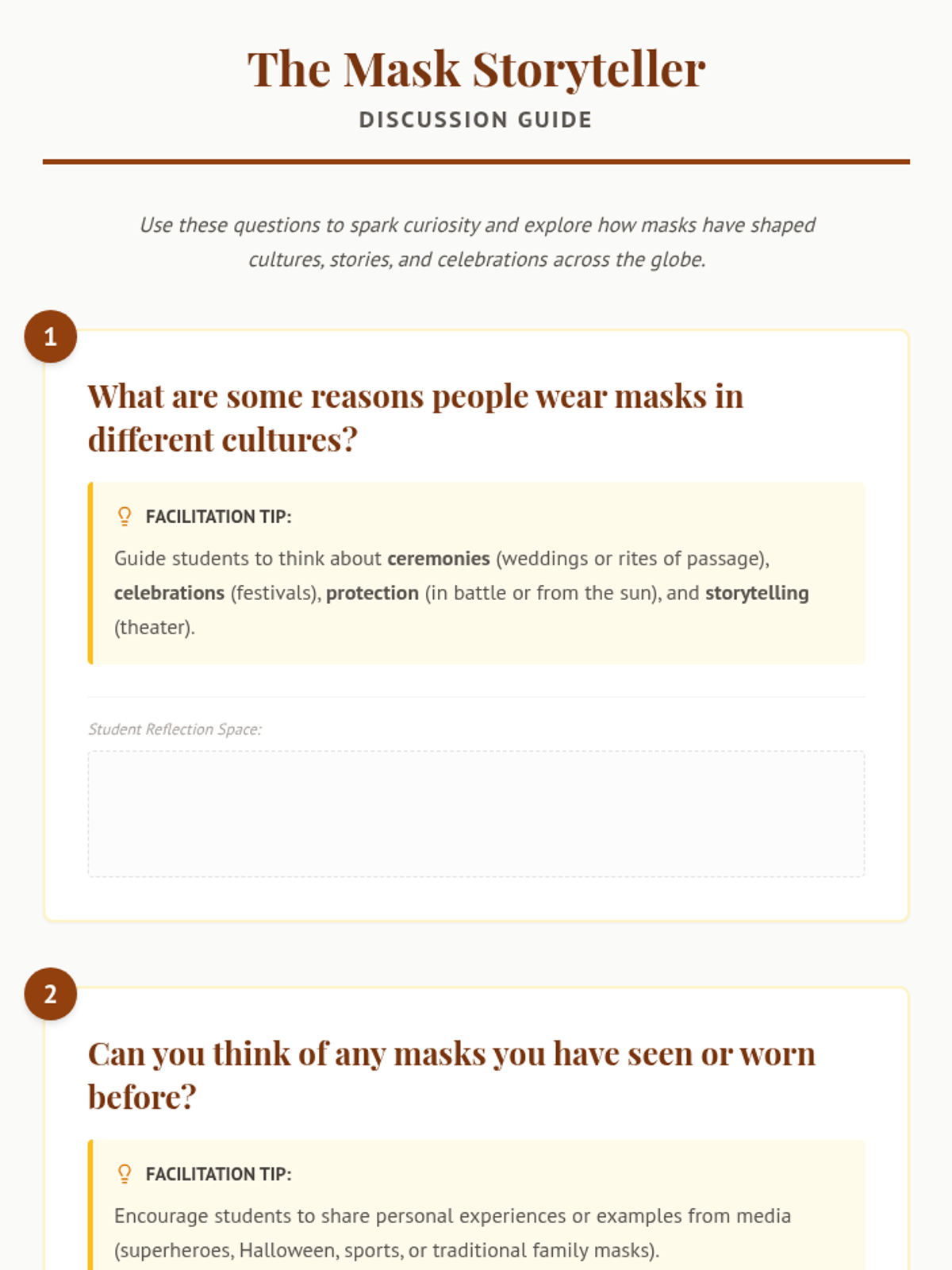
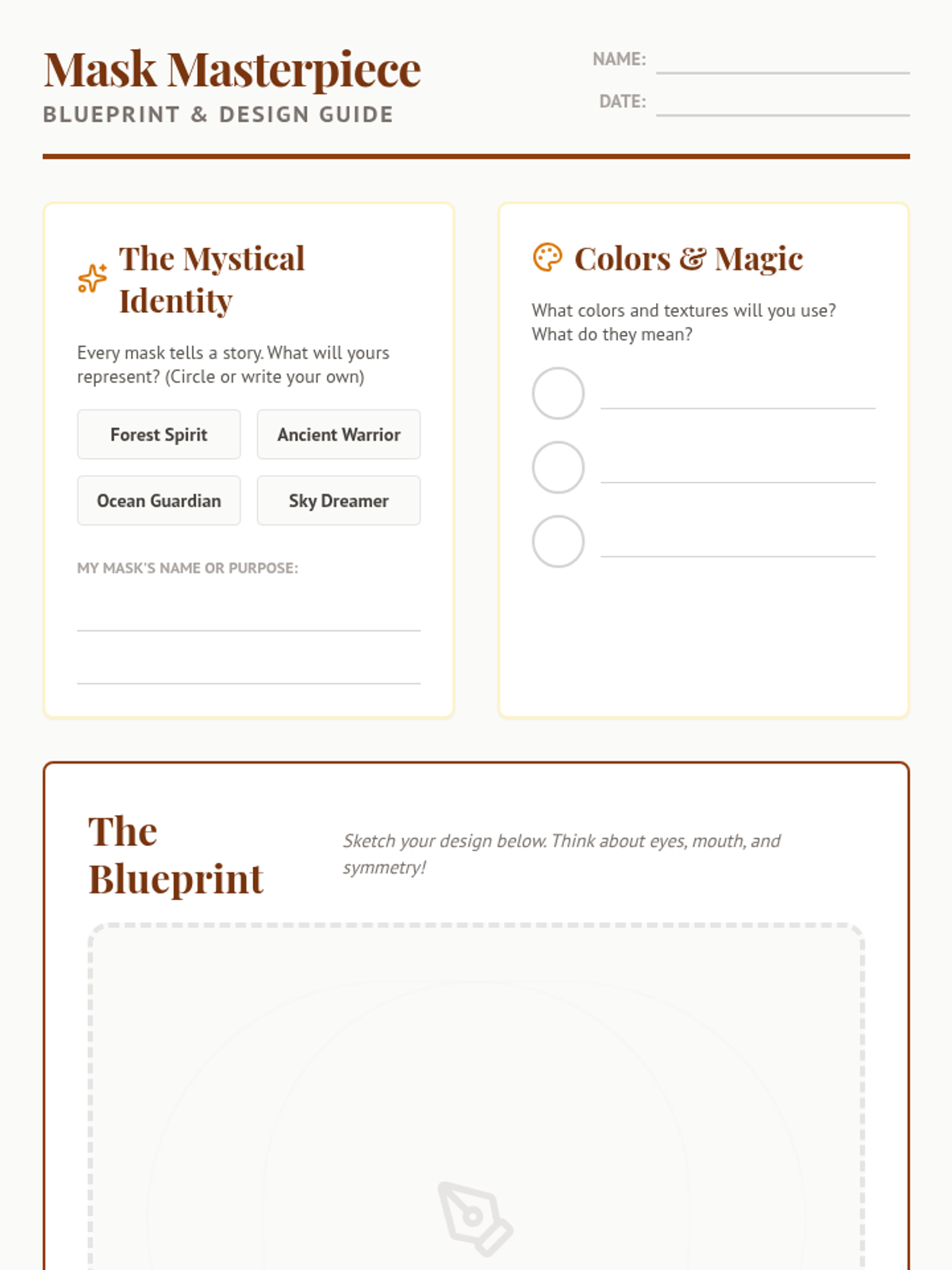
Students explore the cultural significance of masks from around the world and design their own mystical masks using cardboard and craft supplies.
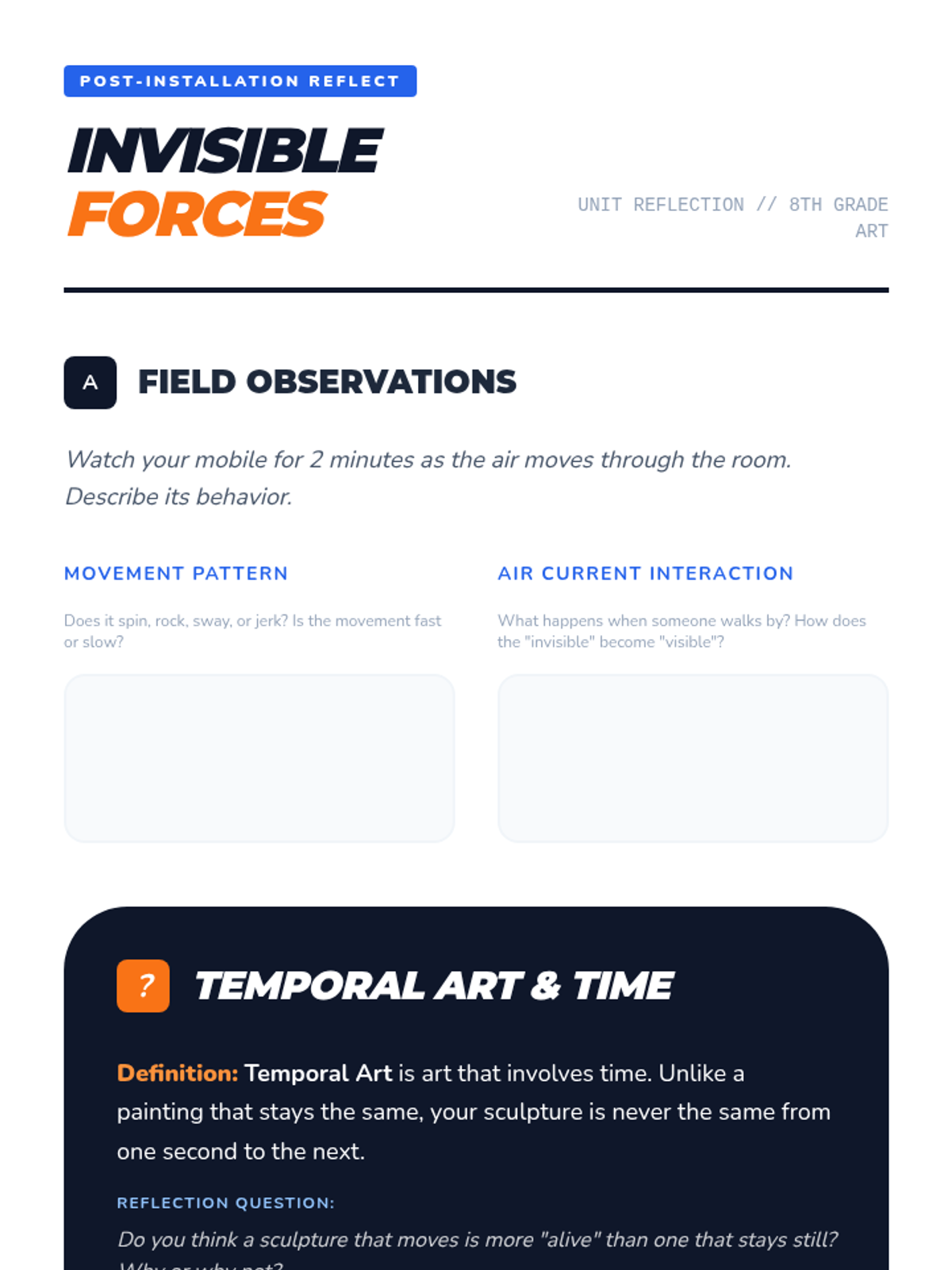
Students install their sculptures and observe how air currents interact with their work, reflecting on the concept of temporal art.
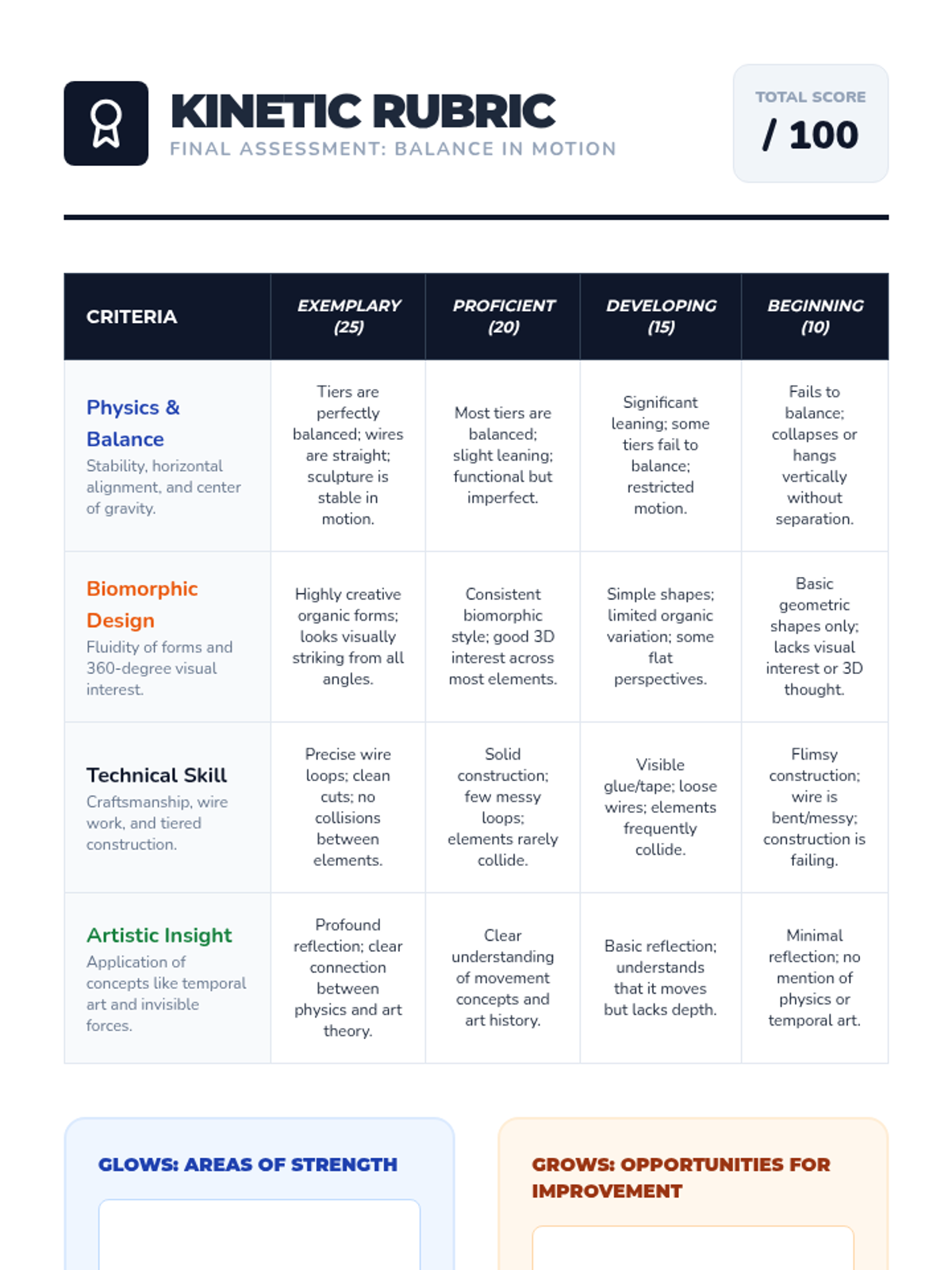
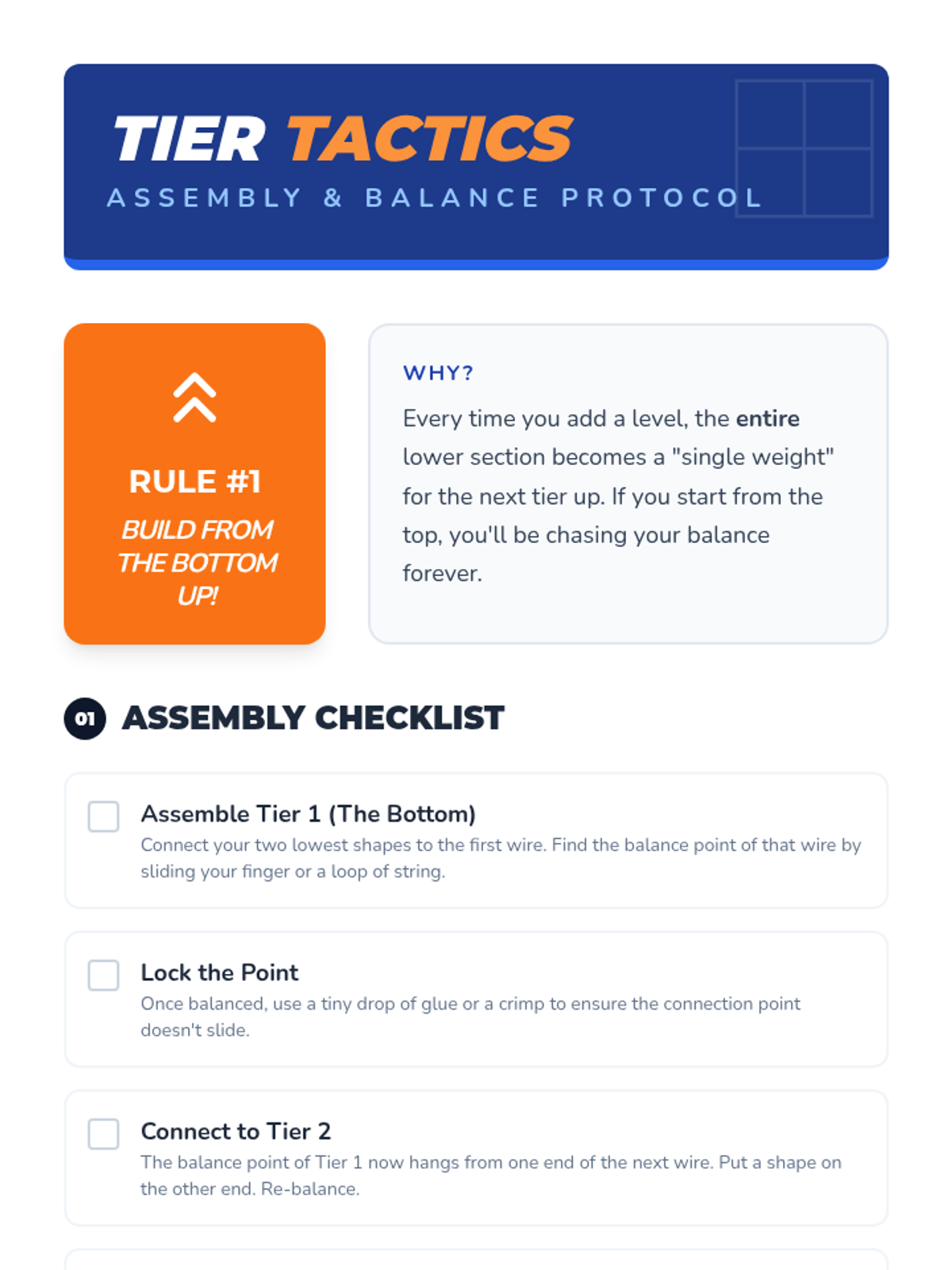
A workshop-style lesson focusing on the bottom-up assembly of multi-tiered mobiles and the iterative process of balancing.
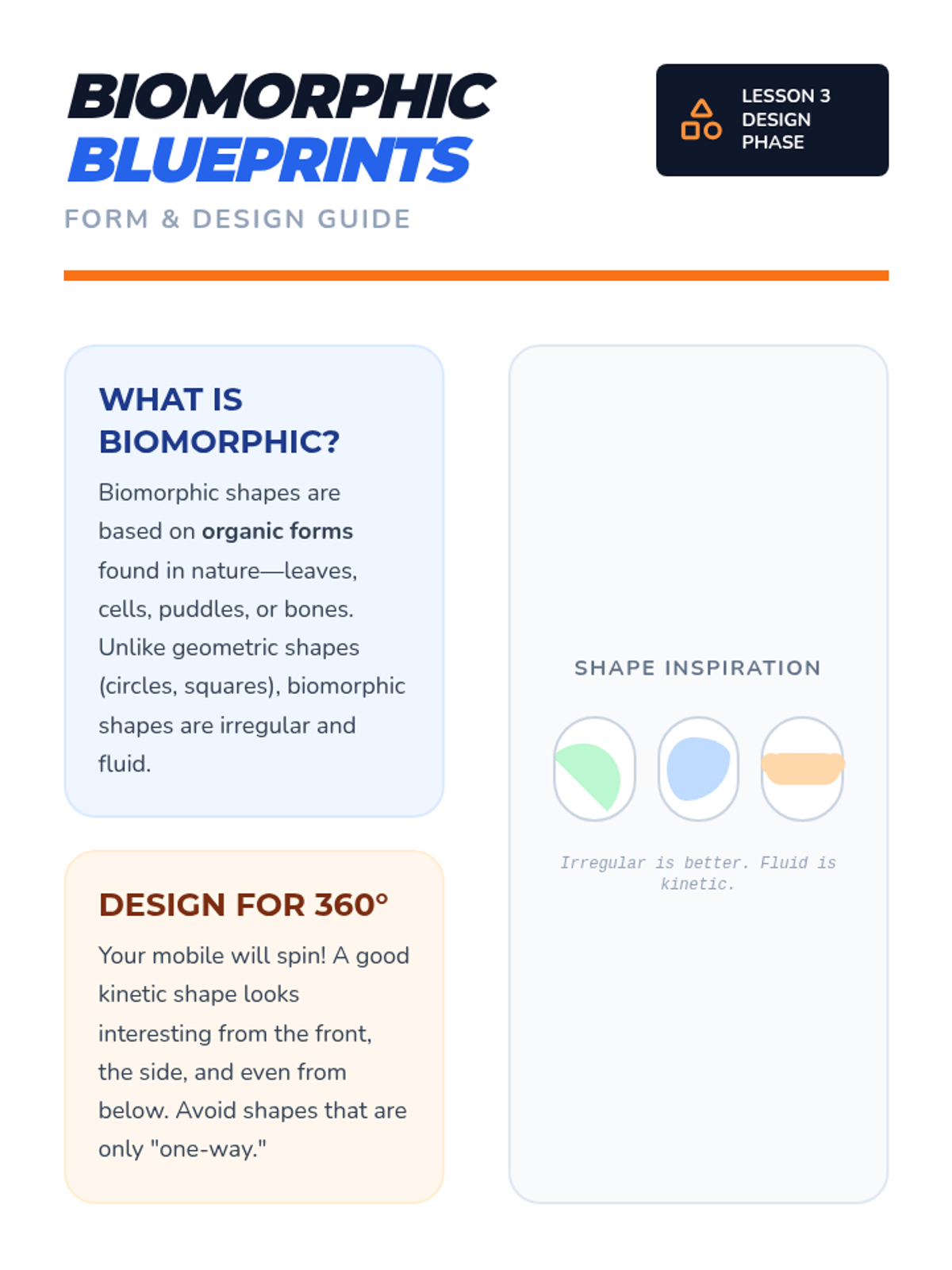
Students design and cut biomorphic shapes for their sculptures, focusing on organic forms and 360-degree visual interest.
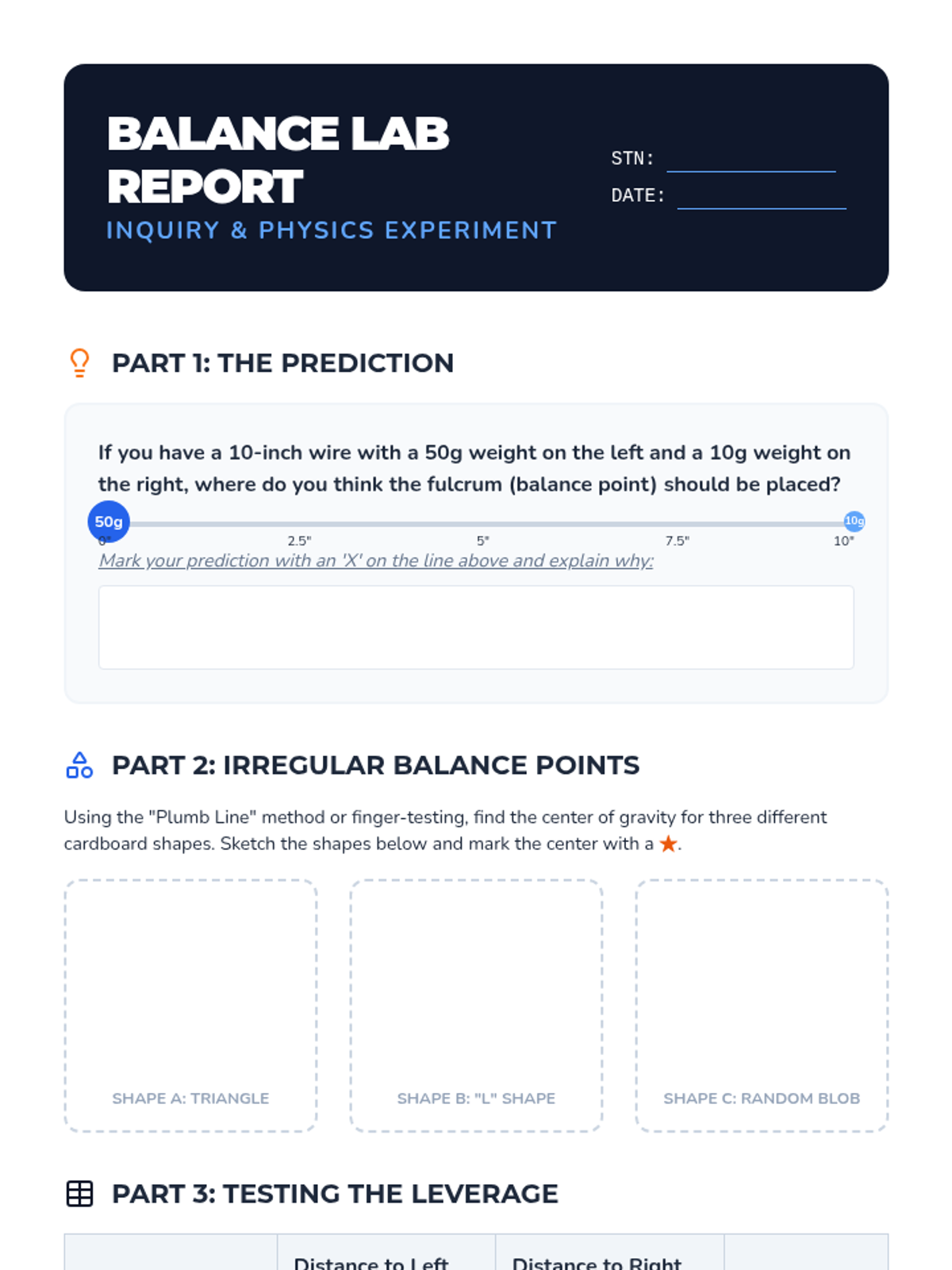
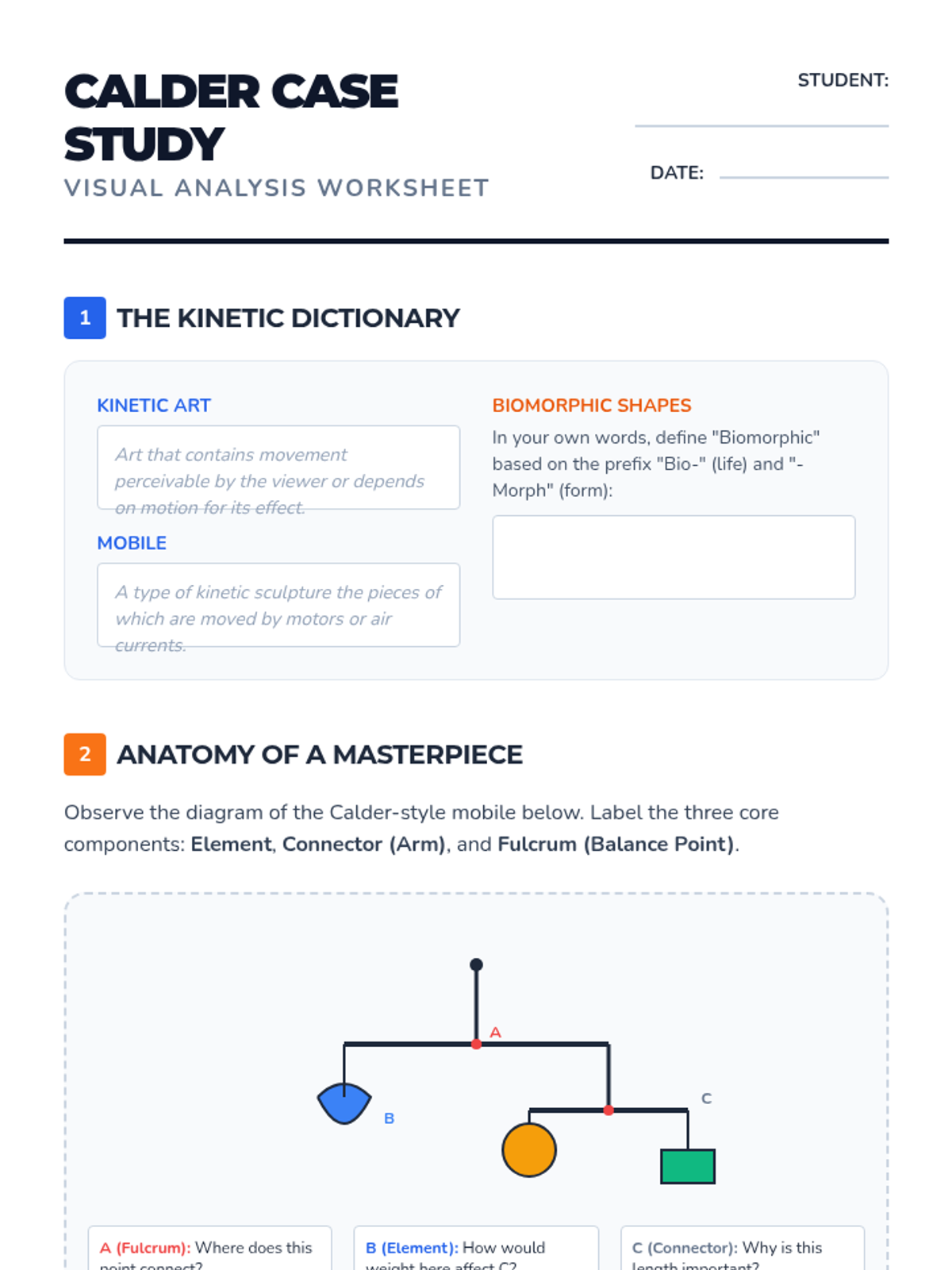
A hands-on lab where students explore the physics of balance, fulcrums, and center of gravity using simple tools and irregular shapes.
Students analyze the kinetic sculptures of Alexander Calder, focusing on the shift from static to moving art and identifying the key components of a mobile.
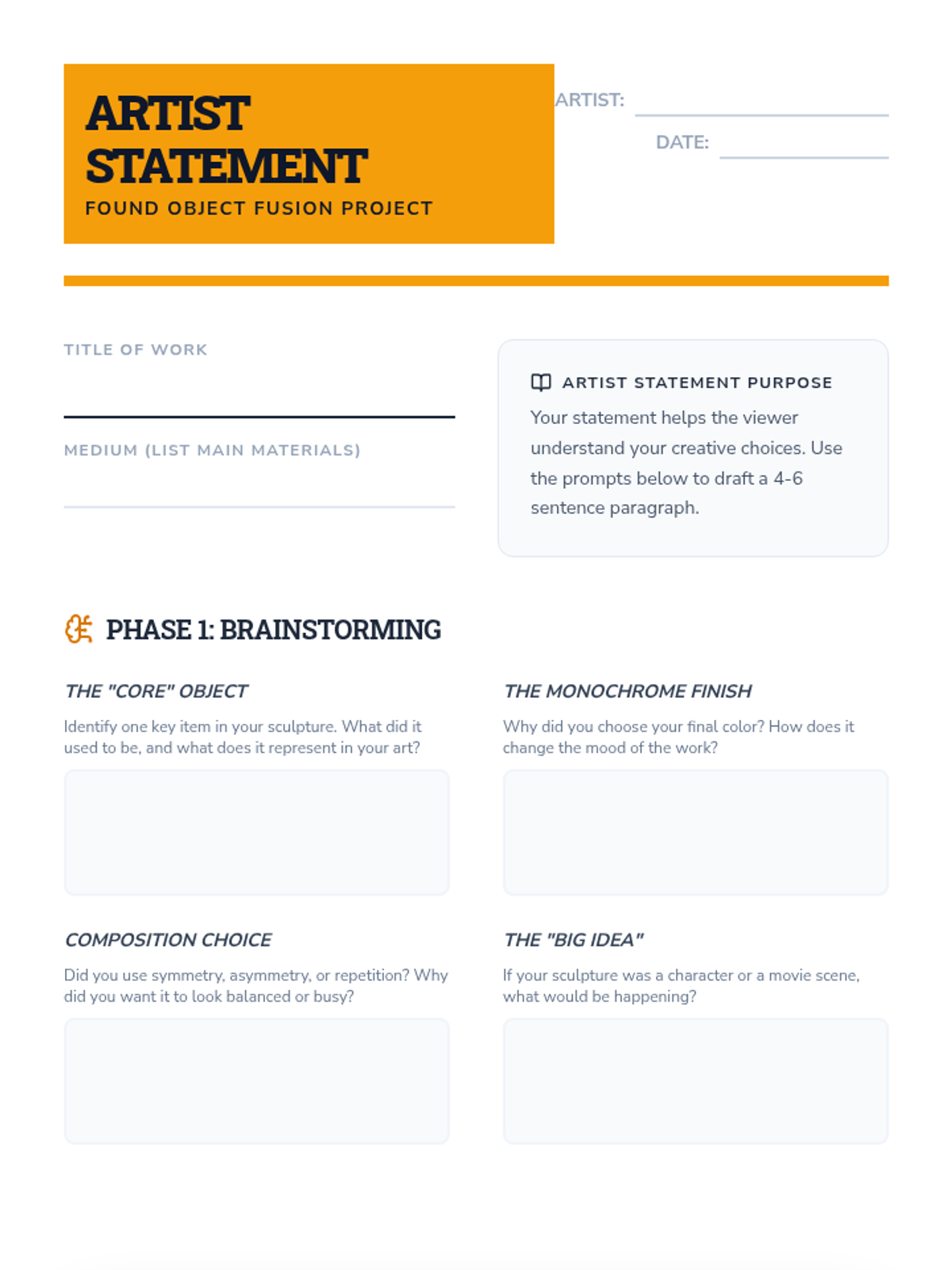
Students reflect on their creative process and the symbolic meaning behind their object choices. They draft artist statements that articulate the narrative of their work and present their finished sculptures to the class.
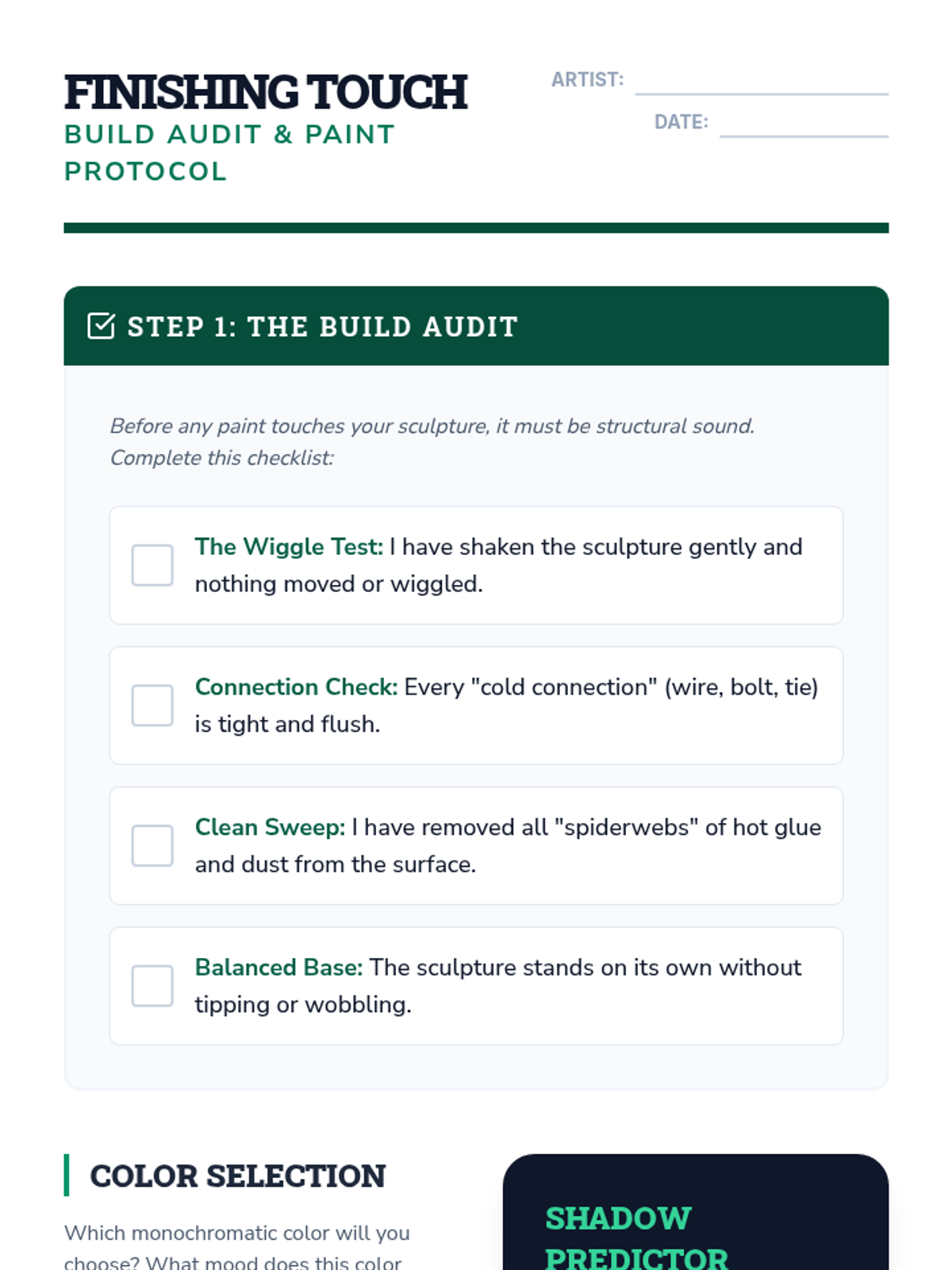
Students finalize their sculptures and apply a monochromatic finish. By painting the entire piece a single color, they explore how shadows, highlights, and textures unify diverse objects into a single, cohesive visual statement.
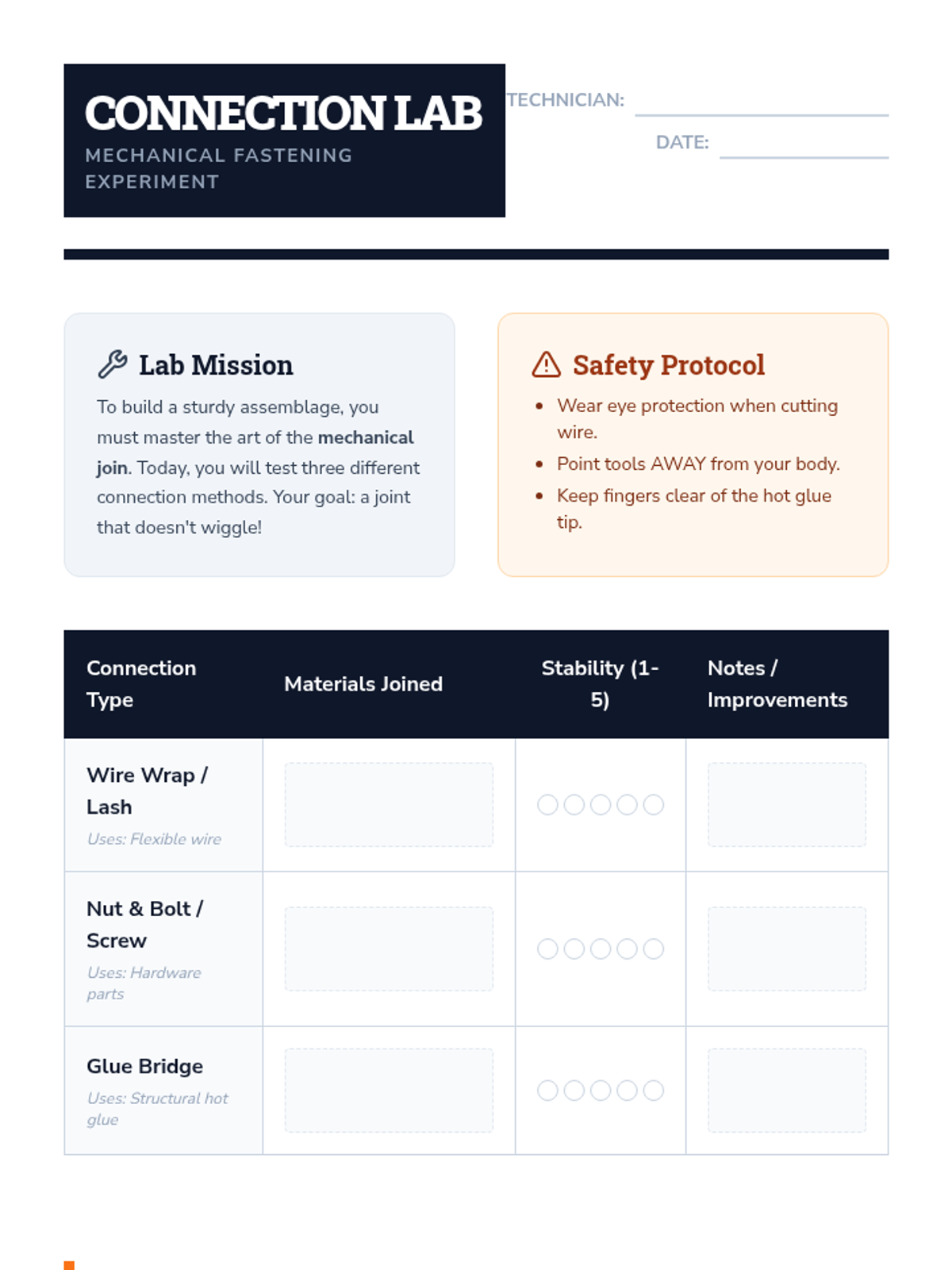
A technical skill-building session where students learn how to join disparate materials without relying solely on standard adhesives. Techniques include wire wrapping, bolting, tying, and 'hot glue bridging' to ensure structural integrity in mixed-media art.
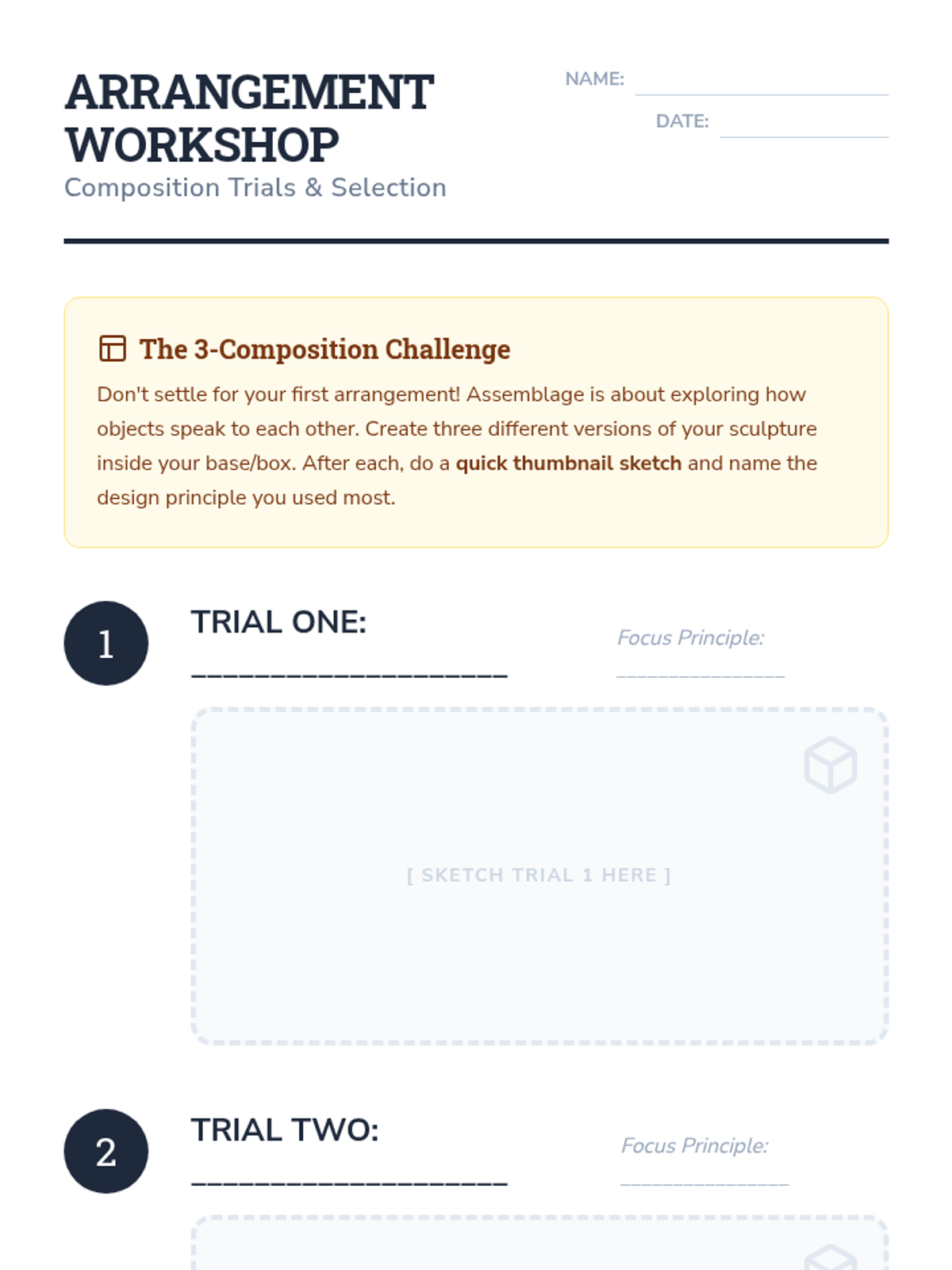
Students experiment with arranging their collected found objects to explore core design principles. They focus on creating balance, focal points, and repetition within a three-dimensional space, specifically using boxes or bases as containers for their compositions.
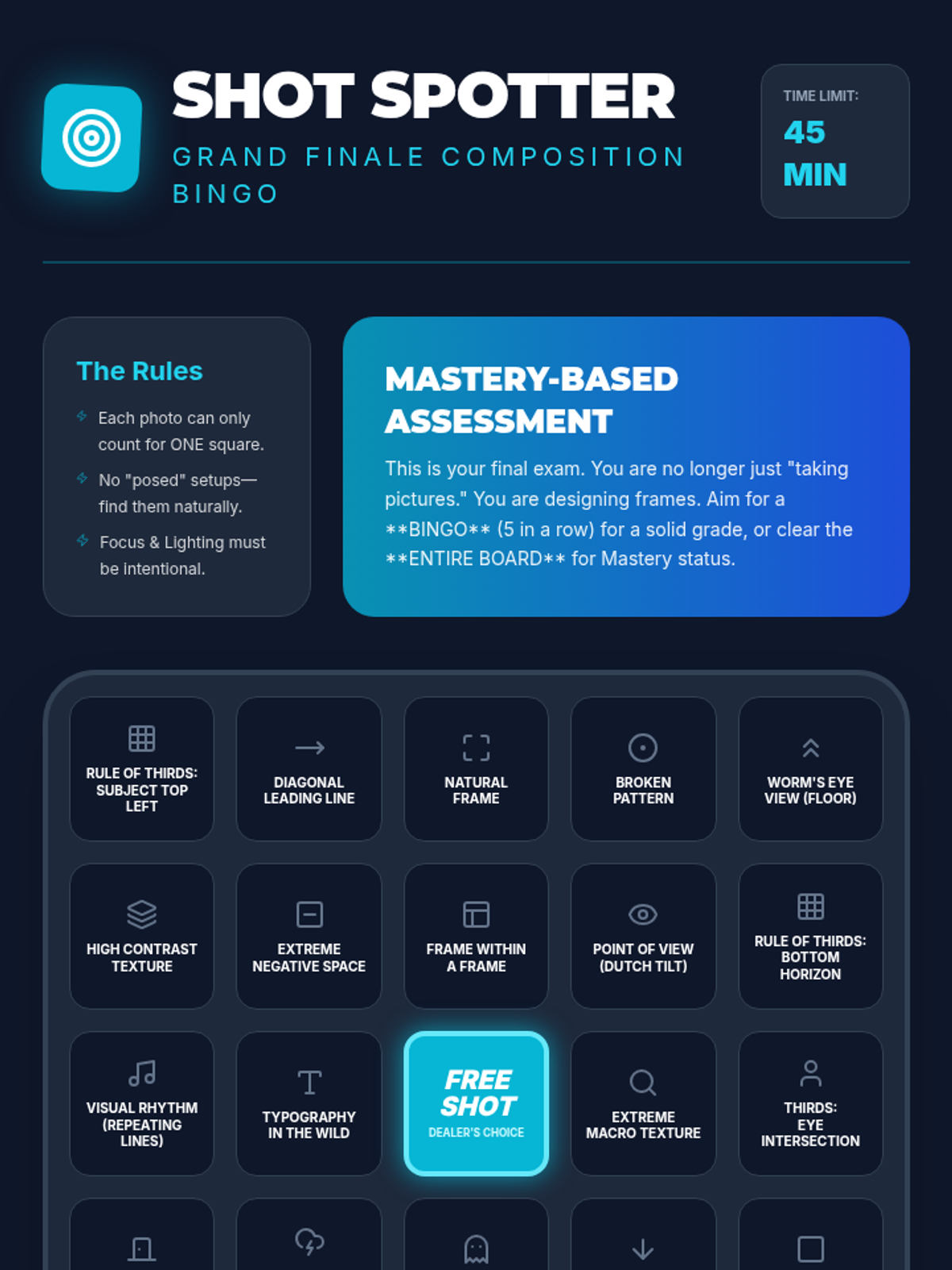
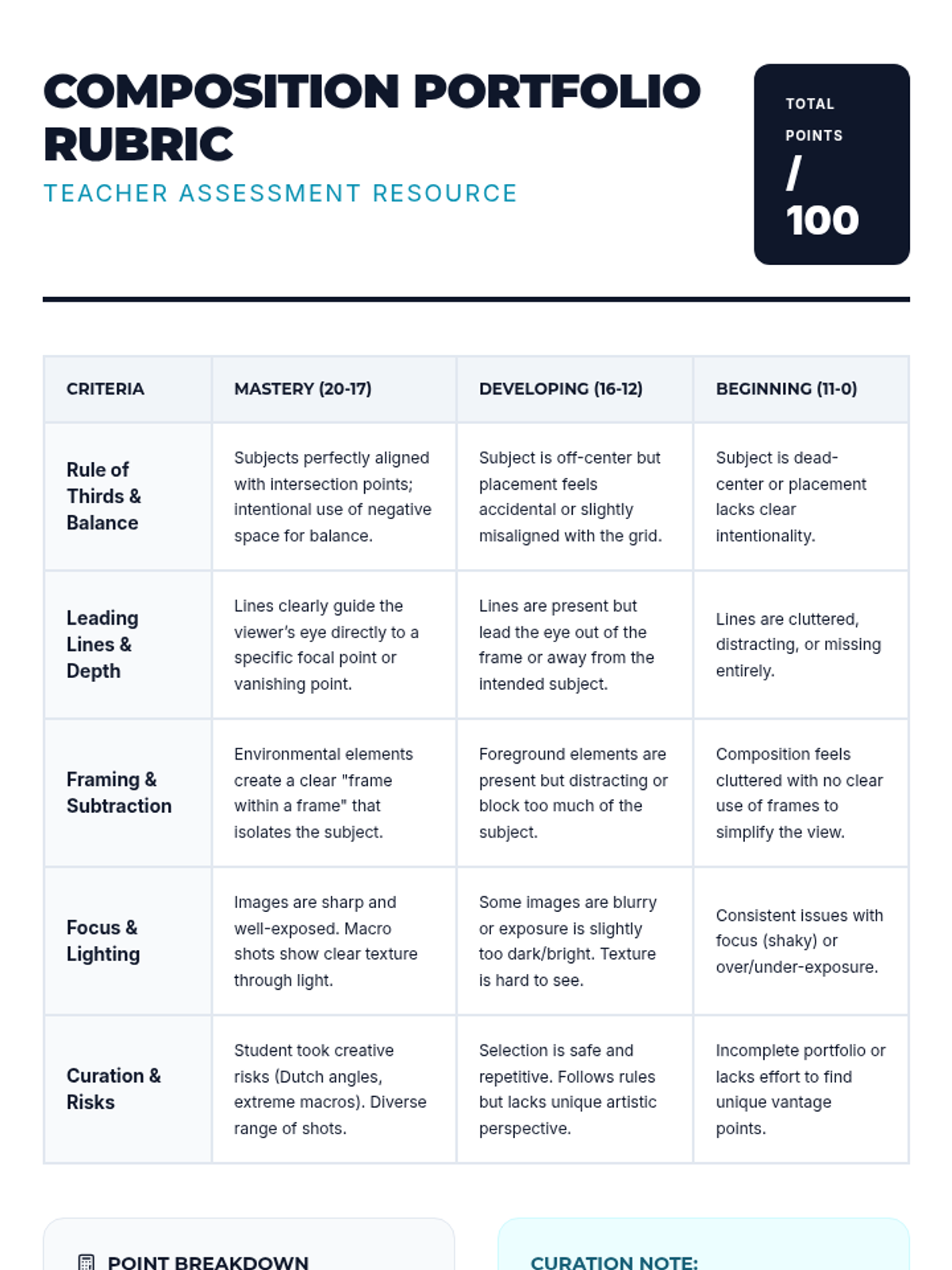
A gamified assessment where students race to capture high-quality images representing all the composition rules learned, submitting their work to a digital gallery for peer review.
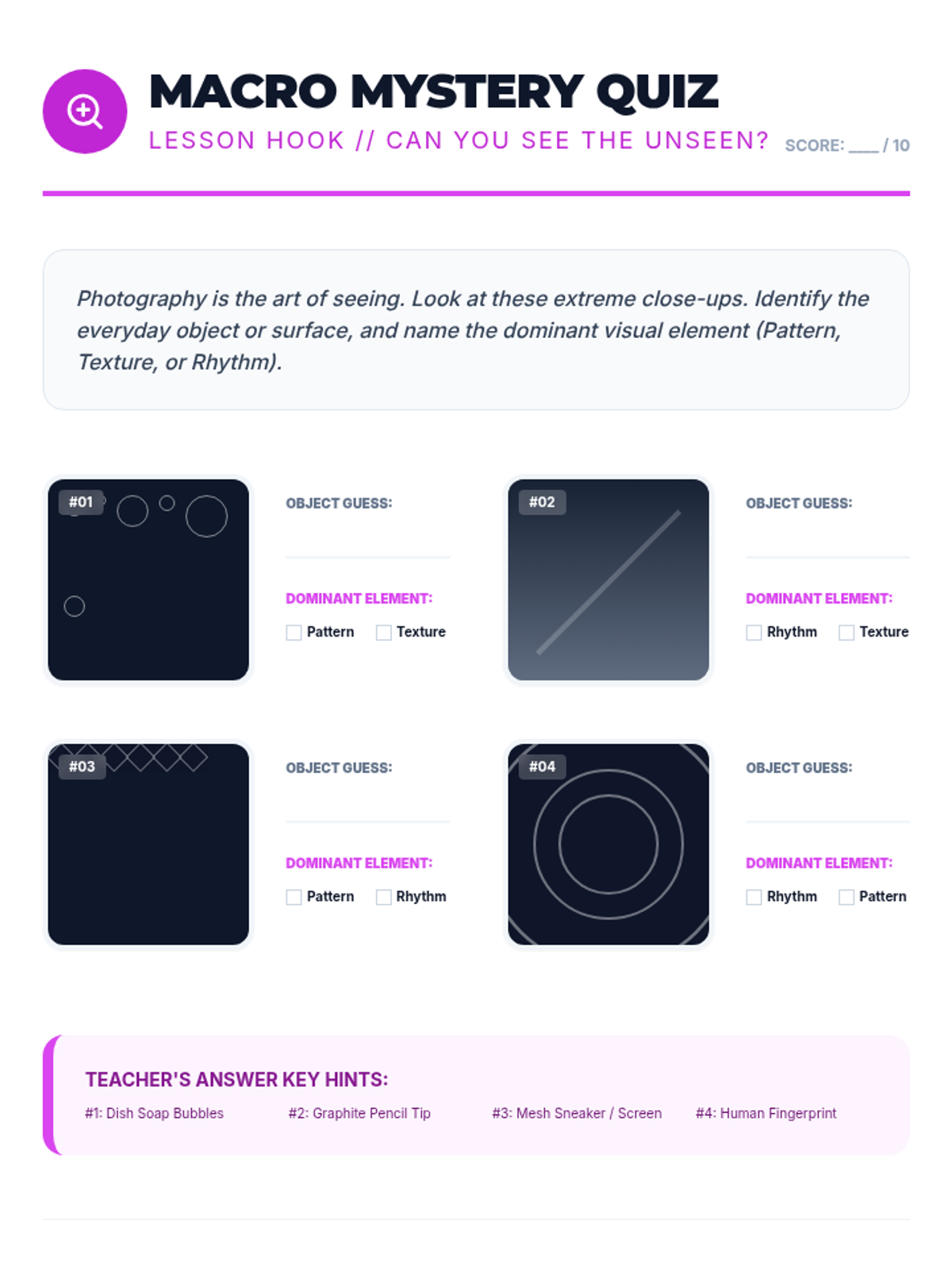
Learners focus on abstract qualities, zooming in to capture textures or repetitive patterns. They learn how breaking a pattern can create a strong focal point through macro-style photography.
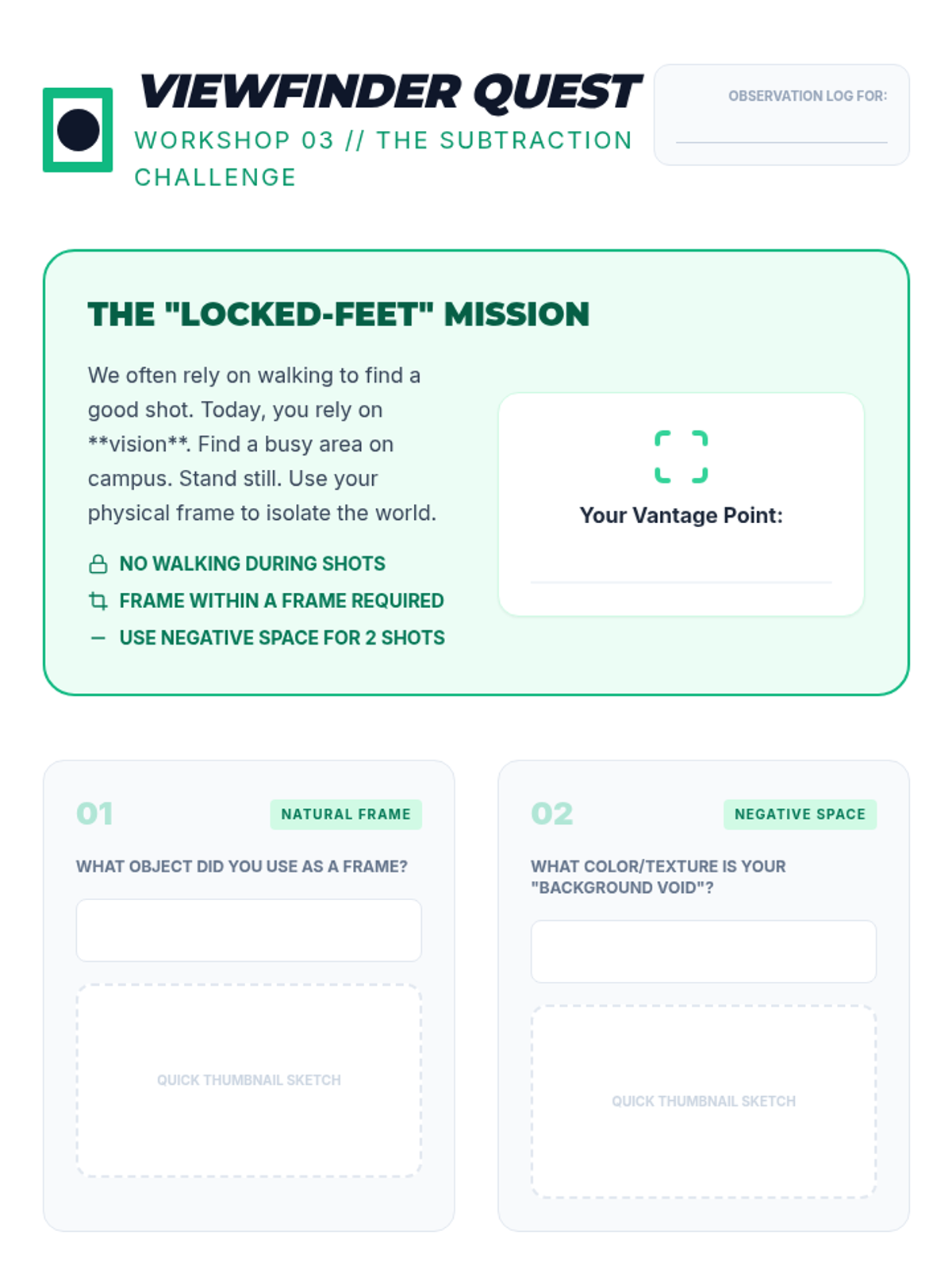
Students investigate how to use environmental elements to create a 'frame within a frame' and explore negative space to evoke minimalism. The focus is on subtraction—removing unnecessary clutter from the shot.
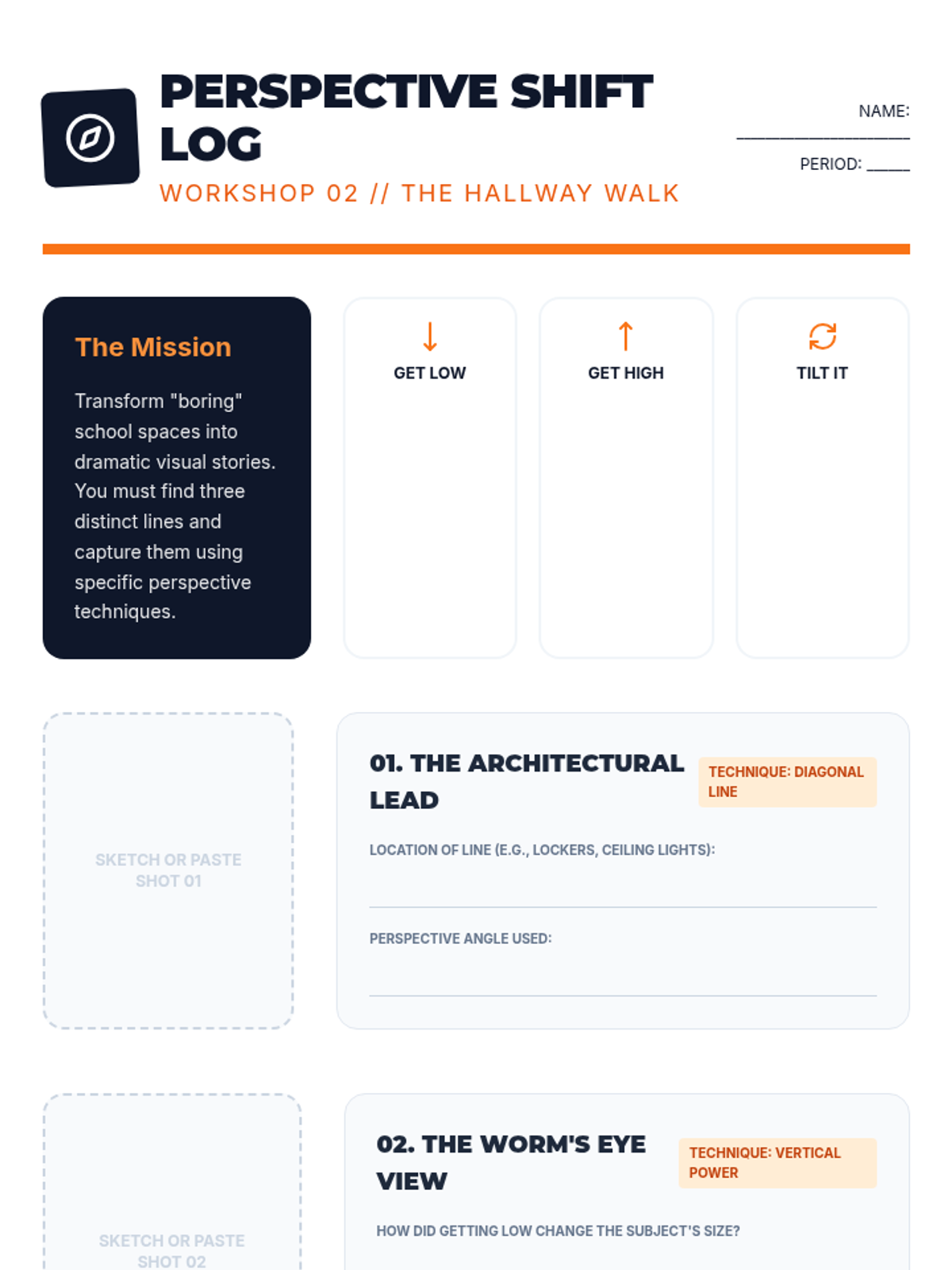
This lesson explores how lines guide the viewer's eye through a photograph toward the subject. Students experiment with shooting from high, low, and dutch angles to change perspective.
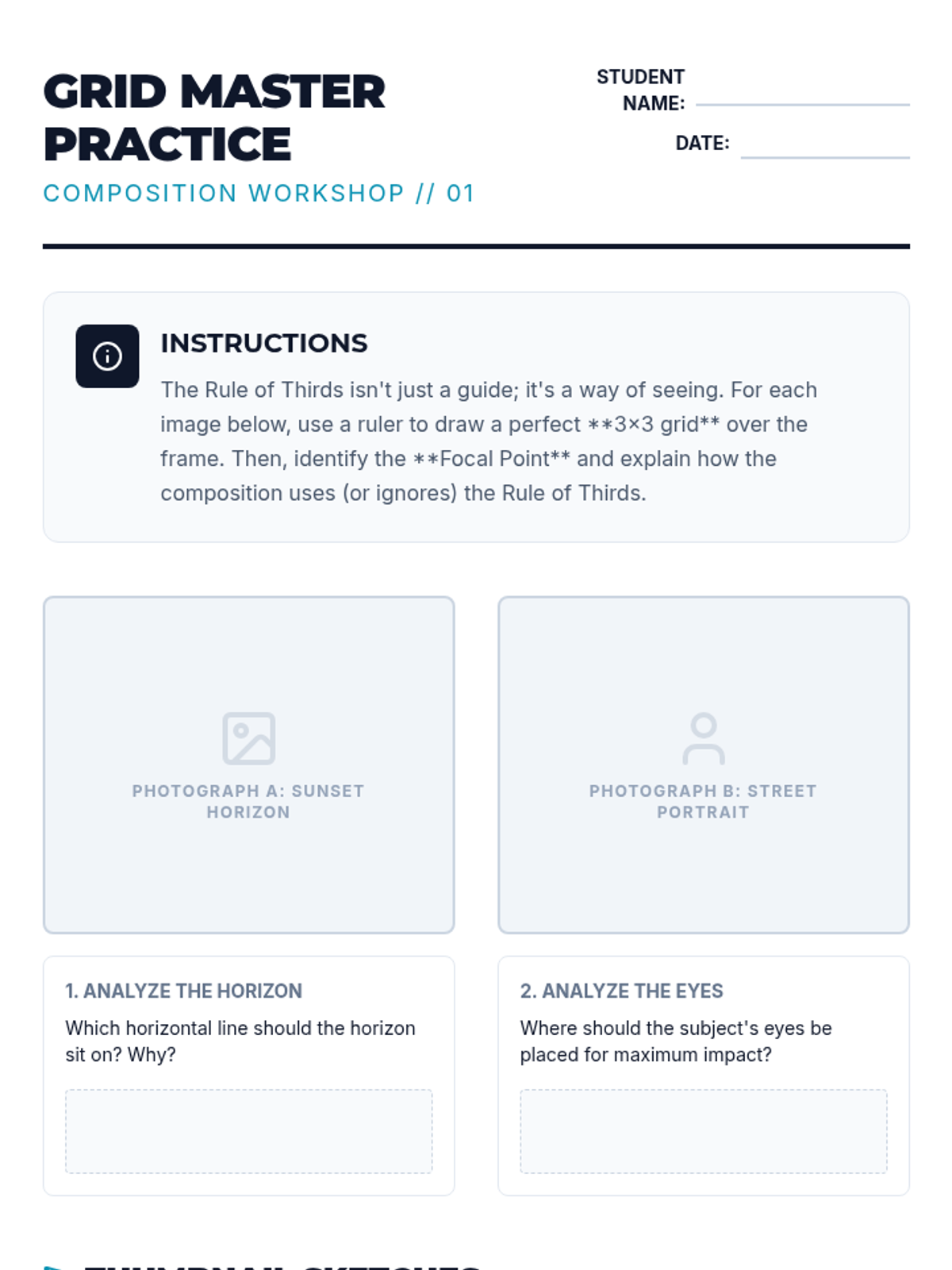
Students learn the foundational grid system of photography to avoid static center-placement. They analyze famous photographs to see the grid in action and practice aligning subjects at intersection points.
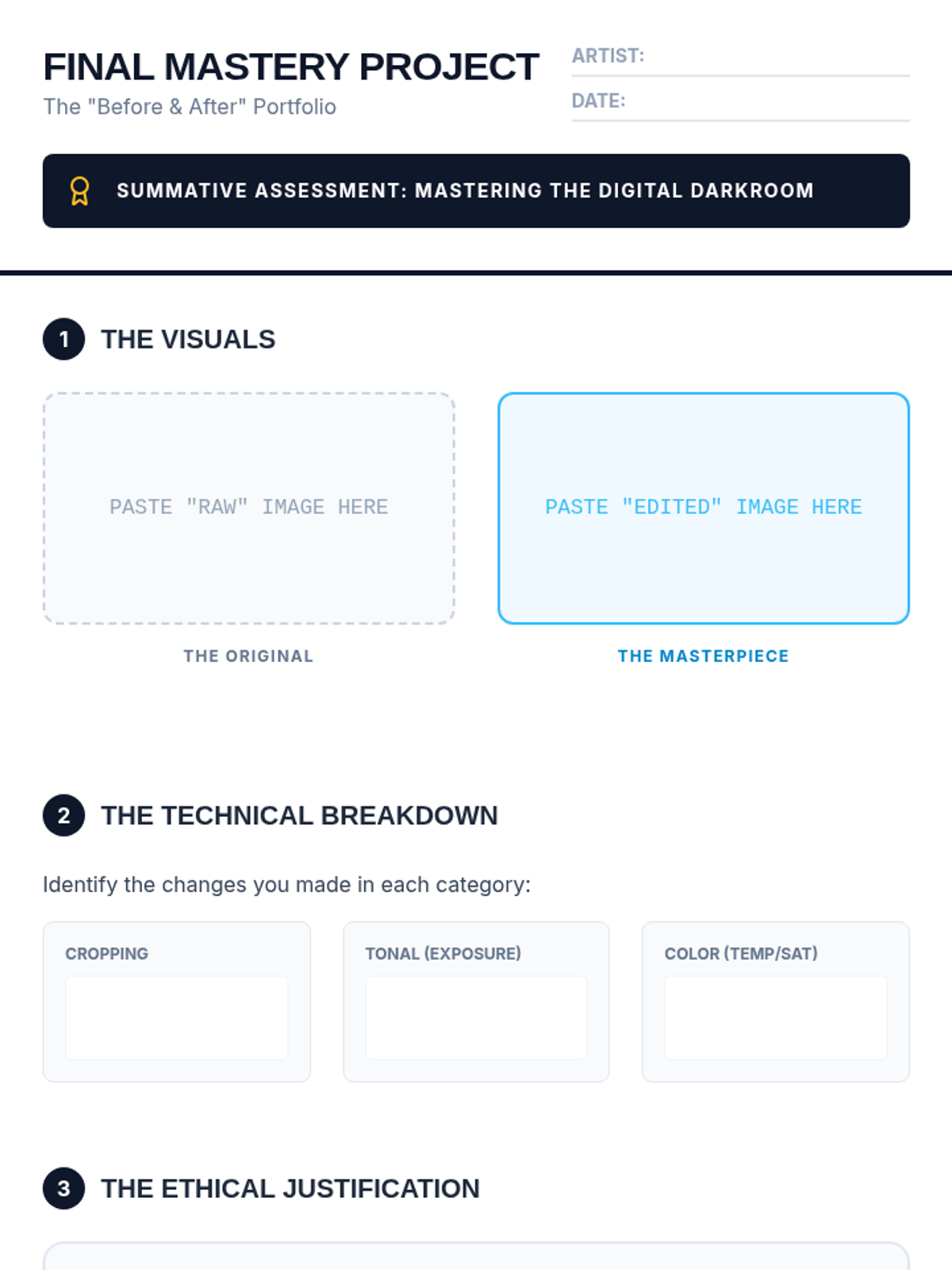
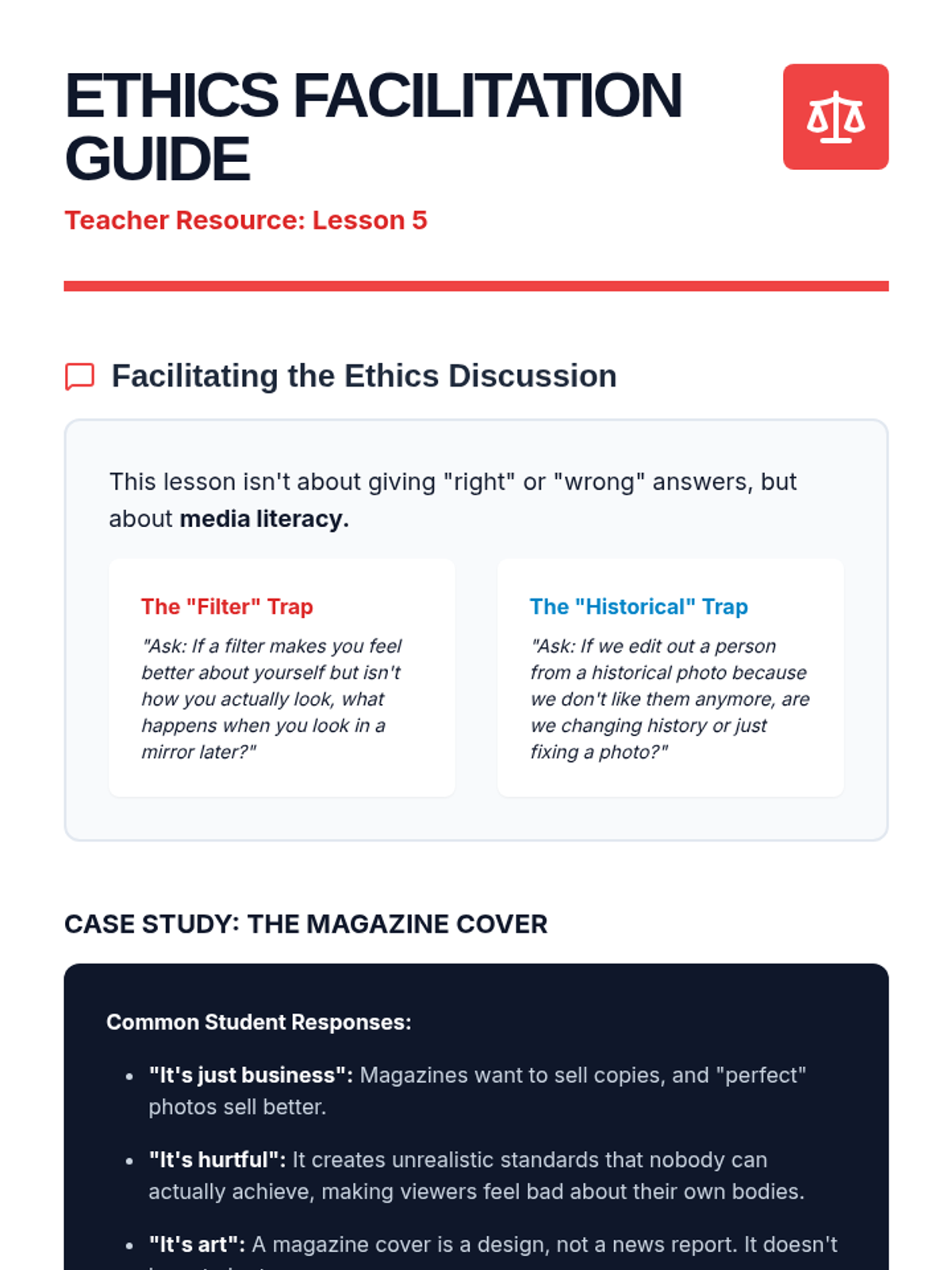
Students discuss the impact of filters and retouching, culminating in a final project where they justify their editing choices.
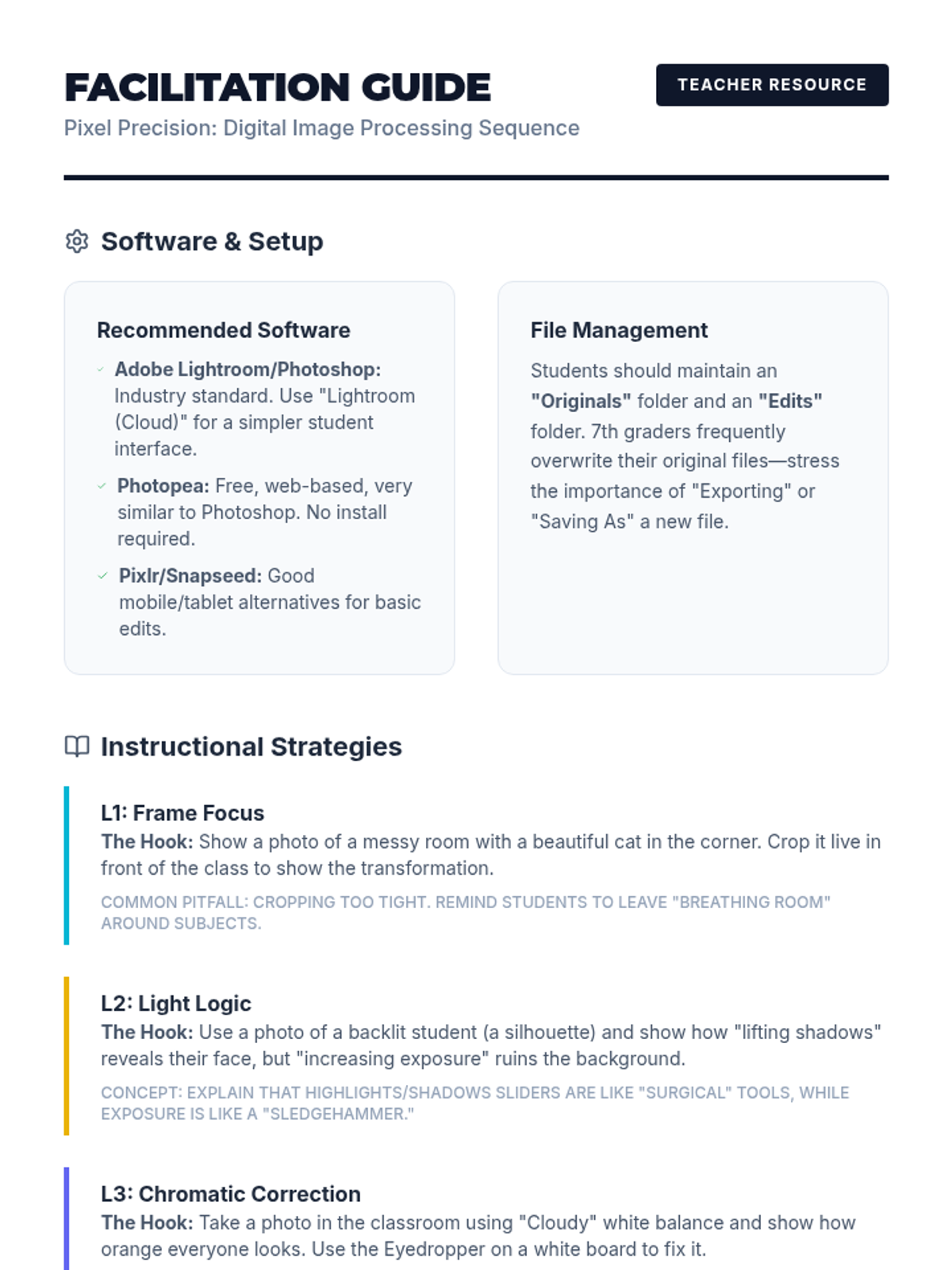
This lesson covers White Balance and Saturation, teaching students how to fix color casts and use color to emphasize texture.
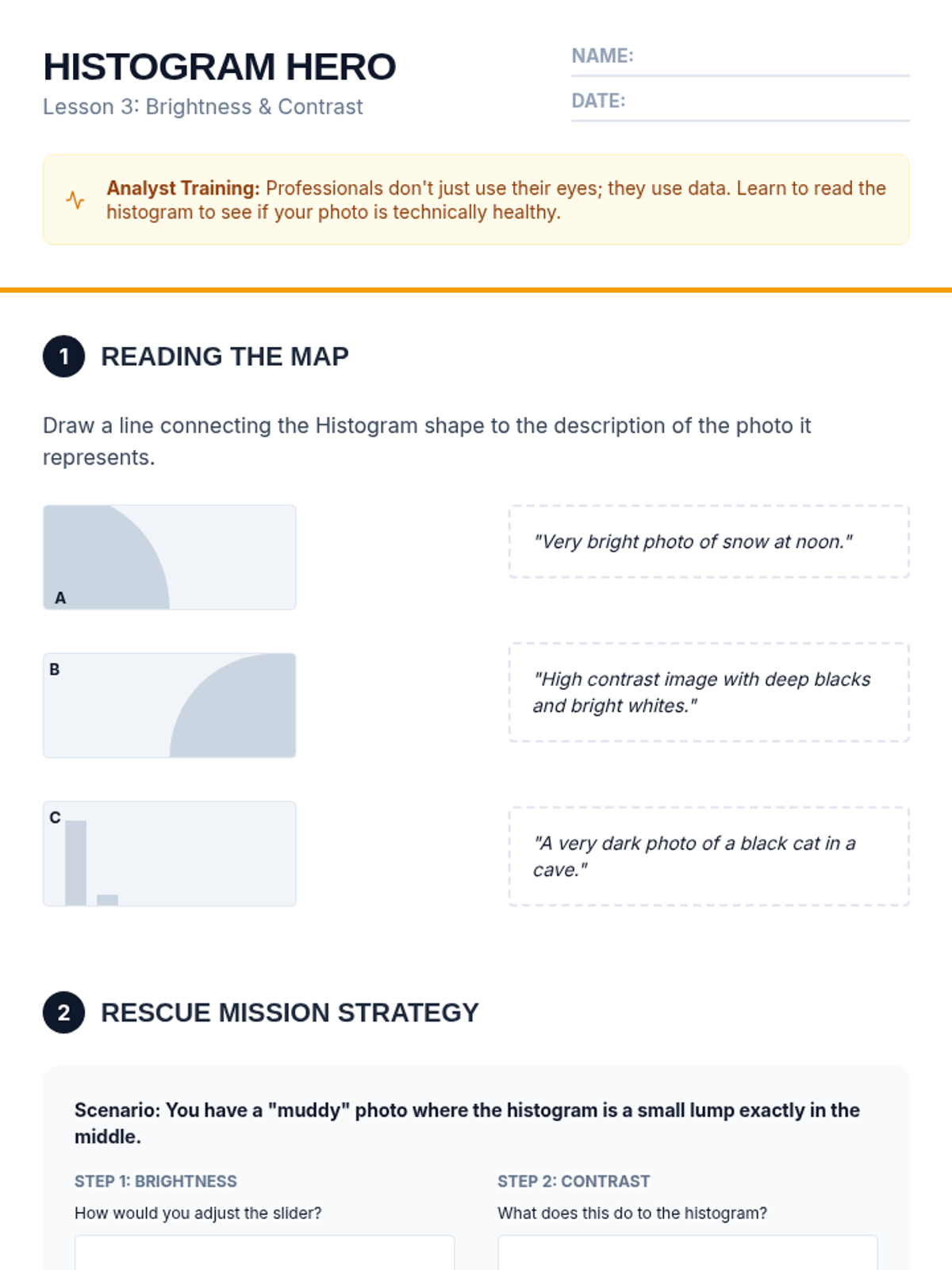
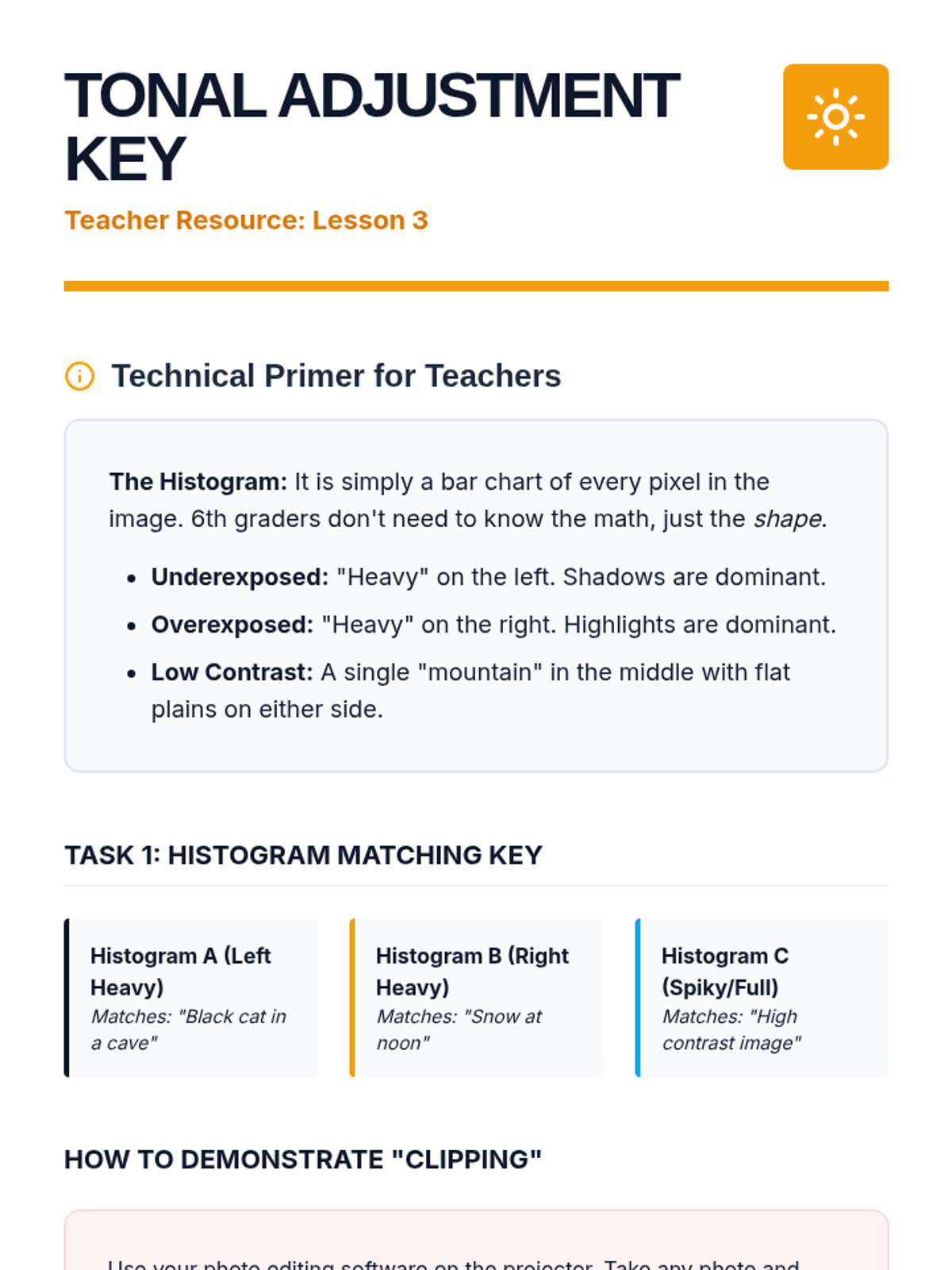
Students learn to read basic histograms and adjust exposure levels to rescue underexposed images and add 'pop' through contrast.
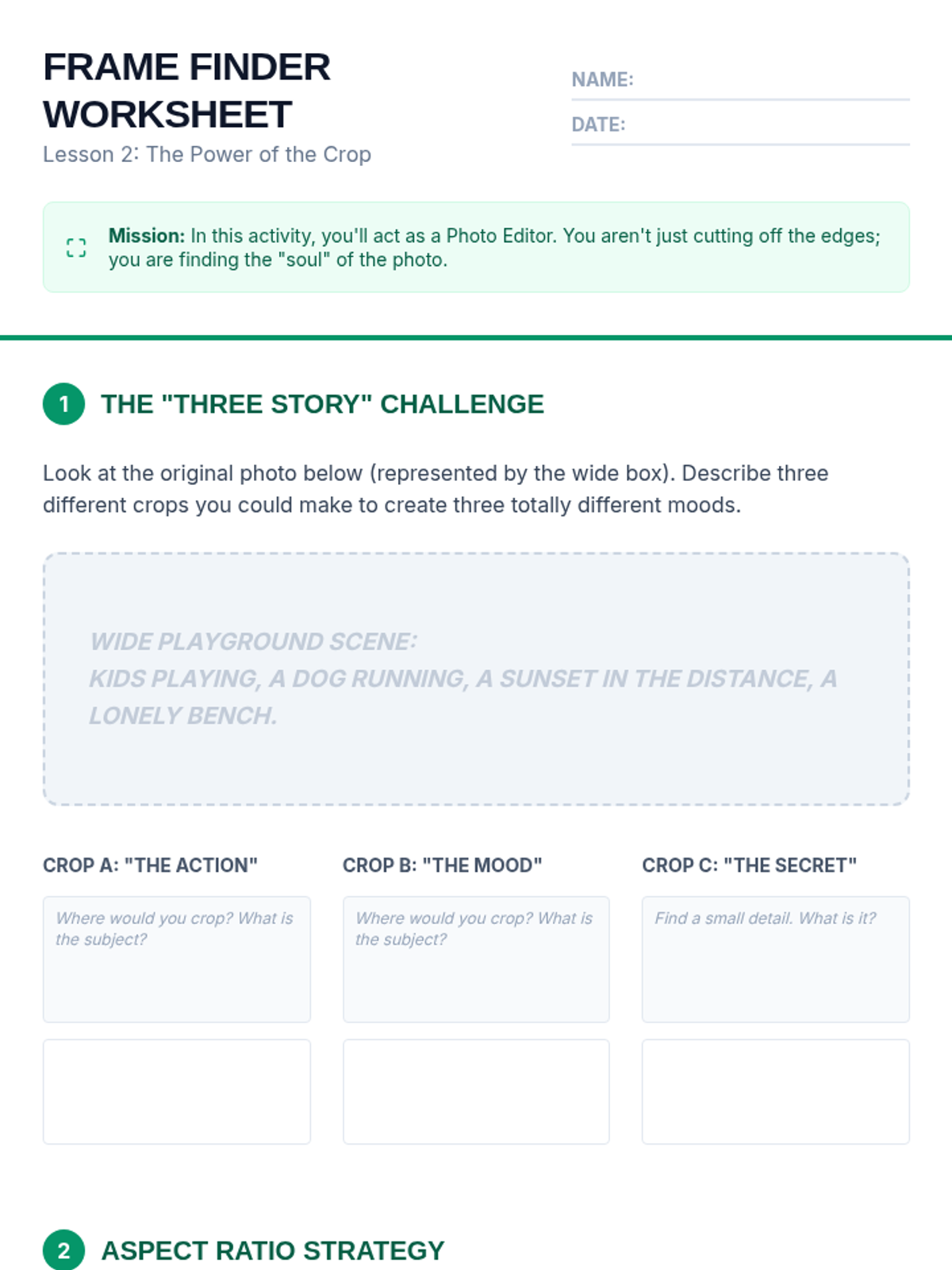
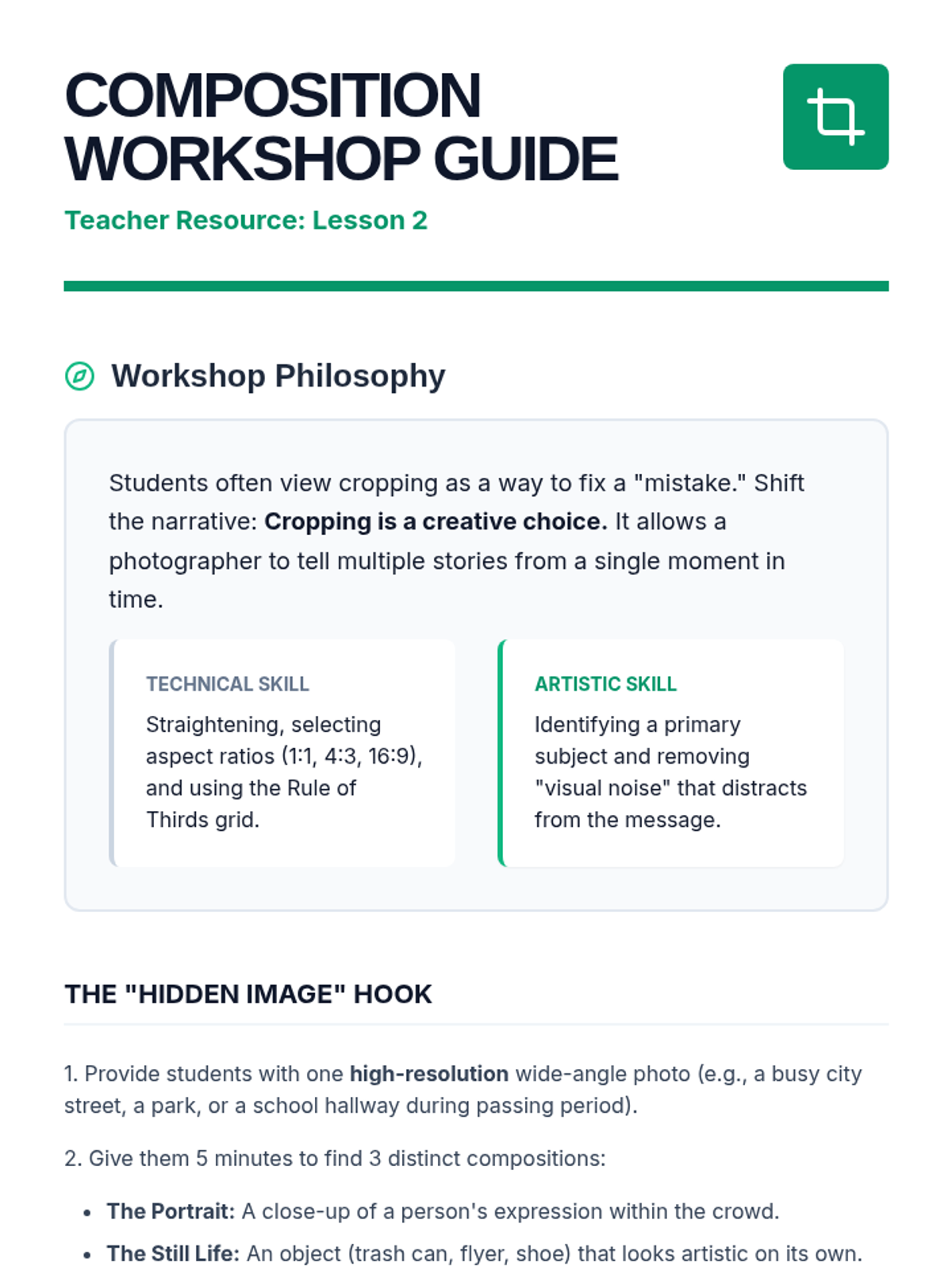
Learners revisit composition by cropping existing images to improve framing, experimenting with aspect ratios and straightening horizons.
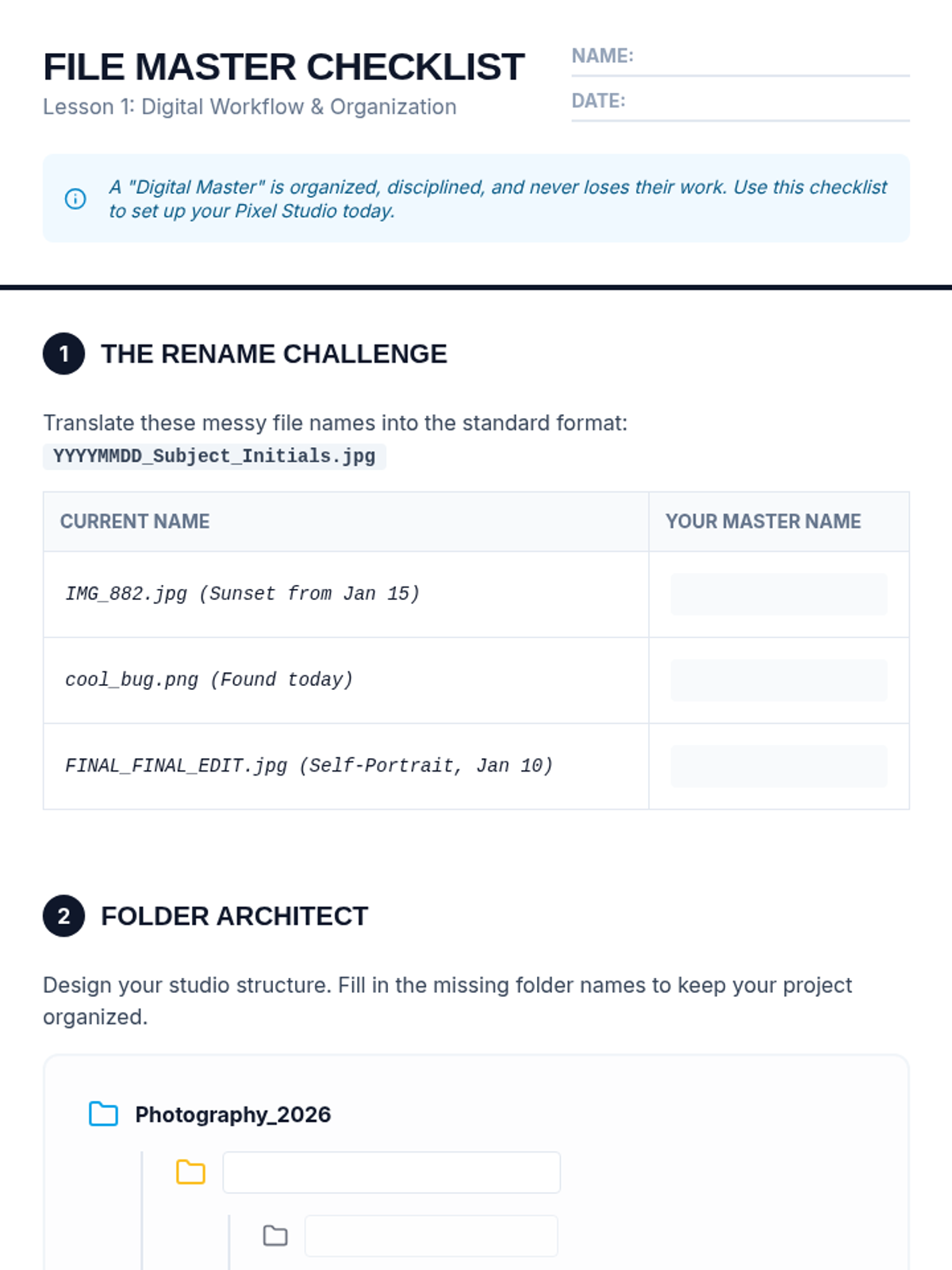
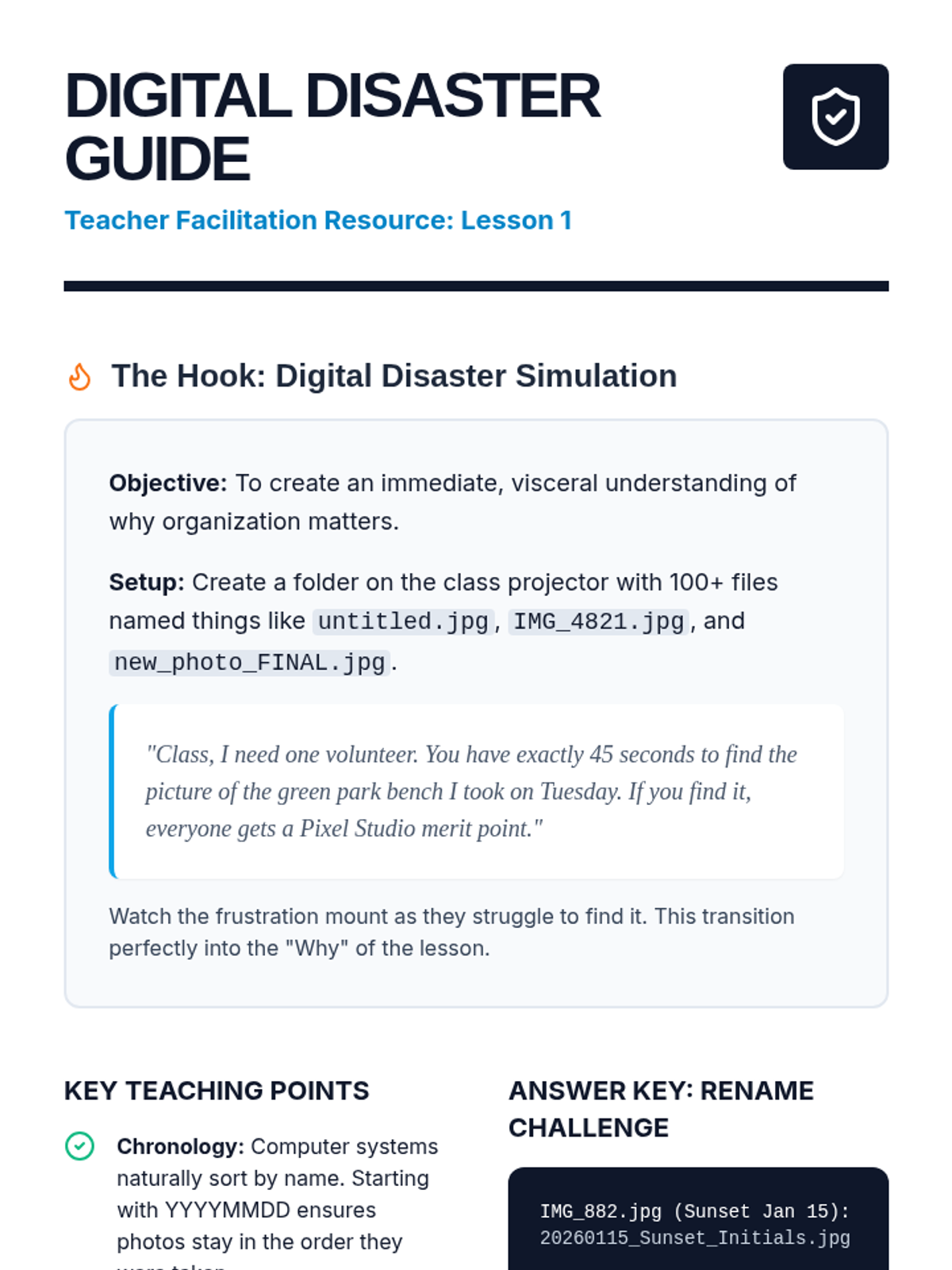
Students learn how to import, organize, and name their digital files, establishing a folder structure to keep original files safe before editing.
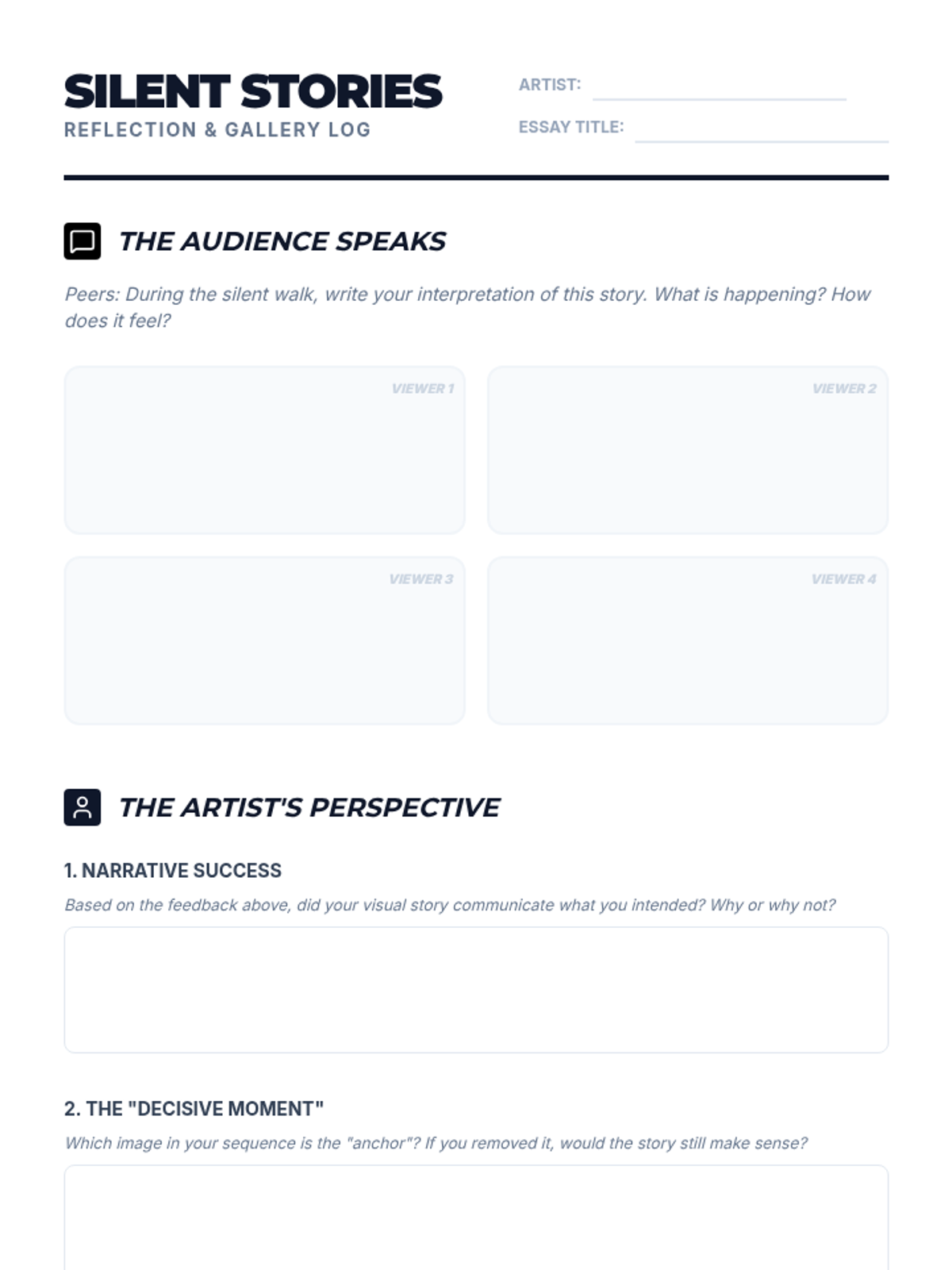
Students finalize their layouts and present their visual stories. They add minimal captions and reflect on how their sequencing choices impacted the viewer's interpretation.
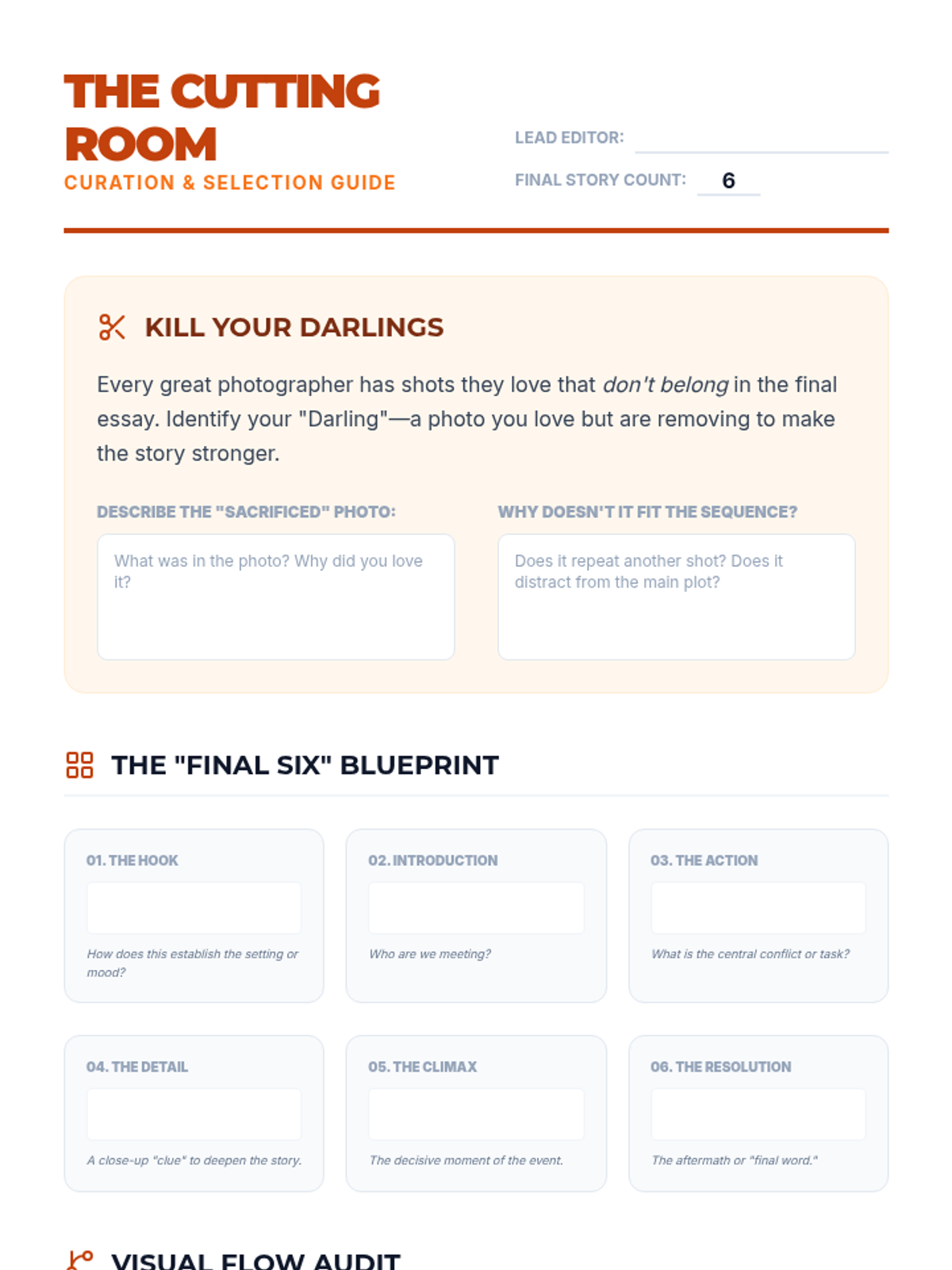
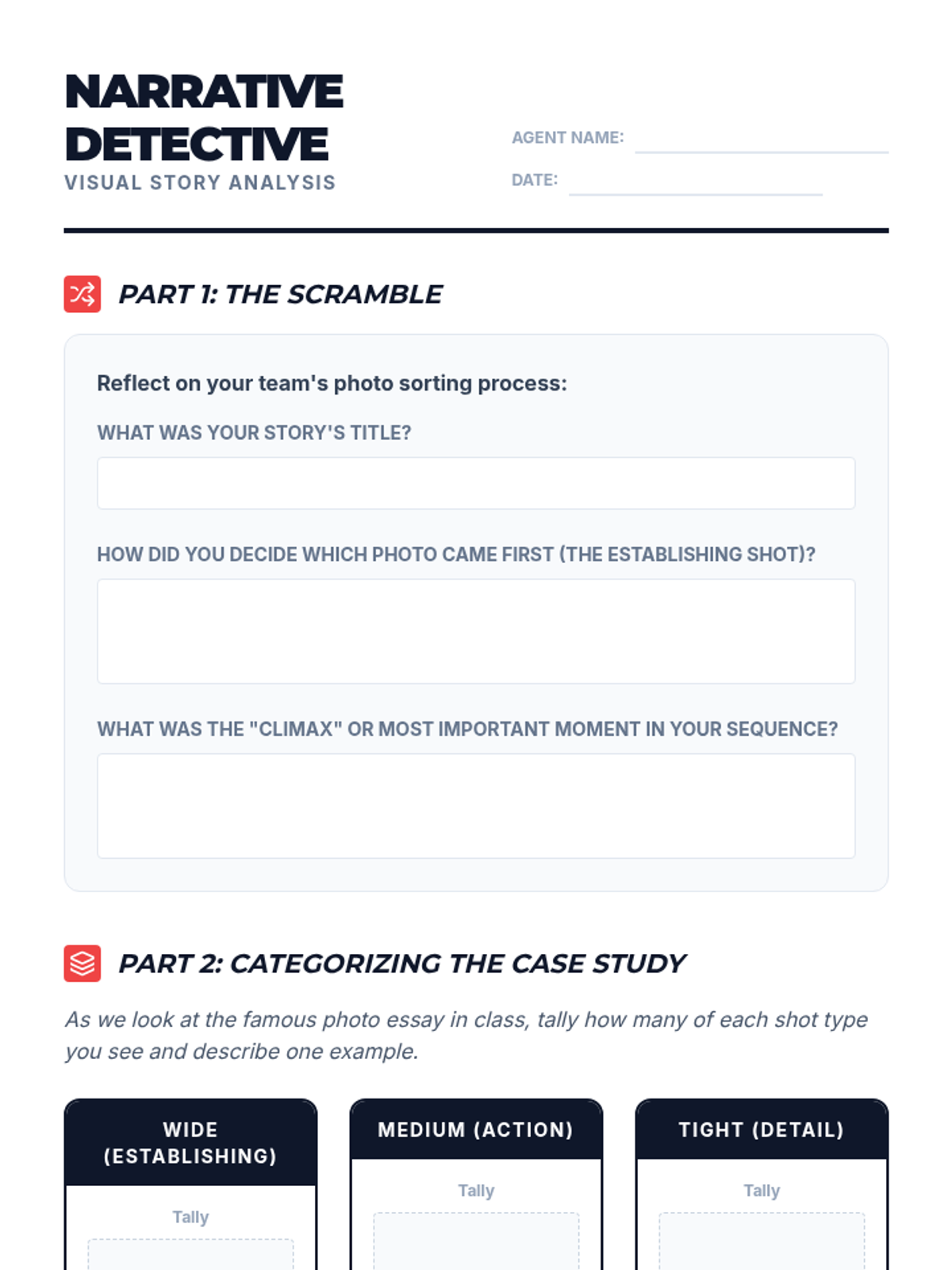
Students print thumbnails or arrange digital files to sequence their stories. They learn the art of editing down, removing repetitive images, and ensuring visual flow.
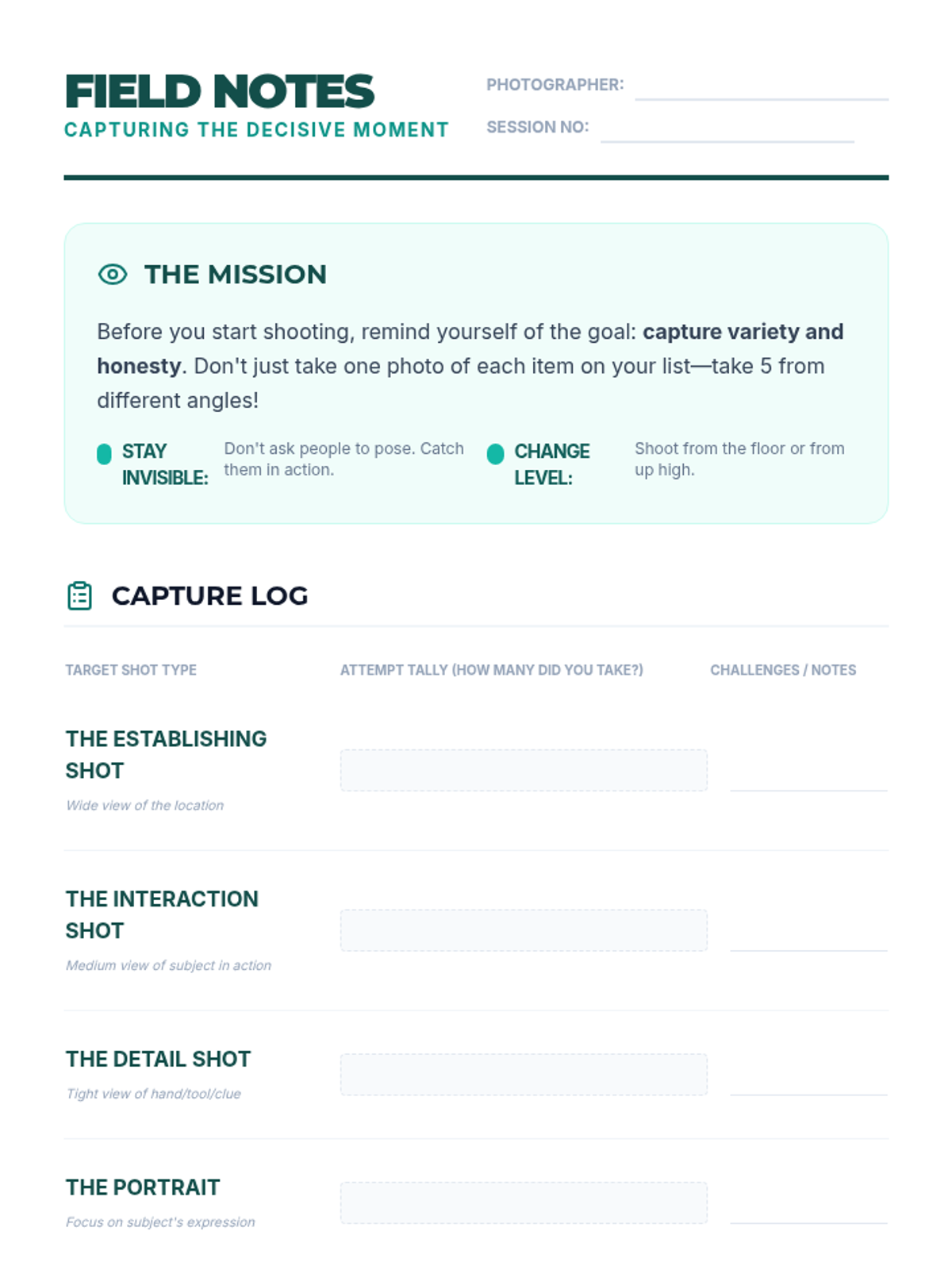
Students execute their shot lists, focusing on capturing decisive moments. They practice switching focus from the overall environment to specific details that advance the plot.
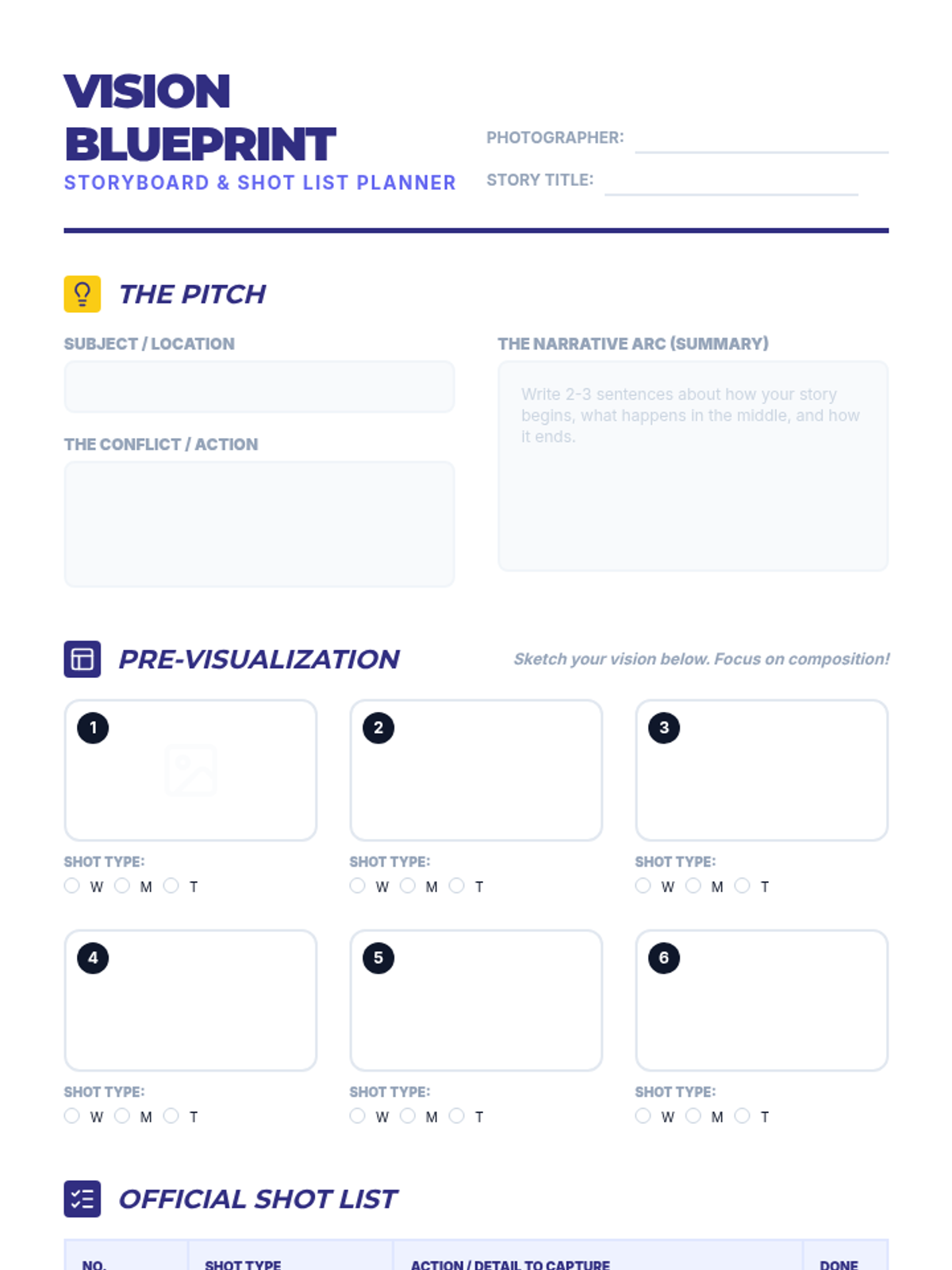
Learners brainstorm a simple story to tell about a school activity or routine. They create a shot list that ensures they capture variety (wide, medium, close-up) to support their narrative.
Students examine famous photo essays and picture books to identify the narrative arc. They categorize images into 'wide/establishing,' 'medium/action,' and 'tight/detail' shots.
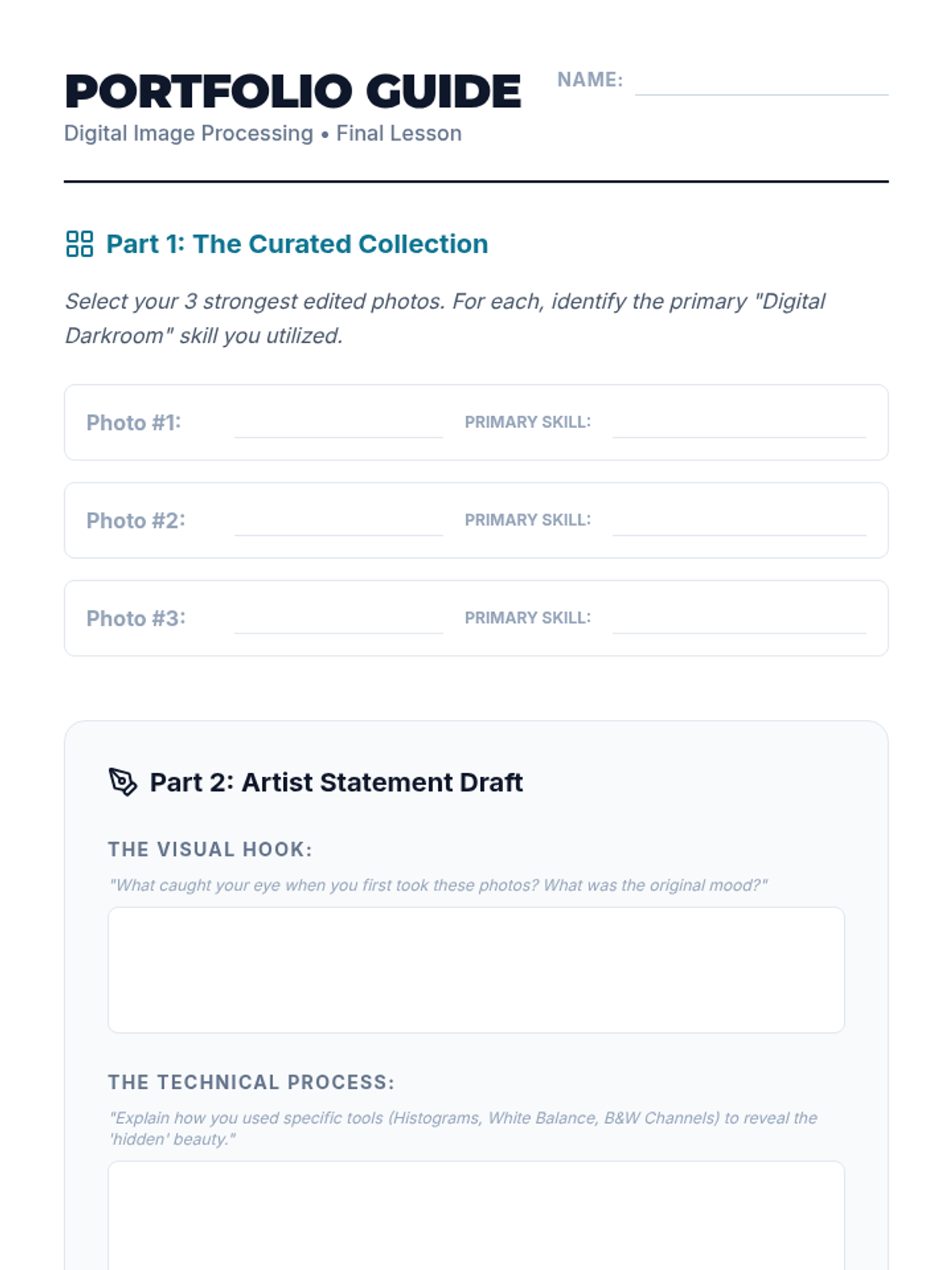
The culmination of the sequence where students refine their best work, write professional artist statements, and prepare their final portfolio for digital exhibition.
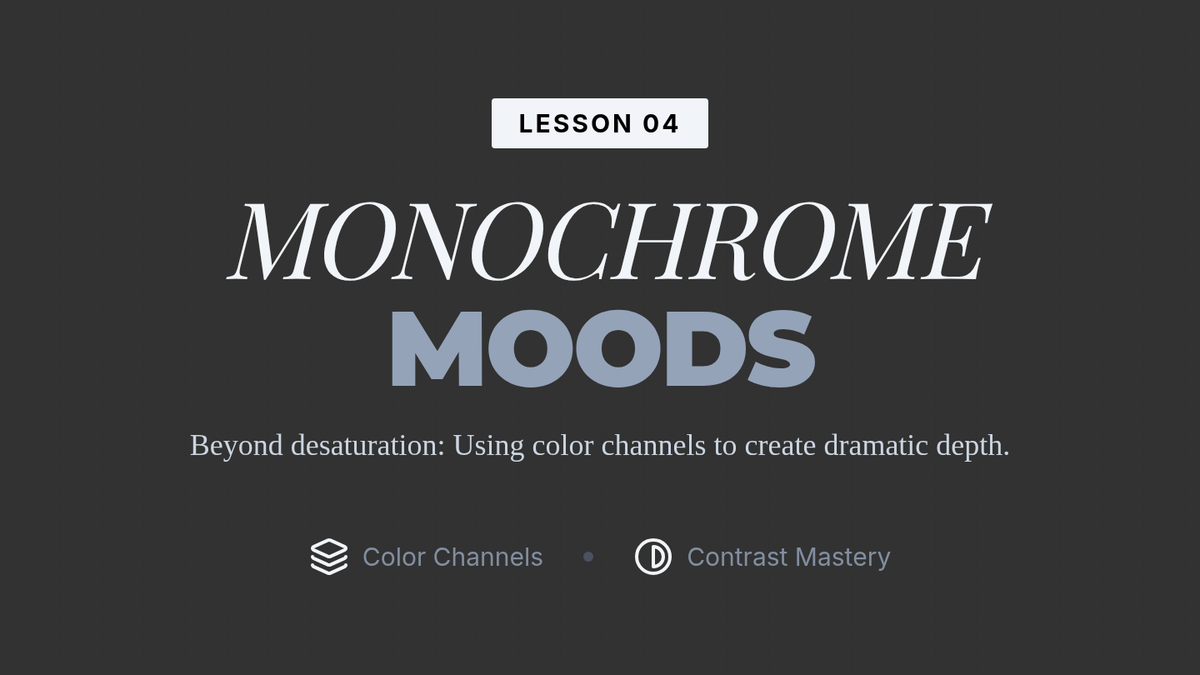
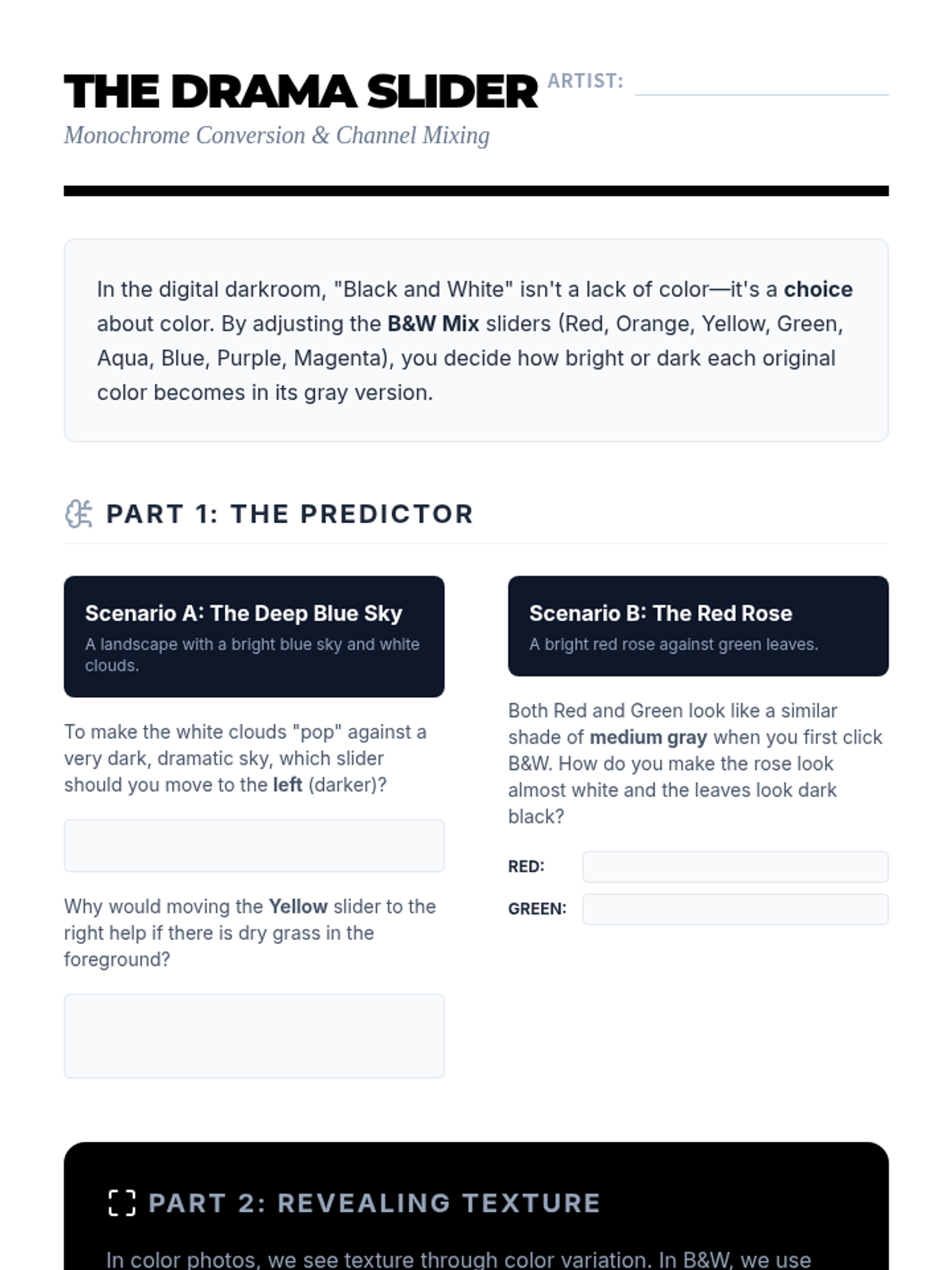
An exploration of black and white photography that goes beyond simple desaturation, teaching students to use color channels to create depth, contrast, and drama.
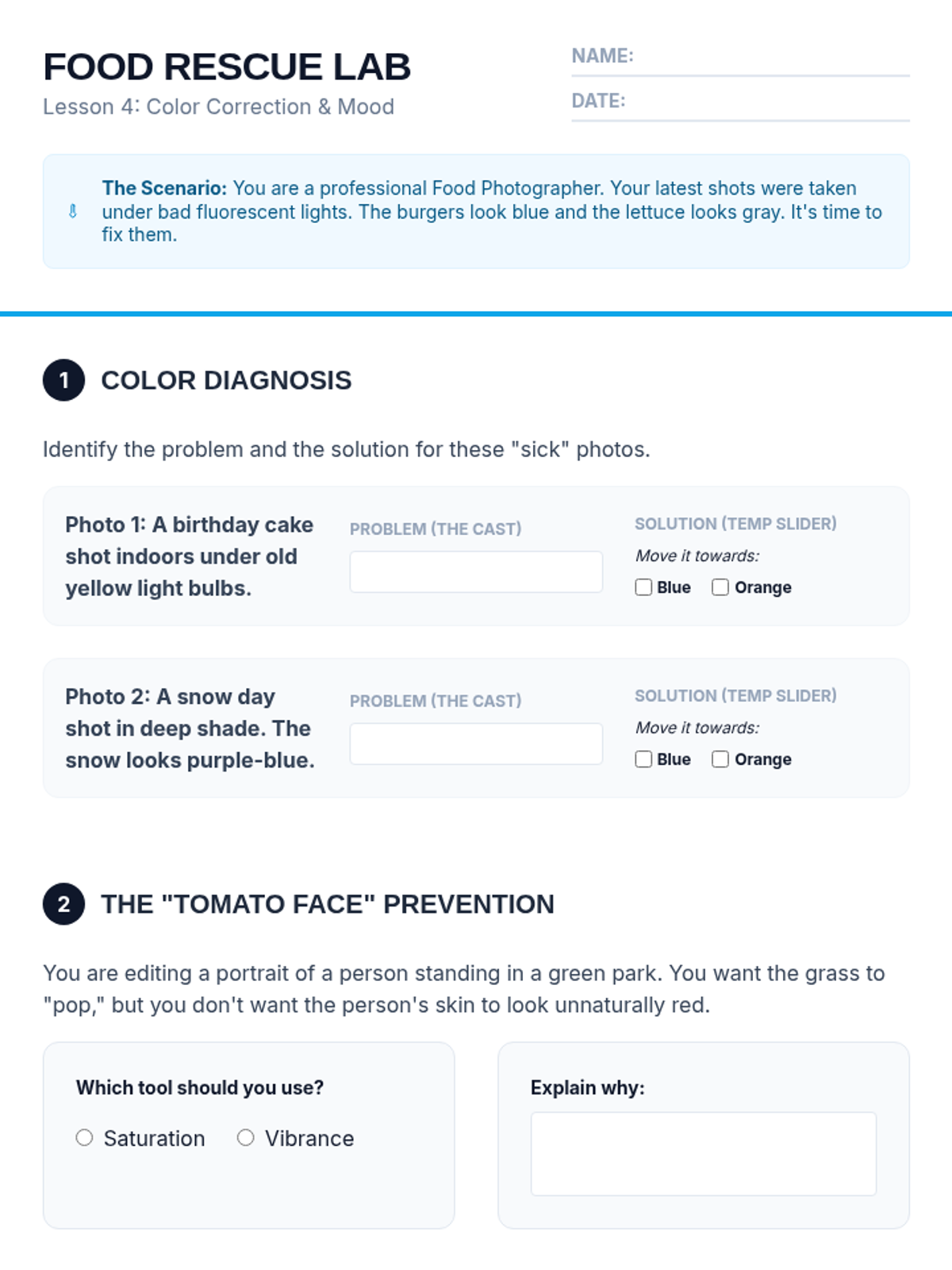
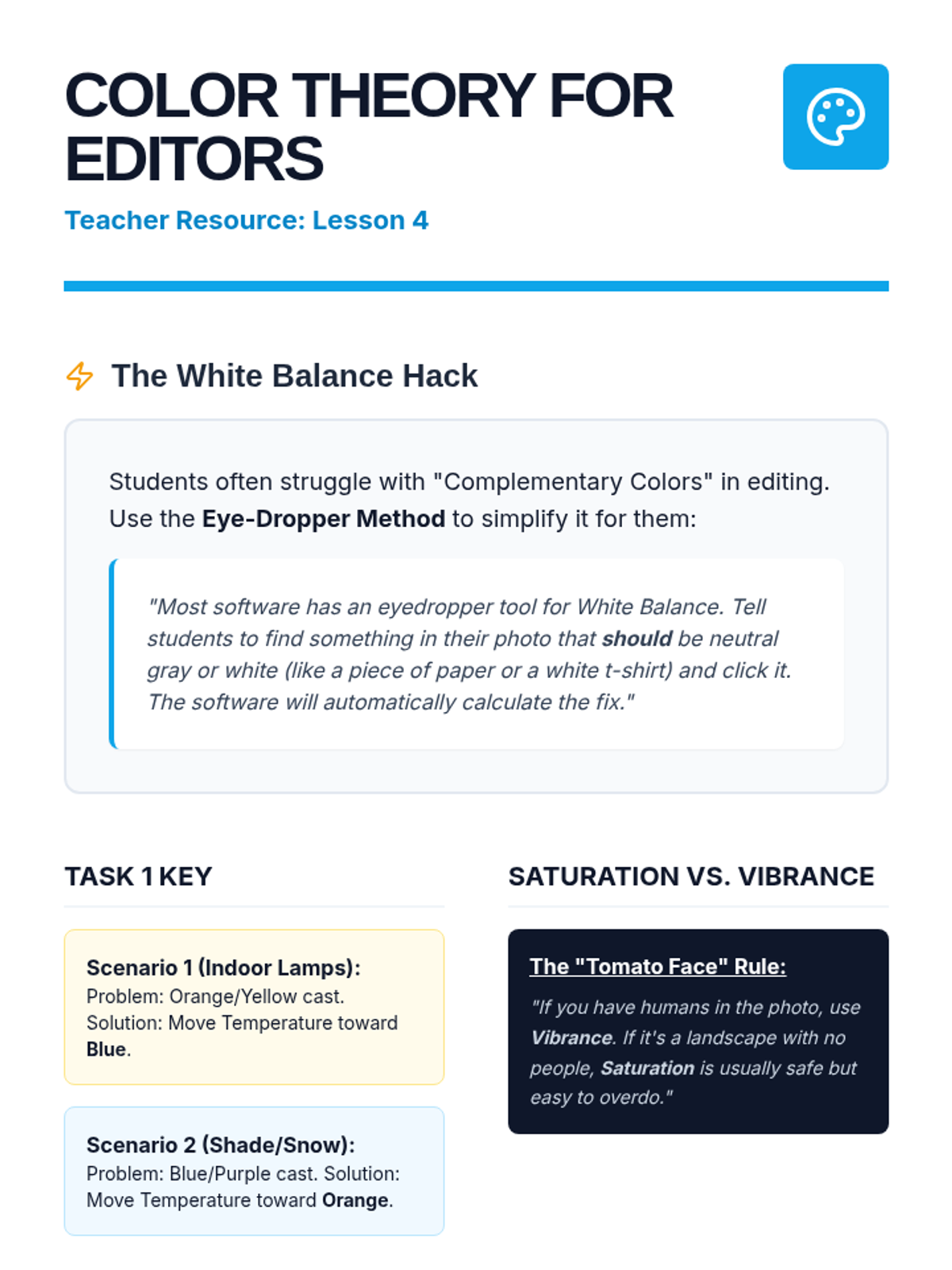
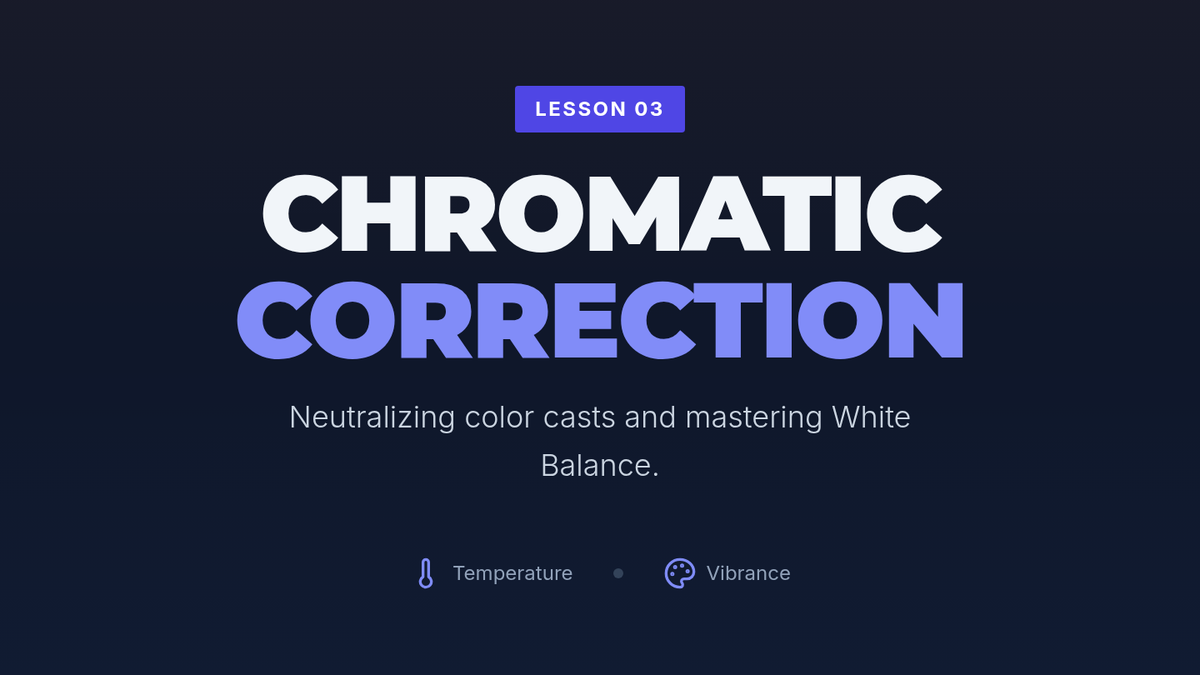
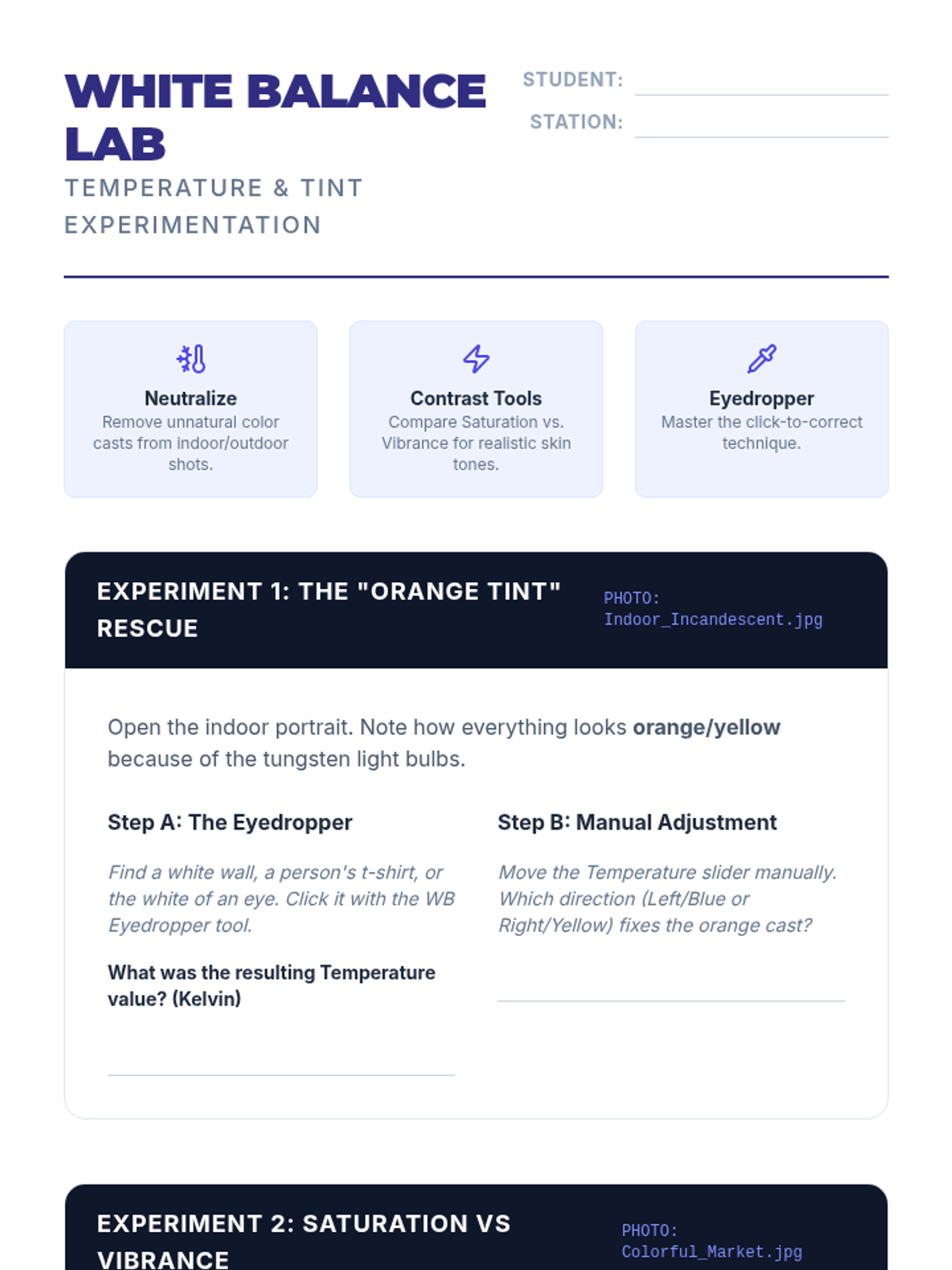
Students master color temperature and white balance to remove unnatural color casts and use saturation and vibrance to enhance mood without creating unrealistic results.
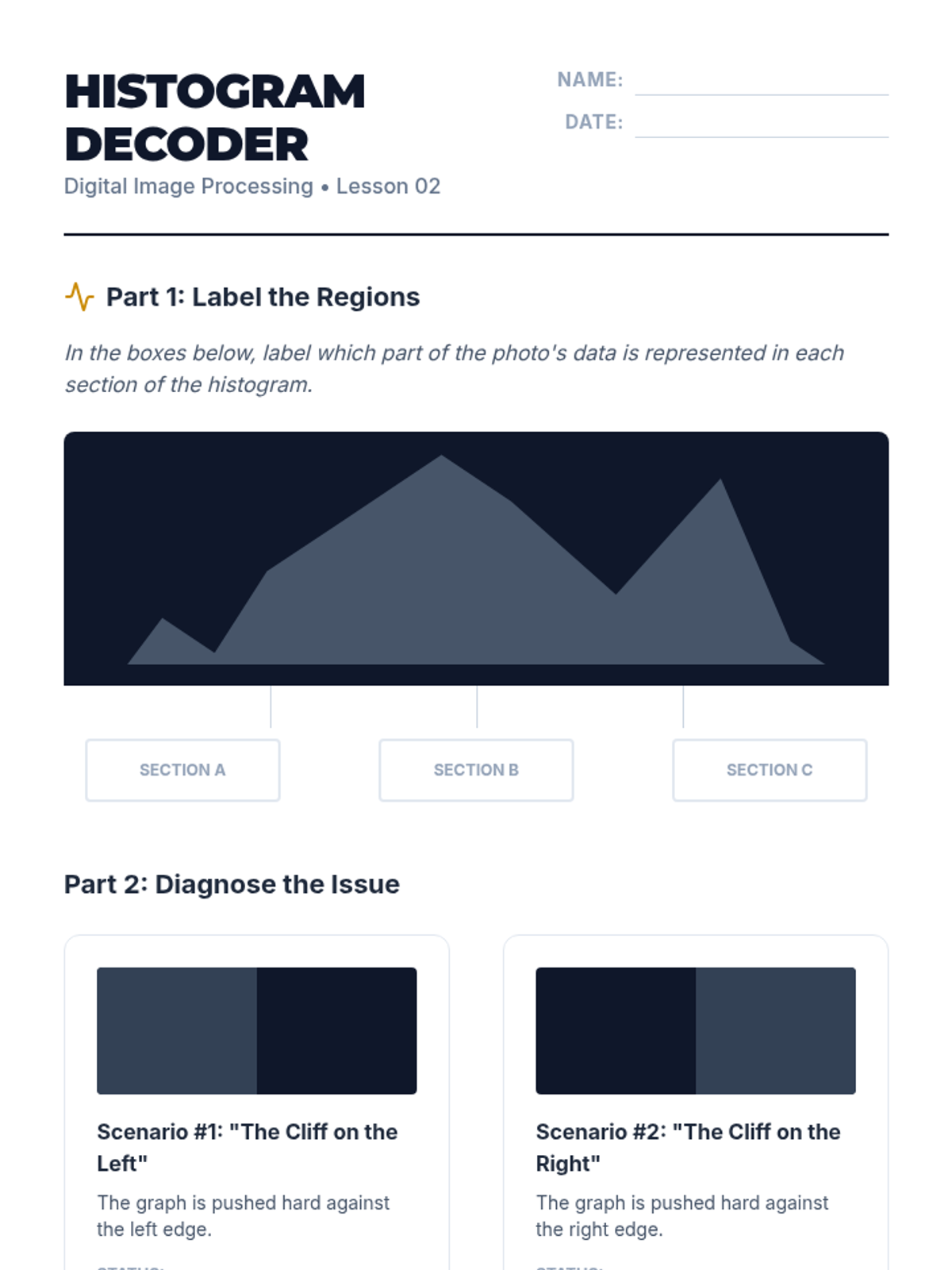
Learners dive into the technical side of exposure by reading histograms and using shadow/highlight tools to recover lost details in their digital images.
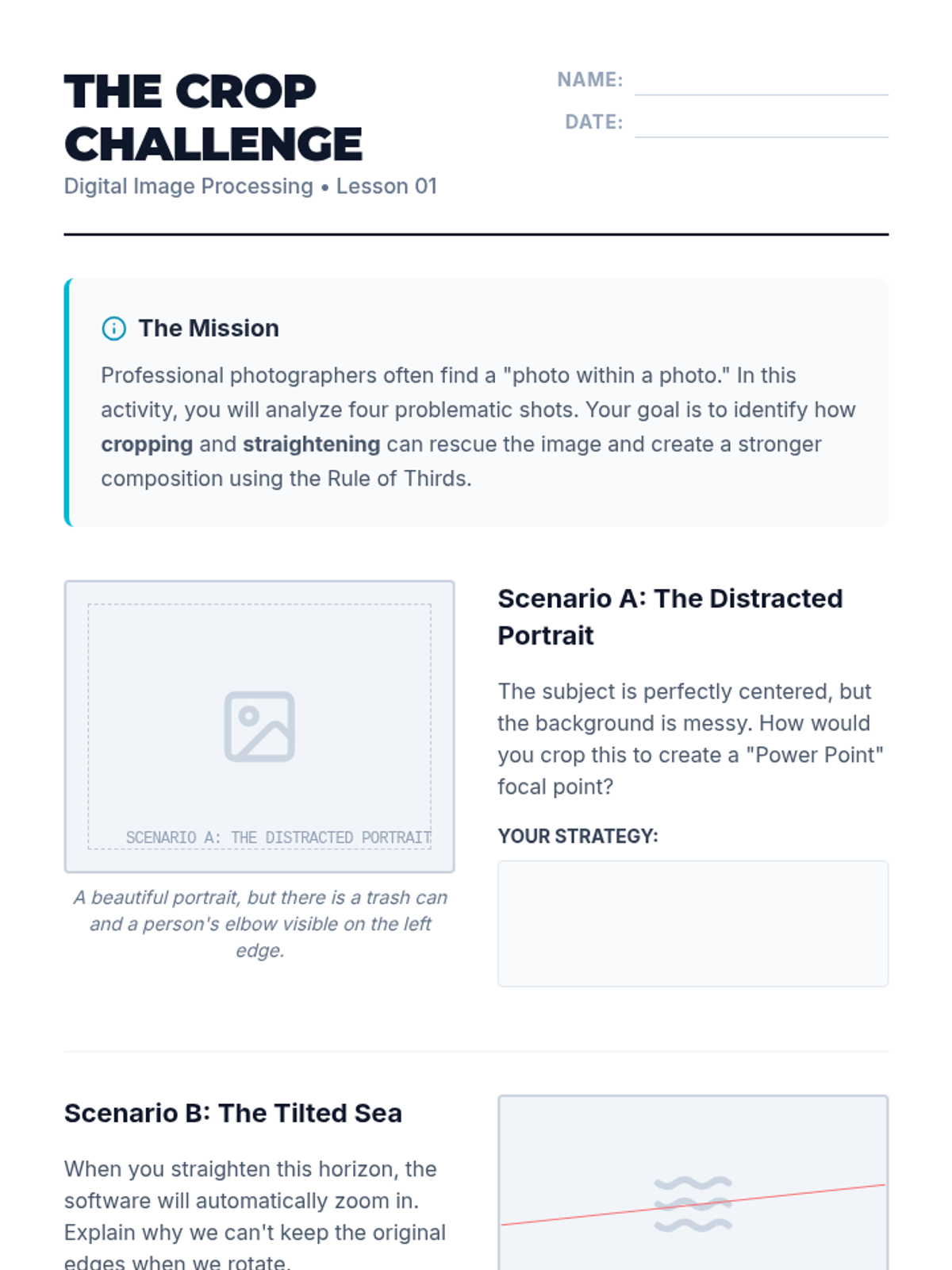
Students learn to fix tilted horizons and improve photographic composition through strategic cropping and straightening techniques, exploring how aspect ratios affect the viewer's focus.
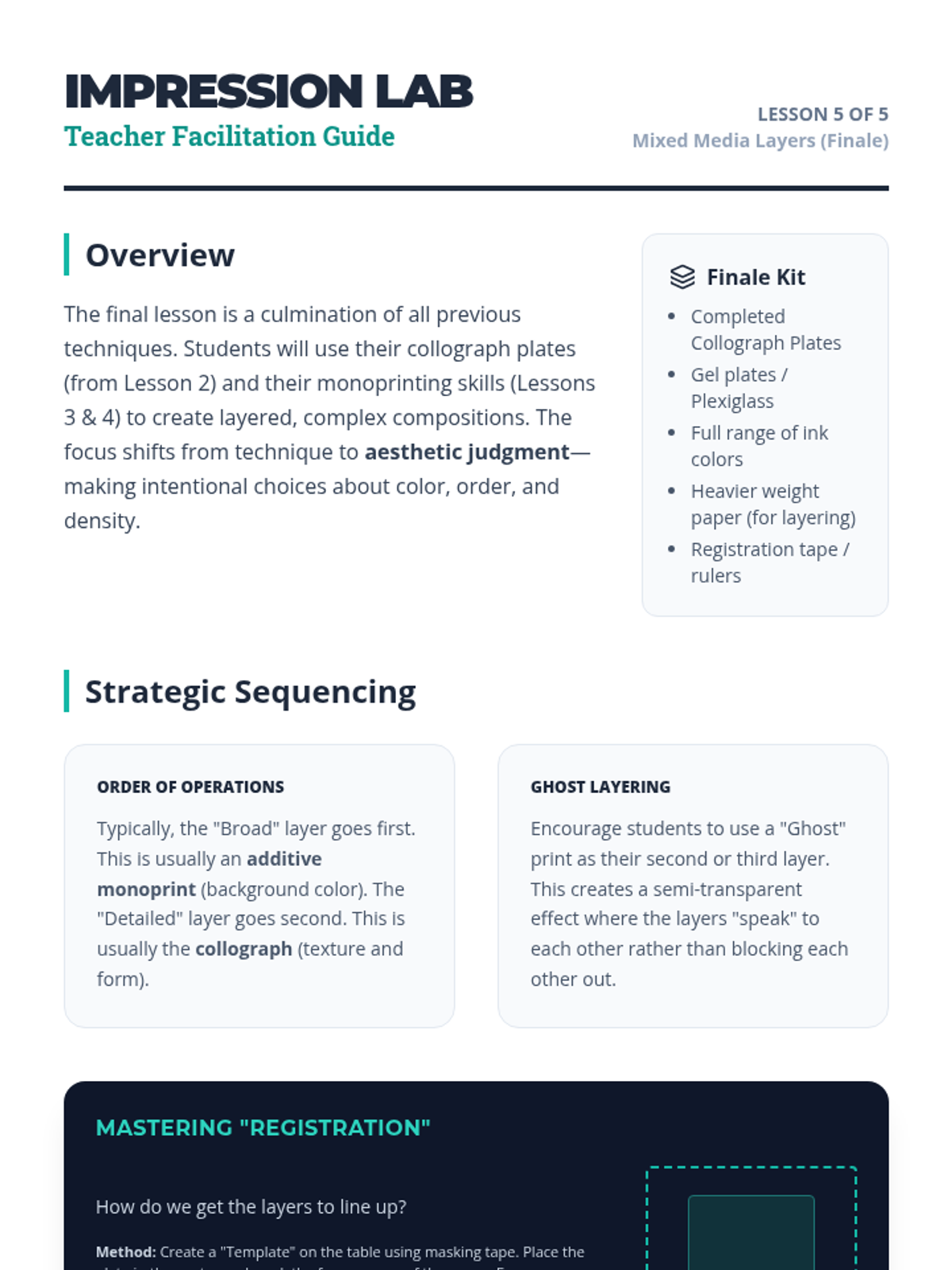
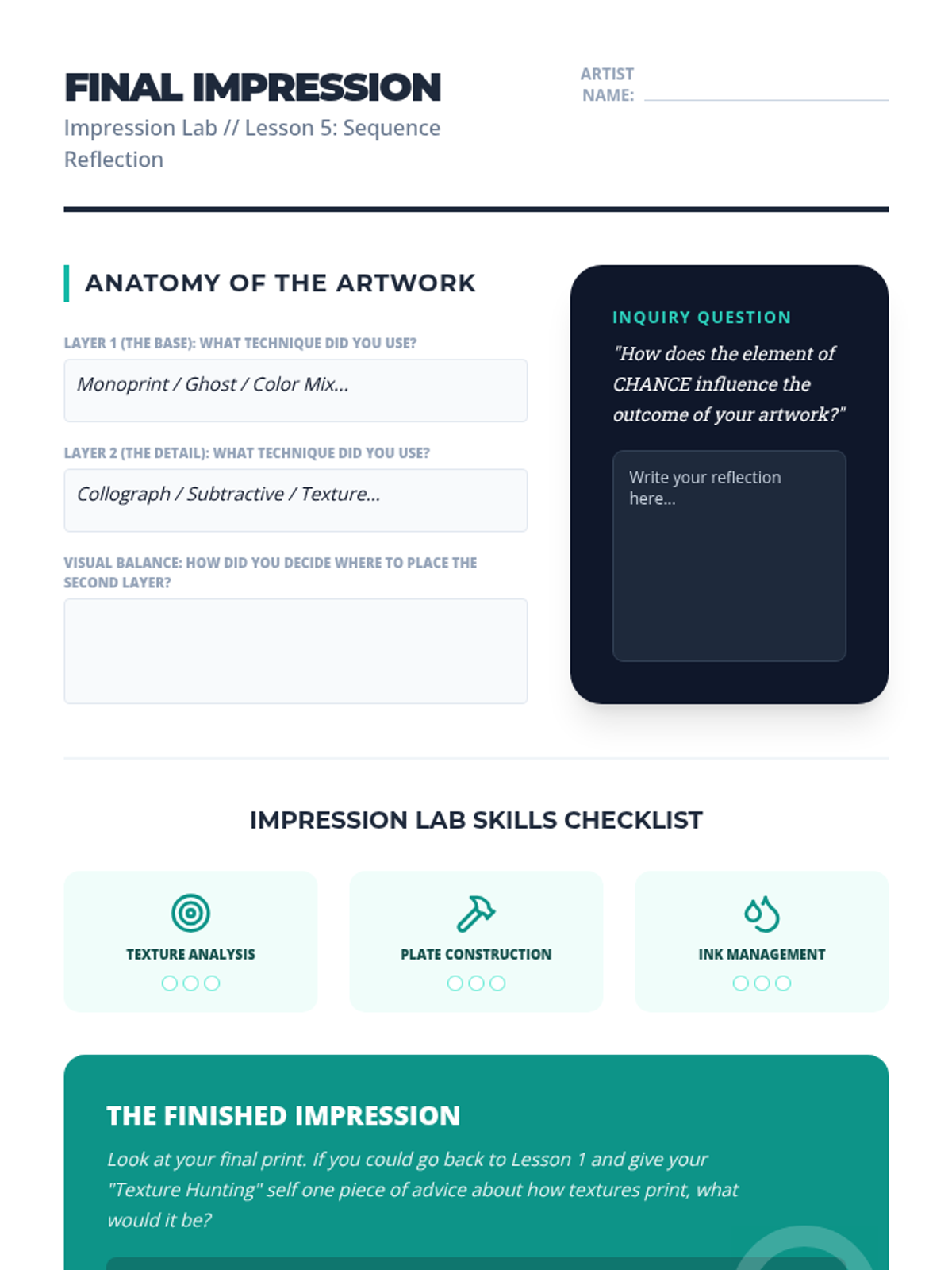
Students combine their collograph and monoprinting skills, layering multiple impressions to create complex, multi-textured visual compositions.
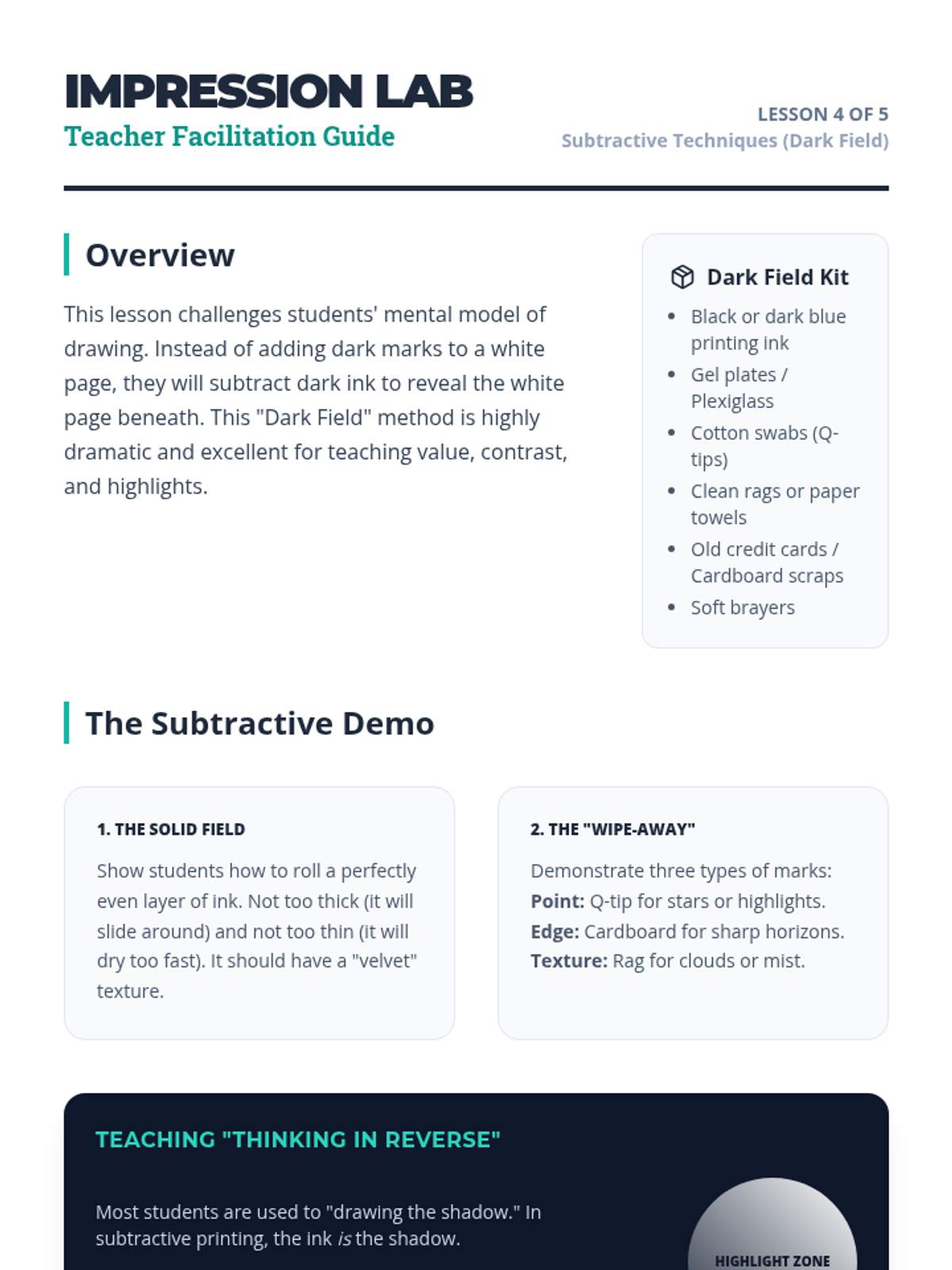
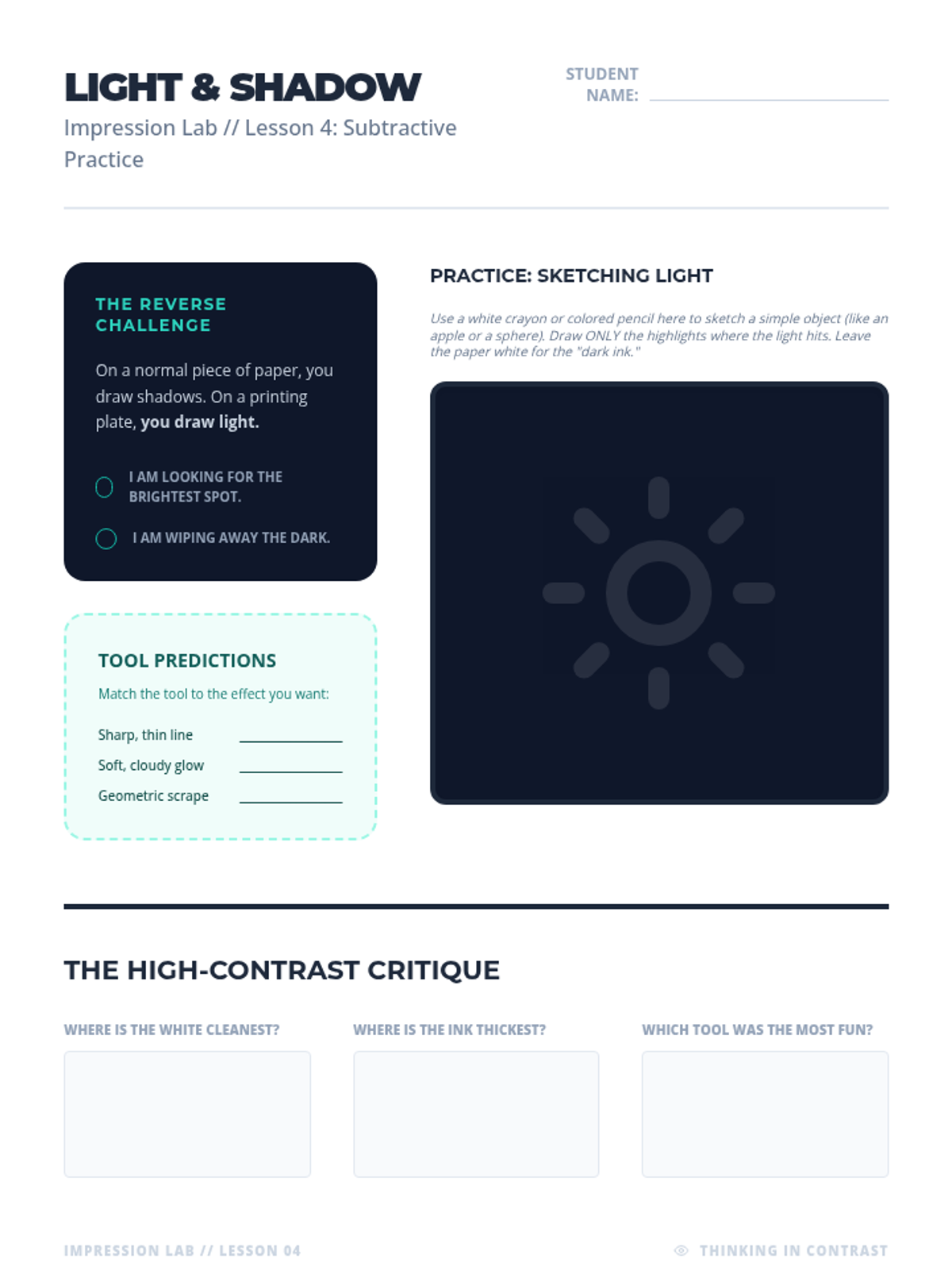
Students explore the "dark field" method of monoprinting, using subtractive tools to remove ink from a fully coated plate to create high-contrast images of light.
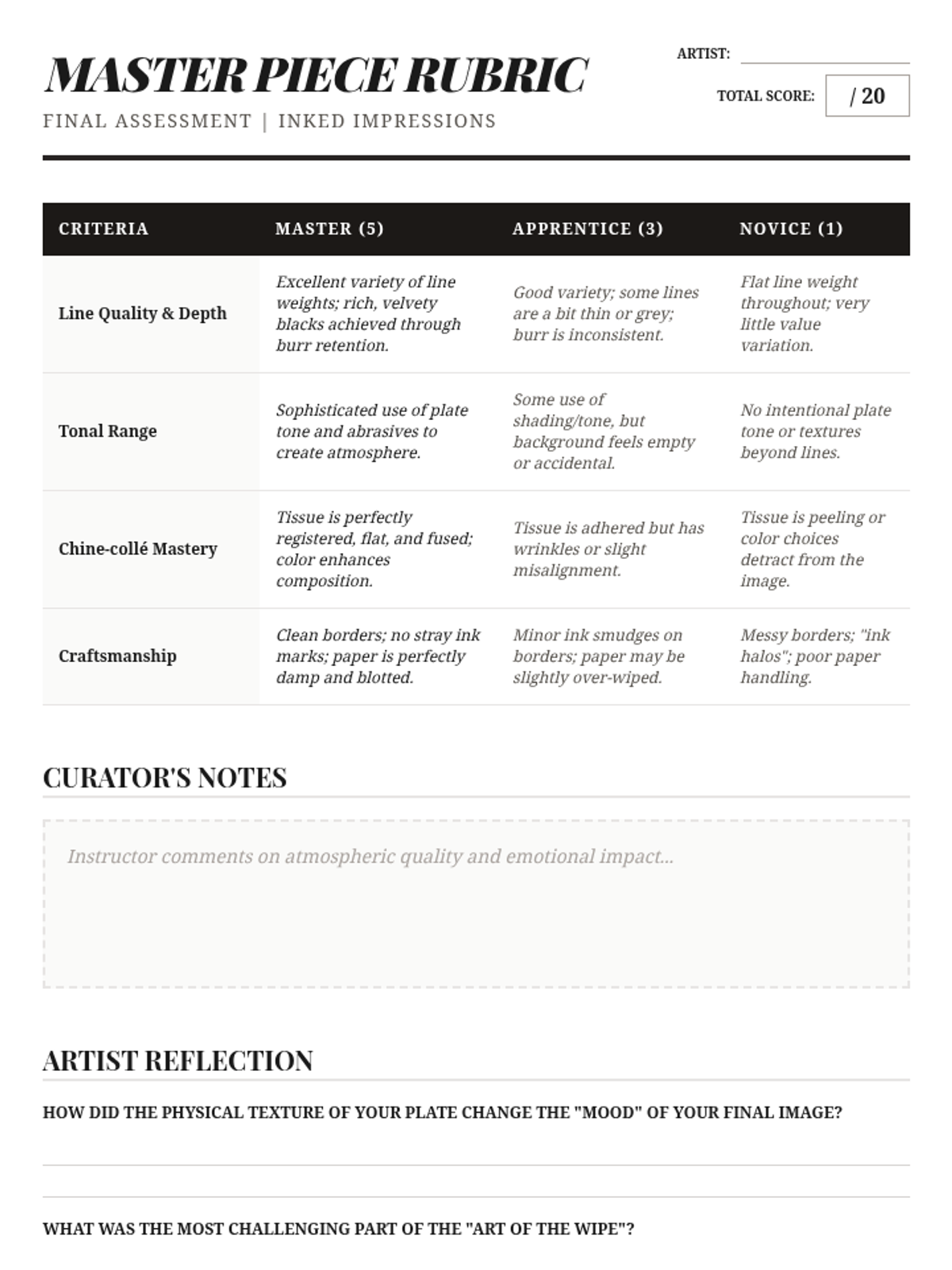
The final stage where students incorporate color through chine-collé and refine their compositions for a final edition.
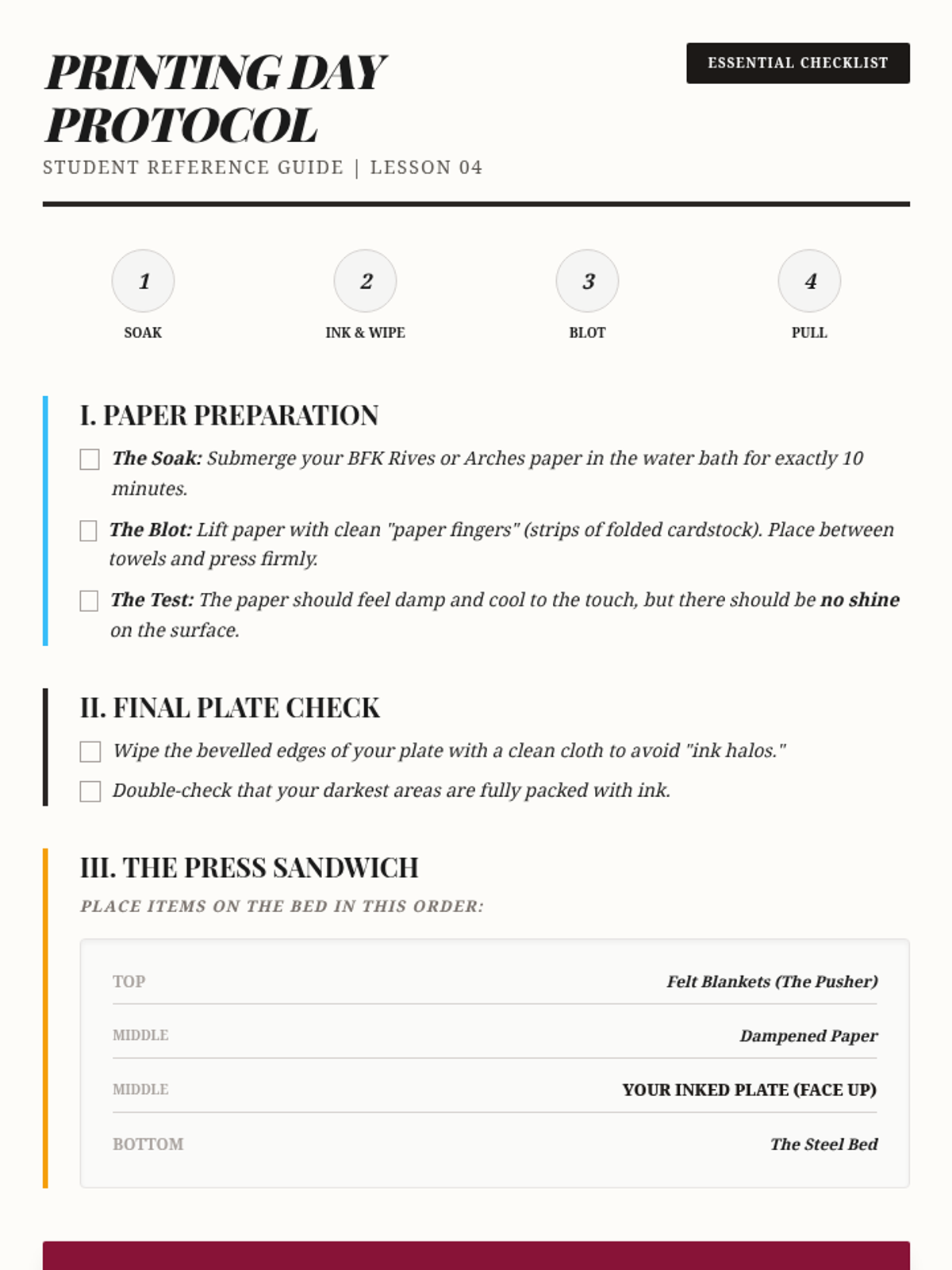
Students master the preparation of damp paper and the operation of the etching press to transfer their images.
A technical dive into the physical process of inking a plate and the delicate art of wiping with tarlatan.
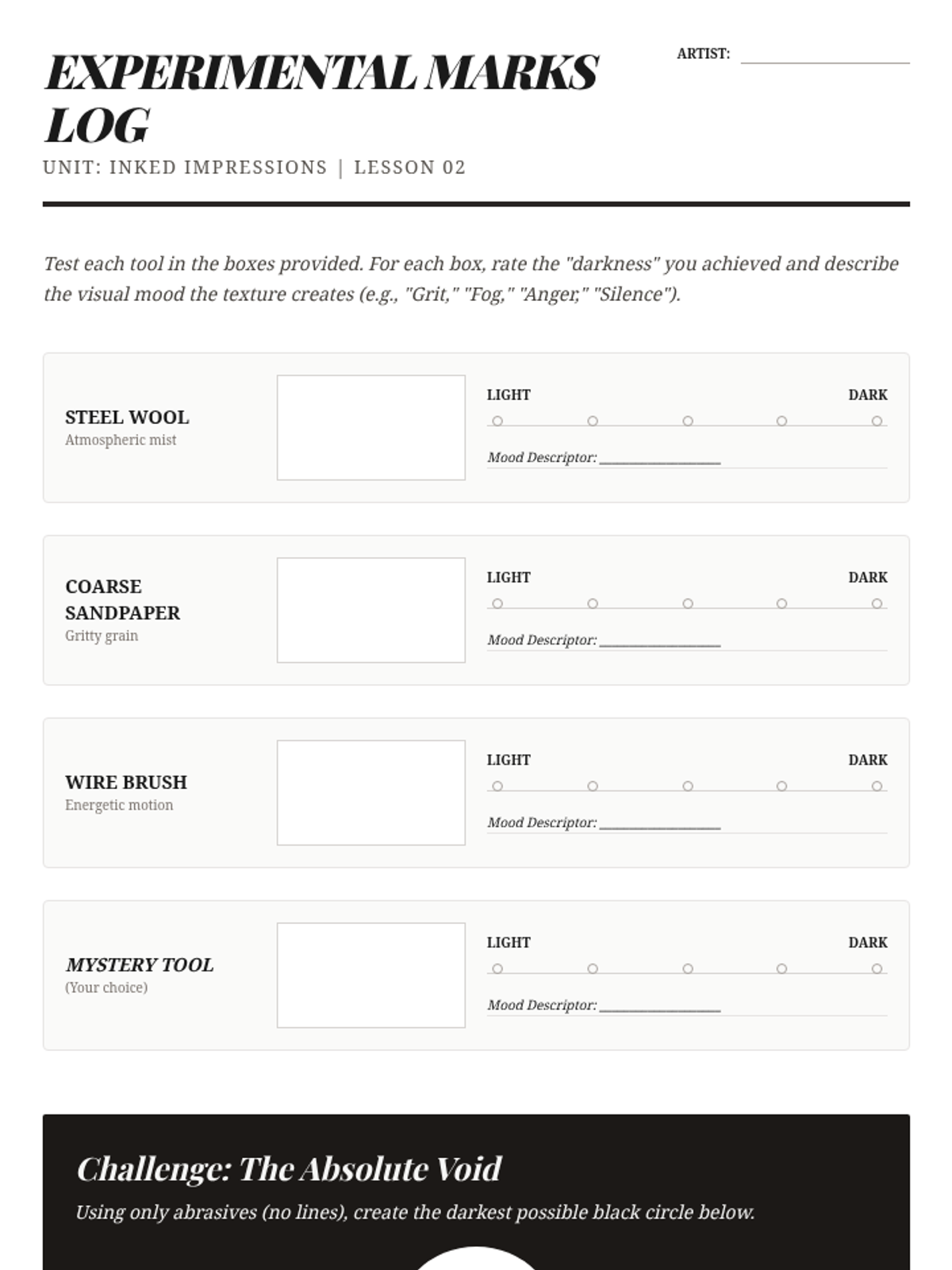
Focuses on creating value and atmosphere using abrasive tools and hatching techniques to hold plate tone.
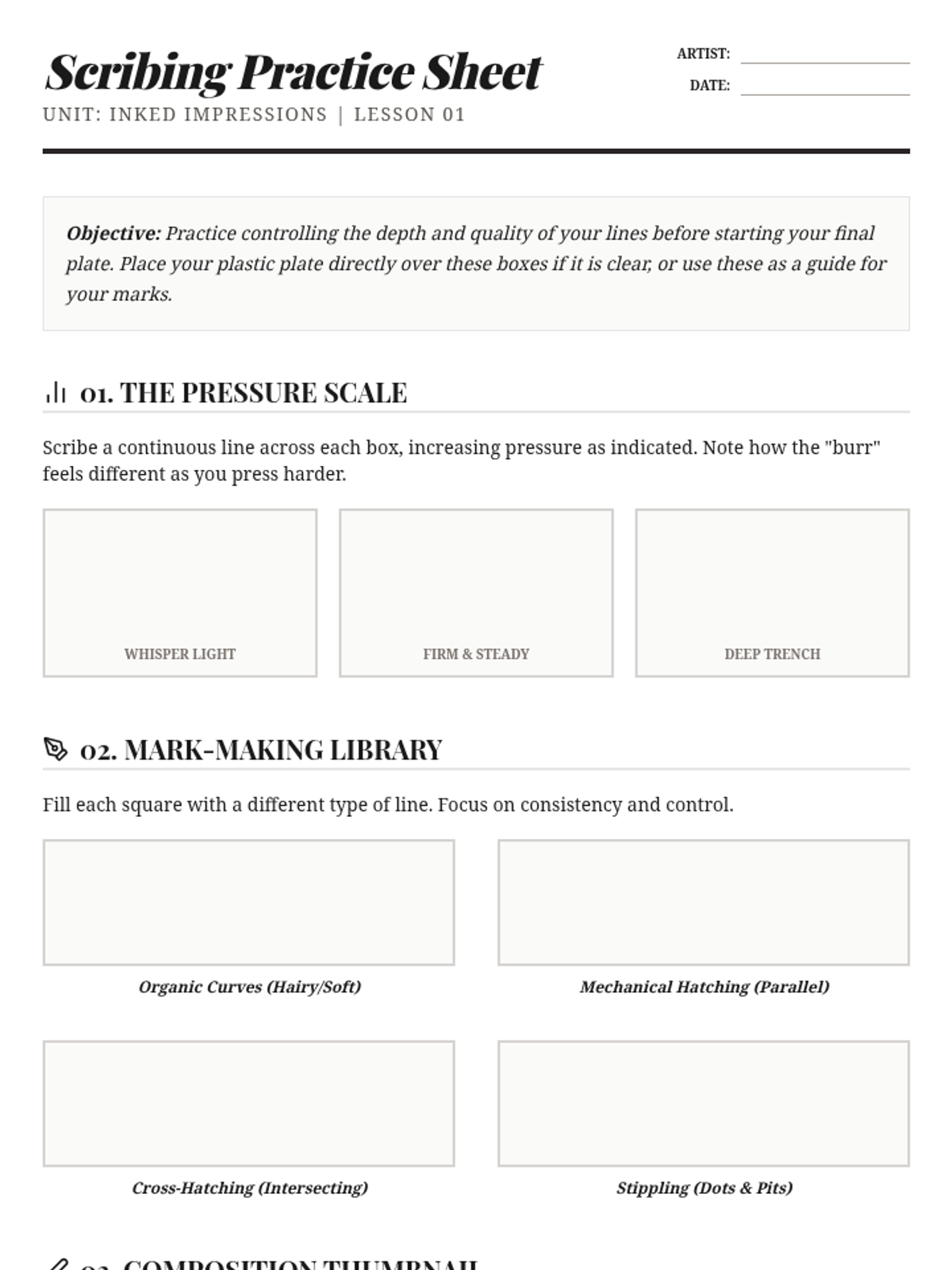
Students learn the fundamental difference between relief and intaglio printing and practice scribing lines into plastic plates with varying pressure.
Students practice additive monoprinting on gel plates, focusing on spontaneous color blending and the unique nature of the "one-off" print.
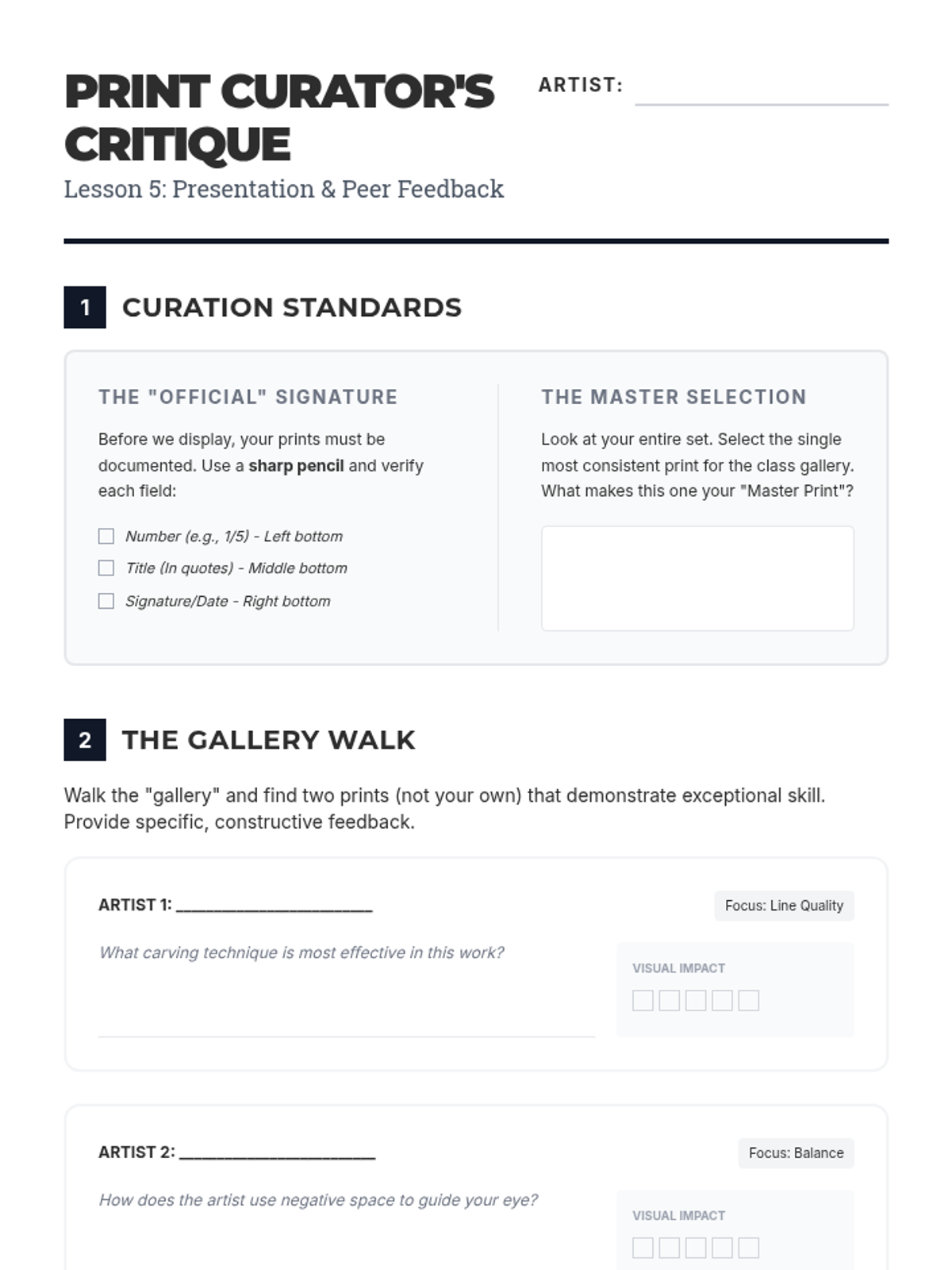
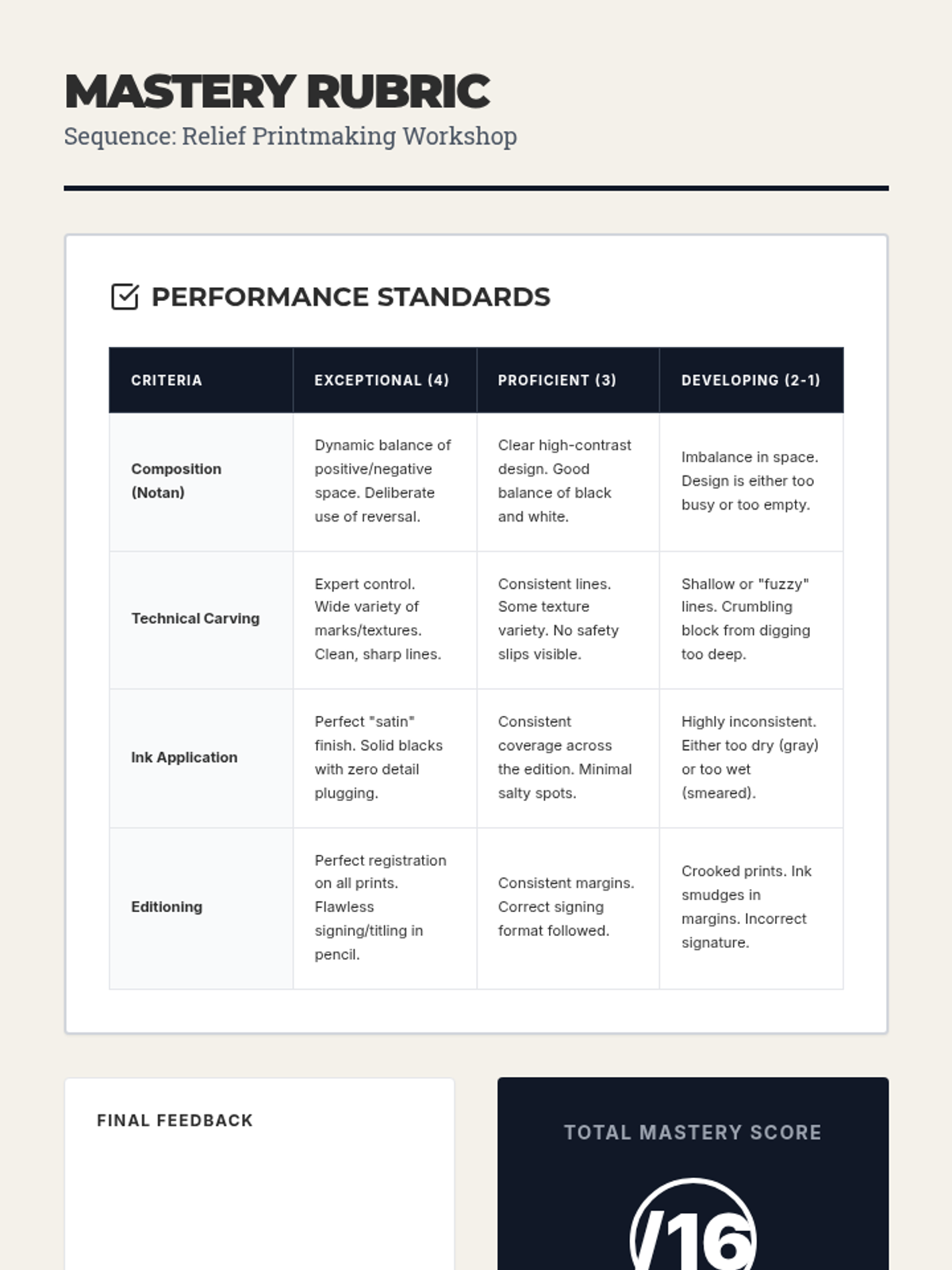
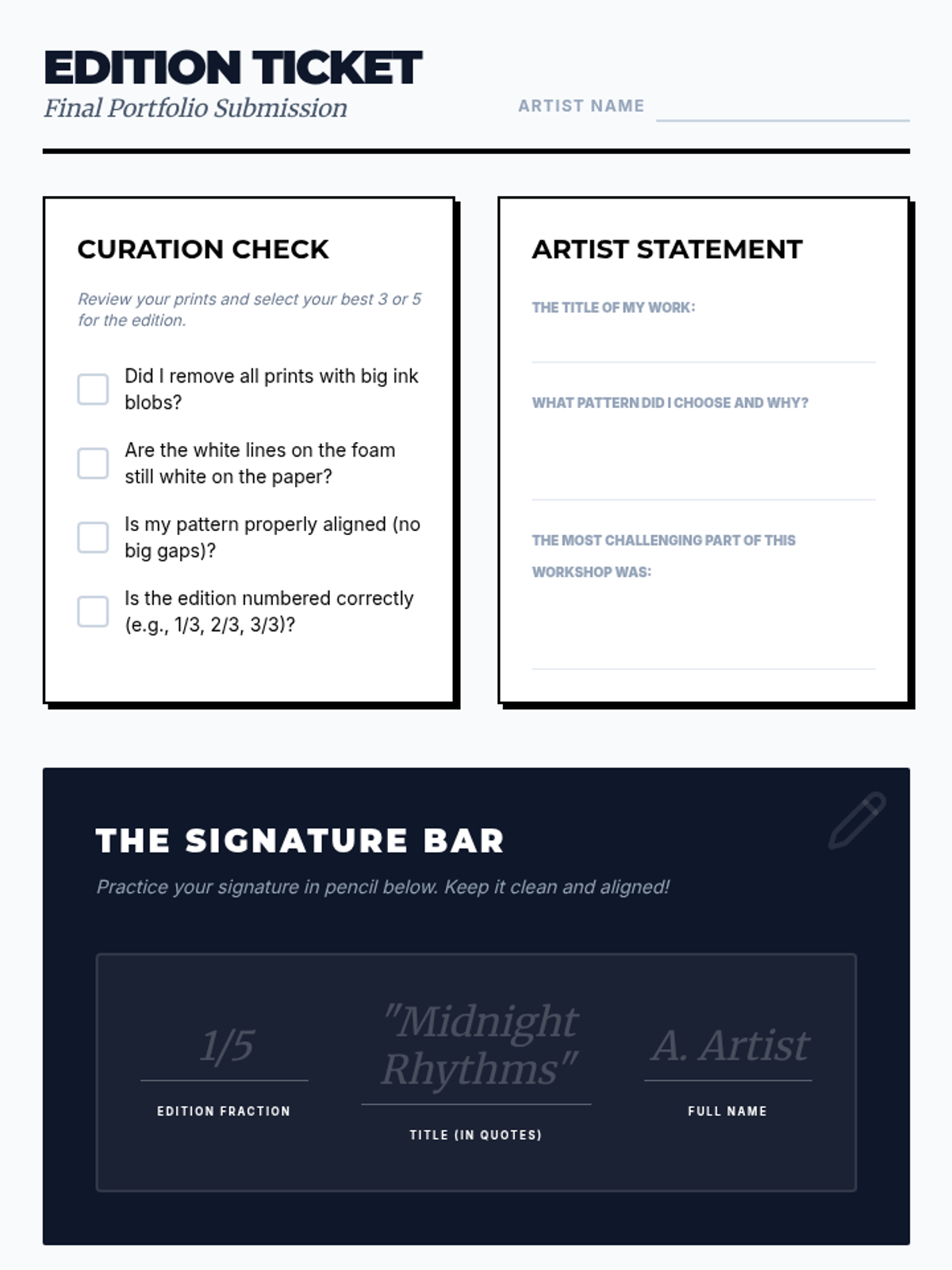
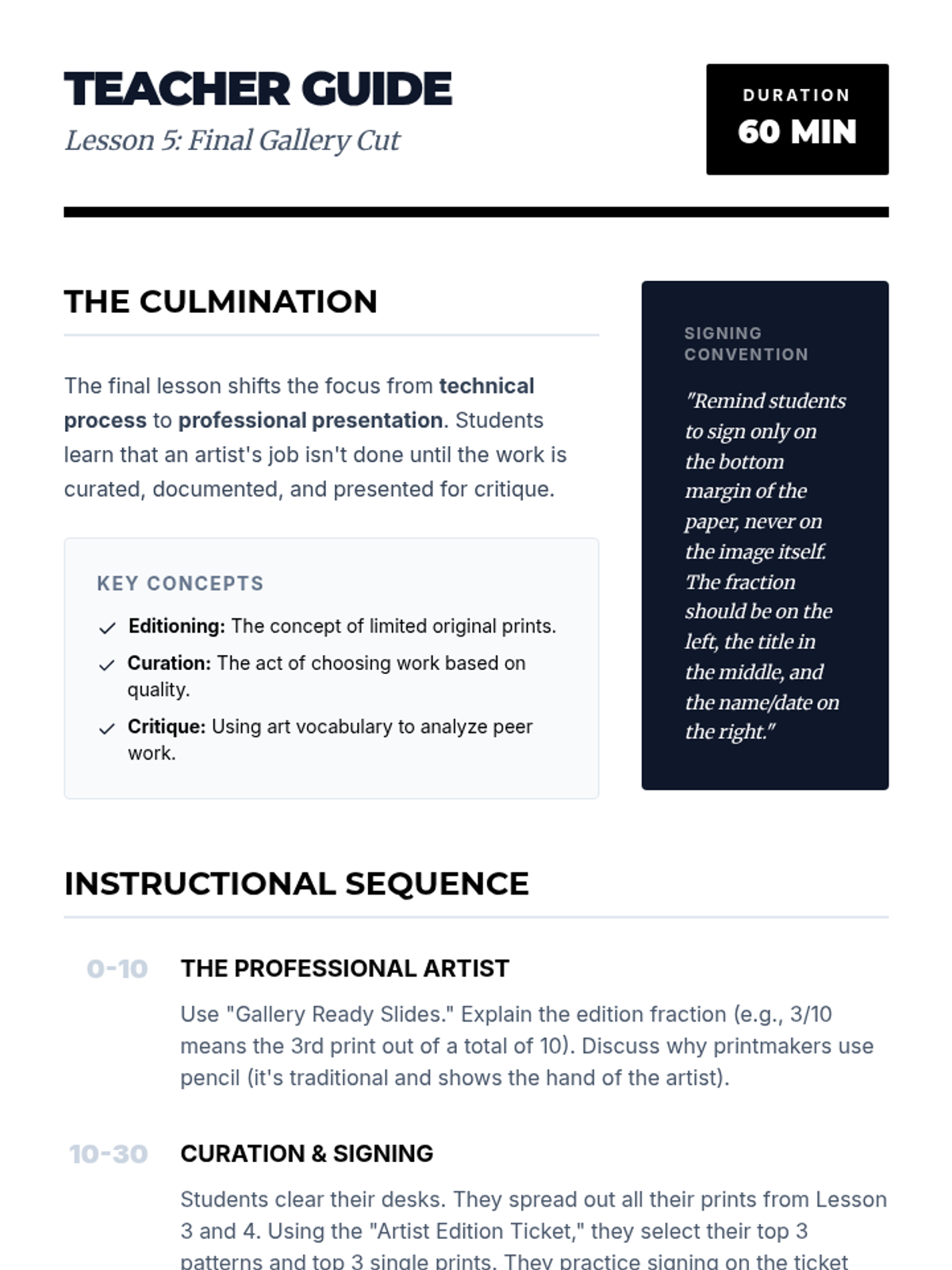
In this culminating lesson, students learn the proper method for signing, titling, and numbering prints in pencil. The class participates in a gallery walk critique to discuss how different carving styles affect the emotional tone of the artwork.
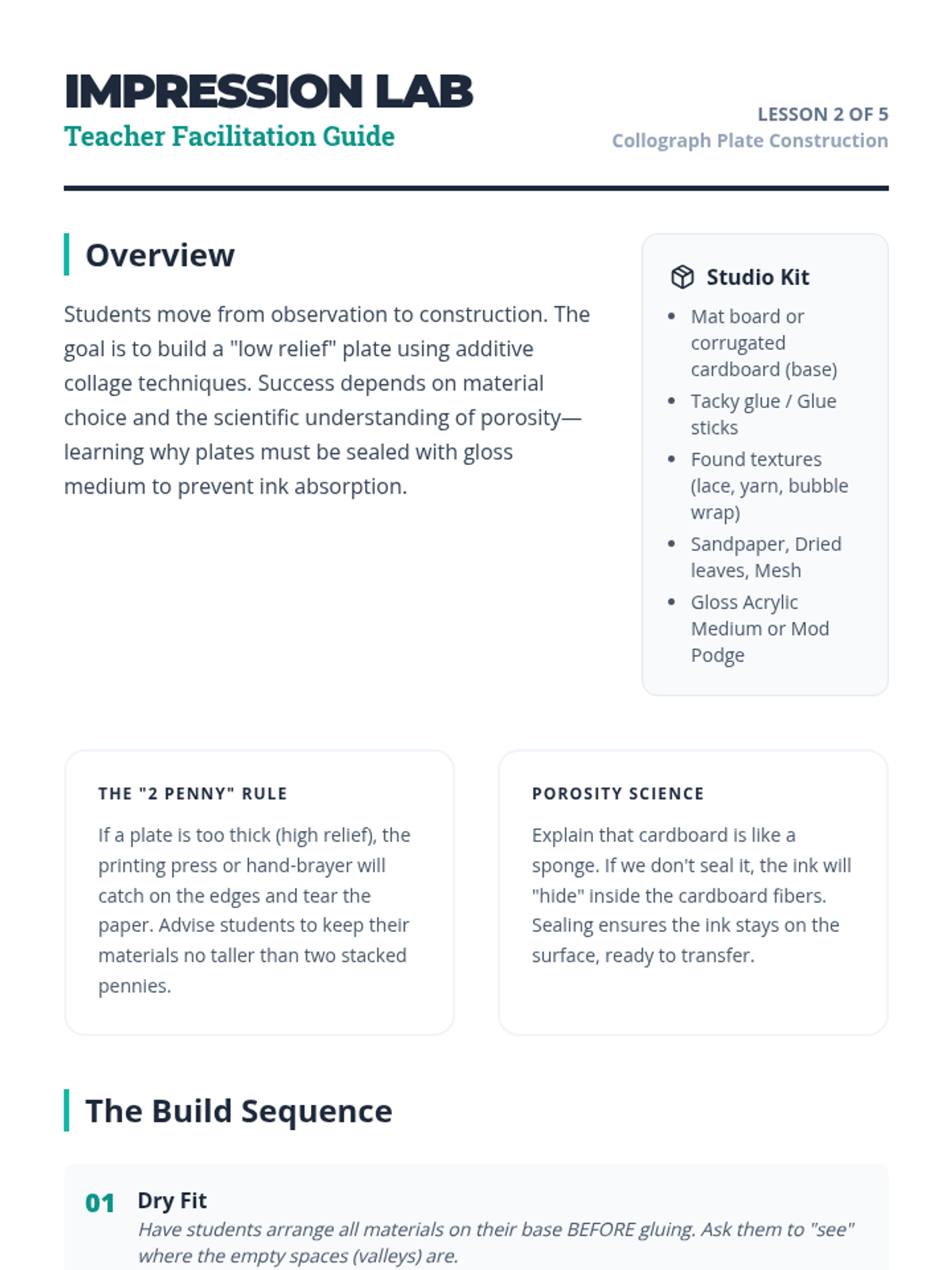
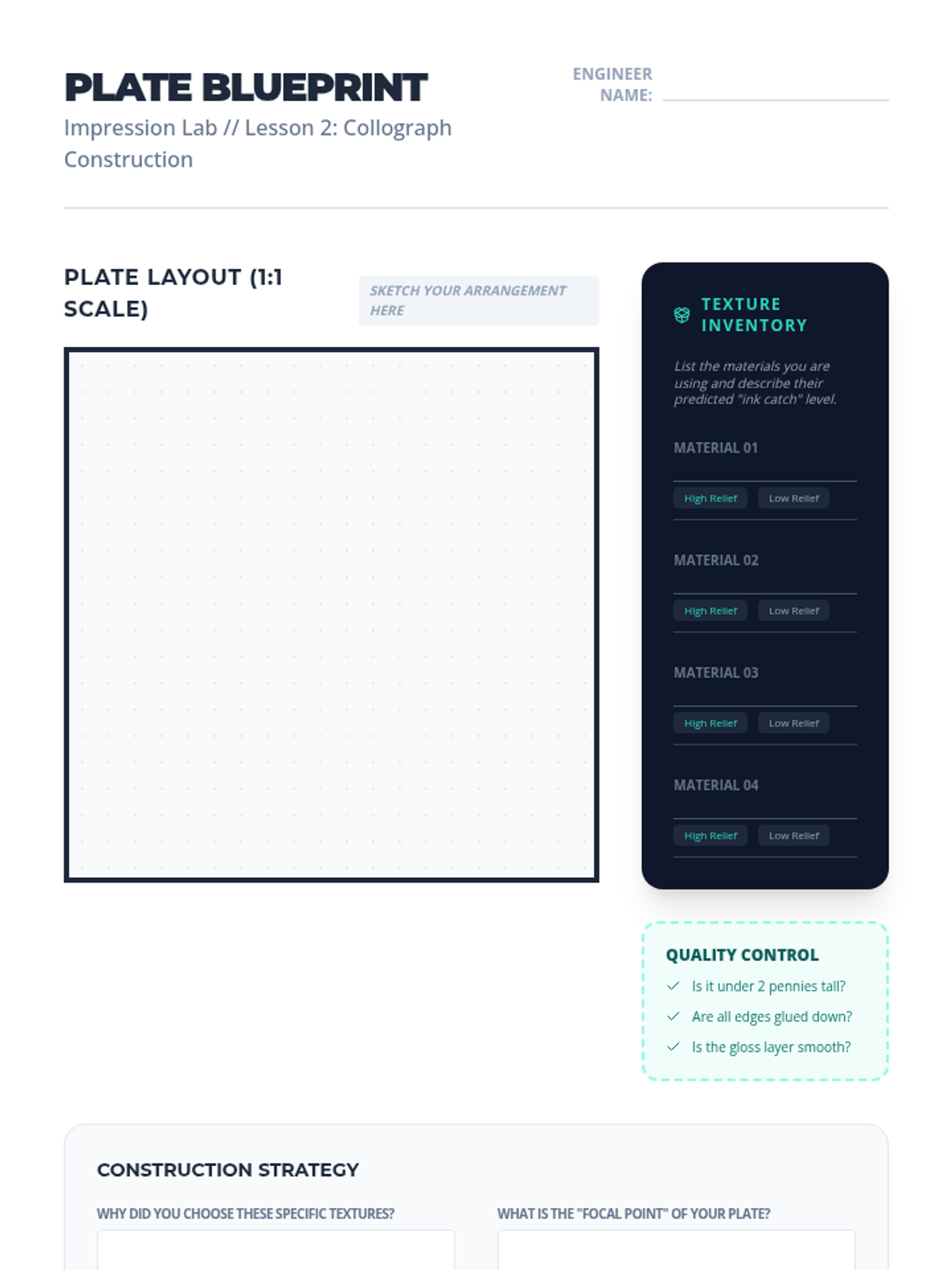
Students design and build a low-relief collograph plate using found materials, learning how physical height and texture create a printable surface.
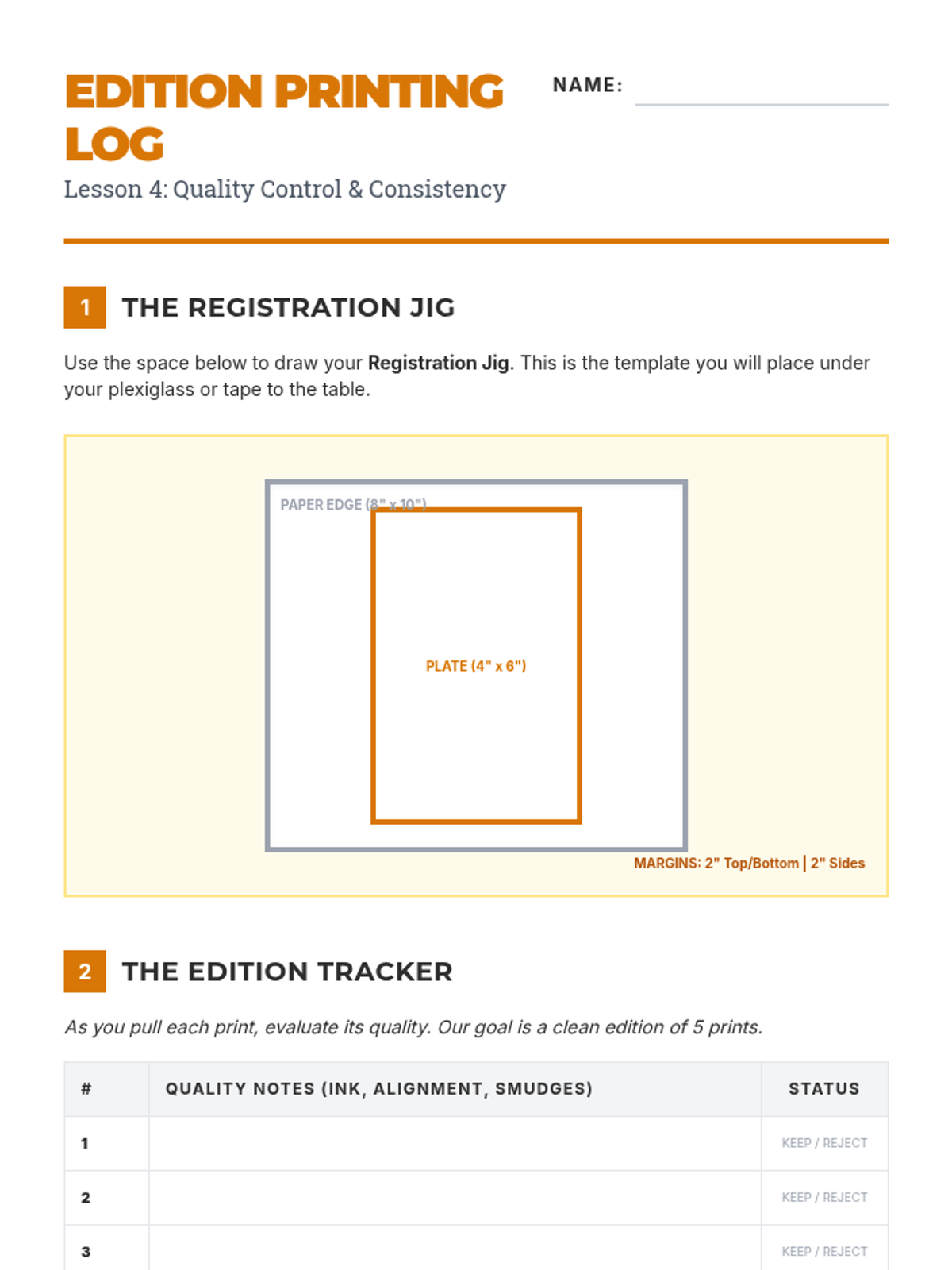
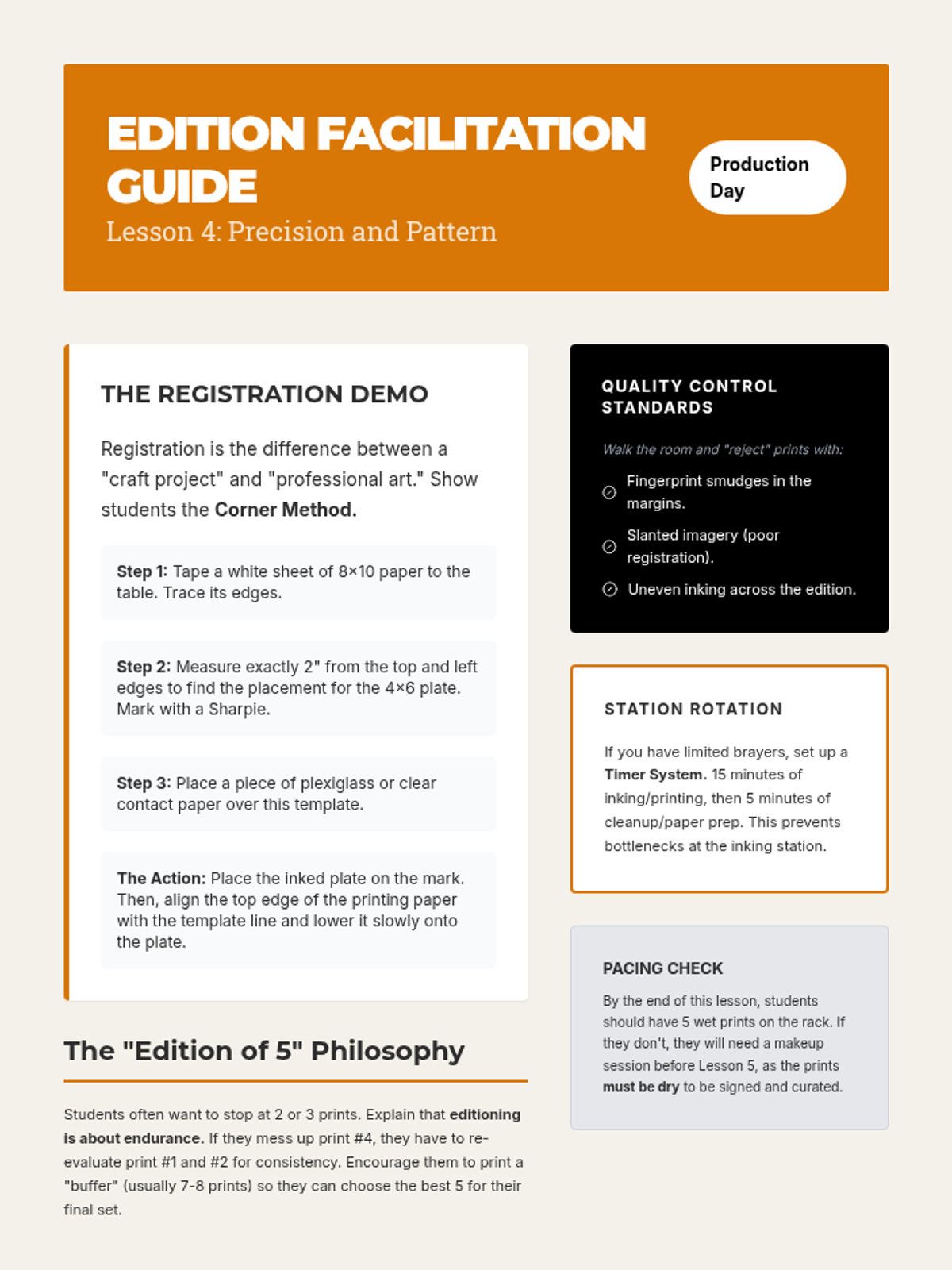
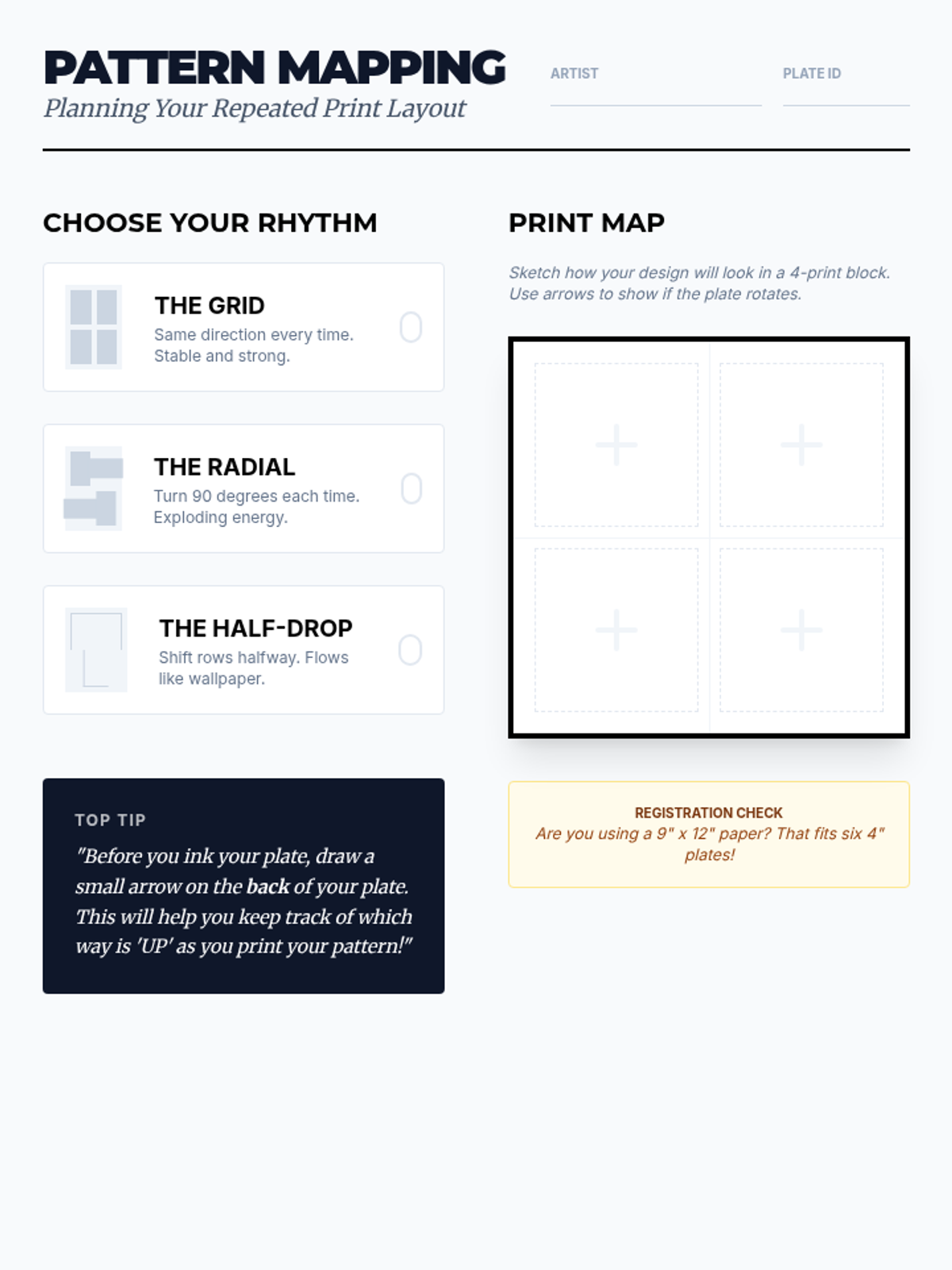
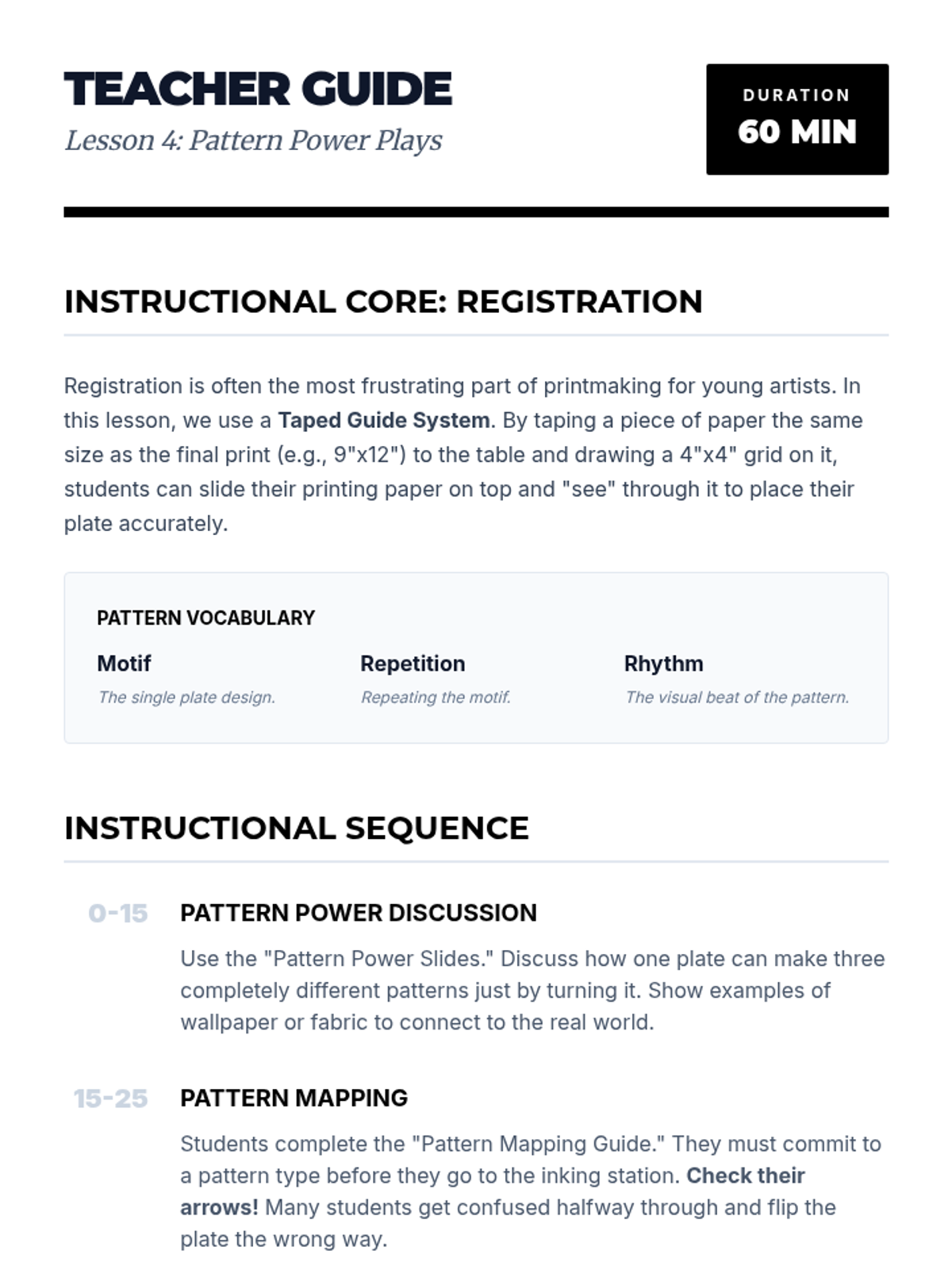
Students establish a registration system to ensure their image is centered and aligned on the paper every time. They produce a numbered edition of identical prints, learning the standards of print curation.
Students sign, number, and curate their final print editions followed by a peer gallery walk.
Students create complex patterns by repeating their prints using registration techniques for alignment.
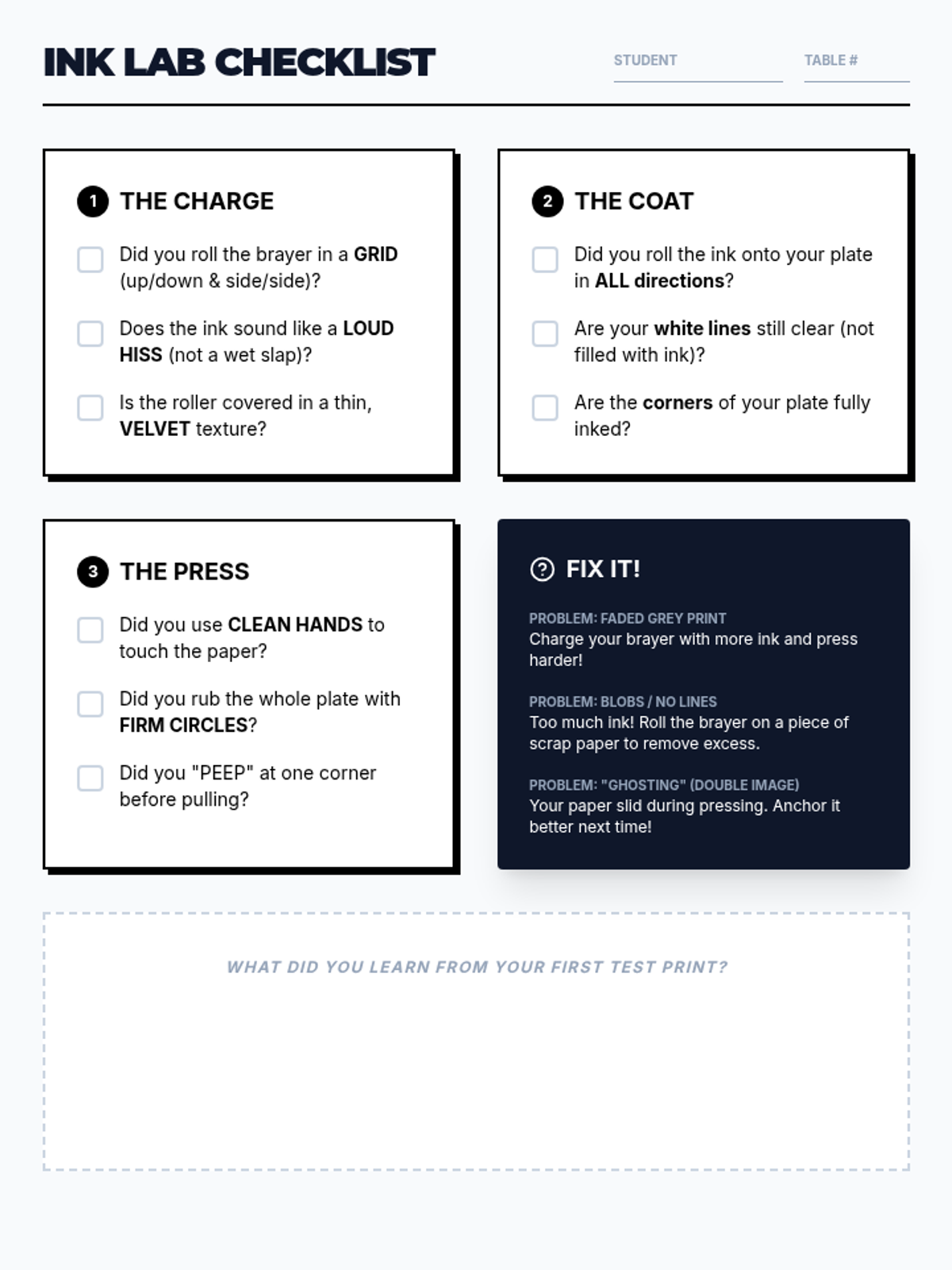
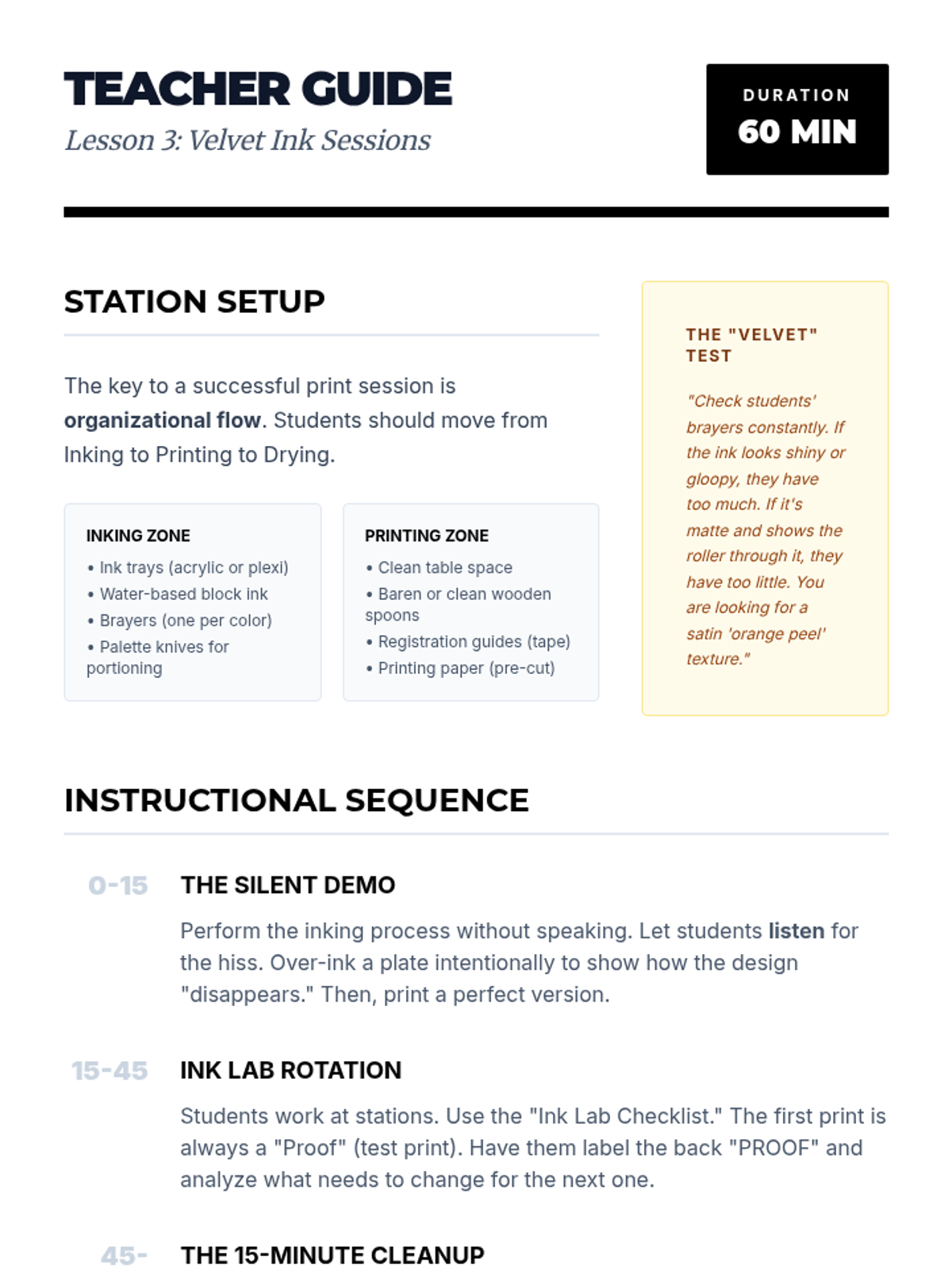
Focuses on the technical aspects of rolling ink, achieving the perfect 'velvet' texture, and charging the plate.
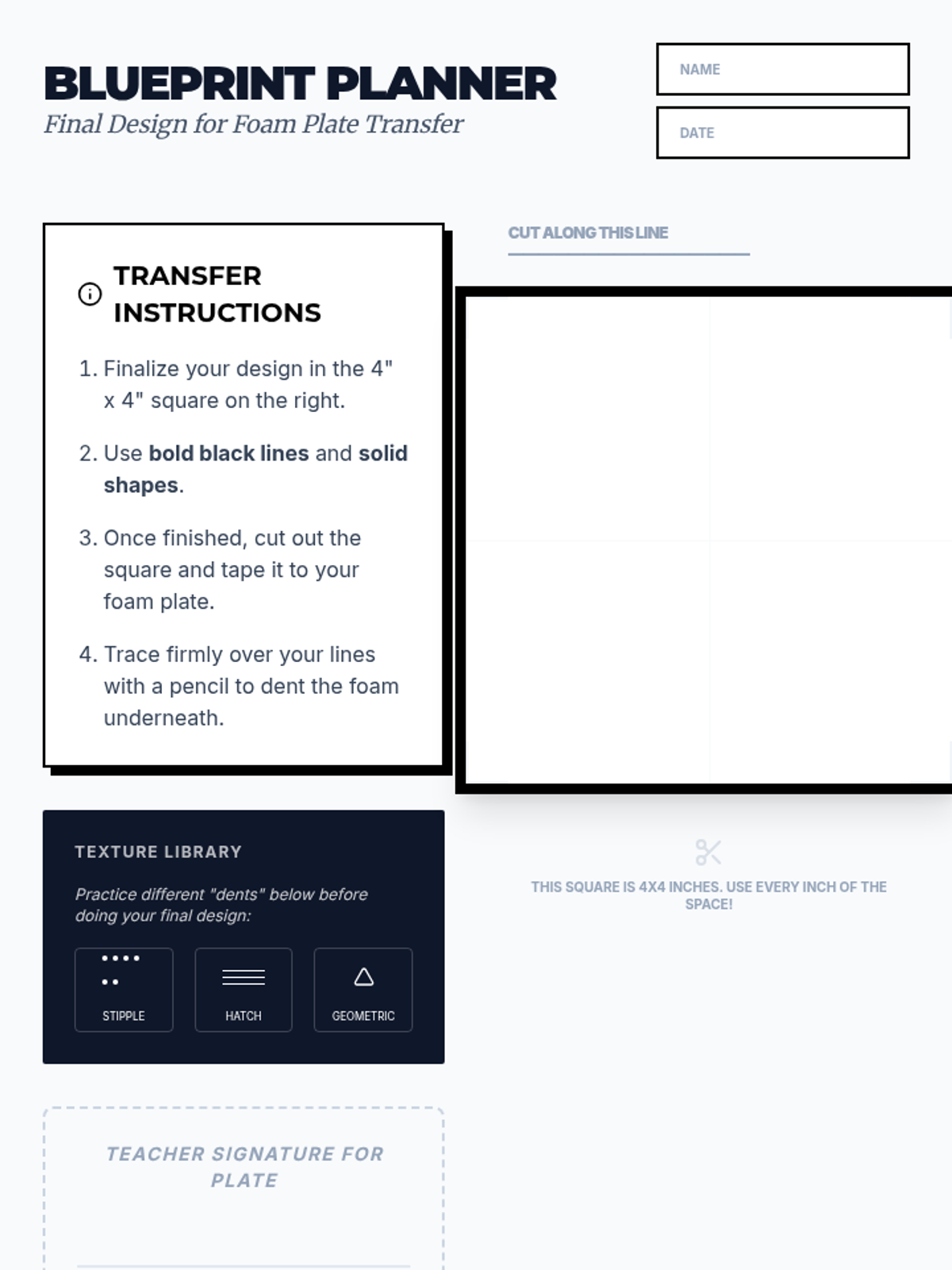
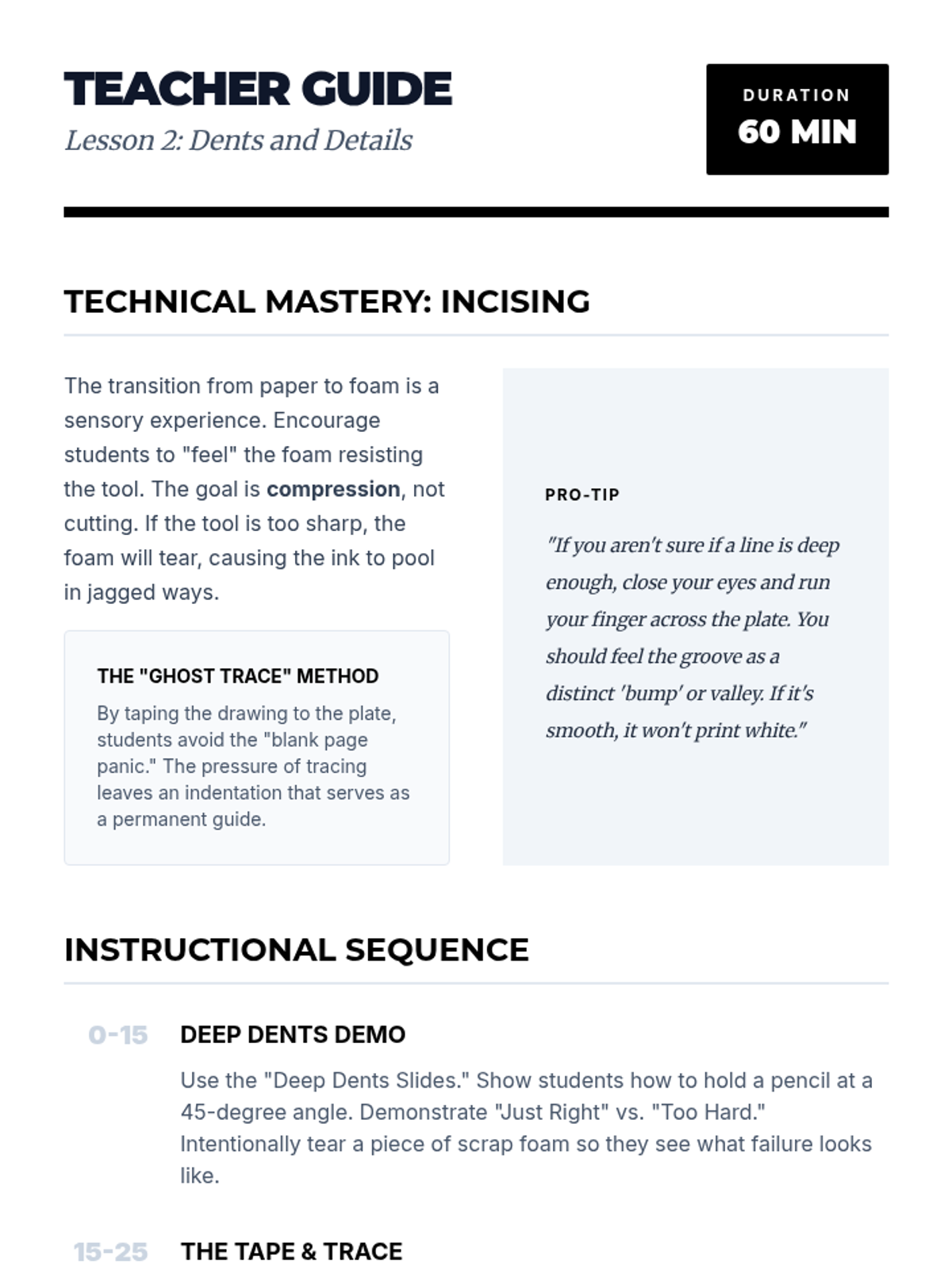
Students transfer designs to foam plates and experiment with line weight and texture using incising tools.
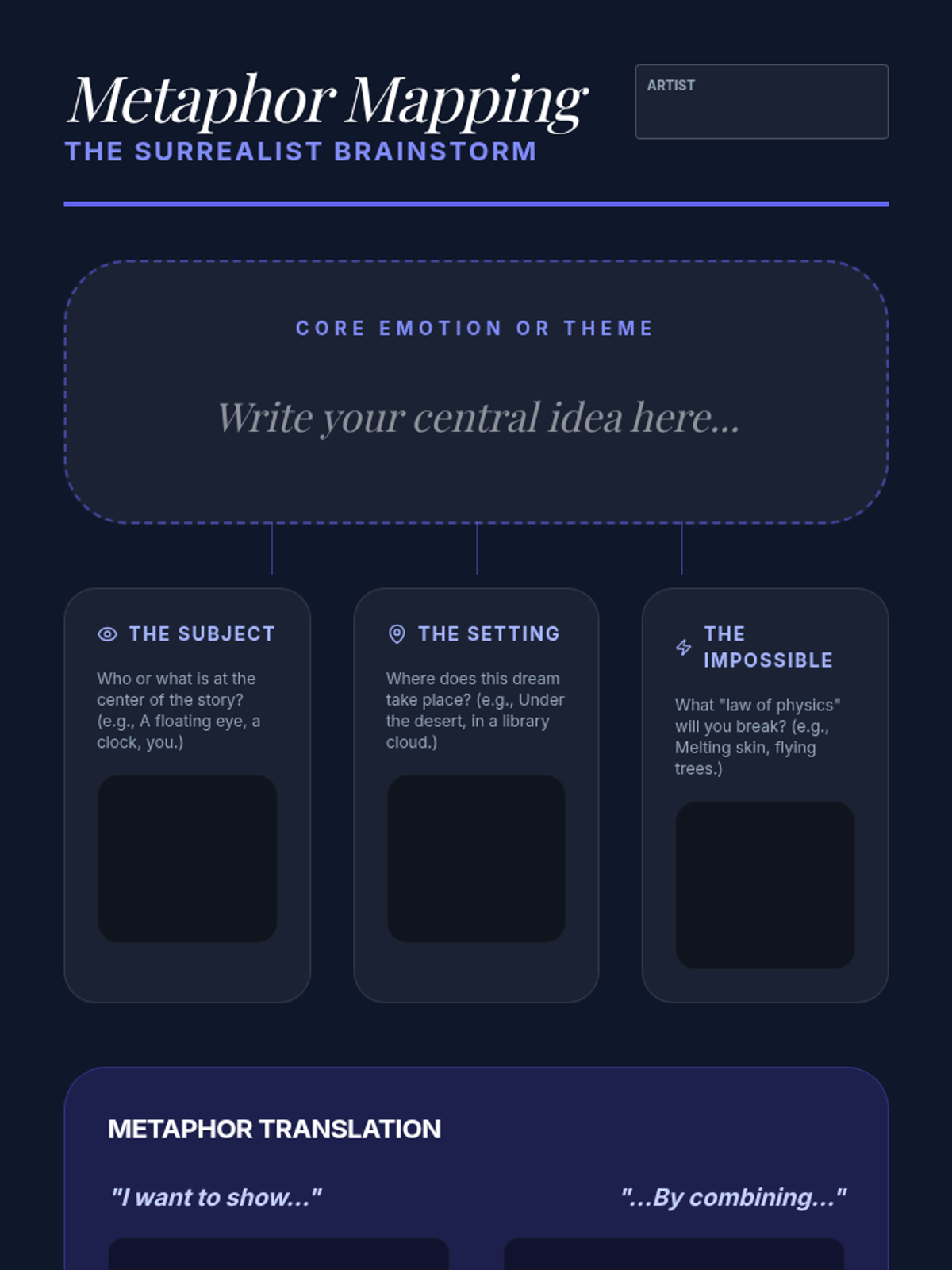
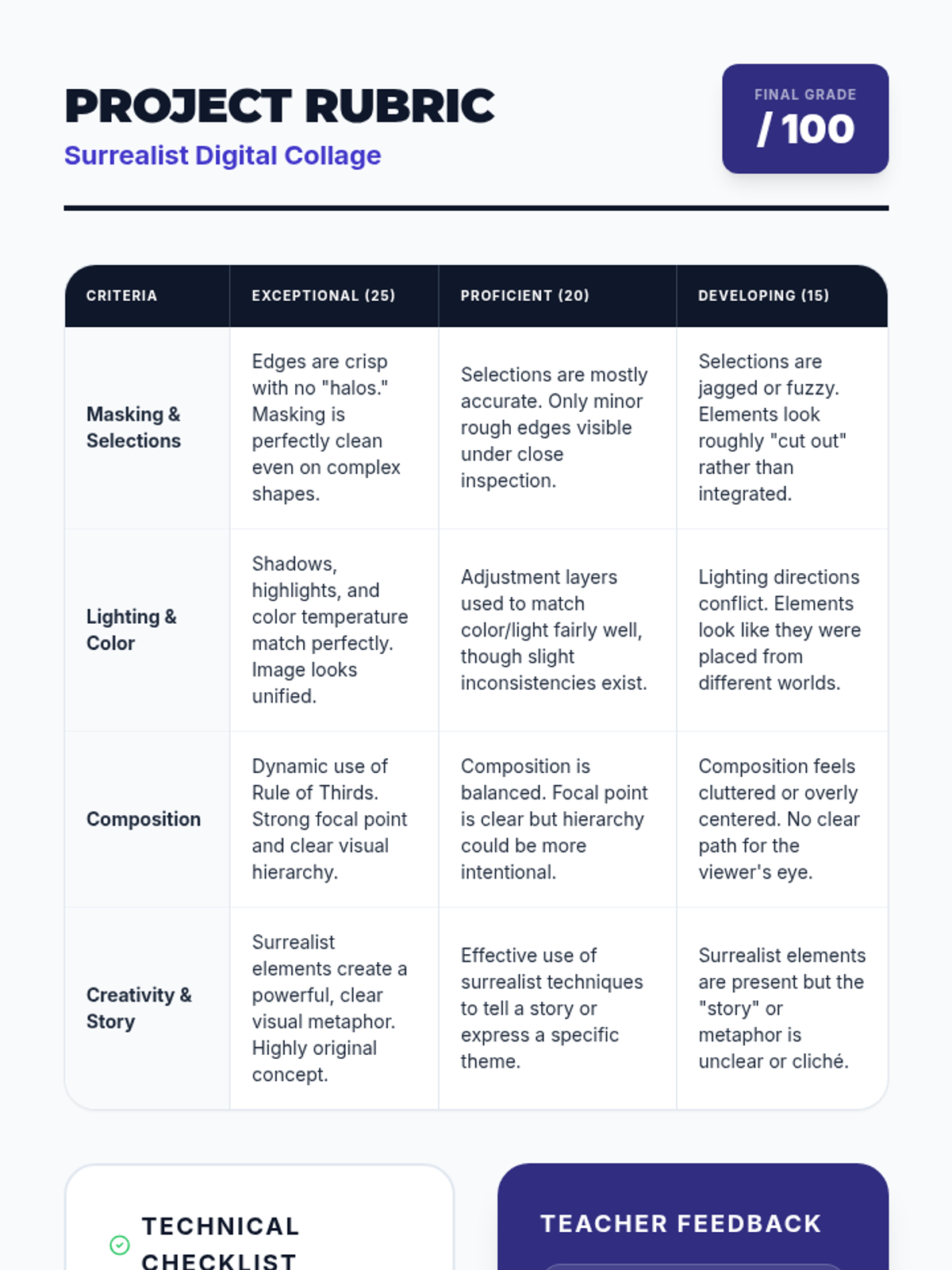
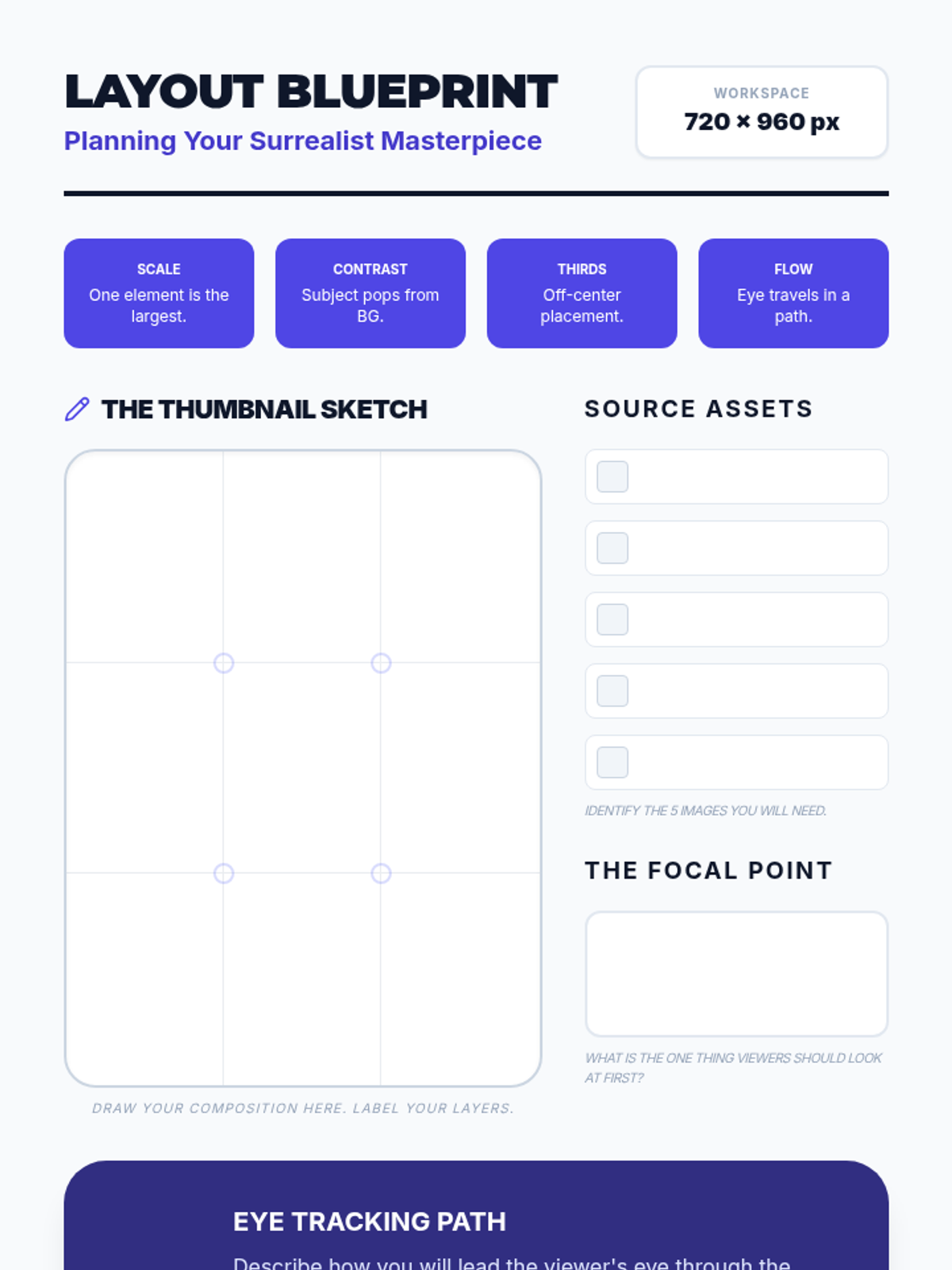
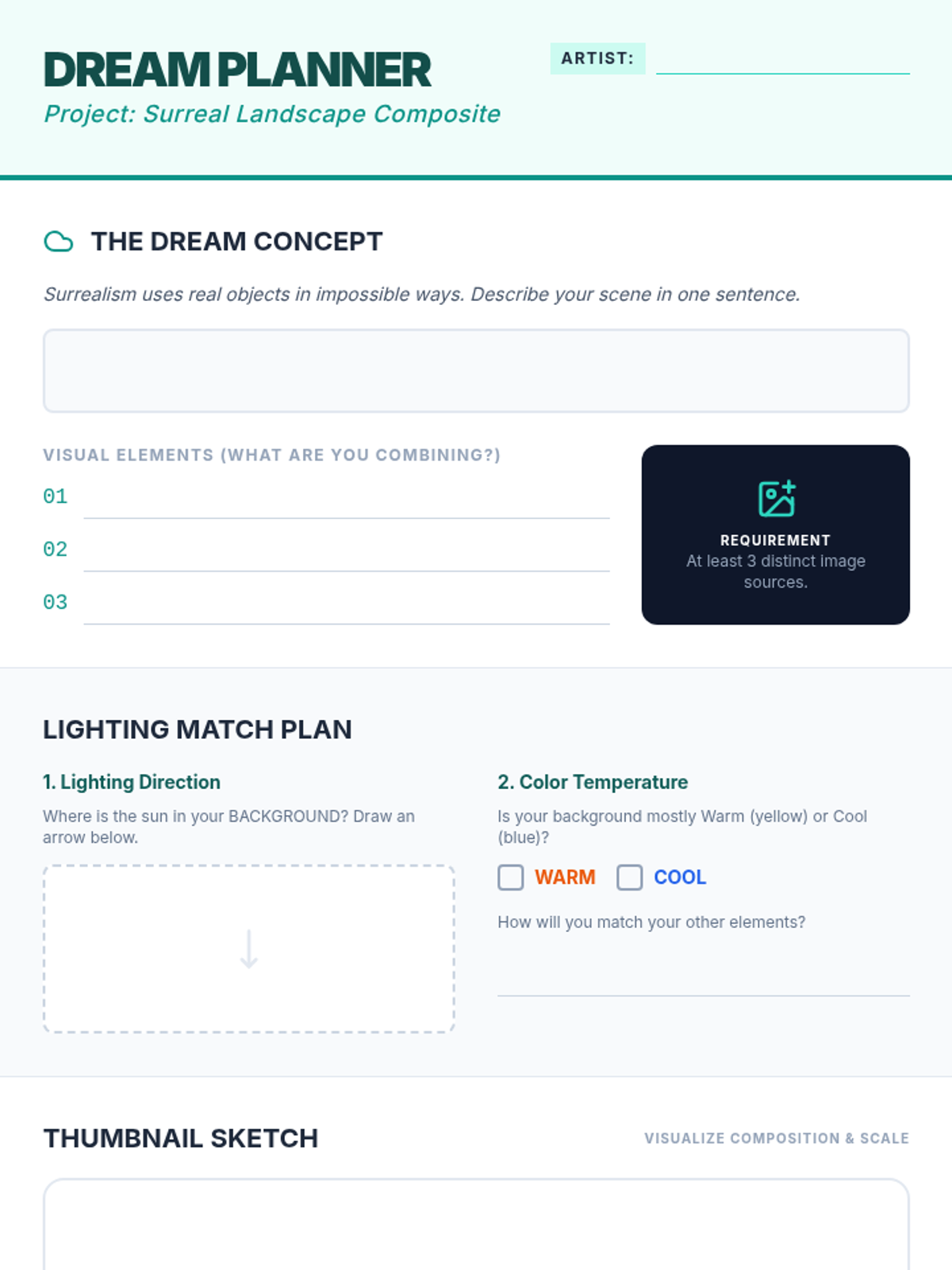
In this culminating workshop, students apply all learned skills to create a surrealist self-portrait or landscape. They must combine at least five different source images, use masking for seamless integration, and apply color grading to unify the piece. The lesson emphasizes creative storytelling through visual metaphor.
Students step back from technical tools to study the principles of layout, including the rule of thirds, balance, and focal points. They analyze digital advertisements and movie posters to understand how the eye is led through a design. They then plan the layout for their final project.
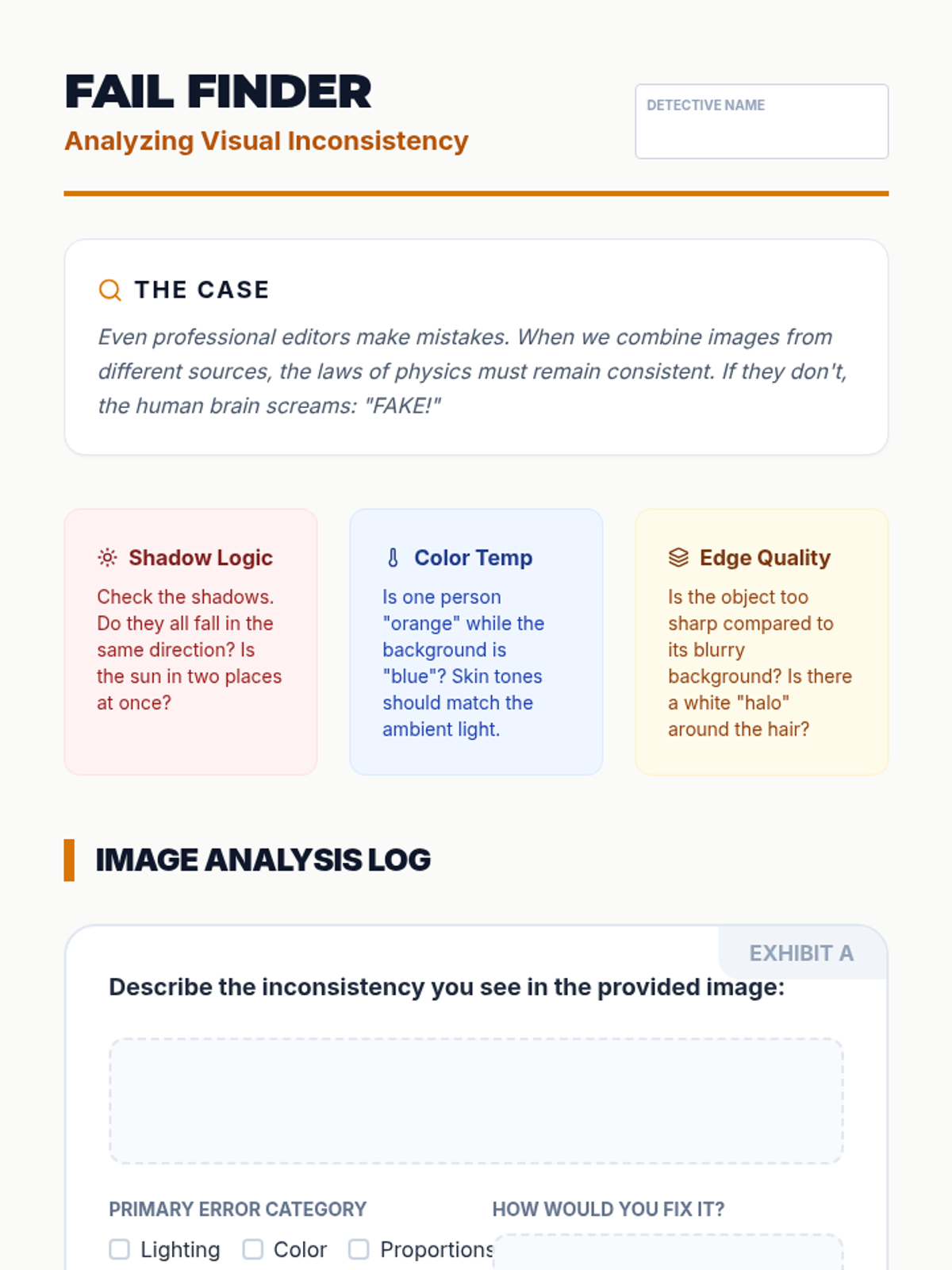
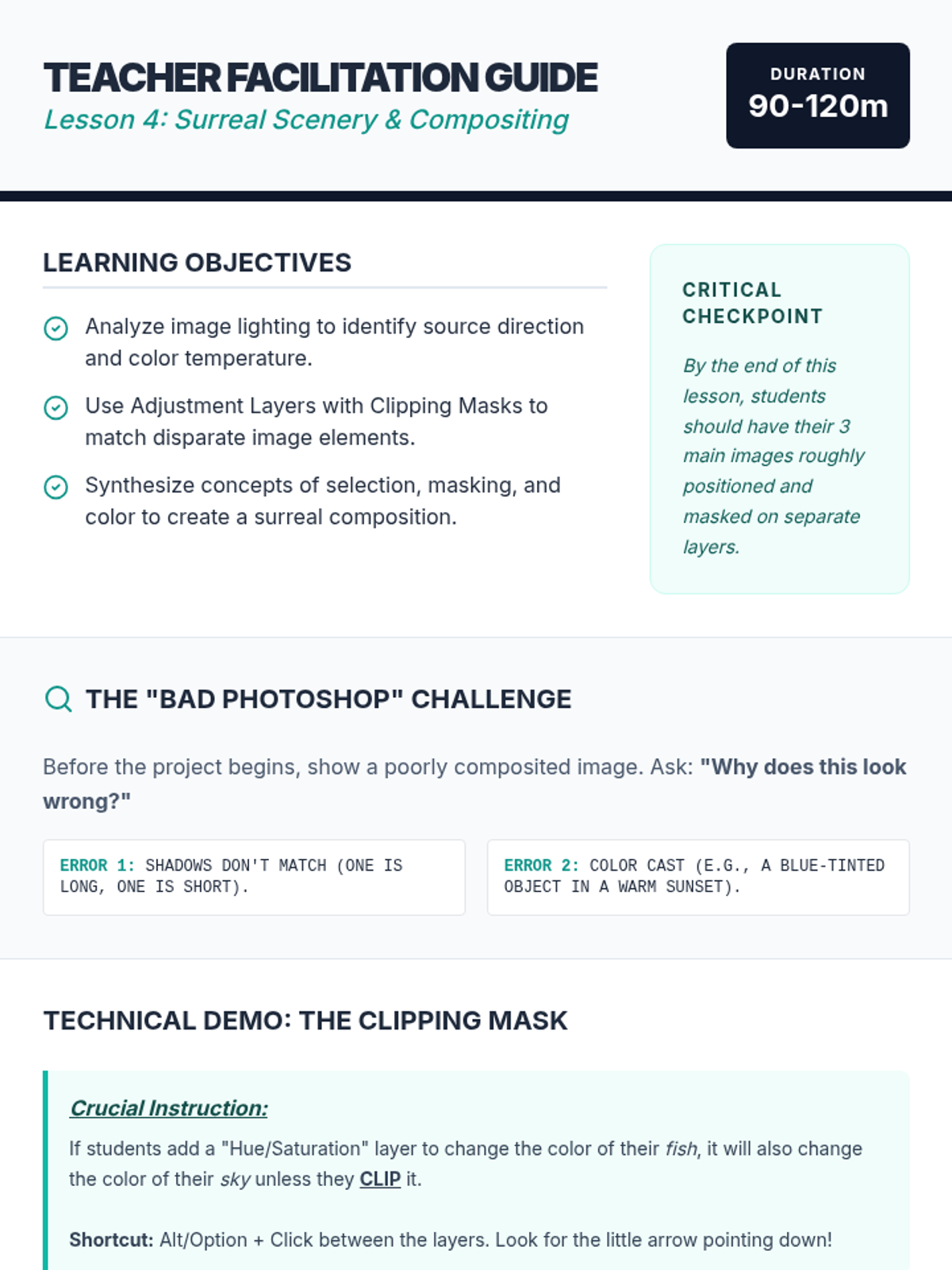
To make composites look realistic, students learn to match lighting and color temperature across different source images. They explore adjustment layers for hue, saturation, and levels, as well as blending modes to integrate textures.
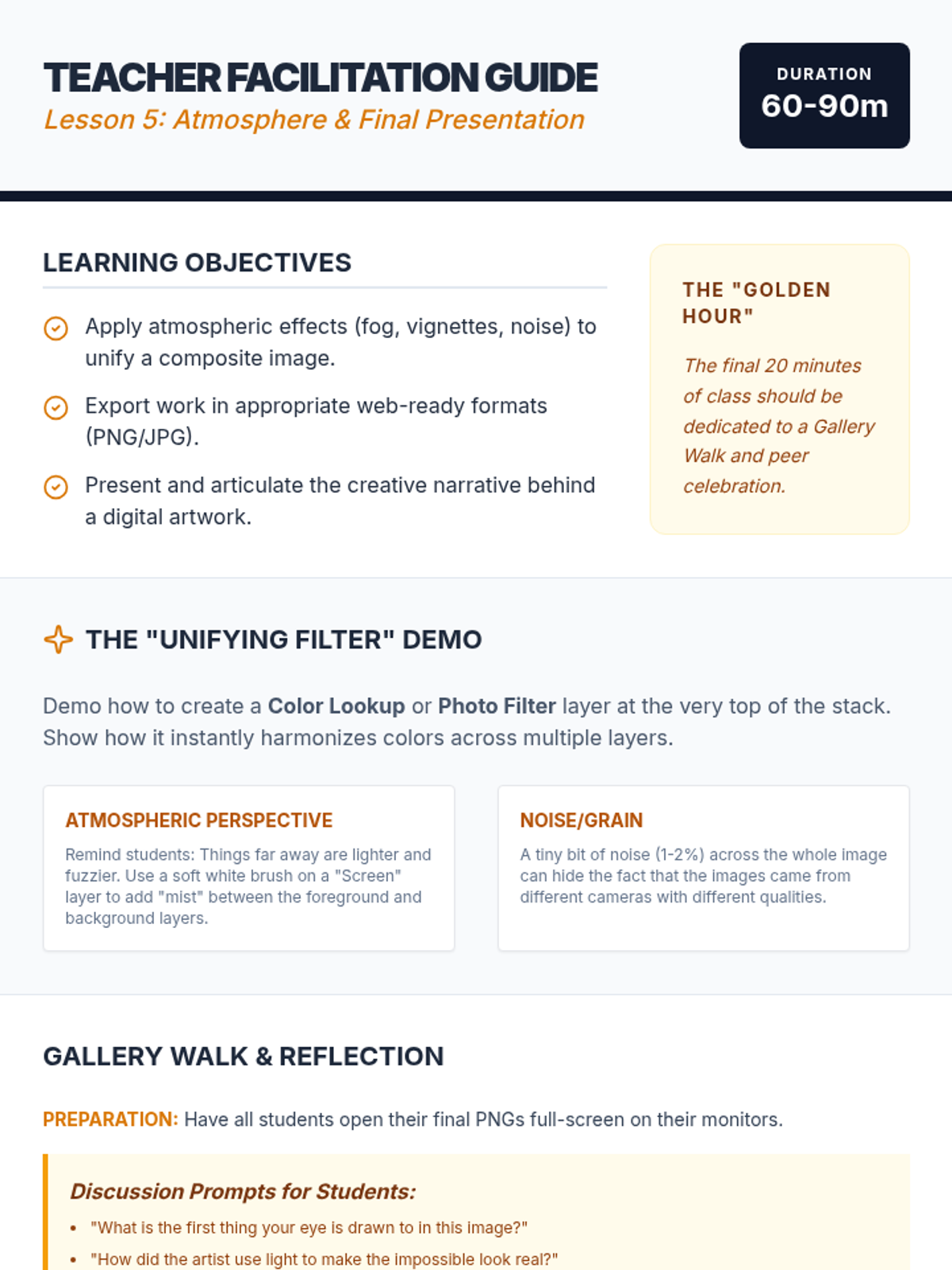
Students add atmospheric effects and finalize their projects with a professional polish.
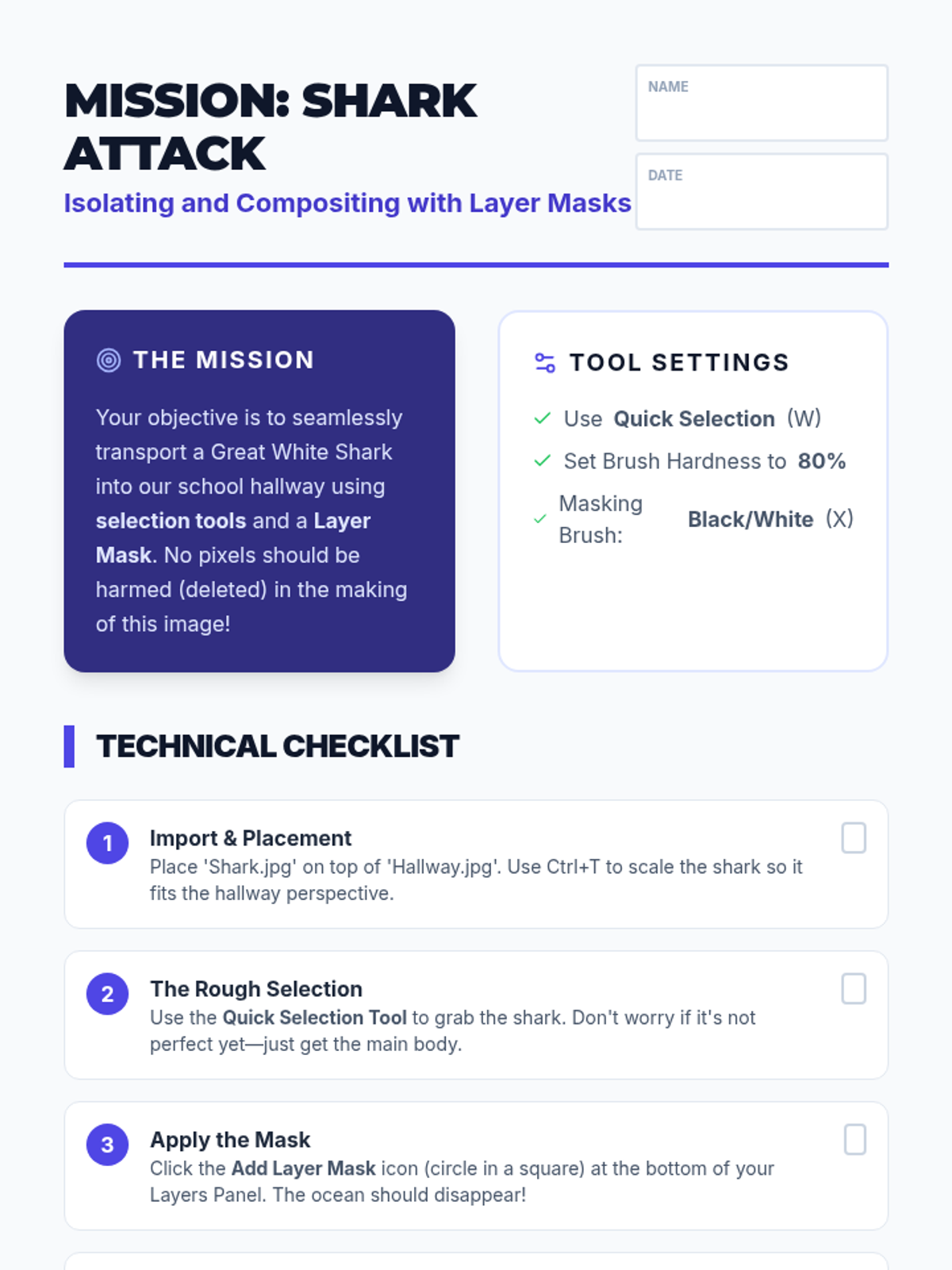
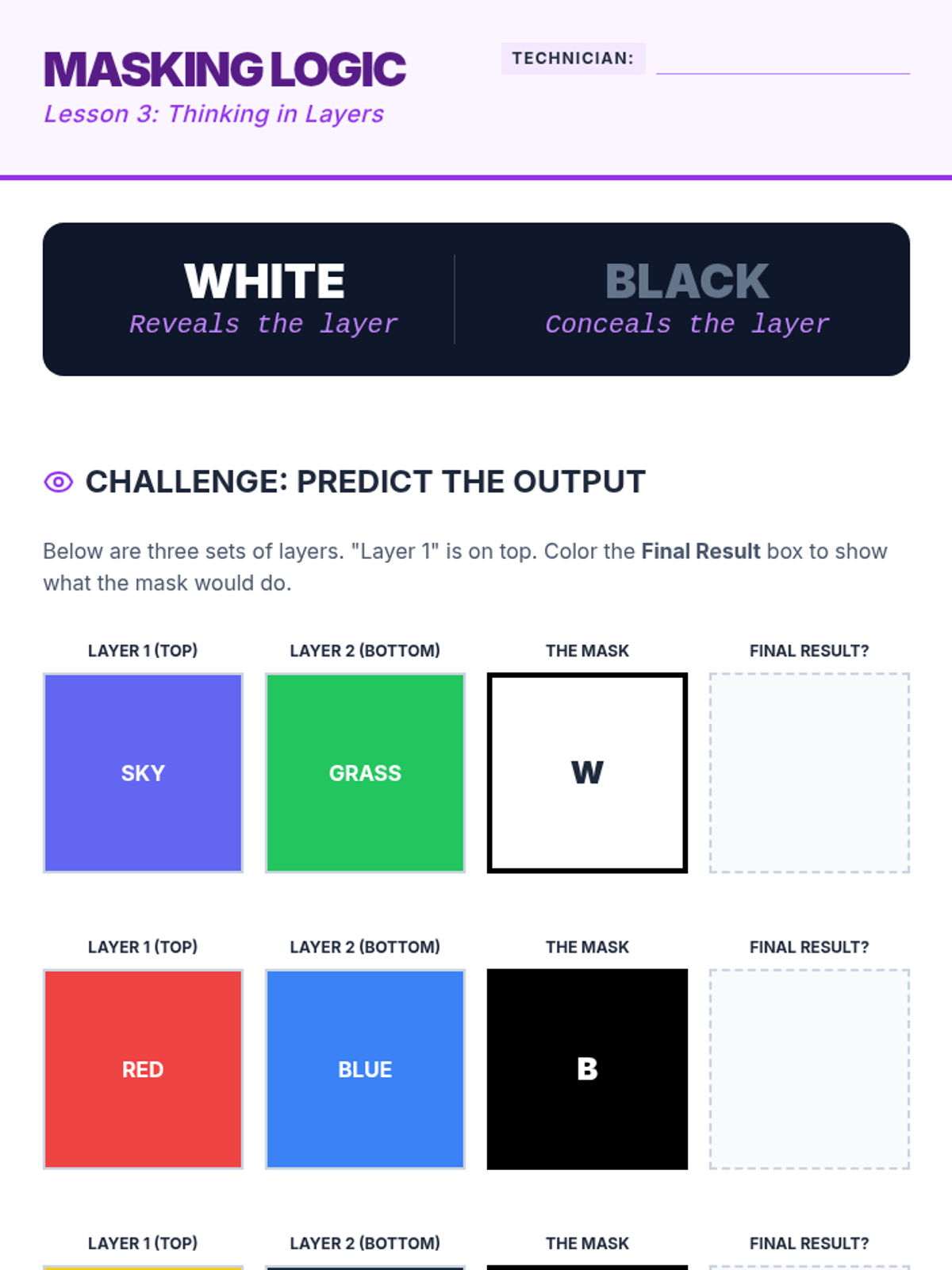
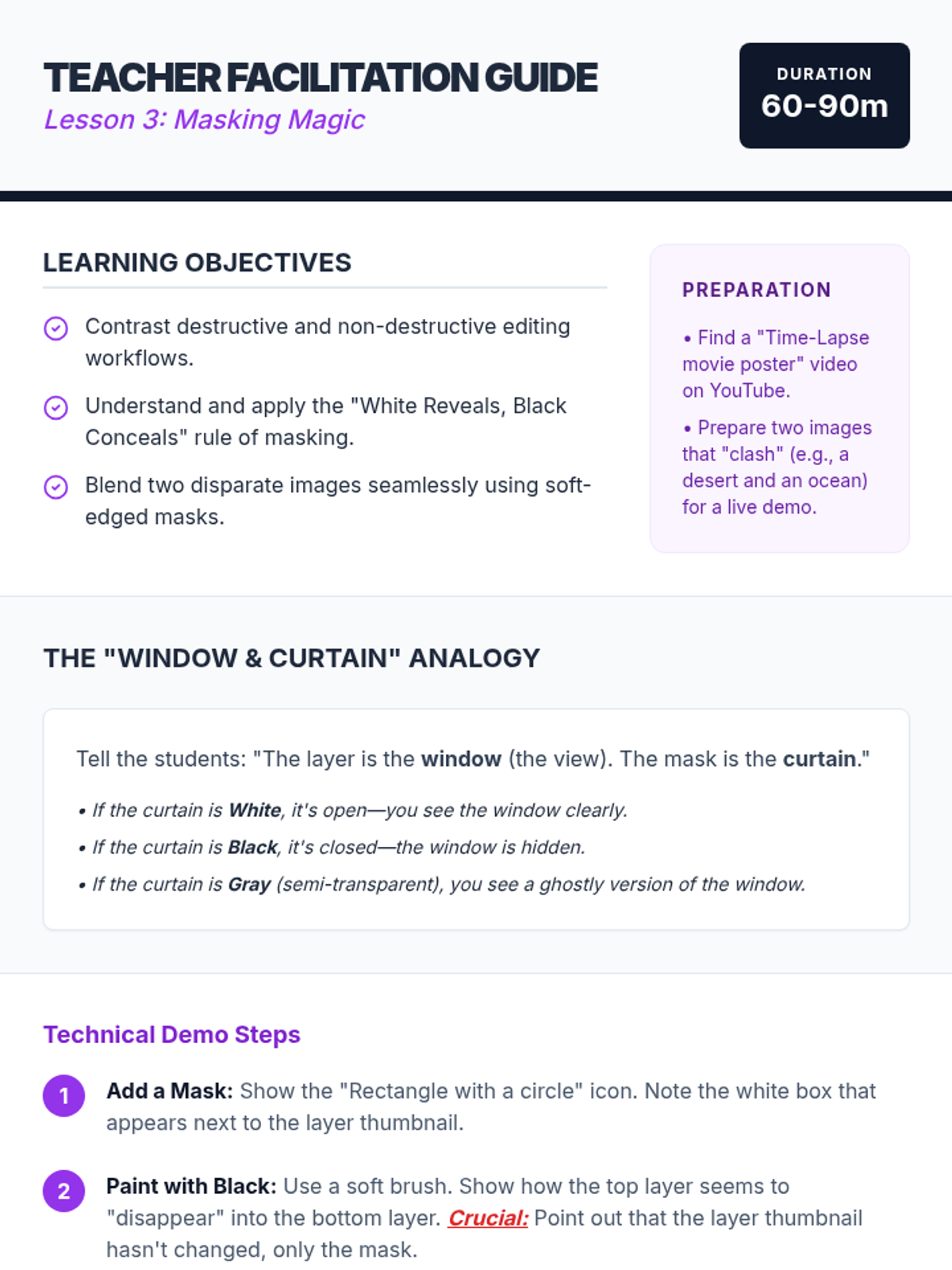
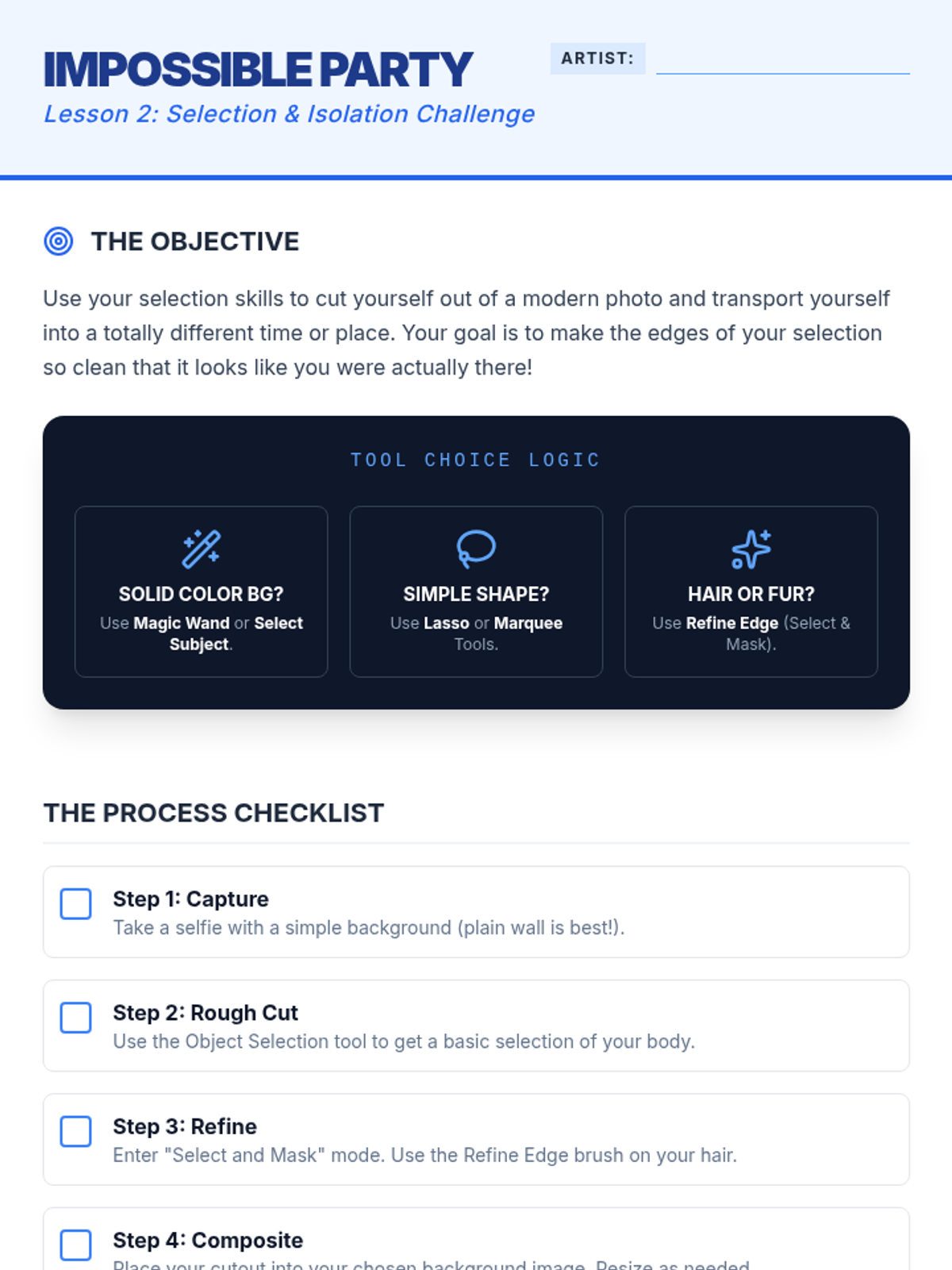
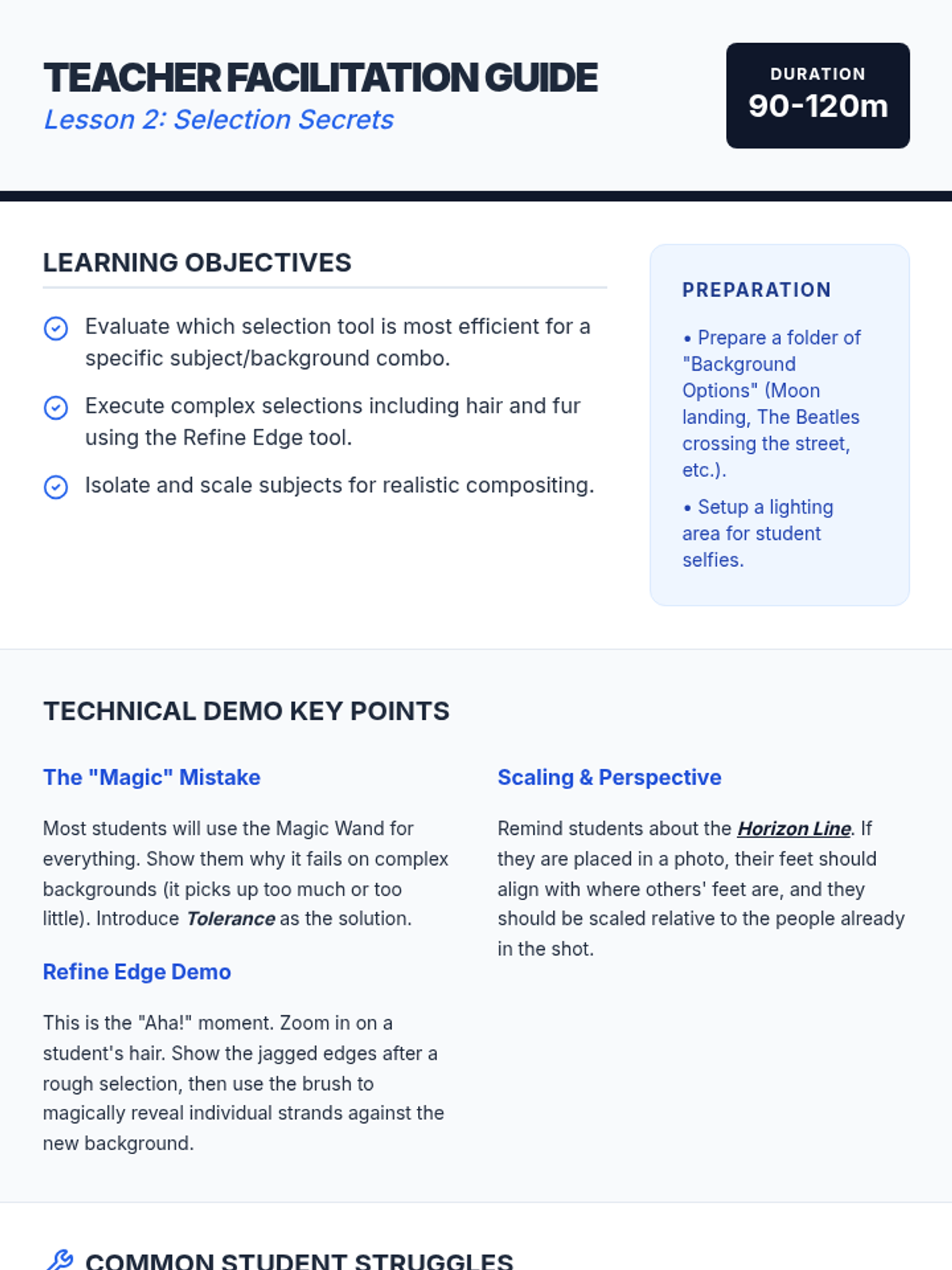
This lesson focuses on isolating specific parts of an image using various selection tools. Students learn the power of layer masks to hide and reveal content without erasing pixels permanently, culminating in a fun compositing challenge.
Students combine multiple images and learn to match colors and lighting for a cohesive look.
Introduces layers and non-destructive masking techniques for seamless image blending.
A deep dive into selecting and isolating objects from backgrounds to prepare for compositing.
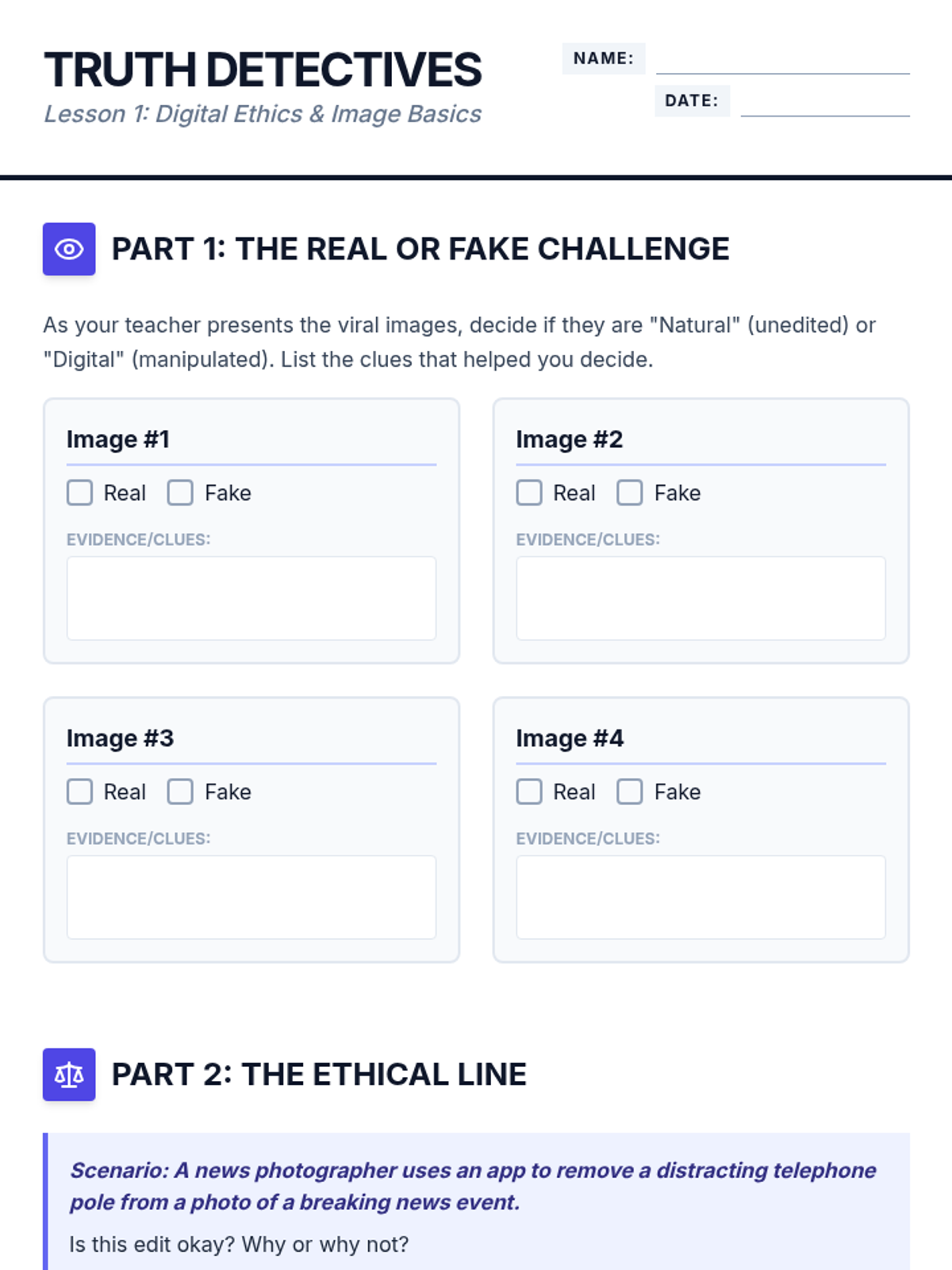
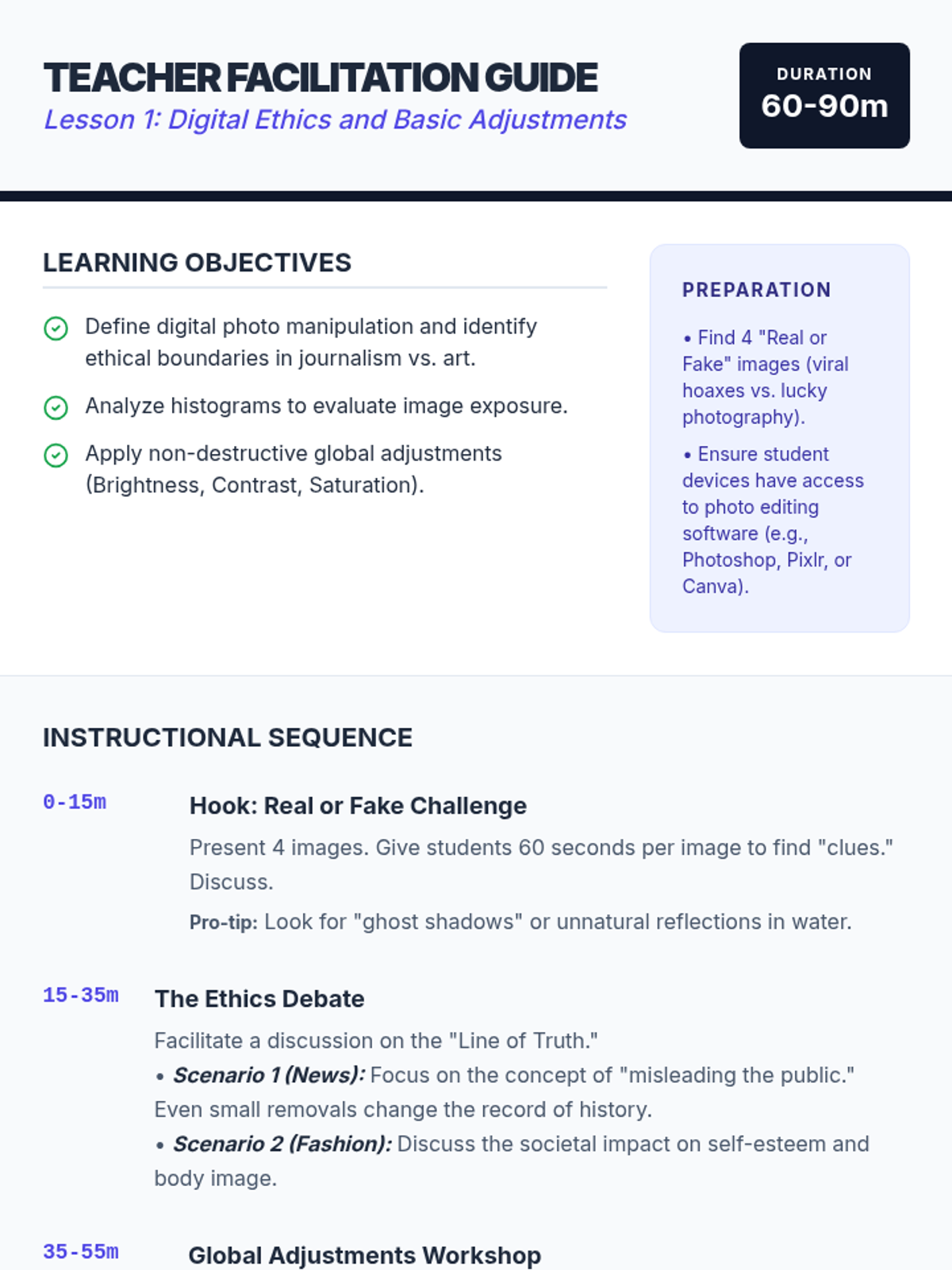
Students explore the ethical boundaries of photo manipulation and learn basic non-destructive image adjustments.
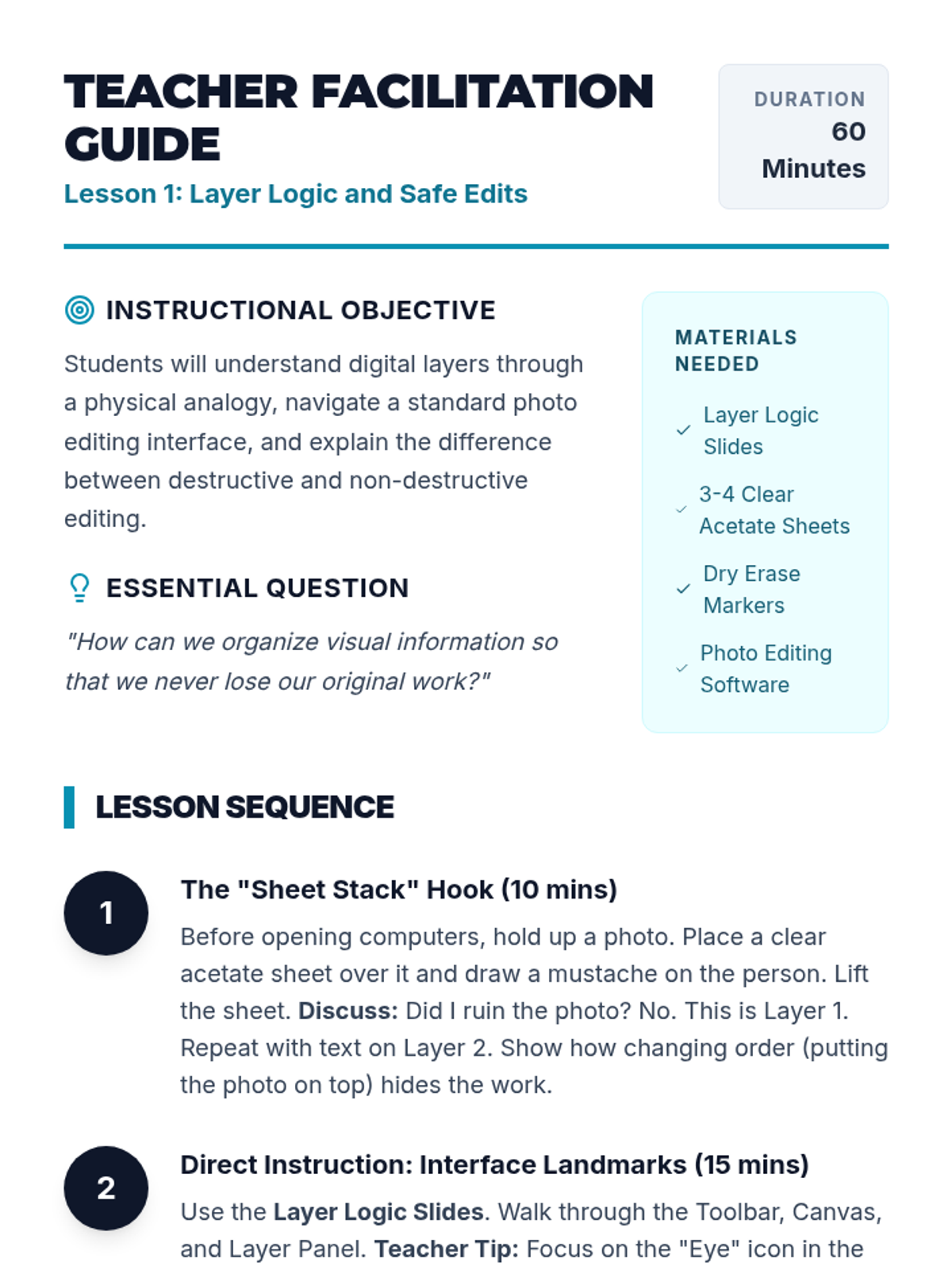
Students are introduced to the concept of layers as clear acetate sheets stacked on top of one another. They learn to navigate the interface of a photo editing program and practice non-destructive editing techniques that preserve original image data.
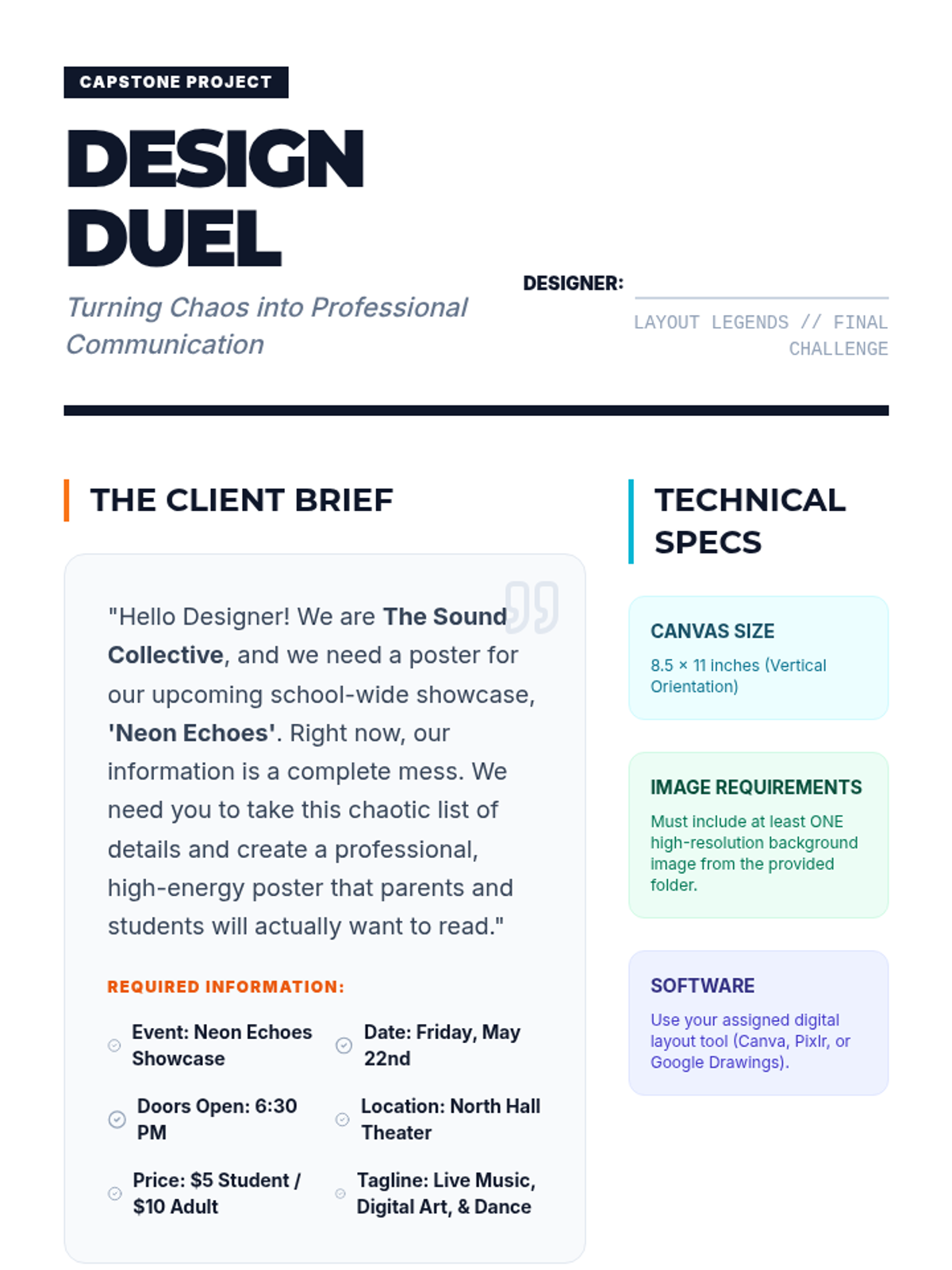
The capstone project where students apply all learned principles to fulfill a client brief and design a professional school event poster.
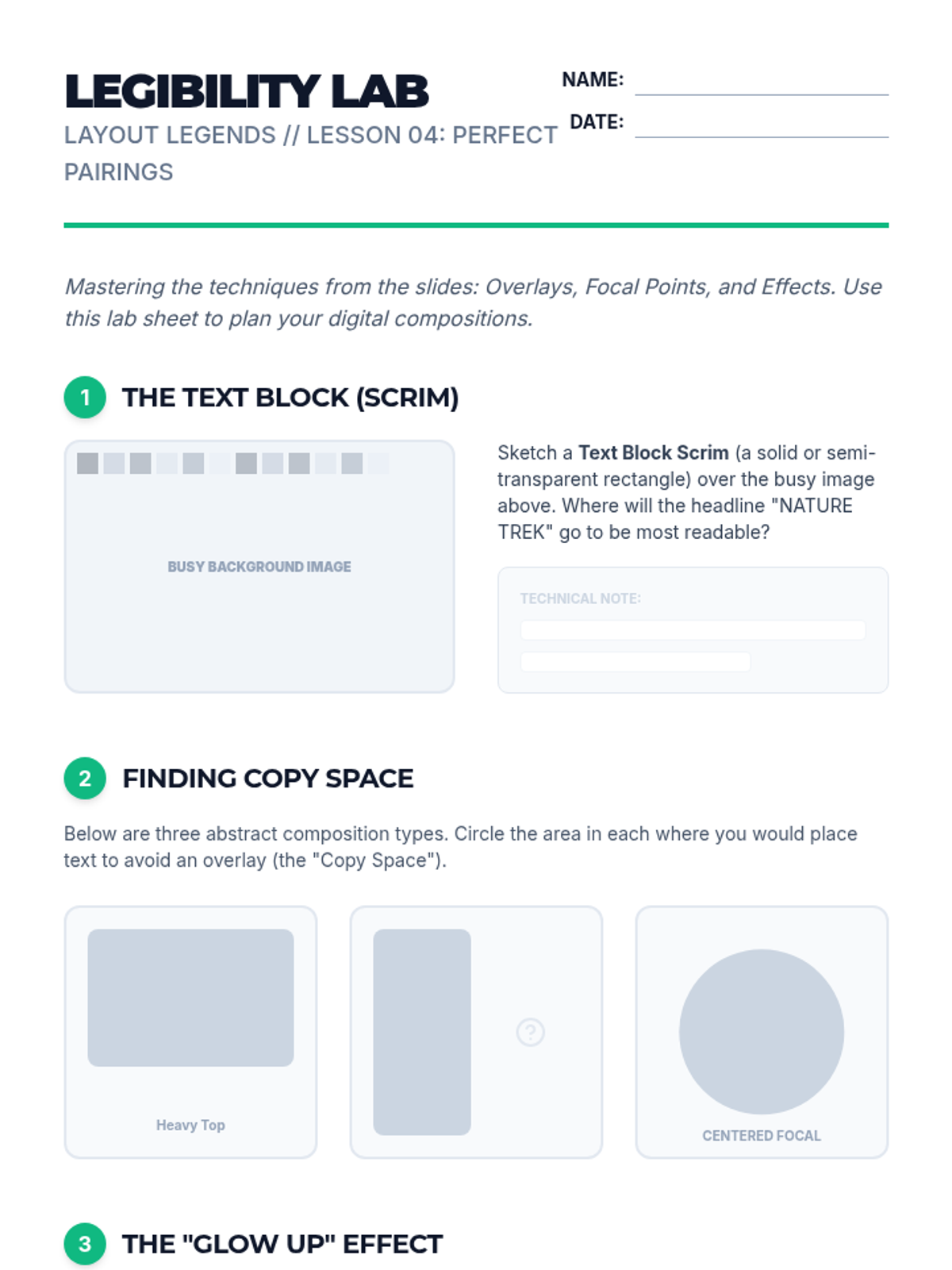
Focusing on the marriage of graphics and copy, students master techniques for placing legible text over complex background images.
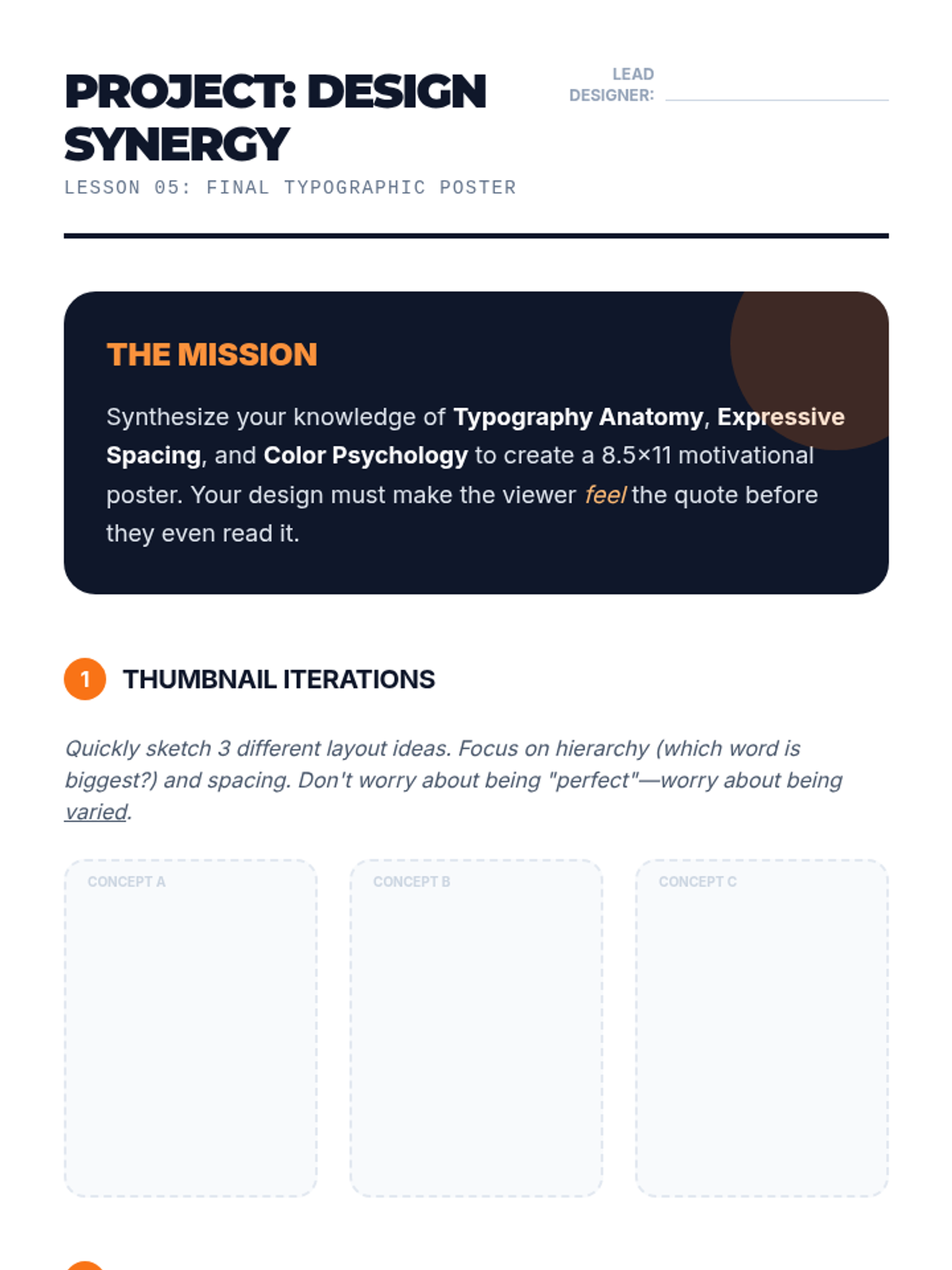
Students combine their typography and color skills to design a motivational quote poster. They must justify their design choices in a brief written reflection, explaining how the font personality and color psychology support the message.
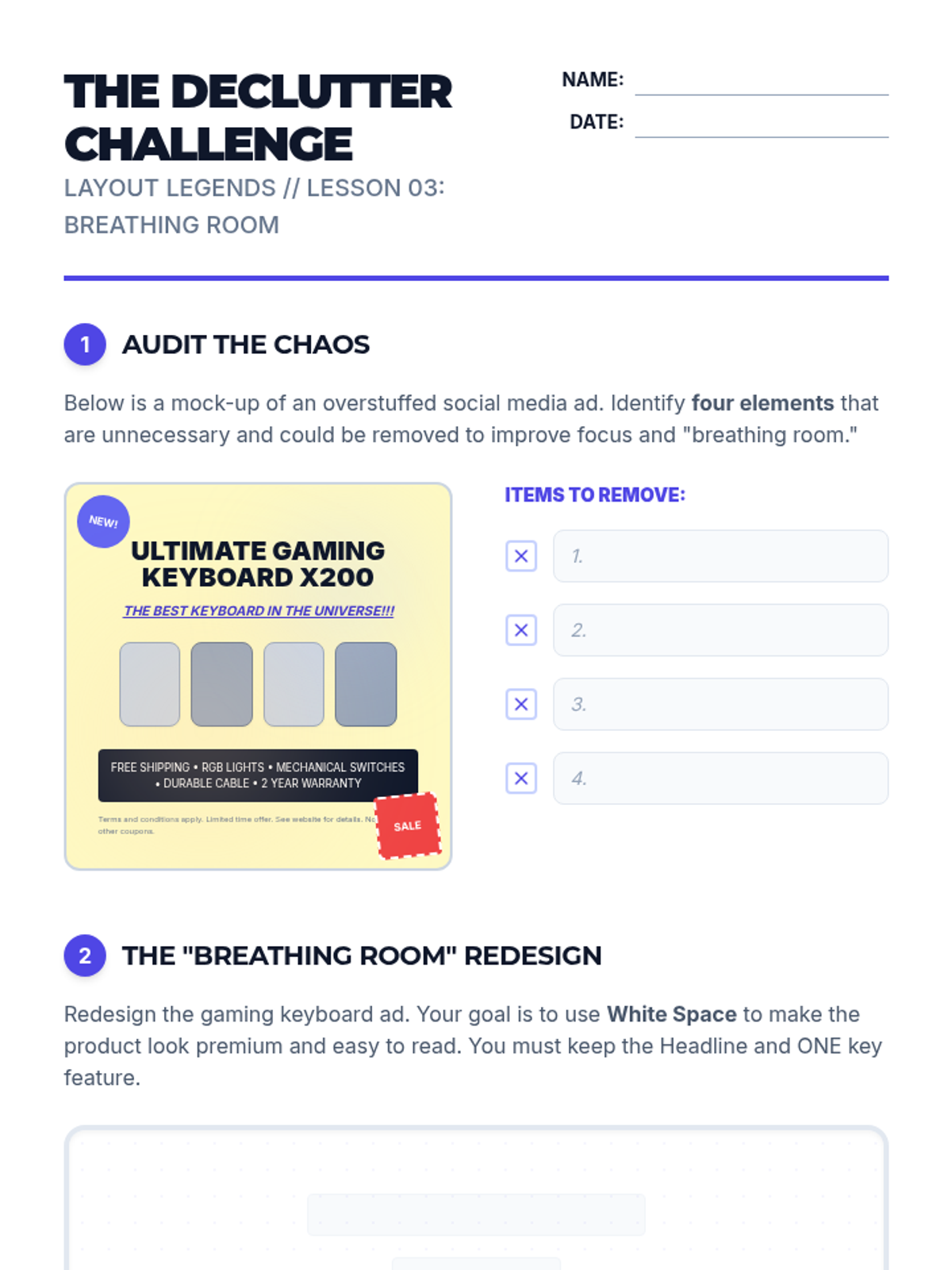
Students learn the power of negative space and the difference between symmetrical and asymmetrical balance to create "breathing room" in their designs.
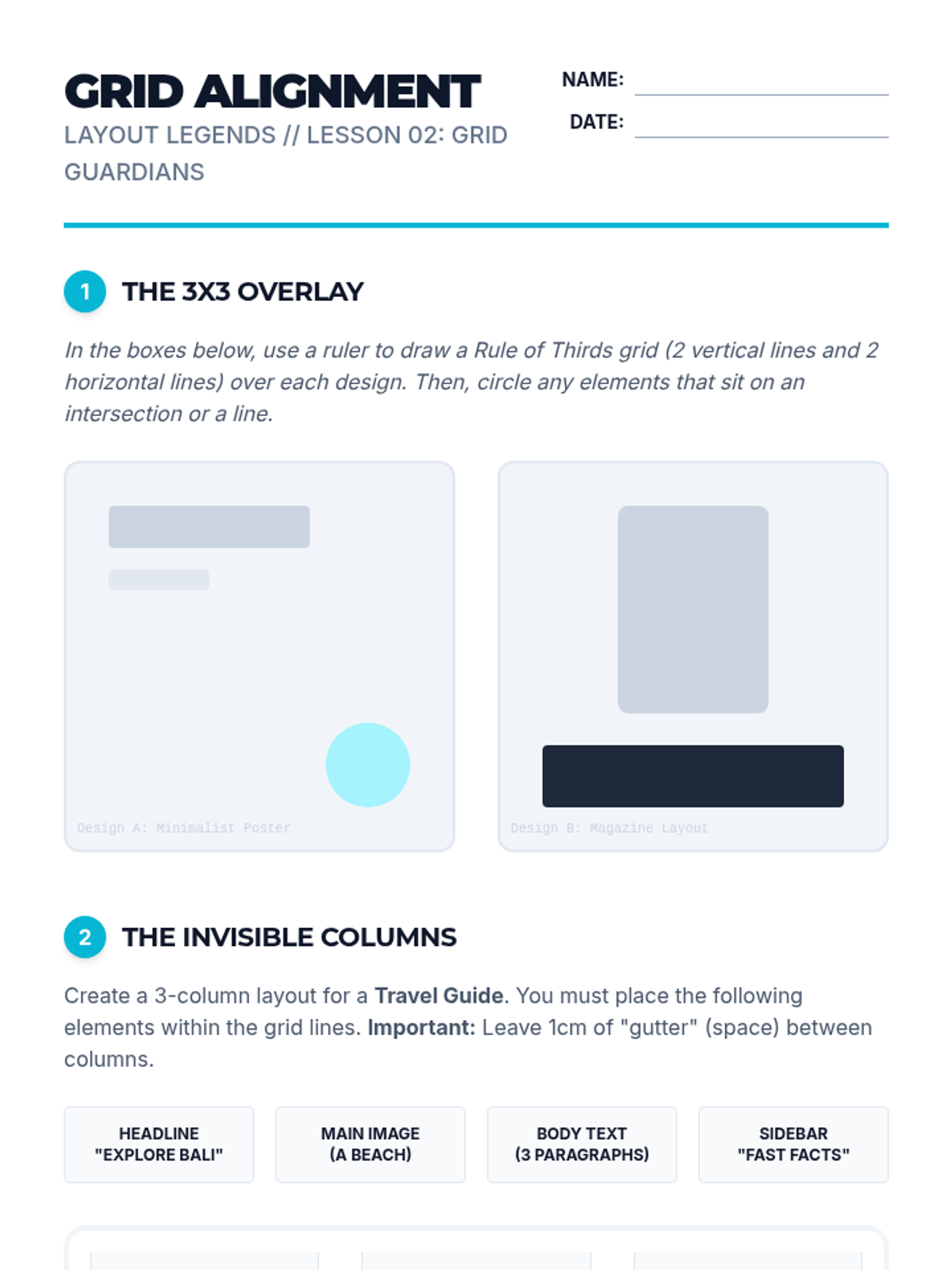
This lesson introduces the invisible structures of design, teaching students to use grids and the Rule of Thirds to create organized and professional layouts.
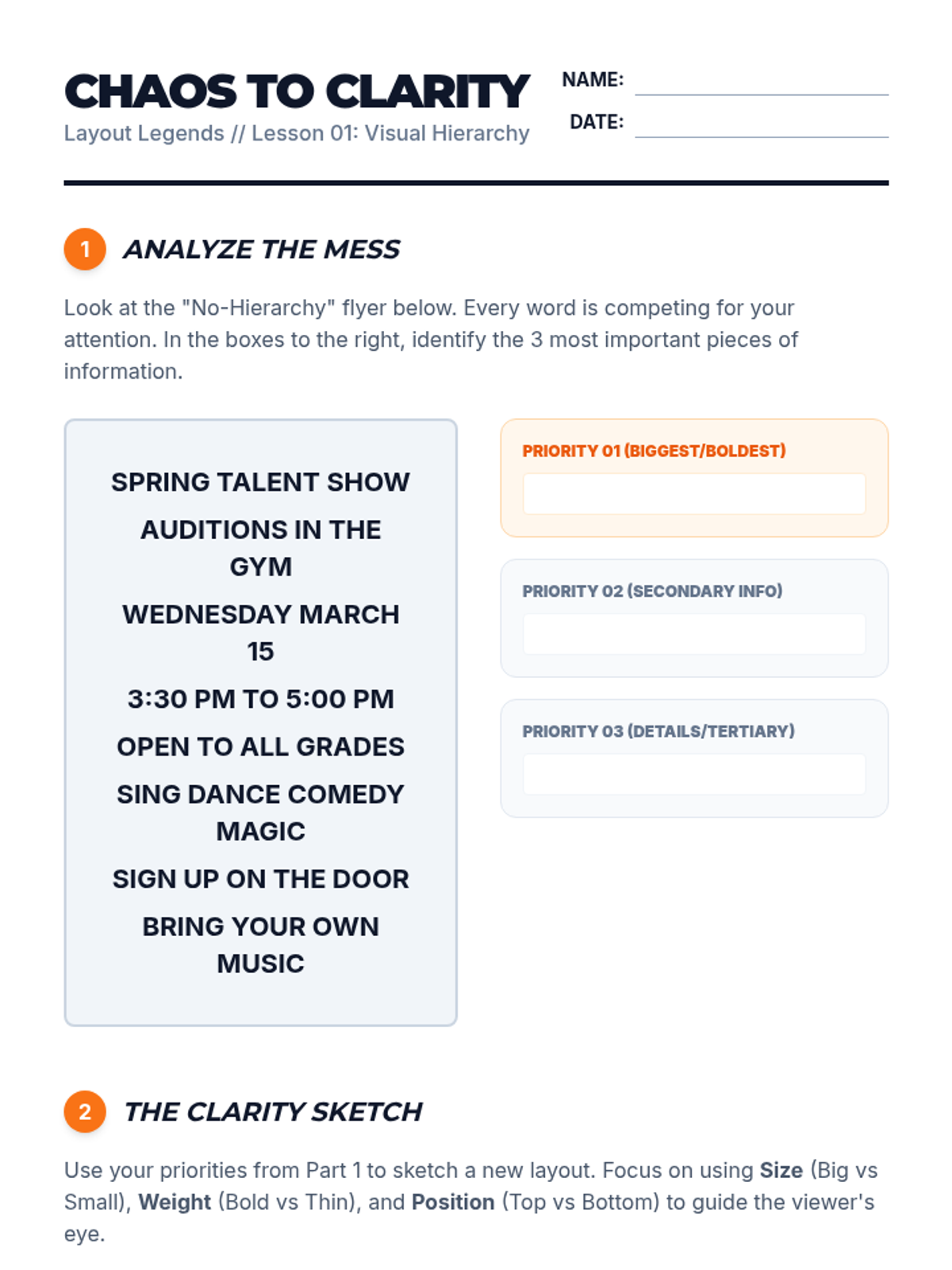
Students explore how size, weight, and position create a clear order of importance on a page, transforming "no-hierarchy" chaos into clear communication.
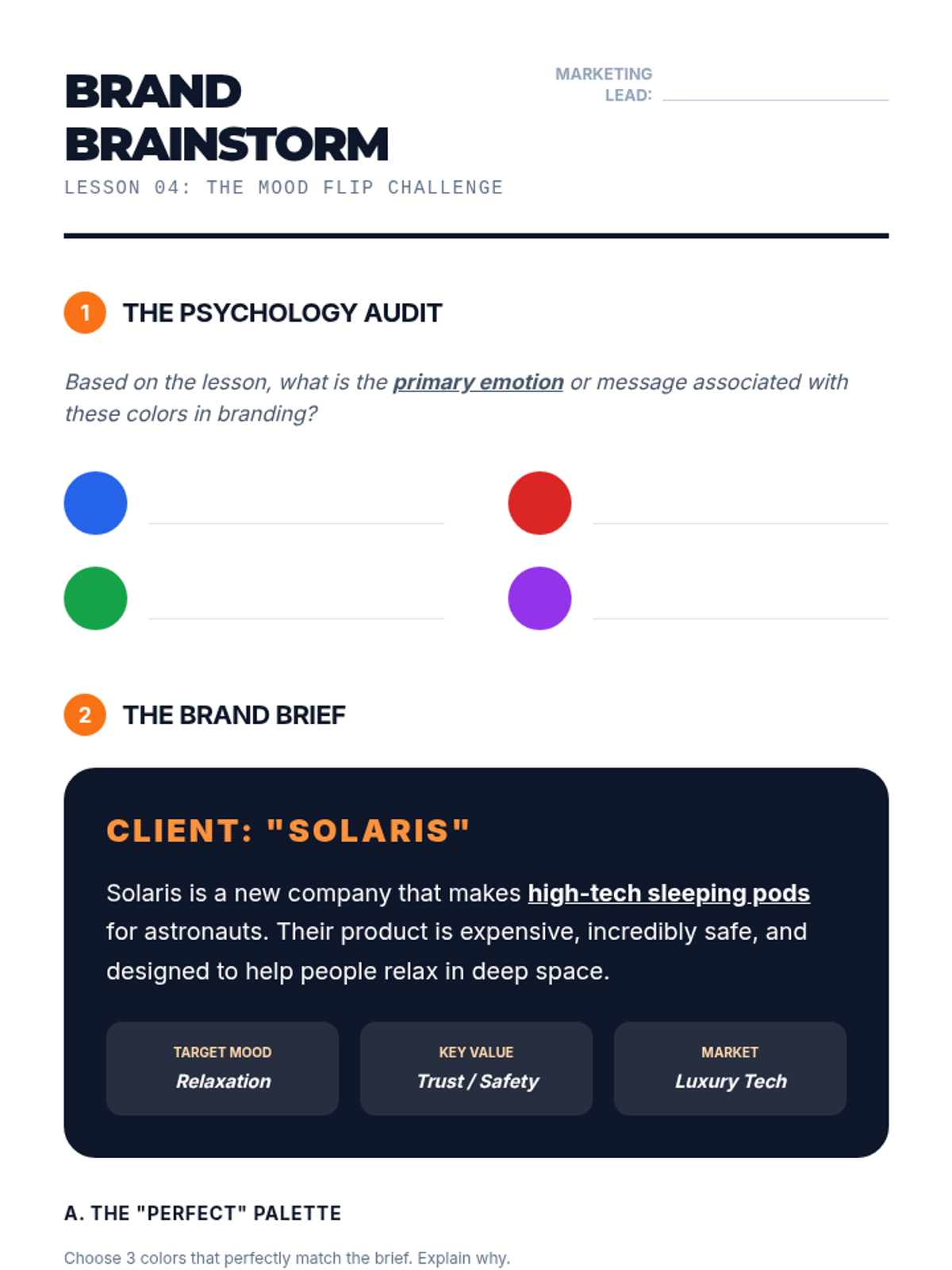
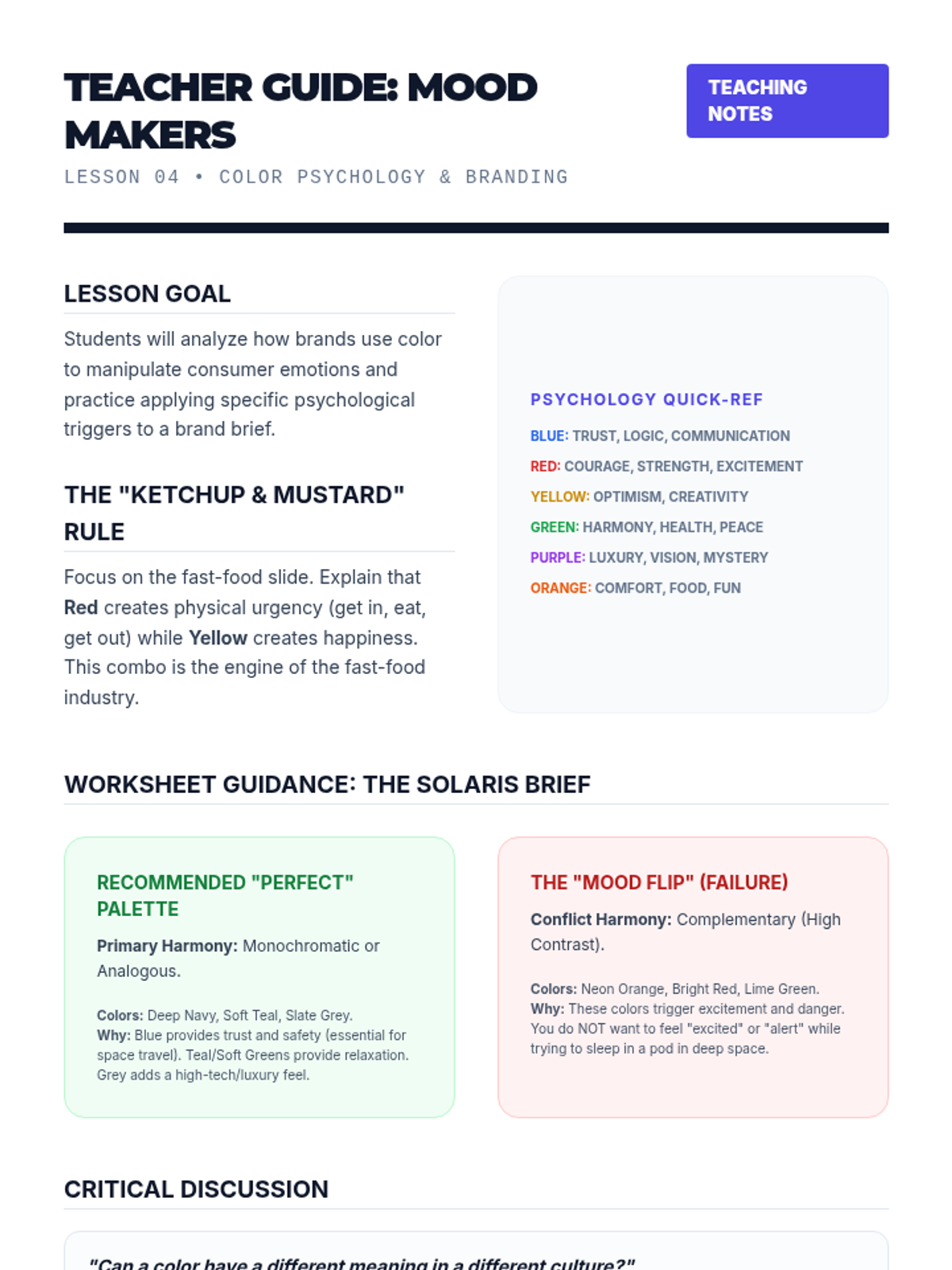
This lesson connects color theory to human emotion and marketing strategies. Students analyze diverse brands to determine why specific colors are used for different sectors and practice altering design moods through color.
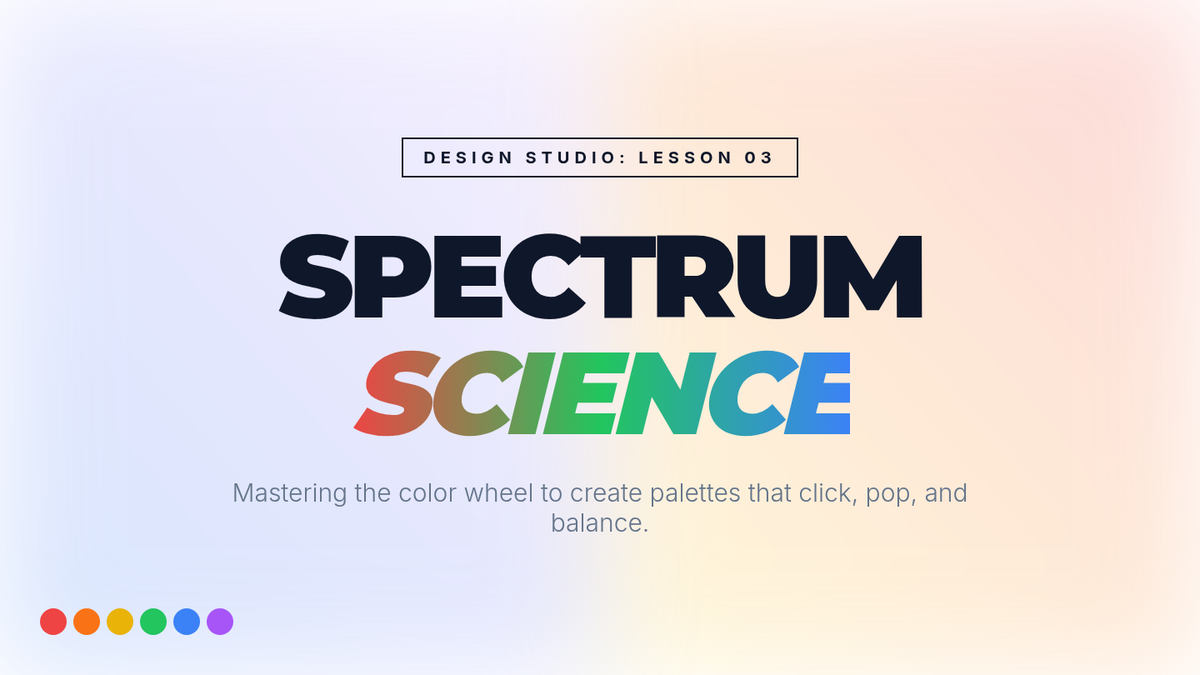
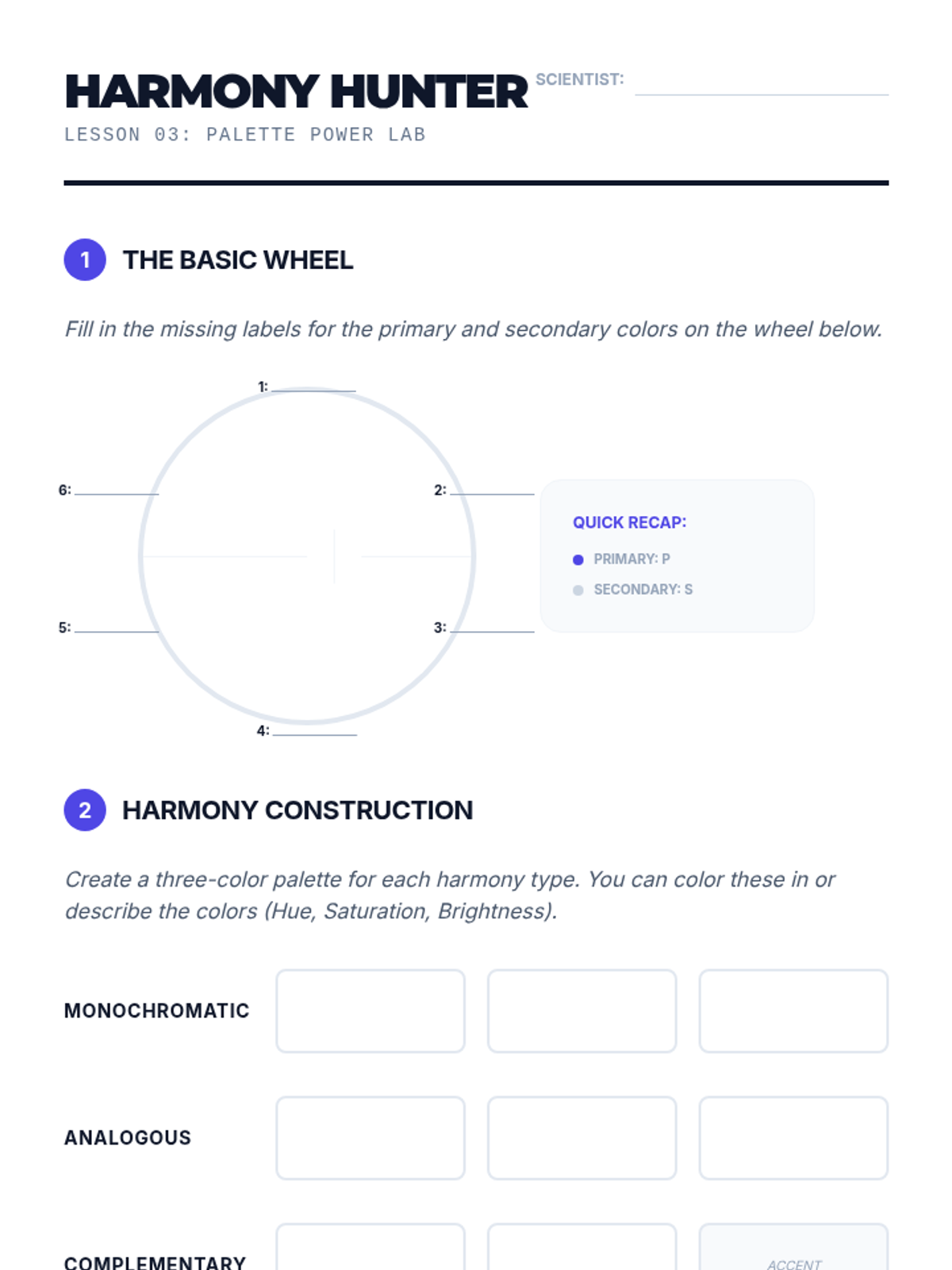
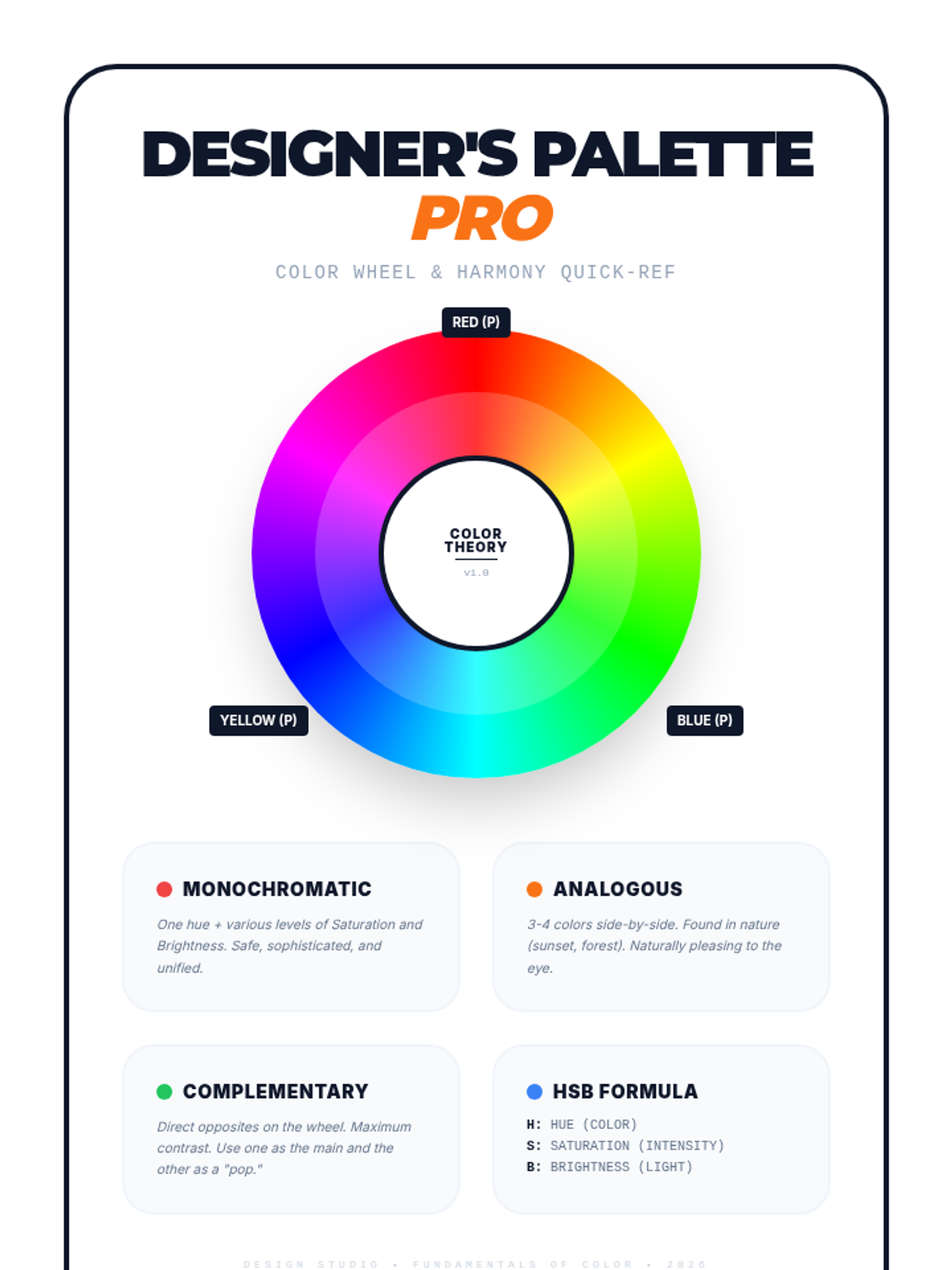
Students dive into the color wheel, learning about primary, secondary, and tertiary colors as well as hue, saturation, and brightness. They practice creating standard color harmonies such as monochromatic, analogous, and complementary schemes.
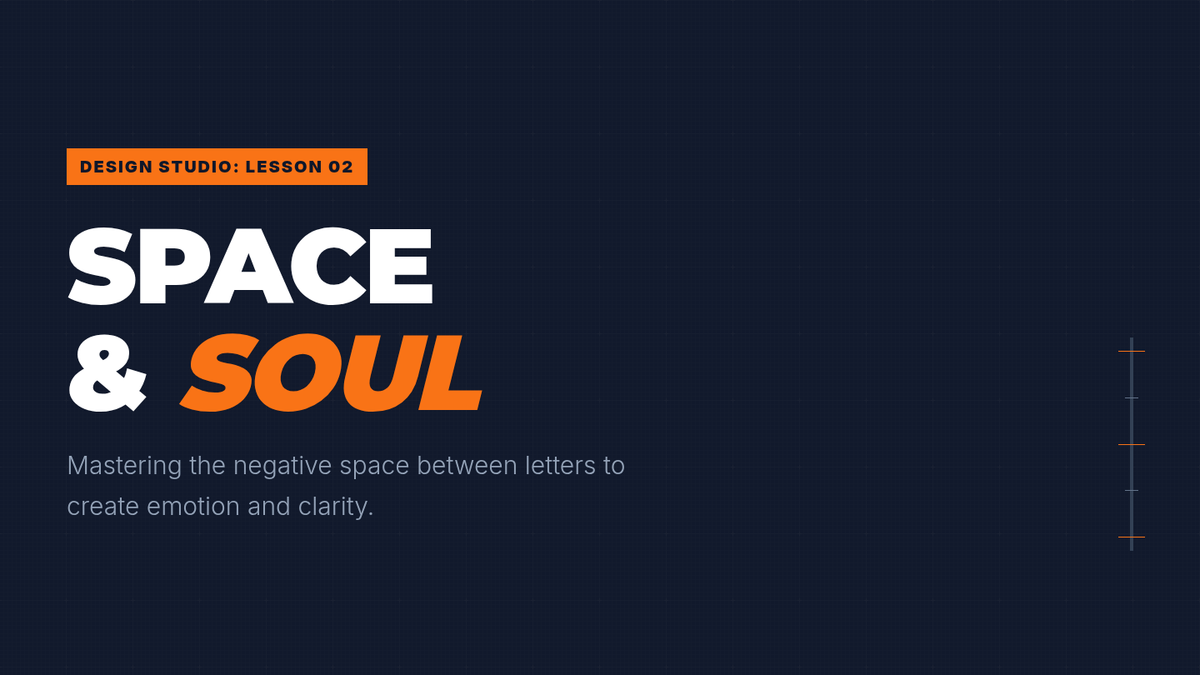
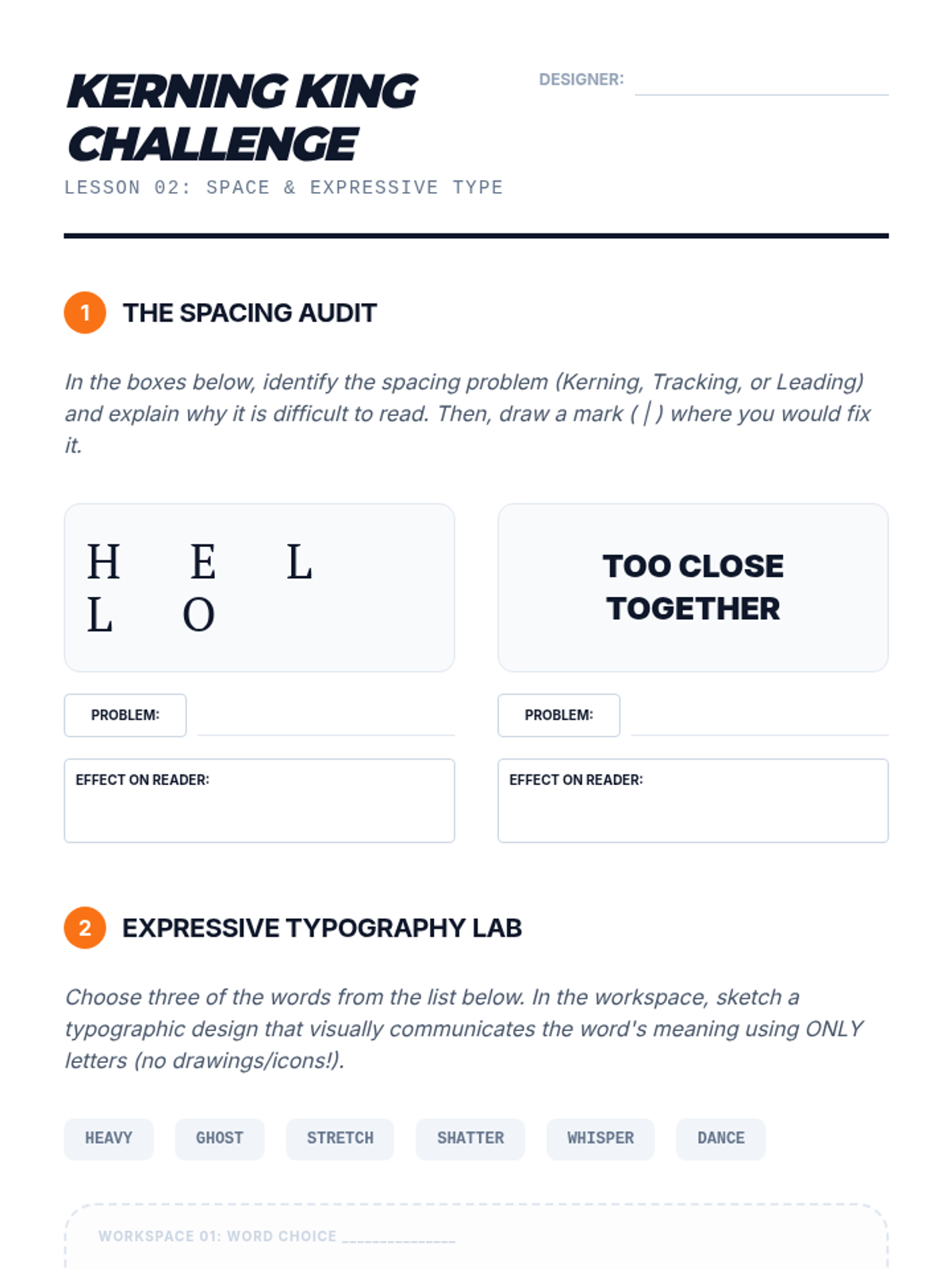
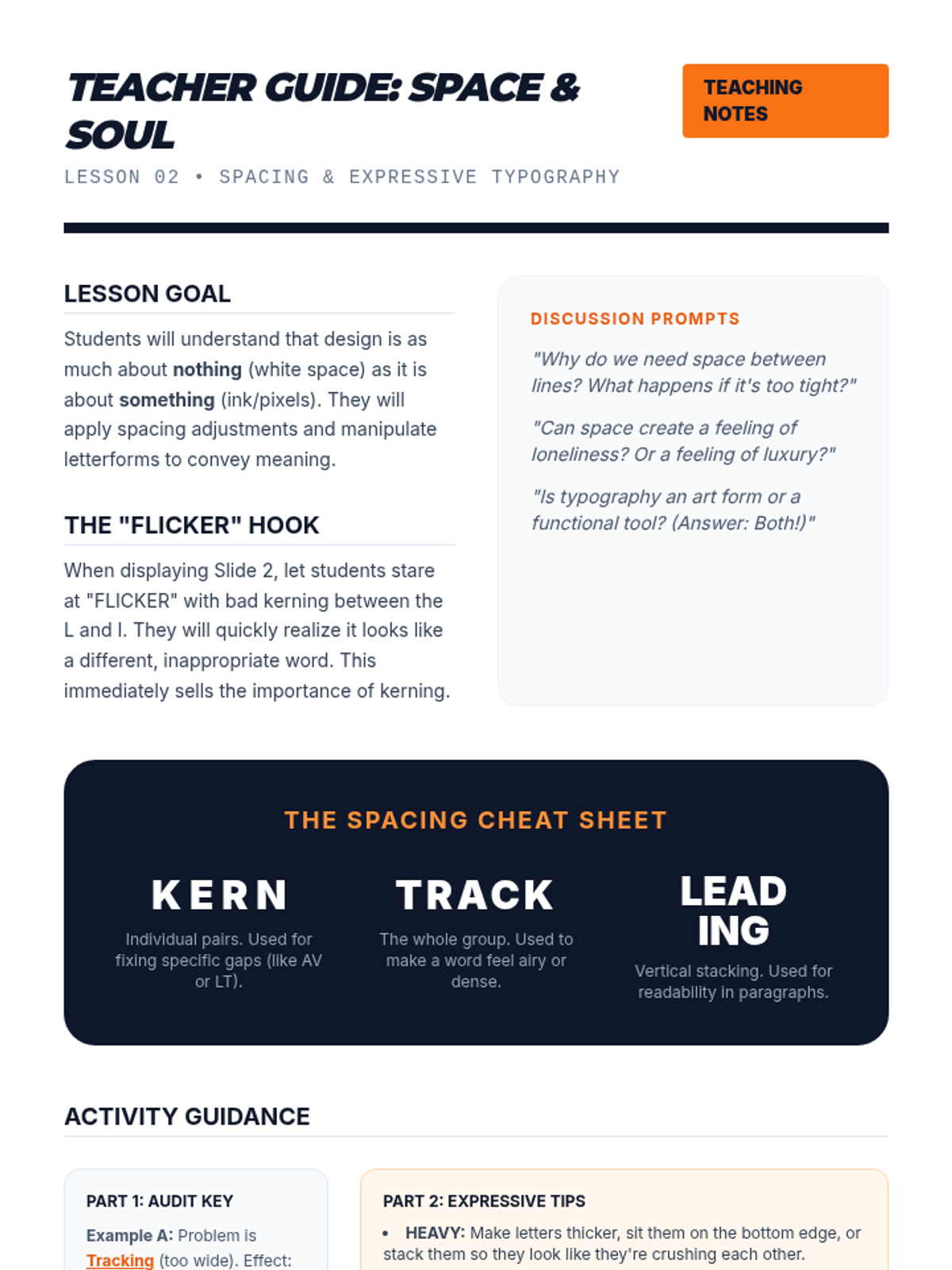
Focusing on the spacing and arrangement of letters, students learn about tracking, kerning, and leading. They explore how to manipulate text to visually represent the meaning of a word without using images.
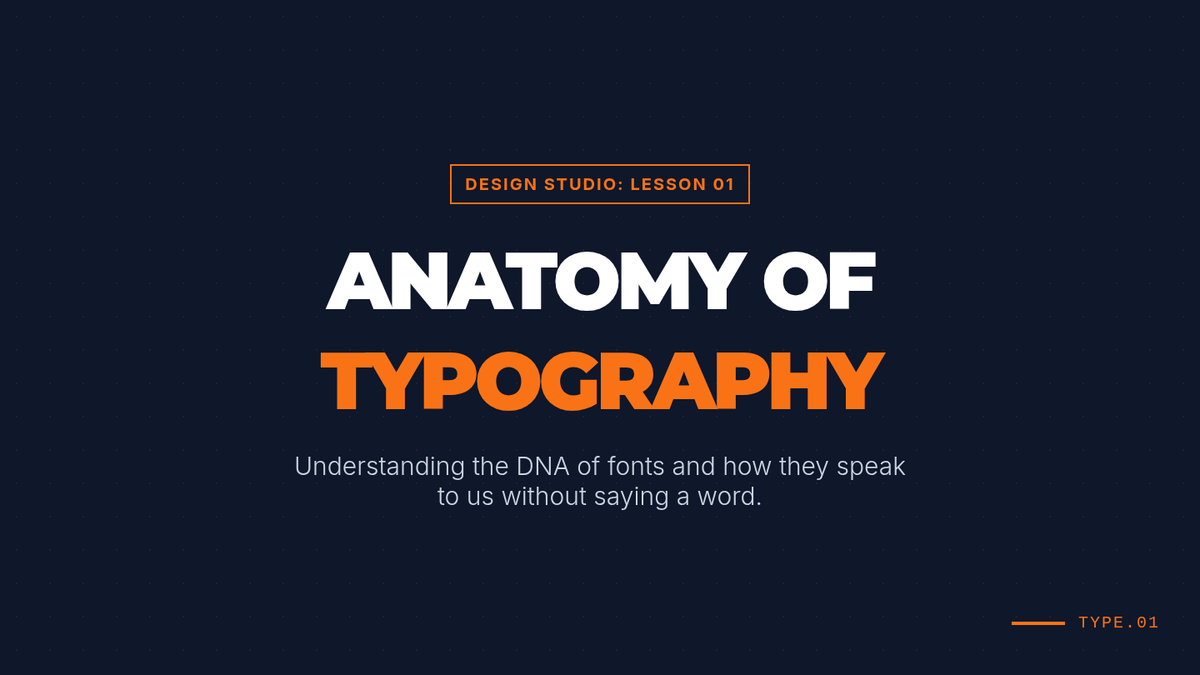
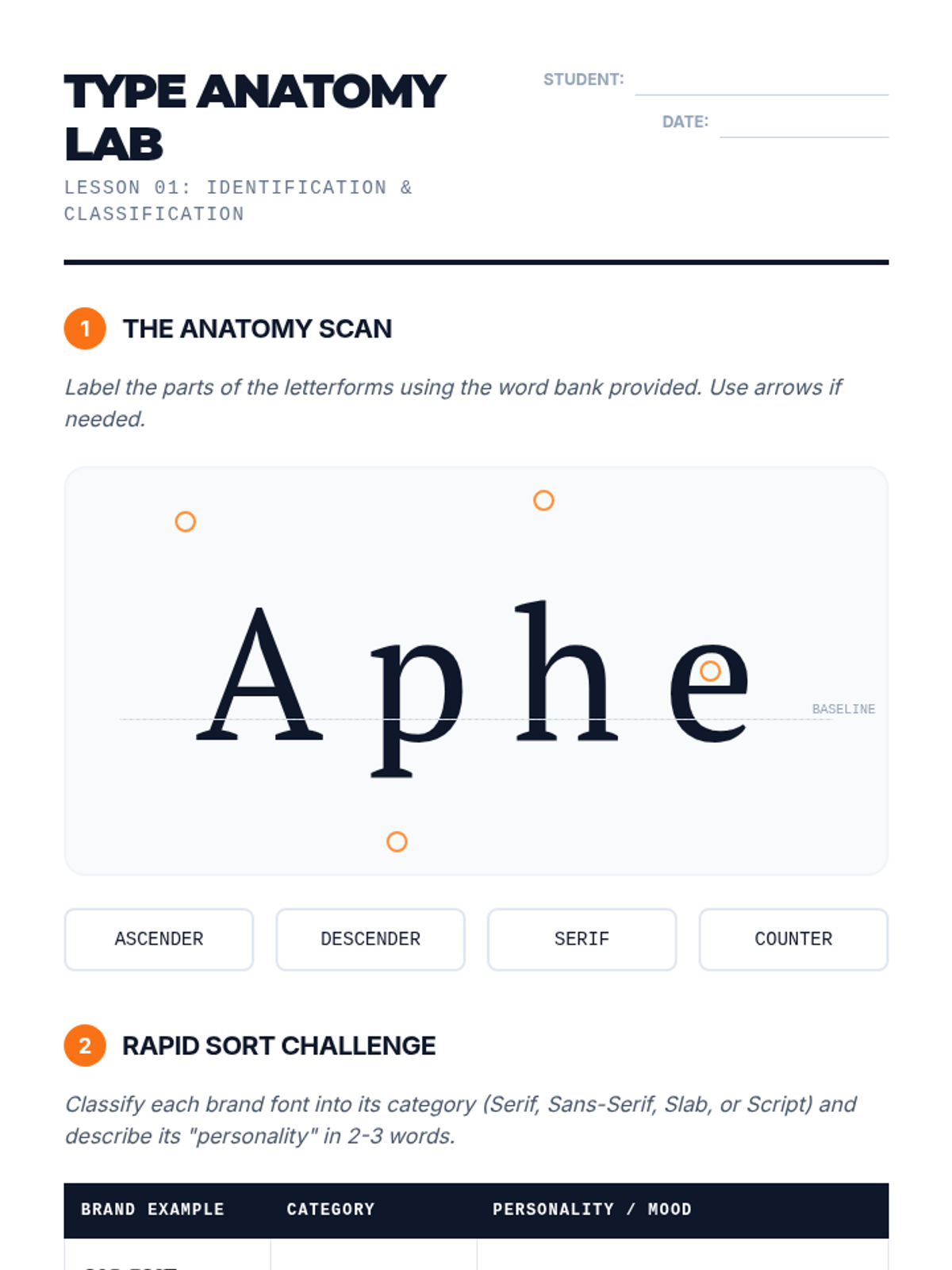
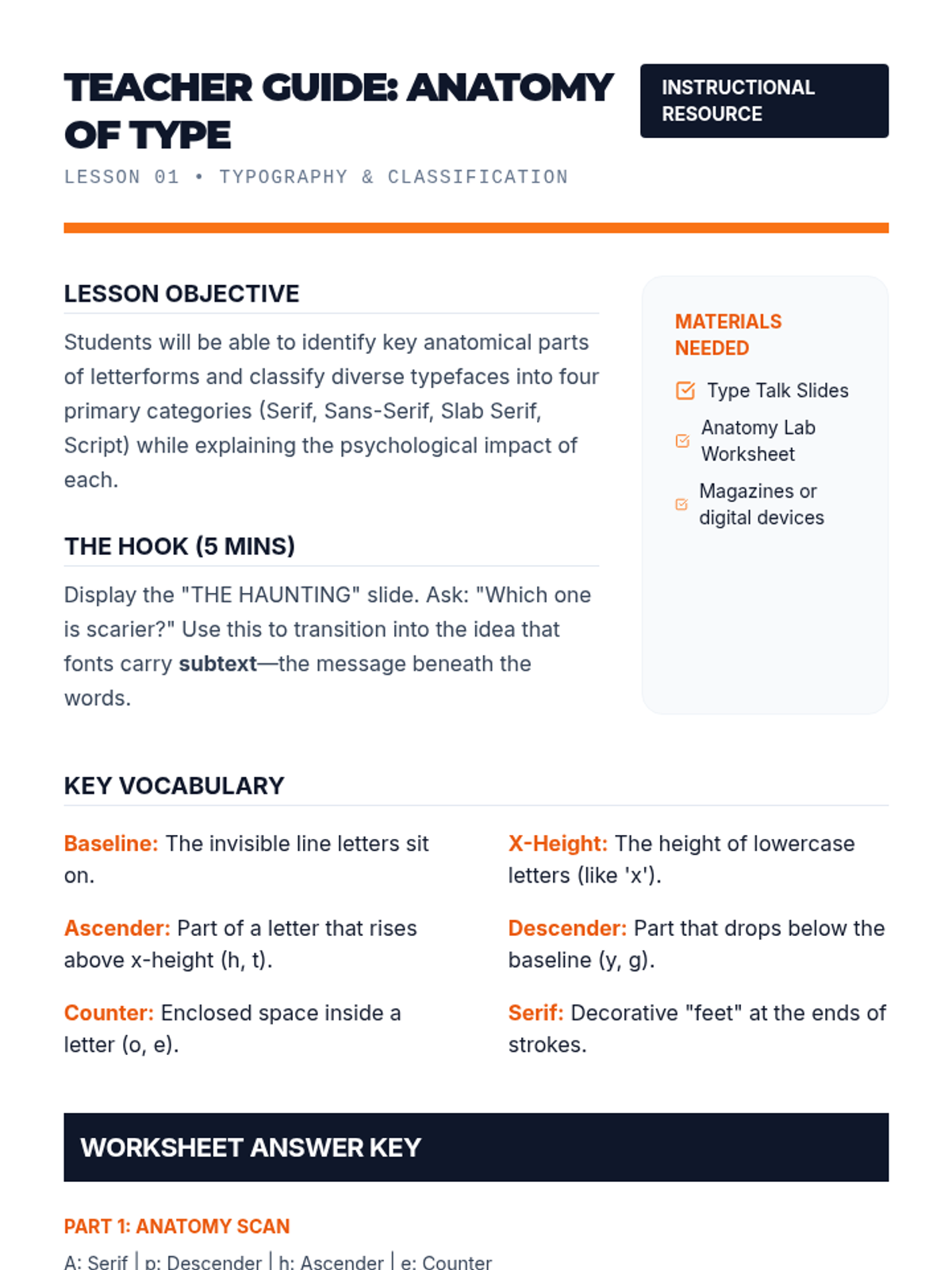
Students investigate the structural components of letters (serif, sans-serif, slab, script) and learn the specific terminology associated with type anatomy. The lesson focuses on identifying how distinct font categories convey different tones and historical contexts.