Fundamental principles of supply, demand, and monetary systems alongside micro- and macroeconomic structures. Examines the impact of corporate power, labor market dynamics, and global systems on social mobility and class inequality.
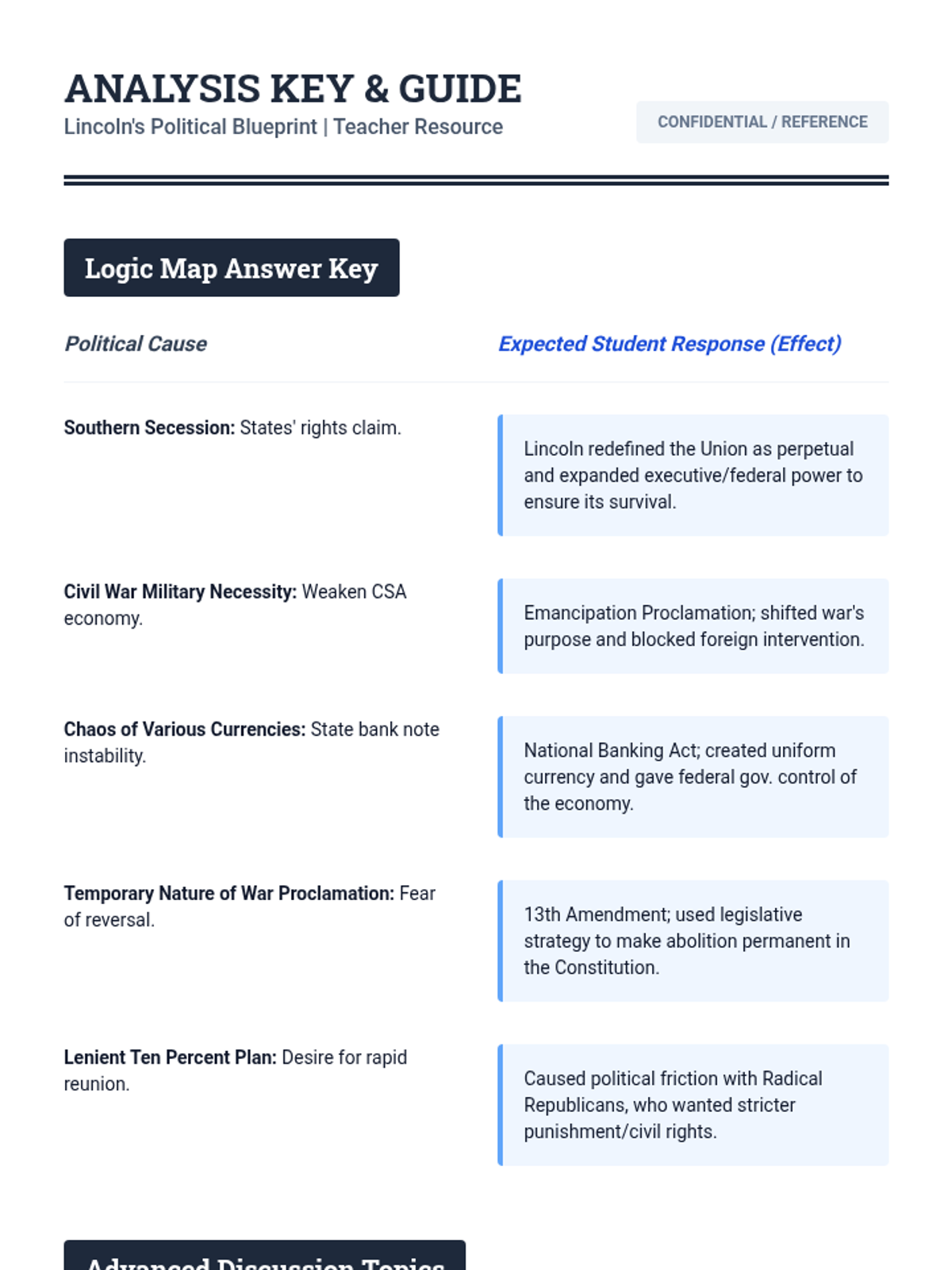
A teacher resource providing an answer key for the logic map, discussion prompts for classroom use, and a guide to common student misconceptions.
An expanded visual slide deck outlining Lincoln's political philosophy, adding depth on the Gettysburg Address, the National Banking Act, the Election of 1864, and the 13th Amendment.
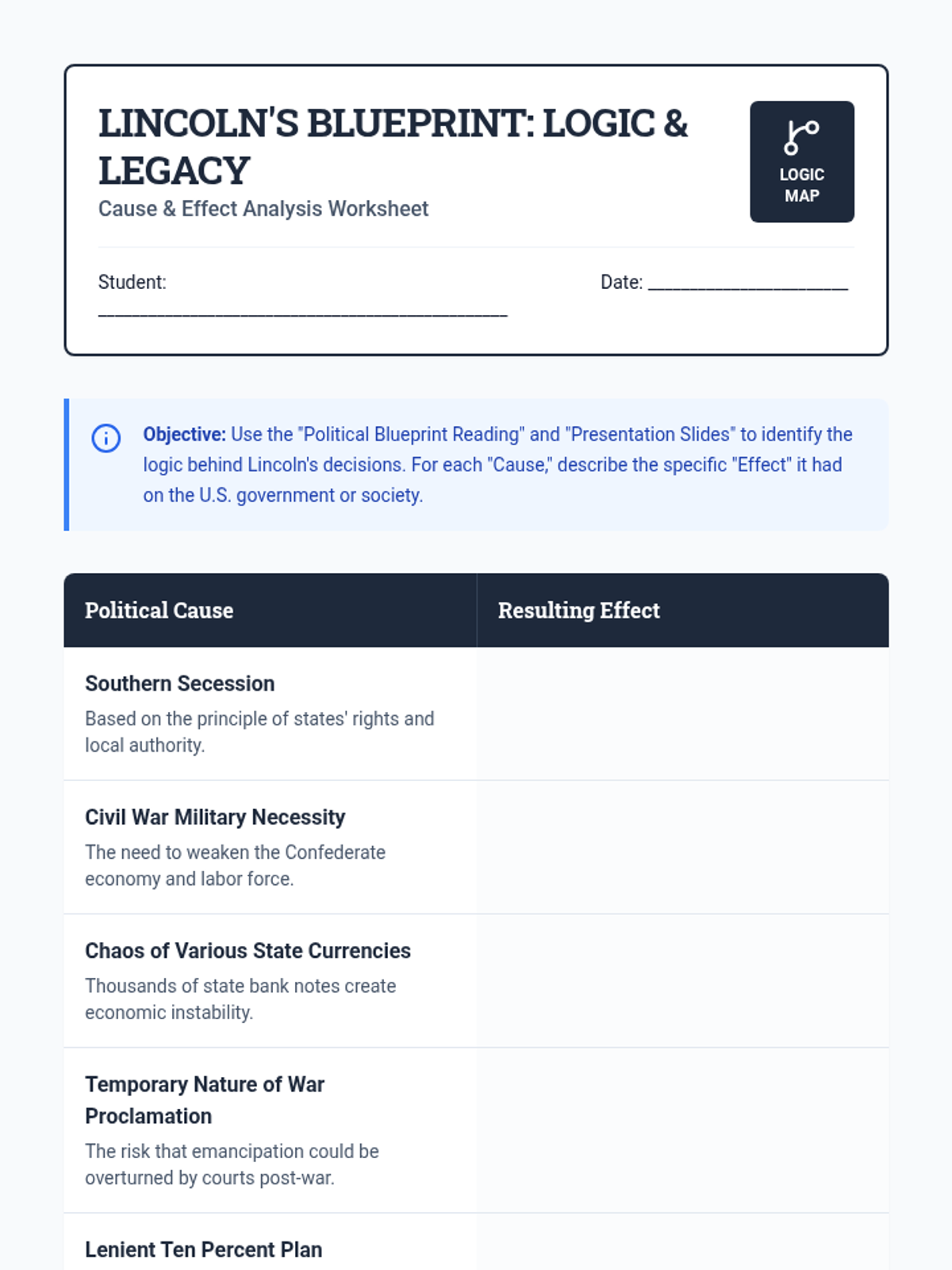
A cause-and-effect analysis worksheet where students identify the outcomes of Lincoln's major political decisions and explain the shift in federal power.
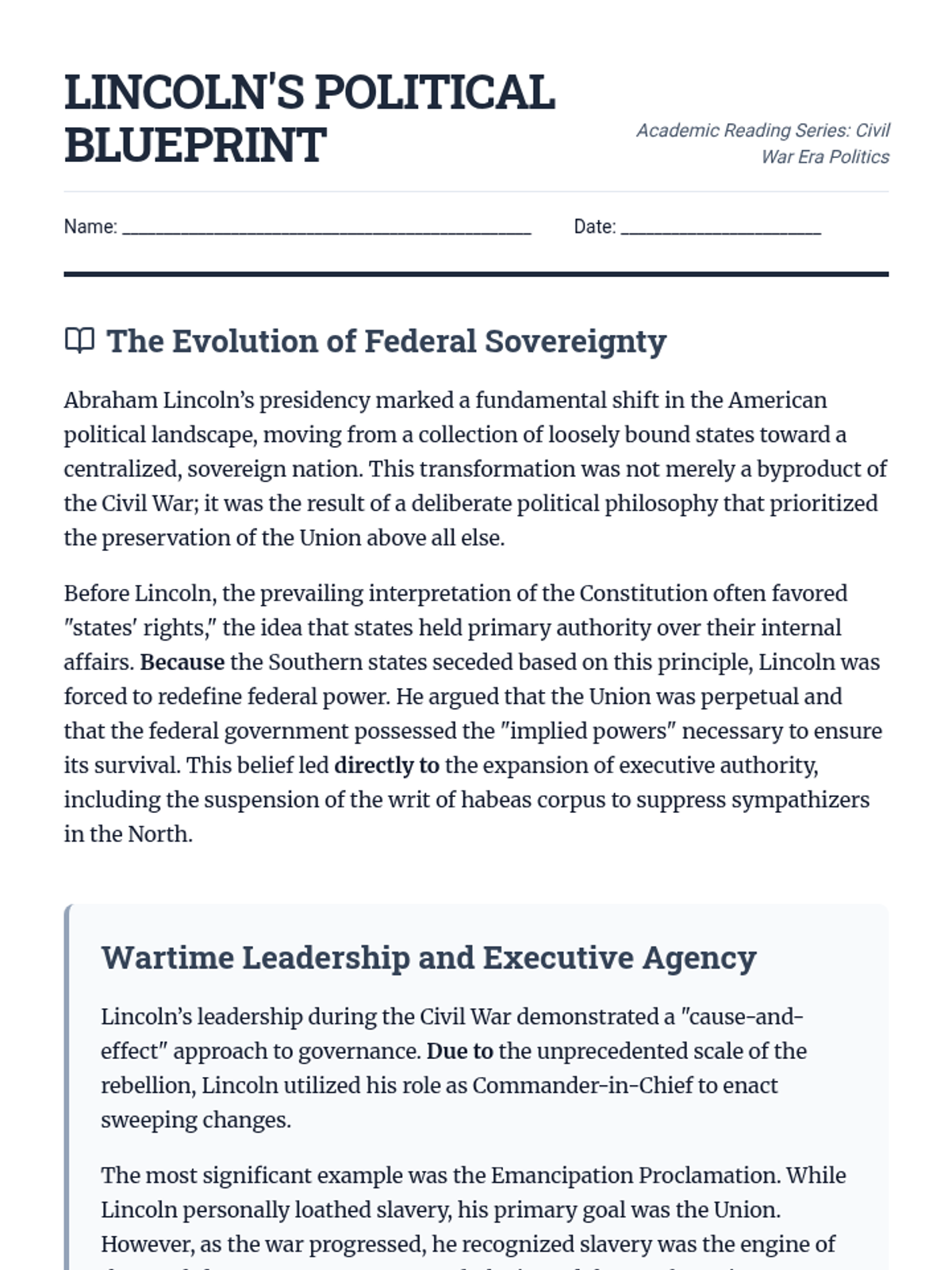
A comprehensive academic reading document focusing on Abraham Lincoln's political philosophy, executive power, and economic policies using cause-and-effect structures.
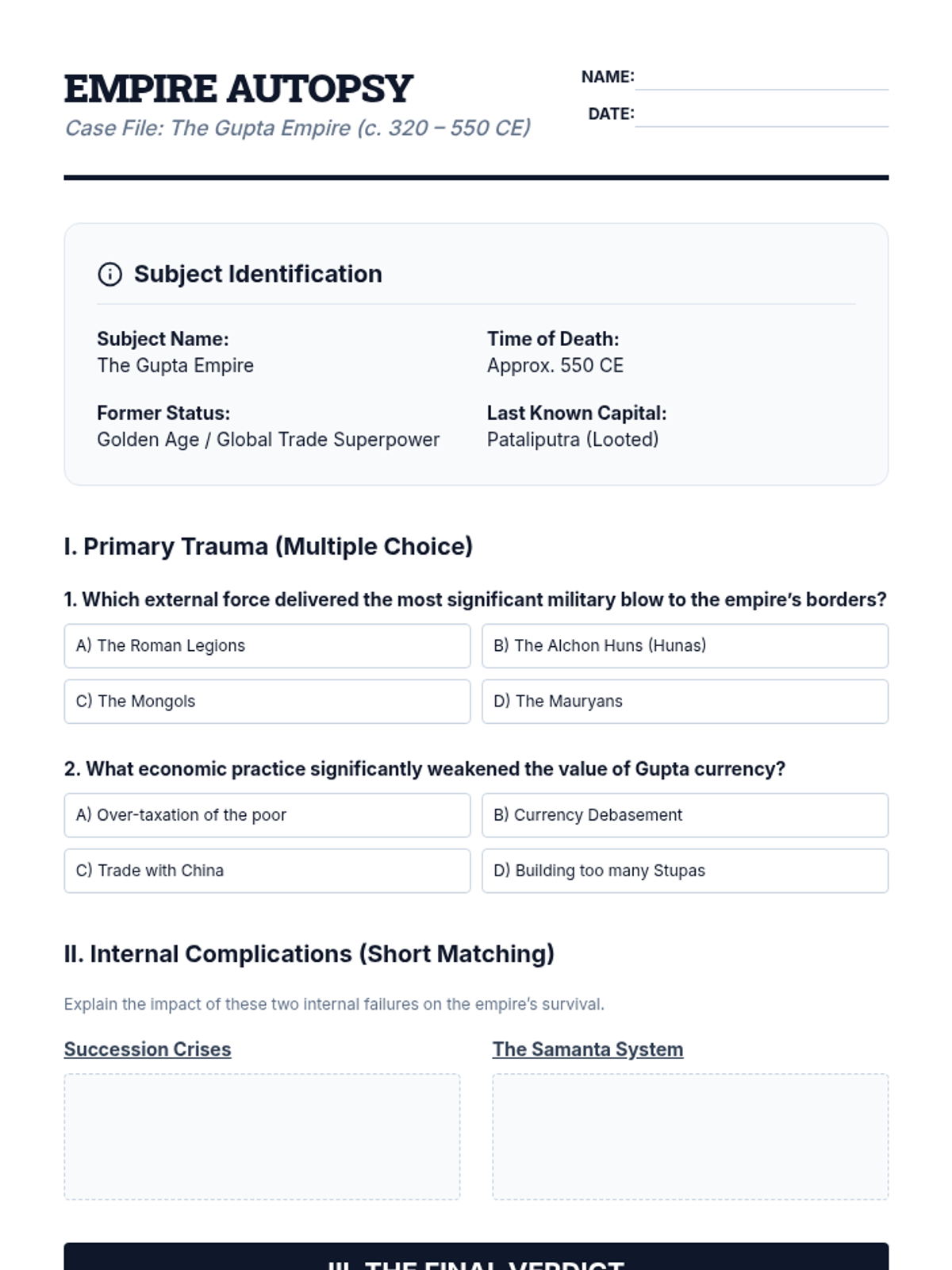
Final synthesis assessment where students 'diagnose' the fall of the Gupta Empire using evidence from the 5-day unit.
Day 5 slide deck exploring the synthesis of the empire's collapse and the lasting cultural legacy of the Gupta period.
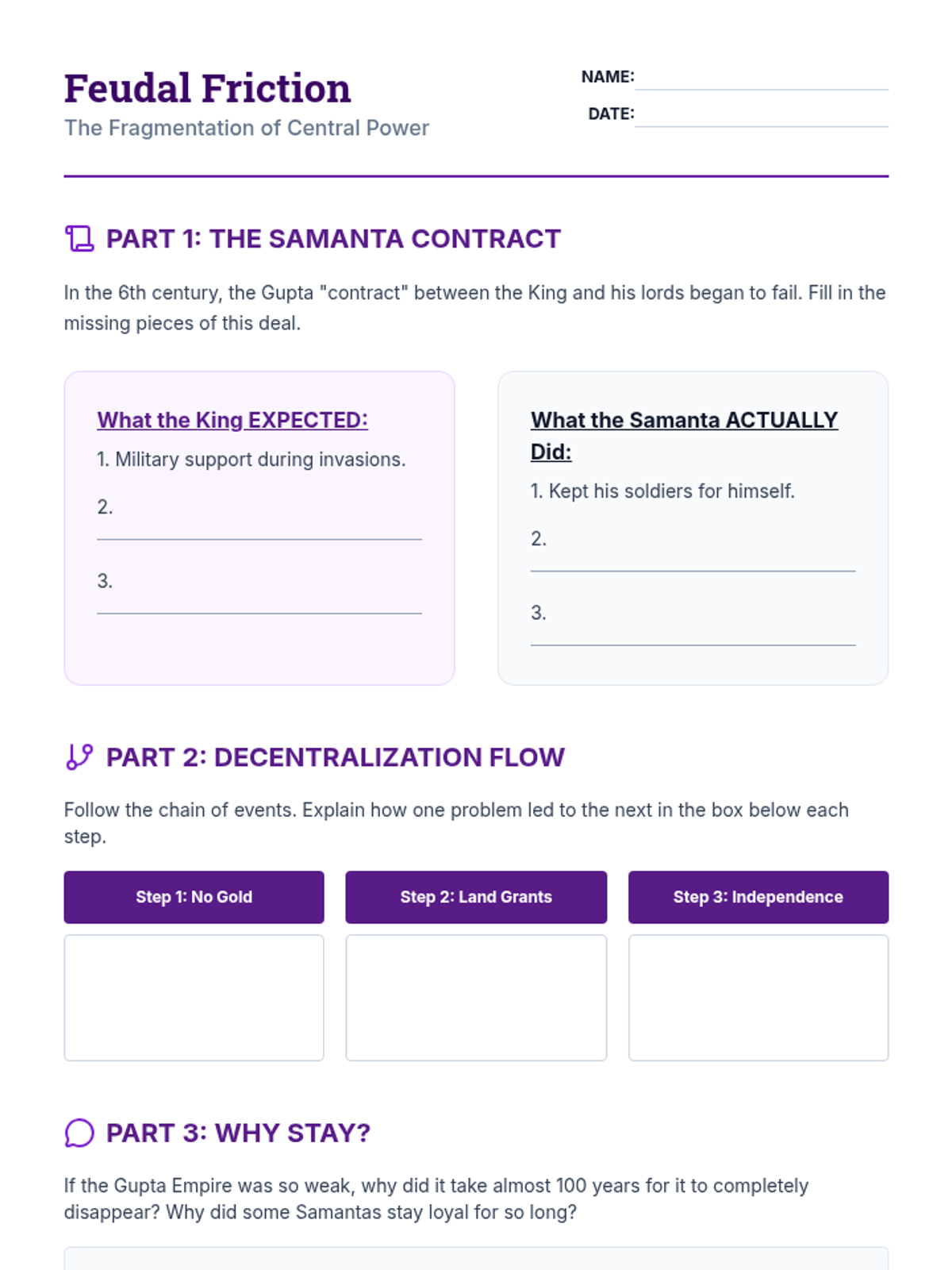
Day 4 graphic organizer where students analyze the shifting relationship between the Gupta central authority and regional feudal lords (Samantas).
Day 4 slide deck exploring the rise of regional feudal lords (Samantas) and the administrative decentralization that led to political fragmentation.
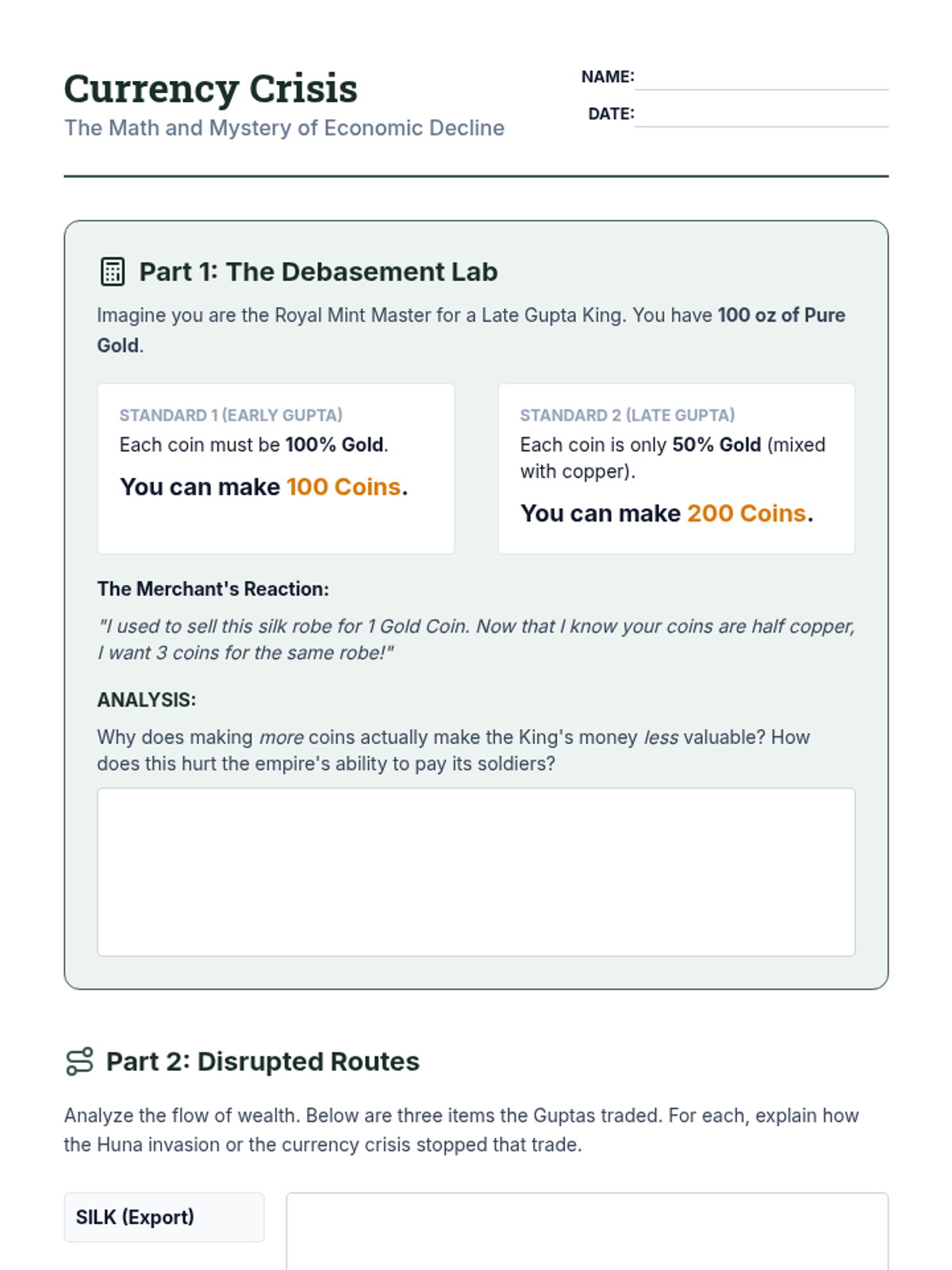
Day 3 worksheet focusing on the concept of currency debasement and its impact on trade and urbanization during the Gupta decline.
Day 3 slide deck exploring the economic factors behind the Gupta decline, focusing on currency debasement and the disruption of international trade routes.
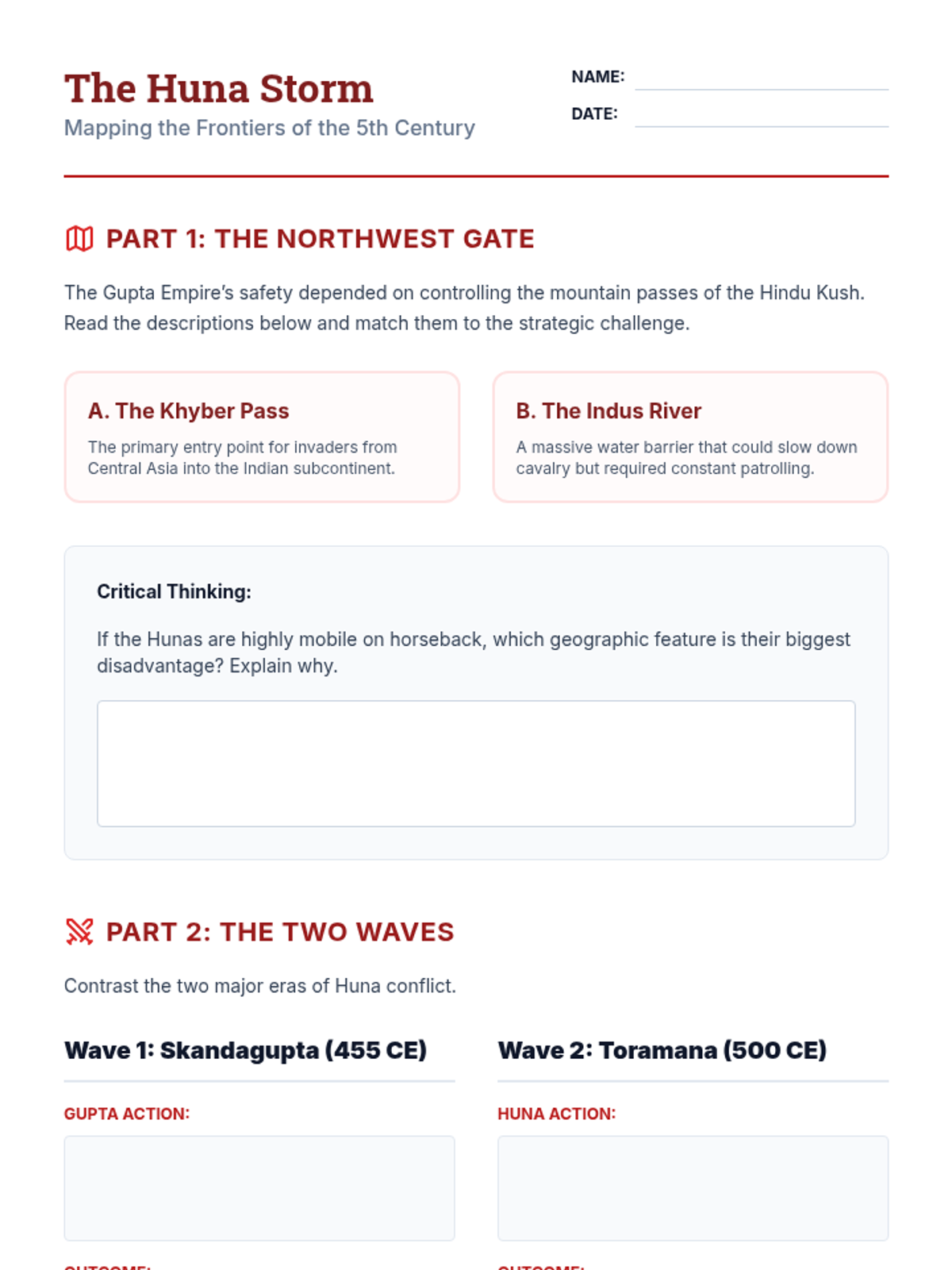
Day 2 activity sheet where students analyze the geography of the Huna invasions and contrast the different waves of conflict that depleted Gupta resources.
Day 2 slide deck exploring the impact of the Huna invasions, key figures like Toramana and Mihirakula, and the crushing economic cost of defending the empire's frontiers.
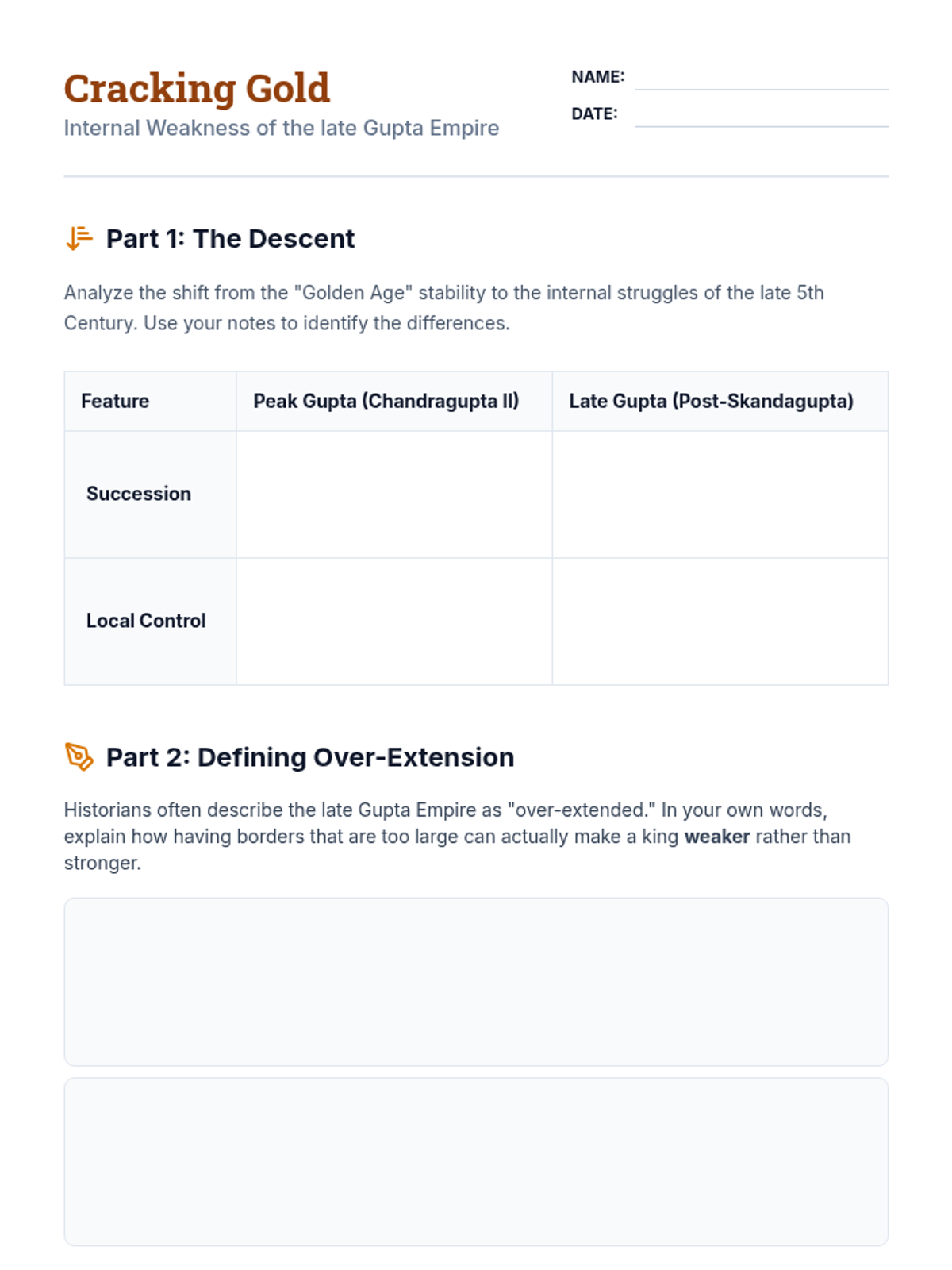
Day 1 student worksheet focusing on the comparison between the empire's peak and its internal decline, including prompts on over-extension and succession struggles.
Visual slide deck for Day 1 focusing on the internal decay, succession crises, and over-extension of the Gupta Empire during its late period.
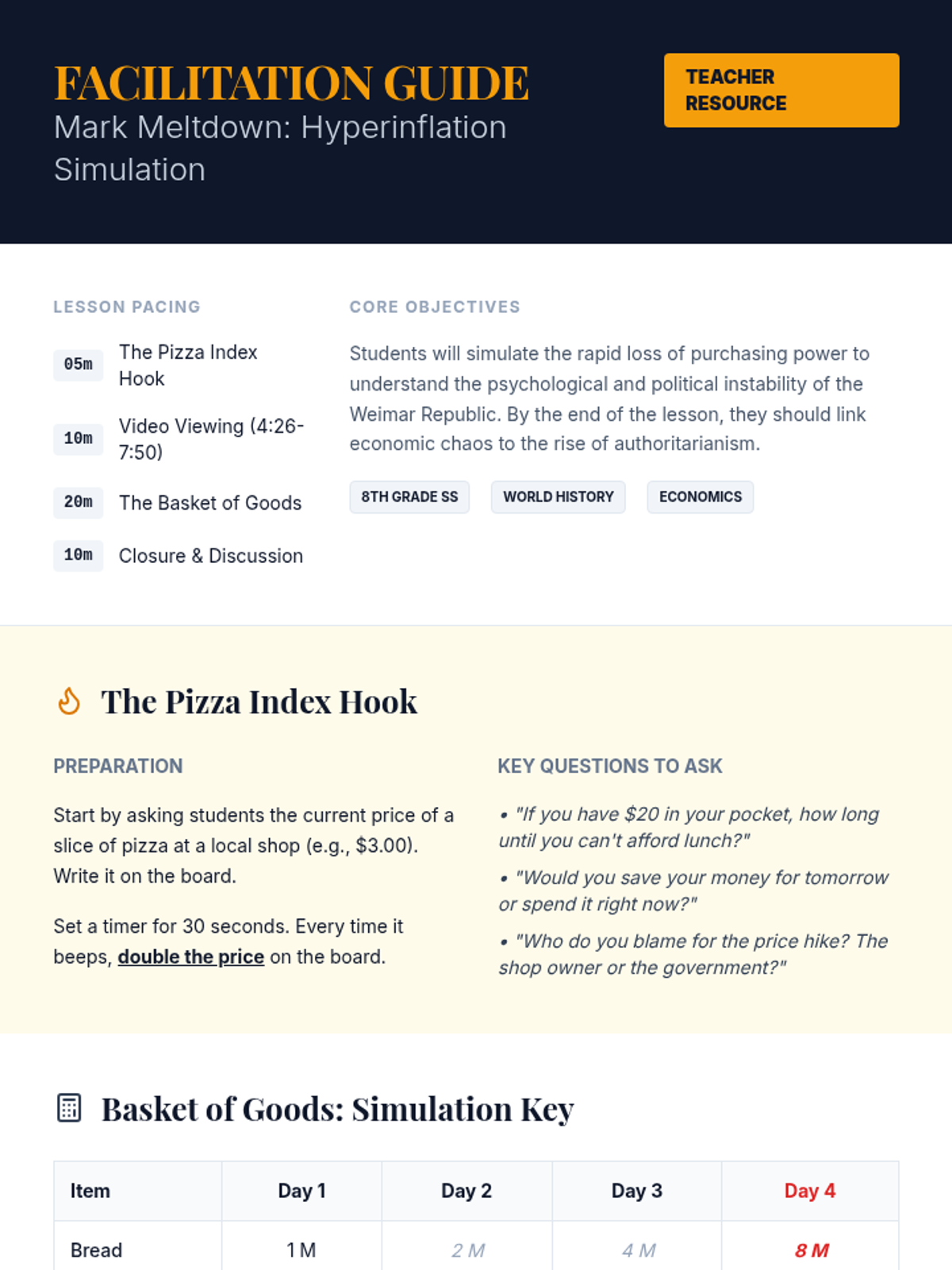
A detailed instructional guide for teachers, providing a pacing schedule, a simulation key for the 'Basket of Goods' activity, and an answer key for the student worksheet.
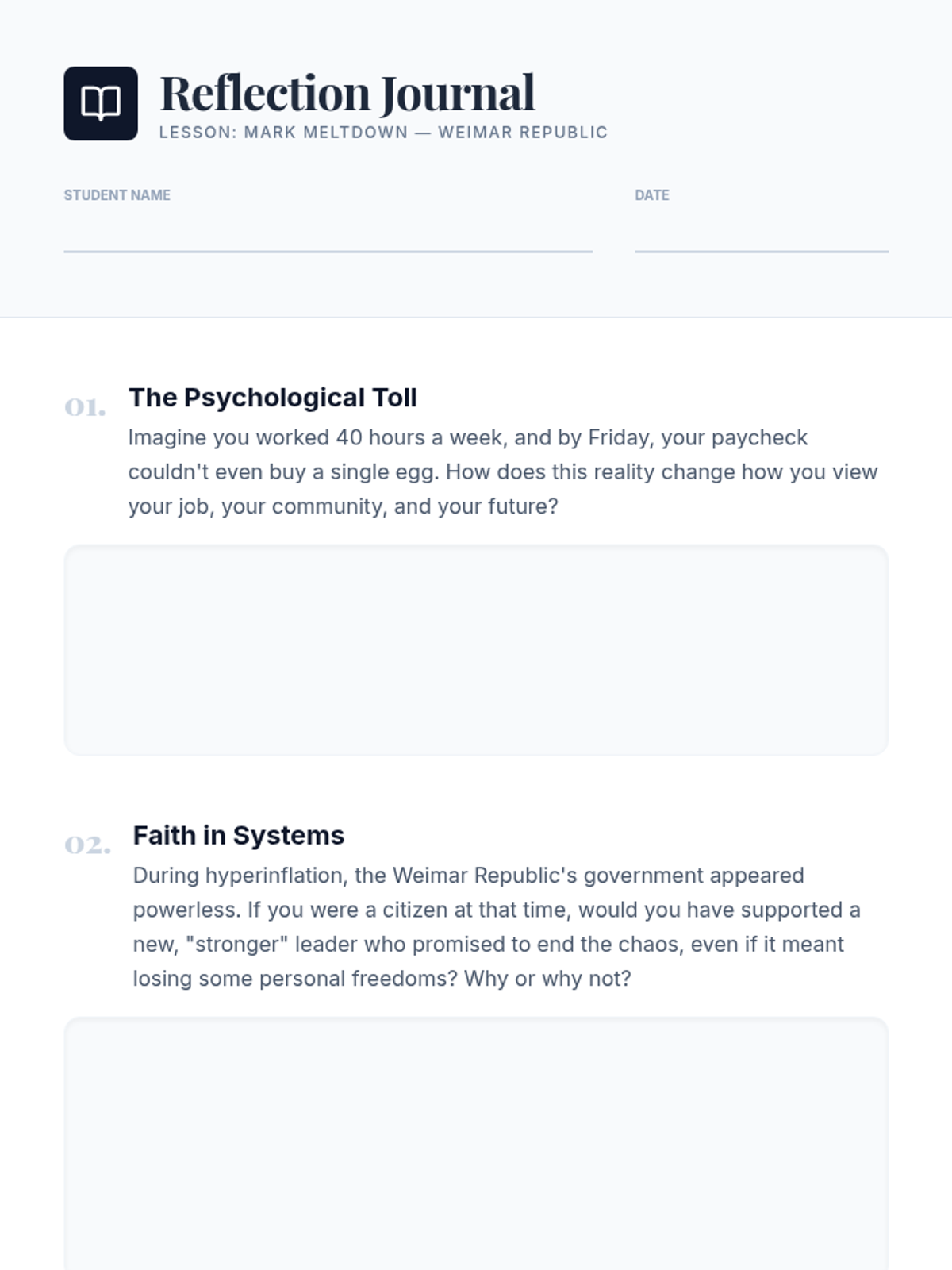
A structured reflection journal with deep-thinking prompts focused on the psychological and political impacts of hyperinflation on German society.
A visually striking slide deck for the Mark Meltdown lesson, featuring the Pizza Index hook, video instructions, key vocabulary, and simulation guidelines with a vintage-industrial aesthetic.
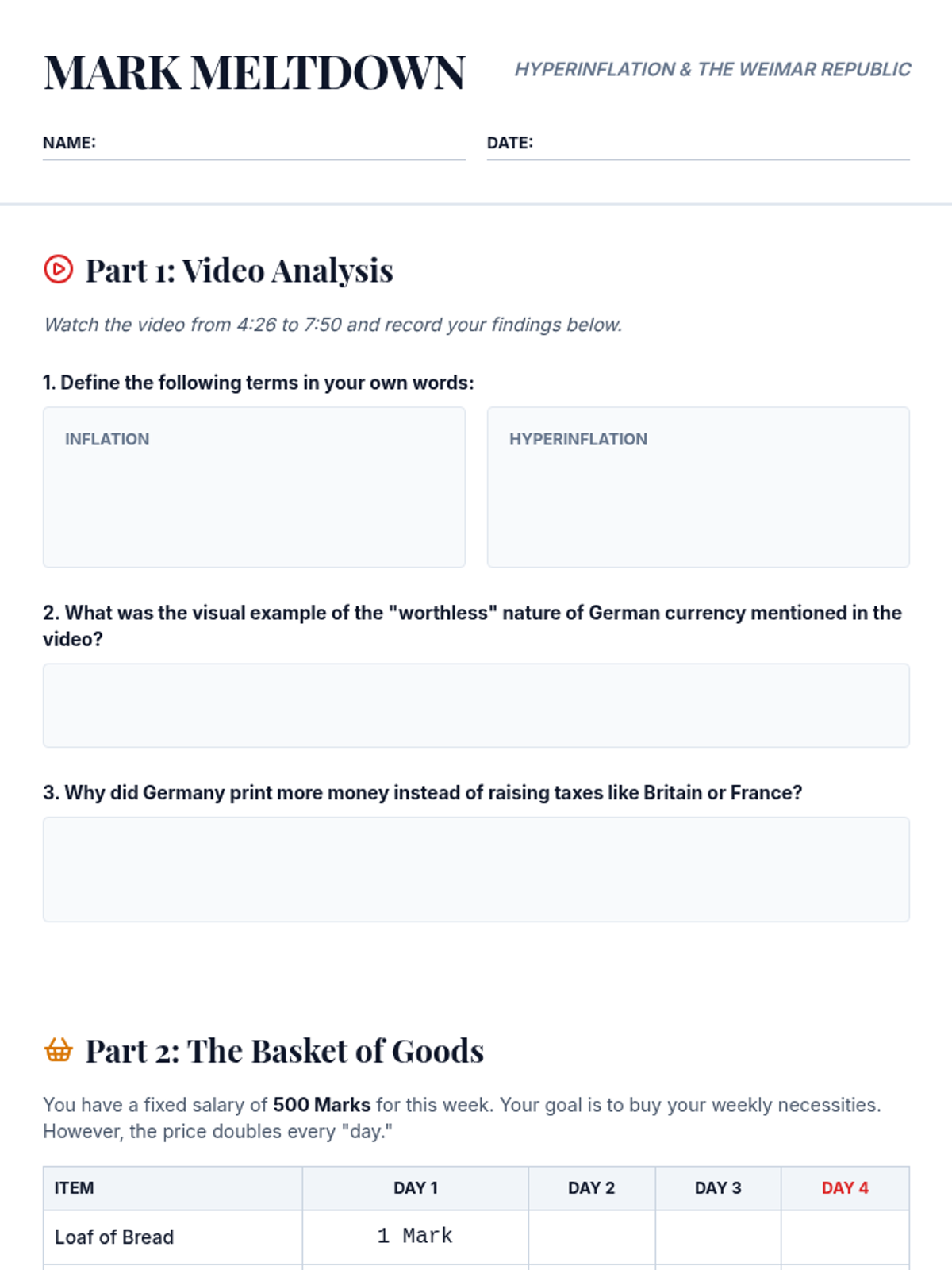
A comprehensive student worksheet featuring video analysis questions, a hyperinflation simulation table (The Basket of Goods), and a creative diary entry prompt focused on life in the Weimar Republic.
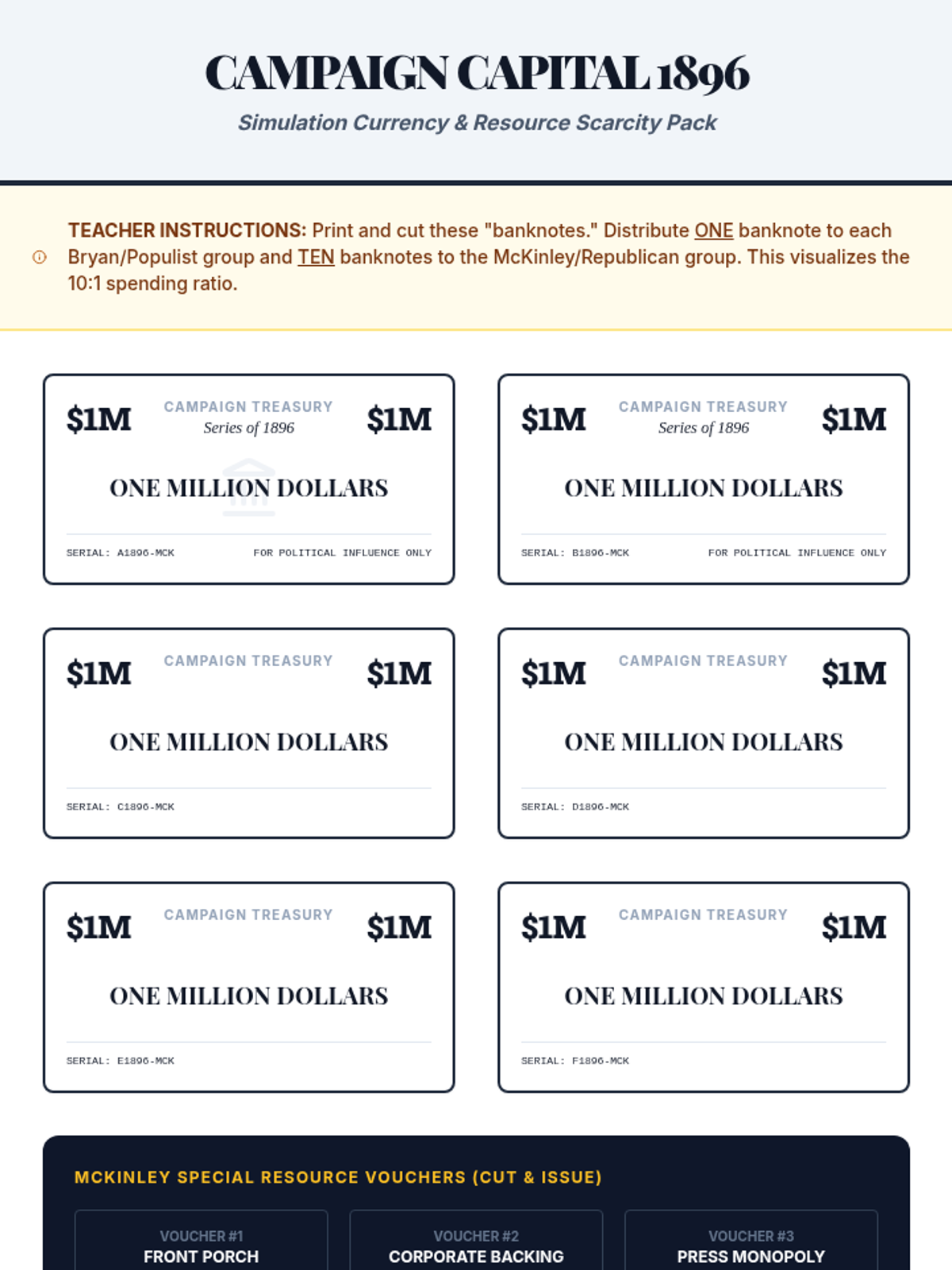
Printable "play money" and resource vouchers for the campaign simulation. Designed to be cut and distributed to illustrate the 10:1 spending disparity between McKinley and Bryan in the 1896 election. Includes million-dollar banknotes and special resource vouchers.
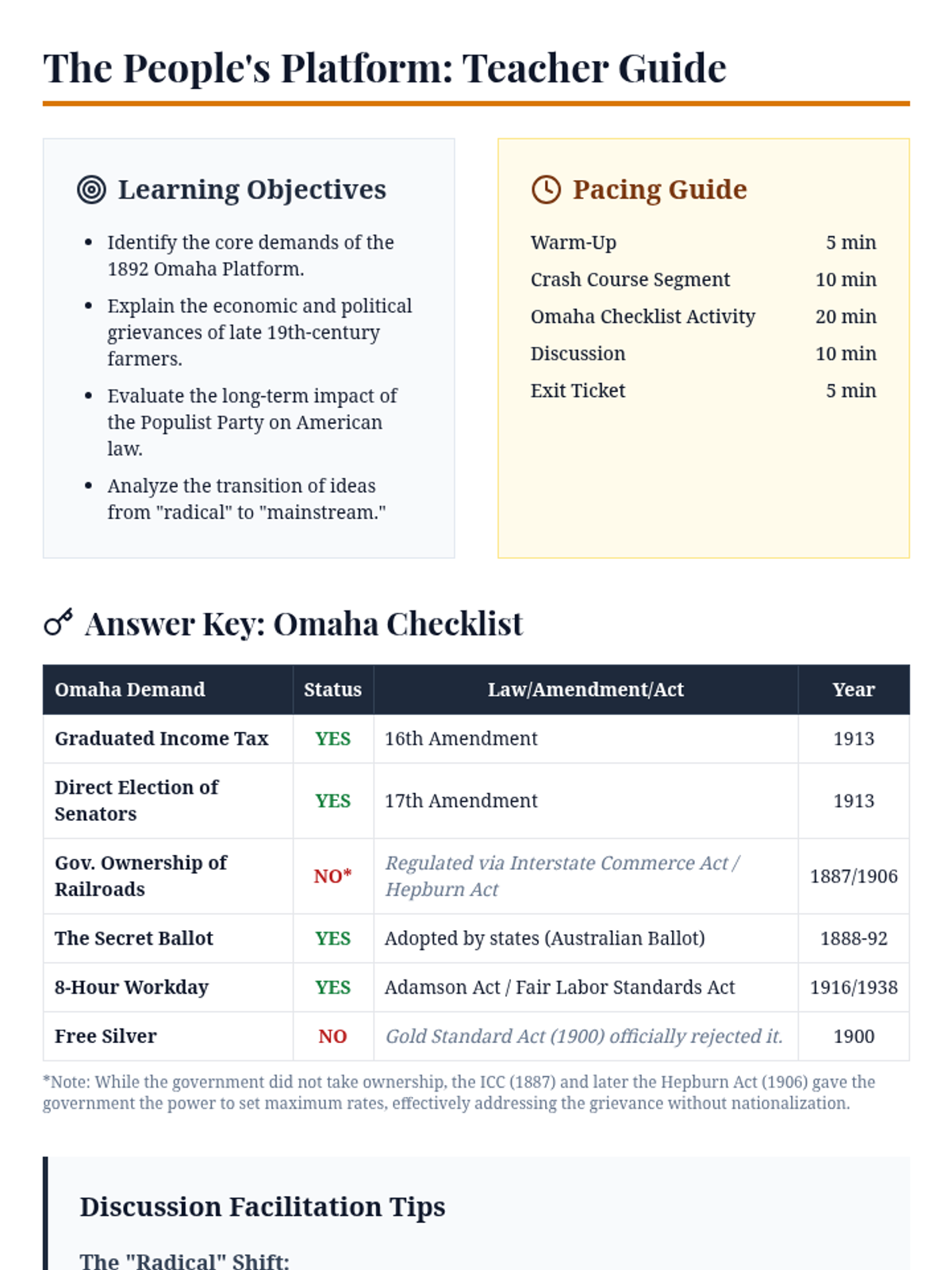
A guide for teachers including learning objectives, pacing, a worksheet answer key, and discussion prompts for the Populist lesson.
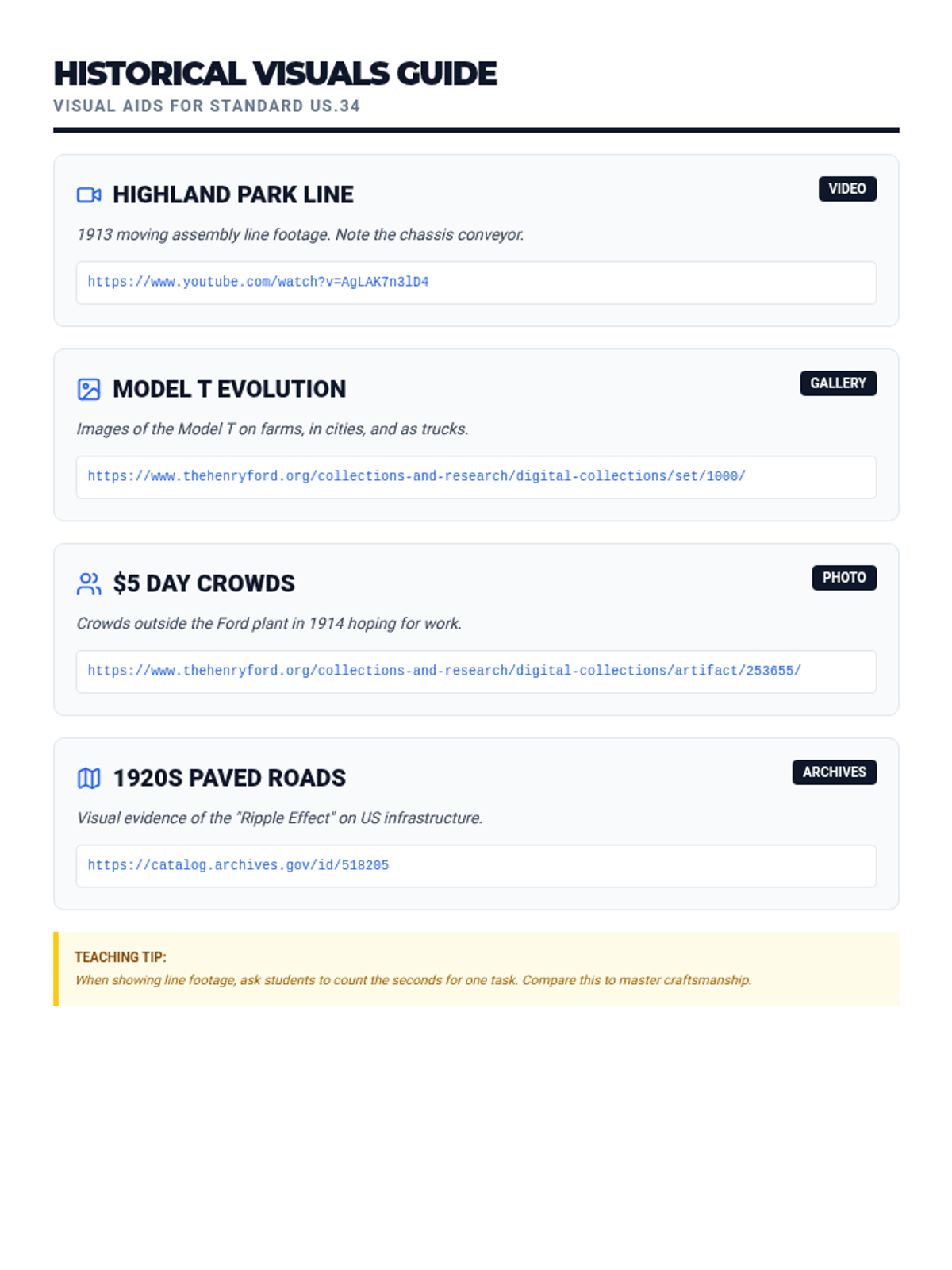
A list of names and links for high-quality historical visuals, videos, and image sets to supplement the Ford Revolution lesson. Revised for single-page layout.
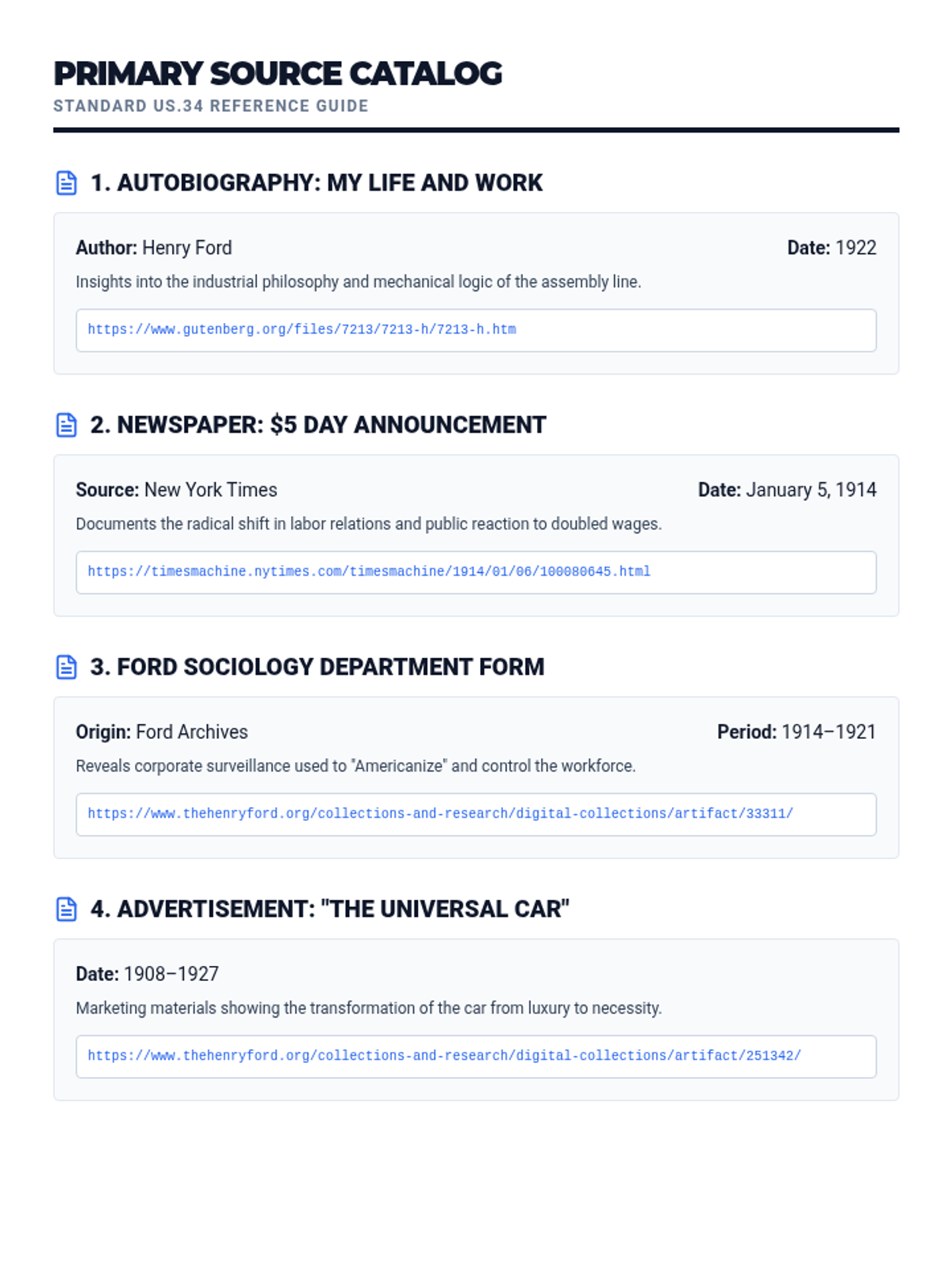
A curated list of key primary sources used in the Ford Revolution lesson, including names, dates, historical significance, and digital access links. Revised to avoid page breaks.
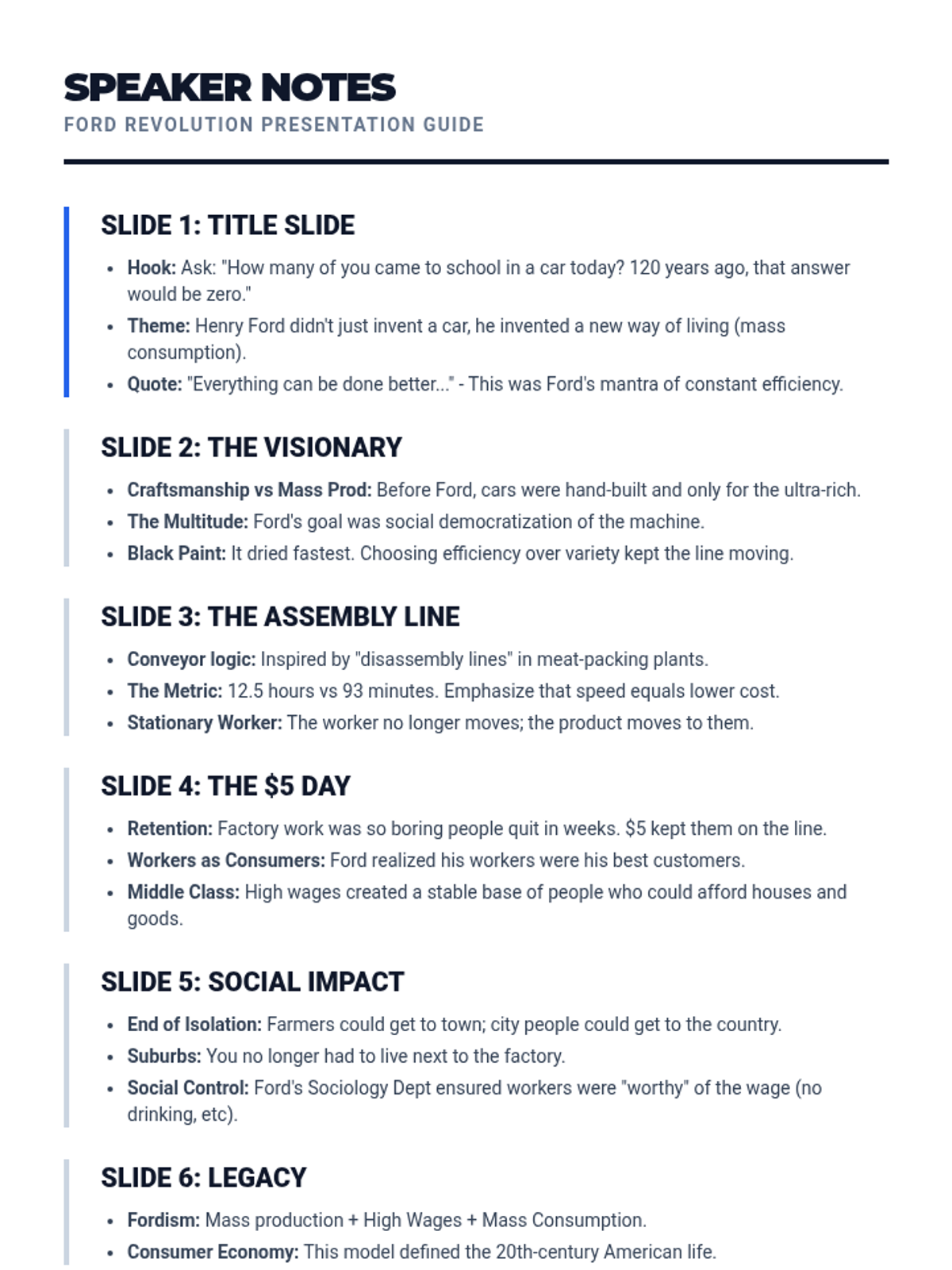
Detailed slide-by-slide speaker notes for the teacher to use during the Ford Revolution presentation, including hooks, context, and key talking points. Revised for better page flow.
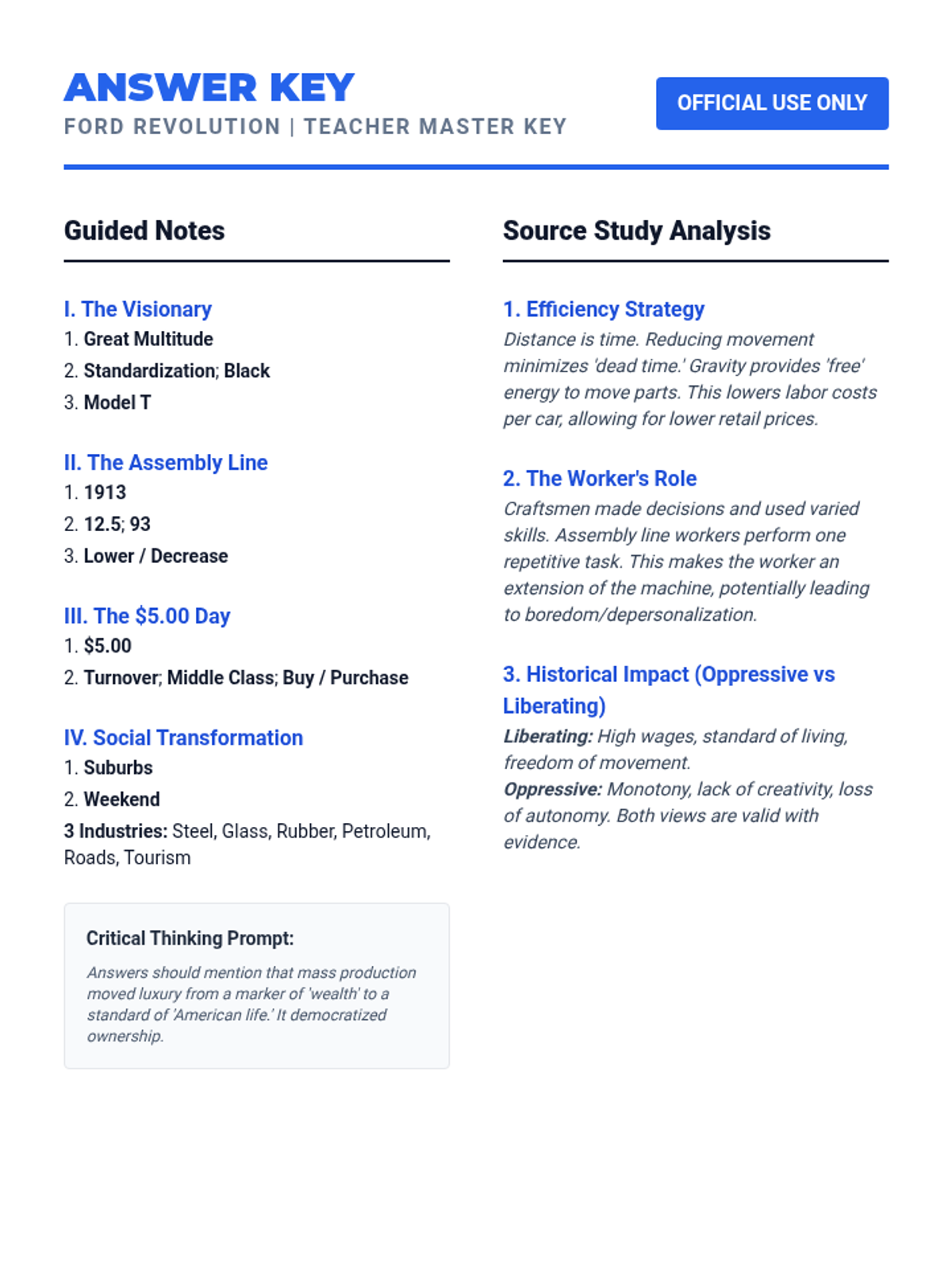
Comprehensive answer key for the Ford Revolution lesson, including guided notes responses and primary source analysis guidelines.
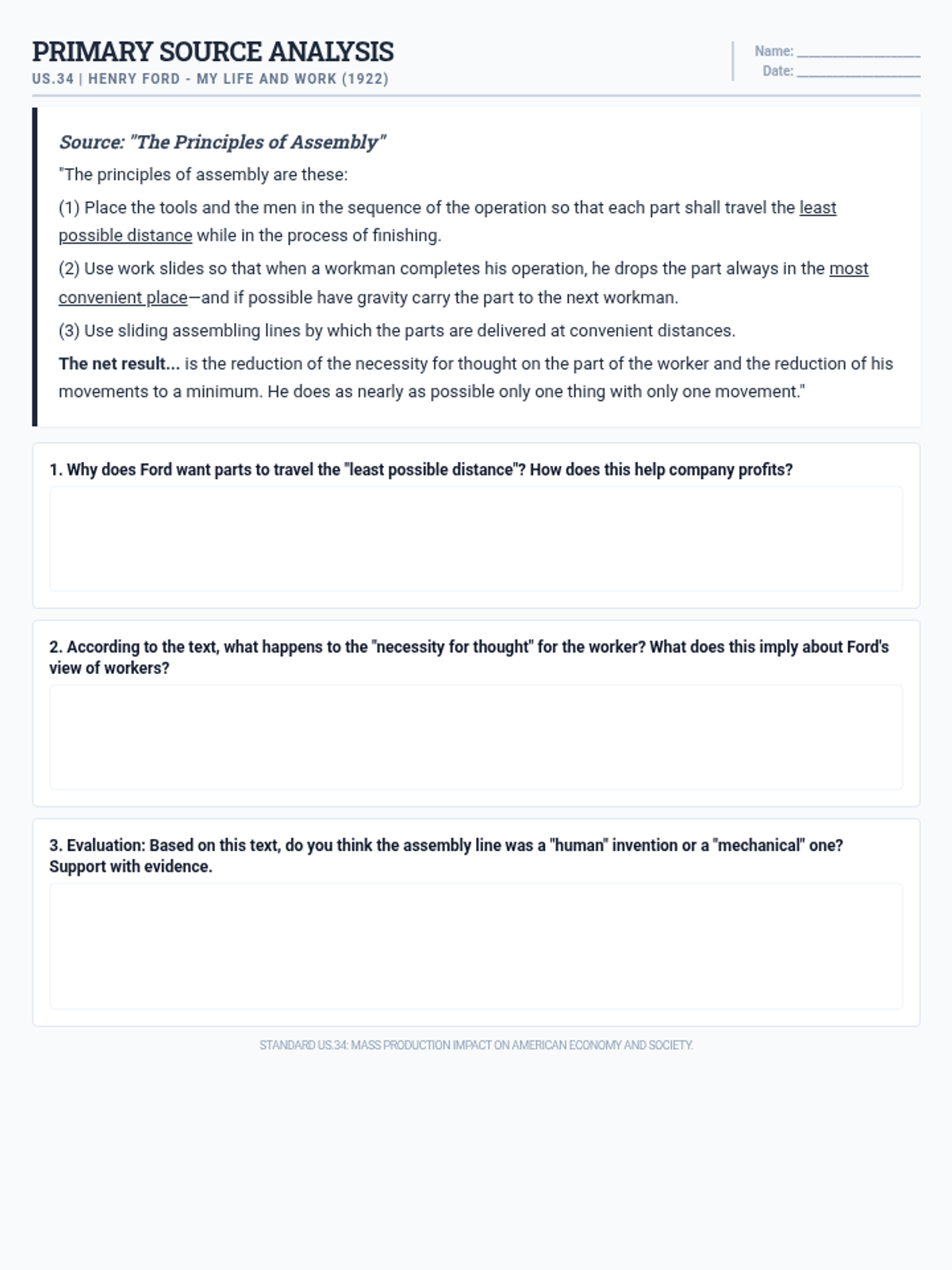
A primary source analysis activity featuring an excerpt from Henry Ford's 1922 autobiography, emphasizing the mechanical logic and human impact of the assembly line. Updated with clear naming and dating. Revised for 1-page fit.
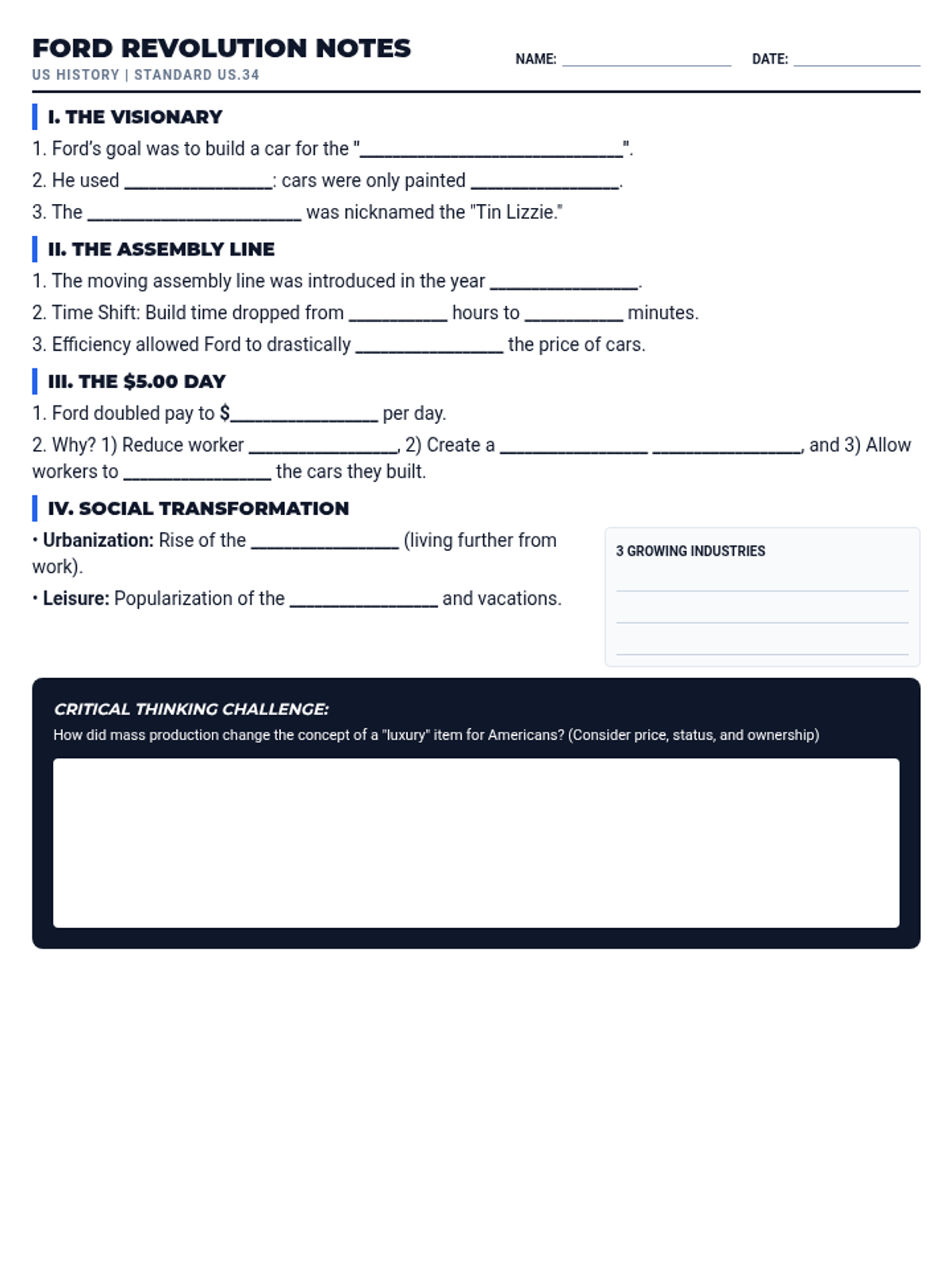
A guided note-taking document designed to accompany the Ford Revolution slide deck. Strictly condensed to fit on a single page for classroom printing. Header and spacing optimized.
Visual presentation covering the industrial innovations of Henry Ford, the mechanics of the assembly line, and the economic/social ripple effects on early 20th-century America. Typo fixed and layout balanced.
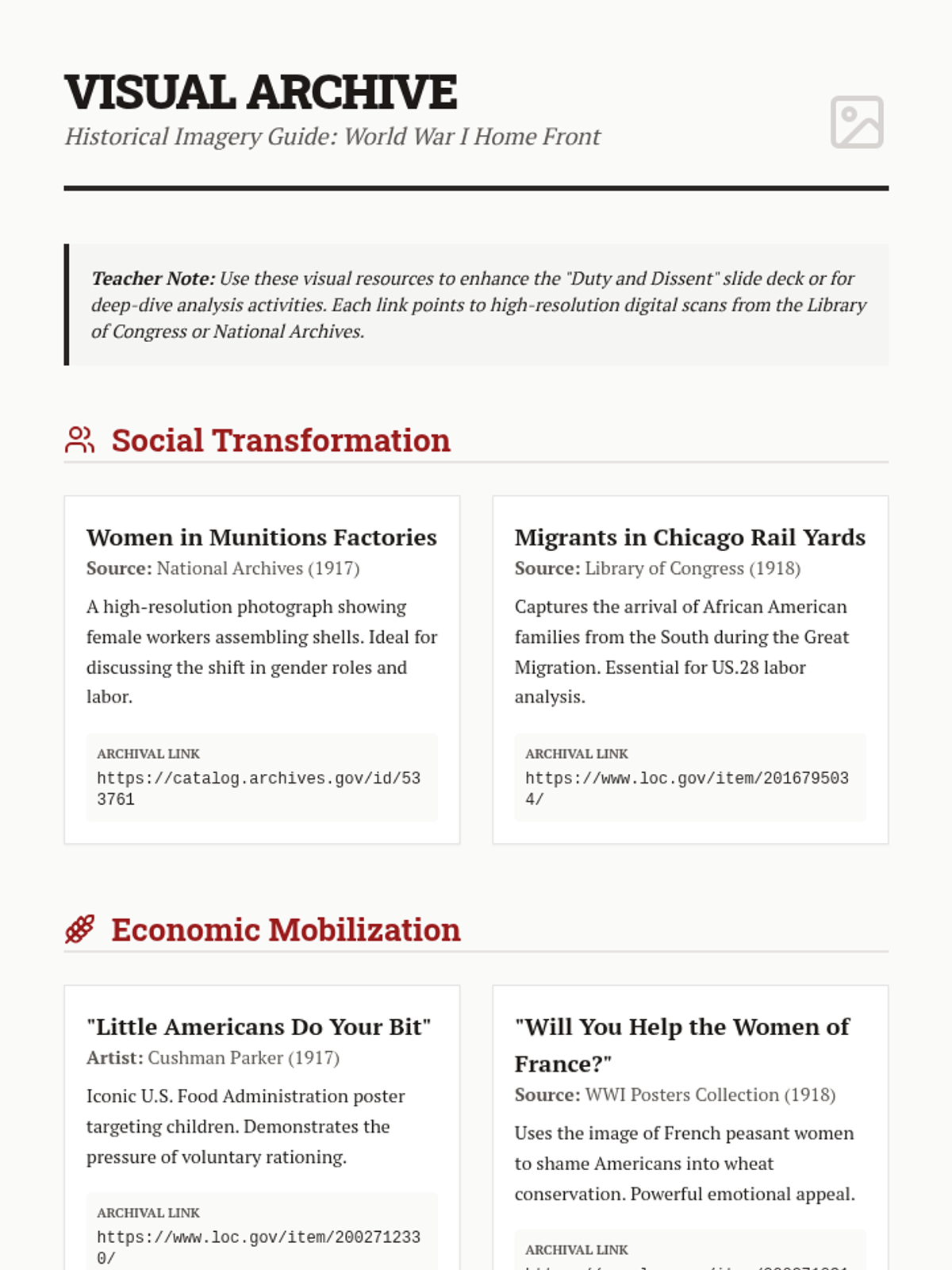
A curated list of high-quality primary source visuals for the WWI Home Front, including recruitment posters, propaganda, and rare archival photographs of social shifts and political dissent. Each entry includes verified links to the Library of Congress or National Archives. Updated for improved layout and contrast.
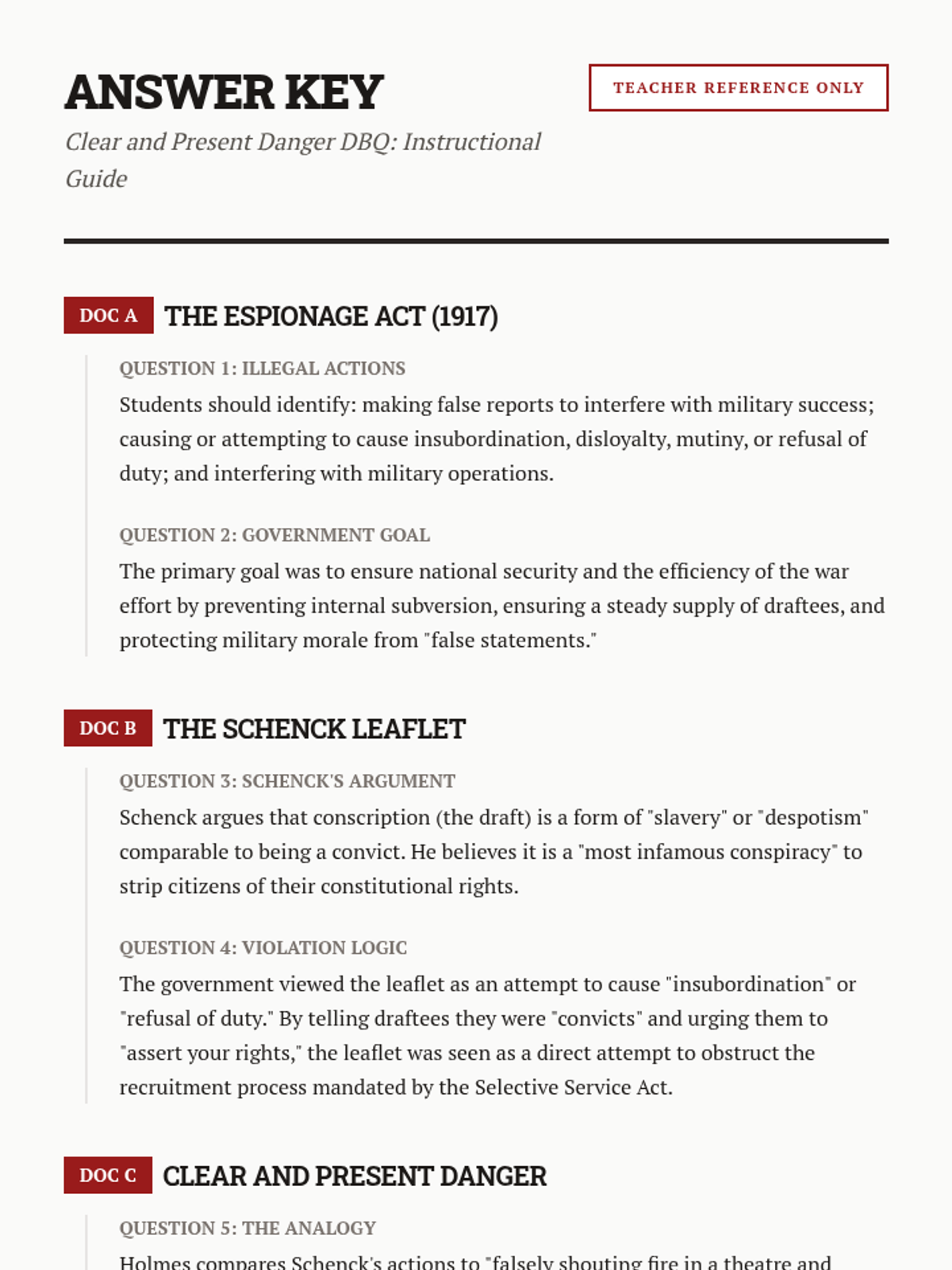
A comprehensive answer key and instructional guide for the "Clear and Present Danger" DBQ worksheet. Provides detailed evidence-based answers, archival context, and a scoring rubric for the synthesis challenge. Updated for improved layout and page-break handling.
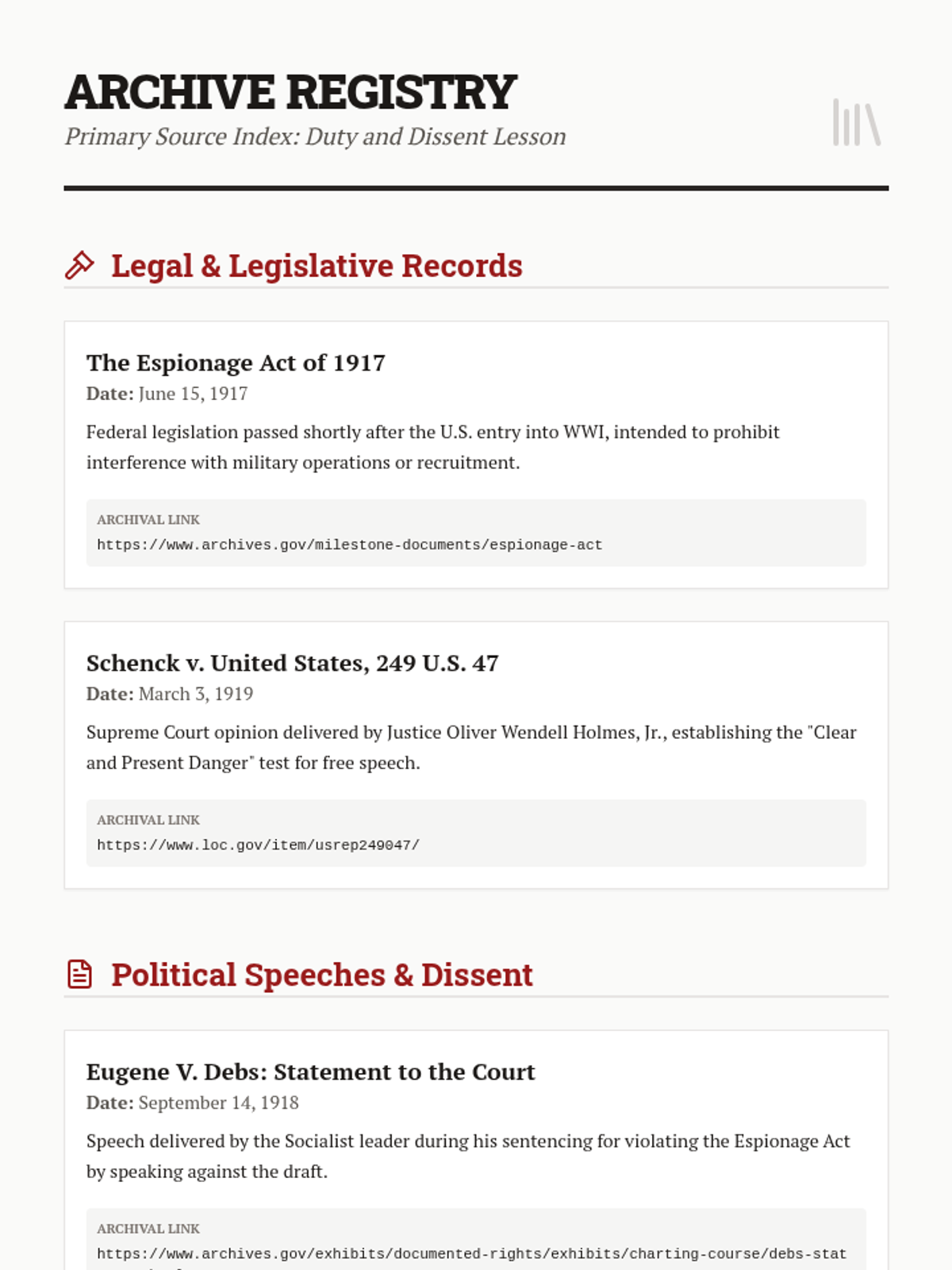
A comprehensive reference sheet for teachers and students listing all primary sources used in the "Duty and Dissent" lesson, including full titles, specific dates, historical context, and verified archival links. Updated for improved readability and layout.
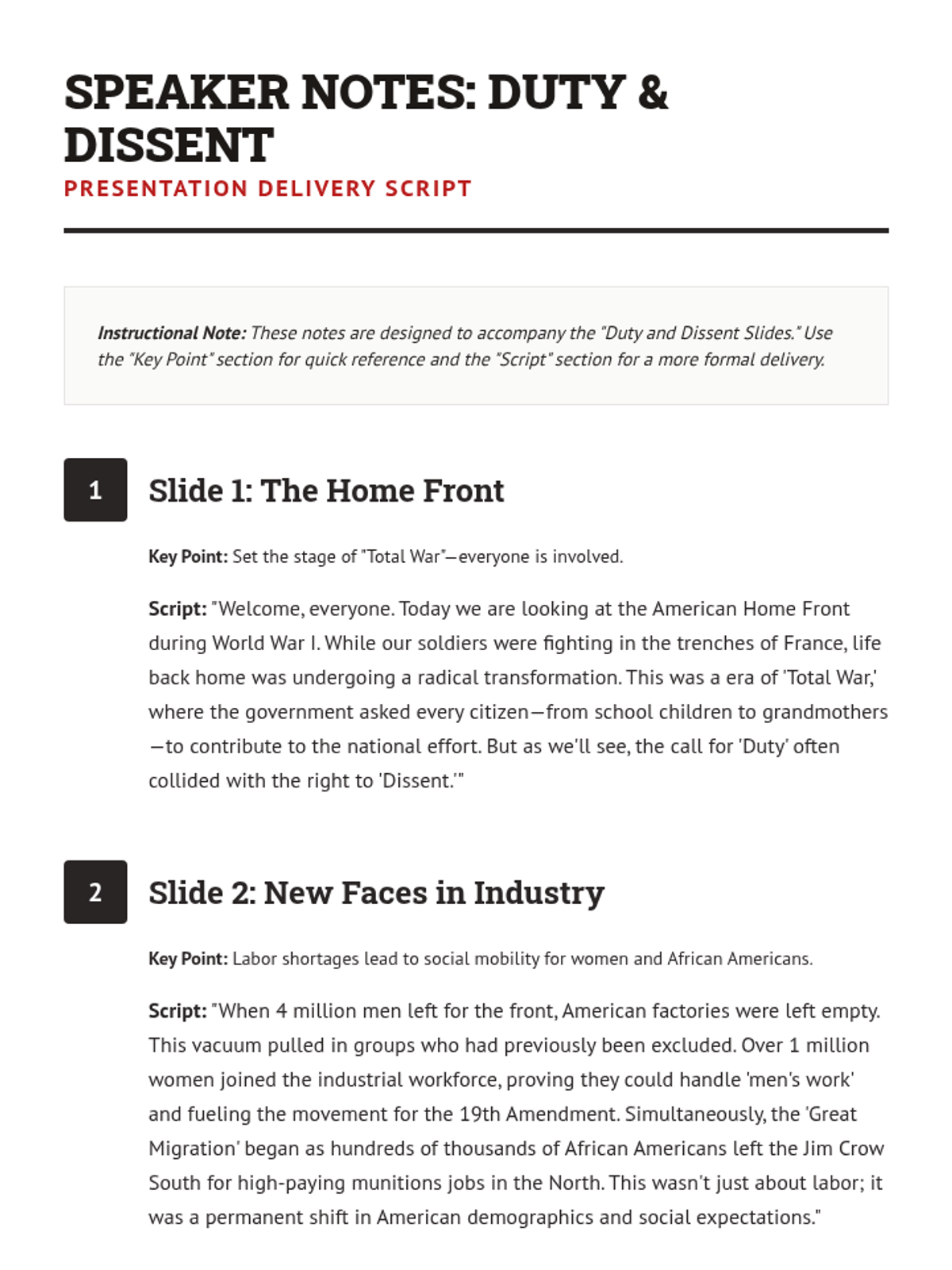
A dedicated speaker notes document for the "Duty and Dissent" presentation. It provides slide-by-slide scripts, key points, and instructional cues for the teacher to use during the lesson.
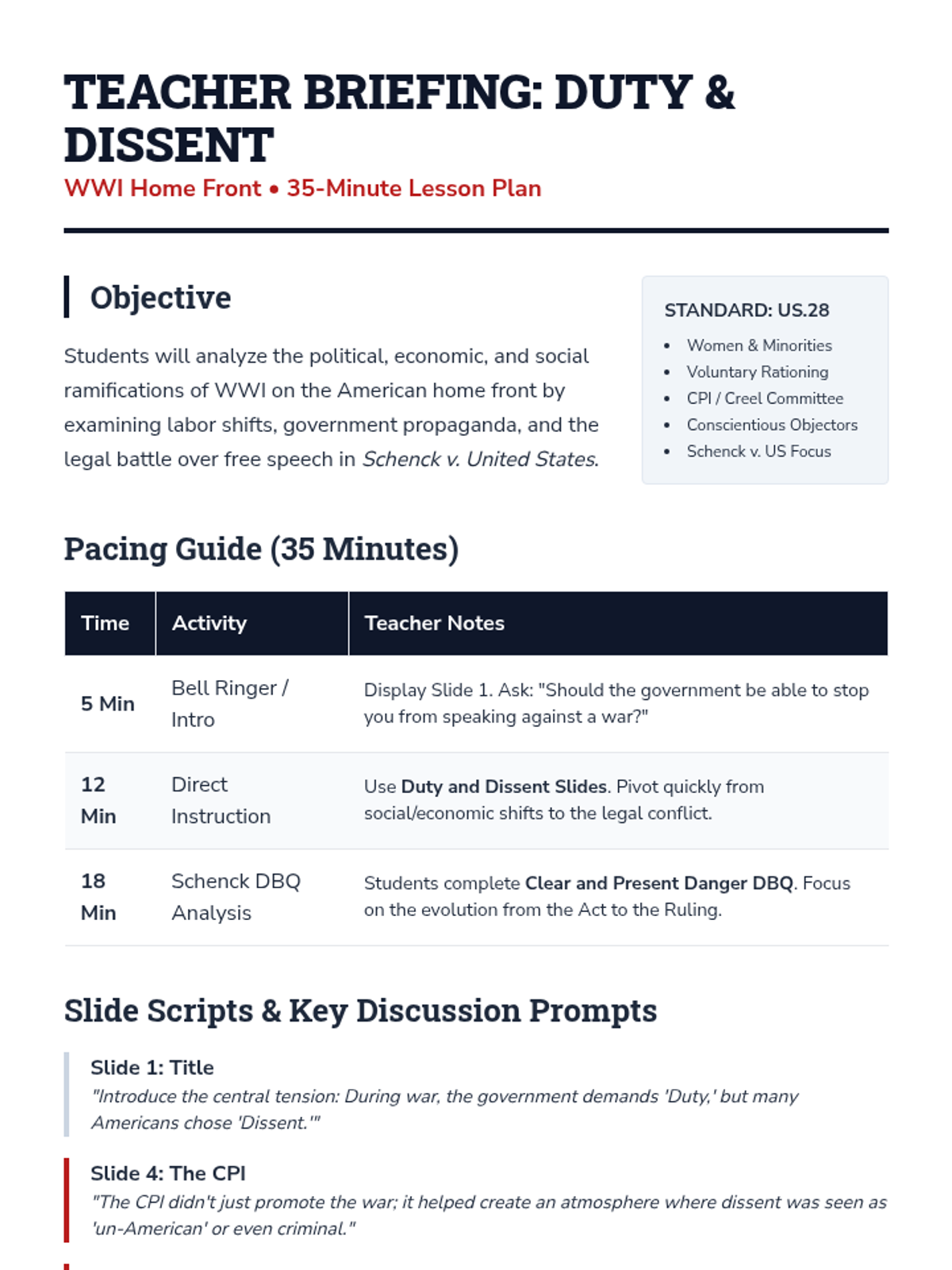
Updated teacher's guide for the Schenck-focused DBQ lesson. Includes a refined pacing guide, instructional scripts focusing on the legal conflict, and a detailed answer key for the "Clear and Present Danger" analysis.
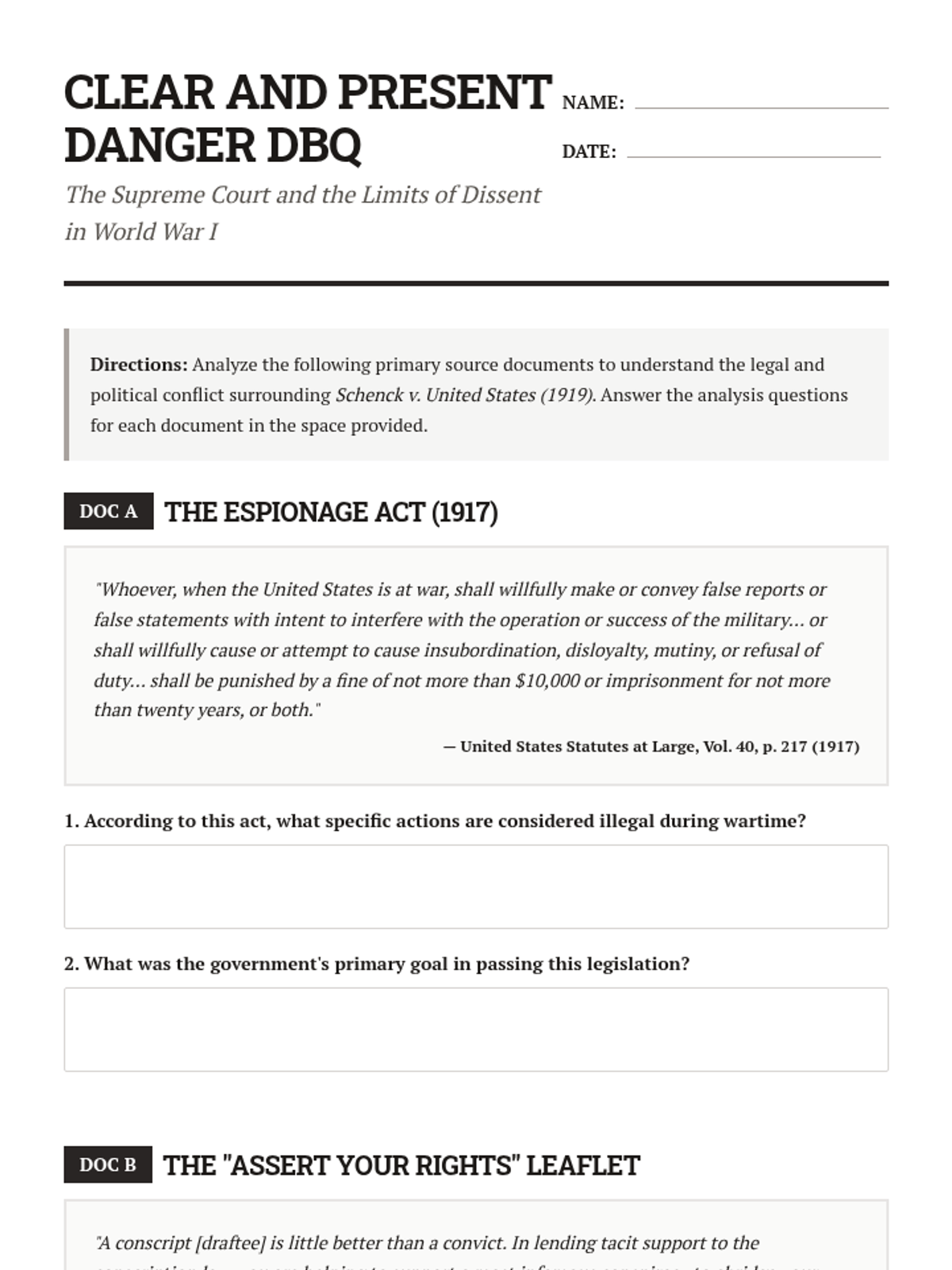
Refocused primary source analysis worksheet centered on the legal conflict of Schenck v. United States. Updated to ensure all primary source attributions include names and dates.
A comprehensive visual presentation covering Tennessee State Standard US.28. Updated to include names and dates for all primary source quotes.
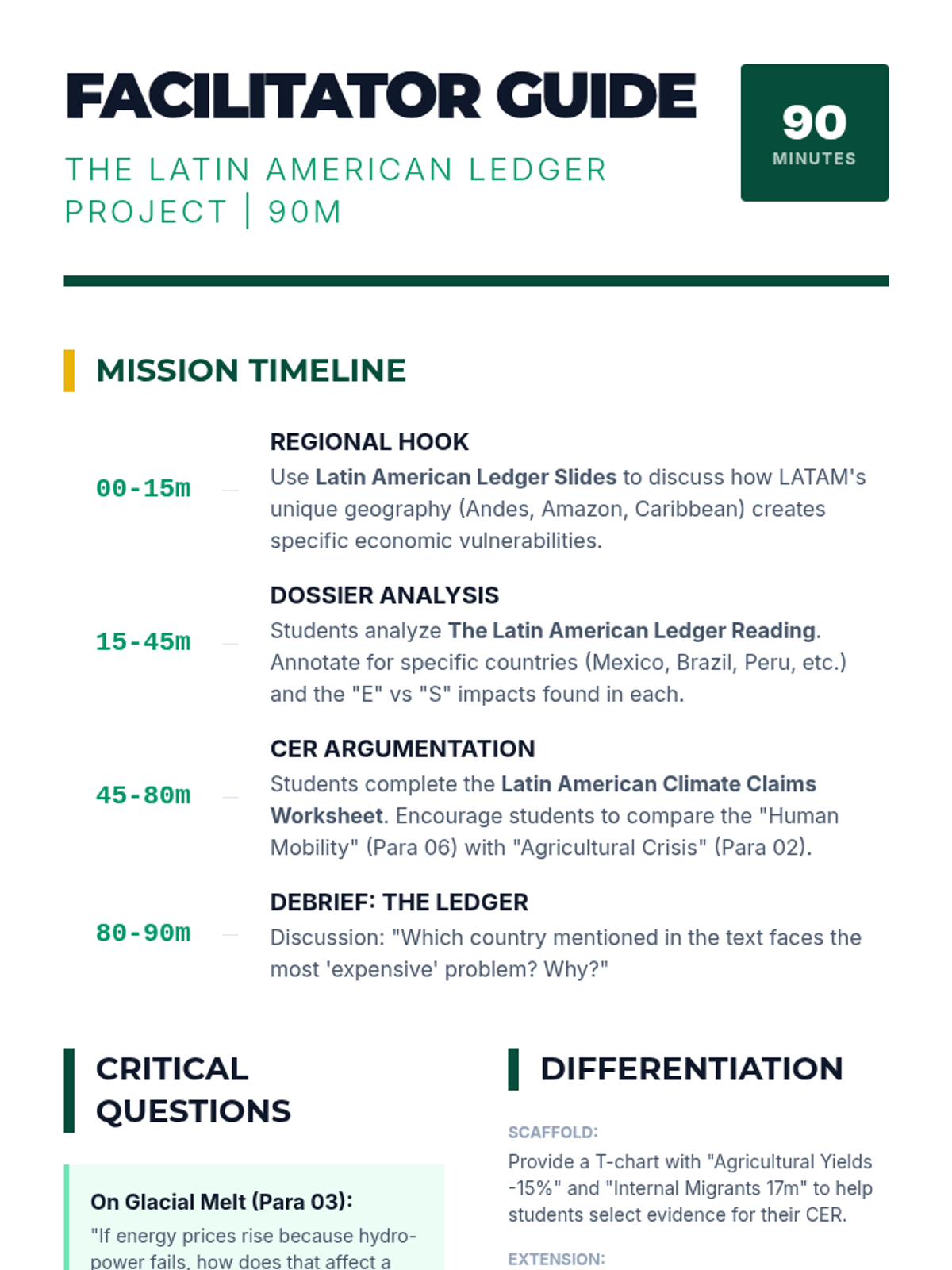
Updated lesson facilitation guide for the Latin American Ledger lesson, including region-specific pacing and discussion prompts.
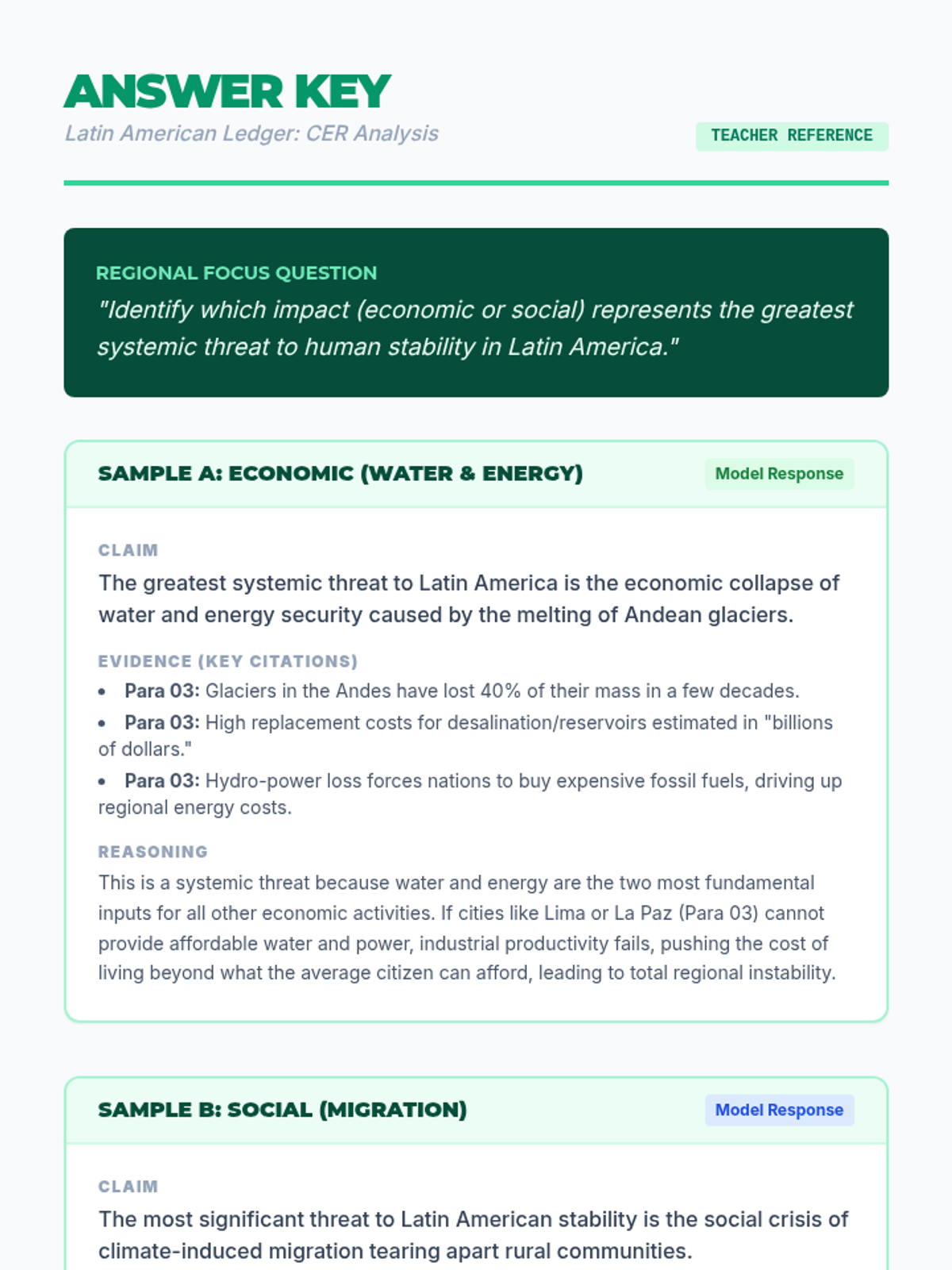
Latin America-specific answer key for the Climate Claims CER worksheet, with regional evidence and reasoning examples.
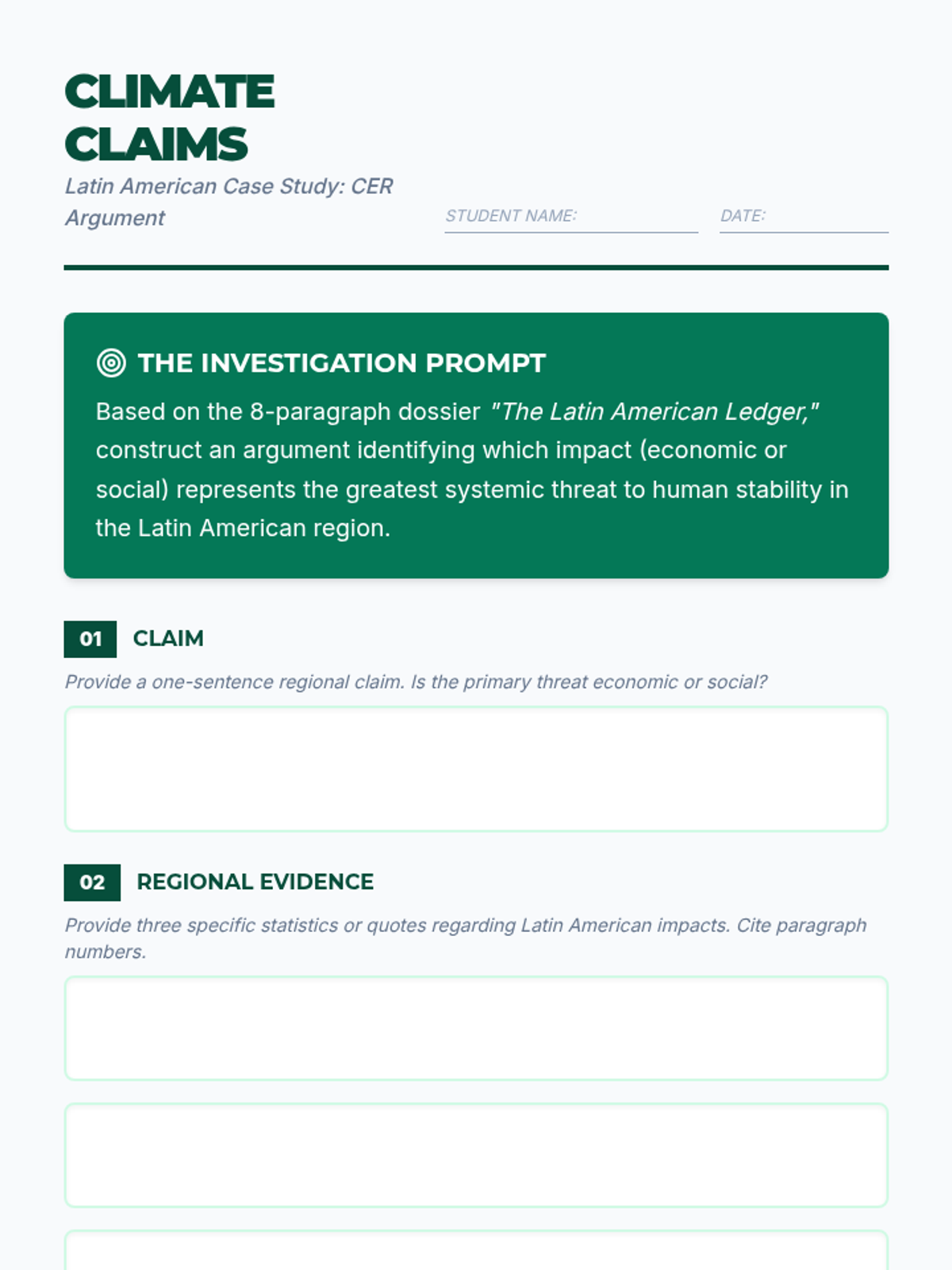
A localized CER worksheet for students to construct arguments based on the Latin American climate dossier.
An expanded 10-slide presentation focusing on the economic and social consequences of global warming specifically in Latin America, with dedicated slides for water security, labor productivity, and migration.
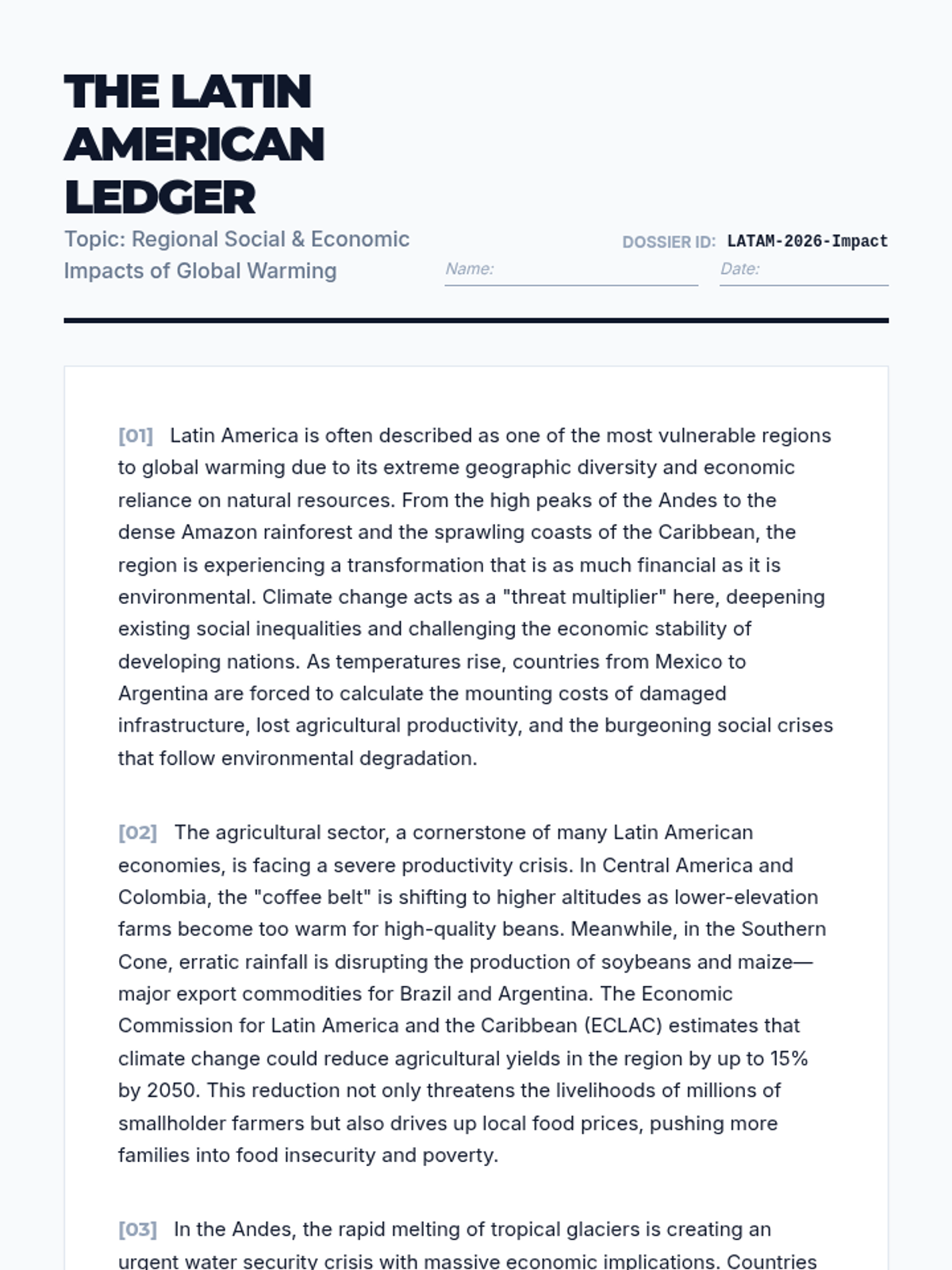
An 8-paragraph reading passage analyzing the social and economic consequences of global warming specifically in Latin America, formatted as a professional dossier.
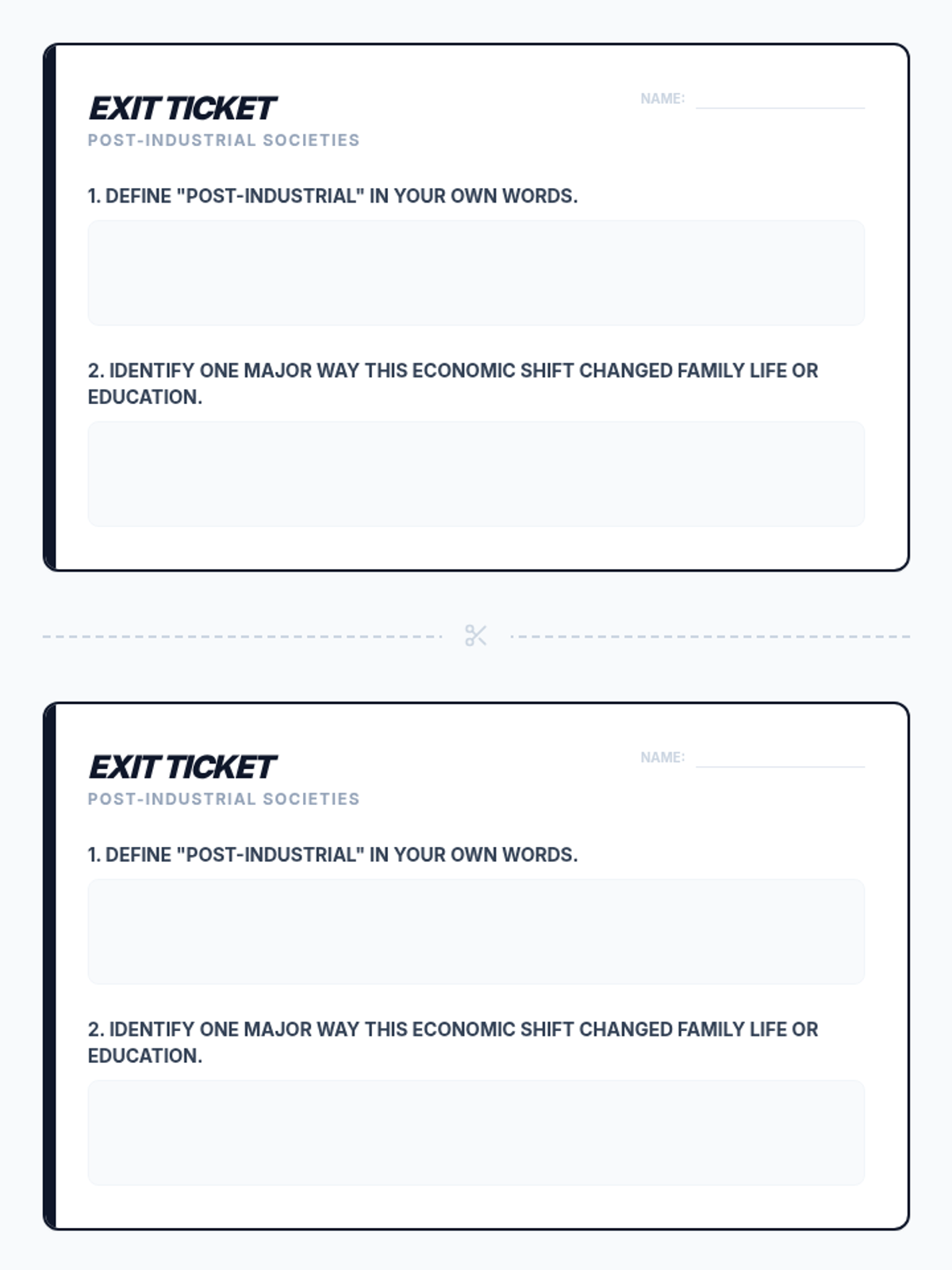
A 2-per-page exit ticket for student assessment, asking for a personal definition of post-industrial society and its impact on family life.
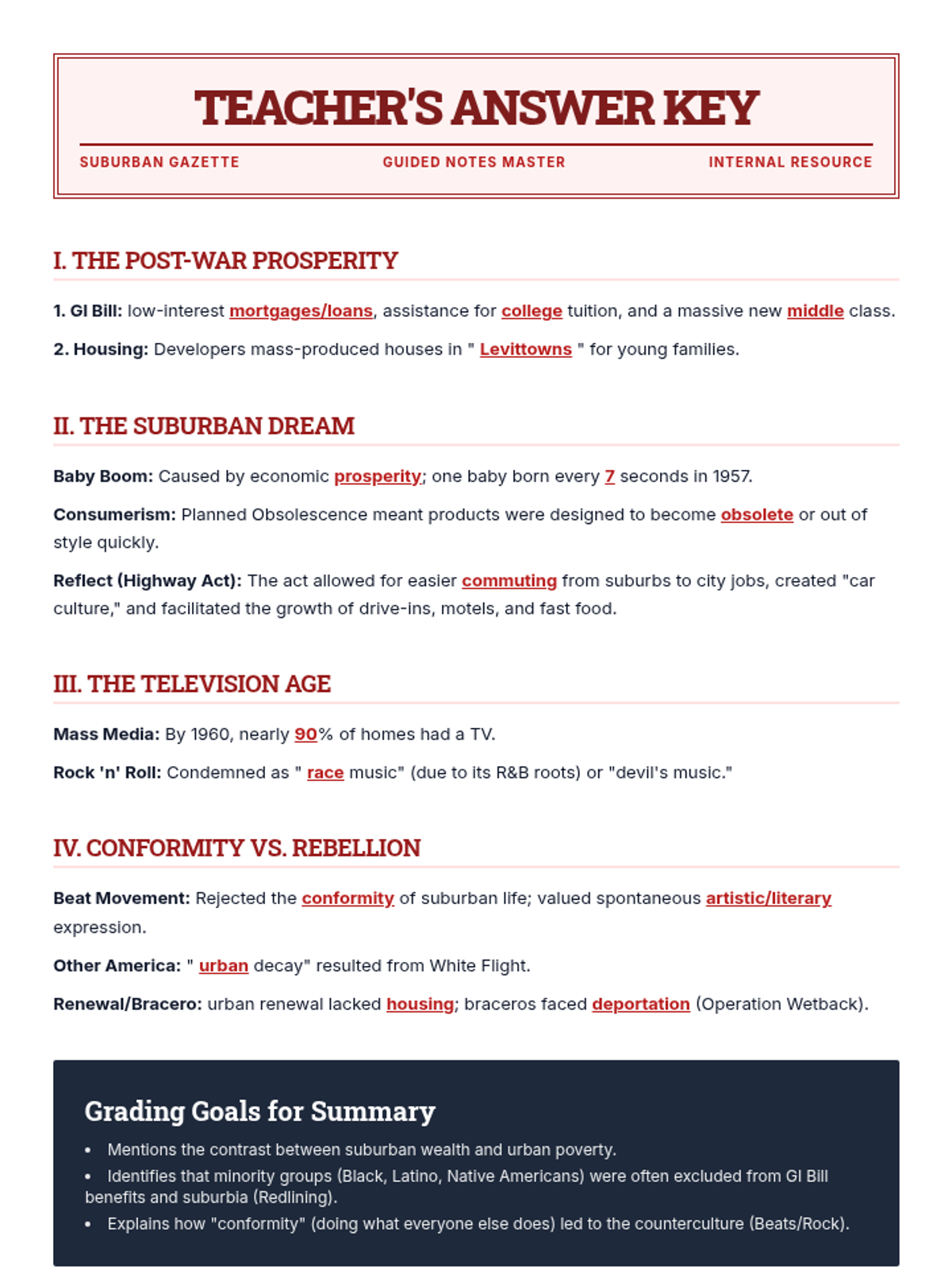
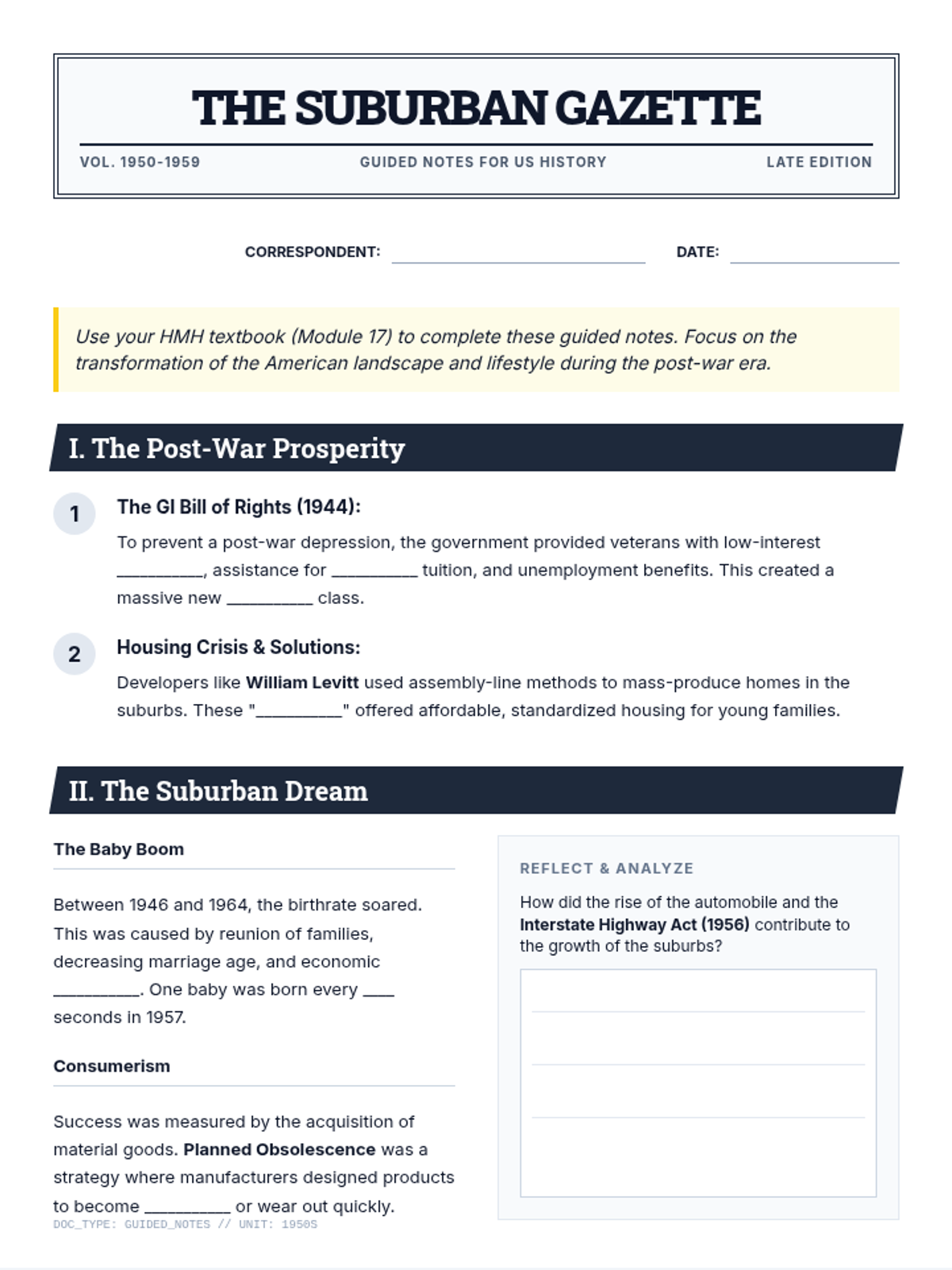
A teacher answer key for the Suburban Gazette Guided Notes. Provides the specific fill-in-the-blank answers and pedagogical goals for the reflective summary section.
A two-page guided notes worksheet for the 1950s, styled as a vintage mid-century newspaper. It covers the GI Bill, suburbia, consumerism, television culture, and the counterculture movements of the era.
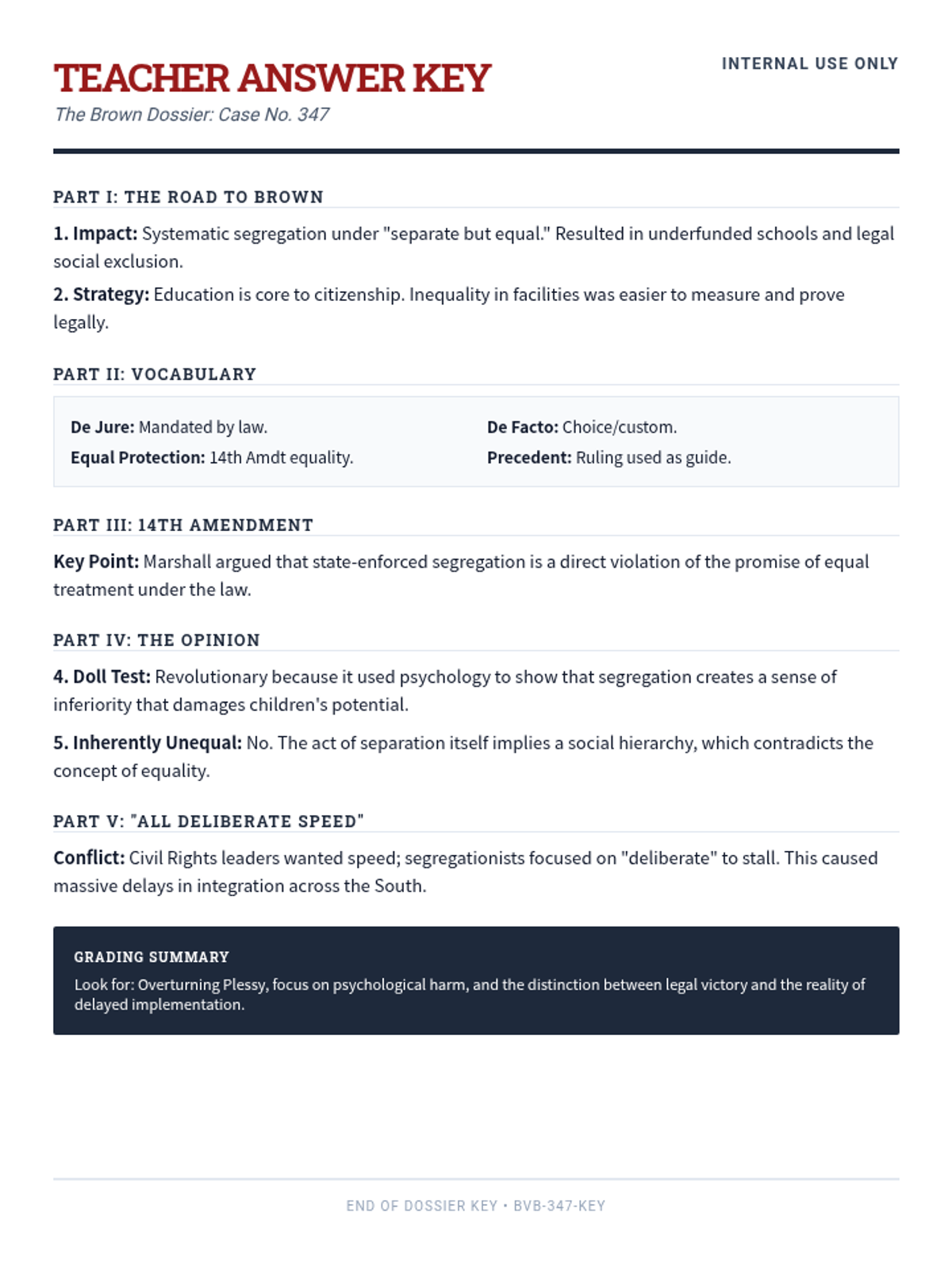
An answer key for the Brown v. Board of Education Case Dossier. It provides suggested responses for historical context questions, key term definitions, and analysis of primary source excerpts.
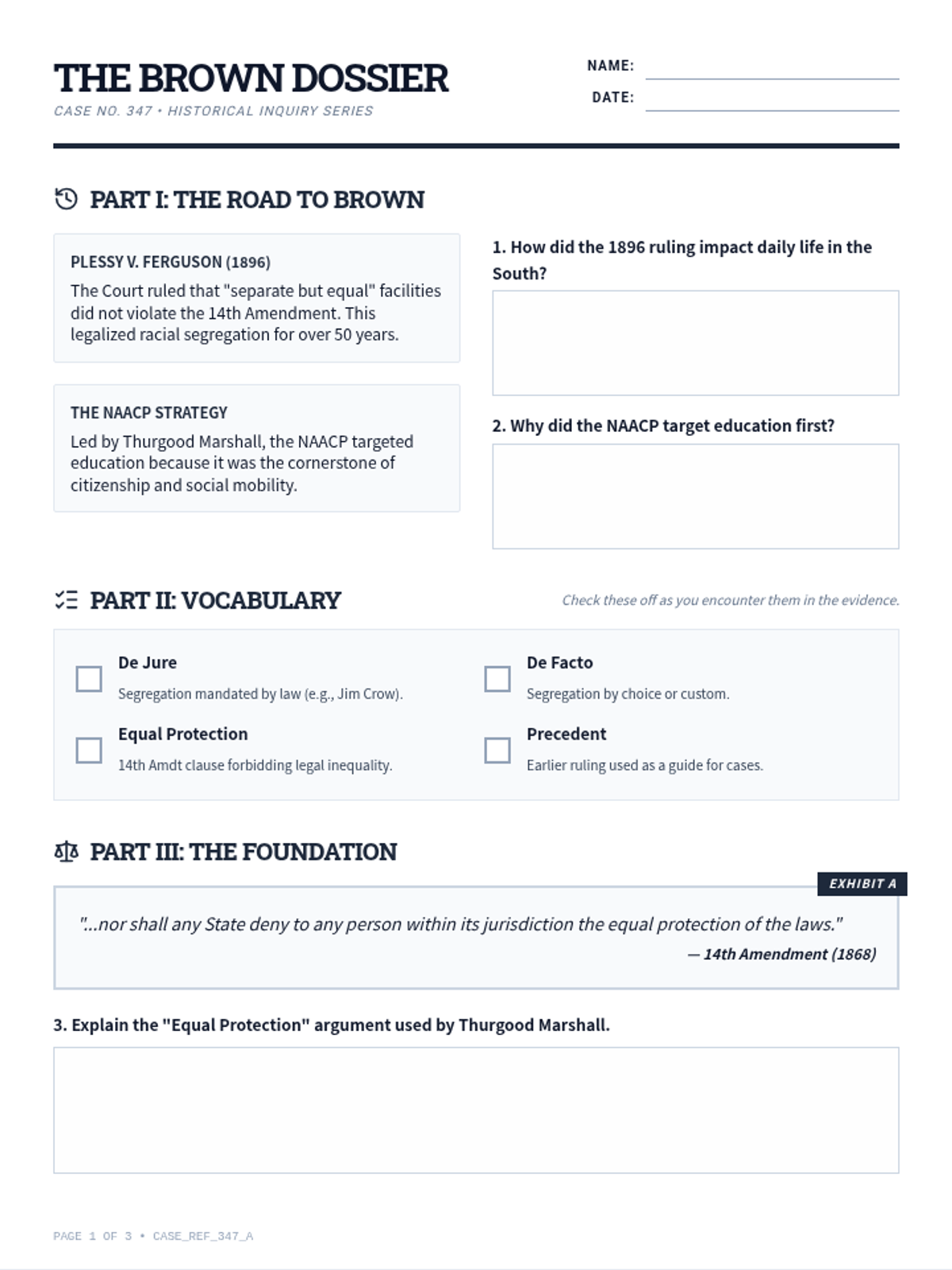
A detailed three-page historical inquiry worksheet on Brown v. Board of Education. It includes context on Plessy v. Ferguson, primary source analysis of the 14th Amendment and Earl Warren's opinion, and critical thinking questions on the 'Massive Resistance' period.
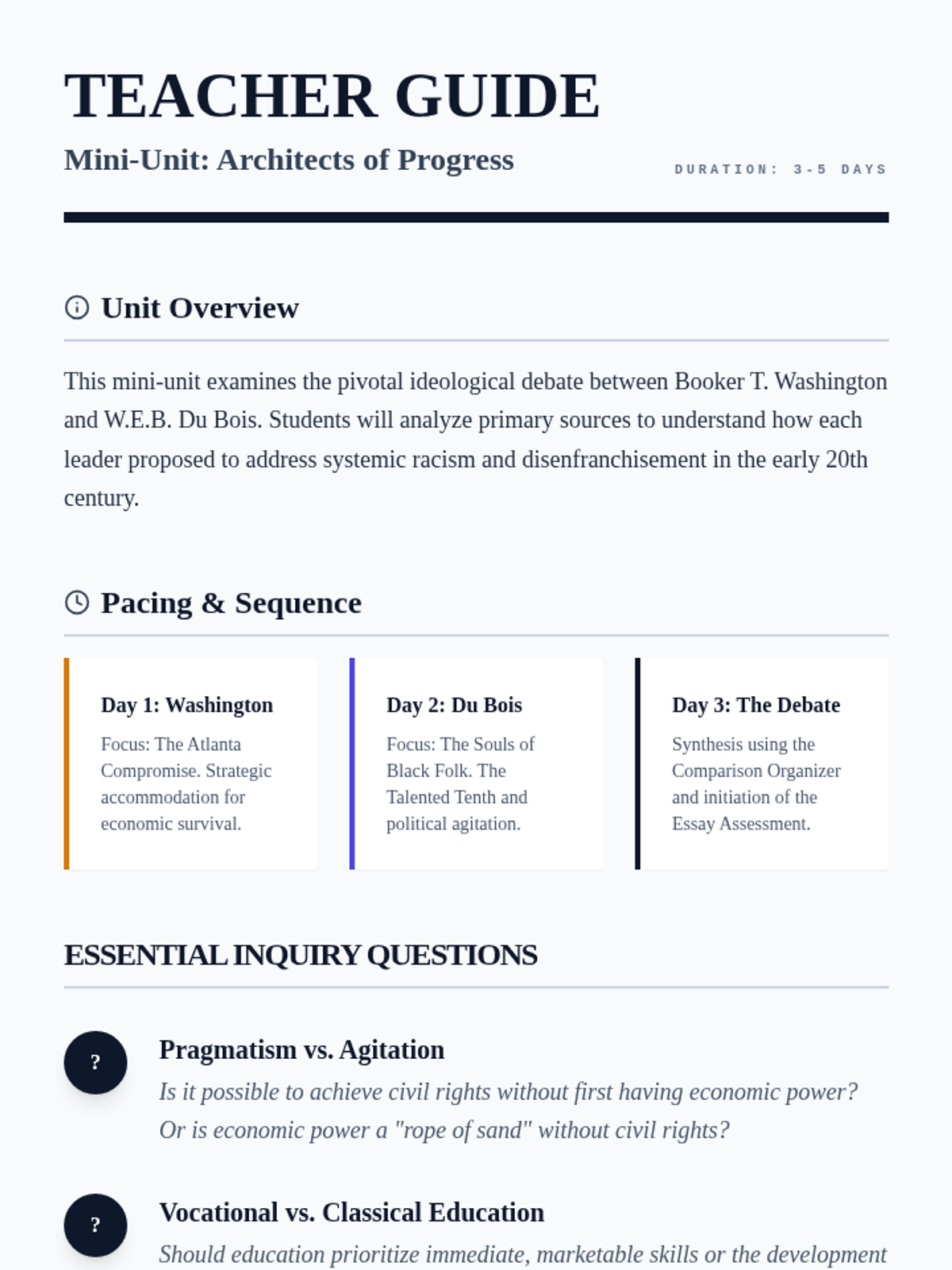
A teacher guide for the 'Architects of Progress' mini-unit, providing pacing, pedagogical context, differentiation strategies, and an overview of unit assessments.
A summary presentation deck that synthesizes the contrasting arguments of Washington and Du Bois, prompting critical thinking about the 'pragmatism vs. agitation' debate.
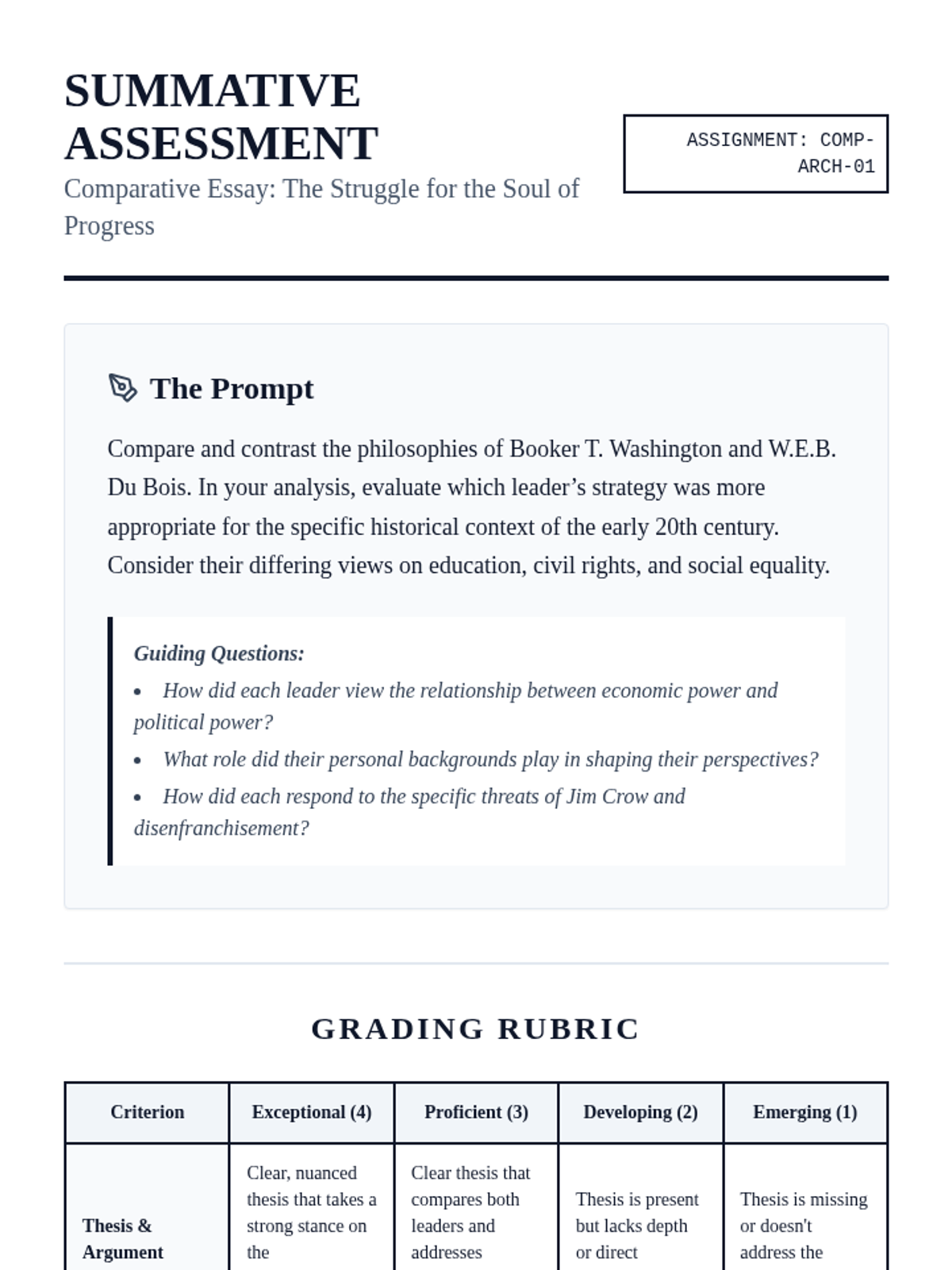
A comprehensive comparative essay prompt and grading rubric for assessing student understanding of the Washington-Du Bois debate within its historical context.
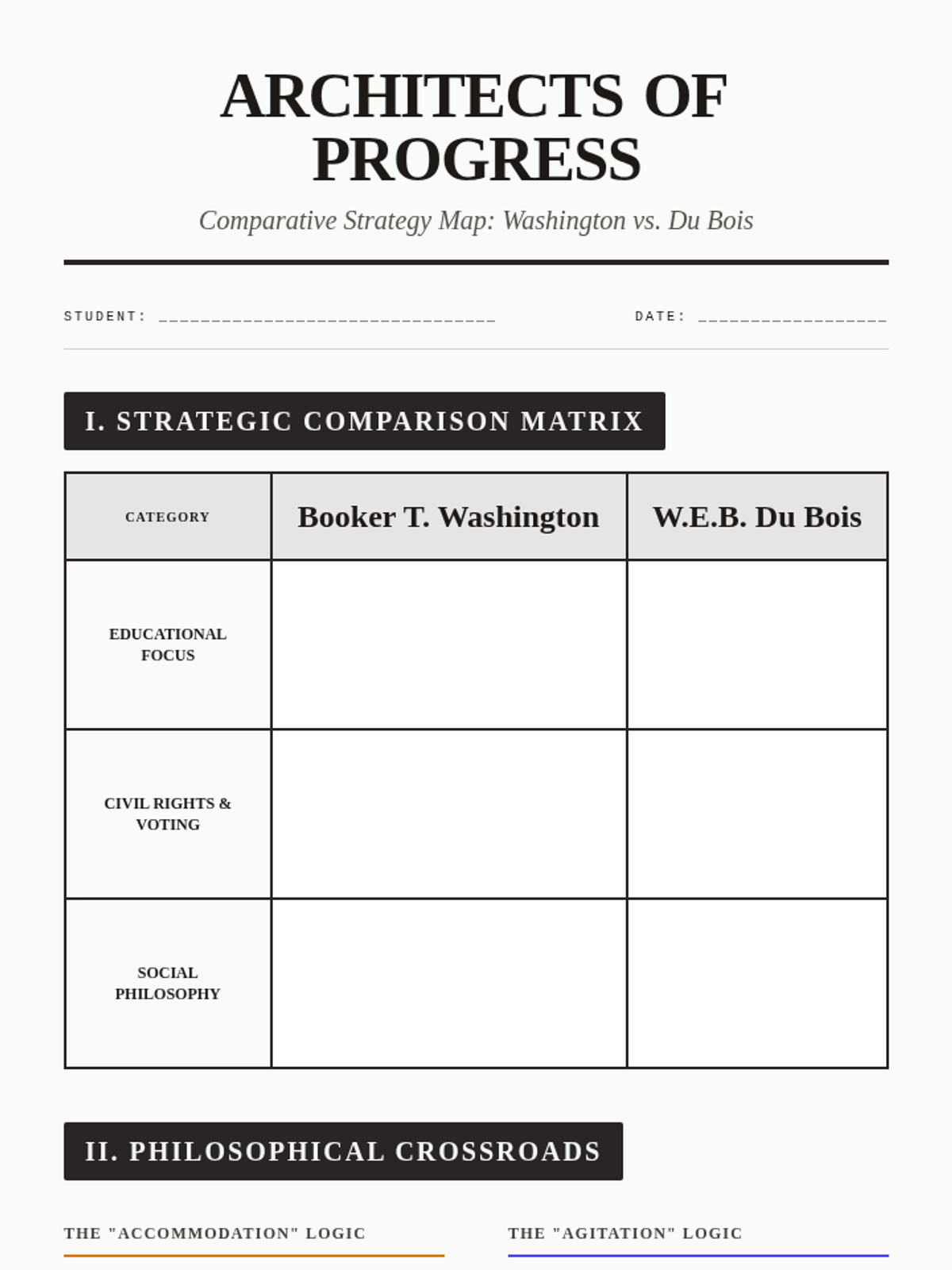
A graphic organizer that allows students to compare the educational, political, and social philosophies of Booker T. Washington and W.E.B. Du Bois side-by-side.
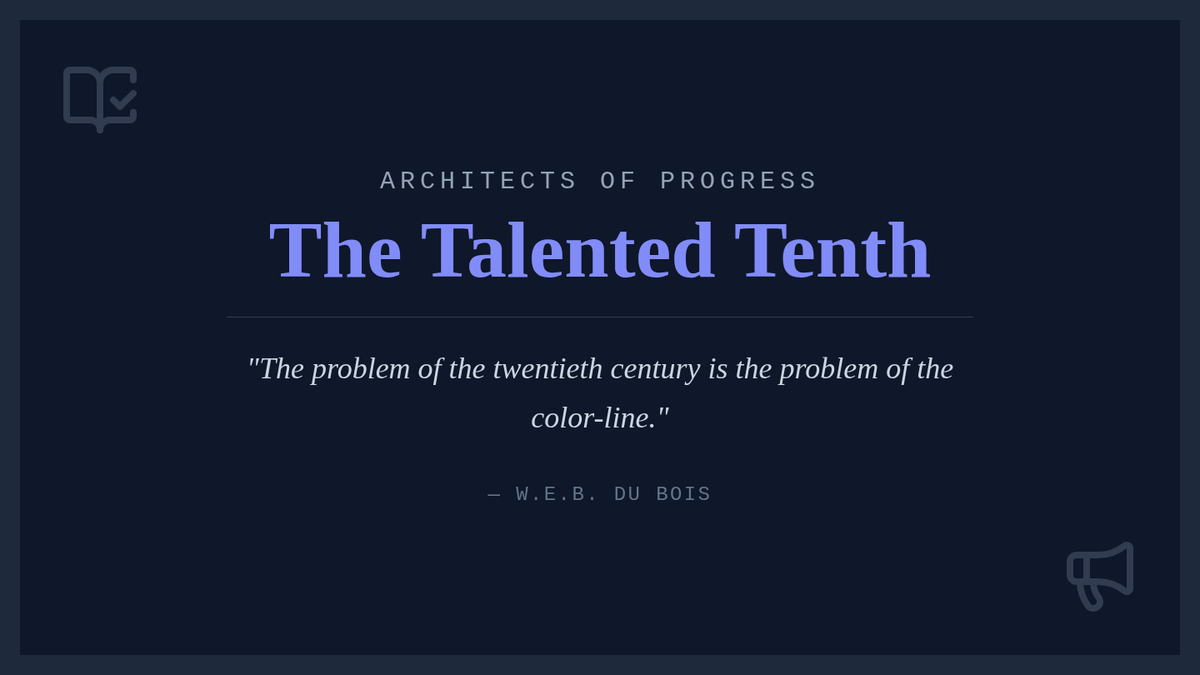
A presentation deck detailing W.E.B. Du Bois's background, his 'Talented Tenth' leadership philosophy, and his insistence on political agitation for civil rights.
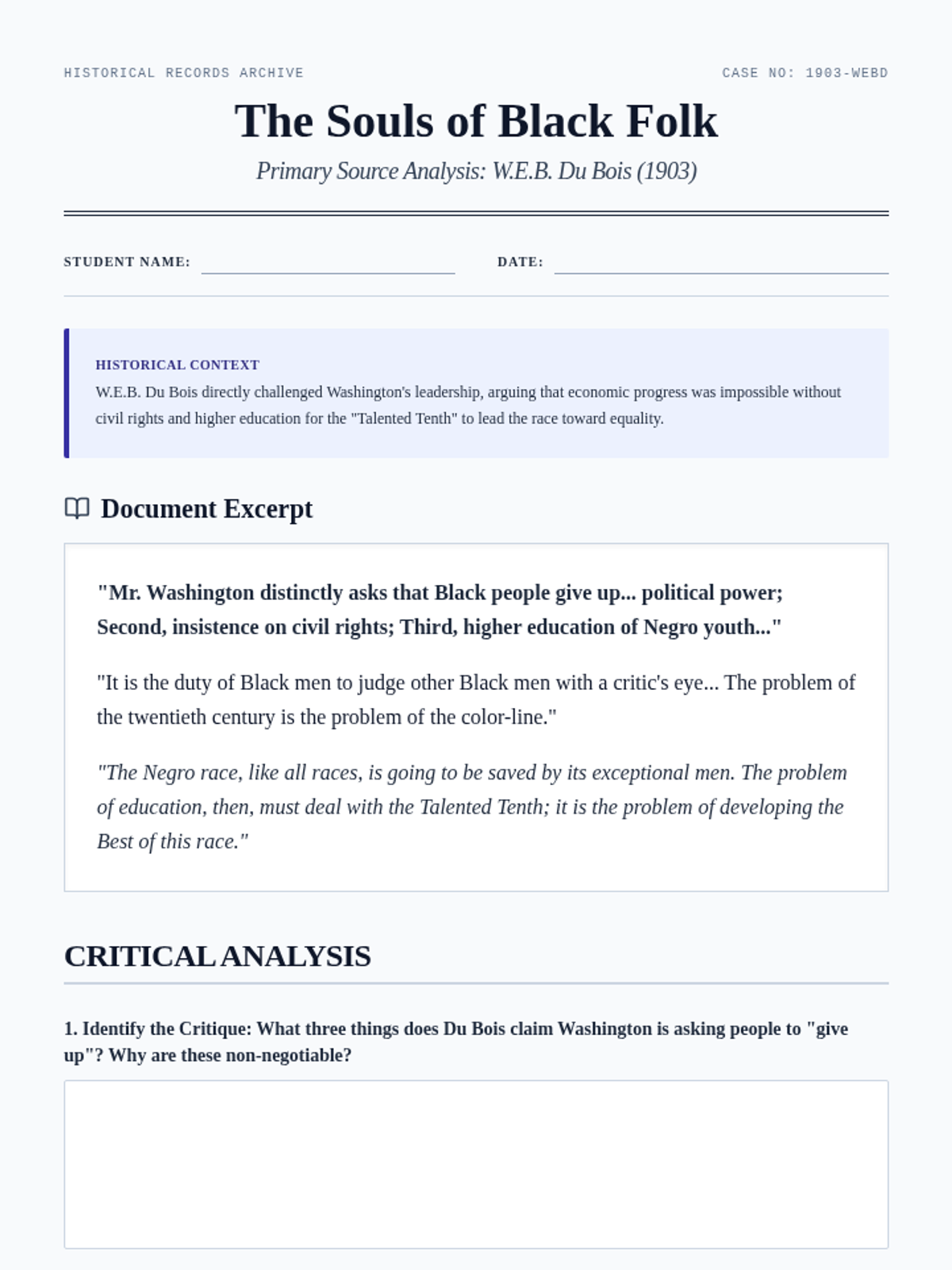
A primary source analysis worksheet for W.E.B. Du Bois's 'The Souls of Black Folk,' focusing on his critique of Booker T. Washington and his concept of the 'Talented Tenth.'
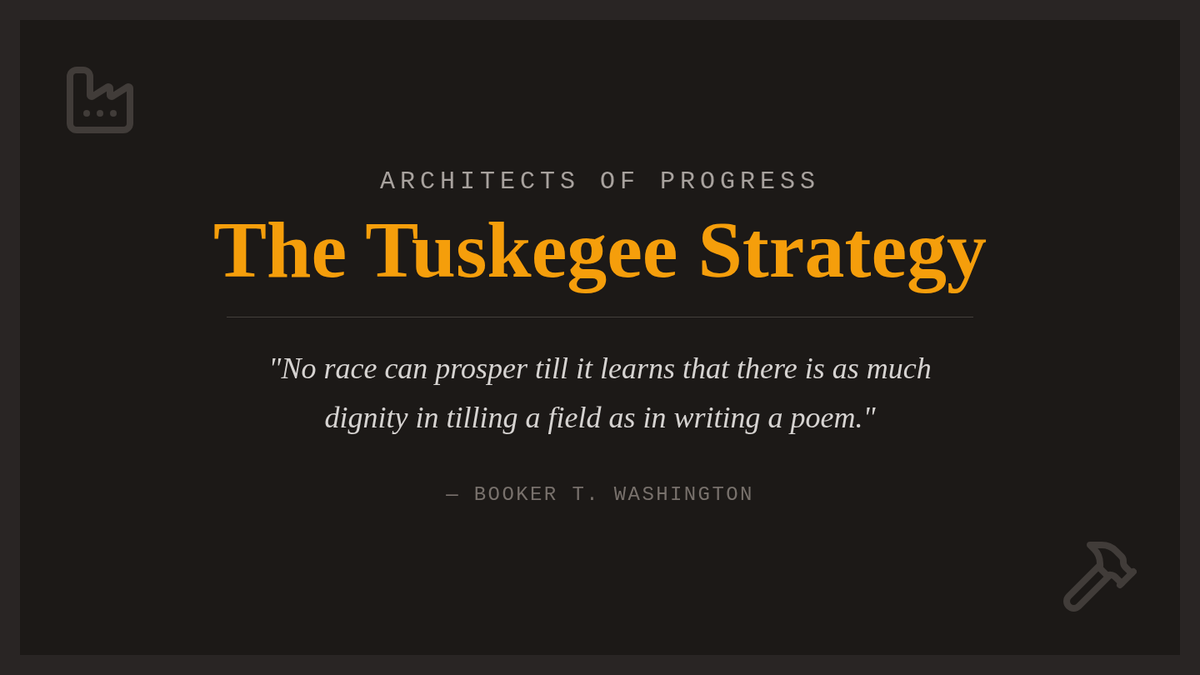
A presentation deck introducing Booker T. Washington's philosophy, the founding of the Tuskegee Institute, and the strategic underpinnings of the 'Atlanta Compromise' speech.
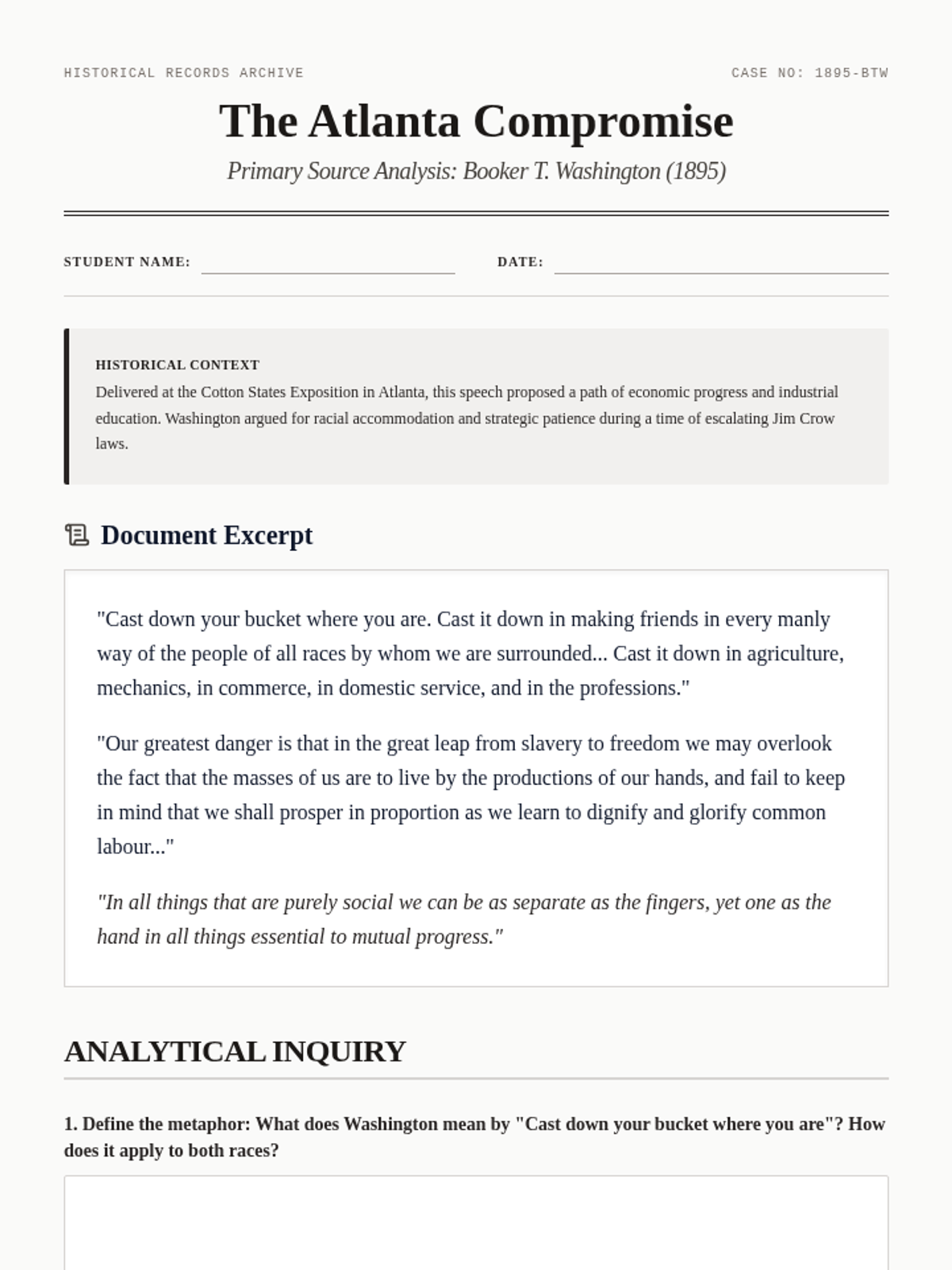
A primary source analysis worksheet for Booker T. Washington's 'Atlanta Compromise' speech, featuring excerpts, context, and analytical questions designed for high school history students.
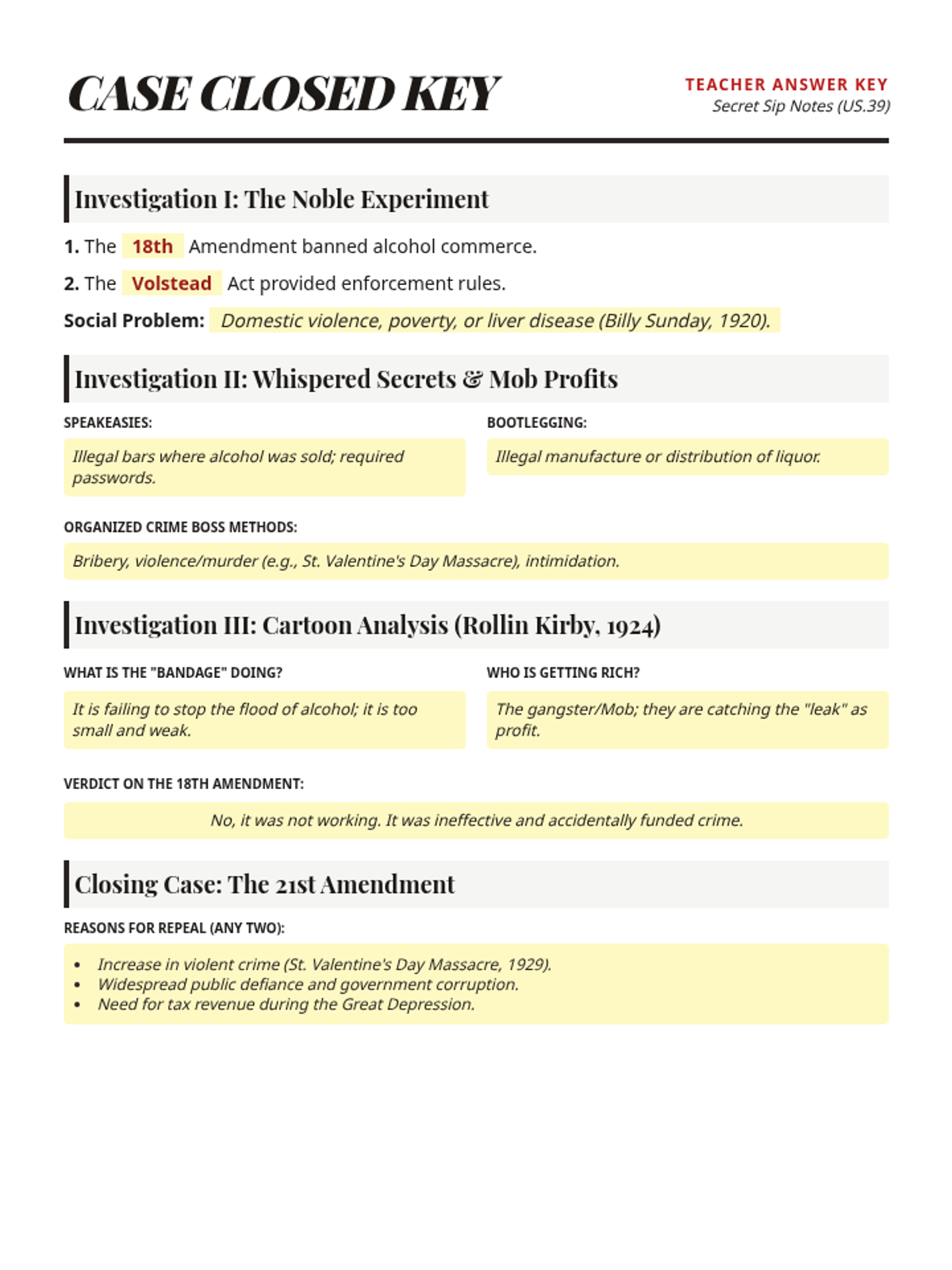
Answer key for the Secret Sip Notes worksheet. Revisions include model answers that reflect specific names and dates for primary sources (Billy Sunday 1920, Rollin Kirby 1924, 1929 Massacre).
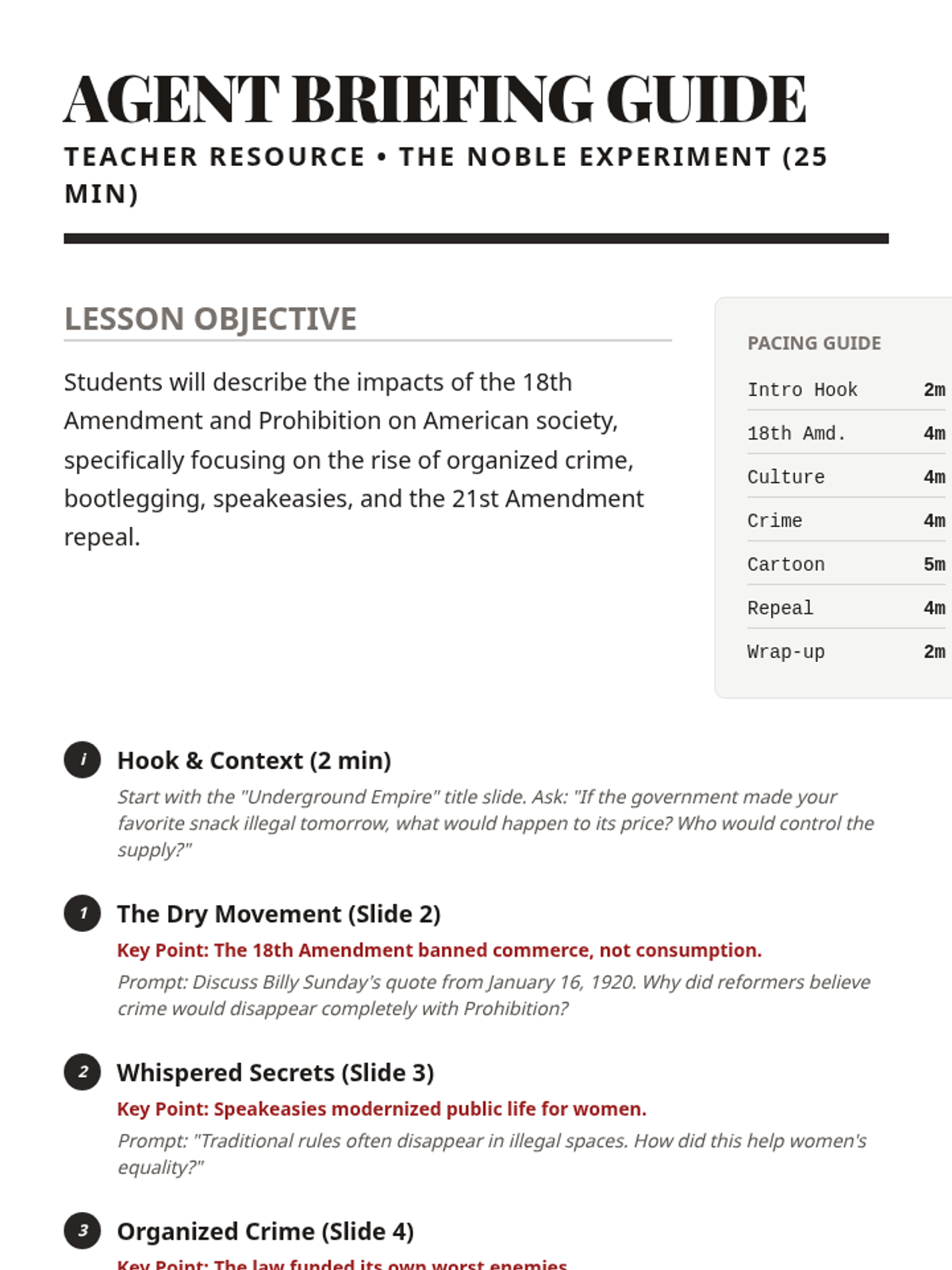
A teacher's facilitation guide. Revisions include updated prompts and pacing that reference specific names and dates for sources (Billy Sunday 1920, Rollin Kirby 1924, St. Valentine's Day Massacre 1929).
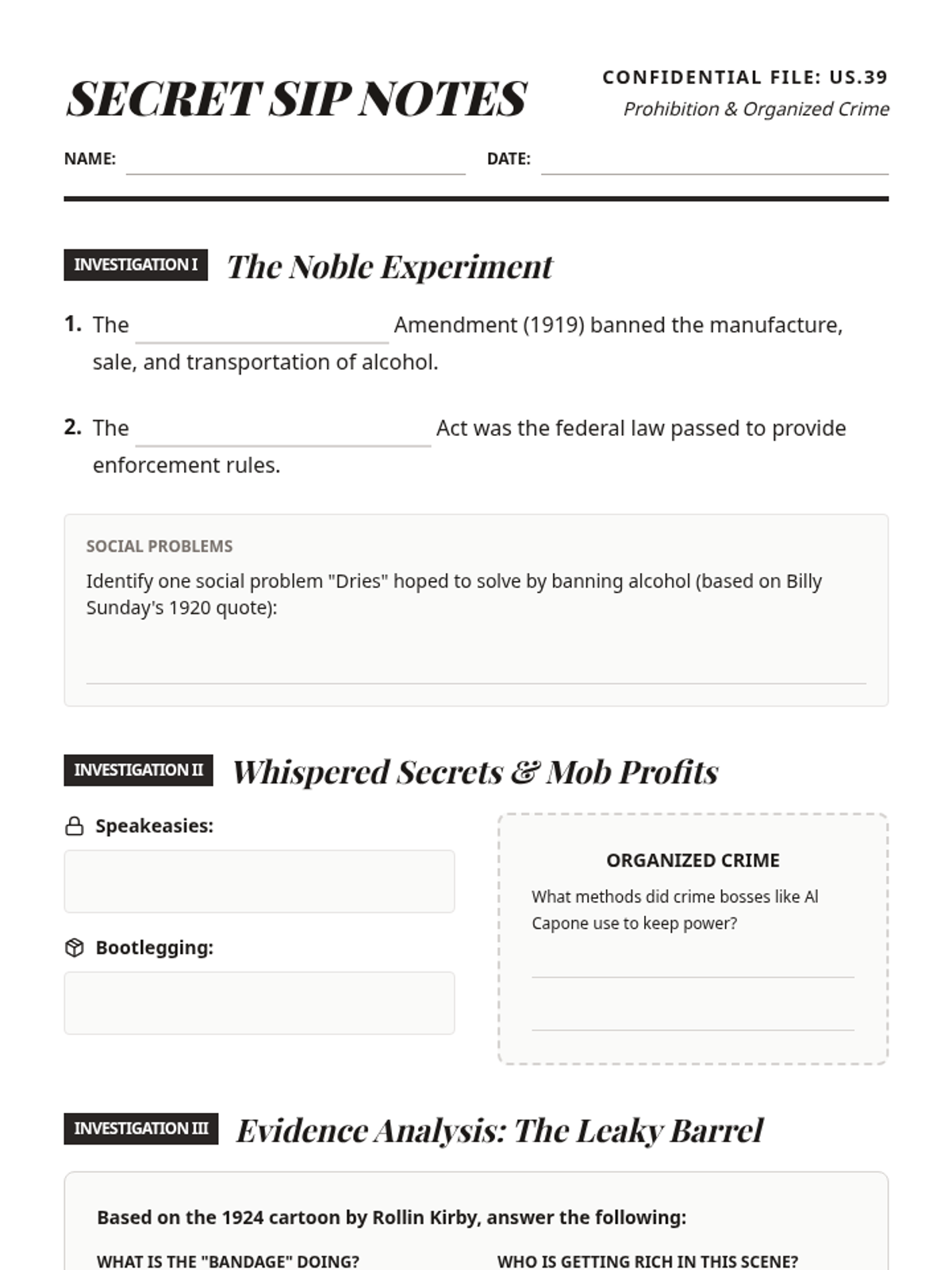
A guided note-taking worksheet for students. Revisions include updated references to specific source names and dates (Billy Sunday, 1920; Rollin Kirby, 1924) and polished header kerning.
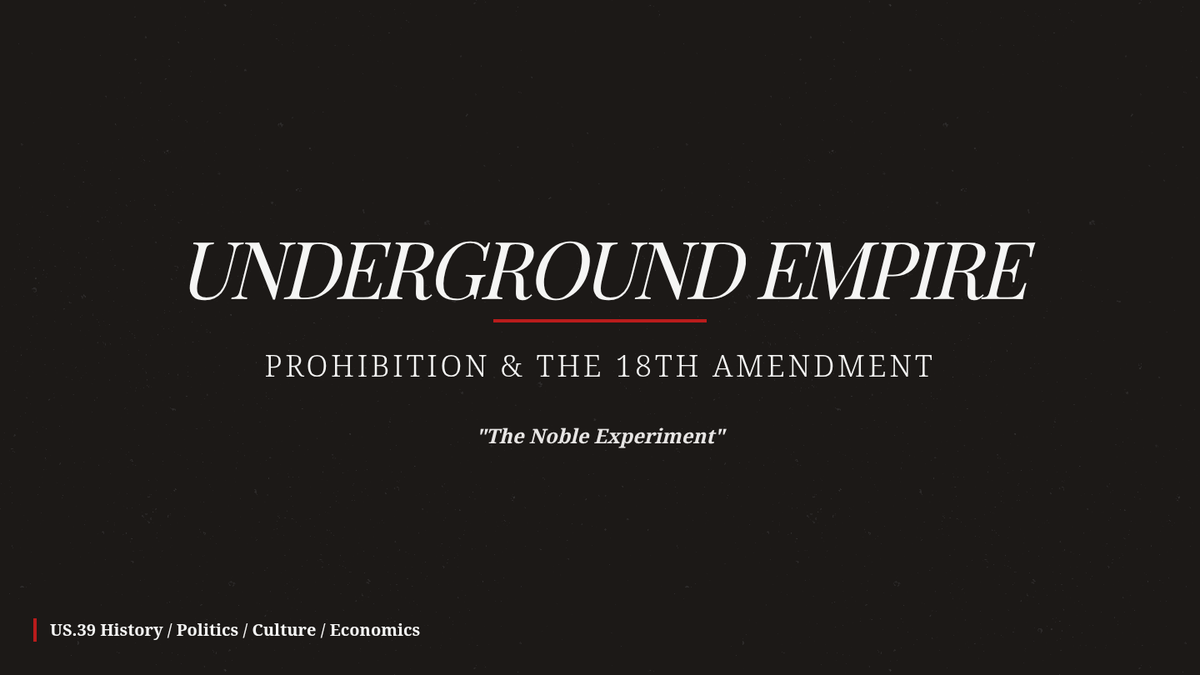
A visual presentation covering the 18th Amendment, Prohibition, the rise of organized crime, and the 21st Amendment. Revisions include added specific names and dates for primary sources (Billy Sunday, Rollin Kirby, St. Valentine's Day Massacre).
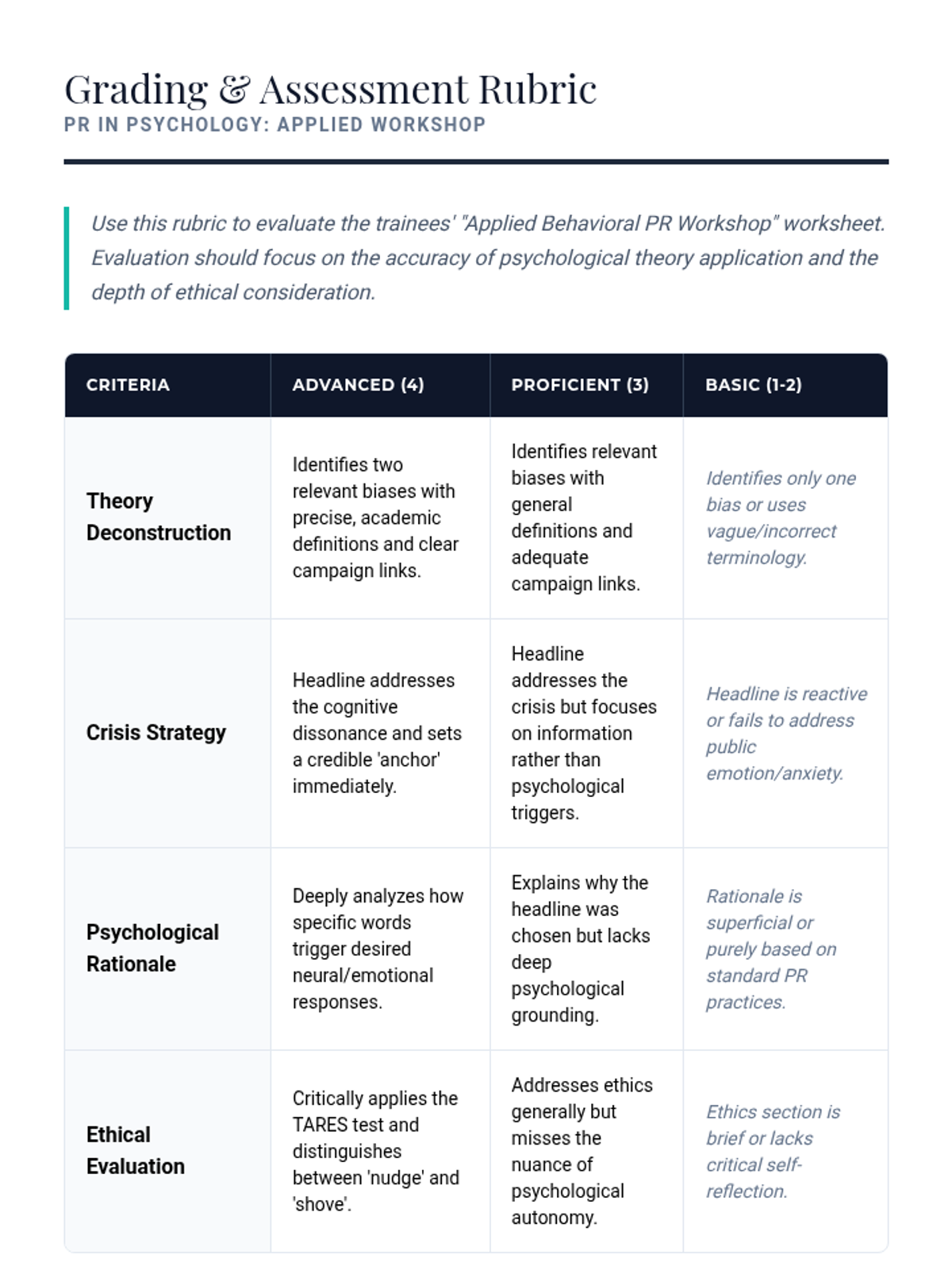
A comprehensive grading rubric for trainers to evaluate the PR Psychology Workshop, focusing on theoretical deconstruction, crisis strategy, and ethics.
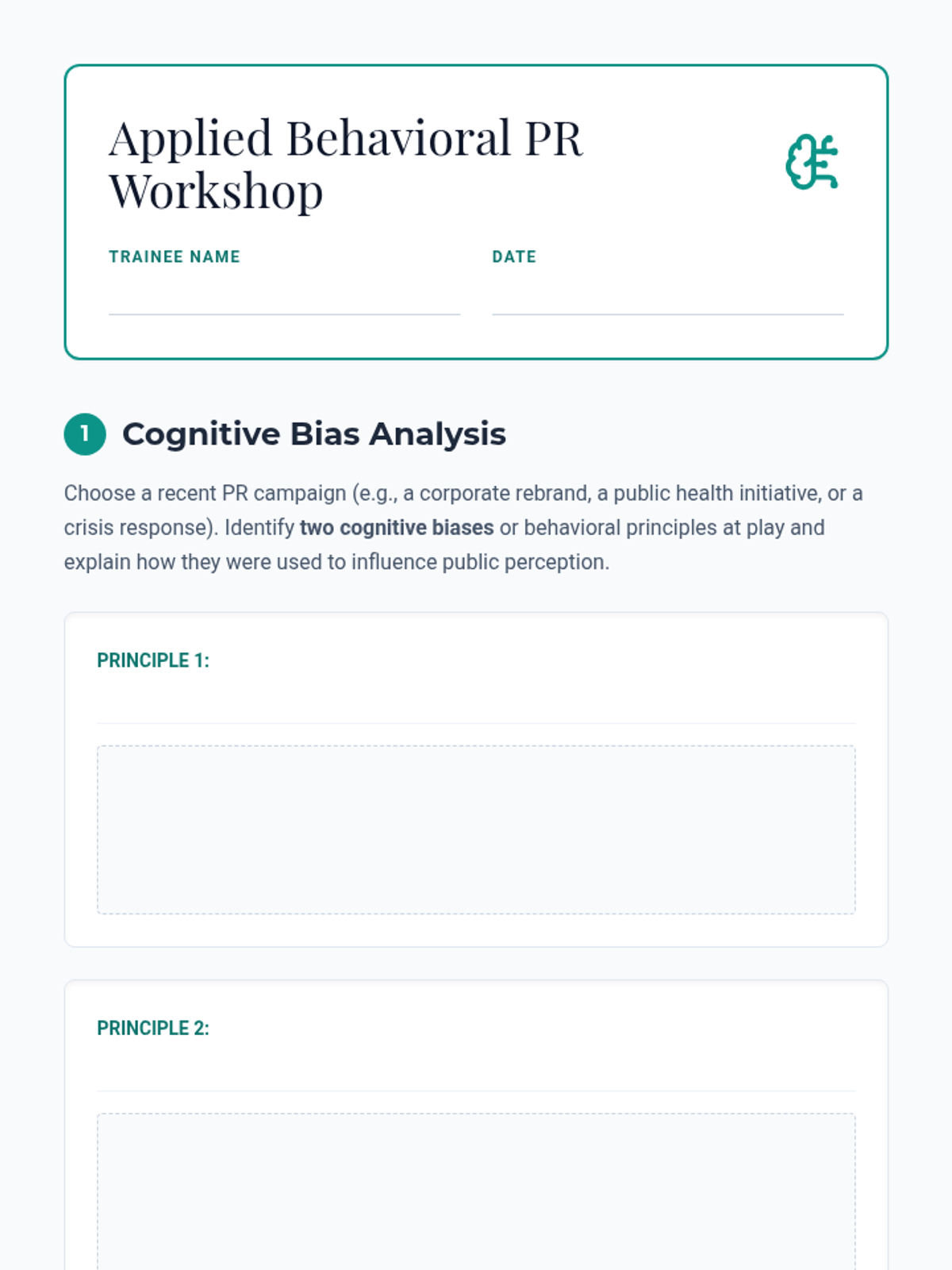
An application-based worksheet for trainees to deconstruct PR campaigns using psychological principles, design a crisis response strategy, and conduct an ethical evaluation.
A detailed lecture script and facilitator guide for the PR Psychology slide deck, including delivery cues, psychological study references, and discussion prompts.
A professional slide deck for a university-level teacher training session on Public Relations in Psychology, covering behavioral economics, cognitive biases, crisis management, and ethics.
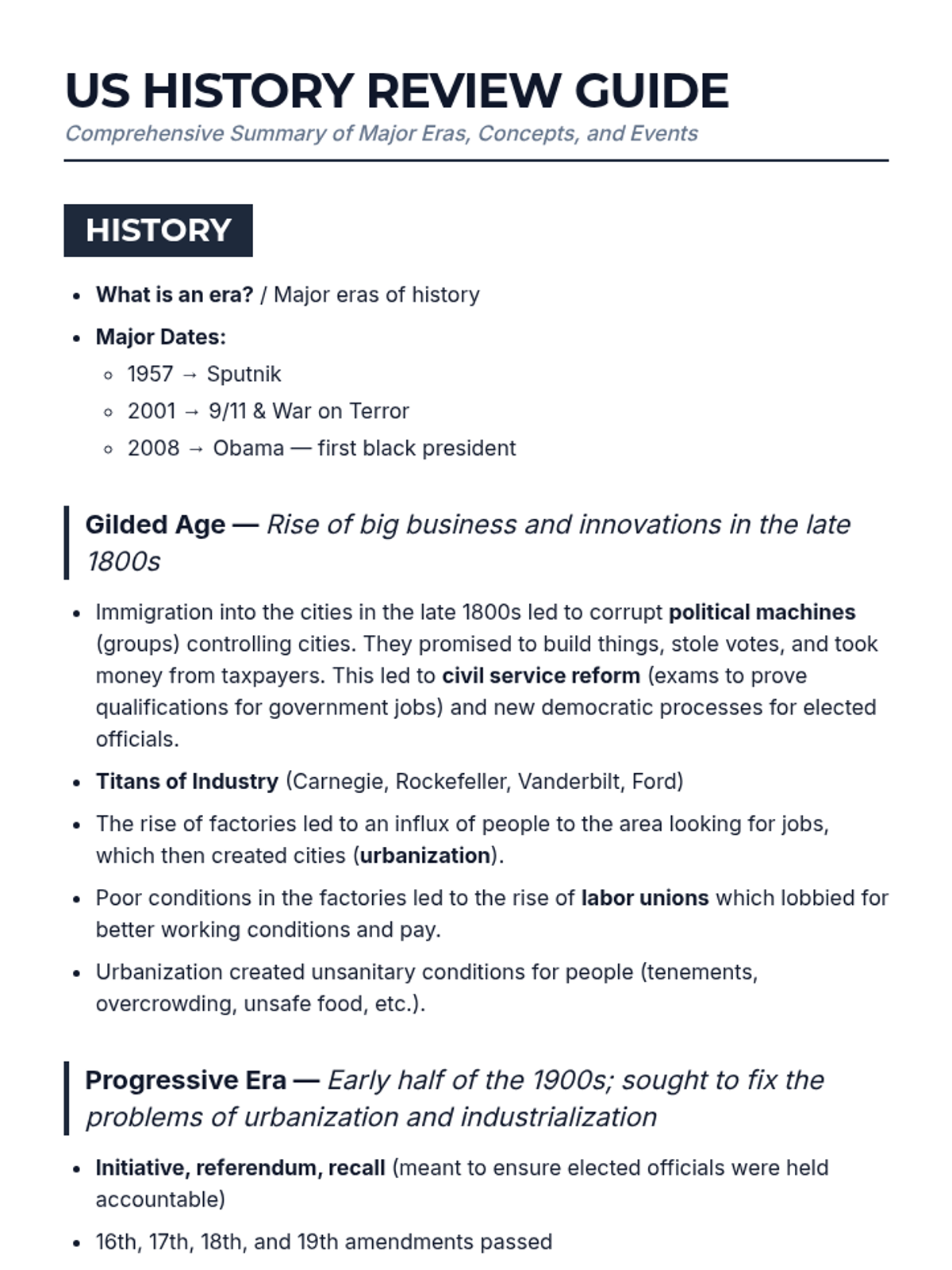
A comprehensive 8-page US History review document extracted from the provided PDF, formatted in a clean nested bullet-point outline. It covers major historical eras, geography, culture, government, economics, and science/technology.
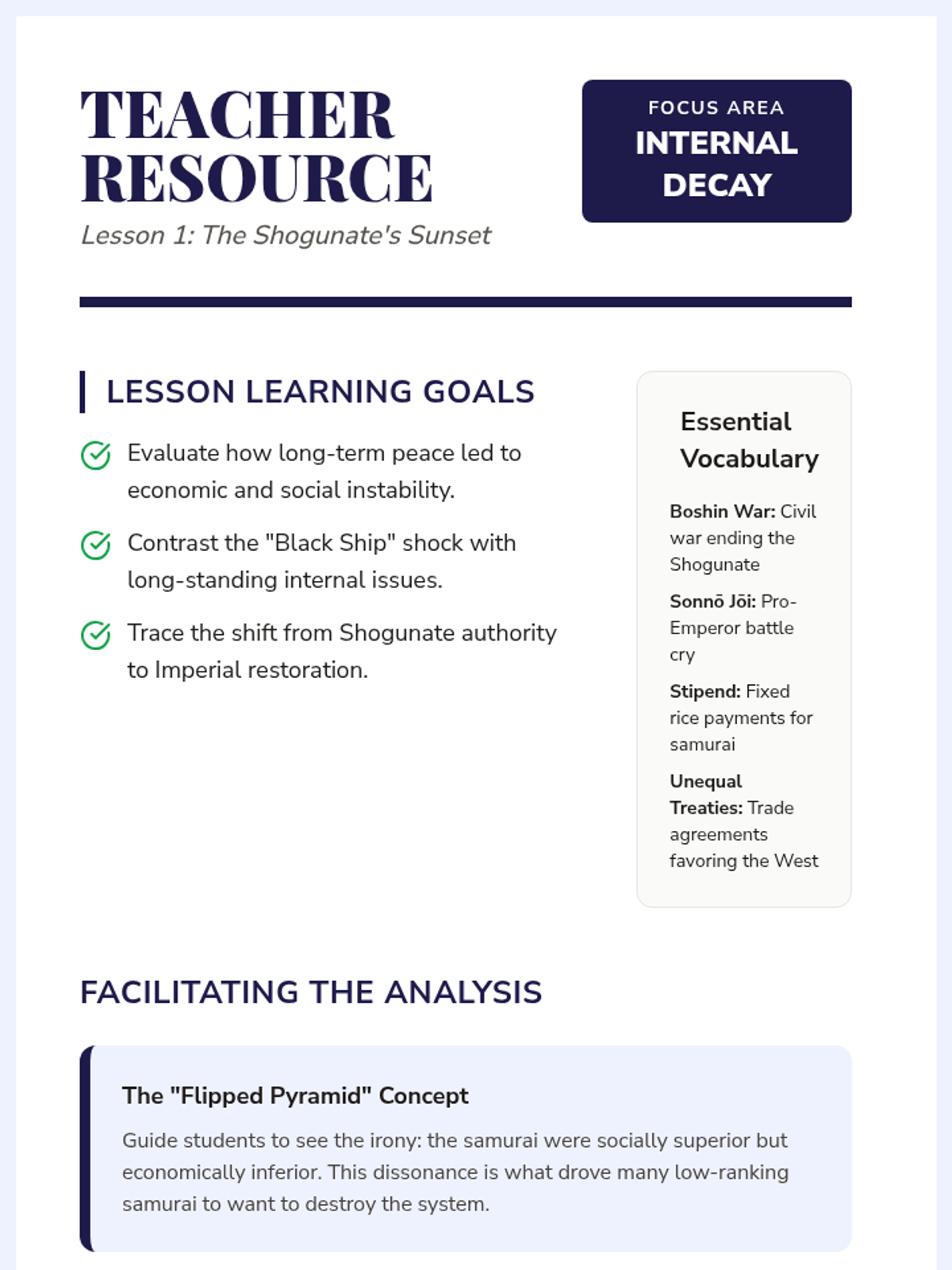
A comprehensive teacher guide for the Shogunate Sunset lesson, featuring key learning objectives, discussion frameworks, and a detailed answer key for the student worksheet.
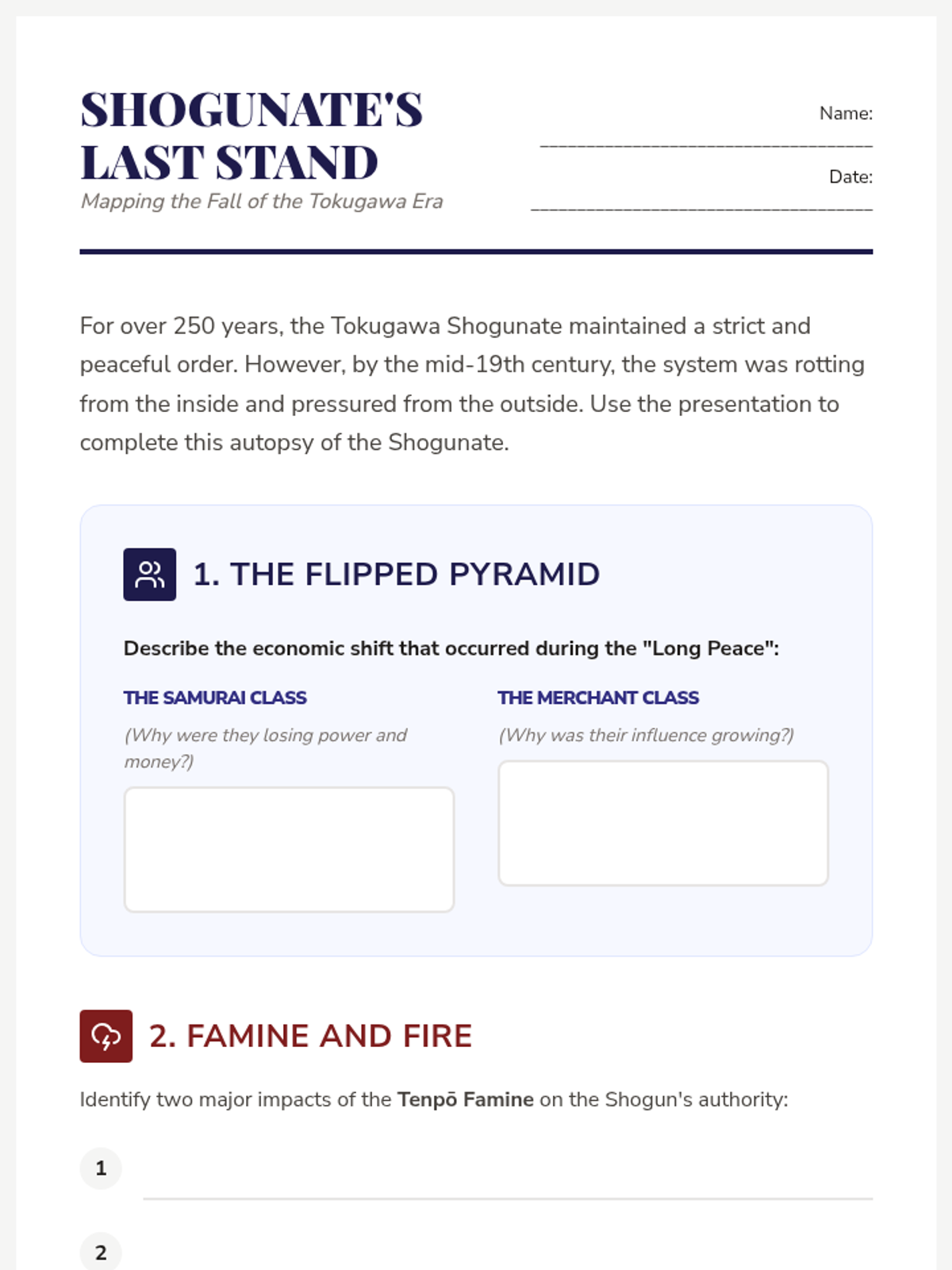
A comprehensive worksheet for students to analyze the internal (economic, social, environmental) and external (foreign treaties) causes of the Tokugawa Shogunate's collapse.
A visually compelling slide deck detailing the internal and external causes of the Tokugawa Shogunate's decline, from social stagnation to the arrival of Perry's Black Ships.
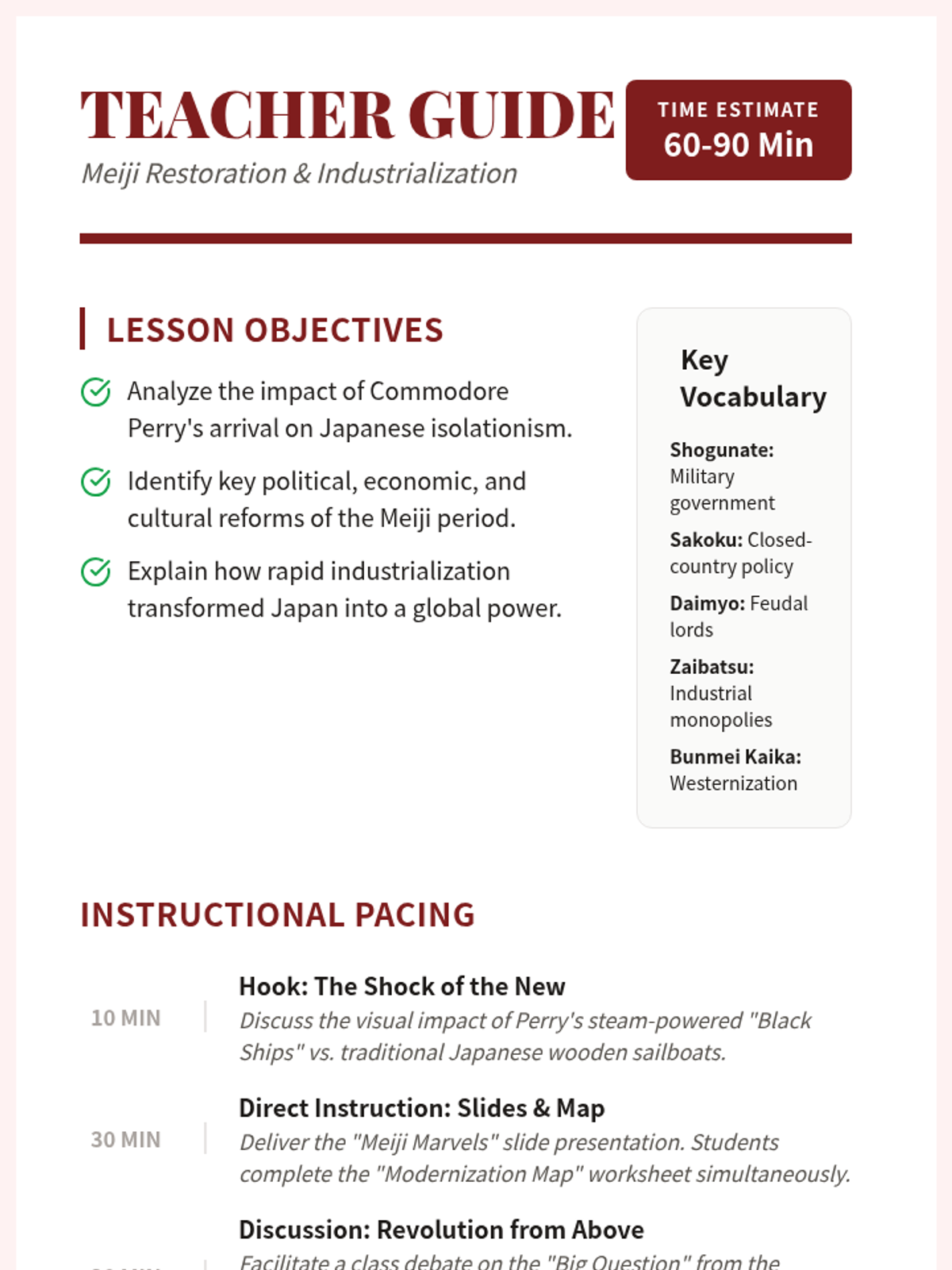
A comprehensive guide for teachers including lesson objectives, suggested pacing, discussion prompts, and a full answer key for the Modernization Map worksheet.
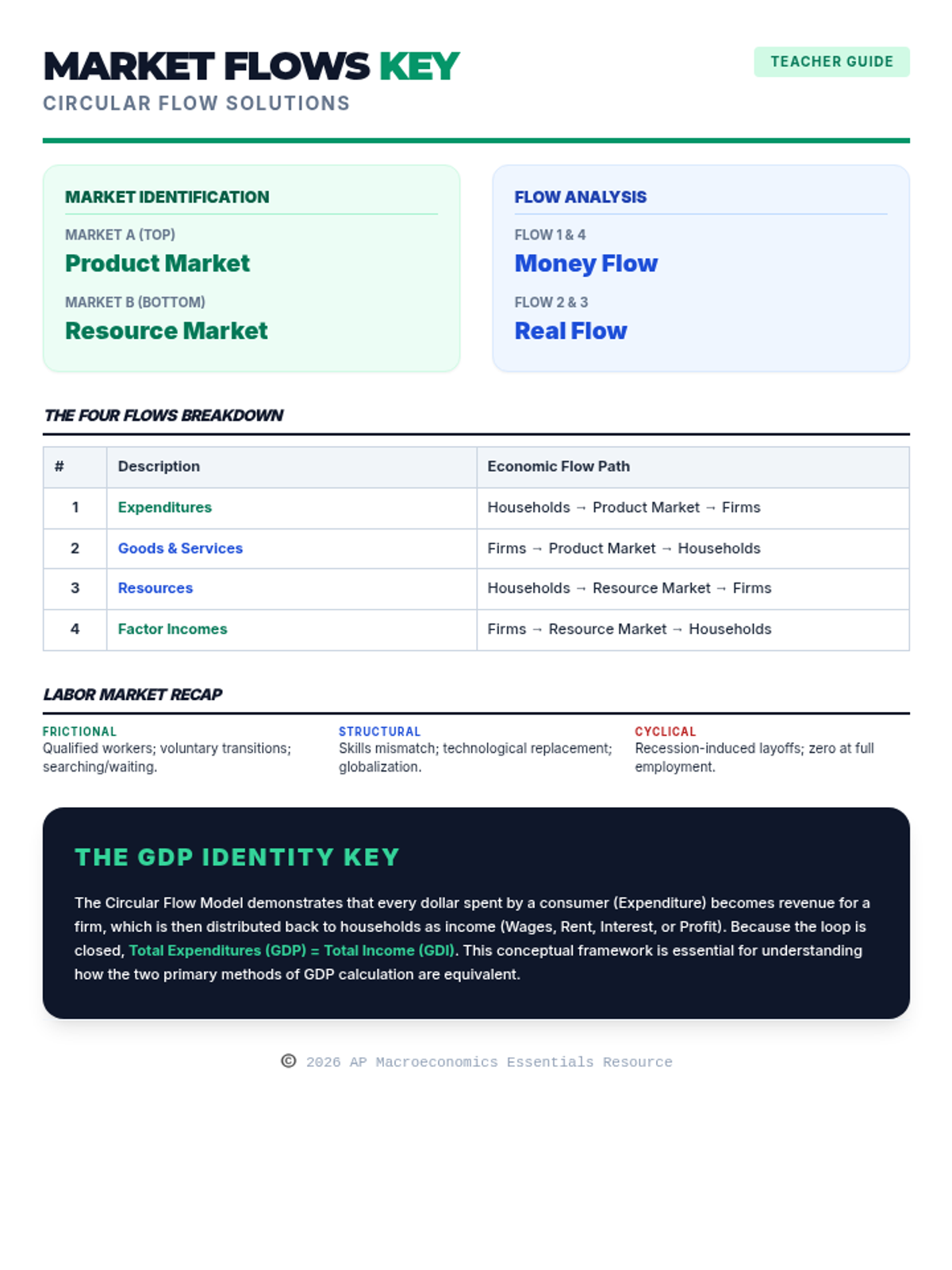
Teacher answer key for the Circular Flow Activity Worksheet, providing clear identifications for all markets and flows, plus a conceptual explanation of the GDP identity.
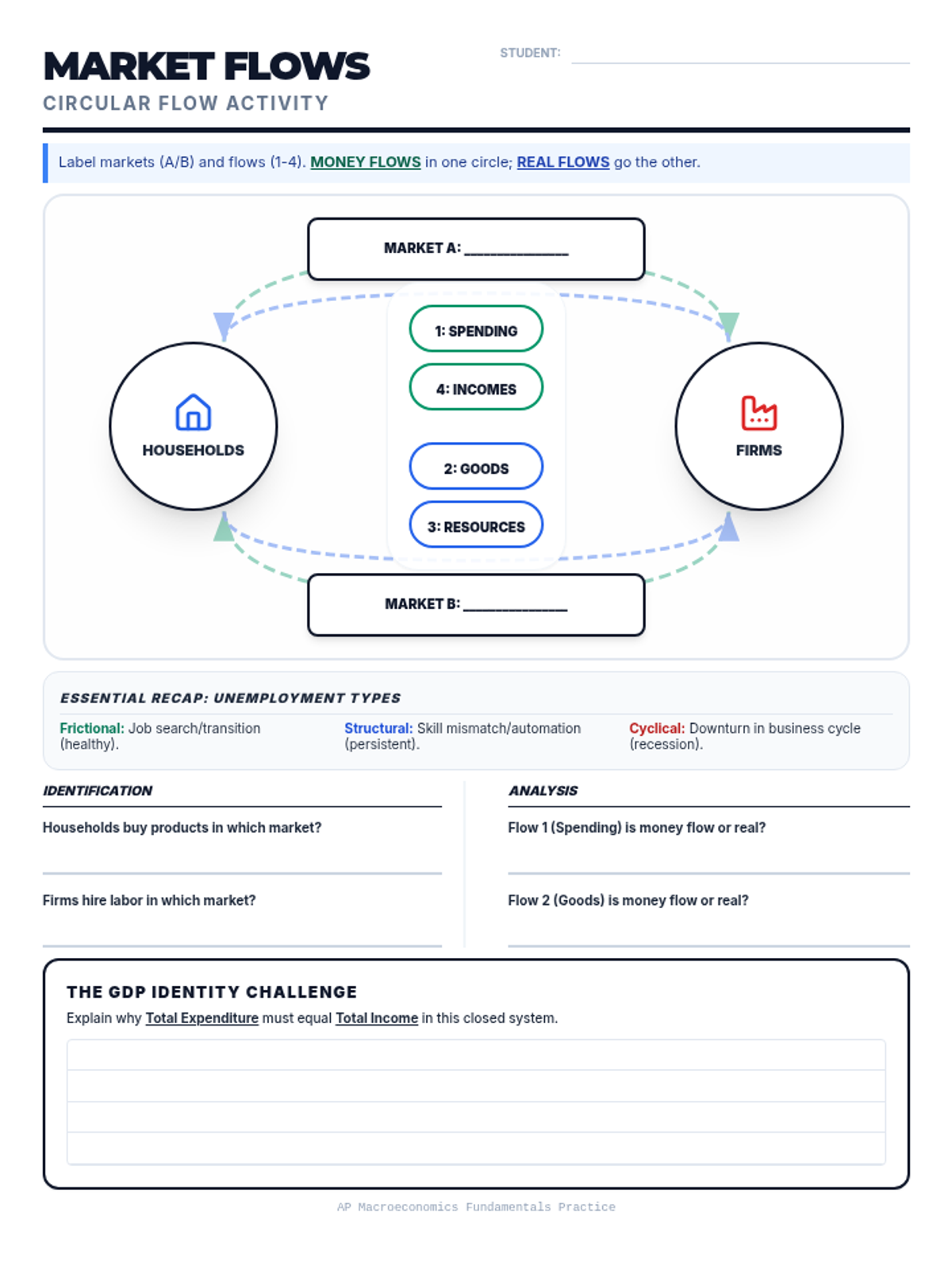
A student activity worksheet for labeling the markets and flows in the Circular Flow Model, including a critical thinking section on the relationship between spending and income.
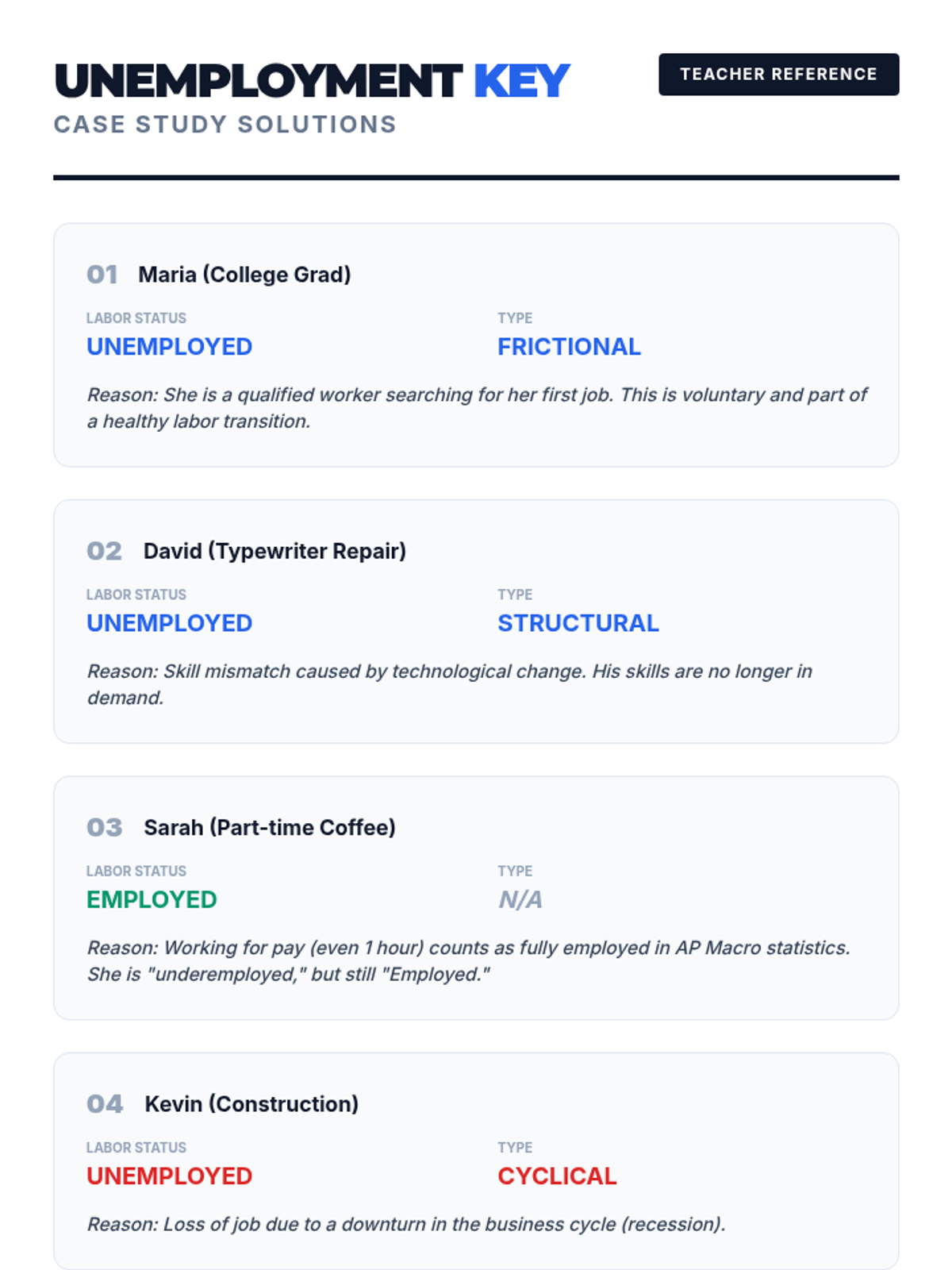
Answer key for the Unemployment Scenarios Worksheet, providing categorized answers and detailed economic reasoning for each case study.
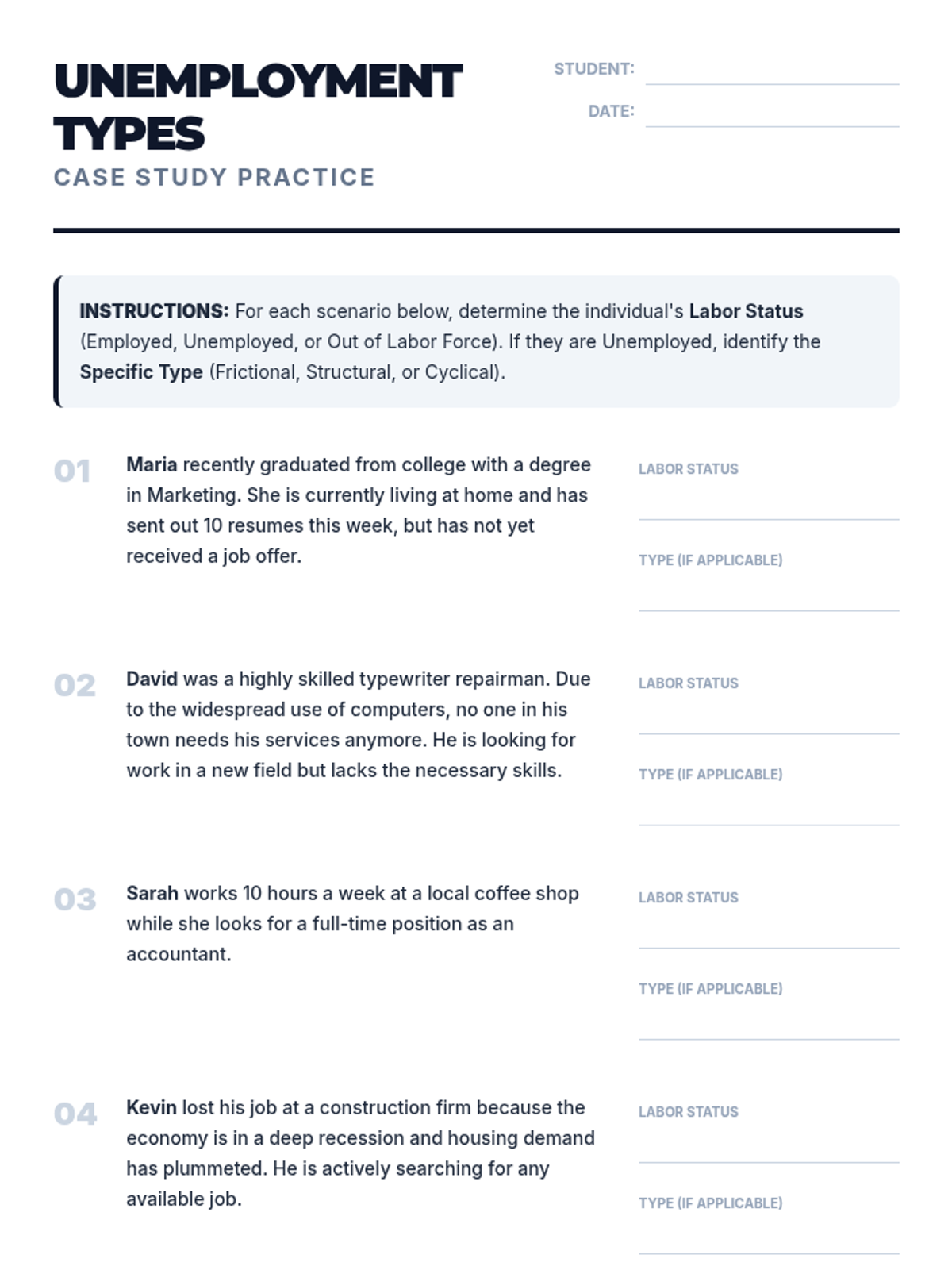
A worksheet containing six real-world scenarios where students must categorize individuals into employment status (Employed, Unemployed, OLF) and identify specific types of unemployment.
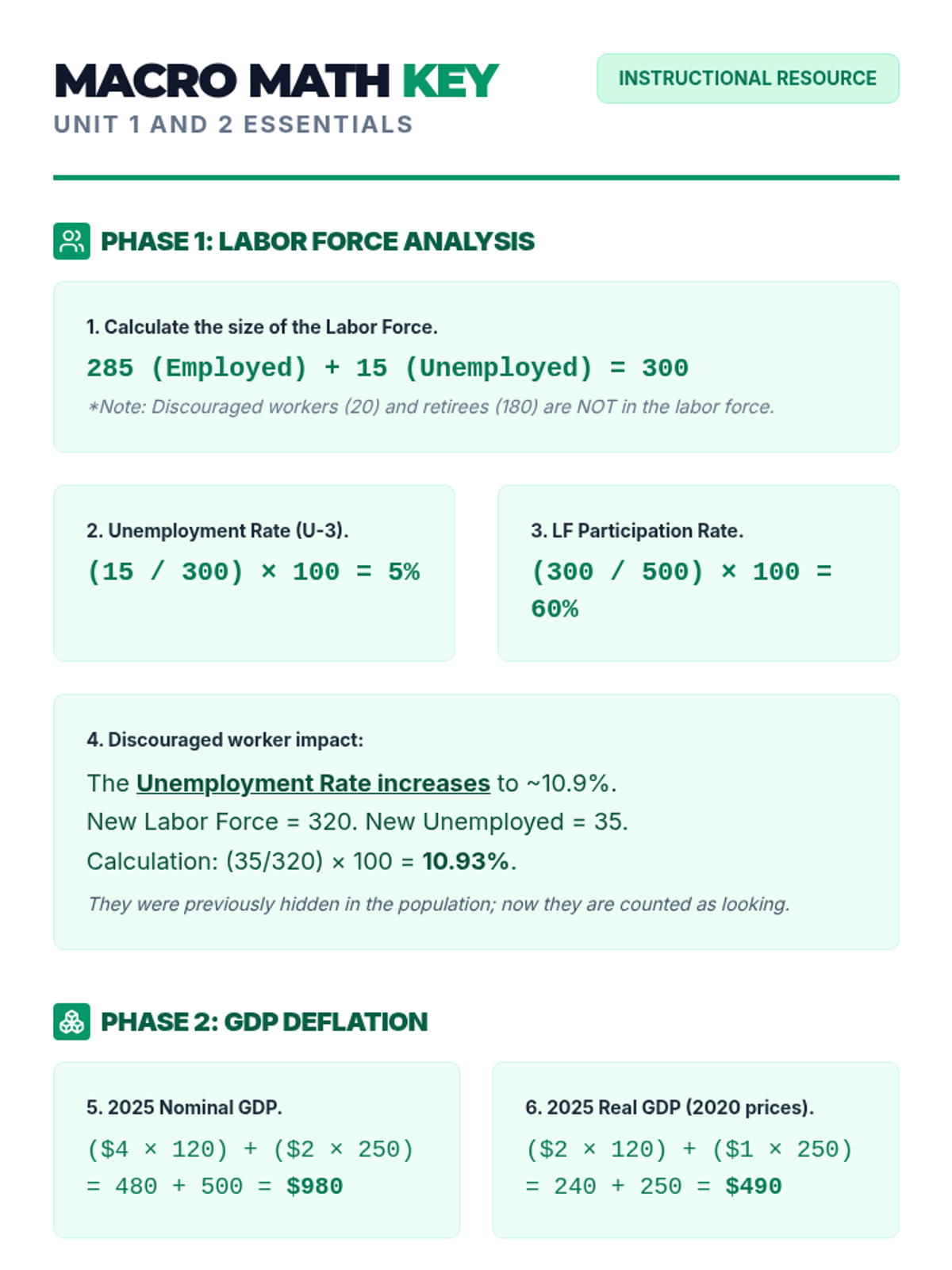
Teacher answer key for the Macro Math Worksheet, providing step-by-step solutions for unemployment, GDP, and CPI calculations.
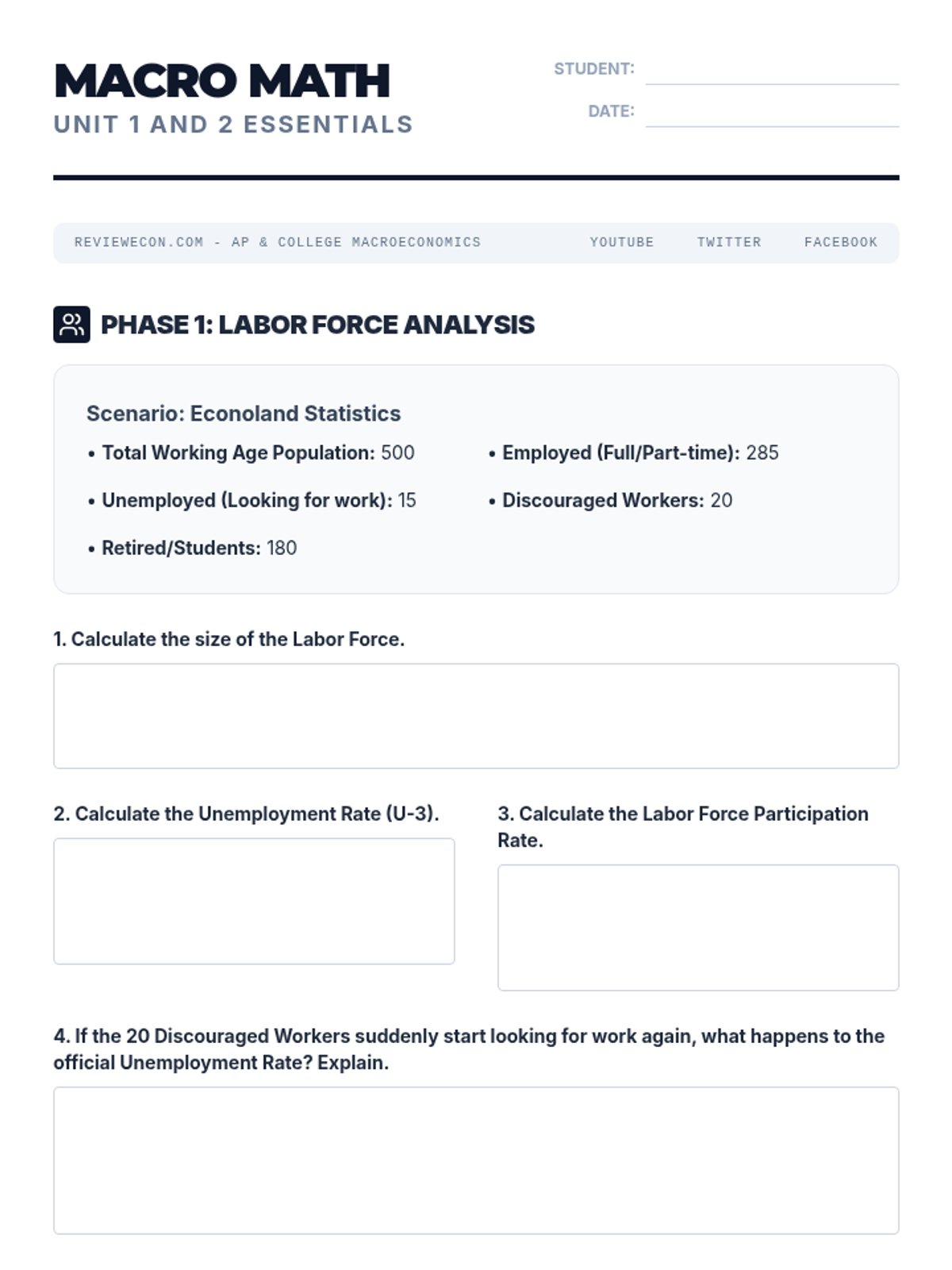
A student practice worksheet focused on key AP Economics calculations: unemployment rate, labor force participation, Nominal/Real GDP with deflators, and CPI/Inflation rates.
Comprehensive slide deck covering Unit 1 and 2 essentials, now with a dedicated Circular Flow Model slide and refined employment status categories.
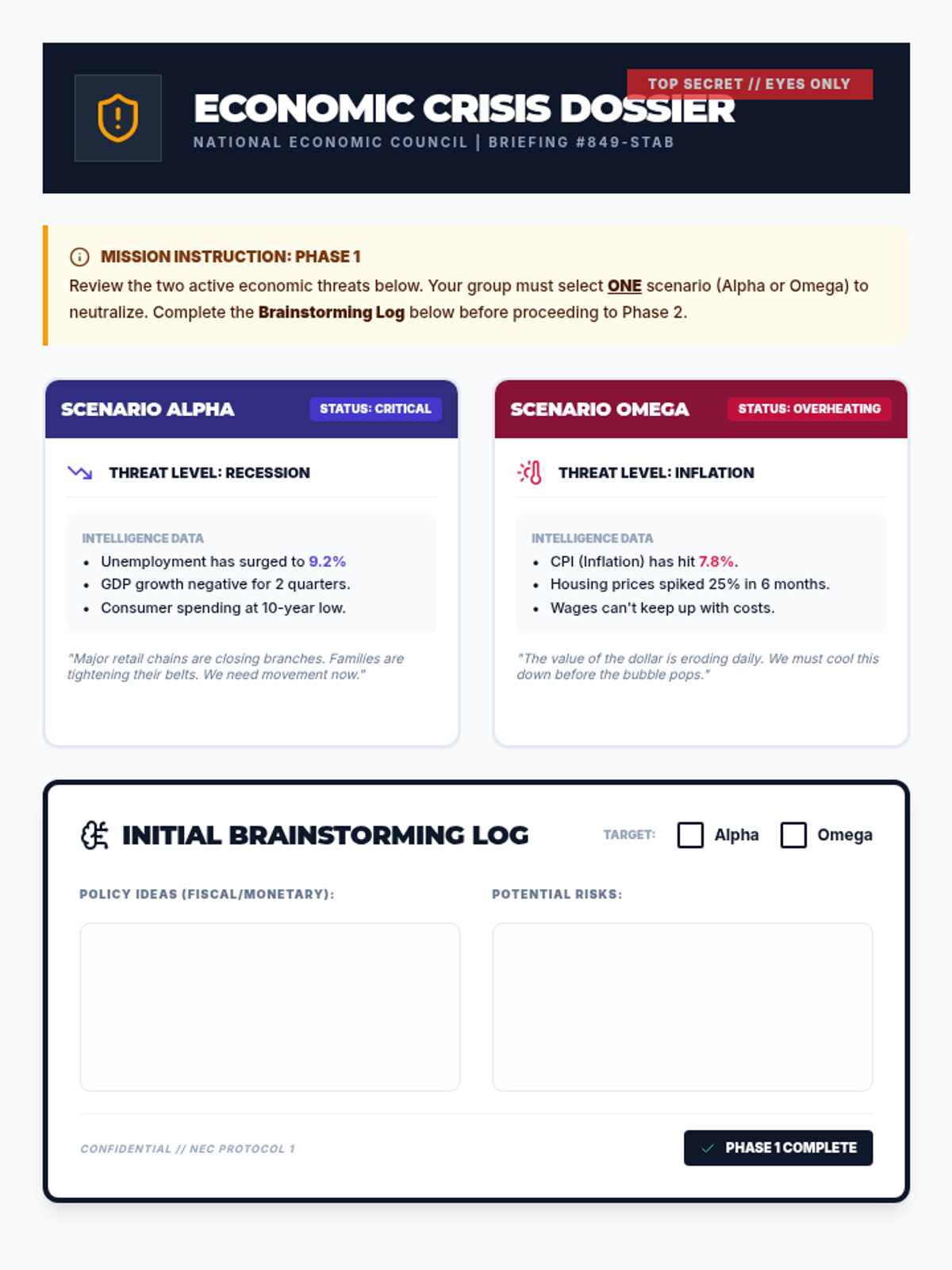
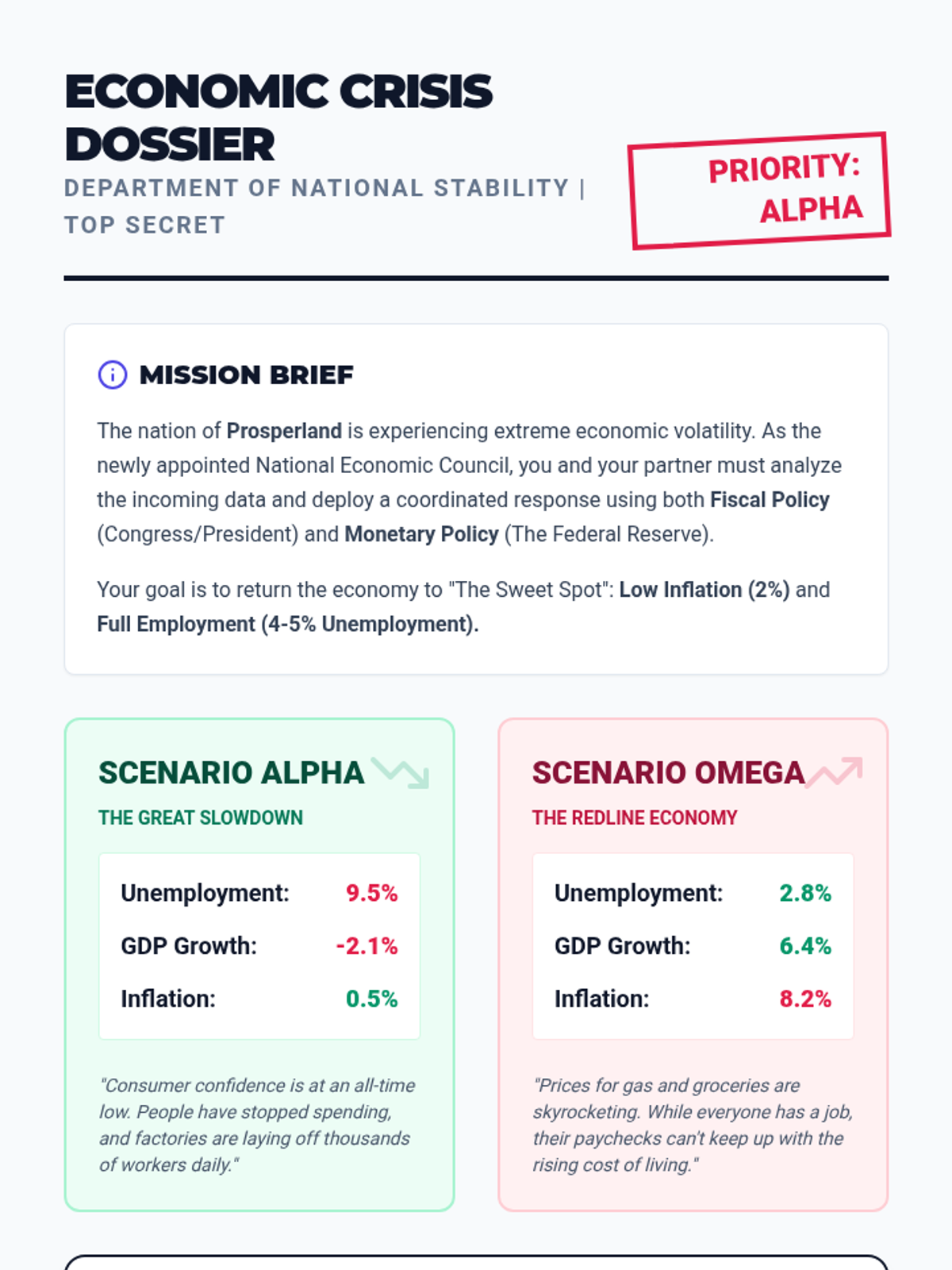
The primary briefing document for the Economic Stabilizers simulation. Contains Scenario Alpha (Recession) and Scenario Omega (Inflation) data, along with instructions for group selection and an initial brainstorming log. Updated to fit on a single page.
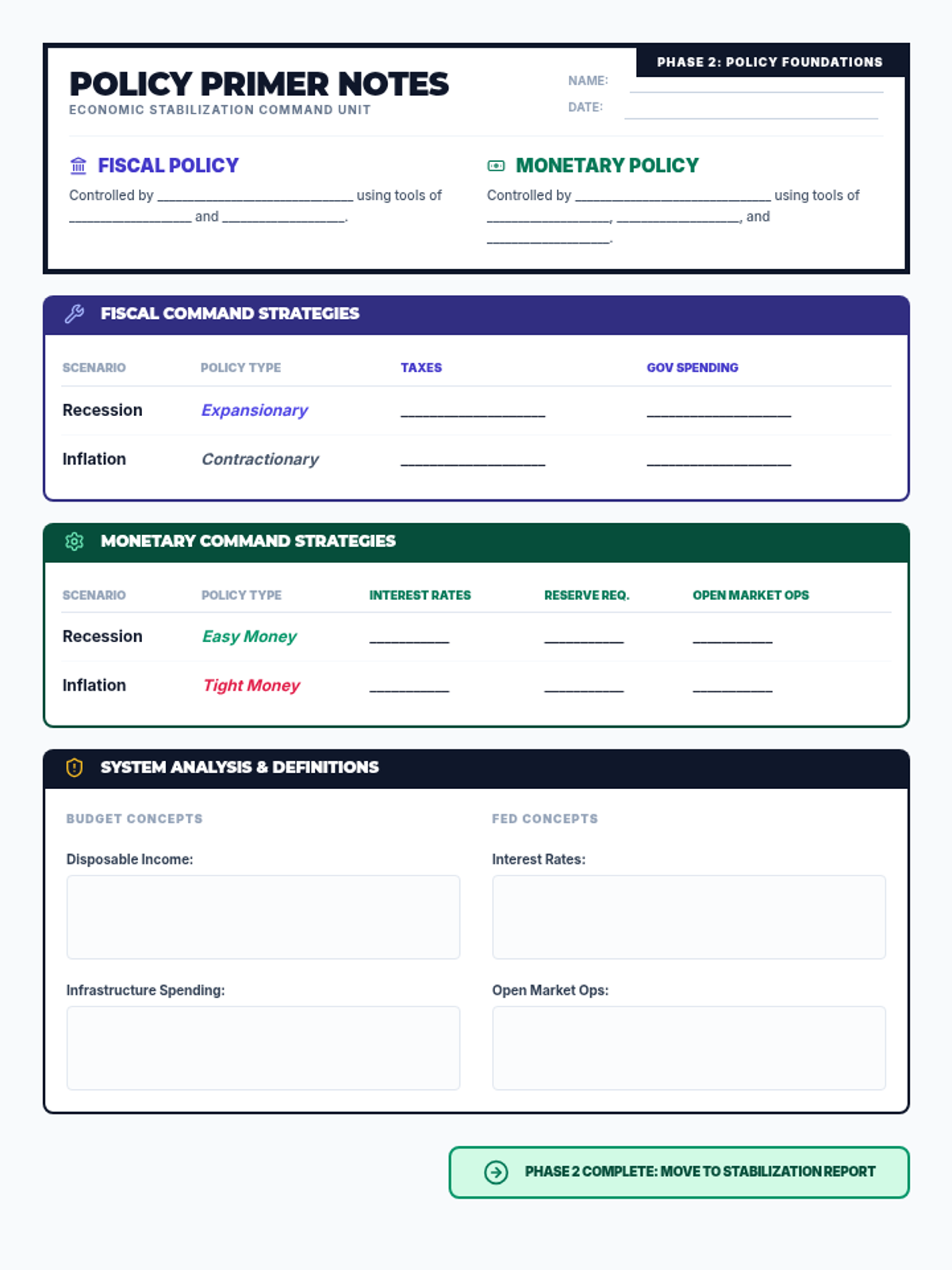
A structured note-taking sheet for students to use alongside the Economic Stabilizers presentation. Includes comparative tables for Fiscal and Monetary policy tools and strategies. Updated to fit on a single page with improved spacing and a reminder to move to the Stabilization Report.
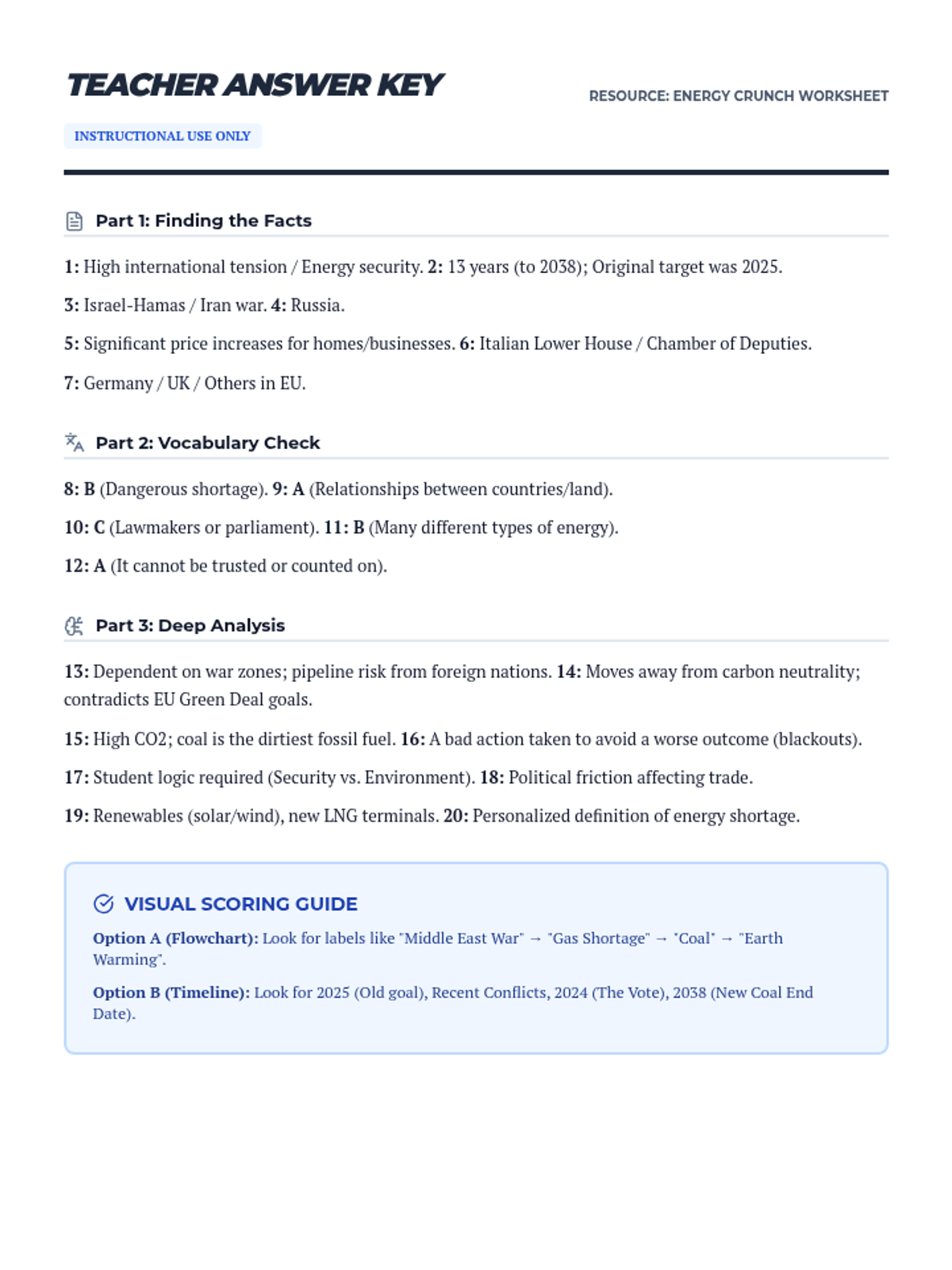
A concise teacher answer key for the Energy Crunch Worksheet, providing answers for the 15 reading comprehension questions and 5 vocabulary MCQs, plus a specific grading guide for the flowchart and timeline options.
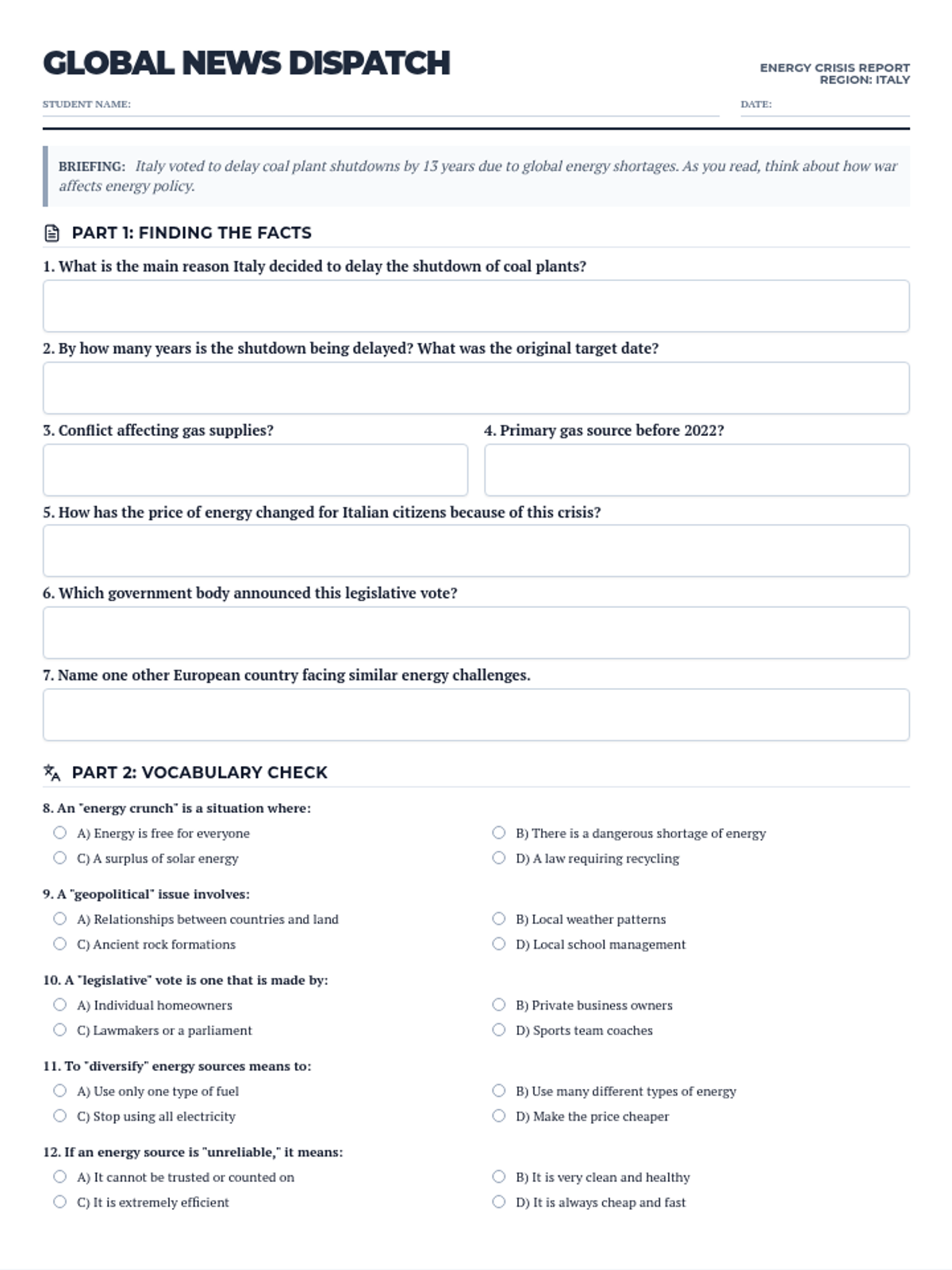
A 2-page reading comprehension worksheet based on the article about Italy's coal plant delay. Includes 15 short-answer questions, 5 vocabulary MCQs, and a structured visual representation section with clear options for a flowchart or timeline. Tailored for WIDA Level 4 students.
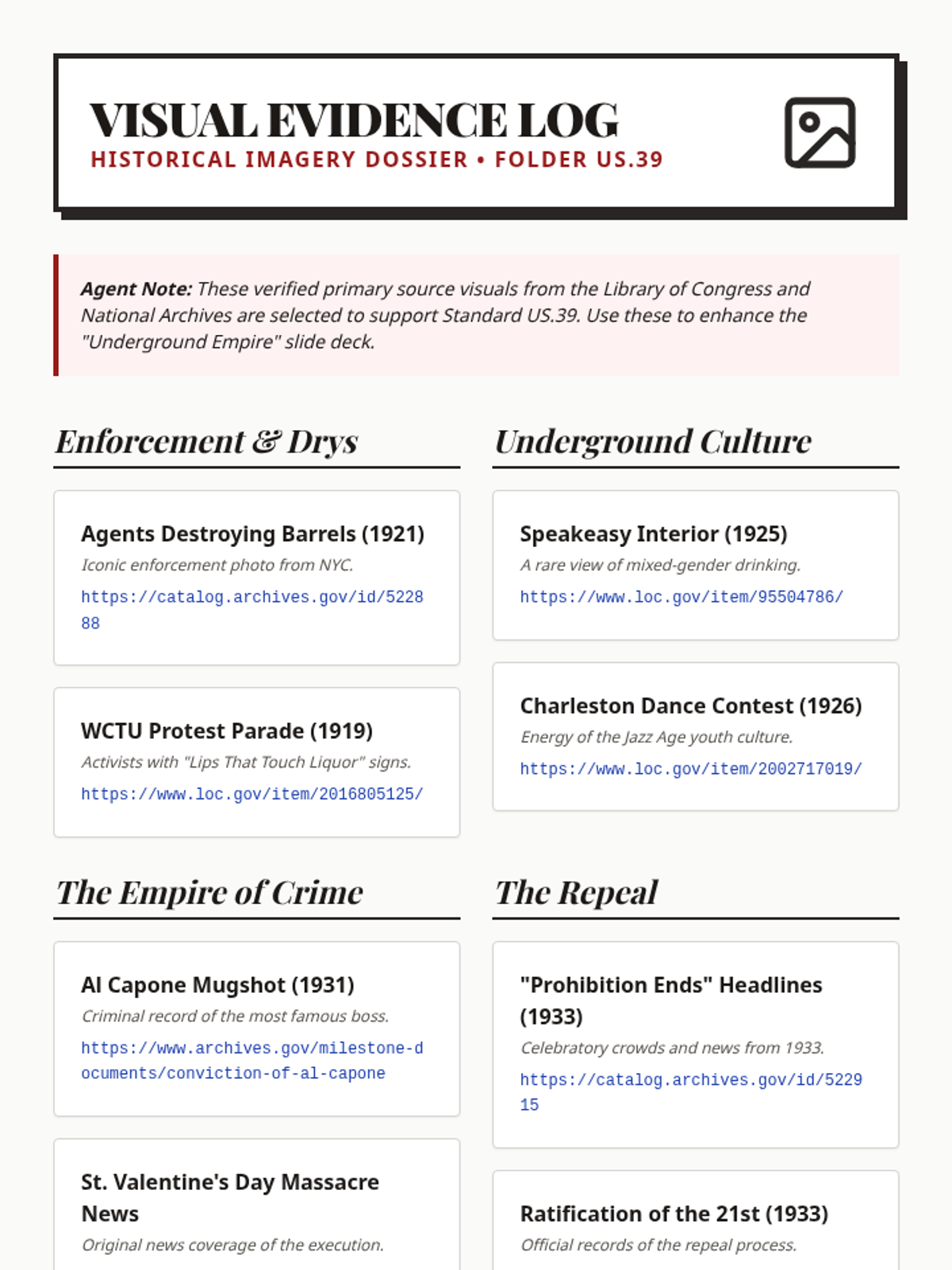
A curated list of high-quality historical visuals to complement the lesson, featuring verified archival links to the Library of Congress and National Archives. Includes photos of enforcement agents, flapper culture, and organized crime bosses. Optimized for a single page with improved legibility.
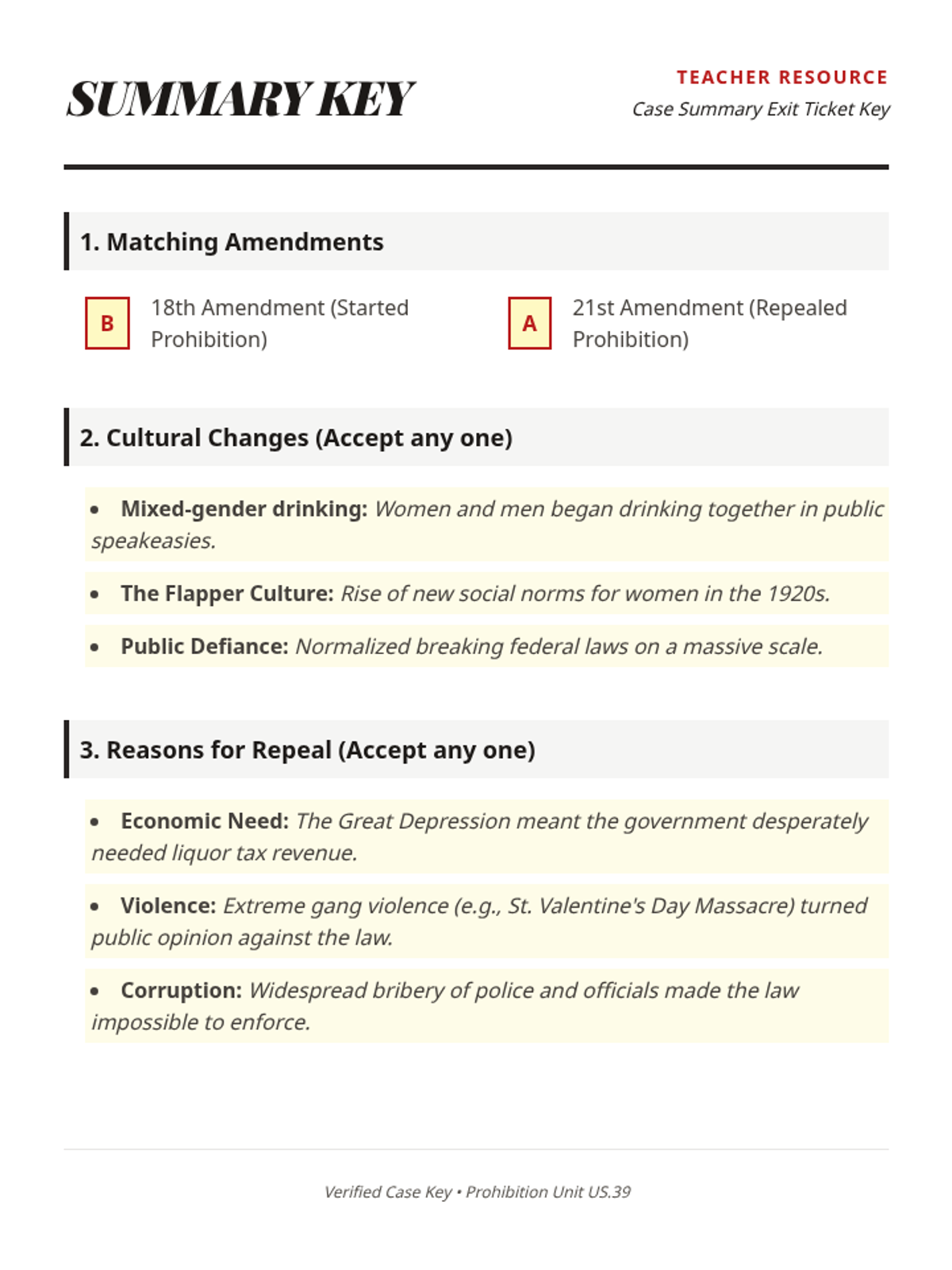
Answer key for the Case Summary Exit Ticket. Provides specific answers and acceptable variations for cultural impacts and reasons for the repeal of the 18th Amendment. Updated for clarity and contrast.
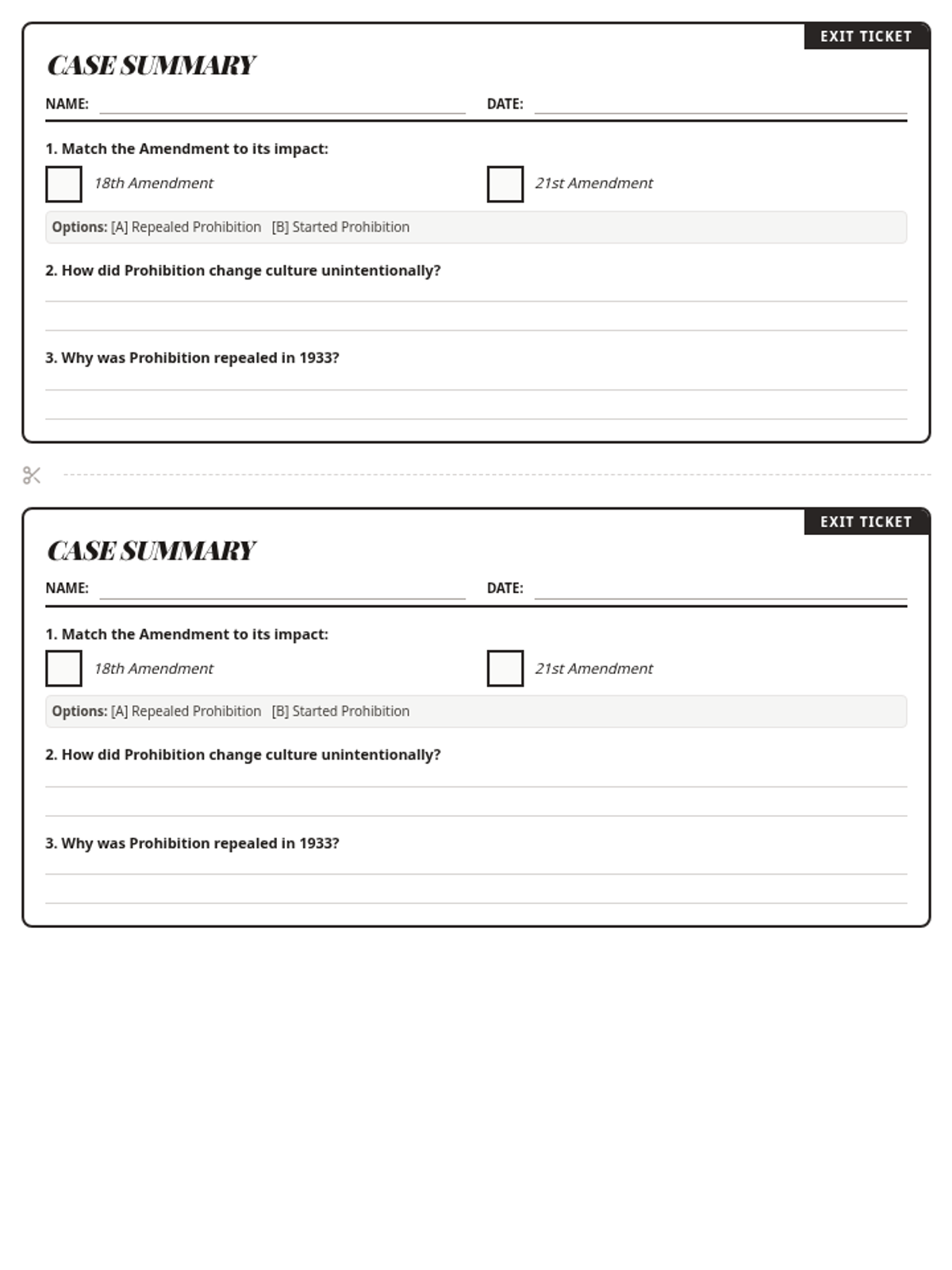
A quick formative assessment for the end of the lesson. Includes two identical exit tickets per page for efficient printing. Questions cover amendment identification, cultural impact, and the reason for repeal. Updated layout to ensure 2-per-page fit.
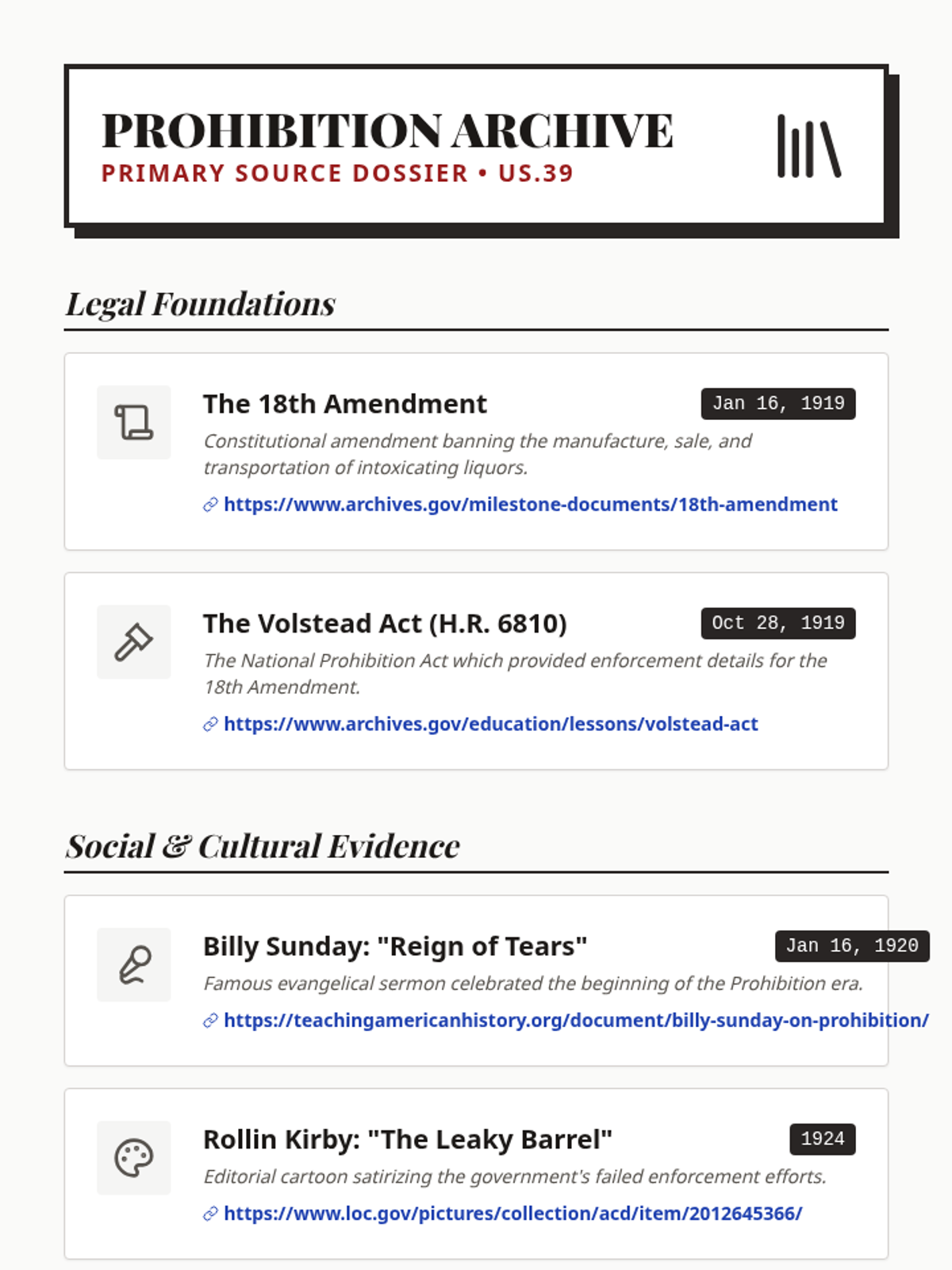
A comprehensive list of all primary sources used in the Prohibition lesson, including names, specific dates, descriptions, and verified archival links for student and teacher reference. Updated layout for page breaks and header kerning.
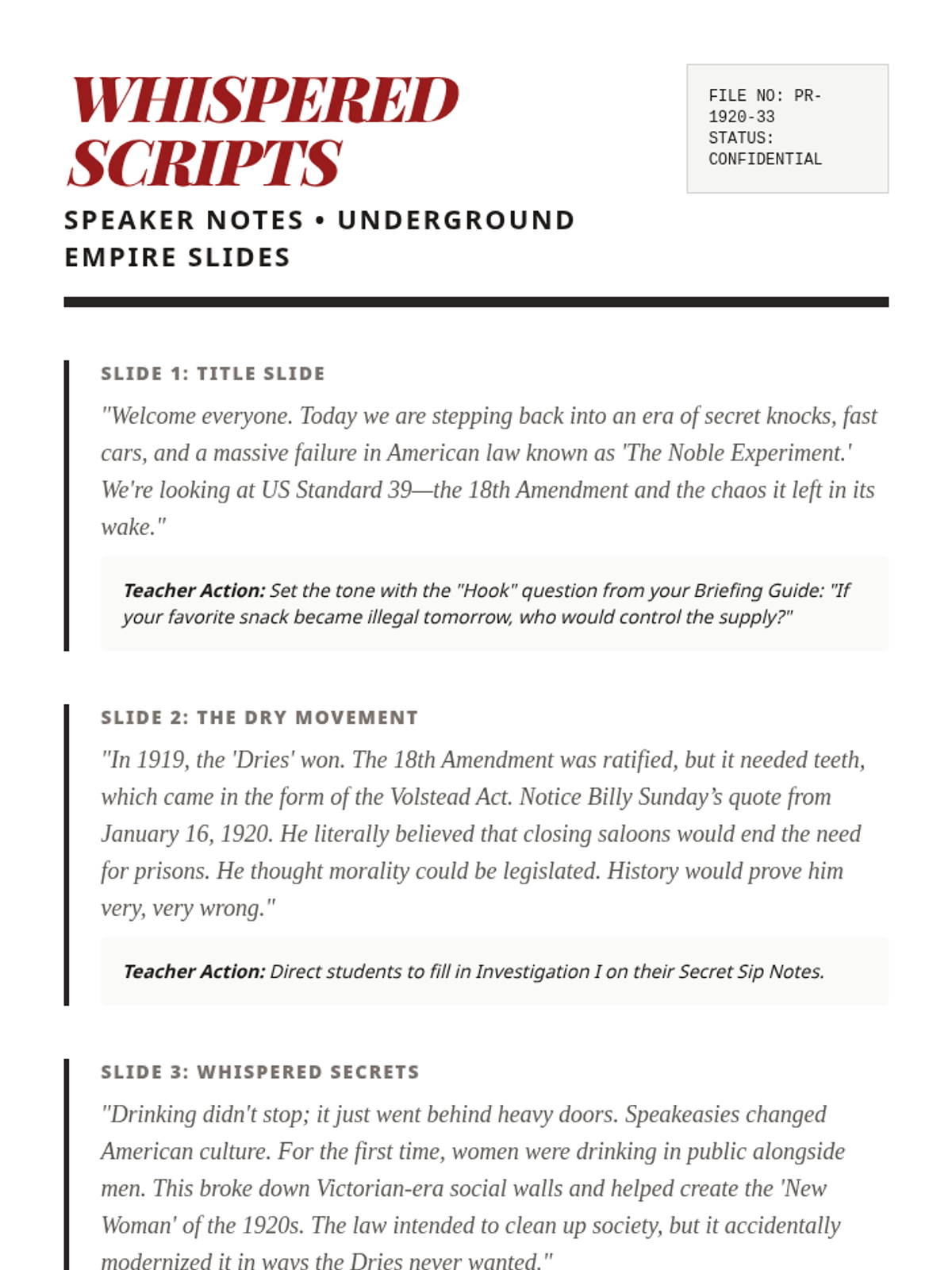
A slide-by-slide instructional script and talking points for the teacher to accompany the Underground Empire Slides. Includes "say" and "do" prompts for classroom facilitation.
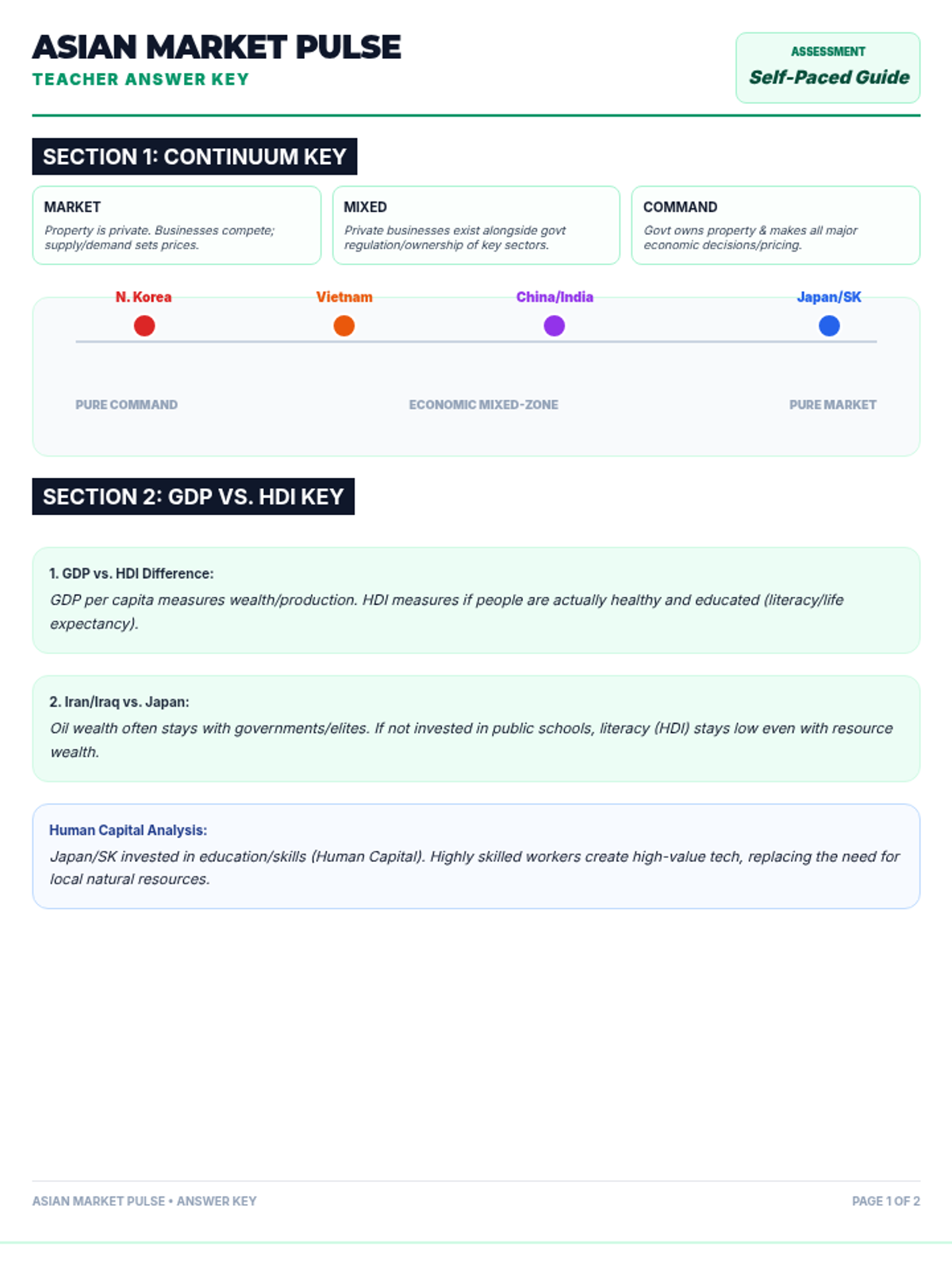
Teacher answer key for the Asian Market Pulse study guide. Updated to match the student handout and fix layout overlaps.
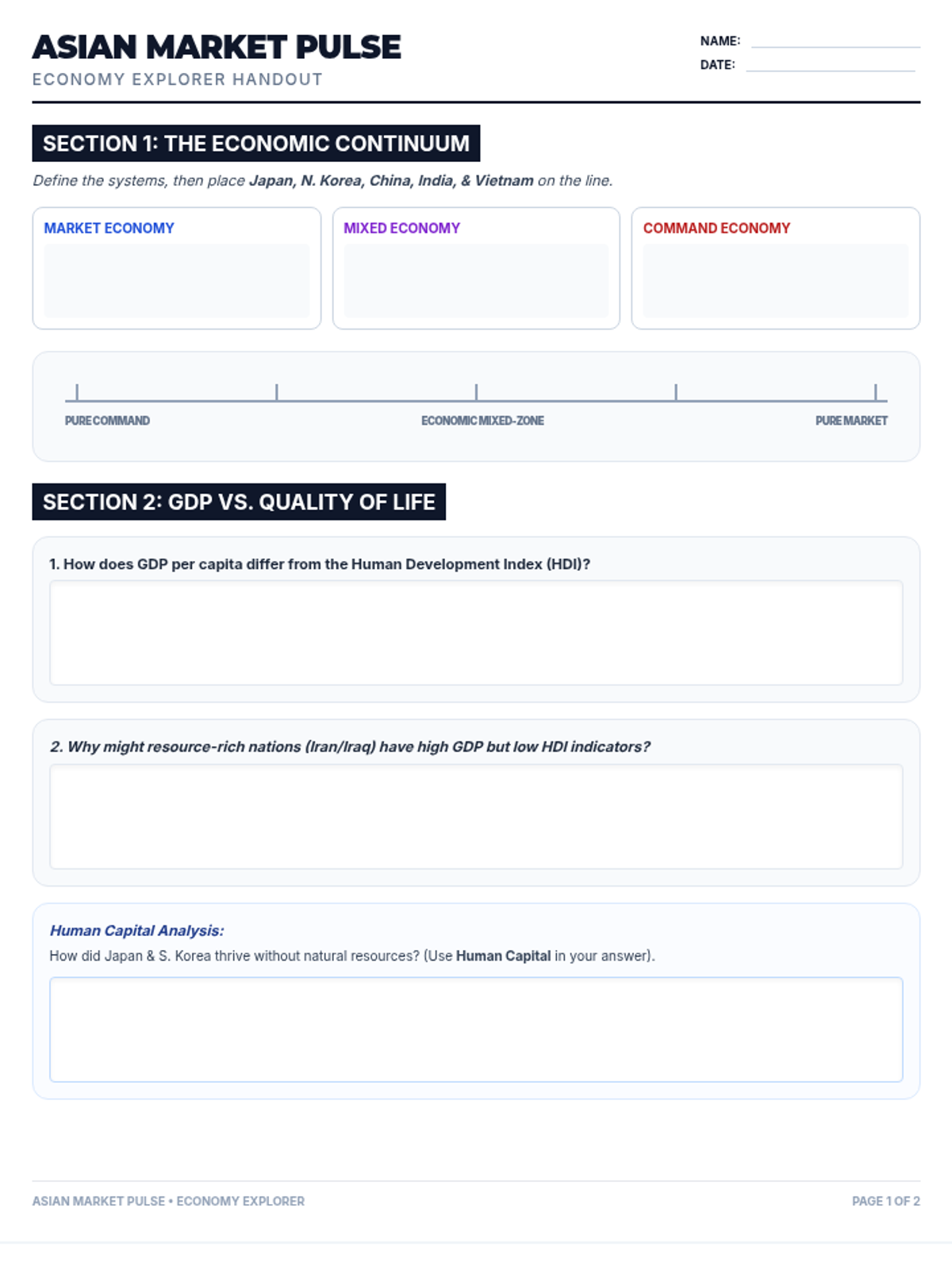
A two-page study guide and analysis handout for students to complete while working through the Asian Market Pulse lesson. Updated to include requested countries and fixed layout issues.
A self-paced slide deck exploring Asian economic systems, GDP, and quality of life across major nations including China, India, Japan, and the Koreas. Updated with better spacing and legibility.
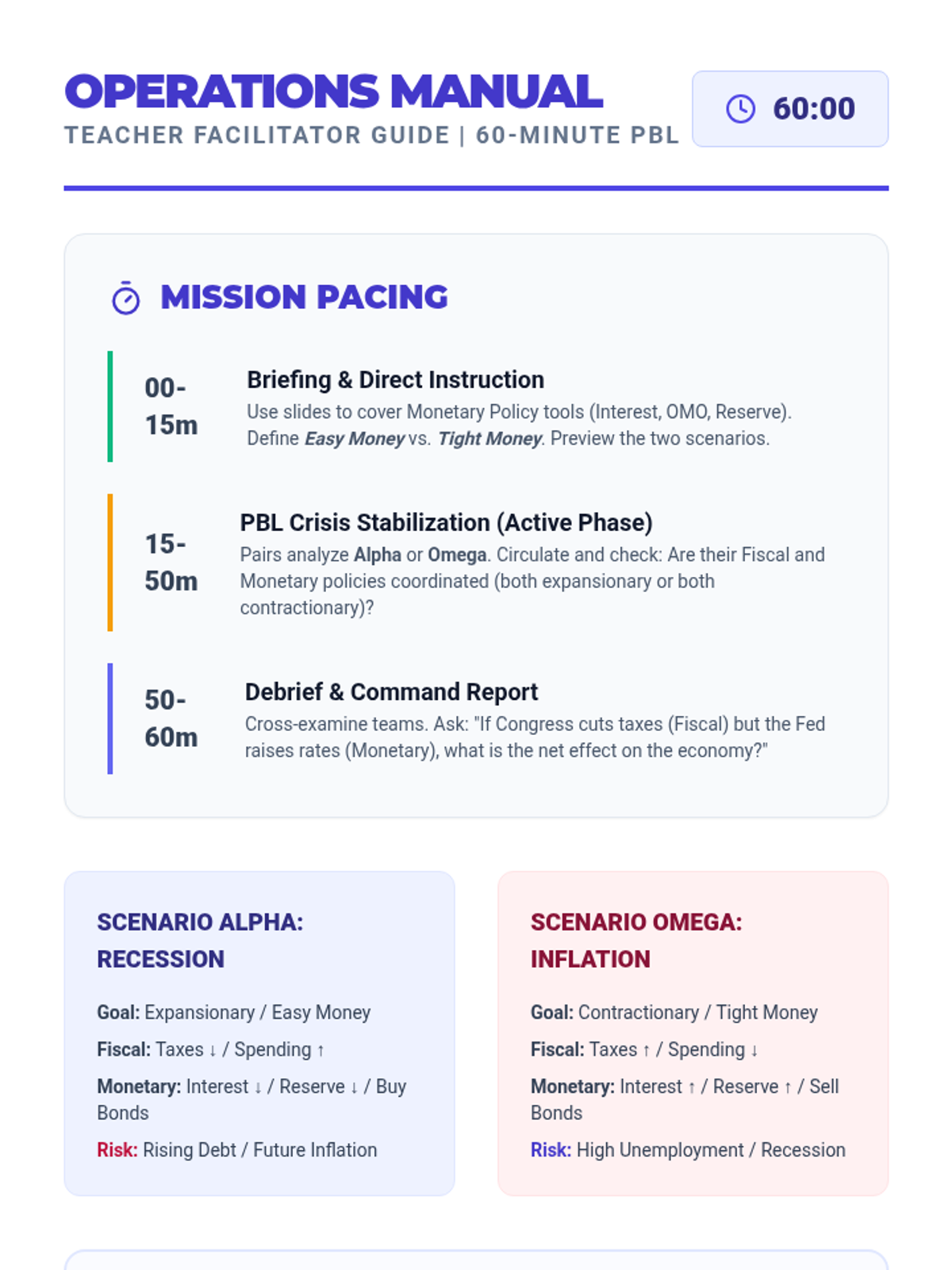
Teacher-facing guide for the economic stabilization simulation. Includes a 60-minute pacing plan with slide creation and presentation phases, a bank of strategic cross-examination questions, and expected student reasoning for recession vs. inflation scenarios.
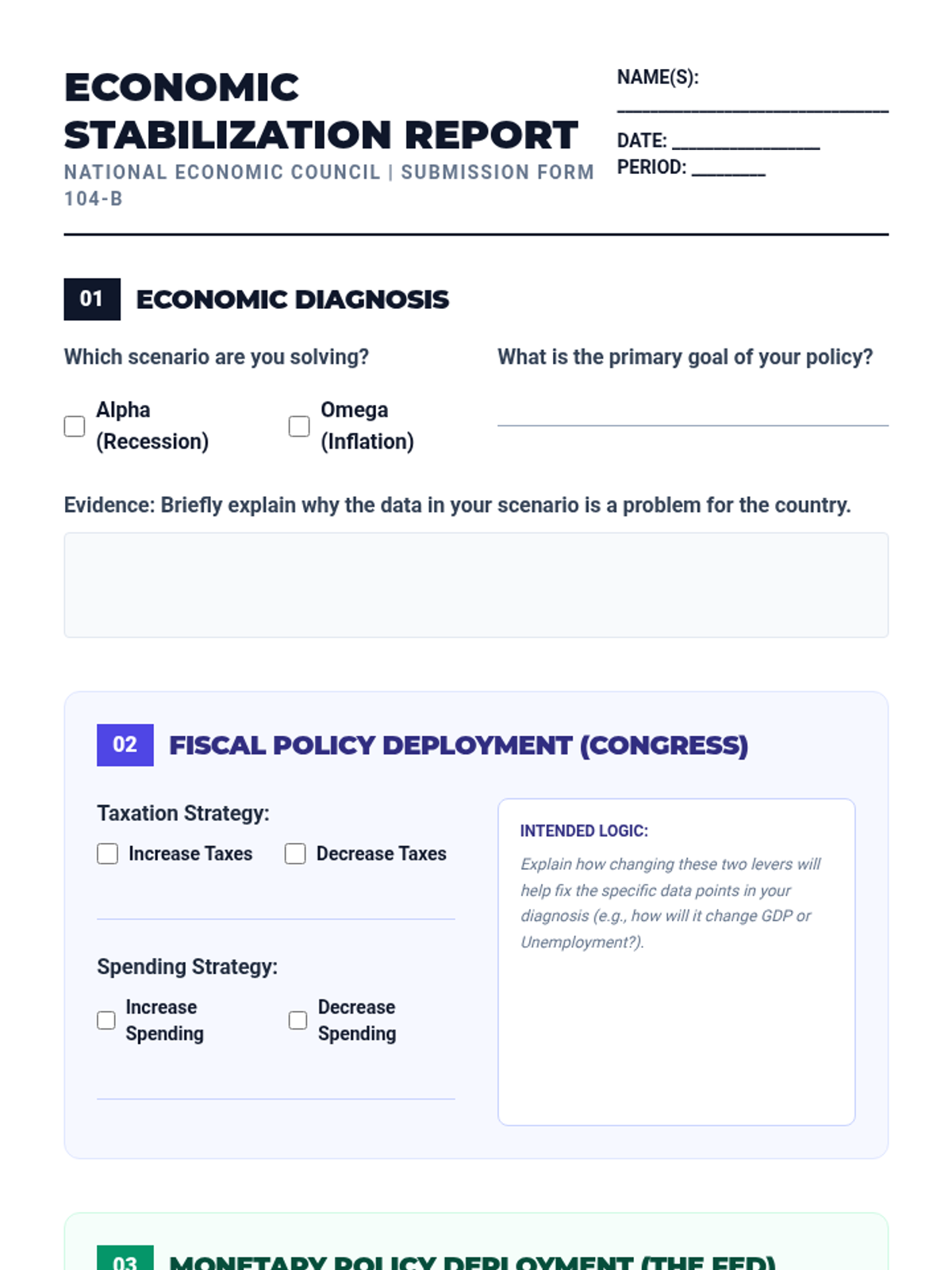
A formal report template for students to complete during the PBL activity. Includes sections for diagnosing the crisis (Scenario Alpha/Omega), selecting fiscal and monetary tools, and preparing for cross-examination. Now updated to align with the 4-phase sequence.
Updated project guide for the economic stabilization simulation. Now includes requirements for a Google Slides presentation, specific slide outlines, and targeted cross-examination questions for both recession and inflation scenarios.
Updated economic stabilization slides. Now includes specific slides for Fiscal Policy (Budget Tools and Strategy Modes) to complement the Monetary Policy content. All text remains at or above the 24px minimum size for presentation clarity. Fixed spacing in headers on Slide 5.
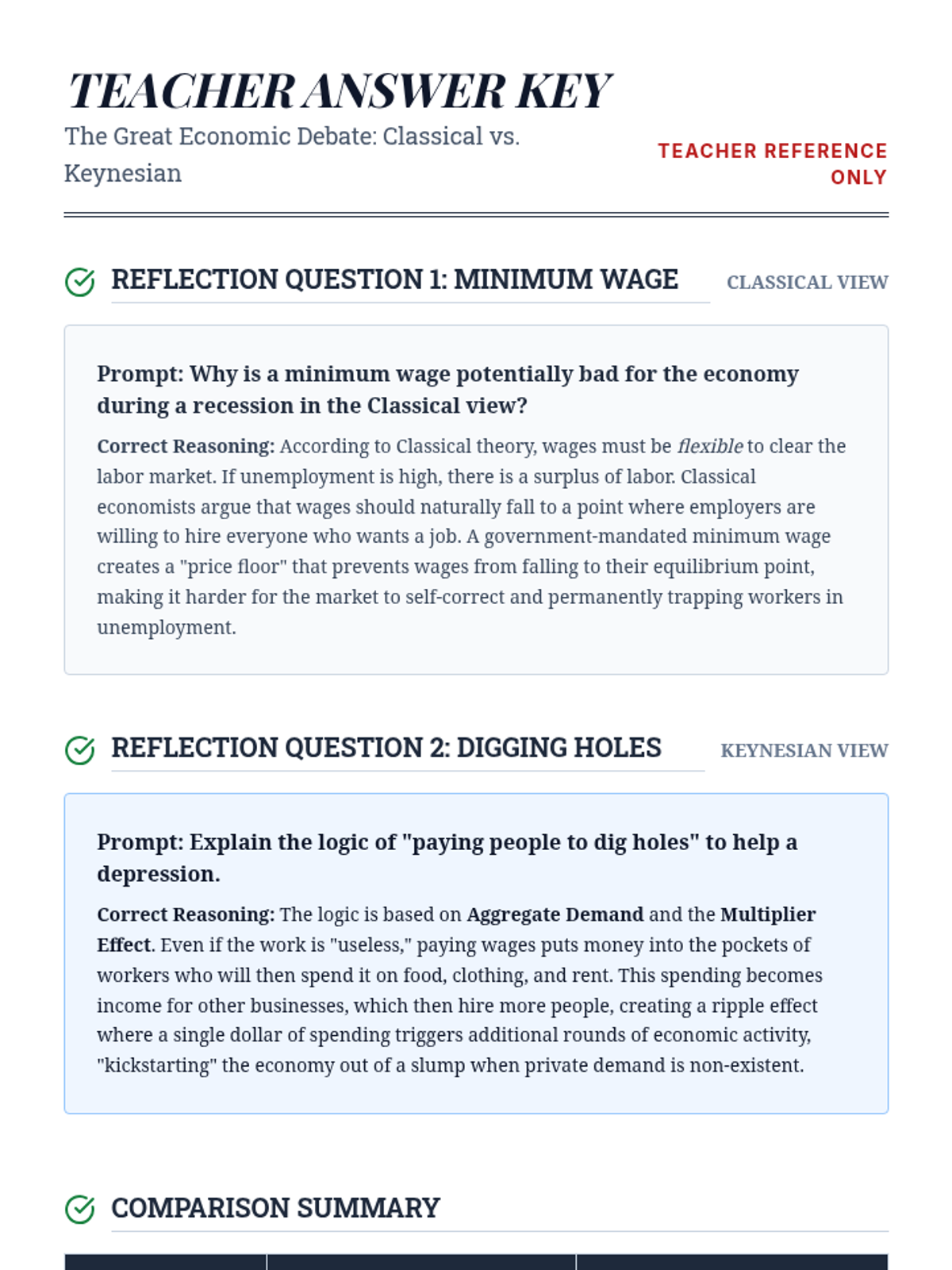
Teacher reference guide containing sample responses and detailed economic reasoning for the Market Tug of War worksheet, including answers for the quick-check quiz. Now includes a dedicated comparison summary table for teacher reference.
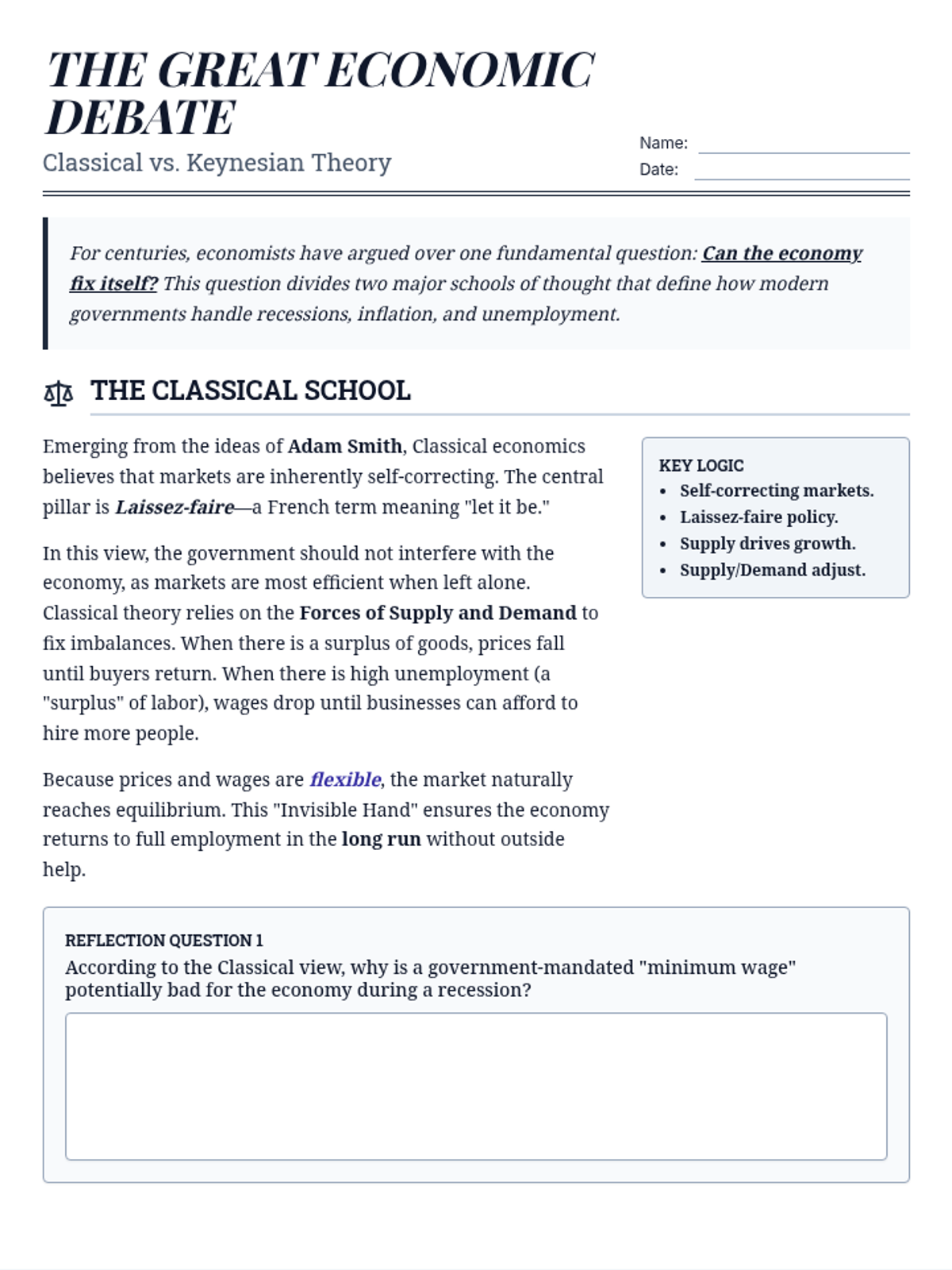
A structured reading and response handout that explores the core differences between Classical and Keynesian economics, featuring Laissez-faire, price flexibility, aggregate demand, and government intervention. Now includes a detailed explanation of the multiplier effect and market self-correction through supply and demand.
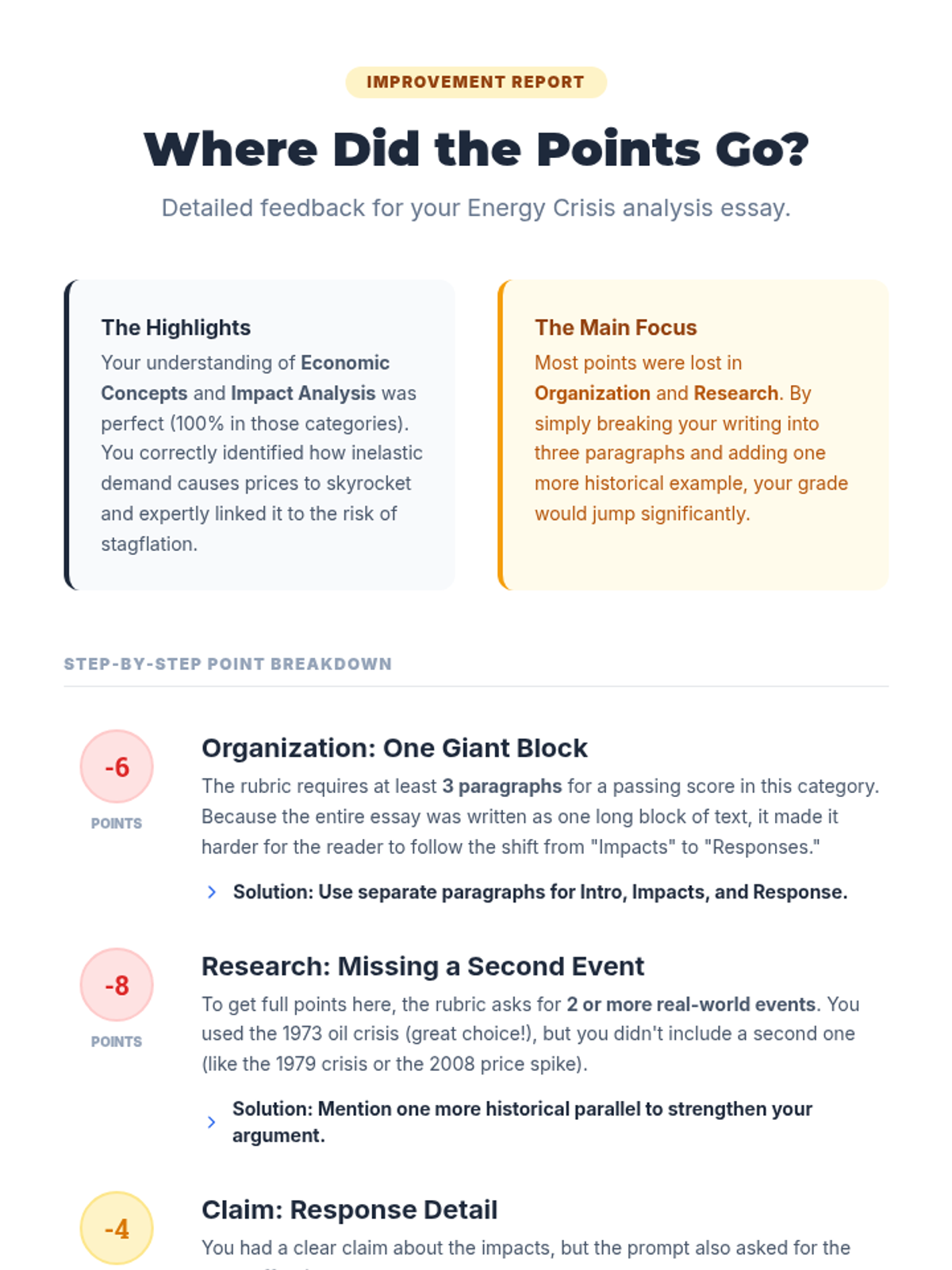
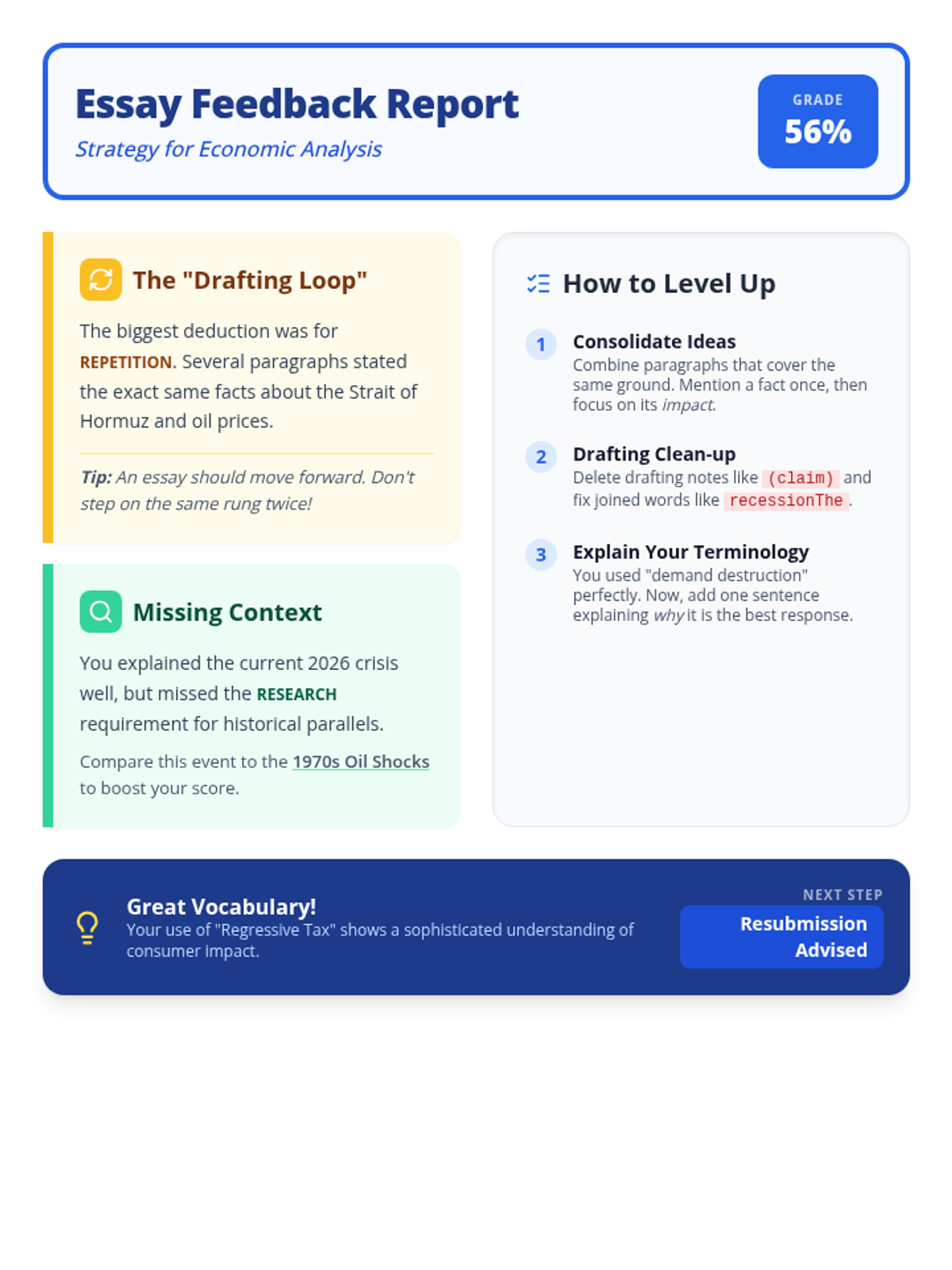
A detailed feedback sheet explaining exactly why points were deducted from the student's essay, with clear sections on organization, research, and mechanics.
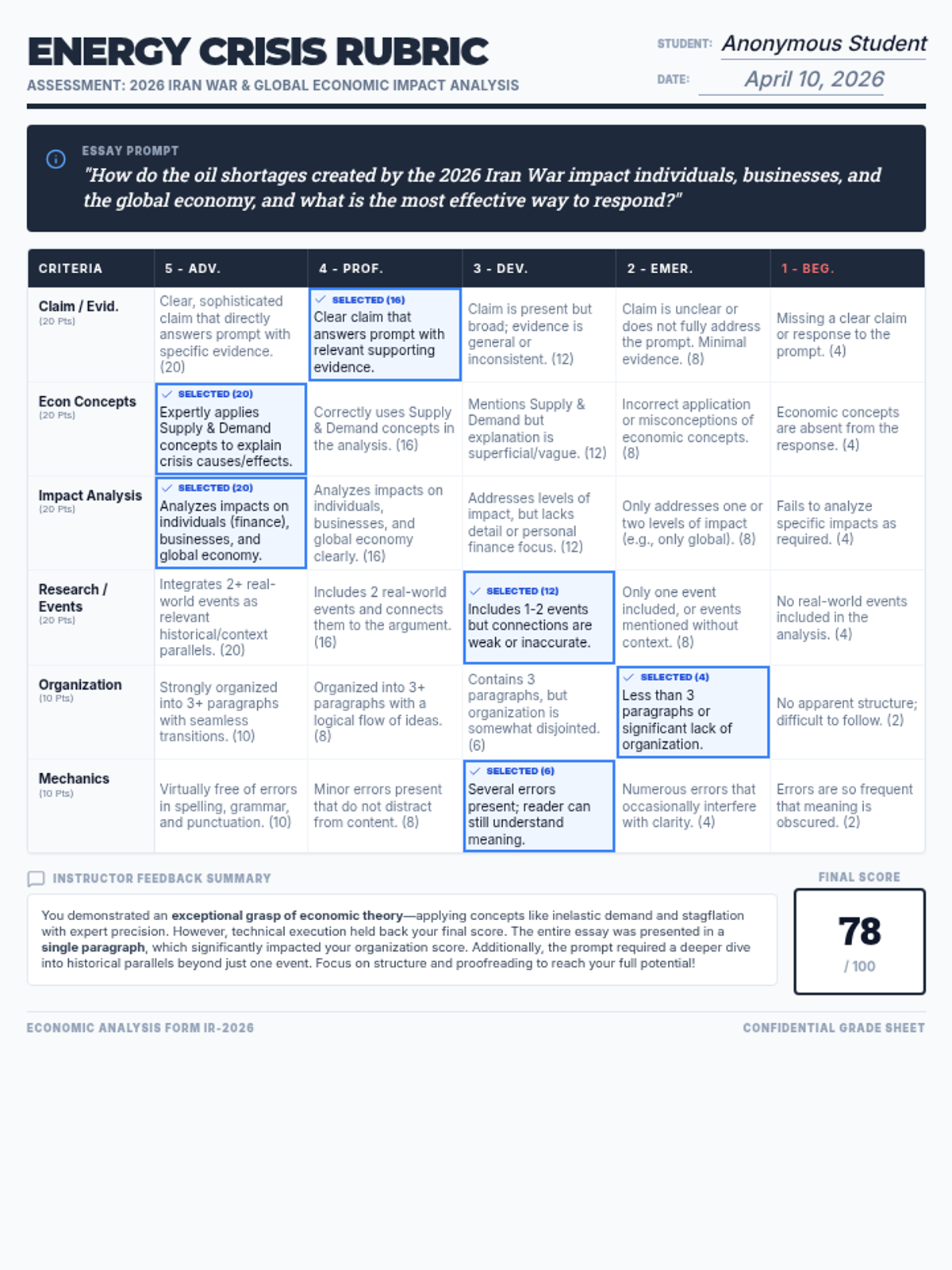
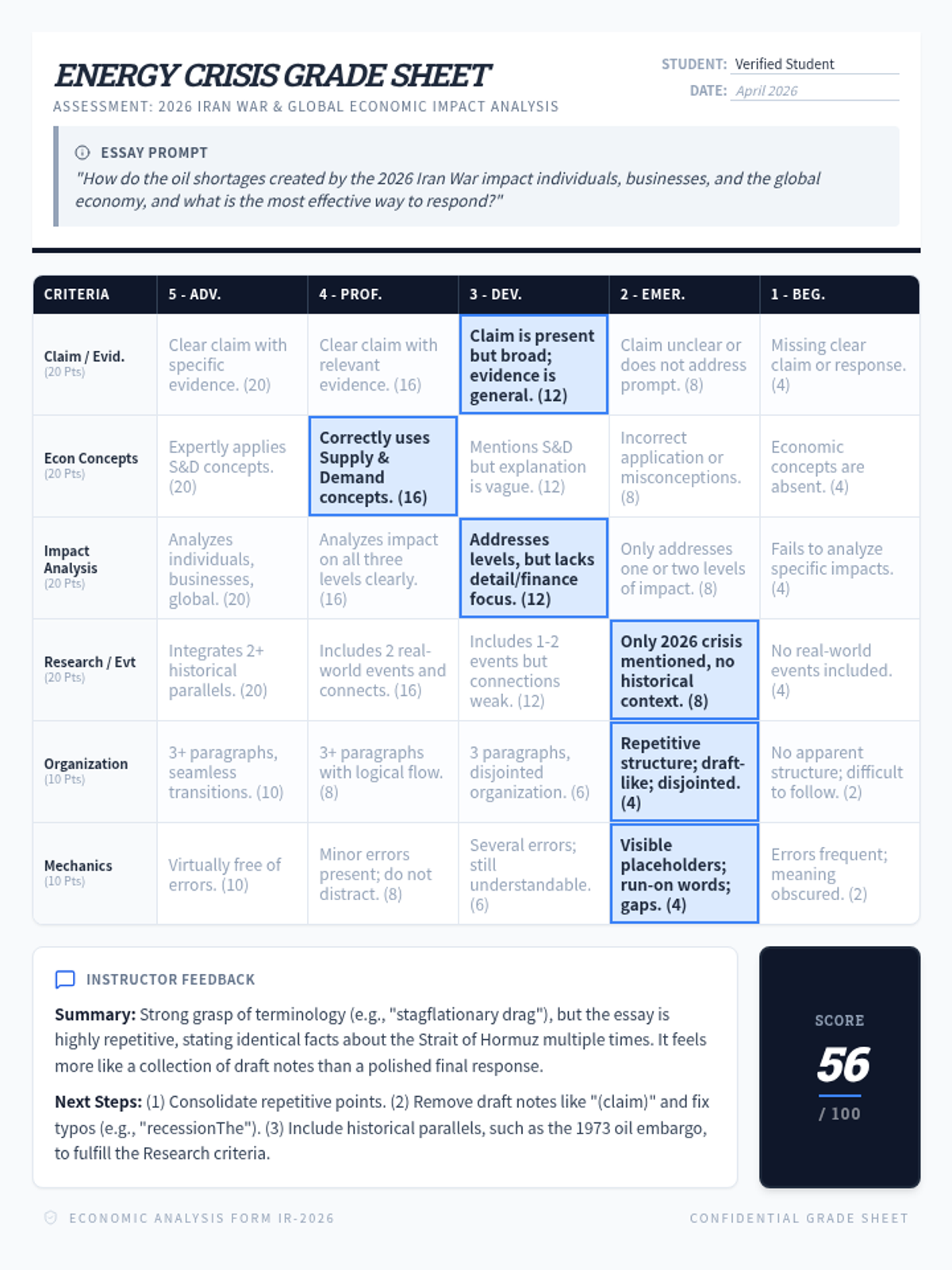
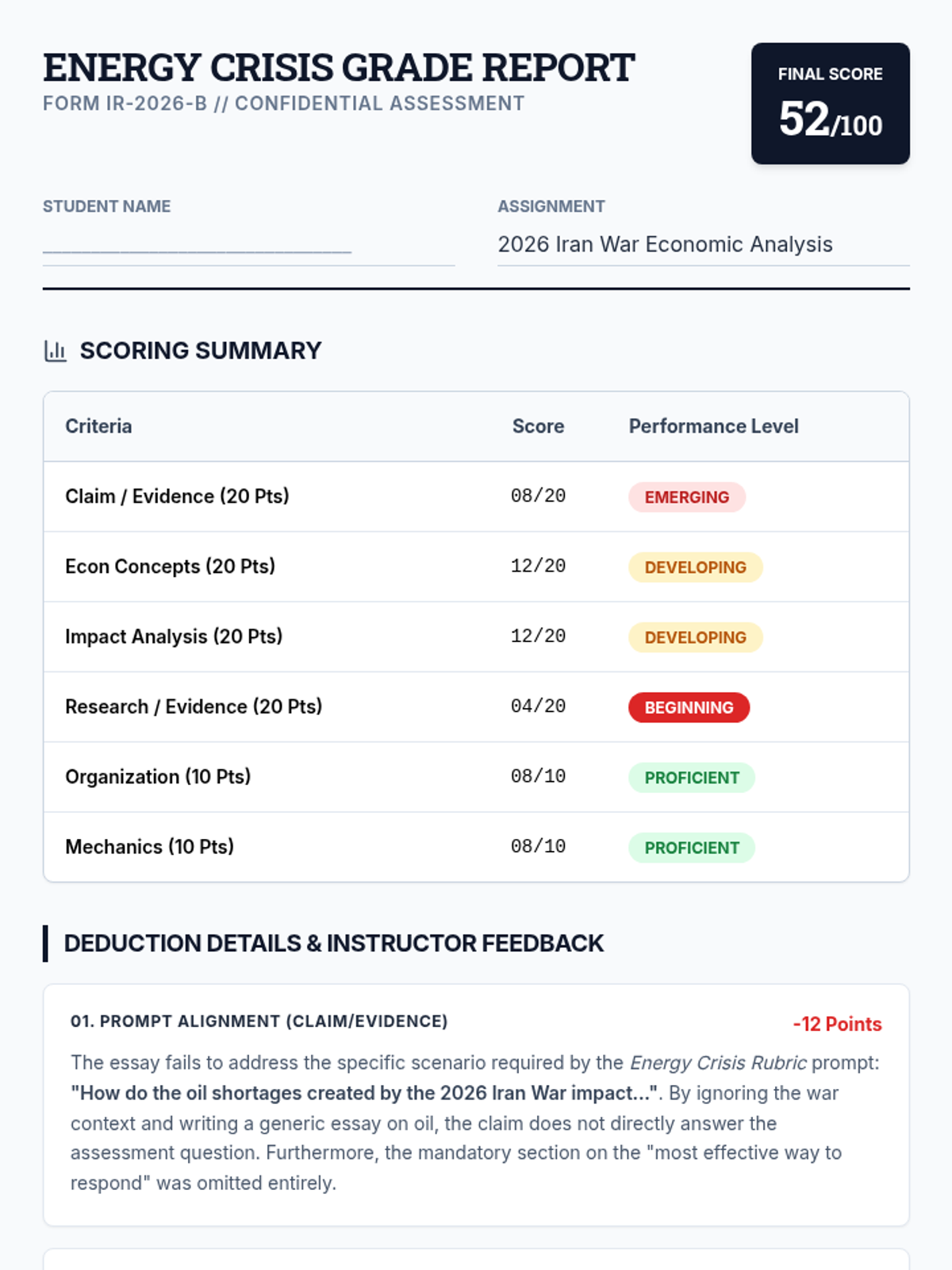
A completed grading rubric for the Energy Crisis essay, showing scores for claim, economic concepts, impact analysis, research, organization, and mechanics with a final total of 78/100.
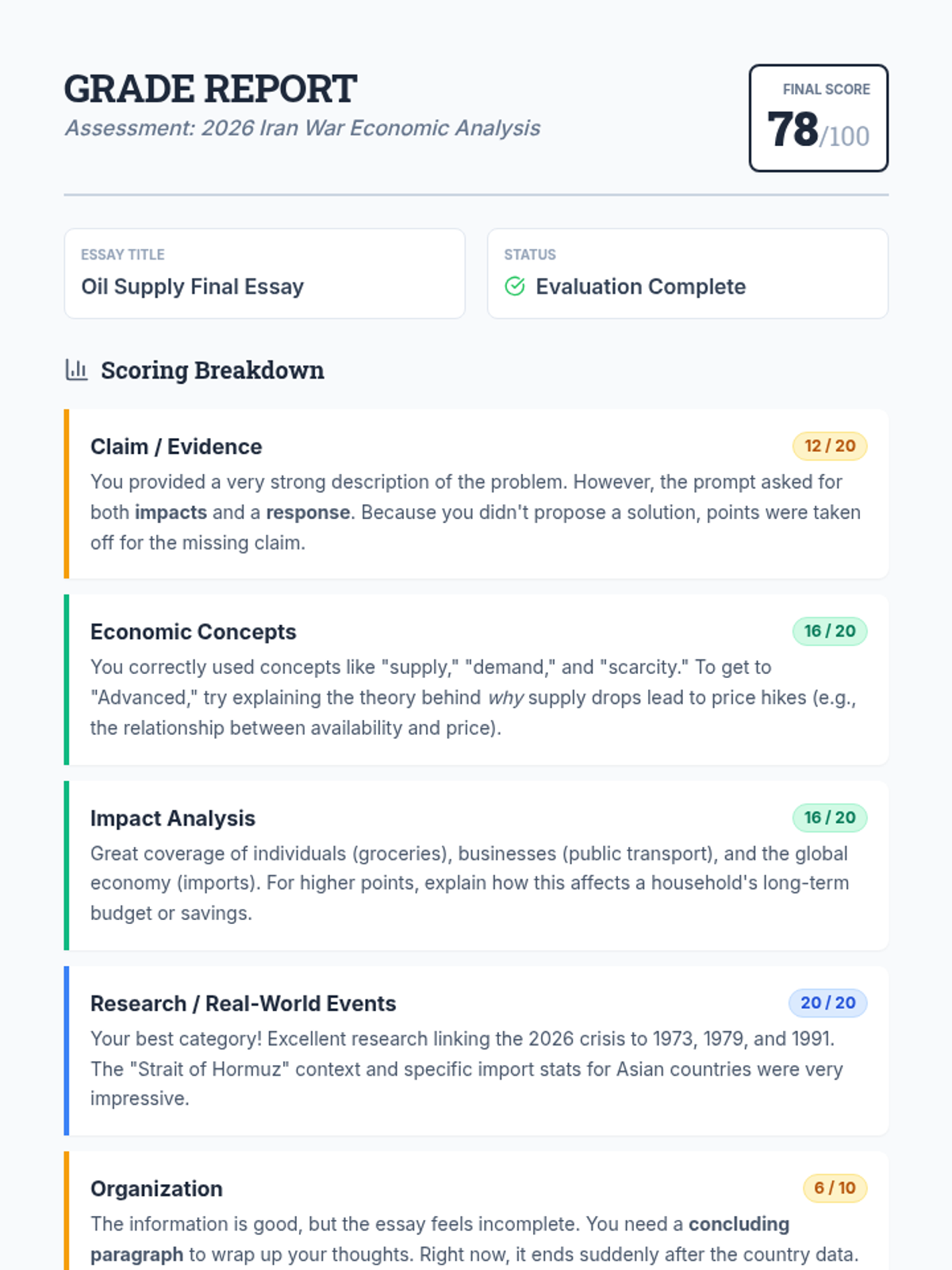
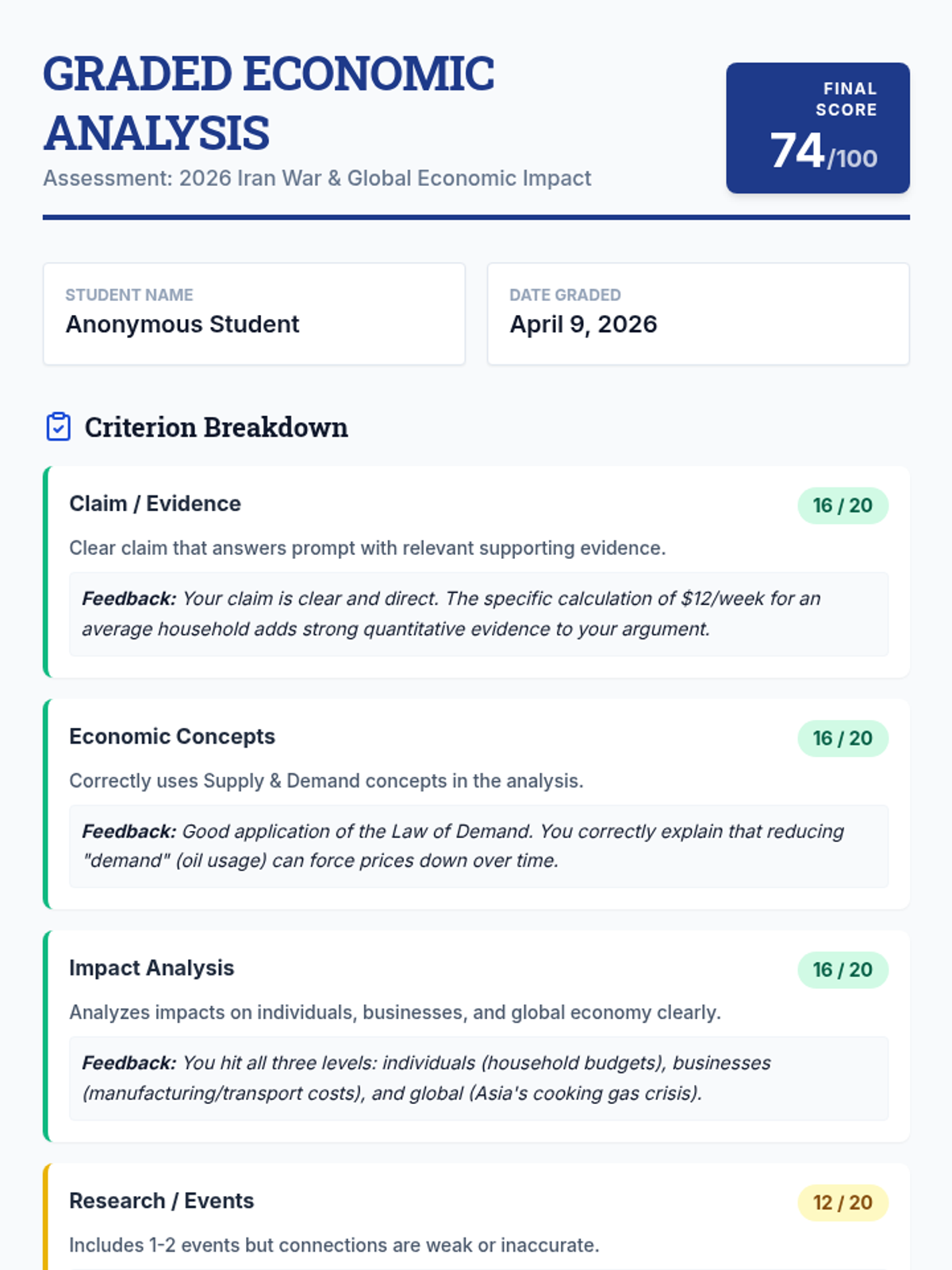
A detailed grading report for a student essay on the 2026 oil crisis. It includes a numeric breakdown based on the provided rubric and specific, student-friendly feedback on areas for improvement.
A detailed grade report based on the Energy Crisis Rubric, featuring a breakdown of scores and clear, constructive feedback for the student's essay.
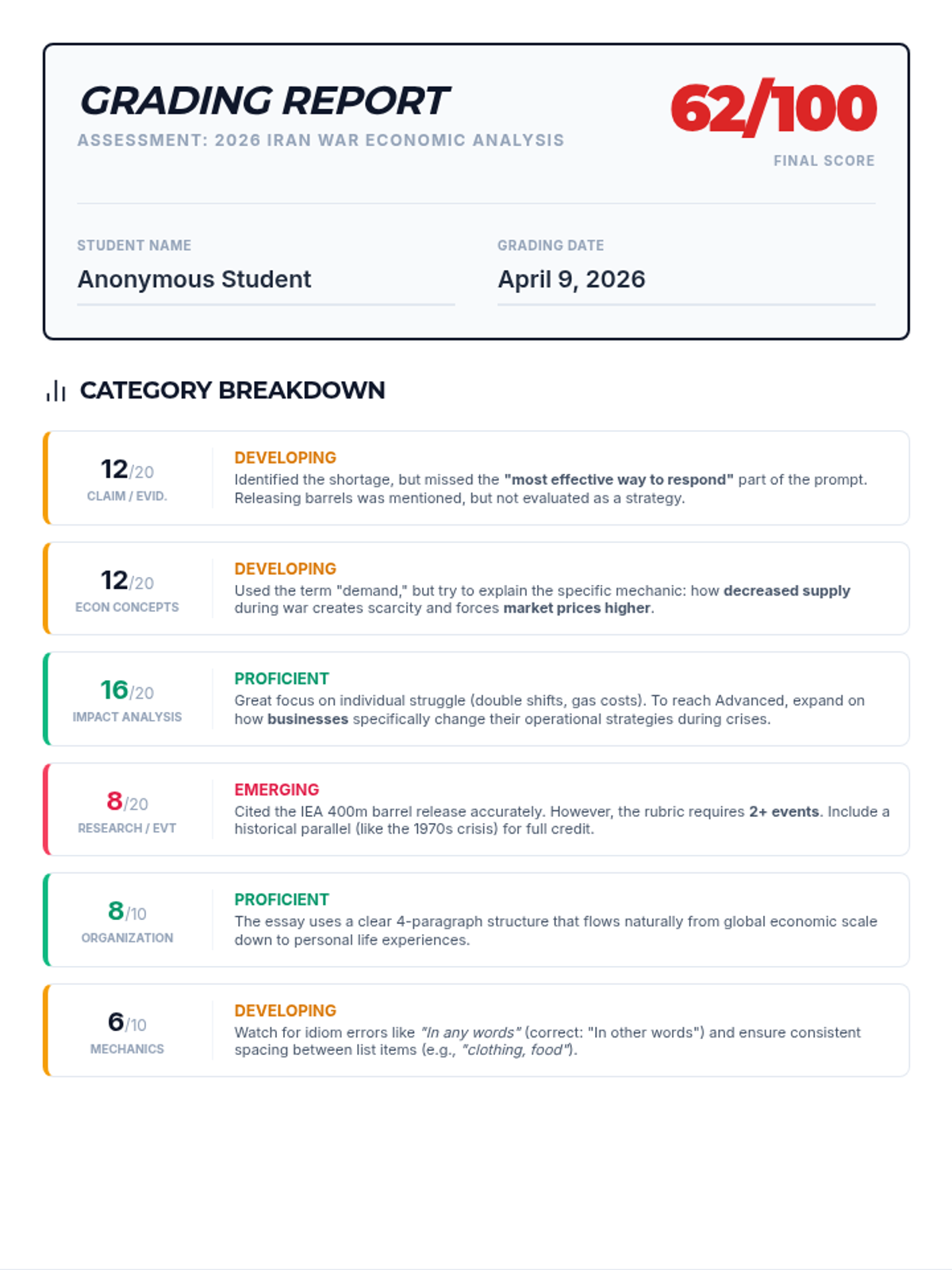
A comprehensive grading report for an essay on the economic impact of the 2026 Iran War oil shortage. It includes score breakdowns by rubric category and actionable feedback for the student.
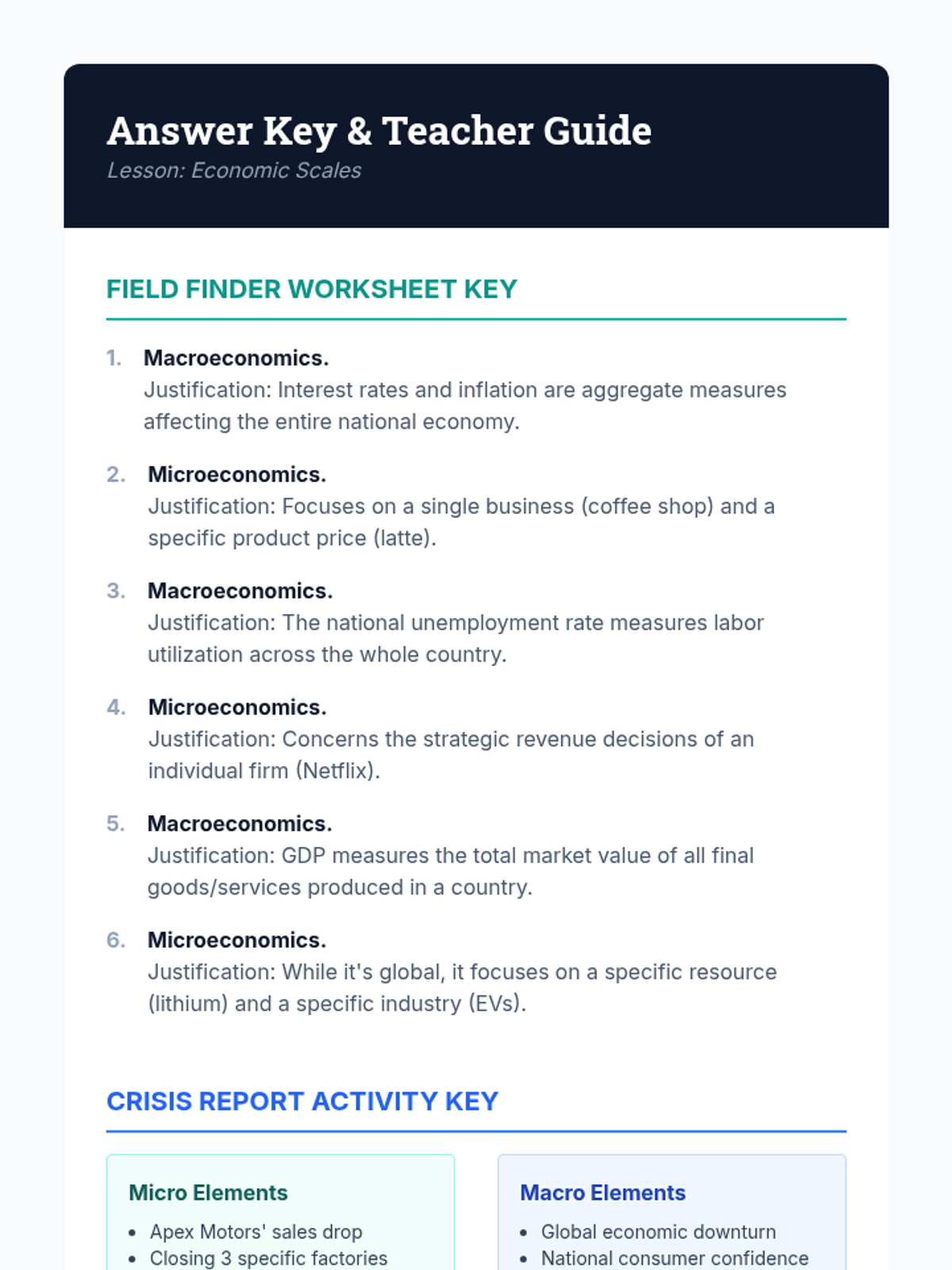
Teacher guide and answer key for the Economic Scales lesson, including worksheet solutions, discussion prompts, and a timed instructional sequence.
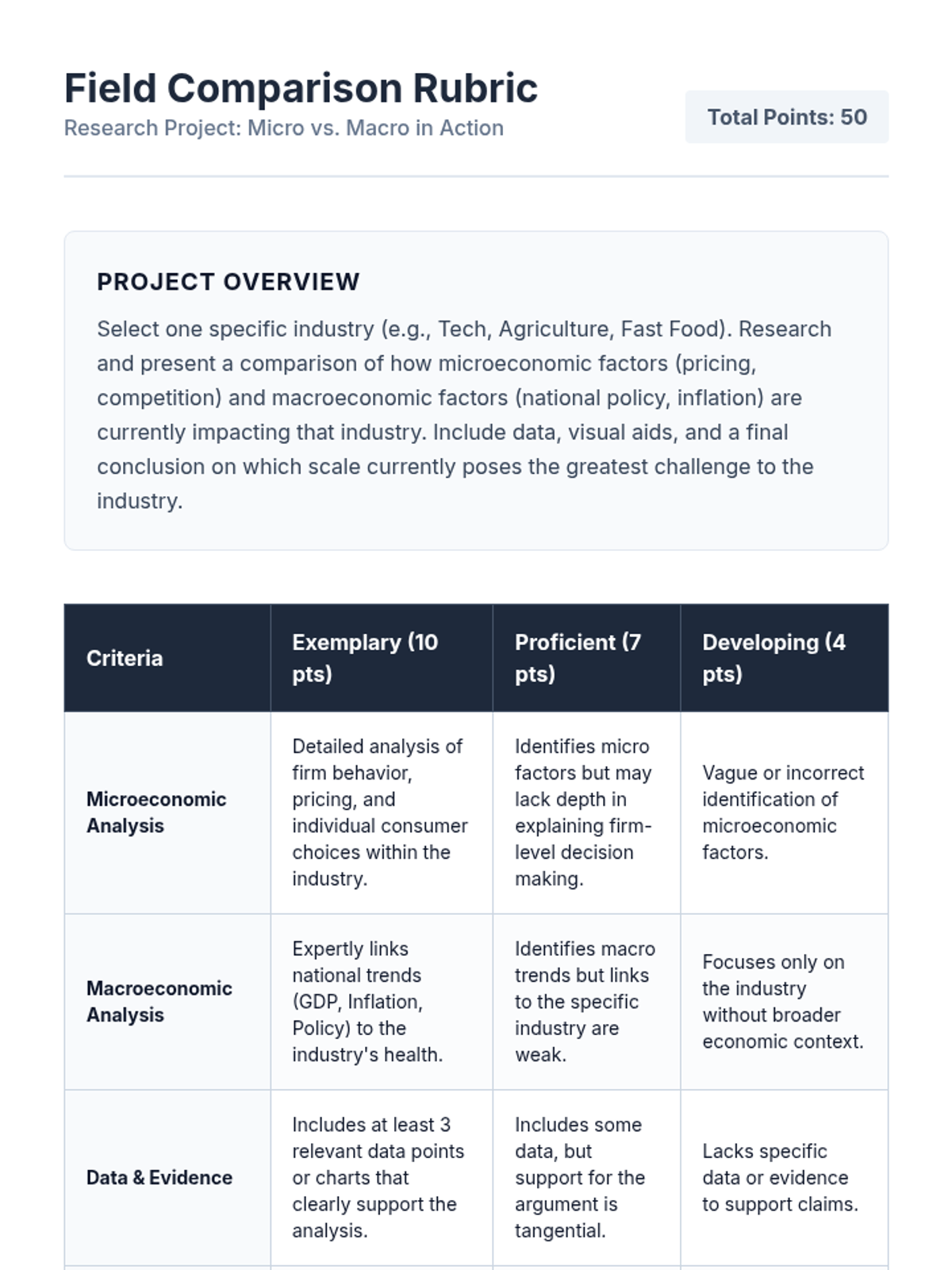
Assessment rubric for a research project where students compare micro and macro economic factors affecting a specific industry.
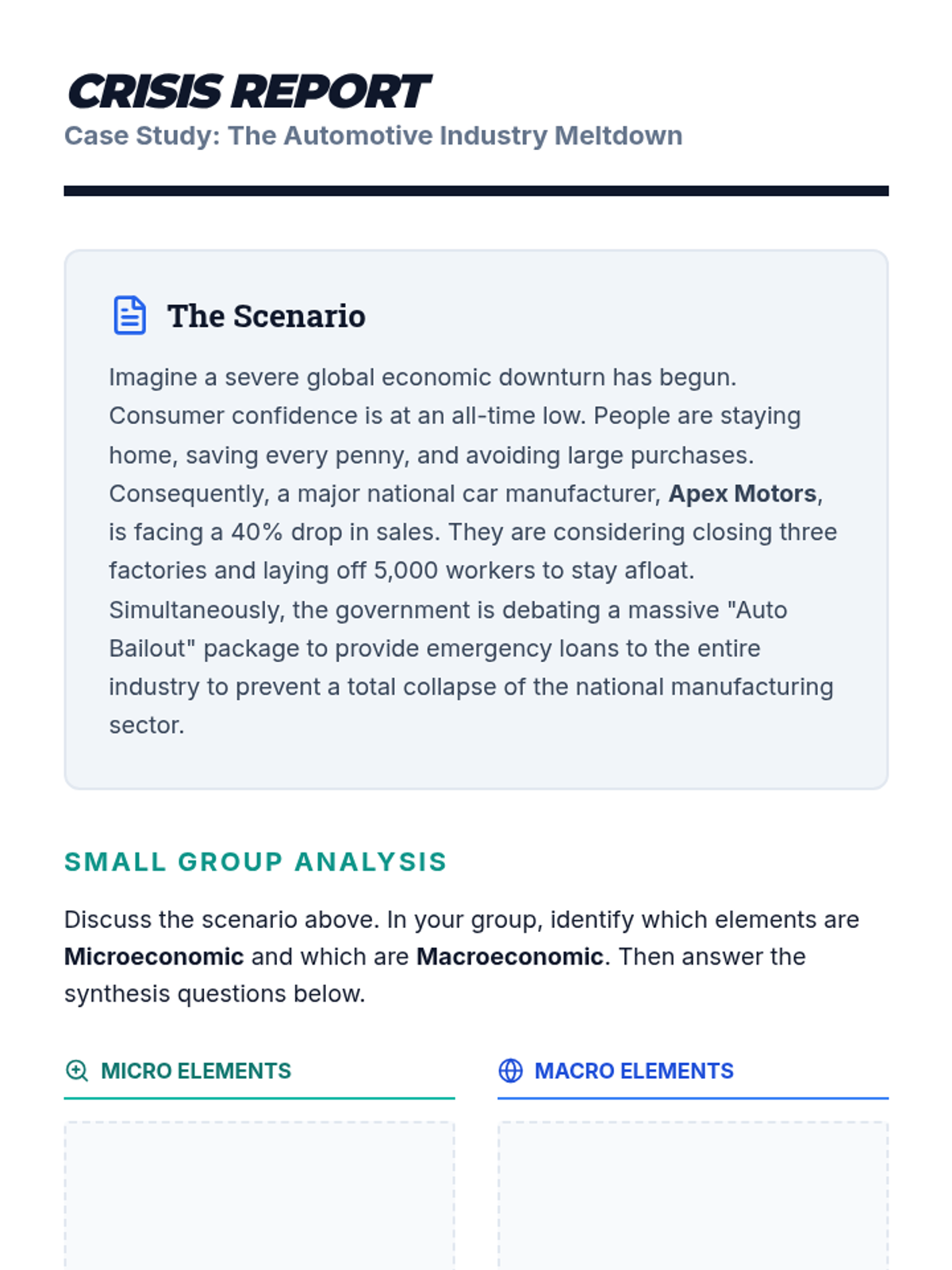
Group activity involving a case study of an automotive industry crisis, requiring students to isolate micro and macro variables and analyze their interaction.
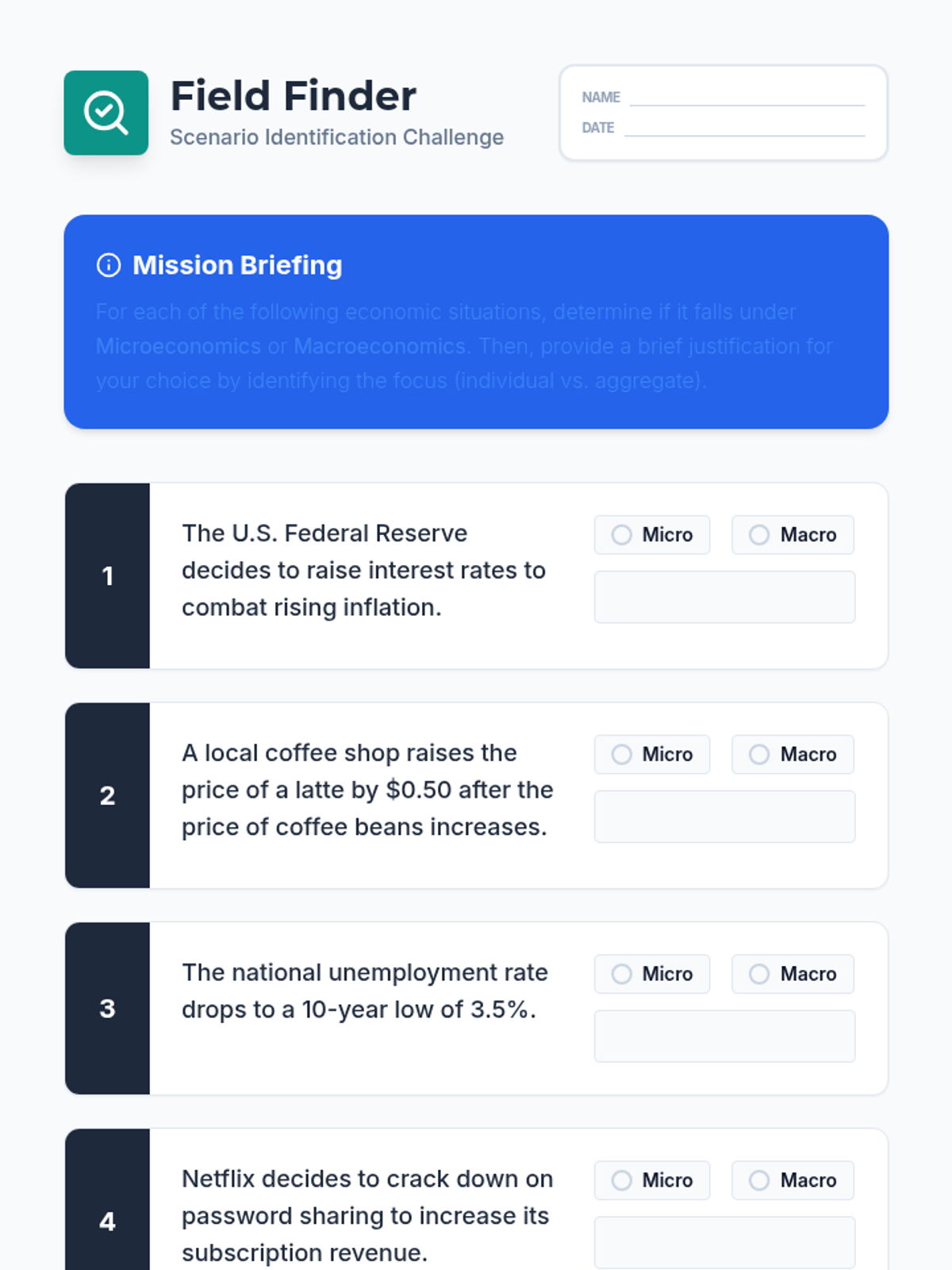
Worksheet with six real-world scenarios for students to categorize as microeconomics or macroeconomics, with space for justification.
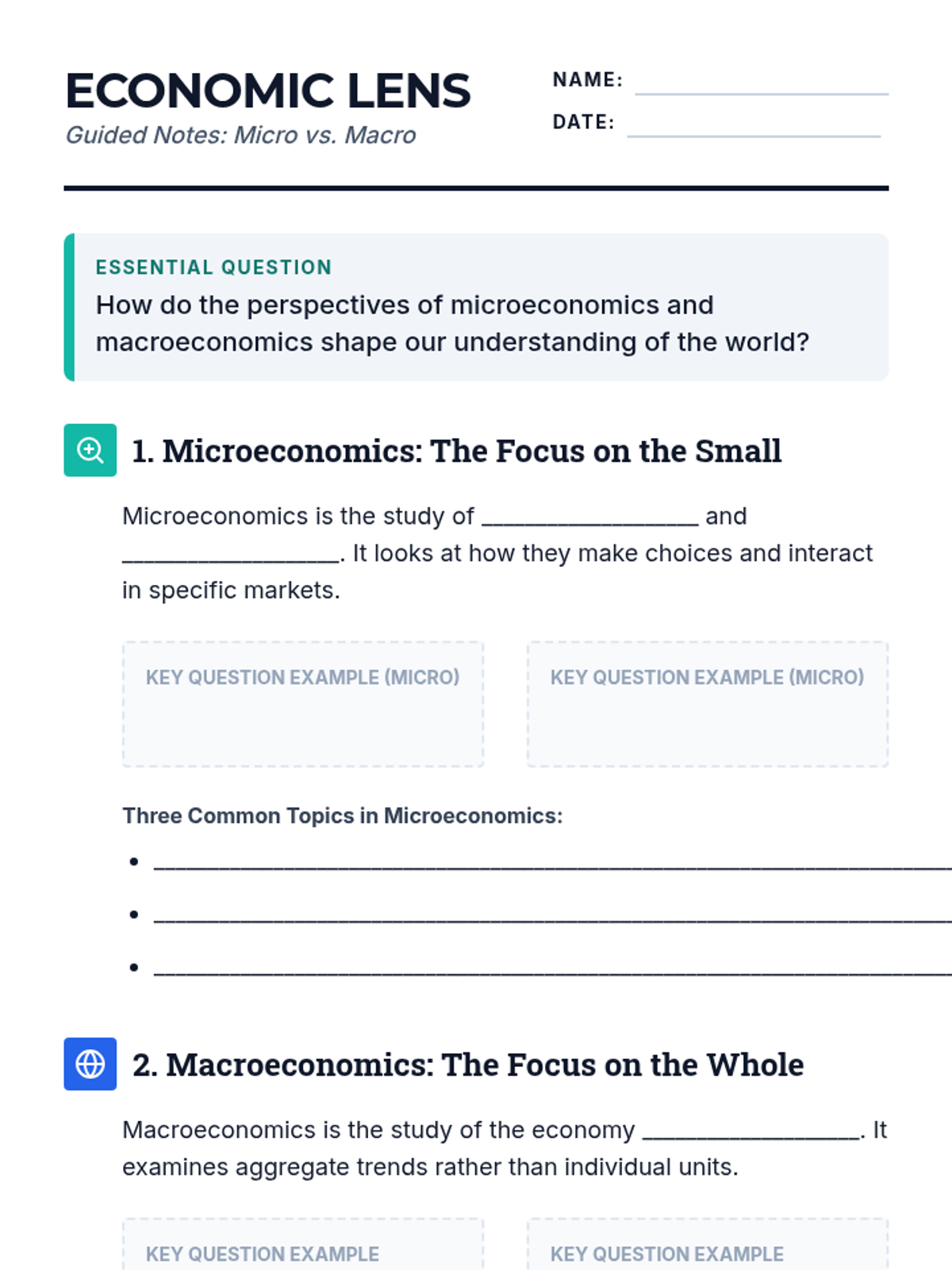
Guided notes handout for students to complete during the 'Scale Shift' presentation, covering definitions, metaphors, and the relationship between micro and macro economics.
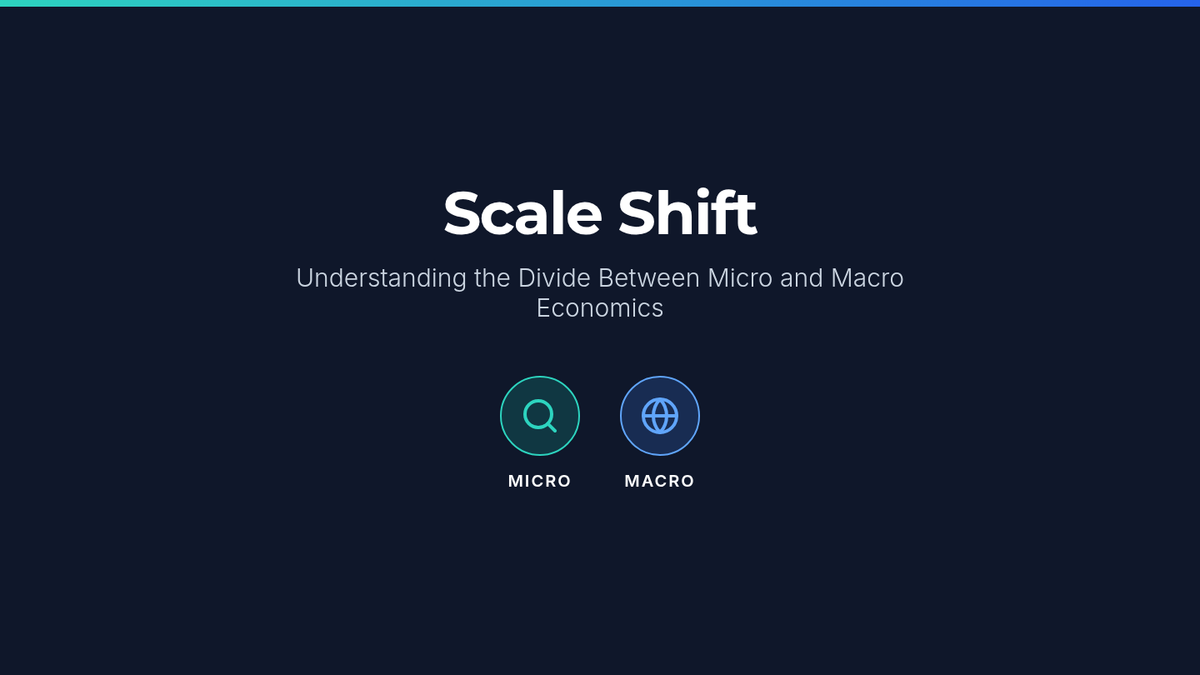
Visual presentation introducing the core differences between microeconomics and macroeconomics, using the 'Lens of Perspective' and 'Forest vs Trees' metaphors.
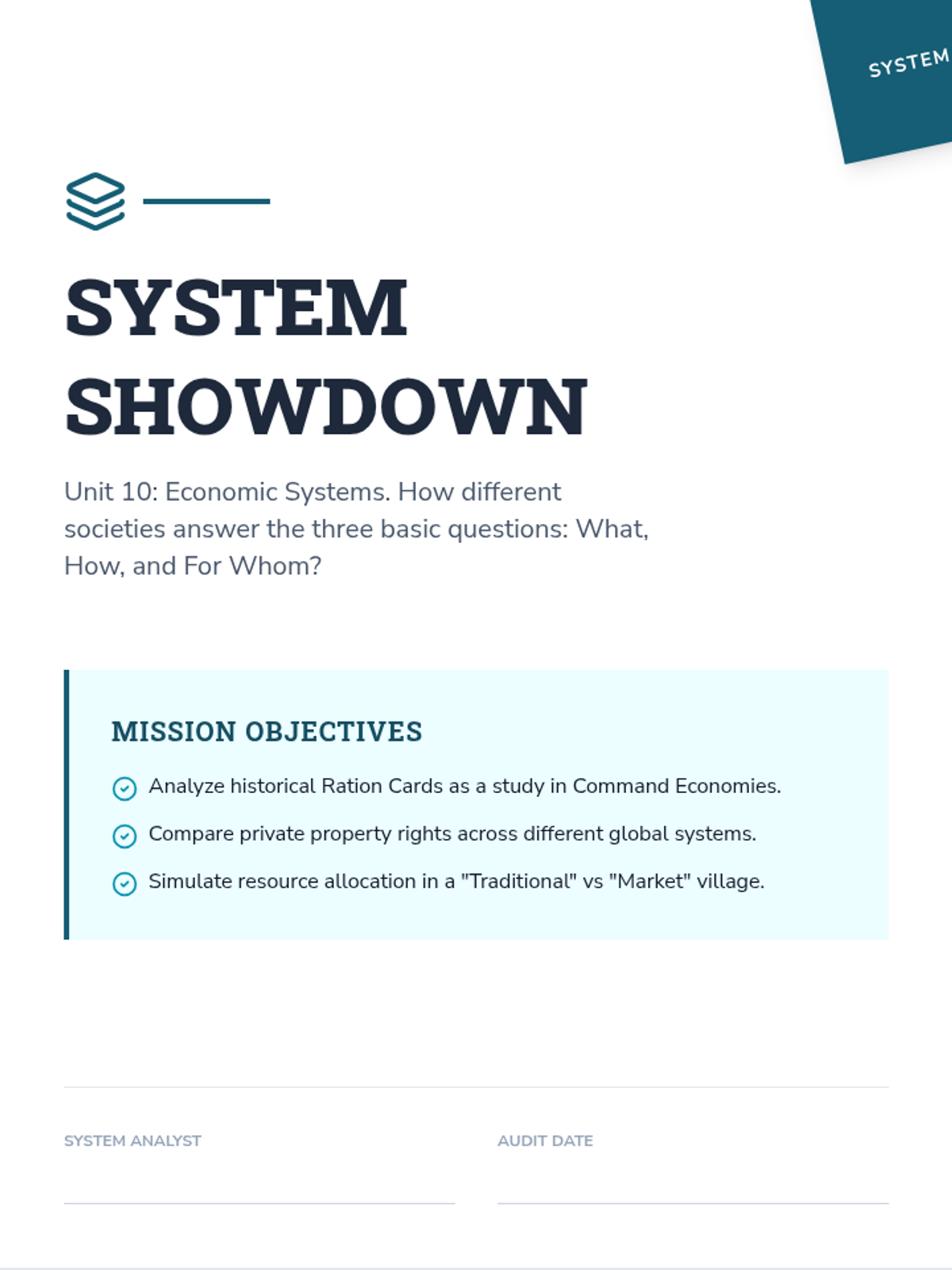
A 10-page scenario-based workbook on economic systems. Covers Command (WWII Ration Cards), Market, and Mixed economies. Features case studies on North vs. South Korea, Eminent Domain ethics, and the role of competition and monopolies.
A 10-page scenario-based workbook focusing on macroeconomics fundamentals. Features the 1923 Weimar hyperinflation case study, the ethics of GDP vs. Happiness, the Phillips Curve trade-off, and simulations for managing interest rates as a Central Bank Chair.
A 10-page scenario-based workbook on Supply and Demand. Covers the 1637 Tulip Mania bubble, the ethics of ticket scalping and bots, price floors (minimum wage), price ceilings (1970s gas crisis), and simulations of surge pricing and elasticity.
A 10-page scenario-based workbook focusing on basic economic principles like scarcity, opportunity cost, and incentives. Features the 1930s Dust Bowl case study, the "Cobra Effect" of perverse incentives, and simulations for resource allocation and marginal utility.
A 10-page scenario-based workbook on major purchases. Features the history of the GI Bill, the mechanics of amortization and equity, home buying simulations with closing costs, and the ethics of redlining and gentrification.
A 10-page scenario-based workbook on insurance. Features the history of the Great Fire of London, the mechanics of risk pooling, auto and health insurance simulations, and the ethics of genetic testing and pre-existing conditions.
A 10-page scenario-based workbook on consumer skills. Covers the history of food safety, the ethics of planned obsolescence, "Right to Repair" policy, and simulations for subscription cancellations and negotiation tactics.
A 10-page workbook on modern banking, covering fractional reserve systems, the Wildcat Banking era, overdraft ethics, and liquidity management. Includes simulations for choosing bank accounts and managing transaction clearing times.
A 10-page workbook on the psychology and mechanics of financial decision-making. Features an analysis of the 2008 Financial Crisis, ethical debates on credit scores, and simulations for car buying and educational ROI.
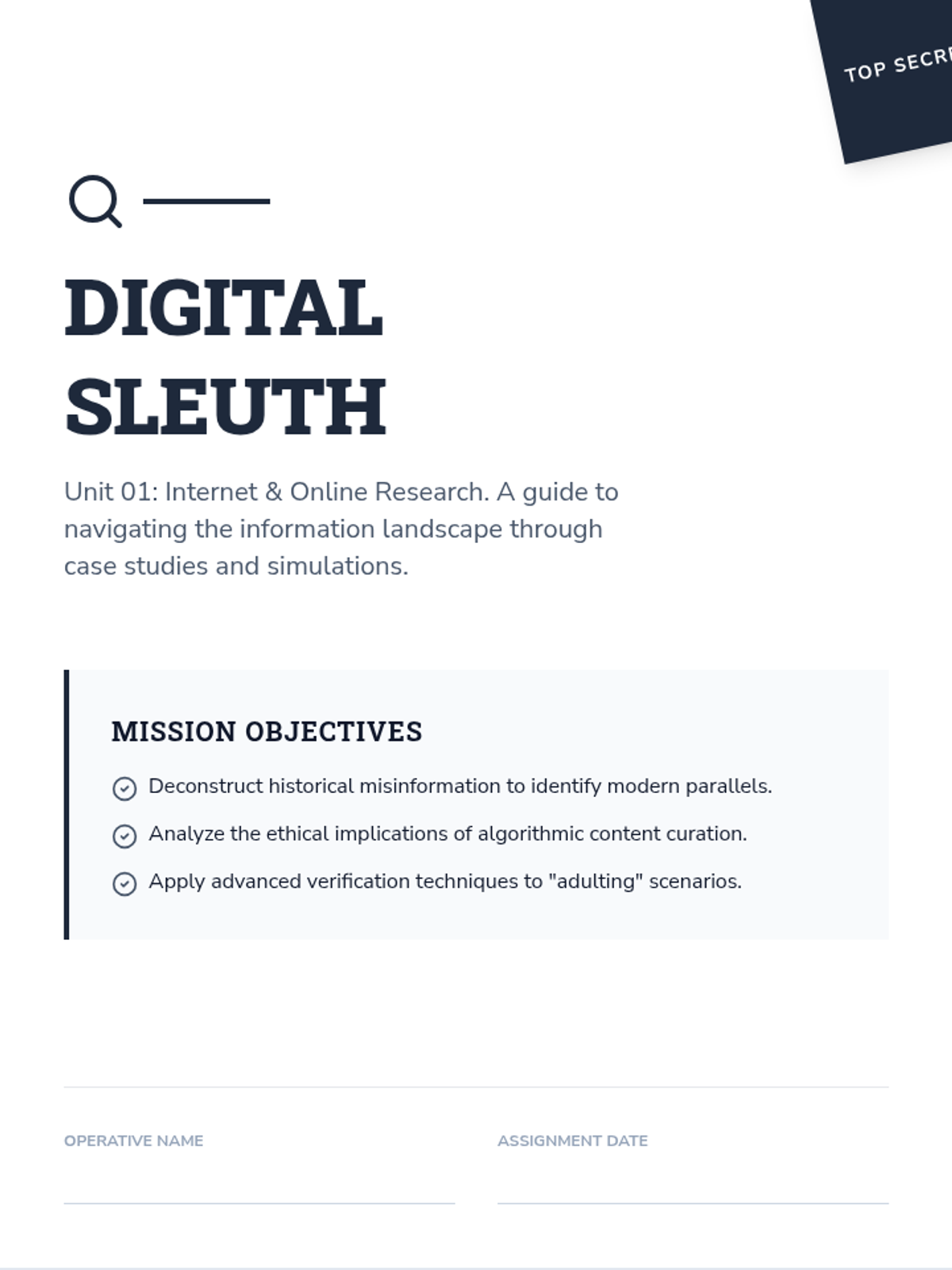
A 10-page scenario-based workbook focusing on digital literacy, source verification, and the ethics of algorithmic research. Includes historical case studies, policy analysis of Section 230, and simulations for apartment hunting and medical vetting.
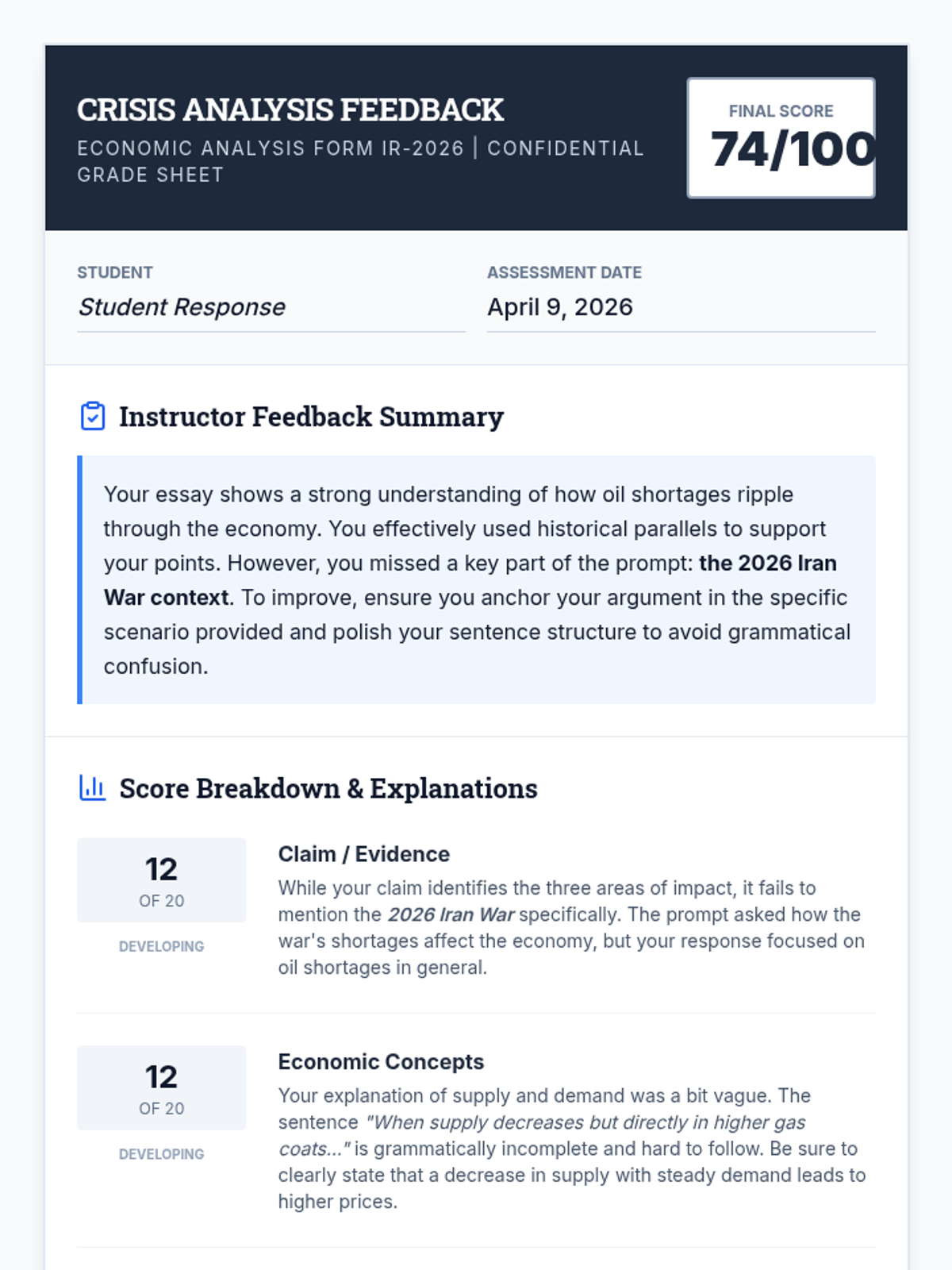
A comprehensive feedback report for an essay on the 2026 Iran War energy crisis, providing detailed scoring and constructive feedback based on a specific economic rubric.
A student-facing feedback report explaining the specific reasons for a lower score on the energy crisis essay, including tips for consolidation and historical context.
A graded rubric for an economics essay on the 2026 energy crisis, featuring specific scoring across six criteria and instructor feedback.
A detailed grade report for the student essay, breaking down specific point deductions based on the Energy Crisis Rubric. It provides constructive feedback on how to improve content regarding historical context and economic theory.
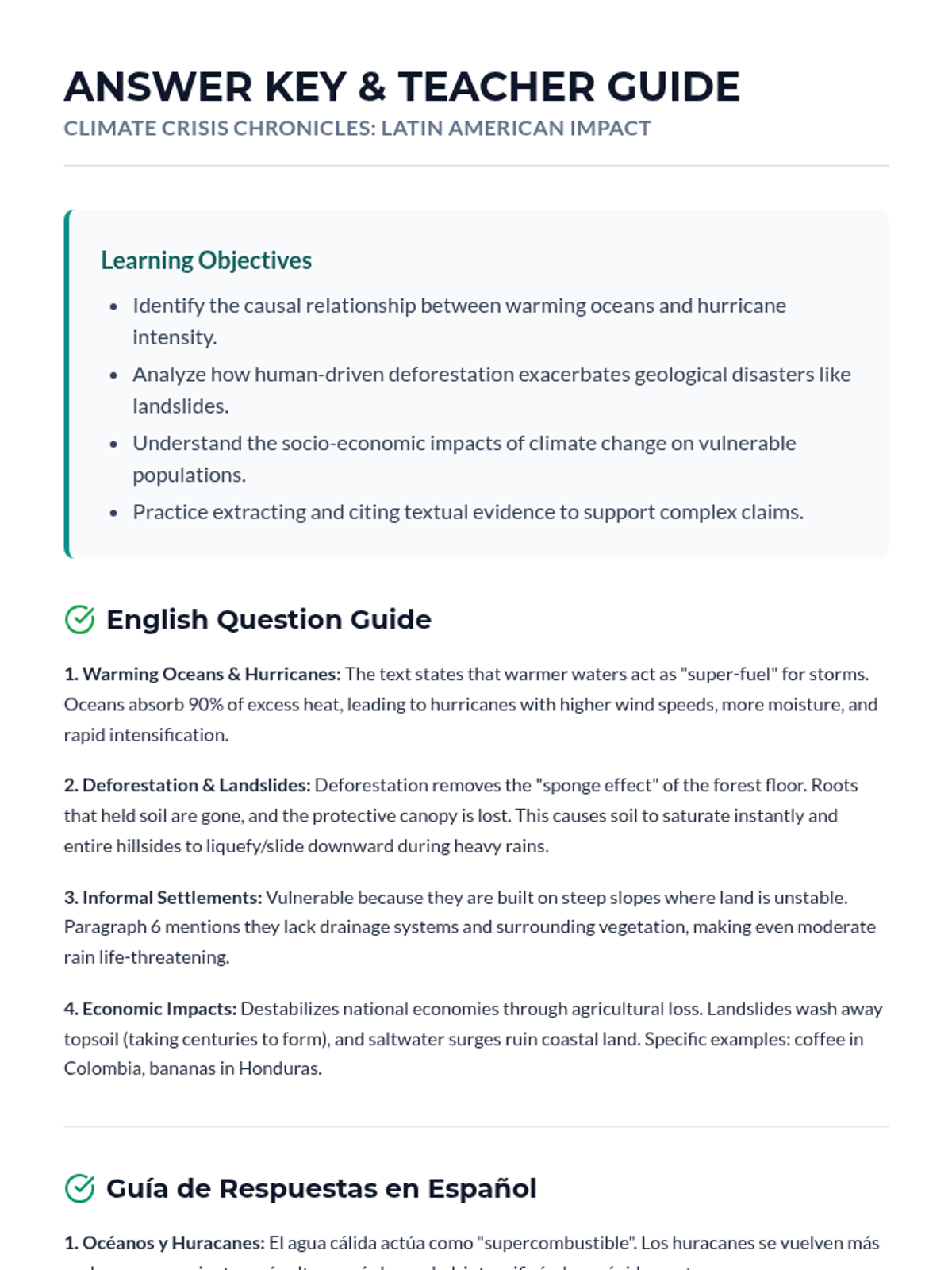
A comprehensive teacher answer key and instructional guide for both the English and Spanish versions of the Climate Crisis Report, featuring four evidence-based analysis questions.
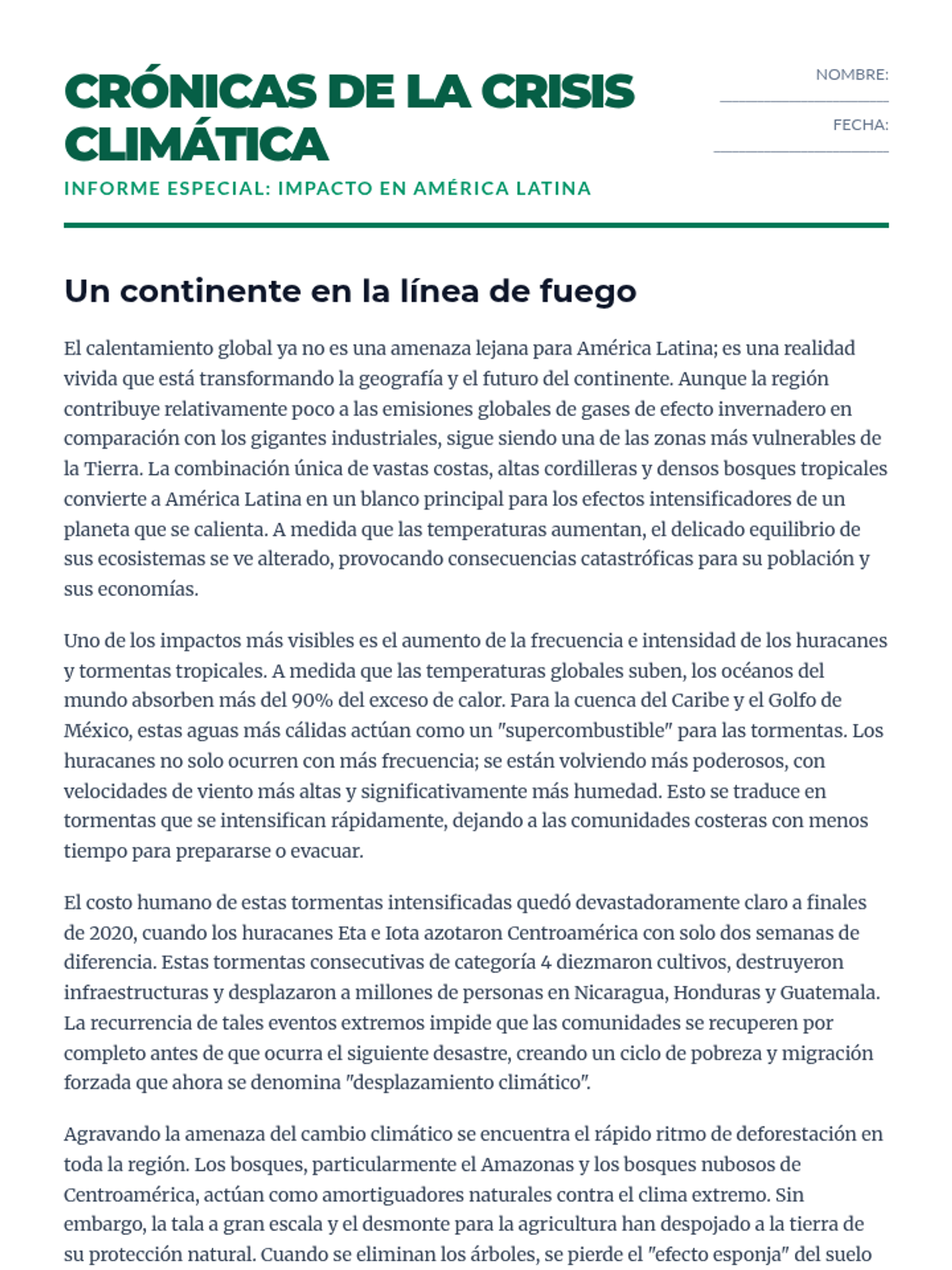
Versión en español del informe sobre el calentamiento global en América Latina, con 8 párrafos de lectura y cuatro preguntas de respuesta corta basadas en evidencia.
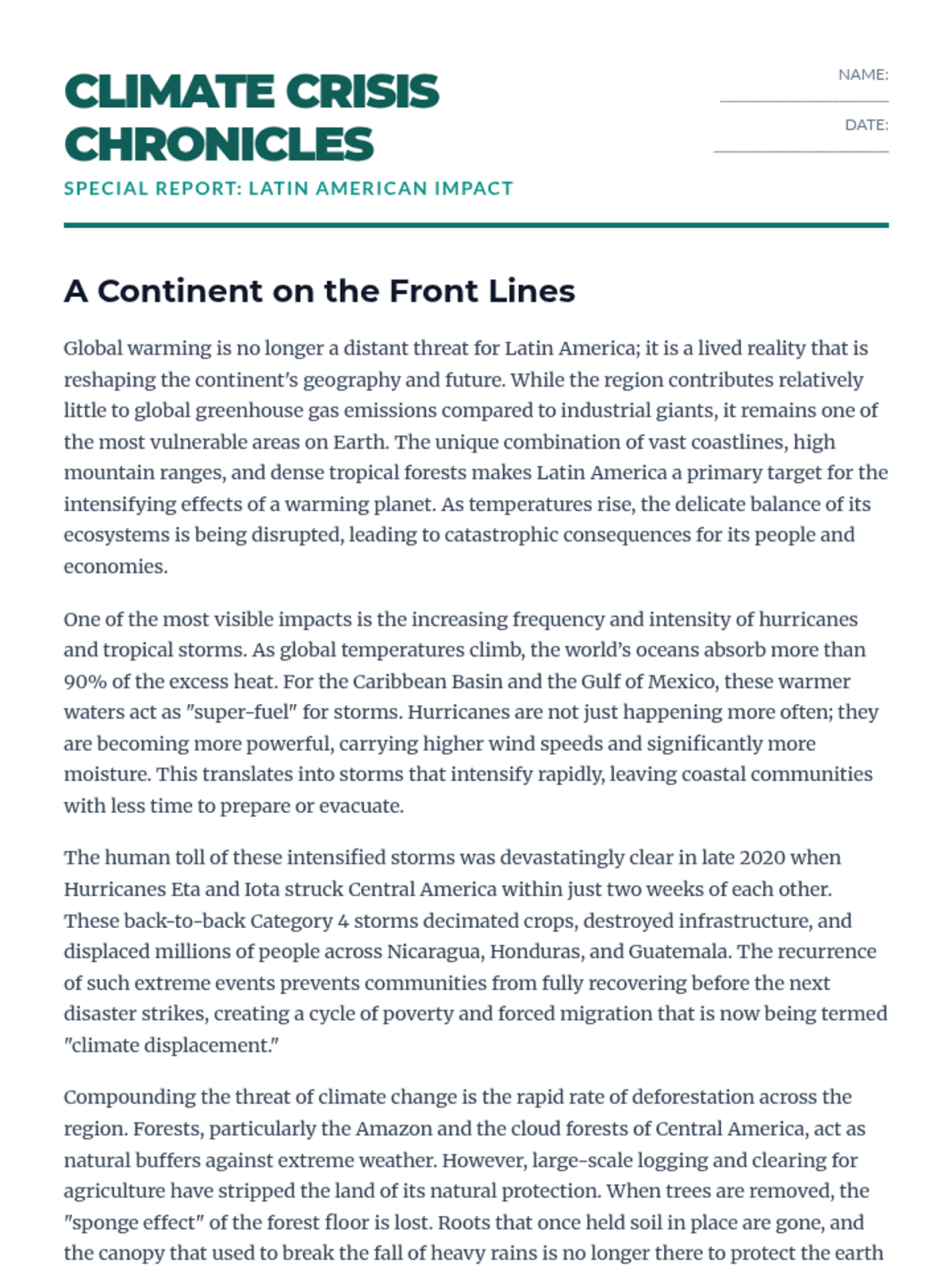
An 8-paragraph reading passage in English about global warming's impact on Latin America, focusing on hurricanes, deforestation, and landslides, followed by four evidence-based short answer questions.
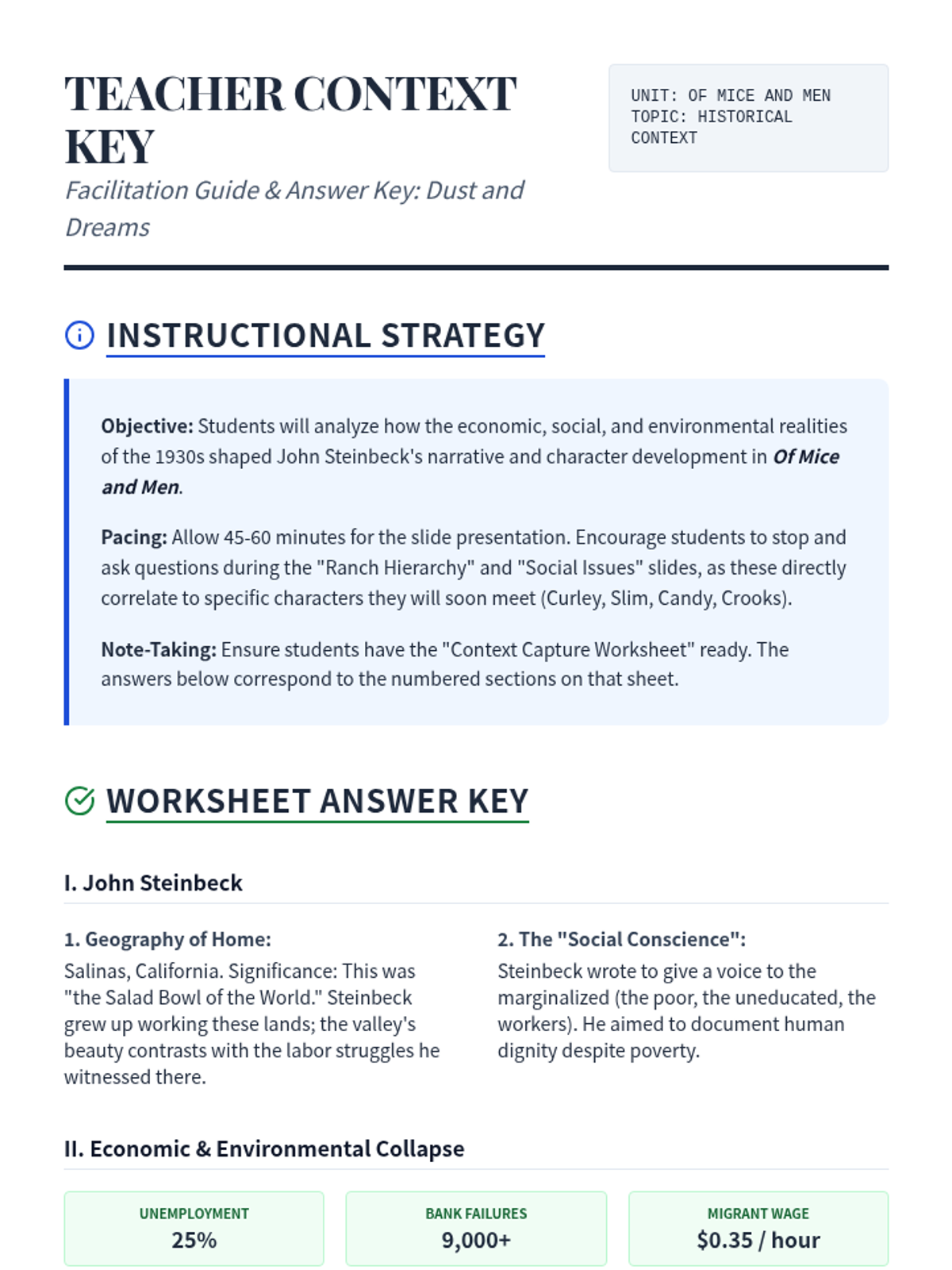
A facilitation guide and answer key for the "Dust and Dreams" lesson. It provides instructional strategies, pacing suggestions, and detailed answers for the Context Capture Worksheet.
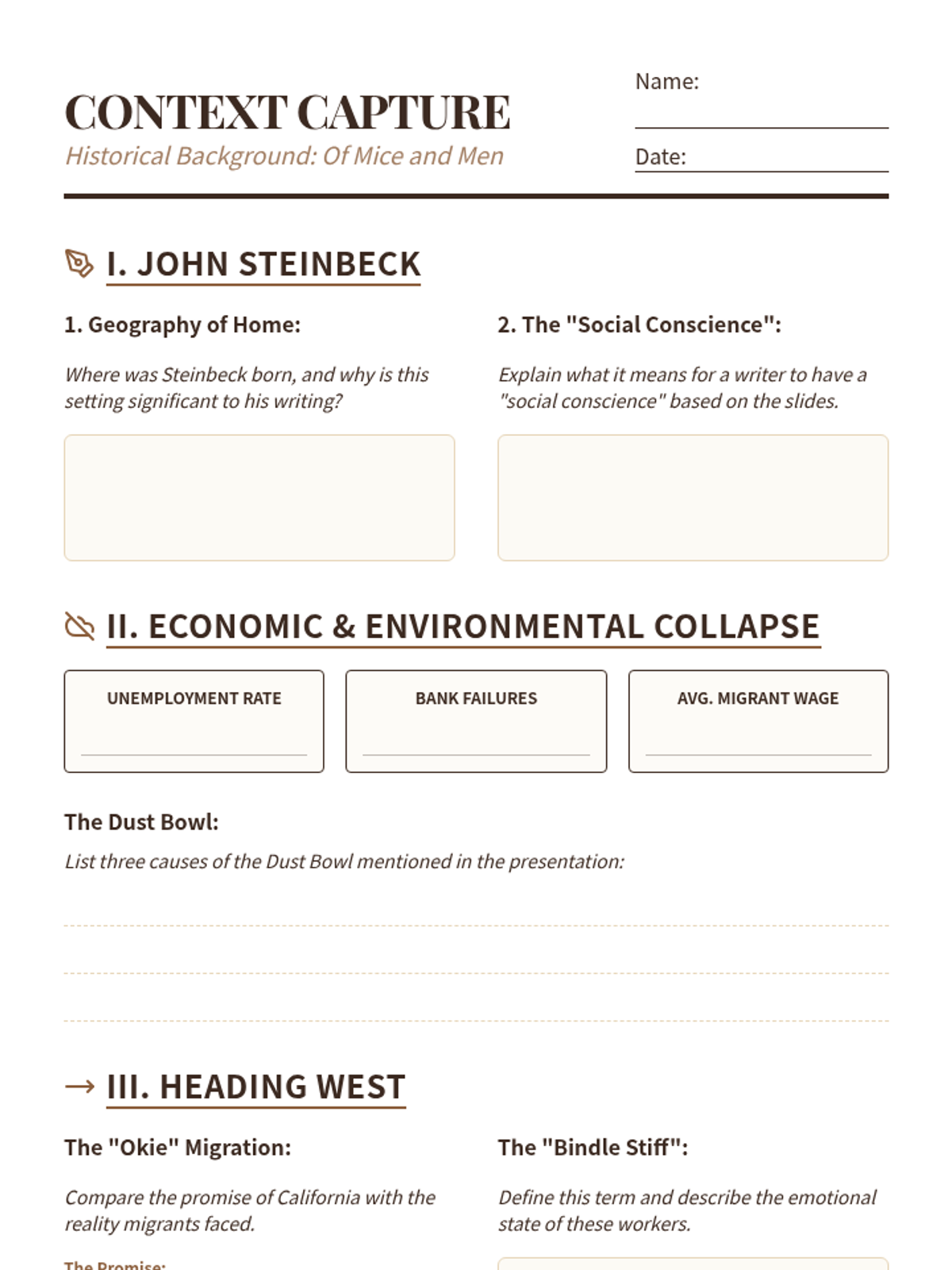
A guided notes worksheet for students to complete while viewing the context slides. It includes sections for biography, economic data, the migrant experience, and social analysis.
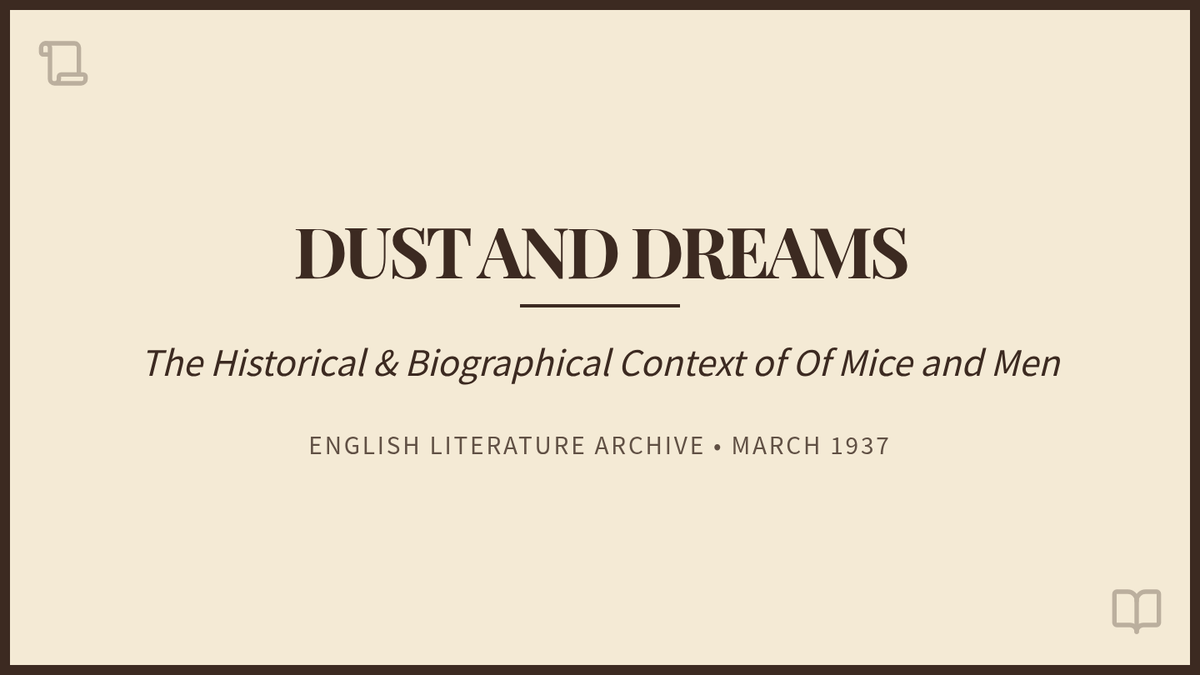
A 14-slide presentation covering the historical and biographical context of John Steinbeck's *Of Mice and Men*. It features detailed sections on the Great Depression, the Dust Bowl, migrant labor conditions, and Steinbeck's literary focus on marginalized groups. This version includes a historical photograph of John Steinbeck.
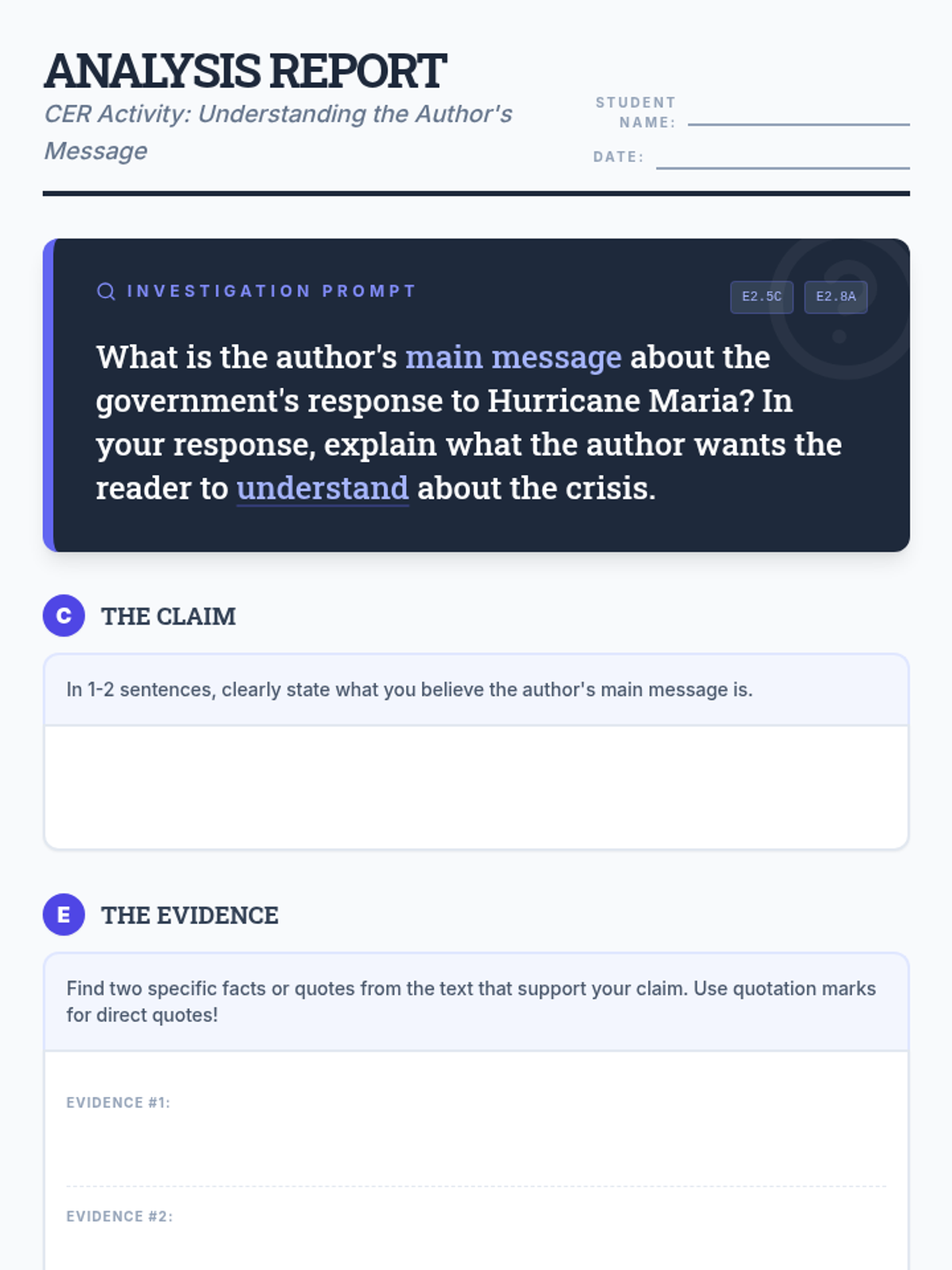
A Spanish-language version of the CER (Afirmación, Evidencia, Comentario) activity, analyzing the author's purpose and message in 'Estela de María'.
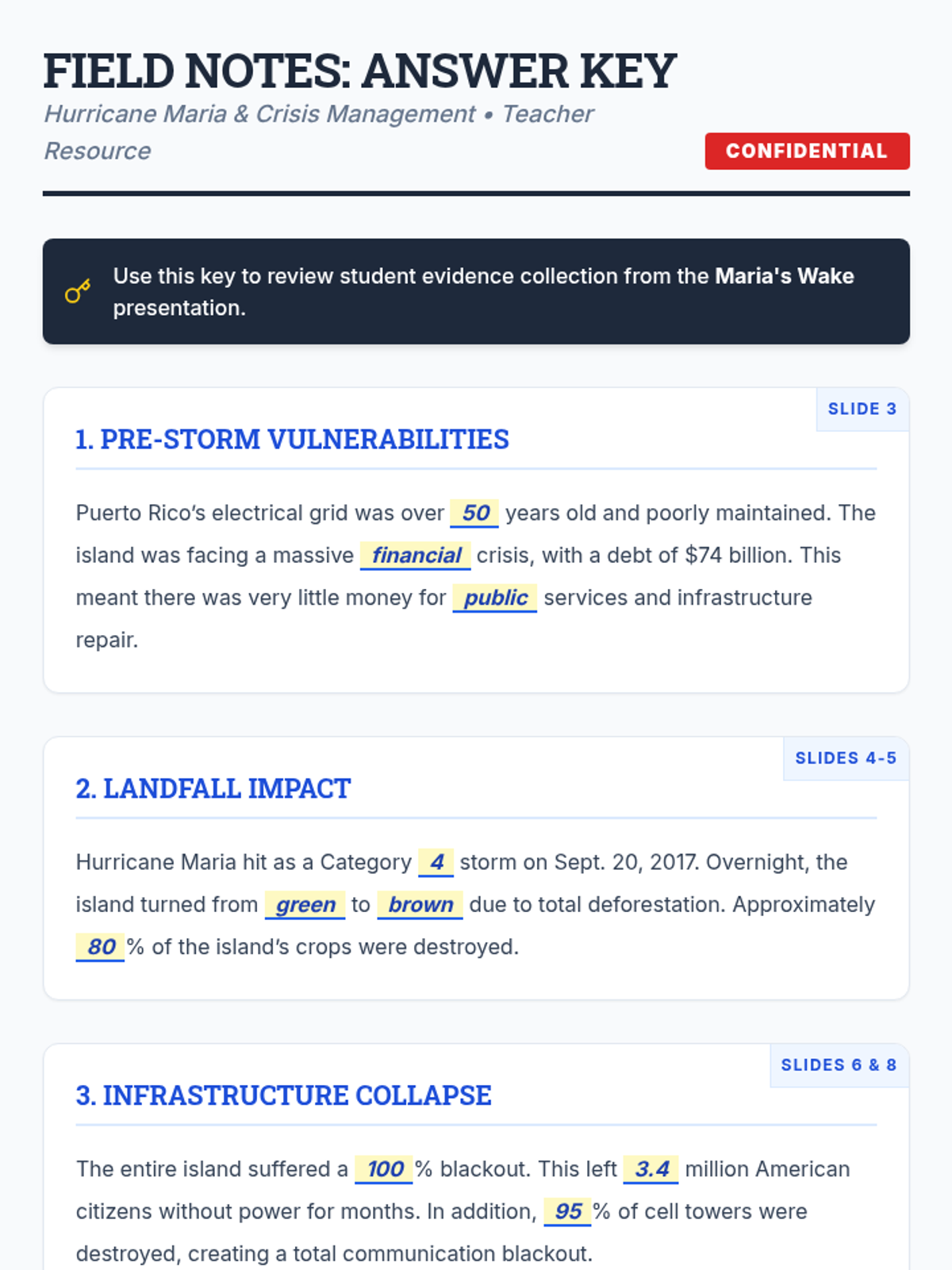
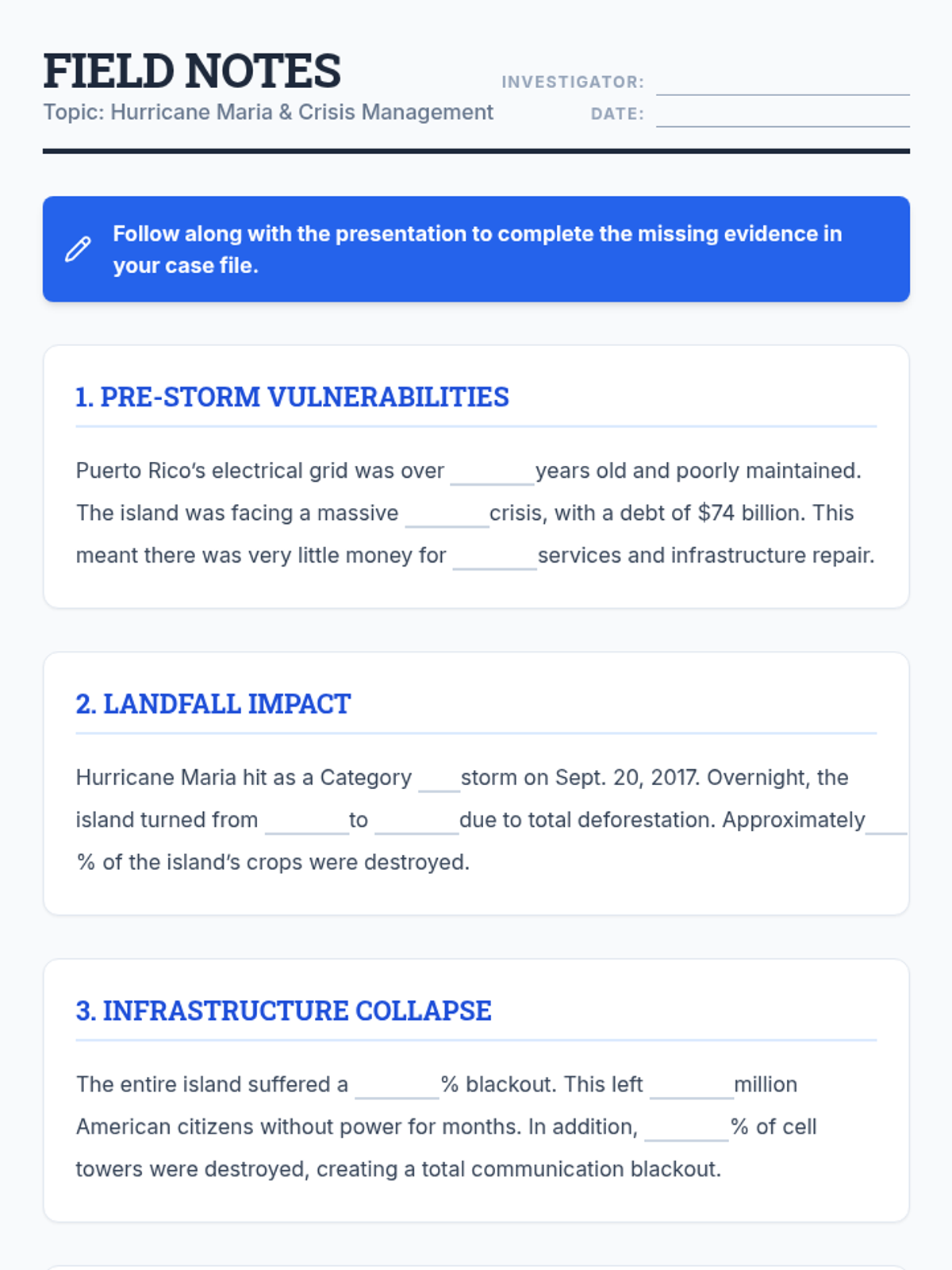
An answer key for the Hurricane Maria guided notes, providing the correct information for each blank based on the presentation slides.
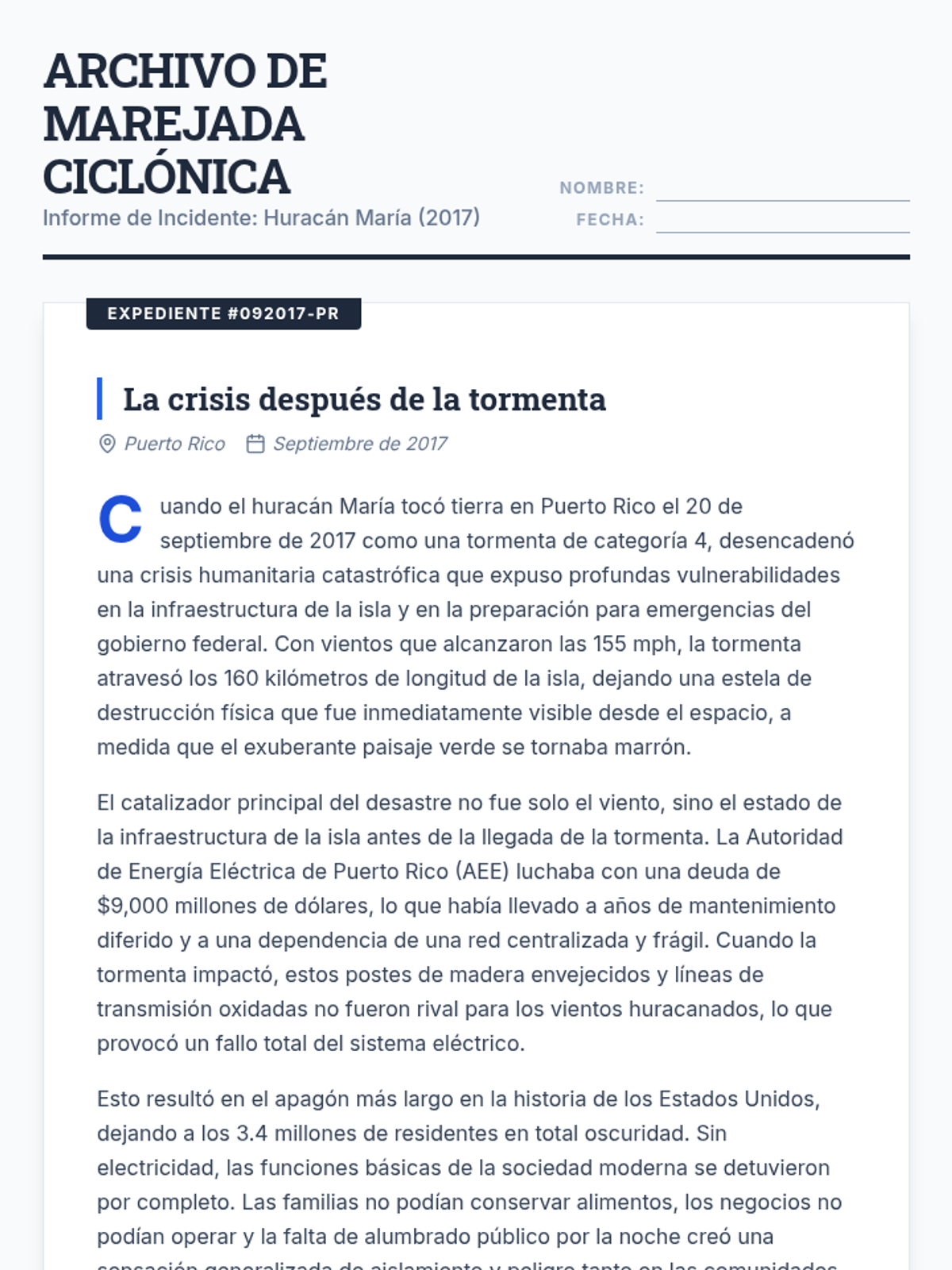
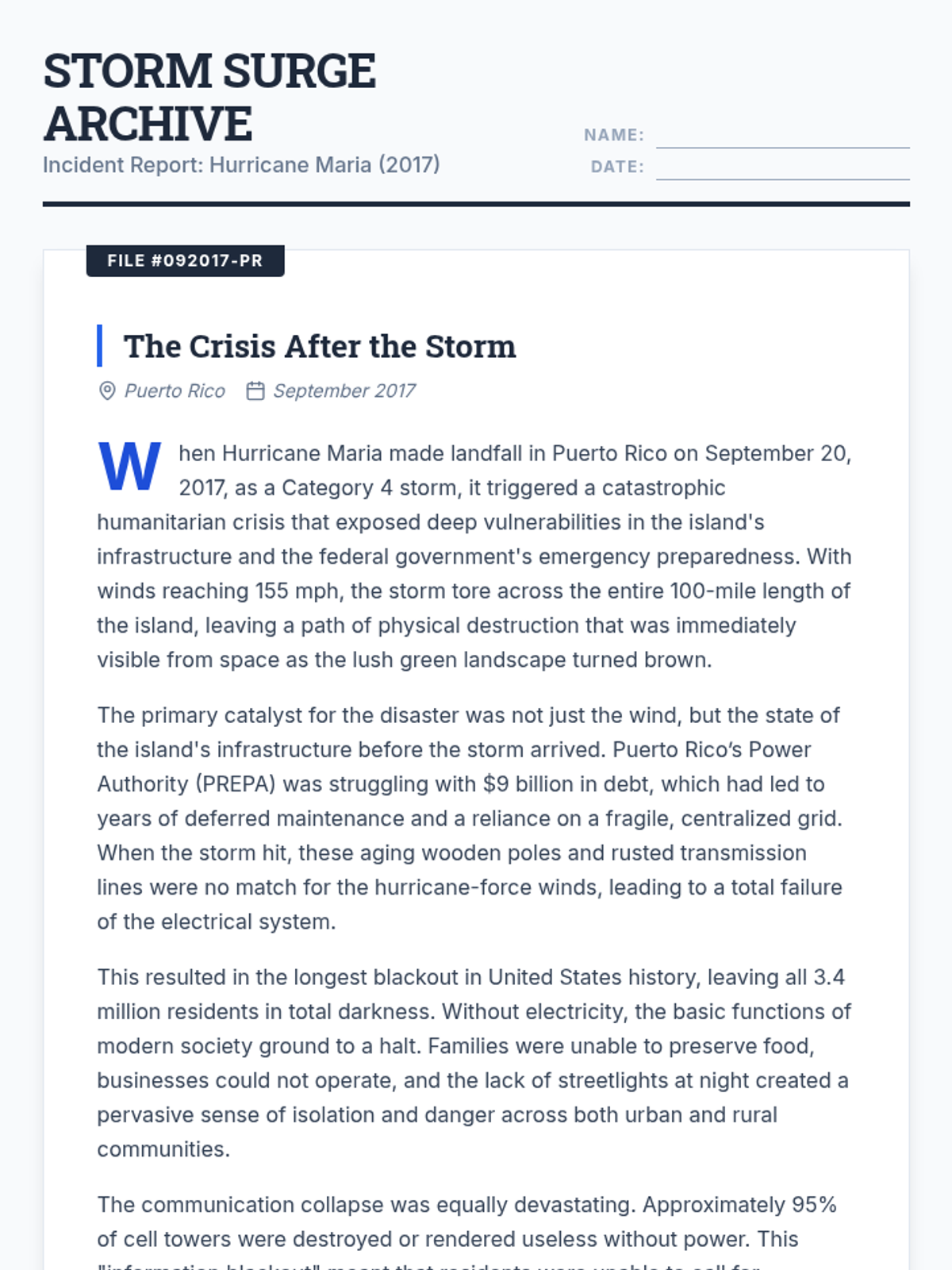
A Spanish-language version of the Hurricane Maria reading passage, exploring the humanitarian crisis and infrastructure collapse in Puerto Rico with a professional archival aesthetic.
A simplified CER activity sheet aligned with E2.5C and E2.8A, featuring a clearer prompt, more scaffolding, and helpful sentence starters for students.
Guided notes for students to complete while watching the presentation on Hurricane Maria, using a "field notes" aesthetic to match the lesson theme.
A 15-slide presentation exploring Hurricane Maria's impact on Puerto Rico, the power grid failure, the humanitarian crisis, and the complexities of the government response.
A comprehensive 10-paragraph reading passage exploring the humanitarian crisis, infrastructure collapse, and government response following Hurricane Maria in Puerto Rico.
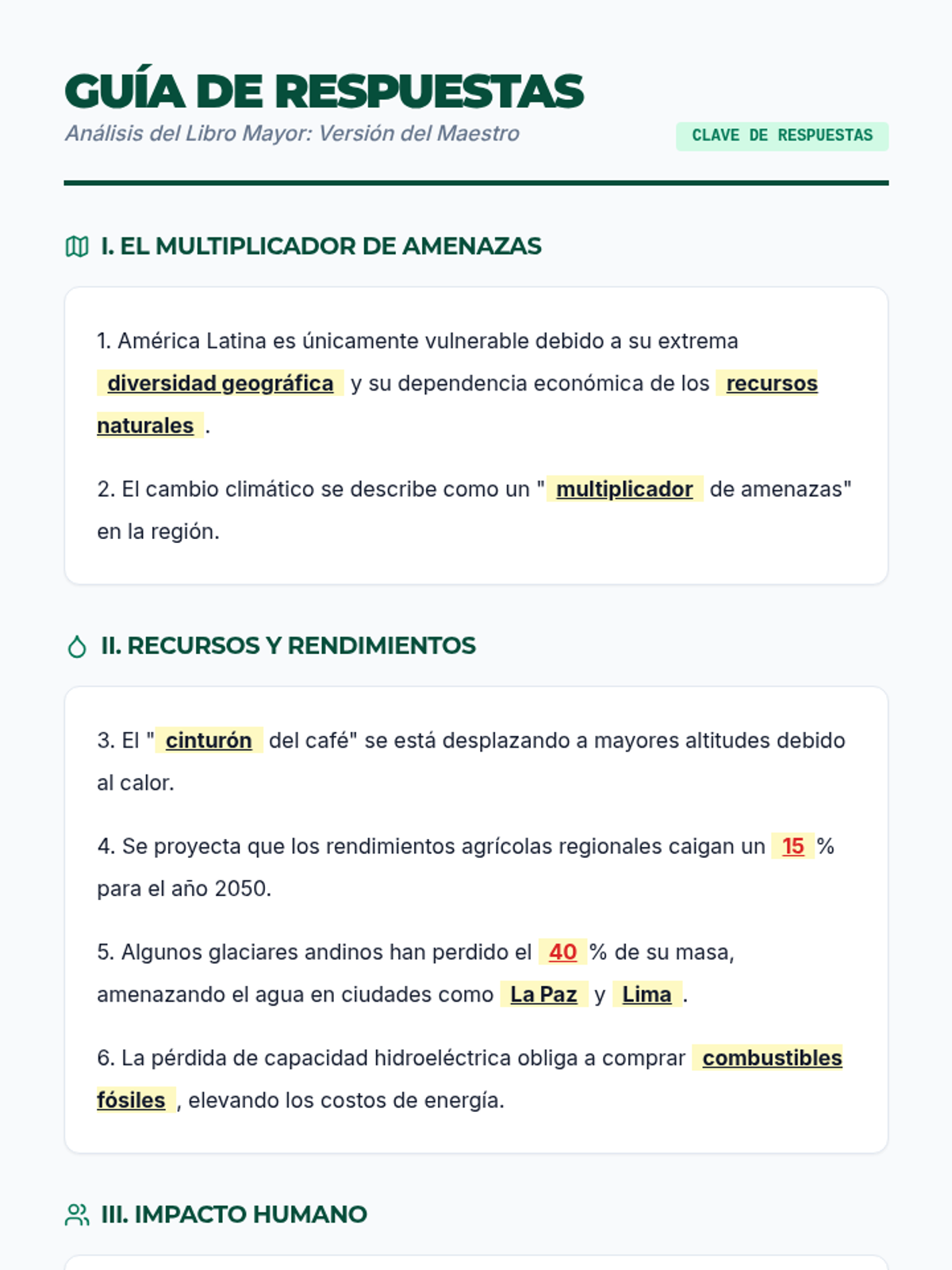
Guía de respuestas en español para las notas guiadas del Libro Mayor Latinoamericano, alineada con la presentación de 10 diapositivas.
Versión en español de las notas guiadas para acompañar la presentación del Libro Mayor Latinoamericano, con espacios para completar estadísticas y conceptos clave.
Versión en español de la presentación de 10 diapositivas sobre las consecuencias económicas y sociales del calentamiento global en América Latina.
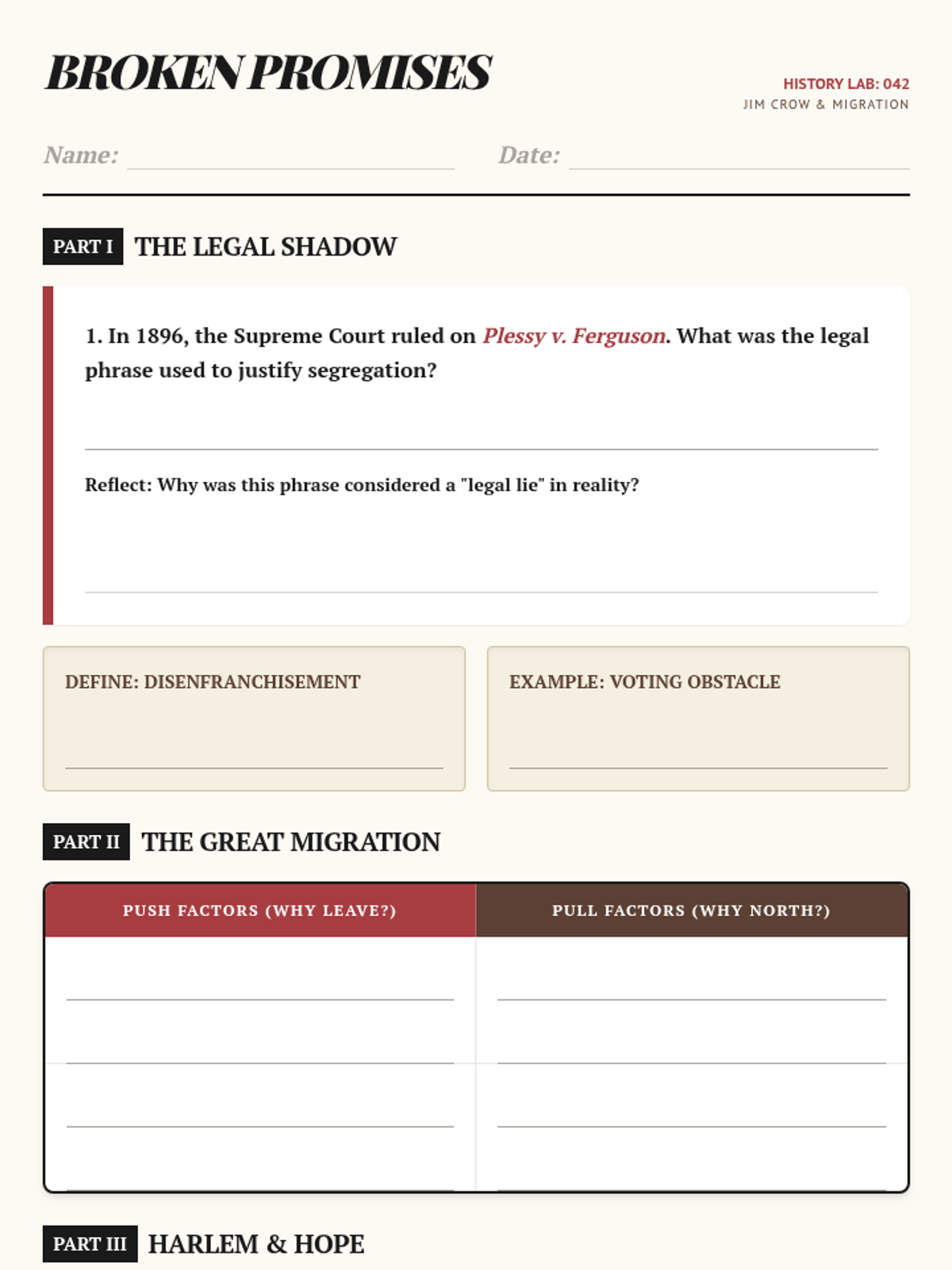
A student worksheet designed to accompany the "Shadows of the South" lesson, featuring note-taking sections on Jim Crow laws and a push/pull factor analysis of the Great Migration.