Fundamental notation, instrumental proficiency, and vocal techniques across various genres. Connects historical analysis with original composition and creative performance skills.
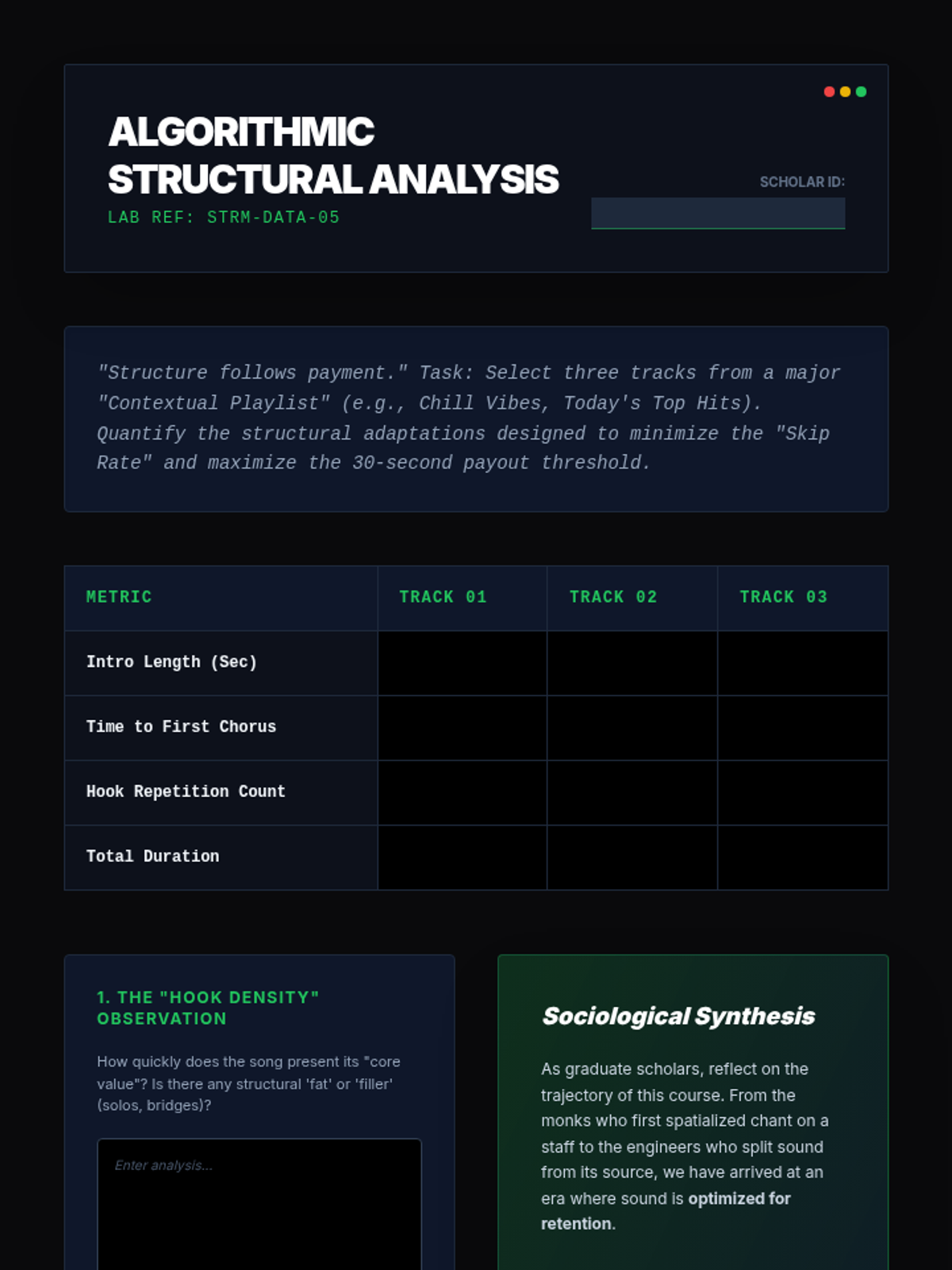
A student worksheet for analyzing song structure and hook density in top-charting streaming tracks to understand algorithmic influence.
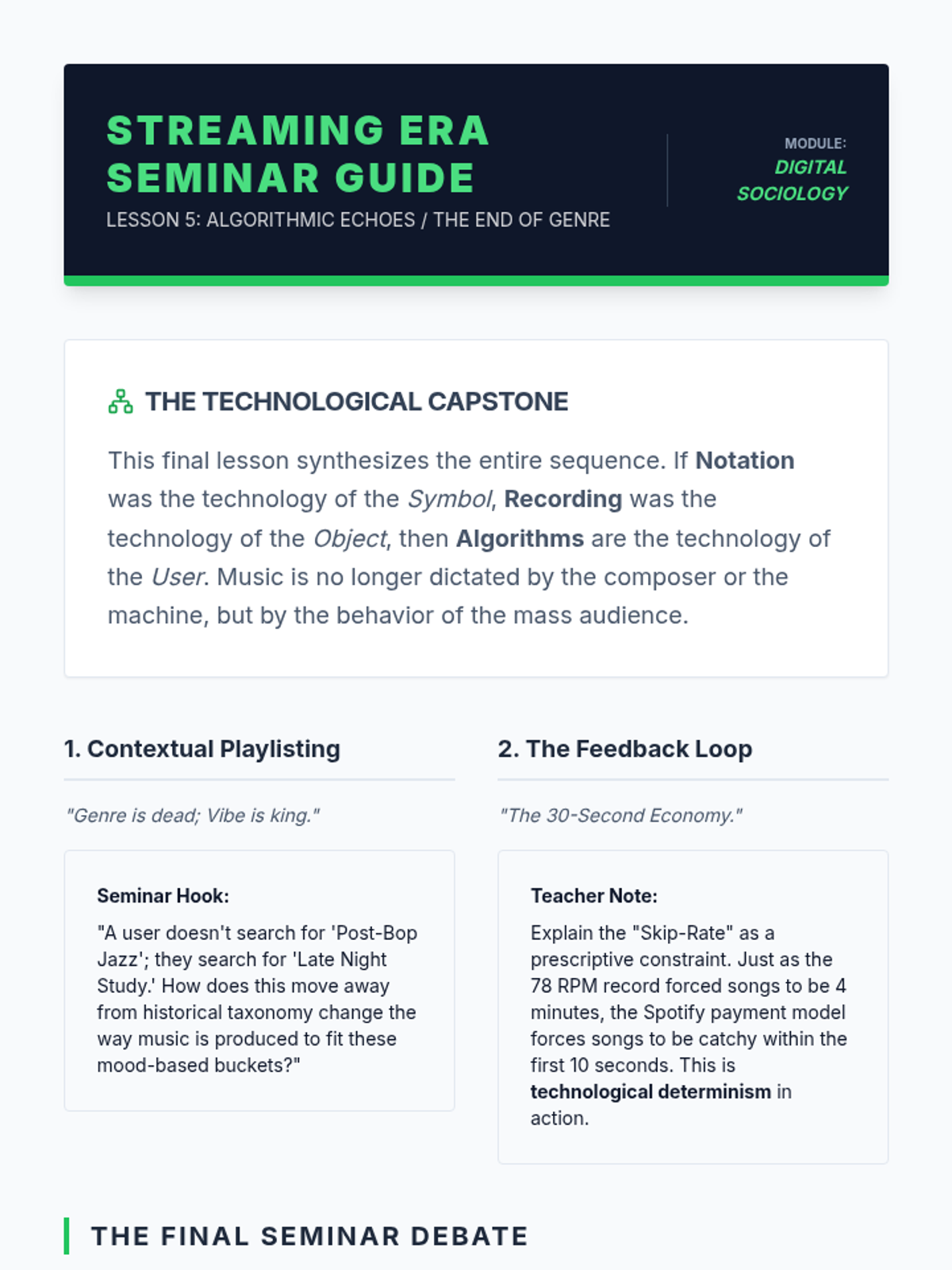
A facilitation guide for the "Algorithmic Echoes" lesson, focusing on the sociology of streaming, metadata, and the predictive future of music.
A slide deck for graduate students analyzing the impact of streaming algorithms and metadata on modern song structure and musical sociology.
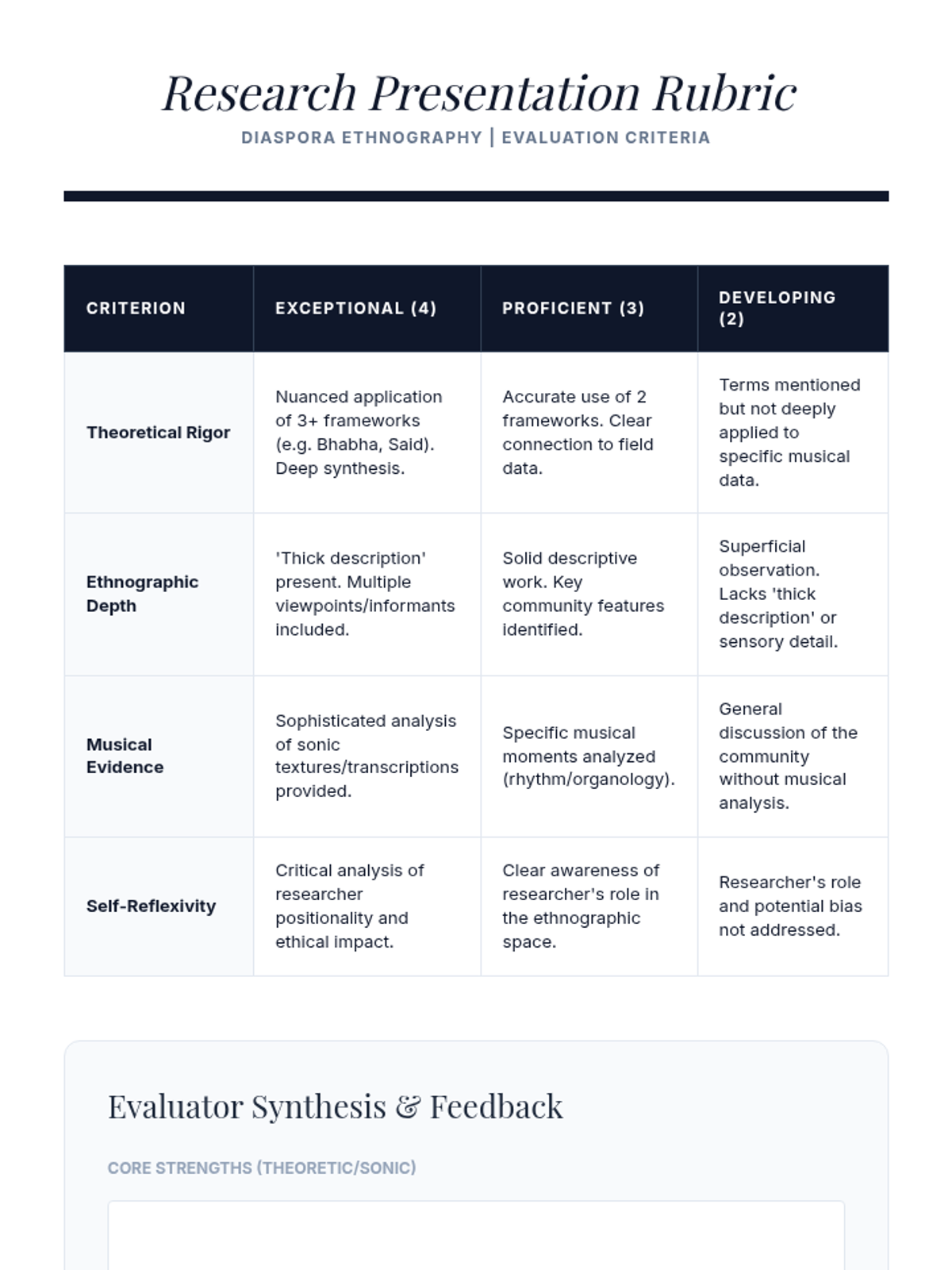
A graduate-level rubric for the final research presentation of the Diaspora Ethnography project, focusing on theoretical synthesis and ethnographic depth.
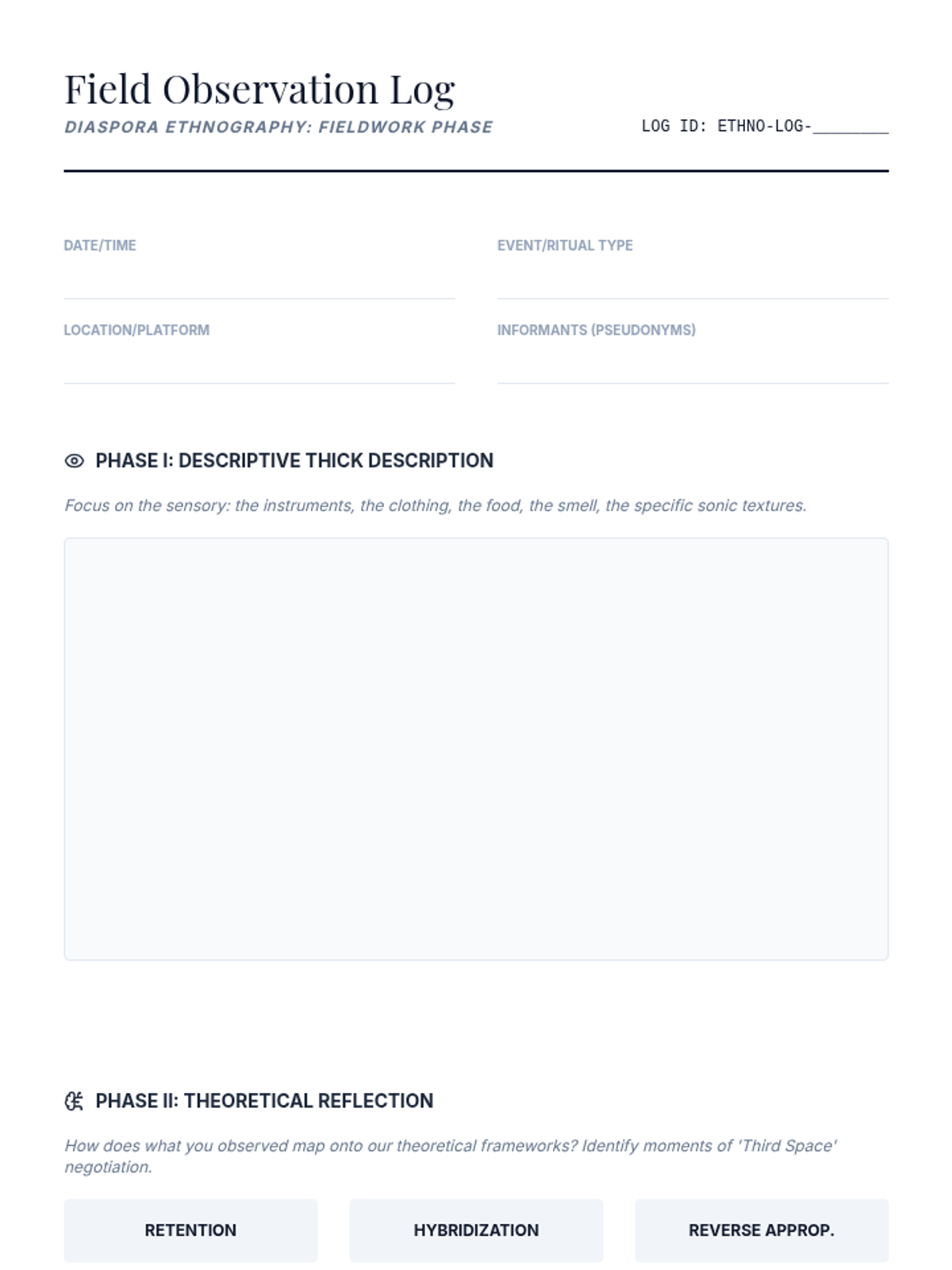
A structured field notes template for graduate students to use during their ethnographic fieldwork or archival research.
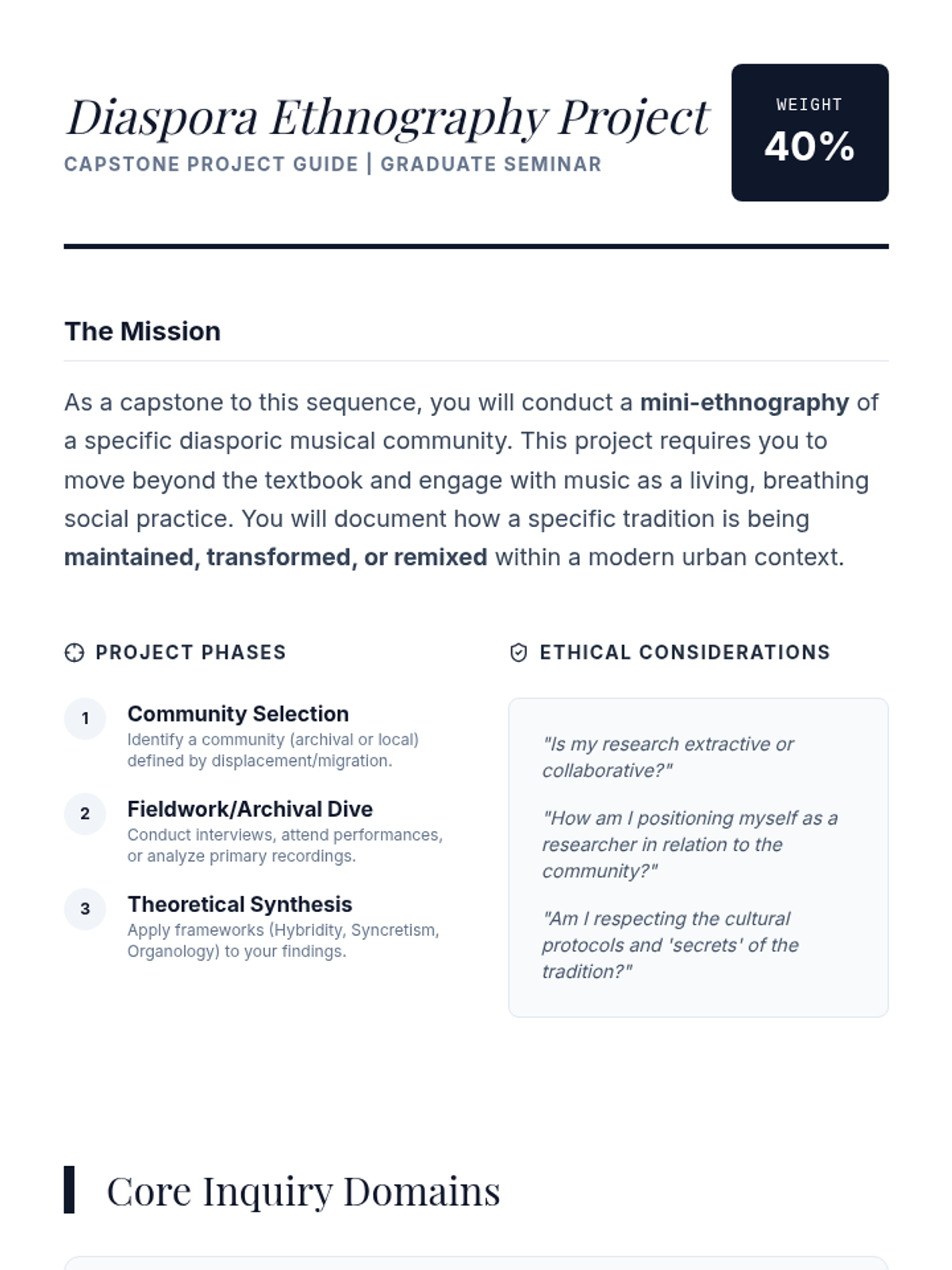
A comprehensive guide for graduate students to design and conduct a mini-ethnography of a diasporic musical community.
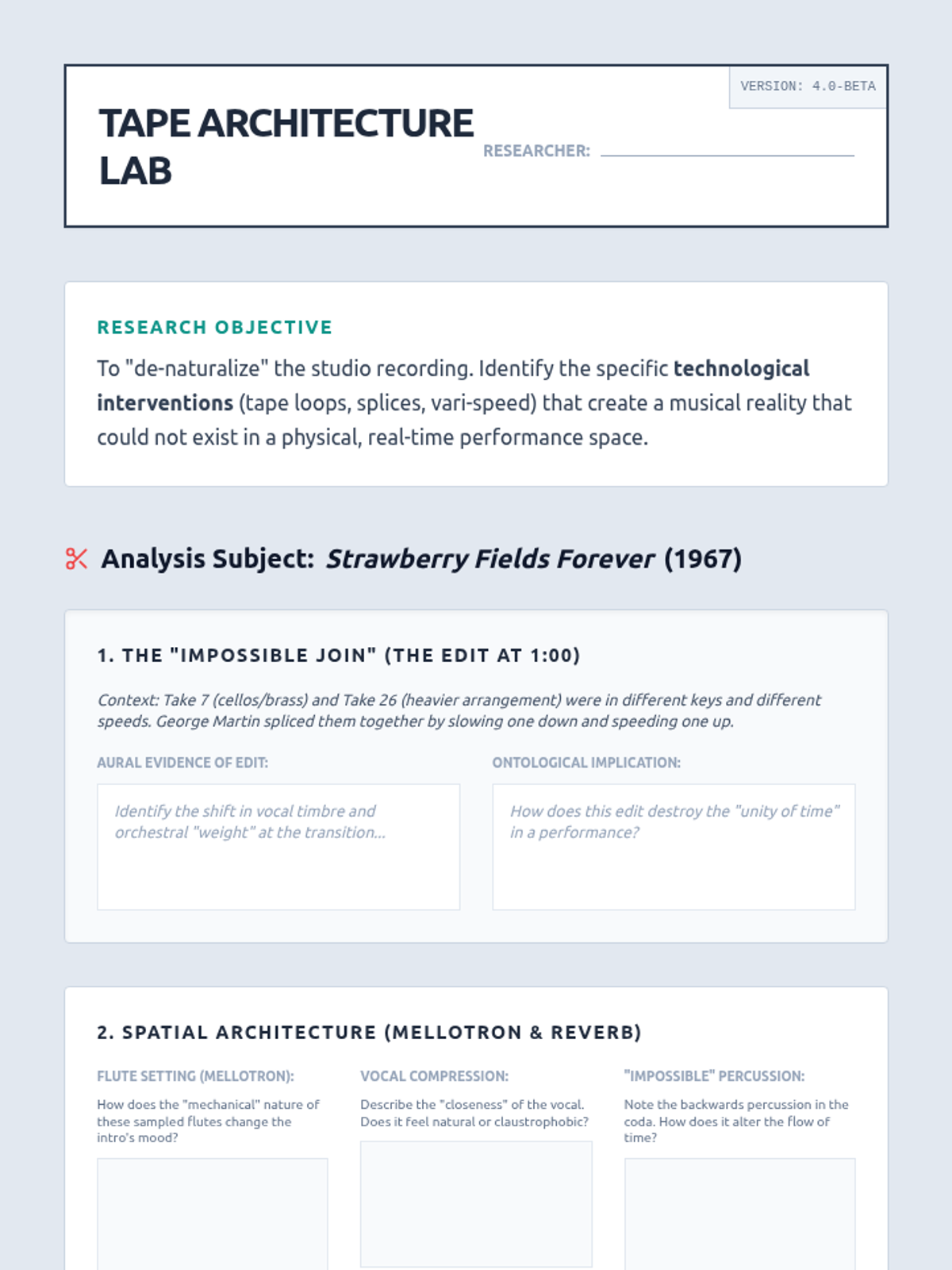
A student worksheet for deconstructing studio production techniques and the ontological shift from score to recording.
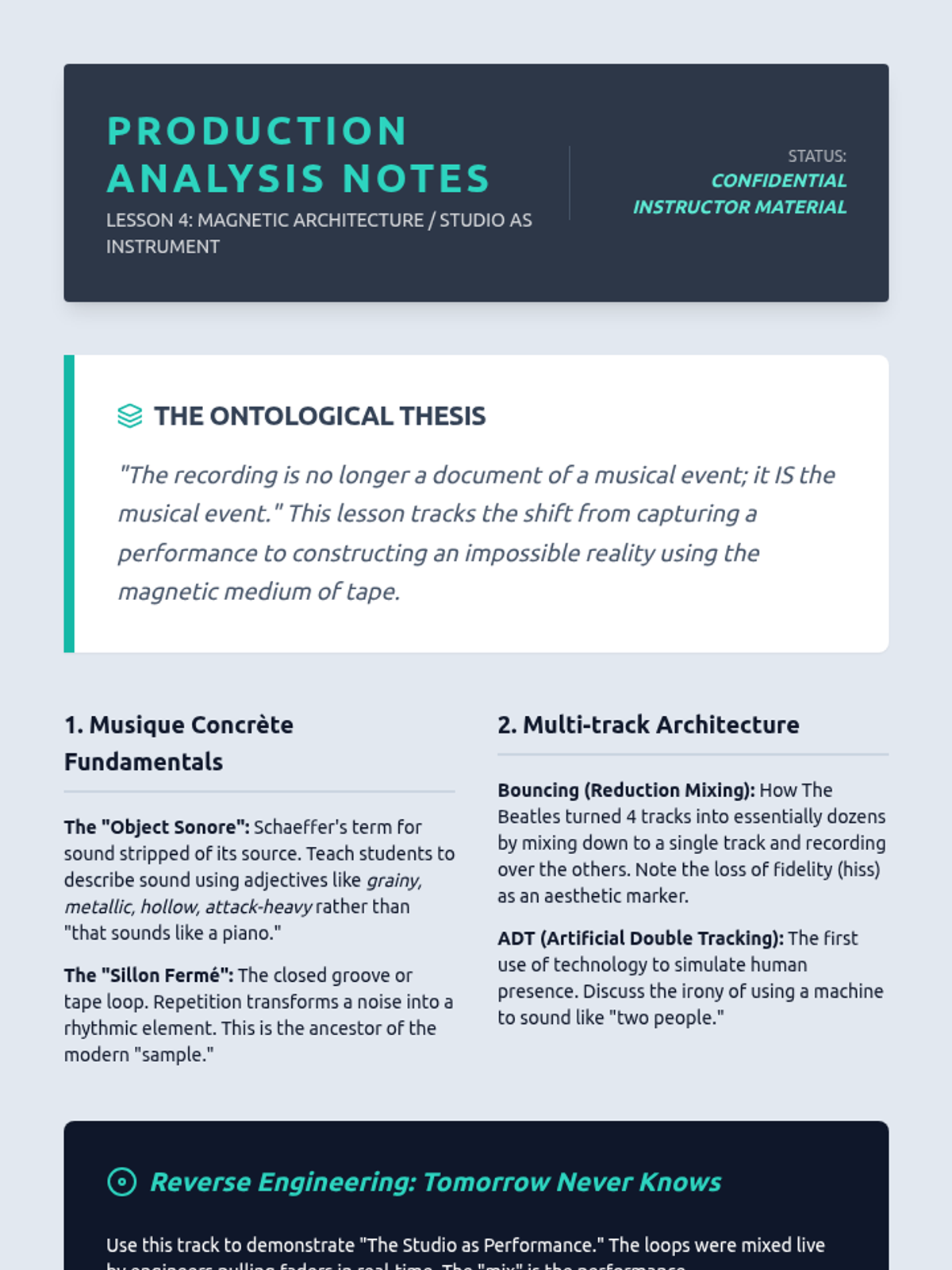
A facilitation guide for the "Magnetic Architecture" lesson, detailing production techniques and providing a case study of mid-century studio experiments.
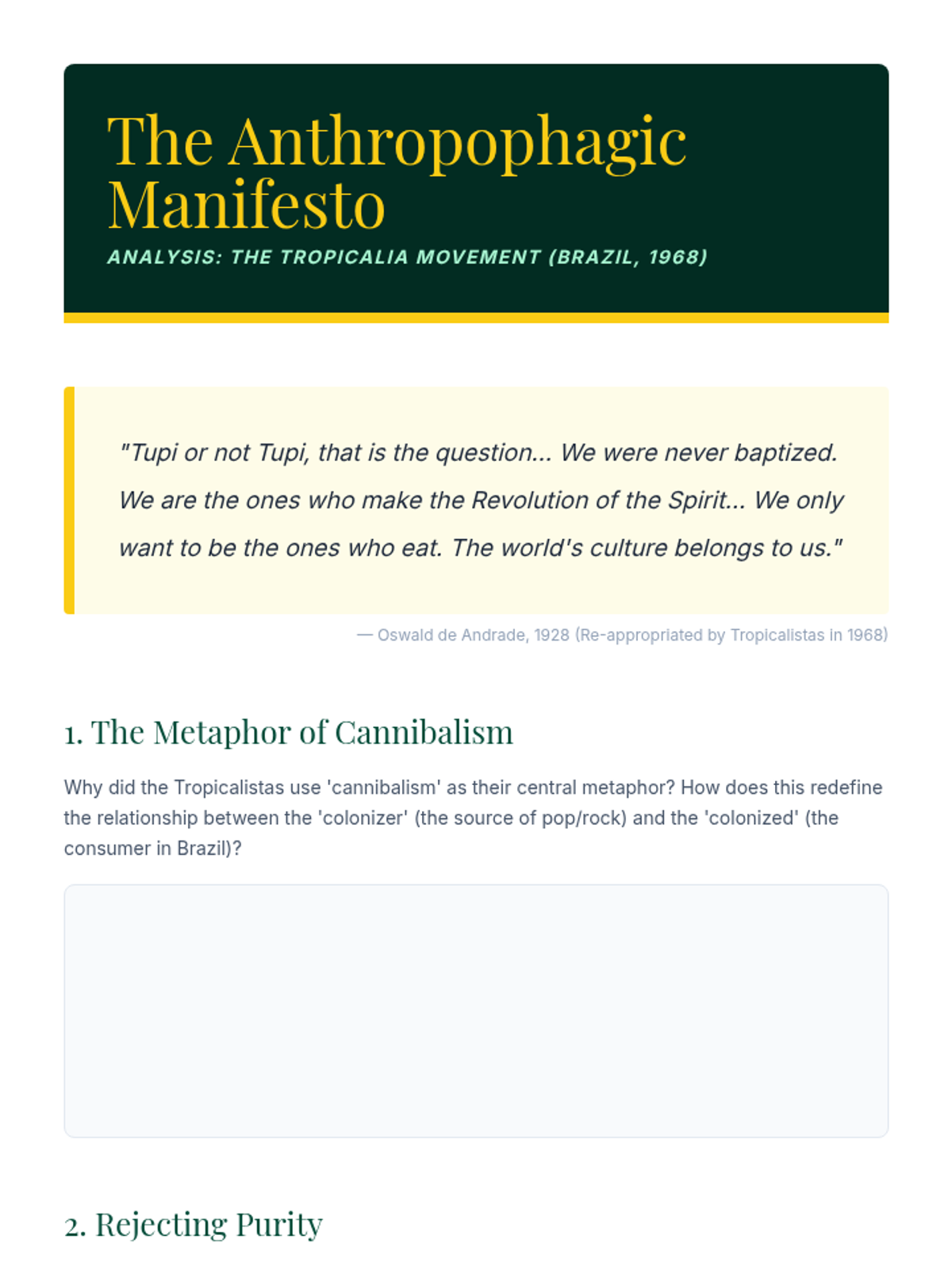
A technical analysis worksheet for the Tropicalia movement's manifesto and its application to 1960s Brazilian music.
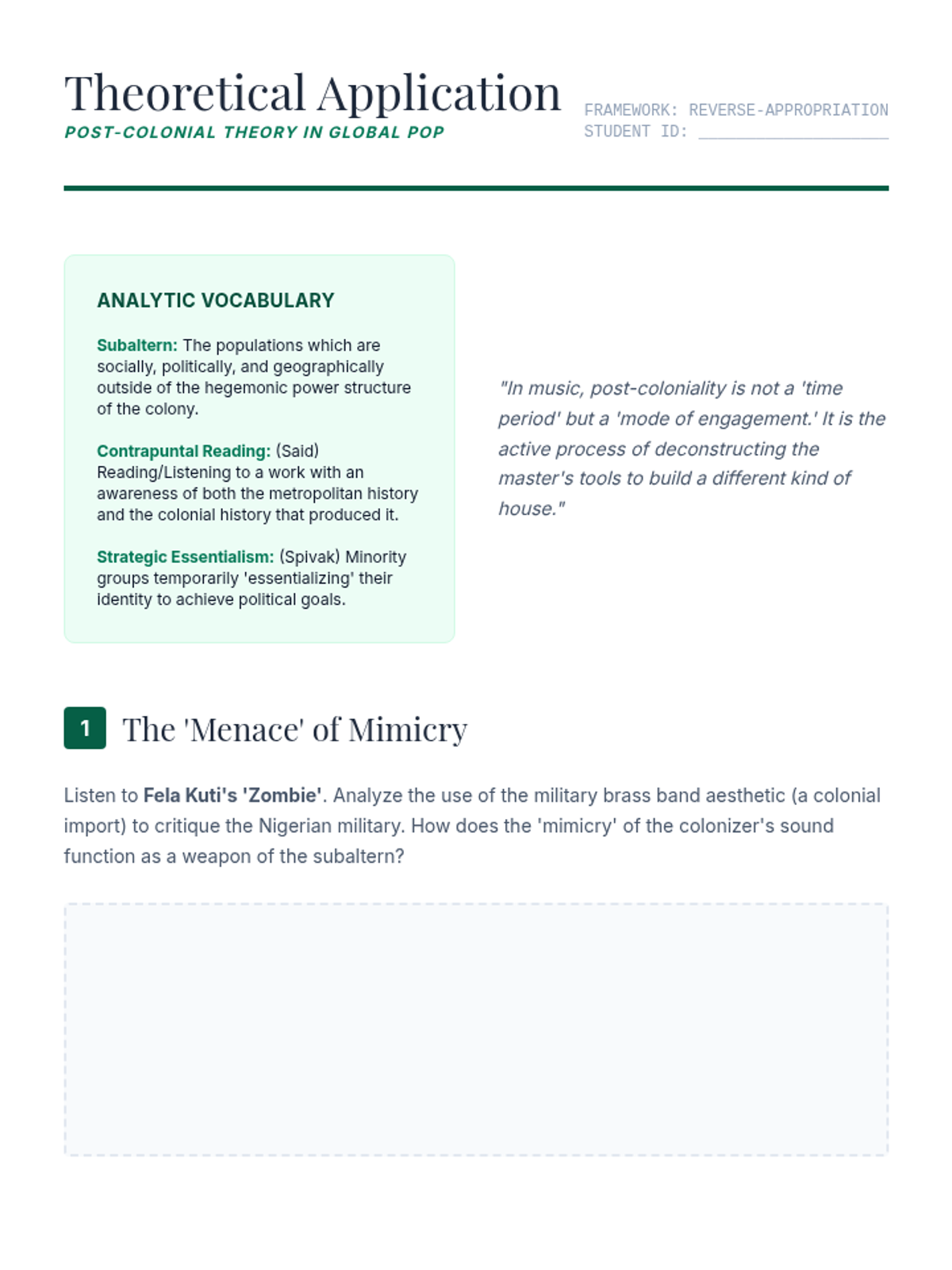
A graduate-level handout for applying post-colonial theoretical frameworks to global pop music movements and textures.
A slide deck for graduate students exploring the recording studio as a primary compositional tool, moving from Musique Concrète to multi-track recording and the ontological shift from score to recording.
A theory-heavy presentation exploring post-colonial concepts like hybridity and cultural cannibalism in global pop music movements like Tropicalia and Afrobeat.
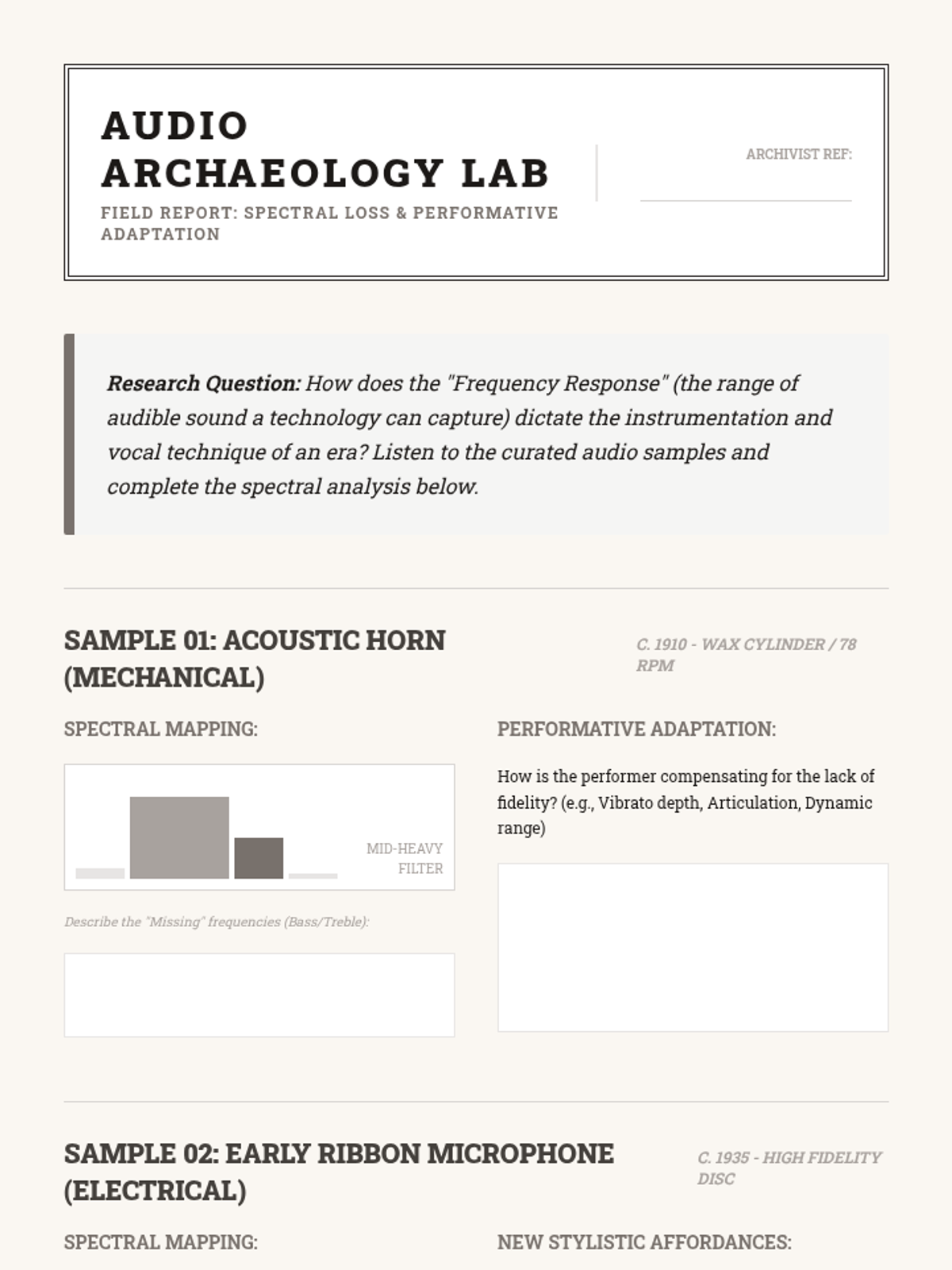
A student worksheet for identifying frequency response limitations and performative adaptations in early 20th-century recordings.
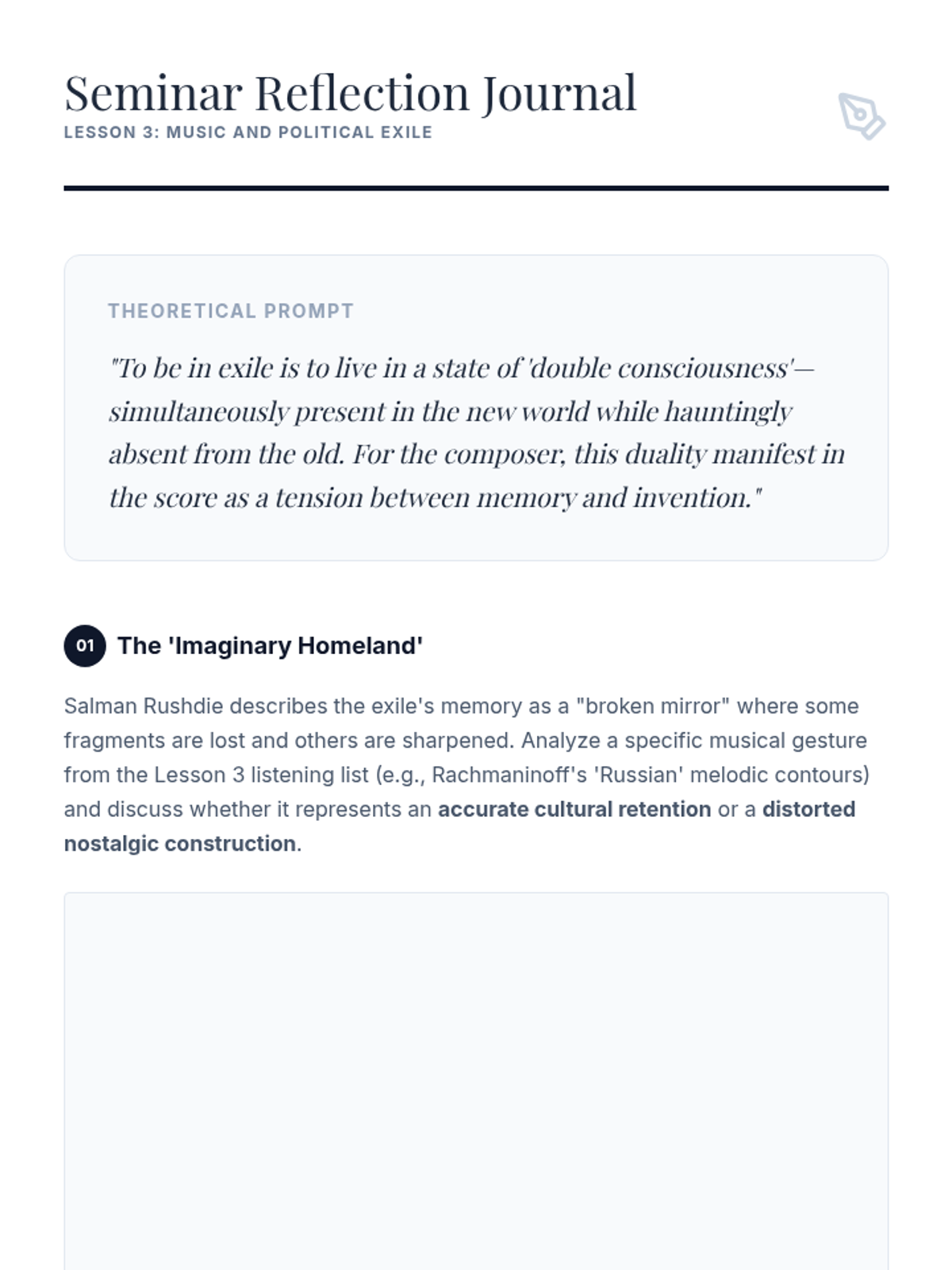
A graduate-level reflection journal for analyzing the psychological and creative impact of political displacement on musical style.
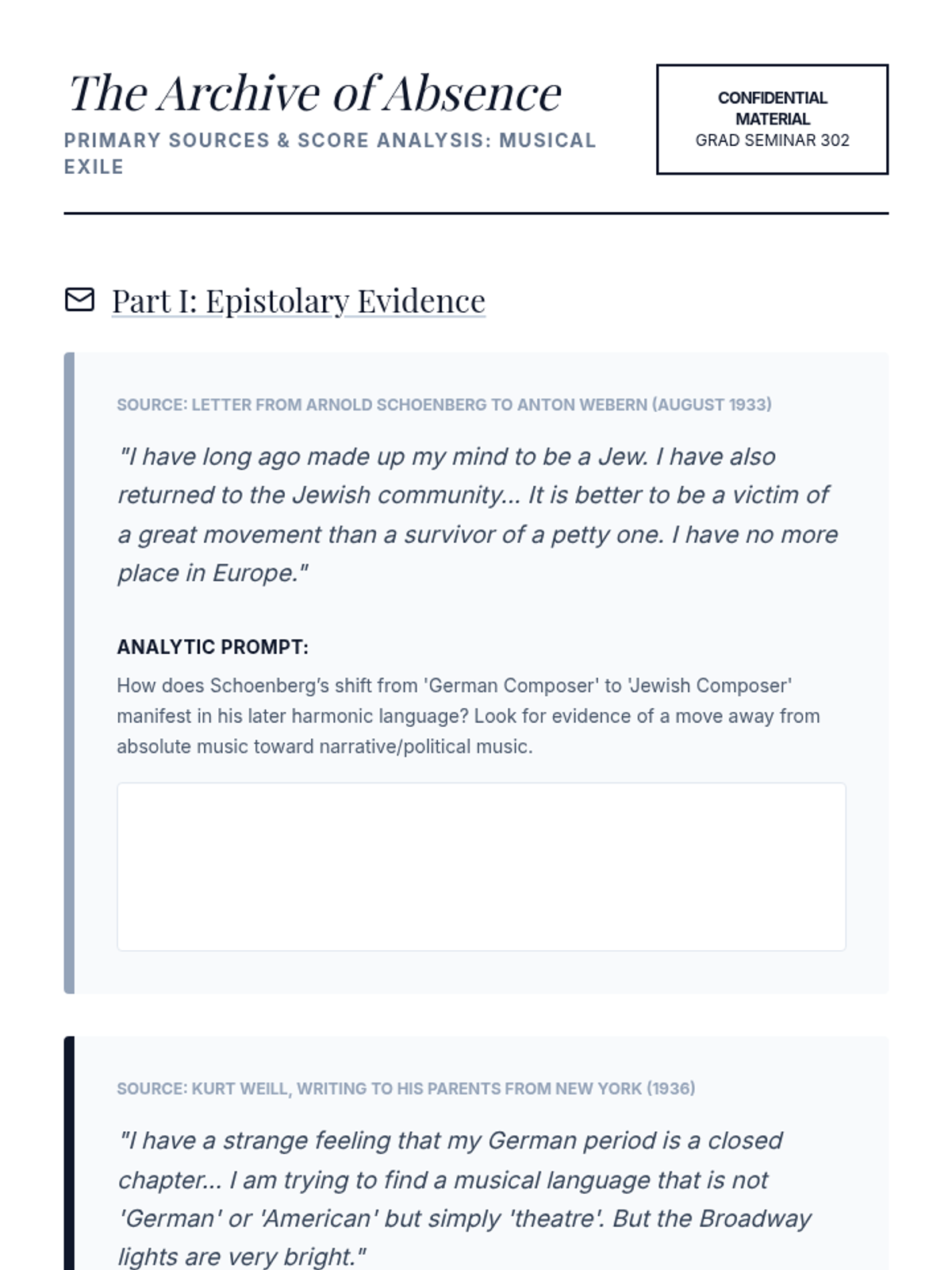
A graduate-level analysis packet containing primary source letters and musical excerpts exploring the creative impact of exile on 20th-century composers.
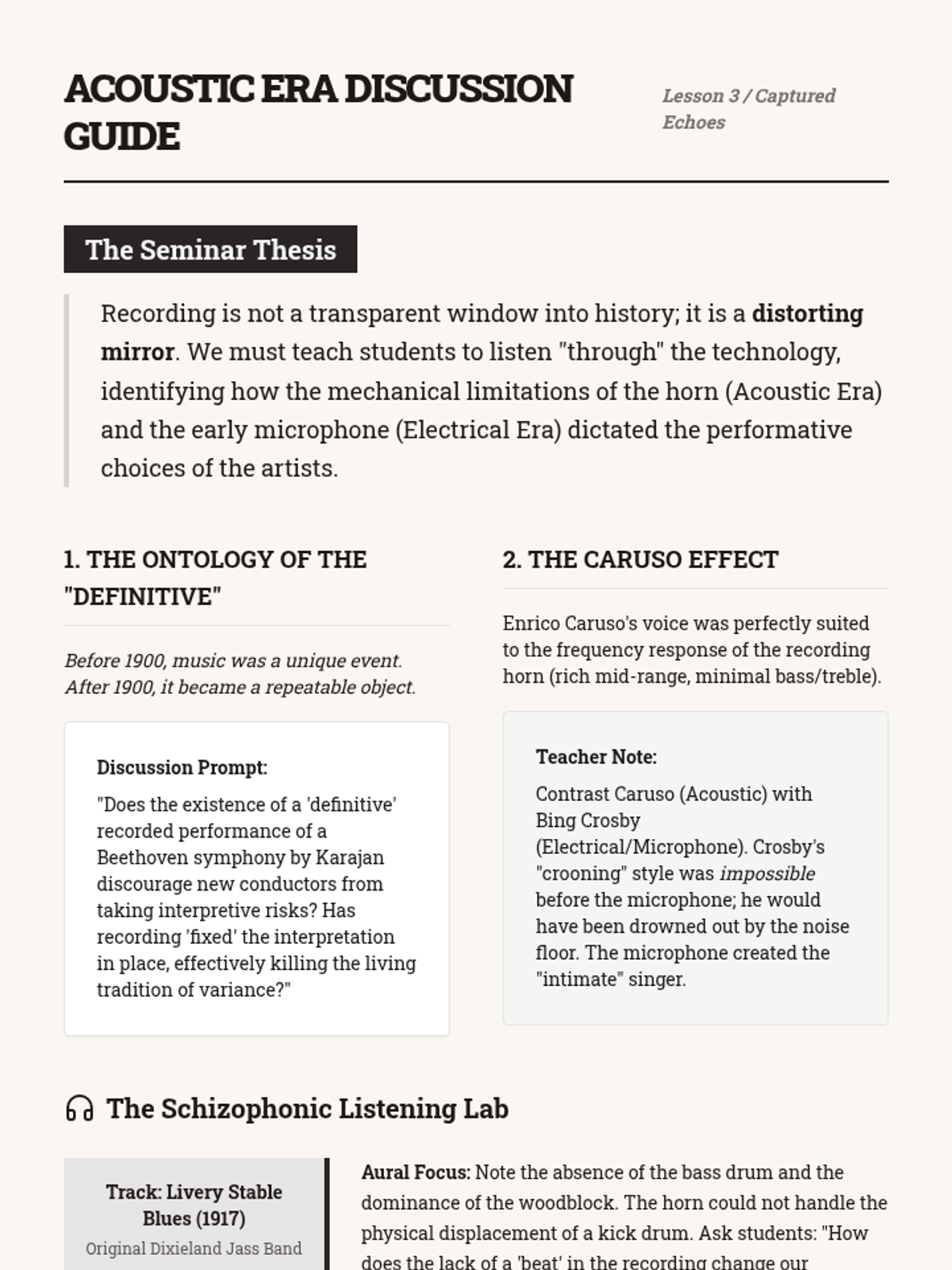
A facilitation guide for the "Captured Echoes" lesson, focusing on the transition from acoustic to electrical recording and the ontology of the "definitive performance."
A graduate-level presentation investigating the creative impact of political exile on 20th-century composers, focusing on Schoenberg and Kurt Weill.
A slide deck for graduate students exploring R. Murray Schafer's concept of schizophonia and the impact of early recording technology on musical performance.
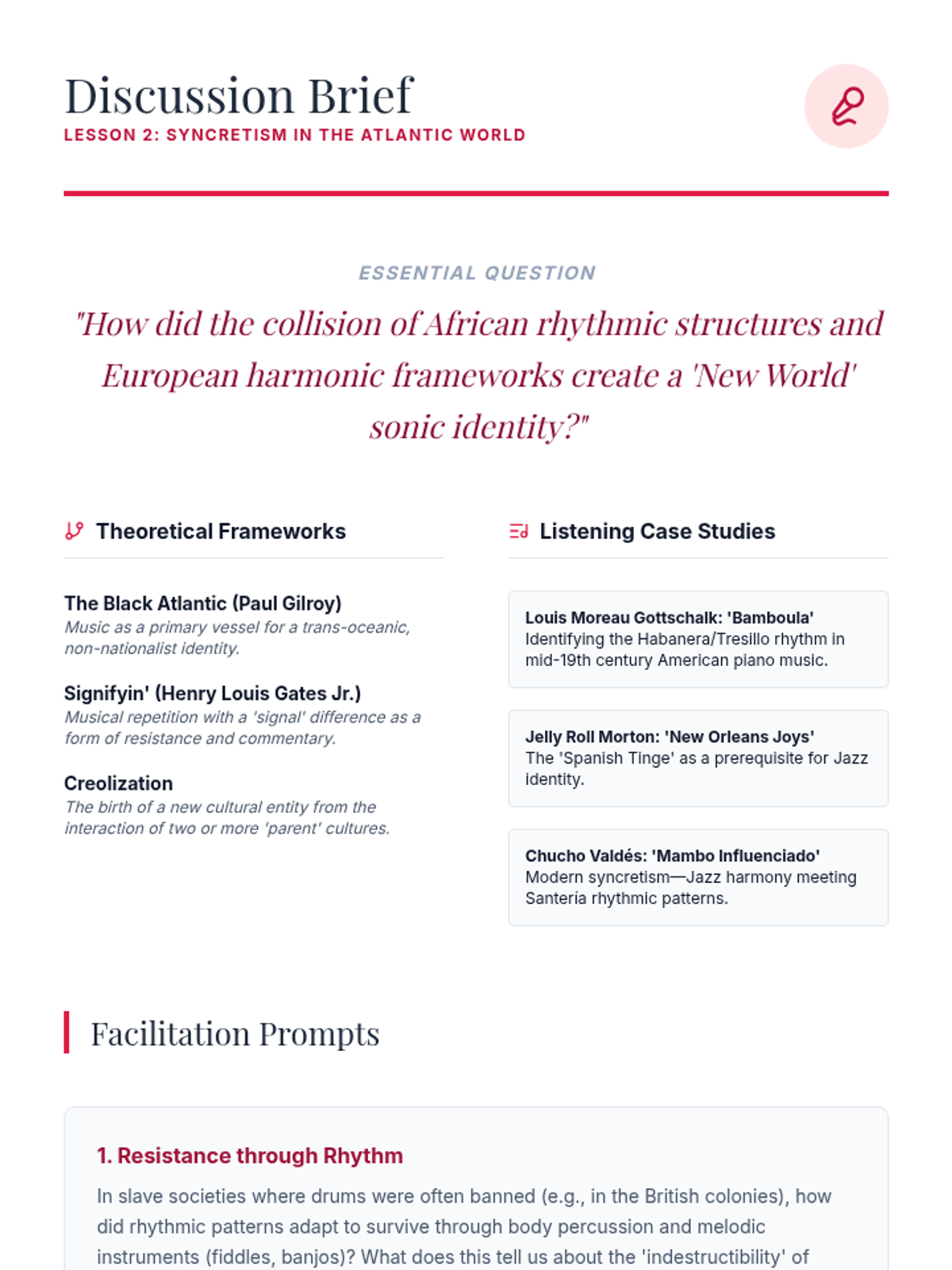
A seminar facilitator's brief for Lesson 2, outlining key theoretical frameworks, listening case studies, and discussion prompts for Atlantic syncretism.
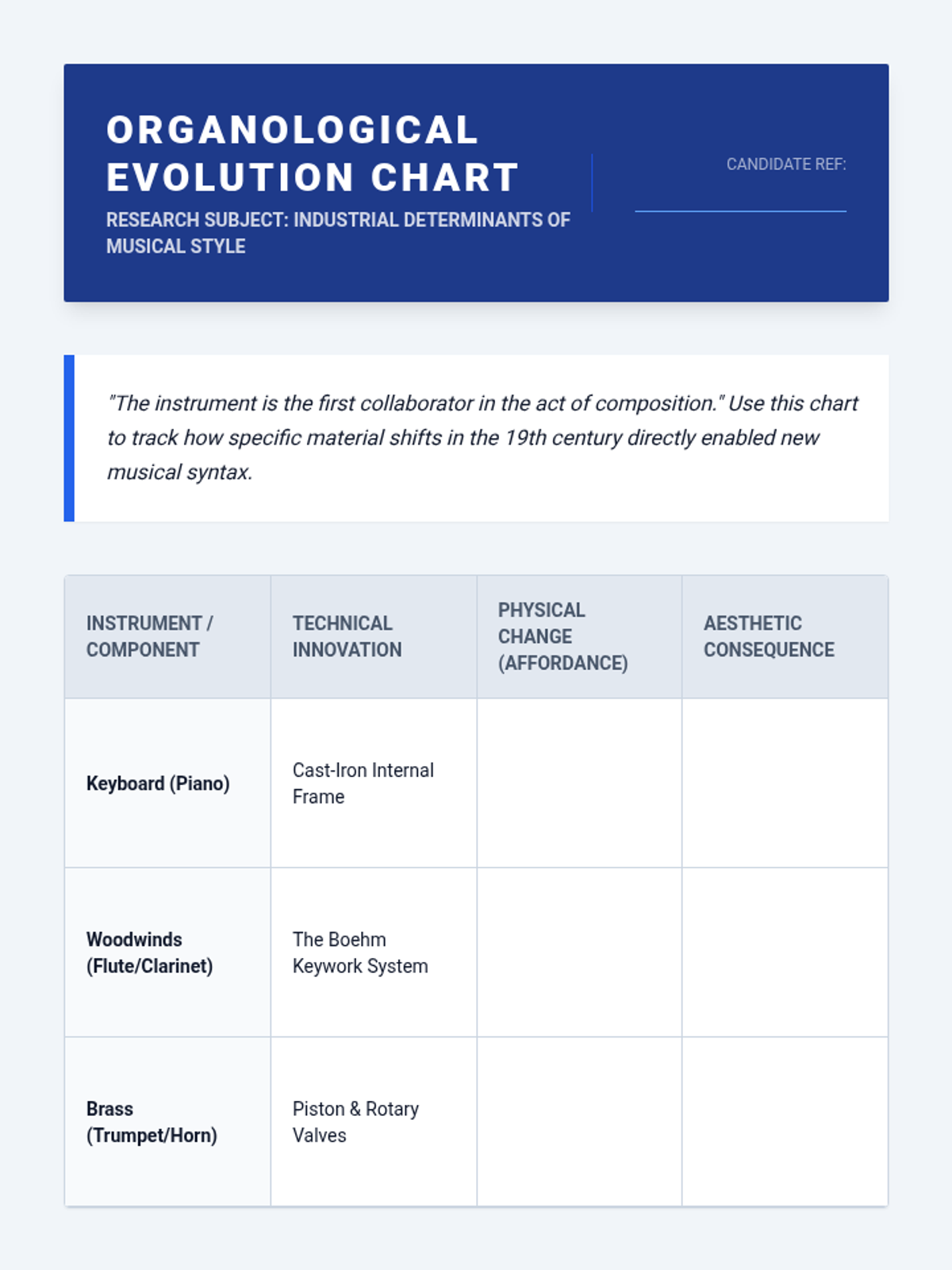
A student worksheet for tracking technical innovations in 19th-century instruments and their impact on musical aesthetics.
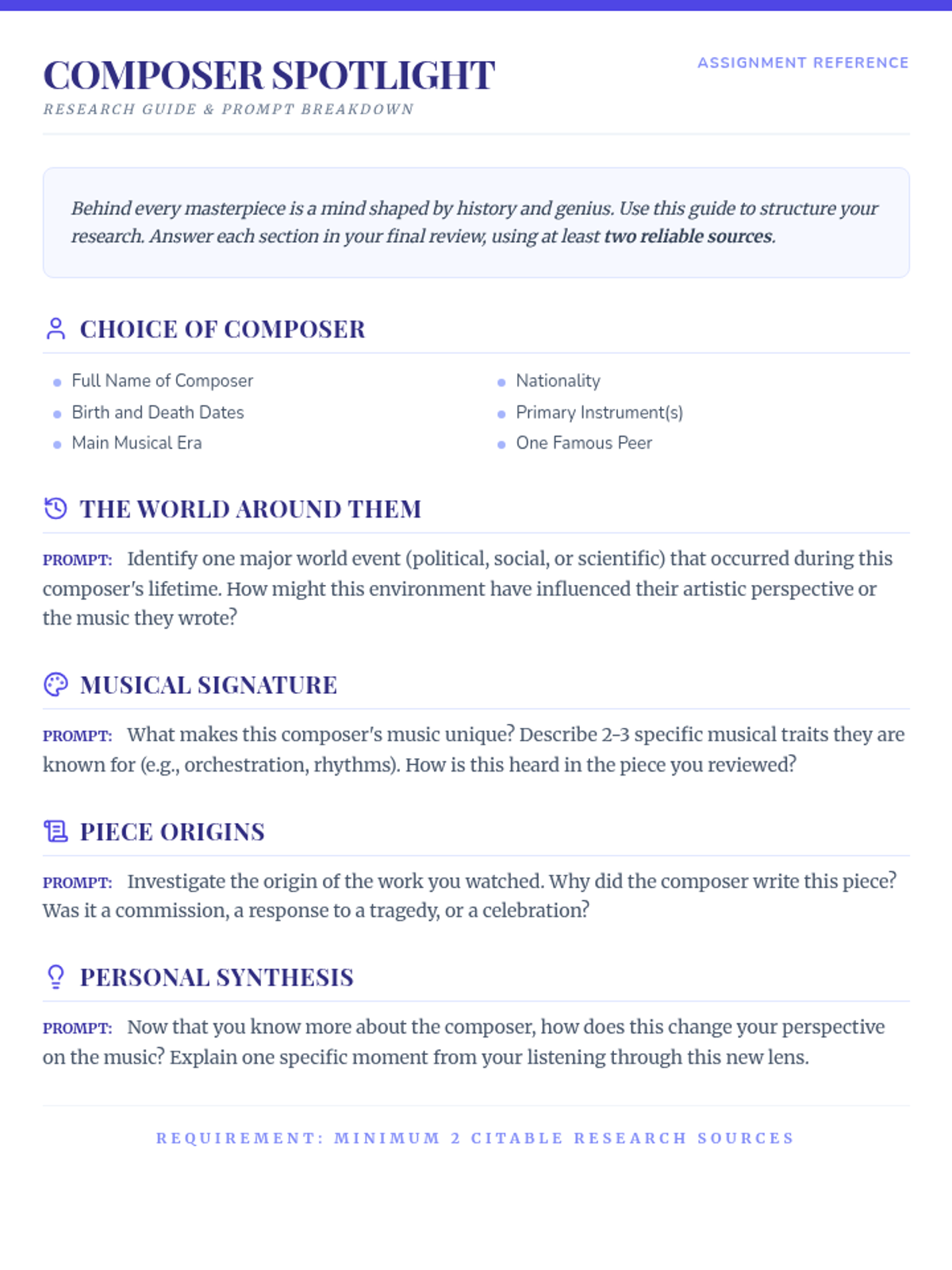
A one-page reference guide that outlines the research questions and prompts for a composer deep dive, without student response areas.
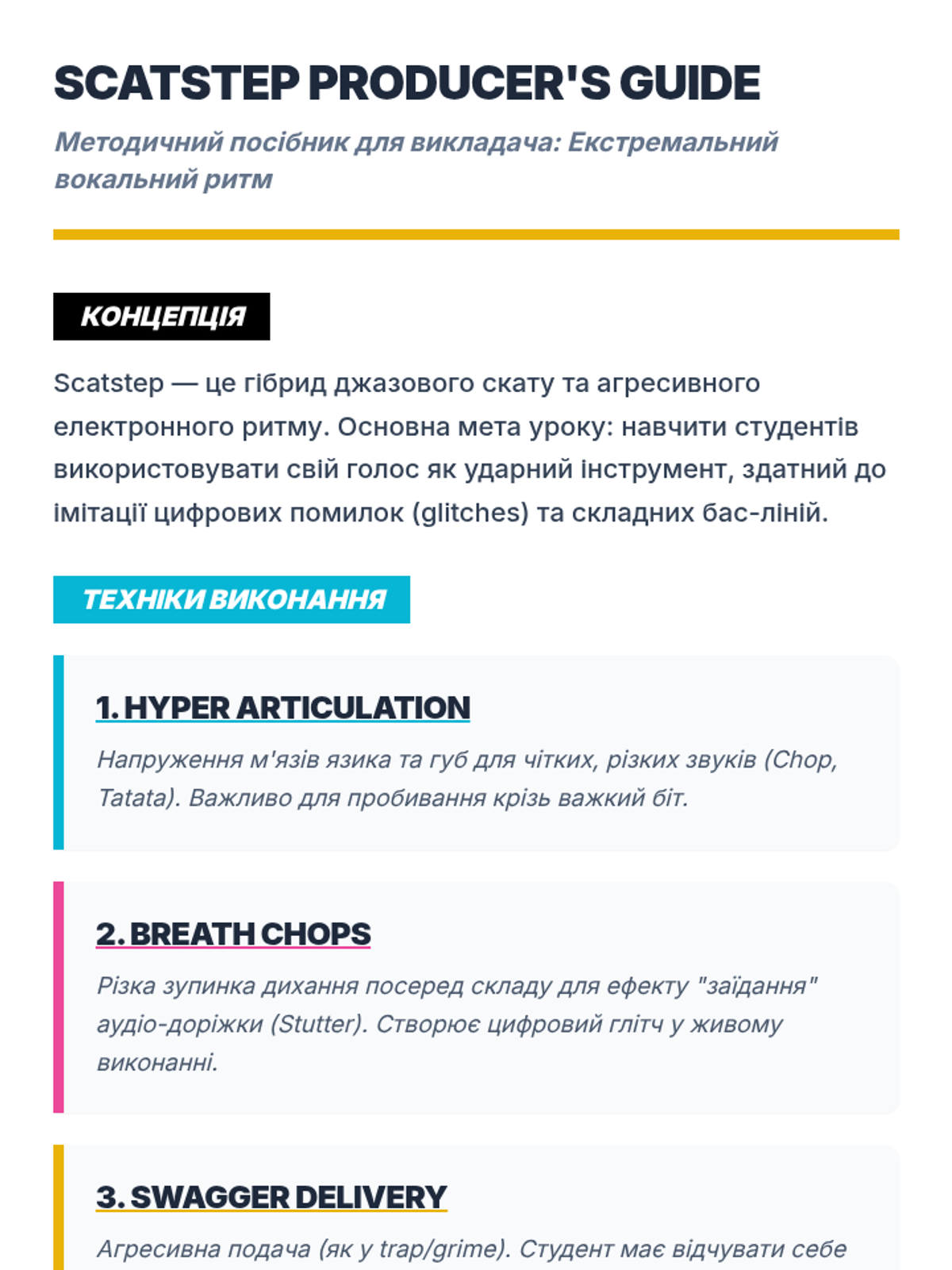
Методичний посібник для викладачів, що розкриває техніки гіперартикуляції, роботи з диханням та пояснює відповідність вокальних складів різним музичним жанрам.
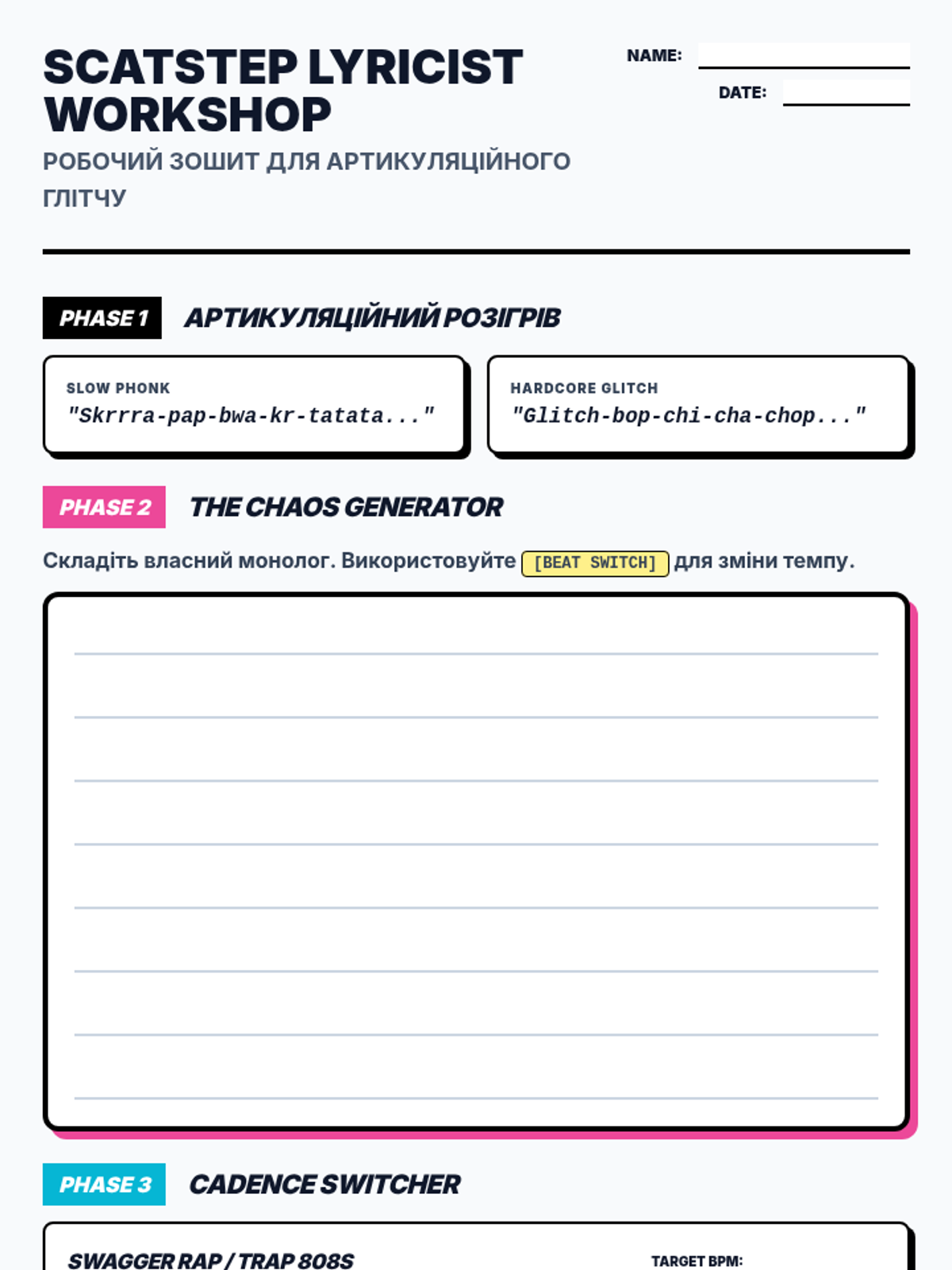
Робочий зошит для практики скат-монологів, що містить вправи на розігрів артикуляції, конструктор хаотичних текстів та трекер зміни темпу.
Презентація Scatstep Masterclass пояснює основи екстремального скату, включаючи фонетичний арсенал, структуру біта (phonk, hardbass, trap) та вправи на артикуляцію.
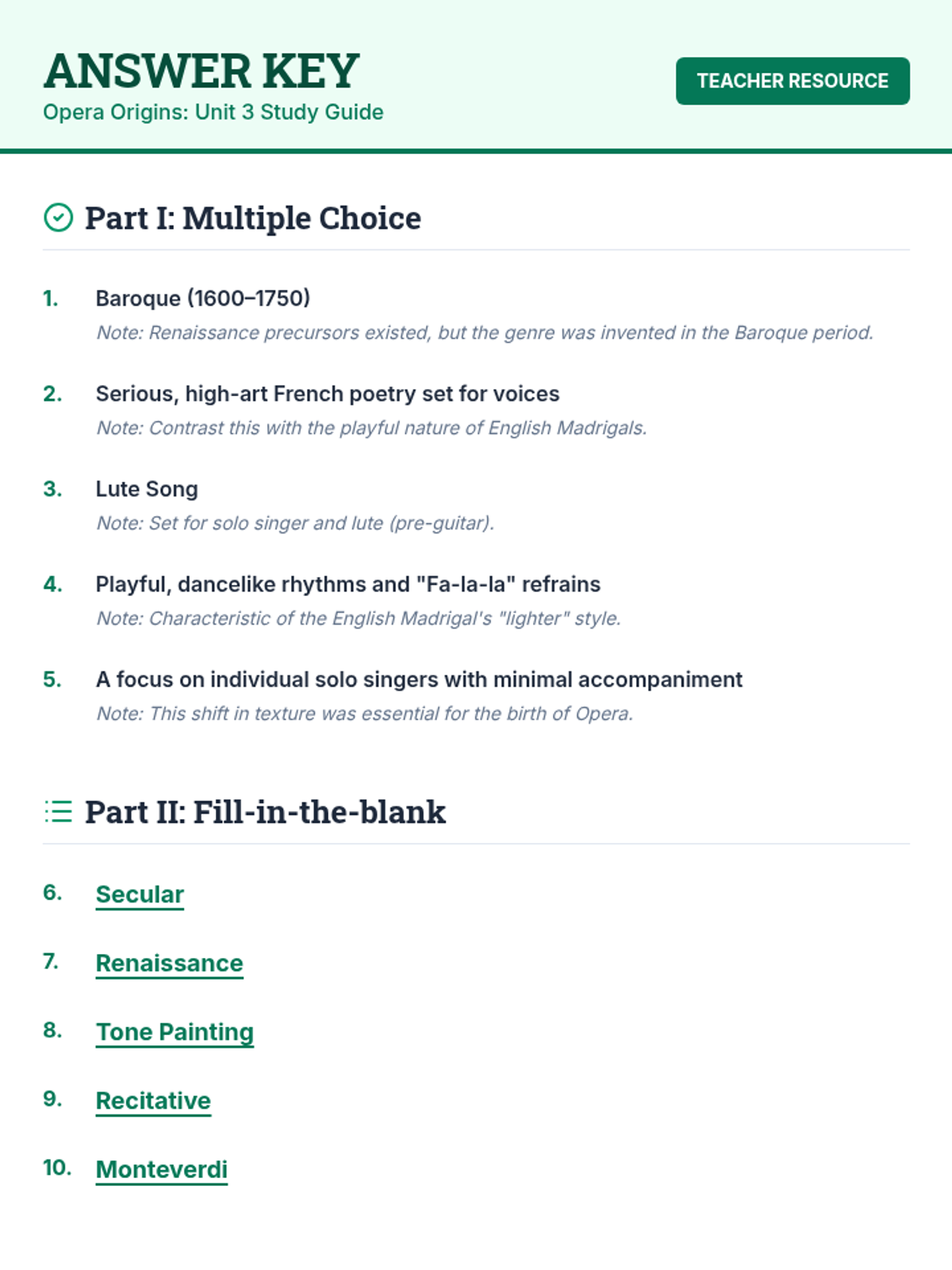
A teacher's answer key for the Opera Origins study guide, including correct responses and brief instructional notes for each question.
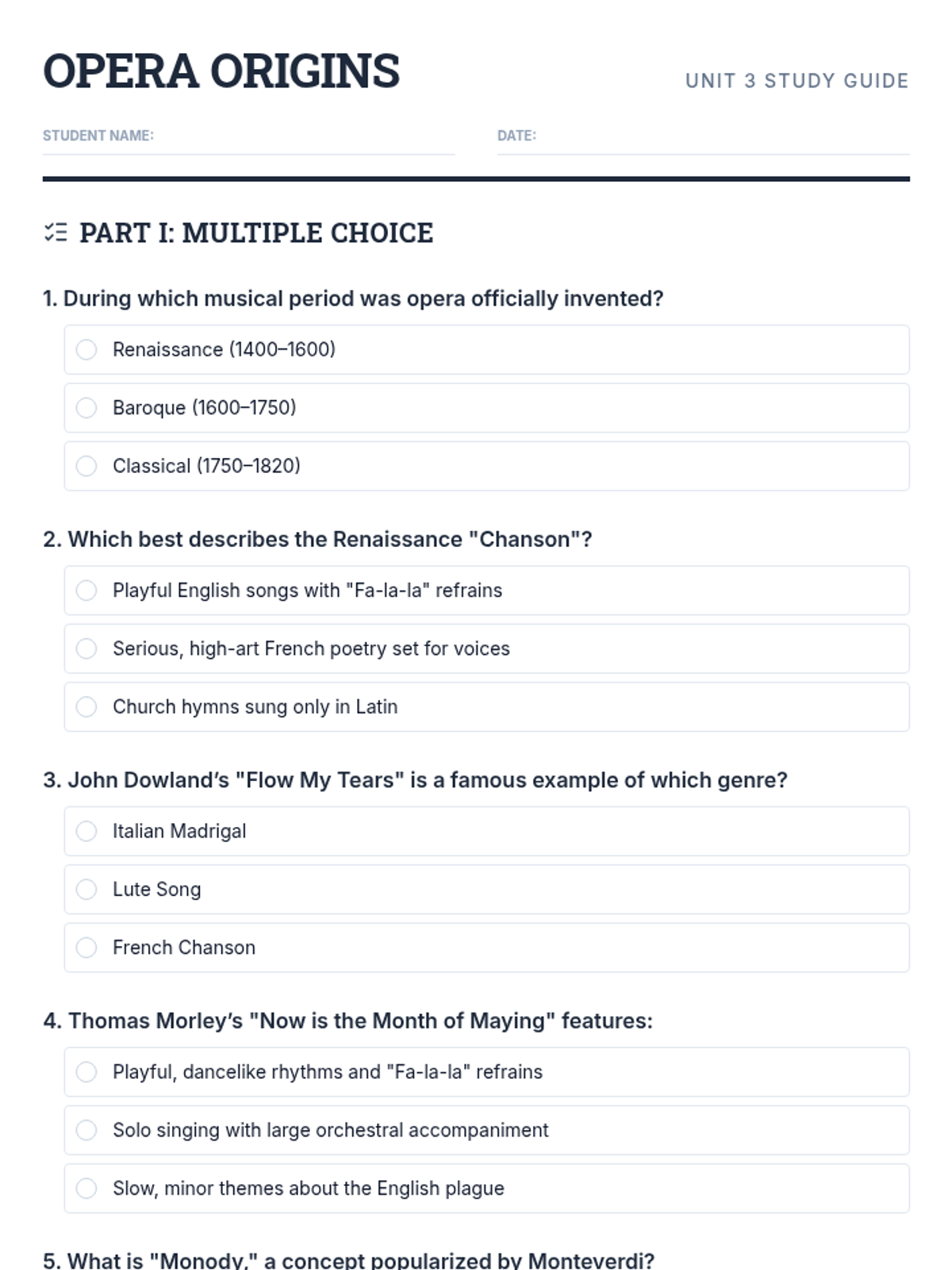
A comprehensive study guide for students covering the precursors to opera, including multiple-choice and fill-in-the-blank questions based on Renaissance vocal forms and early Baroque developments.
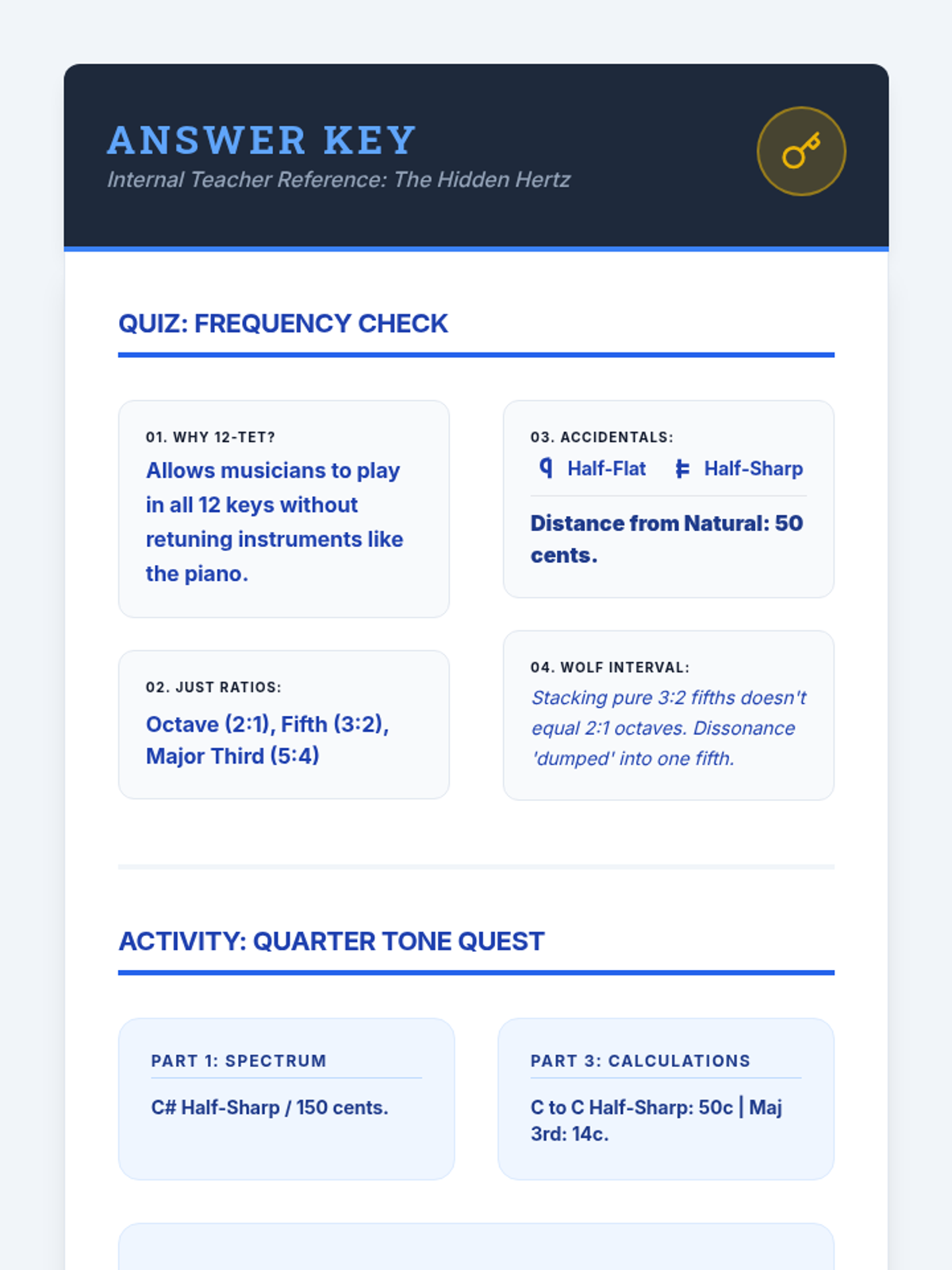
A combined answer key for the Frequency Check Quiz and the Quarter Tone Quest Activity, providing clear explanations for teachers.
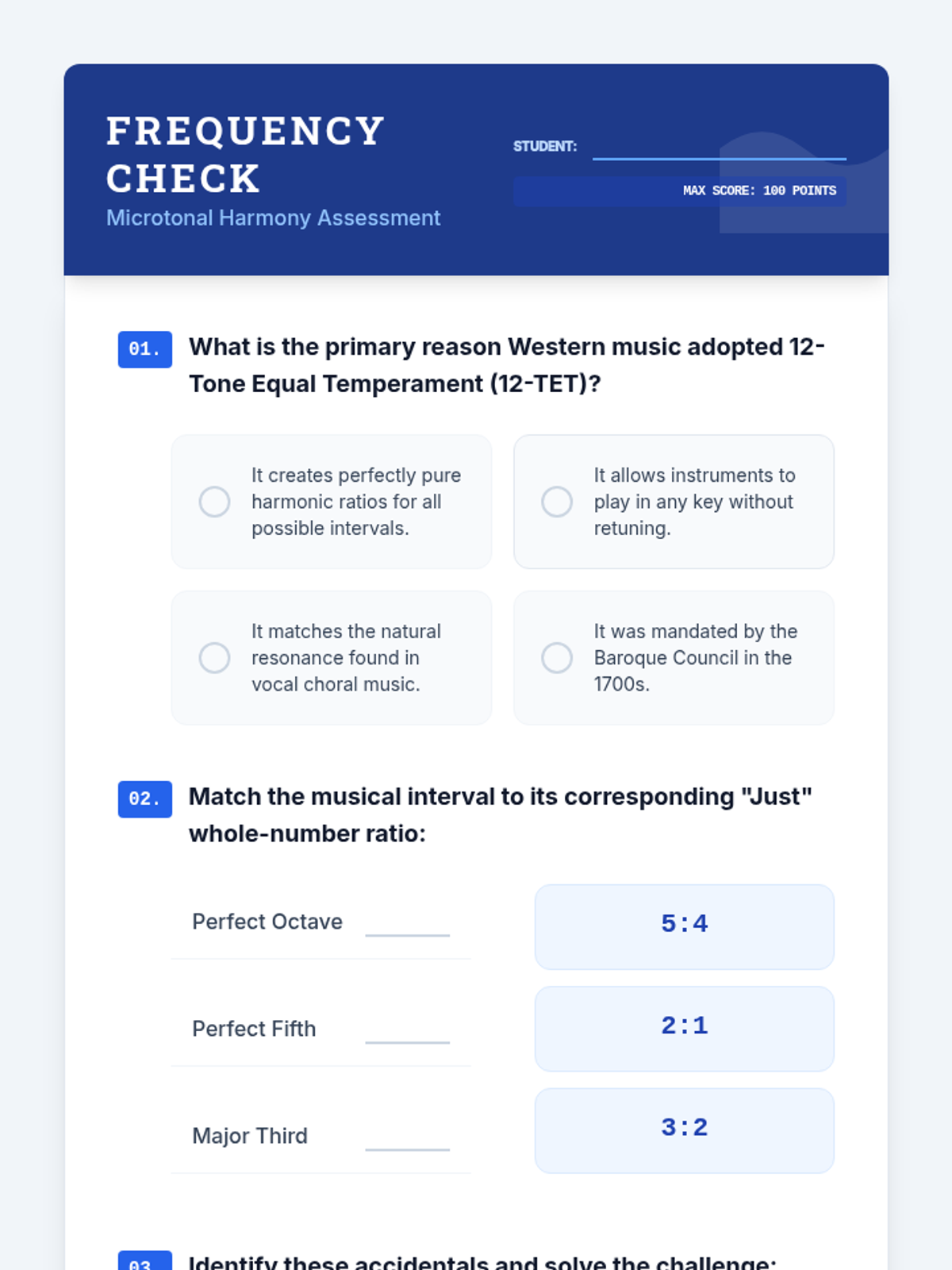
A summative quiz evaluating student understanding of tuning ratios, 12-TET vs. Just Intonation, microtonal symbols, and historical concepts like the Wolf Interval.
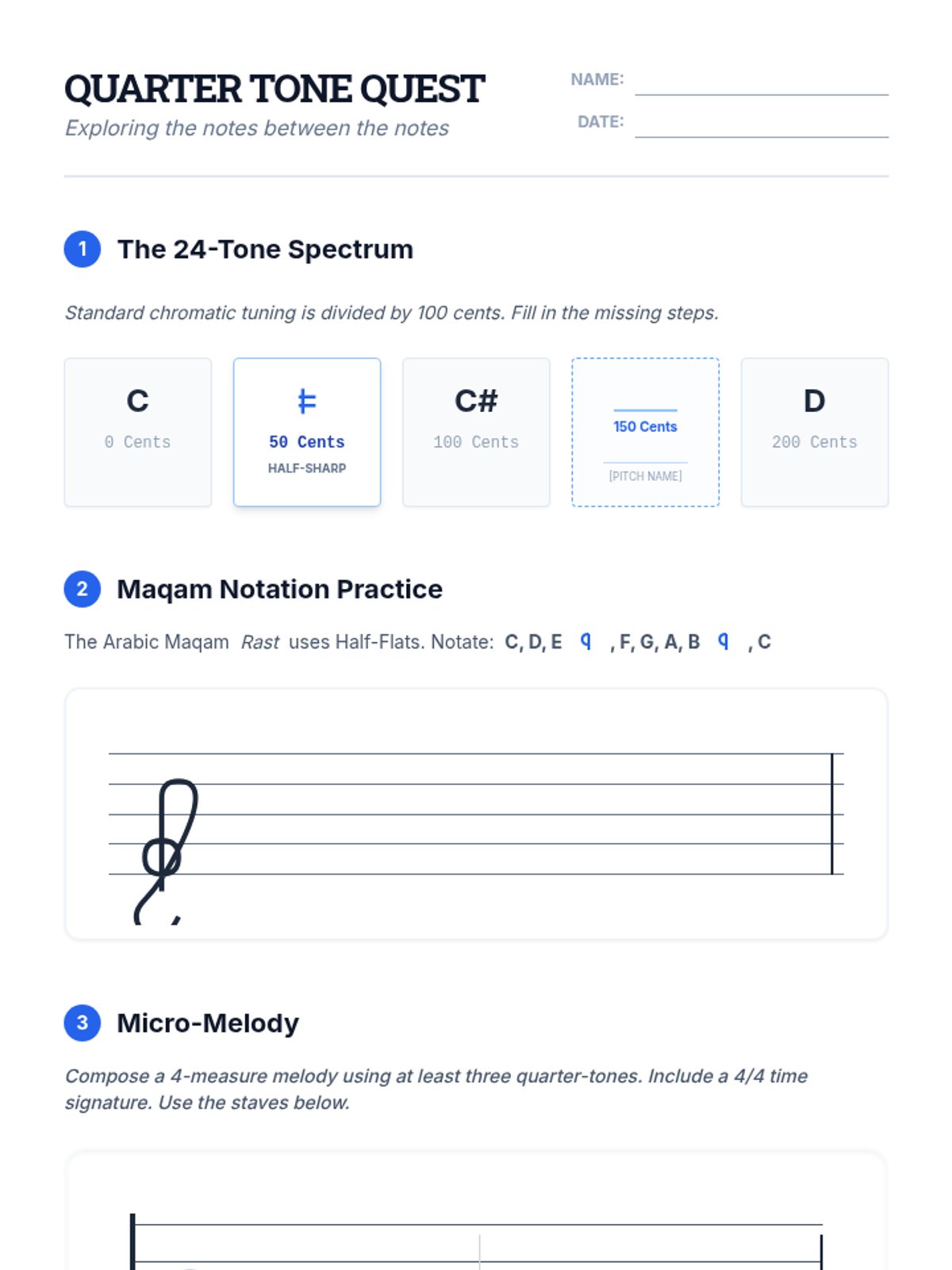
A practical worksheet for students to practice quarter-tone notation, calculate cent distances, and compose their own microtonal melodies.
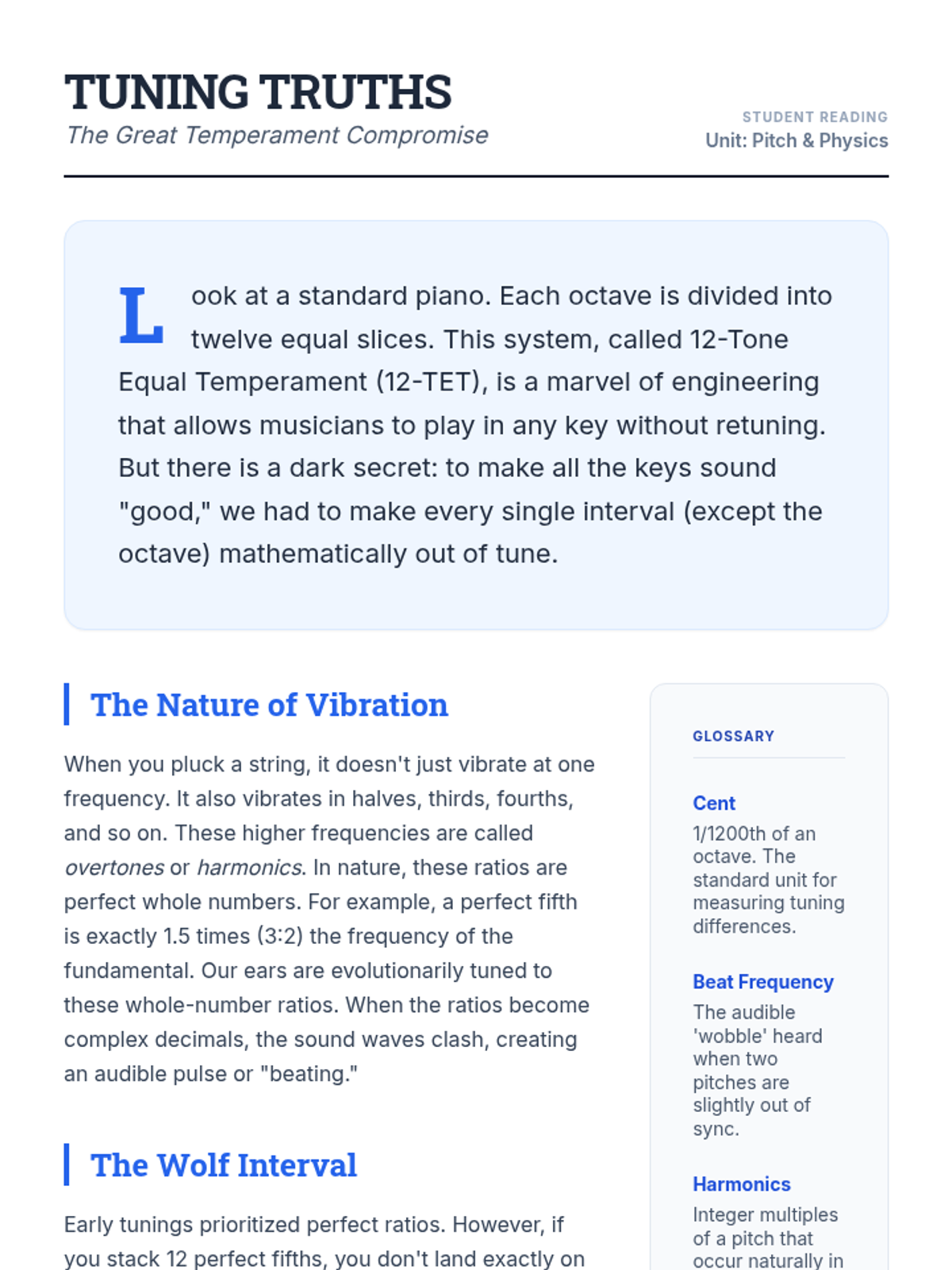
A deep-dive reading passage for students exploring the history of tuning, the physics of the harmonic series, and the trade-offs of Equal Temperament.
An engaging slide deck introducing microtonality, the physics of harmonic series, global tuning systems, and microtonal notation.
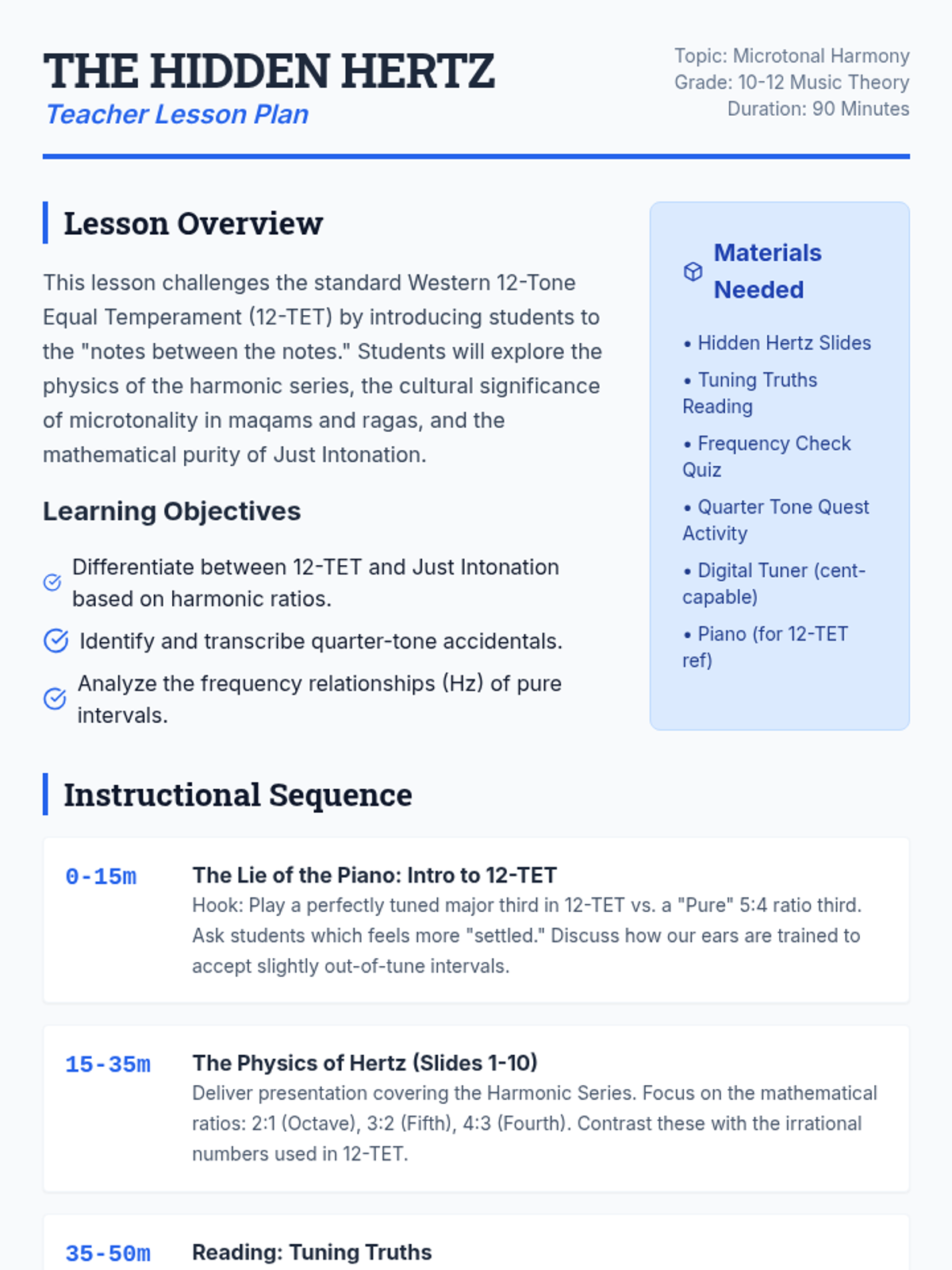
A comprehensive teacher lesson plan for introducing microtonal harmony, including learning objectives, a detailed pacing guide, and differentiation strategies.
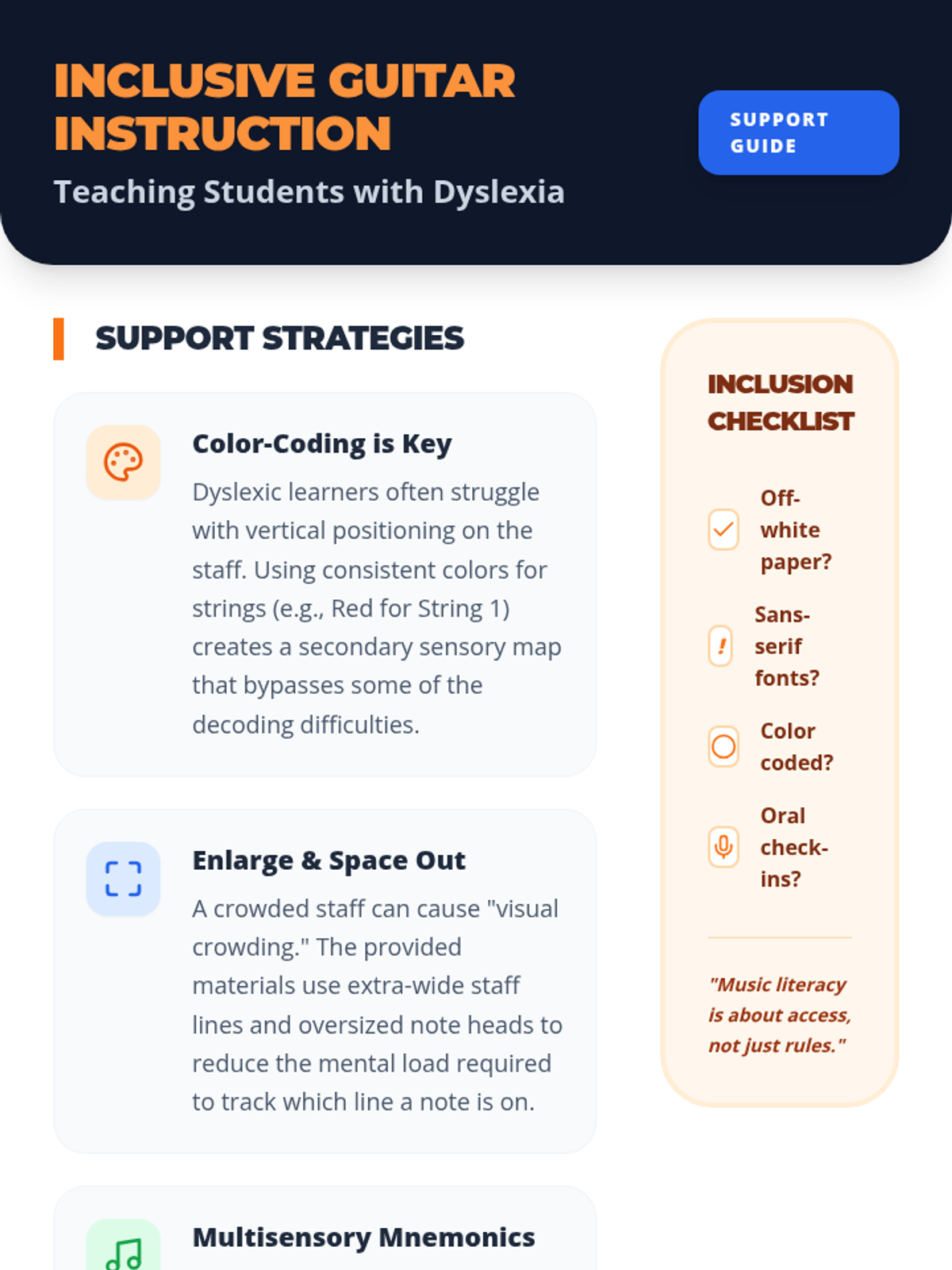
Inclusive teacher guide with strategies for supporting students with dyslexia, focusing on multisensory mnemonics, color-coding, and reducing visual crowding in guitar notation.
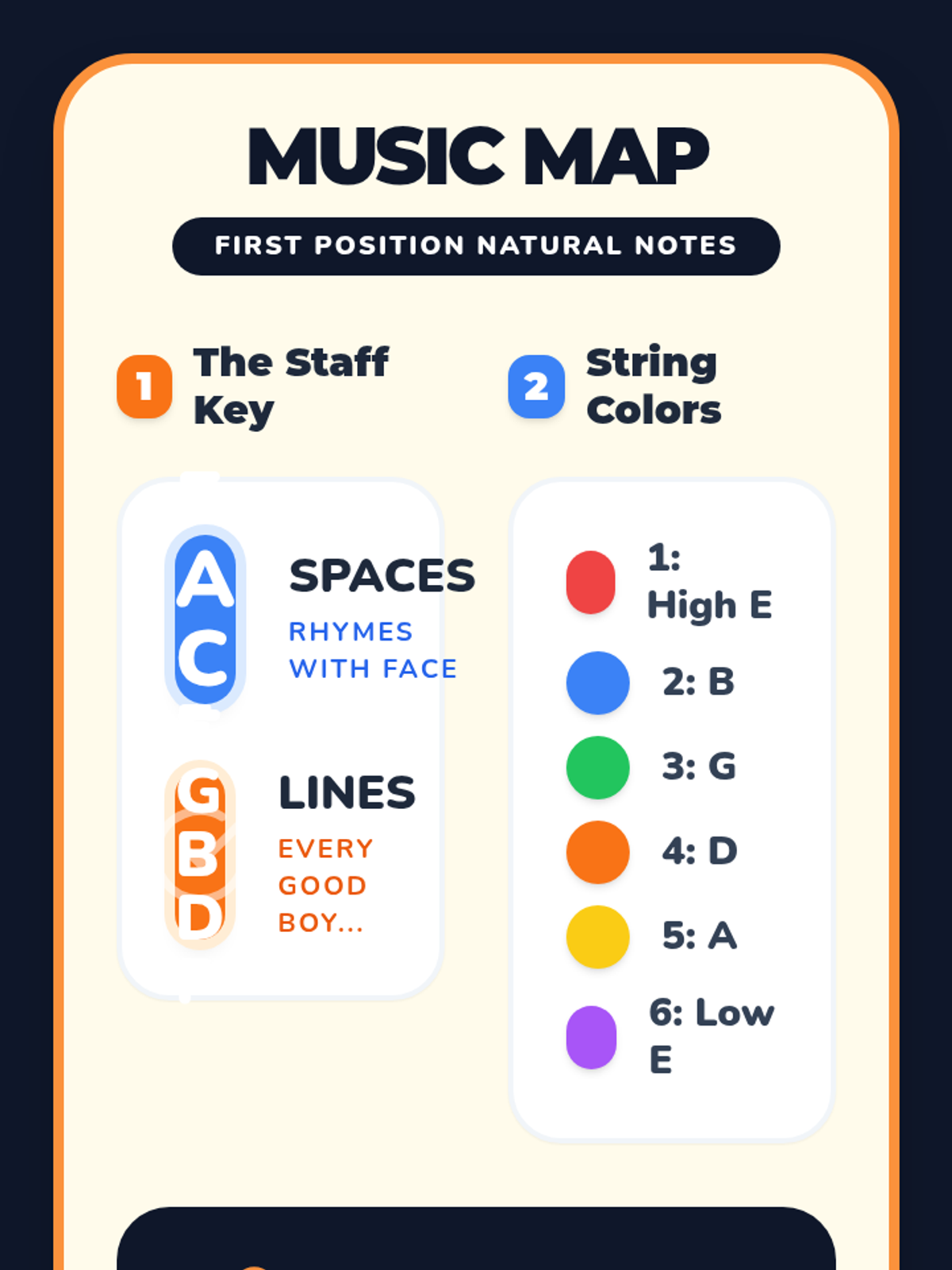
High-visibility reference poster designed for students with dyslexia, featuring color-coded strings, oversized mnemonics, and a simplified fretboard fingering guide.
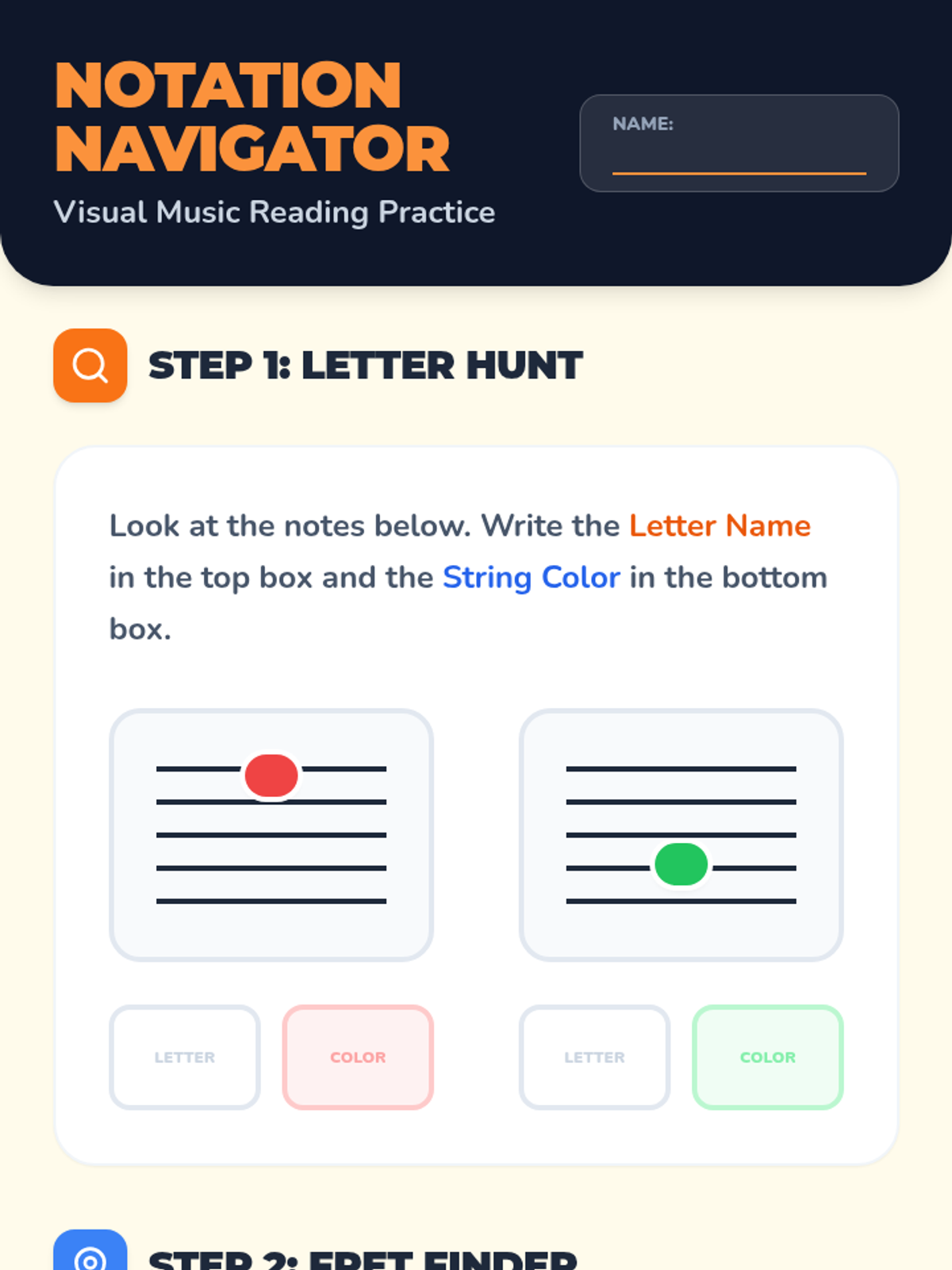
Dyslexia-friendly worksheet with oversized notation, off-white background, and color-coded note identification exercises for guitar beginners.
Dyslexia-friendly visual slides with high-legibility fonts, color-coded strings, and increased spatial separation between musical staff lines for guitar beginners.
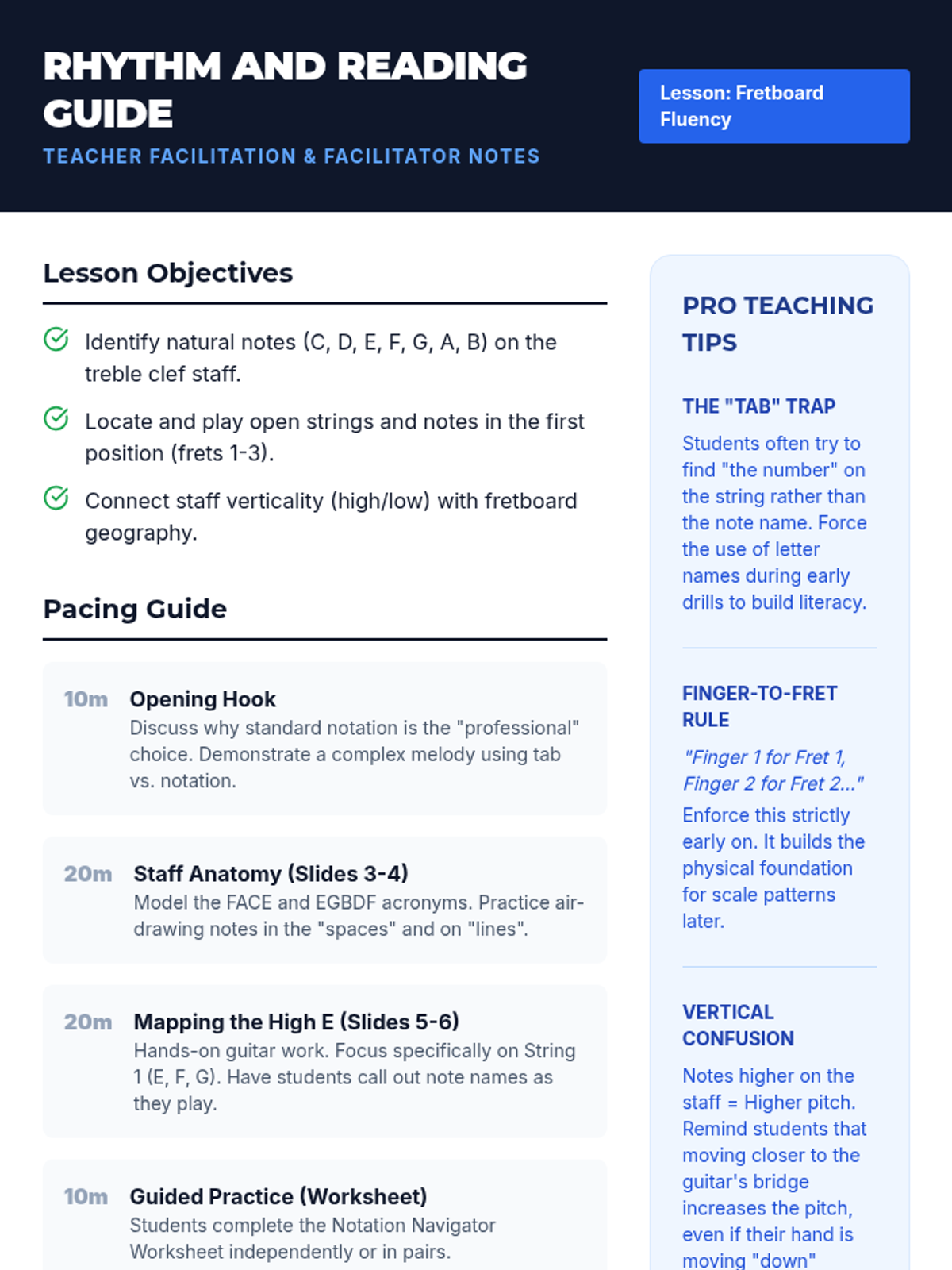
Teacher facilitation guide for the Fretboard Fluency lesson, including lesson objectives, a detailed pacing guide, common student pitfalls, and an answer key for the student worksheet.
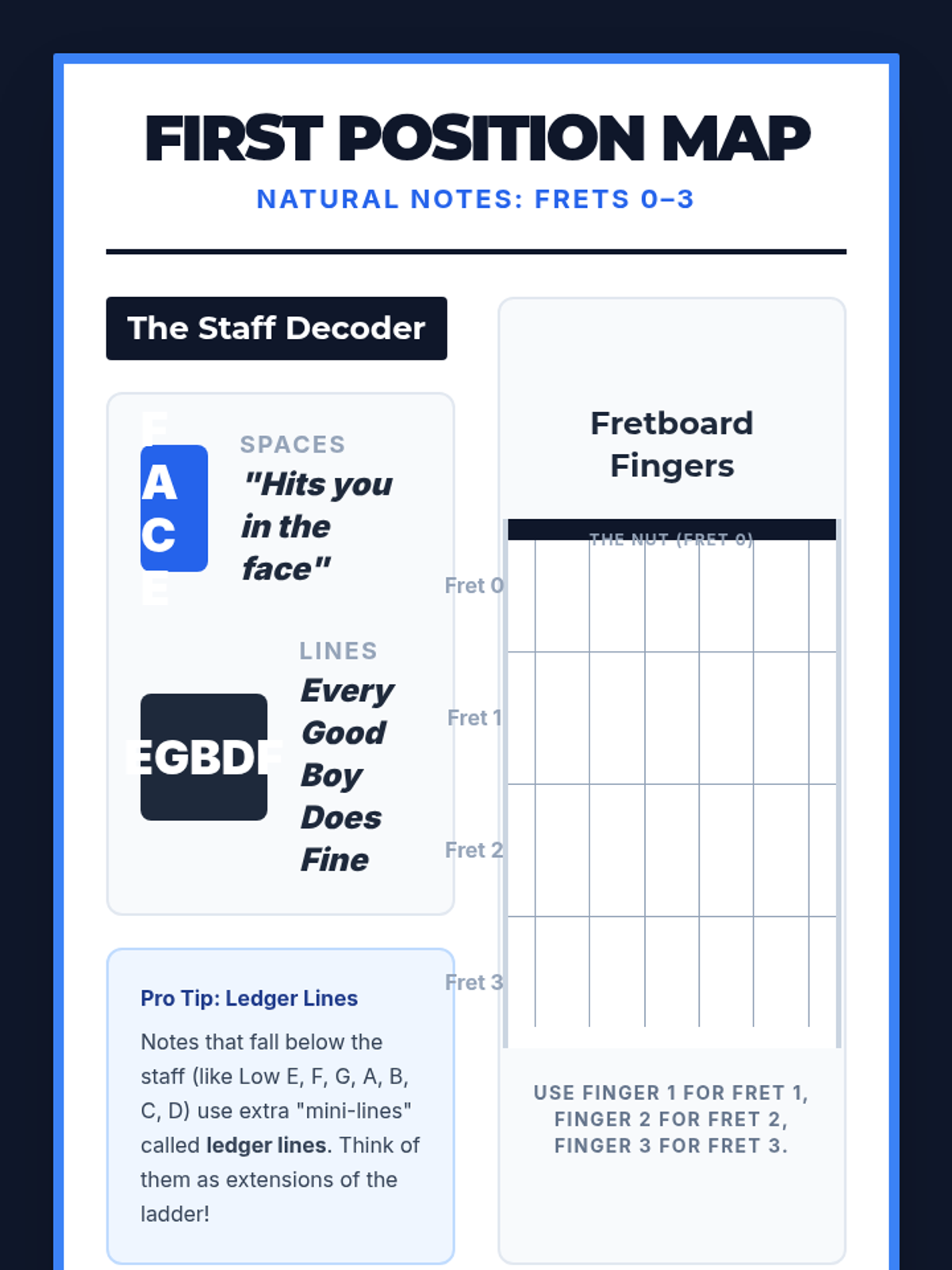
A high-contrast reference poster for guitar students showing the first position fretboard, staff acronyms, and the essential natural notes in the first position.
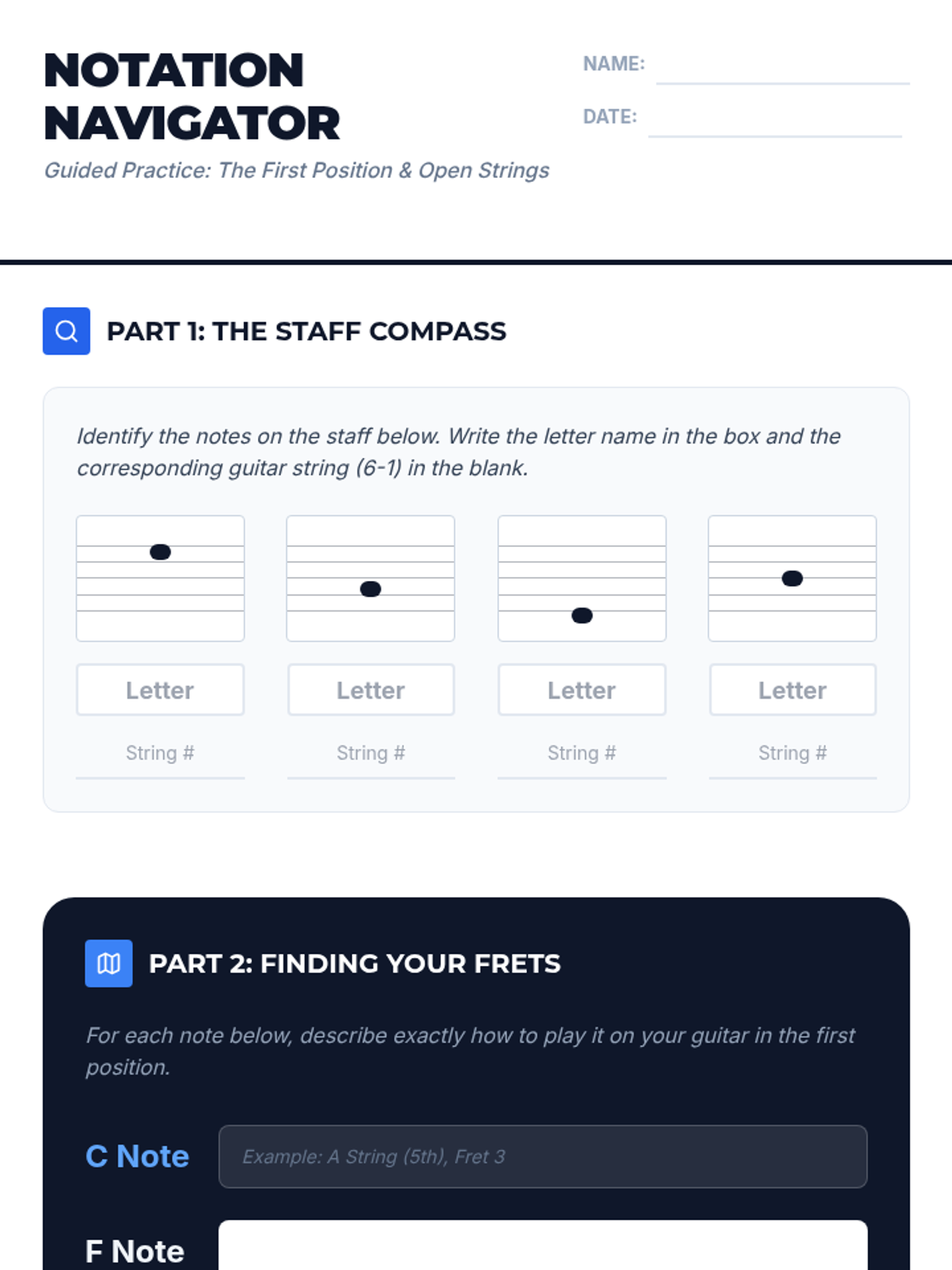
A student worksheet for practicing standard notation identification and fretboard mapping for the guitar's first position. Includes note-naming exercises and a melody decoding section.
Visual slides introducing standard notation for guitar beginners, covering staff anatomy, open string mapping, and first position (frets 1-3) on the high E string.
A professional 7-slide Google Slides theme matching the DAW theme, with slides for tracks, notations, recording, artist analyses, and personal growth logs.
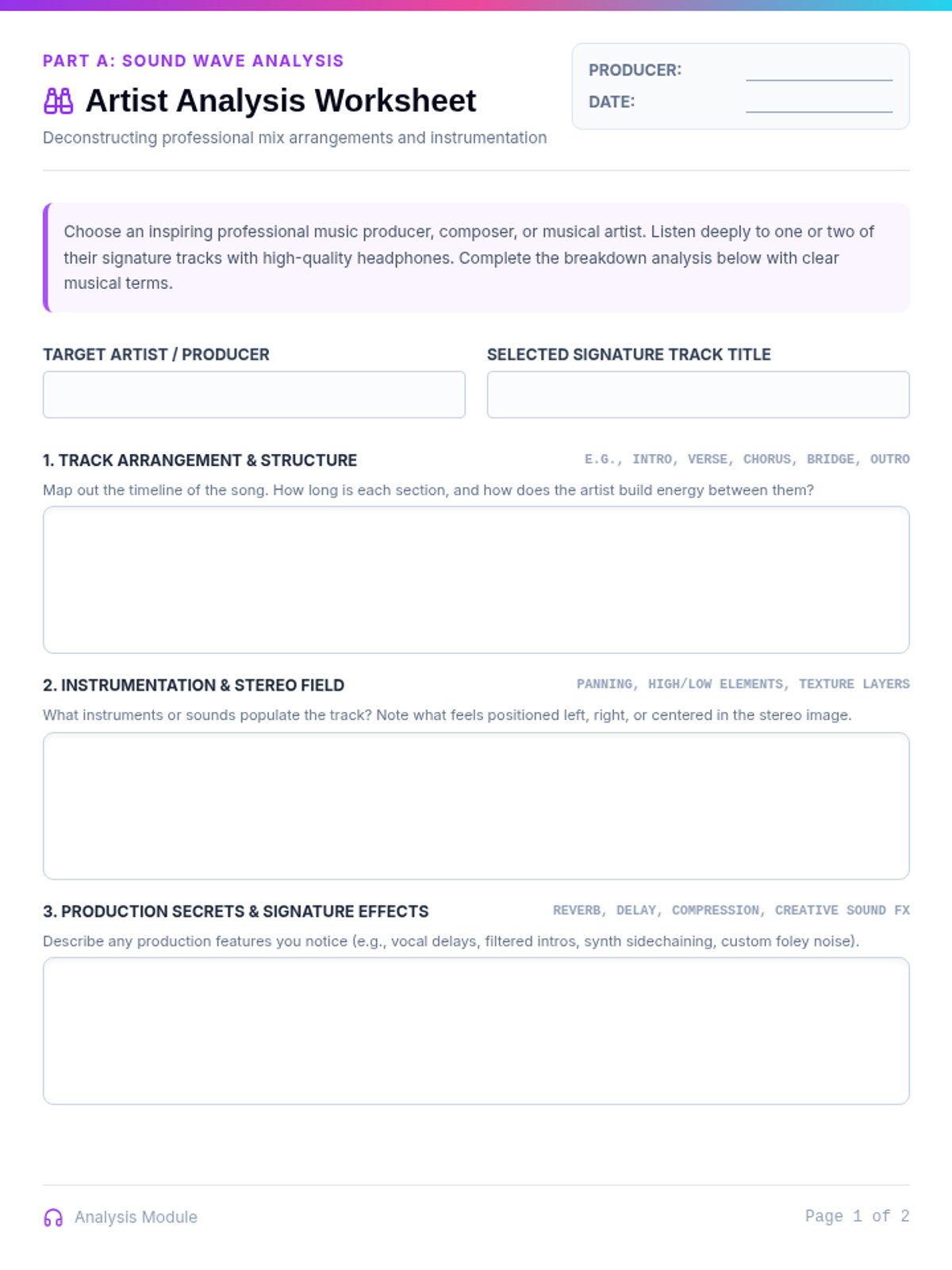
An analytical double-sided student worksheet featuring structured text blocks for professional artist deconstruction and personal portfolio reflective summaries.
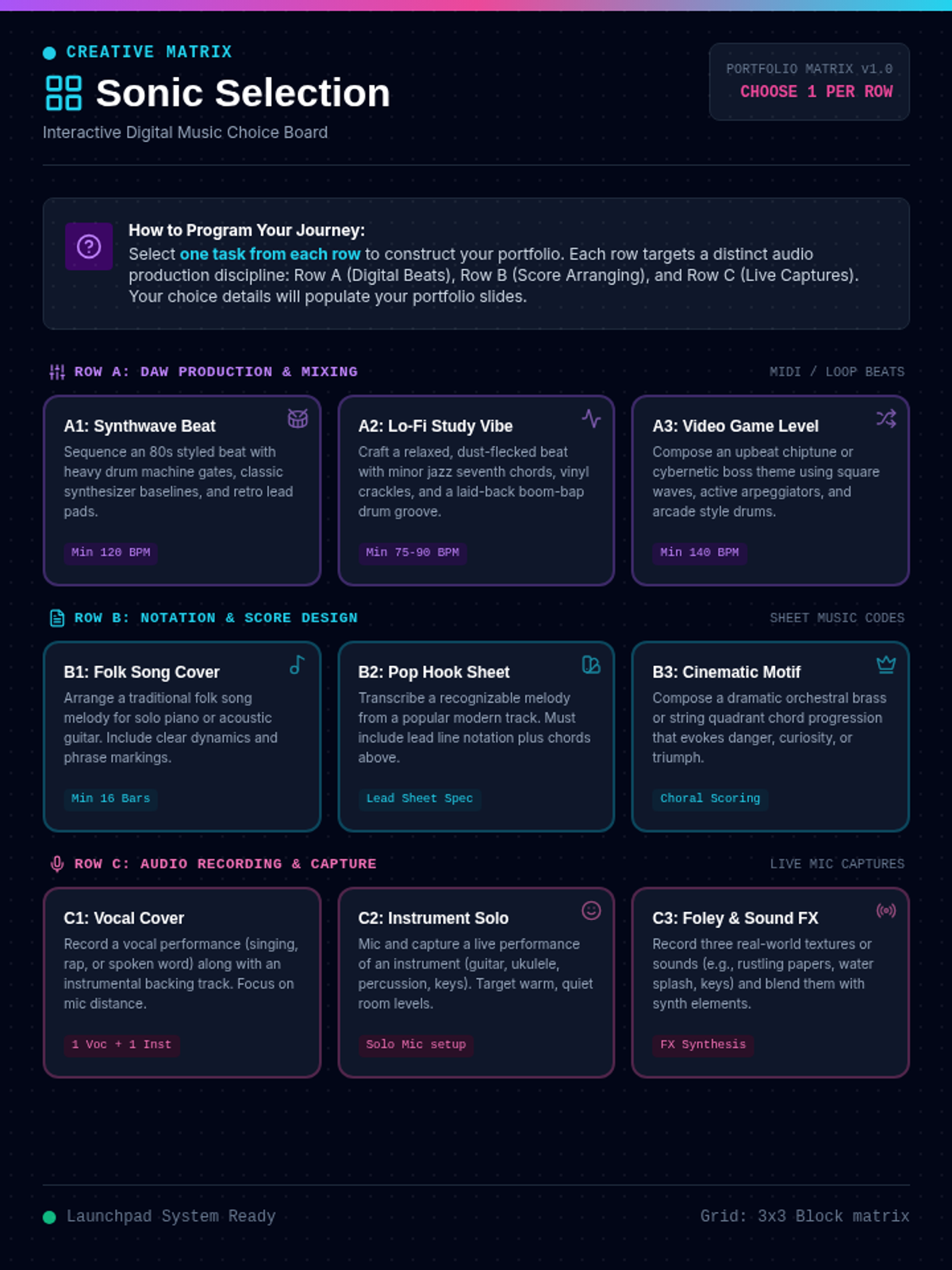
An interactive MIDI launchpad-style digital choice board allowing music technology students to select diverse creative pathways across DAW production, score design, and audio recording.
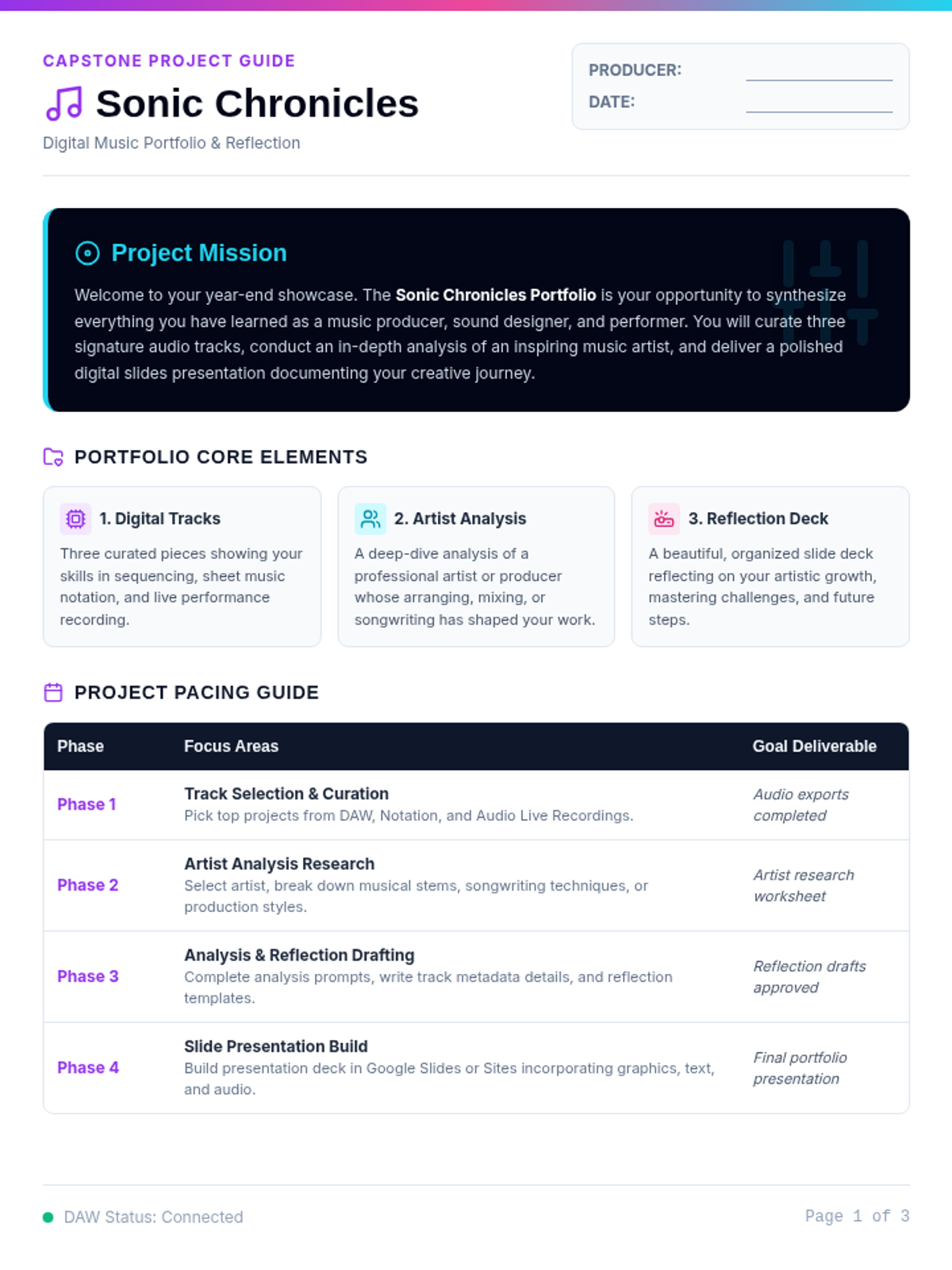
A comprehensive project guide and grading rubric for the Sonic Chronicles year-end digital music portfolio, laying out deliverables, pacing phases, track rules, and assessment standards.
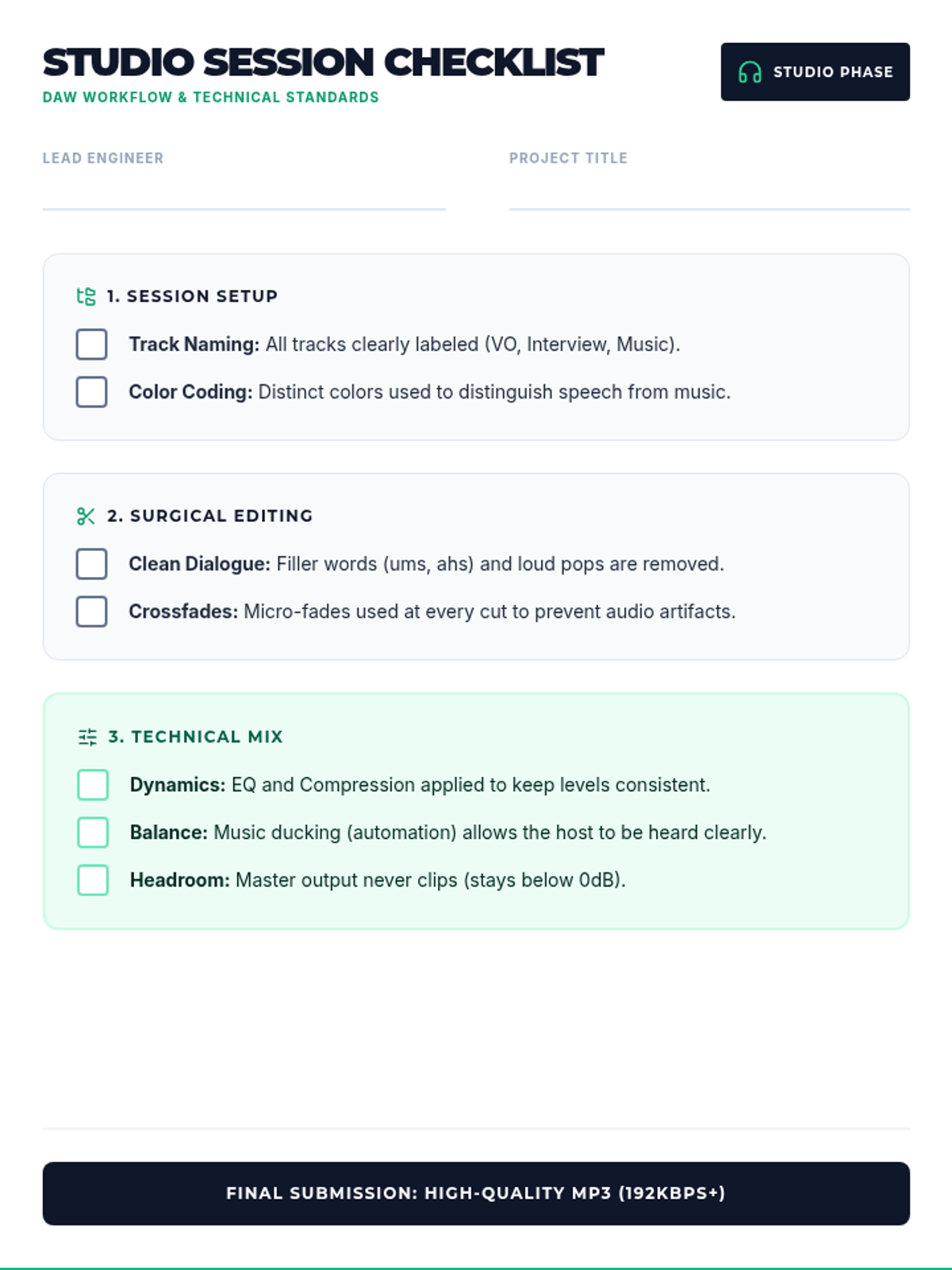
A technical checklist for students to follow during the production phase in Soundtrap. It ensures quality control across session organization, surgical audio editing, and professional mixing/mastering techniques.
Introductory slide deck for a podcasting unit. It covers the definition of the medium, the importance of "The Big Question" in journalism, ethical considerations in audio reporting, and an overview of the Soundtrap production workflow.
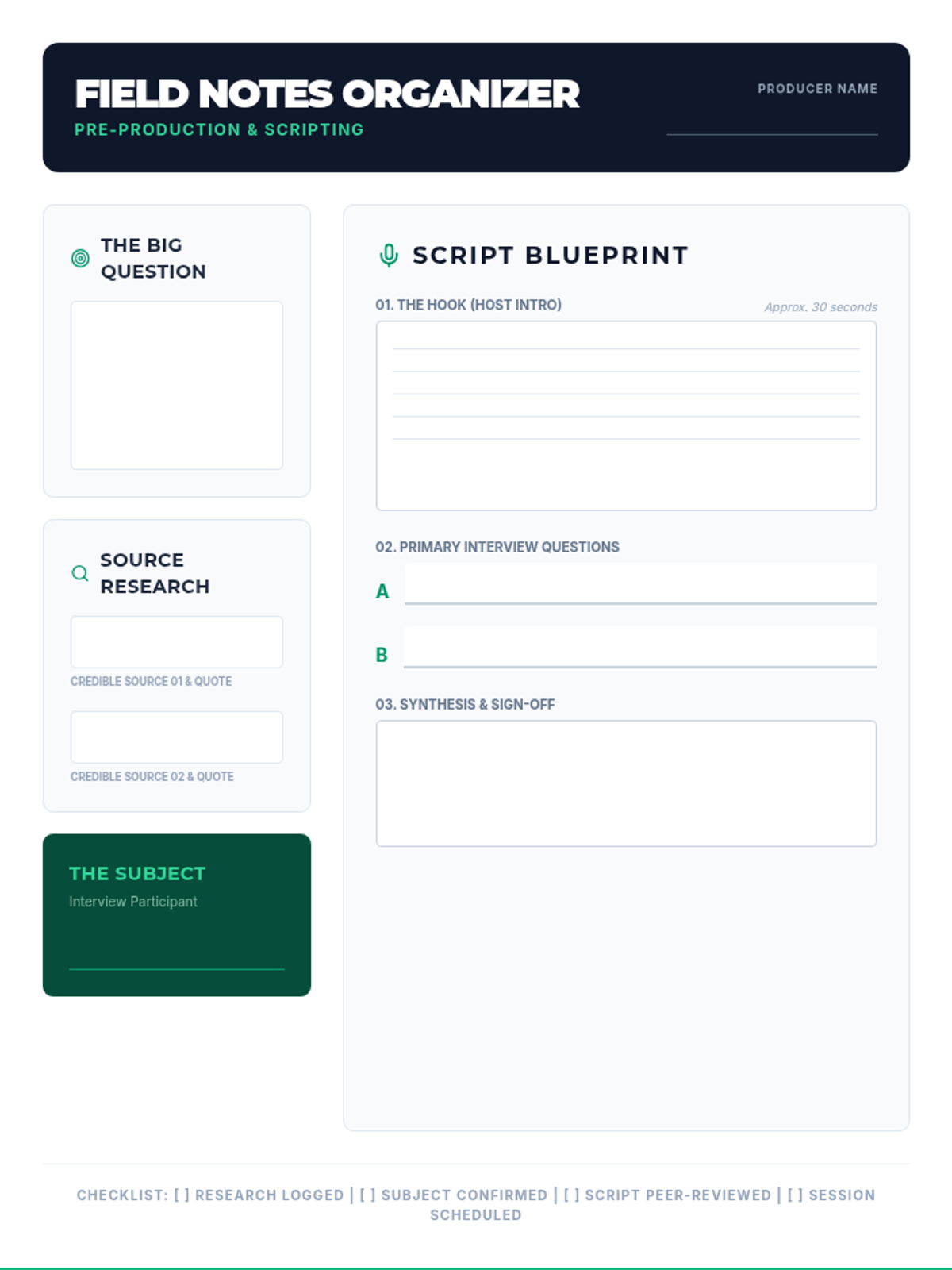
A student research and scripting organizer designed for the pre-production phase of a podcast. It guides students through defining their "Big Question," tracking sources, and drafting host narration and interview questions.
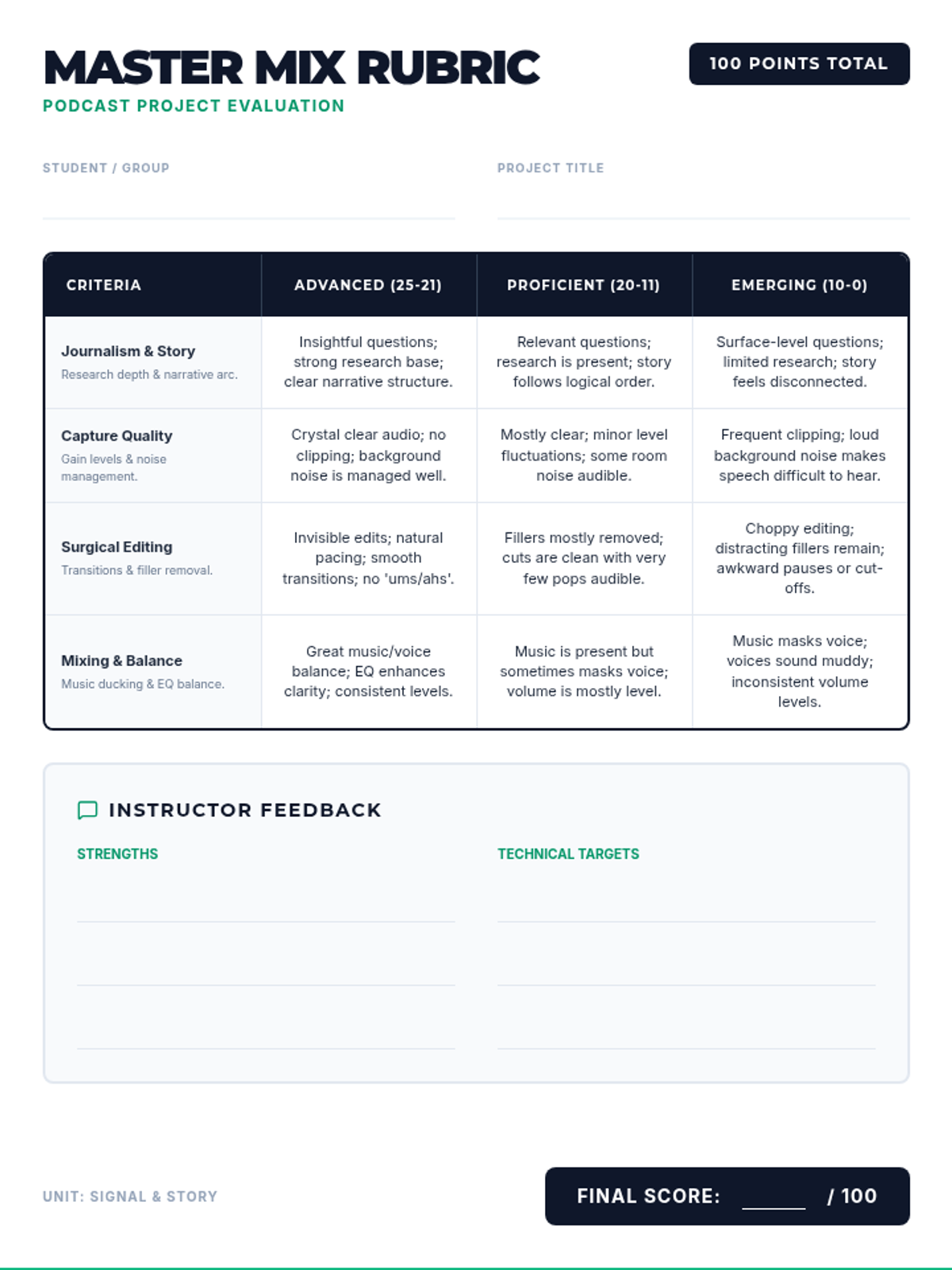
A professional project rubric for evaluating podcast productions. It balances journalistic criteria (research, questioning) with technical audio engineering requirements (mixing, editing, and audio quality) on a 100-point scale.
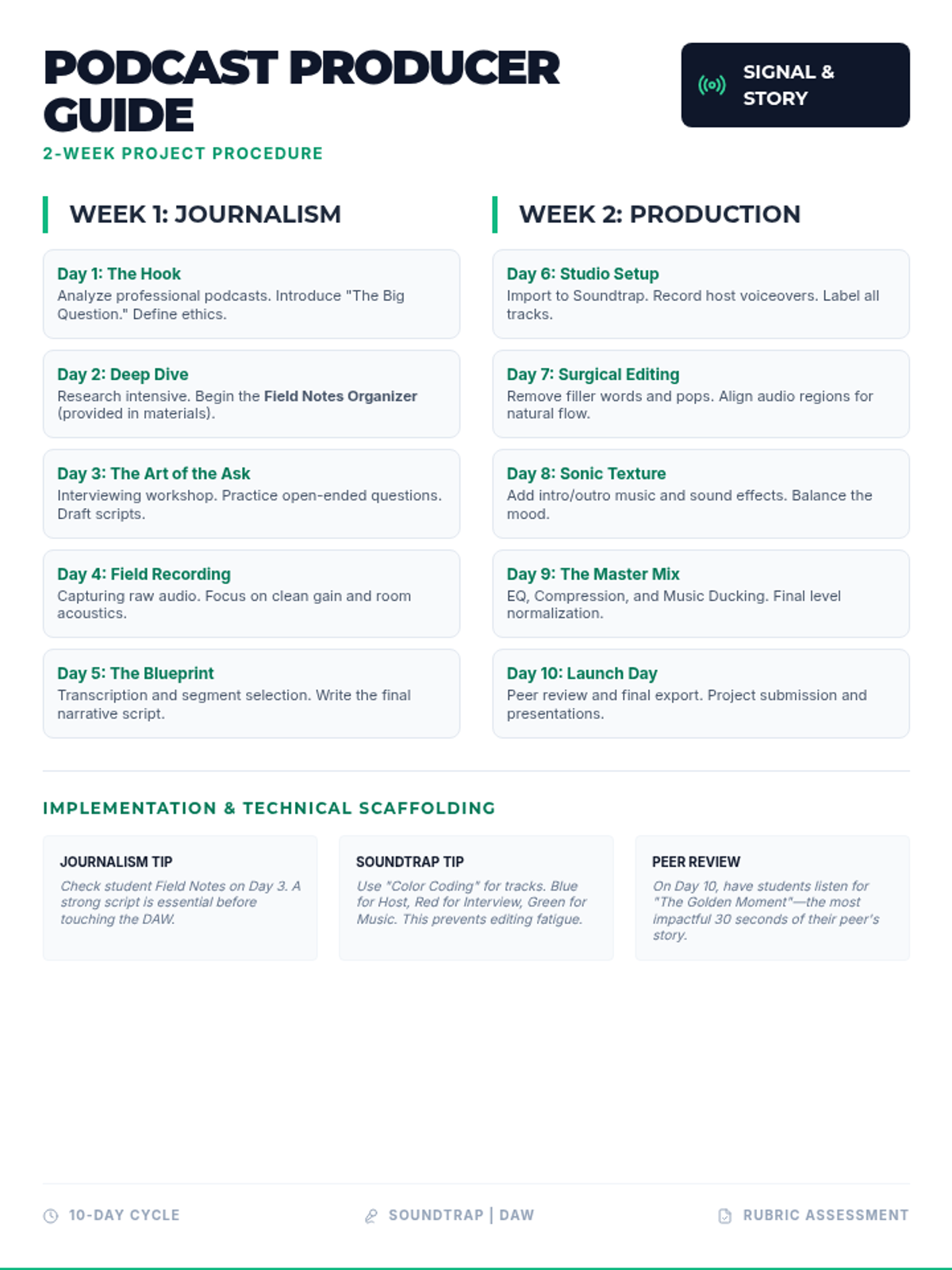
A comprehensive teacher's guide outlining a 10-day step-by-step procedure for a podcasting project. It includes daily lesson focuses, technical implementation strategies for Soundtrap, and journalistic scaffolding techniques.
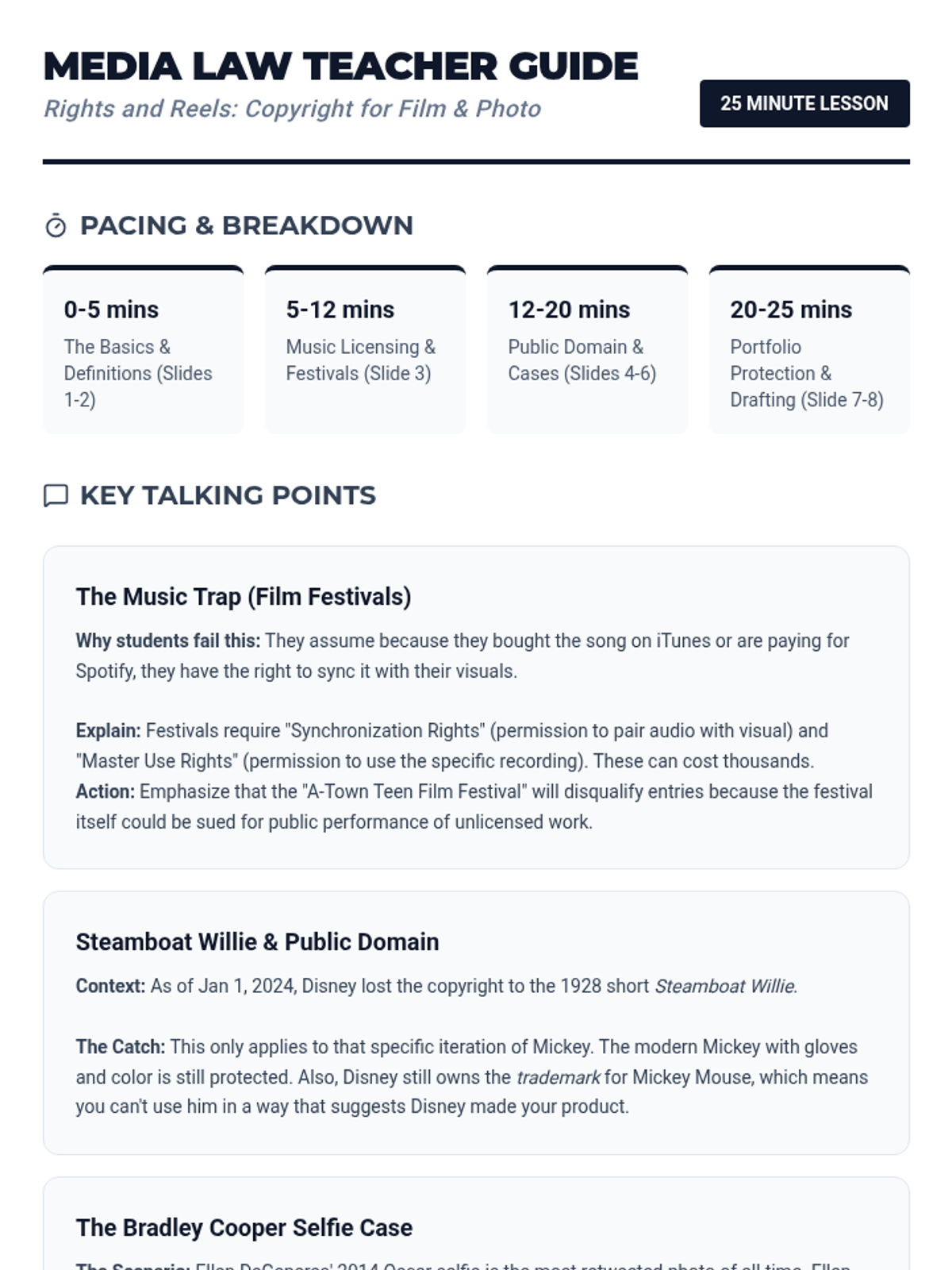
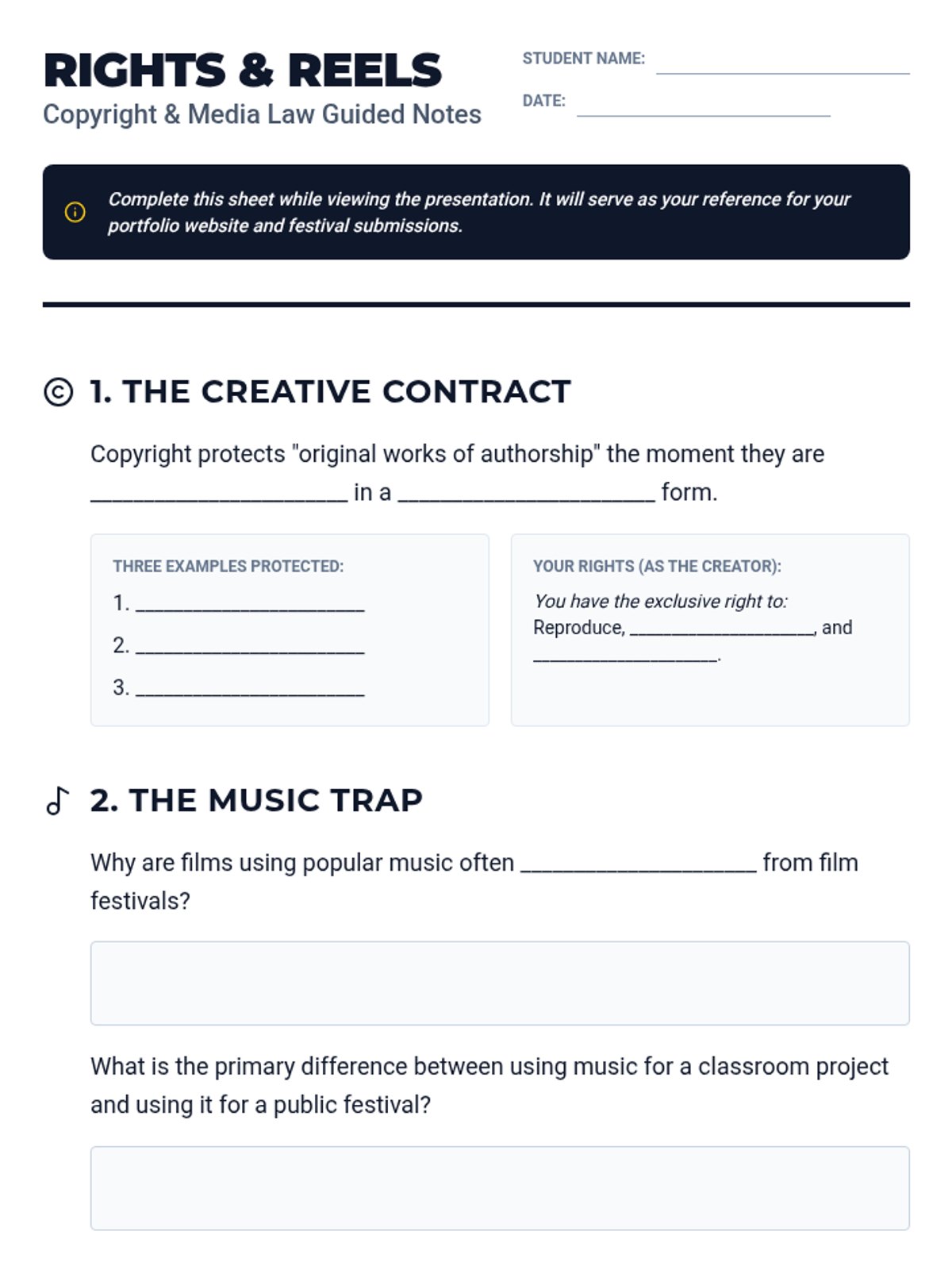
A teacher facilitation guide for the Rights and Reels lesson, including a 25-minute pacing guide, key talking points on music licensing and case studies, and an answer key for the student guided notes.
A follow-along guided notes sheet for students to use during the Rights and Reels presentation, featuring fill-in-the-blanks, checkboxes, and a drafting area for their portfolio copyright statement.
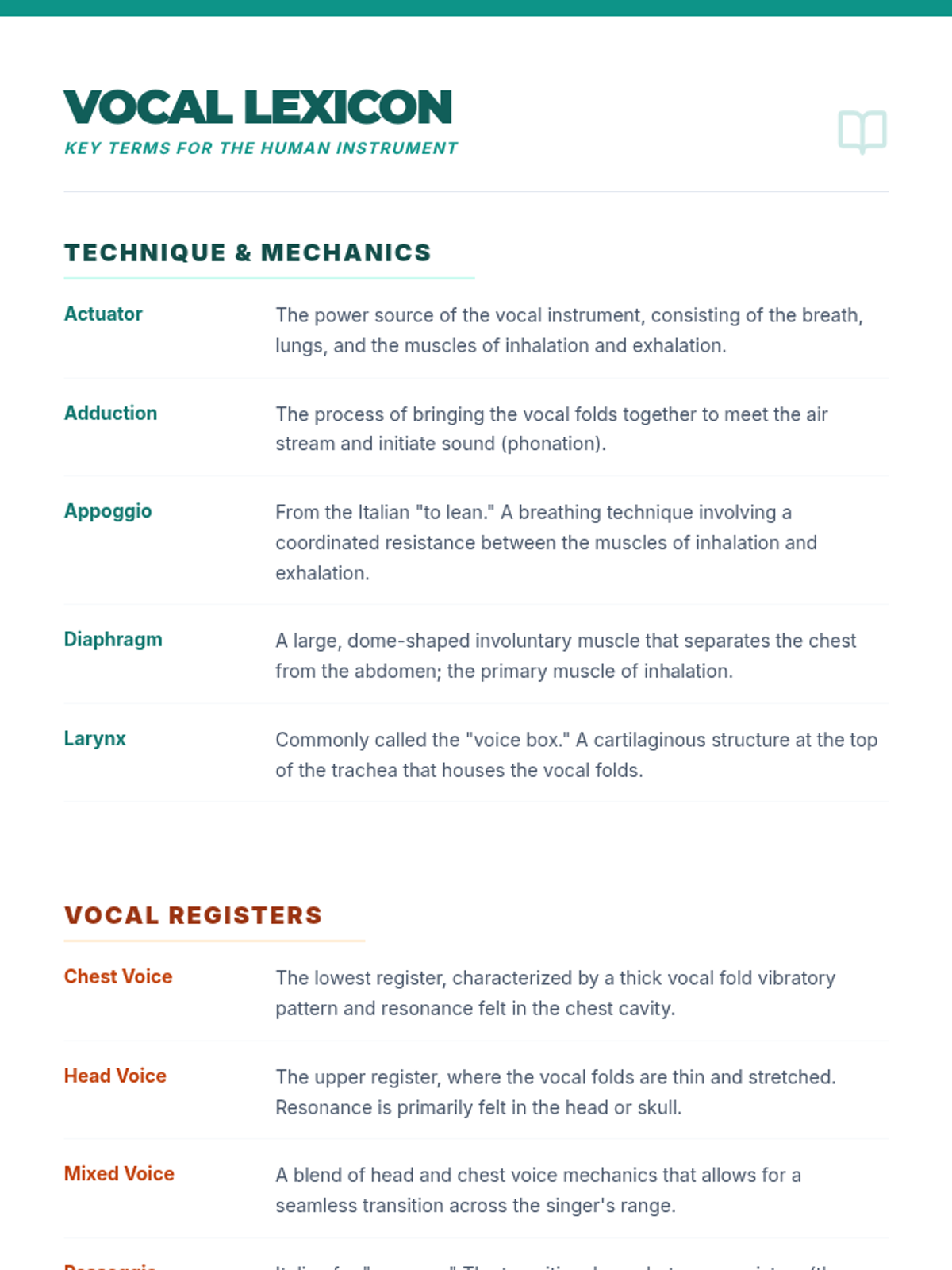
A comprehensive student reference guide defining key vocal terminology, organized by technique, registers, and resonance concepts.
An expanded 20-slide deck for "Vocal Mastery Essentials," providing deep dives into vocal anatomy, breath support (Appoggio), register blending, and resonance placement.
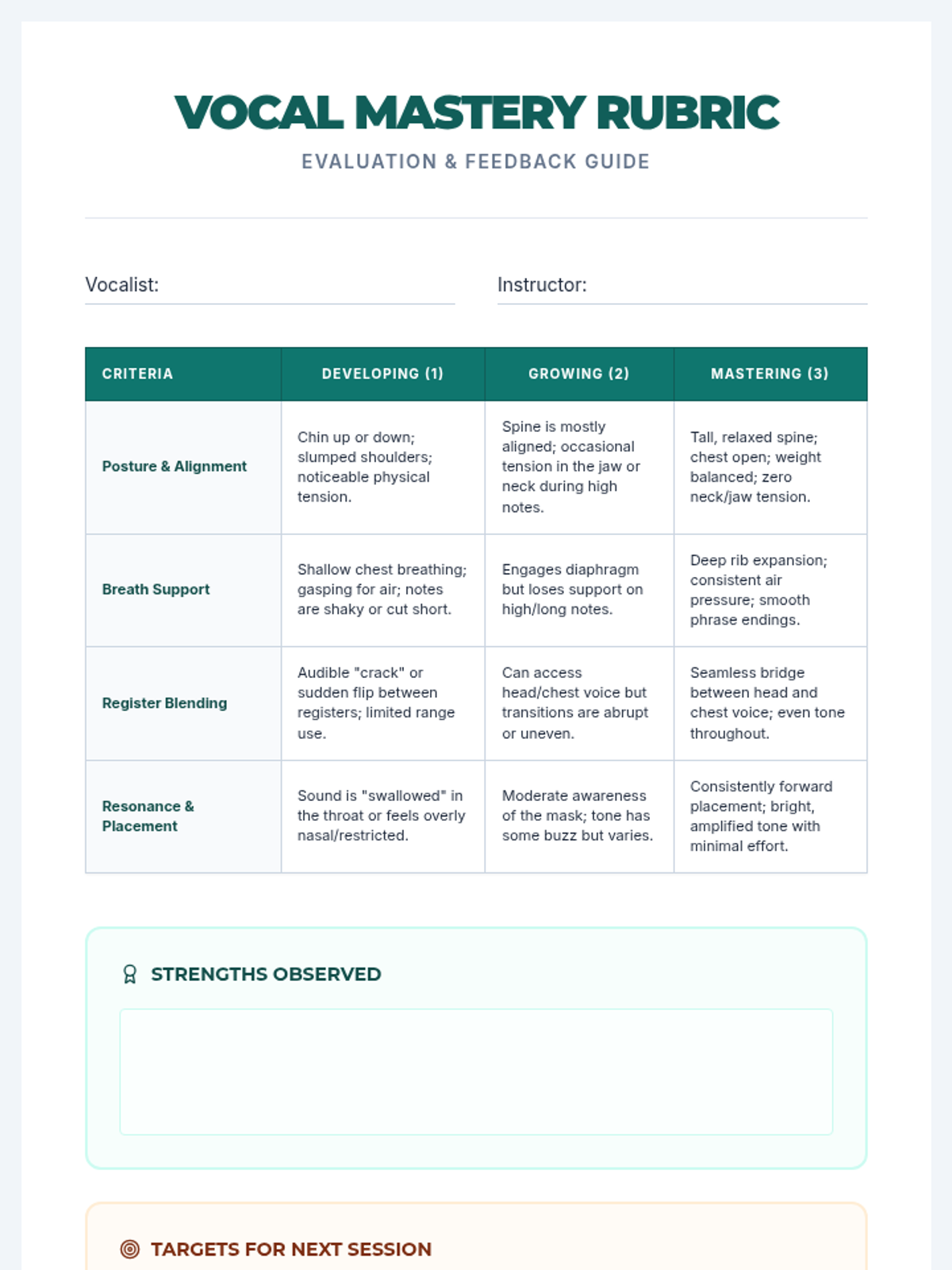
A technical rubric for assessing vocal performance, focusing on posture, breath support, register management, and resonance placement.
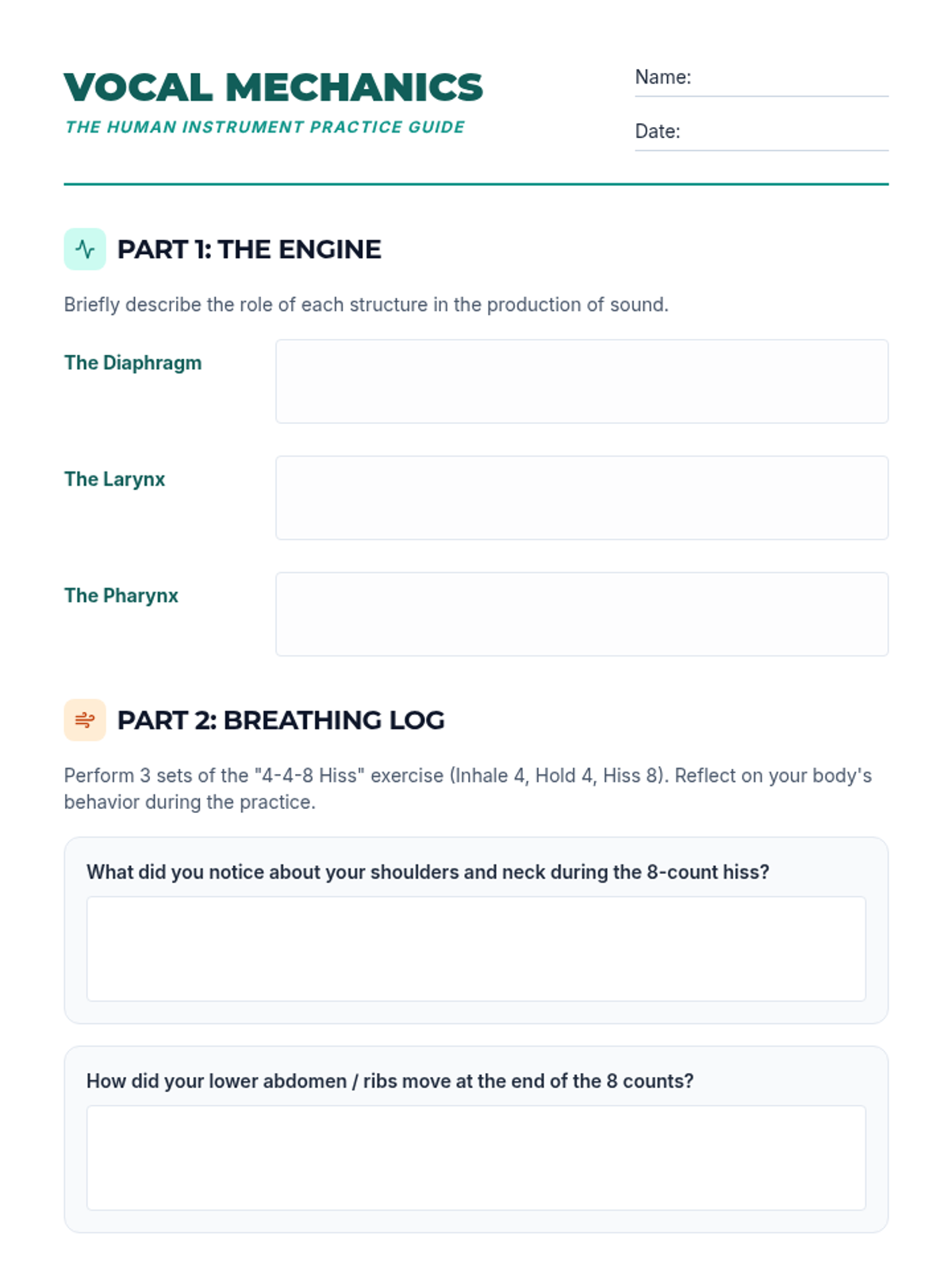
A comprehensive practice worksheet for students to record observations on vocal anatomy, breathing patterns, register transitions, and resonance experimentation.
A visually striking and interactive slide deck covering vocal anatomy, diaphragmatic breathing, vocal registers, and resonance techniques for singers.
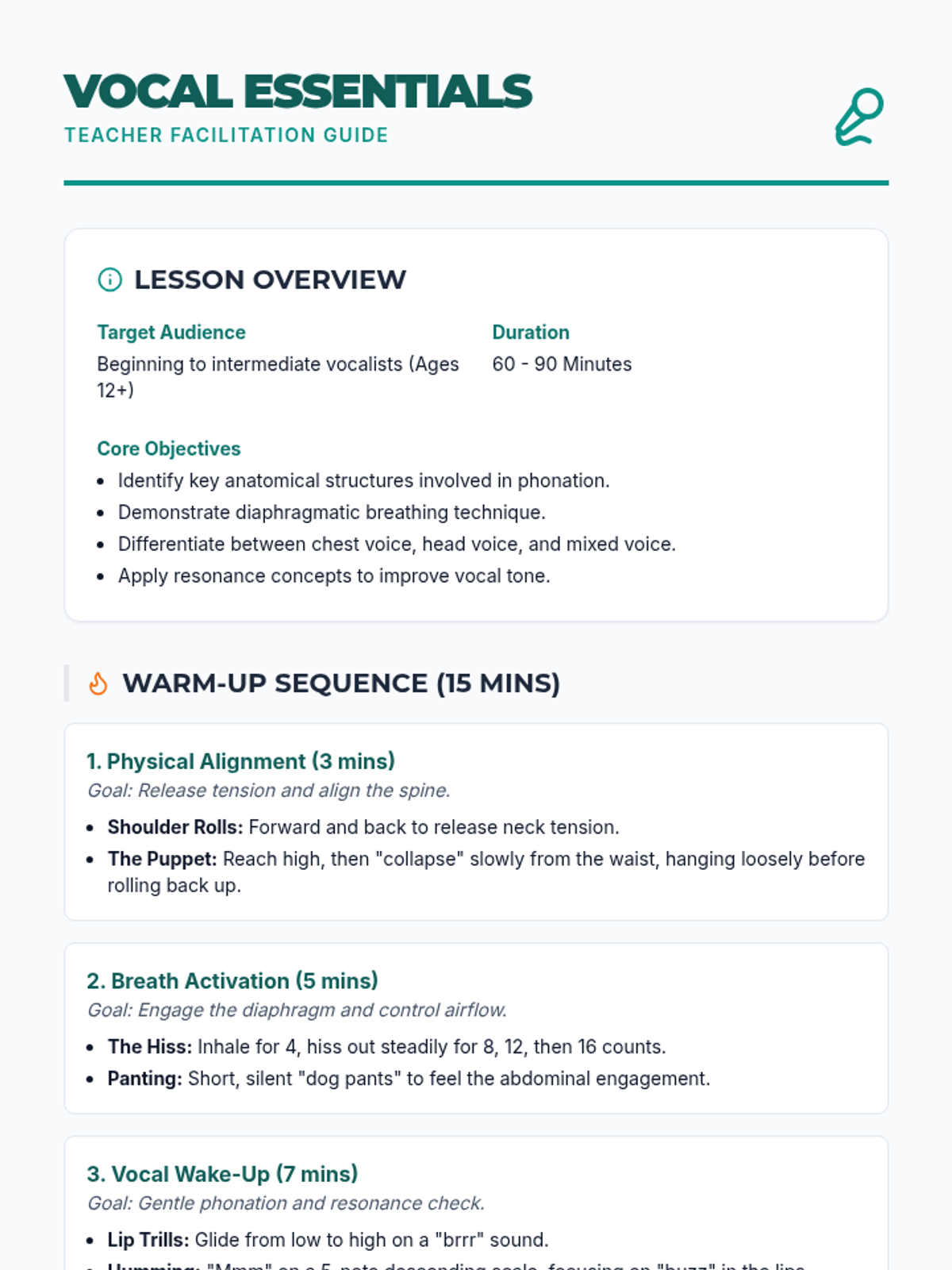
A detailed teacher guide for a vocal lesson, featuring a structured 15-minute warm-up sequence, instructional steps for anatomy and breathing, and troubleshooting tips for common vocal issues.
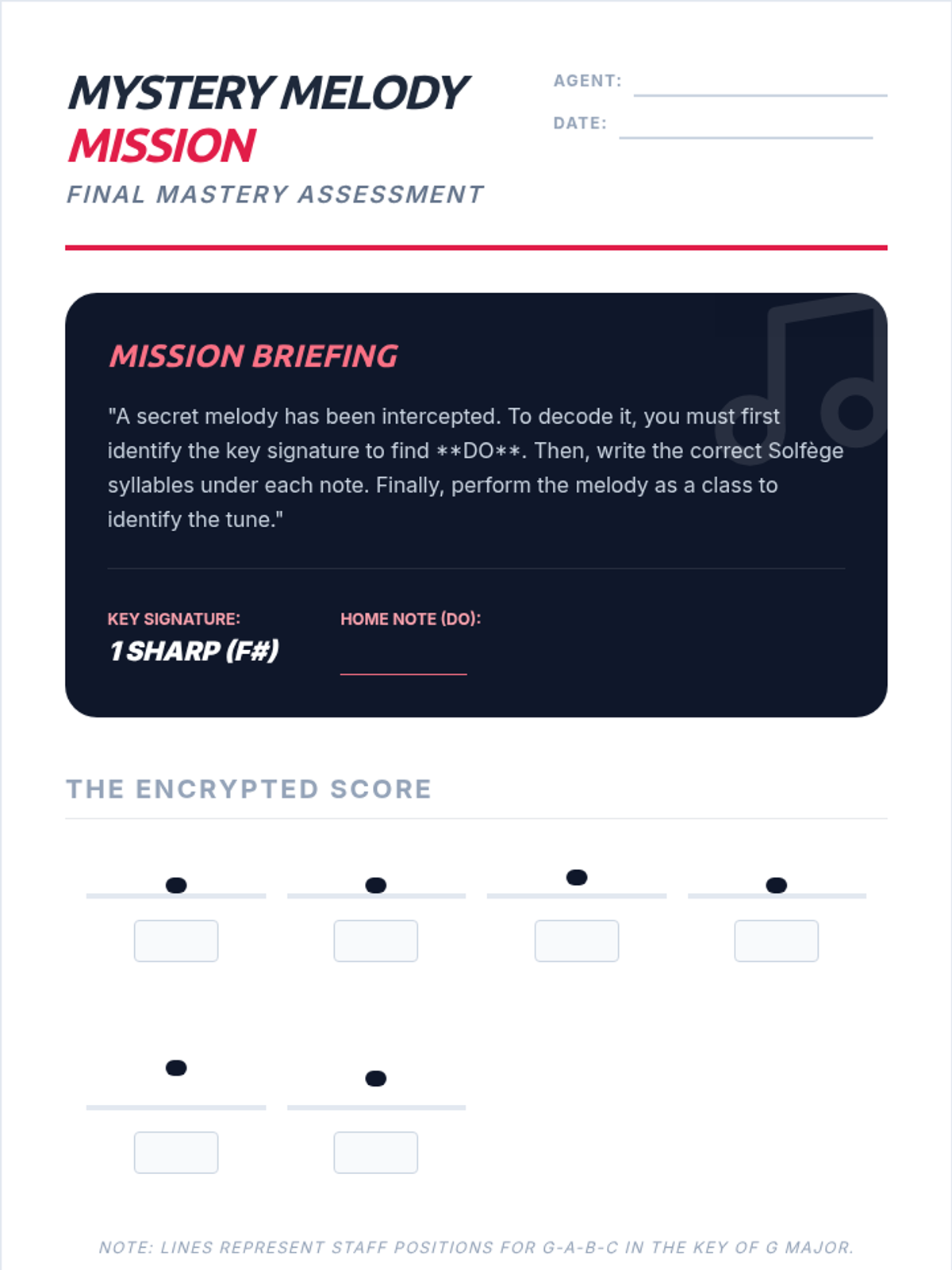
Activity sheet for Lesson 5: Sight-Singing in Key. Students identify the key, label Solfège syllables for a mystery melody, and perform it to identify the song.
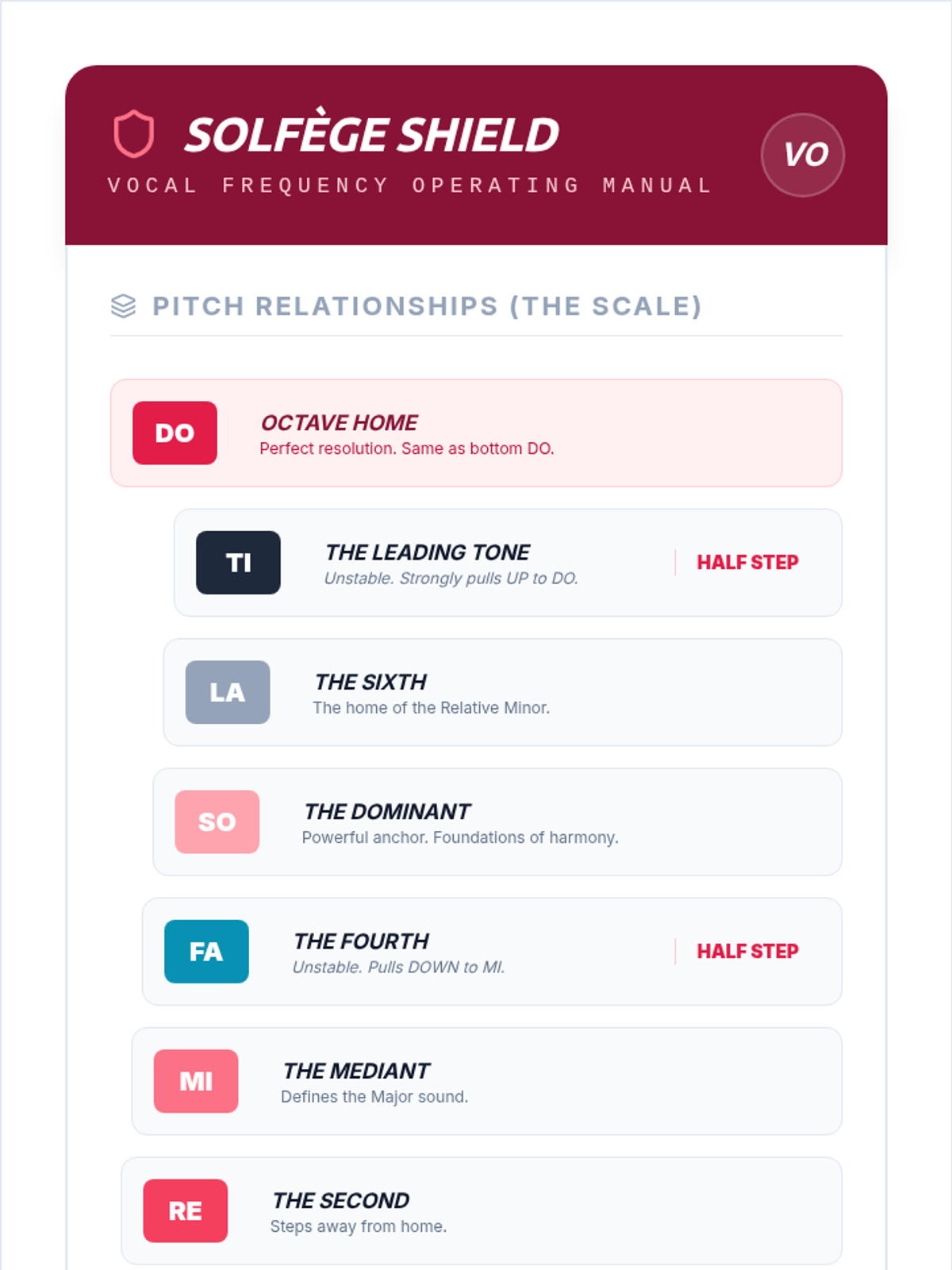
Reference sheet for Lesson 5: Sight-Singing in Key. Features Solfège syllables, their functions, and half-step relationships for vocal mastery.
Connecting theory to Solfège for Lesson 5: Sight-Singing in Key. Covers movable DO, Solfège syllables, and the half-step relationships within the scale.
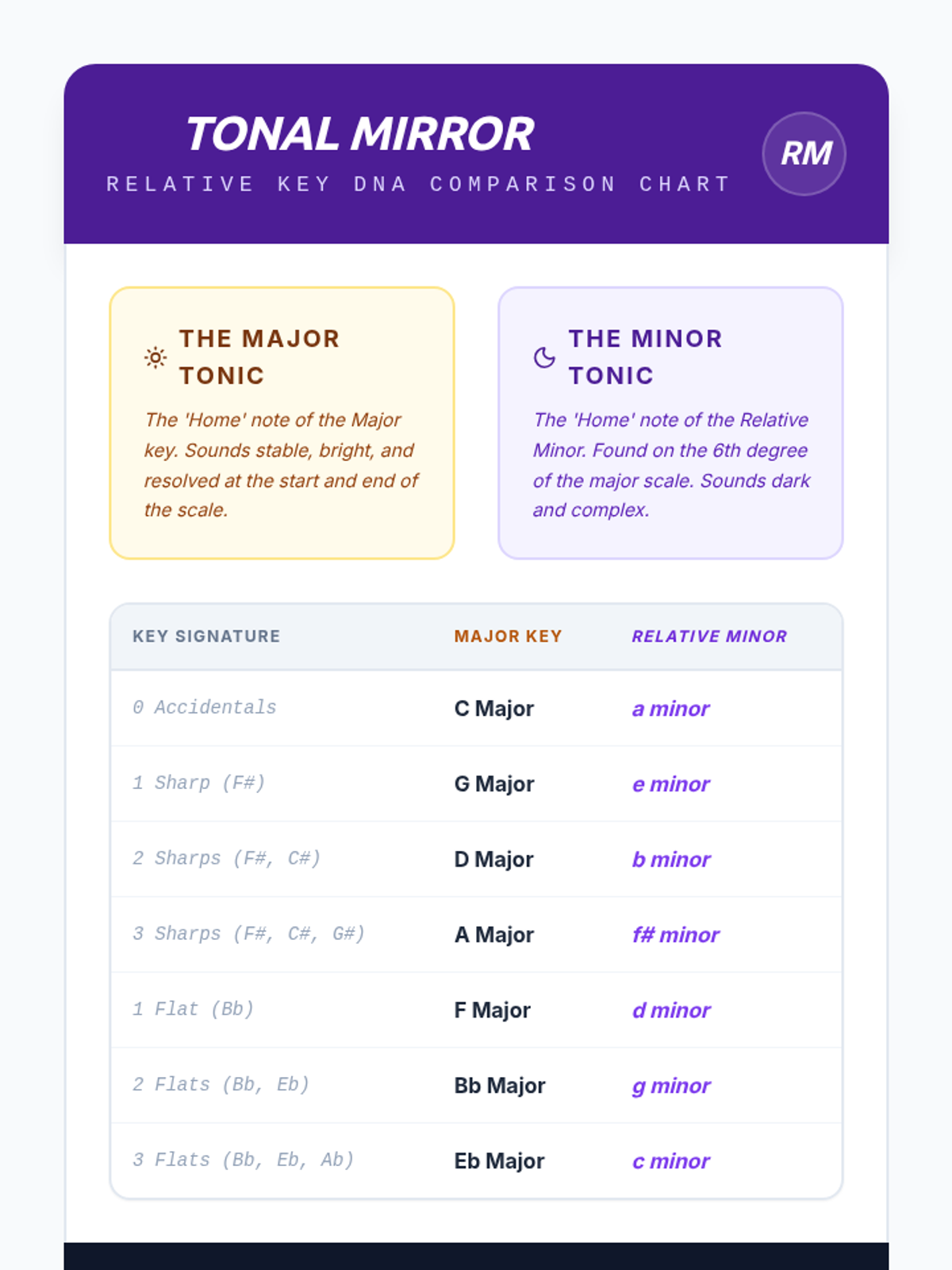
Reference sheet for Lesson 4: Relative Minors and Tonal Centers. Shows the relationship between common Major keys and their relative minors using a 'mirror' theme.
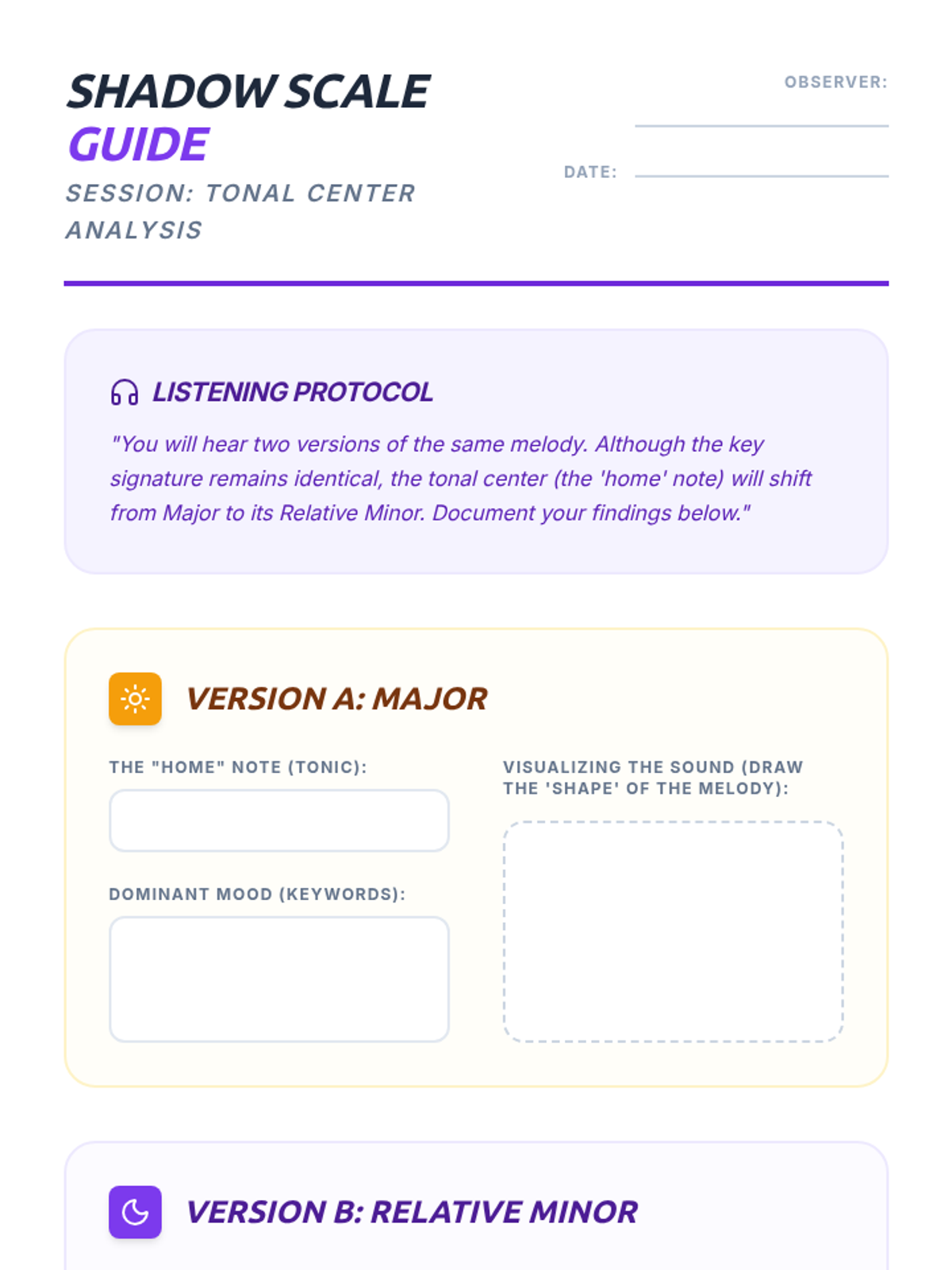
Listening guide for Lesson 4: Relative Minors and Tonal Centers. Students track emotional and structural changes between major and relative minor melodies.
Exploring the emotional and structural link between major keys and their relative minors through listening and scale analysis. Lesson 4: Relative Minors and Tonal Centers.
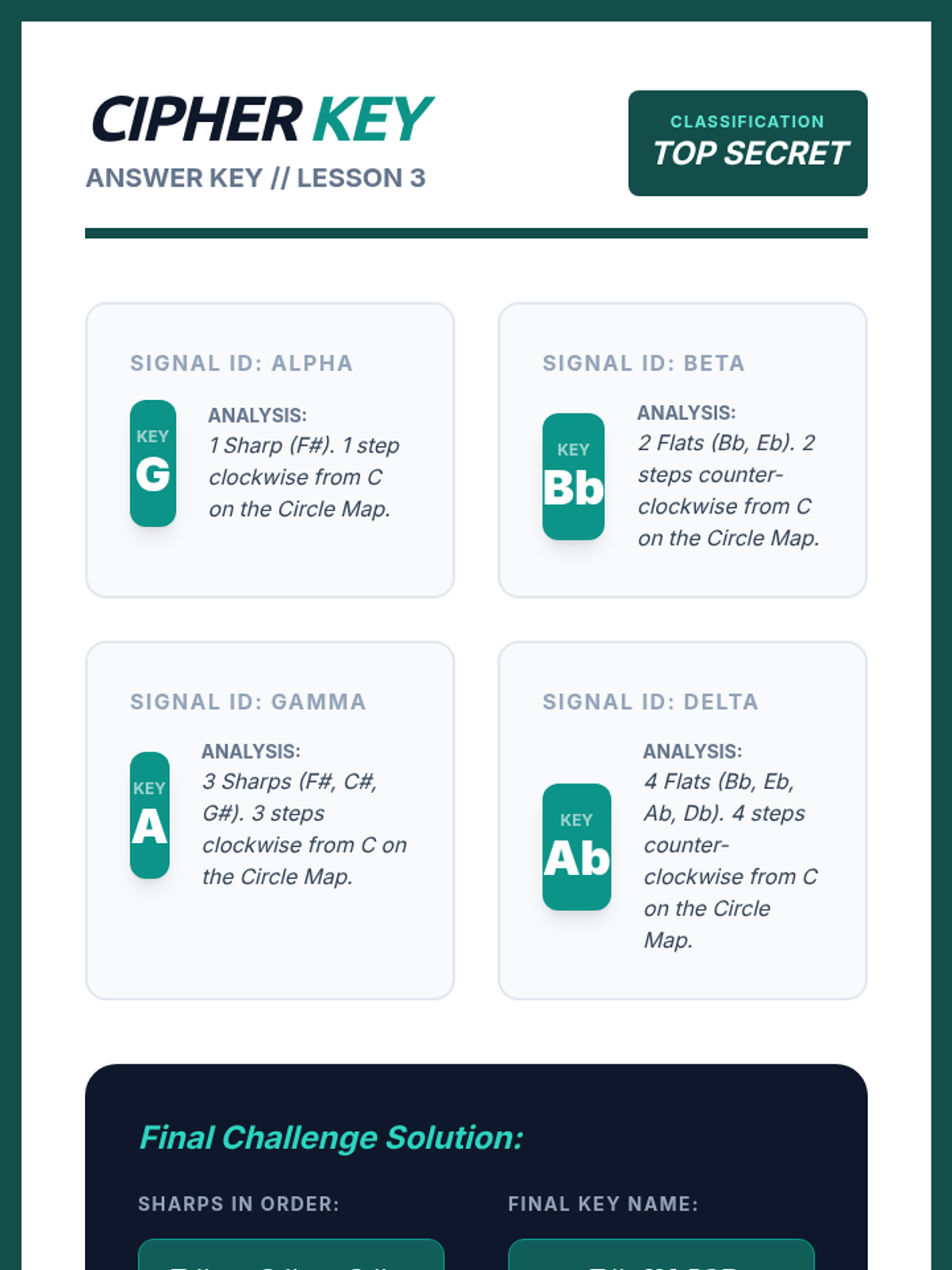
Answer key for Lesson 3: Unlocking the Circle of Fifths. Provides correct key identifications and the logic behind each solution.
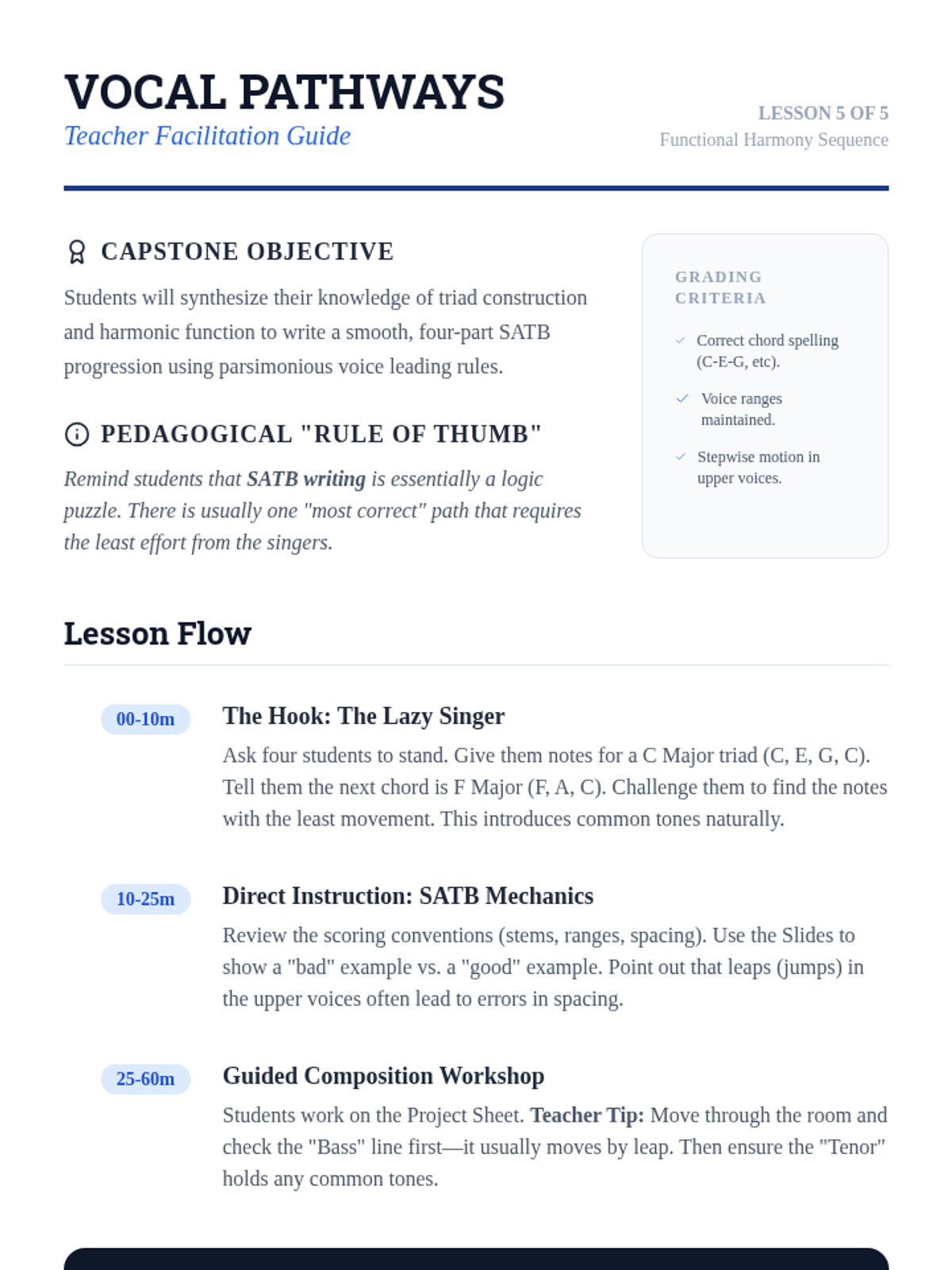
Teacher facilitation guide for Lesson 5, featuring the "Lazy Singer" roleplay activity, grading criteria for SATB writing, and a sample answer key for the I-IV-V-I progression.
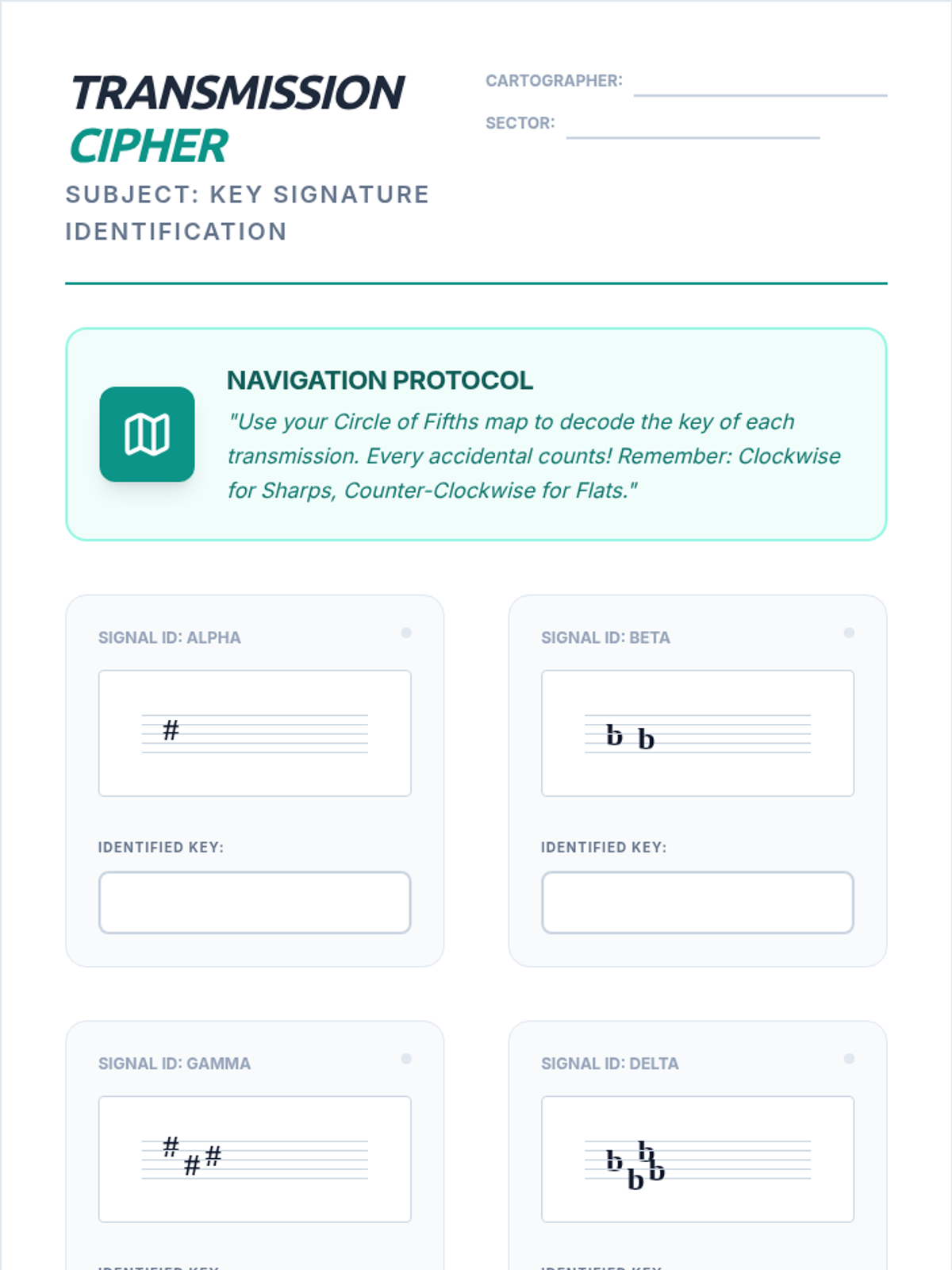
Activity sheet for Lesson 3: Unlocking the Circle of Fifths. Students identify keys by interpreting mock key signatures using the Circle of Fifths rules.
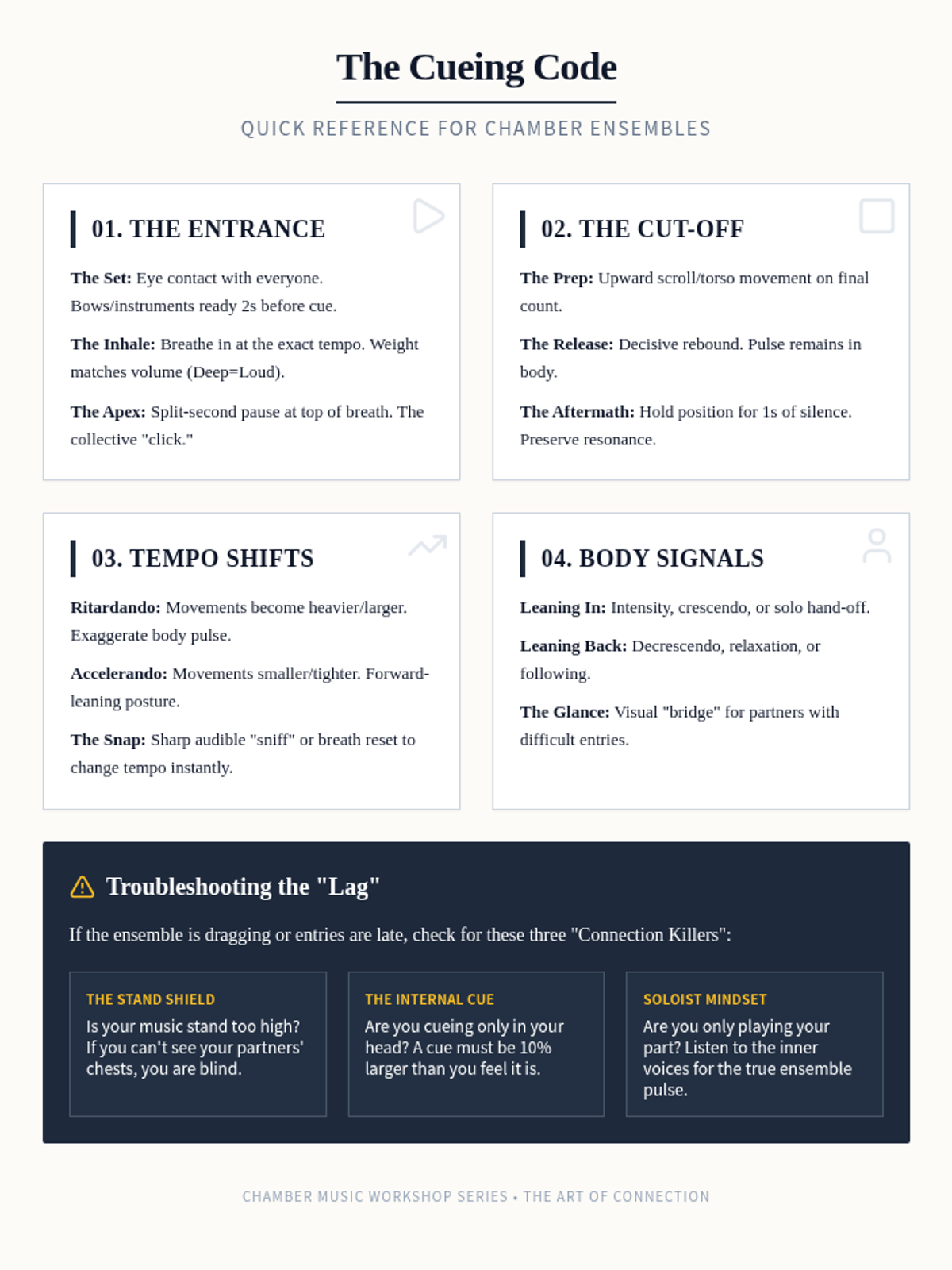
A concise reference sheet for chamber musicians providing non-verbal cueing techniques, body language signals, and troubleshooting tips for ensemble synchronization.
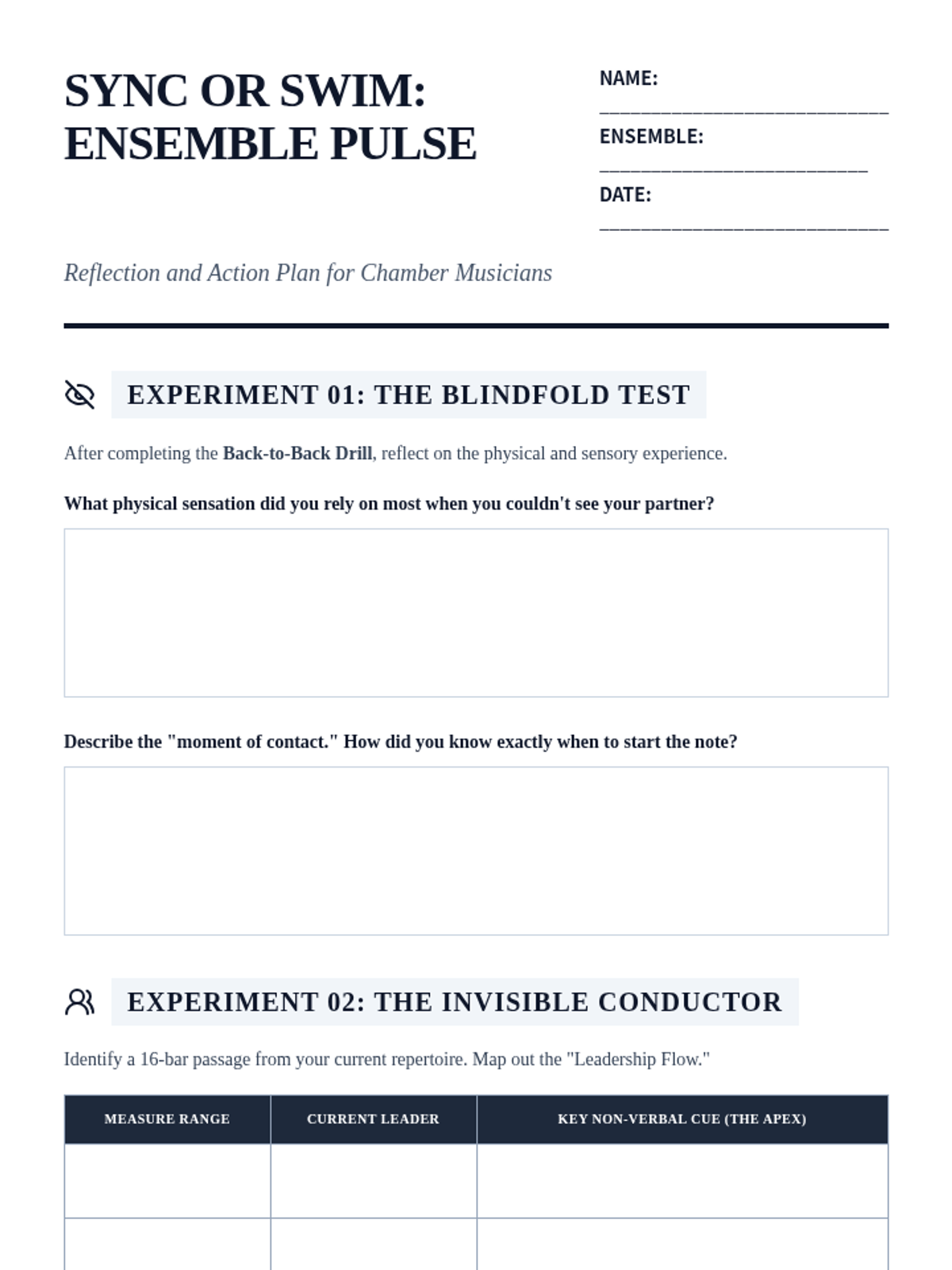
A student-facing activity worksheet for ensemble players to reflect on non-verbal communication exercises, map leadership changes in their scores, and troubleshoot ensemble timing issues.
A visually striking slide deck for a chamber music workshop, exploring the mechanics of non-verbal communication, shared breathing, and the psychological aspects of ensemble connection.
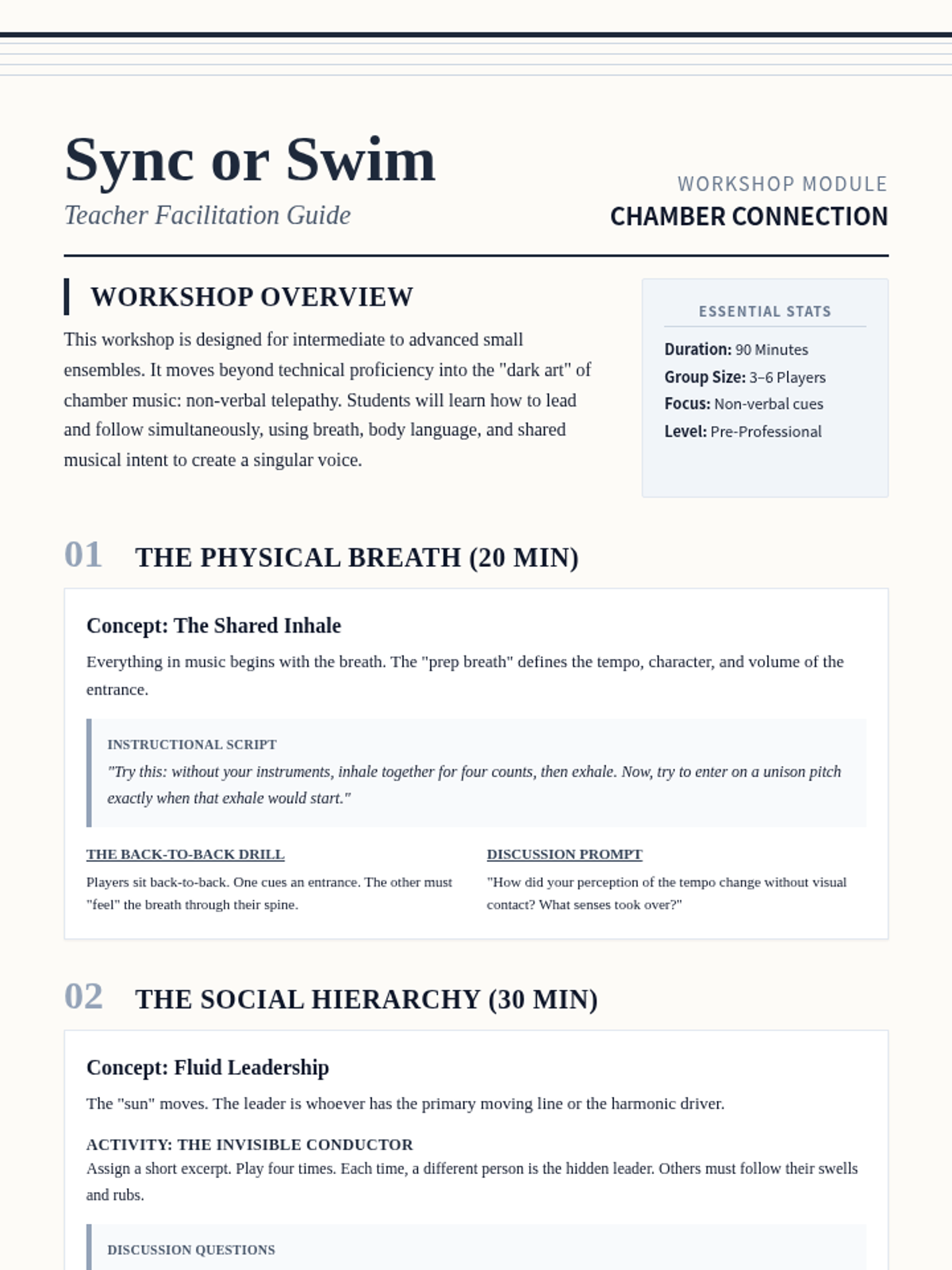
A comprehensive facilitator's guide for a chamber music workshop focusing on non-verbal communication, breathing techniques, and fluid leadership strategies for small ensembles.
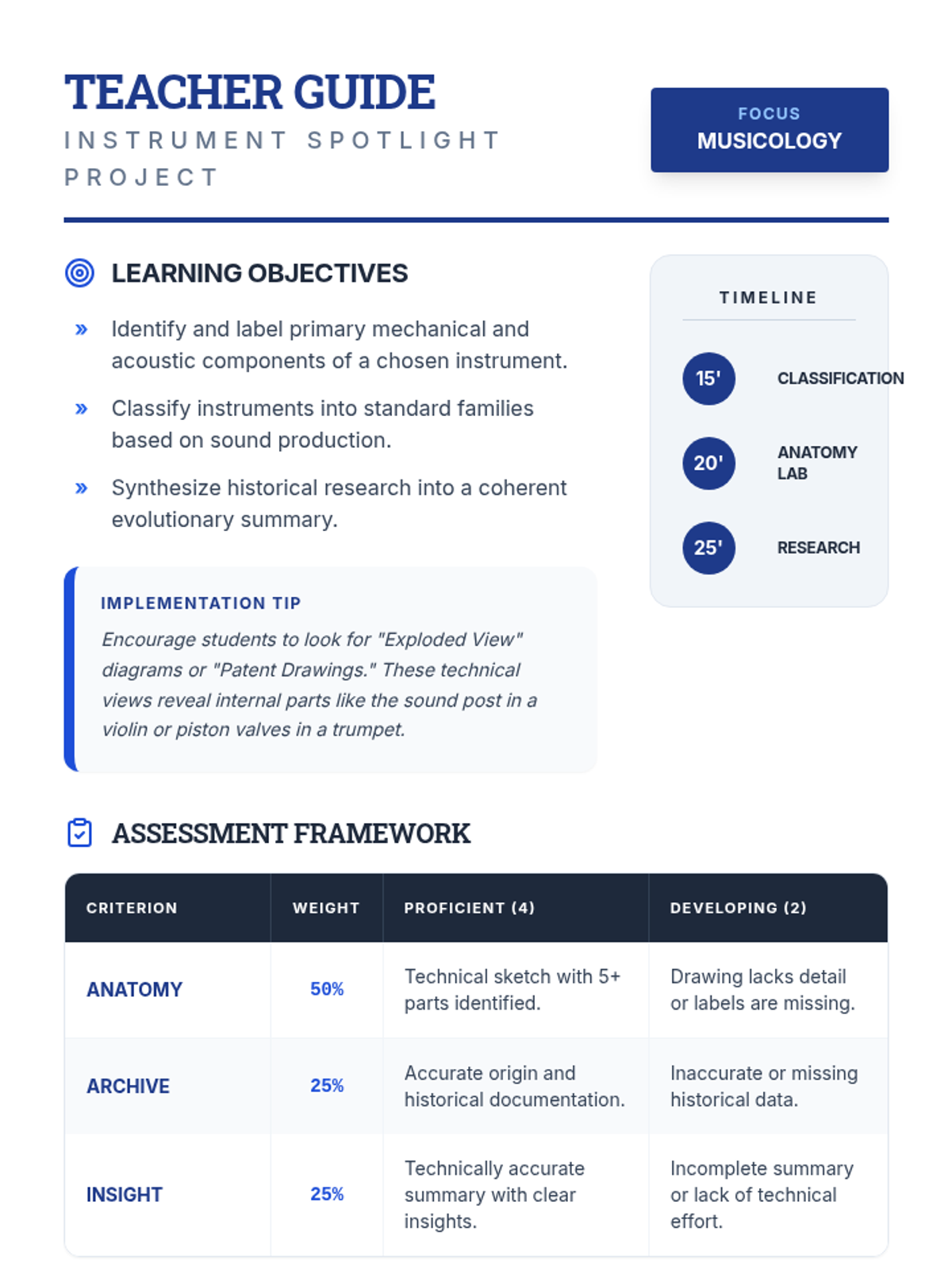
A teacher's guide for the Instrument Spotlight lesson, providing learning objectives, implementation tips, a weighted grading rubric, and suggested research resources.
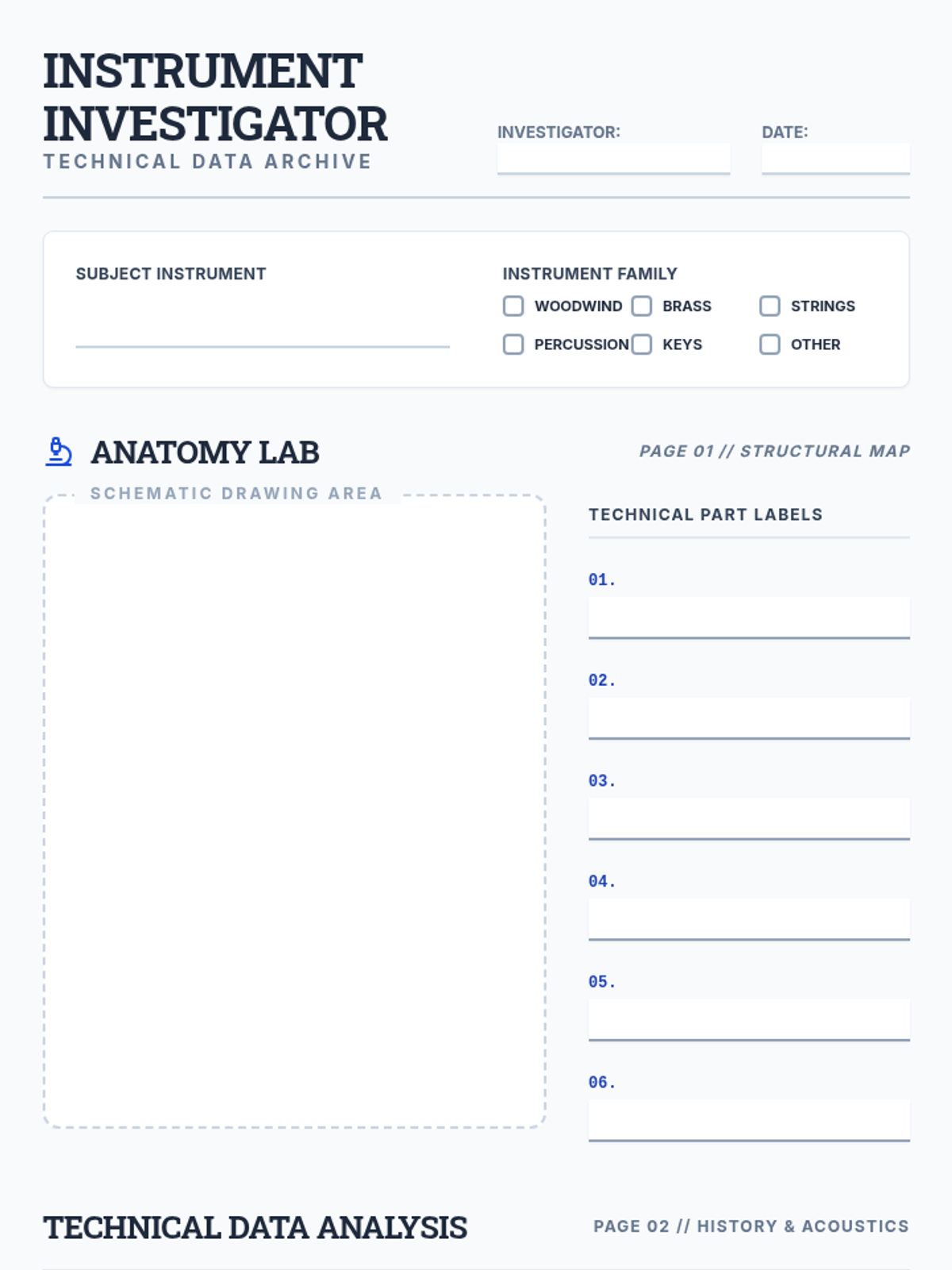
A comprehensive research worksheet for students to document the anatomy, history, and classification of any musical instrument they choose. Includes sections for sketching, labeling, historical context, and sound production.
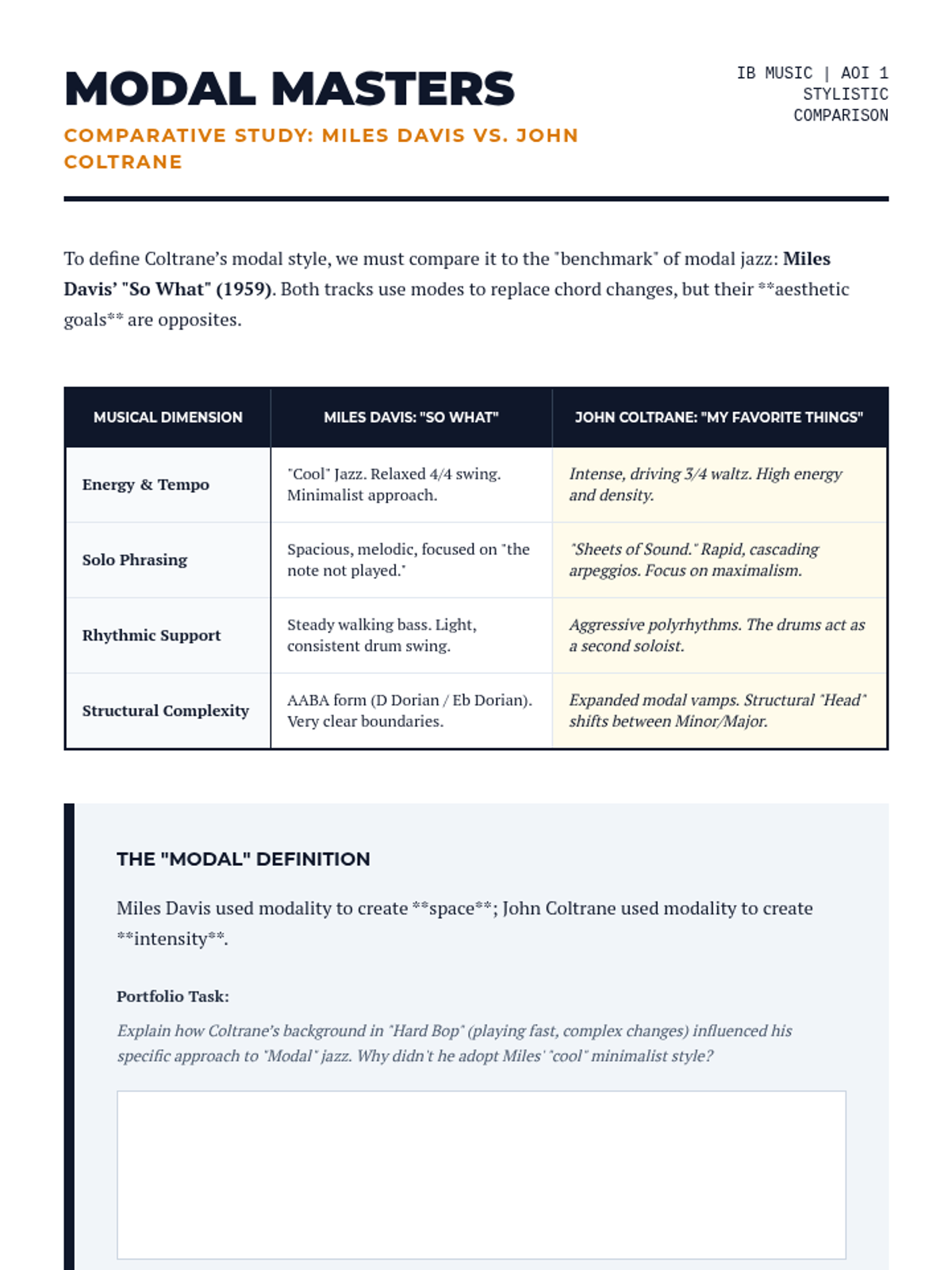
A 2-page comparative study worksheet for IB Music, comparing John Coltrane's modal approach in 'My Favorite Things' with Miles Davis' 'So What'. It focuses on energy, phrasing, and structural differences within the modal jazz movement.
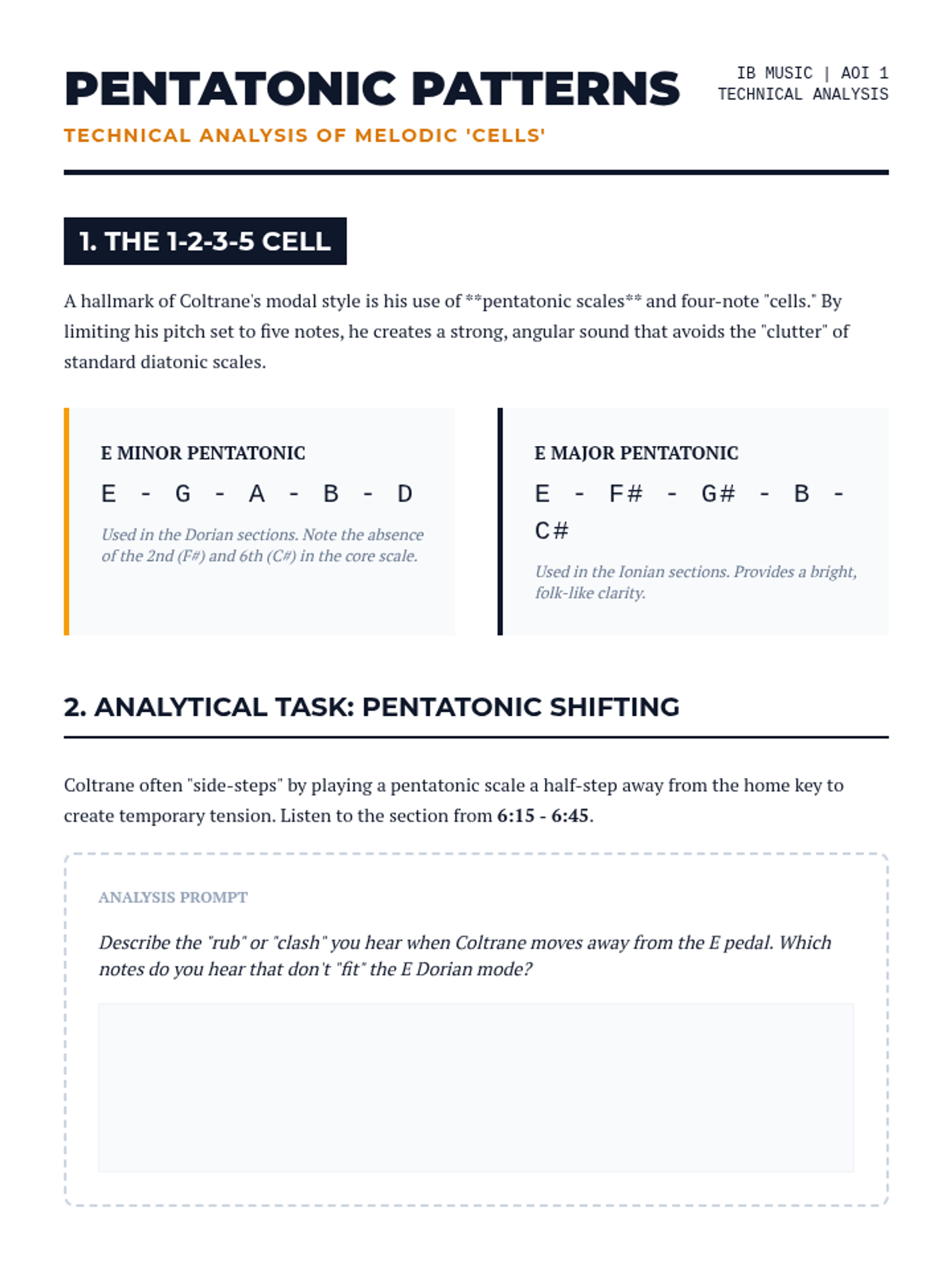
A 2-page technical analysis worksheet exploring John Coltrane's use of pentatonic scales, digital patterns (1-2-3-5 cells), and bitonal superimposition in 'My Favorite Things'. It includes specific listening tasks and portfolio evidence builders.
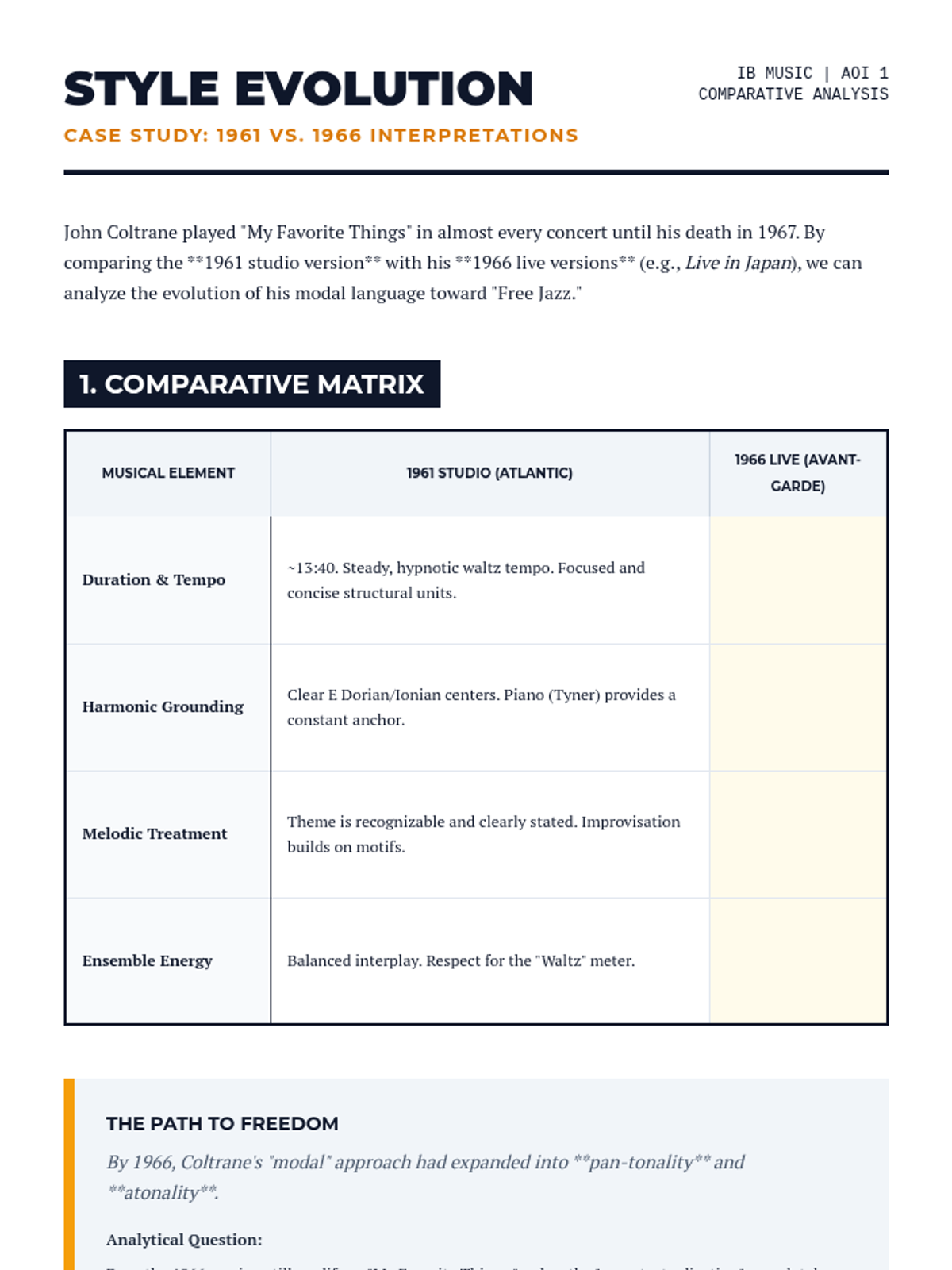
A 2-page comparative interpretation analysis comparing John Coltrane's 1961 studio version with his 1966 live avant-garde performances. It explores the evolution of his modal style toward pan-modality and socio-cultural reflection.
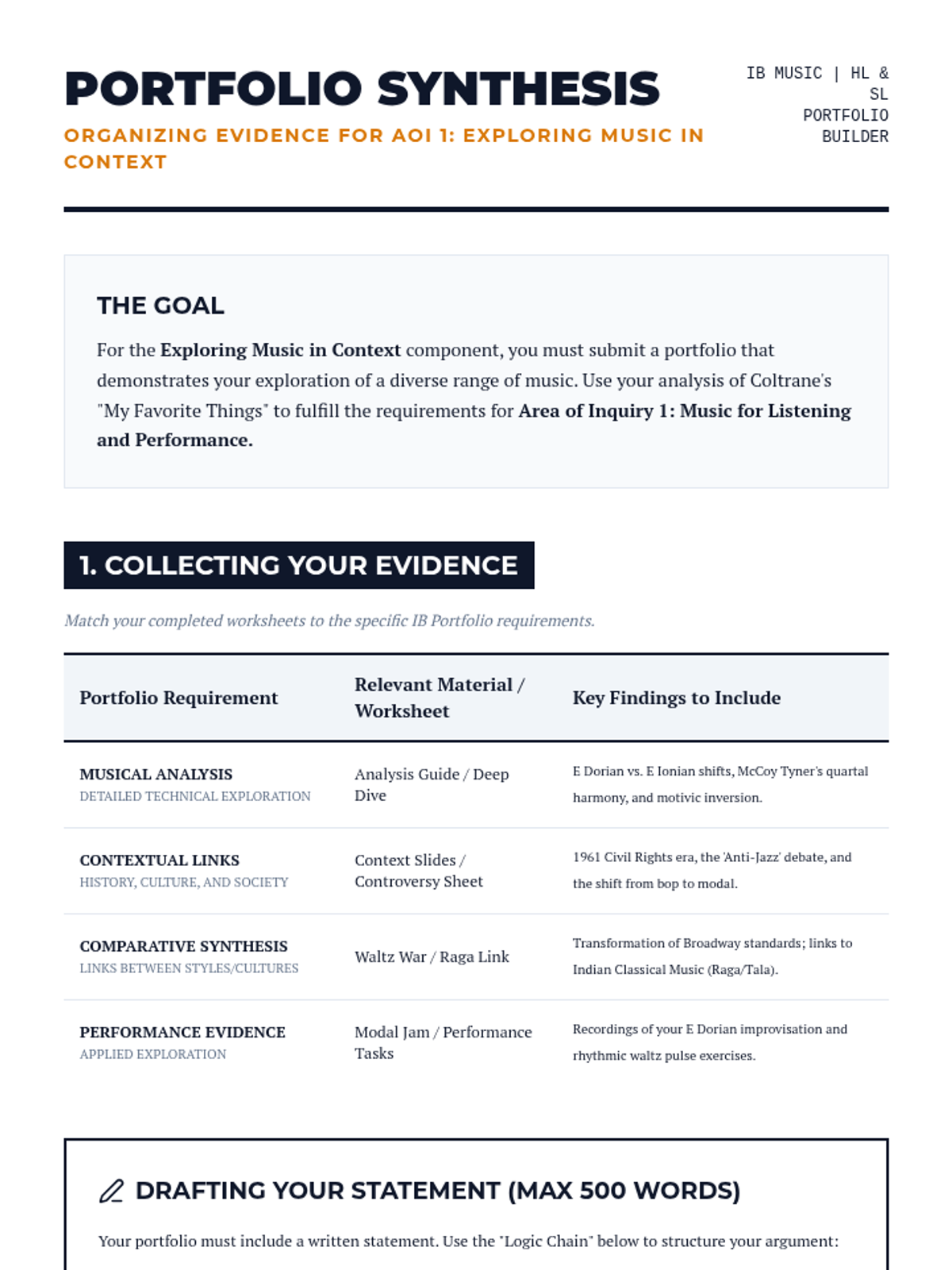
A 2-page portfolio synthesis guide for IB Music students. It helps organize findings from previous worksheets into the formal IB Portfolio format for 'Exploring Music in Context' (AoI 1), including a rationale builder and a self-assessment rubric.
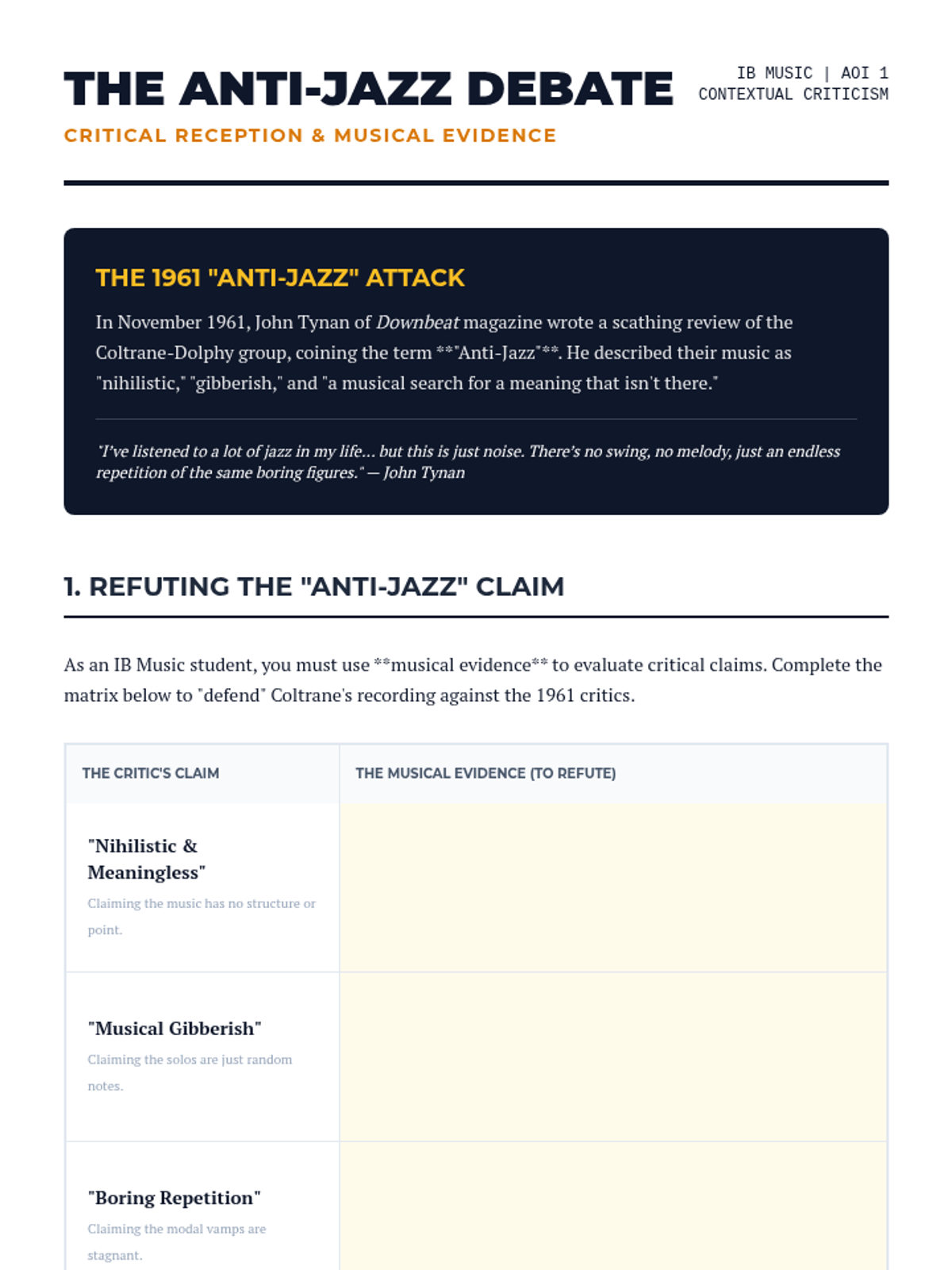
A 2-page case study worksheet exploring the 1961 'Anti-Jazz' controversy surrounding John Coltrane's modal period. It includes primary source critical reactions, a matrix for refuting claims with musical evidence, and IB-aligned philosophical inquiry prompts.