Techniques for brainstorming, collaborative project management, and individual artistic expression. Guides students through the iterative creative process from initial concept to final execution.
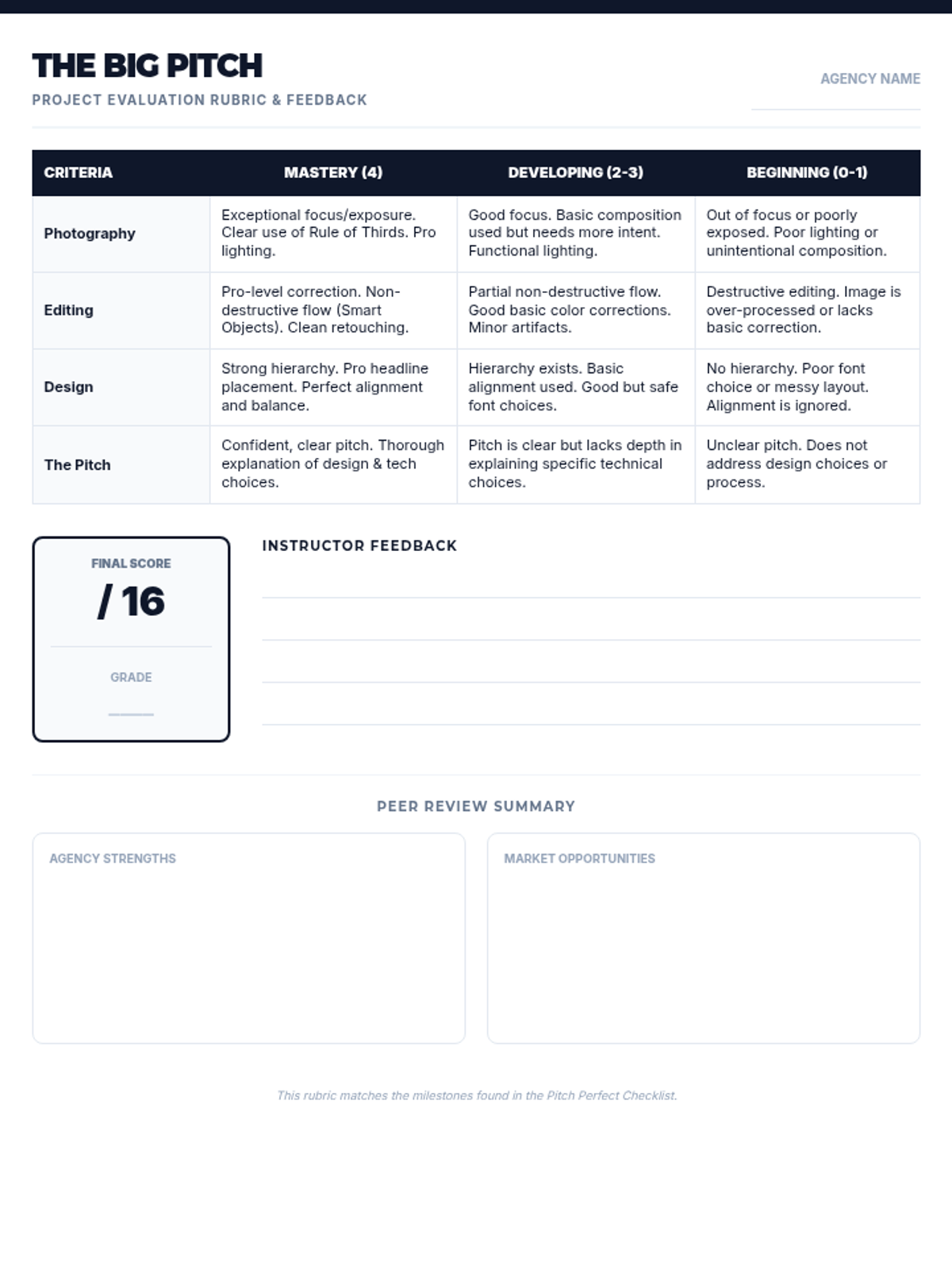
A teacher-facing rubric for assessing "The Big Pitch" project across photography, Photoshop editing, design principles, and presentation skills. Final single-page layout.
An introductory slide deck for "The Big Pitch" project, outlining the creative brief, timeline, photography requirements, and Photoshop workflow.
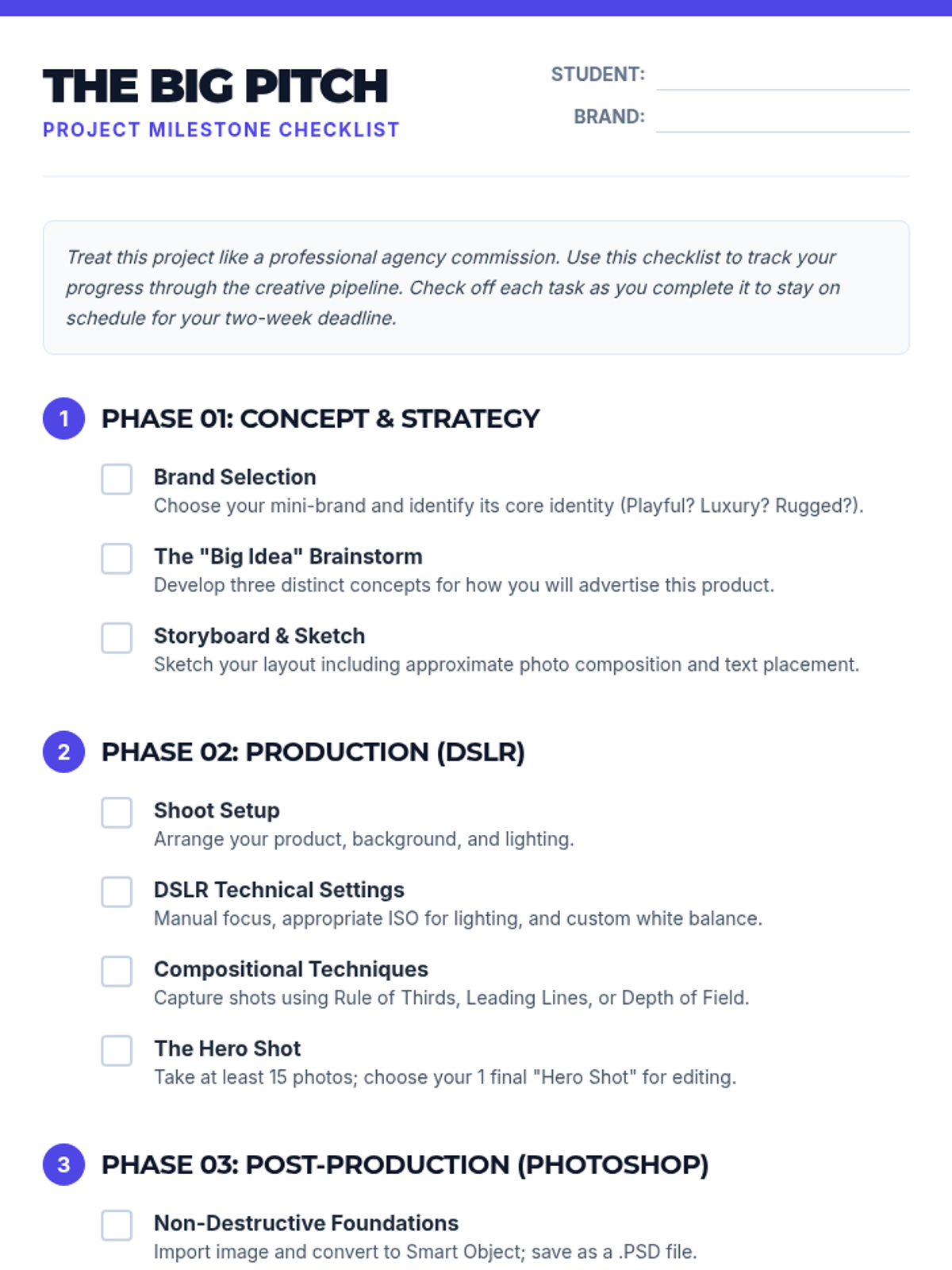
A professional milestone checklist for students to track their progress through the "Big Pitch" project, covering concept development, DSLR photography, Photoshop editing, and final graphic design. Updated to reflect classroom lighting and presentation prep.
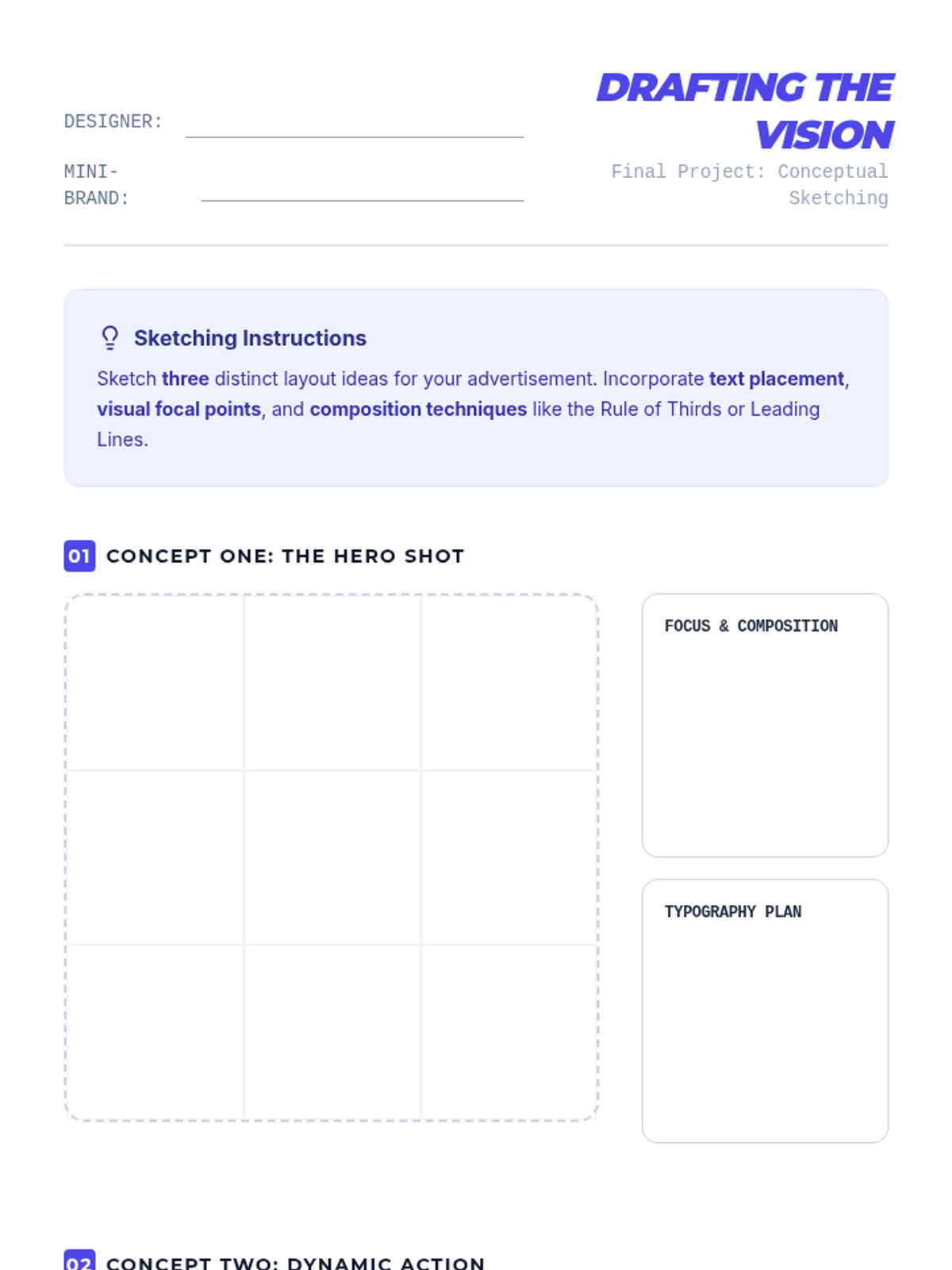
A structured sketching template for students to brainstorm and plan their advertisement layouts during the first week of the project. Optimized for multi-page printing with better layout control.
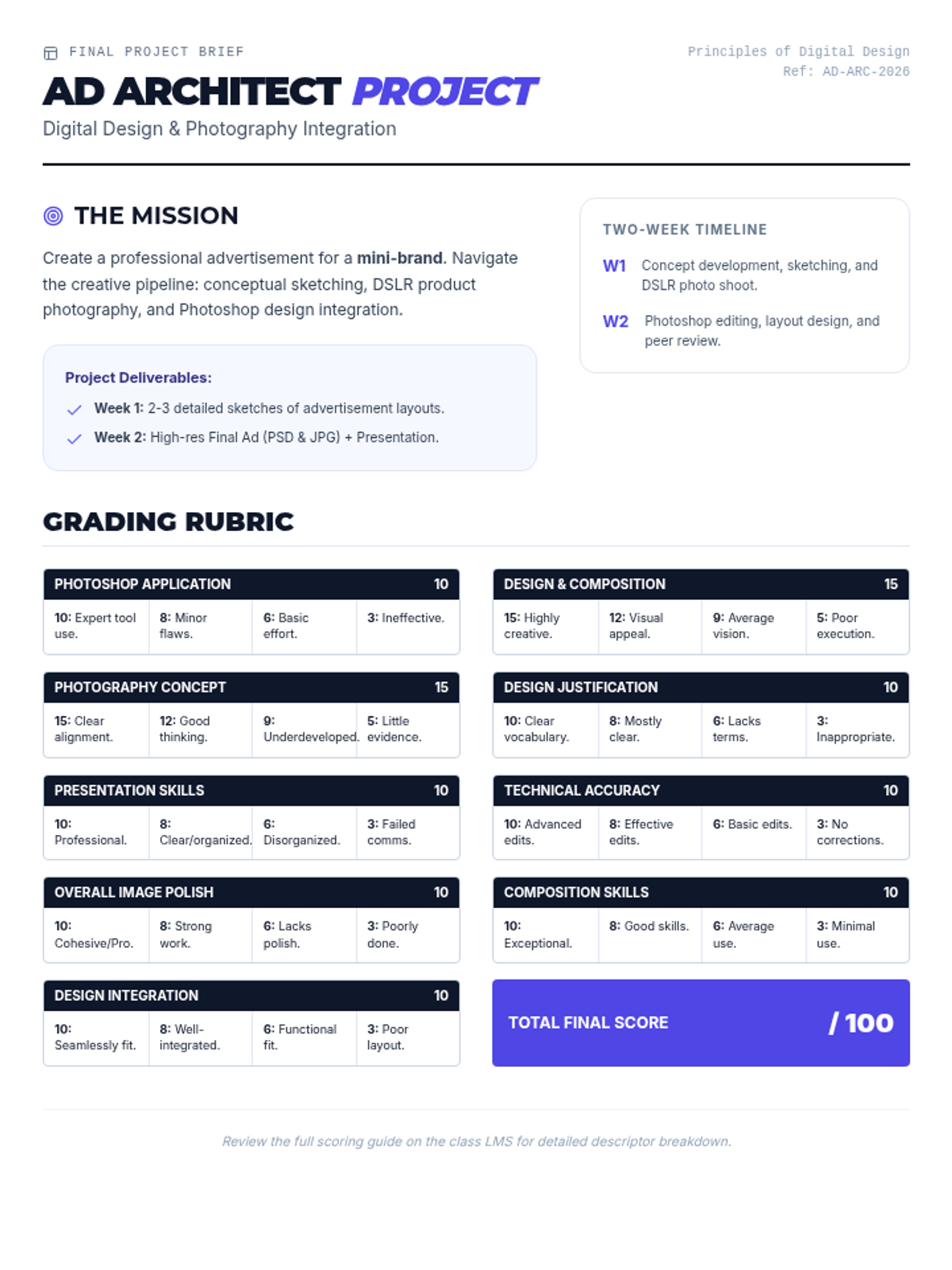
Official project brief and rubric for the Ad Architect final project, detailing objectives, deliverables, and a 100-point grading scale. Condensed to a clean one-page layout.
Visual presentation slides for the final project in Principles of Digital Design, outlining the advertisement project, timeline, and grading criteria. The question slide has been removed and the rubric alignment corrected.
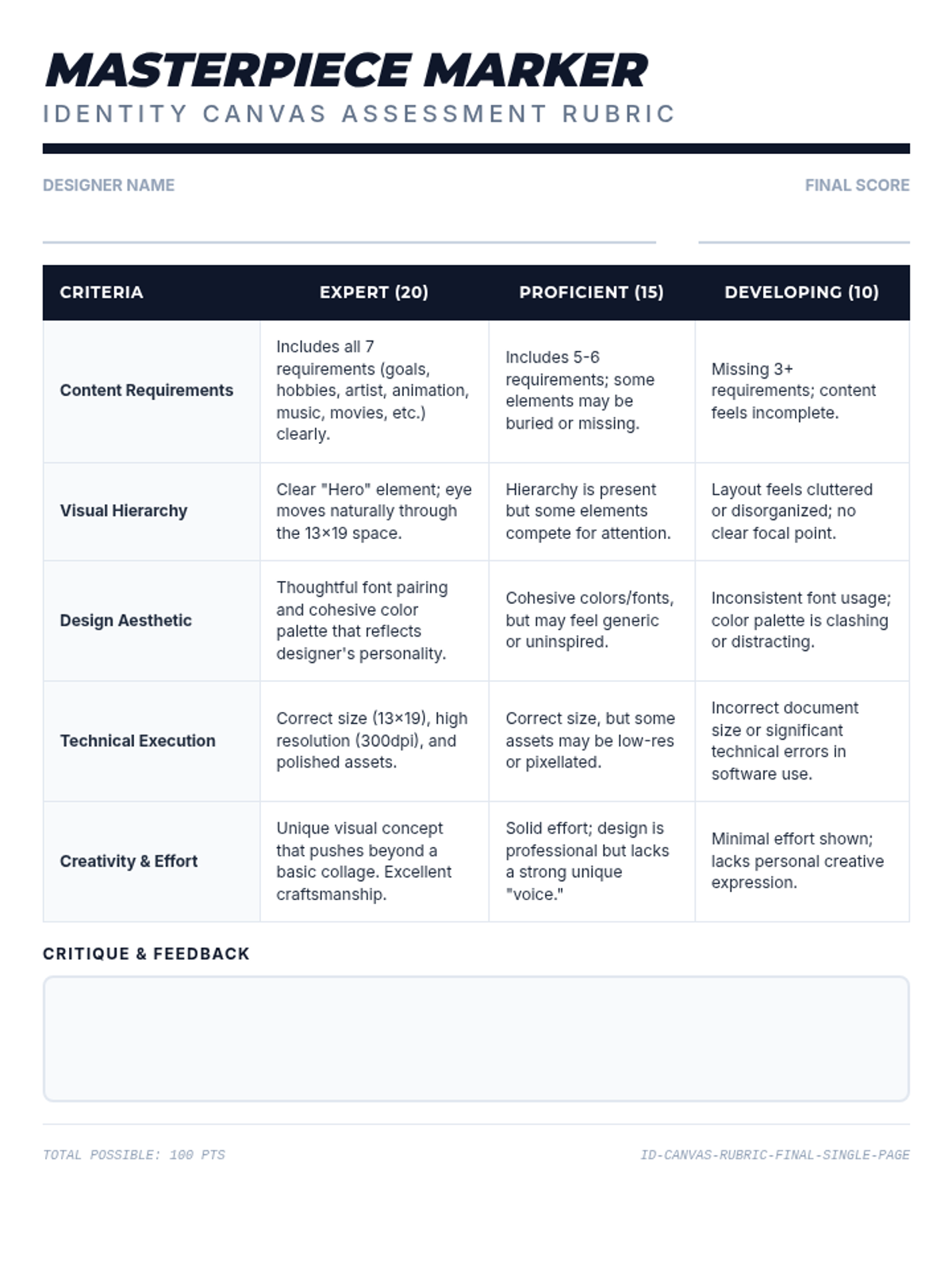
A professional assessment rubric for the Identity Canvas poster, evaluating content, hierarchy, aesthetic, technical skill, and creativity.
A visual presentation to introduce the Identity Canvas project, covering requirements, software choices (PS, AI, ID), and the 3-day timeline.
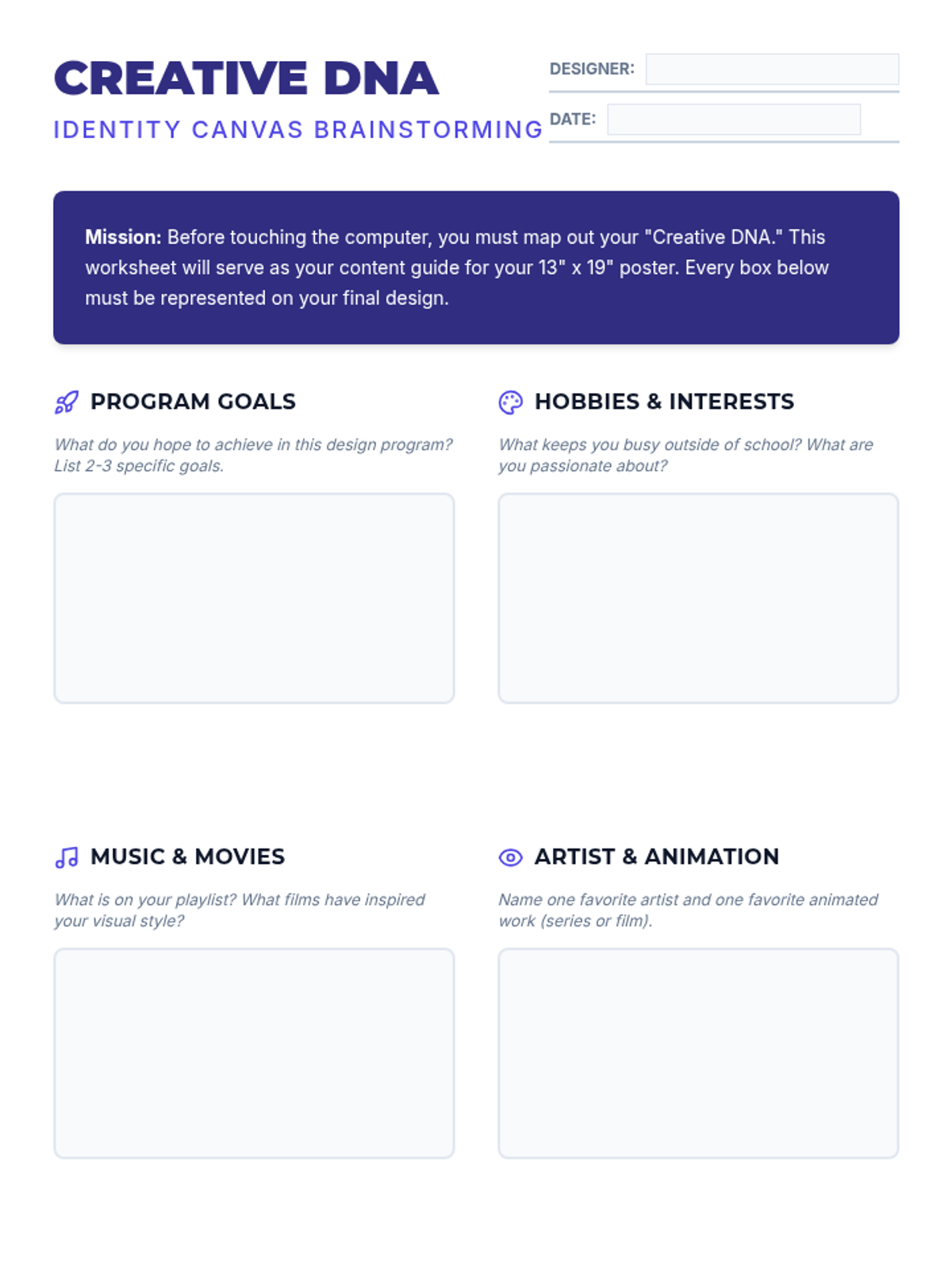
A brainstorming and sketching worksheet for students to map out their content requirements and layout ideas before starting their digital poster design.
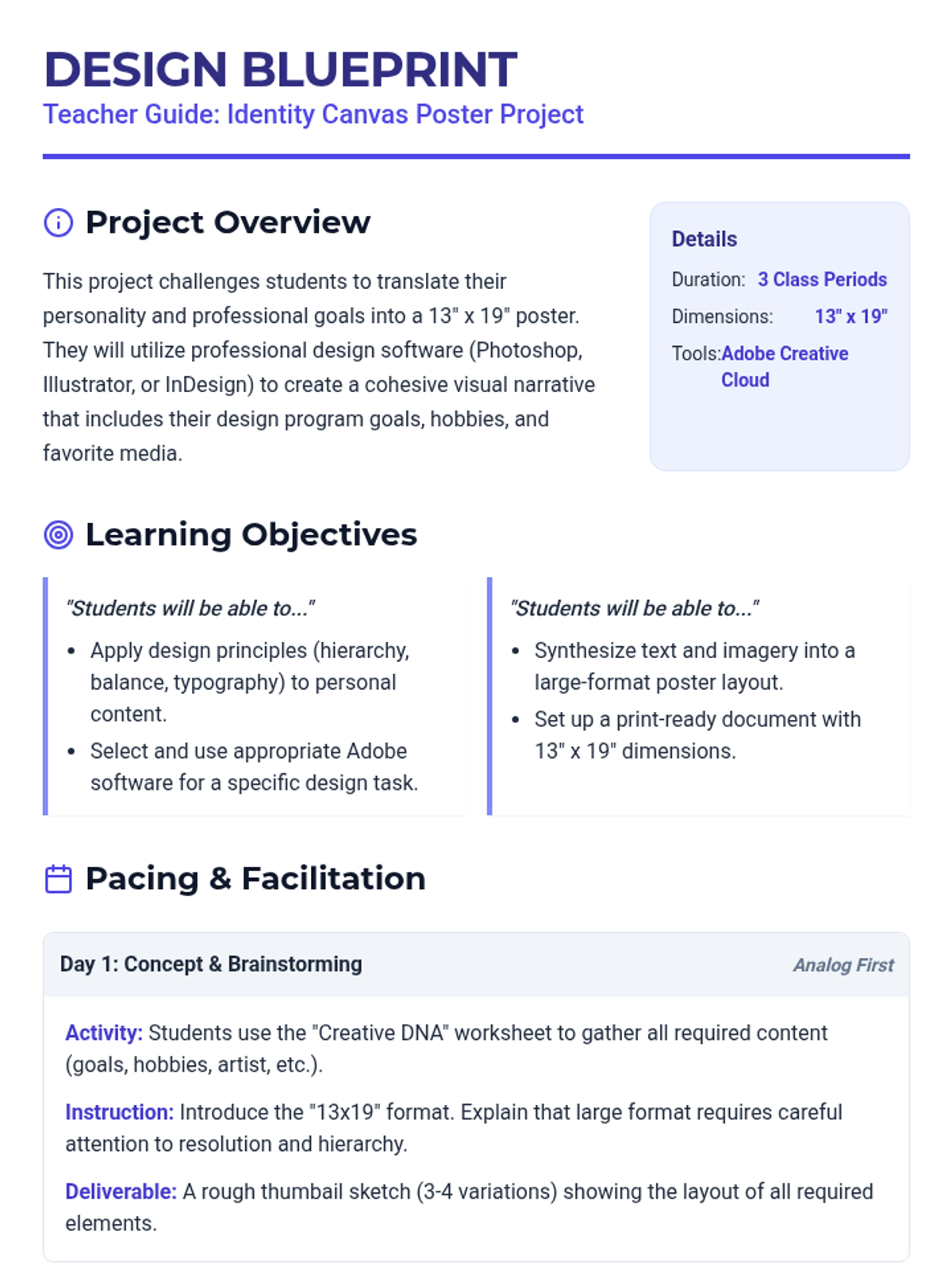
A comprehensive teacher guide for a 3-day design project, including learning objectives, a detailed pacing guide, and technical requirements for the 13x19 poster project.
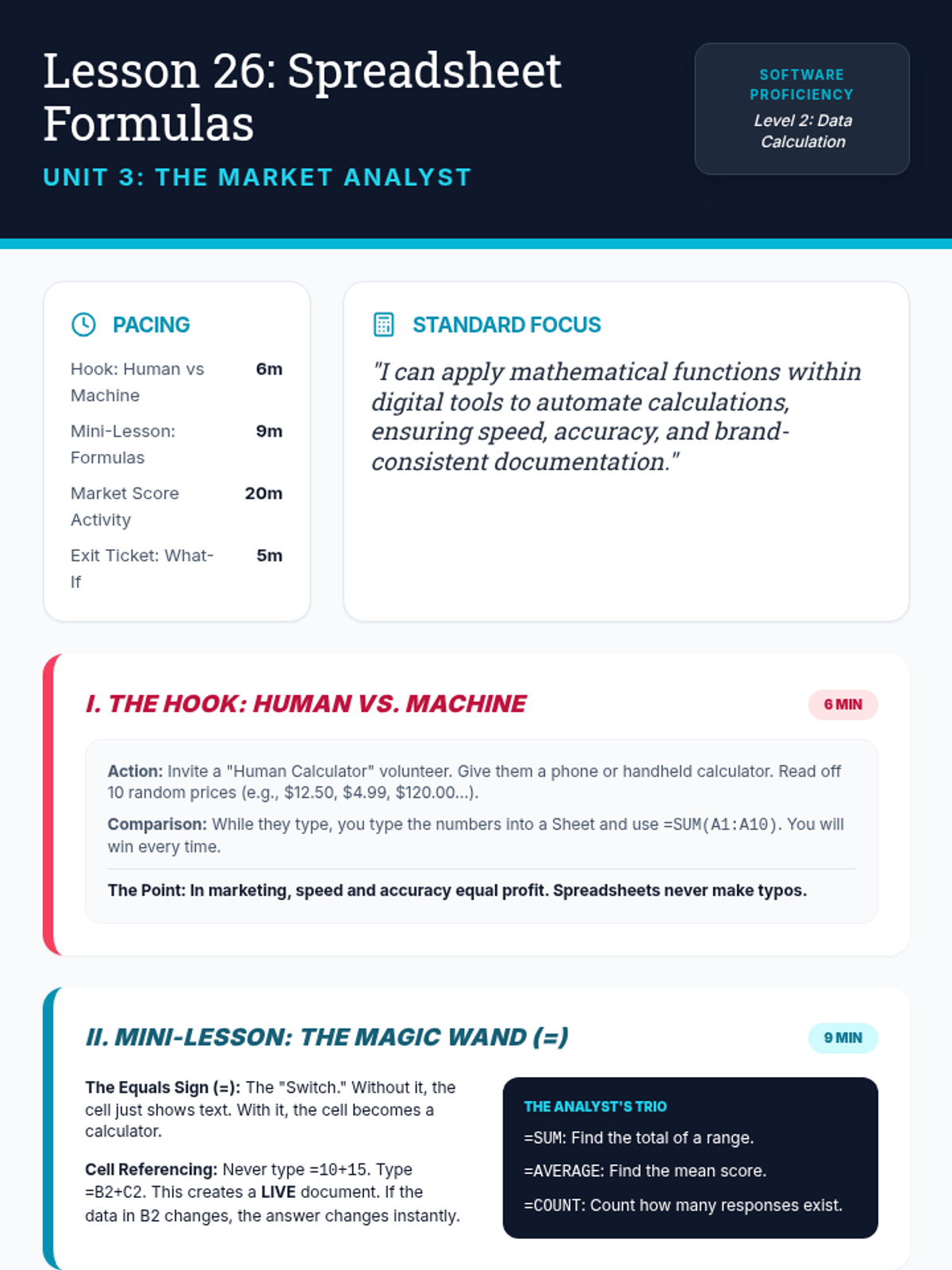
Comprehensive teacher guide for Lesson 26, focusing on introductory spreadsheet formulas (=SUM, =AVERAGE, =COUNT) and the concept of cell referencing. Fixed minor spacing issues in pacing list.
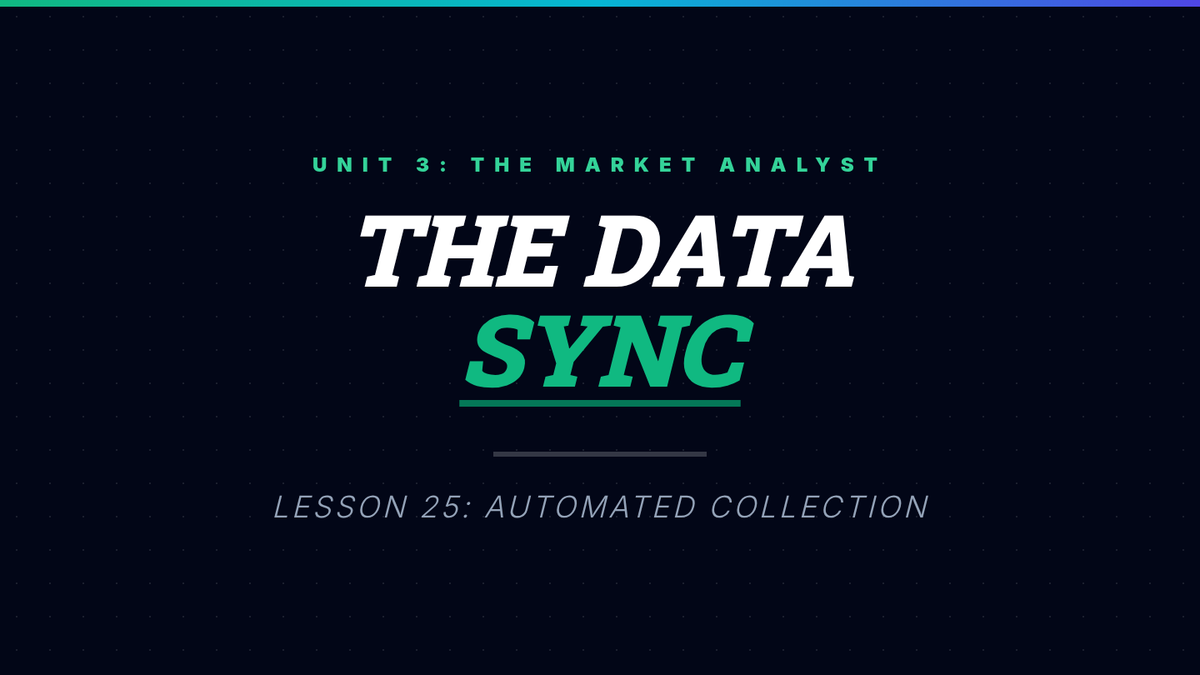
Dynamic slides for Lesson 25, explaining real-time data syncing between forms and sheets, the importance of file organization, and the technical steps for freezing header rows. Fixed tracking and spacing issues in headers and action items.
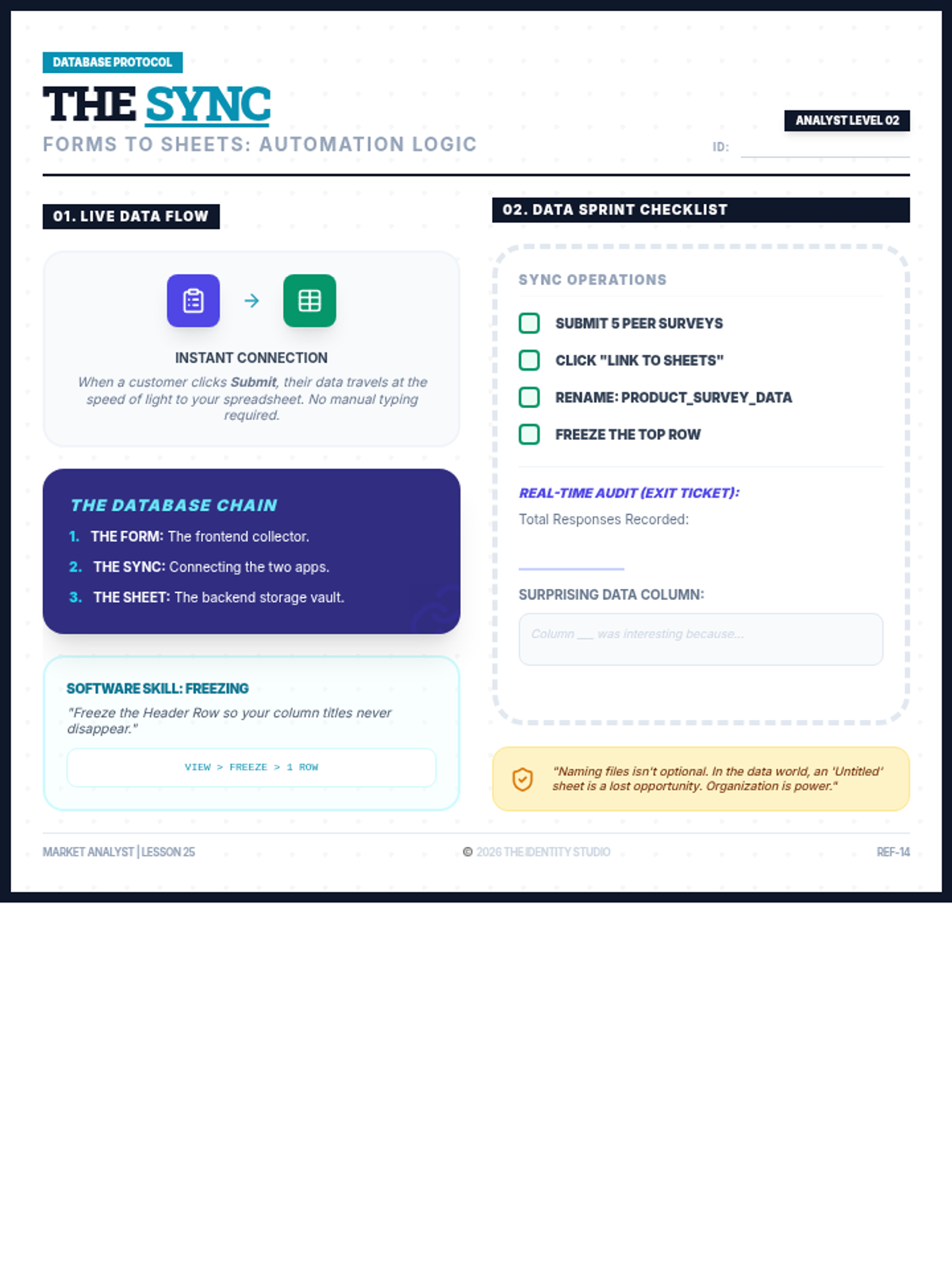
A student technical reference for Lesson 25, explaining the automated link between forms and spreadsheets, the concept of the 'database chain', and a checklist for the Data Sprint activity.
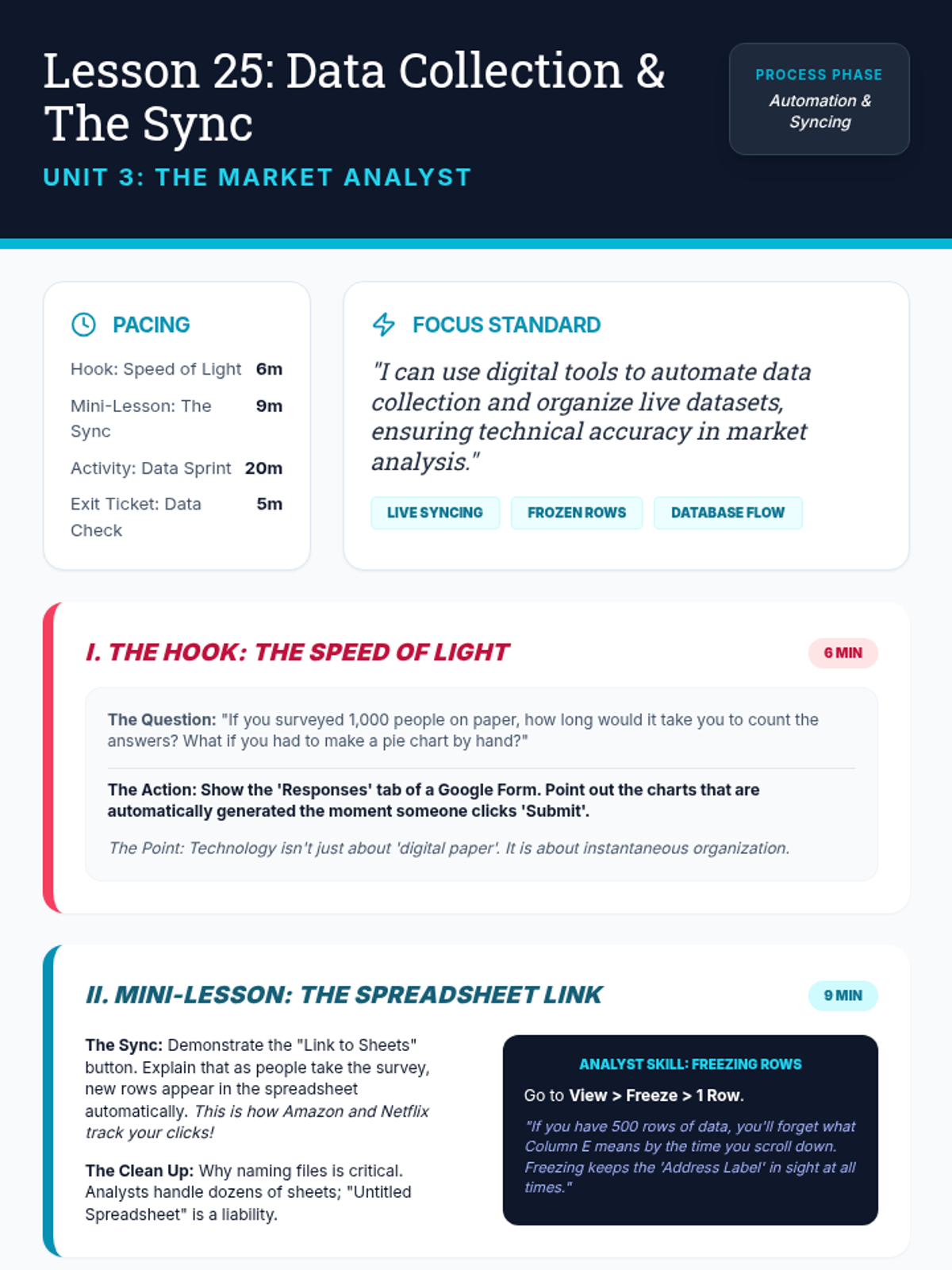
A detailed teacher facilitation guide for Lesson 25, focusing on linking forms to spreadsheets, the concept of real-time syncing, and the technical skill of freezing rows for data management.
Dynamic slides for Lesson 24, featuring the biased question hook, definitions of quantitative and qualitative data, and technical setup for survey deployment. Fixed tracking, layout spacing, and checklist completeness.
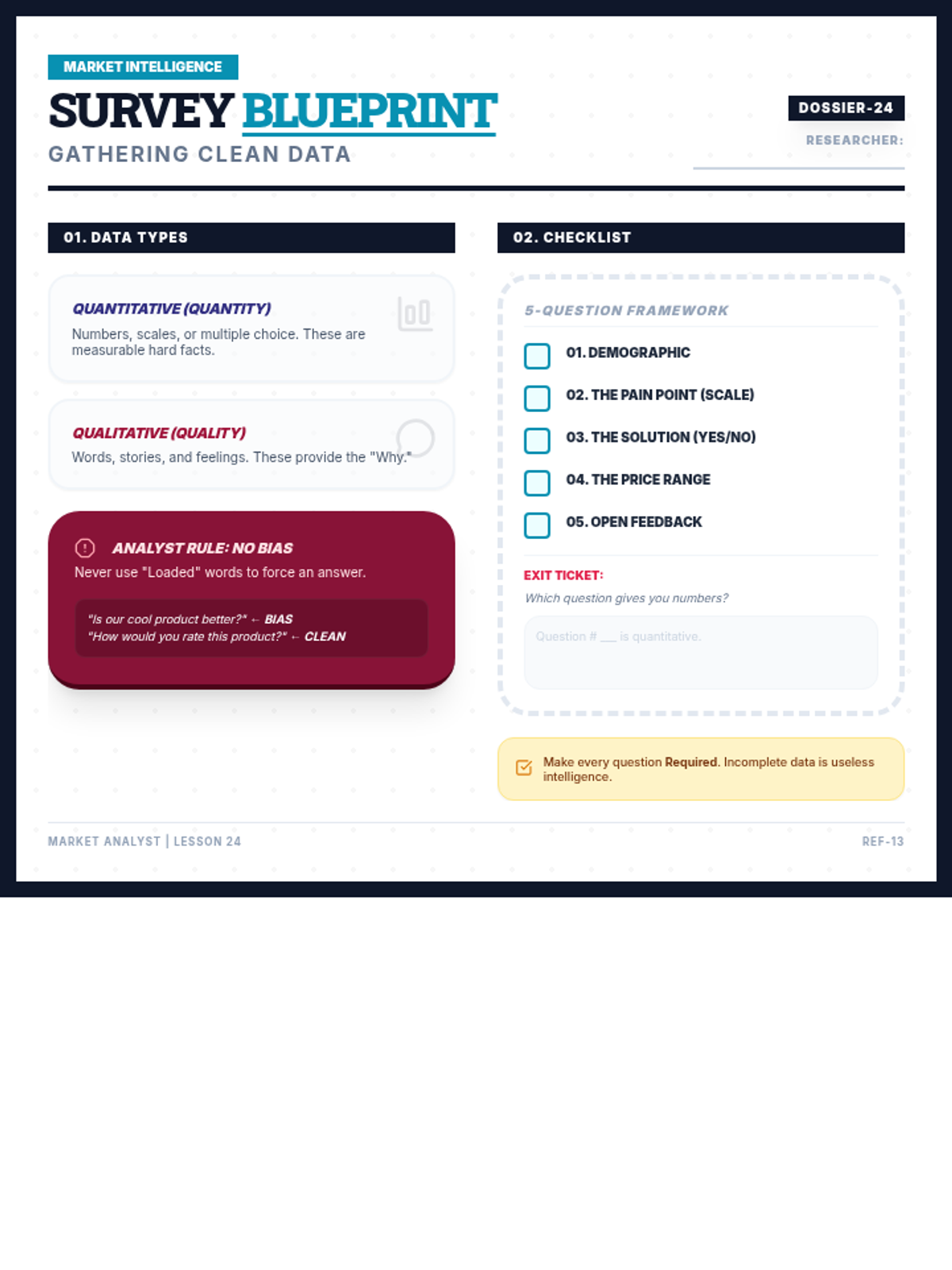
A student reference sheet and checklist for professional survey design. Covers quantitative vs. qualitative data, how to avoid bias, and the 5-question framework for market research. Optimized for a single page.
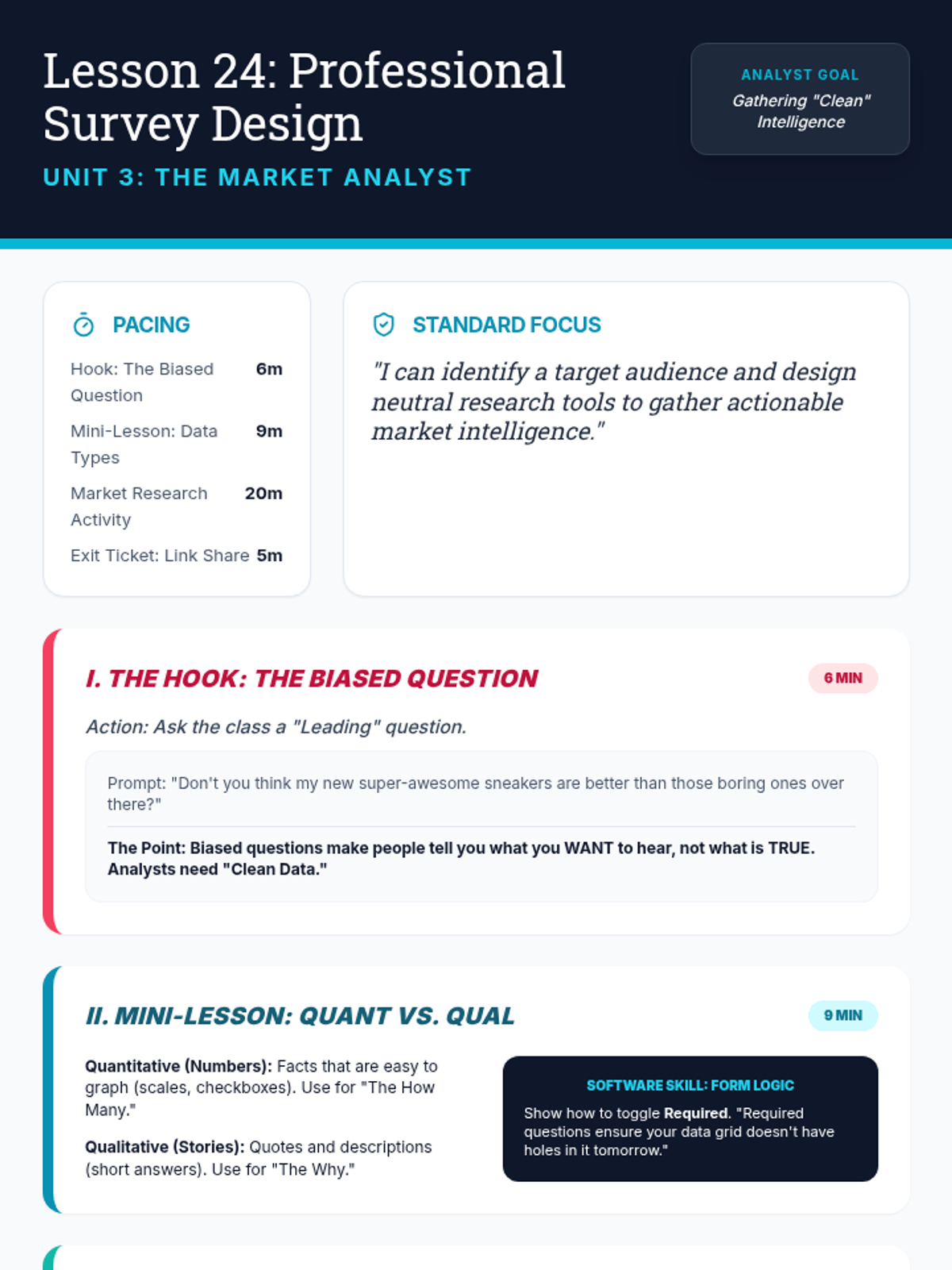
A detailed teacher facilitation guide for Lesson 24, focusing on survey design principles, avoiding bias, and the technical setup of market research forms. Fixed placeholder text and redundant labels.
Dynamic slides for Lesson 23, introducing the 'Data Grid' concept with the Jellybean Challenge, Battleship navigation, and technical instruction for resizing and fill colors. Fixed tracking, contrast, and diagram alignment.
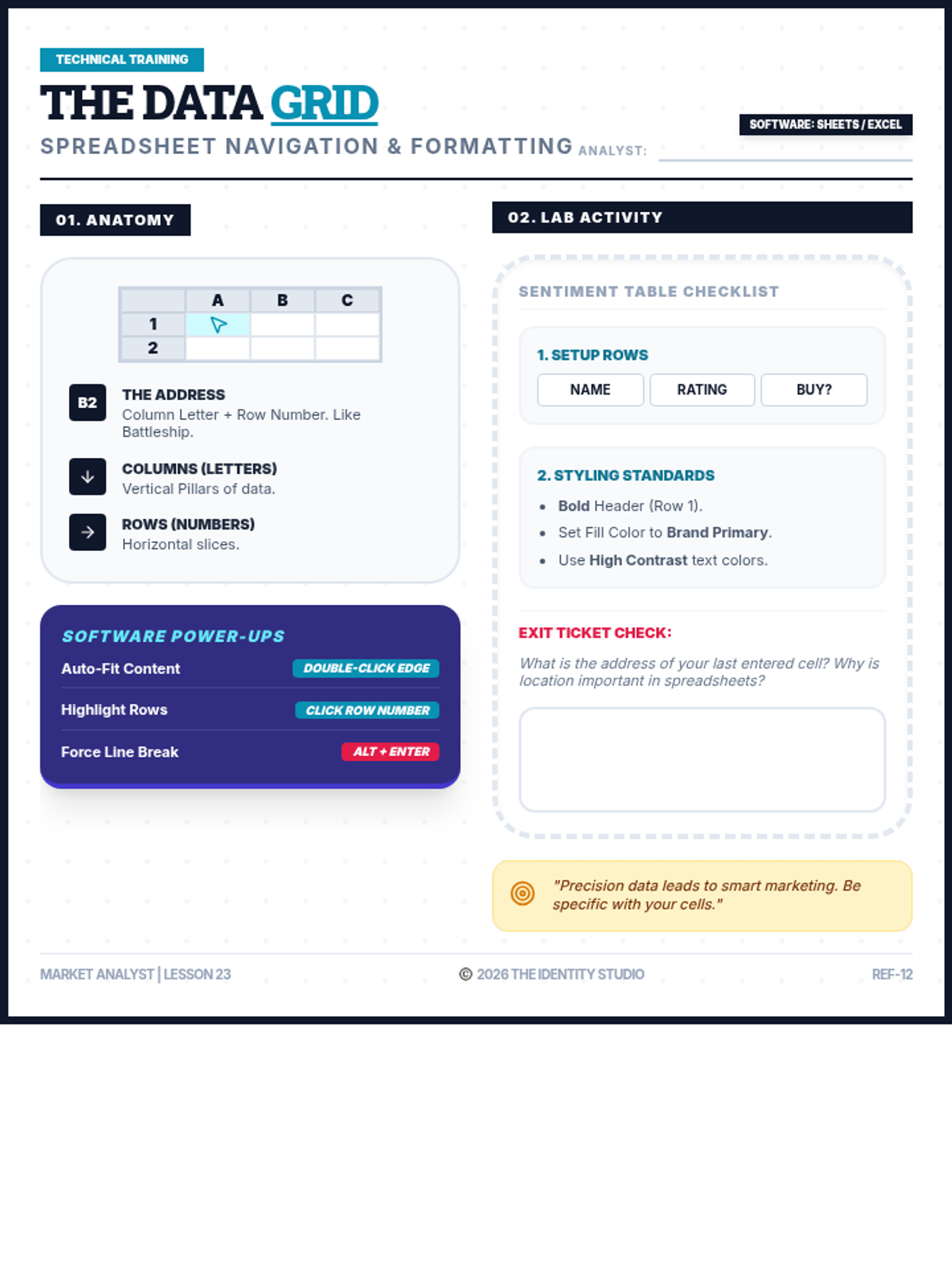
A professional student reference sheet for Lesson 23, explaining the 'Battleship' address system, column/row orientation, and essential formatting shortcuts for Google Sheets and Excel. Optimized for a single-page print.
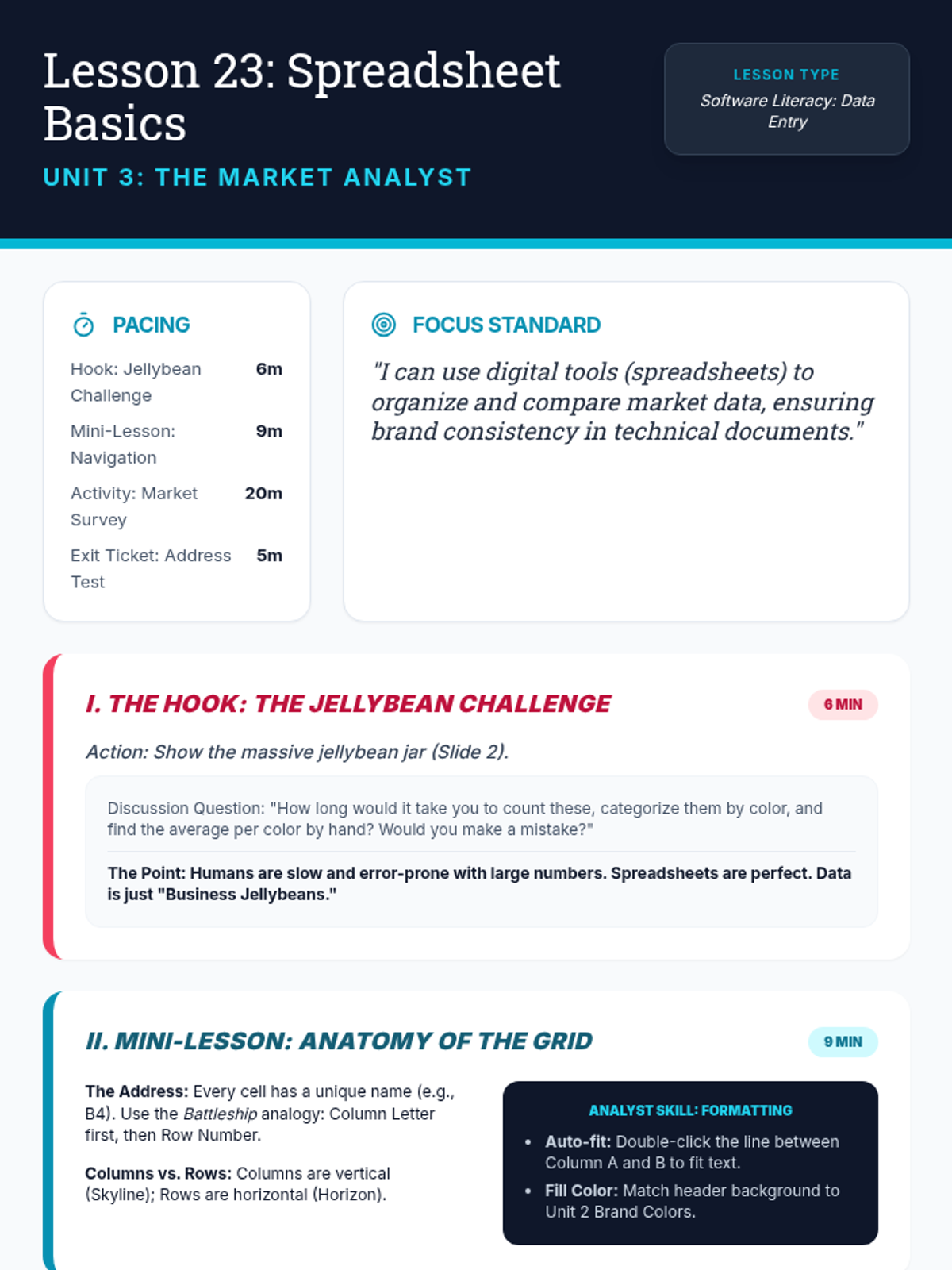
A detailed teacher facilitation guide for Lesson 23, introducing spreadsheet software via the Jellybean Challenge, Battleship navigation analogies, and basic table formatting.
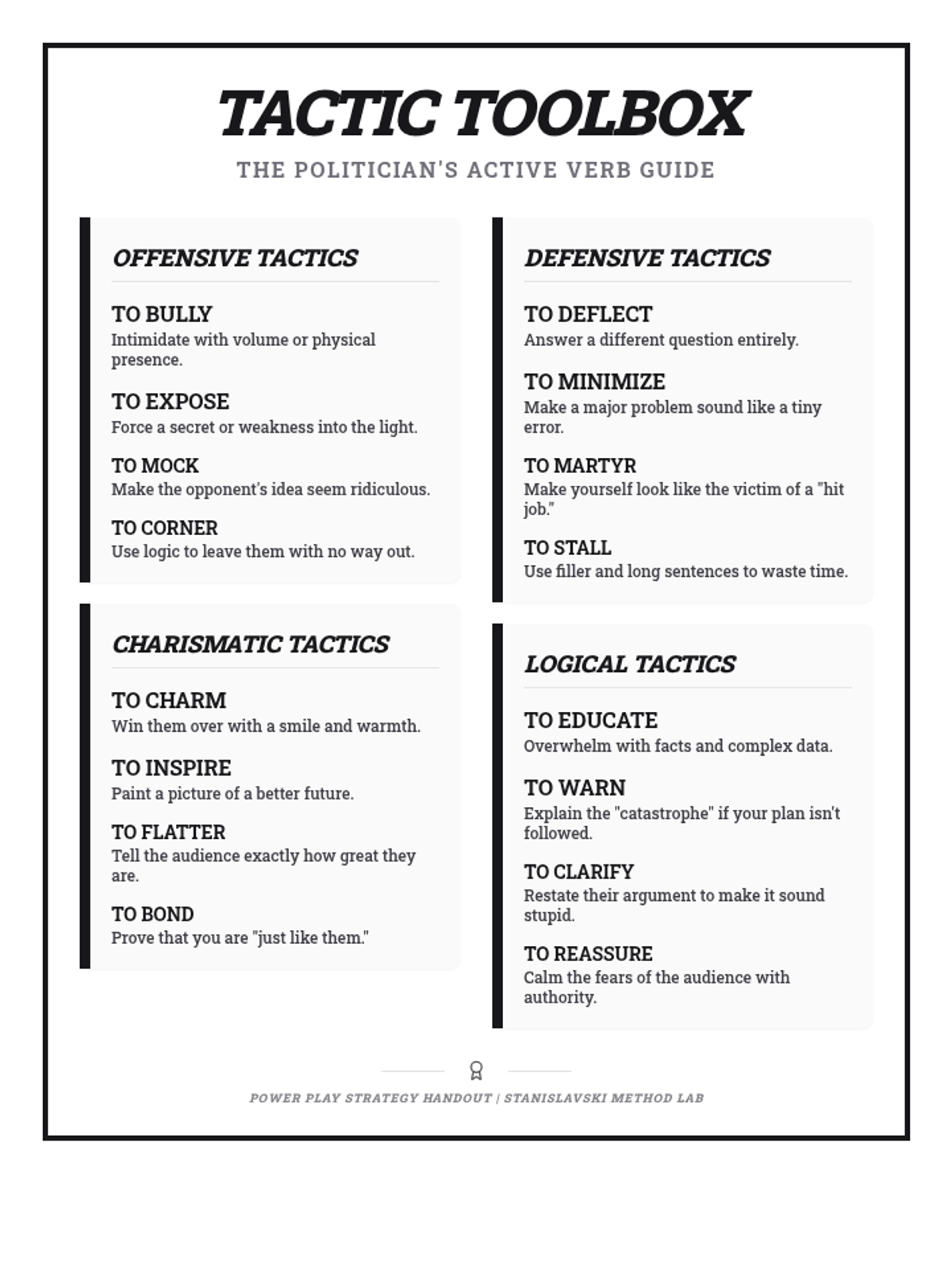
A reference handout for the 'Power Play' activity, categorizing political tactics into Offensive, Defensive, Charismatic, and Logical actions. Redesigned to be printer-friendly with high contrast and one-page layout.
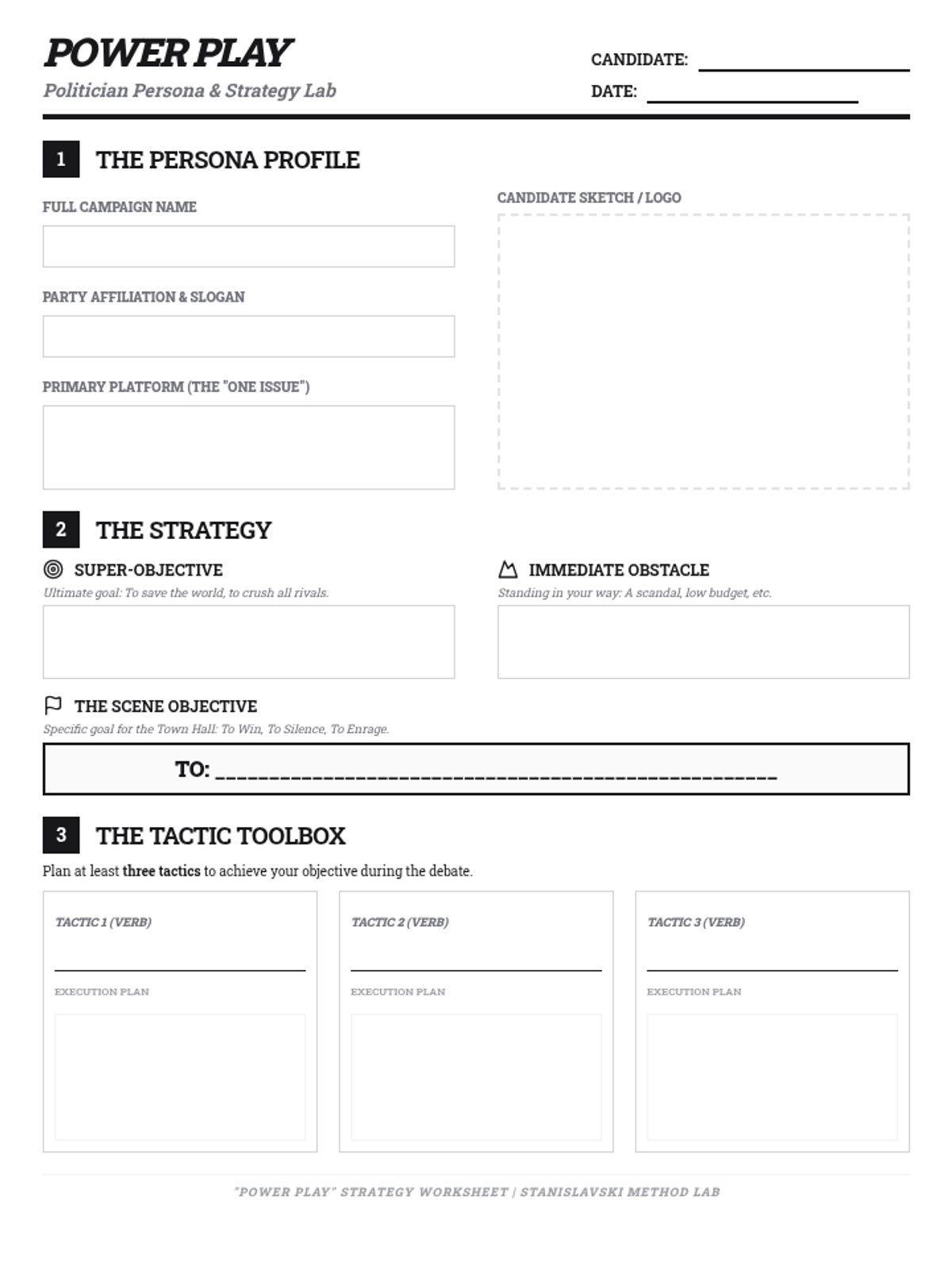
A persona creation and strategy planning worksheet for the 'Power Play' activity. Students define their politician persona, platform, super-objective, immediate obstacles, and plan their tactical approach for a debate or town hall scene. Removed the sketch icon and text from the sketch area for a clean student work space. Optimized to fit on a single page.
Instructional slides for the 'Power Play' activity, teaching students how to apply Stanislavski's concepts of Objective, Obstacle, and Tactics through the lens of a politician's persona. Improved for contrast and visual balance.
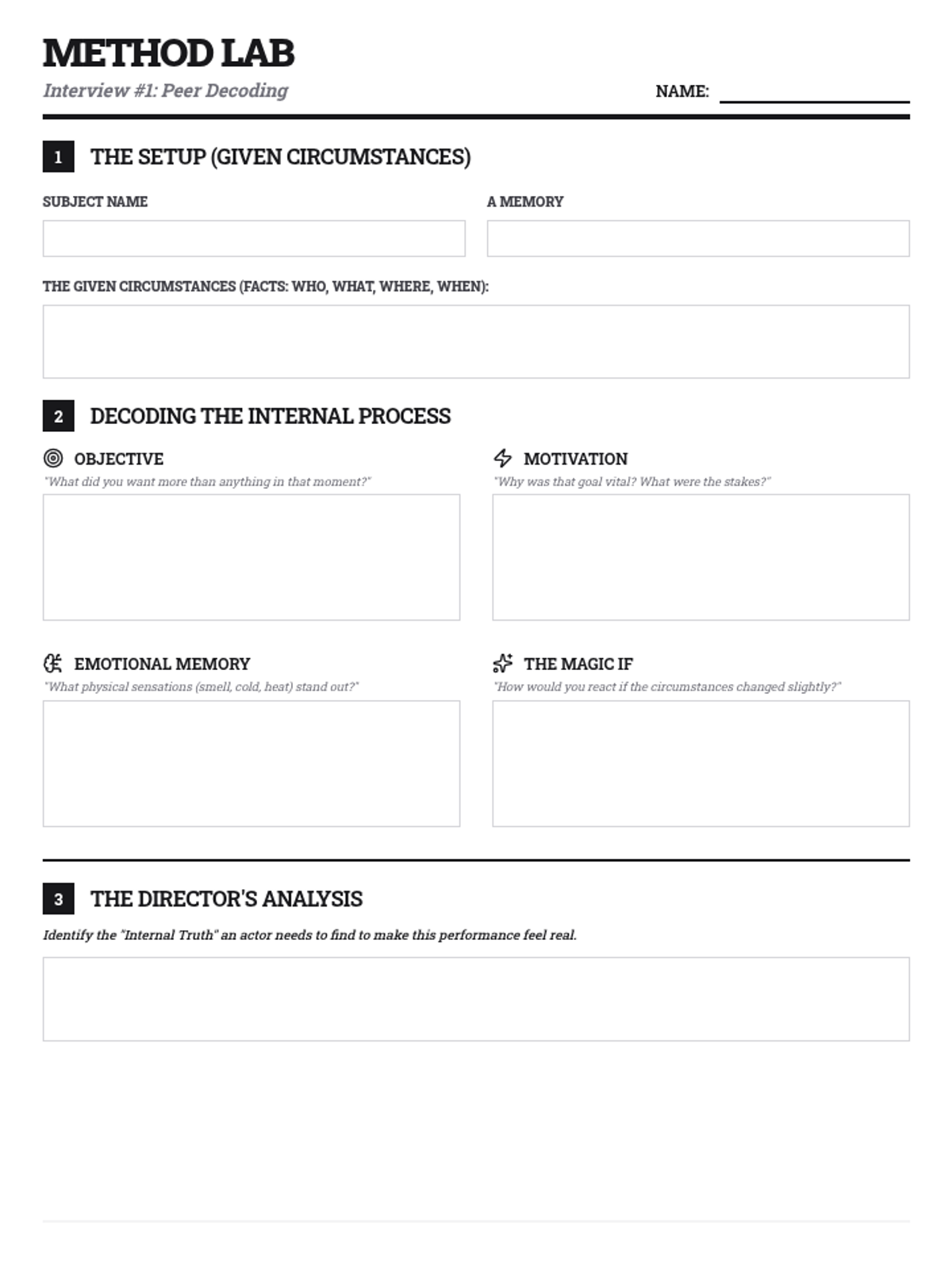
An expanded version of the peer interview worksheet, now updated to include space for three separate interviews. Each section includes decoding for Objective, Motivation, Emotional Memory, and 'The Magic If', with the context renamed from 'Scenario' to 'A Memory'. Optimized with higher contrast and student name fields on every page.
A modern, high-contrast slide deck exploring Stanislavski's core acting concepts: Given Circumstances, The Magic If, Objective, Motivation, and Emotional Memory. Designed for visual impact and instructional clarity.
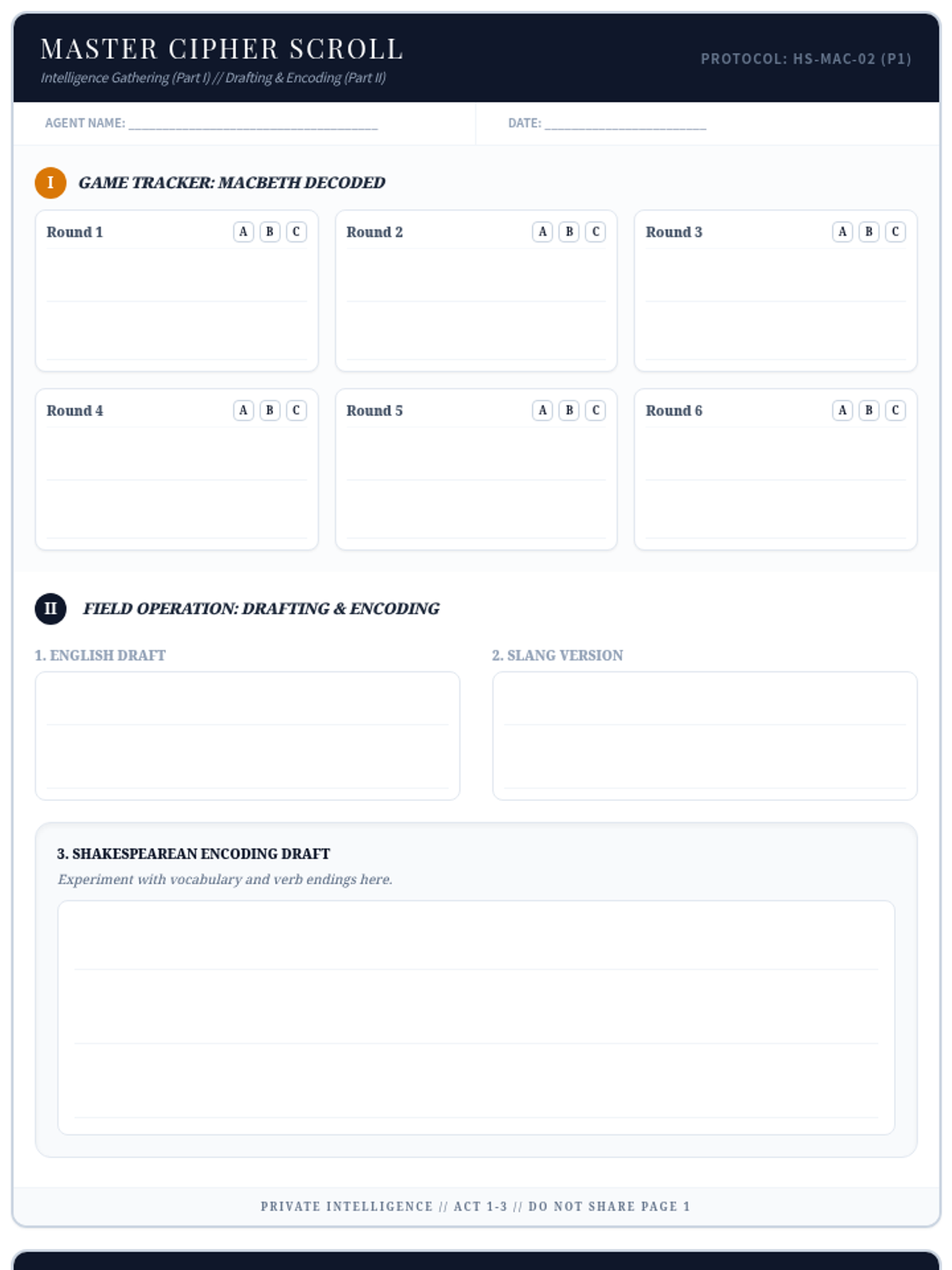
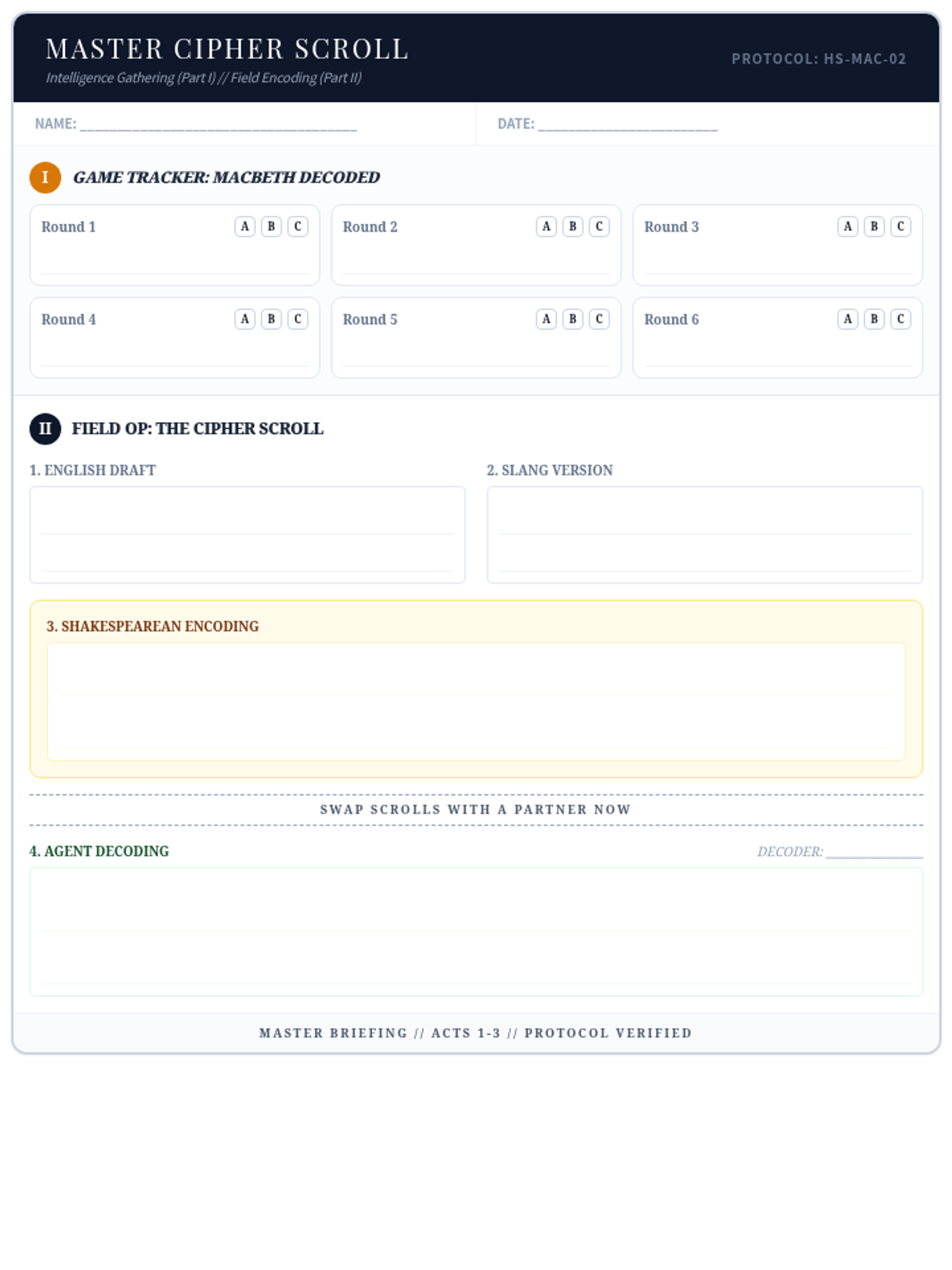
An expanded, two-page version of the game note scroll worksheet. Page 1 contains the game tracker and initial drafts, while Page 2 features the final Shakespearean encoding and space for peer decoding to ensure secrecy. Updated with improved page breaks and writing space.
An updated Jeopardy-style game show slide deck for Macbeth Acts 1-3. Features interpretation slides that display both the quote and multiple-choice translations for better clarity. Round 6 choices now reflect full-quote translations.
A combined worksheet featuring a top section for tracking 6 rounds of the 'Macbeth Decoded' game show and a bottom section containing the original 'Cipher Scroll' encoding activity. Updated for better handwriting space and to fit on one page.
A Jeopardy-style game show slide deck for Acts 1-3 of Macbeth, requiring students to use their Lexicon to decode phrases and justify their hypotheses. Expanded to 6 rounds.
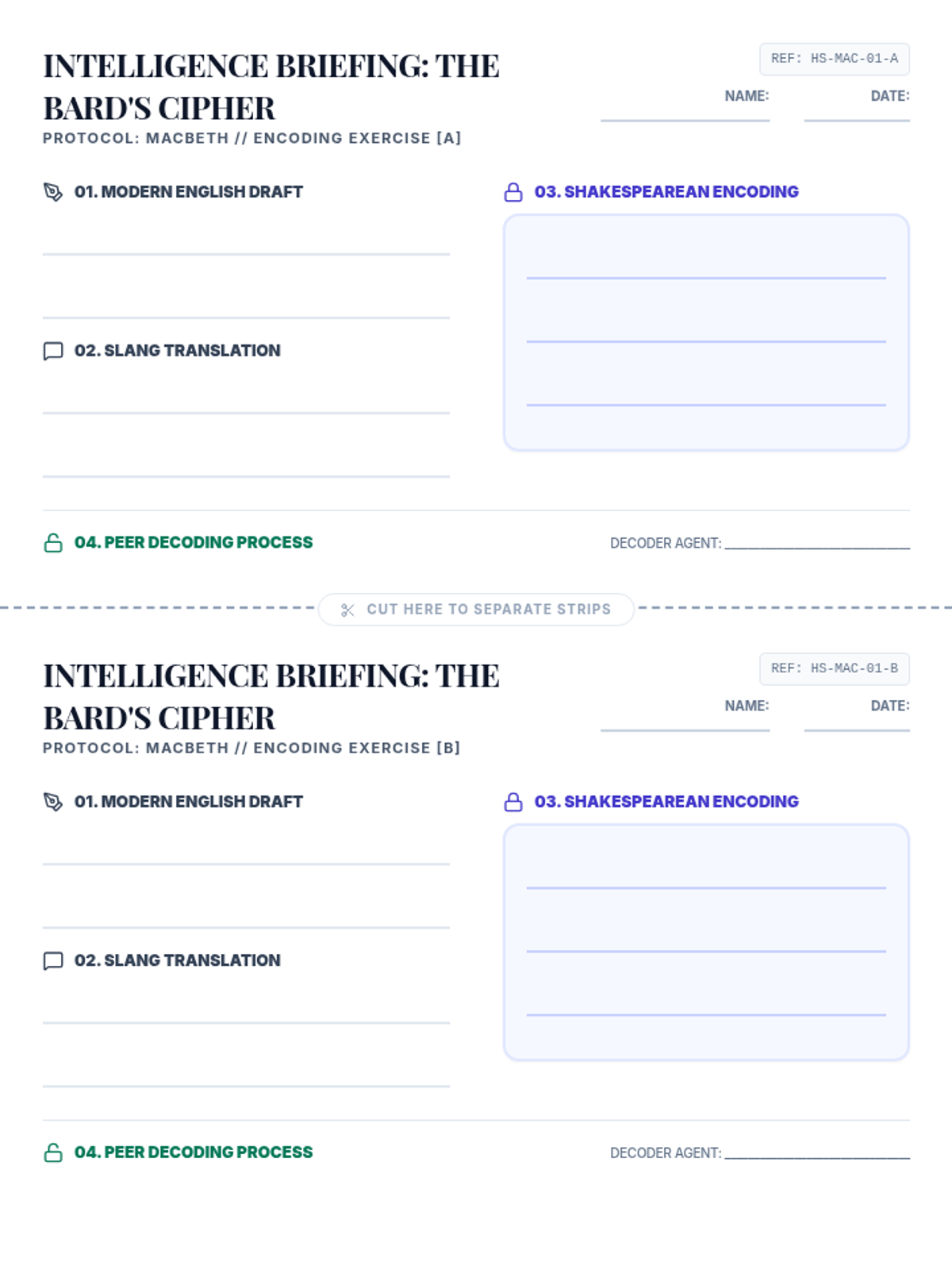
A compact, high-school oriented version of the Cipher Scroll activity, formatted as two strips per page with lines for modern, slang, and Shakespearean translations. Updated for better handwriting space and readability.
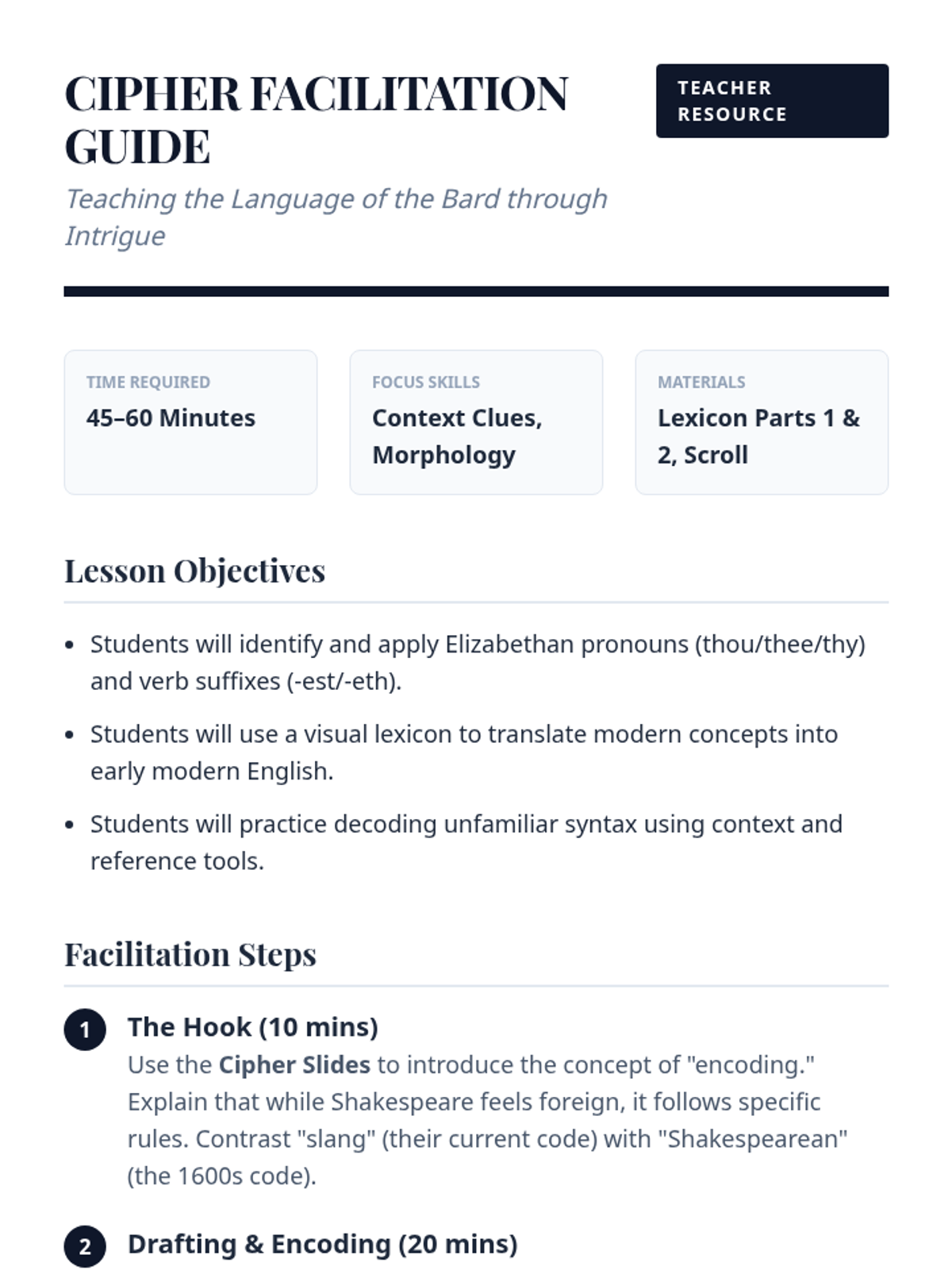
A teacher resource for 'The Bard's Cipher' lesson, providing instructional strategies, common misconceptions, and translation examples to facilitate student success. Updated to fix page breaks and icon rendering.
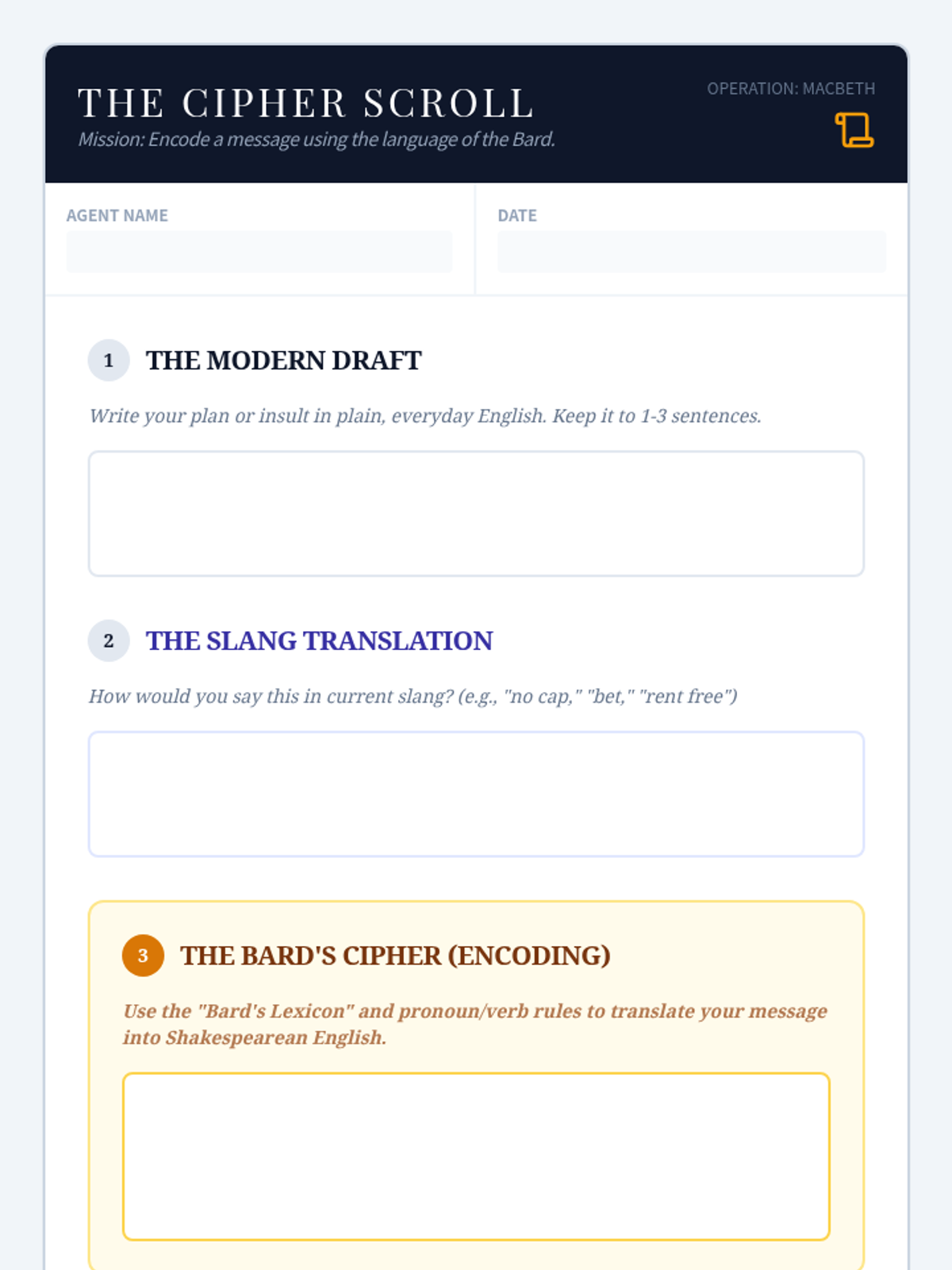
A multi-step activity worksheet where students draft a message in modern English and slang before 'encoding' it into Shakespearean language for a partner to decode. Updated to fix page break issues.
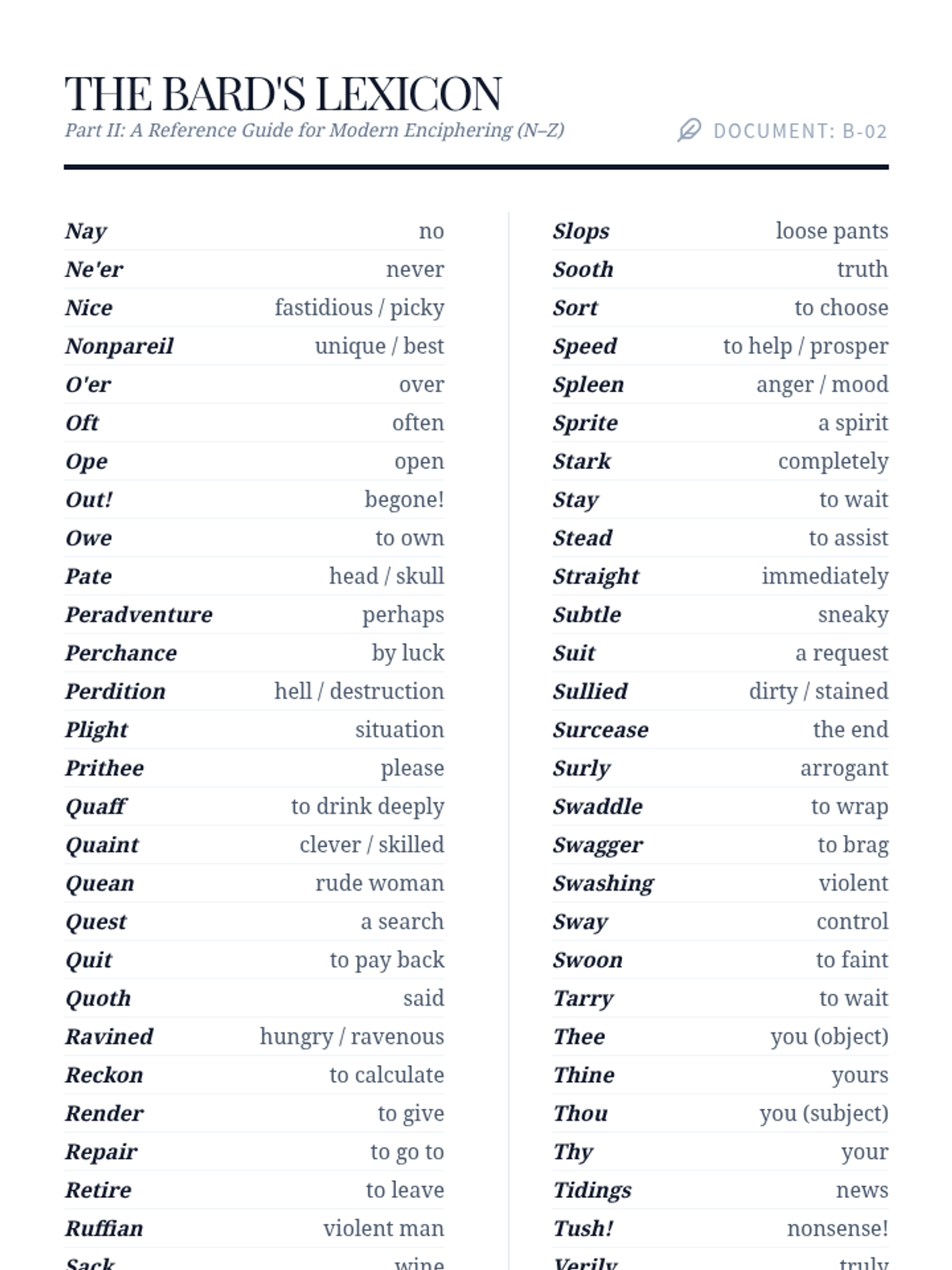
Part 2 of the visual word bank (N-Z) for the Shakespearean encoding activity, completing the alphabet with common Elizabethan words and their modern translations in pt. 12 font. Total word count across two parts exceeds 100.
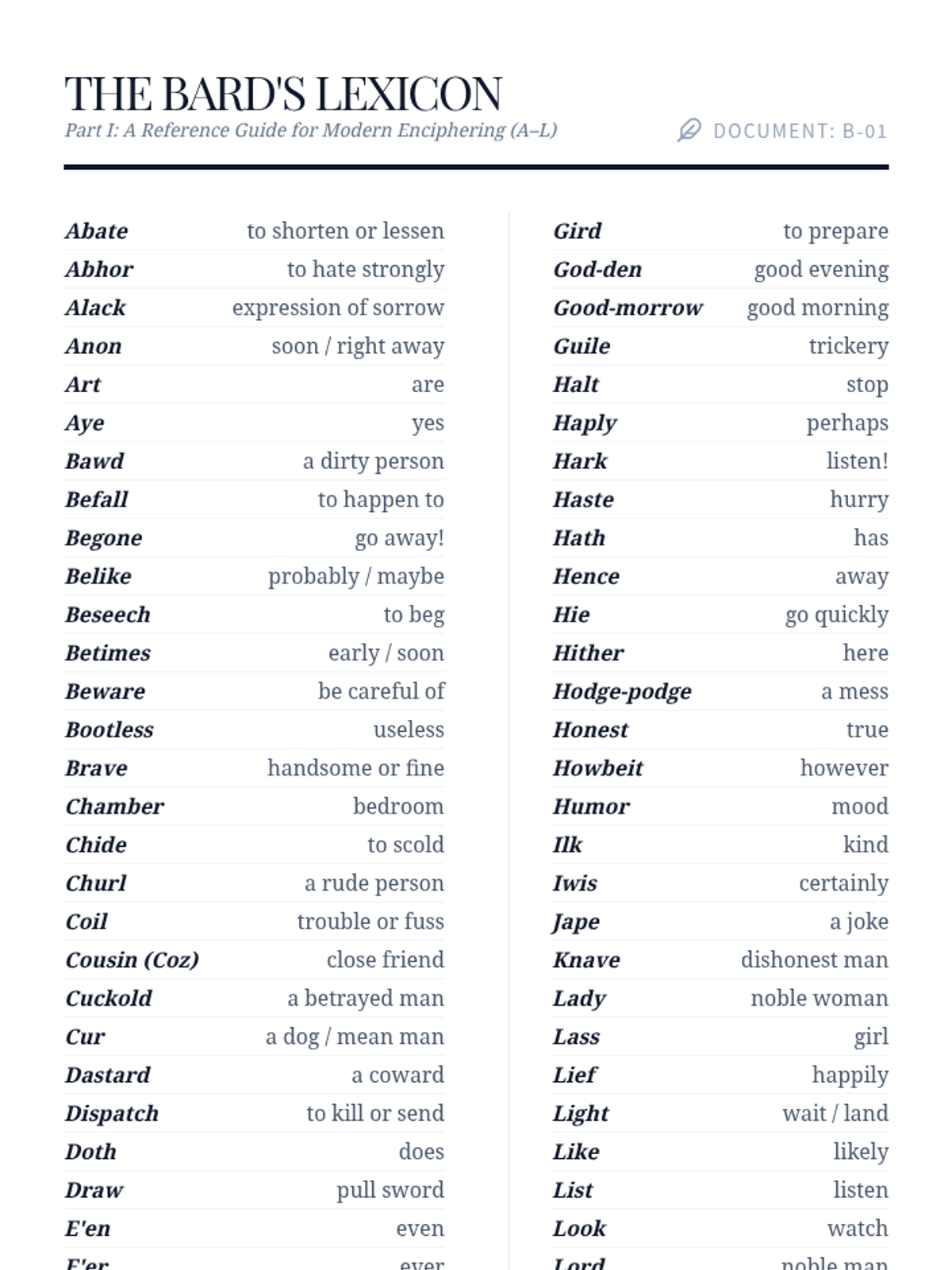
Part 1 of the visual word bank (A-M) for the Shakespearean encoding activity, featuring common Elizabethan words and their modern translations in pt. 12 font. Total word count across two parts exceeds 100.
An introductory slide deck for 'The Bard's Cipher' activity, covering basic Shakespearean pronouns, verb endings, and activity instructions with a moody Elizabethan aesthetic.
Dynamic slides for Lesson 22, featuring the shoe-based hook, pillar definitions (Demographics/Psychographics), and User Persona activity instructions.
A high-contrast cinematic slide deck for projecting in the classroom. Covers poster layer anatomy, non-destructive layer masking, blending atmosphere, and creative typography design for three tier levels.
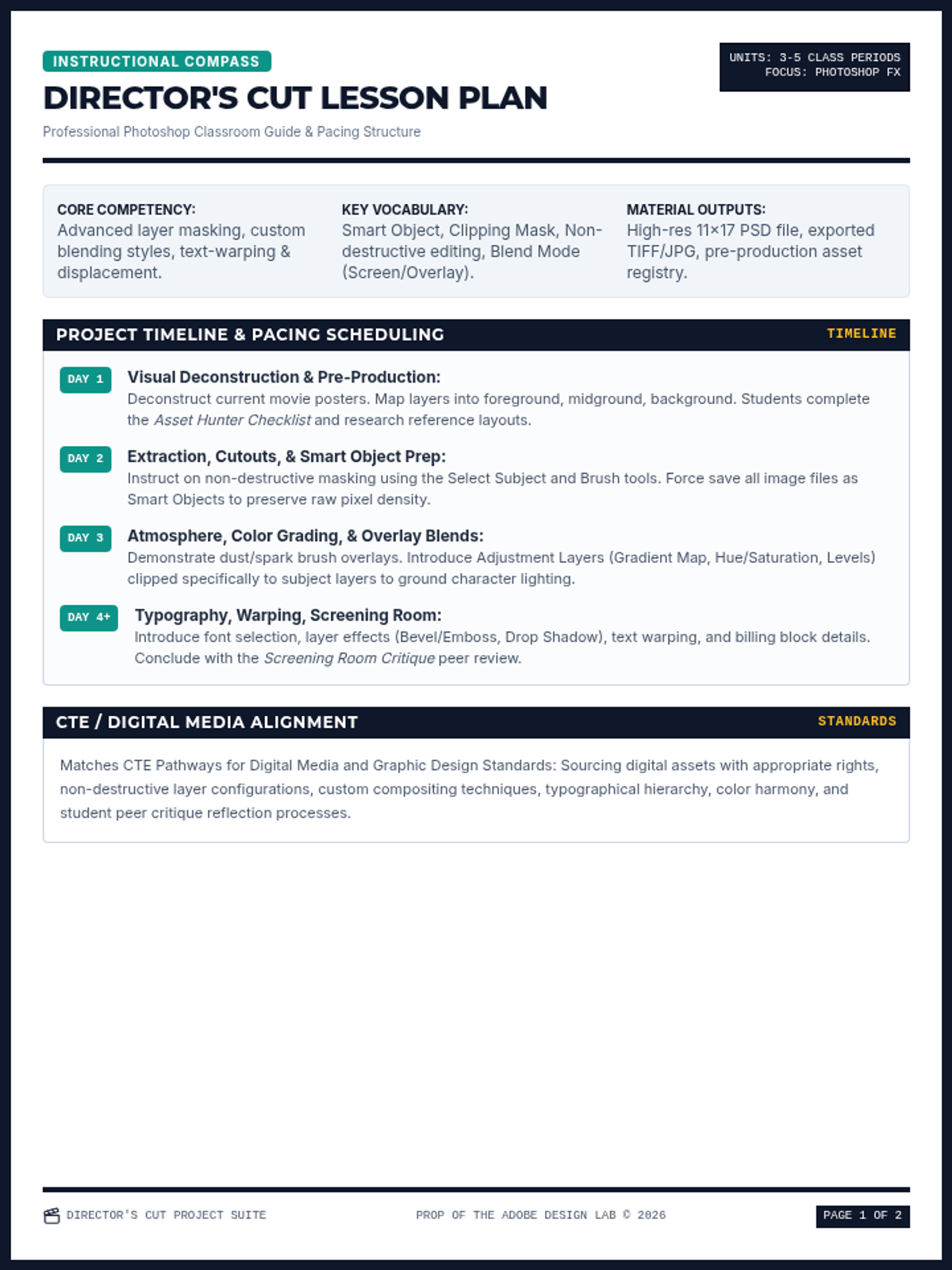
A professional, comprehensive teacher-facing lesson plan and instructional script for delivering the Cinematic Movie Poster unit. Includes a detailed timeline, differentiated instructions for three student skill tiers, and expert Photoshop troubleshooting tips.
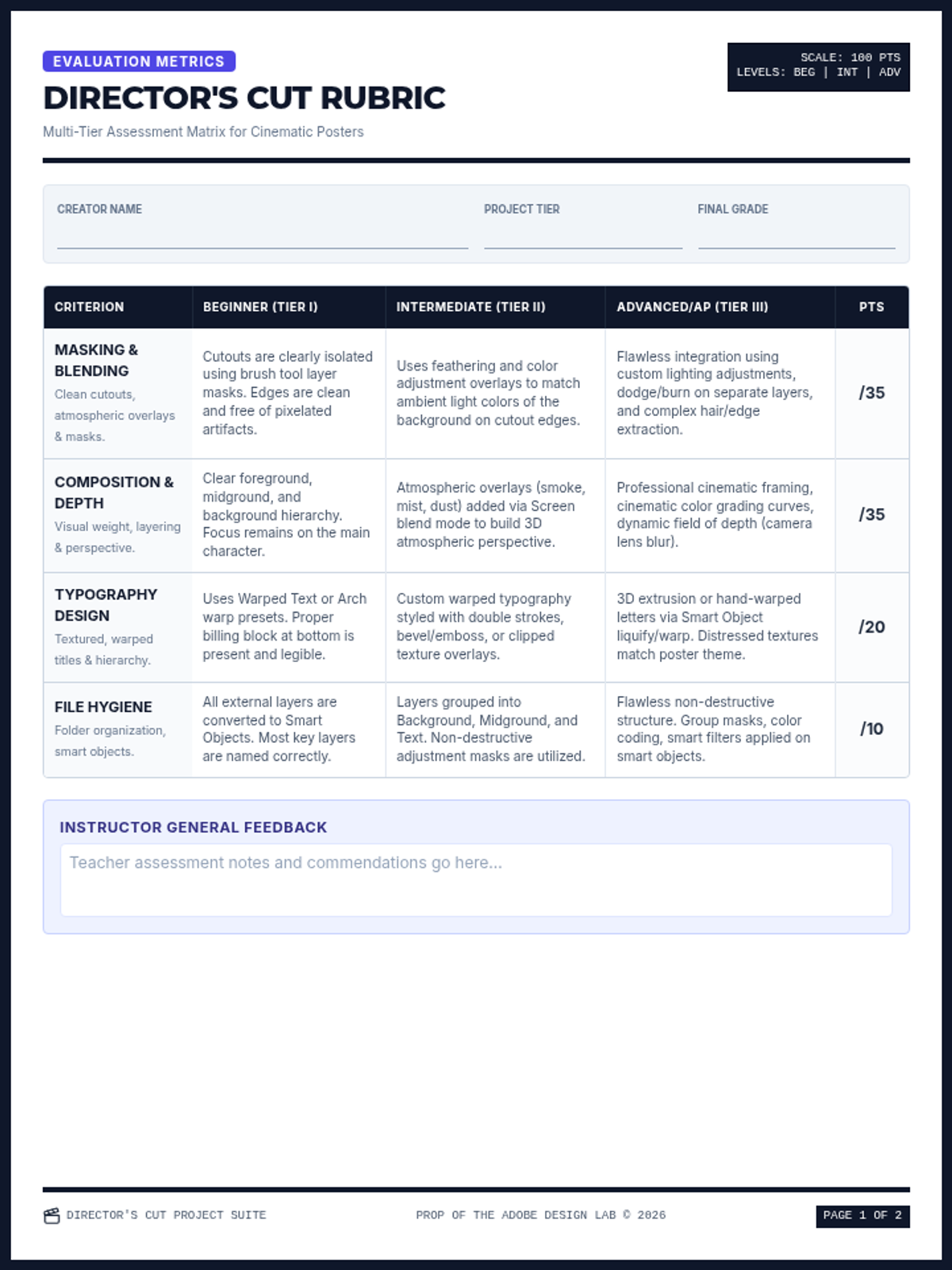
A printable grading rubric and student peer-critique sheet. It details grading criteria across three specialized performance tiers (Beginner, Intermediate, and Advanced) for blending, composition, and customized typography.
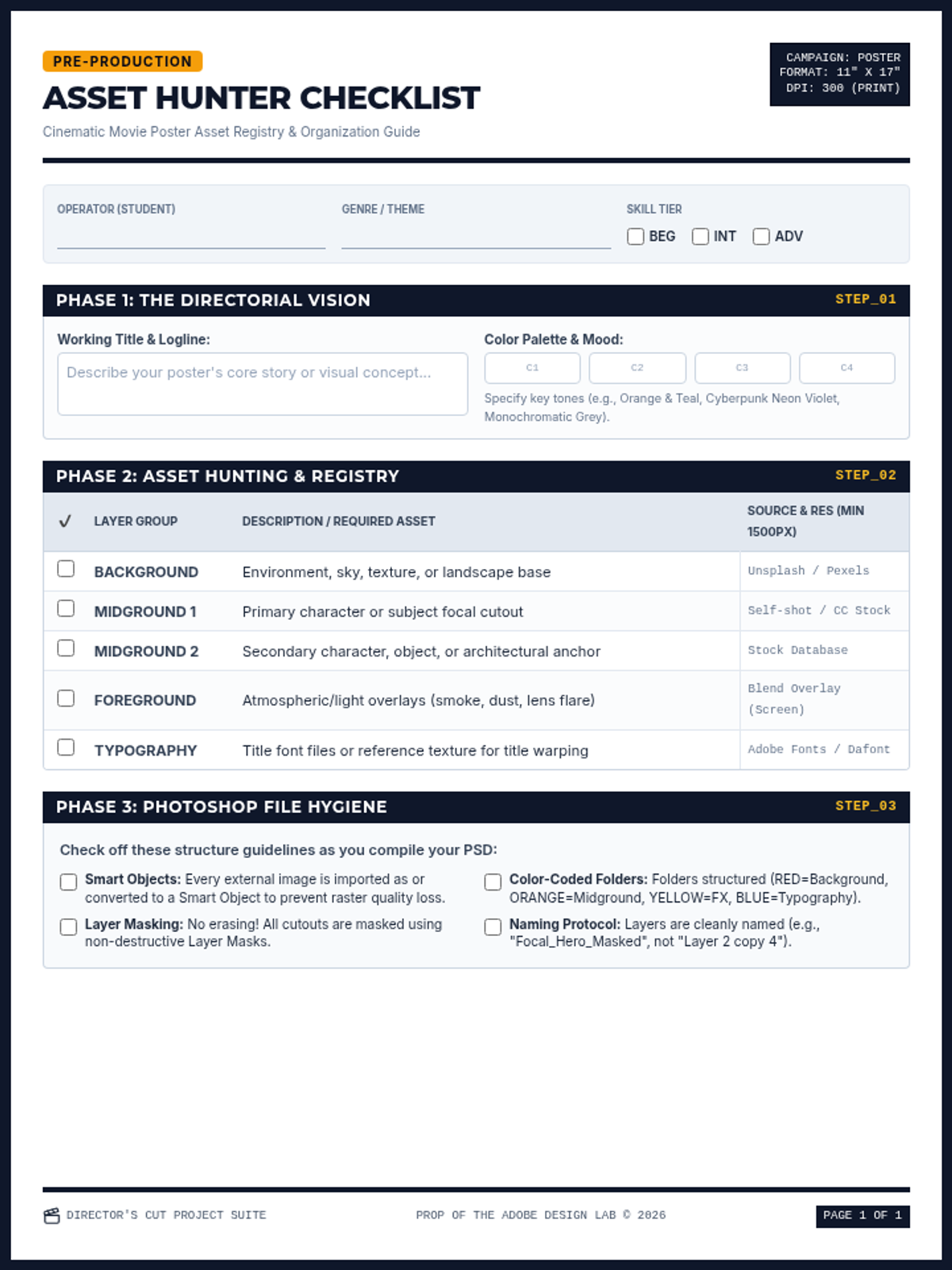
A student-facing asset sourcing and organization checklist. Helps students source high-resolution images, organize Photoshop layers (background, midground, foreground), and plan their cinematic poster concept.
A visual presentation slide deck covering different social media post formats within a single platform (using Instagram as a case study). Teaches students grid posts, reels, carousels, and stories, and explains aspect ratios, workflow scaling, and professional crop guides.
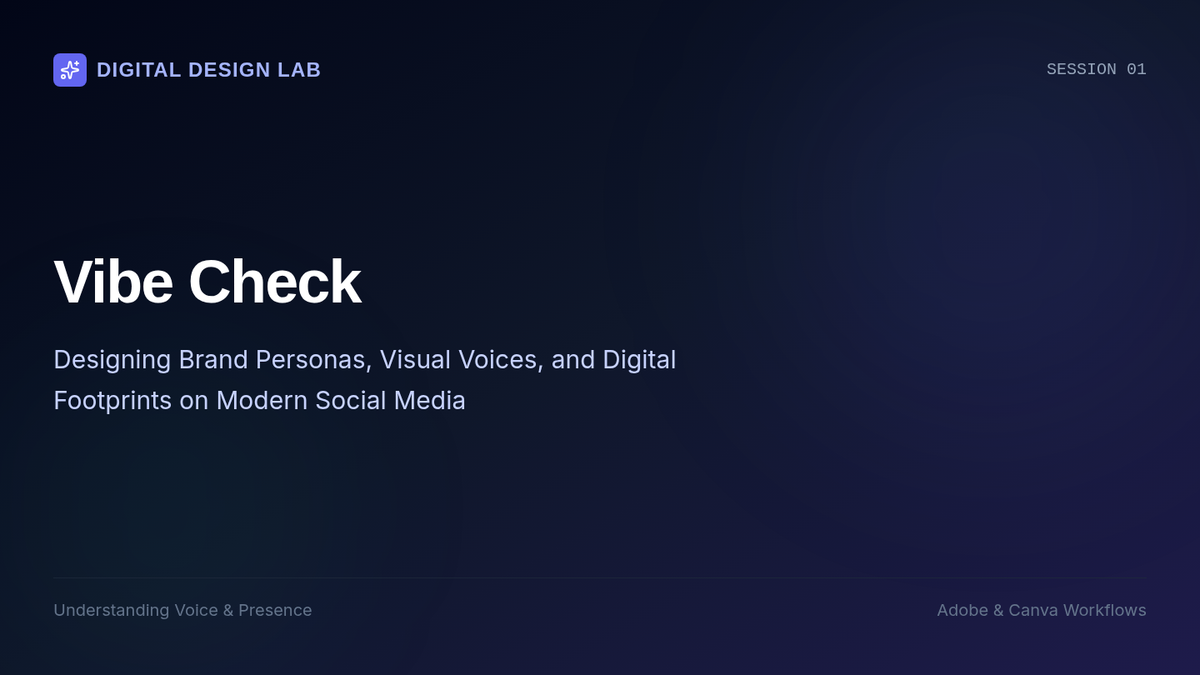
A visual presentation covering brand personas on social media. Highlights case studies contrasting Wendy's off-the-wall roasting style with a trusted corporate/professional persona, discussing digital footprints, design workflows, and layout alignment rules. Includes zero mention of assignments.
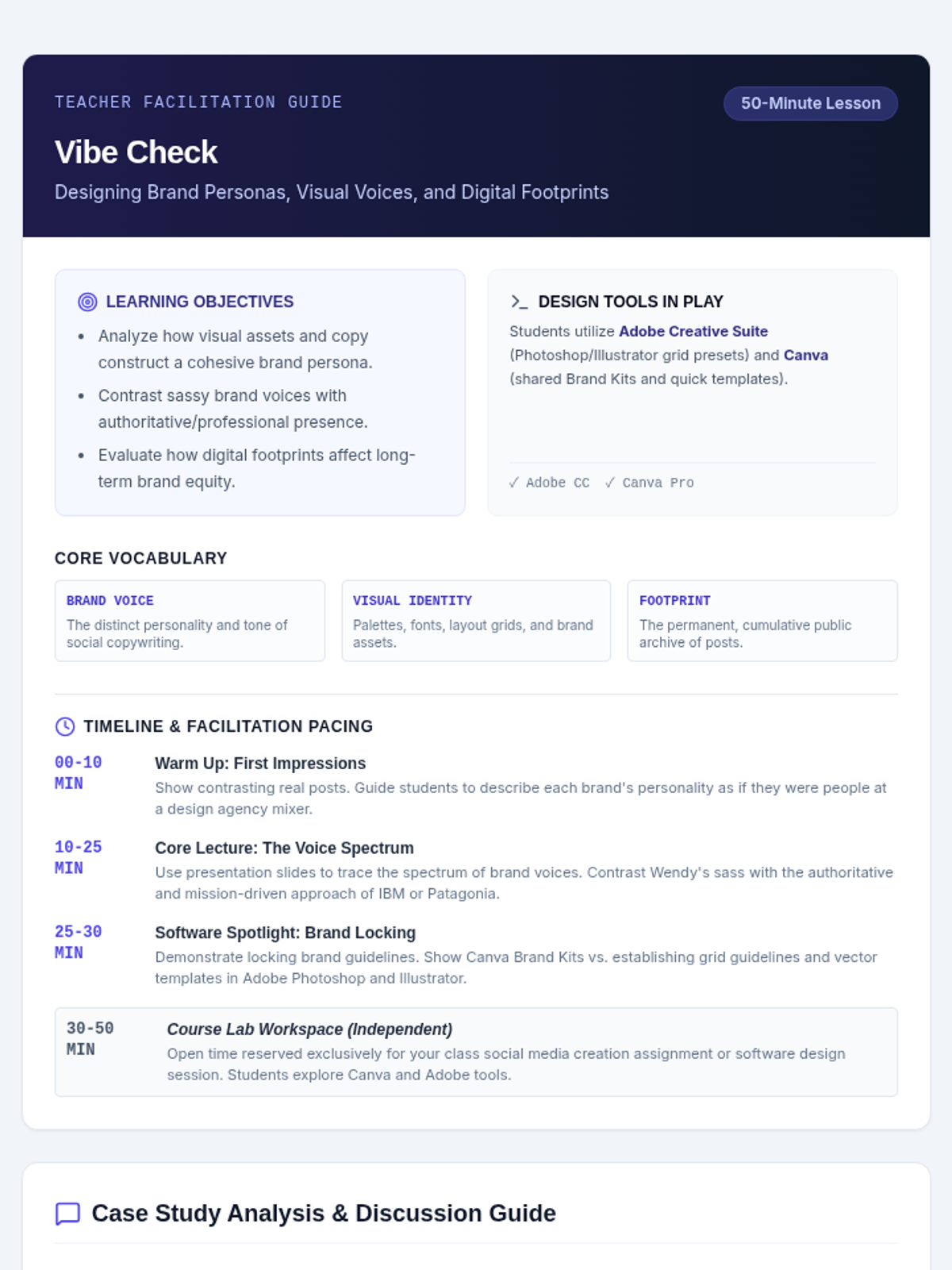
A professional teacher-facing lesson plan and facilitation guide outlining a 50-minute pacing structure, vocabulary terms, contrasting brand voice case studies (Wendy's vs. corporate), and tool integration tips for Canva and Adobe Creative Suite.
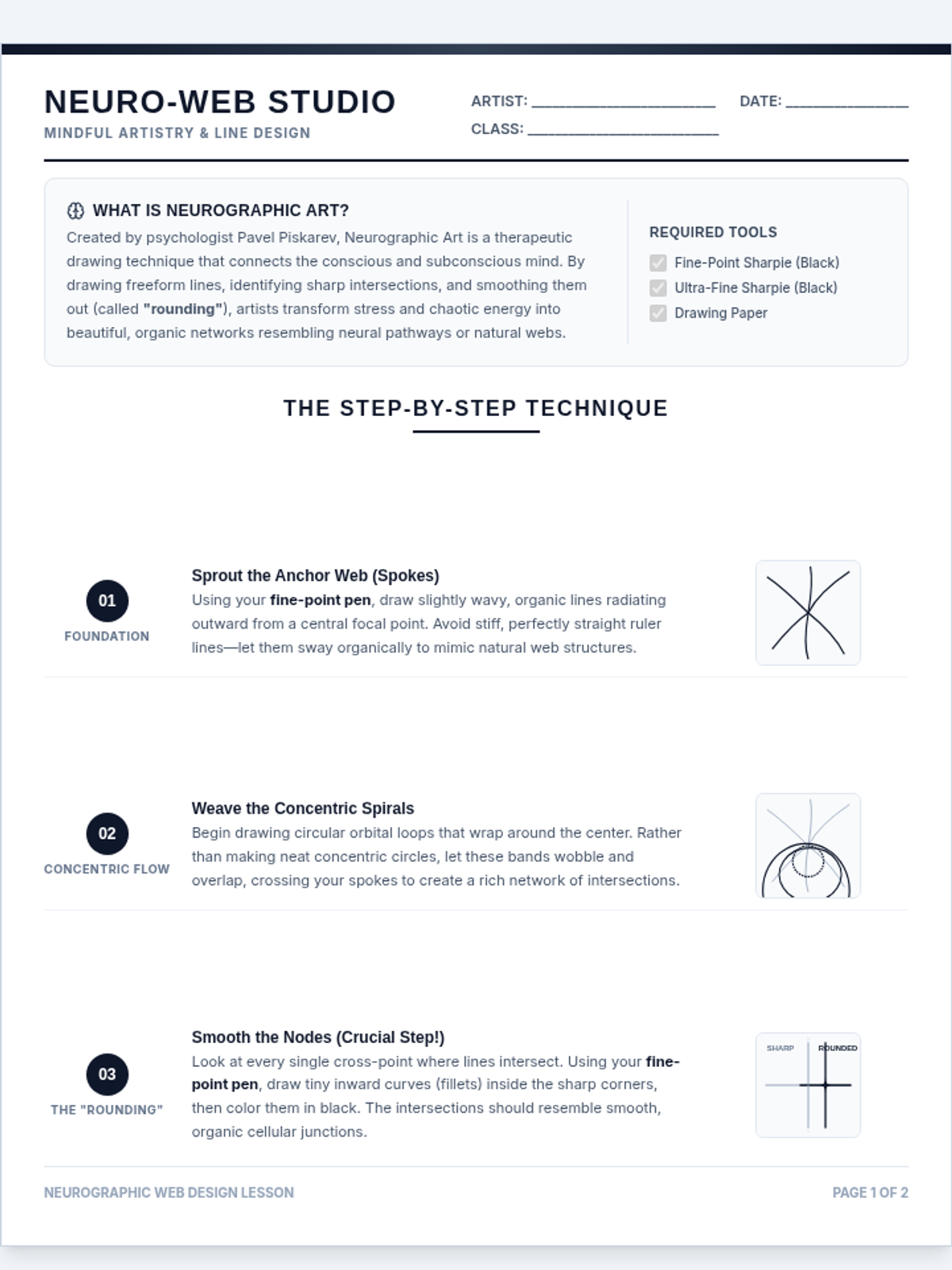
A premium, step-by-step instructional guide and studio practice worksheet for creating Neurographic Art, styled around organic spider webs. It includes beautifully detailed line illustrations demonstrating line foundation, radial spirals, intersection rounding, cellular bubble nesting, and contrast layout. Complete with hands-on practice zones and a dedicated blank thumbnail drawing blueprint for students to plan their artwork before final execution.
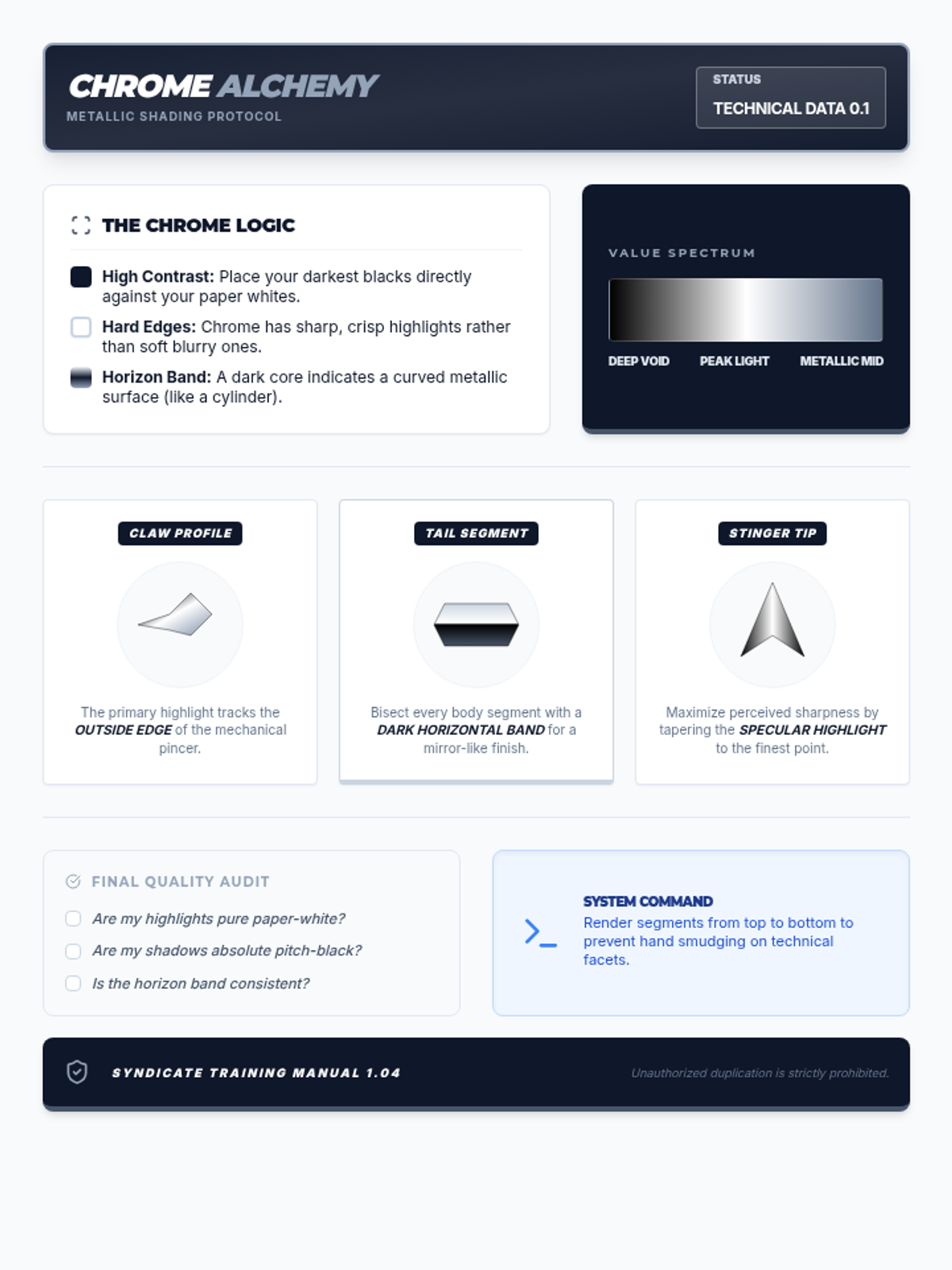
A comprehensive instructional handout for the Ink Alchemy lesson, teaching students the 'Chrome Logic' of high-contrast metallic shading. It includes visual breakdowns of how to render scorpion claws, body segments, and stingers using horizon bands and specular highlights.
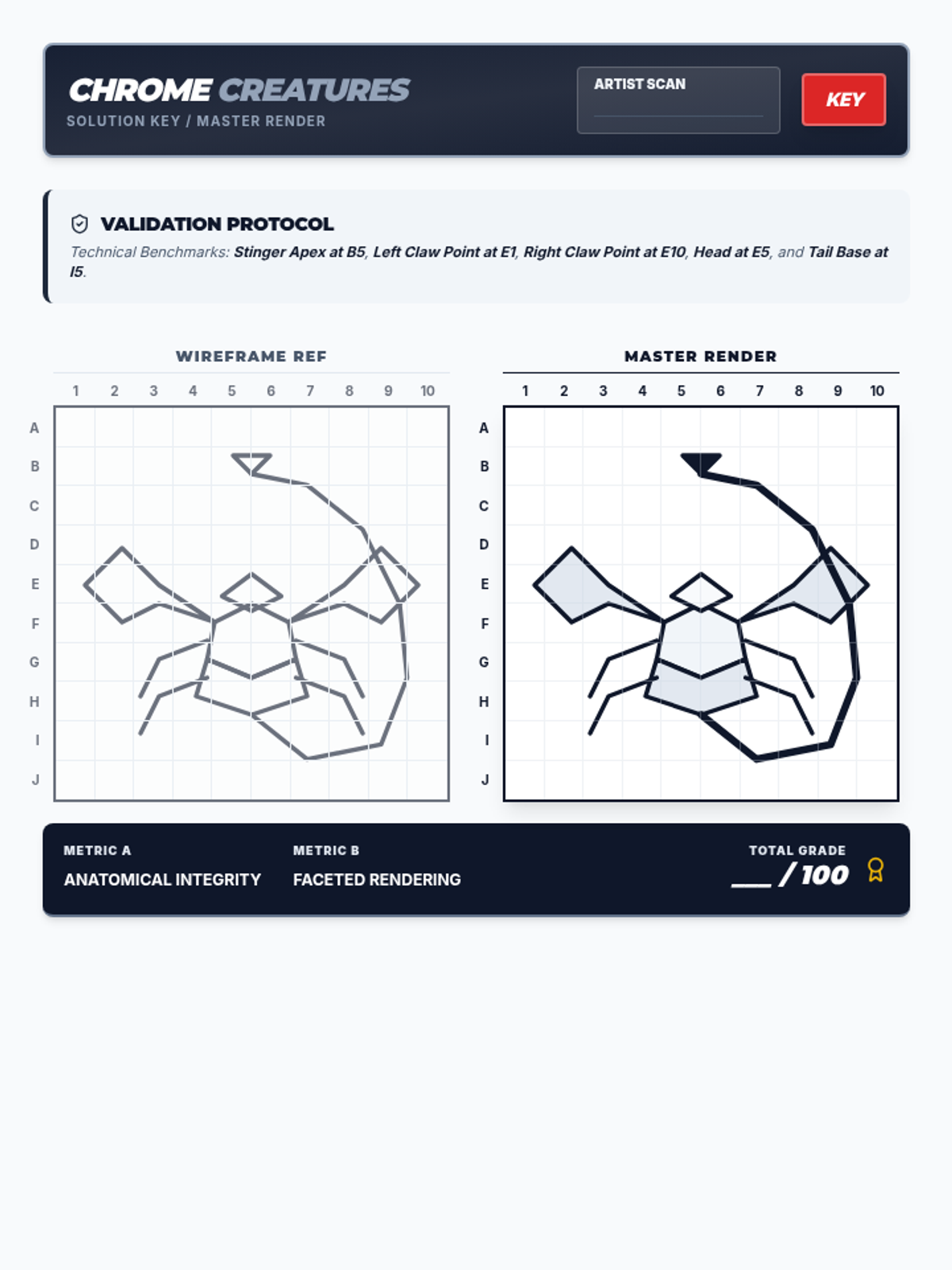
The answer key for the 3D Chrome Scorpion Grid Worksheet, featuring the completed metallic render with shaded facets and corrected anatomical benchmarks for accurate evaluation.
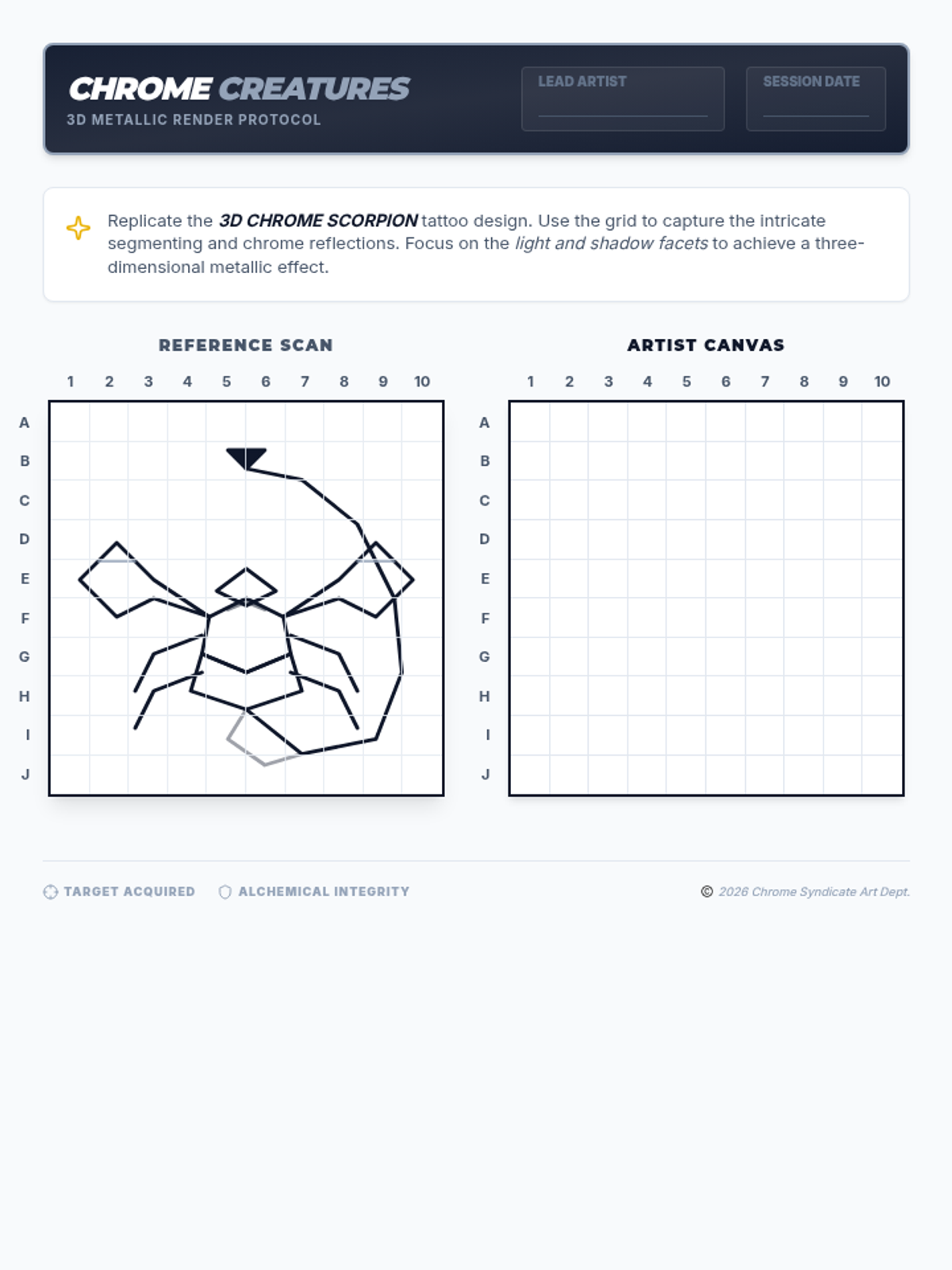
A high-tech grid drawing worksheet featuring a detailed, 3D-effect metallic scorpion tattoo design inspired by realistic chrome ink art. Students use the grid to replicate the complex anatomy and mechanical highlights.
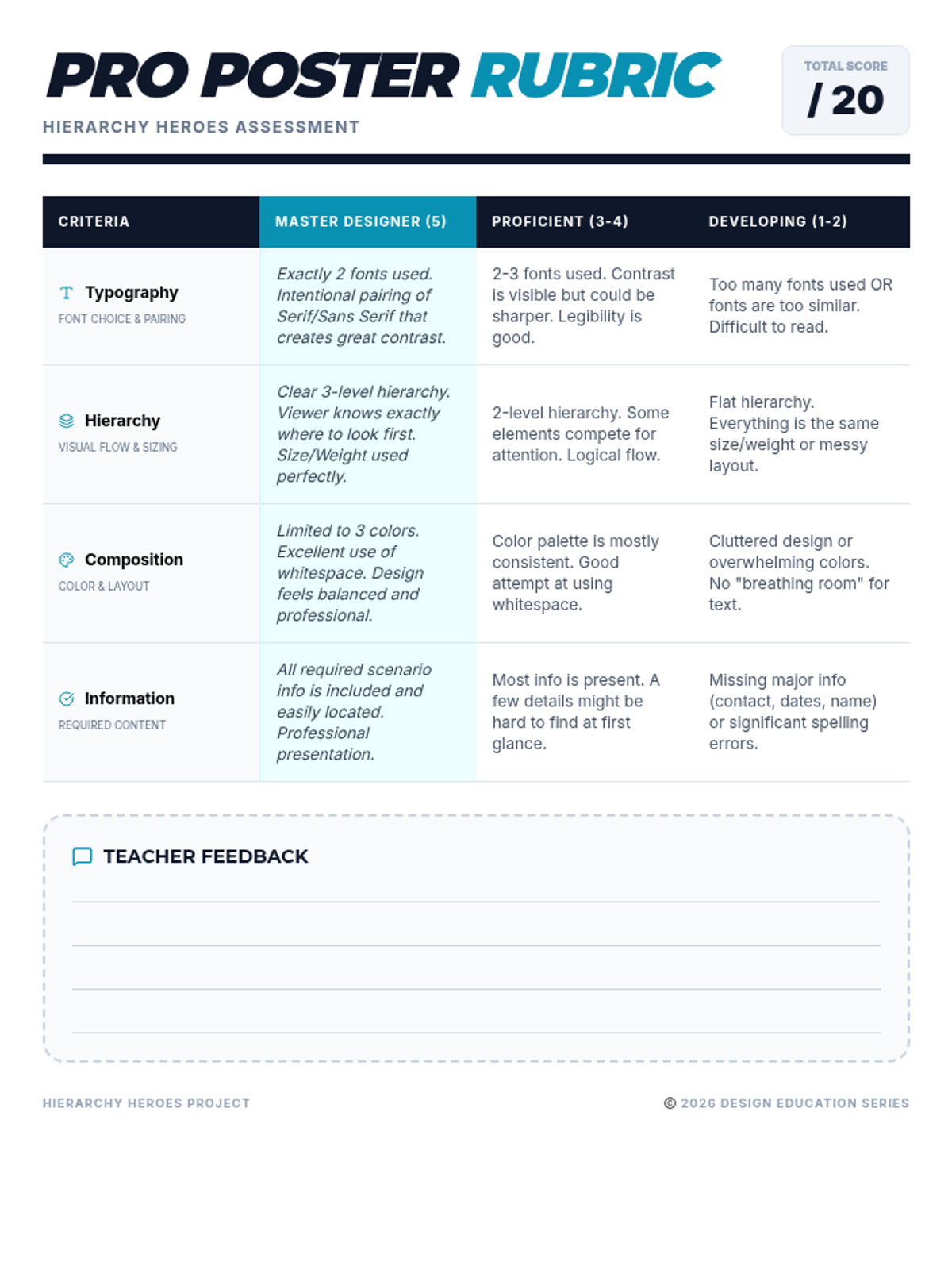
A teacher-facing grading rubric to assess student flyer projects based on typography, hierarchy, composition, and content clarity.
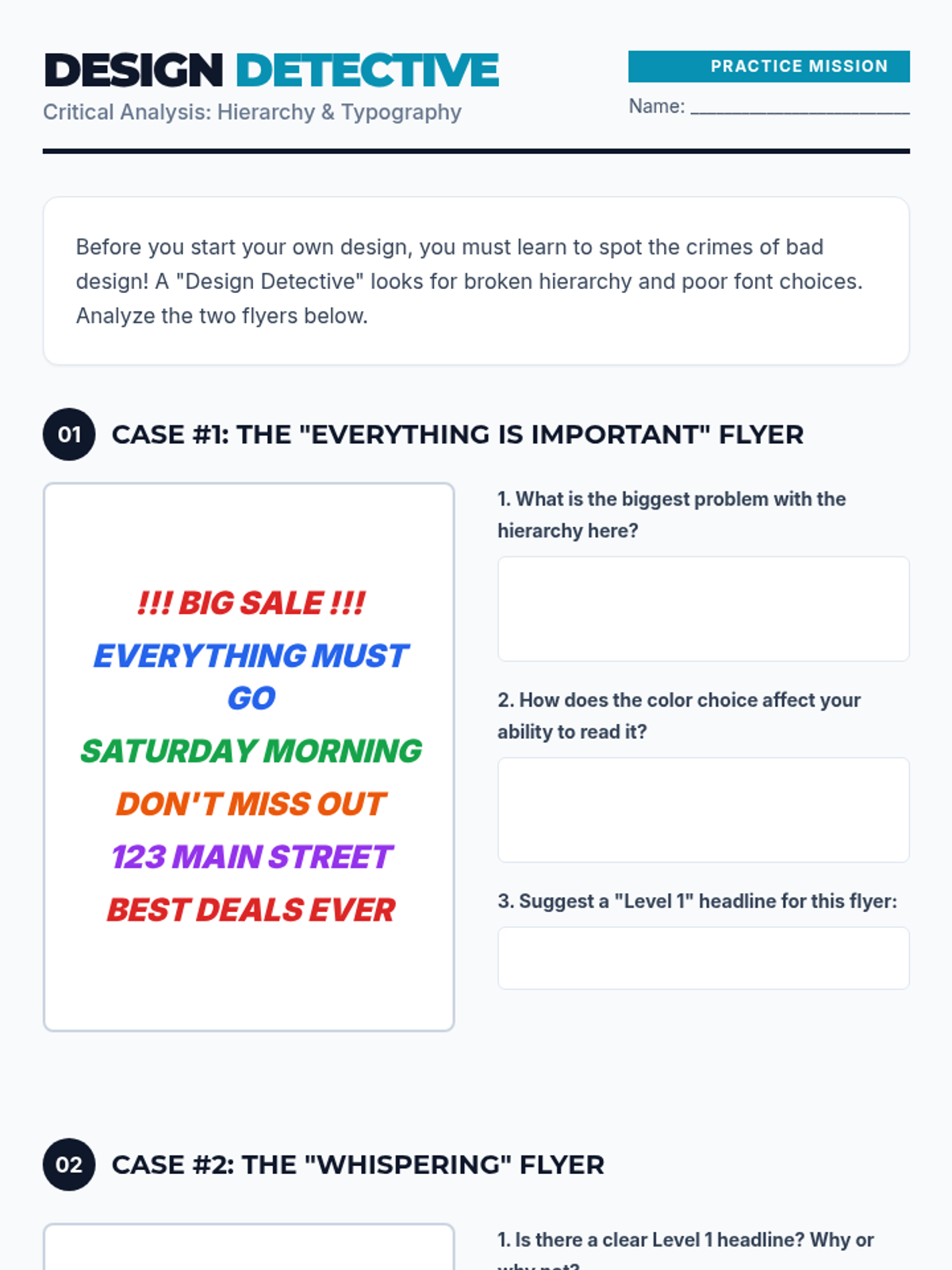
A worksheet where students analyze flawed flyer designs to better understand the principles of hierarchy and typography before starting their own.
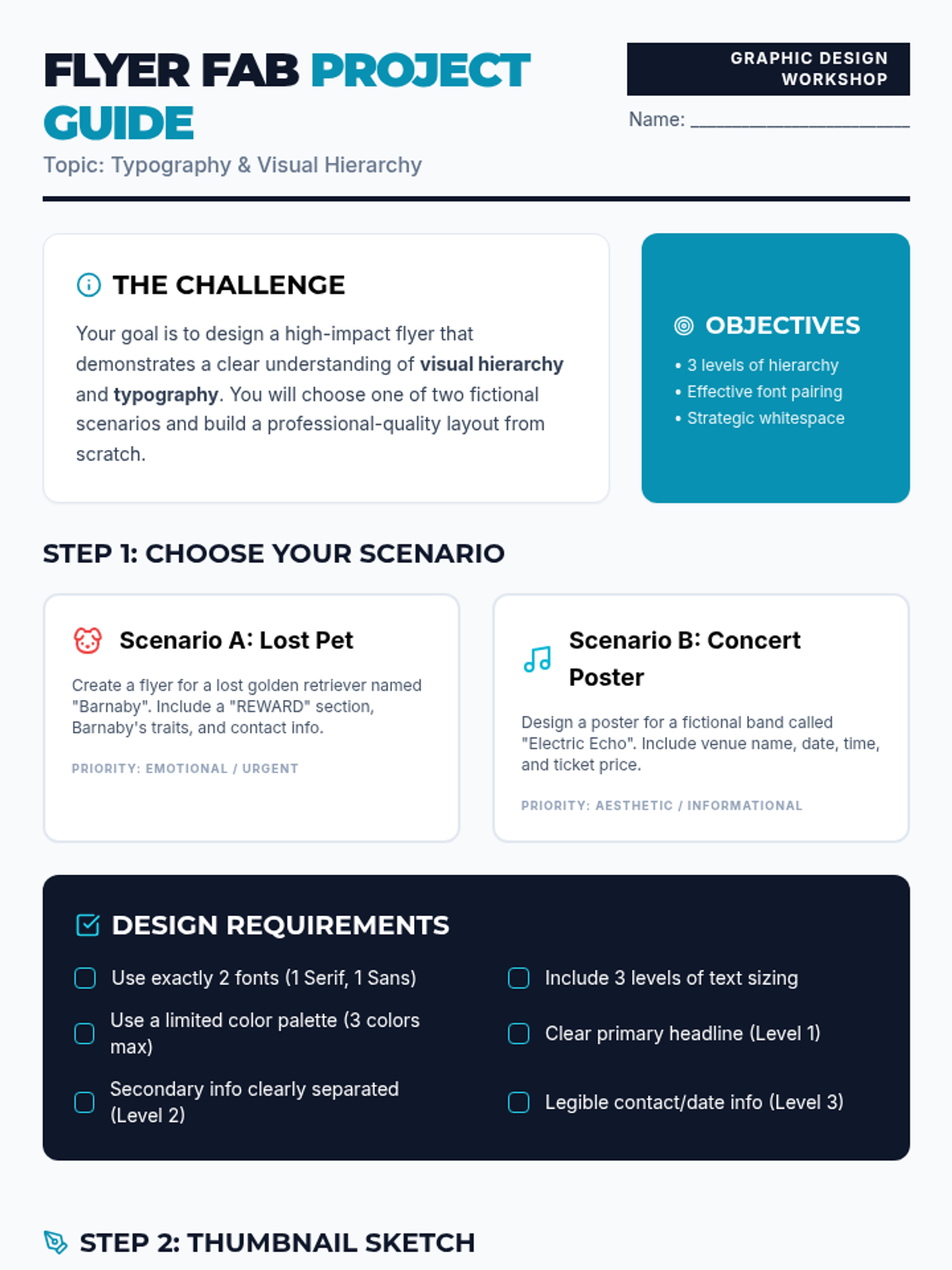
A student project guide for the flyer assignment, containing scenarios, requirements, and a planning workspace.
A visual presentation introducing the core concepts of typography and visual hierarchy, setting the stage for the flyer project.
A dynamic slide deck titled 'Neon Nexus' that explores the cultural impact, design principles (like the silhouette test), and character archetypes of the world's most popular anime icons. Includes discussion prompts and visual analysis guides.
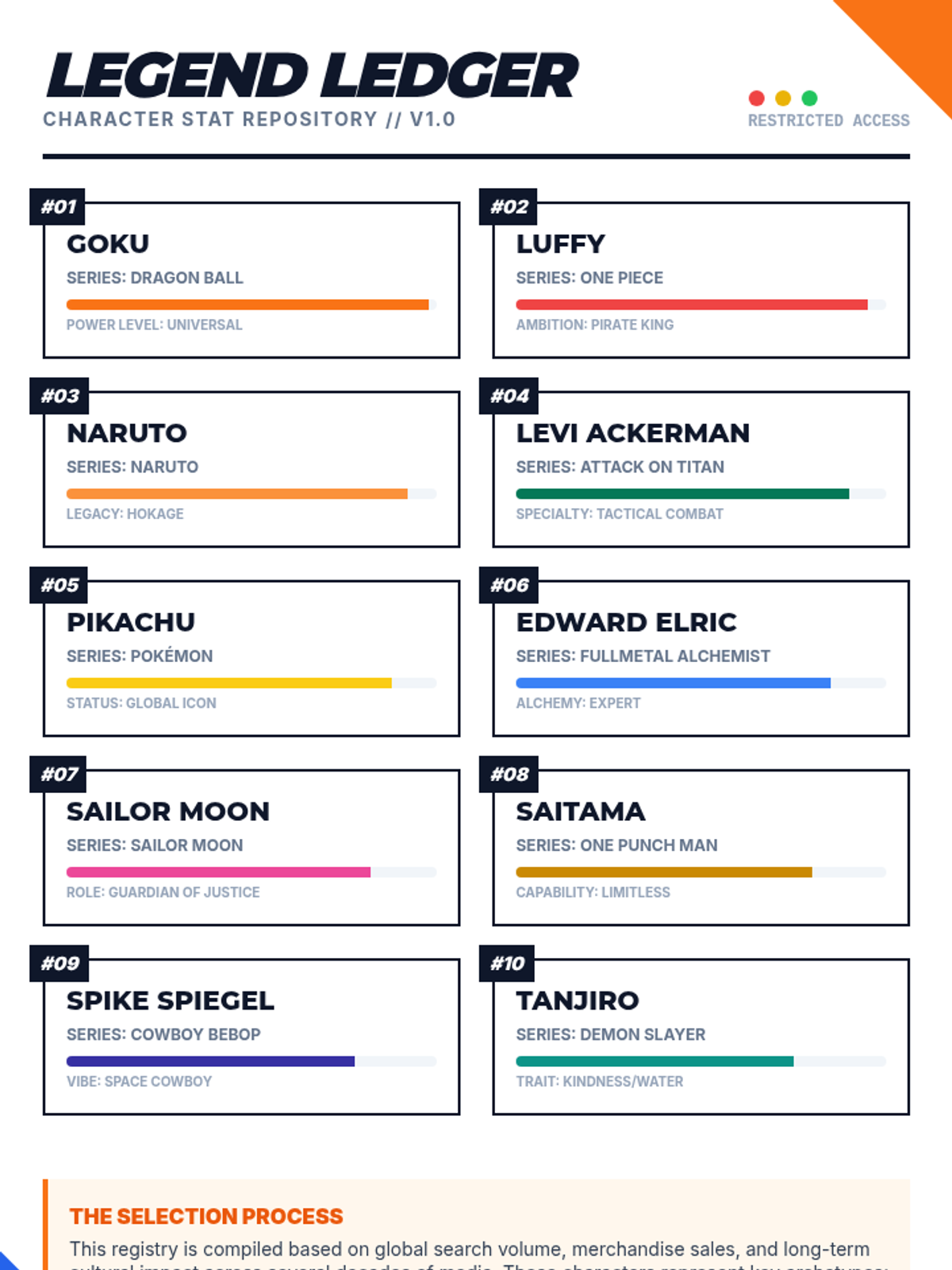
A character analysis document featuring a 'Legend Ledger' of the top 10 most popular anime characters and a structured hero profile worksheet for student completion. This material uses a high-contrast, modern graphic theme inspired by action media and tech interfaces.