Fundamental concepts of limits, derivatives, and integrals for modeling change and motion. Examines techniques for differentiation and integration alongside applications in optimization, area calculation, and differential equations.
Problem set for graduate students to practice implementing Monte Carlo simulations, calculating standard error, and understanding variance reduction techniques.
Graduate-level slides covering Monte Carlo methods, Geometric Brownian Motion paths, and the Law of Large Numbers applied to derivative pricing.
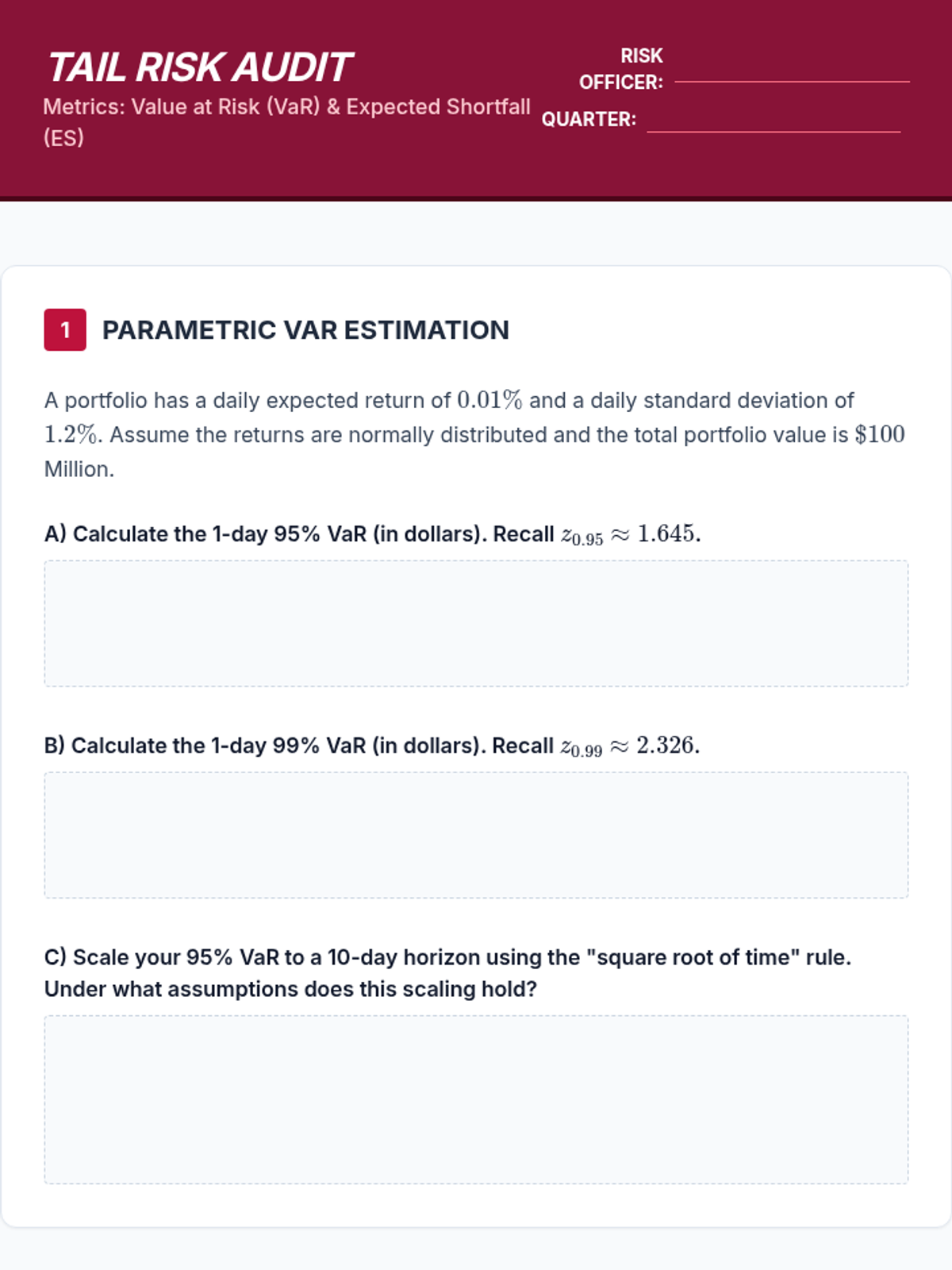
Problem set for graduate students to practice calculating VaR and Expected Shortfall, analyzing the impact of non-normal distributions on risk metrics.
Graduate-level slides covering VaR, Expected Shortfall, tail risk metrics, and the limitations of normal distributions.
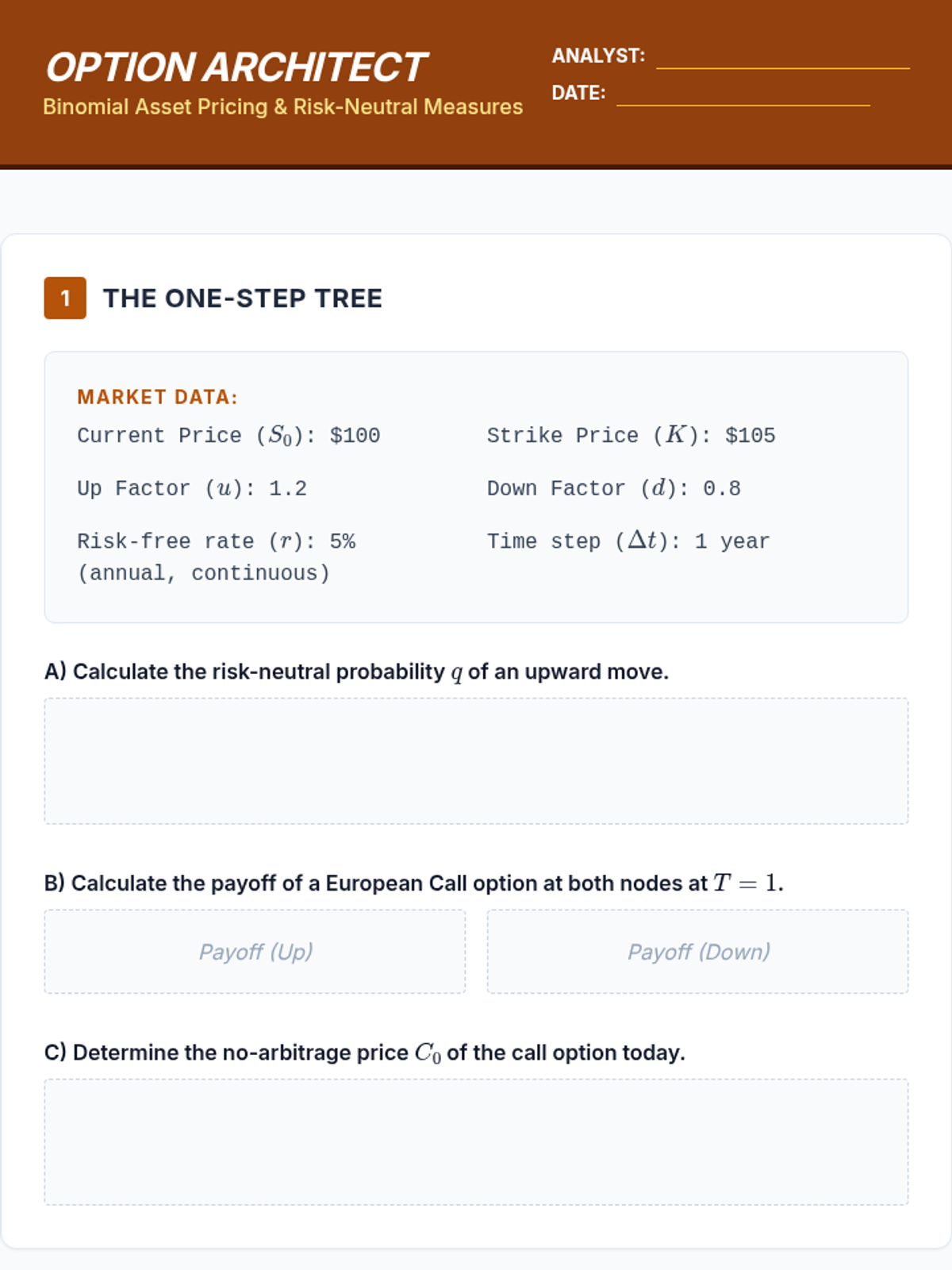
Problem set for graduate students to price European options using the binomial model and calculate delta-hedging portfolios.
Graduate-level slides covering risk-neutral measures, the fundamental theorem of asset pricing, and the derivation of the binomial model.
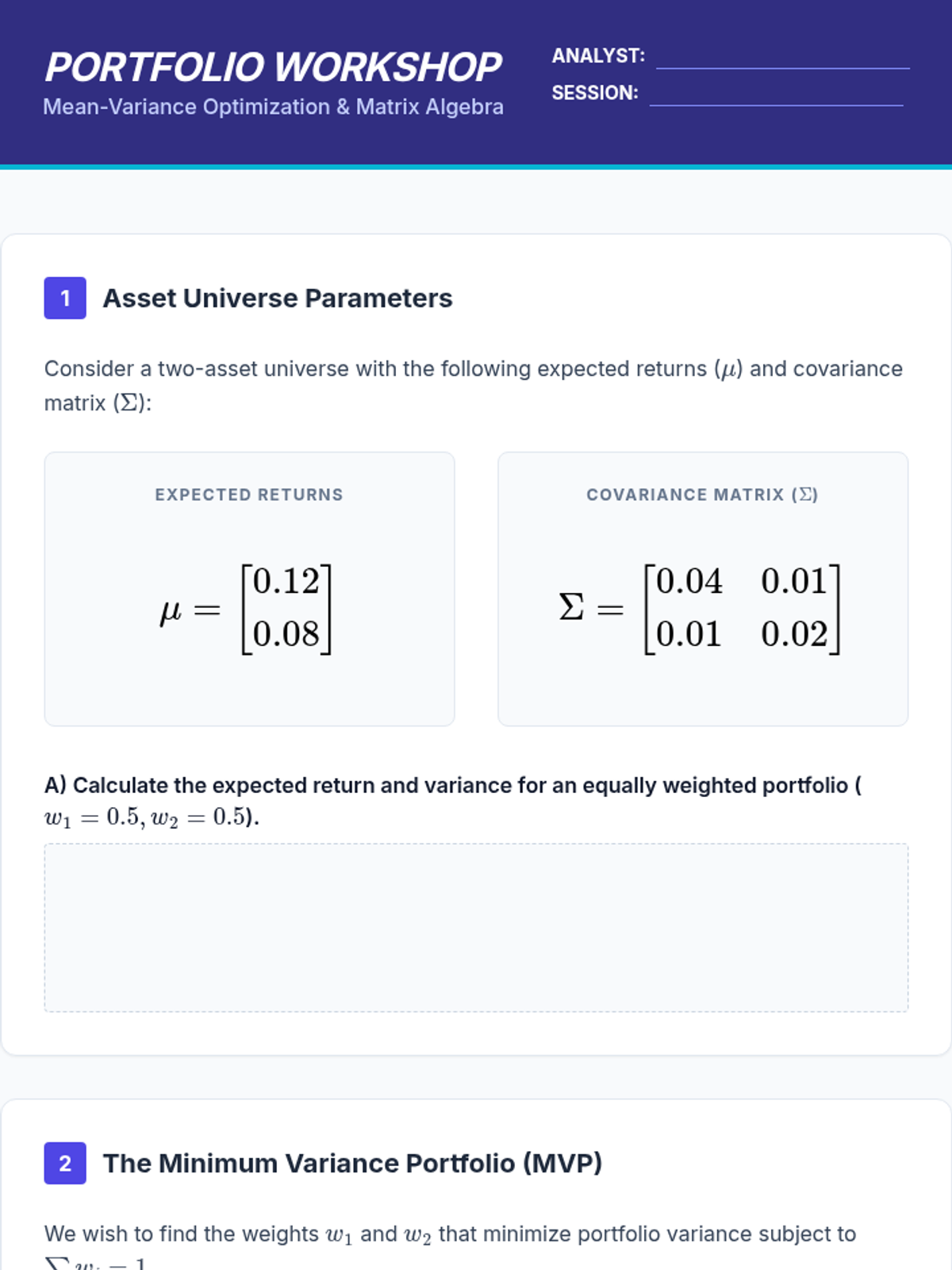
Problem set for graduate students to compute portfolio expected returns and variance using matrix algebra, and derive the Minimum Variance Portfolio.
Graduate-level slides covering portfolio expected returns, covariance matrices, and the formulation of the Markowitz mean-variance optimization problem.
Problem set for graduate students to practice calculating expected utility, risk premiums, and deriving risk aversion measures.
Graduate-level slides covering the St. Petersburg Paradox, vNM Utility functions, and risk premiums in quantitative finance.
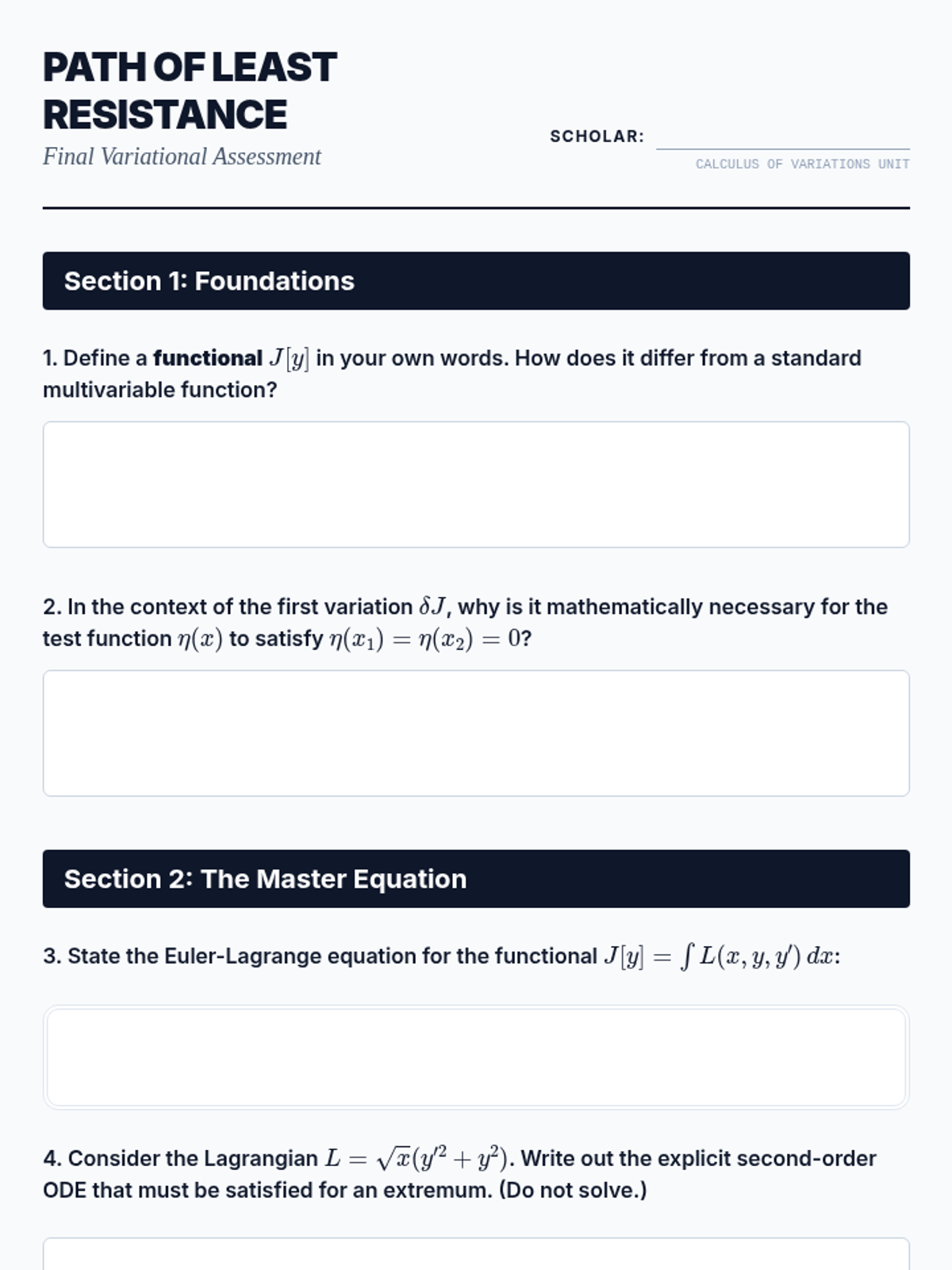
A comprehensive final assessment for graduate students covering functionals, the Euler-Lagrange derivation, Beltrami identity, and isoperimetric problems.
Student-facing project guide for finding the curve of fixed length that encloses the maximum area, applying Lagrange multipliers for functionals.
Project presentation slides for Lesson 5, focusing on optimizing functionals subject to integral constraints and the isoperimetric problem.
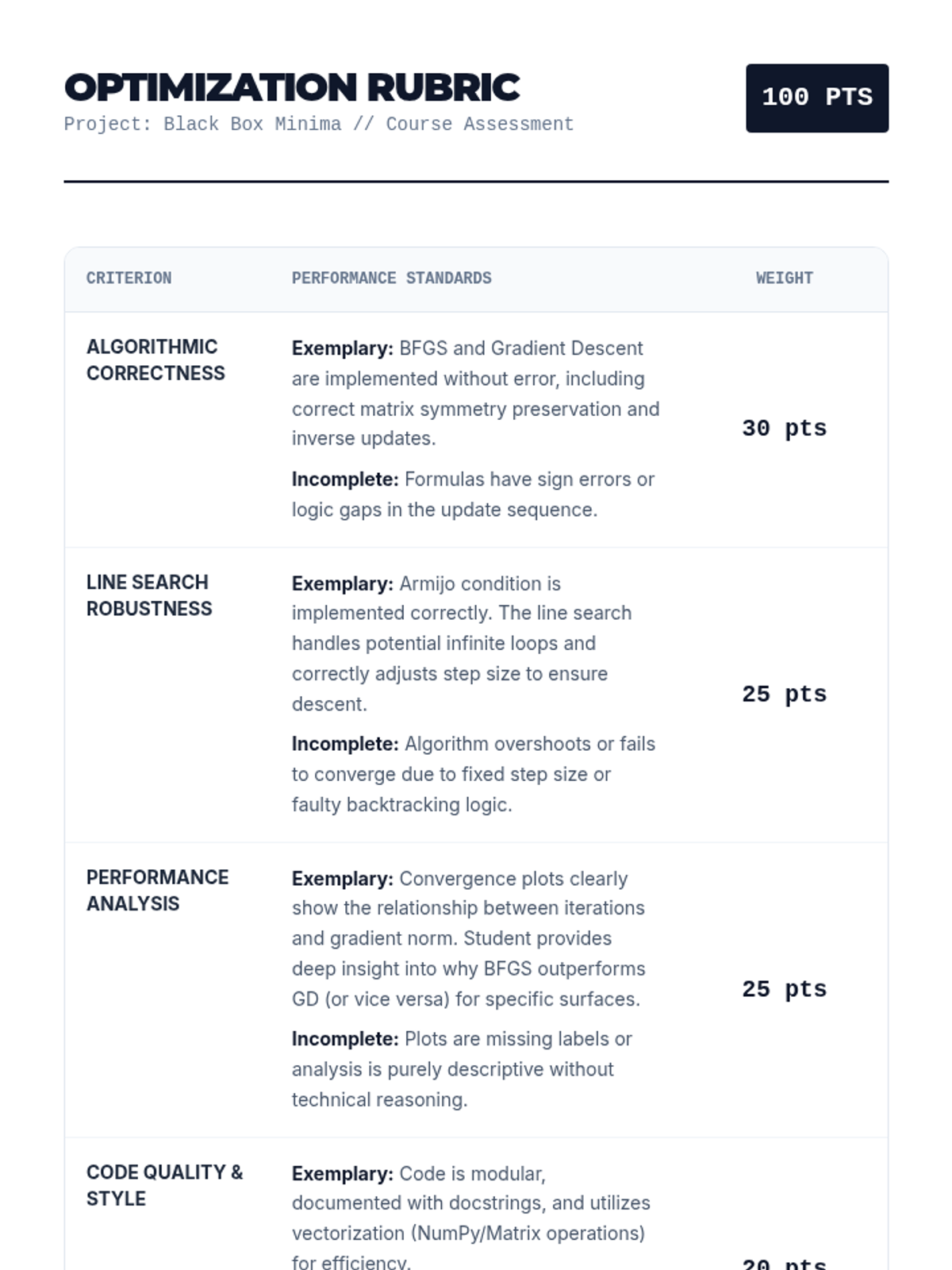
Assessment rubric for the Algorithmic Implementation Challenge, evaluating correctness, robustness, analysis, and code quality.
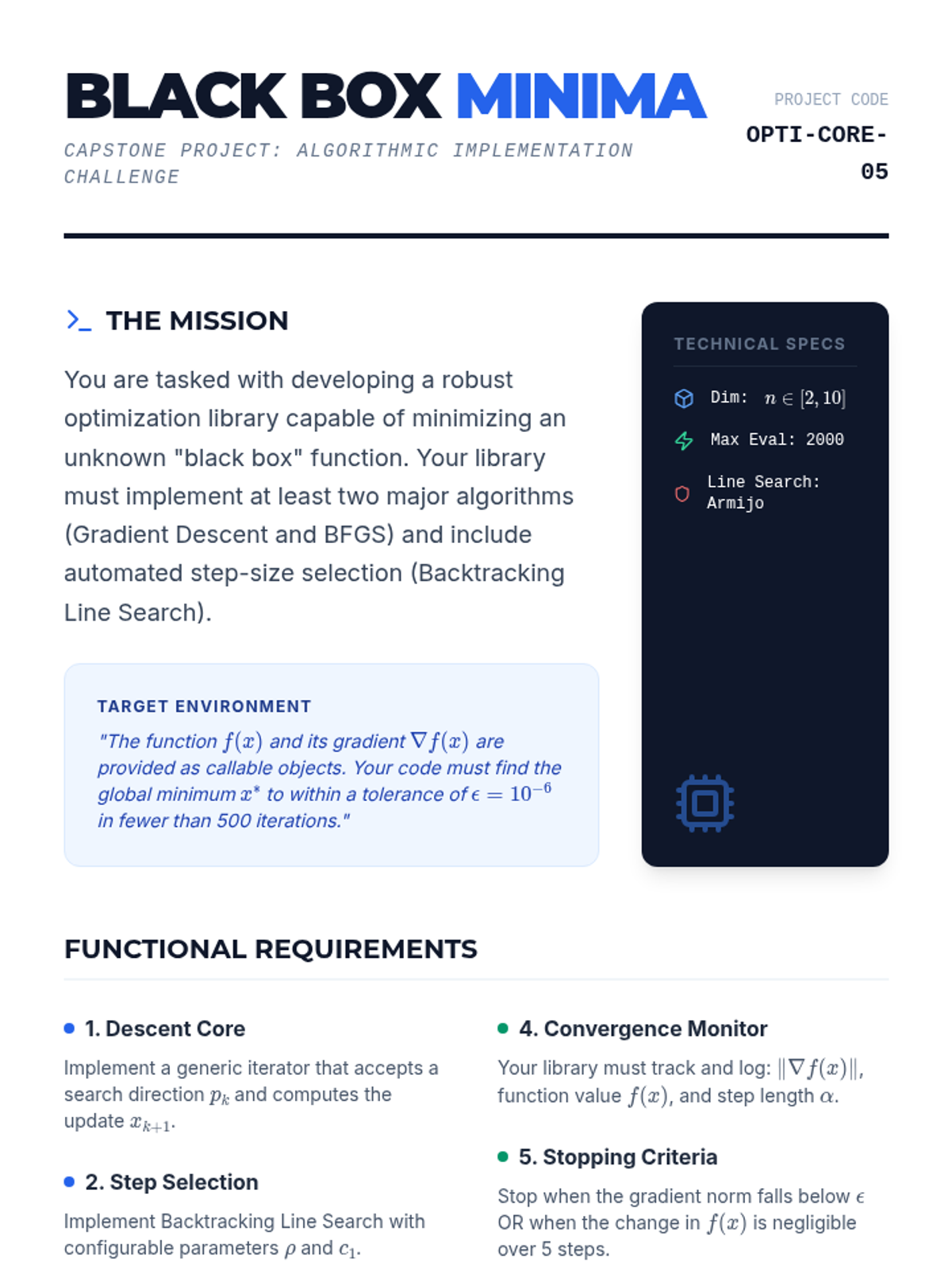
Instructions for the culminating project where students implement and compare Gradient Descent and BFGS algorithms on a black-box function.
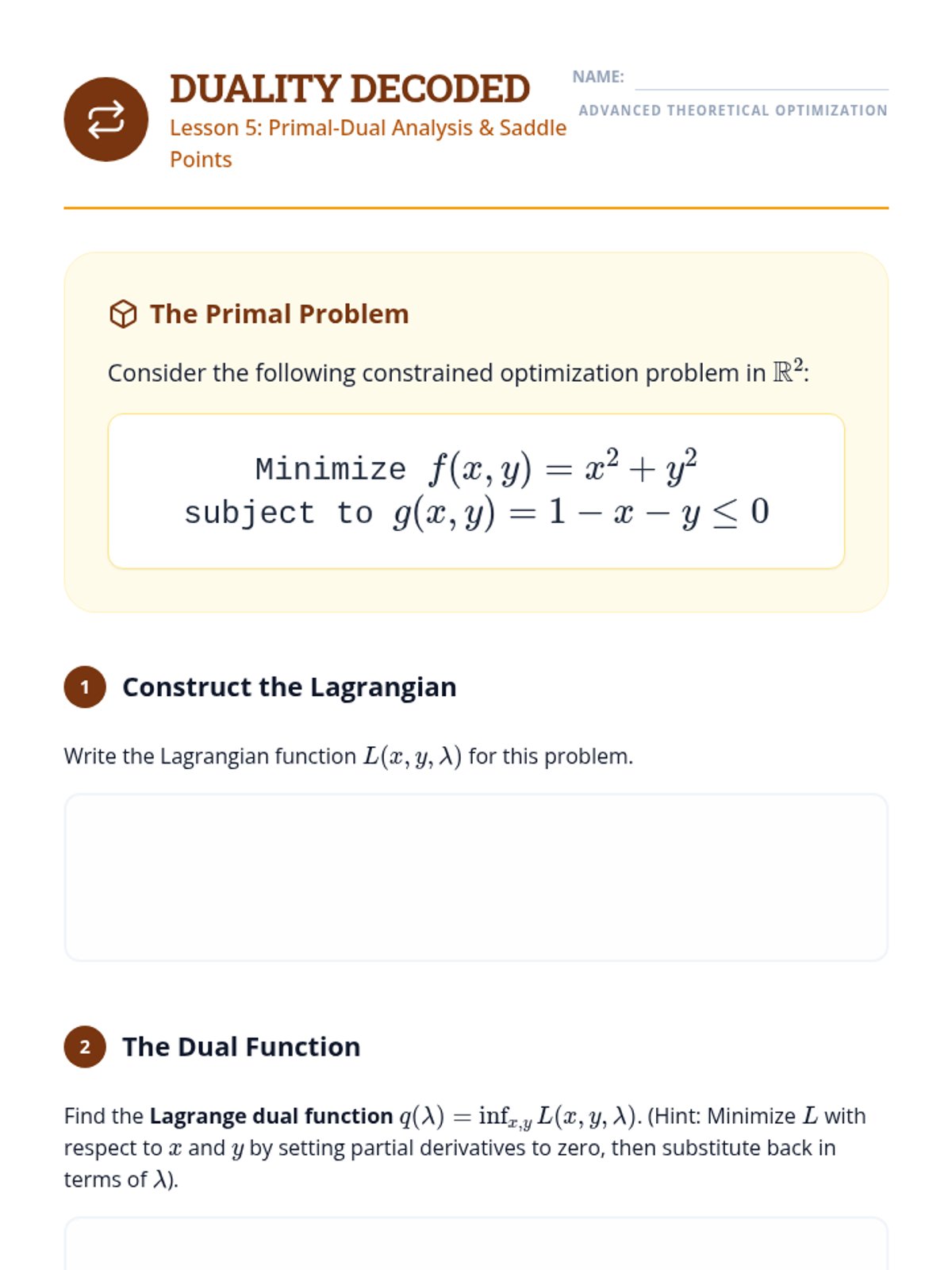
Case study worksheet for Lesson 5 focusing on deriving the dual function, solving the dual problem, and verifying strong duality and saddle point conditions.
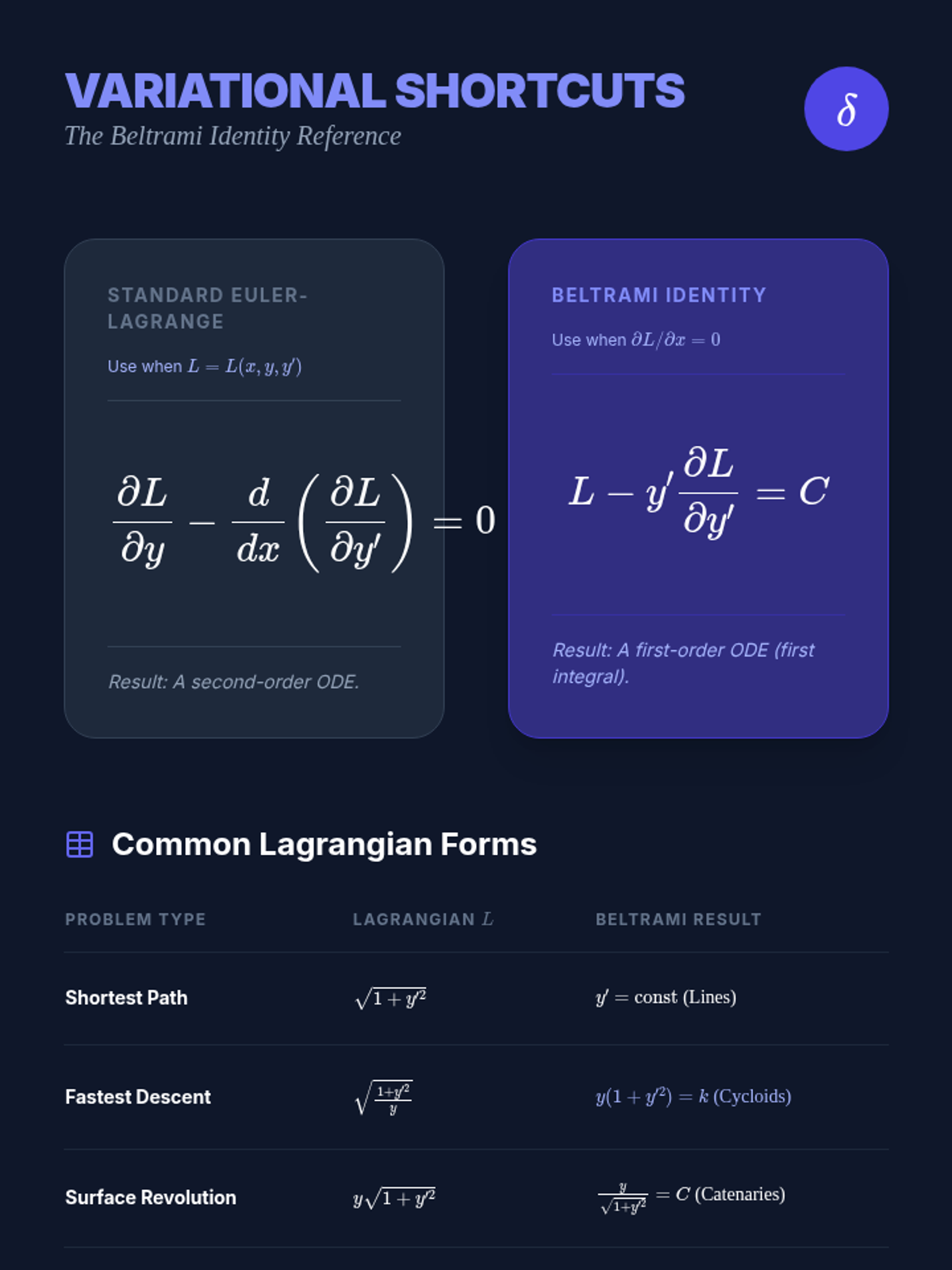
A quick reference sheet comparing the standard Euler-Lagrange equation with the Beltrami version, featuring common application examples.
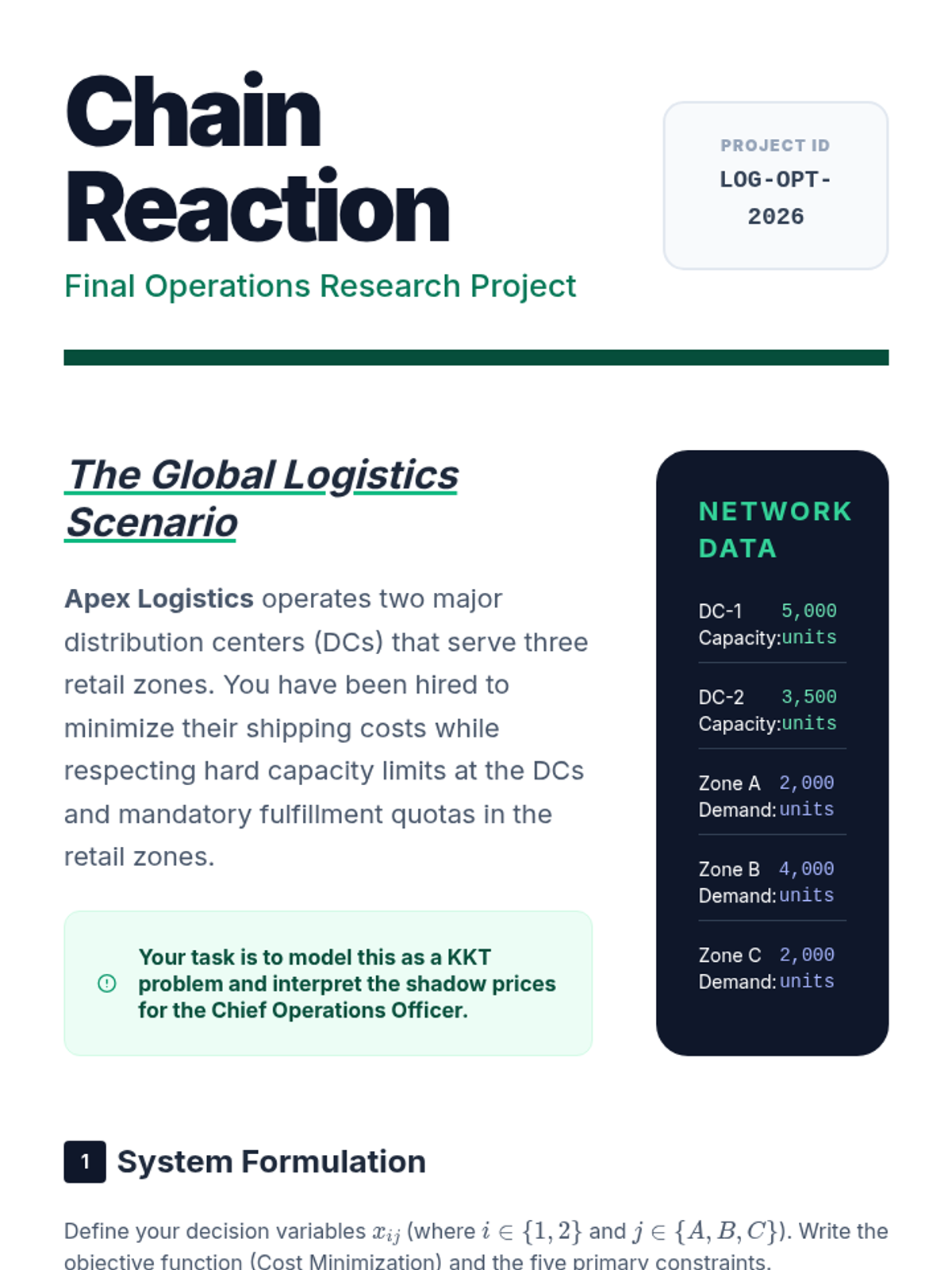
The final project guide for students, applying KKT conditions to a logistics network problem and requiring economic interpretation of shadow prices for business strategy.
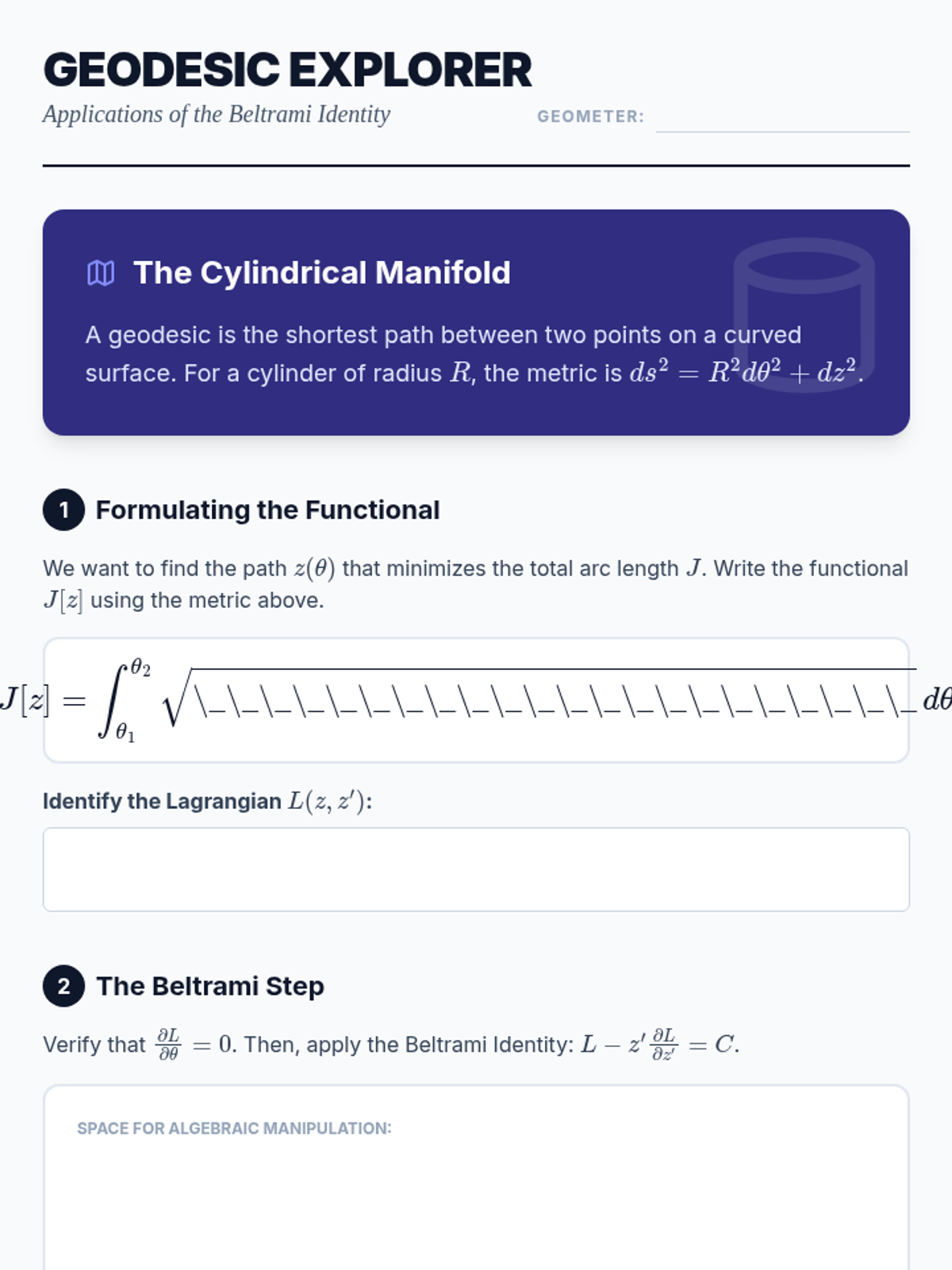
Worksheet for graduate students to apply the Beltrami identity to find the shortest path on a cylinder (geodesic analysis).
Visual presentation for Lesson 5 covering the Lagrangian, primal and dual problems, weak/strong duality, and saddle point conditions.
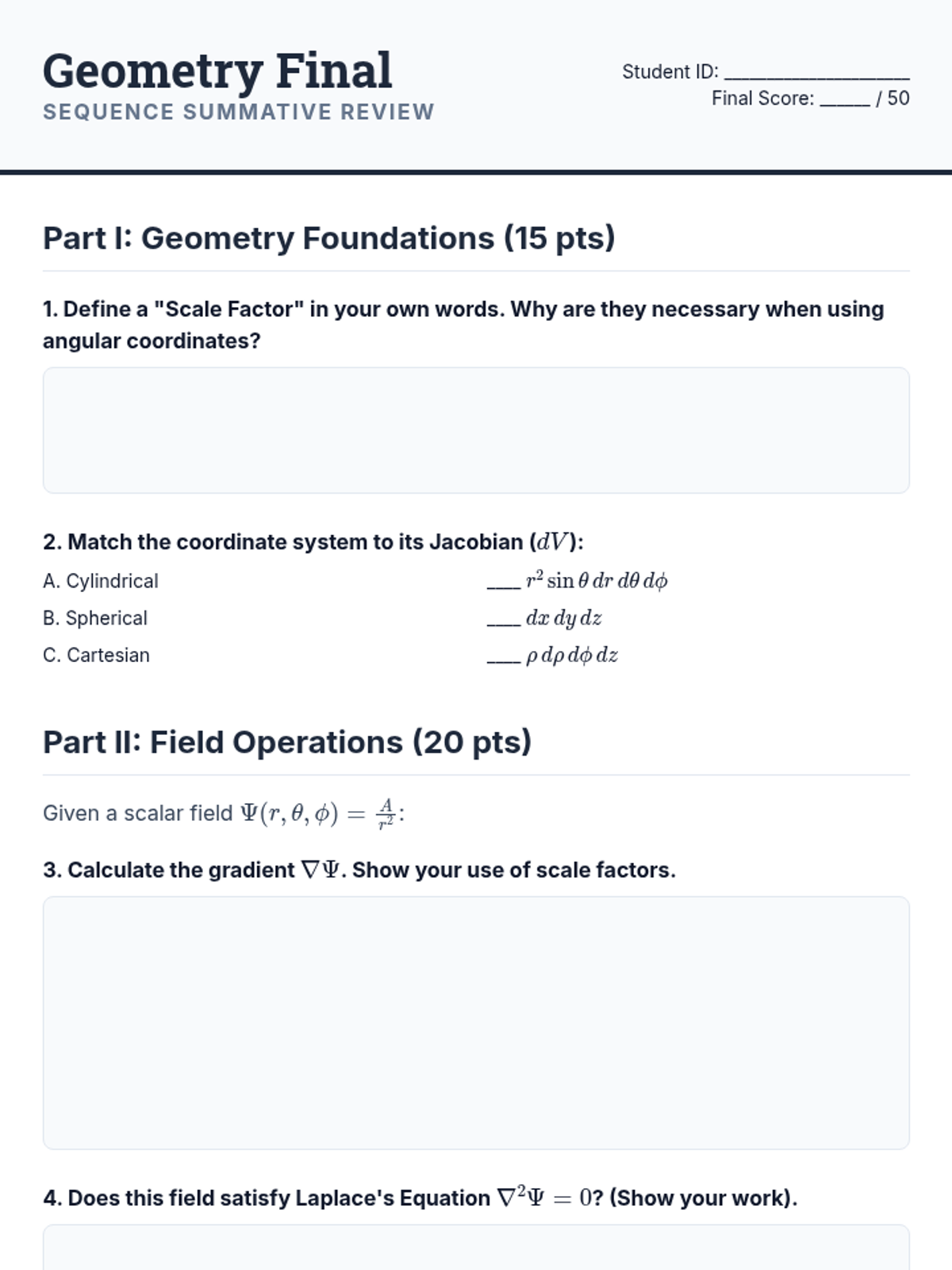
Summative assessment covering the entire sequence, including conceptual questions on scale factors, vector operator calculations, and applications to metrics and symmetry.
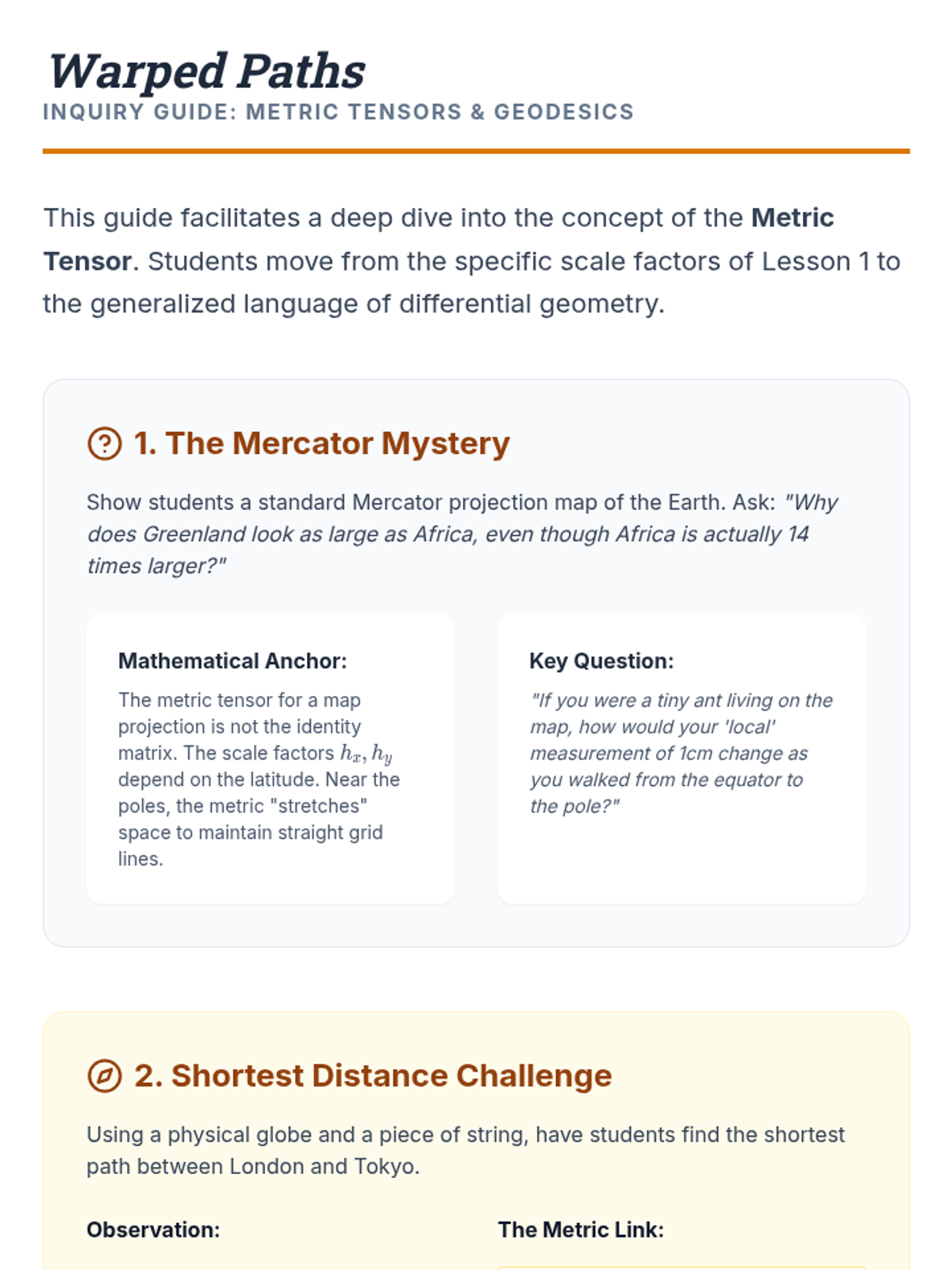
Discussion and inquiry guide for teachers to explore metric tensors, map distortions, and geodesics through thought experiments and physical demonstrations.
Introductory presentation on the metric tensor, non-Euclidean geometry, geodesics, and the conceptual foundation of General Relativity.
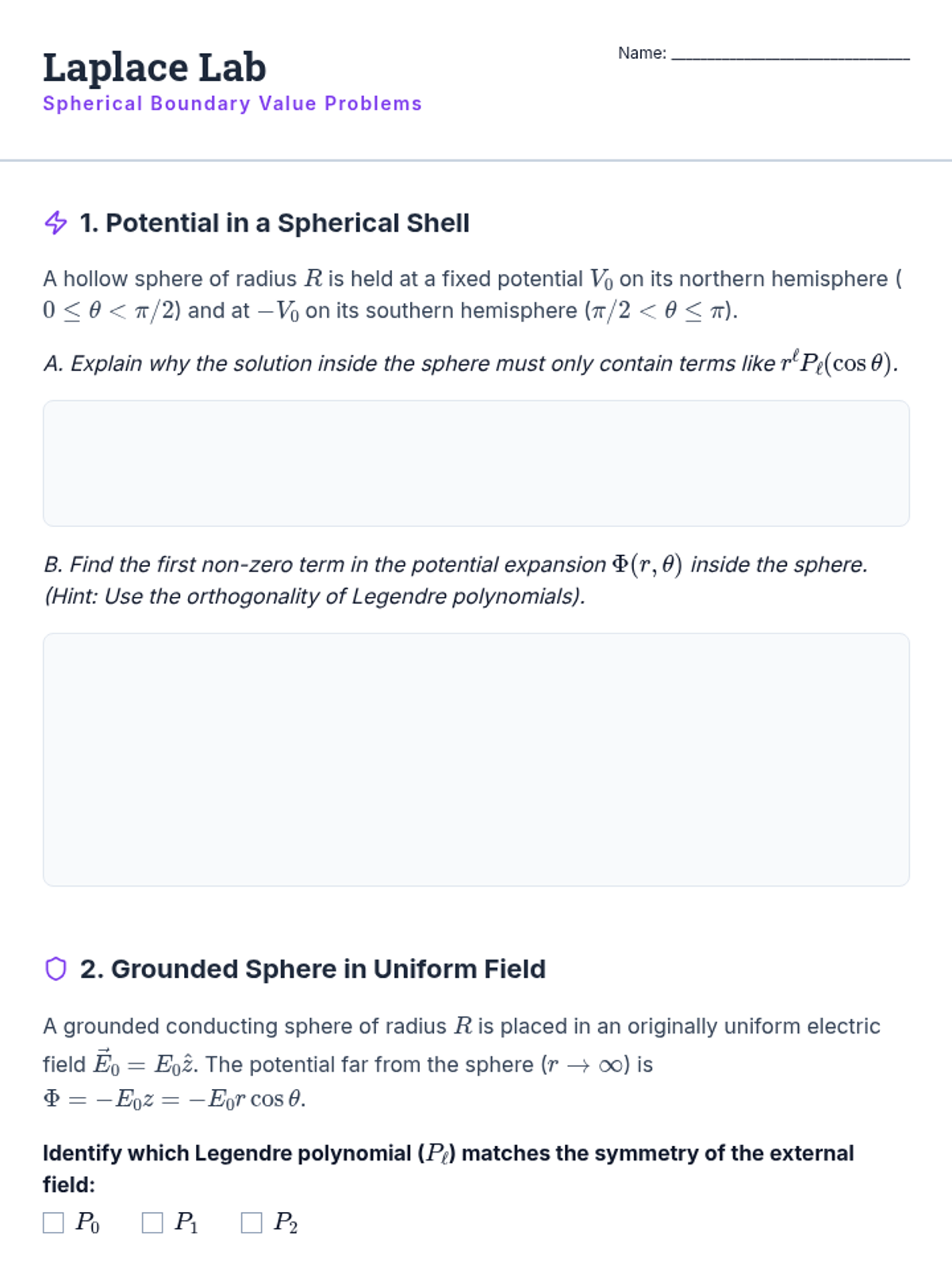
Problem set focused on solving boundary value problems using Legendre polynomials, including hemispherical potential and a sphere in a uniform electric field.
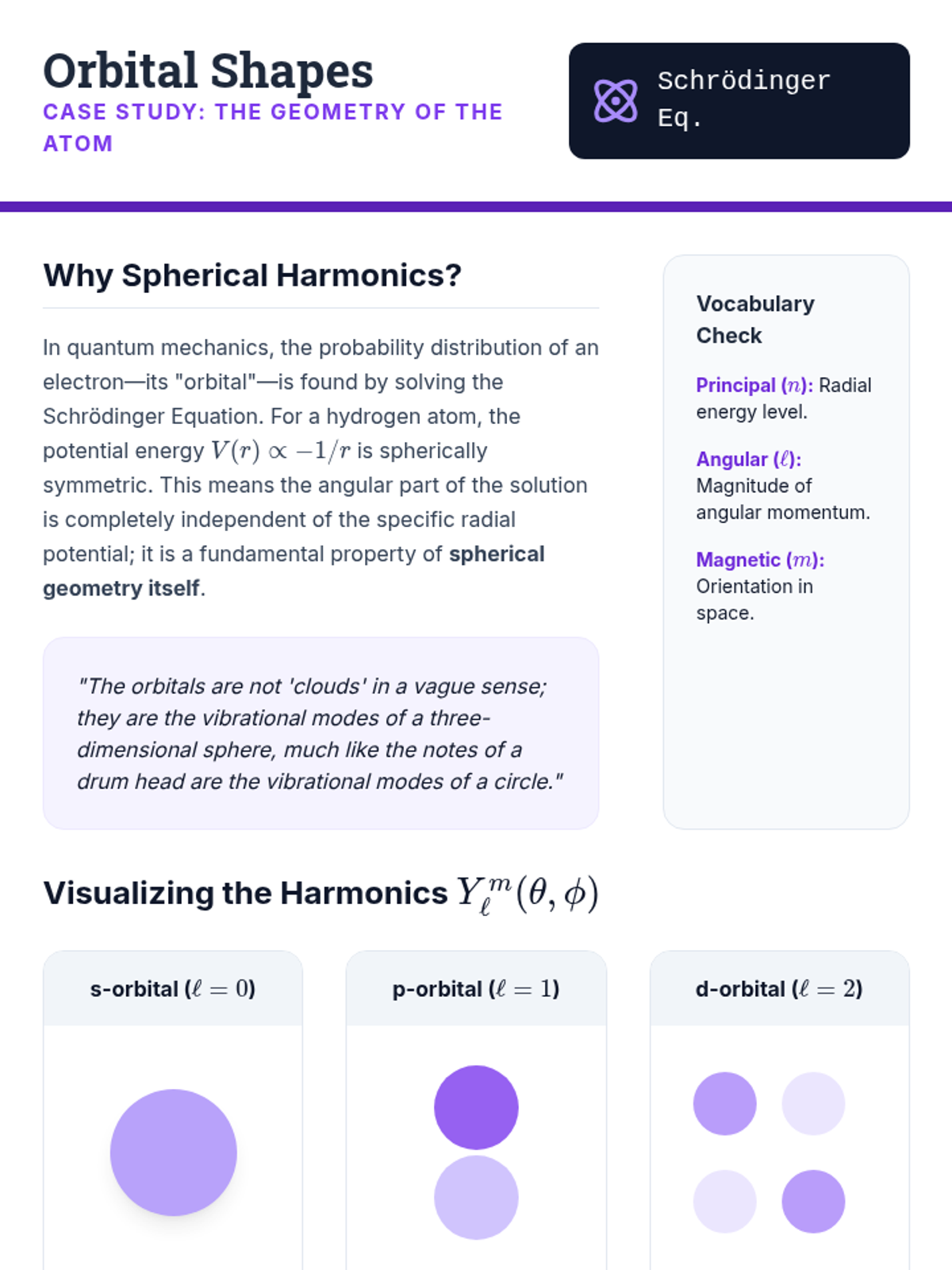
Case study handout connecting the mathematical solutions of Laplace's equation to the physical shapes of atomic orbitals in quantum mechanics.
Presentation on solving Laplace's equation in spherical coordinates using separation of variables and Legendre polynomials, with physical boundary condition examples.
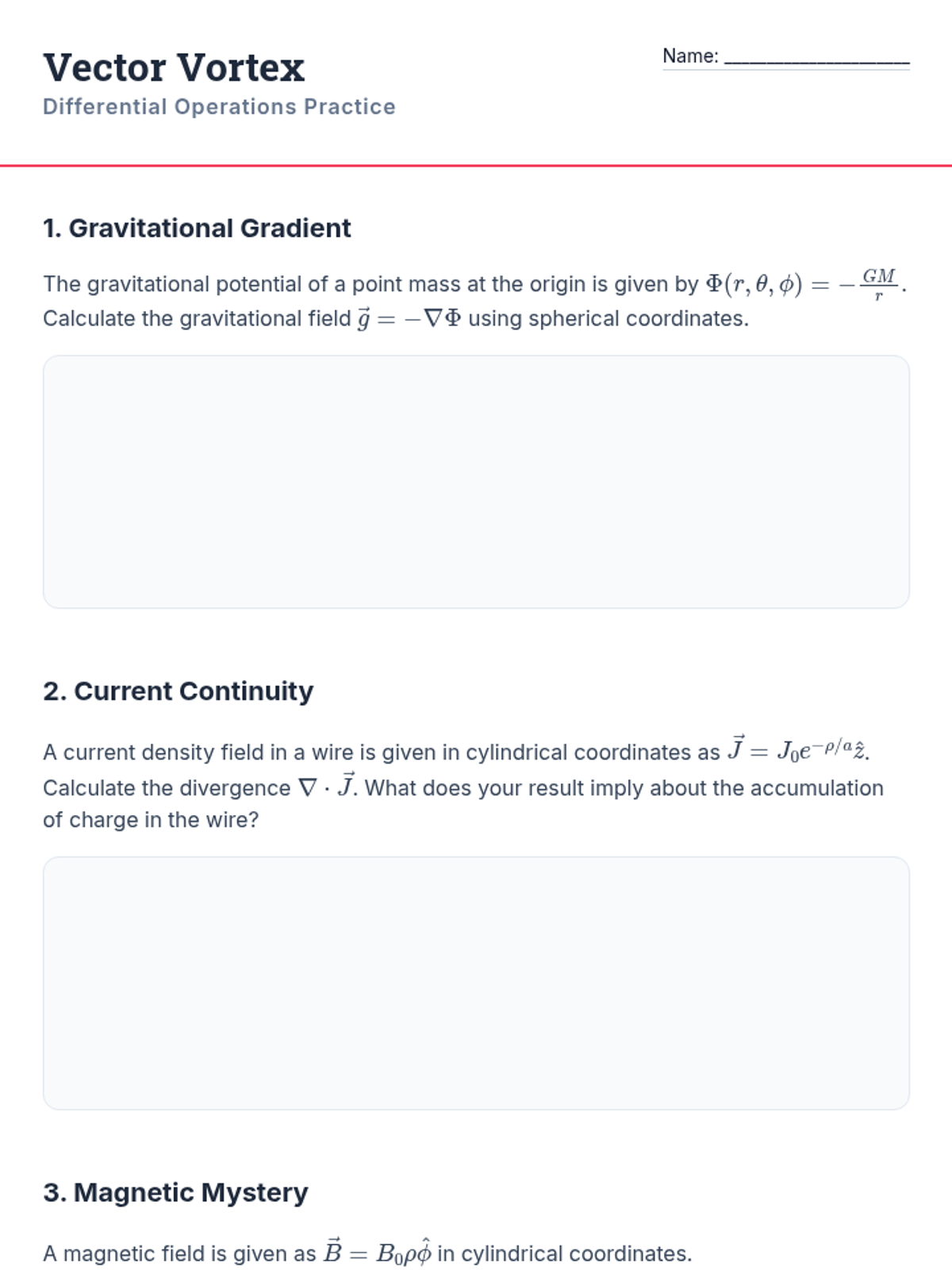
Practice problems for calculating gradient, divergence, curl, and Laplacian in physics-based contexts using curvilinear coordinates.
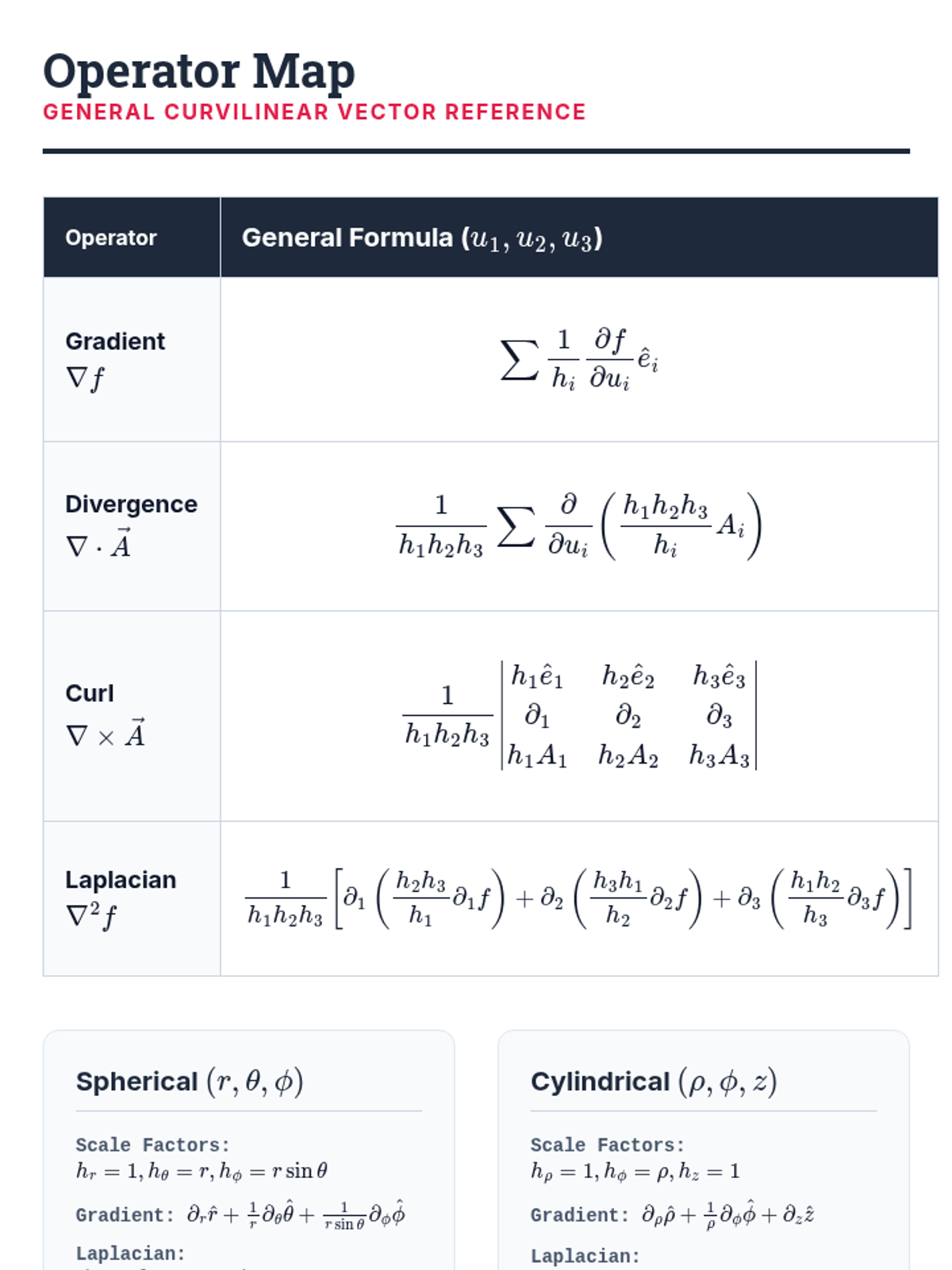
Comprehensive reference sheet for vector operators (gradient, divergence, curl, Laplacian) in general and specific curvilinear systems.
Visual explanation of vector operators (gradient, divergence, curl, Laplacian) generalized for any orthogonal curvilinear coordinate system.
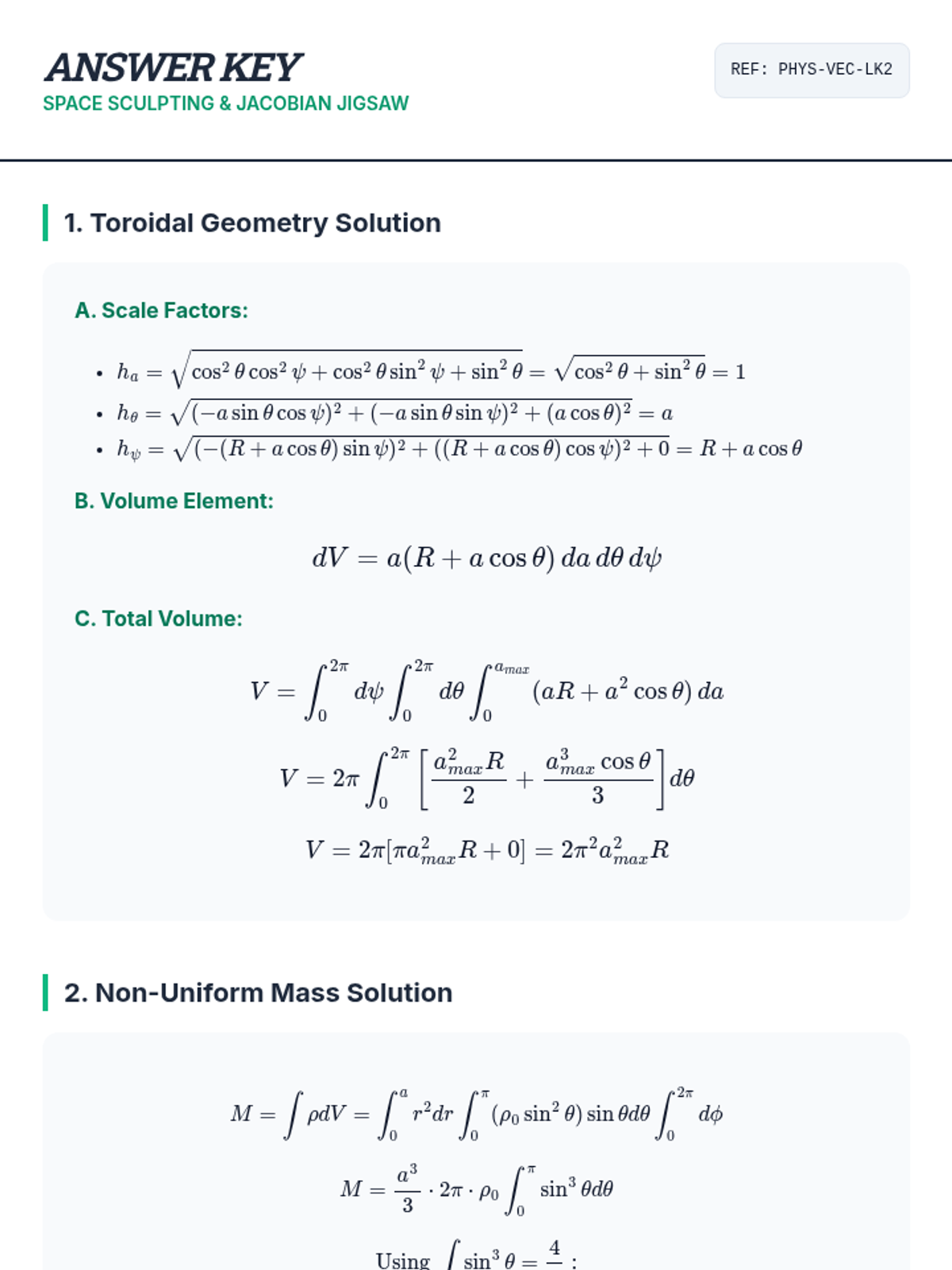
Detailed answer key for the Jacobian Jigsaw activity, including worked solutions for toroidal volume, mass integration, and surface area.
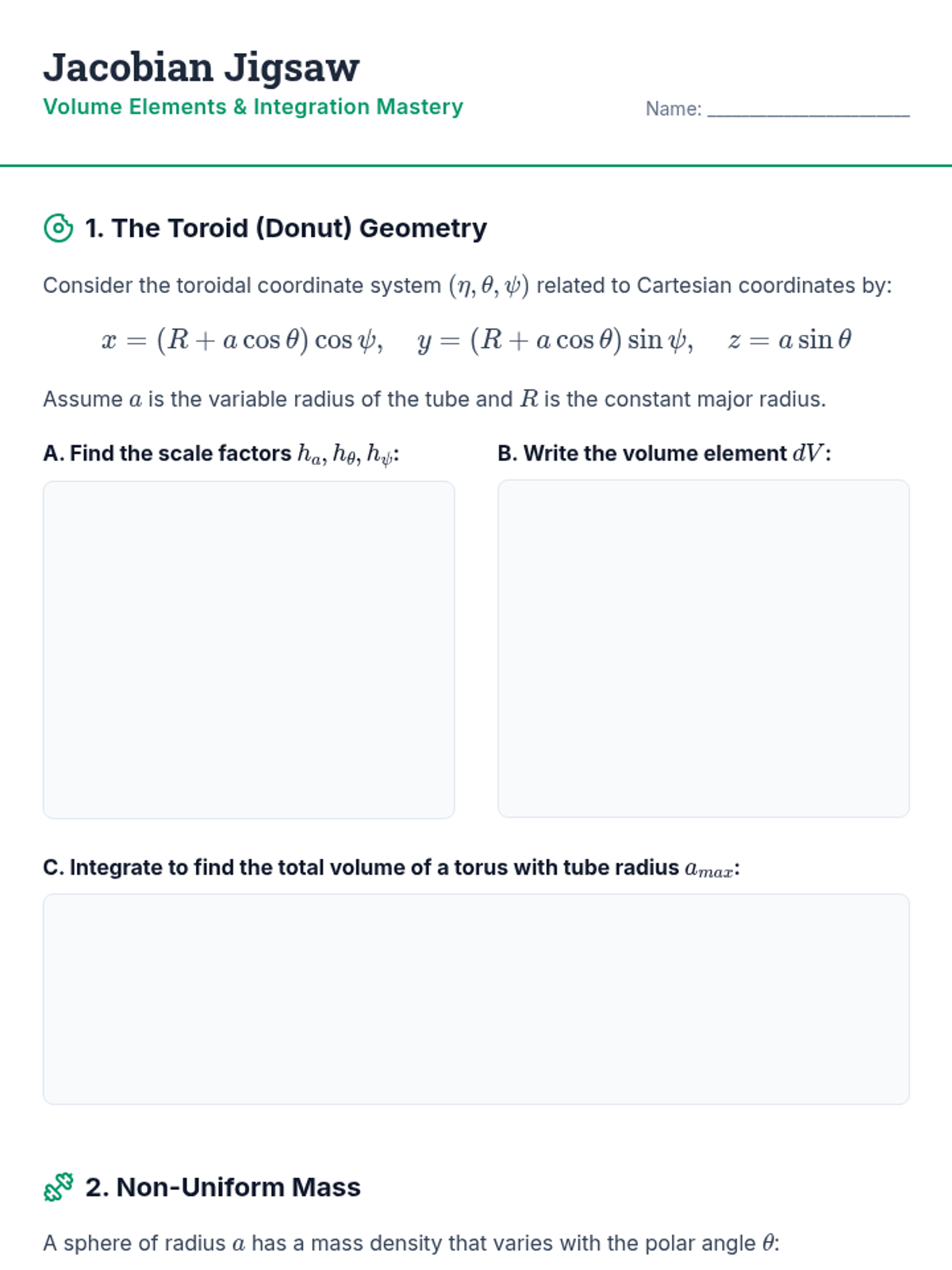
Problem set for students to calculate volume and area elements for toroidal, spherical, and cylindrical systems, including mass density integration.
Slide deck explaining Jacobian determinants, derivation of volume elements for spherical/cylindrical systems, and integration methods for scalar fields.
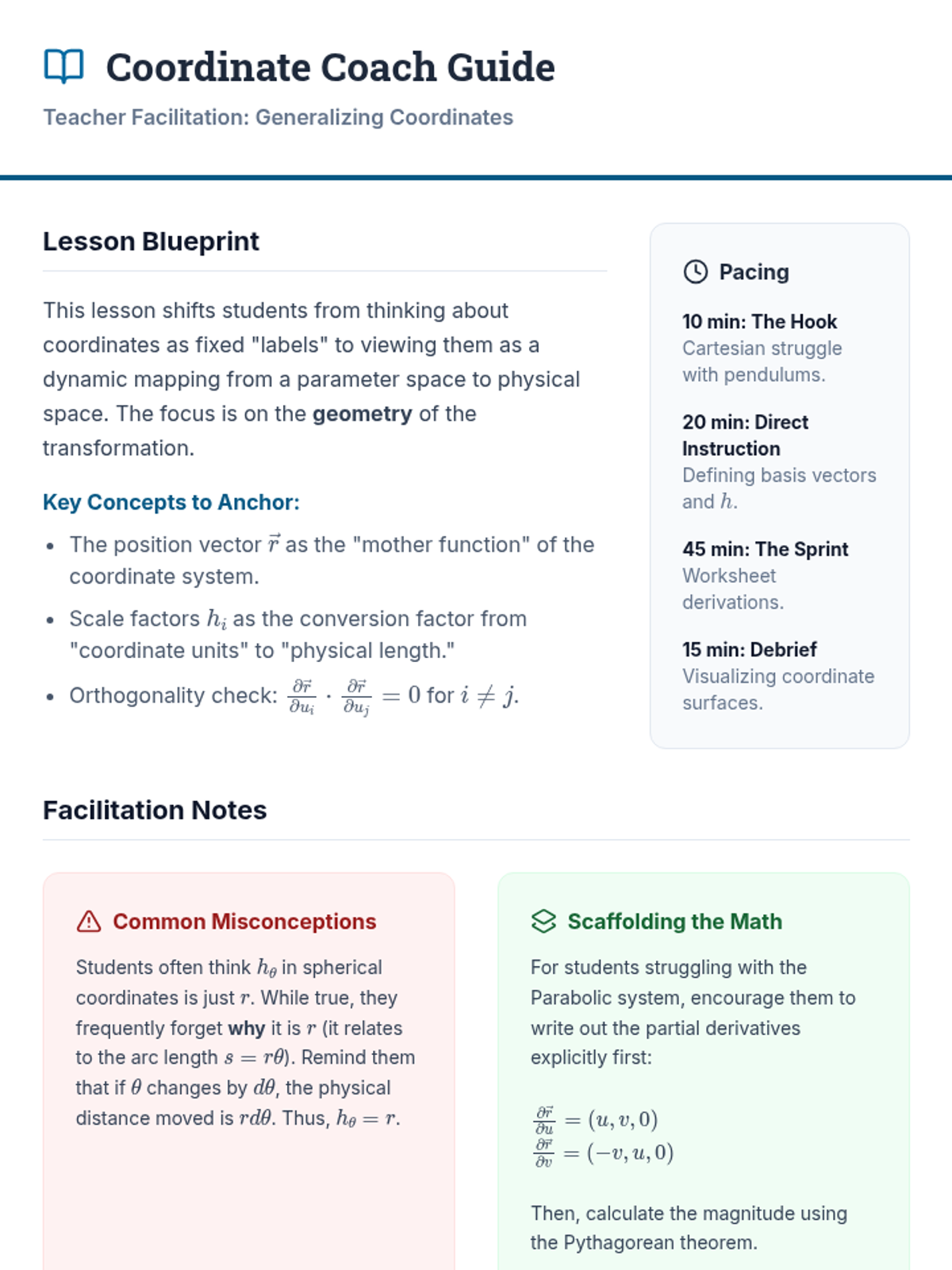
Teacher facilitation guide for the "Generalizing Coordinates" lesson, including pacing, common misconceptions, and discussion prompts.
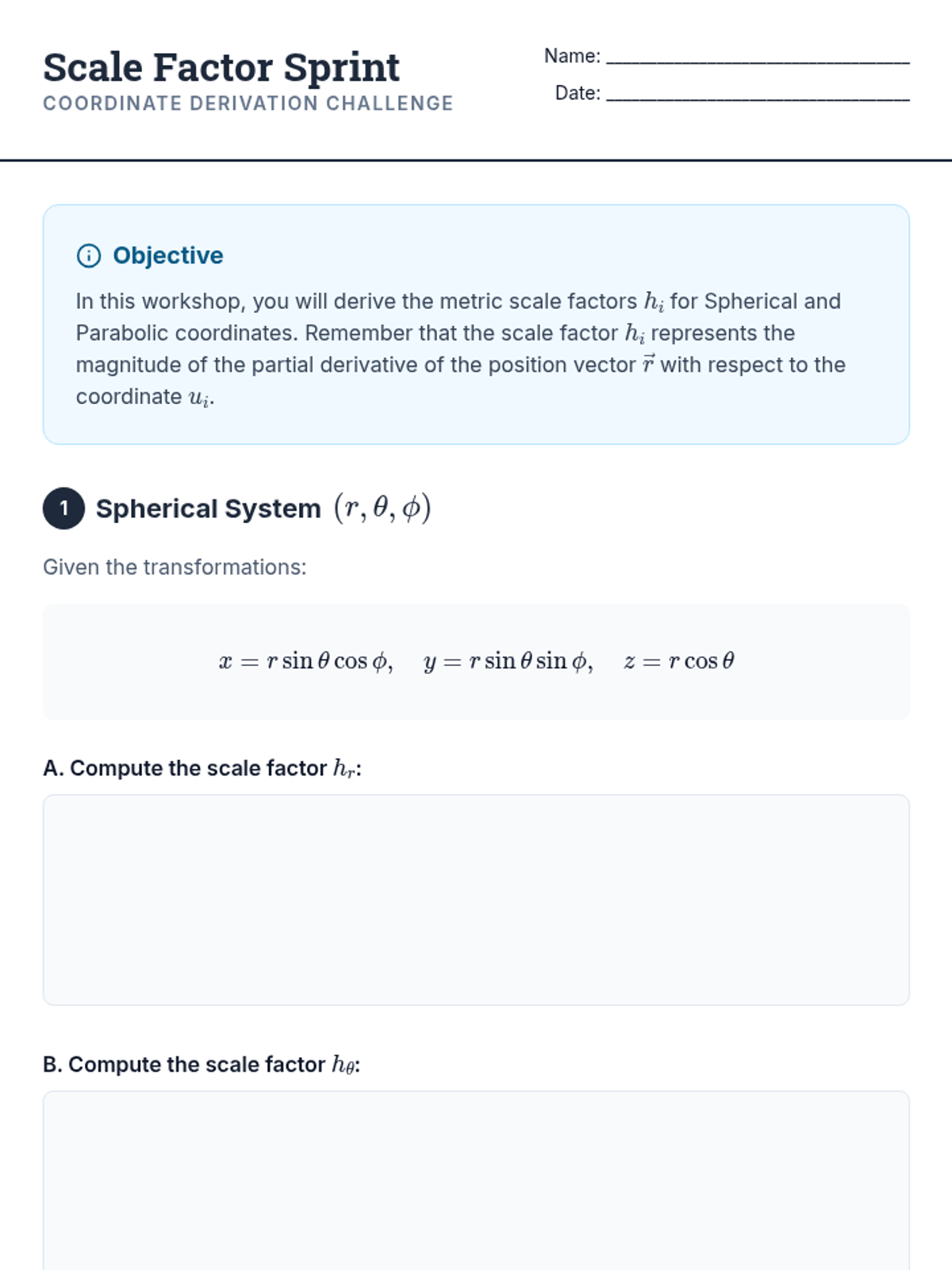
Worksheet for students to derive scale factors for spherical and parabolic cylindrical coordinate systems, including derivation areas and reflection questions.
Visual presentation introducing orthogonal curvilinear coordinates, defining basis vectors and scale factors, and demonstrating the cylindrical case study.