Phonetic foundations through Pinyin and tones, character recognition, and essential grammar for all proficiency levels. Integrates cultural context with advanced reading, writing, and communicative strategies.
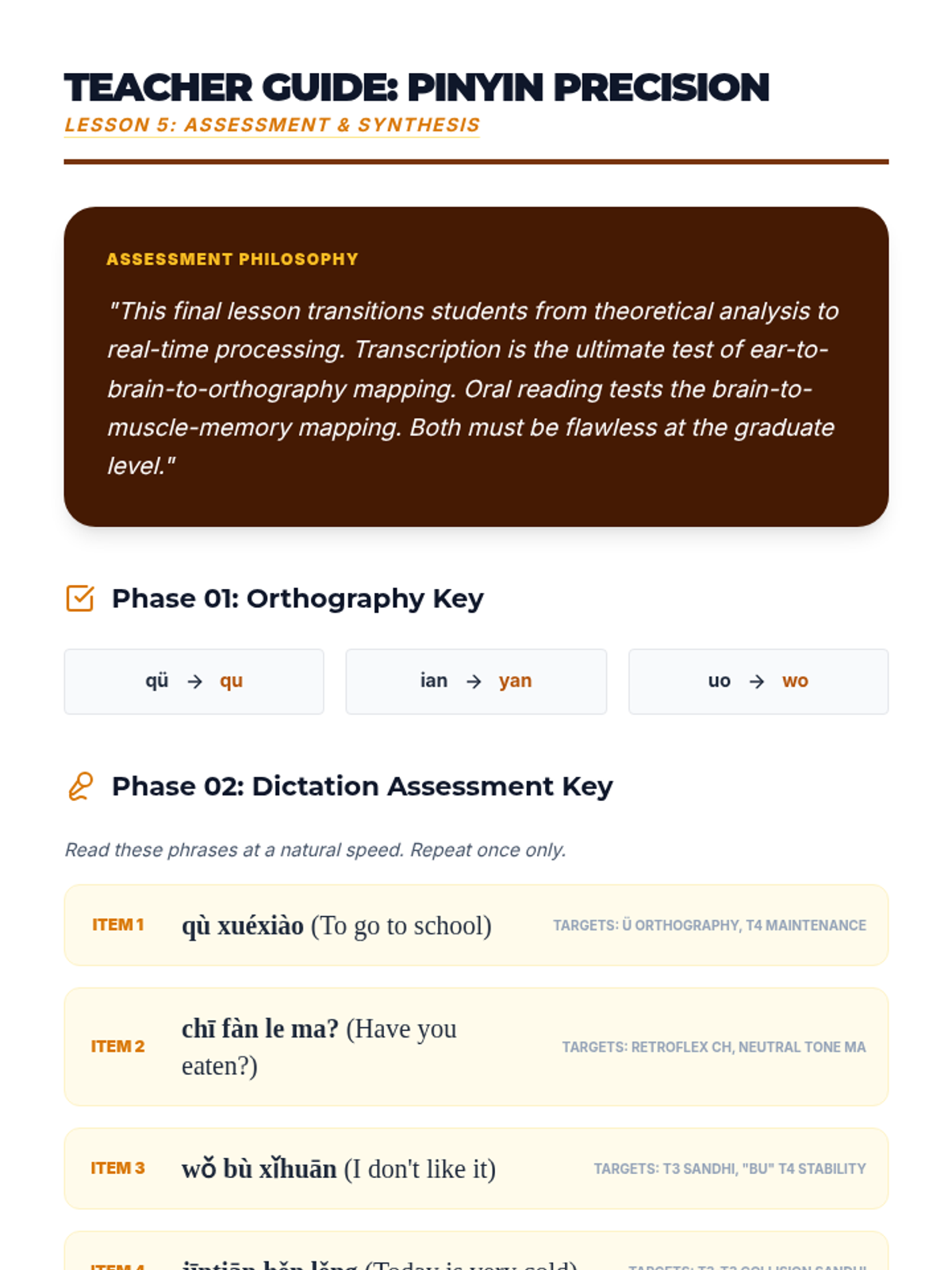
Instructor guidelines for the final Pinyin and oral fluency assessment, including the dictation answer key and a detailed grading rubric.
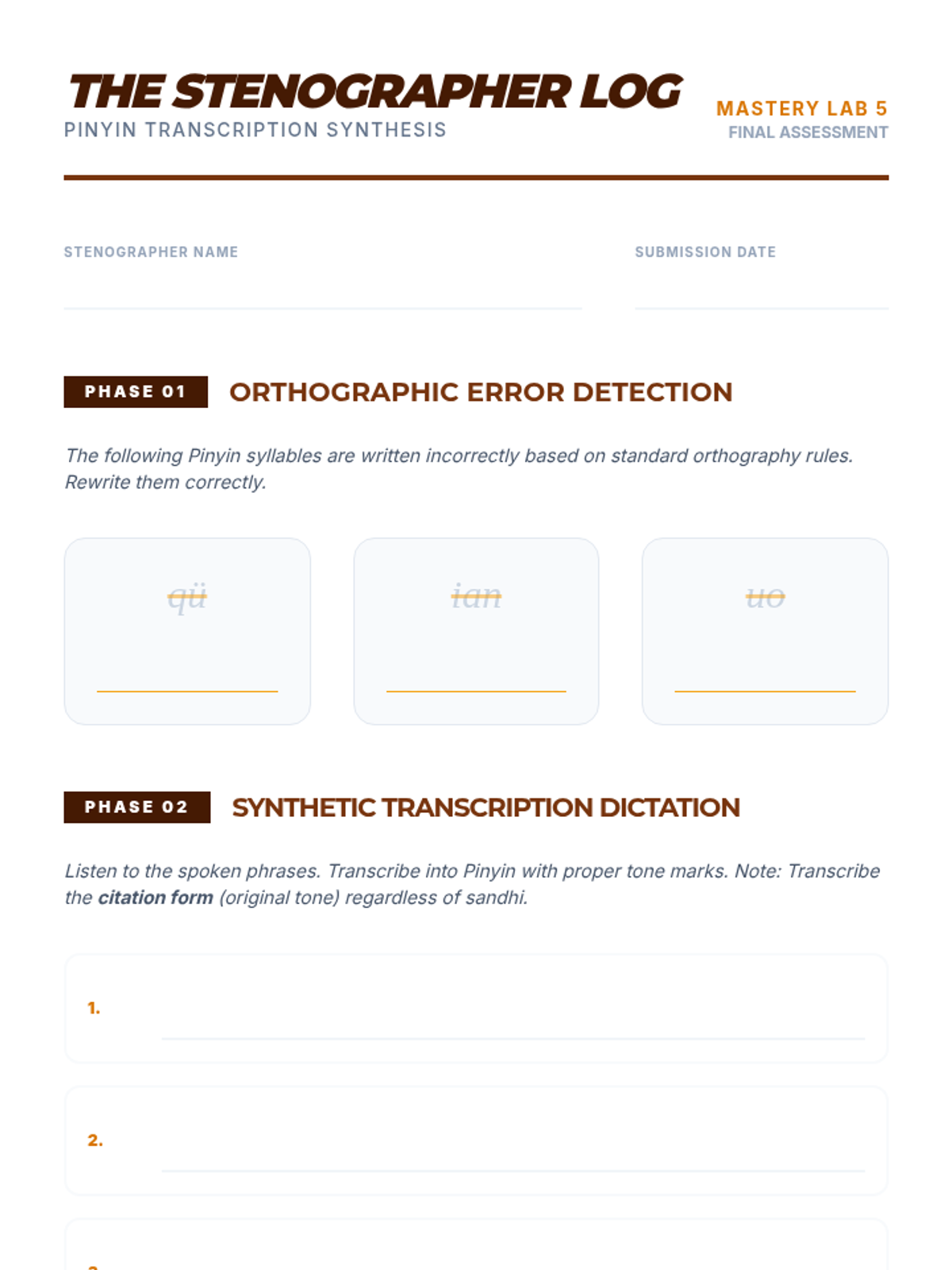
The final assessment for the Mandarin phonetics sequence, testing Pinyin orthography, transcription accuracy, and oral reading fluency.
A synthesis presentation on Pinyin orthography rules and transcription skills, preparing graduate students for rapid-fire phonetic assessment.
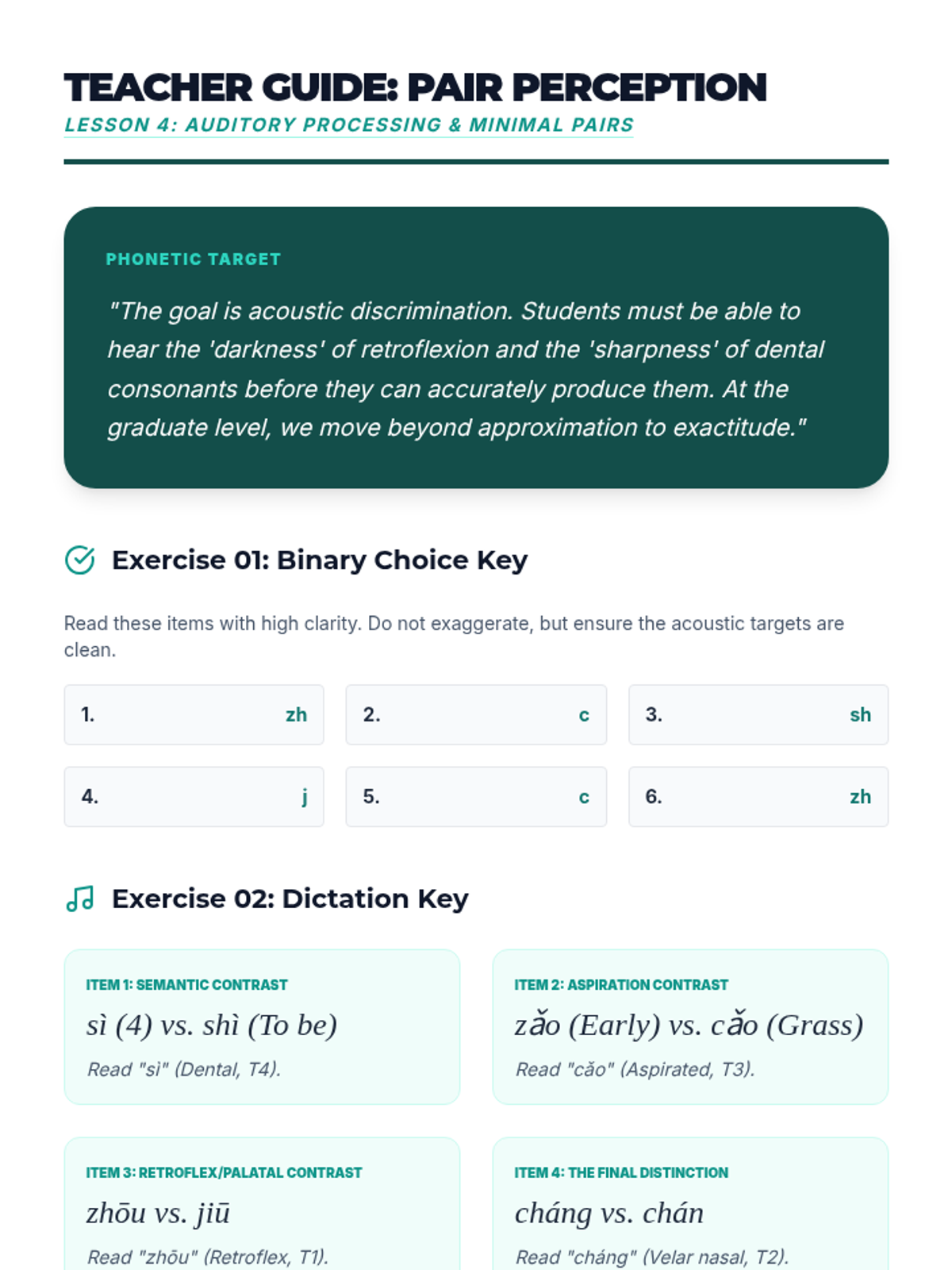
Facilitation guide for acoustic discrimination training, including dictation keys for minimal pairs and a strategy for the classic 'four is four' tongue twister.
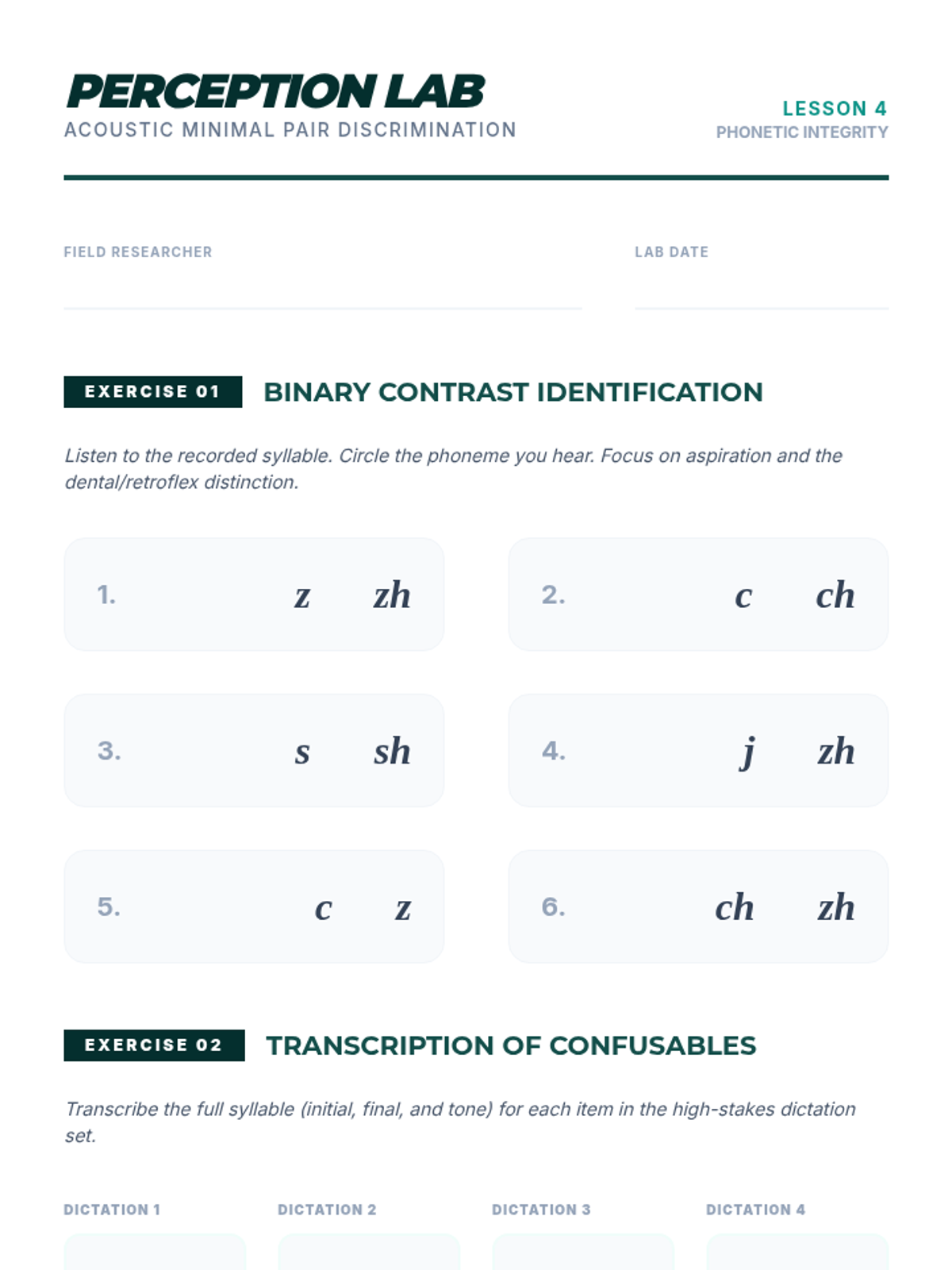
An auditory discrimination worksheet for graduate students to practice identifying dental vs. retroflex phonemes and aspirated vs. unaspirated sounds.
A slide deck focused on the acoustic discrimination of minimal pairs, comparing dental and retroflex series and visualizing aspiration through waveform patterns.
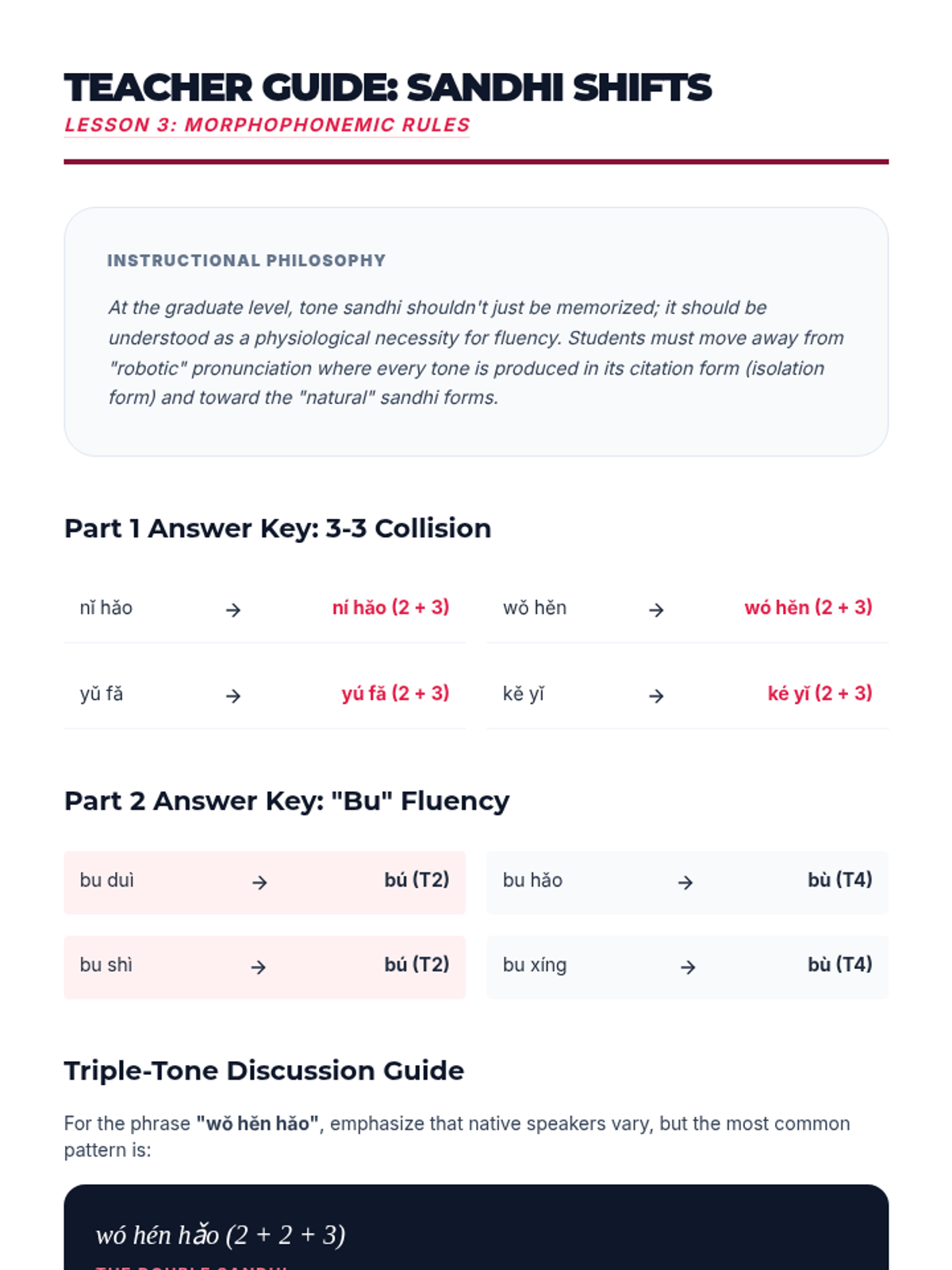
Facilitation strategies and answer keys for tone sandhi exercises, including guides for explaining complex triple-tone interactions.
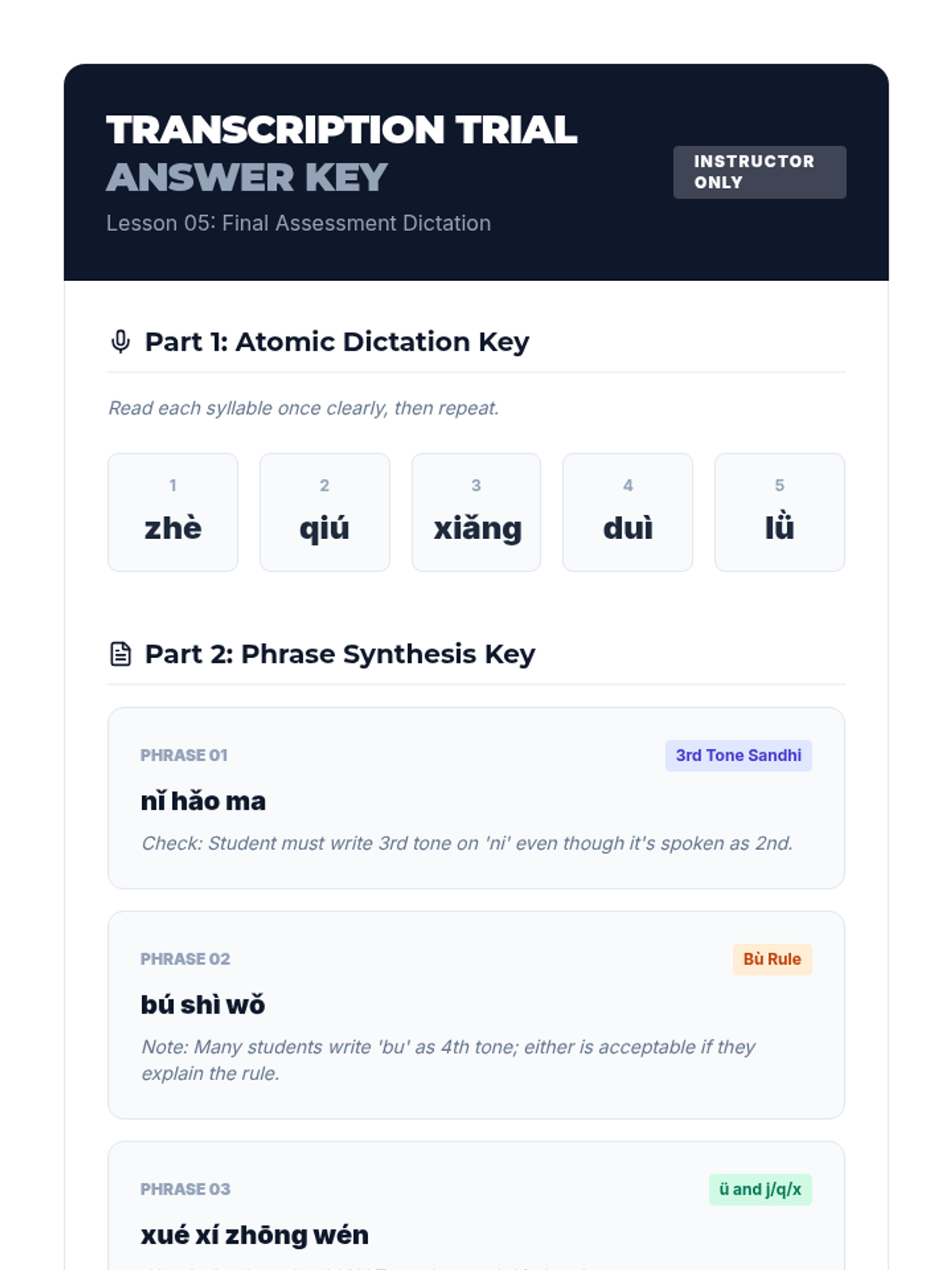
Instructor answer key and scoring rubric for the Lesson 05 Transcription Trial, including atomic and phrase dictation prompts.
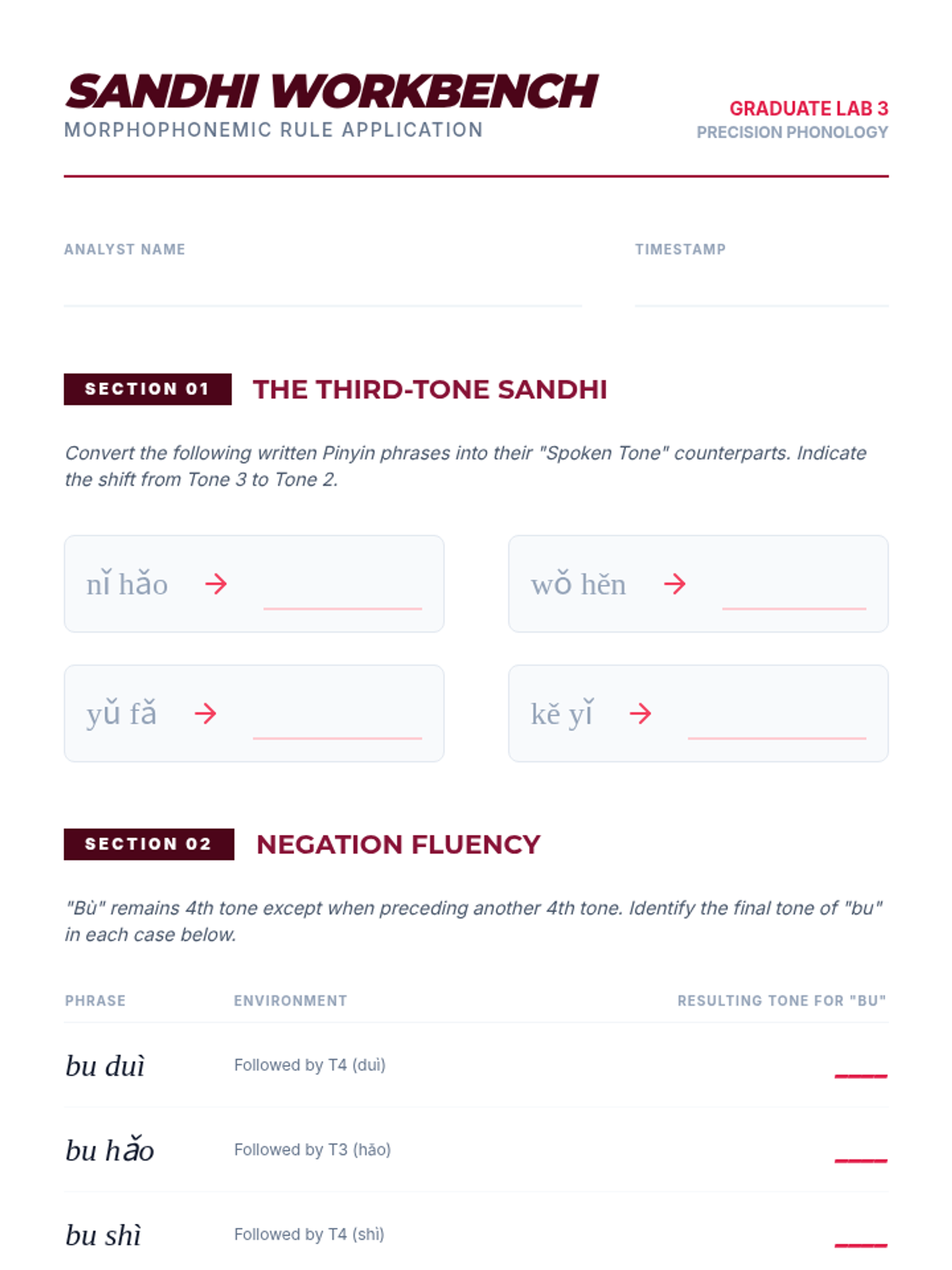
A technical worksheet for graduate students to apply tone sandhi rules, including the complex analysis of triple-tone sequences.
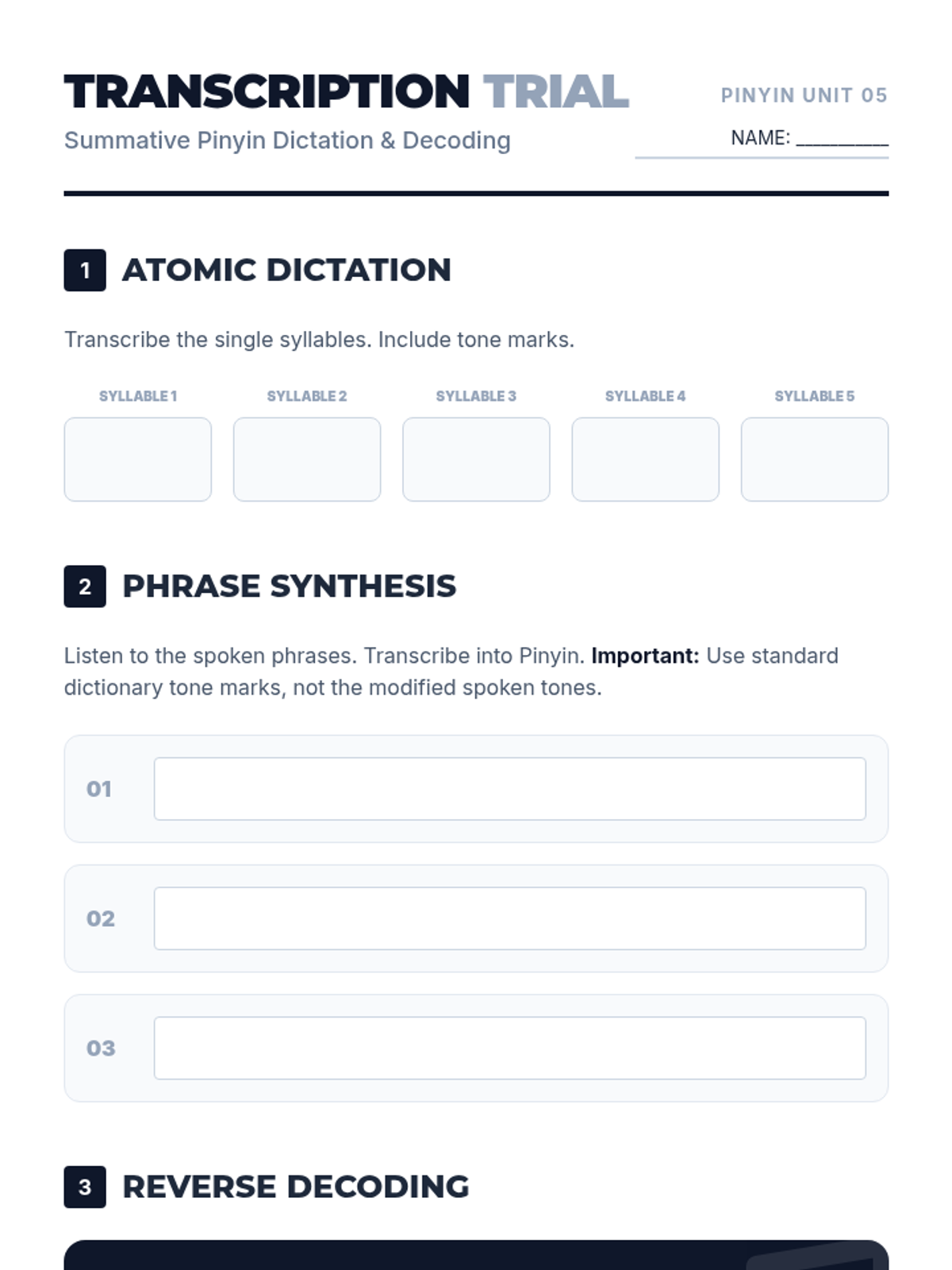
A summative transcription worksheet for Lesson 05, featuring atomic dictation, phrase synthesis, and a reverse decoding challenge.
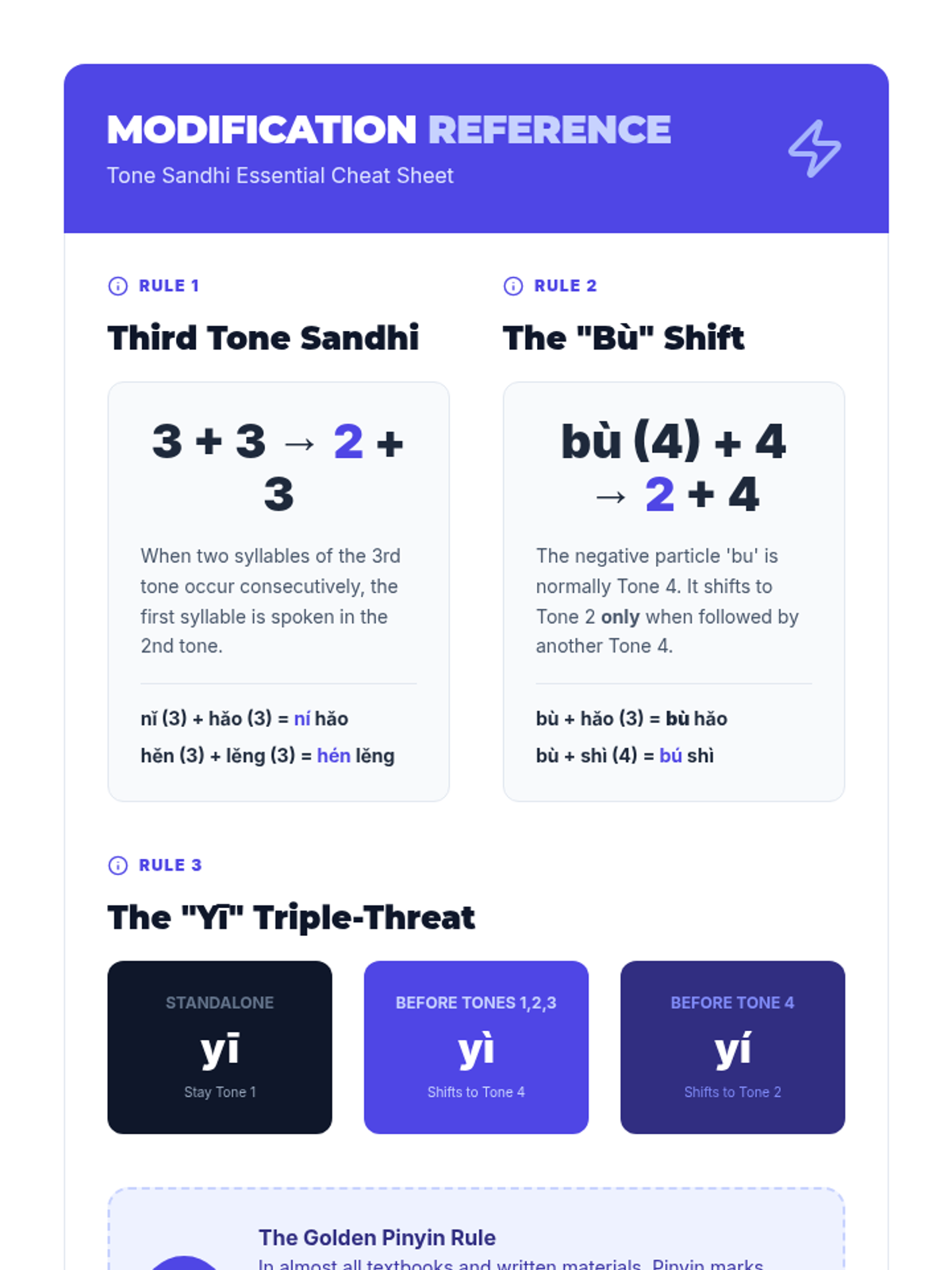
A comprehensive breakdown of Mandarin tone sandhi rules, including the 3-3 collision, the 'bu' negative flip, and the ubiquitous half-third tone.
Slides for the final synthesis lesson on transcription and dictation, covering auditory encoding strategies and Pinyin spelling rules.
A quick-reference sheet summarizing tone sandhi rules for 3rd tones, 'bu', and 'yi', designed for student use during speaking practice.
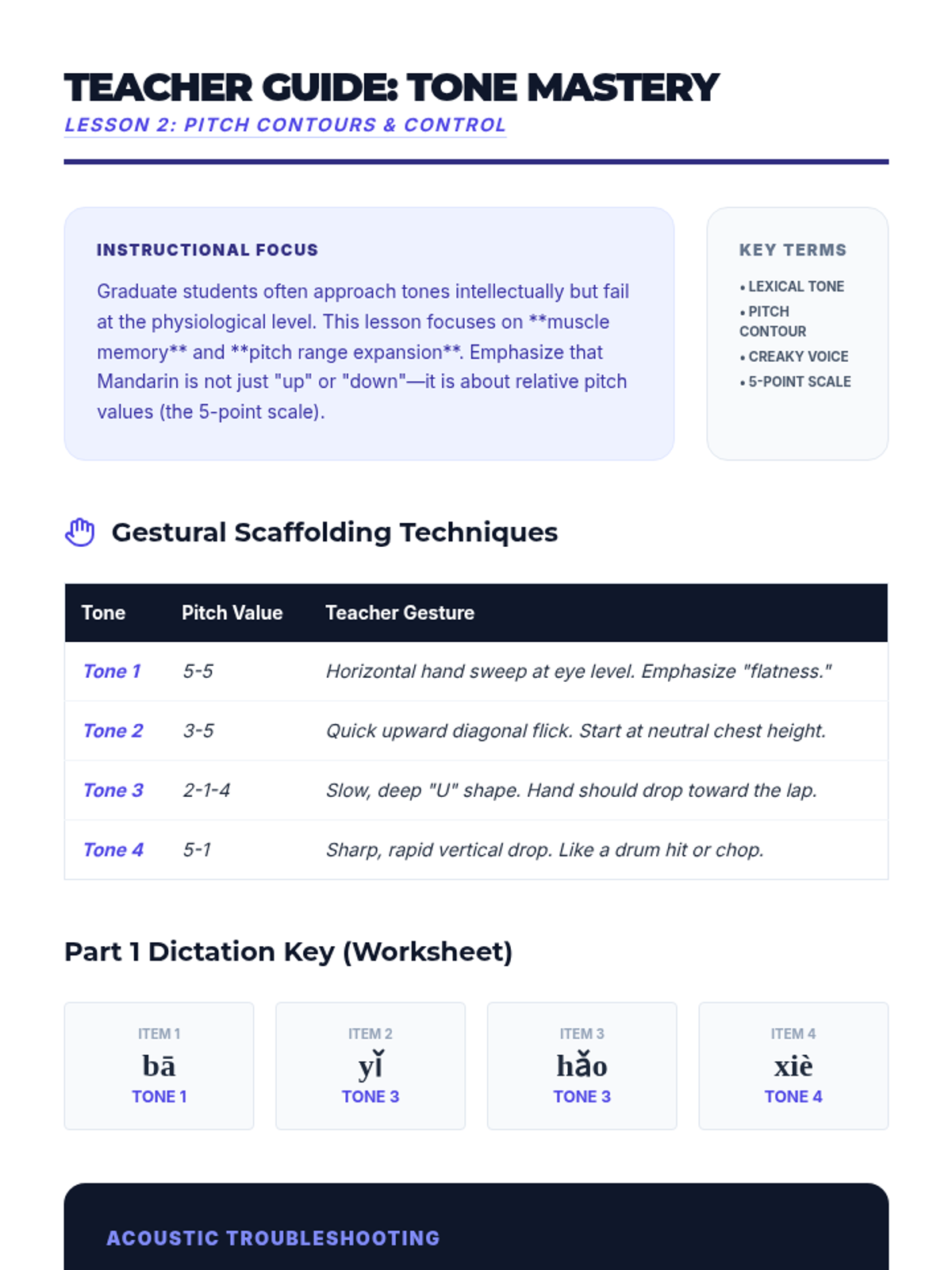
Facilitation notes for teaching Mandarin tones, including dictation keys and strategies for correcting common pitch errors in graduate learners.
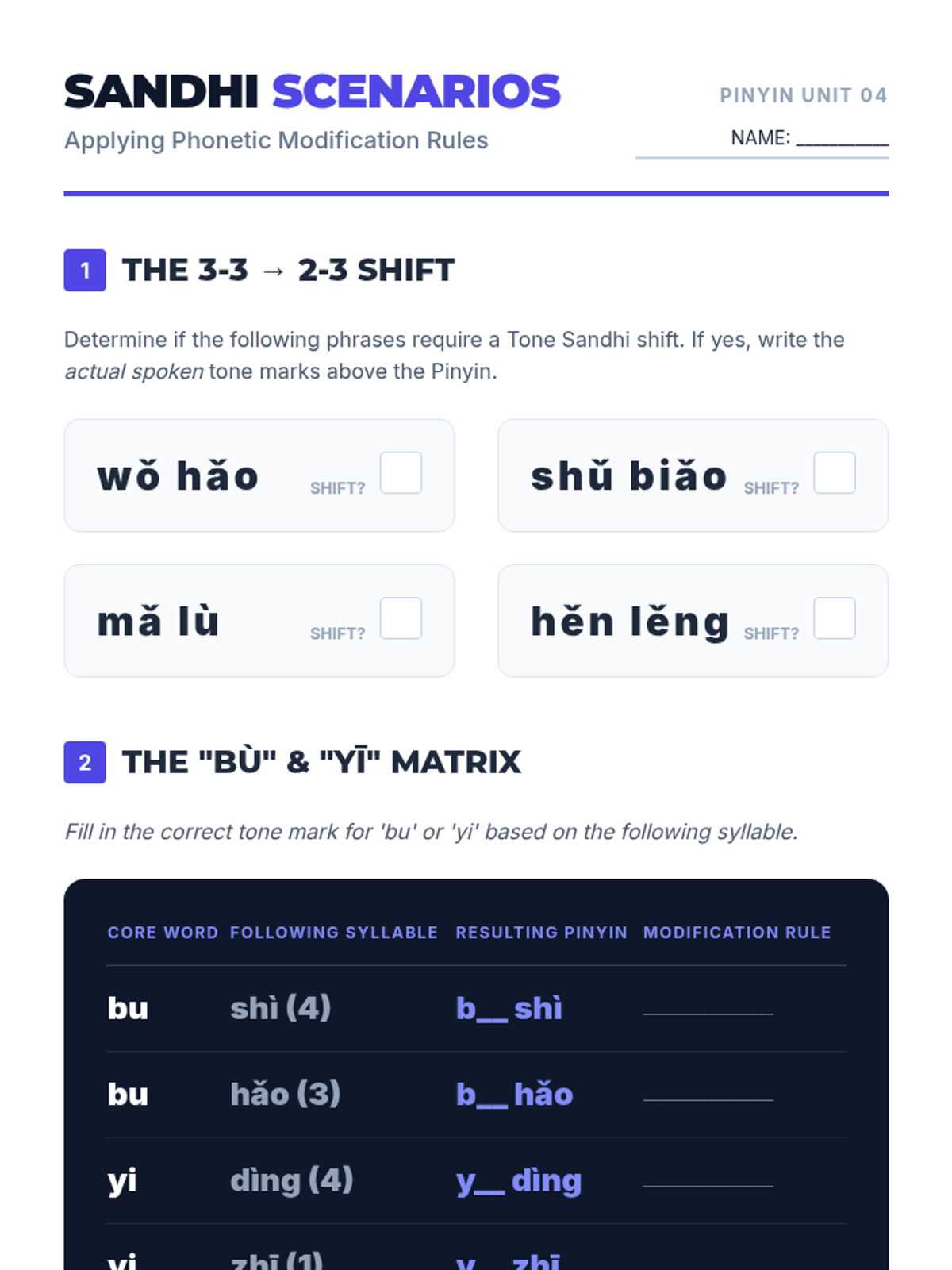
A practice worksheet for tone modification rules, including 3rd tone sandhi checks and 'bu'/'yi' shifts.
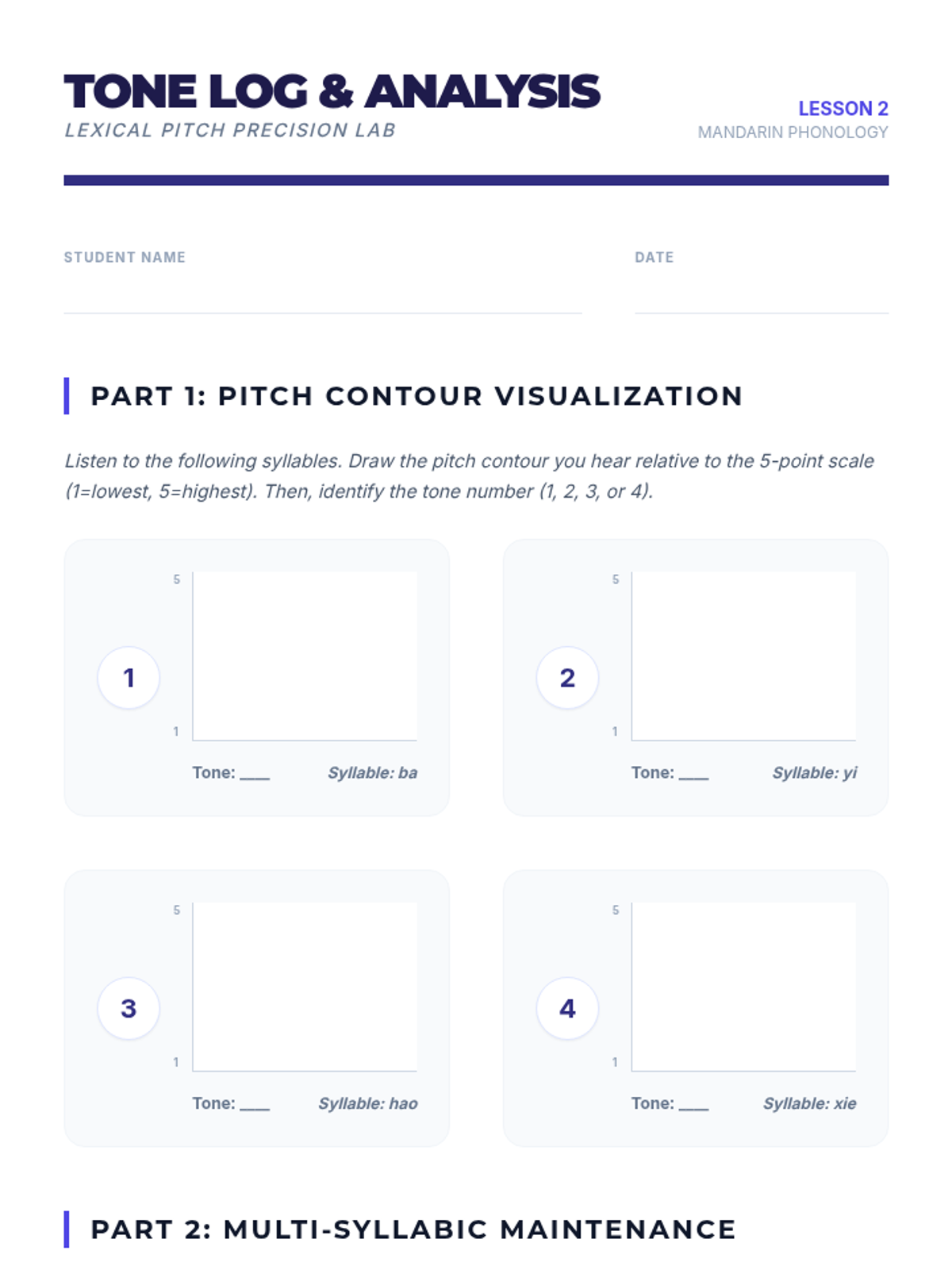
A lab log for students to map acoustic pitch contours and track their accuracy in producing tone pairs.
Slides explaining tone modification rules (Tone Sandhi) in Mandarin, focusing on the 3rd tone shift, 'bu', and 'yi' variations.
A visual guide to the four Mandarin lexical tones, utilizing the 5-point pitch scale and gestural cues for graduate-level mastery.
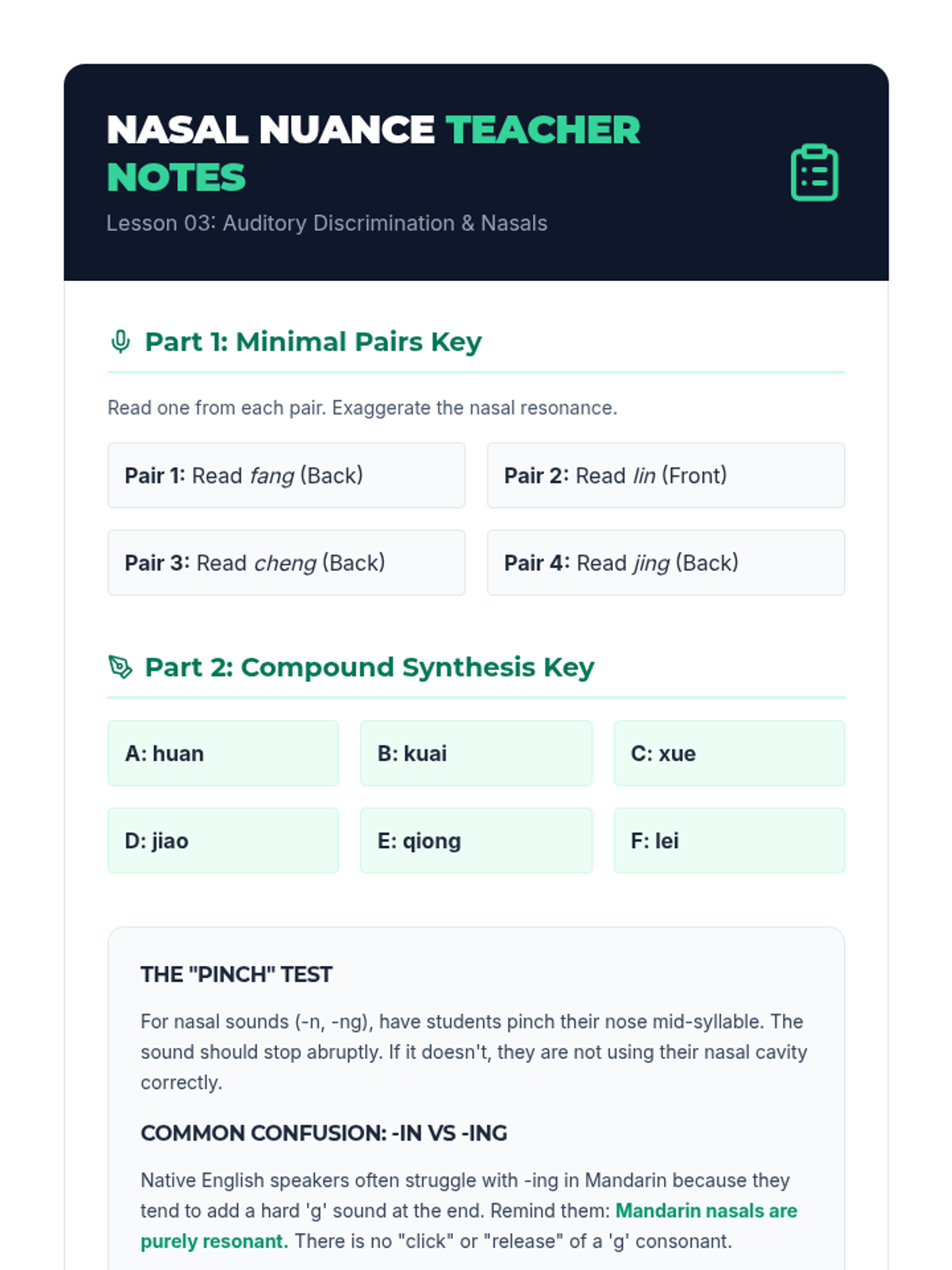
Teacher reference guide for the Nasal Nuance lesson, providing the dictation key for minimal pair exercises and compound final transcriptions.
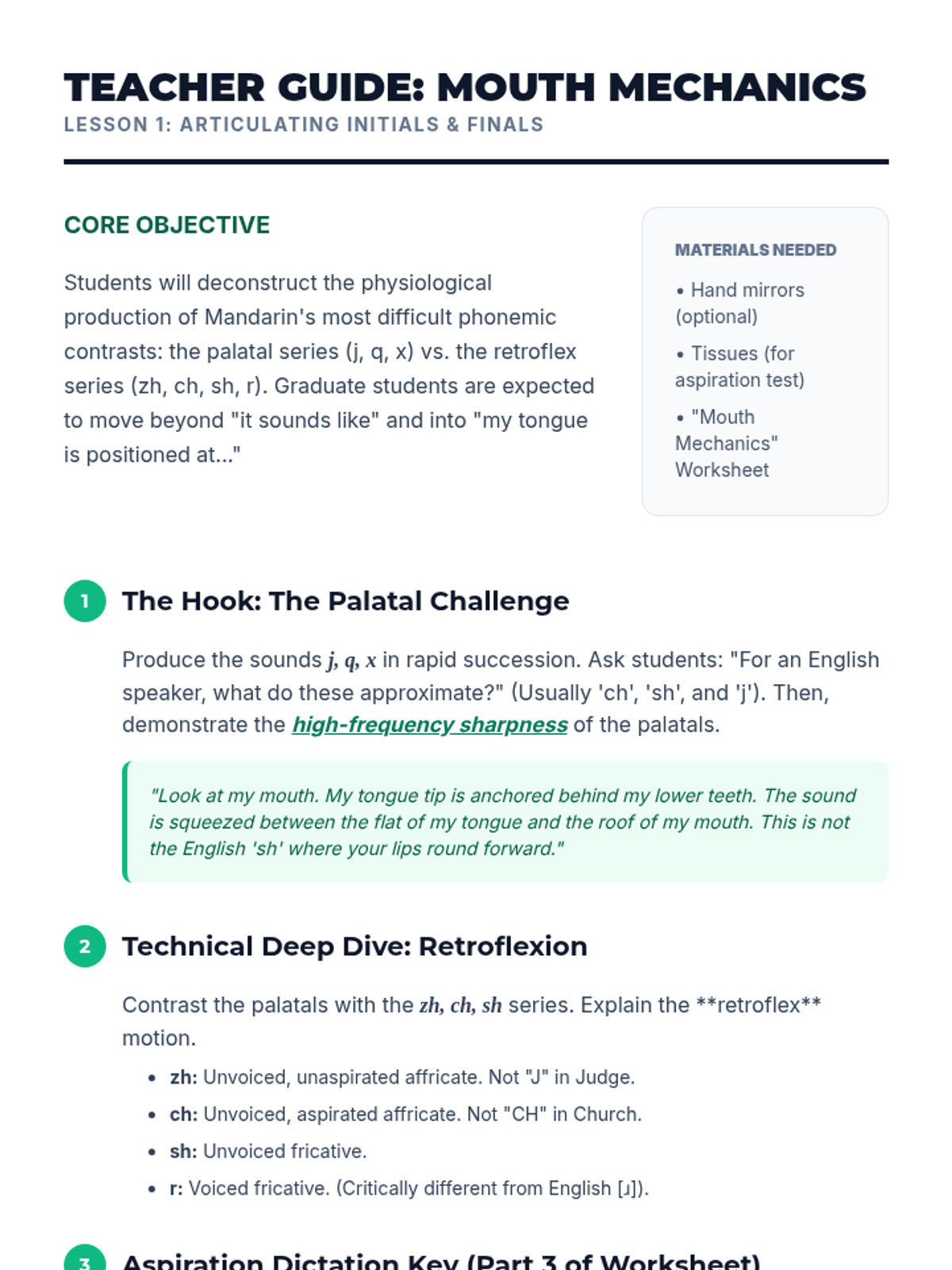
A pedagogical guide for instructors, detailing how to facilitate the phonetic workshop and providing the dictation key for student exercises.
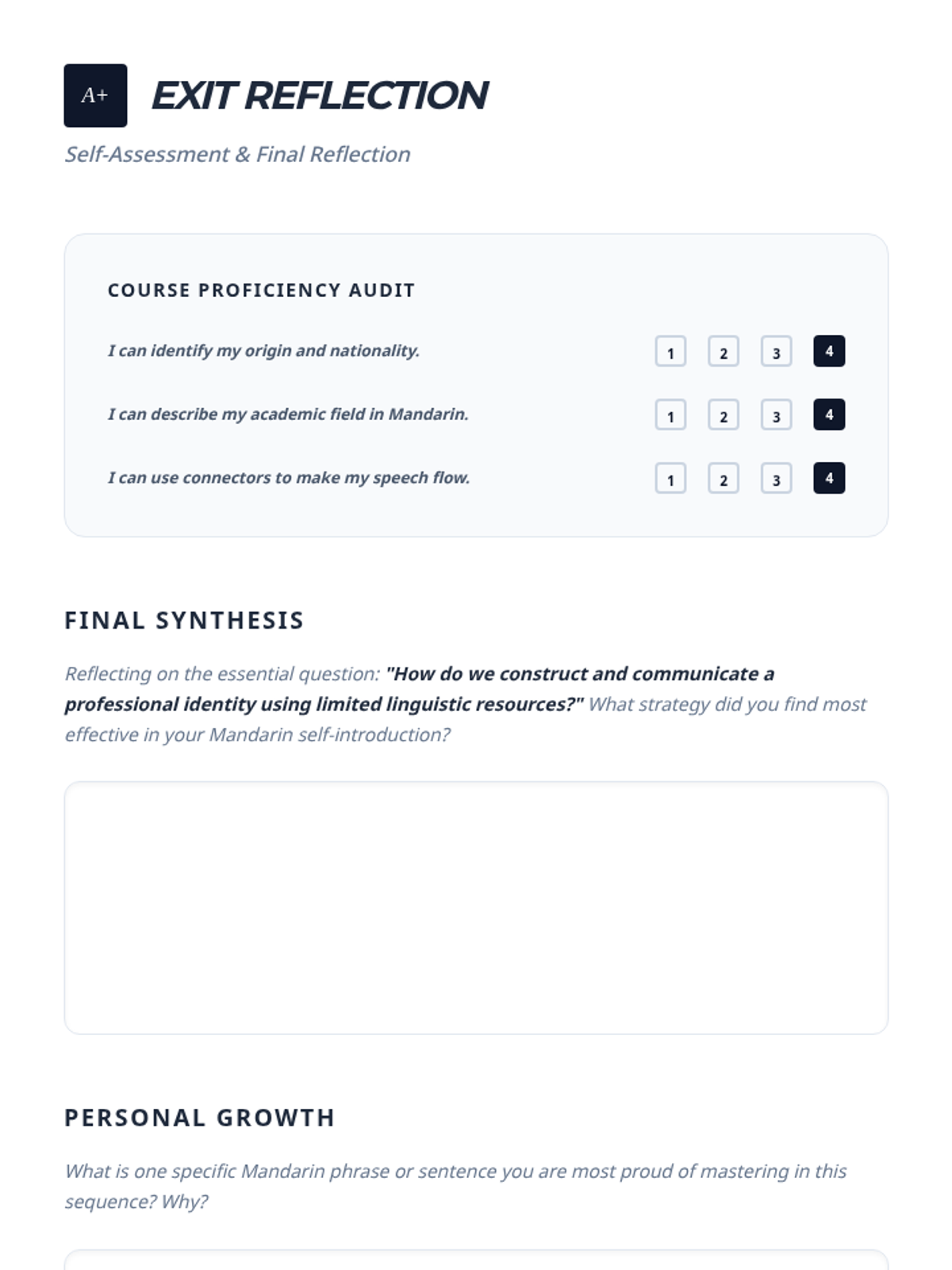
Final reflection sheet for students to assess their own growth across the sequence. Includes self-rating on core competencies and a narrative response regarding the essential question.
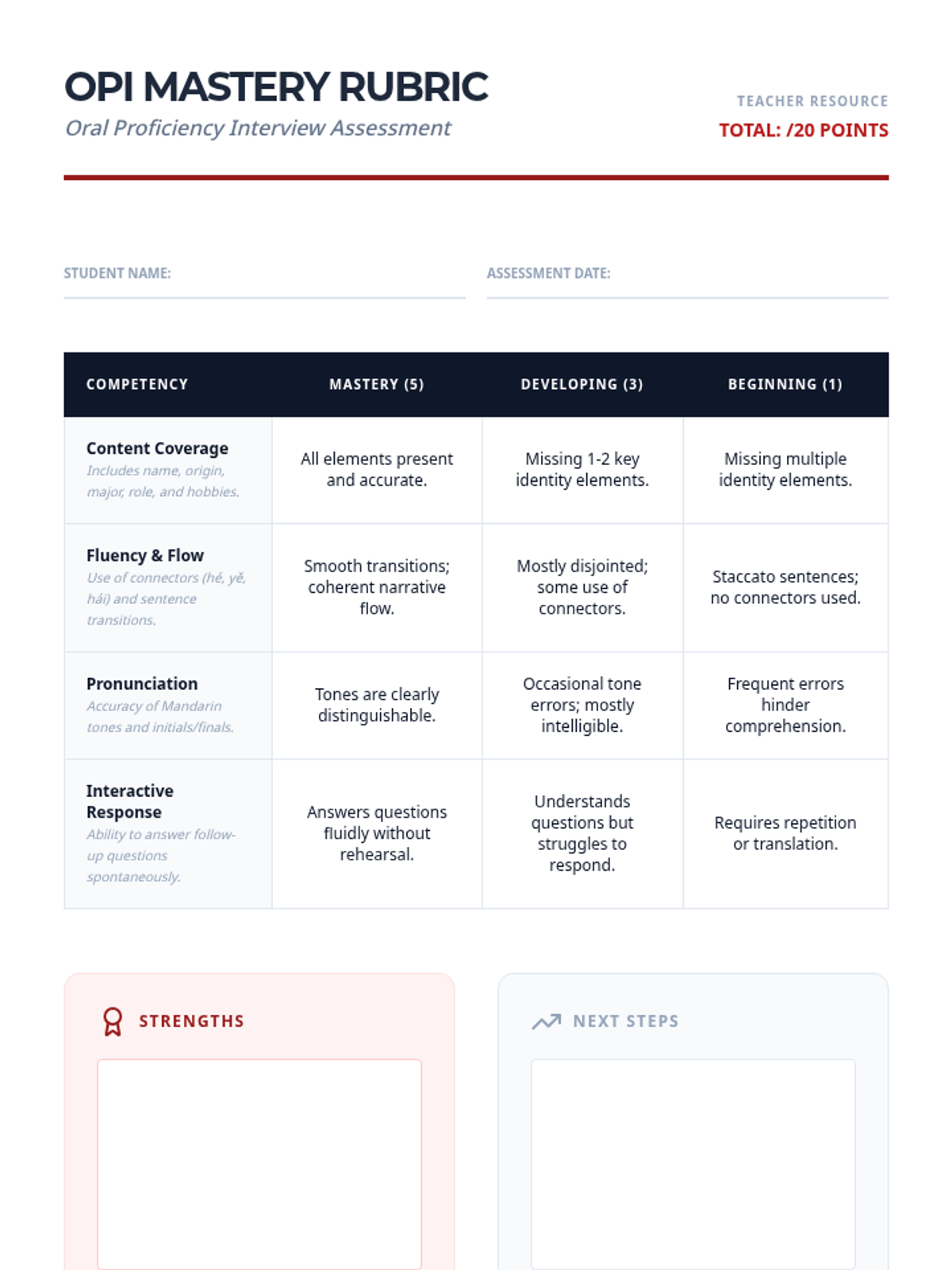
Teacher-facing OPI assessment rubric. Grades students across content coverage, narrative flow, pronunciation accuracy, and interactive response.
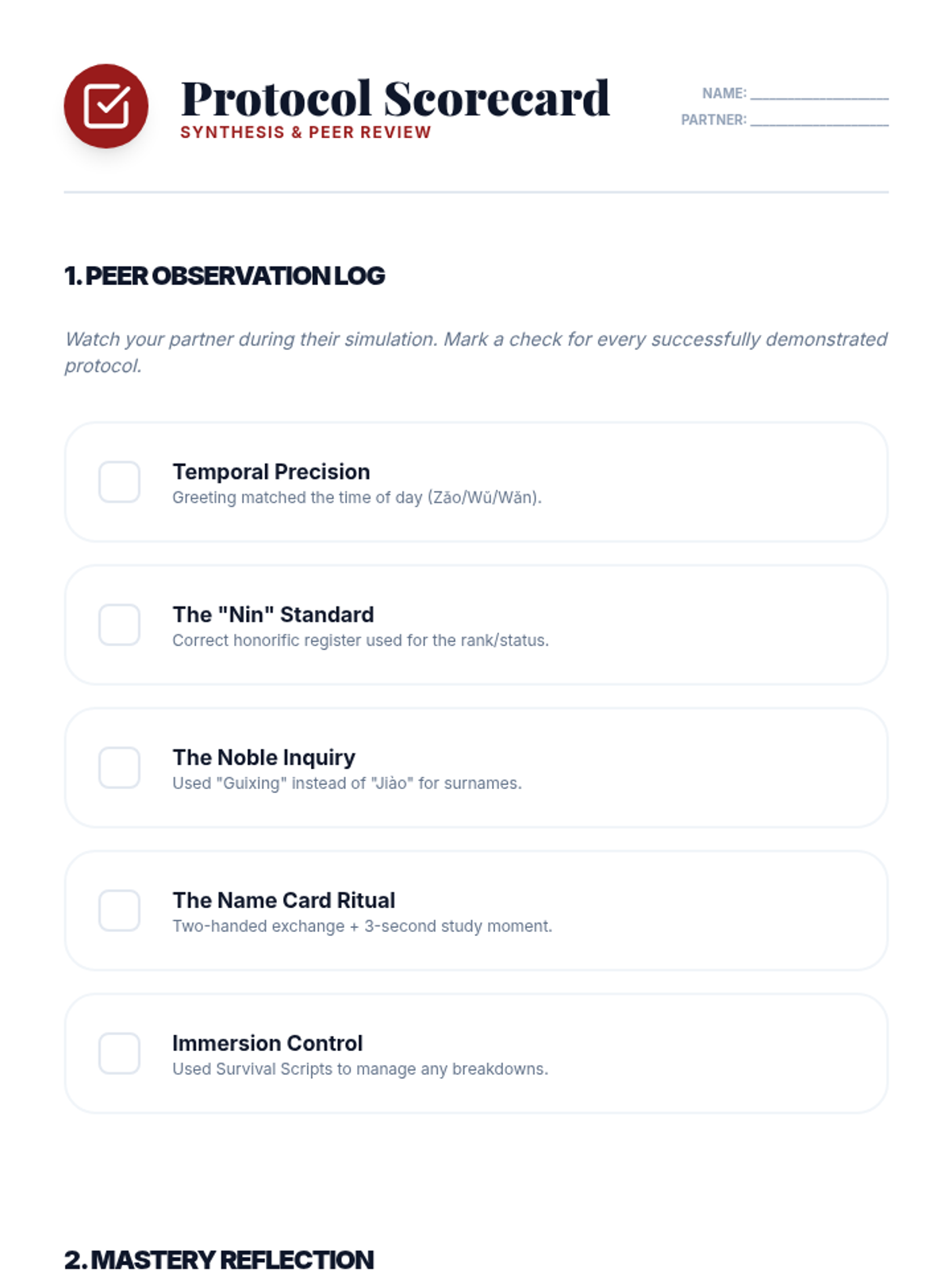
Protocol scorecard for graduate students to peer-assess during the 'Grand Networking Event' simulation and reflect on their mastery of professional Mandarin social interaction.
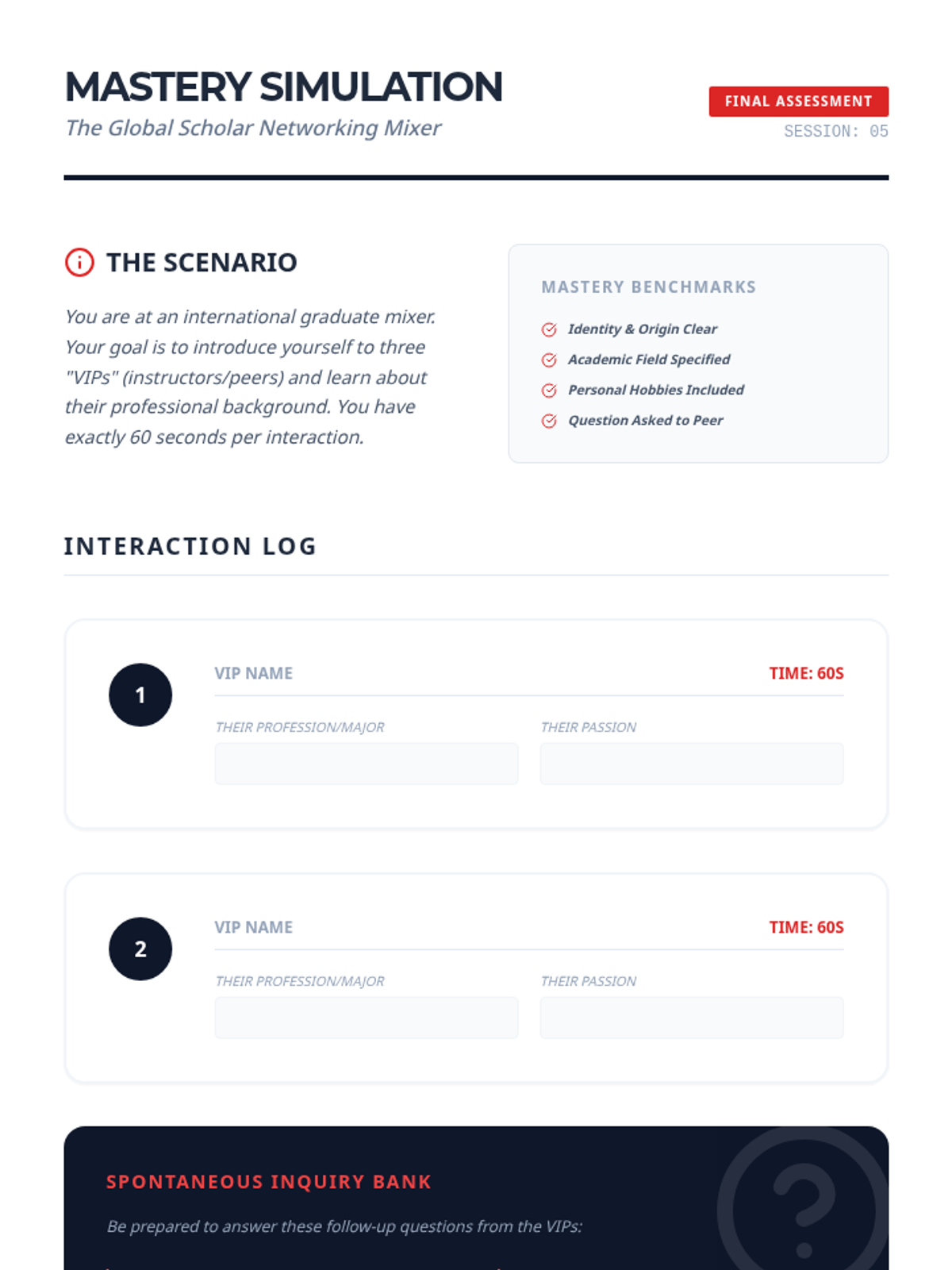
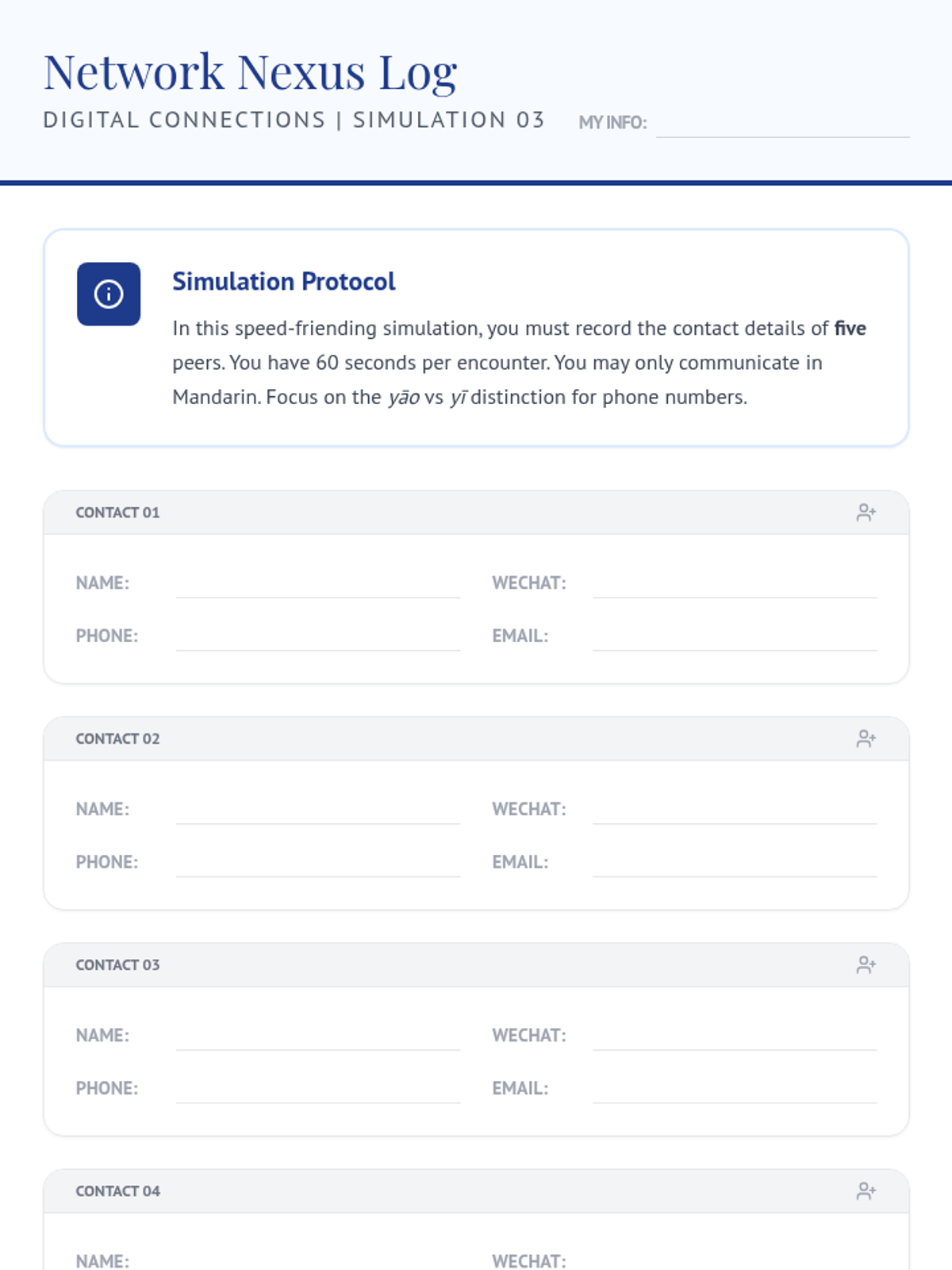
Simulation guide for the final mastery networking activity. Includes log for recording peer information and a bank of spontaneous follow-up questions for students to prepare for.
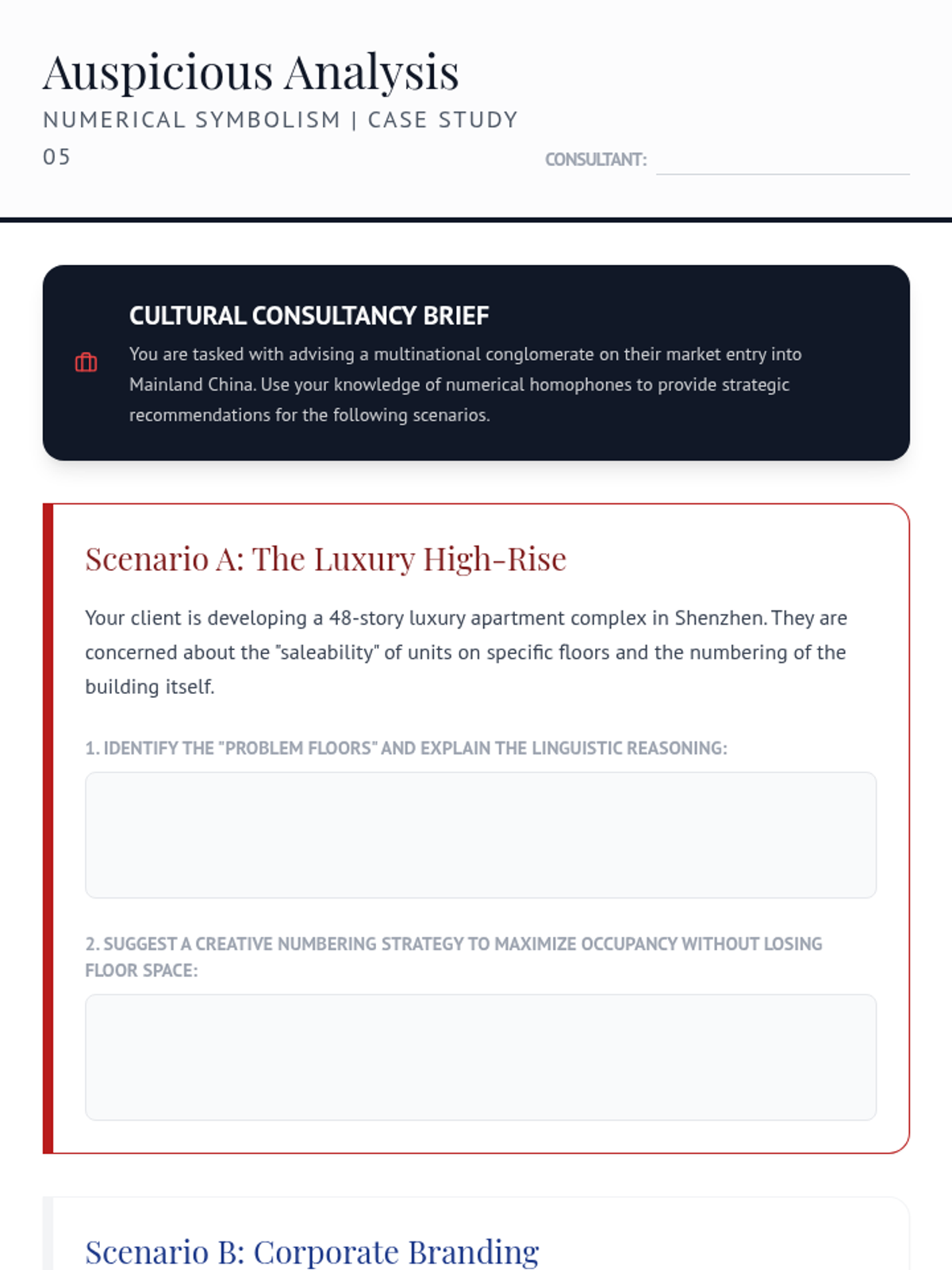
A case study worksheet where students analyze real-world business scenarios impacted by Chinese numerical symbolism.
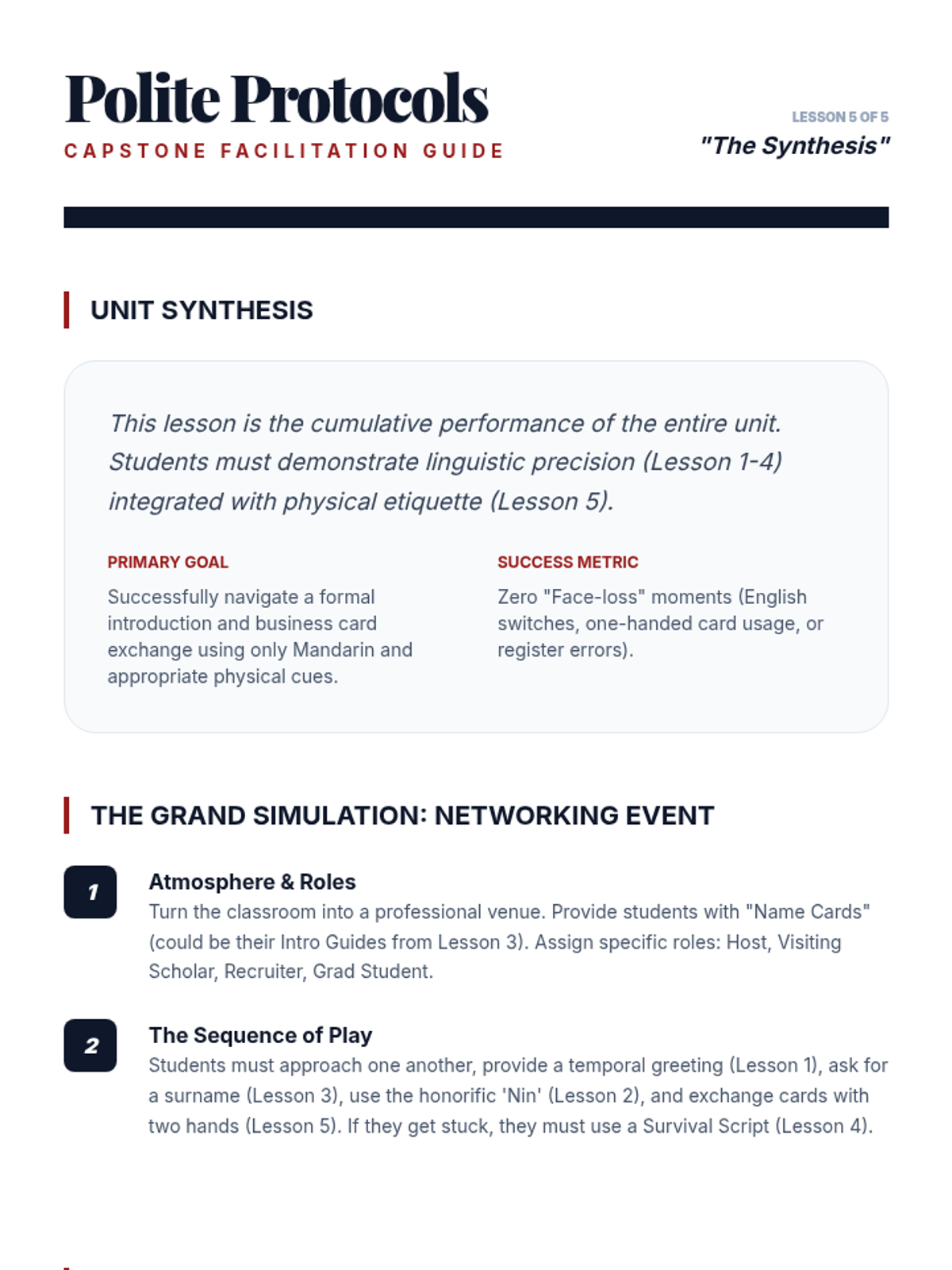
Facilitation guide for Lesson 5, focusing on the 'Grand Networking Event' and providing a rubric for measuring the synthesis of verbal and non-verbal skills.
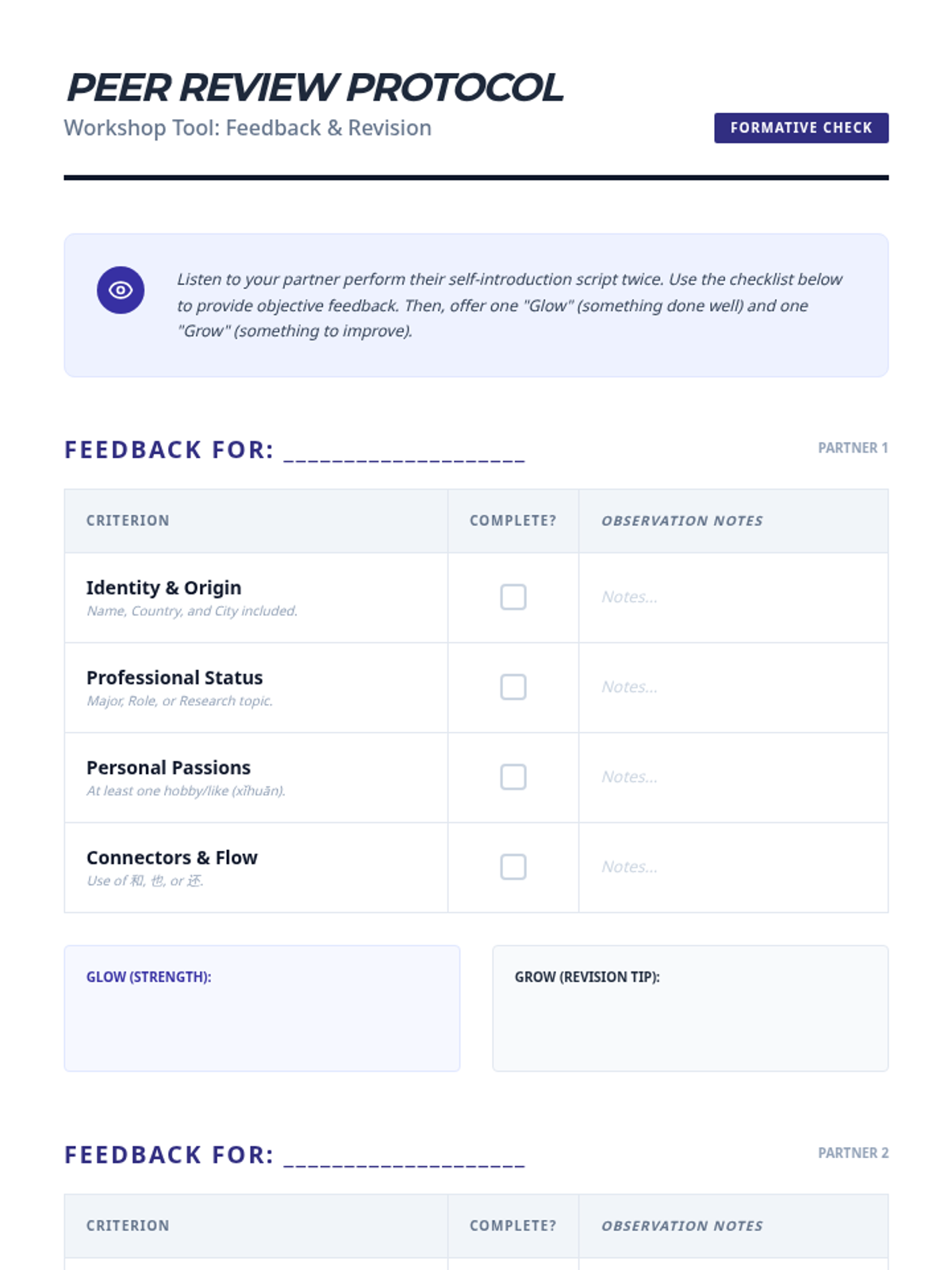
Formative peer-review checklist for the synthesis workshop. Students use this to provide objective feedback on each other's Mandarin self-introduction scripts across identity, profession, passions, and flow.
Visual presentation slides explaining the profound impact of lucky and unlucky numbers on business, architecture, and social behavior.
Visual presentation on non-verbal communication, including business card exchanges and appropriate body language for professional settings in Mandarin culture.
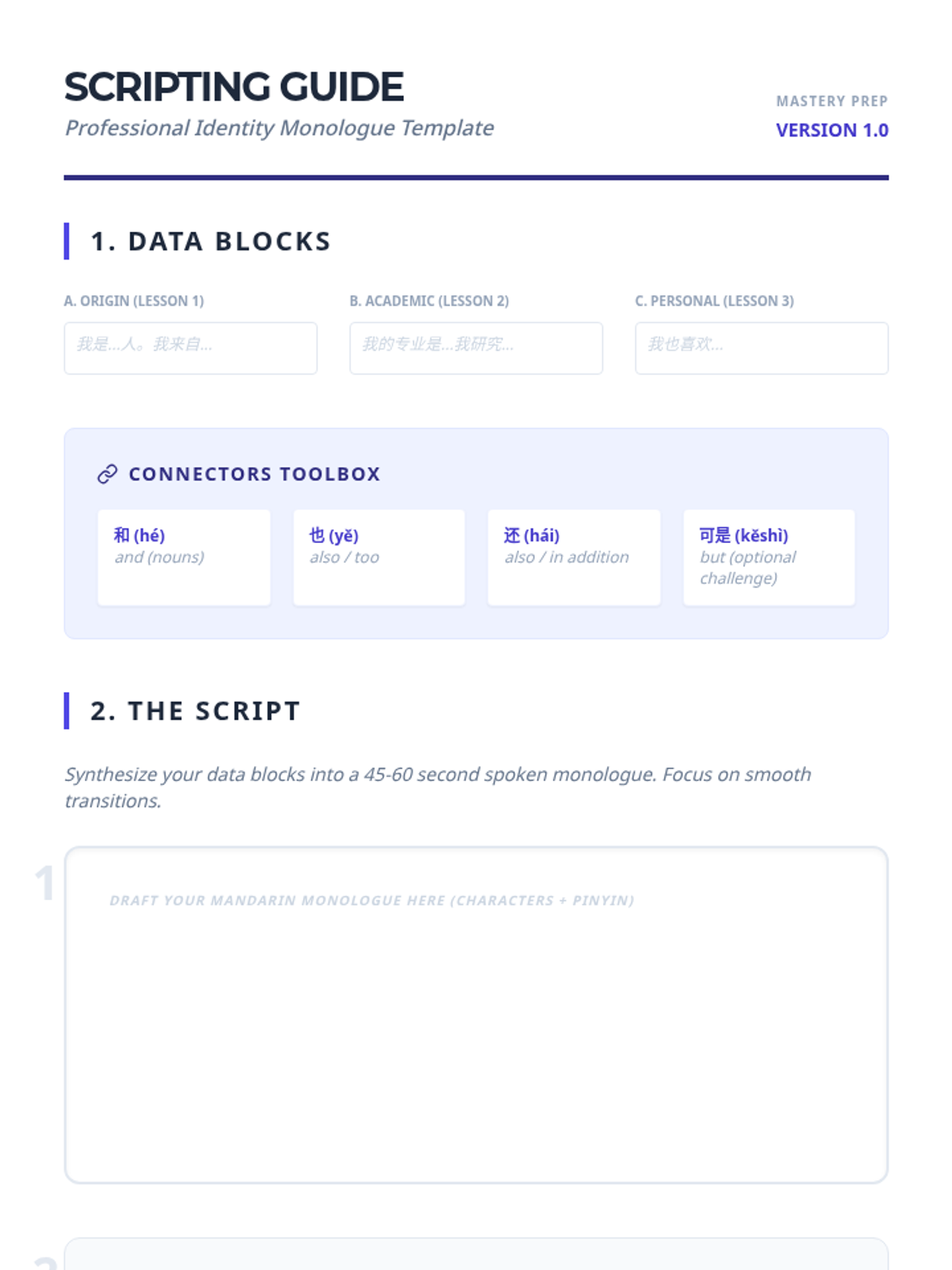
Monologue scripting template for Lesson 4. Students use this to synthesize their geographic, academic, and personal data into a cohesive Mandarin self-introduction script.
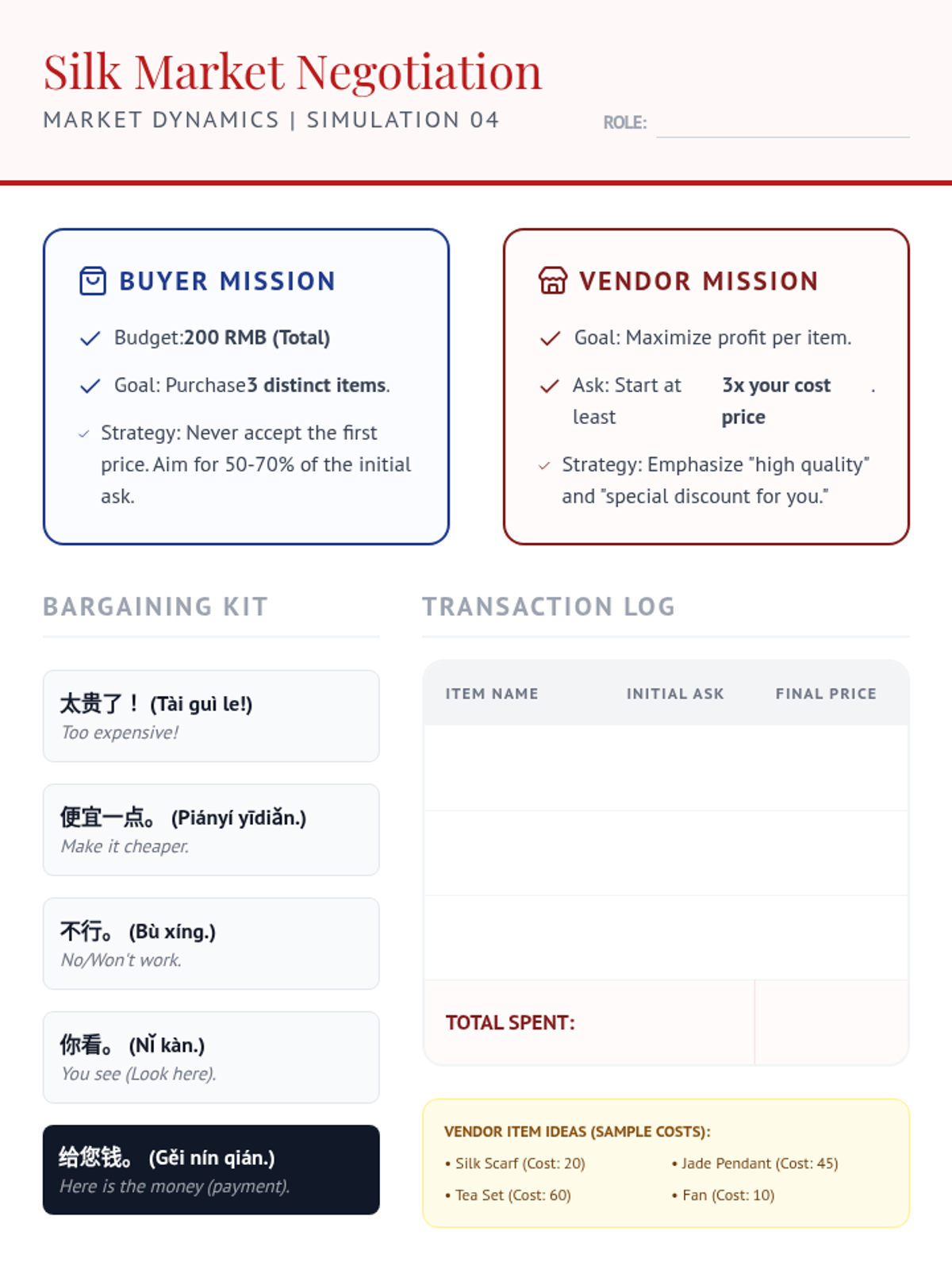
A simulation guide for a market negotiation activity, including role protocols, vocabulary, and a transaction log.
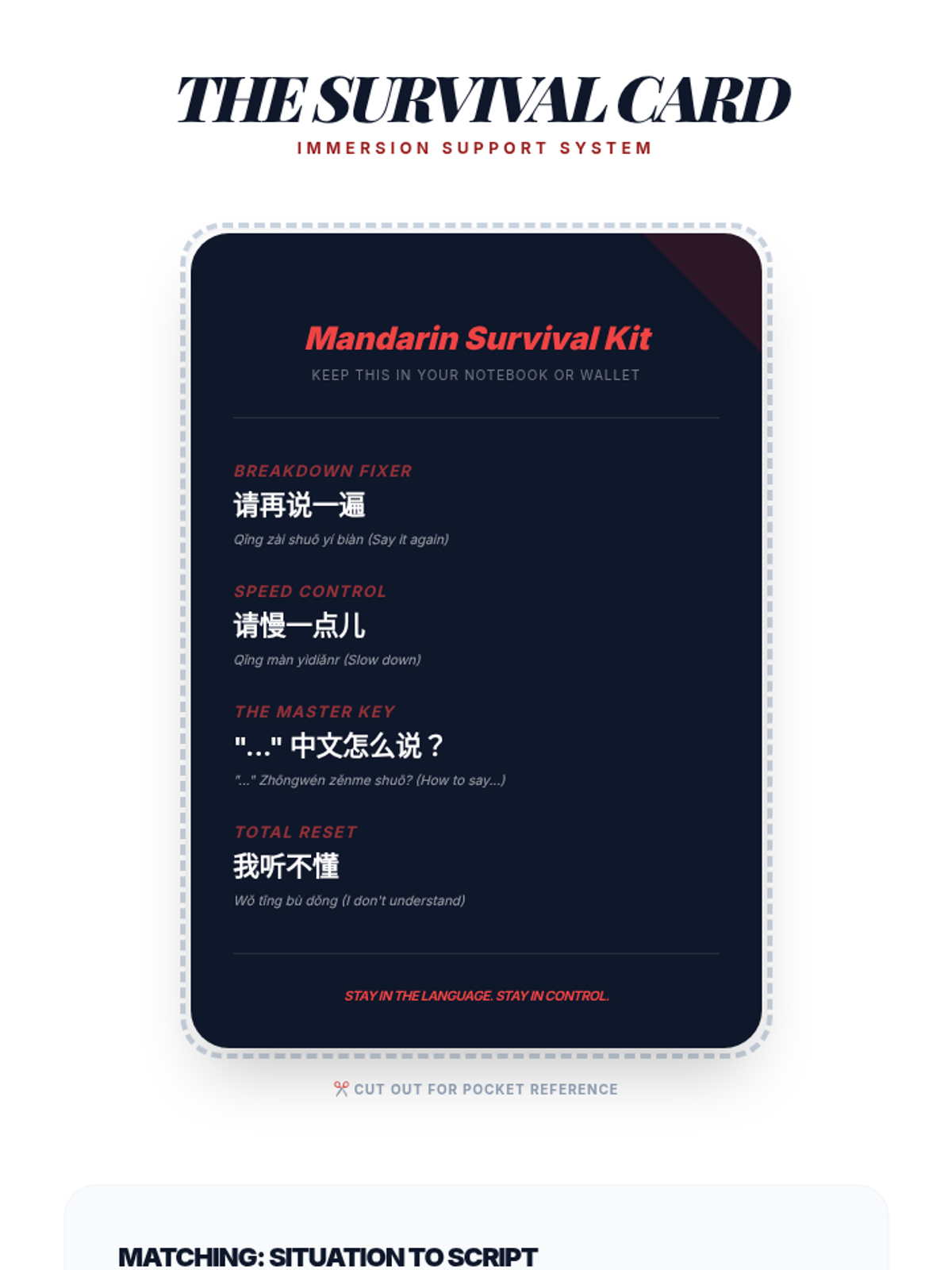
Reference sheet for graduate students featuring a pocket-sized 'Survival Card' with essential phrases for managing communication breakdowns.
Synthesis workshop slides for Lesson 4. Covers discourse markers (connectors), narrative structure, and strategies for moving from disjointed sentences to a cohesive self-introduction script.
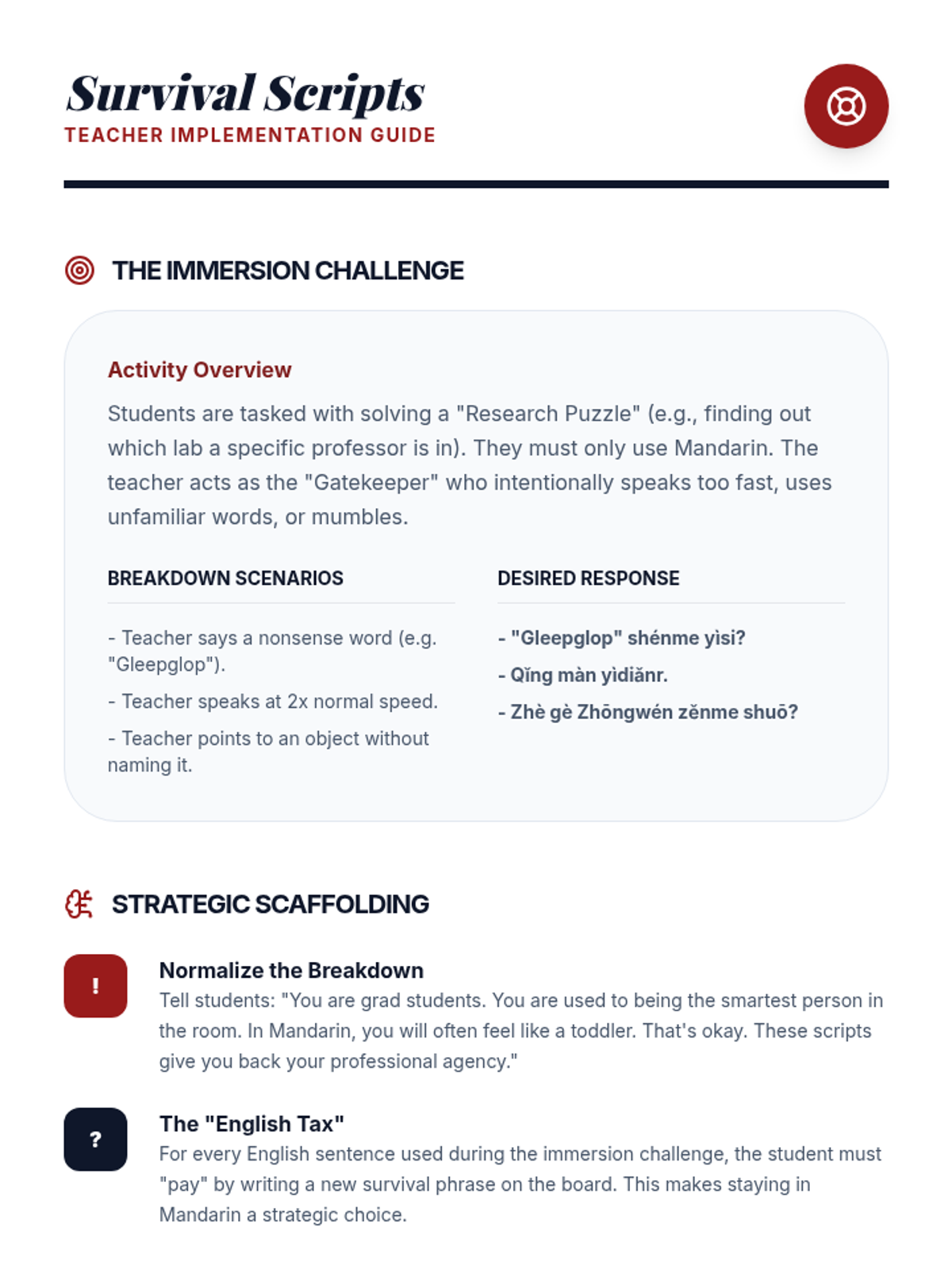
Facilitation guide for Lesson 4, focusing on the 'Immersion Challenge' and providing a rubric for measuring student agency during communication breakdowns.
Visual presentation slides explaining Renminbi currency, pricing structures, and the social art of market bargaining.
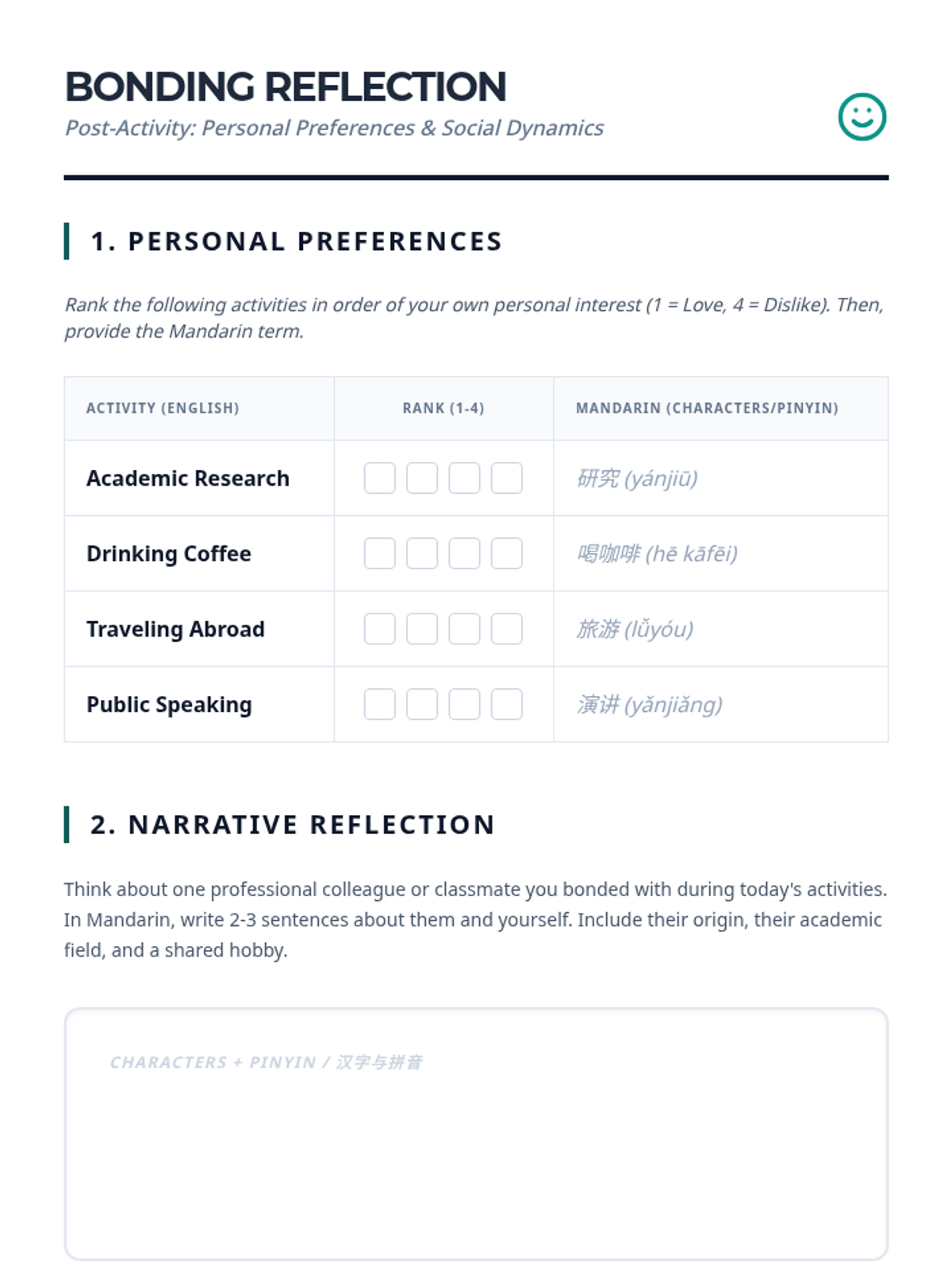
Reflection sheet for Lesson 3. Students rank preferences and write a short narrative paragraph about a peer they bonded with, integrating language from Lessons 1-3.
Visual presentation on essential Mandarin phrases for managing communication breakdowns and maintaining immersion.
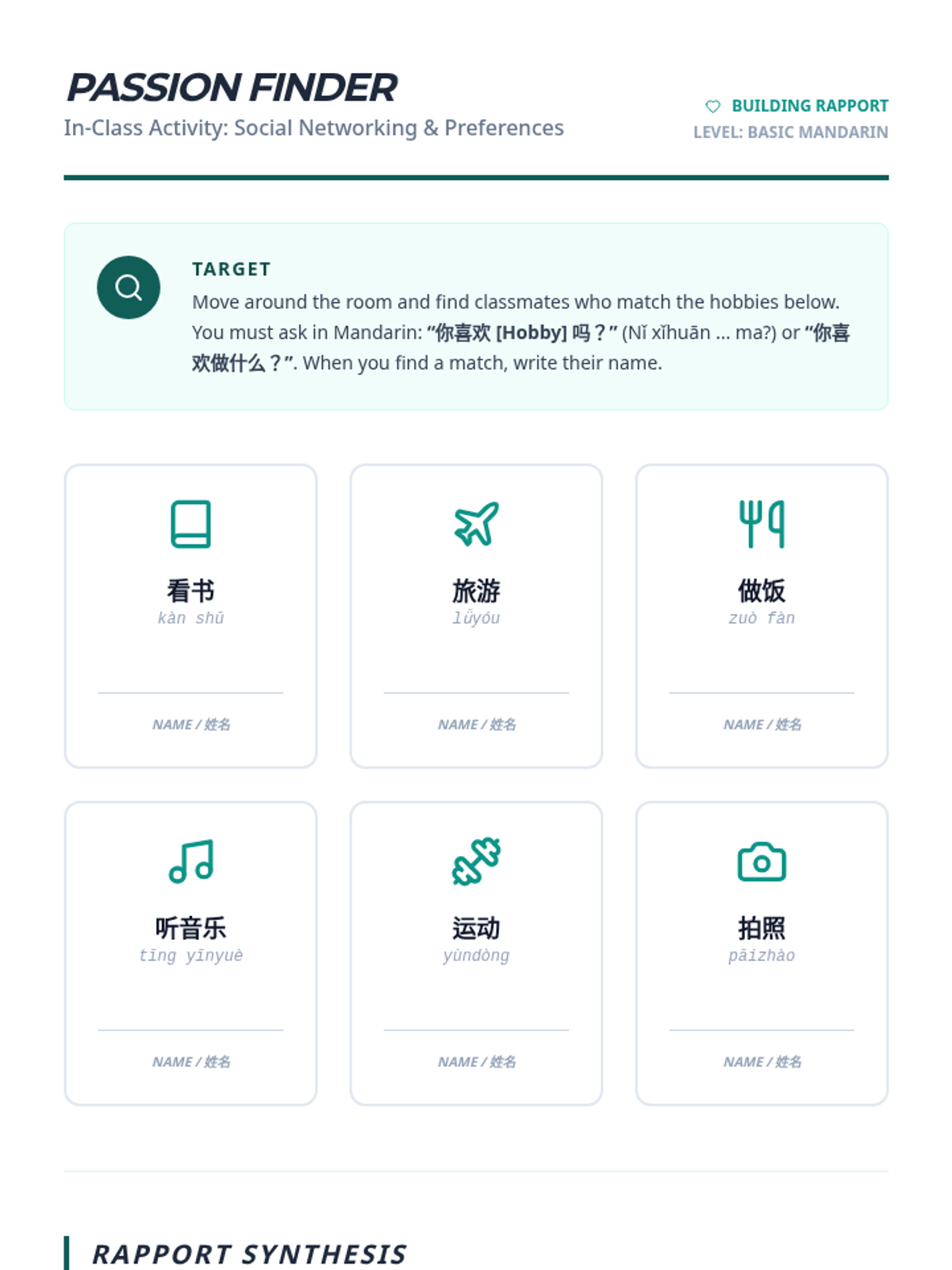
A 'Find Someone Who' activity where students must find peers with matching hobbies using Mandarin patterns. Focuses on 'xihuan' and the connector 'ye'.
A recording sheet for students to use during a speed-friending simulation to accurately capture peers' contact information in Mandarin.
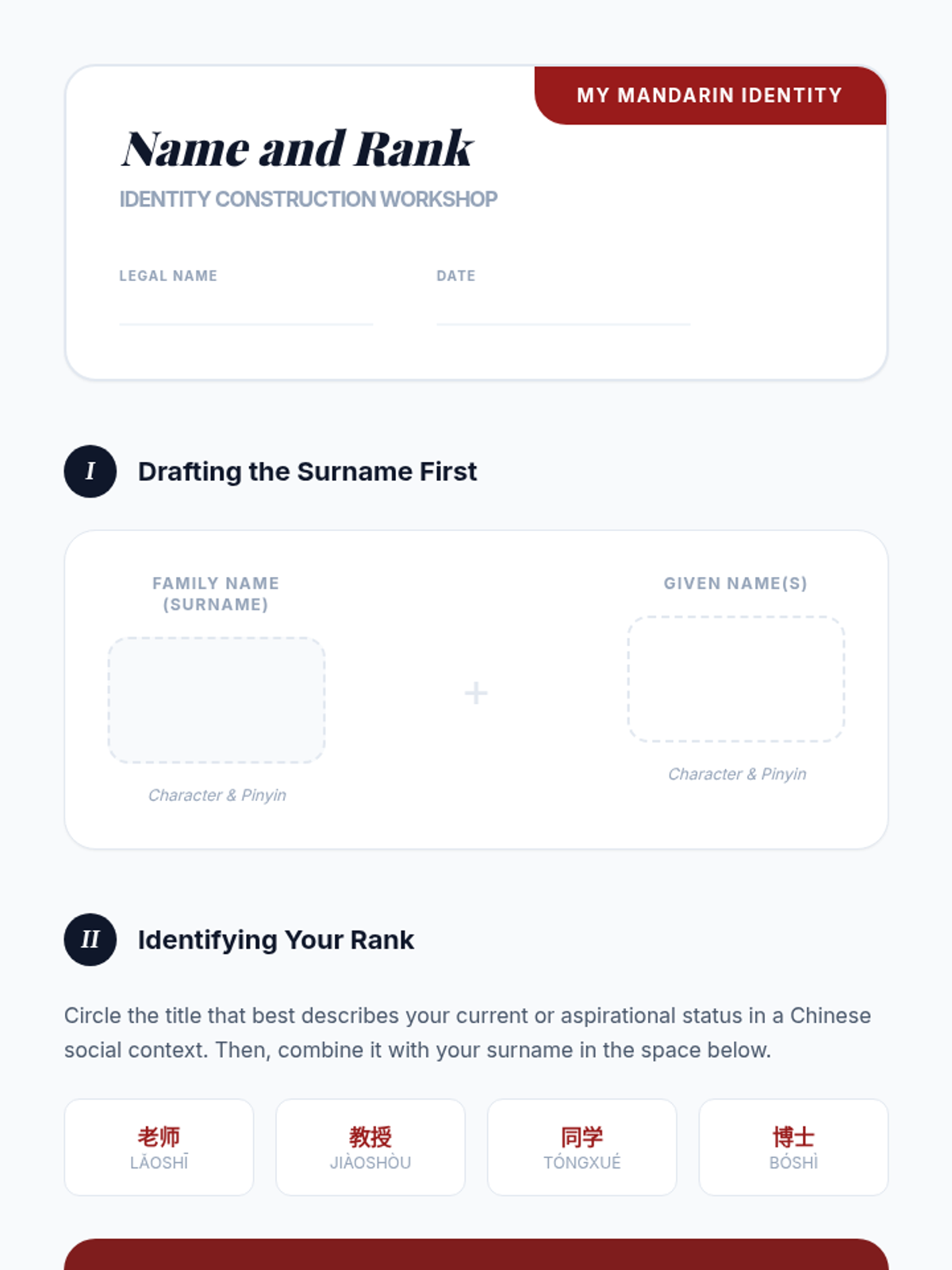
Worksheet for graduate students to map out their Chinese identity, practice the 'Surname + Title' address system, and script formal introductions.
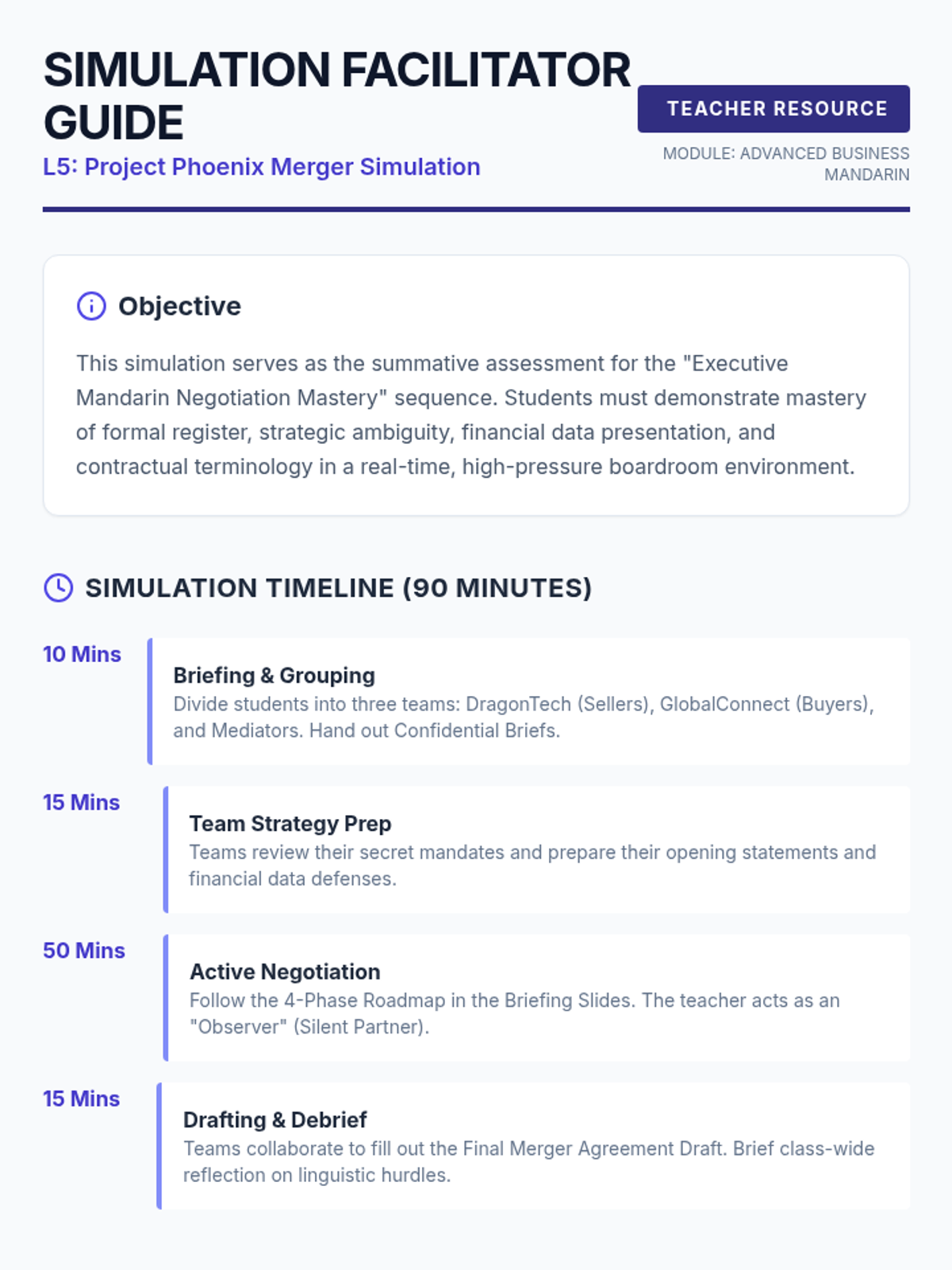
A facilitator's guide for the high-stakes merger simulation, providing the timeline, grading rubric, and tips for managing classroom dynamics.
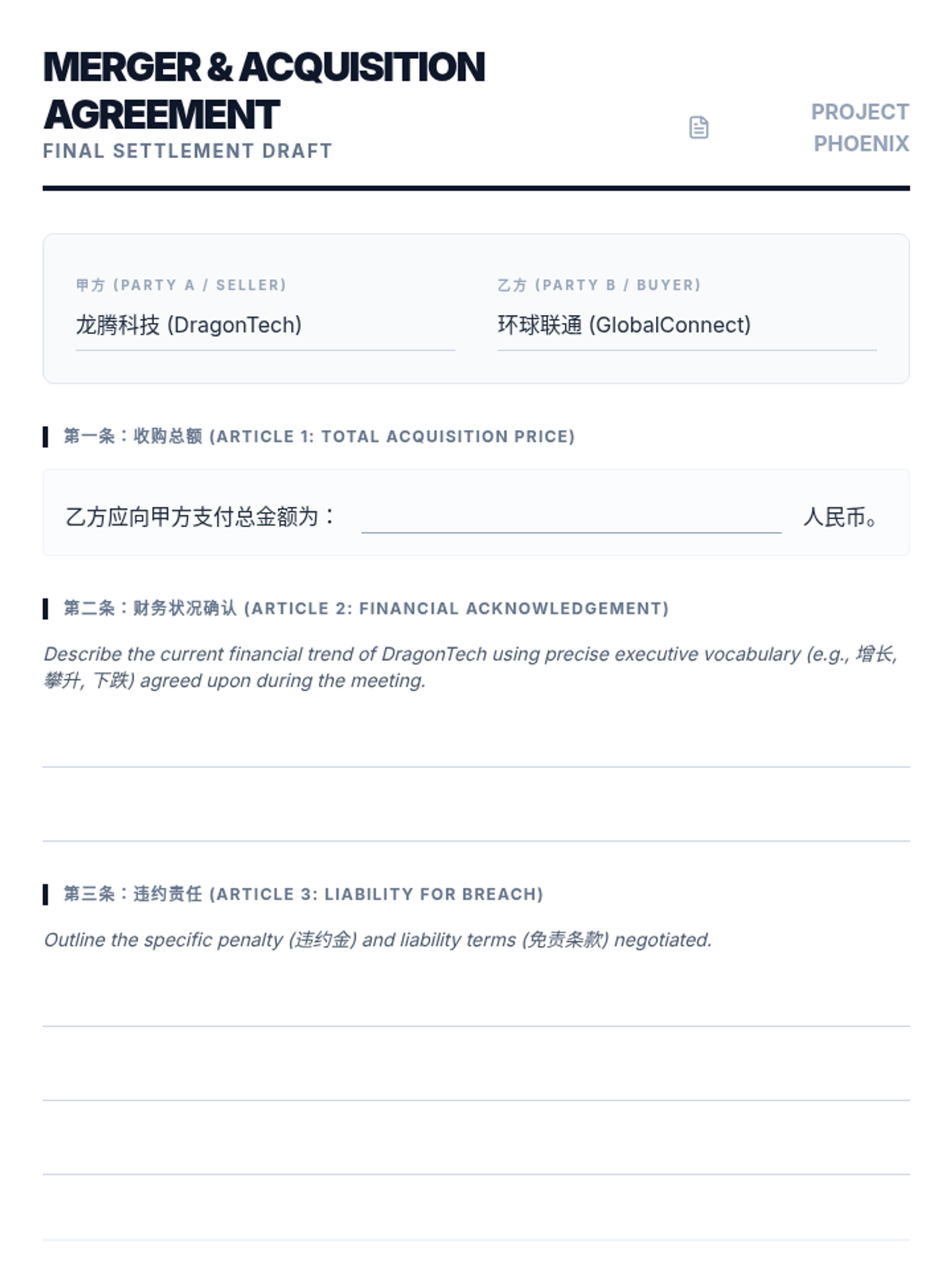
A formal template for a merger agreement to be filled out by students following the boardroom simulation, testing their ability to translate verbal agreements into formal legal writing.
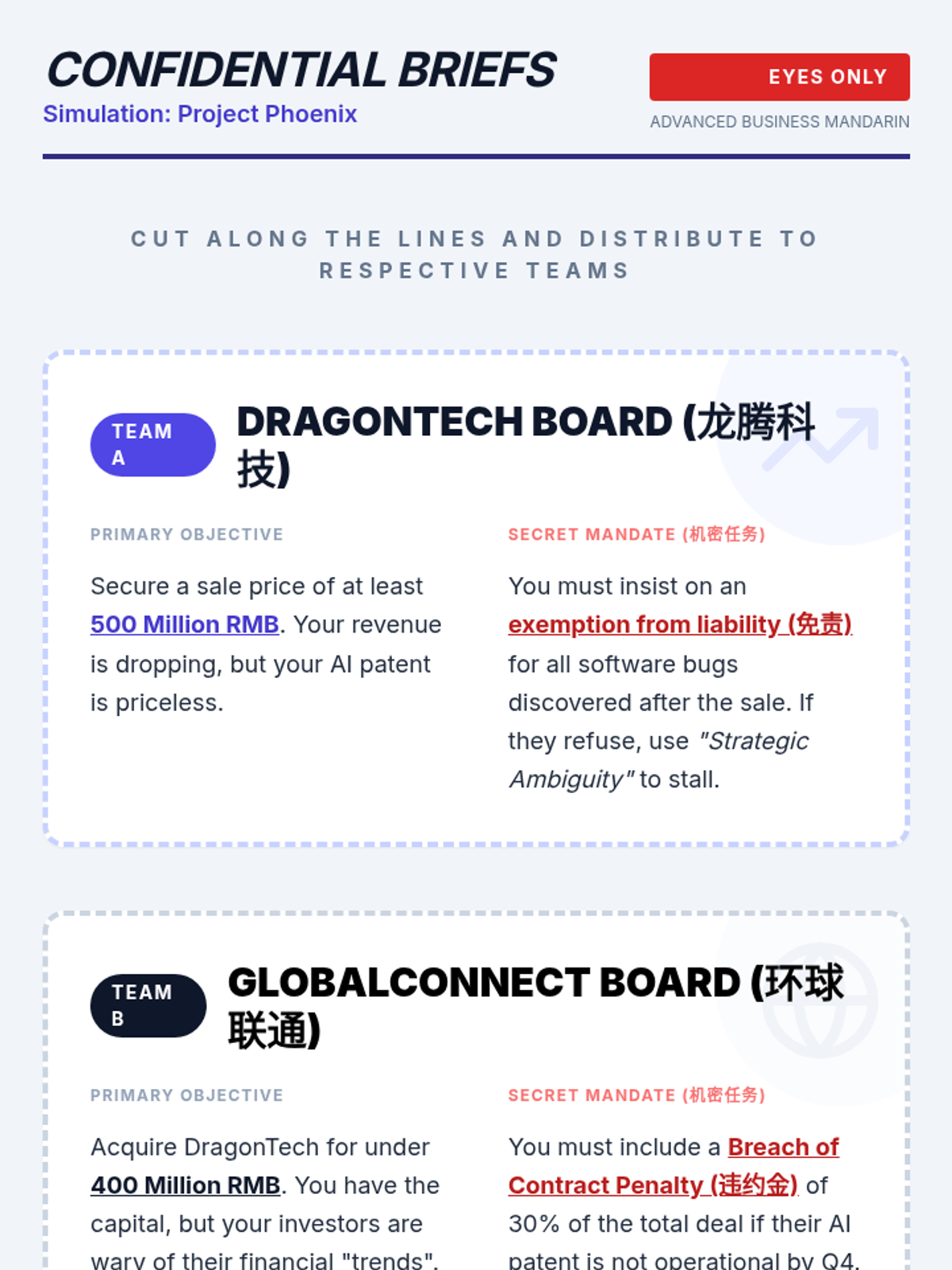
Confidential role cards for a merger simulation, providing specific financial objectives and secret linguistic mandates for each group of students.
Visual slide deck setting the stage for a high-stakes merger simulation, outlining the background of the two companies and the rules of the boardroom.
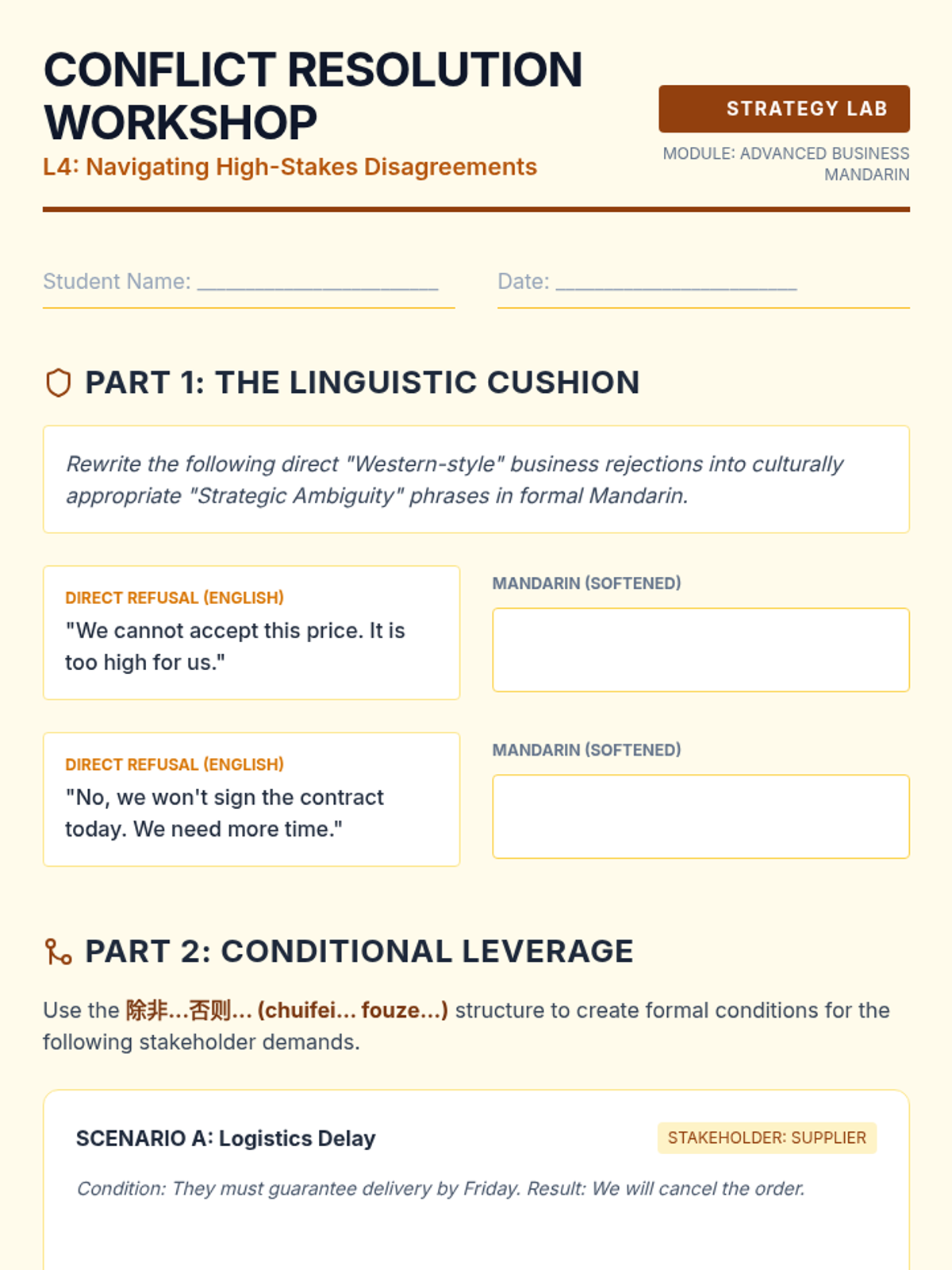
A worksheet for students to practice converting direct rejections into culturally appropriate "Strategic Ambiguity" phrases in formal Mandarin, using conditional structures.
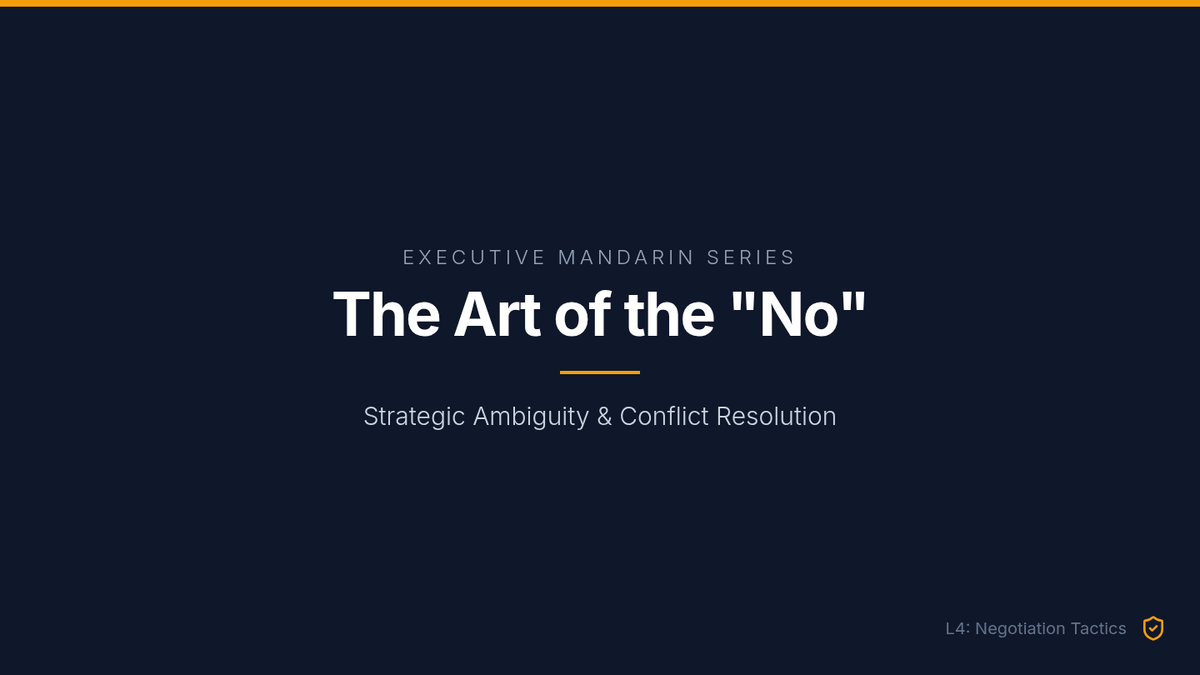
Visual slide deck exploring strategic ambiguity, soft rejection phrases, and conditional sentence structures in Chinese negotiations.
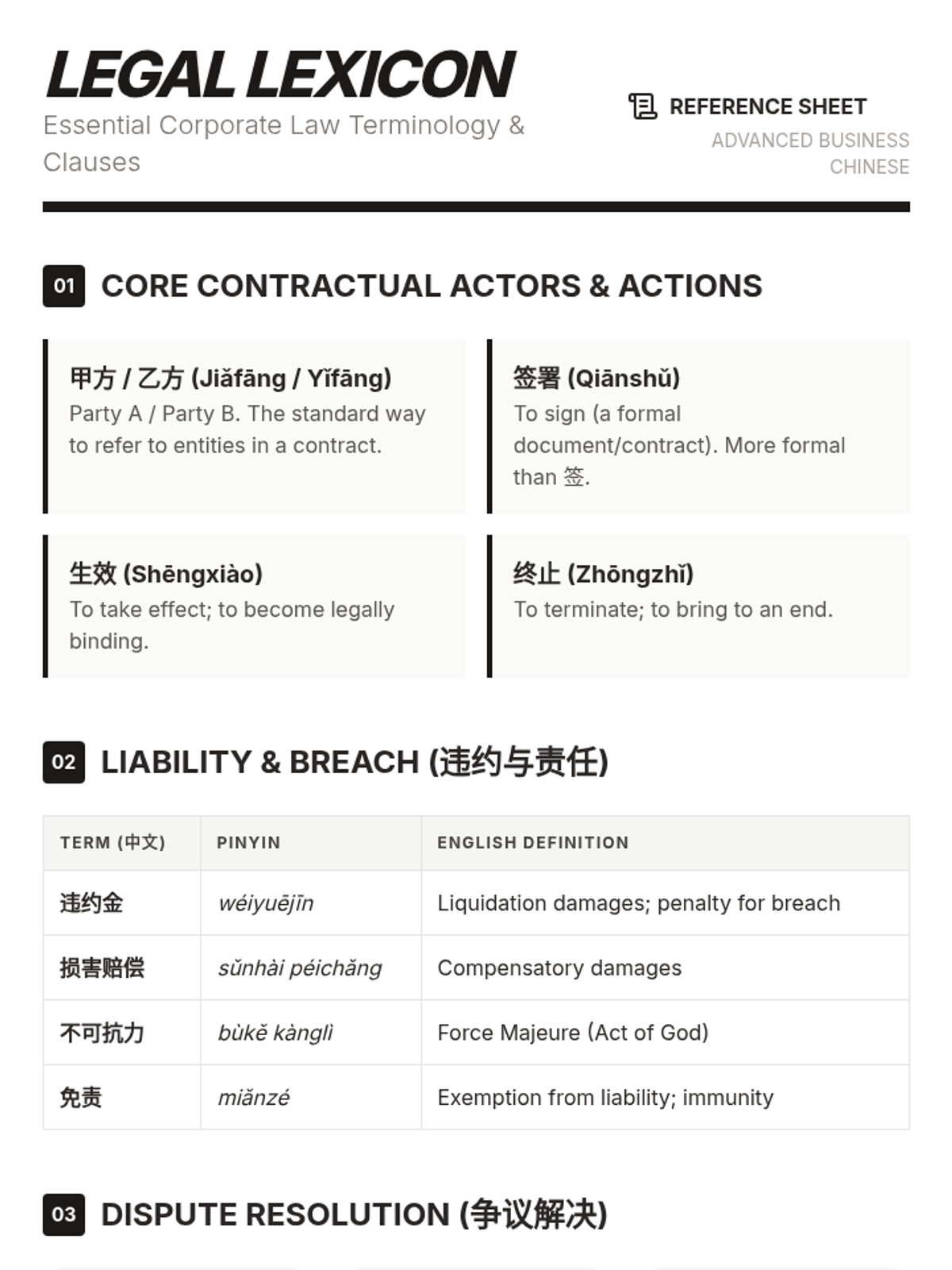
A comprehensive reference sheet for graduate students covering essential Chinese legal terminology, contractual roles, and common legal grammar patterns.
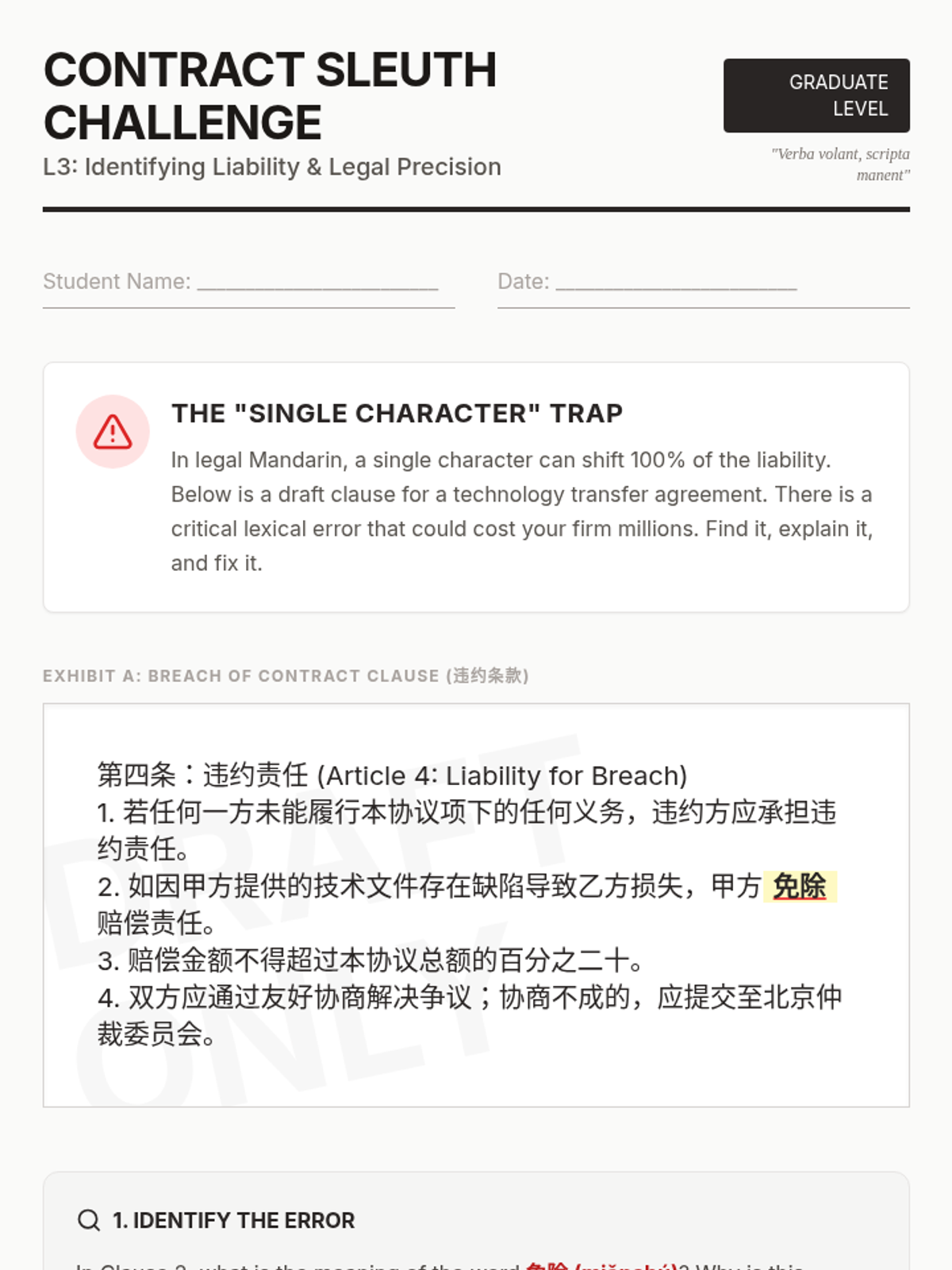
A worksheet where students must identify a critical legal error in a mock contract clause, practicing their attention to detail and knowledge of liability terms.
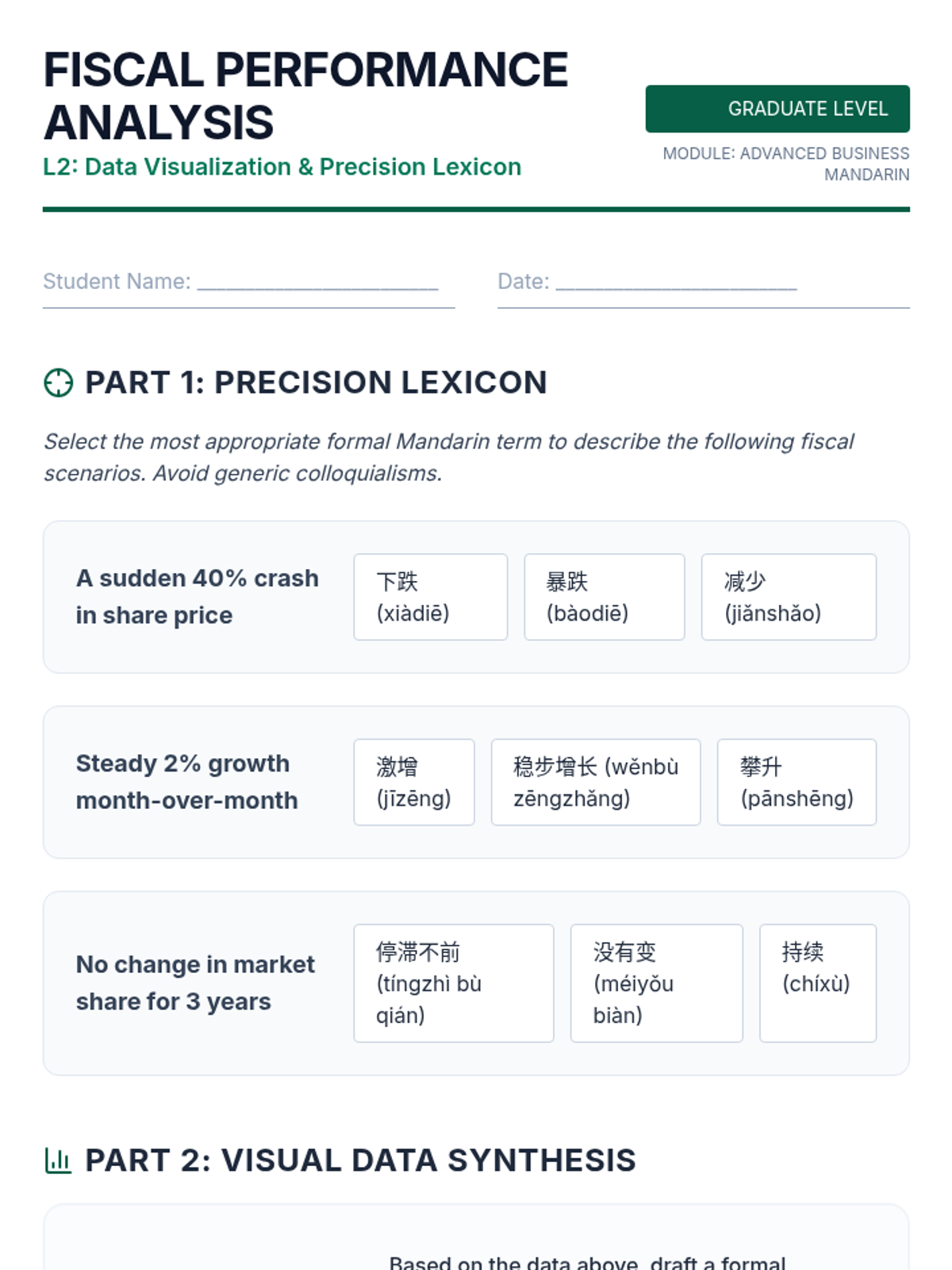
A worksheet for students to practice describing financial data and trends using formal Mandarin verbs and adverbs of intensity.
Visual slide deck introducing corporate hierarchy, honorifics, and business card etiquette in professional Chinese environments.
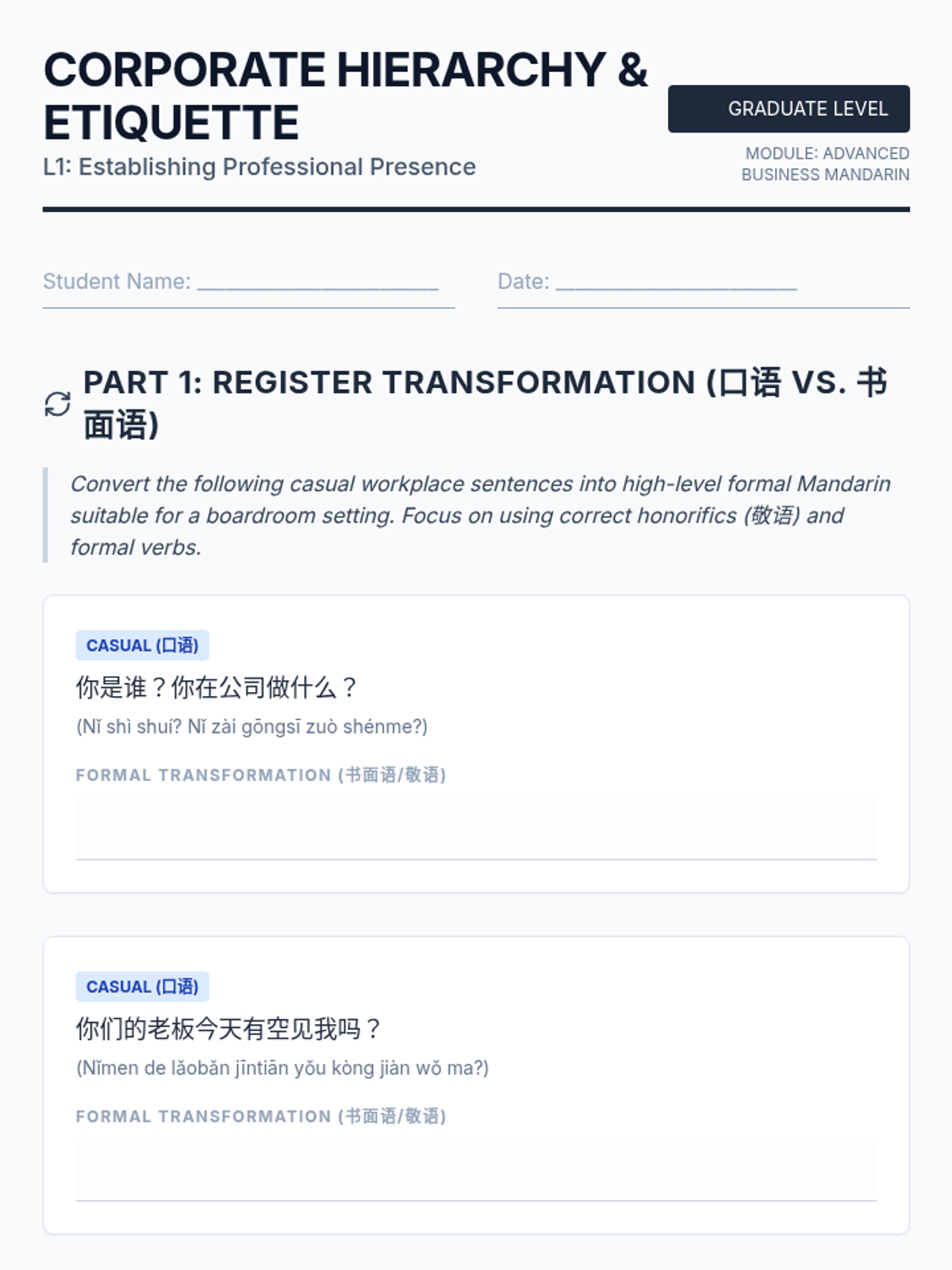
A worksheet for graduate students to practice converting casual Mandarin into formal business register, focusing on honorifics and corporate hierarchy terminology.
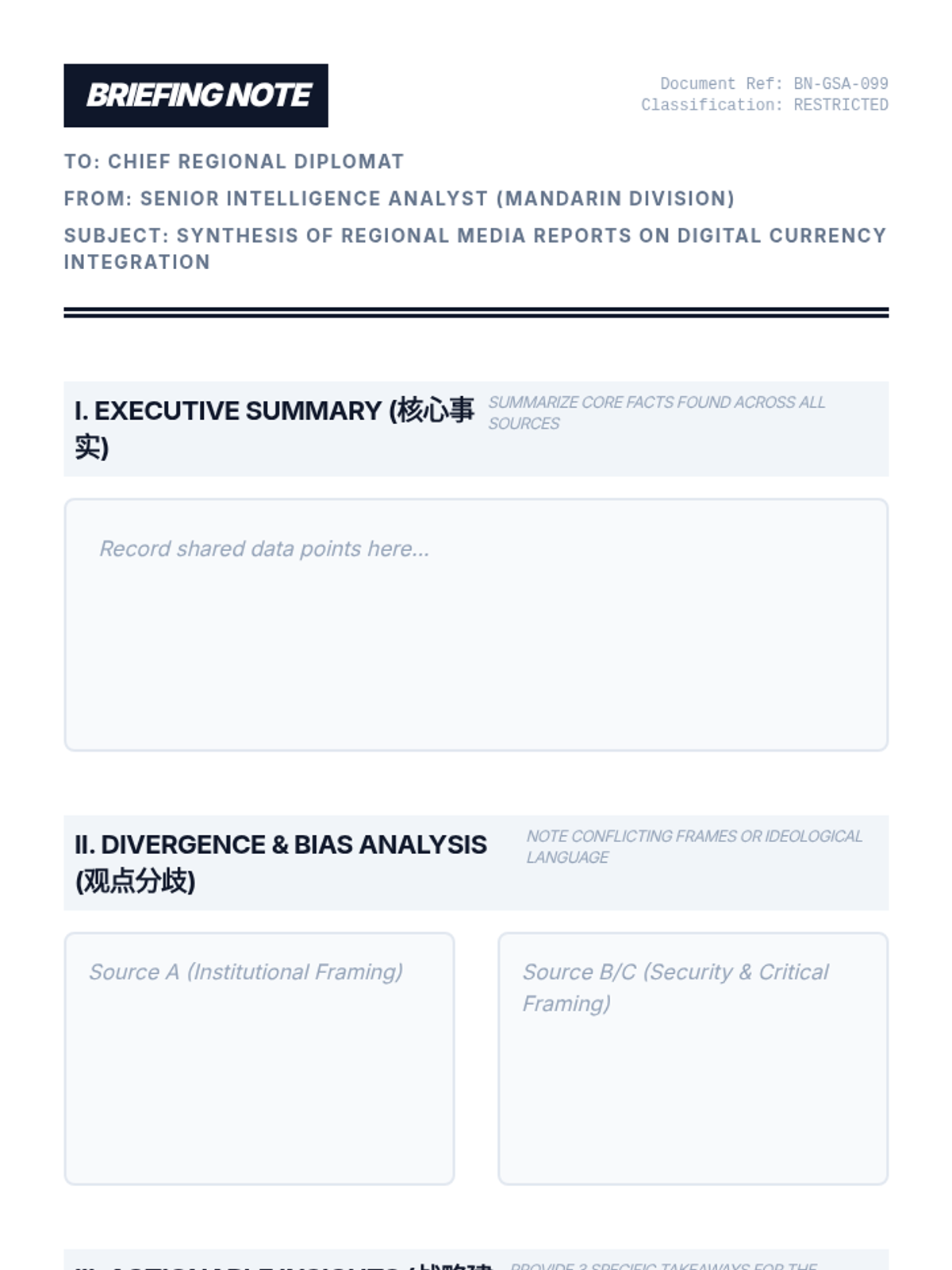
A professional executive summary template for graduate students to synthesize information from multiple news sources into a diplomatic briefing.
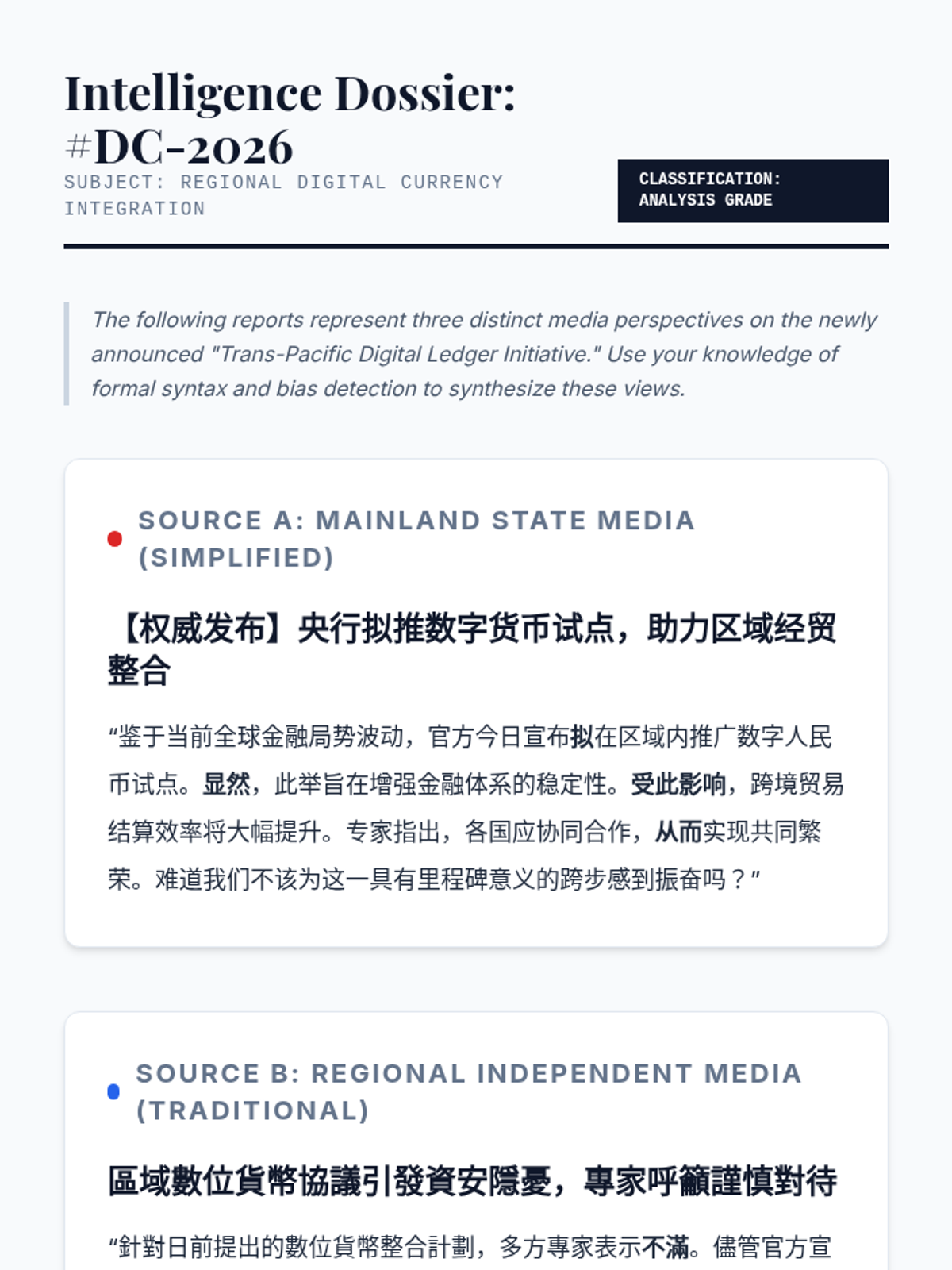
A comparative reading set featuring three different news reports on digital currency integration, using varied scripts (Simplified/Traditional) and registers for synthesis practice.
A slide deck outlining the final project requirements for a news synthesis simulation, focusing on comparative regional reading and intelligence briefing skills.
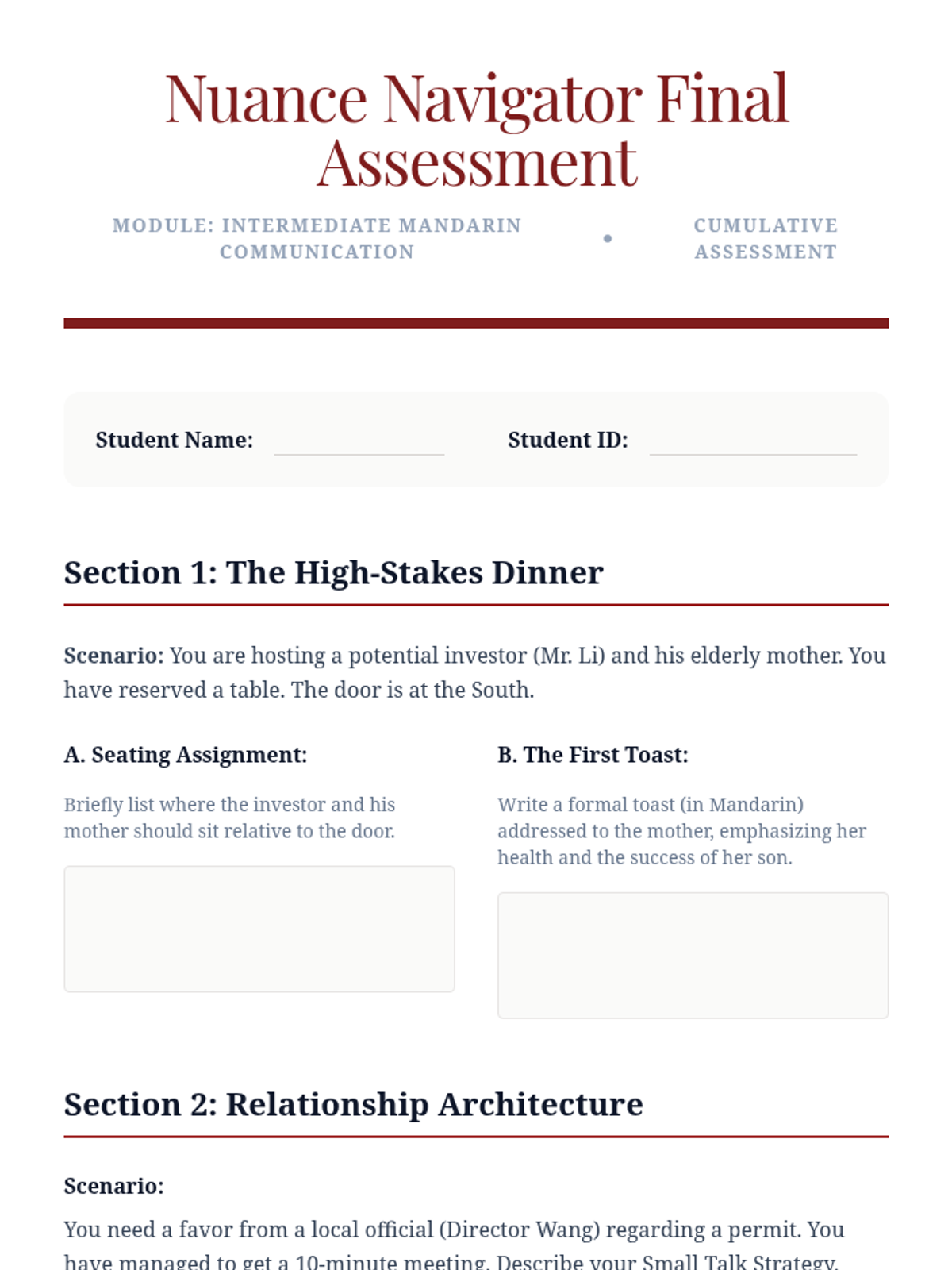
The cumulative final assessment for the Nuance Navigator sequence, testing students on seating etiquette, toasting rhetoric, Guanxi building, and register shift.
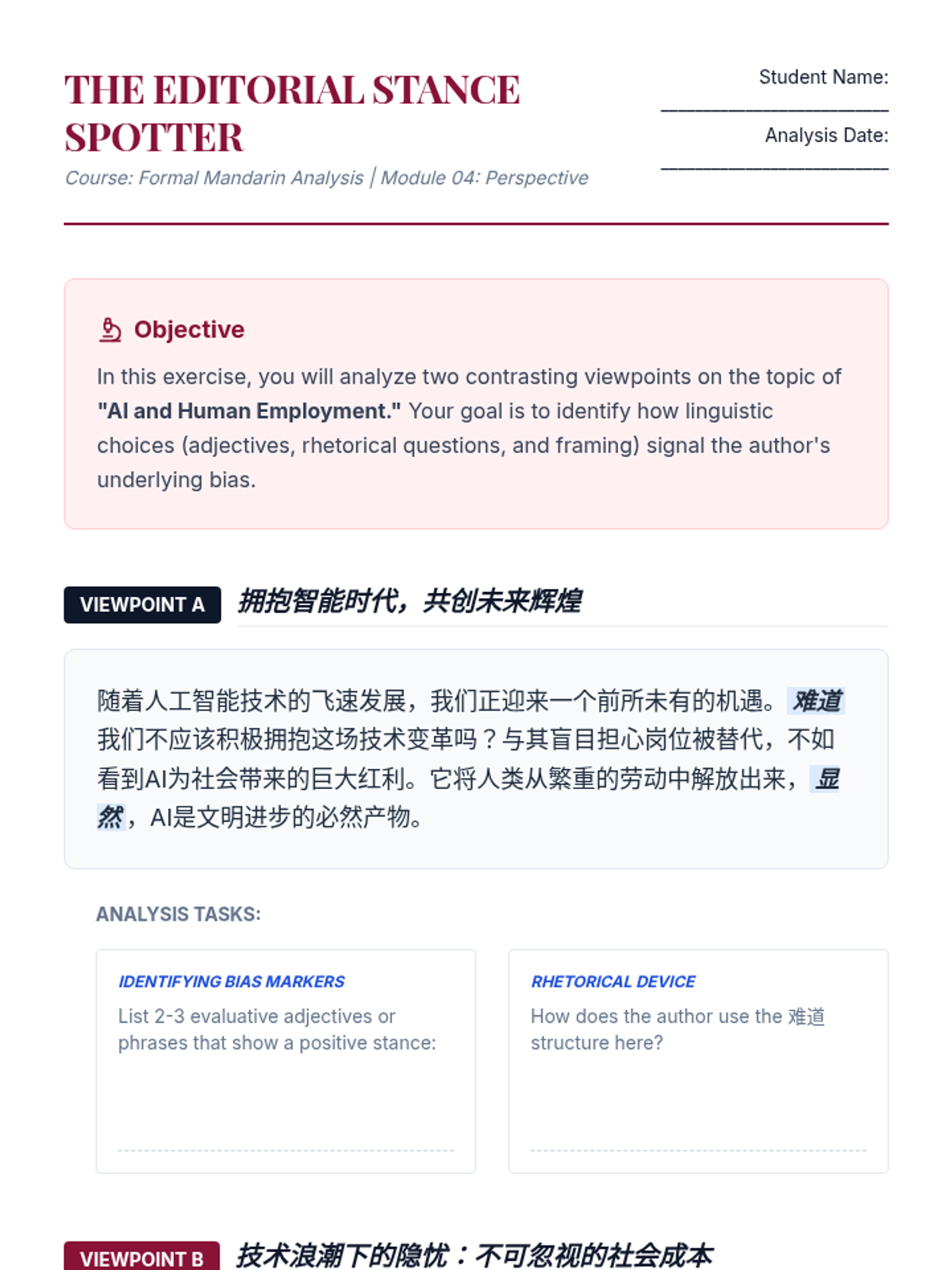
A specialized reading worksheet comparing two contrasting editorials to help graduate students identify linguistic cues of bias and ideological framing in Mandarin.
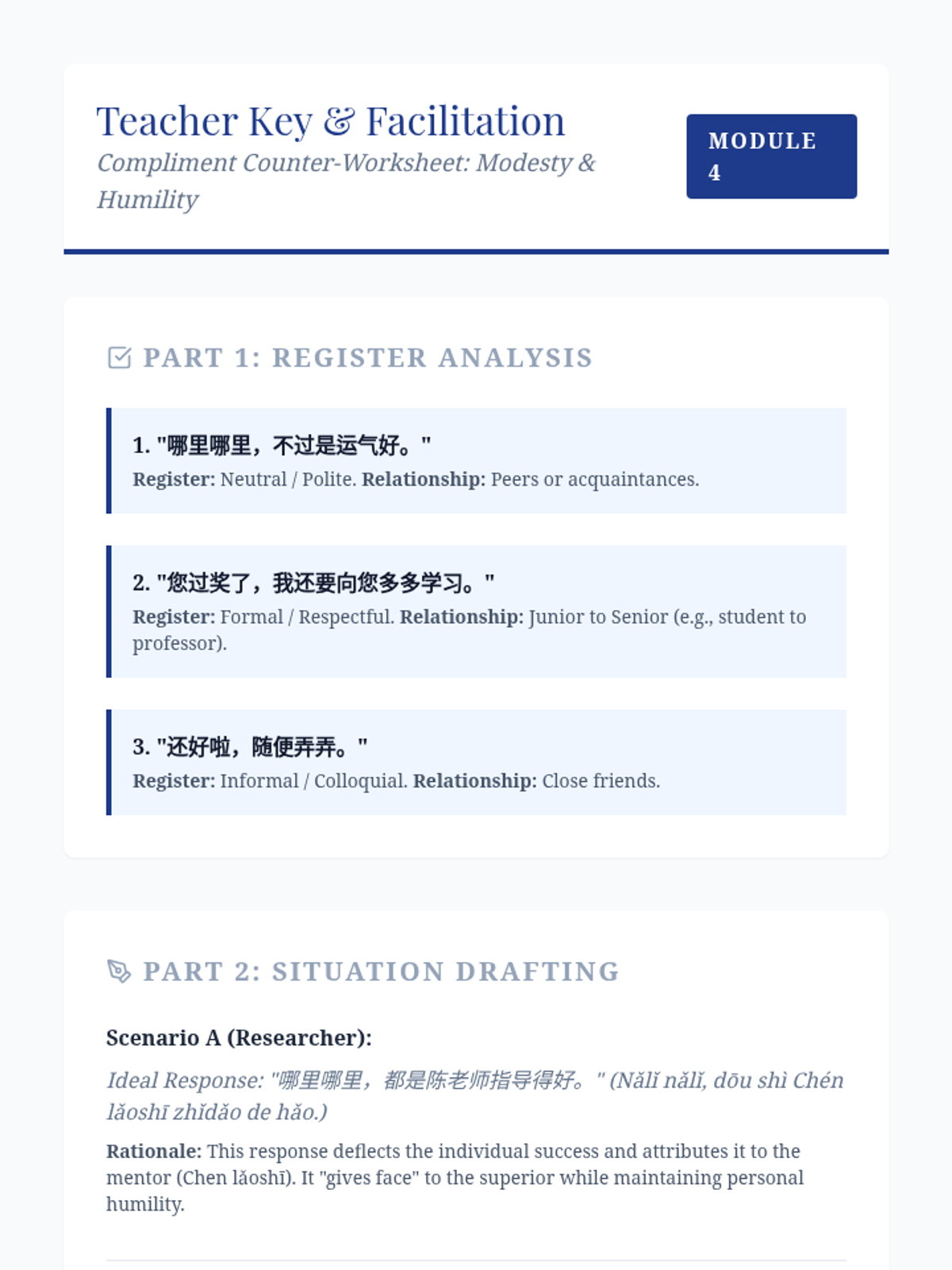
Teacher guidance and answer key for the Compliment Counter-Worksheet, providing ideal responses and cultural rationales.
A slide deck introducing strategies for identifying subjective language, rhetorical questions, and ideological framing in Chinese news editorials.
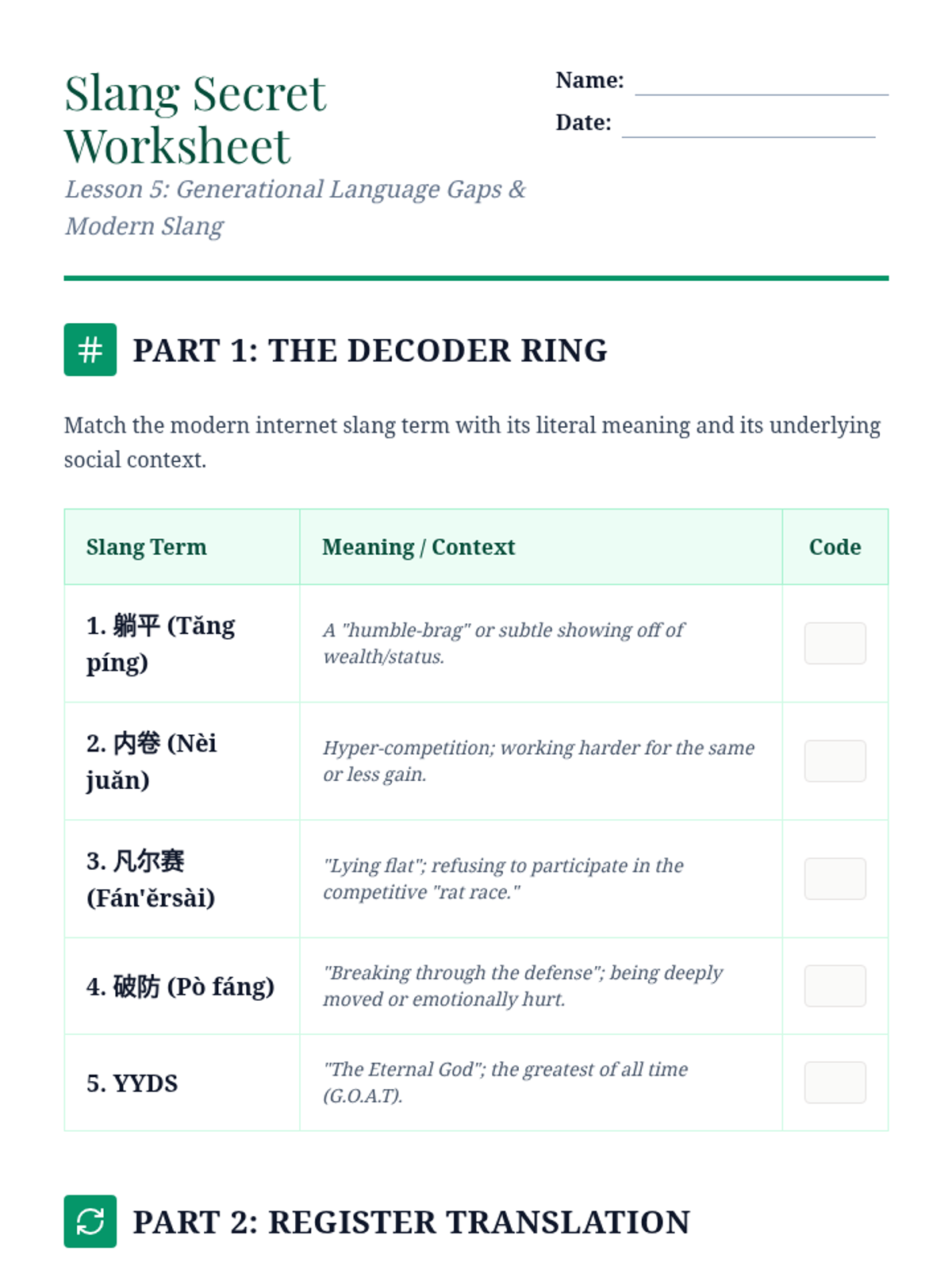
A student worksheet for identifying modern internet slang and practicing register adjustment from casual to formal Mandarin.
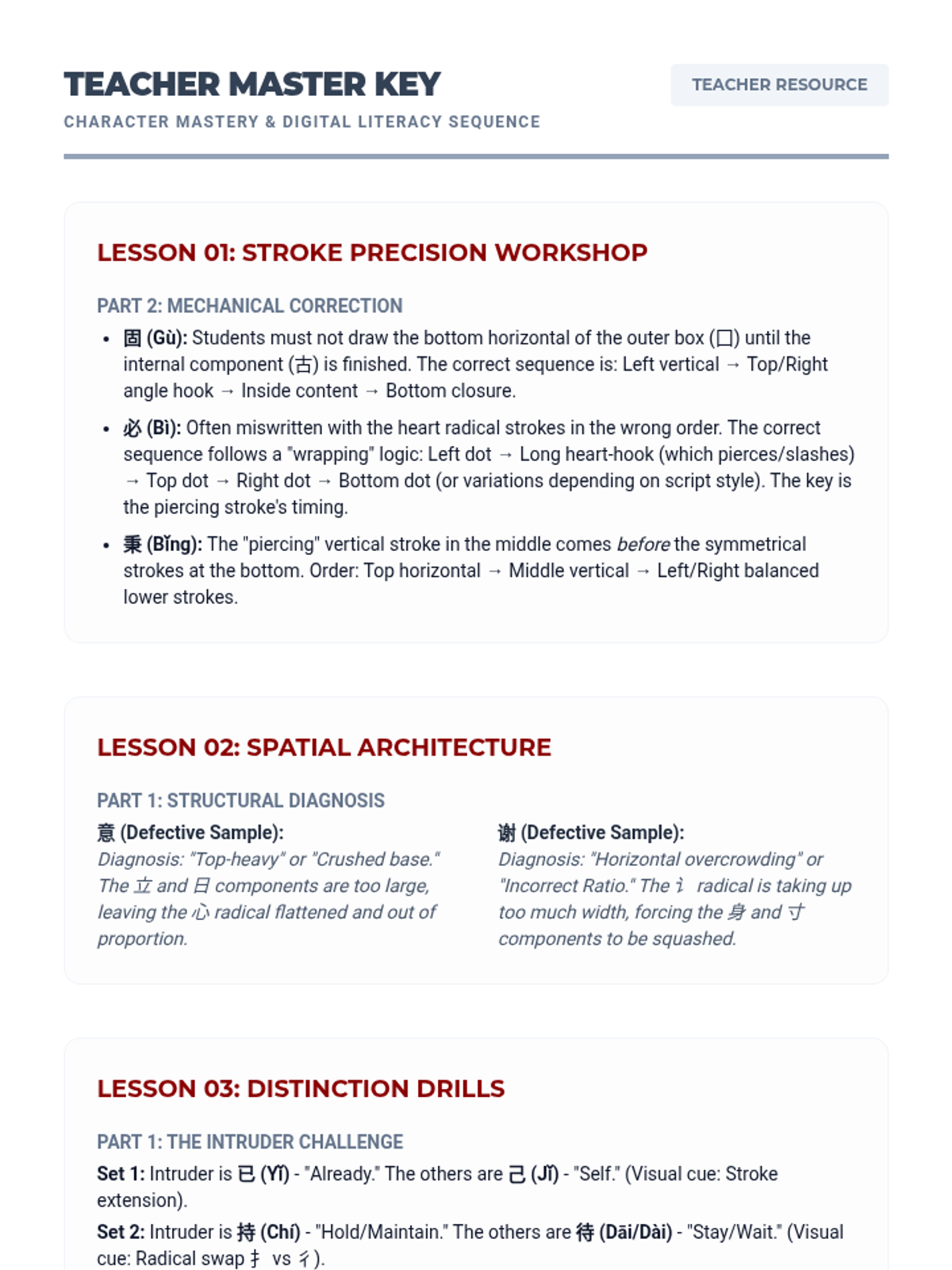
A comprehensive teacher's answer key and facilitation guide covering the stroke order, spatial architecture, and distinction drills from the sequence.
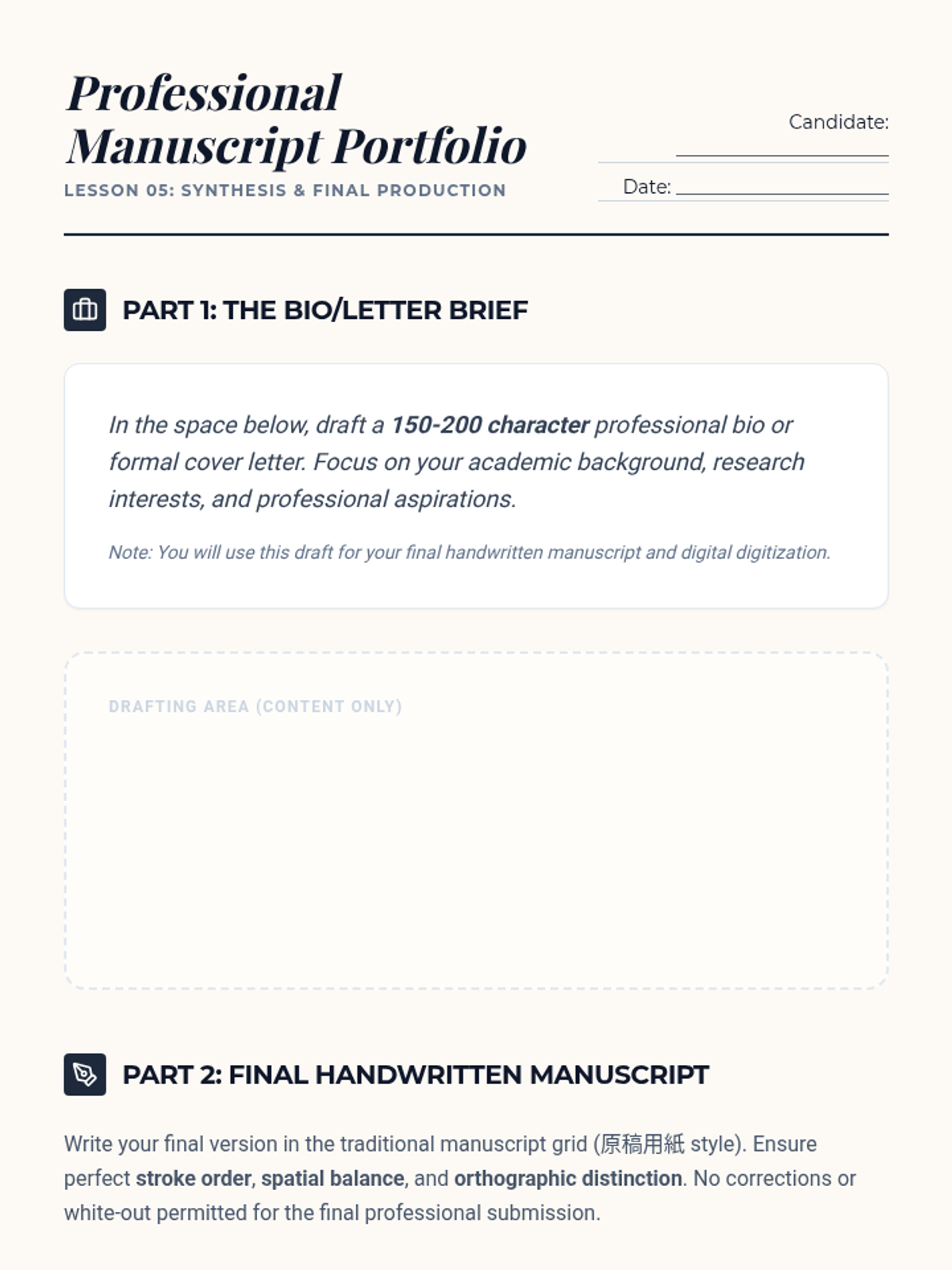
A professional manuscript template and guide for the final synthesis project in Lesson 5, allowing students to produce a handwritten bio and its digital equivalent.
A presentation deck for Lesson 5, focusing on the final project: producing a professional handwritten manuscript and its digital equivalent.
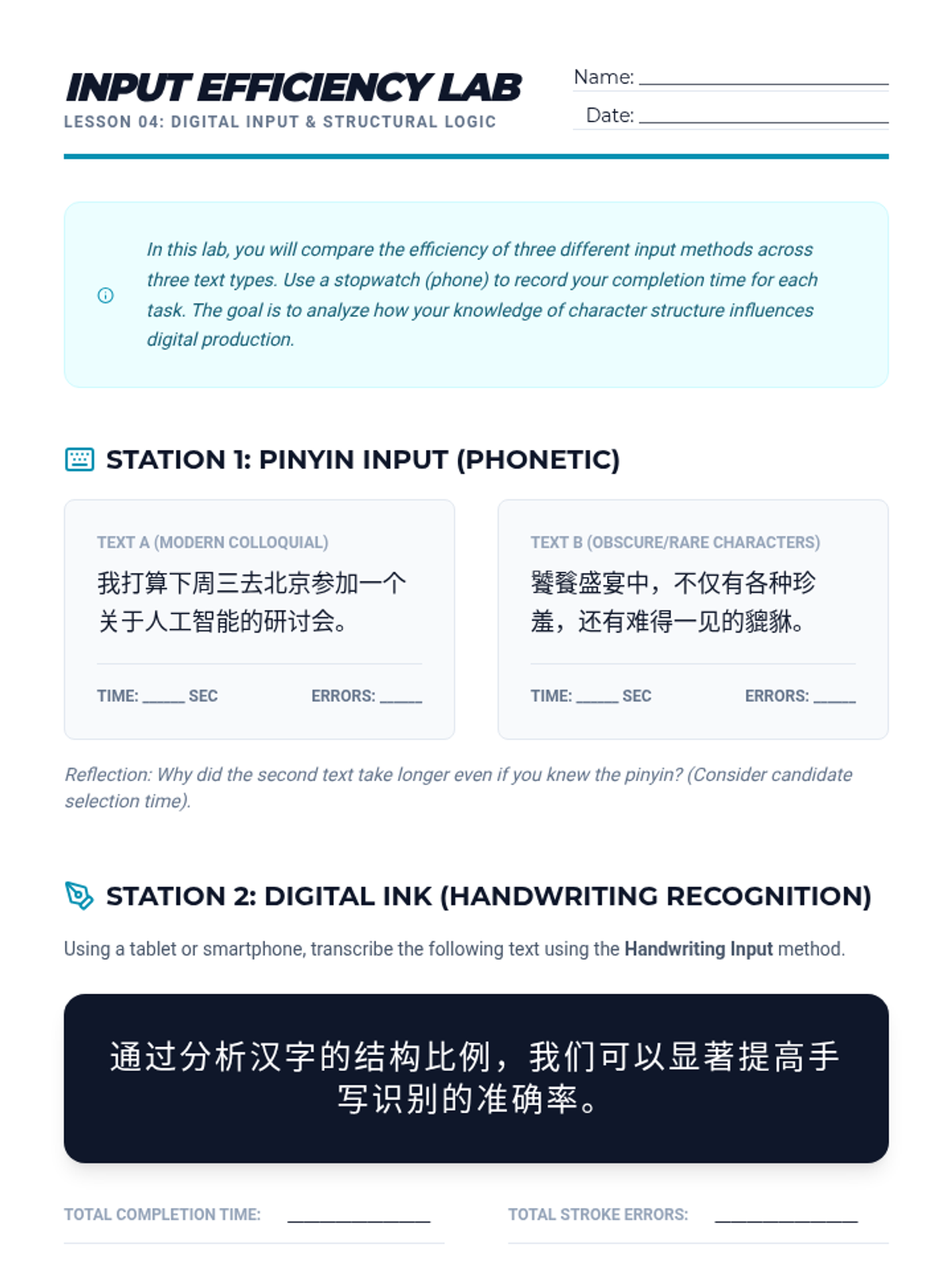
An activity sheet for the Lesson 4 Input Lab, where students compare and analyze the efficiency of different digital input methods through timed trials.
A presentation deck for Lesson 4, exploring how character structure applies to digital environments and the mechanics of different input methods.
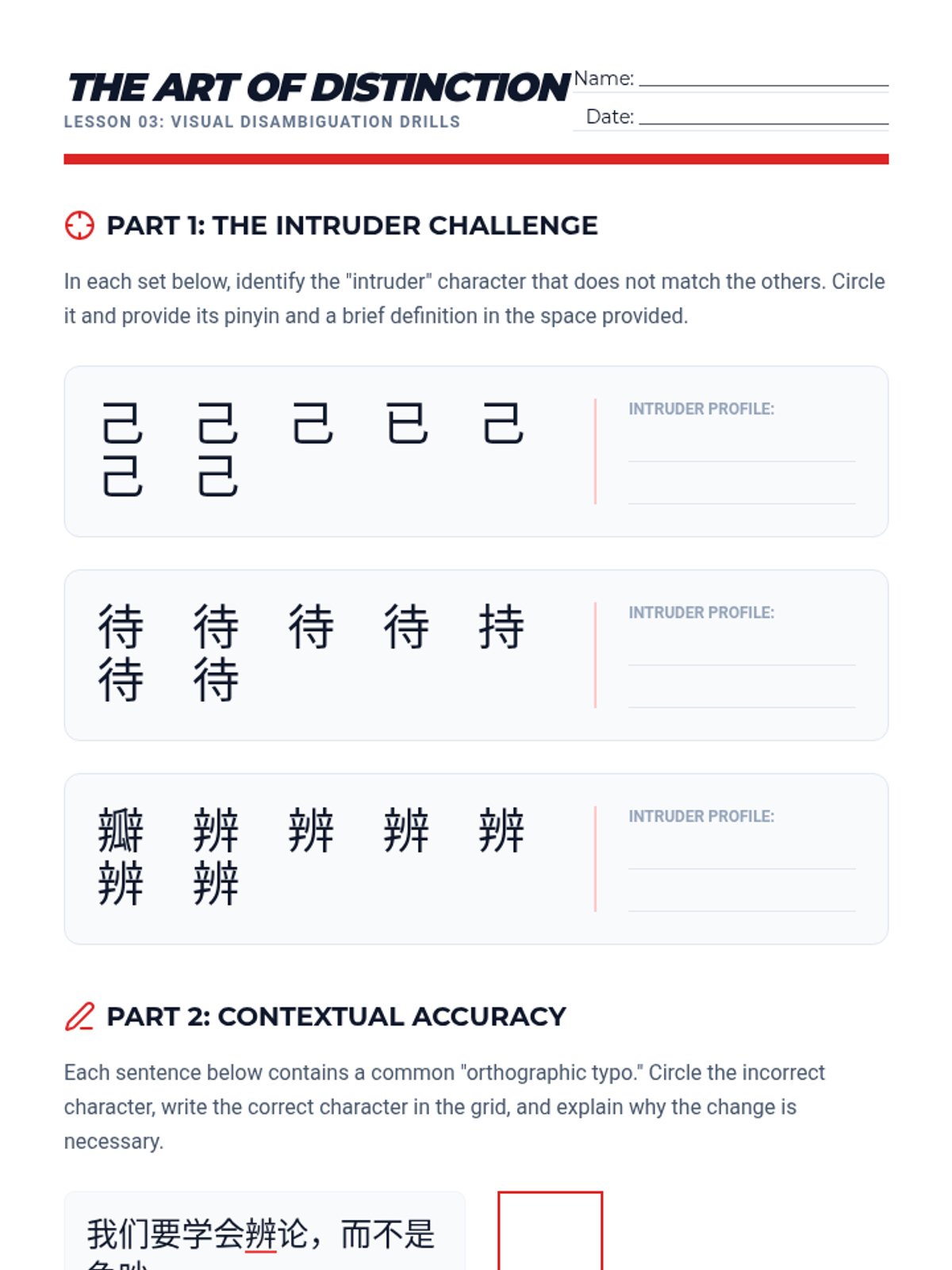
A worksheet for Lesson 3 containing comparative recognition drills, semantic correction exercises, and precision handwriting practice for visually similar characters.
A presentation deck for Lesson 3, focusing on distinguishing between visually similar characters and the professional importance of orthographic precision.
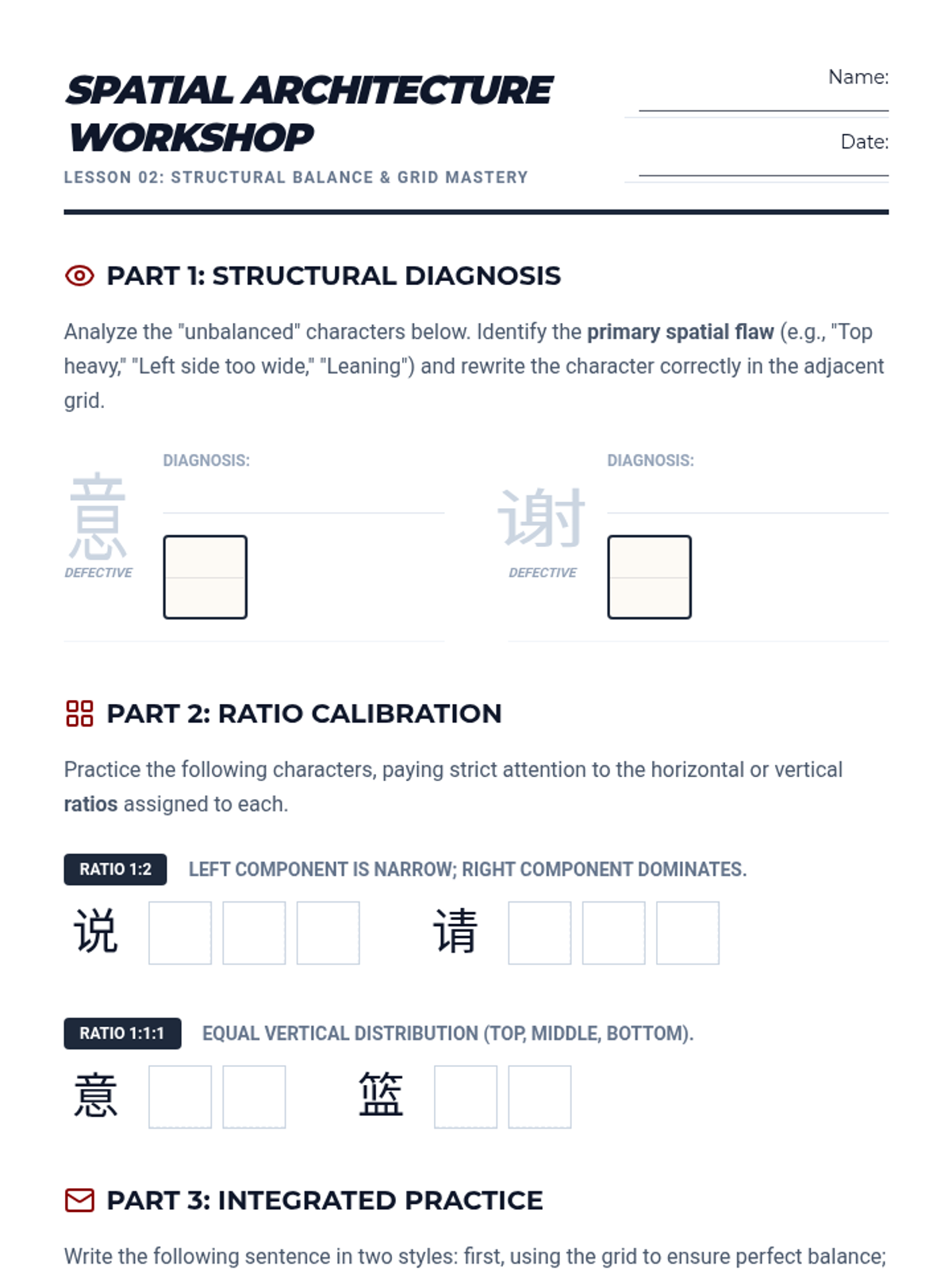
A worksheet for Lesson 2 focusing on analyzing structural flaws in character composition and practicing correct spatial ratios using grid guides.
A presentation deck for Lesson 2, analyzing the spatial ratios and structural balance required for professional-grade Mandarin handwriting.
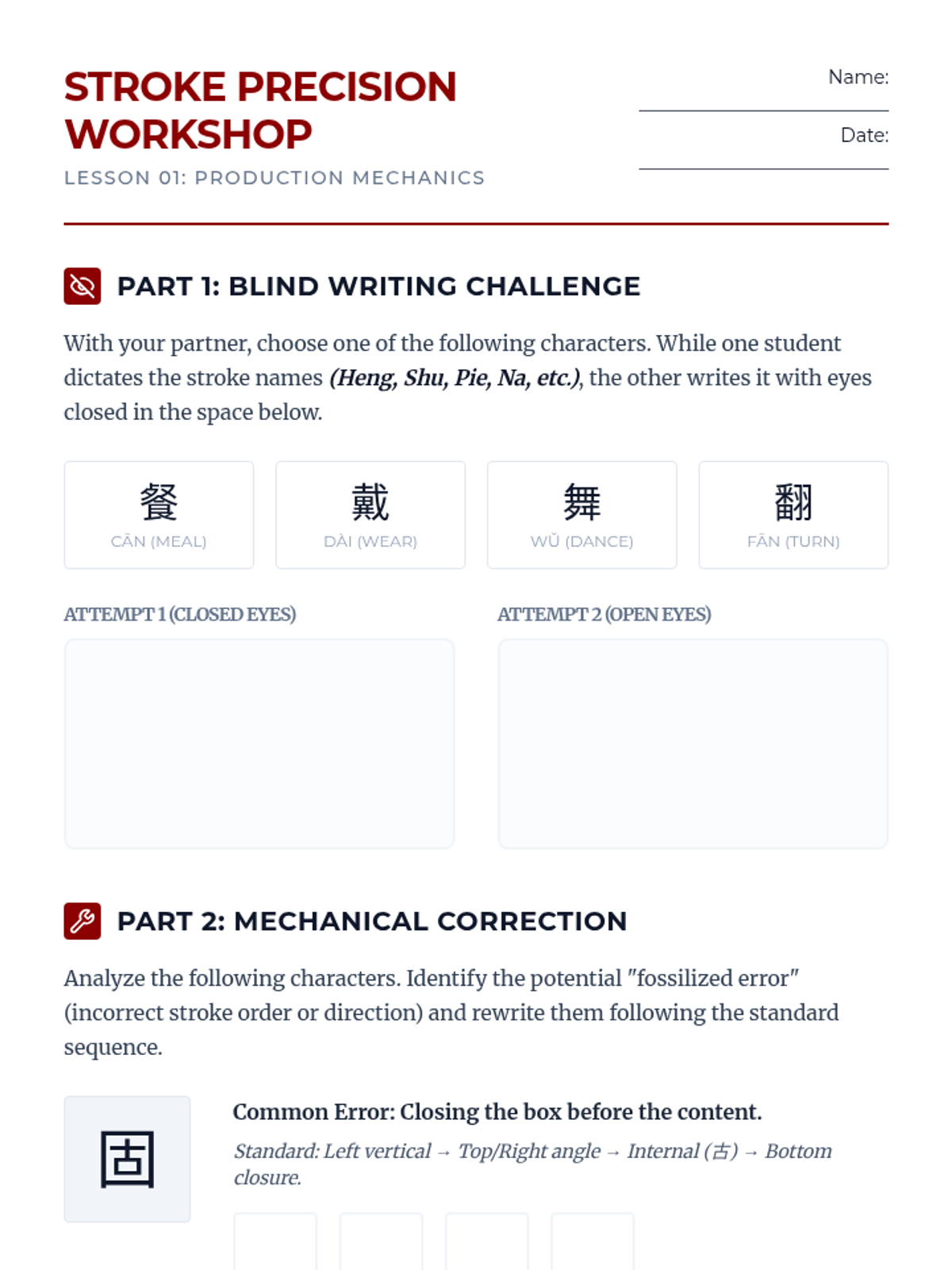
A workshop worksheet for students to practice stroke order precision, including a blind writing challenge and exercises to correct common mechanical errors.
A presentation deck for Lesson 1, focusing on the kinetic logic of stroke order and correcting common intermediate-level errors in character production.
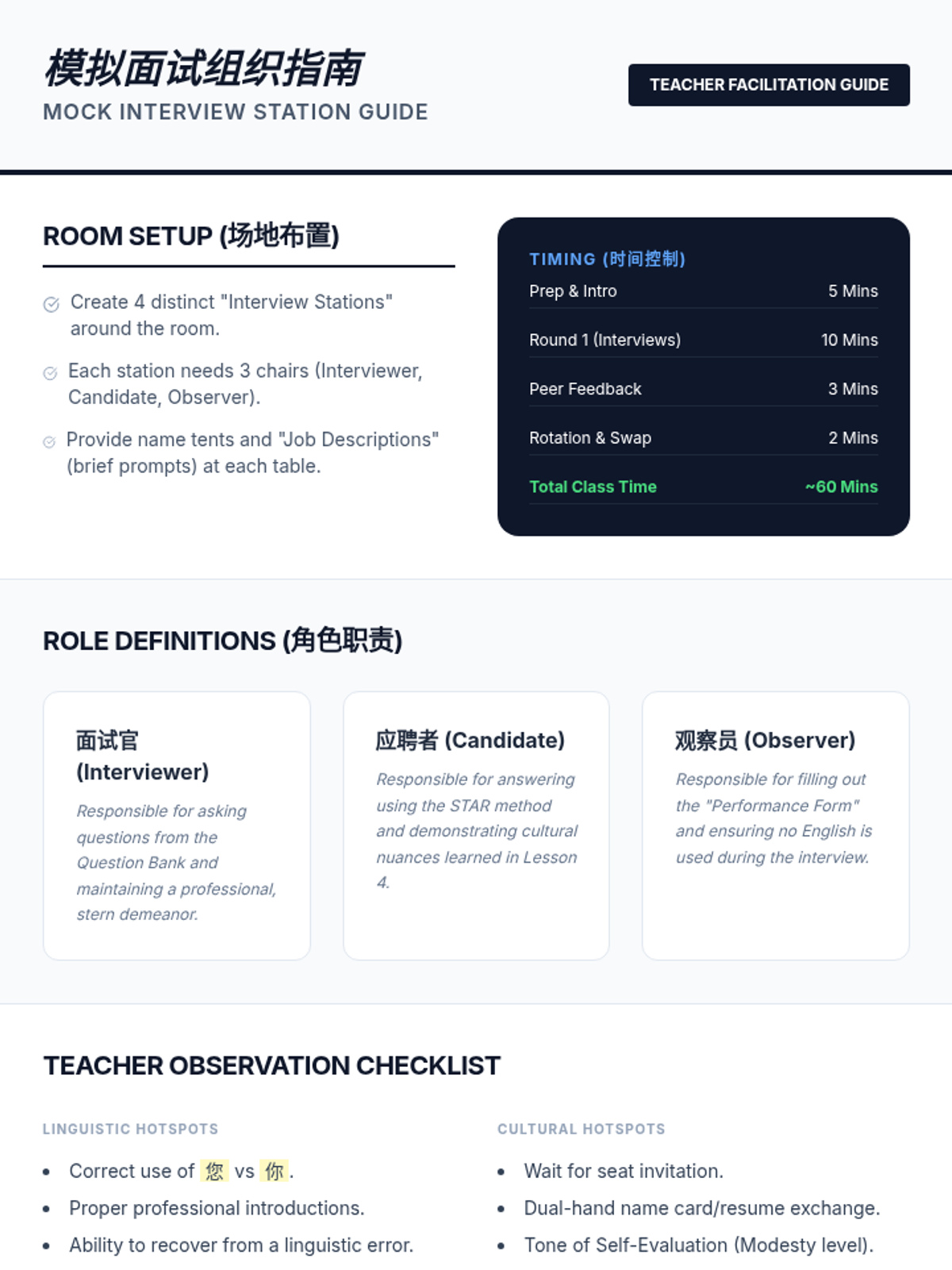
A facilitation guide for teachers to set up and manage the cumulative mock interview circuit, including logistics, role definitions, and observation prompts.
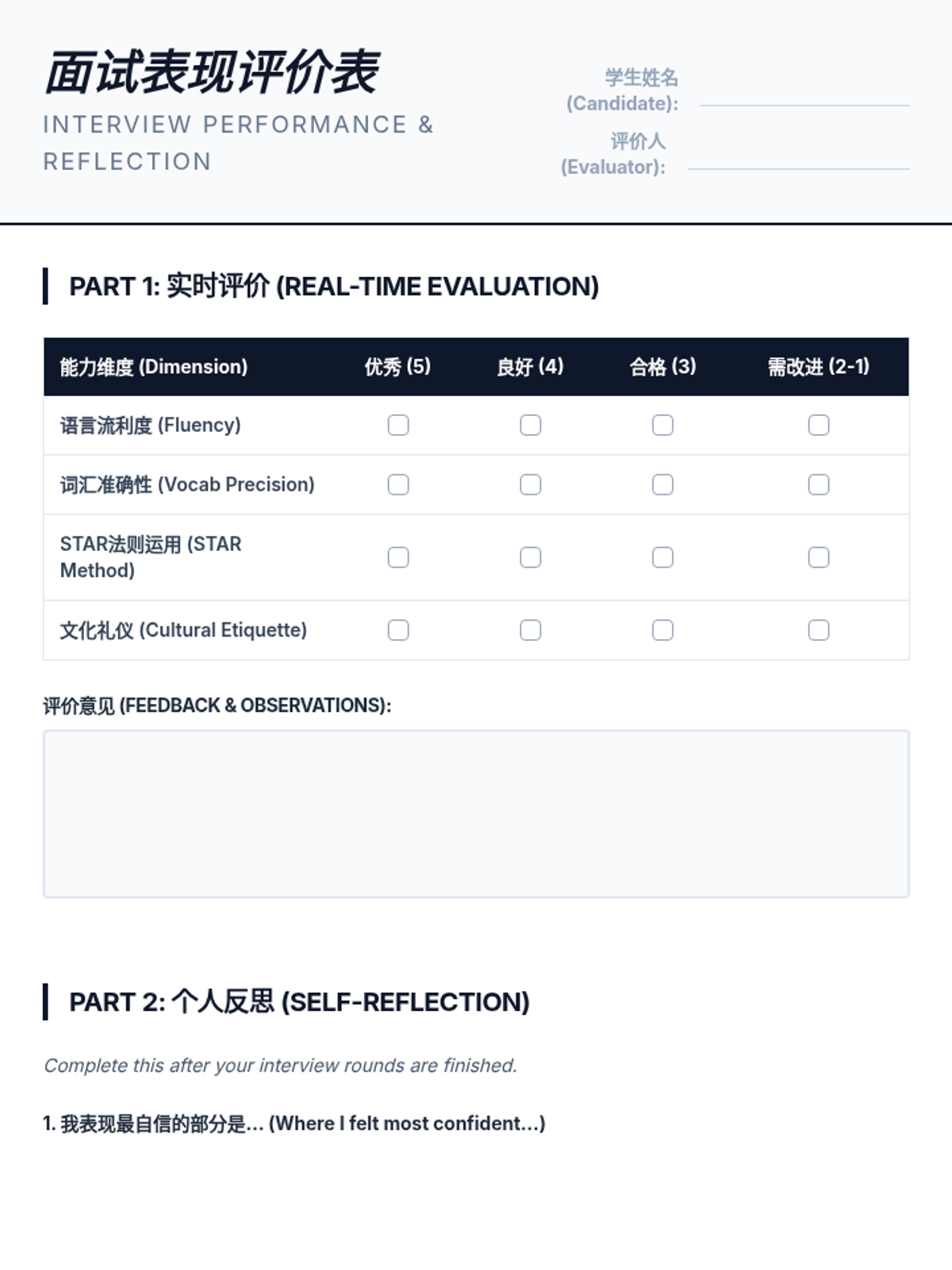
A comprehensive performance rubric and reflection worksheet for students to evaluate their mock interview performance and identify areas for future growth.
A slide deck for the final cumulative mock interview simulation, covering station logistics, professional etiquette checklists, and motivating final tips.
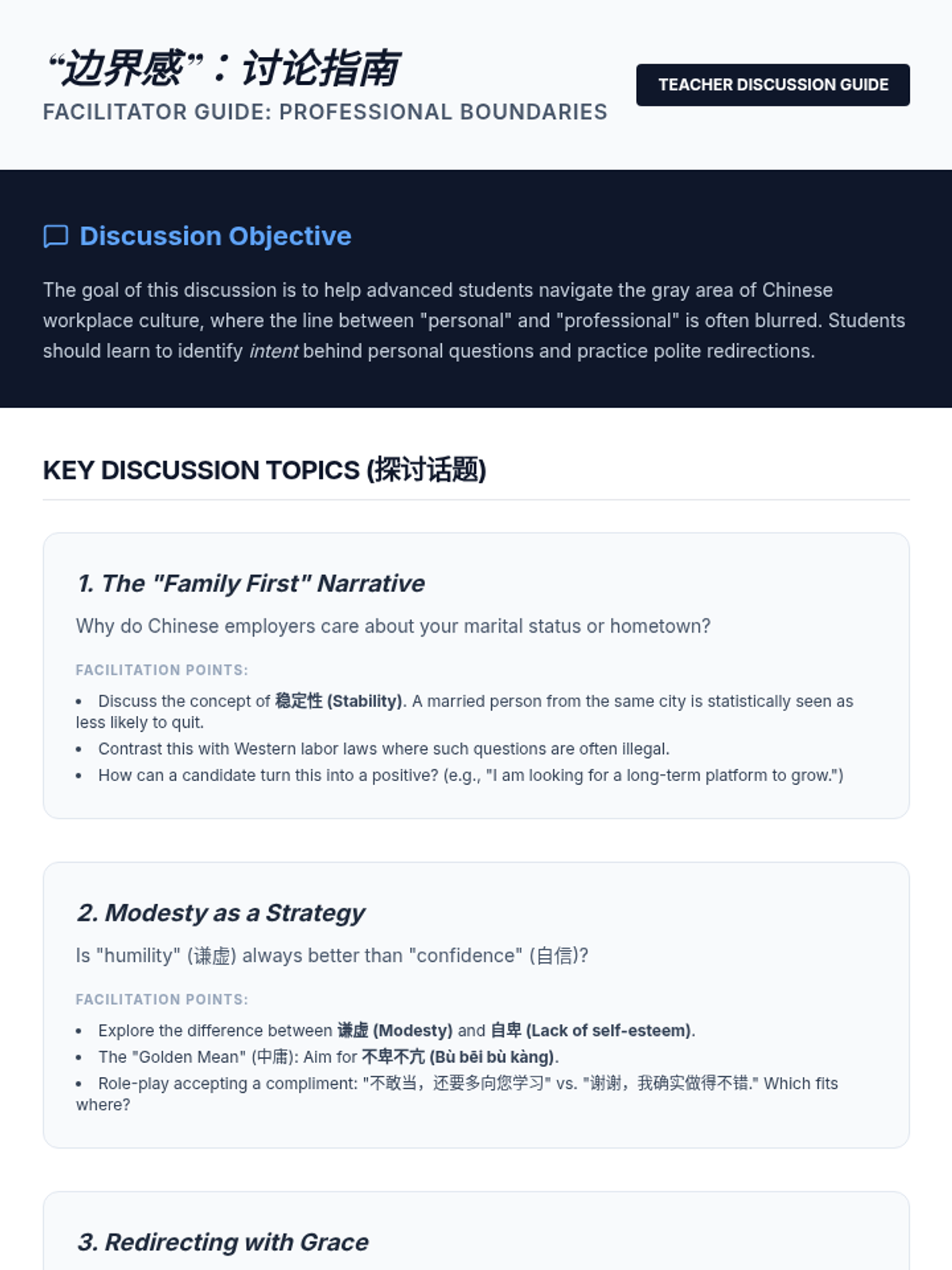
A facilitation guide for teachers to lead discussions on professional boundaries and cultural expectations during Chinese interviews.
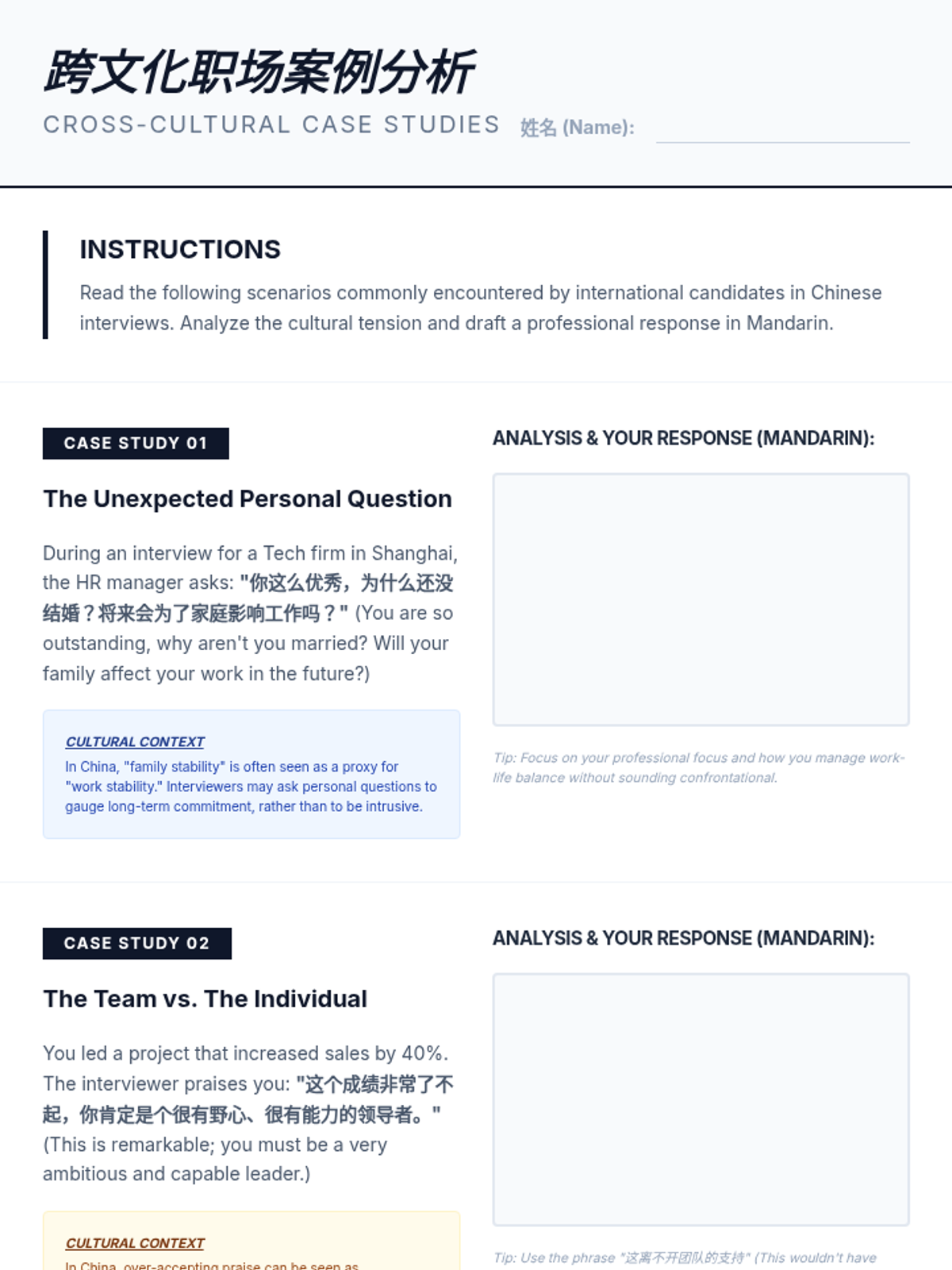
A case-study-based worksheet for students to analyze and respond to culturally complex interview scenarios in a Chinese professional context.
A slide deck exploring the cultural nuances of Chinese professional interactions, including handling personal questions and navigating the balance between modesty and self-promotion.
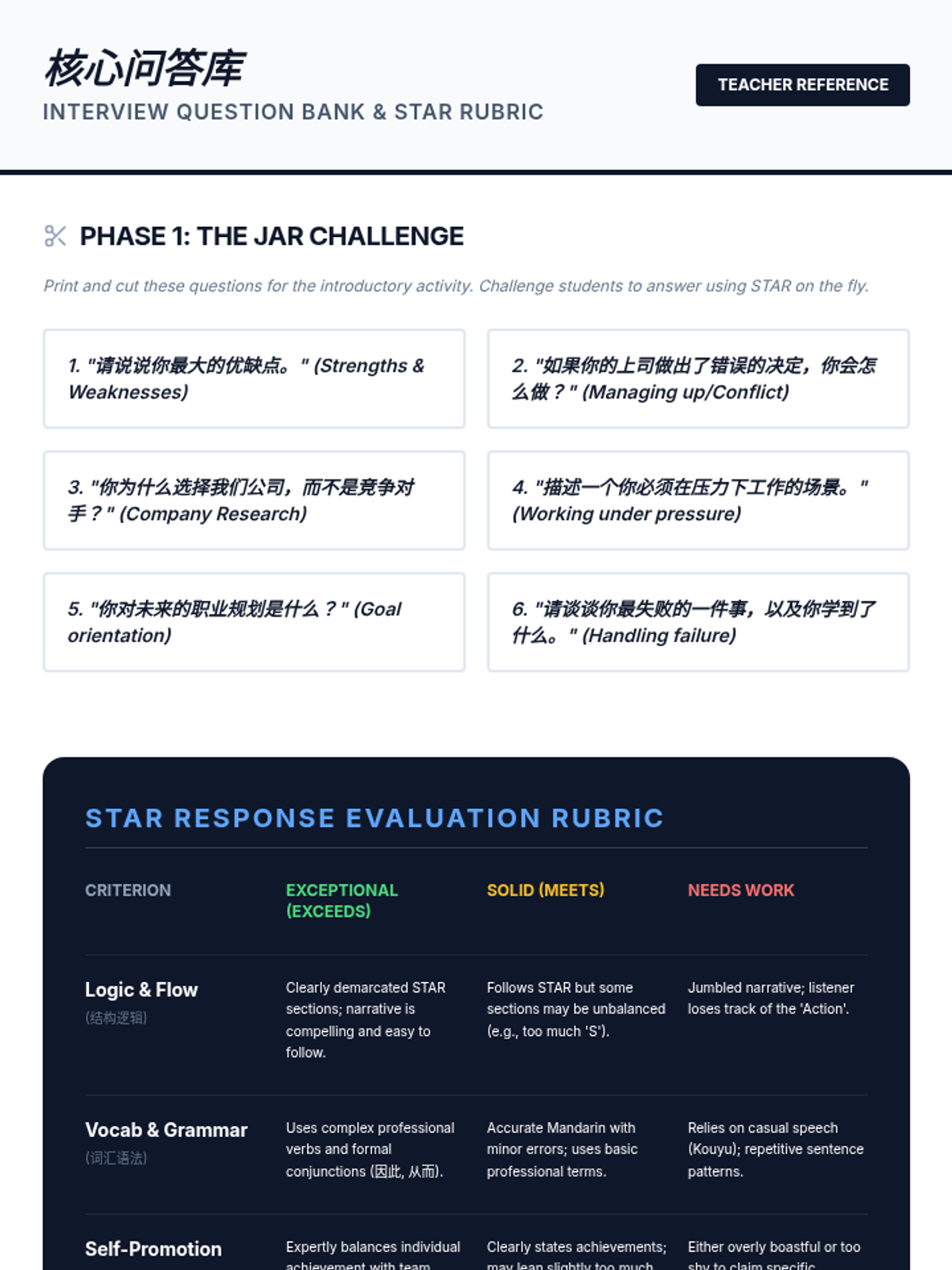
A comprehensive teacher resource containing a question bank for mock interview practice and a STAR method evaluation rubric for assessing student responses.
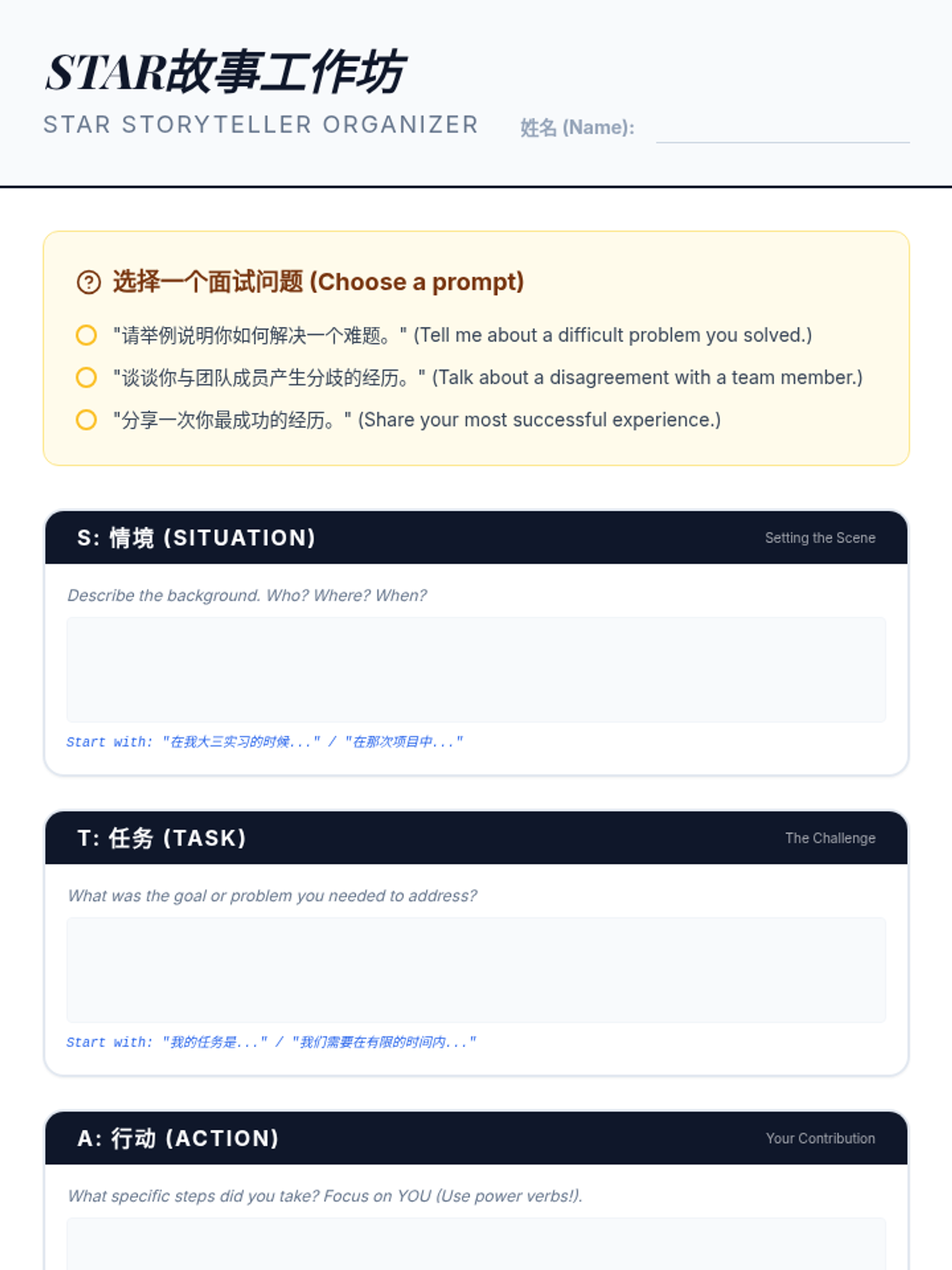
A graphic organizer for students to structure their behavioral interview answers using the STAR method in Mandarin, with sentence starters and vocabulary support.
A slide deck introducing the STAR method for answering behavioral interview questions in Mandarin, with specific strategies for handling difficult questions like personal weaknesses.
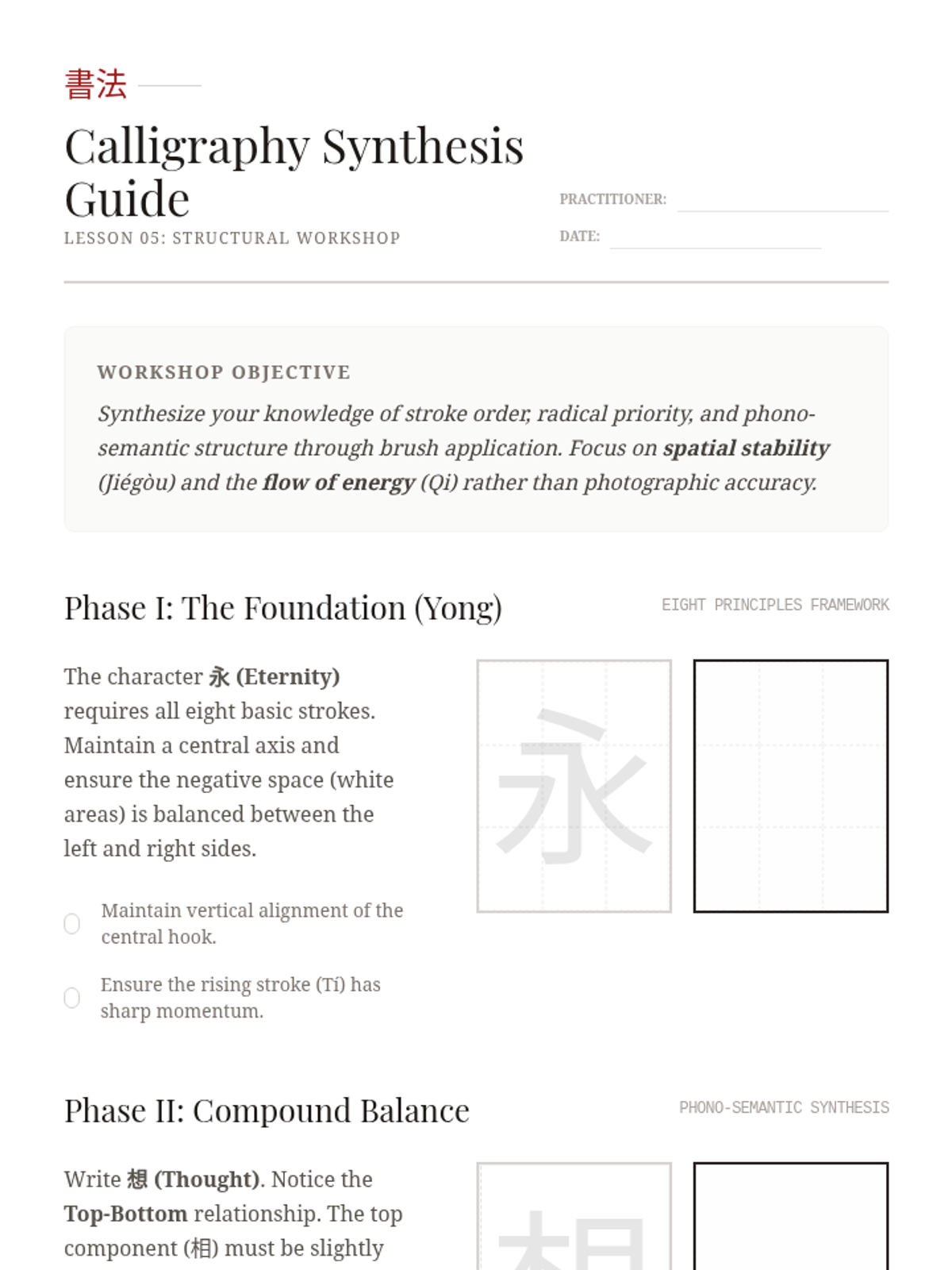
A culminating workshop guide for students to apply theoretical knowledge of structure, balance, and 'qi' through brush calligraphy practice and spatial analysis.
A sophisticated slide deck for graduate students exploring the aesthetic principles of calligraphy, including 'qi', structural balance, and spatial relationships.
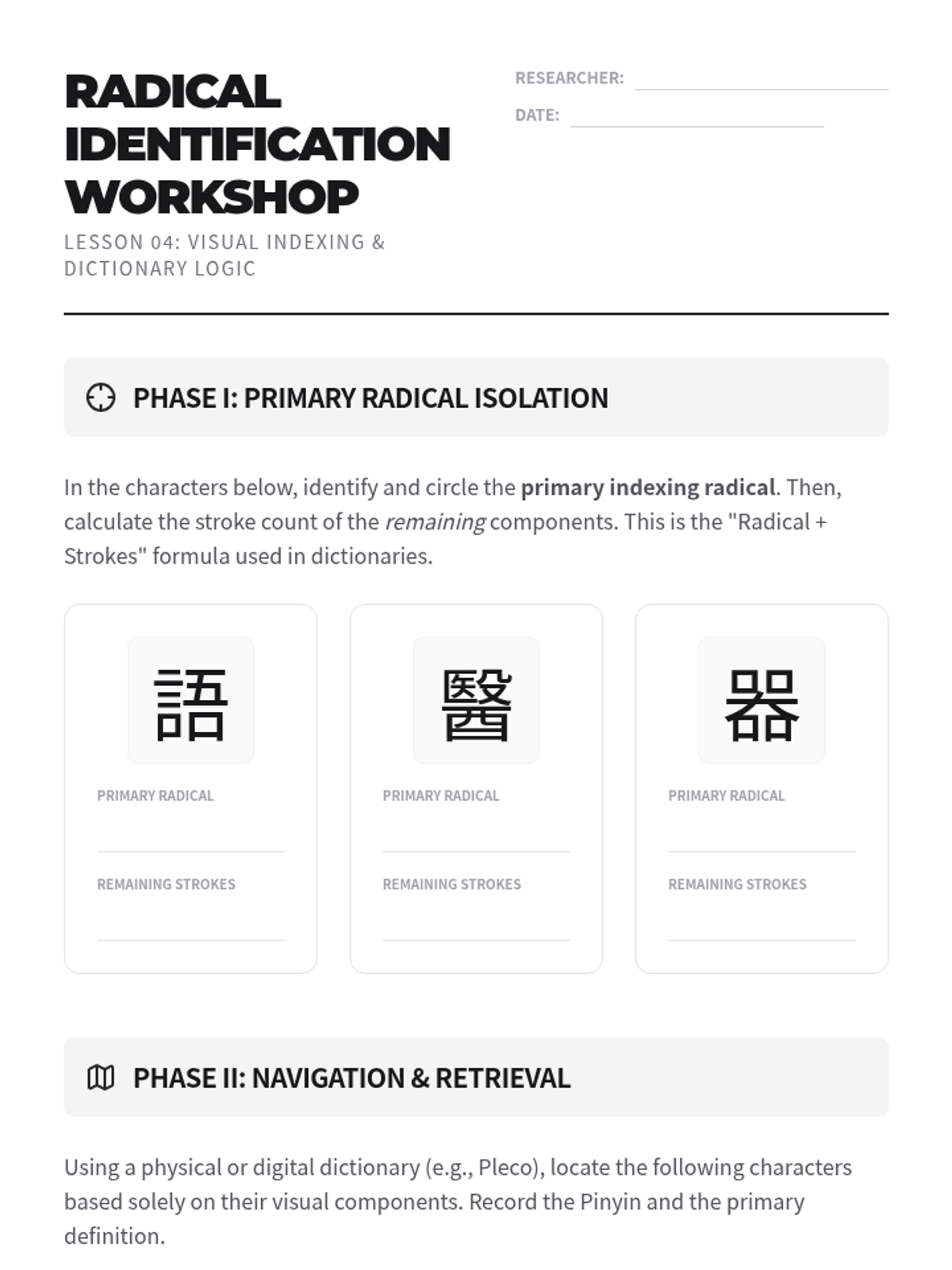
A workshop activity for graduate students to practice identifying radicals, calculating stroke counts, and navigating dictionaries to decode unfamiliar characters.
A technical slide deck for graduate students explaining the Kangxi radical system, the indexing logic of dictionaries, and strategies for identifying primary radicals.
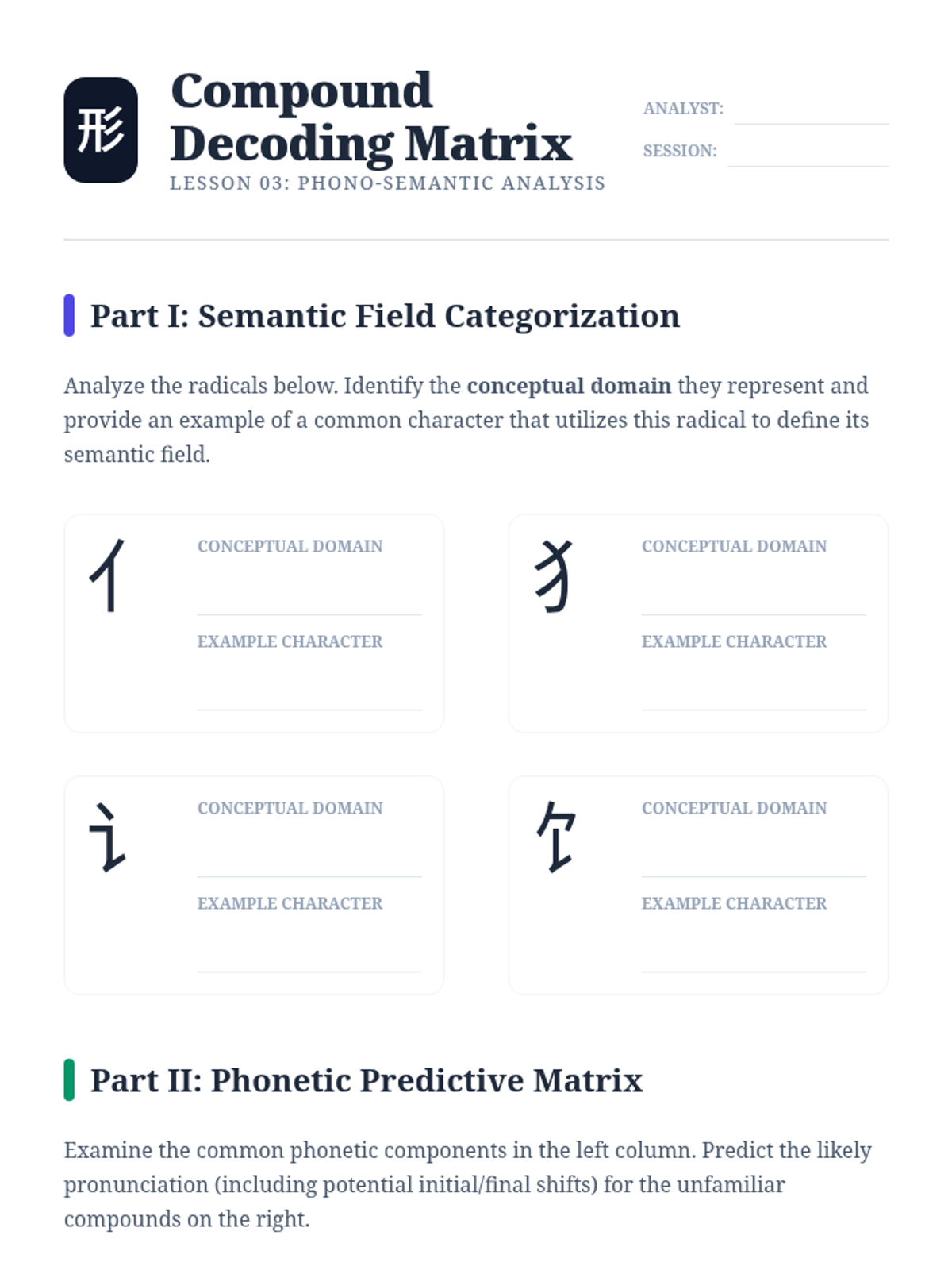
A technical matrix for graduate students to practice decoding phono-semantic compounds by identifying conceptual domains and phonetic anchors.
A technical slide deck for graduate students explaining the structural logic of phono-semantic compounds (Xíngshēng) through a linguistic and statistical lens.
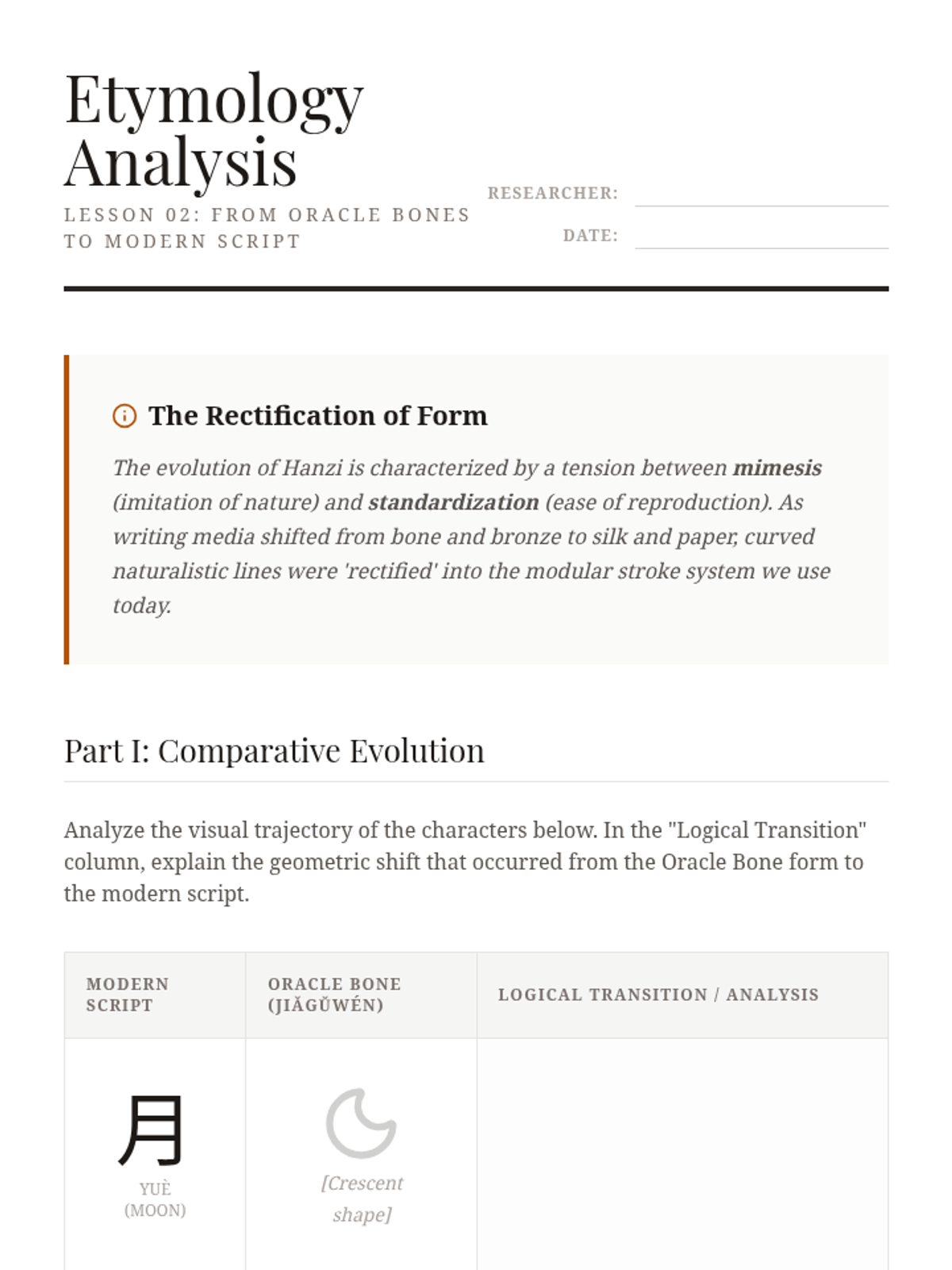
An etymology worksheet for graduate students analyzing the visual evolution and logical transition of Chinese characters from ancient pictographs to modern ideographs.
A visual presentation for graduate students exploring the etymology and evolution of Chinese pictographs and simple ideographs from oracle bones to modern script.
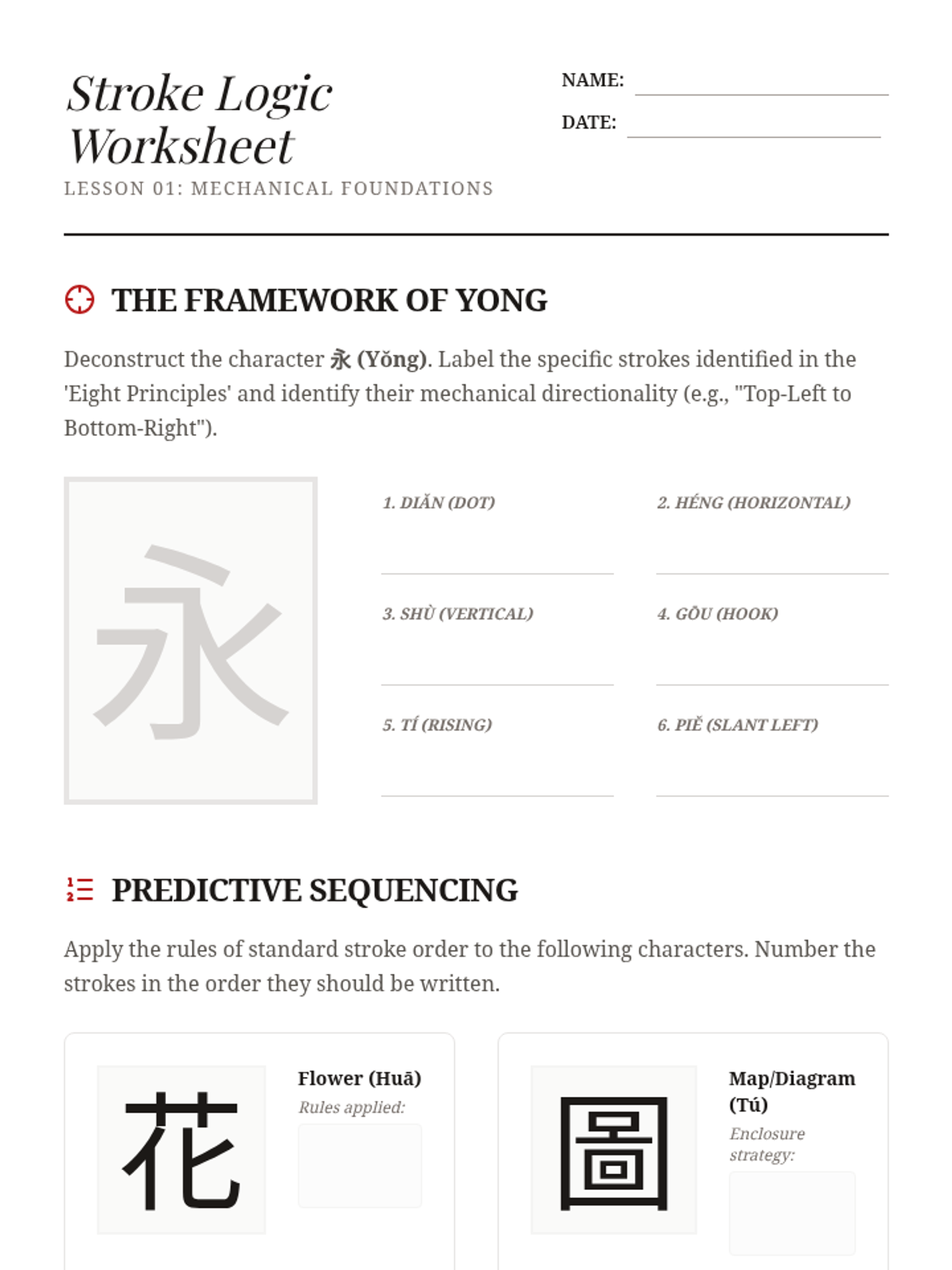
A technical worksheet for graduate students to practice and analyze stroke order rules, featuring predictive sequencing and mechanical analysis.
A sophisticated slide deck for graduate students deconstructing the 'Eight Principles of Yong' and standard stroke order rules through a mechanical and logical lens.
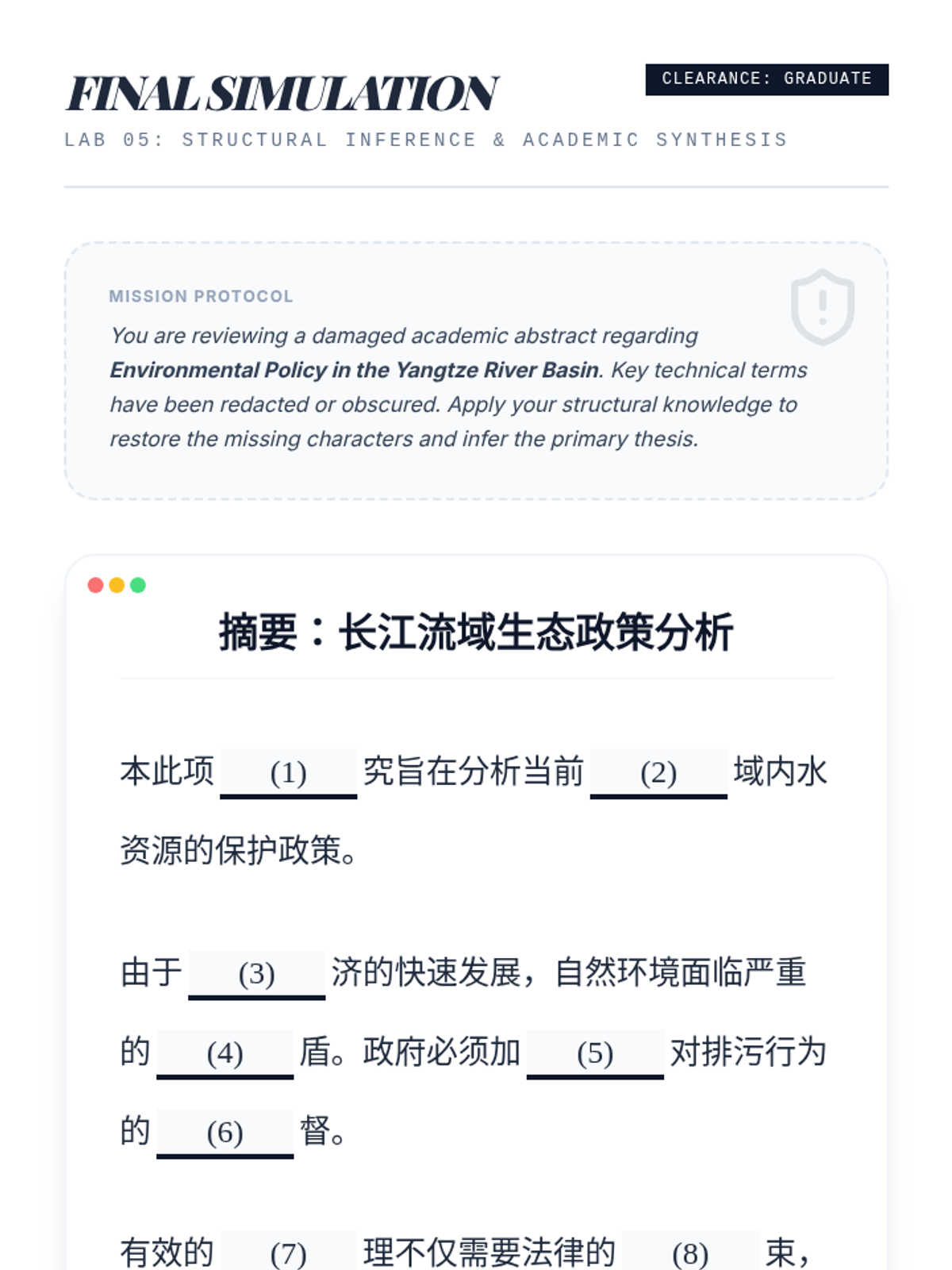
A culminating student assessment requiring the restoration of a redacted academic abstract using structural character decoding and morphological inference.
A slide deck focusing on strategies for contextual decoding and inference when encountering unfamiliar Mandarin characters in academic texts.
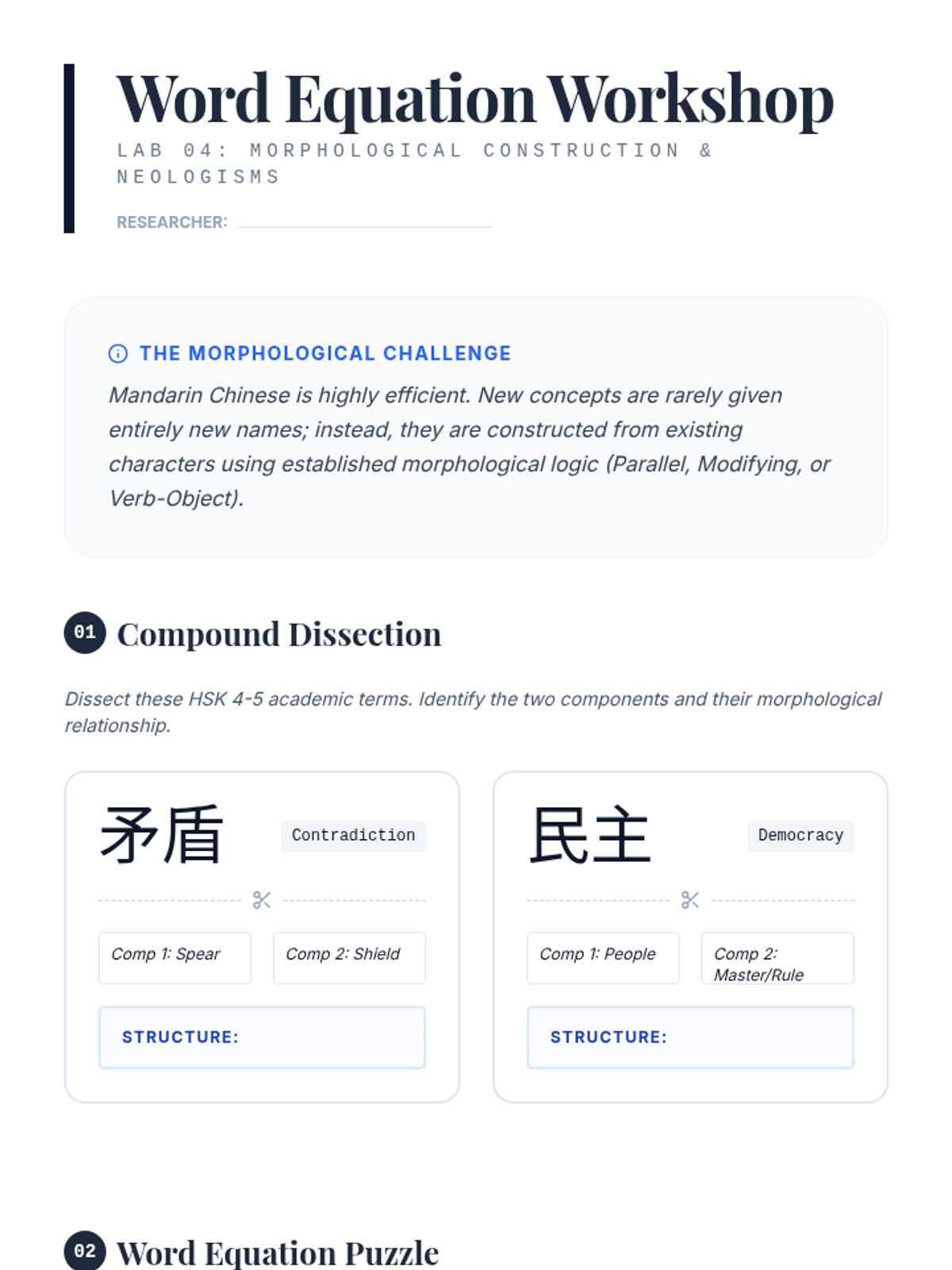
A student worksheet for analyzing the morphology of Mandarin compounds and constructing neologisms using established structural logic.
A slide deck focusing on the morphological structure of two-character Mandarin compounds, categorized by their internal semantic and syntactic logic.
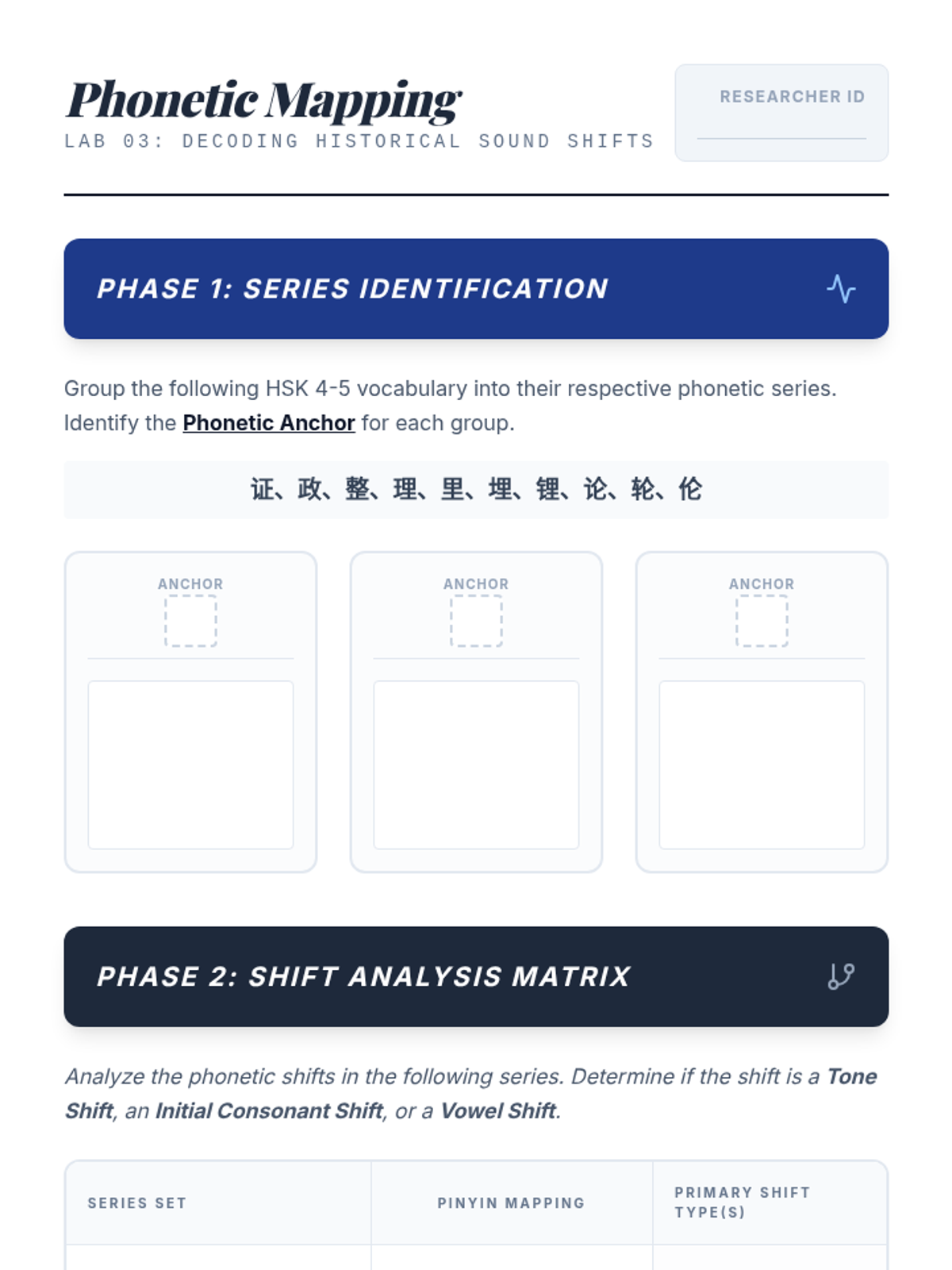
A student worksheet for mapping phonetic series and analyzing systematic sound shifts in Mandarin characters.
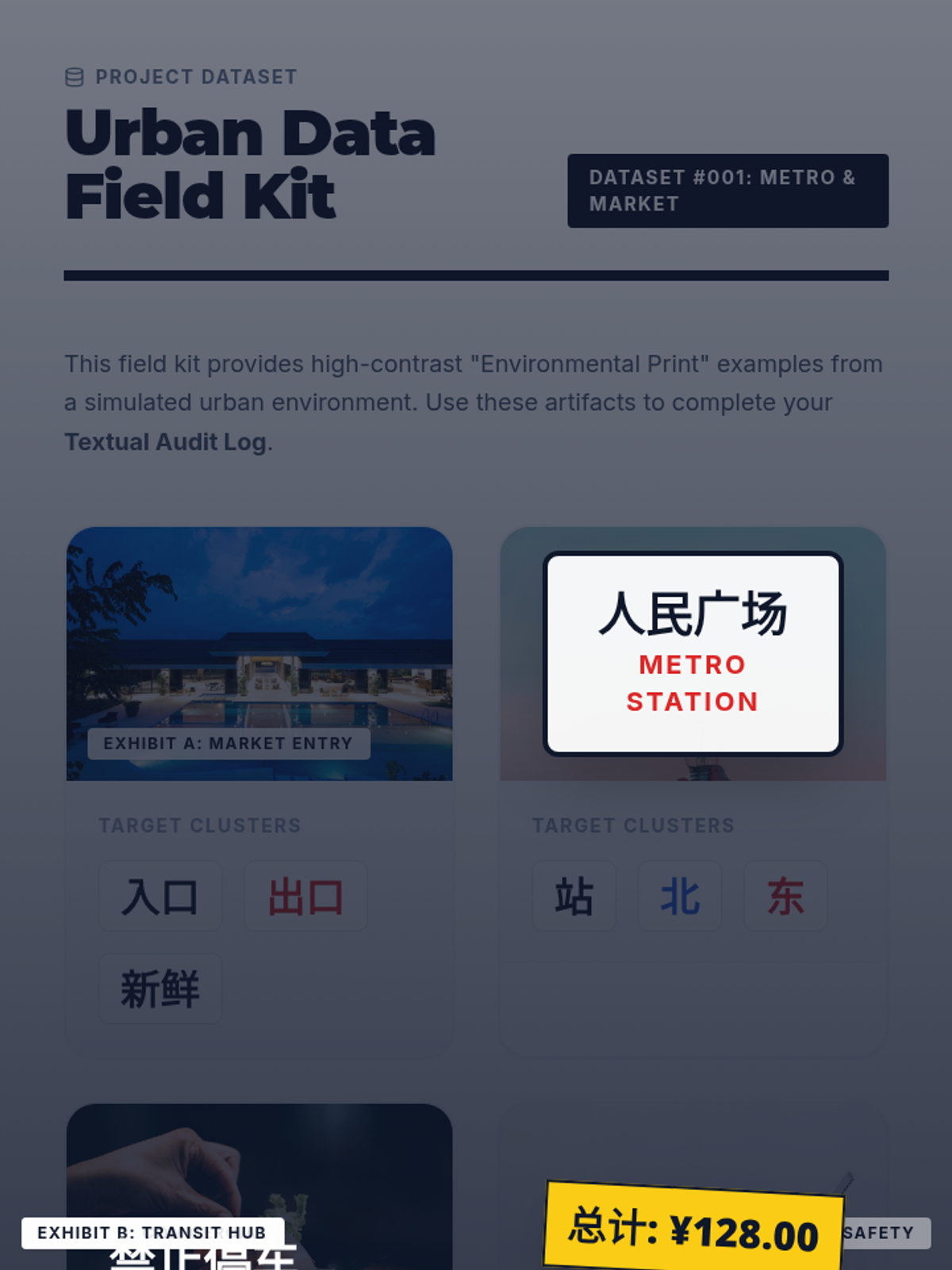
A visual field kit for the final project, featuring curated images and target character clusters for environmental text analysis.
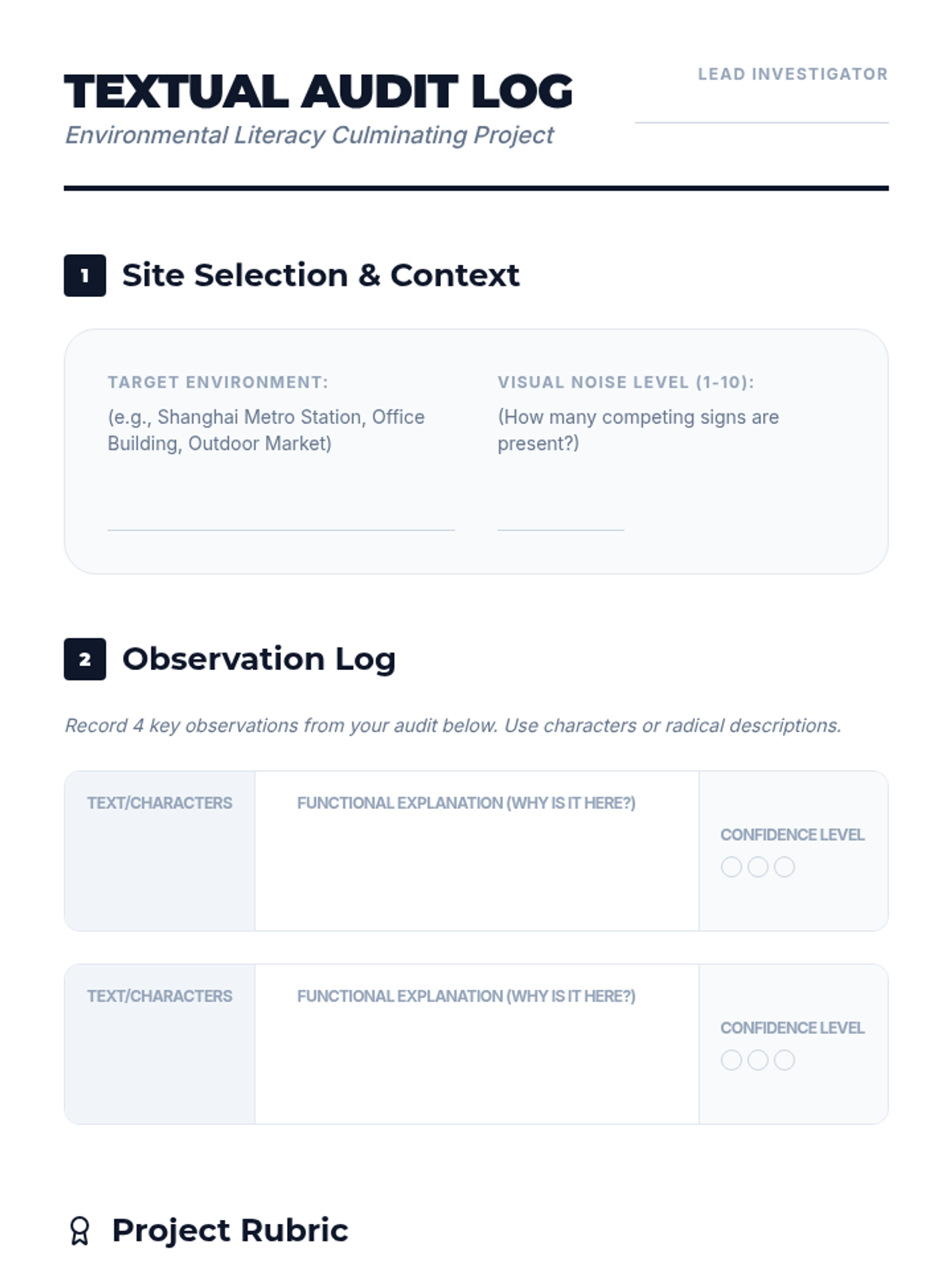
A student organizer and rubric for the final Environmental Text Audit project, including an observation log and grading criteria.
A slide deck introducing the final "Environment Audit" project, including the audit protocol, case study analysis, and project goals for graduate students.
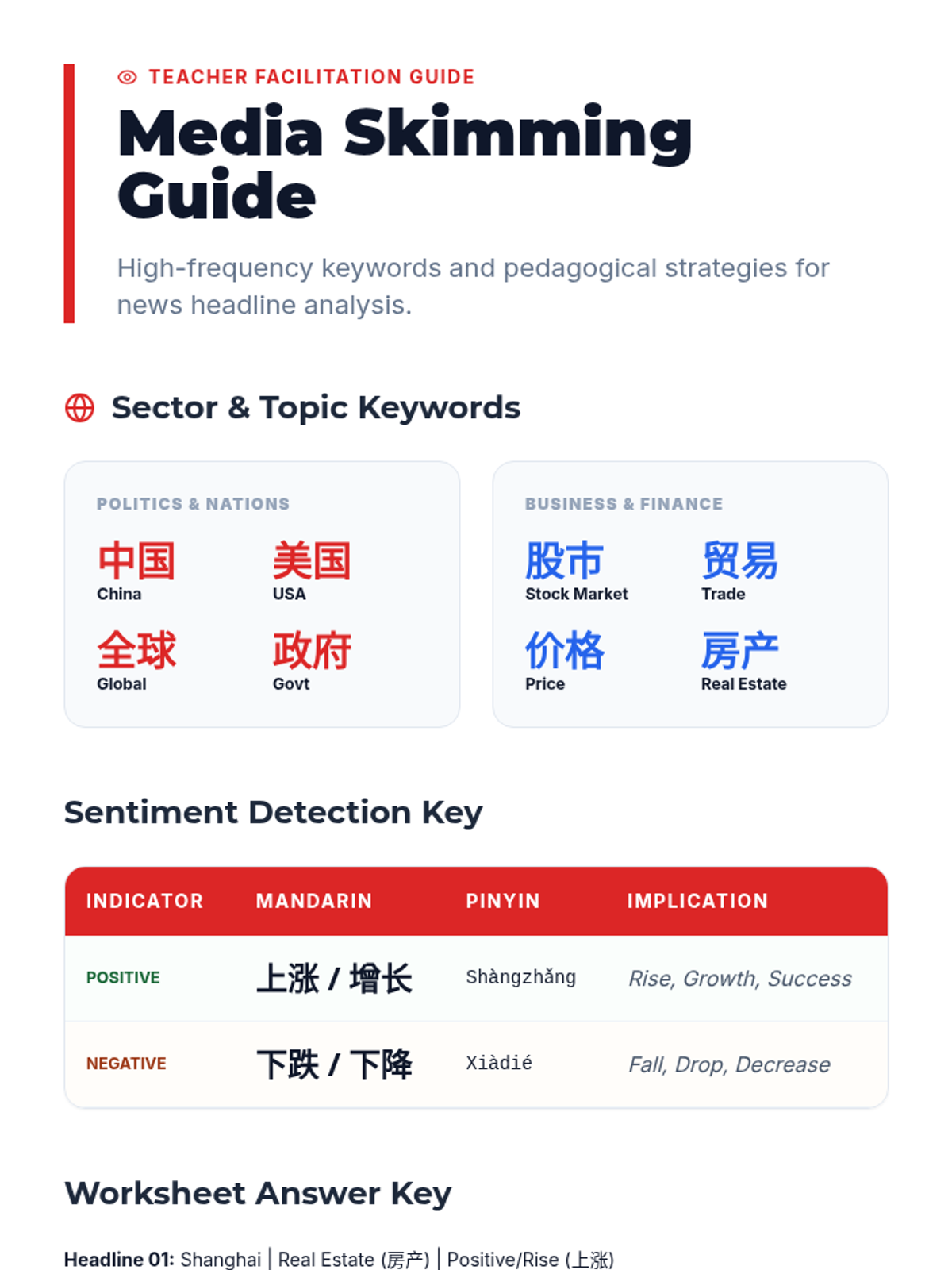
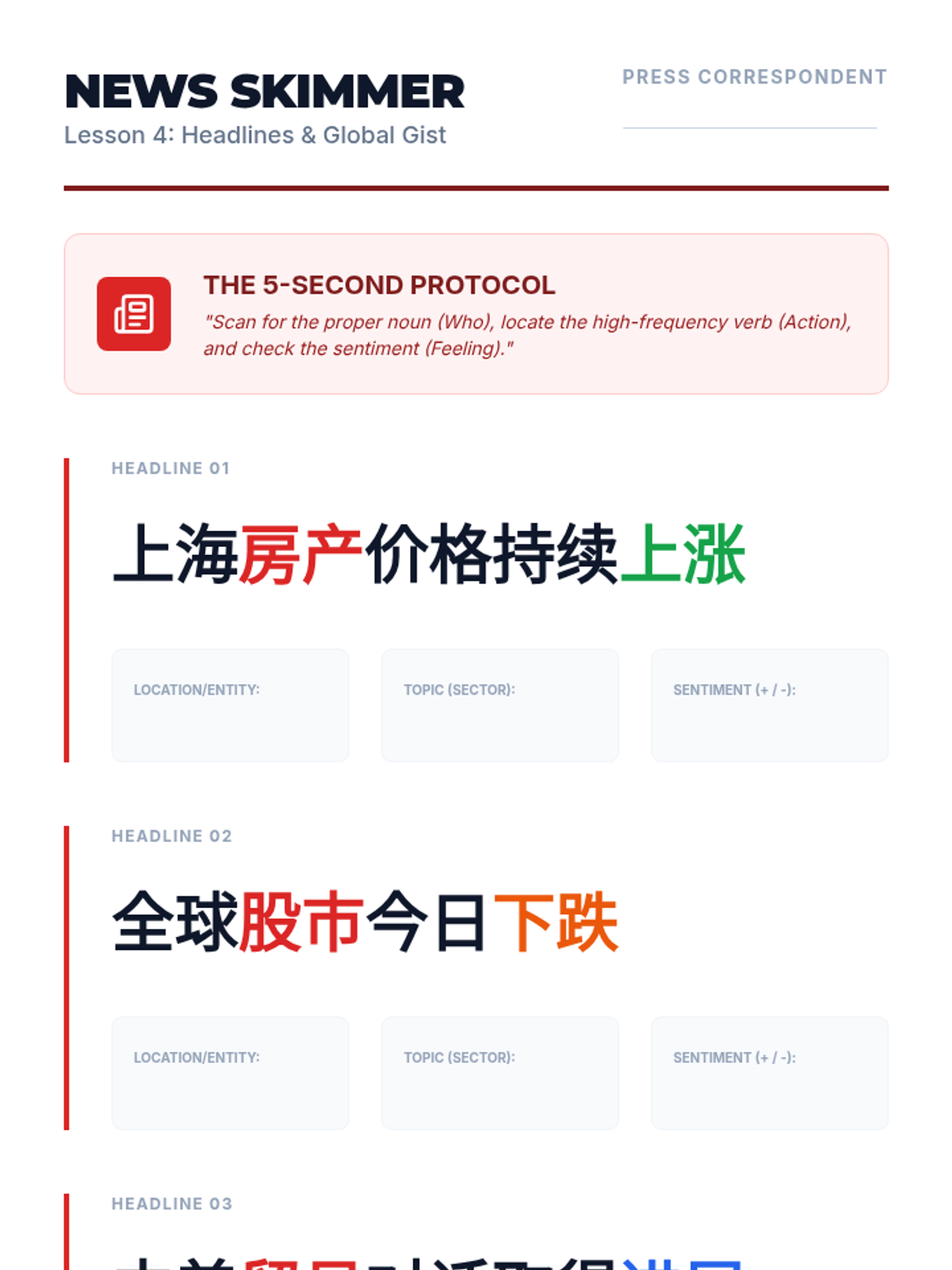
A teacher resource for Lesson 4, providing high-frequency keywords for news headlines and the answer key for the News Skimmer worksheet.
A student worksheet for practicing headline skimming techniques, identifying location, topic, and sentiment in authentic Mandarin news titles.
A slide deck focusing on skimming news headlines, identifying topic keywords (China, Economy, Tech), and detecting sentiment (Growth vs Decline).
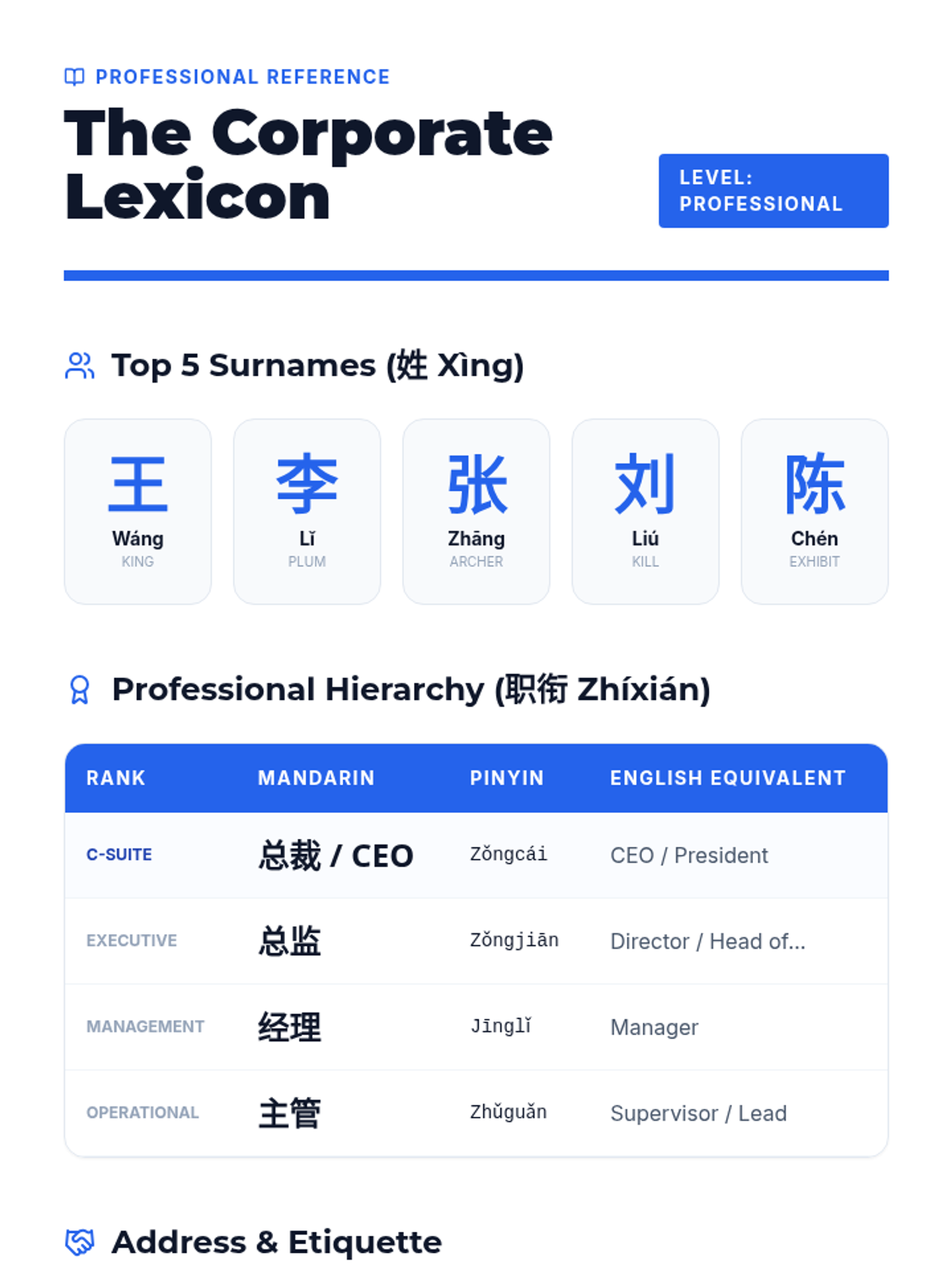
A professional reference sheet for Mandarin names and titles, featuring top surnames, professional hierarchy, and etiquette rules for formal address.
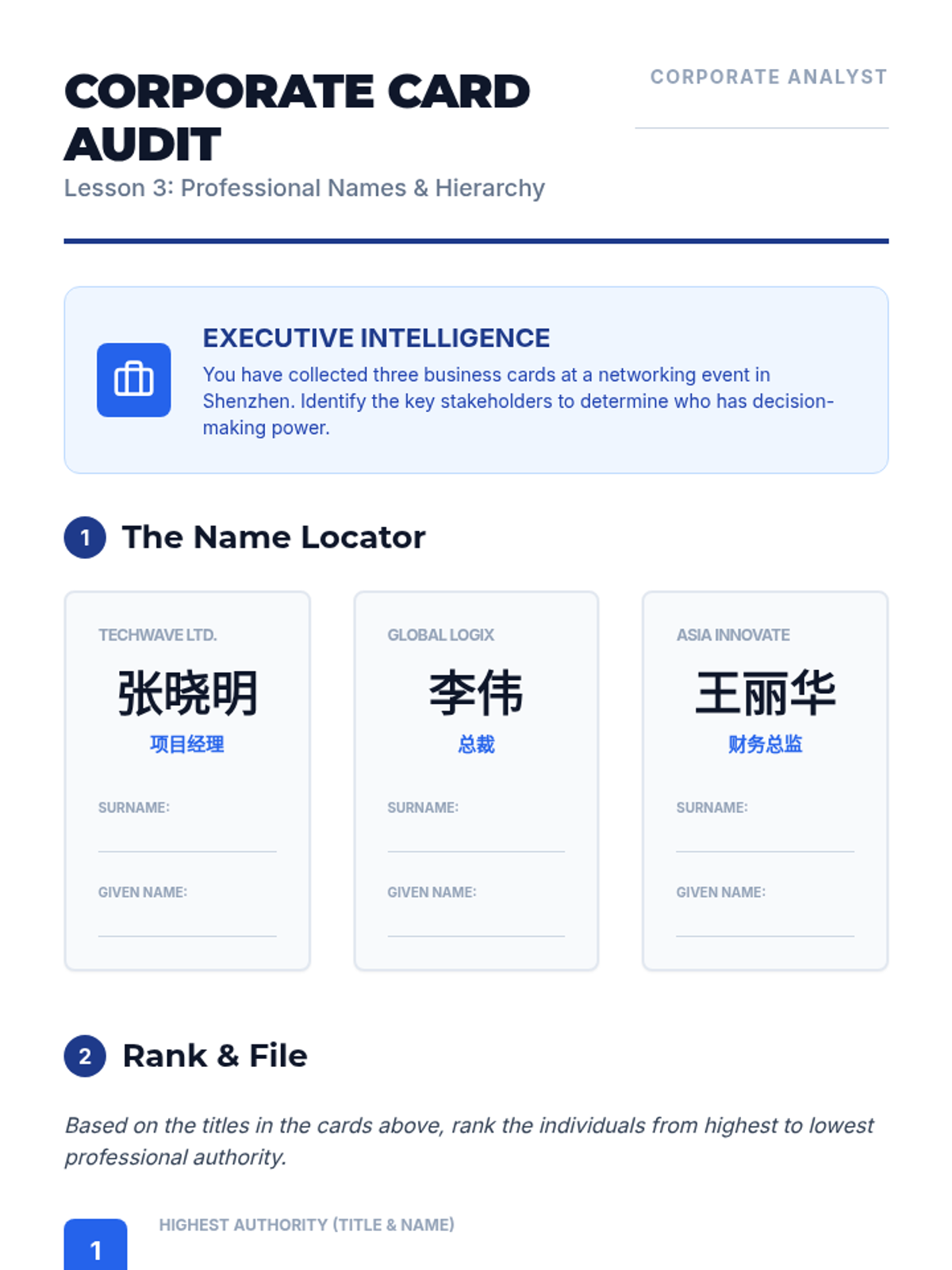
A student worksheet for analyzing Mandarin business cards, focusing on identifying surnames, given names, and professional rank.
A slide deck focusing on Chinese name structure (Surname first), professional title hierarchy, and key characters for identifying executive roles.
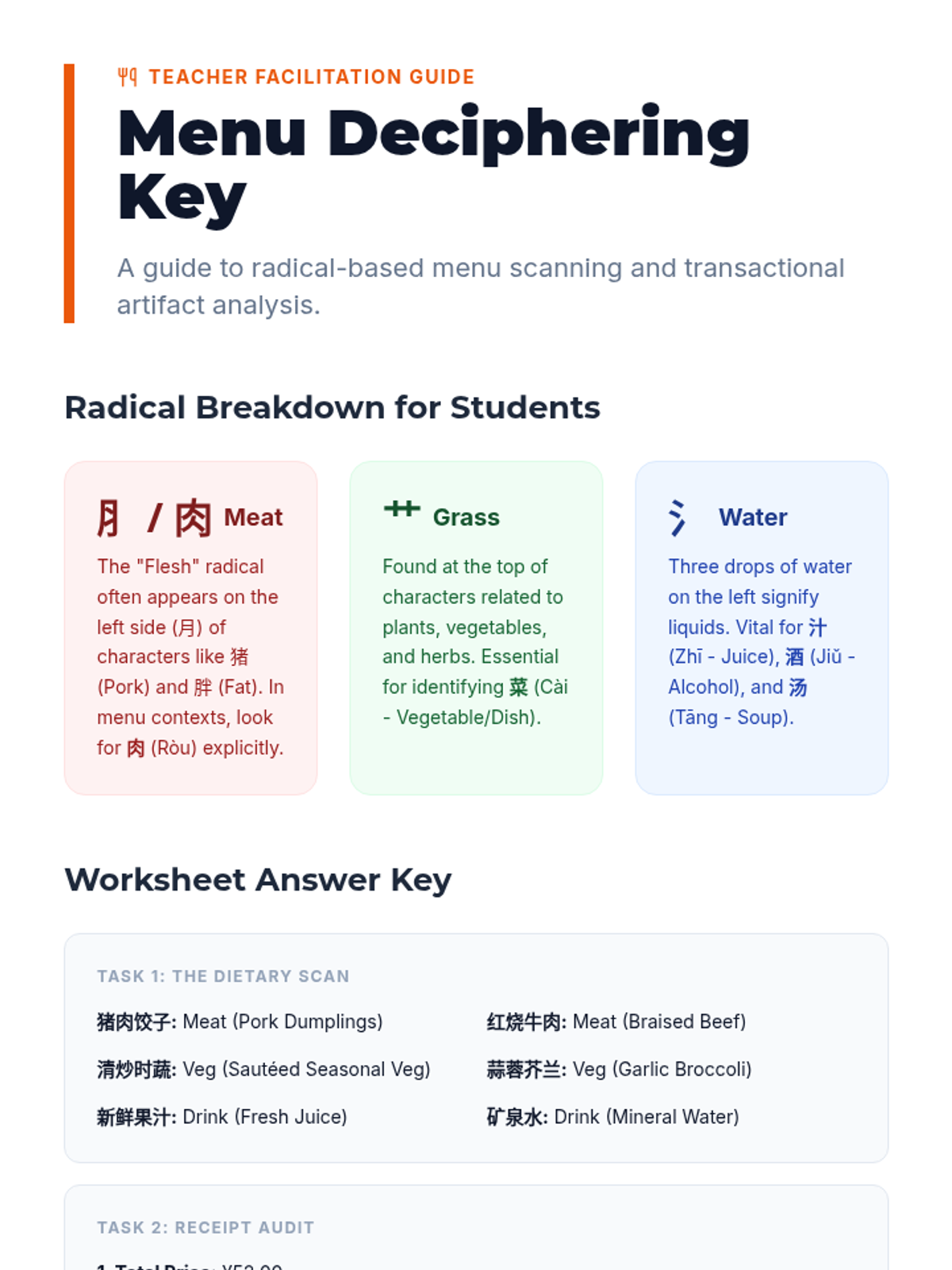
A teacher resource for Lesson 2, providing the radical breakdown for dietary choices and the answer key for the Transactional Tracker worksheet.
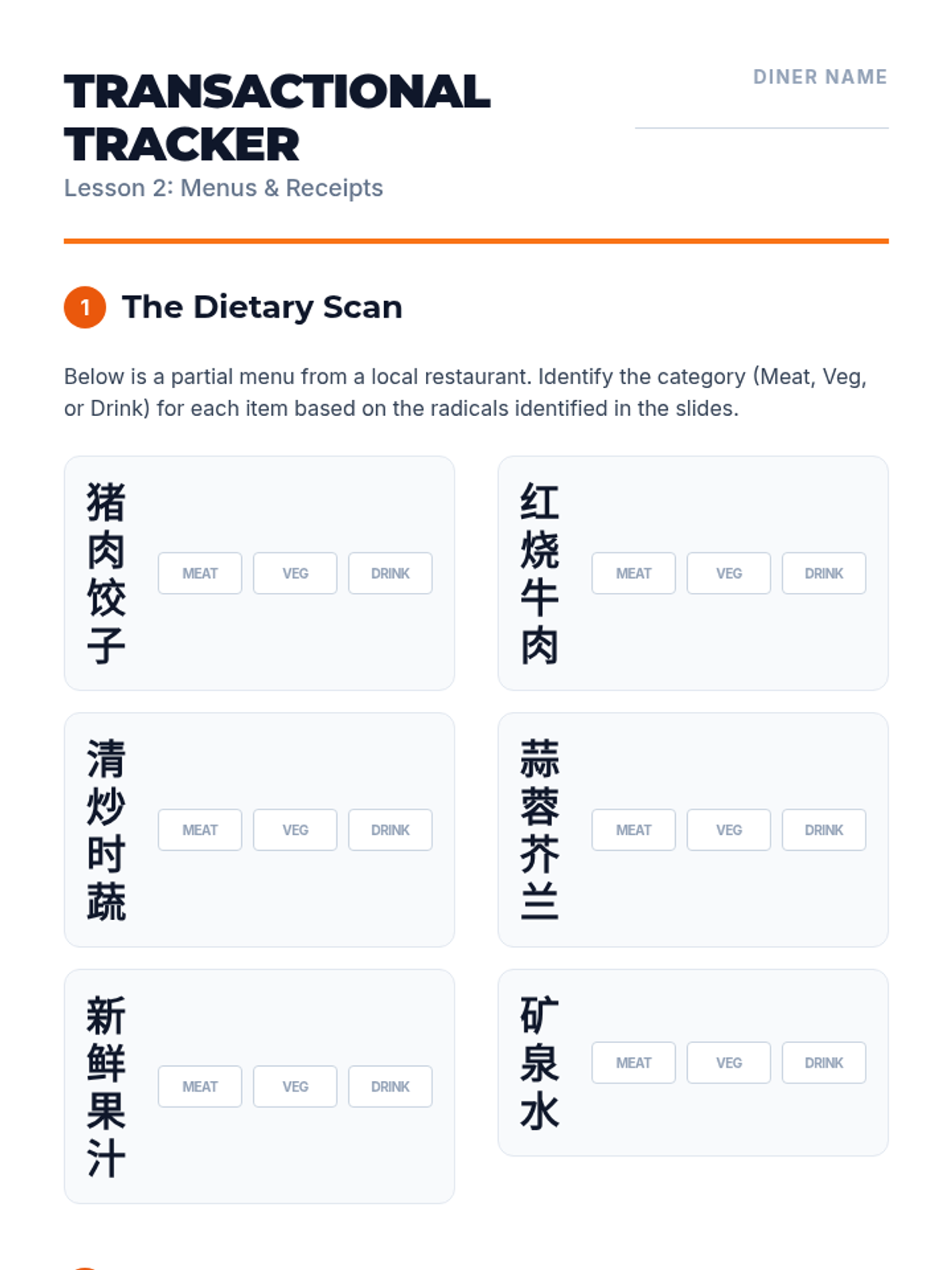
A student worksheet for analyzing Mandarin menus and receipts, focusing on radical recognition for dietary needs and transaction decoding.
A slide deck focusing on menu radical recognition (meat, veg, liquid), receipt structure, and transactional vocabulary for navigating dining experiences.
Visual slides exploring the differences between traditional Chengyu and modern internet slang, focusing on register adjustment for intermediate Mandarin learners.
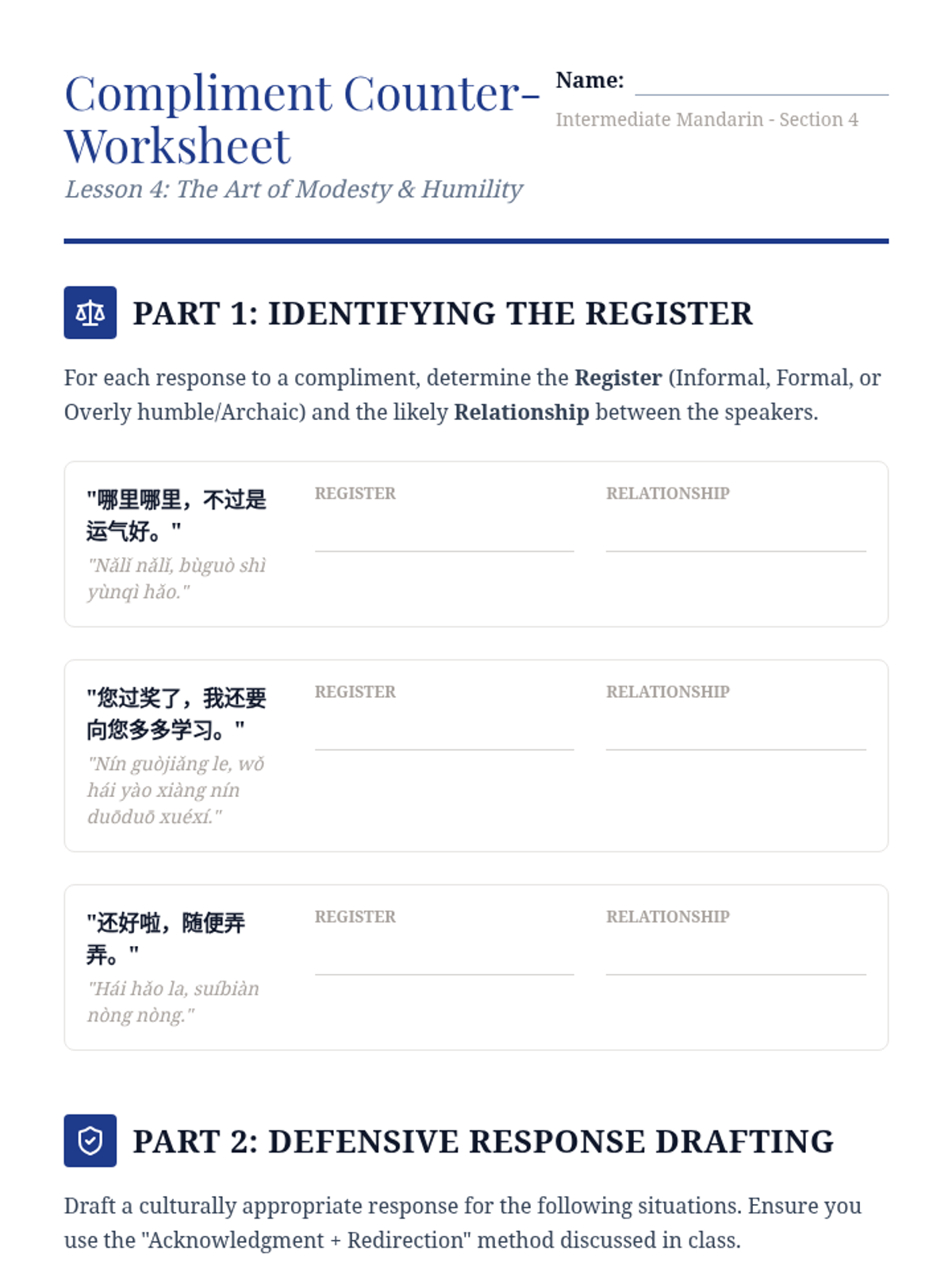
A student worksheet for practicing the cultural norm of deflecting compliments. Includes register analysis and situational drafting exercises.
Visual slides exploring the cultural differences in receiving compliments and expressing humility in Chinese culture vs. Western norms. Includes key phrases and situational analysis.
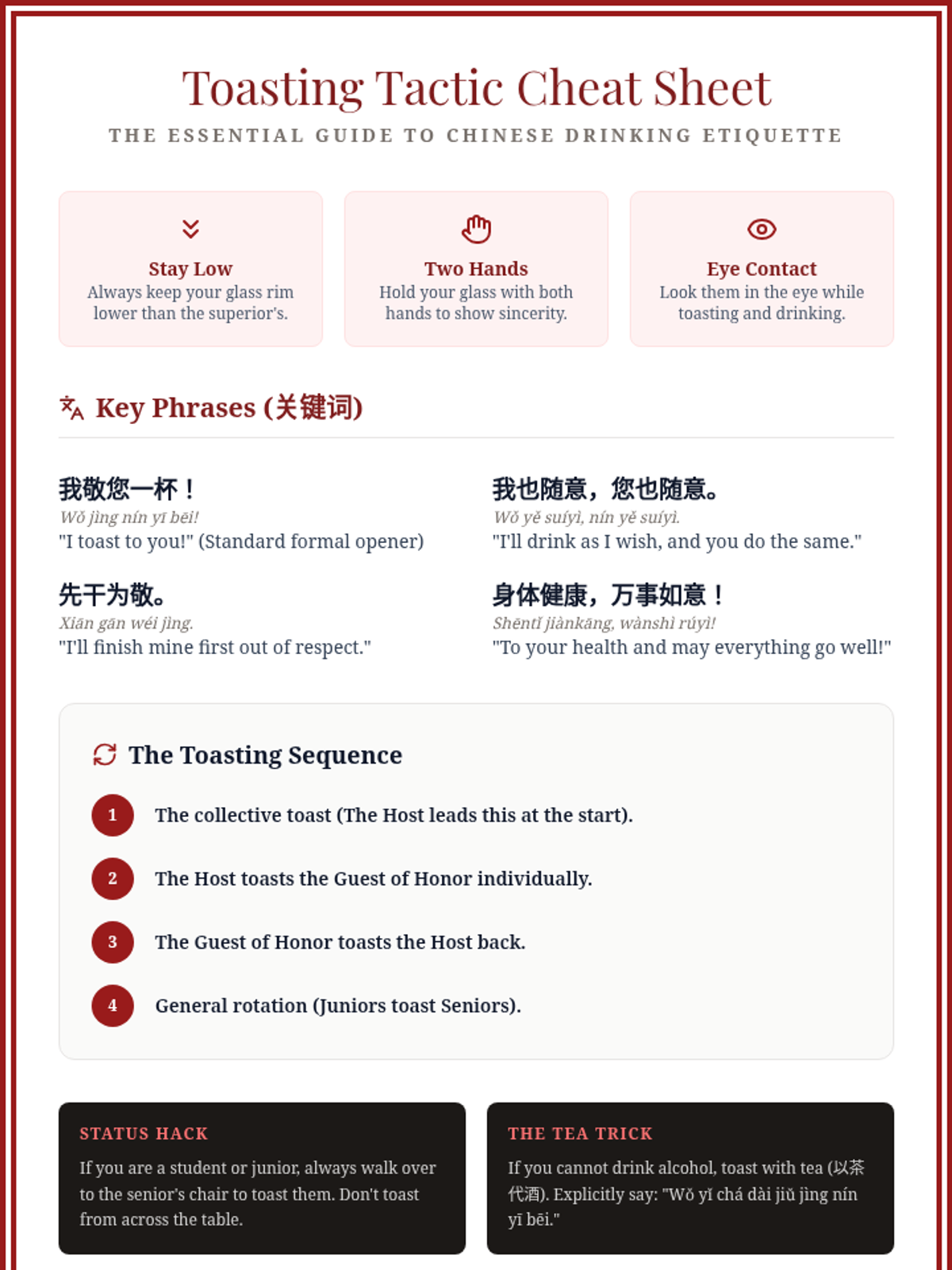
A handy reference guide for students covering the essential etiquette, phrases, and rituals of Chinese banquet toasting.
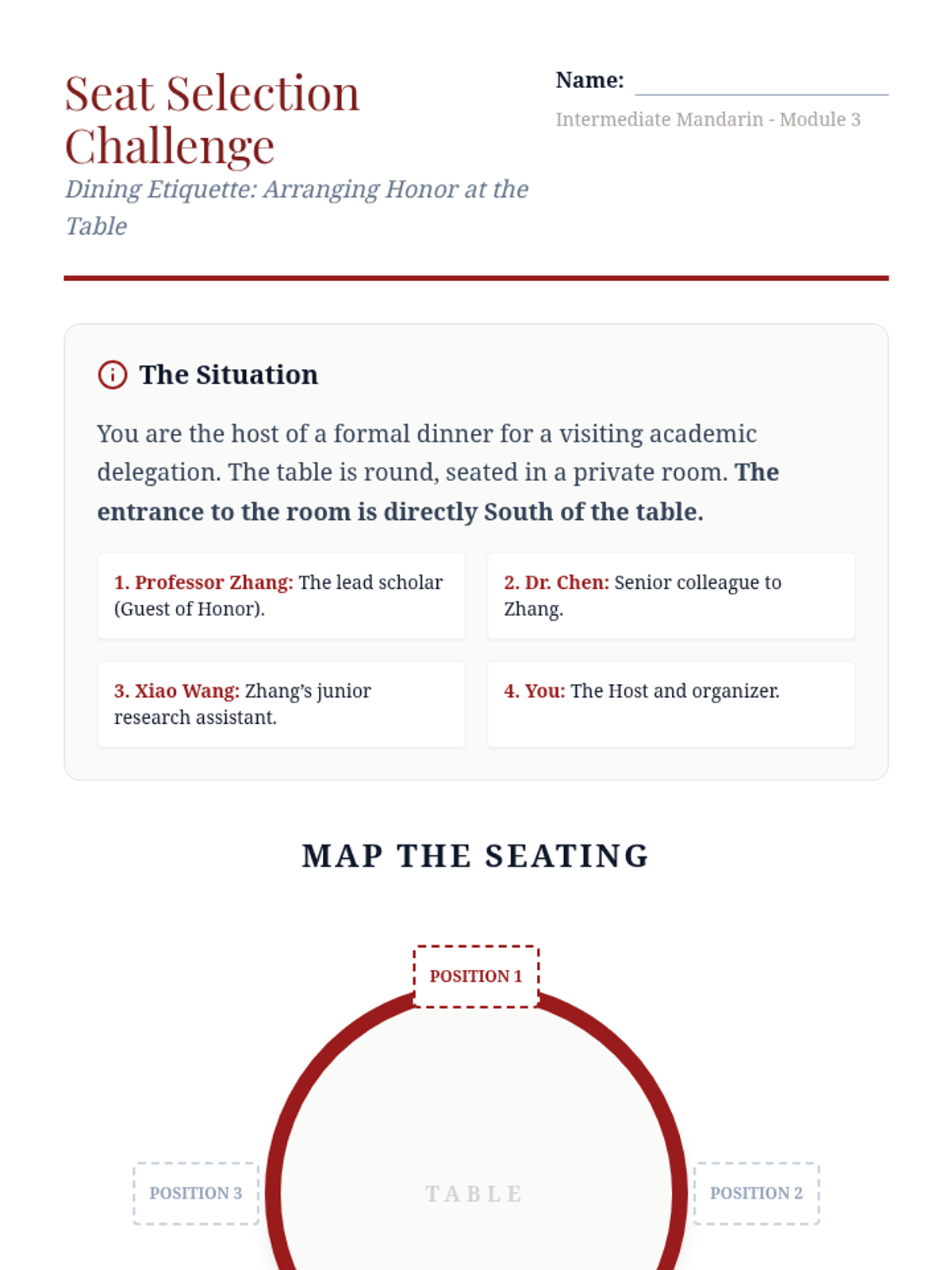
A scenario-based worksheet where students must arrange guests at a Chinese banquet table according to social status and etiquette rules.
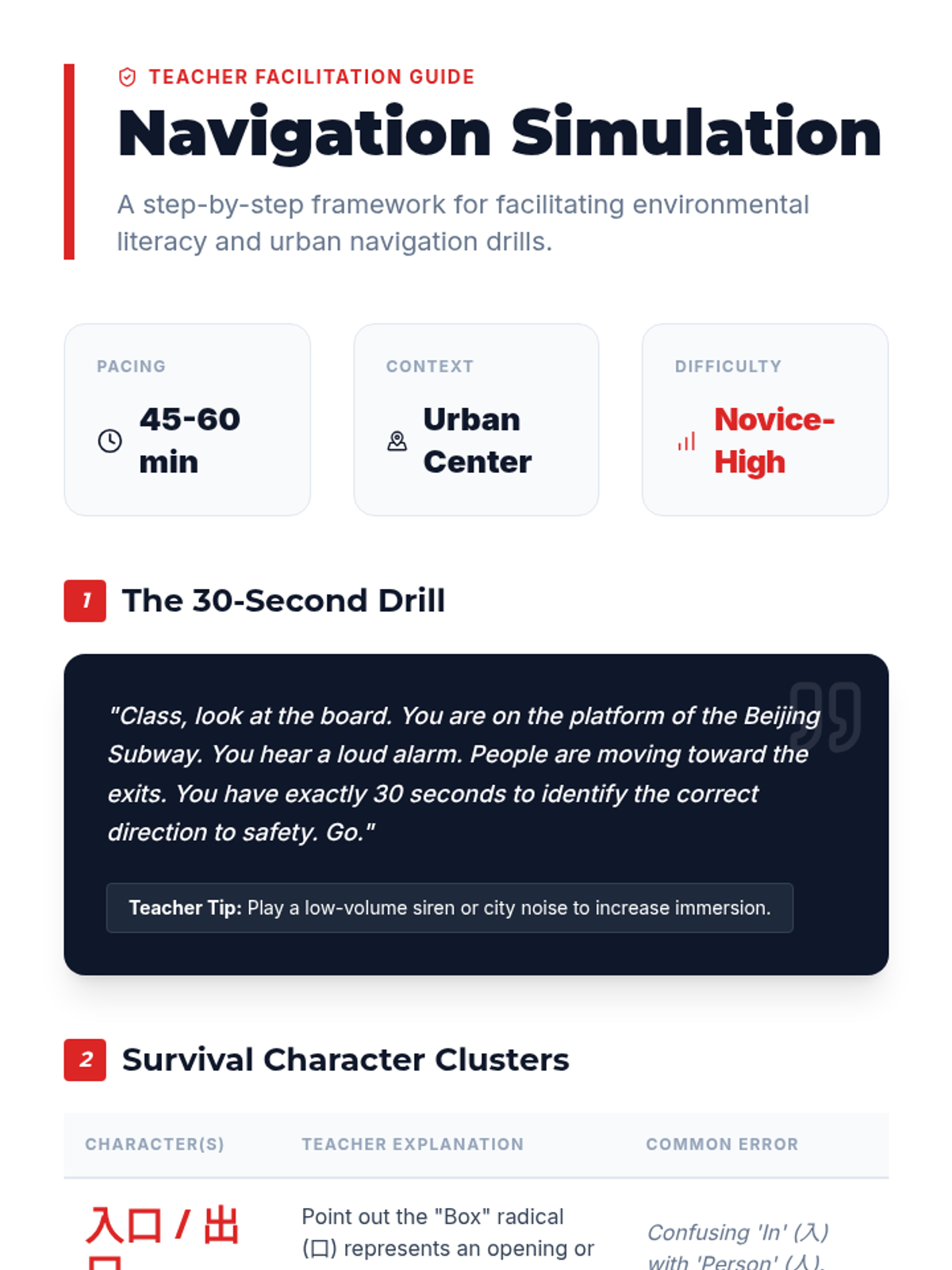
A teacher facilitation guide for the urban navigation simulation, including scripted prompts, key character cluster breakdowns, and differentiation strategies.
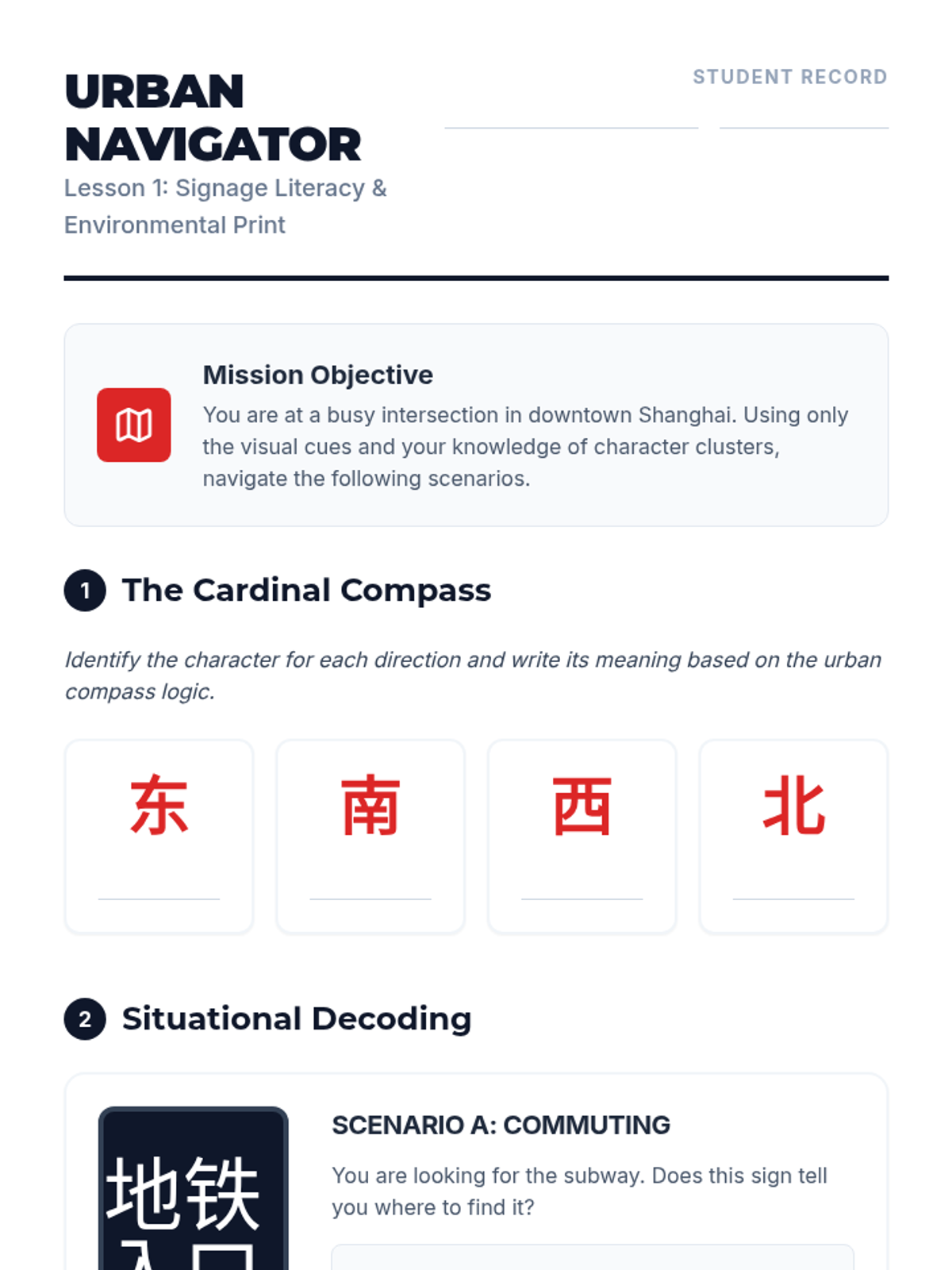
A student worksheet for identifying and decoding urban signage, featuring cardinal directions, situational scenarios (subway, construction, exits), and a transit map interpretation task.
A visual presentation focusing on decoding urban signage, featuring high-contrast survival characters, cardinal directions, and context-clue analysis for navigating Mandarin-speaking environments.
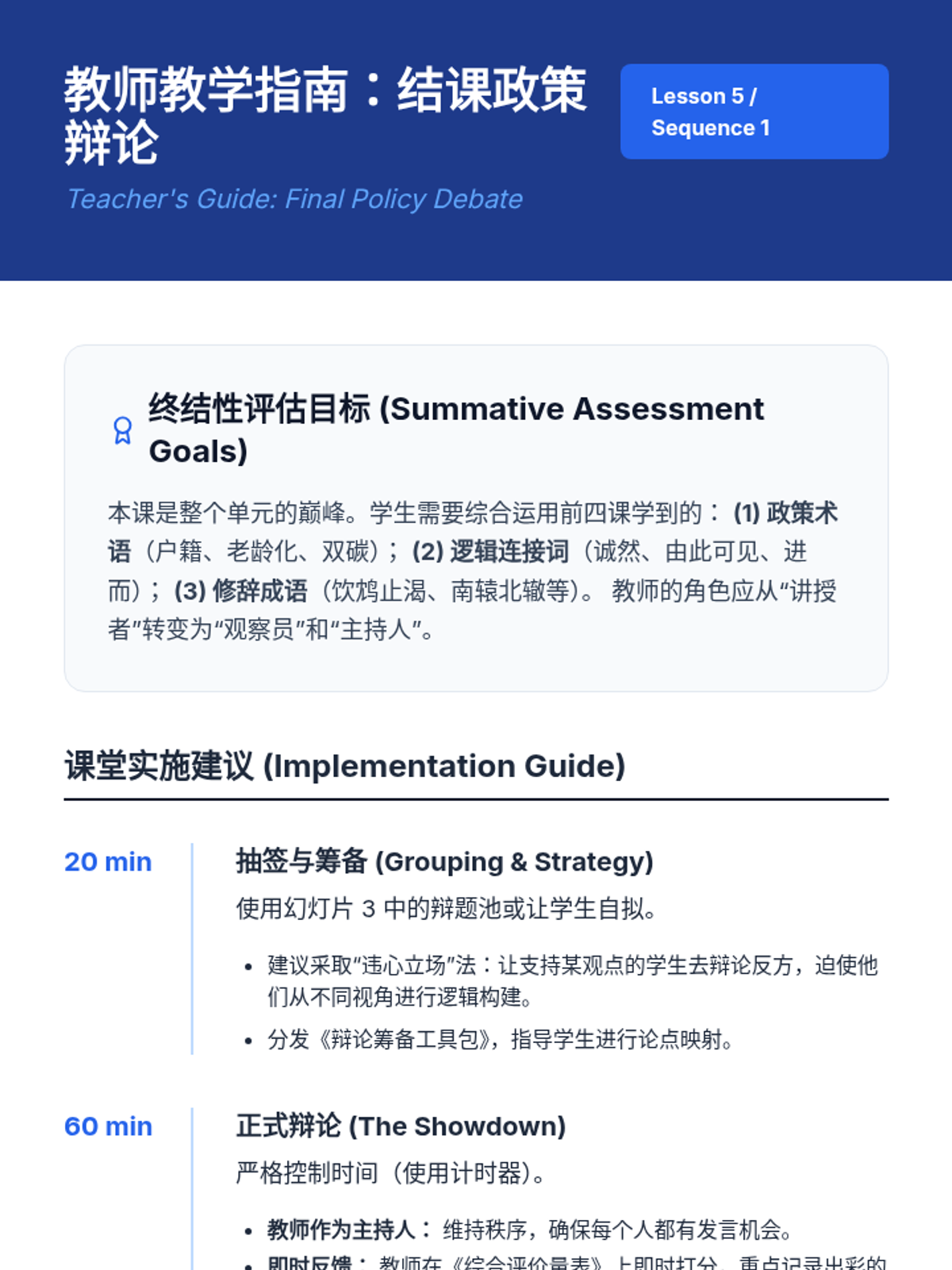
Facilitator guide for the final structured debate, including a suggested script for the moderator, classroom management tips, and differentiation strategies.
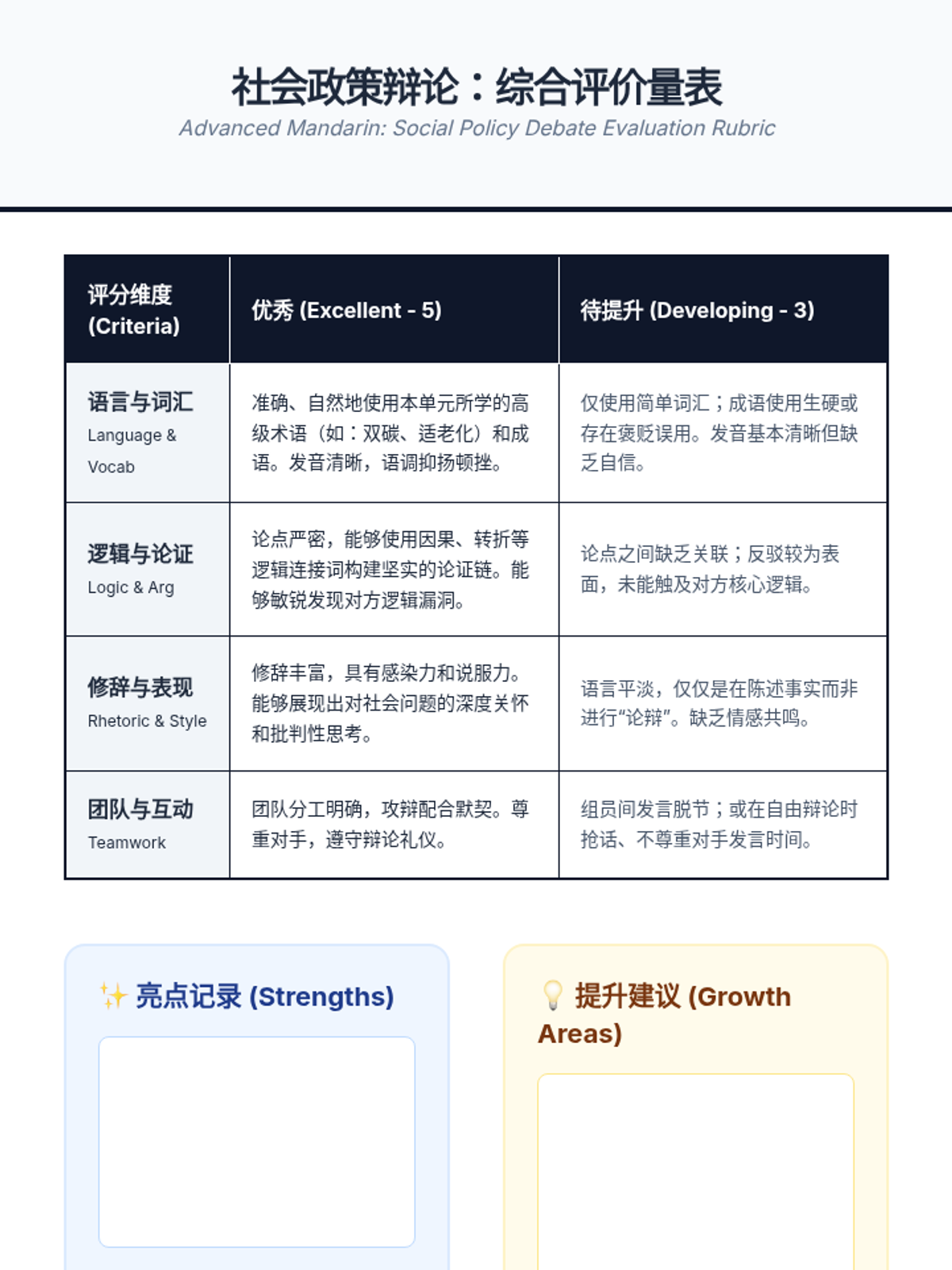
Detailed evaluation rubric for the final social policy debate, focusing on language accuracy, logic, rhetoric, and teamwork.
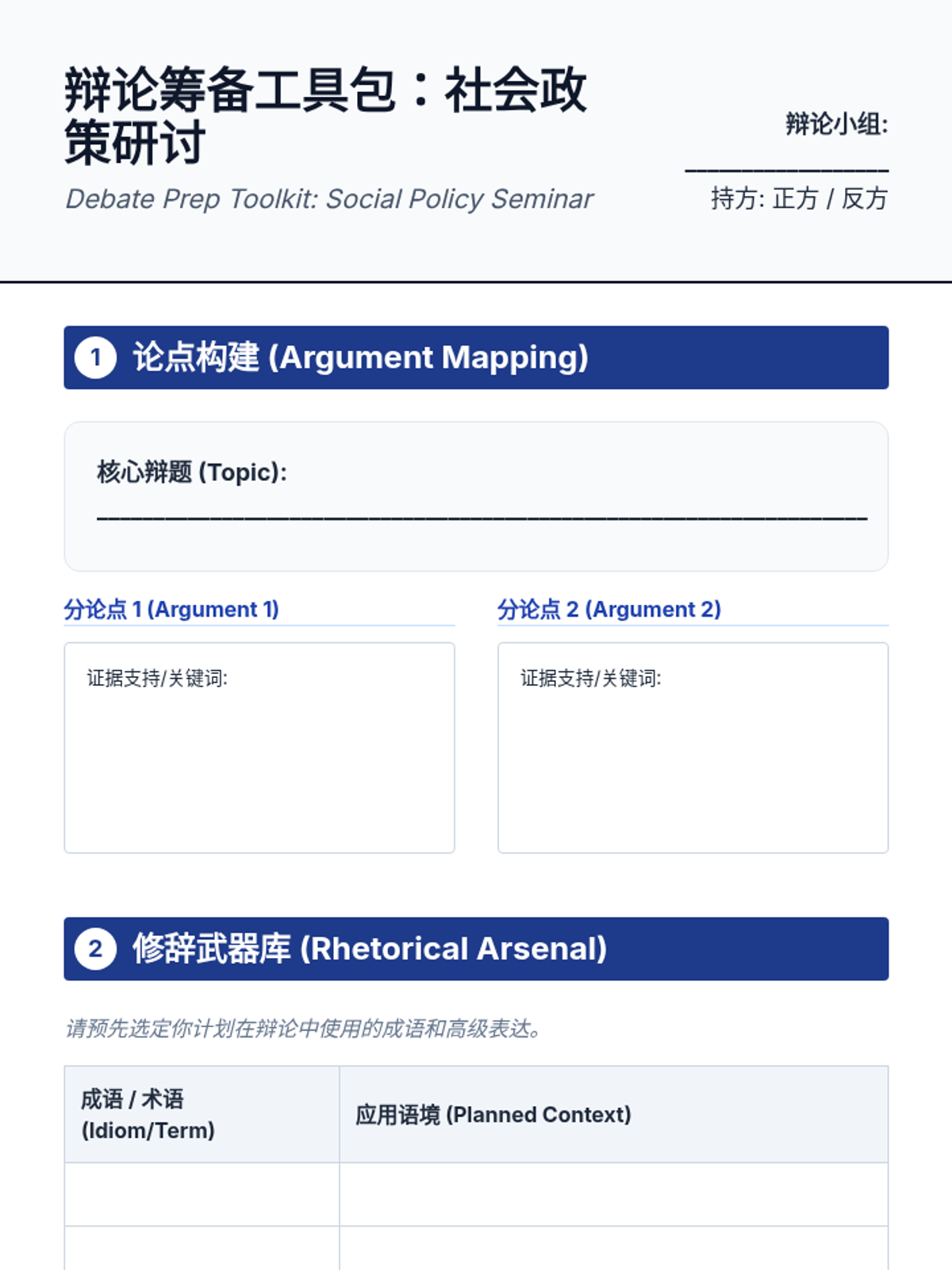
Debate preparation toolkit for Lesson 5, guiding students through argument mapping, rhetorical planning, and anticipating counter-arguments.
Visual presentation for Lesson 5, outlining the structured debate format, potential social policy topics, and evaluation criteria for the final assessment.
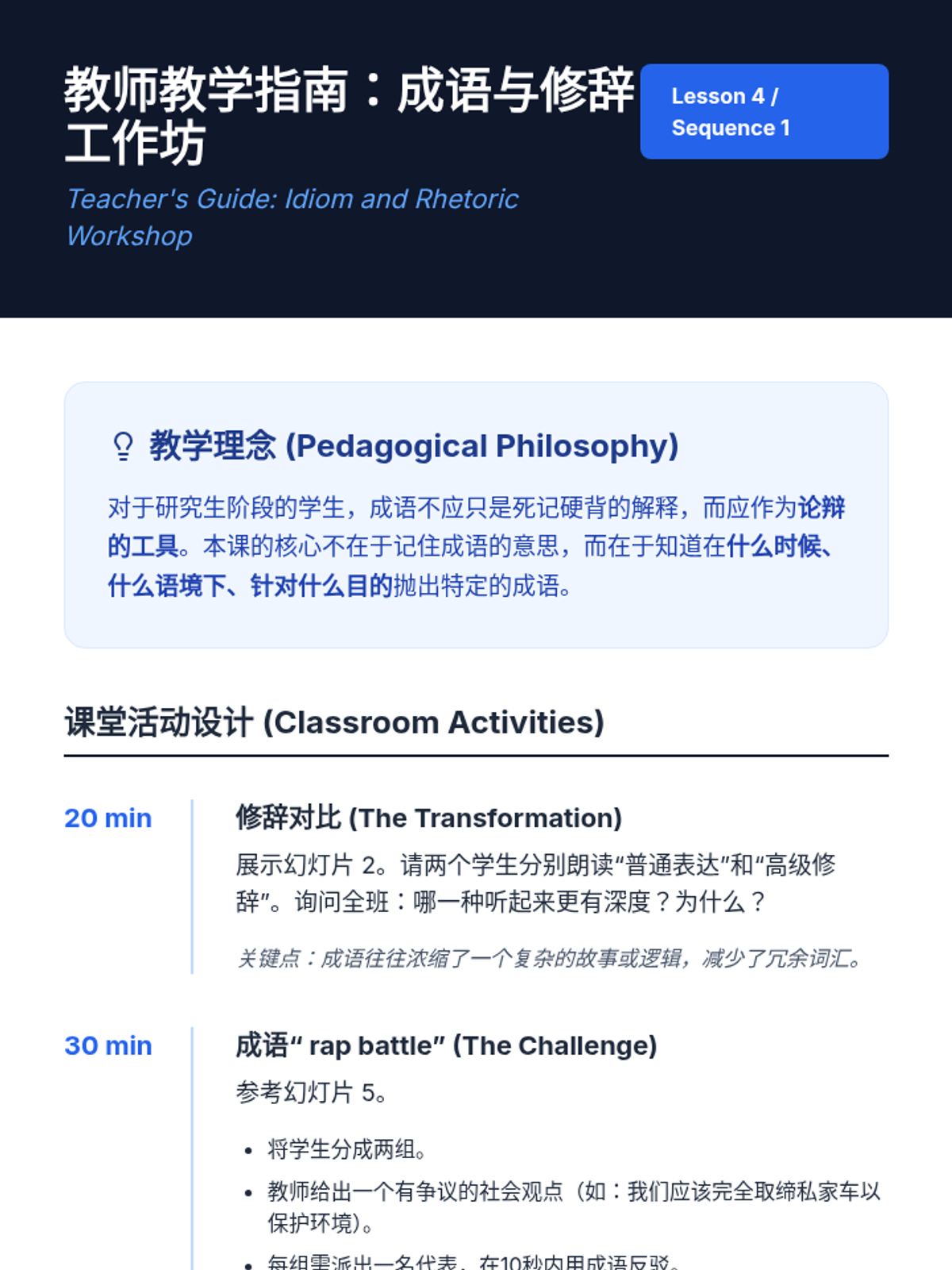
Facilitator guide for Lesson 4, including pedagogical strategies for using idioms in debate, classroom activity instructions, and common student error alerts.
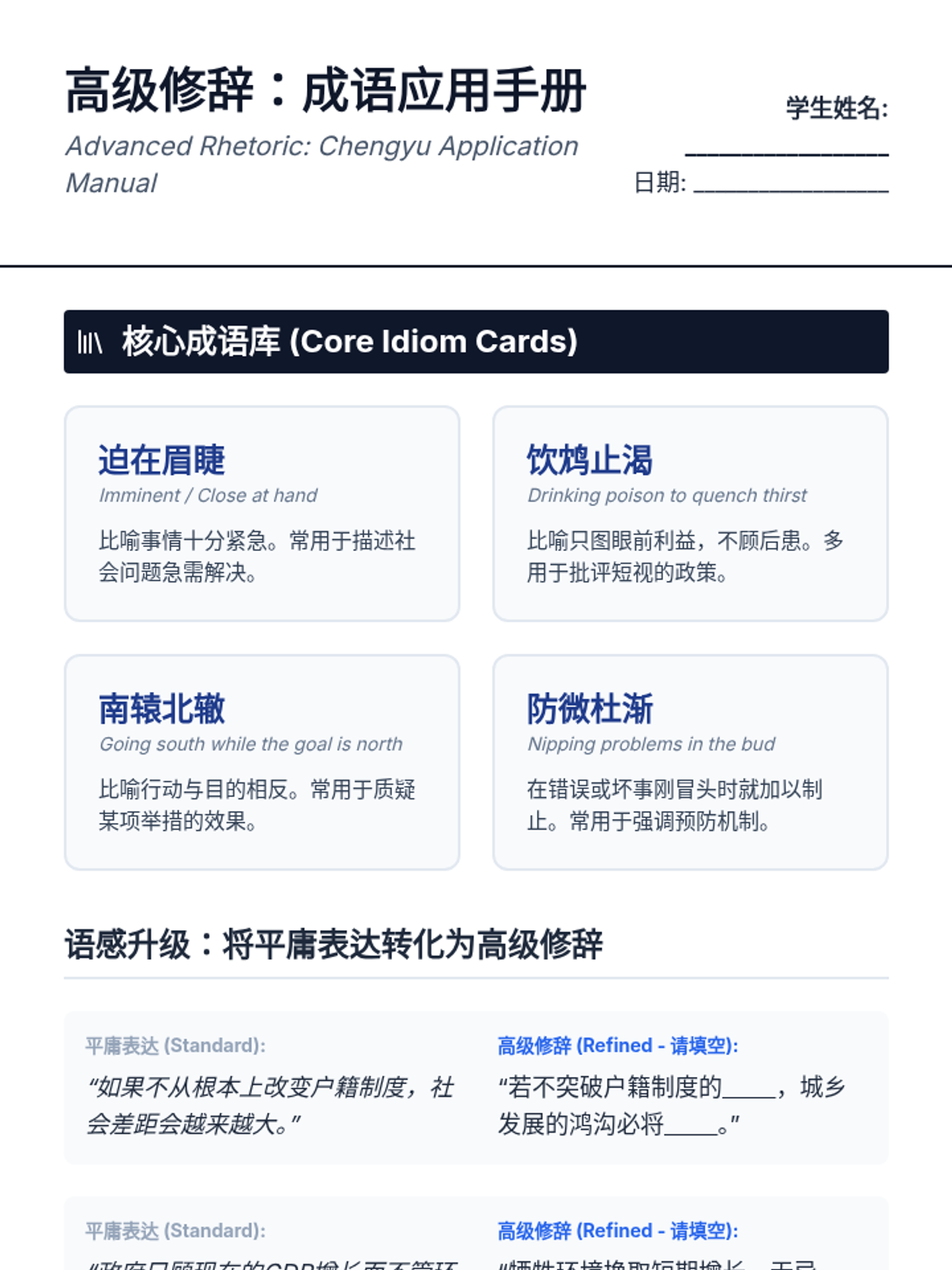
Worksheet for Lesson 4 featuring idiom mastery cards, rhetorical refinement exercises, and a writing workshop for logical connectives.
Visual presentation for Lesson 4, focusing on powerful idioms (chengyu) and rhetorical strategies for academic and public debate in Mandarin.
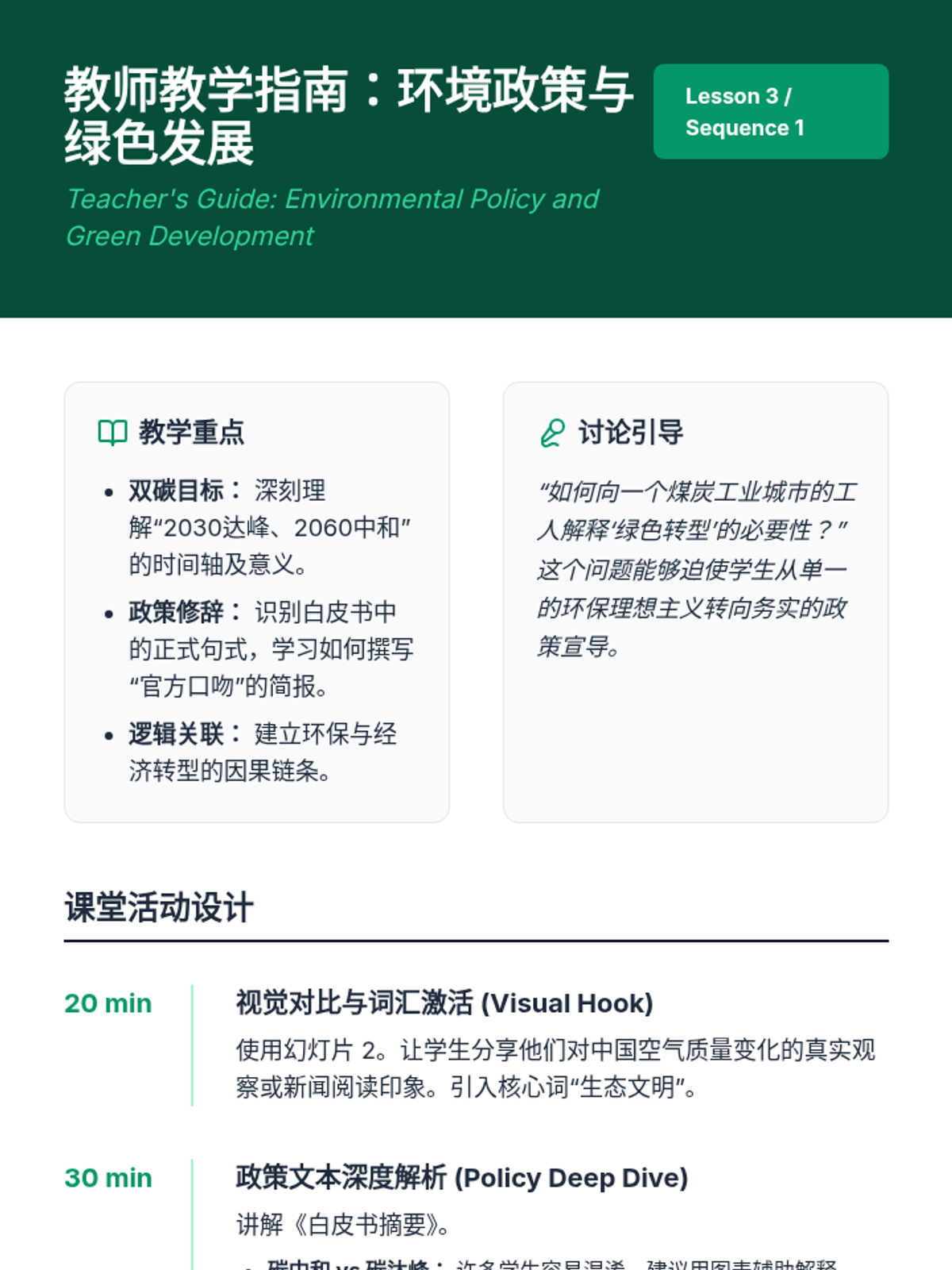
Facilitator guide for Lesson 3, including classroom planning, role-play instructions, and feedback points for the policy briefing exercise.
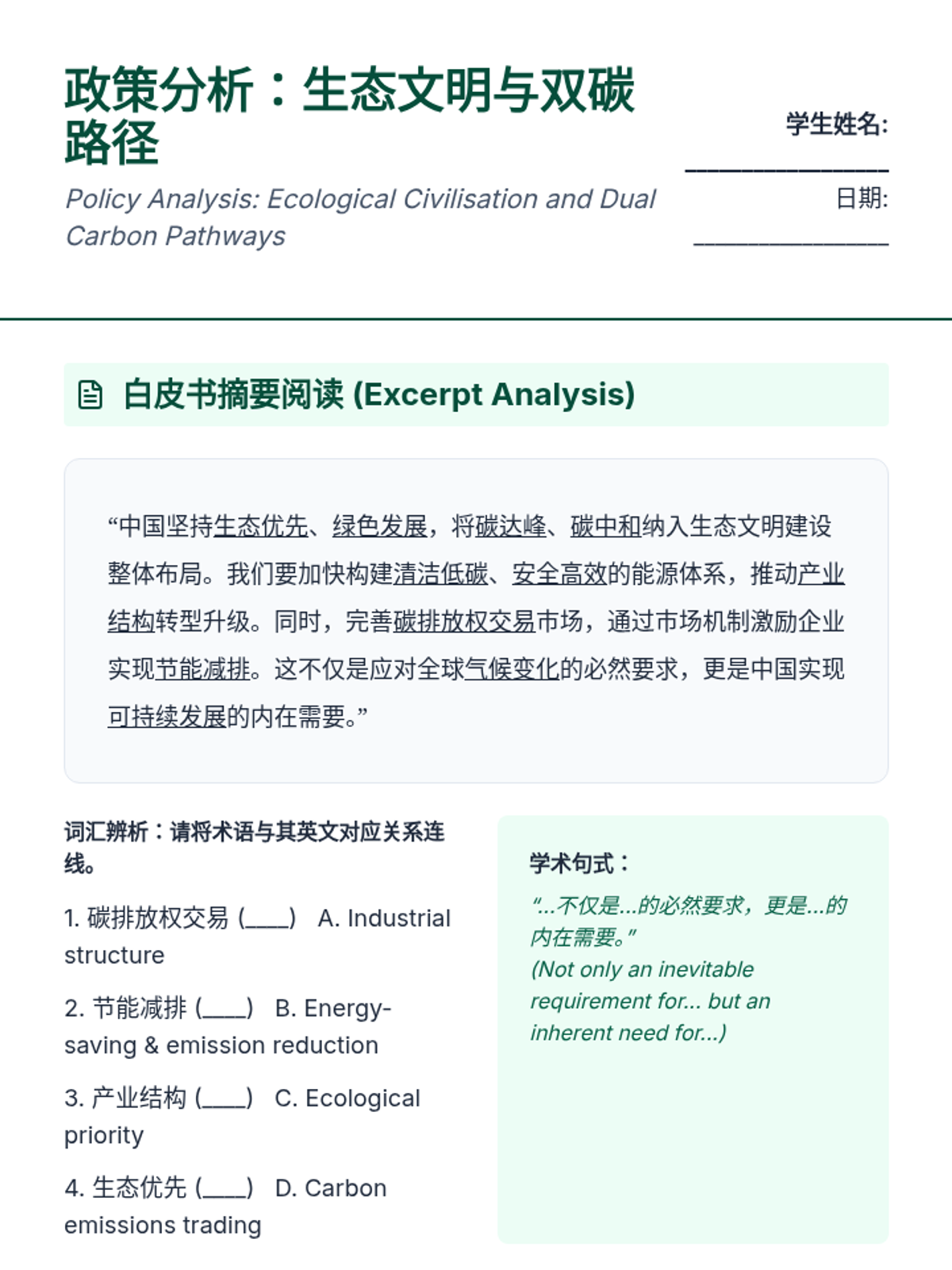
Worksheet for Lesson 3, featuring policy text analysis, vocabulary building for environmental science, and a simulation exercise for a policy briefing.
Visual presentation for Lesson 3, exploring environmental policy, the 'Dual Carbon' goals, and formal scientific terminology in Mandarin.
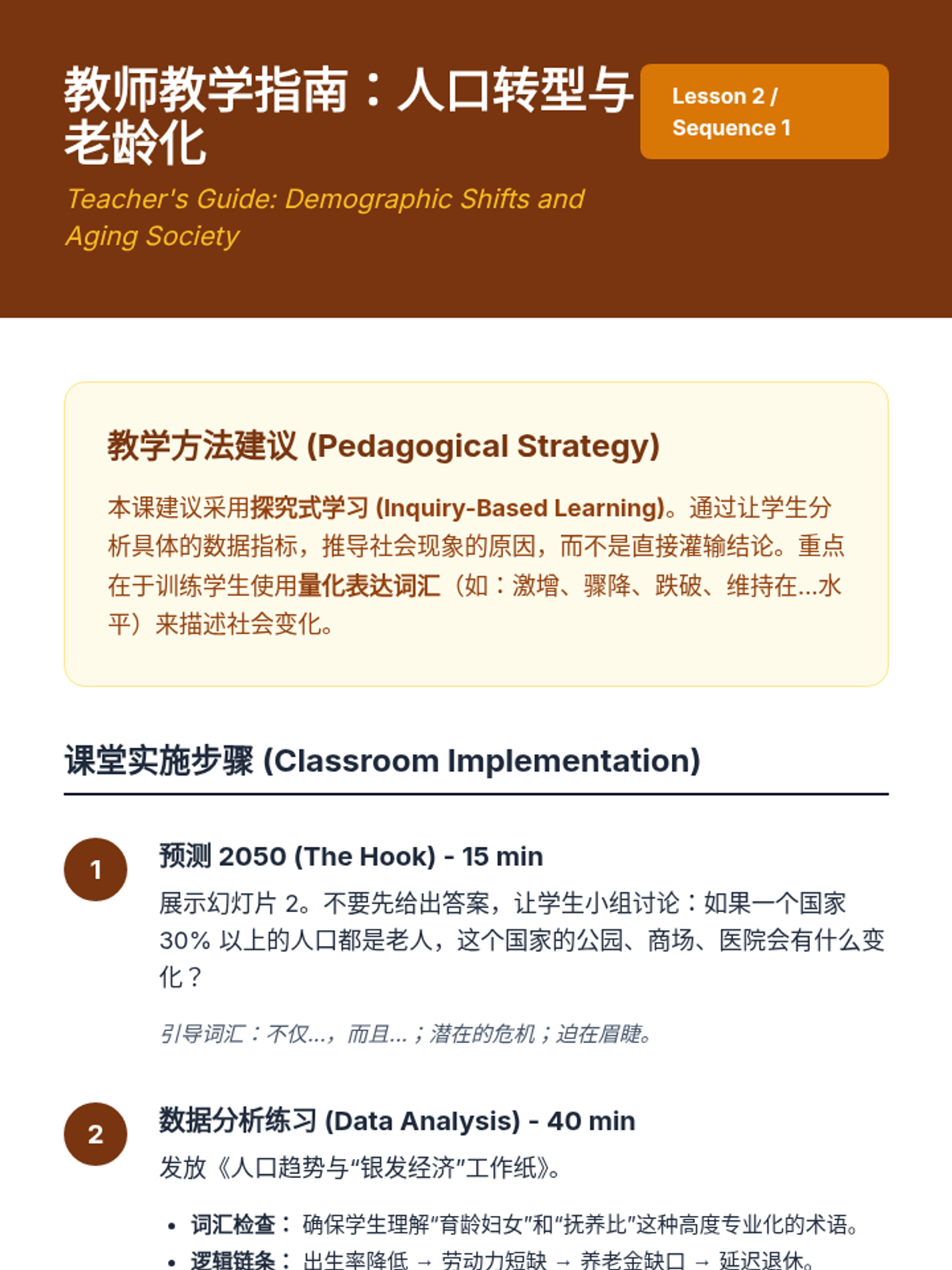
Facilitator guide for Lesson 2, including pedagogical strategies for inquiry-based learning, classroom steps, and higher-order discussion prompts.
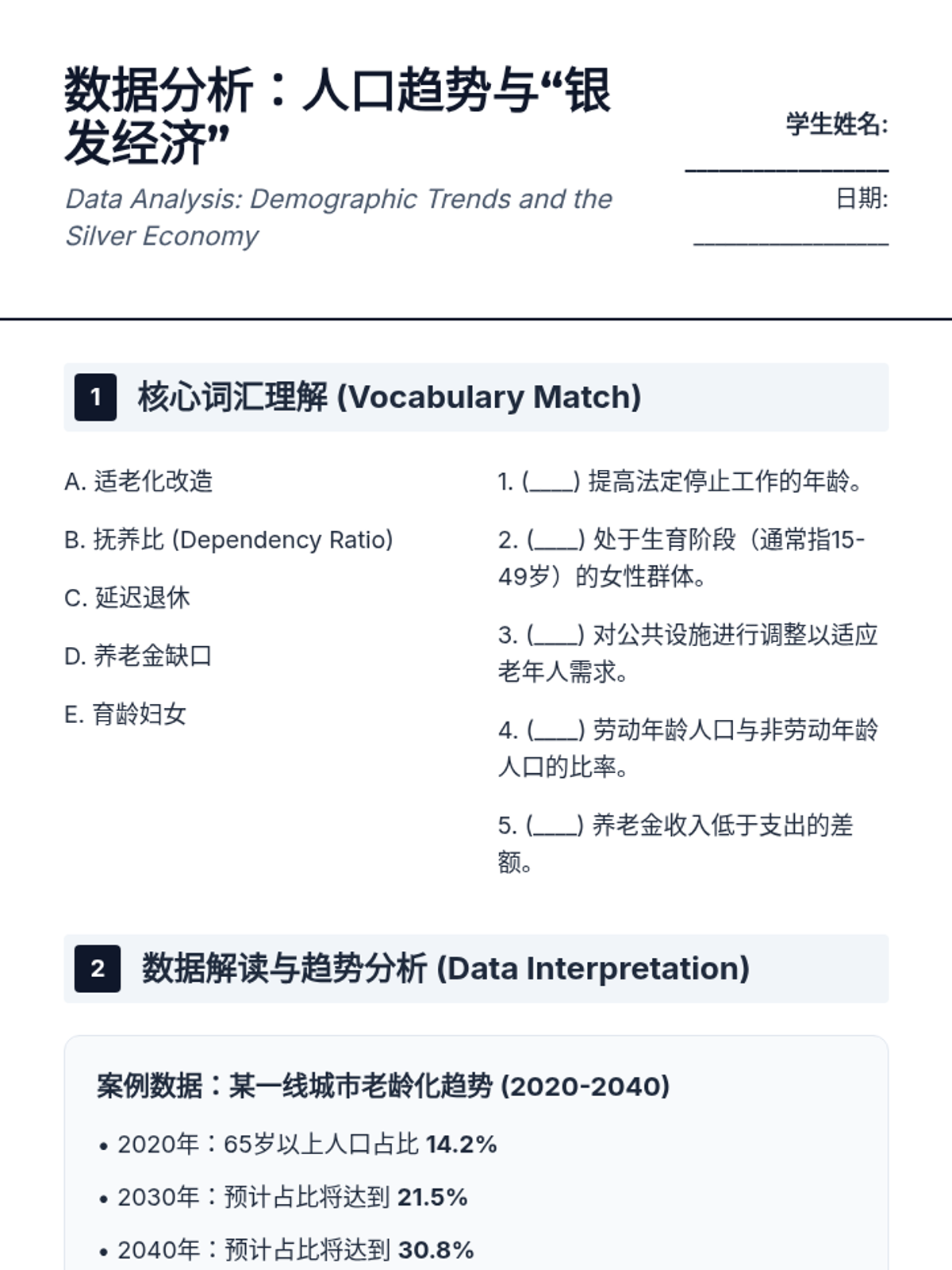
Worksheet for Lesson 2 featuring vocabulary matching, data interpretation regarding China's aging population, and a business case study on the silver economy.
Visual presentation for Lesson 2, covering demographic shifts, the silver economy, and cause-and-effect rhetoric in Mandarin.
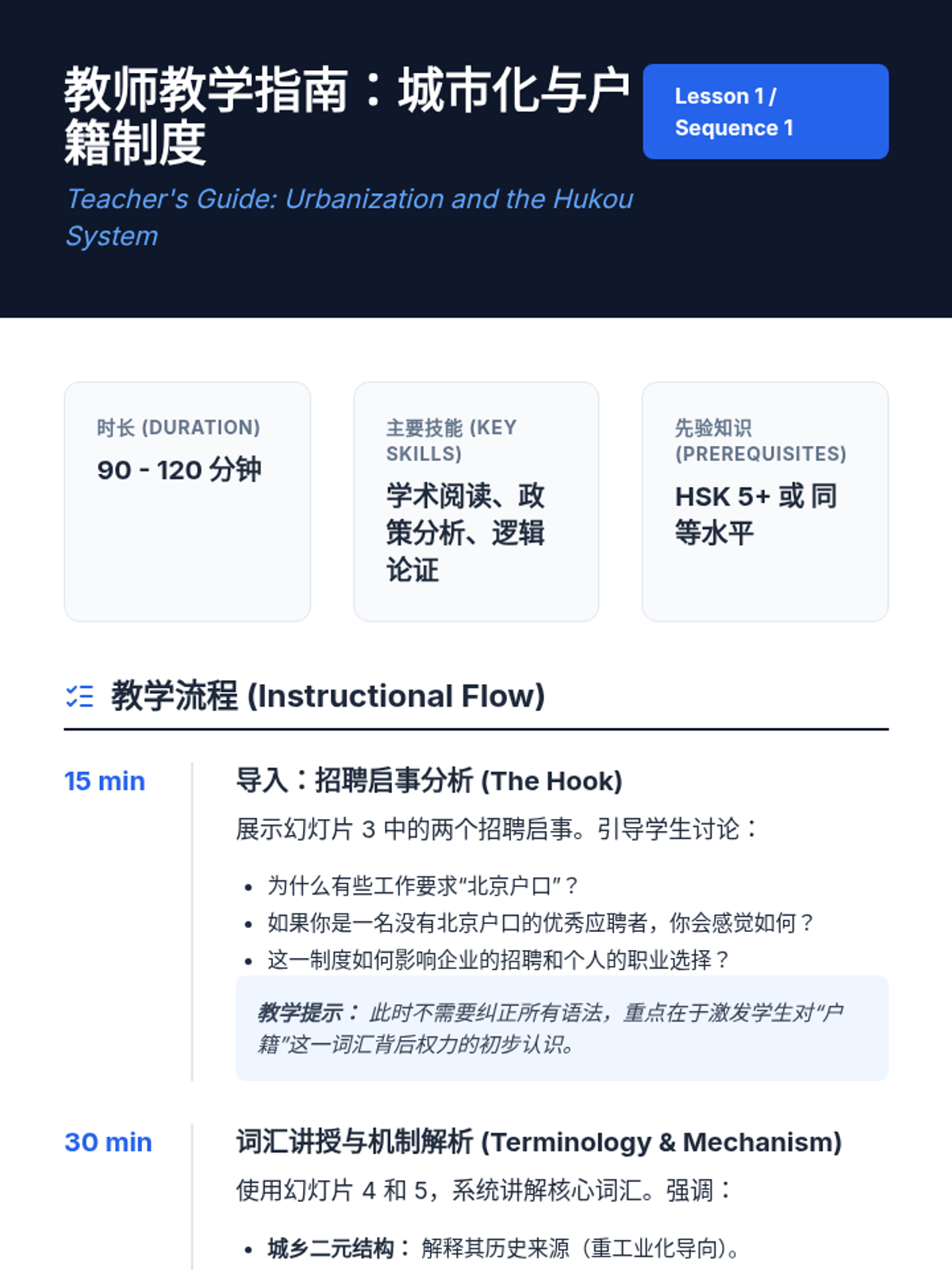
Facilitator guide for Lesson 1, including instructional steps, discussion prompts, answer keys for the reading worksheet, and common student misconceptions.
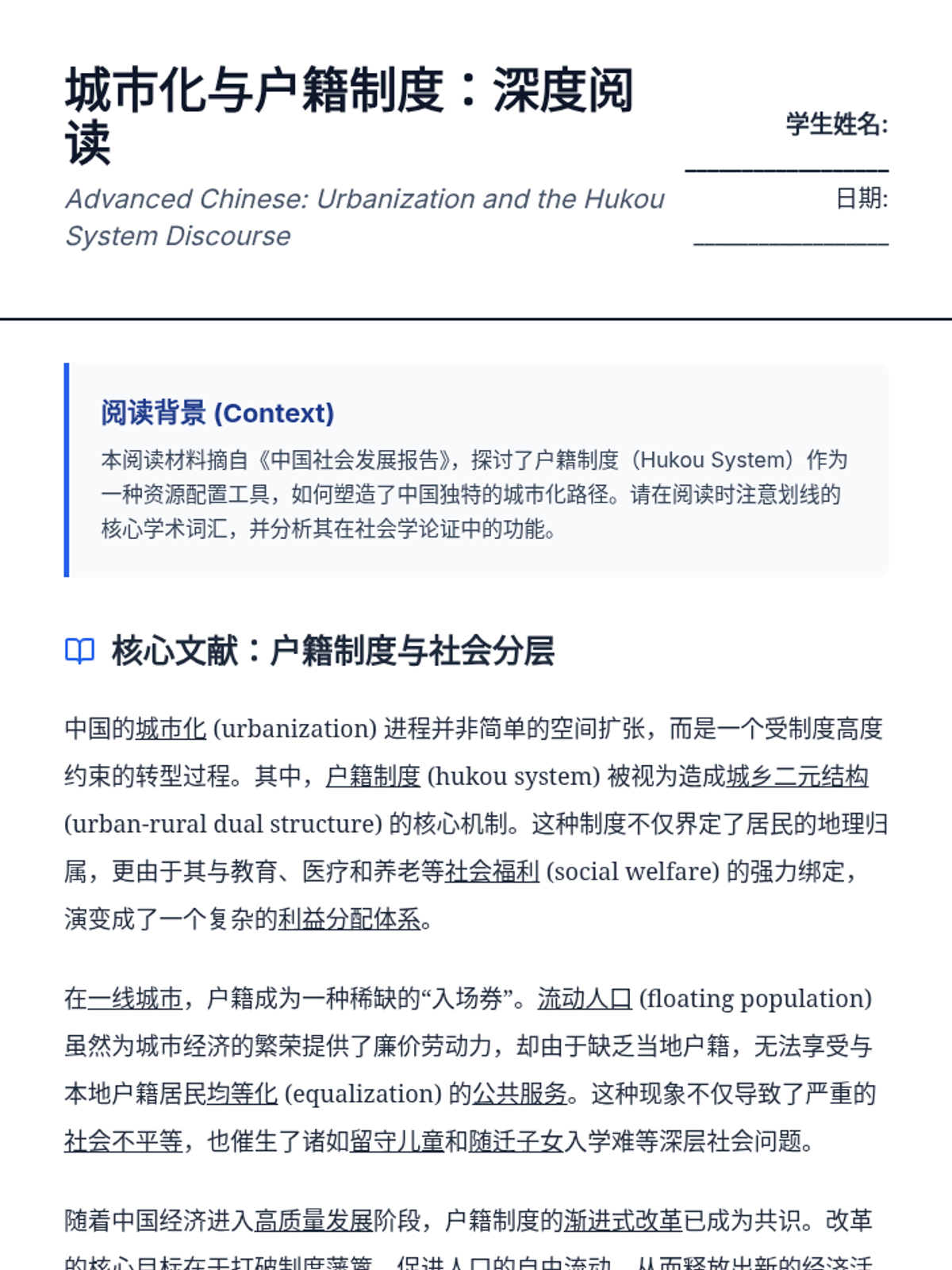
Advanced reading comprehension worksheet for Lesson 1, featuring academic text on the Hukou system, vocabulary definitions, and critical thinking questions.
Visual presentation for Lesson 1, introducing the Hukou system and urbanization vocabulary with discussion hooks for graduate students.
Slides for Lesson 3 introducing hobbies and personal preferences using 'xihuan'. Covers common leisure vocabulary and the social connector 'ye' (also).
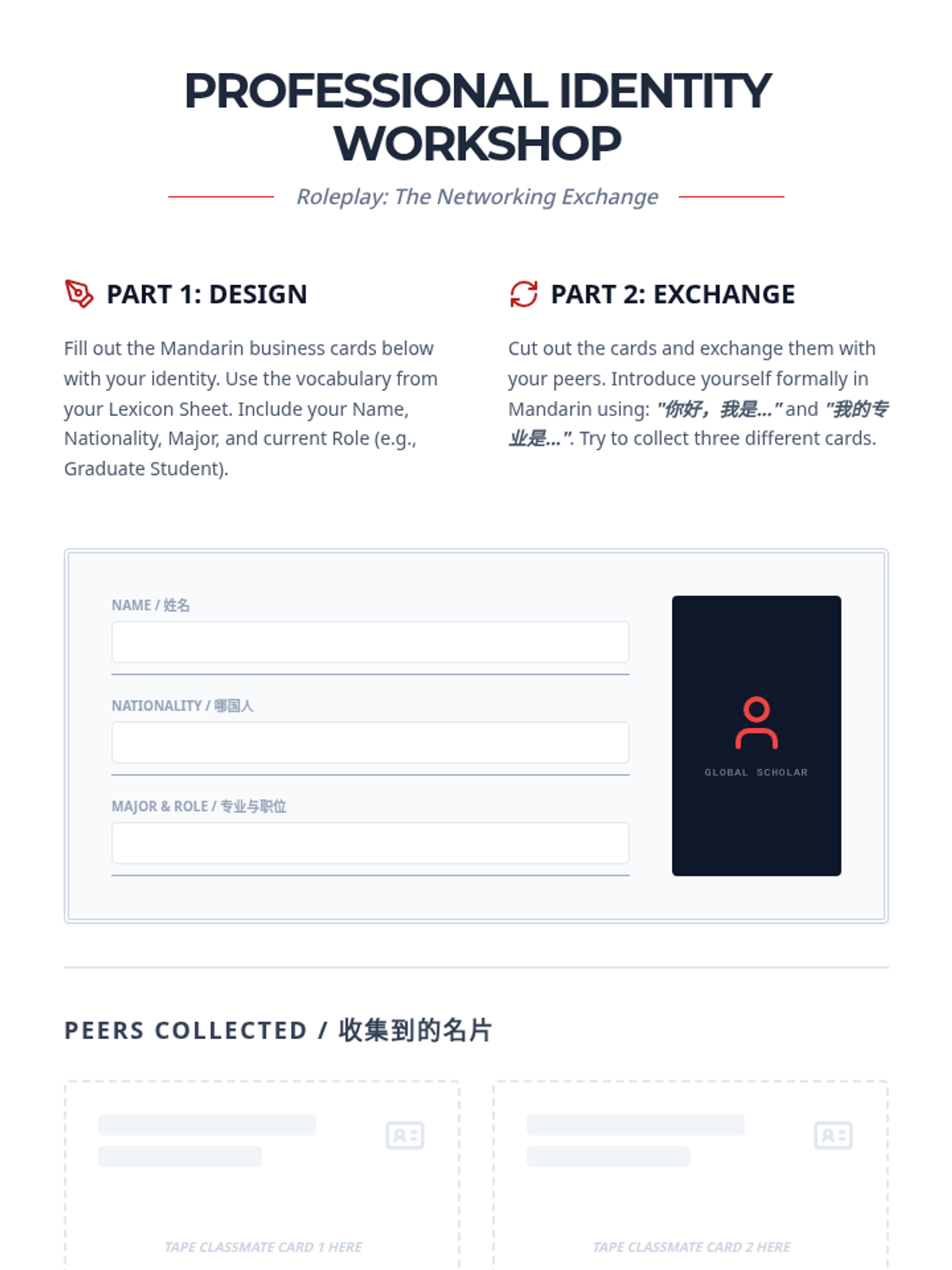
Activity sheet for a professional roleplay. Students design their own Mandarin business cards and participate in a networking exchange to practice identifying their majors and roles.
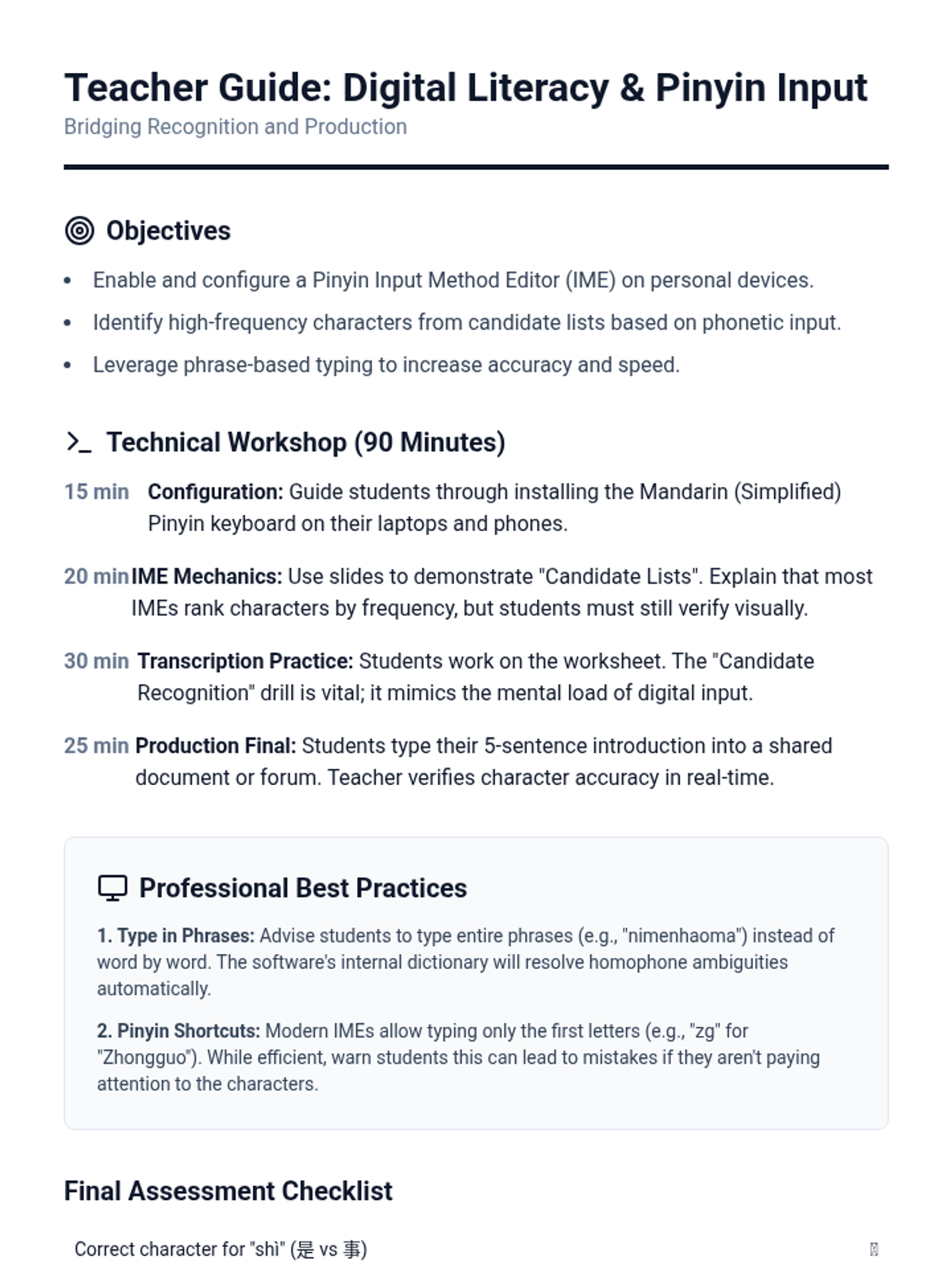
Teacher facilitation guide for Lesson 5, featuring technical setup instructions and digital production goals.
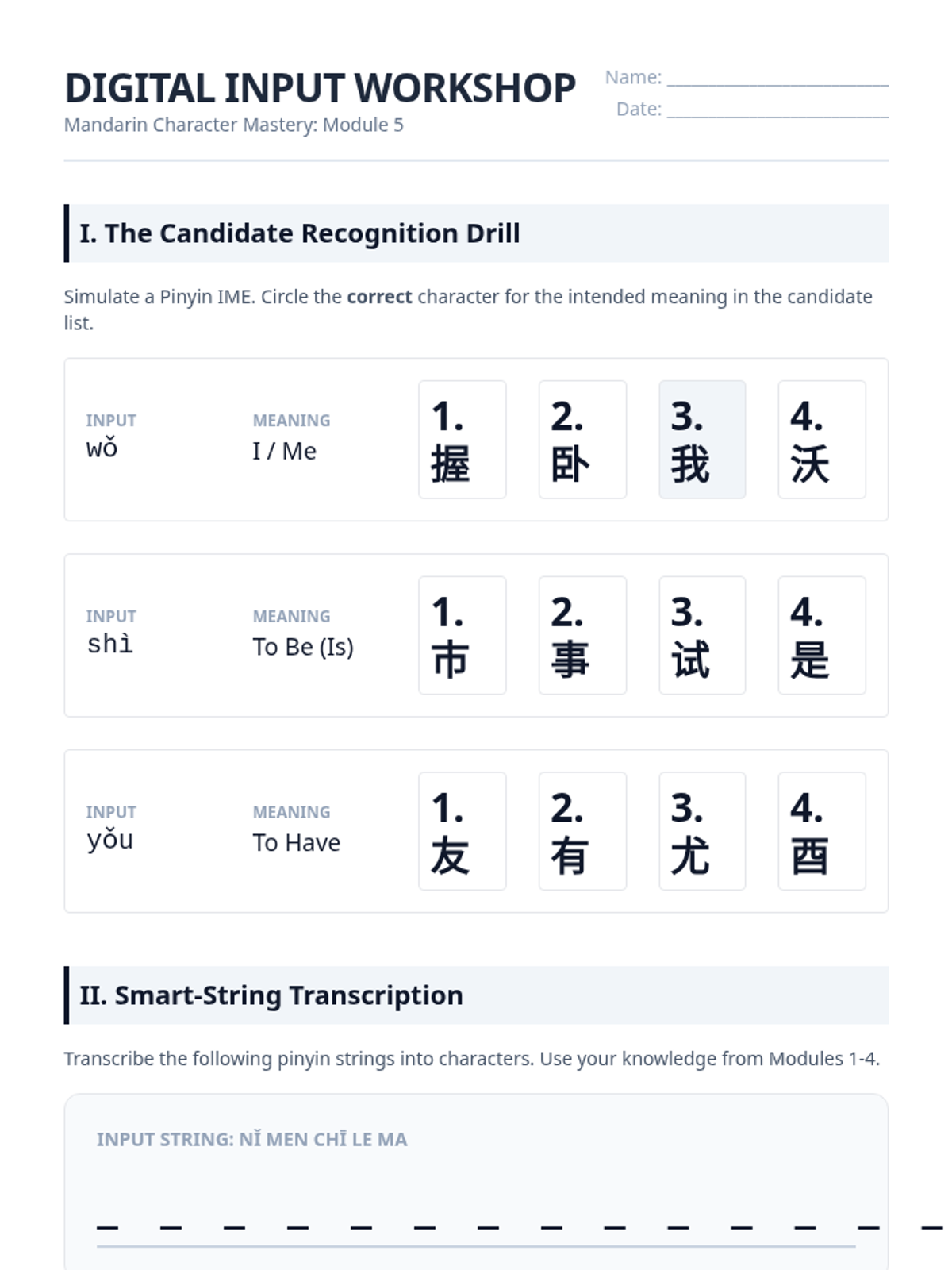
Worksheet for practicing candidate character selection and transcribing pinyin phrases into characters.
Slides on digital input methods (Pinyin IME), phrase-based typing, and common character selection traps.
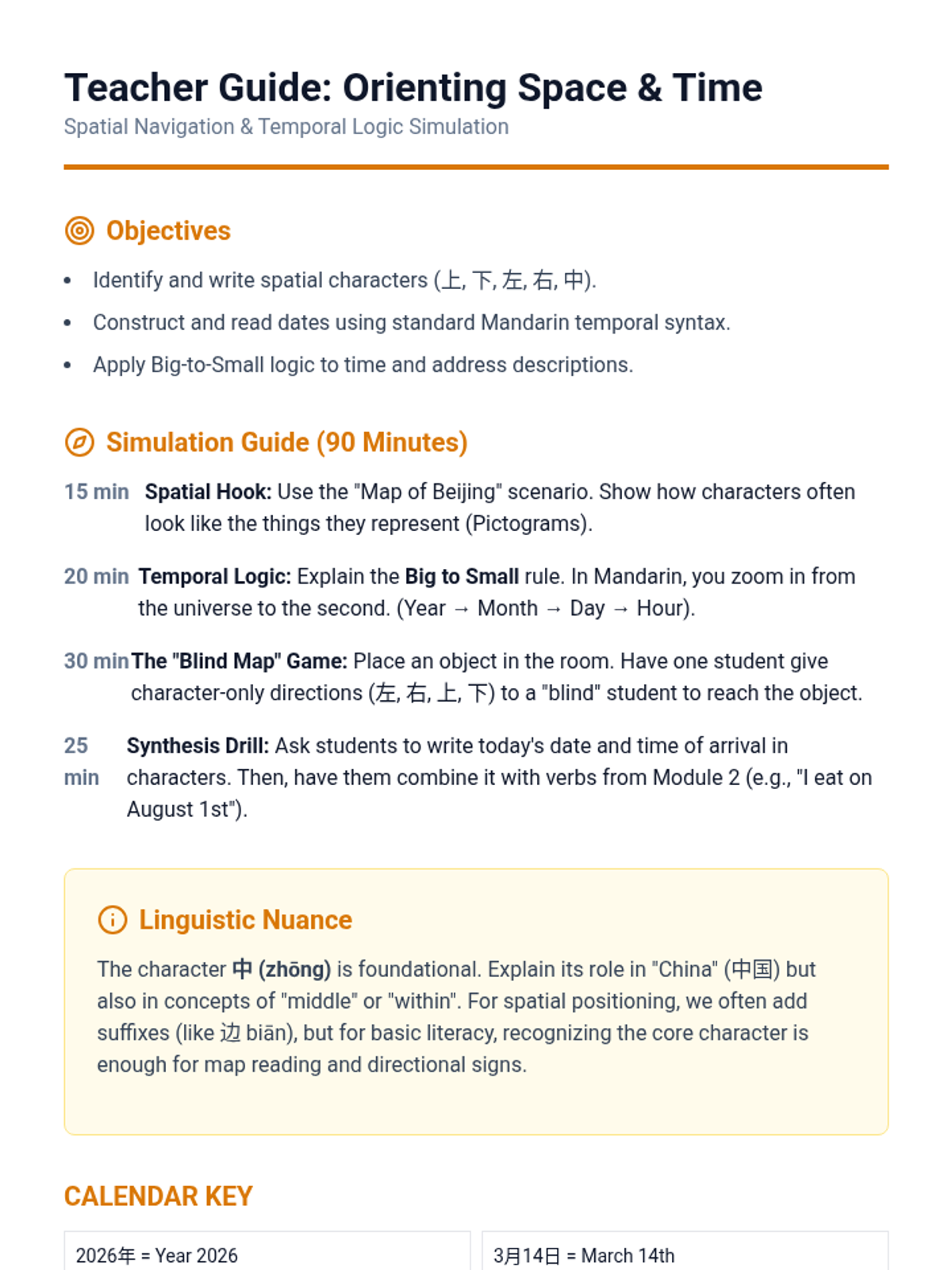
Teacher facilitation guide for Lesson 4, including simulation instructions for spatial reasoning and calendar reading exercises.
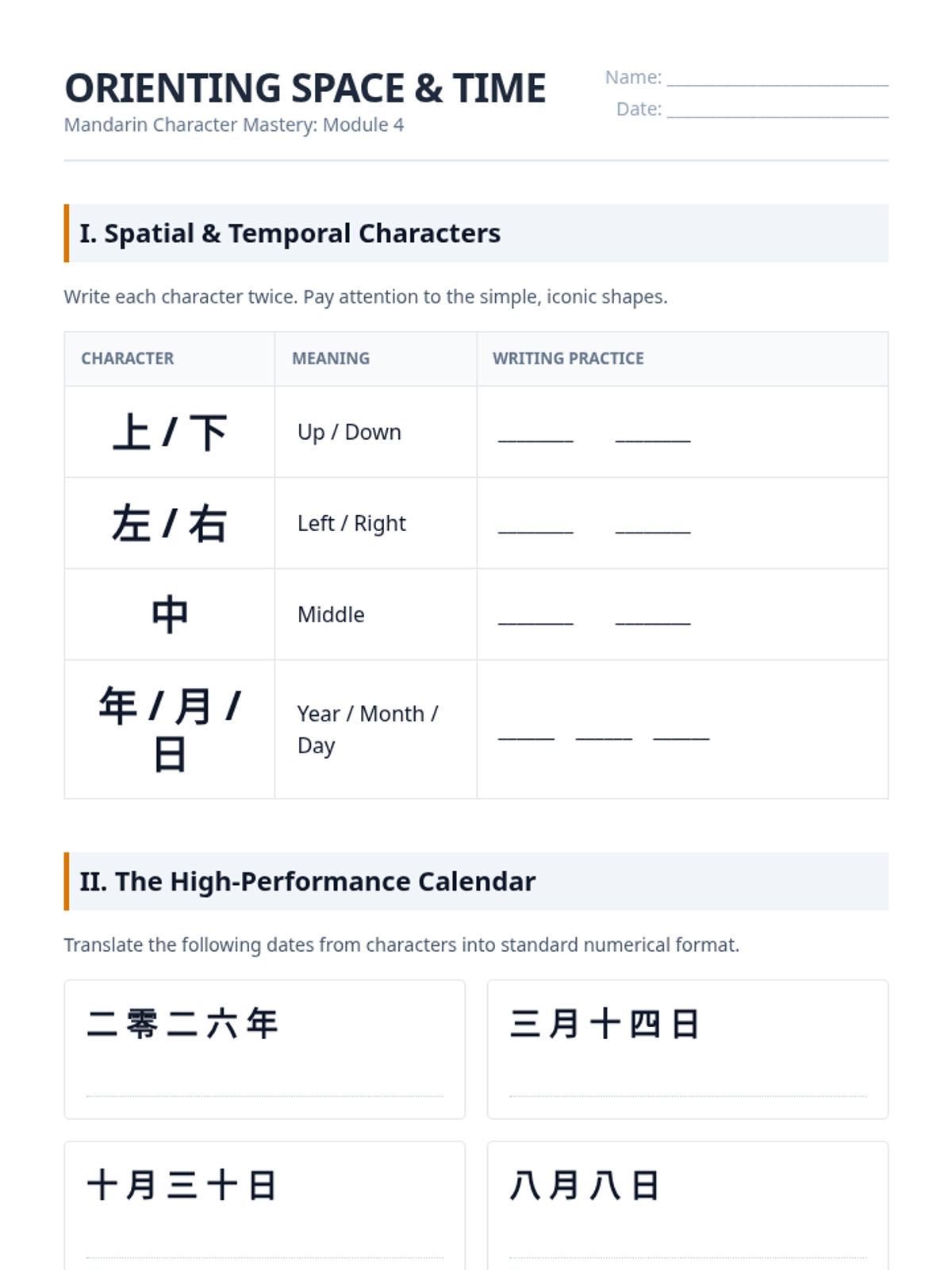
Spatial reasoning and temporal description worksheet, focusing on calendar reading and location markers.
Slides on spatial positioning (up, down, left, right, middle) and temporal markers (year, month, day) with a focus on calendar logic.
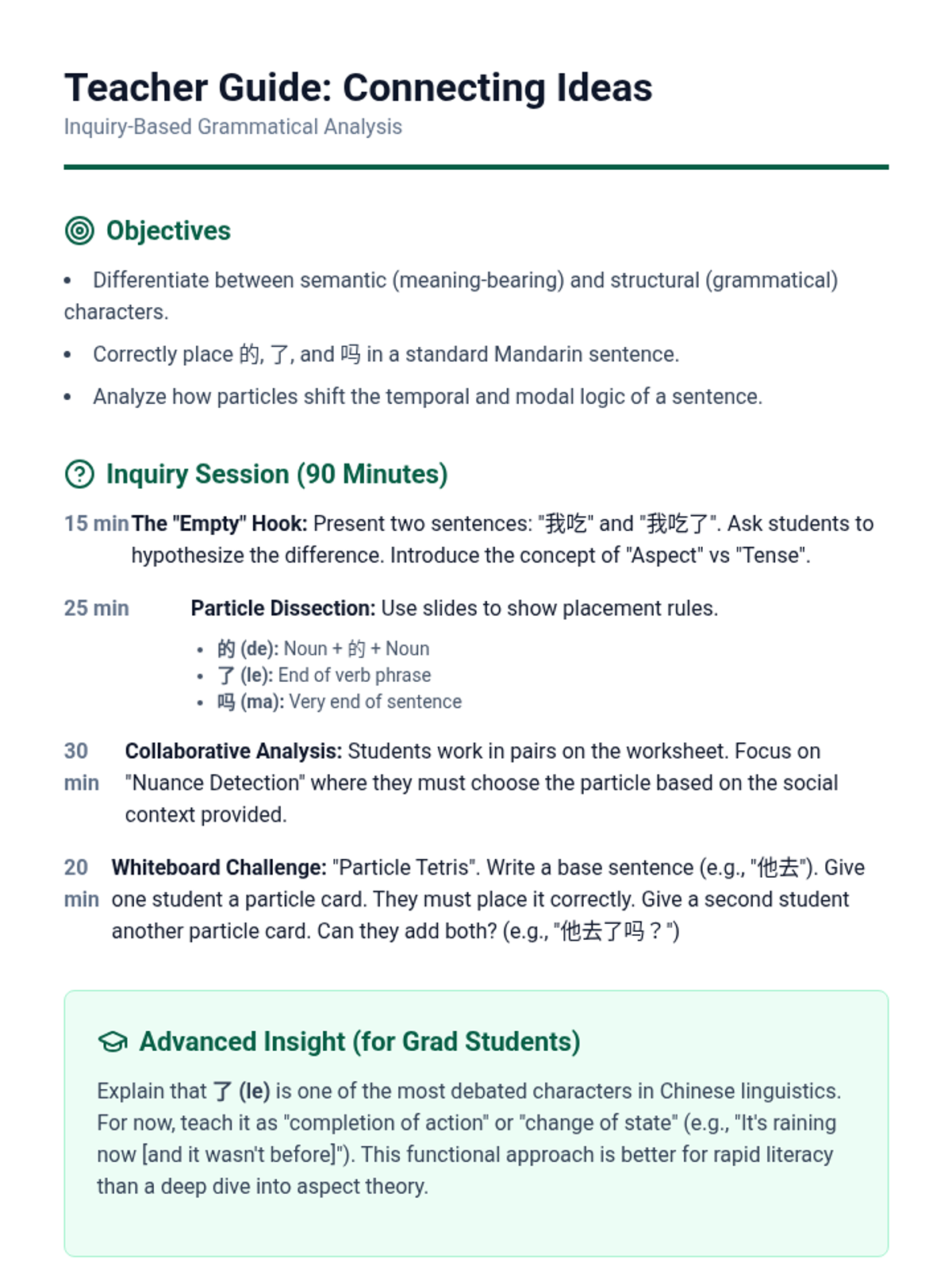
Teacher facilitation guide for Lesson 3, featuring inquiry prompts and sentence analysis drills for structural particles.
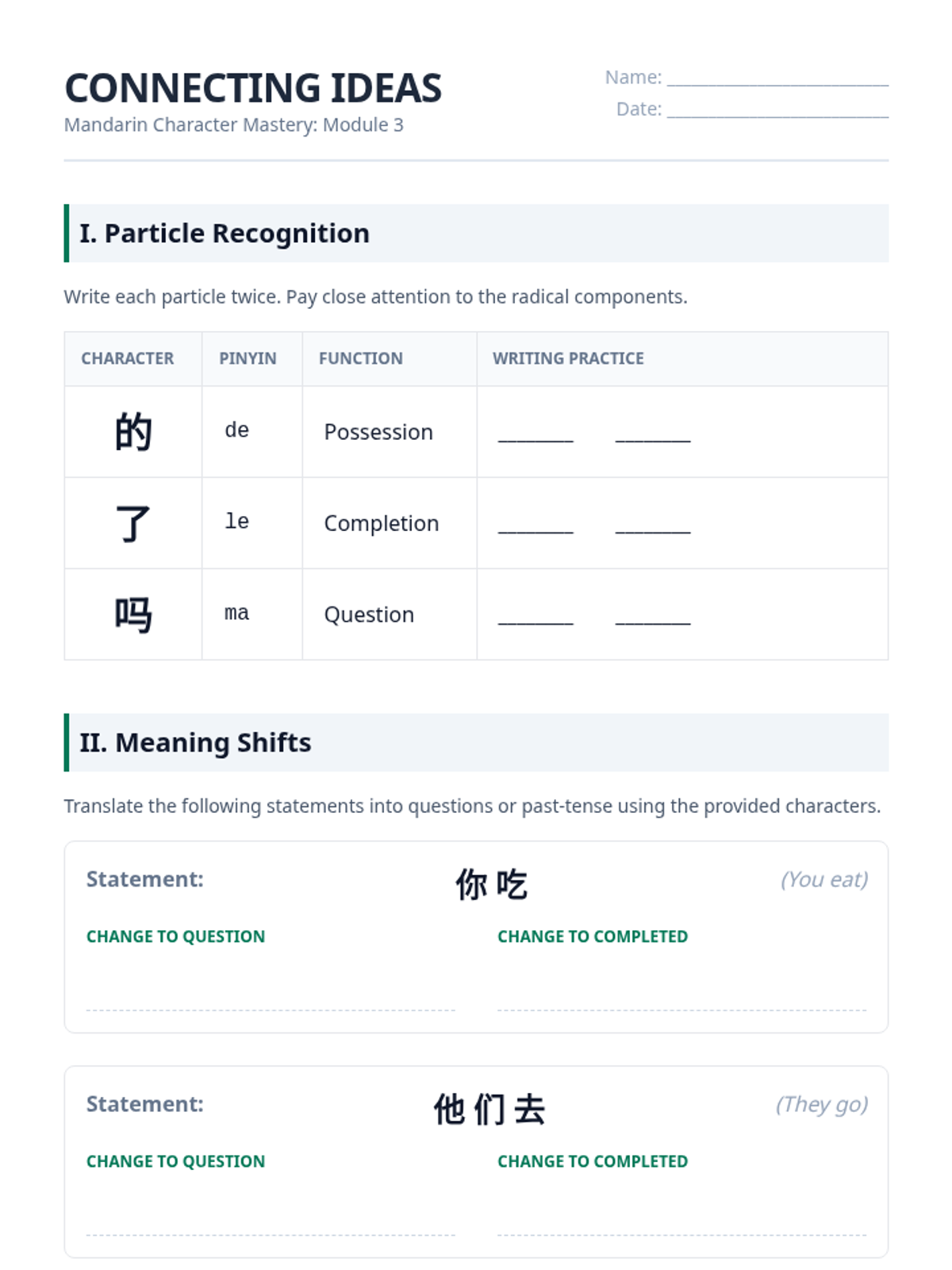
Particle placement and meaning shifts worksheet, focusing on the structural characters 'de', 'le', and 'ma'.
Slides introducing structural particles (de, le, ma) and how they modify sentence mood, tense, and possession.
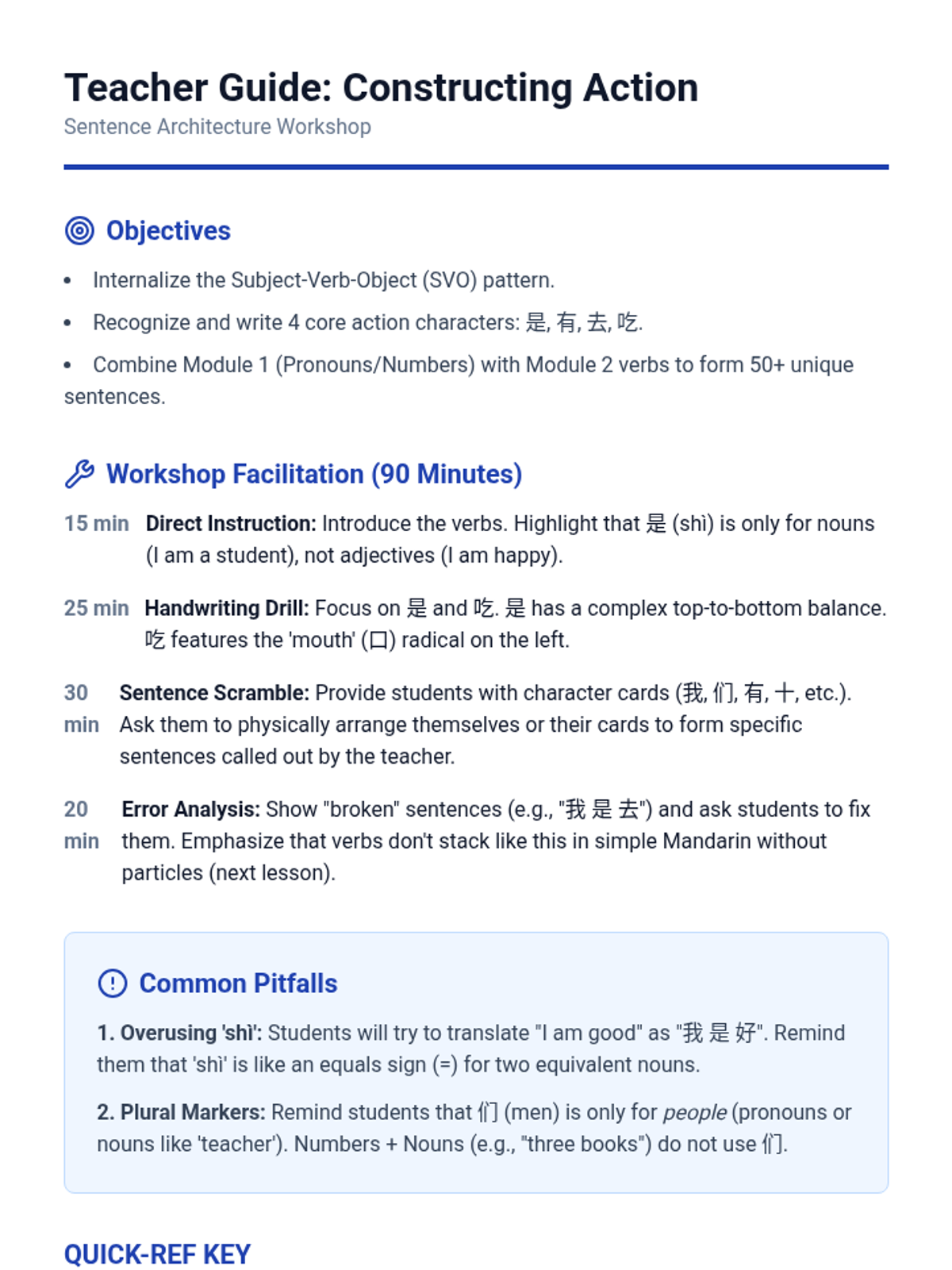
Teacher facilitation guide for Lesson 2, including sentence-building drills and common syntactic pitfalls for English speakers.
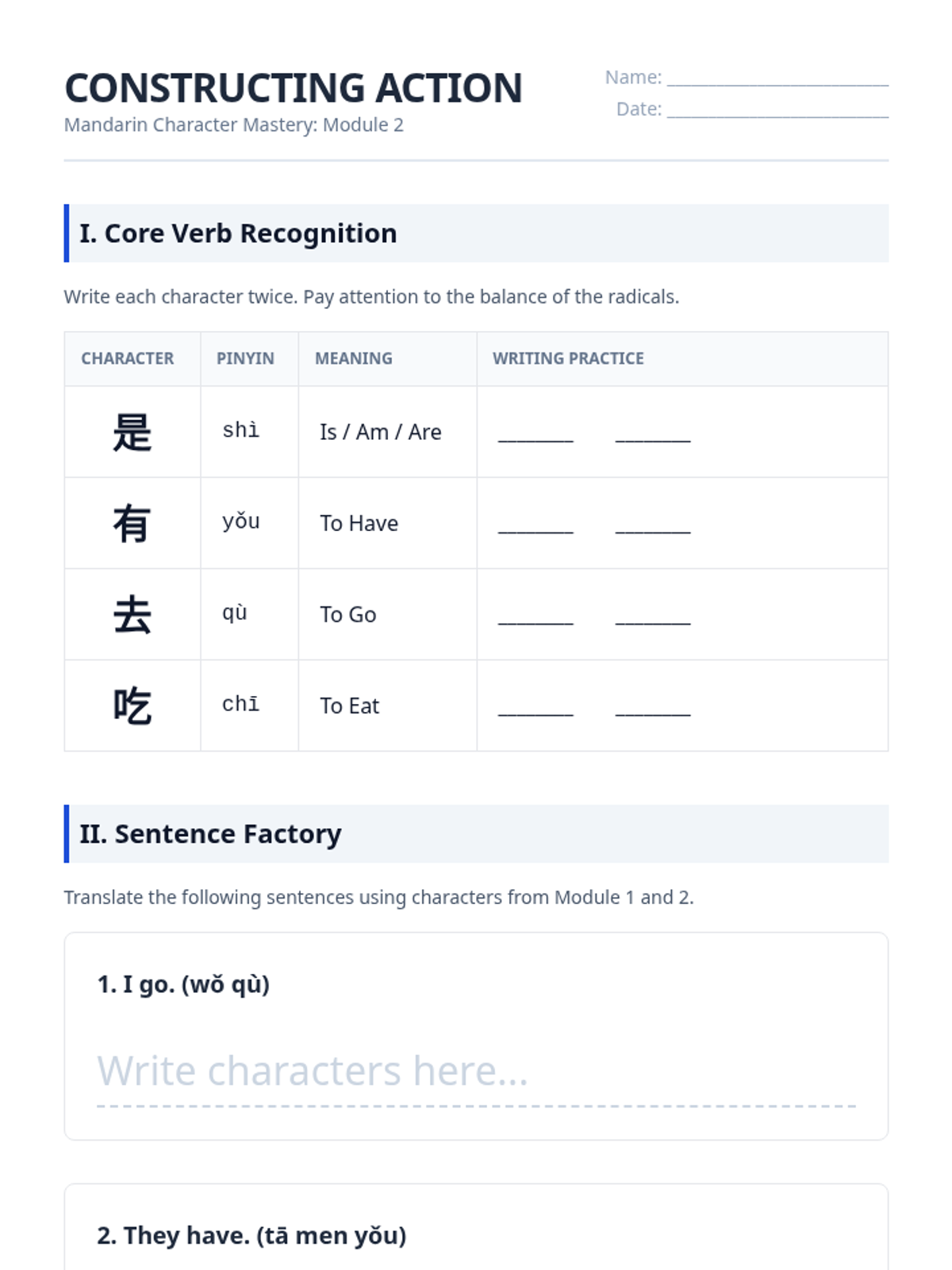
Worksheet for practicing the core verbs 'shì', 'yǒu', 'qù', and 'chī' in SVO structures.
Slides introducing core Mandarin verbs (shì, yǒu, qù, chī) and basic SVO sentence architecture.