Comprehensive French language instruction spanning basic literacy to advanced oral and written communication. Strengthens grammar, vocabulary, and cultural understanding through targeted exercises in listening, reading, and composition.
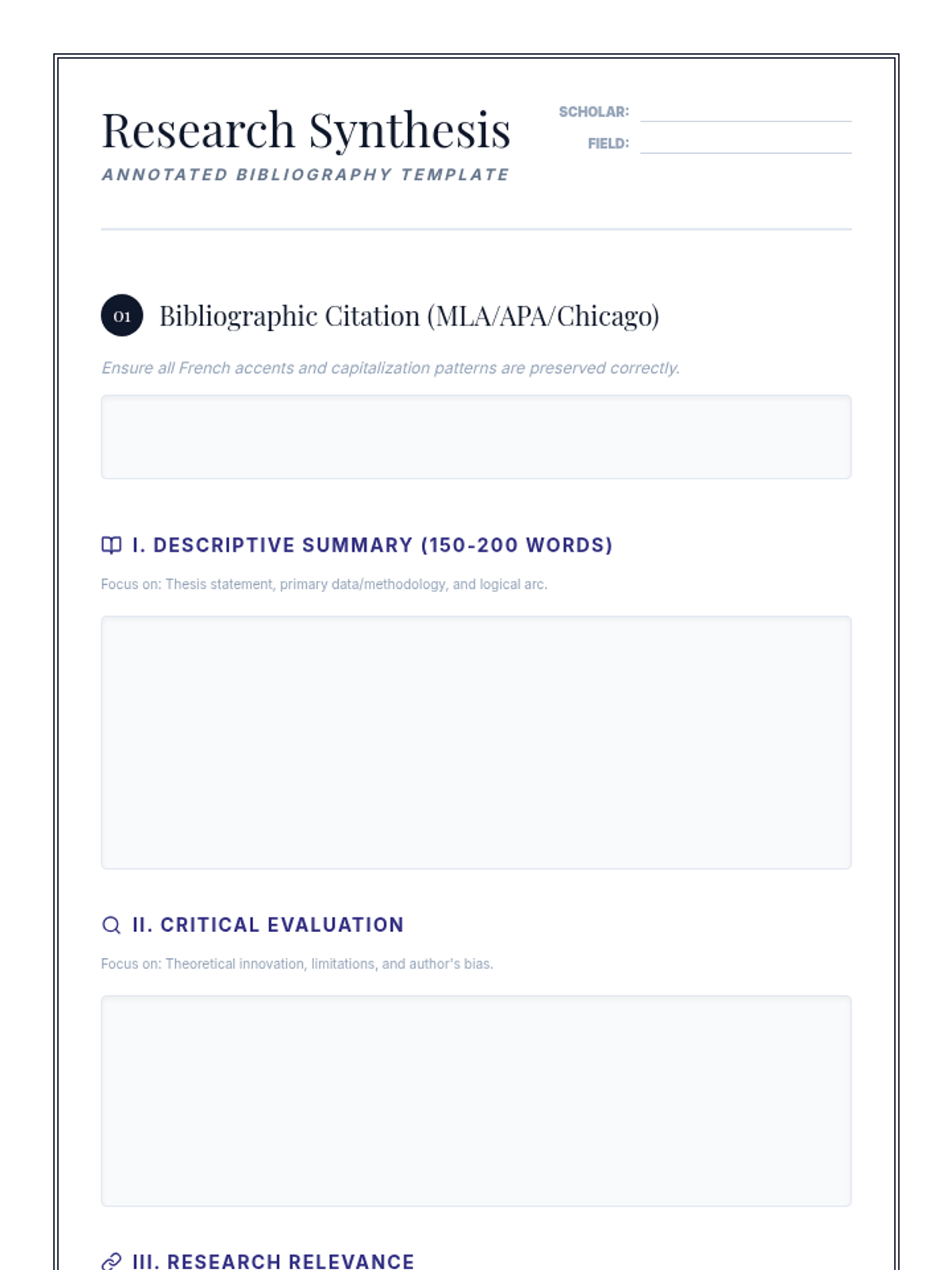
A formal template for graduate students to complete an annotated bibliography entry for a French academic source, integrating all skills learned in the sequence.
A visual presentation for the final lesson on synthesizing French research for an annotated bibliography, covering the annotation framework and presentation skills.
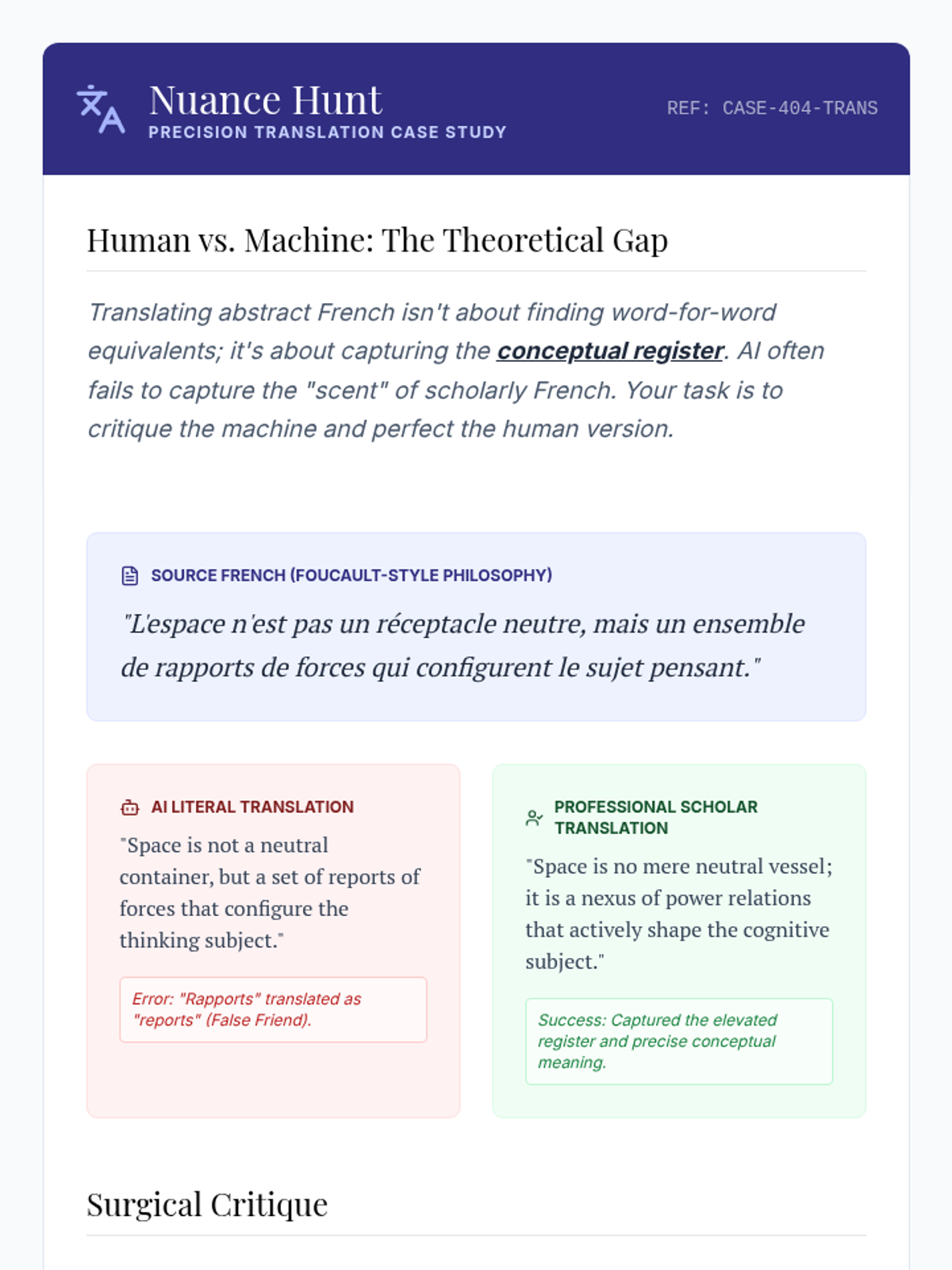
A translation case study worksheet for graduate students, comparing AI translations with professional scholarly translations of abstract French philosophical texts.
A presentation for graduate students on deconstructing complex French academic syntax, focusing on sentence structure, relative pronouns, and the technique of finding the 'core' statement.
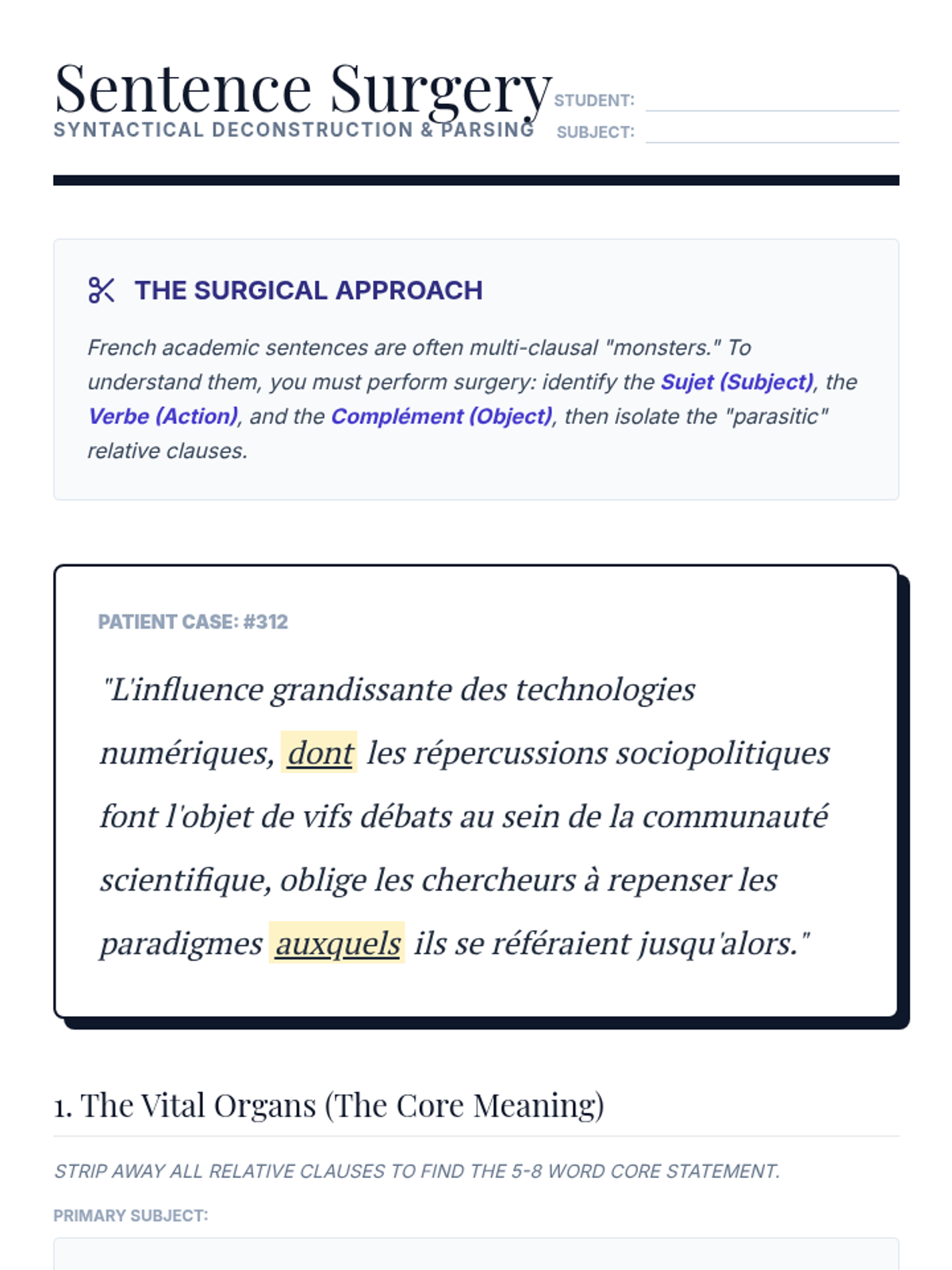
A syntactical deconstruction worksheet for graduate students, focusing on parsing complex French academic sentences and identifying the function of relative pronouns like 'dont' and 'auxquels'.
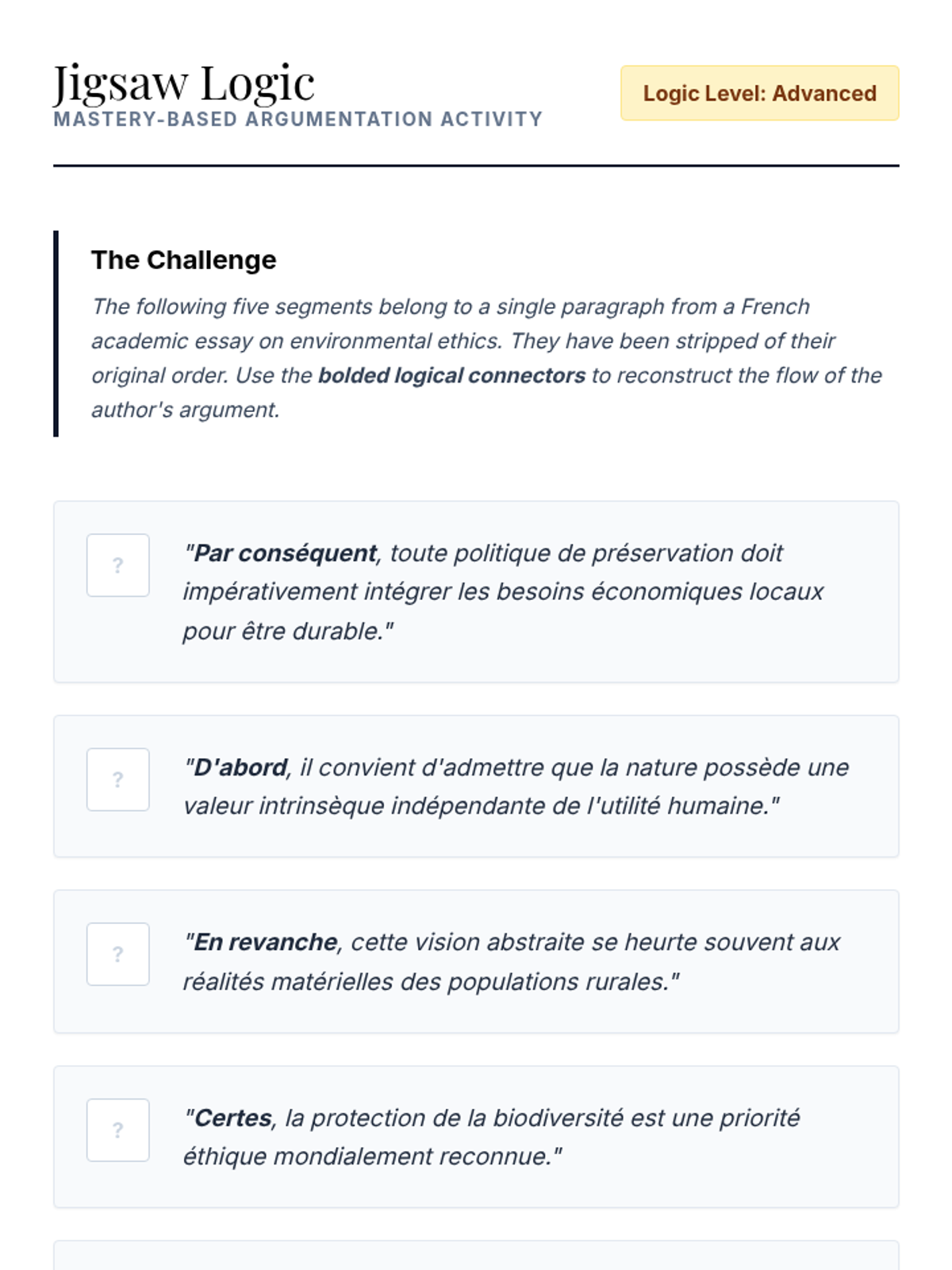
A puzzle-based activity where students reassemble a scrambled French academic argument by analyzing logical connectors.
A presentation for graduate students on the importance and usage of logical connectors in French academic argumentation, including the specific role of 'Or' and structural mapping.
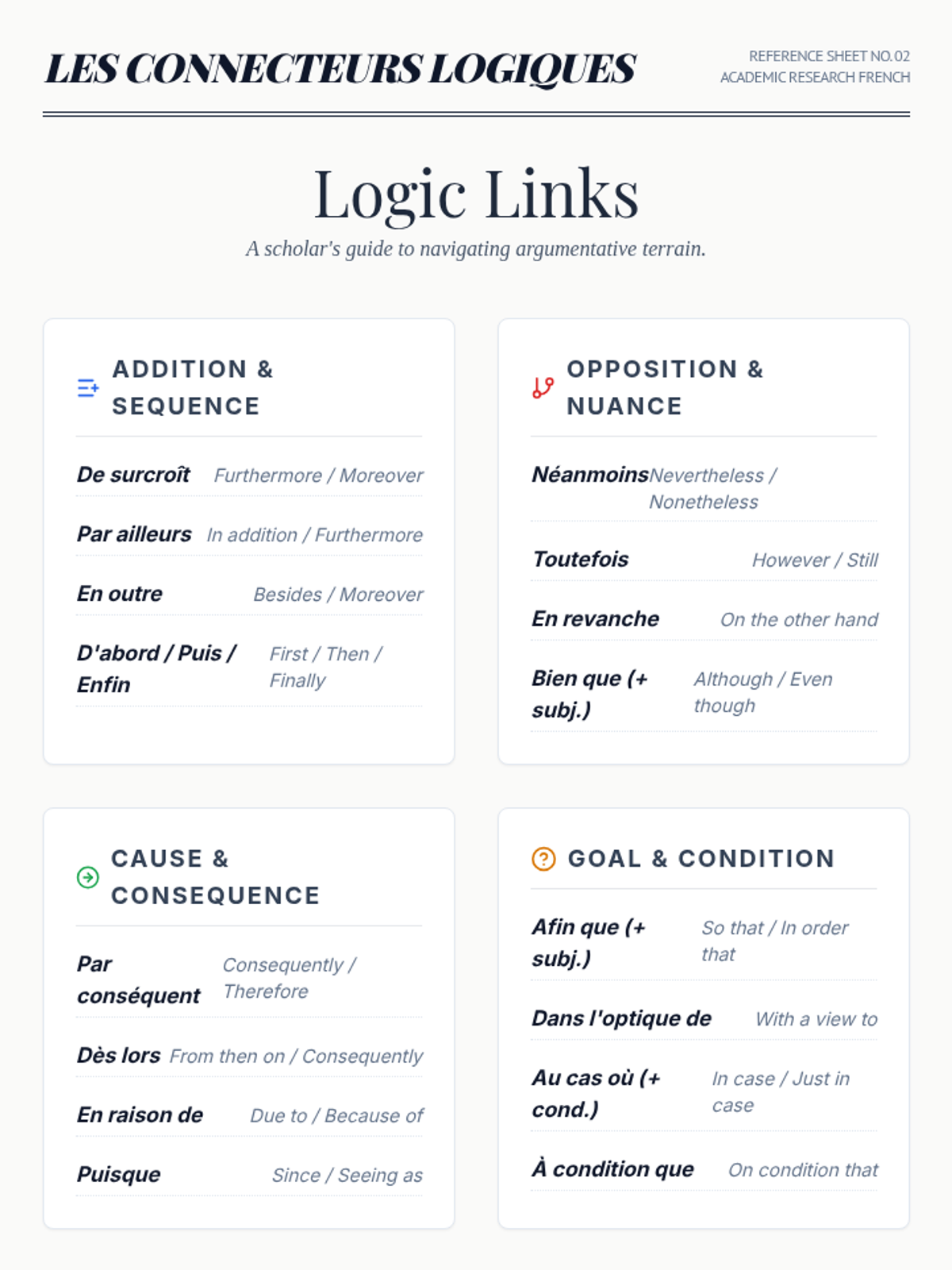
A comprehensive reference sheet for graduate students detailing French logical connectors (connecteurs logiques) grouped by function, with English equivalents and academic usage notes.
A teacher guide for the Rapid Reading lesson, including pacing, pedagogical tips for graduate learners, and an answer key for the Scanning Sprint activity.
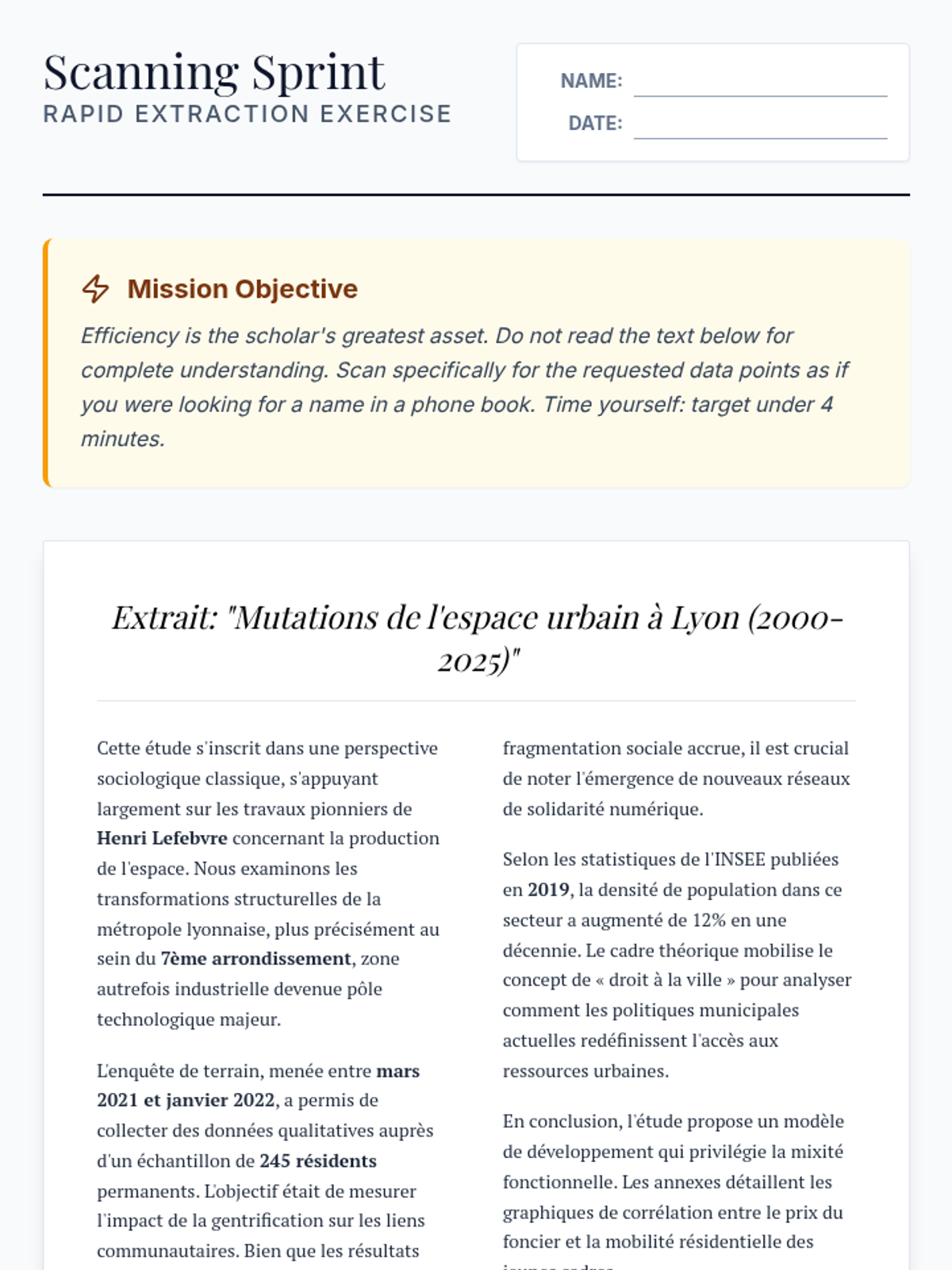
A rapid scanning worksheet for graduate students featuring a dense academic French text and specific data extraction tasks to be completed under time pressure.
A visual presentation for graduate students on rapid reading strategies for academic French, covering skimming, scanning, and identifying structural signposts.
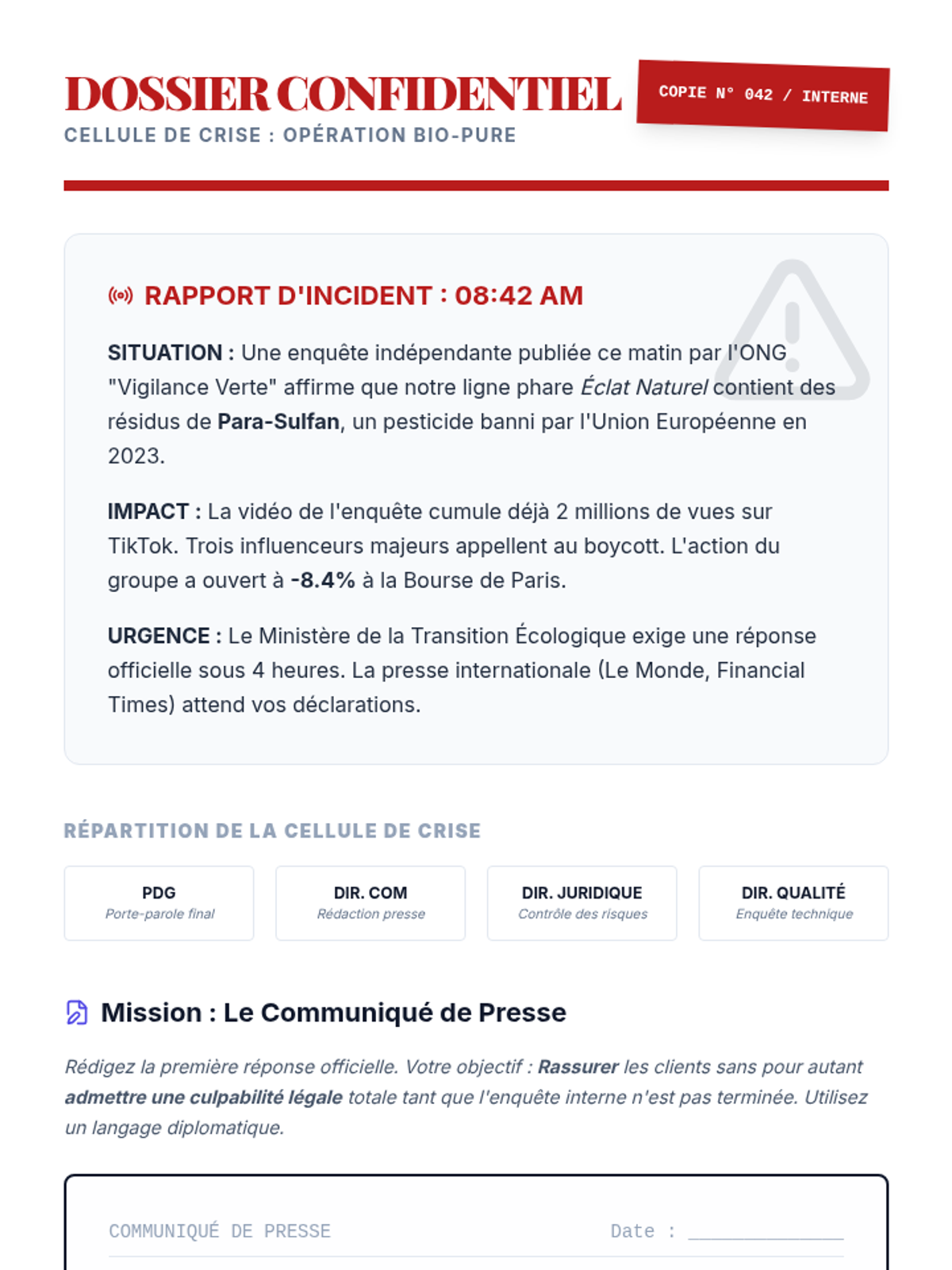
A simulation briefing document for a corporate crisis scenario, including incident details, roles, and templates for press release drafting and board meeting preparation.
A specialized slide deck for the culminating crisis management simulation, covering types of crises, diplomatic vocabulary, and press release structures in French.
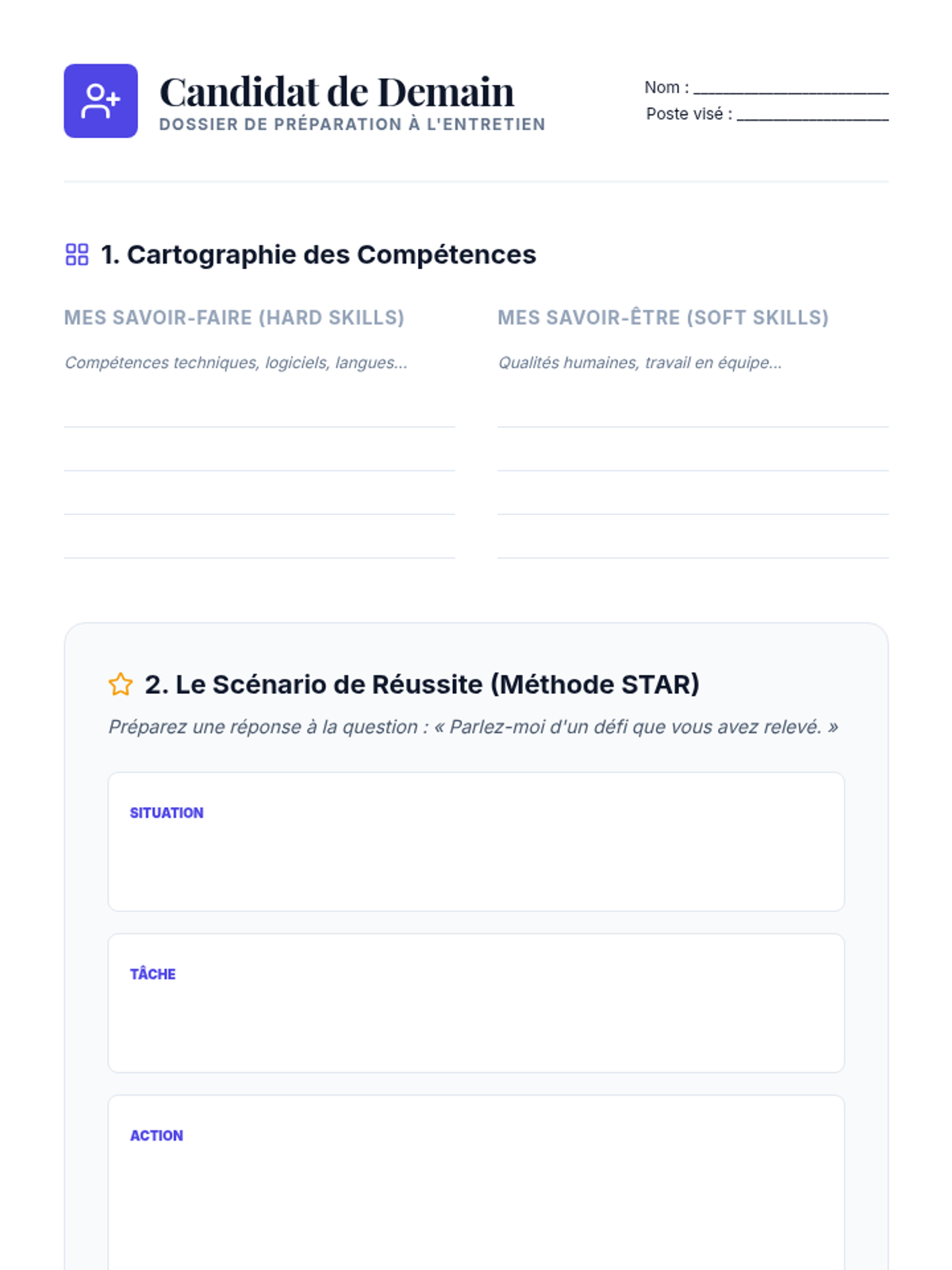
A worksheet for preparing a professional self-presentation and interview answers in French, using structured skills assessment and the STAR method.
A specialized slide deck focusing on HR processes, behavioral interviewing techniques, and describing professional competencies in French.
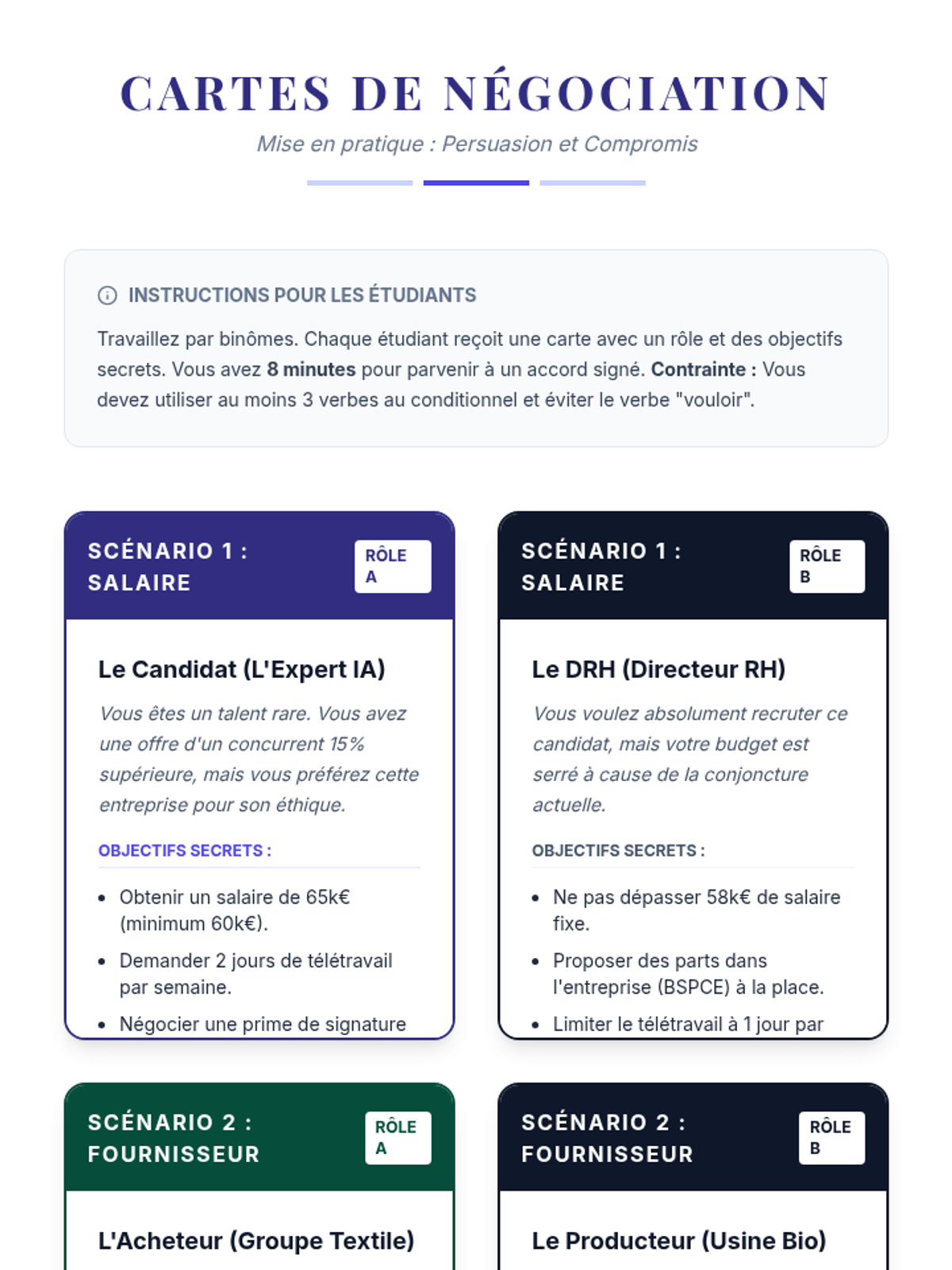
Role-play cards for professional French negotiation scenarios, featuring specific roles, secret objectives, and required vocabulary.
A specialized slide deck focusing on negotiation tactics, the conditional mood for politeness, and strategic bargaining vocabulary in French business contexts.
An activity worksheet for analyzing economic trends and data using professional French terminology, featuring a case study and data description task.
A specialized slide deck focusing on financial terminology, economic trends, and strategic business vocabulary in French.
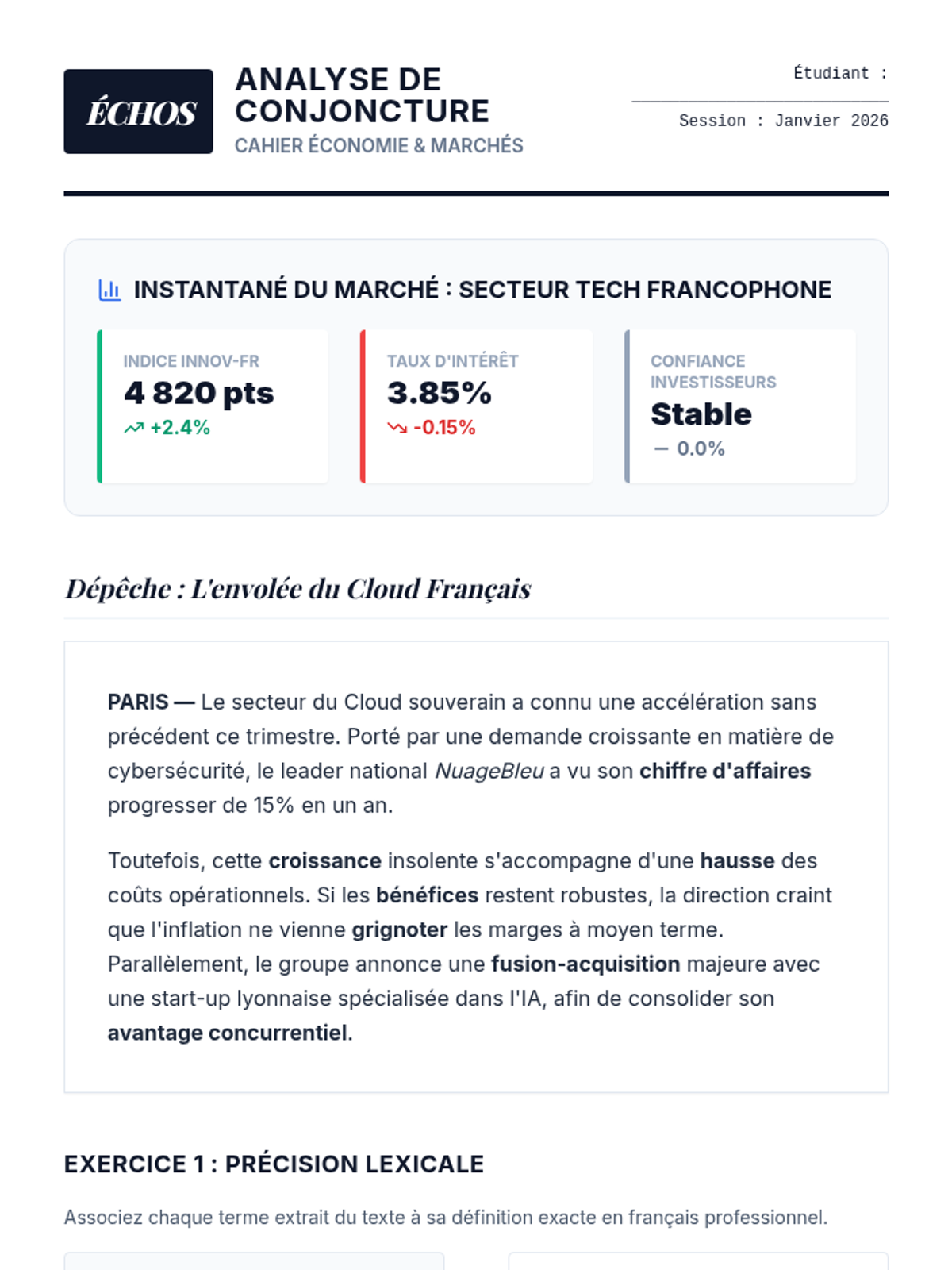
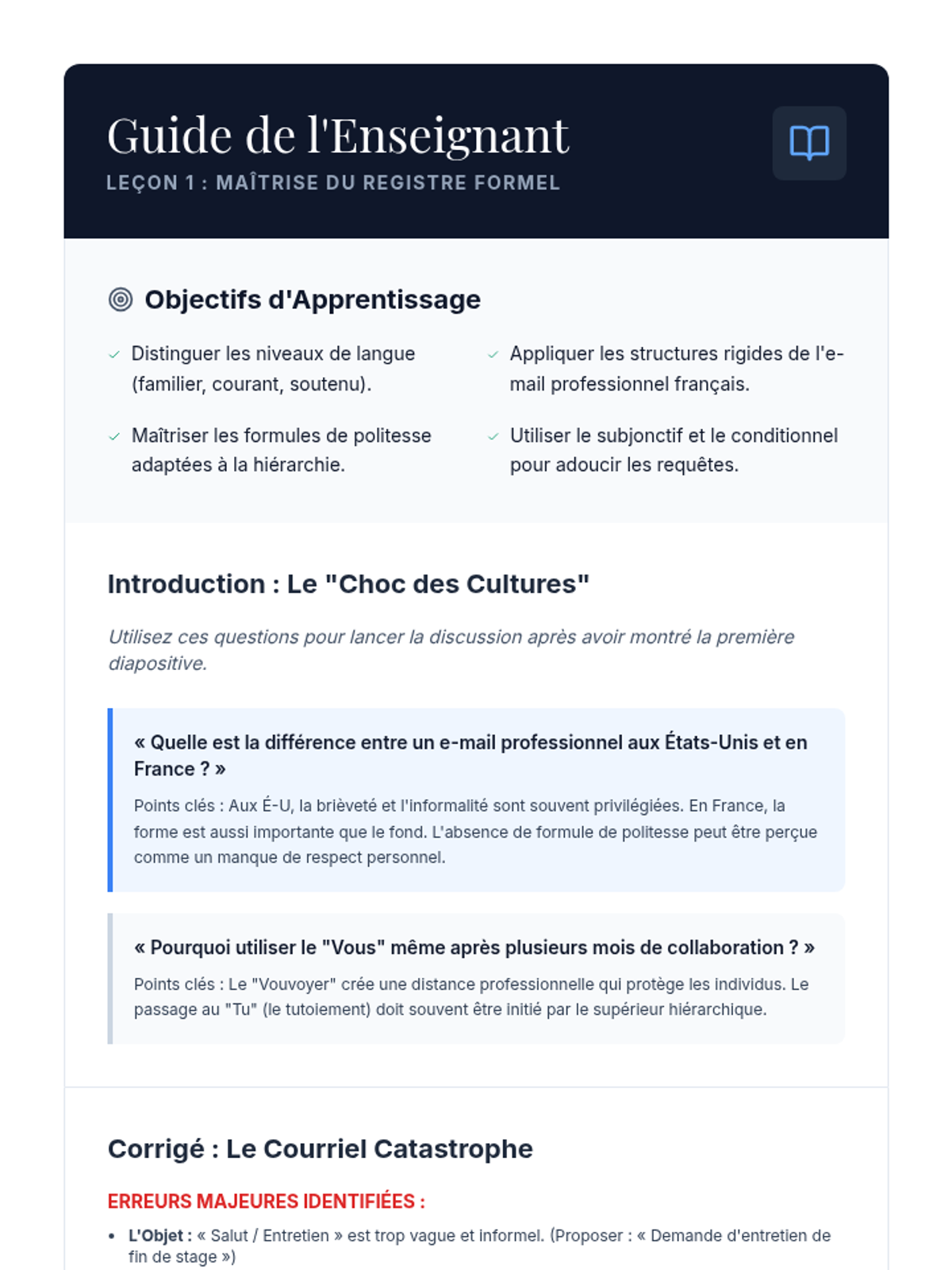
A comprehensive teacher guide for teaching French business correspondence, including discussion prompts, answer keys, and pedagogical tips.
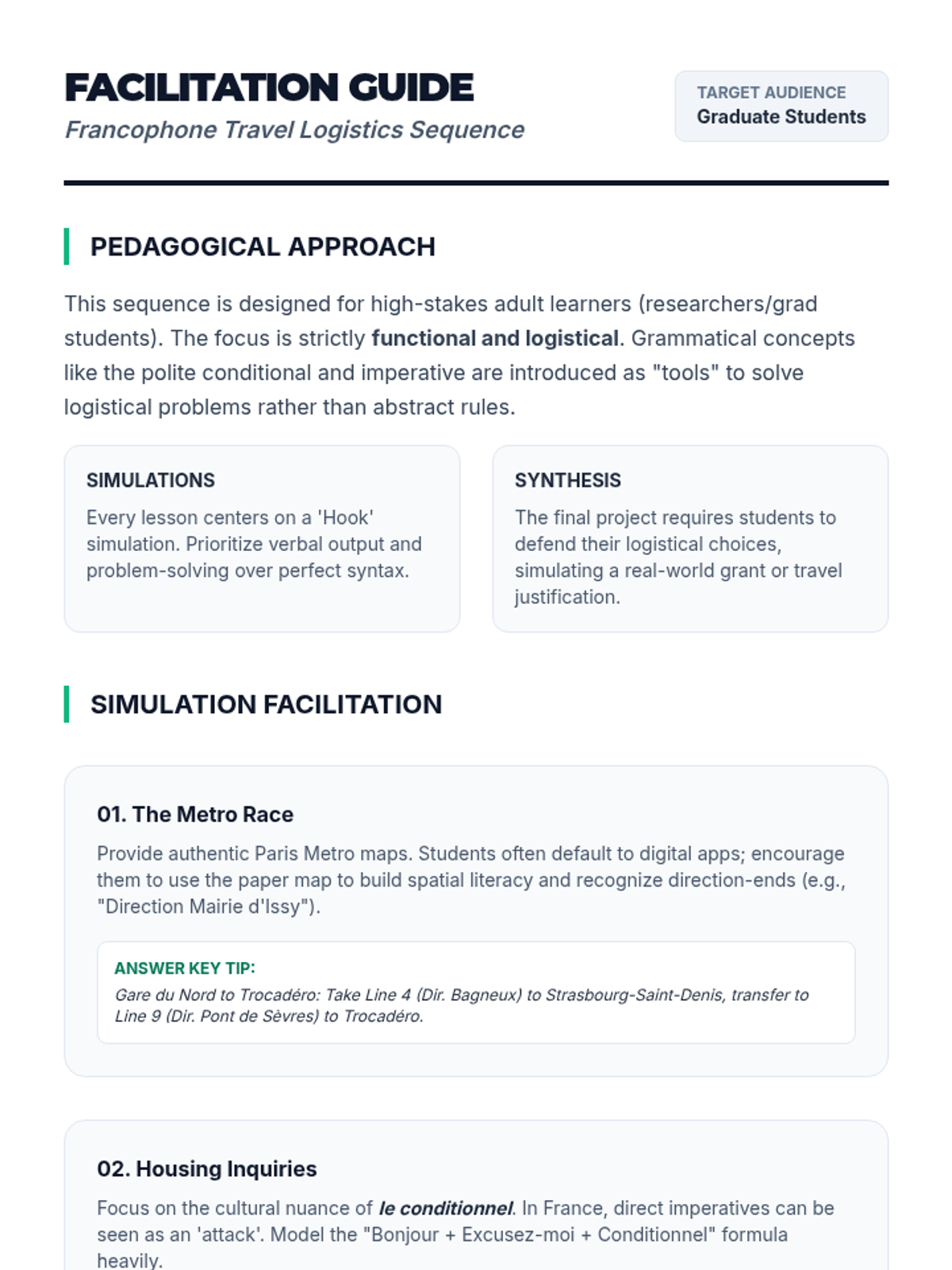
Facilitation guide for the Francophone Travel Logistics sequence, providing simulation instructions, answer keys for the hooks, and pedagogical tips for teaching graduate students.
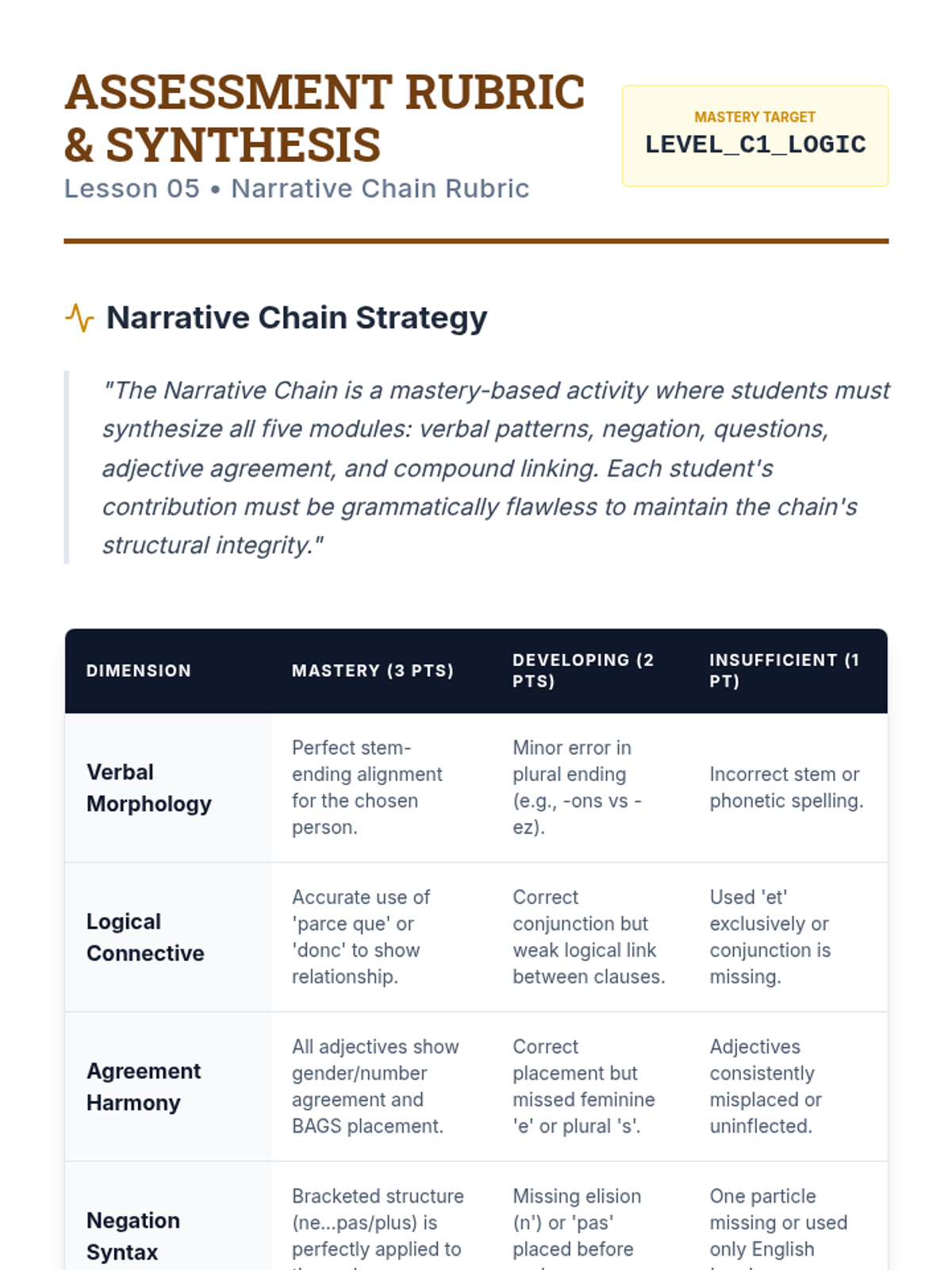
Assessment rubric and mastery example for the Narrative Chain activity in Lesson 05. Evaluates verbal morphology, connective use, agreement harmony, and negation syntax.
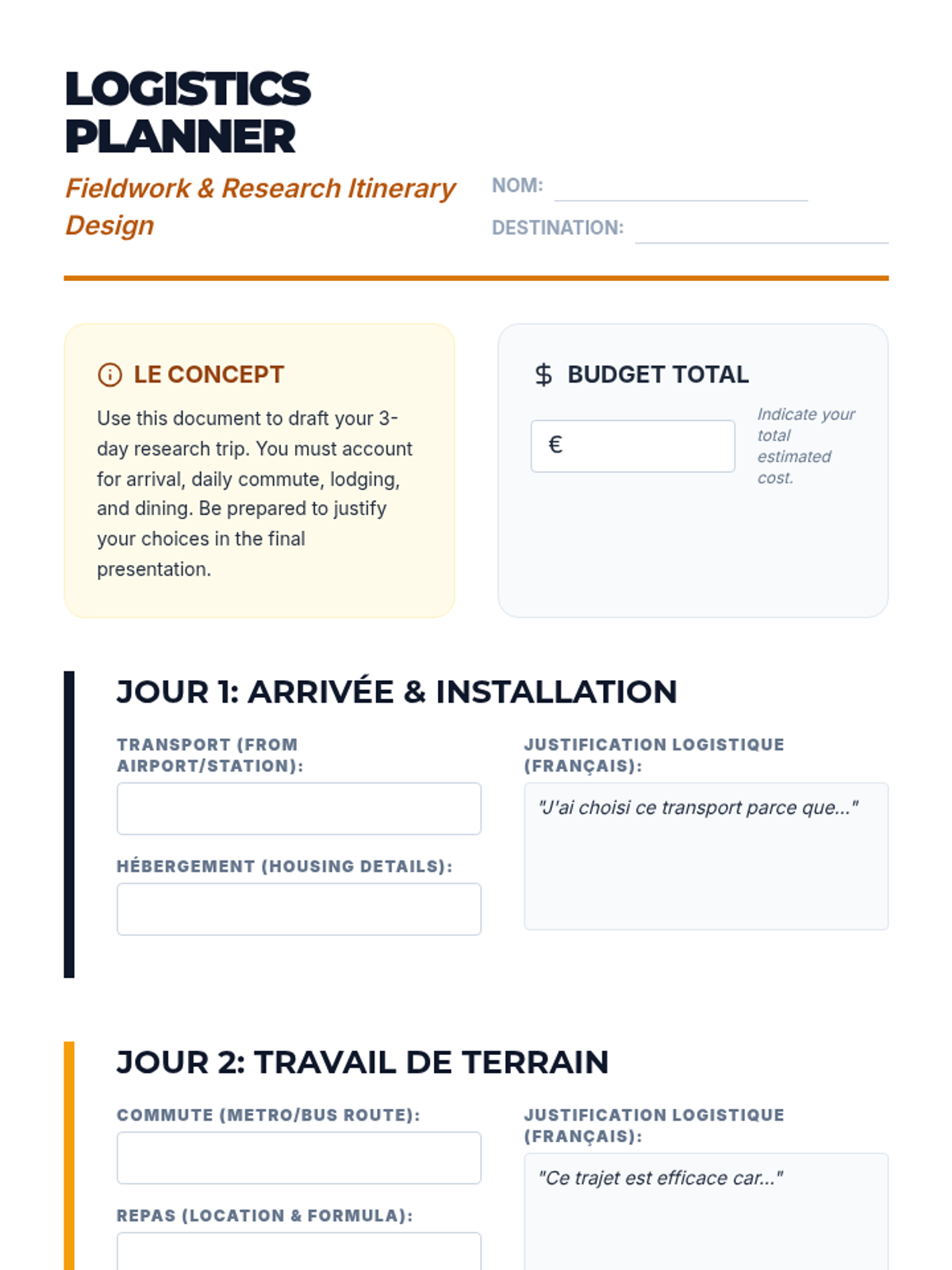
Research itinerary planner for students to organize their capstone project, including sections for transit, housing, and budget justifications in French.
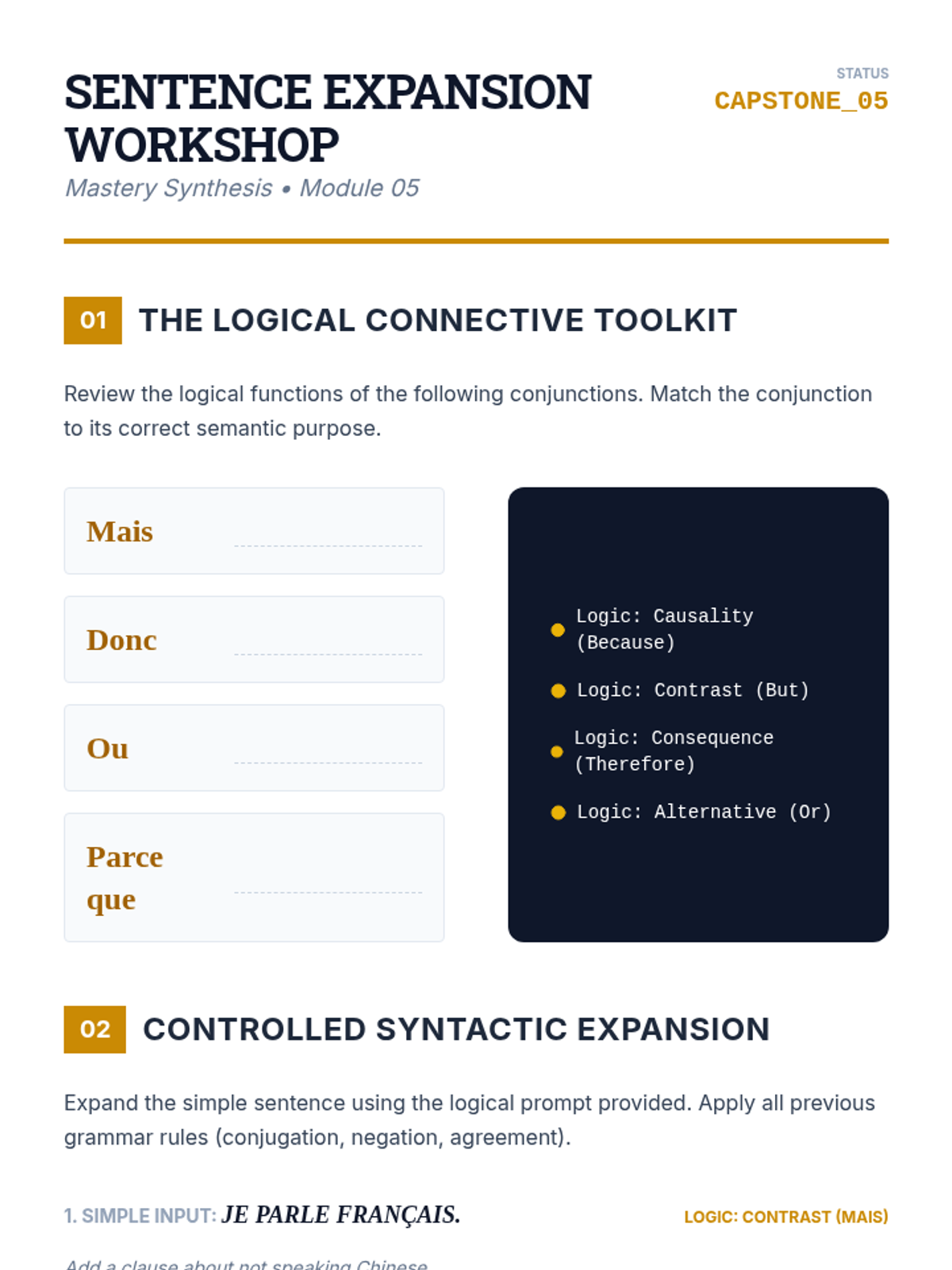
Capstone workshop for Lesson 05 on French compound sentence construction. Includes logical connective matching, controlled expansion drills, and a deconstructive analysis task.
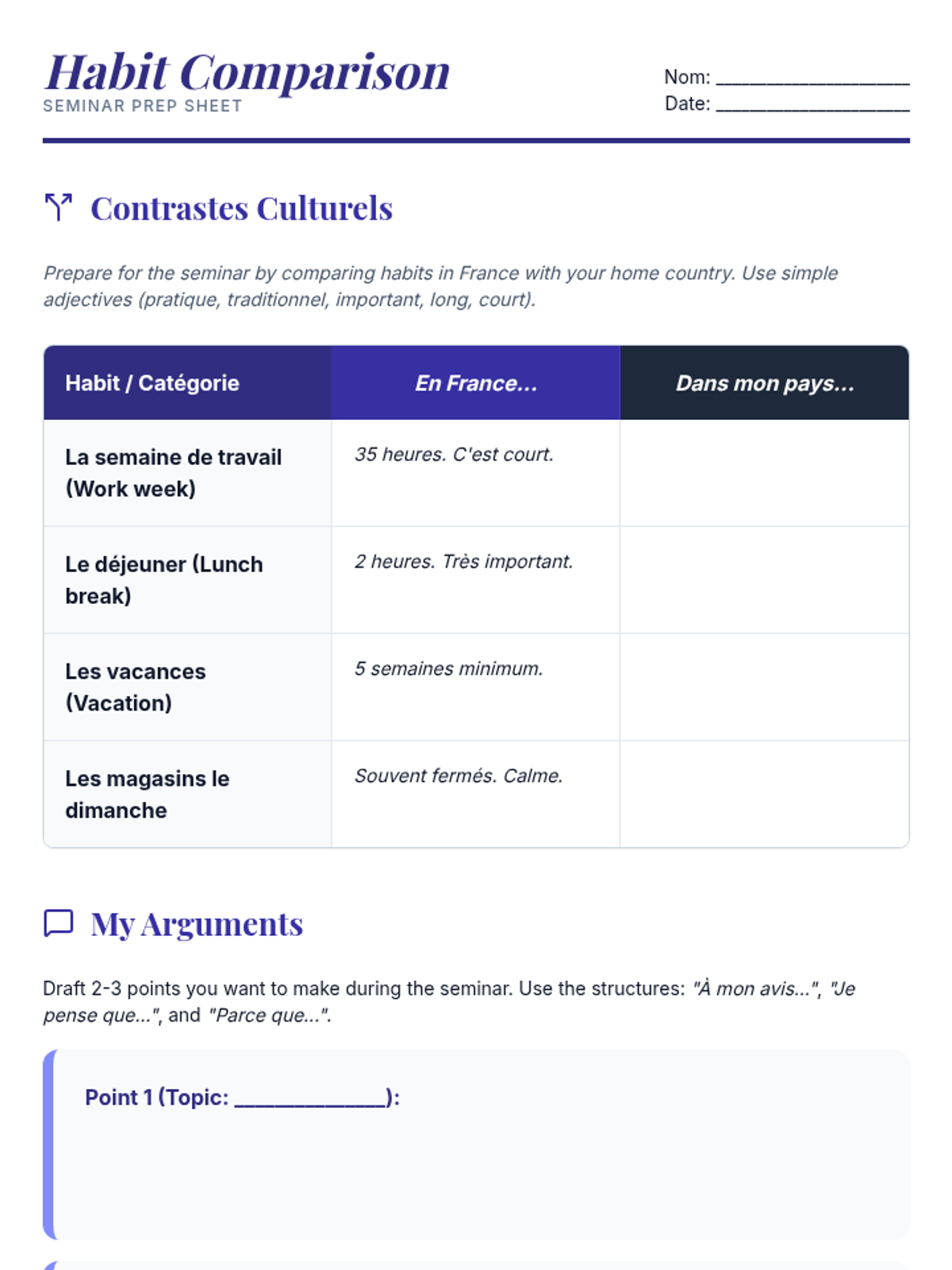
A pre-seminar prep sheet for students to organize their thoughts and comparisons on cultural habits.
Final slide deck for Lesson 05 on compound sentences in French. Covers conjunctions (et, mais, ou, parce que, donc) and clause logic for complex communication.
Guidelines and vocabulary for the final capstone presentation, focusing on justifying travel and research logistics in French.
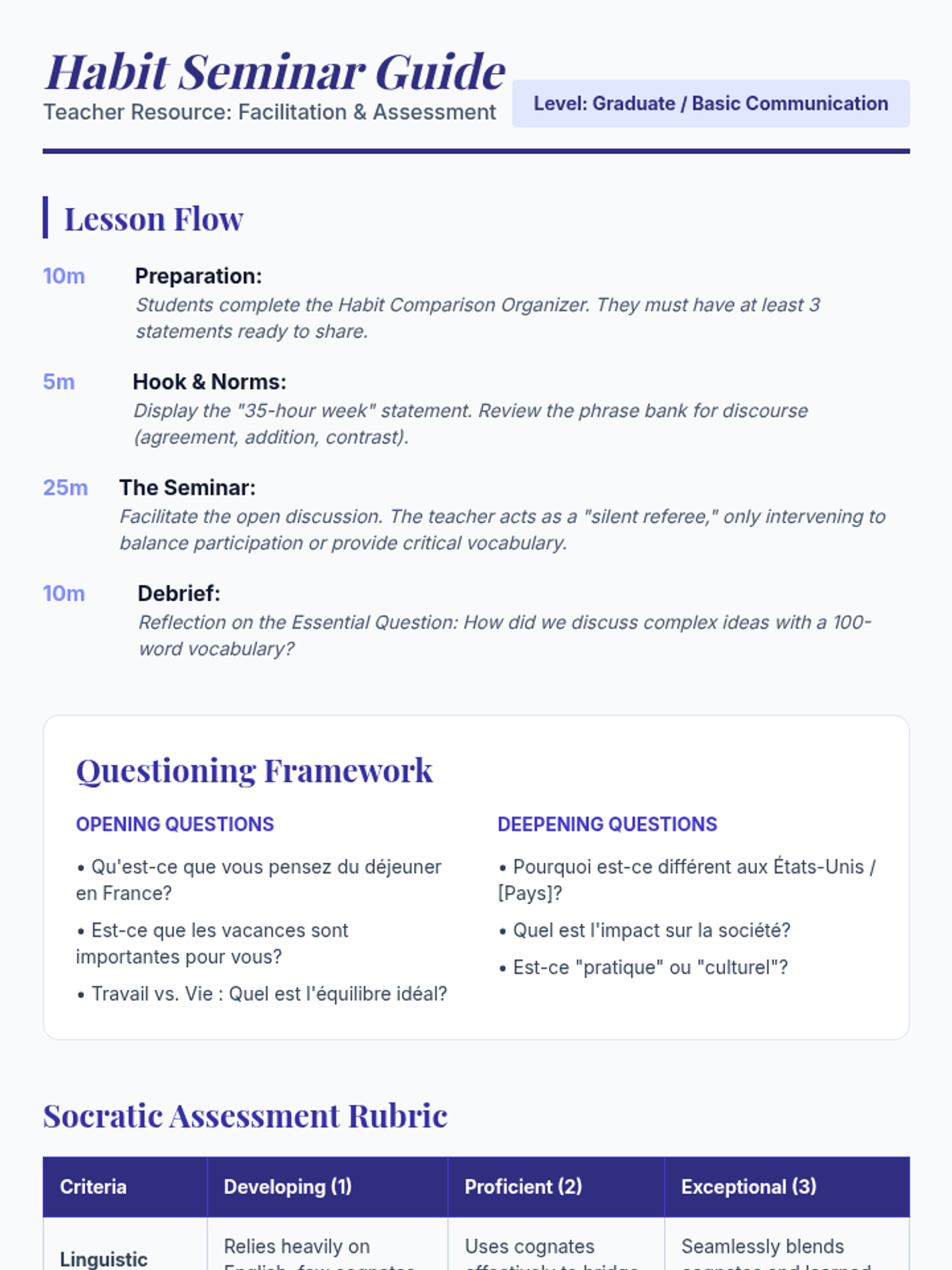
A facilitation and assessment guide for teachers to lead the Lesson 5 Socratic Seminar on cultural habits.
A visual presentation for the Lesson 5 Habit Seminar, providing discussion rules, catalyst statements, and vocabulary support.
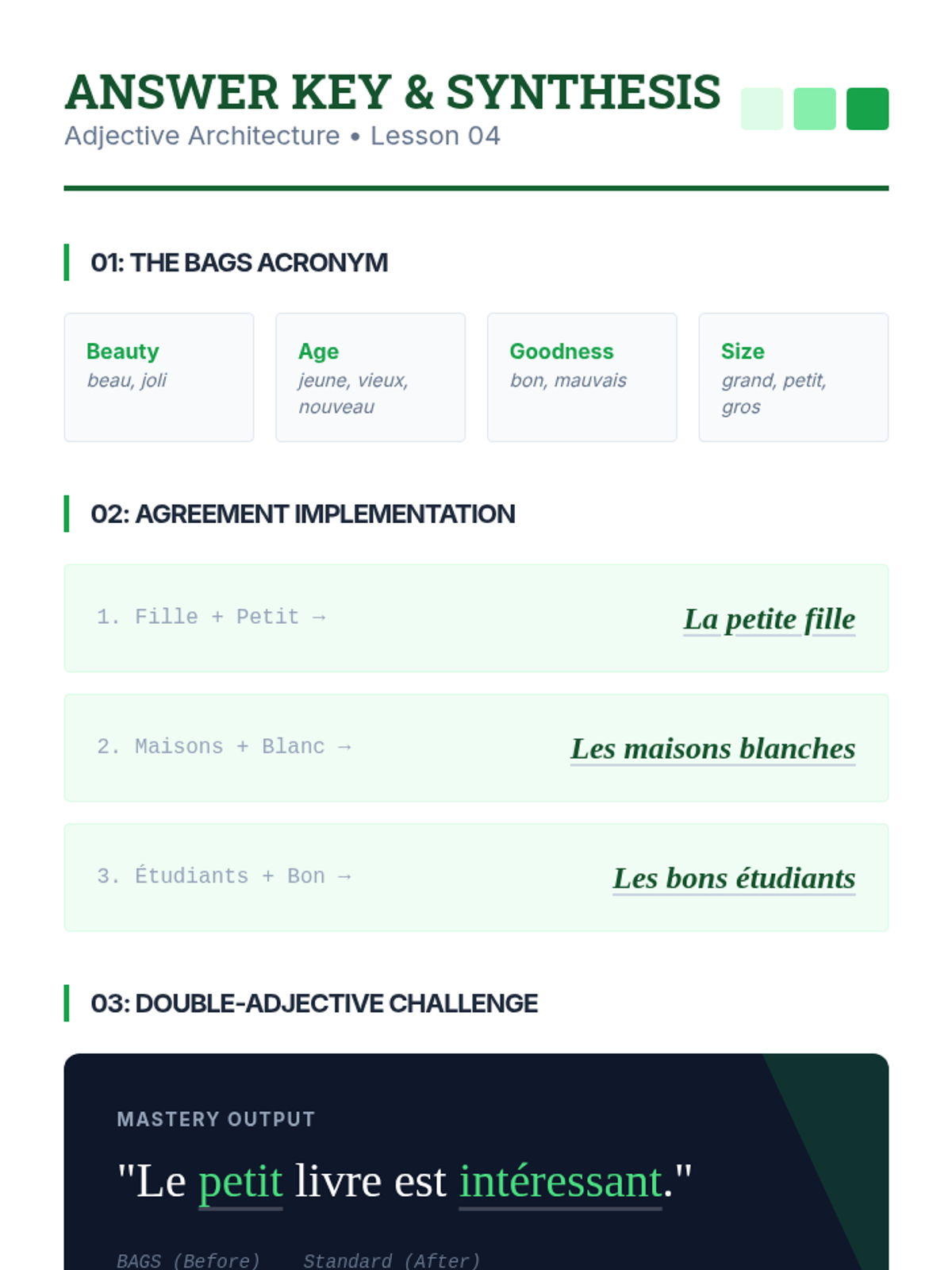
Answer key for Lesson 04 on adjective placement and agreement, featuring correct morphological forms and strategic notes for instructors.
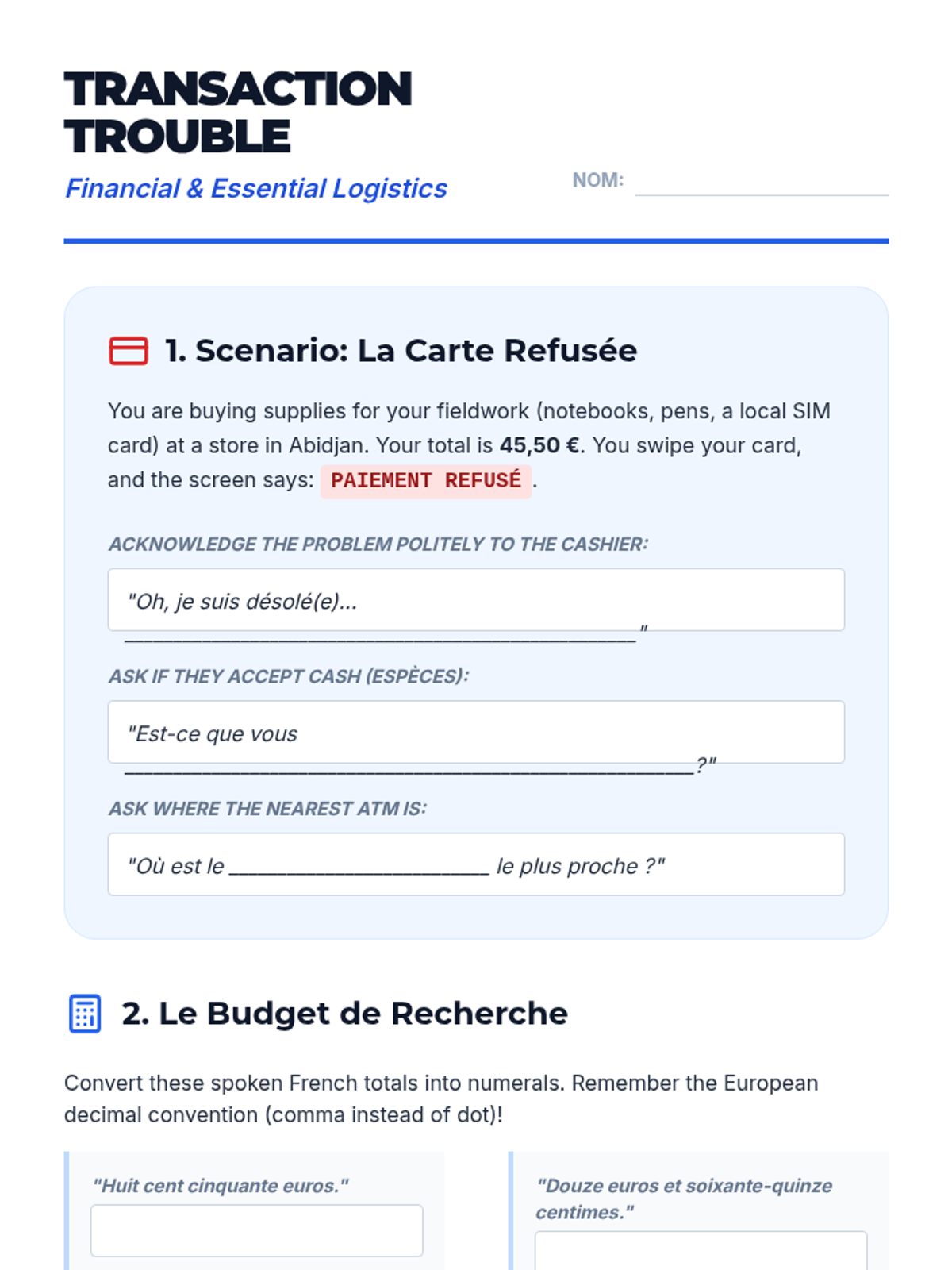
Practical worksheet focusing on financial transactions, handling payment issues, and navigating essential pharmacy services in French.
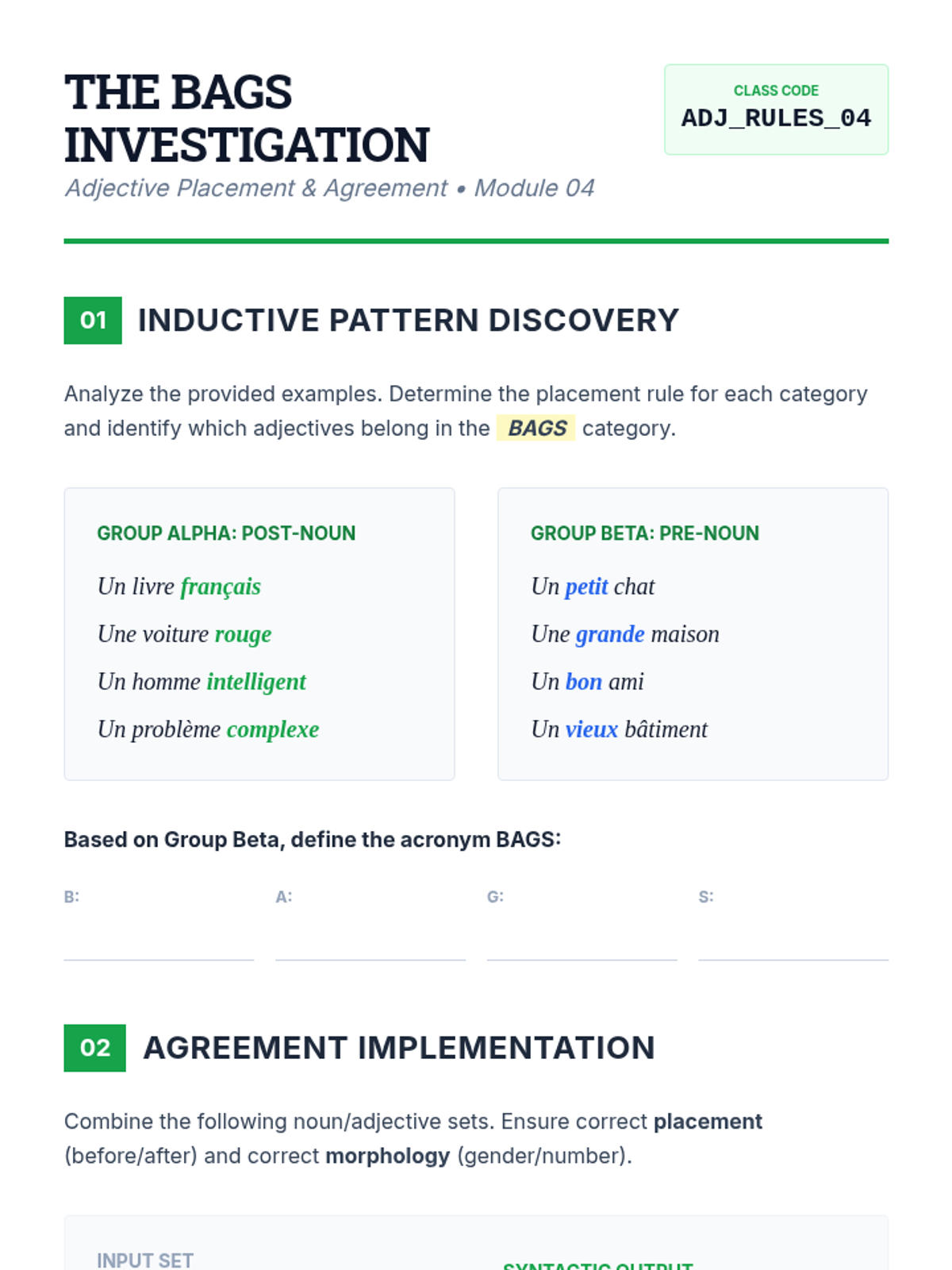
Investigation worksheet for Lesson 04 on adjective placement and agreement. Students use inductive reasoning to discover the BAGS rule and practice morphological harmony.
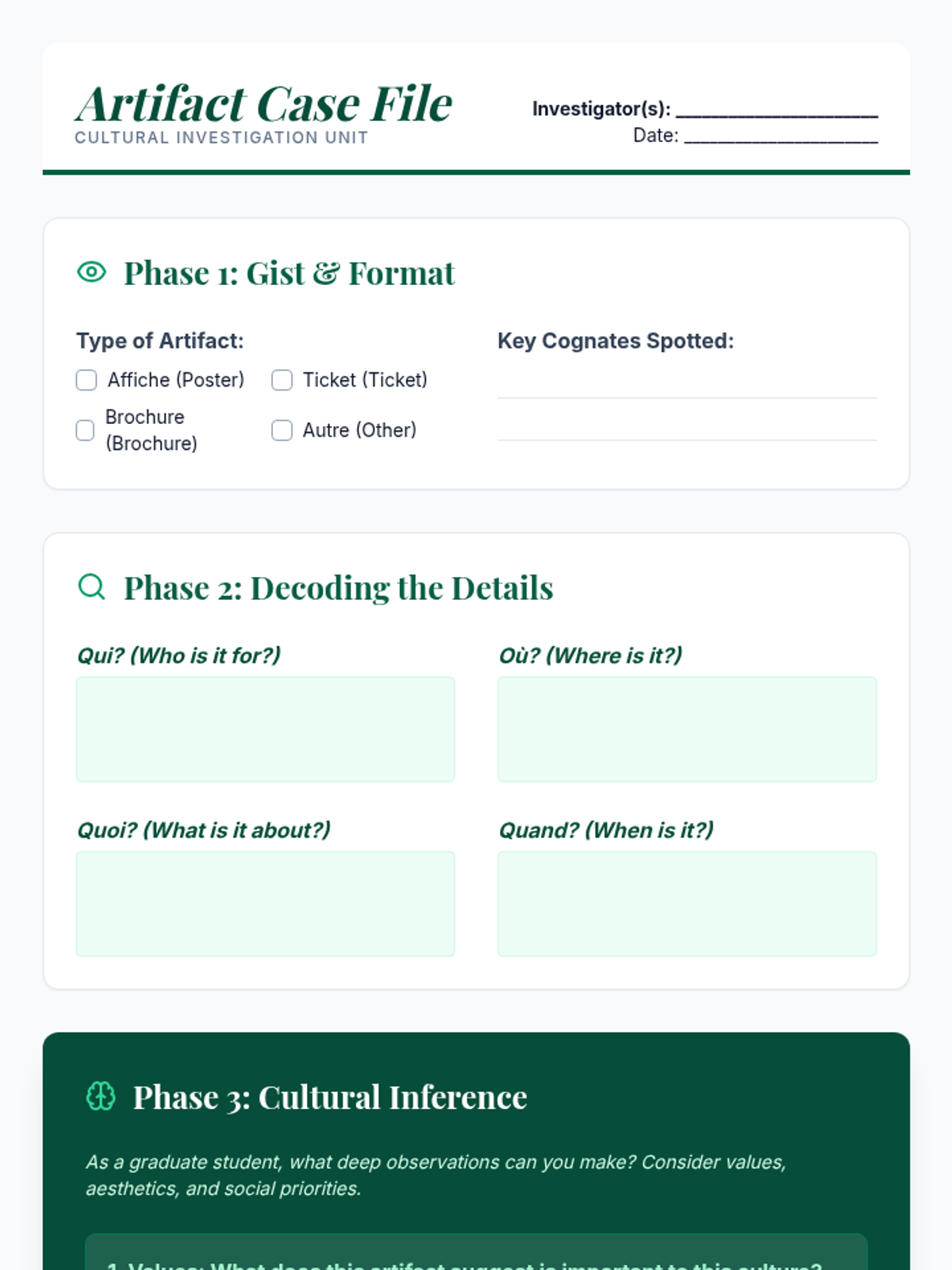
A structured worksheet for students to analyze authentic French cultural documents and infer deeper cultural values.
Visual presentation for teaching French financial transactions, shopping logistics, and essential services like pharmacies.
A visual presentation for Lesson 4, introducing students to the process of analyzing authentic French cultural documents.
Slides for Lesson 04 on French adjectives, covering the standard position (after the noun), the BAGS exception (before the noun), and gender/number agreement.
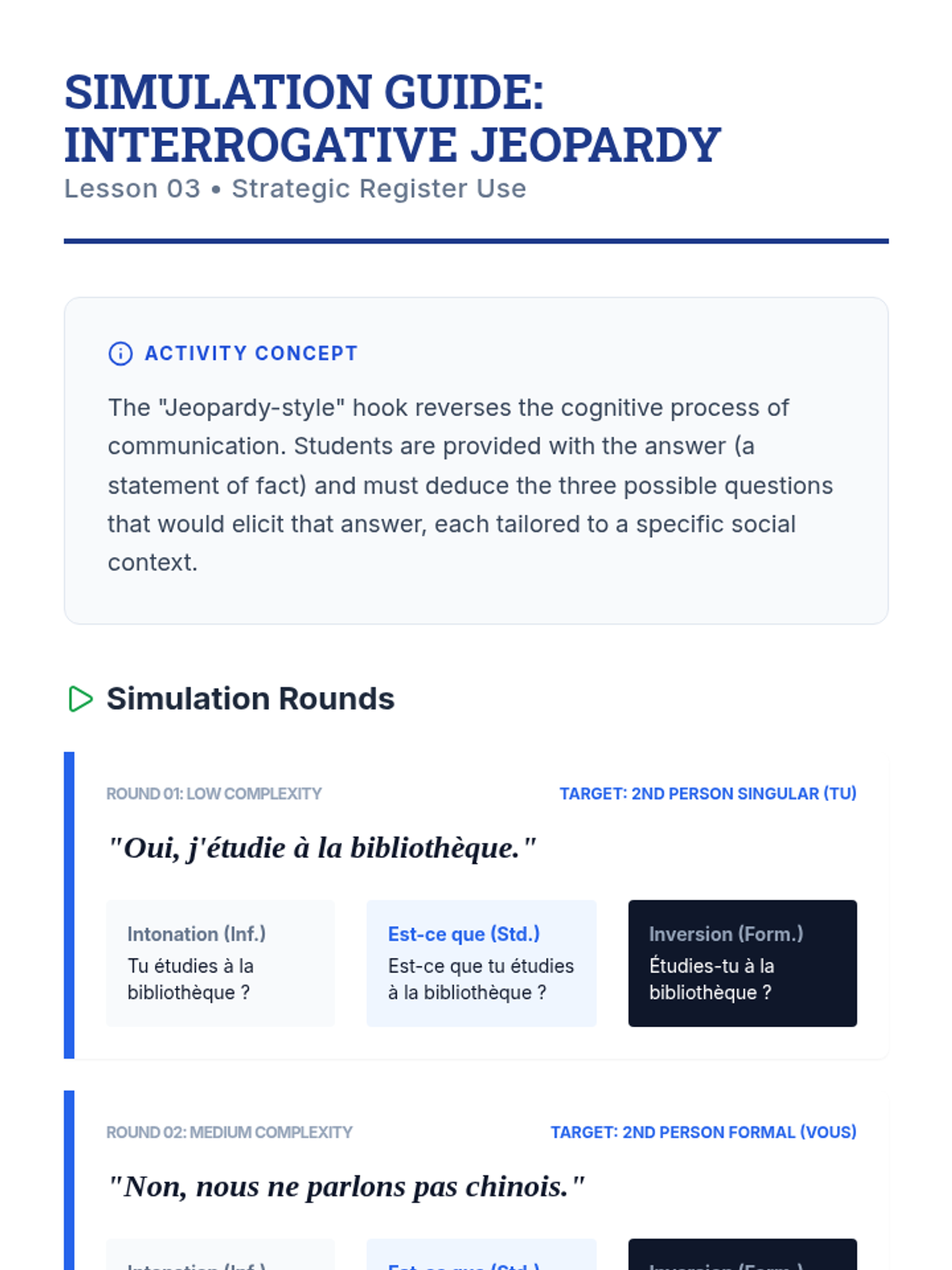
Facilitation guide for a Jeopardy-style simulation on French question registers, providing teacher prompts, answers, and evaluation criteria.
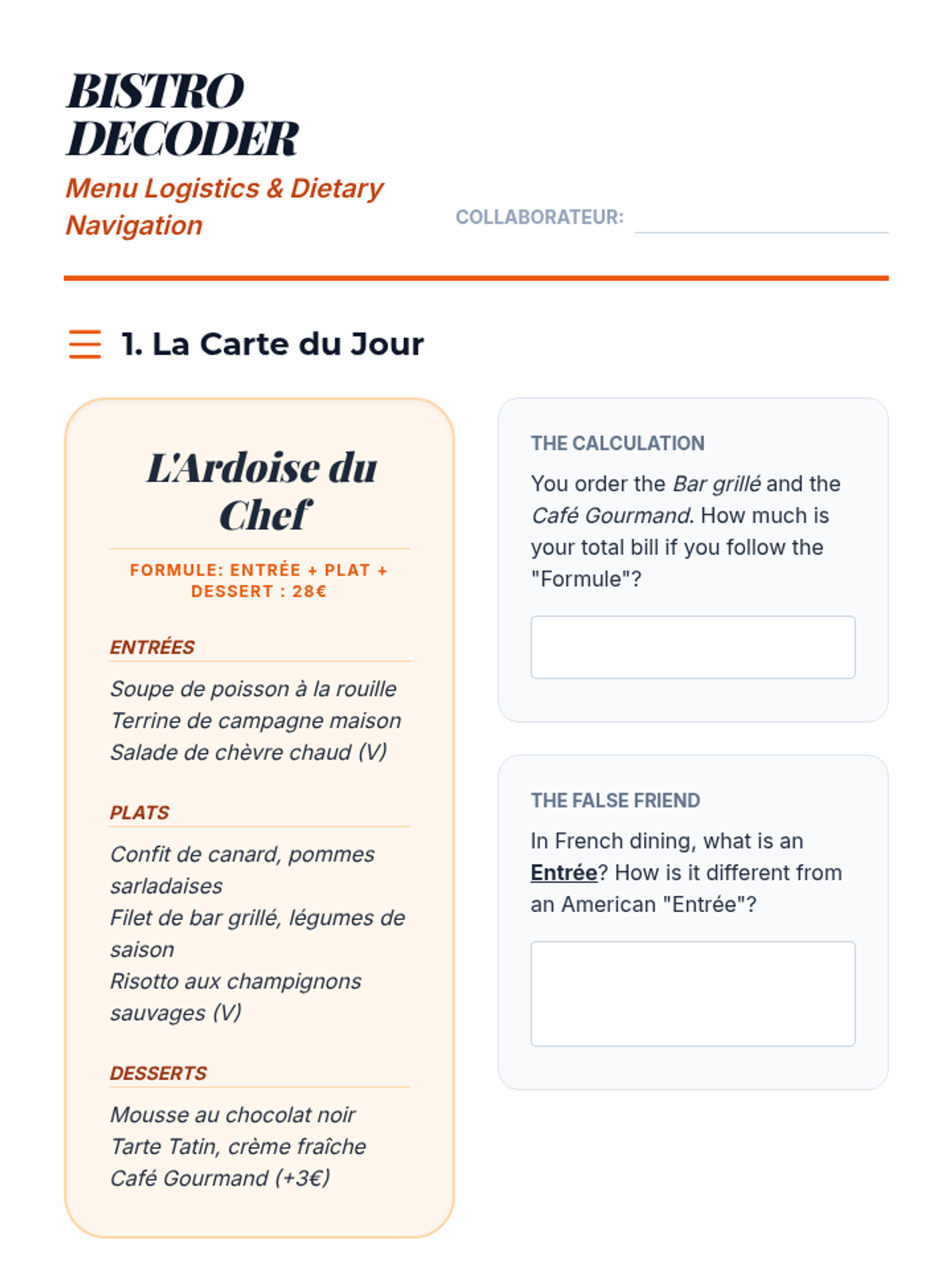
An activity worksheet for decoding a French bistro menu, practicing ordering within a 'formule' structure, and communicating dietary restrictions.
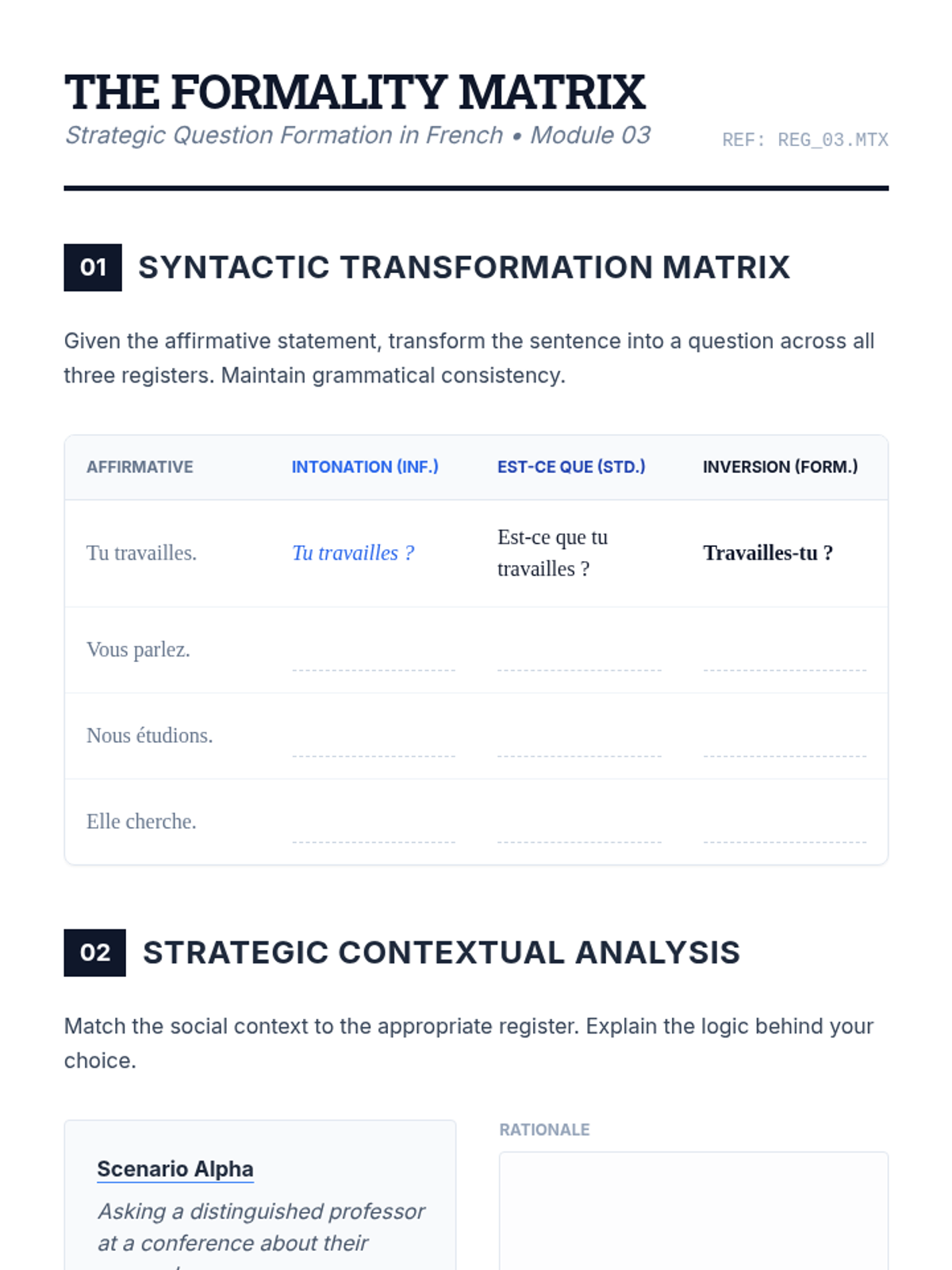
Worksheet for Lesson 03 on French question formation. Includes a transformation matrix for all three registers and a social context matching exercise for graduate students.
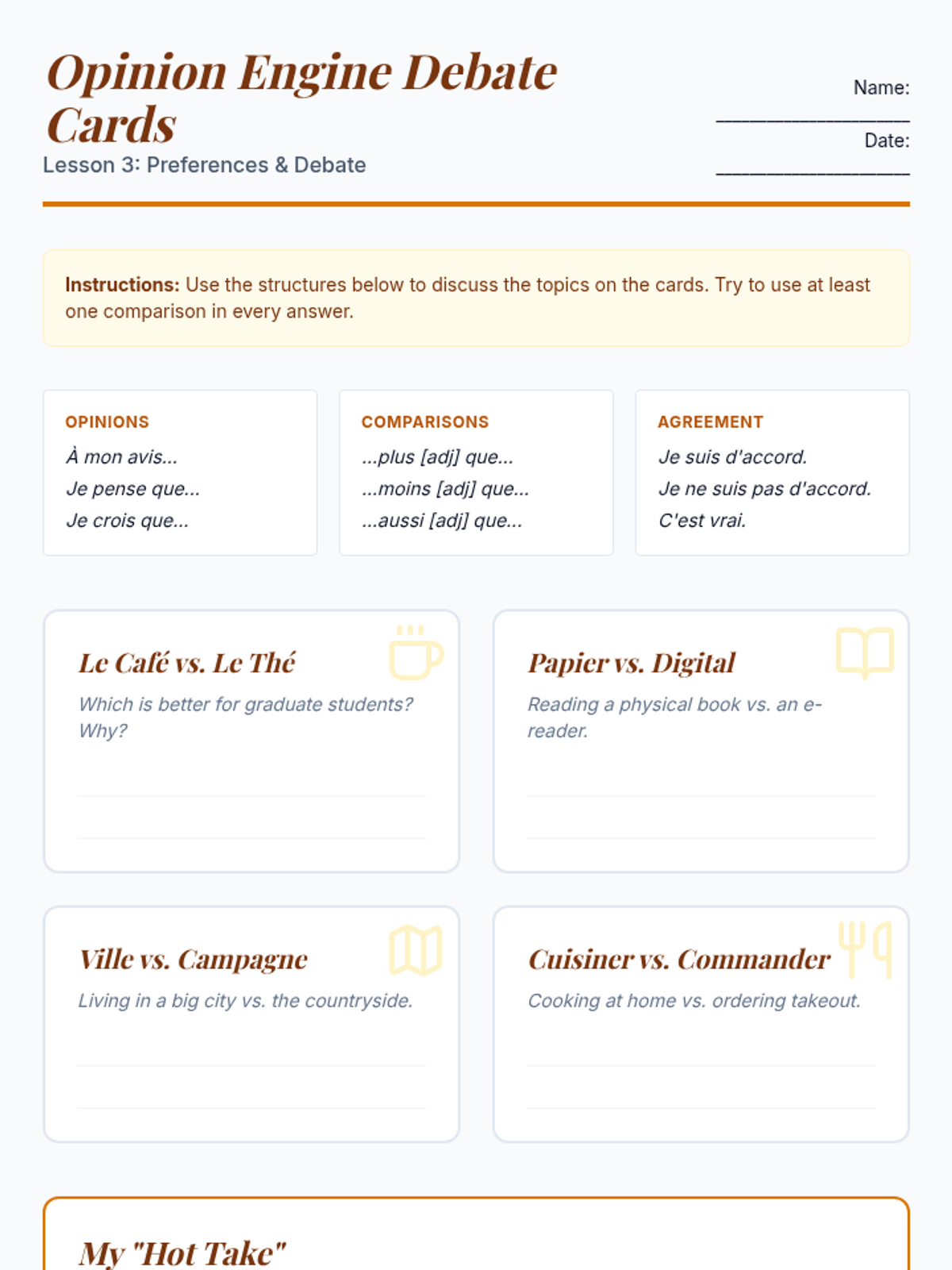
A set of debate cards and a writing worksheet for students to practice expressing opinions and preferences in French.
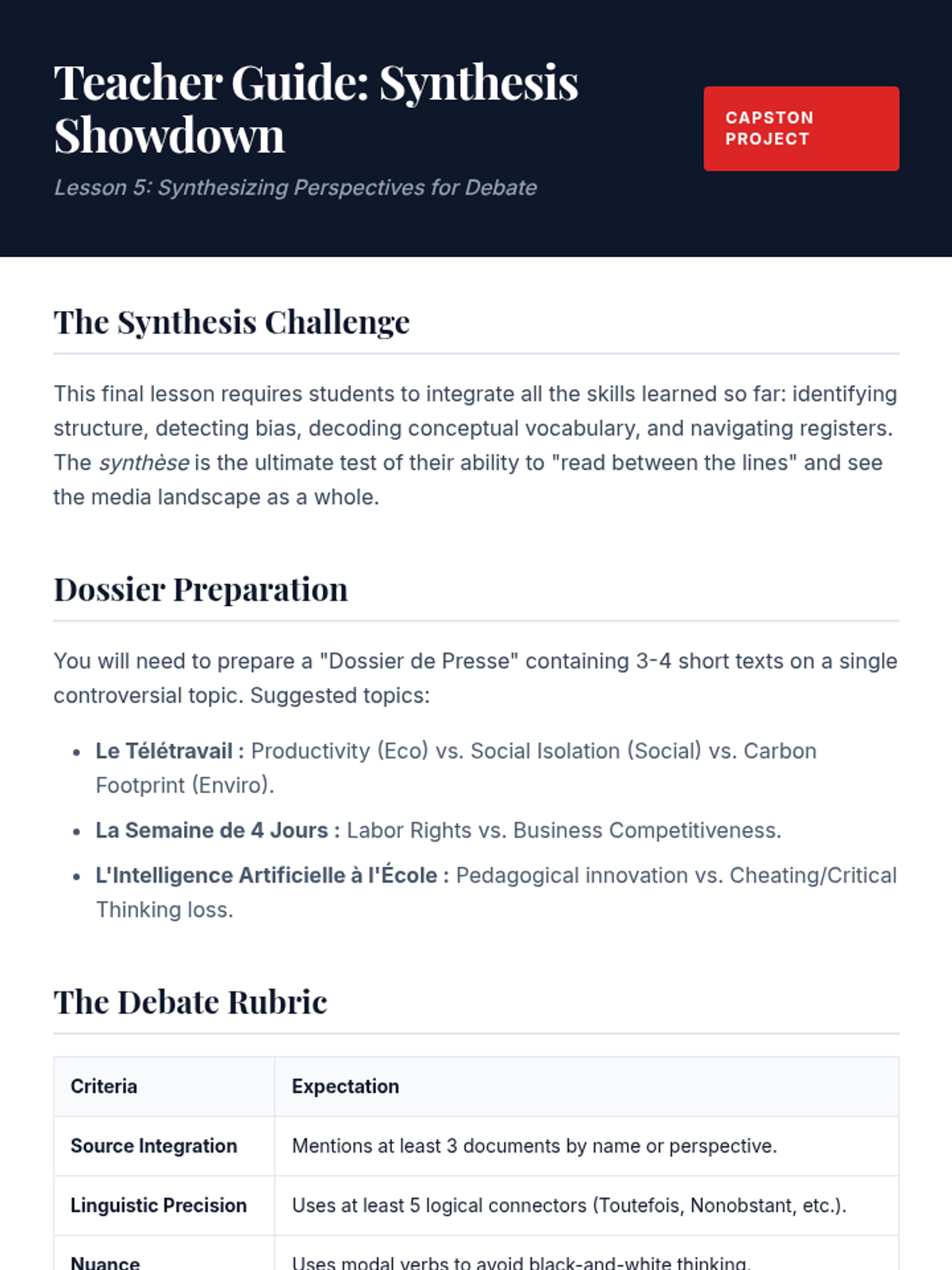
Teacher guide for the final lesson, providing a debate rubric and advice on facilitating the synthesis project for graduate students.
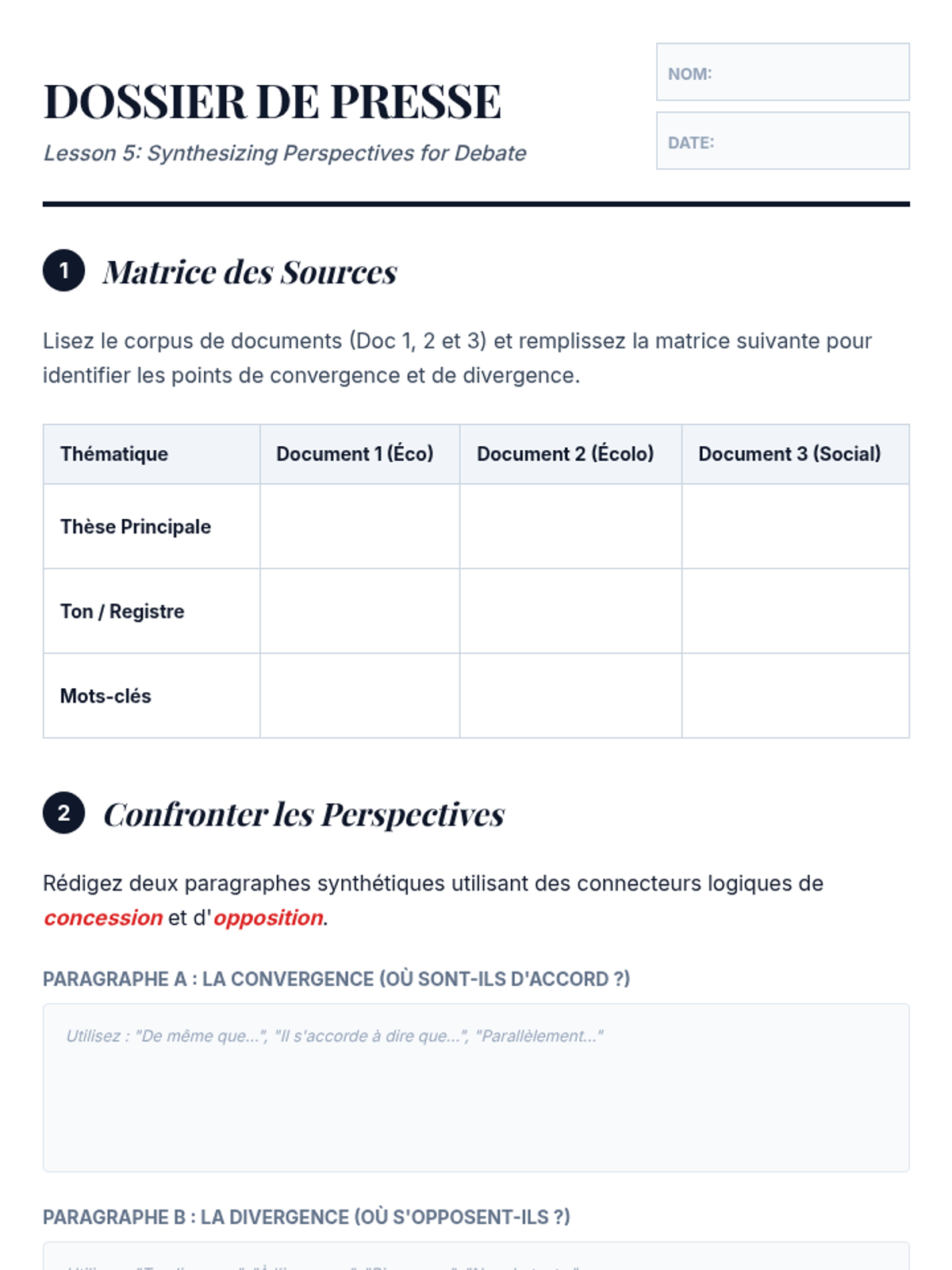
Final worksheet for Lesson 5, guiding students through the process of creating a press synthesis and preparing for a structured debate.
Slide deck for the final lesson on synthesizing perspectives in French media for debate and written analysis, covering logical connectors and the art of 'synthèse'.
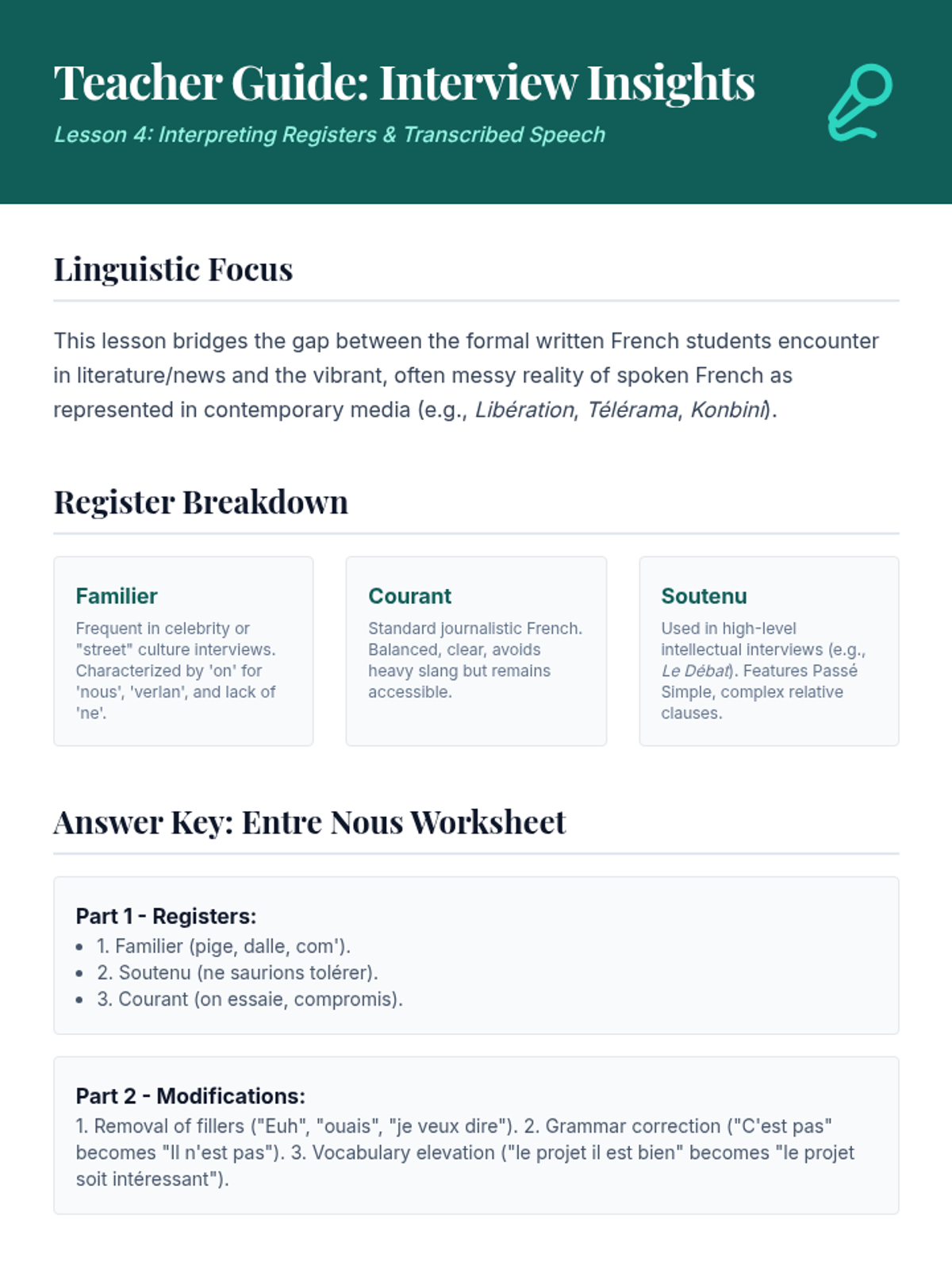
Teacher guide for Lesson 4, offering guidance on register breakdown and answers for the interview analysis worksheet.
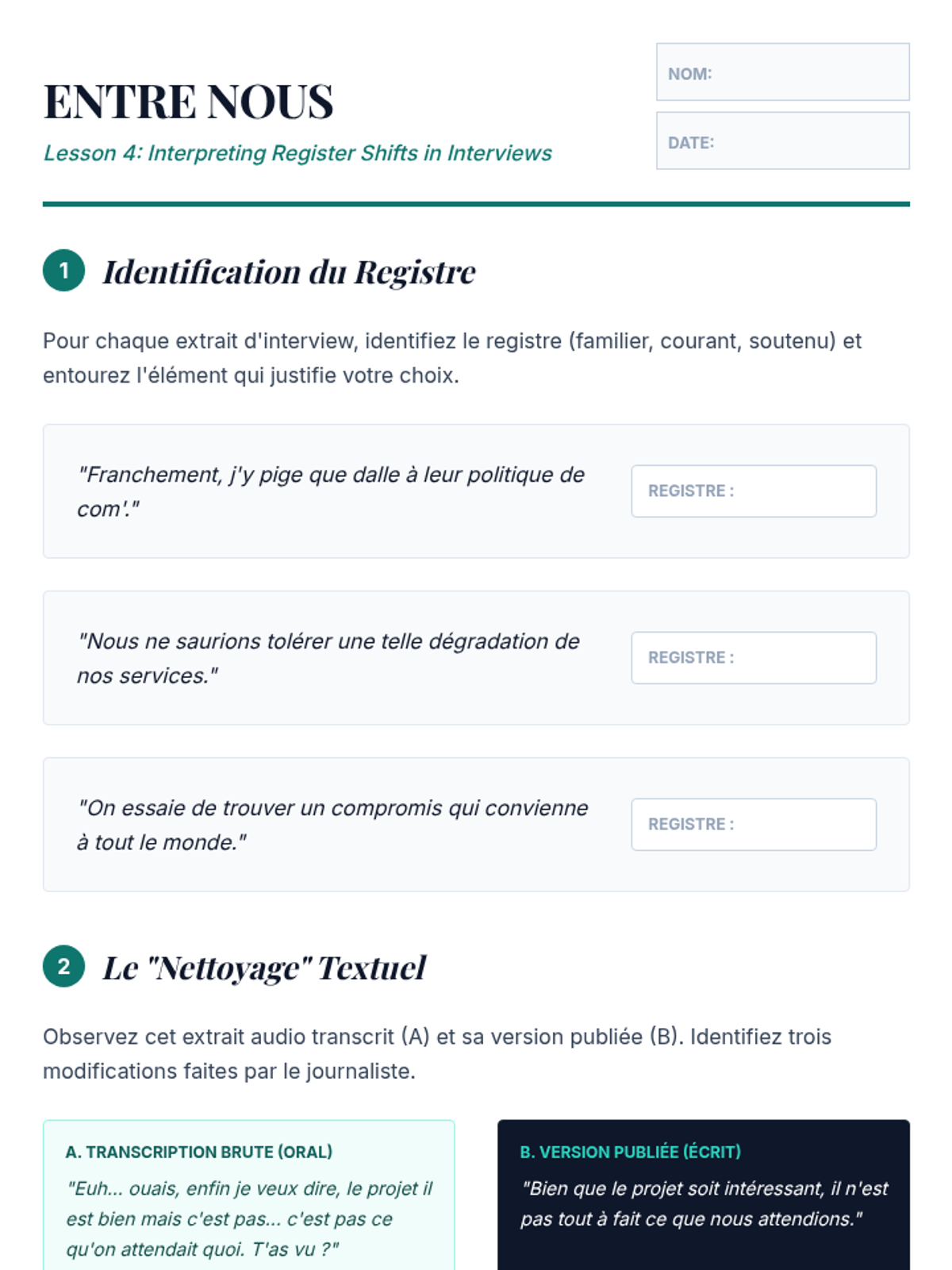
Student worksheet for Lesson 4 focused on register identification, transcription analysis, and social inference in French interviews.
Slide deck for Lesson 4 on interpreting interviews and transcribed speech, focusing on register shifts and the nuances of spoken vs. written French.
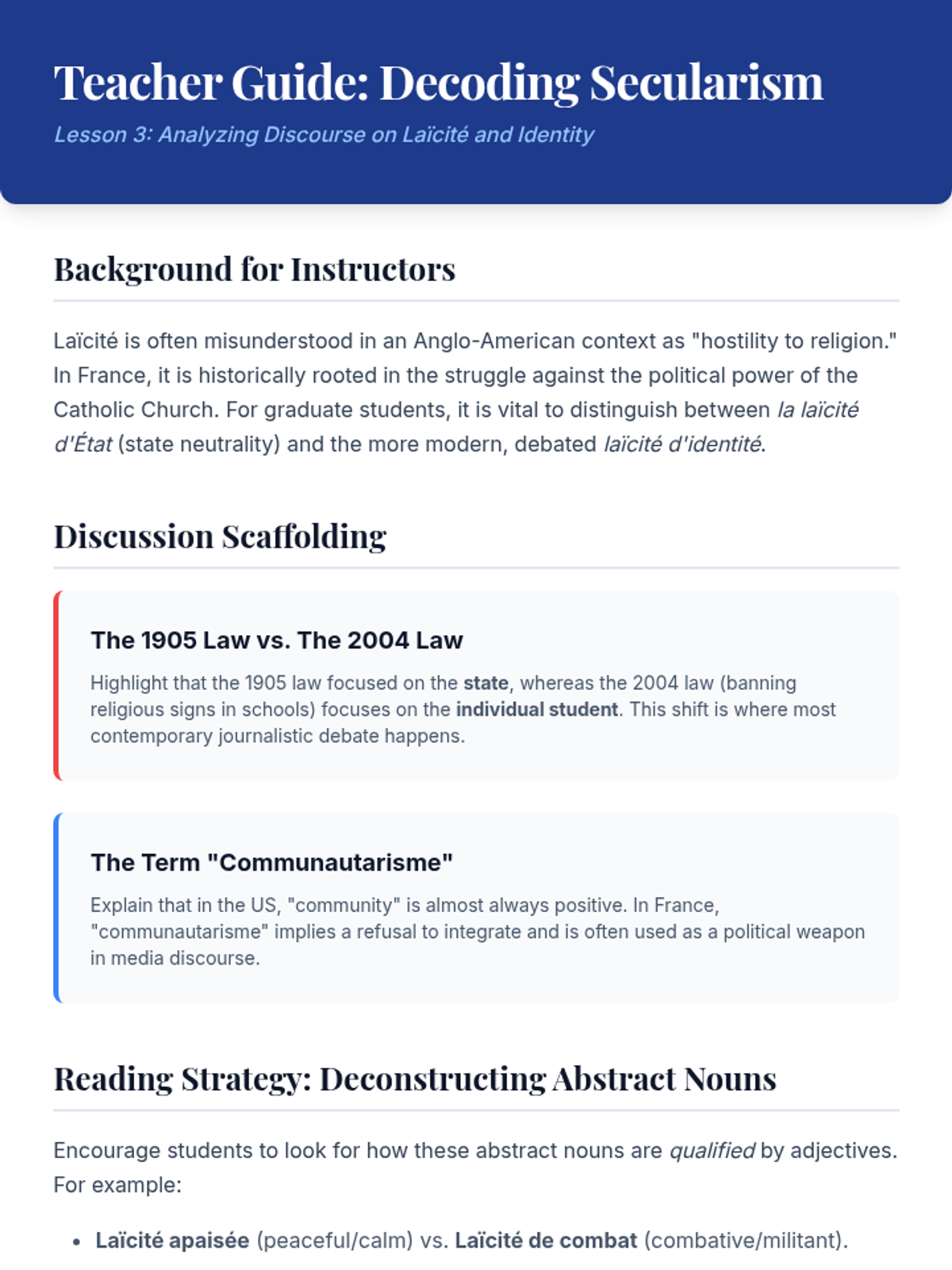
Teacher guide for Lesson 3, providing historical context on 'laïcité' and guidance on deconstructing abstract concepts in French media.
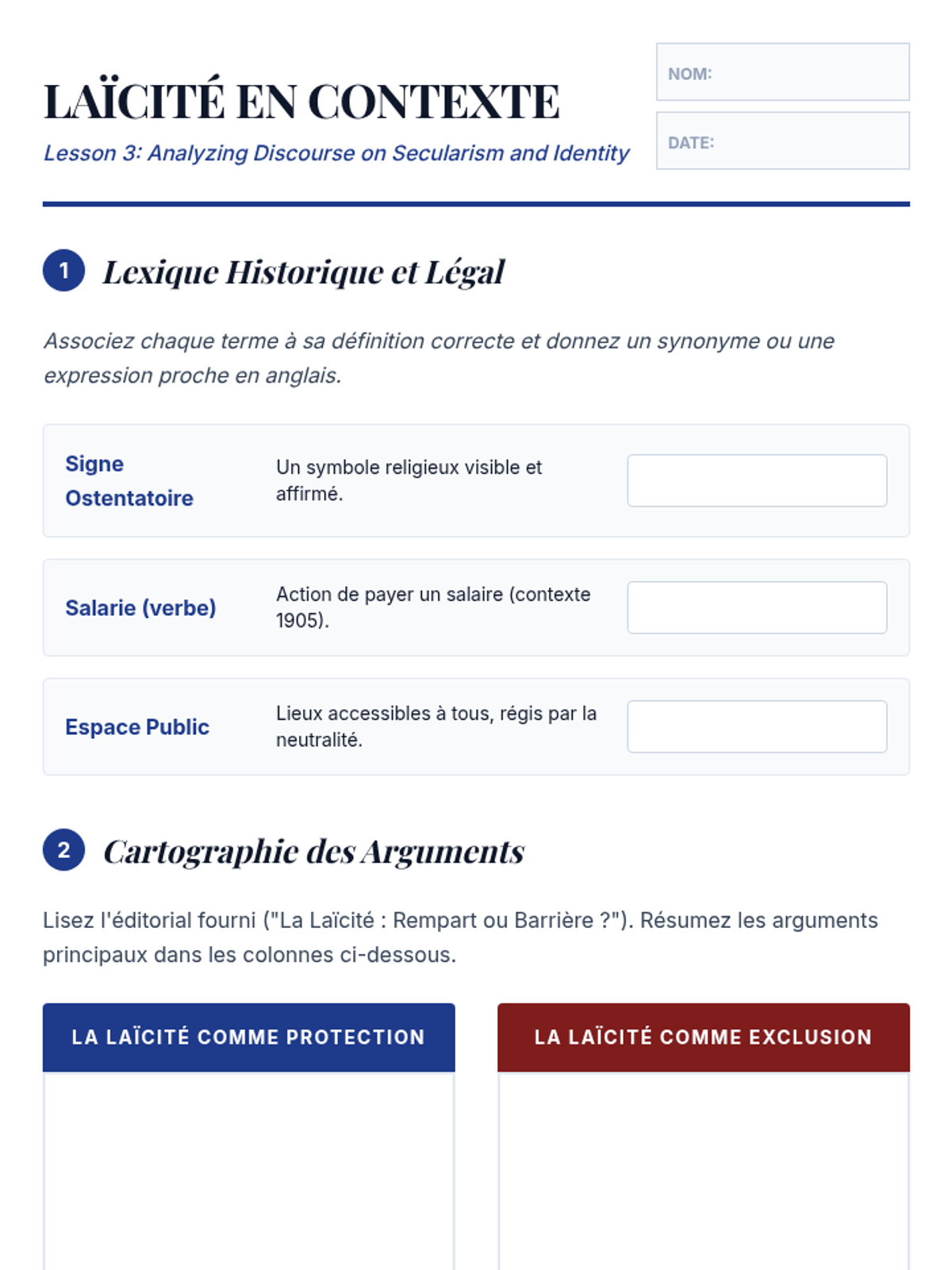
Student worksheet for Lesson 3 focused on defining historical vocabulary and mapping complex arguments surrounding French secularism.
Slide deck for Lesson 3 on the concept of 'laïcité' and identity in French media, covering historical context and conceptual vocabulary.
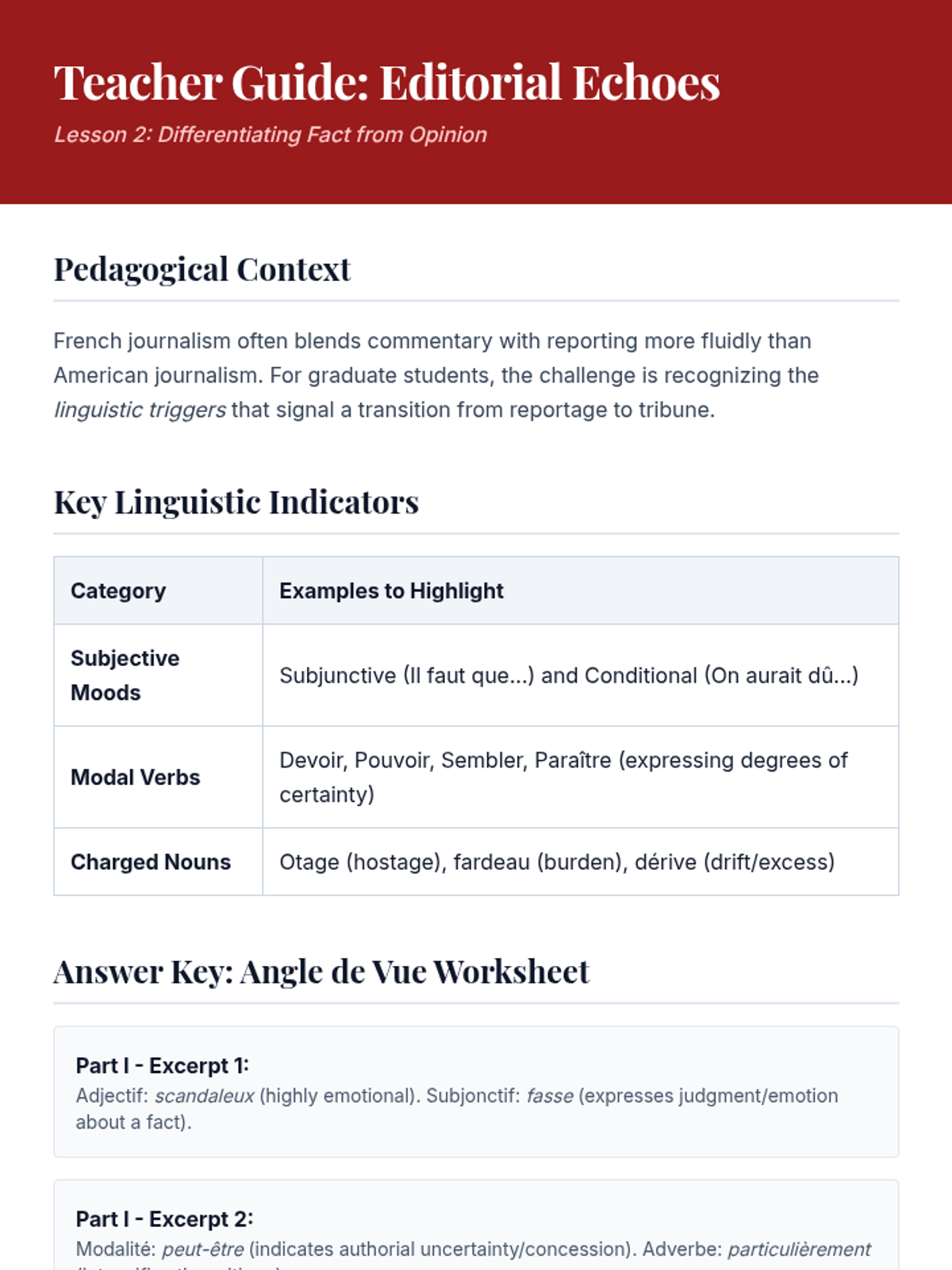
Teacher guide for Lesson 2, including linguistic keys and answers for the editorial analysis worksheet.
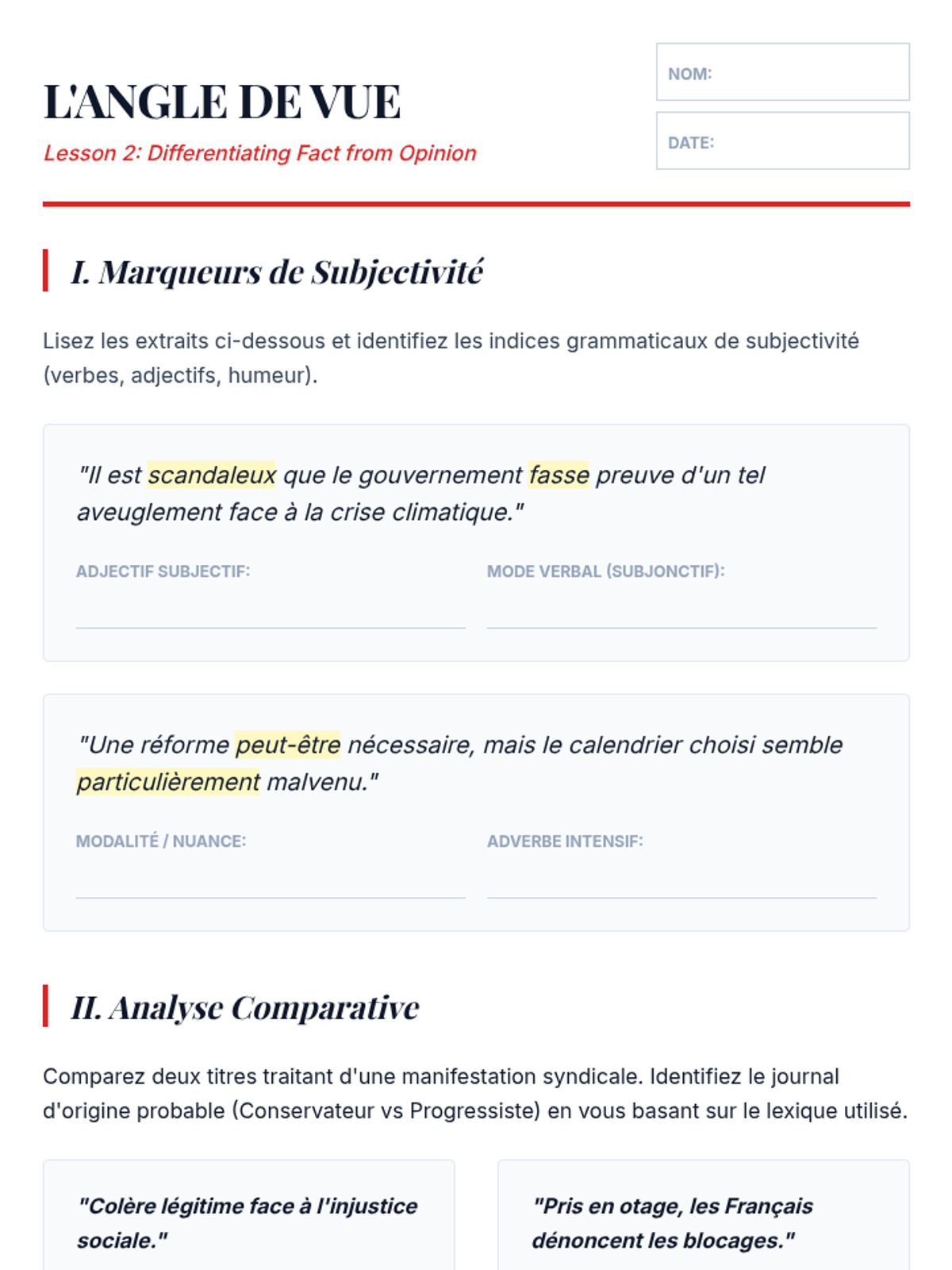
Student worksheet for Lesson 2, providing exercises on linguistic markers of subjectivity and comparative analysis of media headlines.
Slide deck for Lesson 2 on differentiating fact from opinion in French editorials, focusing on subjective adjectives, the subjunctive mood, and modal verbs.
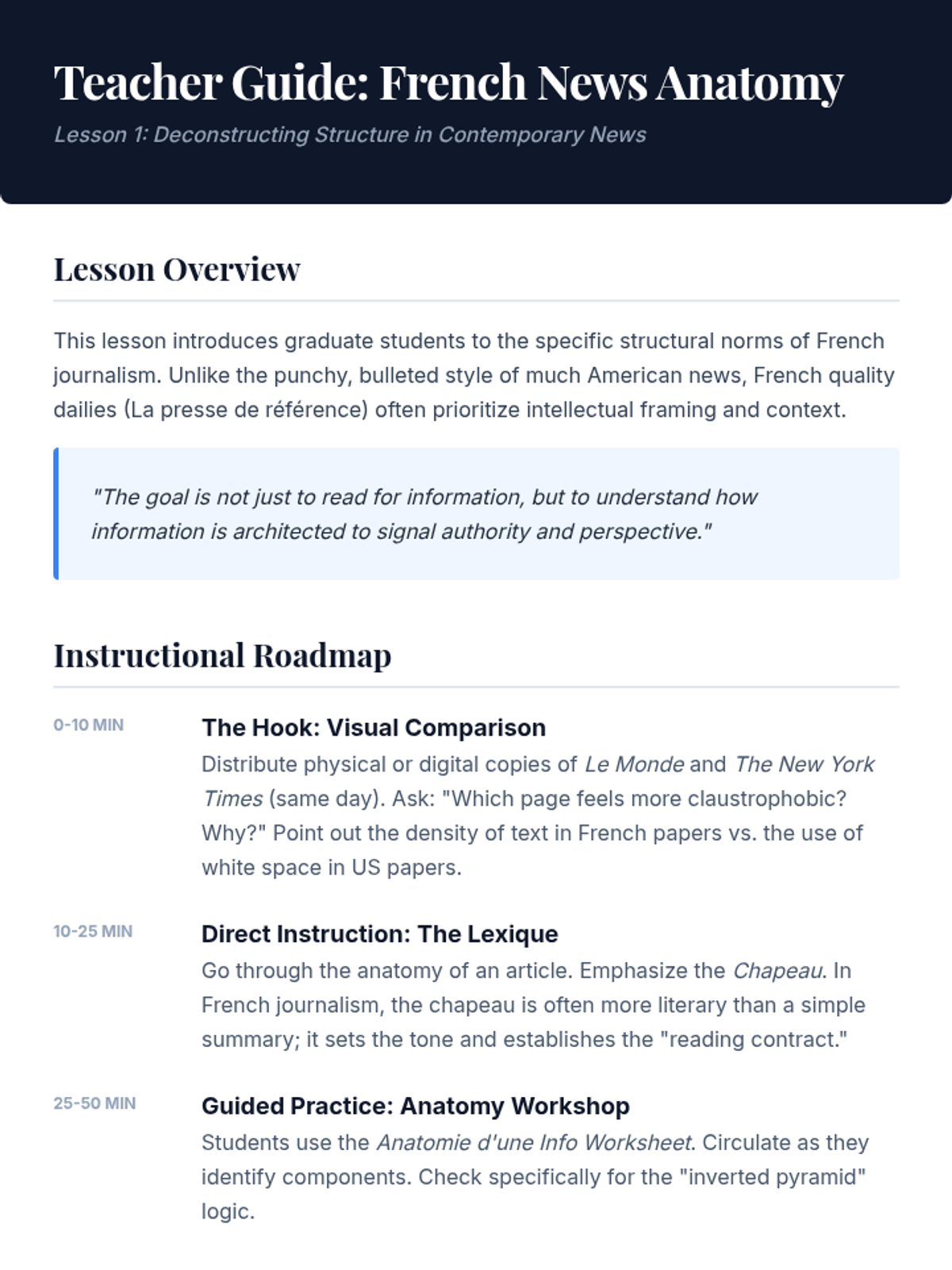
Teacher guide for Lesson 1, providing instructional strategies, a vocabulary key, and discussion prompts for analyzing French news structure.
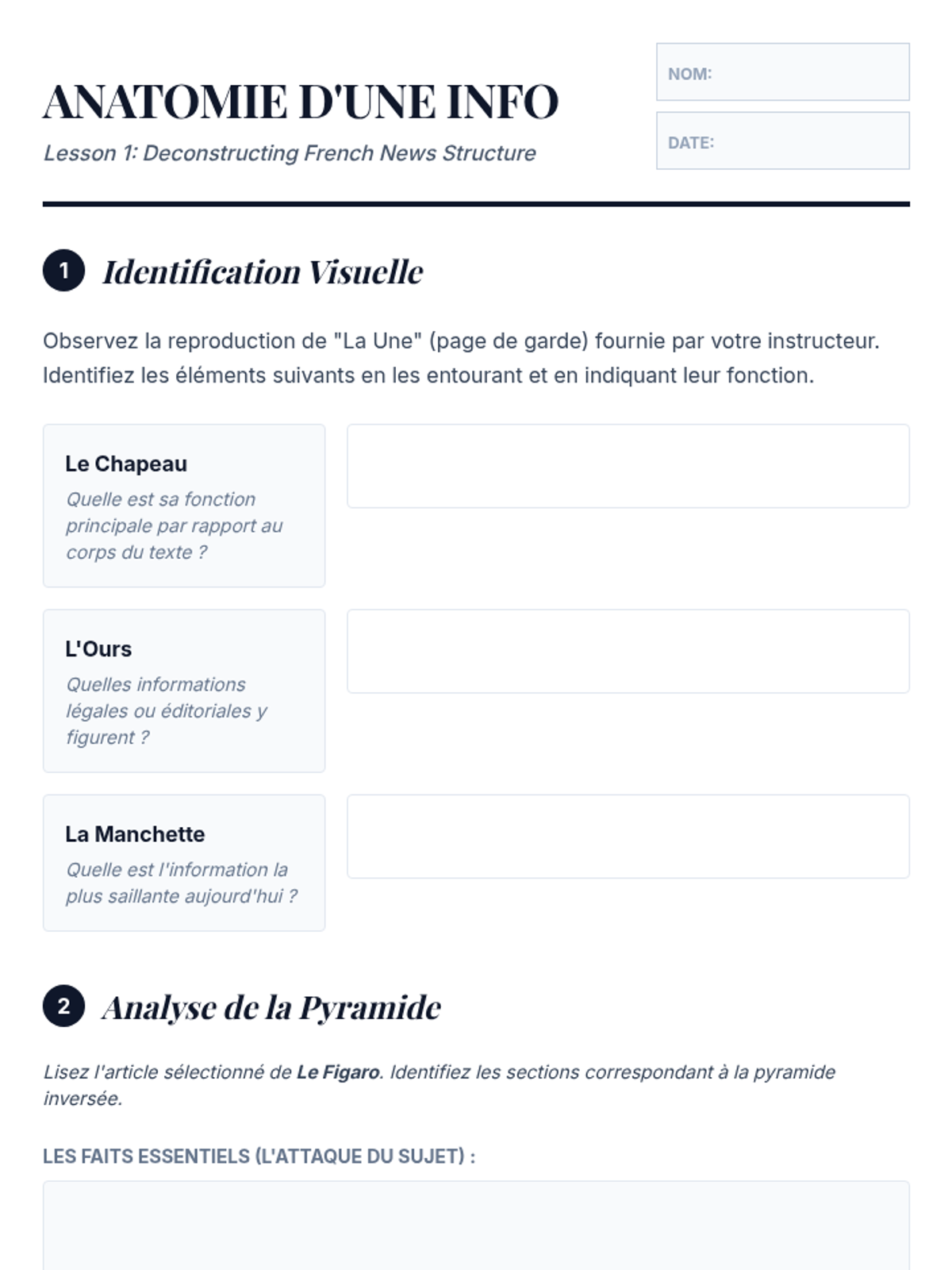
Student worksheet for Lesson 1 focused on identifying structural components of French news articles and defining journalistic vocabulary.
Introductory slide deck for Lesson 1, covering the structural components of French news articles including the 'chapeau' and inverted pyramid structure.
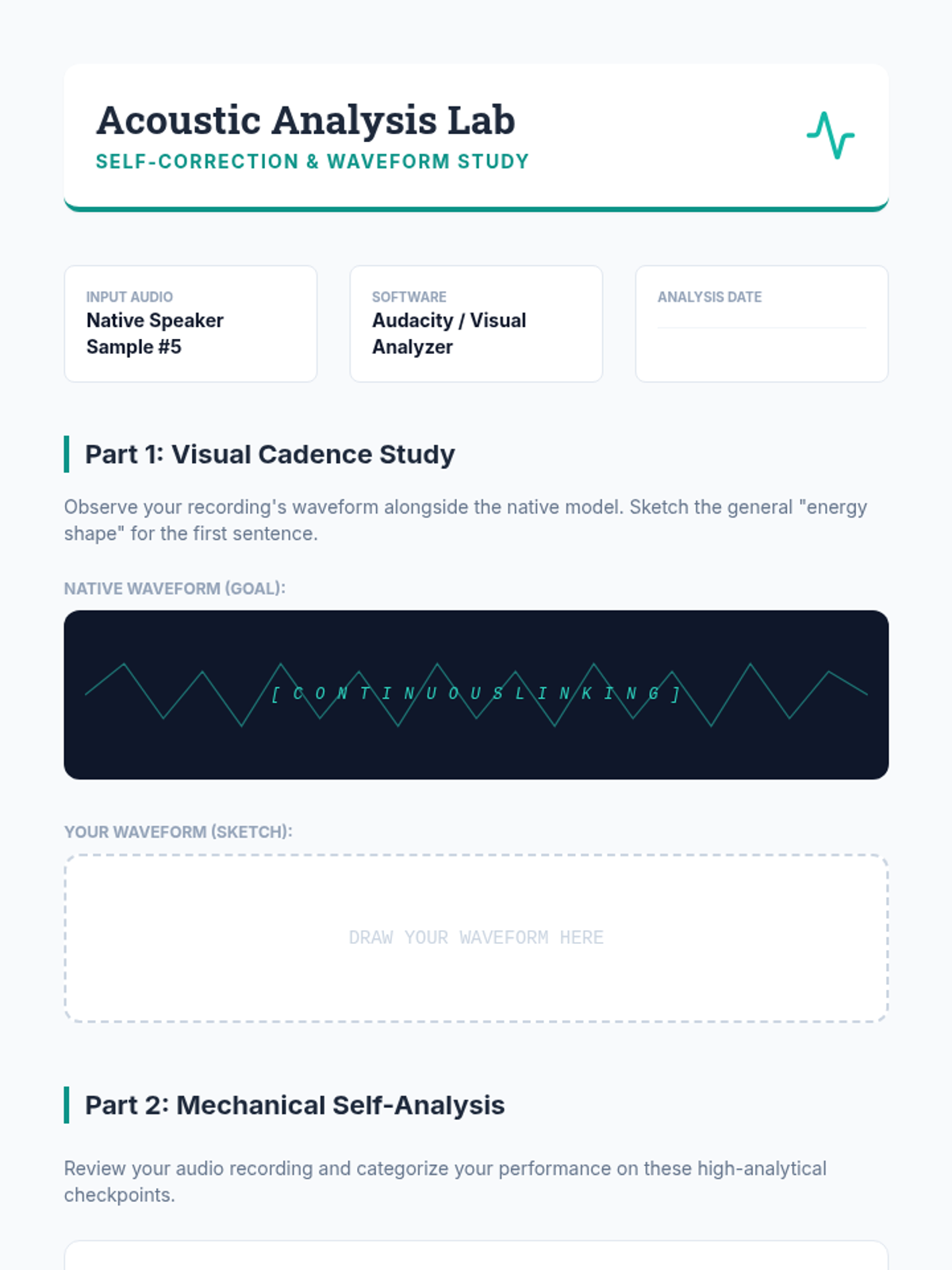
Activity guide for Lesson 5 where students conduct a self-analysis of their phonetic performance by comparing their recording to a native model.
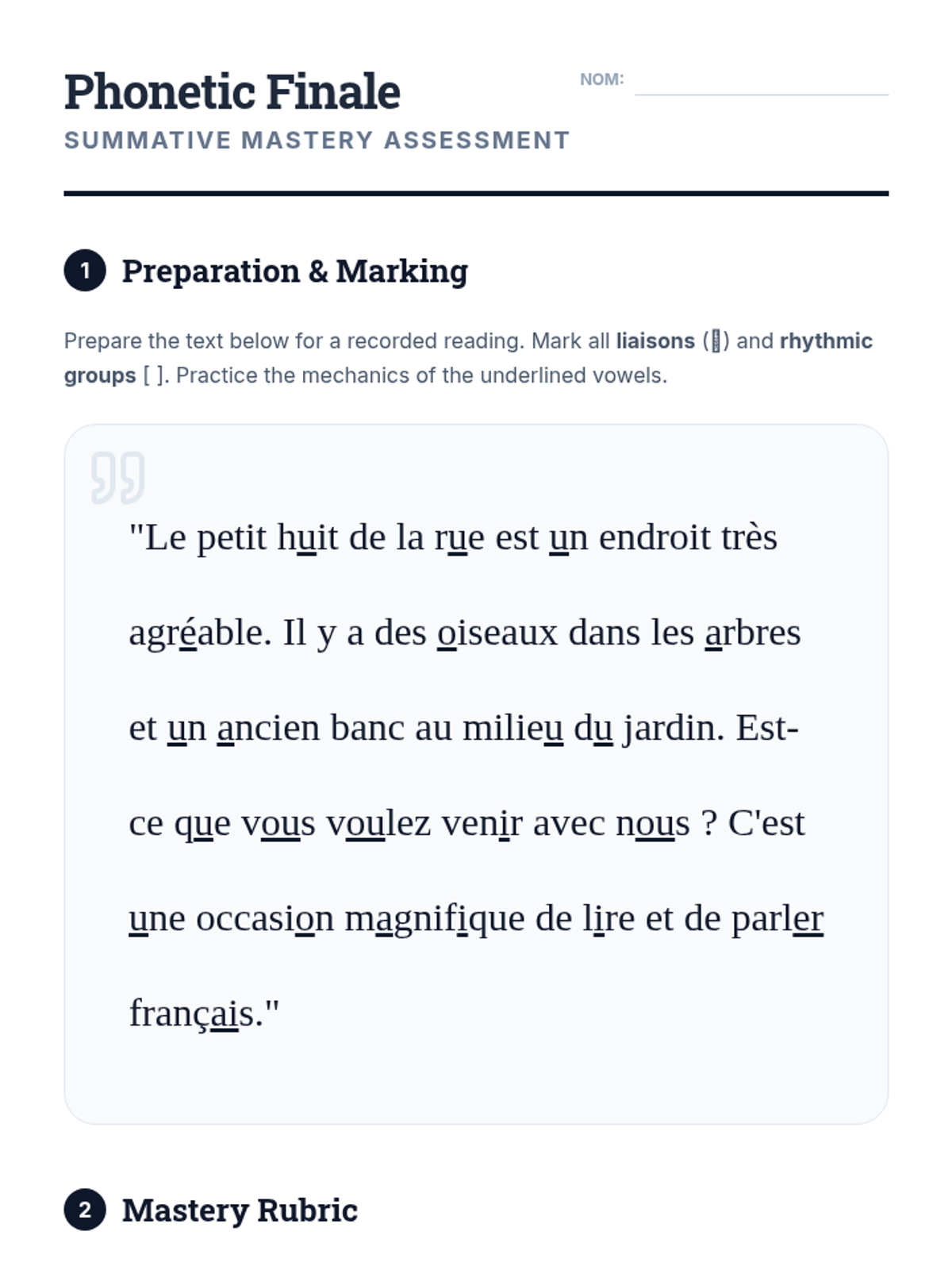
Final assessment passage for Lesson 5, including marking instructions and a comprehensive mastery rubric for phonetic performance.
Visual presentation for Lesson 5, introducing the shadowing technique, the four-phase protocol, and visual waveform analysis for self-correction.
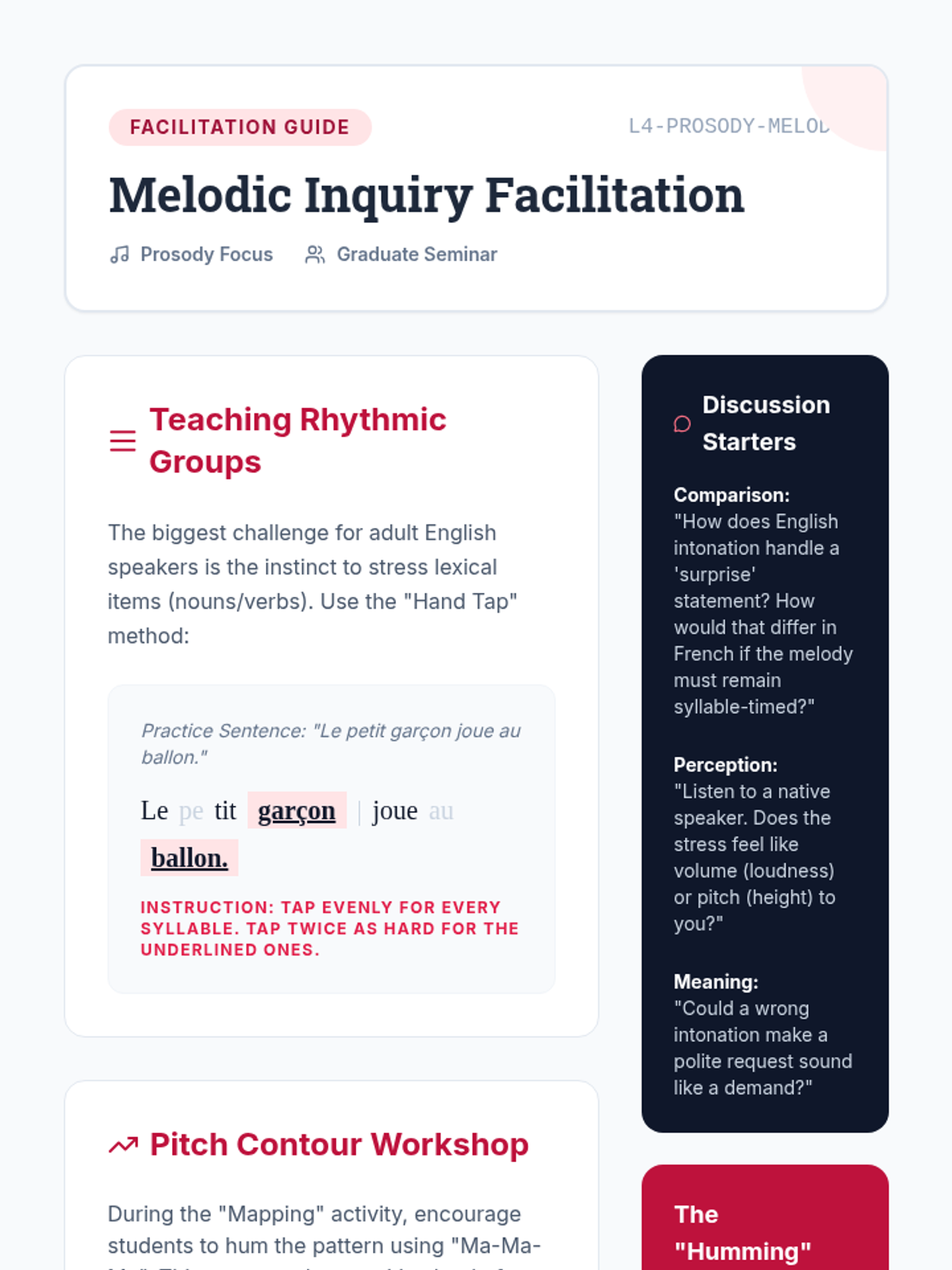
Activity guide for Lesson 4 where students identify rhythmic groups and draw pitch contours (declarative vs. interrogative) for French sentences.
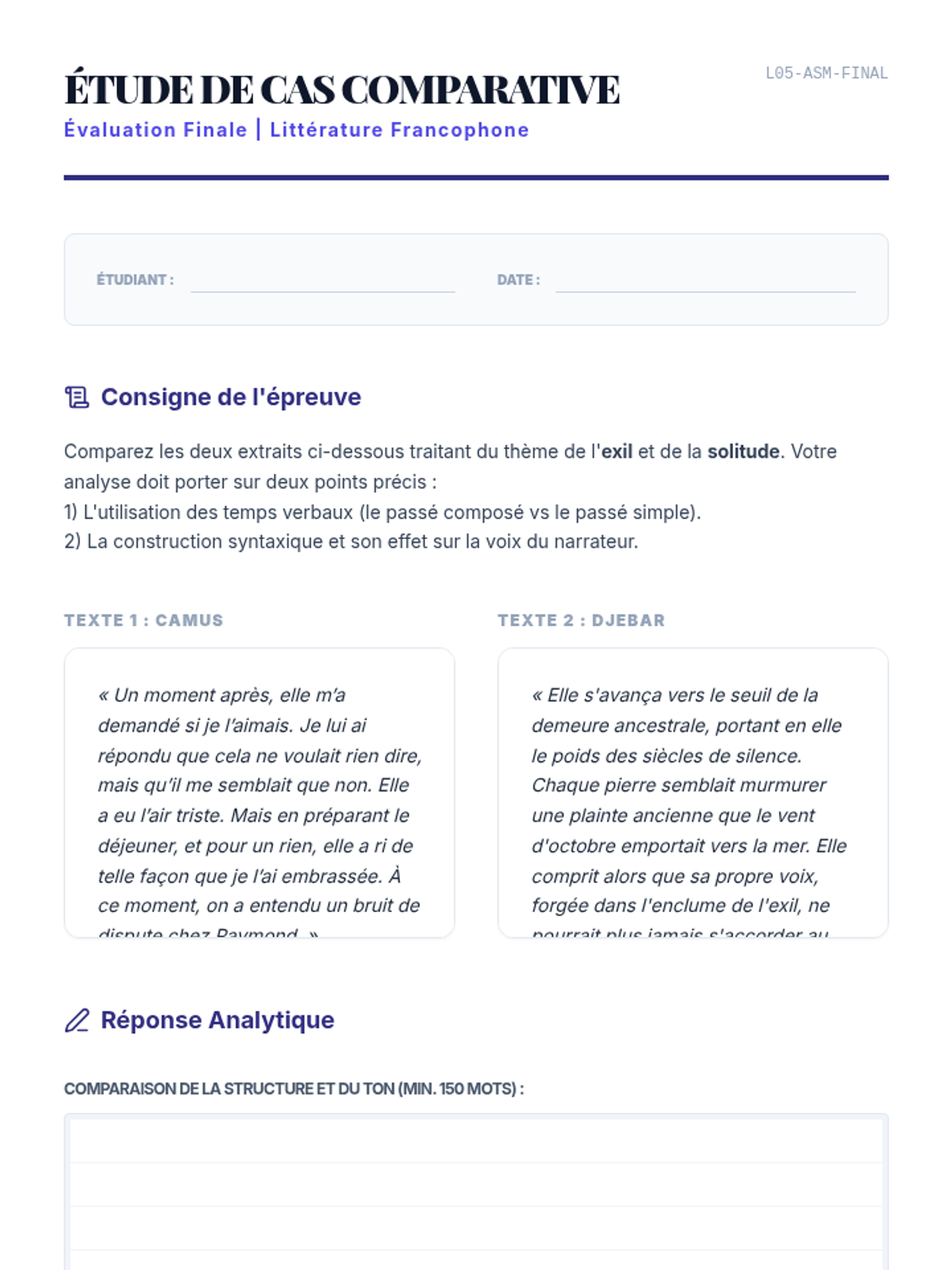
Final comparative analysis assessment for Lesson 5. Features excerpts from Camus and Djebar on exile, with a detailed response area and an evaluation rubric for style and thematic synthesis.
Final slides for Lesson 5 on comparative literary analysis. Covers methodology for comparing style and register, with a specific focus on the theme of exile in Camus and Djebar.
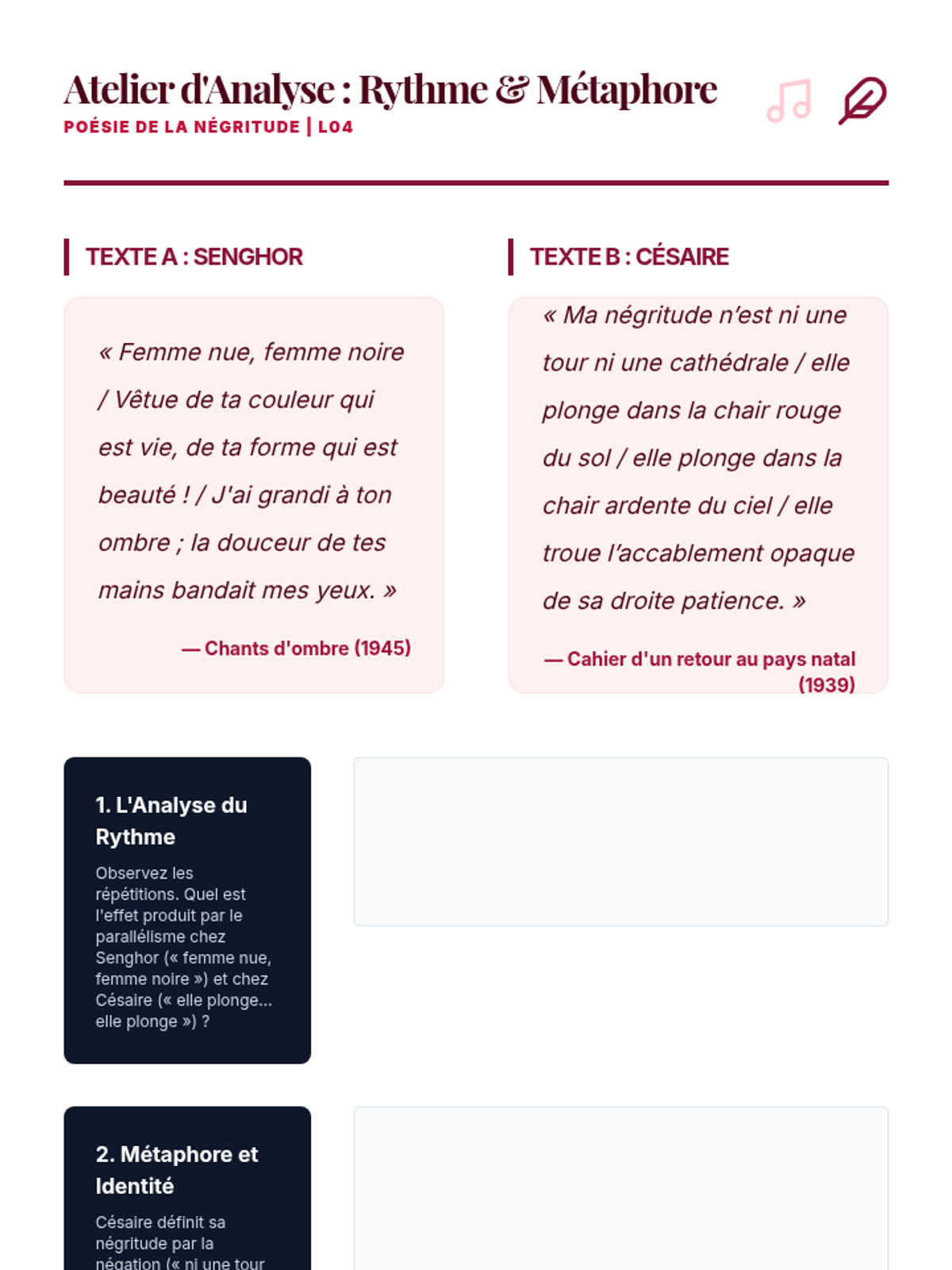
Comparative poetry analysis worksheet for Lesson 4. Features excerpts from Senghor and Césaire with specific prompts on rhythm, identity metaphors, and linguistic subversion.
Slides for Lesson 4 on the Negritude movement. Explores the poetry of Aimé Césaire and Léopold Sédar Senghor, focusing on rhythmic subversion, identity reclamation, and the linguistic 'weaponry' of metaphors.
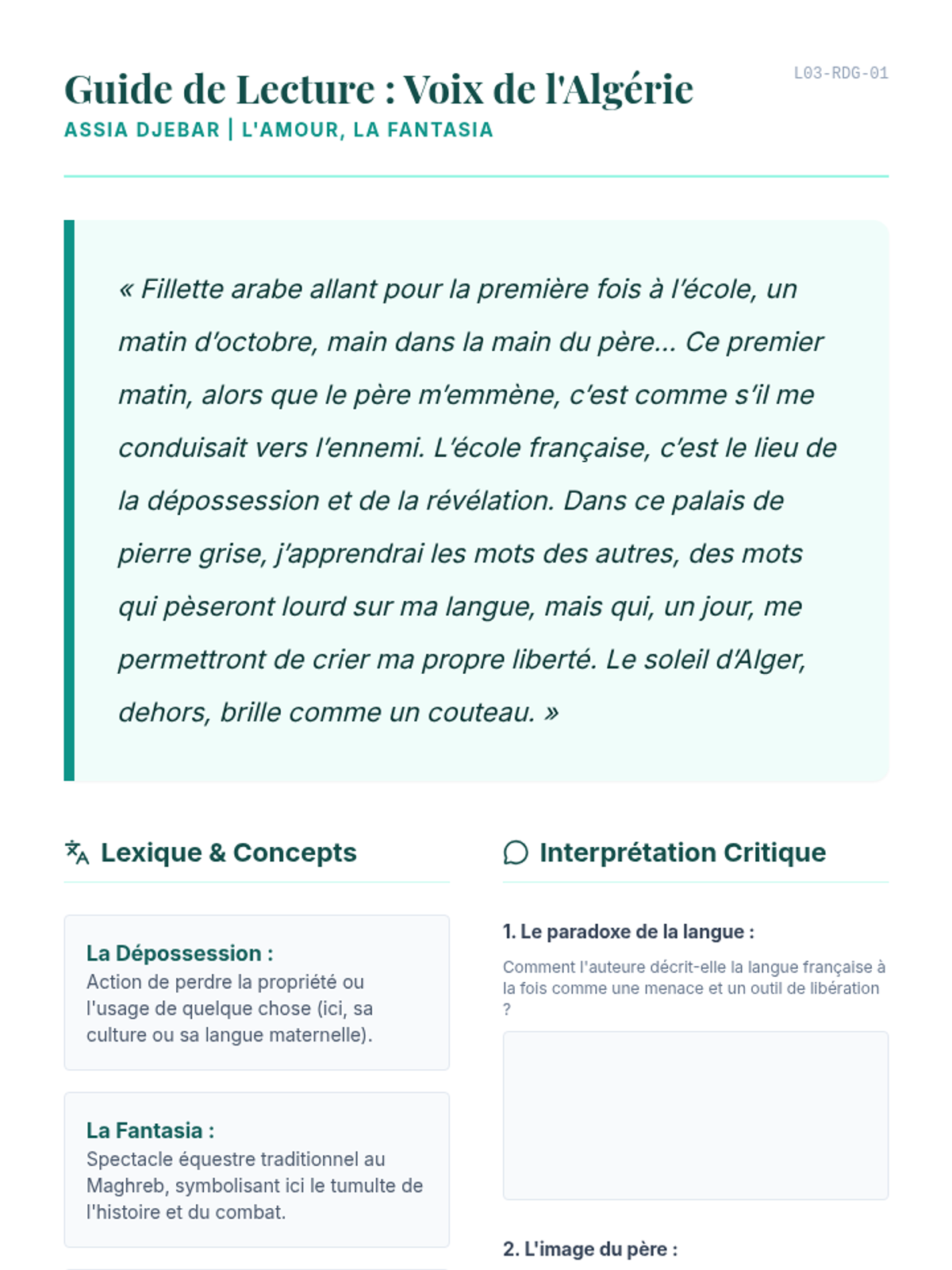
Reading guide for an excerpt from Assia Djebar's 'L'Amour, la fantasia'. Includes vocabulary definitions, sensory analysis tasks, and critical interpretation questions.
Slides for Lesson 3 on post-colonial Francophone literature, featuring Assia Djebar and Tahar Ben Jelloun. Focuses on descriptive imagery, sensory vocabulary, and the politics of language.
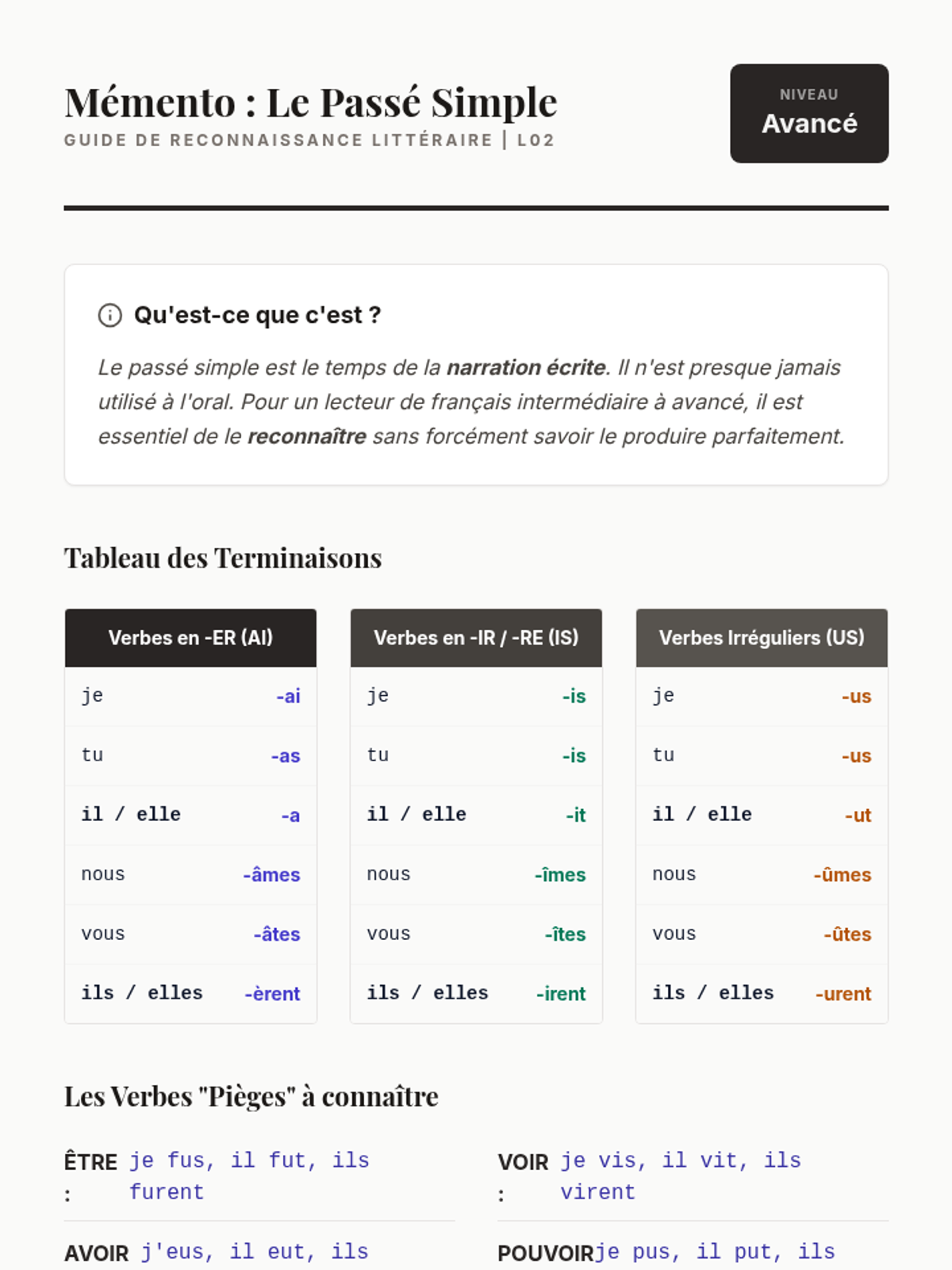
Student reference sheet for identifying 'passé simple' forms. Includes morphology tables, irregular verb lists, and a short identification practice exercise.
Slides for Lesson 2 focusing on the 'passé simple' in narrative French. Covers morphology recognition, irregular forms, and the stylistic function of narrative distance.