Builds word mastery through parts of speech, Greek and Latin roots, and morphological analysis of prefixes and suffixes. Develops nuanced comprehension using context clues, shades of meaning, and idiomatic expressions.
A visual presentation to introduce the eight vocabulary terms. Each slide features high-impact definitions, parts of speech, and usage examples with nature-themed motifs. Corrected font sizes to meet the 24px minimum requirement. Vocabulary words are now lowercase.
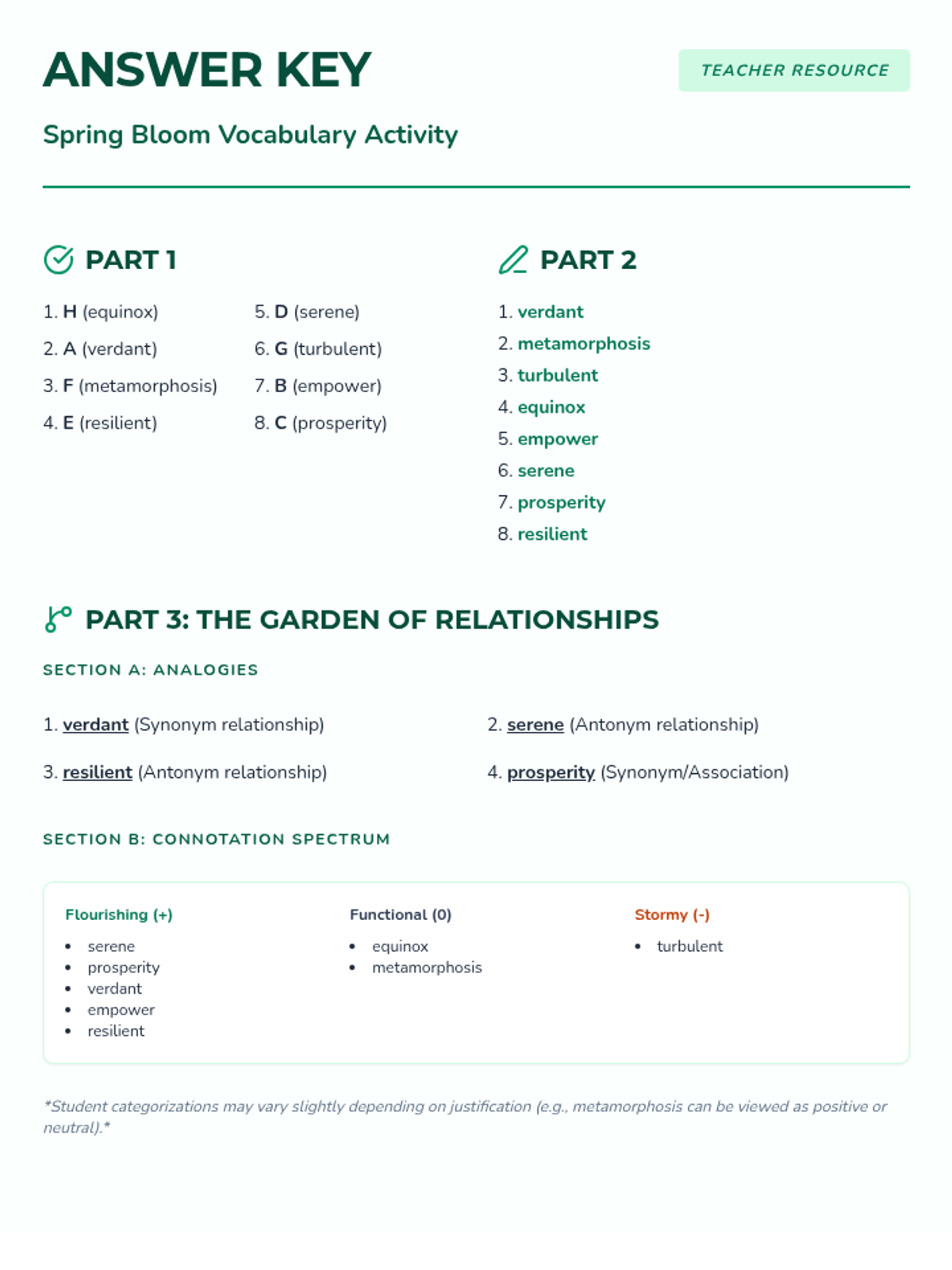
Updated answer key for the Spring Bloom Vocabulary Activity. Changed "Challenging (-)" to "Stormy (-)" in the Connotation Spectrum section to align with the revised worksheet.
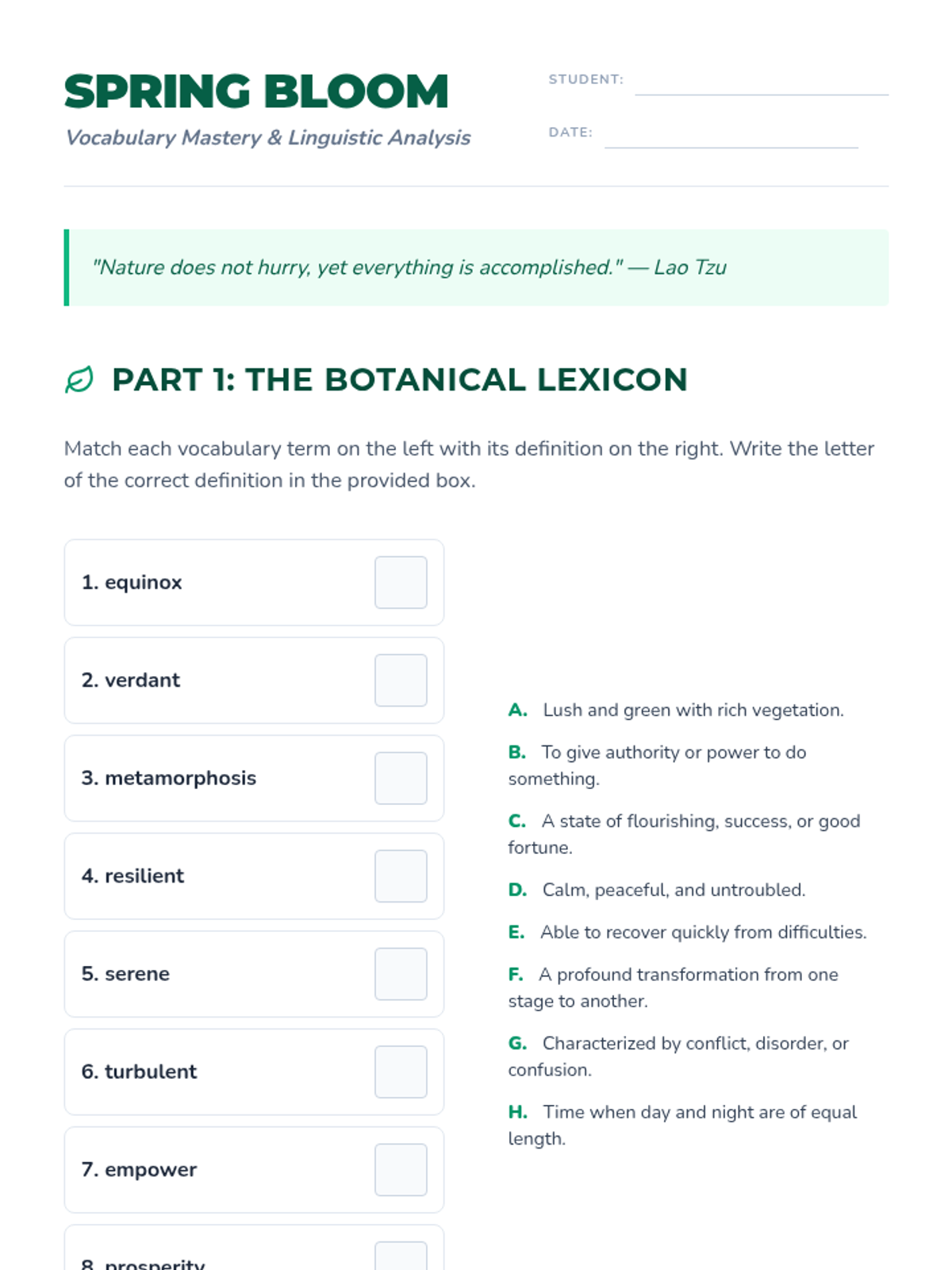
High-contrast, print-ready three-page vocabulary worksheet. Uses explicit break-after properties and a strict 960px height per page to ensure Part 1, Part 2, and Part 3 are perfectly separated during printing. Clean white backgrounds maximize legibility and ink efficiency.
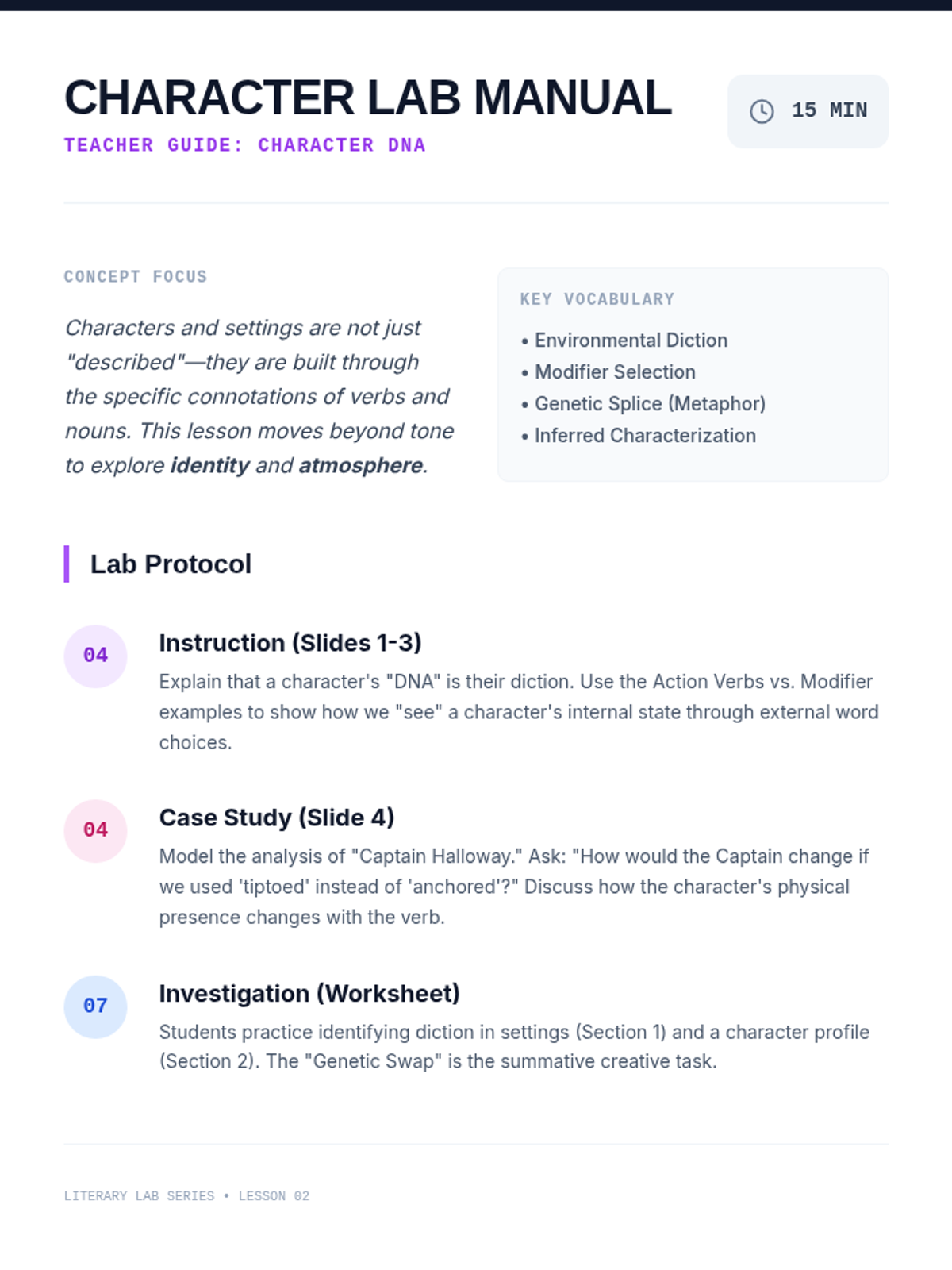
A teacher guide for the Character Composition mini-lesson, featuring instructional pacing, modeling strategies, and a sample answer key.
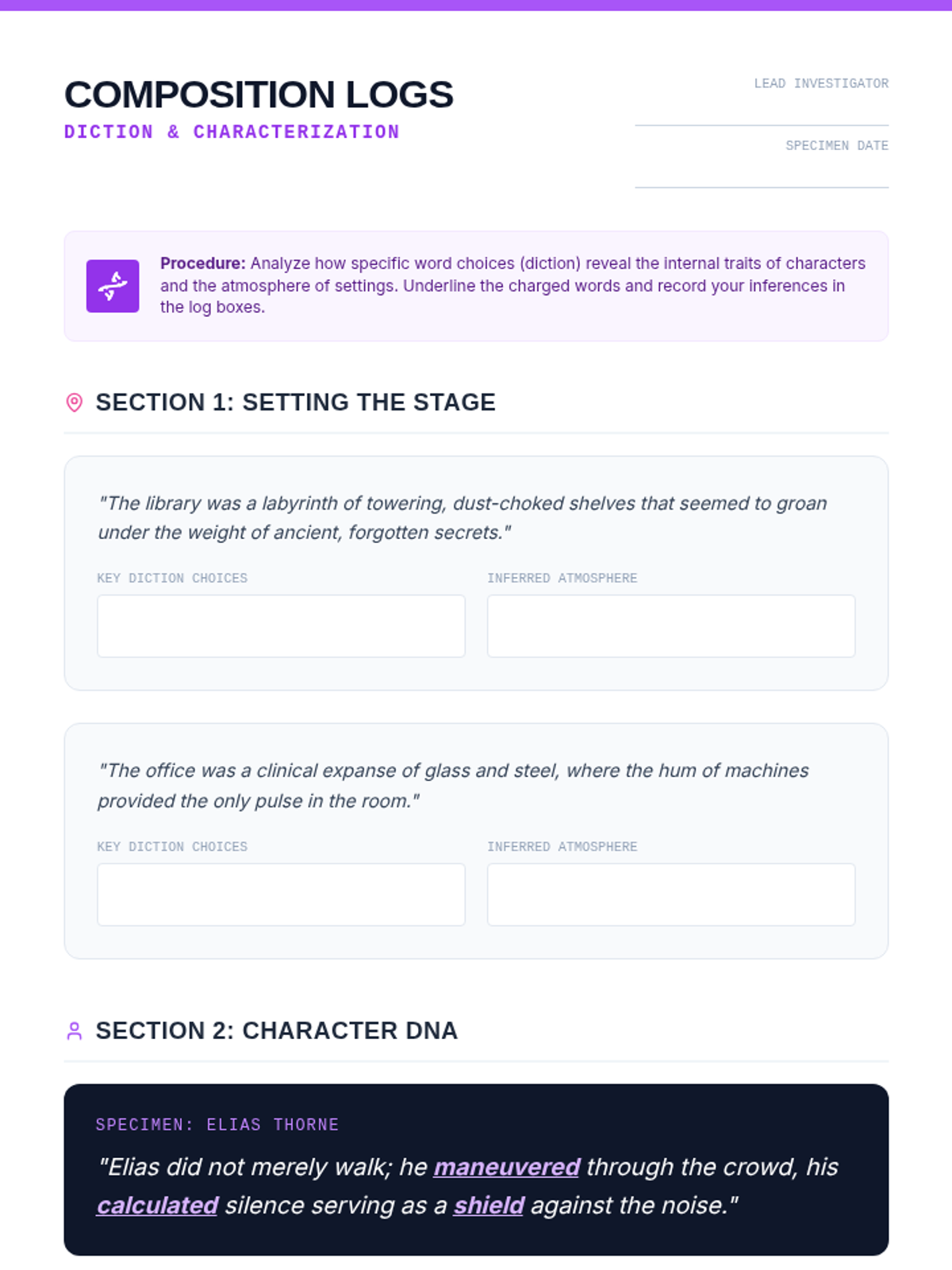
A student worksheet for analyzing how diction contributes to characterization and setting, featuring text analysis and a creative 'Genetic Swap' rewrite exercise.
A visual slide deck for a 15-minute mini-lesson on how diction builds characters and settings, using the 'Character DNA' theme.
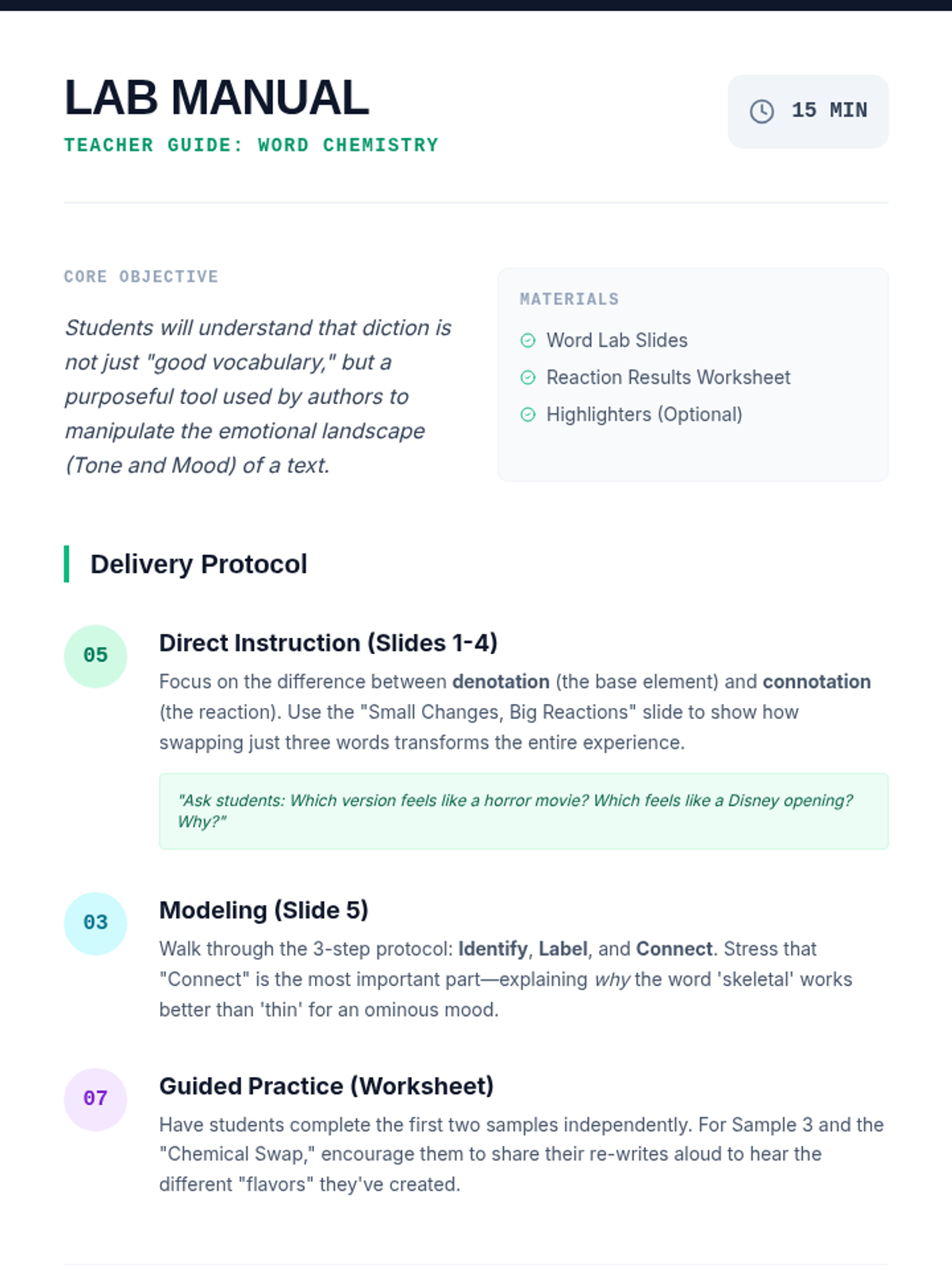
A teacher guide for the Word Chemistry mini-lesson, including pacing instructions, delivery tips, answer keys, and differentiation strategies.
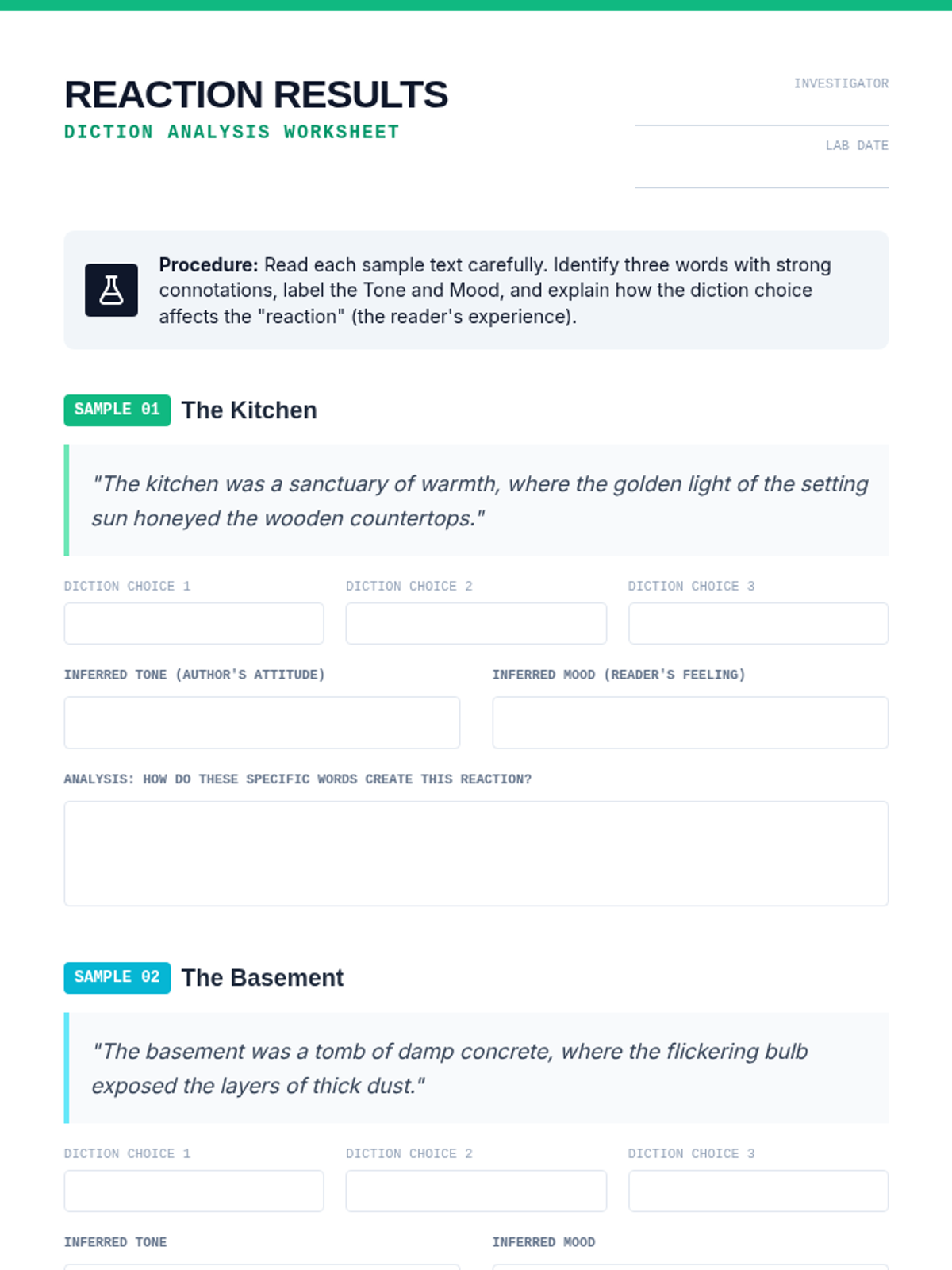
A student worksheet for practicing diction analysis through text samples and a creative re-writing exercise, styled as a lab report. All samples are now unformatted and blank to allow for independent student identification of diction. Backgrounds of work areas are now white for better legibility.
A visual presentation for a 15-minute mini-lesson on diction analysis, using a 'Word Lab' theme to explain denotation, connotation, tone, and mood.
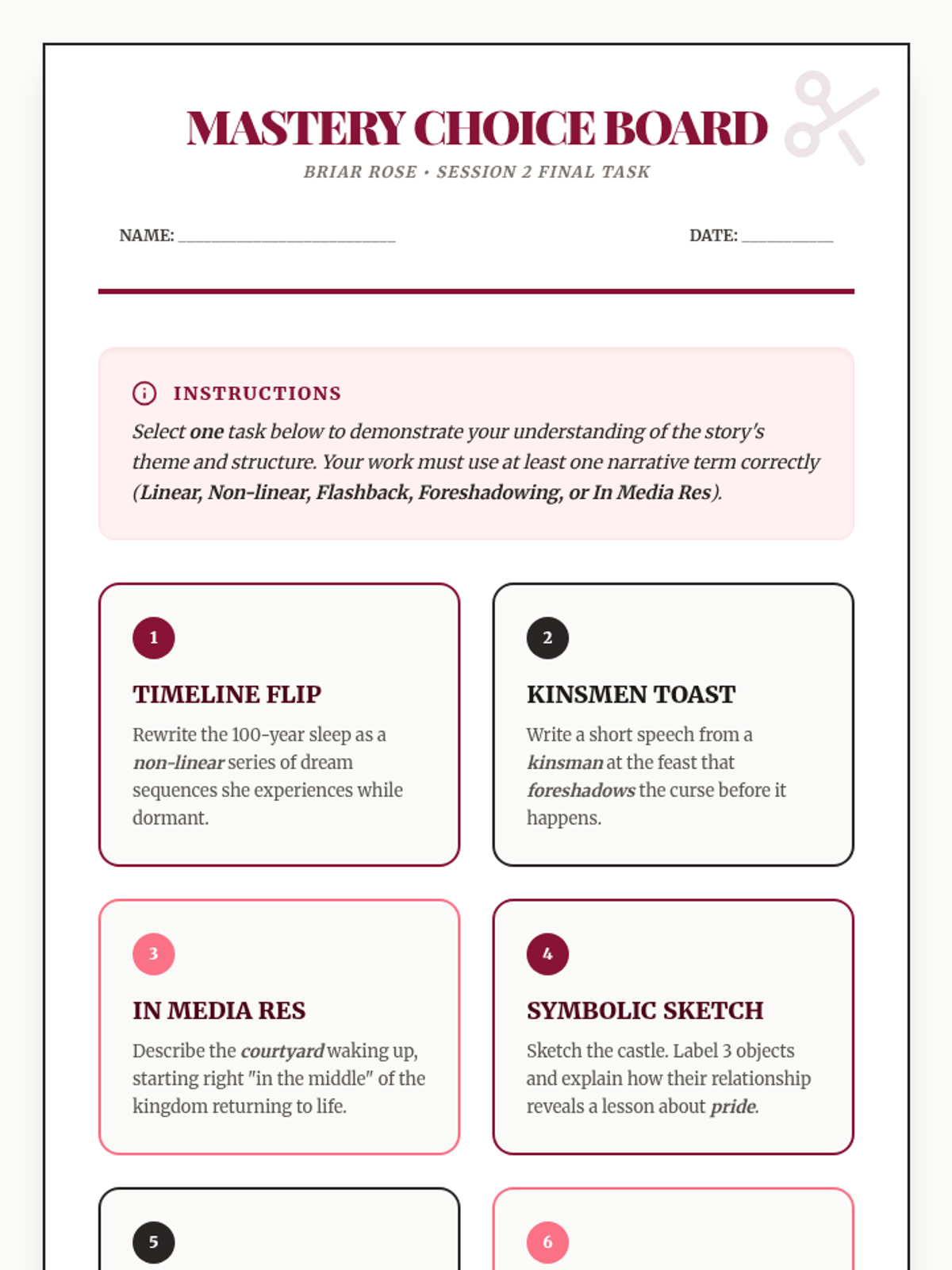
A dedicated standalone printable 8.5x11 Choice Board for the Briar Rose Session 2 lesson, featuring 6 average-difficulty tasks aligned with the narrative and thematic goals of the lesson.
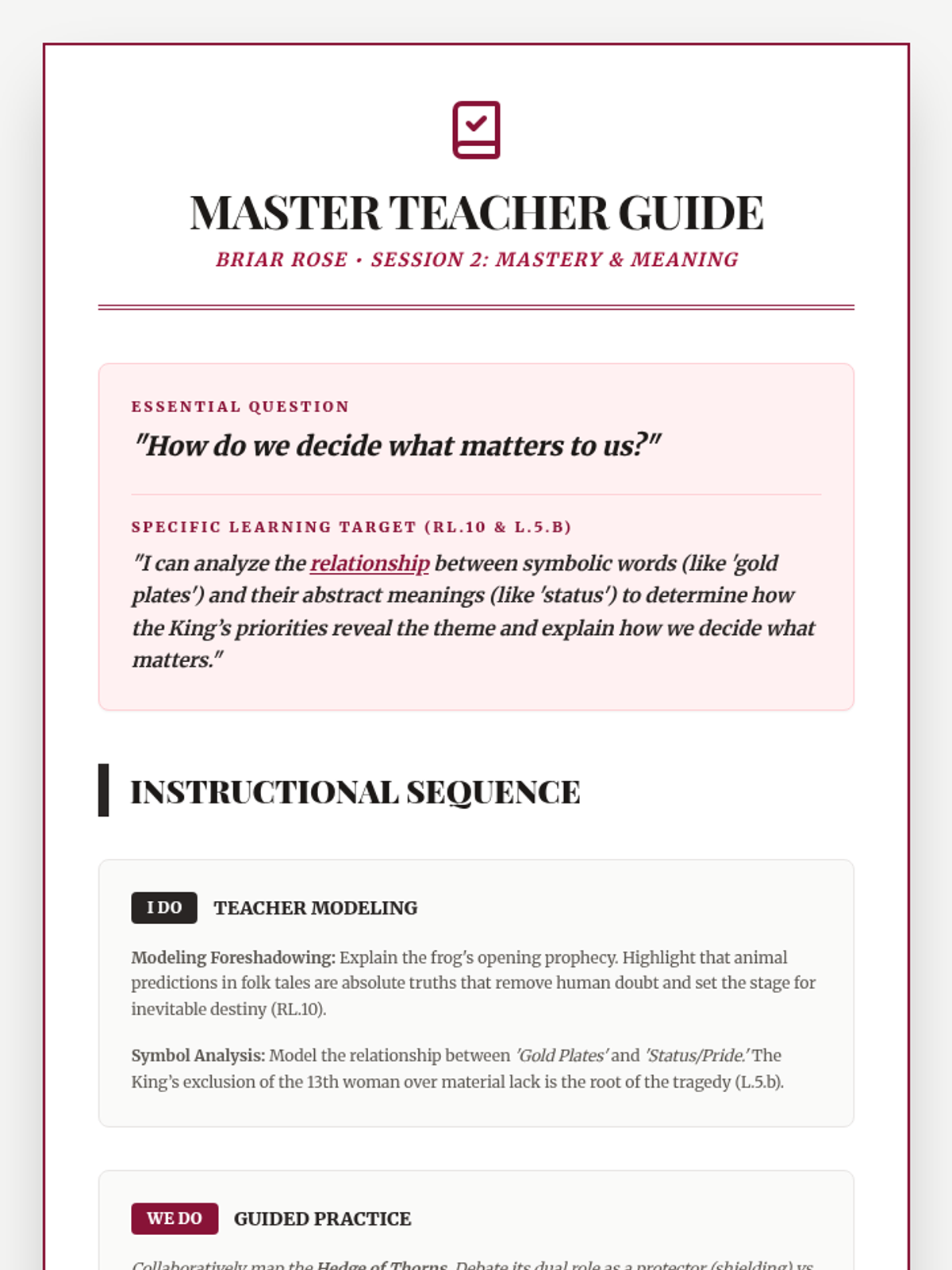
Final Master Teacher Guide for Session 2 of the Briar Rose lesson, detailing the I/We/You framework, Think-Pair-Share, SAVVAS assessment links, and explicit alignment with RL.10 and L.5.b standards with a refined learning target.
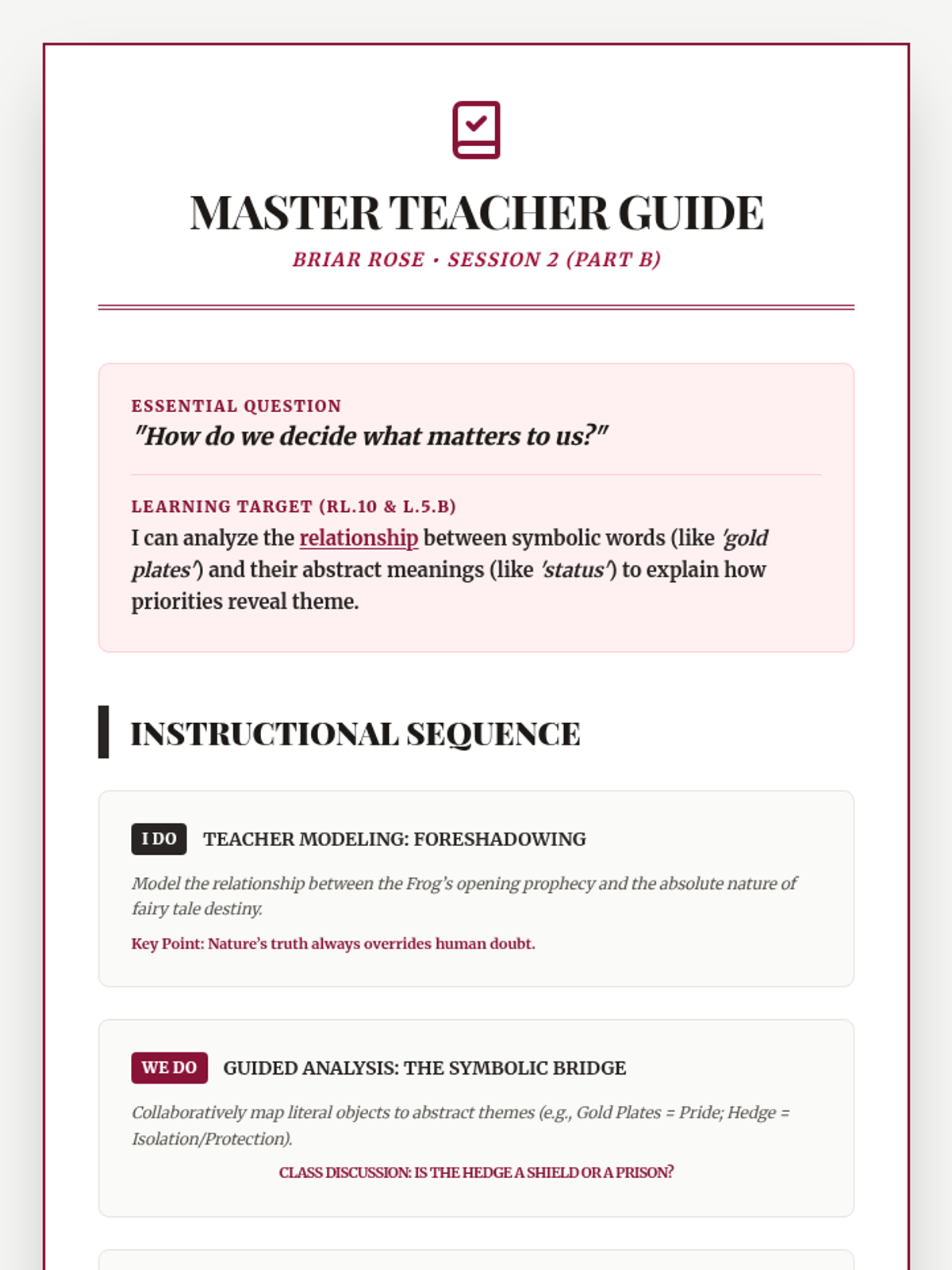
The comprehensive Master Teacher Guide for Session 2 Part B, detailing the I/We/You framework, Think-Pair-Share, SAVVAS assessment links, and explicit alignment with RL.10 and L.5.b standards.
The comprehensive Master Teacher Guide for Session 2 Part B, including the I/We/You release framework, Think-Pair-Share prompts, and clear references to SAVVAS assessments and the printed Exit Ticket. Aligned with RL.10 and L.5.b standards.
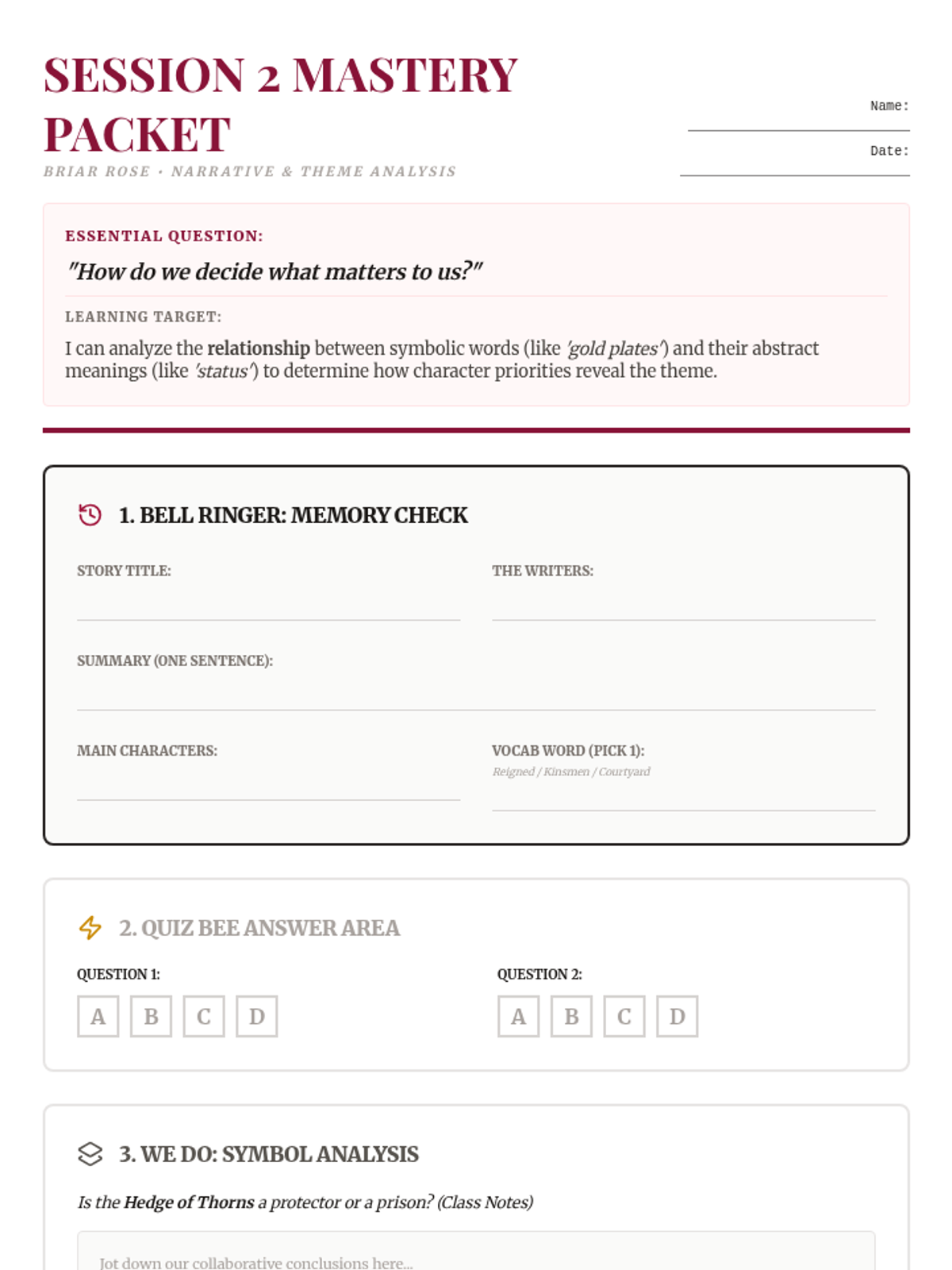
The finalized Session 2 student handout, updated with a specific learning target and essential question that align with CCSS RL.10 and L.5.b. Includes the recall bell ringer, Quiz Bee #3 area, Guided Analysis space, and all 6 choice board options.
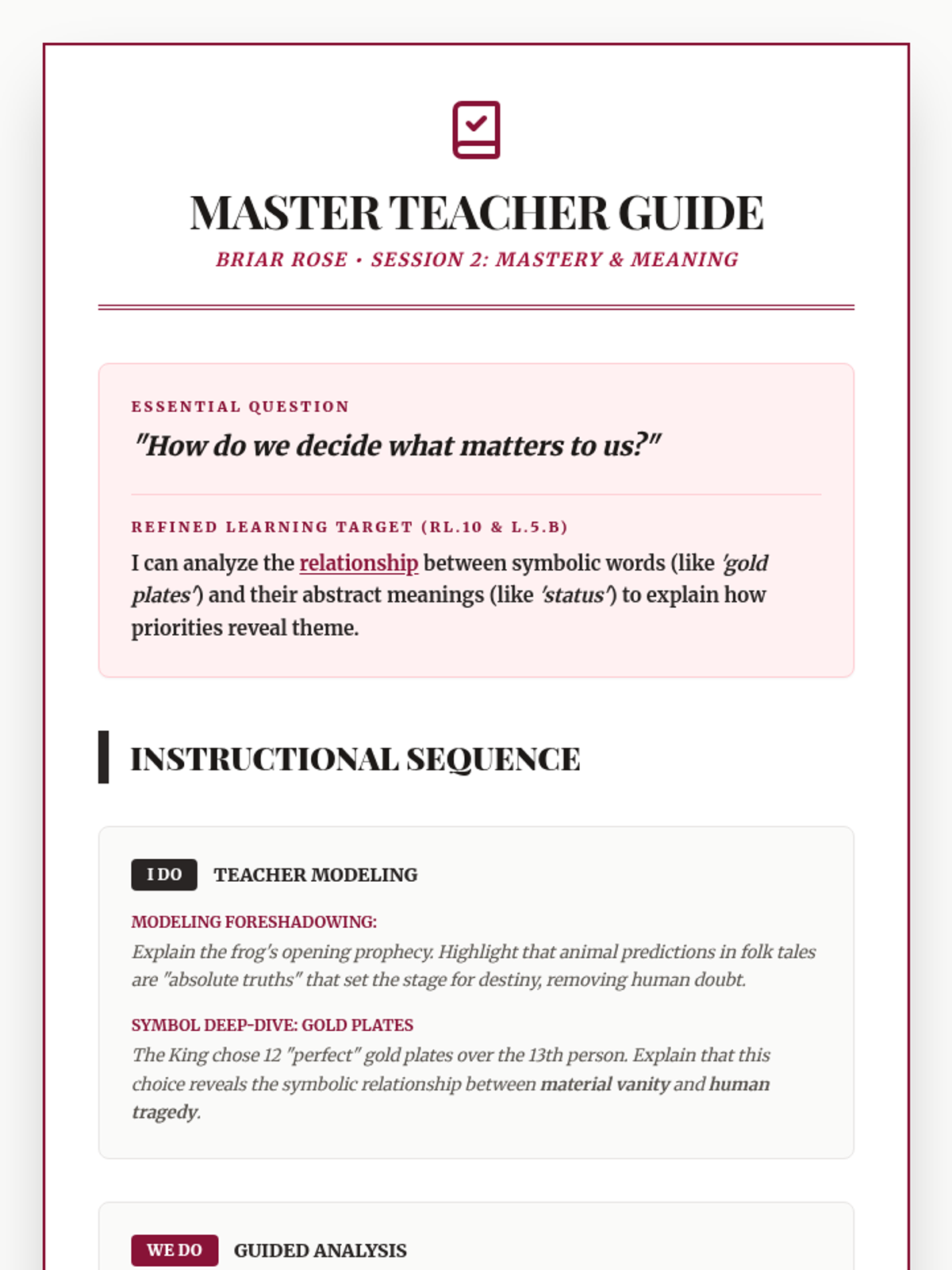
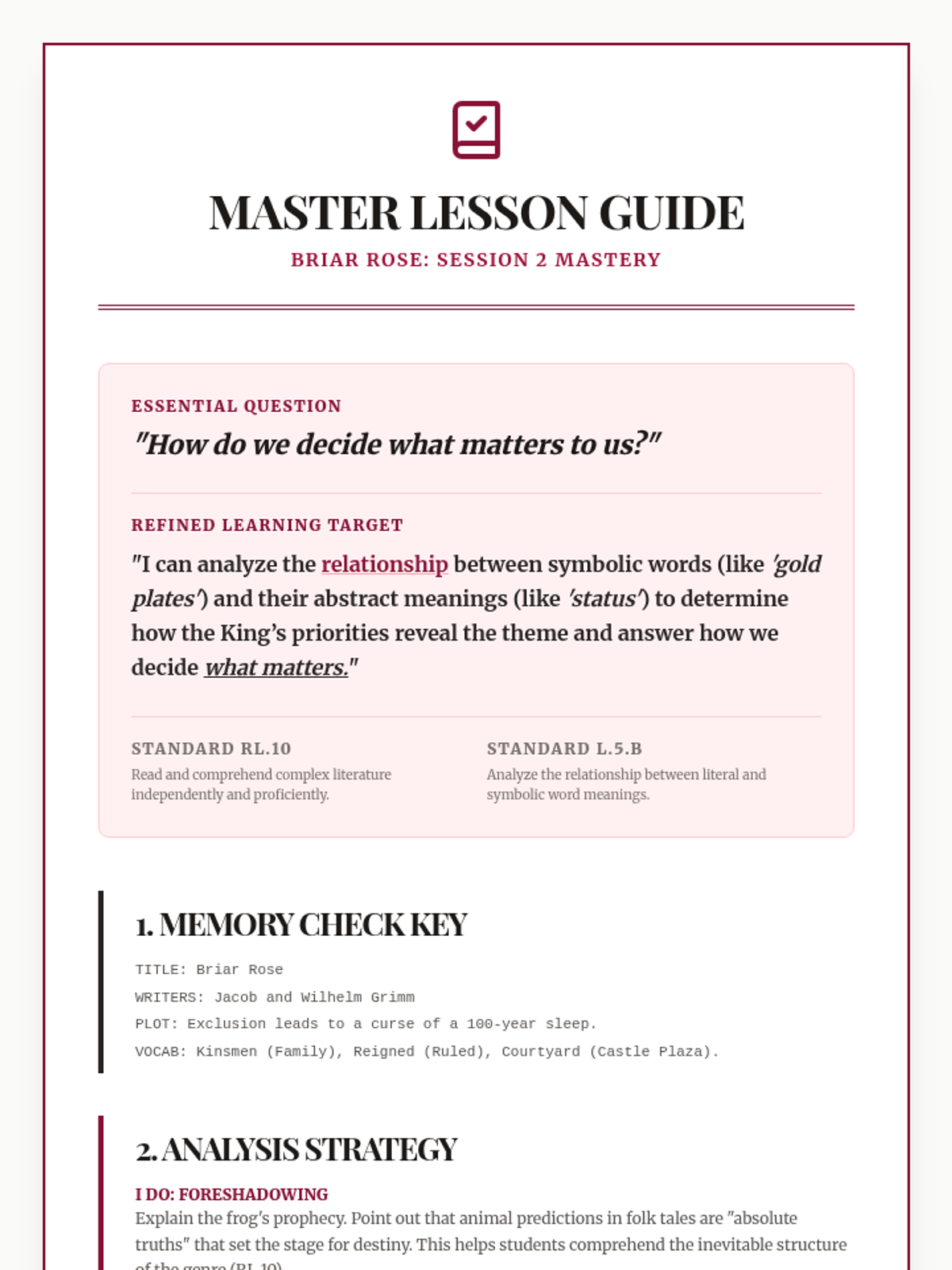
Final comprehensive teacher guide for Session 2 of the Briar Rose lesson, now featuring a highly specific learning target aligned with Standards RL.10 and L.5.b and the Essential Question "How do we decide what matters to us?"
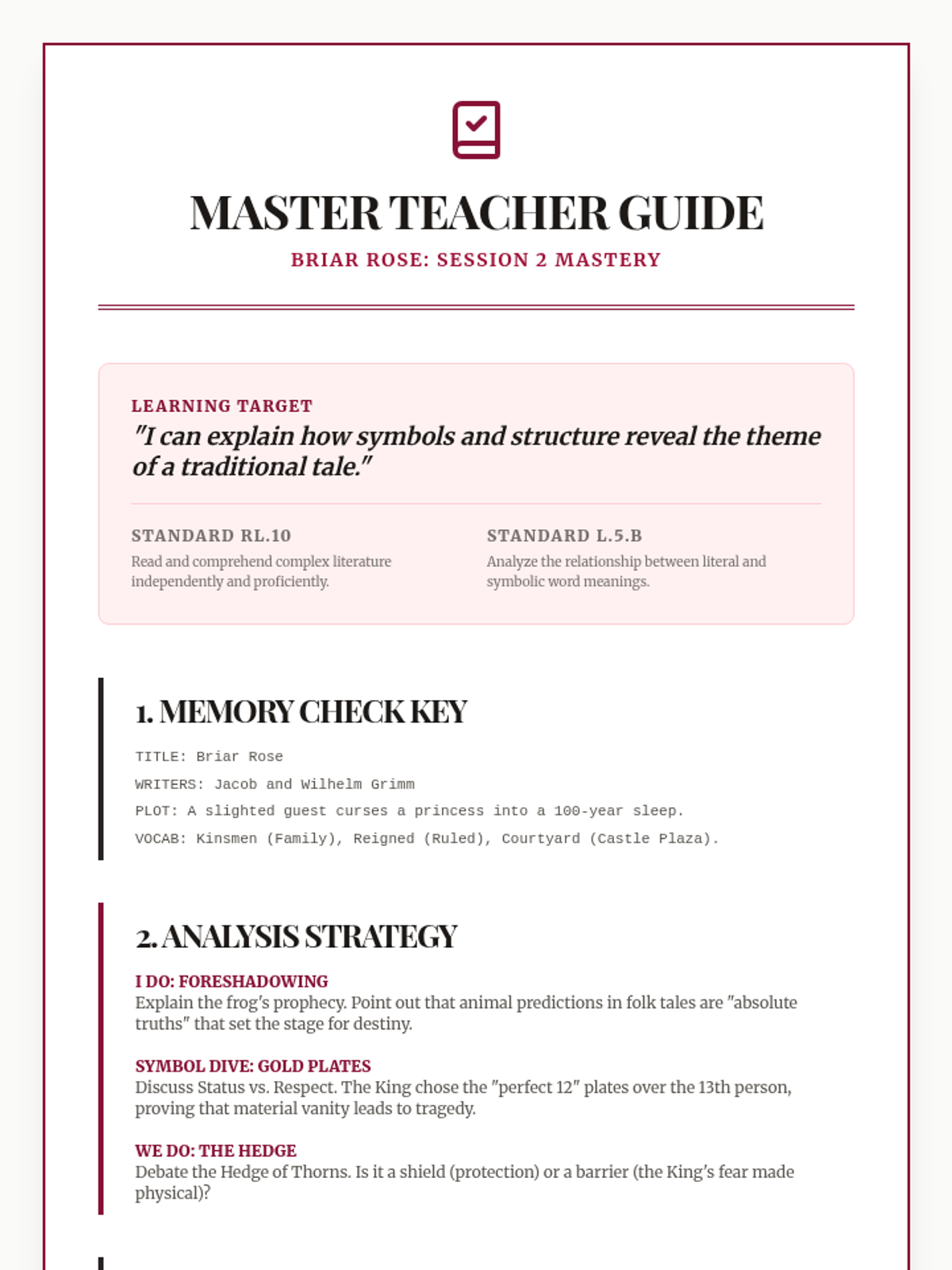
Final comprehensive teacher guide for Session 2 of the Briar Rose lesson, fully synchronized with Part B slides, including the learning target, standards (RL.10, L.5.b), and complete answer keys for all activities.
Updated Session 2 Master Slides for Briar Rose, now including a dedicated "Symbolic Bridge" slide that maps literal objects to their abstract meanings, directly supporting standard L.5.b. All slides optimized for high visibility and instructional flow.
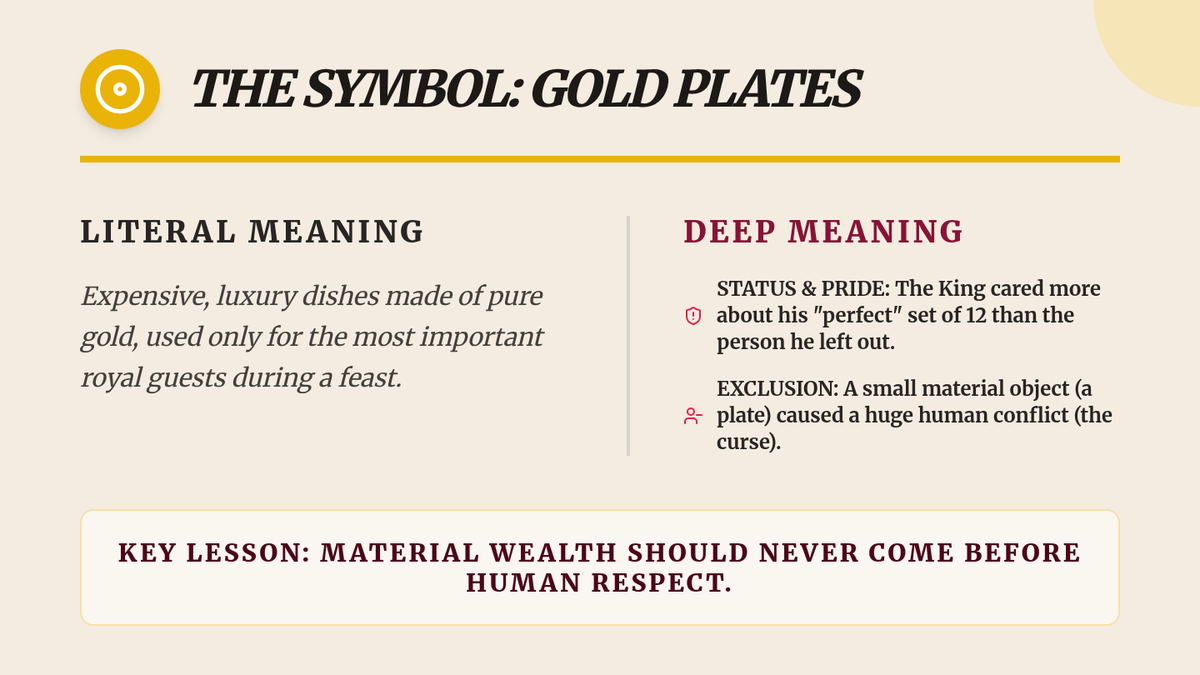
A specialized slide explaining the literal and symbolic meaning of the "gold plates" in Briar Rose, focusing on status, pride, and the root of the story's conflict.
Session 2 Master Slides (Part B Final) for the Briar Rose lesson, featuring a new Learning Target slide, the Recall bell ringer and its answer key, comprehensive story analysis (I Do/We Do), and the 6-task choice board.
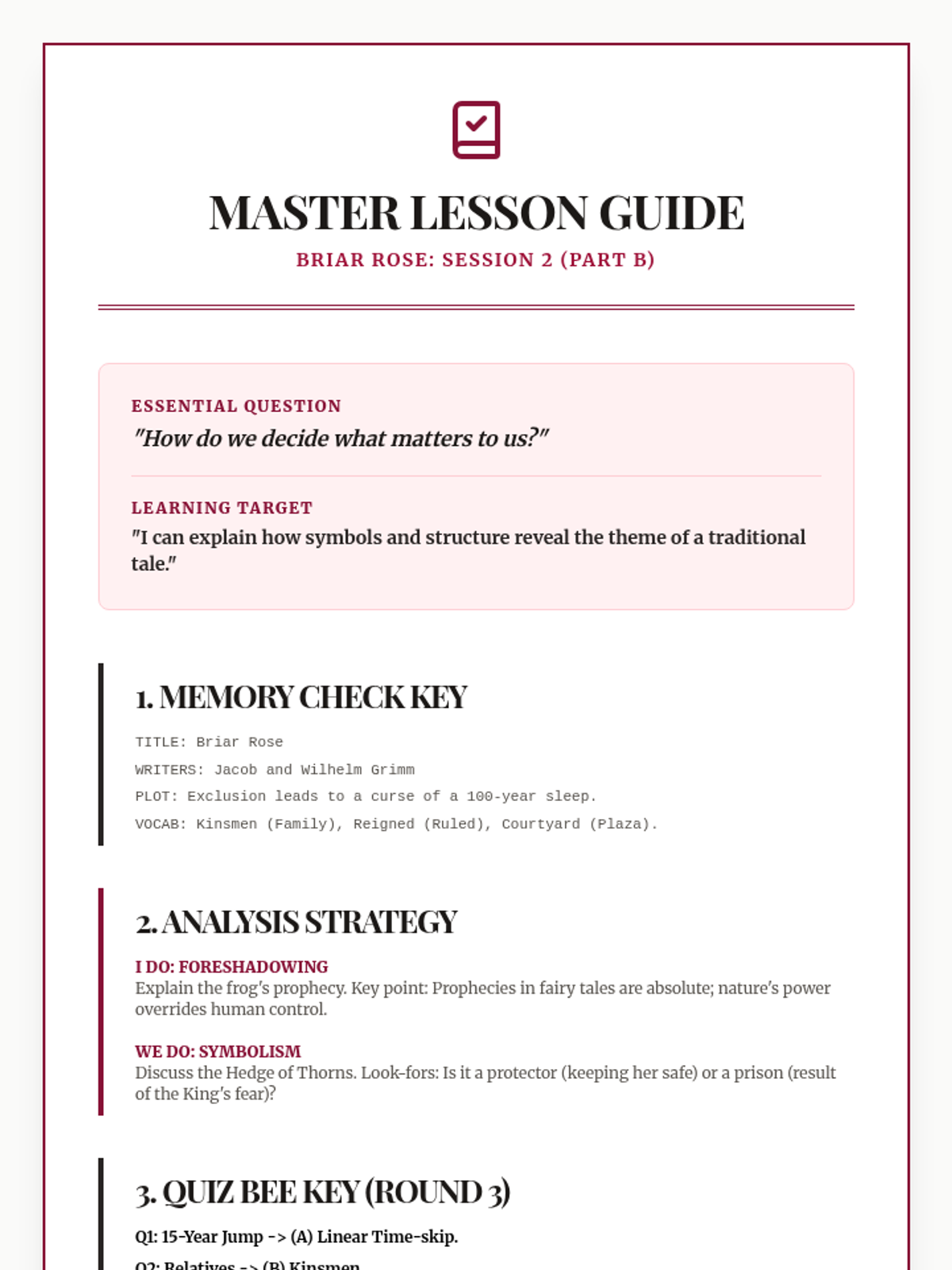
Updated final teacher guide for Session 2 Part B of the Briar Rose lesson, including the specific learning target, essential question, and detailed analysis keys for the "I Do/We Do" strategy.
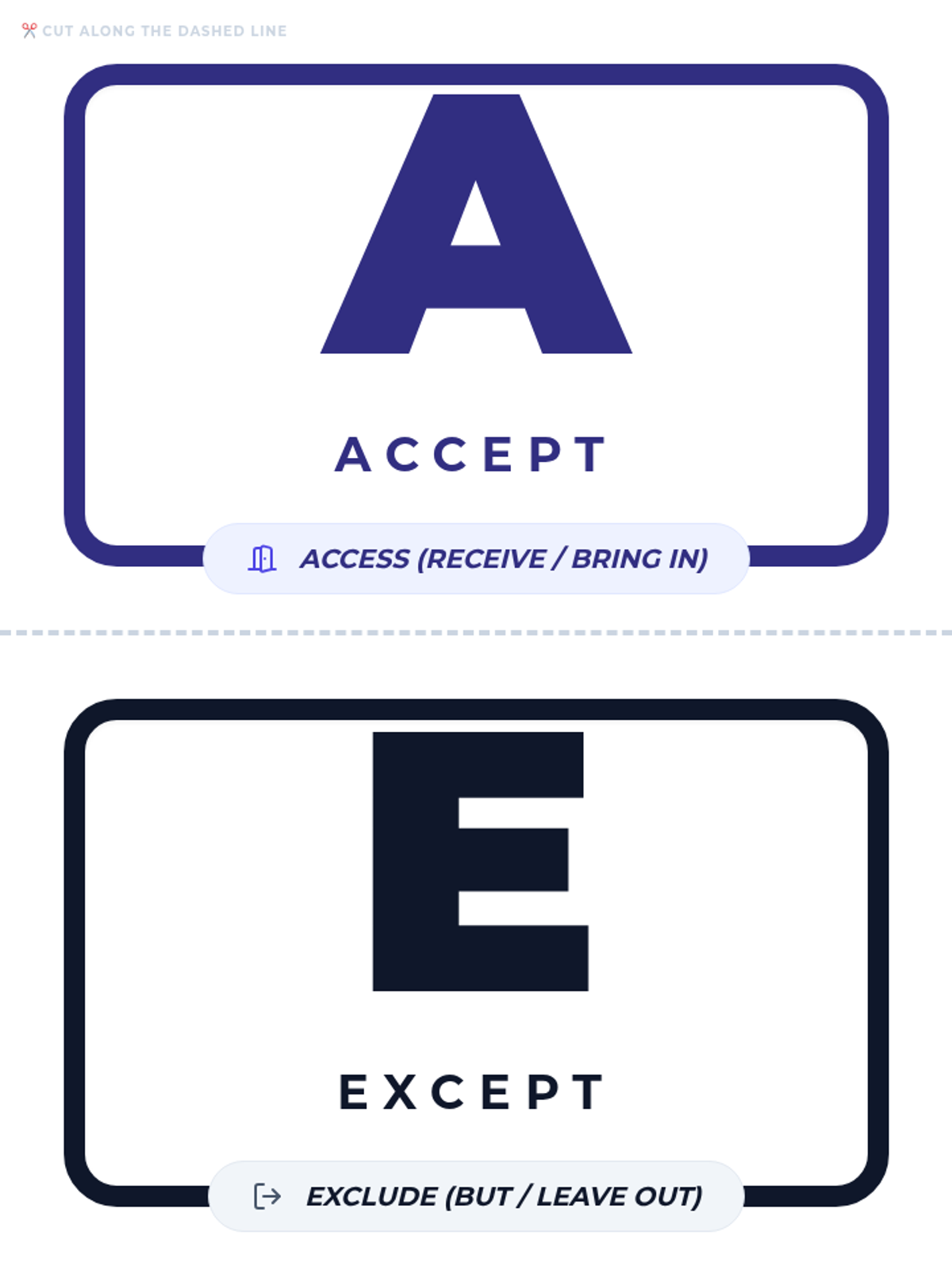
Large printable voting cards for students to hold up during performances to identify the correct usage of 'accept' and 'except'.
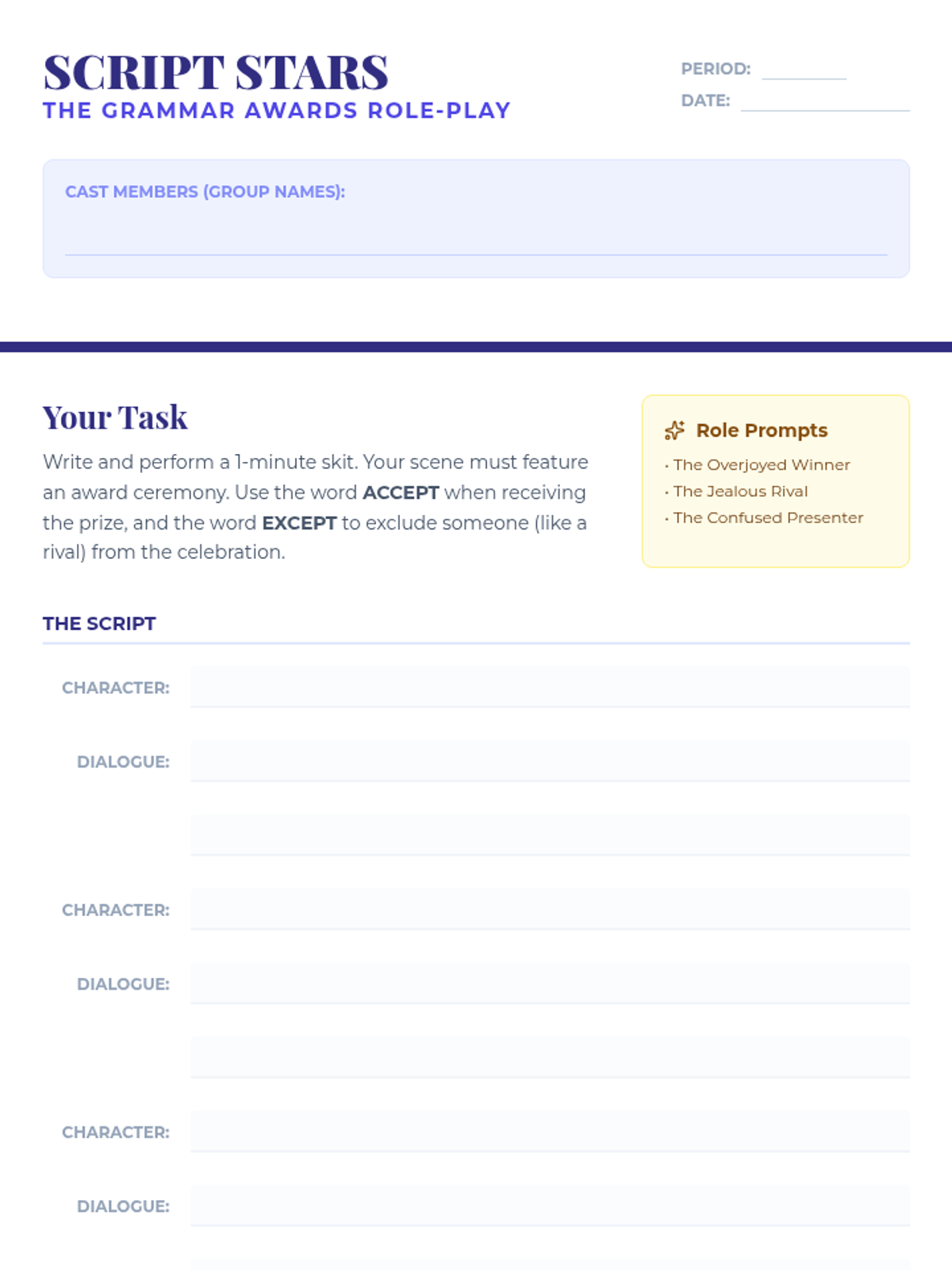
A scriptwriting worksheet for students to draft their award show role-play skits, featuring a grammar checklist and mnemonics.
Visual presentation slides for the lesson, featuring a warm-up, embedded video, mnemonic devices, and role-play instructions.
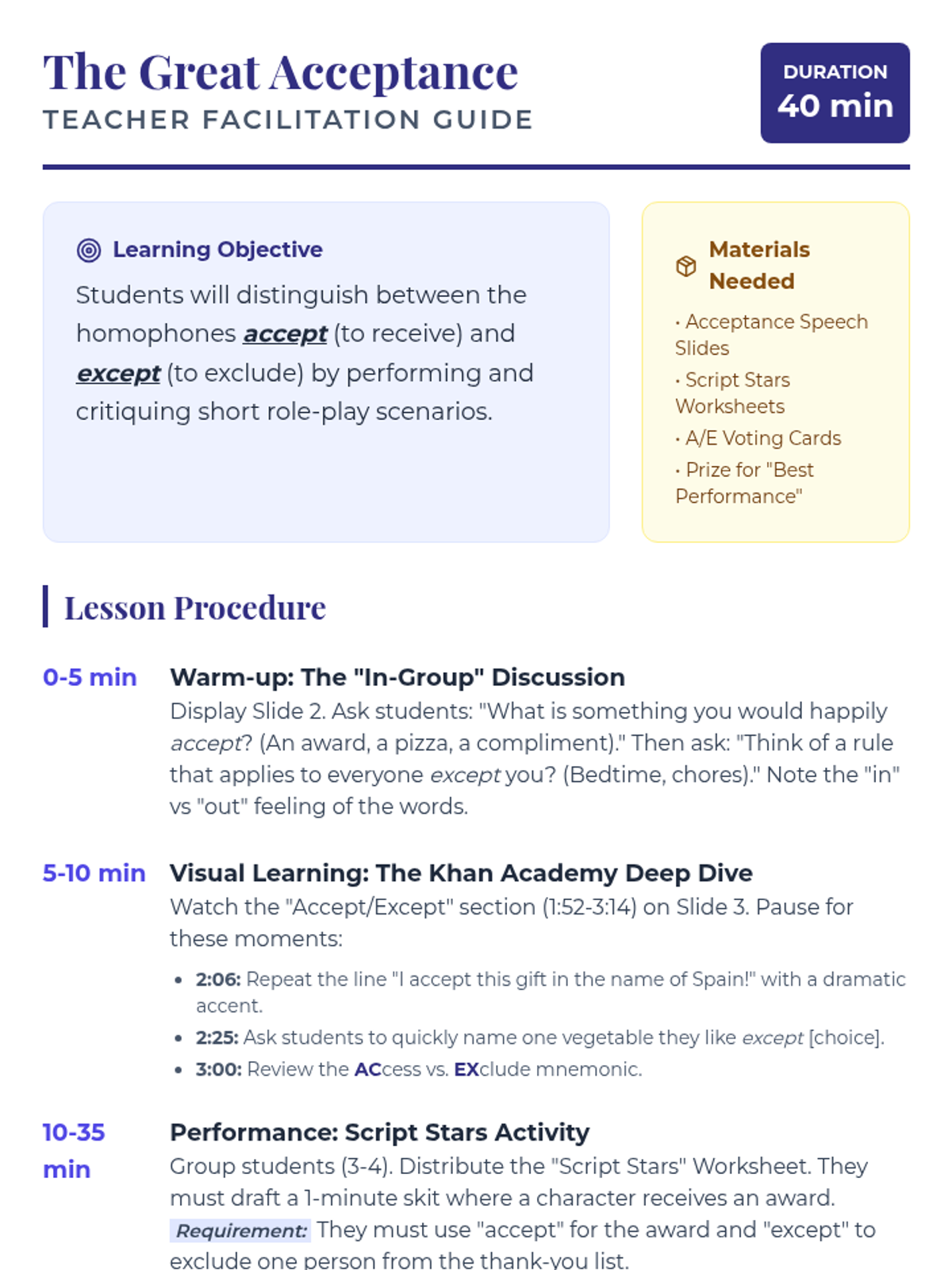
A detailed lesson plan and facilitation guide for teachers covering the grammar objective, timeline, and teaching strategies for 'accept' vs. 'except'.
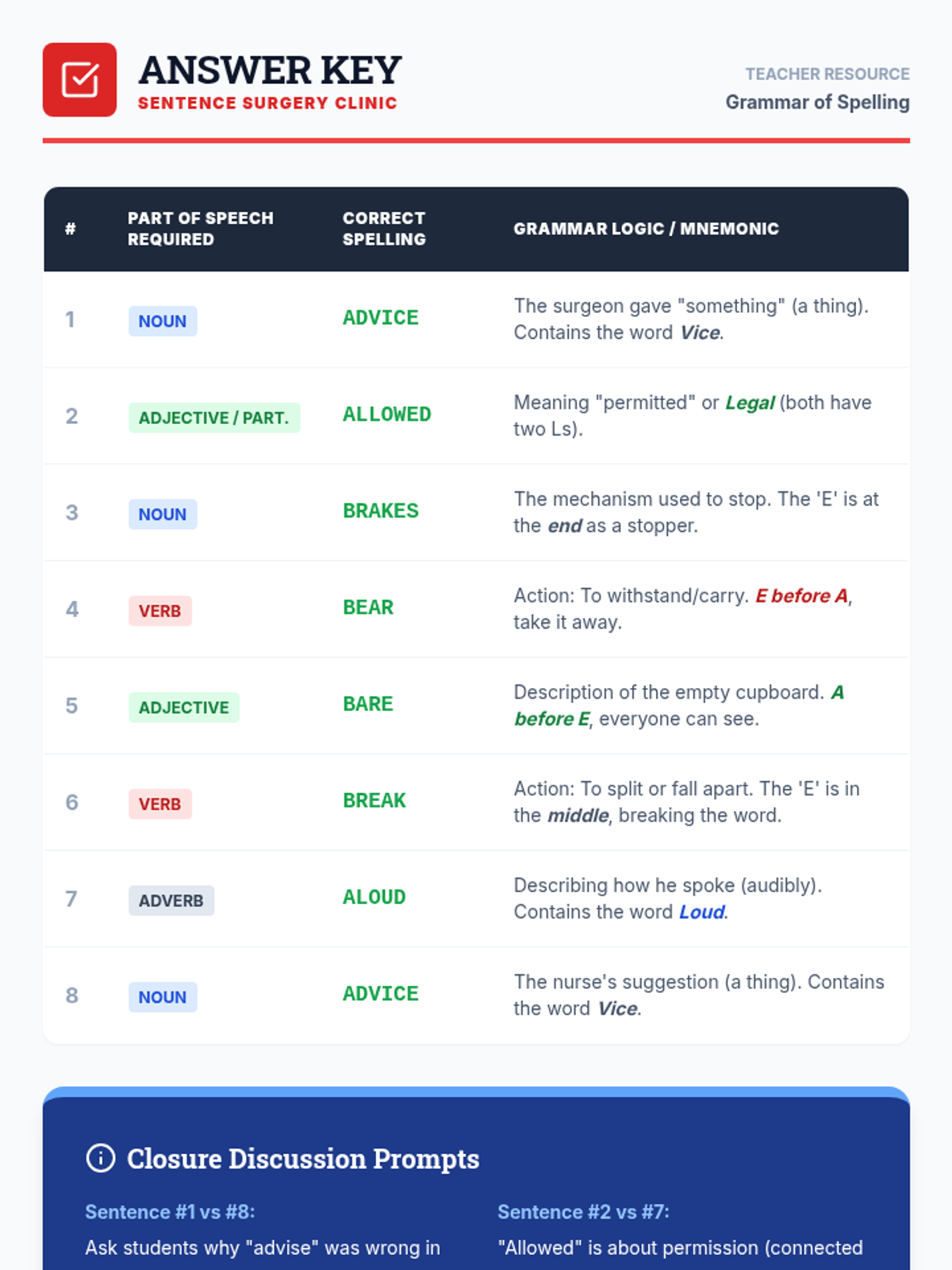
A teacher's answer key for the "Sentence Surgery" worksheet, including grammatical explanations and mnemonic references for each correction.
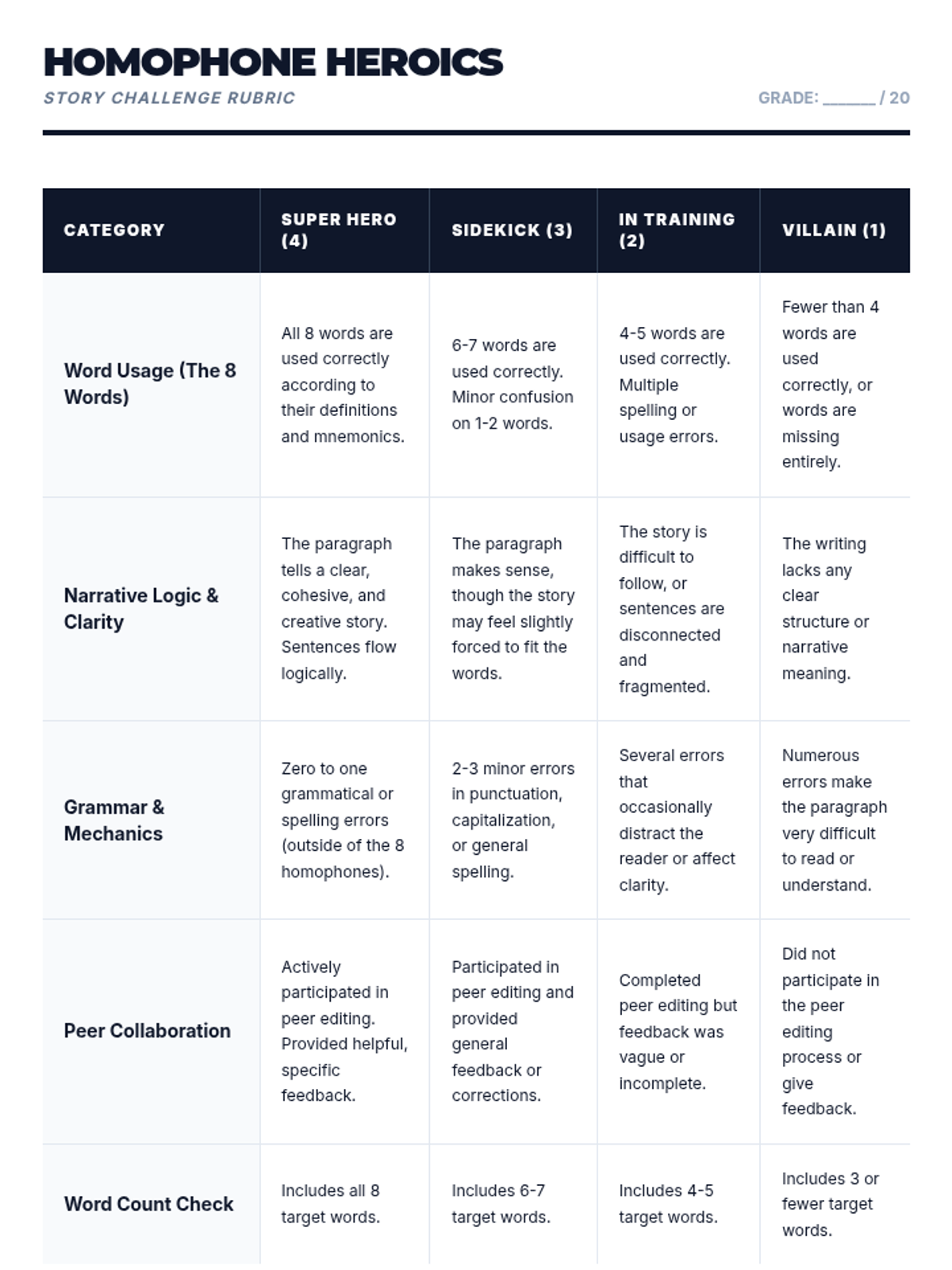
A professional rubric for grading the Homophone Story Challenge, evaluating word usage, narrative clarity, grammar, and peer collaboration.
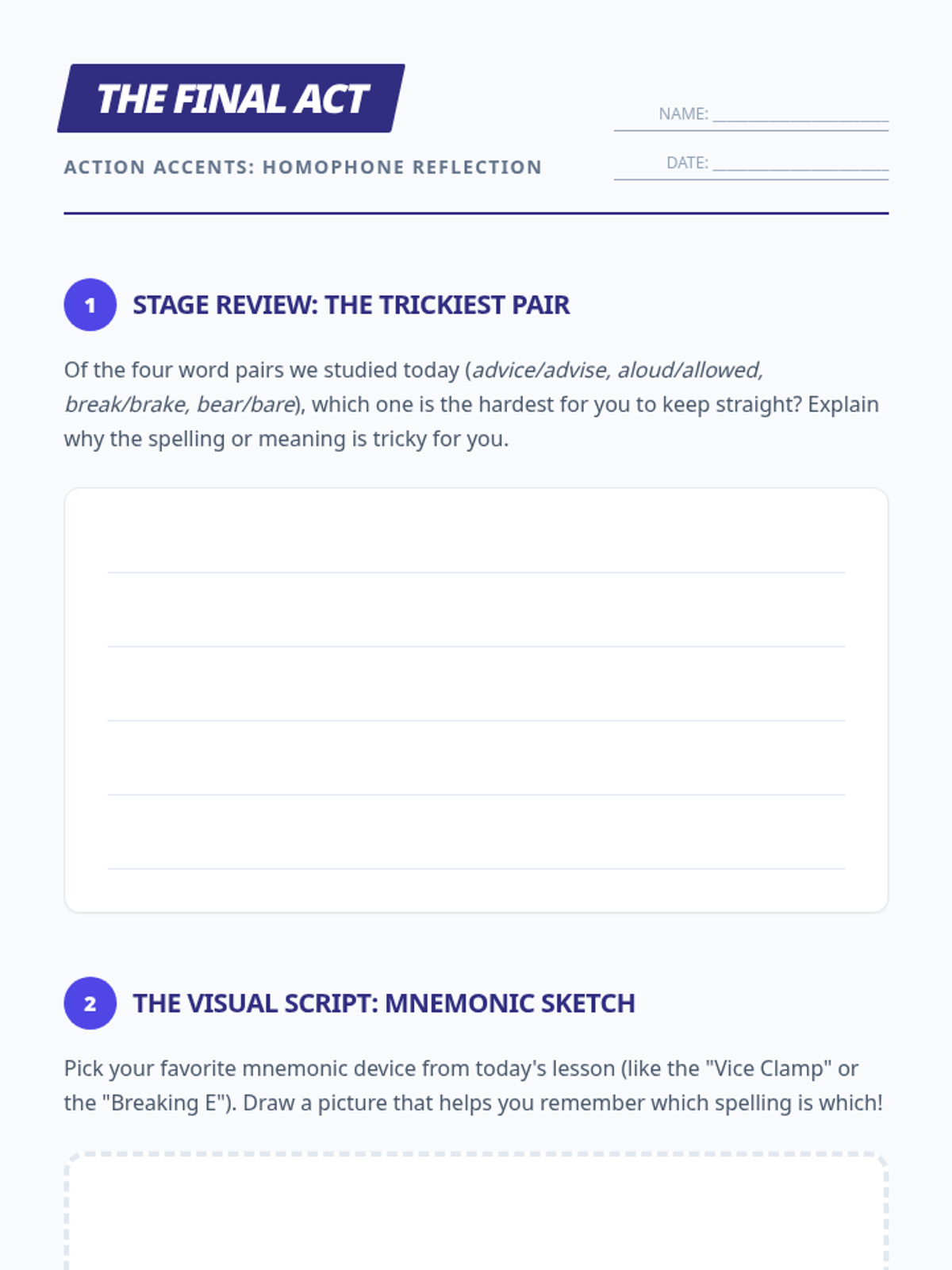
A student reflection journal page for the Action Accents lesson, where students explain their difficulties with specific homophones and sketch visual mnemonics.
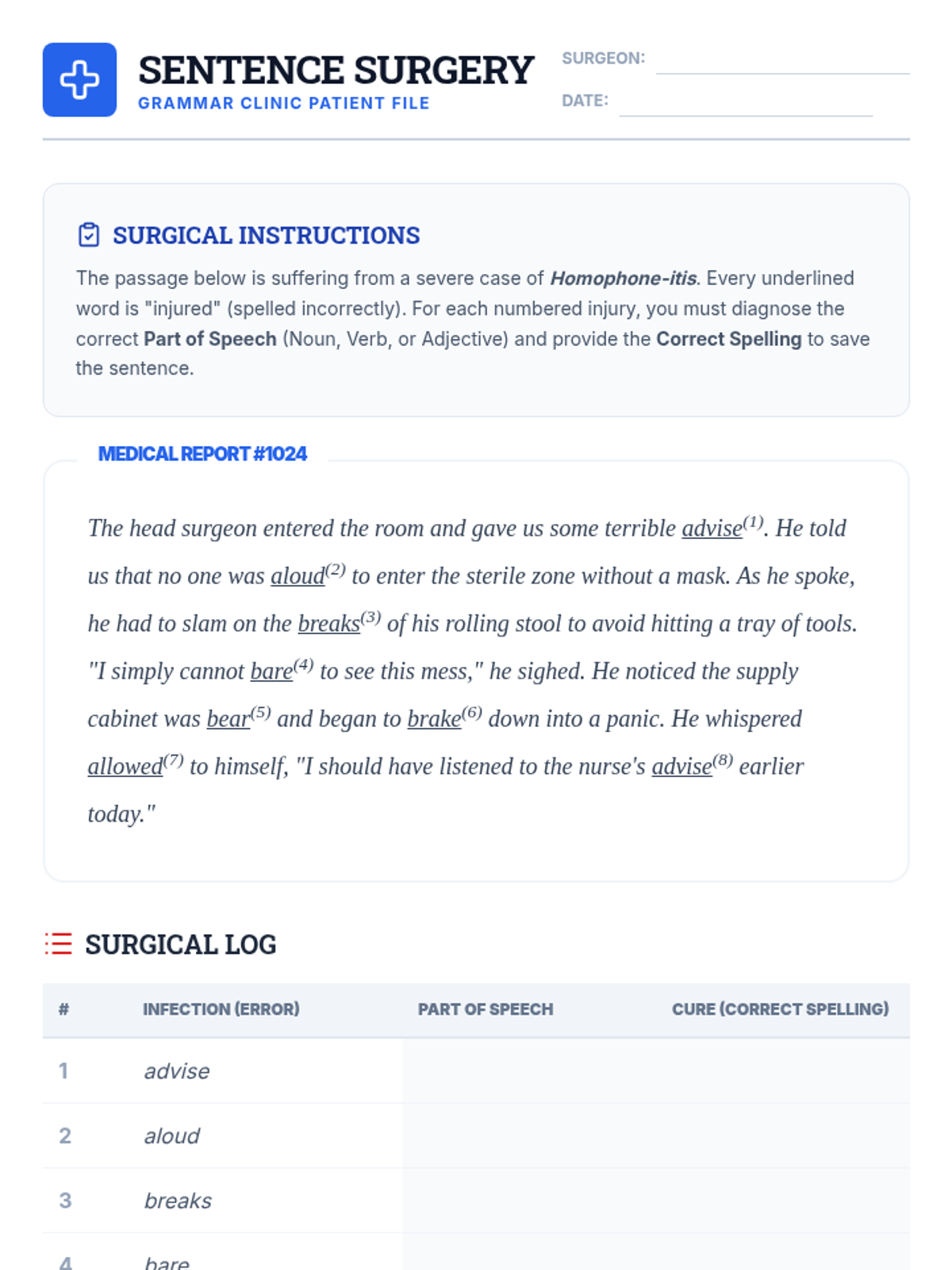
A student worksheet for the "Sentence Surgery" activity. Students must read a passage with spelling errors, identify the part of speech required for each error, and provide the correct spelling.
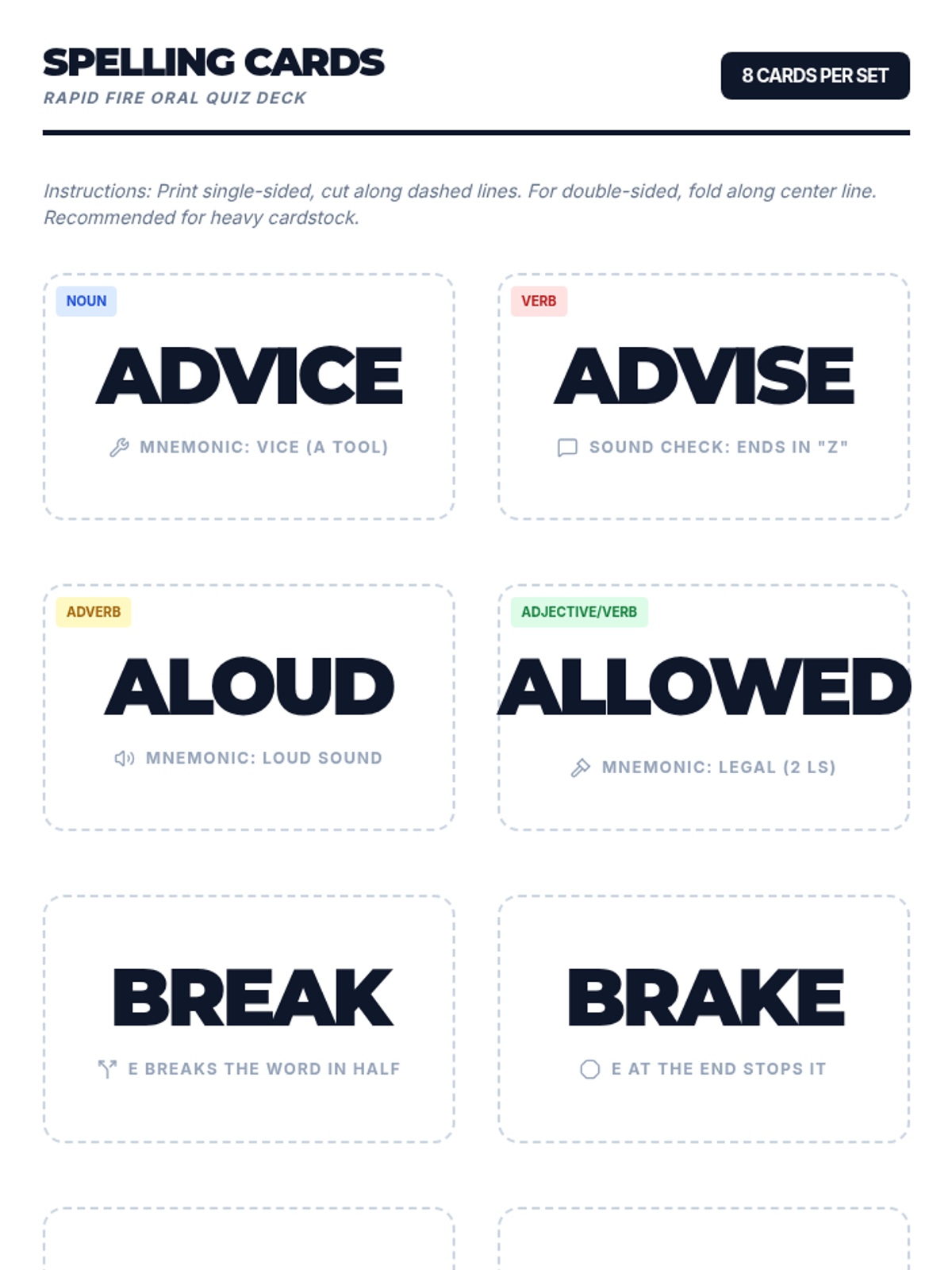
A set of 8 large-print flashcards for the classroom warm-up, featuring the homophone pairs and their corresponding mnemonics.
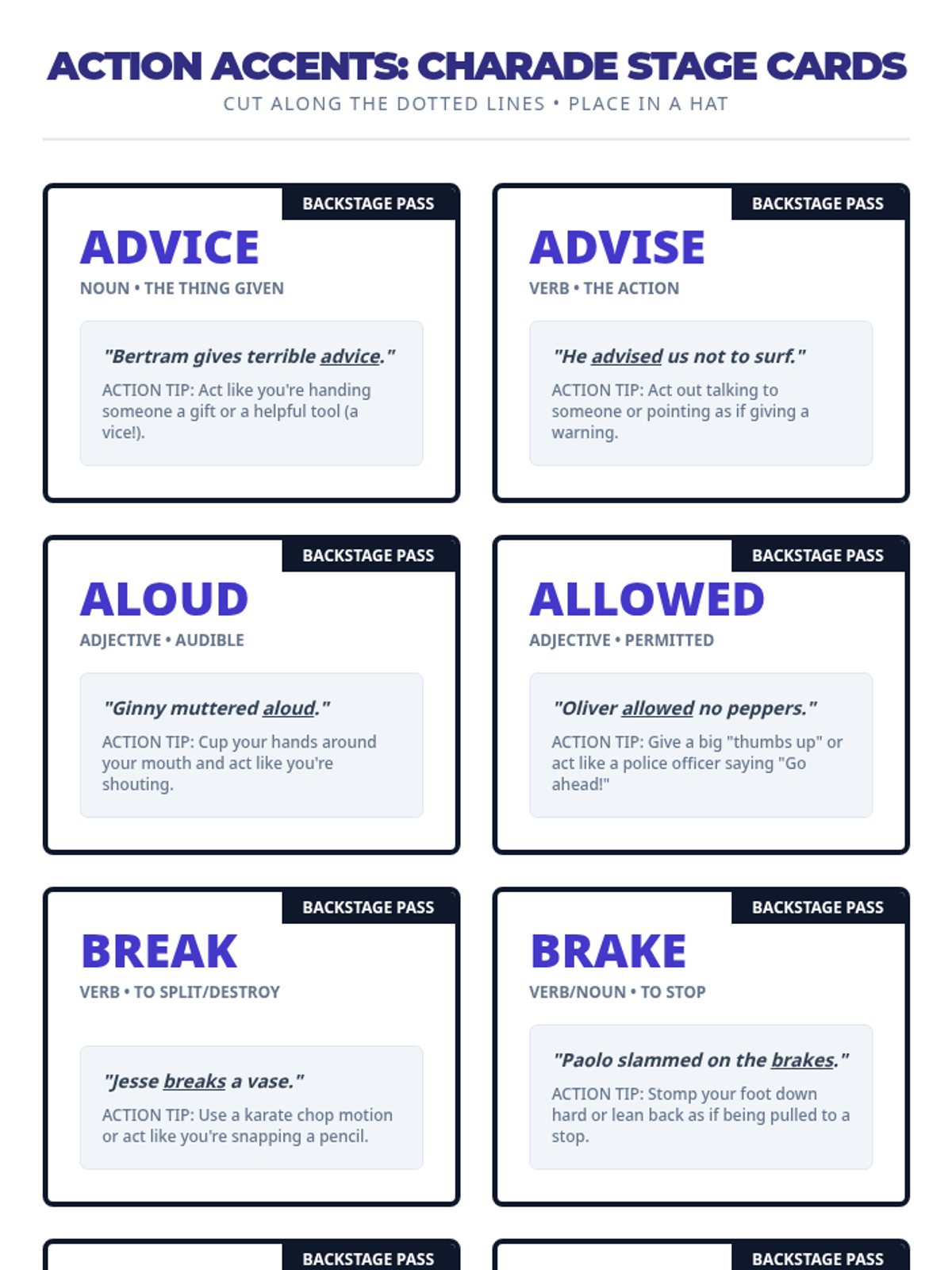
Printable charade cards for students to use in the Homophone Charades activity, featuring word spellings, definitions, and action tips.
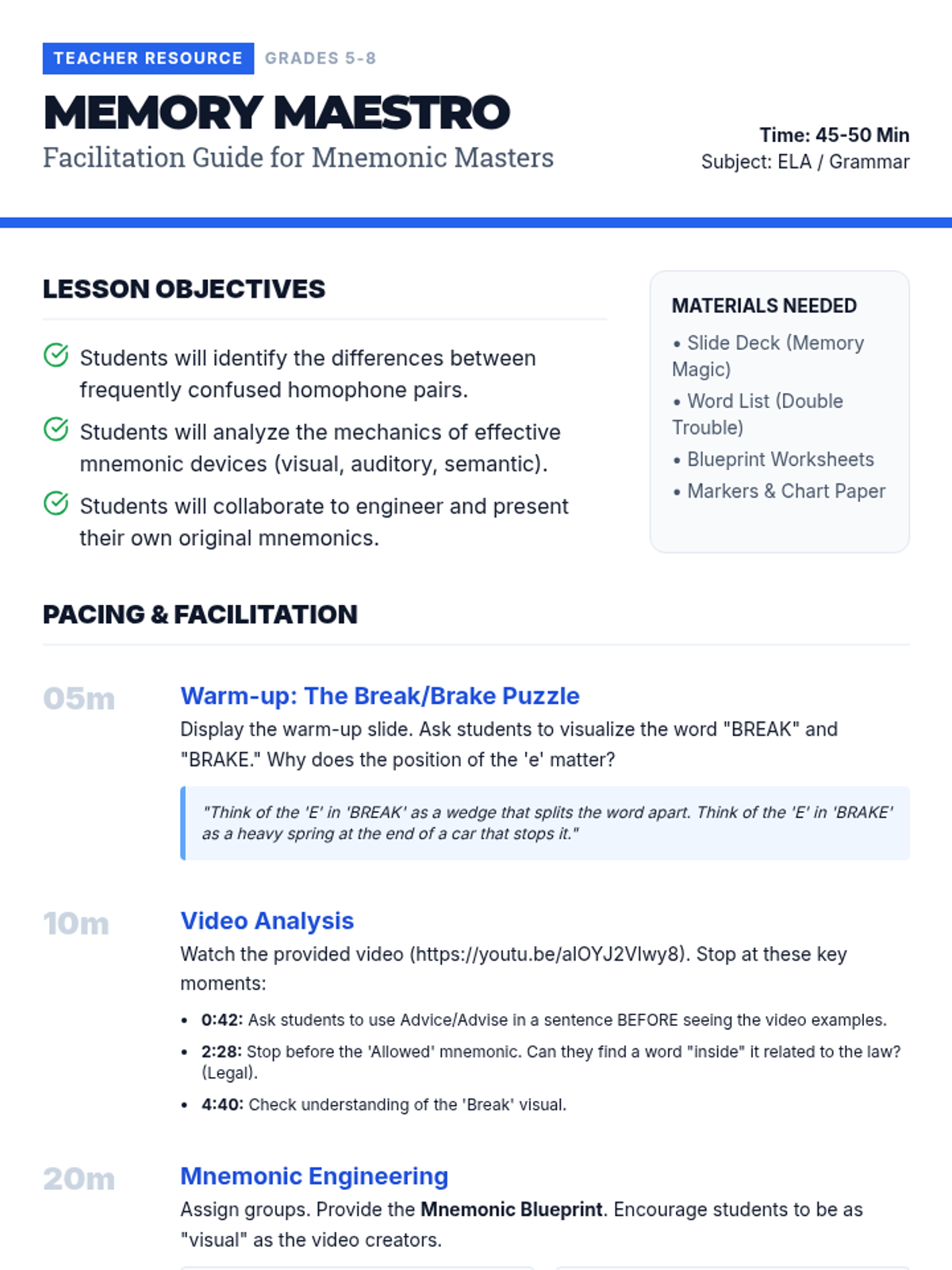
A comprehensive teacher facilitation guide containing the lesson plan, transcript highlights from the video, a pacing guide, and a cheat sheet of sample mnemonic devices for the word pairs.
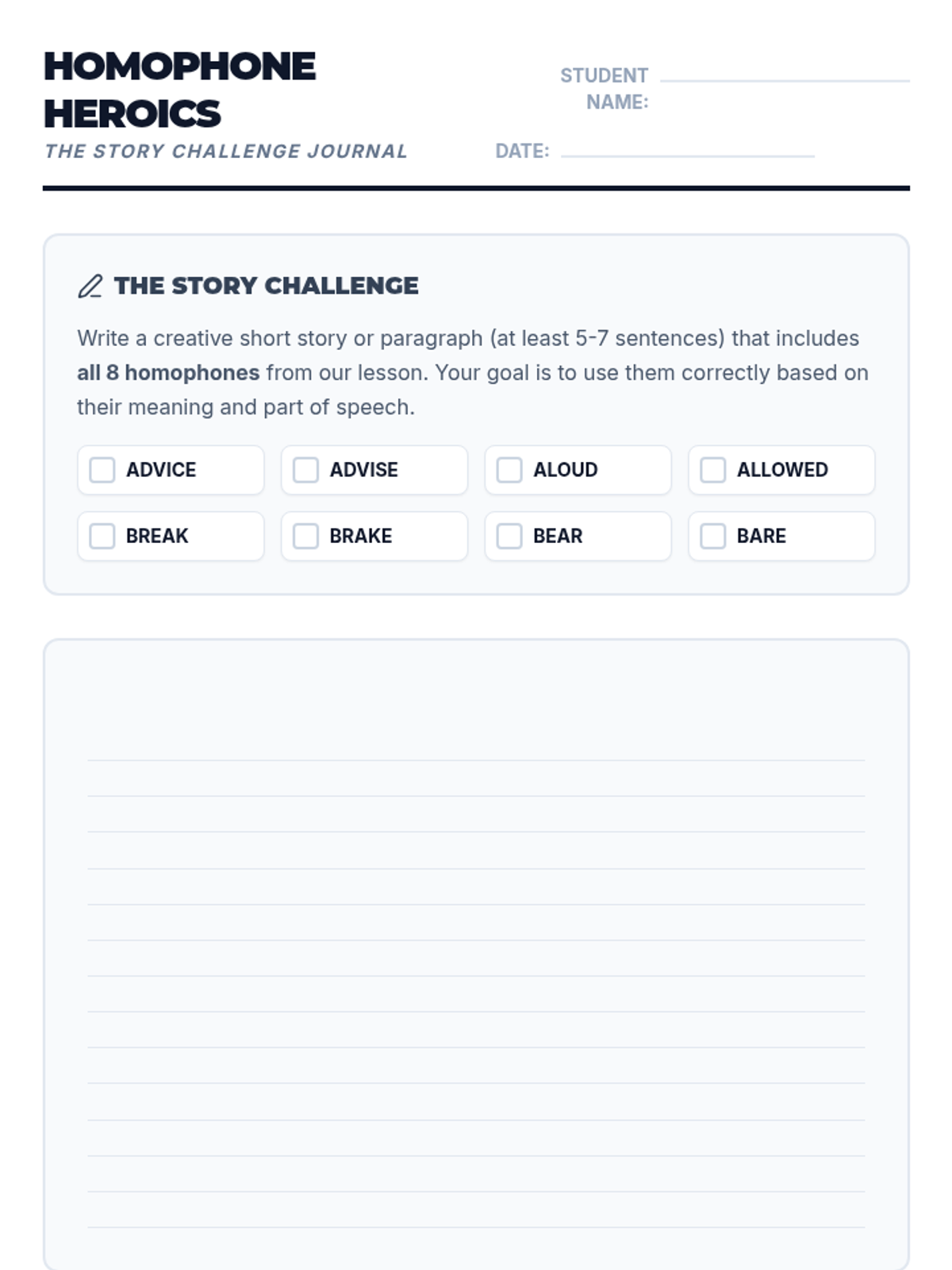
A student-facing journal page for the Homophone Story Challenge, including a checklist of words, a ruled writing area, and a peer review section.
A visual presentation deck to guide the "Sentence Surgery" lesson, featuring a word sort warm-up, embedded Khan Academy video, and mnemonic deep-dives.
Engaging slides for the Action Accents lesson, featuring embedded video content, visual mnemonics for each word pair, and clear instructions for the charades activity.
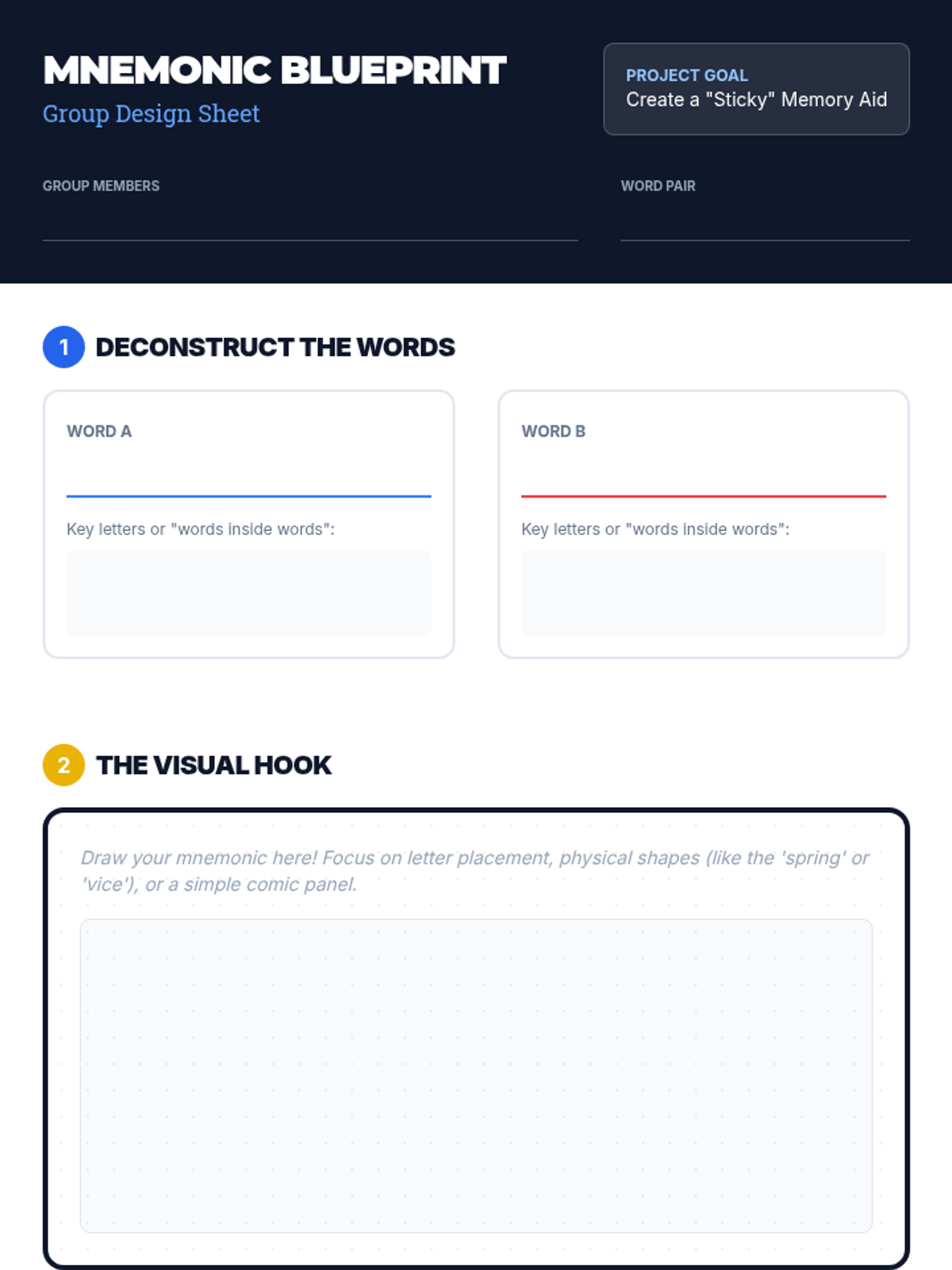
A graphic organizer and workspace for student groups to design their mnemonic devices. It includes structured sections for word deconstruction, a large visual drawing area (simulating chart paper), and a space to craft a verbal anchor or rhyme.
A comprehensive 9-slide presentation for the 'Homophone Heroics' lesson, featuring video integration, mnemonic breakdowns, and activity instructions for middle school students.
A visual presentation for the Mnemonic Masters lesson, featuring an embedded video, breakdown of mnemonic strategies (visual shapes, rhymes, words inside words), and instructions for the group activity.
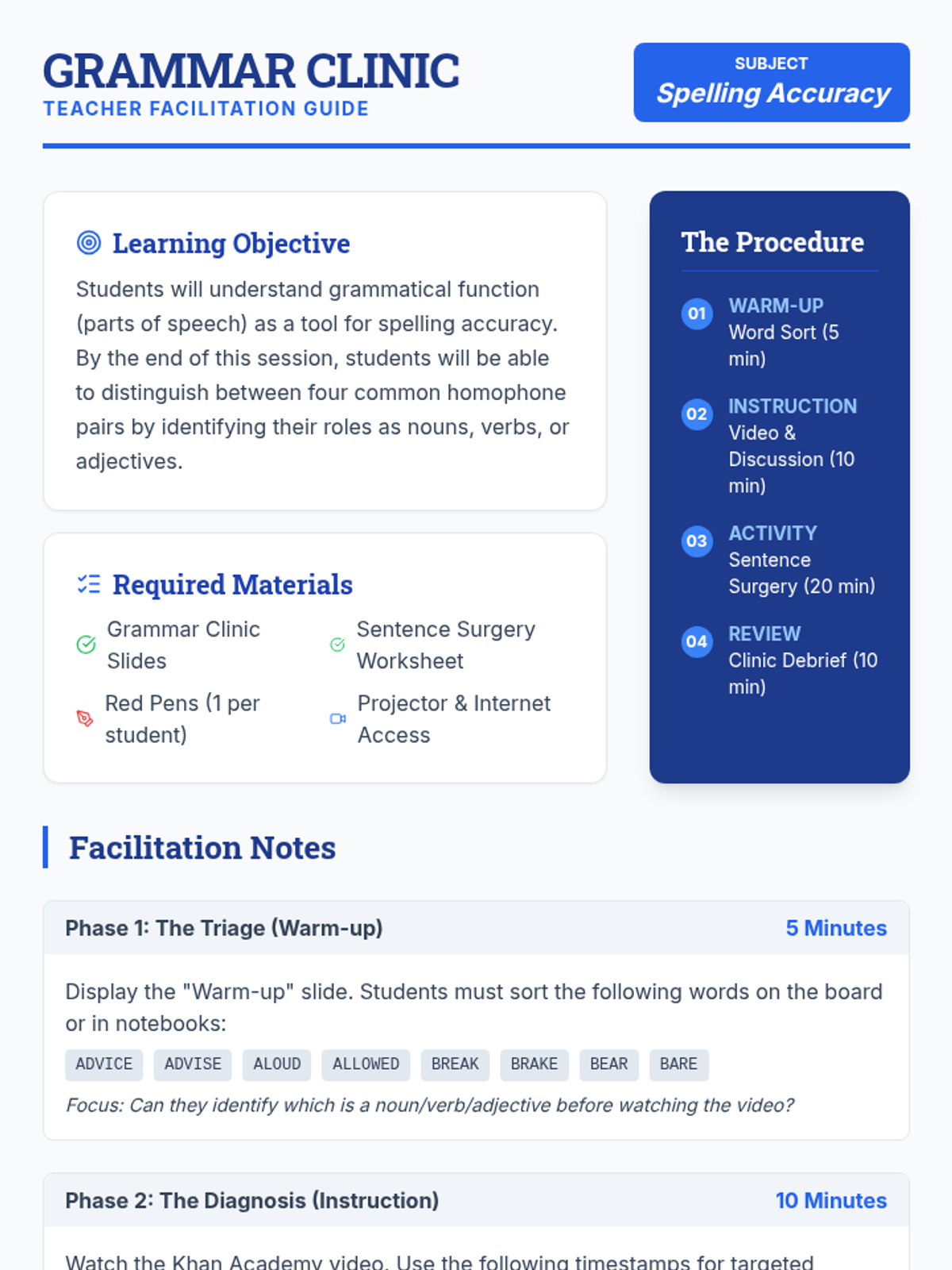
A teacher facilitation guide for the "Sentence Surgery" lesson, including pacing, discussion prompts for the video, and tips for the spelling activity.
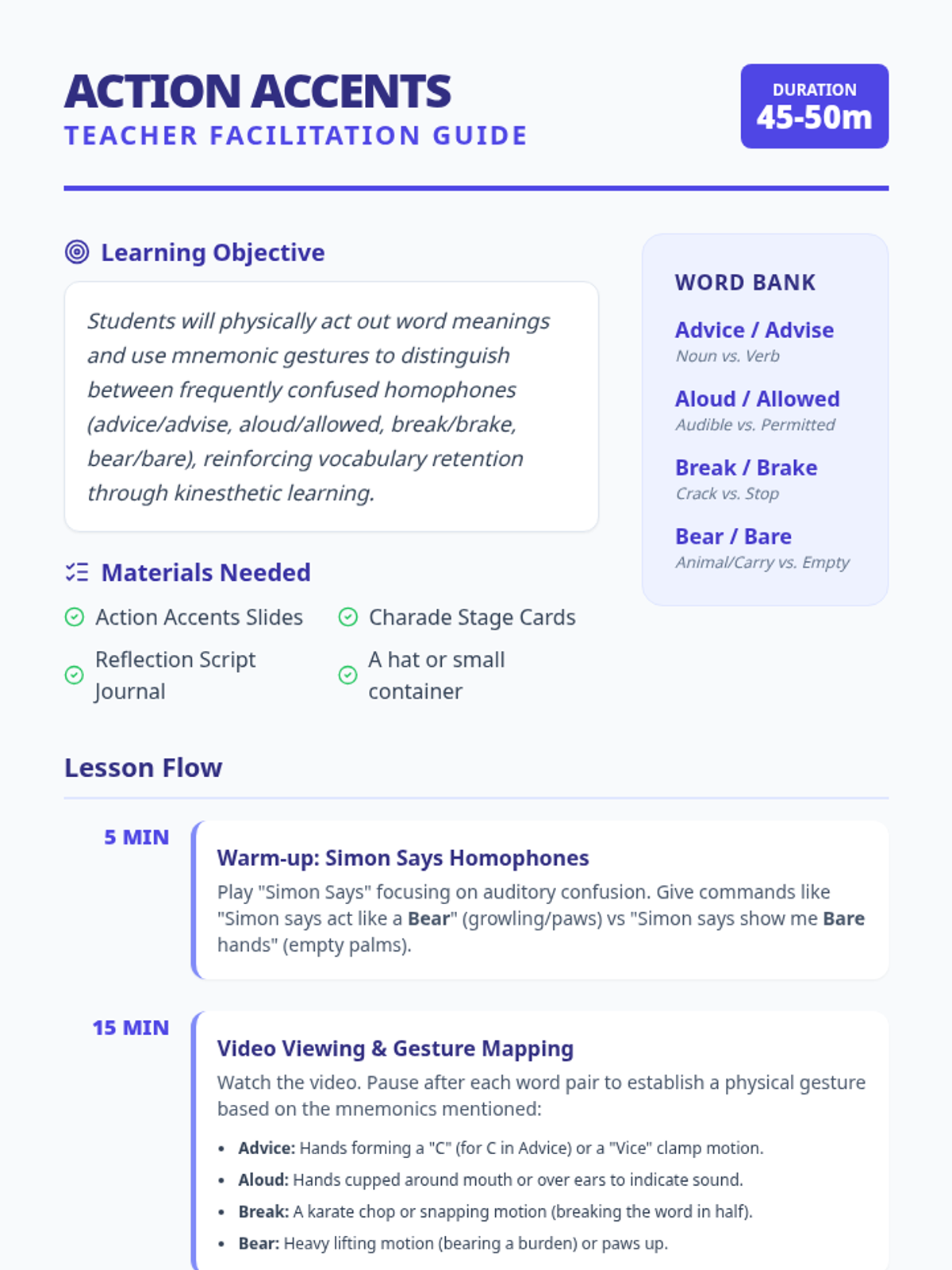
A comprehensive teacher facilitation guide for the Action Accents lesson, including learning objectives, materials, pacing, and specific instructional prompts for the video viewing.
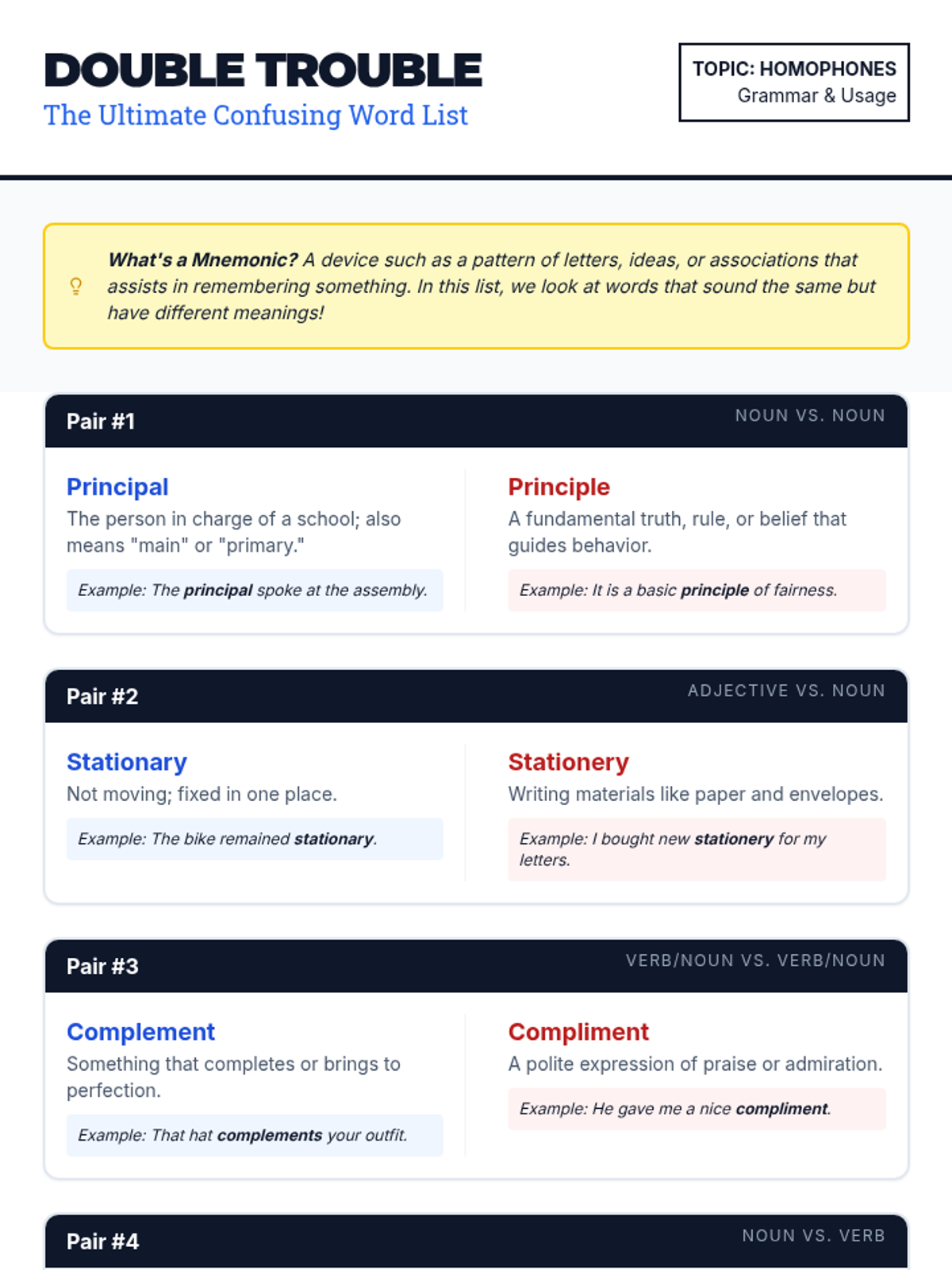
A comprehensive list of frequently confused word pairs (homophones) for students, featuring definitions, example sentences, and space for initial mnemonic brainstorming.
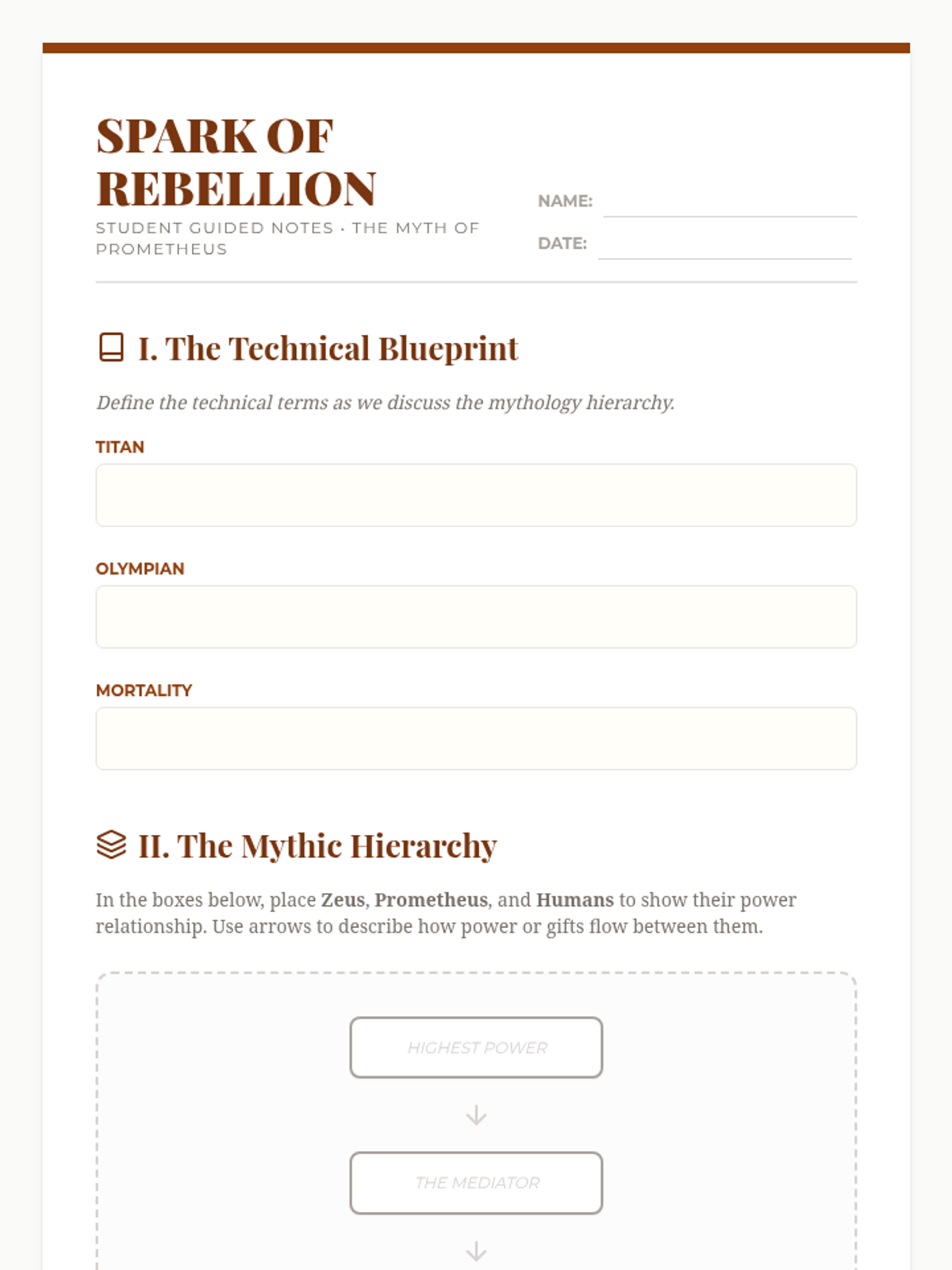
A student-facing guided notes worksheet for "The Fire Thief" lesson, including vocabulary sections, a hierarchy concept map, and a comparative short response area for analyzing word choice in the Prometheus myth.
Visual presentation for the "Fire Thief" lesson, featuring high-contrast slides on mythology hierarchy, technical vocabulary, and the symbolic significance of fire in the Prometheus myth.
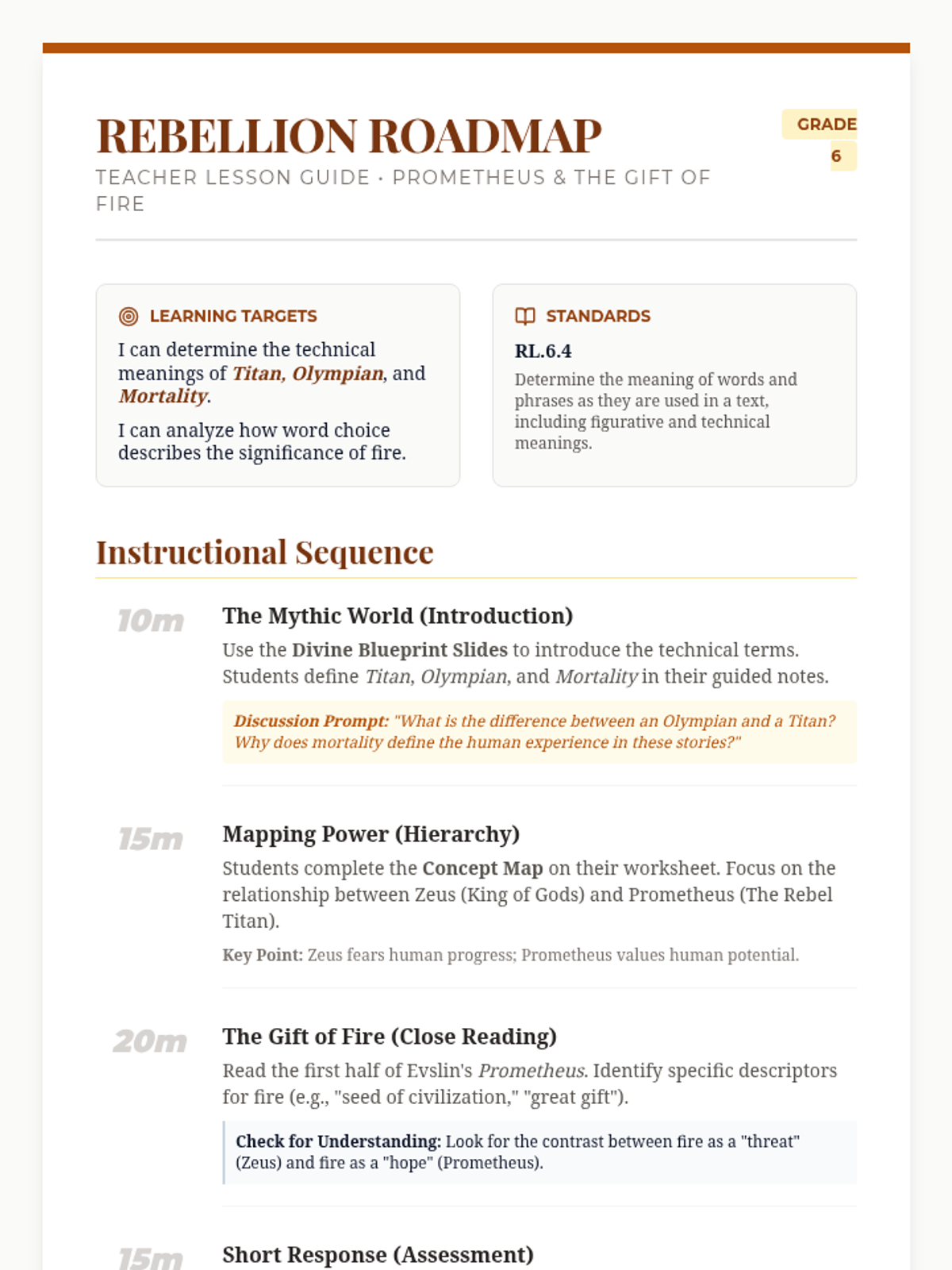
A teacher-facing lesson guide for "The Fire Thief" lesson, including pacing, learning targets, standards alignment, common misconceptions, and a full answer key for student materials.
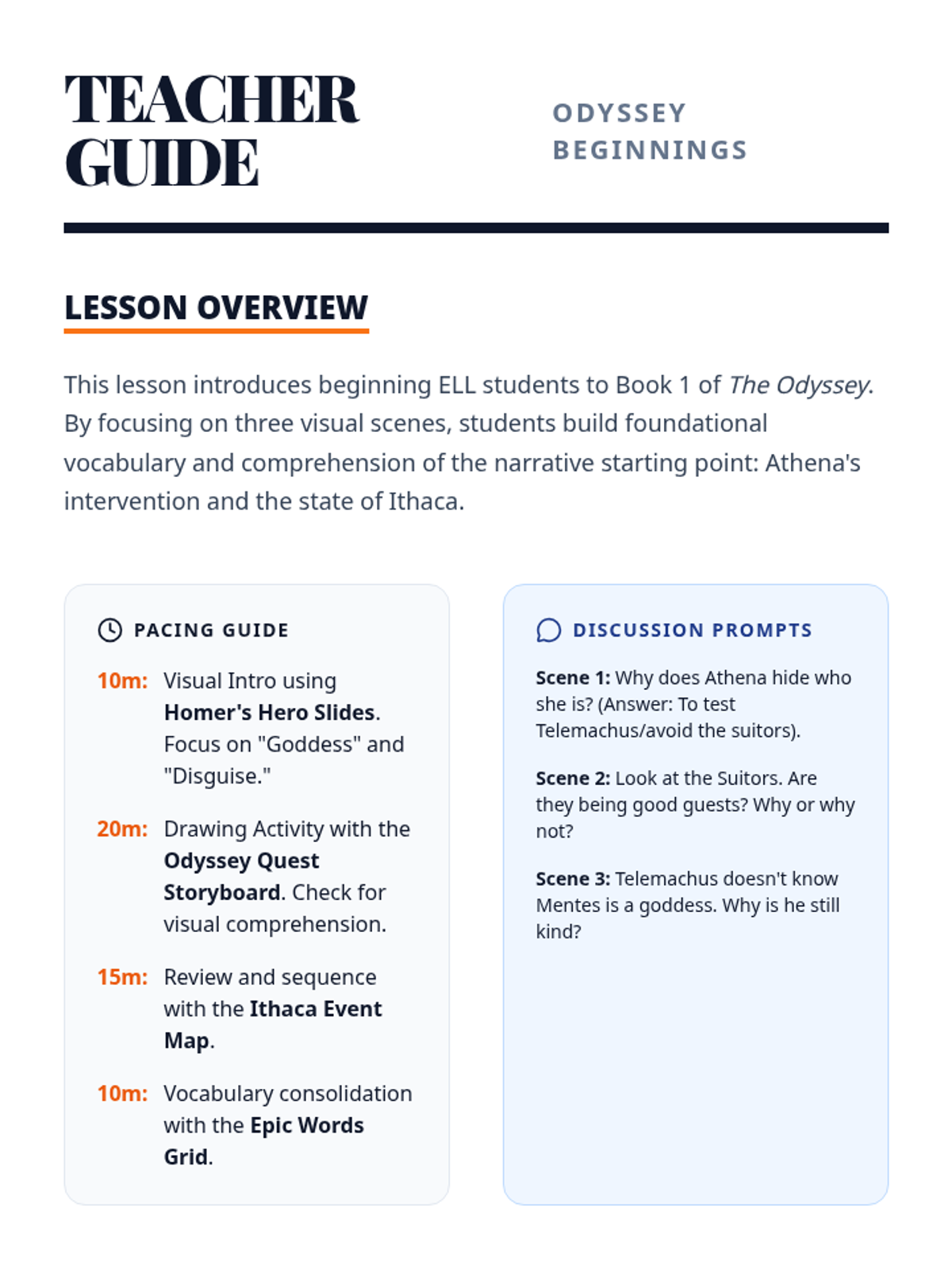
An instructional guide for teachers delivering the Odyssey Beginnings lesson. Includes pacing, discussion prompts, ELL scaffolding strategies, and answer keys for student materials.
A visual introduction to Book 1 of the Odyssey for beginning ELL students. Introduces key characters like Athena and Telemachus and the setting of Ithaca with simplified vocabulary and high-impact visuals.
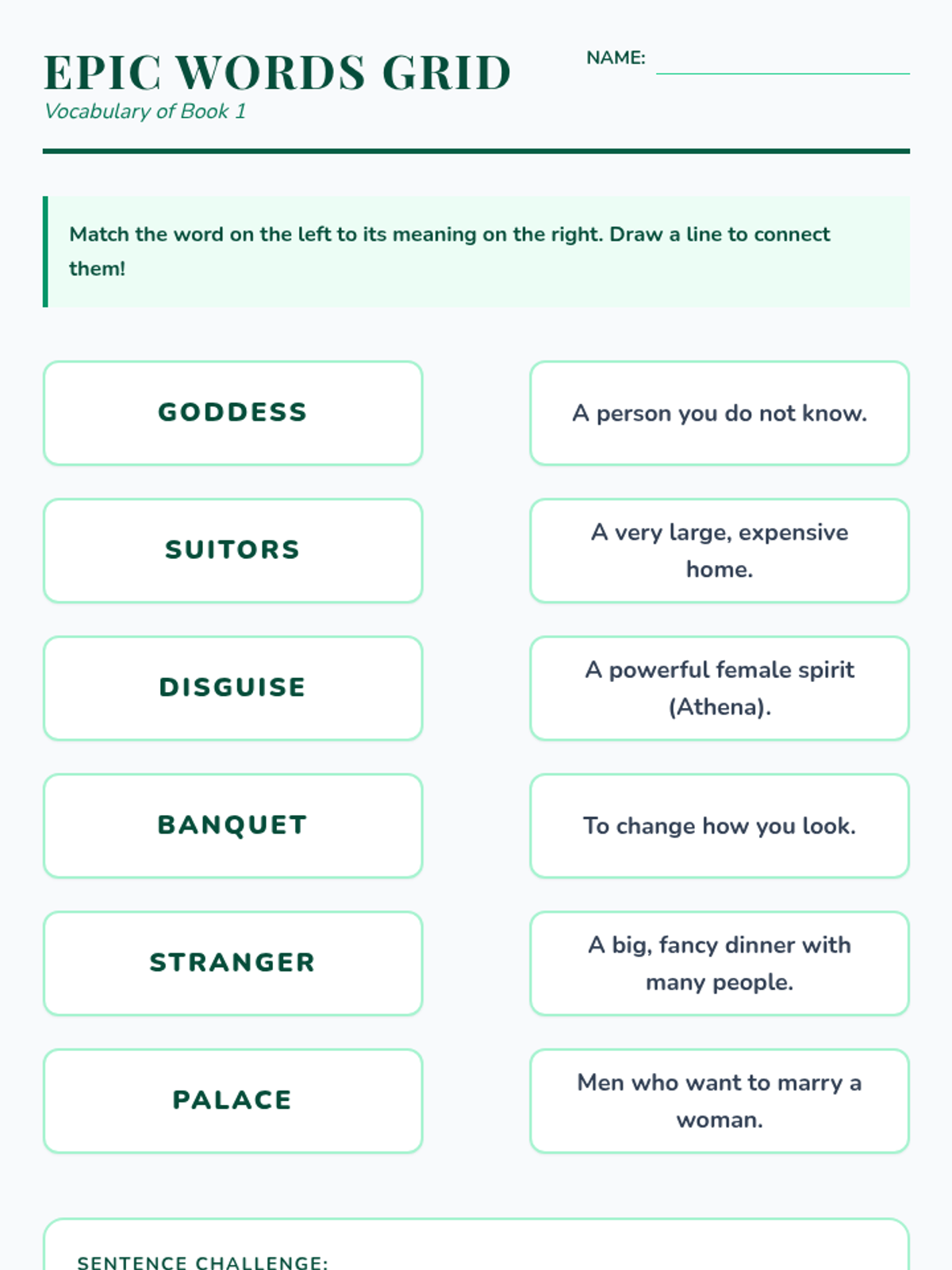
A vocabulary matching grid for Odyssey Book 1, designed for beginning ELL learners. Connects key terms like 'Disguise' and 'Banquet' with simple definitions.
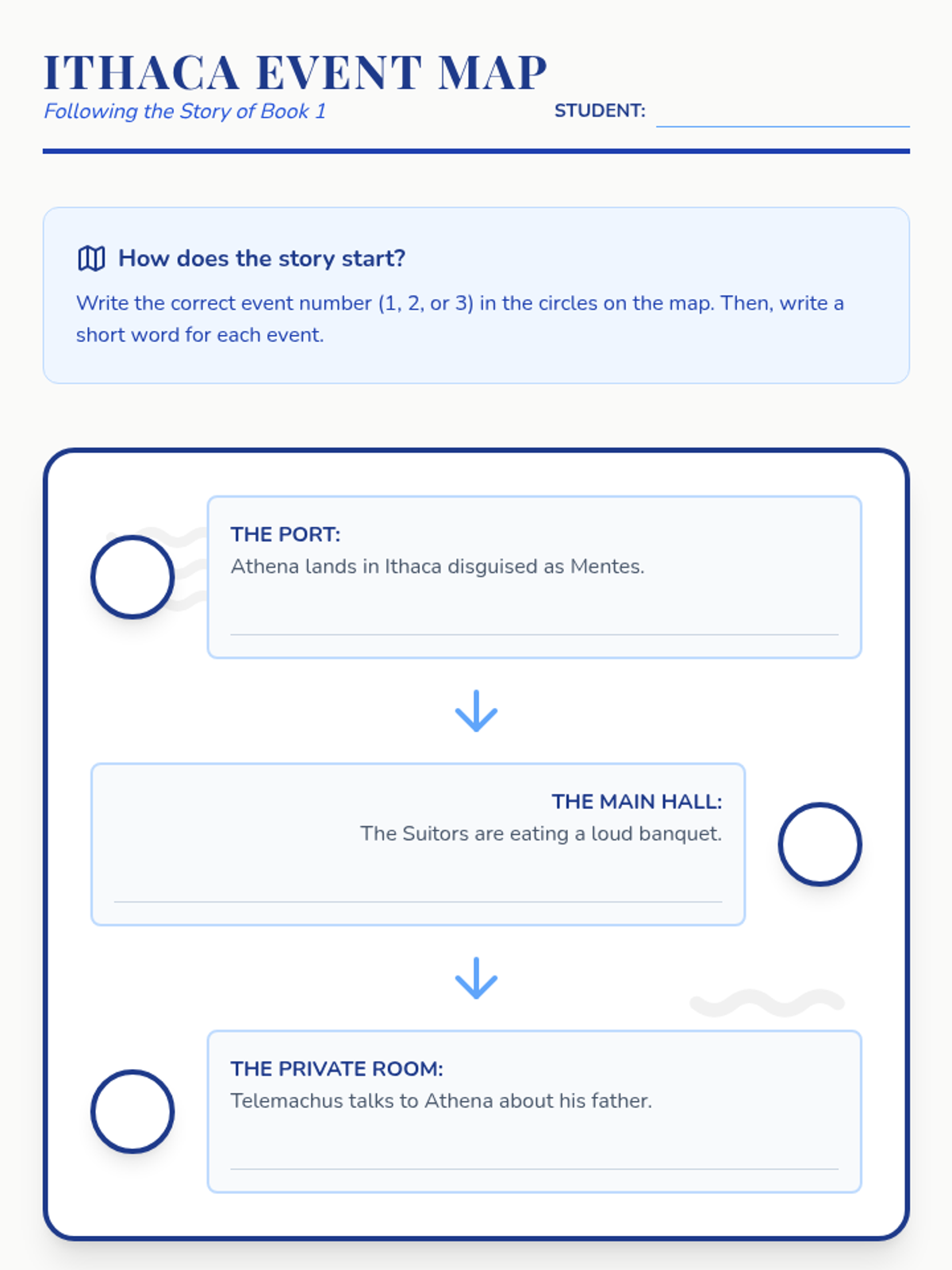
A visual sequence of events map for Ithaca, helping ELL students order the narrative flow of Book 1. Features a guided path with specific locations and vocabulary cues.
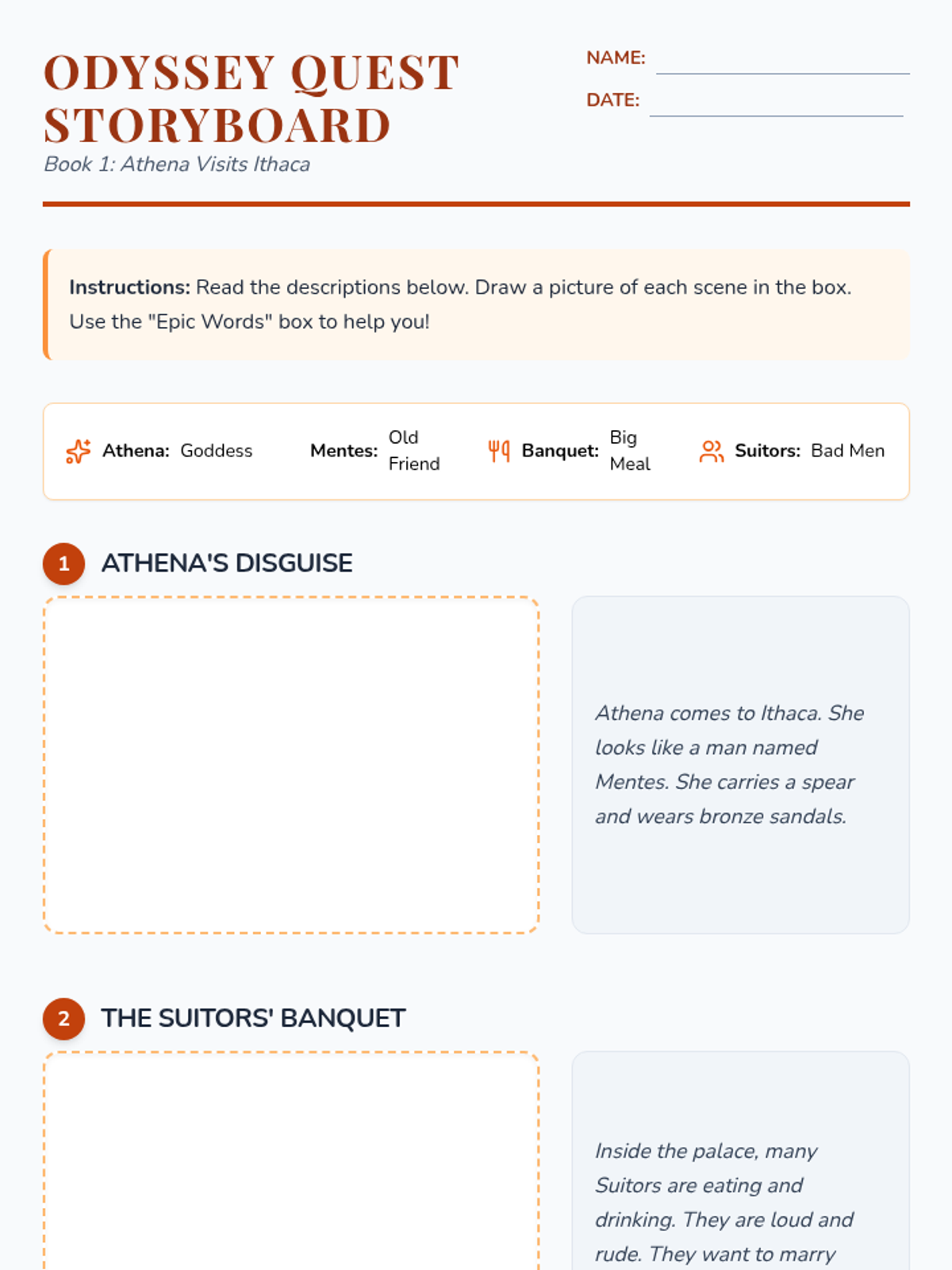
A storyboard activity for beginning ELL learners to visualize key scenes from Book 1 of The Odyssey. Includes simplified descriptions and a vocabulary bank to support drawing and comprehension.
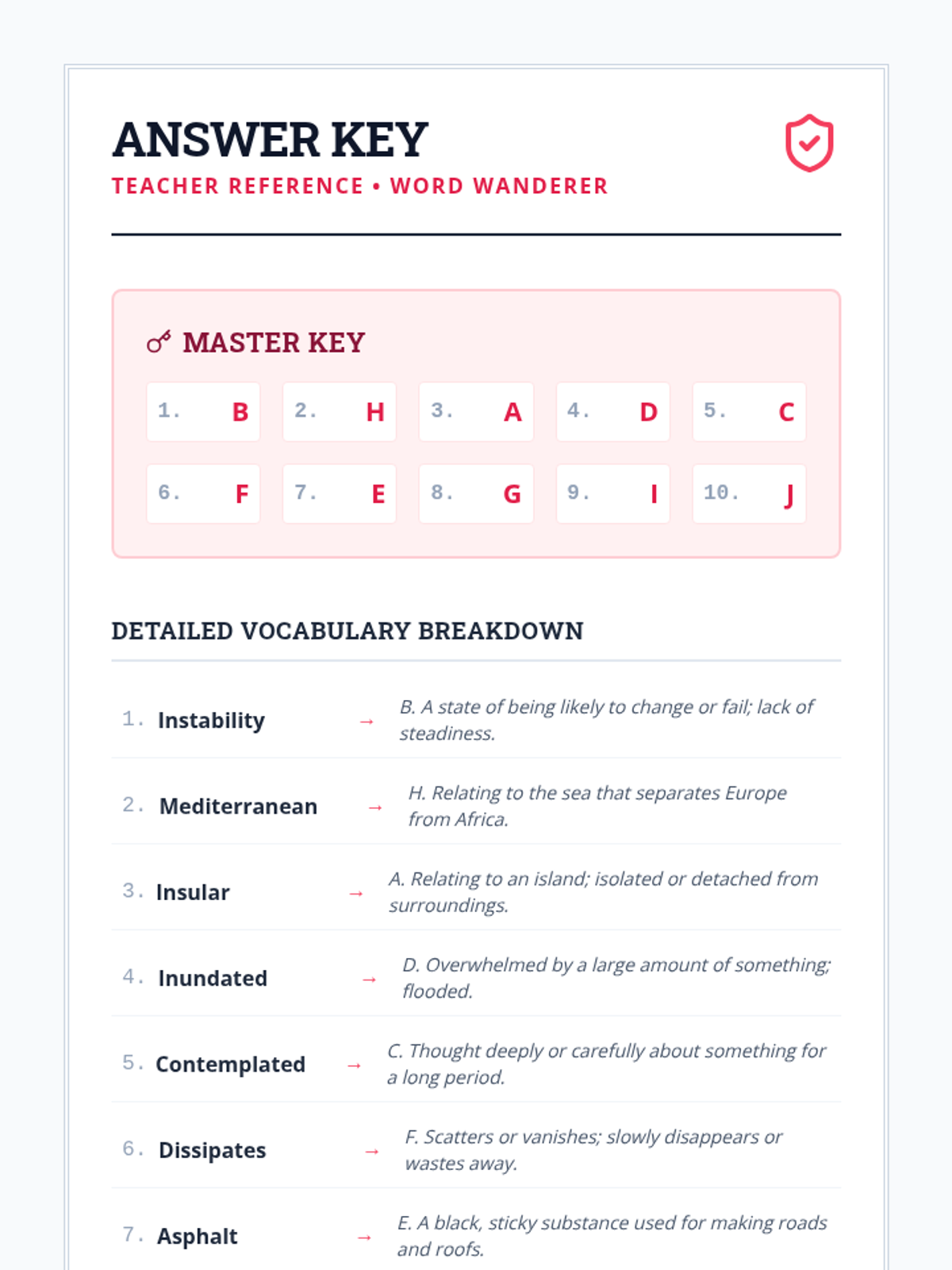
An updated answer key for the Word Wanderer Quiz, including the new words Chronological and Dramatic tension, with detailed breakdowns and teacher notes.
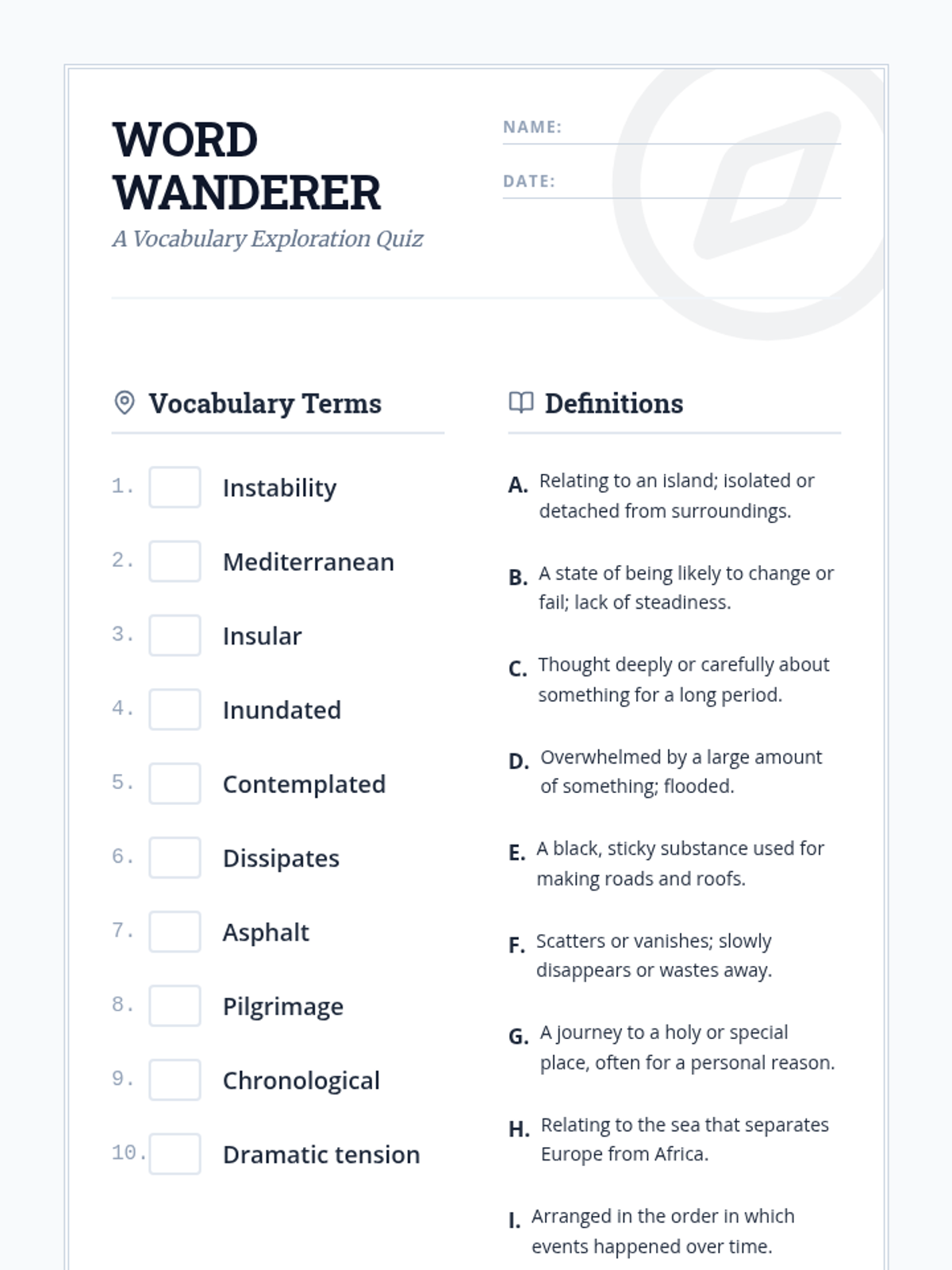
An updated matching quiz for vocabulary words including Instability, Mediterranean, Insular, Inundated, Contemplated, Dissipates, Asphalt, Pilgrimage, Chronological, and Dramatic tension. The instructions section has been removed for a cleaner look.
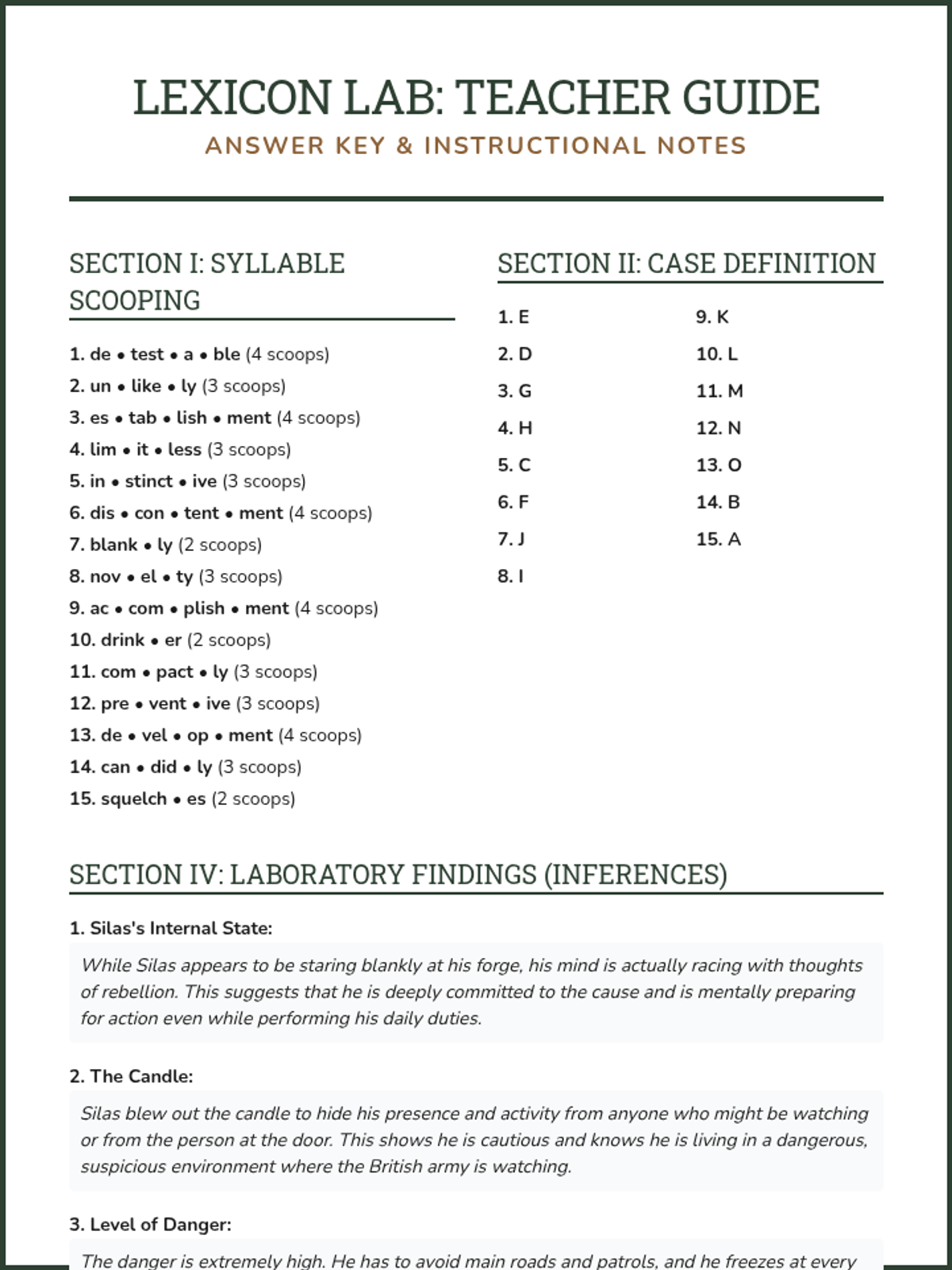
A teacher answer key and instructional guide for the Lexicon Lab worksheet, providing syllable breakdowns, matching answers, and sample responses for the new Revolutionary War passage and inference questions.
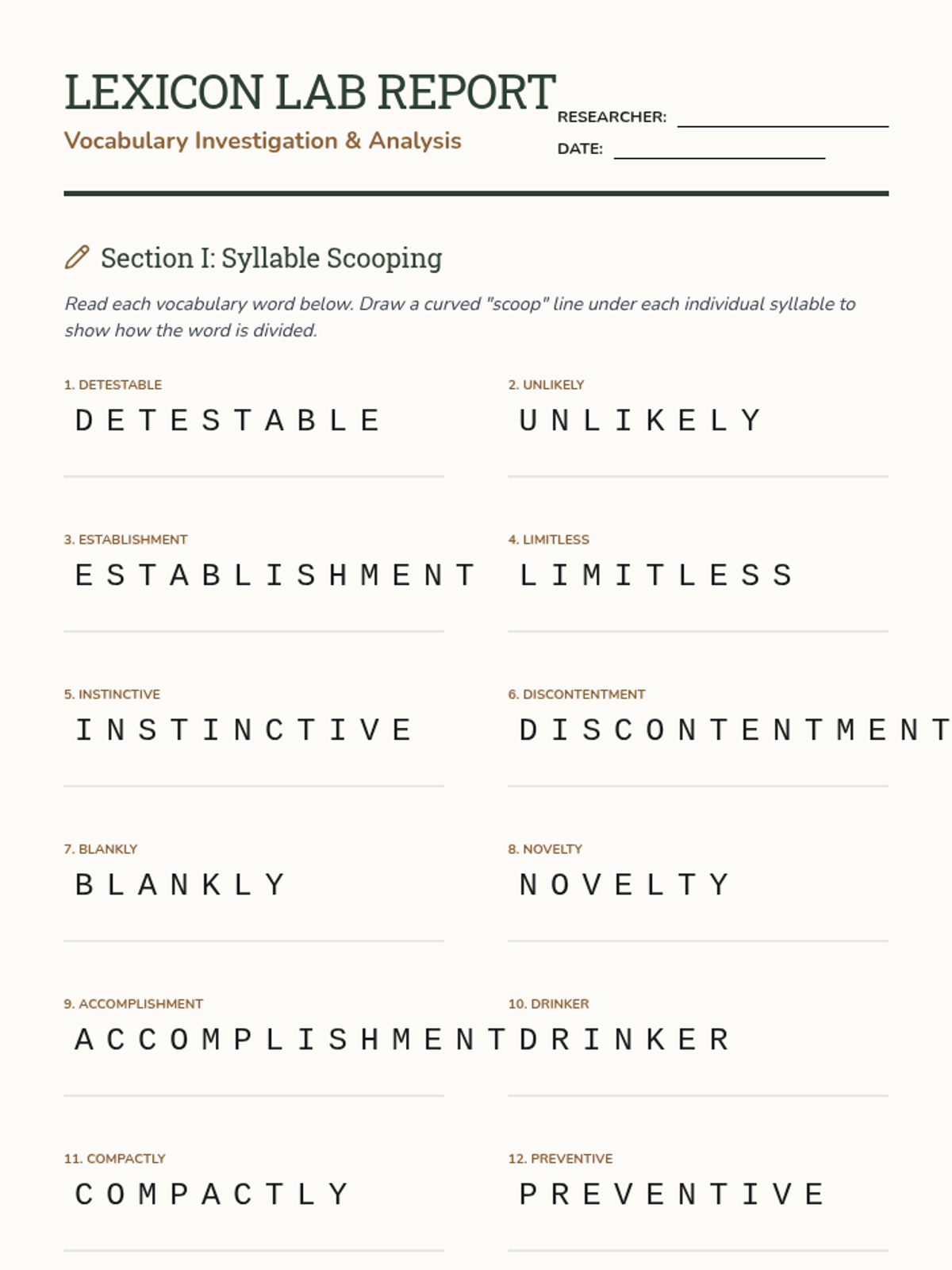
A 2-page student worksheet for the Lexicon Lab lesson, featuring syllable scooping with spaced-out words, definition matching for all 15 words, a reading passage, and inference comprehension questions.
A revised vocabulary slide deck focusing on 15 multisyllabic words through a Revolutionary War theme. Features a 5-part reading passage about a young patriot's midnight ride, with specific inference questions for each section.
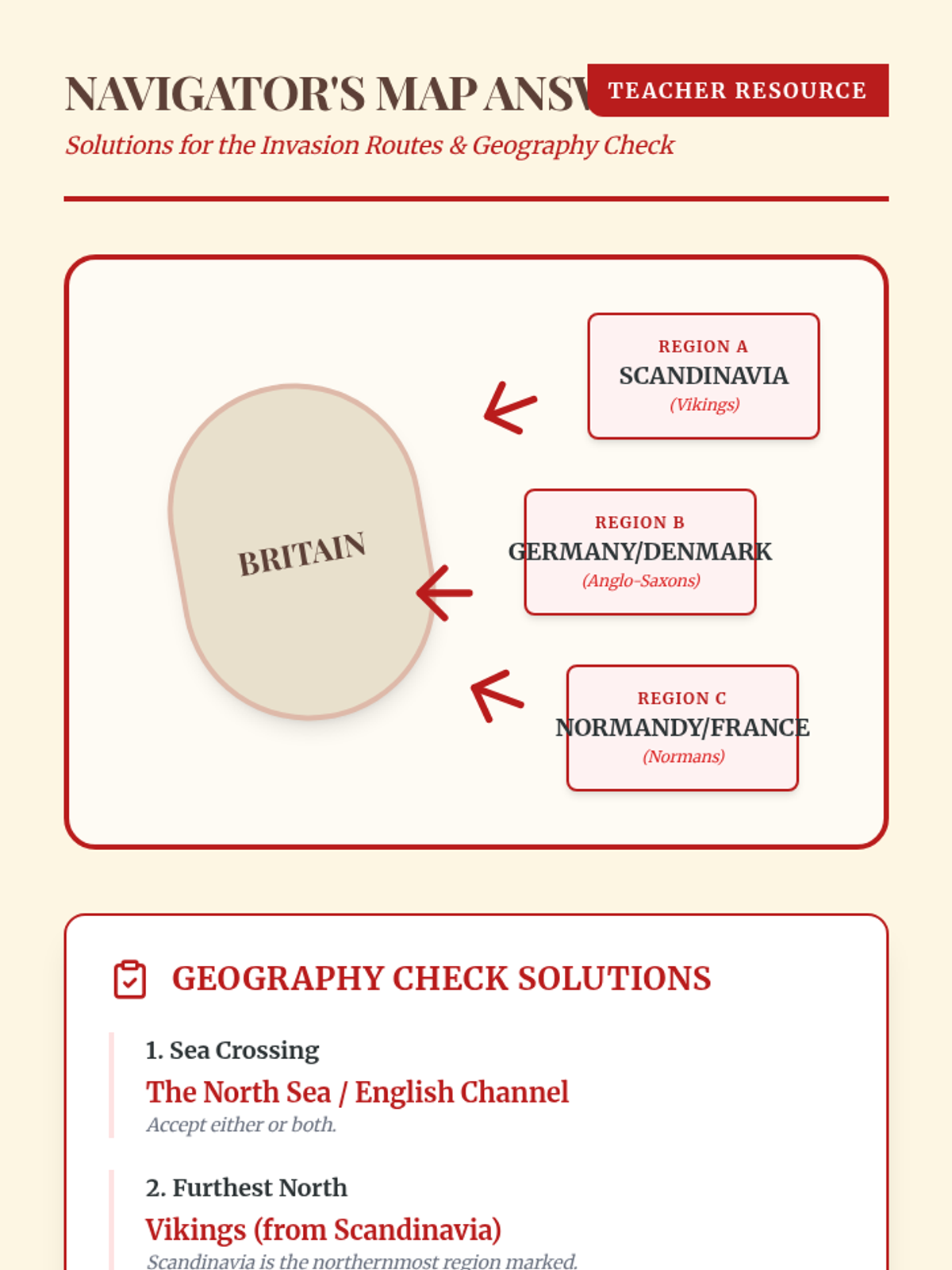
An answer key for the Navigator Map Activity, providing the names of the source regions and correct answers to the geography check questions.
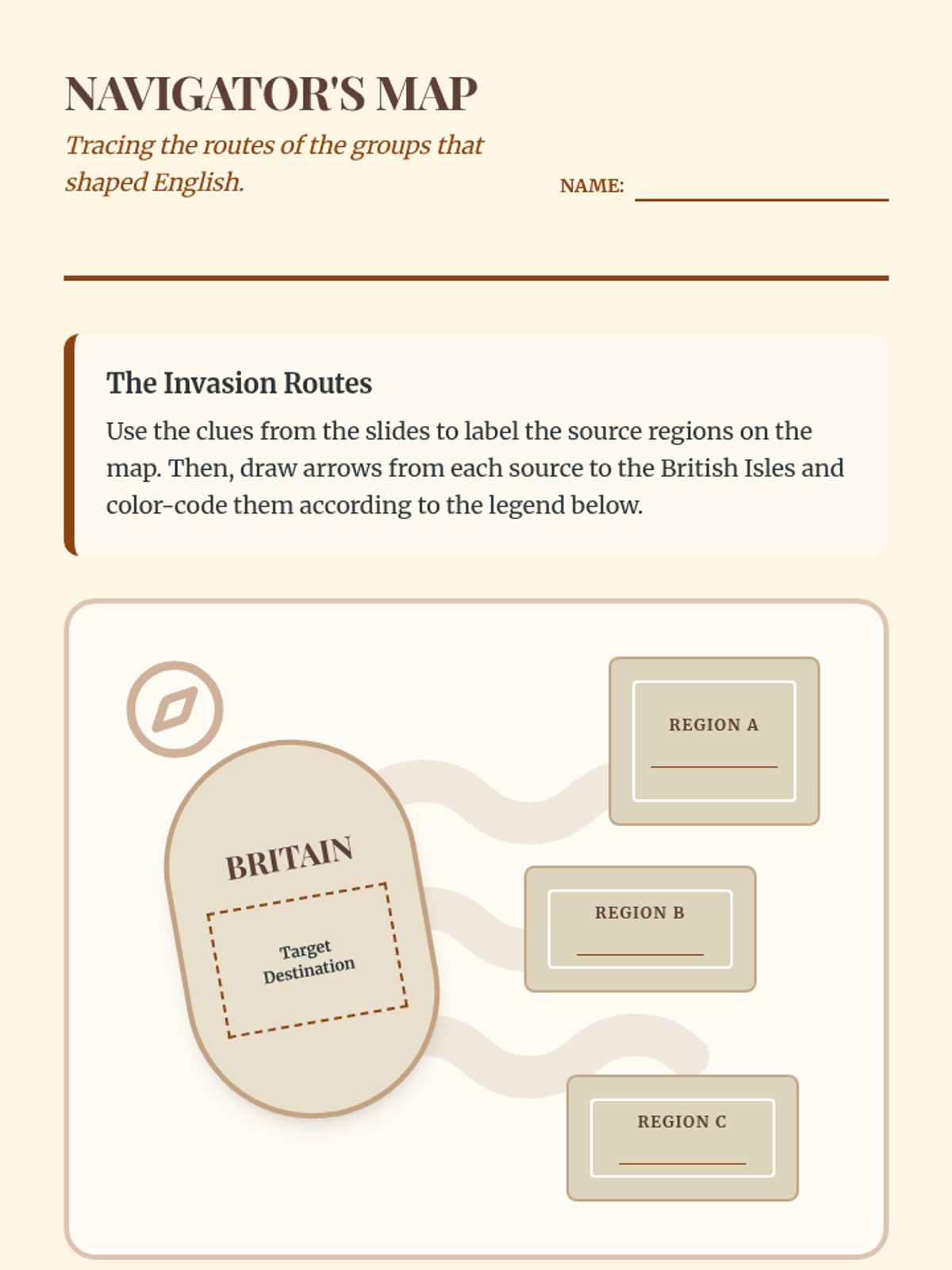
A map activity where students label regions like Scandinavia, Germany, and Normandy, and draw the invasion routes to the British Isles. It includes a geography check section for key sea crossings.
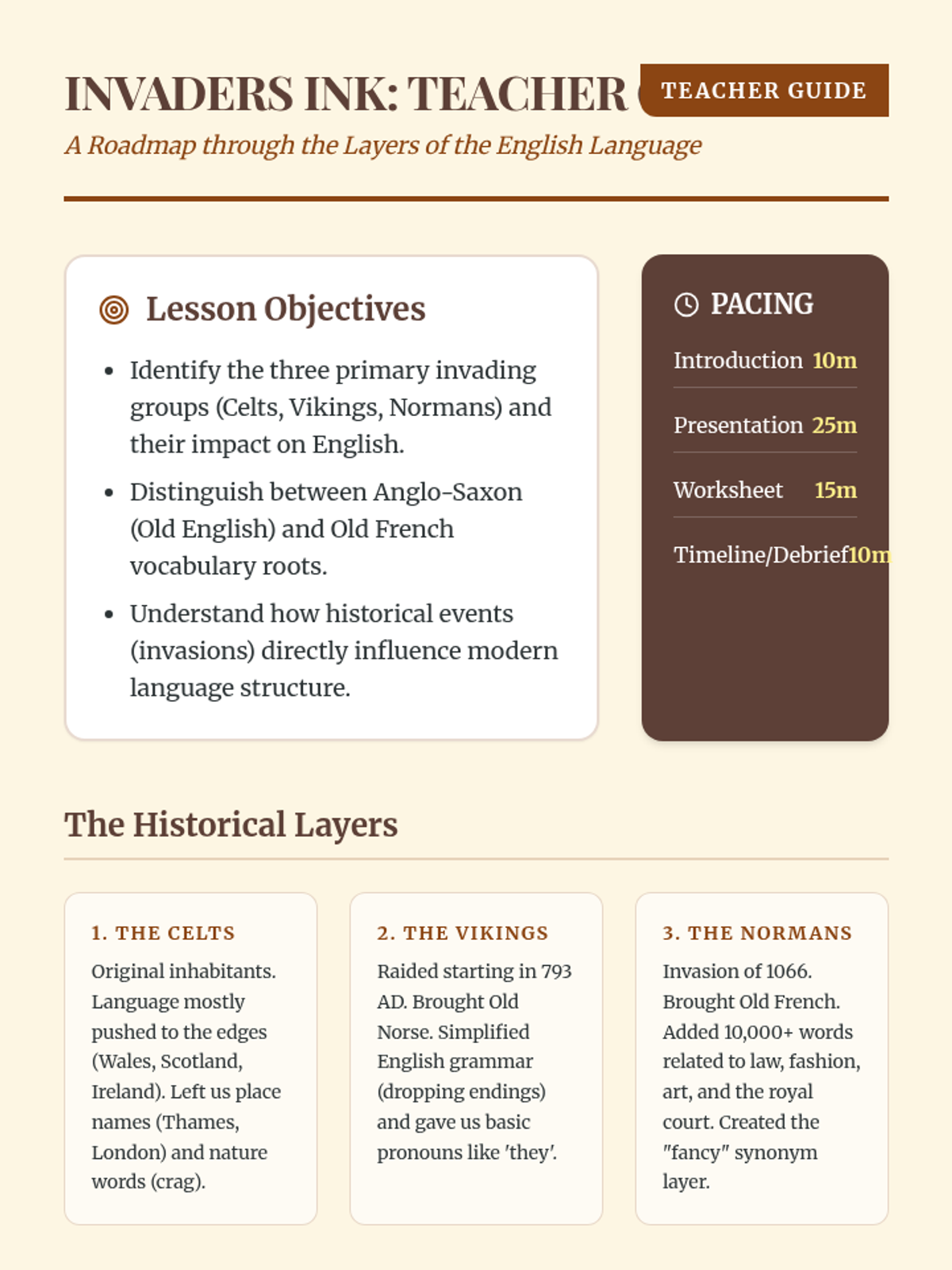
A comprehensive teacher guide for the Invaders Ink lesson. It includes lesson objectives, historical background summaries, slide-by-slide teaching notes, activity suggestions, and differentiation strategies.
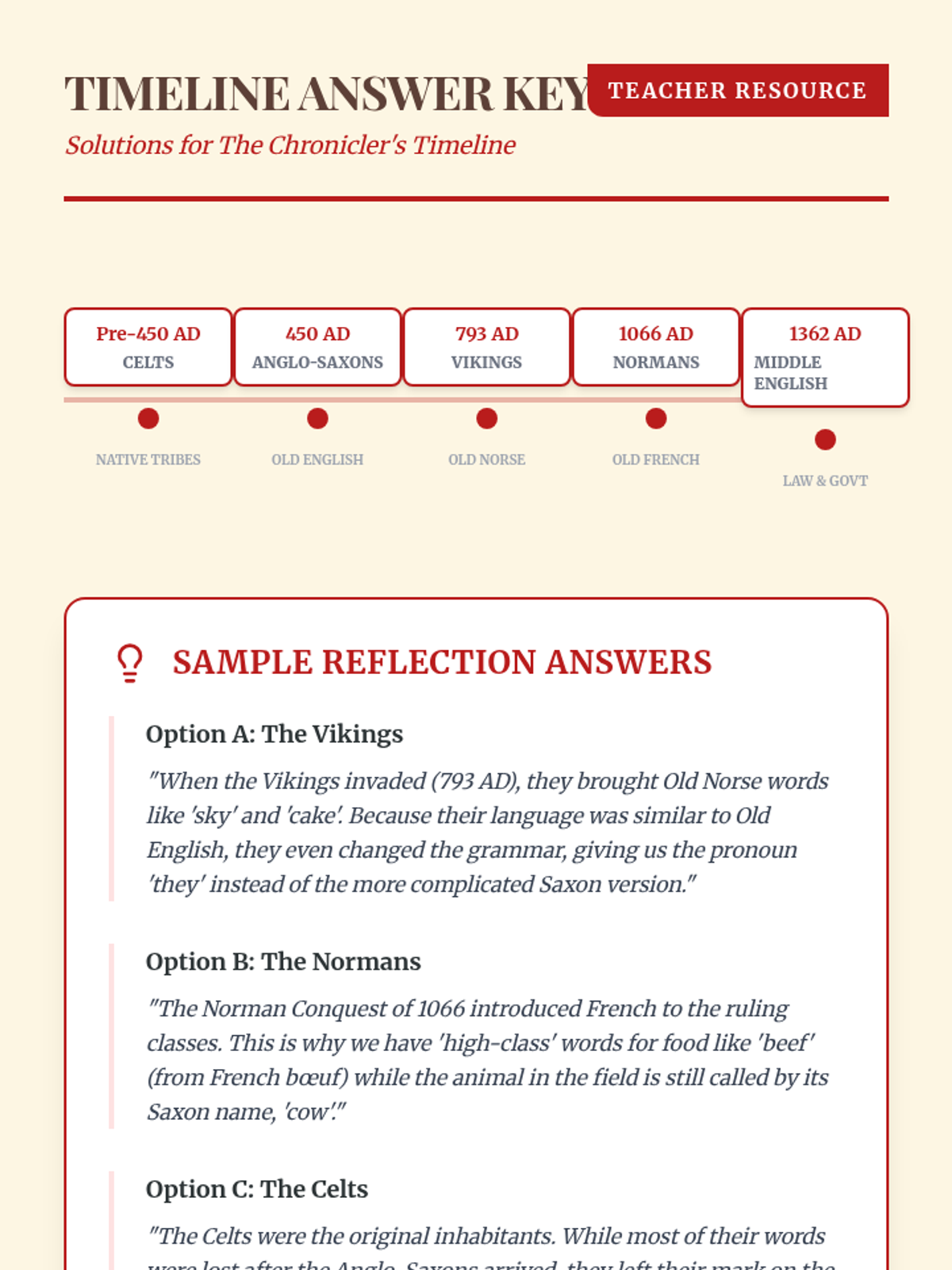
An answer key for the Invasion Timeline Activity, providing the correct dates and groups for each timeline point, plus sample answers for the reflection question.
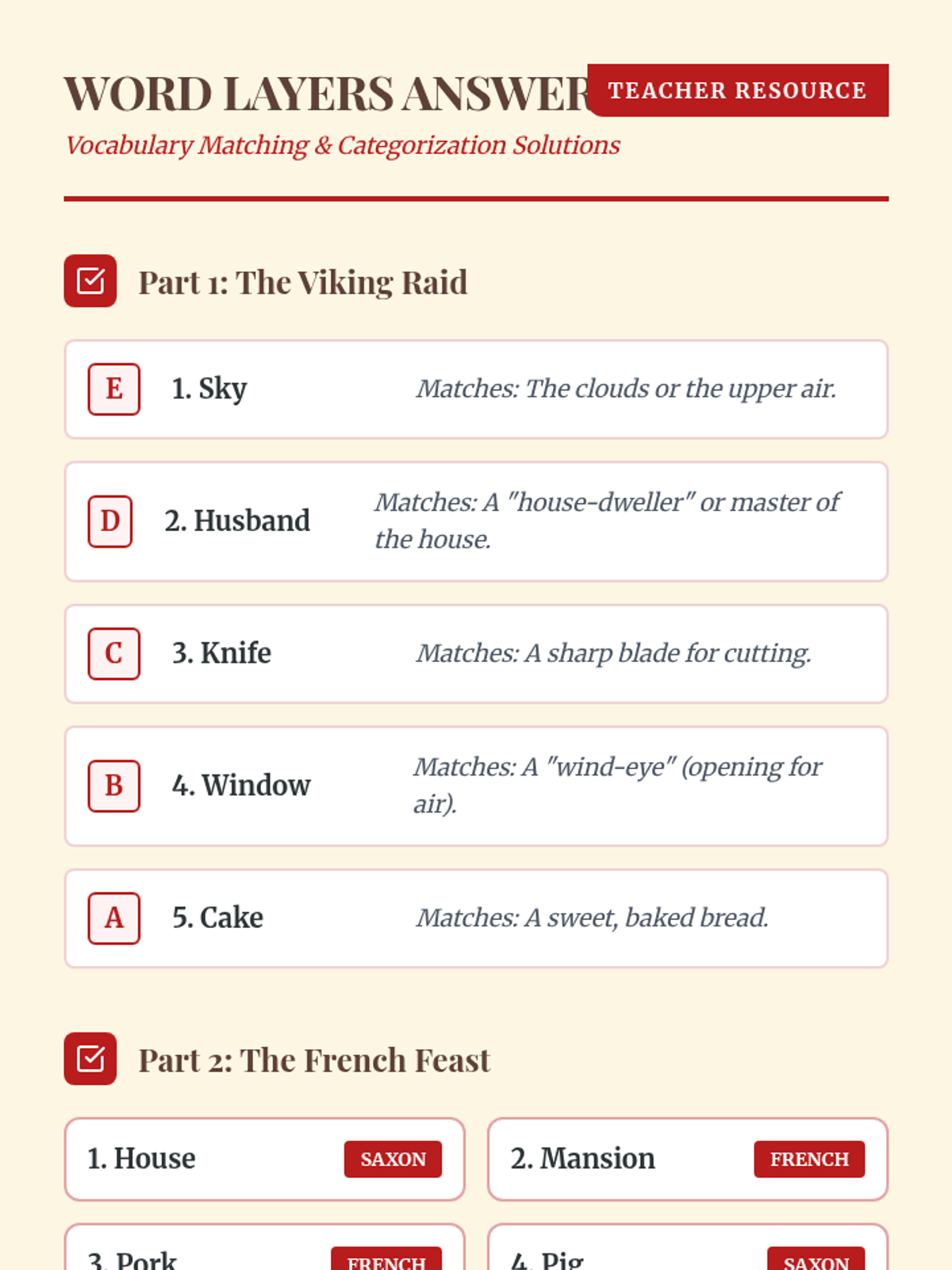
An answer key for the Word Layers Worksheet, providing solutions for the Viking matching section and the Saxon vs. French categorization task. Includes teaching notes on vocabulary origins.
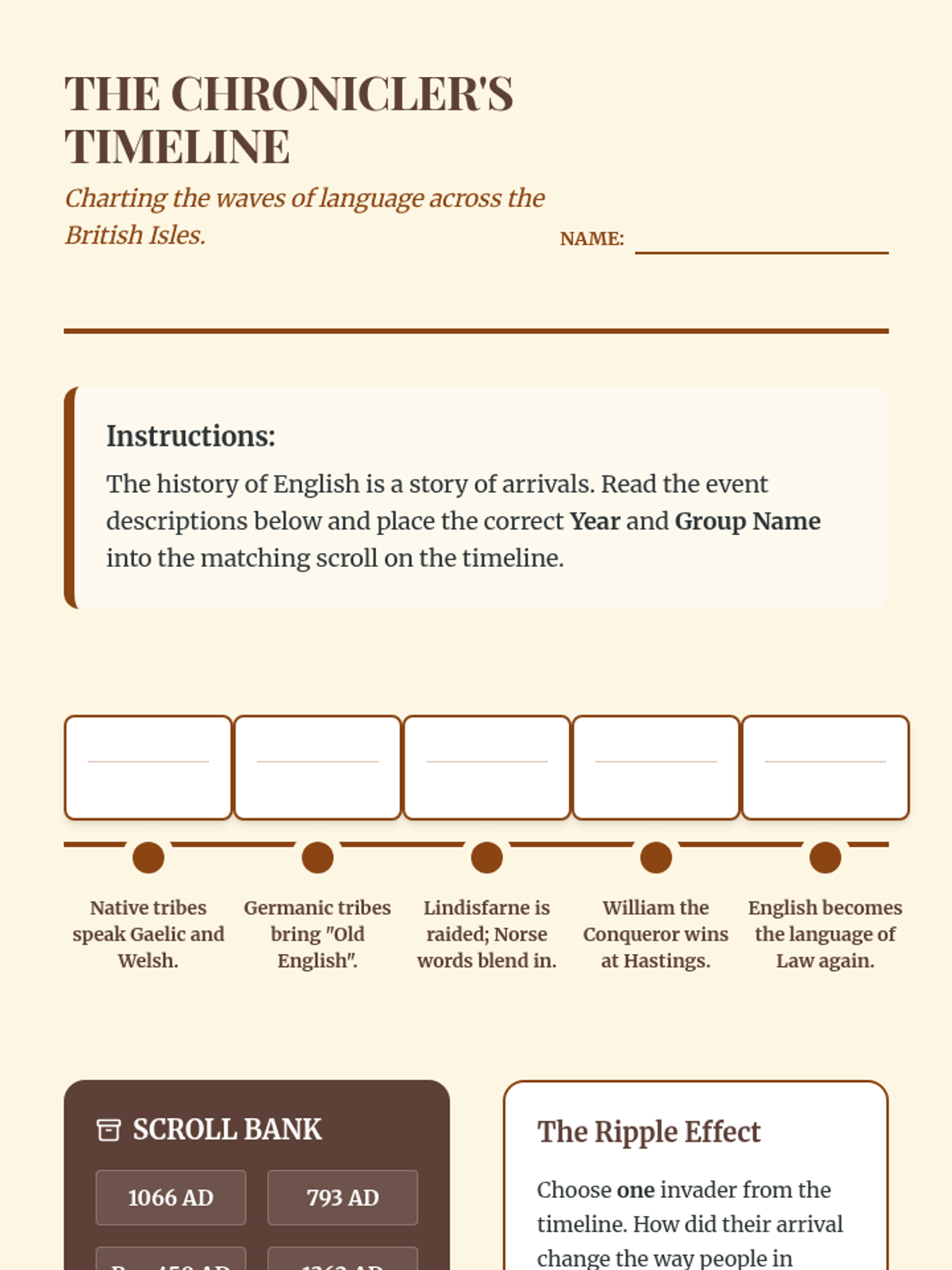
A timeline worksheet where students place key invasions and historical dates in order to see the development of the English language. It includes a word bank of dates and groups, plus a synthesis question.
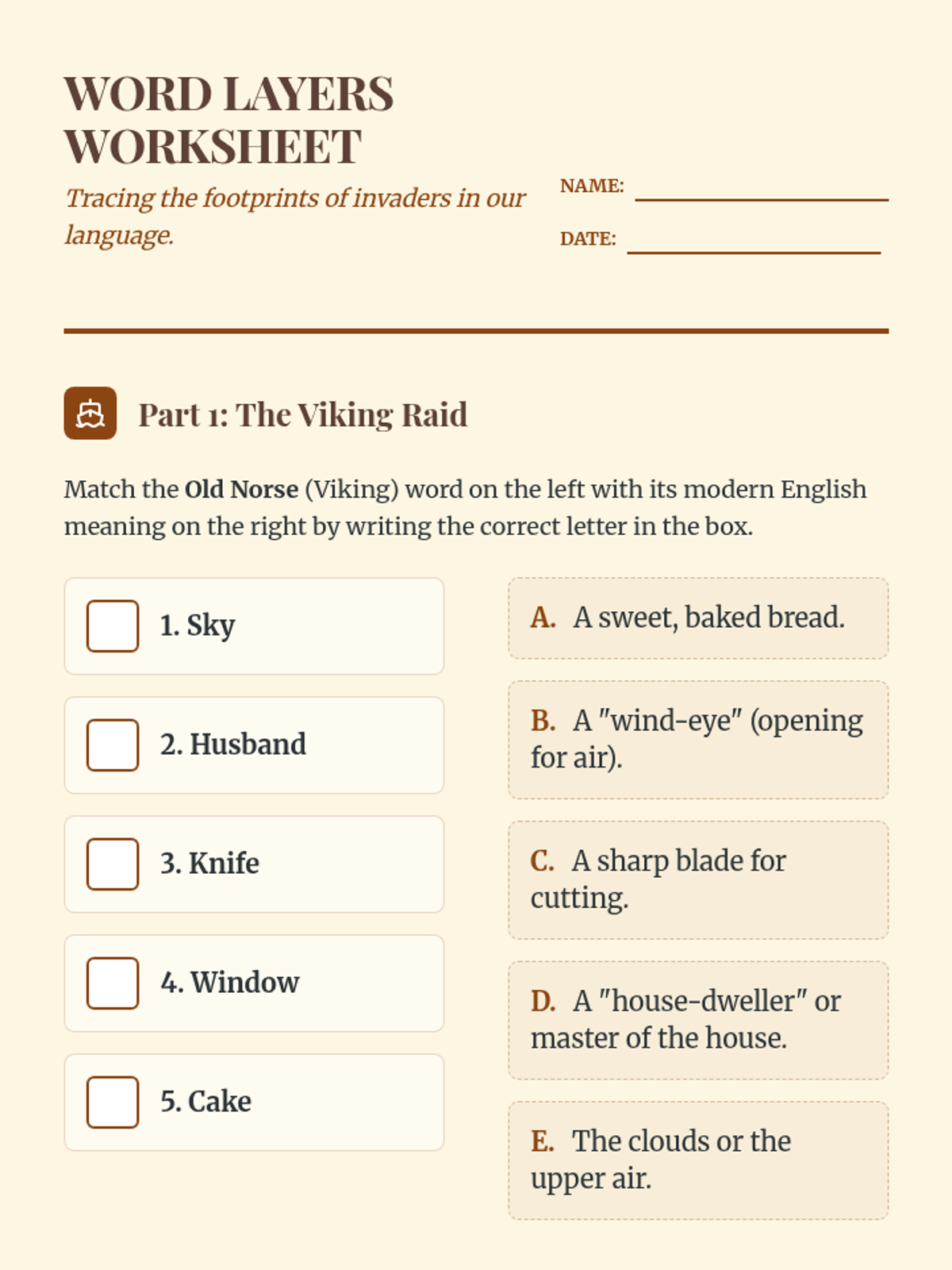
A vocabulary matching and categorization worksheet that tests students on the Norse and French influences in English. Includes sections on matching Viking words to their meanings and distinguishing between Saxon and French synonyms.
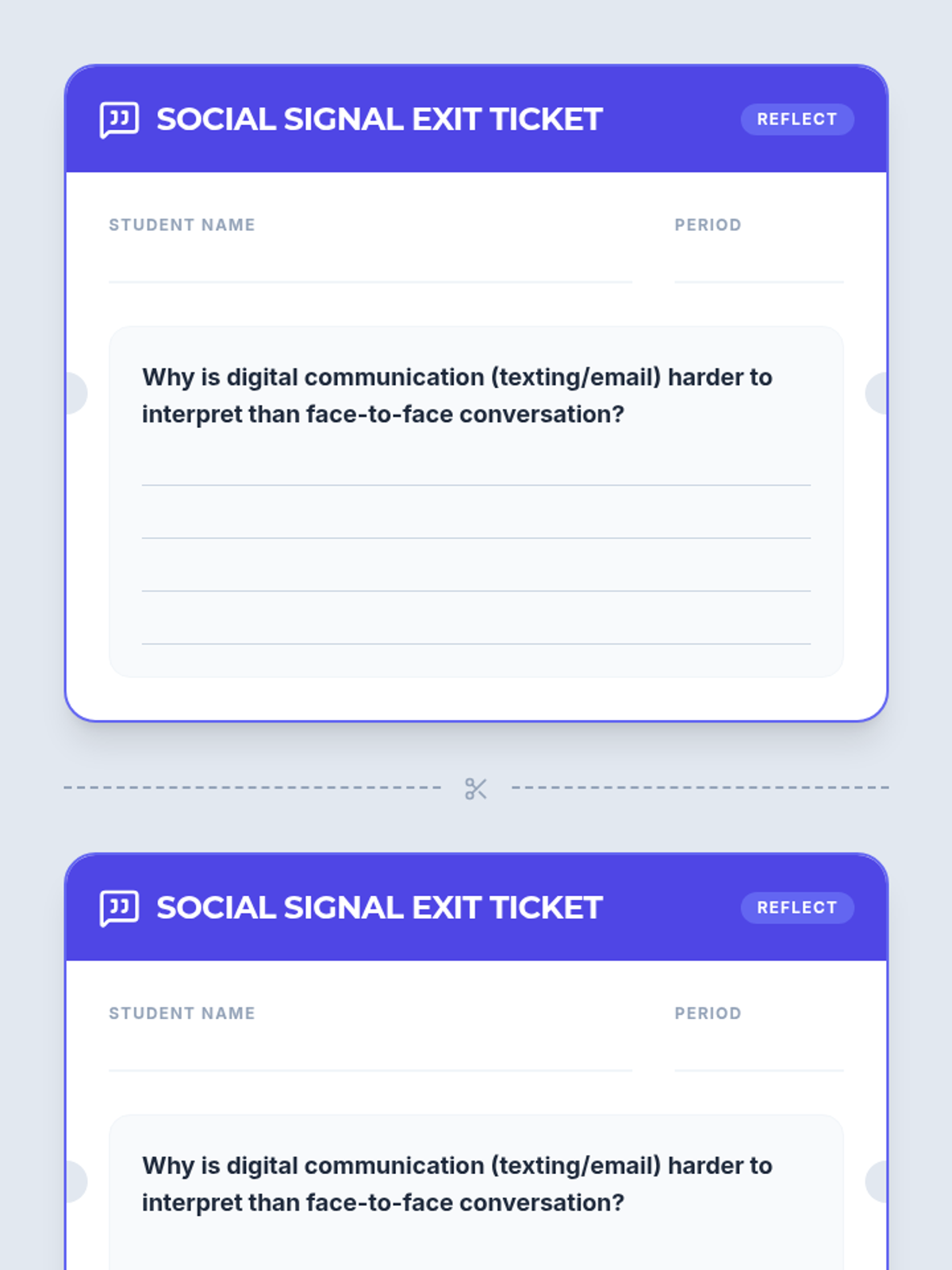
A half-page exit ticket for students to reflect on the challenges of digital communication versus face-to-face conversation.
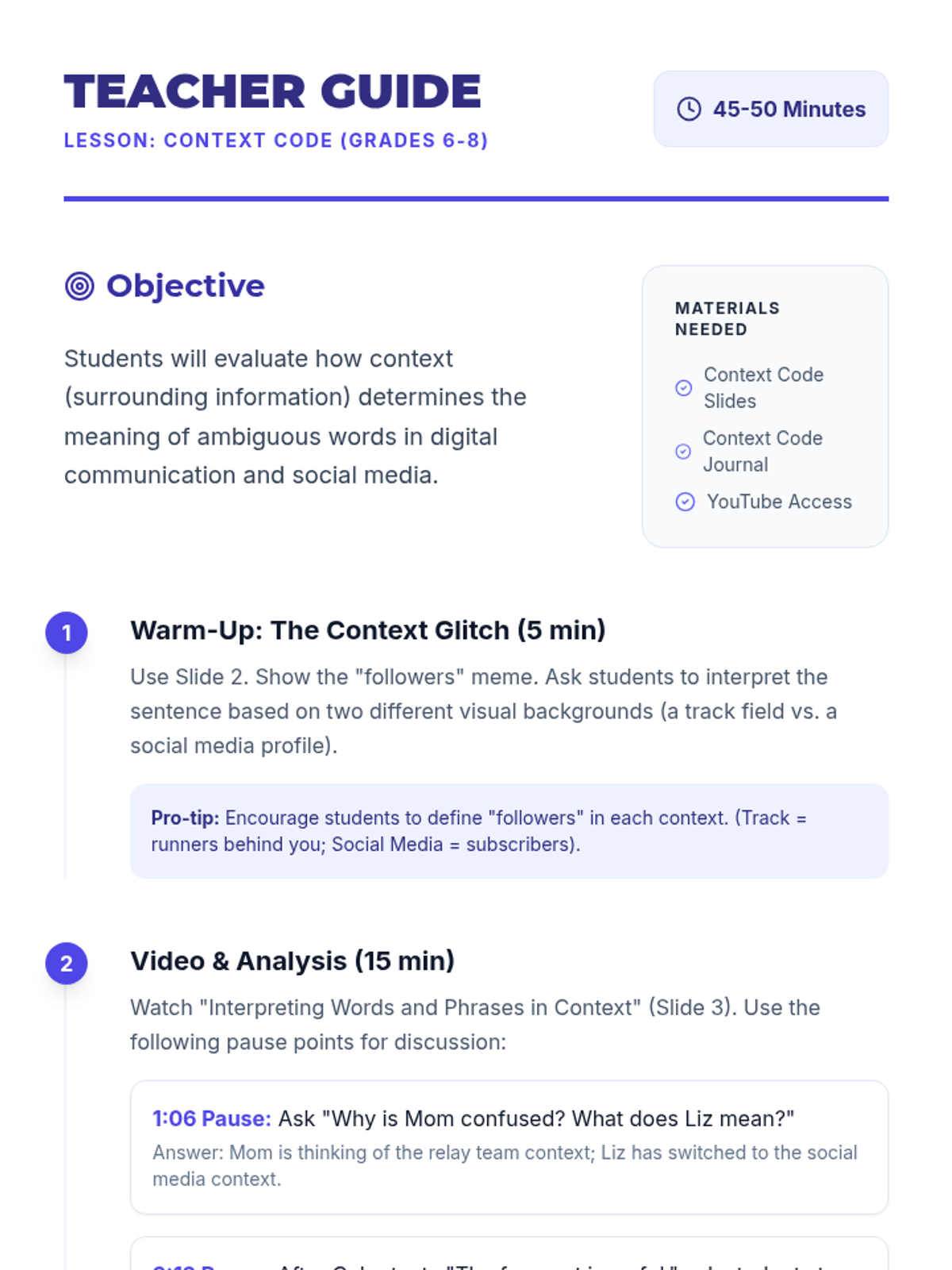
A comprehensive teacher facilitation guide for the Context Code lesson. Includes lesson pacing, specific discussion prompts for the video, activity examples, and a vocabulary key.
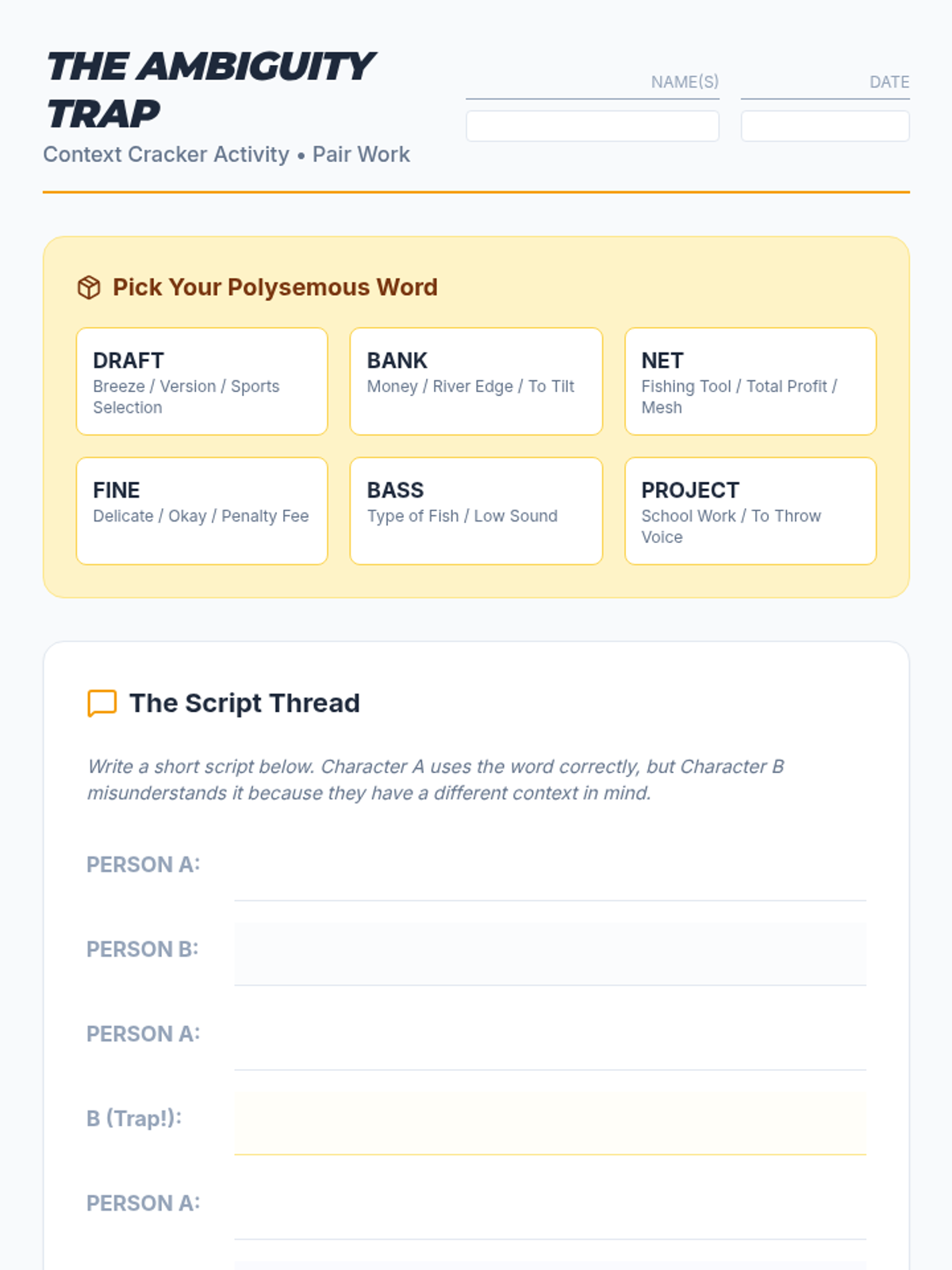
A worksheet for students to select a polysemous word and write a script where context leads to a misunderstanding, including a word bank and analysis area.
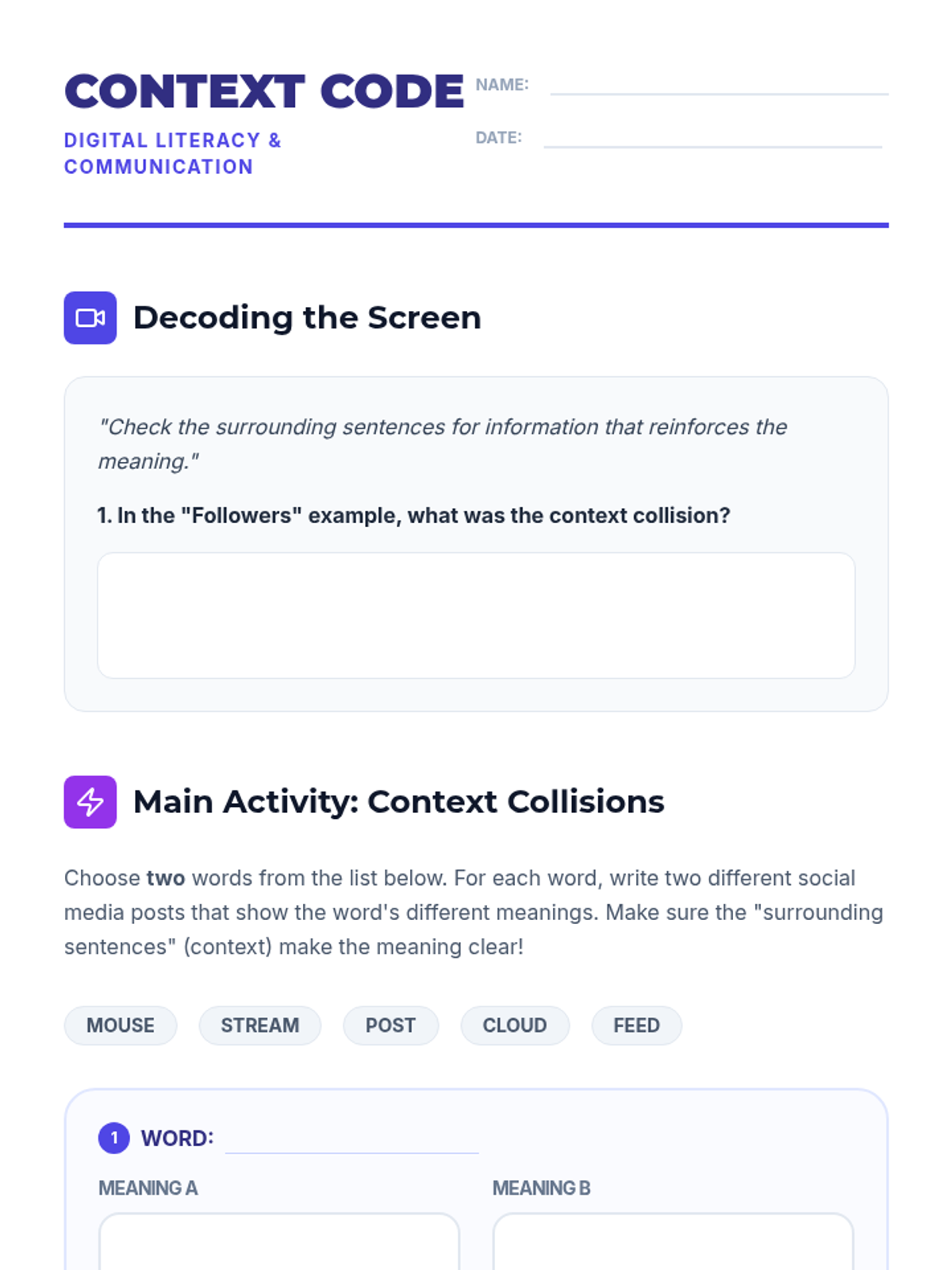
A student activity sheet for the Context Code lesson. Includes a section for video analysis, the Context Collisions creative writing activity, and the final Reflection Journal prompt with writing space.
Visual presentation for the Context Cracker lesson, including the video embed, discussion questions for Scenario 1 and 2, and activity instructions.
A visual presentation for a digital literacy lesson on context. Includes a warm-up exercise, an embedded YouTube video, key vocabulary definitions, and activity instructions for 'Context Collisions'.
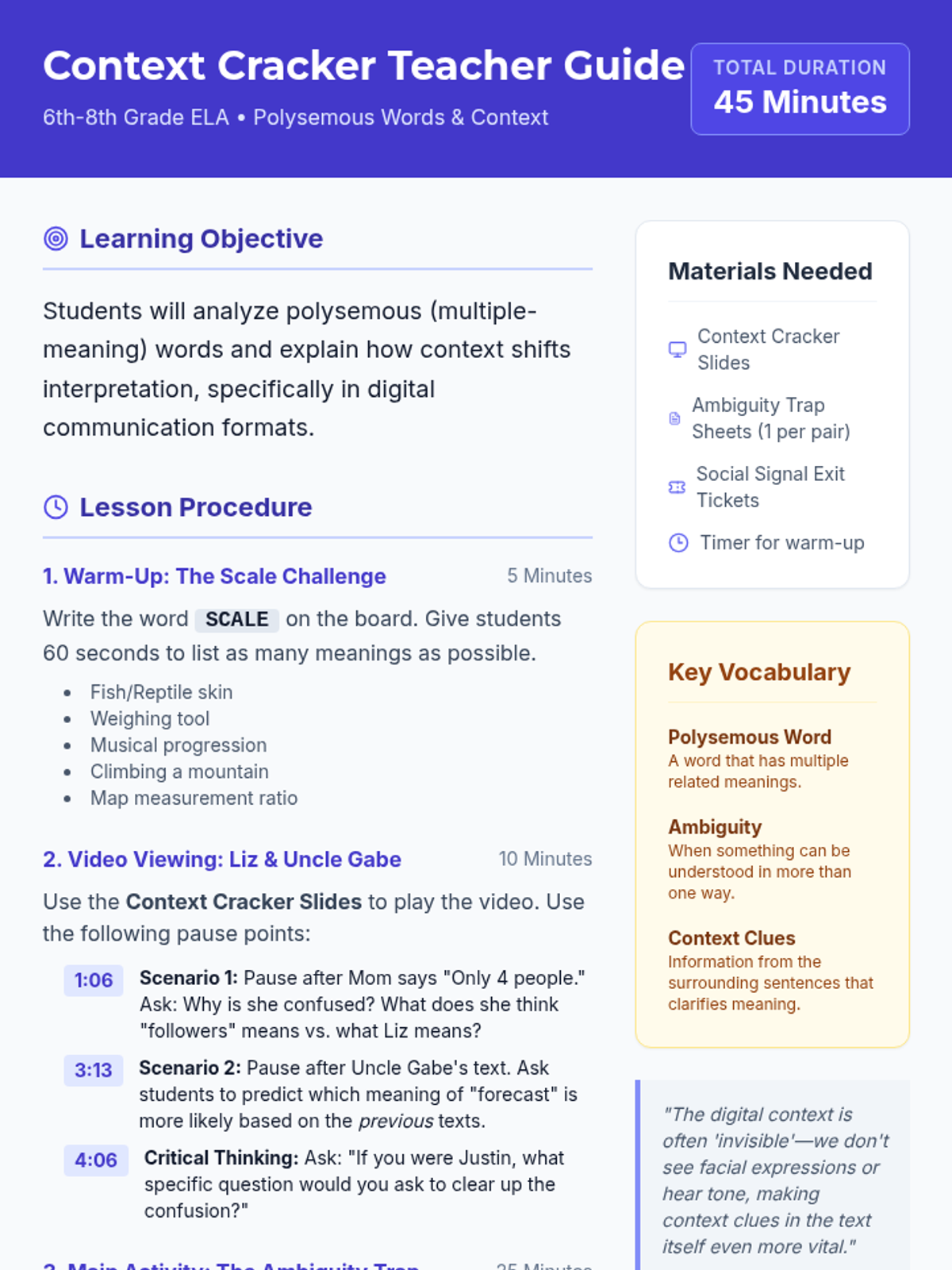
A comprehensive teacher guide for the Context Cracker lesson, including procedure, timing, discussion prompts, and vocabulary.
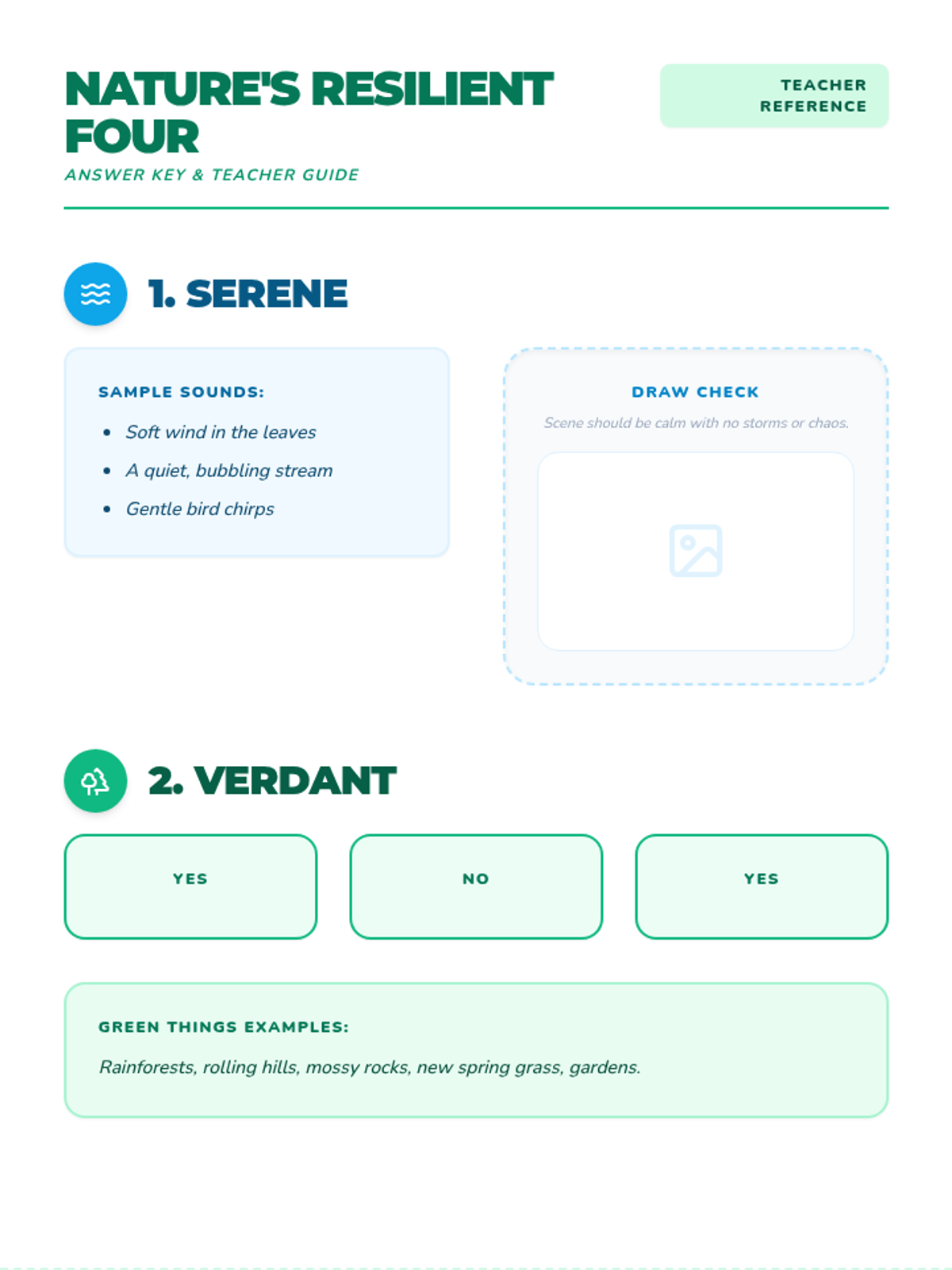
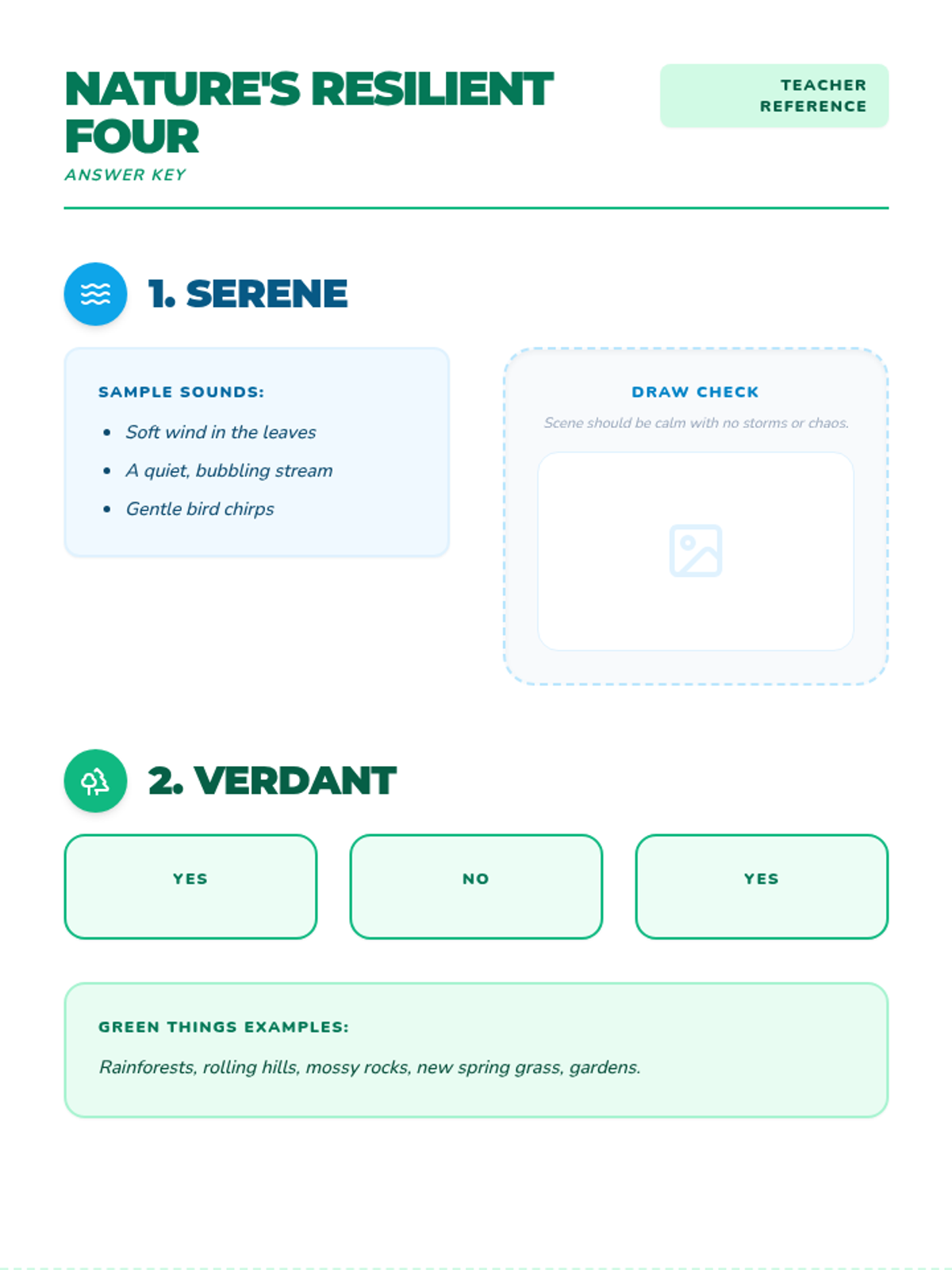
Answer key for the Nature Resilient Four Worksheet, providing sample responses, synonym identification, and context check answers for teacher reference. Updated to match the worksheet's final styling with the final task removed.
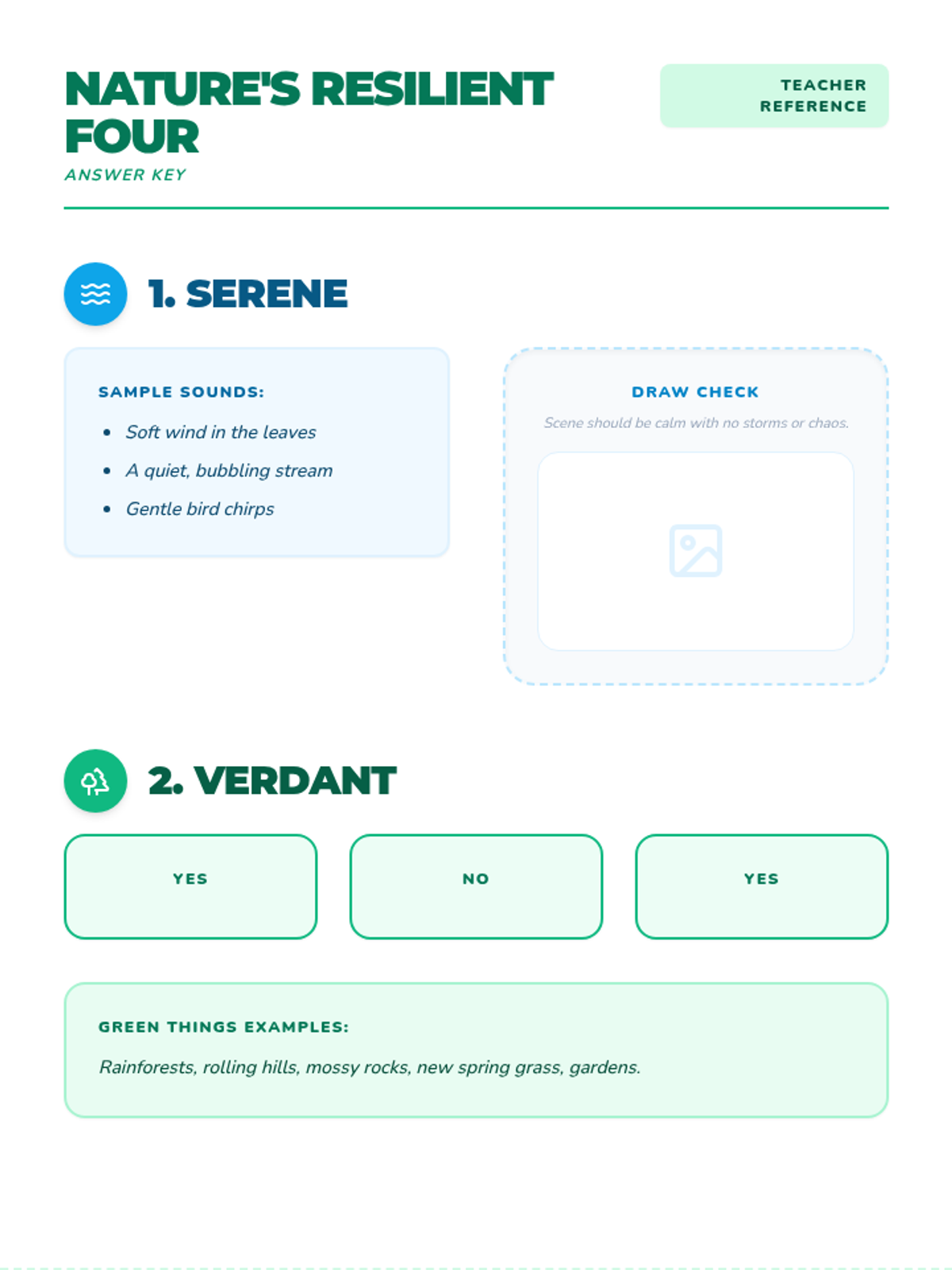
Answer key for the Nature Resilient Four Worksheet, providing sample responses, synonym identification, and context check answers for teacher reference. Updated to match the worksheet's final styling.
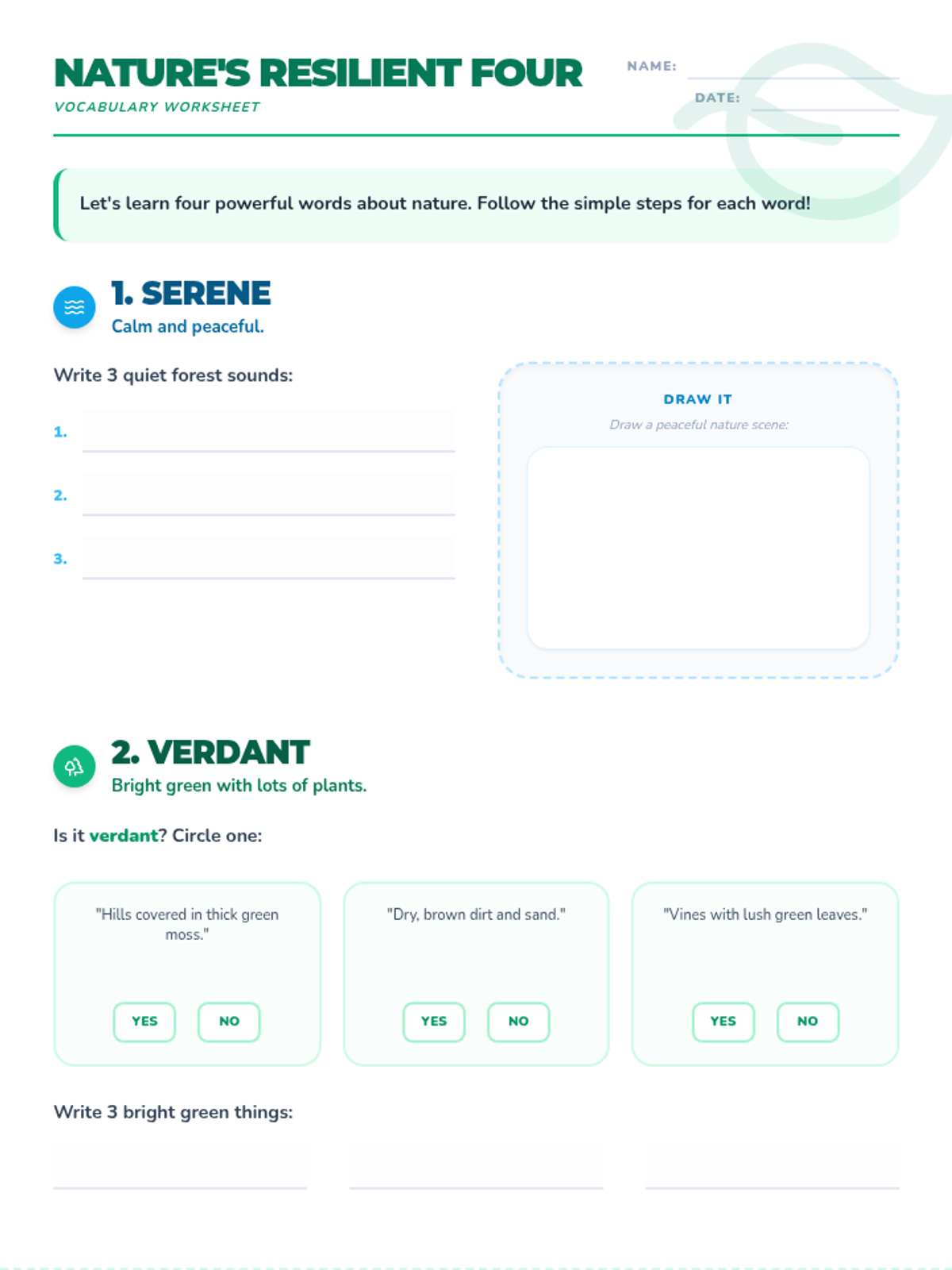
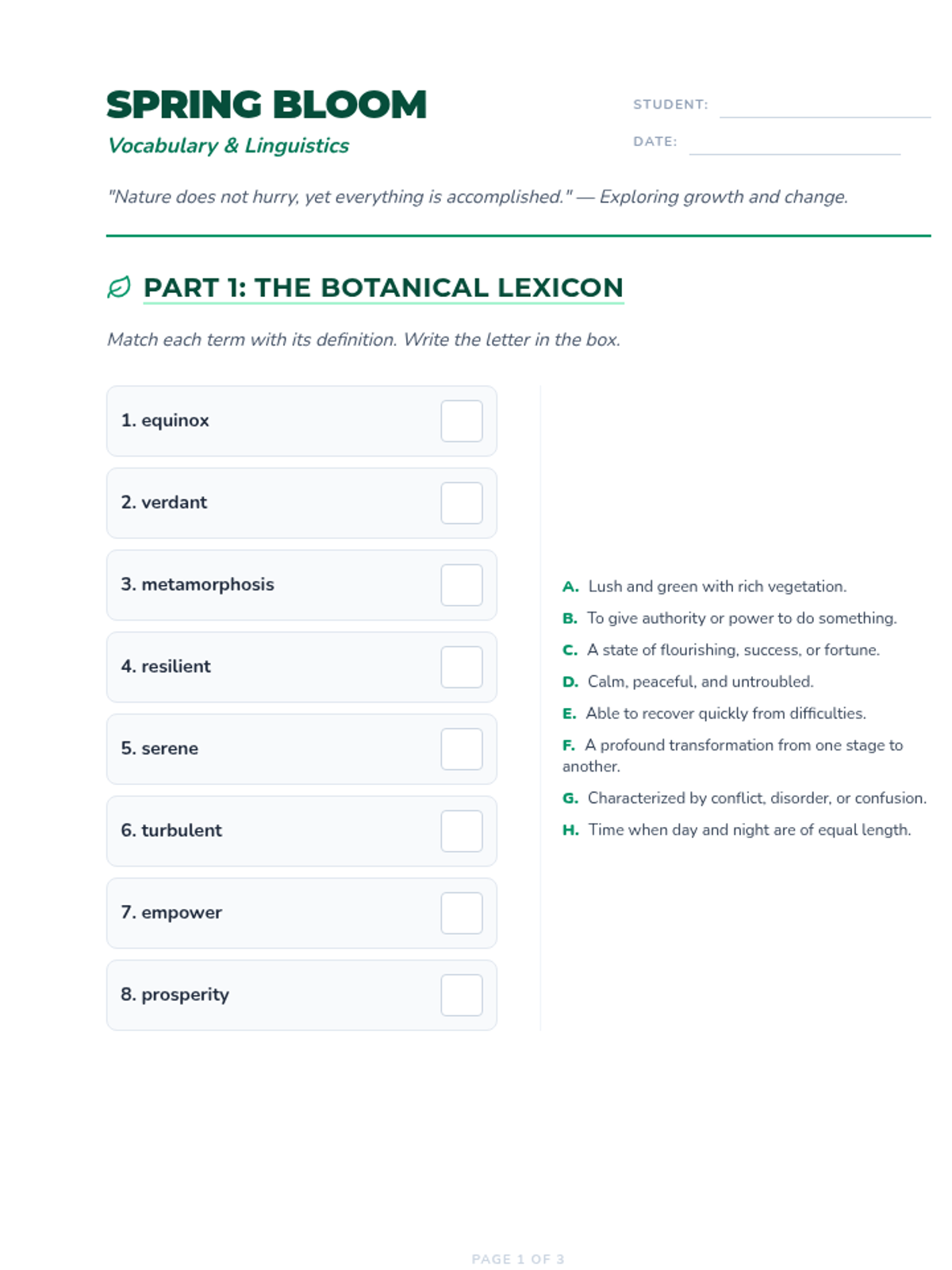
A two-page vocabulary worksheet focusing on serene, verdant, prosperity, and resilient with extremely simplified directions for maximum student clarity. Includes definition-matching, context-checking, drawing, and sentence-writing tasks. Features smaller fonts to ensure a clean fit across two pages with the final step removed.
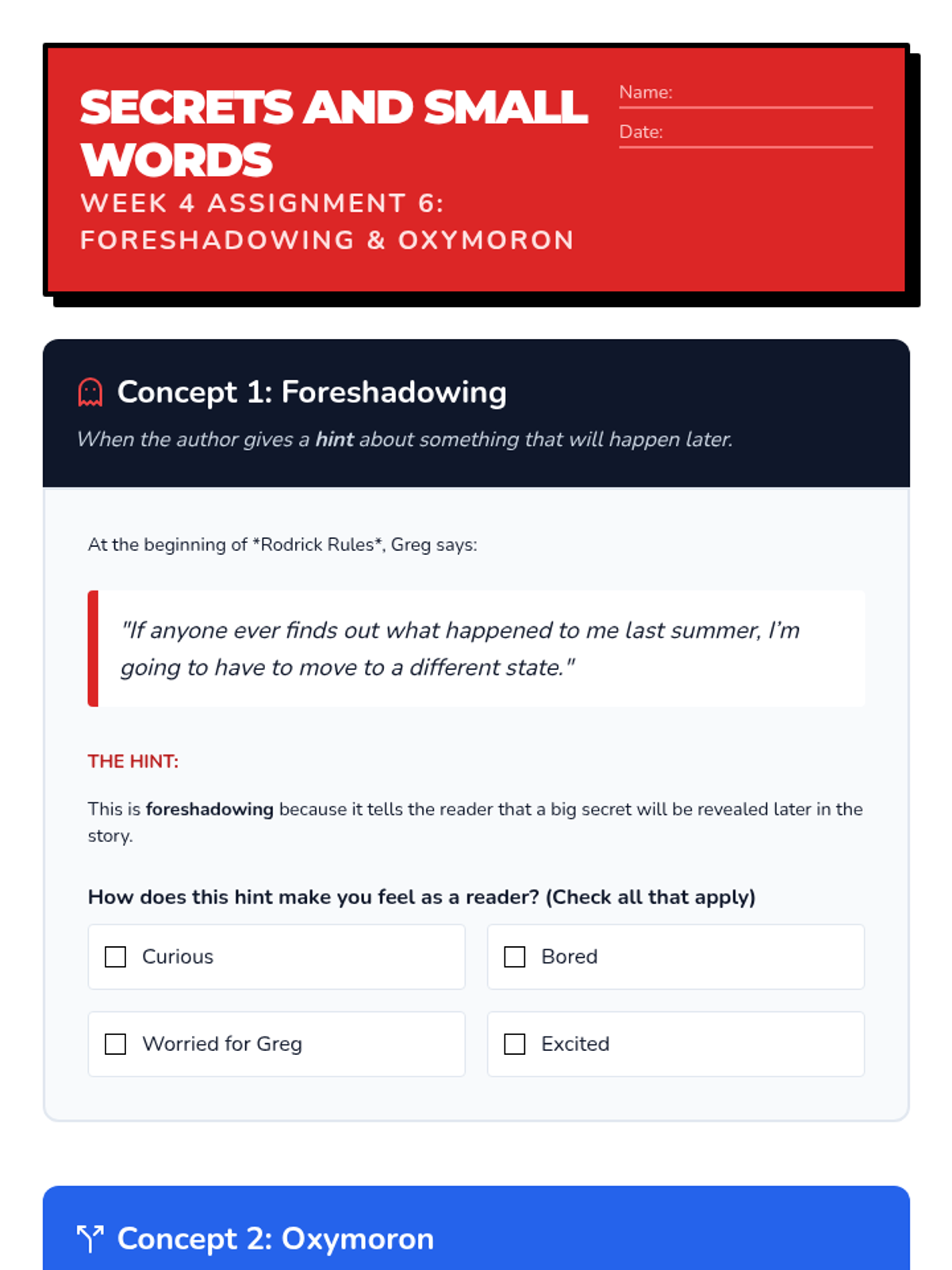
A literary device worksheet for Week 4 focusing on Foreshadowing (the embarrassing secret) and Oxymoron (Löded Diper) within the context of 'Rodrick Rules'.
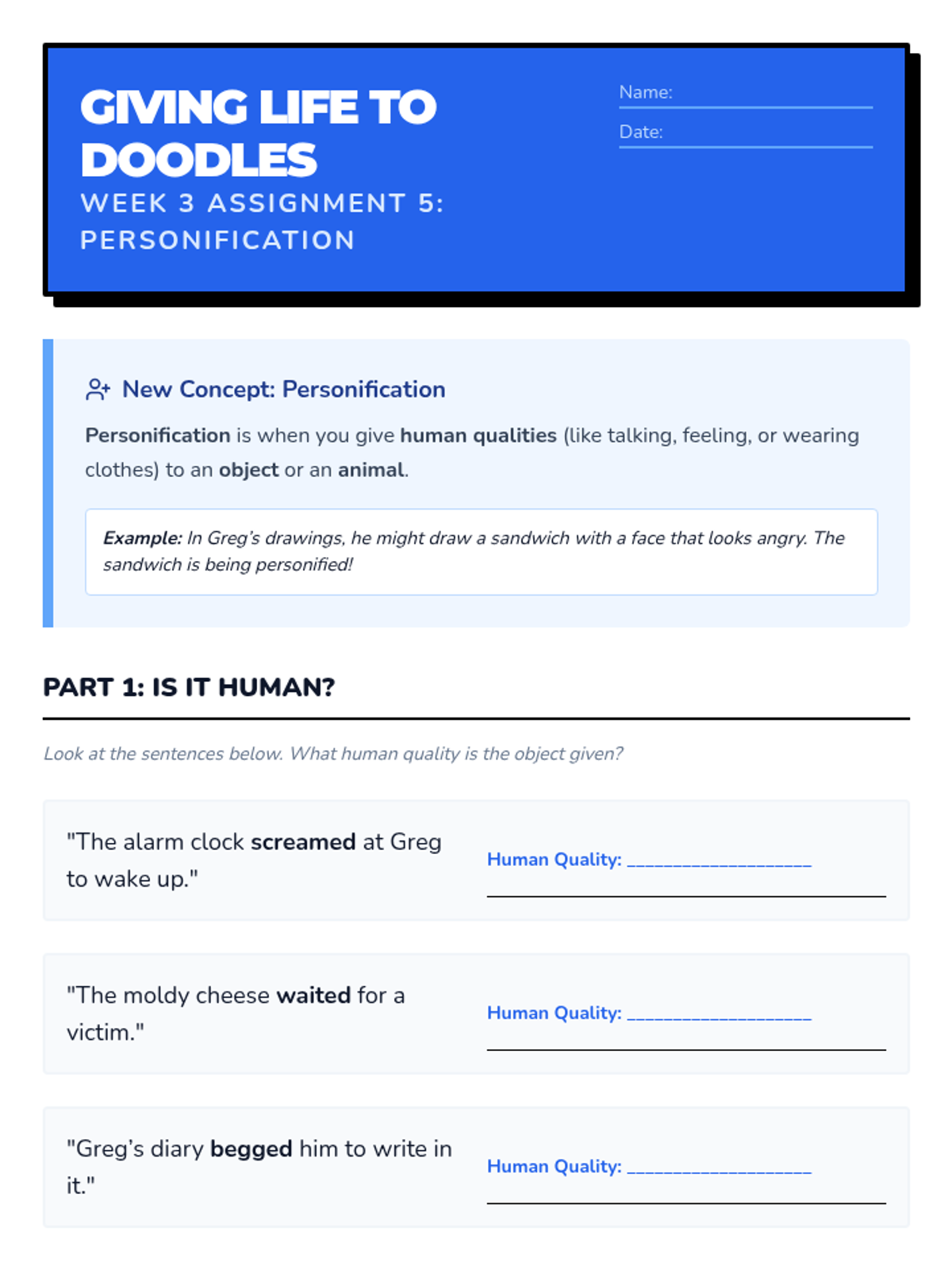
A worksheet for Week 3 focusing on Personification (giving human traits to objects), using examples from Greg's drawings and bridging the transition between books.
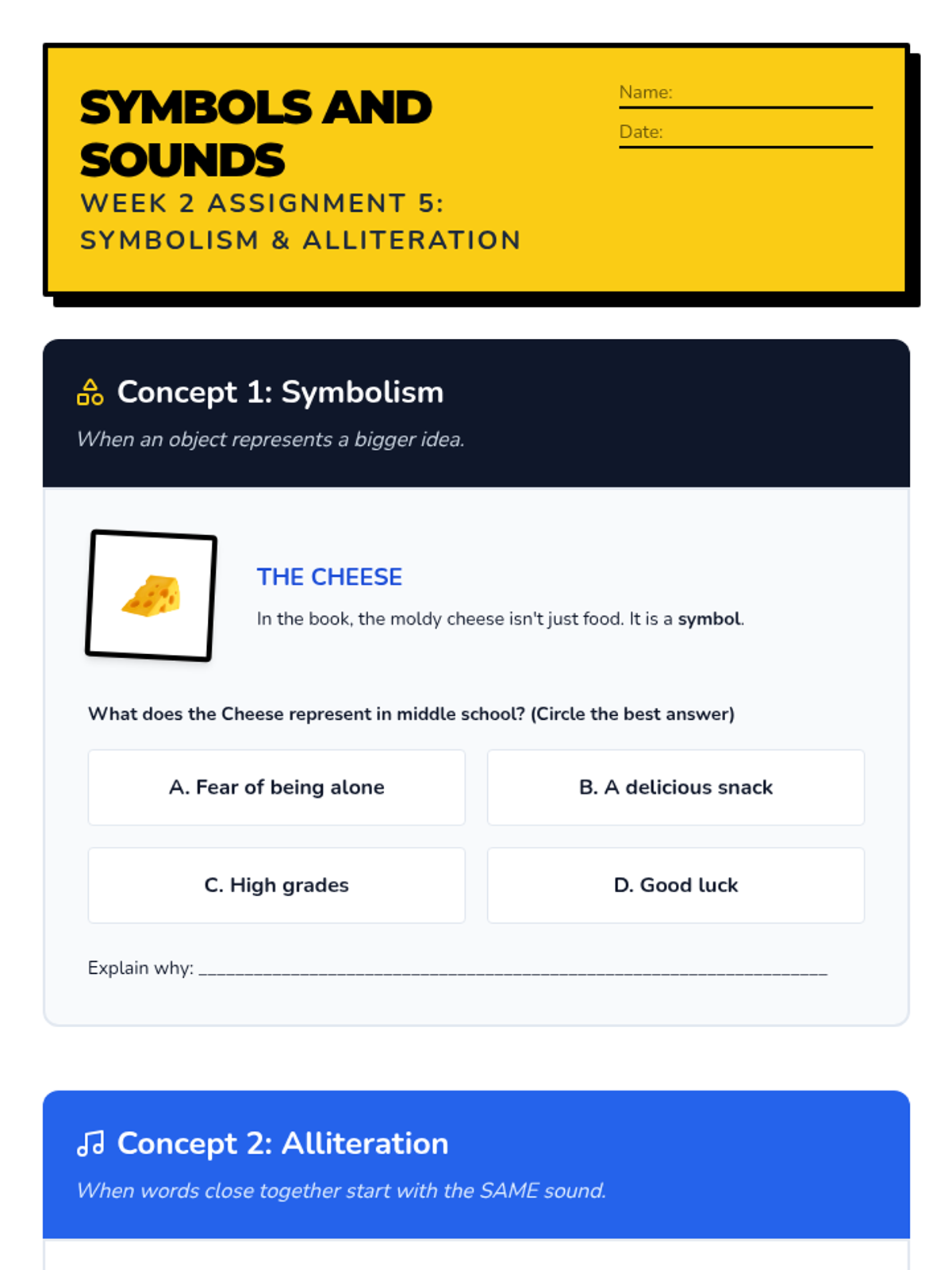
A worksheet for Week 2 focusing on Symbolism (the Cheese) and Alliteration (character names and traits), with an ELL-friendly vocabulary focus on social hierarchies.
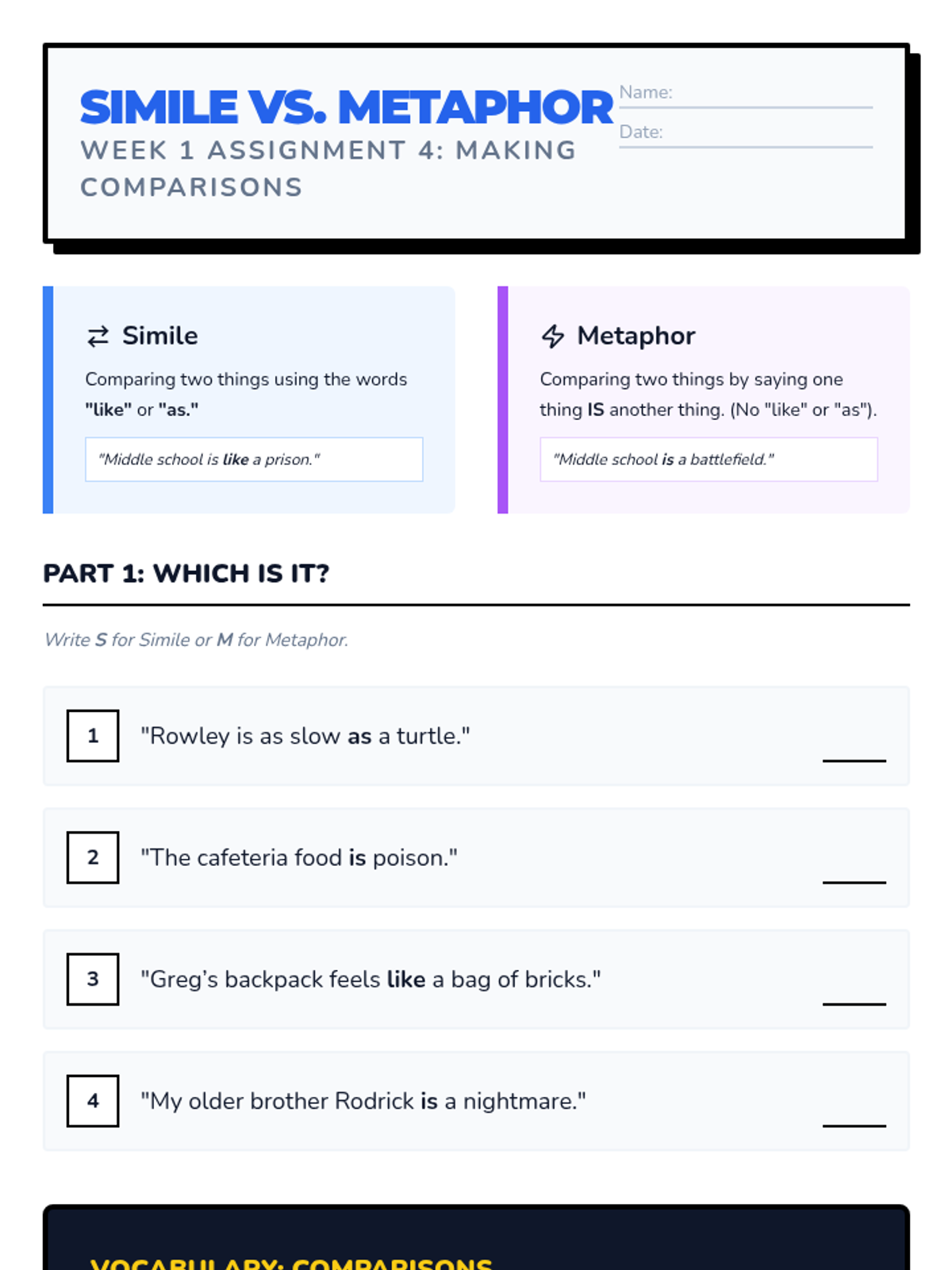
A literary device worksheet for Week 1 focusing on identifying and creating similes and metaphors within the context of 'Diary of a Wimpy Kid'.
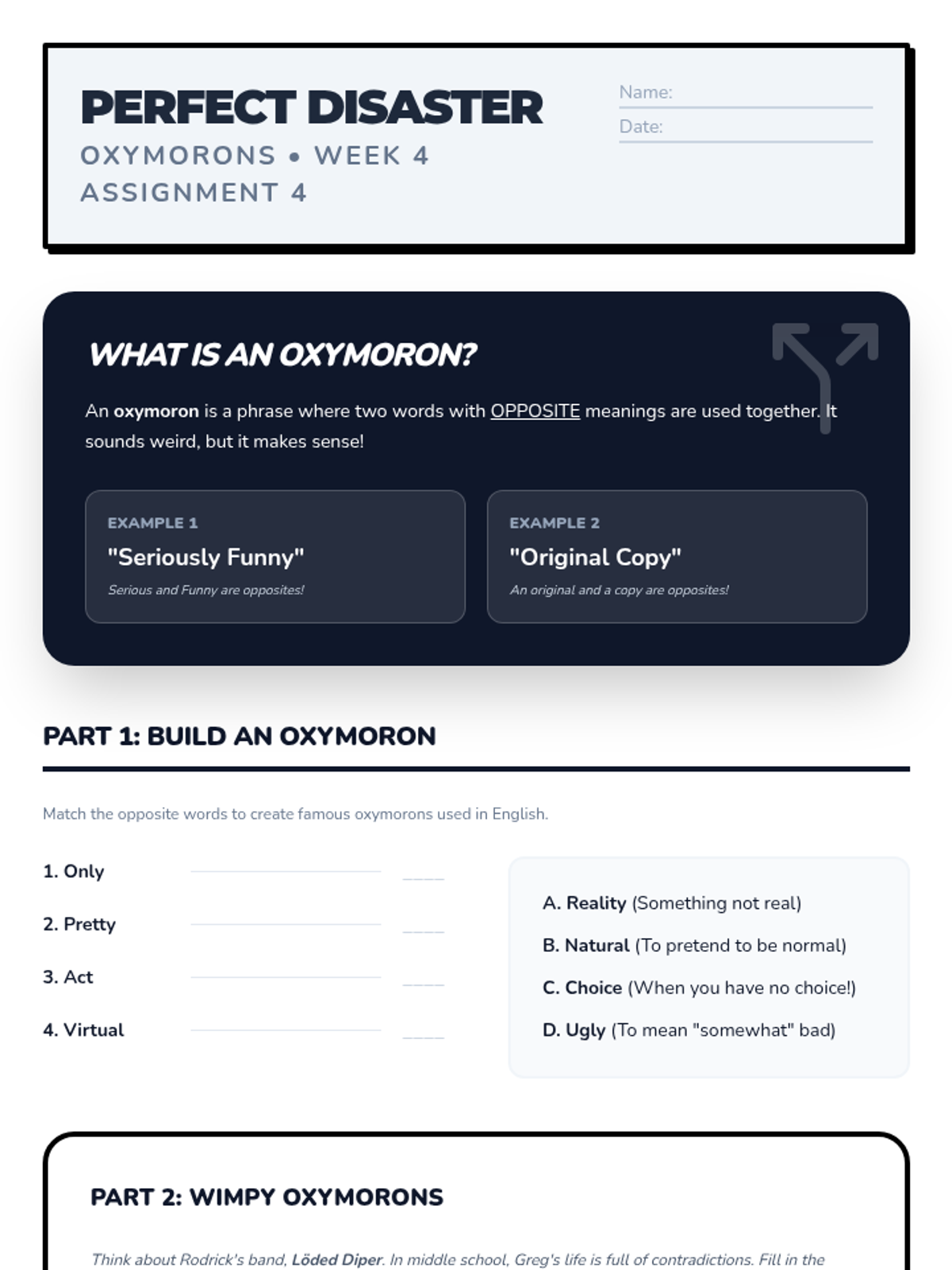
A literary device worksheet for 8th-grade ELL students focusing on oxymorons, using examples from common English and the context of 'Diary of a Wimpy Kid'.
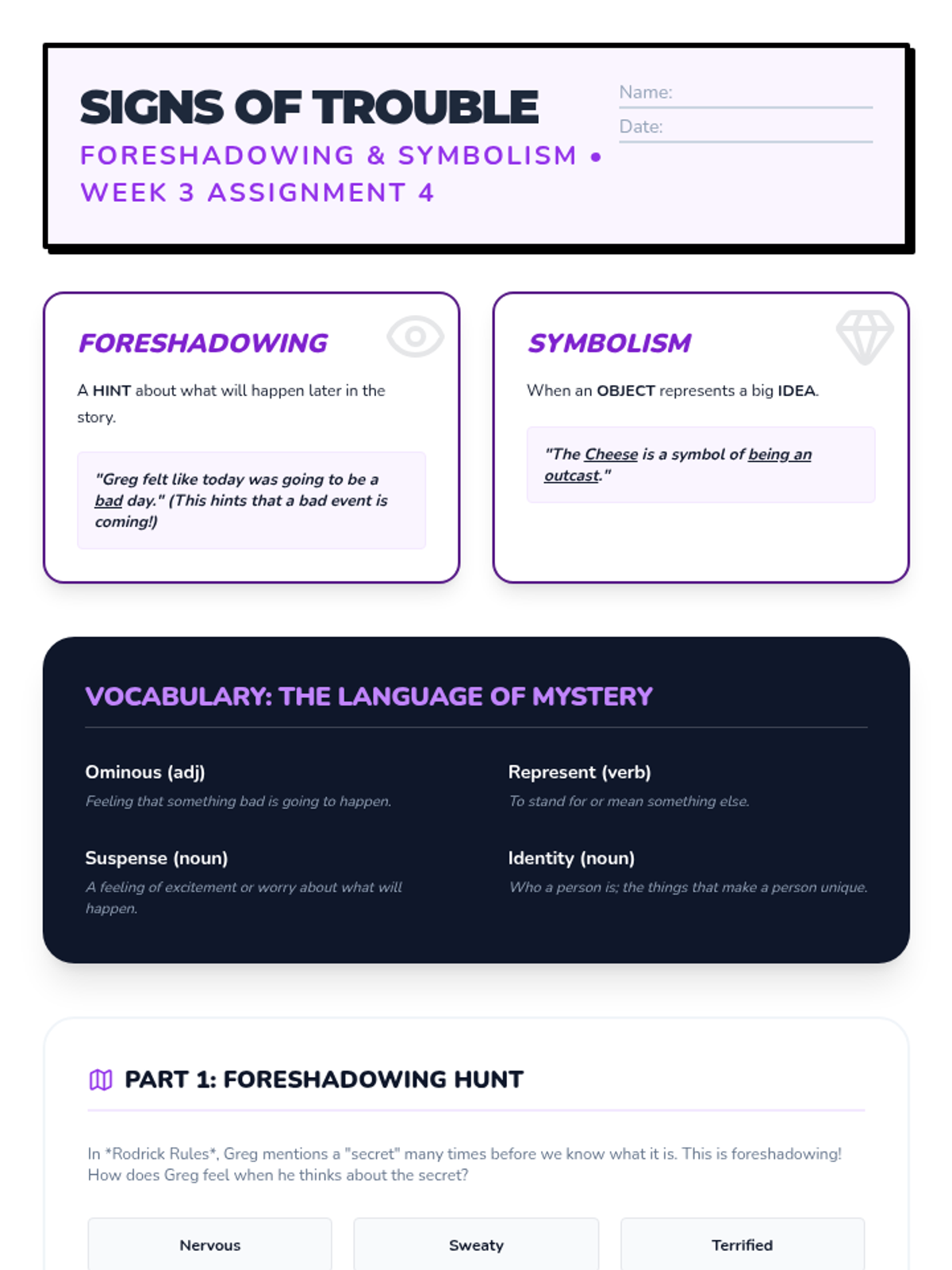
A literary device worksheet for 8th-grade ELL students focusing on foreshadowing and symbolism in 'Rodrick Rules', including vocabulary and matching activities.
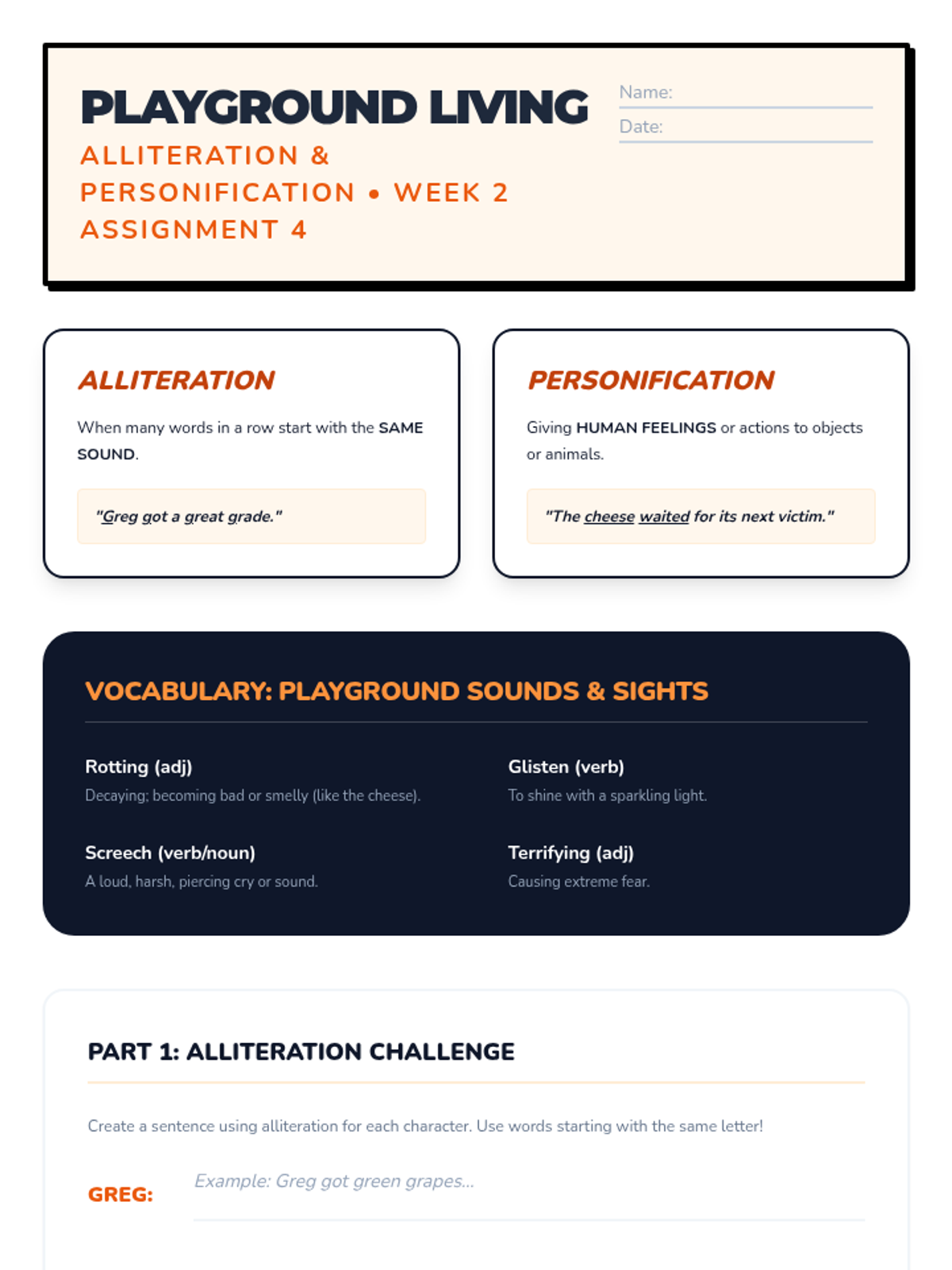
A literary device worksheet for ELL students focusing on alliteration and personification within the context of the school playground and characters.
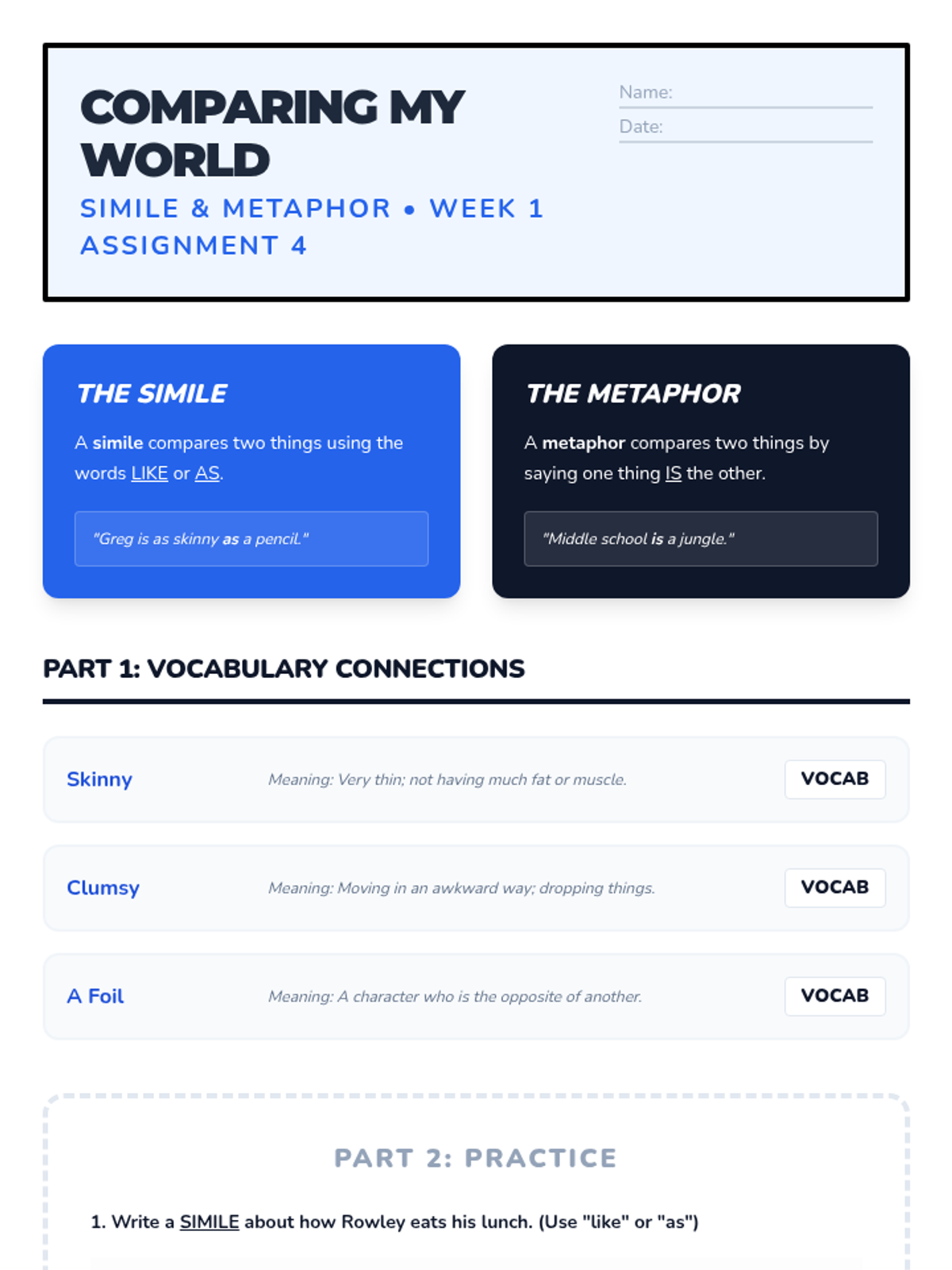
A literary device worksheet for 8th-grade ELL students focusing on similes and metaphors within the context of 'Diary of a Wimpy Kid', featuring vocabulary building and creative writing tasks.
Refined three-page vocabulary worksheet with reduced font sizes and margins to prevent content cutoff. Each part is clearly separated on its own page (Part 1 on Page 1, Part 2 on Page 2, Part 3 on Page 3) for a clean, print-optimized experience.
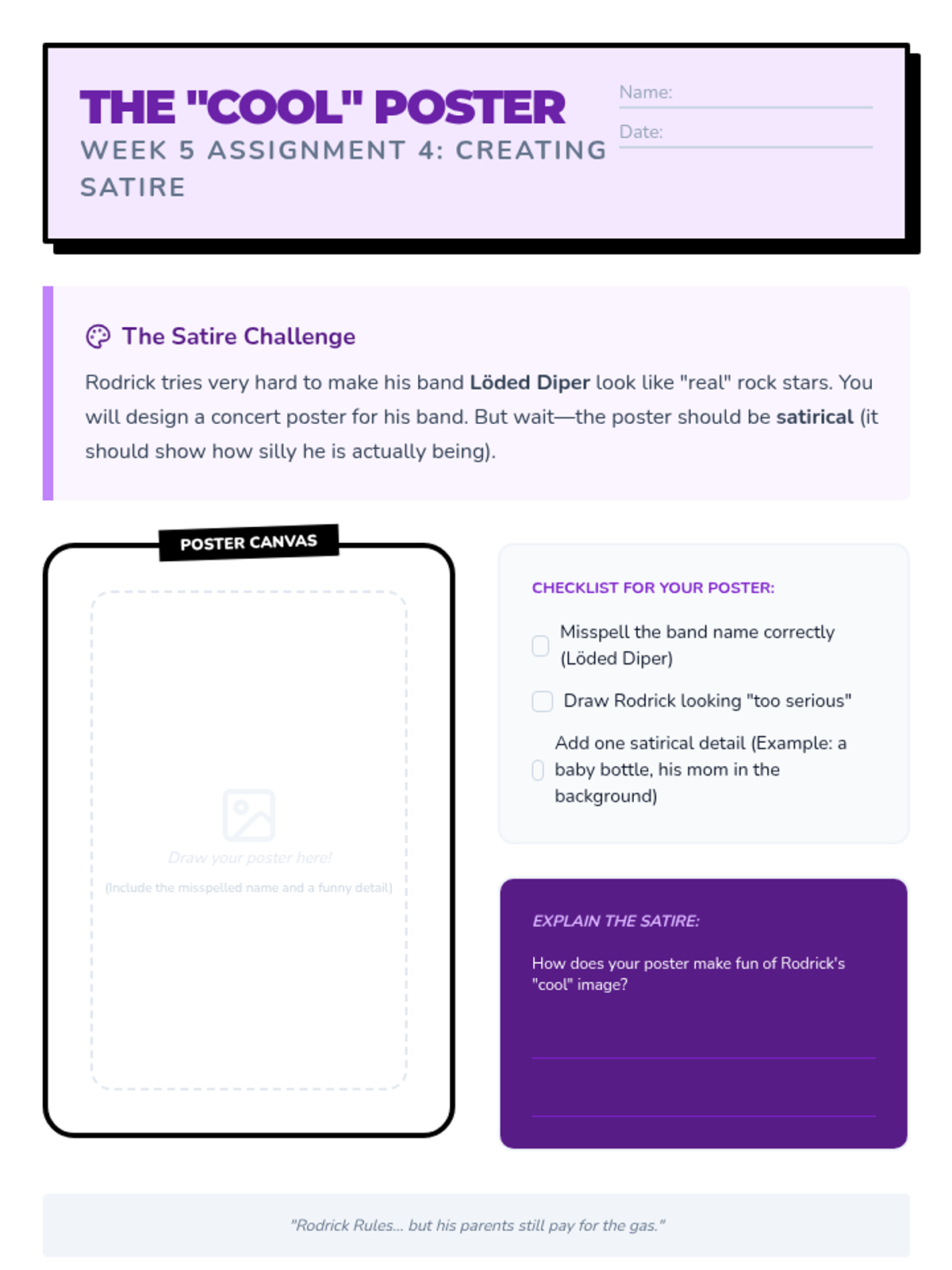
A creative assignment for Week 5 where students analyze and create satirical content based on Rodrick's band 'Löded Diper'.
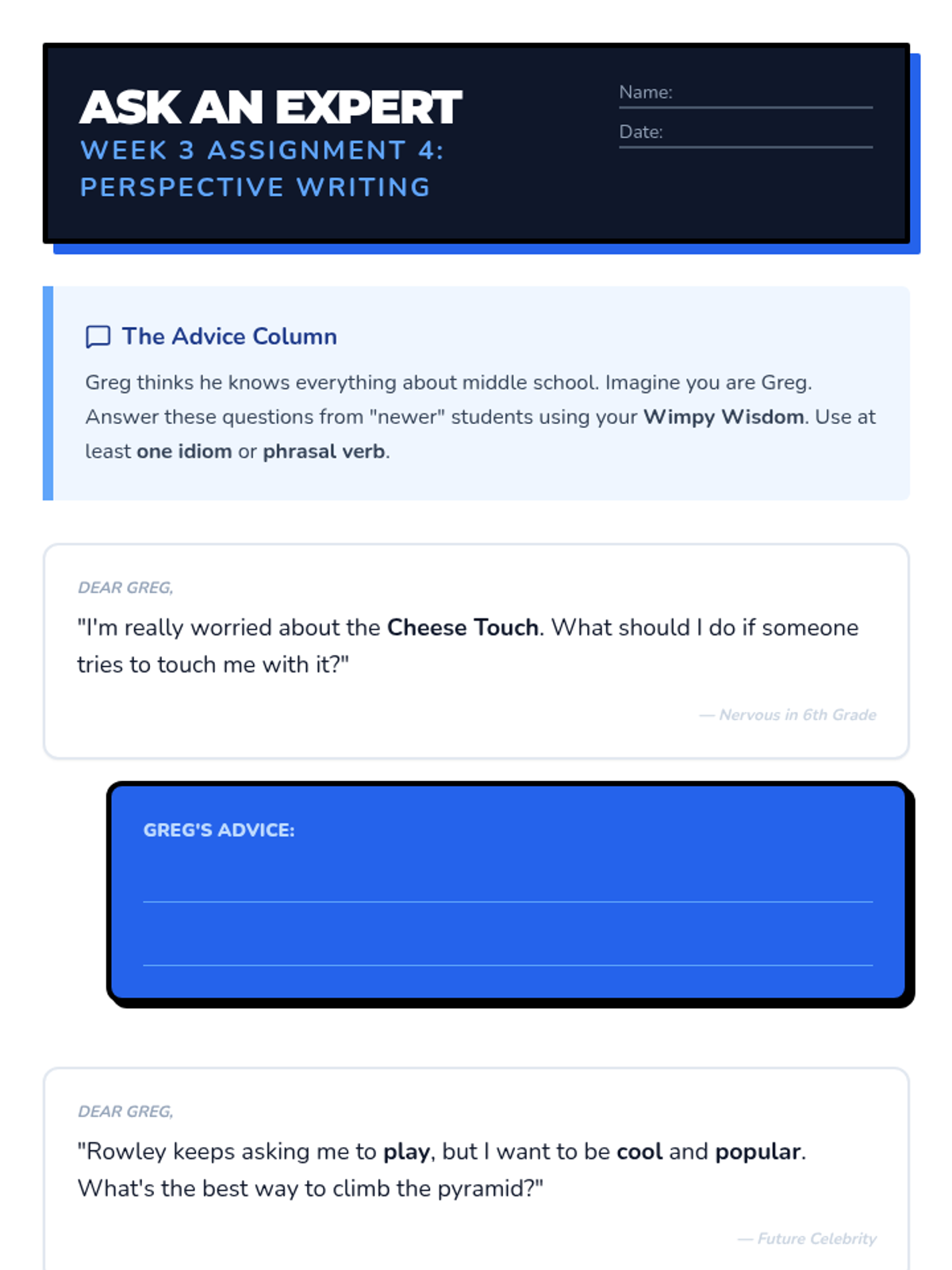
A perspective writing activity for Week 3 where ELL students write from Greg's point of view to give advice to other students, practicing idioms and phrasal verbs.
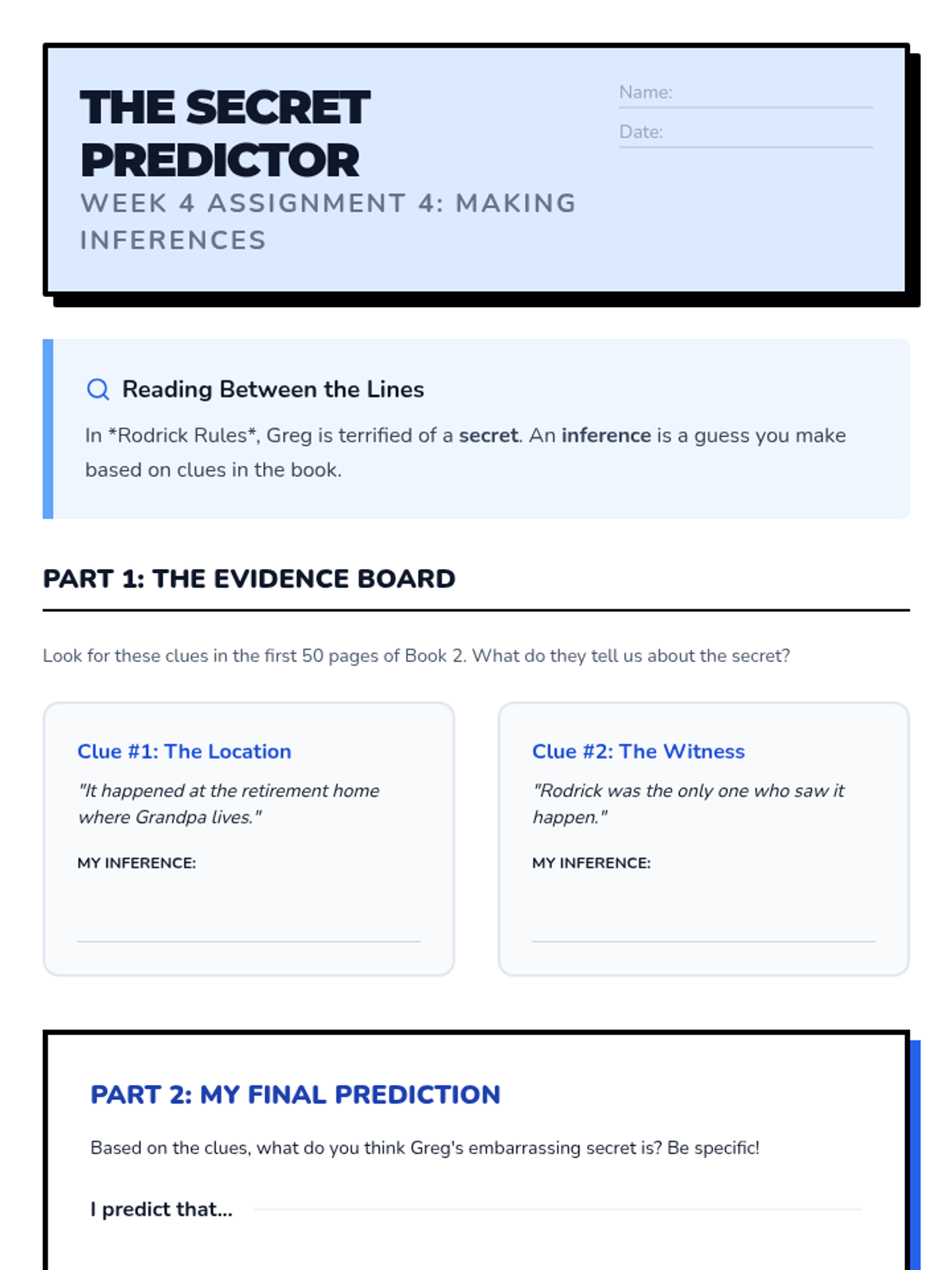
A worksheet introducing the concepts of inference and prediction through the lens of Greg's secret in 'Rodrick Rules'.
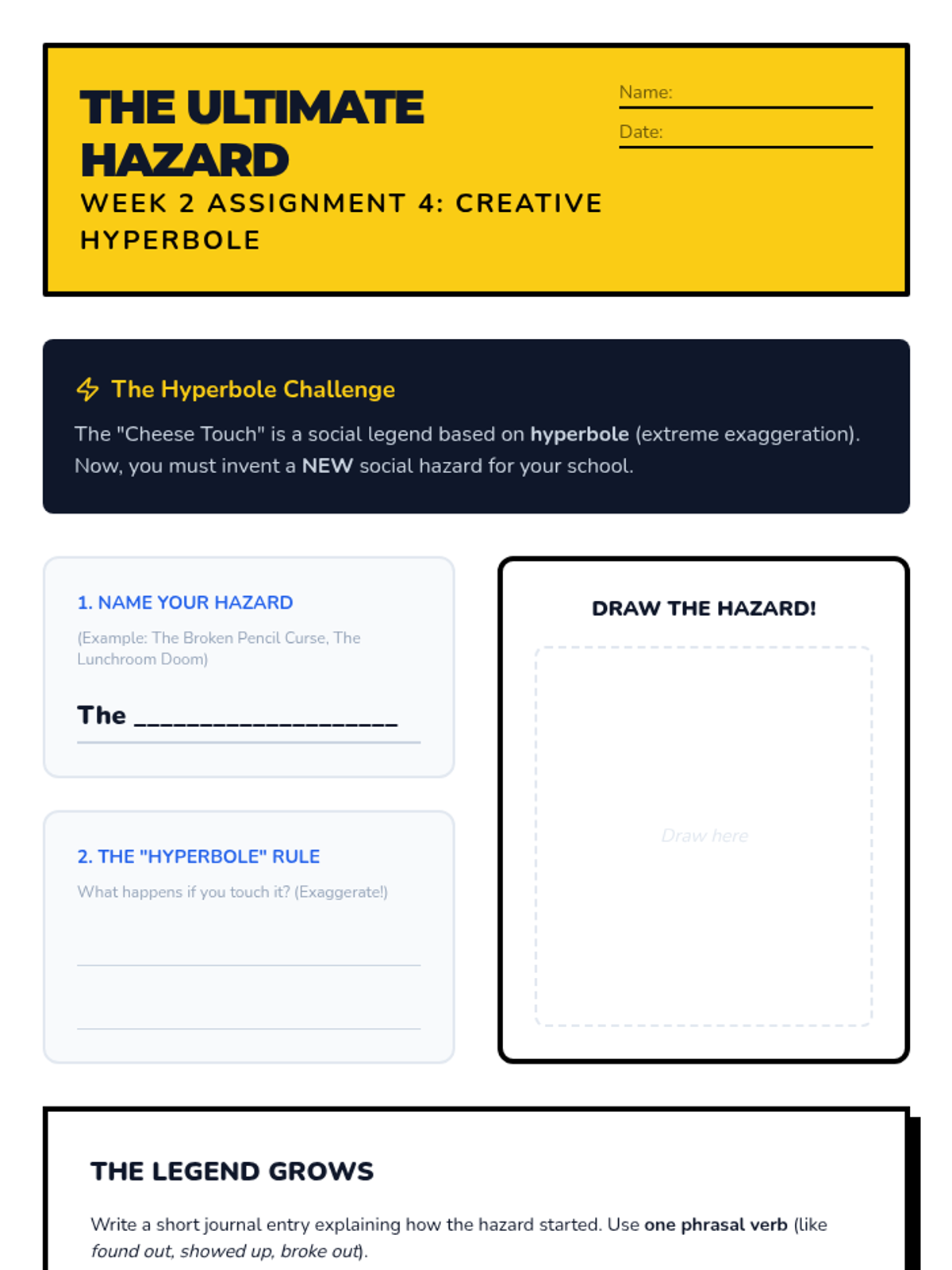
A creative assignment for Week 2 where students apply their knowledge of hyperbole by inventing their own 'social hazard' similar to the Cheese Touch.
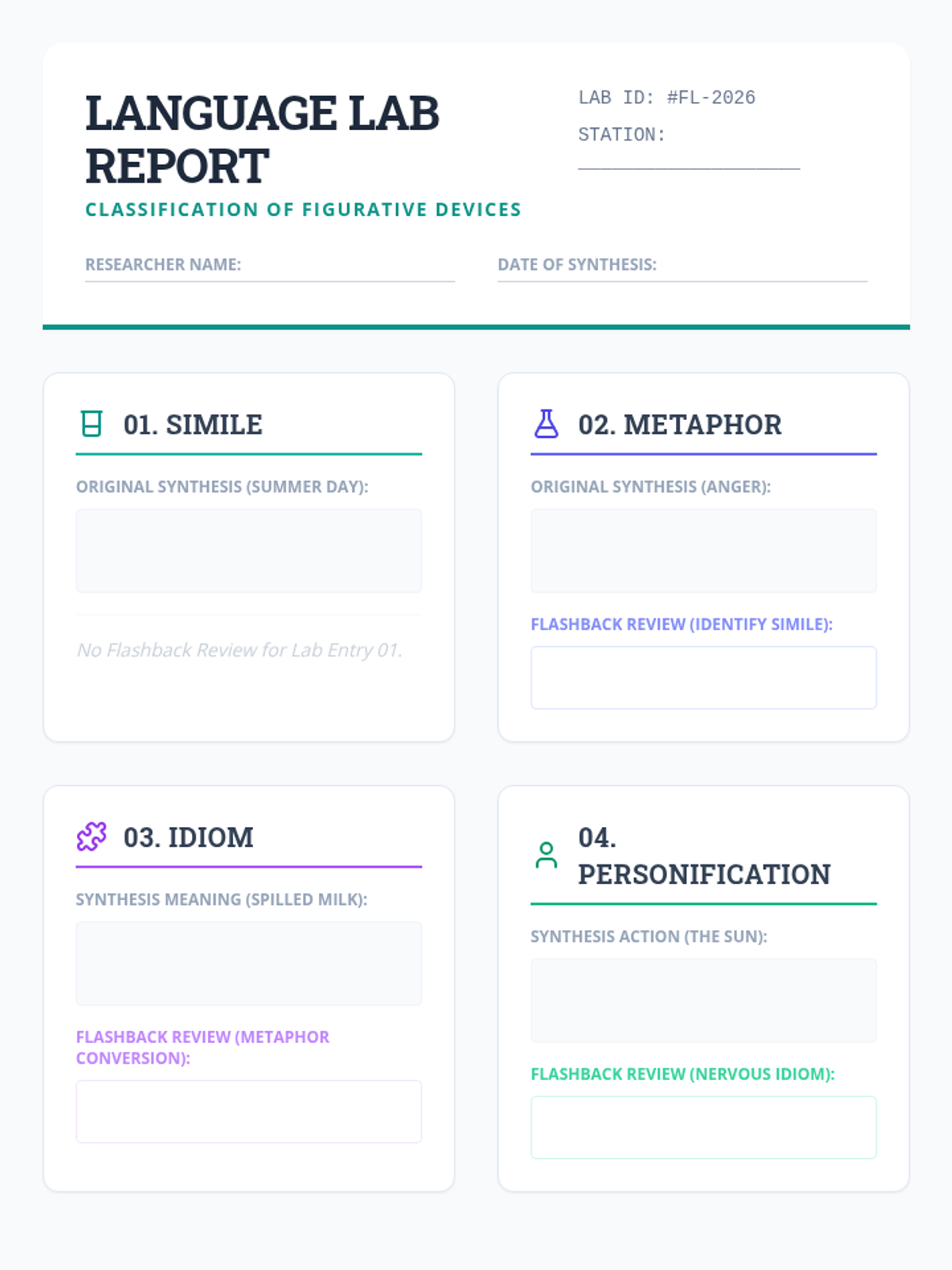
A 2-page student worksheet designed to accompany the Language Lab slides. It features dedicated sections for each figurative language device, providing space for students to record their original examples and respond to flashback review questions.
A 12-slide presentation deck covering 9 types of figurative language. Each slide includes a definition, a 'Lab Example', a student 'Research Task' to create their own example, and a 'Yesterday's Review' question to reinforce cumulative learning.
The finalized, all-in-one Cosmic Carnival slide deck. Includes definitions, carnival examples, practice tasks with global language integrated, official WNHS logo branding, "By: Mr. Hamed" signature, the YouTube song, and functional QR scavenger hunt backup slides.
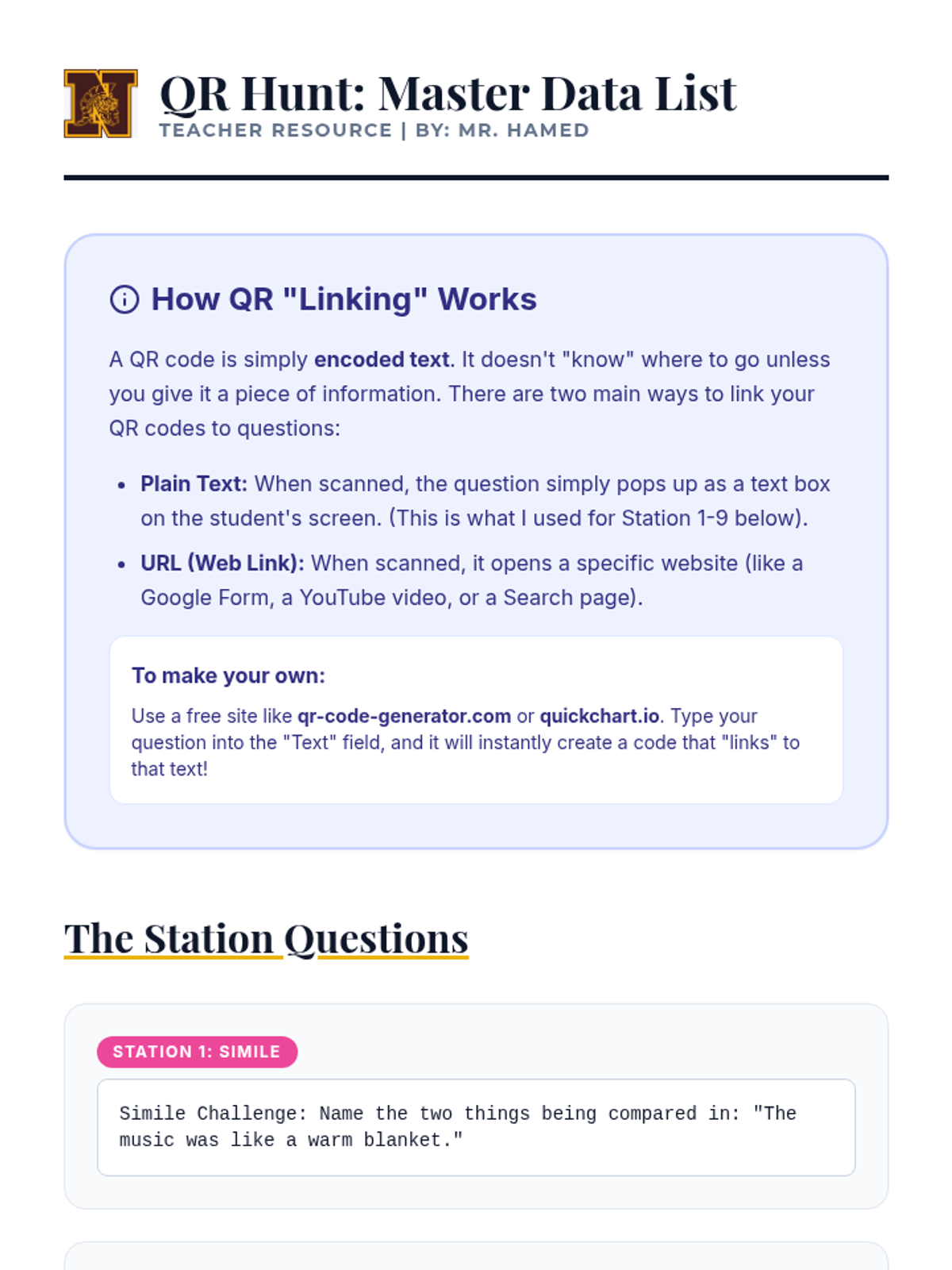
A teacher resource containing the raw text data used for all nine QR stations, along with a guide on how QR codes link to questions and how teachers can create their own custom codes.
The finalized Cosmic Carnival slide deck. Includes definitions and practice for all 9 devices, branded footer with the WNHS logo and "By: Mr. Hamed" on every slide, and an embedded YouTube video of the "Figurative Language Song" before the conclusion. Now includes a backup QR code slide for the scavenger hunt.
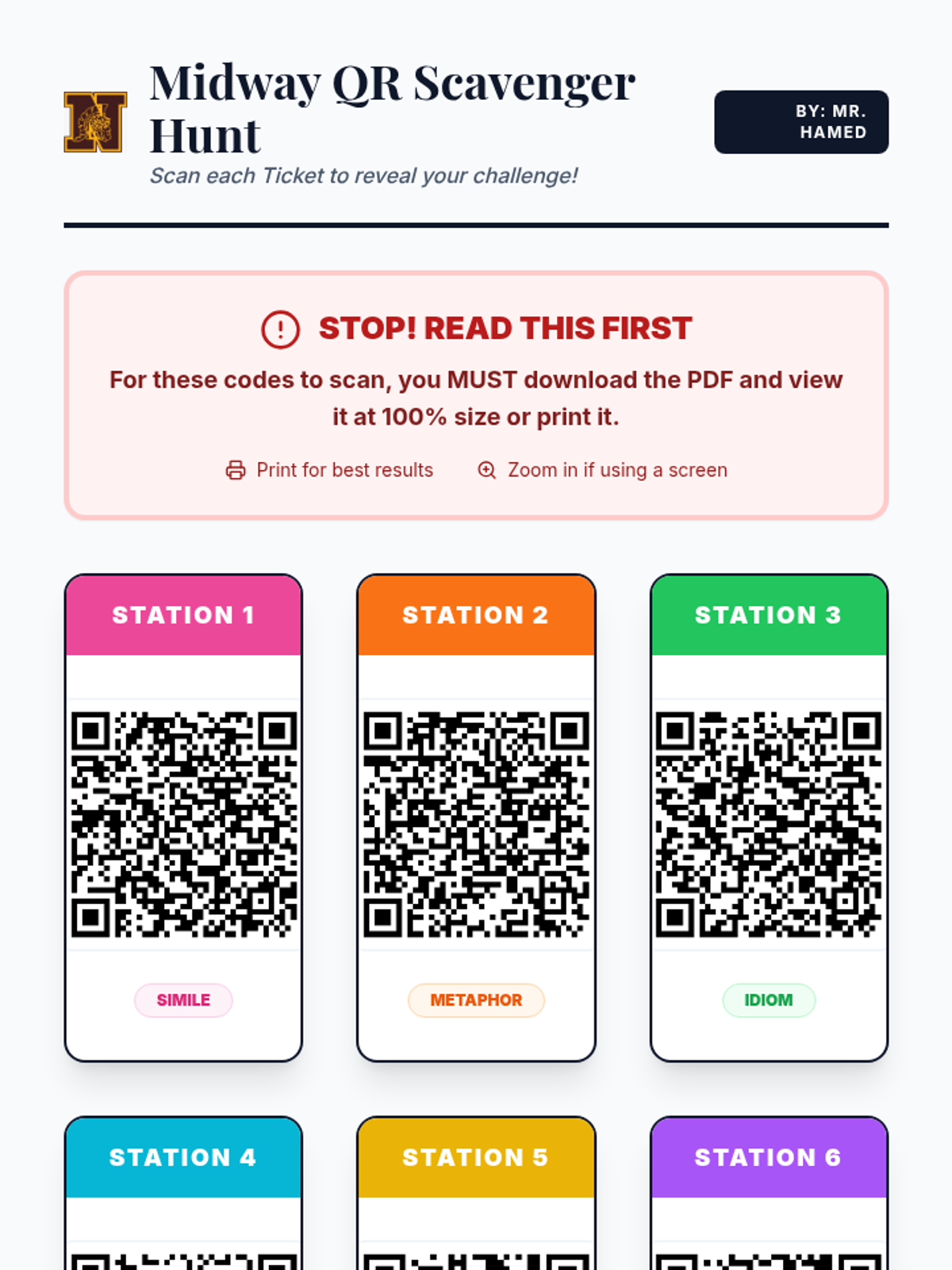
A high-resolution, functional QR code scavenger hunt. Each station features a large, scan-optimized QR code that links to a Google Search for the specific figurative language challenge, ensuring maximum compatibility with all mobile devices and scanner apps. Includes school branding and teacher key.
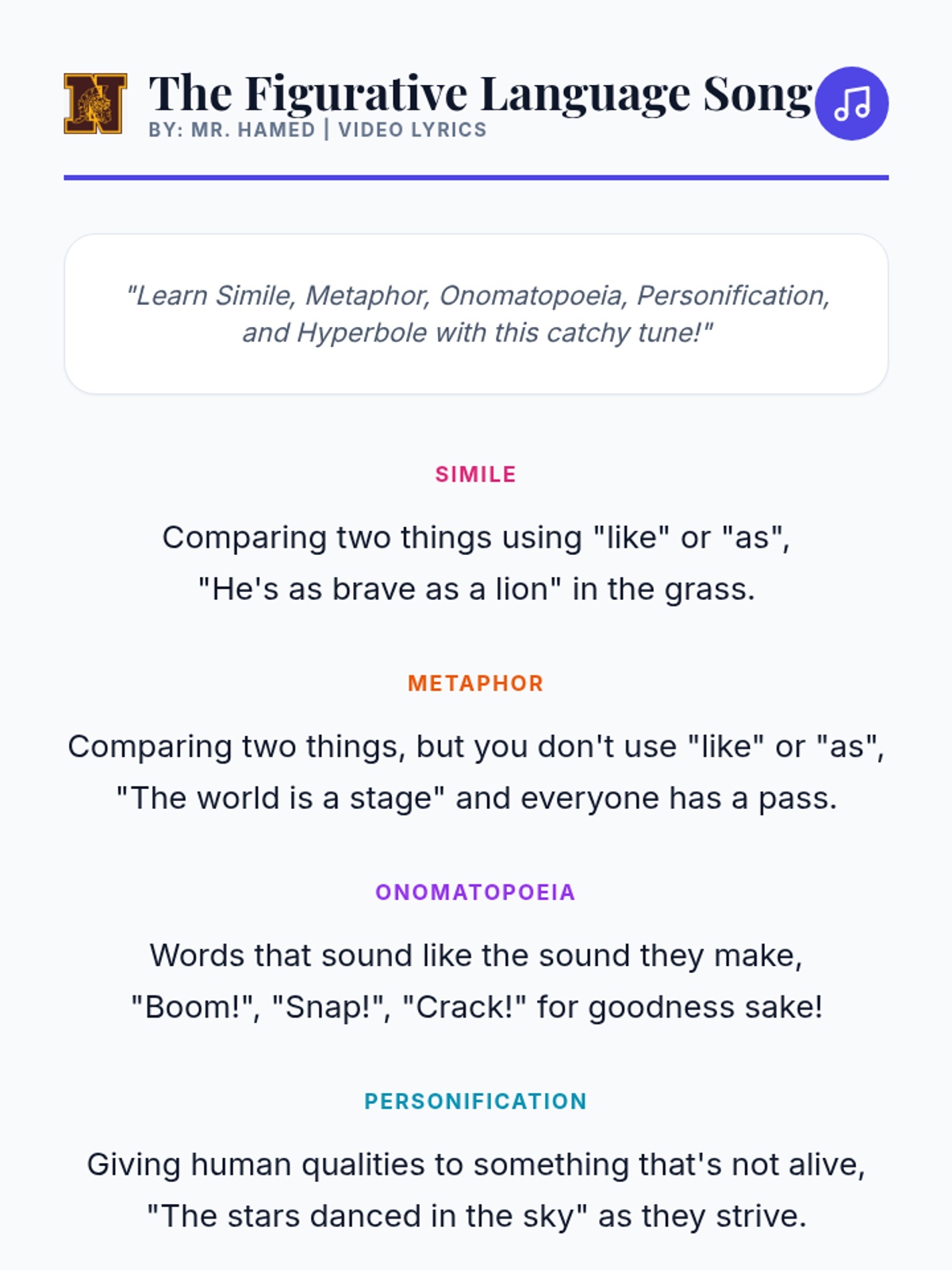
A lyric sheet for the "Figurative Language Song" YouTube video. Covers Simile, Metaphor, Onomatopoeia, Personification, and Hyperbole with examples from the song. Branded for WNHS and Mr. Hamed.
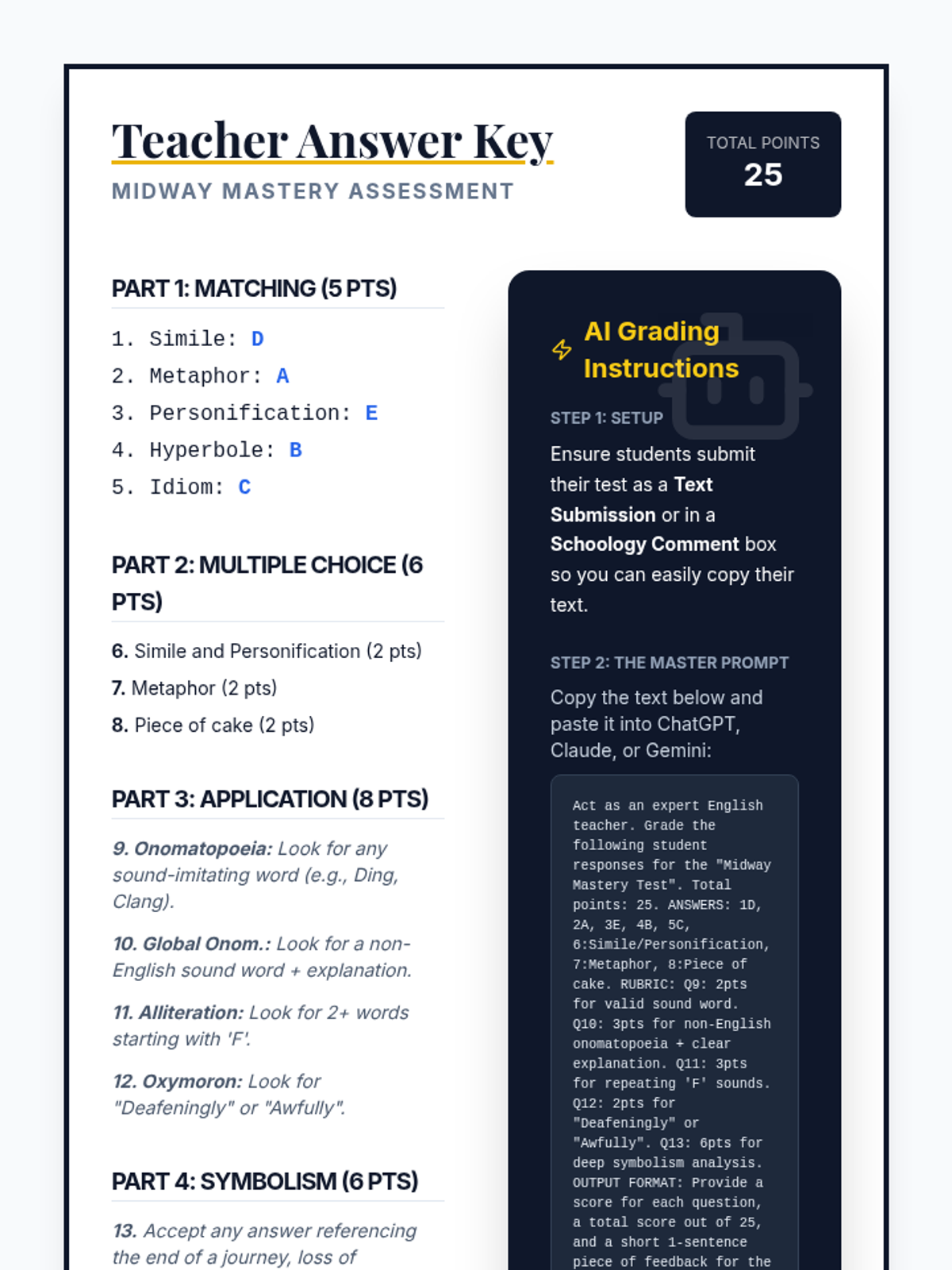
An enhanced teacher-facing answer key and AI grading guide for the Midway Mastery Assessment. Includes a structured master prompt for teachers to copy into AI tools for rapid grading of student responses.
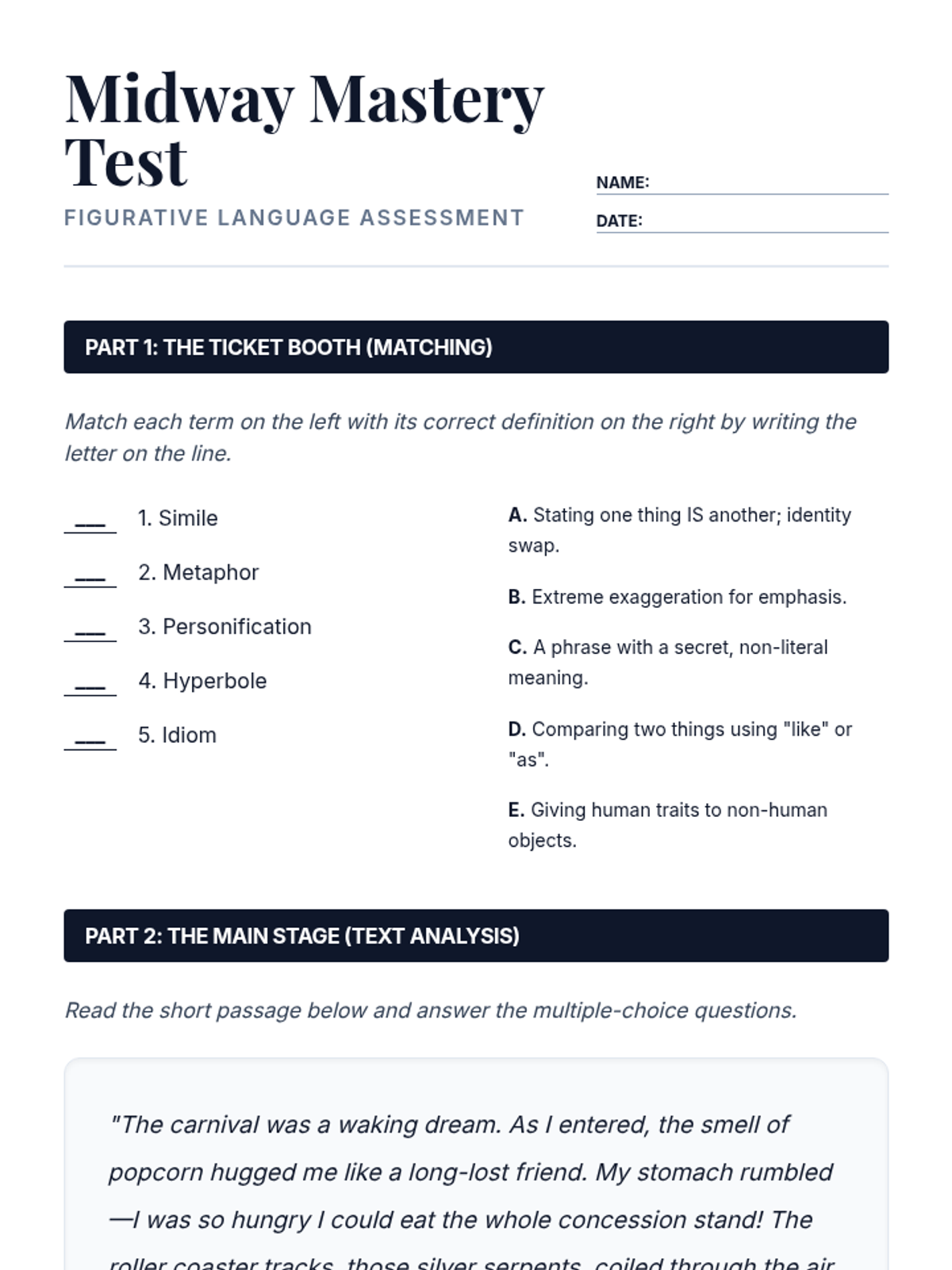
A comprehensive figurative language mastery test featuring matching, multiple-choice text analysis, fill-in-the-blank application, and a symbolism short-response question. Includes a new cross-cultural onomatopoeia task.
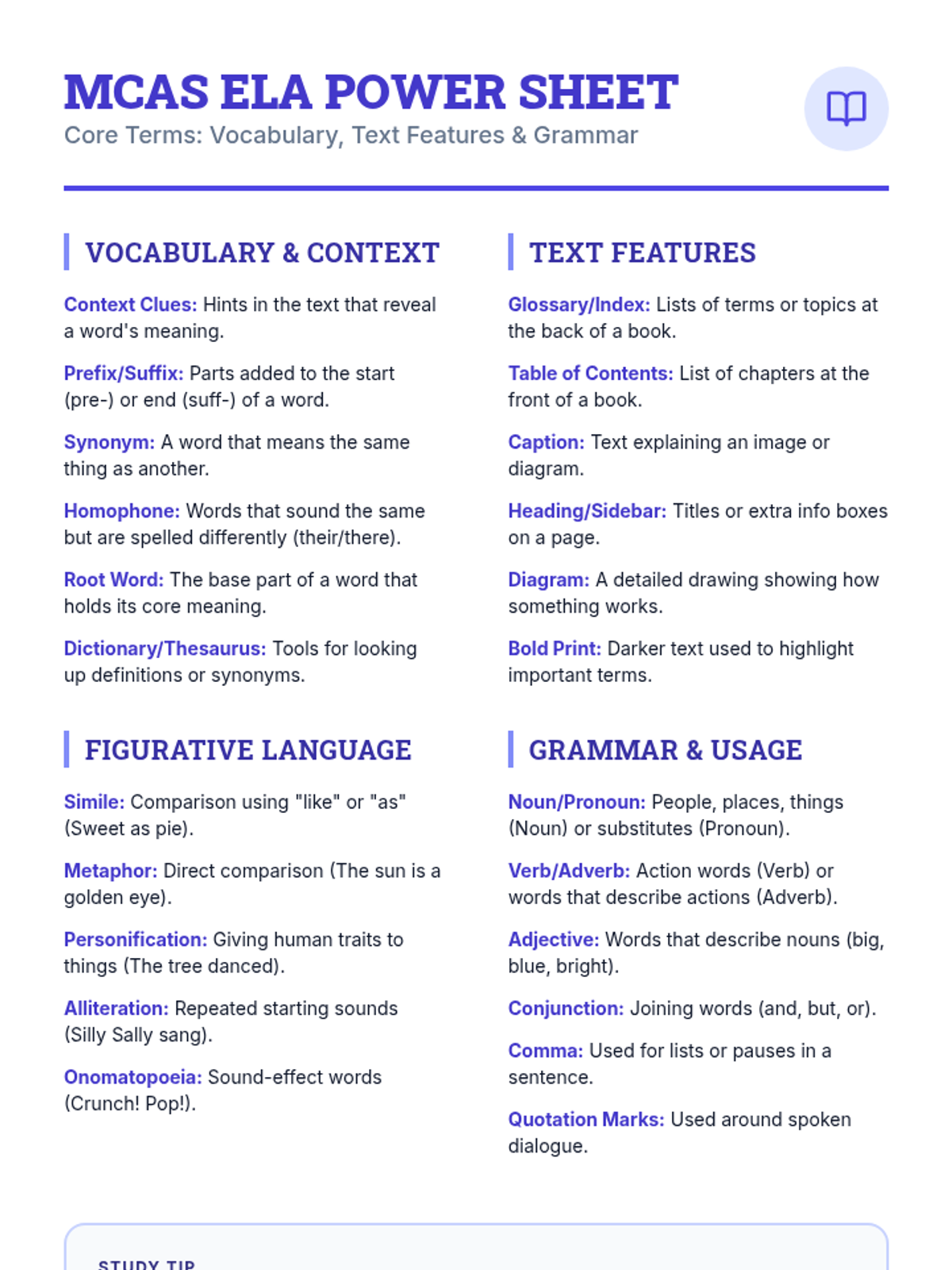
A one-page student reference sheet containing the key ELA terms, definitions, and examples featured in the bingo game. Perfect for pre-game study or as a reference during the activity. Revised to align with new categories.
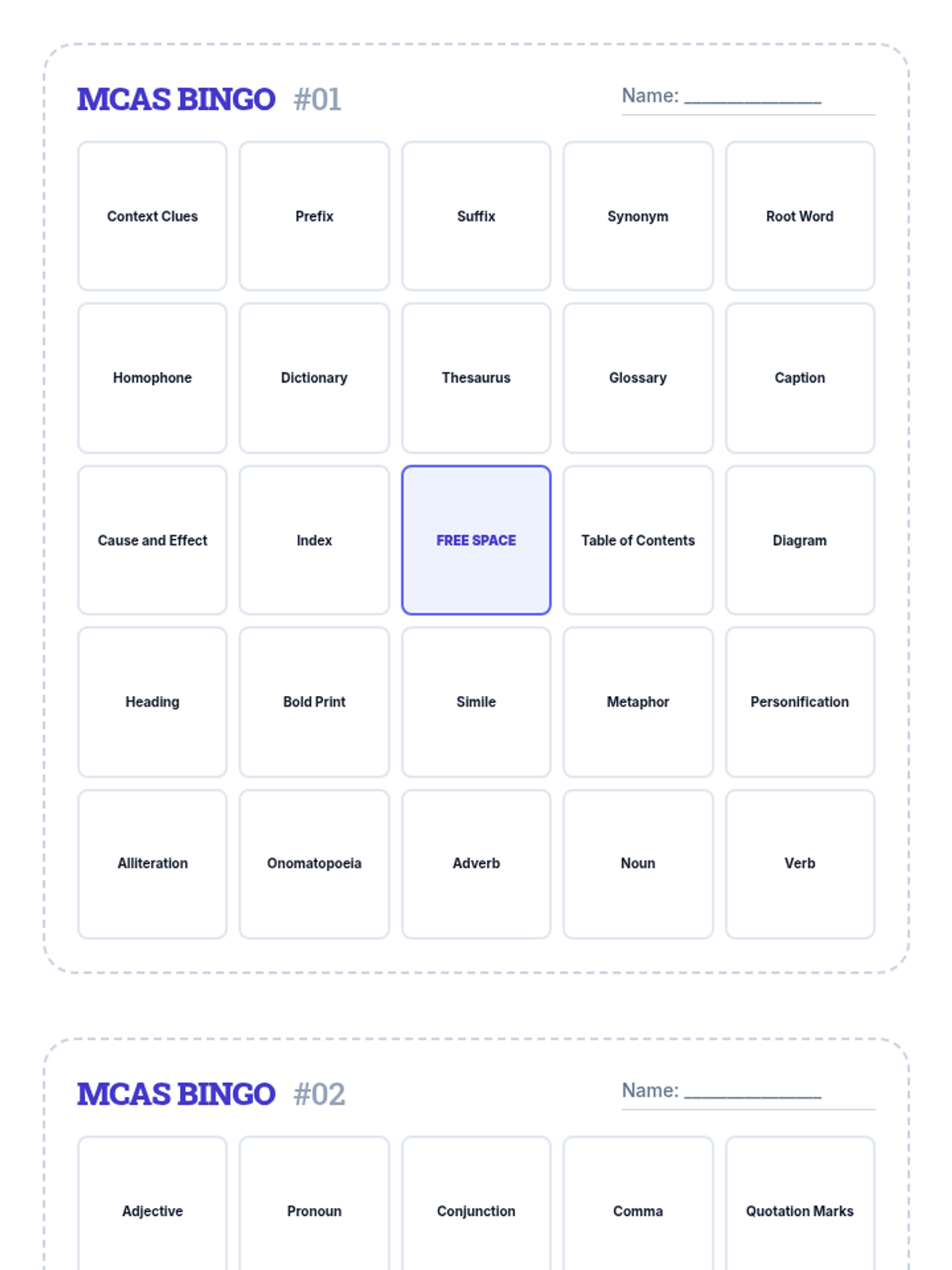
A collection of 22 unique bingo cards for ELA review, featuring academic vocabulary, text features, and grammar terms. Each page contains two cards with randomized terms. Revised to remove forbidden literary and vocabulary terms.
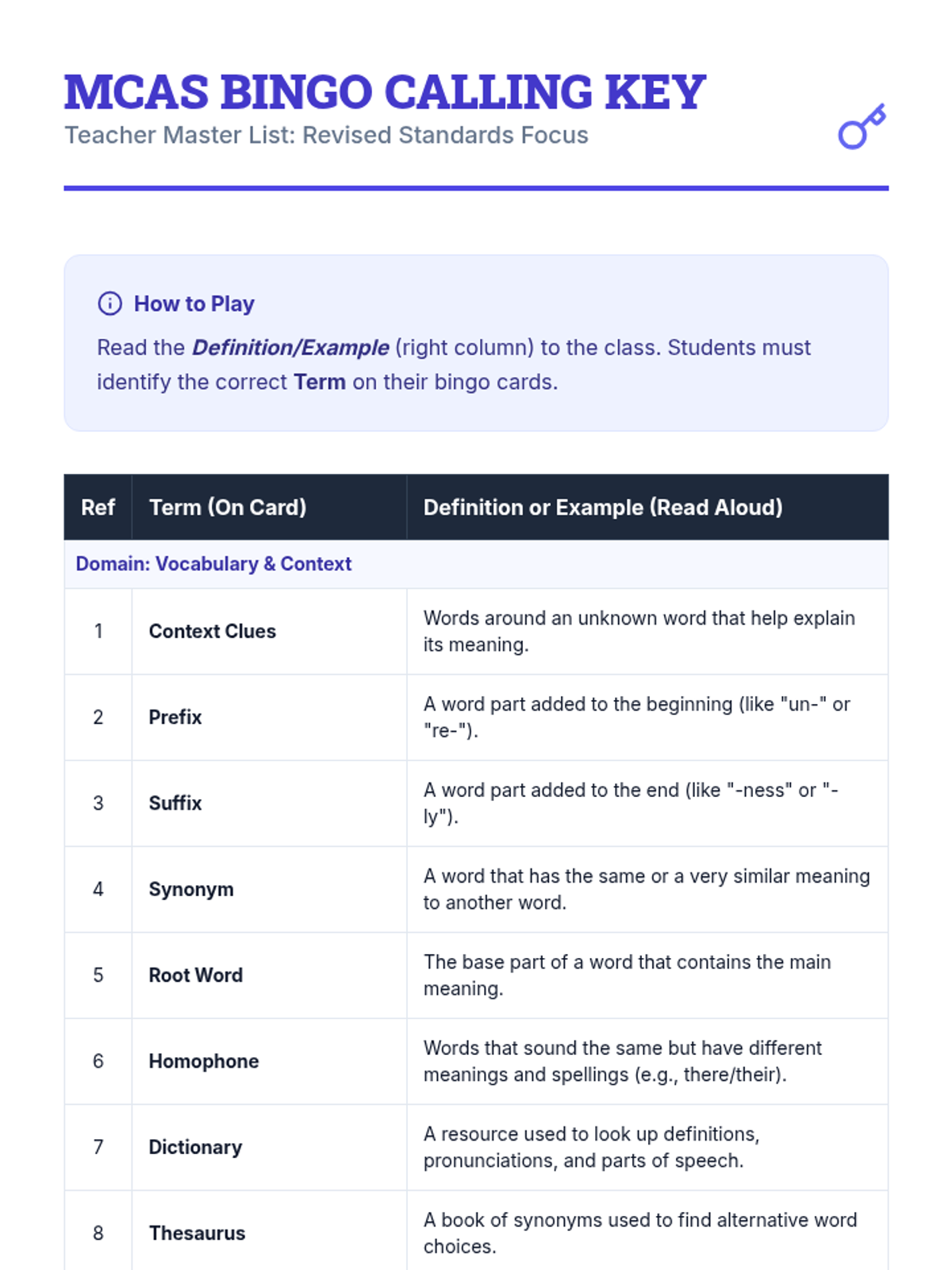
A comprehensive master calling key for the teacher, listing 30 ELA terms, their definitions, and examples aligned with MCAS standards. Revised to remove literary elements and focus on vocabulary, text features, and grammar.
A 10-slide presentation detailing the history of the English language through the lens of Celtic, Viking, and French invasions. It features a manuscript-inspired aesthetic with clear visual distinctions between the layers of vocabulary.
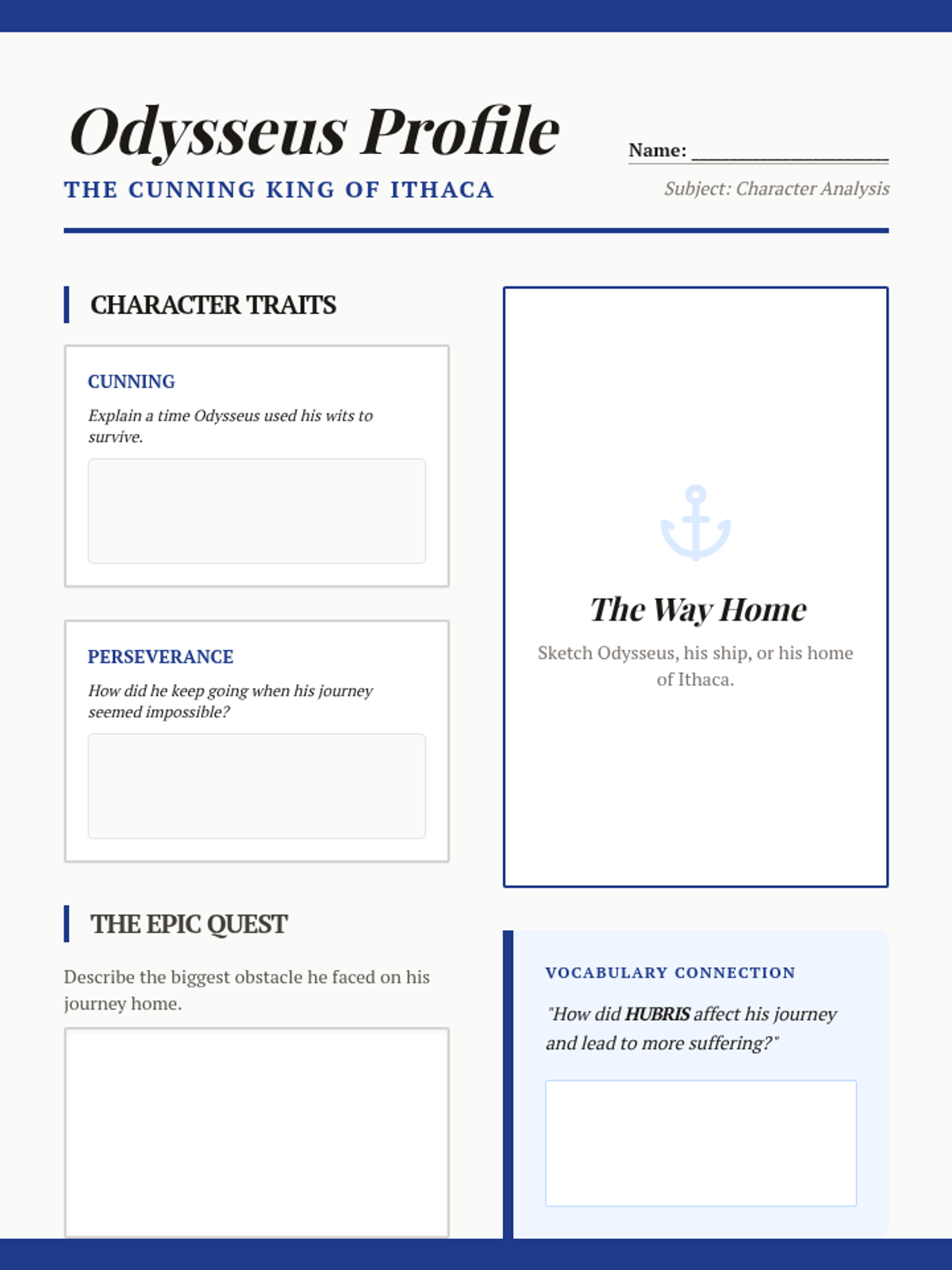
A detailed graphic organizer for analyzing the character traits, obstacles, and journey of Odysseus, featuring space for evidence and a portrait sketch.
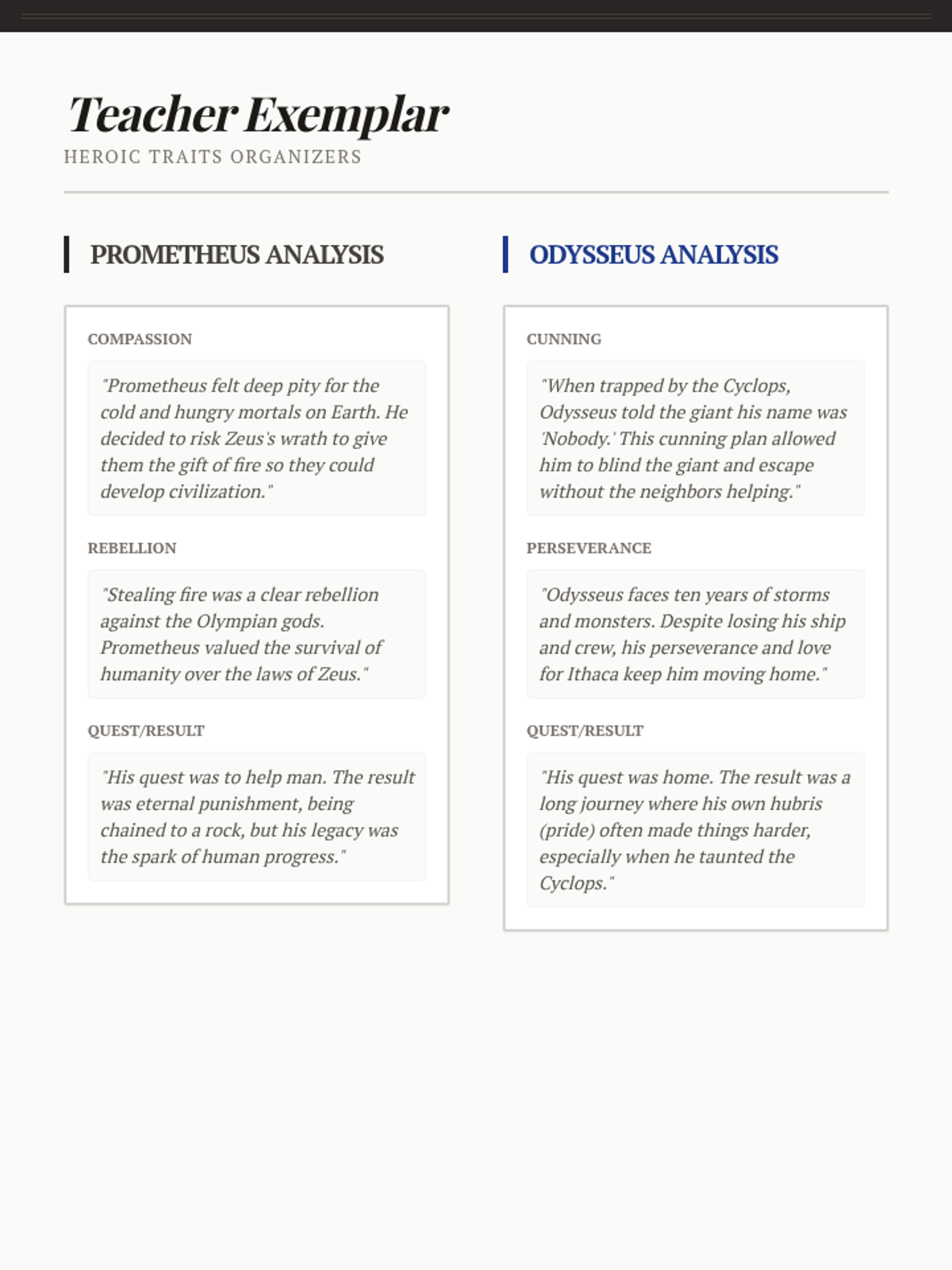
Teacher exemplar for the Heroic Traits Organizers, providing sample character analysis and vocabulary connections for Prometheus and Odysseus.
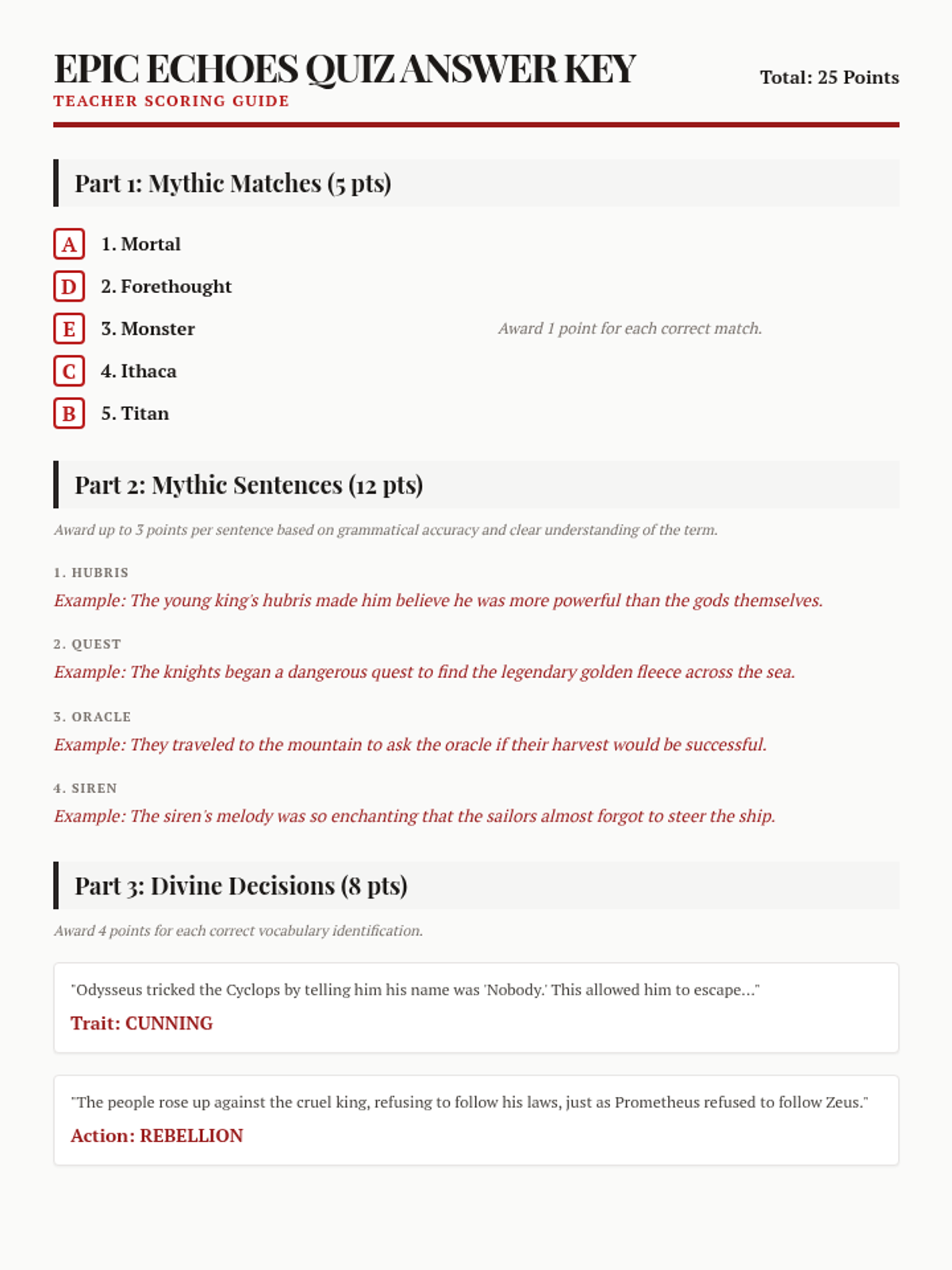
Answer key for the Epic Echoes Quiz, including correct matches, sample sentences, and application identifying character traits and actions.
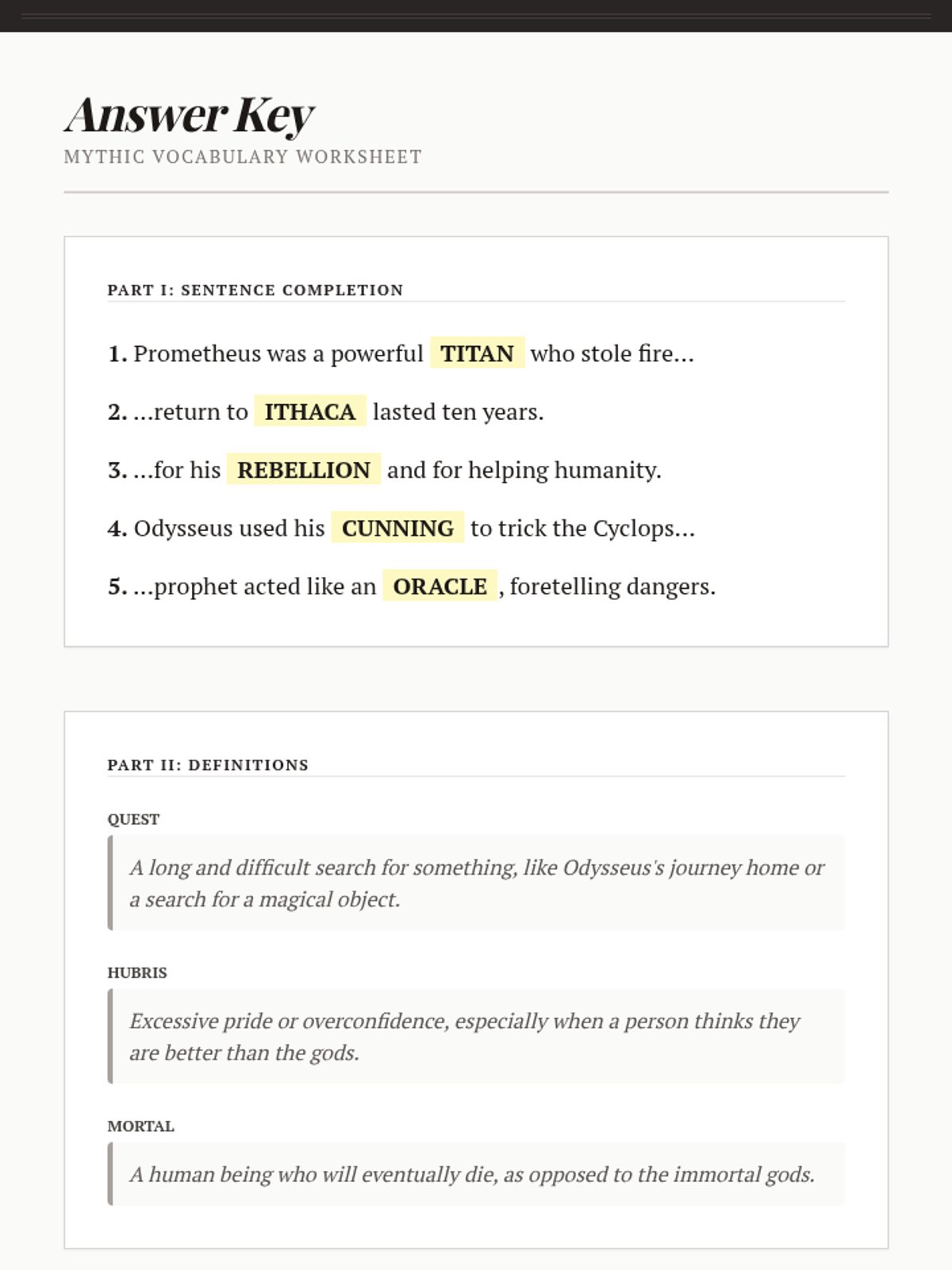
Answer key for the Mythic Mastery Worksheet, providing correct terms, example etymological explanations, and grading criteria for the analysis prompt.
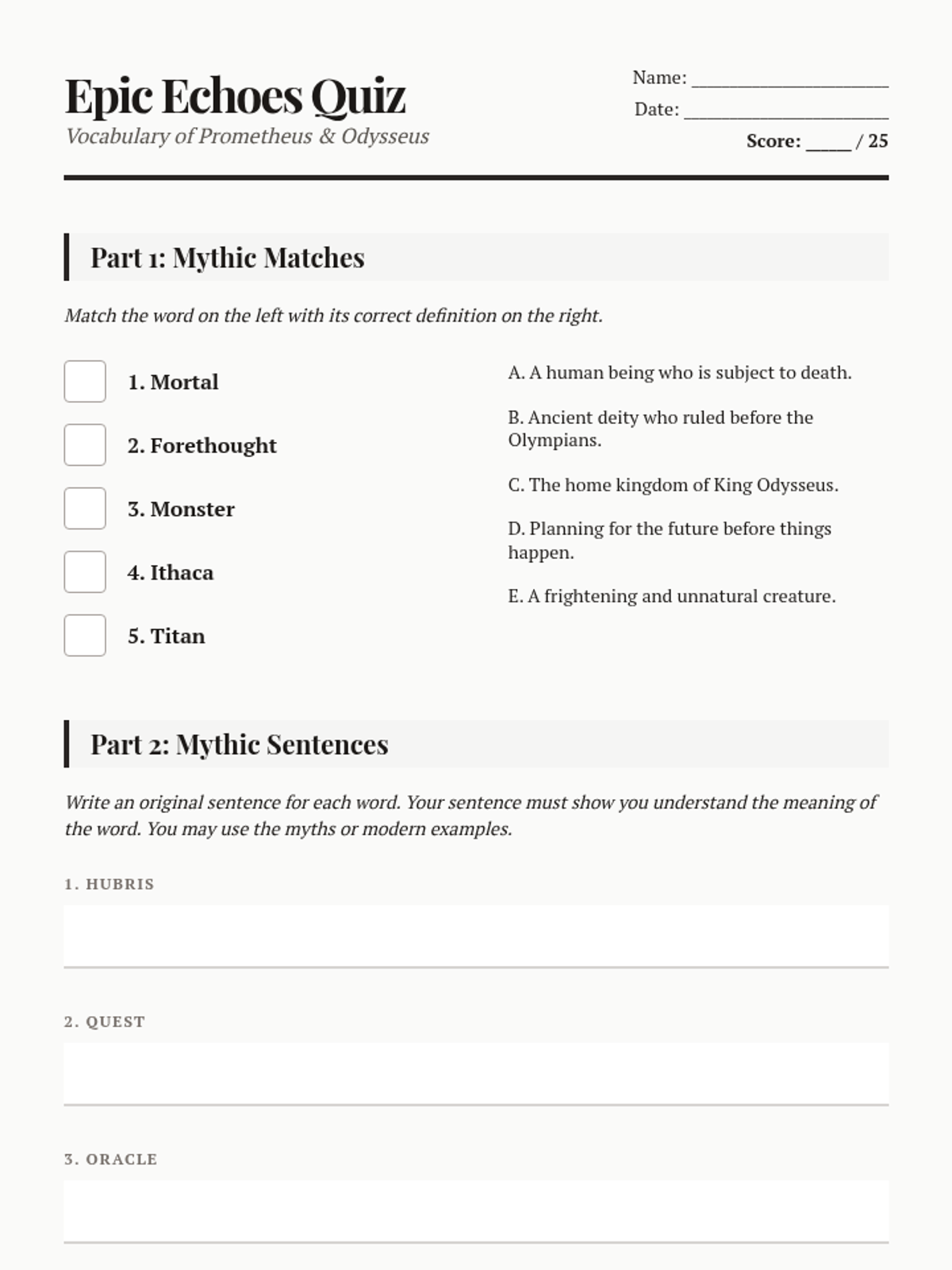
A vocabulary quiz focusing on the myths of Prometheus and Odysseus, featuring matching, sentence creation, and contextual application.
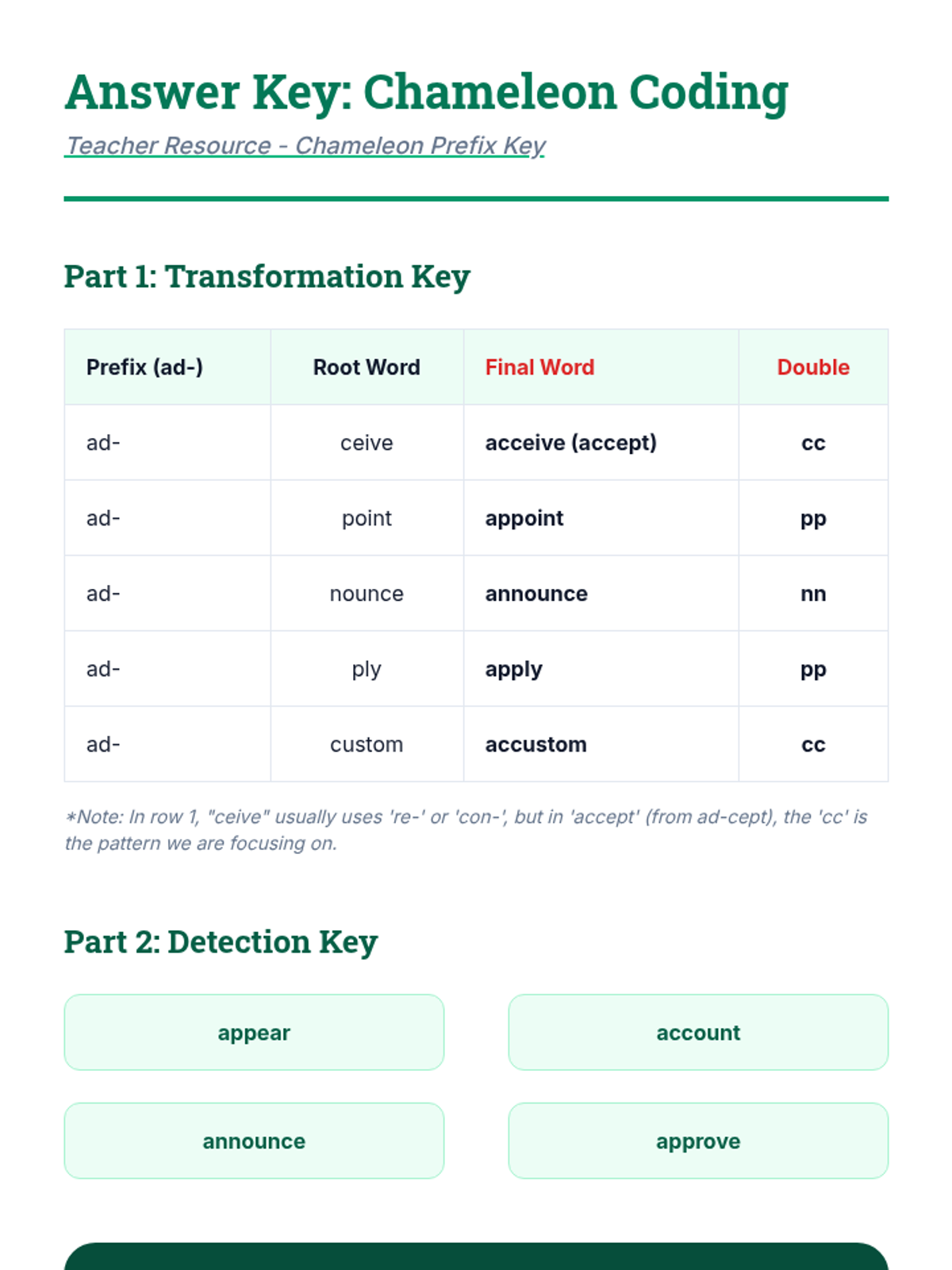
Teacher answer key for the Chameleon Challenge Worksheet, with explanations of prefix assimilation logic.
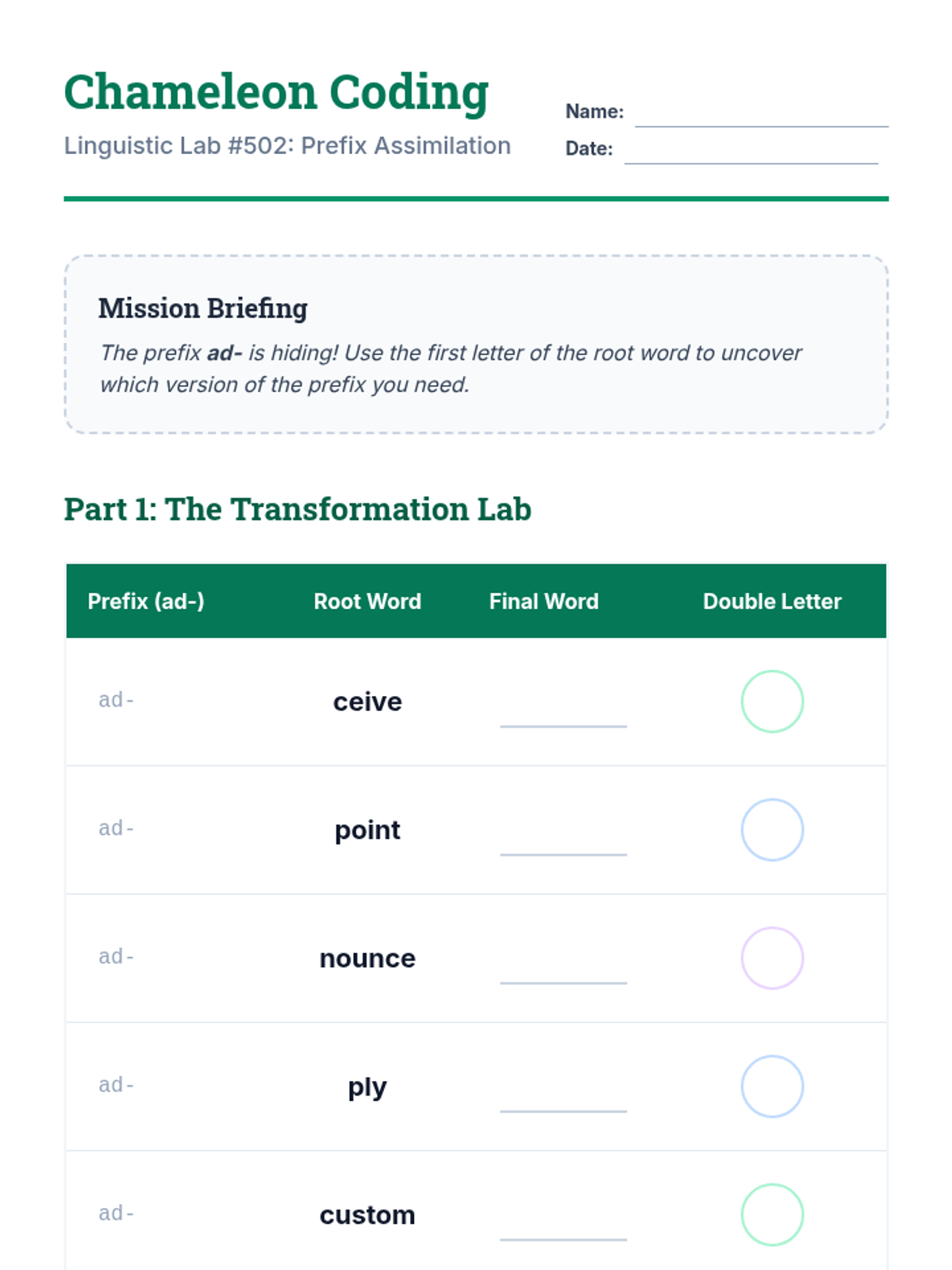
A worksheet for practicing prefix assimilation with ad-, requiring students to combine prefixes with roots and identify correct spellings.
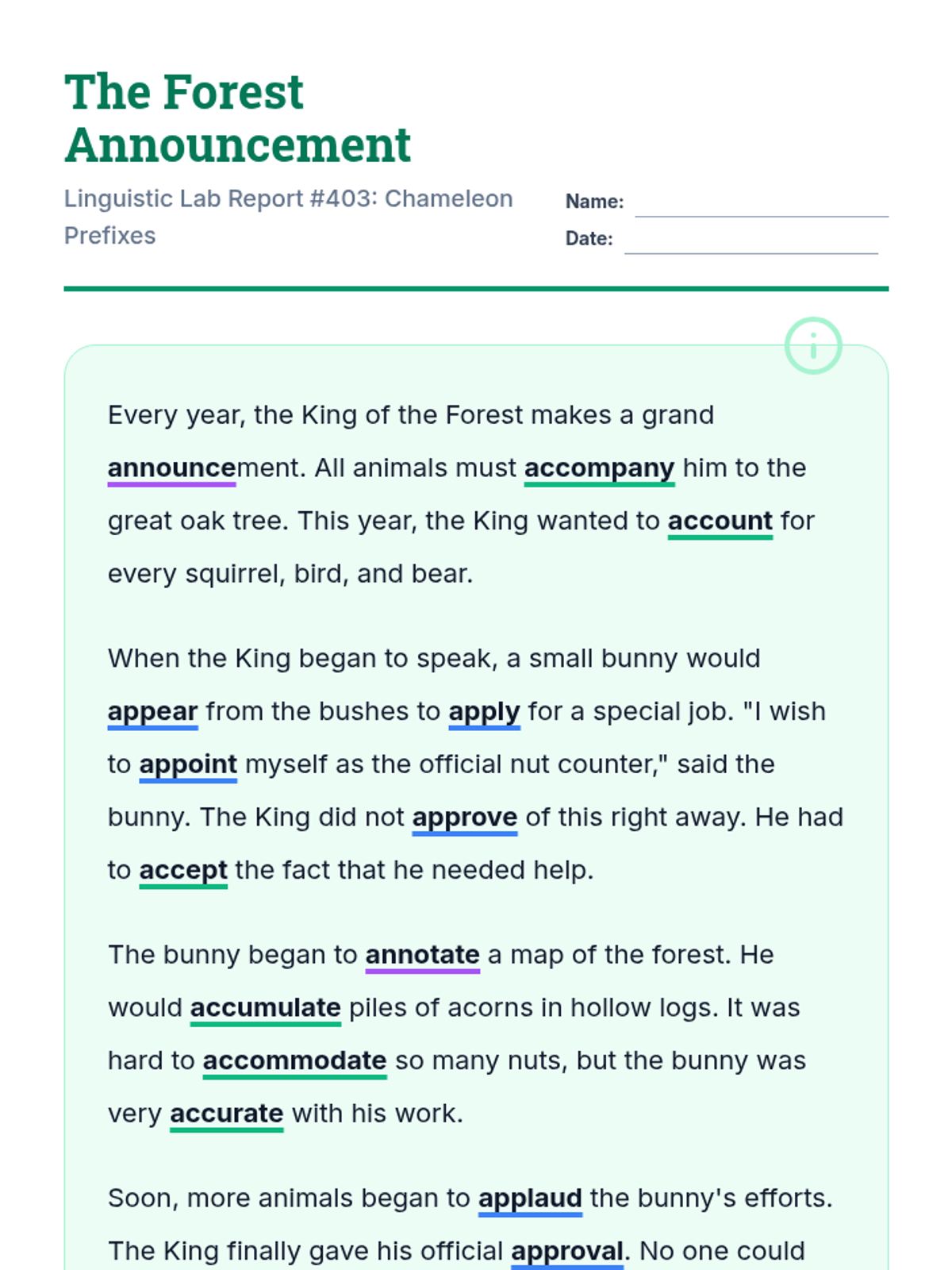
A decodable passage focusing on words with the assimilated prefixes ac-, ap-, and an-, with visual color-coding to support pattern recognition.
Instructional slides explaining the "chameleon prefix" rule where the prefix 'ad-' changes its spelling to match root words starting with 'c', 'p', or 'n'.
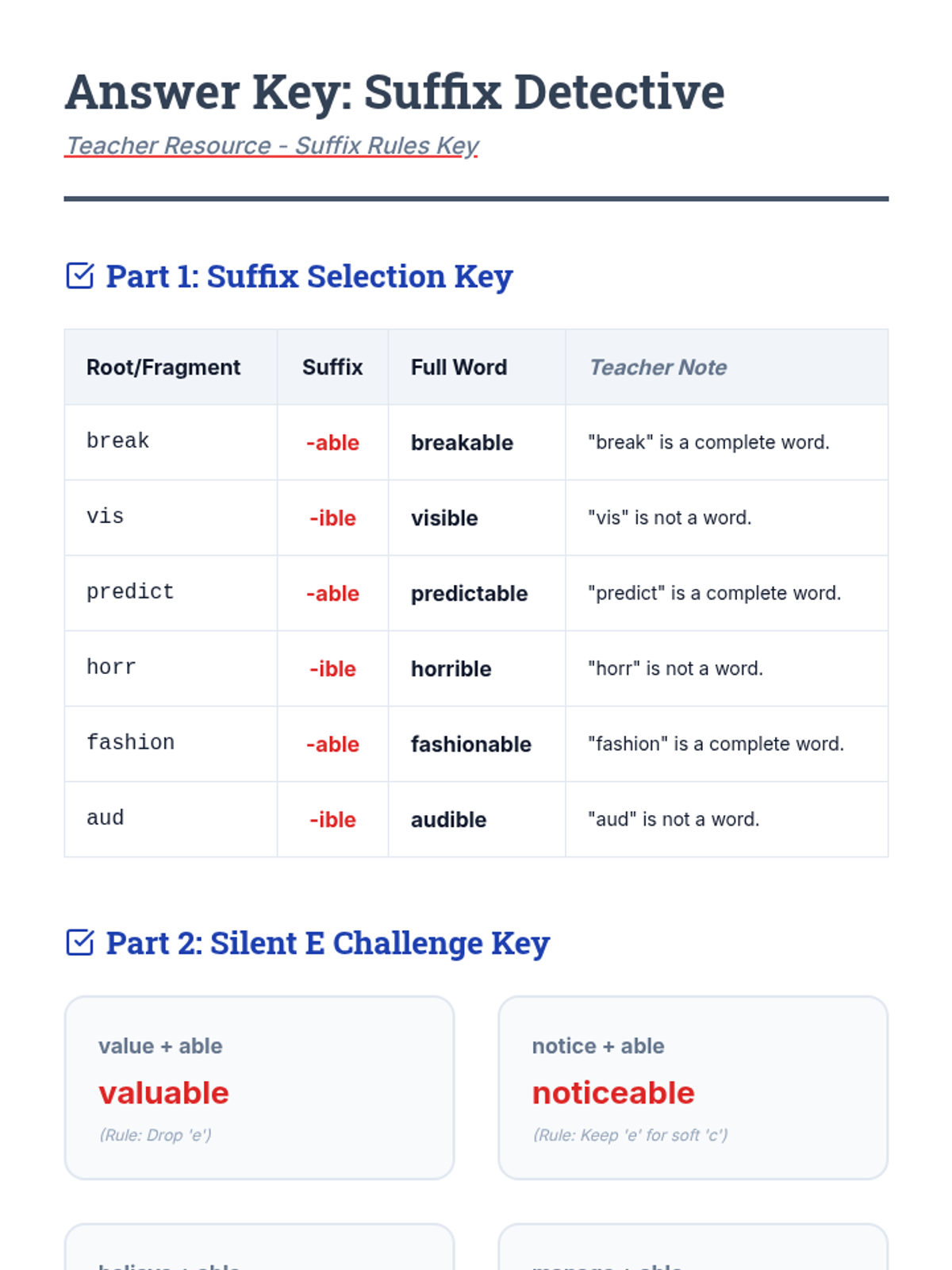
Teacher answer key for the Suffix Detective Worksheet, including explanations for the root word and silent 'e' spelling rules.
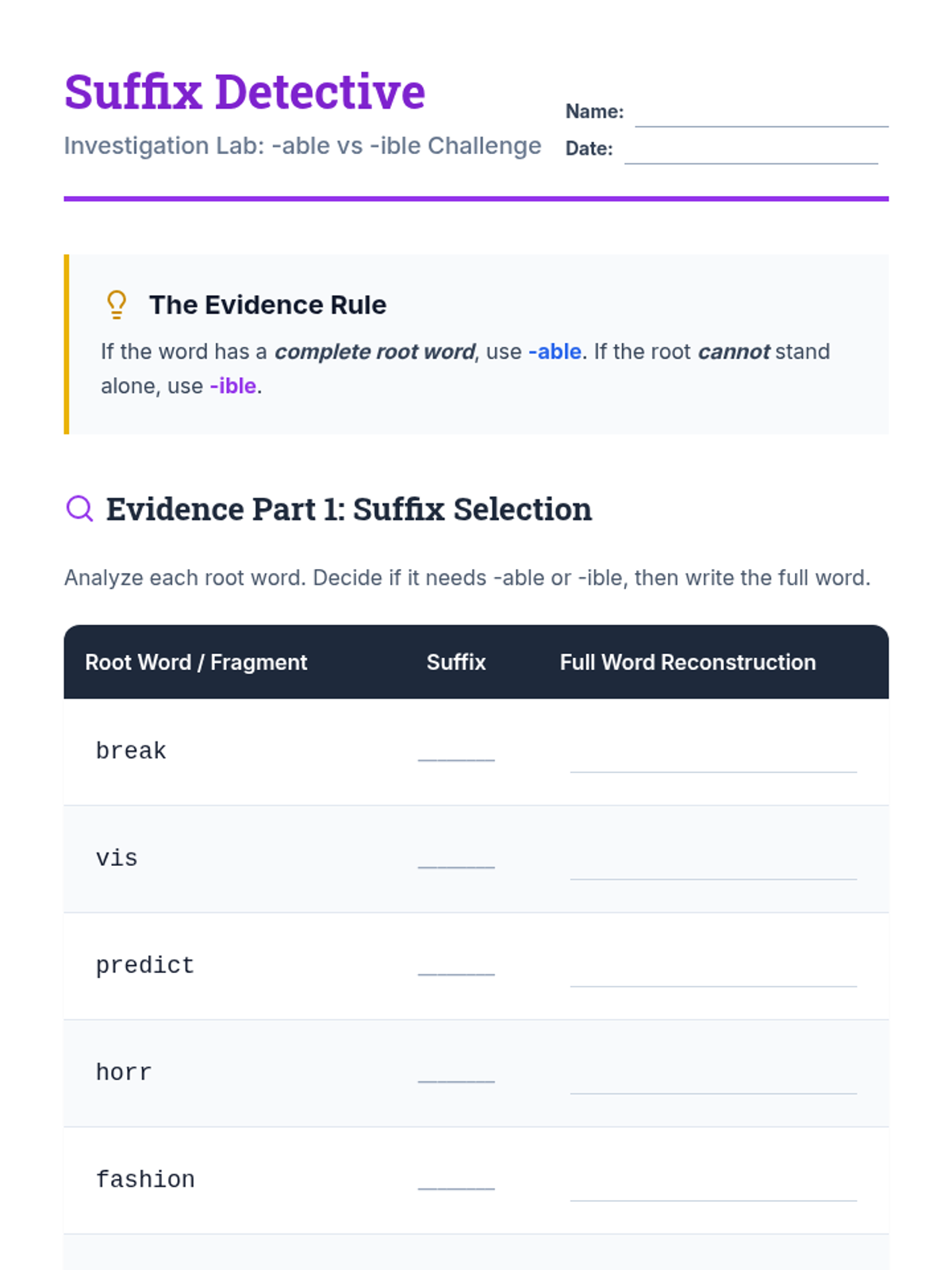
A practice worksheet for students to apply the root word rule to identify correct -able and -ible spellings, including the special case of silent 'e'.
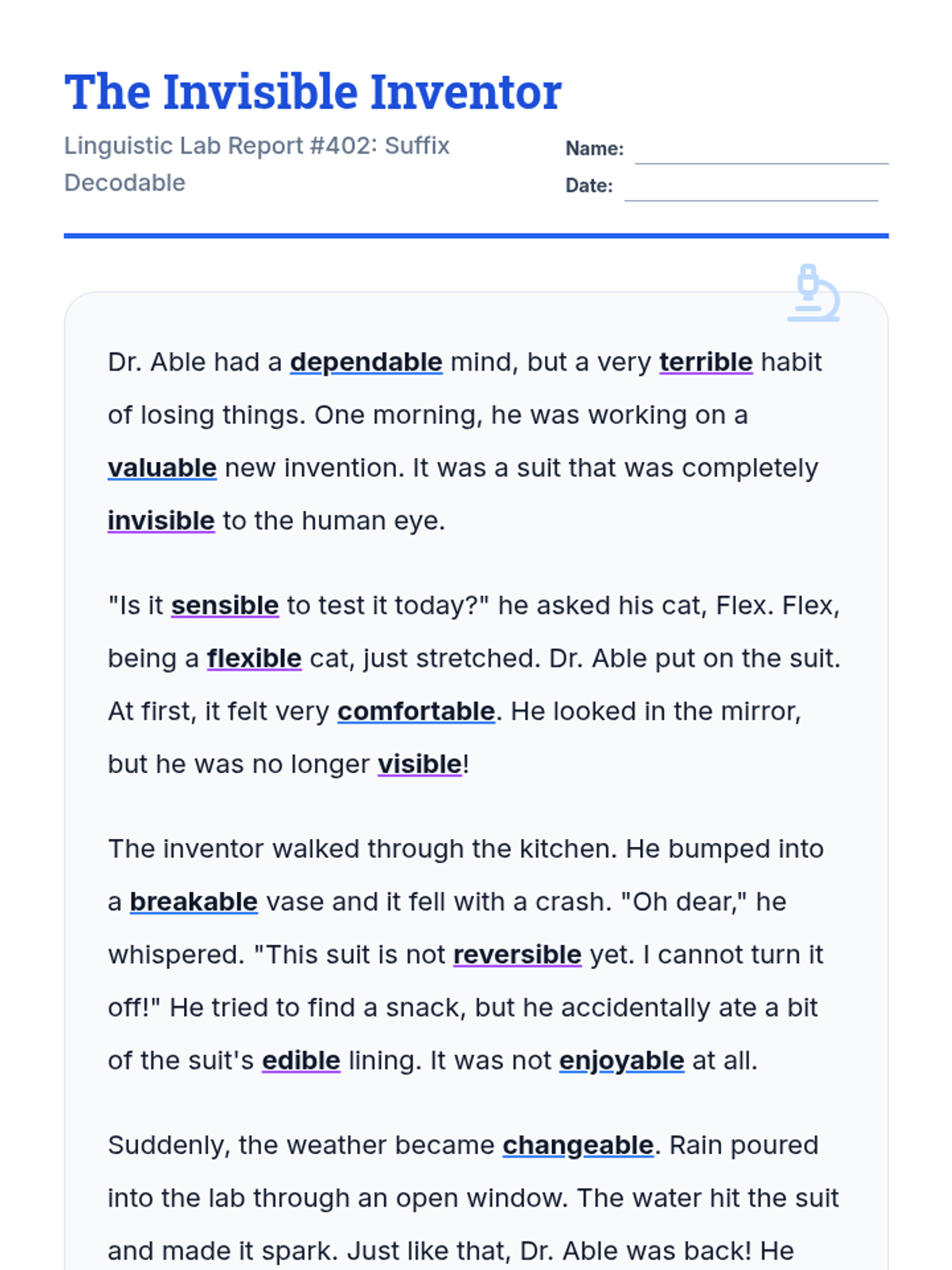
A decodable passage featuring numerous -able and -ible words, with visual coding to help students identify the root word rule in action. Updated with more writing space for review questions.
Instructional slides explaining the root word rule for using the -able and -ible suffixes, including examples and special cases for words ending in silent 'e'. Increased font sizes for better visibility.
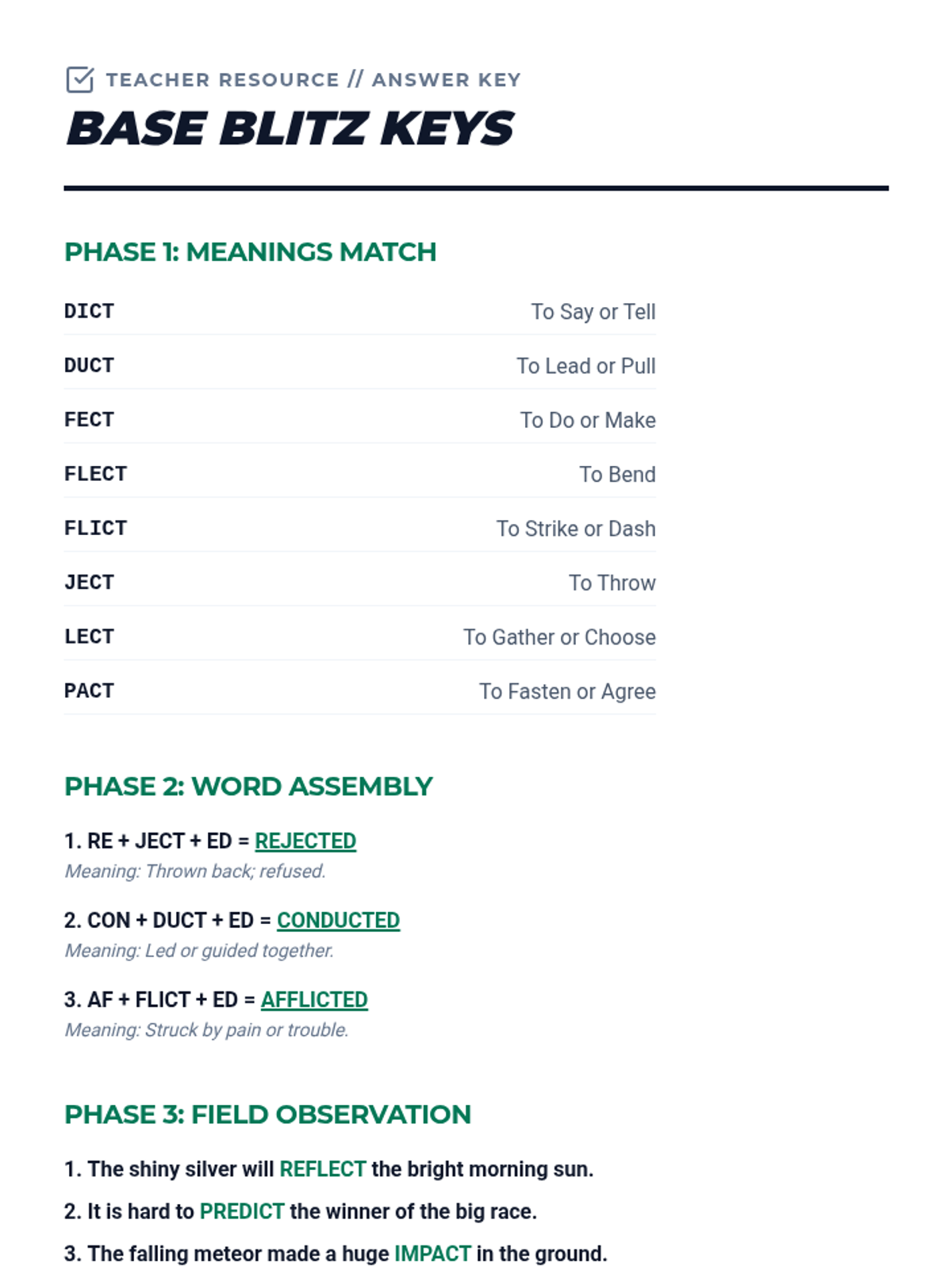
A comprehensive answer key and teaching guide for the Decoder Mission Log Worksheet, providing correct answers and instructional tips for Latin bases.
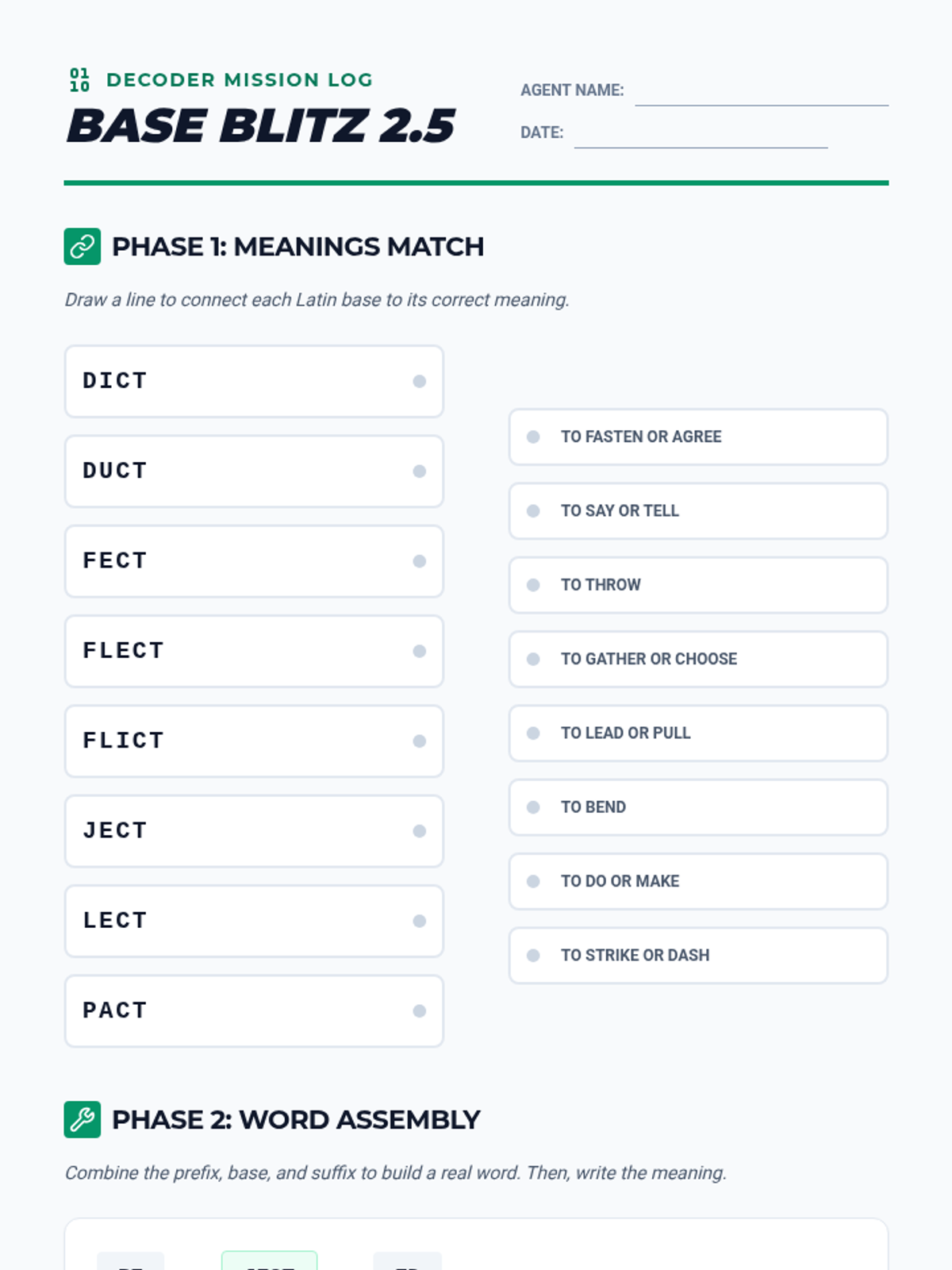
A structured student worksheet for practicing Latin bases dict, duct, fect, flect, flict, ject, lect, and pact. Includes matching, word building, and sentence completion exercises.
A high-energy presentation introducing eight Latin bases (dict, duct, fect, flect, flict, ject, lect, pact) with clear definitions, visual icons, and interactive word-building challenges.
A visual slide deck for grades 4-8 introducing word parts (Greek and Latin roots, prefixes, suffixes). It features a sleek 'Decoder' theme with high-contrast visuals, clear definitions, and interactive decoding examples.
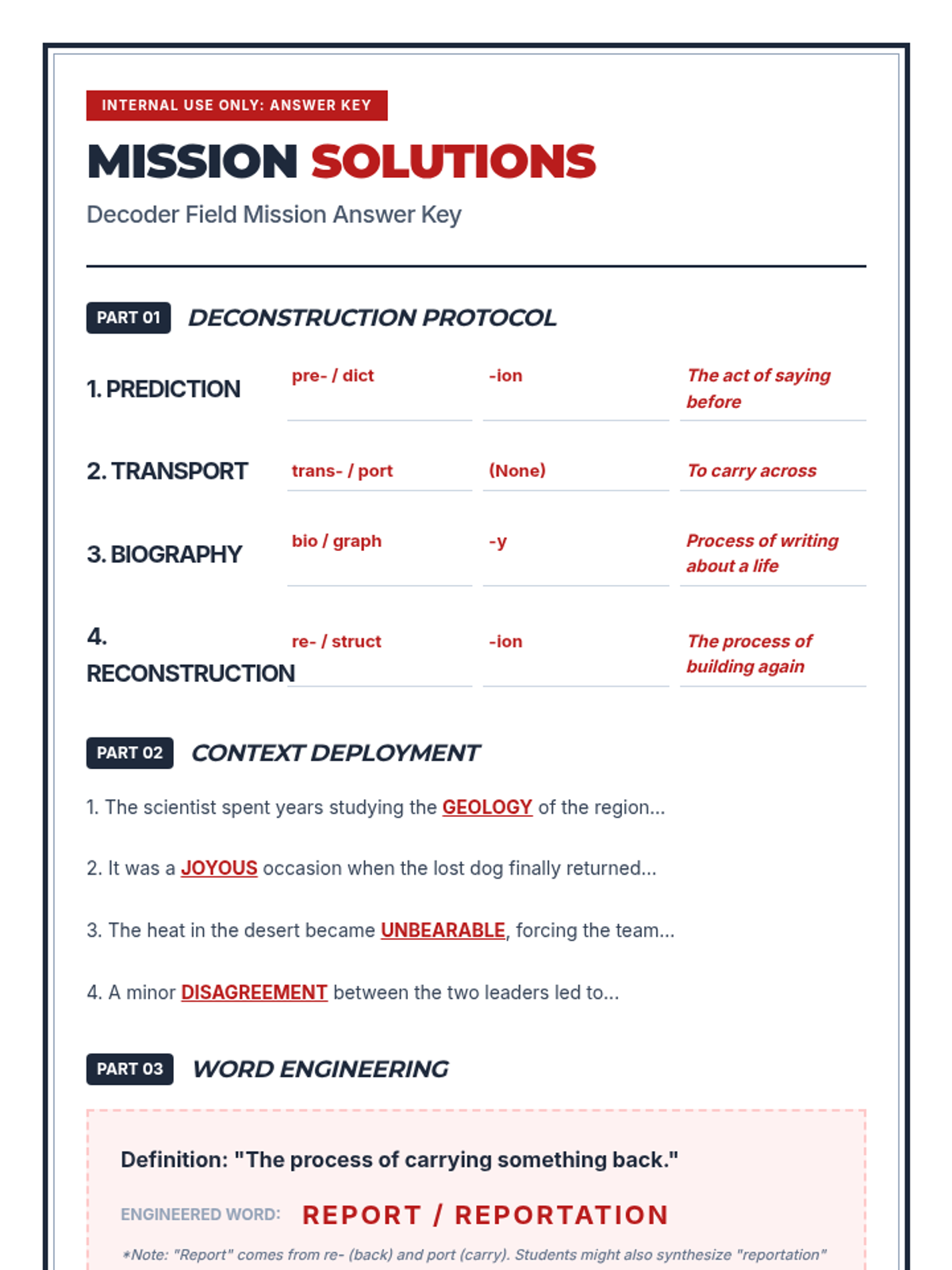
A teacher answer key for the Word Parts Decoder Field Mission worksheet, featuring deconstructed word components, correct context application, and engineered word solutions.
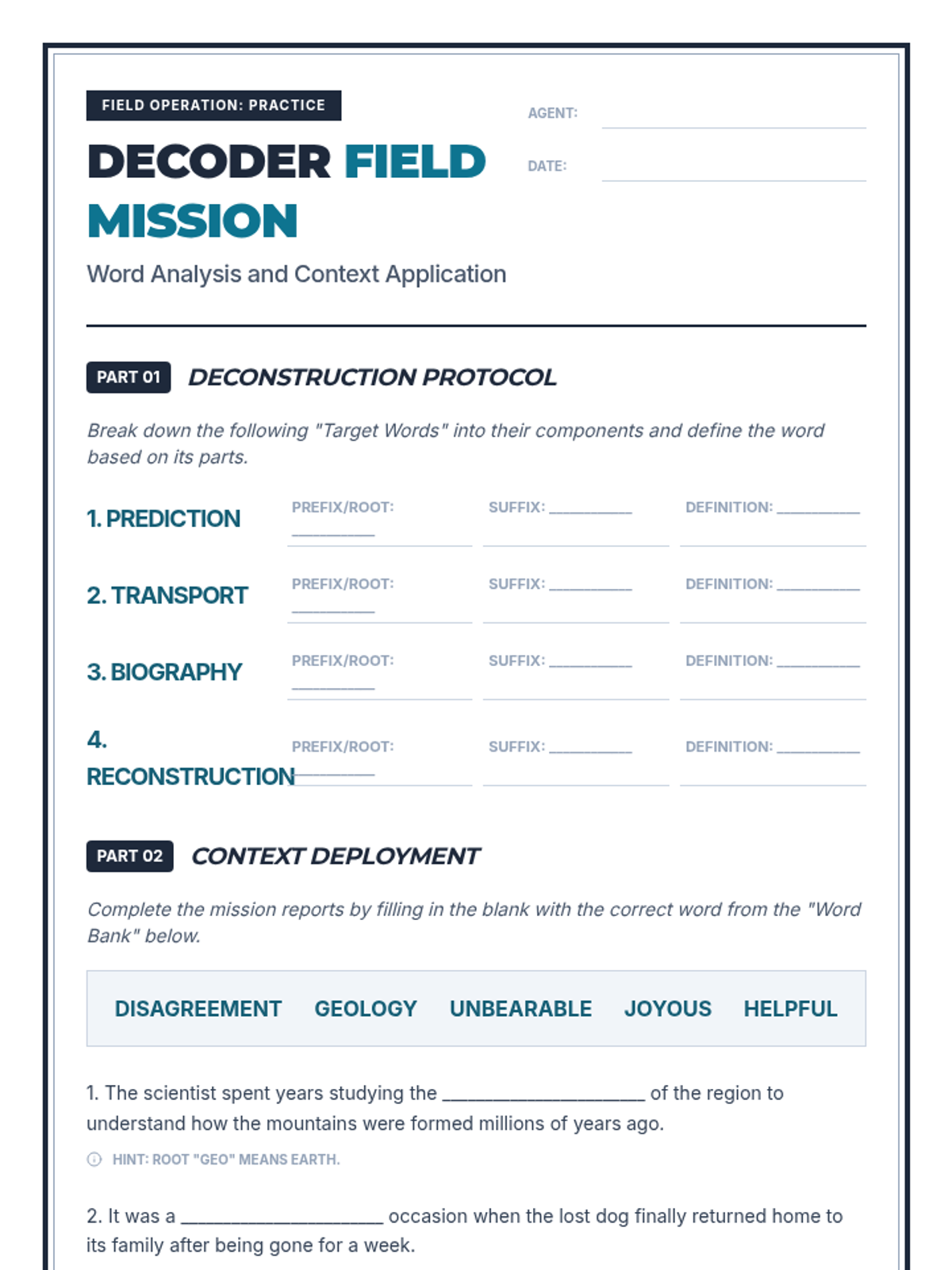
A student practice worksheet for grades 4-8 designed to accompany the Word Parts Decoder Reference Chart. It includes word deconstruction, context application, and word engineering exercises to reinforce understanding of Greek and Latin roots, prefixes, and suffixes.
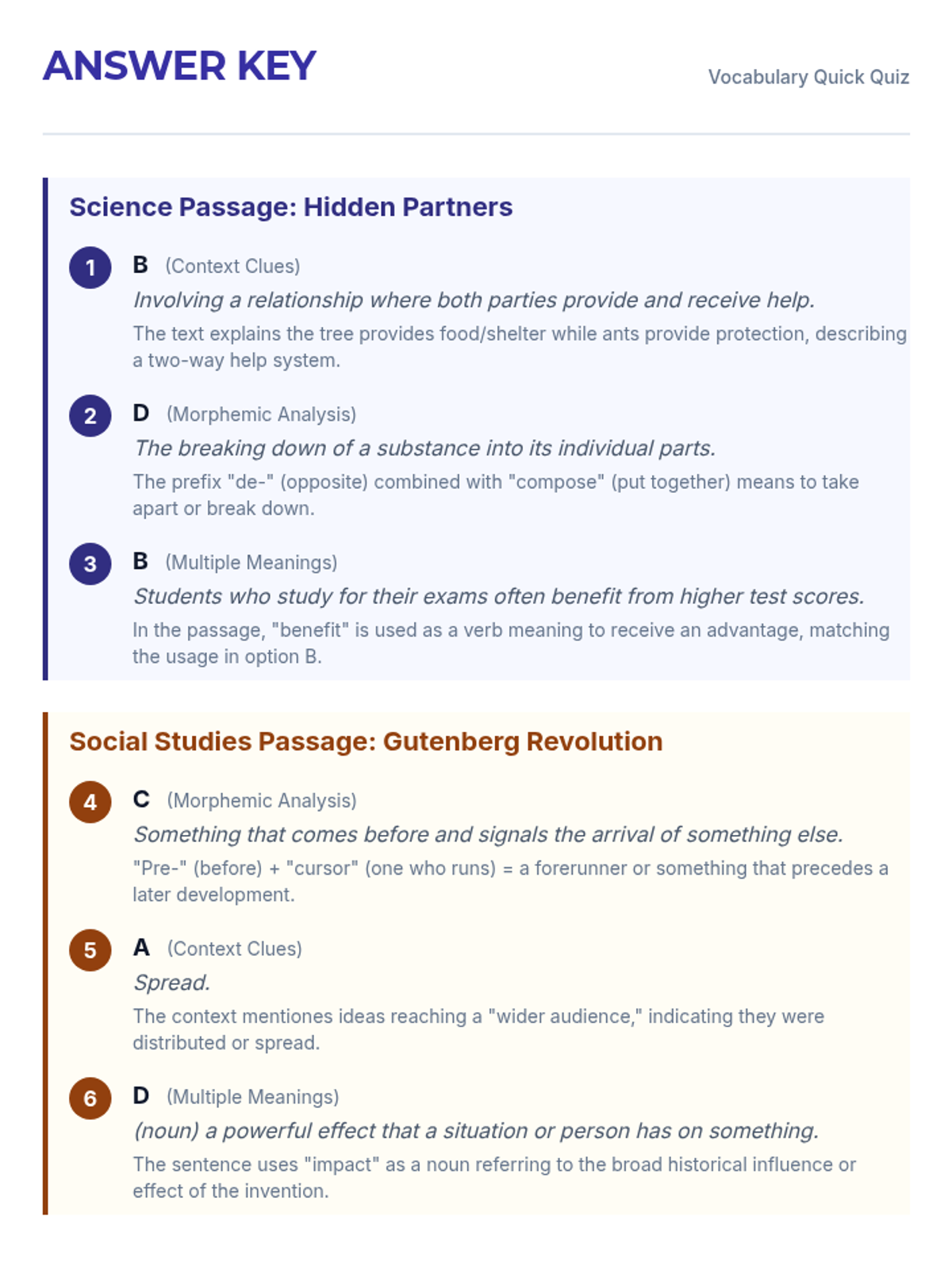
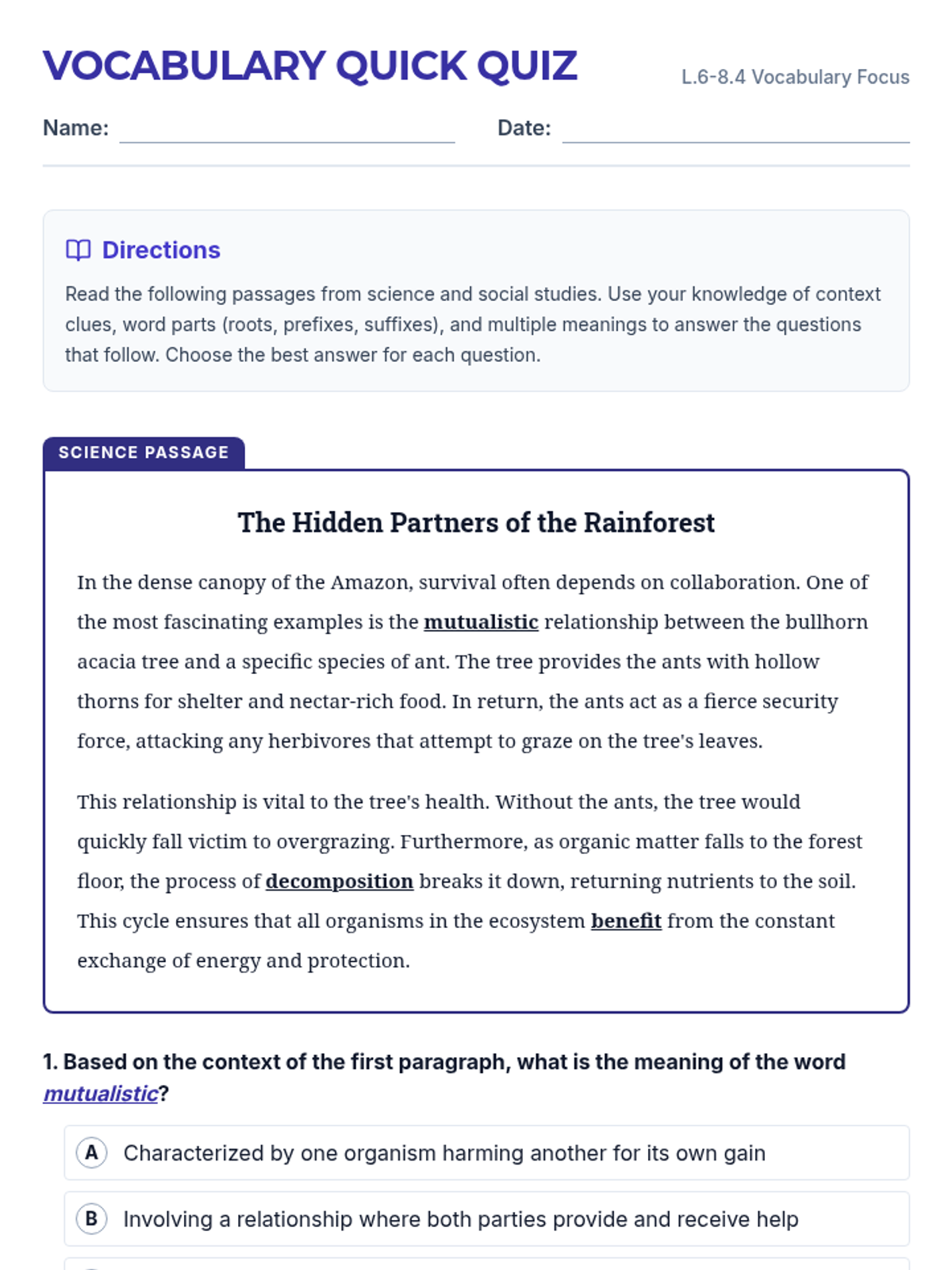
The answer key for the Vocabulary Quick Quiz, including correct answers, question types, and explanations for each choice.
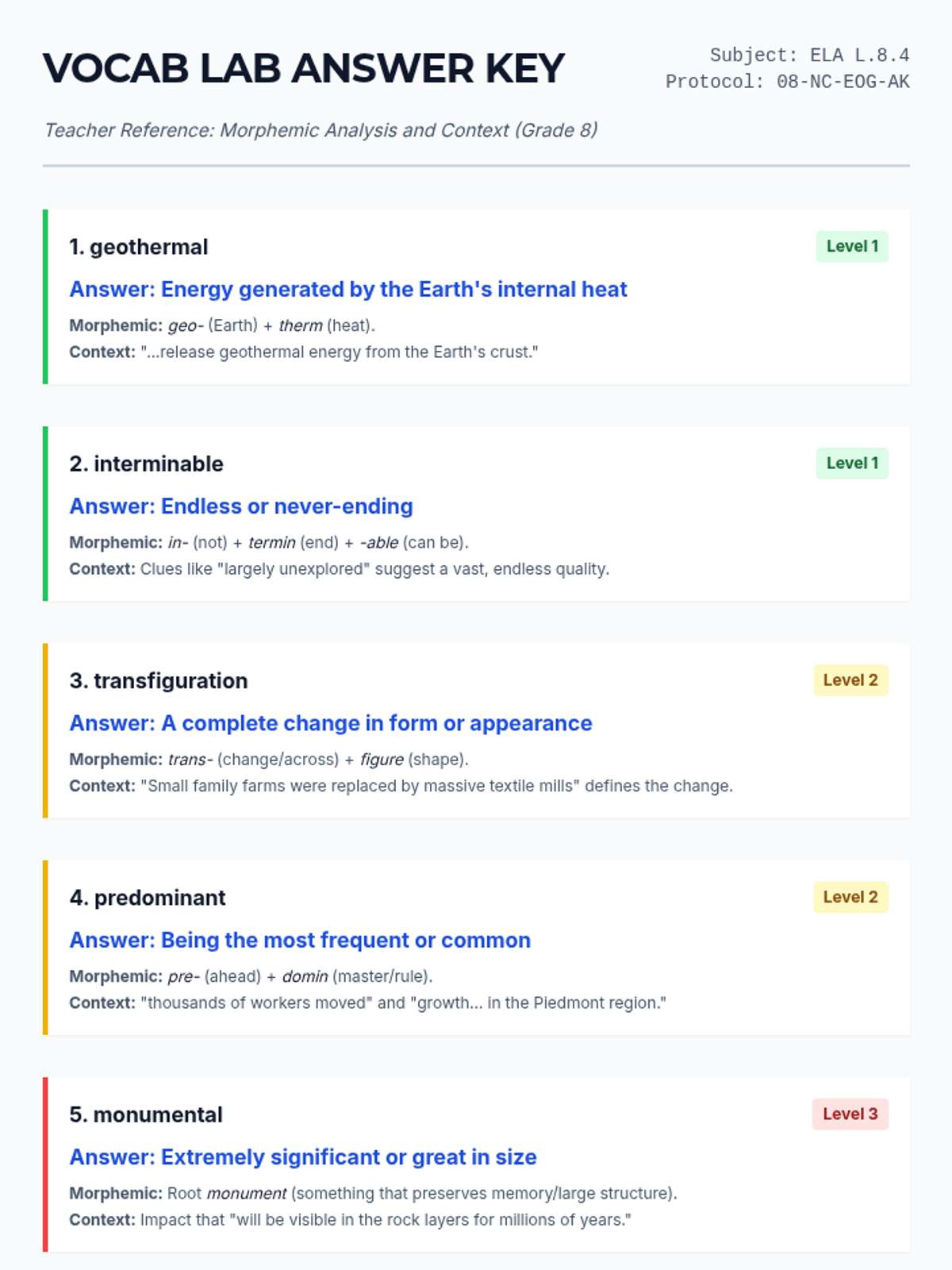
The teacher answer key for the Vocab Lab Worksheet, including detailed breakdowns for each vocabulary question and instructional notes on scaffolding.
A 6-question EOG-style vocabulary quiz featuring cross-curricular passages in Science and Social Studies. It tests context clues, morphemic analysis, and multiple meanings.
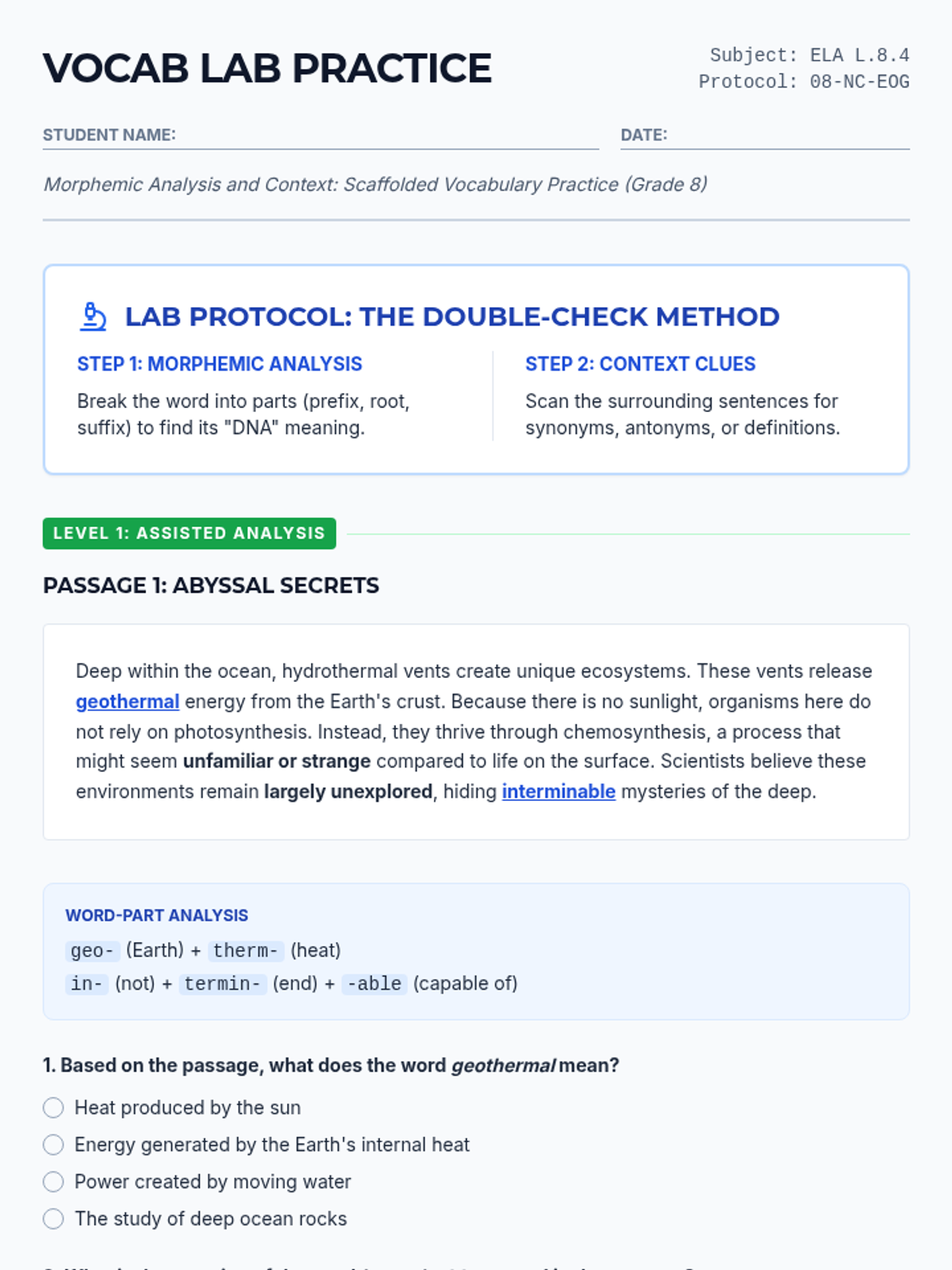
A scaffolded vocabulary practice worksheet for Grade 8 students, focusing on morphemic analysis and context clues through science and social studies passages. Support levels fade across three sections to prepare students for independent EOG-style questions.
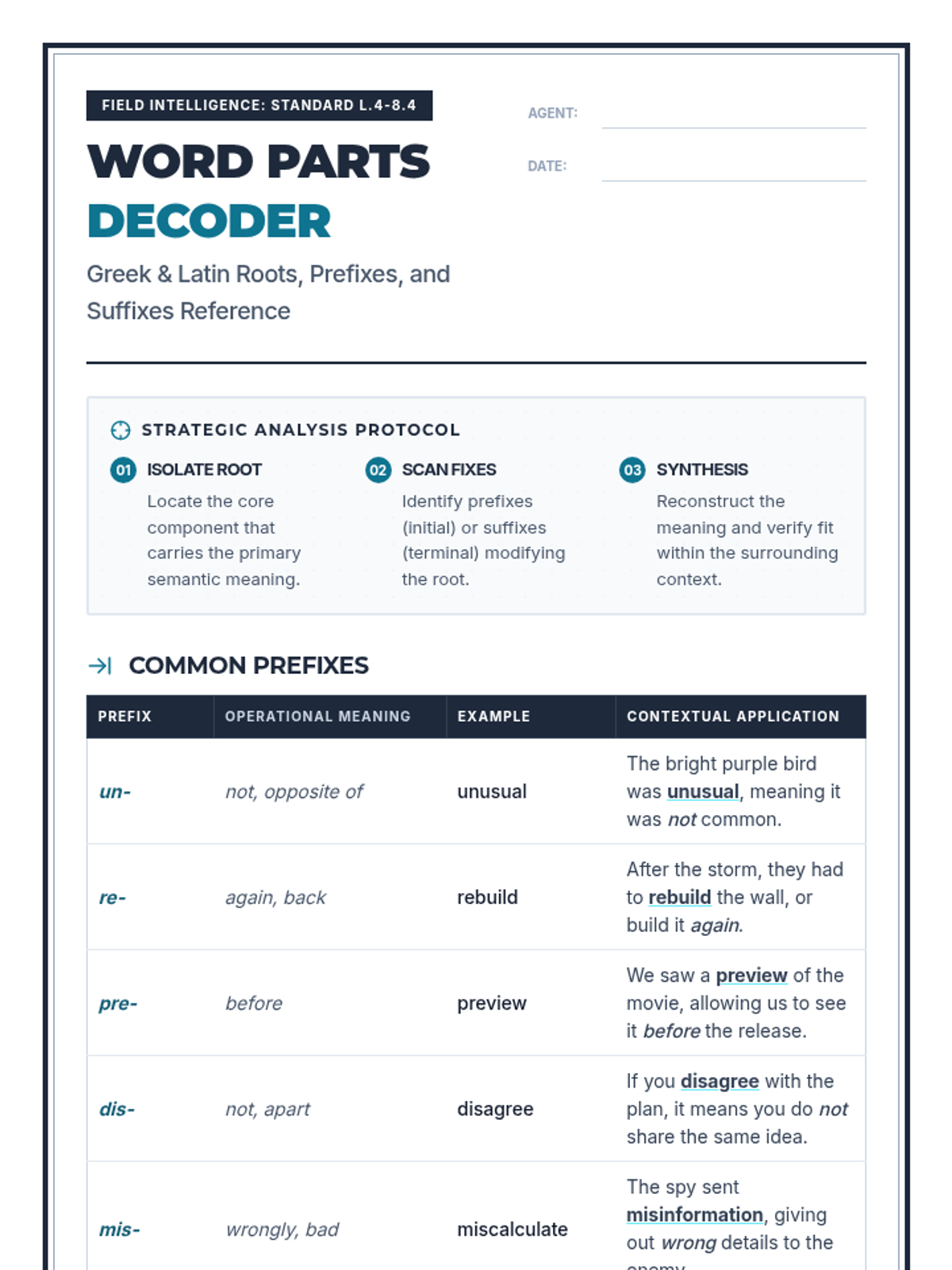
A student reference anchor chart for grades 4-8 focusing on vocabulary word parts (Greek and Latin roots, prefixes, and suffixes). It features a professional 'Decoder' blueprint theme with clear tables for meaning, examples, and contextual usage.
A revised vocabulary slide deck focusing on 15 multisyllabic words through a Revolutionary War theme. Features a 5-part reading passage with inference questions for each section, now optimized with a single-column layout for better visibility.
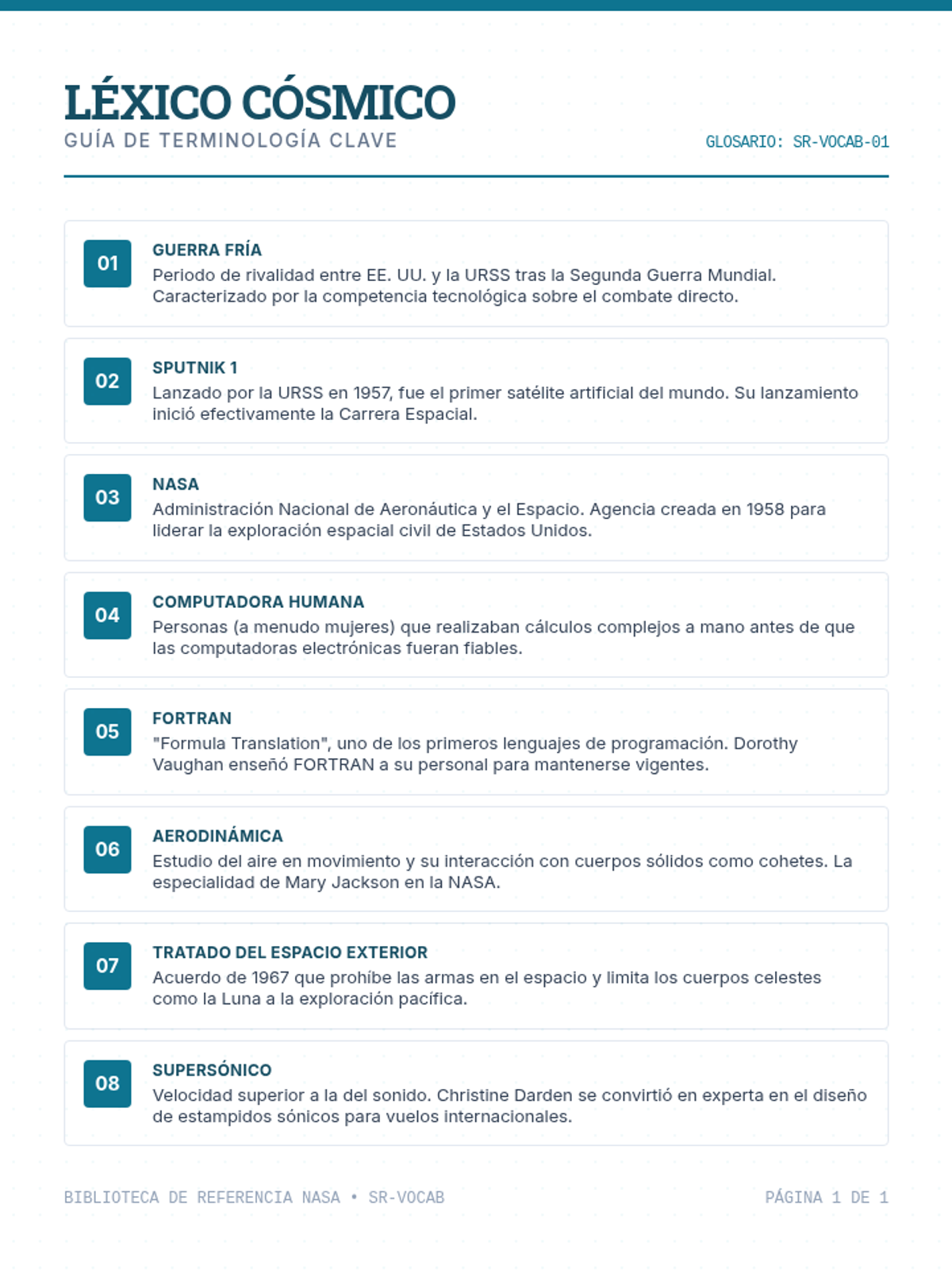
A one-page vocabulary reference sheet defining key terms from the Space Race and Hidden Figures reading, such as Cold War, Sputnik 1, NASA, and human computer.
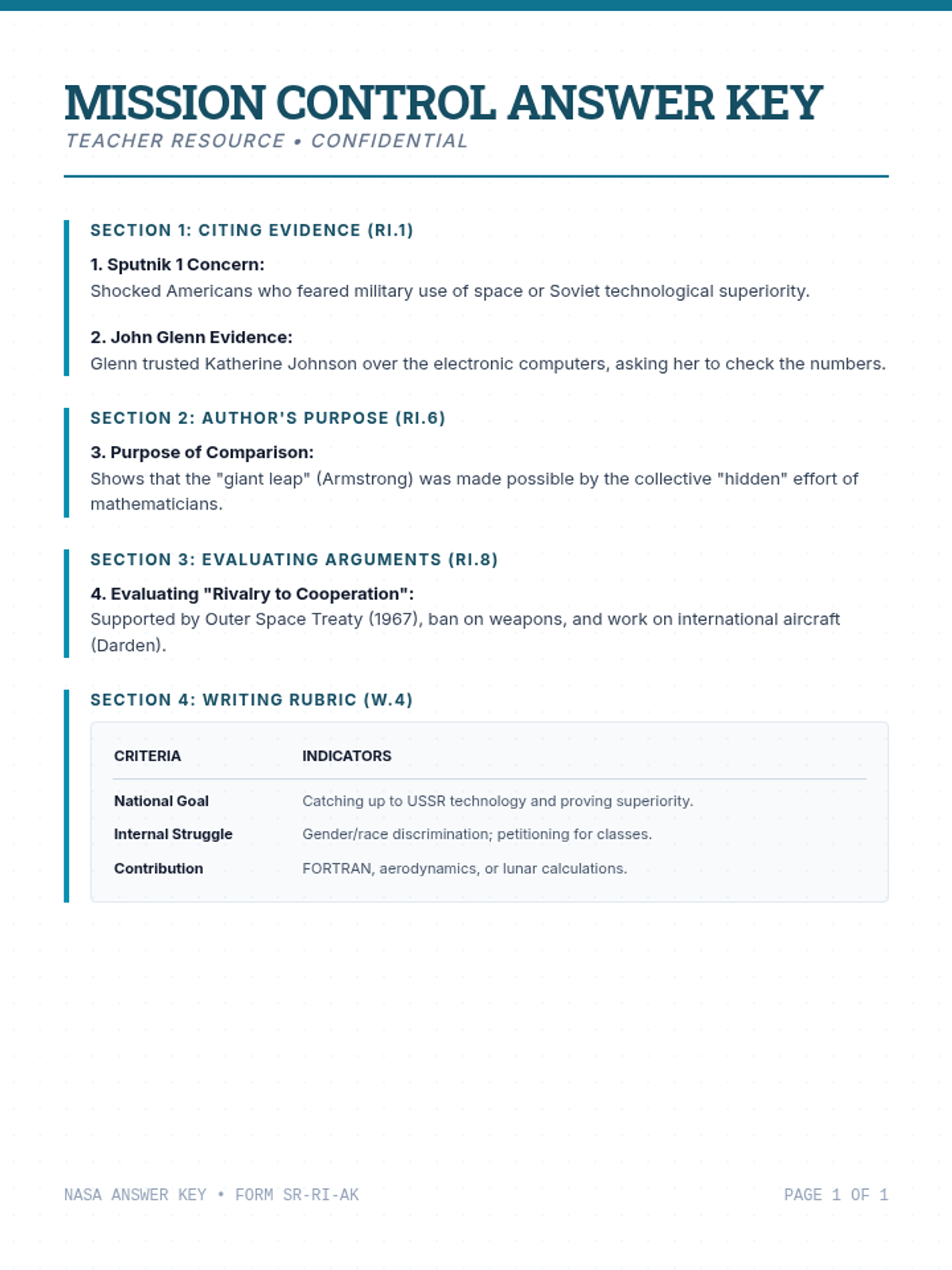
A one-page answer key for teachers, providing suggested responses and a grading rubric for the Mission Control Analysis worksheet with grade-specific references removed.
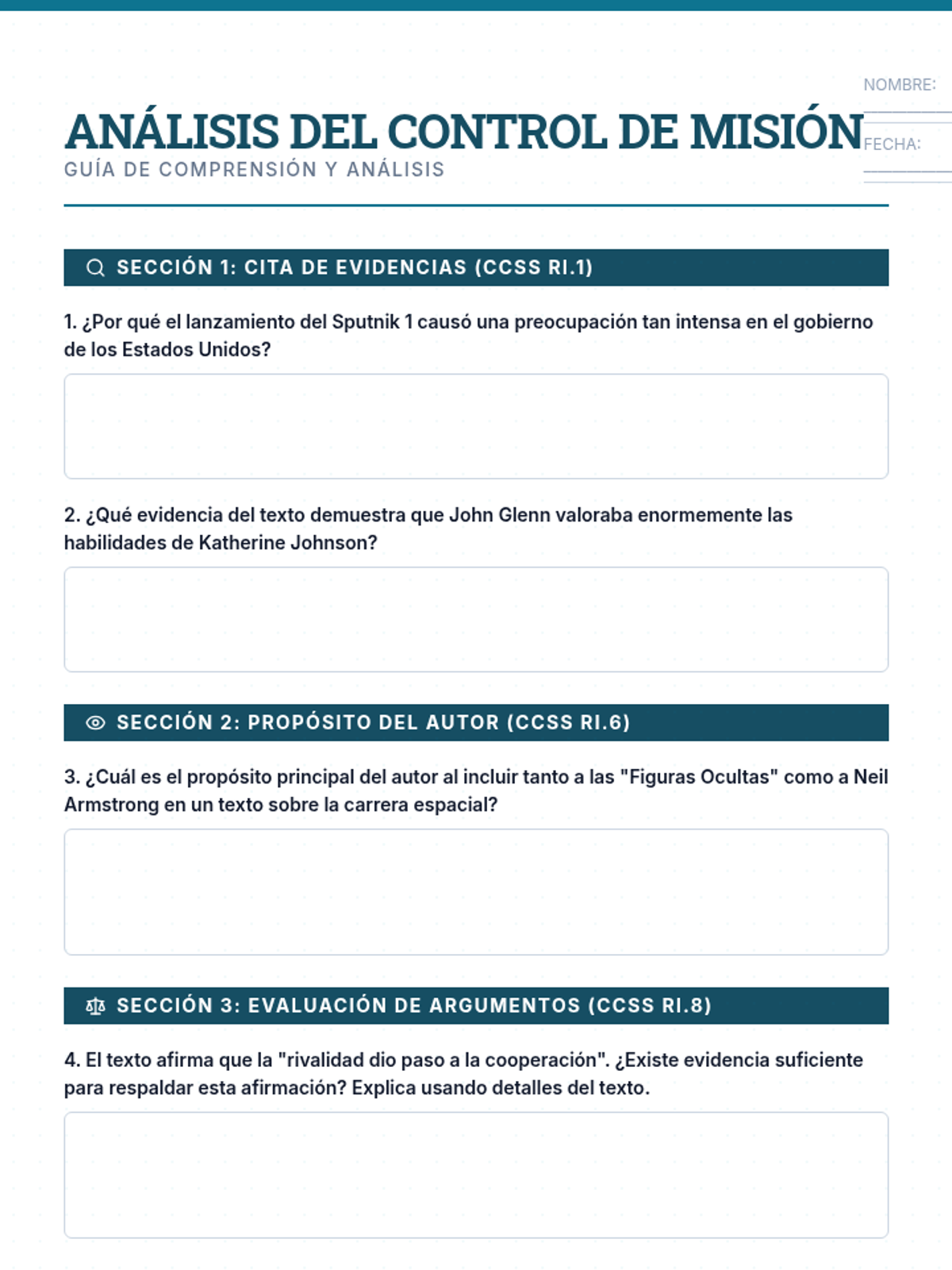
A two-page student worksheet containing text-dependent analysis questions, optimized for 8.5x11 printing with clear work areas and page breaks.
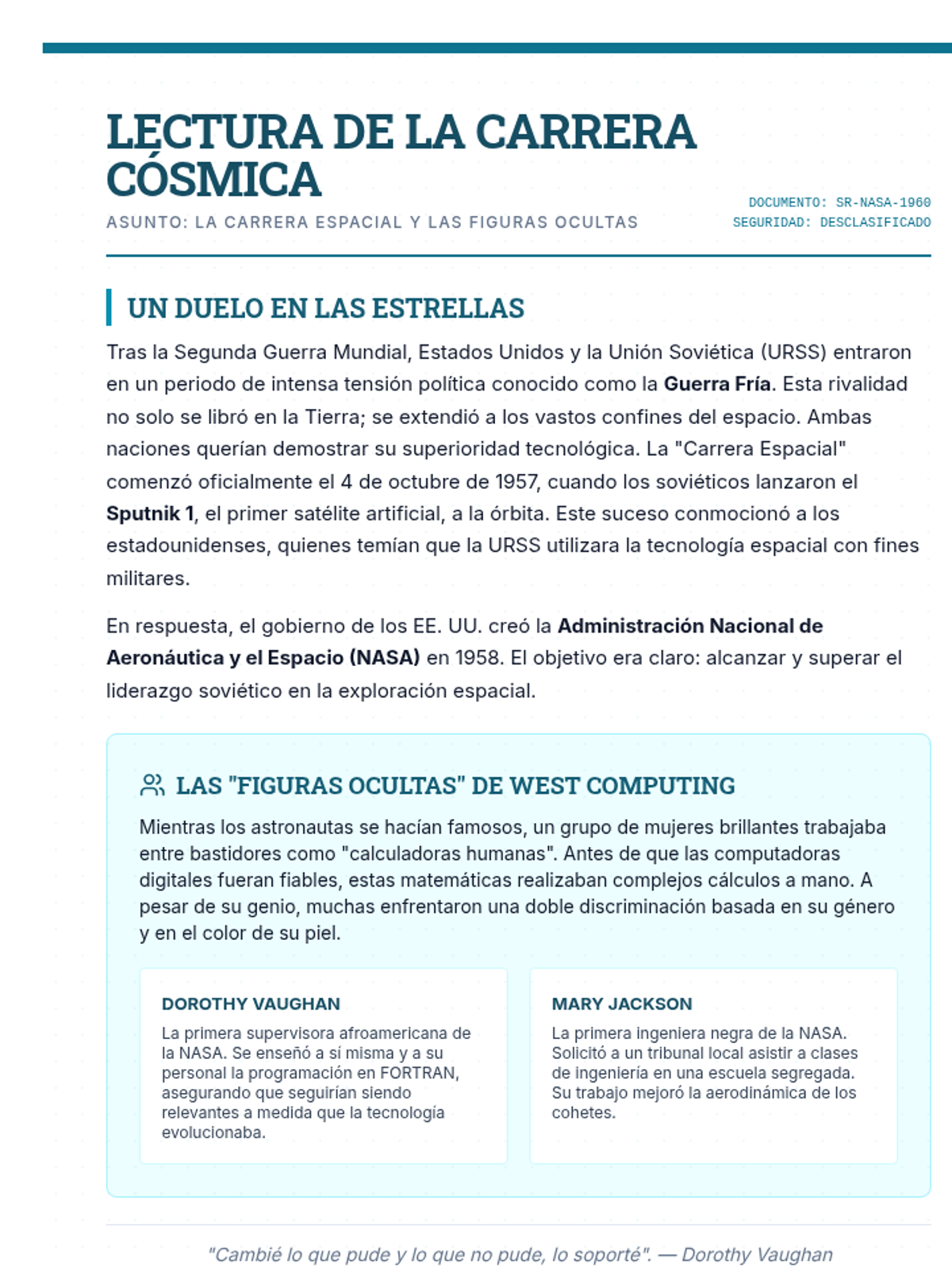
An informational reading text about the Space Race and the Hidden Figures, formatted for clean printing on 8.5x11 paper with 720x960 virtual dimensions and strict page breaks.
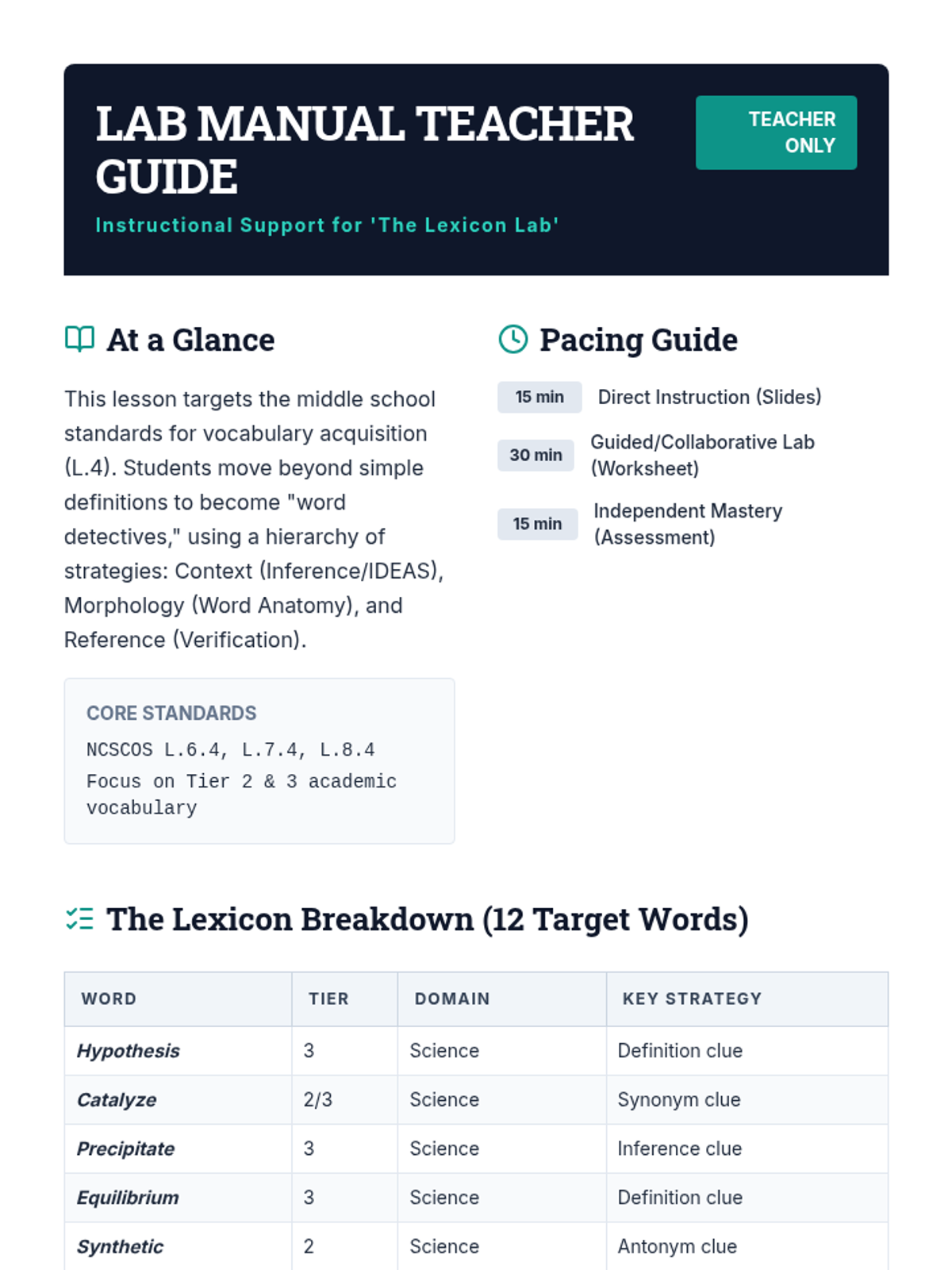
Teacher resource for 'The Lexicon Lab' including a lesson pacing guide, Tier 2/3 vocabulary classification for 12 target words, and full answer keys for student materials.
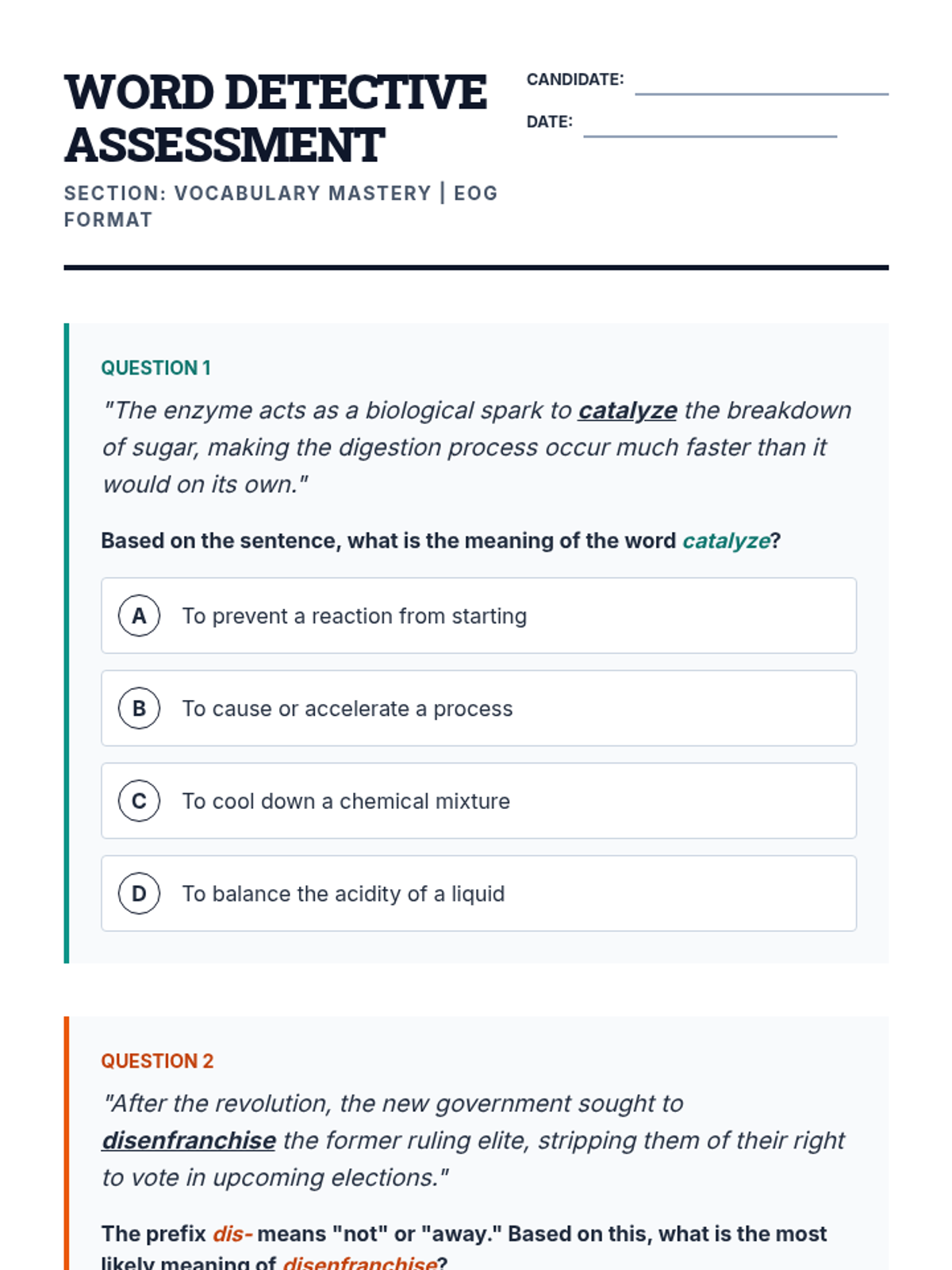
EOG-aligned vocabulary assessment featuring 6 multiple-choice questions. Questions target context clues (synonym/antonym), morphology (roots/prefixes), and reference material interpretation for academic vocabulary.
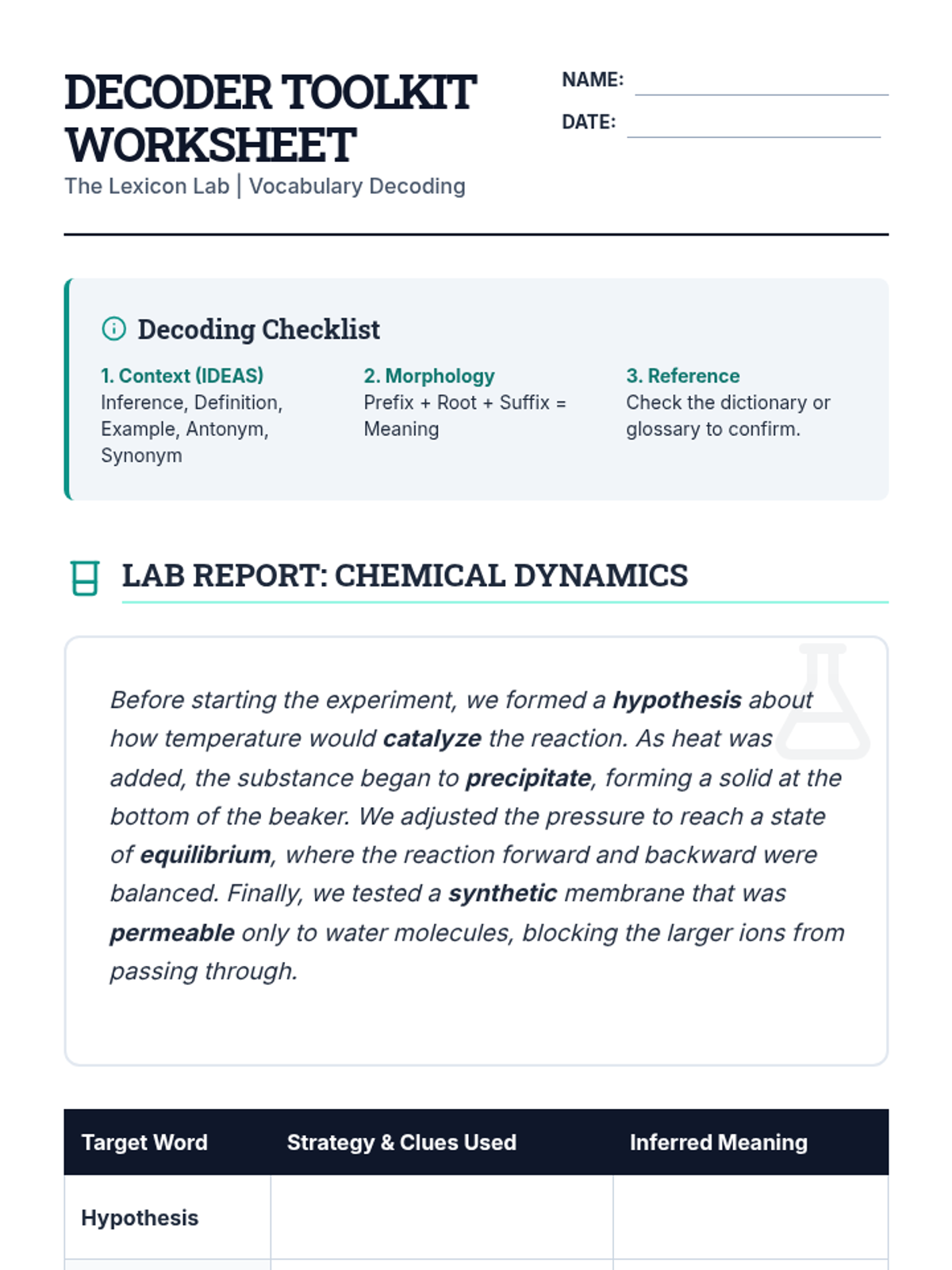
Comprehensive student worksheet containing science and social studies passages embedded with 12 target academic words. Features tables for context clue analysis, morphology breakdown exercises, and a dictionary skills verification section.
Interactive slide deck for 'The Lexicon Lab' lesson, introducing context clues (IDEAS), morphology (word anatomy), and reference materials strategies for decoding academic vocabulary.
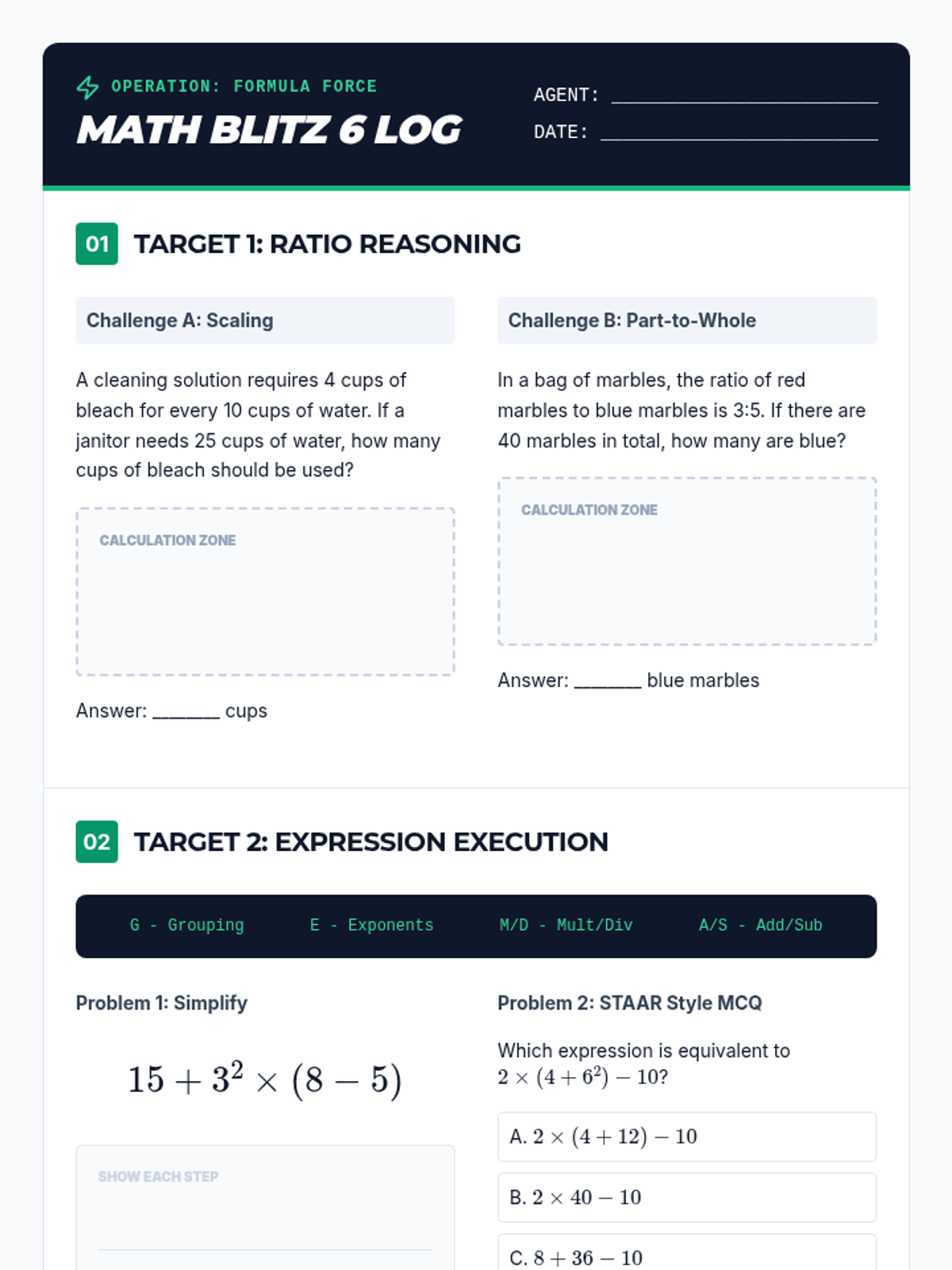
A high-intensity CFU worksheet for the 6th-grade Math STAAR Blitz, featuring tiered problems on ratios, order of operations, and one-step equations with dedicated "Calculation Zones."
A high-impact tactical slide deck for a 45-minute 6th-grade Math STAAR Blitz, focusing on ratio reasoning, order of operations, and one-step equations with higher-order thinking CFU questions.
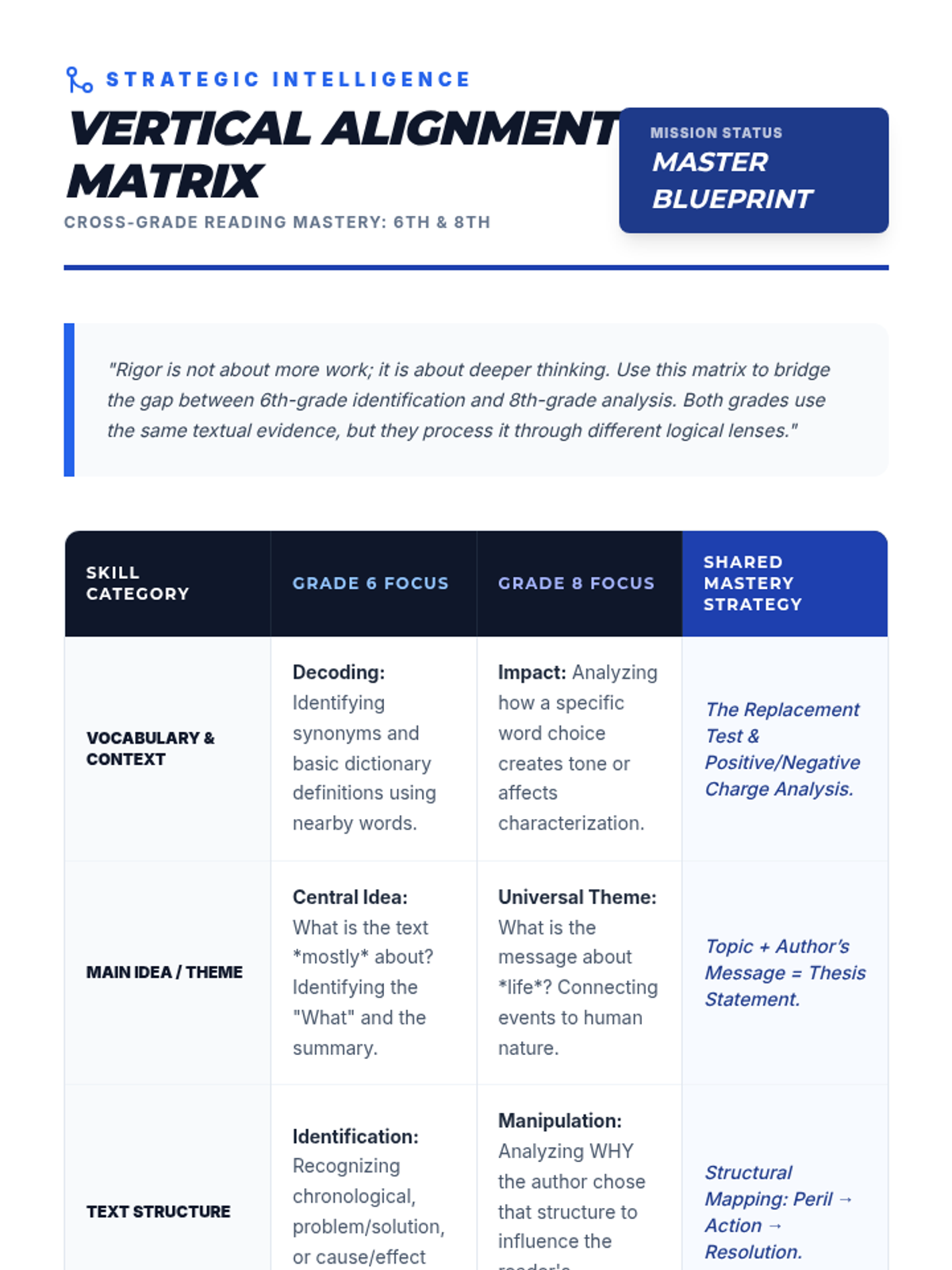
A high-rigor cross-reference matrix for teachers and students, outlining the complexity shift between Grade 6 and Grade 8 reading skills for vocabulary, theme, structure, and evidence analysis.
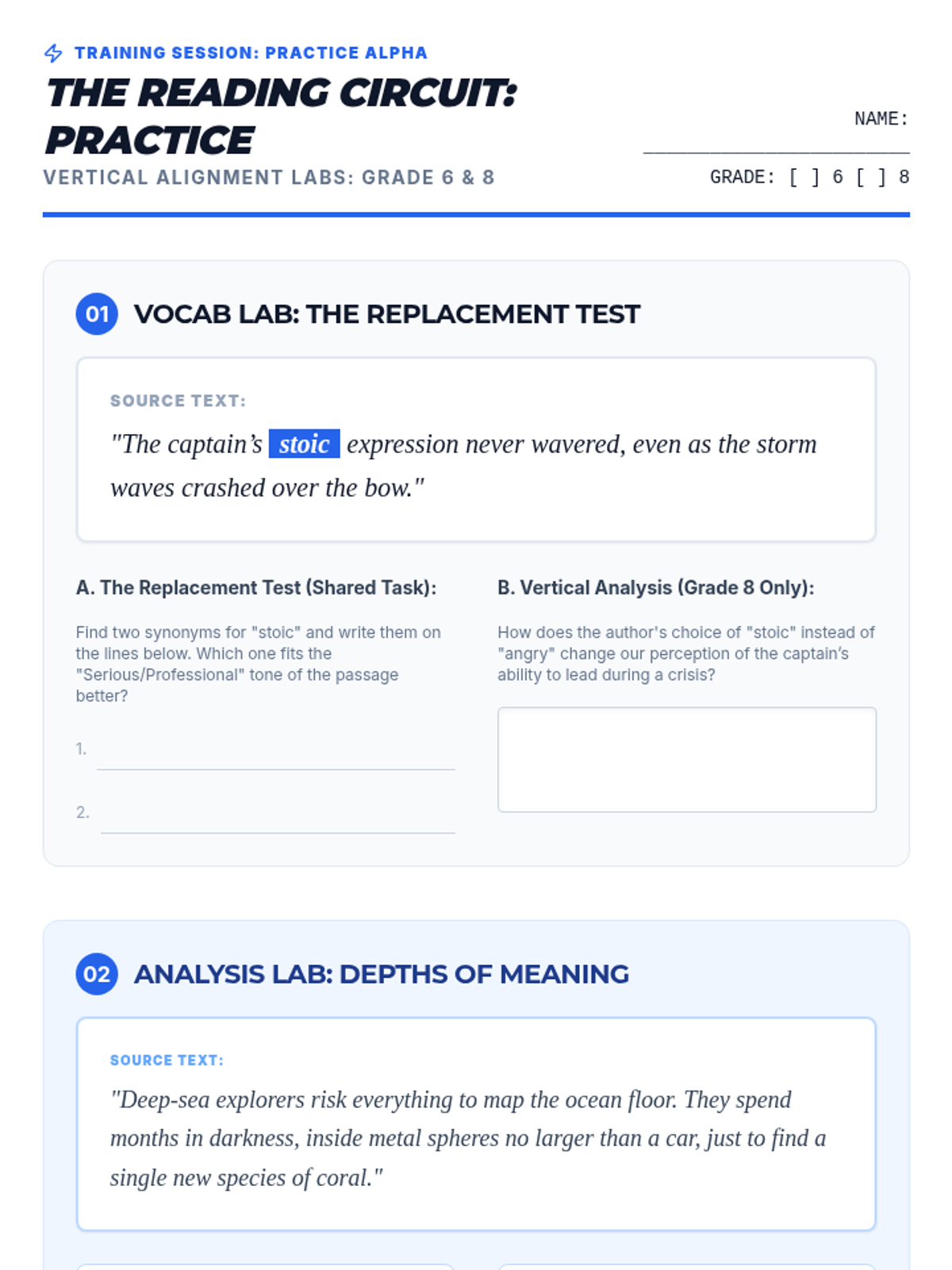
A practice handout containing the mini-passages and vocabulary examples from the Universal Reading Mastery slides, allowing students to practice vertical alignment skills before the main mission.
A high-rigor instructional slide deck for a combined middle school STAAR Blitz, focusing on vertical alignment, shared strategies, and tiered modeling for 6th and 8th-grade thinkers.
A high-rigor tactical slide deck for a middle school STAAR Blitz, featuring tiered strategies for 6th and 8th graders with higher-order thinking Check for Understanding (CFU) questions.
A dynamic 90-minute visual guide for the STAAR Blitz Resilience Mission, designed for combined 6th and 8th-grade reading instruction, now with enhanced instructional clarity and higher-order thinking Check for Understanding (CFU) questions.
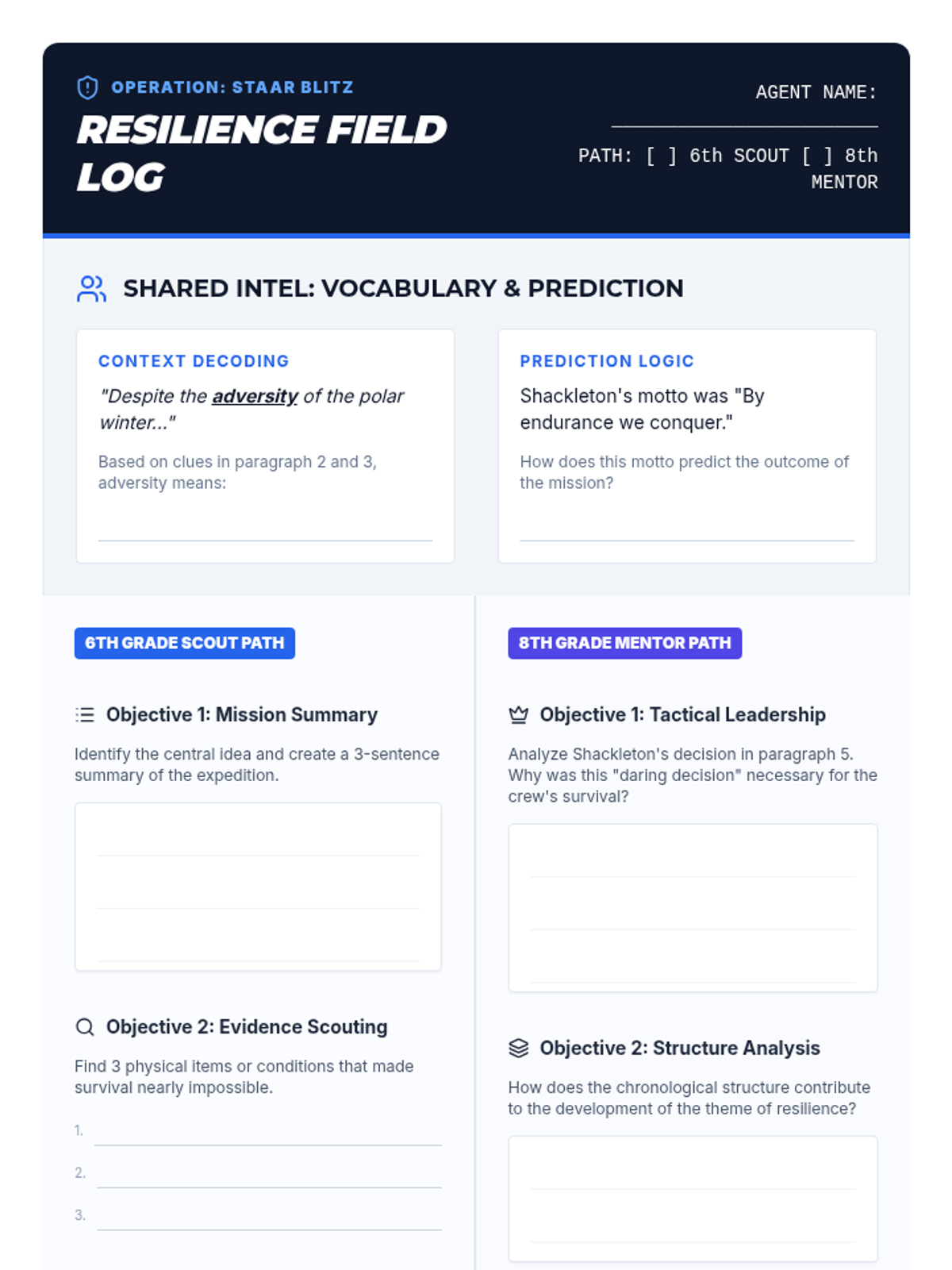
A tiered "Field Log" worksheet for the 6th and 8th-grade combined STAAR Blitz, featuring separate "Mission Paths" for each grade level while sharing the same story.
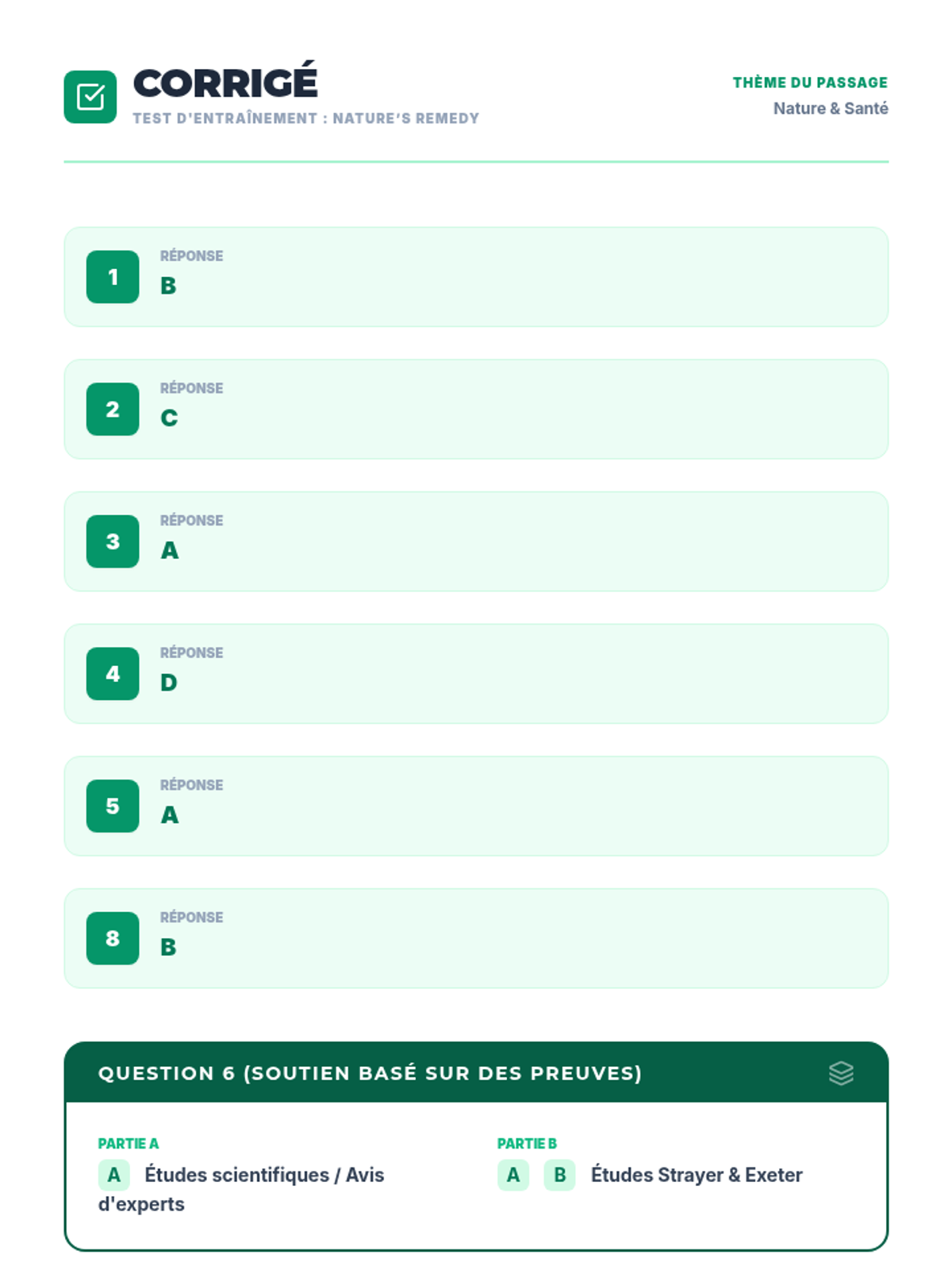
An answer key for the Nature’s Remedy Practice Test, following the same structural format as the Neural Narratives key to ensure consistency in grading and review.
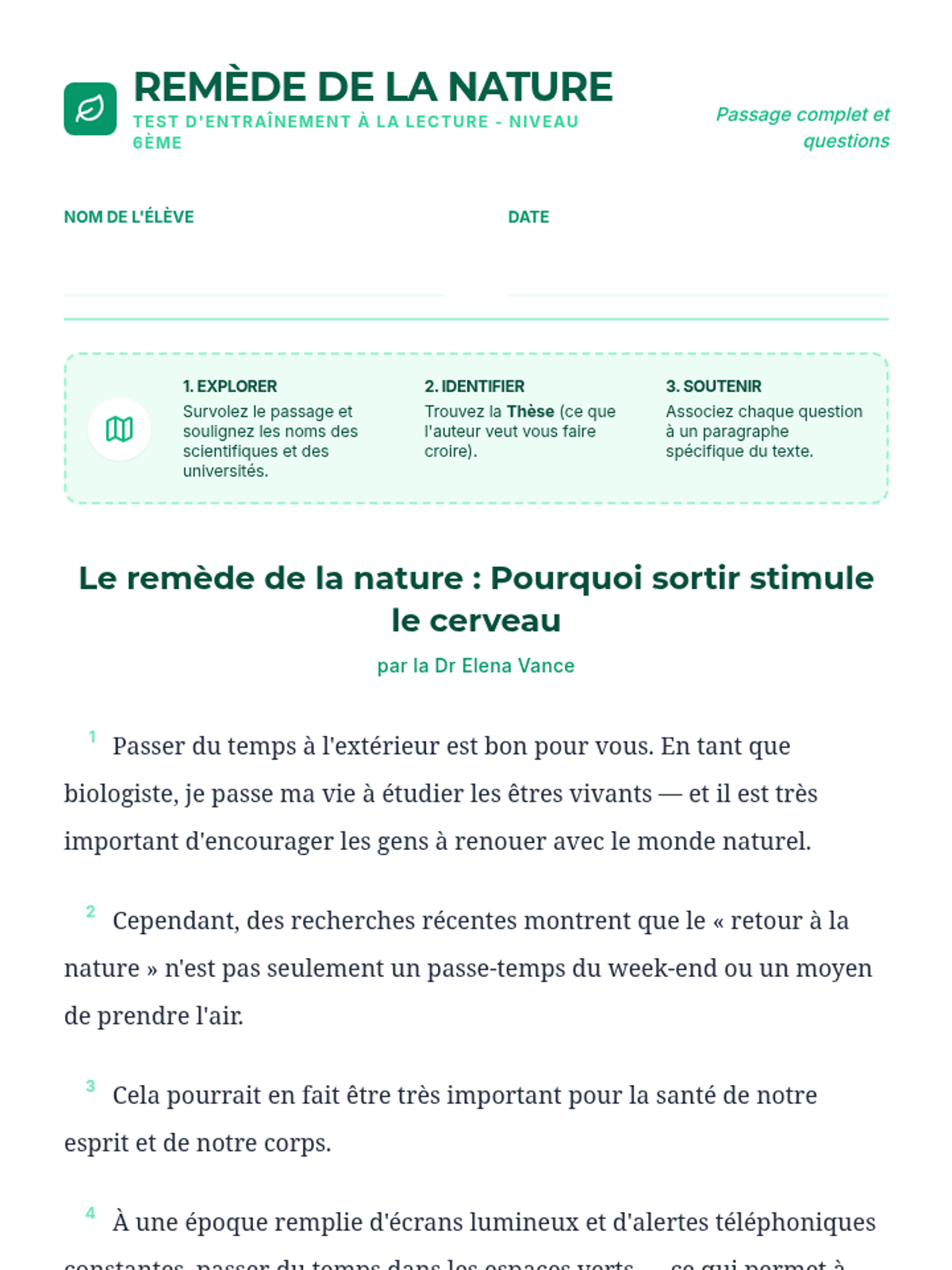
A parallel practice test using a new passage, 'Nature’s Remedy', simplified for 6th grade and featuring mirrored formatting and question types to provide a secondary review opportunity.
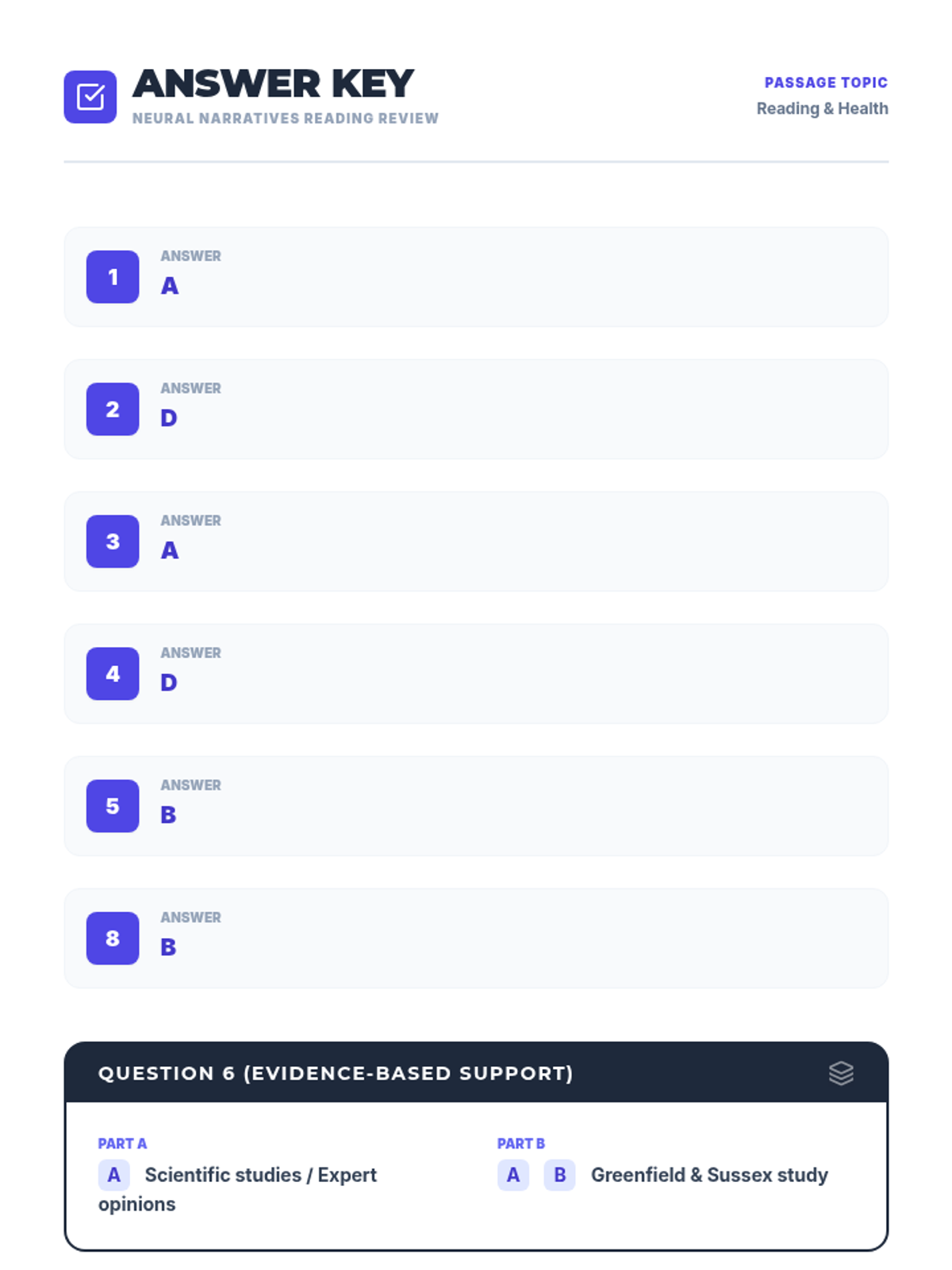
A comprehensive answer key for the Neural Narratives Practice Test, including correct answers for all multiple-choice and multi-part evidence-based questions, along with teaching notes.
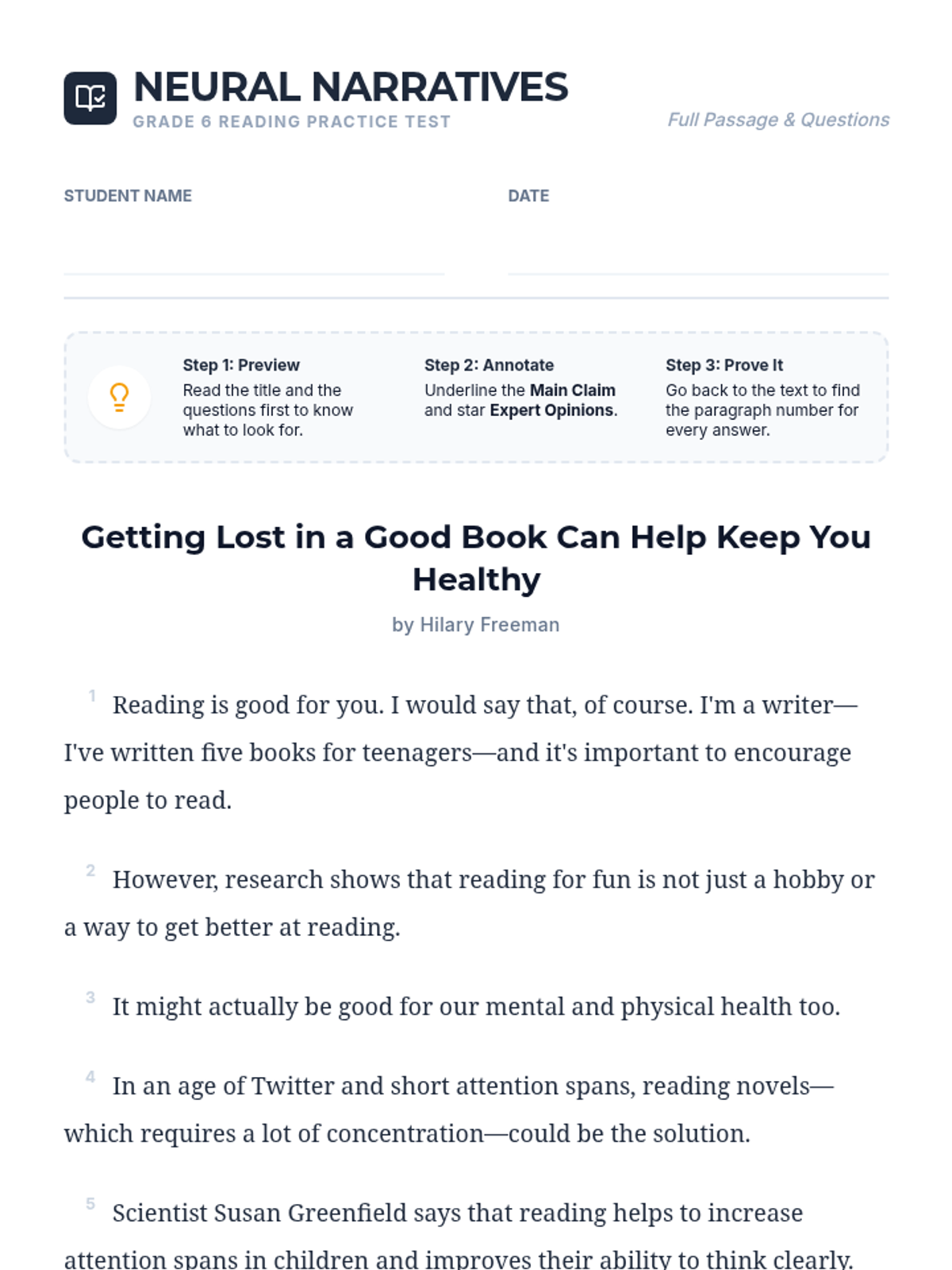
A practice test for the passage 'Getting Lost in a Good Book Can Help Keep You Healthy', featuring the full text with numbered paragraphs and nine comprehension questions, including multi-part evidence-based items.
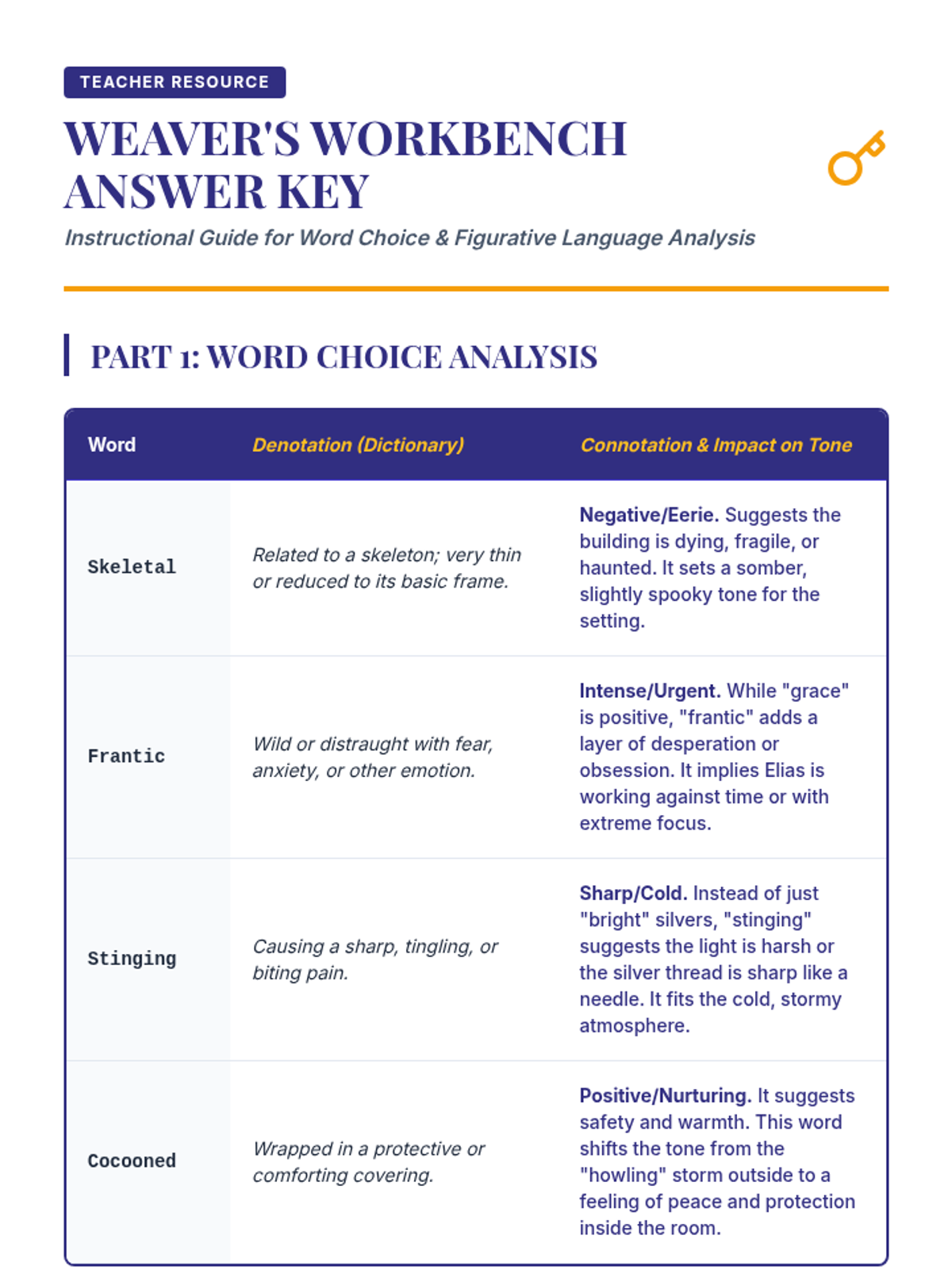
A teacher-facing answer key and instructional guide for the Weaver Workbench Worksheet. Provides sample student responses and instructional tips for analyzing word choice and figurative language.
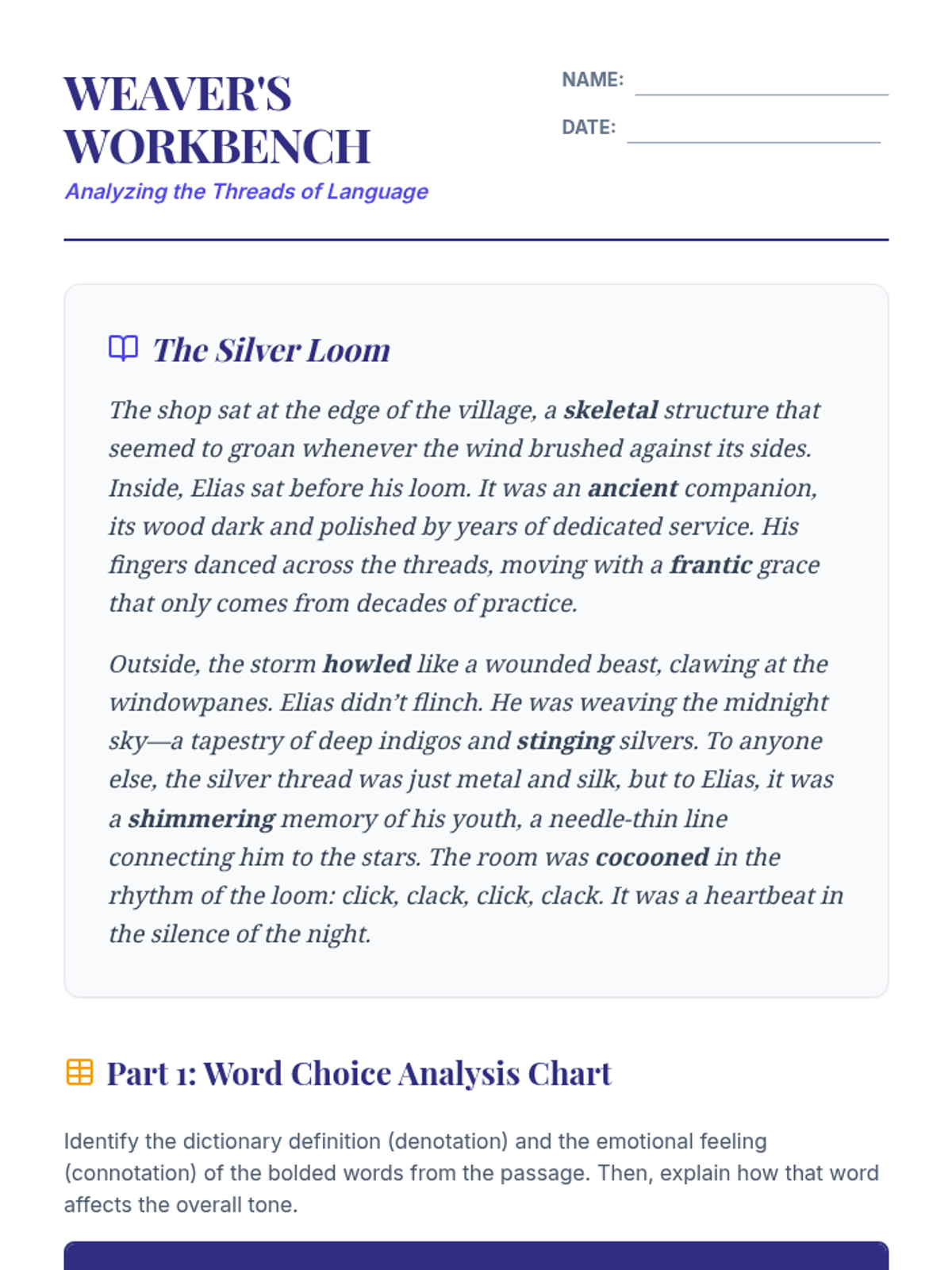
A Grade 6 ELA worksheet focused on word choice, connotation, and figurative language analysis. Includes an original literary passage and a structured analysis chart.
A comprehensive 8-slide instructional presentation for a Grade 6 ELA lesson on word choice, connotation, and figurative language. Features a sophisticated 'Word Weaver' theme with clear visual comparisons and analysis frameworks.
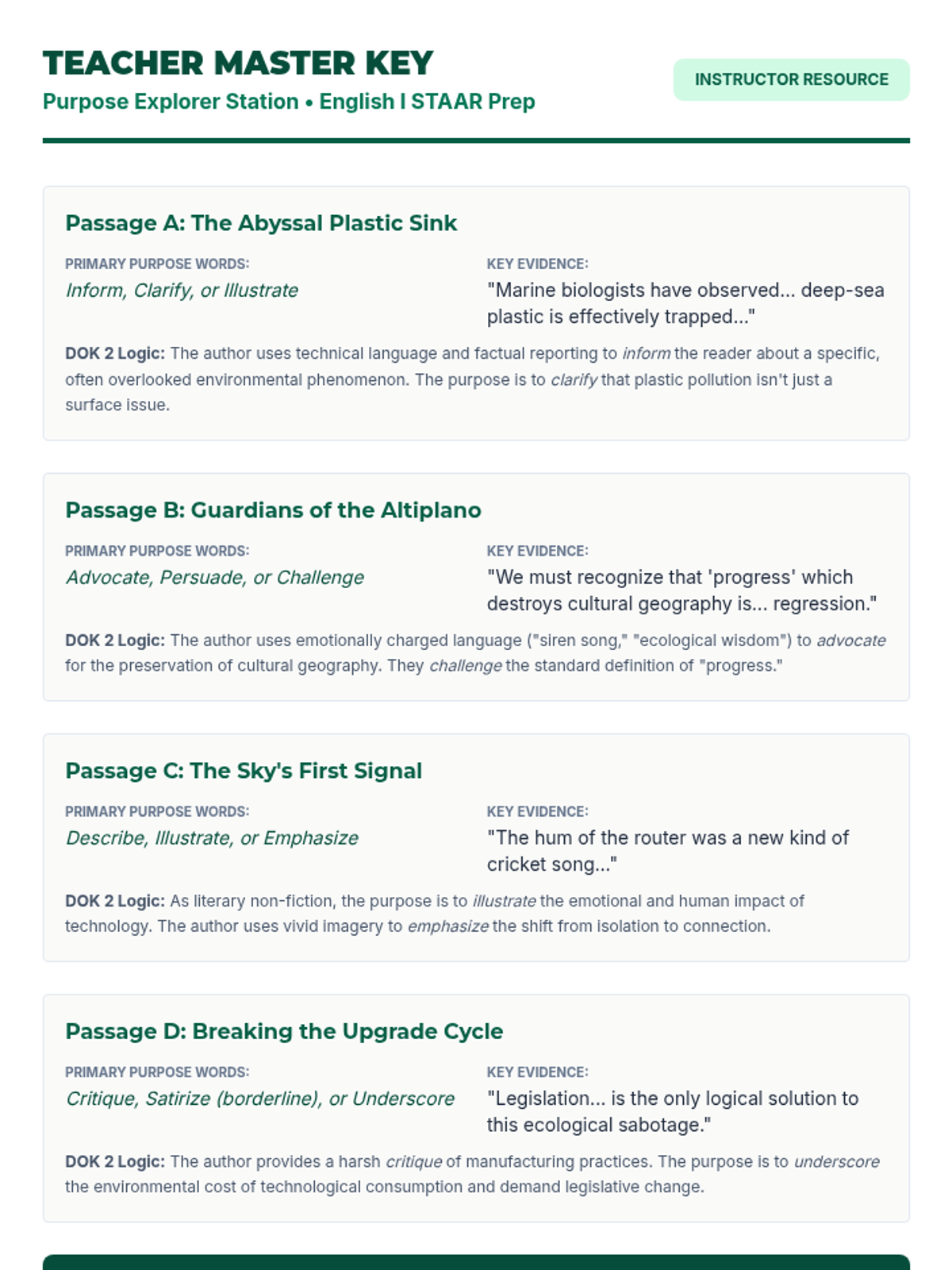
A teacher answer key and facilitation guide for the Purpose Explorer station, providing DOK level rationales and exemplary synthesis responses.
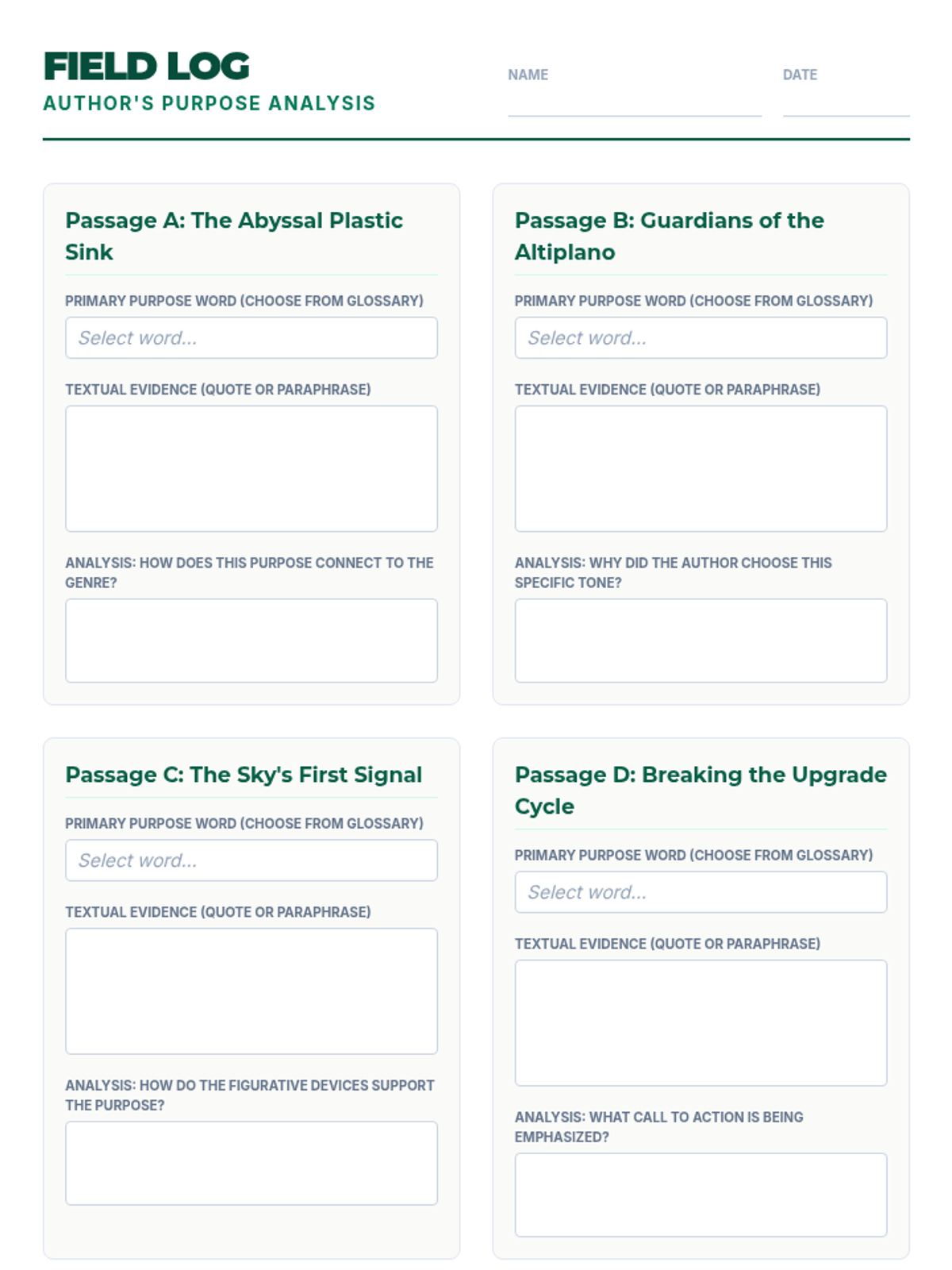
A student field log for recording analysis of author's purpose across four passages, including DOK Level 2 and 3 questions and space for textual evidence.
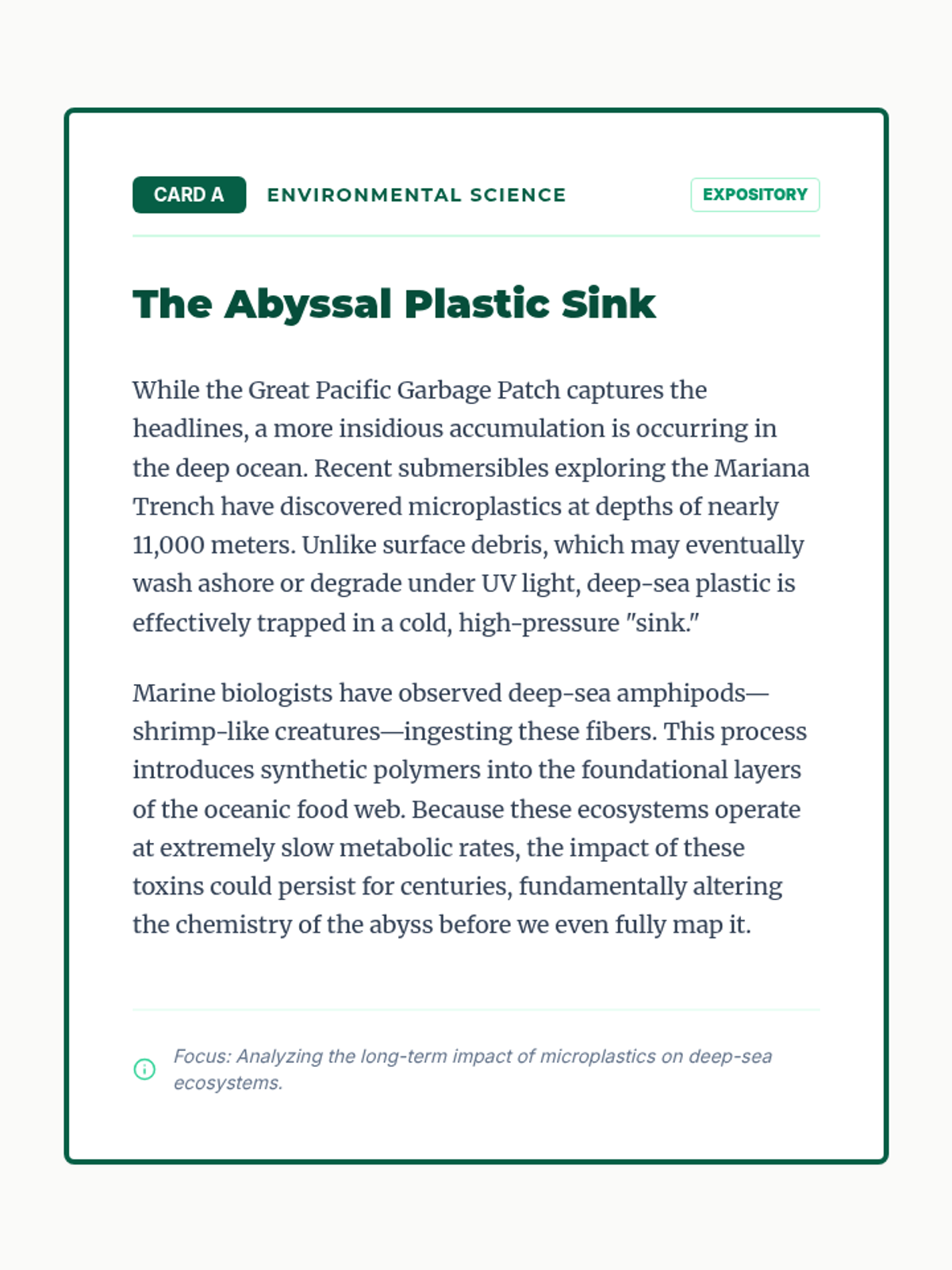
Four reading passage cards for a student-led station, each formatted on its own page for clarity. Topics cover environmental science, geography, and technology across various genres.
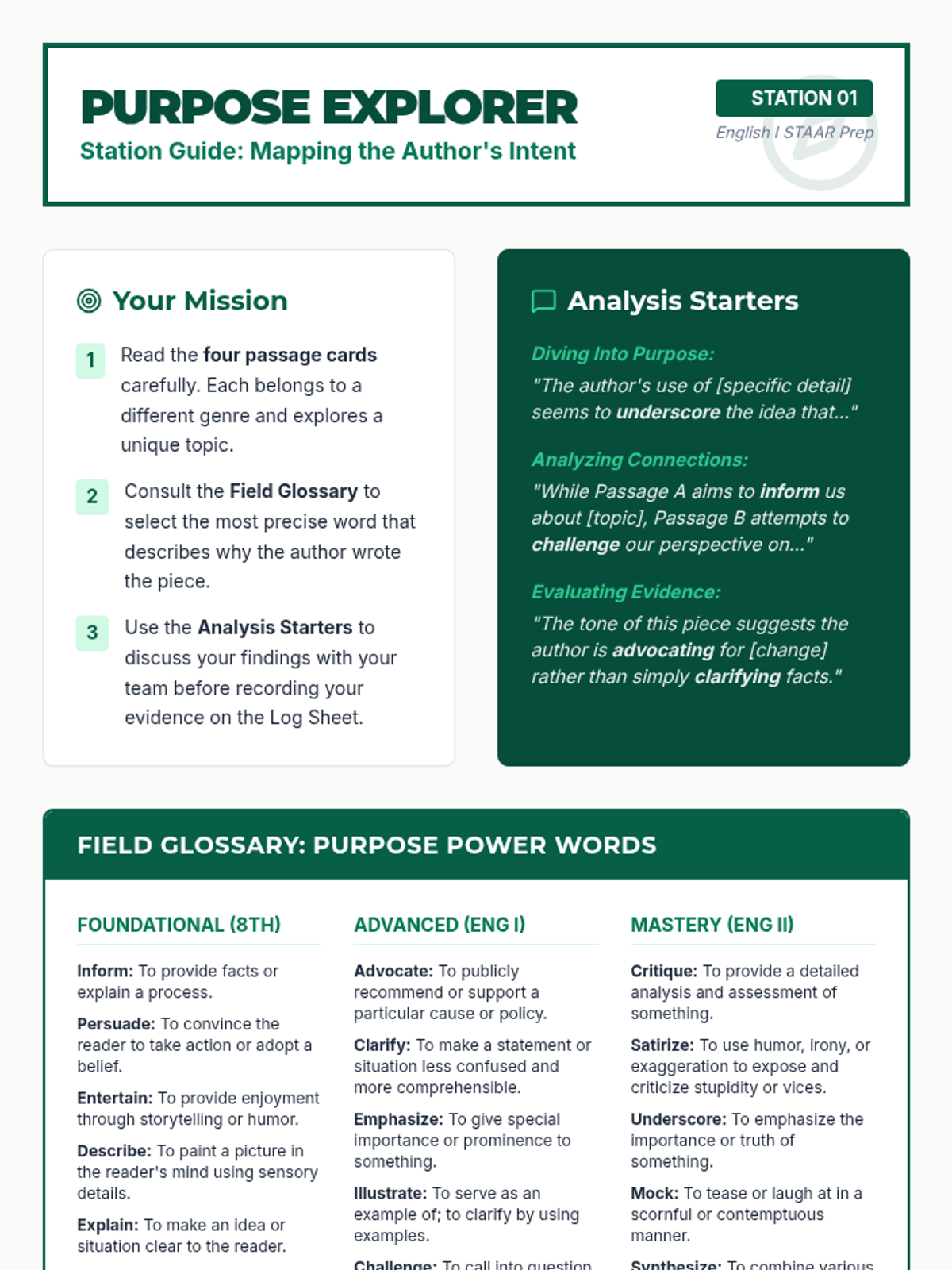
A student-led station guide for English I STAAR preparation, featuring instructions, grade-level academic vocabulary (8th, Eng 1, Eng 2), and sentence starters for group analysis.
A 15-page printable vocabulary workbook, with each page dedicated to a single weekly word. Each assignment includes a definition, context sentence, and five practice questions designed to deepen student understanding and ensure clear one-word-per-page formatting.
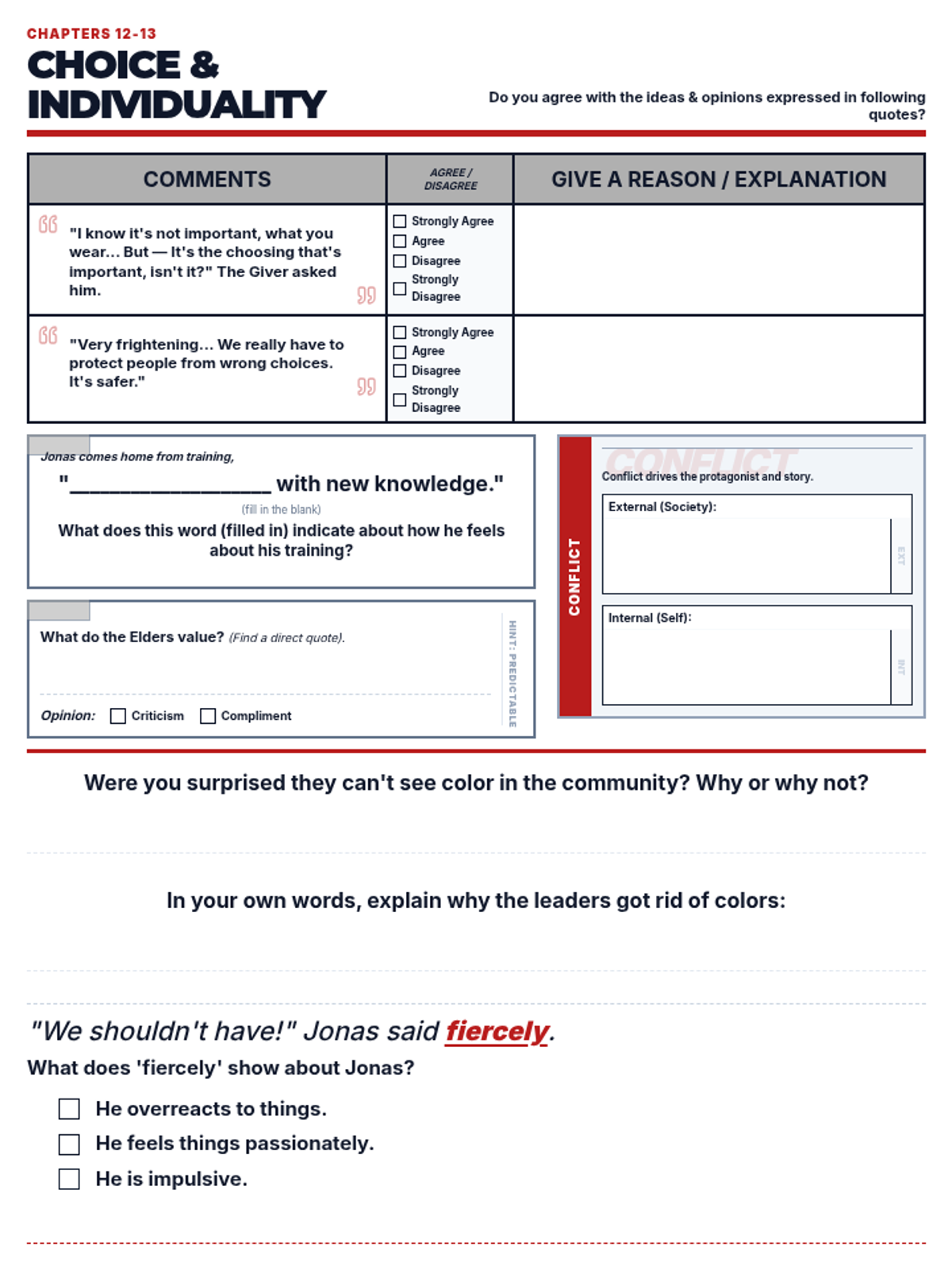
The finalized activity sheet for Chapters 12-13 of The Giver, featuring a red-accented theme, the chapter range prominently displayed in the header, and all previously requested reflection and analysis questions on a single, optimized page.
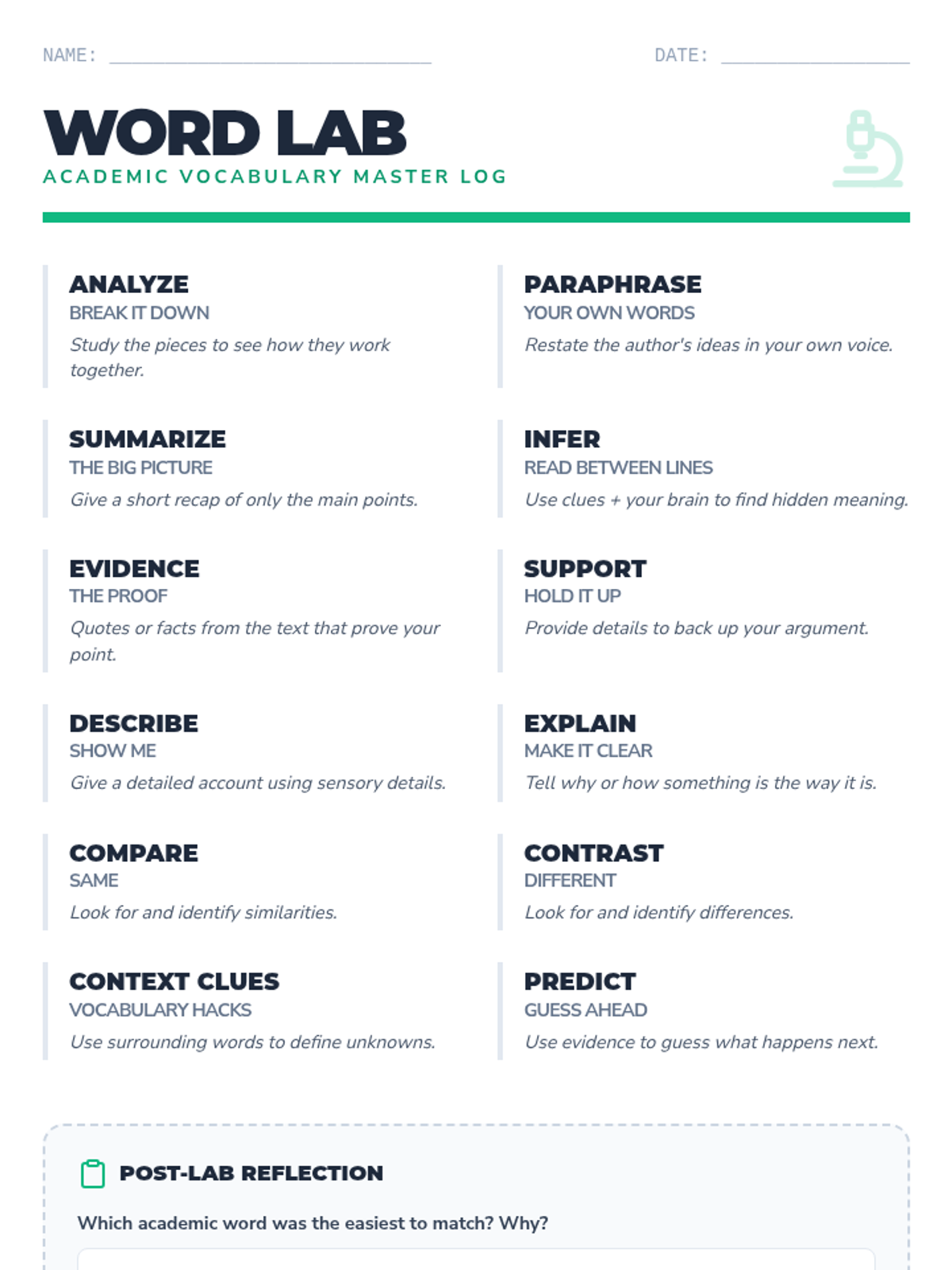
A student reference sheet and reflection log that summarizes the 12 academic vocabulary terms with simple definitions and "at-a-glance" hints. Includes a post-activity reflection area for assessment or consolidation.
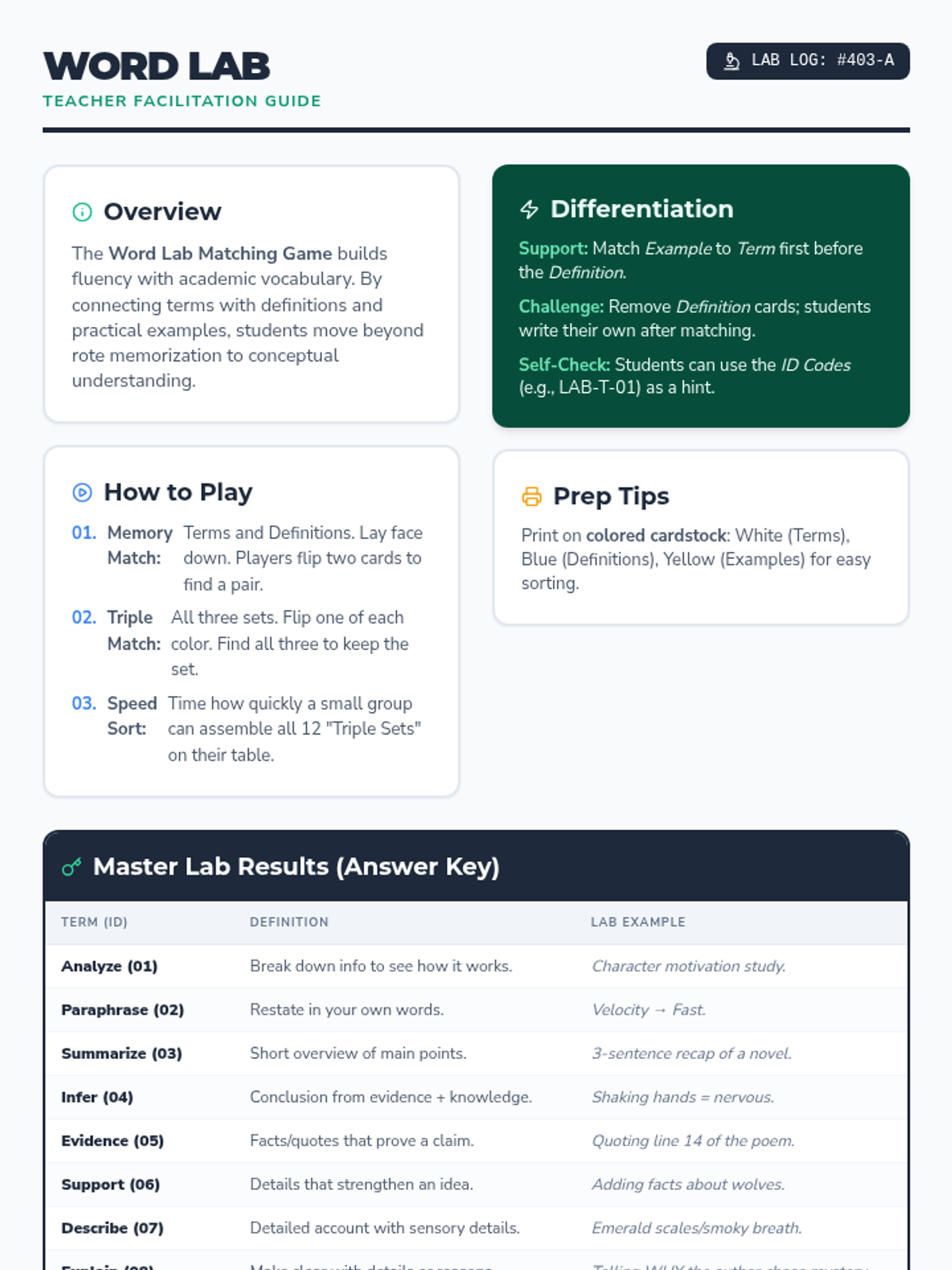
A teacher facilitation guide for the Word Lab matching game, including multiple gameplay variations, differentiation strategies, prep tips, and a master answer key for all vocabulary terms, definitions, and examples.
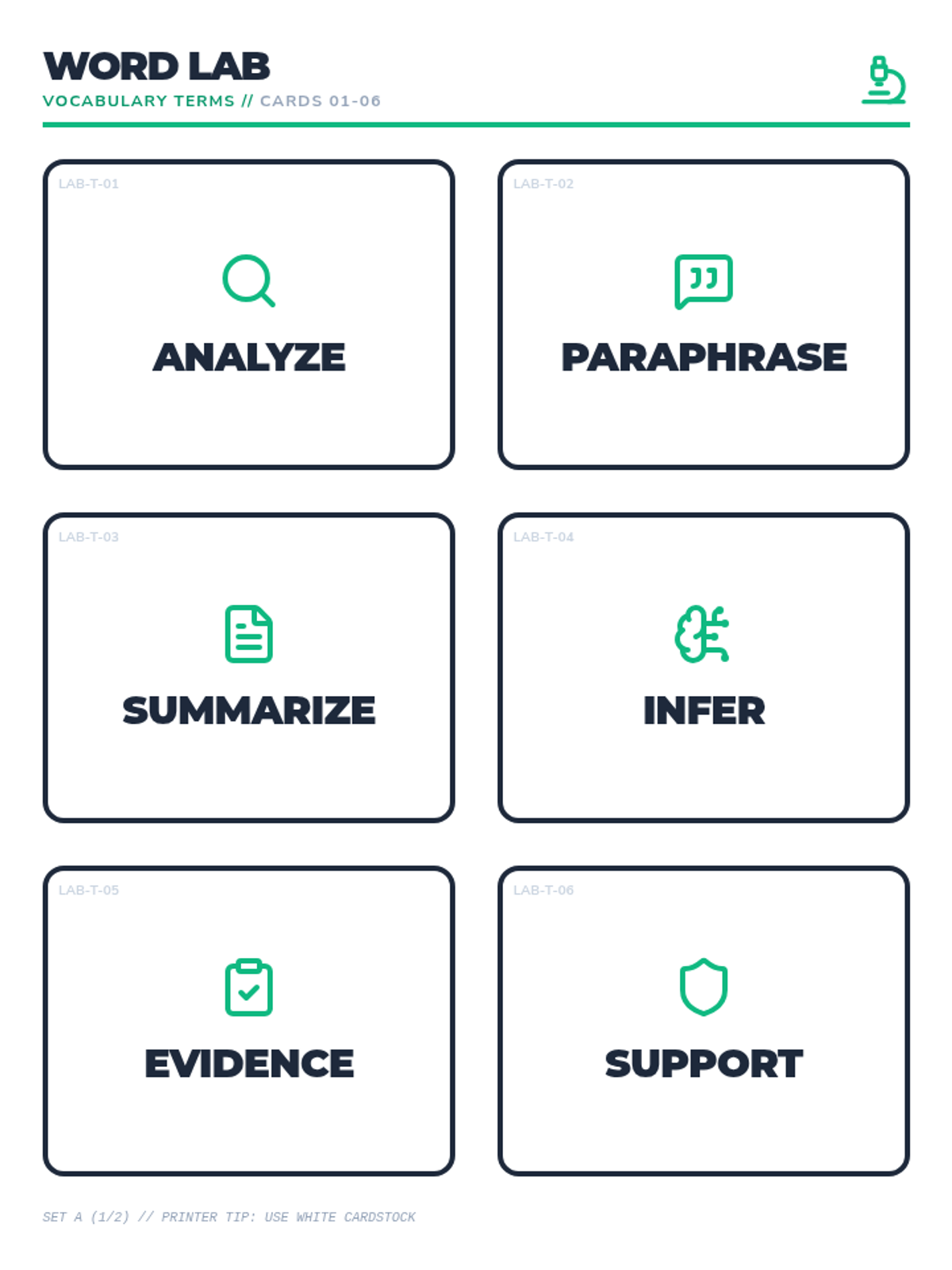
An updated set of memory match cards for academic vocabulary, now split into 6 pages (6 cards per page) to ensure perfect printing and ample space for definitions and examples. Features a consistent lab theme with color-coded sets.
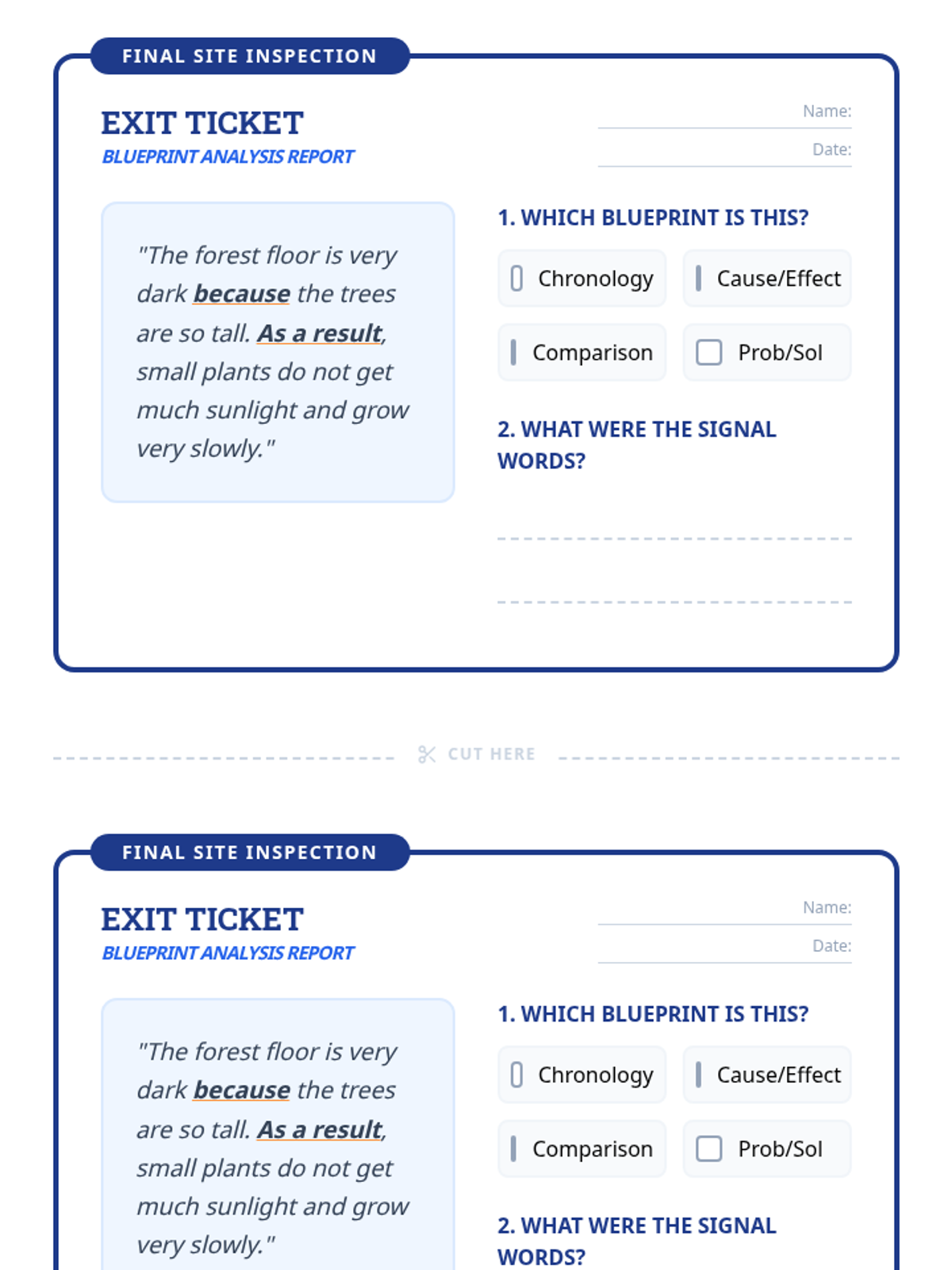
A formative exit ticket where students analyze a short text to identify the structure and signal words, themed as a 'Site Inspection Report'.
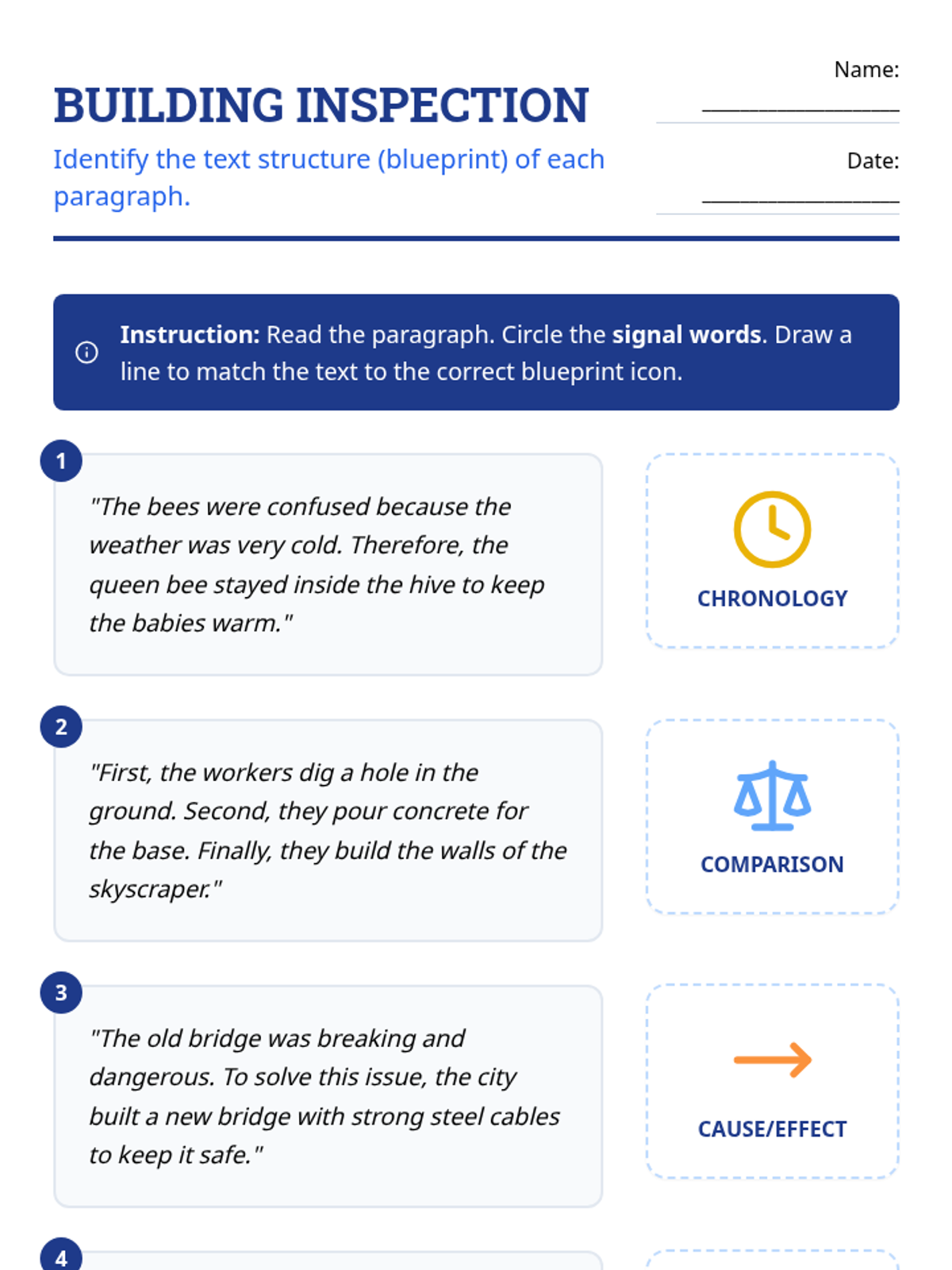
A matching activity where students identify text structures in short paragraphs by circling signal words and matching them to icons.
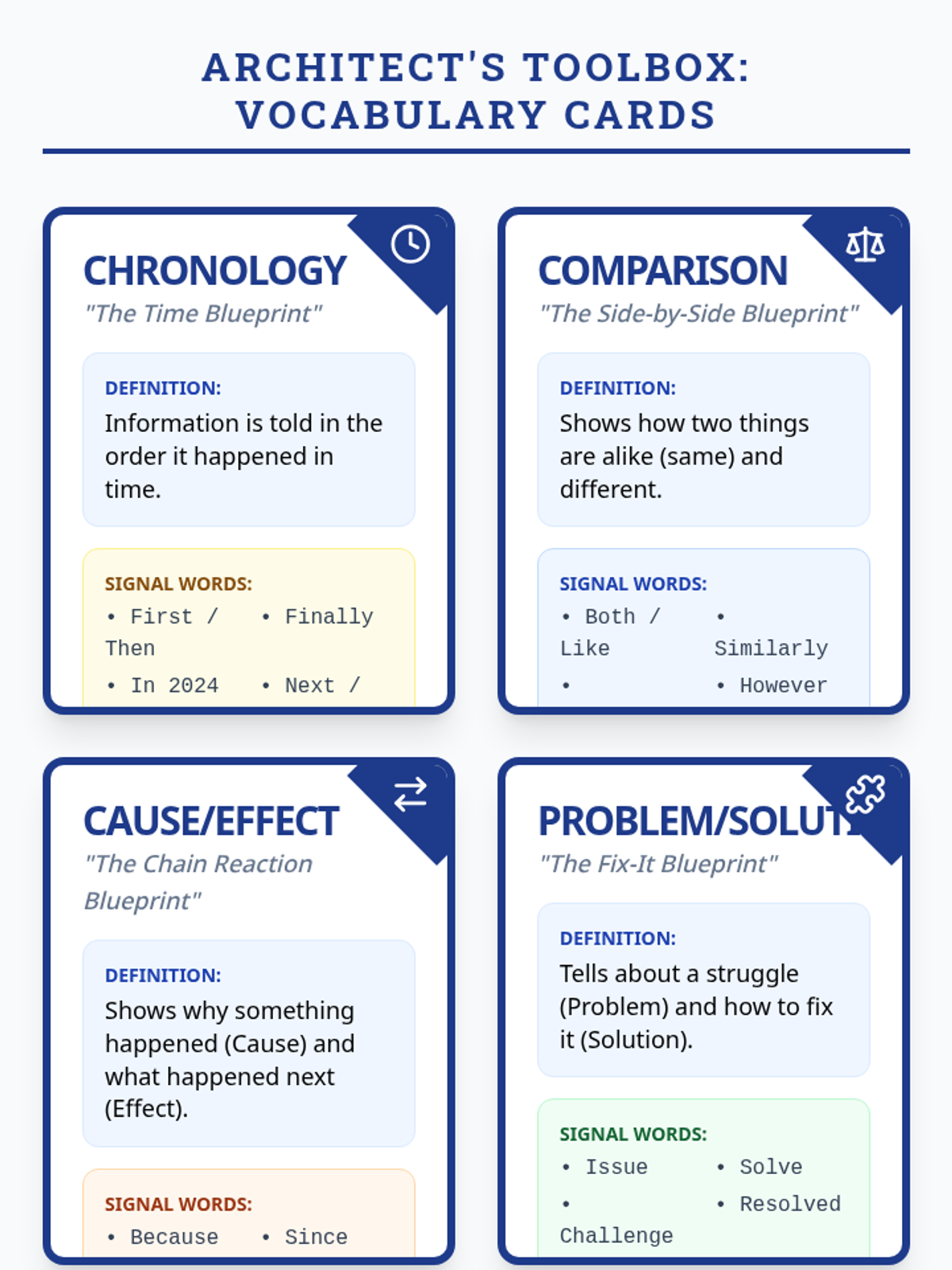
A set of four large vocabulary cards defining the major text structures with icons, definitions, and signal words, designed with an architectural theme.
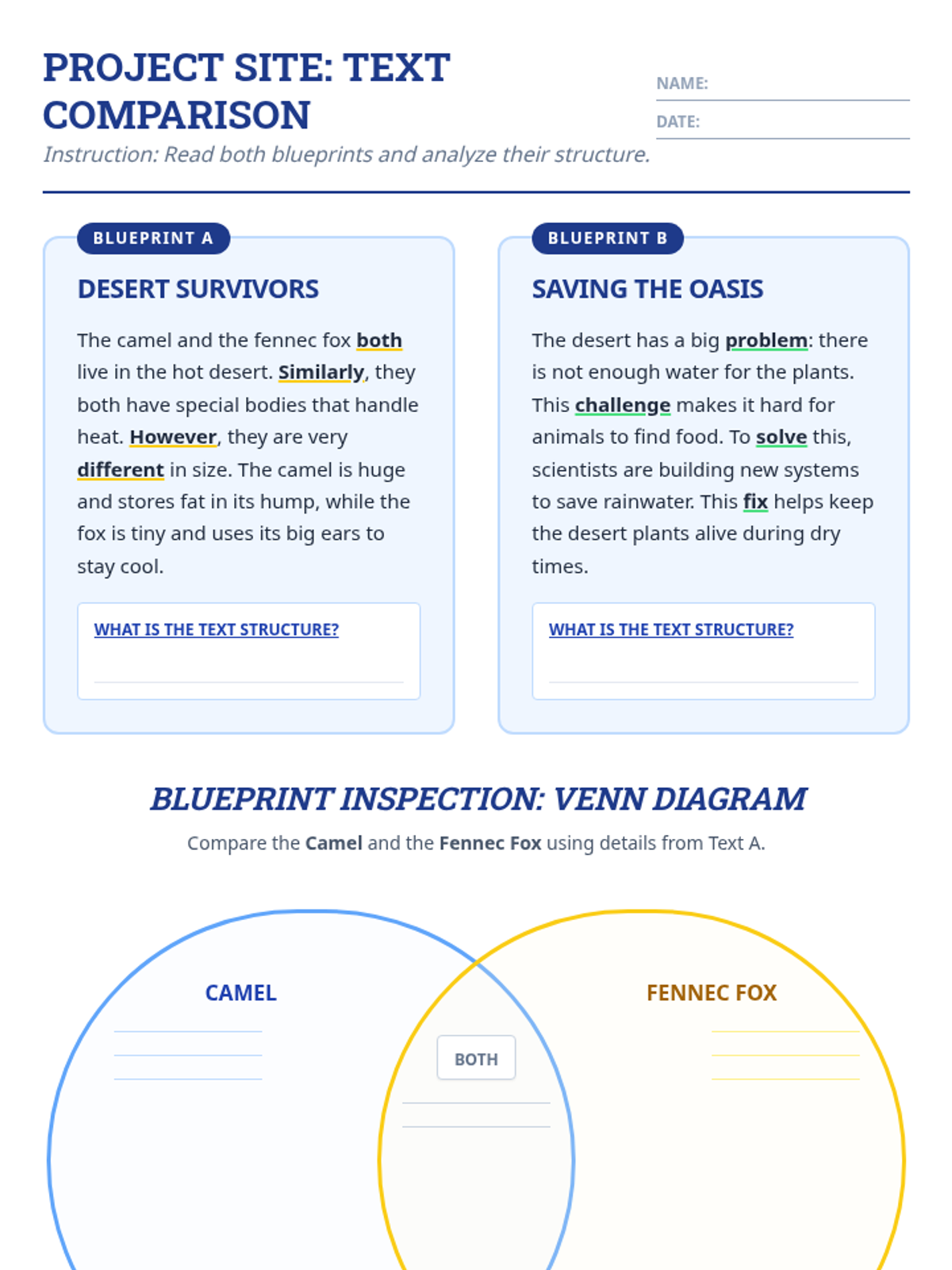
A student worksheet containing two short texts with different structures (Comparison and Problem/Solution) and a large Venn diagram for comparing content.
Visual slide deck for direct instruction on text structures, using an architectural theme to explain Chronology, Comparison, Cause/Effect, and Problem/Solution with icons and signal words.
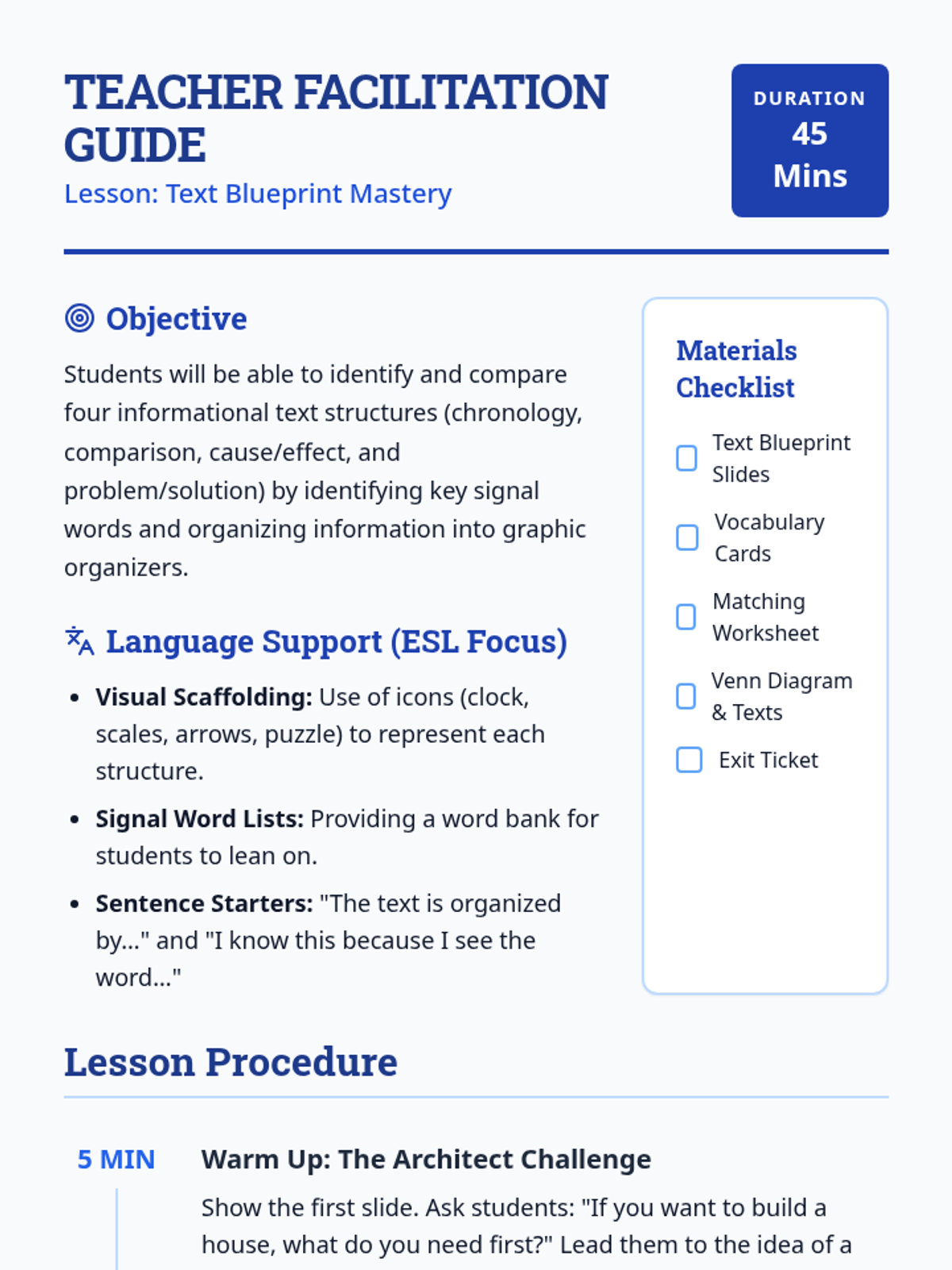
A comprehensive teacher facilitation guide for a 45-minute ESL lesson on text structures, featuring a 'blueprint' theme, timing breakdown, and language scaffolds.
Visual presentation slides for the Hoot Chapters 9 & 10 comprehension quiz, featuring Roy's father, the ice cream truck, and key vocabulary.
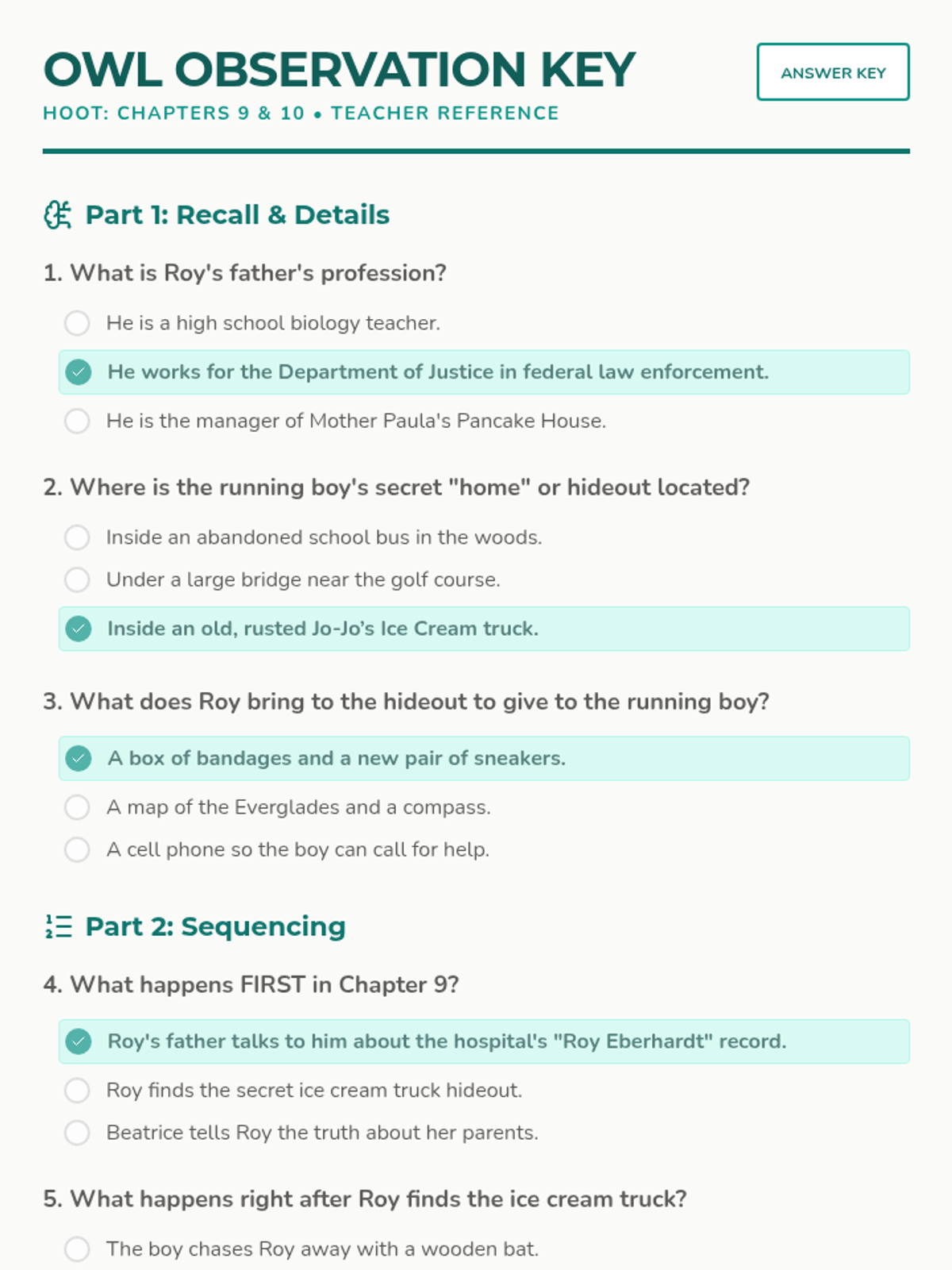
Teacher answer key for the Hoot Chapters 9 & 10 comprehension quiz. Correct answers are clearly highlighted for quick grading.
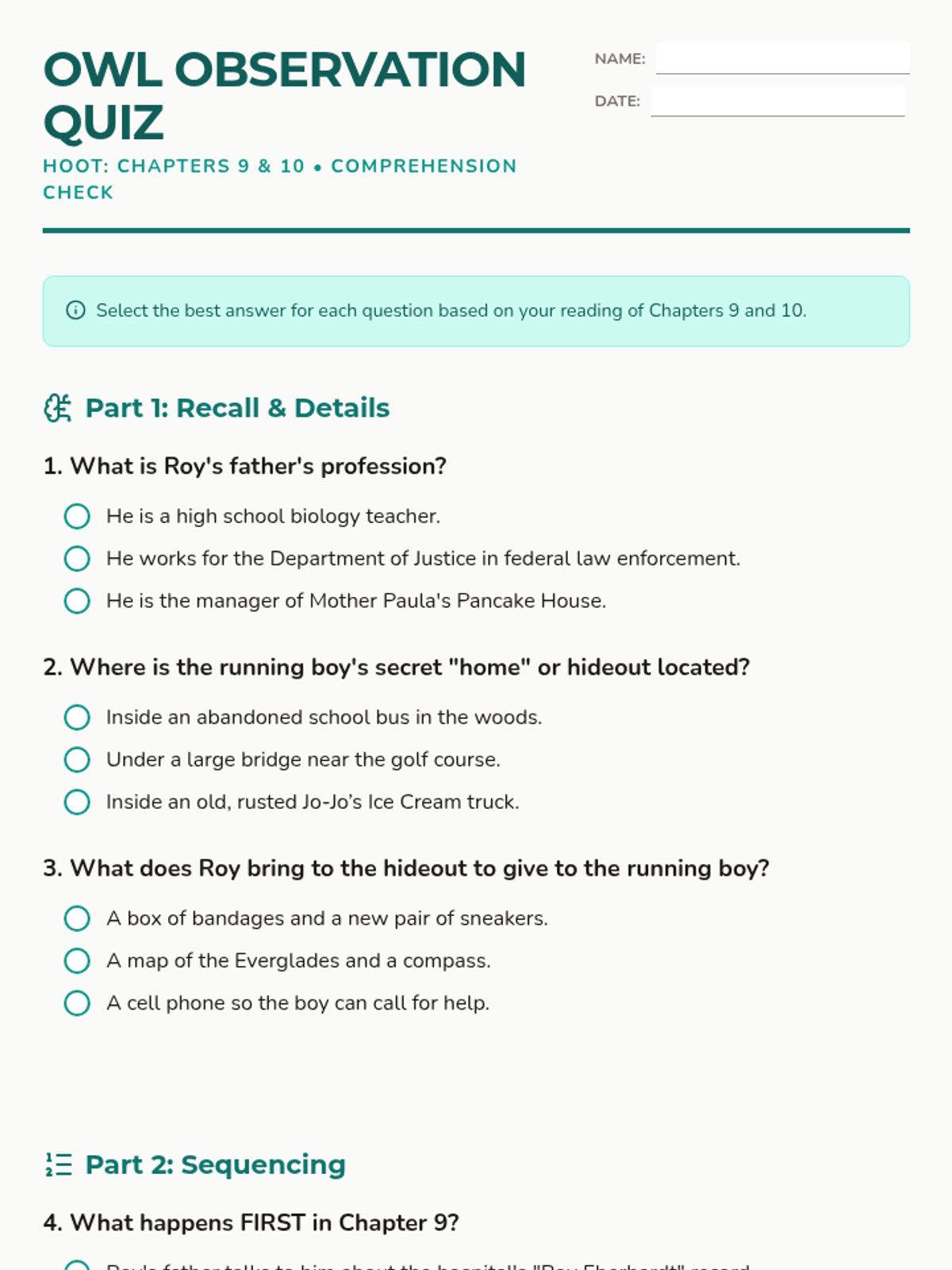
A clean, 3-option multiple choice comprehension quiz for Hoot Chapters 9 & 10, focusing on Roy's father, the ice cream truck hideout, and key vocabulary.
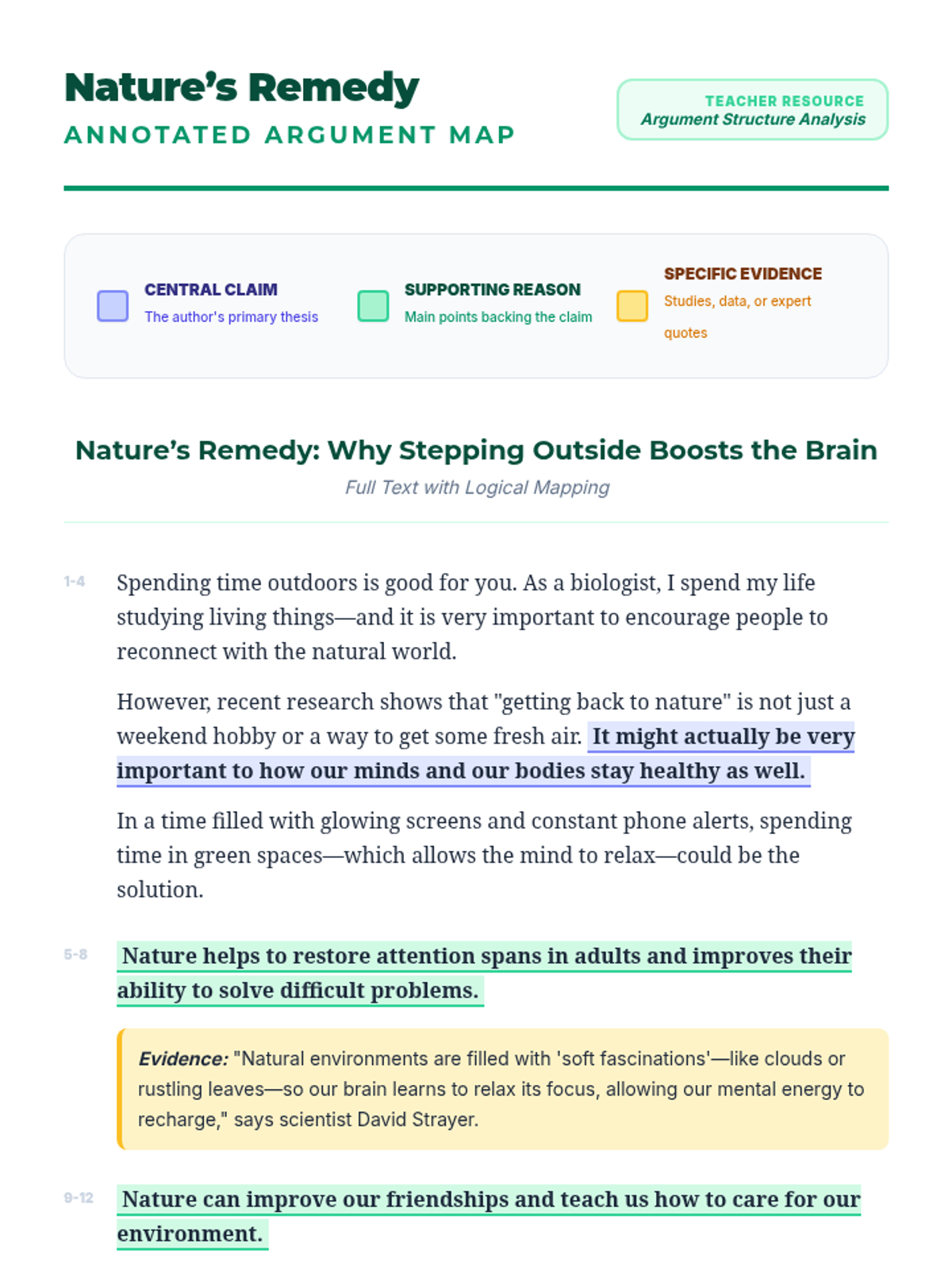
A teacher-facing annotated version of the 'Nature’s Remedy' passage, using a color-coded highlight system to identify the author's central claim, supporting reasons, and specific scientific evidence throughout the text.
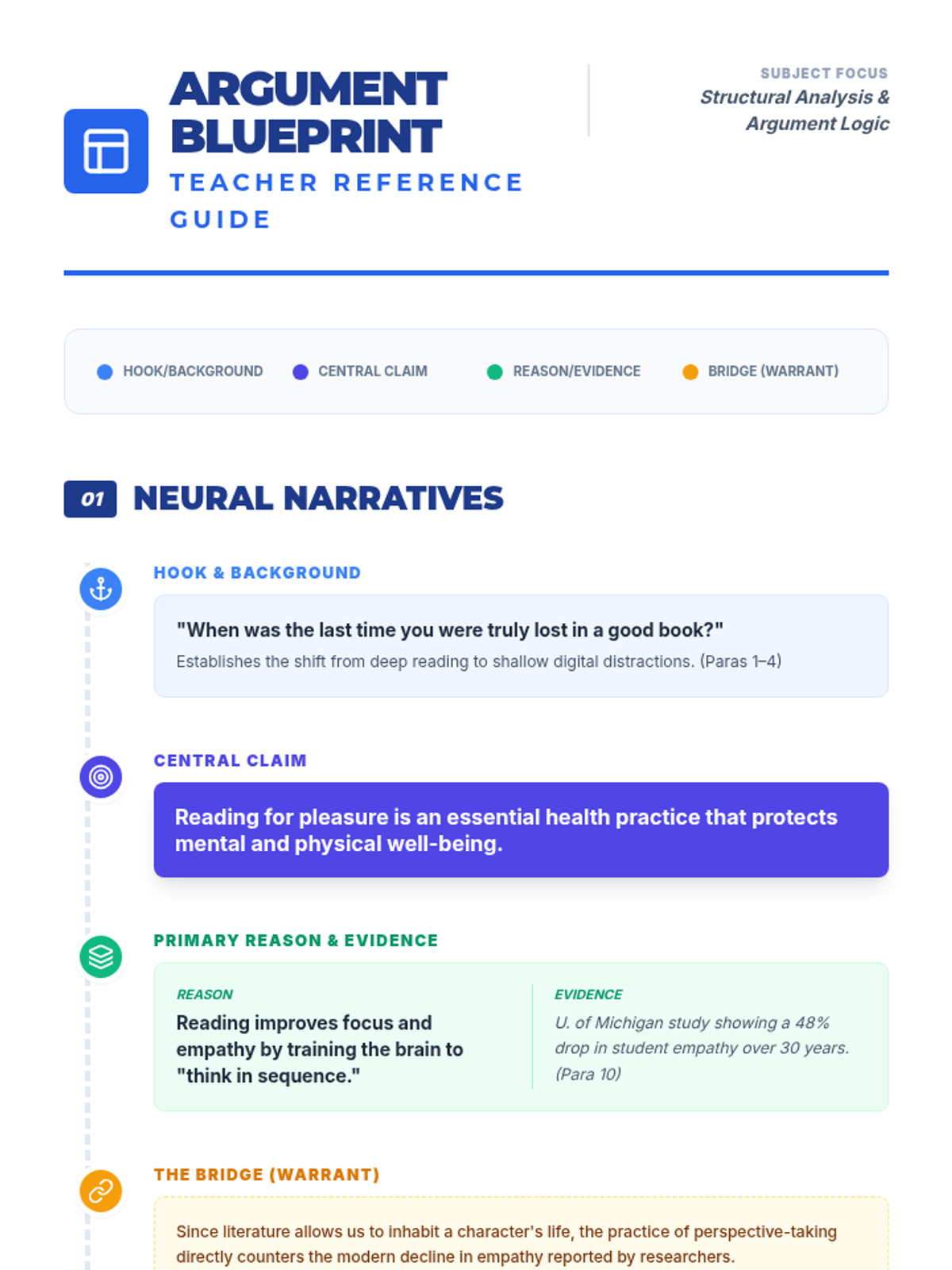
A one-page (per passage) teacher cheat sheet identifying the structural components of an argument: hook, background knowledge, claim, reasons, evidence, the 'bridge' (warrant), and conclusion.
A comprehensive 6th-grade slide deck for 'Nature’s Remedy' featuring the full passage chunked across slides, all 9 practice questions, and detailed evidence-based explanations for every answer.
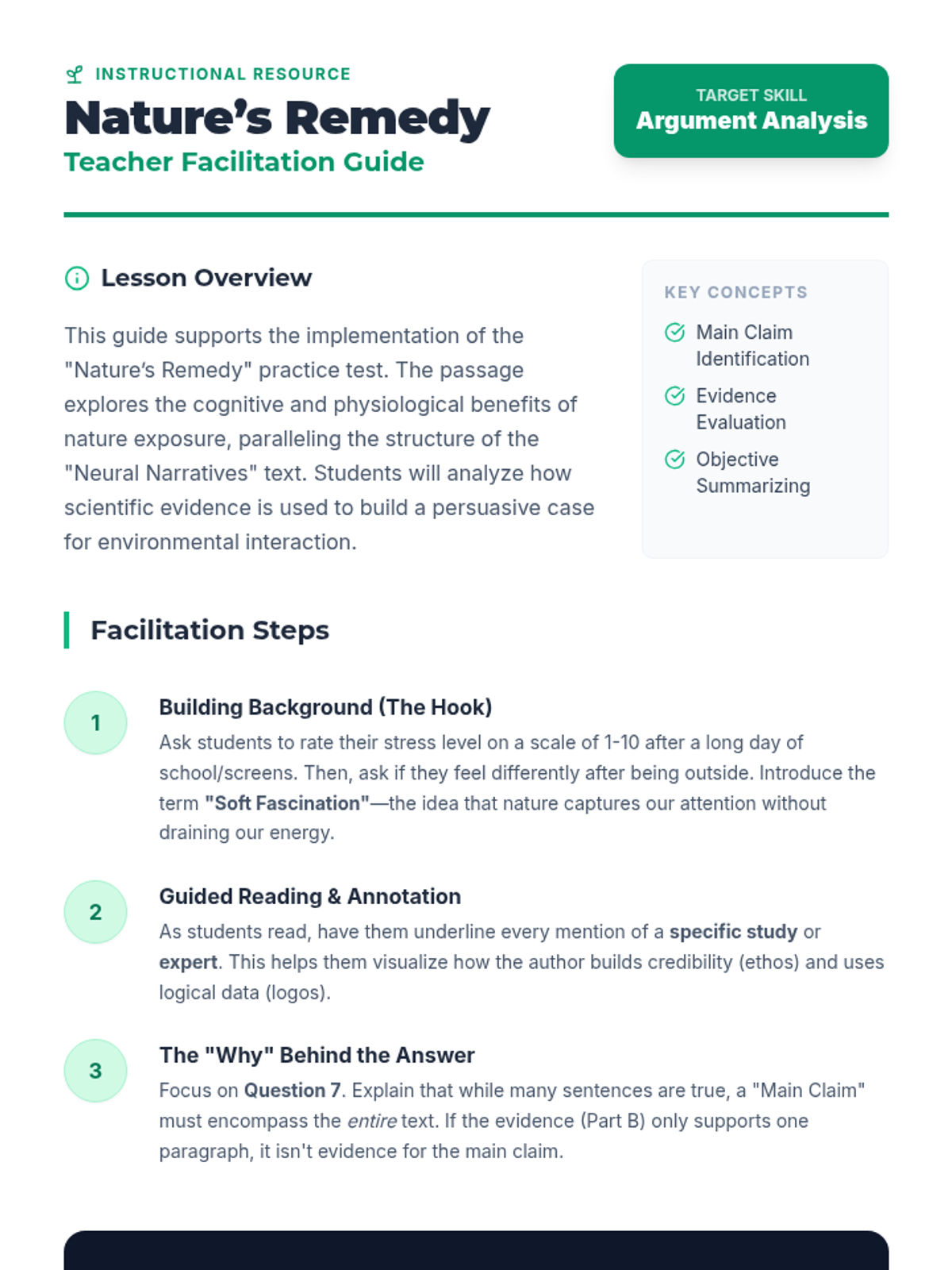
A dedicated facilitation guide for teachers using the Nature’s Remedy passage, featuring instructional steps, building background hooks, and differentiated discussion questions.
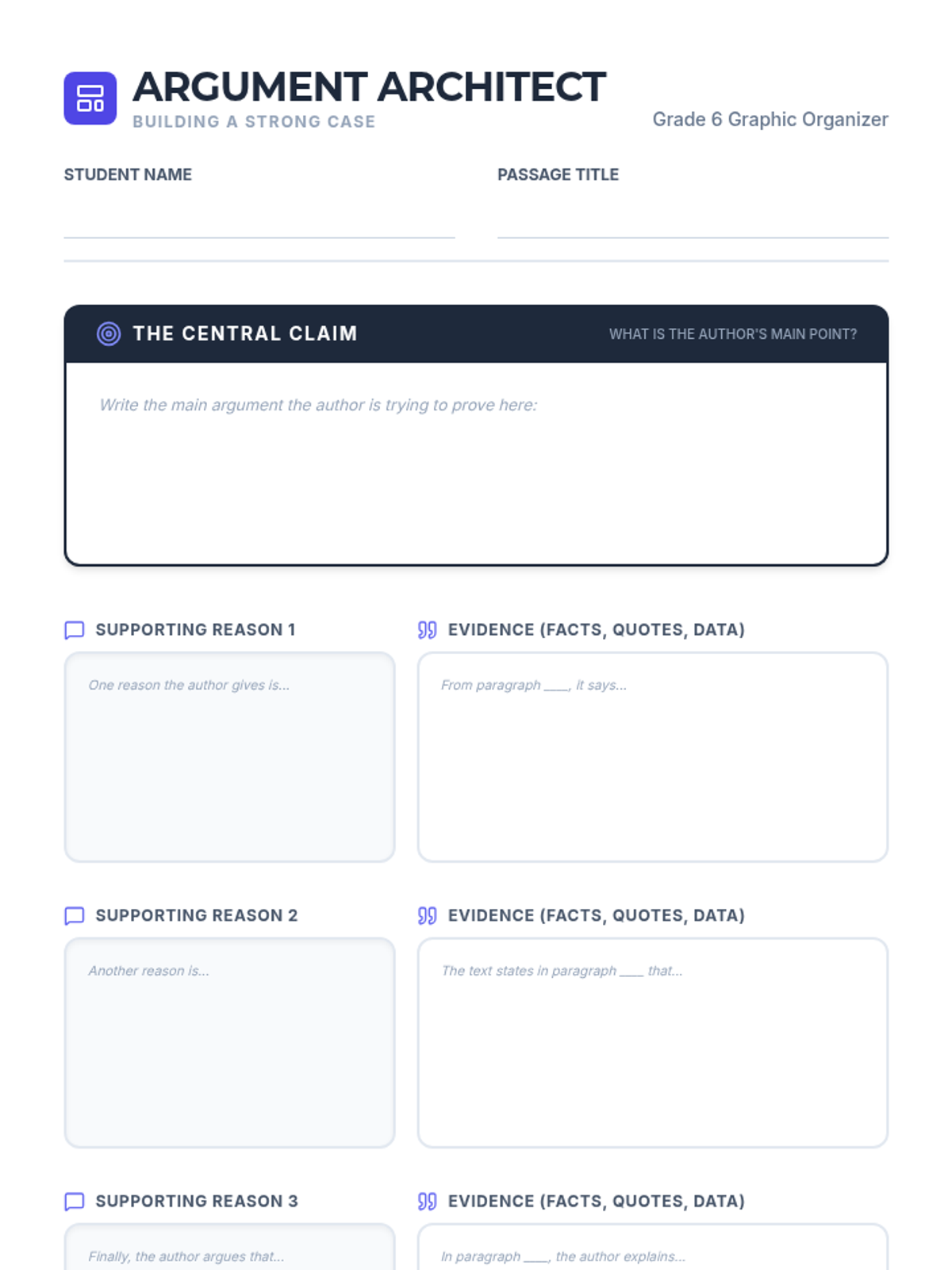
A student-facing graphic organizer for analyzing the structure of an argument, providing designated spaces for the central claim, supporting reasons, and specific evidence.
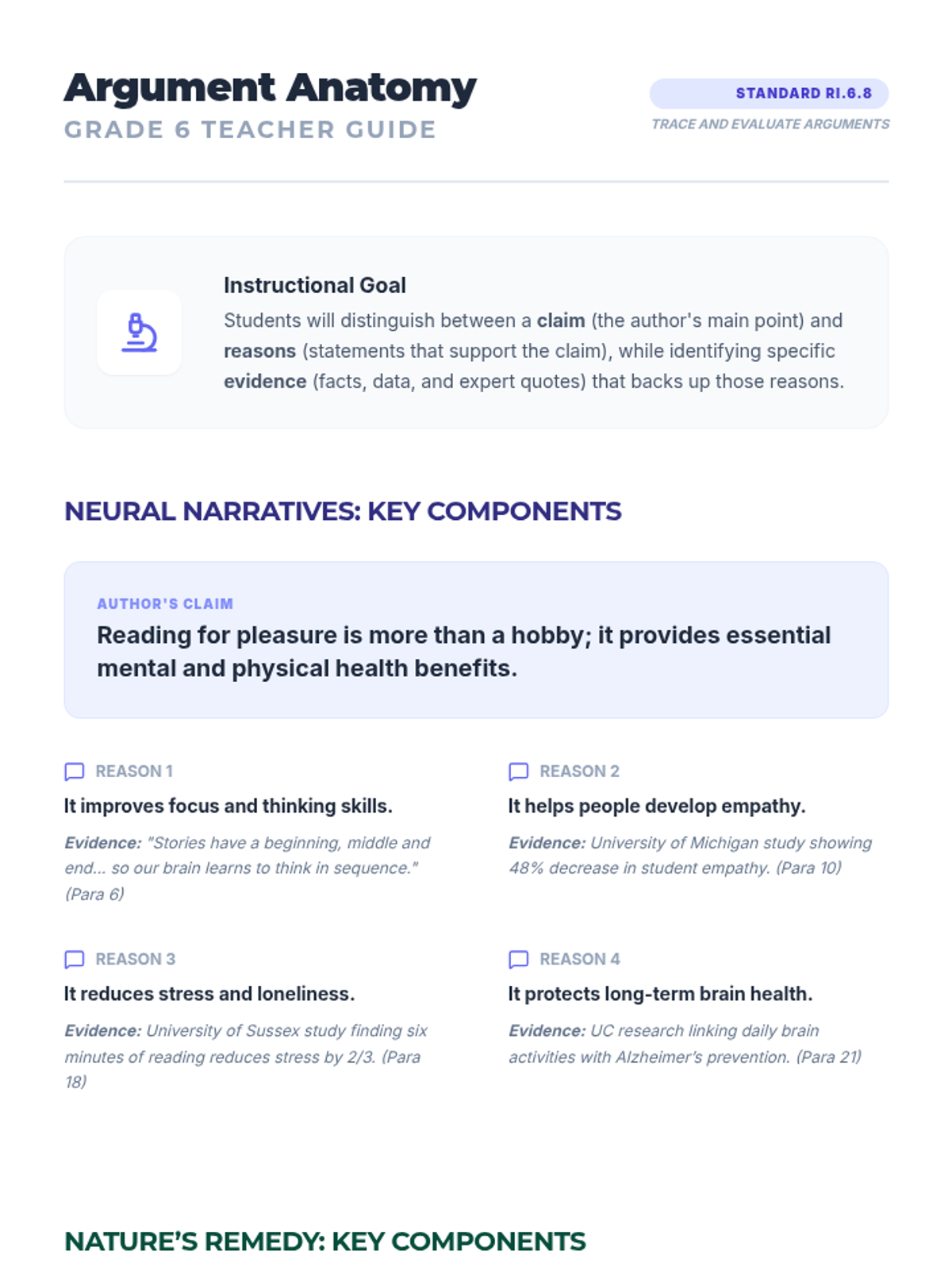
A teacher resource guide that identifies the main claim, supporting reasons, and specific evidence for both 'Neural Narratives' and 'Nature’s Remedy' passages to assist in instructional analysis.
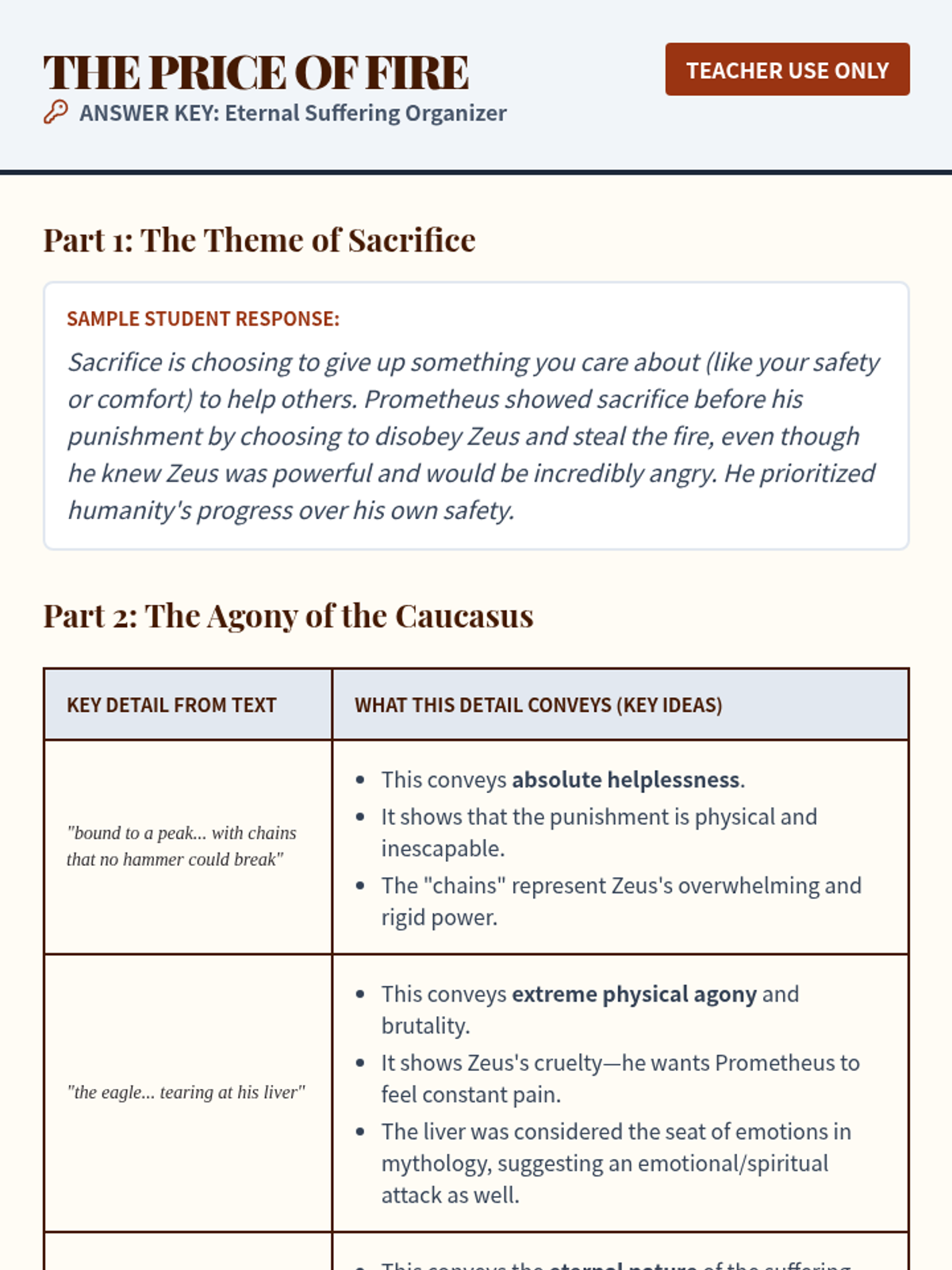
A teacher-facing answer key for the Eternal Suffering Organizer, providing sample student responses, key analysis points for text details, and an exemplar central idea statement.
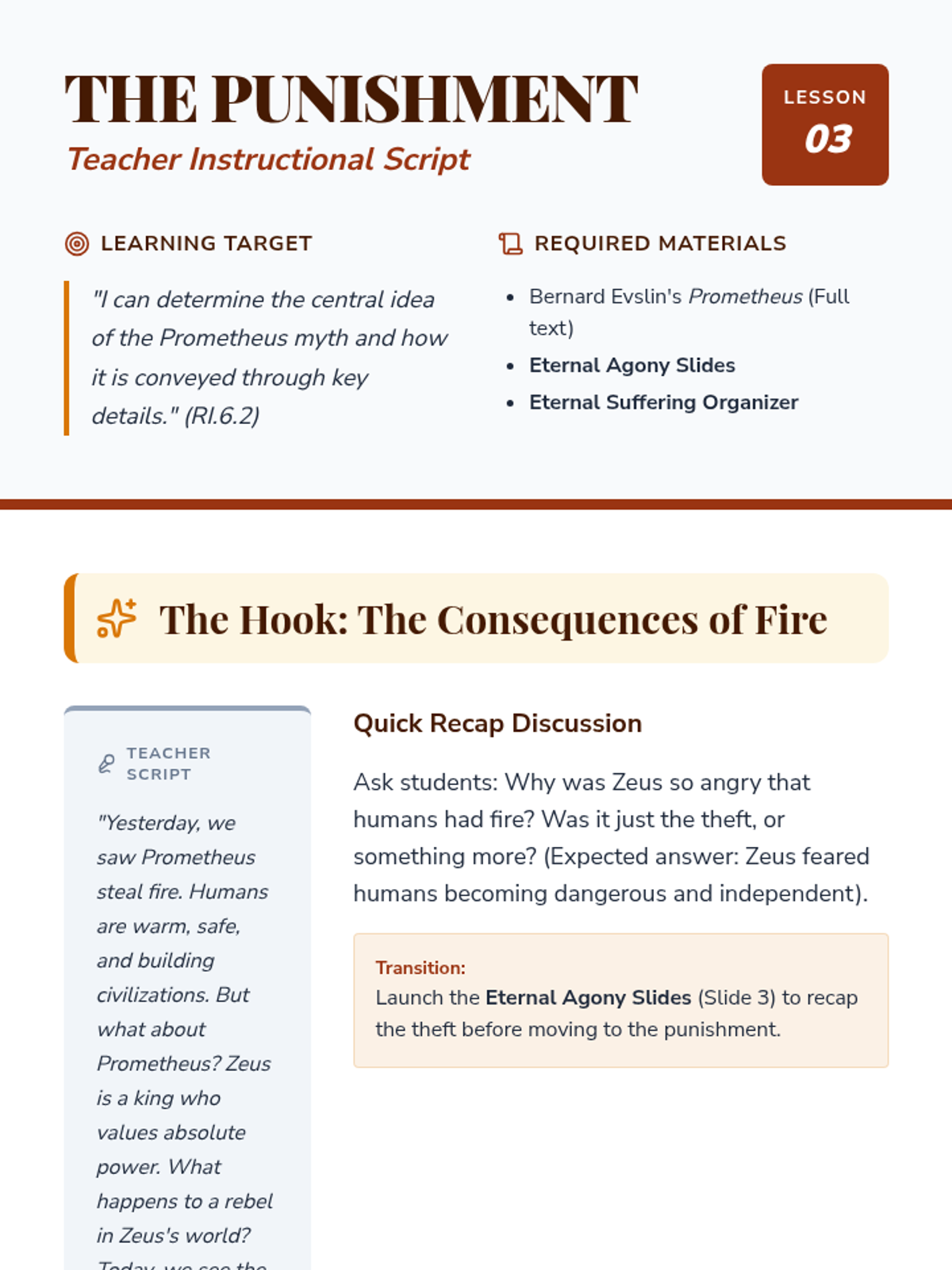
An instructional script for teachers to lead the lesson on Prometheus's punishment. It provides step-by-step guidance on facilitating the slides, analyzing key text details, and helping students synthesize the central idea of sacrifice.
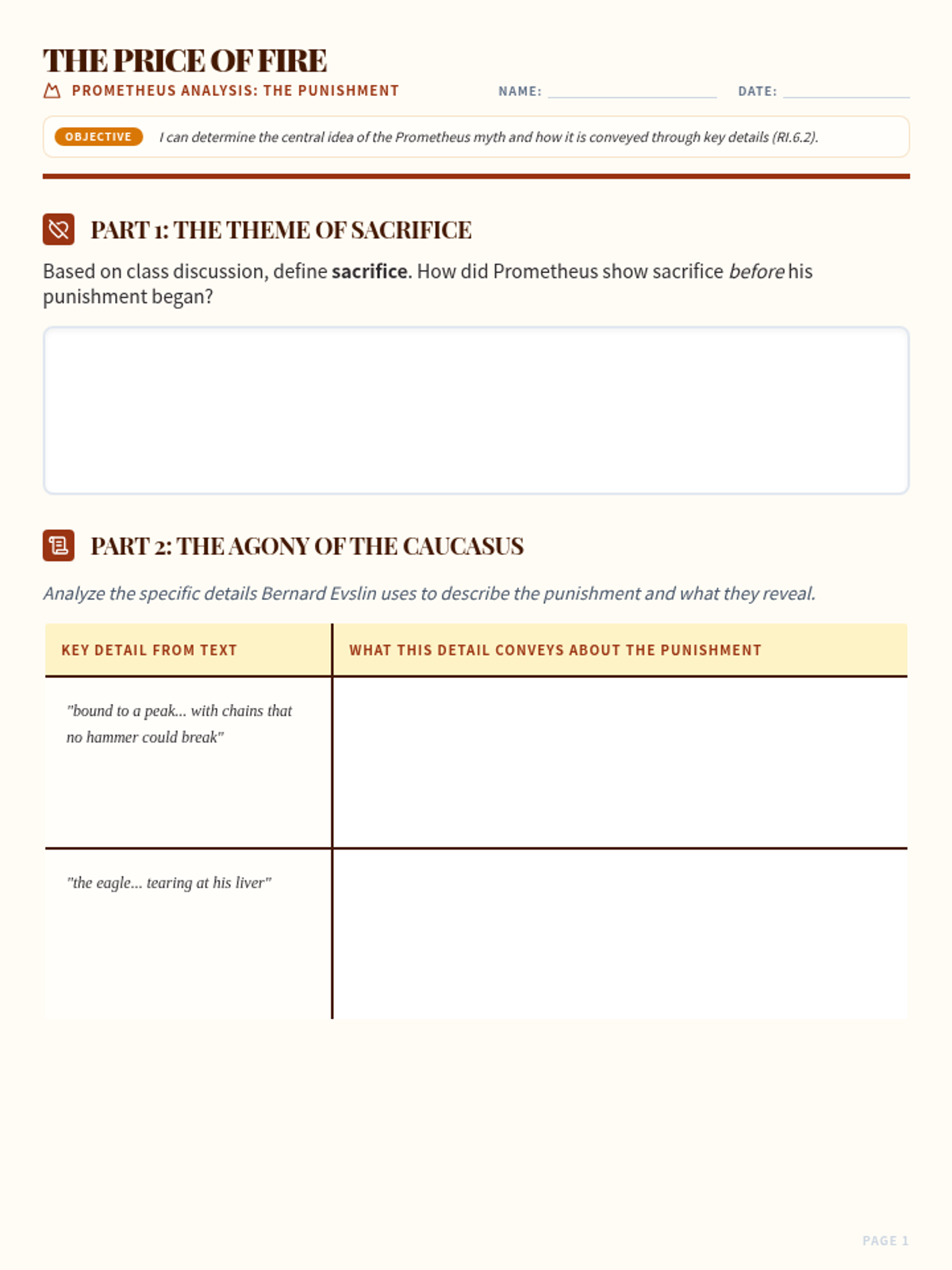
A graphic organizer for analyzing the punishment of Prometheus in Bernard Evslin's version. Includes sections for defining sacrifice, tracking key details of the punishment, and synthesizing the central idea. Features a prominent vocabulary callout for 'Synthesize' and a high-contrast work area for student writing. Heading and spacing reduced for 2-page print compatibility.
An interactive slide deck focusing on the punishment of Prometheus, featuring key details about his eternal suffering and the theme of sacrifice. Slide 7 graphics have been reduced in size to ensure a perfect fit within the viewport.