Sentence structure fundamentals, subject-verb agreement, and precise usage of parts of speech including pronouns, conjunctions, and adjectives. Targets technical accuracy through mastery of capitalization, punctuation, spelling, and verb mood.
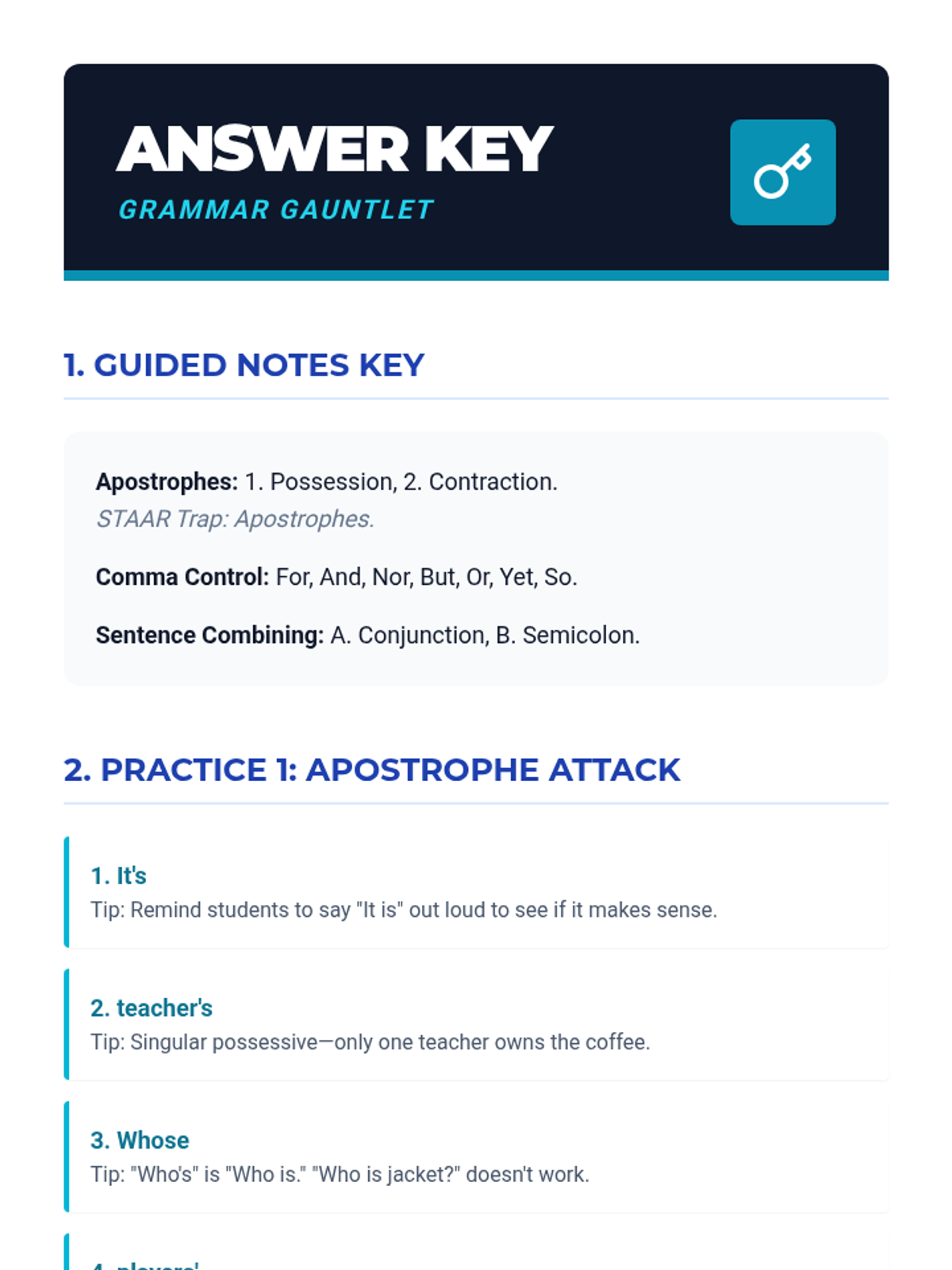
An answer key and teacher facilitation guide for the Grammar Gauntlet session, providing correct answers, explanations, and small-group teaching tips.
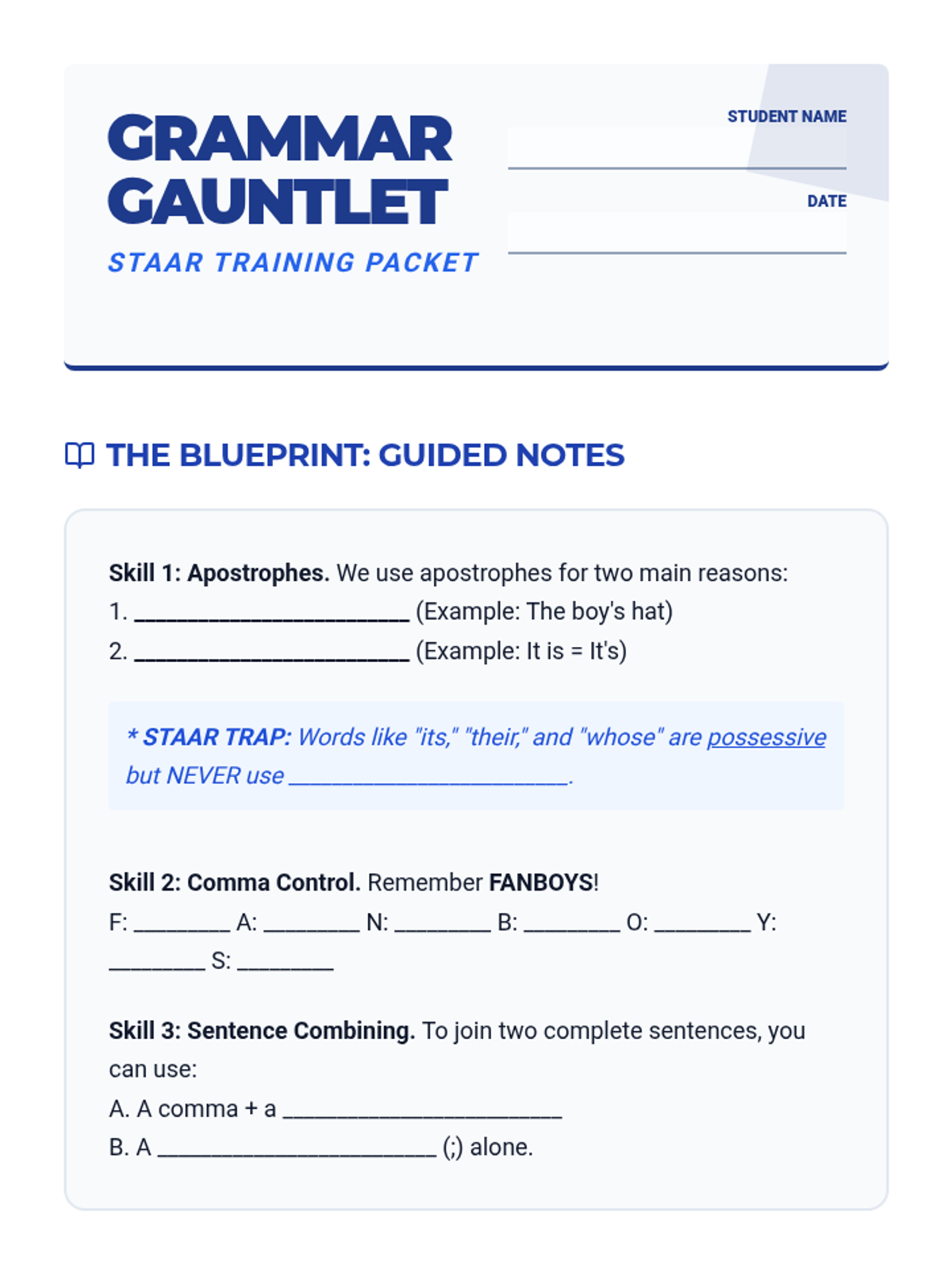
A student practice packet for a STAAR grammar tutoring session, featuring guided notes, focused practice on apostrophes and commas, and a STAAR-modeled mini-test.
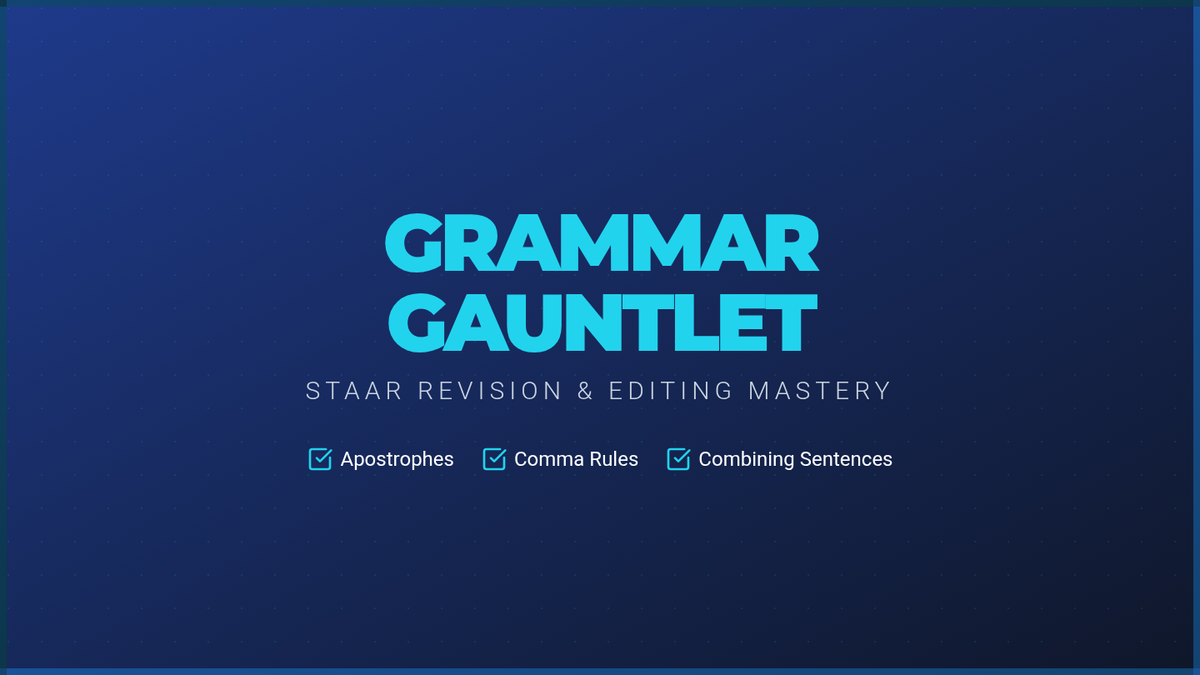
A visual presentation for a STAAR grammar tutoring session, covering apostrophes, commas, and sentence combining with clear examples and visual aids.
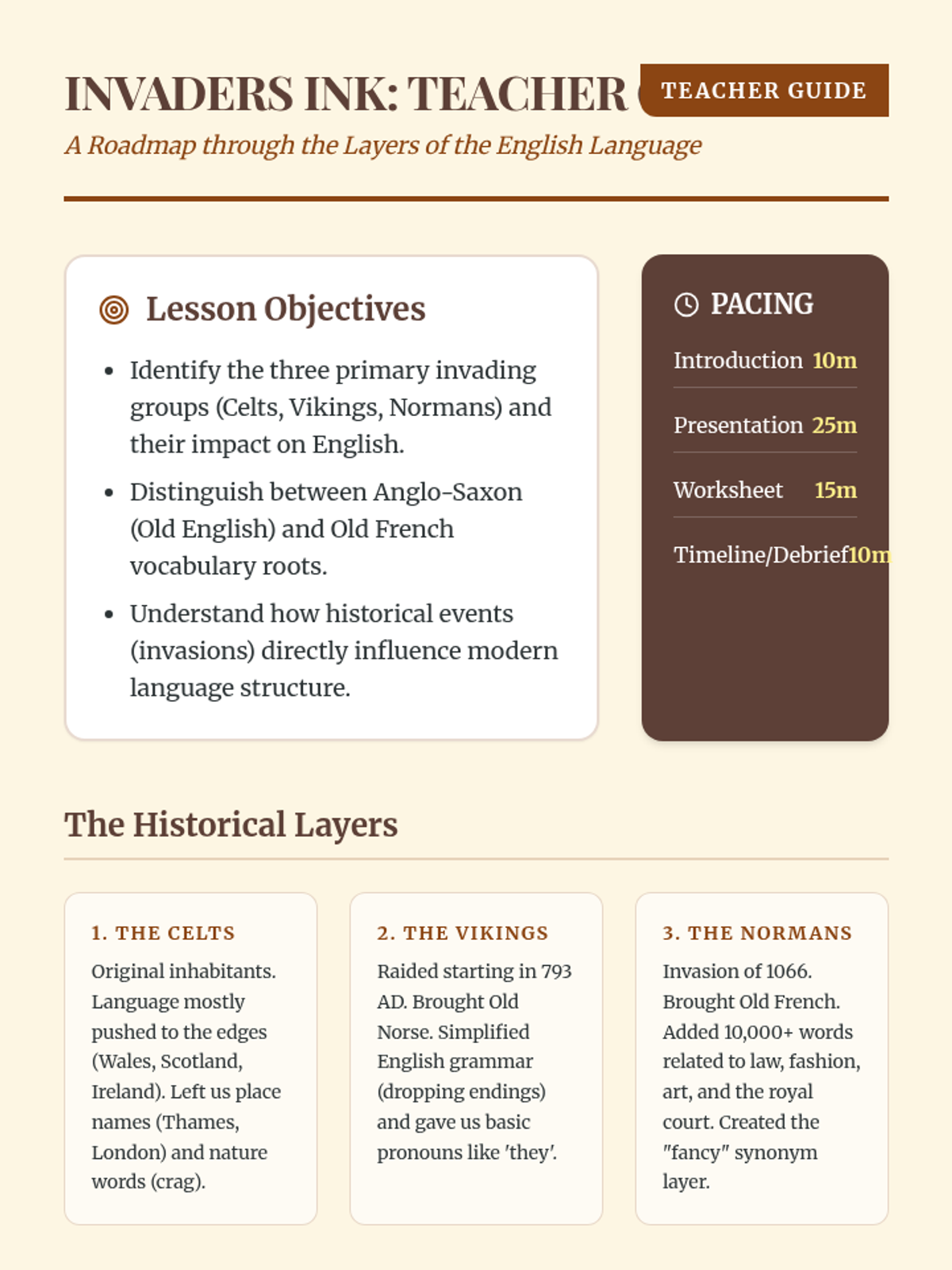
A comprehensive teacher guide for the Invaders Ink lesson. It includes lesson objectives, historical background summaries, slide-by-slide teaching notes, activity suggestions, and differentiation strategies.
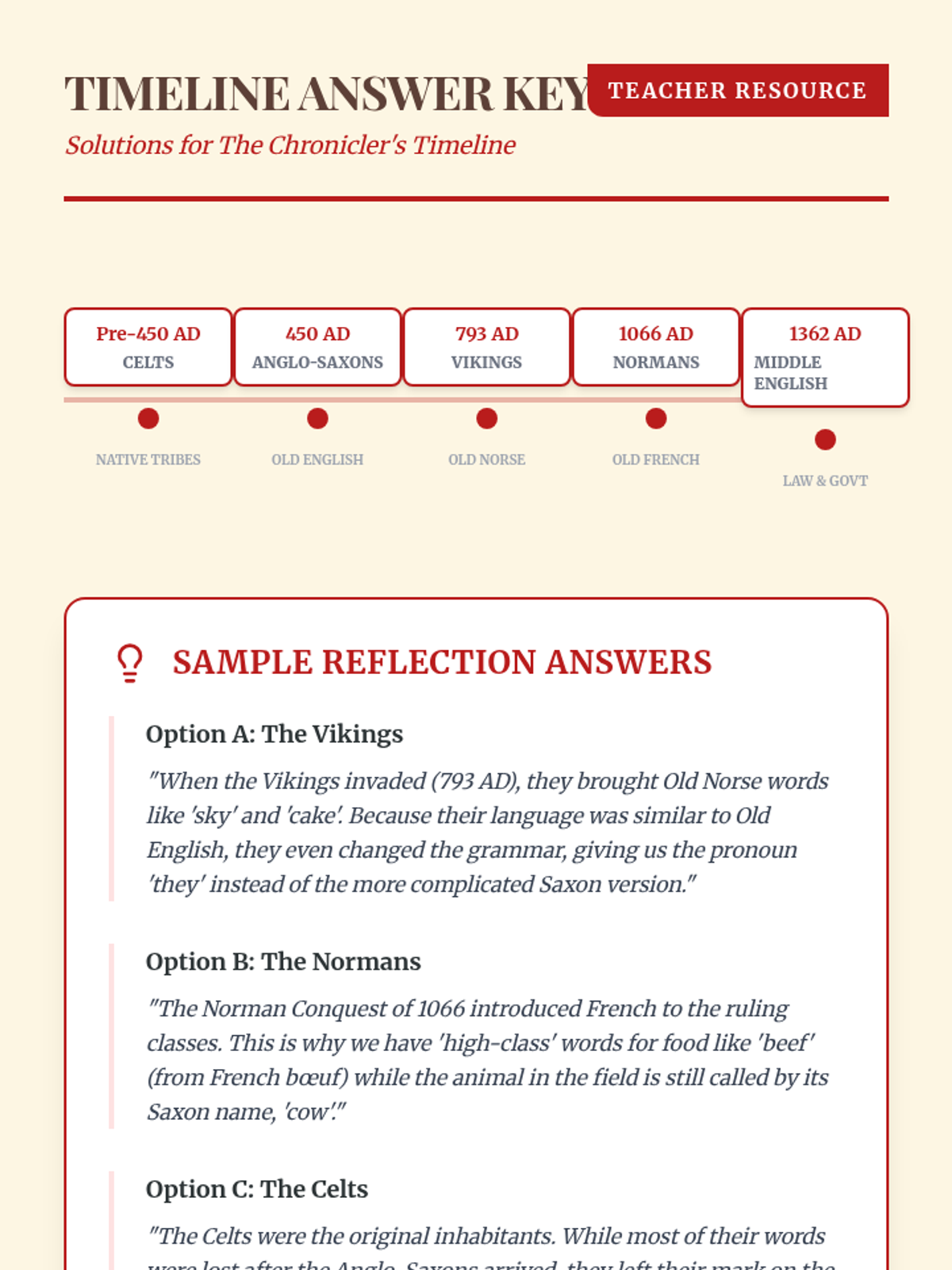
An answer key for the Invasion Timeline Activity, providing the correct dates and groups for each timeline point, plus sample answers for the reflection question.
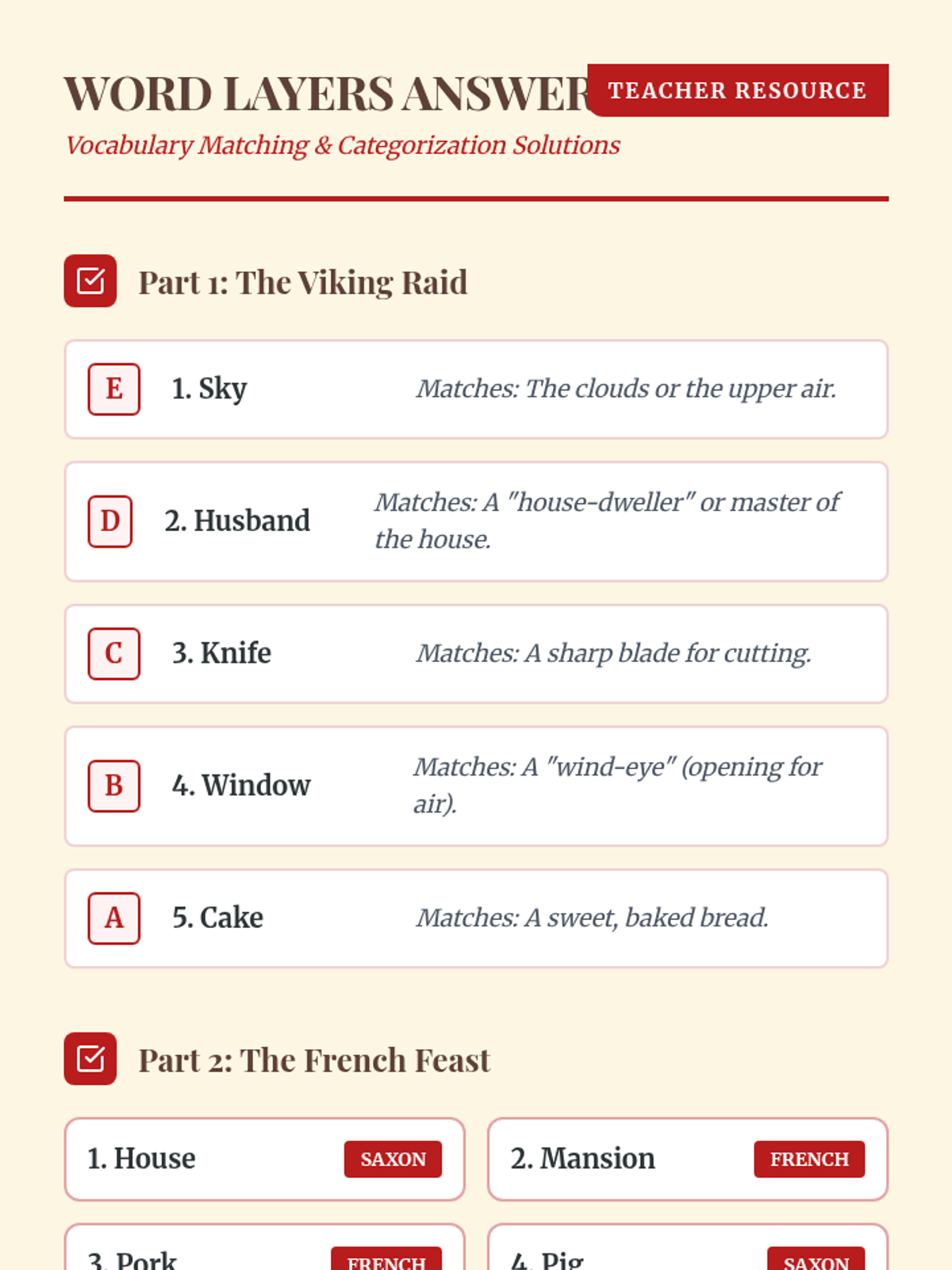
An answer key for the Word Layers Worksheet, providing solutions for the Viking matching section and the Saxon vs. French categorization task. Includes teaching notes on vocabulary origins.
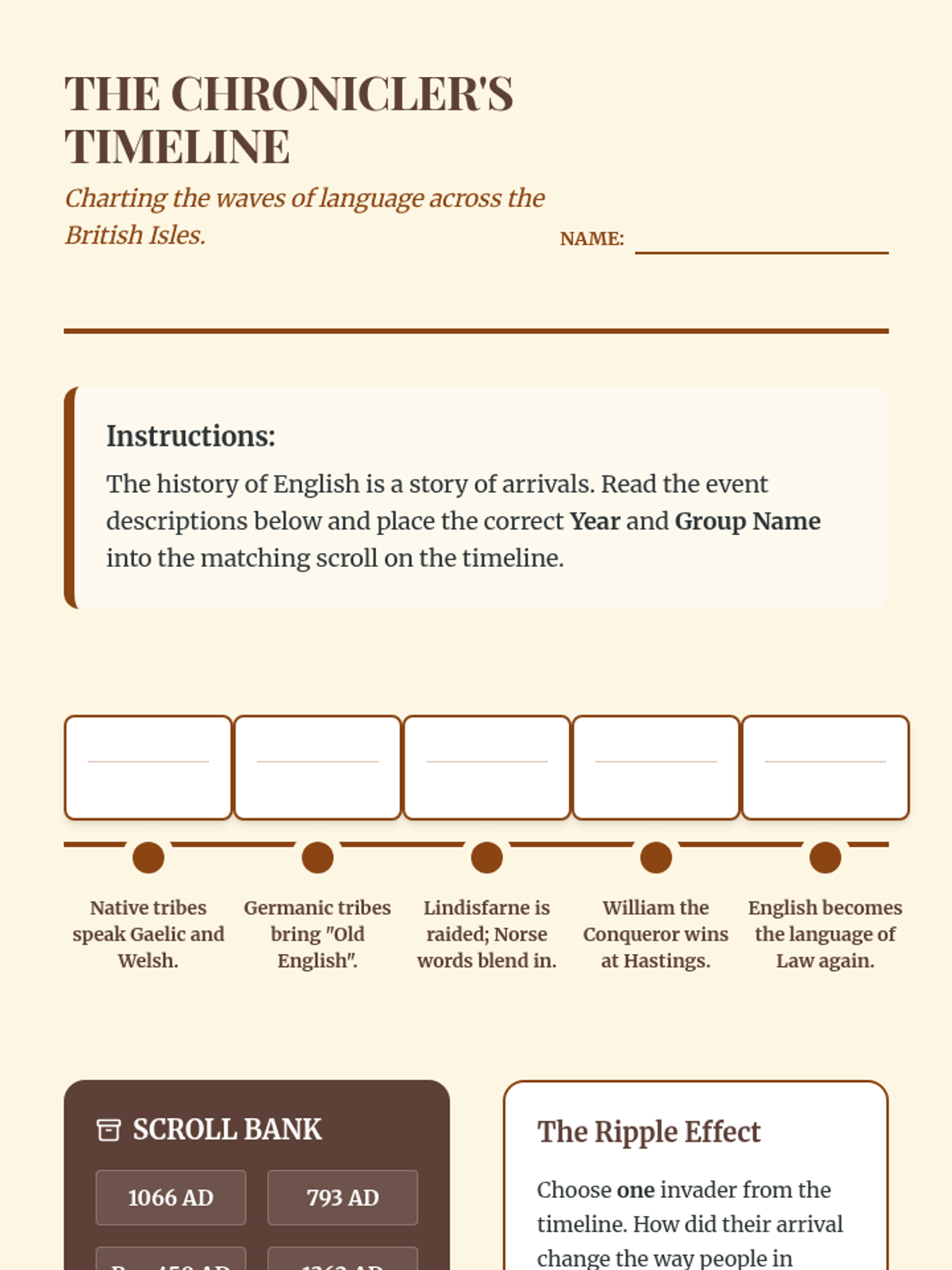
A timeline worksheet where students place key invasions and historical dates in order to see the development of the English language. It includes a word bank of dates and groups, plus a synthesis question.
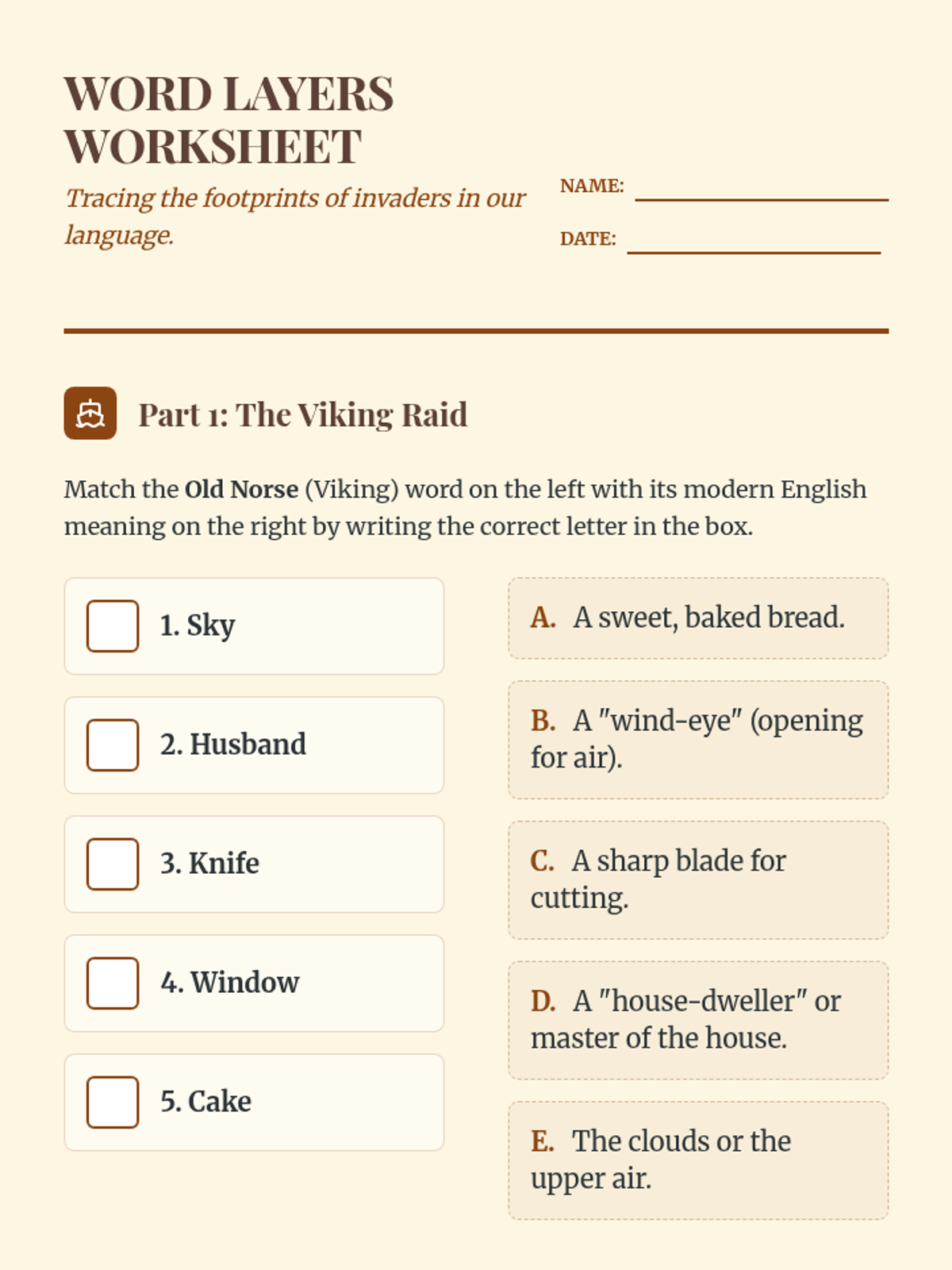
A vocabulary matching and categorization worksheet that tests students on the Norse and French influences in English. Includes sections on matching Viking words to their meanings and distinguishing between Saxon and French synonyms.
A 10-slide presentation detailing the history of the English language through the lens of Celtic, Viking, and French invasions. It features a manuscript-inspired aesthetic with clear visual distinctions between the layers of vocabulary.
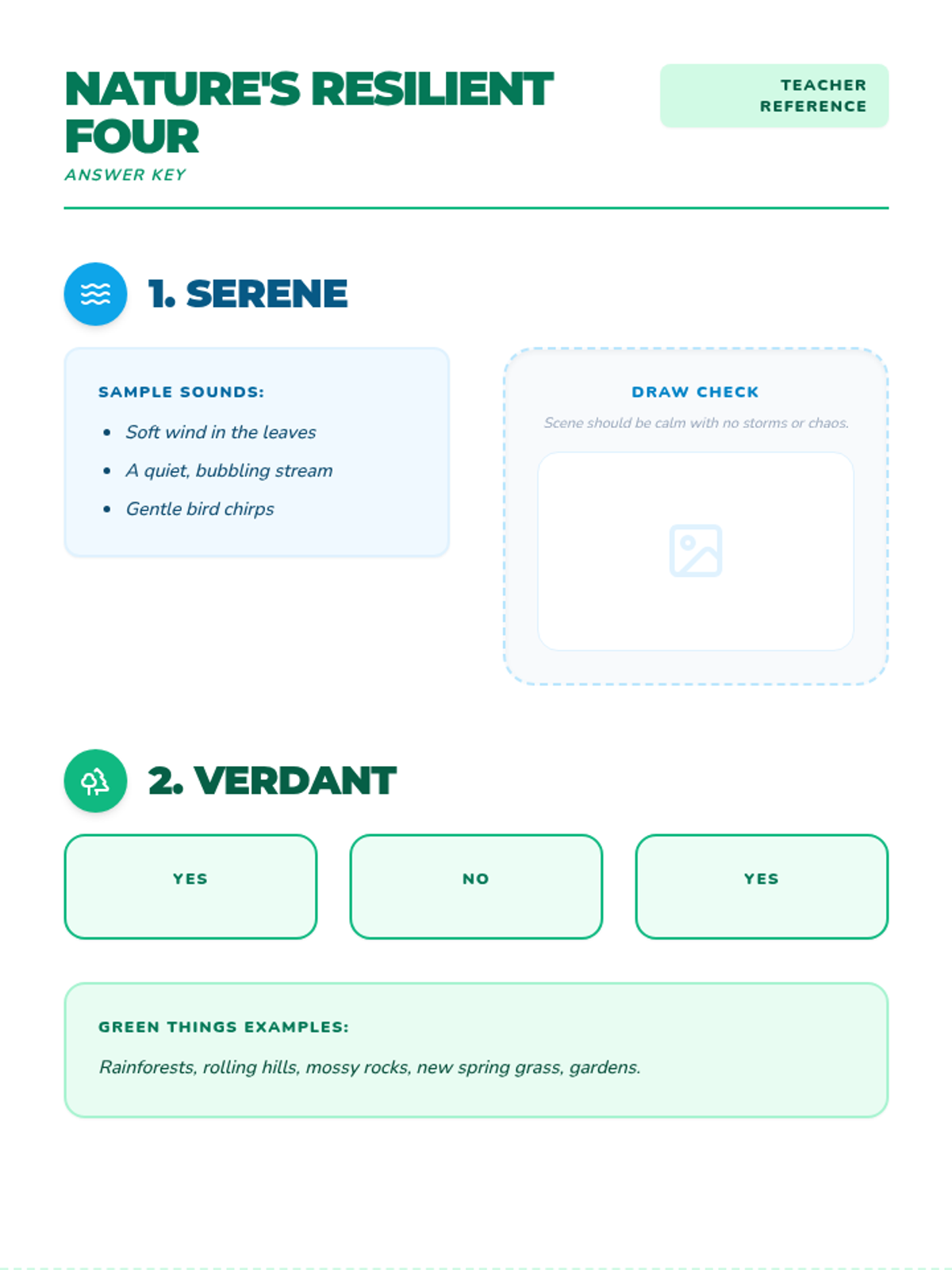
Answer key for the Nature Resilient Four Worksheet, providing sample responses, synonym identification, and context check answers for teacher reference. Updated to match the worksheet's final styling.
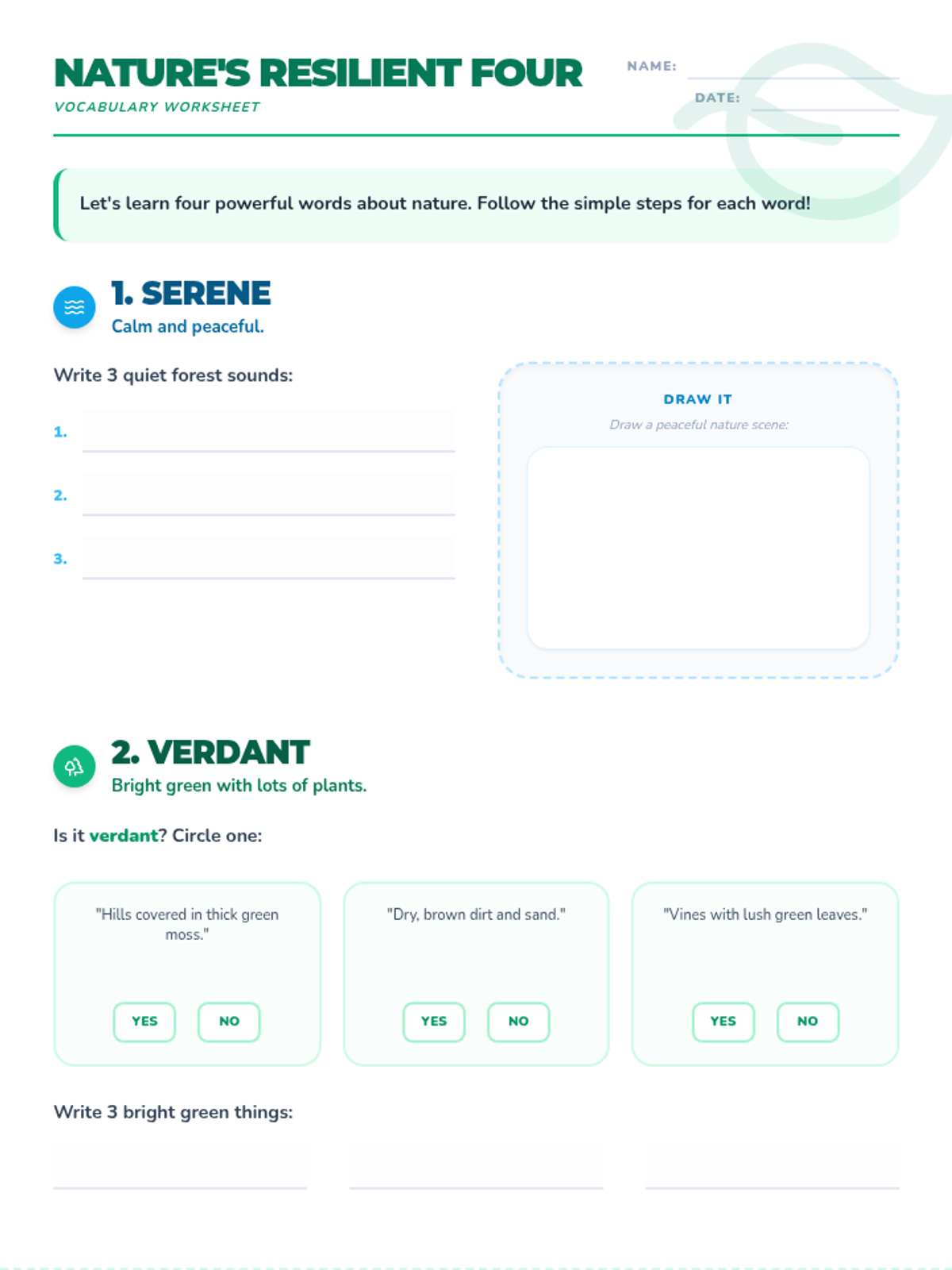
A two-page vocabulary worksheet focusing on serene, verdant, prosperity, and resilient with extremely simplified directions for maximum student clarity. Includes definition-matching, context-checking, drawing, and sentence-writing tasks. Features smaller fonts to ensure a clean fit across two pages with the final step removed.
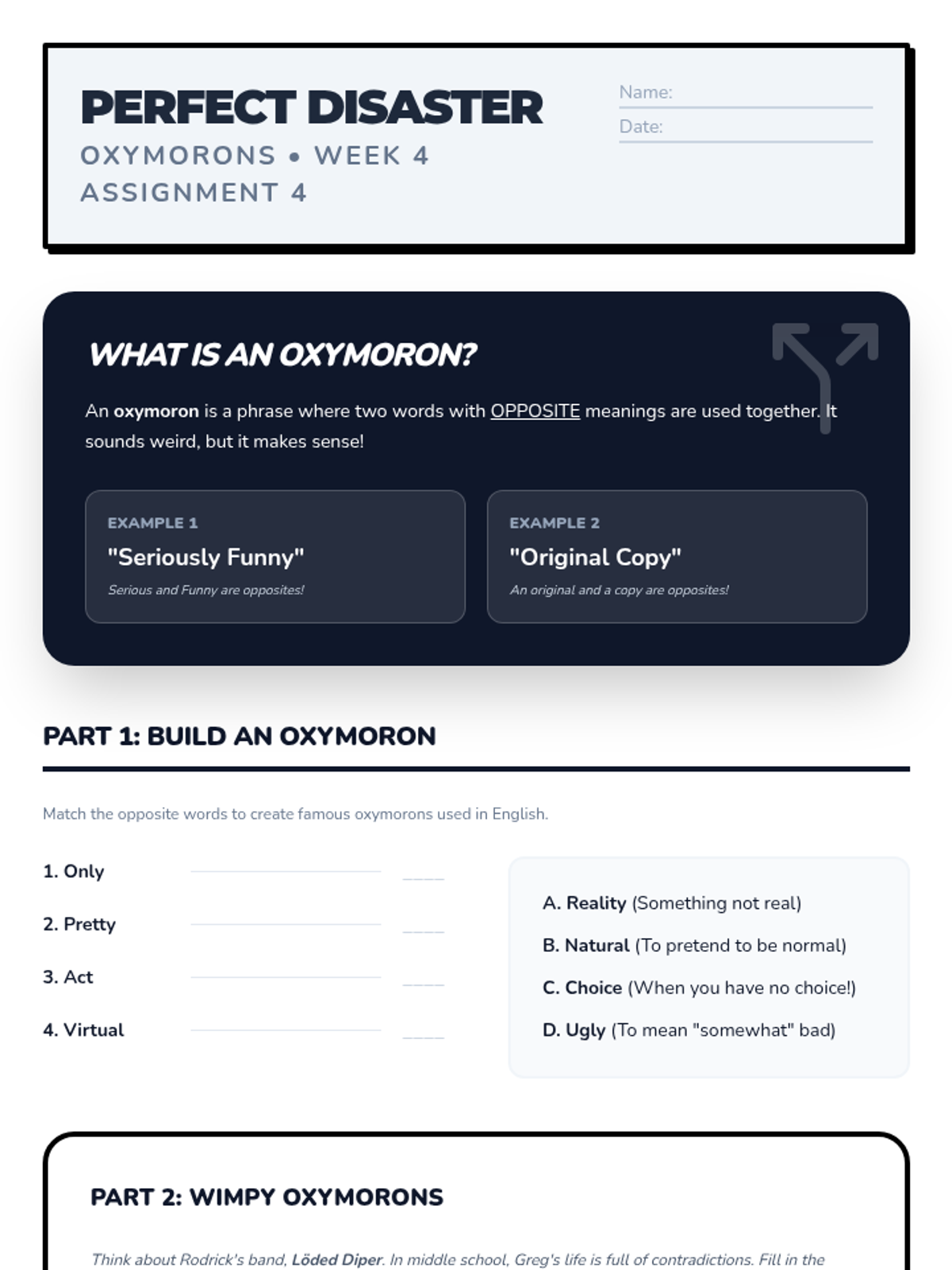
A literary device worksheet for 8th-grade ELL students focusing on oxymorons, using examples from common English and the context of 'Diary of a Wimpy Kid'.
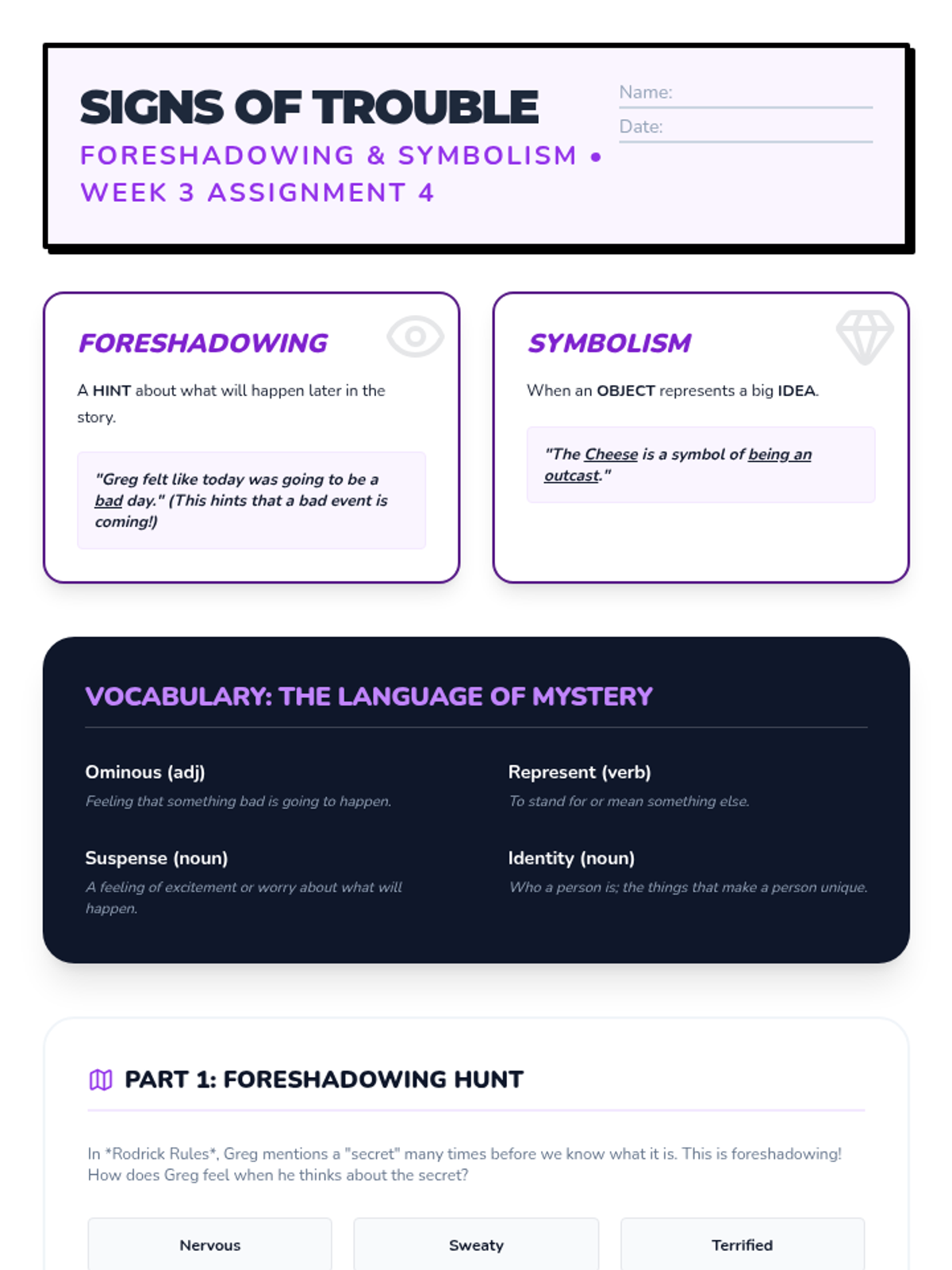
A literary device worksheet for 8th-grade ELL students focusing on foreshadowing and symbolism in 'Rodrick Rules', including vocabulary and matching activities.
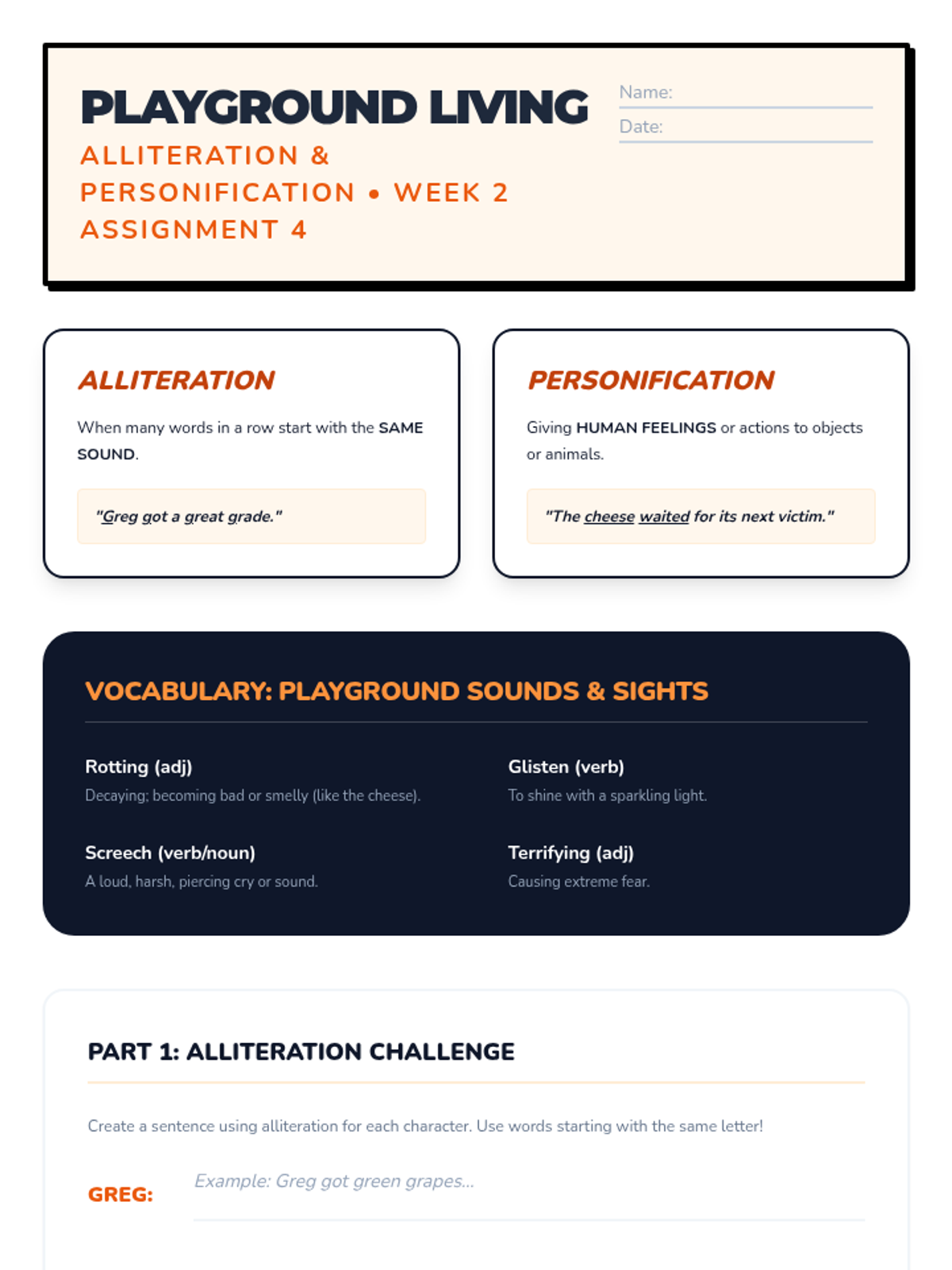
A literary device worksheet for ELL students focusing on alliteration and personification within the context of the school playground and characters.
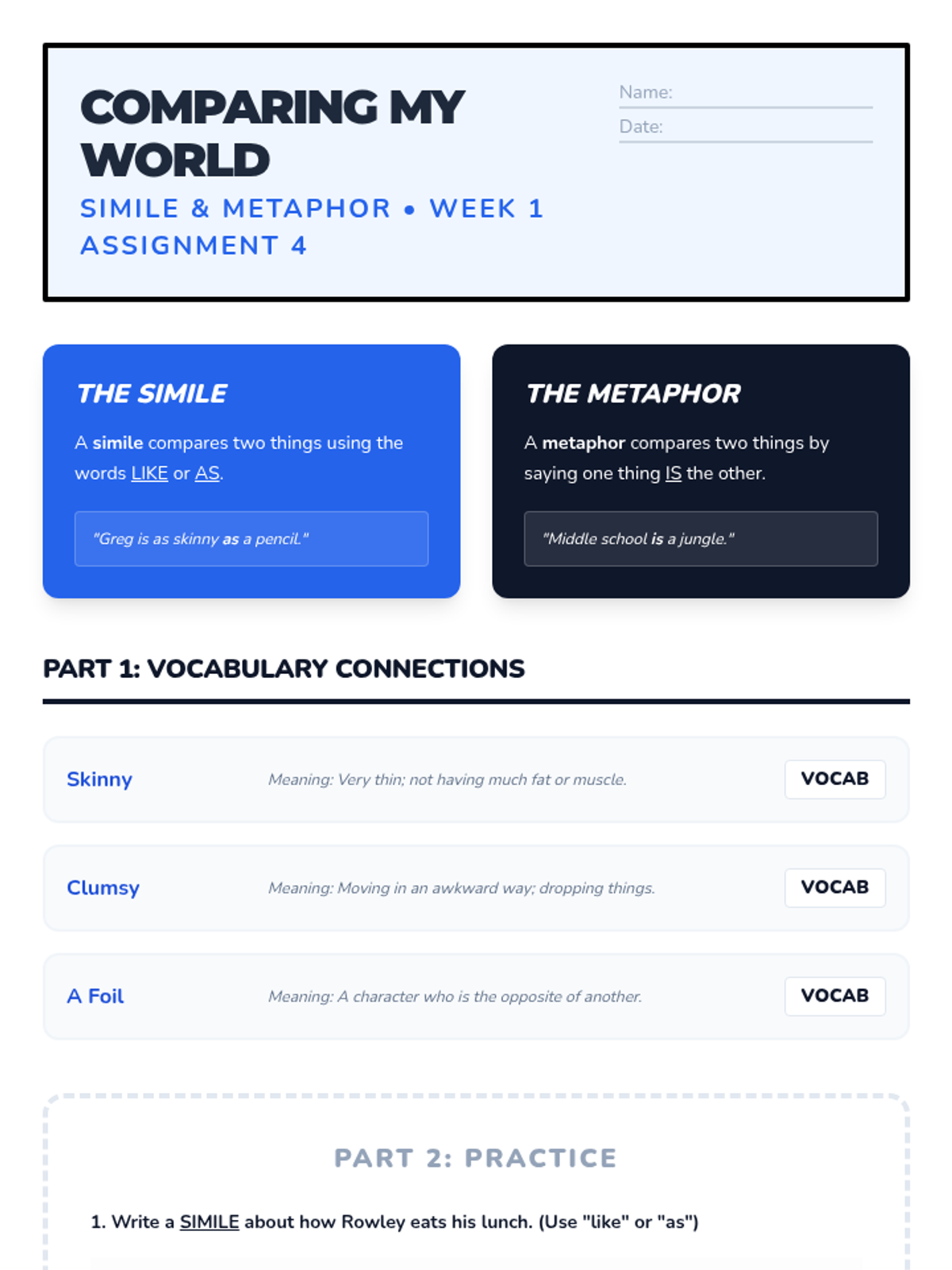
A literary device worksheet for 8th-grade ELL students focusing on similes and metaphors within the context of 'Diary of a Wimpy Kid', featuring vocabulary building and creative writing tasks.
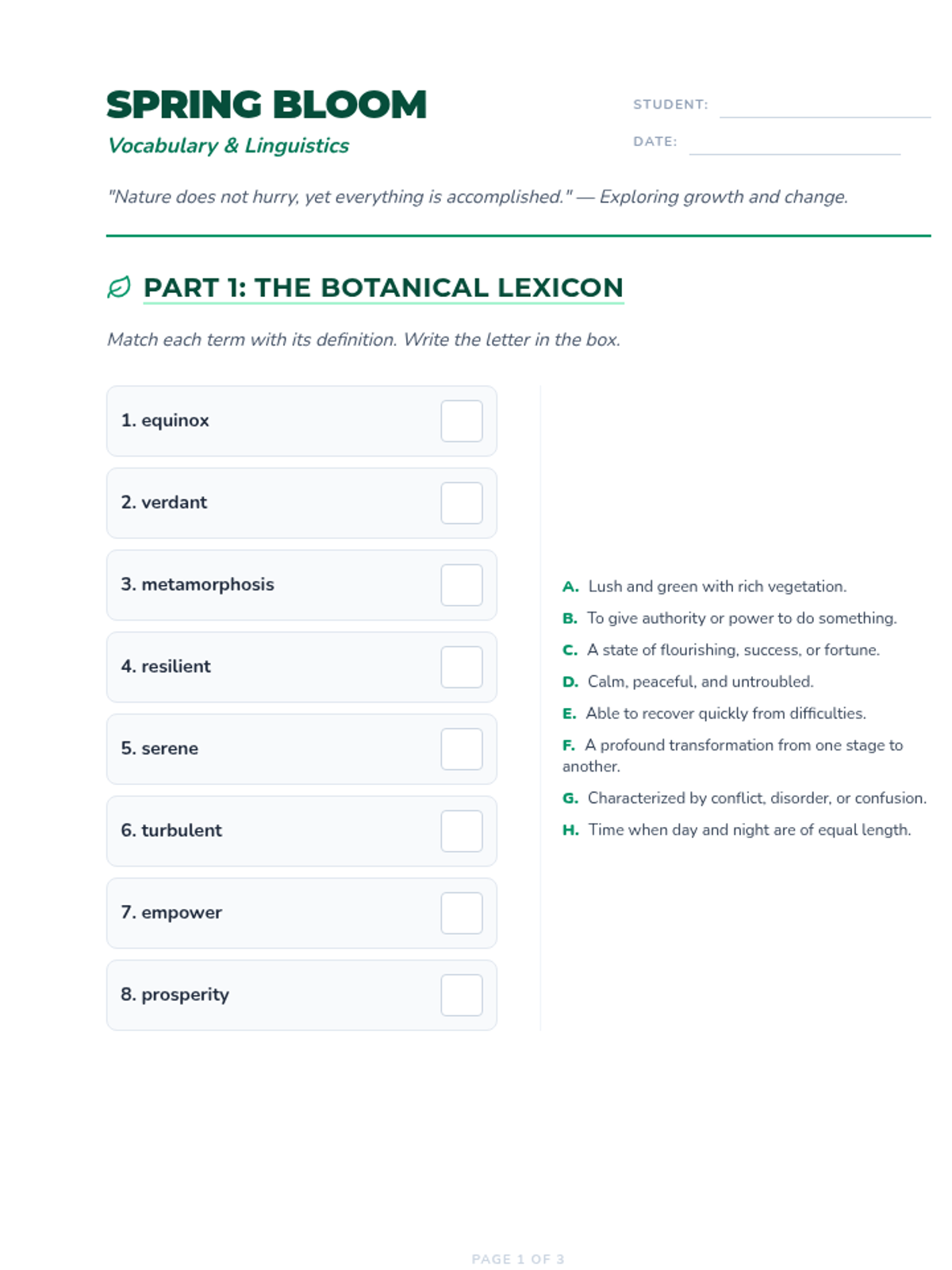
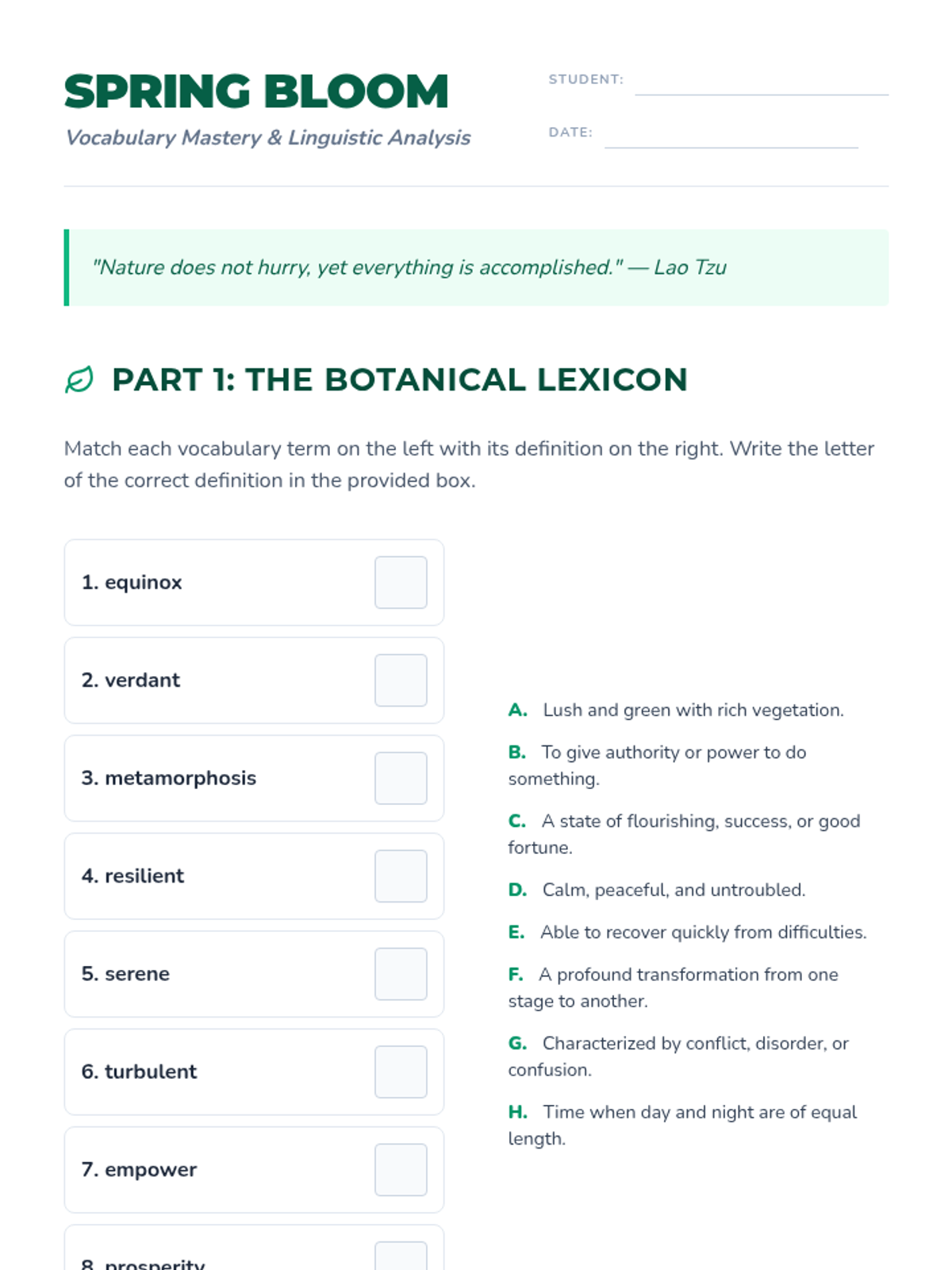
Refined three-page vocabulary worksheet with reduced font sizes and margins to prevent content cutoff. Each part is clearly separated on its own page (Part 1 on Page 1, Part 2 on Page 2, Part 3 on Page 3) for a clean, print-optimized experience.
A visual presentation to introduce the eight vocabulary terms. Each slide features high-impact definitions, parts of speech, and usage examples with nature-themed motifs. Corrected font sizes to meet the 24px minimum requirement. Vocabulary words are now lowercase.
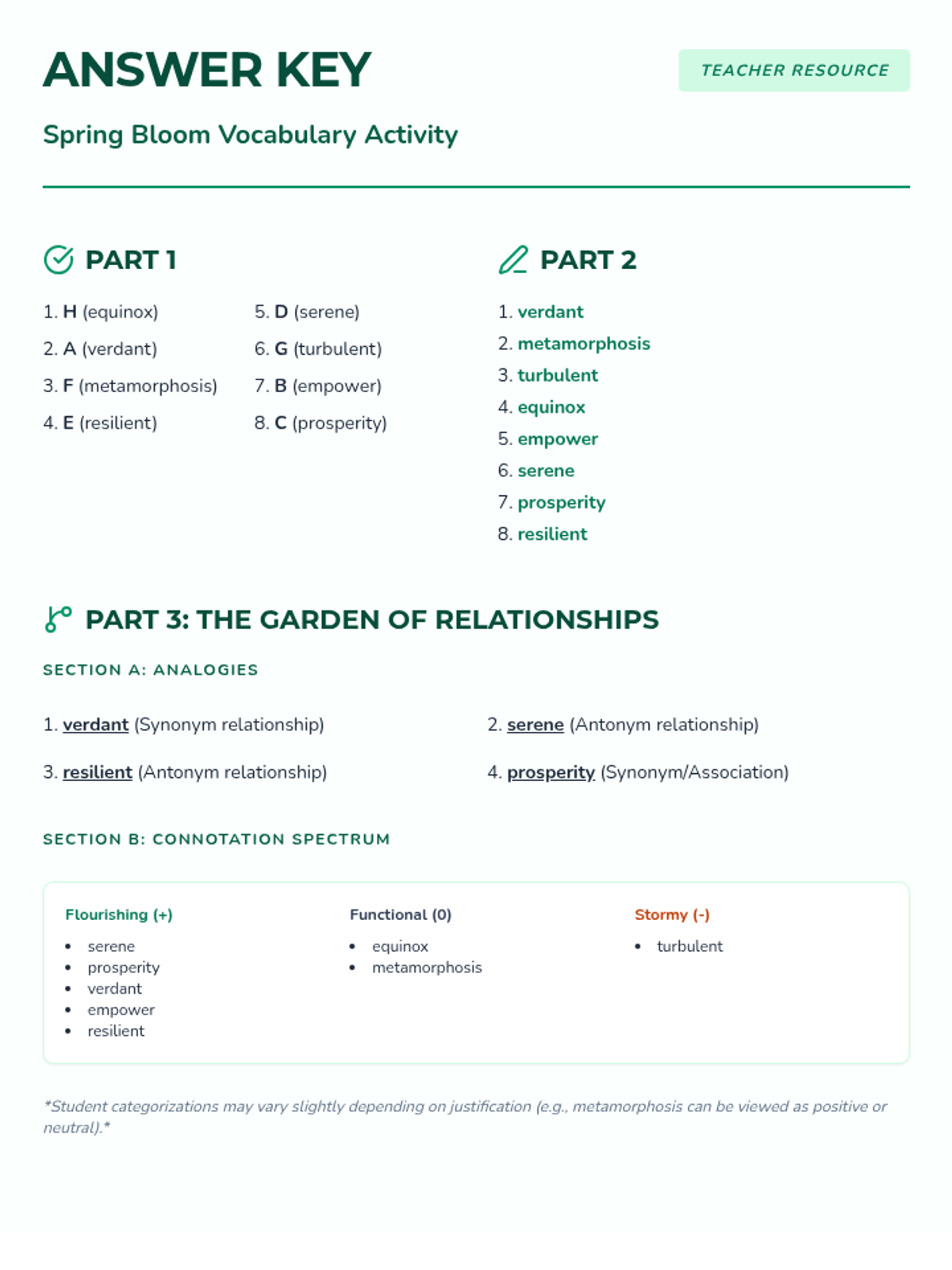
Updated answer key for the Spring Bloom Vocabulary Activity. Changed "Challenging (-)" to "Stormy (-)" in the Connotation Spectrum section to align with the revised worksheet.
High-contrast, print-ready three-page vocabulary worksheet. Uses explicit break-after properties and a strict 960px height per page to ensure Part 1, Part 2, and Part 3 are perfectly separated during printing. Clean white backgrounds maximize legibility and ink efficiency.
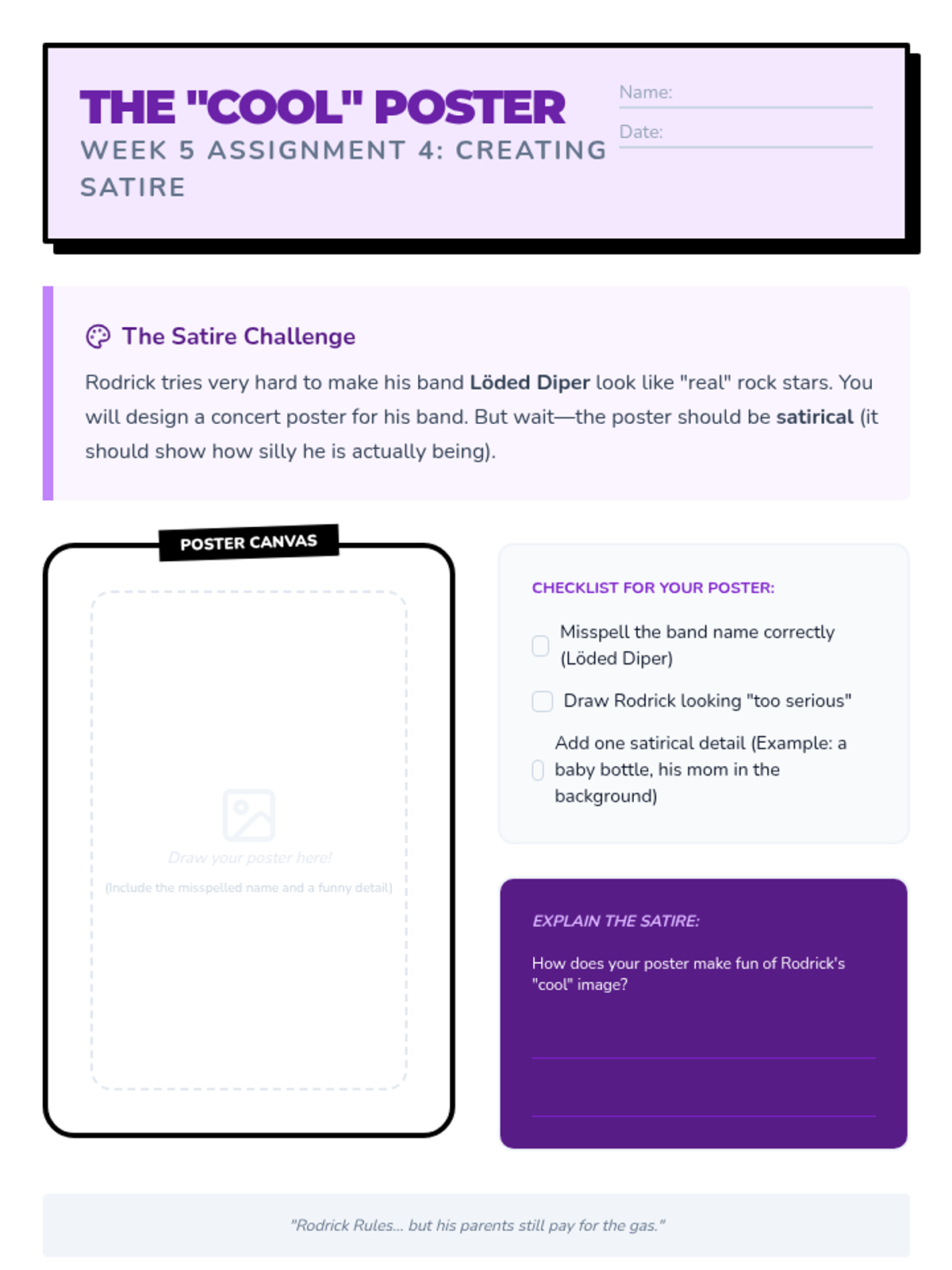
A creative assignment for Week 5 where students analyze and create satirical content based on Rodrick's band 'Löded Diper'.
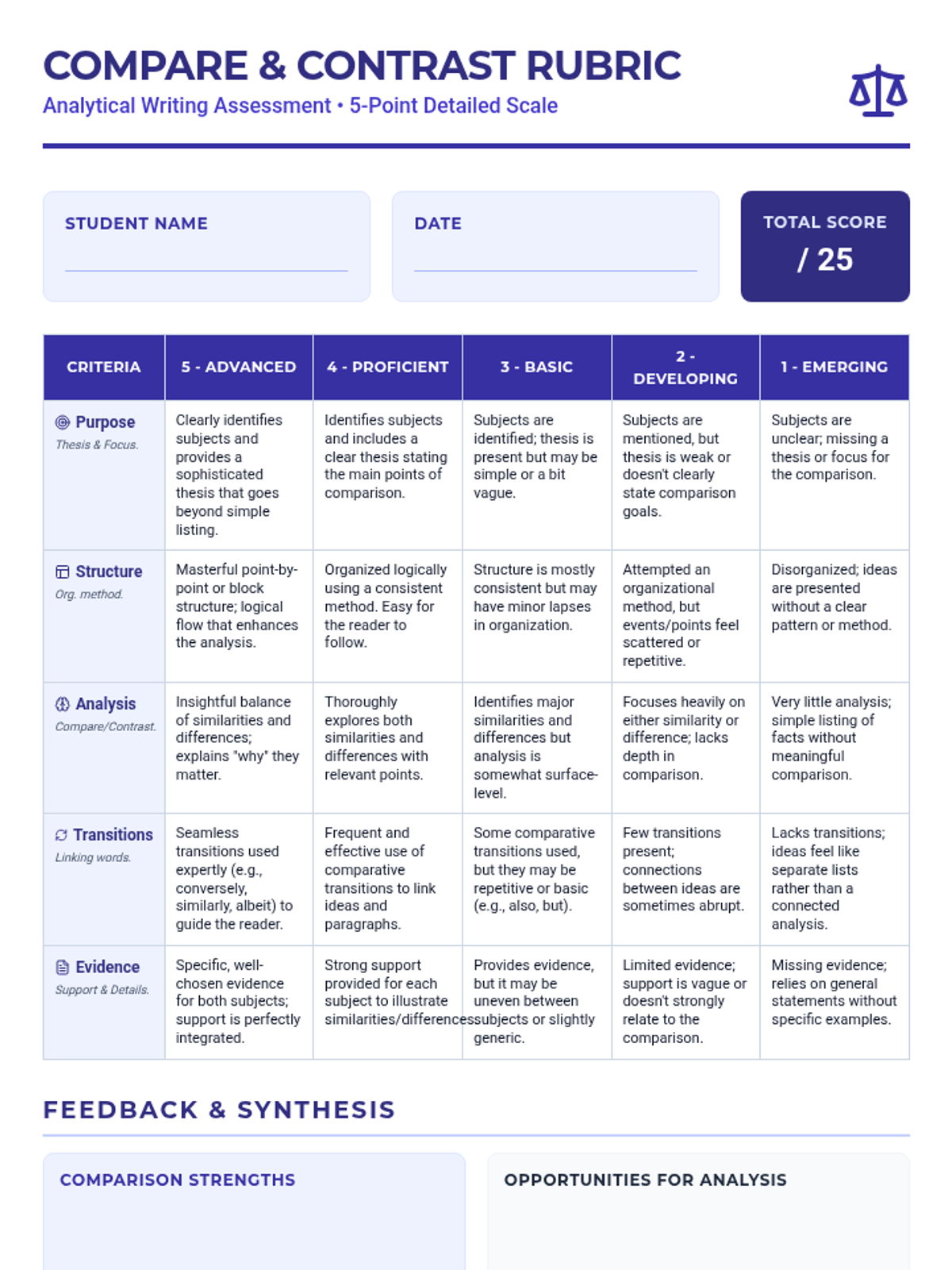
A 5-point analytical rubric for assessing compare and contrast essays, focusing on thesis, organization, depth of analysis, and transition use.
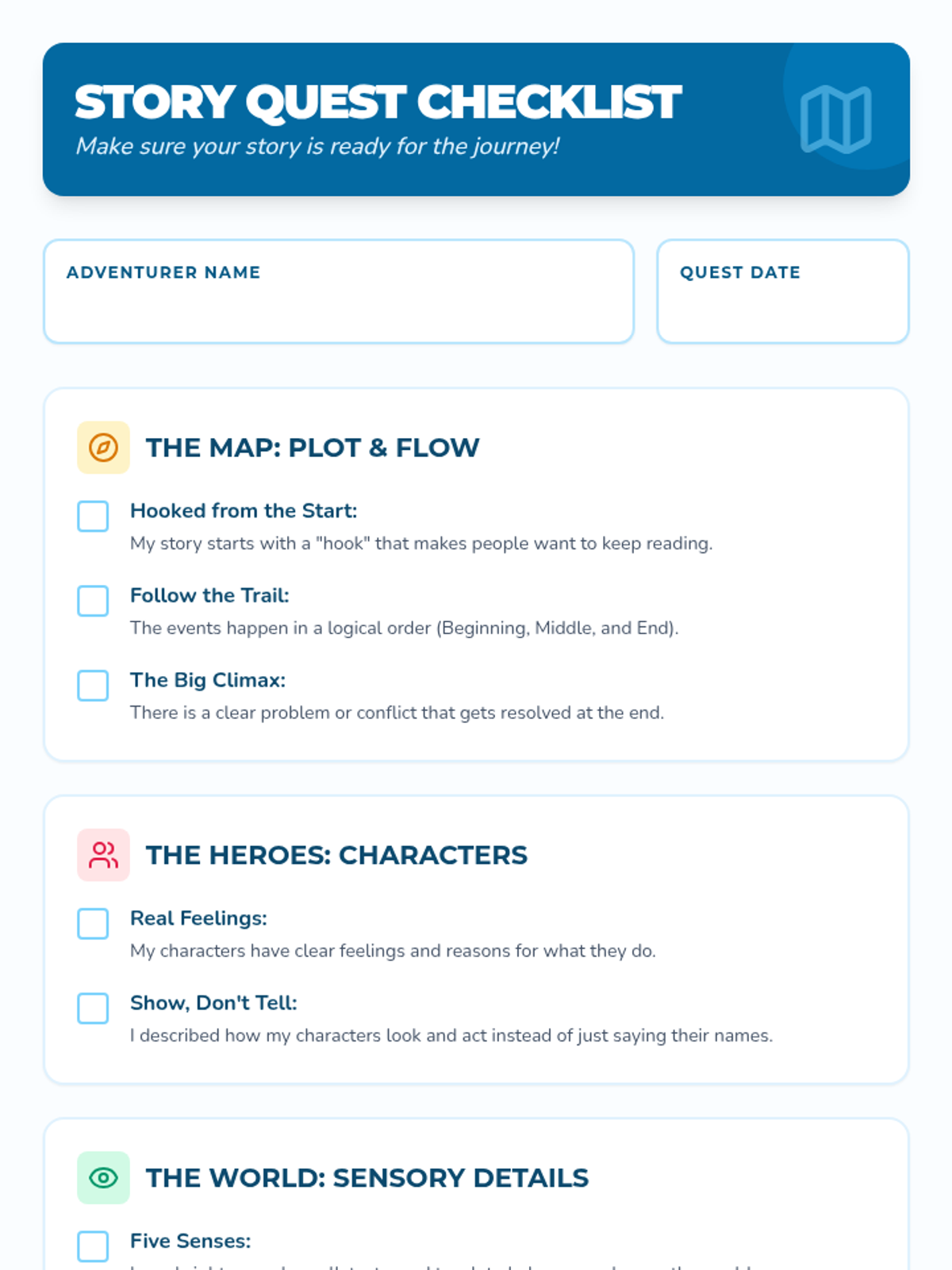
A student-friendly self-assessment checklist for narrative writing, themed as a "Story Quest" with clear goals and reflection space.
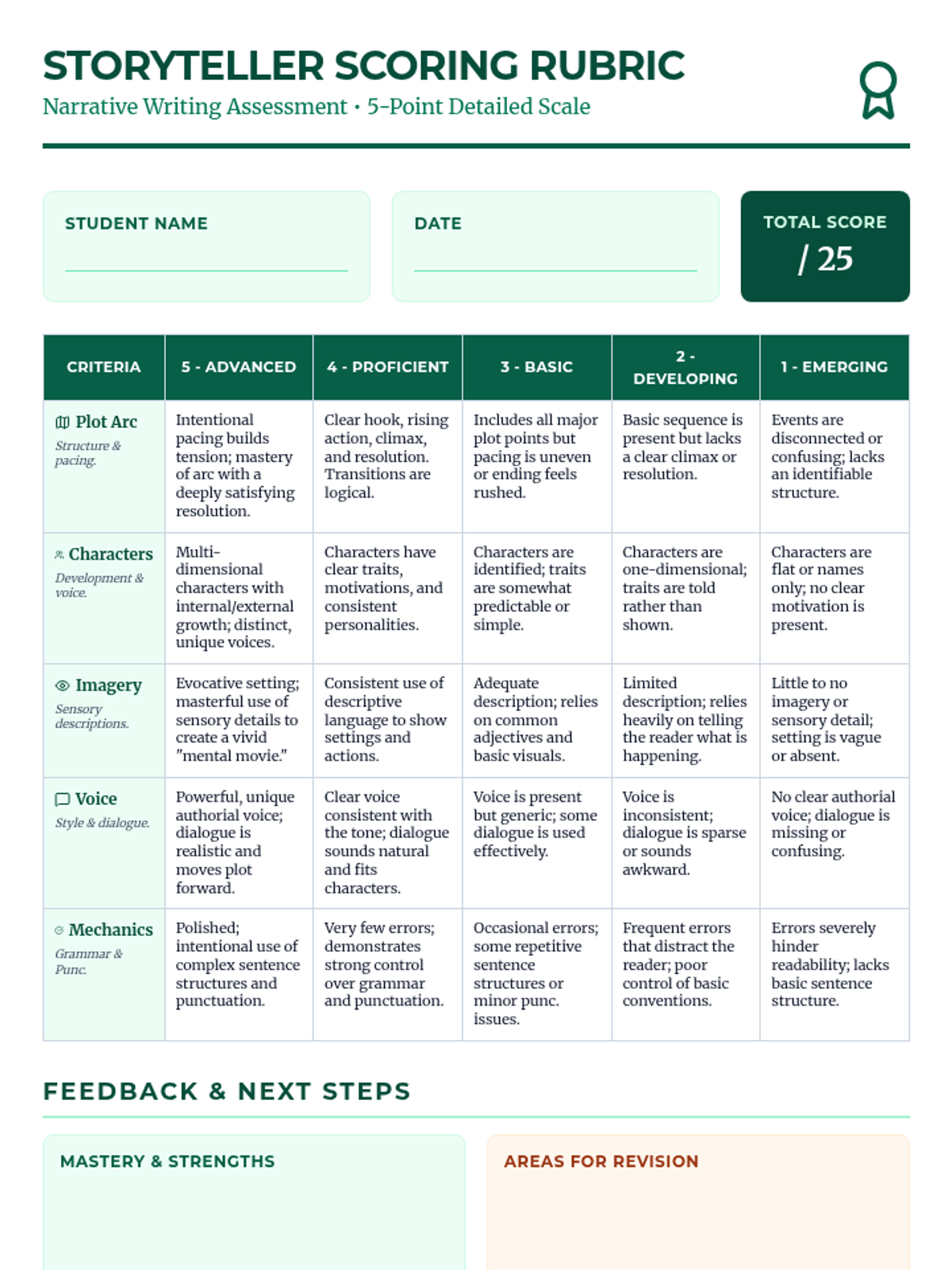
A refined 5-point teacher-facing rubric for assessing narrative writing across plot, characters, sensory details, voice, and mechanics, designed for clear differentiation.
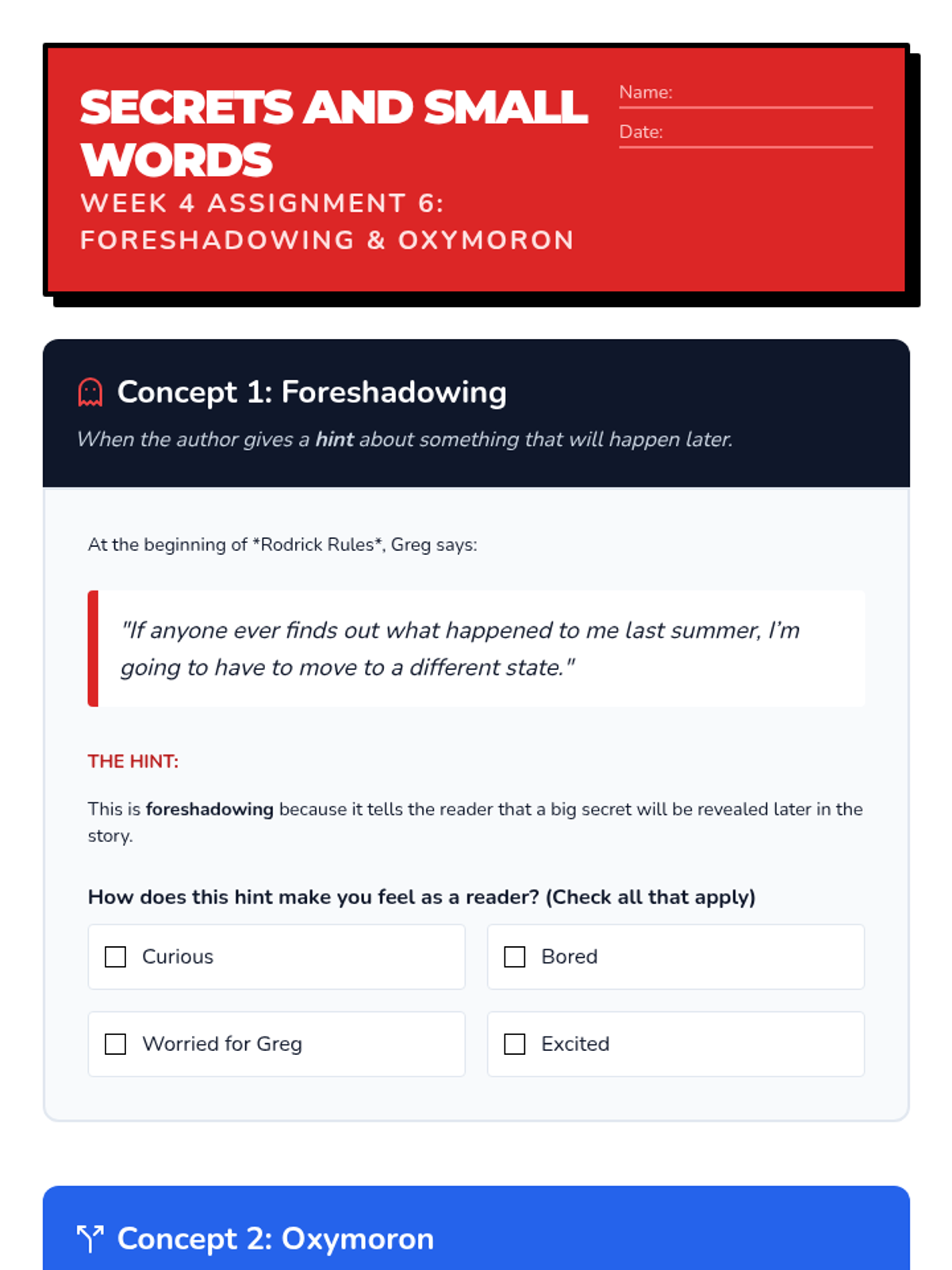
A literary device worksheet for Week 4 focusing on Foreshadowing (the embarrassing secret) and Oxymoron (Löded Diper) within the context of 'Rodrick Rules'.
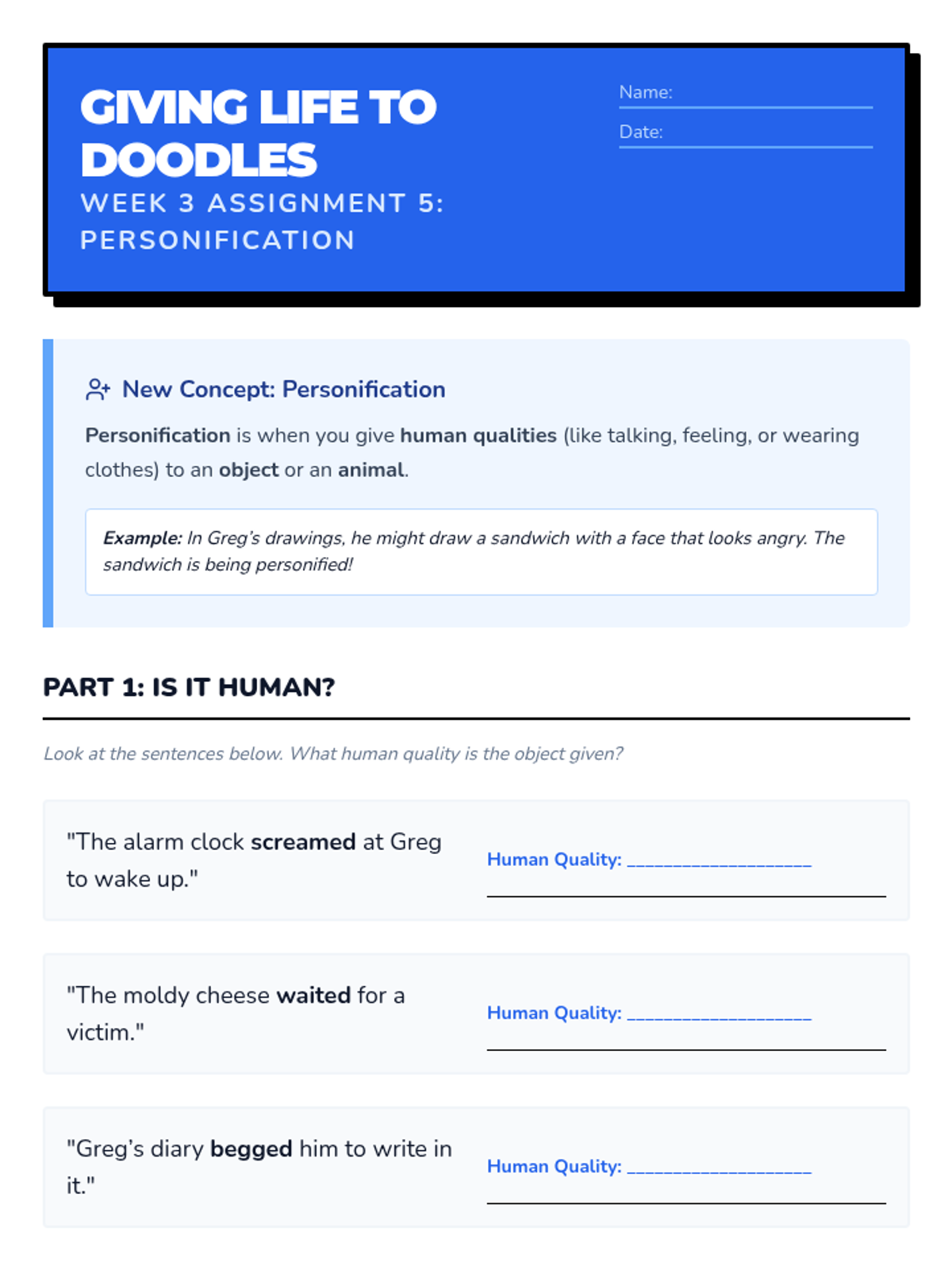
A worksheet for Week 3 focusing on Personification (giving human traits to objects), using examples from Greg's drawings and bridging the transition between books.
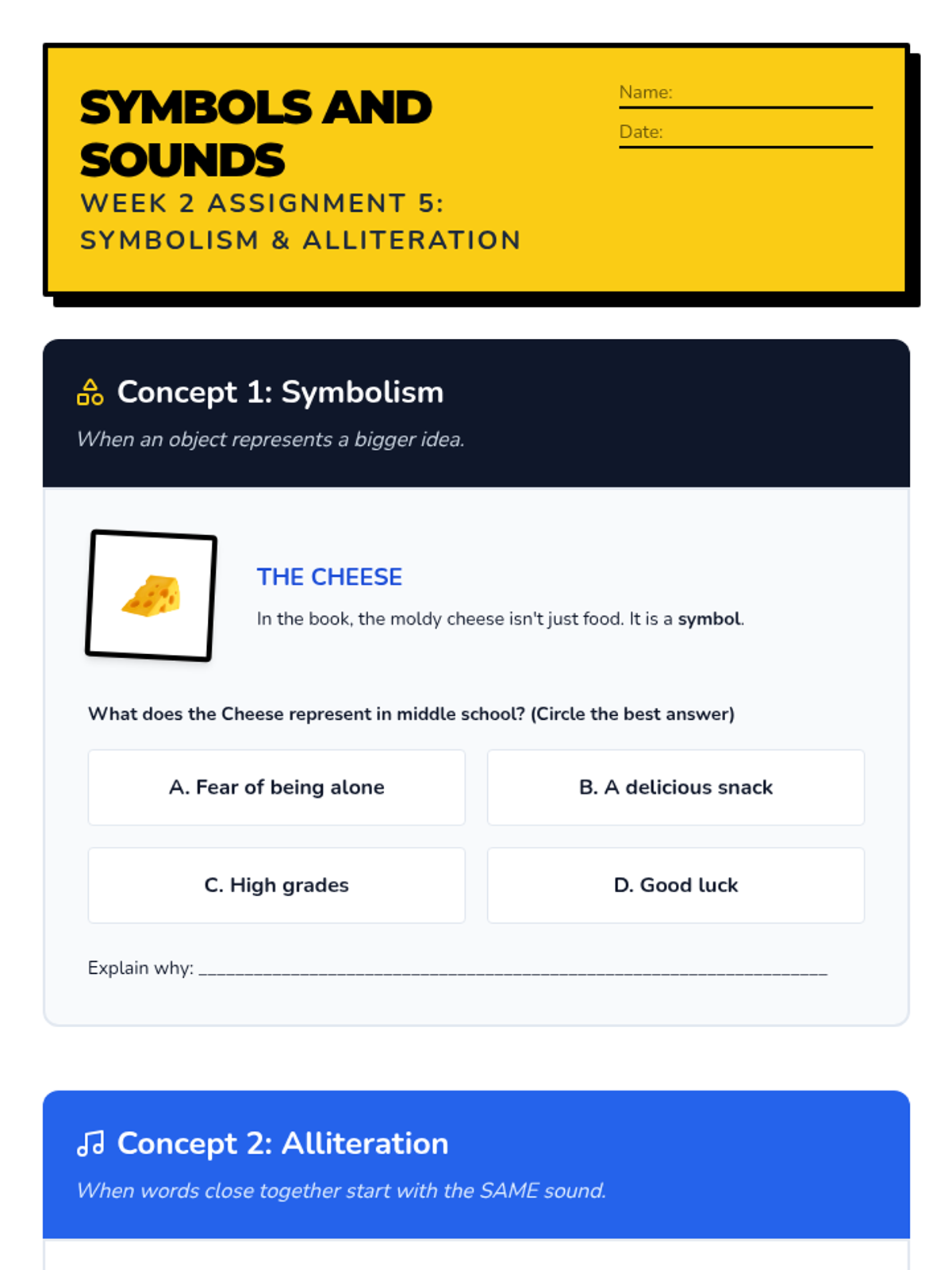
A worksheet for Week 2 focusing on Symbolism (the Cheese) and Alliteration (character names and traits), with an ELL-friendly vocabulary focus on social hierarchies.
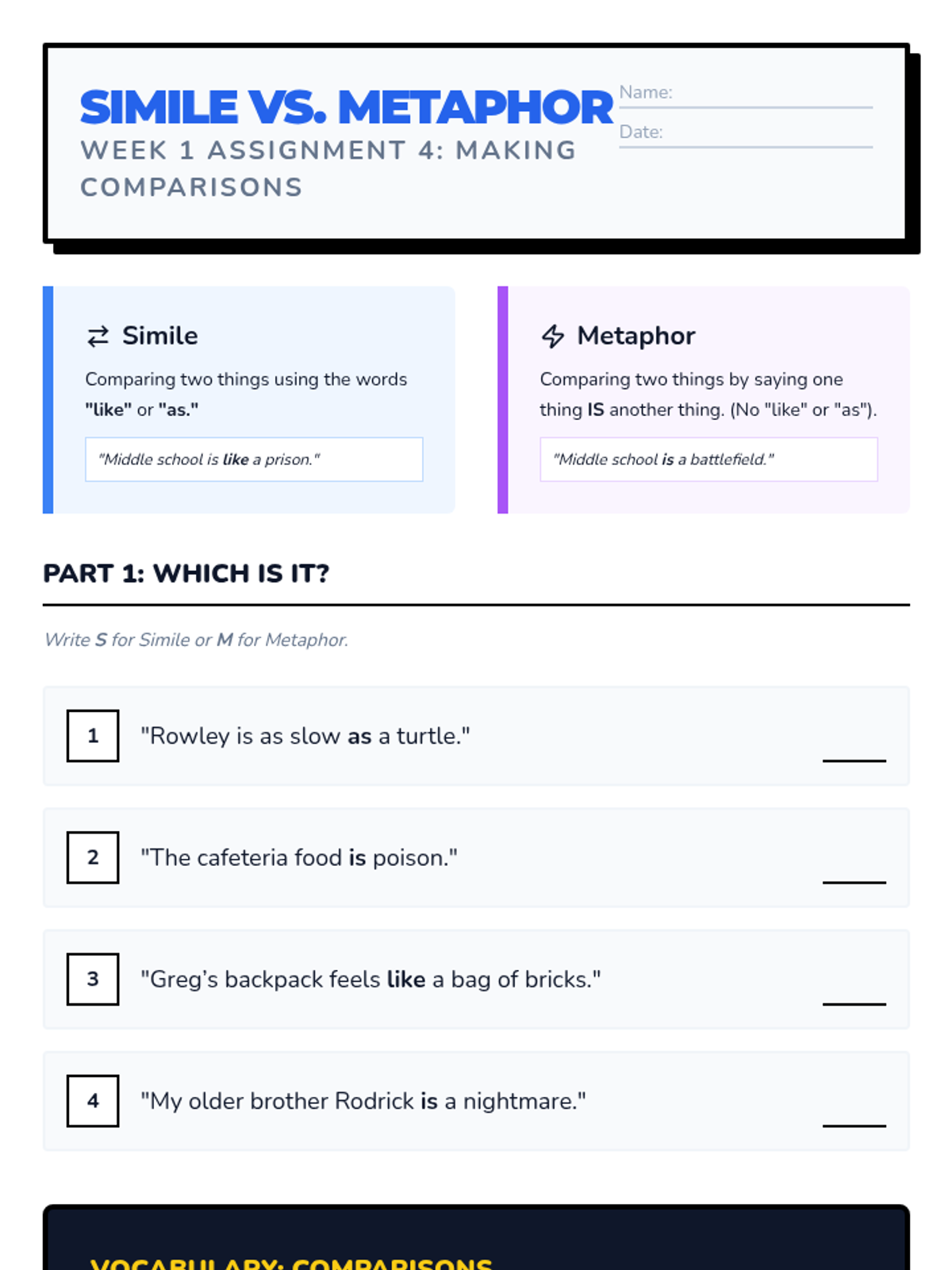
A literary device worksheet for Week 1 focusing on identifying and creating similes and metaphors within the context of 'Diary of a Wimpy Kid'.
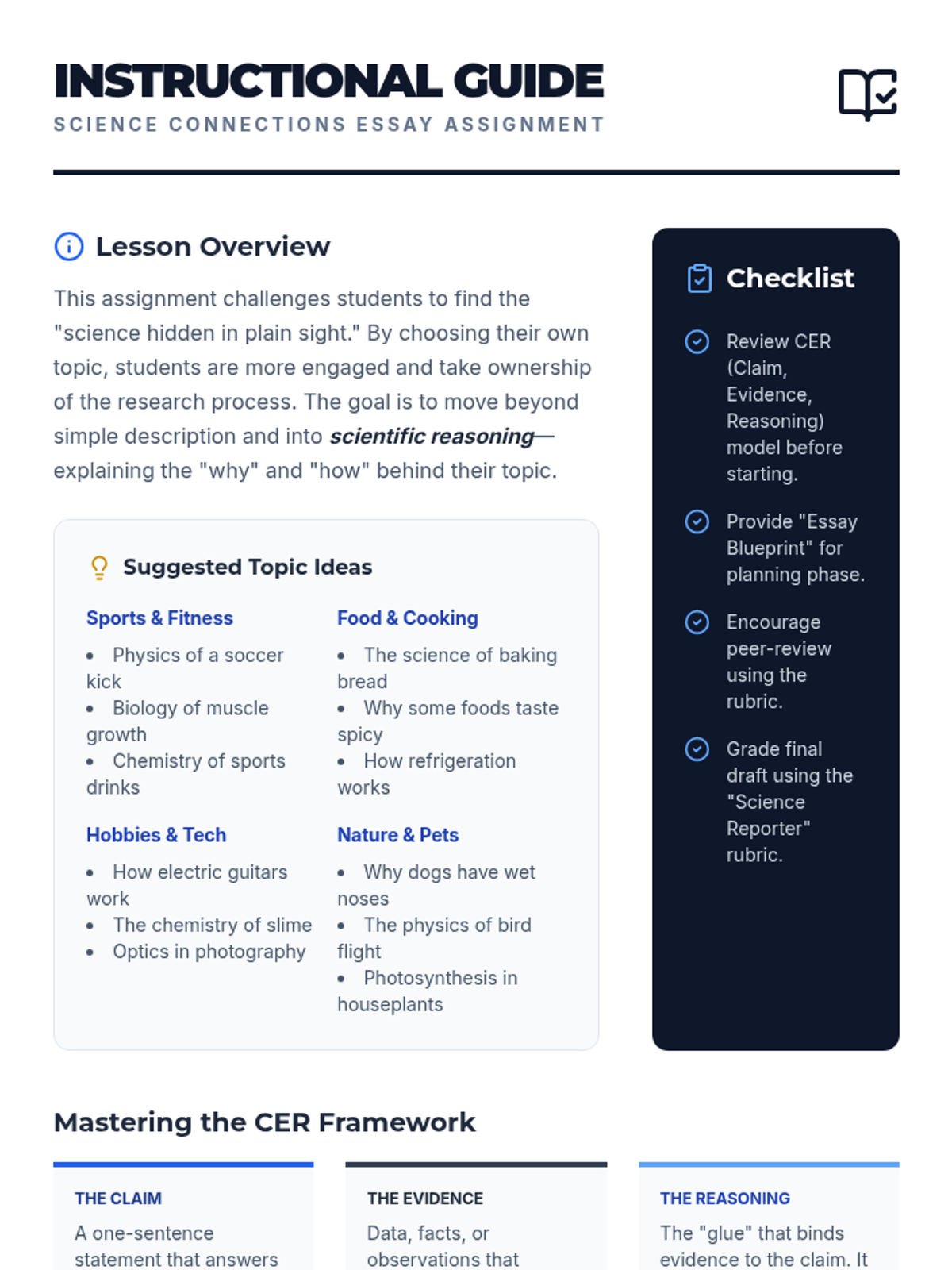
An instructional guide for teachers providing tips on lesson implementation, topic suggestions, and a breakdown of the CER (Claim, Evidence, Reasoning) framework for students.
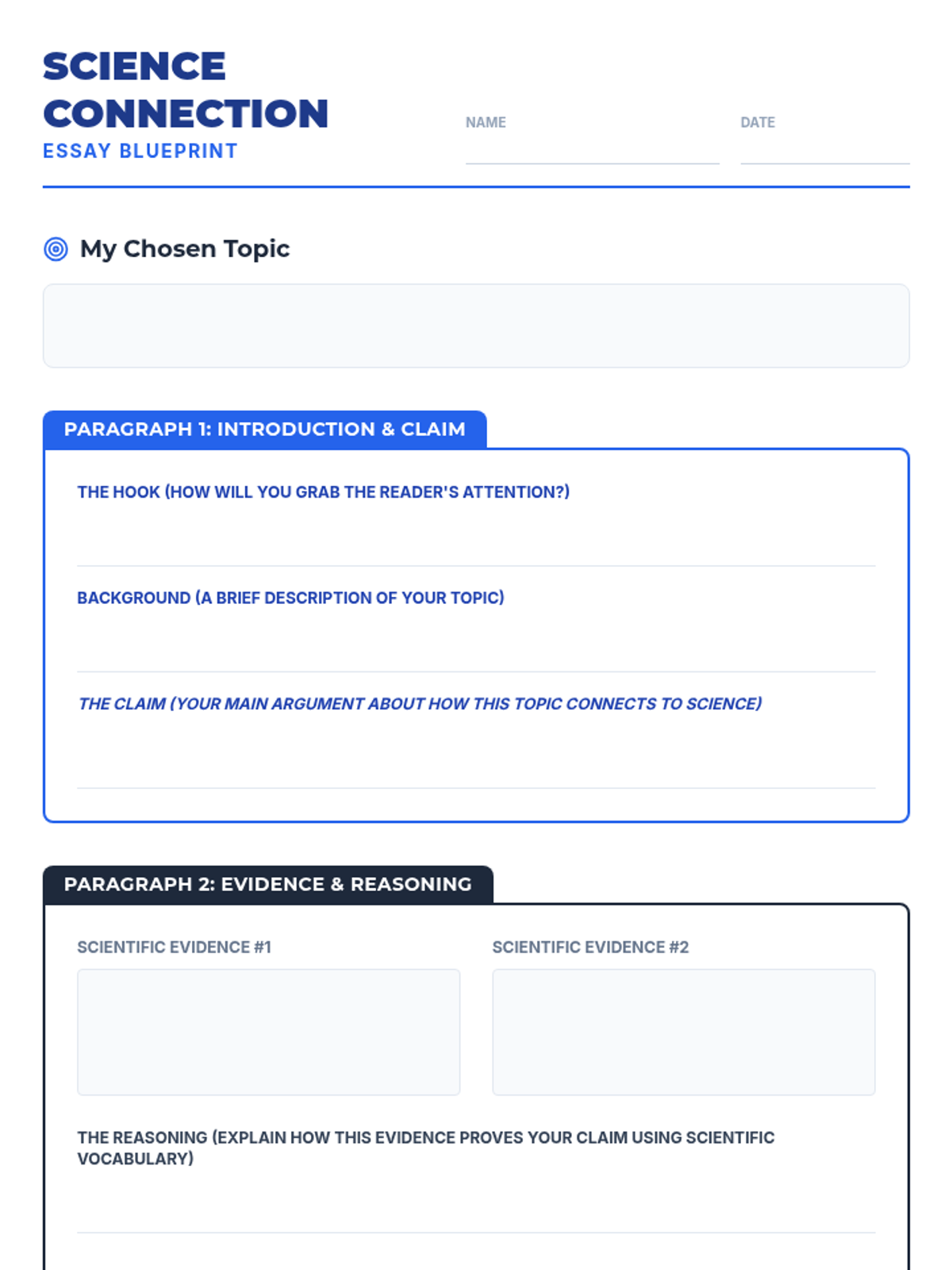
A structured essay planning worksheet designed to guide students through a three-paragraph science connection essay using the CER (Claims, Evidence, Reasoning) framework.
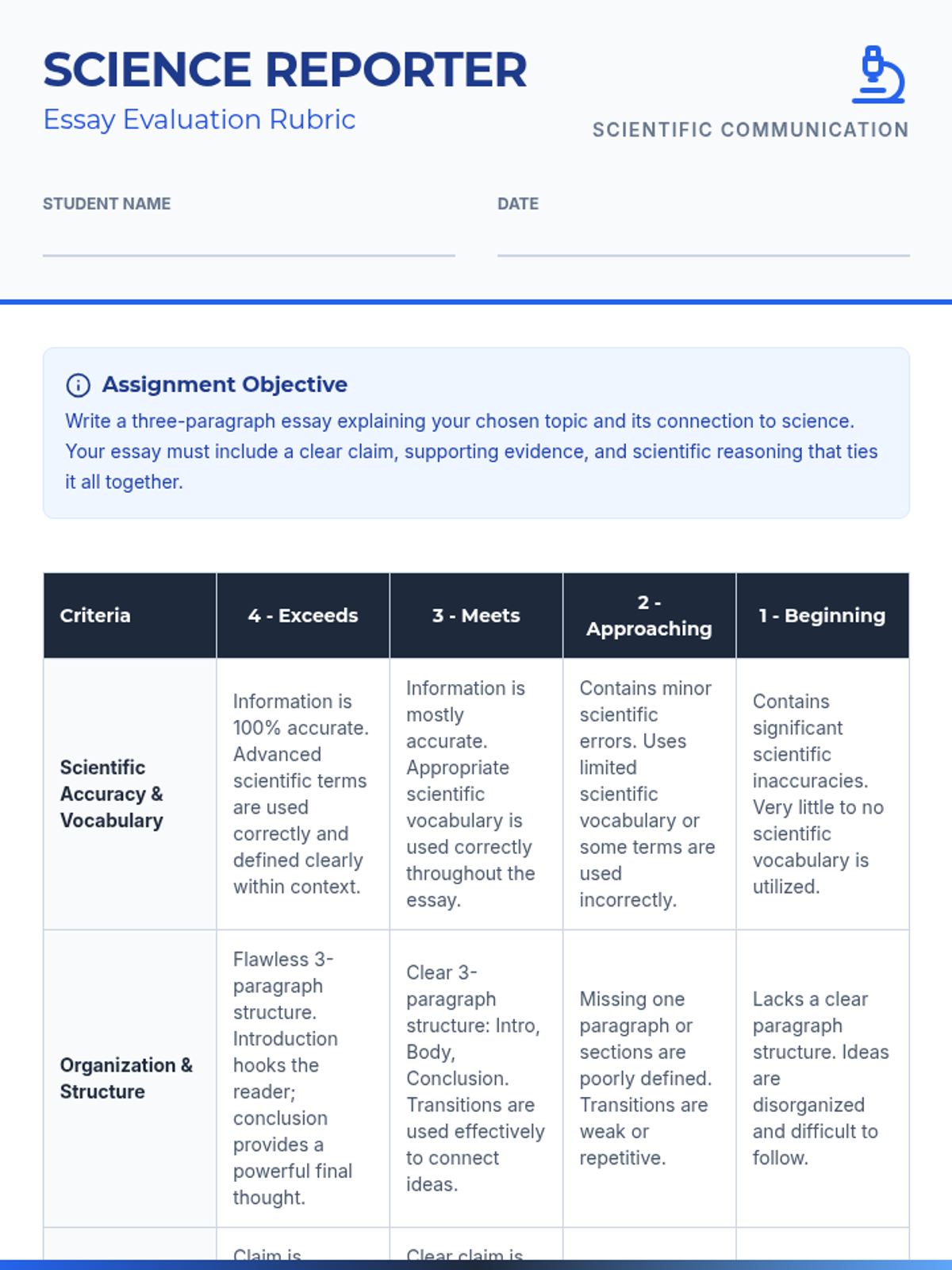
A comprehensive rubric for evaluating a three-paragraph science essay. It includes specific criteria for scientific accuracy, organization, CER (Claims, Evidence, Reasoning), and writing mechanics, featuring a clean 'Science Reporter' aesthetic.
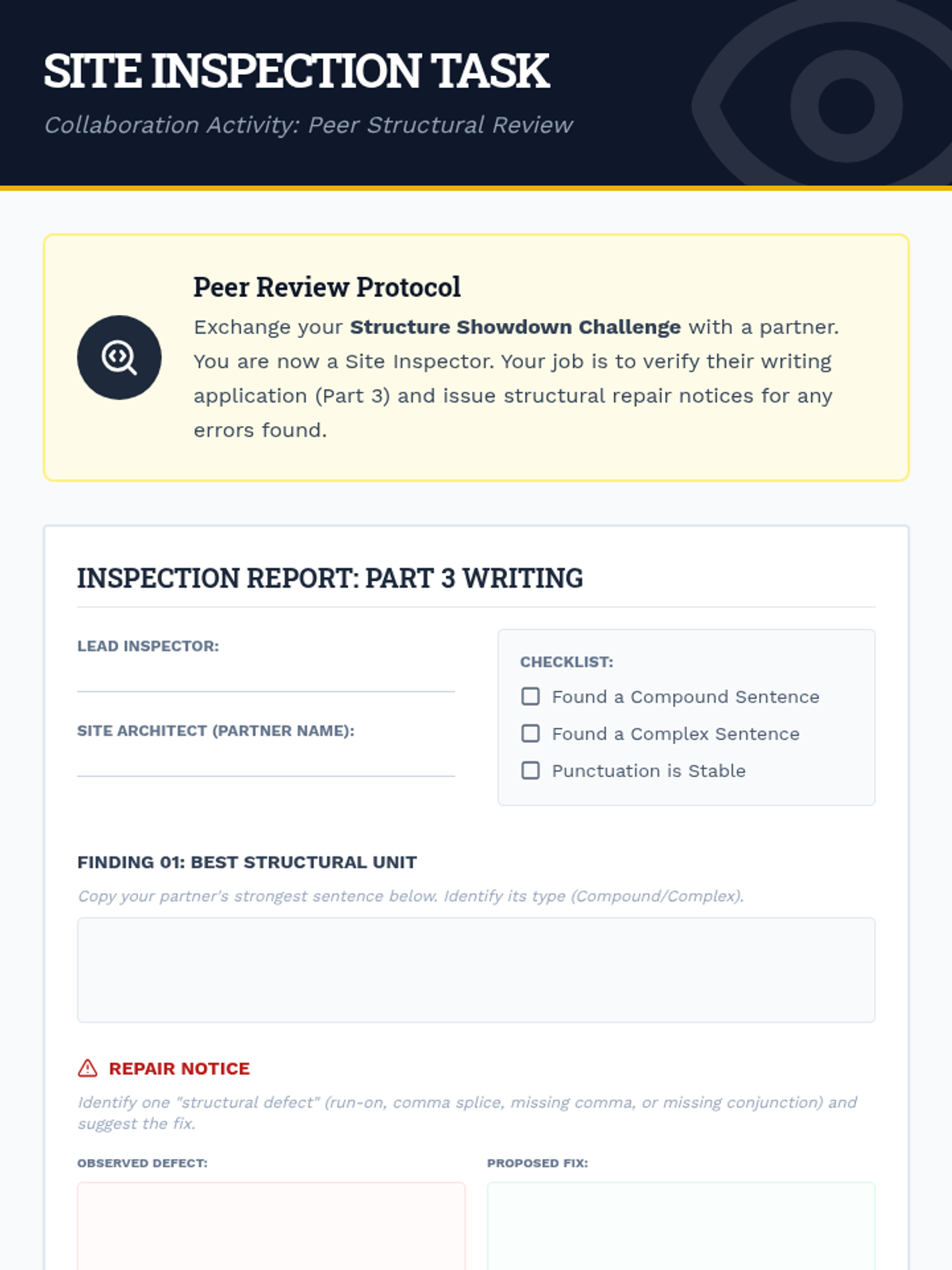
A collaborative peer-review activity where students inspect their partner's sentence structures and issue "repair notices" for grammatical errors.
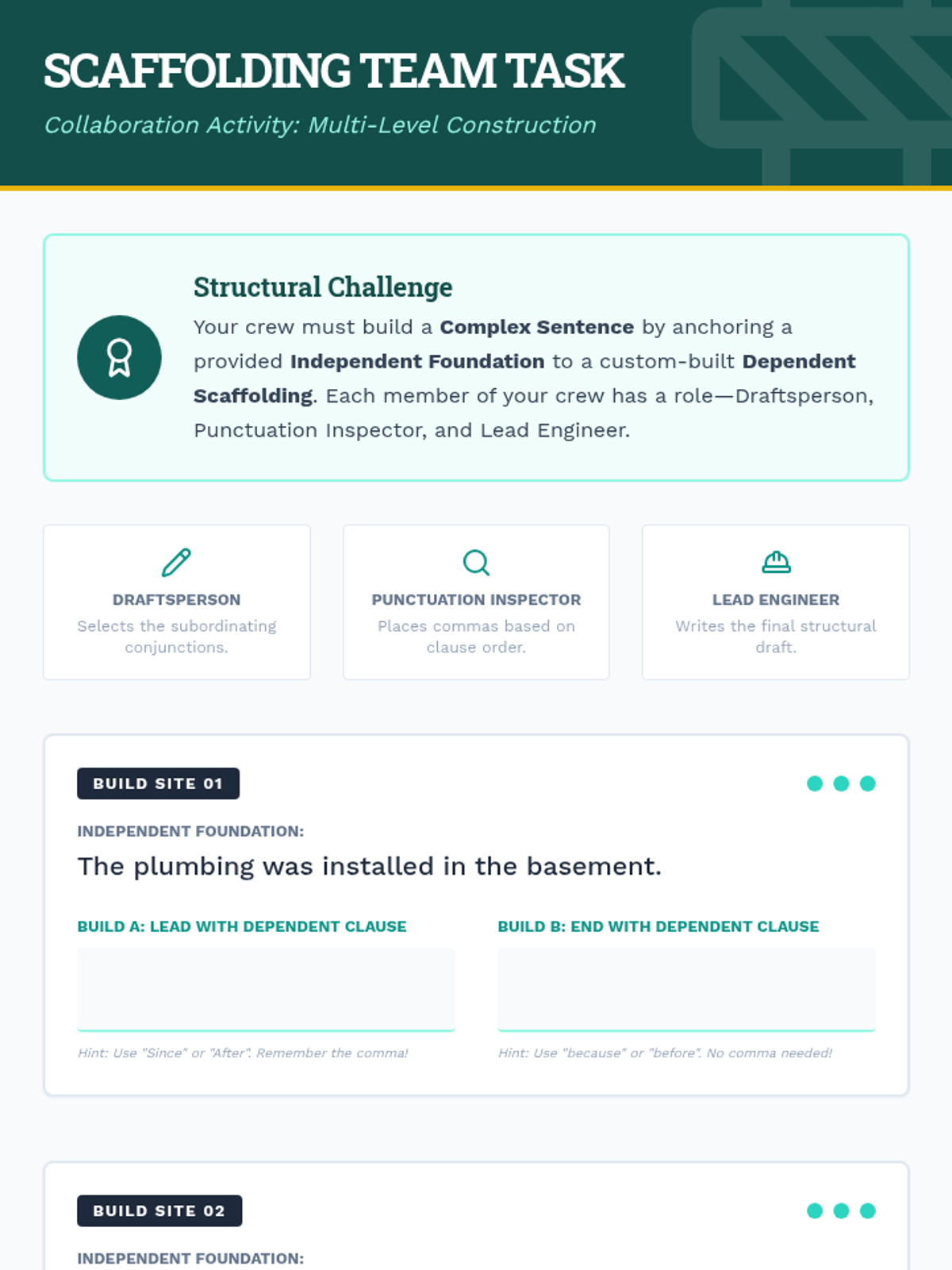
A team-based collaborative task where students build complex sentences from provided clauses, focusing on clause positioning and punctuation rules.
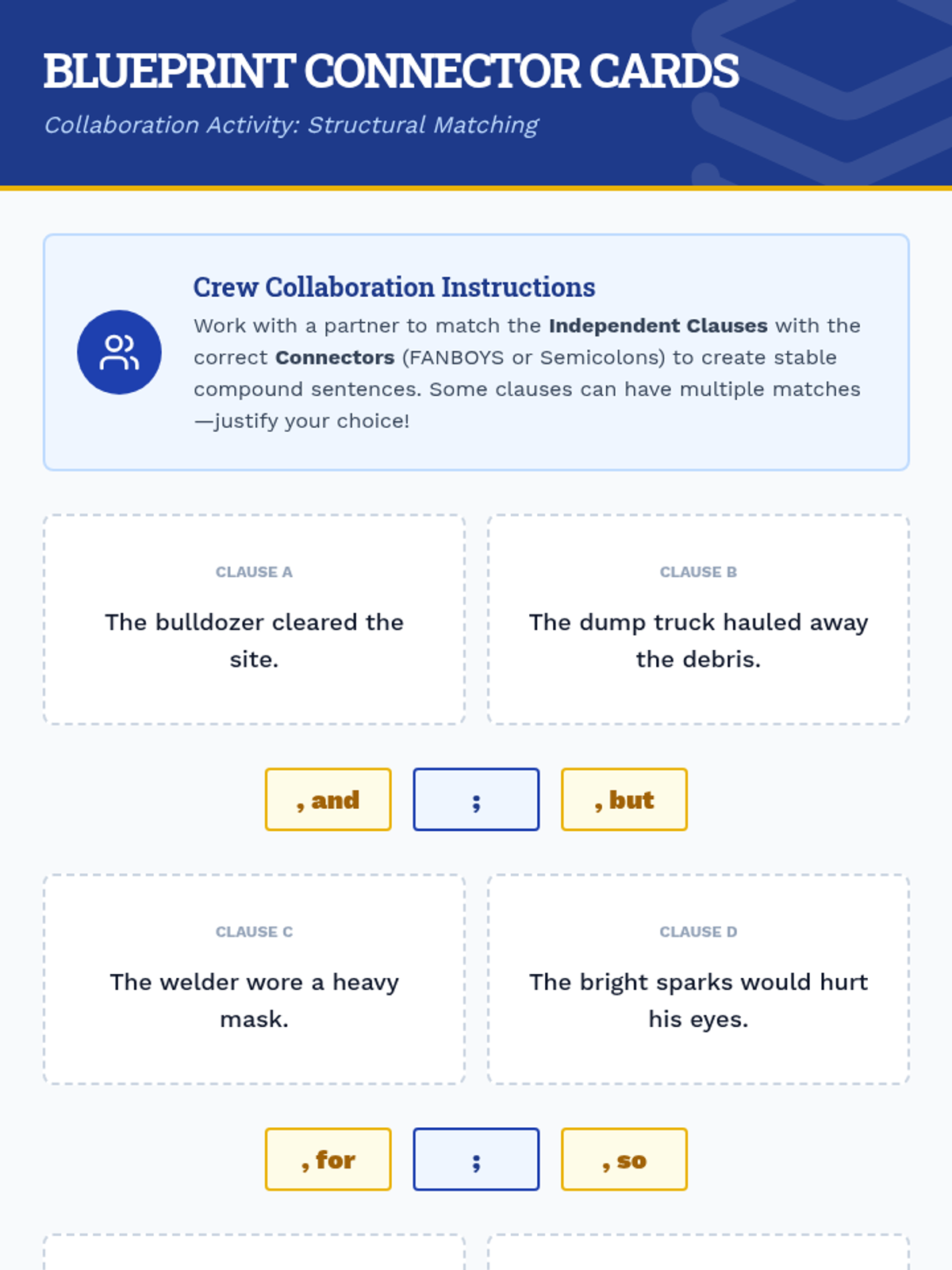
A collaborative card-matching activity where students pair independent clauses with appropriate FANBOYS or semicolons to build compound sentences.
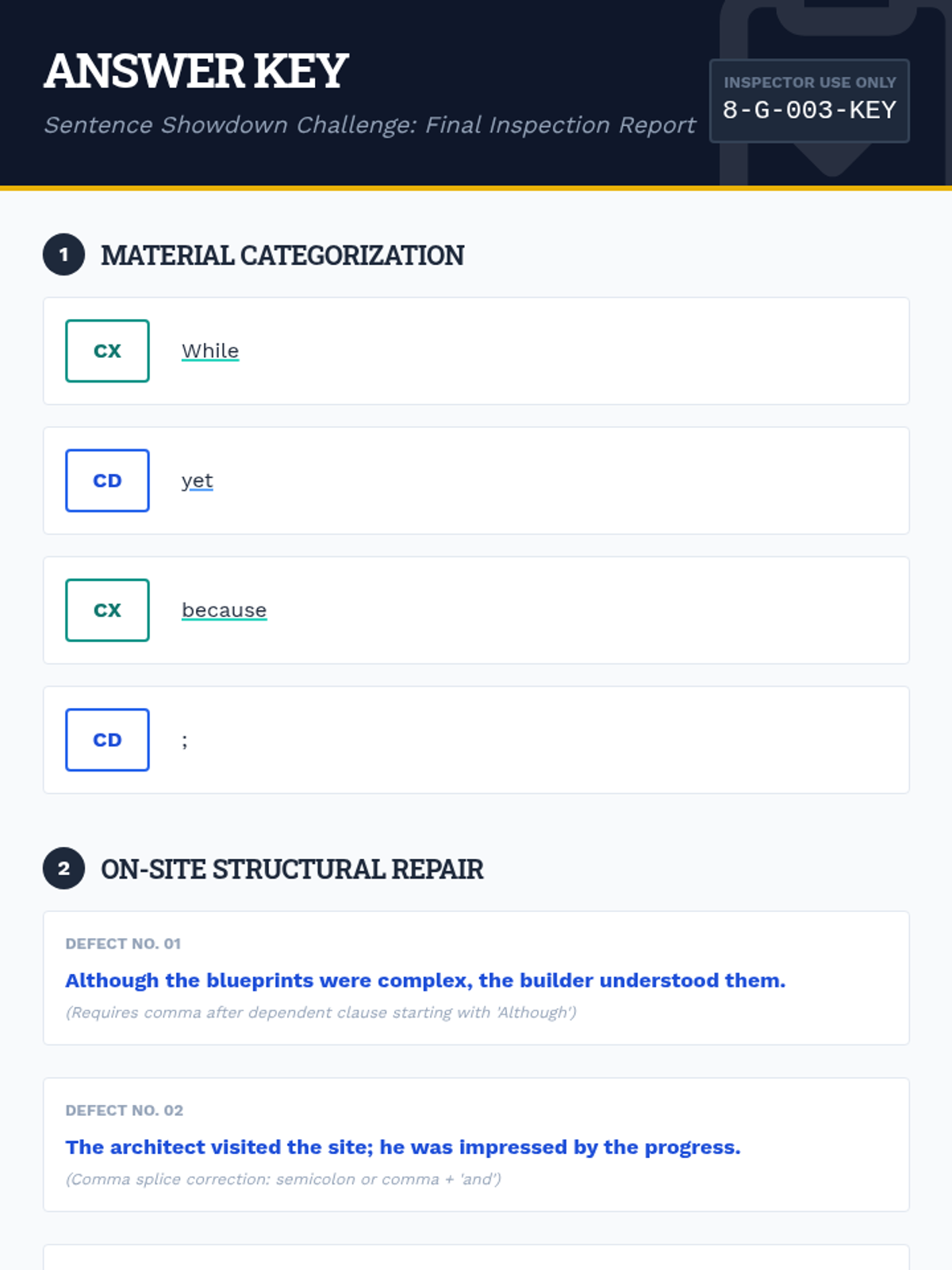
A teacher answer key for the Structure Showdown Challenge, providing correct categorizations and punctuation solutions for cumulative review.
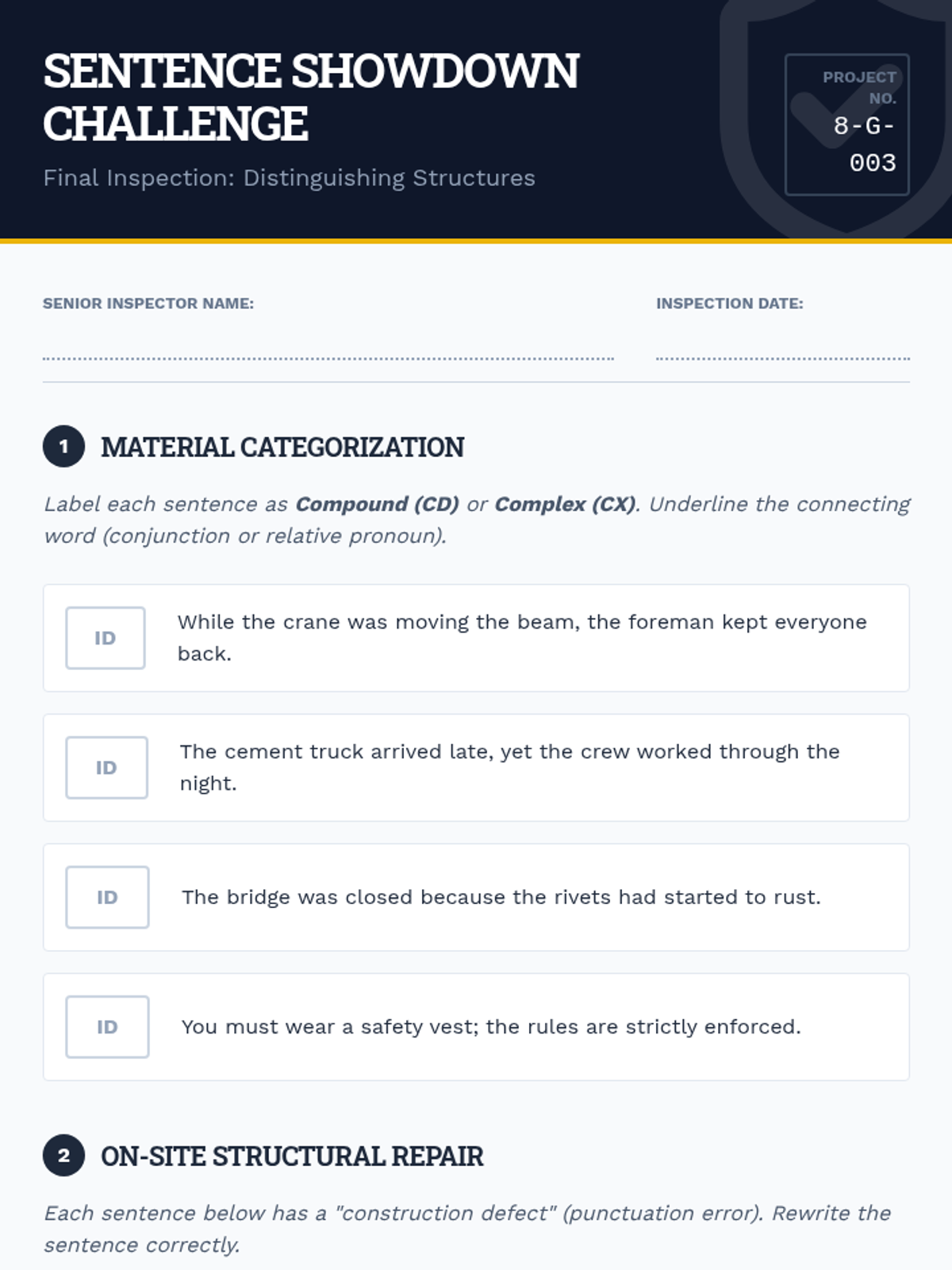
A cumulative review quiz for compound and complex sentences, featuring categorization, error correction, and a writing application task.
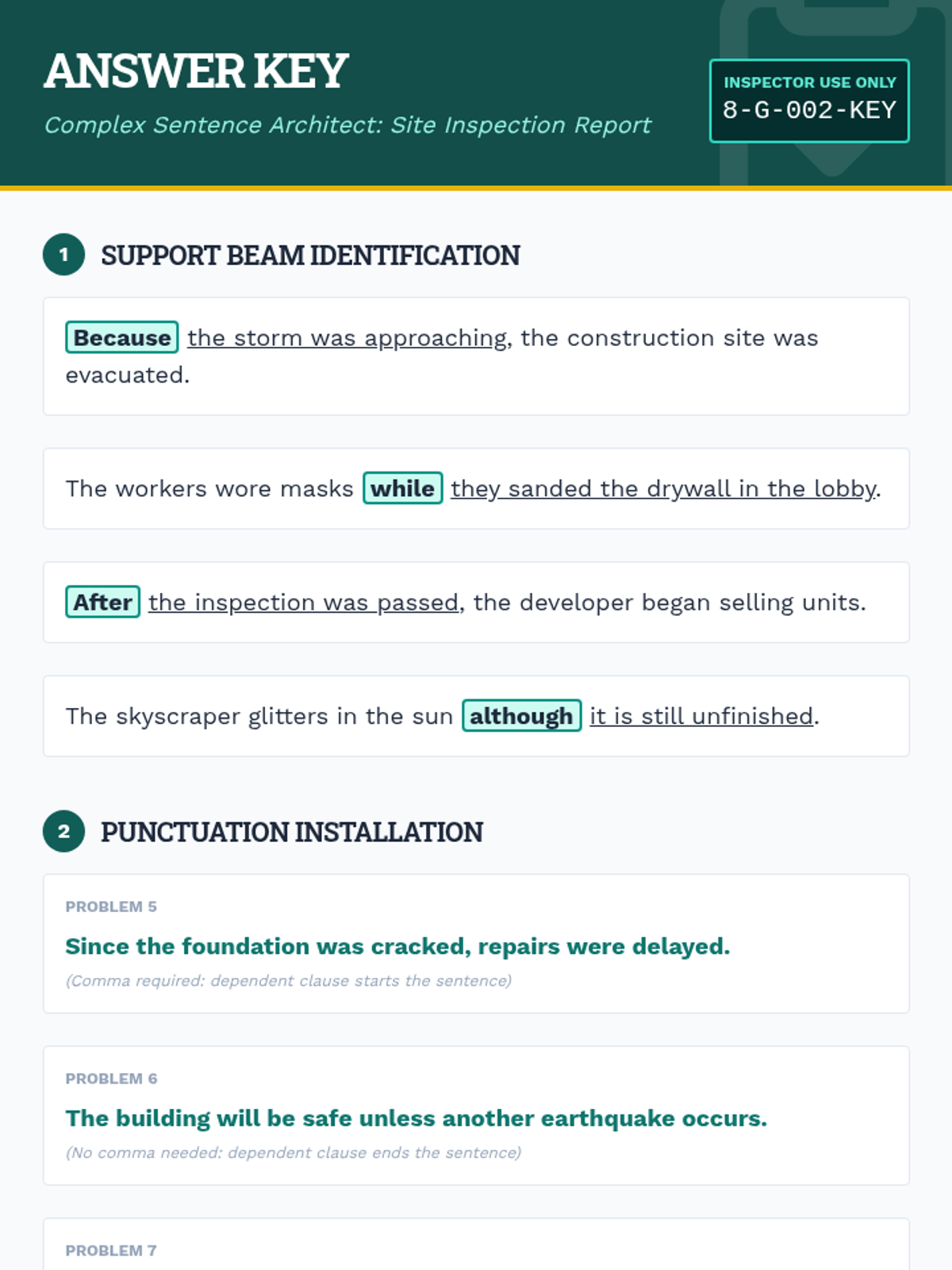
A teacher answer key for the Complex Sentence Architect worksheet, featuring correct answers and punctuation guidance.
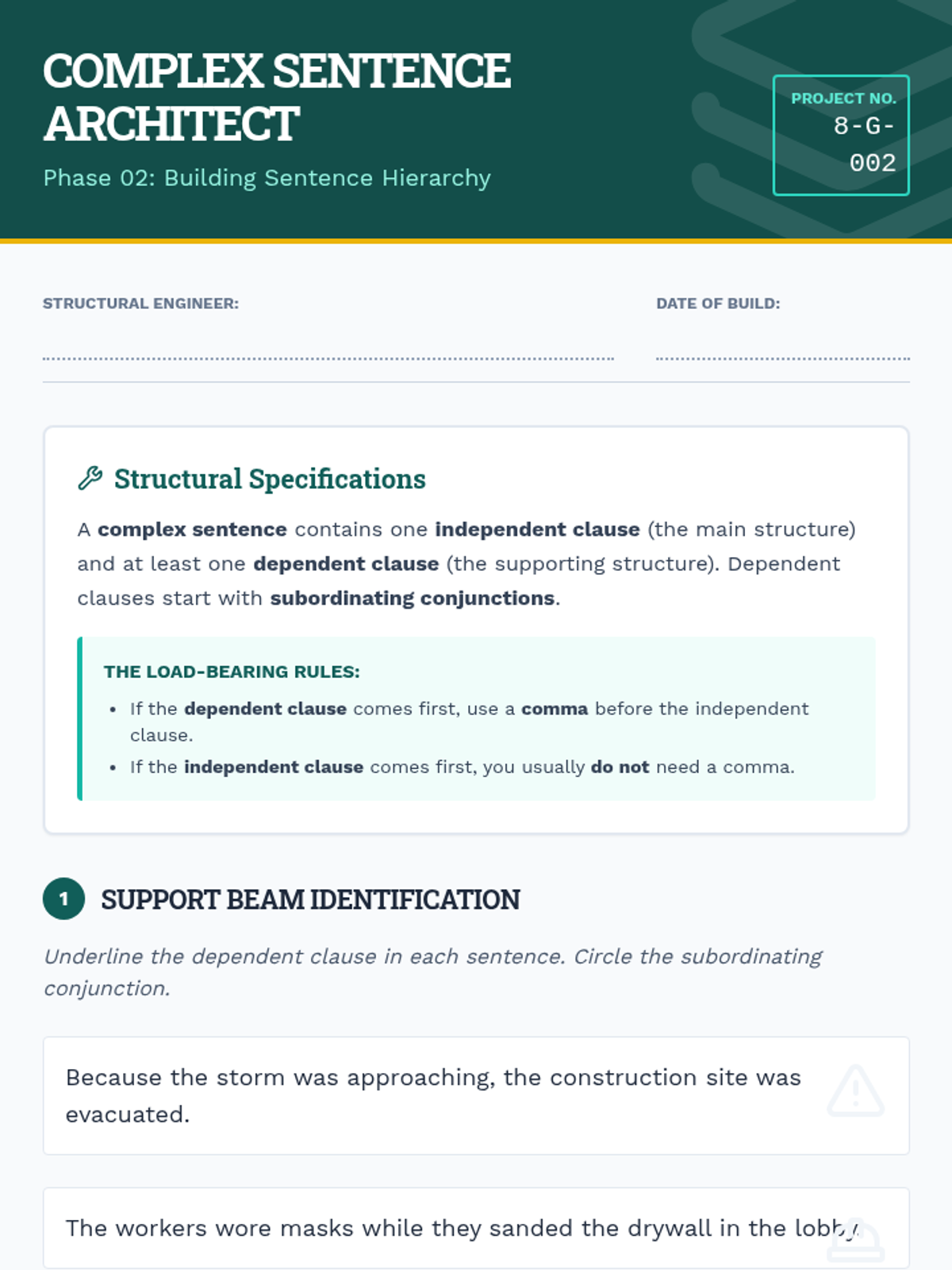
A student worksheet focusing on complex sentences, exploring subordinating conjunctions and relative pronouns through architectural themes.
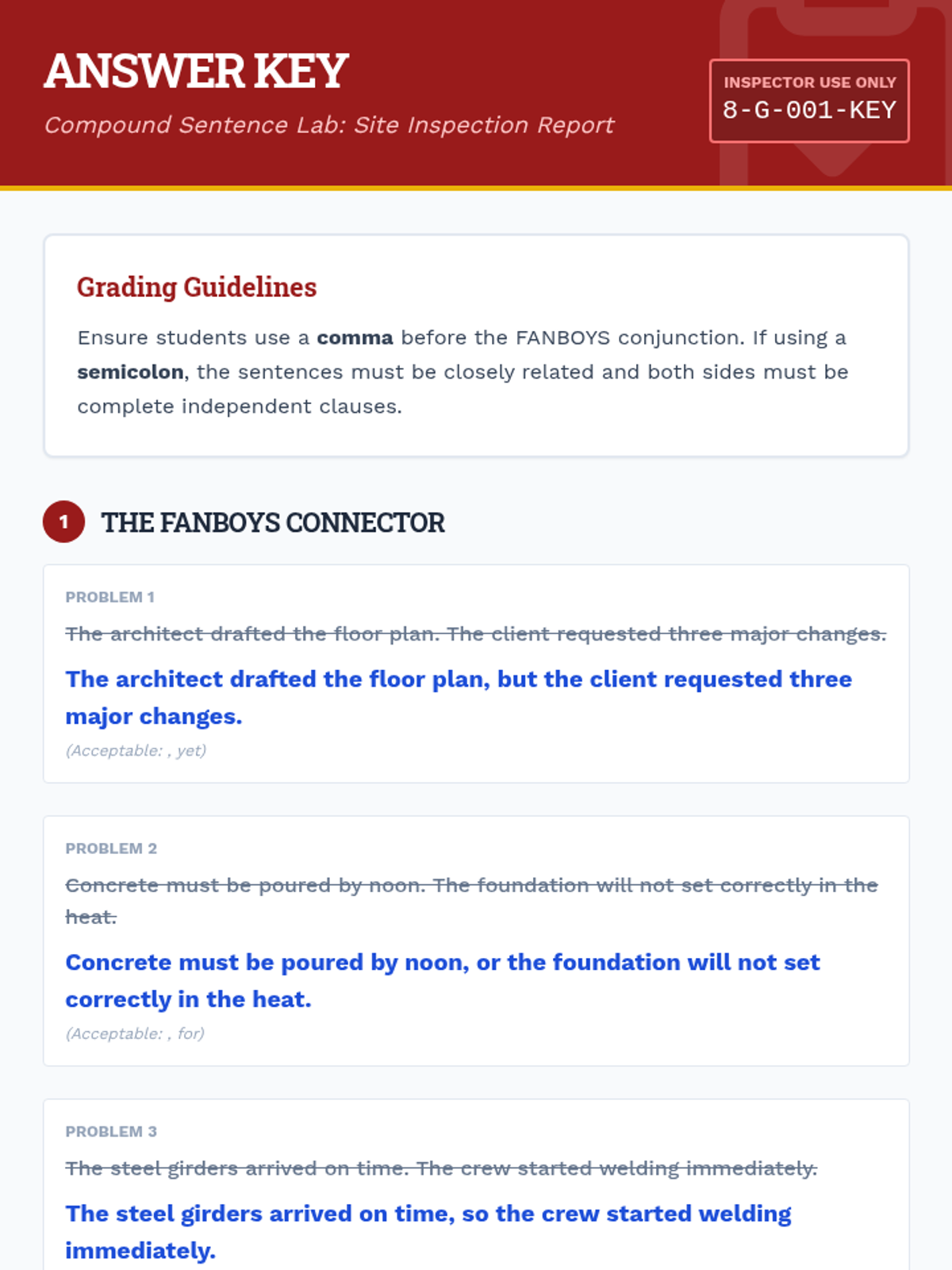
A teacher answer key for the Compound Sentence Lab worksheet, featuring sample answers and grading guidance.
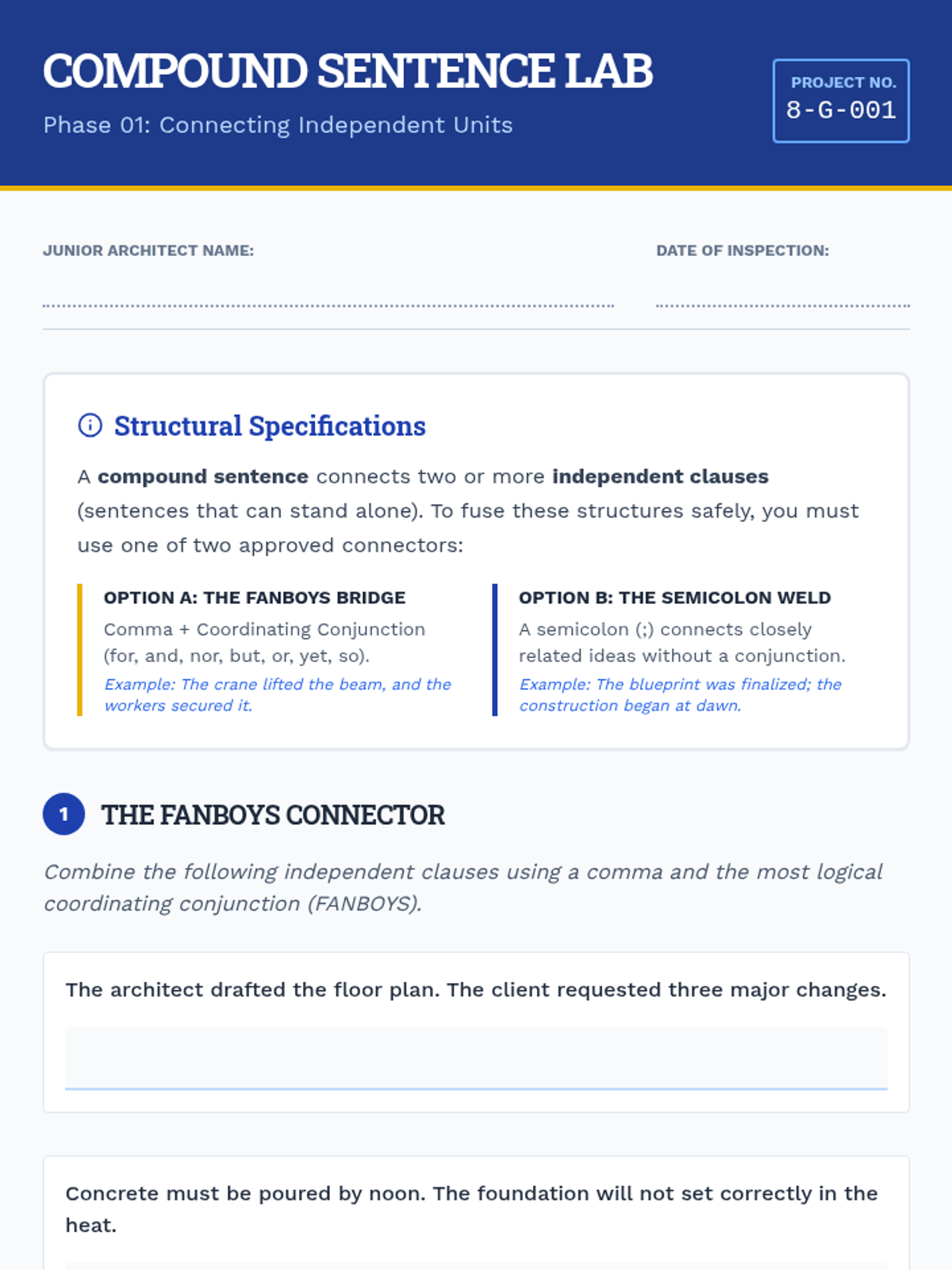
A student worksheet focusing on compound sentences, featuring sections for coordinating conjunctions (FANBOYS) and semicolon usage within an architectural/construction theme.
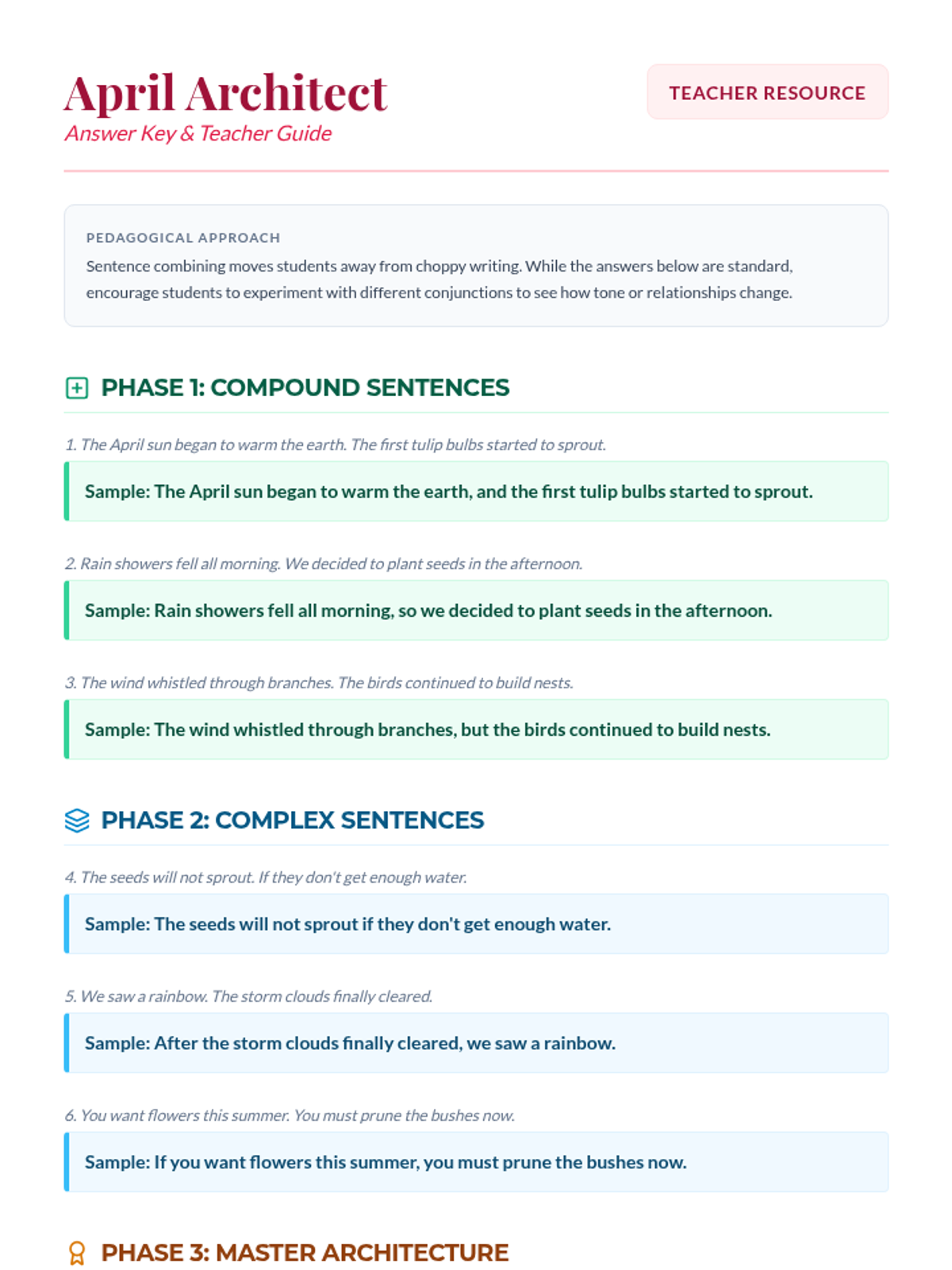
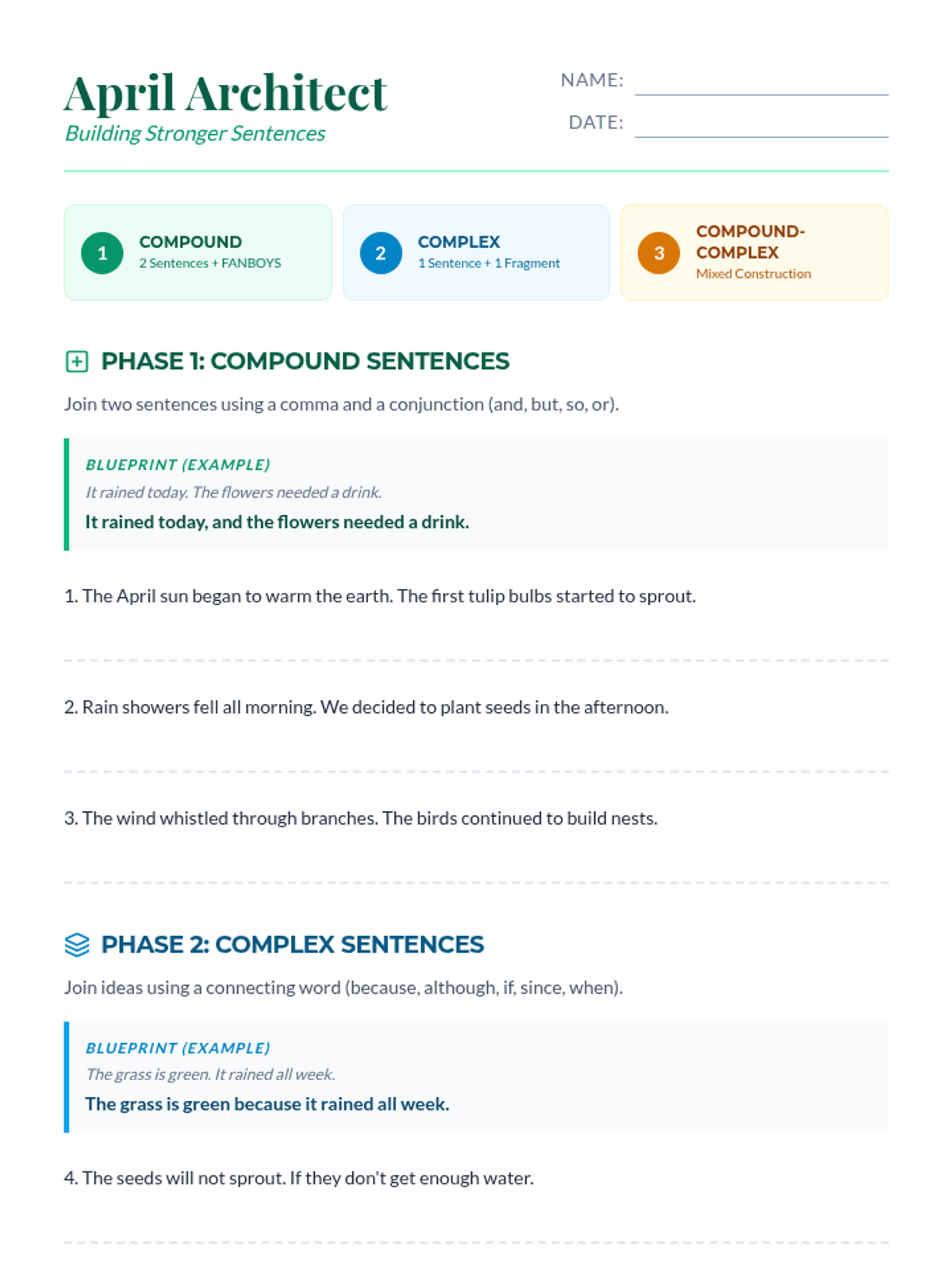
Teacher answer key for the April Architect sentence combining worksheet, providing sample combined sentences for compound, complex, and compound-complex structures. Updated to match simplified worksheet content. Updated answer #4.
A sentence combining worksheet themed around April and spring, featuring practice for compound, complex, and compound-complex sentence structures. Simplified directions and infographics included. Updated item #4 with a sentence and a fragment.
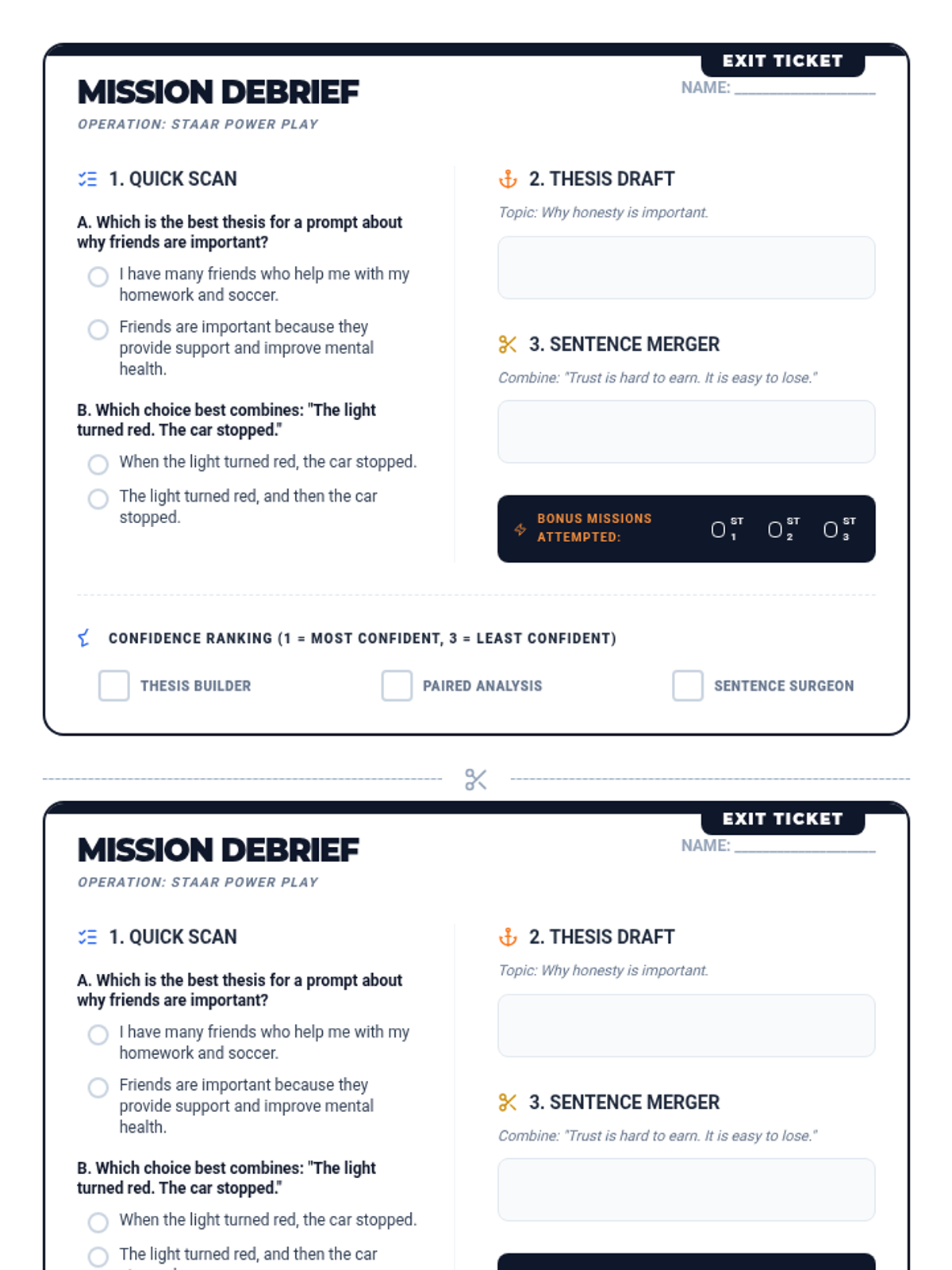
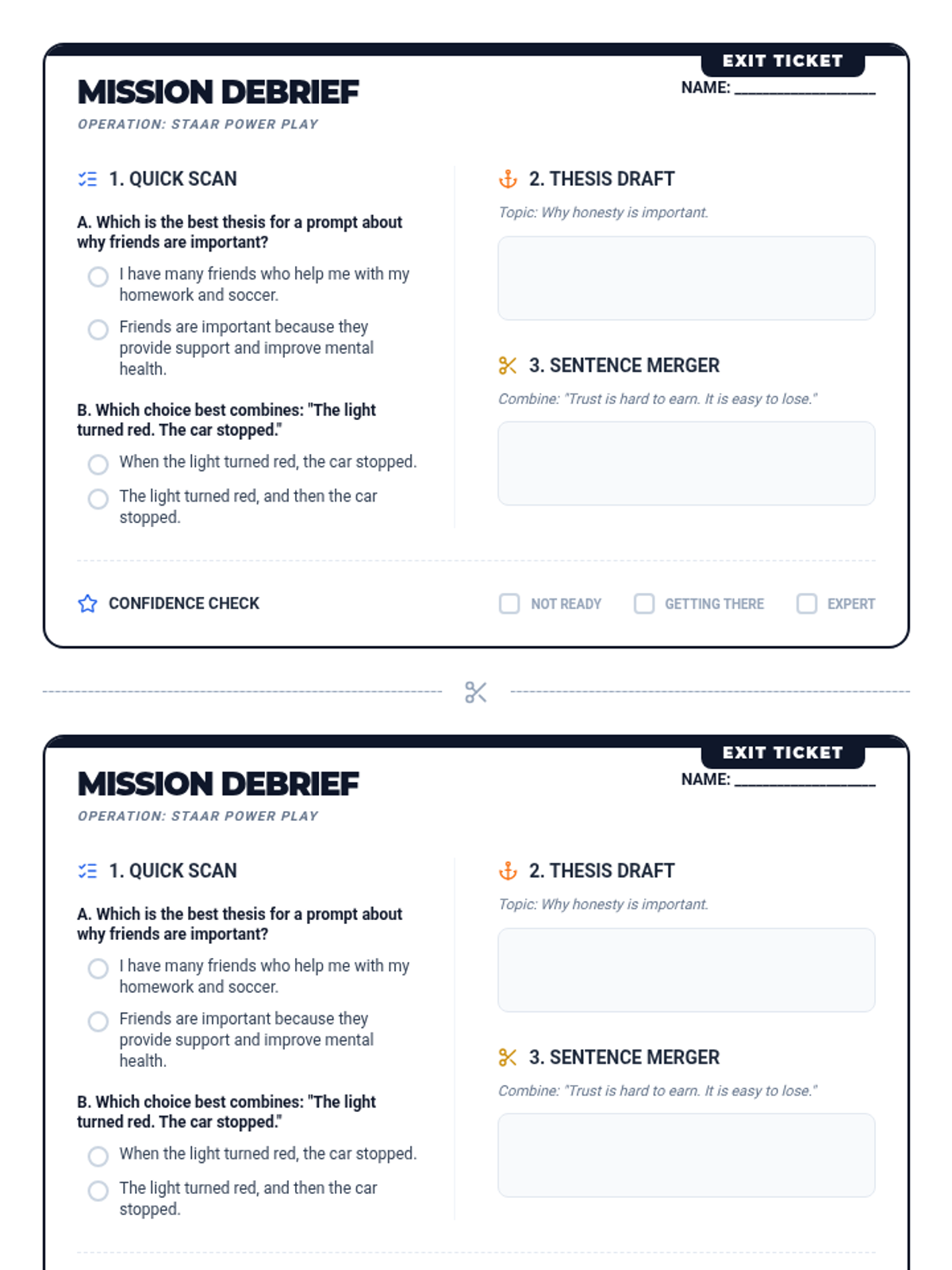
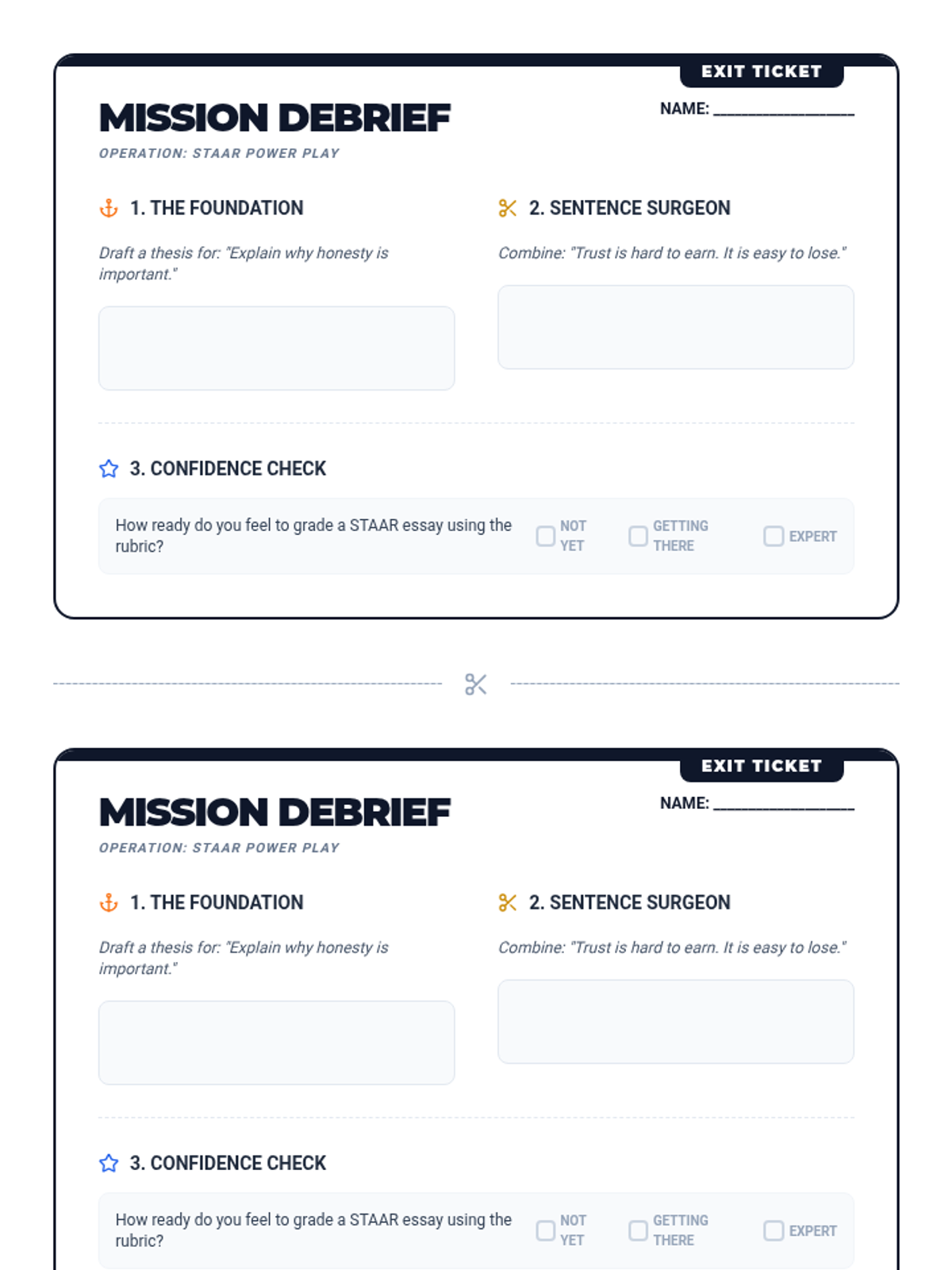
A double-up exit ticket (Mission Debrief) for the STAAR Power Play stations, featuring multiple choice questions for identifying thesis statements and sentence combining, plus short-answer writing tasks. Revised to include a confidence ranking system (1-3) for the three station topics.
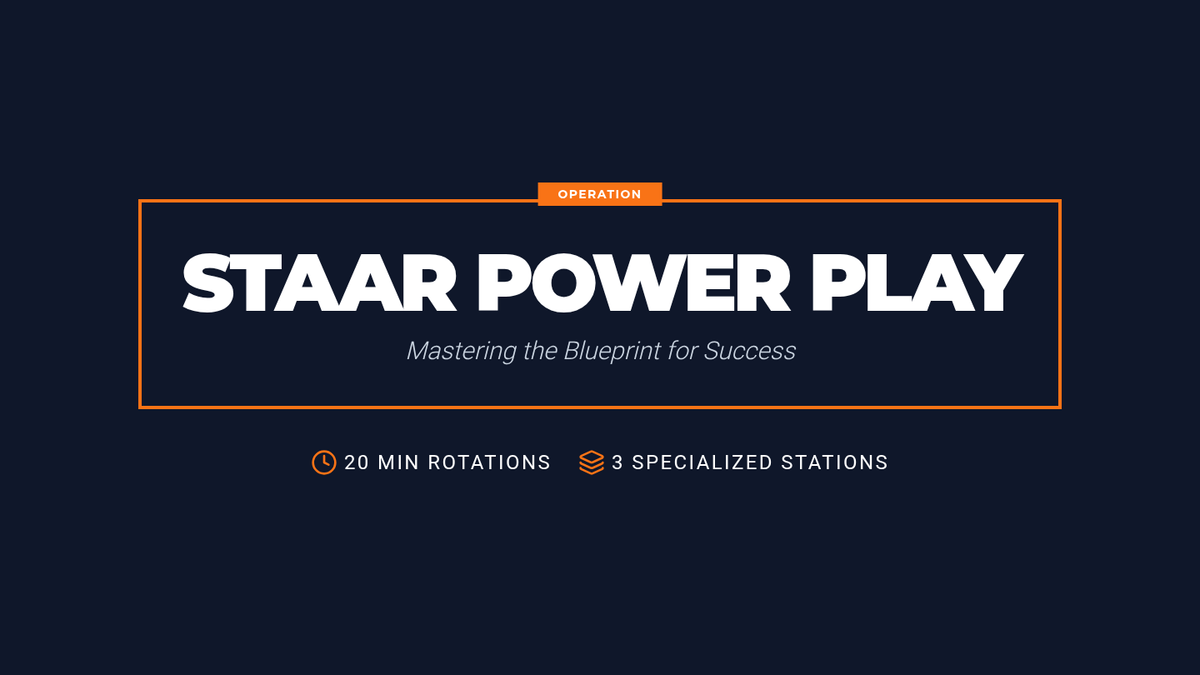
Visual presentation for the STAAR Power Play stations, including instructions for each rotation, a timer, and new bonus mission callouts for each station.
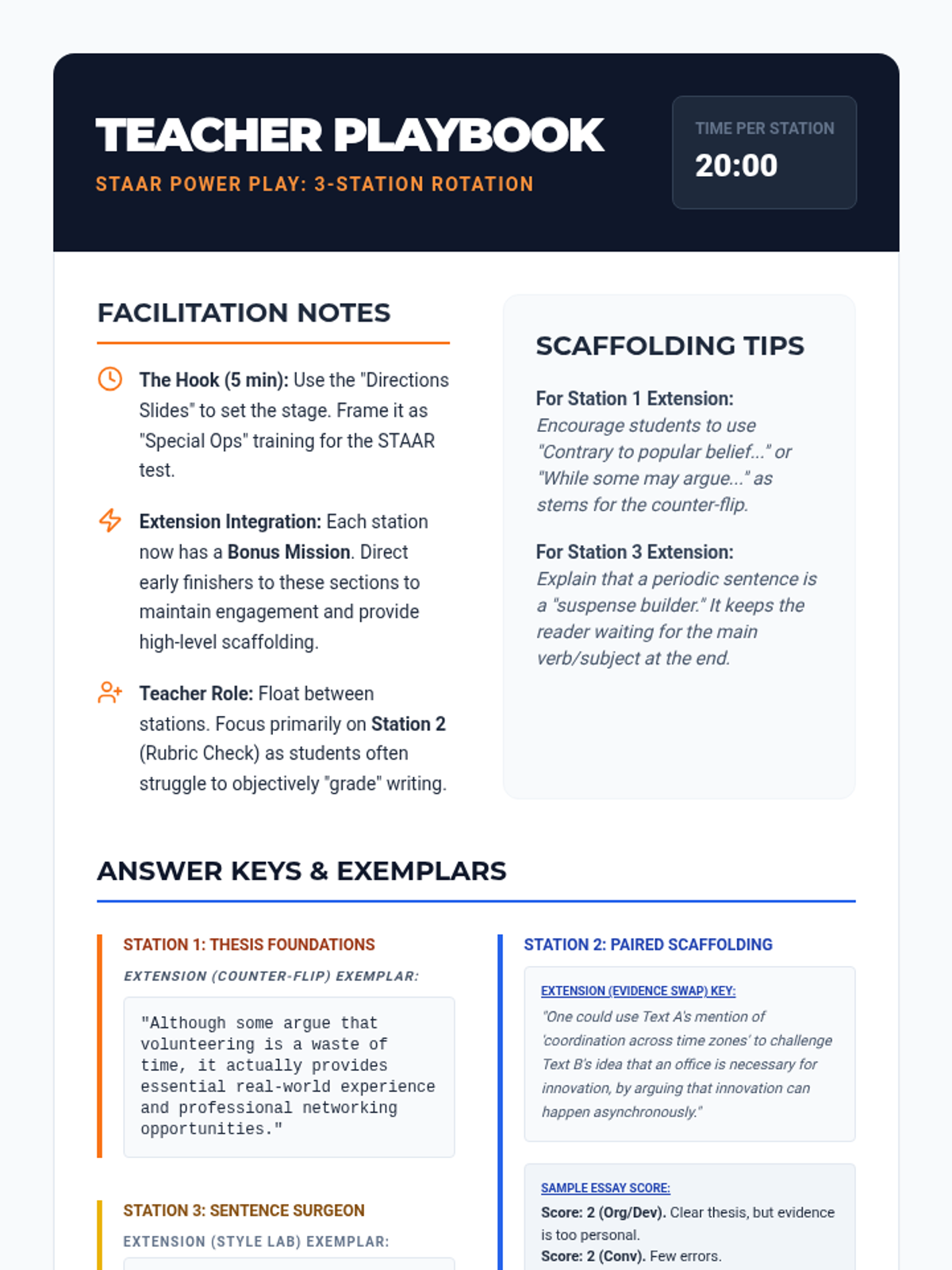
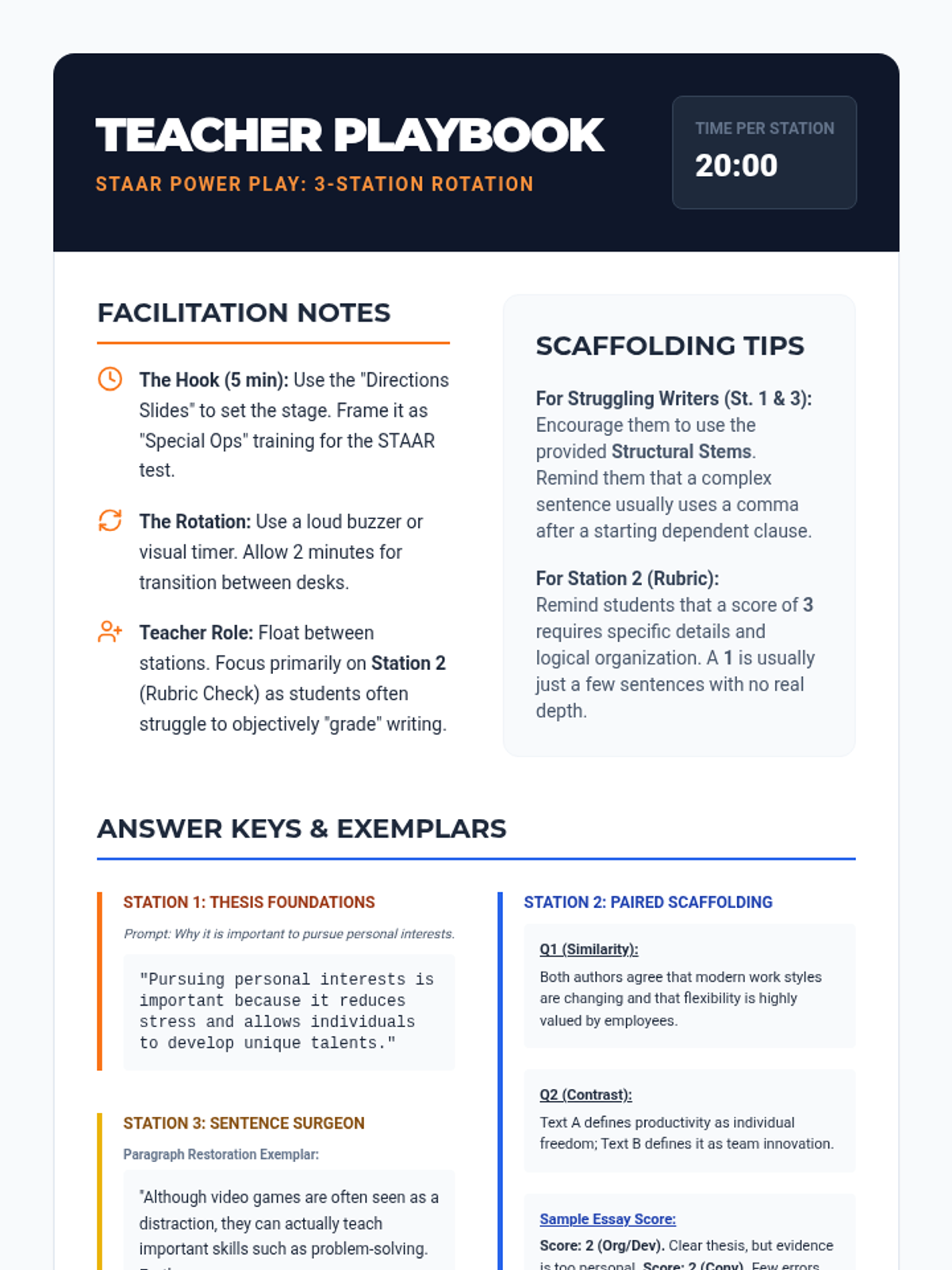
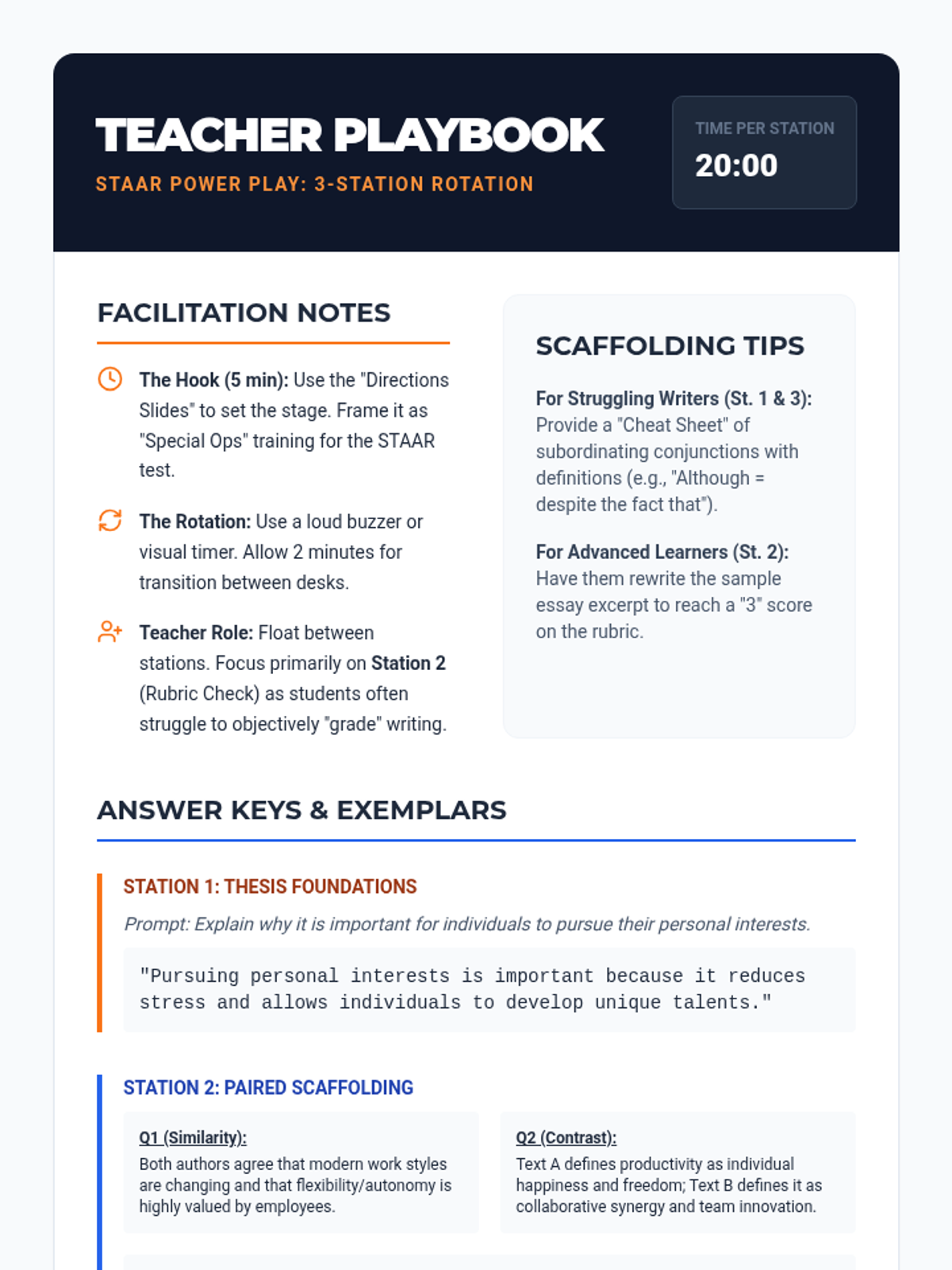
A teacher-facing guide providing facilitation tips, scaffolding strategies, and answer keys for all three STAAR Power Play stations. Updated for the 3-point rubric scale and includes exit ticket answer key. Now includes keys for extension activities.
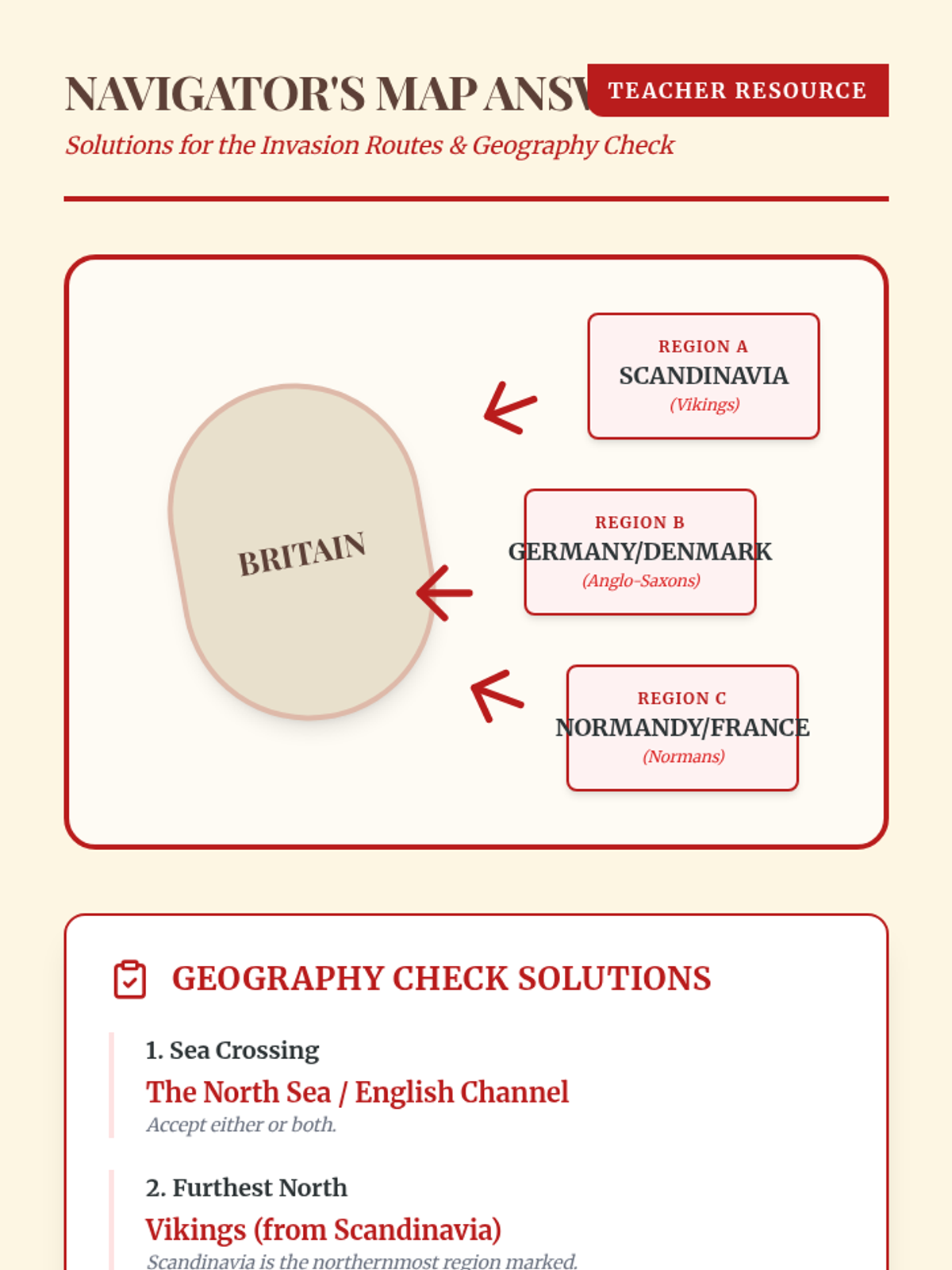
An answer key for the Navigator Map Activity, providing the names of the source regions and correct answers to the geography check questions.
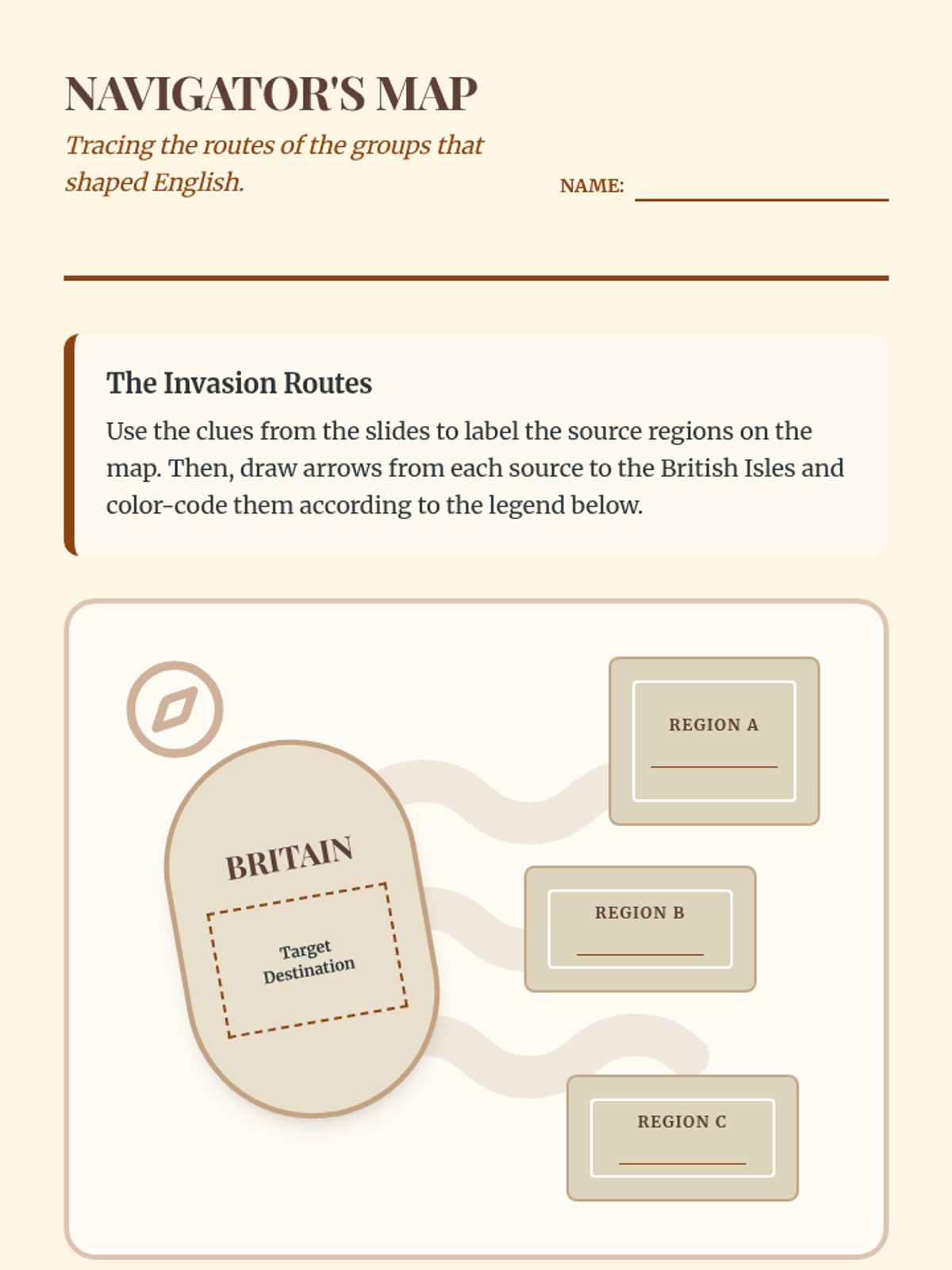
A map activity where students label regions like Scandinavia, Germany, and Normandy, and draw the invasion routes to the British Isles. It includes a geography check section for key sea crossings.
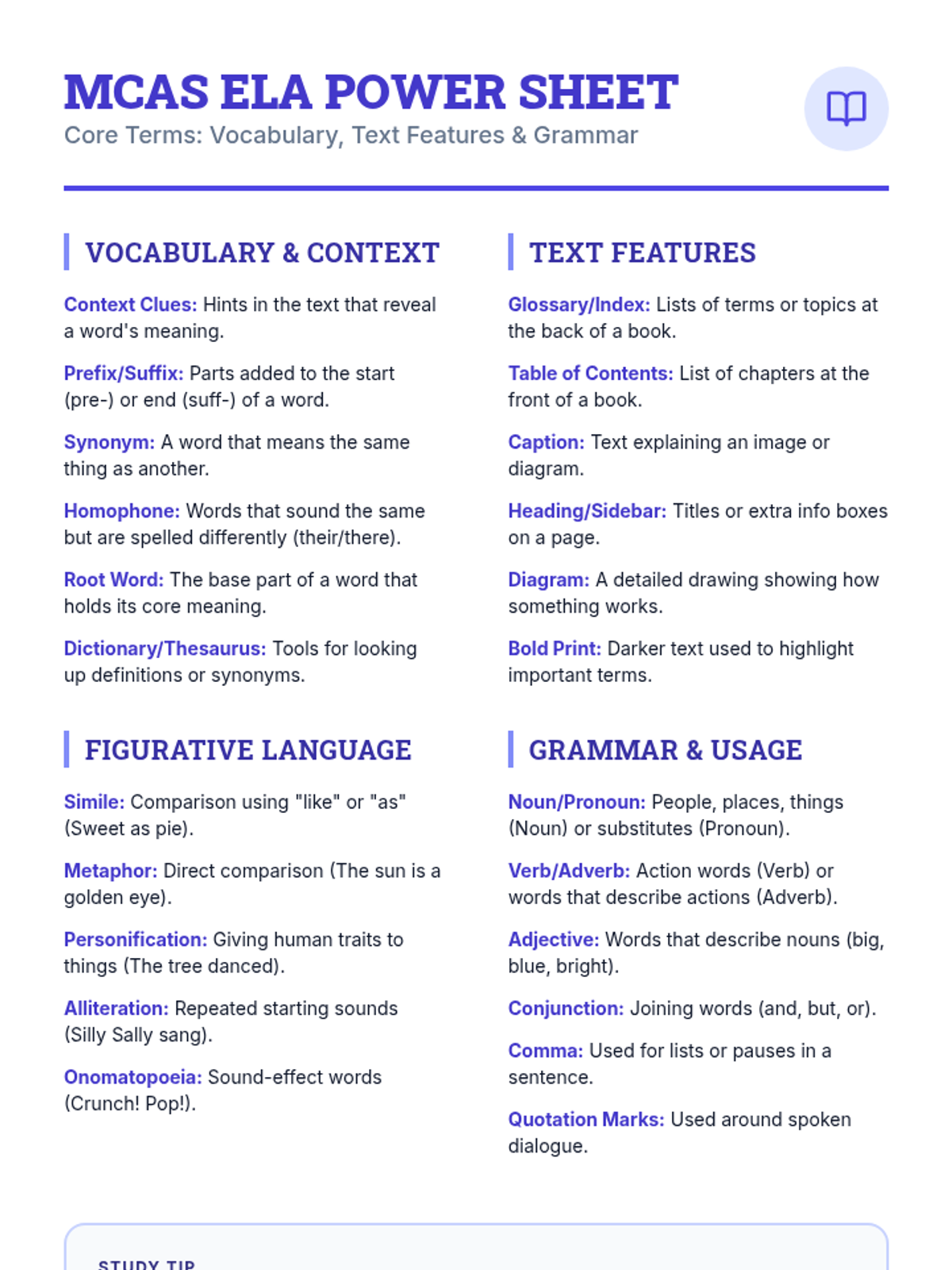
A one-page student reference sheet containing the key ELA terms, definitions, and examples featured in the bingo game. Perfect for pre-game study or as a reference during the activity. Revised to align with new categories.
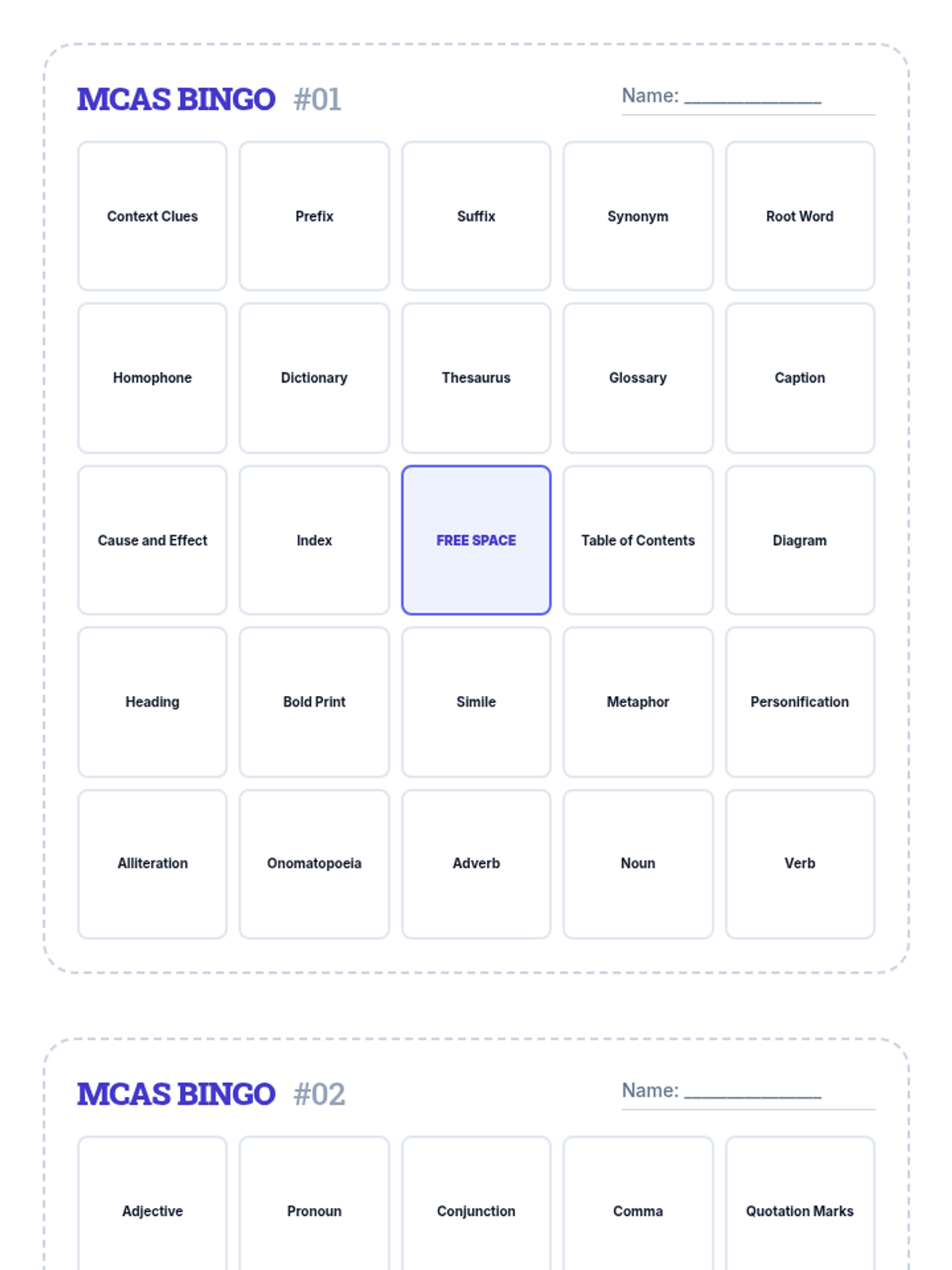
A collection of 22 unique bingo cards for ELA review, featuring academic vocabulary, text features, and grammar terms. Each page contains two cards with randomized terms. Revised to remove forbidden literary and vocabulary terms.
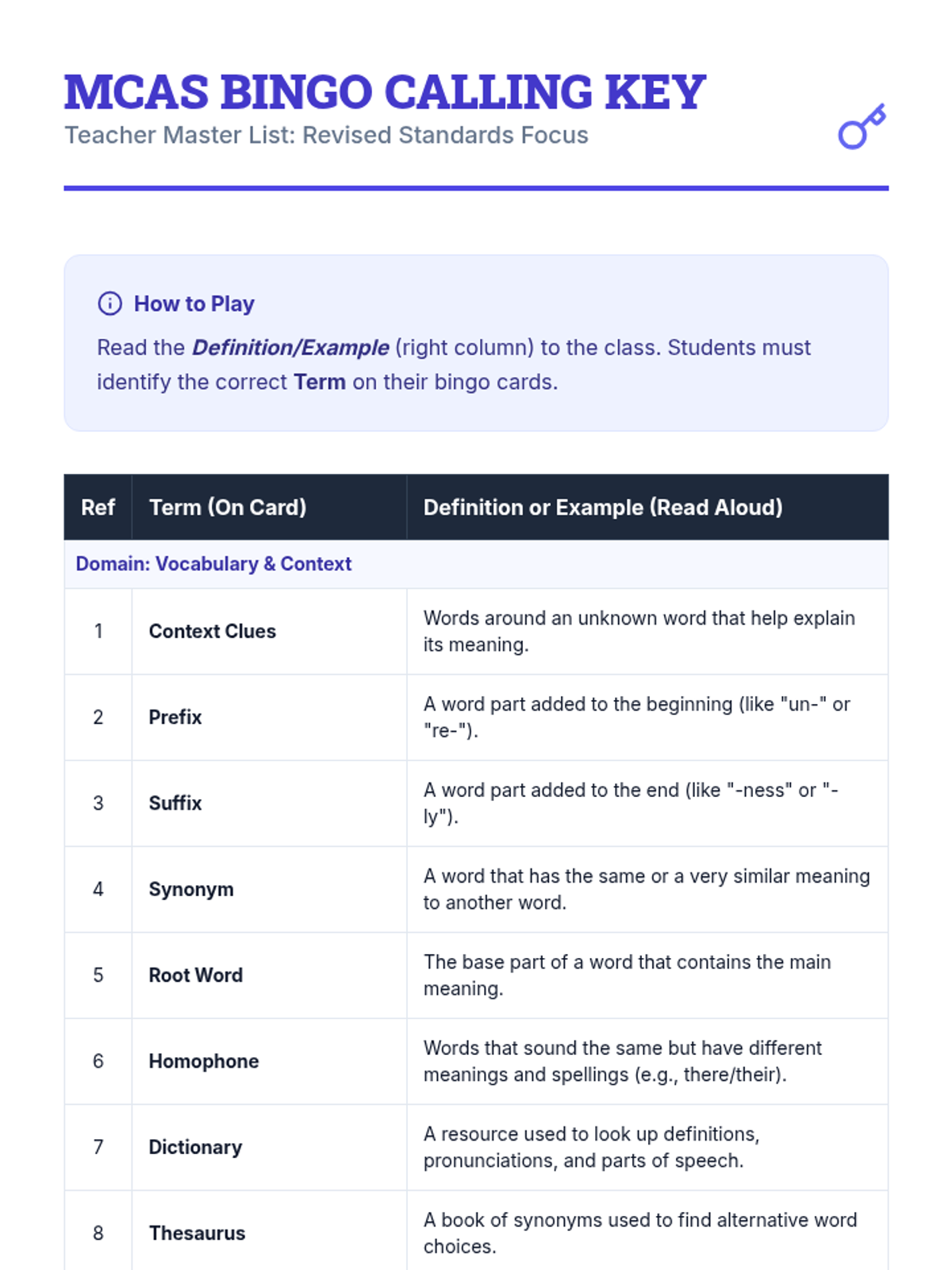
A comprehensive master calling key for the teacher, listing 30 ELA terms, their definitions, and examples aligned with MCAS standards. Revised to remove literary elements and focus on vocabulary, text features, and grammar.
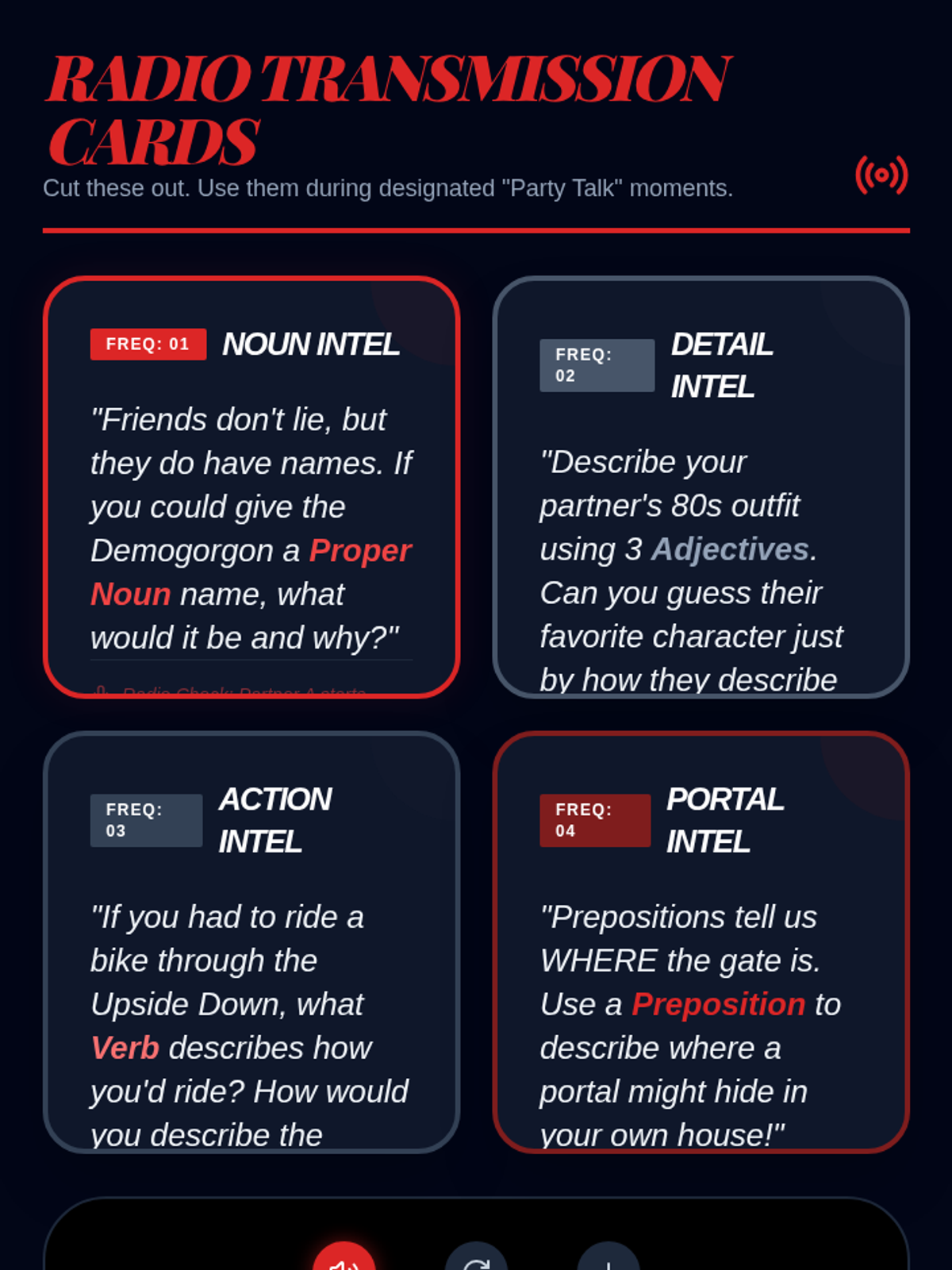
Discussion cards inspired by 'Stranger Things' walkie-talkie communication, designed to prompt peer-to-peer analysis of parts of speech throughout the unit.
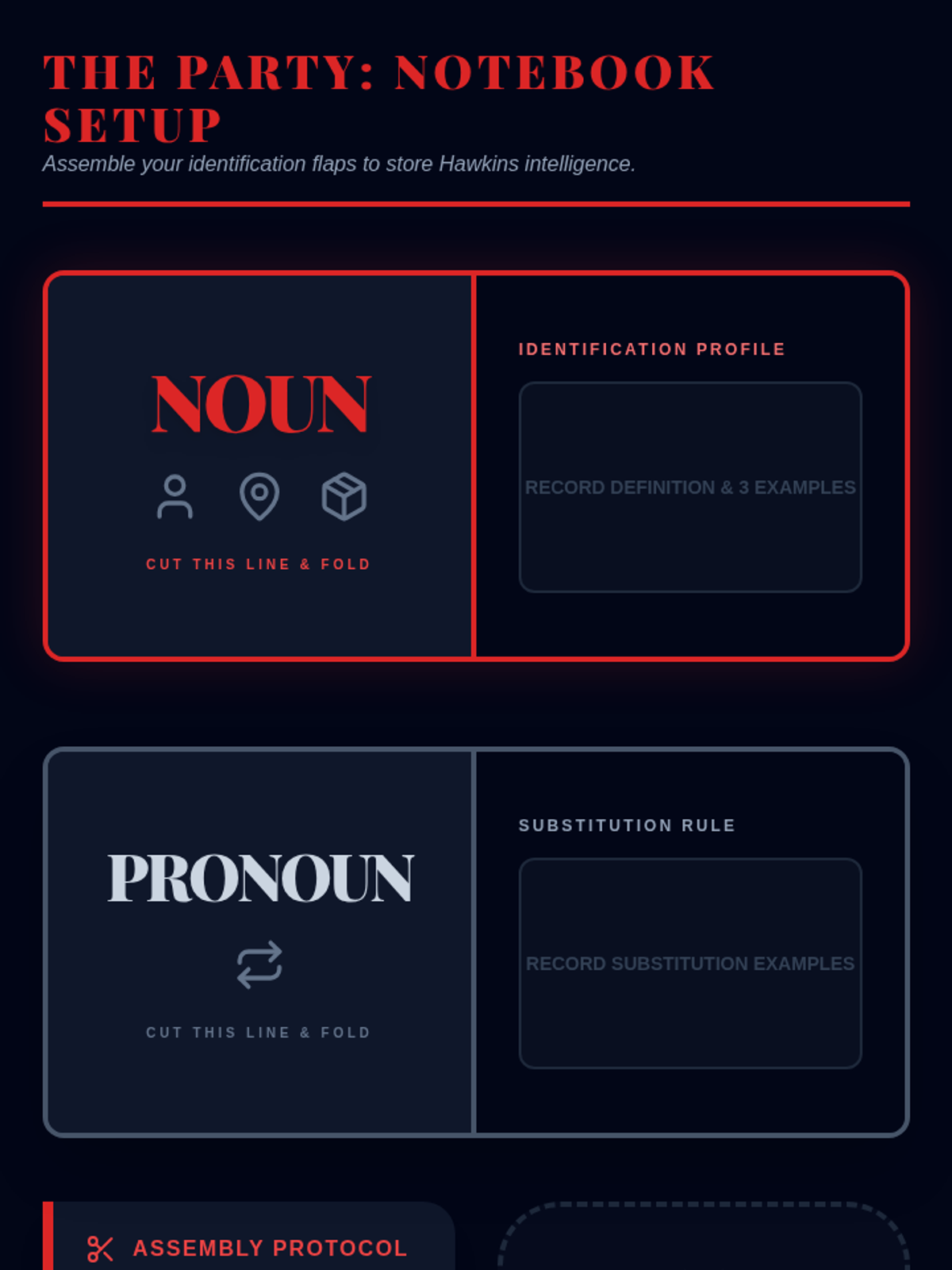
A 'Stranger Things' themed interactive notebook template for nouns and pronouns, featuring assembly instructions and spaces for student work.
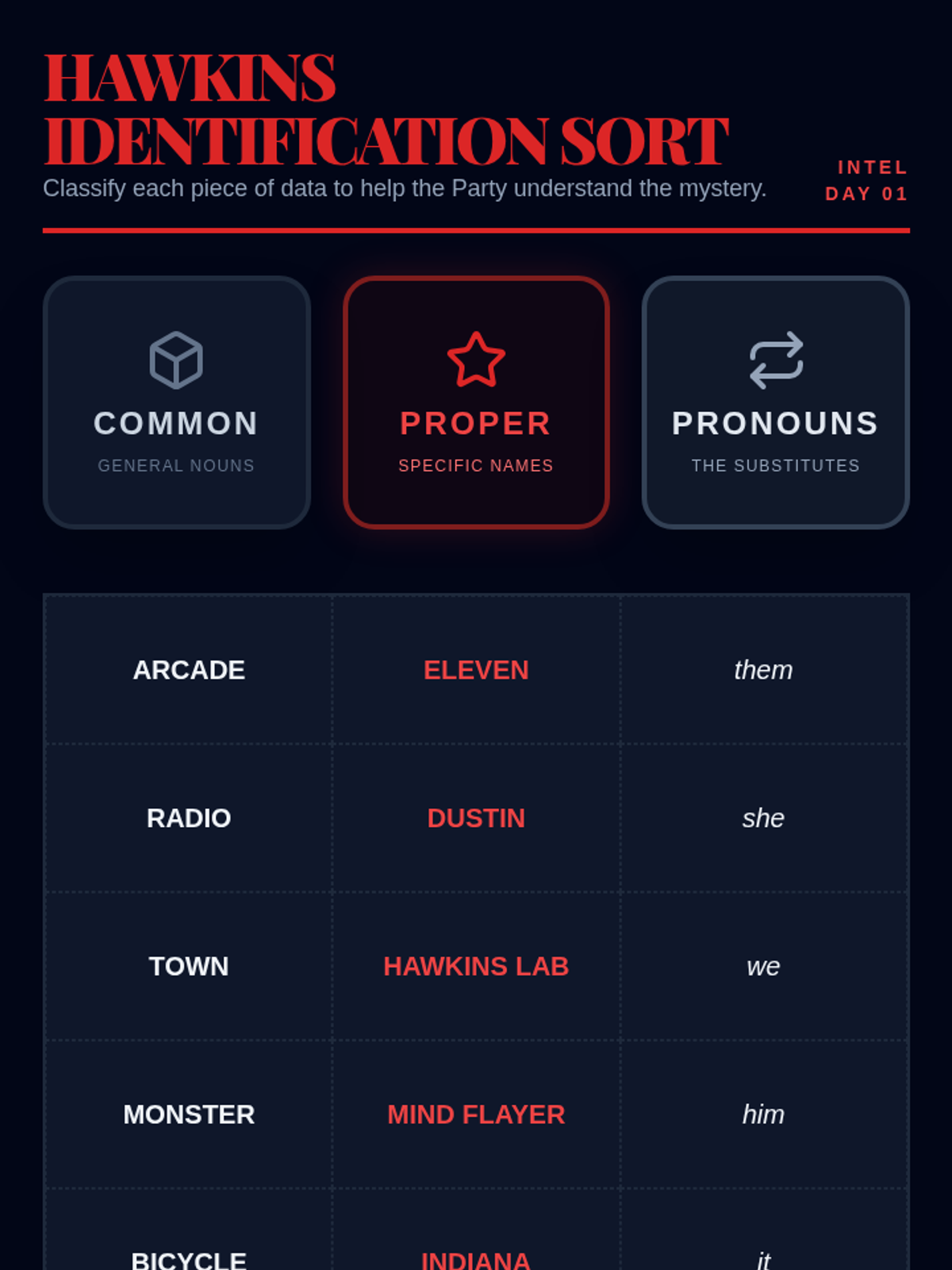
A set of 18 sorting cards featuring characters, places, and objects from the 'Stranger Things' universe to help students practice noun and pronoun classification.
A synthwave-inspired slide deck for introducing nouns and pronouns with a 'Stranger Things' theme, featuring retro visuals and interactive discussion prompts.
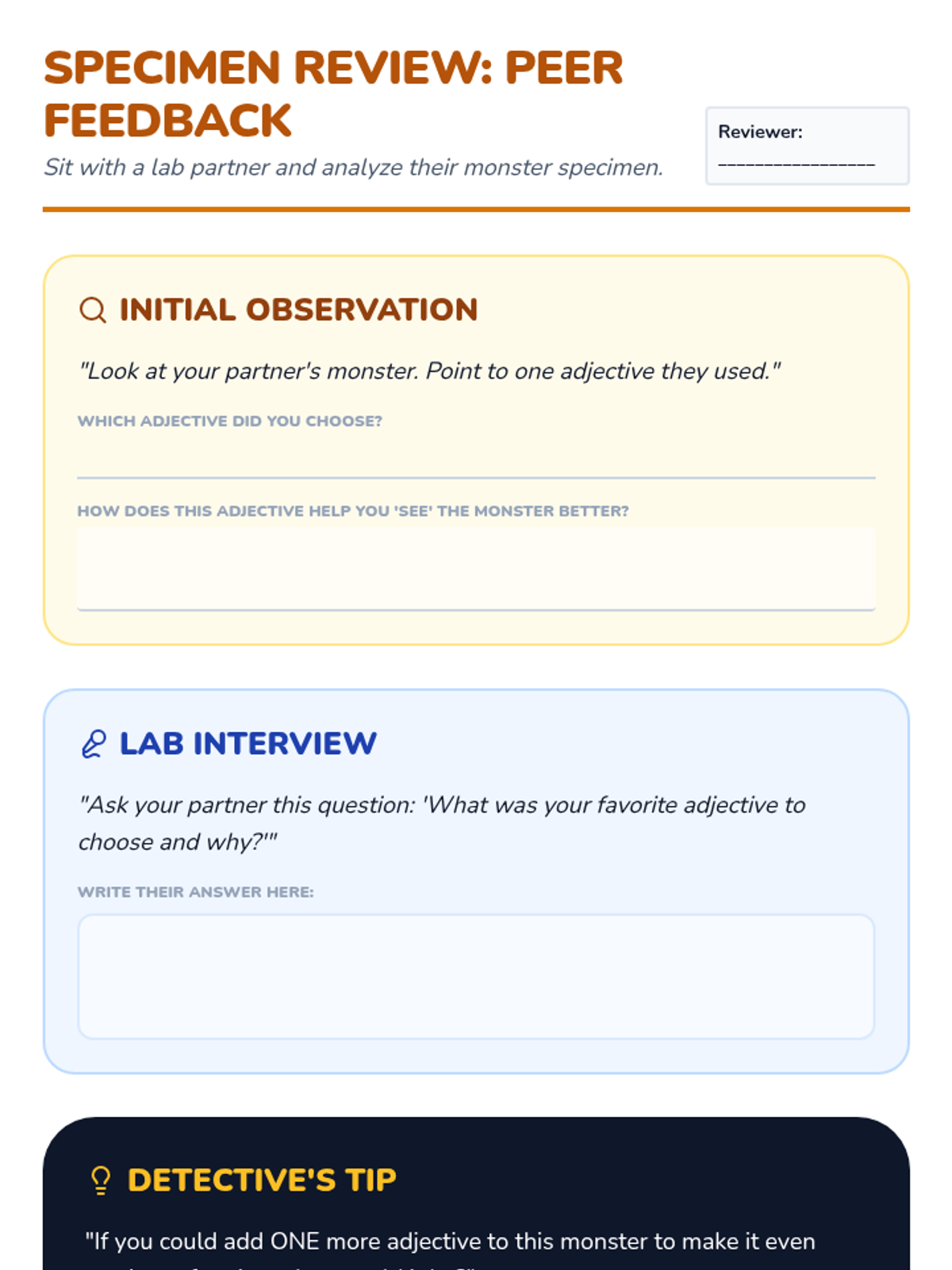
A peer review guide designed to facilitate structured discussion between students about their Monster Maker specimens, focusing on adjective use and descriptive impact.
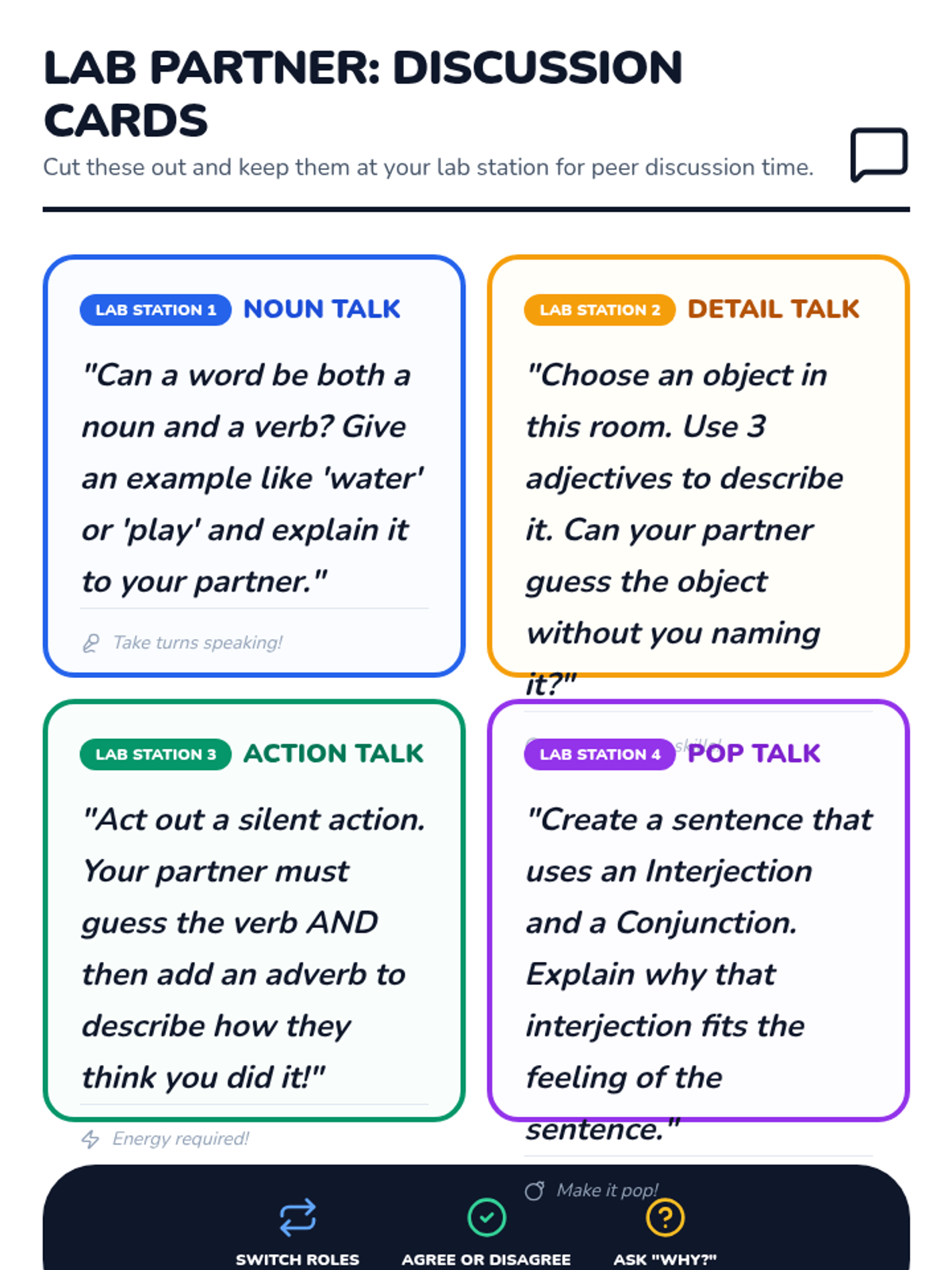
A set of structured discussion cards for peer talk, featuring prompts for nouns, adjectives, verbs, and connectors to be used throughout the week.
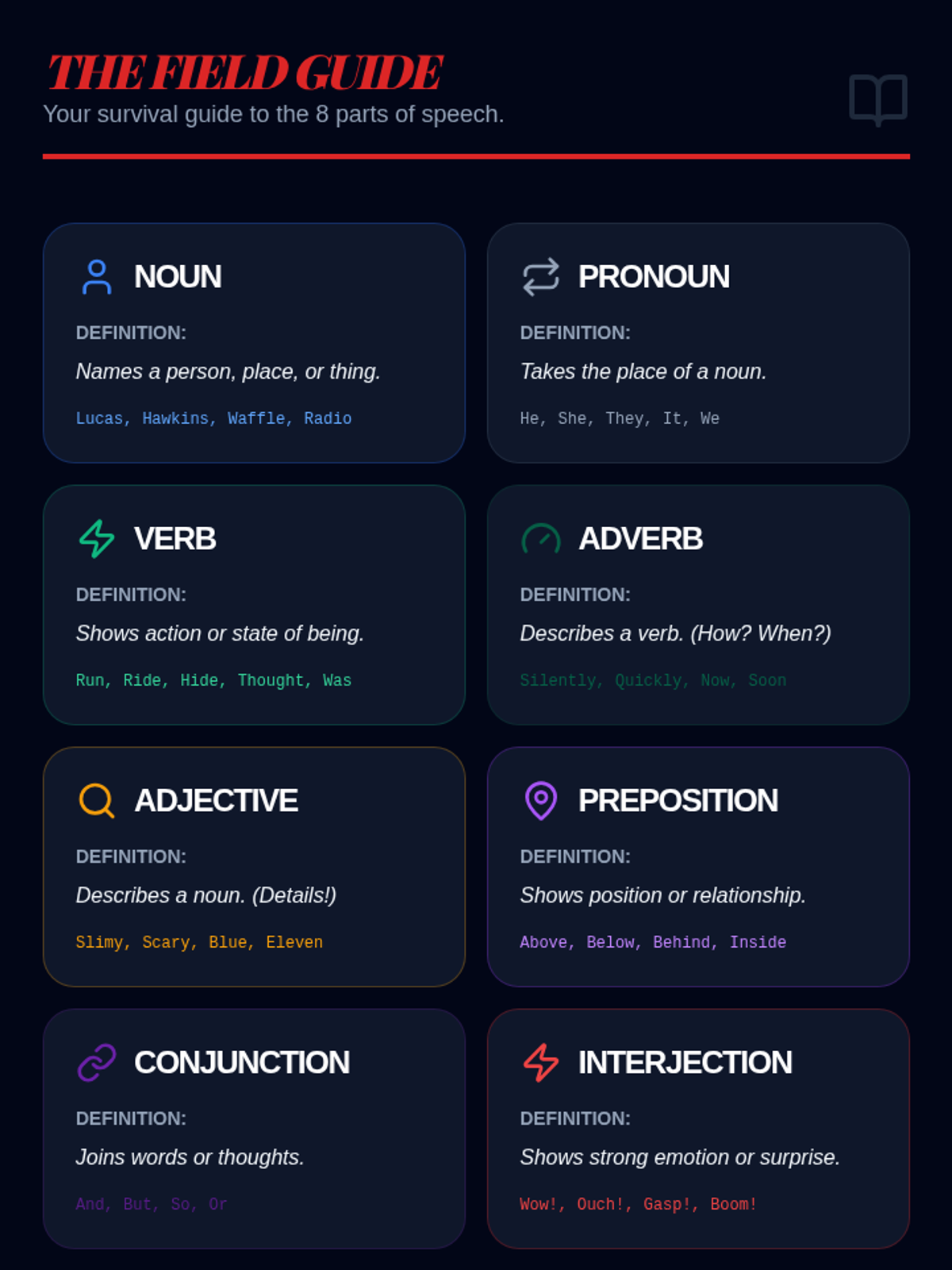
A comprehensive one-page reference sheet summarizing all 8 parts of speech with definitions and examples for student use.
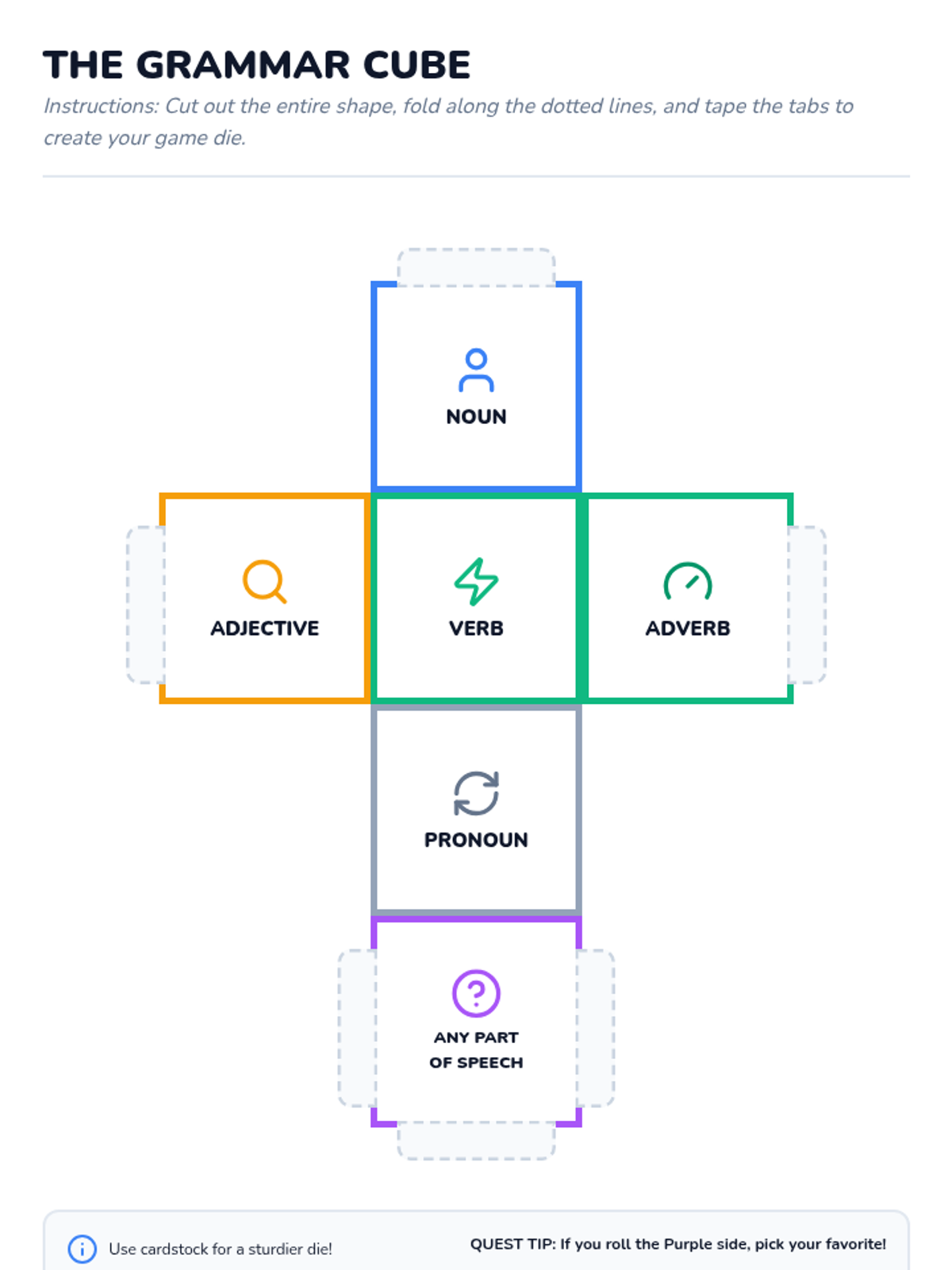
A printable cube net that students assemble to use as a game die, with each face representing a different part of speech for the Grammar Quest board game.
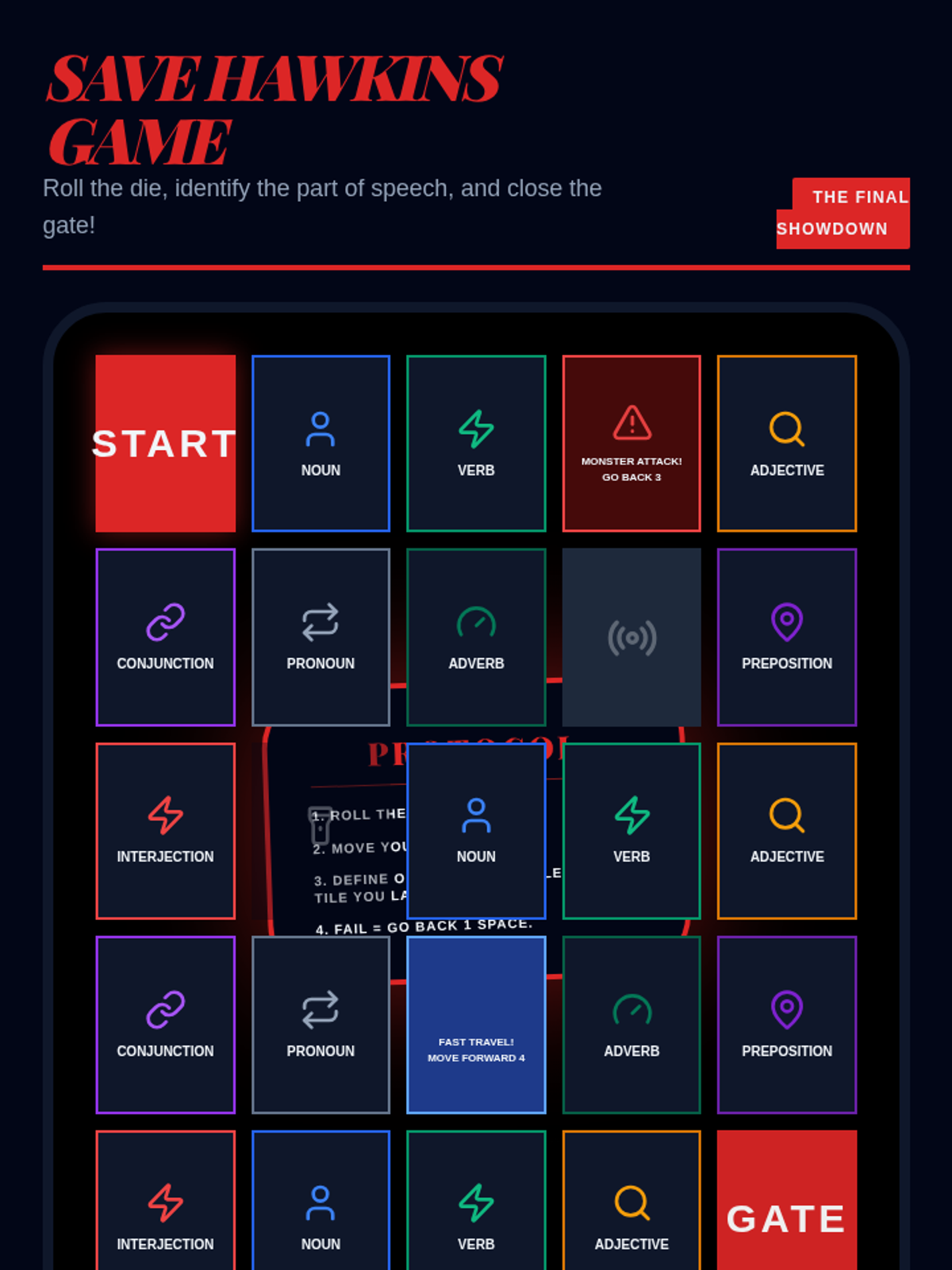
A cumulative review board game where students move through lab-themed spaces by identifying and providing examples of all 8 parts of speech.
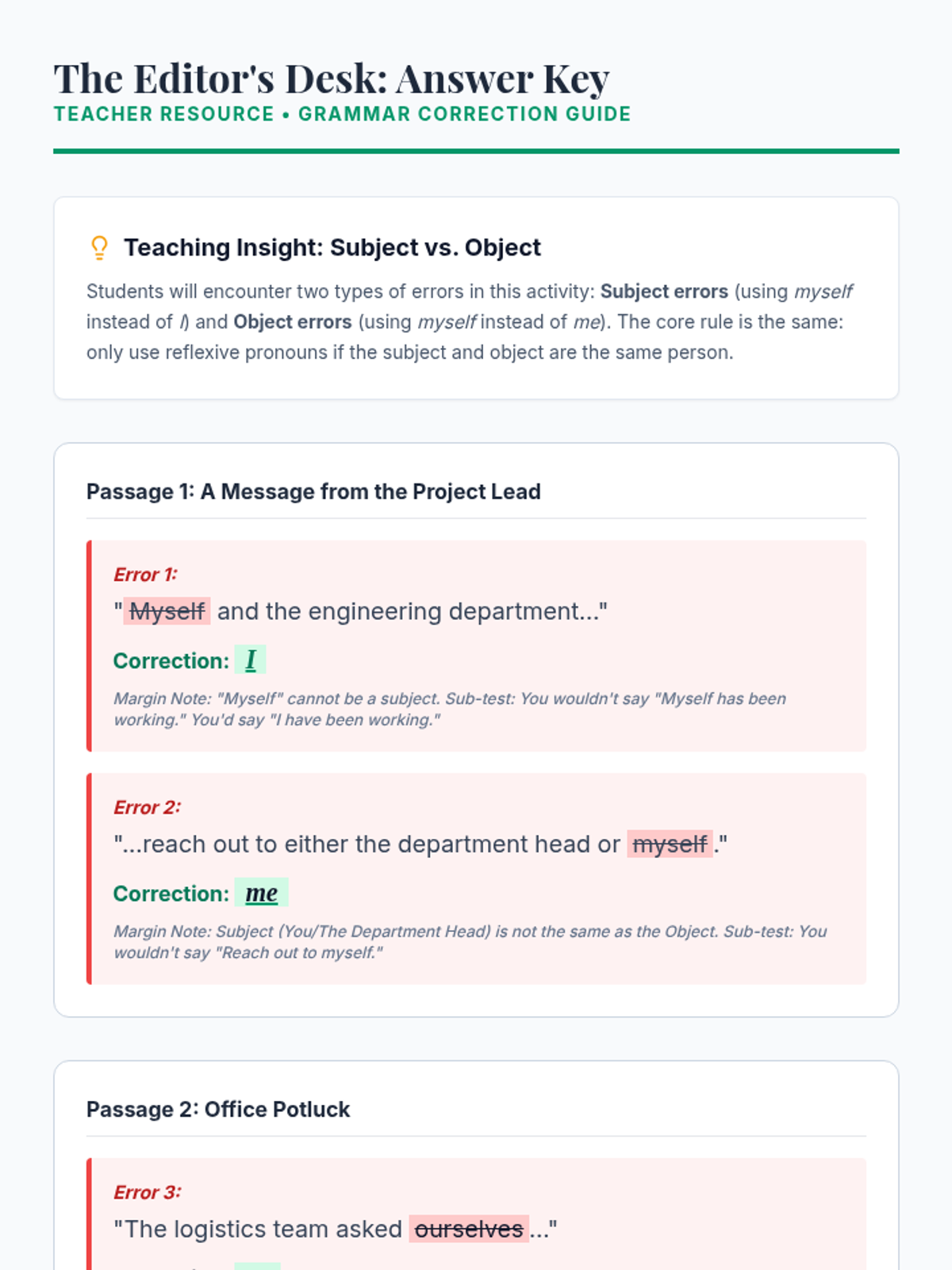
An answer key and teaching guide for 'The Editor's Desk' activity, providing corrected text, margin note examples, and discussion prompts.
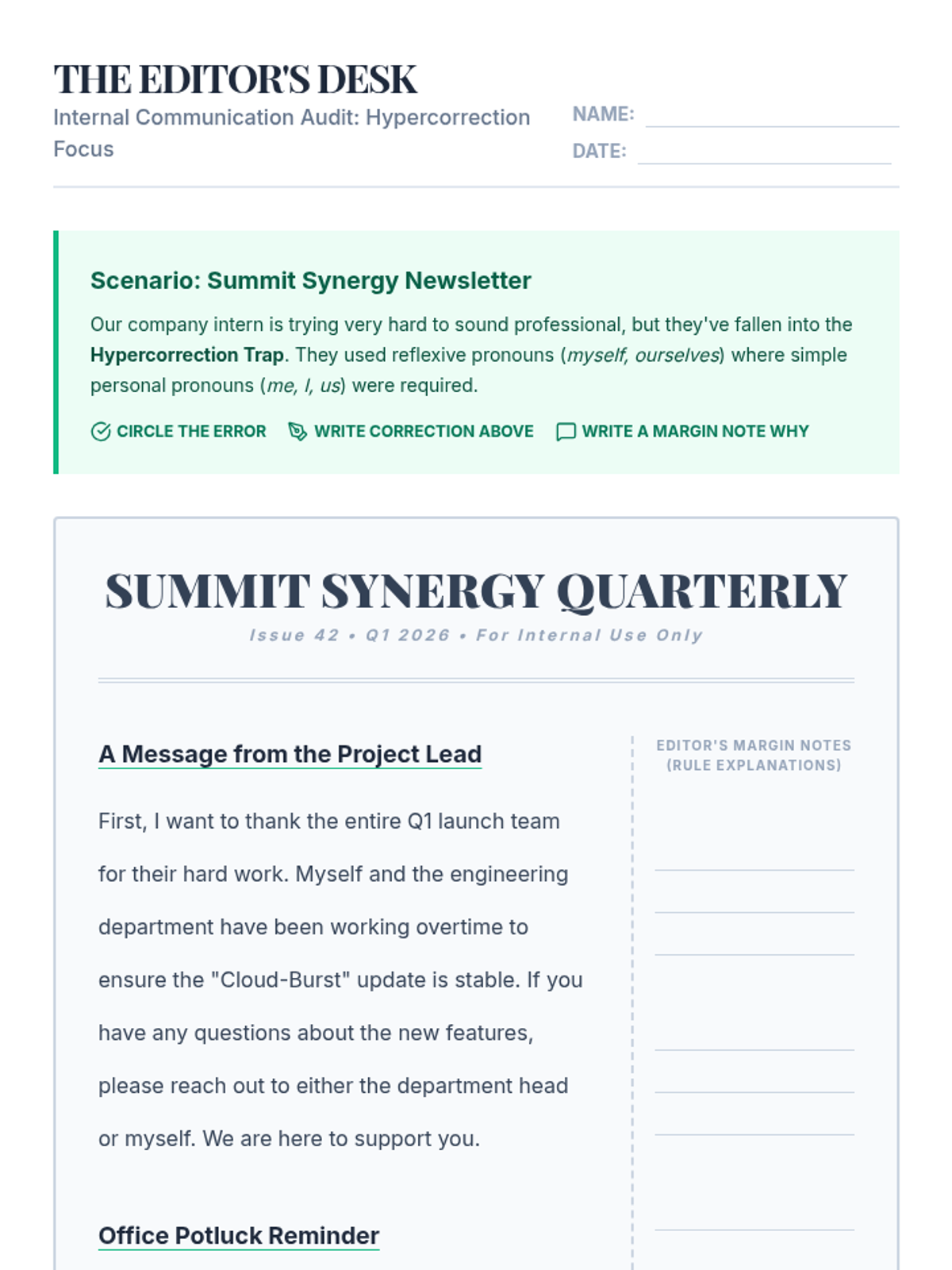
A worksheet where students act as editors for a corporate newsletter, identifying and correcting 'myself' hypercorrections and providing rule-based explanations.
A visual slide deck for teaching 8th-grade students about hypercorrection and reflexive pronoun misuse, featuring embedded video content and discussion prompts.
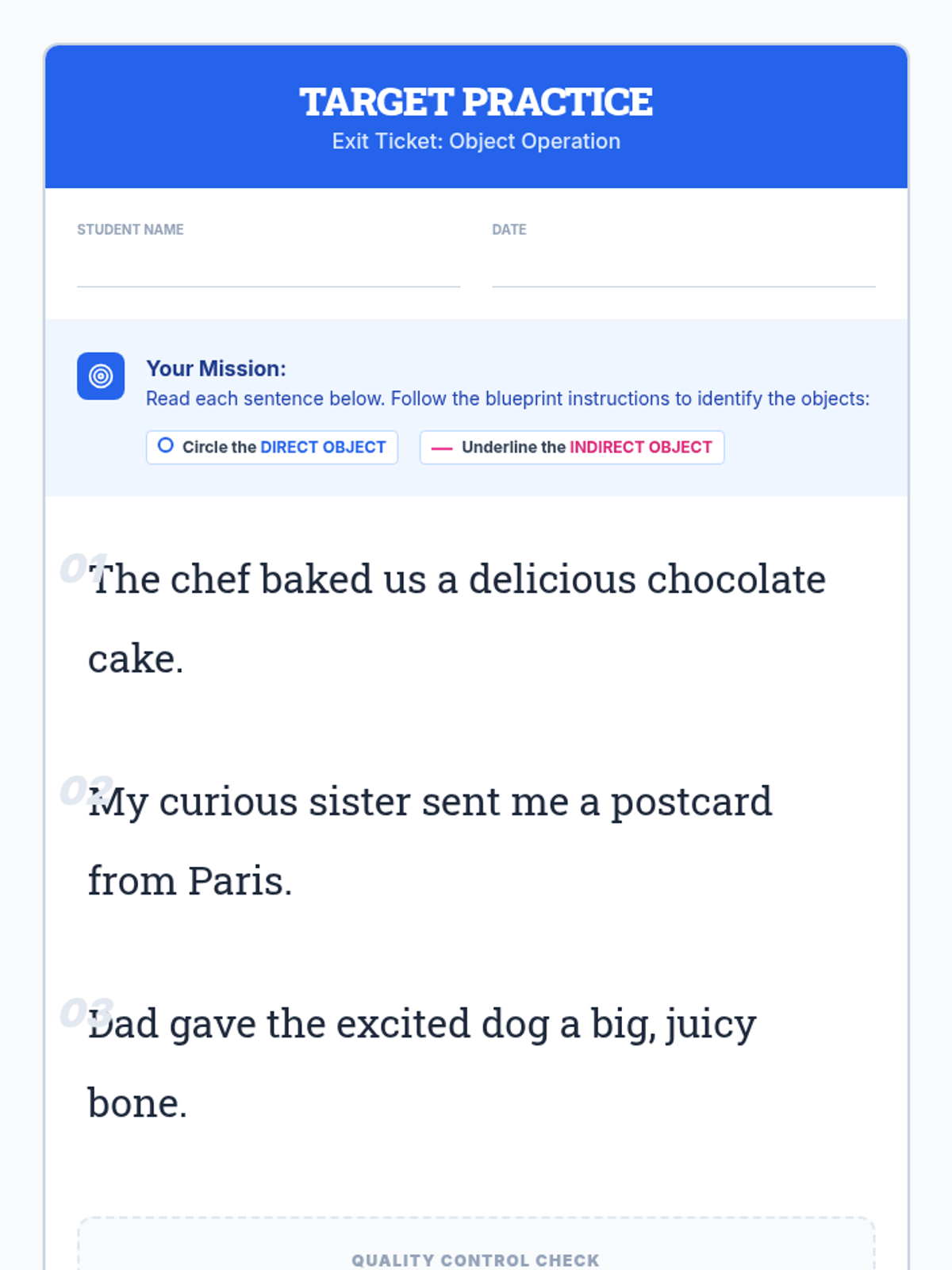
A short assessment for the end of the "Object Operation" lesson where students identify direct and indirect objects in three sentences.
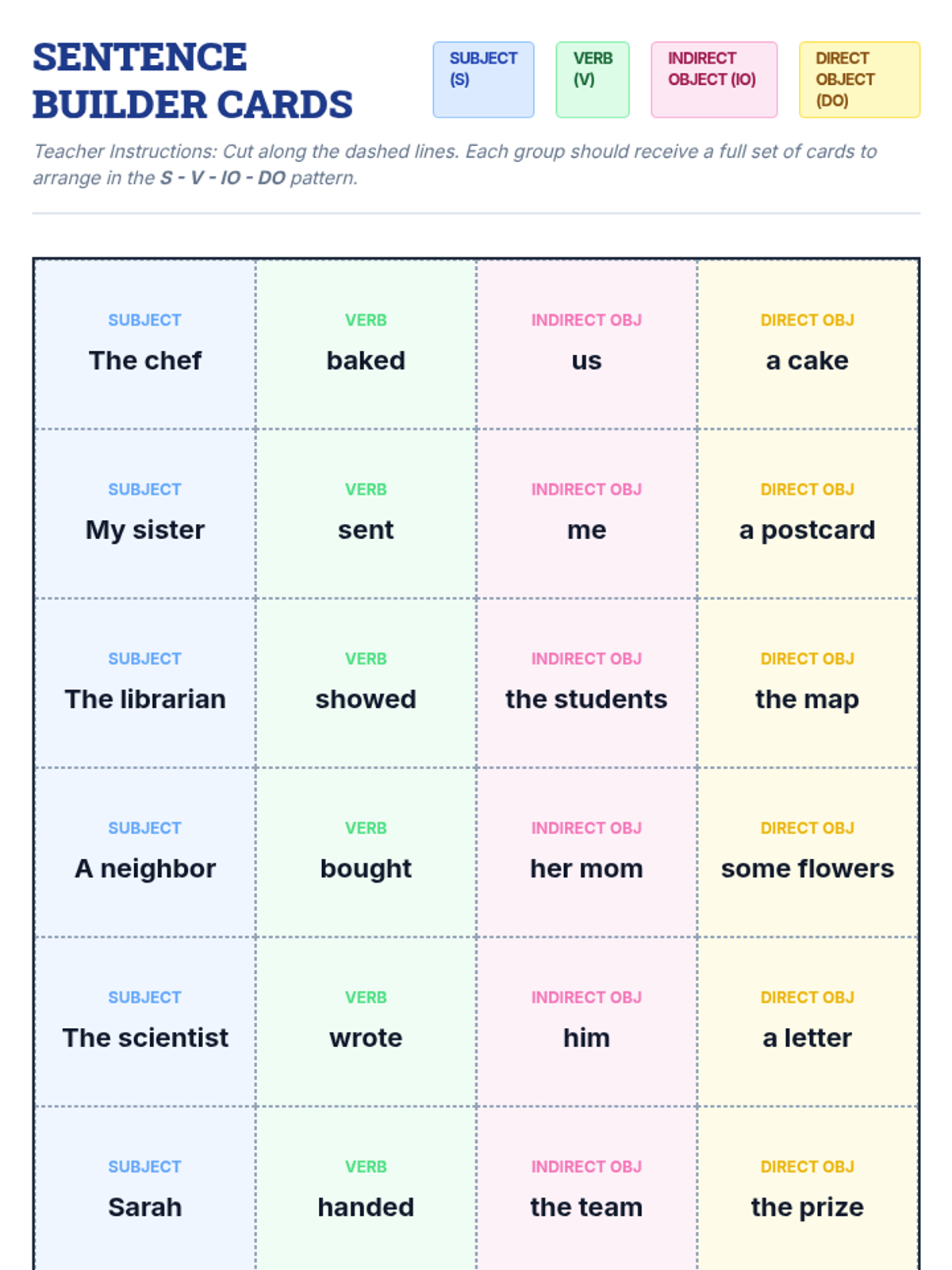
A set of cut-out manipulative cards for the "Sentence Builders" activity, featuring subjects, verbs, indirect objects, and direct objects for students to arrange.
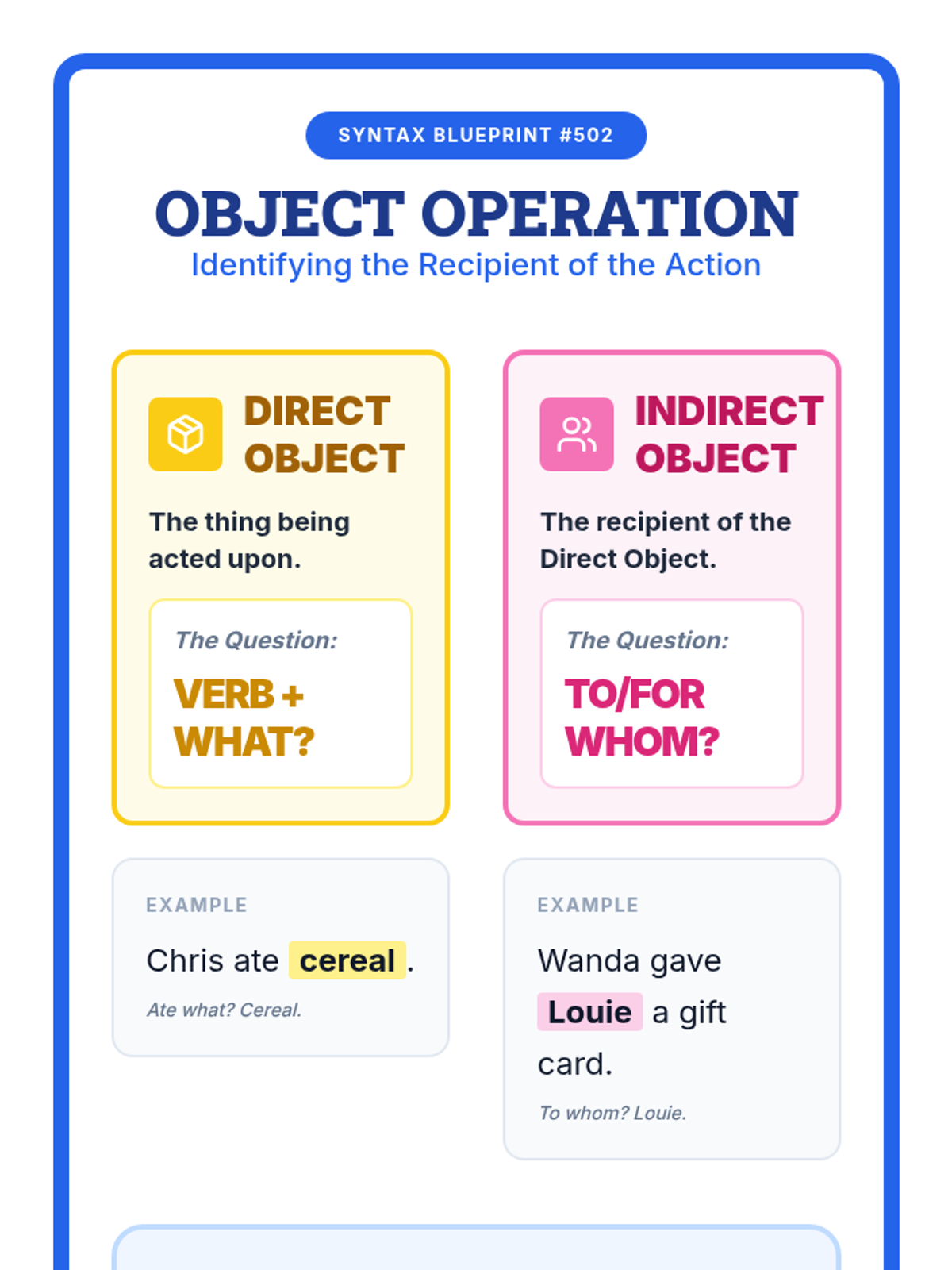
A classroom anchor chart summarizing the definitions and identifying questions for direct and indirect objects, featuring a clear visual sentence pattern.
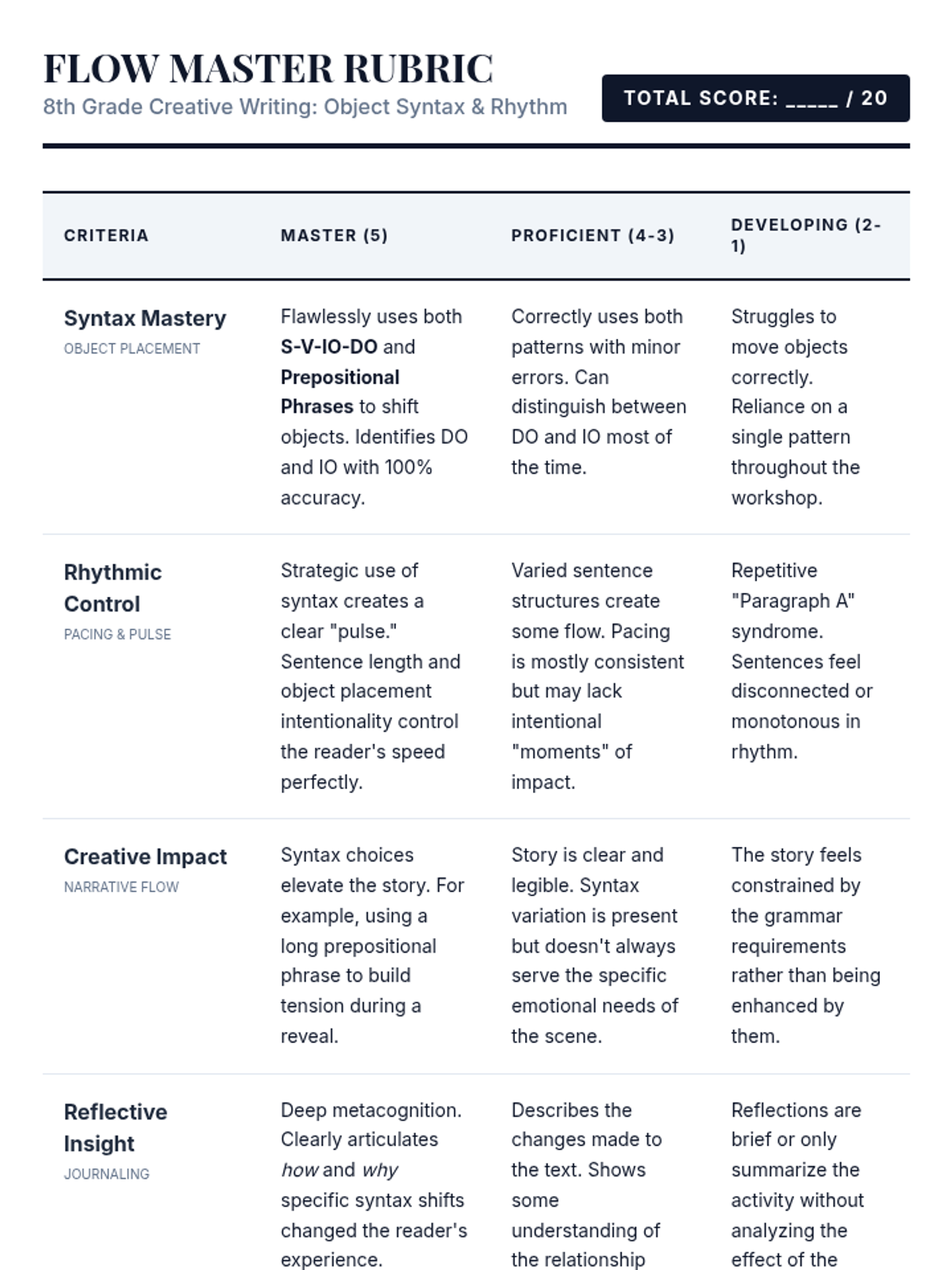
A comprehensive rubric for assessing student creative writing through the lens of syntax and rhythm. It evaluates syntax mastery, rhythmic control, creative impact, and reflective insight on a 5-point scale.
A visual presentation deck for the "Object Operation" lesson, including the Khan Academy video embed, guided examples of direct and indirect objects, and activity instructions.
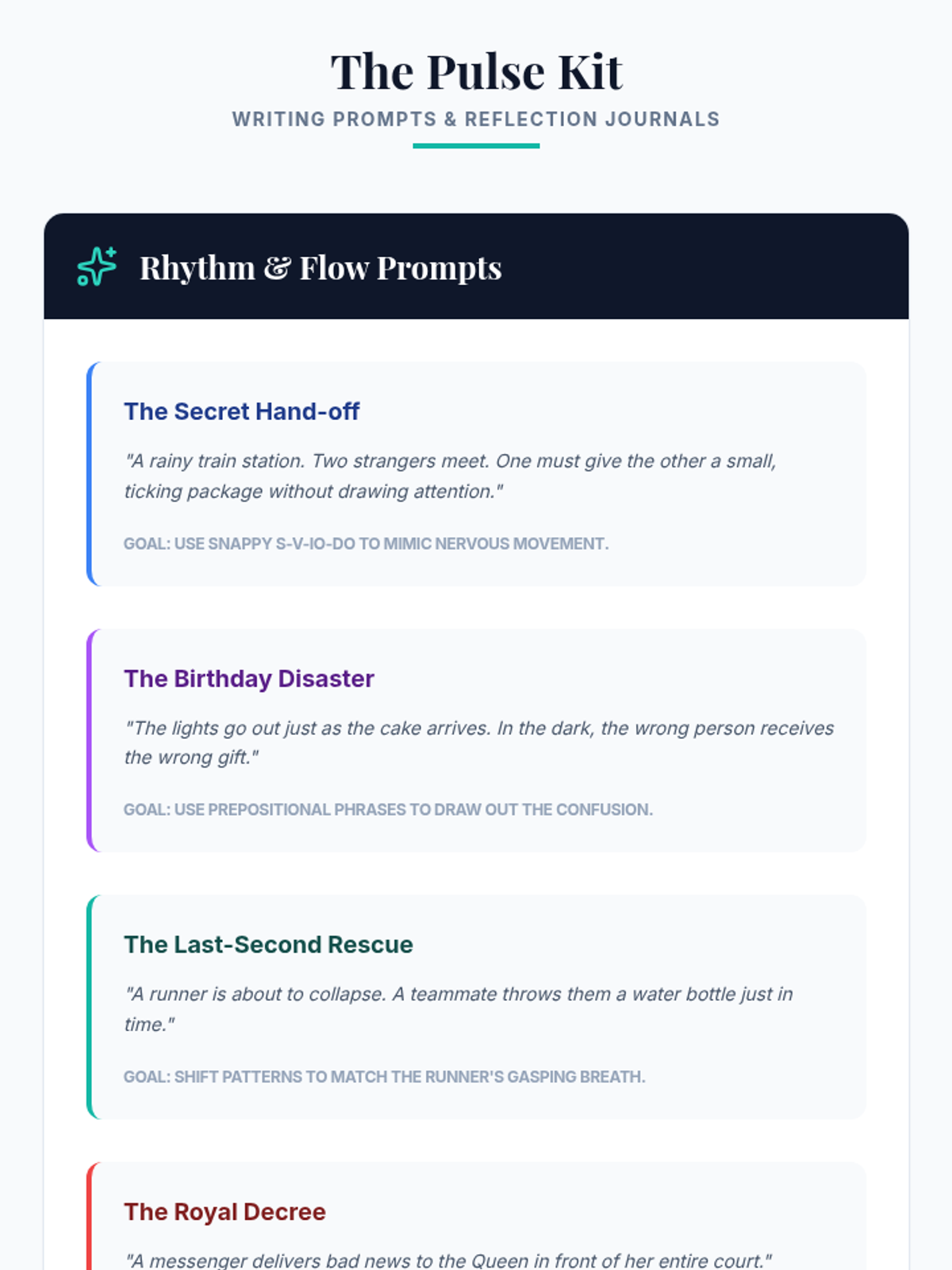
A set of creative writing prompts and metacognitive reflection questions designed to help students apply their understanding of sentence objects to narrative pacing. The material includes diverse scenarios (e.g., secret hand-offs, rescues) and focused prompts on the stylistic impact of object placement.
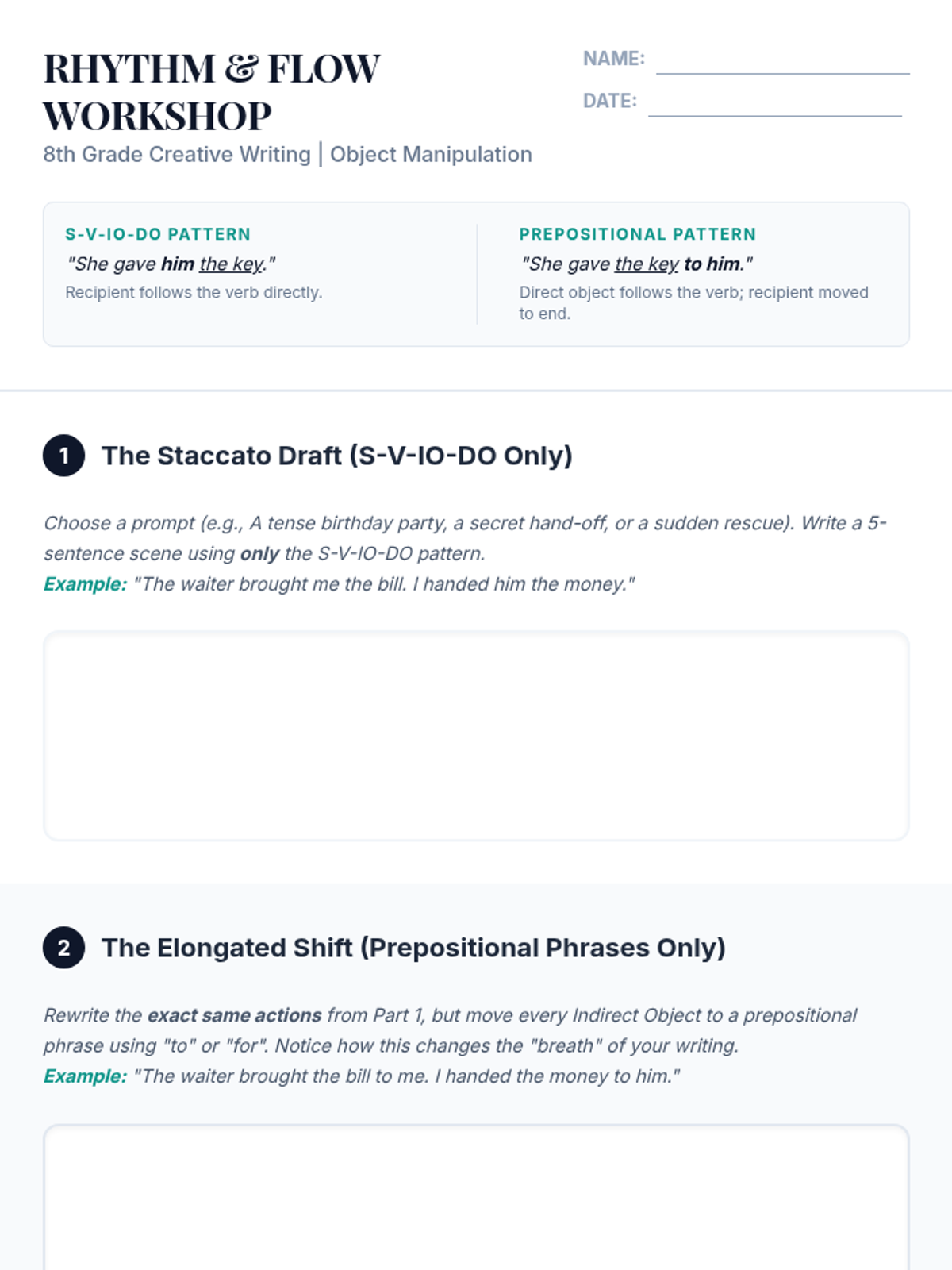
A student workshop document for practicing sentence rhythm through object manipulation. It features three drafting stages: one using only S-V-IO-DO patterns, one using only prepositional phrases, and a final polished remix, followed by a peer review section.
A comprehensive slide deck for an 8th-grade creative writing lesson on sentence rhythm. It includes a warm-up comparison, an embedded Khan Academy video on direct and indirect objects, a breakdown of syntax patterns, and instructions for the 'Rhythm & Flow' writing workshop.
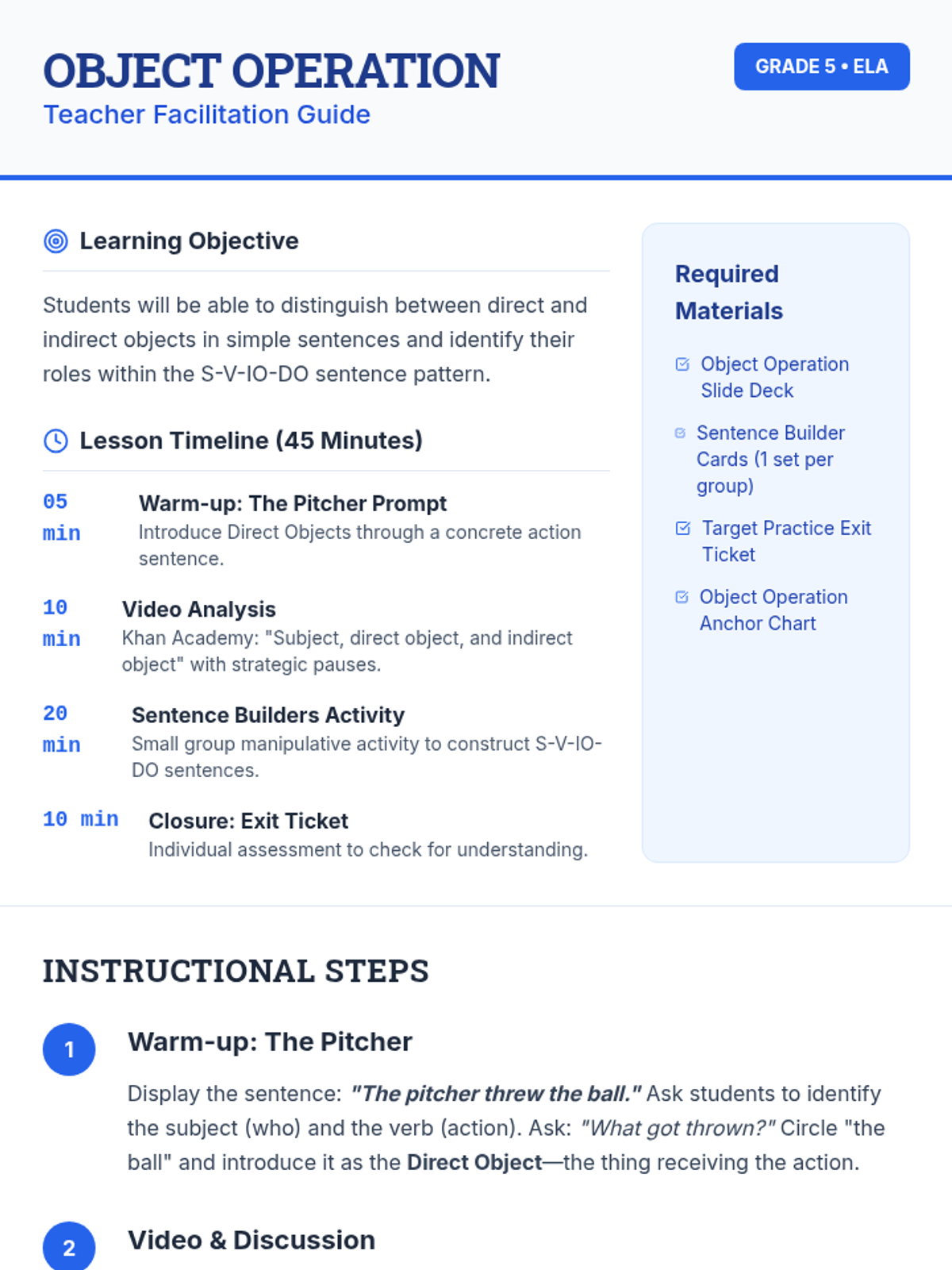
A comprehensive teacher guide for the "Object Operation" lesson, detailing the step-by-step facilitation of direct and indirect object instruction, video timestamps, and group activities.
A visual presentation for the Who vs. Whom lesson, following the Khan Academy aesthetic with neon highlights, including an embedded video and structured pauses for discussion.
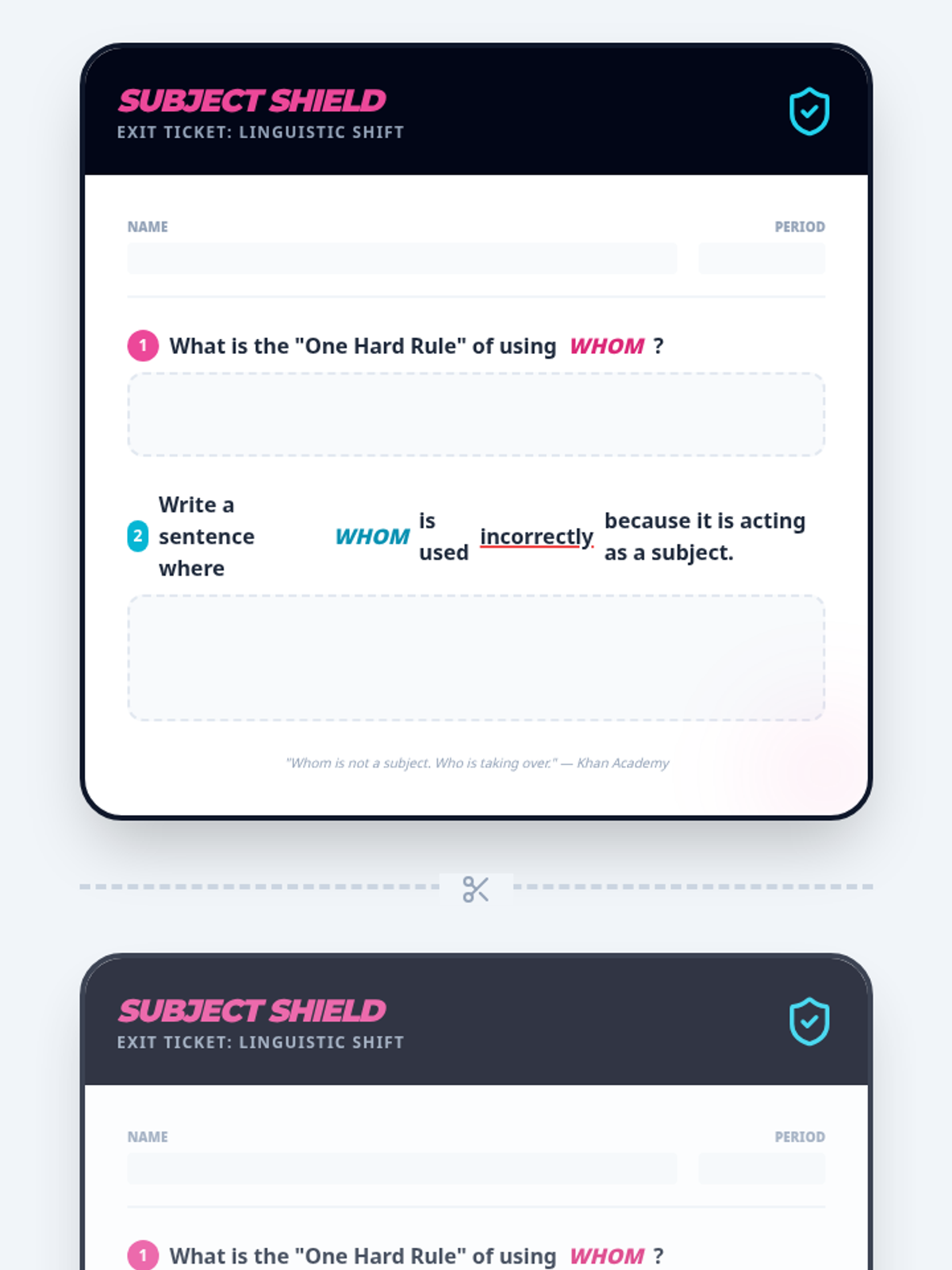
An exit ticket for the Linguistic Shift lesson, assessing students' ability to identify the 'one hard rule' of whom as a non-subject pronoun.
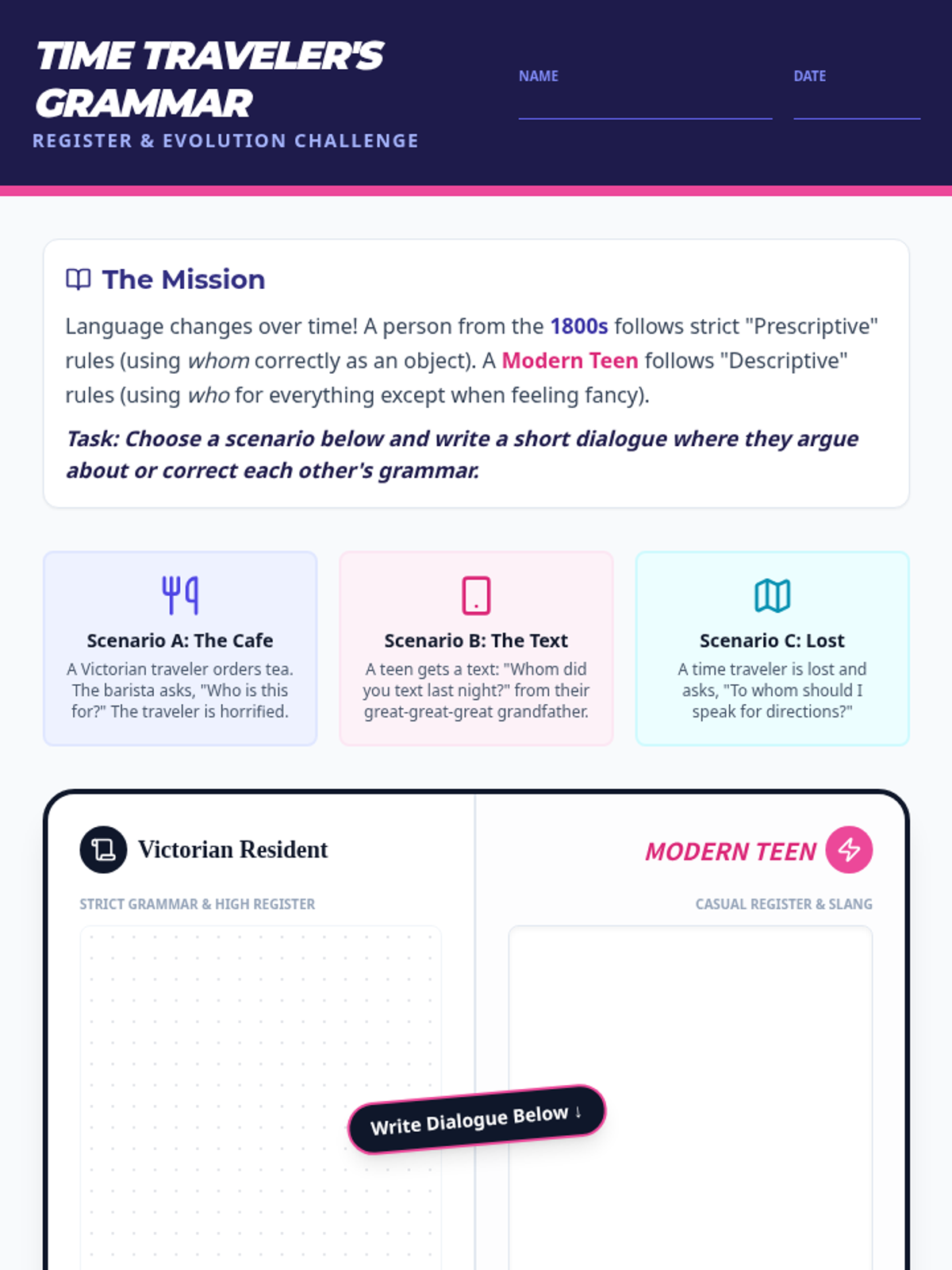
An activity sheet for the 'Time Traveler's Grammar' role-play, where students write a dialogue between a Victorian traveler and a modern teen using different language registers.
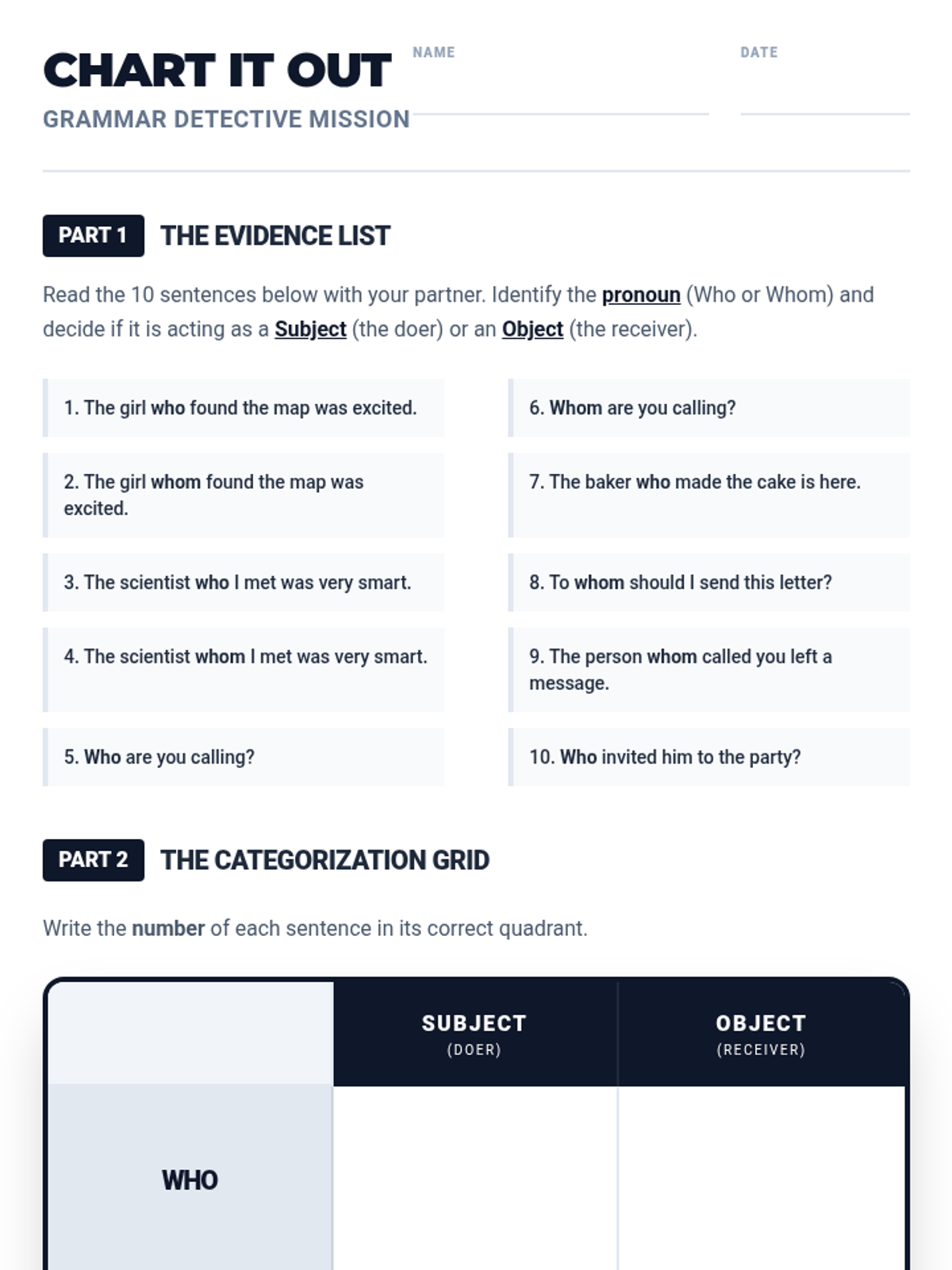
A student activity sheet for categorizing sentences into the 2x2 grid based on the 'One-Way Street' rule, including space for creating an 'impossible' sentence.
A visual presentation for the Linguistic Shift lesson, featuring the Khan Academy video, grammar rule breakdowns, and the warm-up activity.
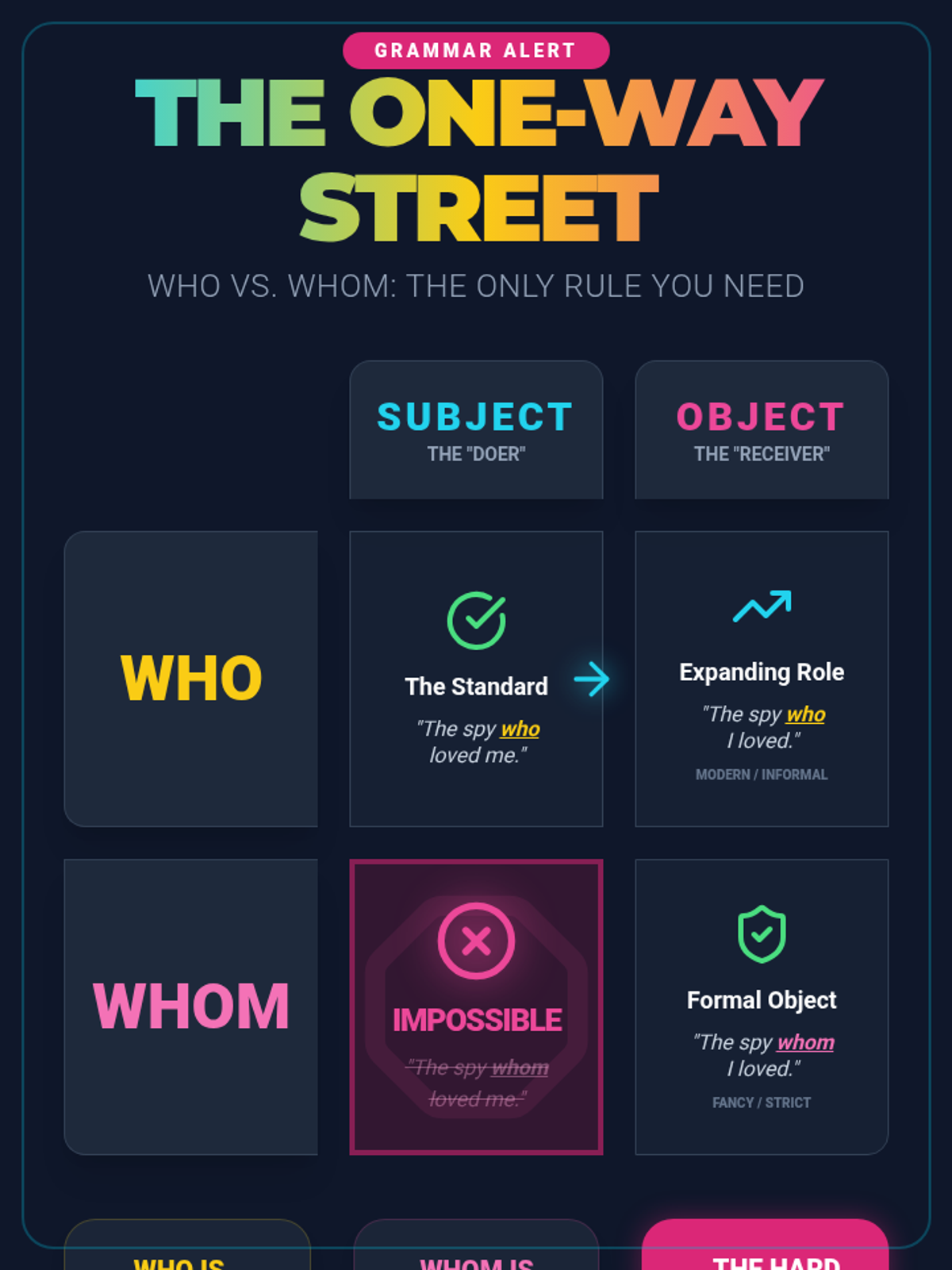
A high-contrast anchor chart for the 'One-Way Street' grammar rule, illustrating that 'who' is expanding into the object space while 'whom' remains strictly an object pronoun.
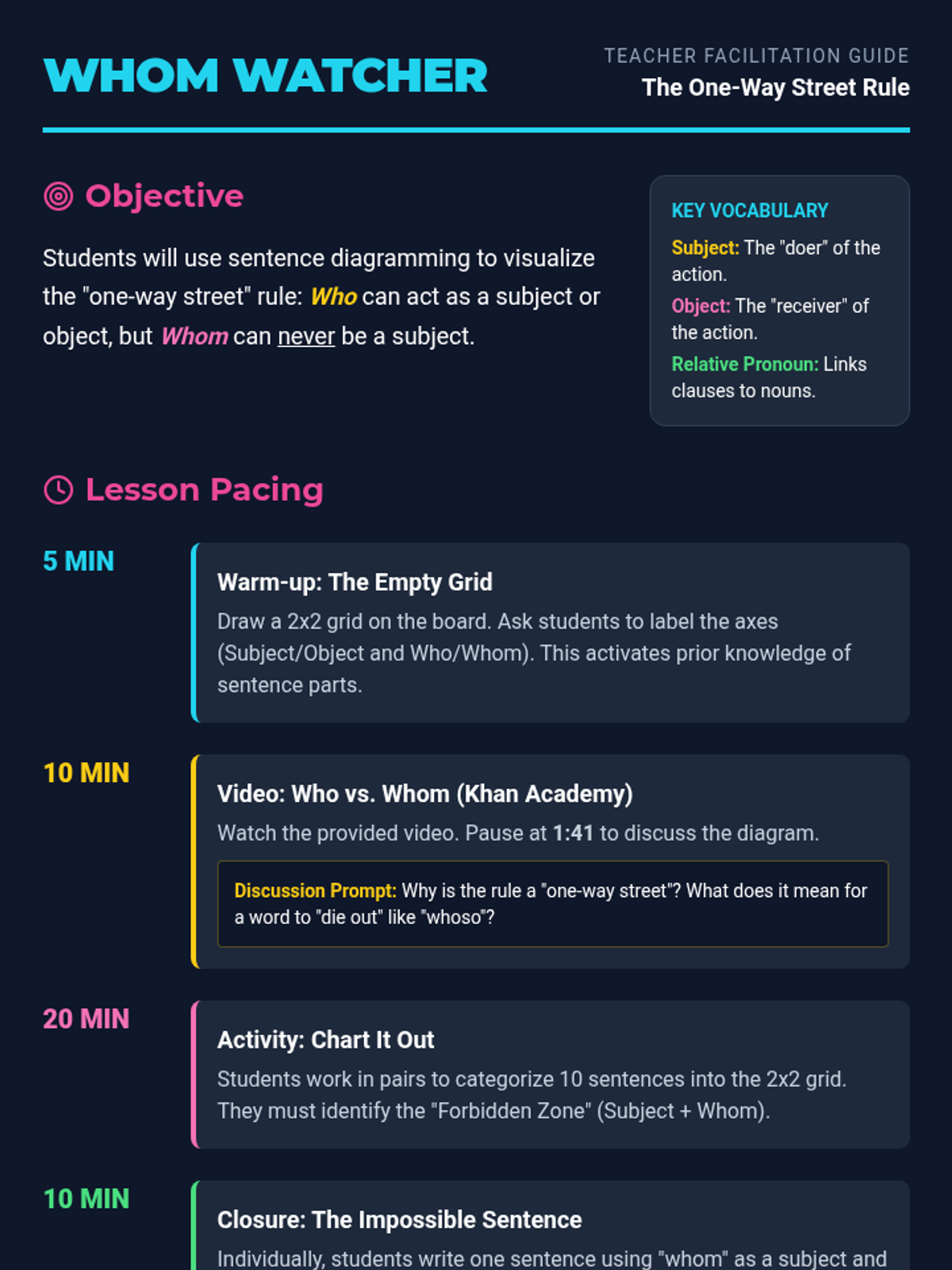
A comprehensive teacher facilitation guide for the Who vs. Whom lesson, featuring a pacing guide, discussion prompts, and an answer key for the categorization activity.
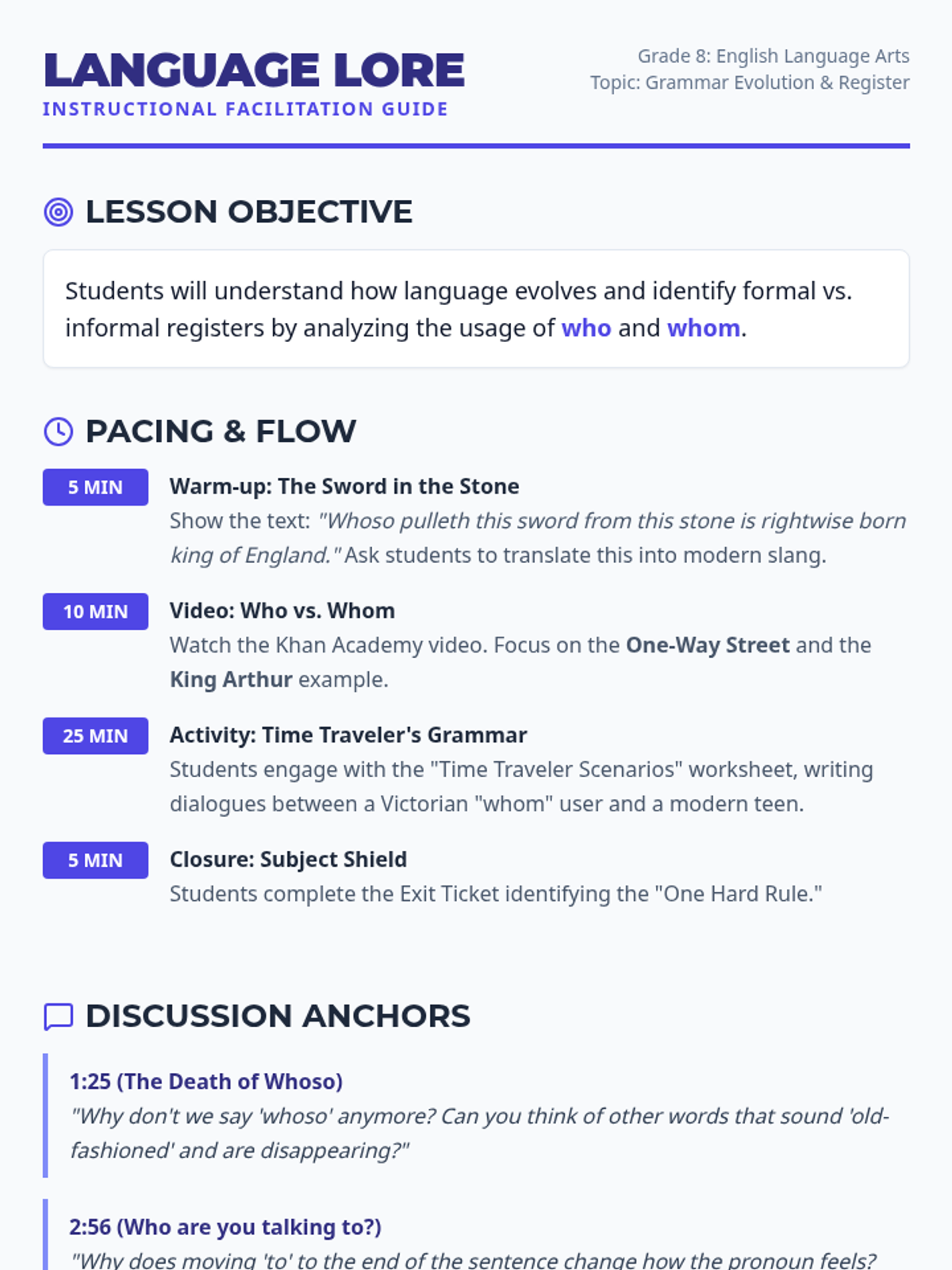
A teacher guide for the Linguistic Shift lesson, including pacing, discussion questions, and key teaching moments.
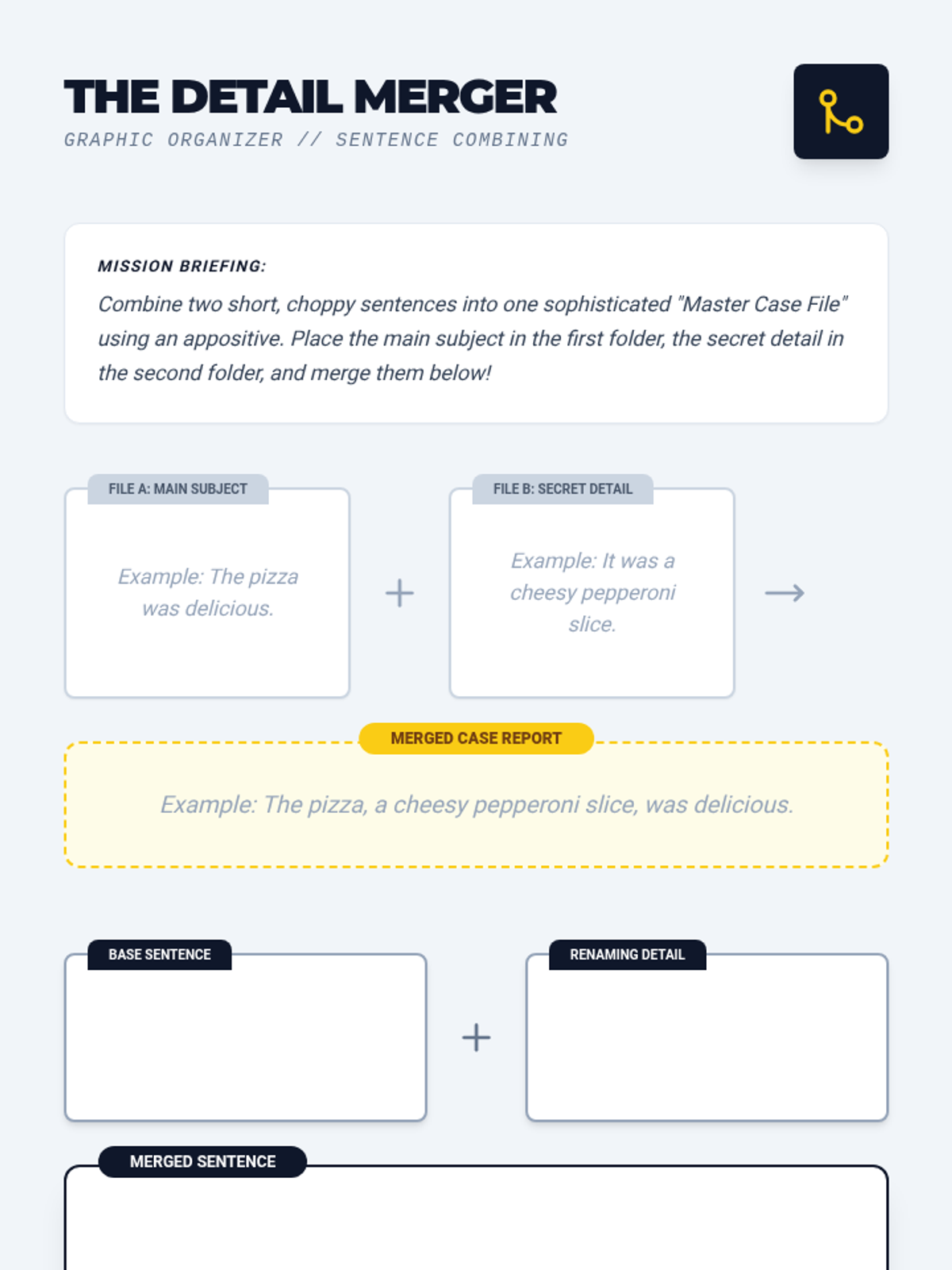
A graphic organizer for combining two short sentences into one sentence with an appositive, designed with a 'file merger' theme.
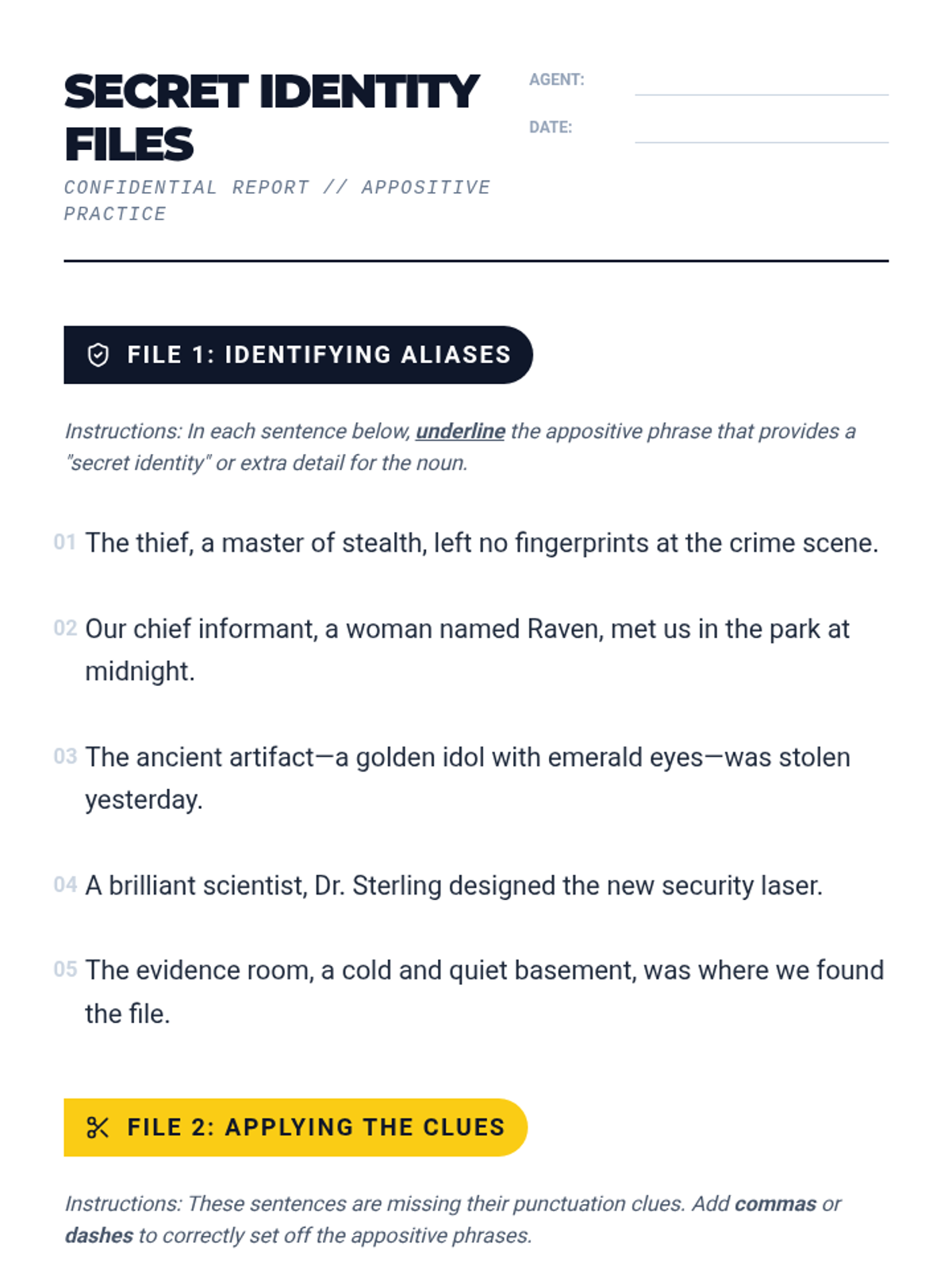
A comprehensive worksheet for practicing appositive identification, punctuation, and sentence construction with a detective theme.
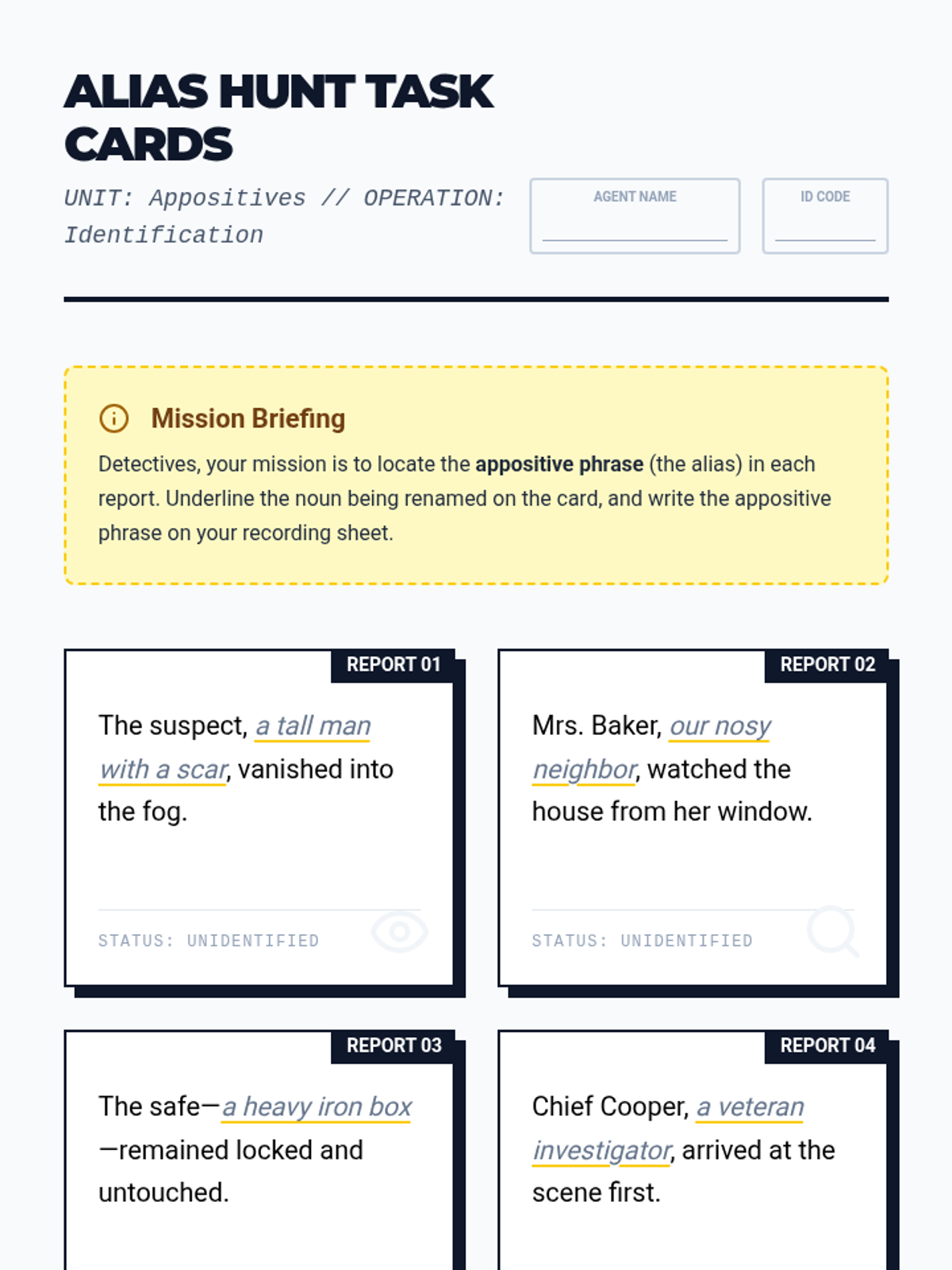
A set of 8 detective-themed task cards for identifying appositives, plus a student recording sheet. Each card presents a 'field report' sentence with a hidden appositive.
A slide deck introducing appositives using a 'detective' theme, explaining their function as 'aliases' for nouns and detailing punctuation markers.
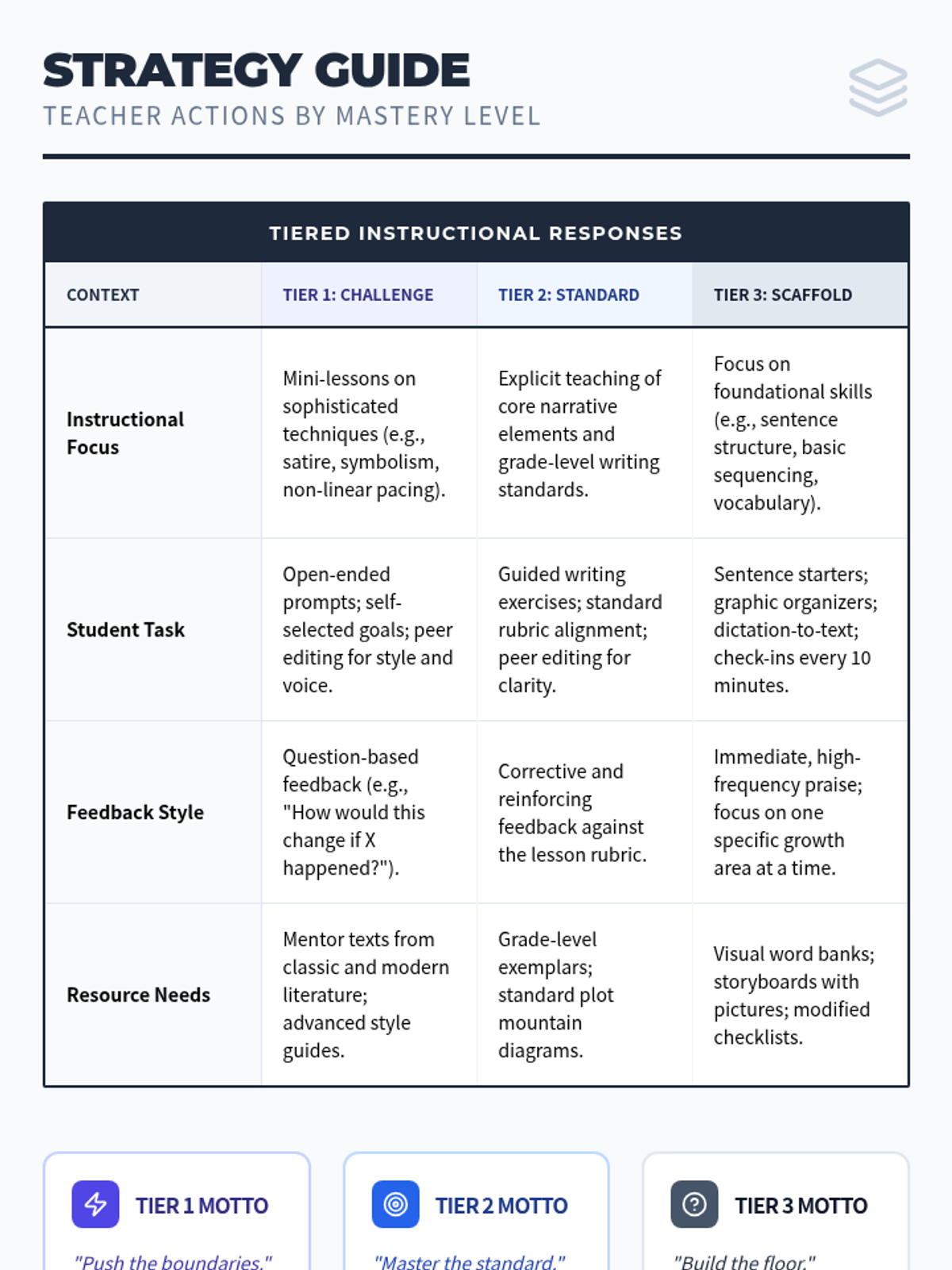
A teacher-facing strategy guide outlining specific instructional actions, feedback styles, and resource needs for Tier 1, 2, and 3 students.
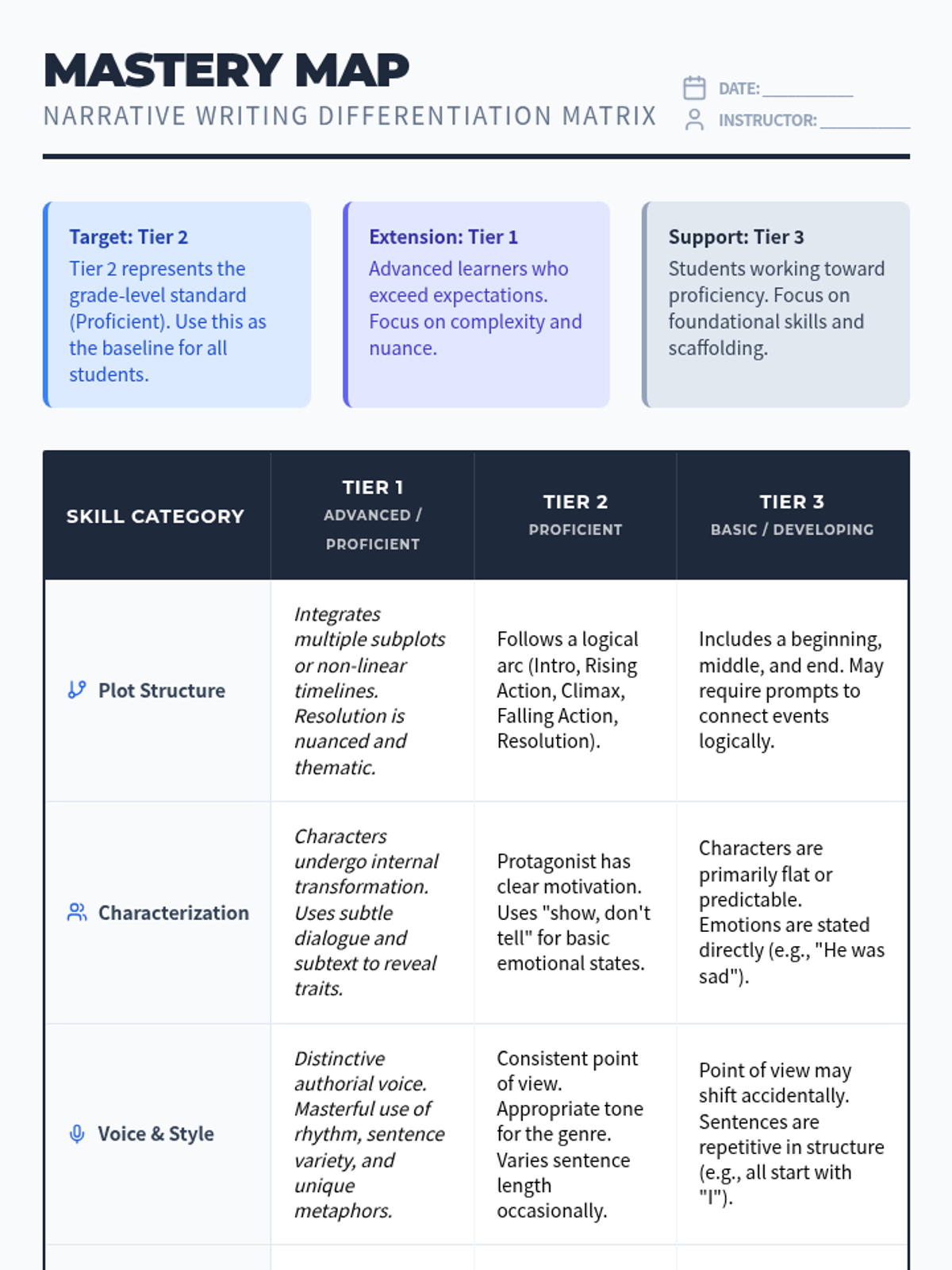
A comprehensive 4-column mastery chart for narrative writing, featuring criteria for Tier 1 (Advanced), Tier 2 (Proficient), and Tier 3 (Basic) students, plus a grouping log.
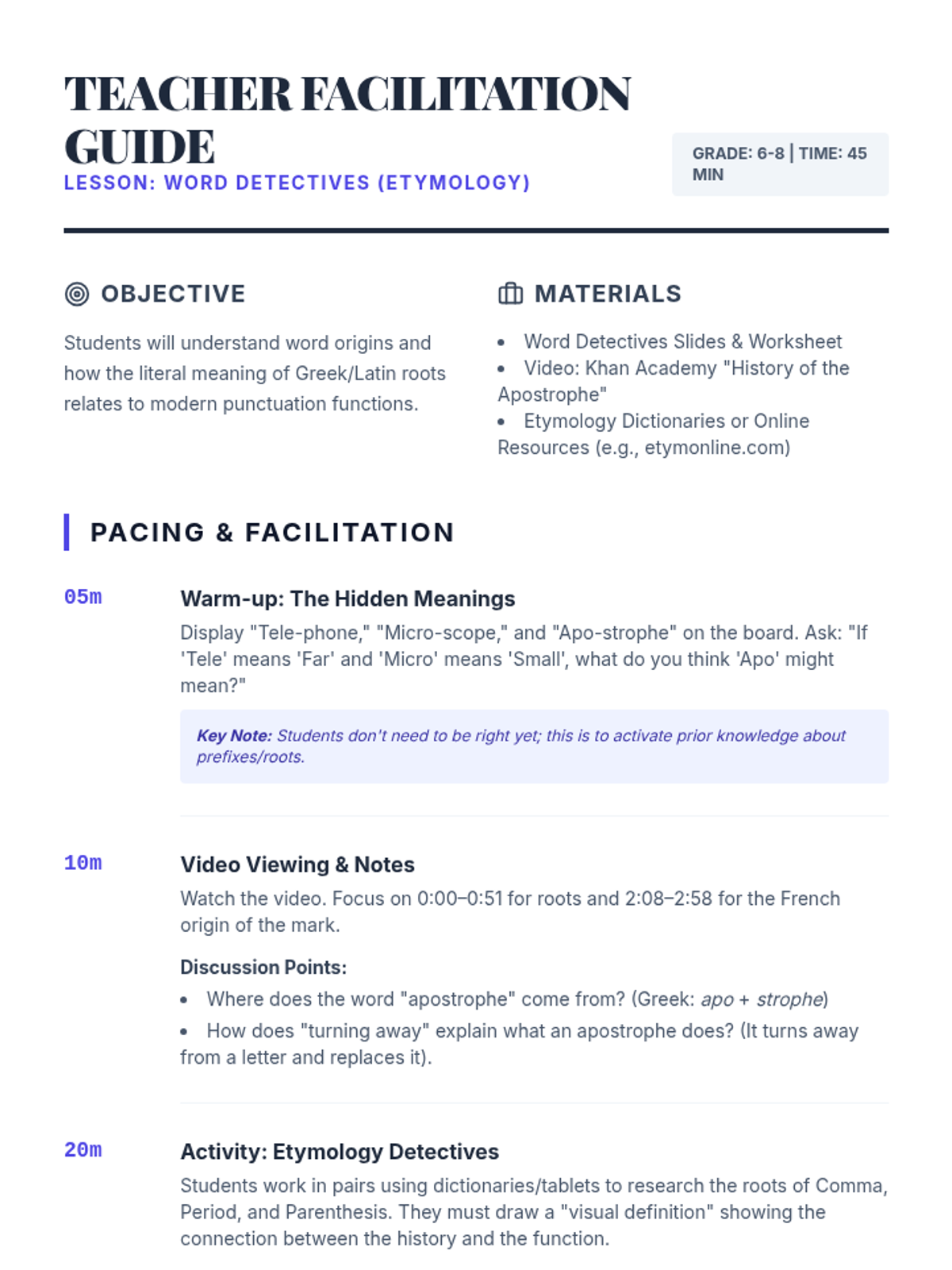
A comprehensive teacher facilitation guide for the Word Detectives lesson. Includes pacing, discussion prompts, a detailed answer key with word origins for punctuation marks, and extension suggestions.
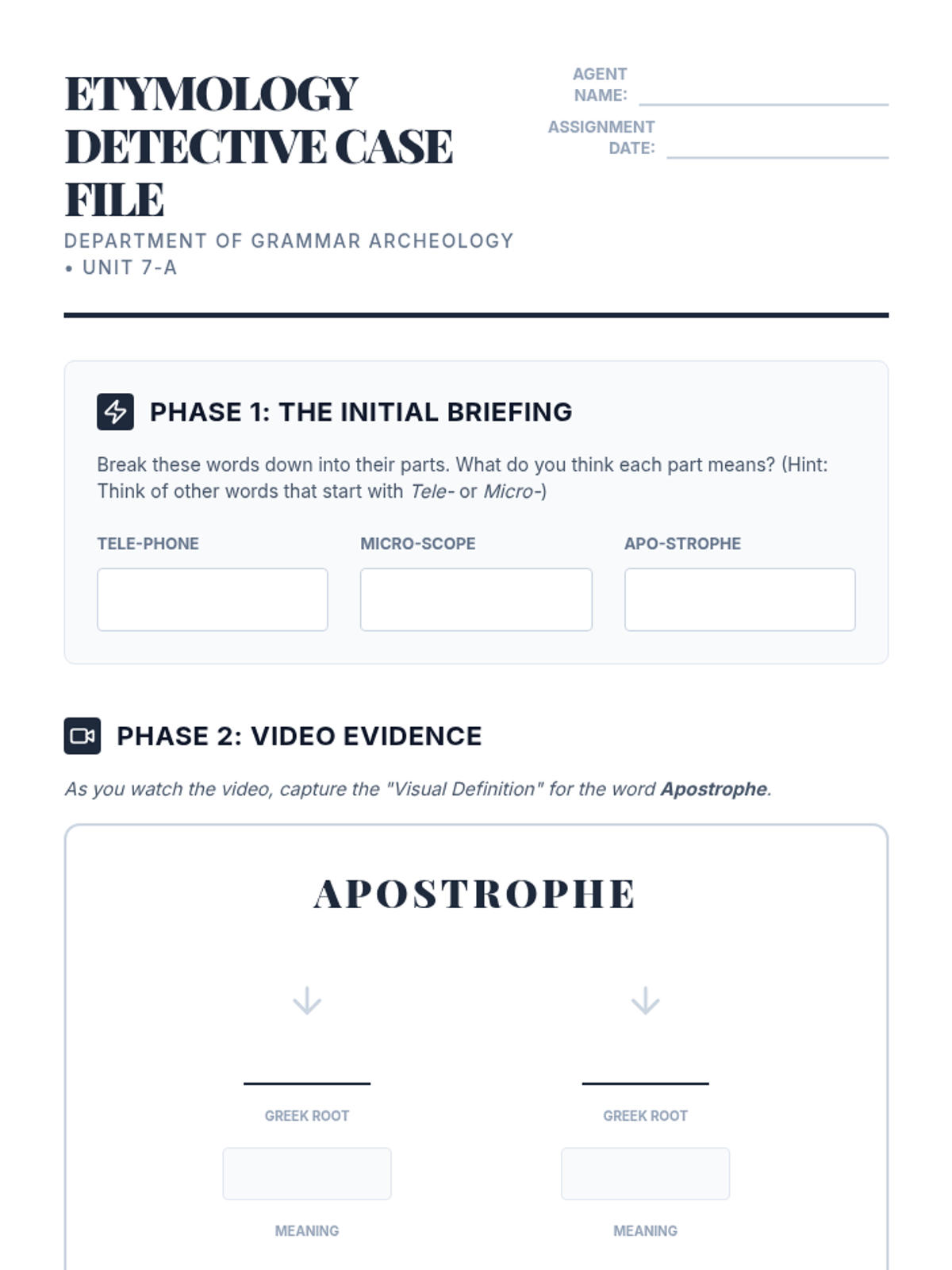
A worksheet for students to record word origins and create visual definitions for common grammar terms. Includes spaces for warm-up notes, video observation, and an independent research activity on comma, period, and parenthesis.
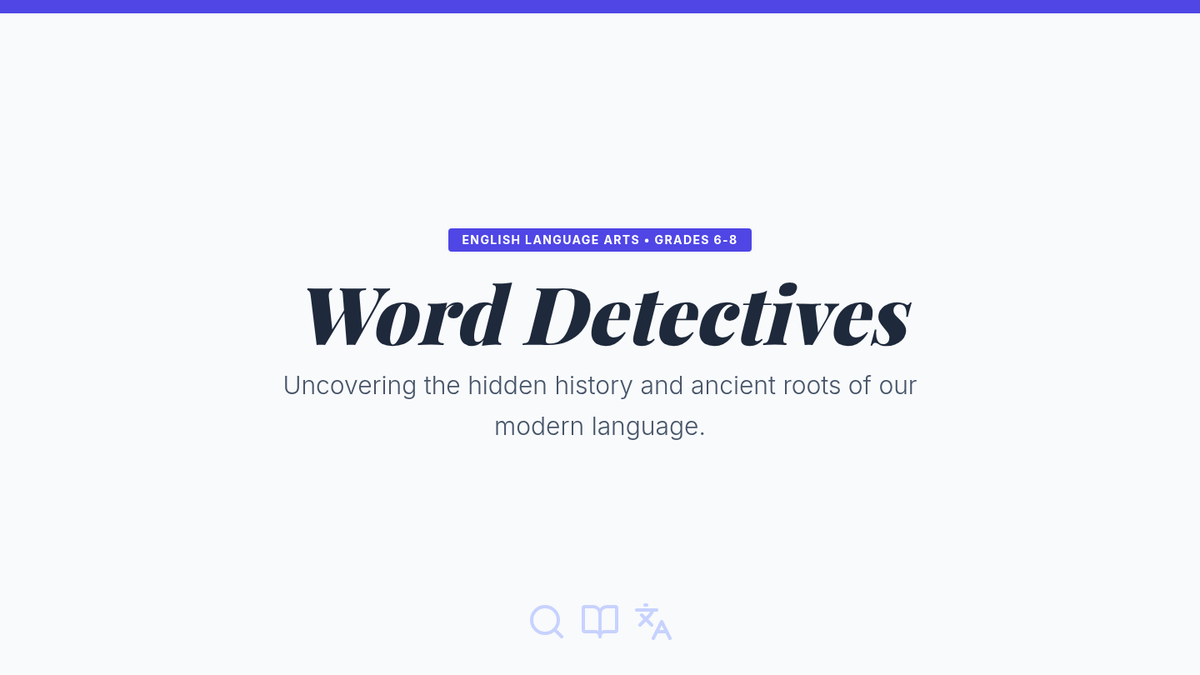
A slide deck for teaching etymology and the history of the apostrophe. Includes a warm-up, an embedded Khan Academy video, and instructions for the student-led detective activity.
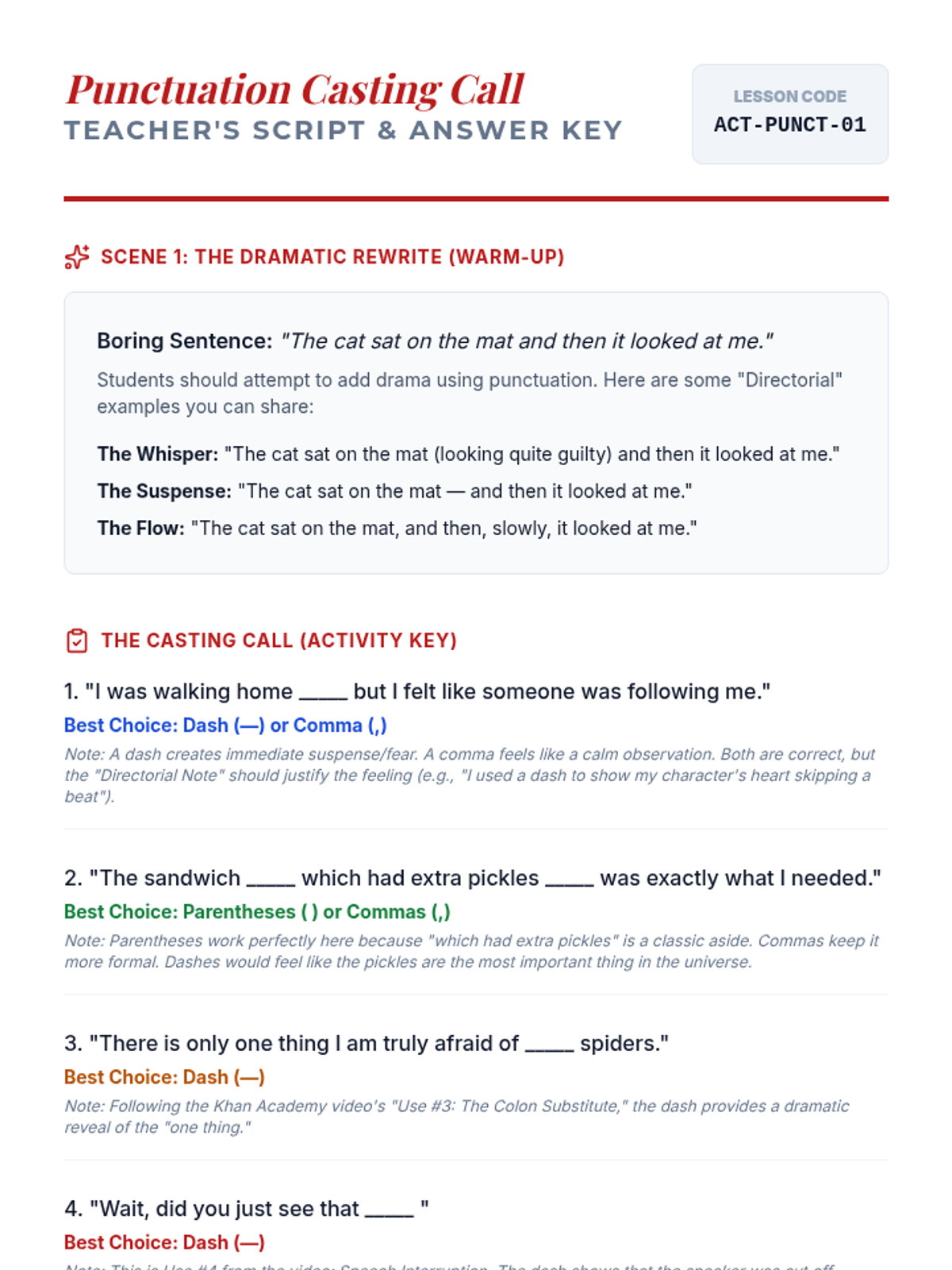
A comprehensive teacher's guide and answer key for the 'Punctuation Casting Call' lesson. It provides suggested answers for the student worksheet, explanation of the tone differences between marks, and instructional tips for the dramatic rewrite and closure activities.
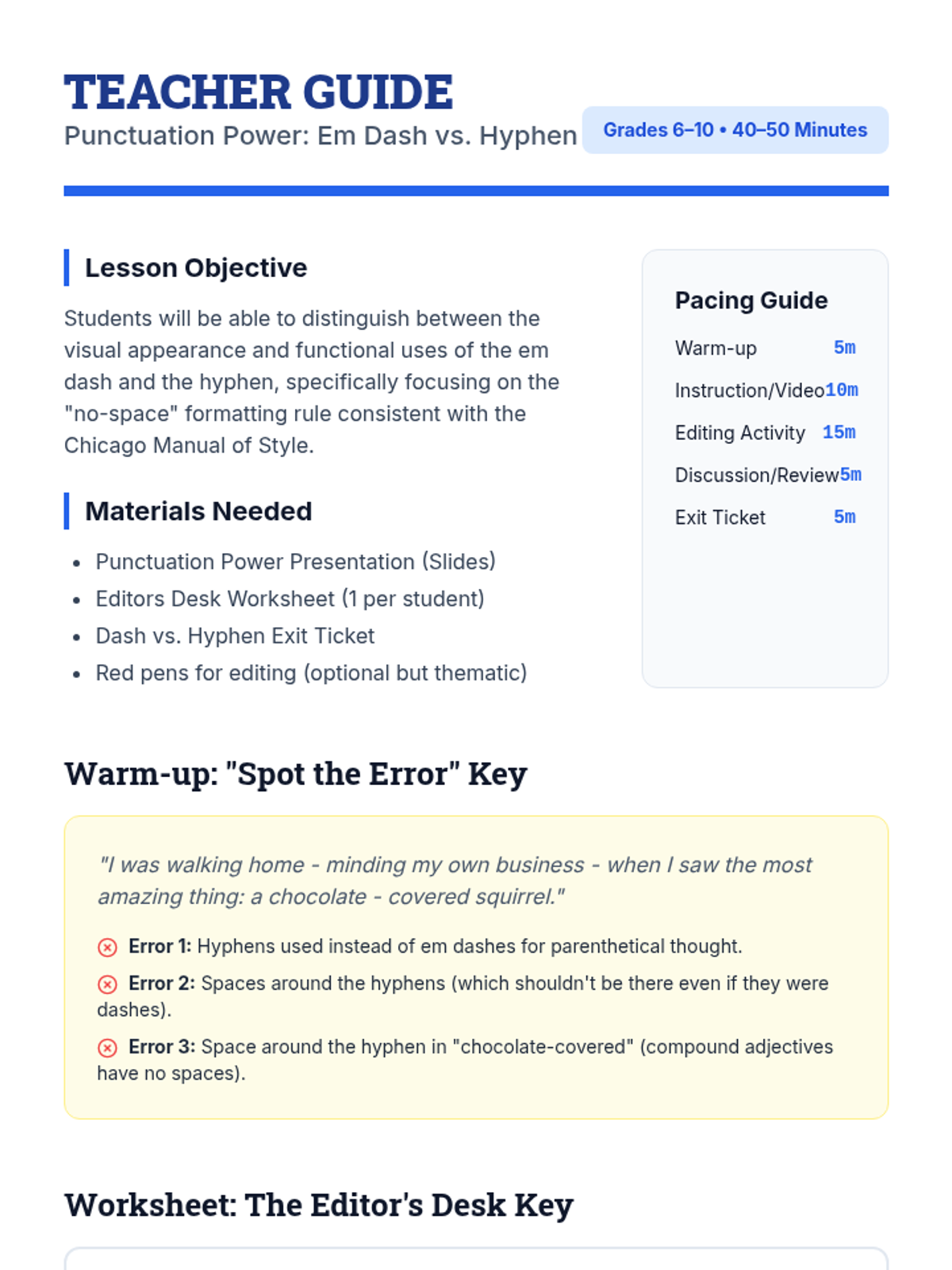
A comprehensive teacher resource containing lesson objectives, a pacing guide, answer keys for the warm-up and activity, and notes on common student misconceptions.
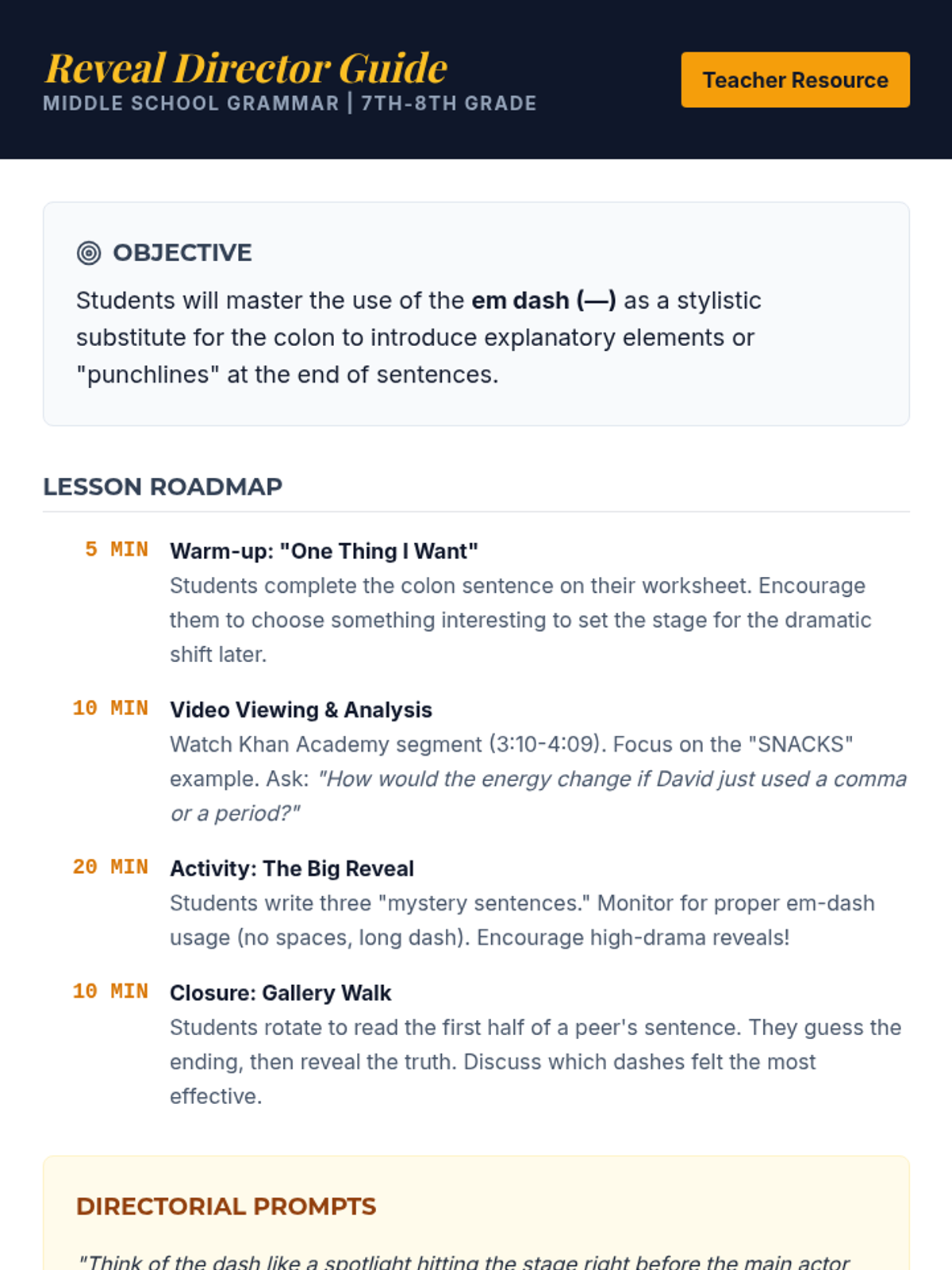
A comprehensive teacher's guide for the 'Dramatic Dashes' lesson, featuring pacing instructions, scripted prompts, troubleshooting tips for em-dash usage, and an answer key with high-drama examples.
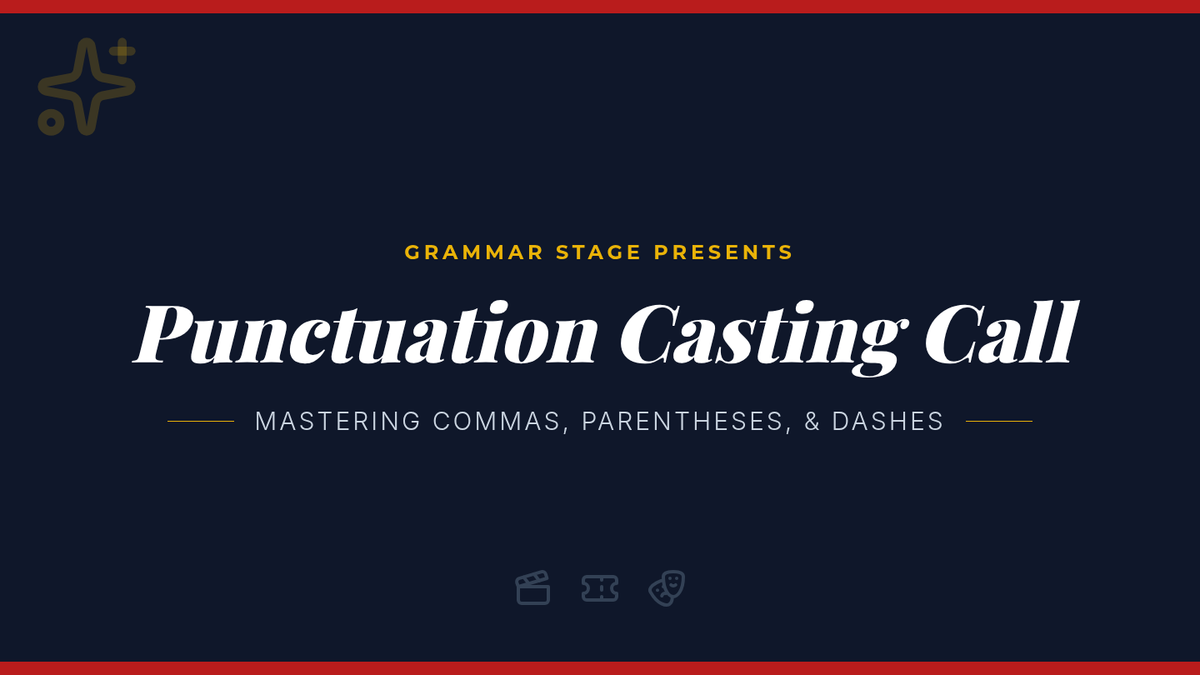
A visual presentation for a middle school grammar lesson themed around a theatrical casting call. It introduces commas, parentheses, and dashes as characters with distinct personalities, includes an embedded instructional video, and features interactive 'casting' exercises to explore tone and meaning.
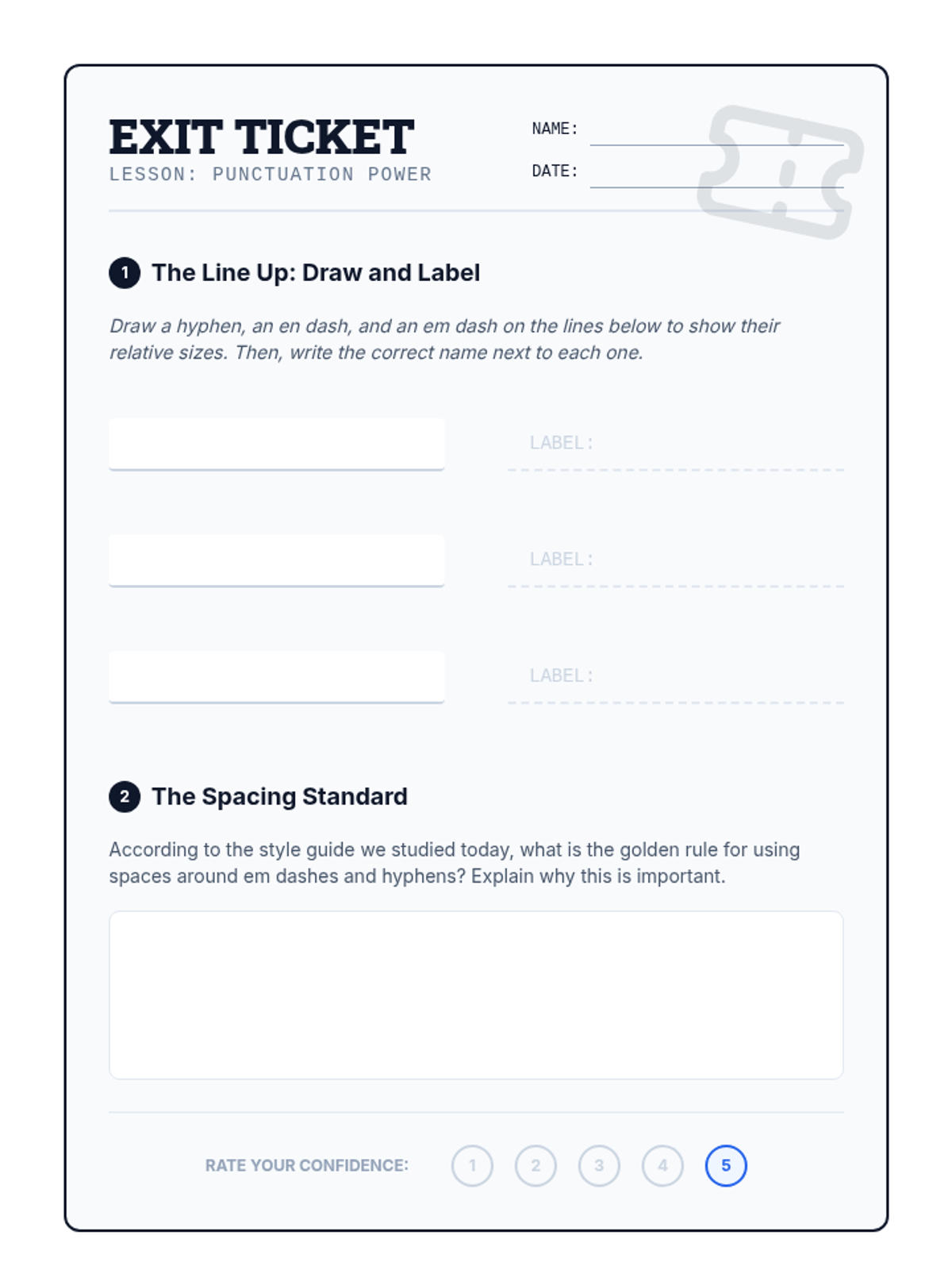
A quick assessment tool for the end of the lesson where students demonstrate visual distinction between hyphens and dashes and explain spacing rules.
A vibrant, theatrical presentation deck for teaching dashes as colon substitutes. Includes embedded Khan Academy video, high-energy warm-up slides, and clear activity instructions for the 'Big Reveal' activity.
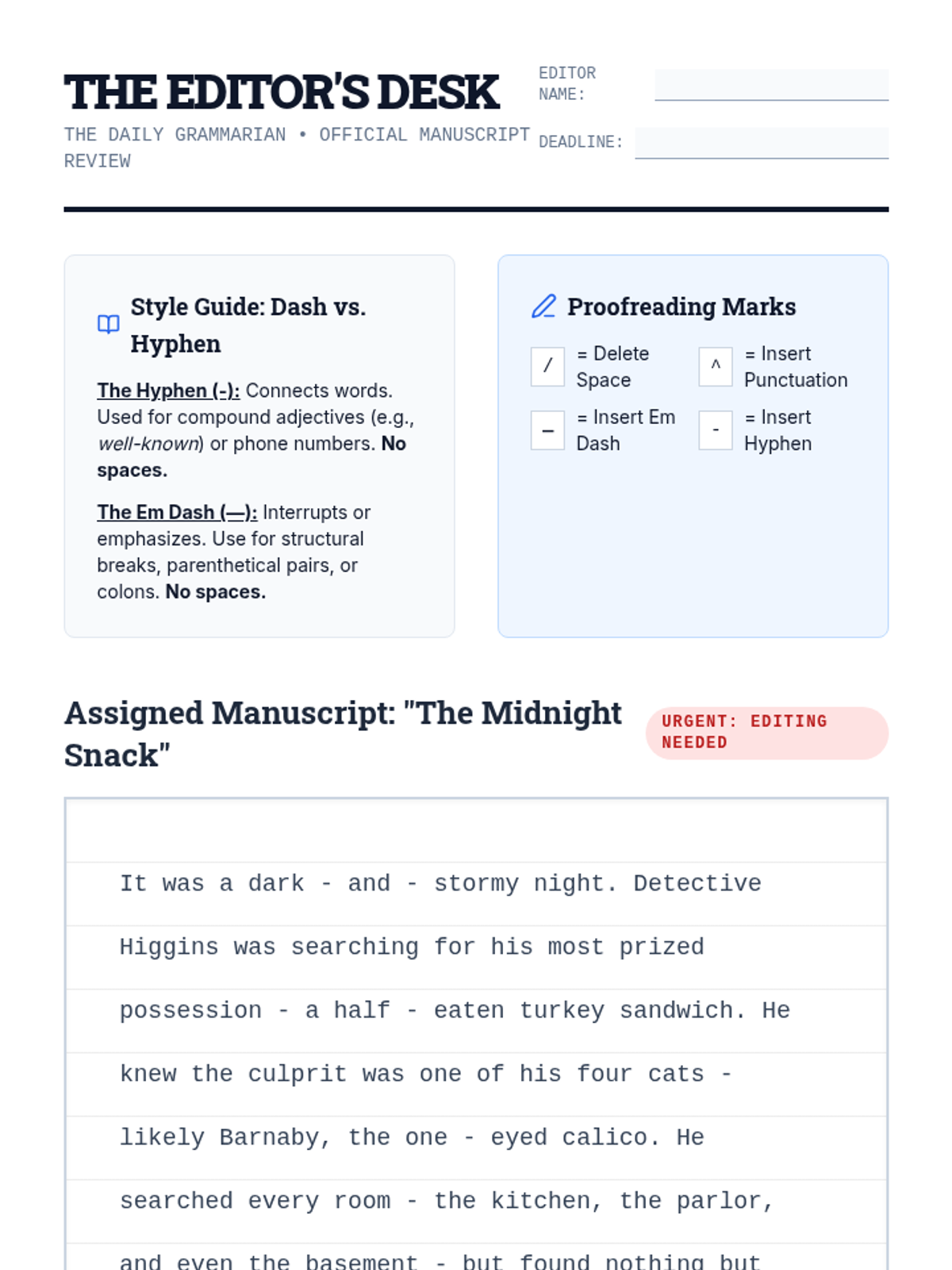
A newsroom-themed student worksheet where students edit a "messy" manuscript, correcting hyphen/dash errors and spacing issues using proofreading marks.
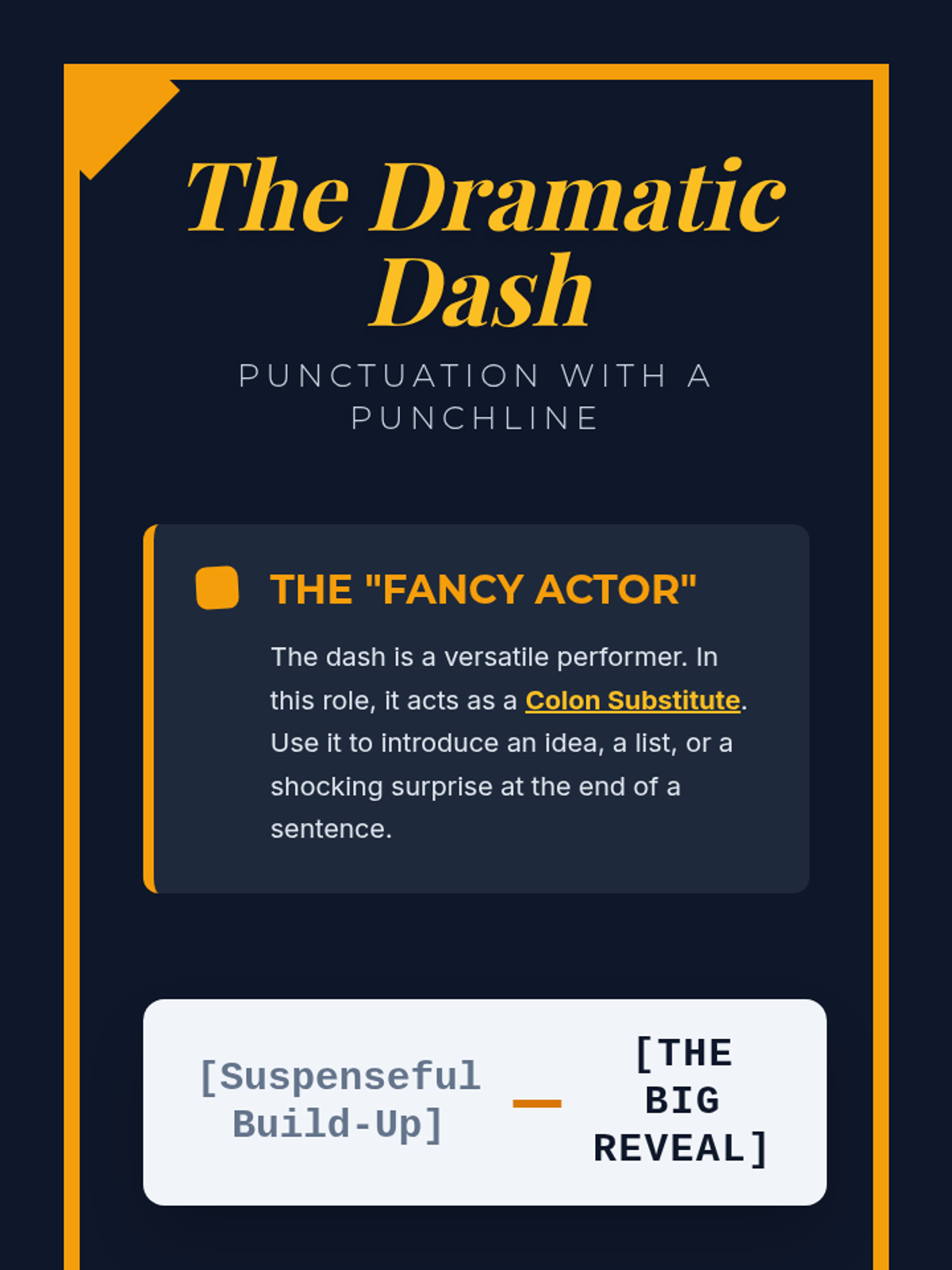
A high-contrast, dramatic anchor chart for middle school students explaining how to use the dash as a colon substitute for reveals and punchlines. Features the 'Fancy Actor' metaphor and clear visual formulas.
A visual presentation for teaching the differences between em dashes and hyphens, including formatting rules, four functional uses of the em dash, and an interactive warm-up.
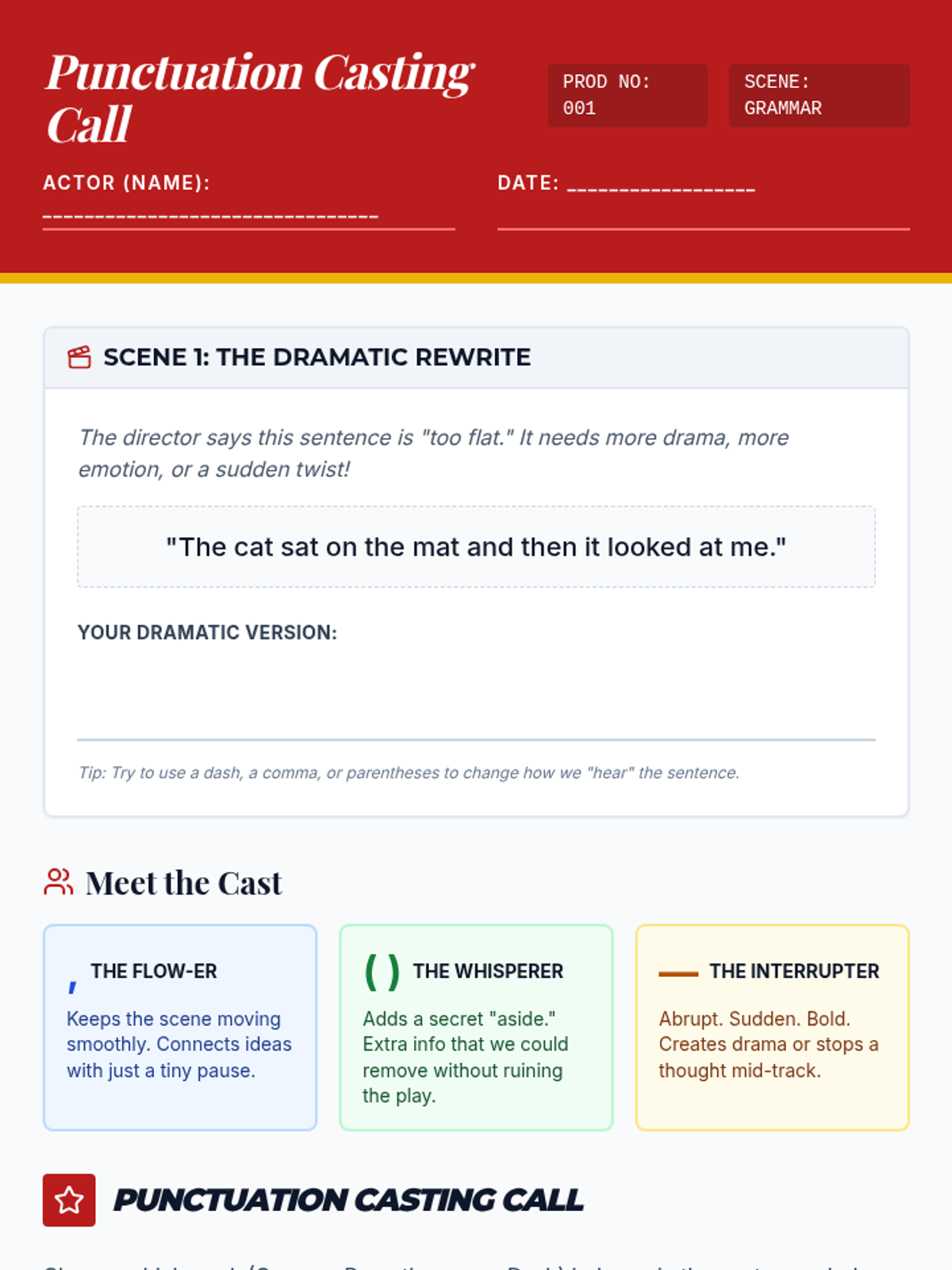
A student worksheet designed with a theatrical 'casting call' theme. It includes a dramatic rewrite warm-up, a cast list defining the roles of commas, parentheses, and dashes, and a series of sentence exercises where students 'cast' the appropriate punctuation mark and provide directorial notes.
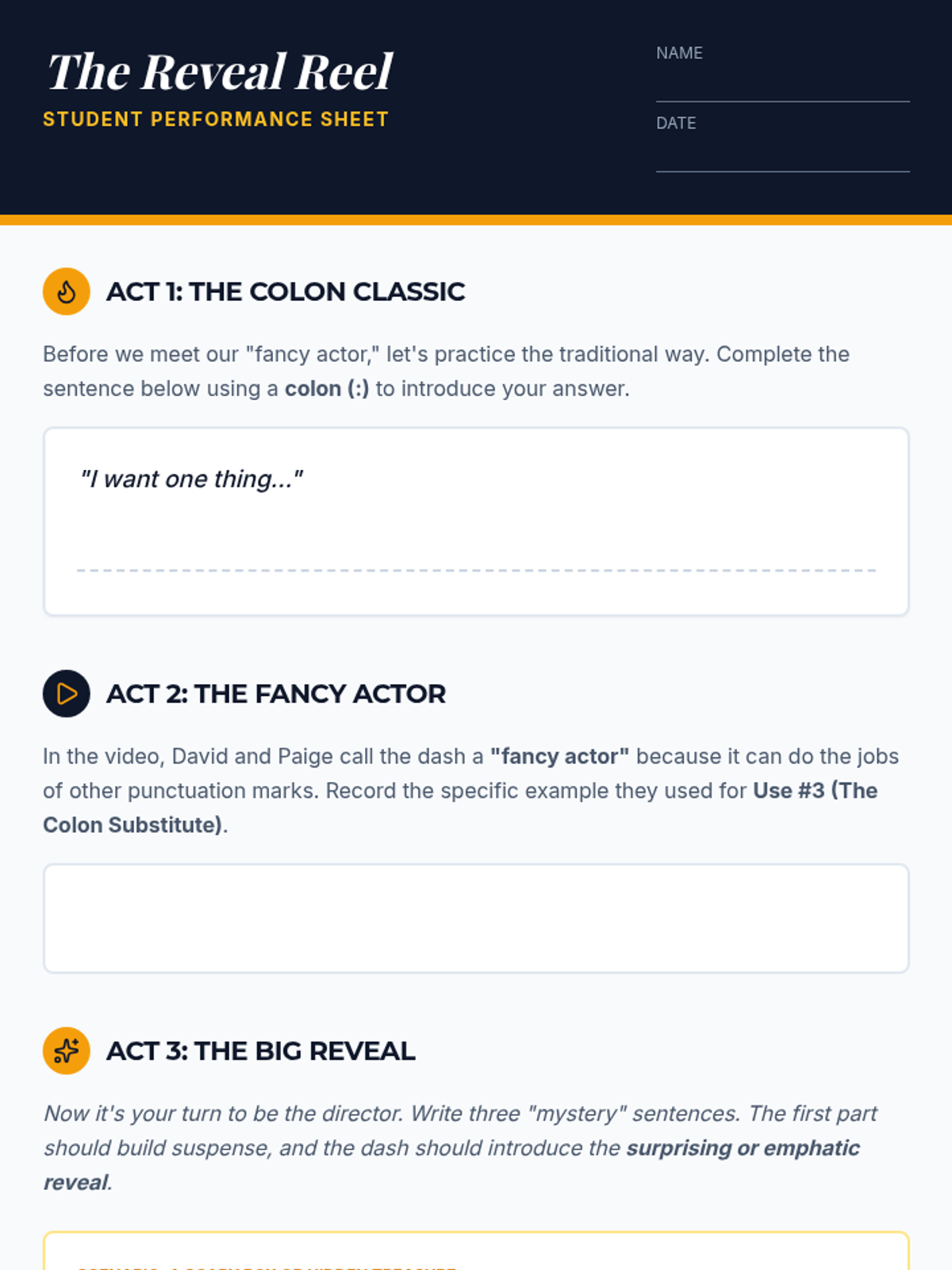
A structured worksheet for 7th-8th grade students to practice using dashes as a colon substitute. Includes sections for a warm-up, video notes on the 'snacks' example, and a creative 'Big Reveal' activity.
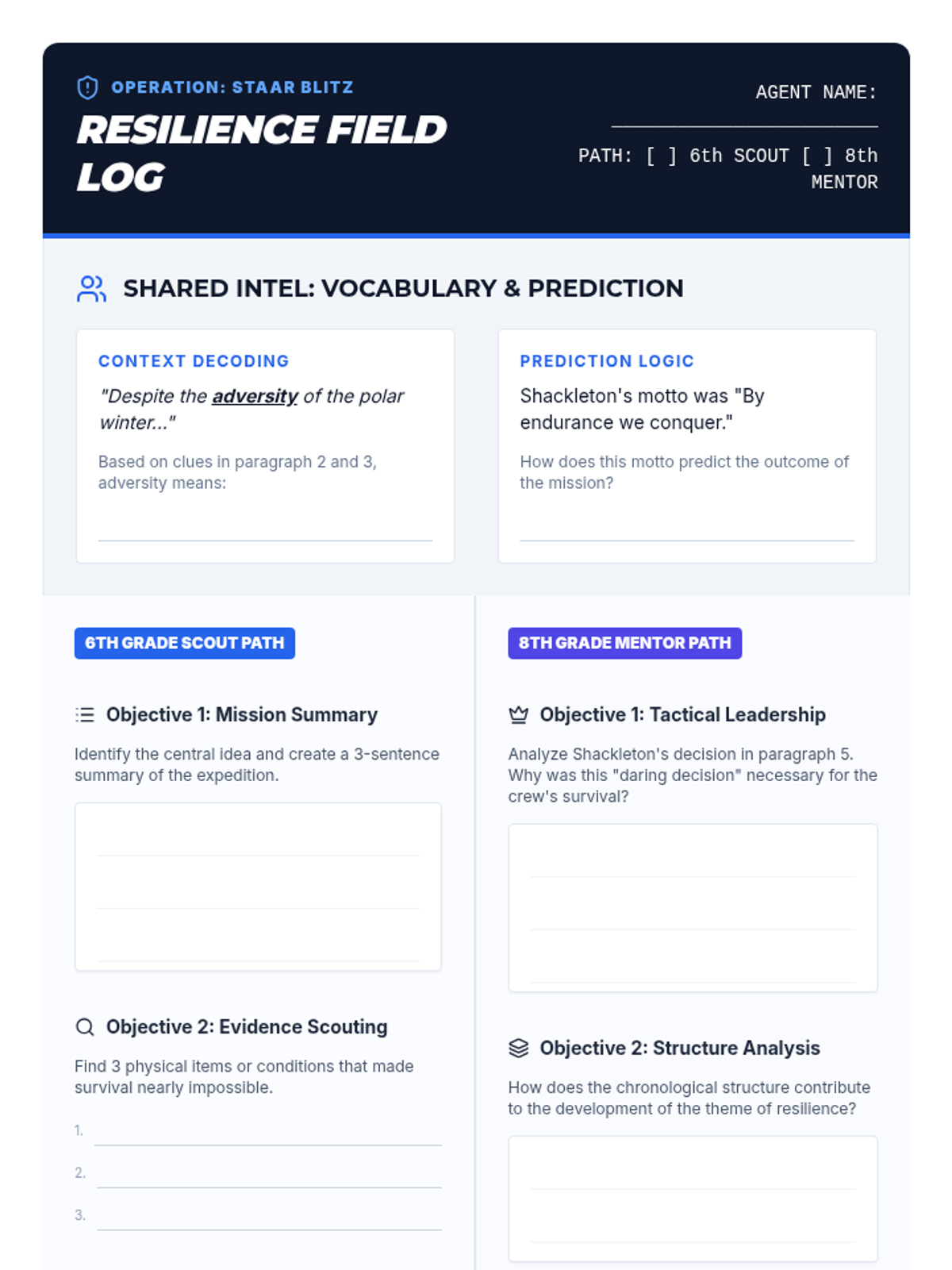
A tiered "Field Log" worksheet for the 6th and 8th-grade combined STAAR Blitz, featuring separate "Mission Paths" for each grade level while sharing the same story.
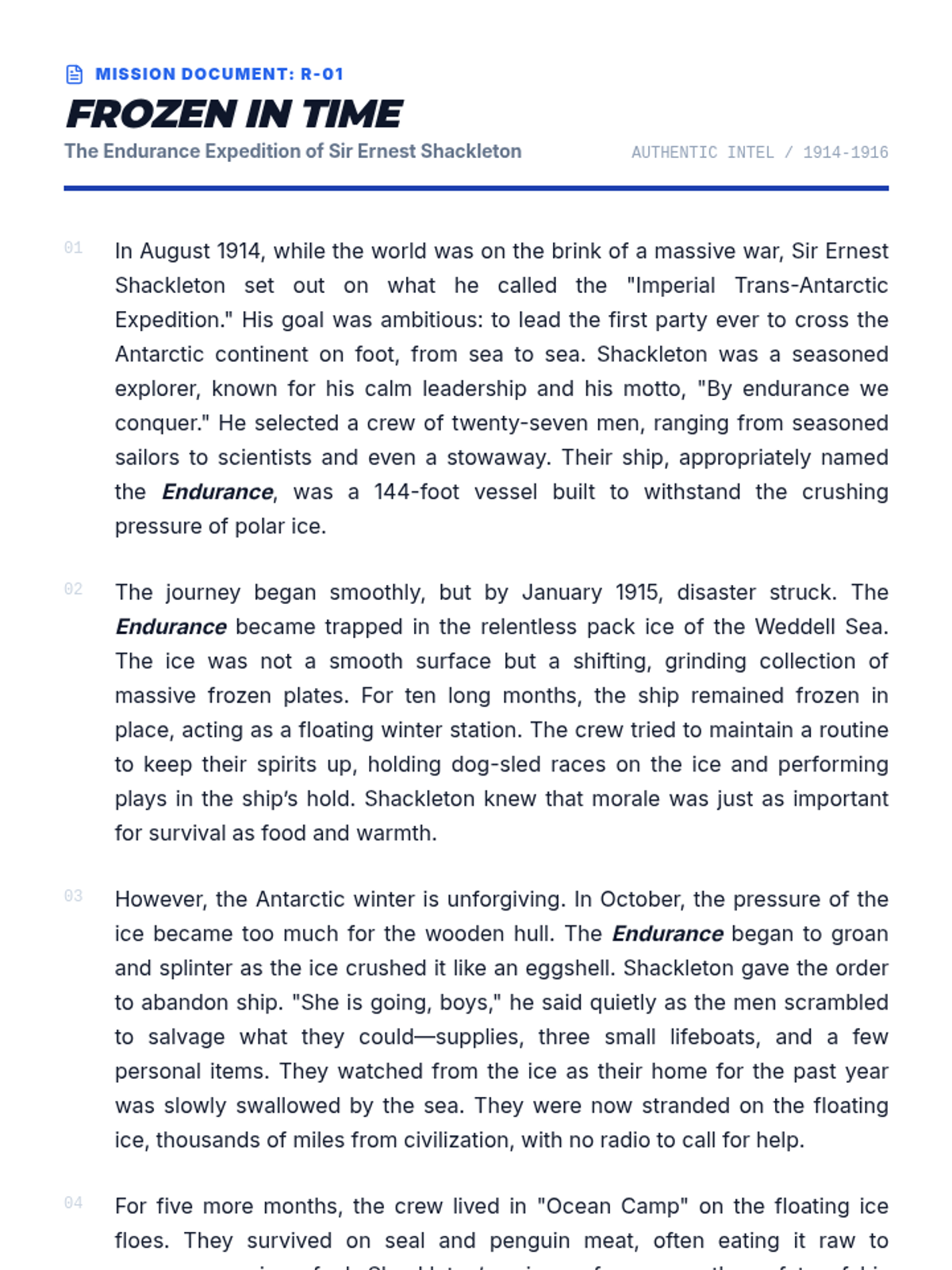
The full informational text about Sir Ernest Shackleton's Endurance expedition, designed as a reading passage for the 6th and 8th-grade combined STAAR Blitz.
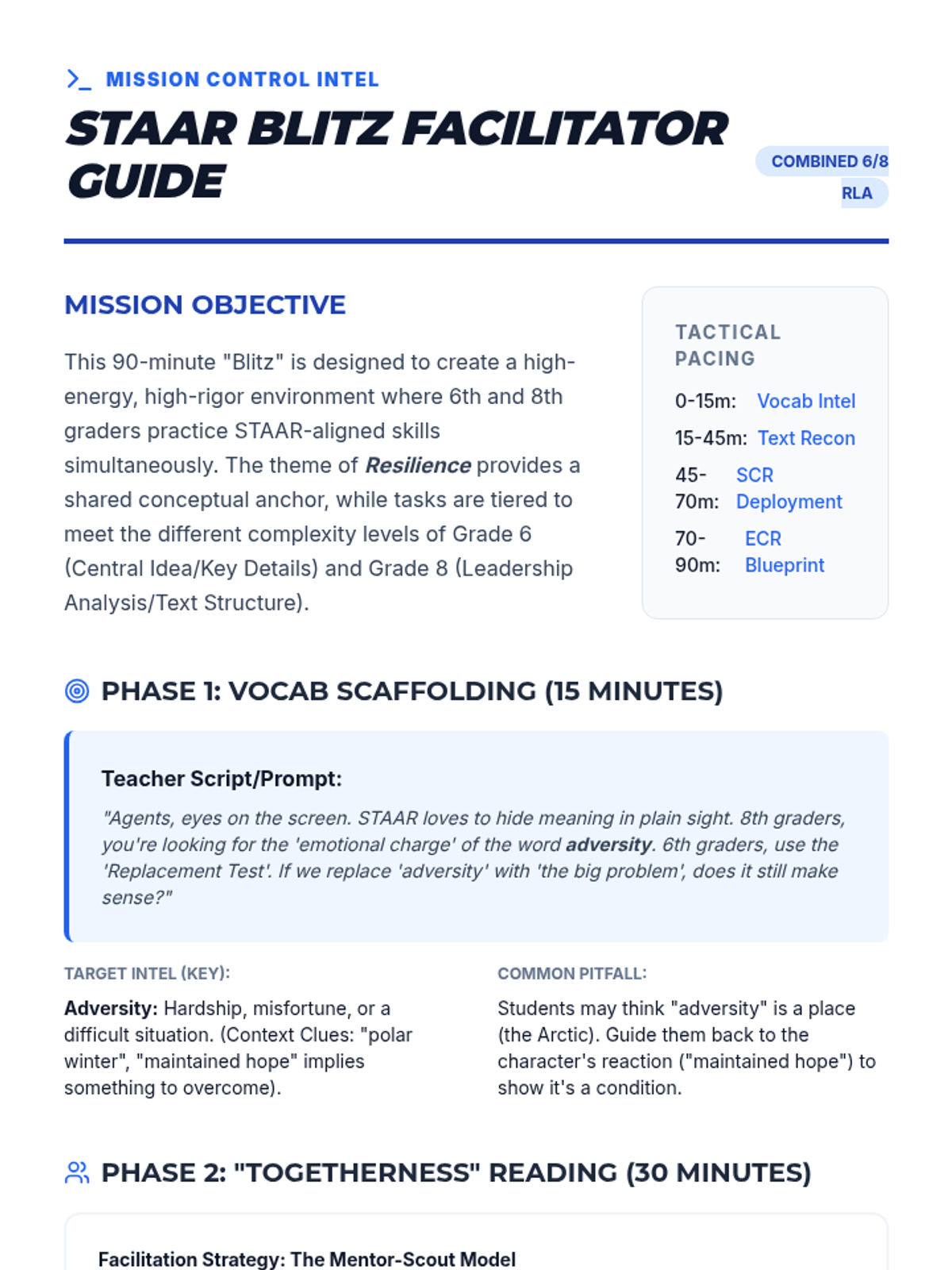
A comprehensive teacher guide for the 90-minute STAAR Blitz Resilience Mission, featuring scripts, pacing, tiered 6th/8th-grade scaffolding prompts, and answer keys.
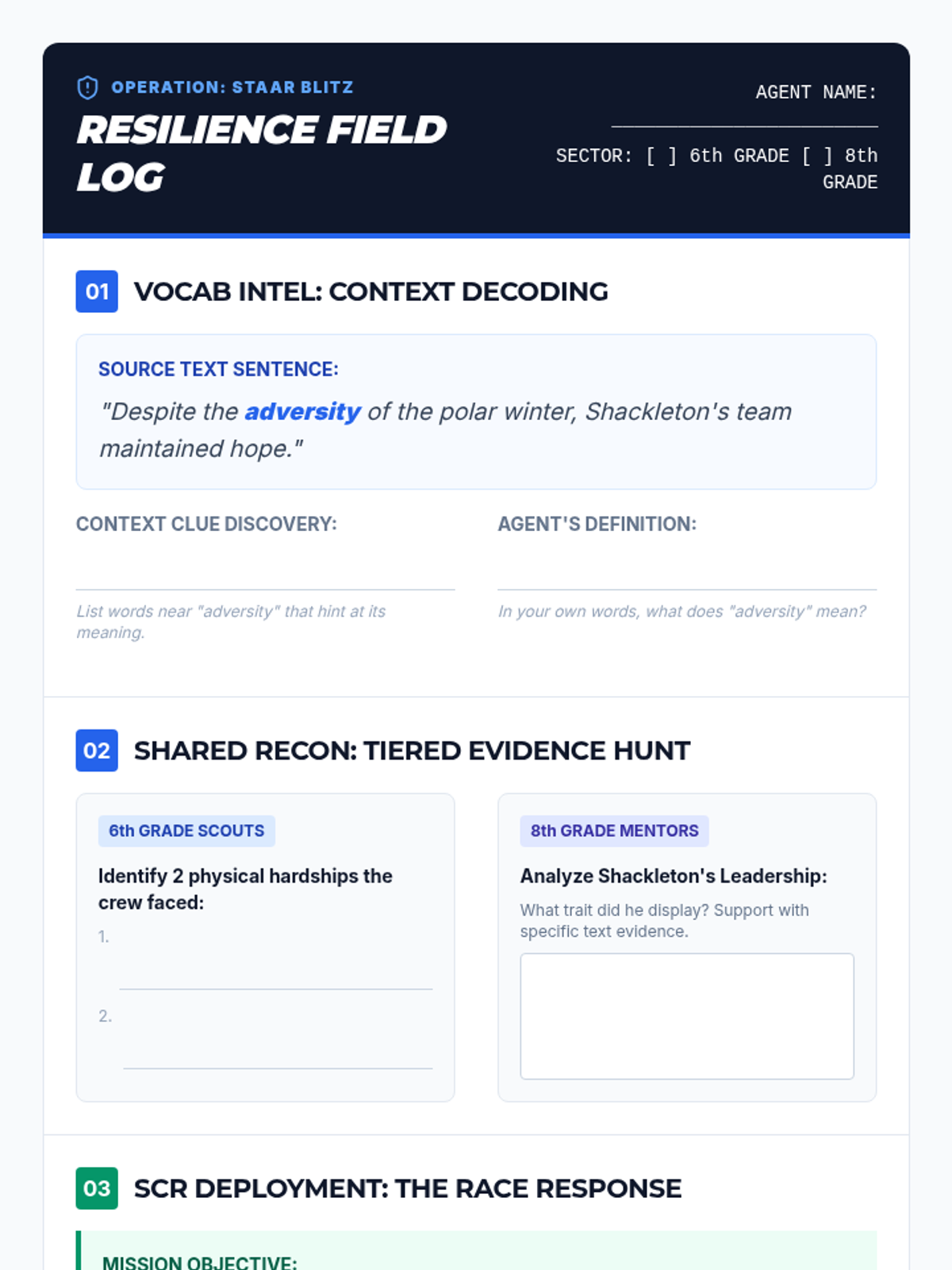
A tiered "Field Log" worksheet for the 6th and 8th-grade combined STAAR Blitz, featuring context clue work, evidence hunting, SCR (RACE method), and ECR blueprinting.
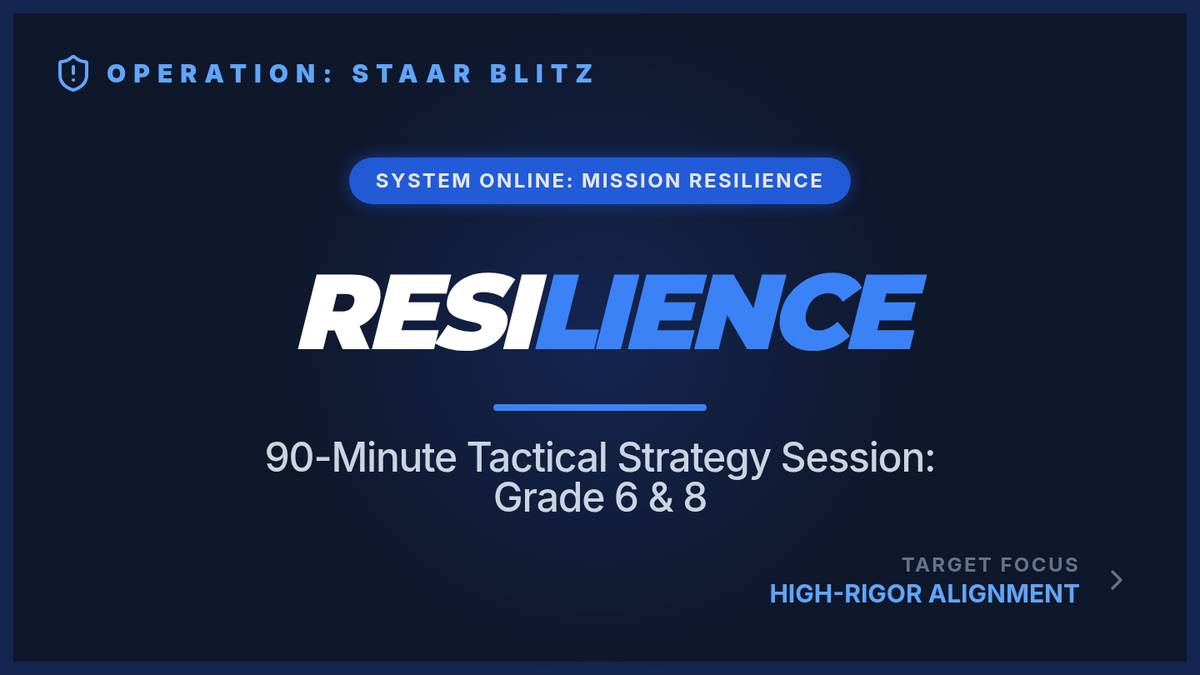
A dynamic 90-minute visual guide for the STAAR Blitz Resilience Mission, designed for combined 6th and 8th-grade reading instruction, now with enhanced instructional clarity and higher-order thinking Check for Understanding (CFU) questions.
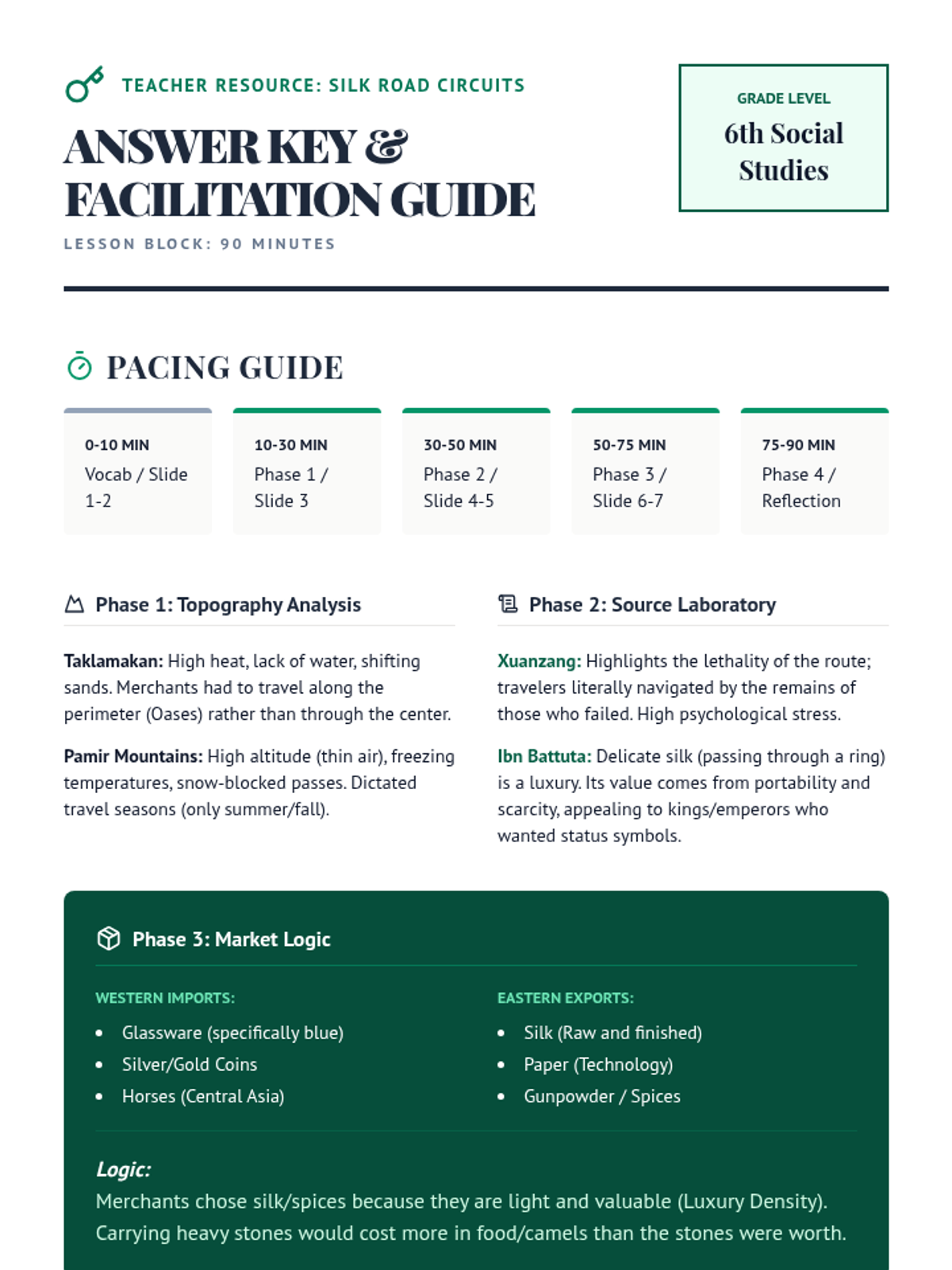
A teacher's answer key and facilitation guide for the 90-minute Silk Road lesson, including pacing, evidence analysis, and market logic explanations.
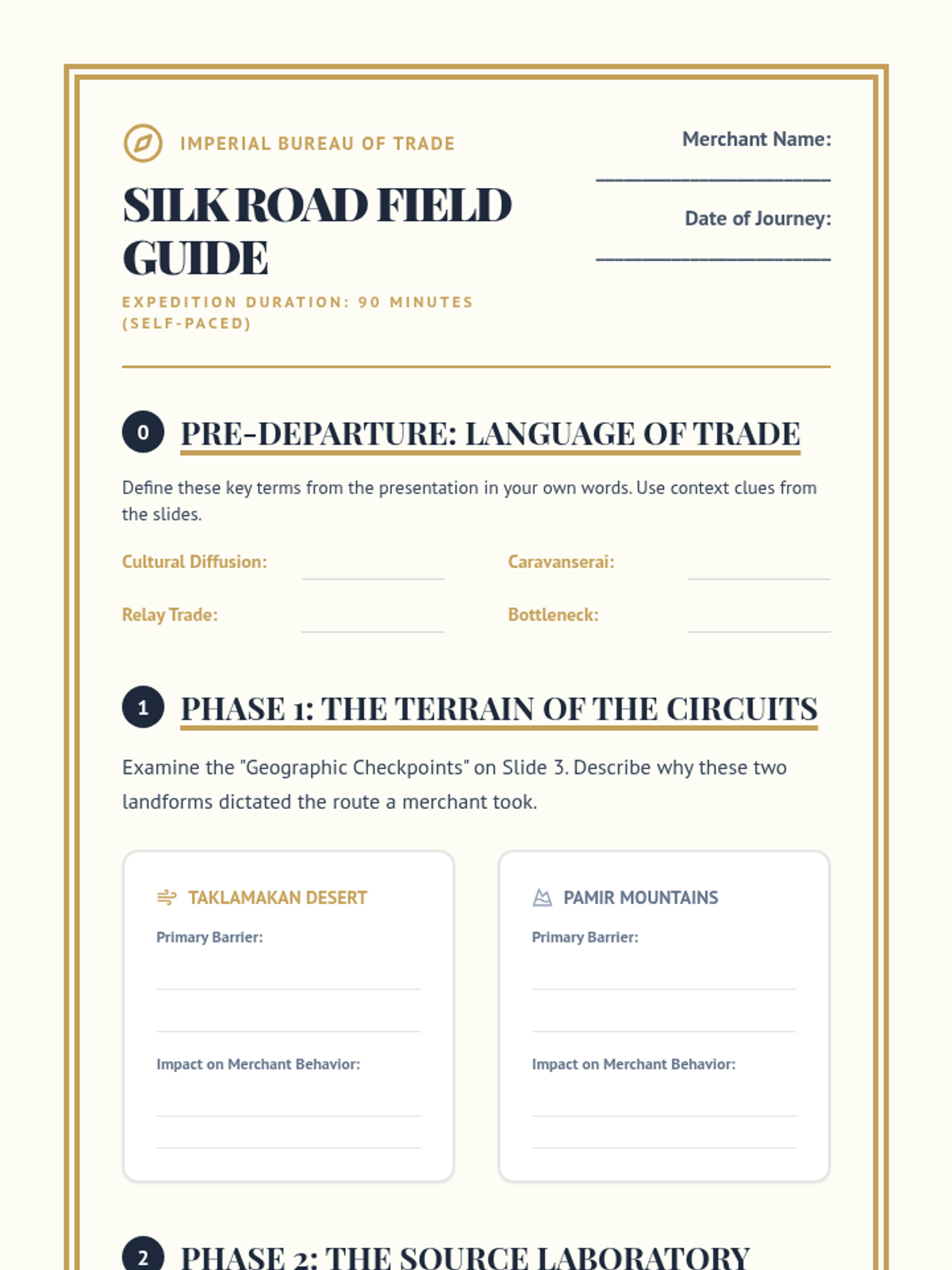
A comprehensive 90-minute student field guide for the Silk Road lesson, divided into four phases: terrain analysis, primary source investigation, market simulation, and global connectivity impact.
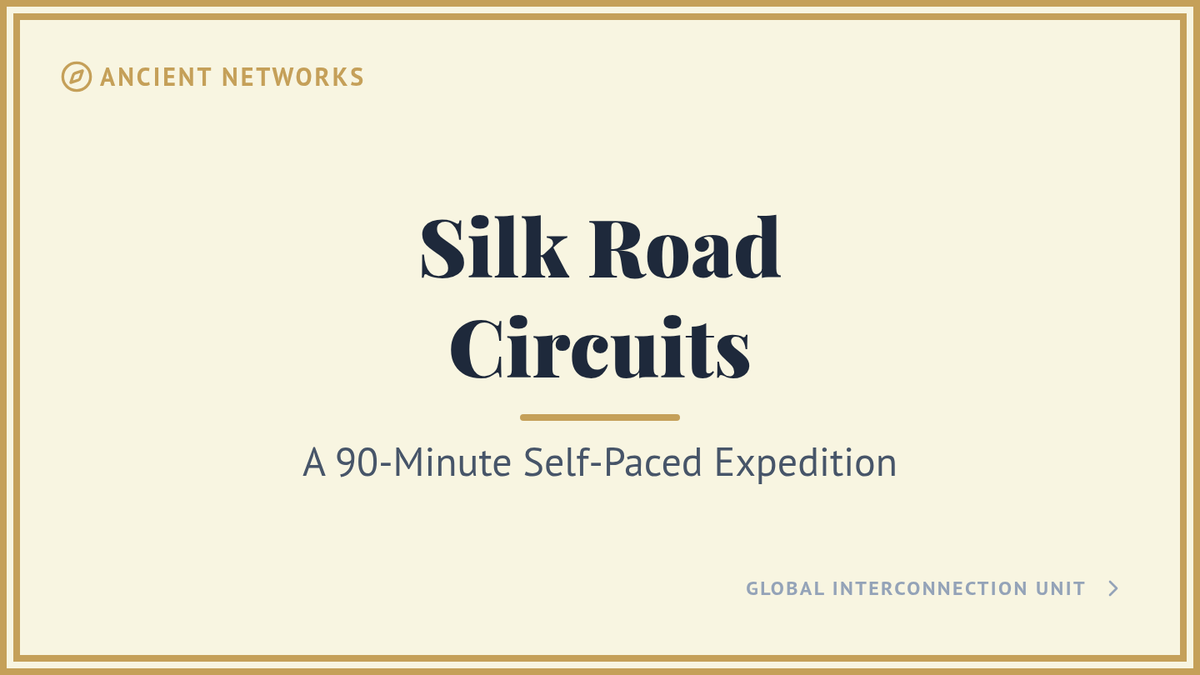
An expanded self-paced visual guide to the Silk Road, now featuring primary sources, case studies on disease, and technology paths to fill a 90-minute 6th-grade Social Studies block.
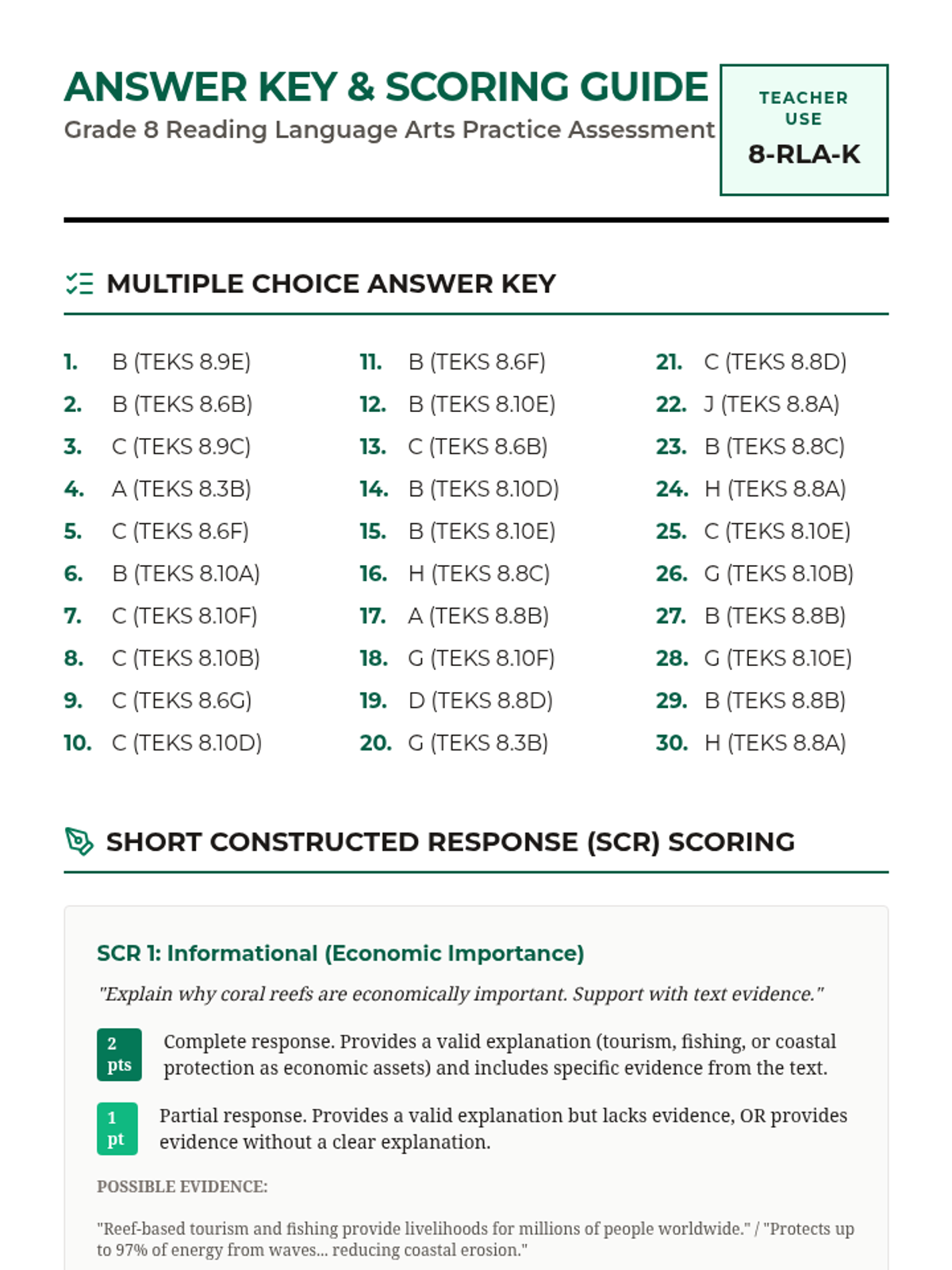
A comprehensive answer key and scoring guide for the 8th-grade STAAR Practice Reading Assessment, featuring TEKS-aligned answers and scoring rubrics.
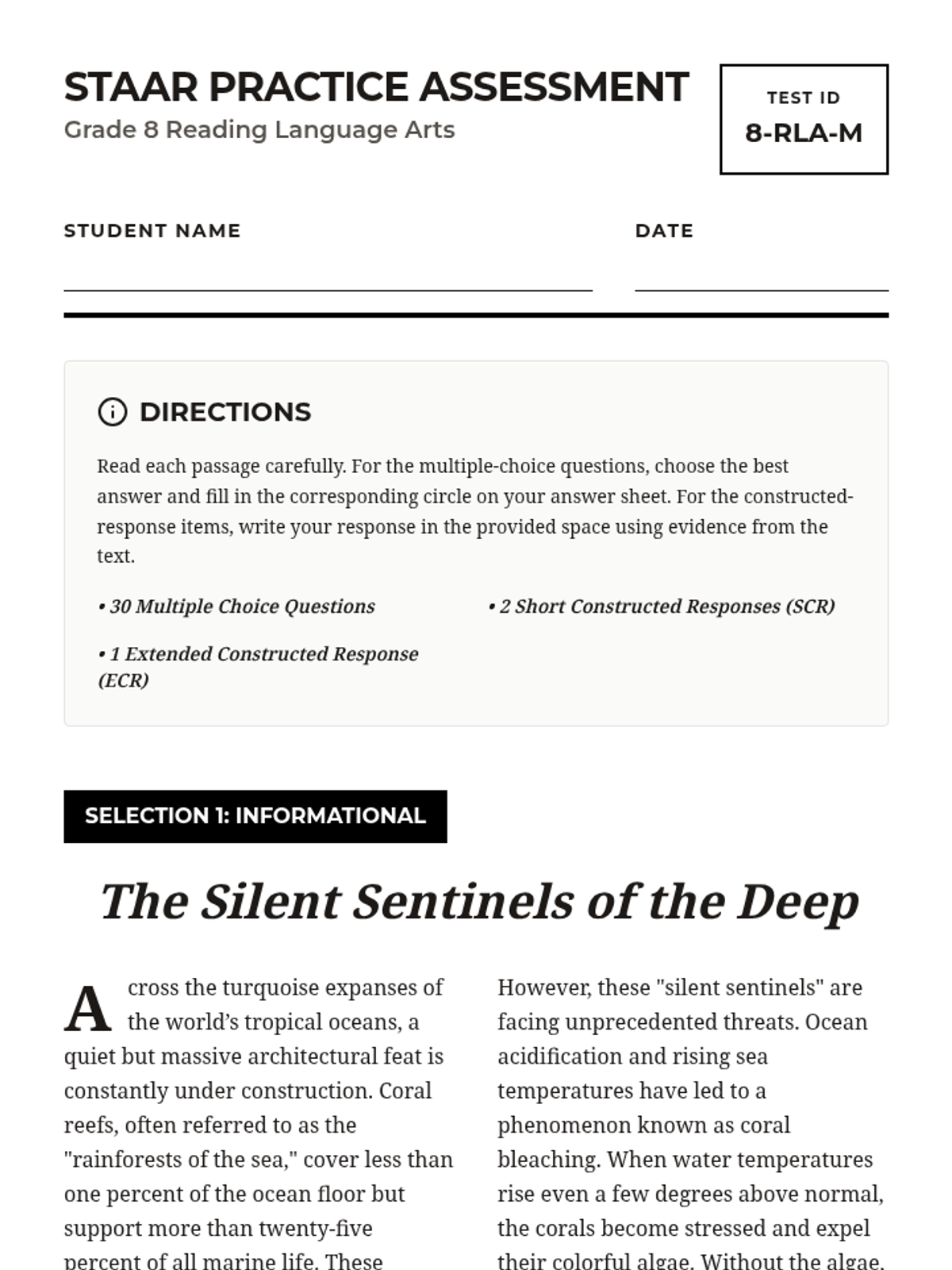
A full-length 8th-grade STAAR reading practice assessment featuring informational and fiction passages with 30 multiple-choice questions, two SCRs, and one ECR.
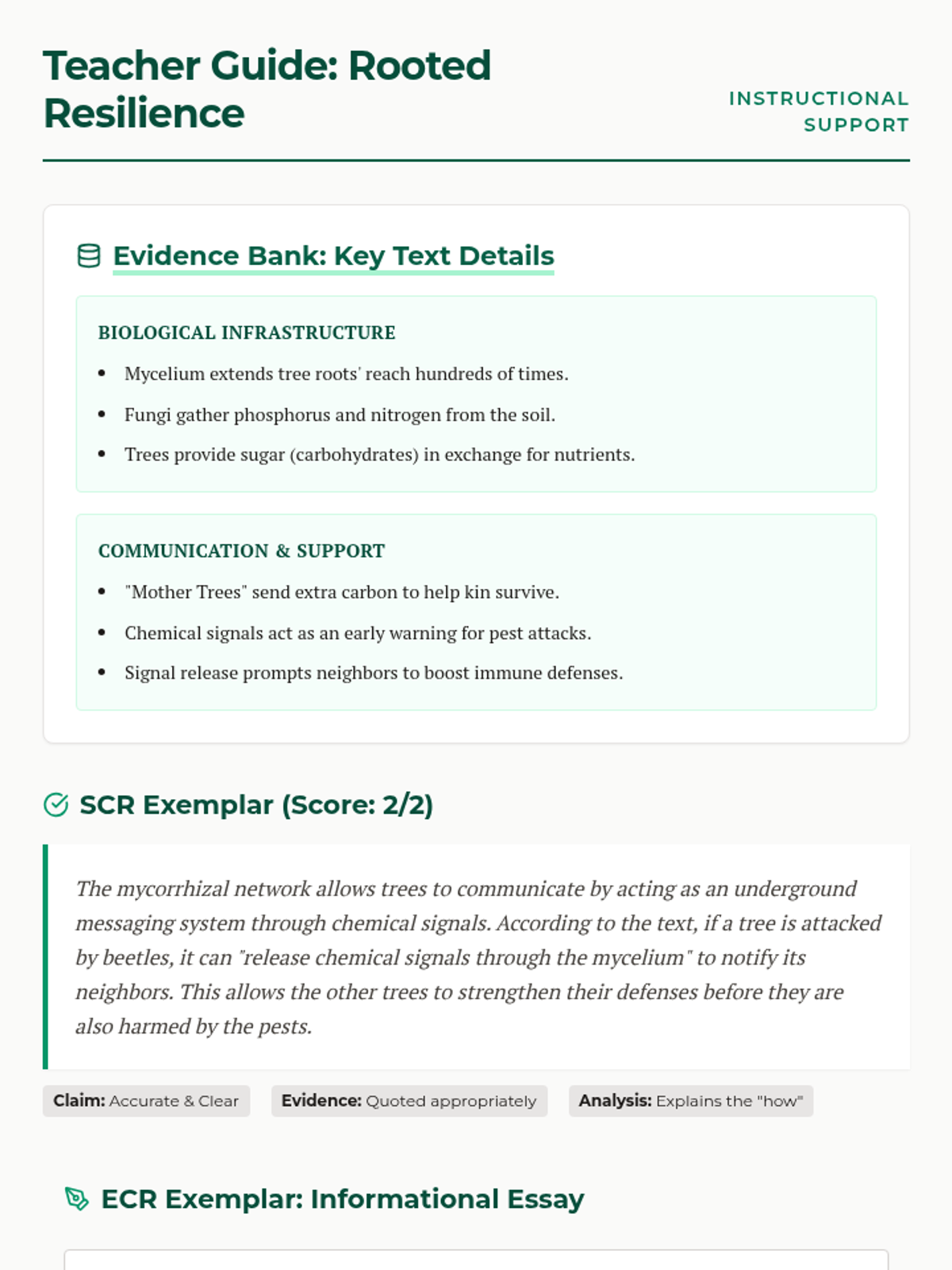
A comprehensive teacher guide for the Rooted Resilience writing assignment, including evidence banks, SCR/ECR exemplars, and scoring guidance.
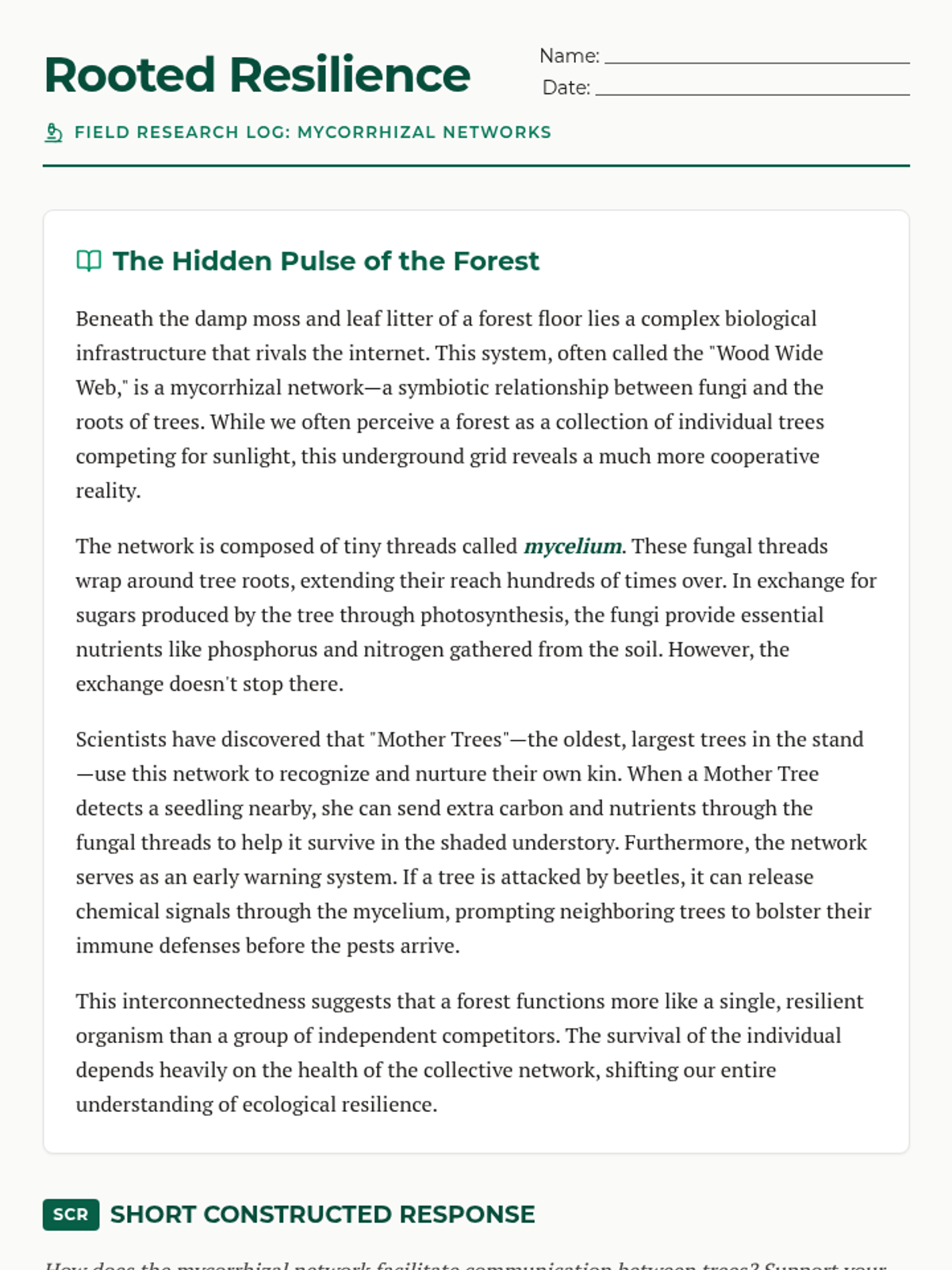
A rigorous reading and writing assignment about the Wood Wide Web, featuring an informational text followed by STAAR-aligned SCR and ECR prompts.
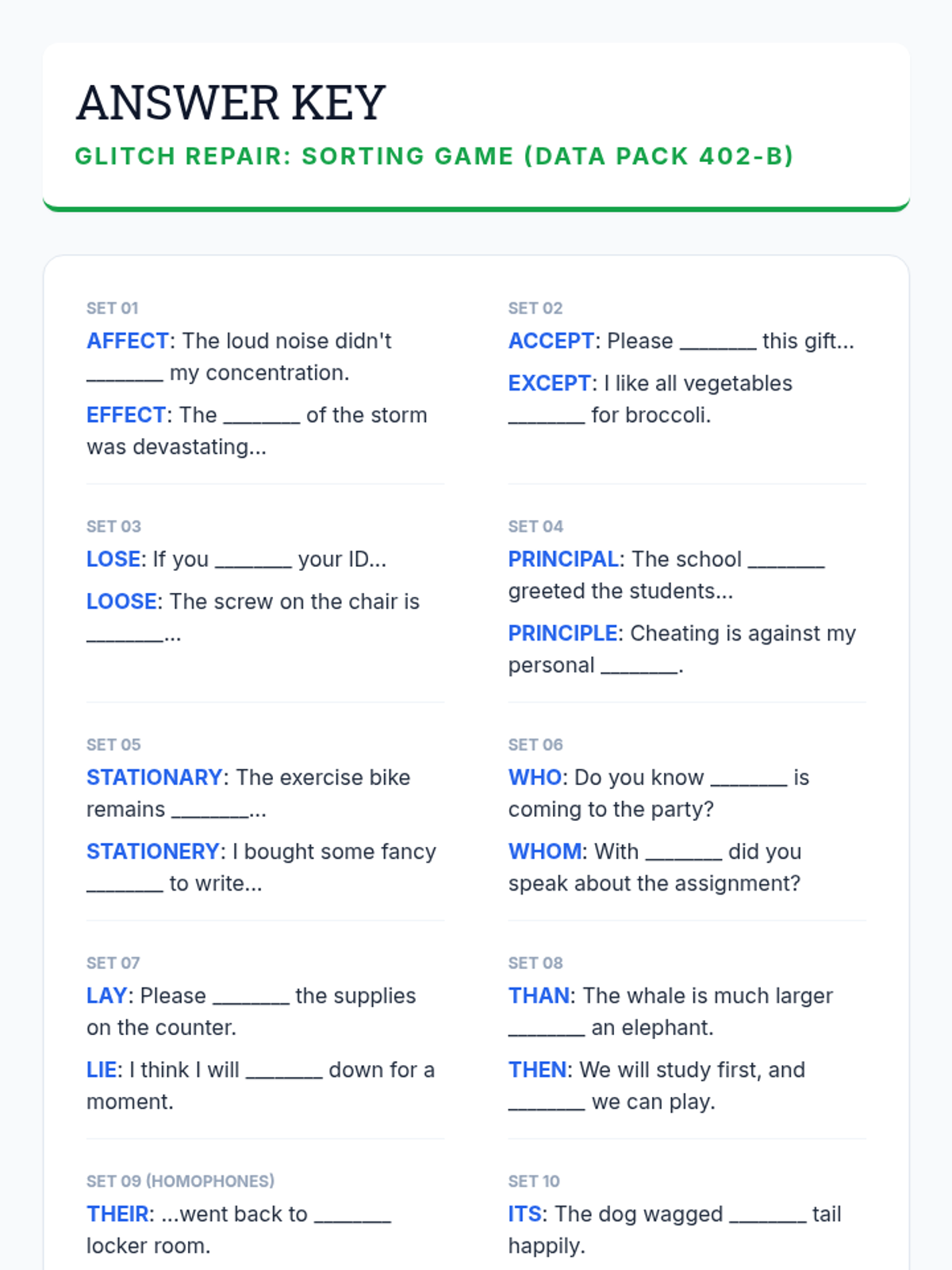
A teacher's answer key for the Glitch Repair sorting game, providing the correct matches for all word and sentence cards to facilitate quick grading and feedback.
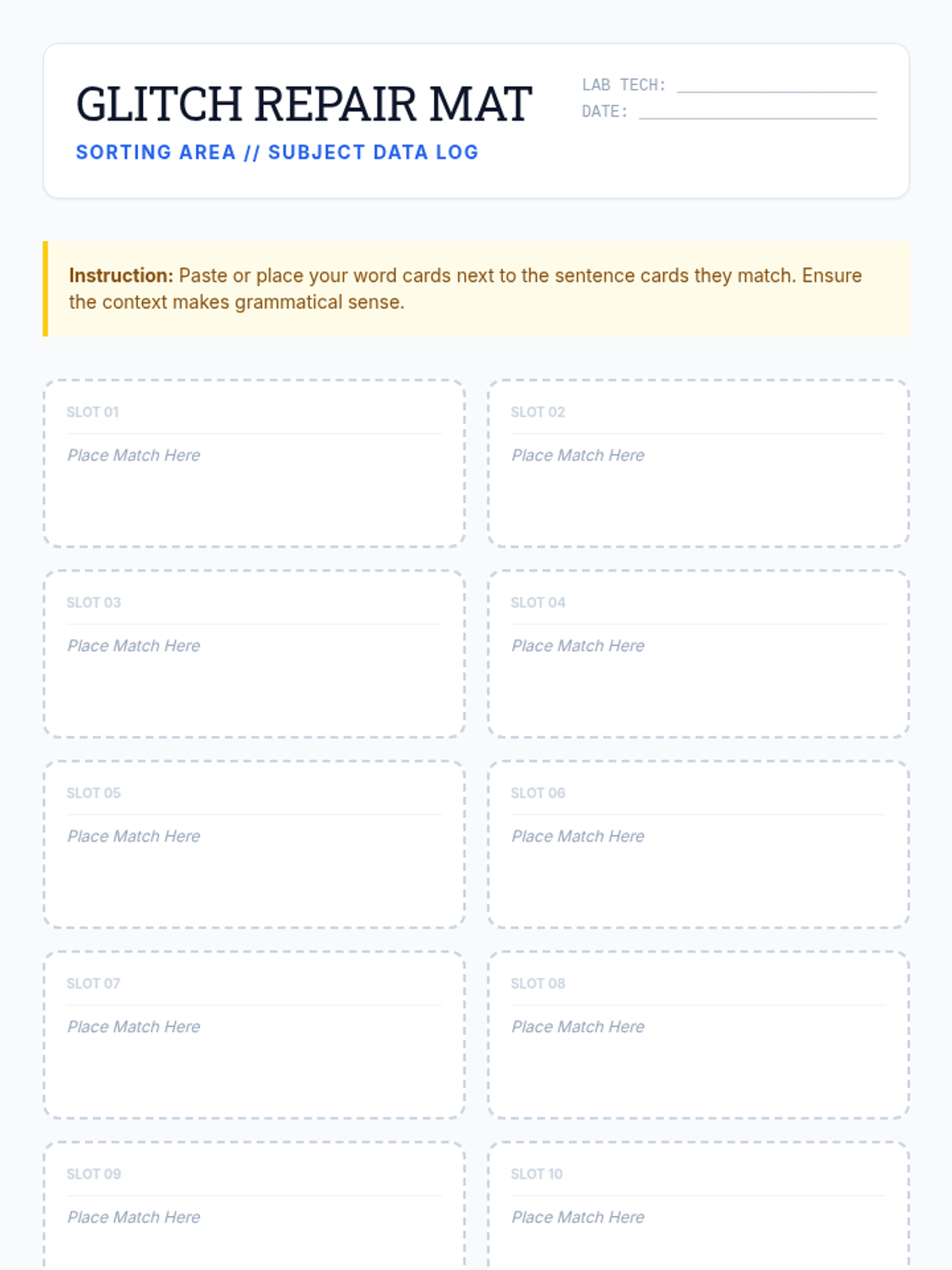
A printable sorting mat for the Glitch Repair game, providing students with a structured workspace to organize and match word and sentence cards.
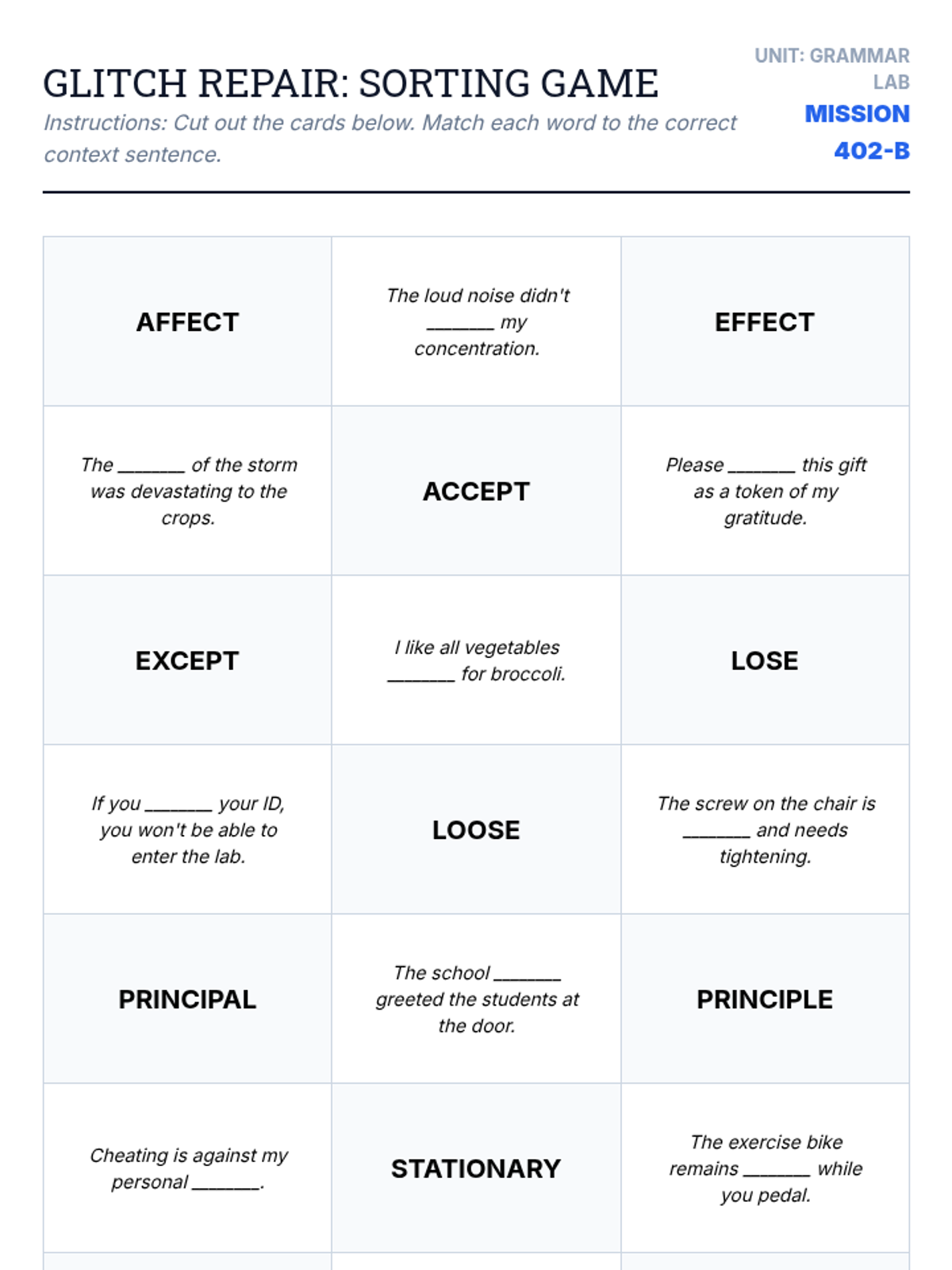
A set of 24 printable cards featuring words and context sentences for a sorting game. Students must match the correct commonly confused word with the sentence that fits its definition.
A visually striking slideshow designed for direct instruction on 12 pairs of commonly confused words. Includes memory triggers, definitions, visual hints, and interactive practice sentences for each word group.
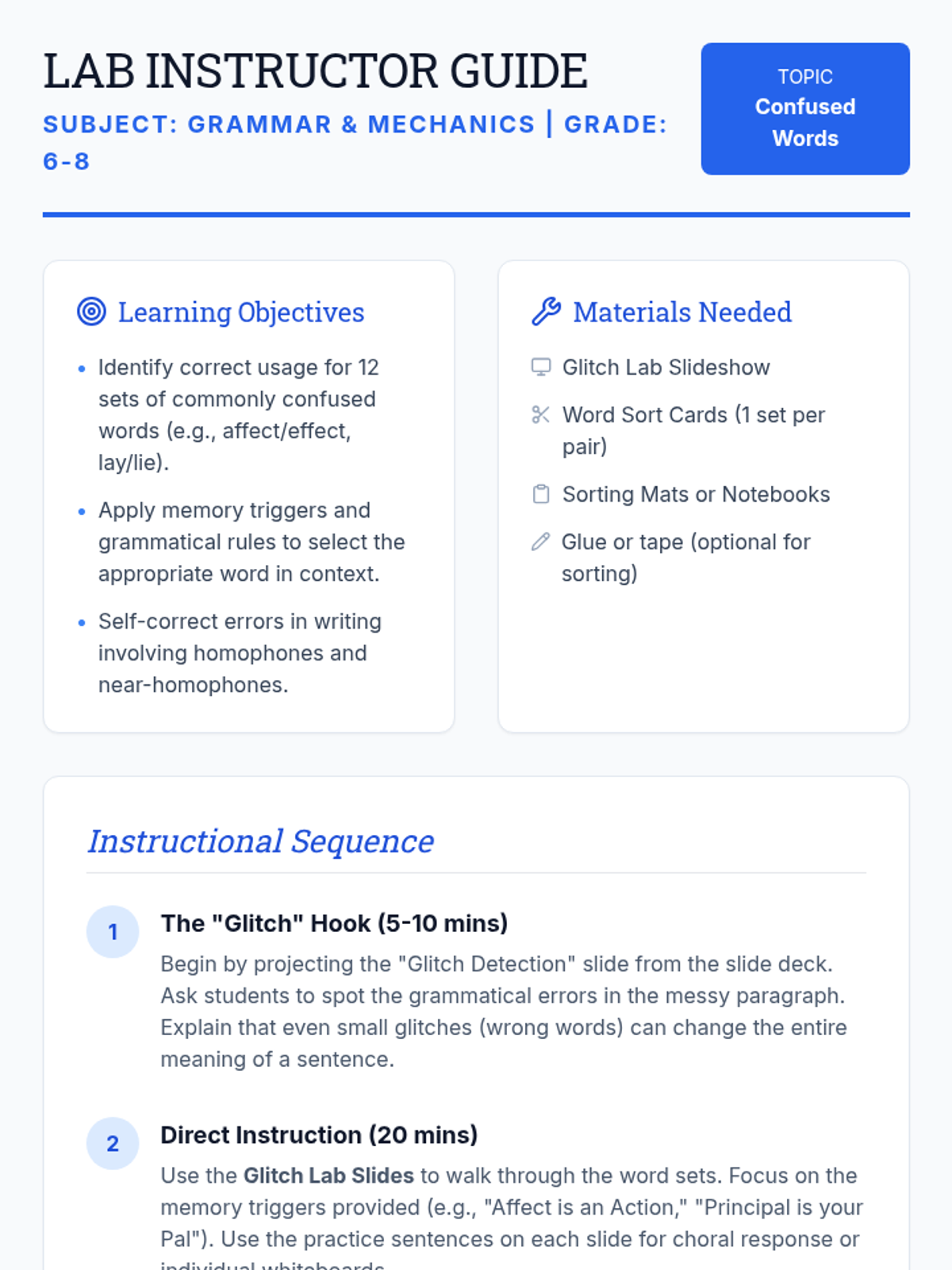
A detailed teacher's guide for the Grammar Lab lesson, including learning objectives, a list of required materials, a step-by-step instructional sequence, and practical teaching tips for middle school classrooms.
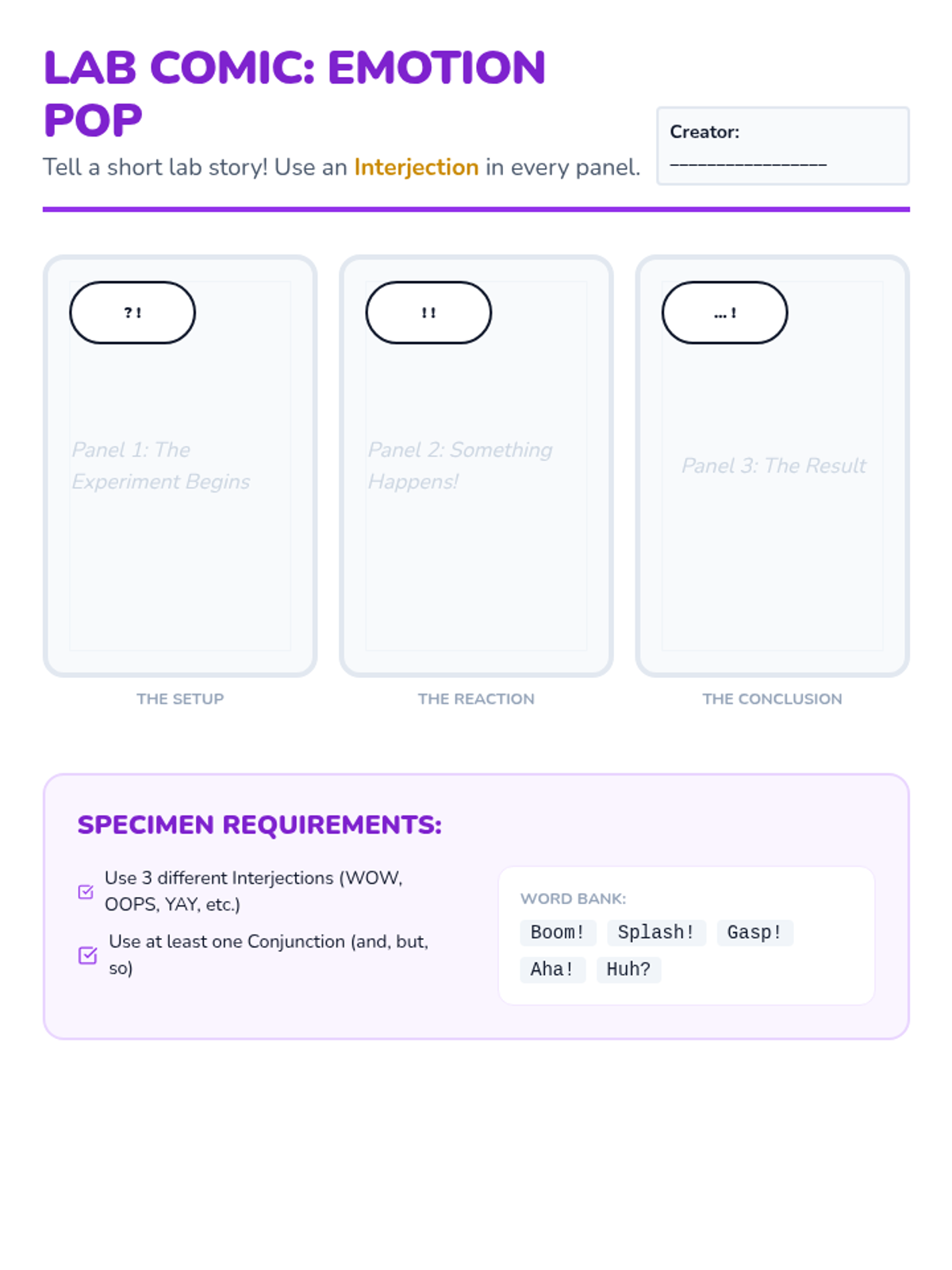
A creative comic strip template where students use interjections and conjunctions to tell a short story about a lab experiment.
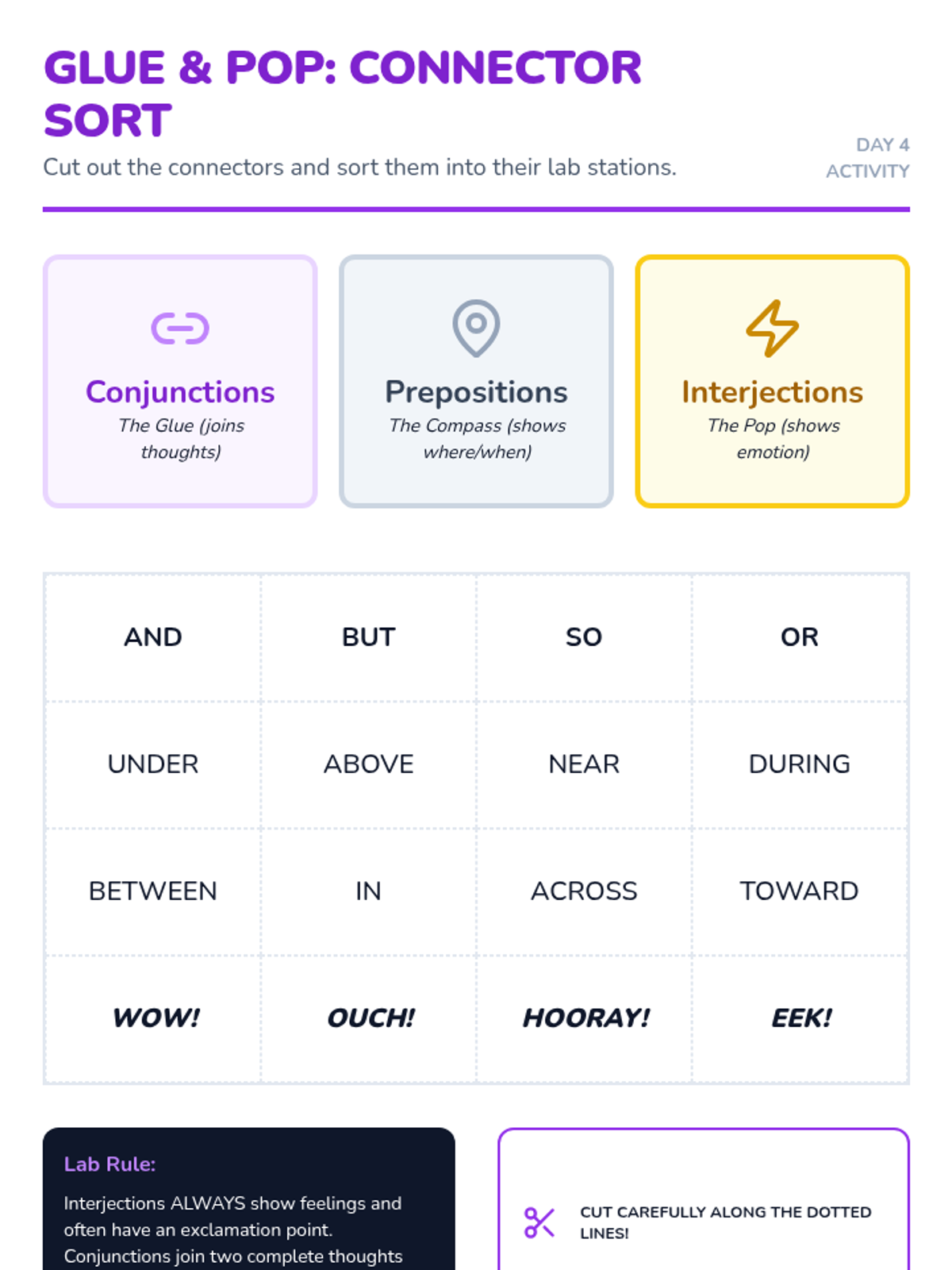
A set of 16 word cards for sorting prepositions, conjunctions, and interjections based on their grammatical function.
Engaging slides for introducing prepositions, conjunctions, and interjections using a 'Glue and Pop' theme.
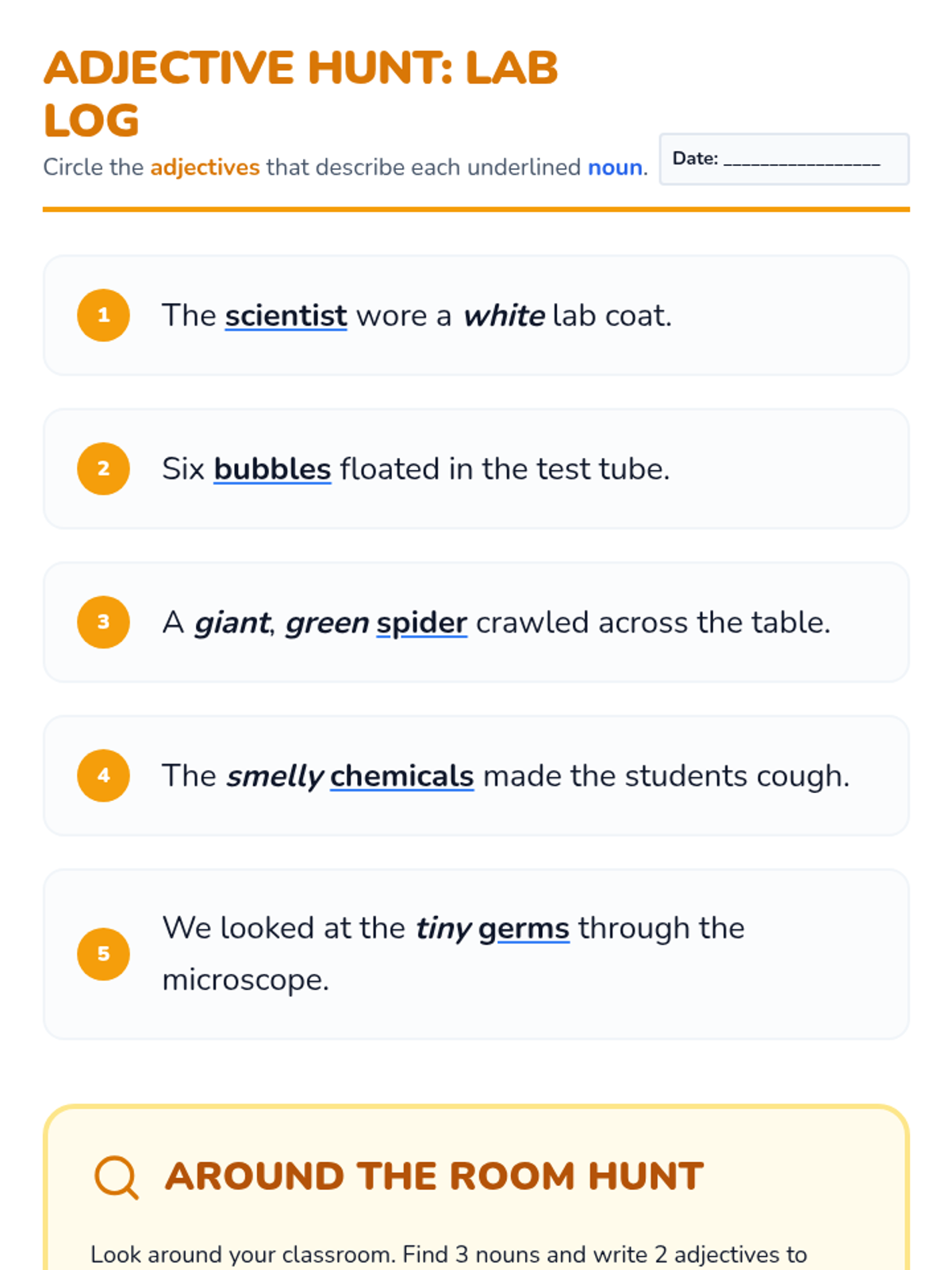
A practice worksheet for identifying adjectives in sentences and a scavenger hunt activity to describe classroom objects.
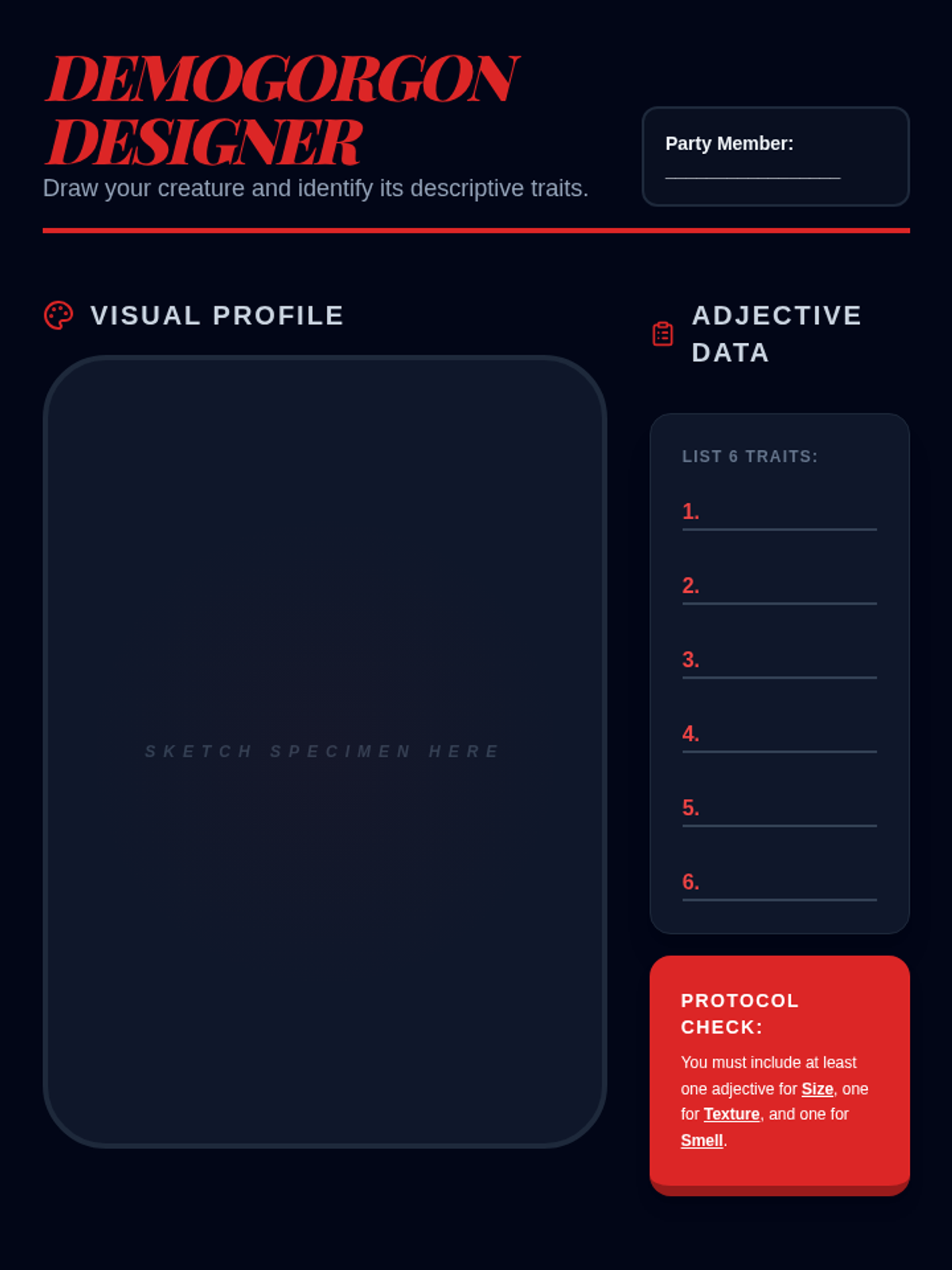
A creative craftivity where students draw a monster and label it with specific adjectives for size, color, and texture.
Bright and engaging slides for introducing adjectives, featuring a 'Detective' theme with visual comparisons and a craftivity preview.
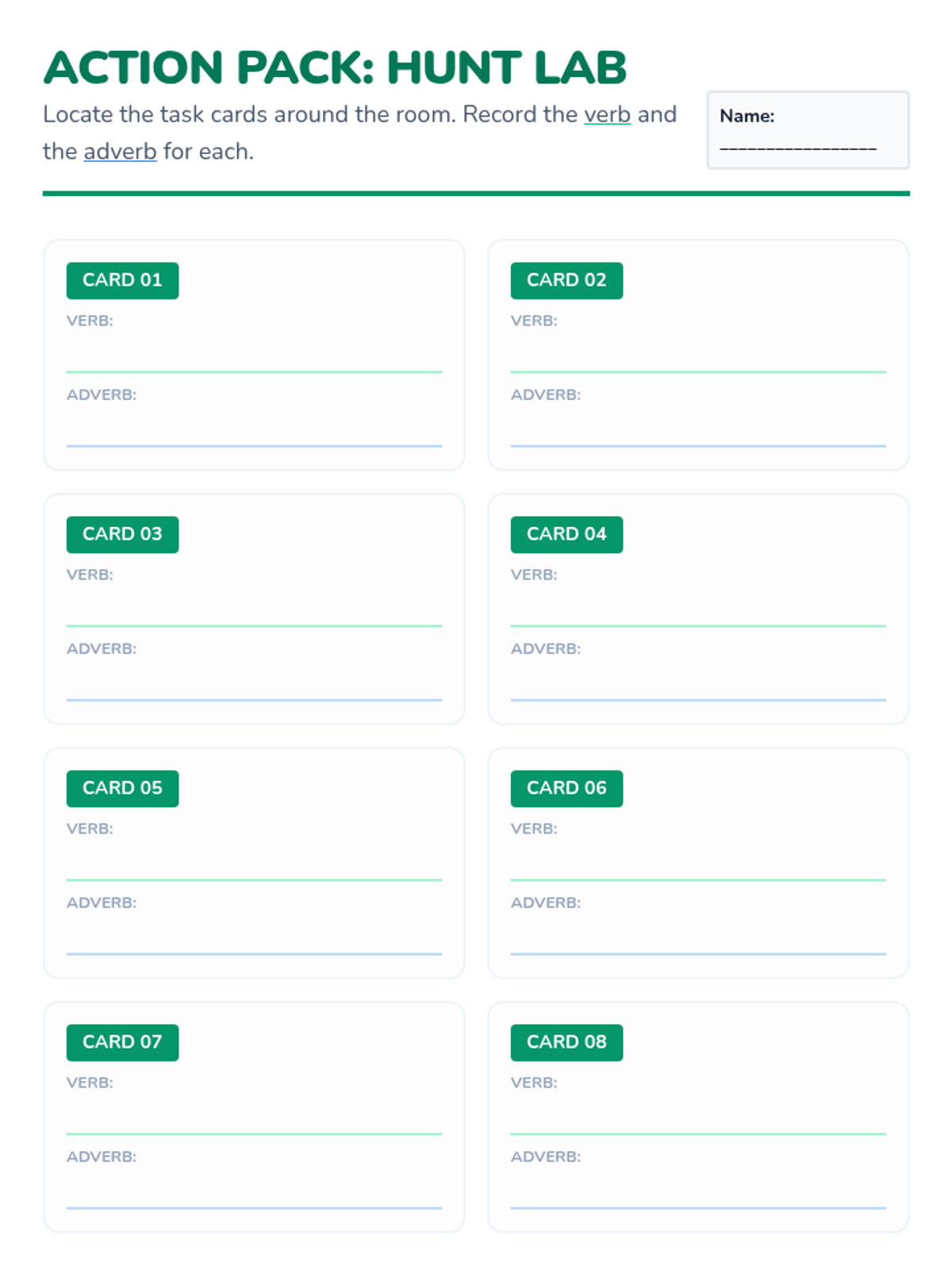
A set of task cards and a recording sheet for a 'scavenger hunt' activity where students identify verbs and adverbs in context.
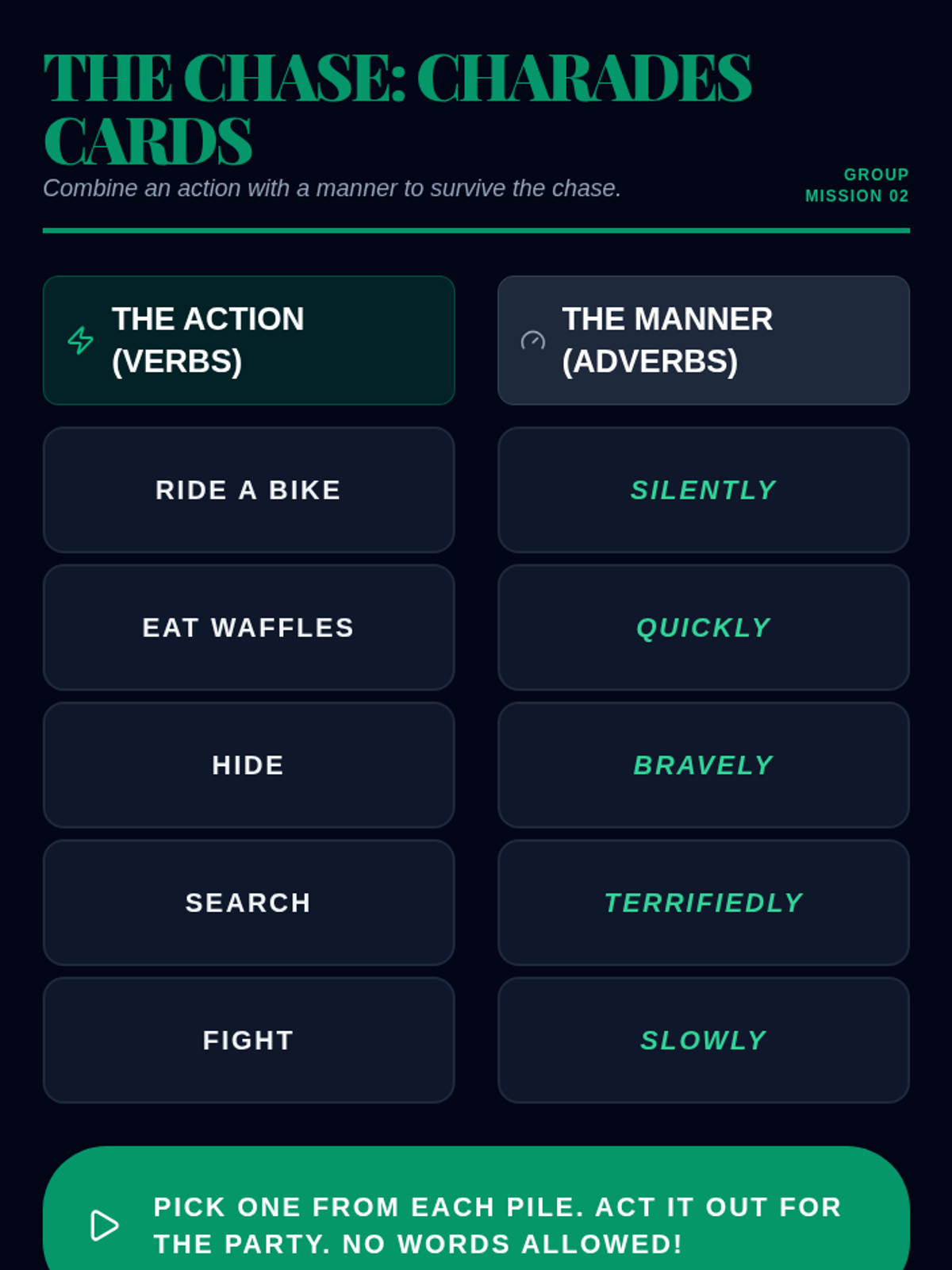
A set of 16 mix-and-match cards for a charades-style game where students act out specific actions (verbs) in specific ways (adverbs).
Action-packed slides for introducing verbs and adverbs, using a 'Power Source' theme with clear examples and practice prompts.
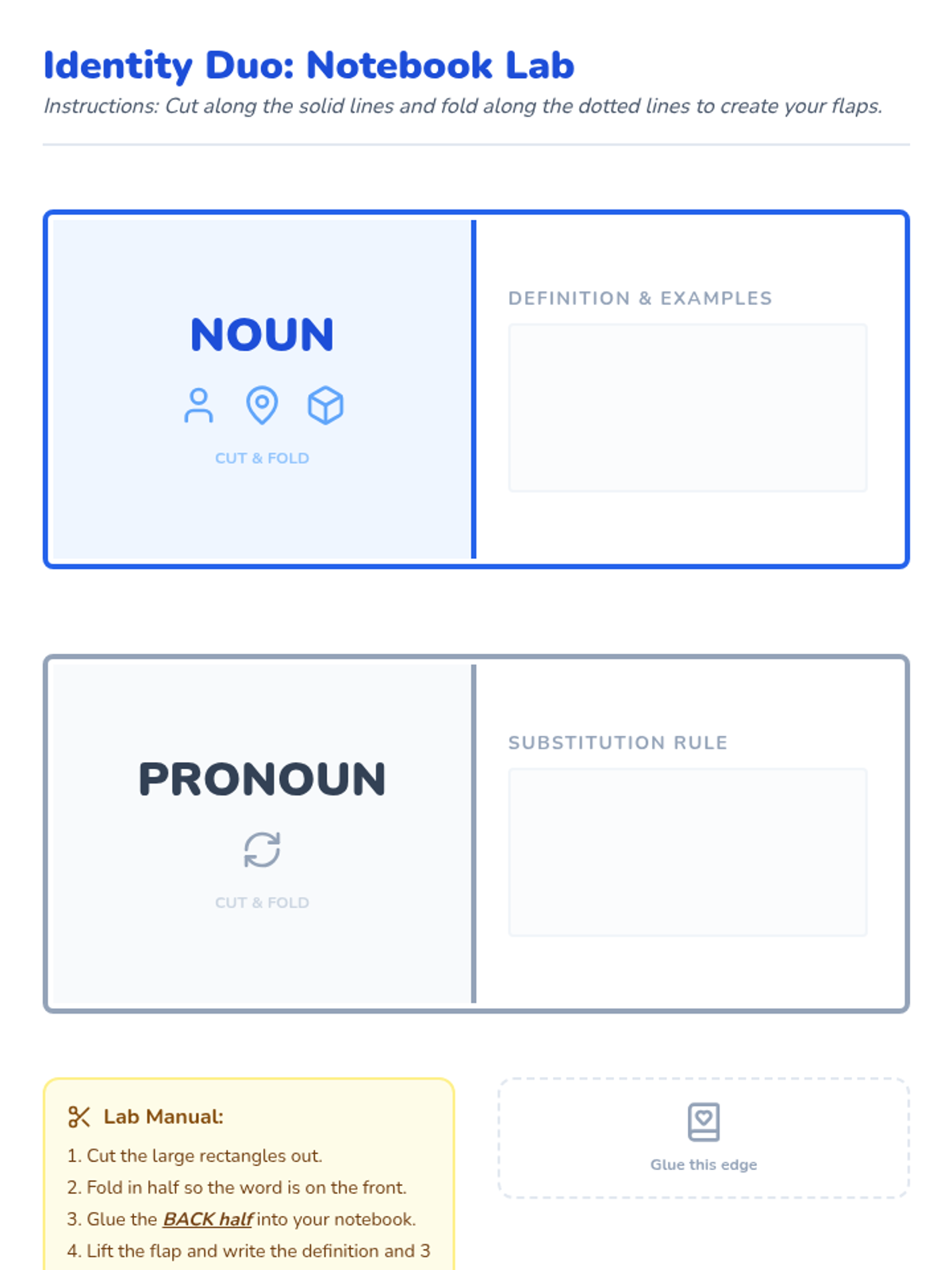
An interactive notebook template for nouns and pronouns, featuring foldable flaps for definitions and examples.
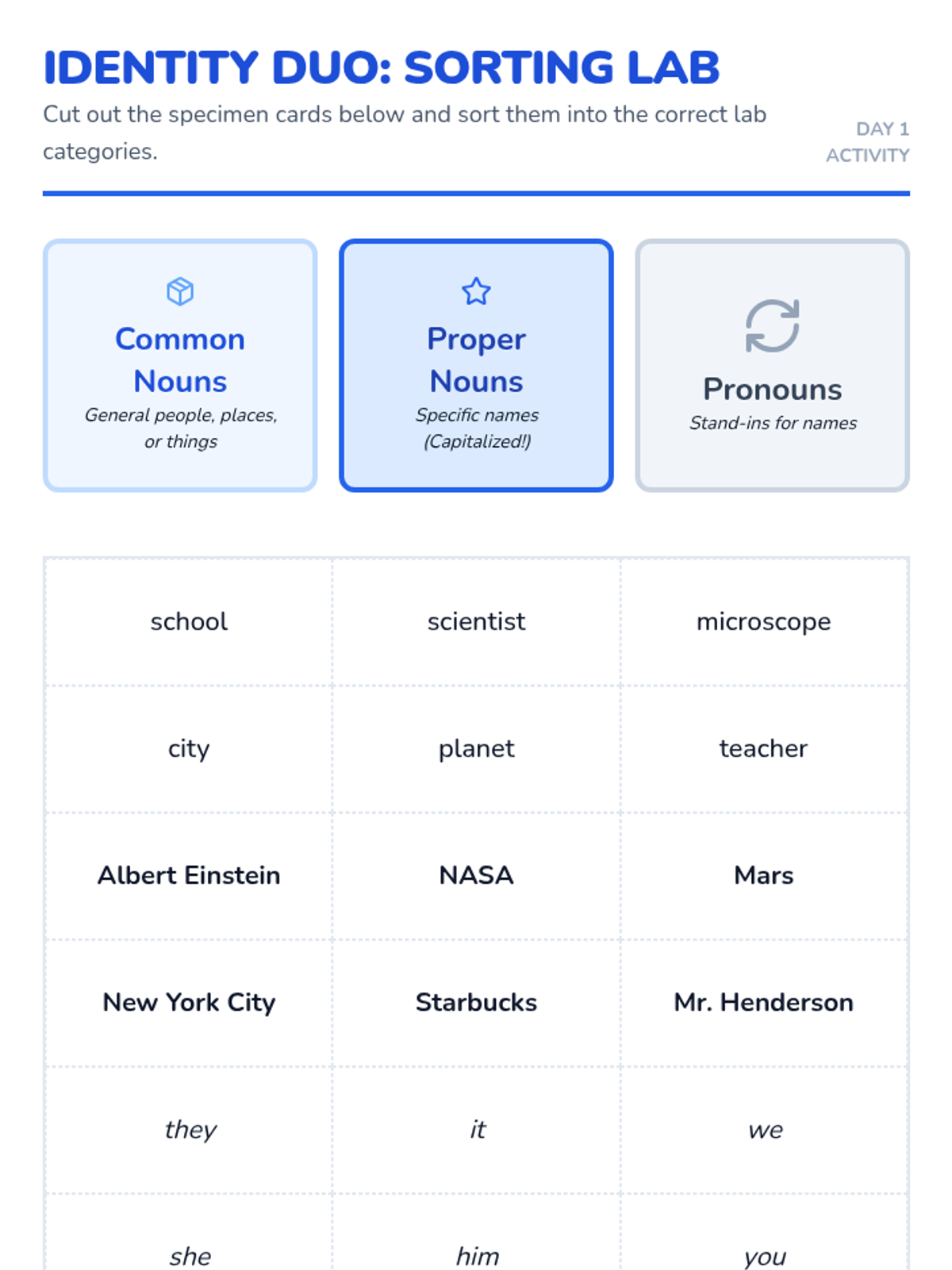
A set of 18 sorting cards featuring common nouns, proper nouns, and pronouns for a hands-on classification activity.
Updated slides with a new 'Lab Meeting' component to encourage peer discussion about the role of nouns and pronouns in writing.
A teacher-facing guide providing facilitation tips, scaffolding strategies, and answer keys for all three STAAR Power Play stations. Updated for the 3-point rubric scale and included exit ticket answer key.
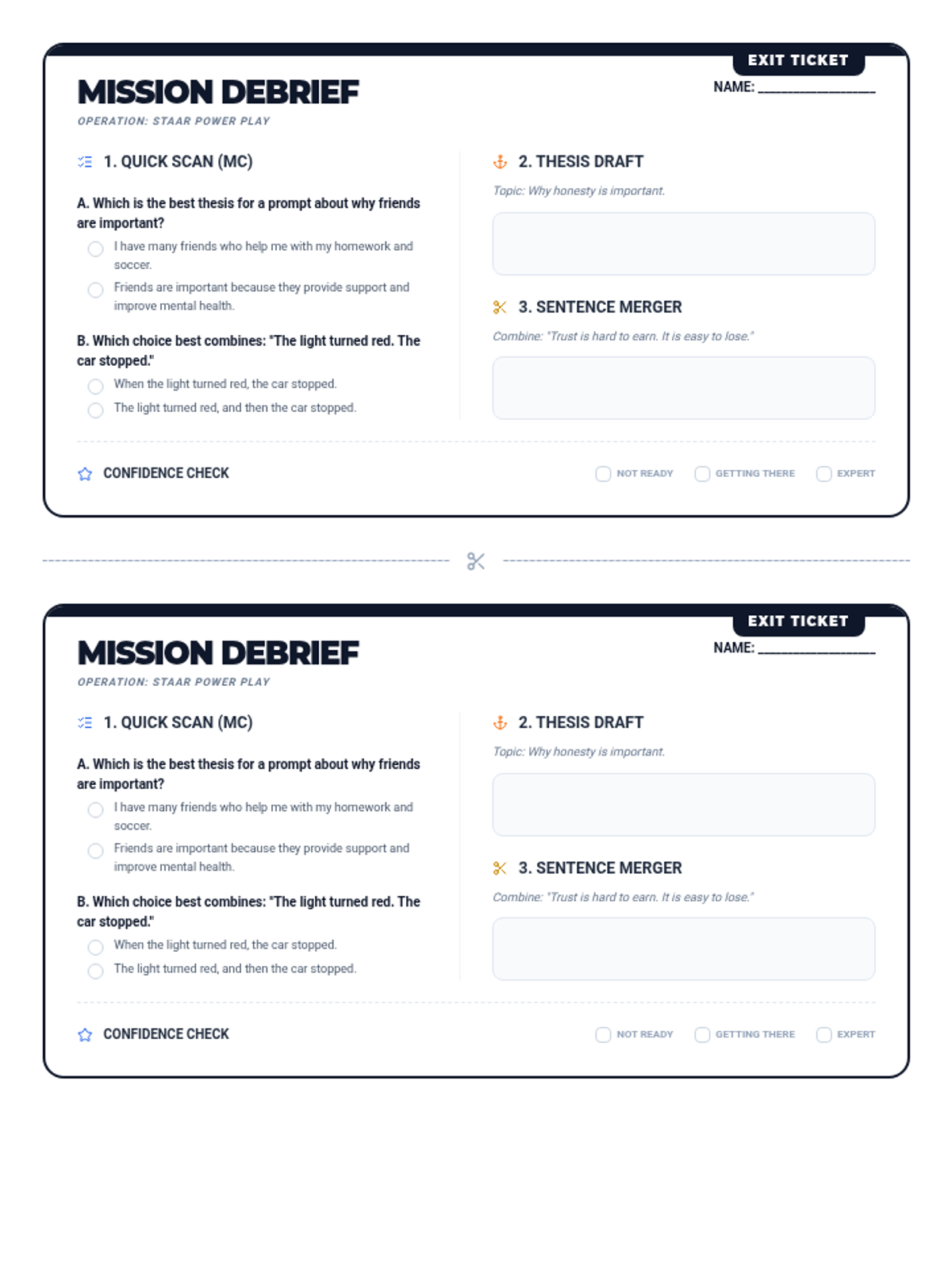
A double-up exit ticket (Mission Debrief) for the STAAR Power Play stations, featuring multiple choice questions for identifying thesis statements and sentence combining, plus short-answer writing tasks. Revised for better legibility and spacing.
A double-up exit ticket (Mission Debrief) for the STAAR Power Play stations, featuring multiple choice questions for identifying thesis statements and sentence combining, plus short-answer writing tasks.
A double-up exit ticket (Mission Debrief) for the STAAR Power Play stations, focusing on thesis drafting, sentence combining, and rubric self-assessment.
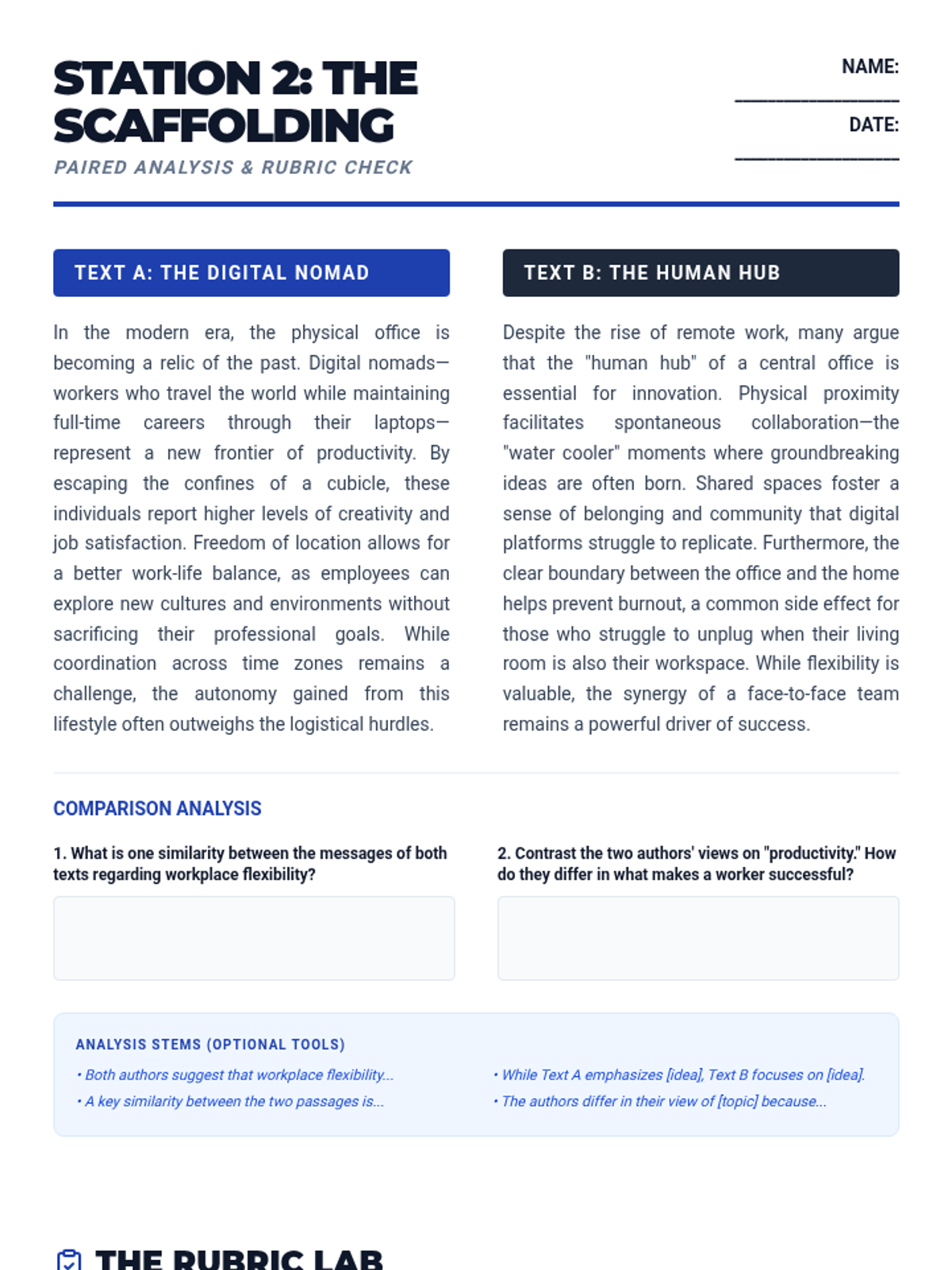
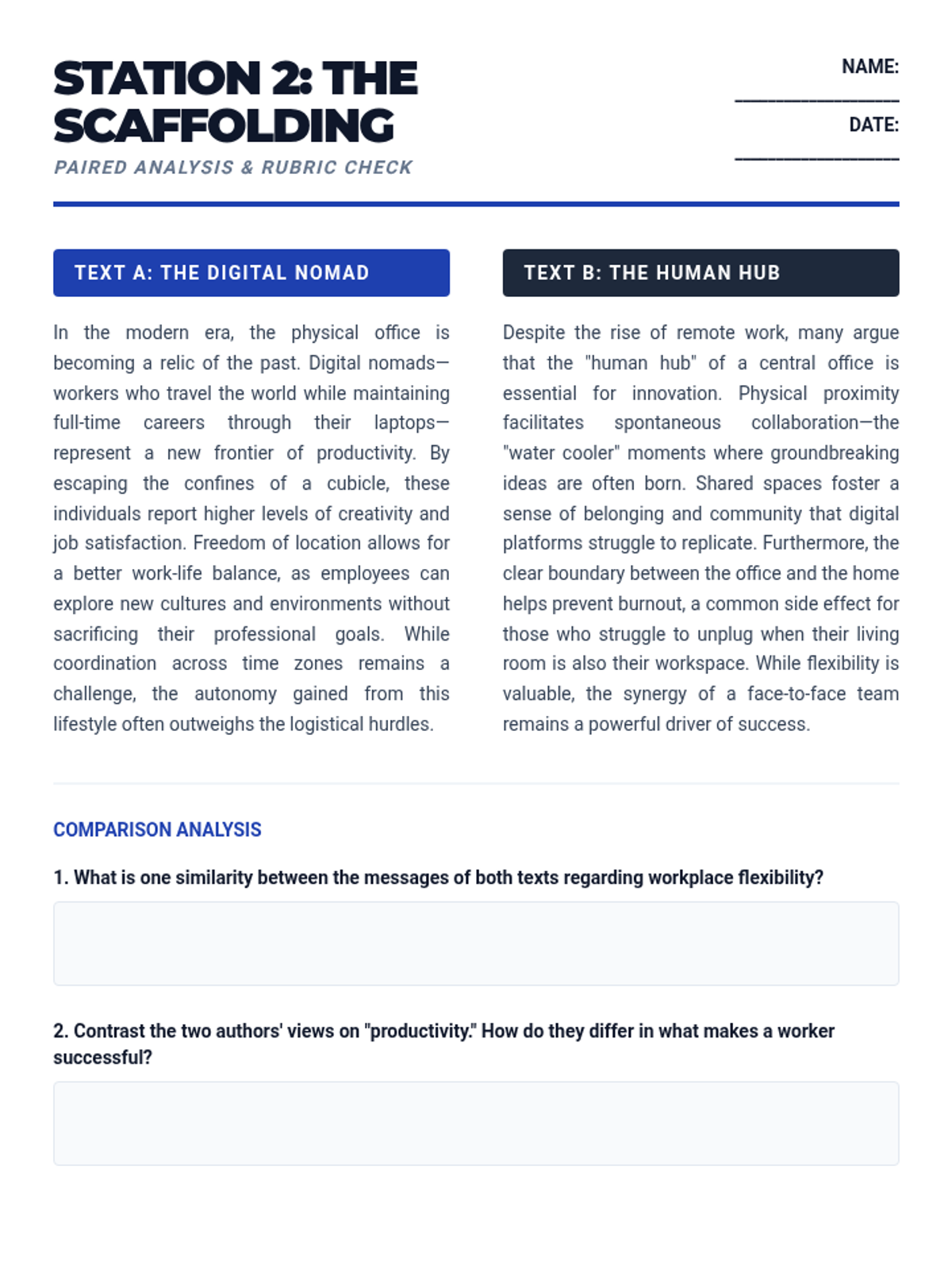
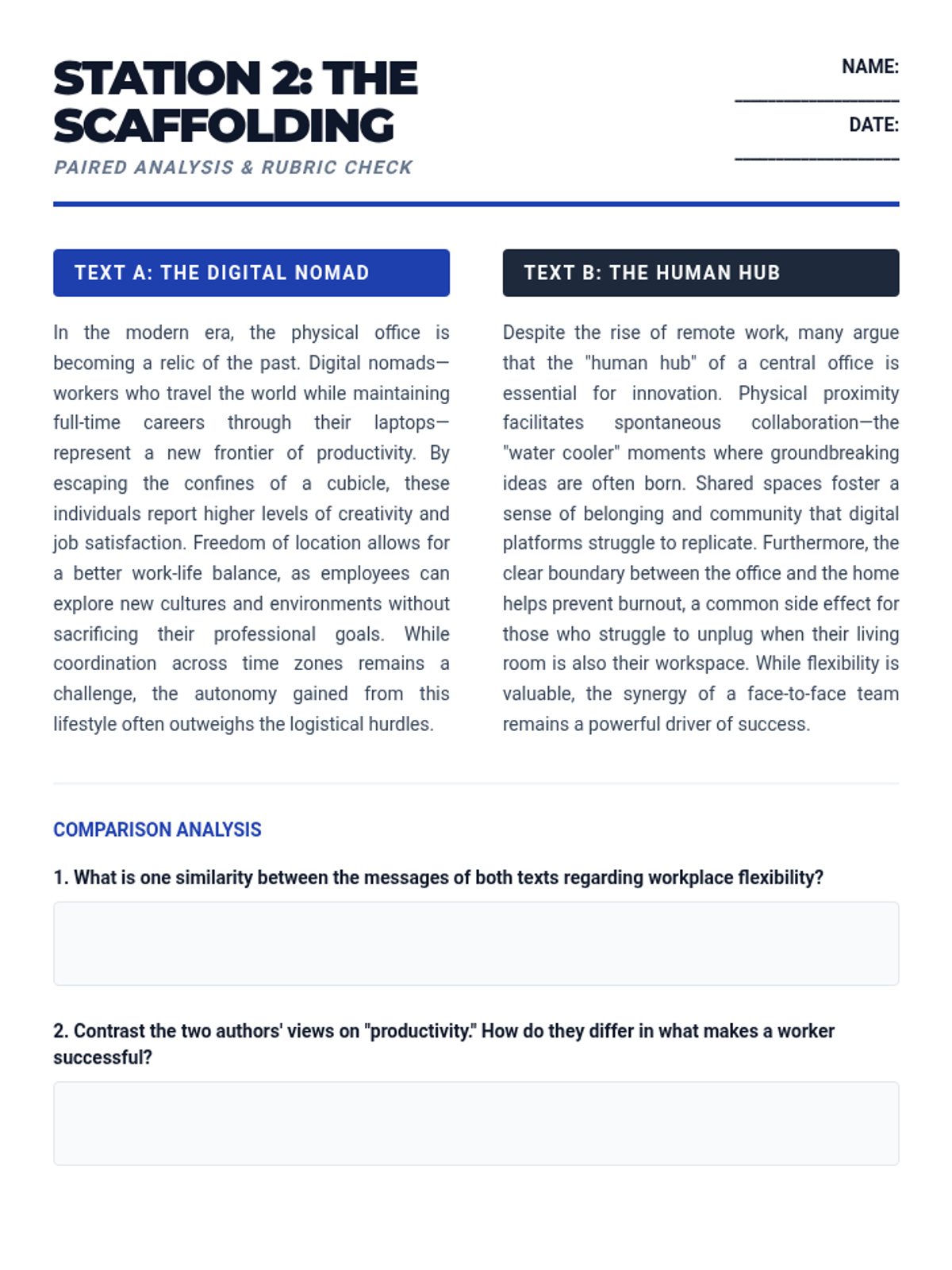
A two-page packet for Station 2 featuring paired informational passages and a student-written sample essay for rubric scoring practice. Updated with sentence stems for the comparison analysis section. Revised for better layout and writing space.
A two-page packet for Station 2 featuring paired informational passages and a student-written sample essay for rubric scoring practice. Updated with sentence stems for the comparison analysis section.
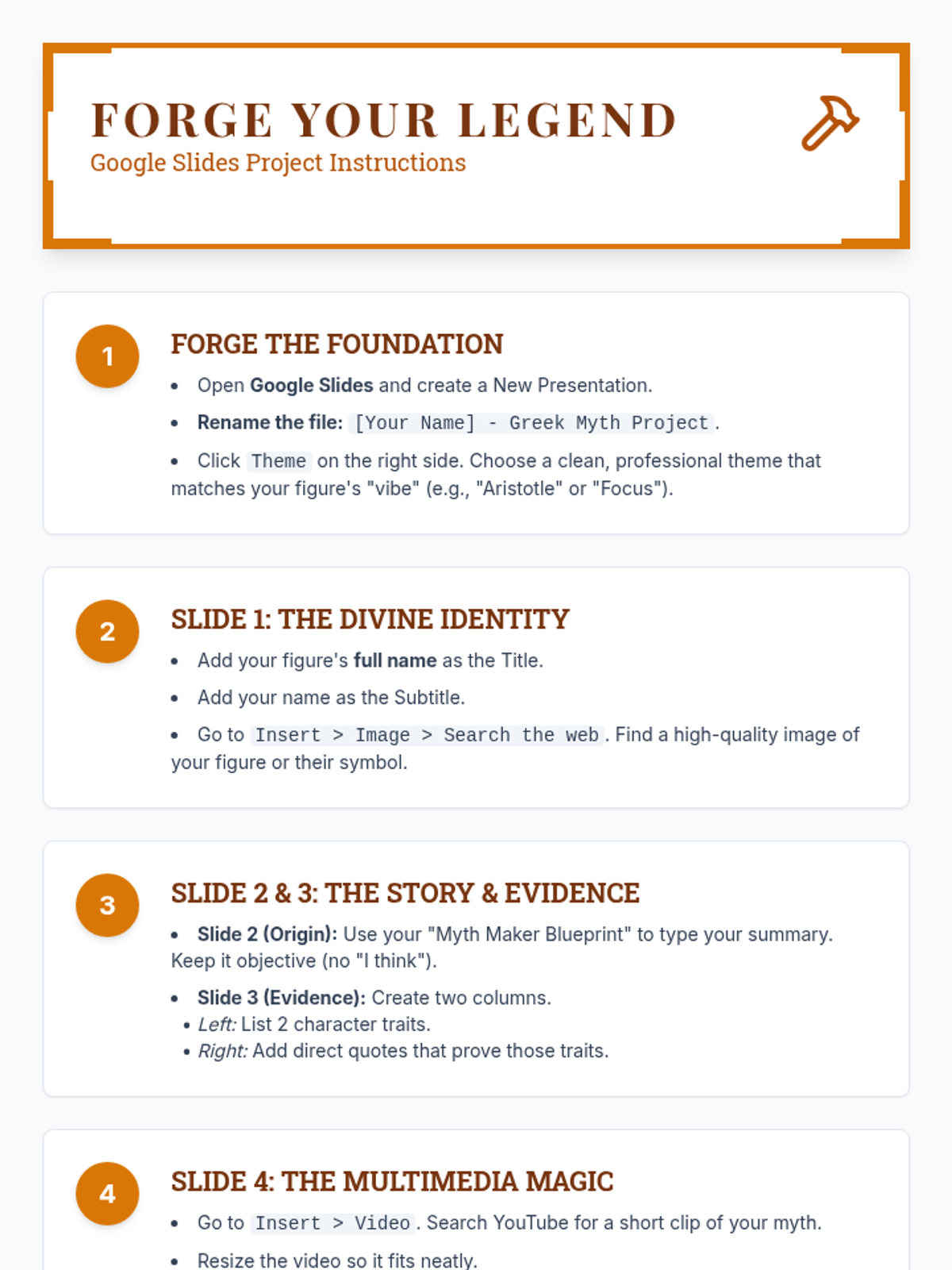
A student-facing step-by-step instruction sheet for creating a 5-slide Greek Mythology project using Google Slides, including technical tips and standard alignments.
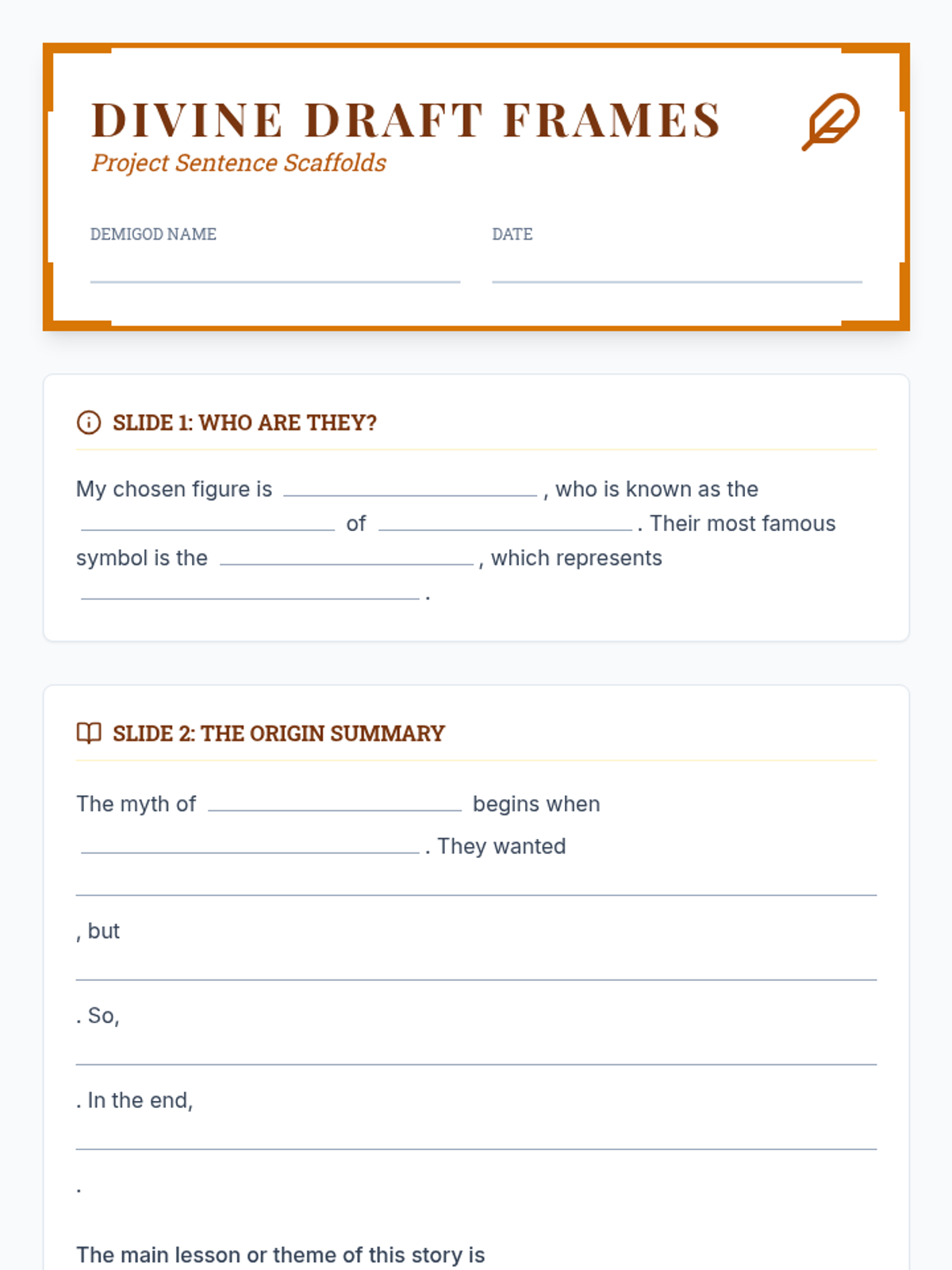
A sentence frame worksheet for students needing additional scaffolding, providing structured sentence starters for character traits, evidence, summaries, and modern connections.
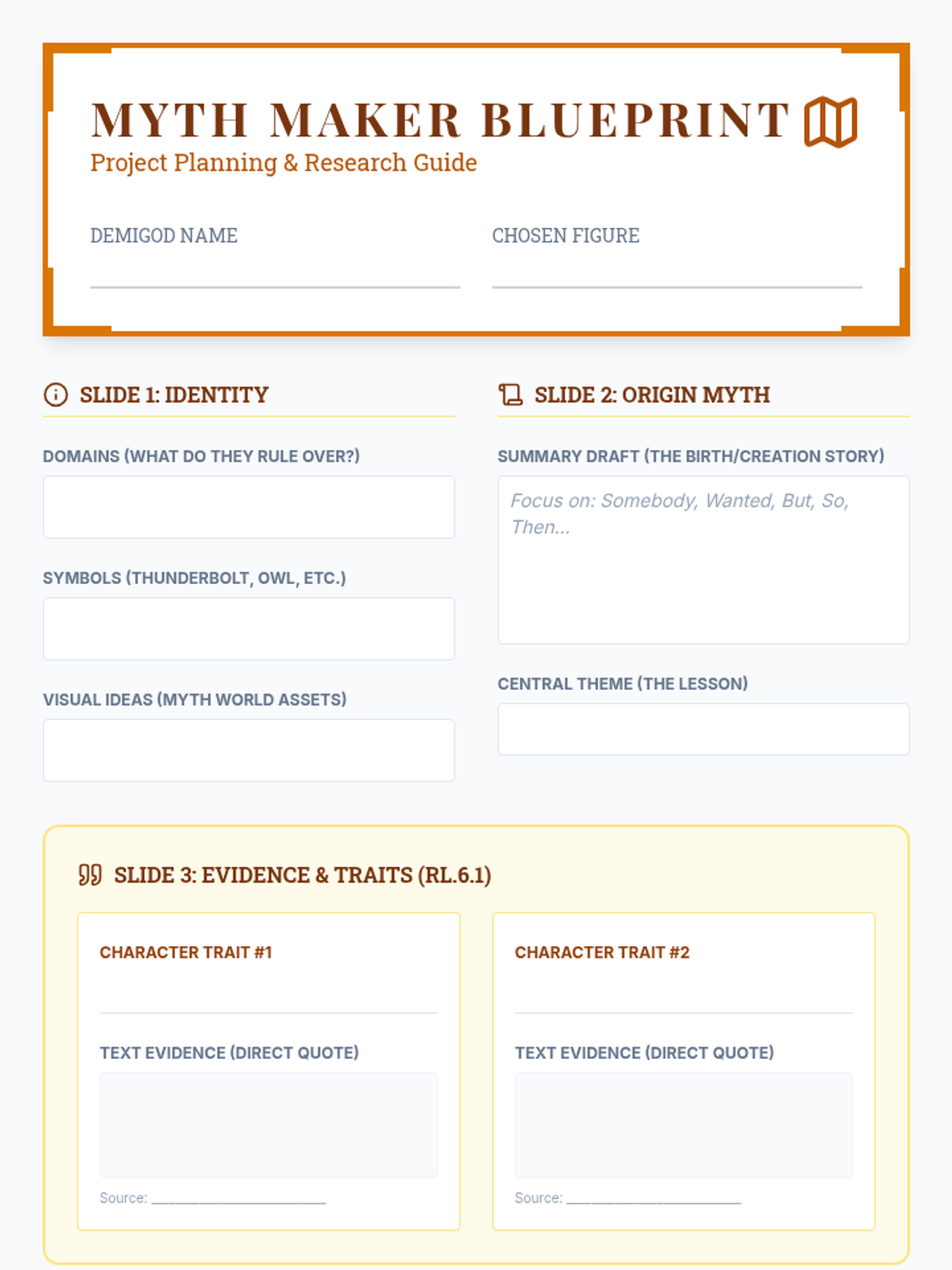
A comprehensive student research and planning worksheet for a Greek Mythology multimedia project, including sections for summaries, text evidence, and a completion checklist.
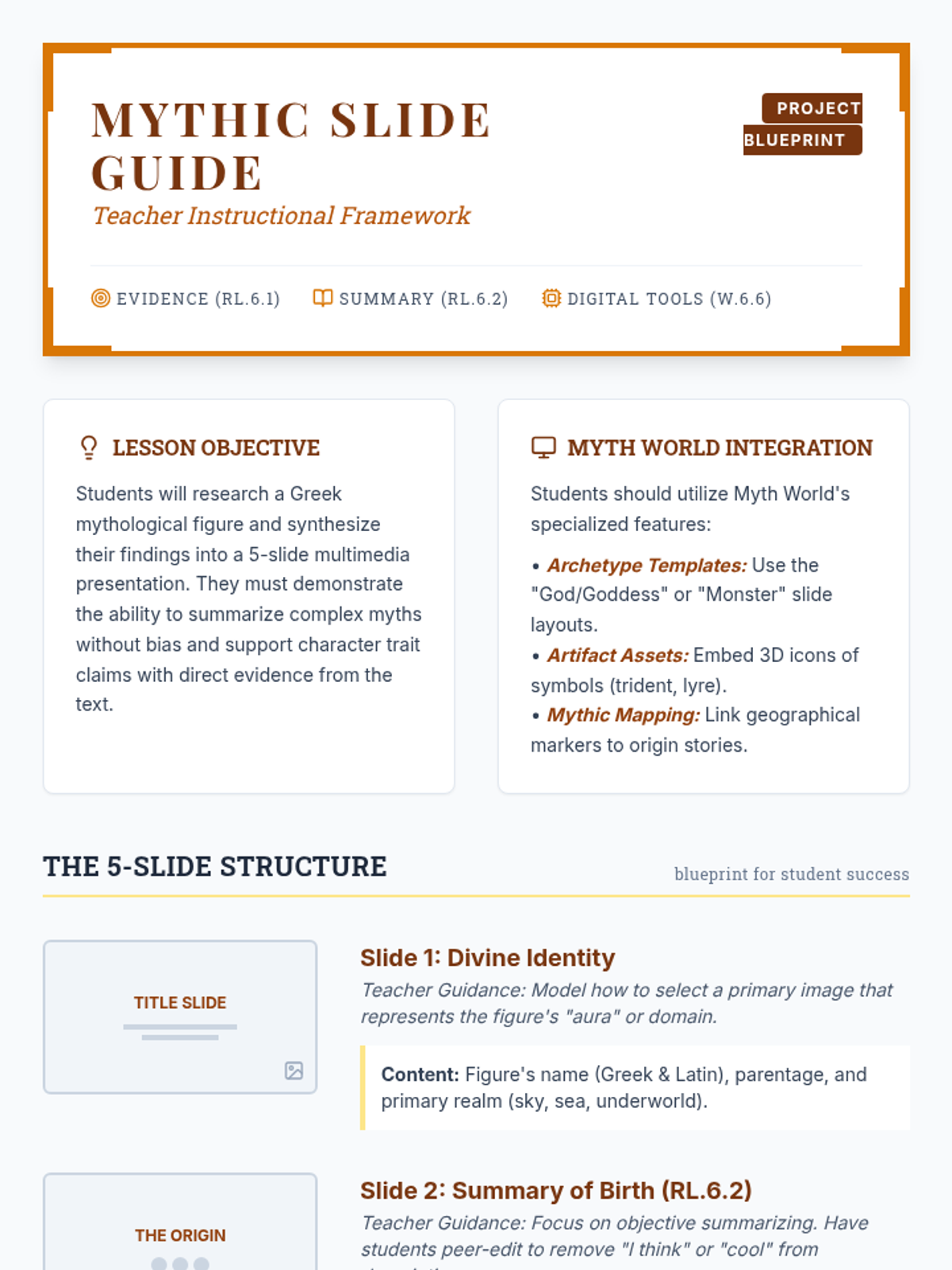
A teacher-facing guide outlining a 5-slide blueprint for a Greek Mythology project, featuring instructional tips, standard alignments, and differentiation strategies.
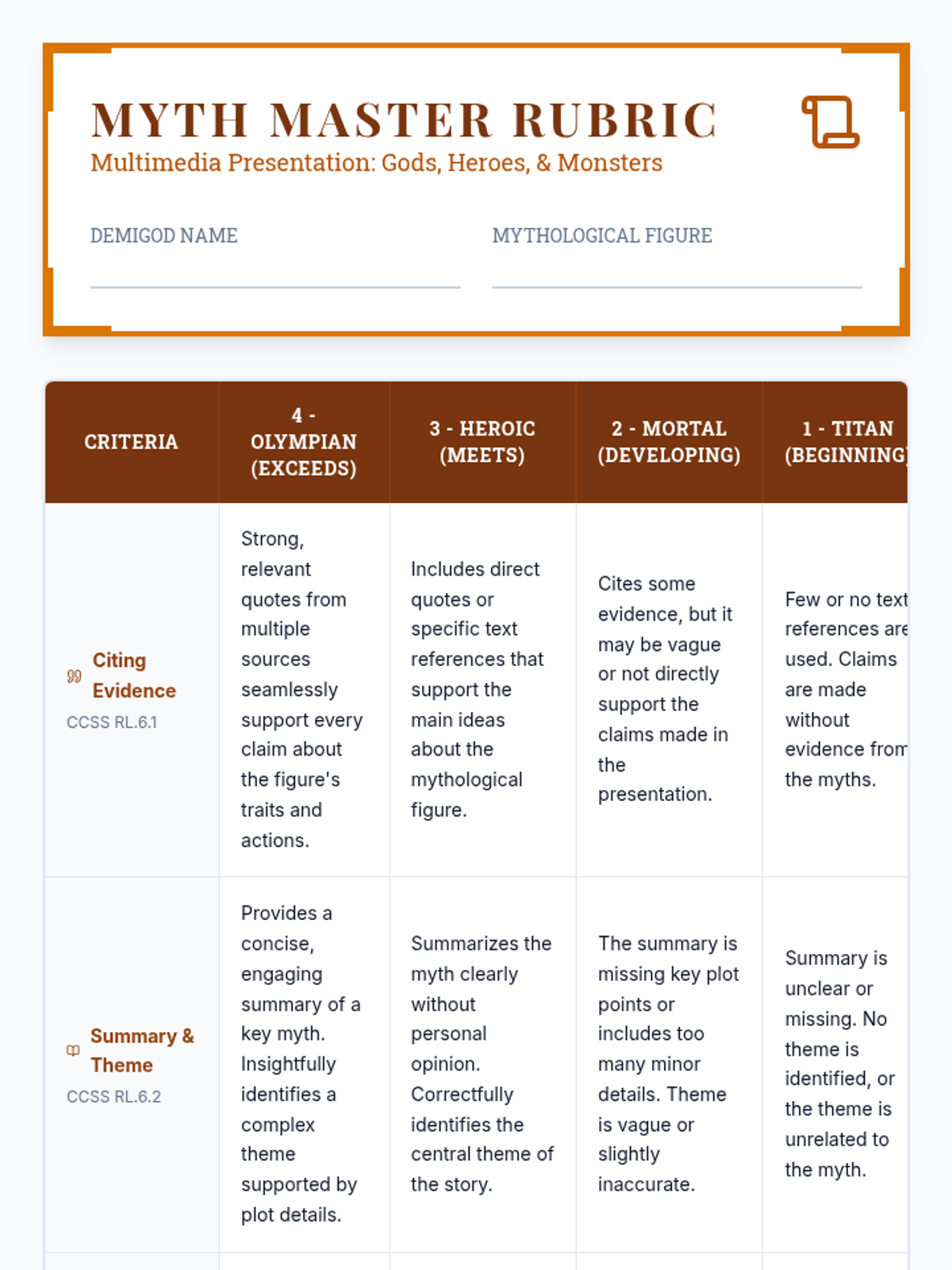
A professional 1-4 point rubric for a Greek Mythology multimedia project, covering evidence, summary, organization, digital tools, oral delivery, and mechanics.
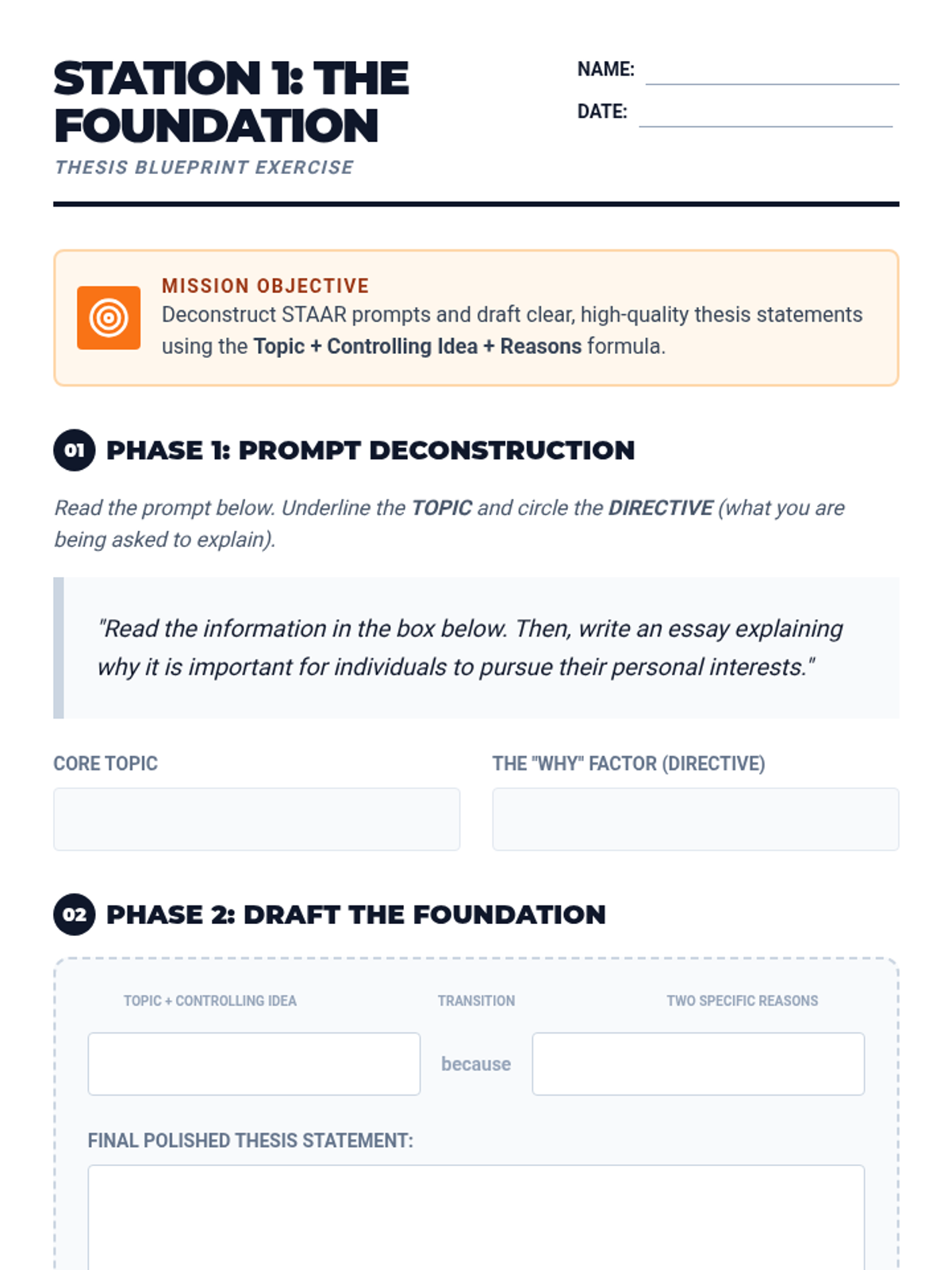
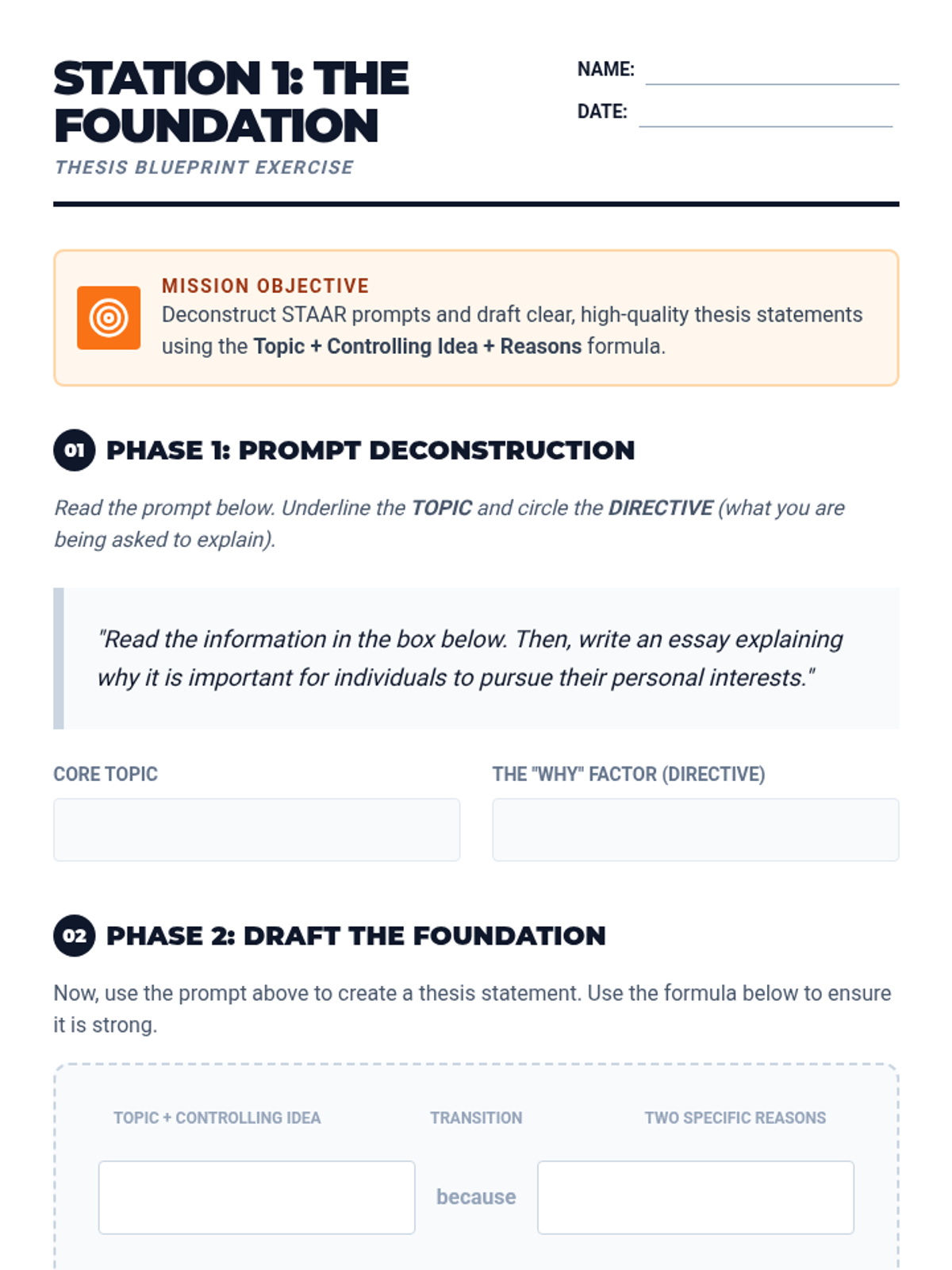
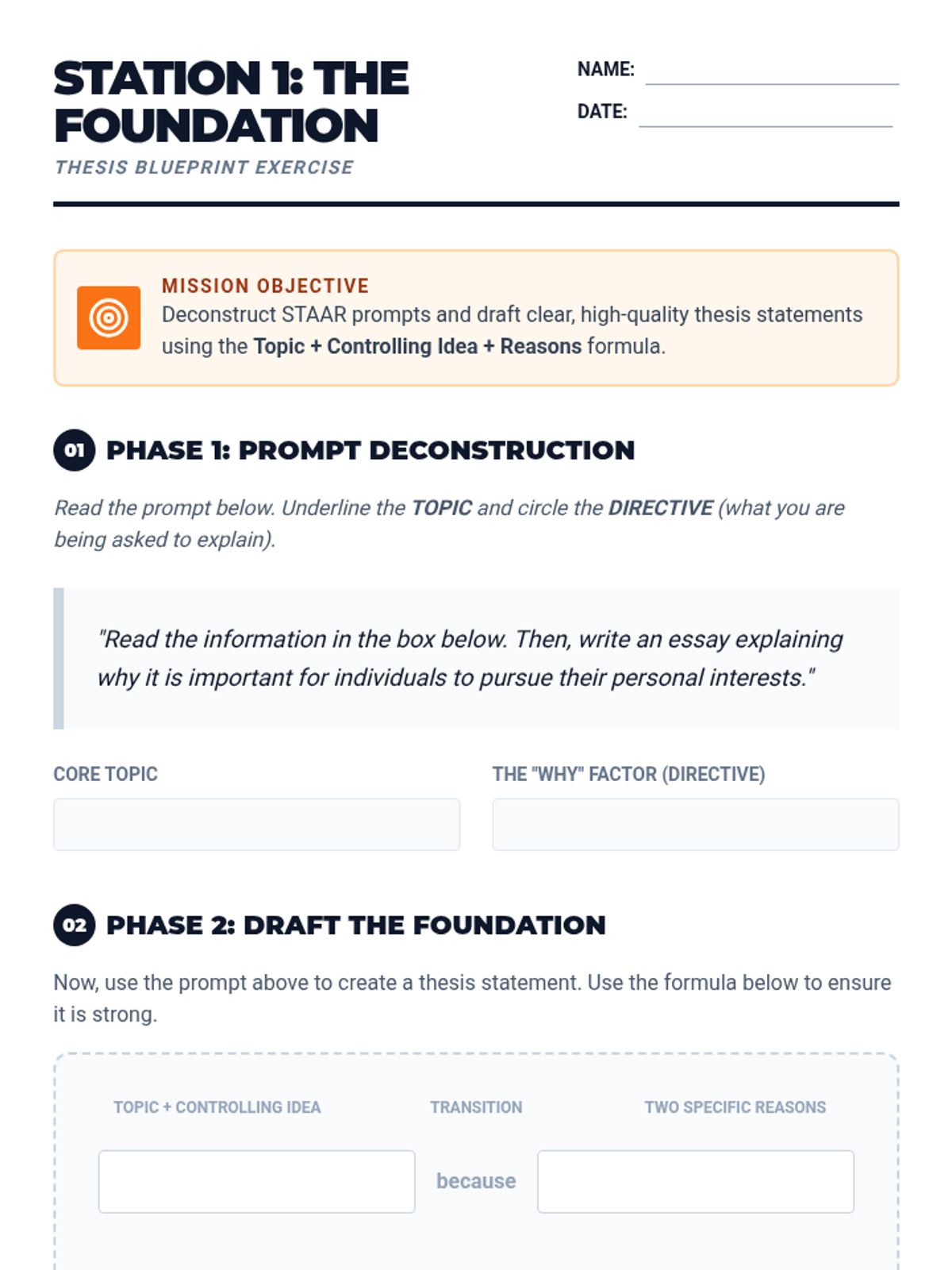
A worksheet for Station 1 focused on identifying prompt requirements and drafting effective thesis statements for informative essays. Updated with structural sentence stems to assist student drafting.
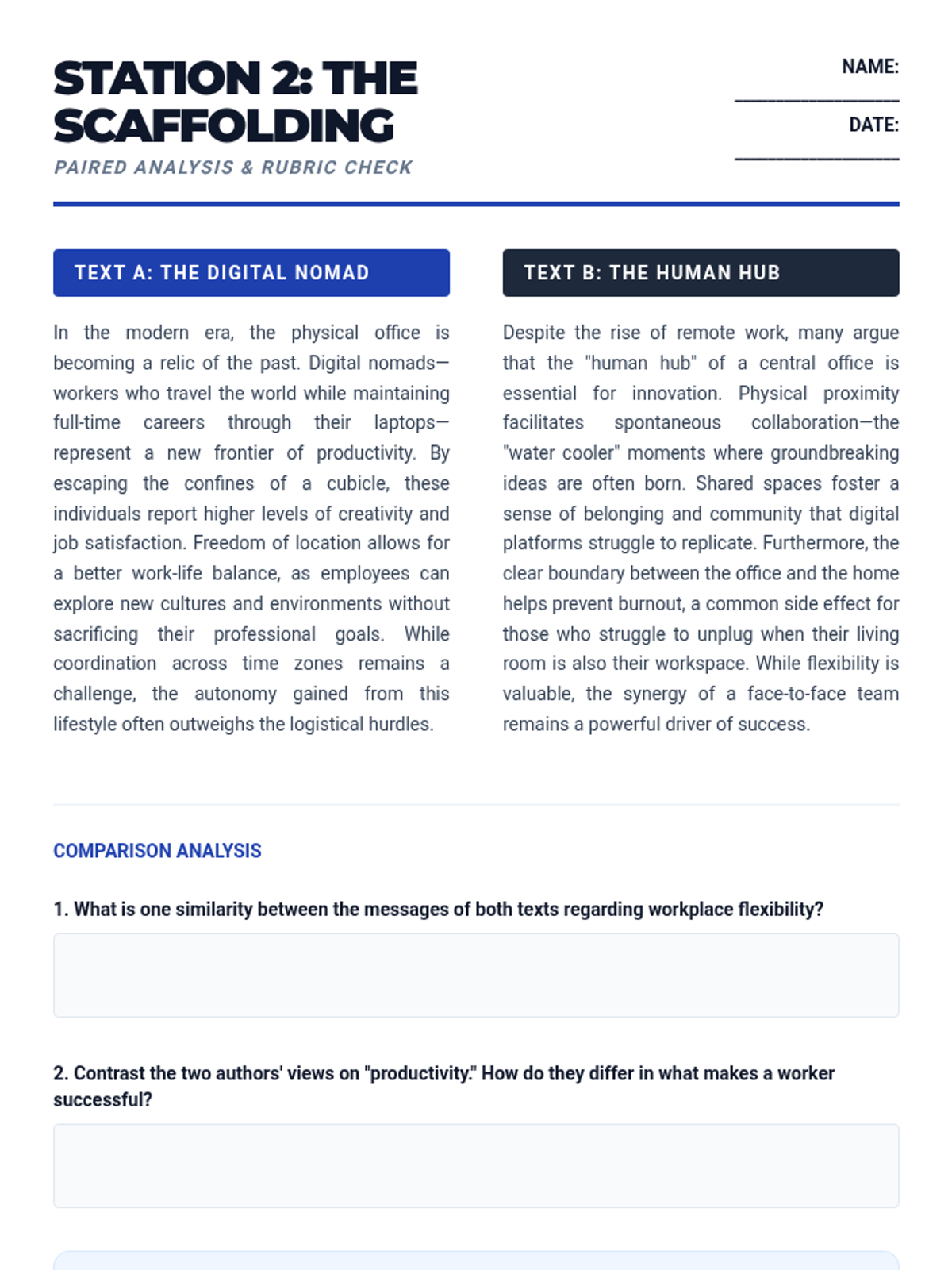
A two-page packet for Station 2 featuring paired informational passages and a student-written sample essay for rubric scoring practice. Updated with a 3-point scale for Organization & Development.
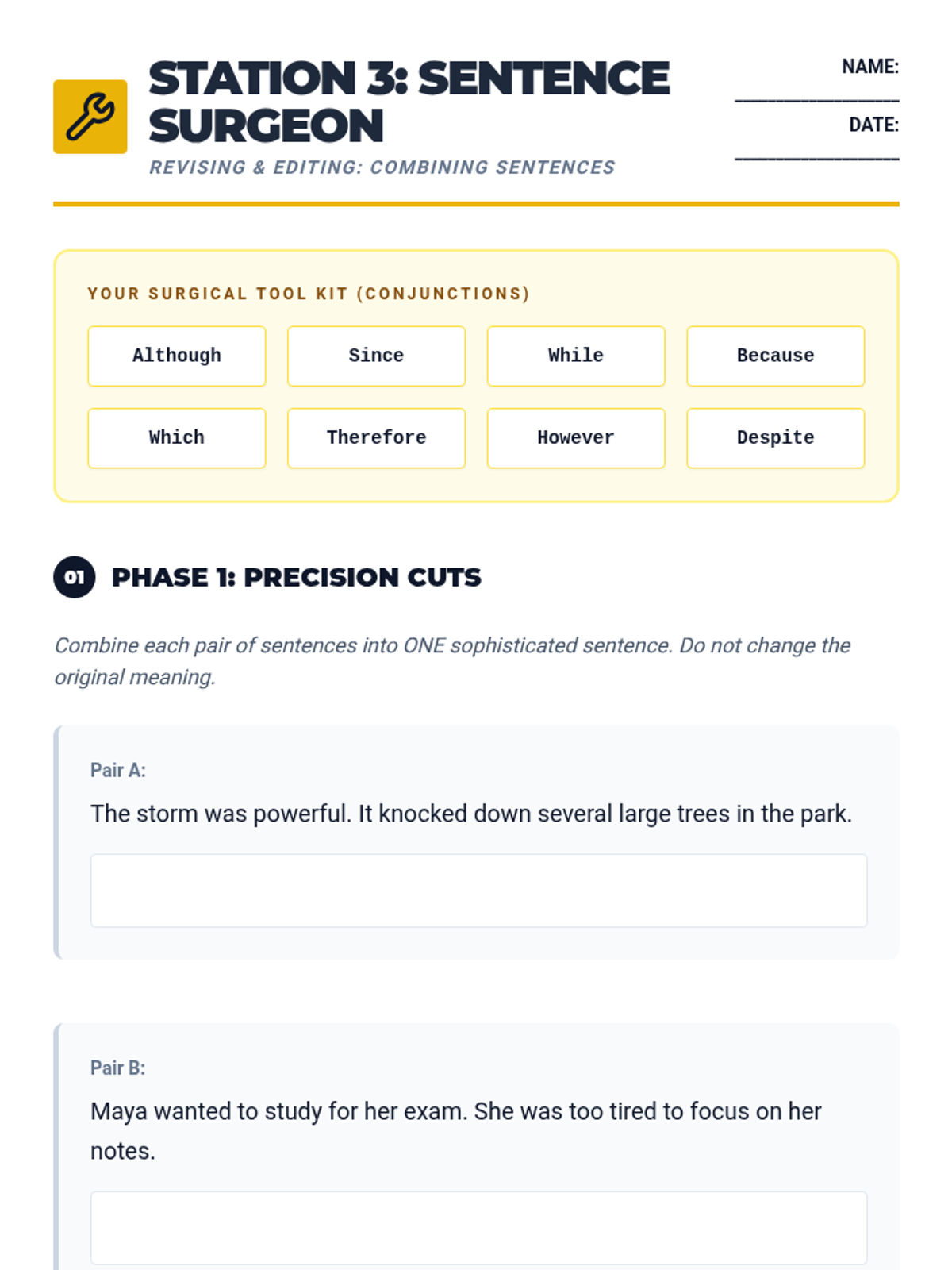
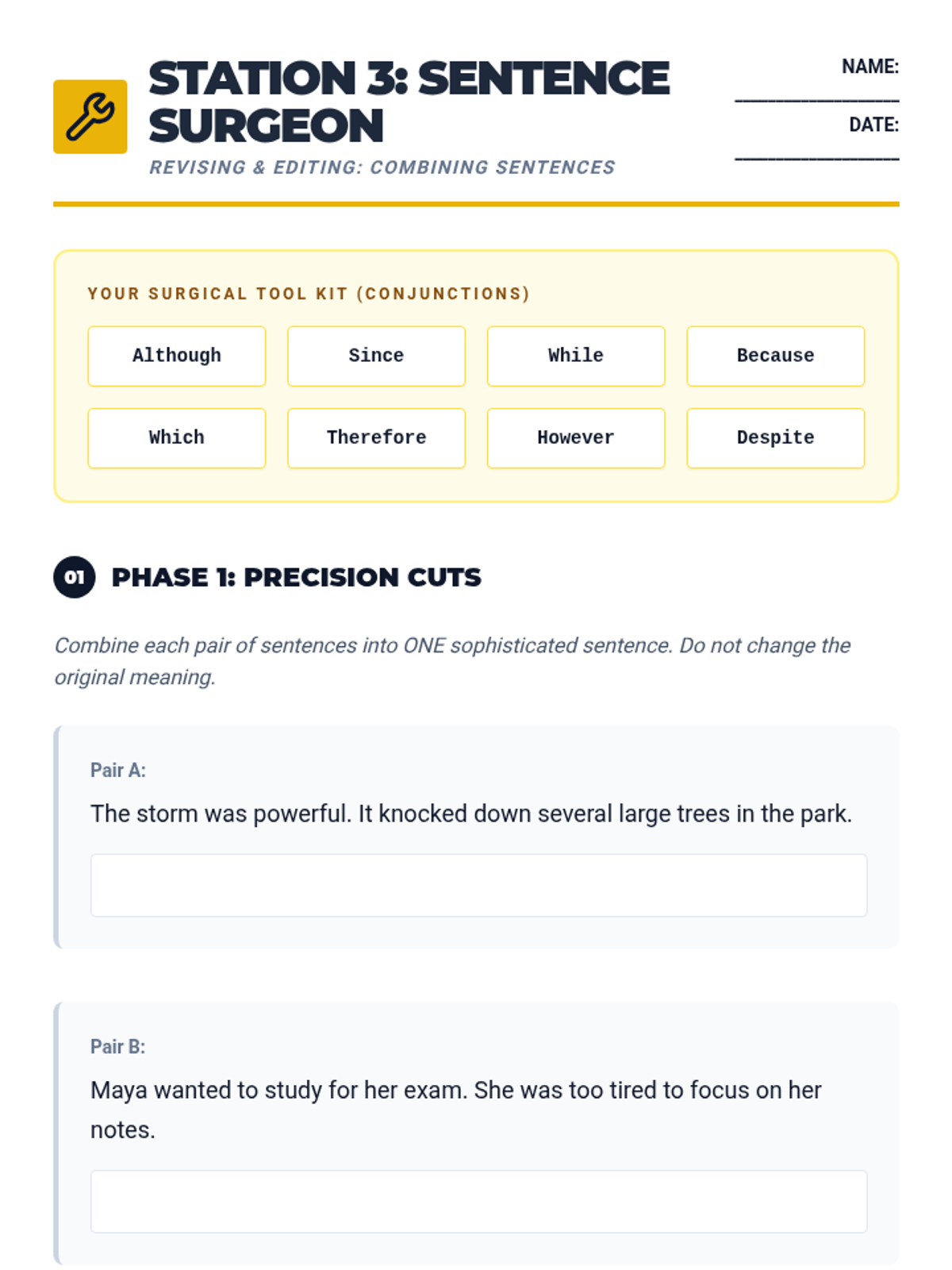
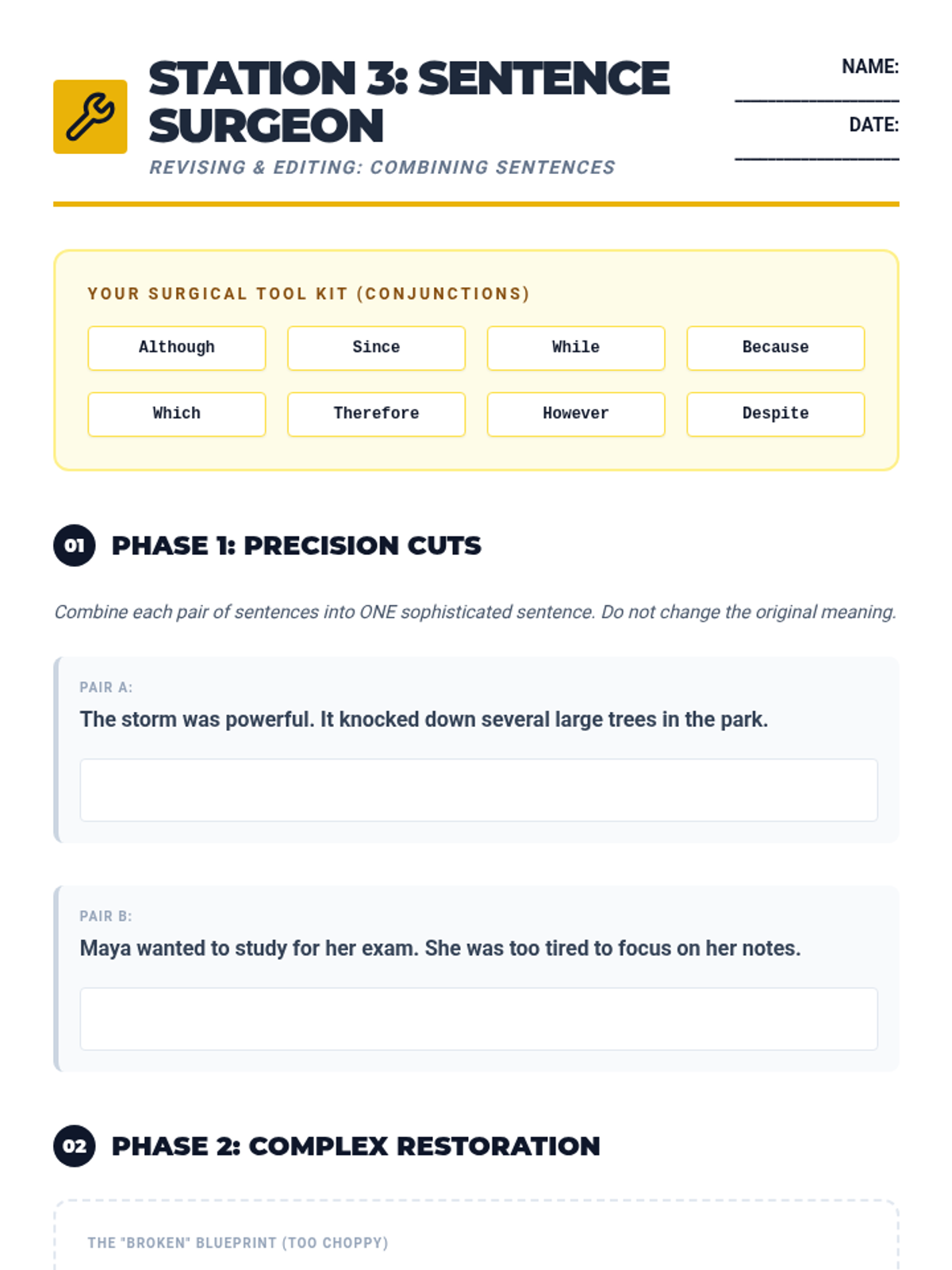
A worksheet for Station 3 focusing on sentence combining techniques, featuring single-sentence practice and a full paragraph revision task. Revised for better writing space.
A worksheet for Station 1 focused on identifying prompt requirements and drafting effective thesis statements for informative essays. Revised for better spacing.
A teacher-facing guide providing facilitation tips, scaffolding strategies, and answer keys for all three STAAR Power Play stations. Updated for the 3-point rubric scale.
A worksheet for Station 3 focusing on sentence combining techniques, featuring single-sentence practice and a full paragraph revision task.
A two-page packet for Station 2 featuring paired informational passages and a student-written sample essay for rubric scoring practice.
A worksheet for Station 1 focused on identifying prompt requirements and drafting effective thesis statements for informative essays.
Visual presentation for the STAAR Power Play stations, including instructions for each rotation and a timer.
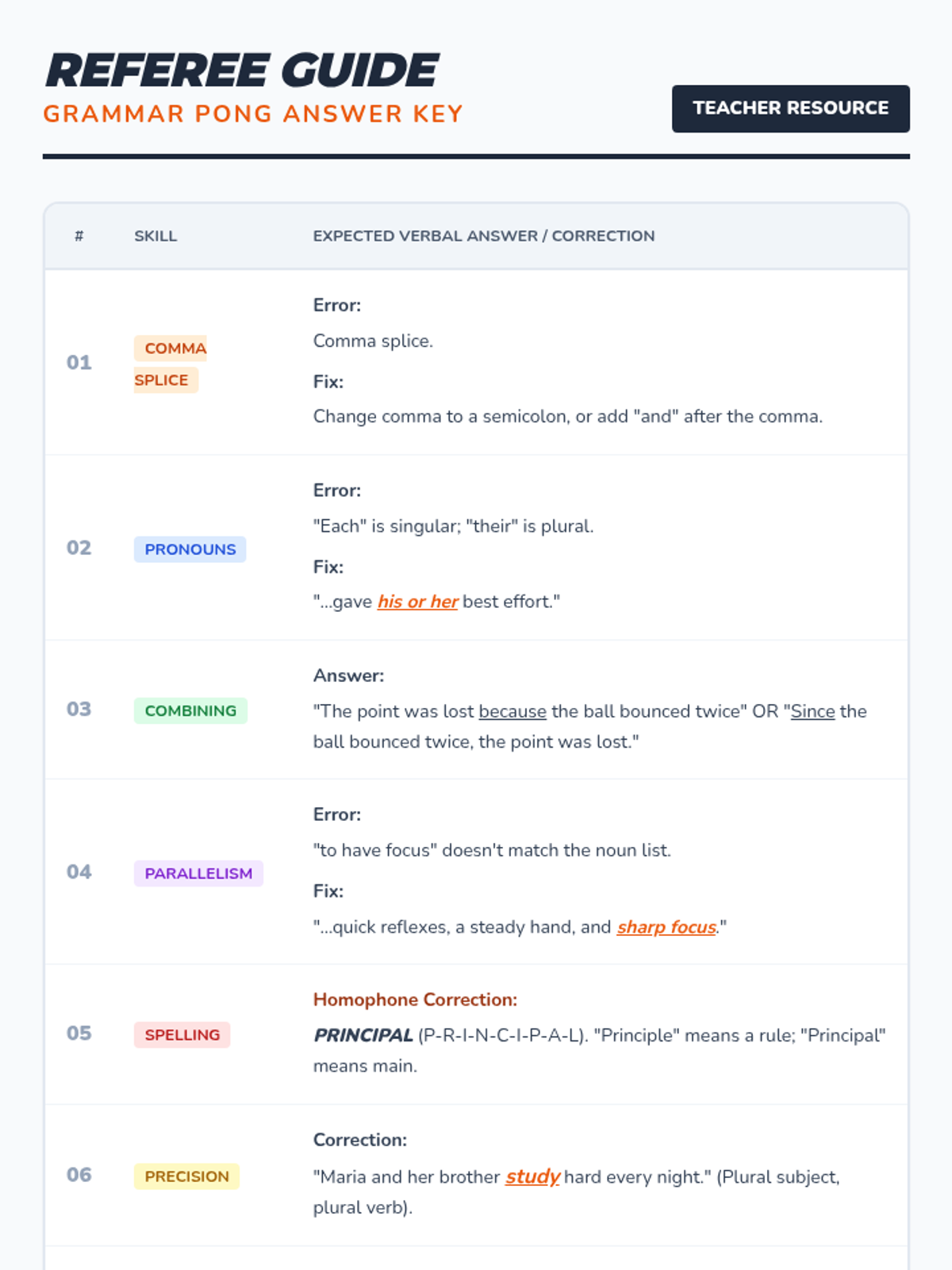
A teacher-facing answer key and quick-reference guide for the Grammar Pong game, ensuring fast and accurate judging during the verbal challenge.
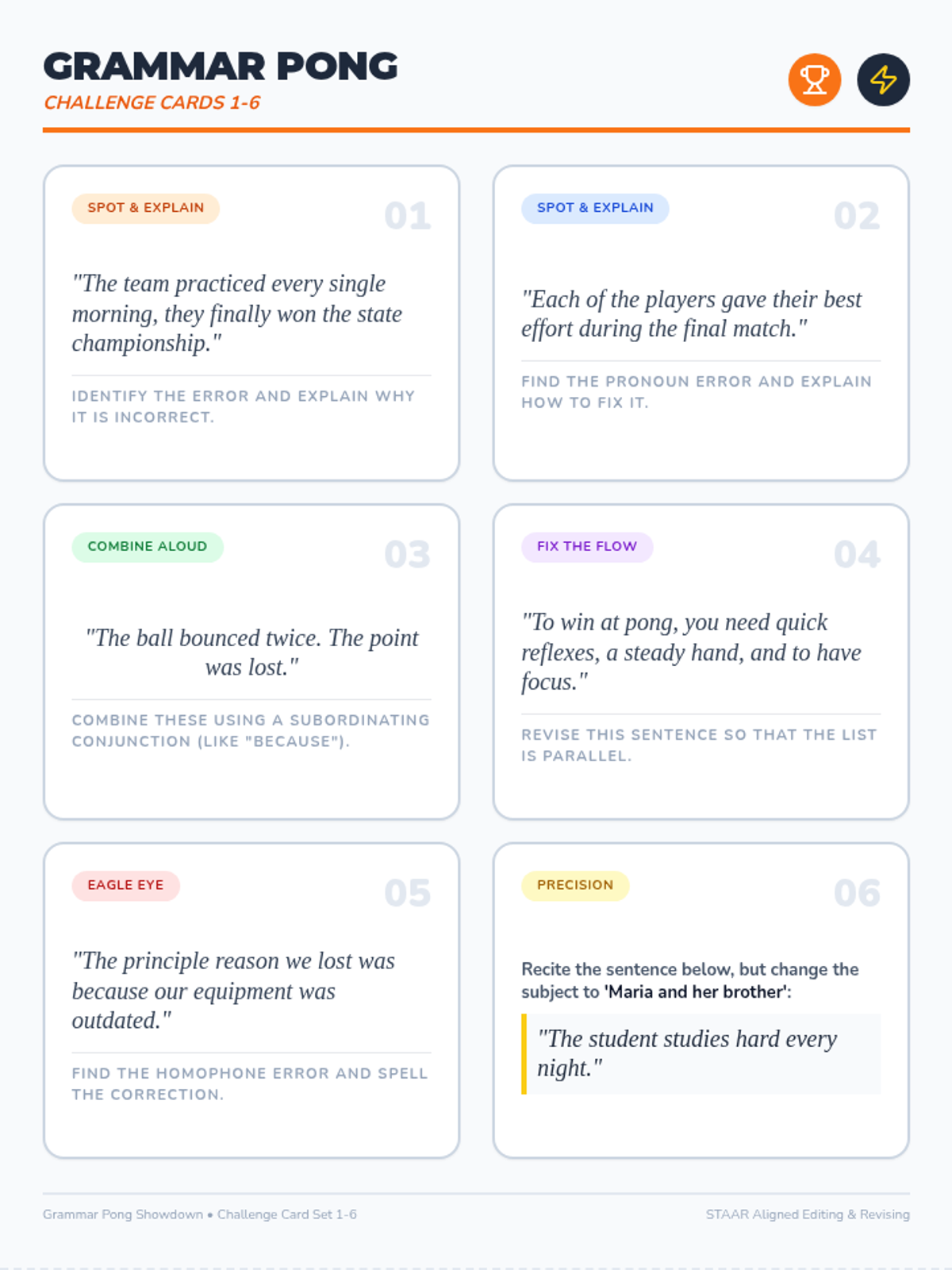
A set of 12 vibrant challenge cards for a classroom grammar game. Each card features an open-ended editing or revising question targeting specific skills like comma splices, parallelism, and pronoun agreement. Card sizing and text layout have been adjusted for optimal readability.
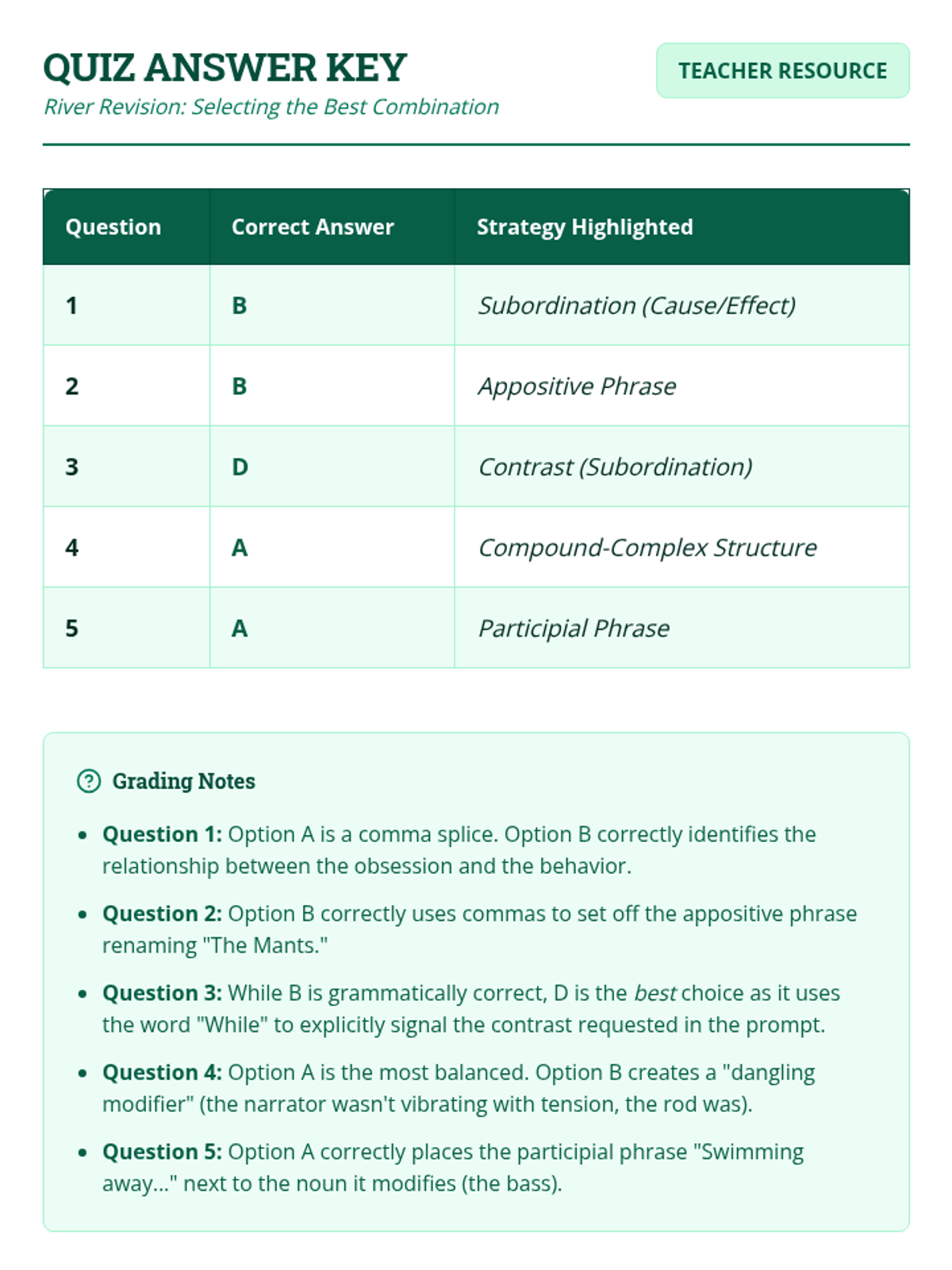
An answer key for the River Revision Quiz, including the correct letter for each question and brief explanations for the grammatical reasoning behind the correct choices.
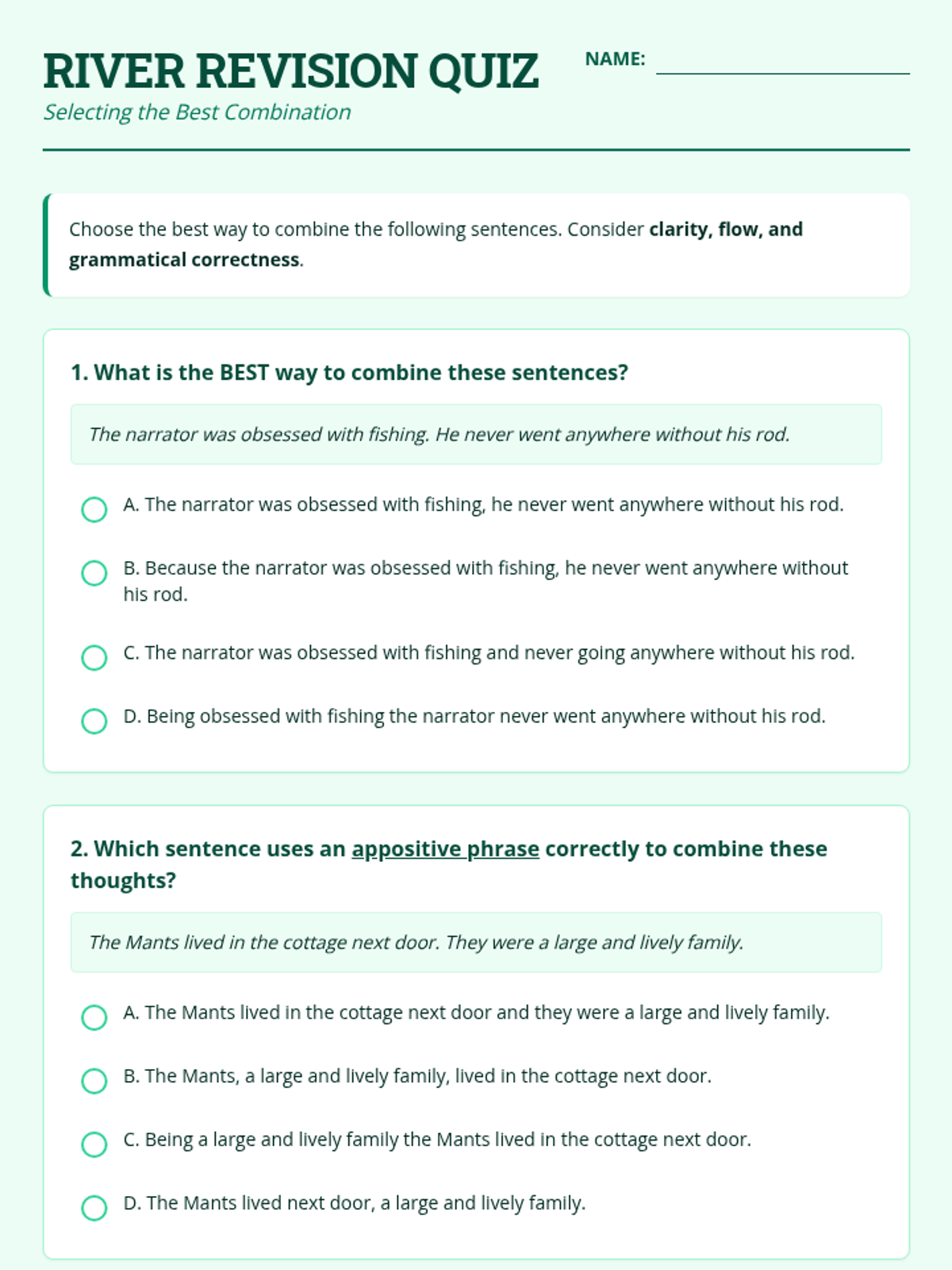
A 5-question multiple-choice quiz focusing on choosing the best sentence combinations based on clarity, flow, and grammatical sophistication, themed around 'The Bass, the River, and Sheila Mant'.
An instructional slide deck for teaching sentence combining strategies (FANBOYS, subordination, appositives, and participles) themed around 'The Bass, the River, and Sheila Mant'.
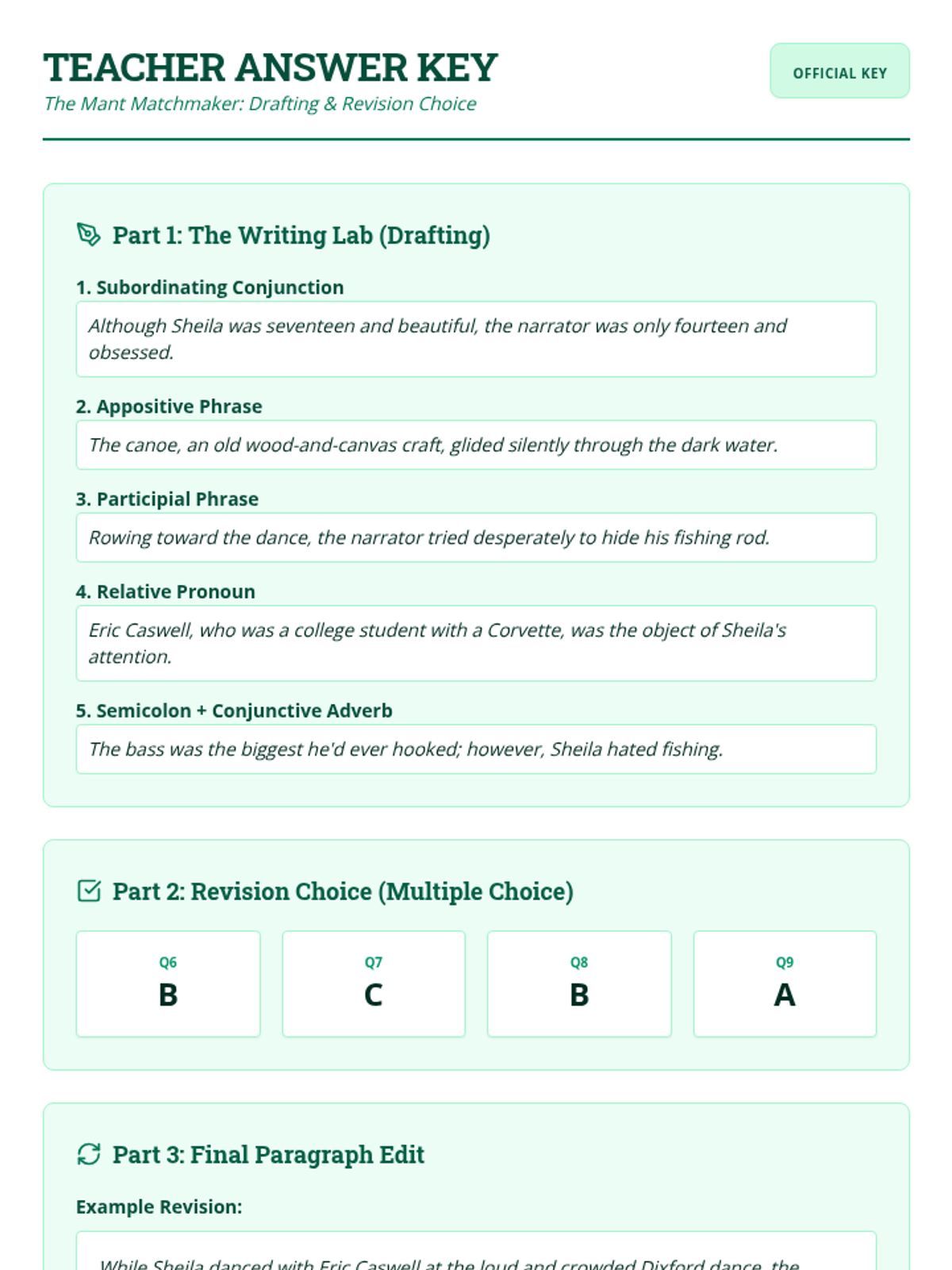
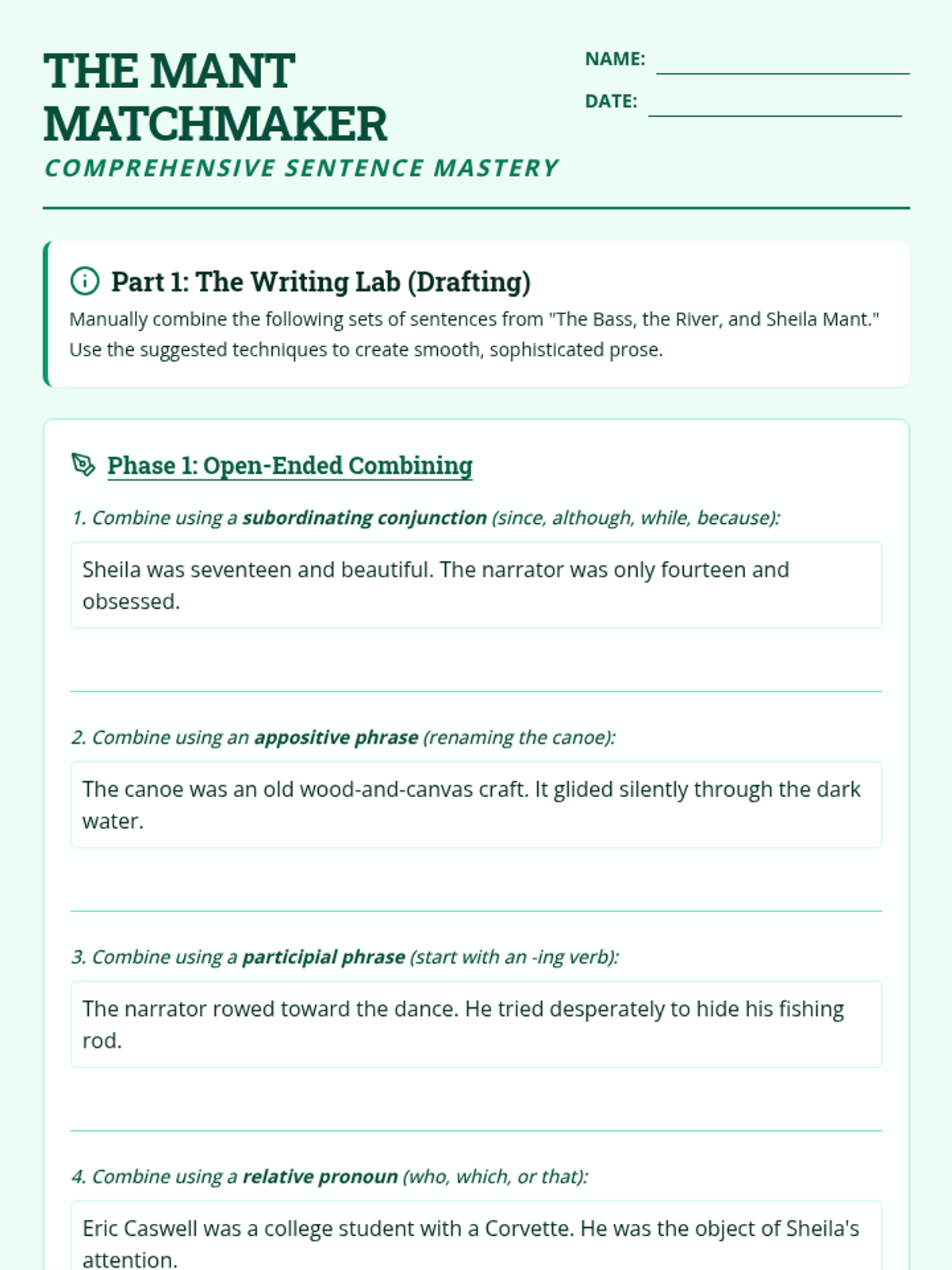
A comprehensive teacher answer key for the updated Mant Matchmaker Worksheet, covering the open-ended combining tasks, multiple-choice questions, and the final narrative flow challenge.
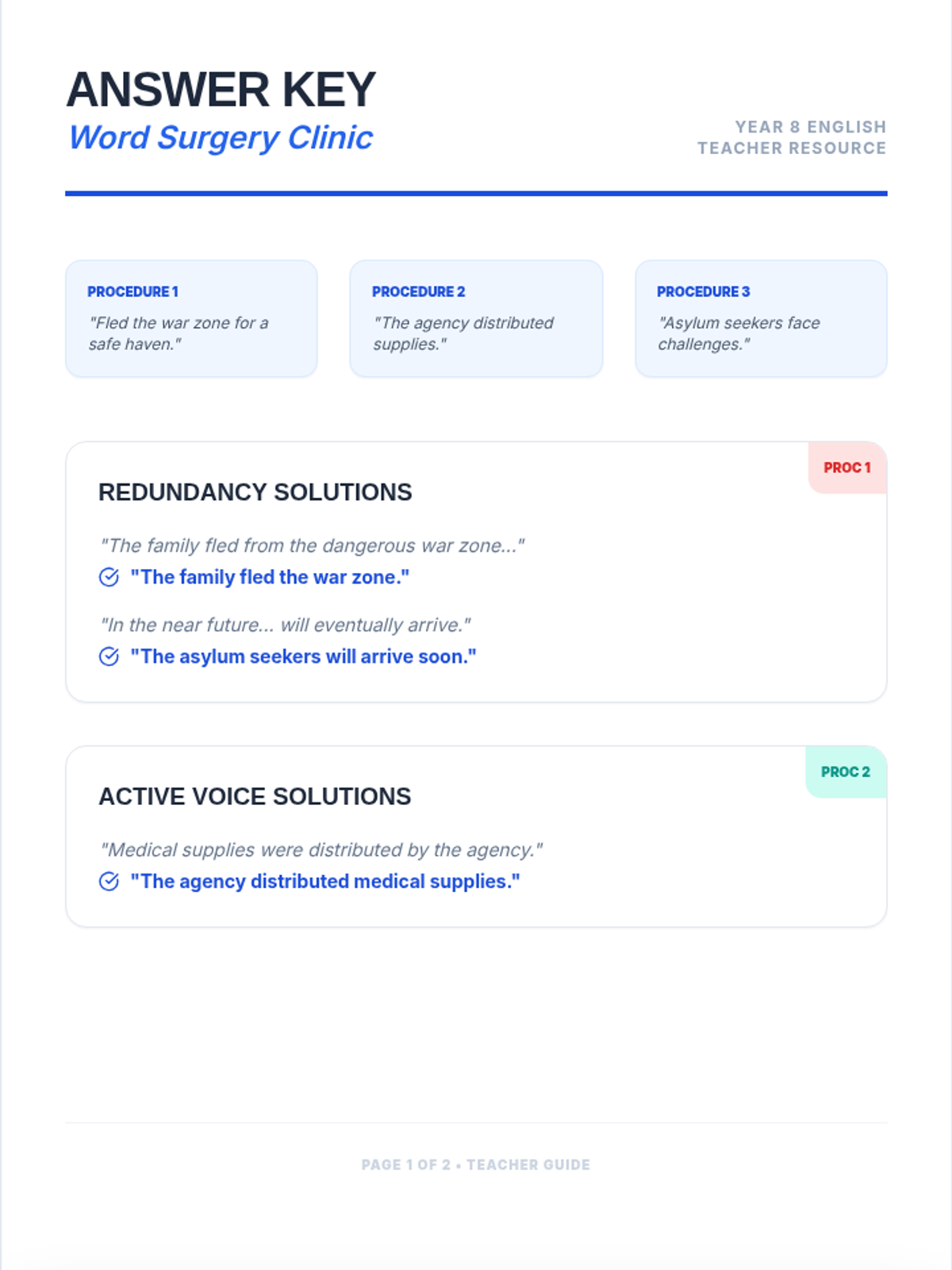
Updated thematic answer key for "Word Surgery" featuring solutions for multi-sentence impact compression exercises focused on refugee contexts. Optimized for A4 printing with strict 720px constraints. Updated for Australian English.
Updated thematic slide deck with a detailed Procedure 4 on "Impact Compression," showing how to distill multi-sentence wordy passages into powerful single statements. Updated for Australian English.
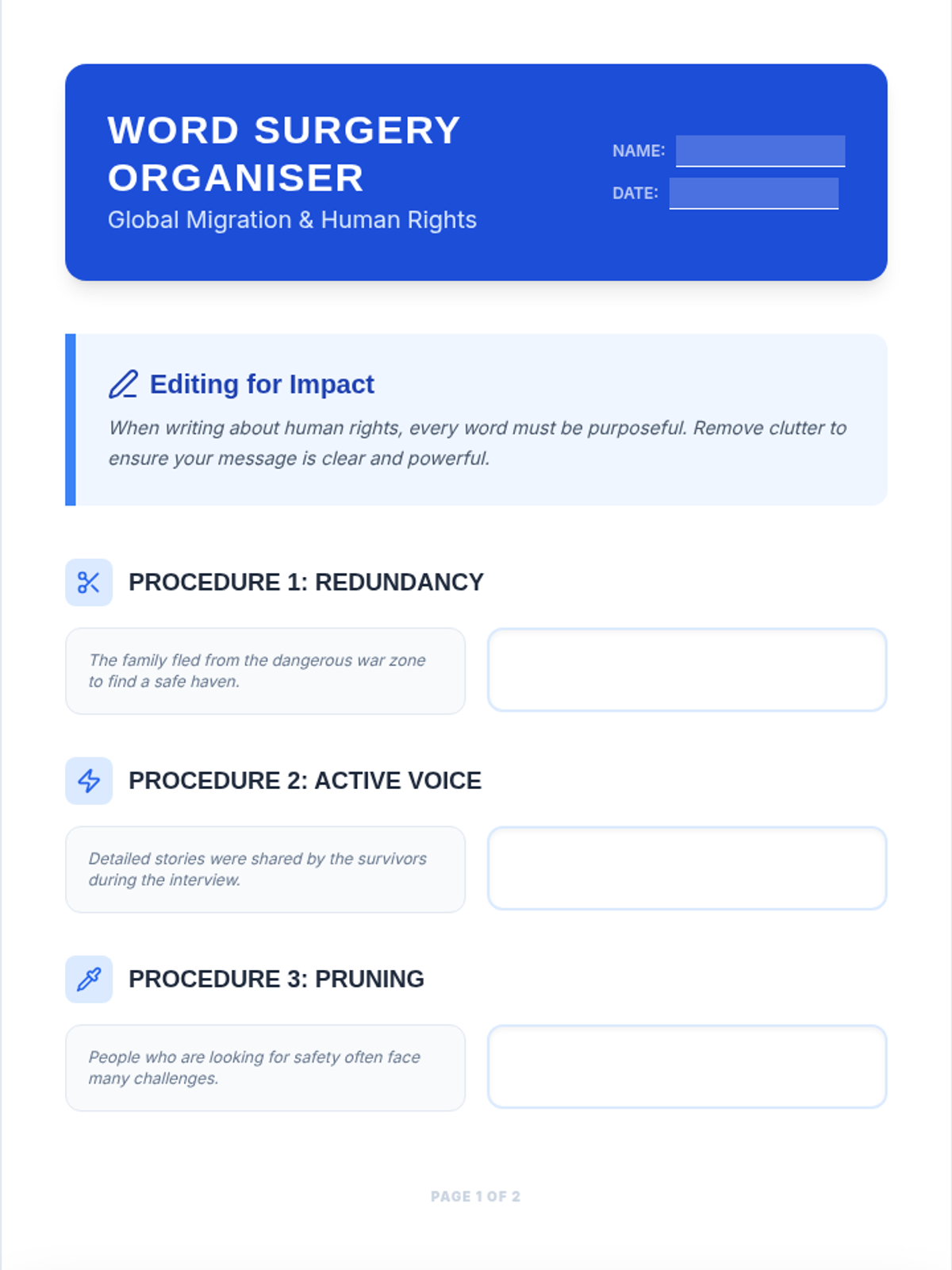
Updated thematic "Word Surgery" organiser with a new "Impact Compression" section, optimised for A4 printing with strict 720px width and clear section-based page breaks. Updated for Australian English.
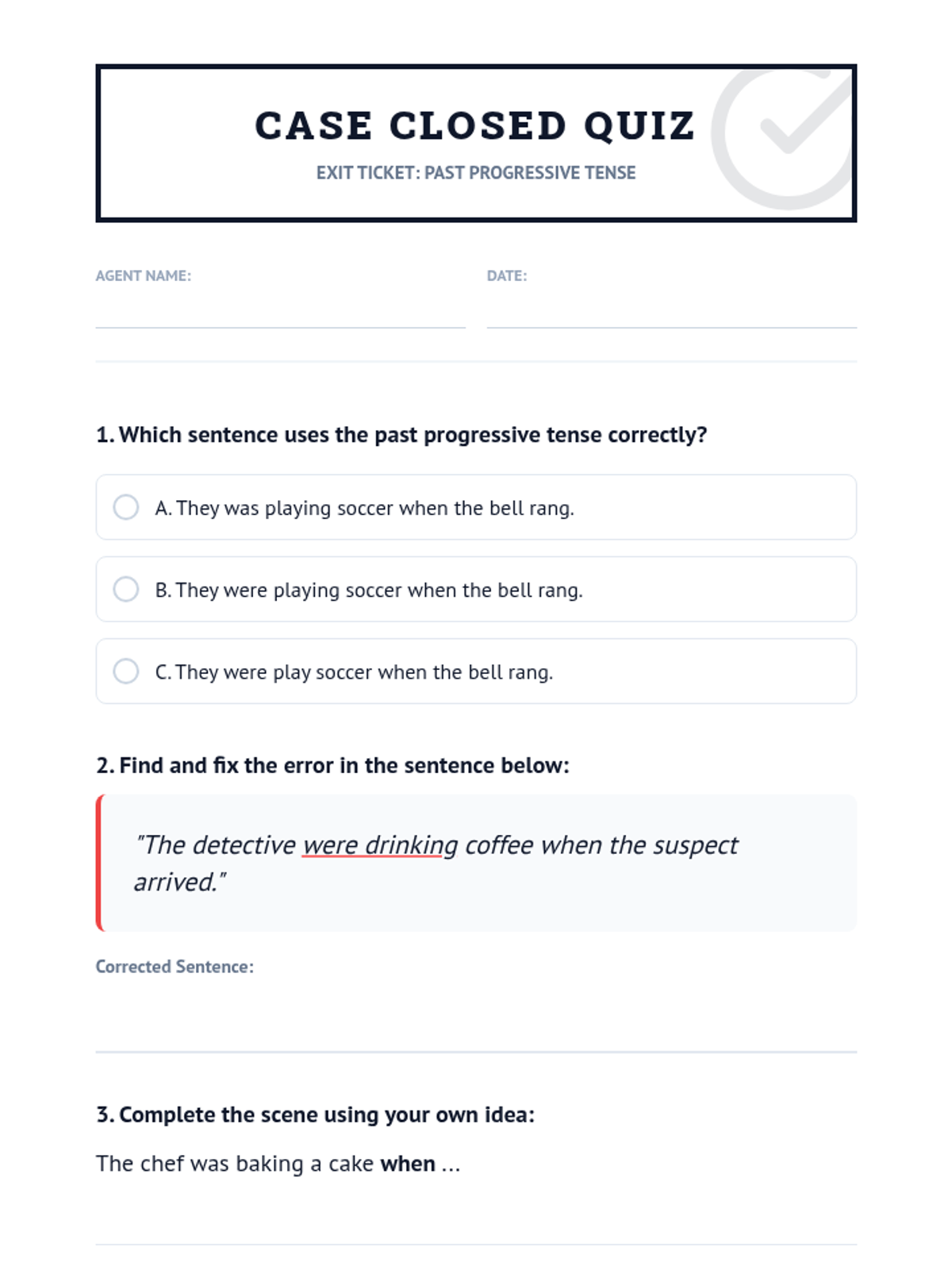
A compact assessment slip to check student understanding of the past progressive tense and interrupted actions.
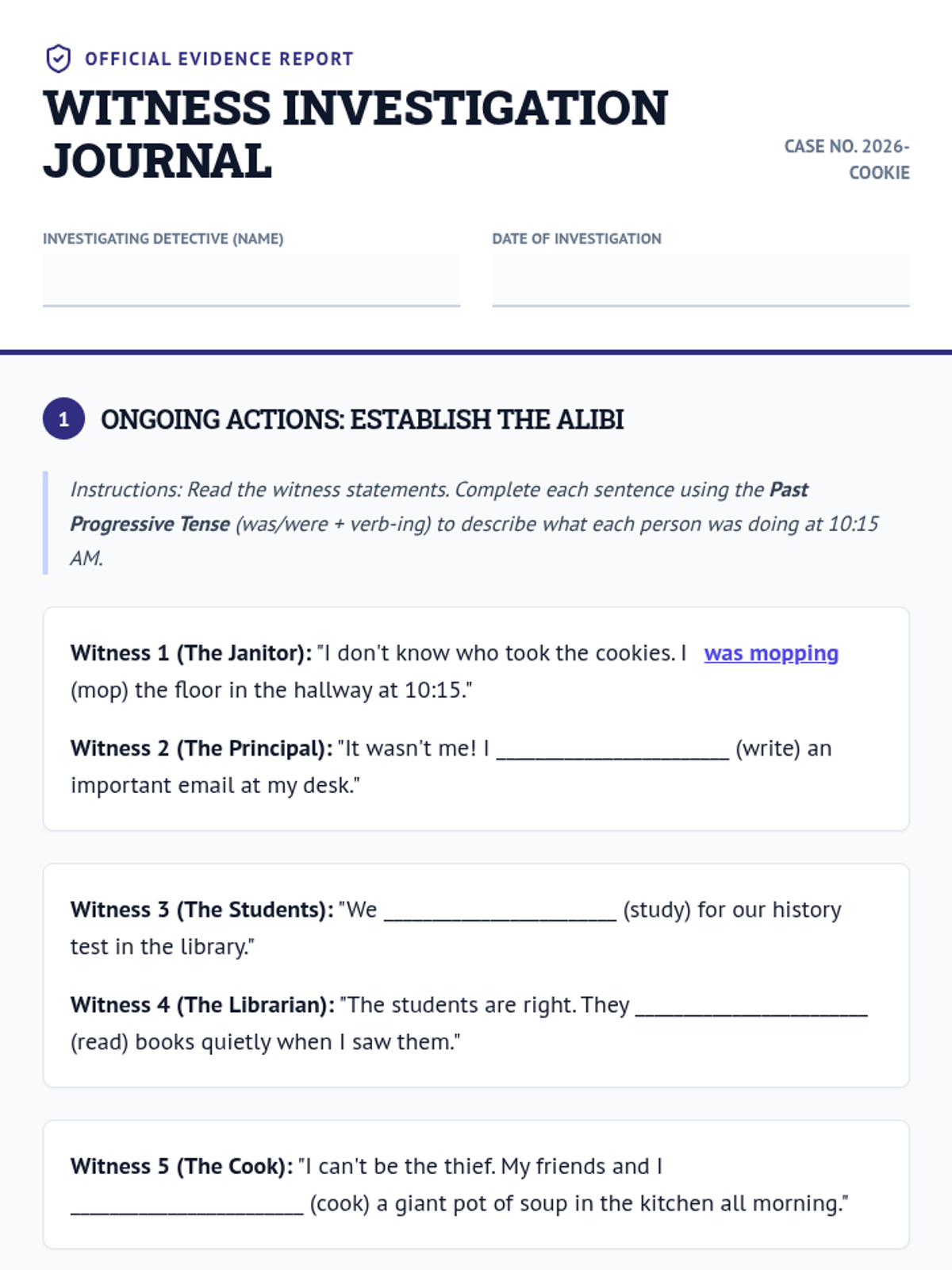
A detective-themed practice worksheet for the past progressive tense, featuring fill-in-the-blank witness statements and sentence combining exercises.
An instructional slide deck for the past progressive tense with a detective mystery theme, covering formation and usage for ongoing and interrupted actions.
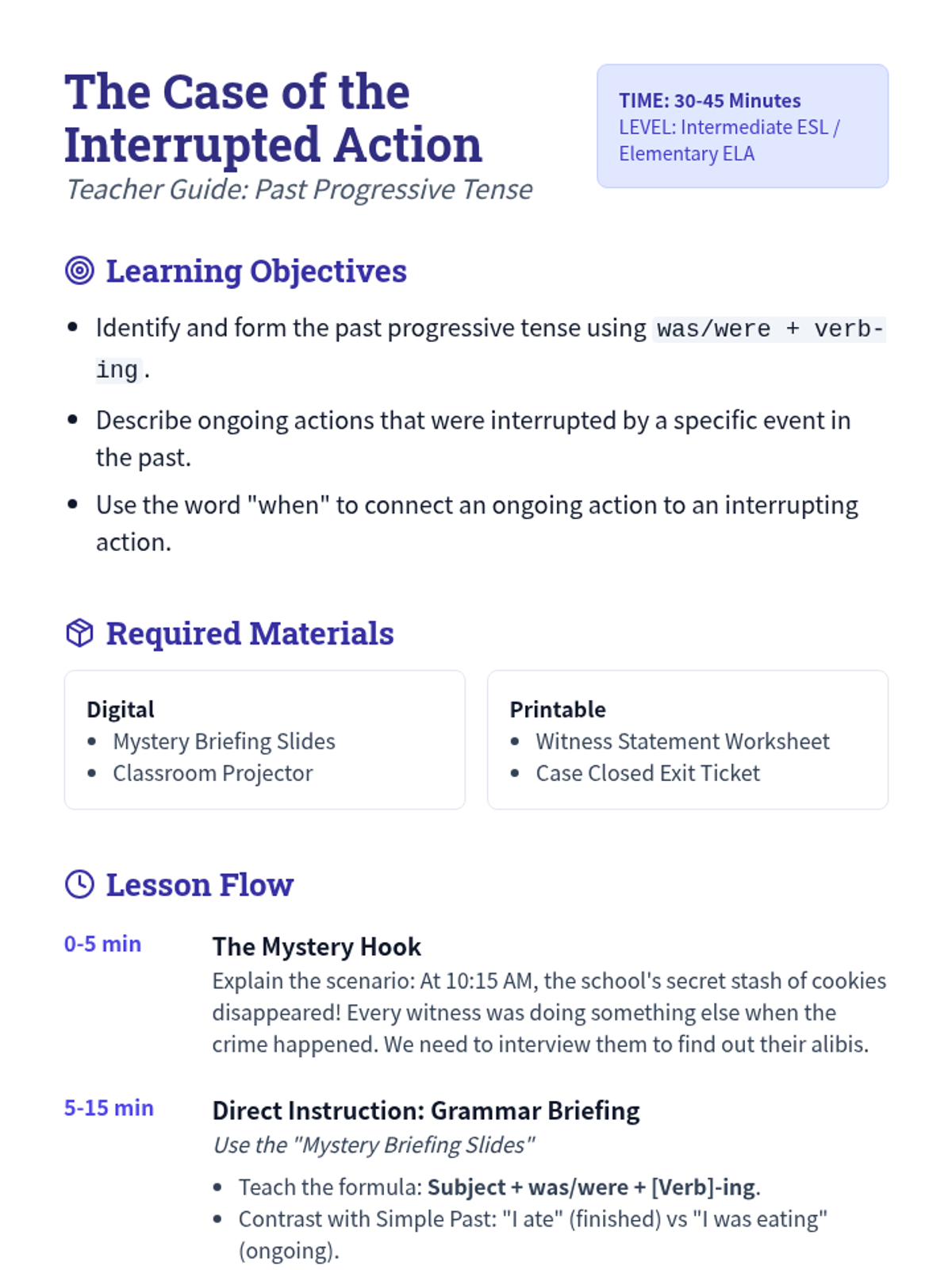
A teacher guide for a 30-45 minute lesson on the past progressive tense, featuring a mystery investigation theme, lesson flow, and teaching tips.
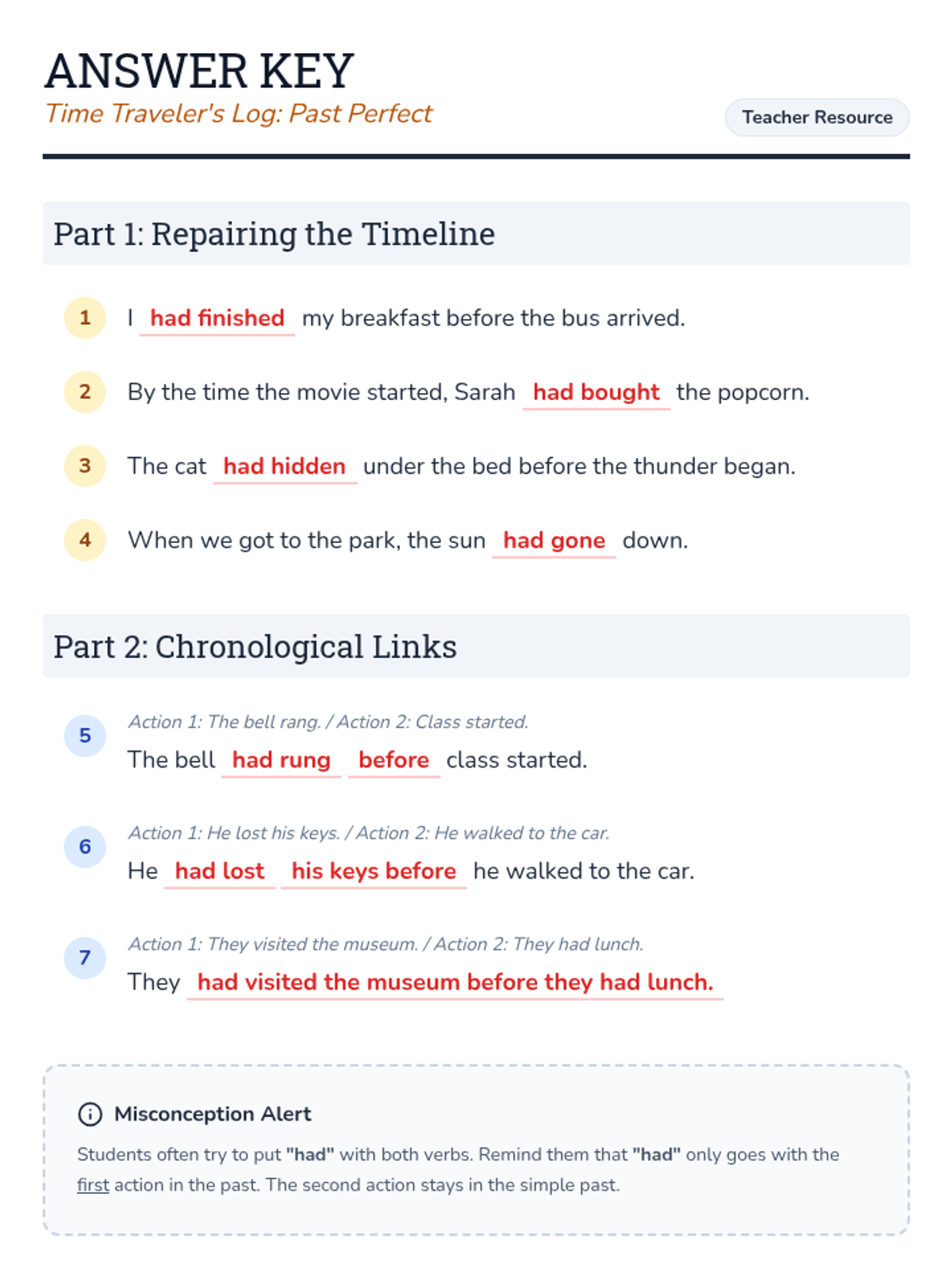
An answer key for the Time Traveler Log worksheet, clearly displaying the correct past perfect forms and completed sentences for all exercises.
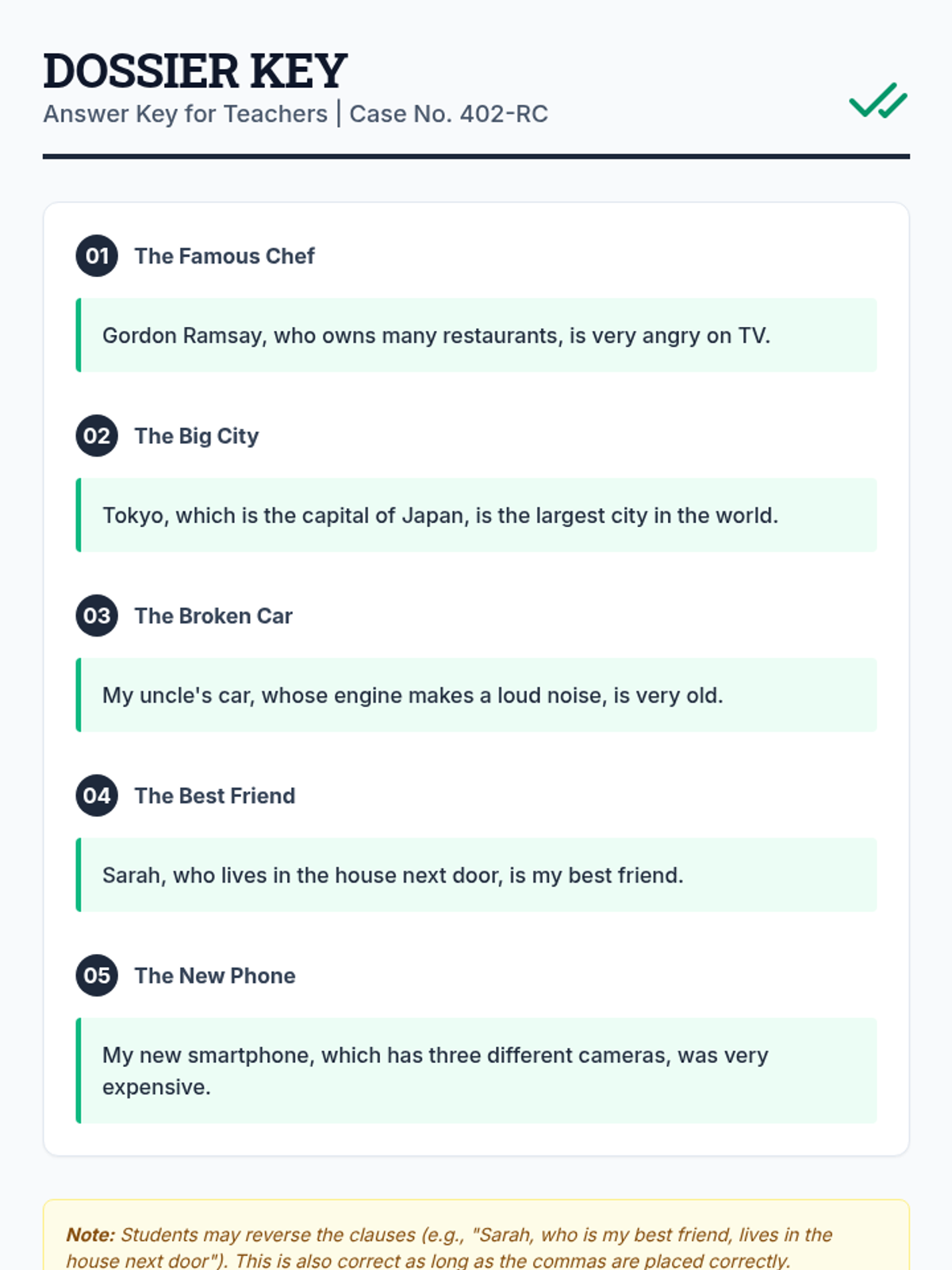
The answer key for the Dossier Linker worksheet, showing correctly combined sentences with non-defining relative clauses.
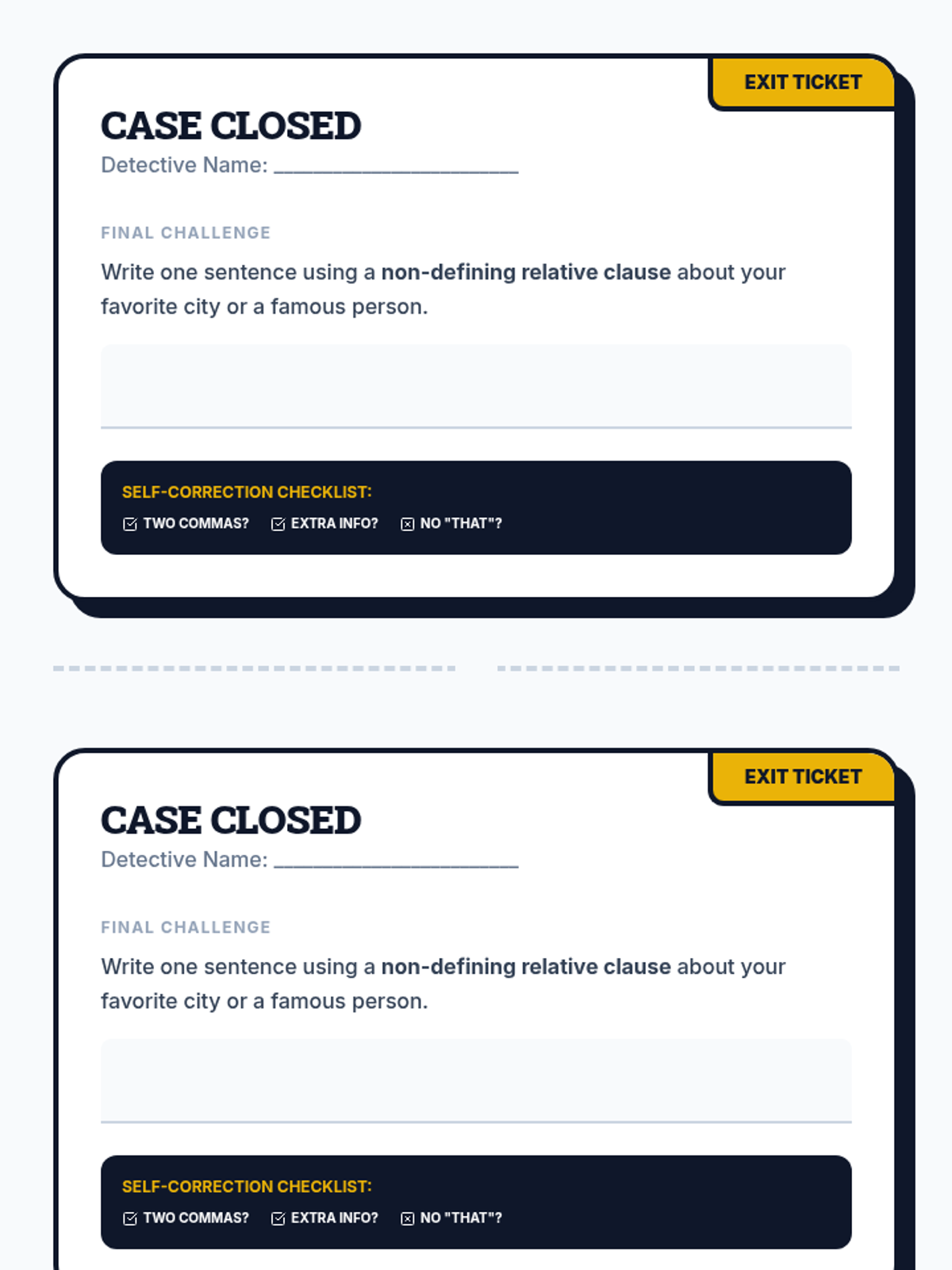
A printable exit ticket for a quick assessment on non-defining relative clauses, featuring a self-correction checklist for students.
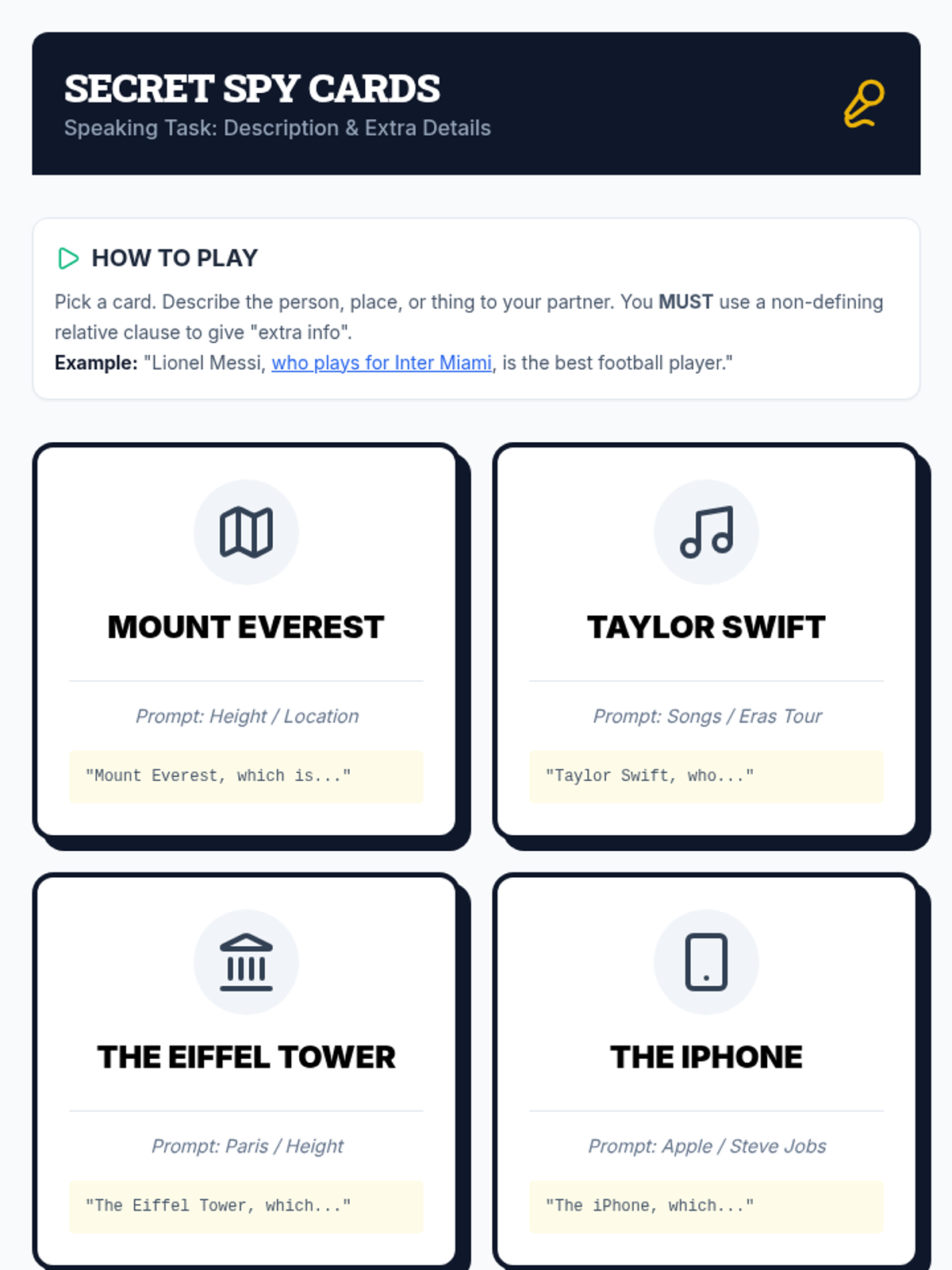
A set of speaking prompt cards for practicing non-defining relative clauses, designed for pair work with specific person/place/thing prompts.
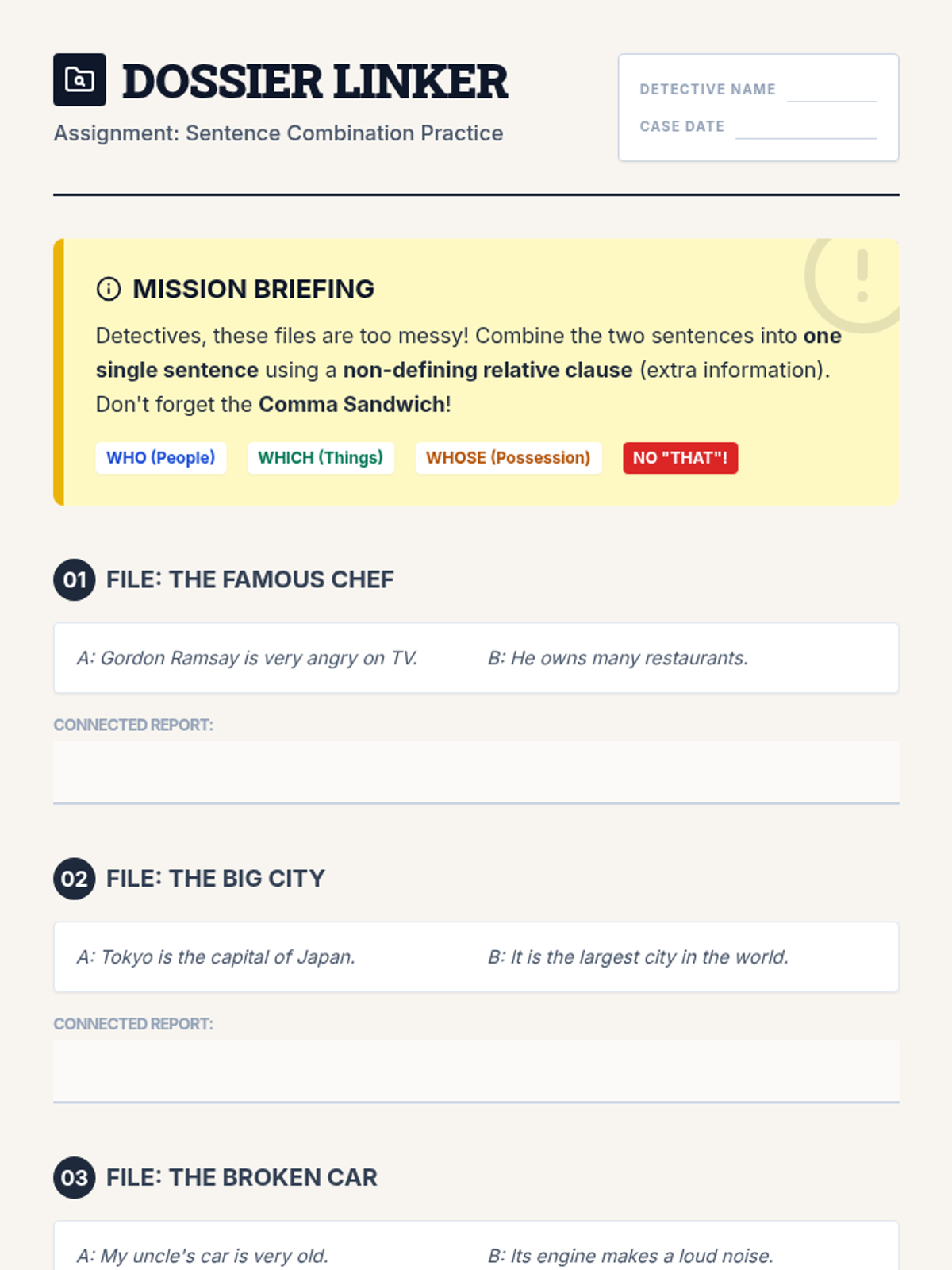
A pair-work worksheet themed as a detective dossier where students combine simple sentences into non-defining relative clauses.
Instructional slides for teaching non-defining relative clauses, featuring visual metaphors like the 'Comma Sandwich' and interactive detective challenges.
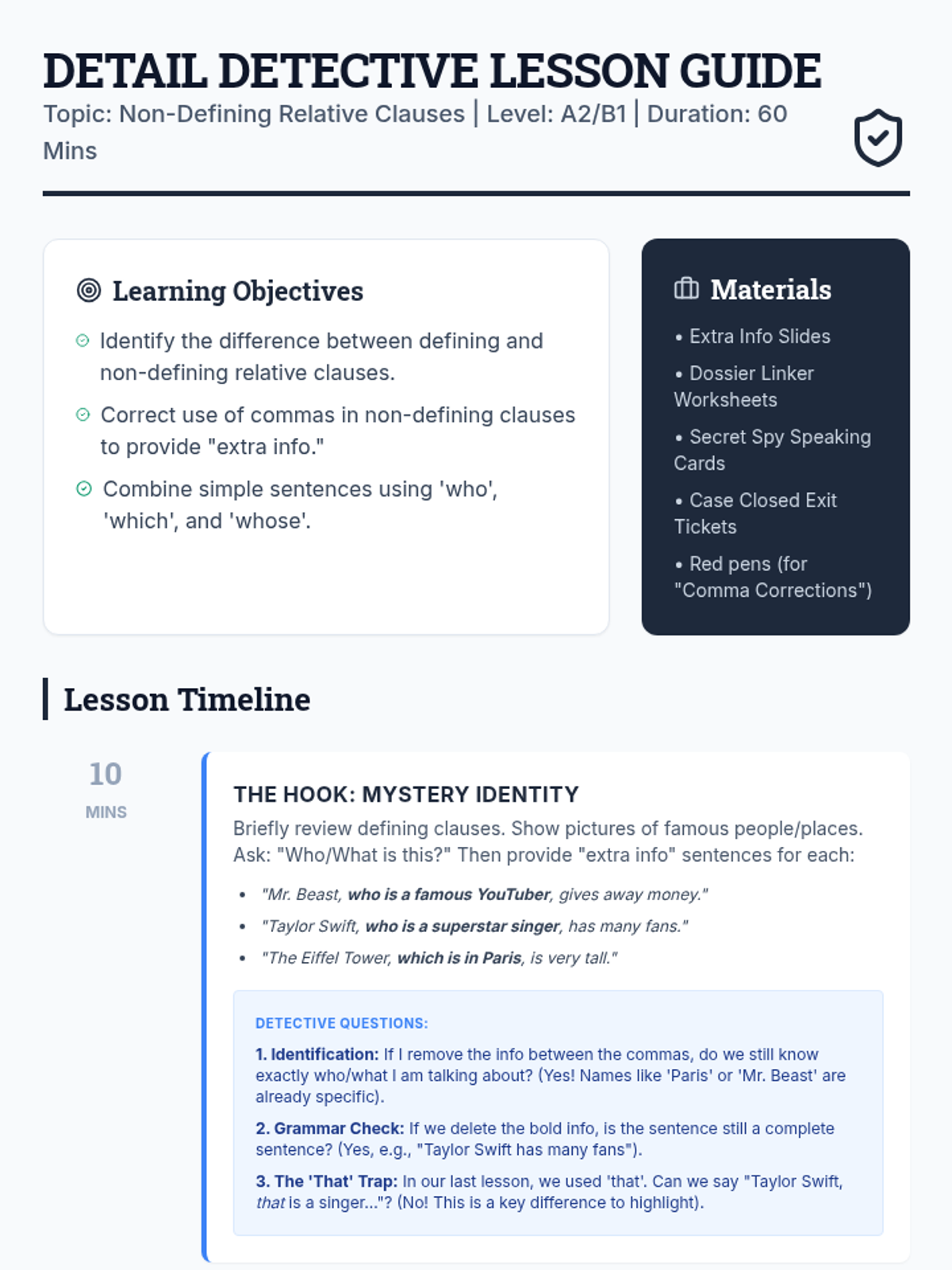
A teacher's lesson guide for teaching non-defining relative clauses to A2/B1 students, themed as a 'Detail Detective' investigation with a clear 60-minute timeline.
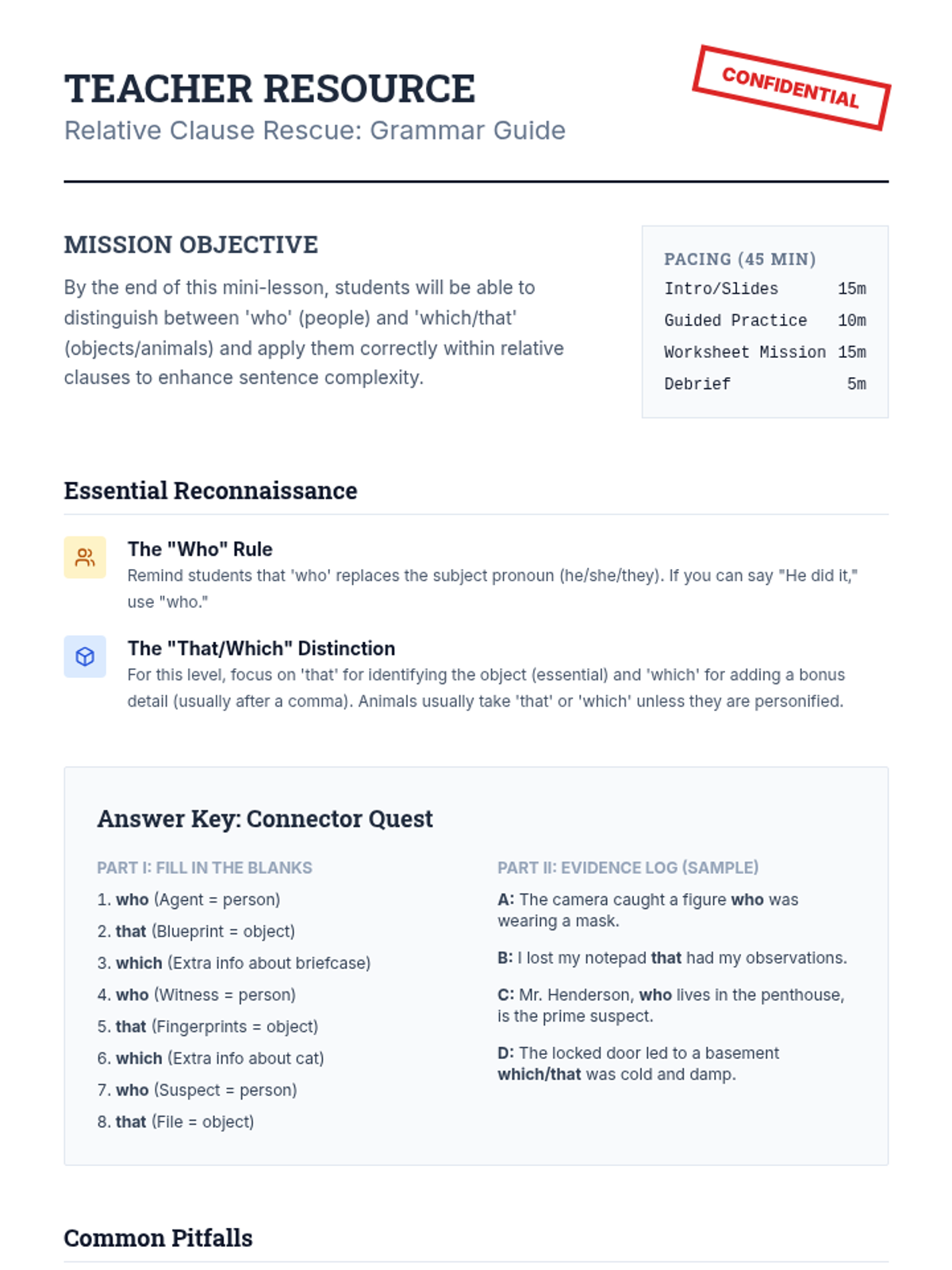
A comprehensive teacher resource containing the lesson plan, teaching tips, common student misconceptions, and a full answer key for the Relative Clause Rescue lesson.
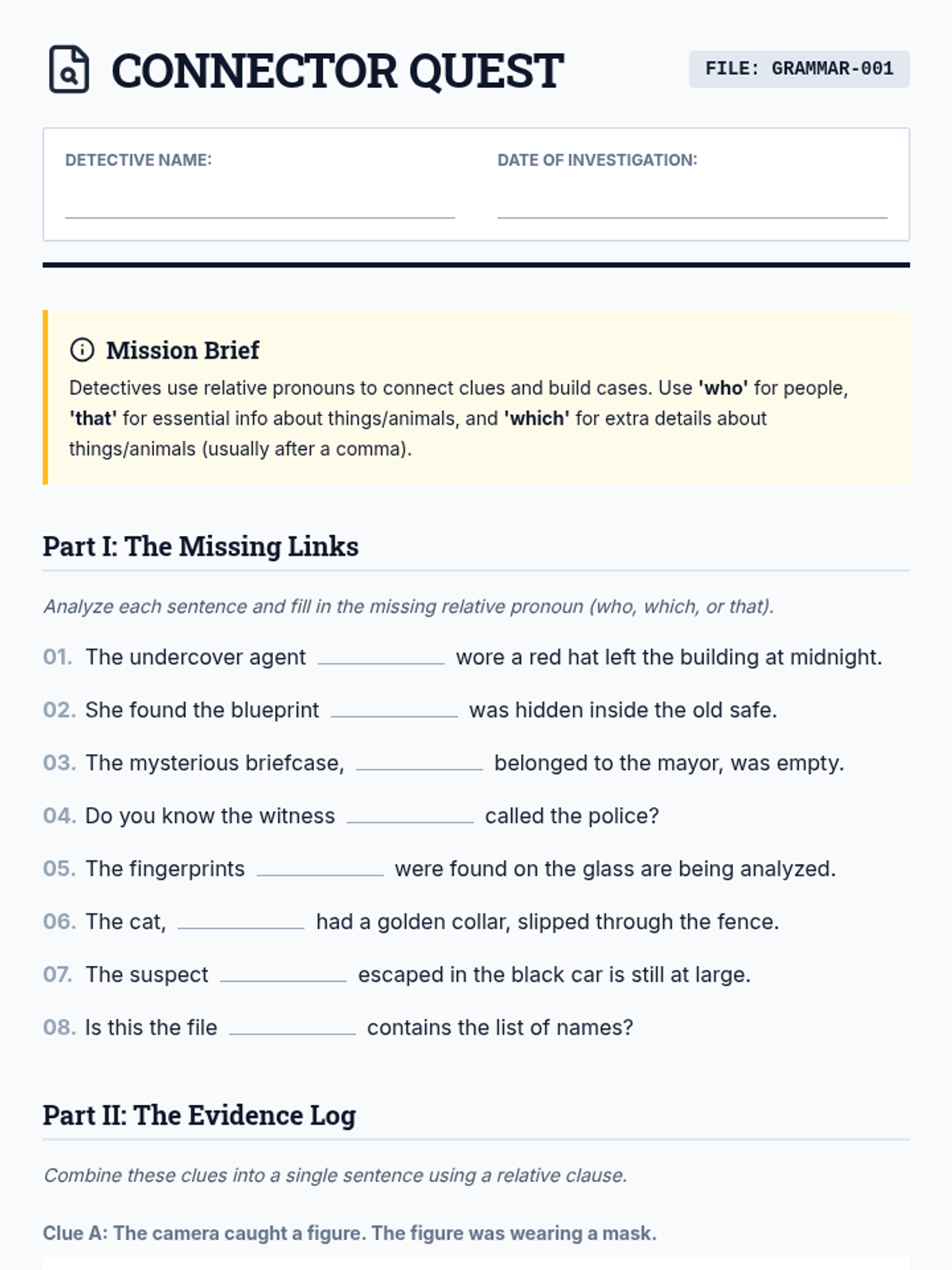
A detective-themed worksheet where students practice identifying and writing relative clauses using 'who', 'which', and 'that'. Includes fill-in-the-blanks, sentence combining, and a creative writing task.
A visually engaging slide deck with a detective theme that introduces the grammar rules for using 'who', 'which', and 'that' in relative clauses. Includes rules, examples, and guided practice for students.
A short exit ticket for students to articulate the rule regarding the use of 'which' with people. Includes two slips per page for efficient printing.
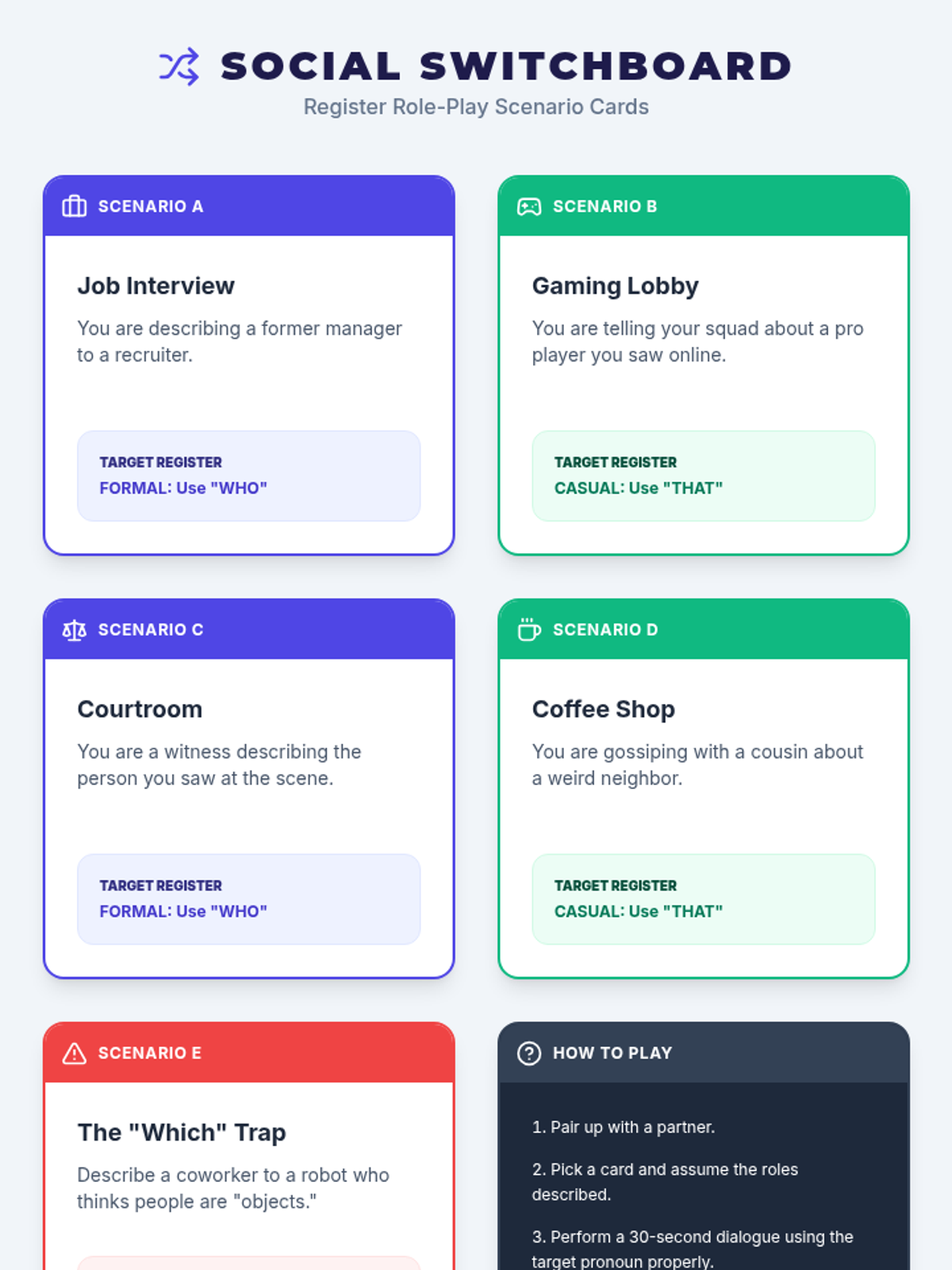
Role-play scenario cards for practicing the use of 'who' and 'that' in various formal and informal settings.
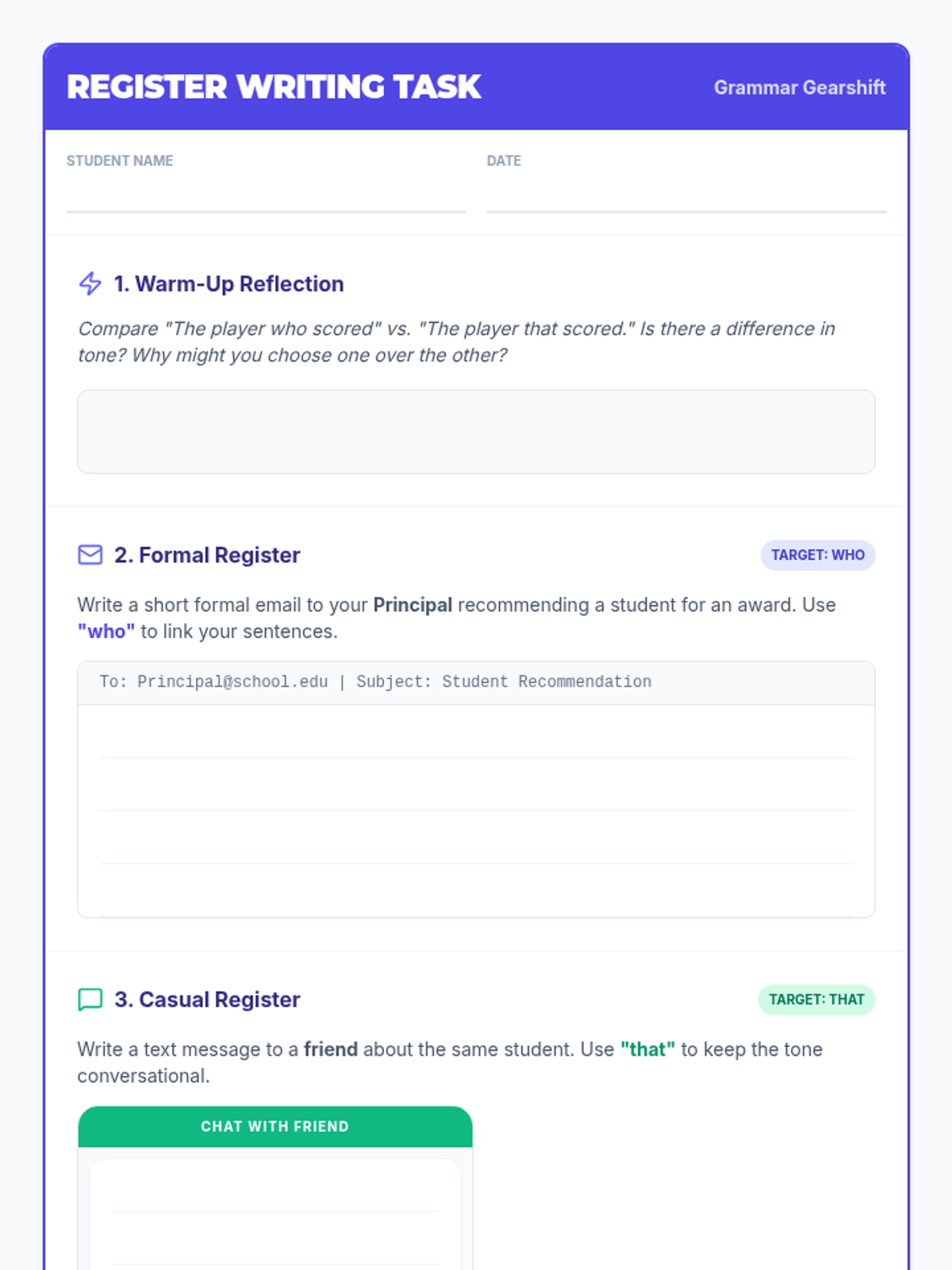
A student activity worksheet for practicing formal and informal writing registers using 'who' and 'that', including an extension on restrictive vs. non-restrictive clauses.
Visual presentation slides for the Grammar Gearshift lesson, covering pronoun rules, the concept of register, video integration, and writing tasks.
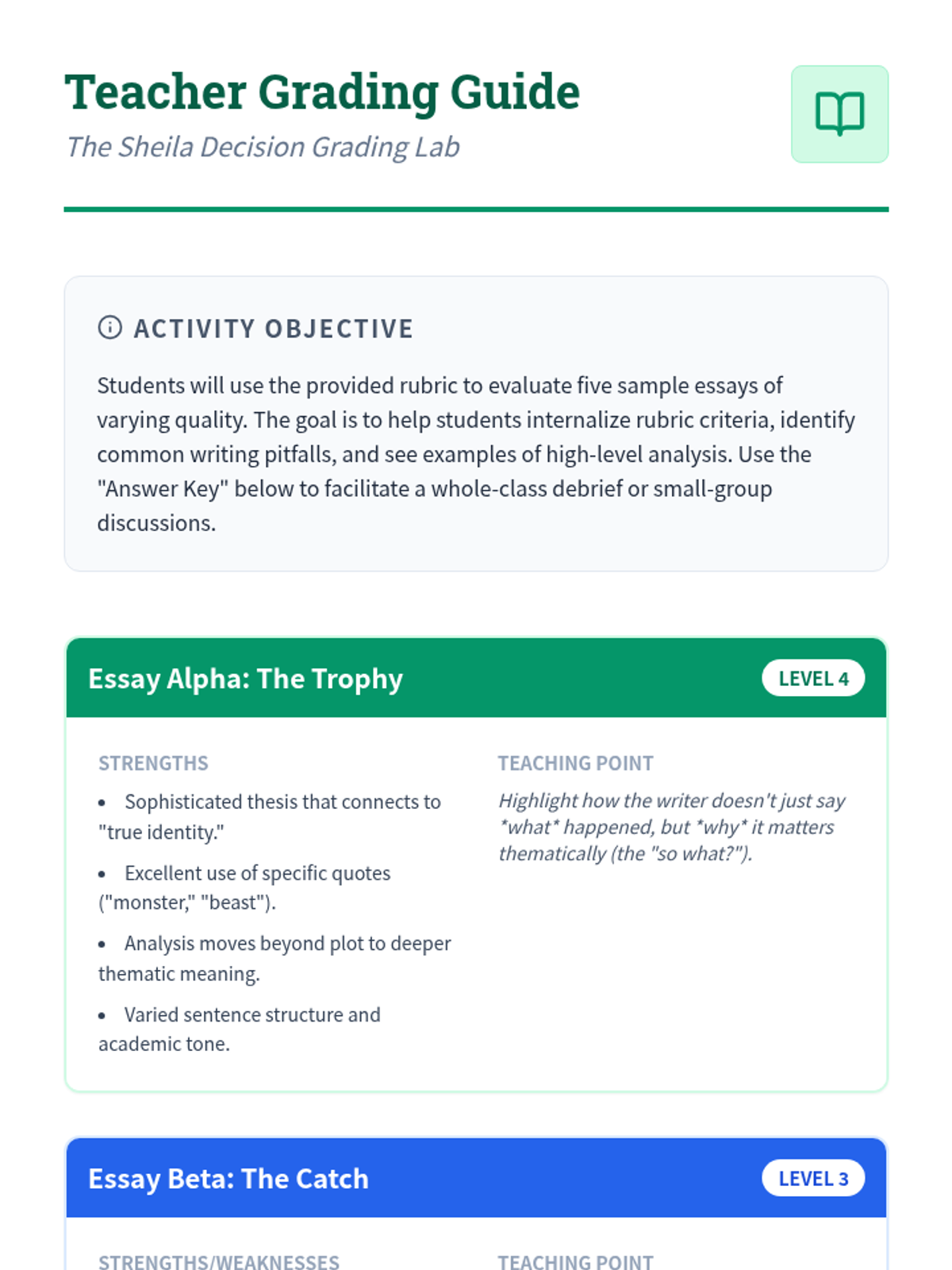
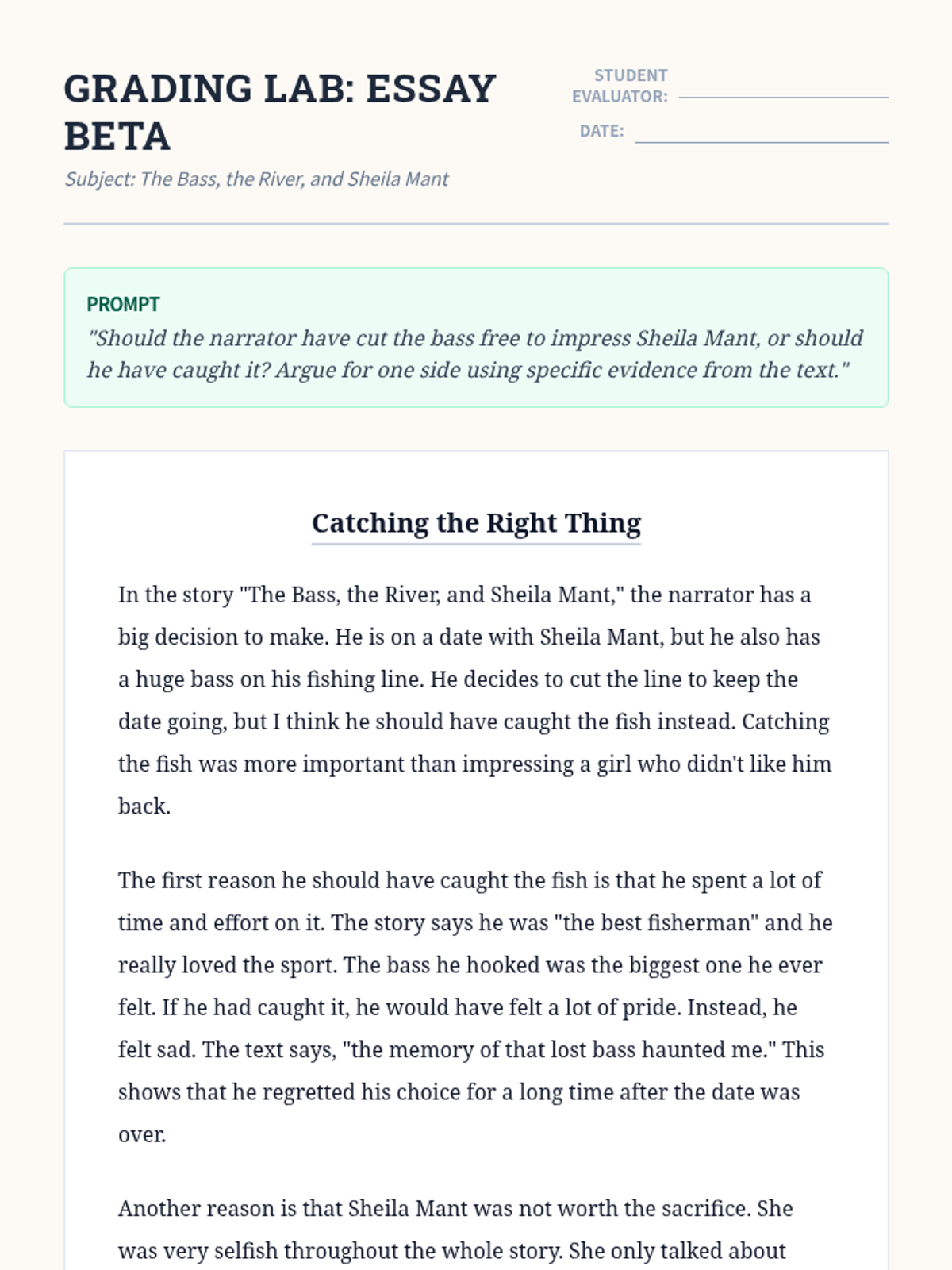
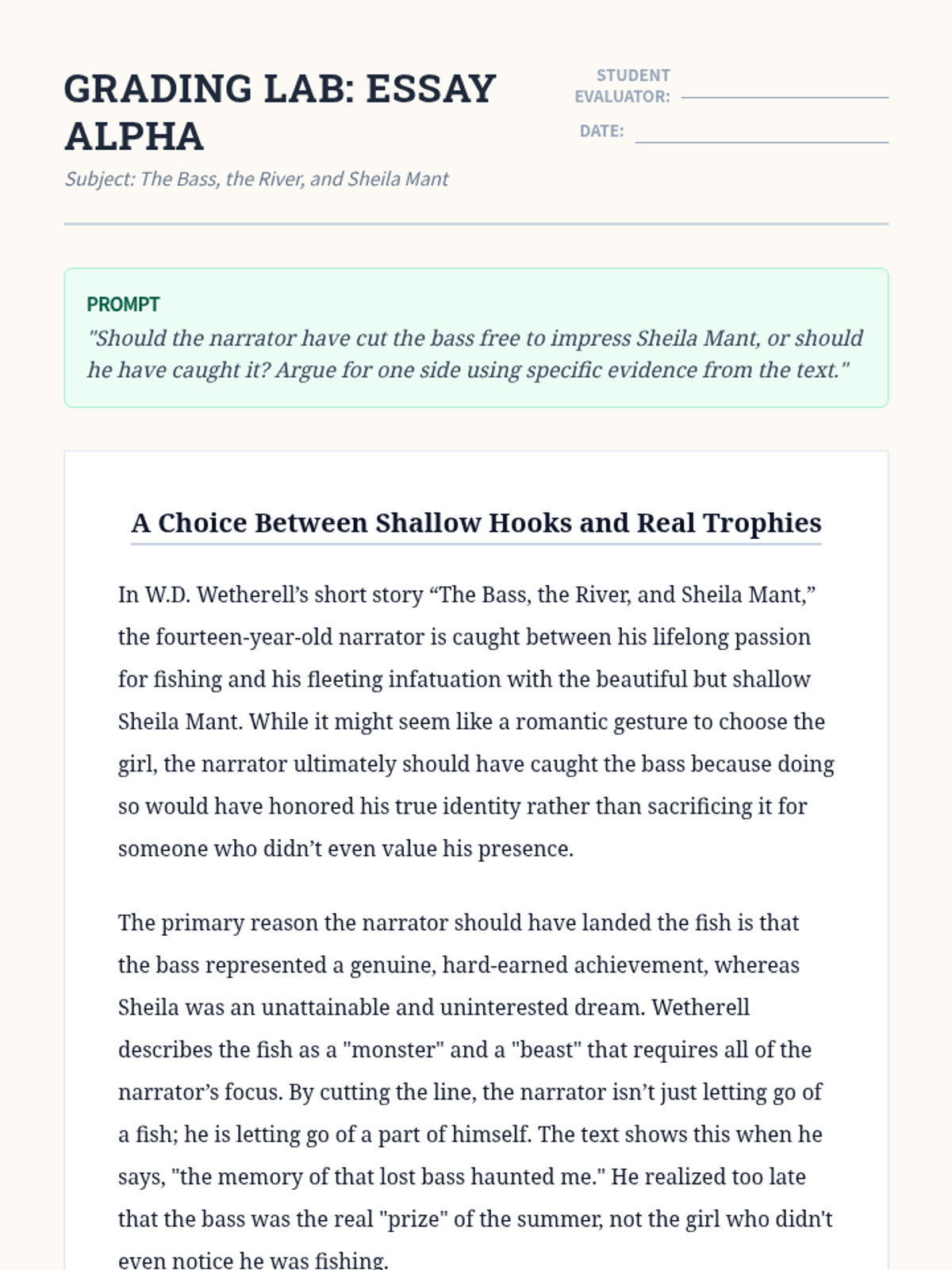
A comprehensive teacher guide for the grading lab, providing intended scores, detailed rationales for each of the five essays, teaching points, and discussion prompts for a whole-class debrief.
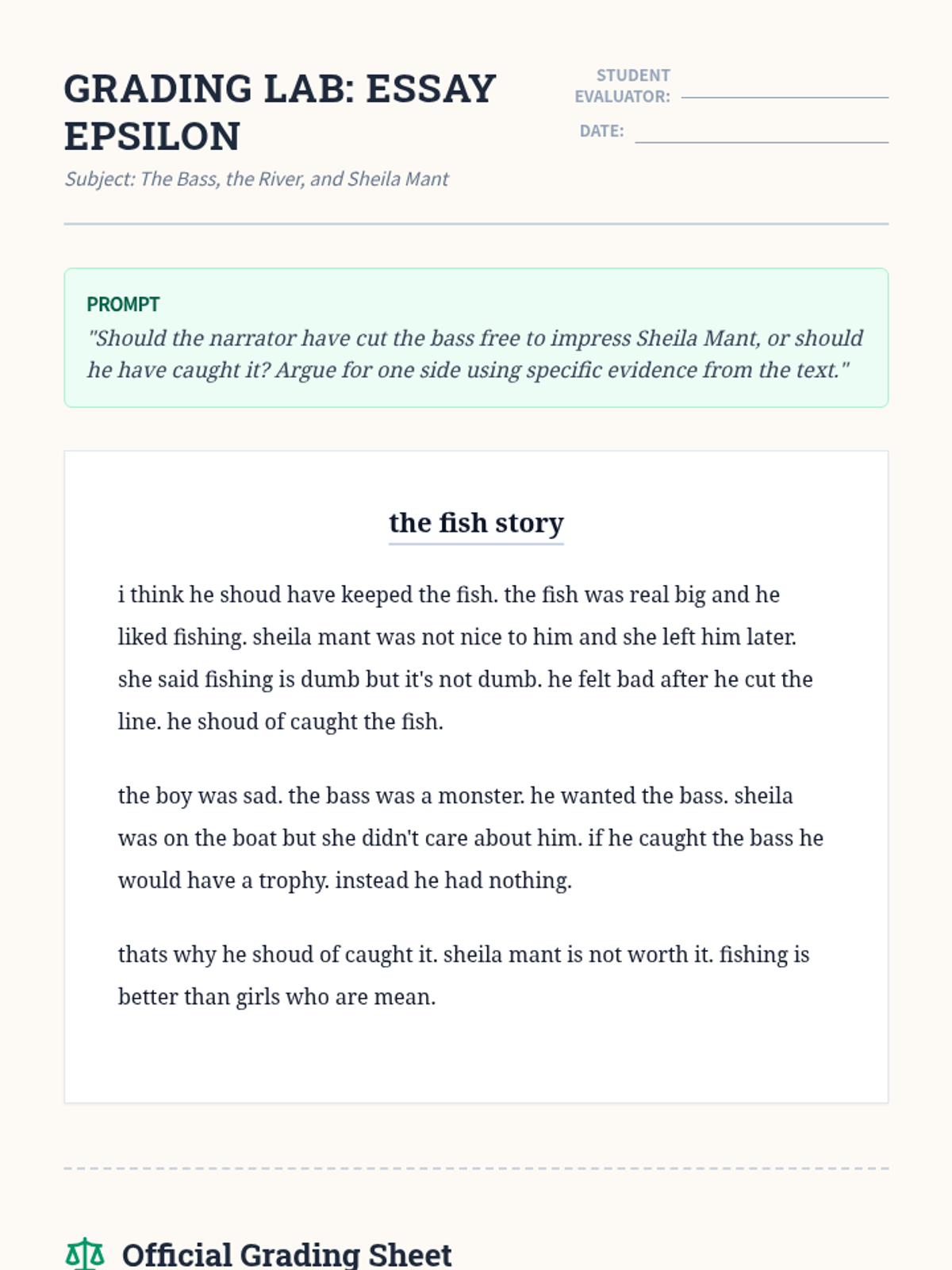
The fifth practice essay for the grading lab, featuring an emerging/beginning (Level 1) response. This essay is very brief, lacks textual evidence, and contains significant grammatical and mechanical errors.
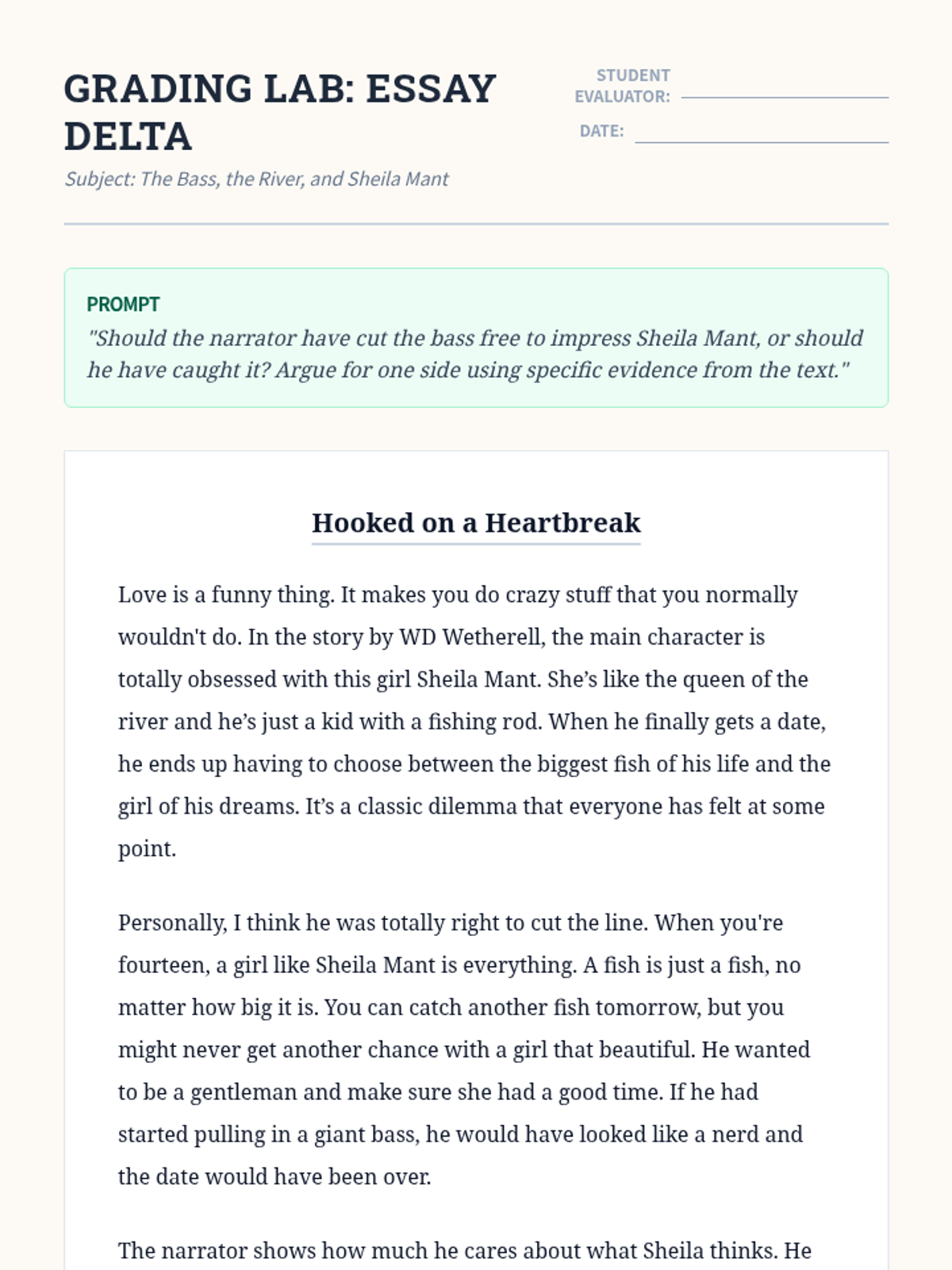
The fourth practice essay for the grading lab, featuring a stylistically strong but academically weak (Level 2/3) response. While the writing is engaging, it relies on personal opinion rather than textual evidence and analysis.
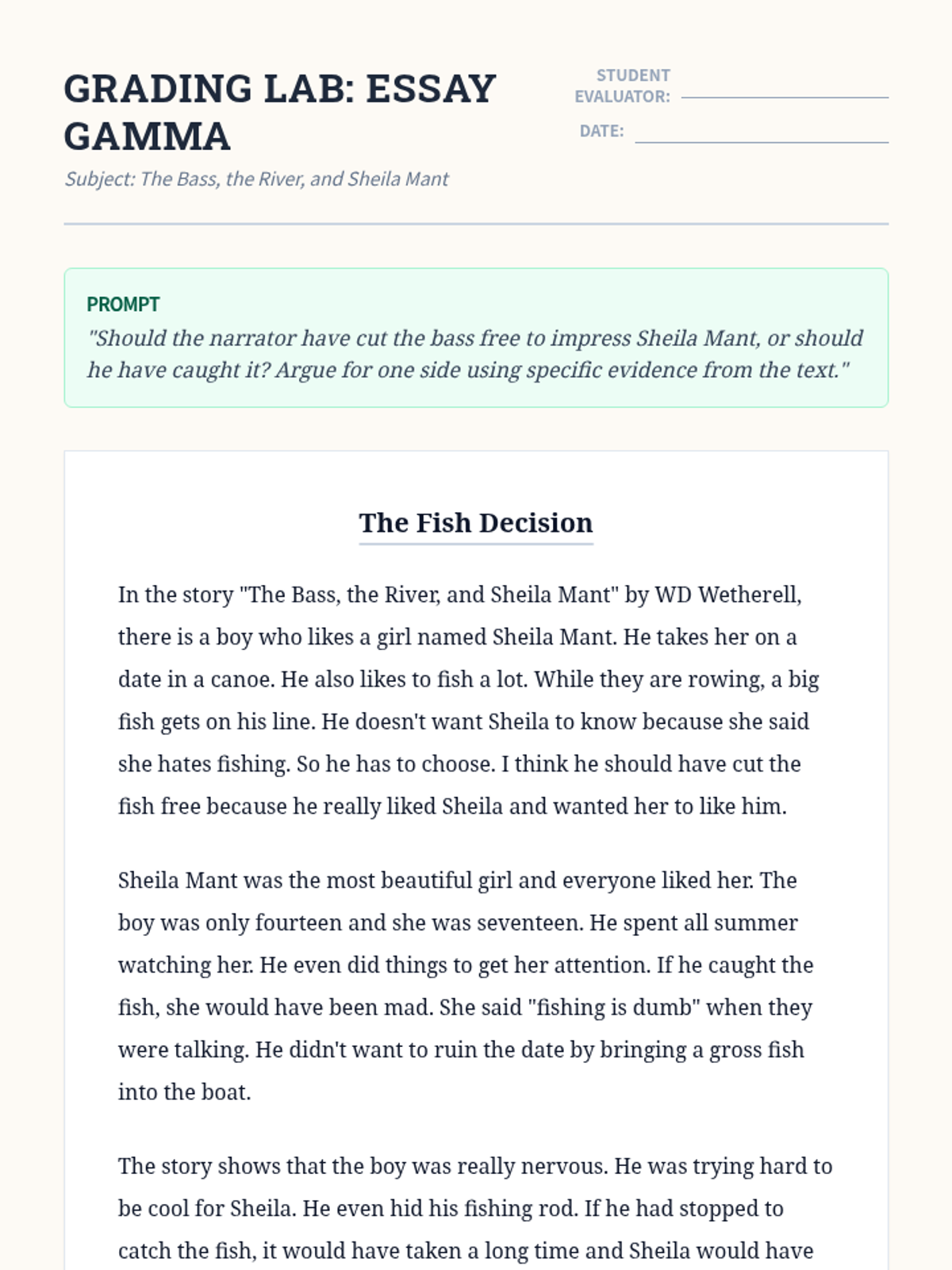
The third practice essay for the grading lab, featuring a developing (Level 2) response. This essay relies heavily on plot summary and lacks specific textual evidence or deep analysis.
The second practice essay for the grading lab, featuring a proficient (Level 3) response. The writing is clear and the claim is supported, but the analysis is more straightforward and less nuanced than Essay Alpha.
The first practice essay for the grading lab, featuring a high-quality (Level 4) argumentative response arguing that the narrator should have kept the fish. Includes a standardized grading rubric and work area for student evaluation.
A visual presentation to introduce the grading lab activity, the essential question regarding the story's conflict, and the rubric criteria students will use to evaluate the essays.
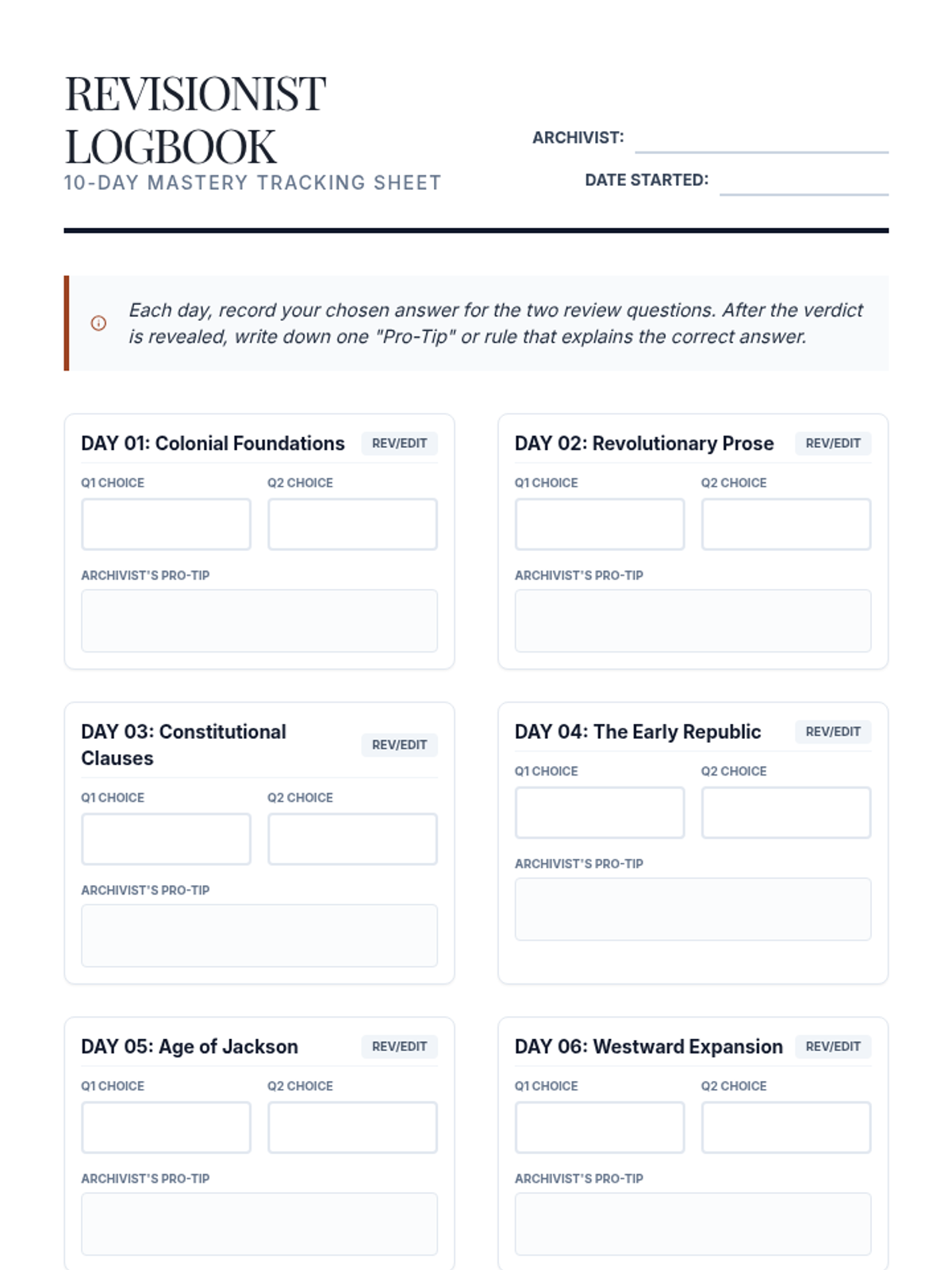
A student-facing logbook to record answers and reflections over the ten-day revising and editing review. Includes space for tracking choices and writing down key grammar tips learned each day.
A comprehensive 41-slide presentation featuring ten days of revising and editing review questions grounded in 8th Grade Texas US History content. Each day includes two multiple-choice questions with detailed answers and explanations to reinforce both ELAR TEKS and social studies knowledge.
Una presentación de diapositivas que guía a los estudiantes a través de la estructura de la Respuesta Escrita Larga (ECR), incluyendo consejos sobre cómo usar evidencia y citas del texto.
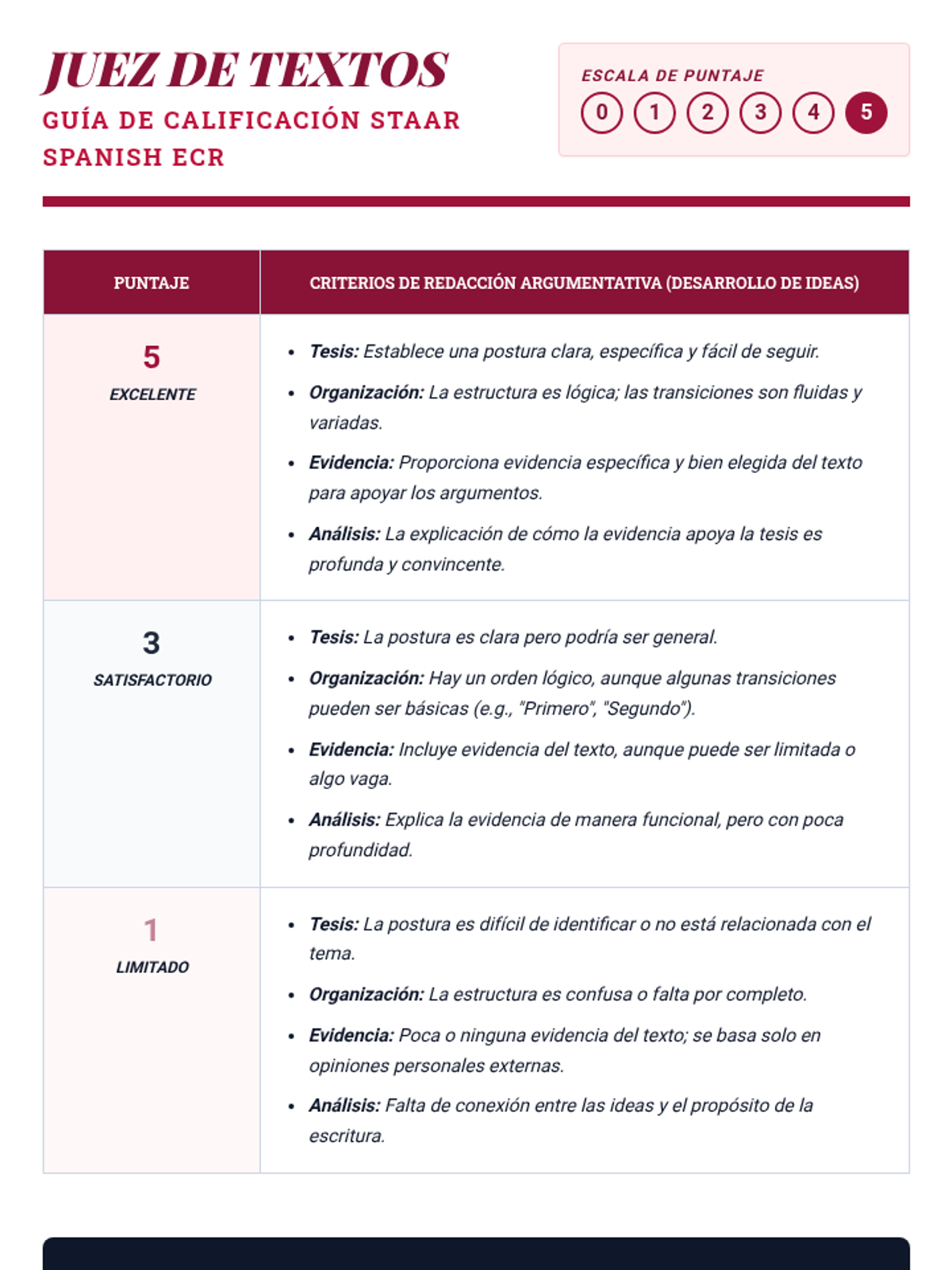
Una guía de calificación para maestros que detalla la rúbrica de 5 puntos para la Respuesta Escrita Larga (ECR) en español. Incluye criterios para el desarrollo de ideas y convenciones del lenguaje.
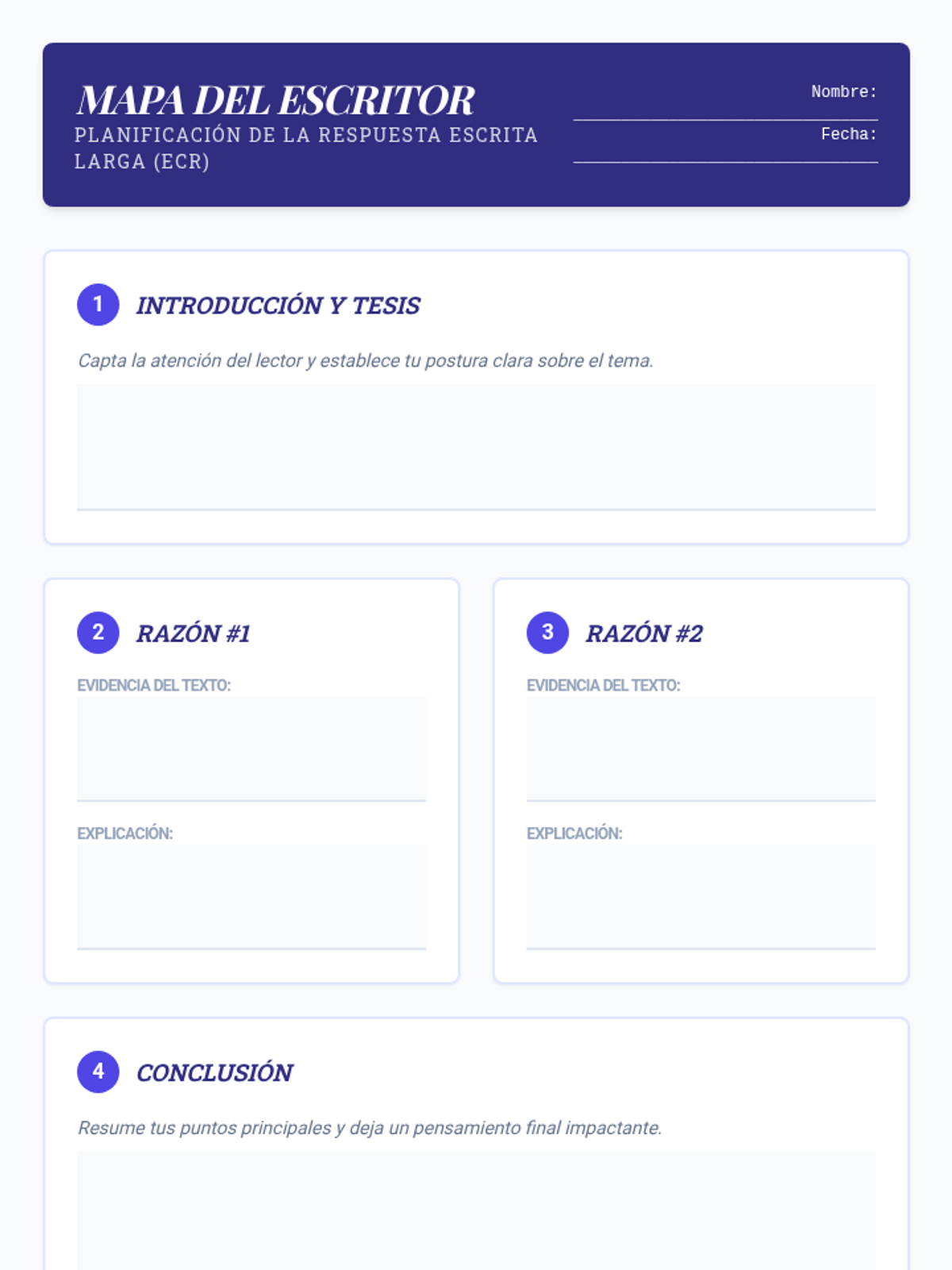
Un organizador gráfico diseñado para ayudar a los estudiantes a estructurar su respuesta escrita larga (ECR). Incluye secciones para la tesis, razones con evidencia y una lista de verificación final.
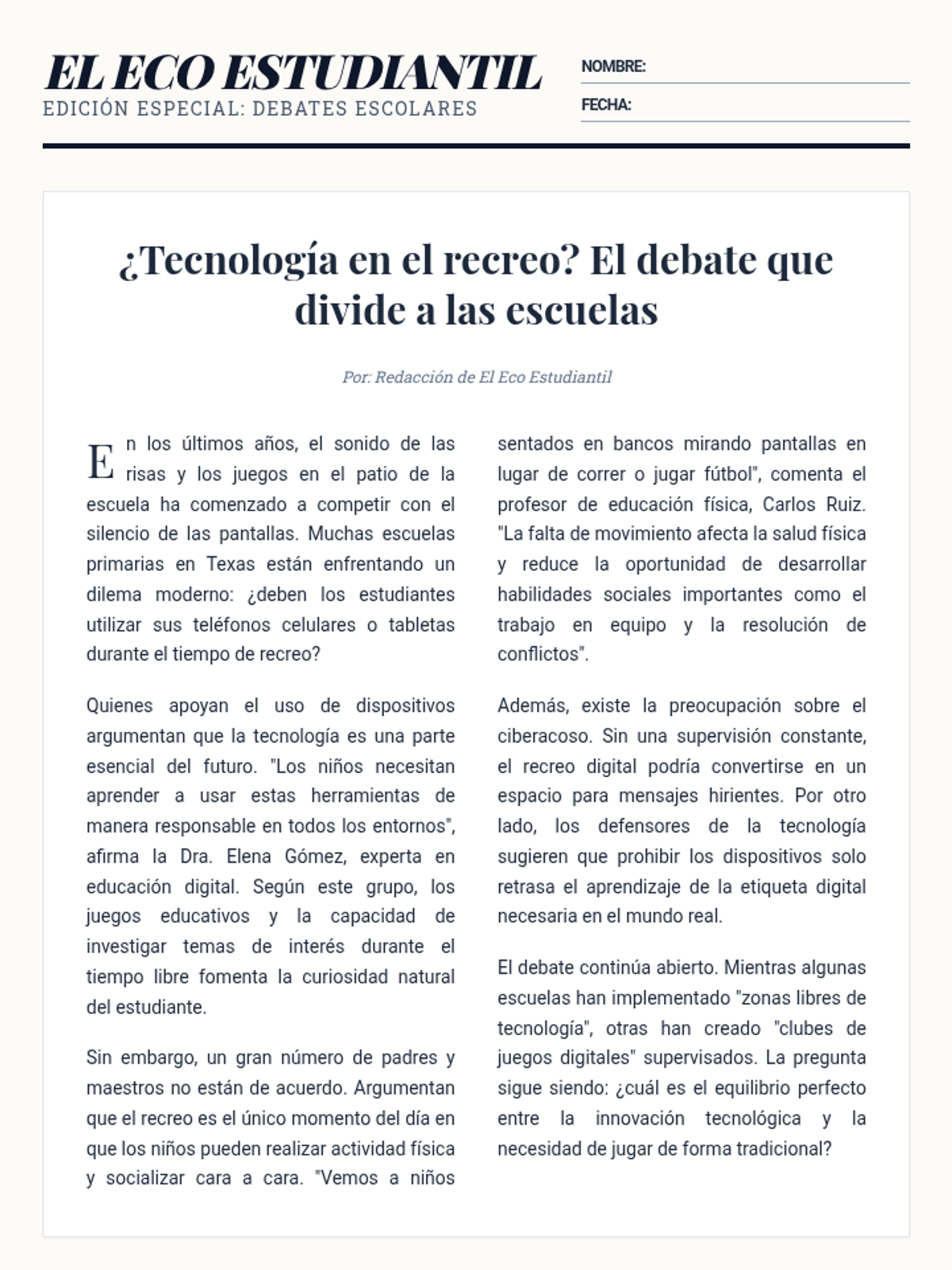
Un pasaje de lectura informativo sobre el uso de la tecnología en las escuelas seguido de una instrucción de escritura argumentativa (ECR) al estilo STAAR. Incluye espacio para la redacción del estudiante con líneas de escritura.
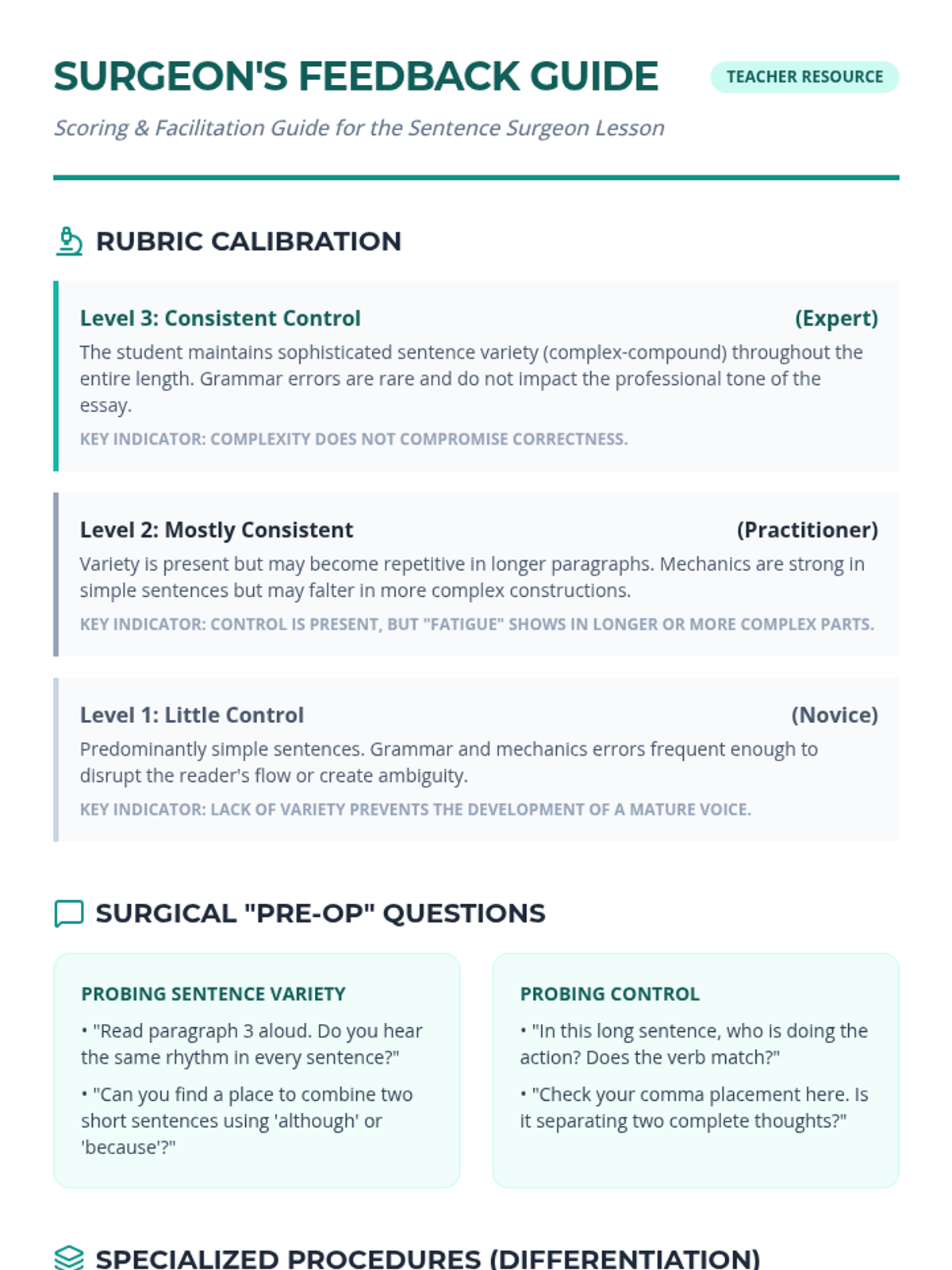
A professional teacher-facing guide for using the Sentence Surgeon checklist, featuring rubric calibration notes, discussion prompts, and differentiation strategies.
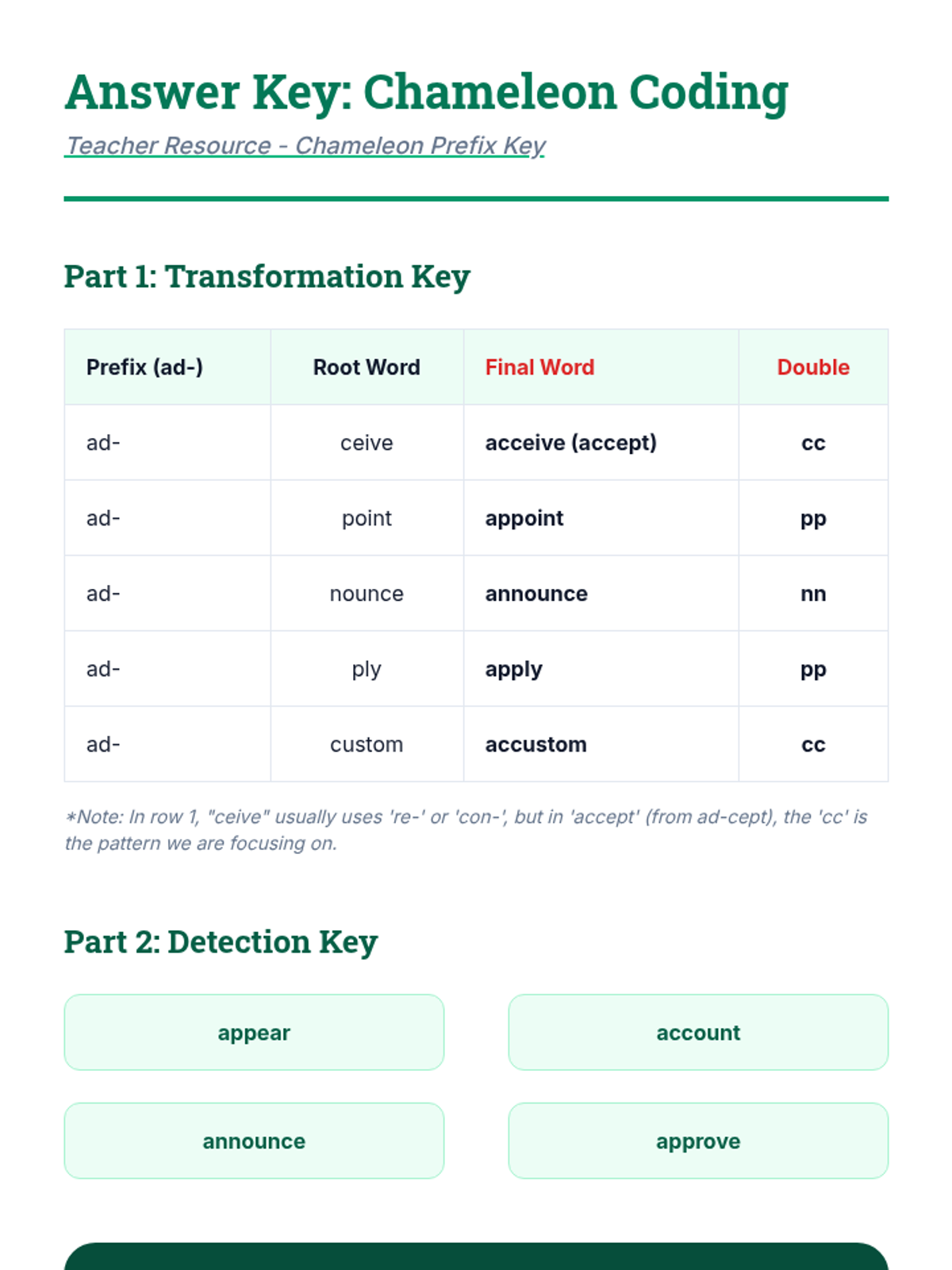
Teacher answer key for the Chameleon Challenge Worksheet, with explanations of prefix assimilation logic.
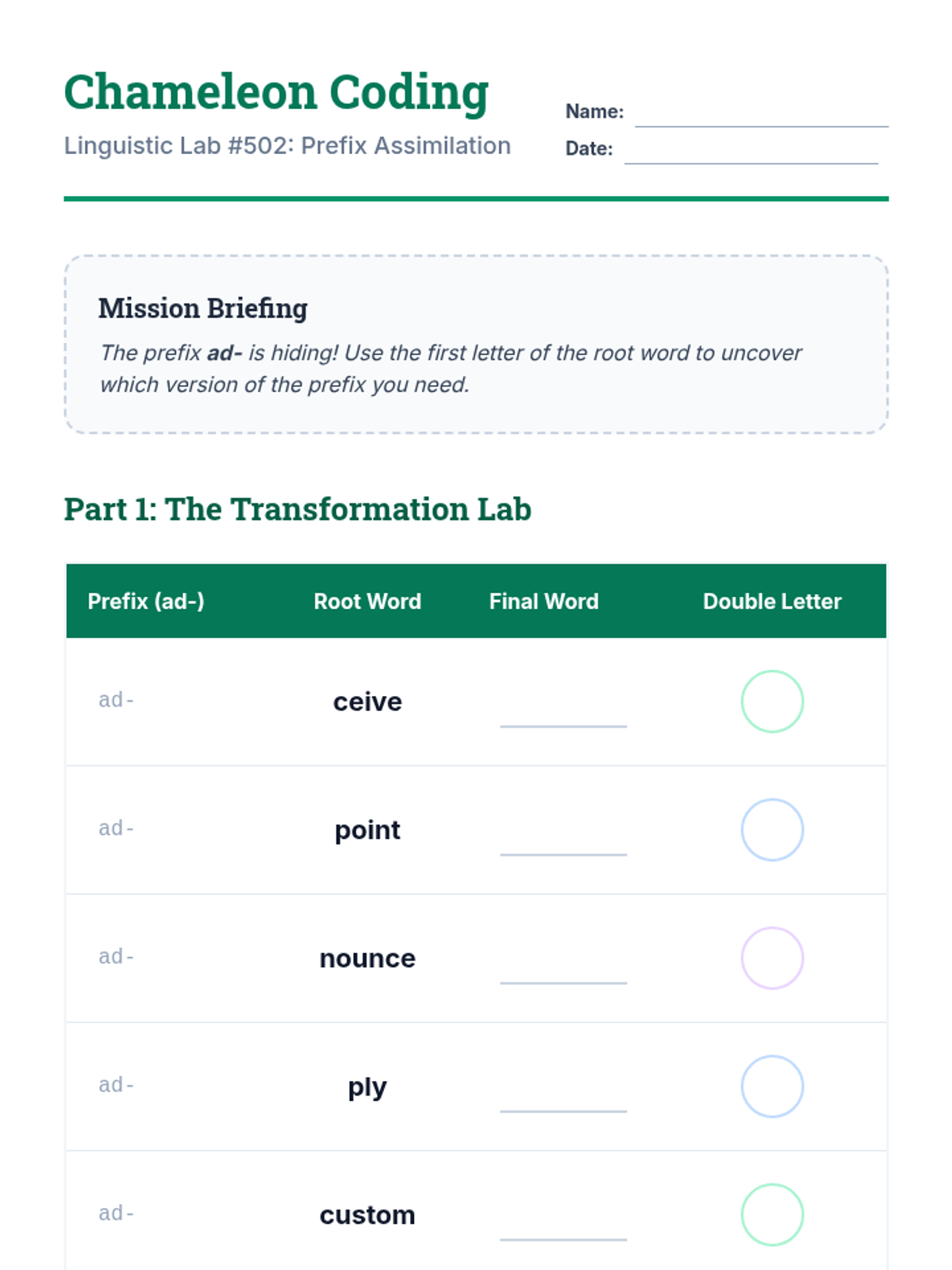
A worksheet for practicing prefix assimilation with ad-, requiring students to combine prefixes with roots and identify correct spellings.
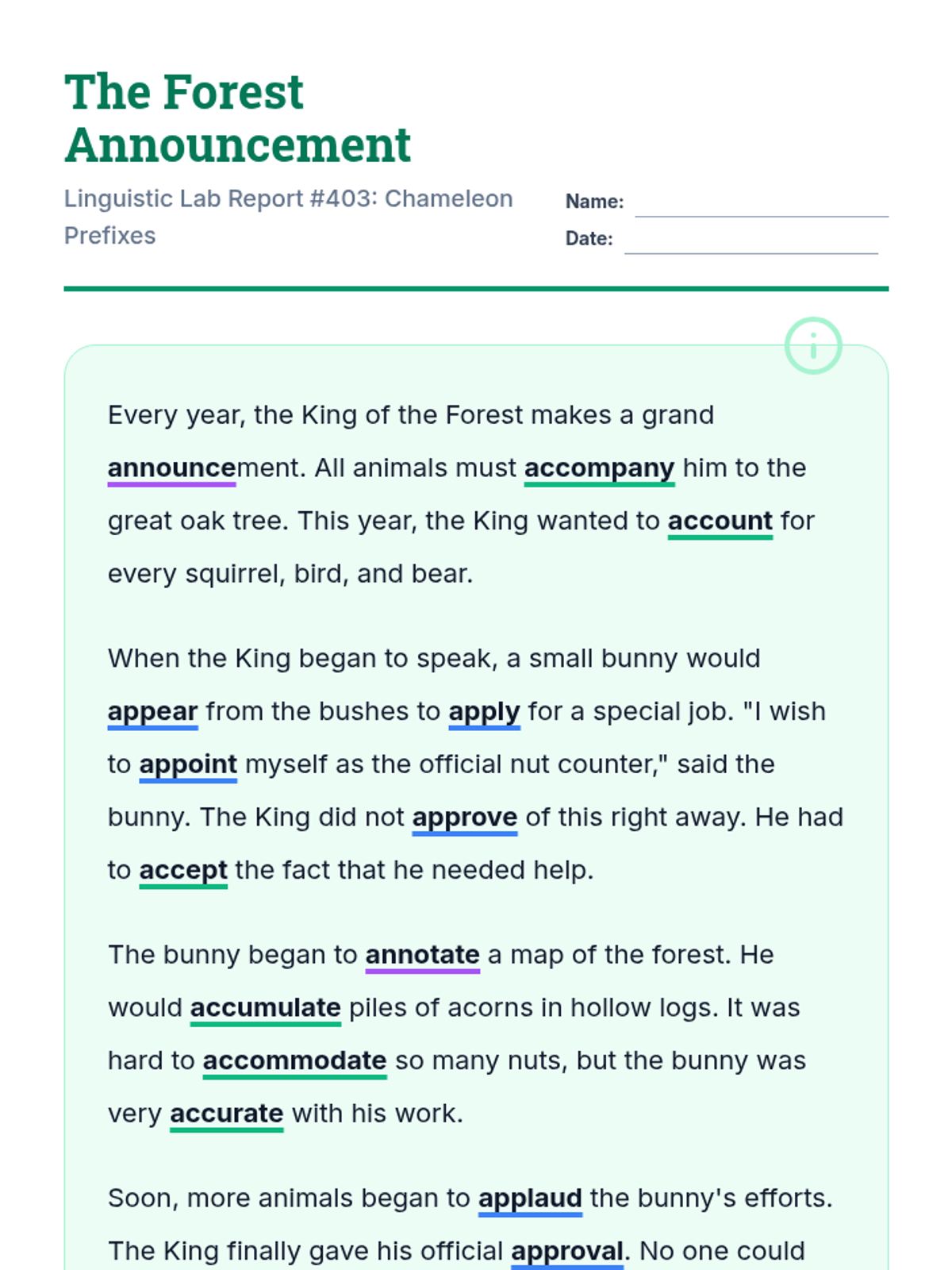
A decodable passage focusing on words with the assimilated prefixes ac-, ap-, and an-, with visual color-coding to support pattern recognition.
Instructional slides explaining the "chameleon prefix" rule where the prefix 'ad-' changes its spelling to match root words starting with 'c', 'p', or 'n'.
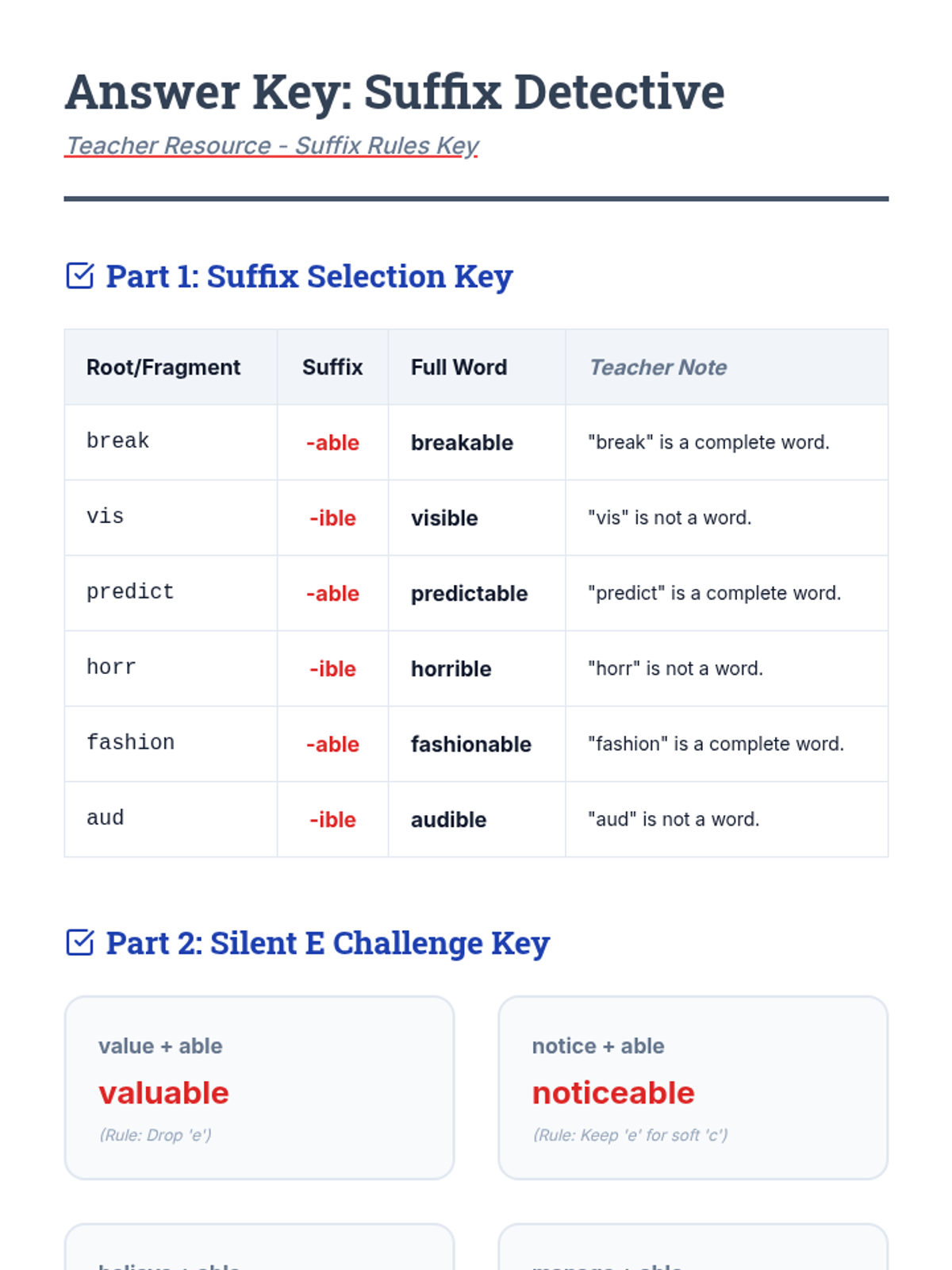
Teacher answer key for the Suffix Detective Worksheet, including explanations for the root word and silent 'e' spelling rules.
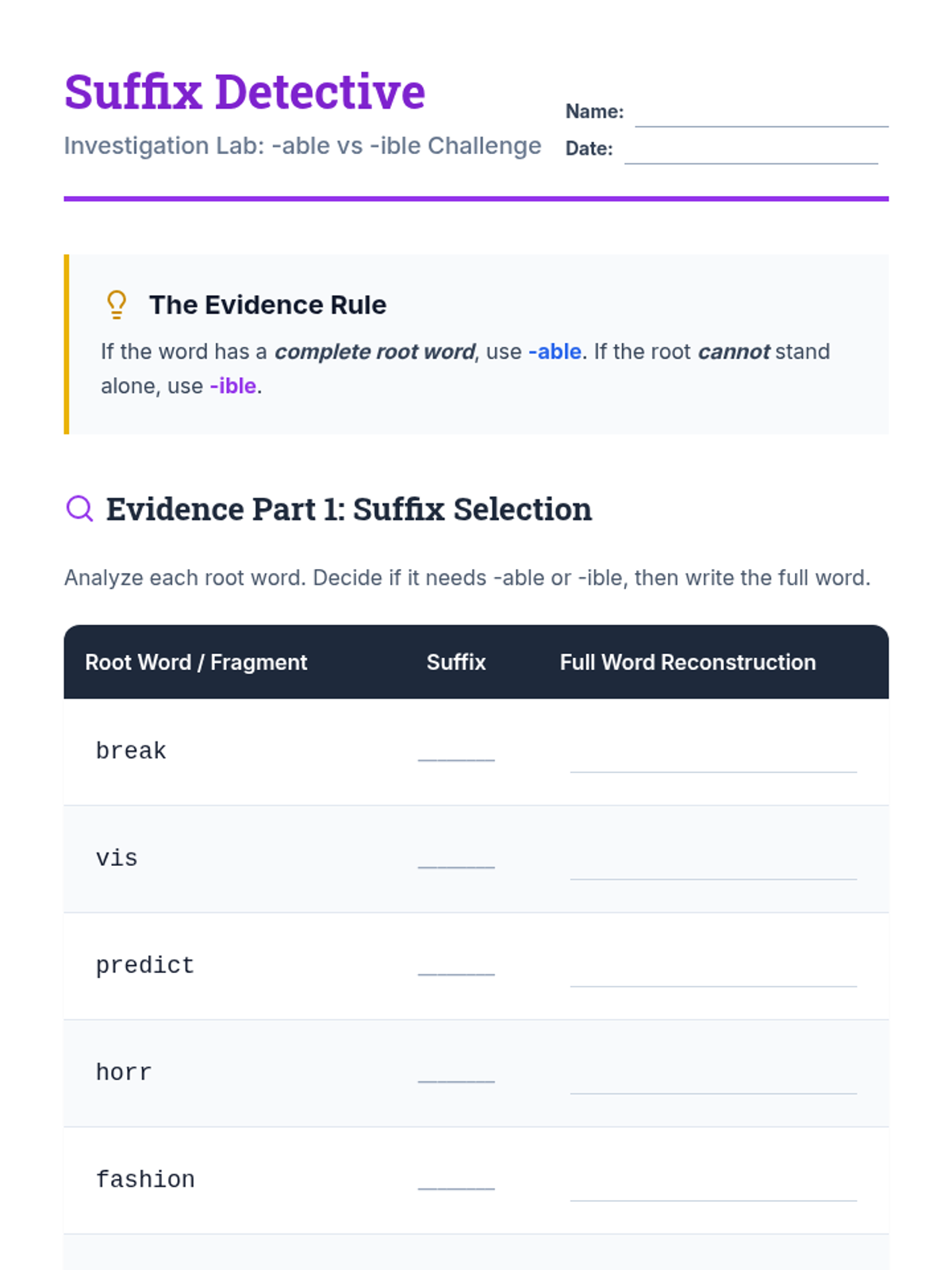
A practice worksheet for students to apply the root word rule to identify correct -able and -ible spellings, including the special case of silent 'e'.
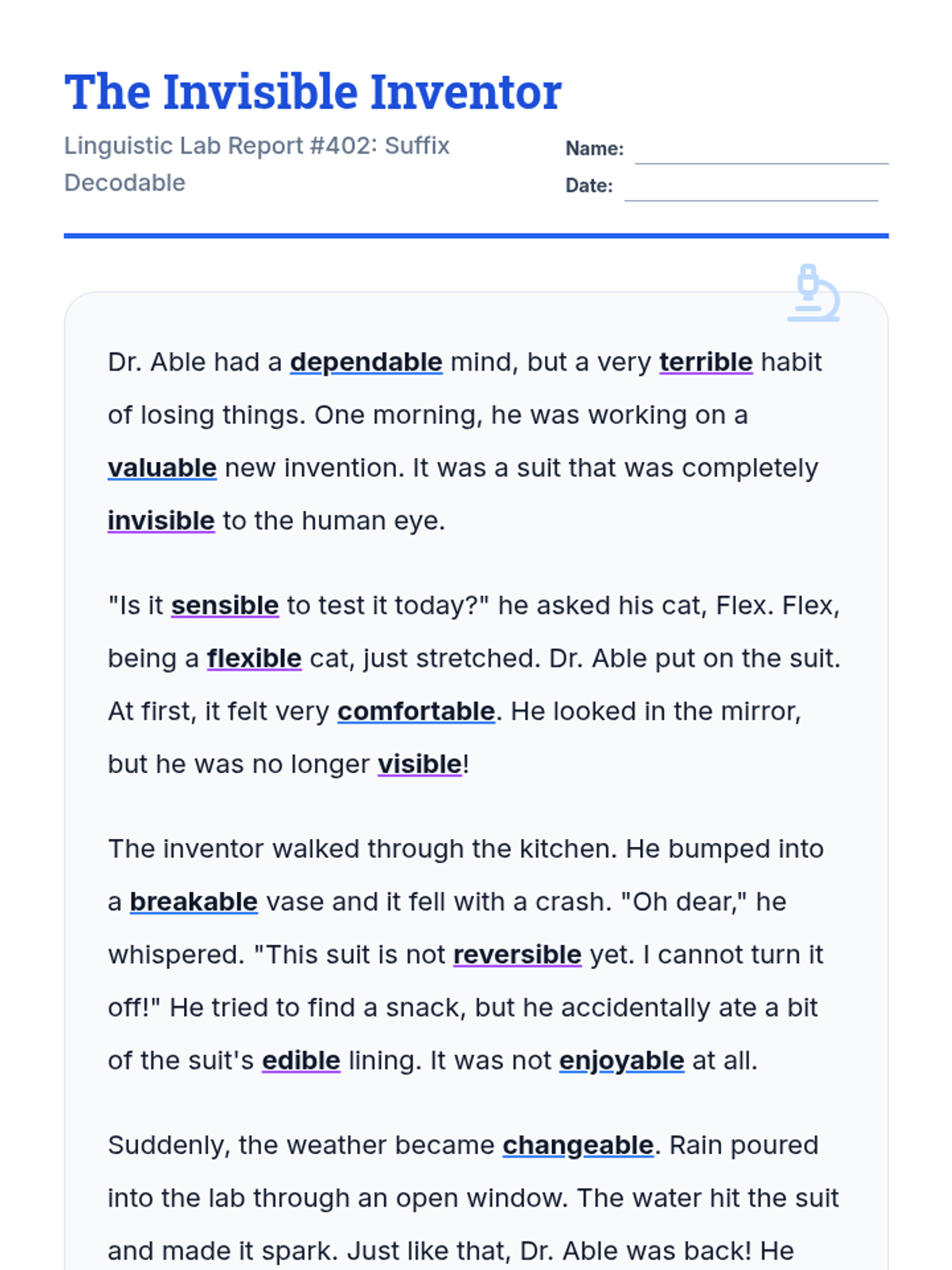
A decodable passage featuring numerous -able and -ible words, with visual coding to help students identify the root word rule in action. Updated with more writing space for review questions.
Instructional slides explaining the root word rule for using the -able and -ible suffixes, including examples and special cases for words ending in silent 'e'. Increased font sizes for better visibility.
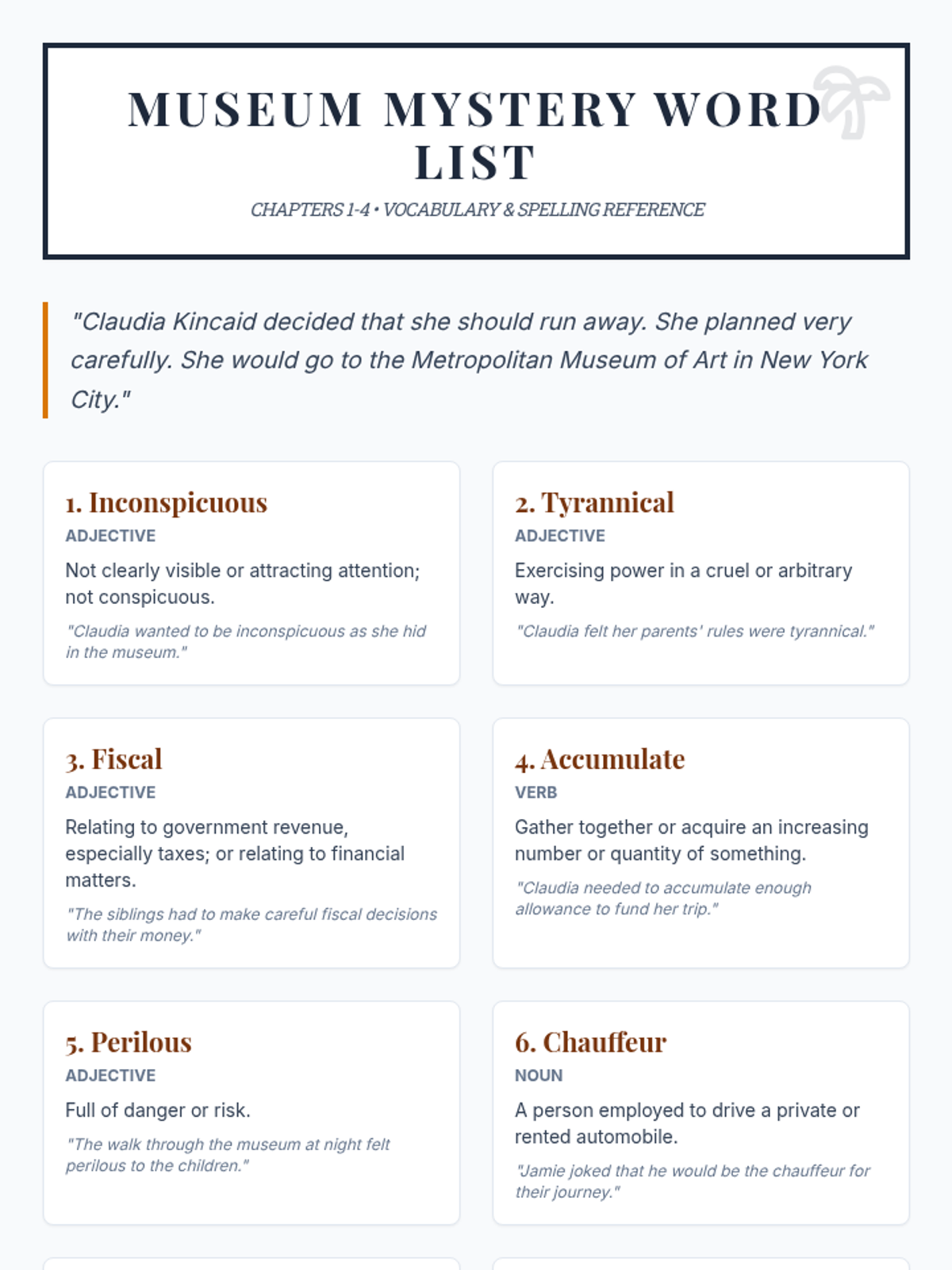
A visual presentation for instruction and discussion on the vocabulary words from Chapters 1-4, featuring context from the novel and definitions.
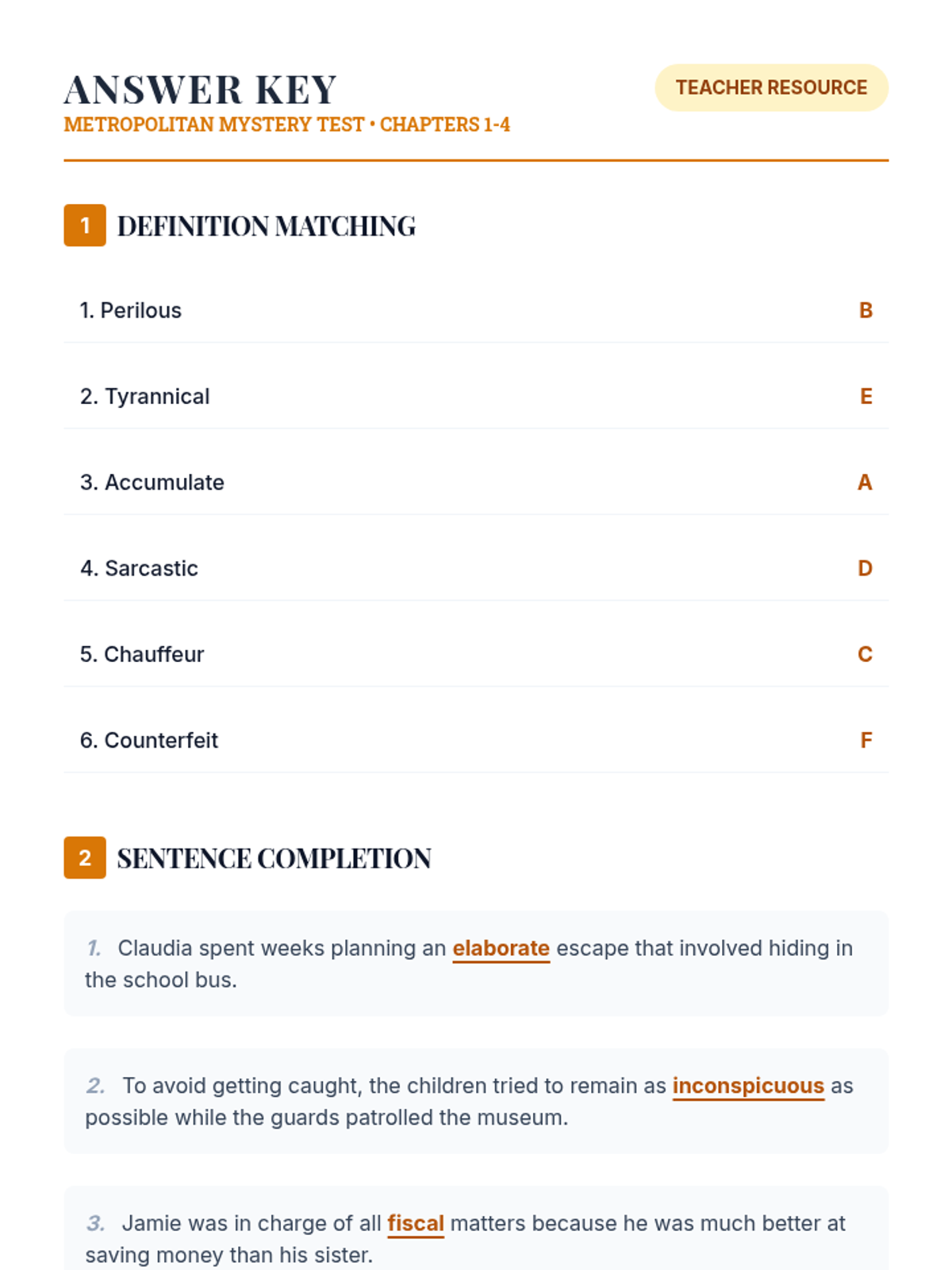
A teacher's answer key for the Metropolitan Mystery spelling and vocabulary test, providing correct matching letters and sentence completions.
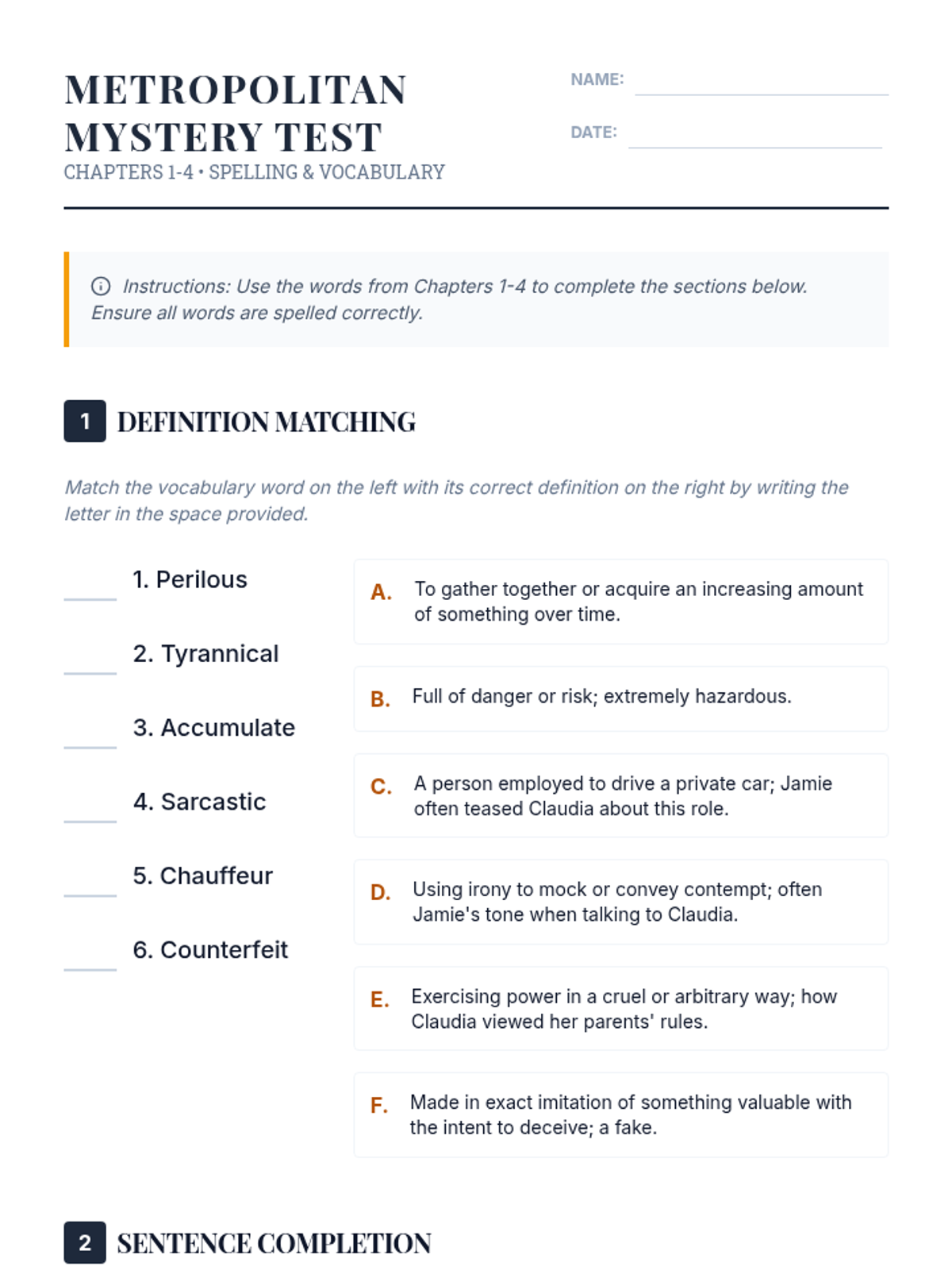
A comprehensive spelling and vocabulary test for Chapters 1-4 of the novel, featuring definition matching and fill-in-the-blank contextual sentences.
A student-facing vocabulary reference sheet featuring 12 challenging words from Chapters 1-4 of the novel, complete with definitions and context sentences.
A comprehensive two-page combined worksheet featuring 5 open-ended drafting tasks, 4 multiple-choice revision questions with standardized styling, and a final paragraph editing challenge.
A worksheet for Station 3 focusing on sentence combining techniques, featuring single-sentence practice and a full paragraph revision task. Now includes a 'Style Lab' periodic sentence extension.
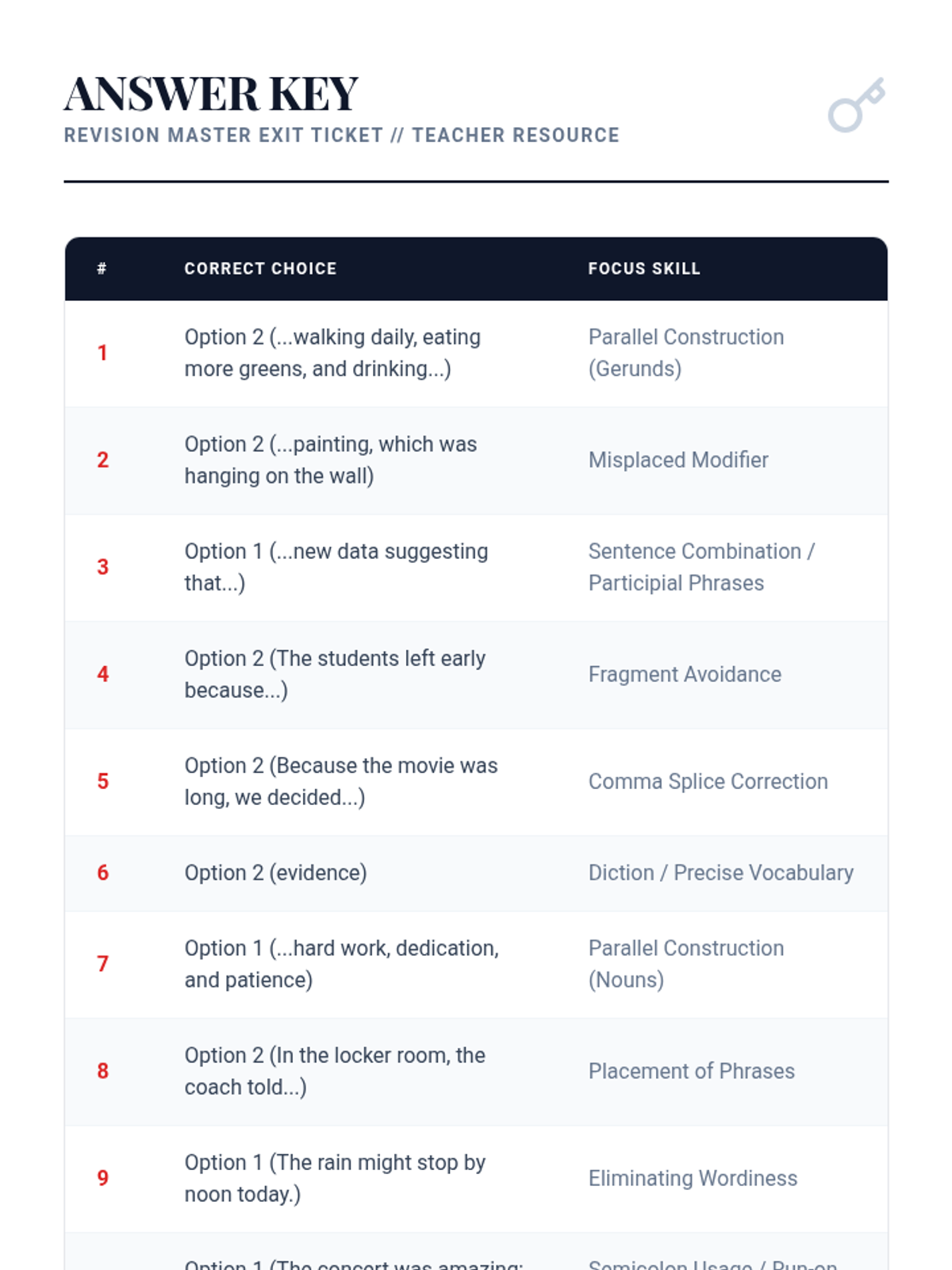
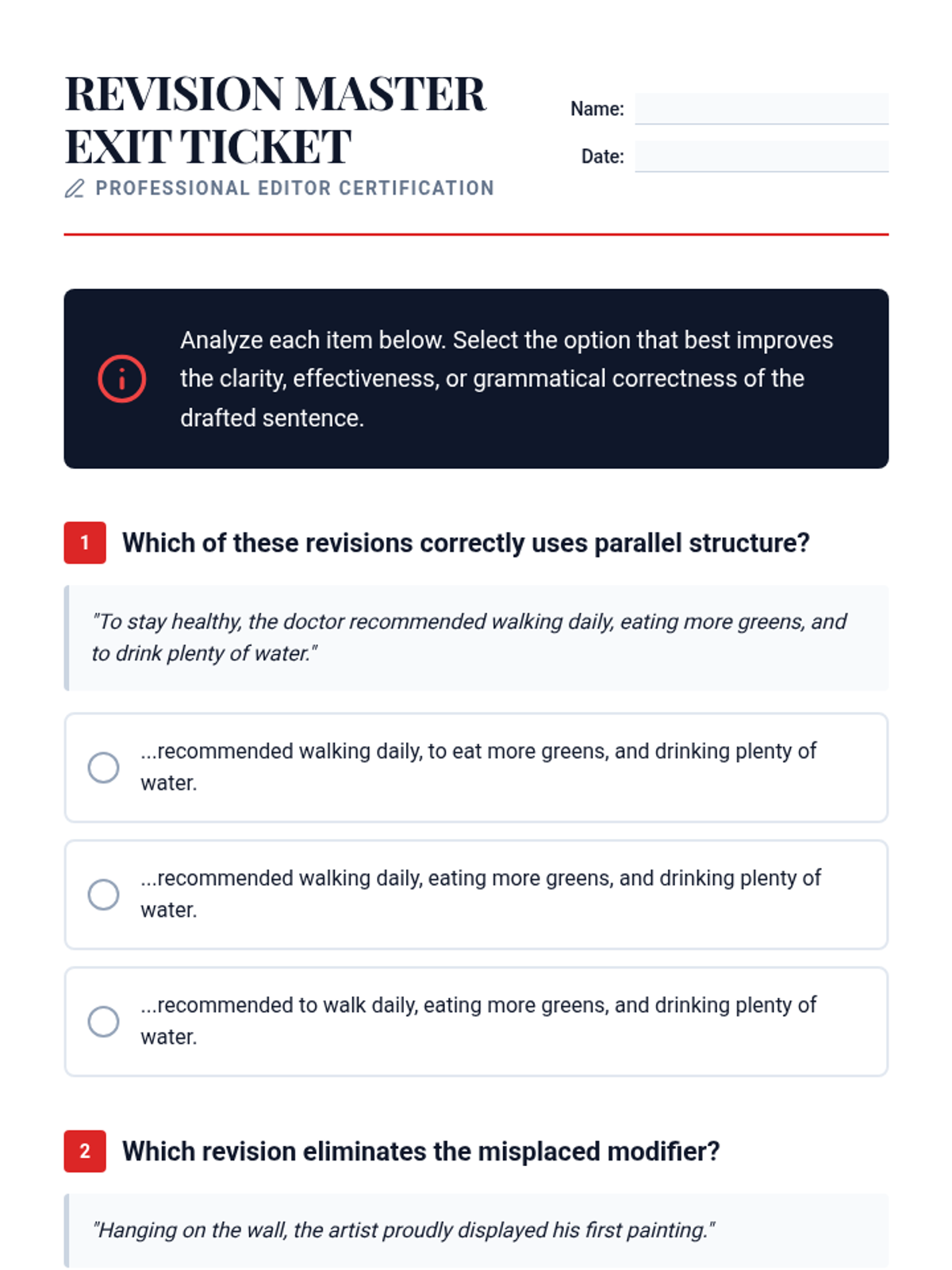
A teacher-facing answer key and grading guide for the Revision Master Exit Ticket. Includes focus skills for each question and common student misconceptions.
A 10-question multiple-choice exit ticket assessing student mastery of parallel structure, phrase placement, sentence effectiveness, and basic editing for fragments and run-ons. Includes break-inside-avoid to prevent question splitting.
A digital slide presentation guiding students through the revision process, focusing on parallel structure, phrase placement, and sentence effectiveness. Now updated with minimum 24px font size for all text elements.
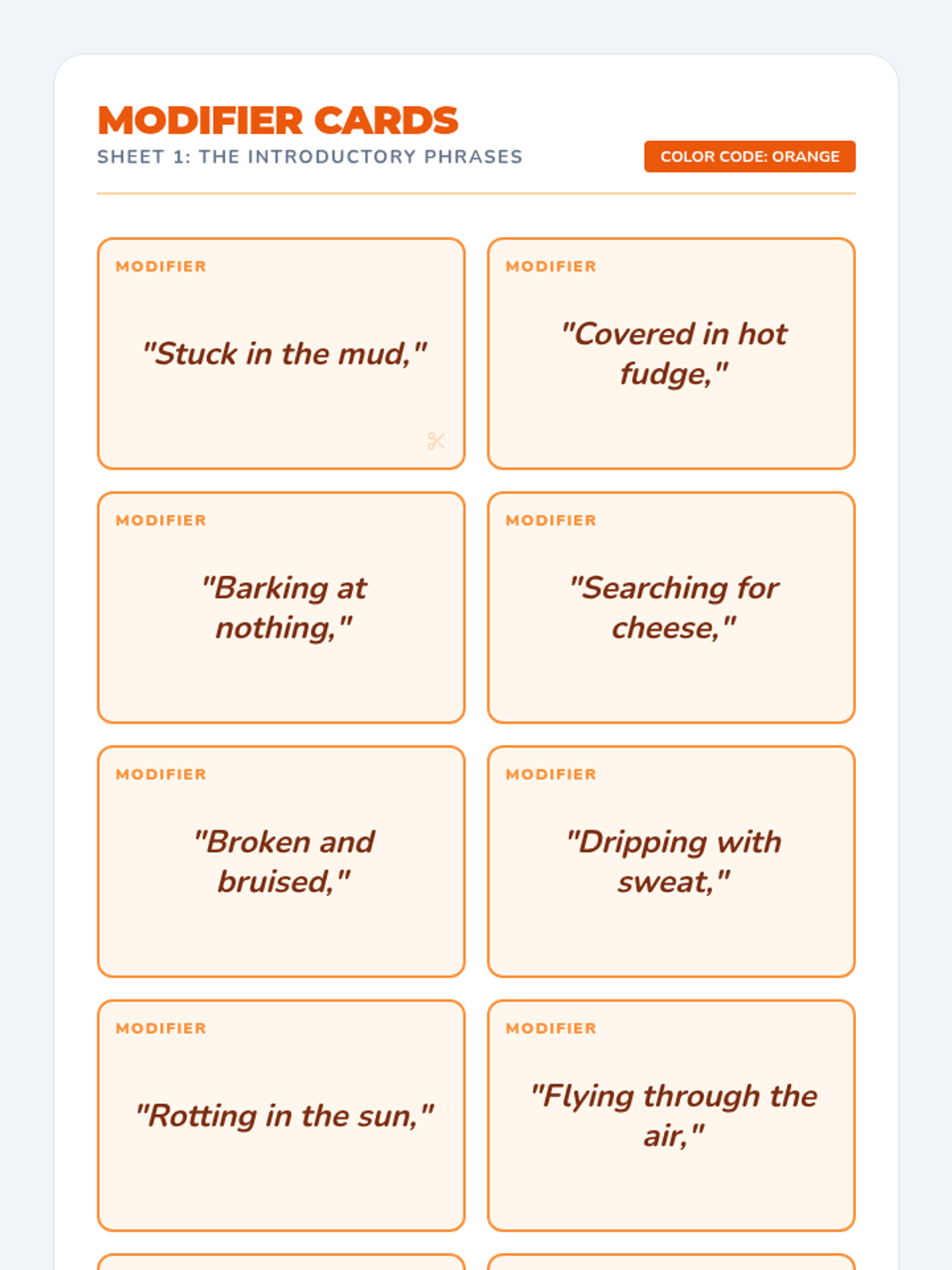
A printable deck of 20 cards (10 modifiers and 10 logical main clauses) for the Modifier Match-Up game. Includes orange and teal color-coding for easy sorting.
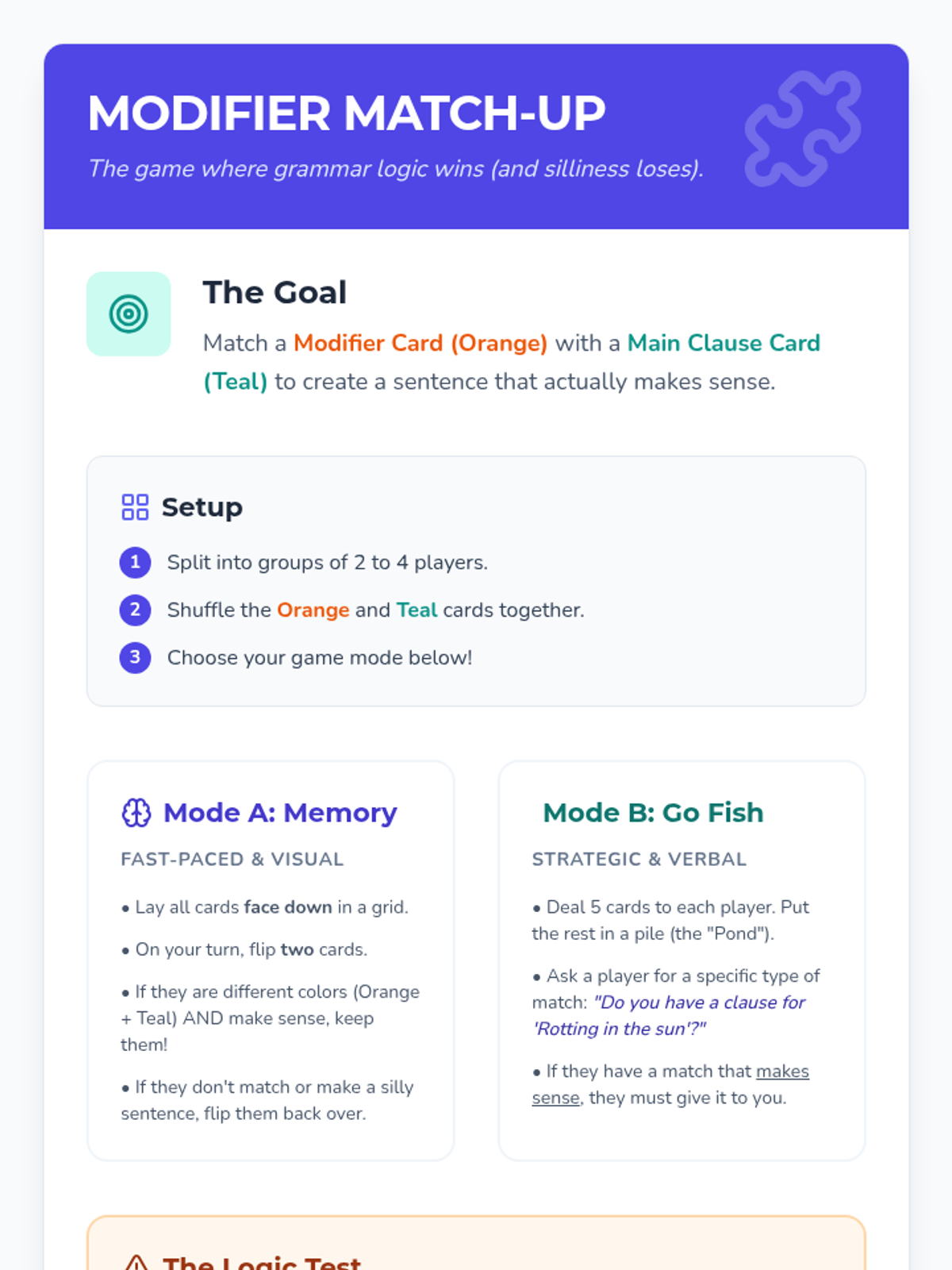
Clear, step-by-step game instructions for the Modifier Match-Up card game, including 'Memory' and 'Go Fish' play modes and the 'Logic Test' rule.
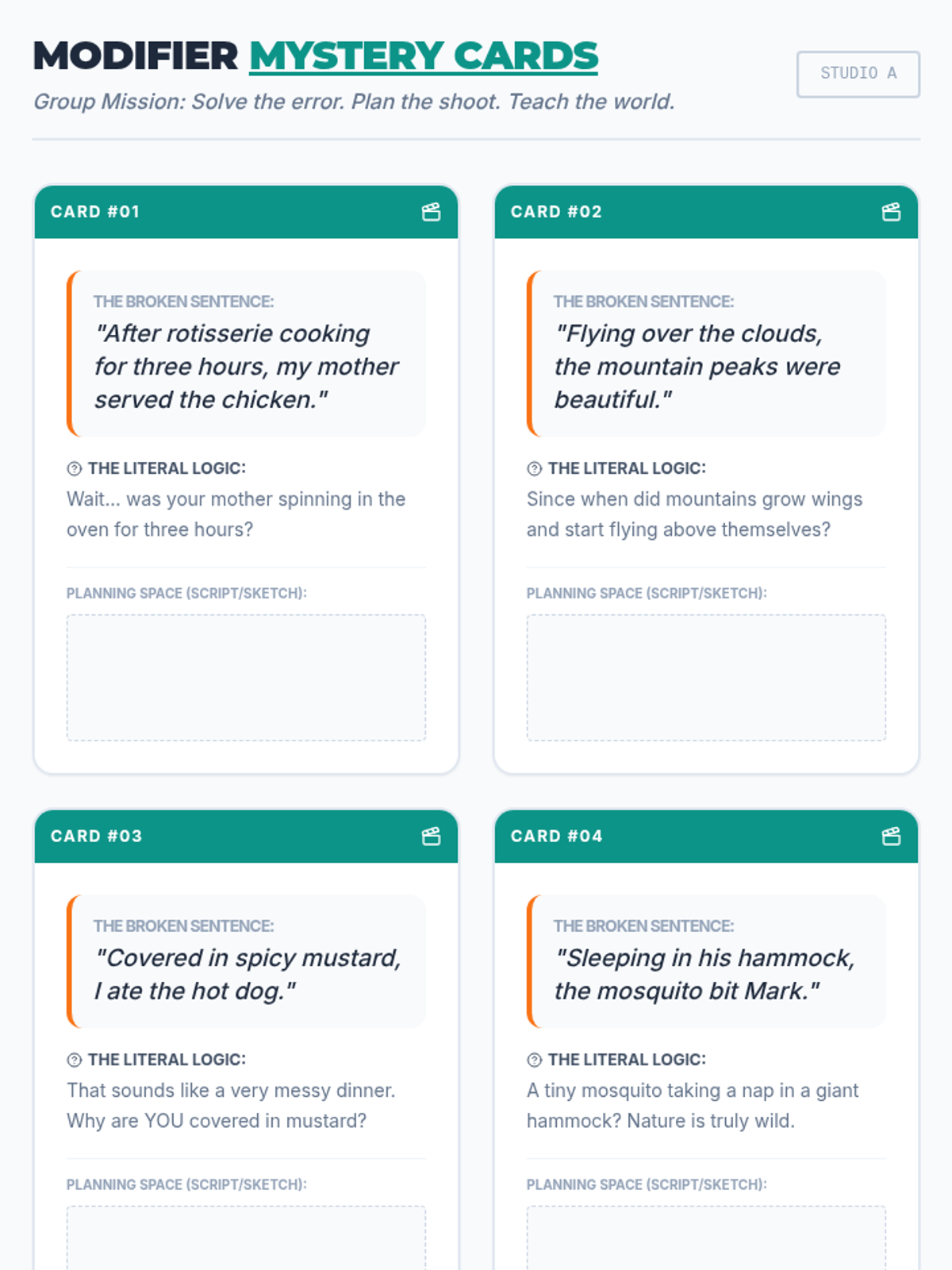
A set of printable activity cards for the group activity, each featuring a humorous dangling modifier sentence, a logic prompt, and space for video planning.
Visual presentation for the Modifier Mischief lesson, featuring an embedded Khan Academy video, interactive discussion prompts, and game introduction slides.
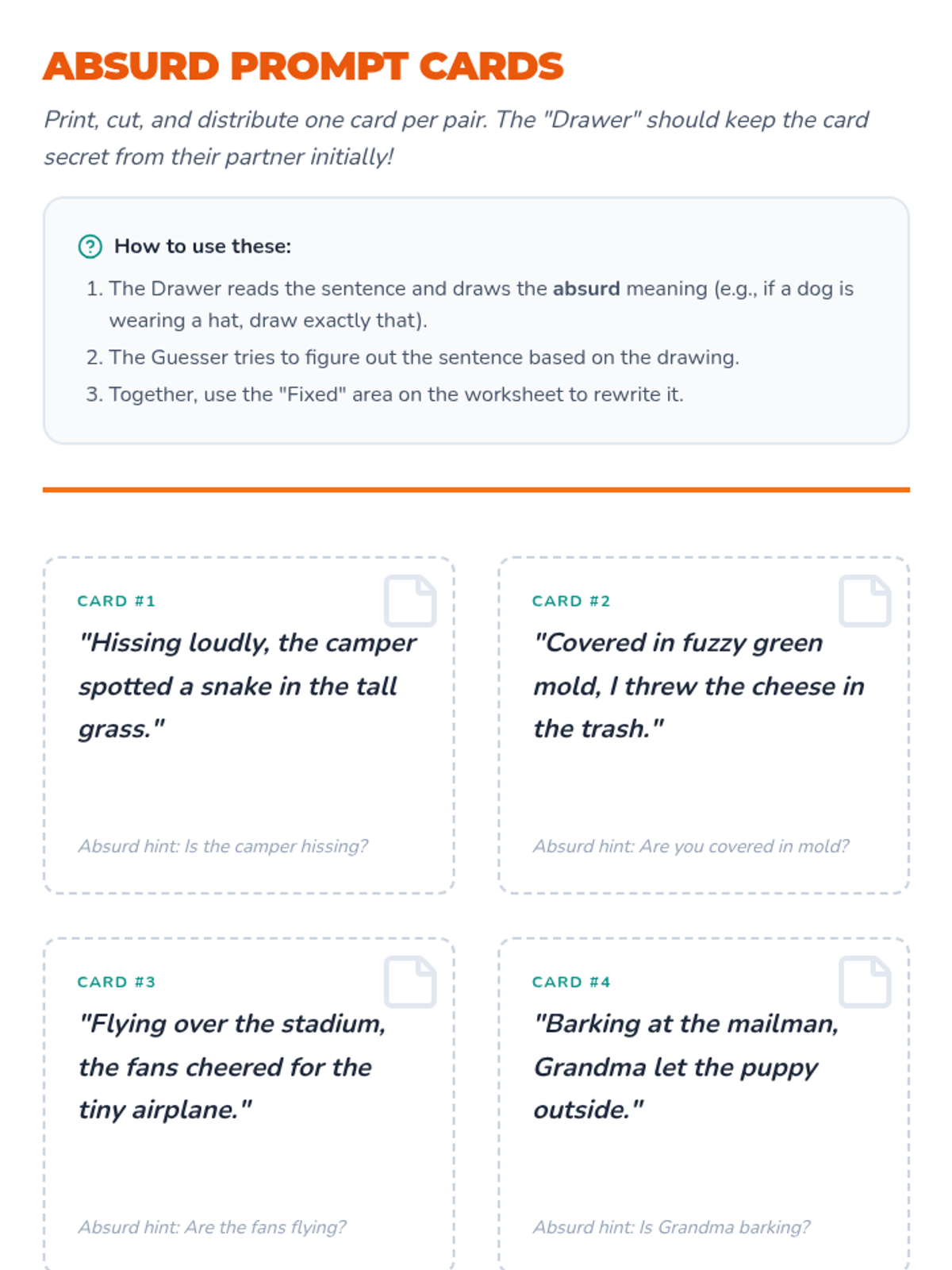
A set of 6 dangling modifier prompt cards for the Grammar Pictionary activity, featuring 'absurd' sentences and a teacher answer key for corrections.
A high-contrast visual presentation for the 'Syntax Spotlight' lesson, featuring video embeds, grammar definitions, and interactive step-by-step instructions for the group activity.
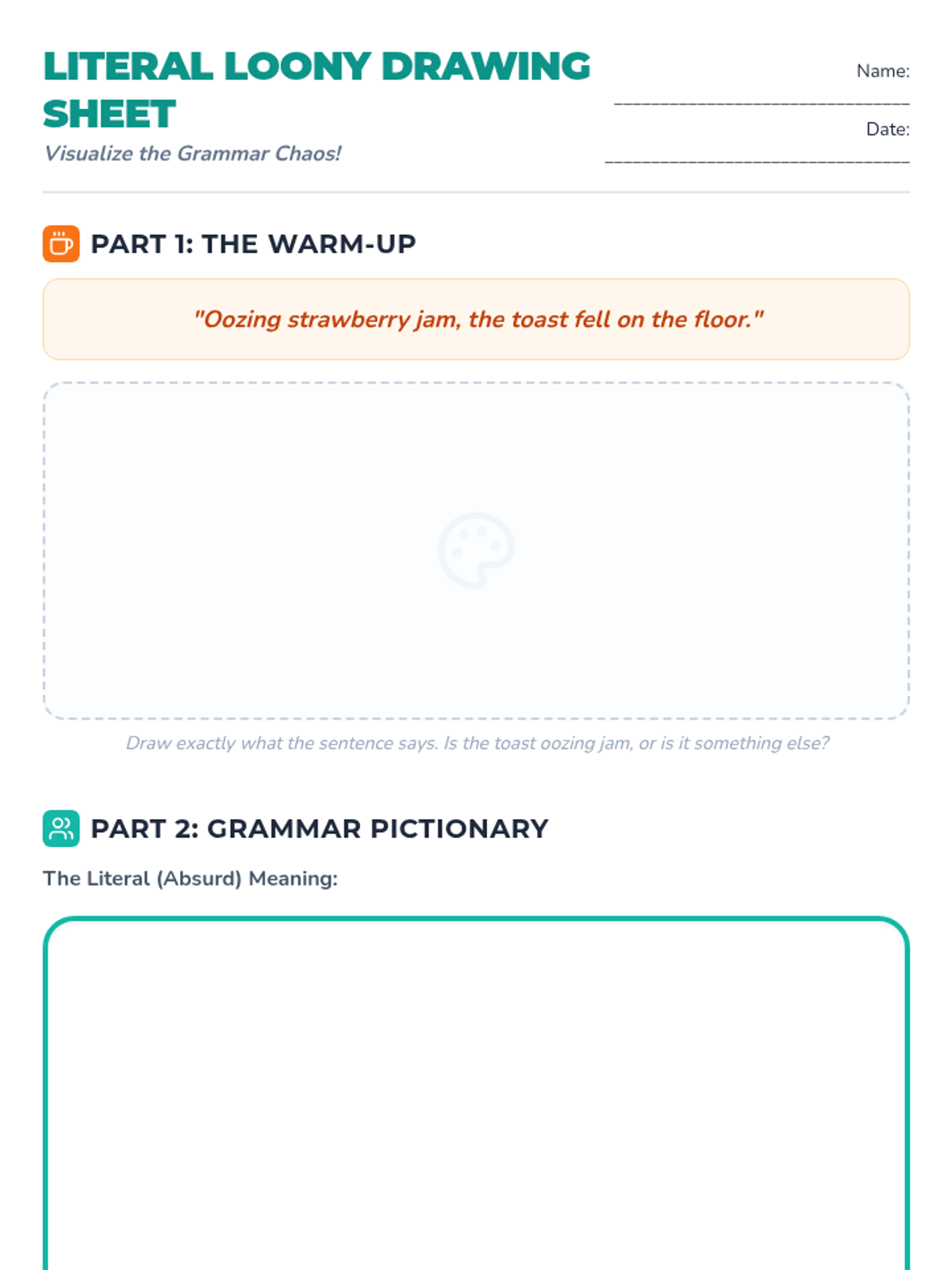
A student worksheet with dedicated spaces for drawing literal interpretations of dangling modifiers and a 'Rescue Mission' section for rewriting sentences correctly.
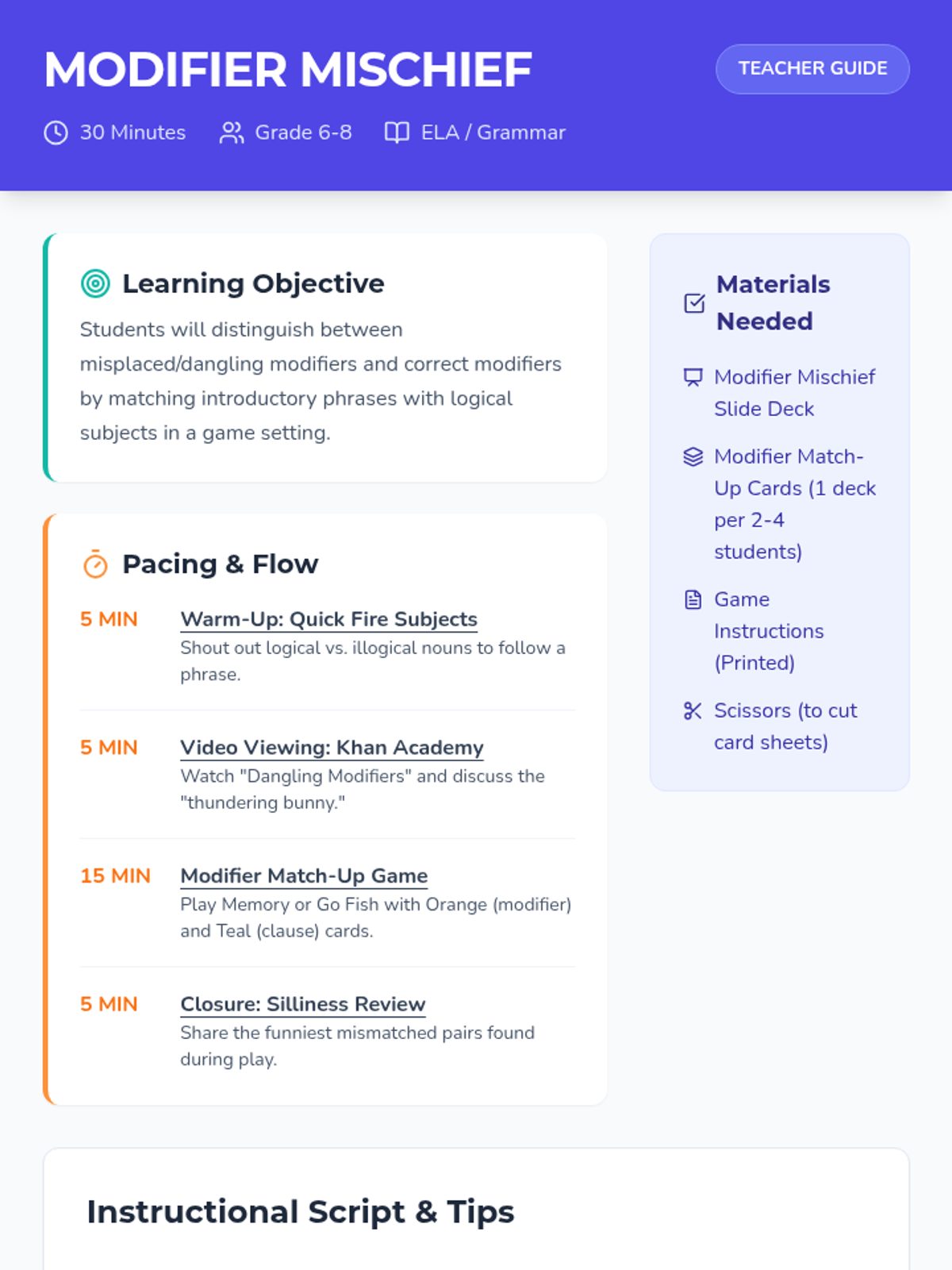
A comprehensive teacher's guide for the Modifier Mischief lesson, featuring pacing instructions, warm-up prompts, a video discussion guide, and a logical answer key for the card game.
A 5-slide visual presentation for the Dangling Disasters lesson, including warm-up prompts, the embedded Khan Academy video, activity instructions, and a closure slide.
A comprehensive teacher facilitation guide for the 'Syntax Spotlight' lesson, featuring learning objectives, a detailed pacing guide, and an answer key for the student activities.
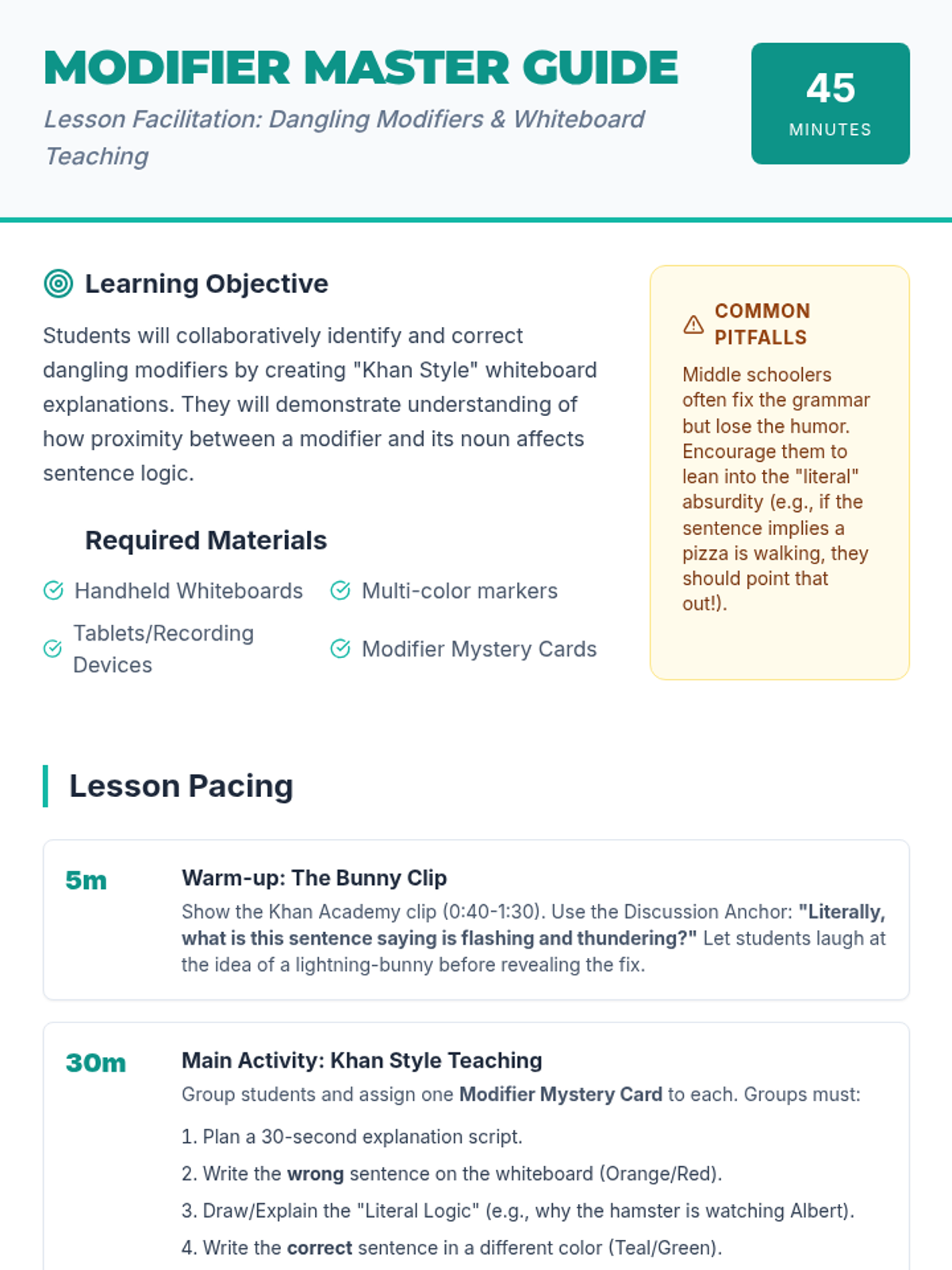
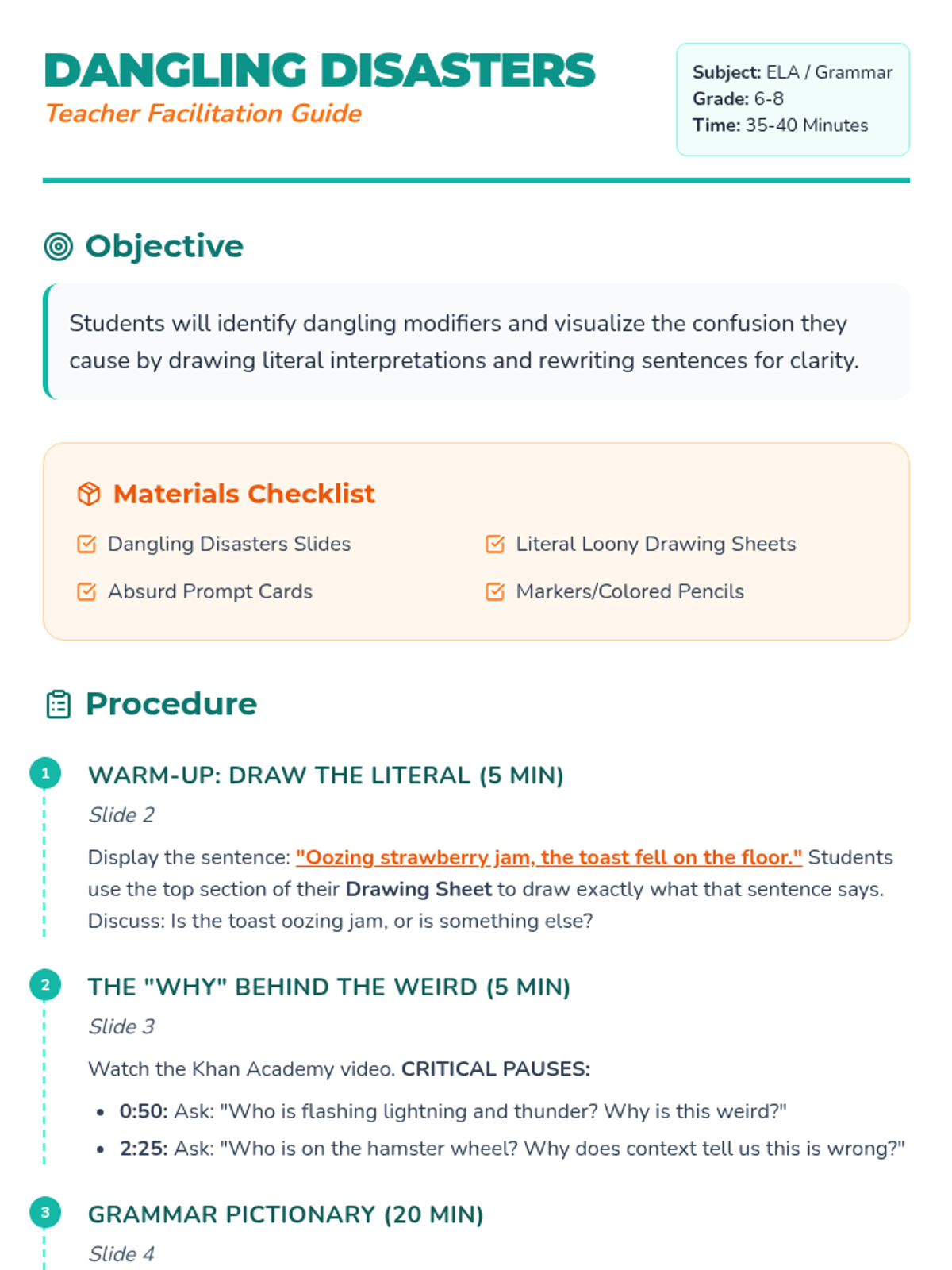
A comprehensive teacher facilitation guide for the Dangling Disasters lesson, featuring a step-by-step procedure, materials list, and discussion anchors for the video.
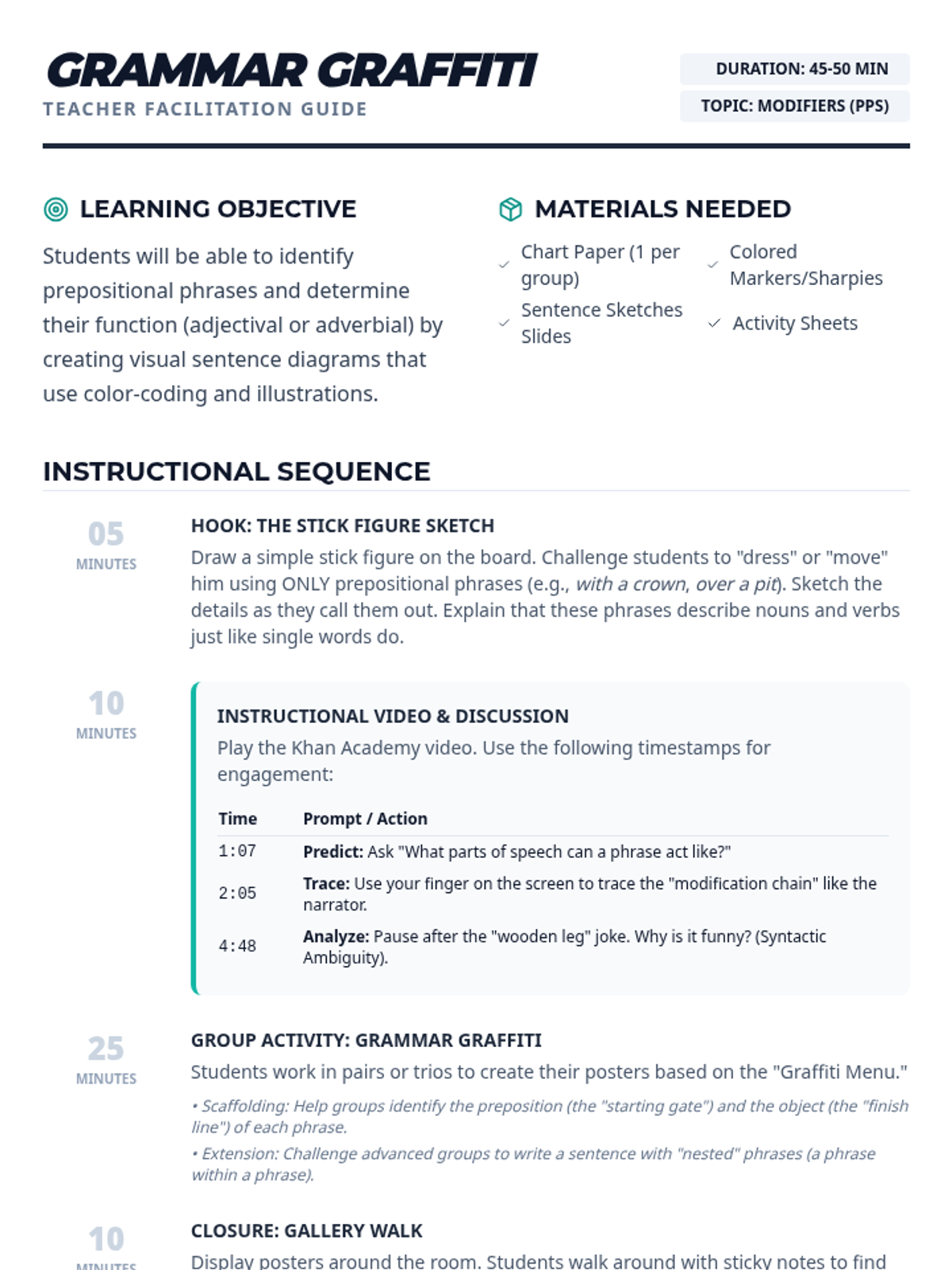
A detailed facilitation guide for teachers to deliver the Grammar Graffiti lesson, including time-stamped video cues, scaffolding strategies, and material checklists.
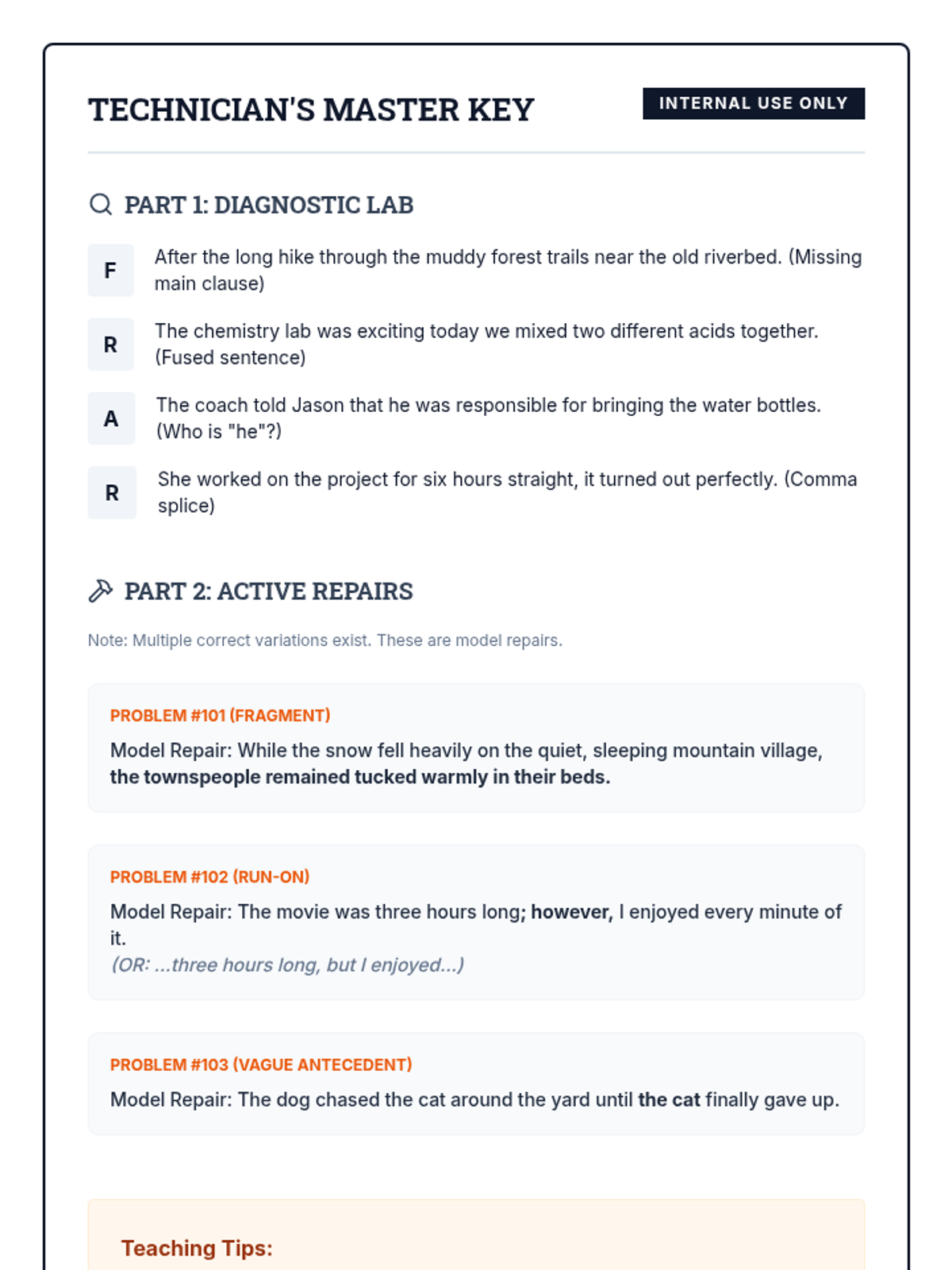
An answer key and teacher facilitation guide for the 'Repair Shop' worksheet. Includes model repairs, diagnostic keys, and instructional tips for teaching syntax correction.
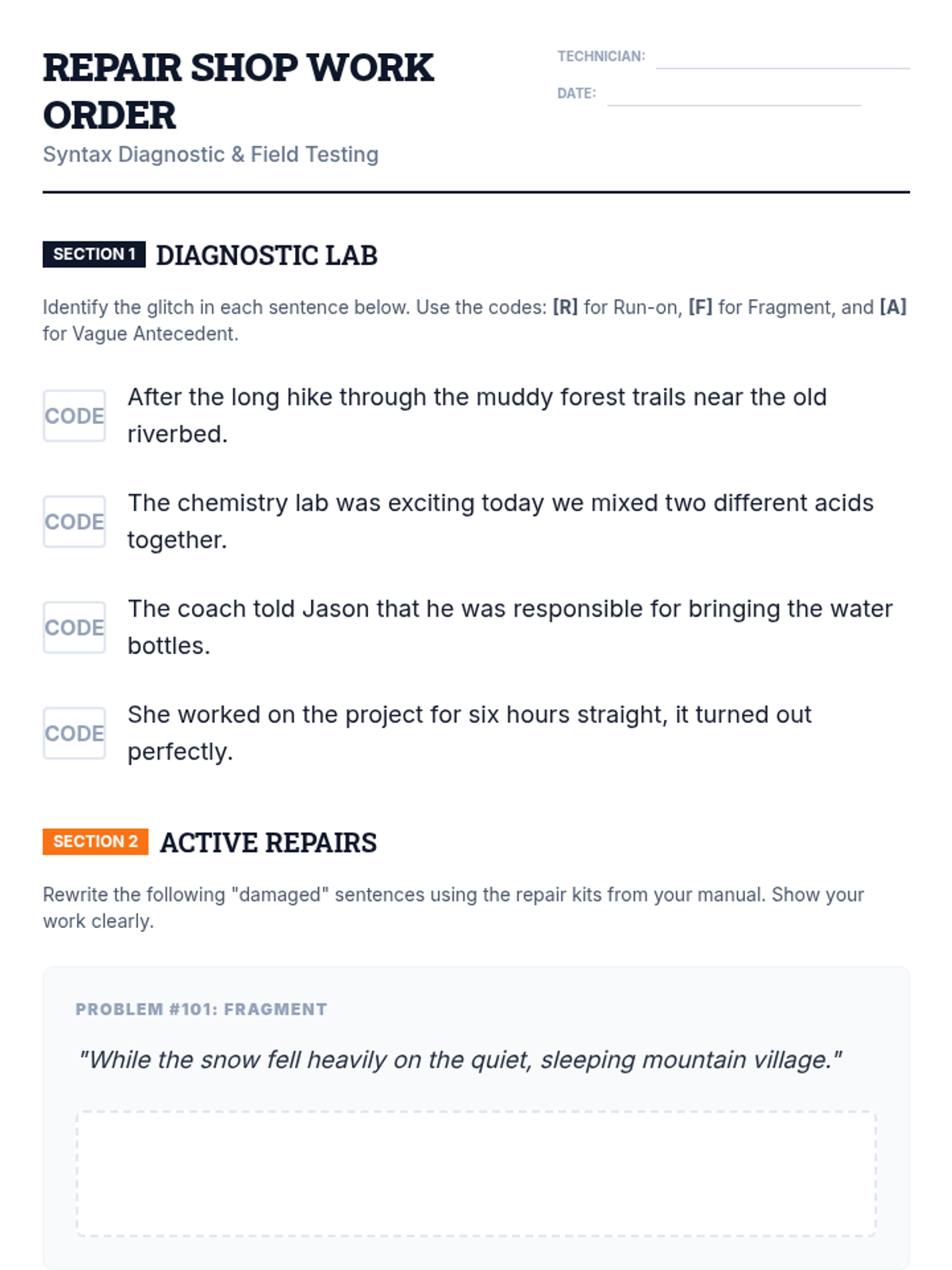
A student practice worksheet designed as a 'Work Order' for diagnosing and repairing sentences. Includes a identification section (Run-ons, Fragments, Vague Antecedents) and a 'Repair' section with dedicated space for students to rewrite sentences.
A 5-slide visual presentation for a 15-minute mini-lesson on syntax. It visually defines run-ons, fragments, and vague antecedents, providing clear diagnostic looks and specific repair kits for each.
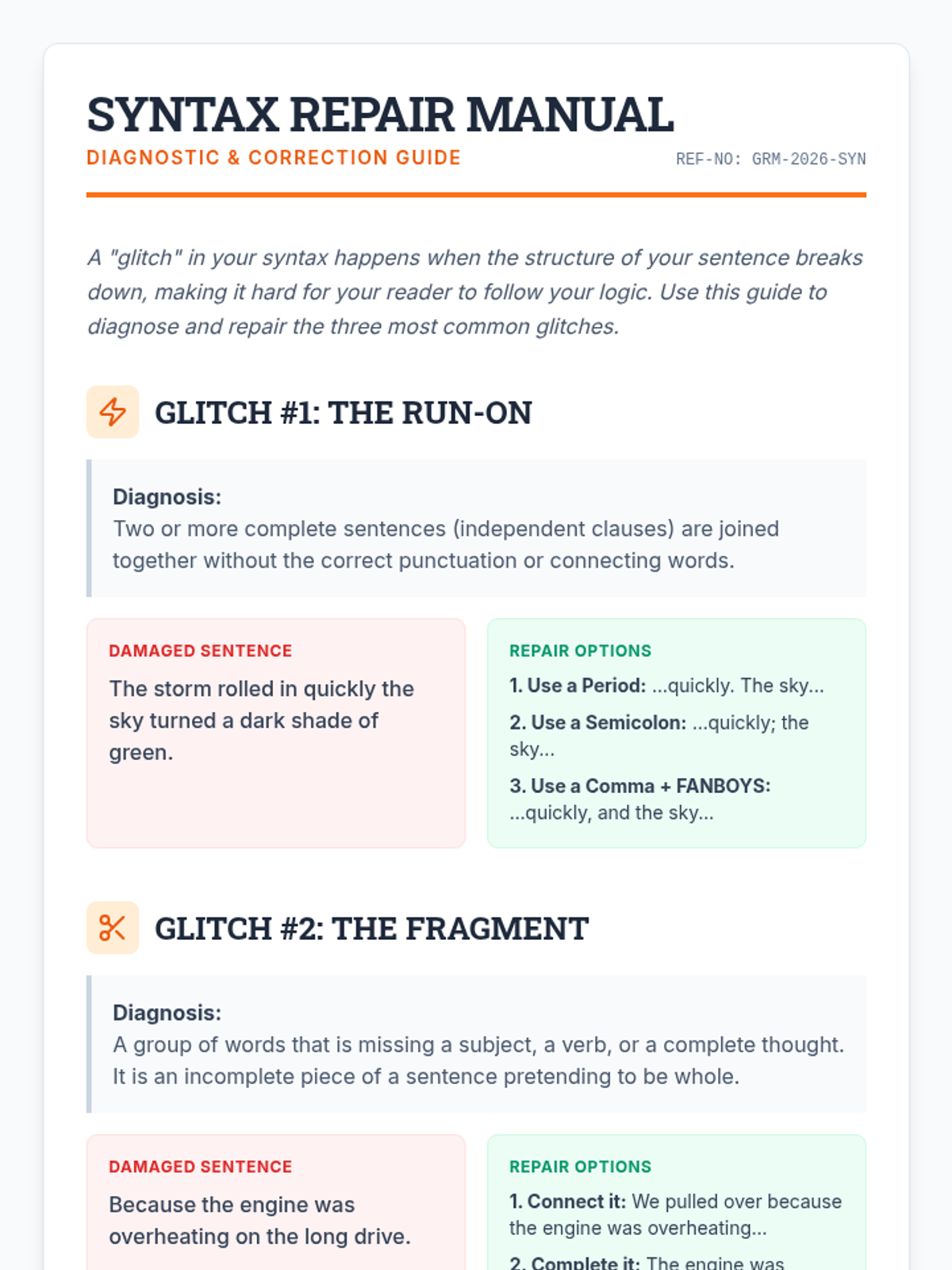
A comprehensive 2-page reference manual for correcting run-on sentences, sentence fragments, and vague antecedents. It features clear diagnostic definitions, before-and-after repair examples, a FANBOYS toolkit, and a final inspection checklist for writers.
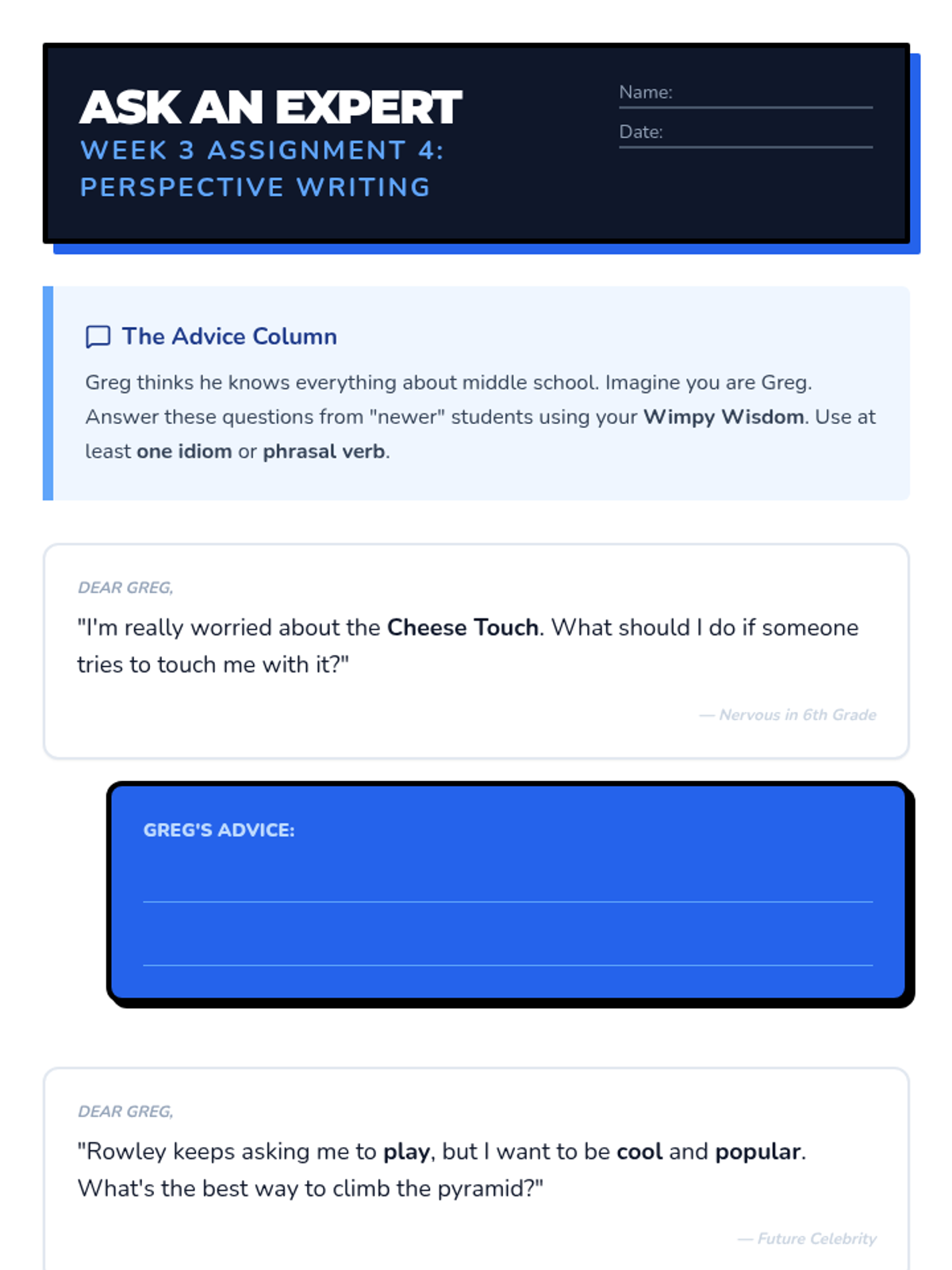
A perspective writing activity for Week 3 where ELL students write from Greg's point of view to give advice to other students, practicing idioms and phrasal verbs.
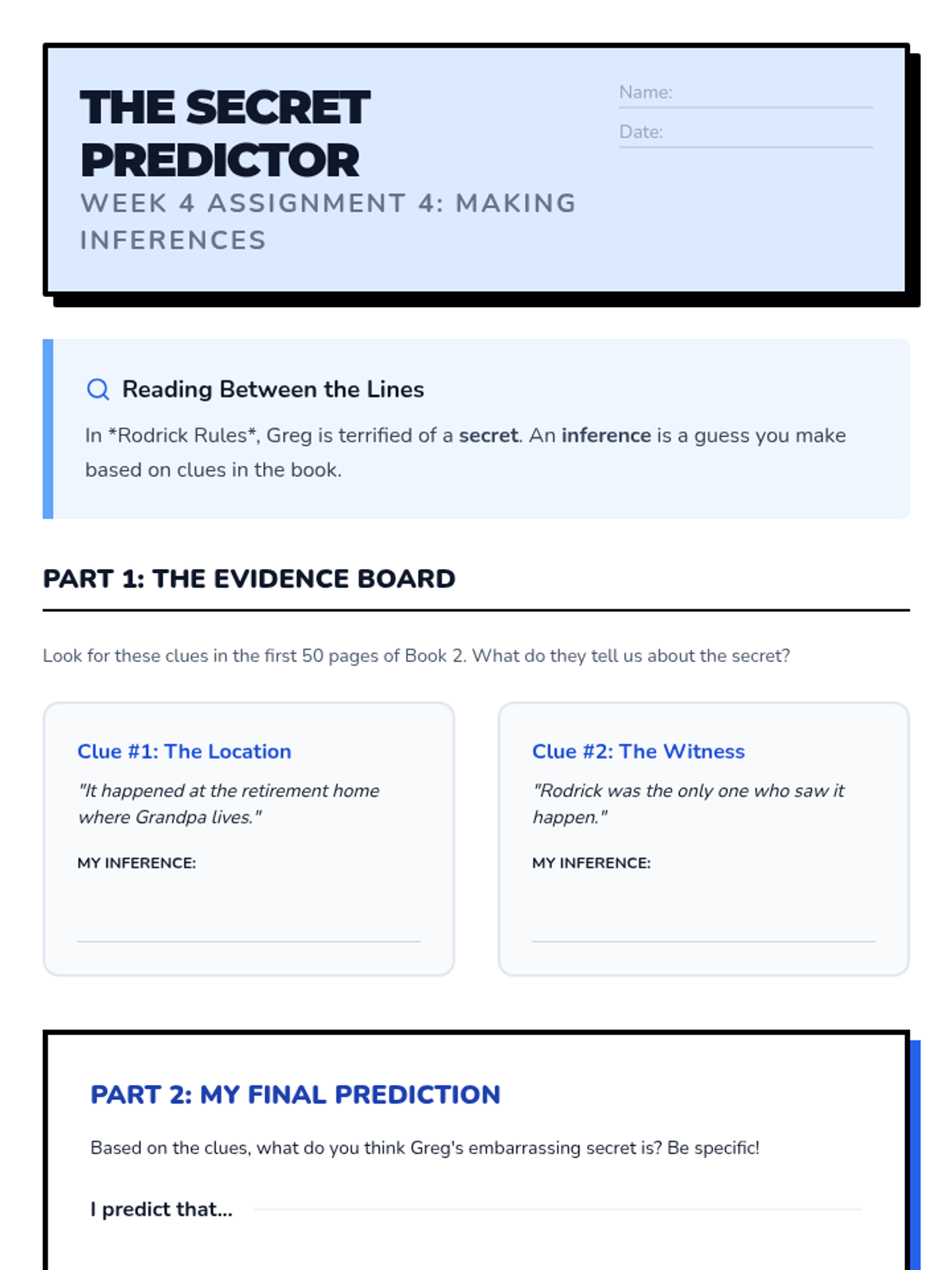
A worksheet introducing the concepts of inference and prediction through the lens of Greg's secret in 'Rodrick Rules'.
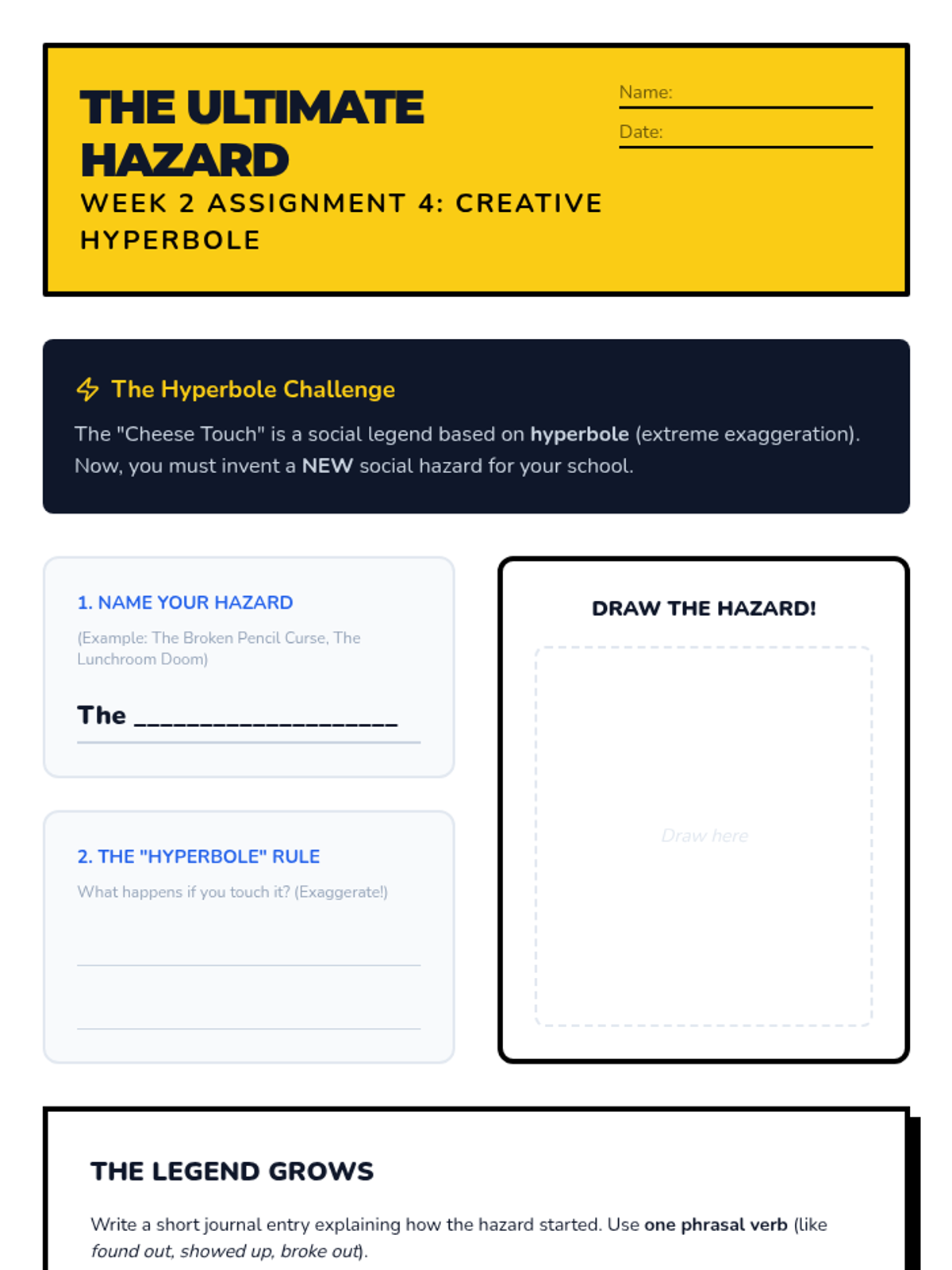
A creative assignment for Week 2 where students apply their knowledge of hyperbole by inventing their own 'social hazard' similar to the Cheese Touch.
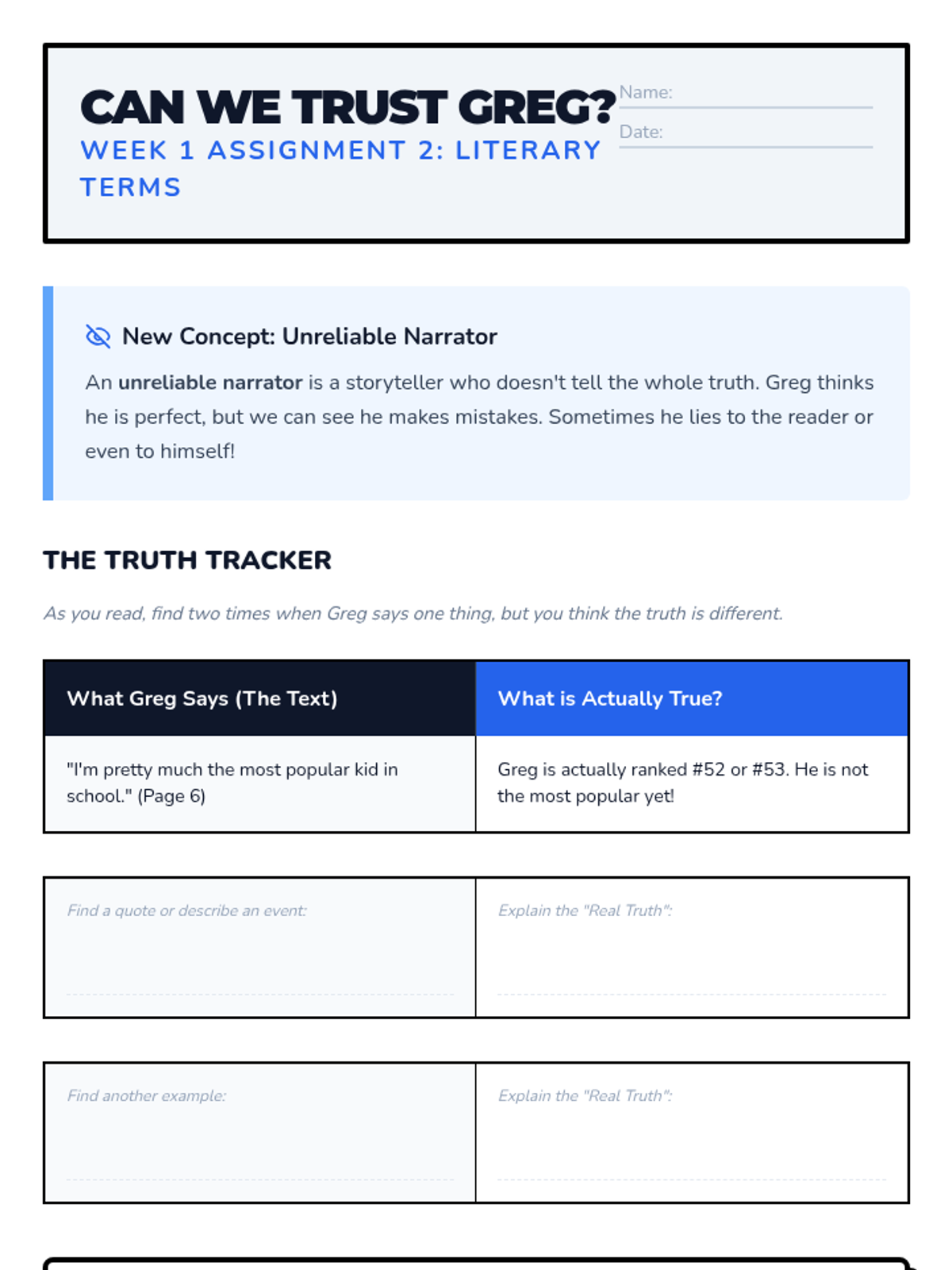
A scaffolded note-taking worksheet for Week 1 to help ELL students identify and track instances where Greg Heffley acts as an unreliable narrator.
Final review slide deck for Week 6, covering plot resolutions, literary devices review, and instructions for the final creative project.
Slide deck for Week 5 focusing on Rodrick's band 'Löded Diper' as an example of satire and situational irony.
Slide deck for Week 4 focusing on sibling relationships in 'Rodrick Rules', the concept of leverage, and situational irony.
Slide deck for Week 3 focusing on visual literacy, the discrepancy between text and illustrations (visual irony), and common idioms.
Slide deck for Week 2 focusing on social hierarchies, the Cheese Touch as an allegory, and the literary device of hyperbole.
Introductory slide deck for Week 1, covering the journal/diary distinction, first-person narration, and key character traits of Greg Heffley.
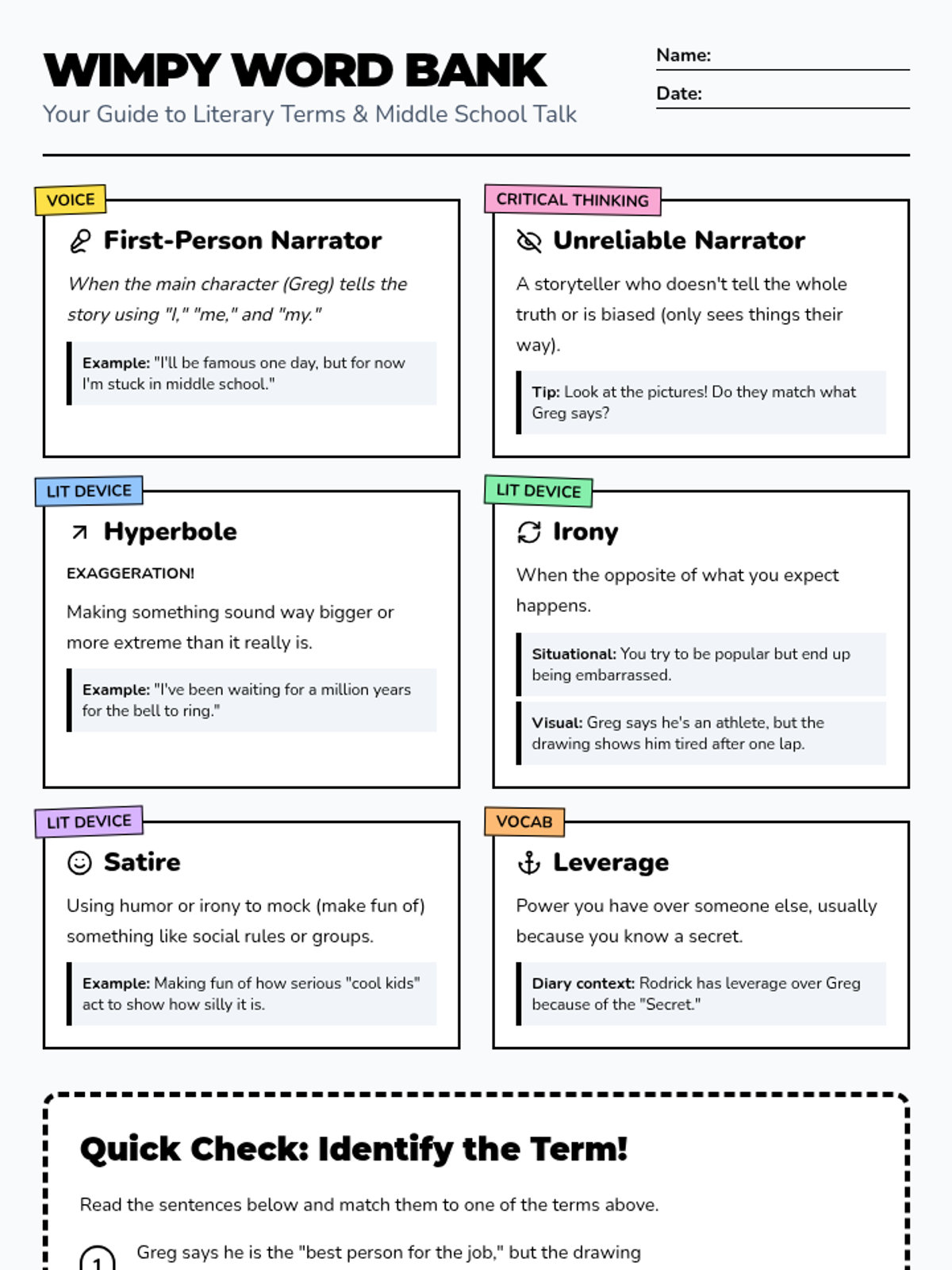
A visual glossary of literary terms and key vocabulary for the 'Wimpy Kid' unit, designed for ELL students to use as a reference sheet throughout the 6-week curriculum.
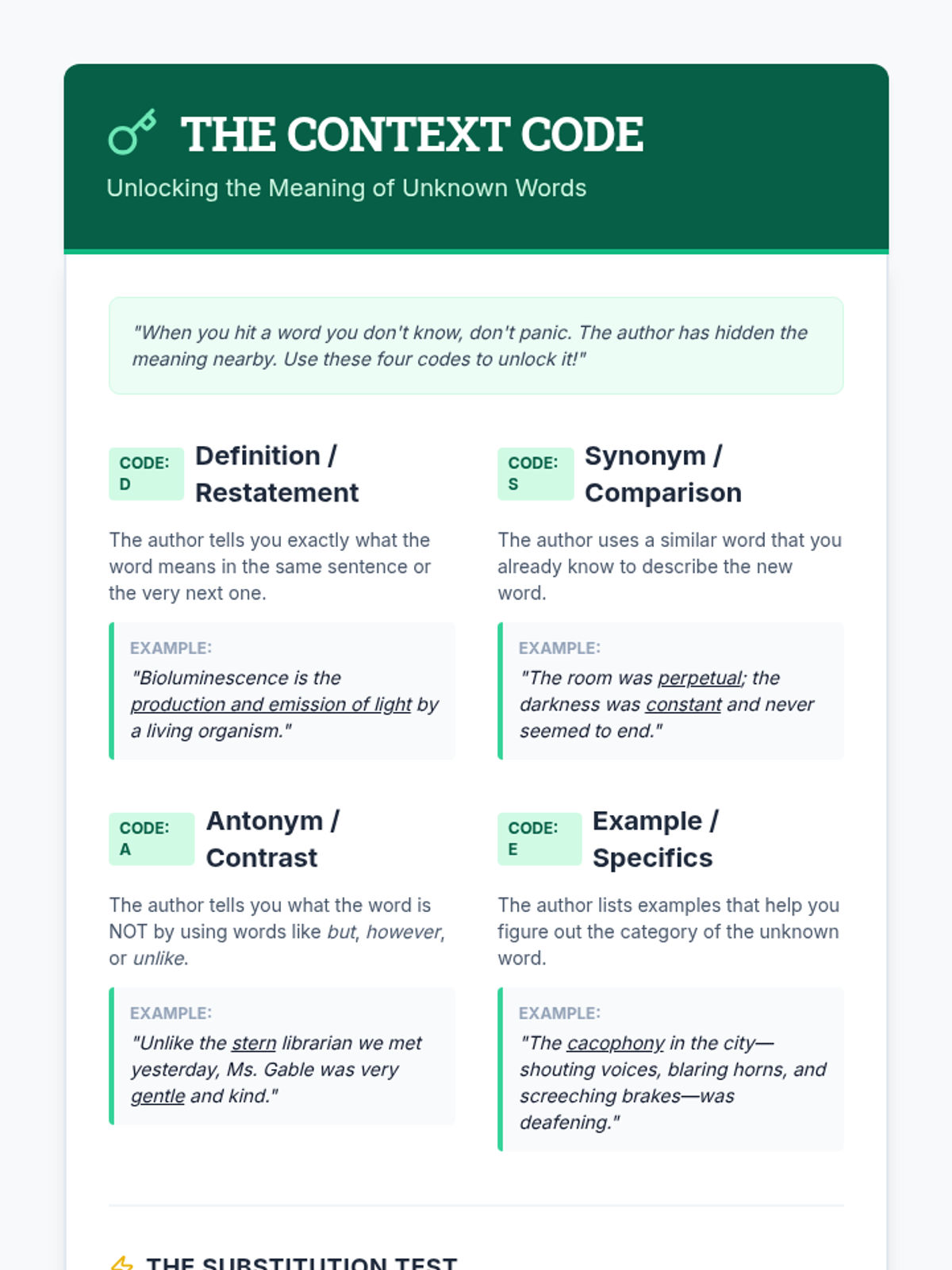
A strategy guide for using context clues to determine the meaning of unknown words, featuring the "Definition, Synonym, Antonym, Example" (D-S-A-E) method.
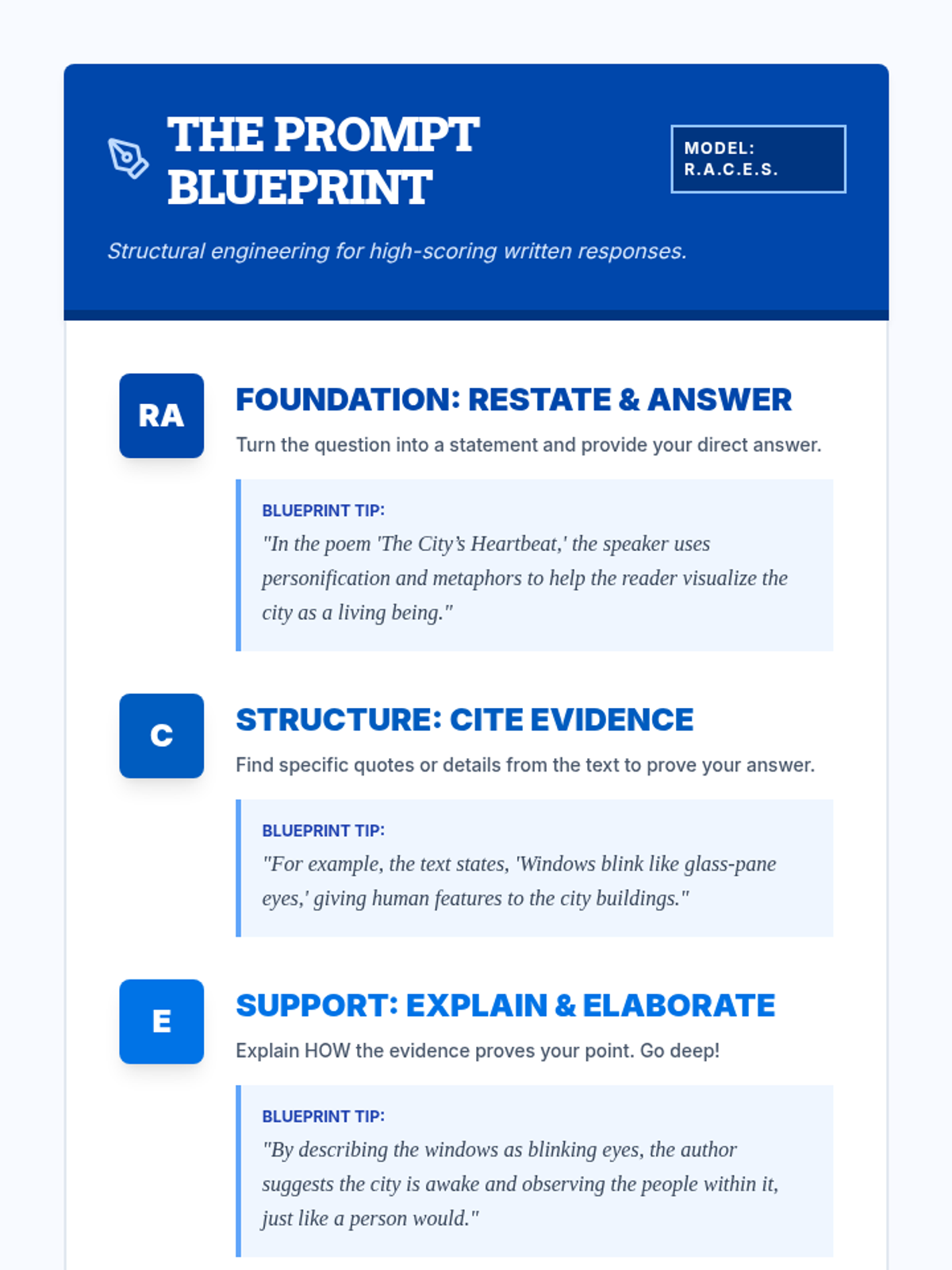
A student-facing "Blueprint" guide for writing text-based responses using the RACES format (Restate, Answer, Cite, Explain, Summarize).
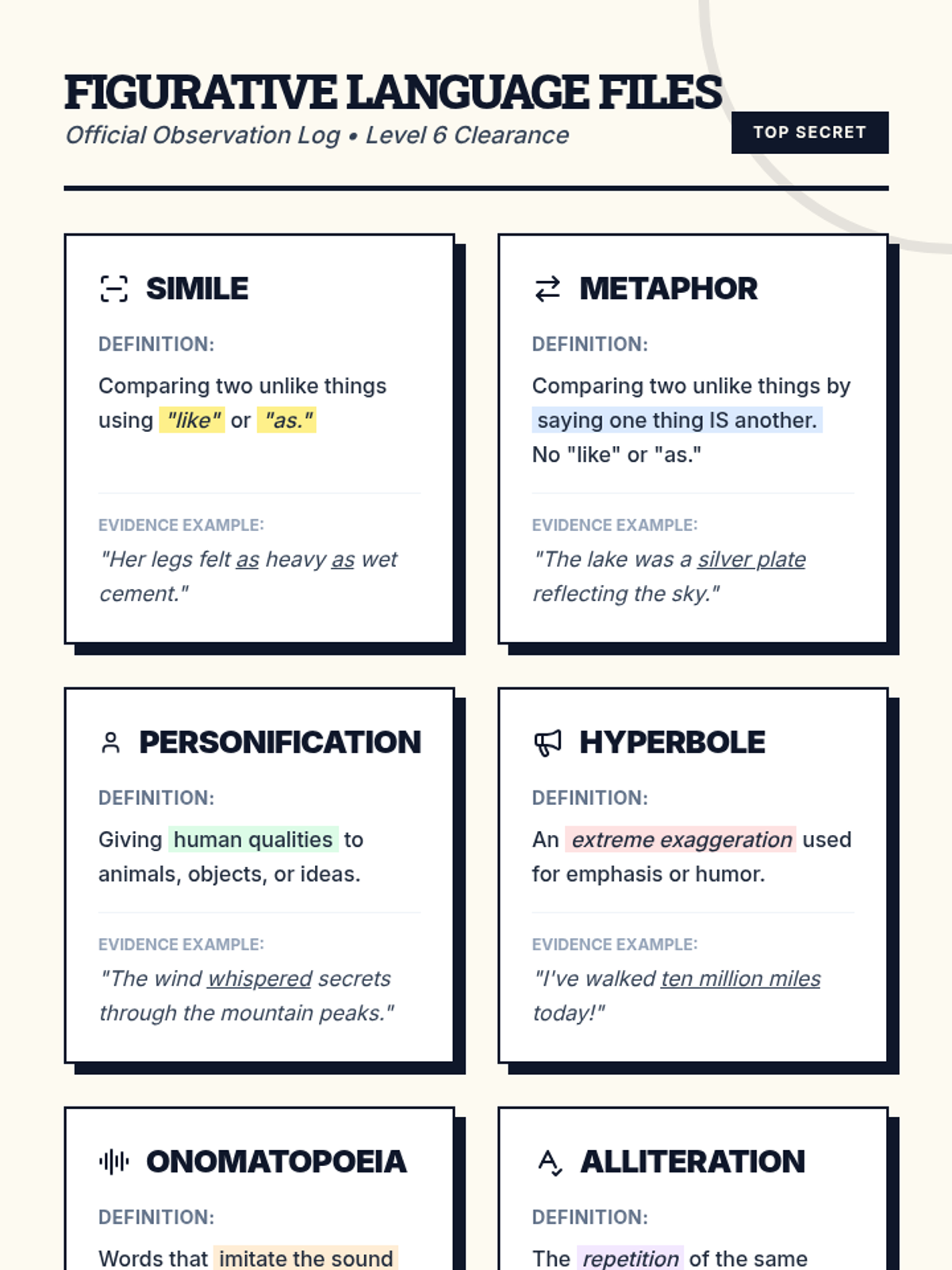
A "Detective Case Files" themed reference sheet for figurative language, covering similes, metaphors, personification, hyperbole, onomatopoeia, and alliteration with examples.
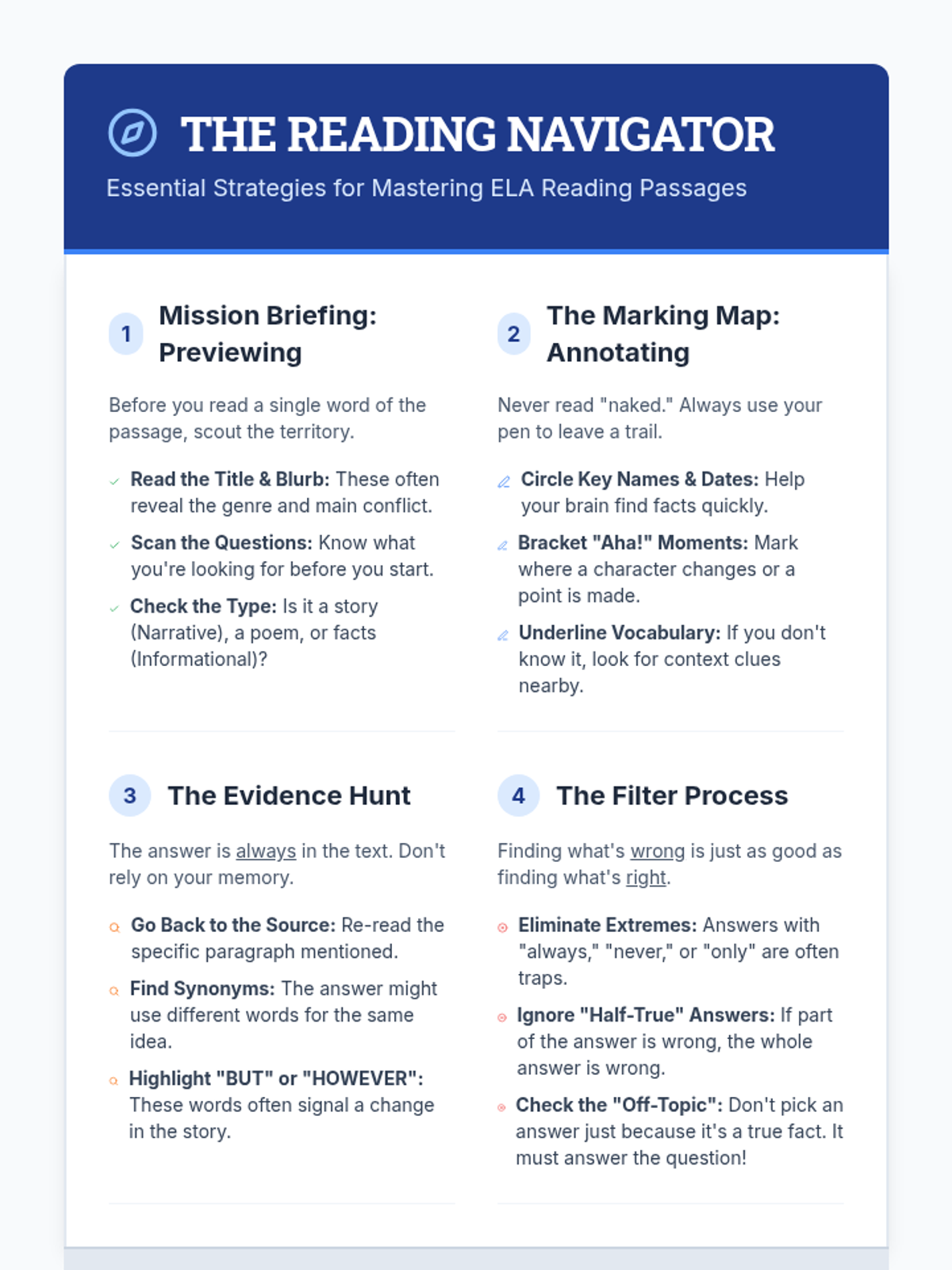
A student-facing strategy guide for ELA reading passages, focusing on previewing, annotating, evidence hunting, and the elimination process.
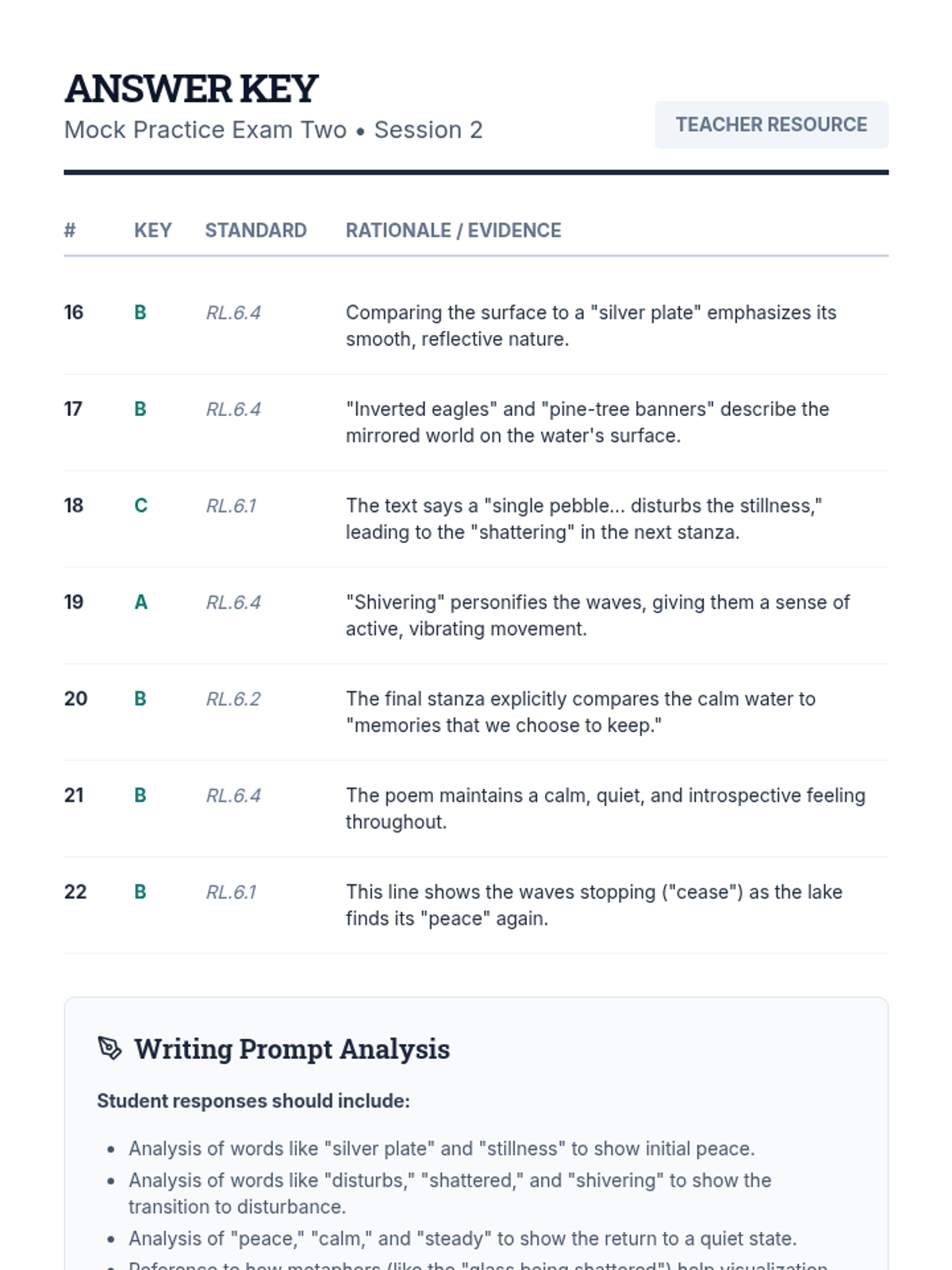
Answer key and rubric for Session 2 of Mock Exam Two, covering poetry analysis and a text-based writing prompt.