Develops proficiency in estimating and measuring length, area, volume, and mass using standard units and unit conversions. Integrates time, money, angle measurement, and data classification through counting and arithmetic applications.
Measurement Unit Slides - Lessons 3 & 4: Mixed Fractions and Line Plots. Recreated and translated into Japanese with advanced instructional visuals, worm and leaf data examples, and rigorous synthesis prompts. Revisions made for page breaks and math rendering. Fixed 'X' alignment on plots and matched cool-down options. Fixed comma alignment and dark blue highlights.
Measurement Unit Slides - Lesson 2: Inch Fourths. Recreated and translated into Japanese with professional instructional design, clear visuals of rulers, and interactive-style prompts. Revisions made for page breaks and math rendering. Fixed wrapping for 'inches'. Fixed paperclip alignment and ruler consistency. Improved mixed number visualization.
Measurement Unit Slides - Lesson 1: Inch Halves. Recreated and translated into Japanese with clean visuals, clear diagrams, and appropriate pedagogical structure. Revisions made for page breaks and math rendering. Fixed ruler zero positioning. Fixed eraser width to 1.5 units and improved layout. Corrected fraction terminology.
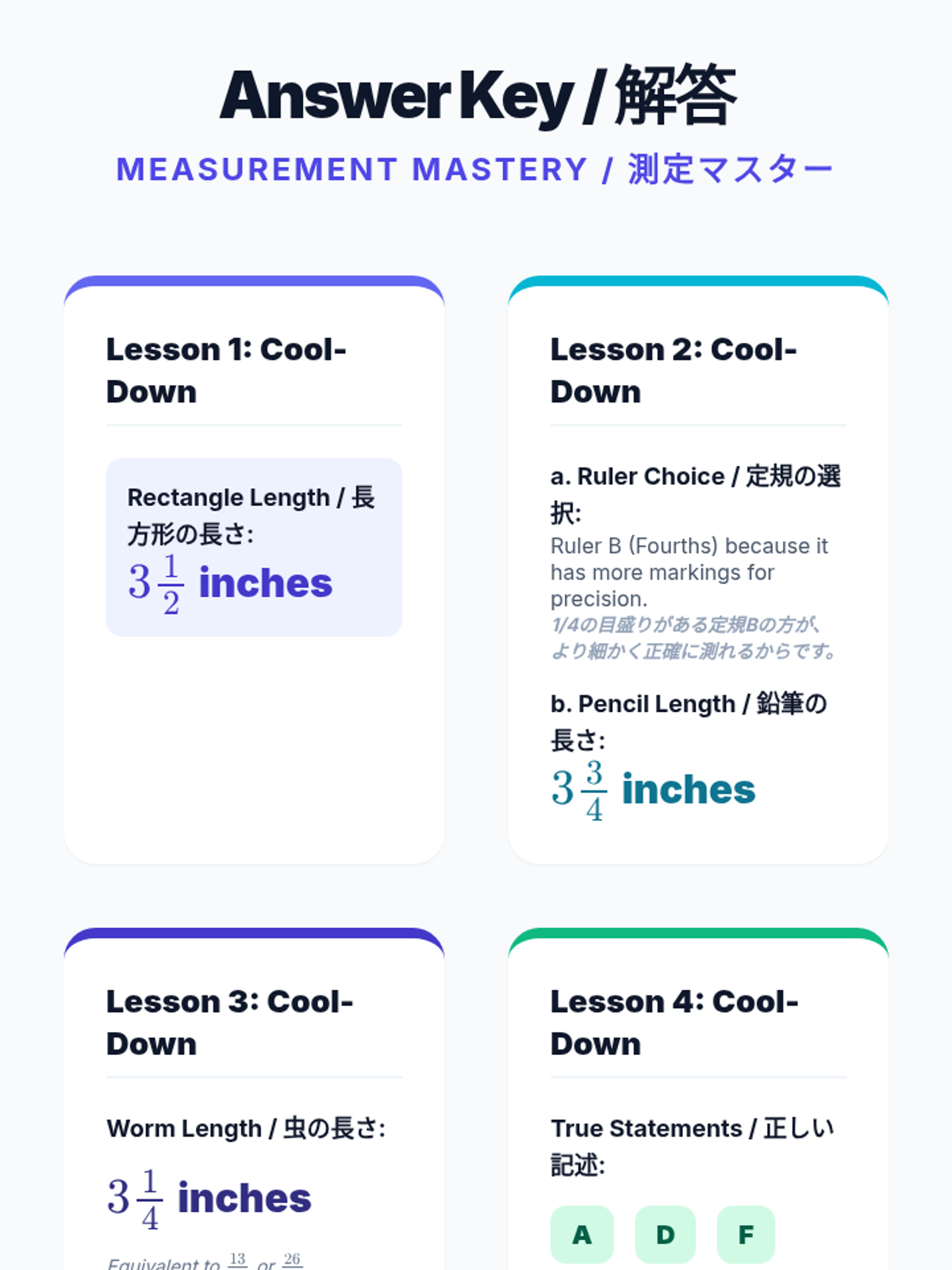
Comprehensive answer key for the unit. Revised for clarity, correct data references, and page break efficiency.
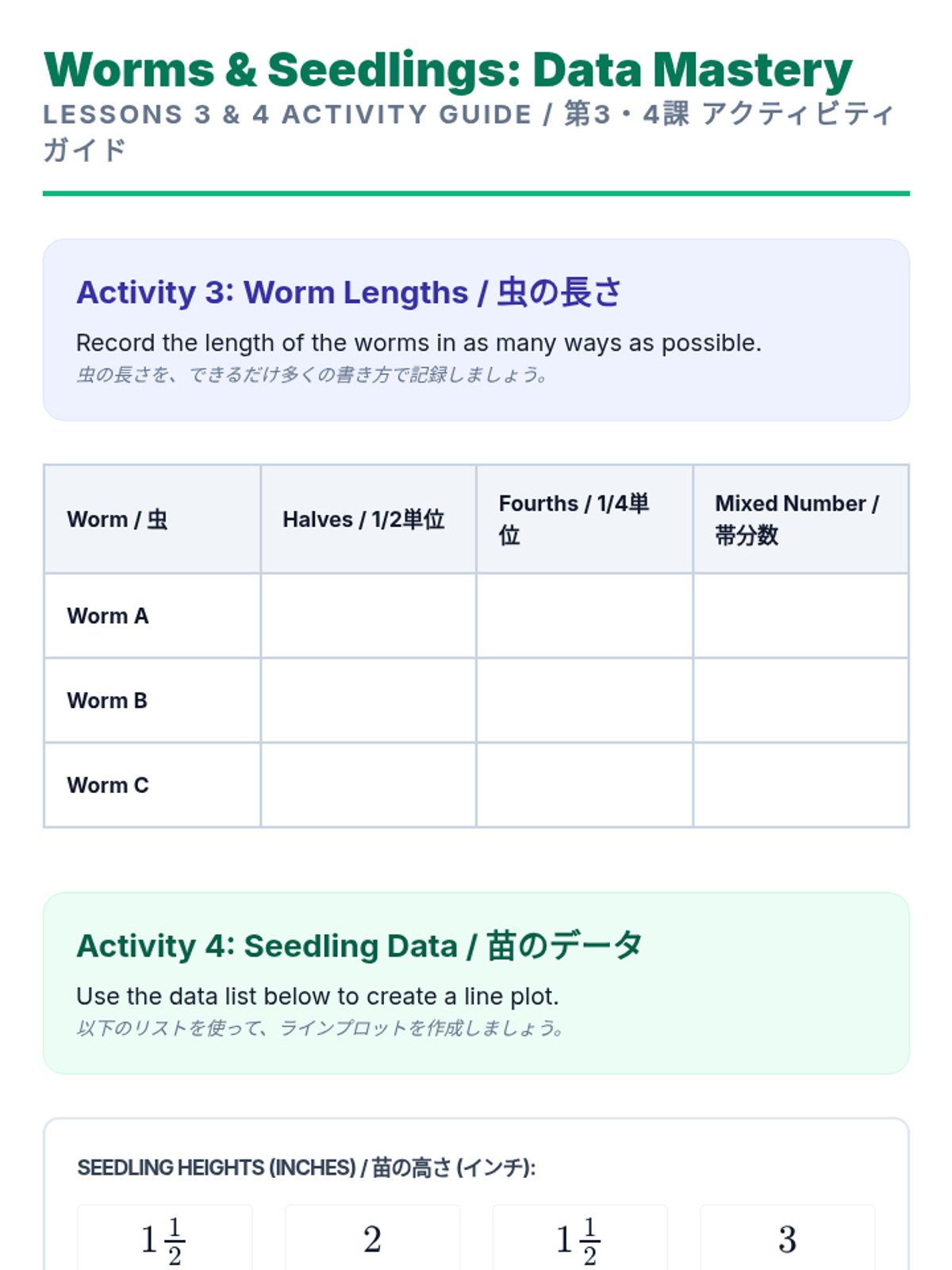
Handouts for Lessons 3 and 4. Revised to keep Activity 4 on one page, fix wrapping, and improve work area visibility.
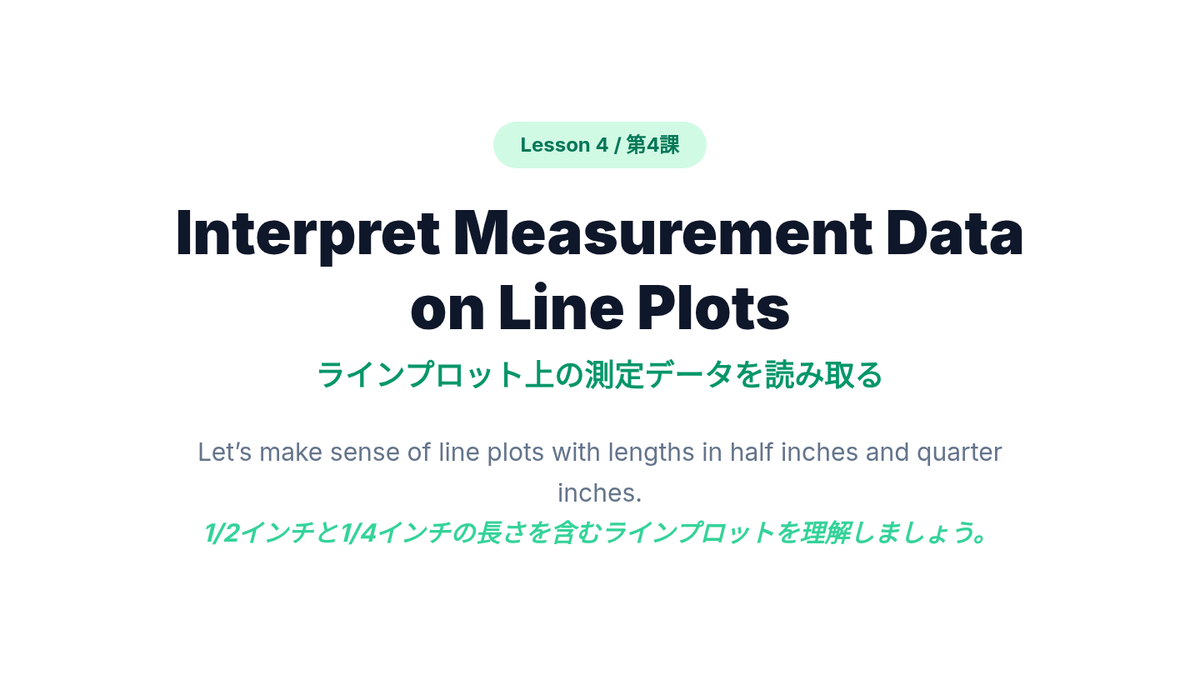
Bilingual slides for Lesson 4 (Interpreting Line Plots). Focuses on analyzing data representations, identifying differences between lists and plots, and verifying statements based on data. Revised for populated data and alignment.
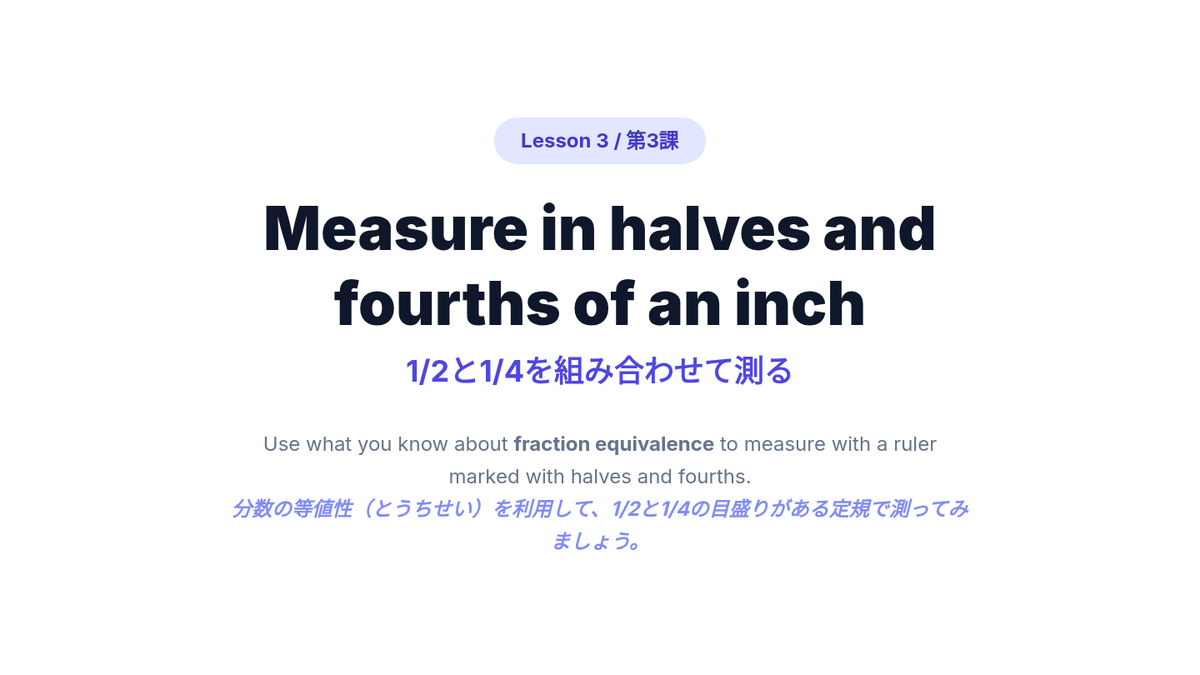
Bilingual slides for Lesson 3 (Equivalence and Mixed Numbers). Explores recording lengths in multiple ways and visualizing mixed number partitioning. Revised for ruler accuracy and visible diagrams.
Bilingual slides for Lesson 2 (Measuring in Fourths). Includes estimation exploration, partitioning activities, and a cool-down involving choosing the right tool for precision. Revised for ruler accuracy and alignment.
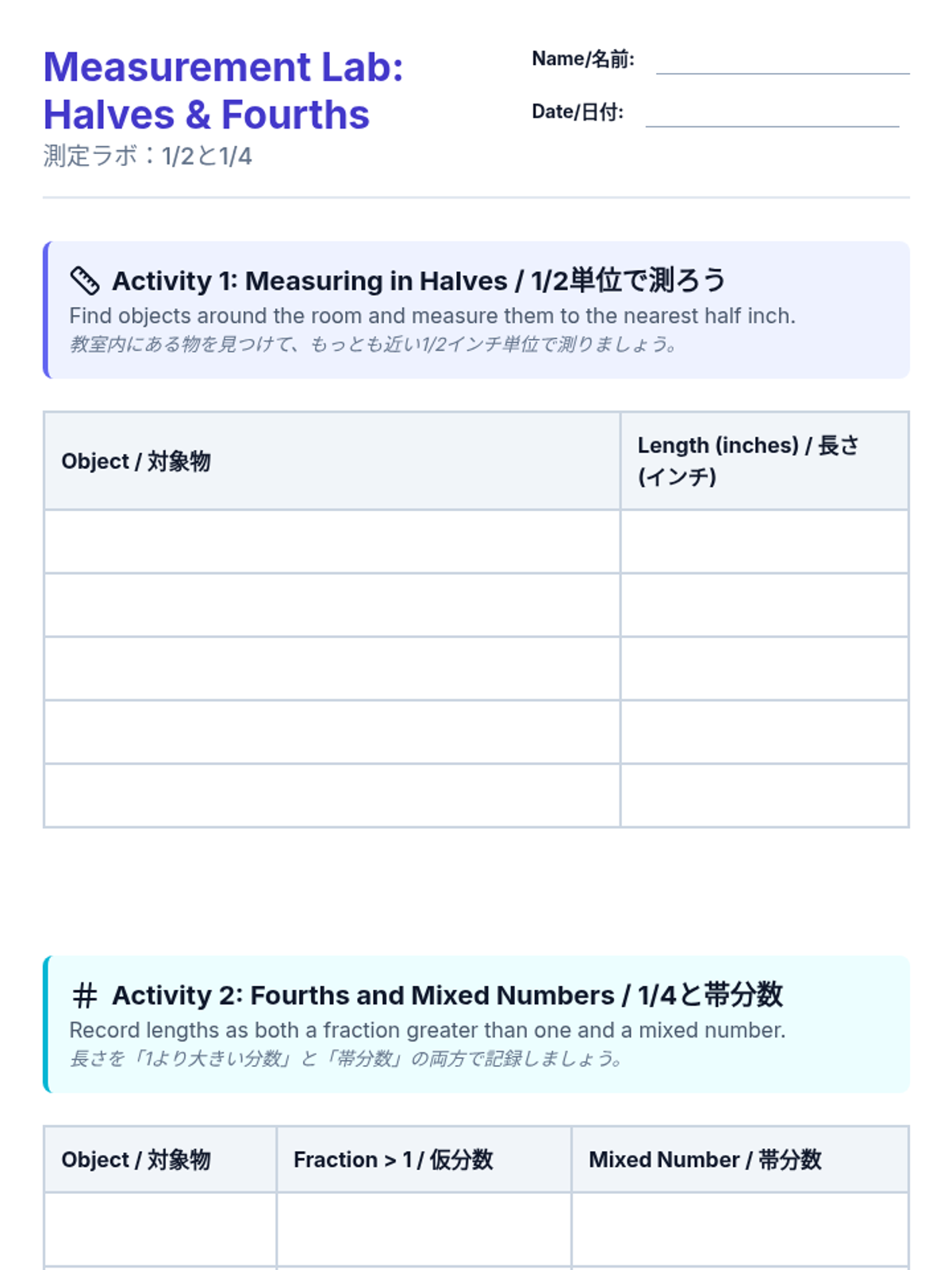
Recording sheets for measuring activities in Lessons 1 and 2. Bilingual format. Revised to prevent table splits and improve name/date formatting.
Bilingual slide deck for the Measurement unit, covering Unit Goals, Rubric, and Lesson 1 (Measuring in Halves). Includes specific terminology in both English and Japanese. Revised for ruler accuracy and alignment.
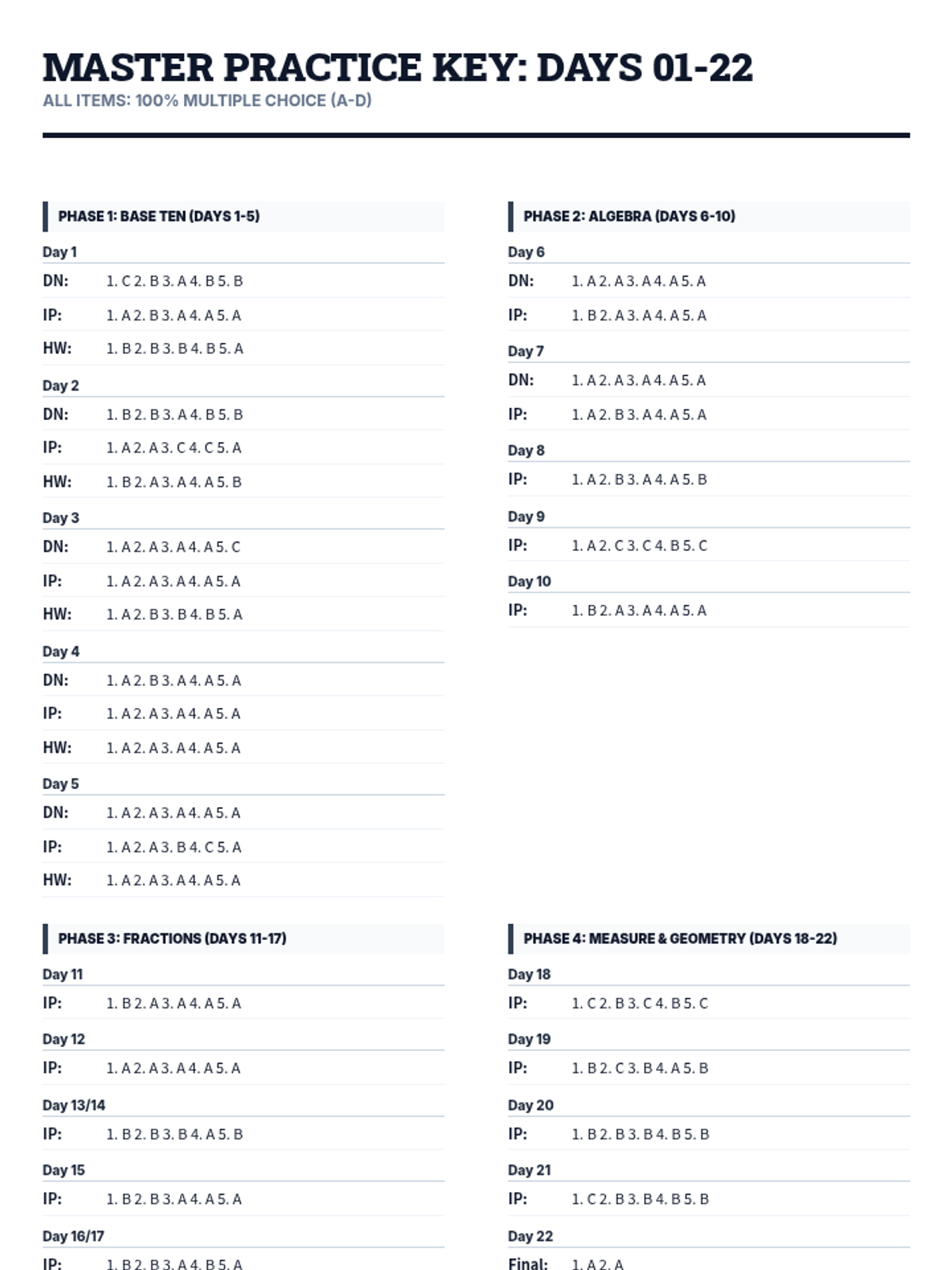
Complete answer key for the 22-day EOG multiple-choice practice series. Provides correct letter options for all items. Revised for single-page layout and high contrast. Includes Do Now, Independent Practice, and Homework keys for every instructional phase.
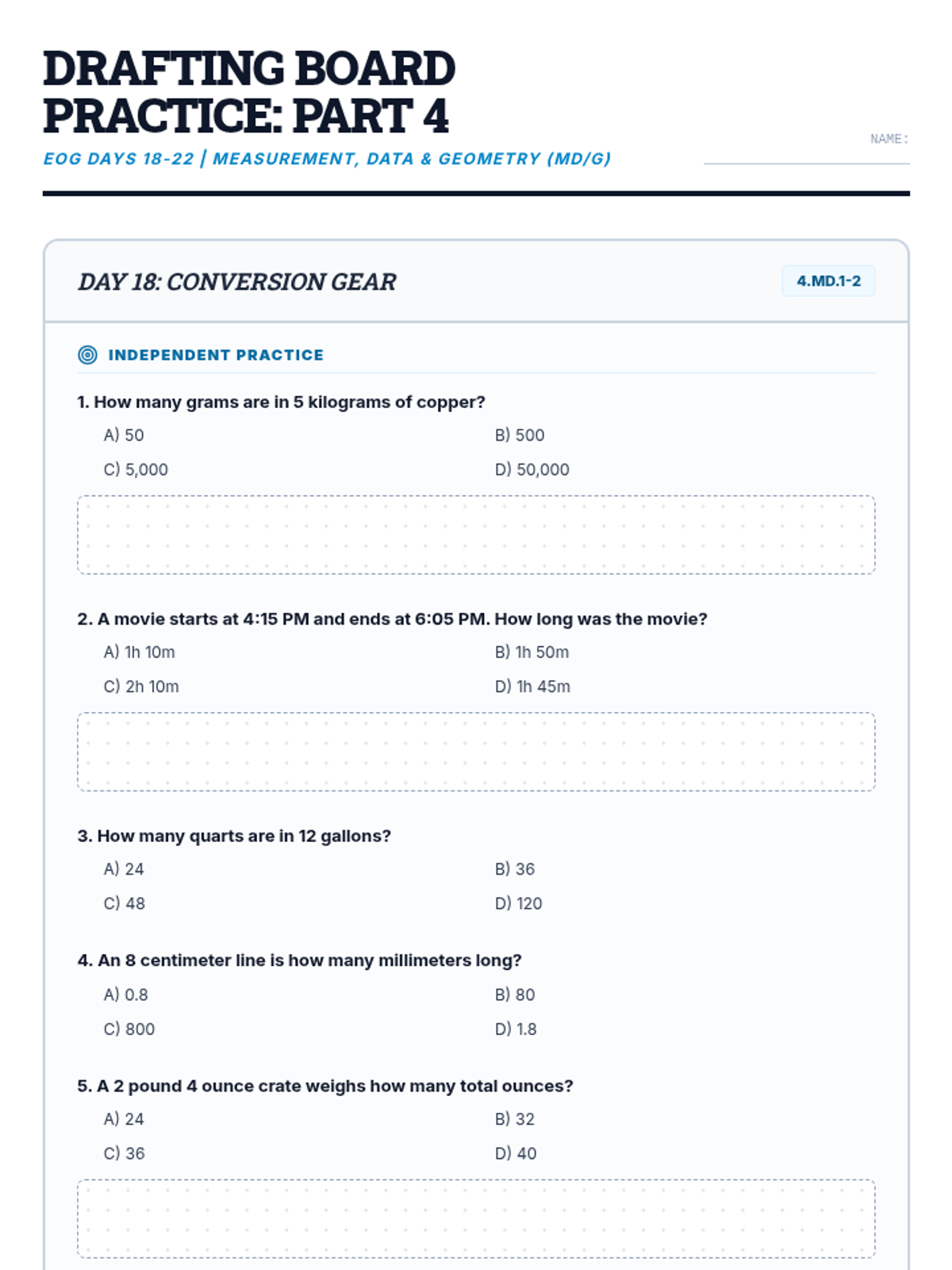
Daily EOG practice pack for Week 4 (Days 18-22), focusing on Measurement, Data, and Geometry (MD/G). All items have been converted to multiple-choice format with 4 options each. Includes unit conversions, rectilinear area, angle additive problems, and symmetry checks. Revised to satisfy review criteria including full sentence questions and consistent work areas.
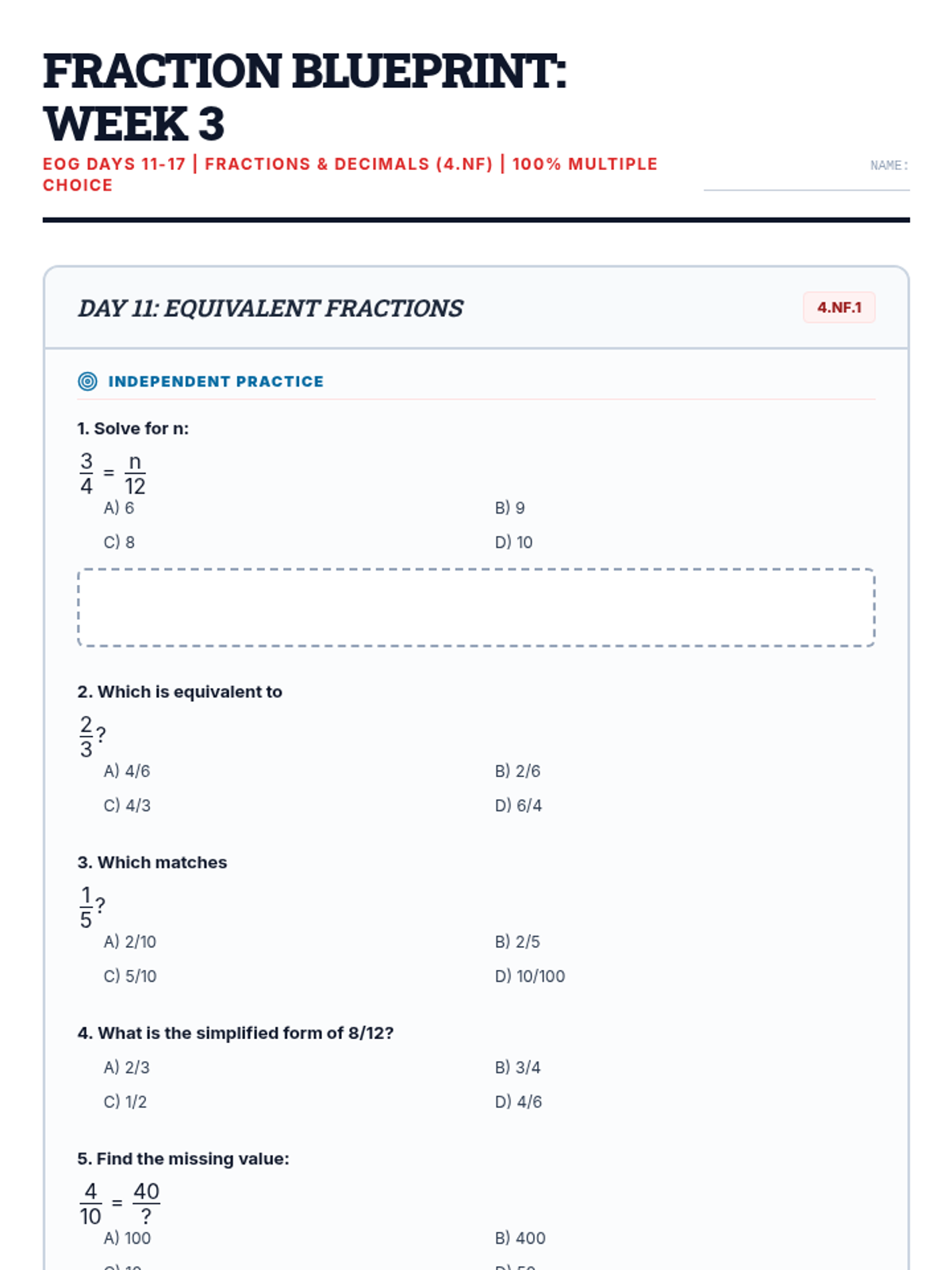
Daily EOG practice pack for Week 3 (Days 11-17), focusing on Fractions and Decimals (NF). All items have been converted to multiple-choice format with 4 options each. Includes mixed numbers, scalar products, and decimal comparisons. Revised to satisfy review criteria including vertical fraction formatting and proper lesson components.
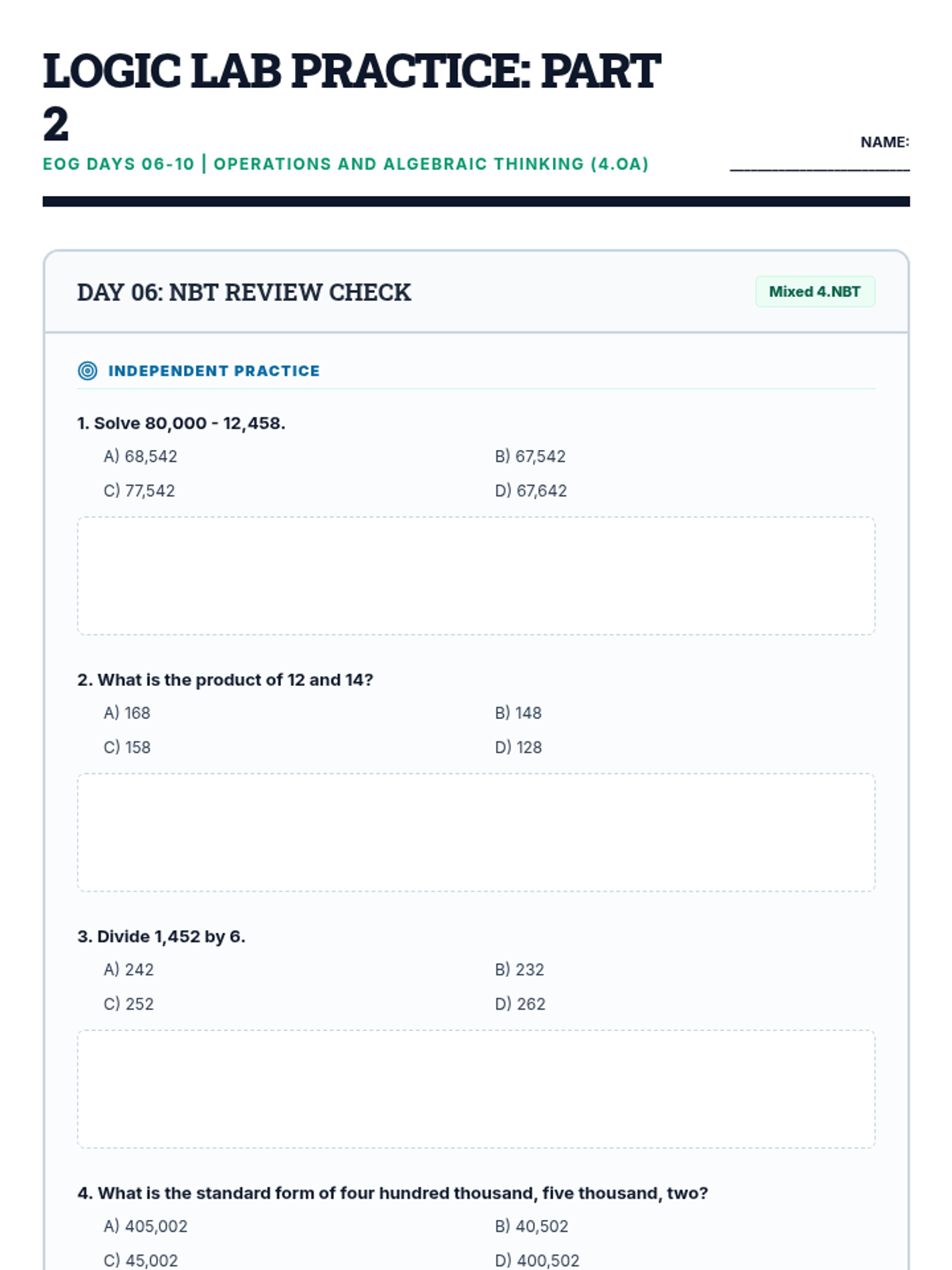
Daily EOG practice pack for Week 2 (Days 6-10), focusing on Operations and Algebraic Thinking (OA). Each day includes a 5-question Do Now, a 5-question Independent Practice set, and a 5-question Homework task. Covers multiplicative comparisons, multistep word problems, factors/primes, and sequences. Revised for 100% Multiple Choice format and improved professional phrasing. Revised to satisfy all review criteria.
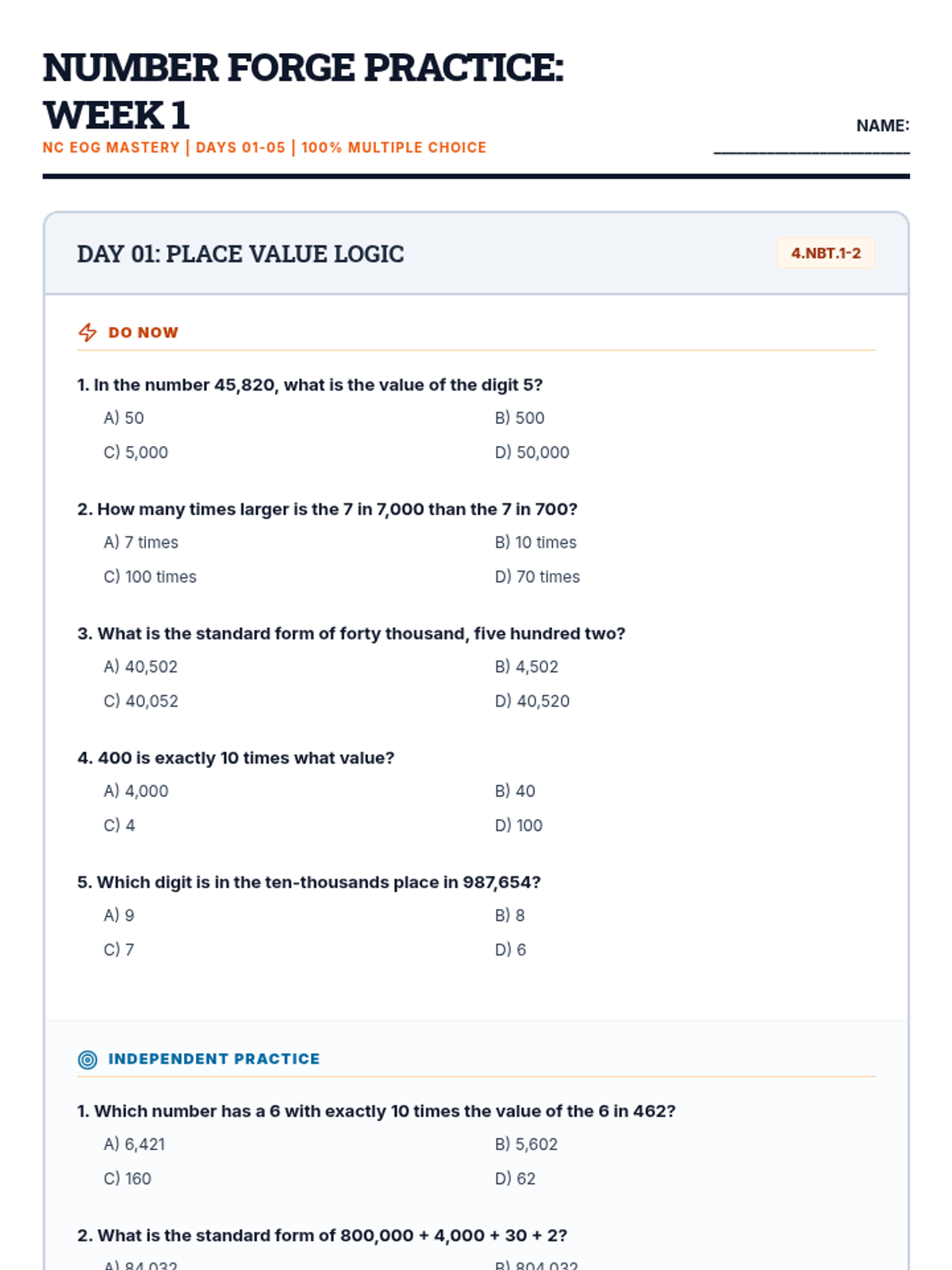
Daily EOG practice pack for Week 1 (Days 1-5), focusing on Number and Operations in Base Ten (NBT). Every day includes 15 multiple-choice questions (5 Do Now, 5 IP, 5 HW) with standard 4-option grids. Features dedicated work areas for all multi-digit calculation problems. Aligned with 4.NBT.1-6 standards. Revised for full content coverage, improved contrast, and proper layout.
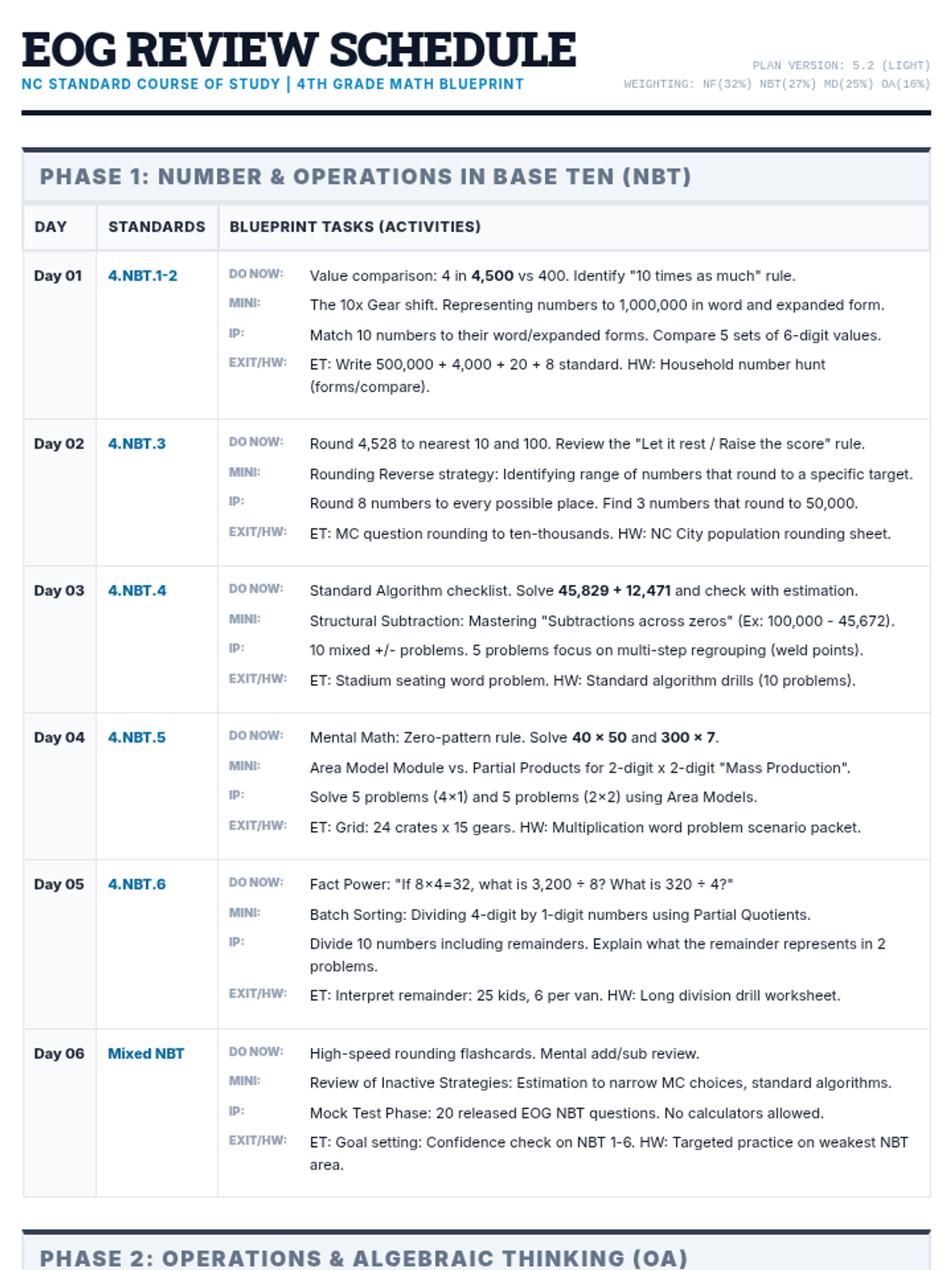
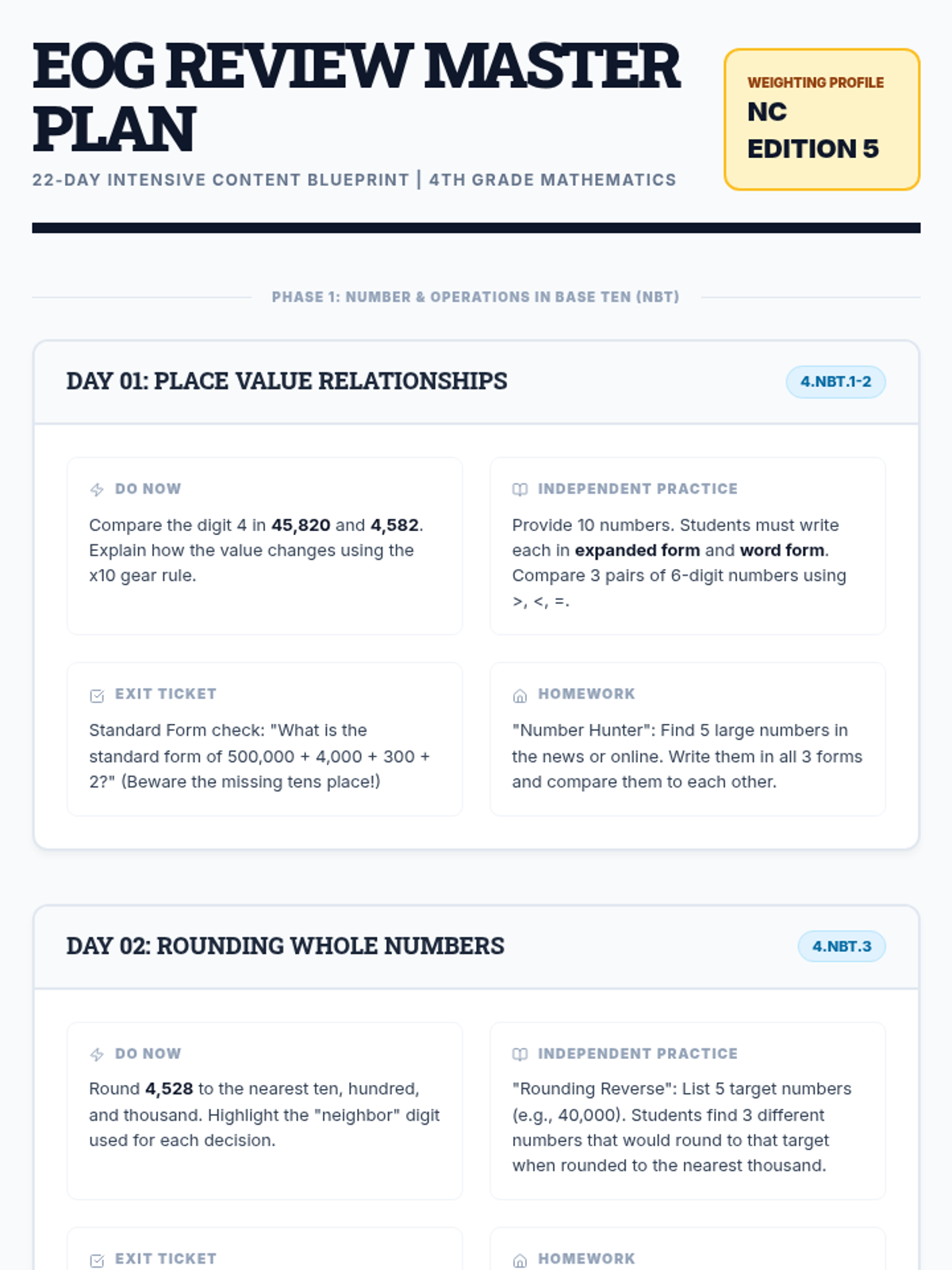
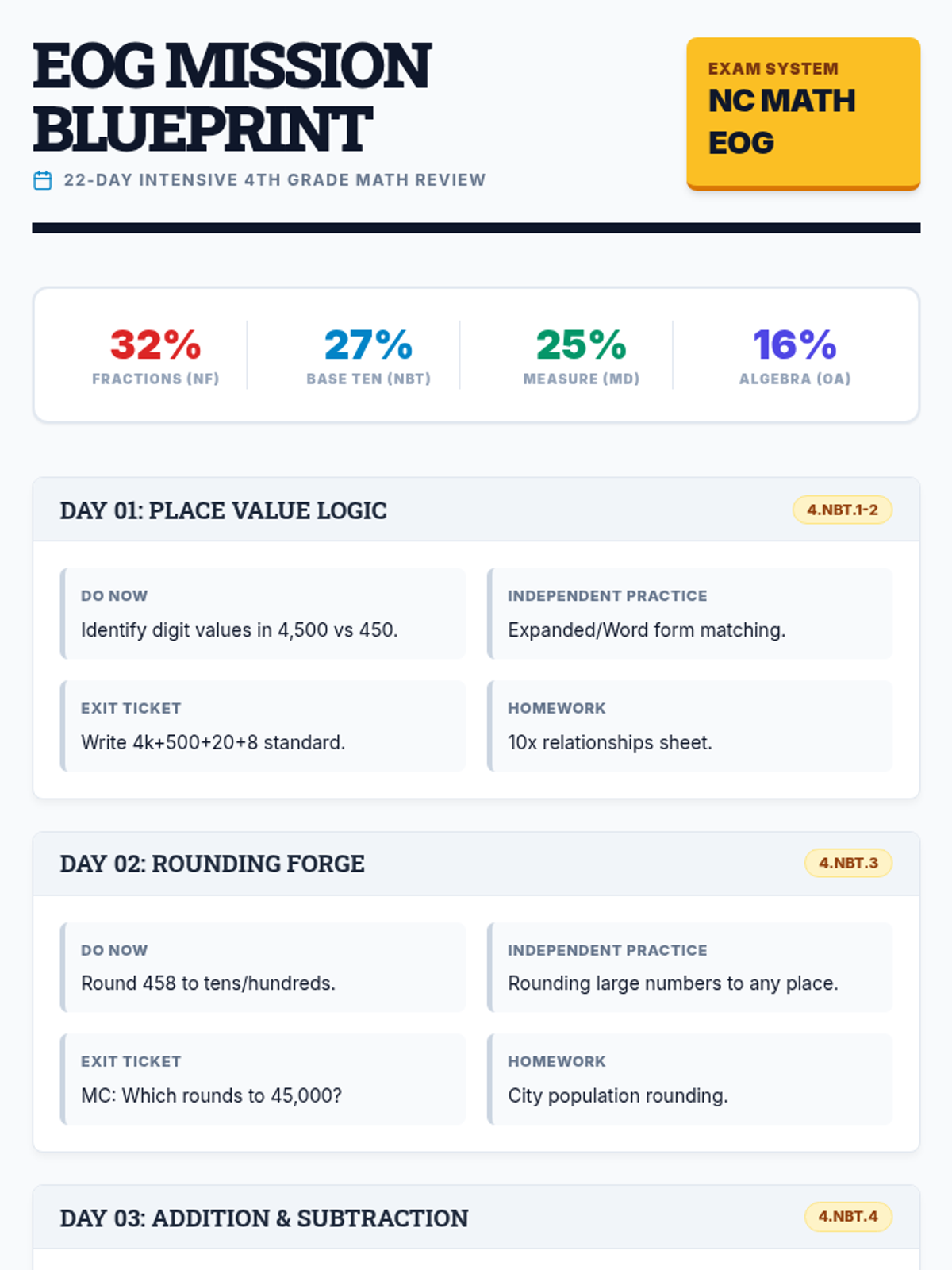
A comprehensive 22-day EOG review plan for 4th-grade math, formatted in columns for Date, Standards, and Blueprint Tasks. Each day includes a specific bell-ringer (Do Now), instructional focus (Mini Lesson), independent work (IP), and closing/home practice (Exit Ticket/Homework). Weighted strictly according to NC EOG specifications.
A comprehensive 22-day EOG review plan for 4th-grade math. Fully fleshed out with specific Do Now, Independent Practice, Exit Ticket, and Homework tasks for every single day of the review period. Aligned with NC state weightings for all standards.
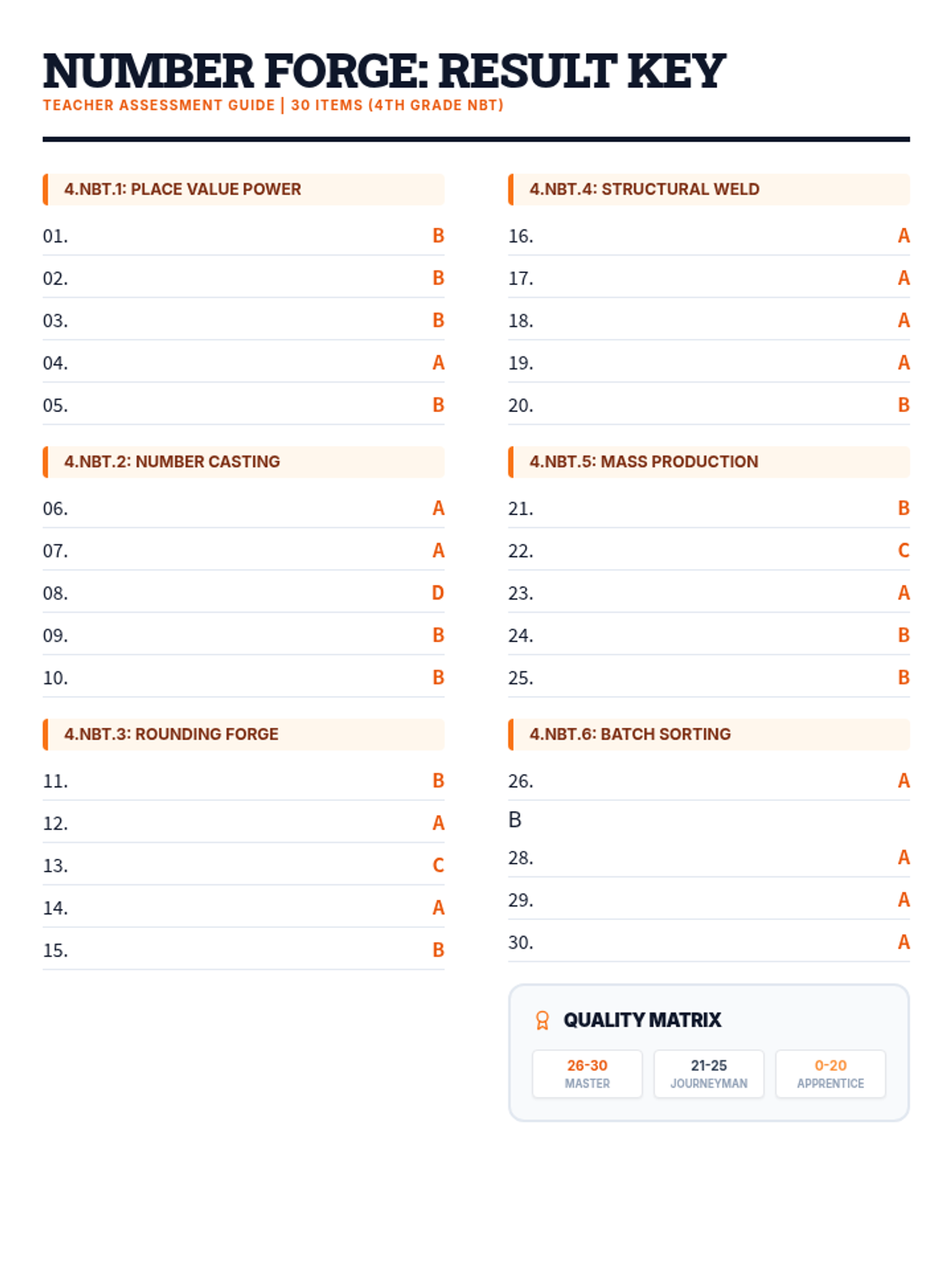
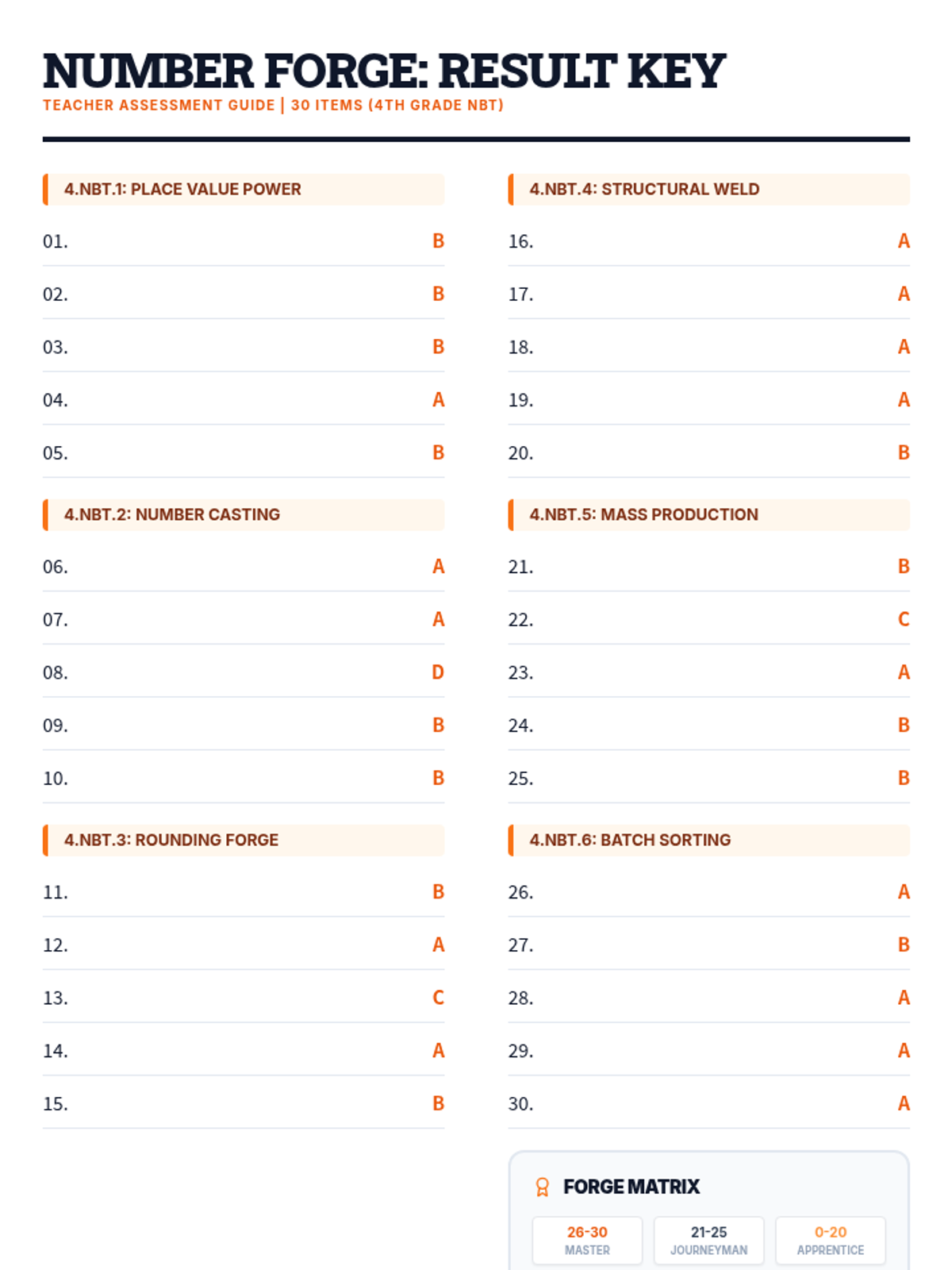
Industrial-themed answer key for the Number Forge 4th Grade math review. Provides categorized answers for all 30 questions and a "Quality Matrix" for scoring student performance. Revised for single-page layout, lighter section headings, and high text contrast.
A comprehensive 22-day EOG review plan for 4th-grade math. Lightened heading backgrounds for ink-efficiency. Each day provides a complete Do Now, Independent Practice, Exit Ticket, and Homework task aligned with NC standard weightings.
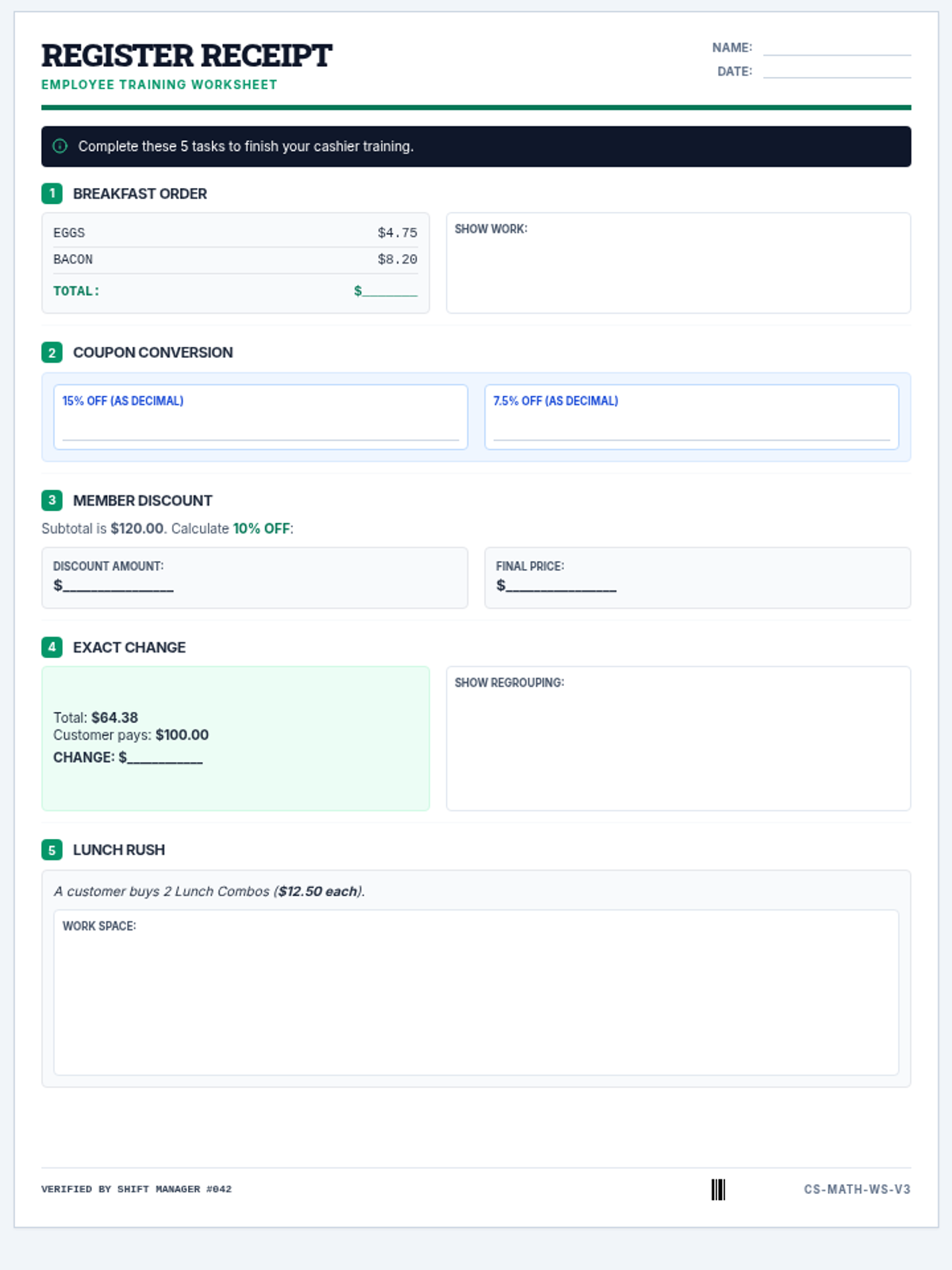
A student-facing worksheet for practicing retail arithmetic, including multi-item totals, percentage discounts, and complex change-making with regrouping. Updated to fit all 5 problems on one page with high-contrast footer.
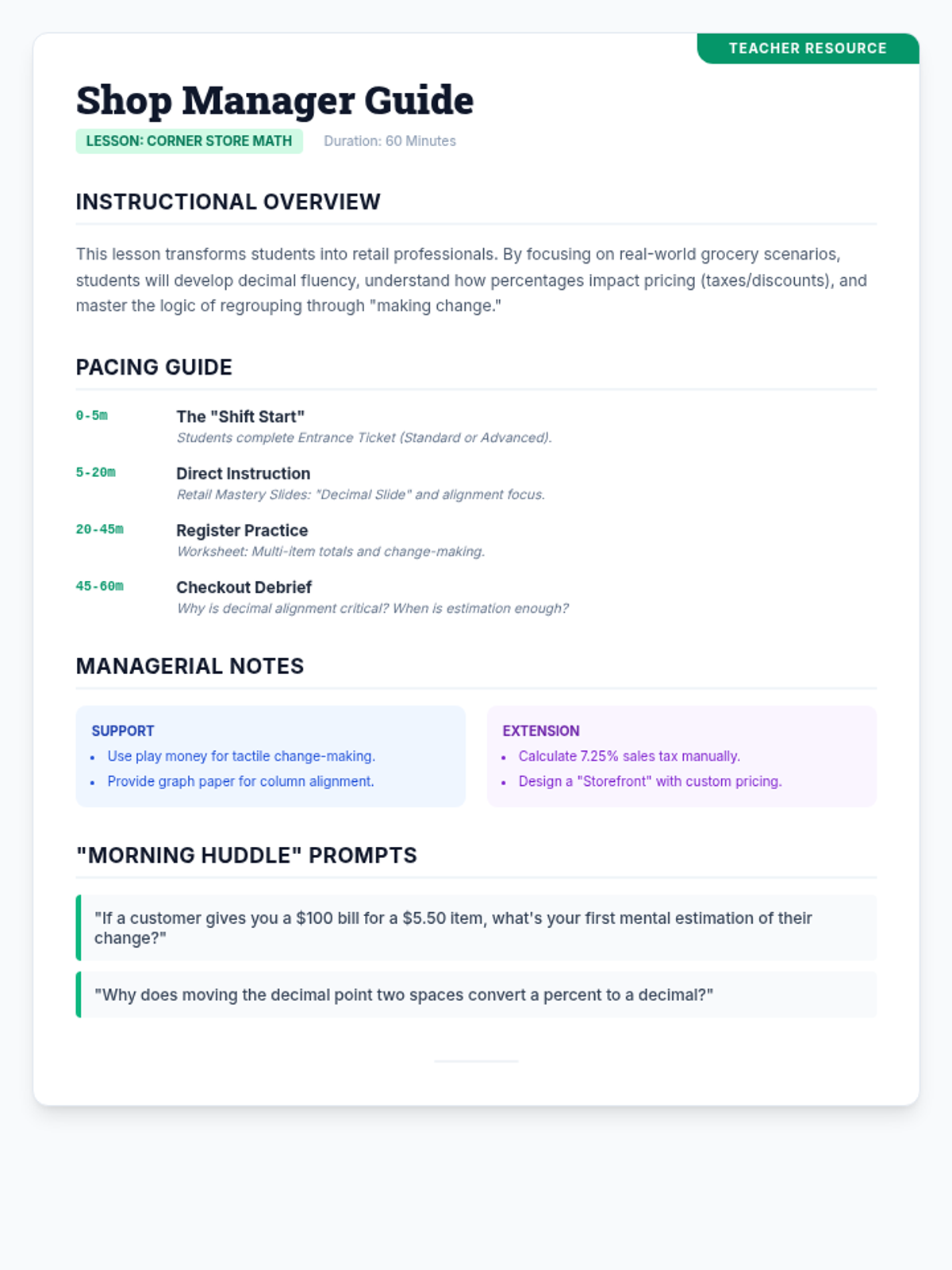
A teacher's facilitation guide for the Corner Store Math lesson, including pacing, differentiation strategies, and discussion prompts. Updated for better page fit.
An instructional presentation for teaching retail math, covering decimal alignment, percentage conversions, and mental math strategies for checkout scenarios. Updated with 5 problems.
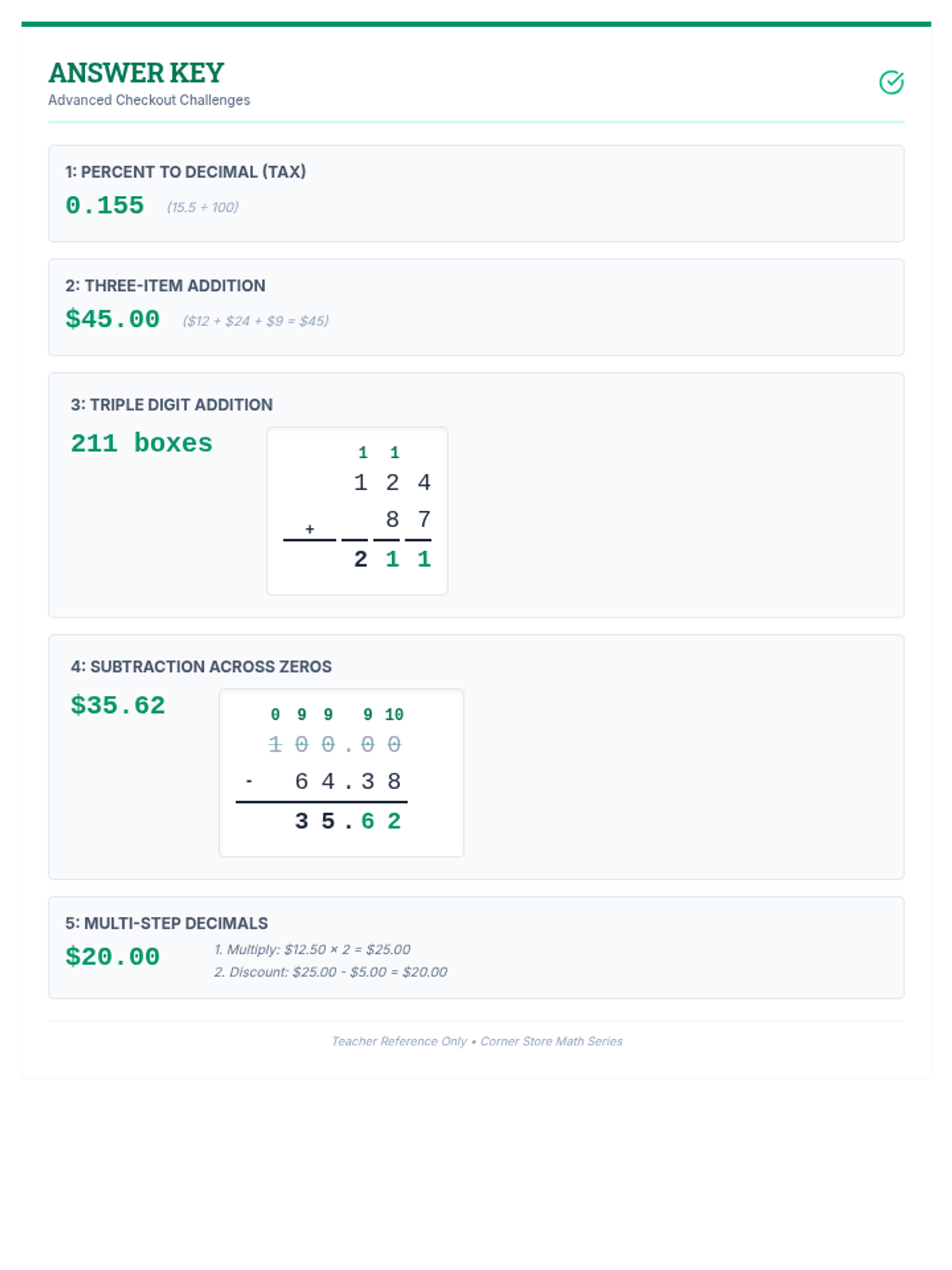
Answer key for the advanced entrance ticket, featuring step-by-step solutions for subtraction across zeros and multi-step decimal problems. Visuals updated for better alignment.
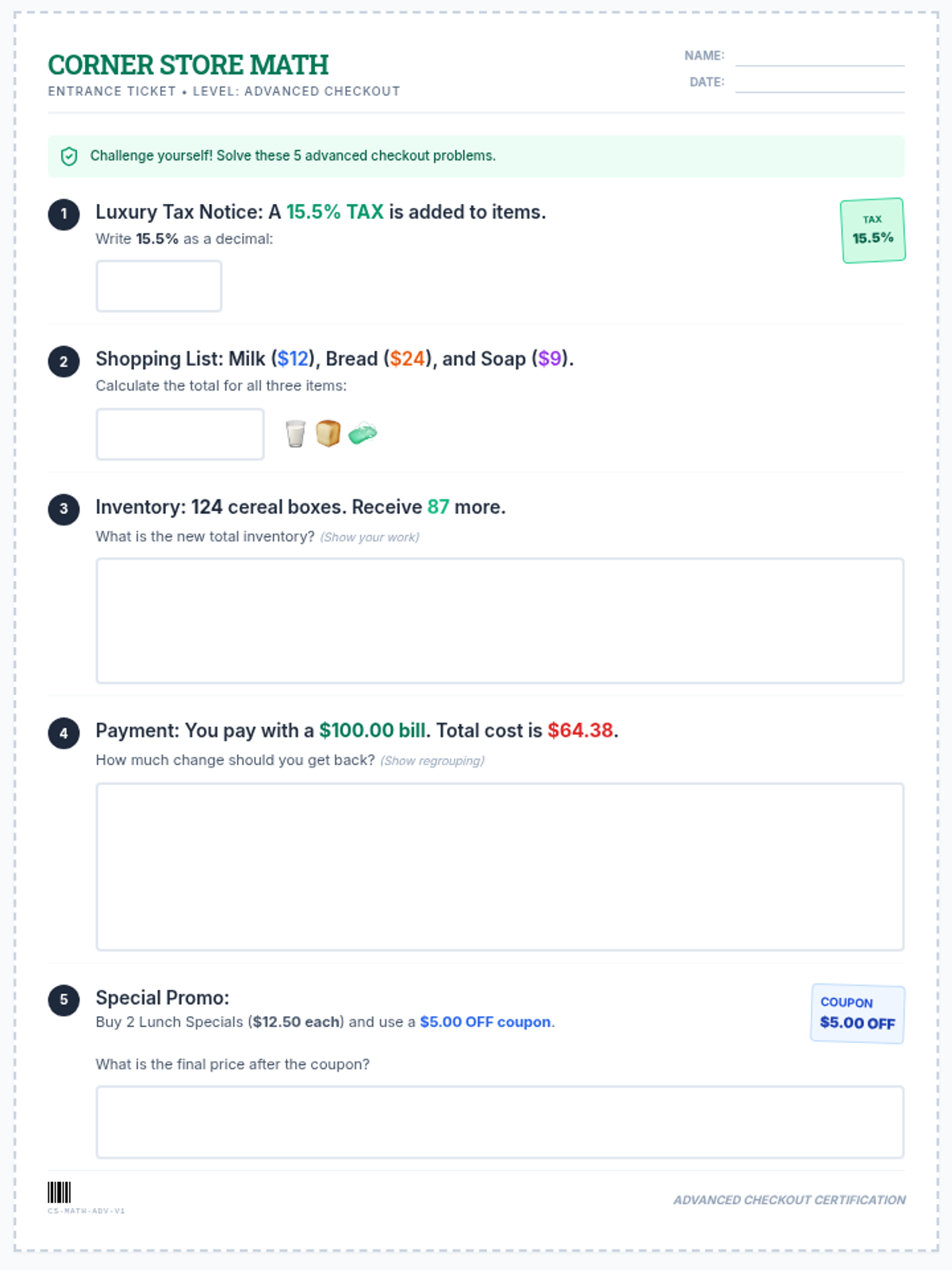
An advanced version of the grocery-themed entrance ticket featuring more complex multi-digit addition, subtraction across zeros, and multi-step decimal problems.
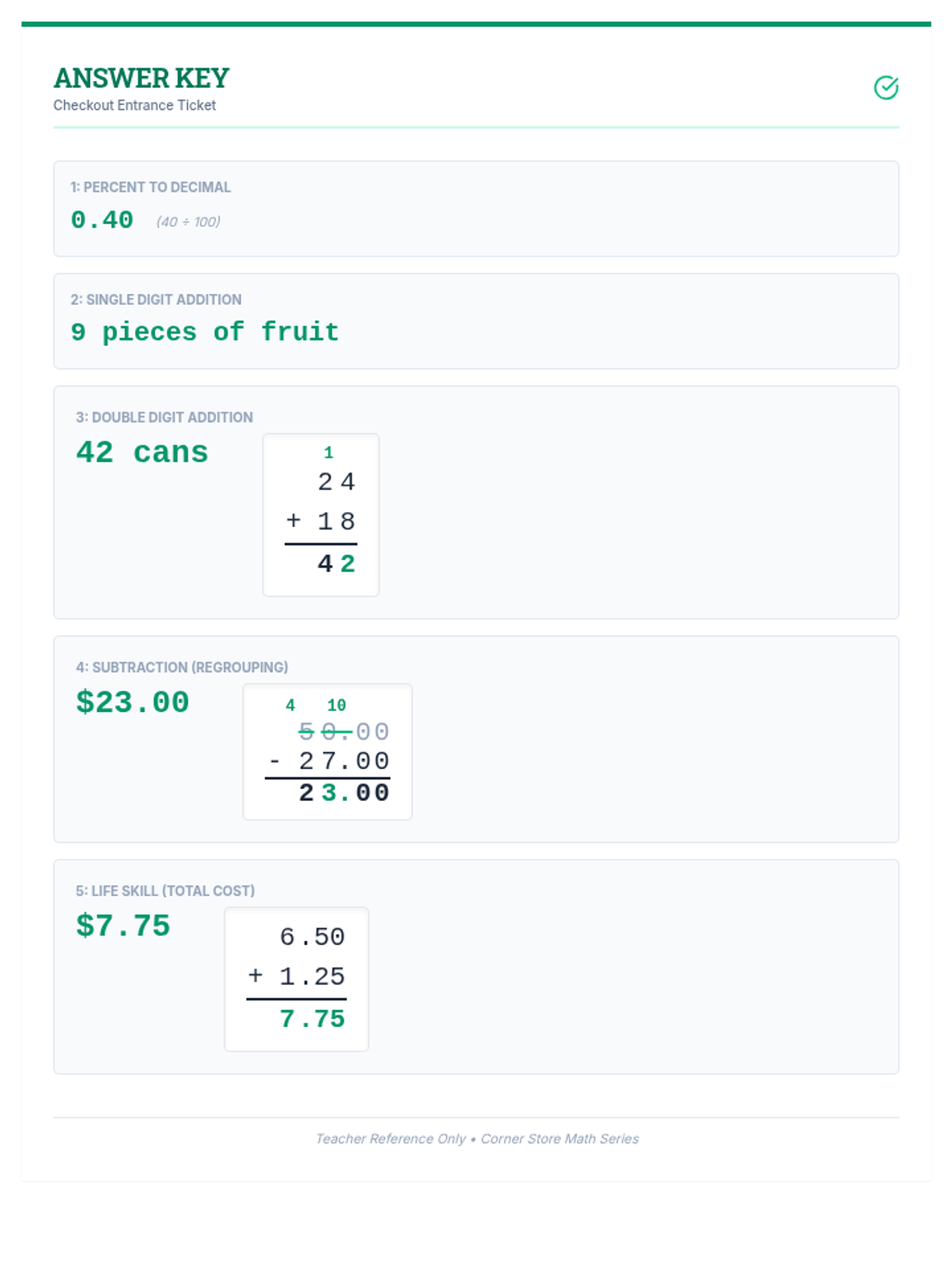
An answer key for the Checkout Entrance Ticket, providing solutions and step-by-step regrouping explanations. Visuals aligned for clarity.
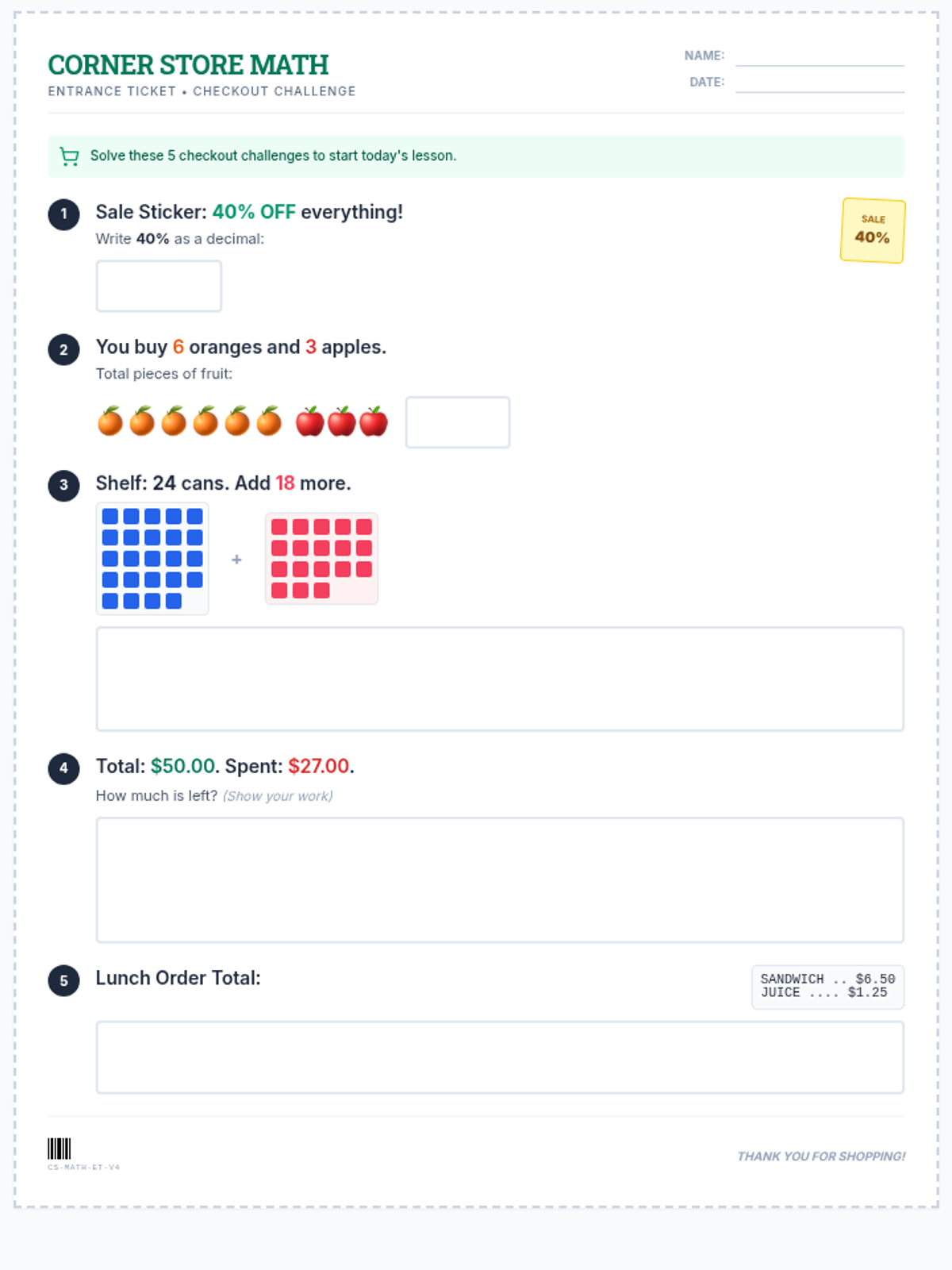
A grocery-themed entrance ticket covering percentages, basic addition/subtraction, regrouping, and money-based life skills with visual aids. Updated for better page fit.
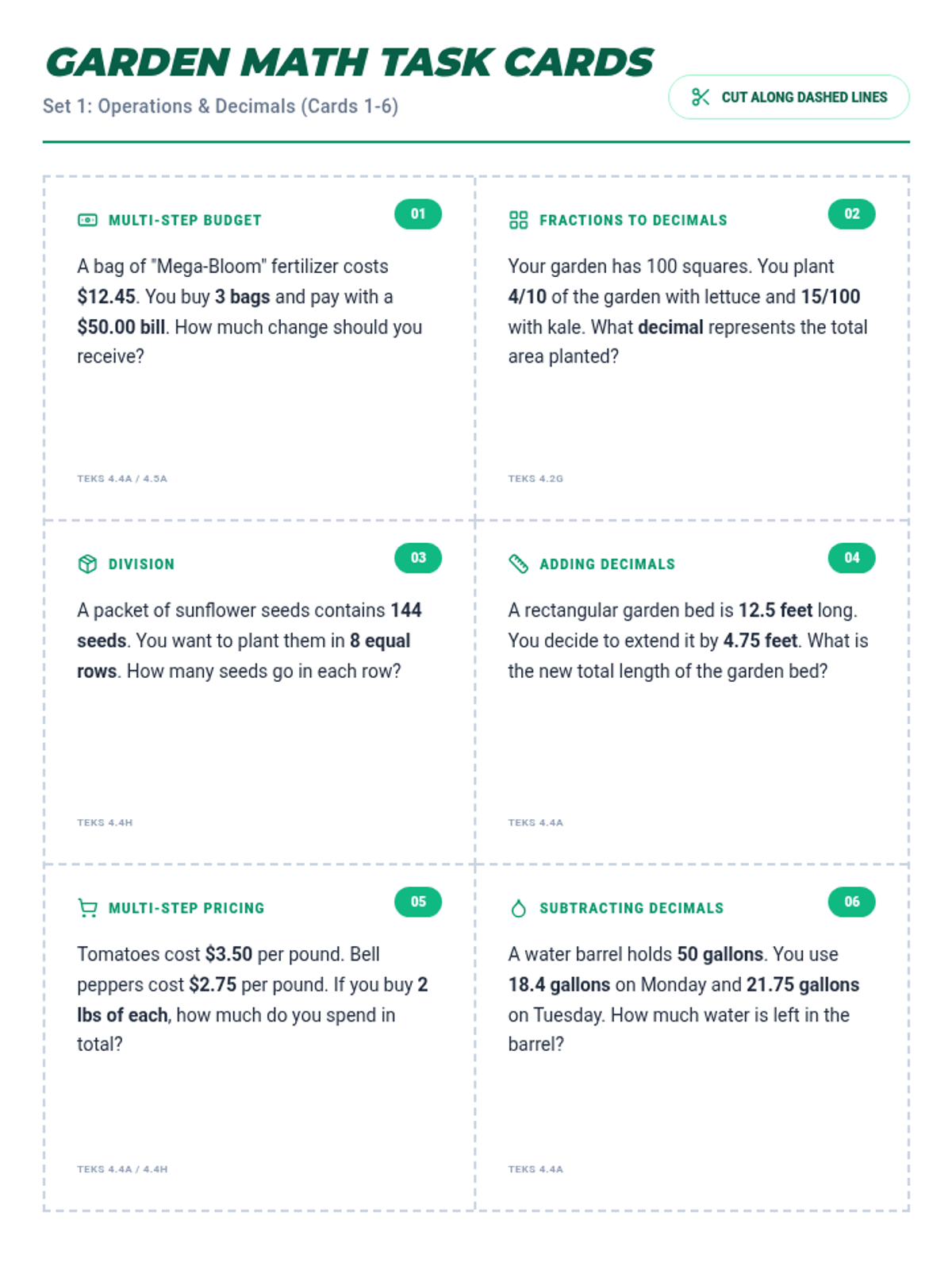
A printer-friendly set of 12 thematic task cards for 4th-grade math and a 2-page recording sheet. Optimized heights and spacing ensure all content fits on the page for clean printing. Includes cutting guides and clear student work areas.
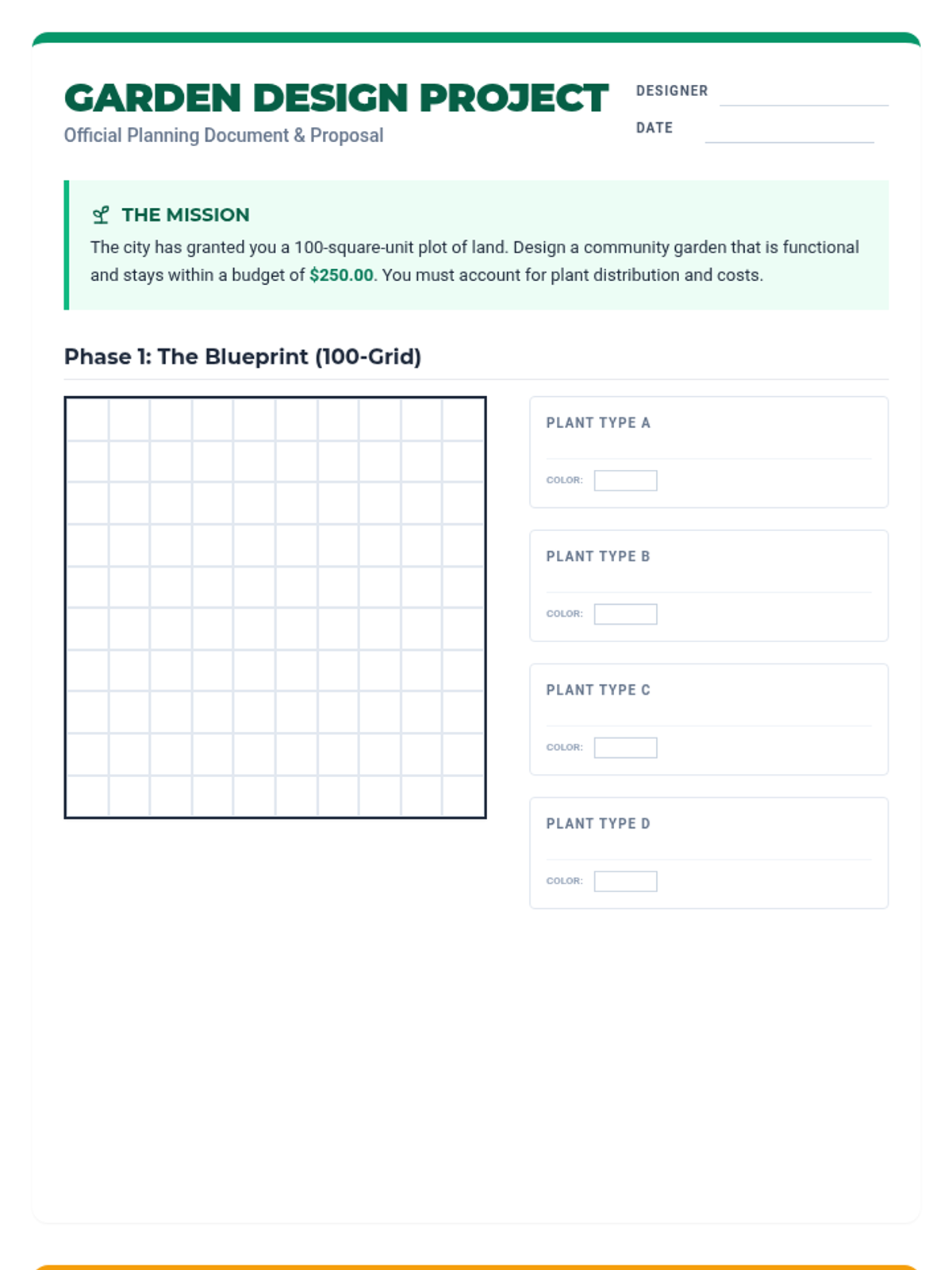
A 3-page project-based learning guide for garden design. Layout updated for printer-friendliness, consistent student work area styling, and logical task instructions. Spacing optimized for physical writing.
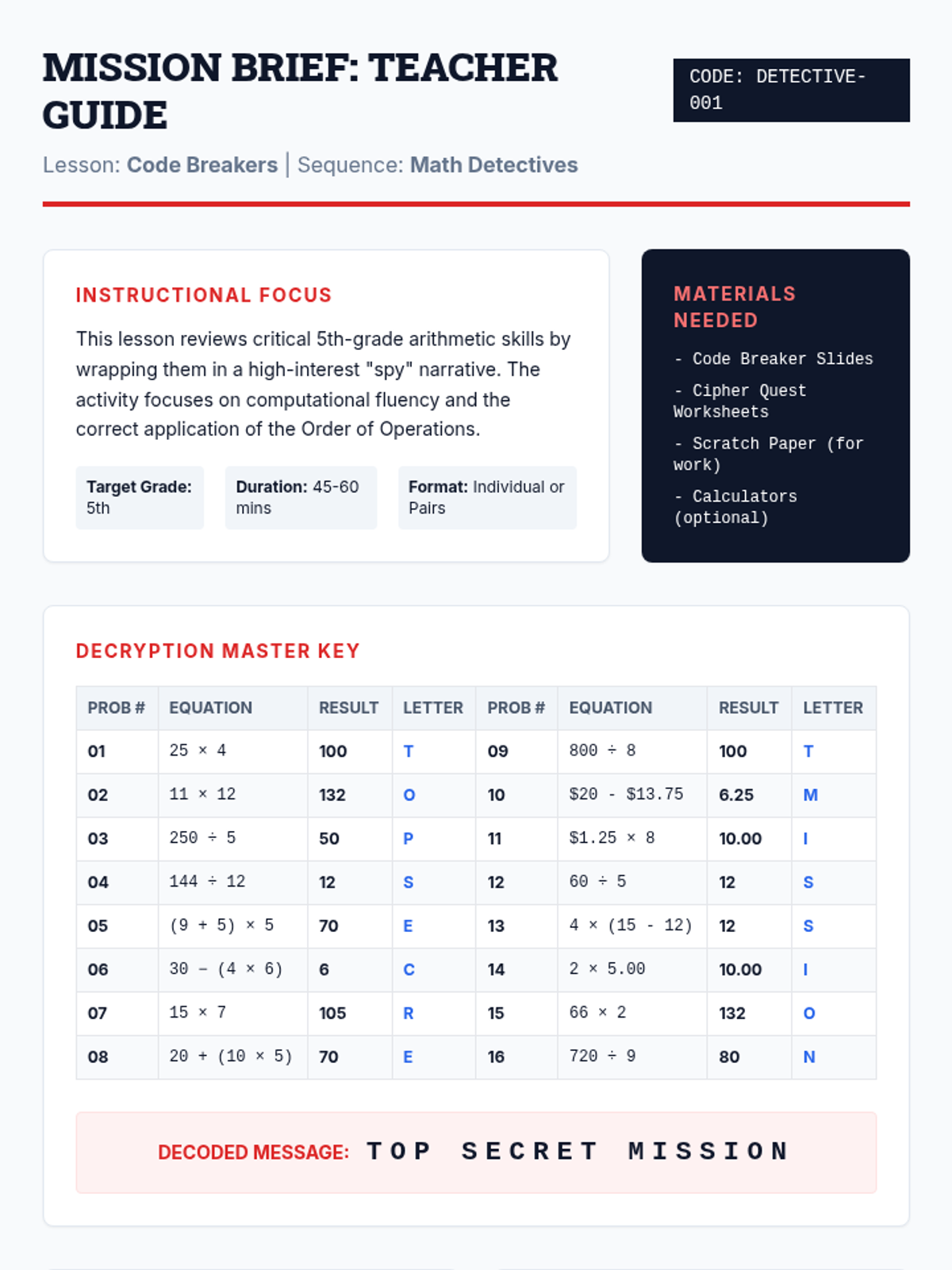
A teacher-facing resource providing the answer key, lesson script, common misconceptions, and differentiation strategies for the Code Breakers activity.
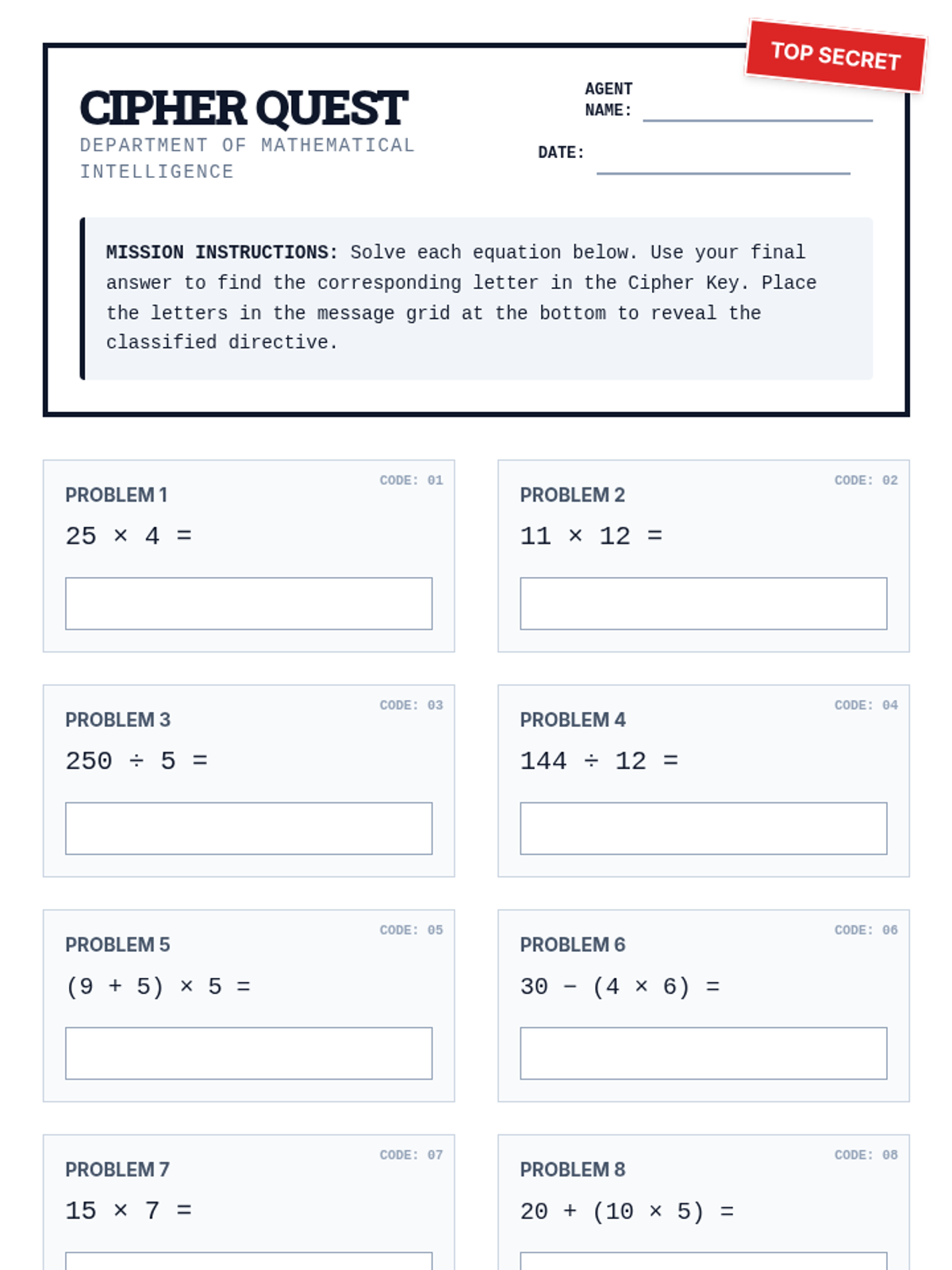
A student-facing math worksheet with a spy-themed cipher. Students solve 16 equations covering multiplication, division, PEMDAS, and money to decode the "Top Secret" message: TOP SECRET MISSION.
An interactive presentation that frames mathematical concepts (multiplication, division, PEMDAS, money) within a "spy mission" context to engage 5th-grade students.
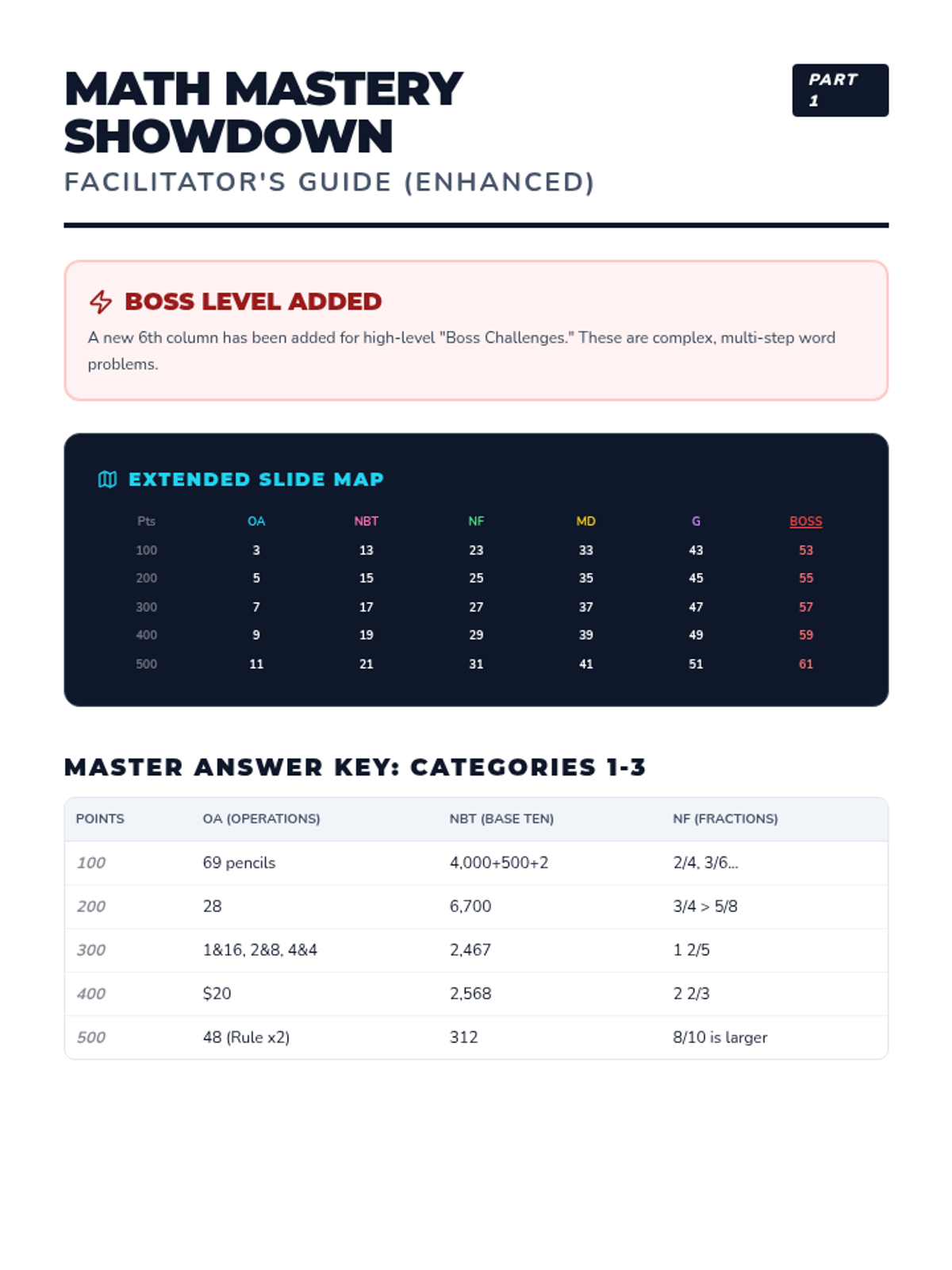
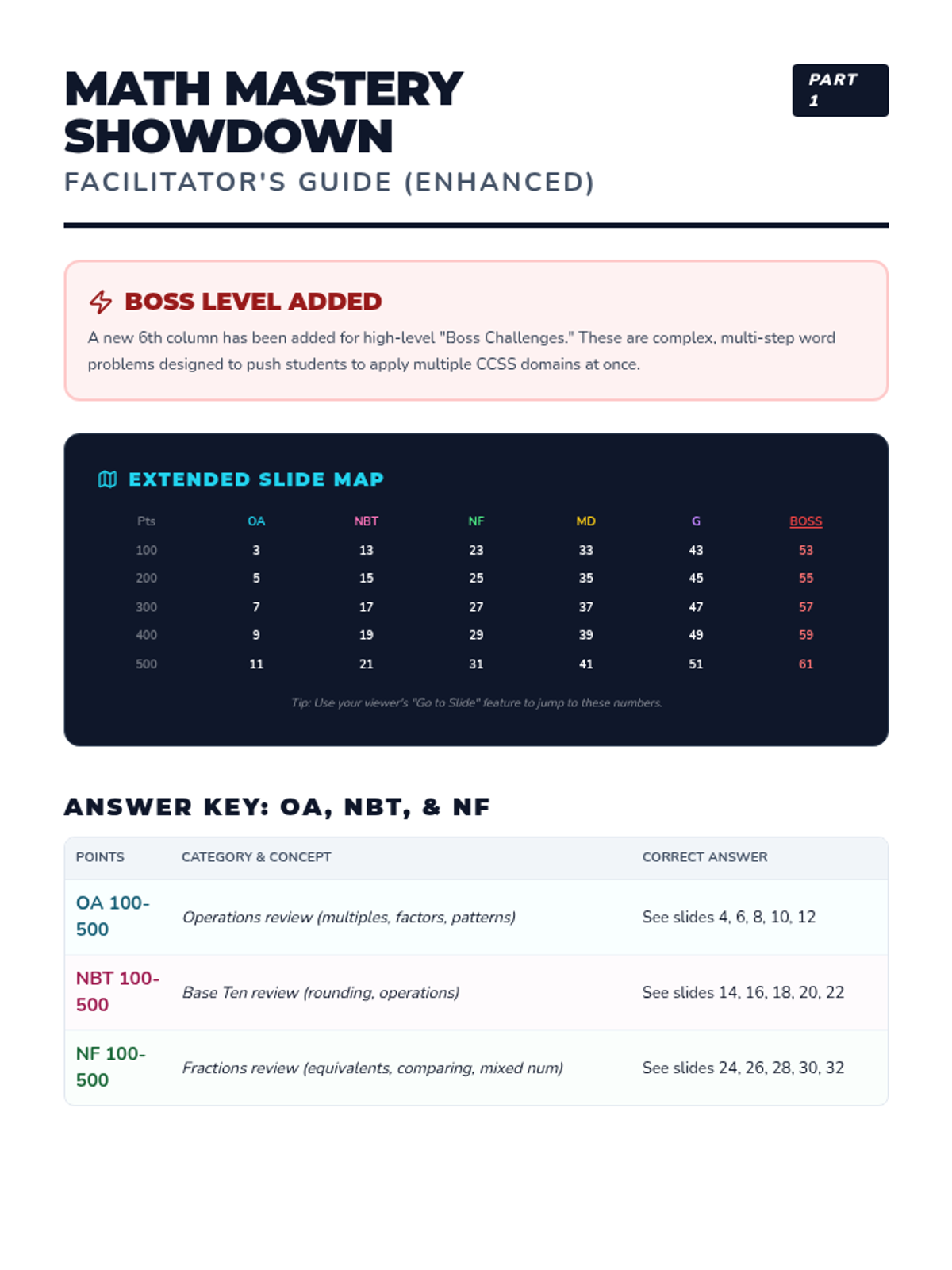
A comprehensive facilitation guide for the 4th-grade math review game. Now includes an "Extended Slide Map" for the 6th category and a dedicated "Boss Level" answer key with multi-step word problem breakdowns.
A complete 63-slide arcade-themed 4th-grade math review deck. Includes full content for all 6 categories (Operations, Base Ten, Fractions, Measurement, Geometry, and Boss Level) with hidden answer slides and navigation aids.
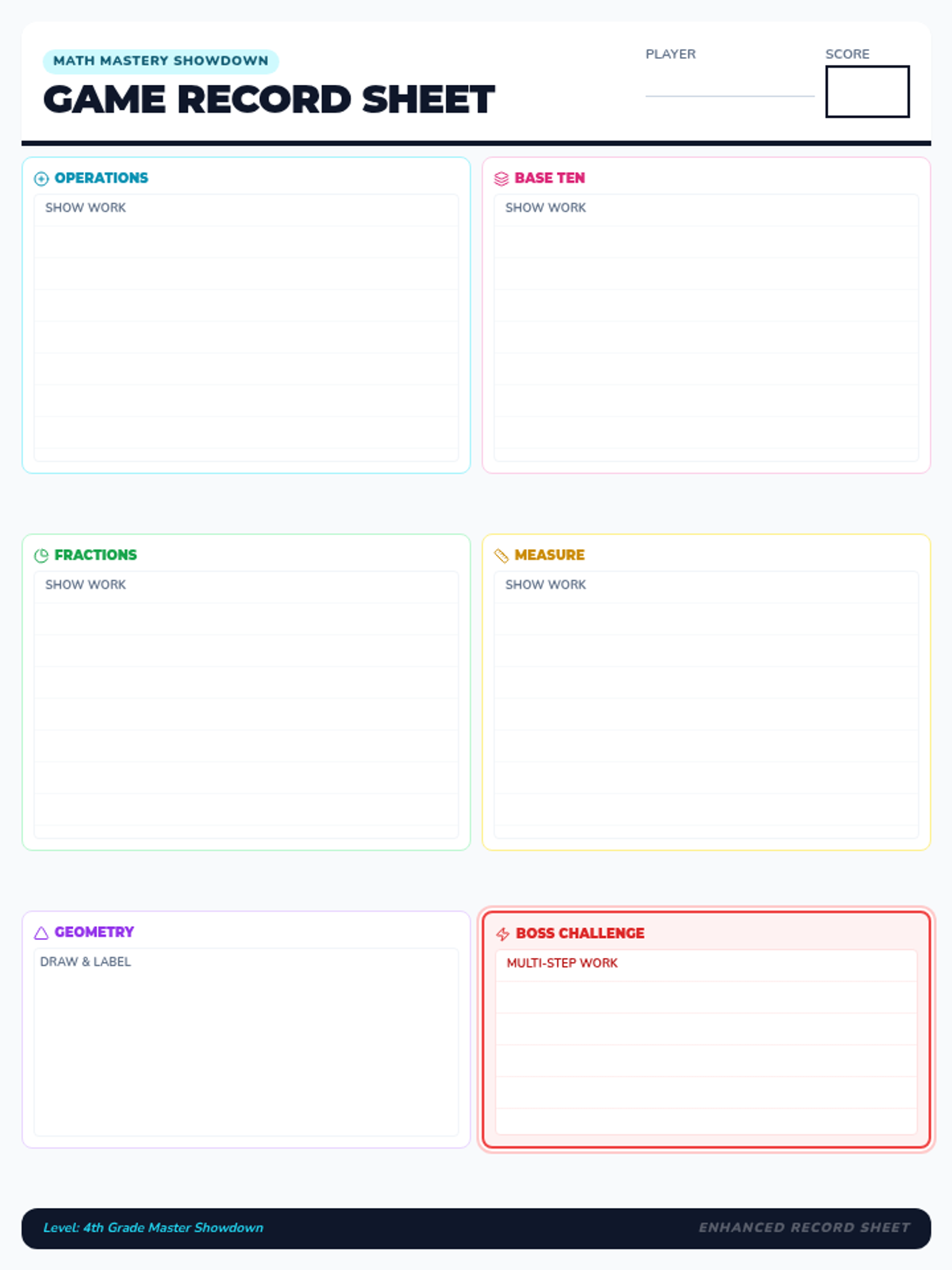
An updated student-facing record sheet for the math review game. Now includes a dedicated "Boss Challenge" work area for complex multi-step word problems, alongside the five standard Common Core domains.
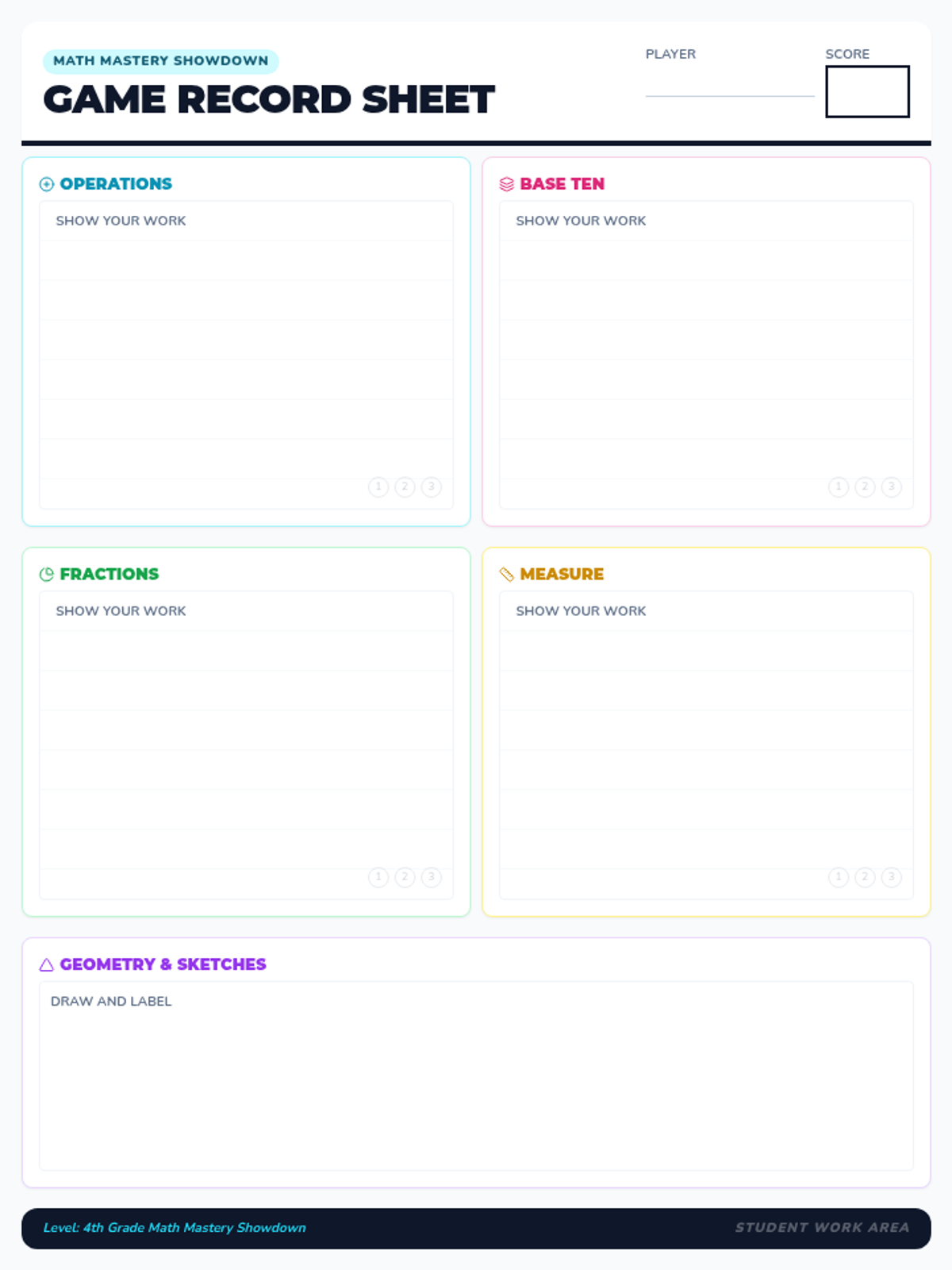
A student-facing record sheet for the math review game. Provides organized, light-colored workspaces for each Common Core domain, a score tally area, and extra scratch space for multi-step calculations.
An arcade-themed 4th-grade math review slide deck in a Jeopardy-style format. Now features a 6th "Boss Level" column with challenging multi-step word problems. Includes 63 slides with hidden answers and slide number indicators for manual navigation.
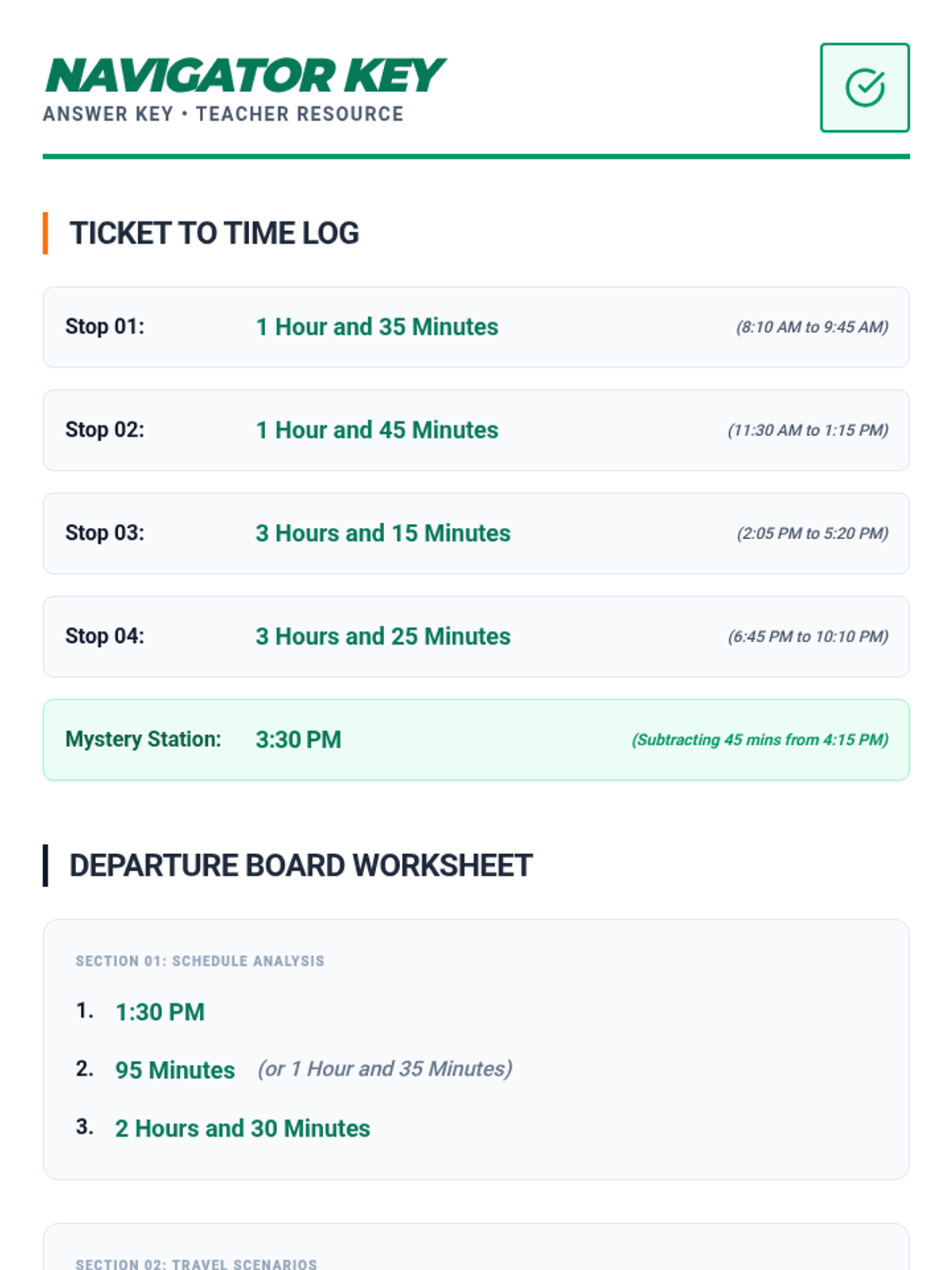
A teacher's answer key for the Ticket to Time Activity and the Departure Board Worksheet, providing clear, highlighted solutions for easy grading.
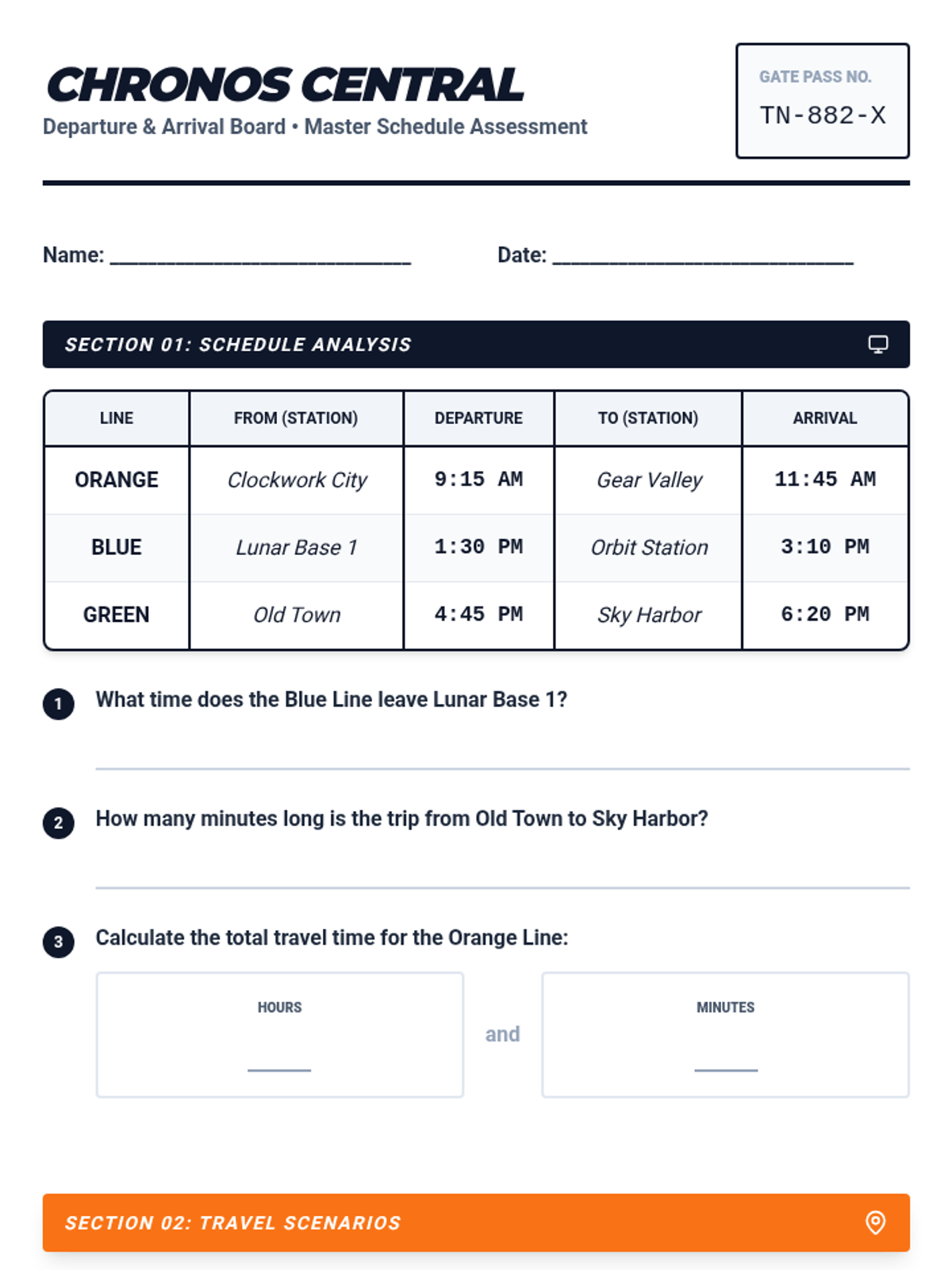
A summative assessment worksheet themed around a central transit hub, testing students' ability to read multi-column schedules and solve elapsed time word problems with increasing complexity.
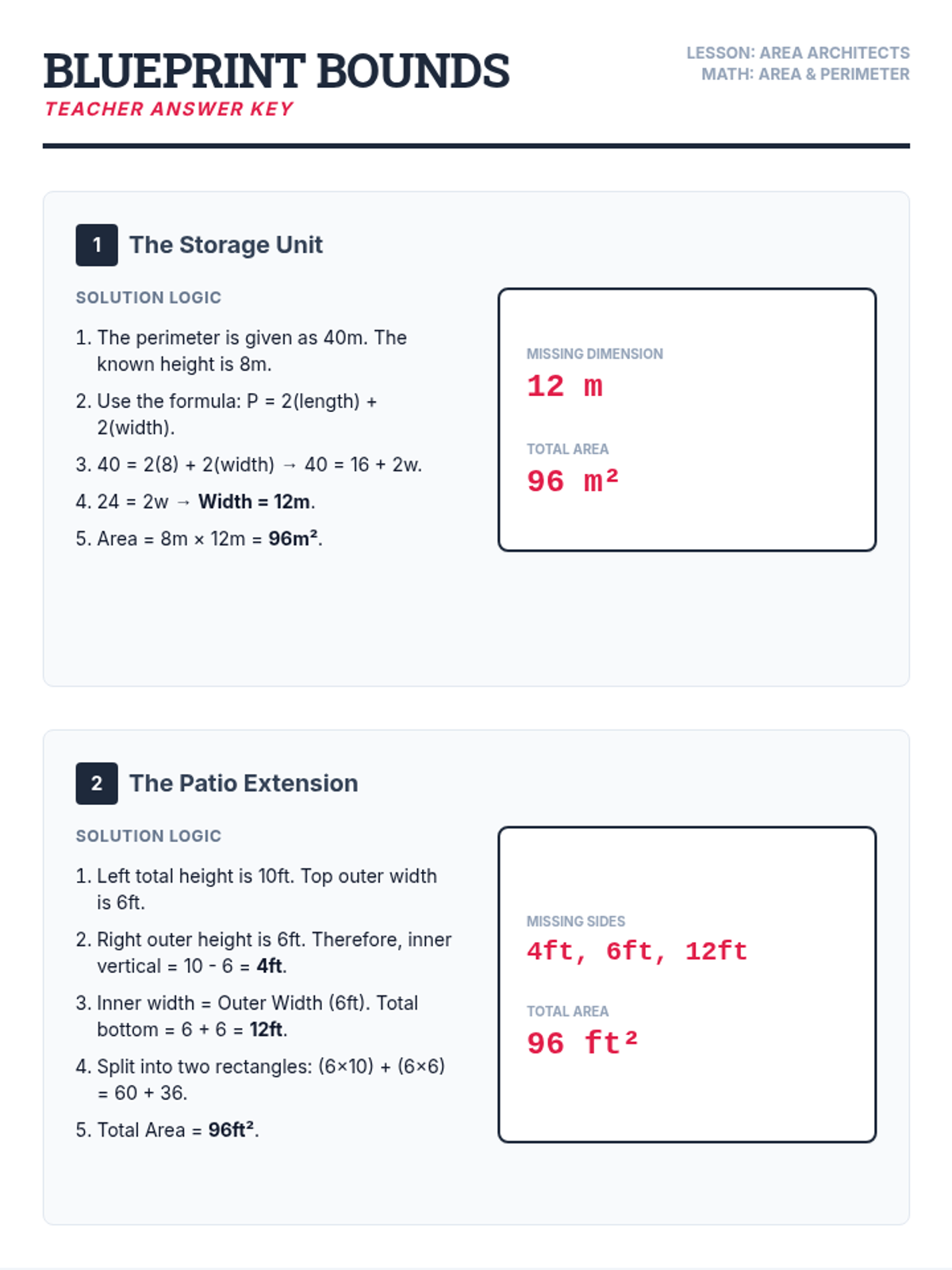
A detailed teacher answer key for the Blueprint Bounds Exit Ticket. It provides definitive step-by-step logic and clear final answers for all 10 problems. All logic has been verified for mathematical consistency based on the updated exit ticket diagrams.
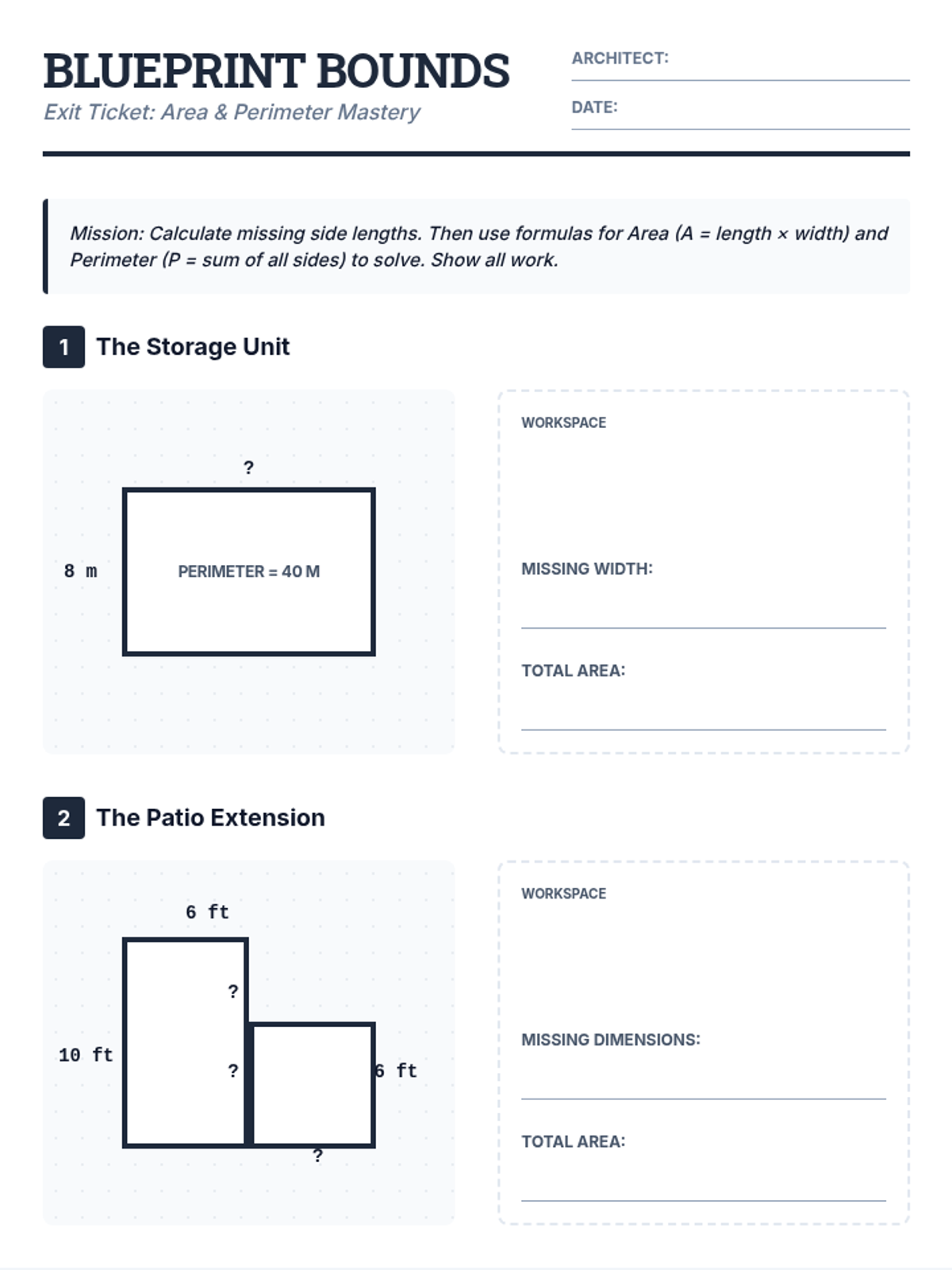
A 5-page exit ticket designed with a clean blueprint theme. It contains 10 problems that challenge students to find missing side lengths and calculate area using formulas for rectangles and complex rectilinear shapes. All diagrams and labels have been optimized for clarity and high contrast. All logic has been verified for mathematical consistency. All label positioning has been refined to prevent overlapping and clipping. Header terminology is consistent across all pages. Workspace layout is uniform. Content is technically complete and solvable without assumptions.
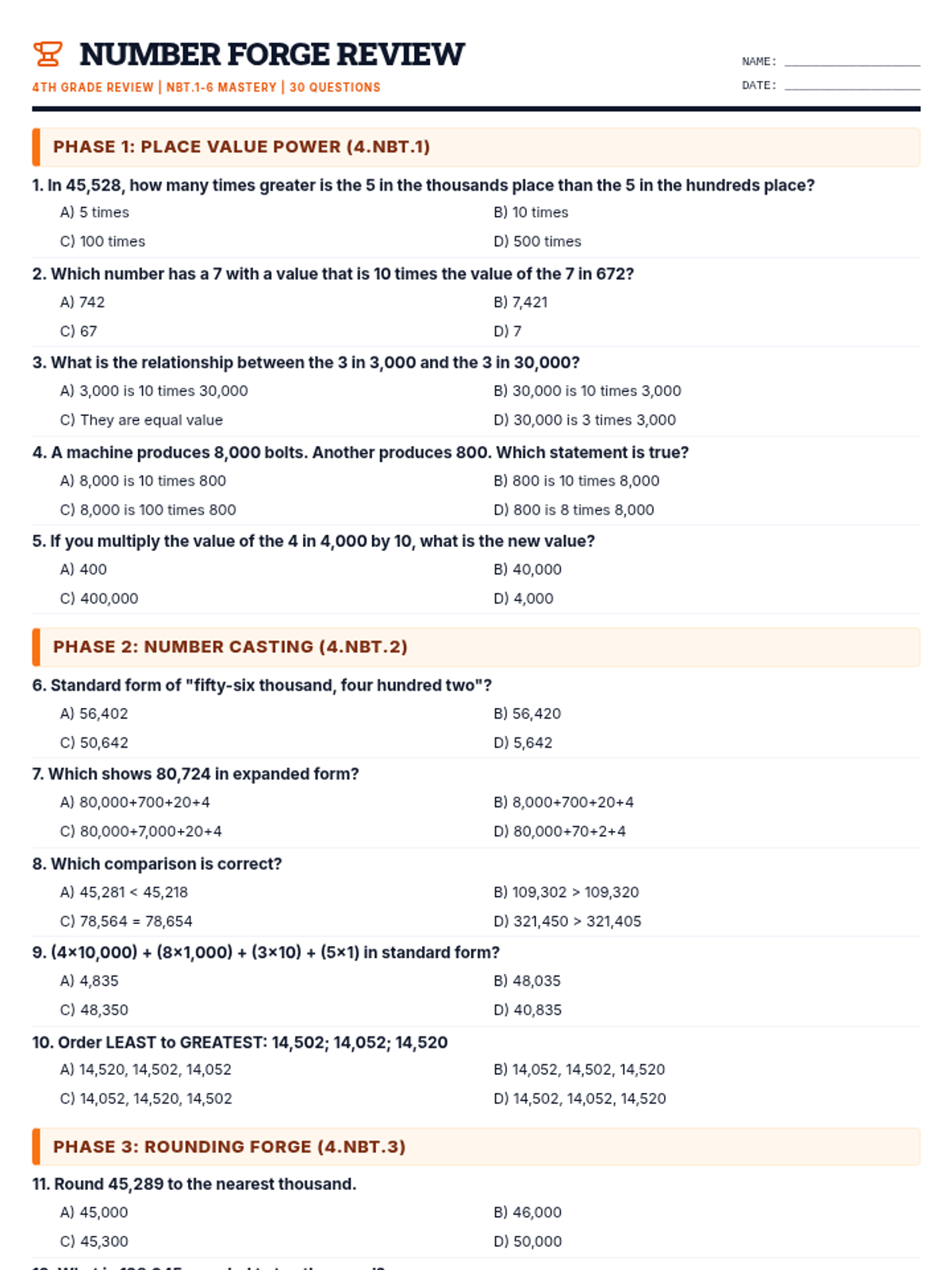
A 30-question industrial-themed 4th grade math review. Features 5 questions per standard (4.NBT.1-6). Optimized for 4 total pages with standardized grid layouts for multiple choice questions and varied work area sizes. Revised for visual consistency, varied answers, and compact pagination. Answer key and cheat sheet are provided as separate materials in the lesson. Revised with lighter heading backgrounds for ink-efficiency.
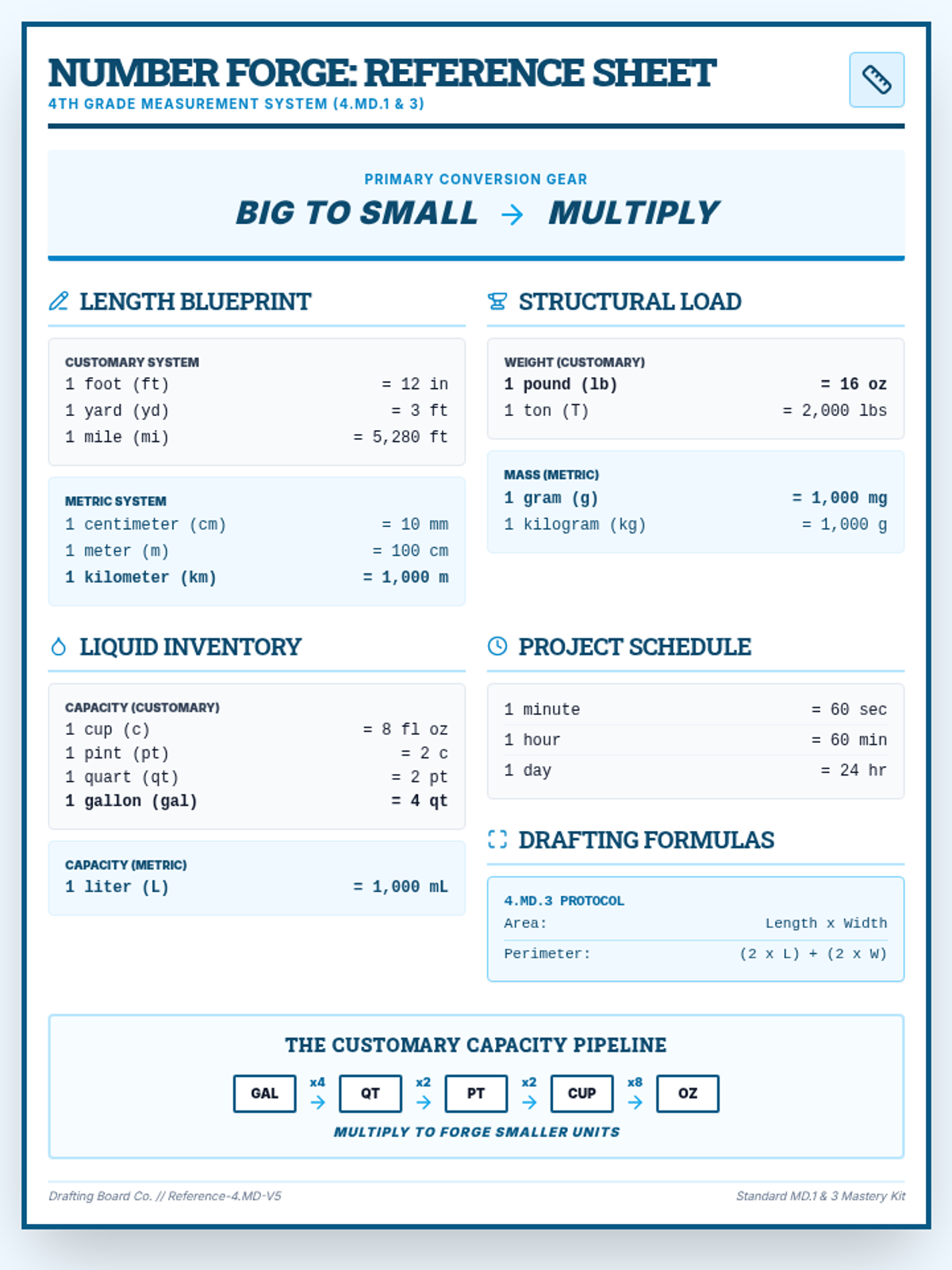
A precision-themed measurement conversion cheat sheet for 4th grade. Features customary and metric units for length, weight/mass, capacity, and time, plus Area and Perimeter formulas. Revised with lighter heading backgrounds for ink-efficiency and consistent contrast.
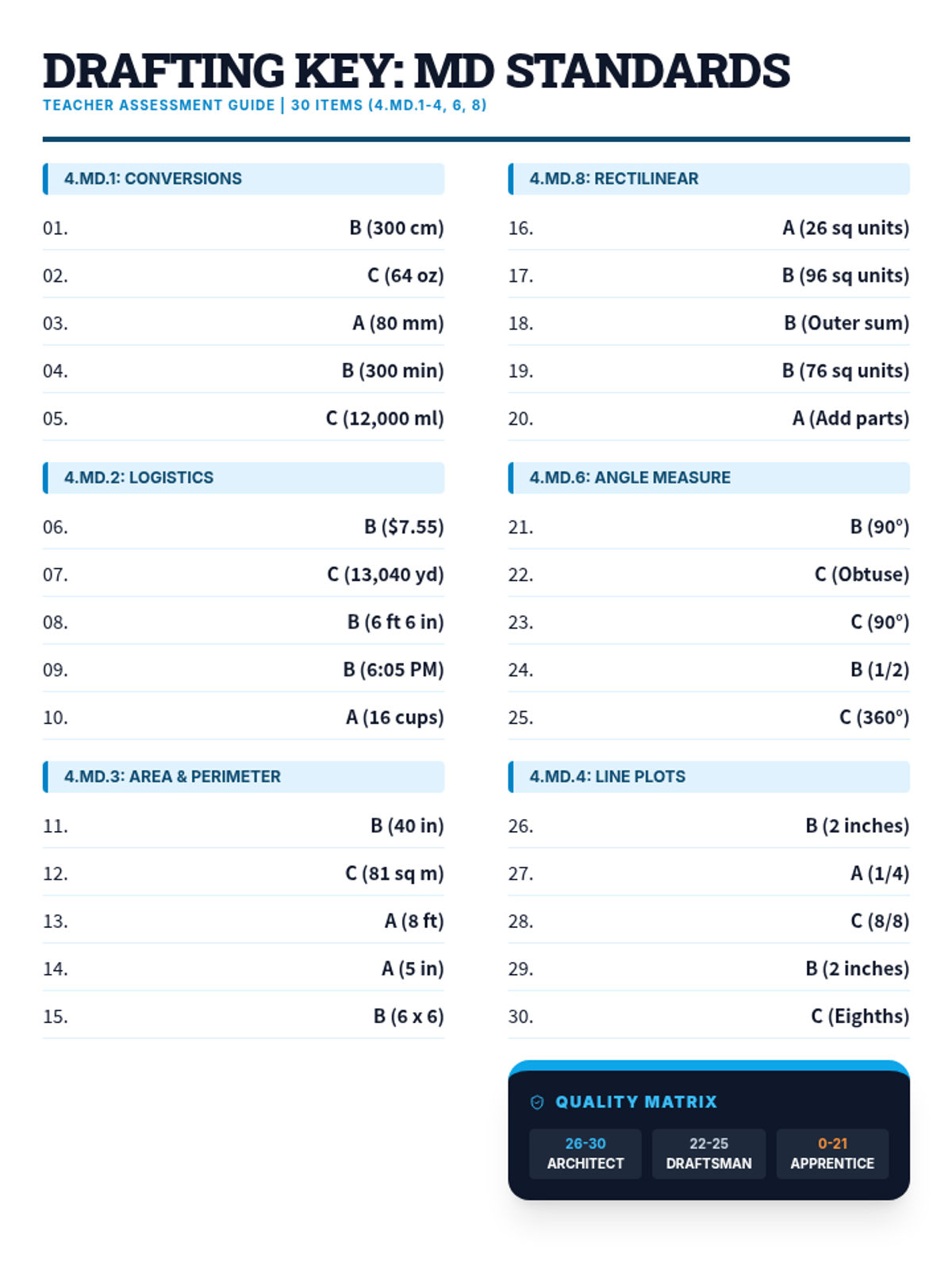
A comprehensive drafting-themed answer key for the 4th Grade Measurement & Data review (MD.1-4, 6, 8). Features categorized answer lists and a creative 'Draft Quality Matrix' for scoring student proficiency. Optimized for single-page use.
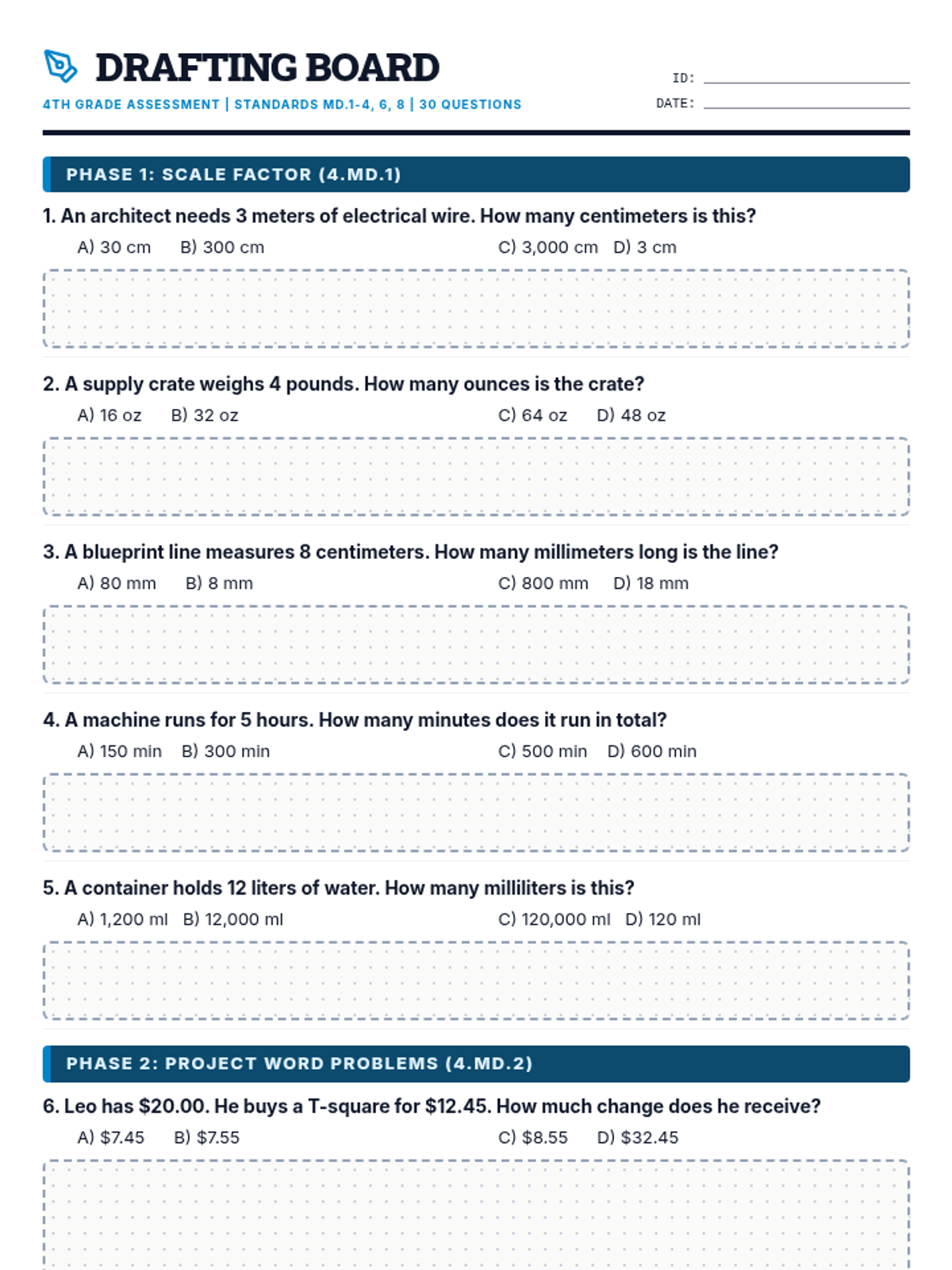
A 30-question drafting-themed 4th grade math assessment focused on Measurement and Data (MD.1, 2, 3, 4, 6, 8). Features 5 questions per skill with white dot-grid work areas for technical sketching. Revised for lighter section headings and optimized pagination. Answer key is provided as a separate material. Revised for 4 total student work pages and corrected units.
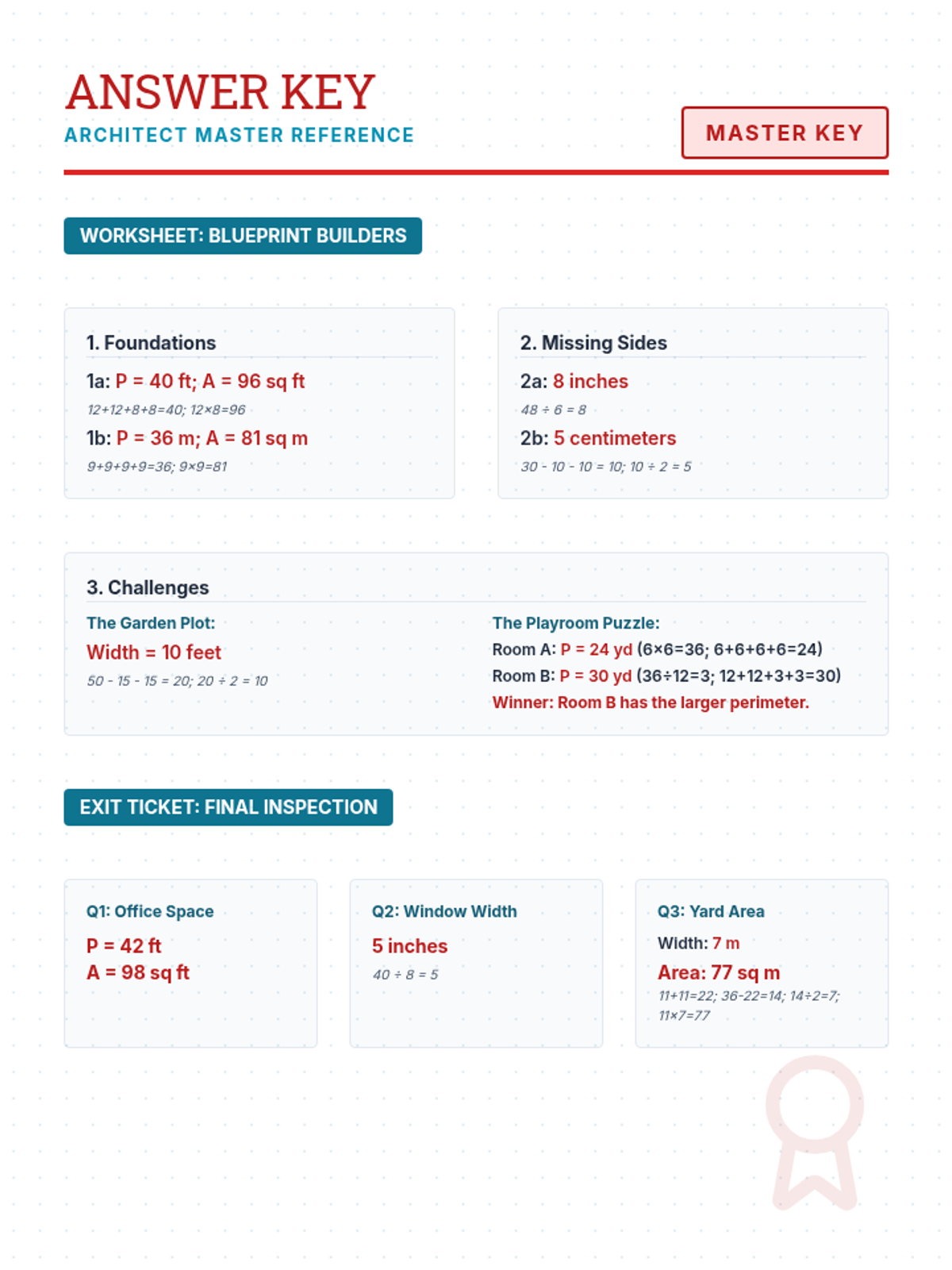
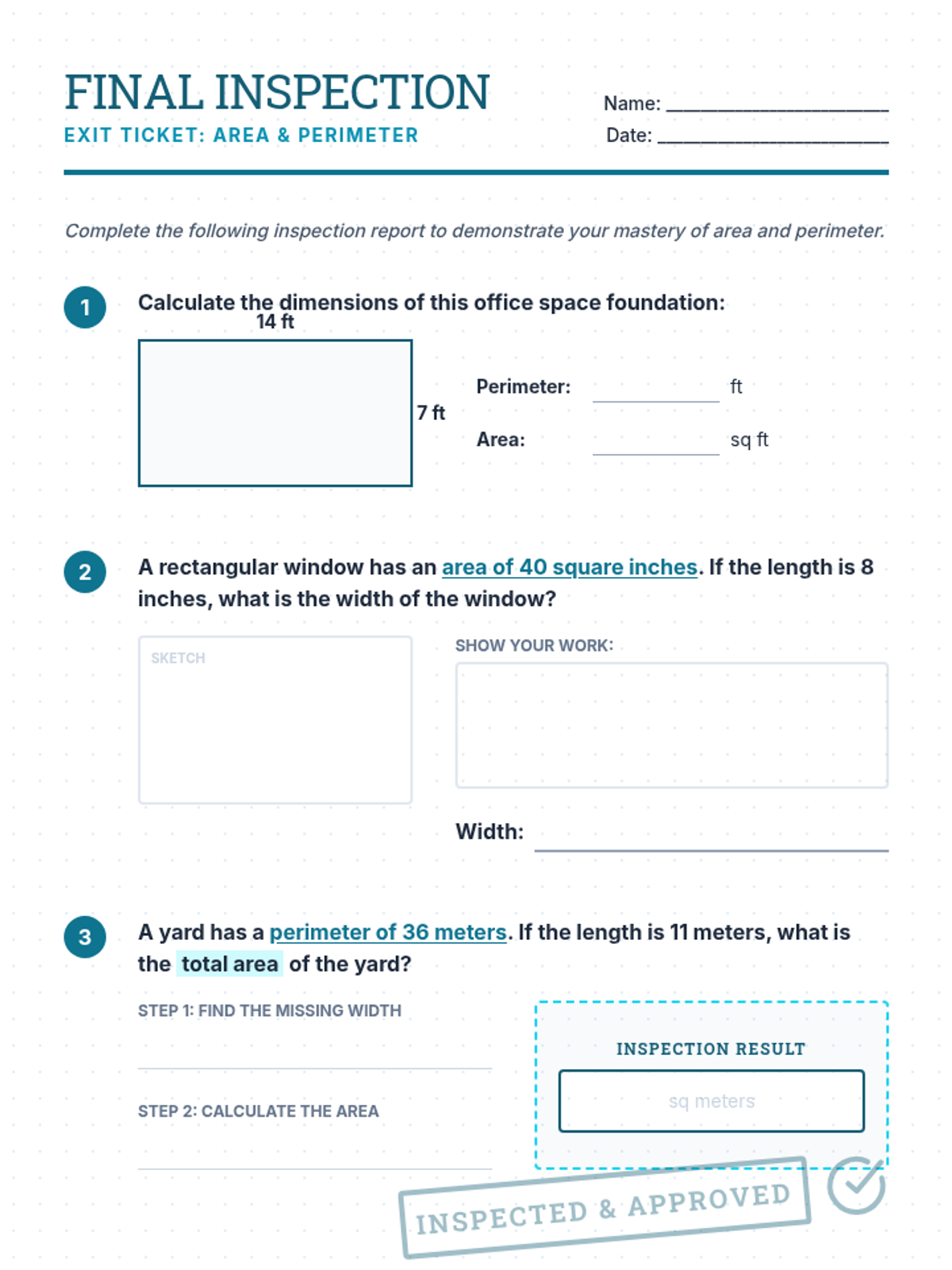
A consolidated single-page answer key for both the Blueprint Builders worksheet and the Final Inspection exit ticket. Includes all calculations and final solutions.
A 1-page summative assessment for the Blueprint Builders lesson. Revised with increased background contrast and expanded work areas for students.
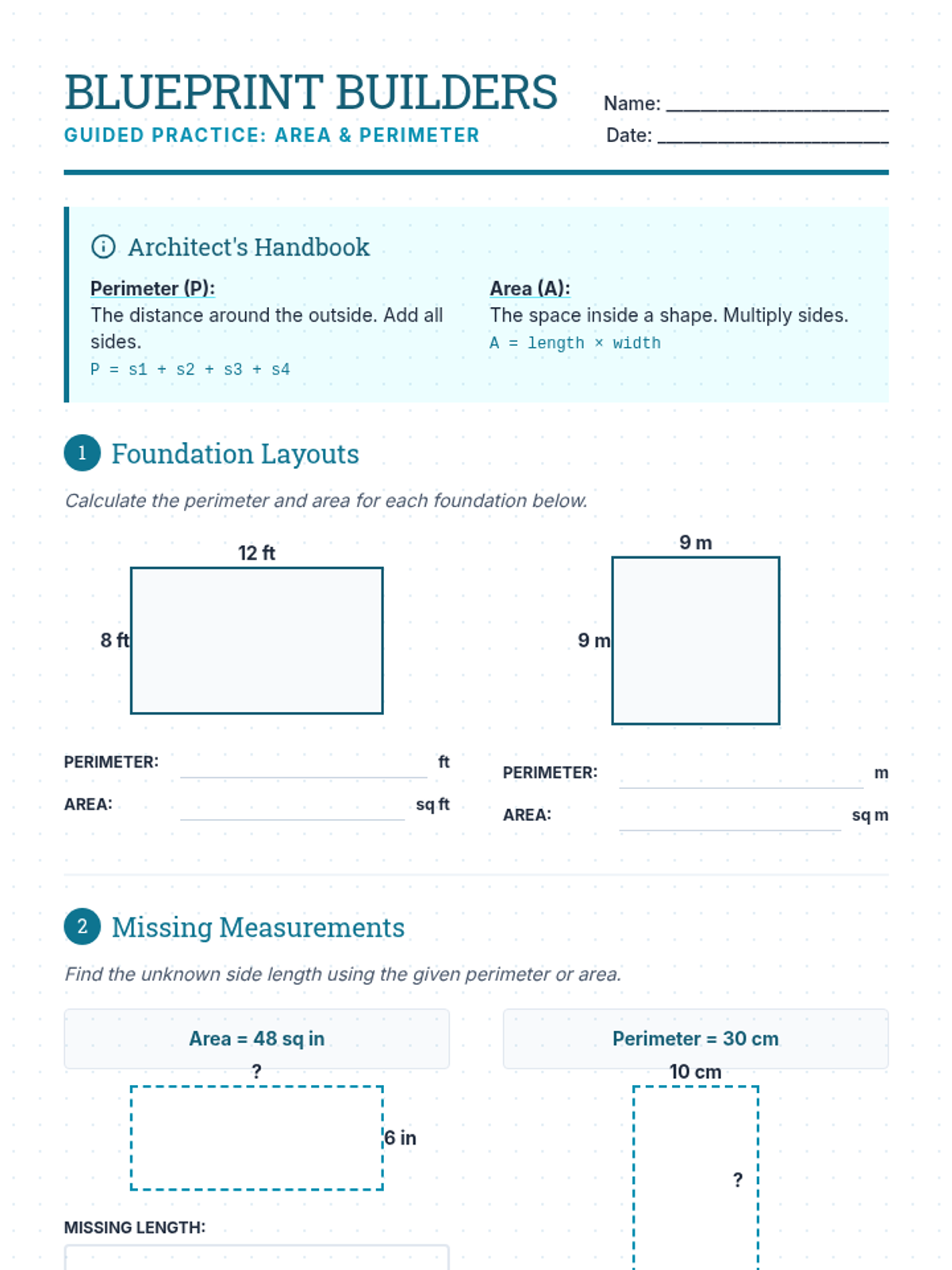
A 2-page guided practice worksheet where students solve area and perimeter problems in an architectural blueprint theme. Includes basic calculations, missing side lengths, and multi-step real-world word problems. Revised for better page flow and contrast.
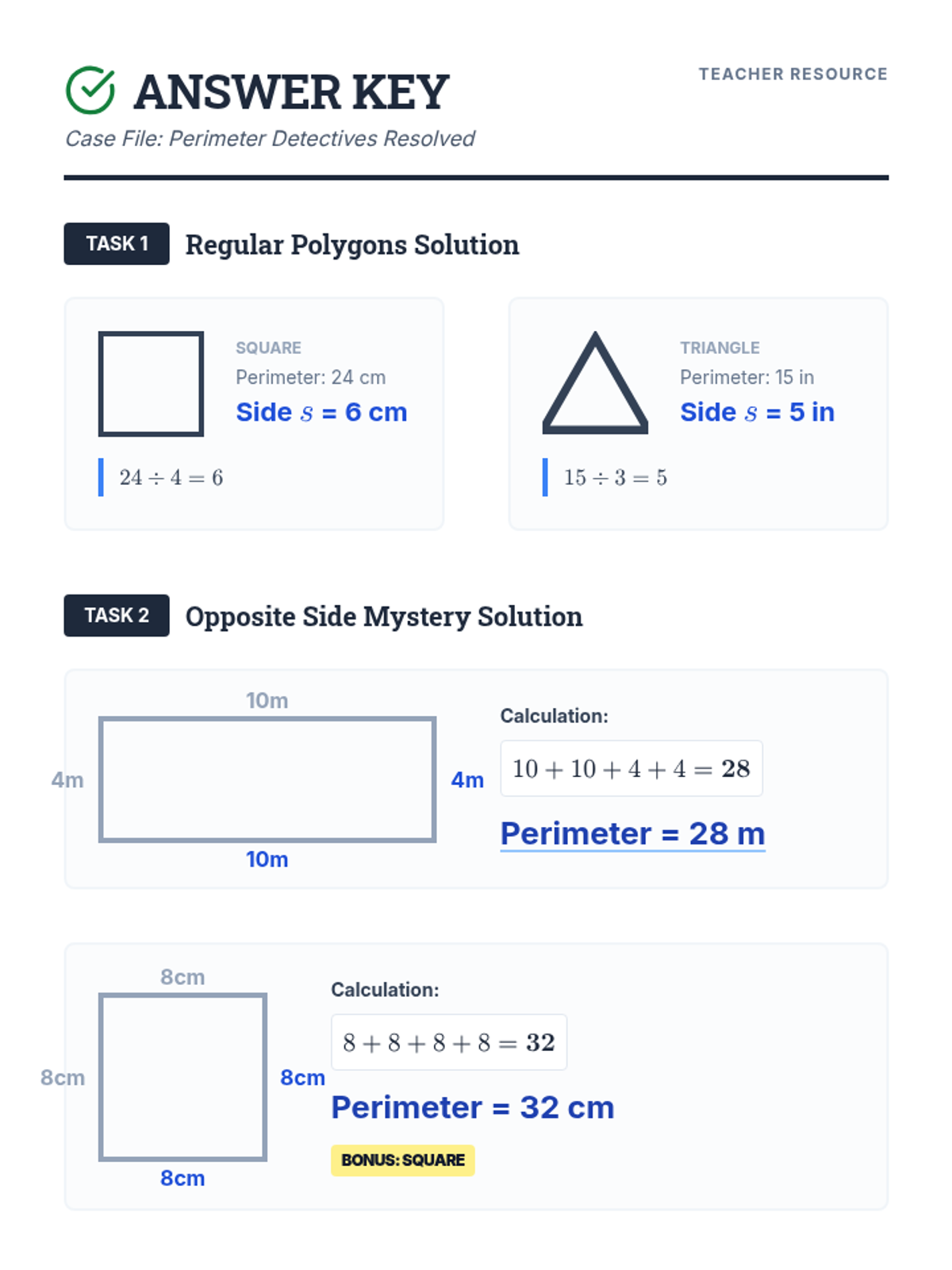
The answer key for the Perimeter Detectives worksheet, providing step-by-step solutions for missing side lengths and perimeter calculations.
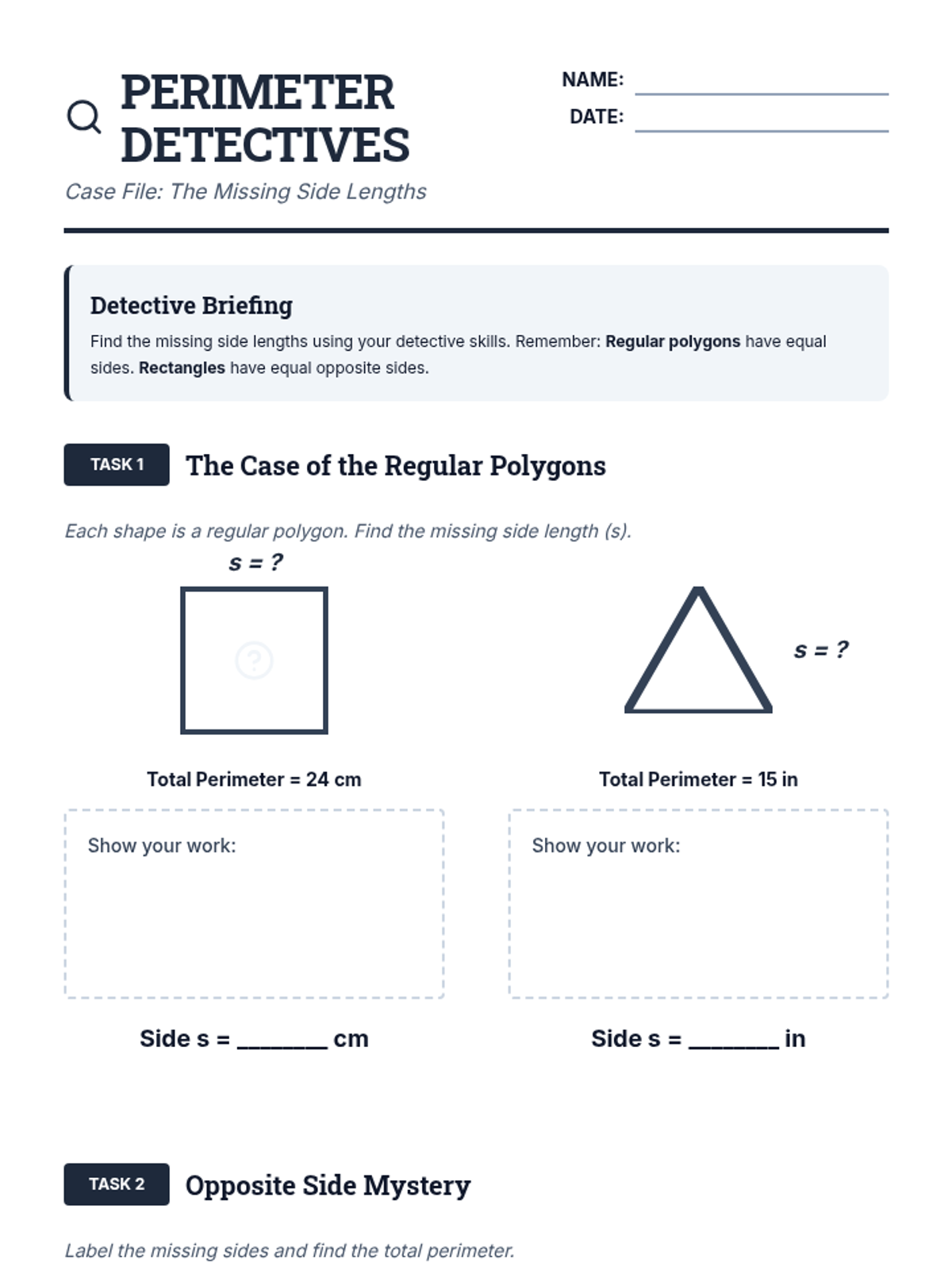
A student homework worksheet for practicing finding missing side lengths in regular polygons and rectangles, themed as a detective case file.
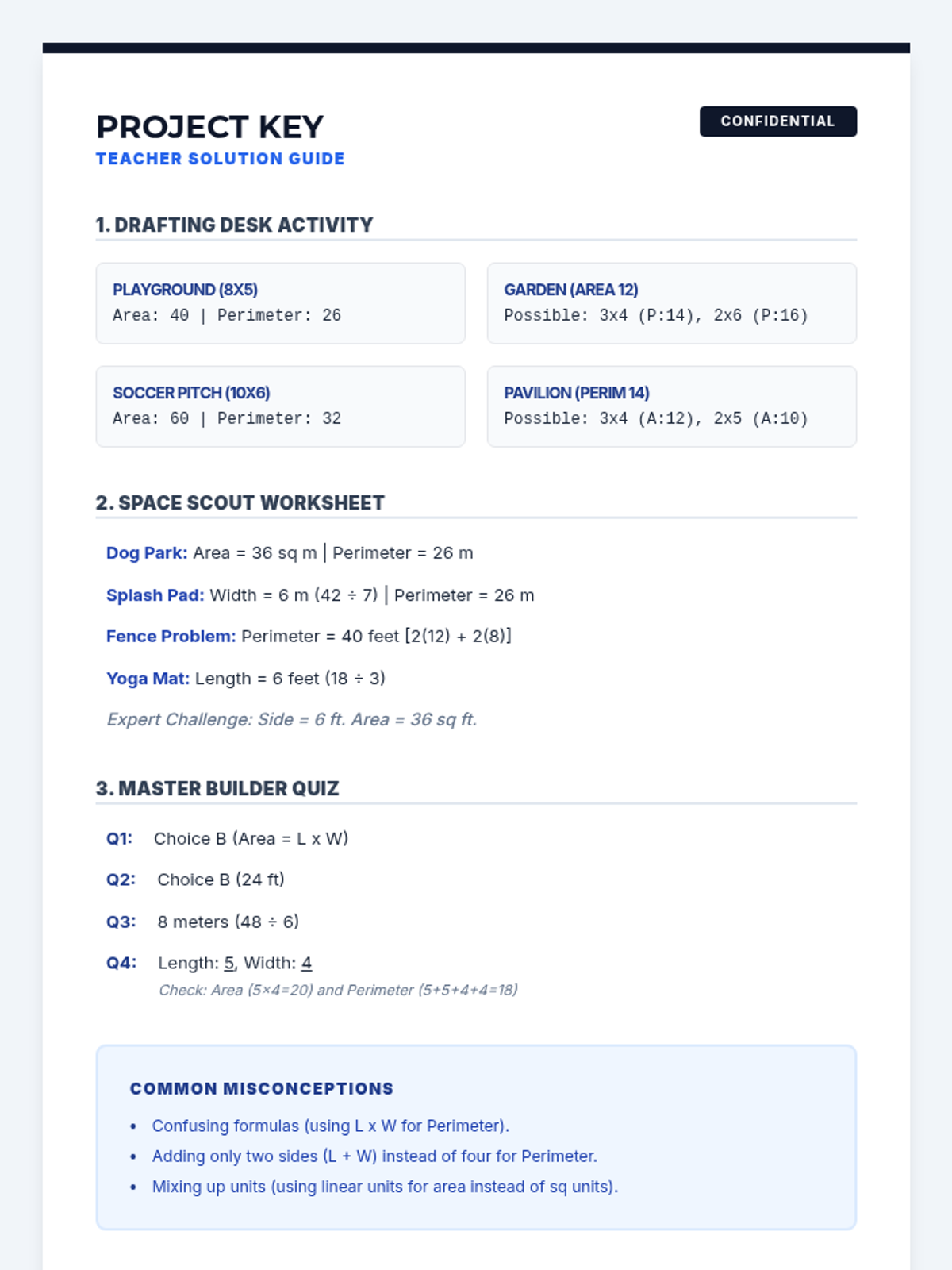
Answer key and teacher guide for the Blueprint Brigade materials. Revised for better spacing to fit everything on a single page and improved readability.
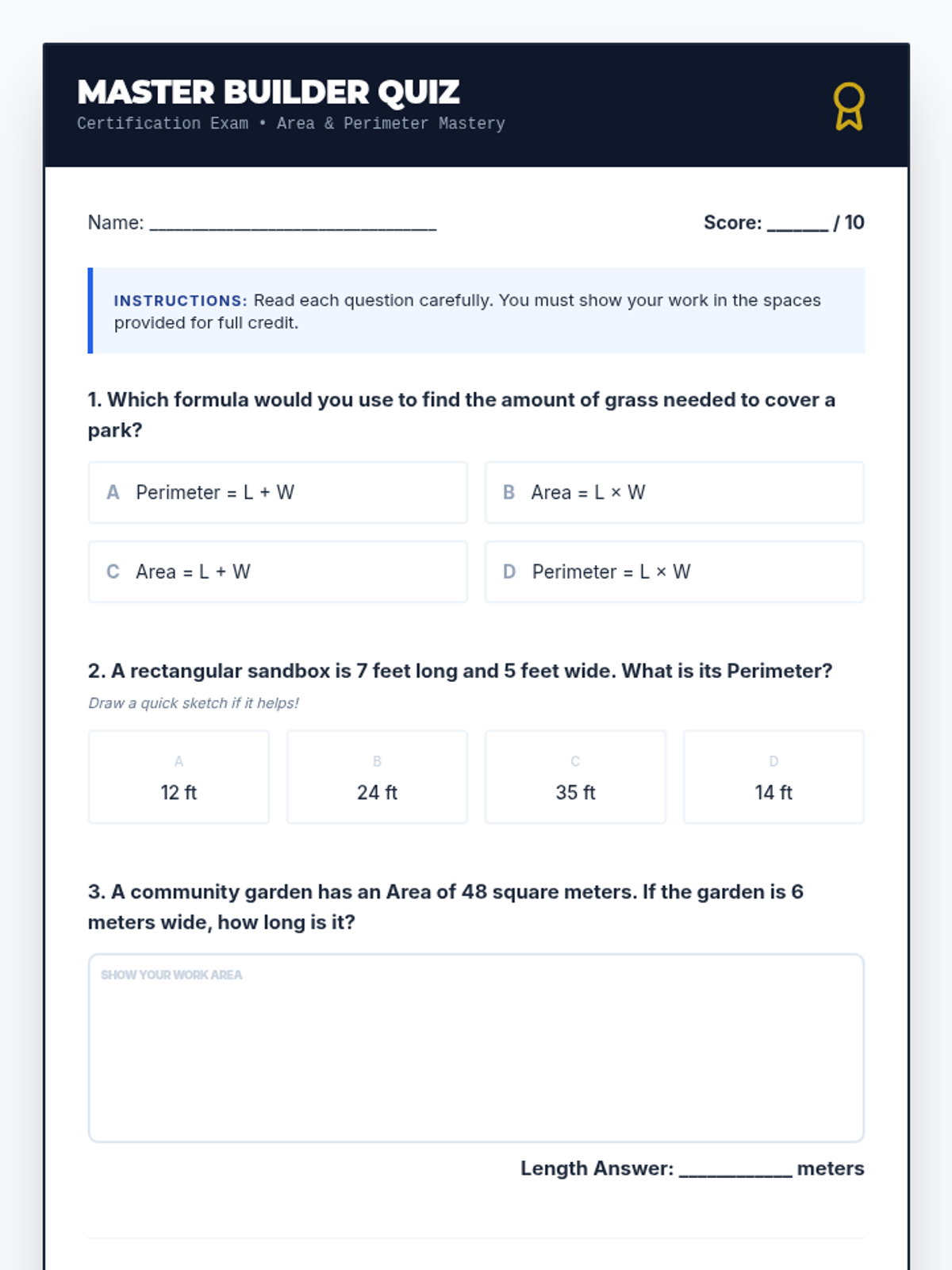
A final assessment to evaluate student mastery of area and perimeter formulas. Revised with consistent labeling, improved work areas, and better page grouping.
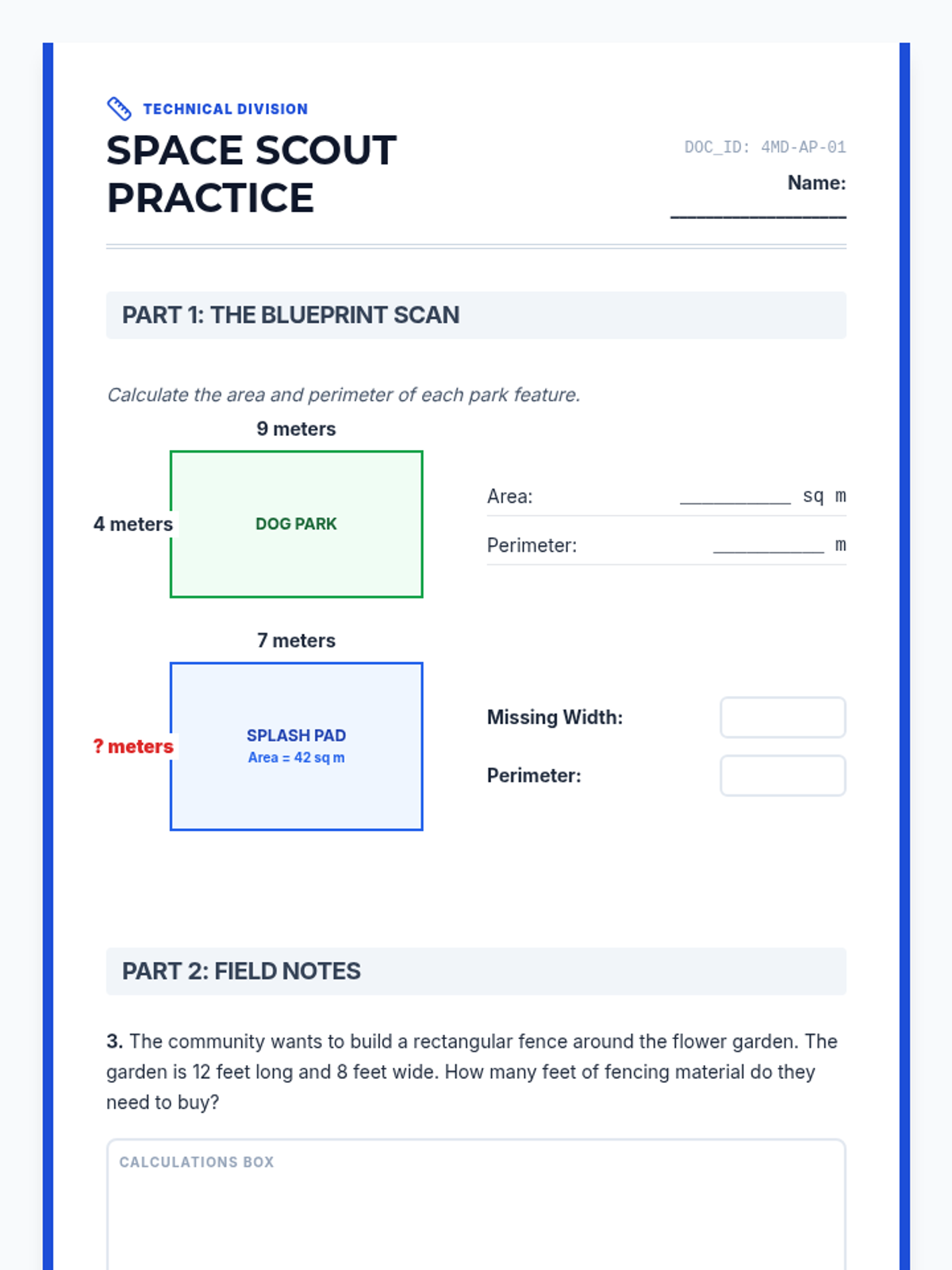
A practice worksheet featuring visual area/perimeter problems, missing measurement challenges, and real-world word problems related to park design. Revised with fixed labels and improved layout.
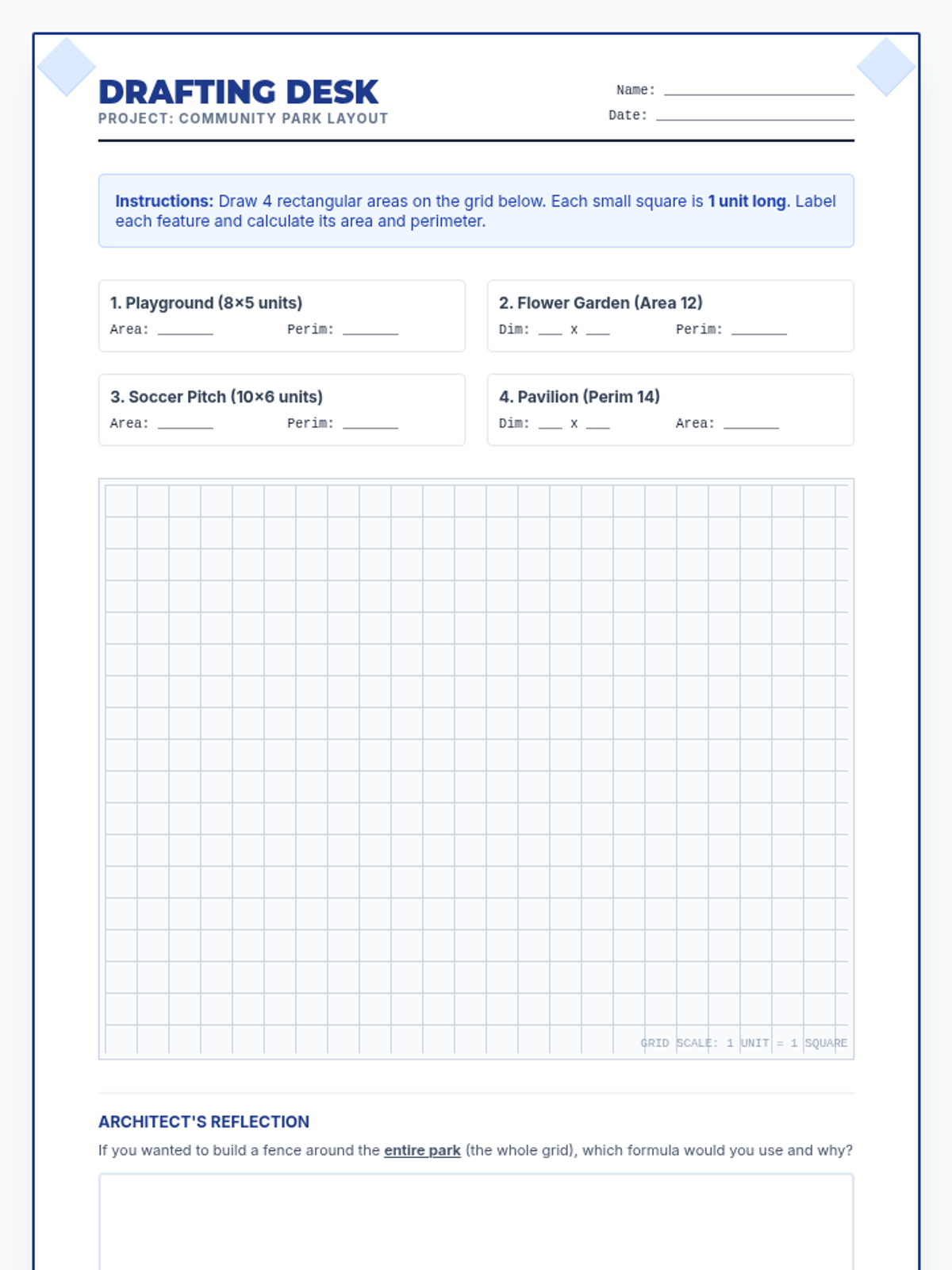
A creative design activity where students draw rectangular park features on a grid based on specific area or perimeter requirements. Revised to fit onto a single page.
Engaging visual slides for teaching area and perimeter concepts. Features a narrative hook about designing a community park, clear formula explanations, and guided practice. Revised with improved labels and layout.
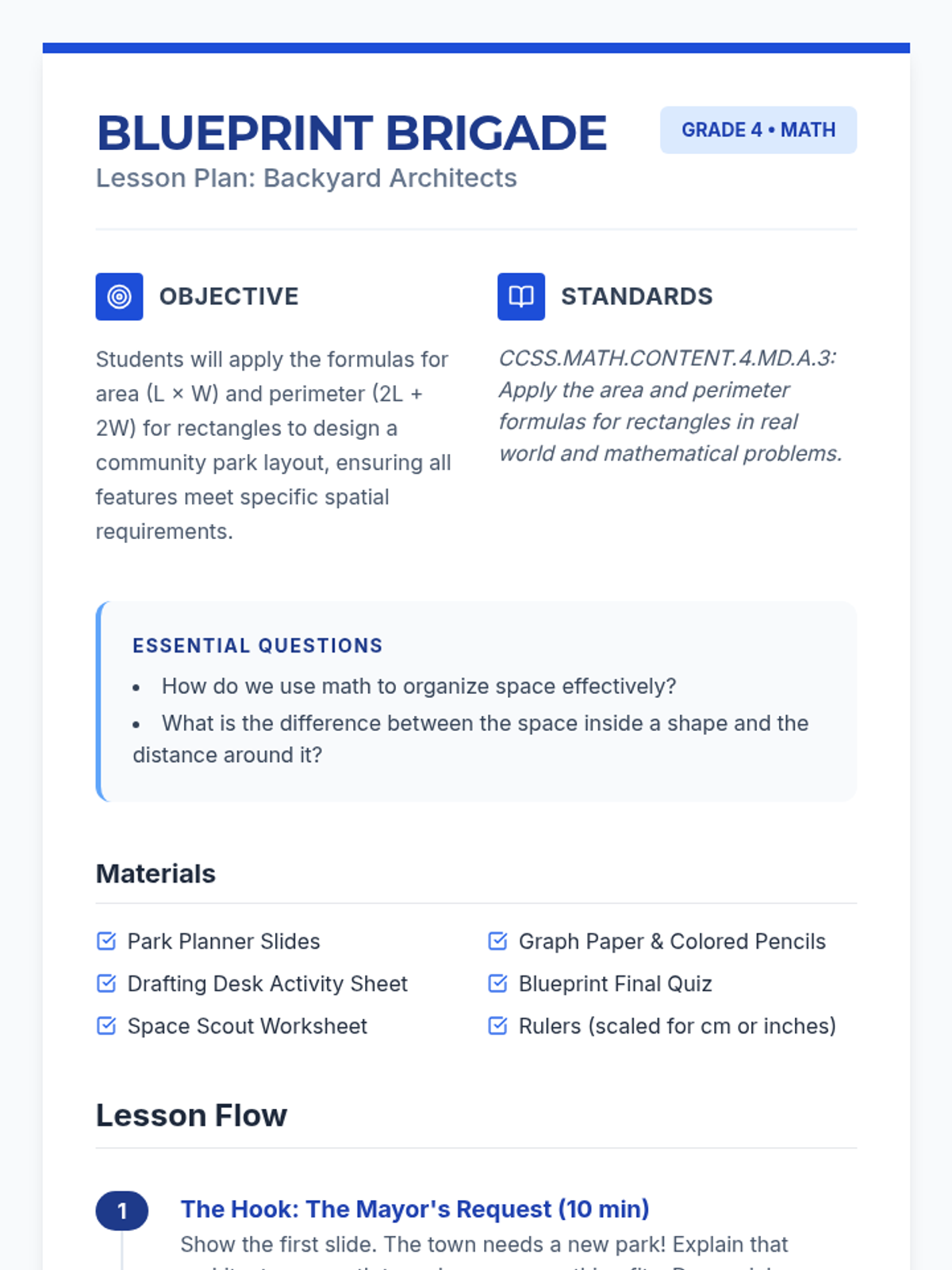
A comprehensive lesson plan for teaching area and perimeter through the lens of park design. Includes objectives, standards, step-by-step instruction, and differentiation strategies.
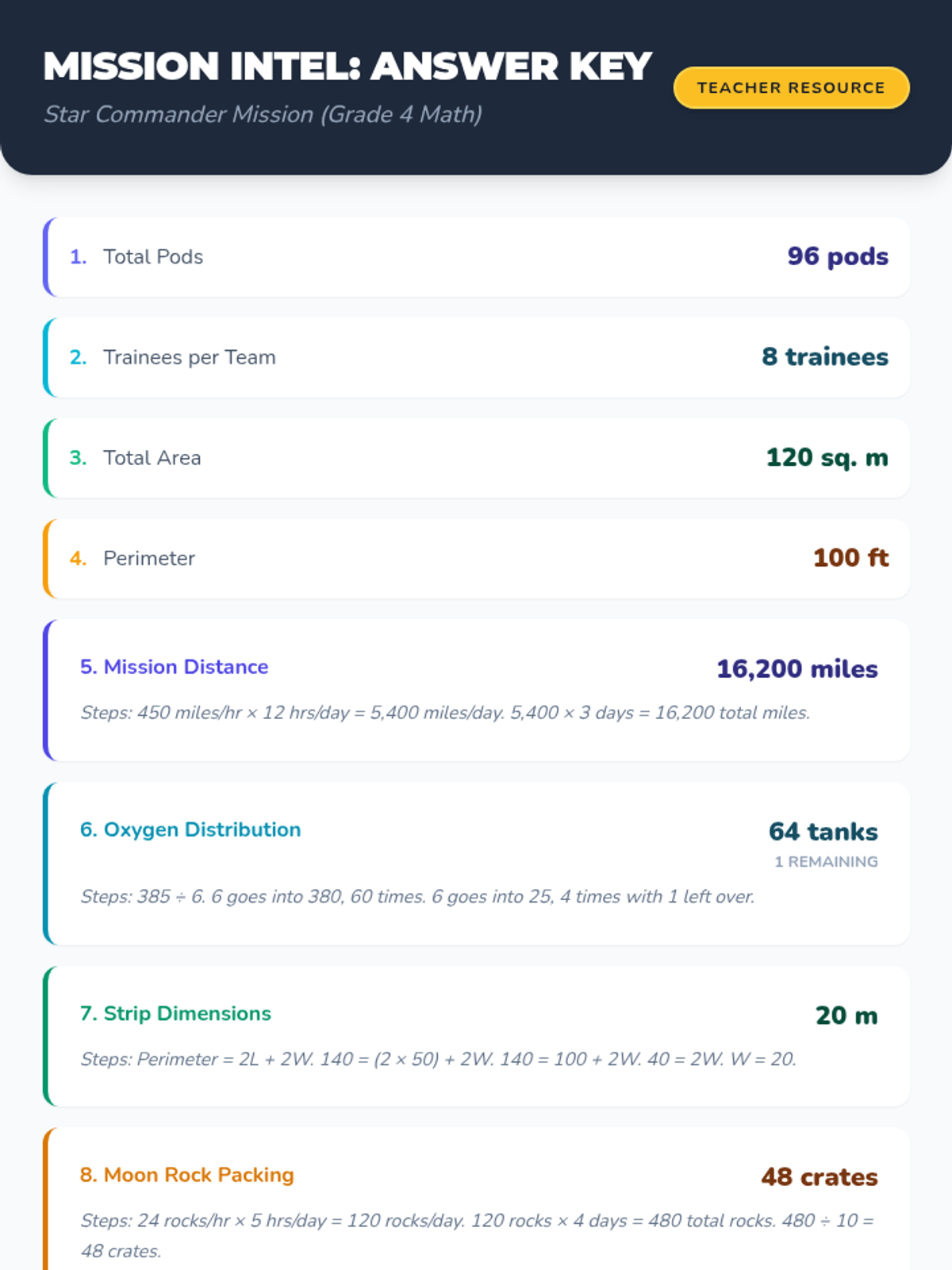
A detailed answer key for the Star Commander Mission Worksheet with step-by-step solutions for complex multi-step problems.
A galactic-themed math worksheet for 4th-grade students featuring 10 word problems covering multiplication, division, area, and perimeter with dedicated workspace for each.
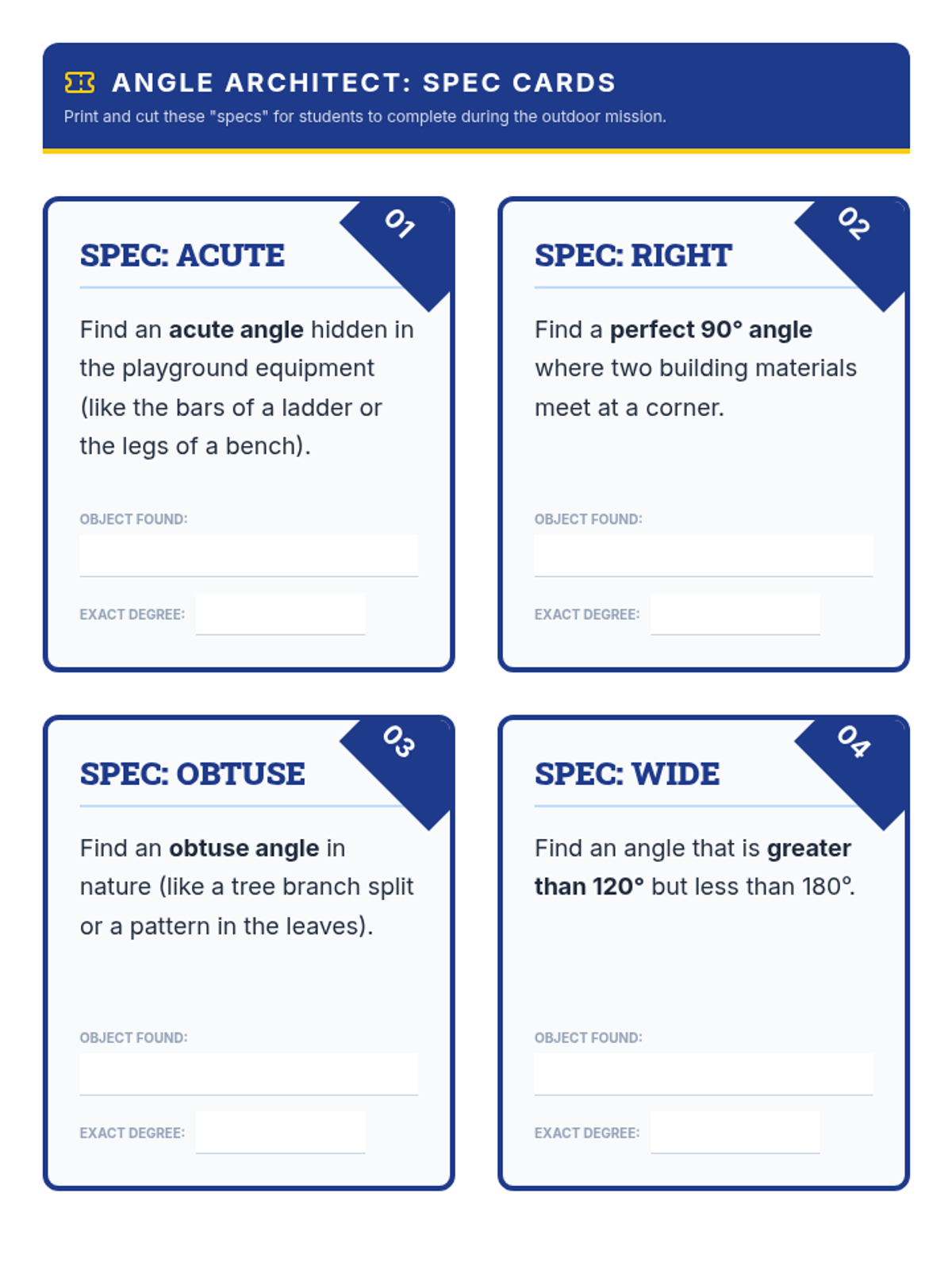
A set of printable "Spec Cards" for an angle scavenger hunt, challenging students to find and measure specific angle types in their environment.
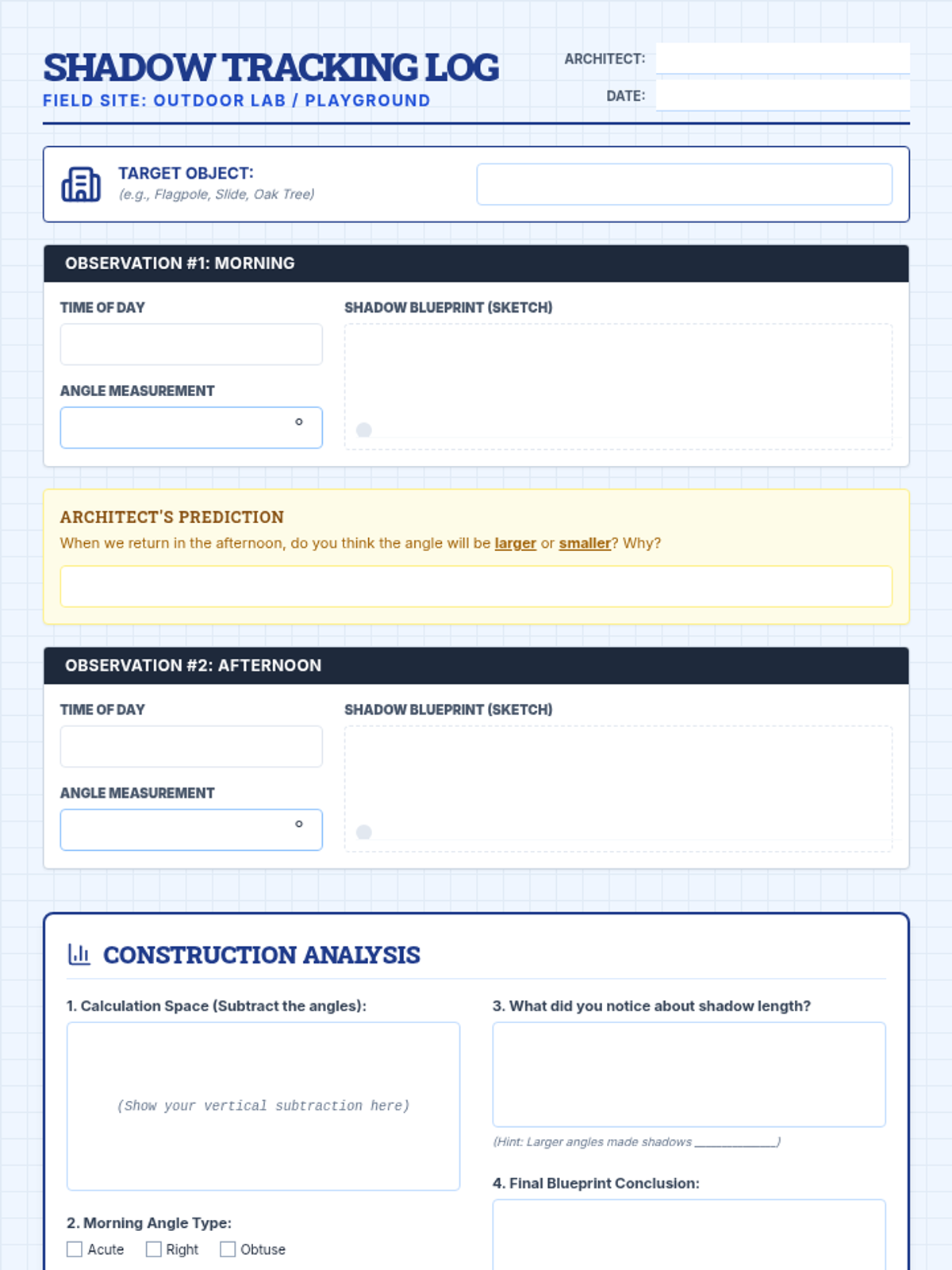
A student worksheet for recording shadow angle measurements at different times of day, including sketching areas and analysis questions.
An instructional slide deck for introducing angle measurement and the shadow investigation mission. Includes visual aids for protractor use and angle types.
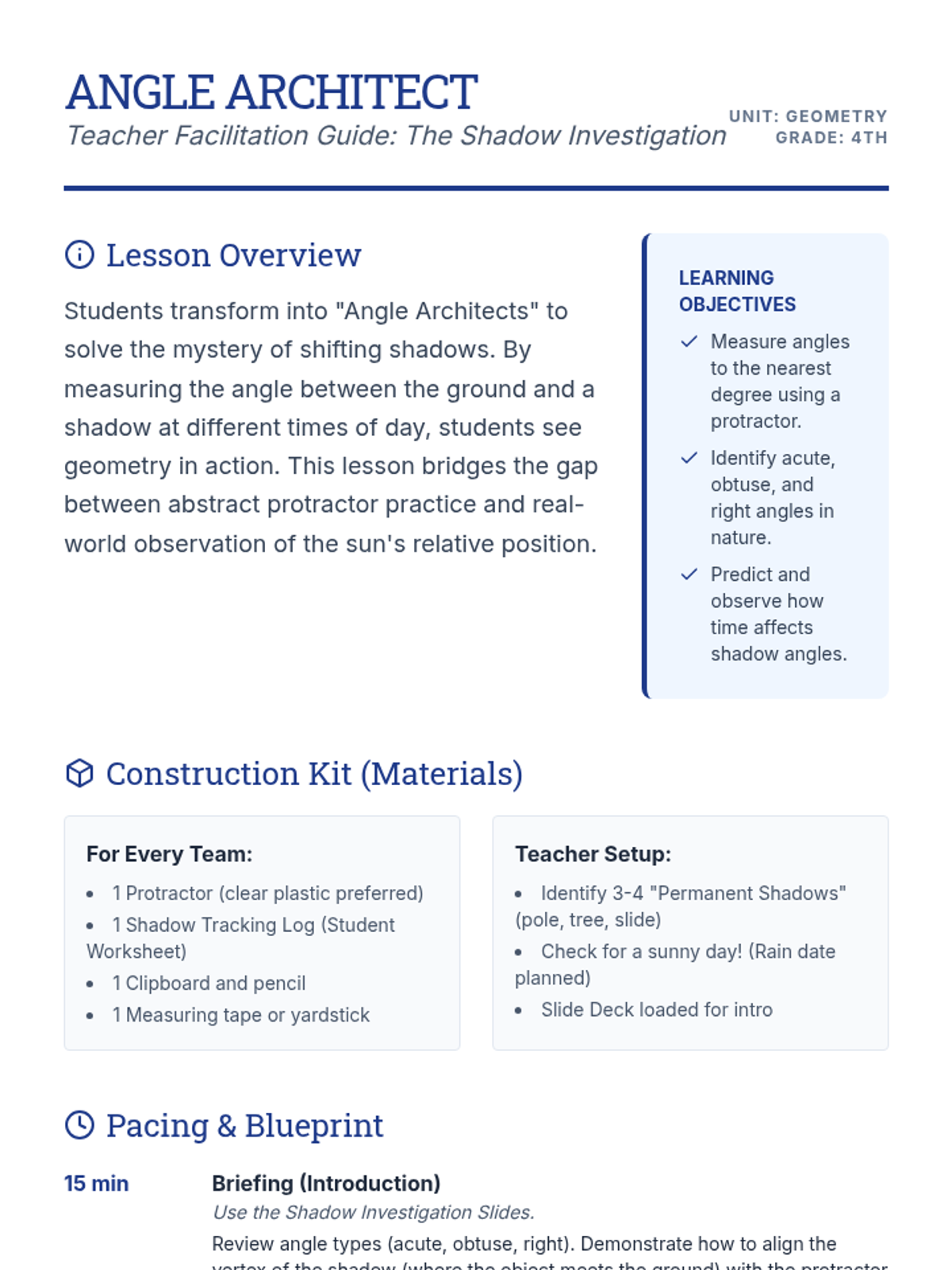
A comprehensive teacher facilitation guide for the 'Angle Architects' lesson, including pacing, materials, prep, and differentiation strategies.