Develops proficiency in estimating and measuring length, area, volume, and mass using standard units and unit conversions. Integrates time, money, angle measurement, and data classification through counting and arithmetic applications.
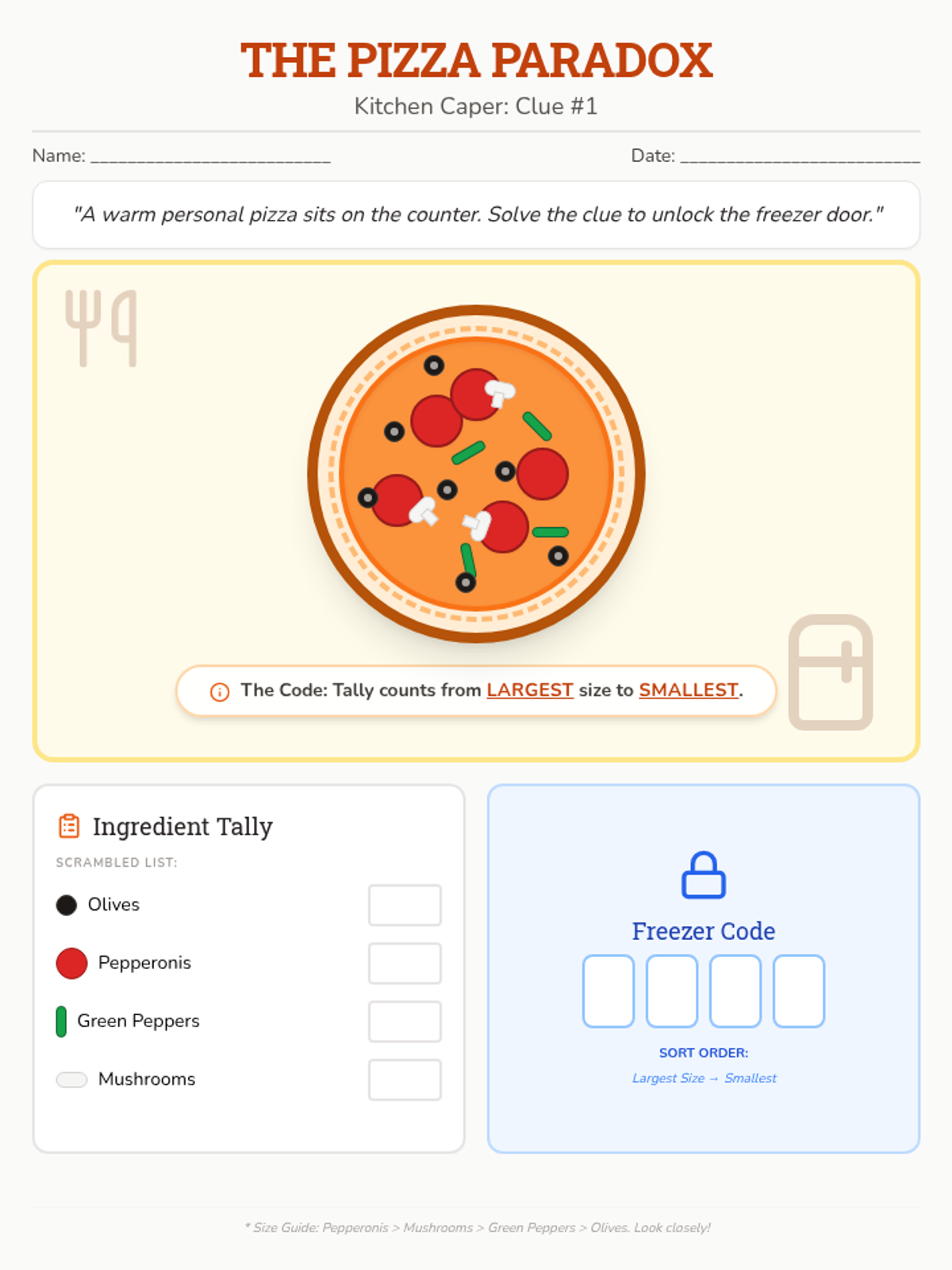
A visual observation puzzle where students tally pizza toppings to solve a freezer unlock code. Scrambled tally list and clarified size-based sorting logic. Fixed page break and opacity.
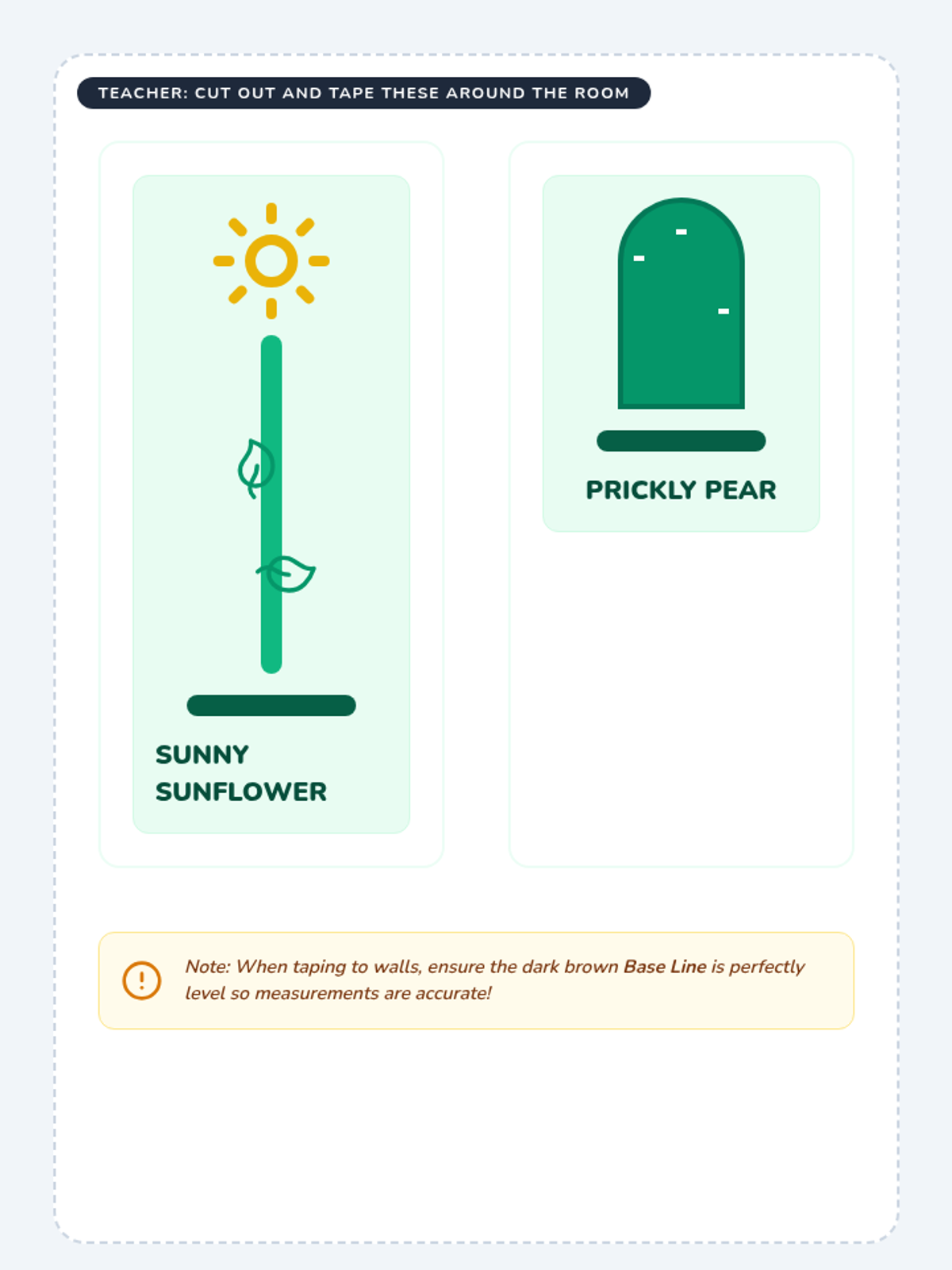
A set of printable paper plant cutouts designed for classroom walls, providing students with consistent visual targets for non-standard measurement practice.
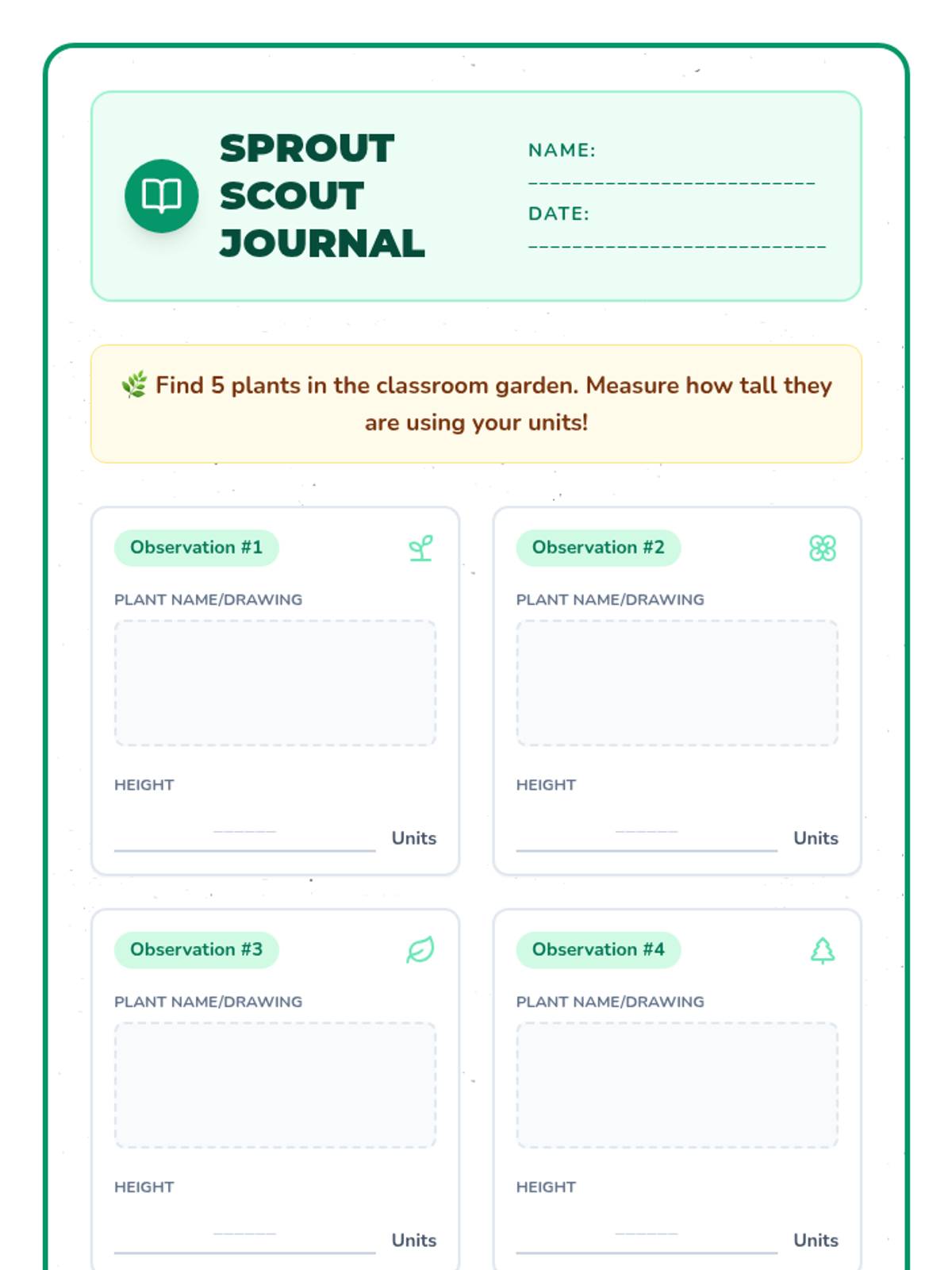
A student measurement log for recording data during the Garden Growth Giants activity, featuring drawing spaces and sections for non-standard units.
An engaging slide deck for the Garden Growth Giants lesson, introducing the 'Sprout Scout' mission and demonstrating proper non-standard measurement techniques with vibrant visuals.
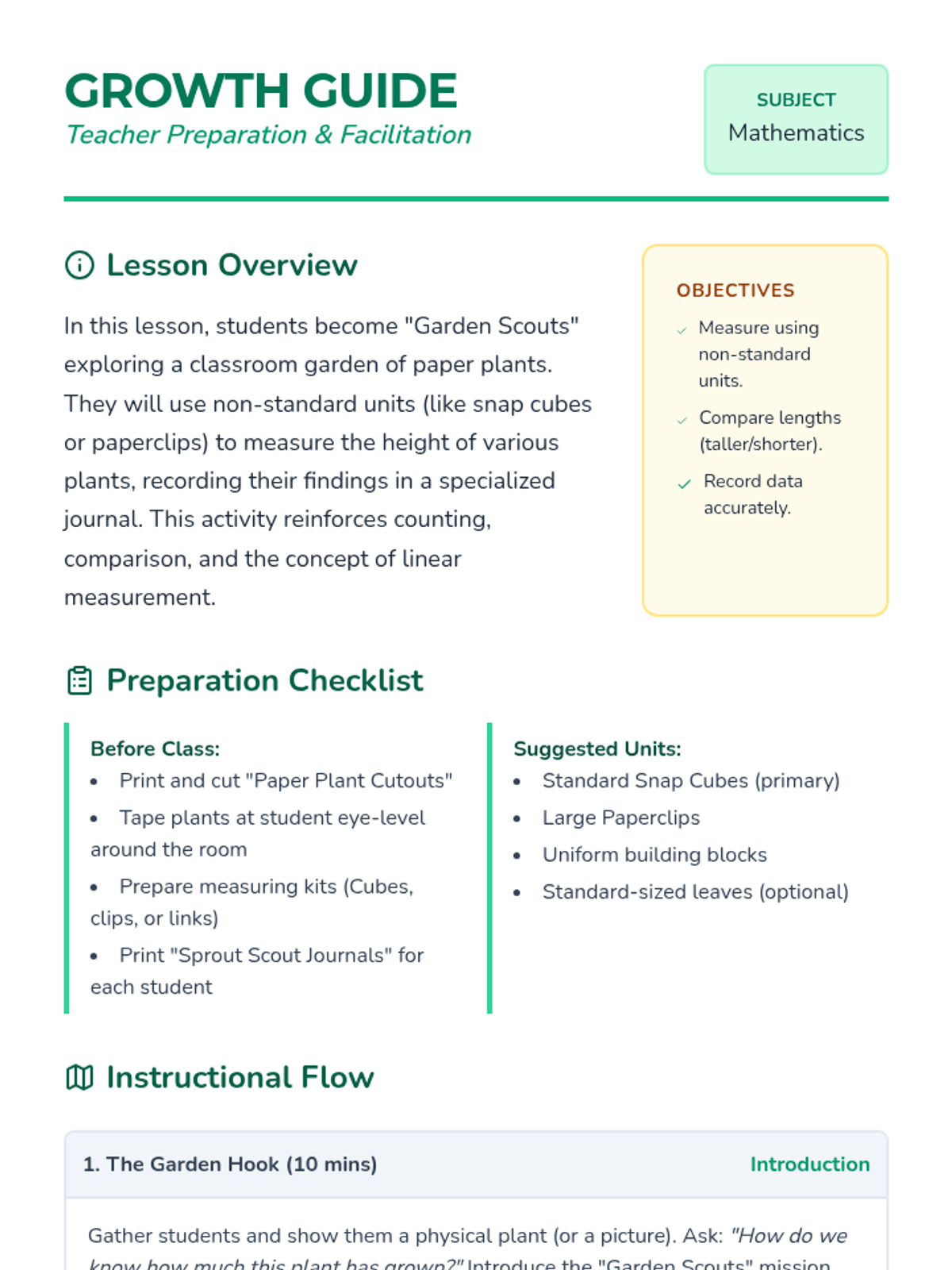
A comprehensive teacher guide for the Garden Growth Giants lesson, featuring instructional steps, preparation checklists, and differentiation strategies for teaching non-standard measurement.
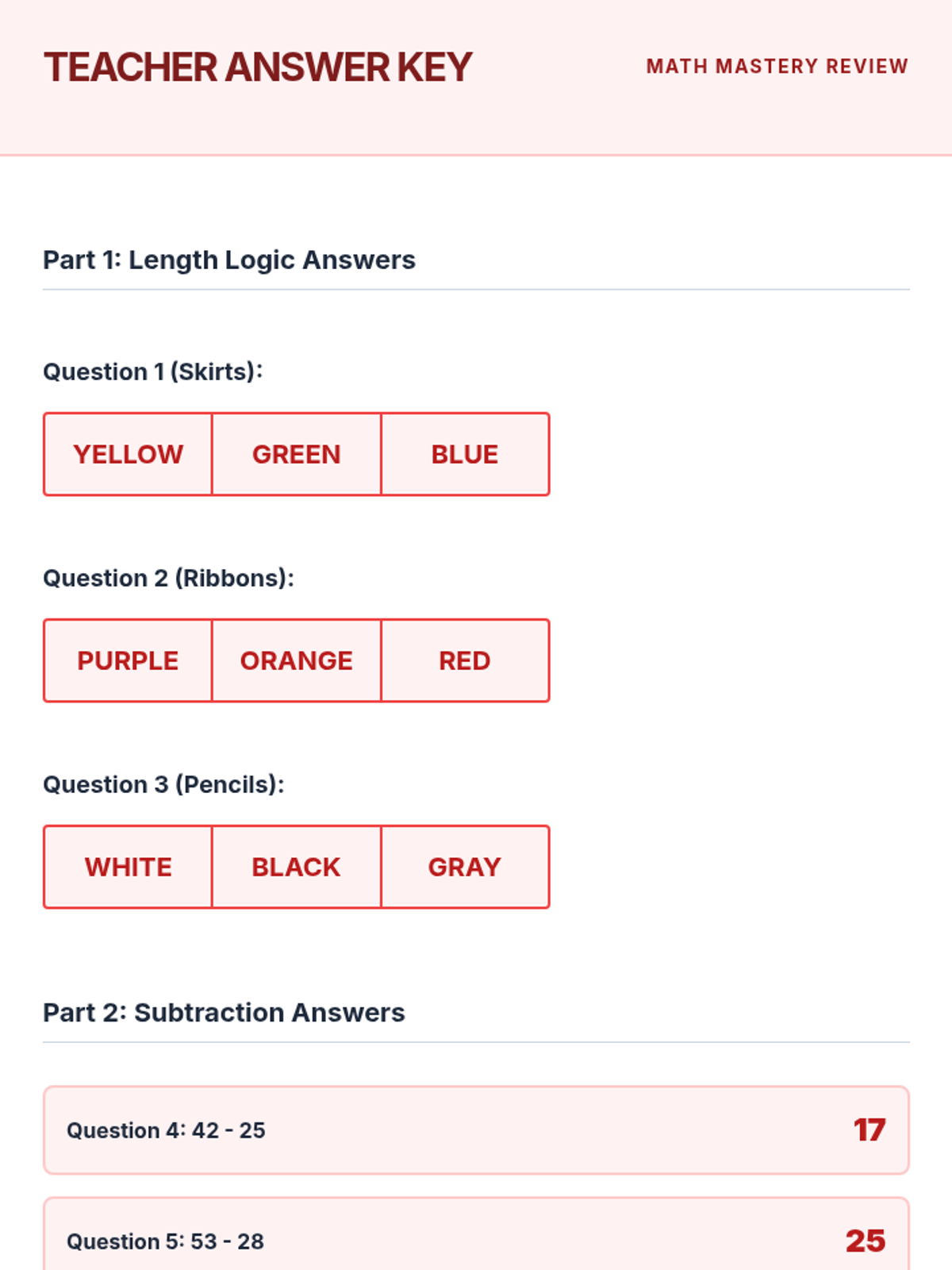
A teacher's answer key for the math review packet, providing solutions for length logic ordering, subtraction, shape sorting, geometry identification, and fractional identification. Each answer is clearly labeled by question number to match the 15-question sequence.
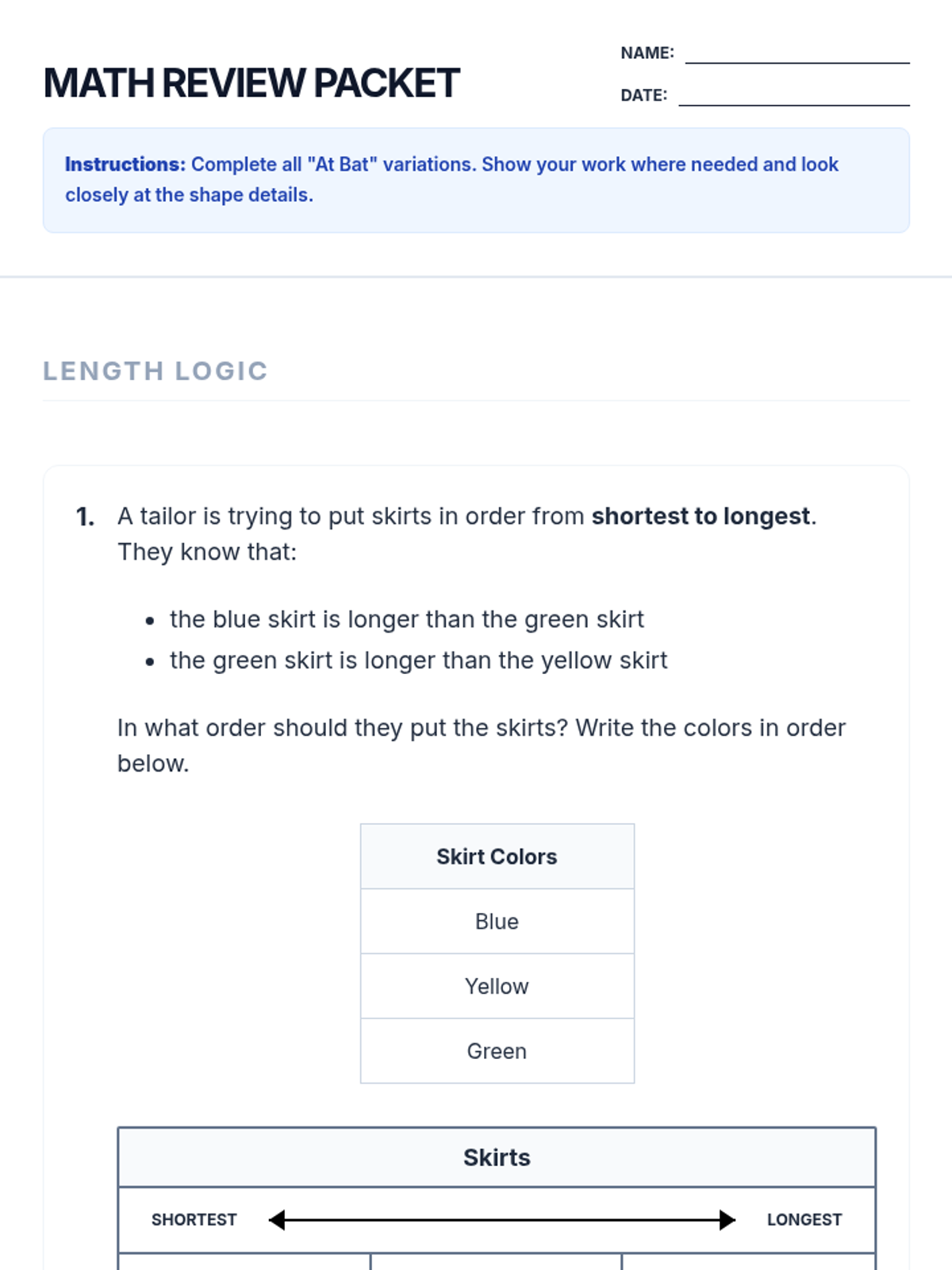
A math review packet for early elementary students covering logical ordering, subtraction, shape sorting, and fractions. The layout features one question per page (15 pages total). Revisions include left-aligned subtraction choices, clearer "non-triangle" geometry figures with expanded writing space, and additional shape sets in the fractional identification section. Standardized widths and alignments ensure visual consistency across all pages.
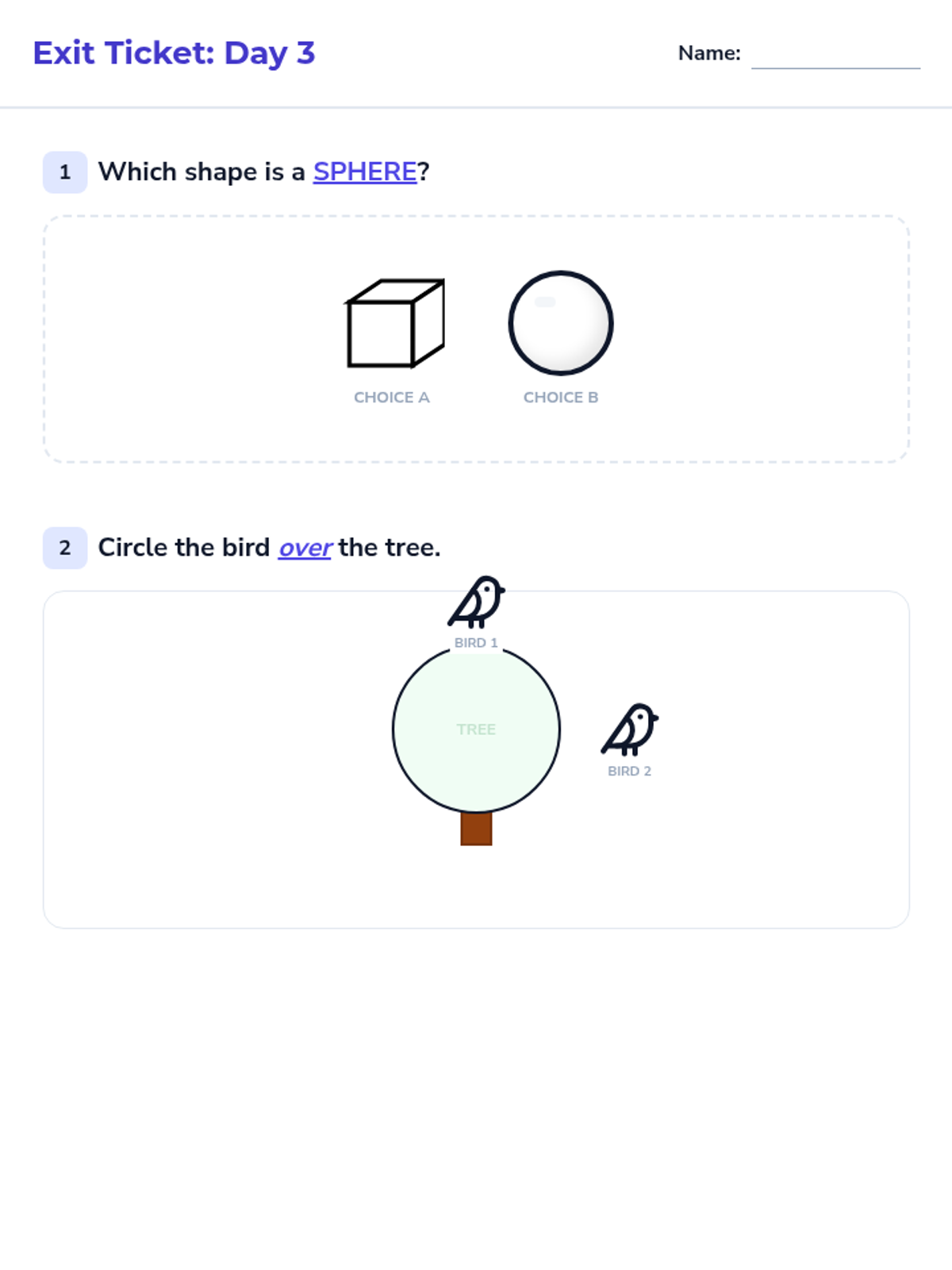
Day 3 Exit Ticket revised. Standardized bird and shape colors to ensure no hinting, used SVG for accurate 3D cube, and fixed bird icon placement for better spatial reasoning.
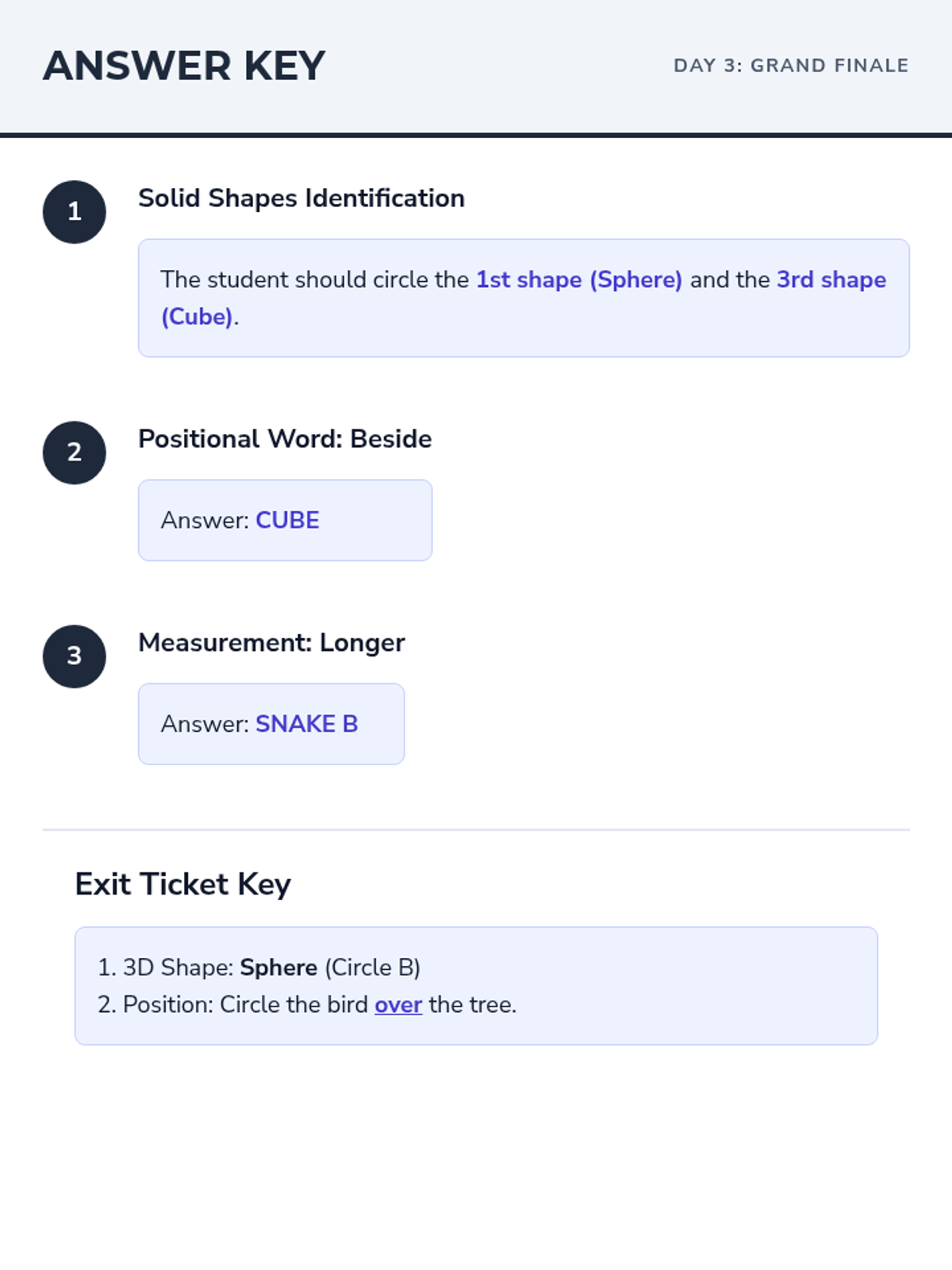
Comprehensive answer key for Day 3, covering cumulative geometry and measurement concepts.
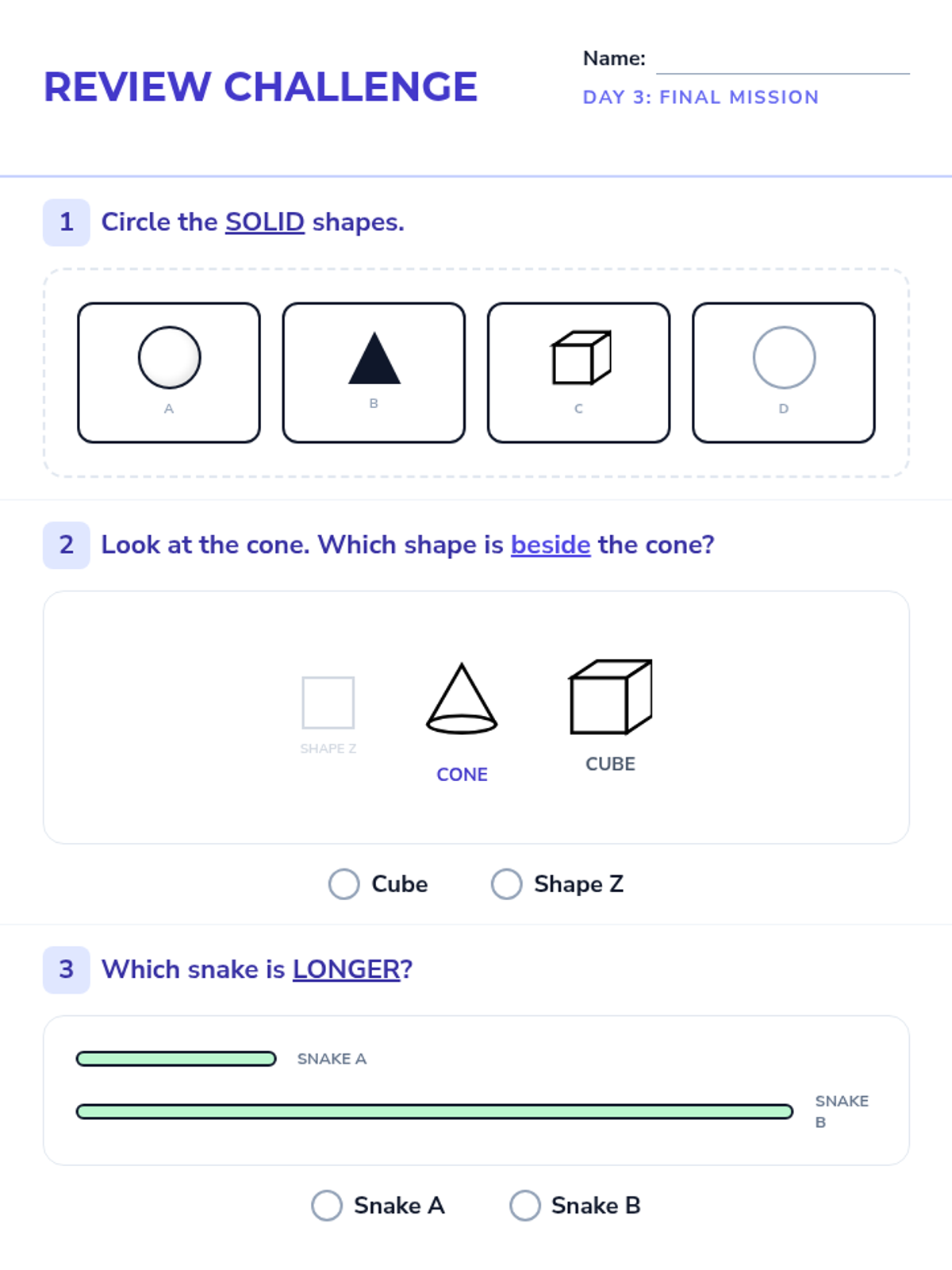
Day 3 Review Challenge revised. Ensured Task 3 fits on the same page, added selection areas for all tasks, improved 3D shape differentiation (shaded sphere vs flat circle), and standardized all label font sizes.
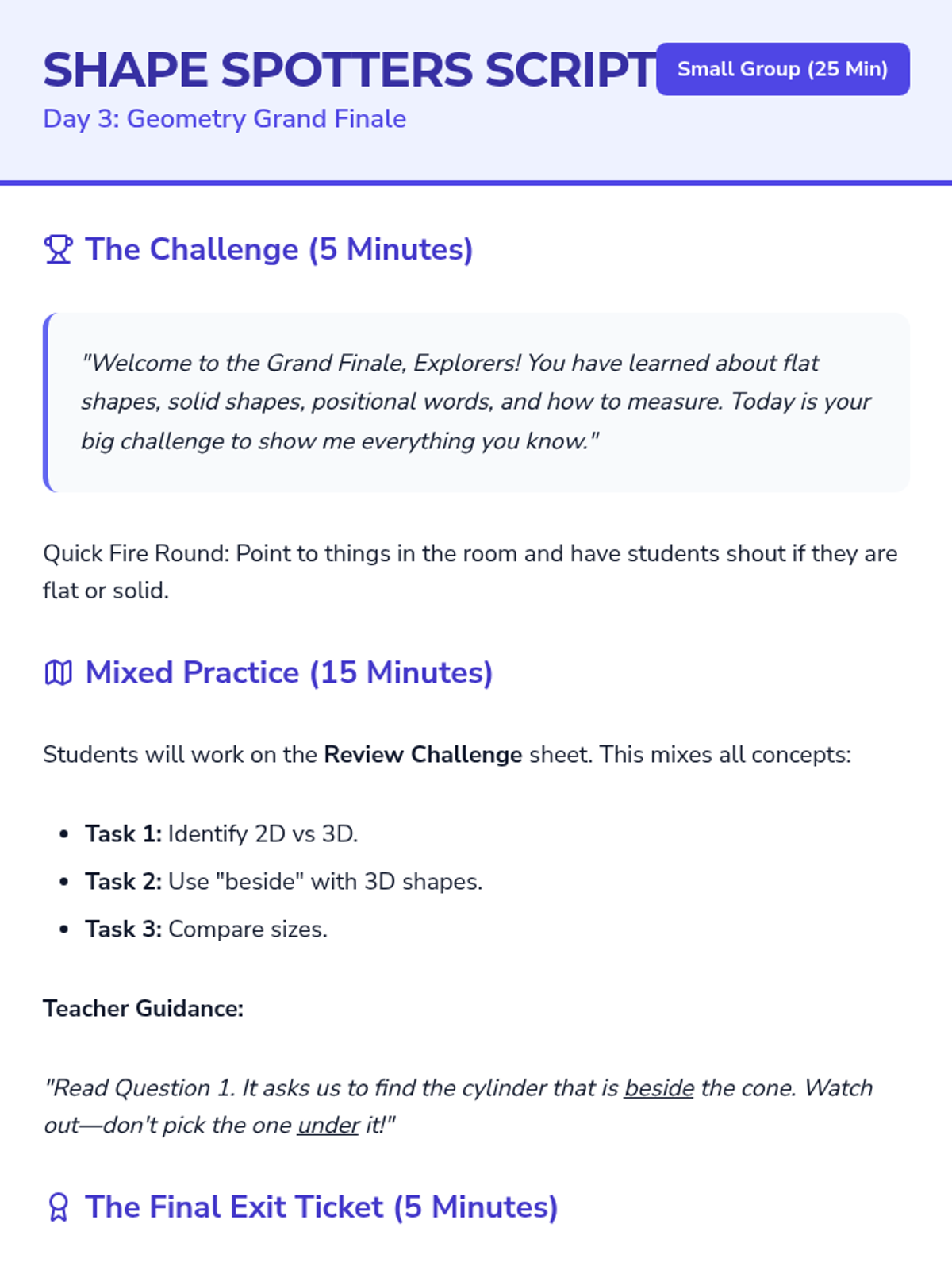
Teacher script for Day 3 cumulative review, integrating all geometry and measurement concepts learned in the sequence.
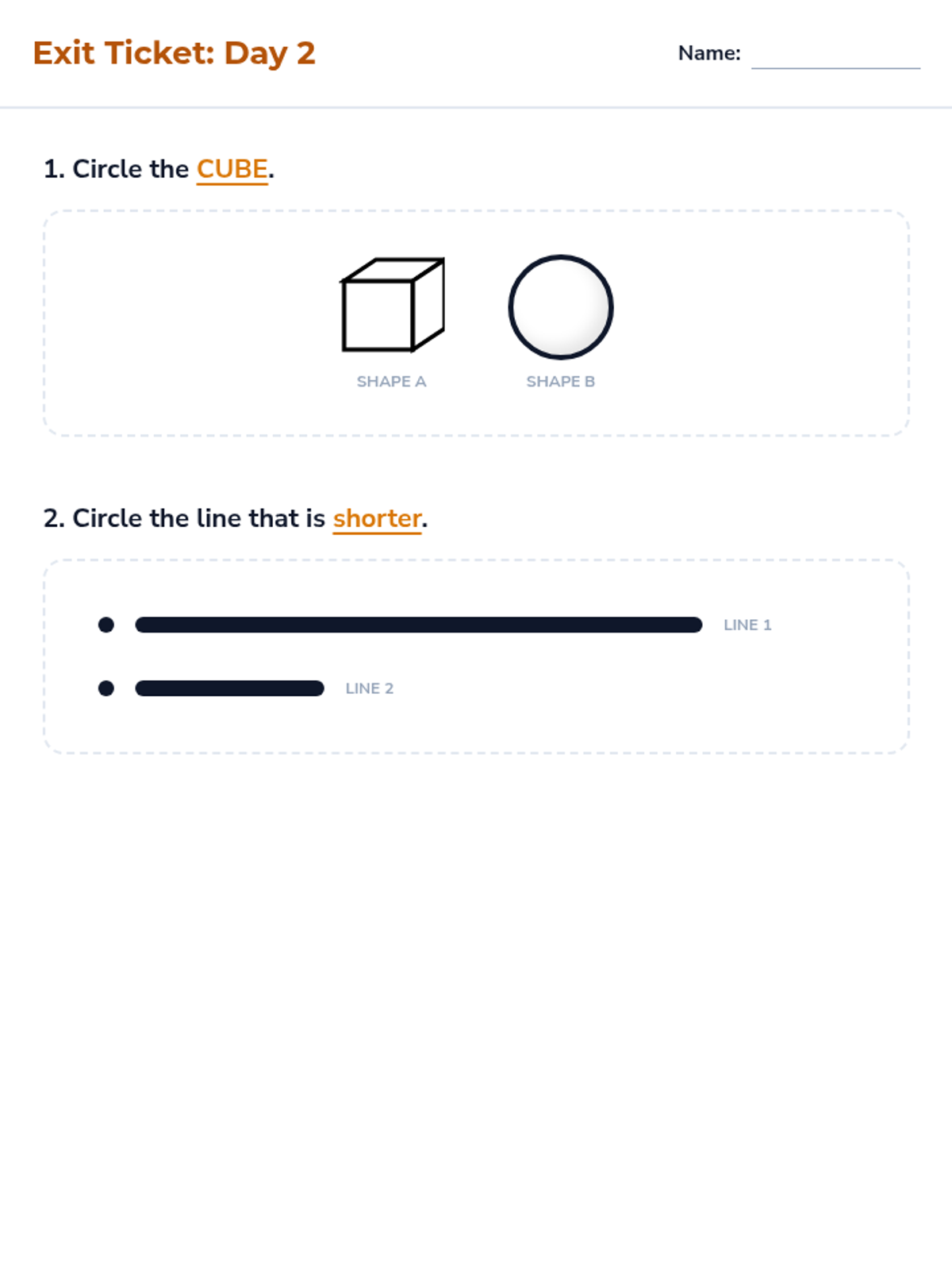
Day 2 Exit Ticket revised. Fixed CSS cube rendering by switching to SVG, improved line alignment in Q2, added text-underline-offset for better legibility, and standardized label styles.
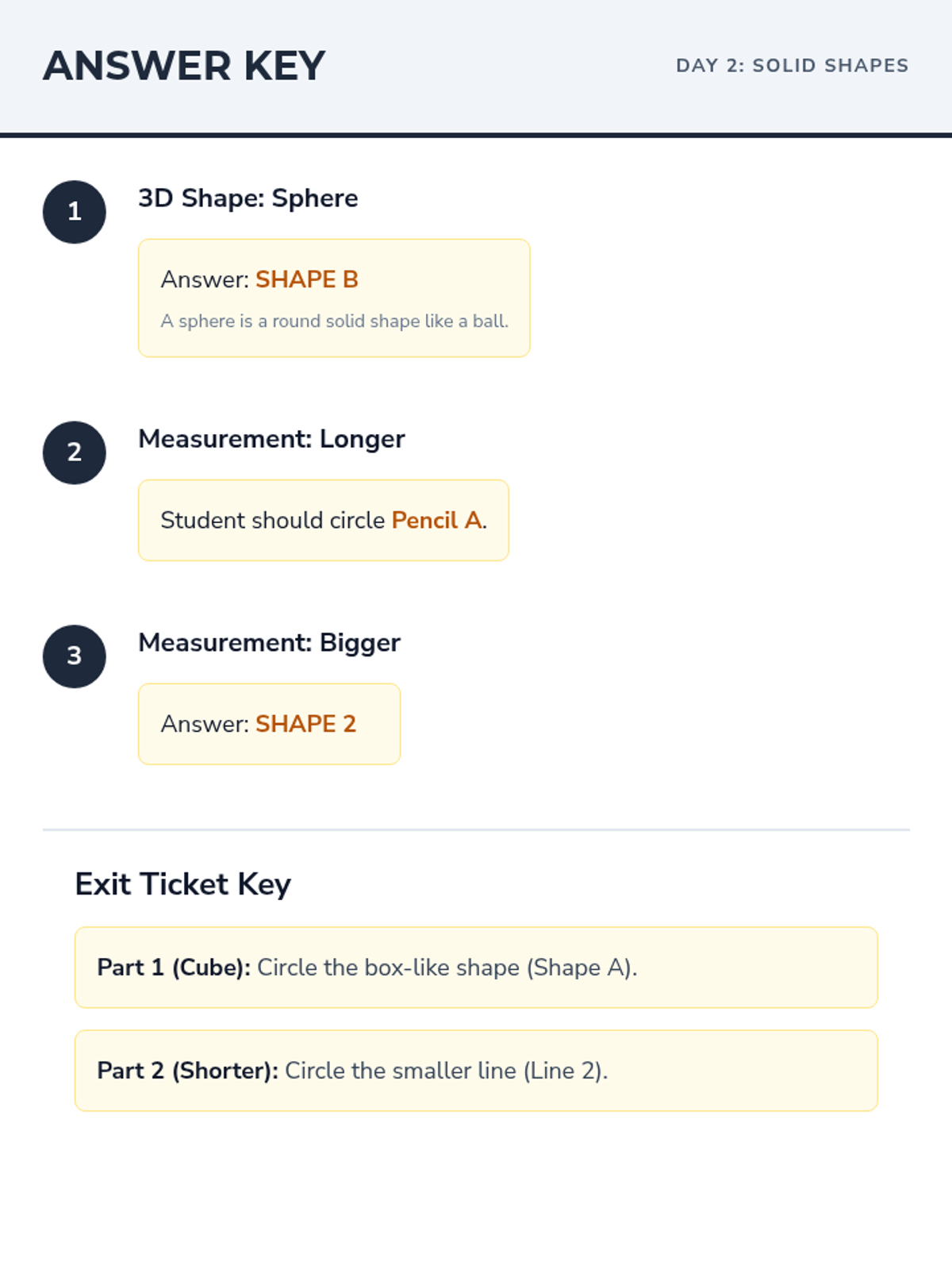
Answer key for Day 2 practice and exit ticket, identifying 3D shapes and comparing measurements.
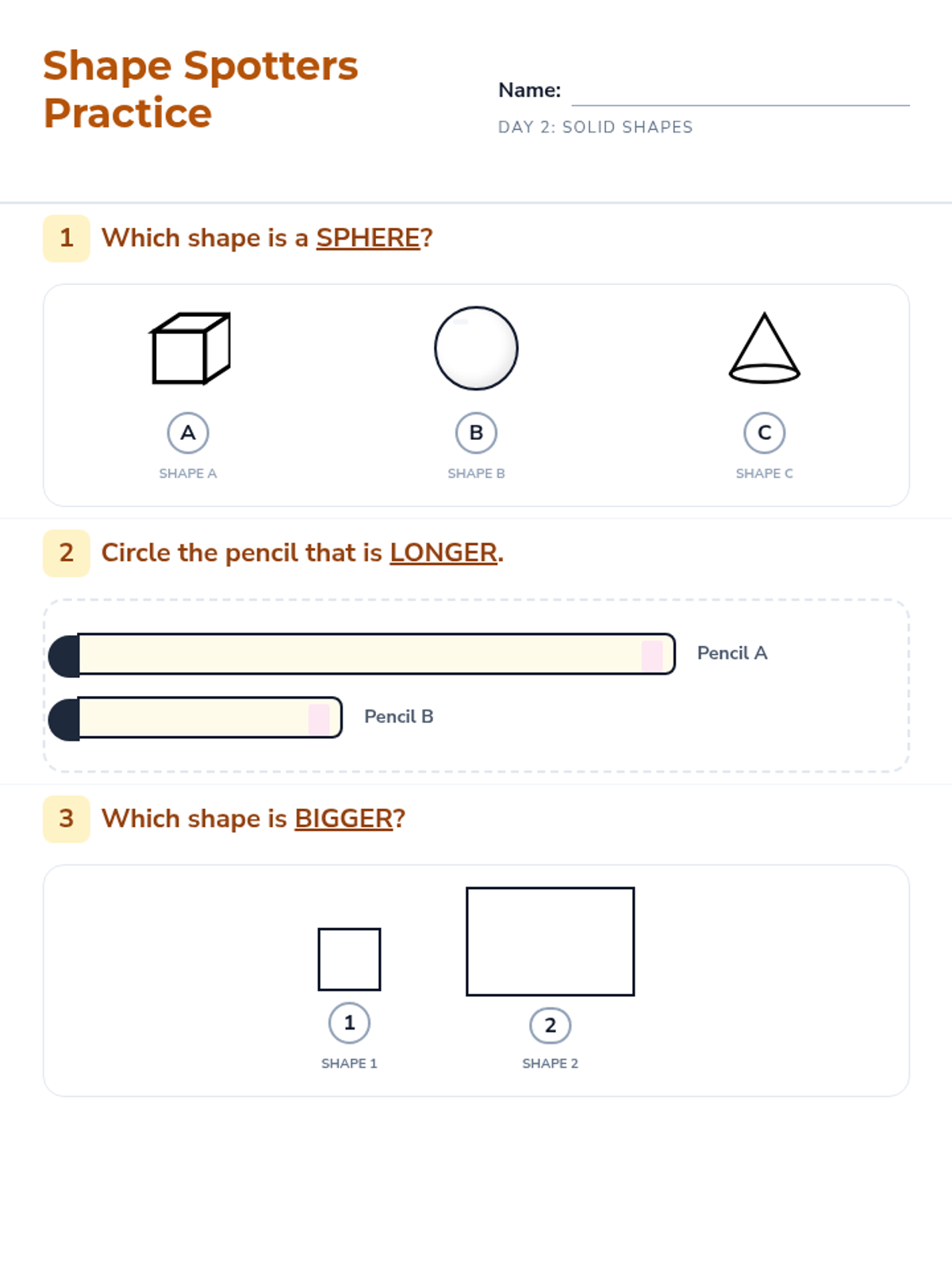
Day 2 Practice Worksheet revised. Standardized answer selection bubbles with letters/numbers, fixed 3D SVG geometry (no lines through cone), improved label alignment for Question 3, and consolidated to a single page.
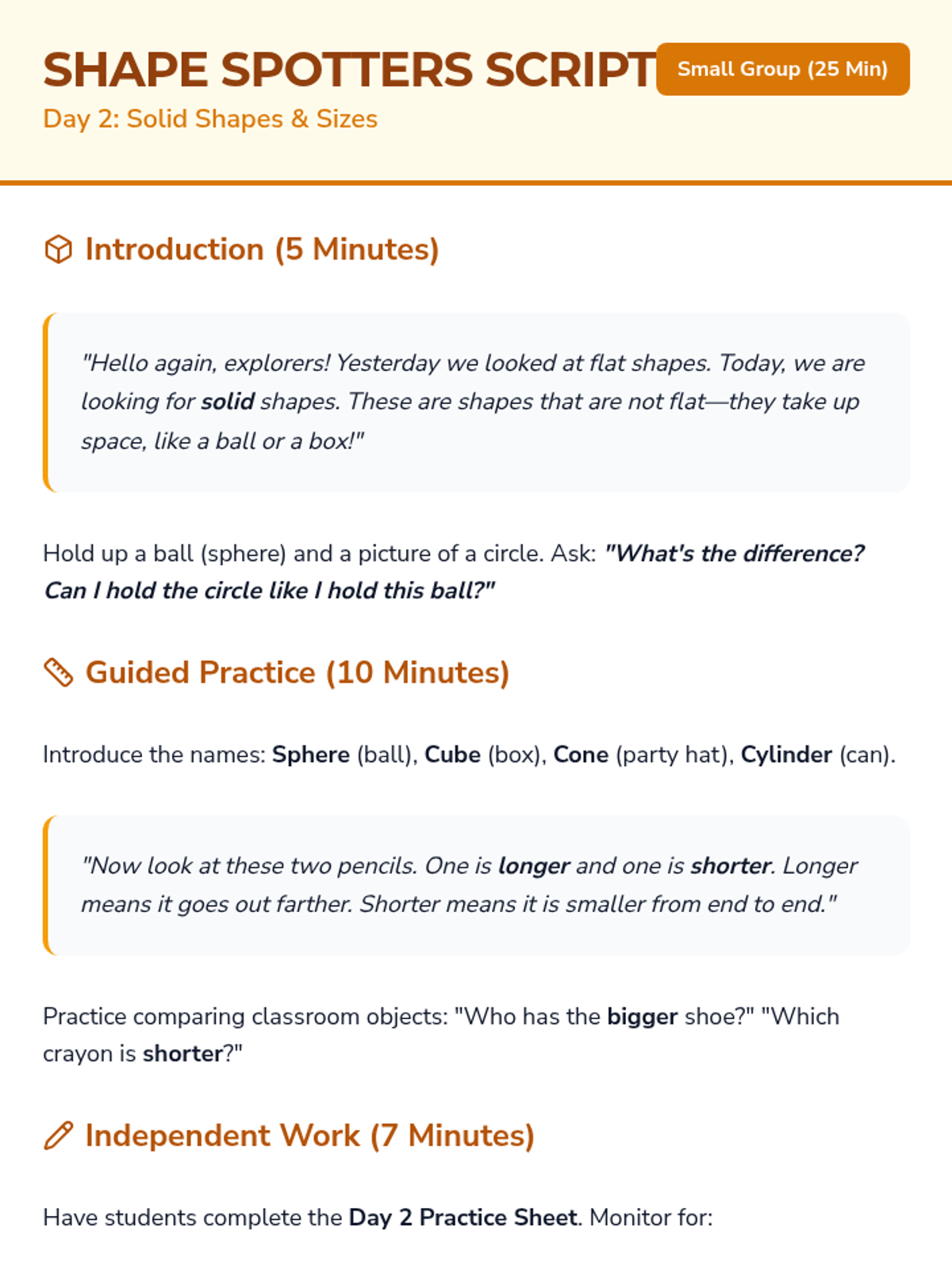
Teacher script for Day 2 focusing on 3D shapes and measurement comparisons (size/length) with instructional bridges.
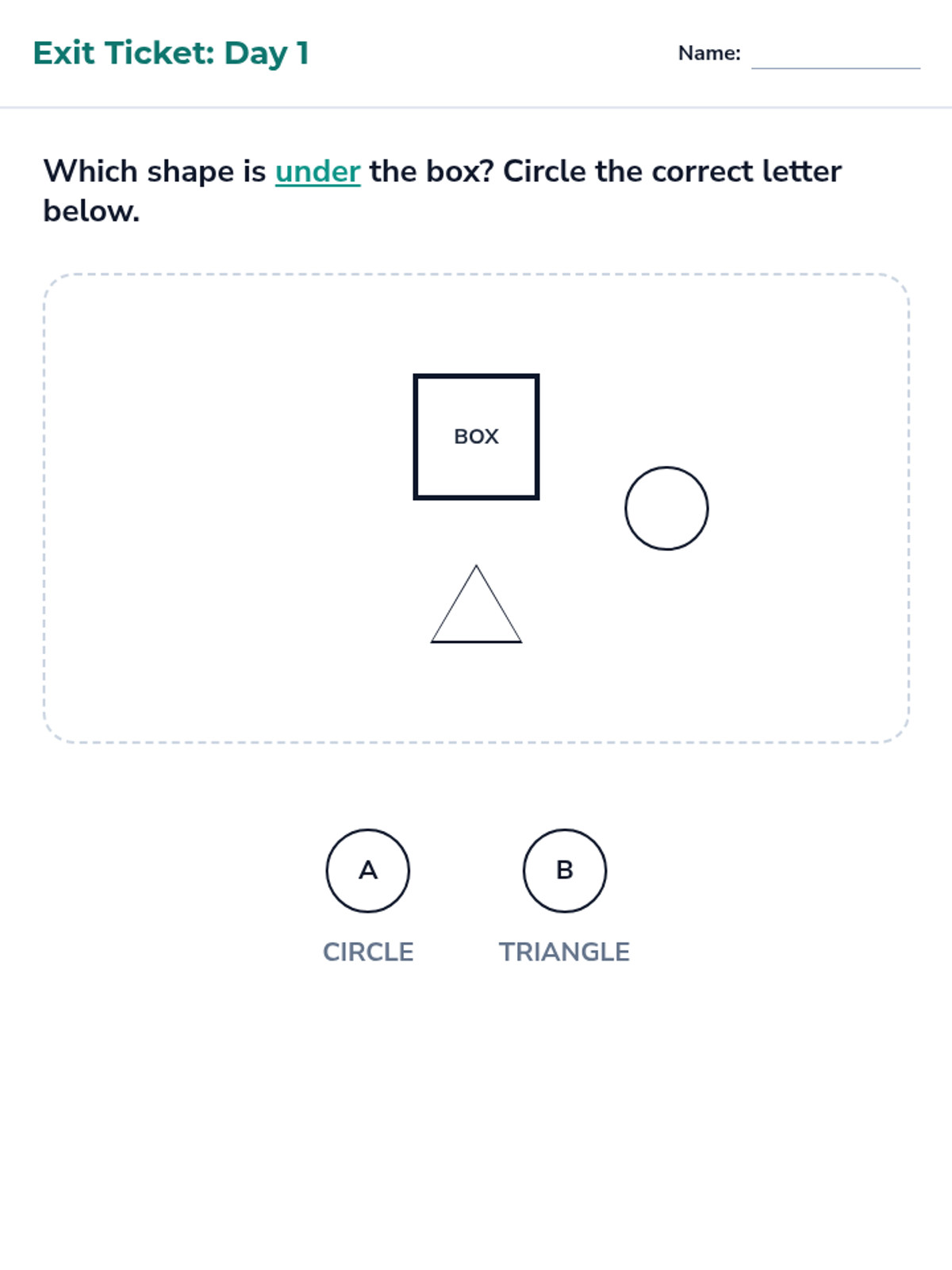
Day 1 Exit Ticket revised. Fixed the Choice B logic error (square vs triangle), added lettered selection circles for clarity, and refined the prompt to improve instructional clarity for students.
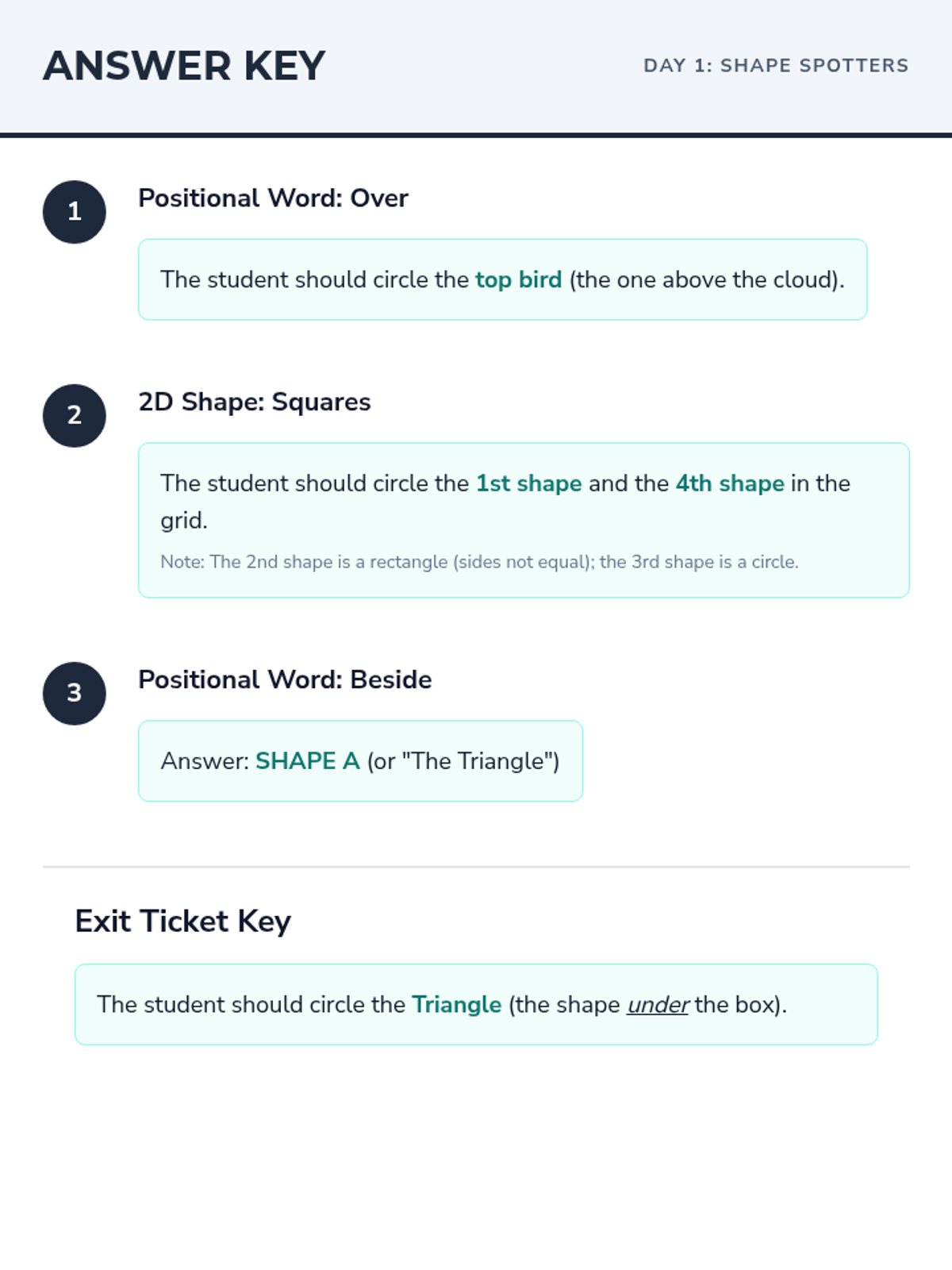
Answer key for Day 1 practice and exit ticket, providing clear visual and textual explanations.
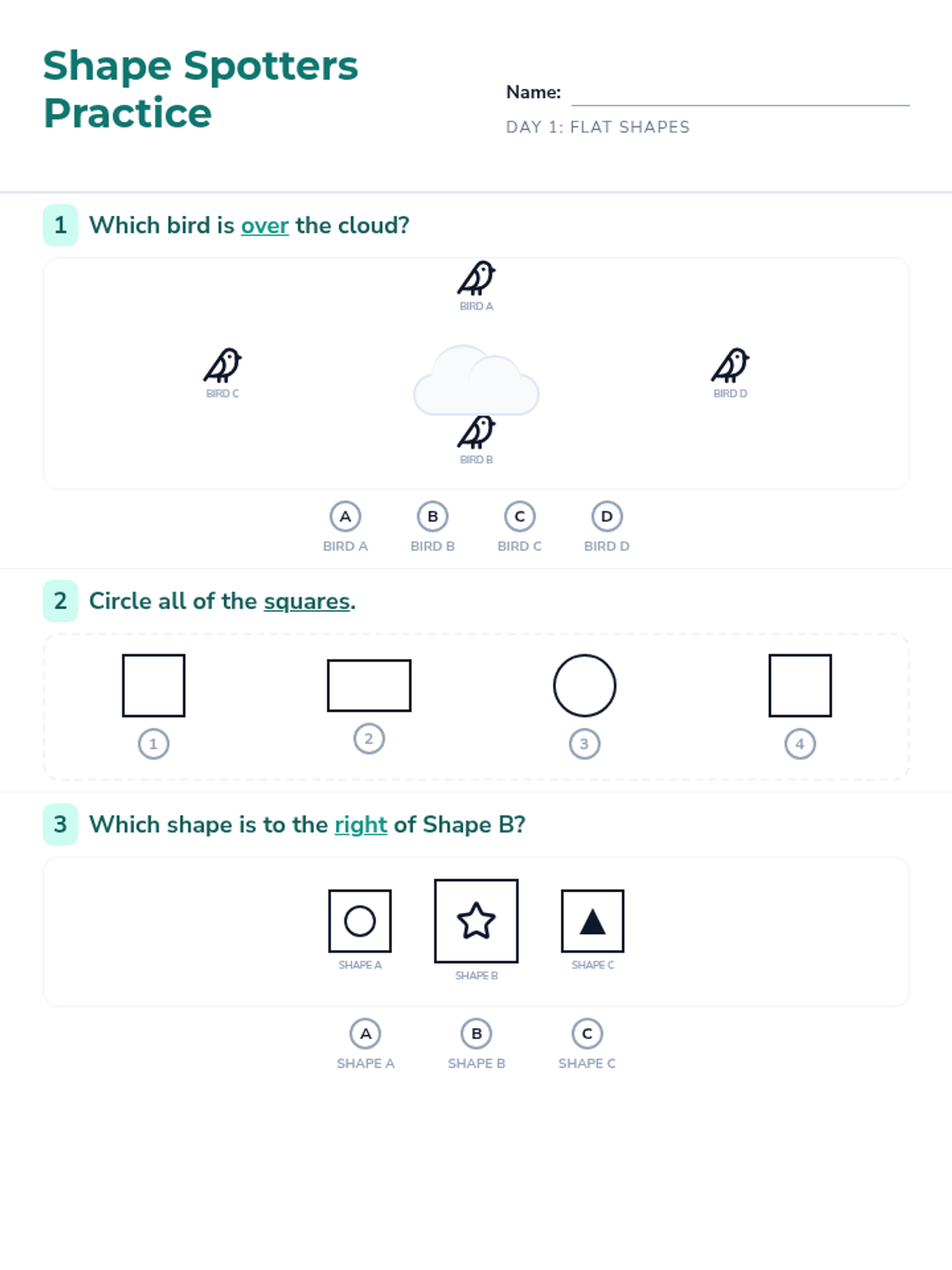
Day 1 Practice Worksheet finalized. Standardized all label colors to slate-400, improved bubble numbering layout in Question 2, and ensured consistent font sizes across all selection elements.
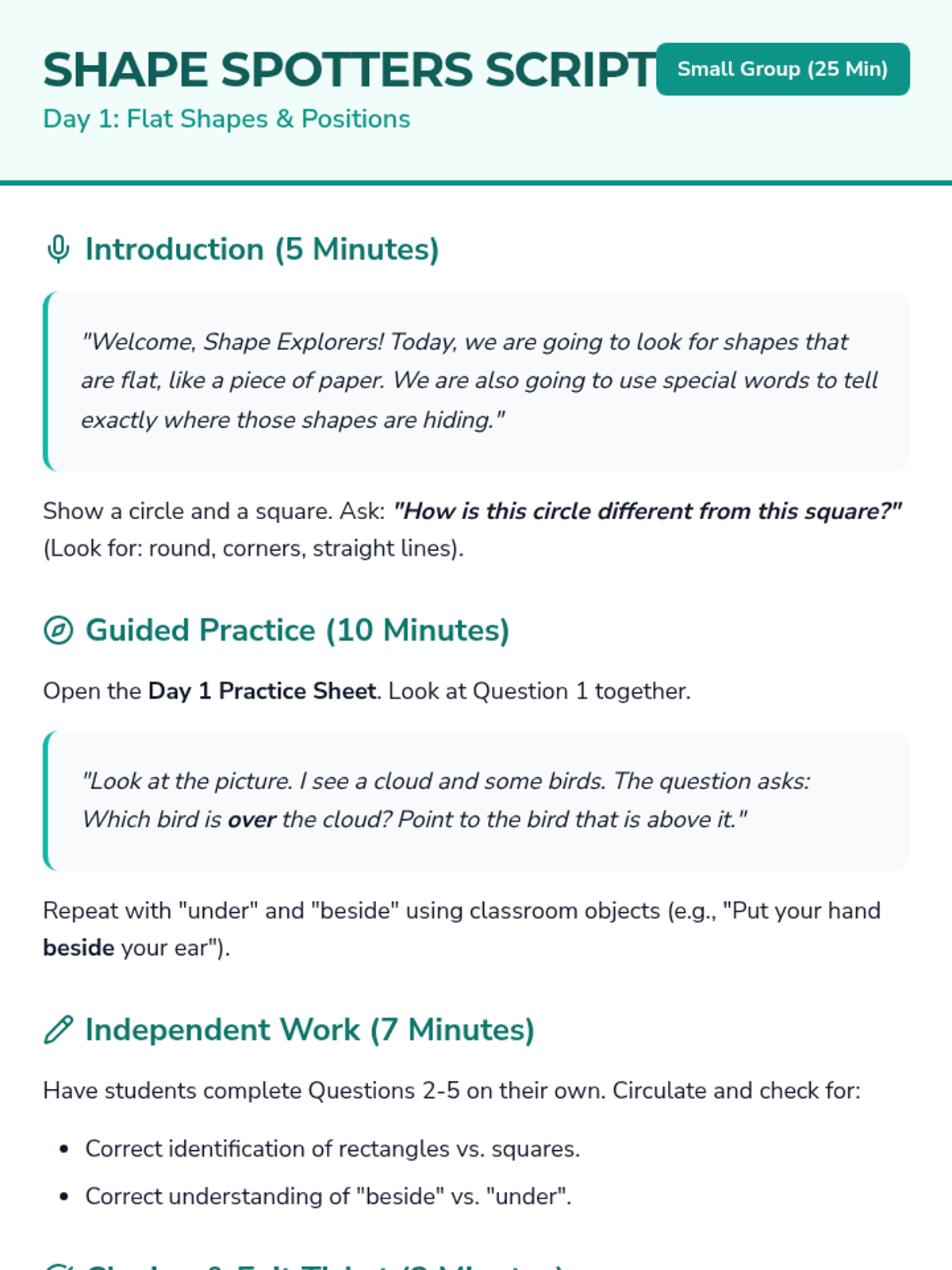
Teacher script for Day 1 focusing on 2D shapes and positional vocabulary with clear instructional steps. Added break-inside-avoid to headers.
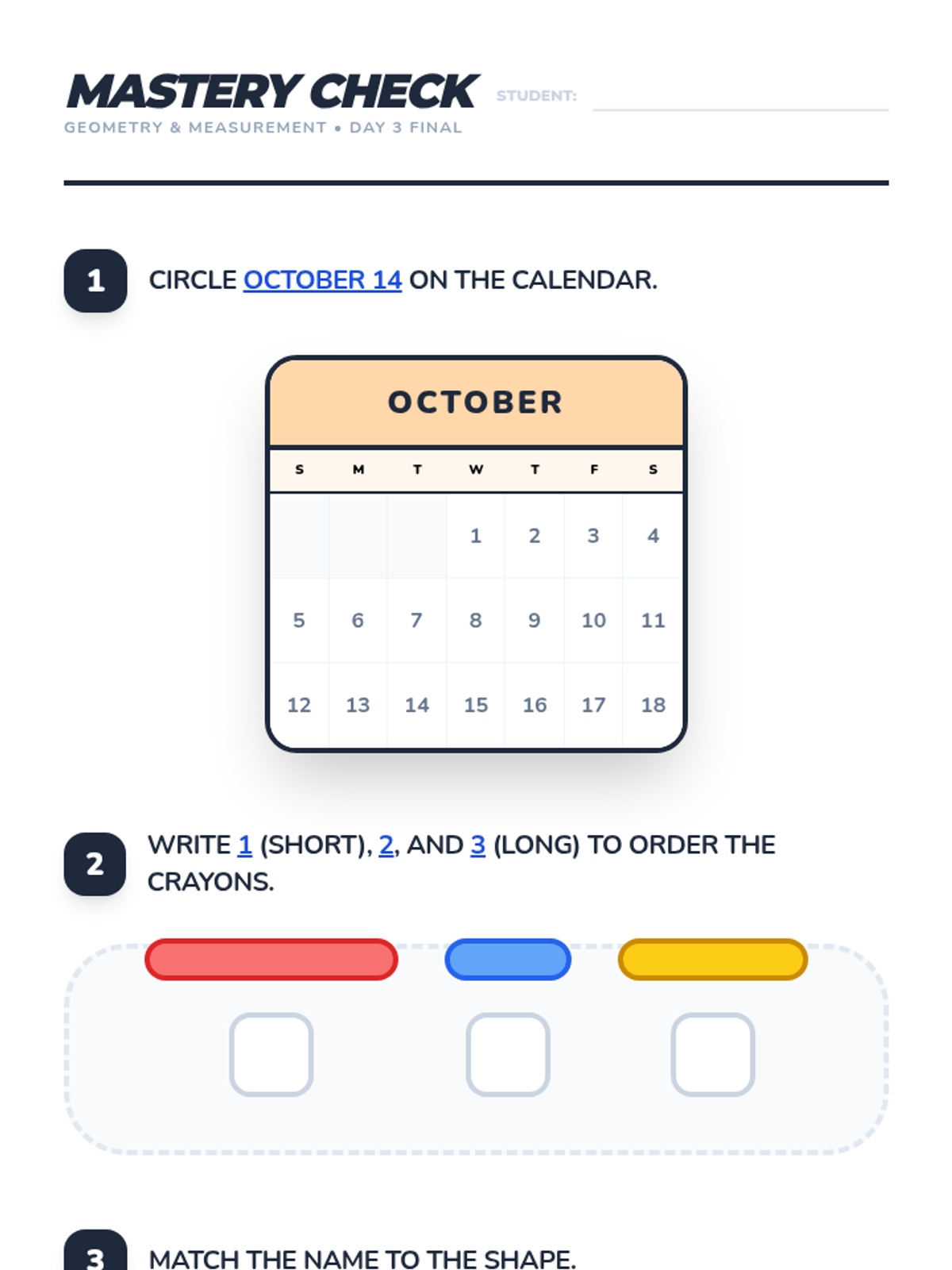
A cumulative assessment for the 3-day sequence, testing calendar navigation, length ordering, 3D shape identification, and positional vocabulary. All questions are neutrally styled to ensure a fair assessment.
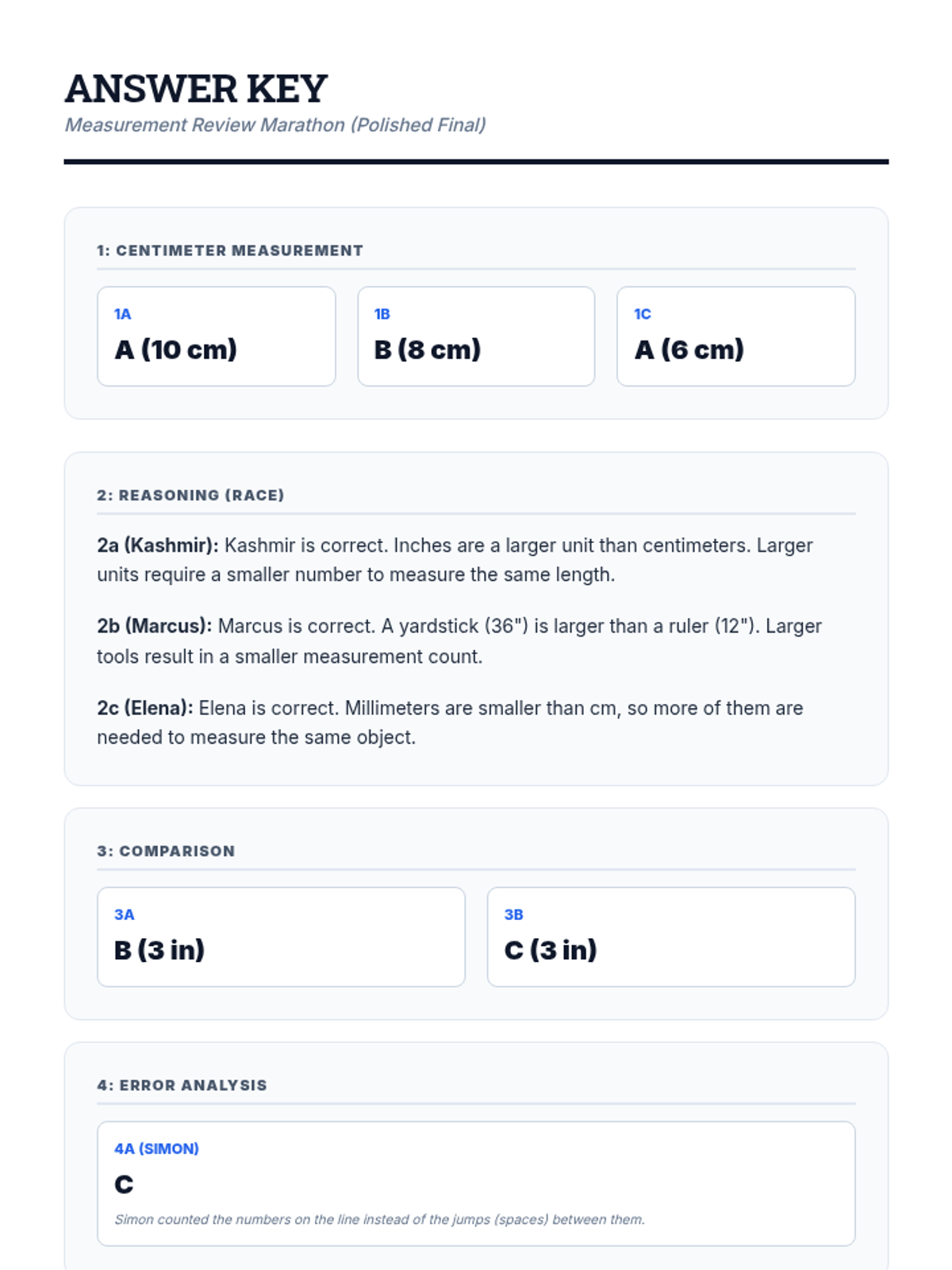
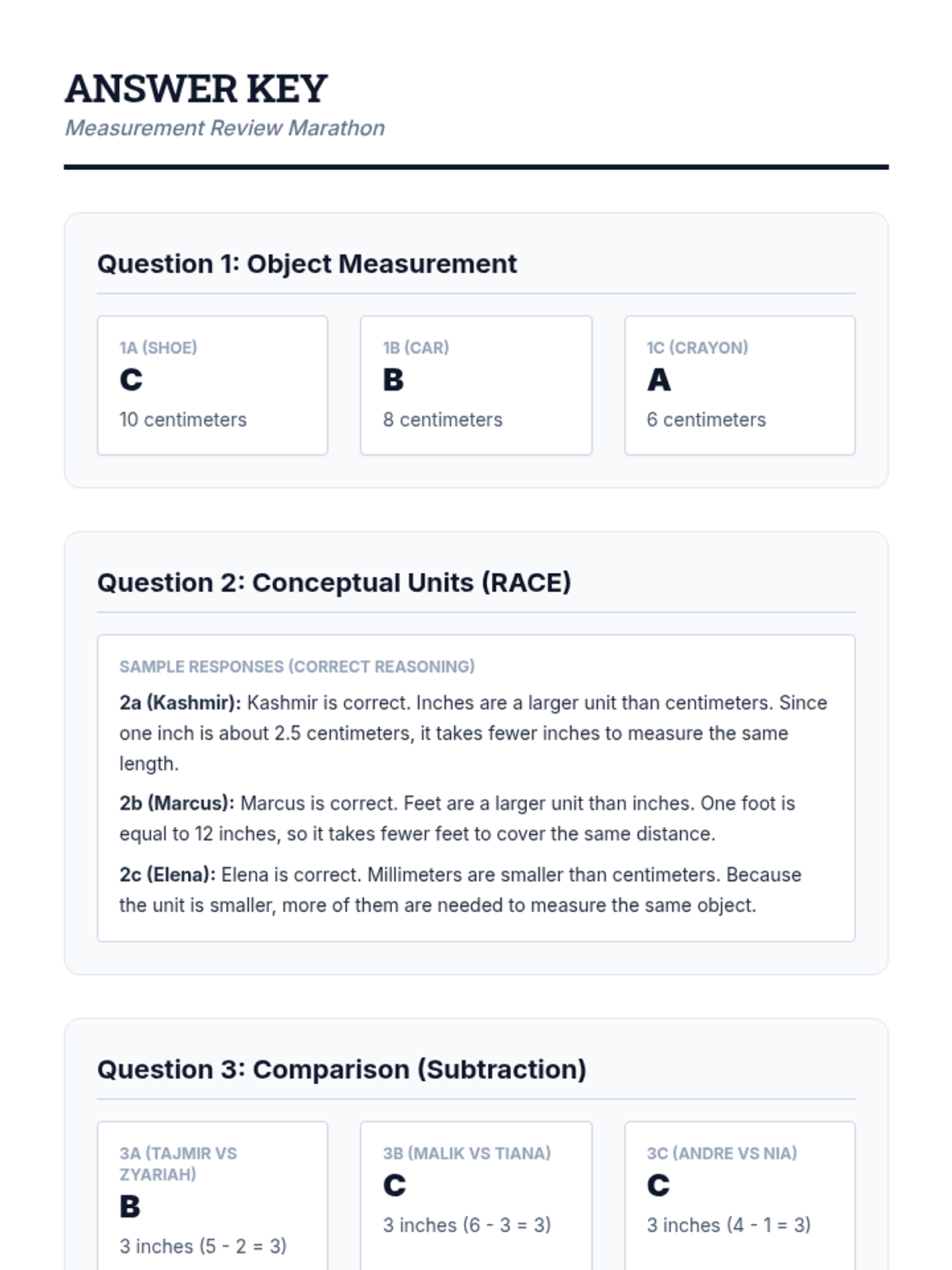
A comprehensive answer key for the revised math review packet, providing solutions for all measurement, reasoning, and operation variations. Matches the latest student packet layout. Fixed CSS syntax errors.
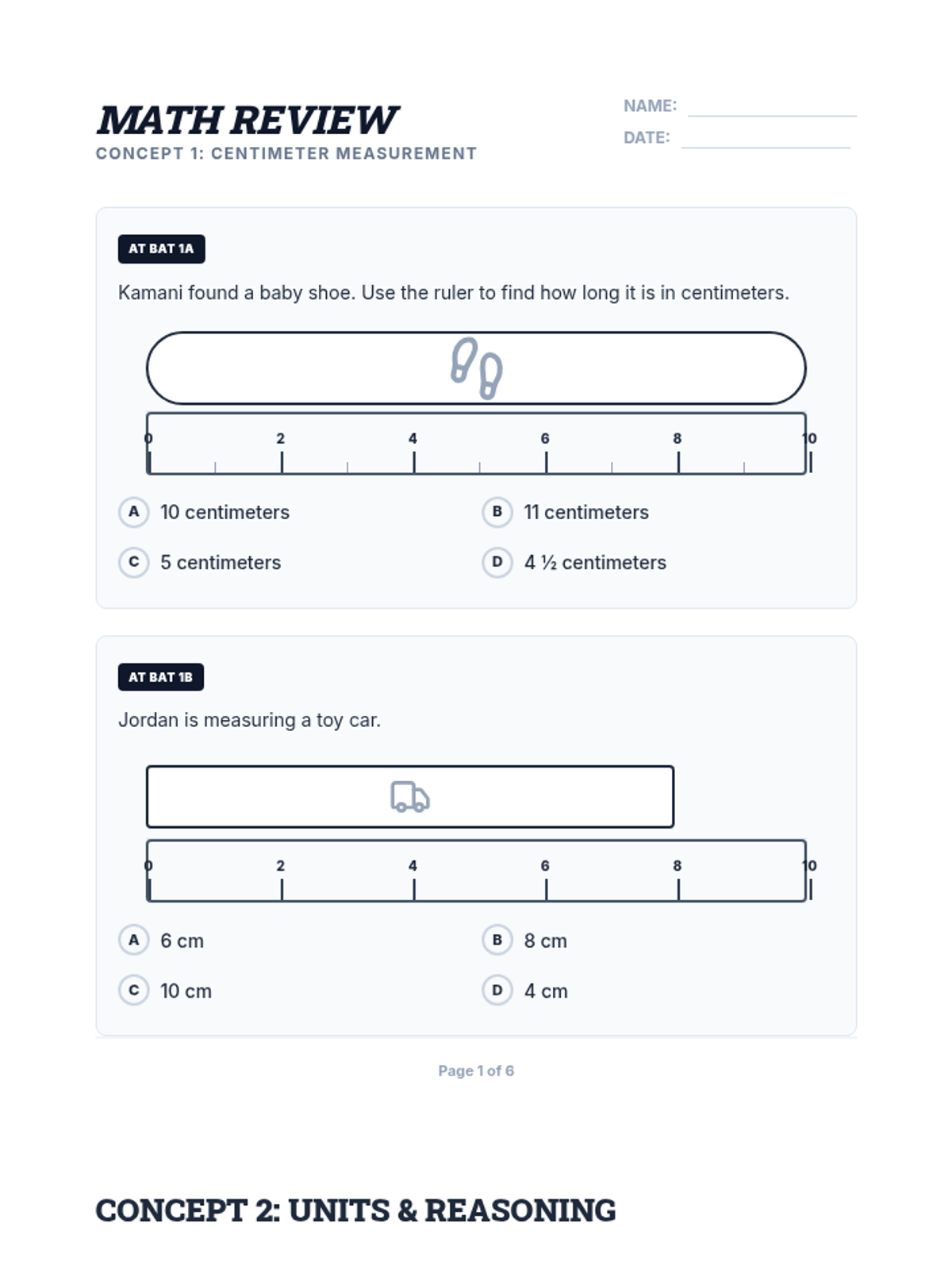
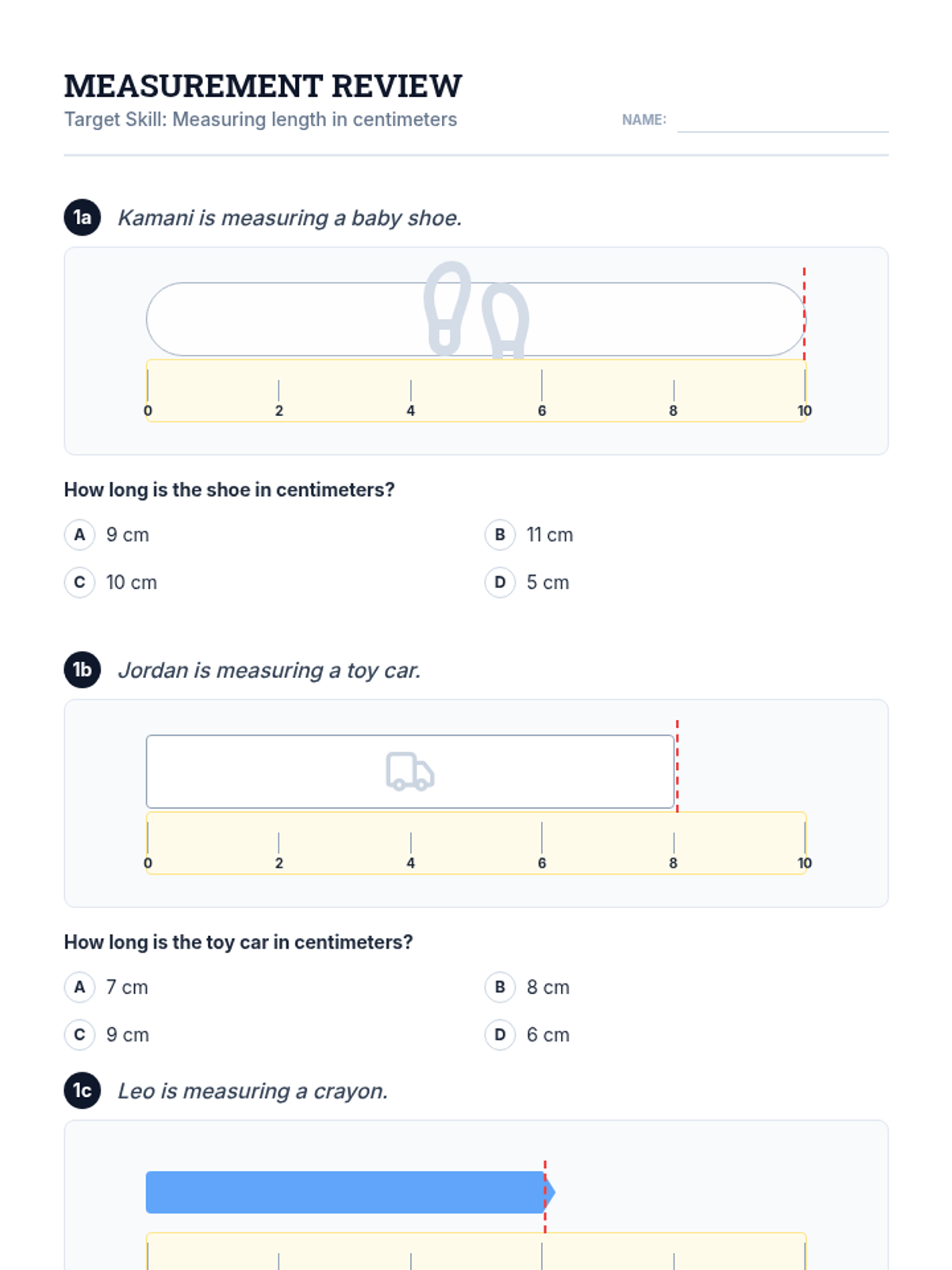
A 6-page math review packet with three variations per concept. Features precisely aligned measurement tasks, reasoning sections with RACE writing lines, and open number lines for operations, following the user's specific formatting requirements. Fixed object alignment, removed guidelines, and standardized choices. Improved layout to prevent overlap.
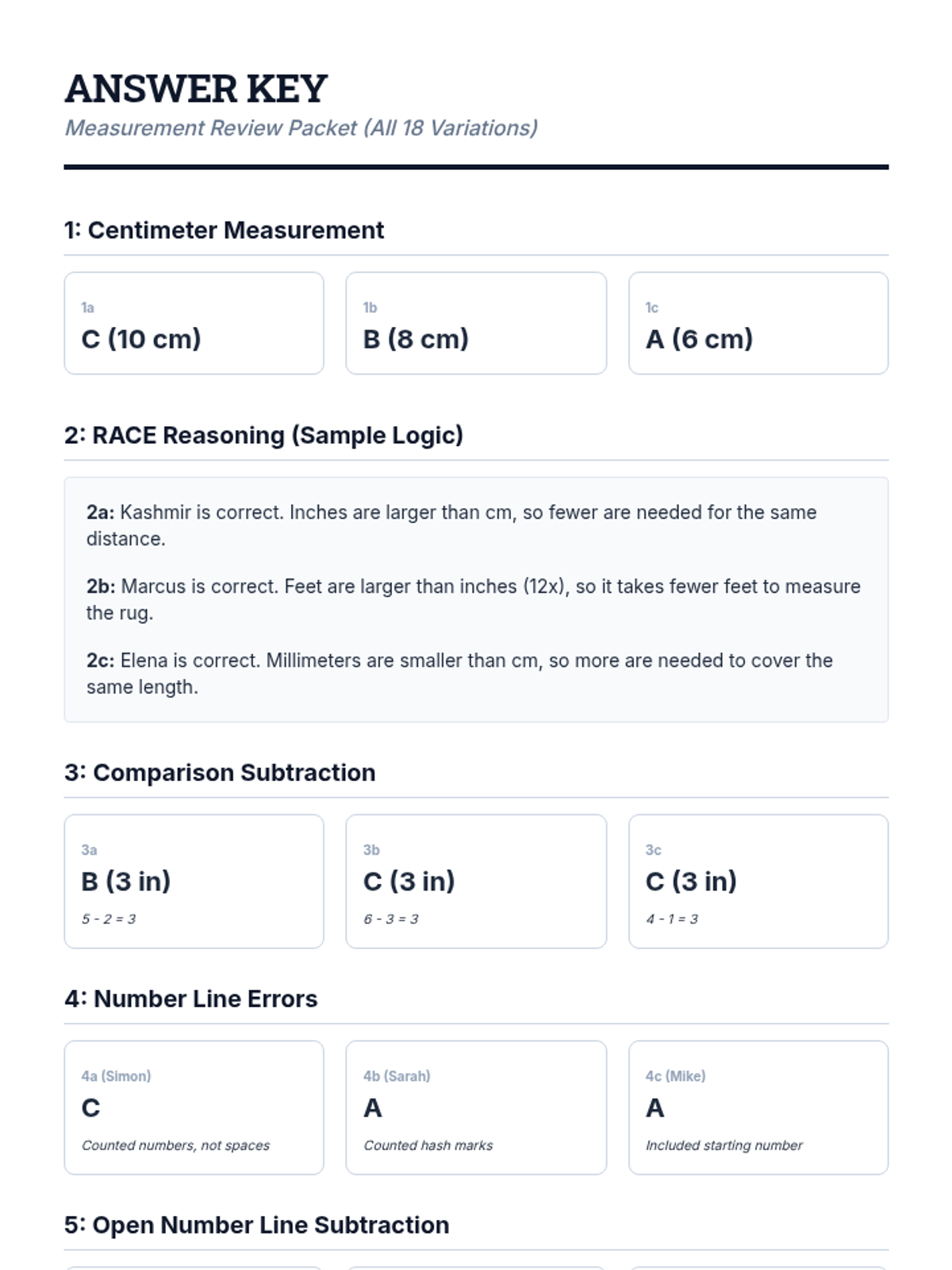
A concise, clear answer key for the Measurement Review Packet, providing correct multiple-choice answers, sample RACE explanations, and mathematical solutions for all 18 variations. Fixed layout to prevent page breaks across questions.
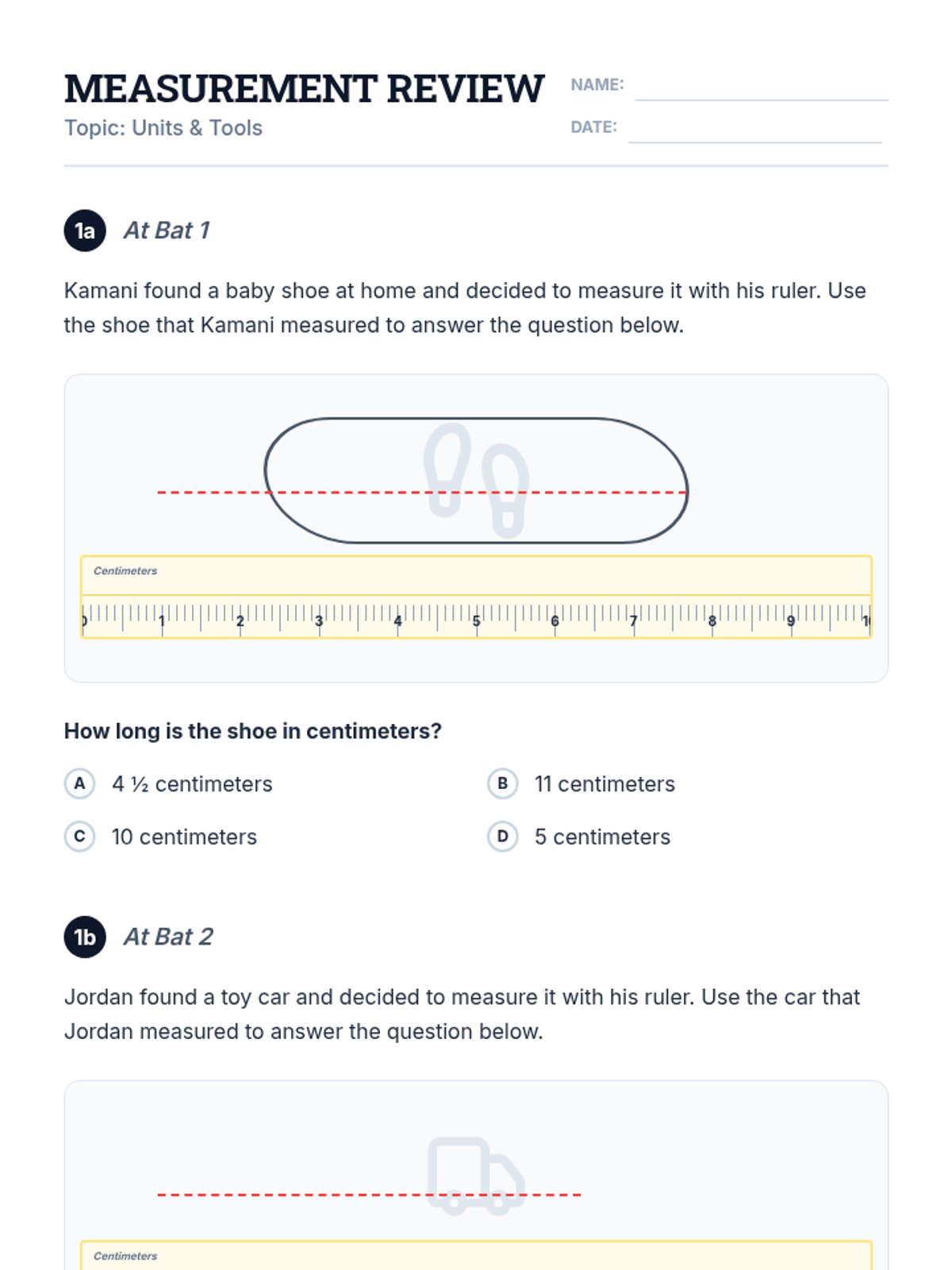
A 8-page comprehensive math review packet featuring 3 variations for 6 different measurement and number line concepts. Each page is carefully formatted to ensure no content is cut off during printing, with ample space for student work and clear visual aids. Fixed object alignment to start at 0. Added writing lines and page numbers.
A concise, clear answer key for the Measurement Review Packet, providing correct multiple-choice answers, sample RACE explanations, and mathematical solutions for all 18 variations.
A 9-page comprehensive math review packet featuring 3 variations for 6 different measurement and number line concepts. Each page is carefully formatted to ensure no content is cut off during printing, with ample space for student work and clear visual aids.
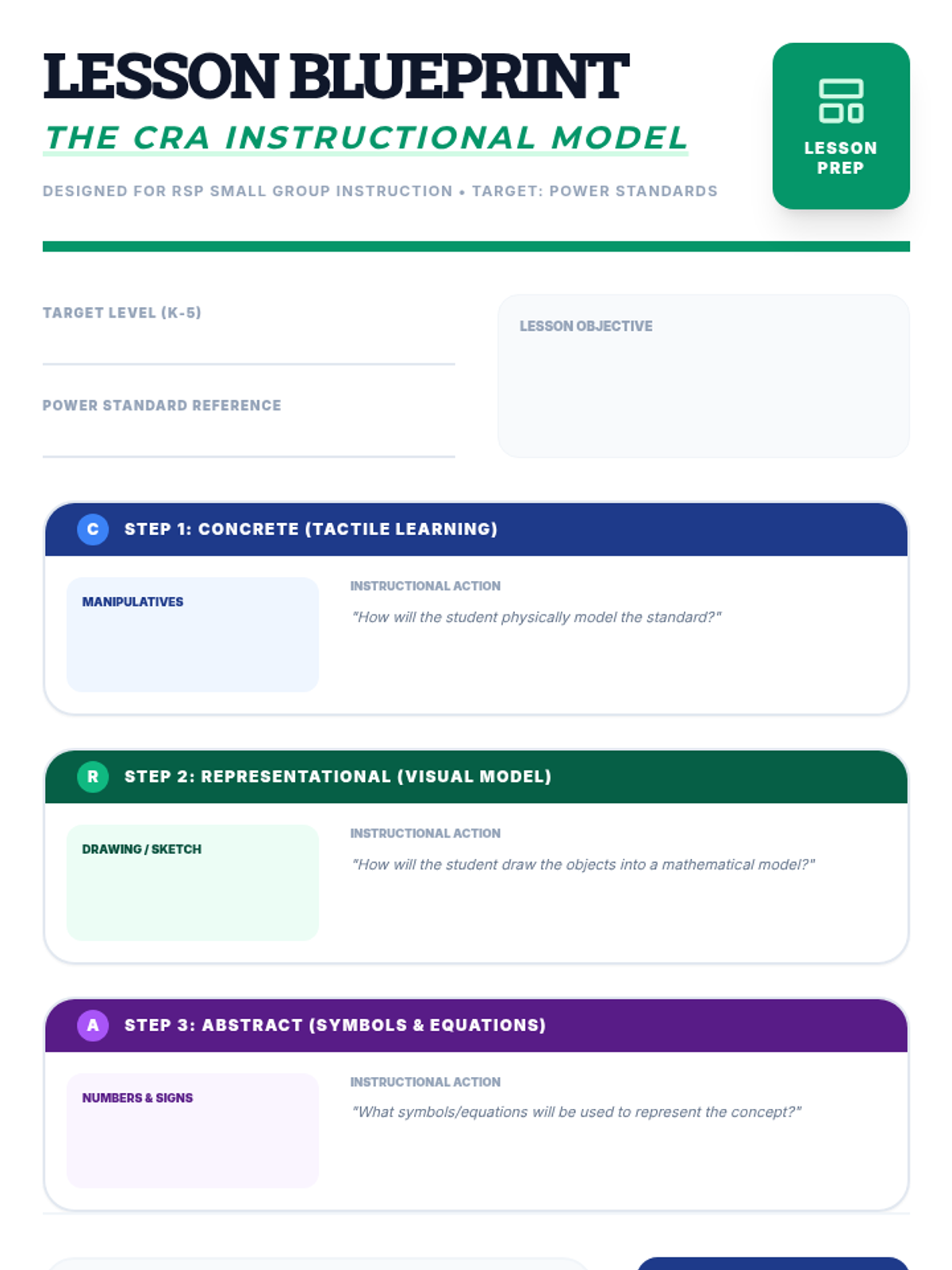
A planning template for RSP teachers following the Concrete-Representational-Abstract (CRA) instructional model. It provides a structured workspace to plan small-group interventions for math Power Standards, ensuring students move through tactile and visual stages before symbolic computation.
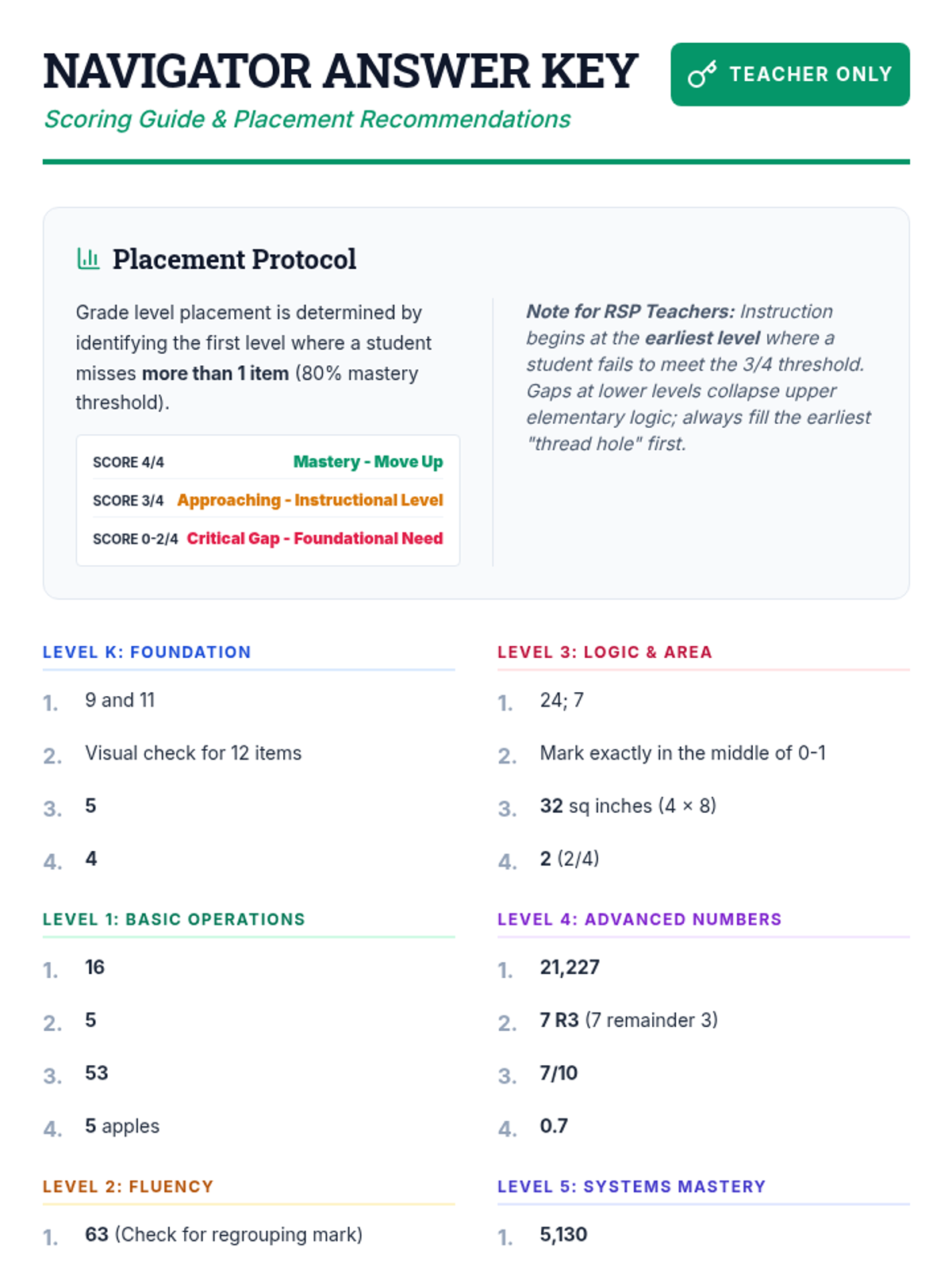
A teacher answer key and scoring guide for the Math Level Navigator Exam, renumbered to match the level-based item scheme (1-4 per level) and mastery criteria for grade placement.
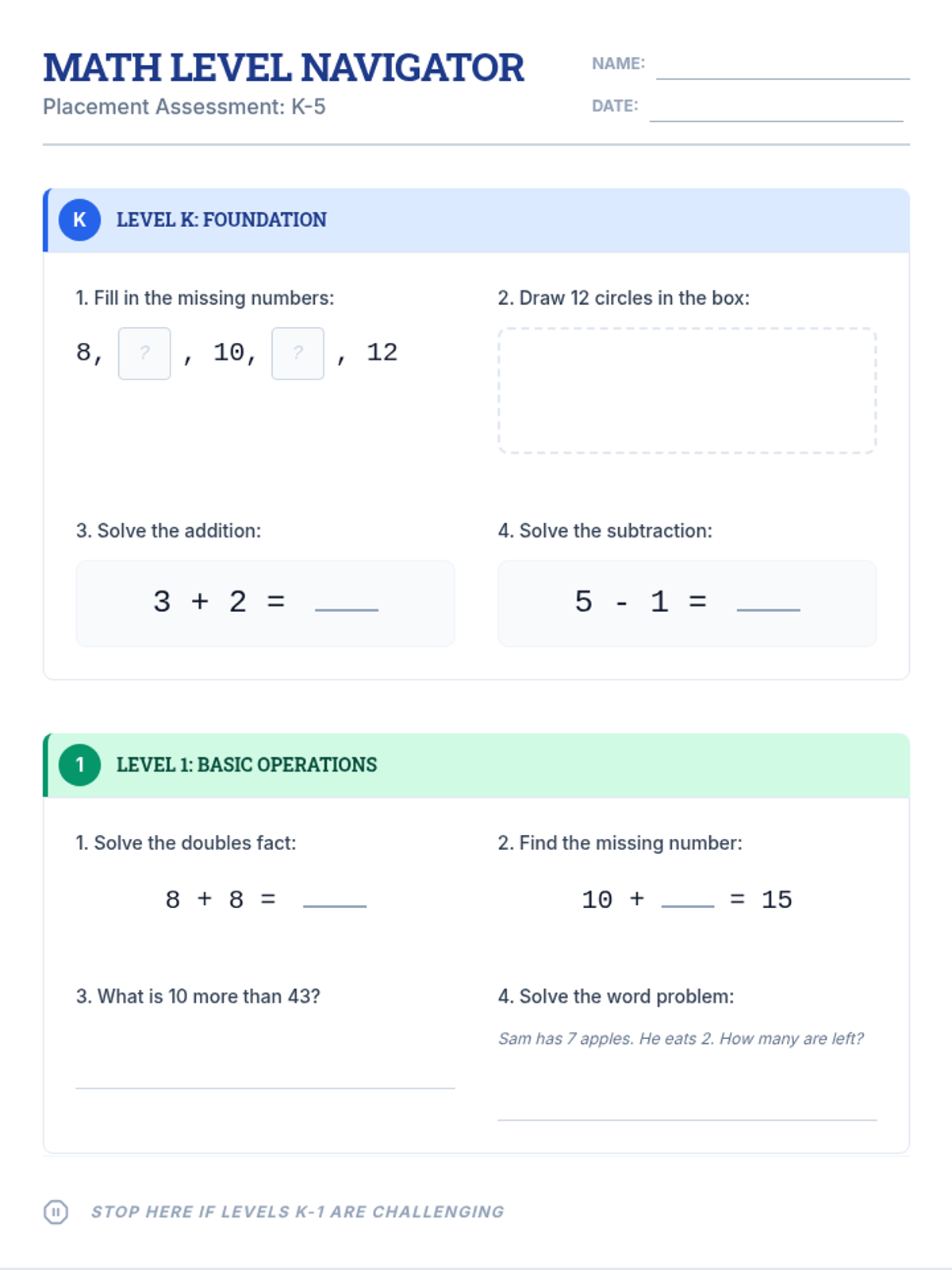
A three-page leveled math placement assessment covering California Common Core standards from Kindergarten through 5th grade. Items are renumbered 1-4 within each level section to simplify scoring and identify student entry points. Includes stable formatting for all math problems.
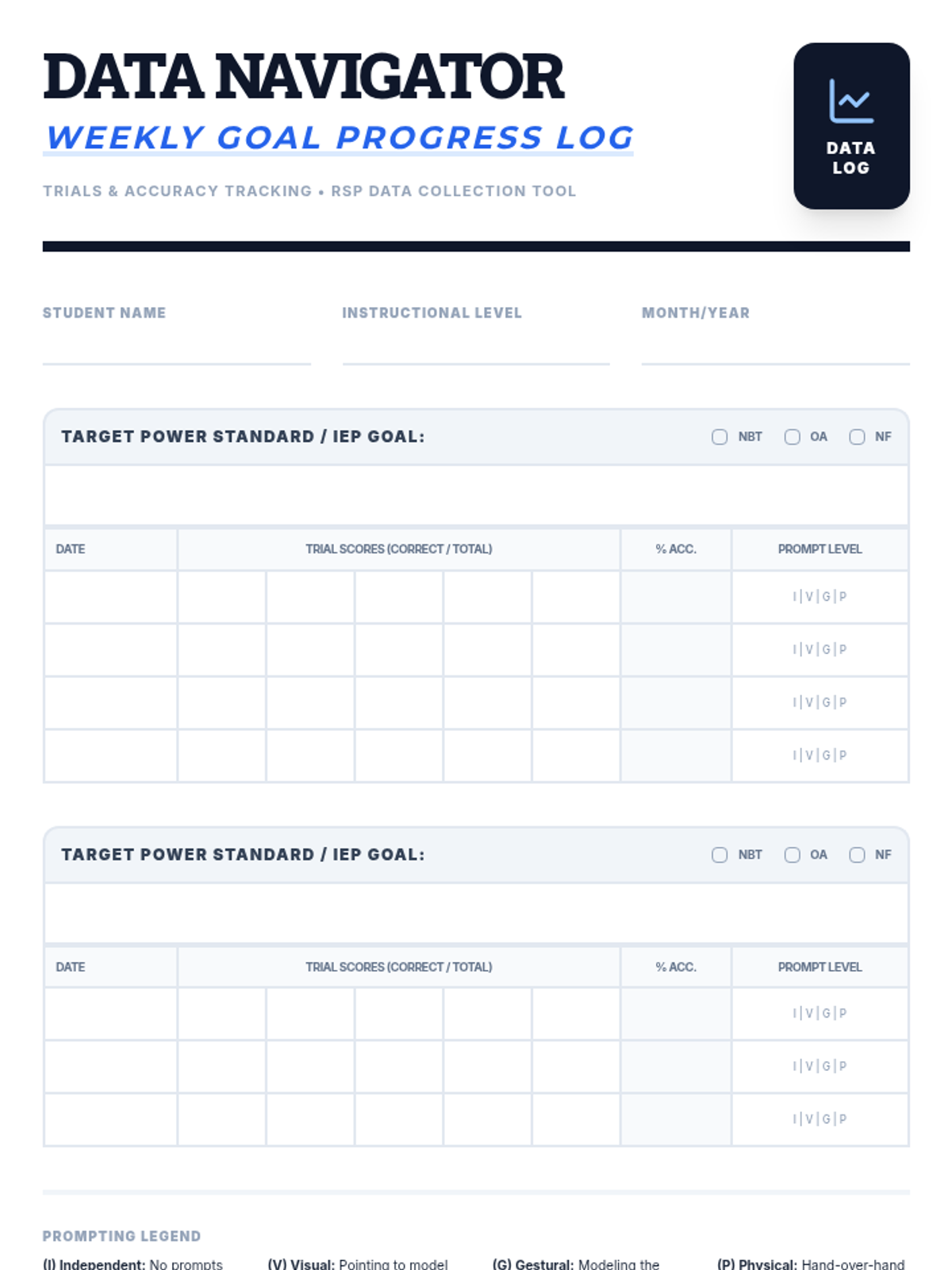
A practical, one-page weekly data collection log for tracking student progress on specific math goals. It includes sections for multiple trials, accuracy percentage calculation, and a prompting legend (Independent, Visual, Gestural, Physical) to ensure detailed and compliant RSP data tracking.
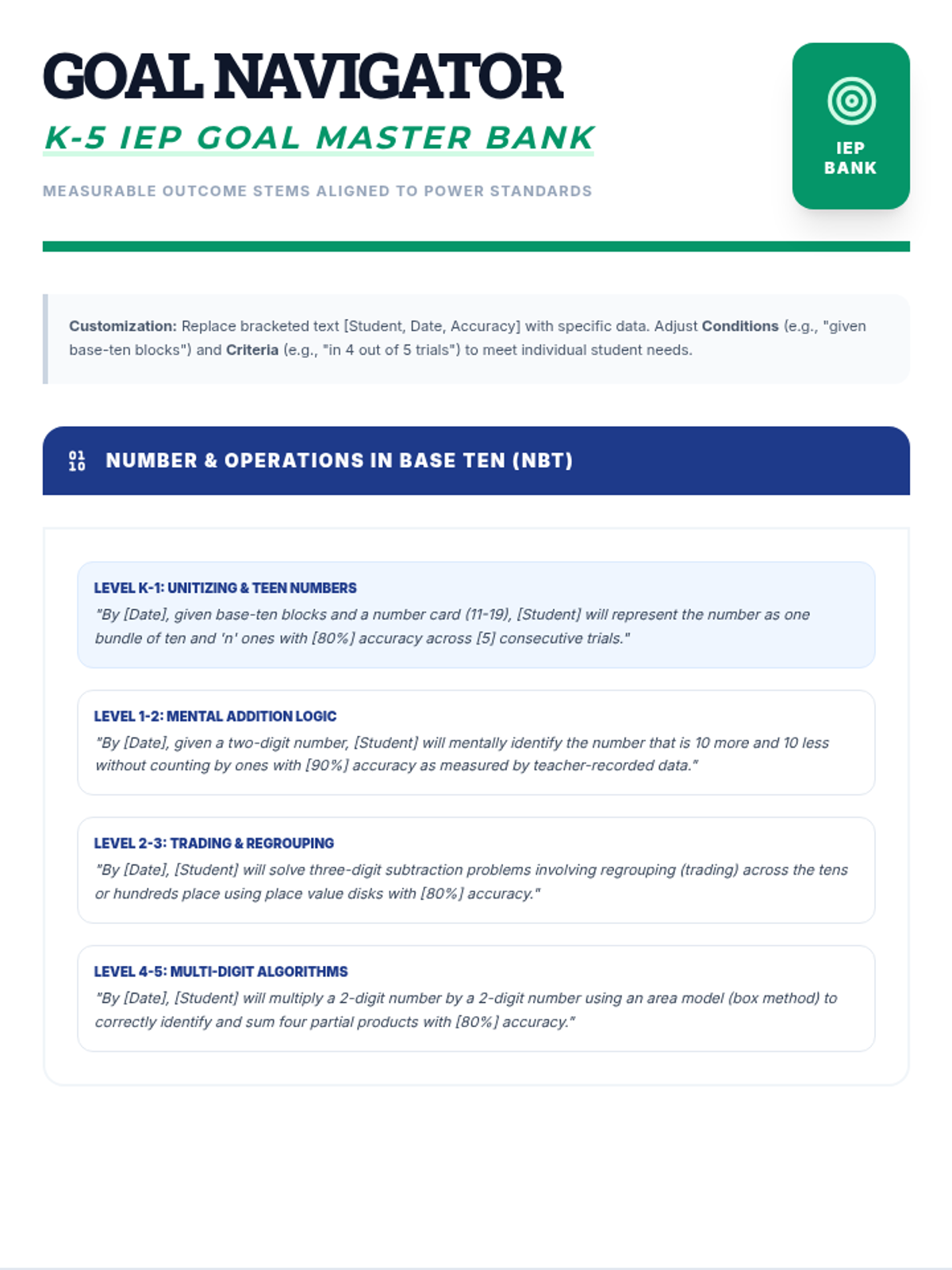
A measurable bank of IEP goal stems for math grades K-5, organized by domain and instructional level. These stems are directly aligned to the California Power Standards master roadmap, allowing RSP teachers to quickly draft compliant, data-driven goals for students across multiple grade levels. All mentions of the word "bible" have been removed.
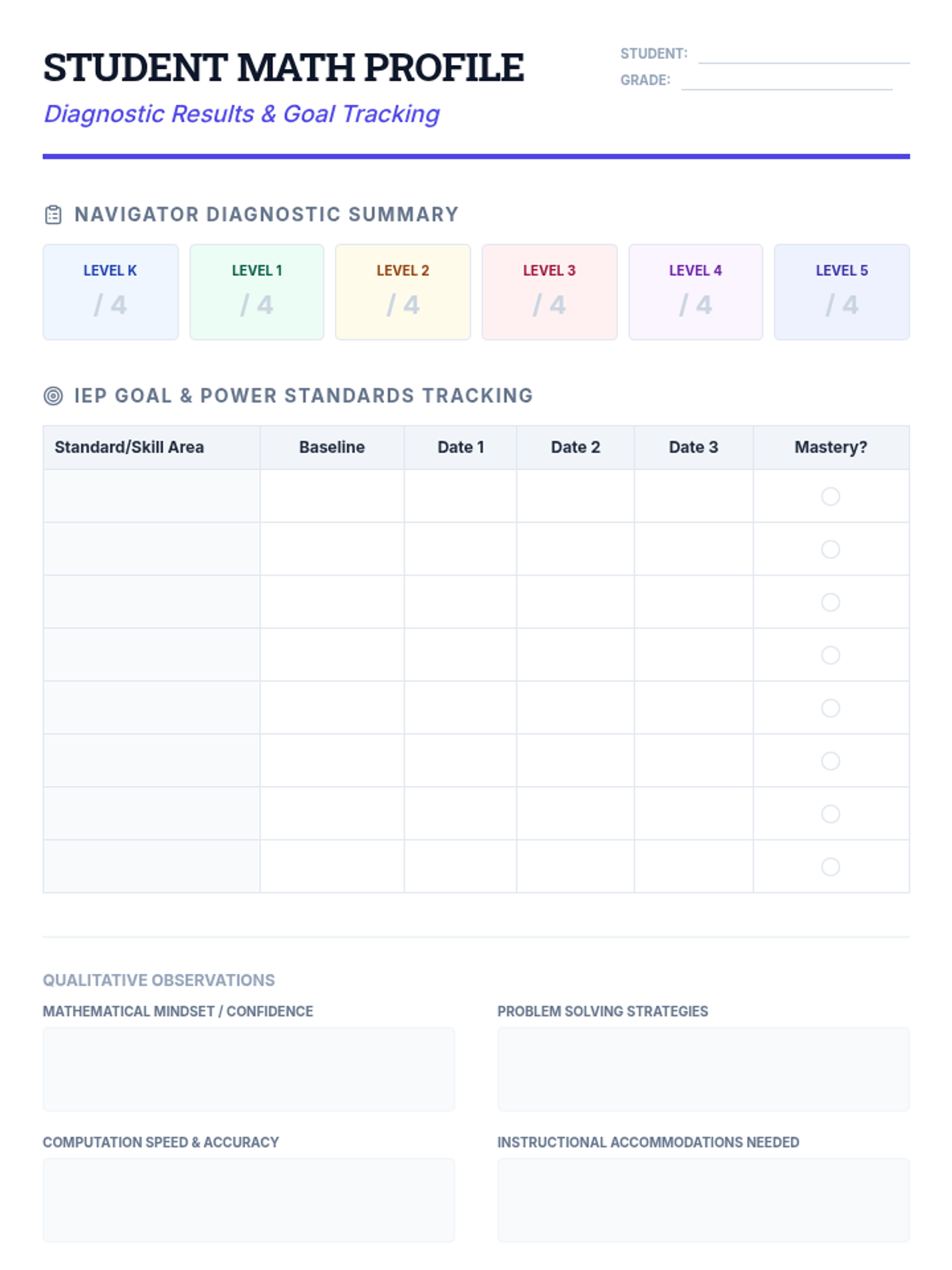
A student-specific tracking document for recording diagnostic results and monitoring mastery of California Math Power Standards over time.
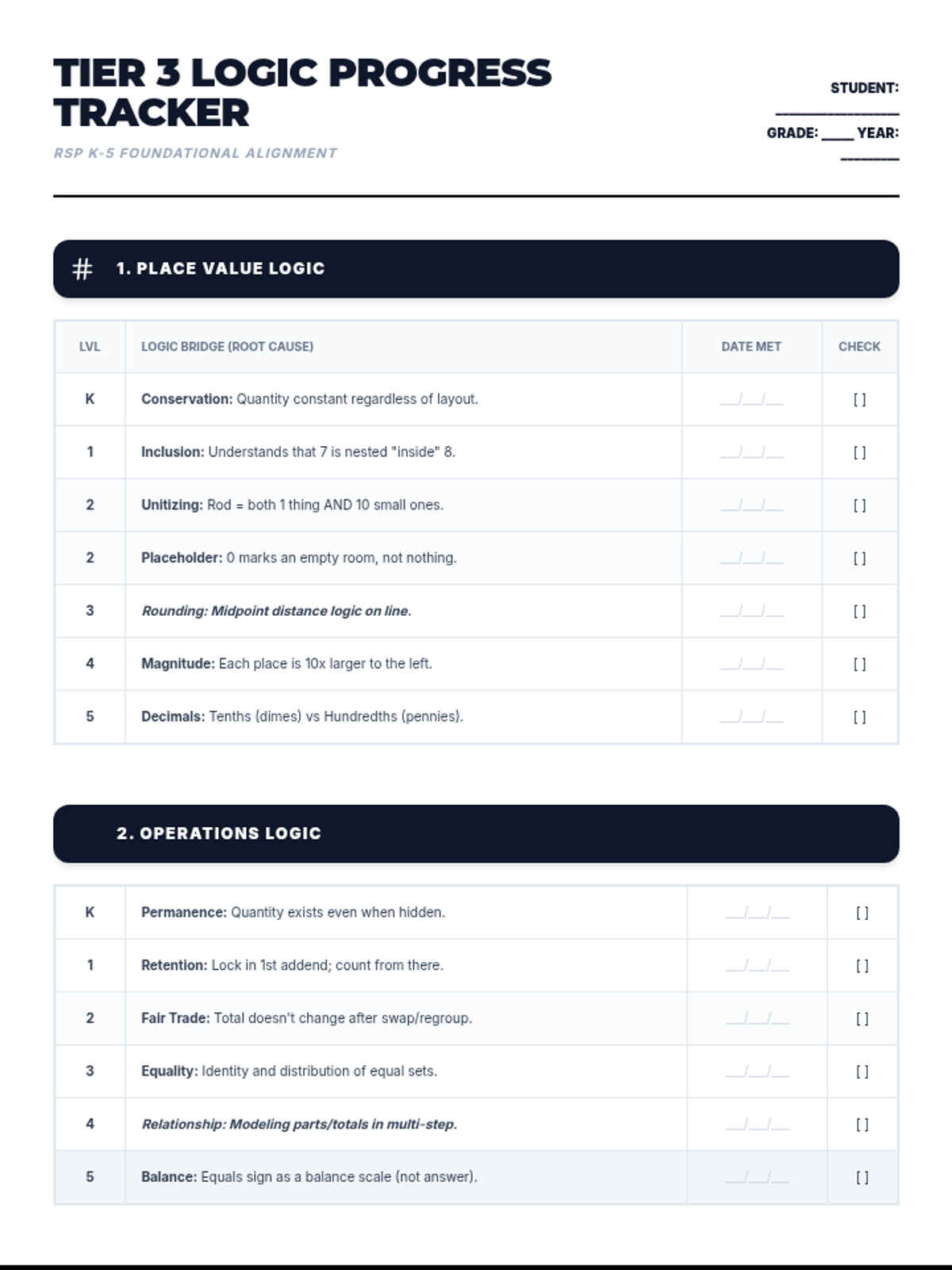
A data-tracking tool for RSP teachers working exclusively with Tier 3 students. It provides a granular checklist of the foundational "Logic Bridges" (root causes) for each conceptual thread, allowing teachers to record exactly when a student overcomes a specific developmental logic break. Aligned with the K-5 Foundational Math Curriculum. No middle-school references.
The finalized teaching scripts for RSP math intervention. Provides standardized "Concept Hooks" and "Think-Aloud" scripts for every level of the vertical mastery threads, ensuring consistent instructional language across multi-grade groups. Includes detailed scripts for all Tier 3 roots including Conservation, Hierarchical Inclusion, Zero-Point Origin, Rounding Logic, and Multi-Step Relationship modeling.
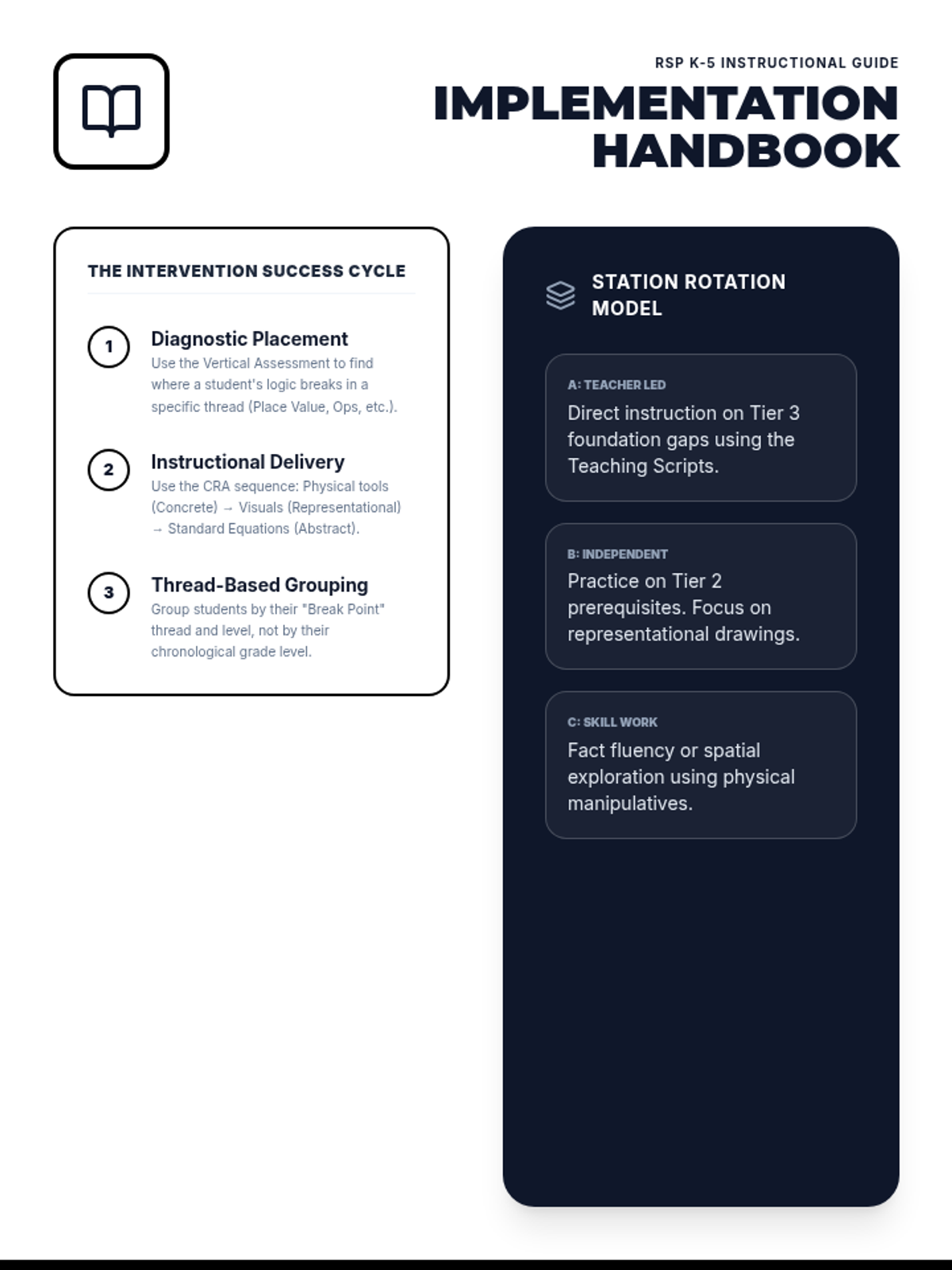
The final instructional implementation handbook for RSP math. It includes the 3-step success cycle, the station rotation framework, the CRA methodology, and a clean student intervention map for tracking conceptual progress. High-contrast, printer-friendly format. Name aligned to RSP K-5 series.
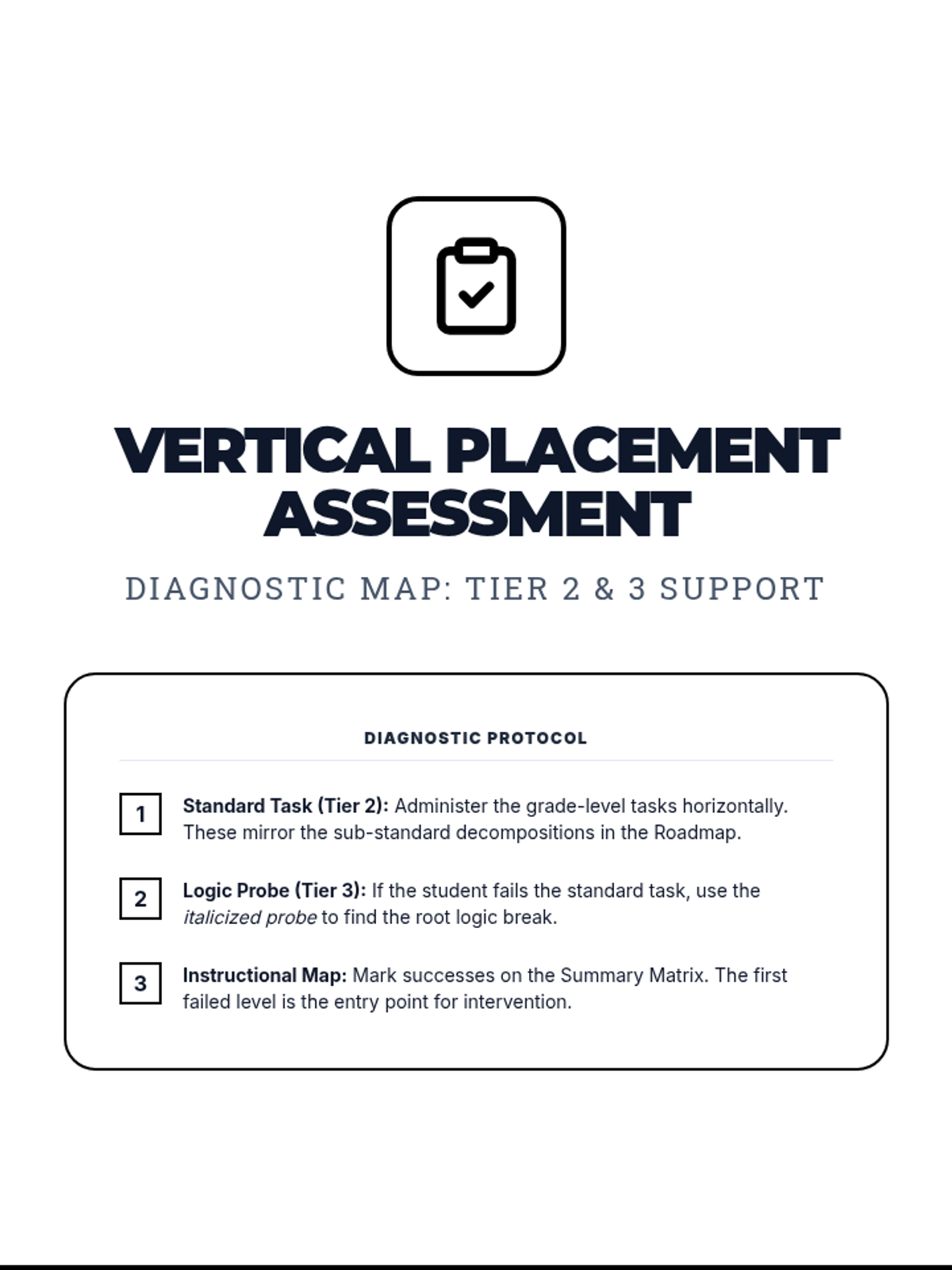
A simplified, 2-page checklist-style vertical placement assessment for RSP math. It organizes diagnostic tasks by thread in a high-density vertical list, providing one standard task per level with a brief italicized logic probe for root-cause diagnosis. It addresses every area of the roadmap, including Grade 5 Algebra, while maintaining a clean and easy-to-use format. No middle-school references.
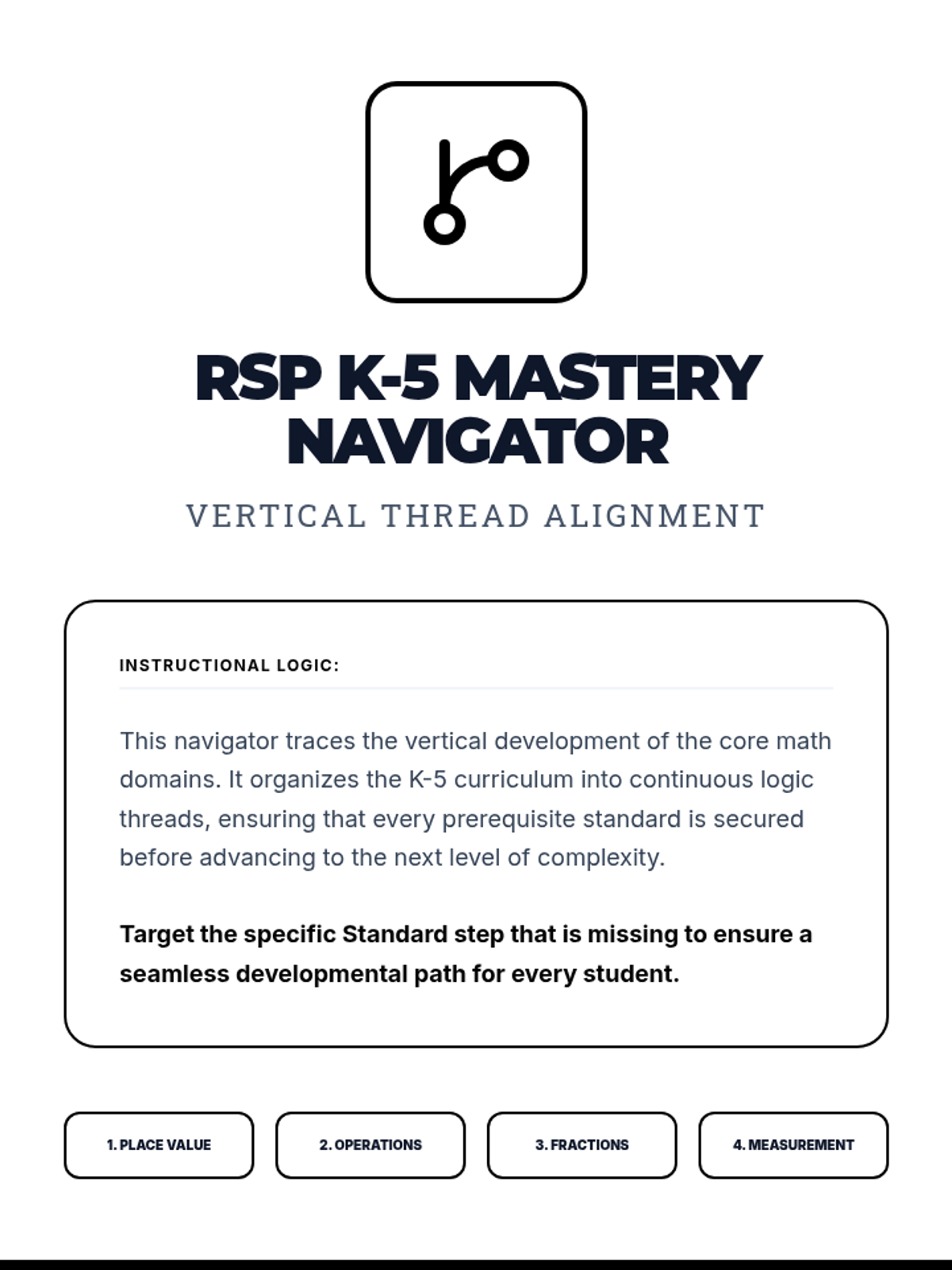
A comprehensive vertical progression guide for RSP teachers, explicitly aligned with the CA Common Core Math Framework's Major and Supporting Clusters. It traces 4 conceptual threads across K-5, highlighting essential skills like Rounding and Multi-Step Problems as core standard steps. High-contrast, black-and-white printer friendly. No middle-school references. No special call-outs or highlights for new additions. Name aligned to RSP K-5 series.
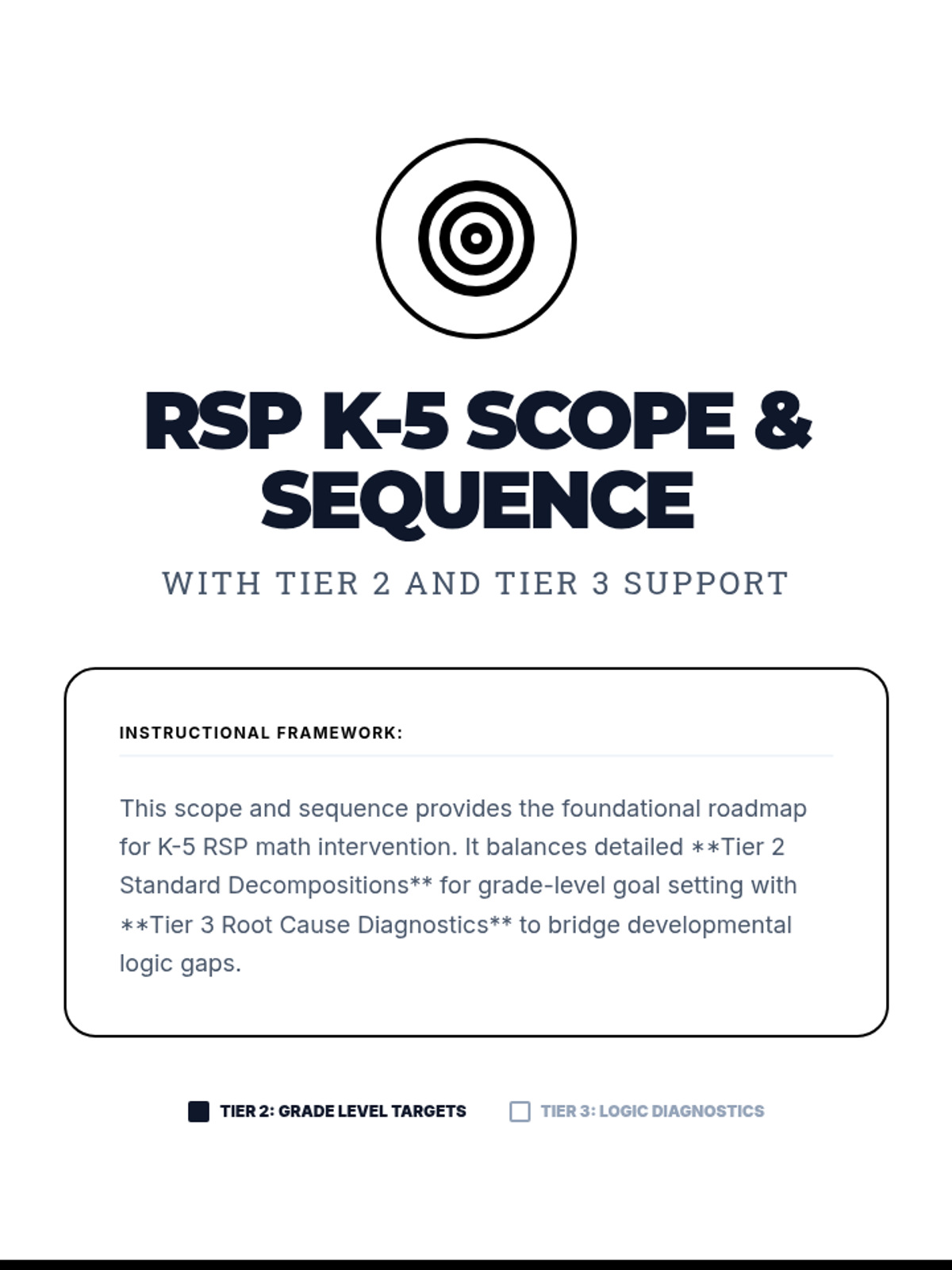
The finalized RSP K-5 Scope and Sequence. It prioritizes the Major Clusters of the CA Common Core Math Framework, decomposing them into detailed Tier 2 sub-standards and granular Tier 3 Root Cause diagnostics. It ensures that "in-depth" skills like Rounding and Multi-Step Problems are explicitly included as core building blocks. No middle-school specific references.
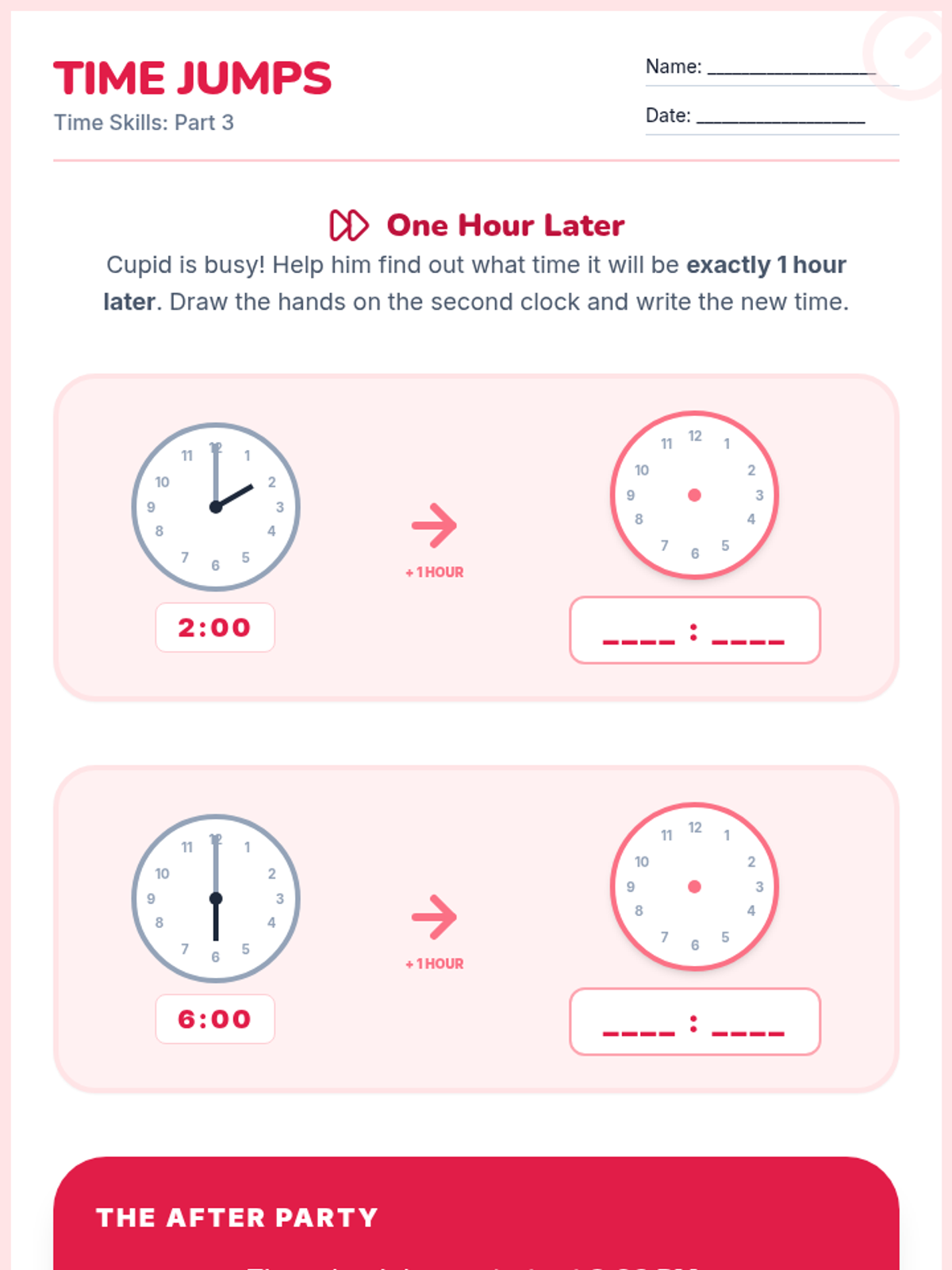
An elapsed time worksheet for Level 1 students focusing on jumps of exactly one hour, featuring analog clocks with full numbers and school-themed word problems.
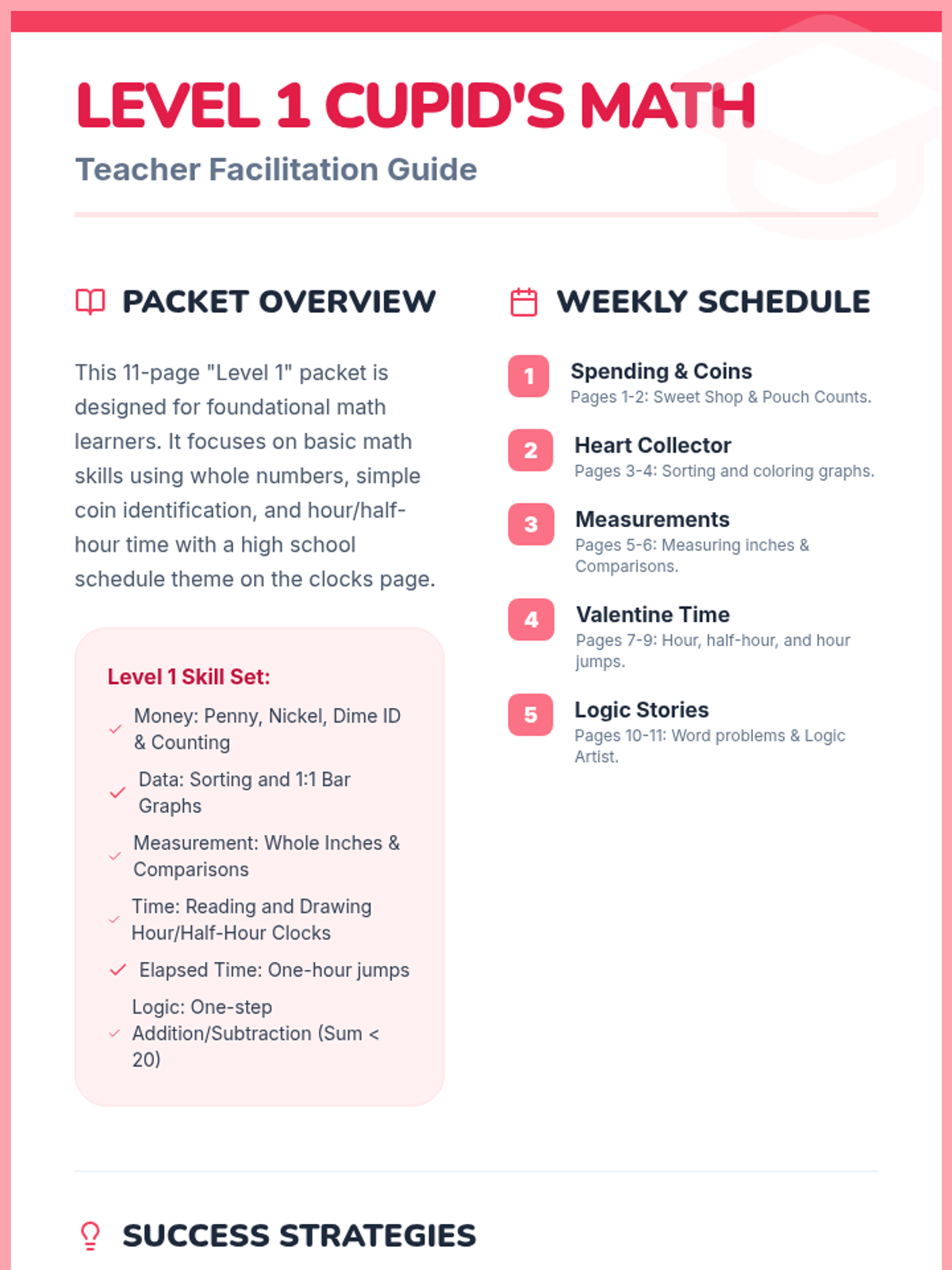
Teacher overview and answer keys for the Level 1 Valentine's Day math packet, updated with a high school schedule theme and the revised pocket change values.
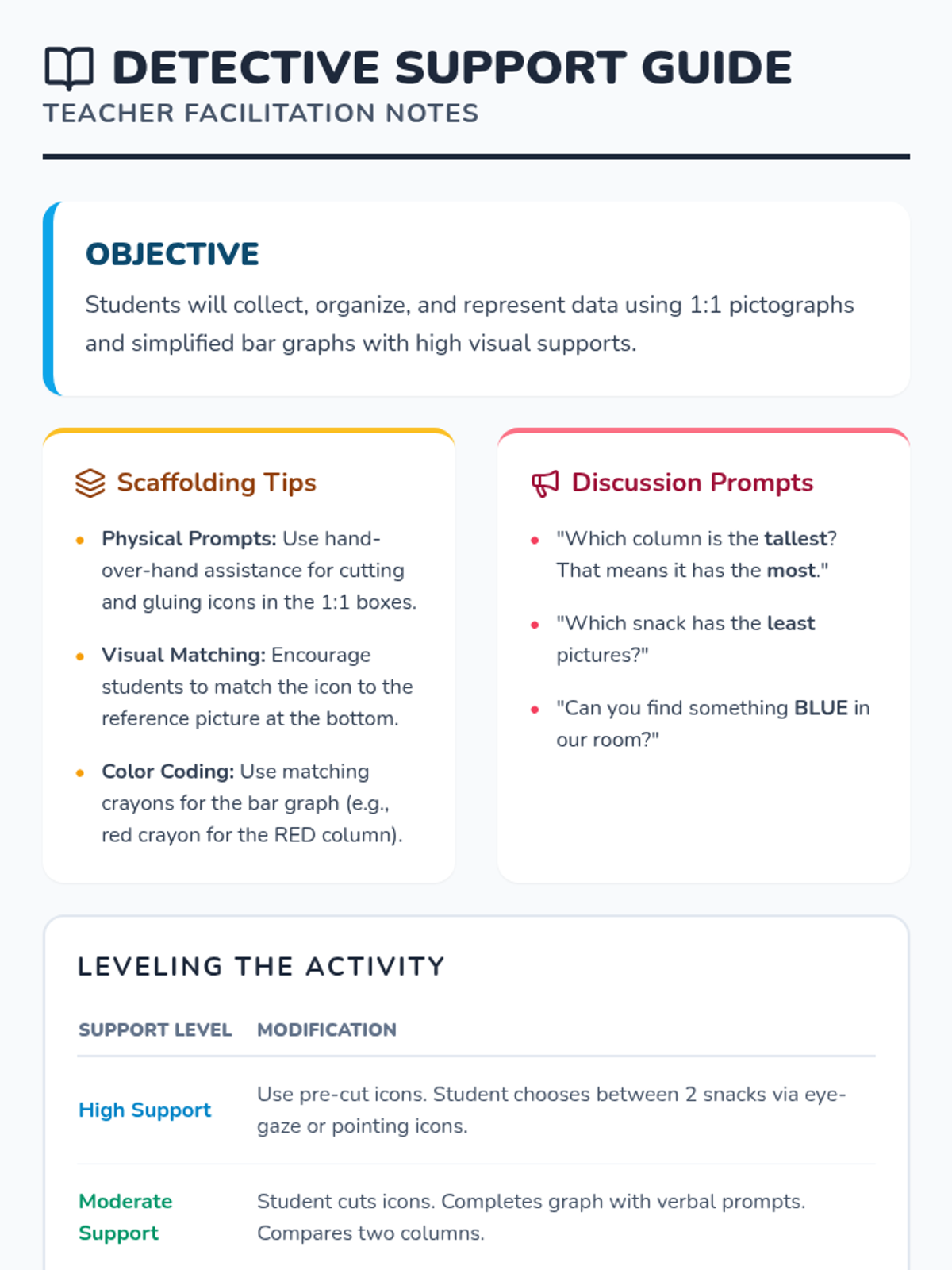
A teacher support guide providing scaffolding strategies, discussion prompts, and level-based modifications for the graphing activities. Includes tips for IEP alignment and physical accessibility.
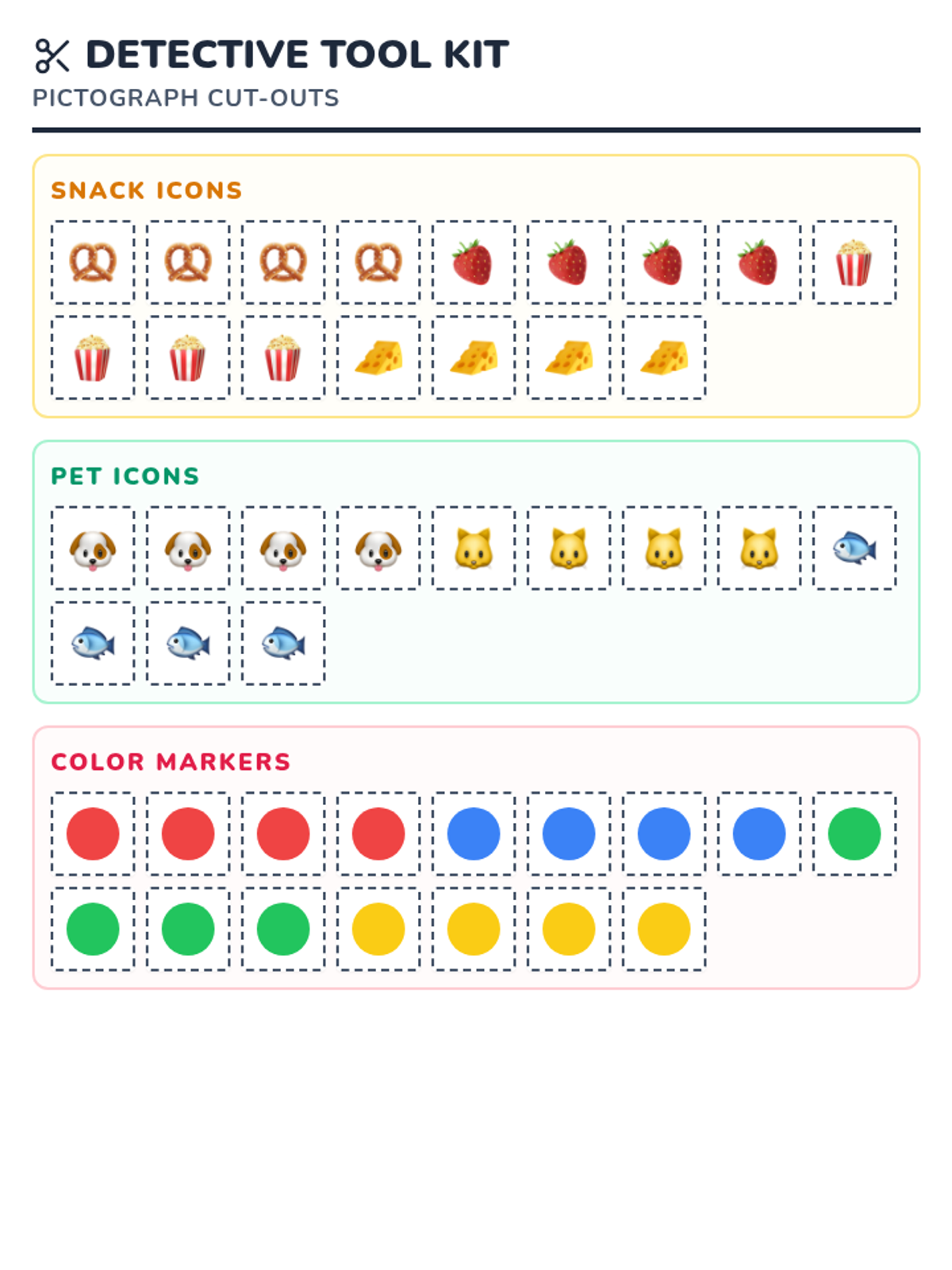
A collection of cut-out icons (snacks, pets, and colors) to be used with the pictograph activities. Designed with large dotted borders and high contrast to assist students with developing fine motor and visual skills.
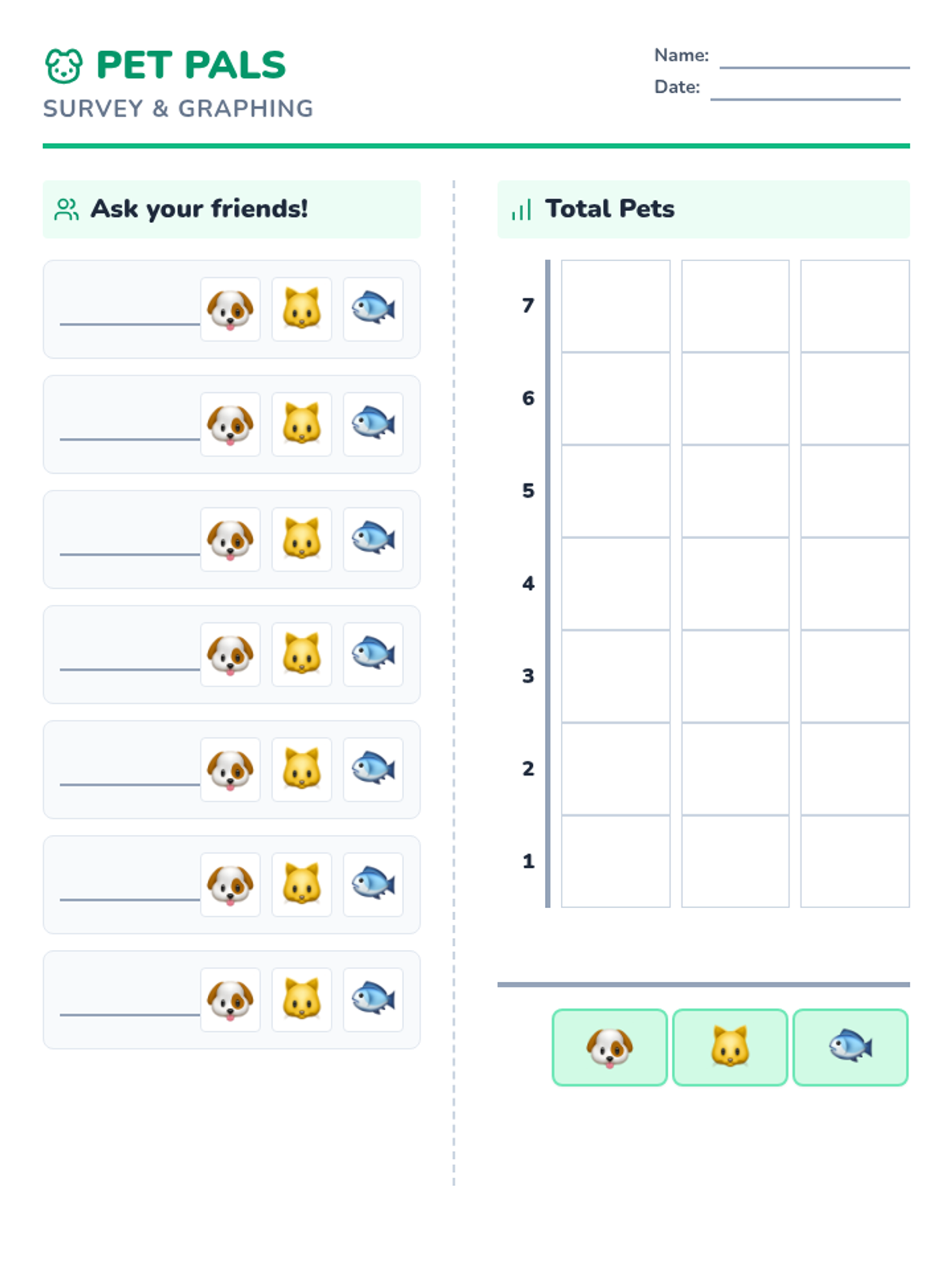
A two-part student activity sheet for pet preferences. Includes a survey section for peer interaction and a corresponding graphing area with visual supports for dogs, cats, and fish.
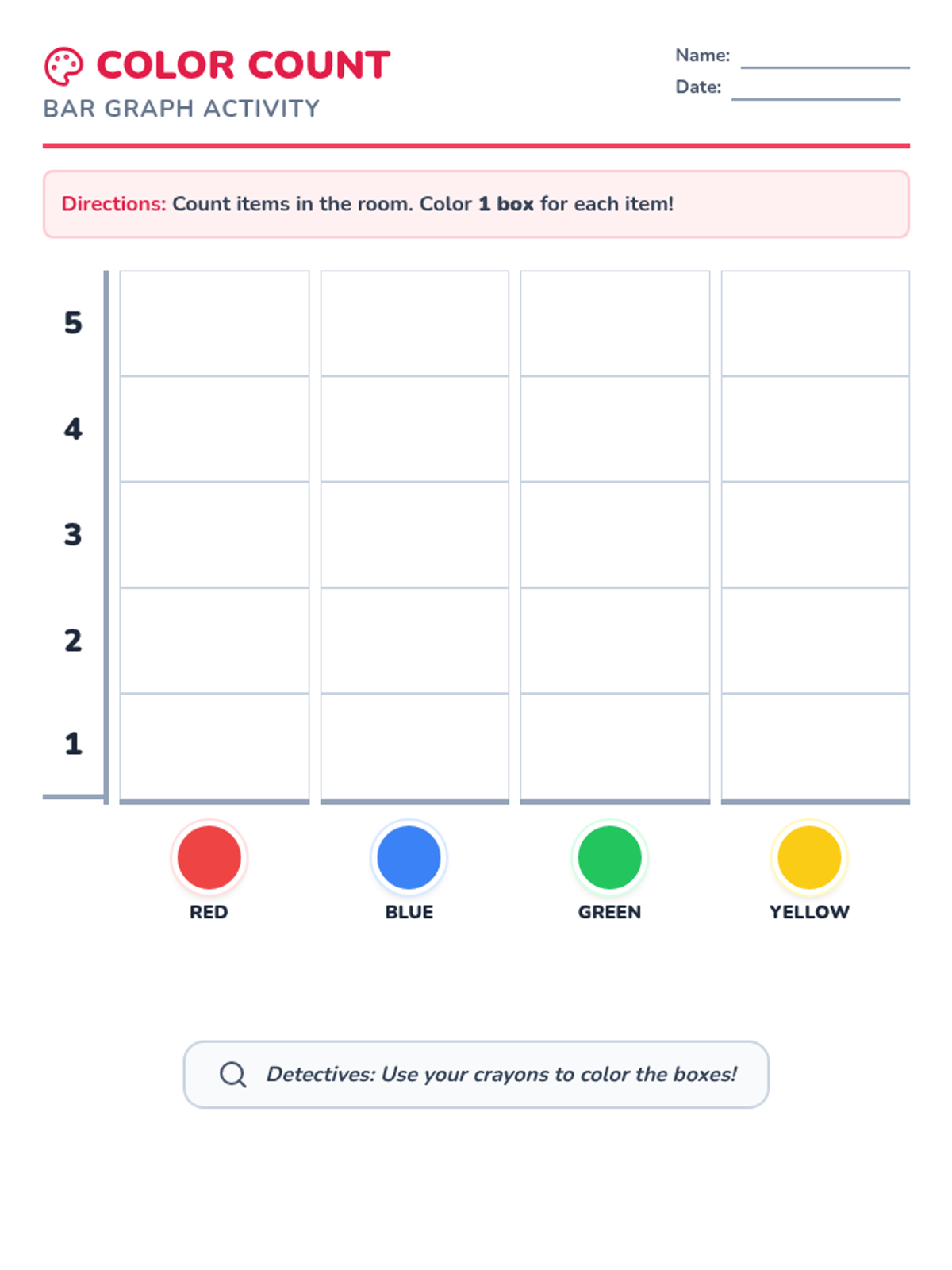
A bar graph worksheet for identifying and counting classroom colors (Red, Blue, Green, Yellow). Includes large grid boxes for coloring and visual color-swatch labels to support non-readers.
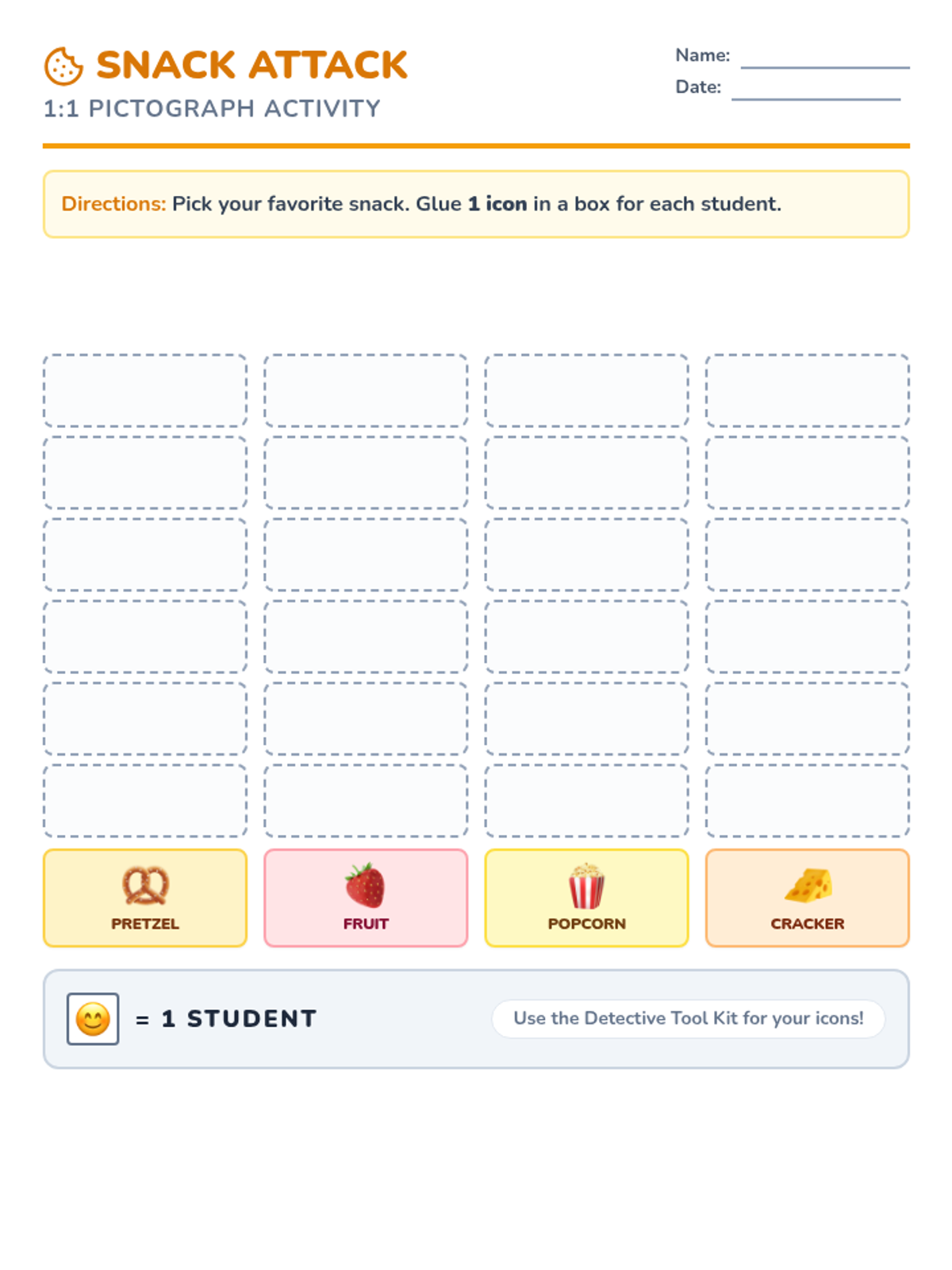
A 1:1 pictograph worksheet for student snack preferences. Features large, high-contrast columns with designated spaces for glue-on icons and clear emoji supports for pretzels, fruit, popcorn, and crackers.
A 5-slide visual presentation introducing graphing concepts with 1:1 pictographs and bar graphs using snack, color, and pet themes. Includes large icons and clear, simplified explanations for Essential Skills students.
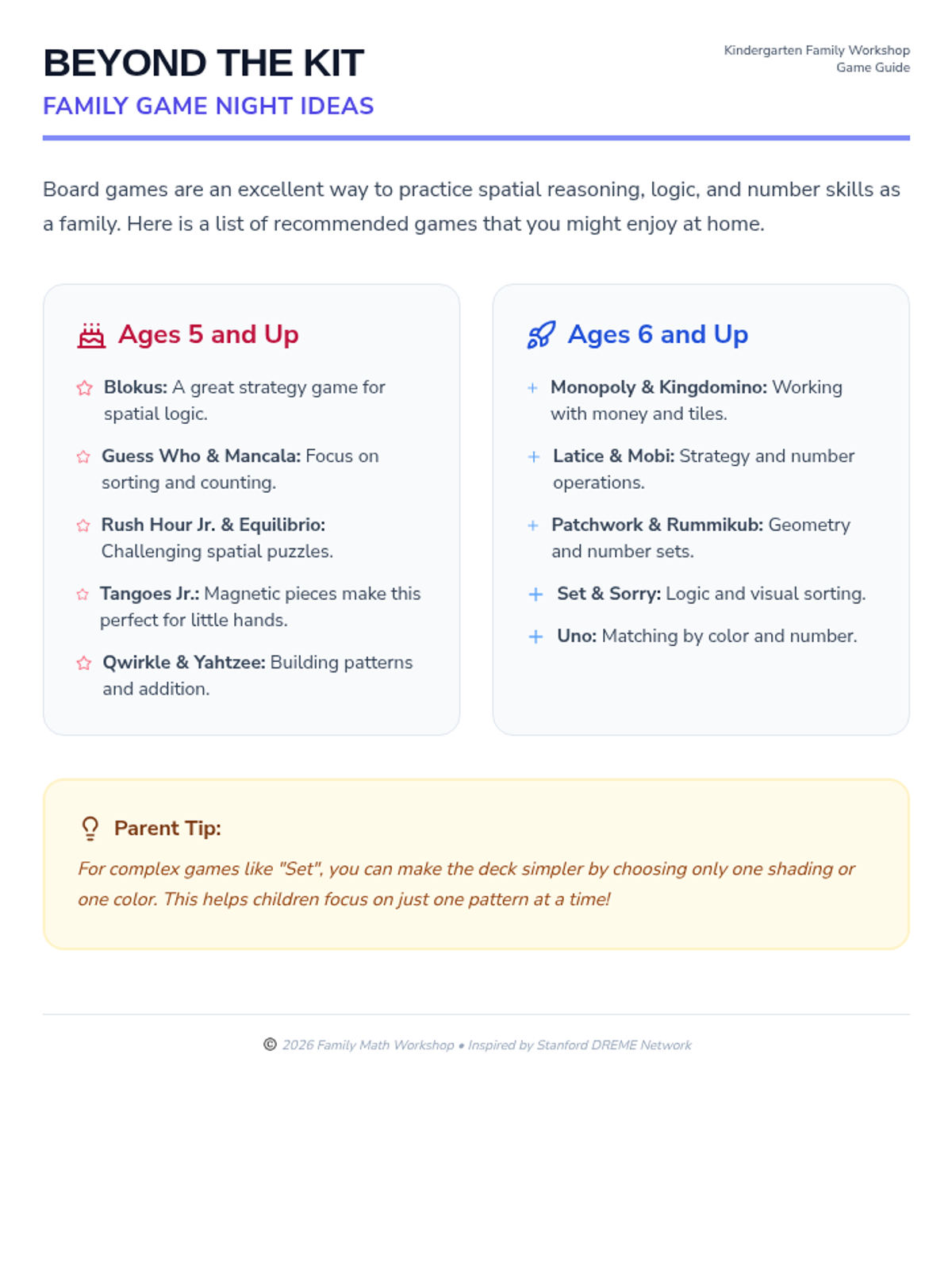
A curated list of store-bought board games for families, categorized by age and highlighting specific math skills like spatial reasoning and logic. Includes tips for simplifying complex games. Corrected inaccuracies and ensured single-page layout.
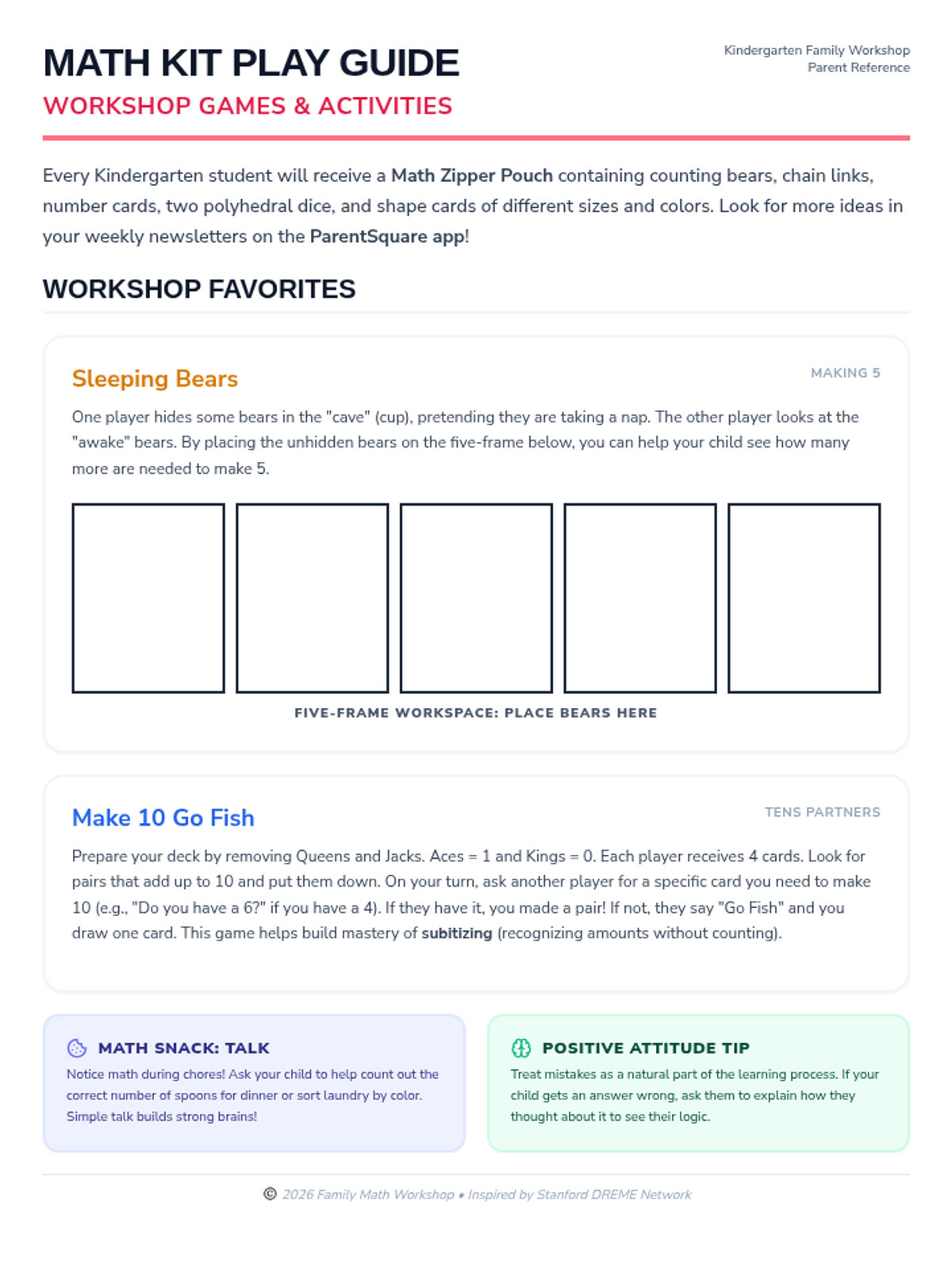
An activity guide for parents focused on using the Kindergarten Math Kit and common household items to support math learning. It includes detailed instructions for the 'Sleeping Bears' and 'Make 10 Go Fish' games demonstrated in the workshop. Workspace enlarged for counting bears. Delivery method for newsletters updated to ParentSquare app. Corrected instructions and added Math Snack content.
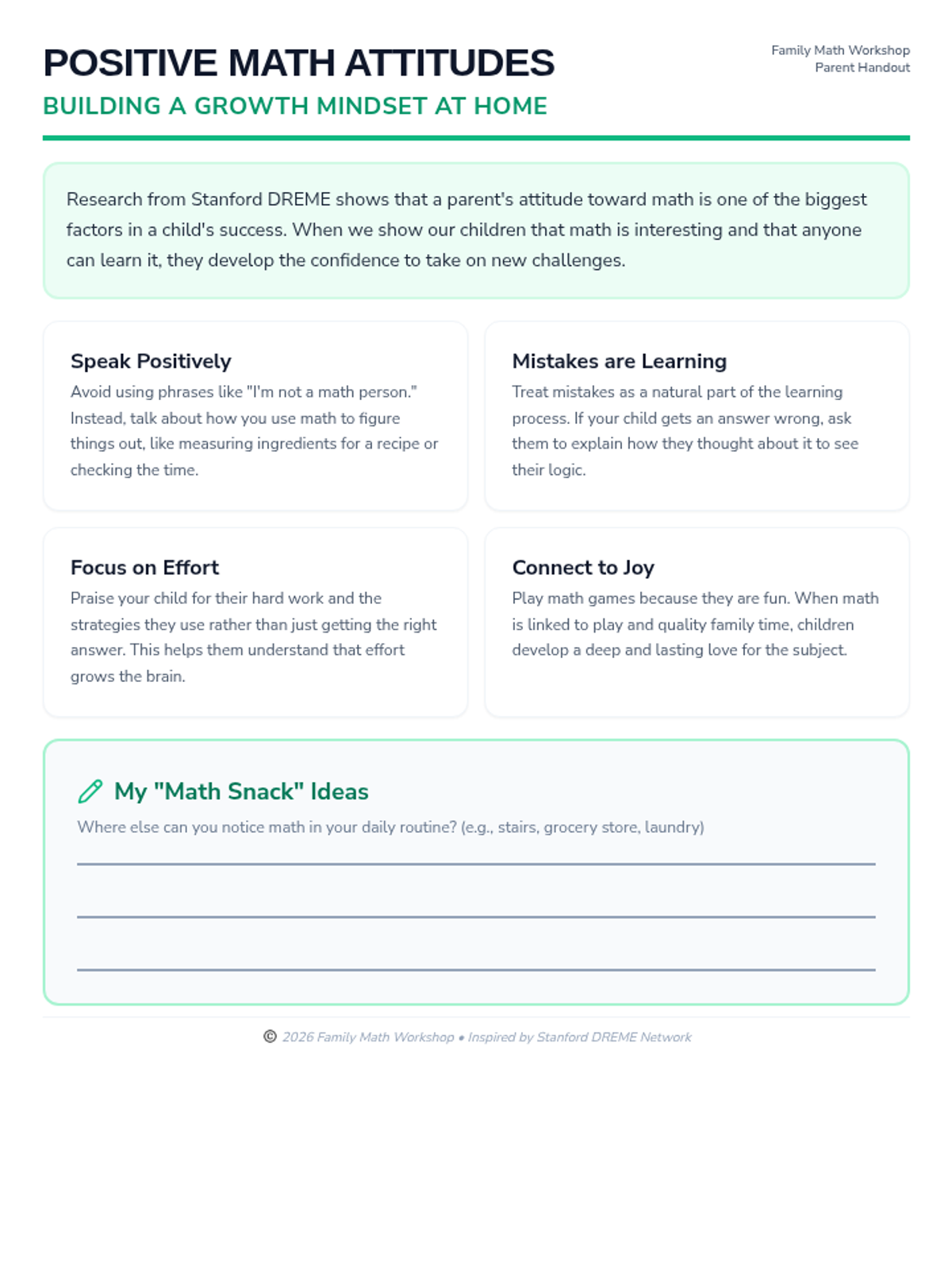
A parent handout focused on fostering positive math attitudes and a growth mindset at home, based on Stanford DREME research. Corrected spelling and layout to fit on one page with a space for parent notes. Hand-writing area spacing improved. Body text font size slightly increased for legibility.
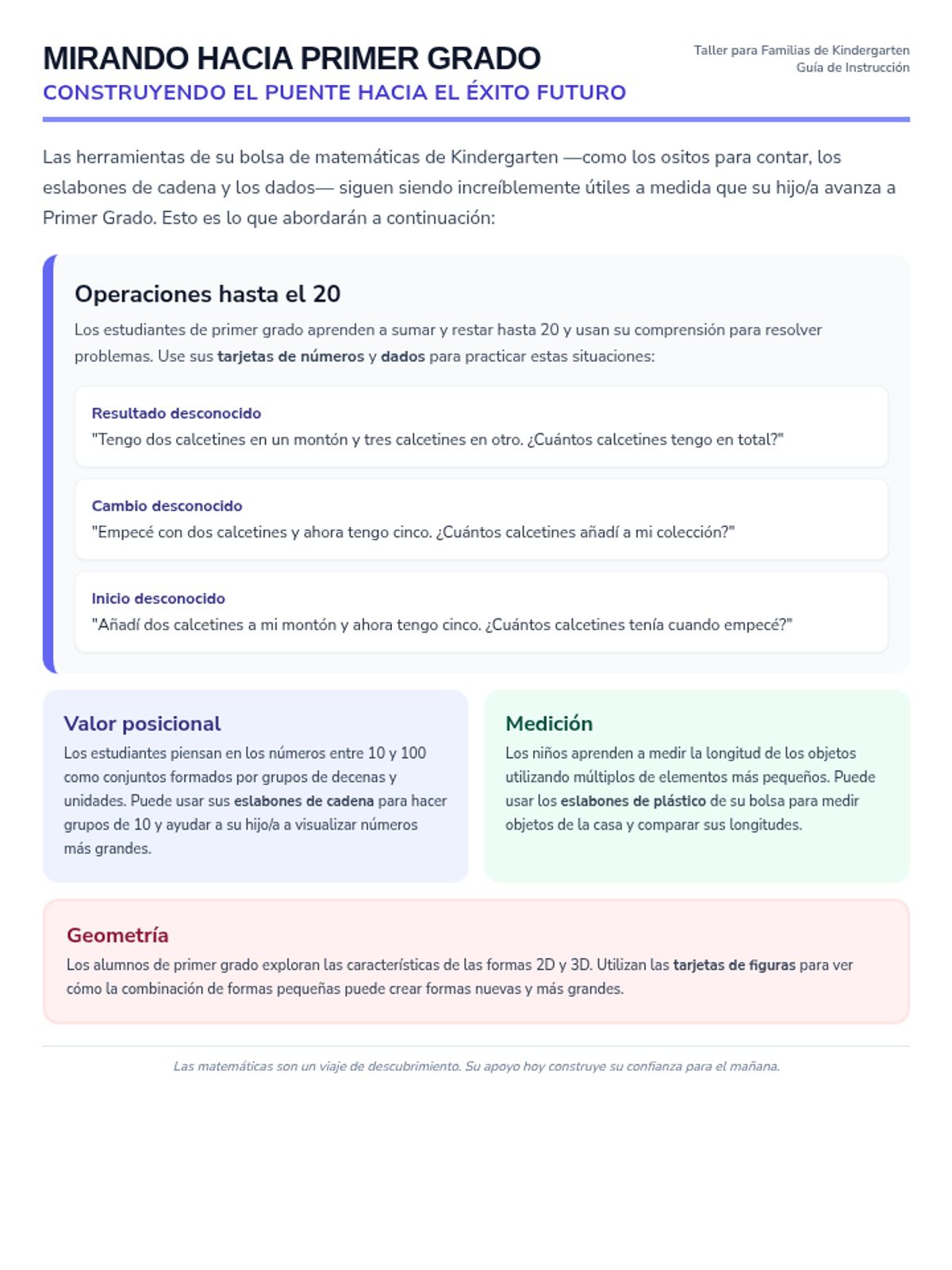
An updated bridge handout for parents that illustrates the major mathematics goals for First Grade, using descriptive full sentences to explain addition types, place value, measurement, and geometry. Layout tightened to fit on a single page. Darkened footer for better contrast.
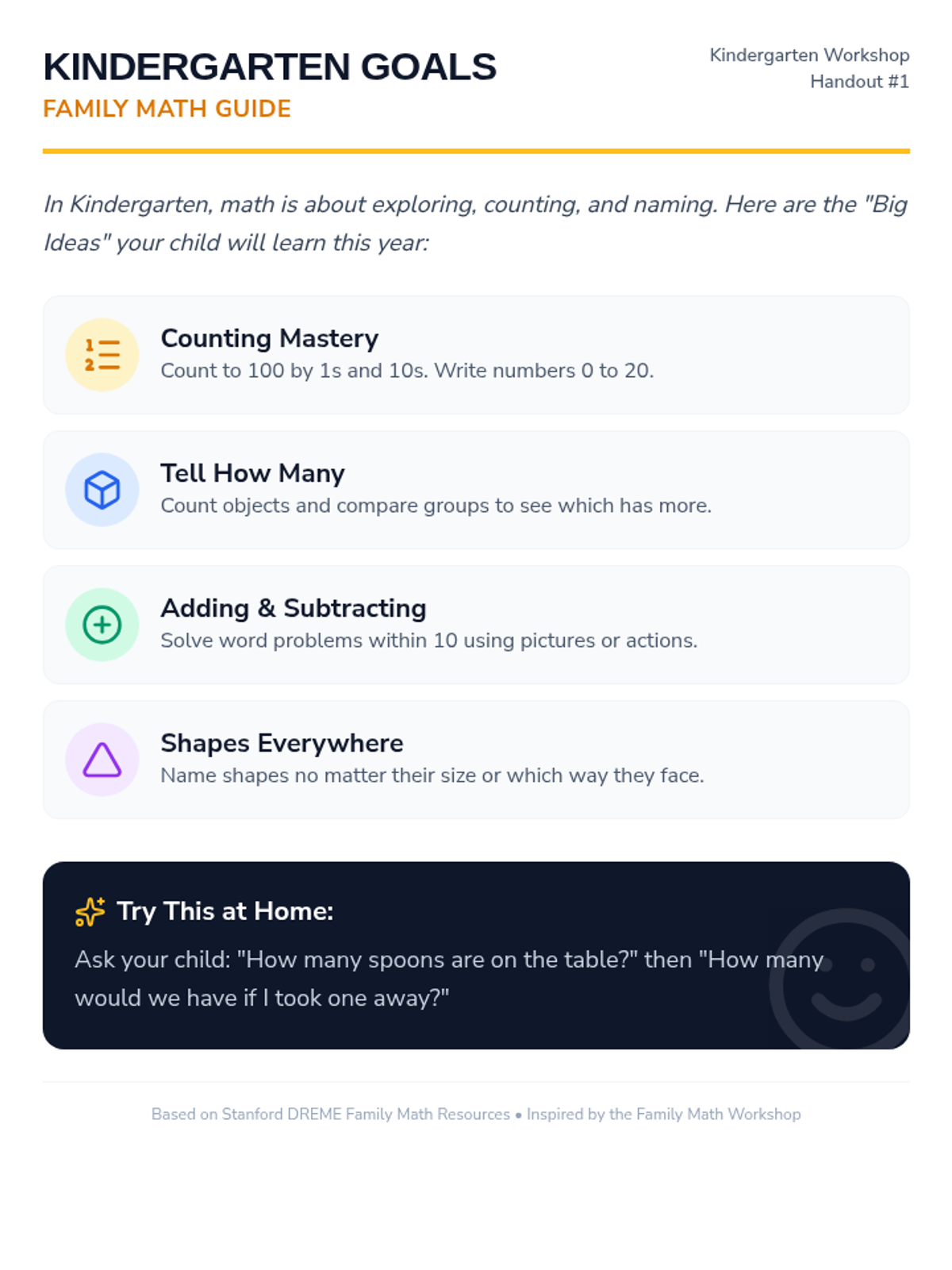
An updated parent handout outlining the major math focuses for Kindergarten, using more descriptive full sentences to explain counting, comparing groups, operations within 10, and geometry concepts. Layout tightened to fit on a single page. Now includes a mention of the zipper pouch math kit. Body text font size increased for legibility.
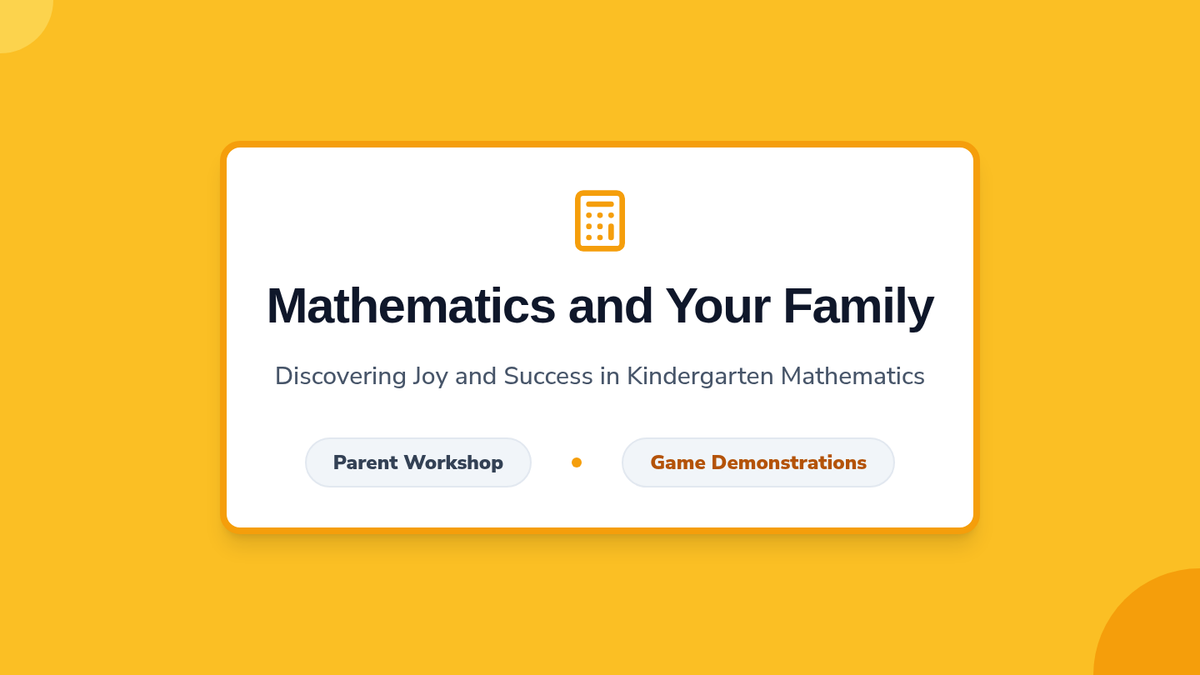
A revised 16:9 slide presentation for a Family Math Workshop, featuring updated demo games (Sleeping Bears, Make 10 Go Fish), a focus on the Kindergarten Math Kit (zipper pouch), and DREME-aligned advice on building positive math attitudes using full, professional sentences. Newsletter delivery method updated to ParentSquare app. Hierarchy issues and spacing overlap corrected. Contrast on kit cards improved. Title colors corrected.
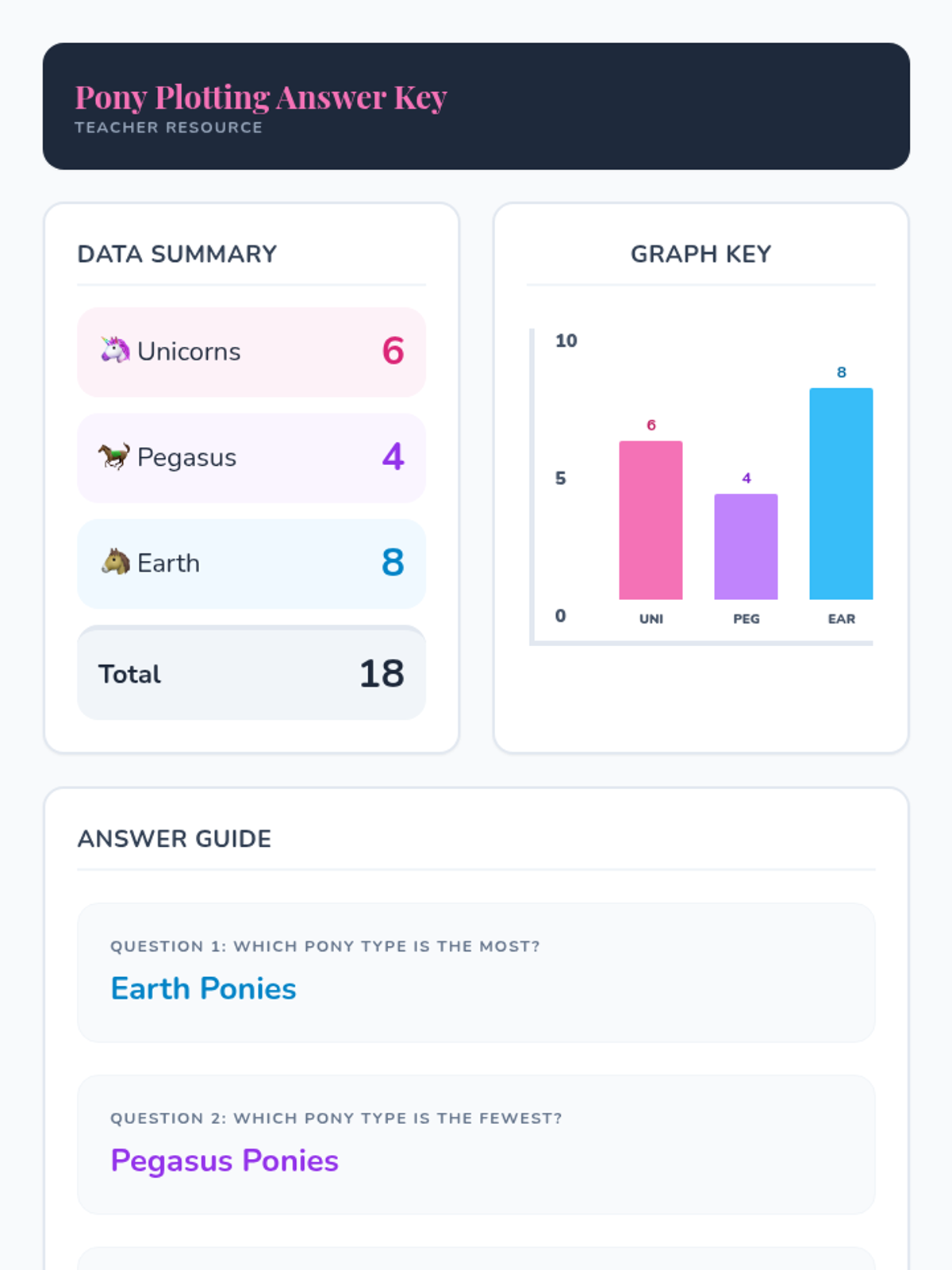
An answer key for the Pony Plotting Worksheet, providing correct counts, a visual graph representation, and final answers for the comparison questions. Now optimized for layout and readability.
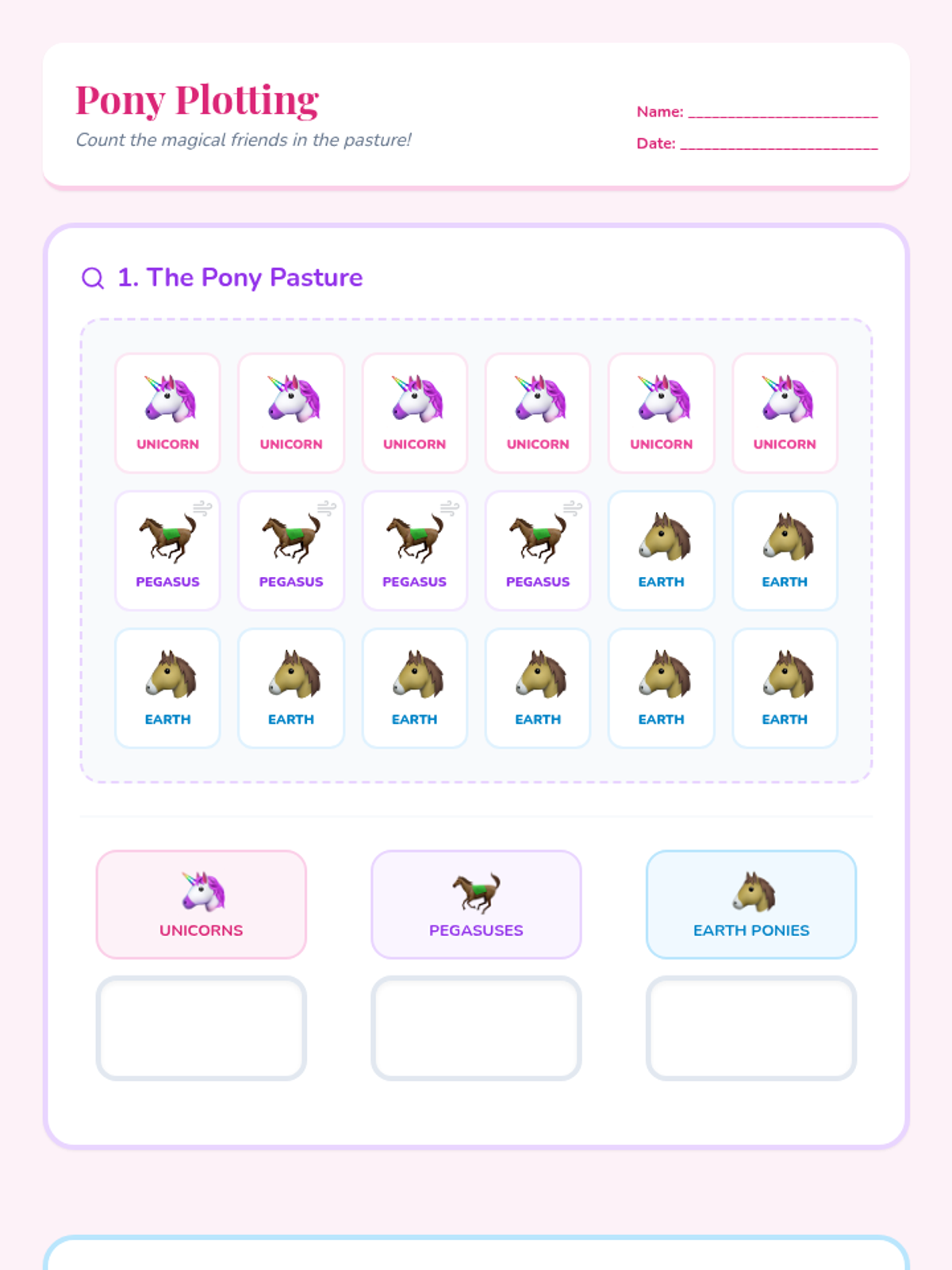
A magical sorting and graphing worksheet featuring three types of ponies. Students count the characters, fill in a tally box, create a colored bar graph, and answer comparison questions. Now includes improved layout and scale.
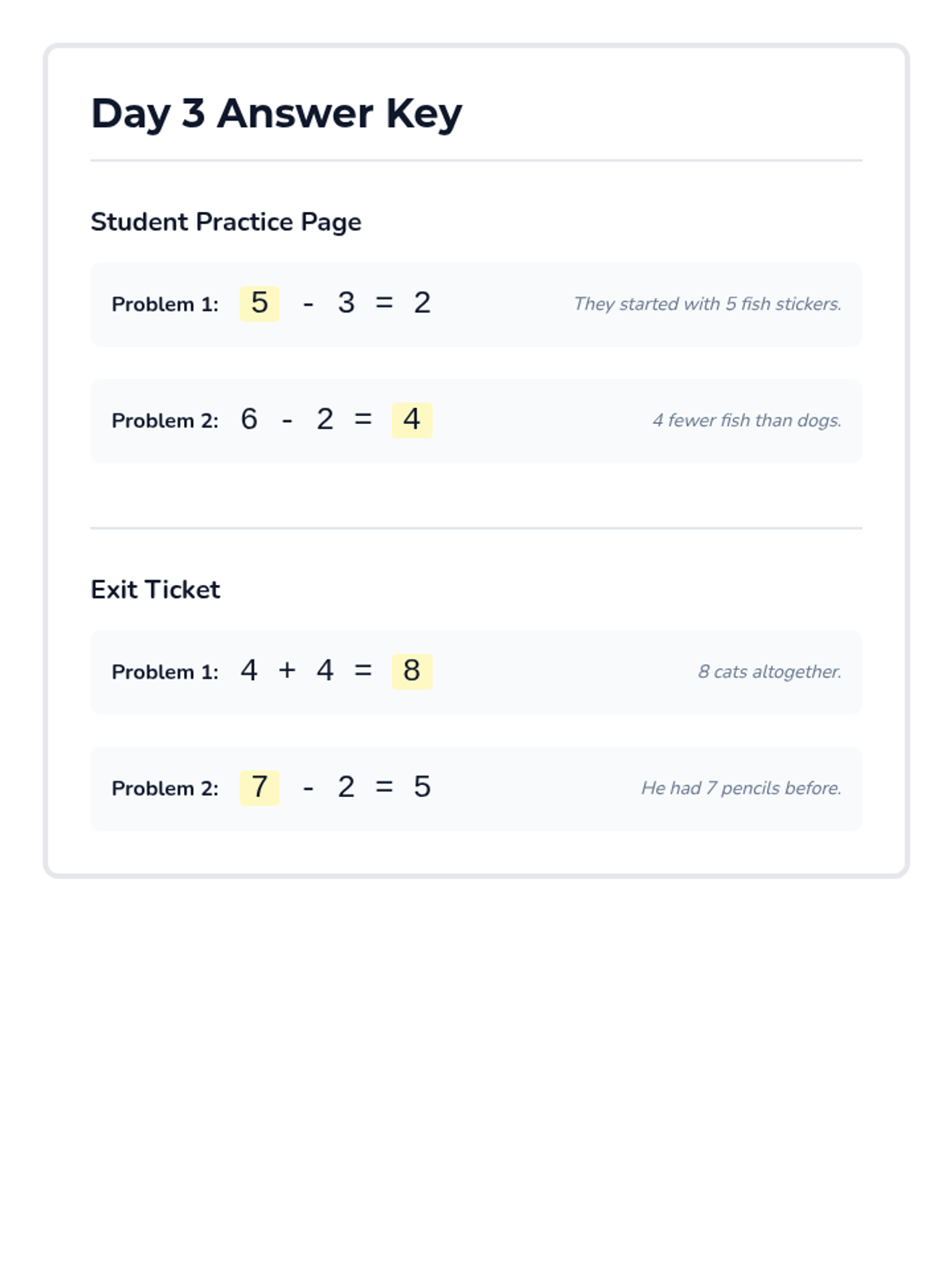
Answer key for Day 3 materials.
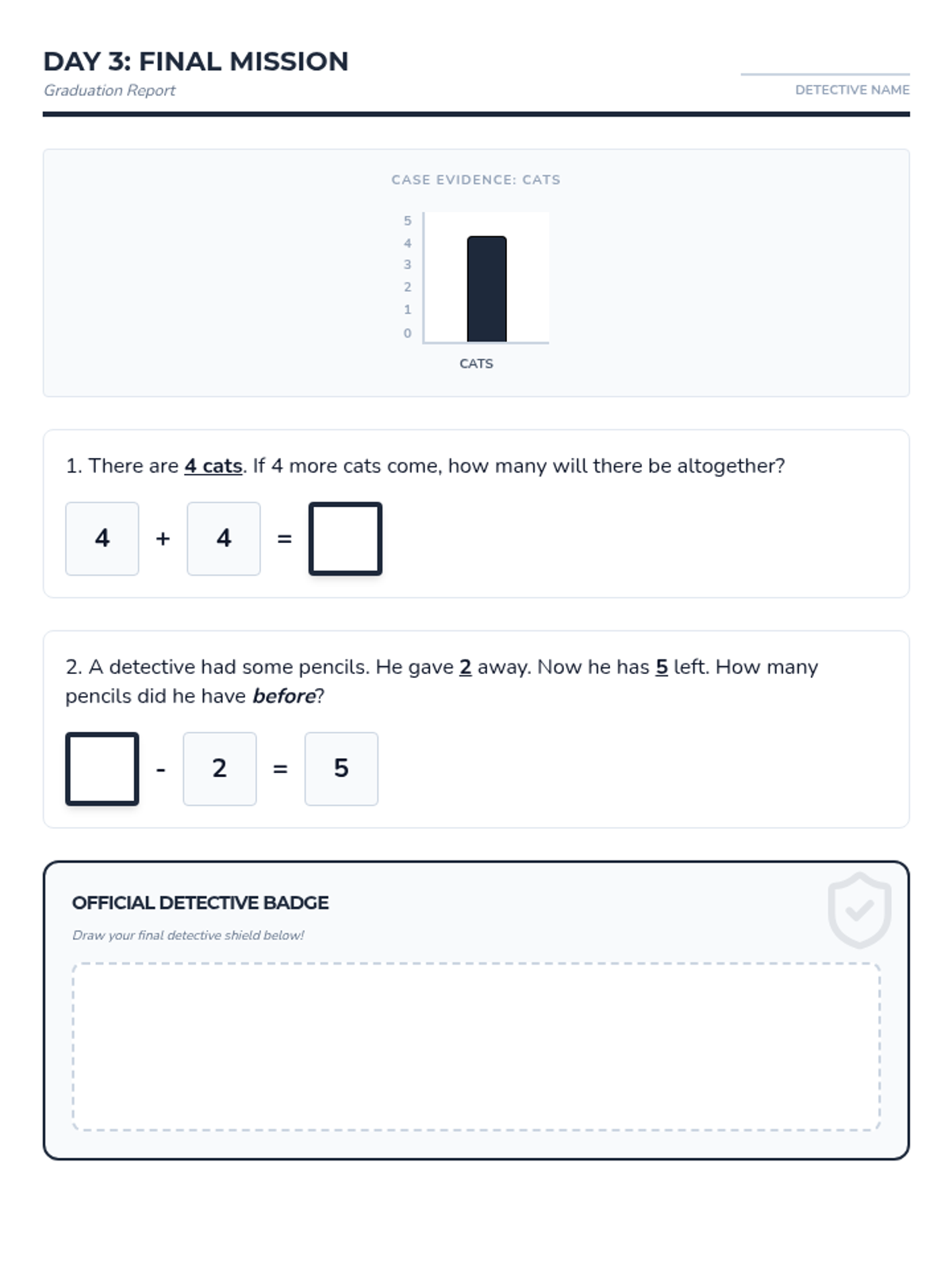
Revised Day 3 Exit Ticket: Improved graph alignment, increased badge drawing area for better student usability, and standardized box styling.
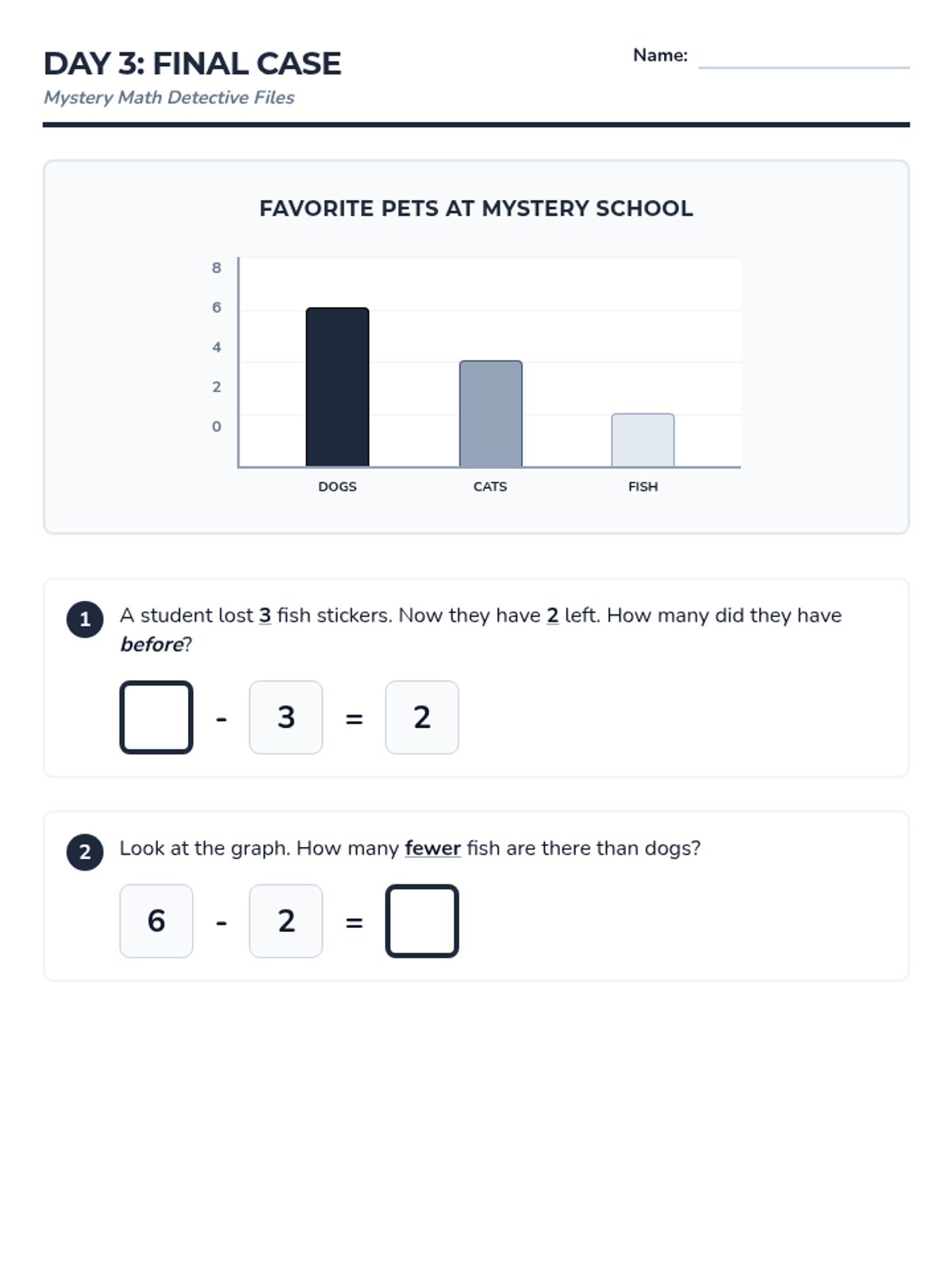
Revised Day 3 Practice: Rebuilt bar graph using absolute pixel heights for reliable PDF rendering and improved scale alignment. increased operation box sizes.
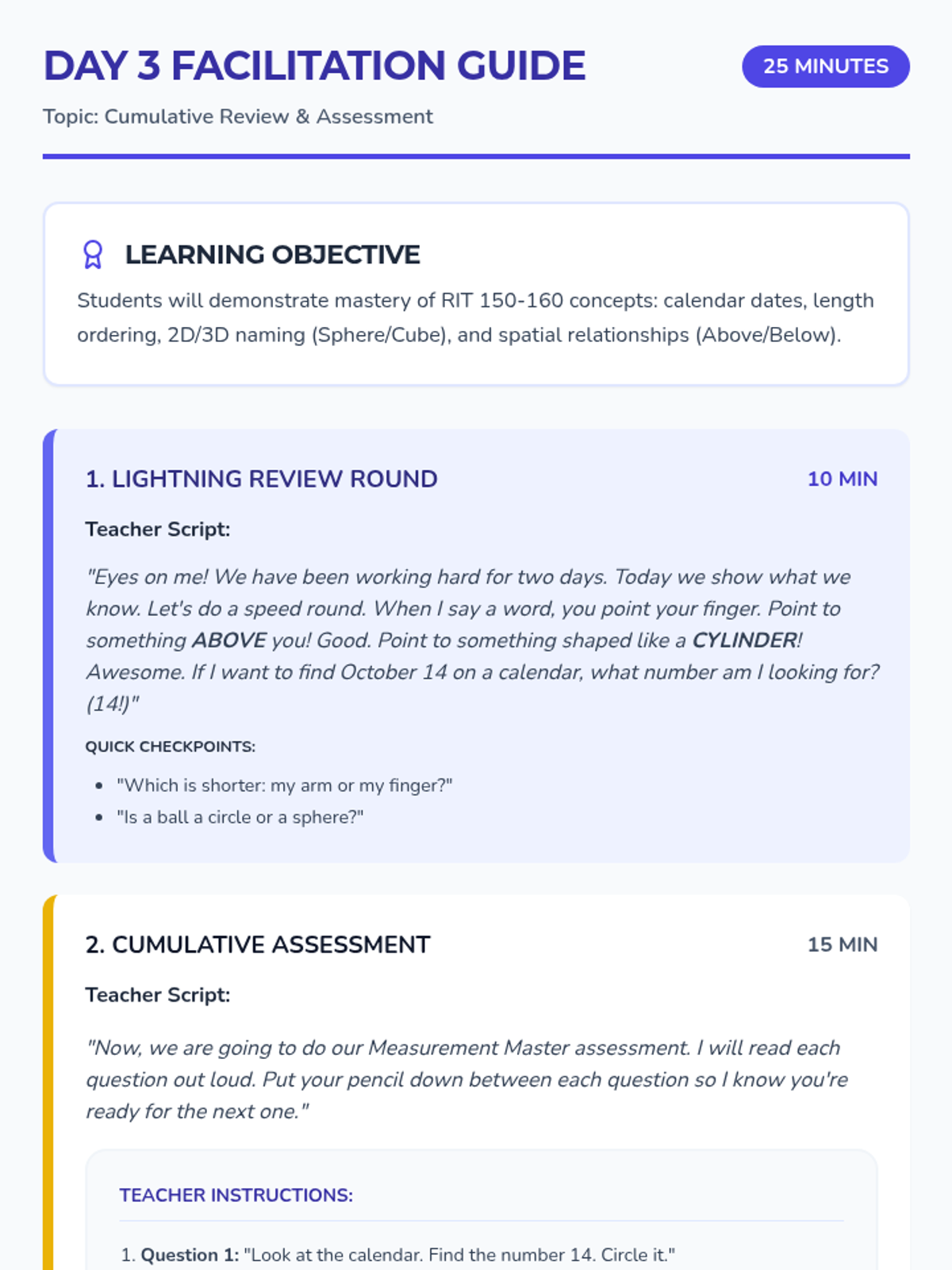
A facilitation guide for Day 3, featuring a lightning review script and instructions for administering the cumulative assessment.
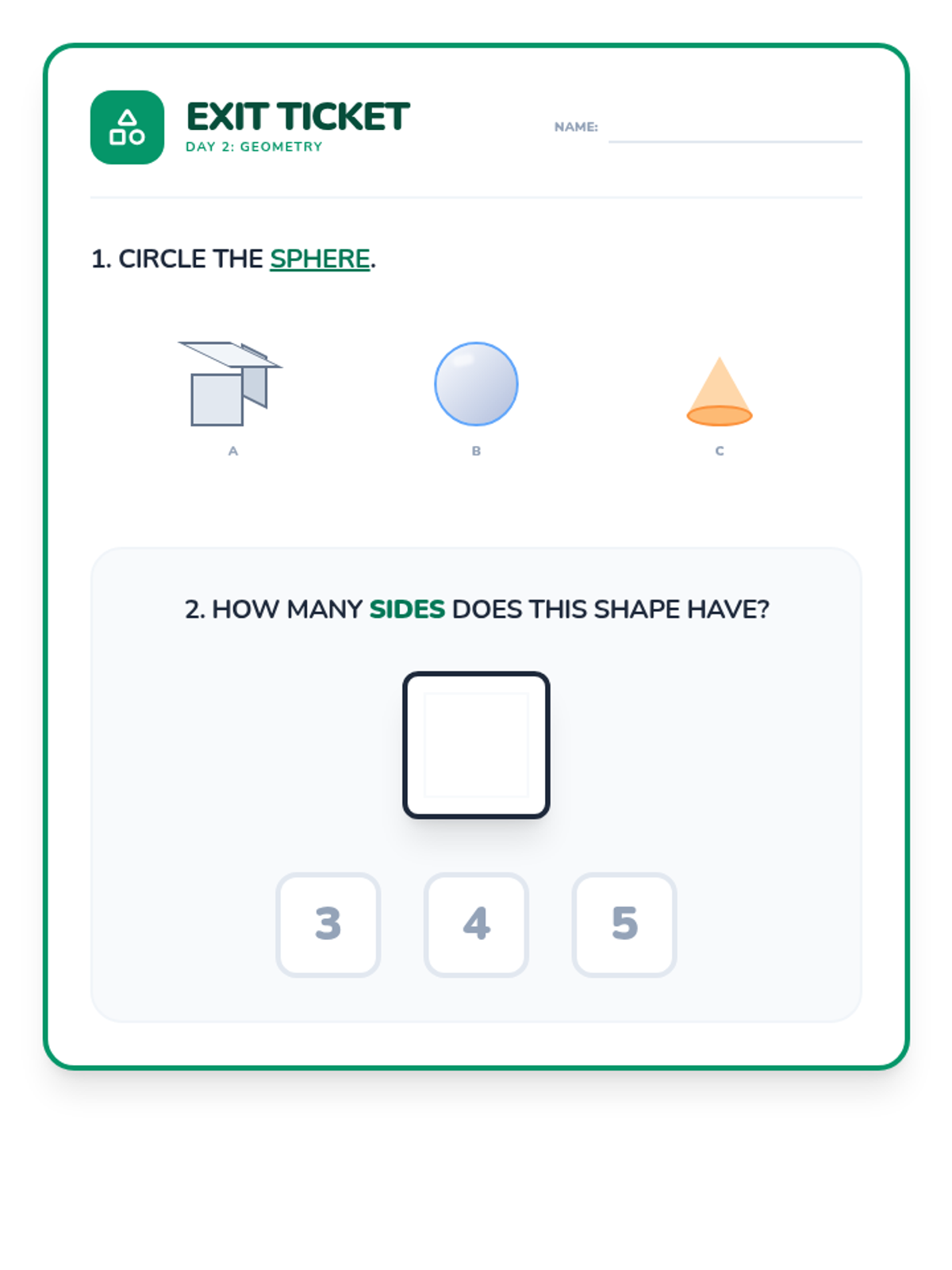
A Day 2 exit ticket that asks students to identify a sphere from a group of 3D shapes and count the sides of a square. Answer choices are styled identically to ensure a fair assessment.
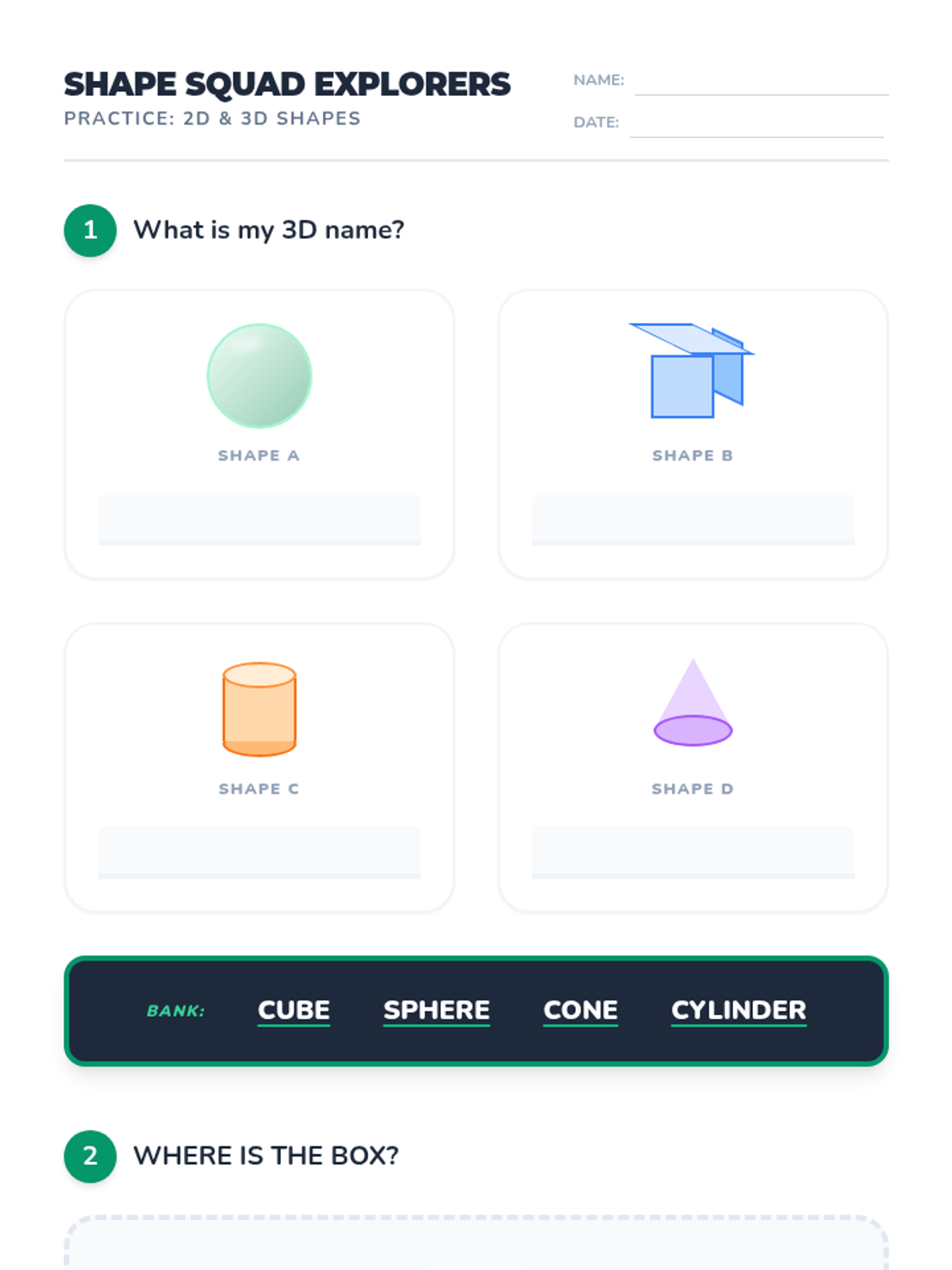
A Day 2 practice worksheet focusing on matching 3D shape images to their names and identifying positional relationships (above/below). Features improved isometric 3D shapes and identical styling for answer choices.
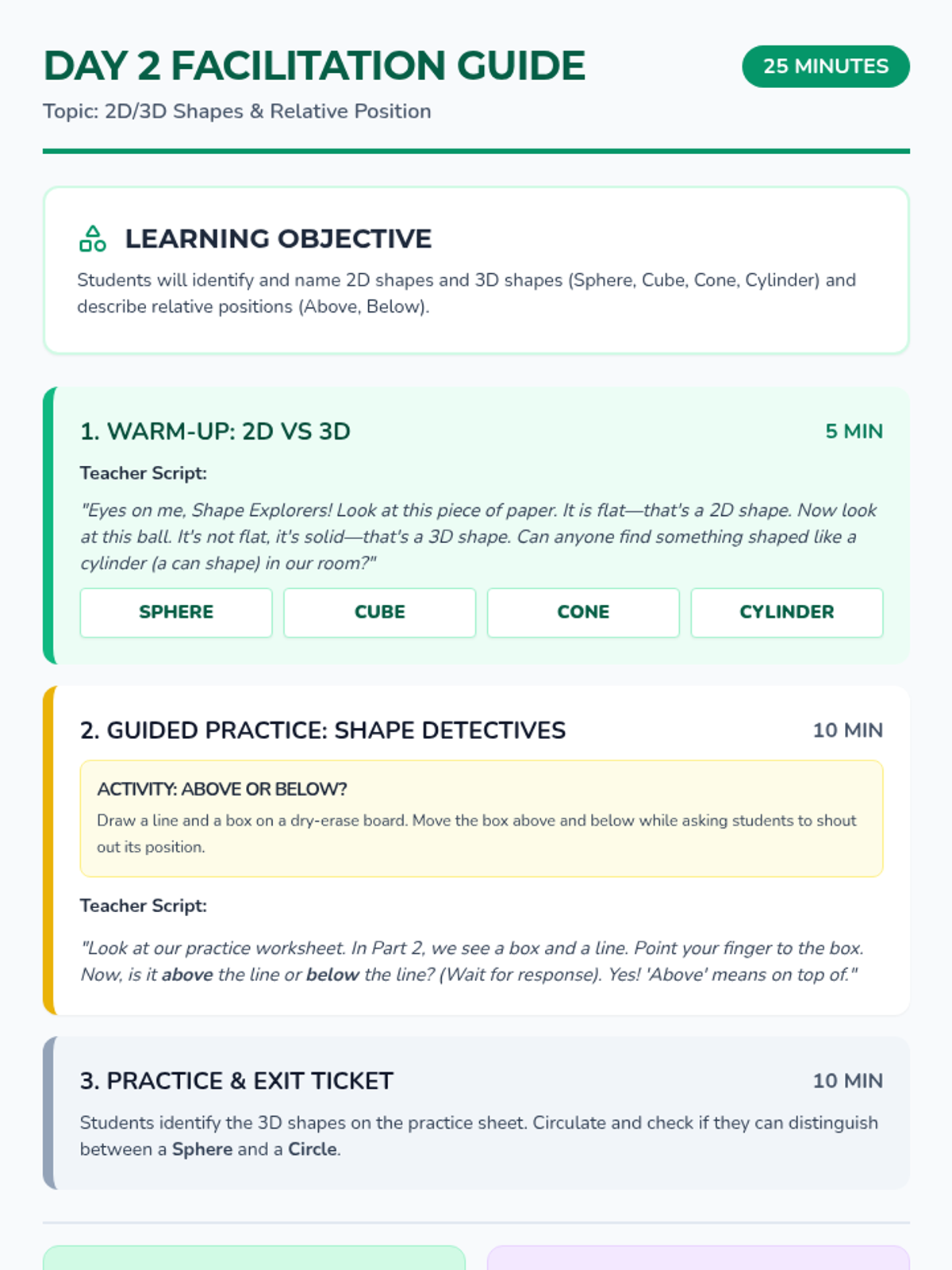
A facilitation guide for Day 2 focusing on 2D and 3D shape identification and positional vocabulary like "above" and "below". Pulls all teacher notes onto a single page for ease of use.
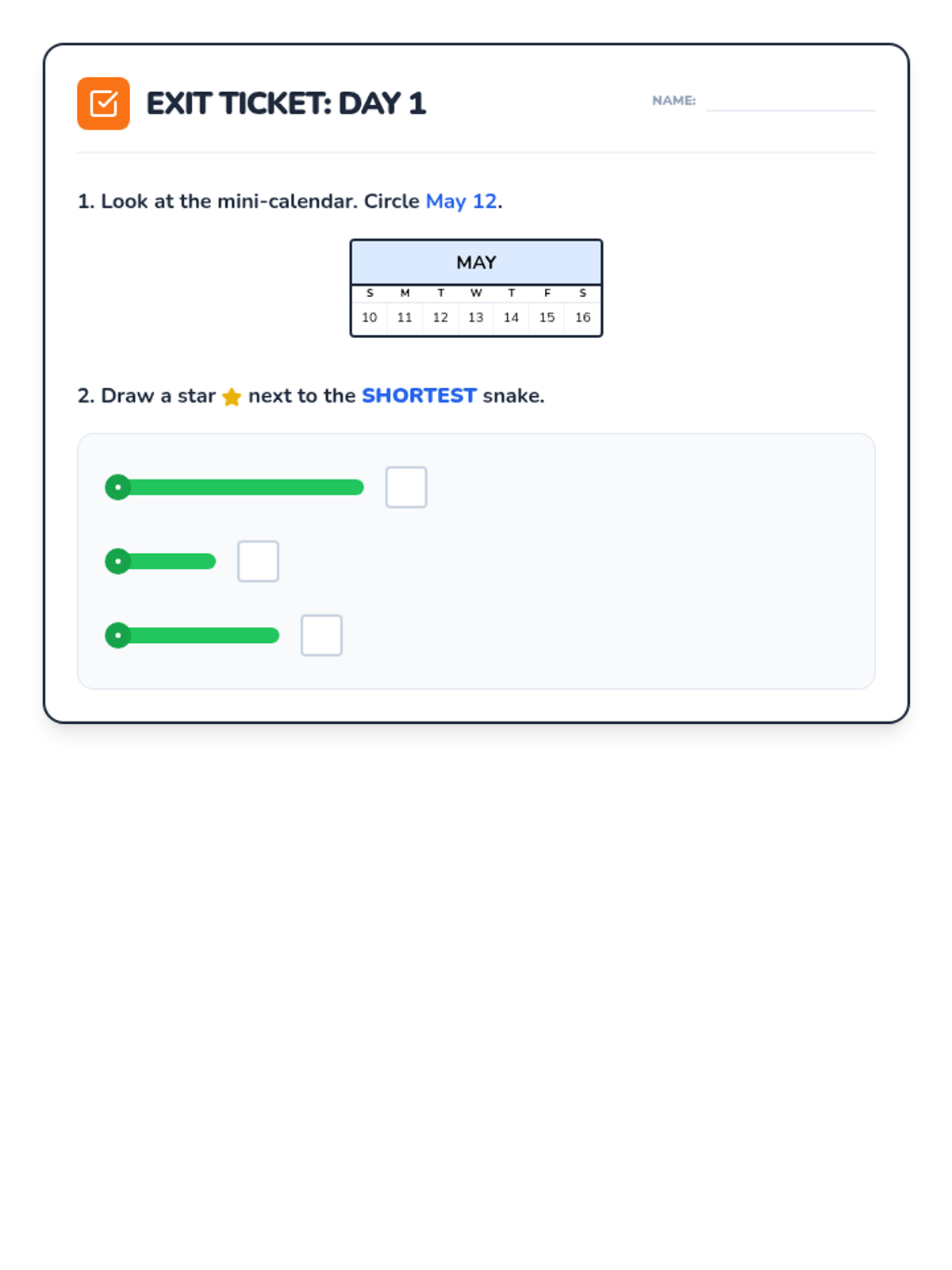
A compact Day 1 exit ticket covering calendar date identification and identifying the shortest object in a set.
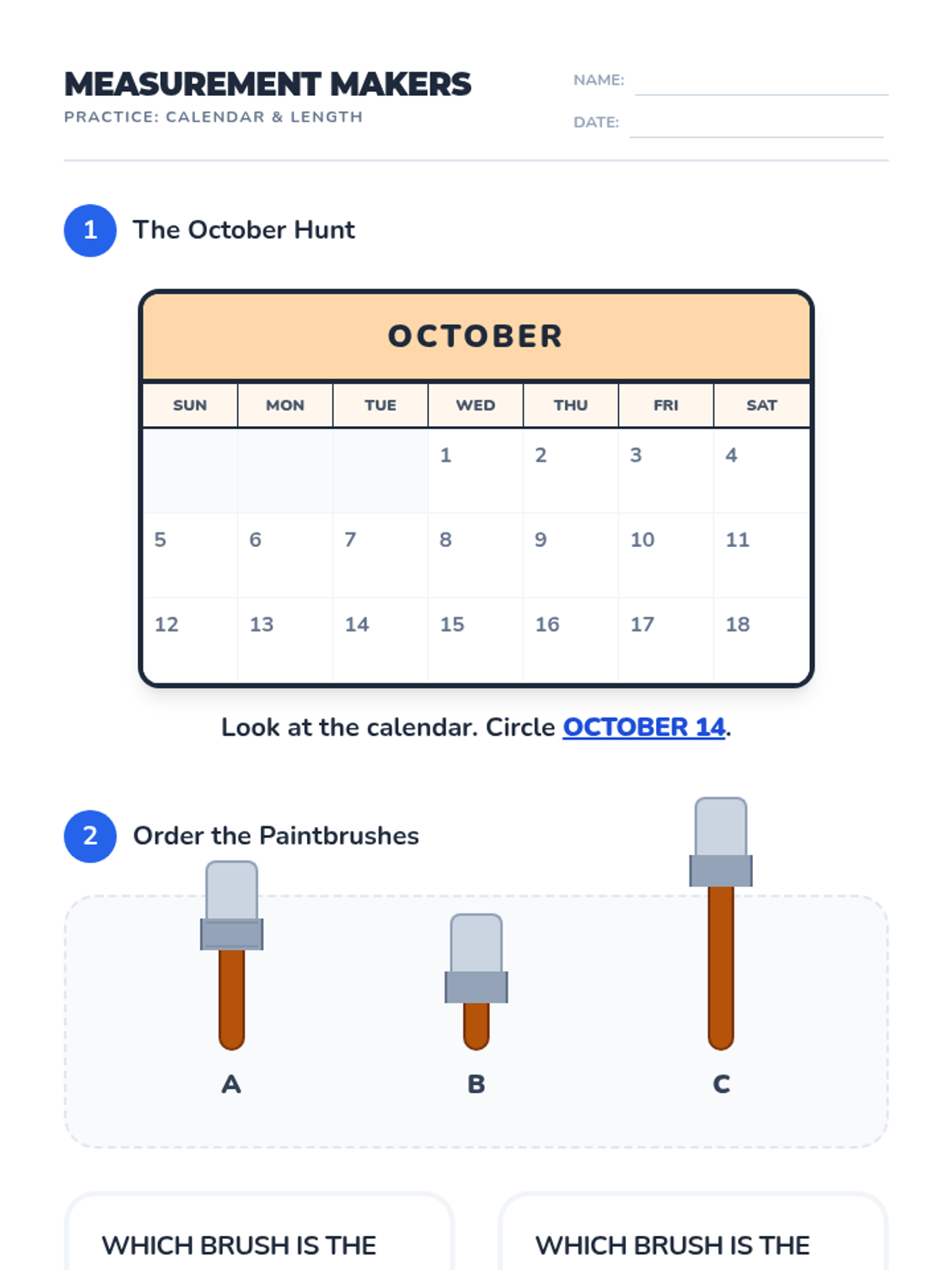
A practice worksheet for Day 1 featuring a calendar identification task and a length ordering activity with visual brush illustrations. All content is condensed onto a single page with large student work areas.
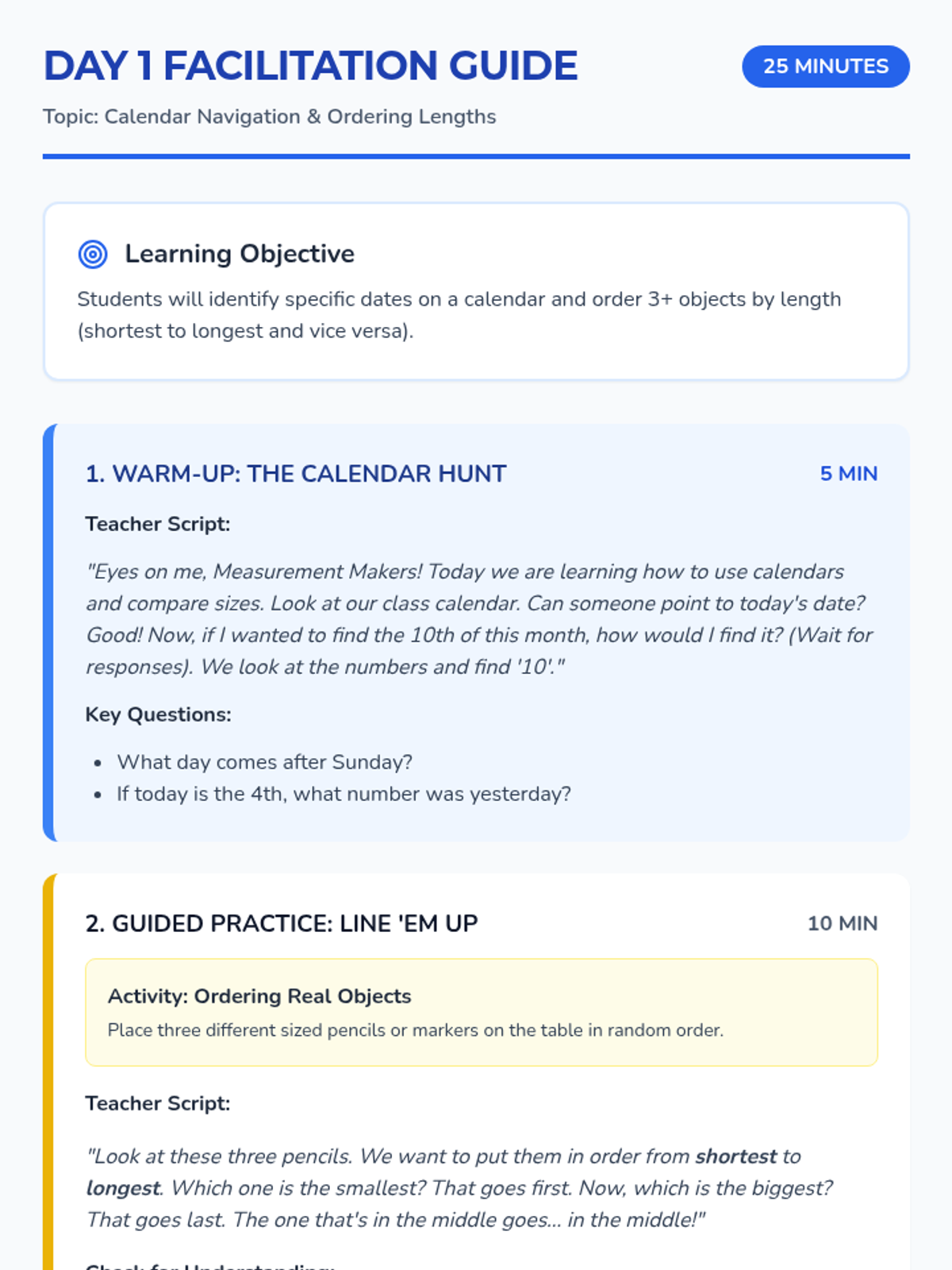
A detailed facilitation guide for the Day 1 small group lesson, including a teacher script, activity prompts, and pacing for calendar and length skills.
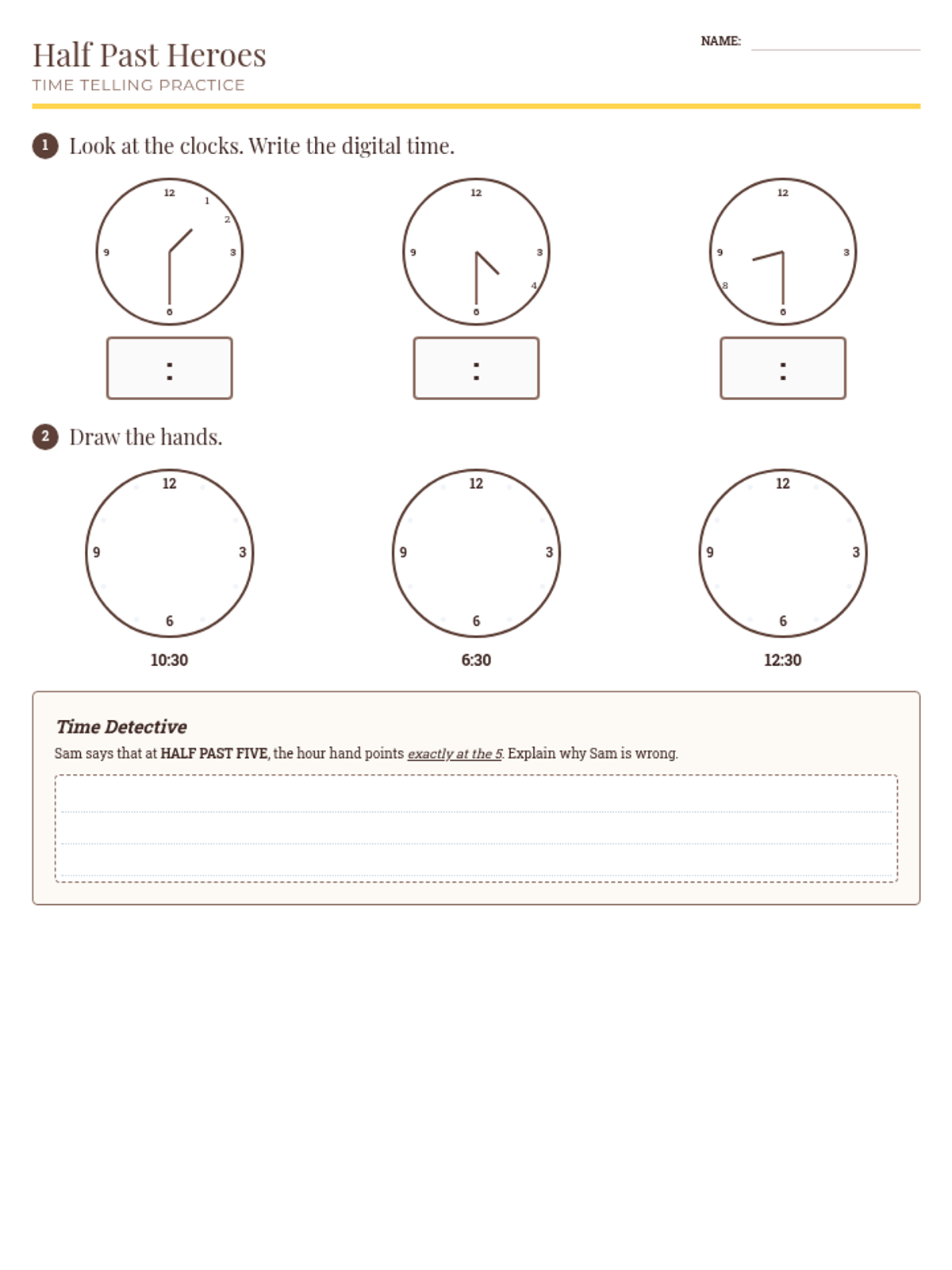
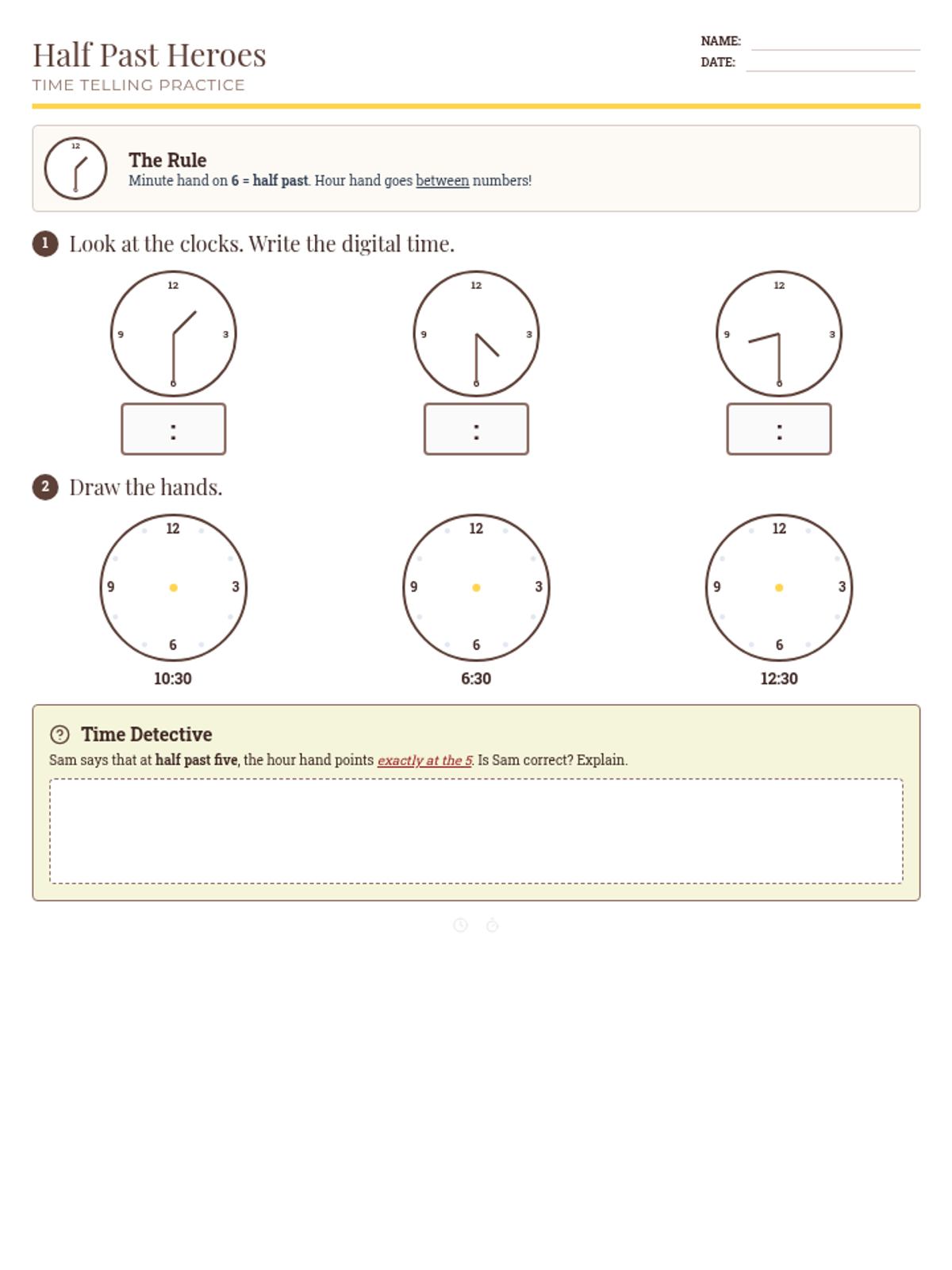
A comprehensive worksheet for students to practice reading and drawing clocks to the half-hour, including digital time conversion and a conceptual reasoning challenge with handwriting support.
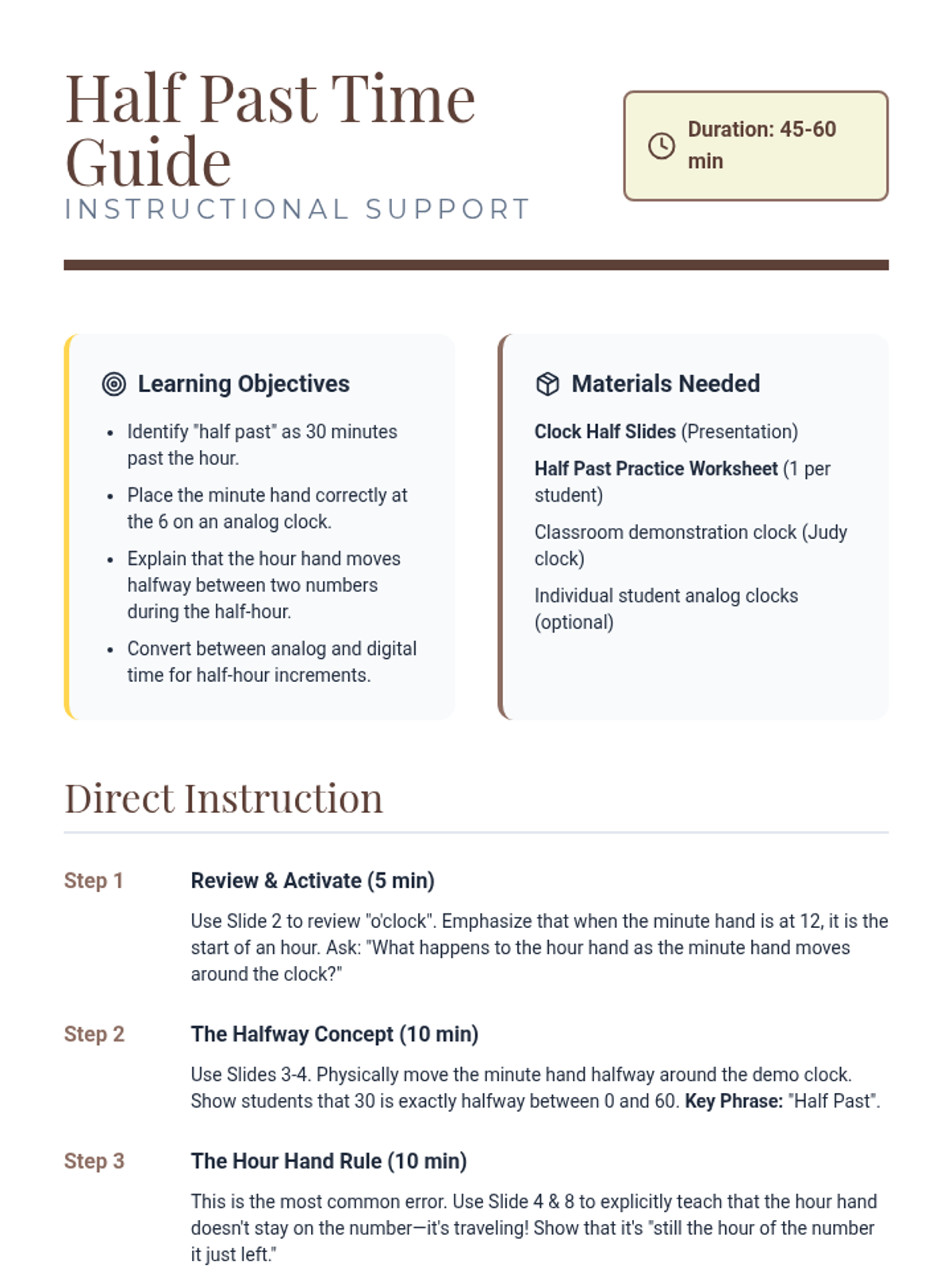
A teacher's facilitation guide containing lesson objectives, step-by-step instructional sequence, common student misconceptions, and a full answer key for the worksheet.
A comprehensive worksheet for students to practice reading and drawing clocks to the half-hour, including digital time conversion and a conceptual reasoning challenge.
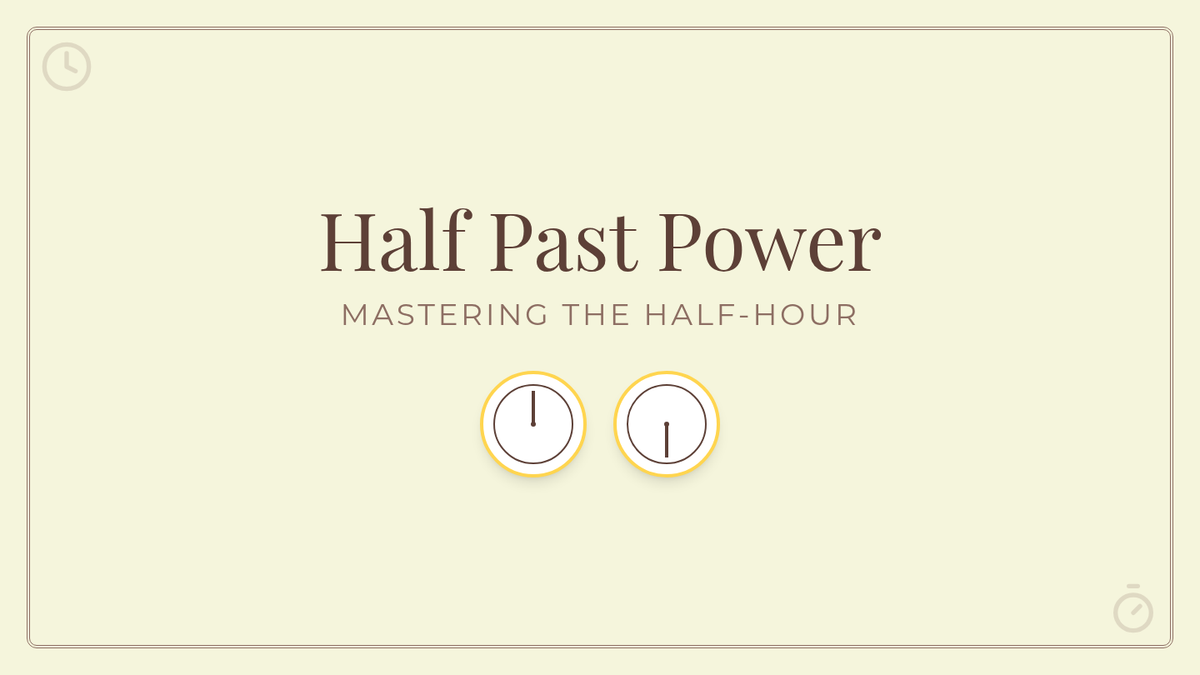
A 7-slide visual presentation introducing the concept of half-past time telling, featuring clear analog and digital comparisons, key rules for the hour hand, and interactive practice challenges. Optimized for visual clarity.
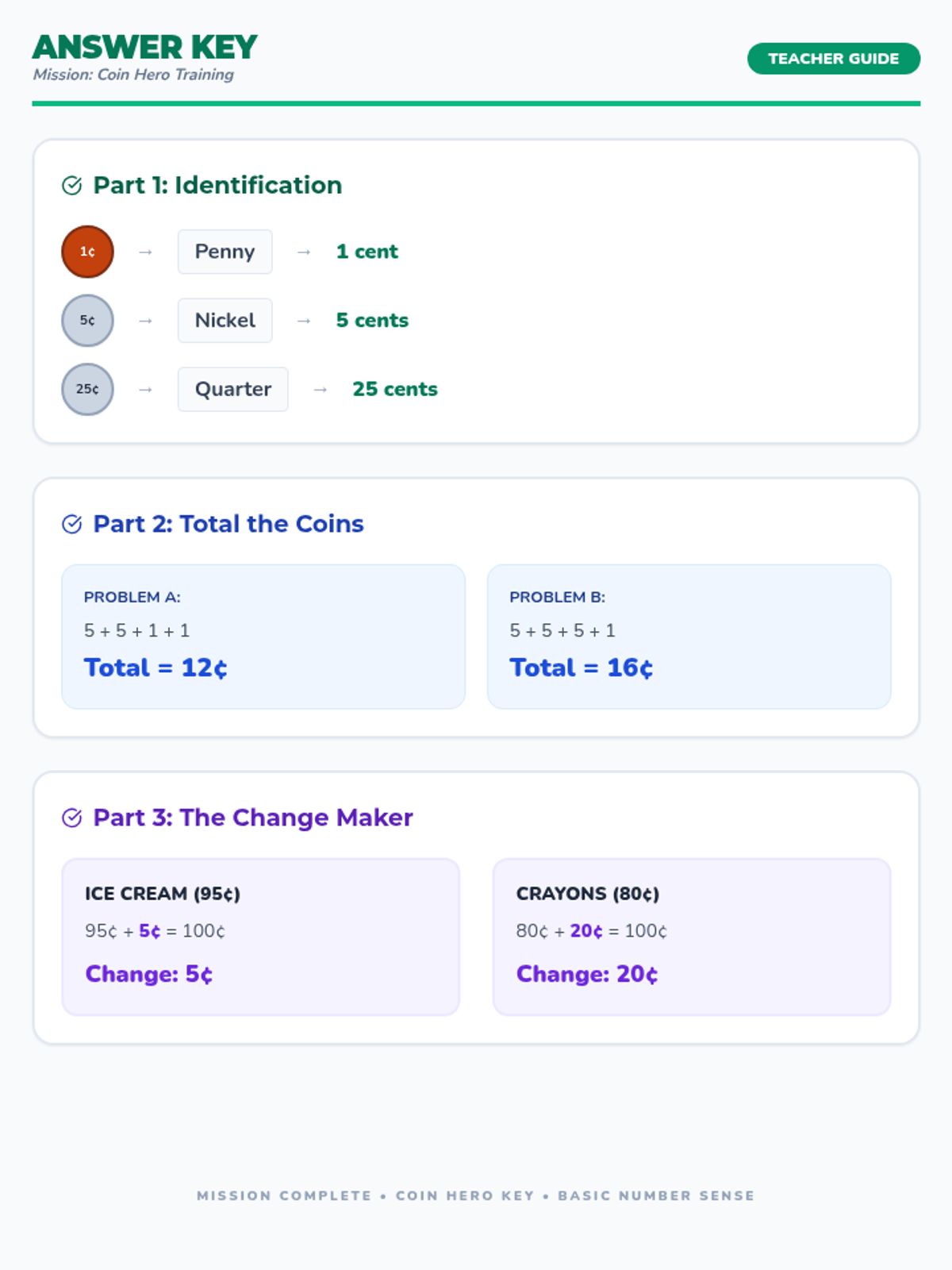
A clear answer key for the Coin Hero Mission practice worksheet. Provides step-by-step counting breakdowns and final answers for identification, total counting, and making change sections.
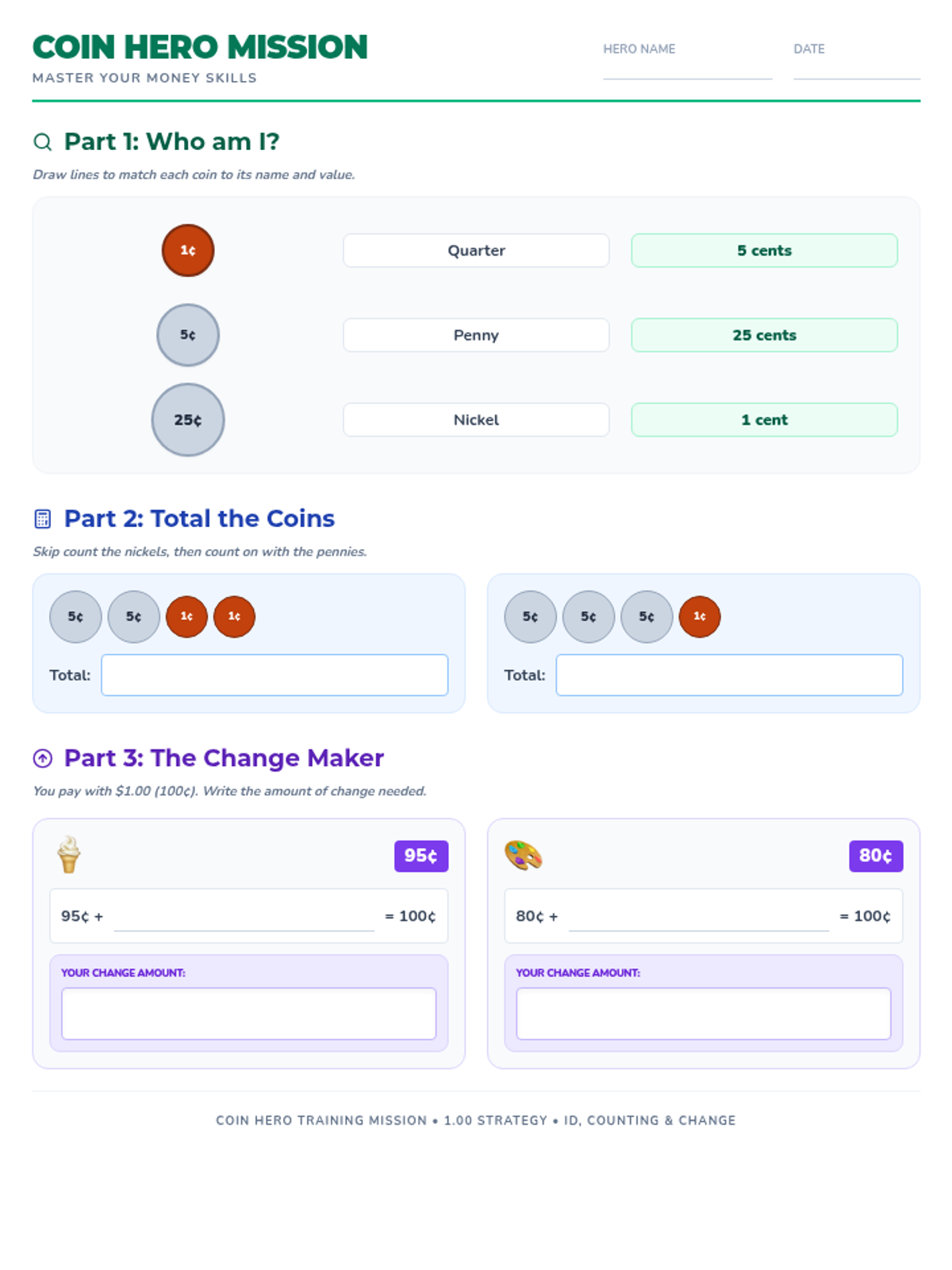
A skill-building worksheet for students to practice coin identification, skip counting with nickels and pennies, and calculating change from a dollar using the 'Counting Up' strategy. Includes visual coin representations and clear work areas.
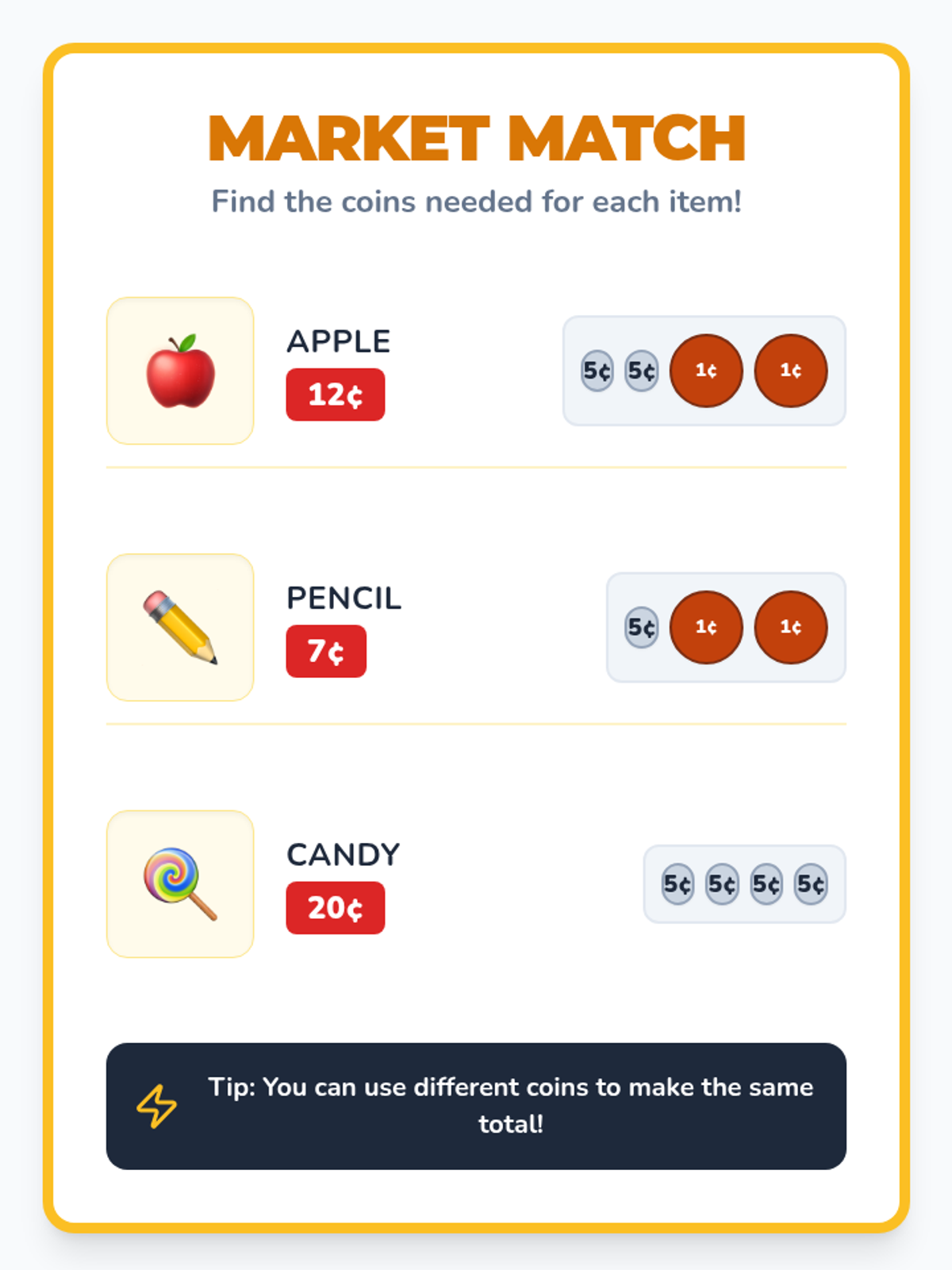
Two large visual anchor charts for classroom display. The first chart, 'Market Match', shows real-world items with price tags and the exact coin combinations needed. The second chart, 'The Change Maker', illustrates the 'Counting Up' strategy for finding change from one dollar using a visual number line and clear steps.
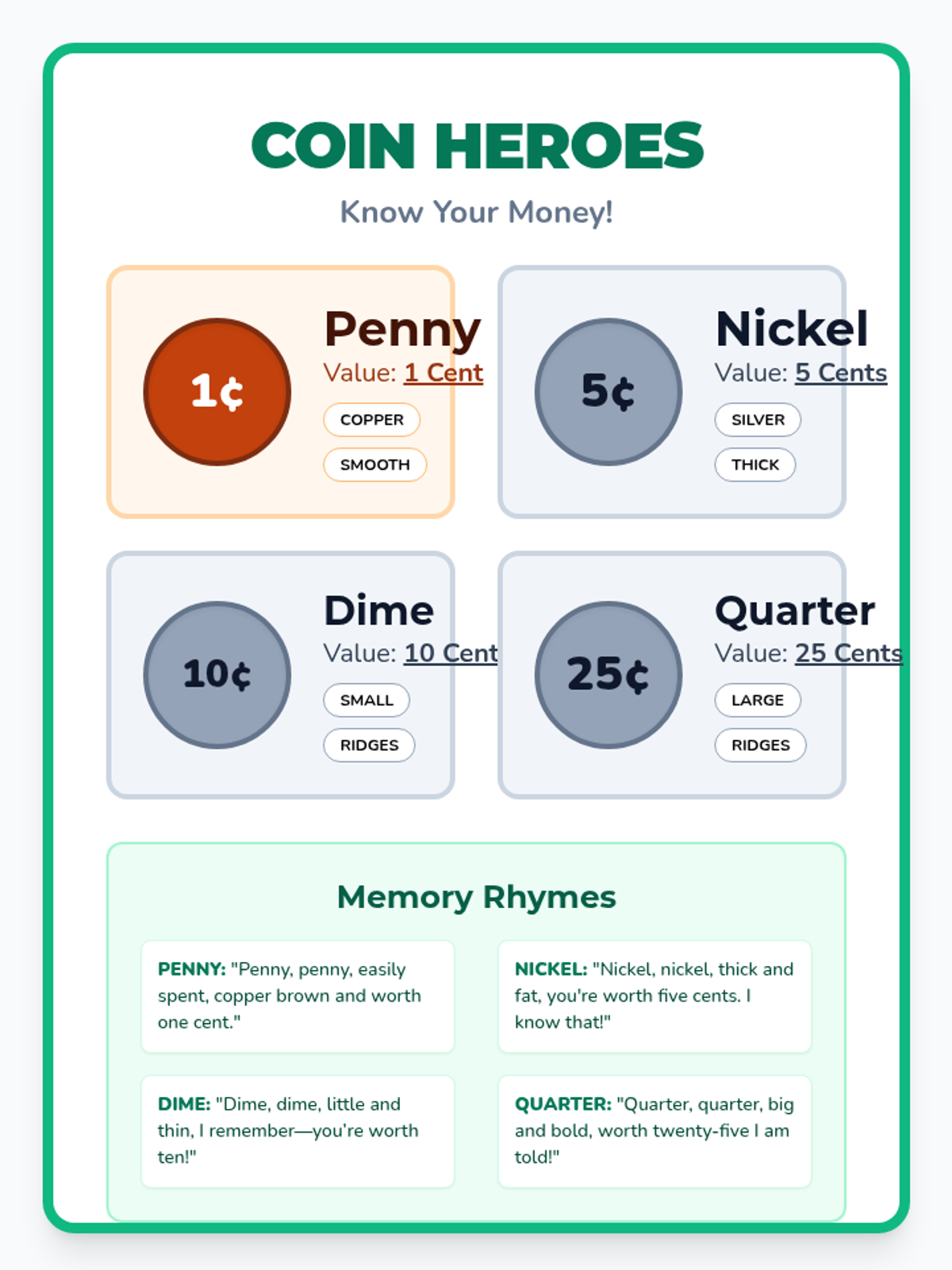
A set of two large visual anchor charts for classroom display. The first chart focuses on identifying coins (Penny, Nickel, Dime, Quarter) with names, values, and memory rhymes. The second chart provides a visual step-by-step guide for skip counting nickels and pennies to find a total value.
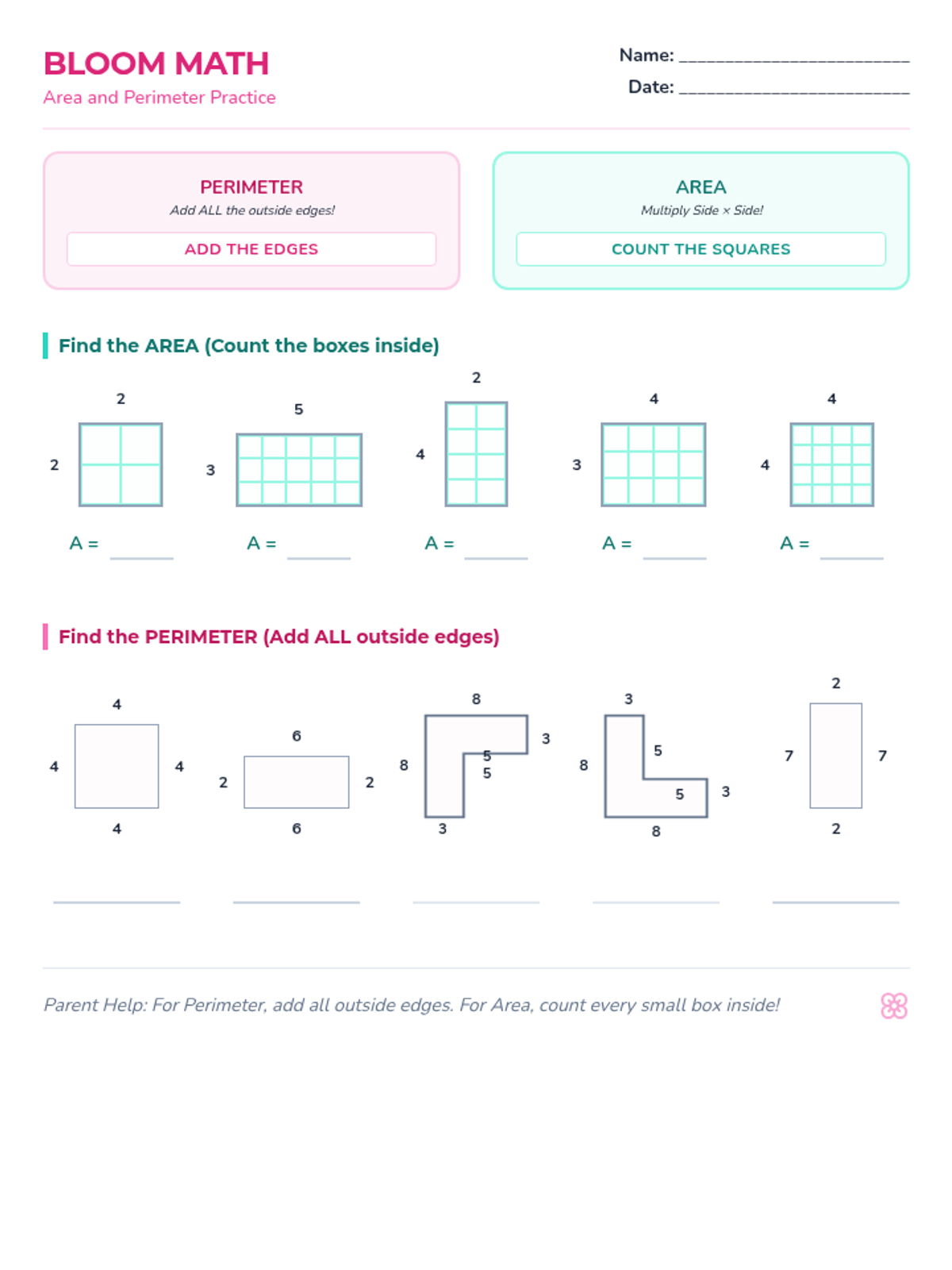
A math worksheet focusing on calculating area and perimeter. Improved for 1st-grade readability with clearer shapes, larger labels, and better spacing. Includes grid visuals for all area problems. L-shape labels are carefully positioned to avoid overlap. Answer lines are widened for handwriting. Grid lines in area shapes are darkened for contrast. Space for equations is increased. L-shape math is verified and labels are repositioned for clarity. stroke width reduced for clarity. Parent help text made more readable. Area labels now include "A=" prompt. Labels are consistent in color.
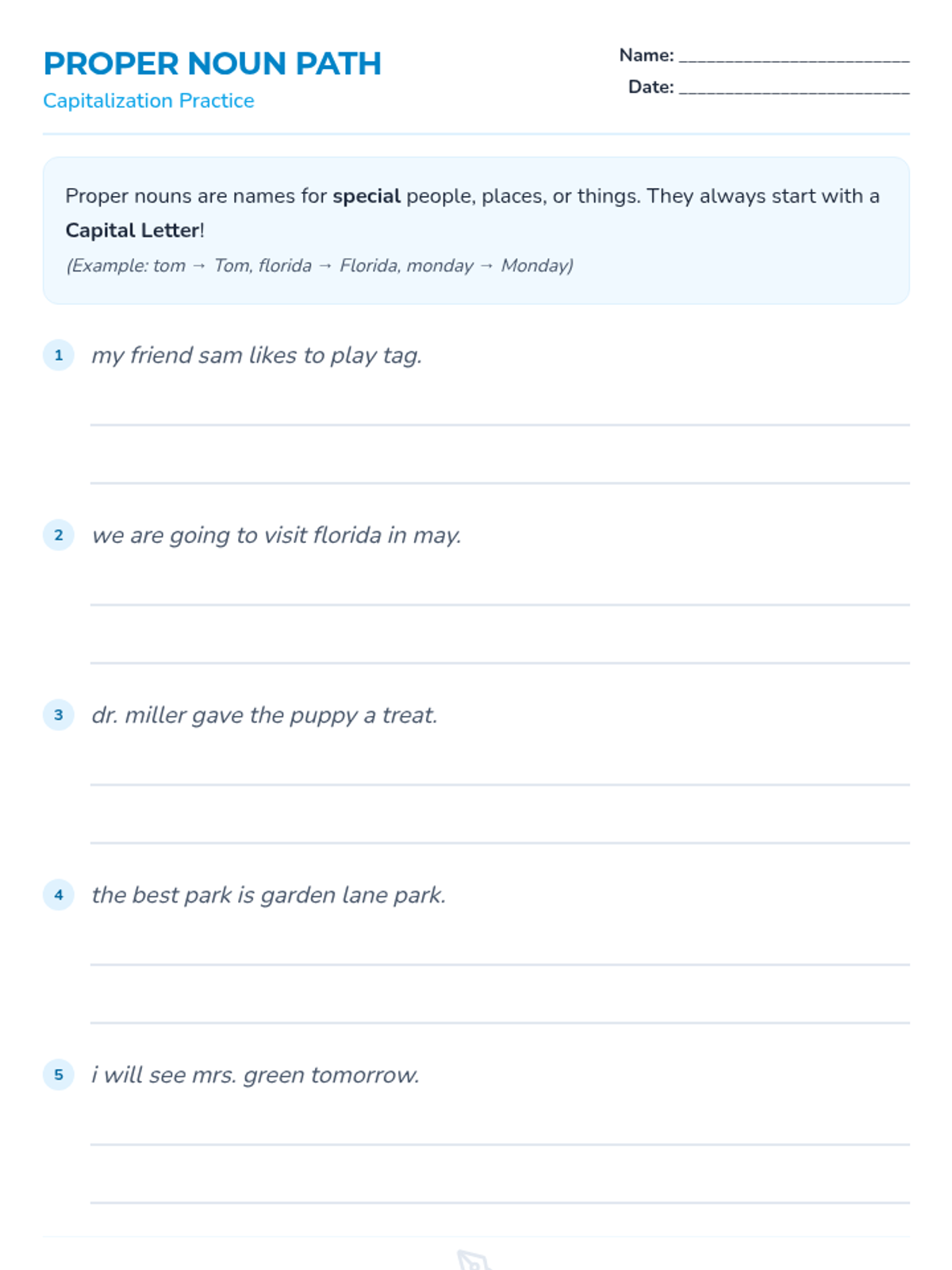
An editing worksheet where students identify and capitalize proper nouns in five sentences. Features larger handwriting space and single-page layout. Definition expanded to include titles. Optimized for single-page printing.
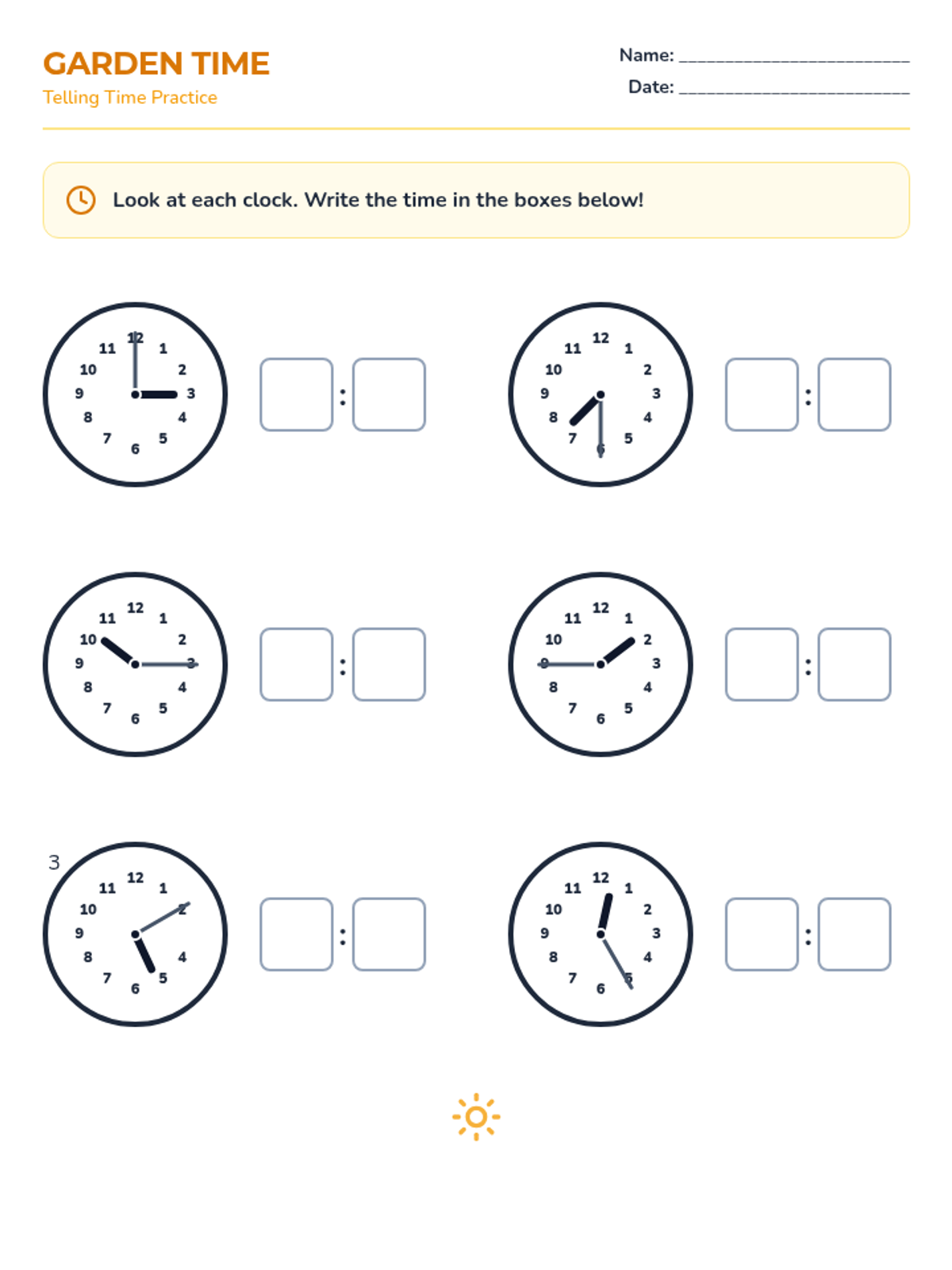
A math worksheet for practice in telling time. Adjusted for 1st-grade readability with clearer clock hands and simplified 5-minute increments while respecting the "to the minute" instruction through clear visuals. Clocks now include all hour numbers and guided answer fields. Hand rotations are mathematically corrected. Clock numbers are pulled away from the border for legibility. Sun icon is darkened for contrast. Time boxes are now symmetrical. Hand lengths reduced to prevent overlap. Clocks and boxes aligned. Corrected clock number rendering.
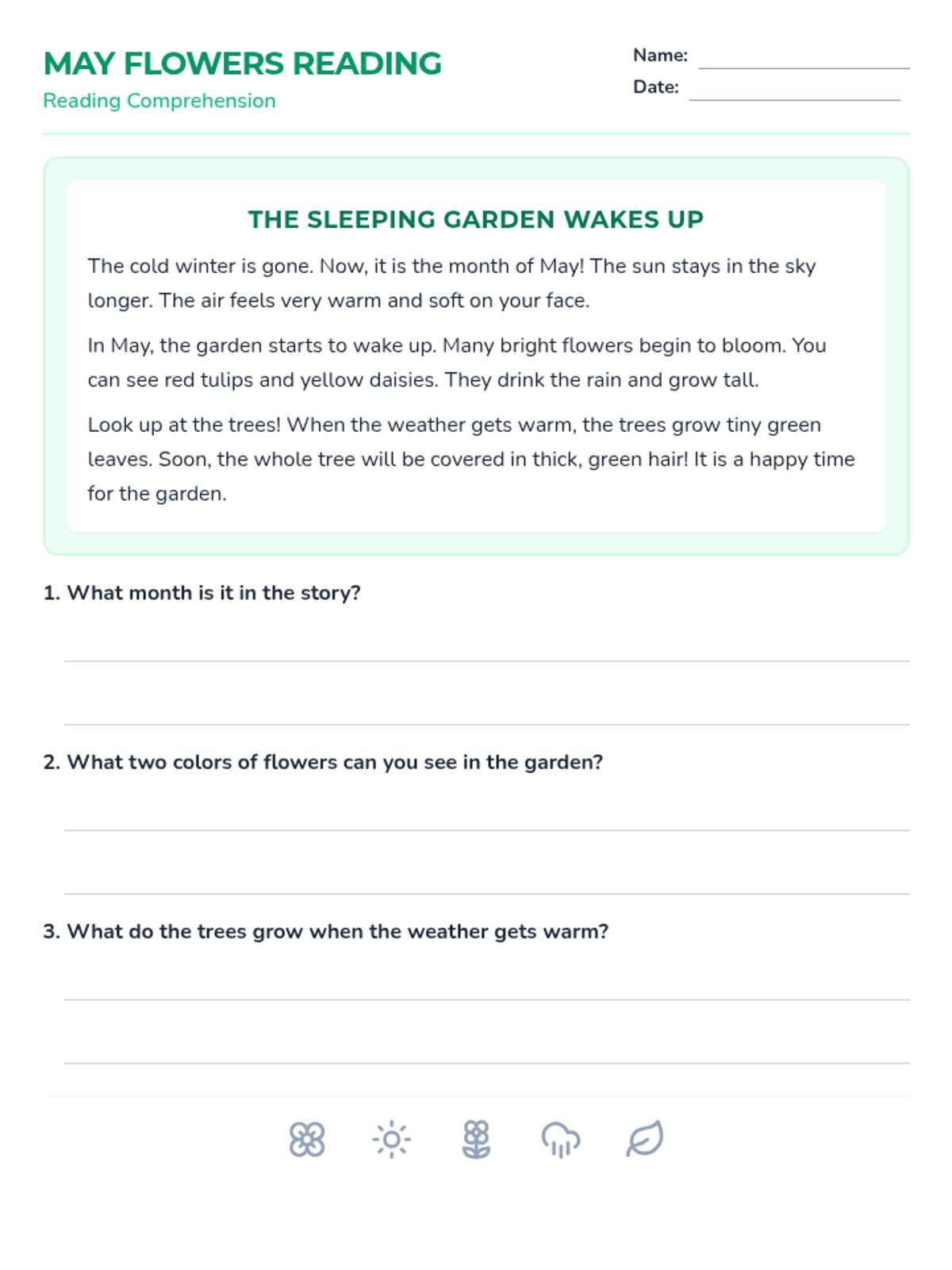
A 1st-grade level reading comprehension worksheet featuring a passage about springtime changes in May and three short-answer questions. Consistently formatted on one page with ample handwriting space. Adjusted to ensure single-page printing.
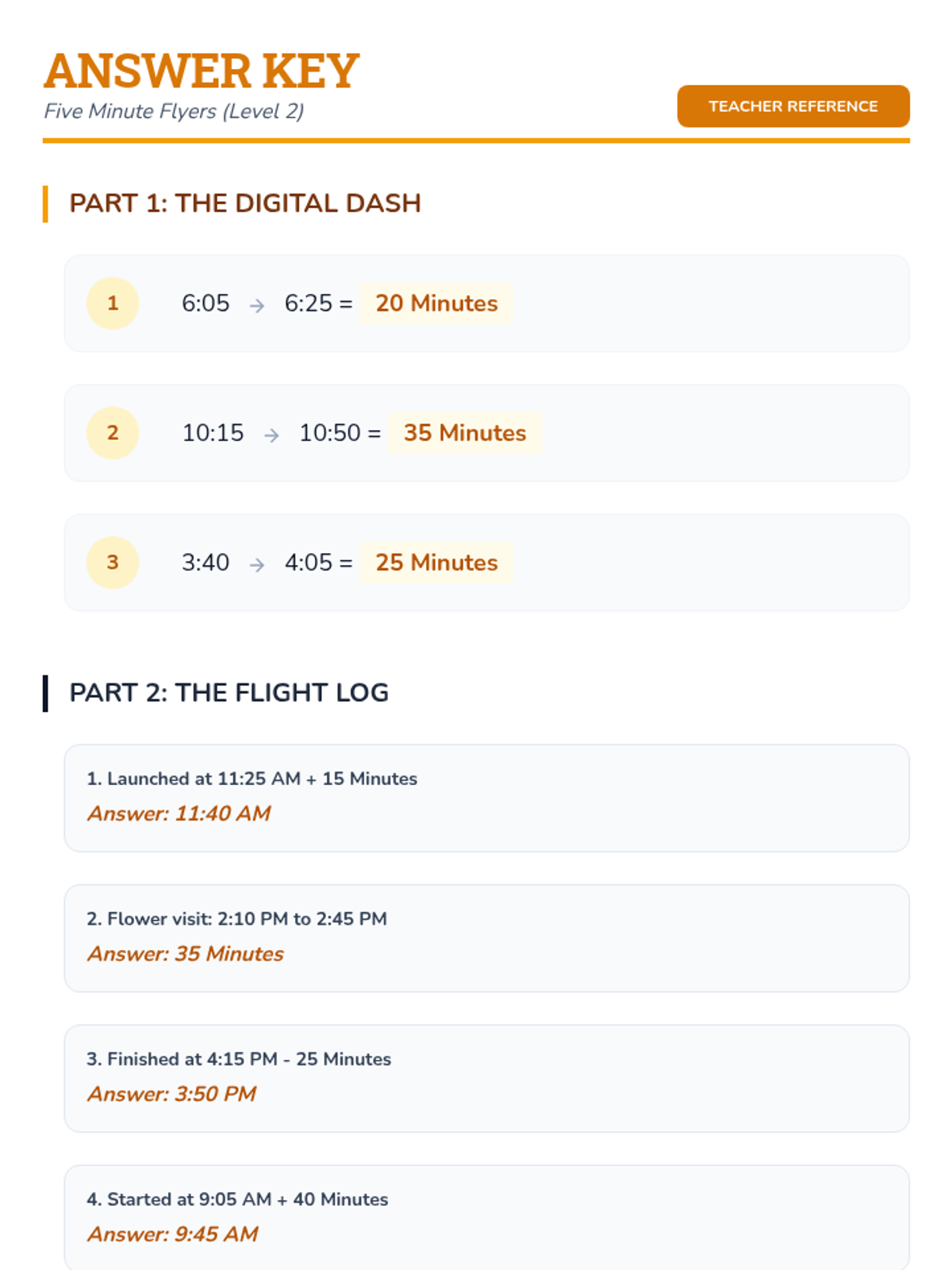
An answer key for the Five Minute Flyers worksheet, providing solutions for elapsed time problems in 5-minute increments.
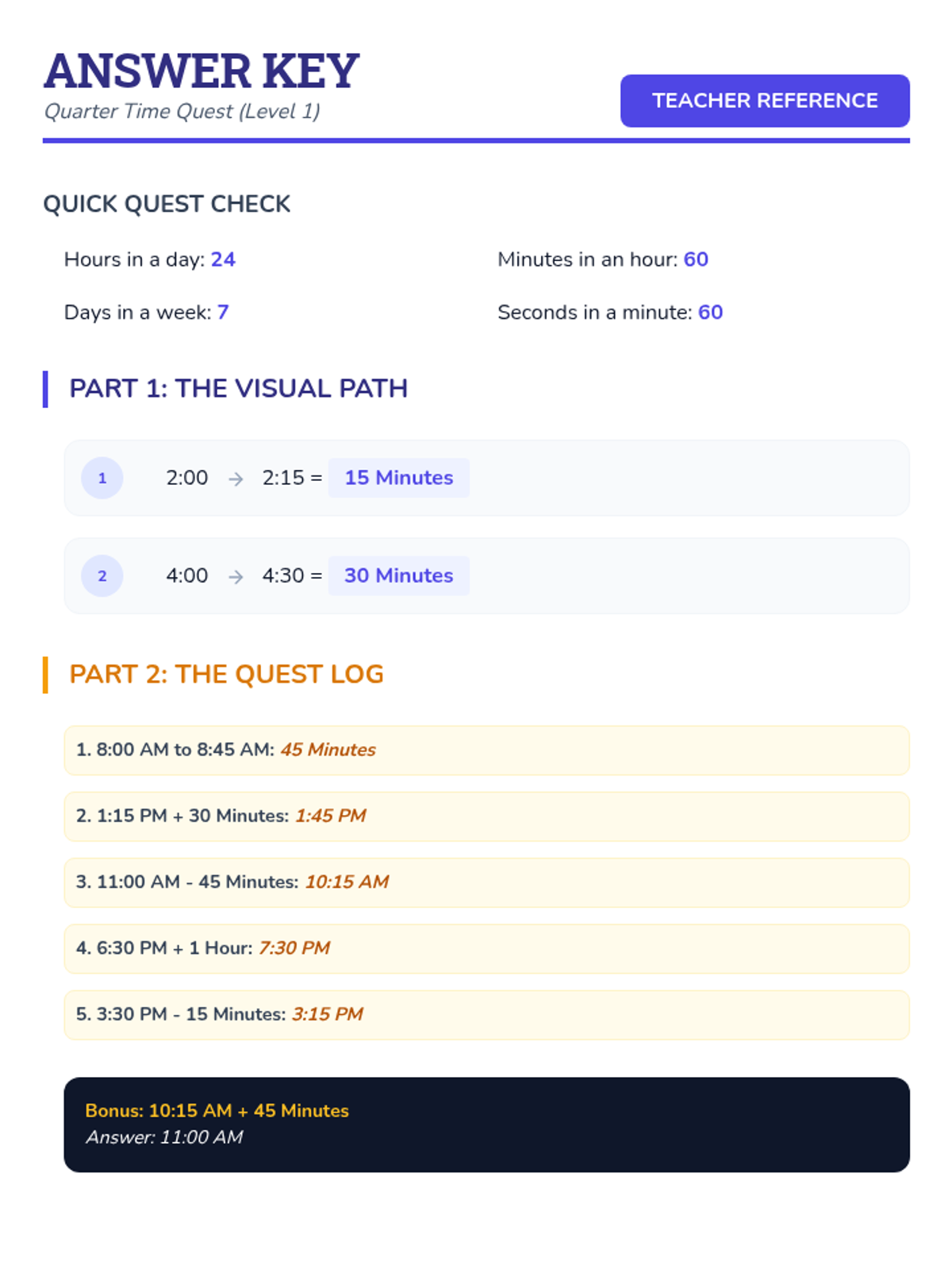
An answer key for the Quarter Time Quest worksheet, providing solutions for elapsed time problems in 15-minute increments.