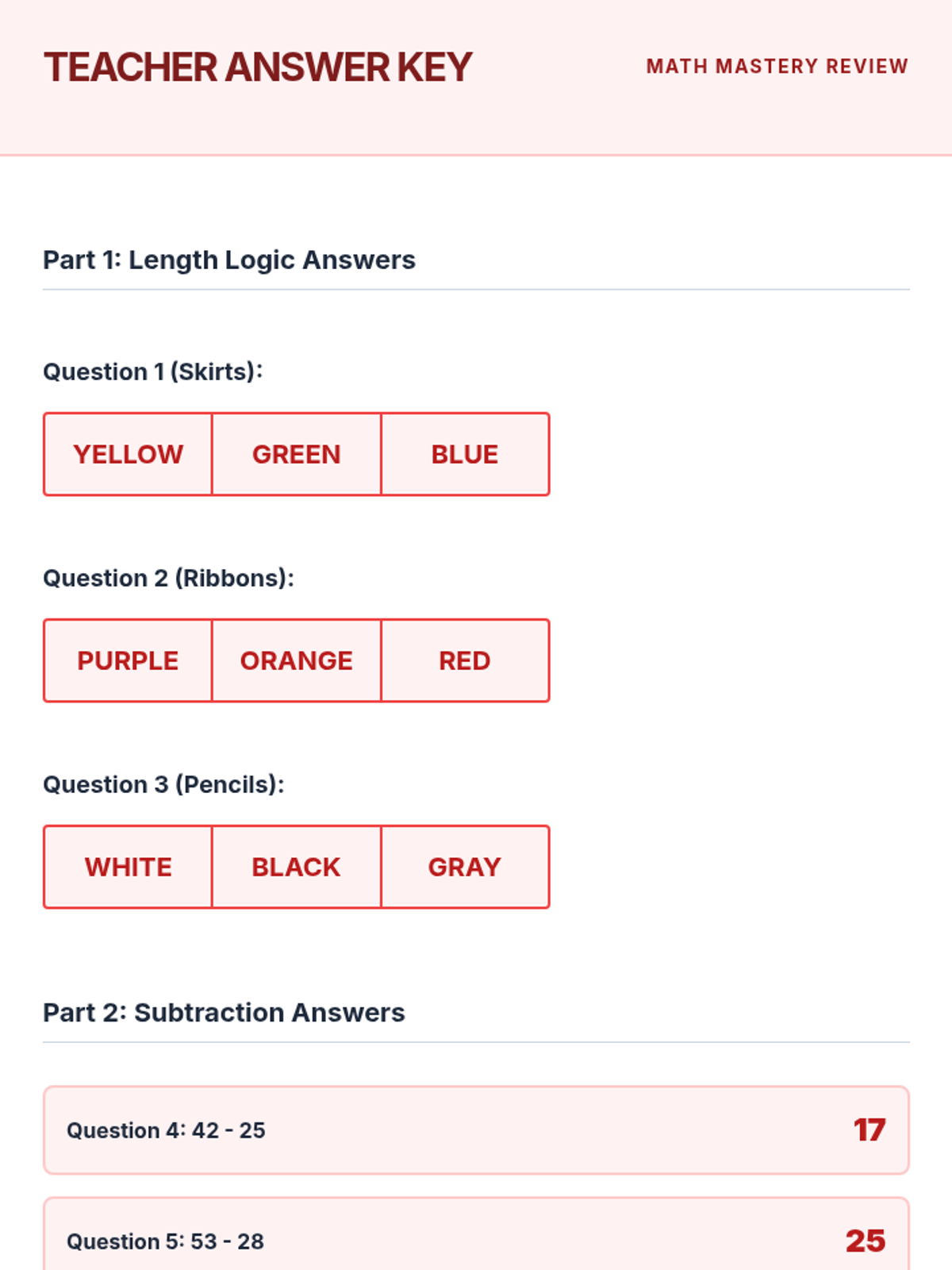
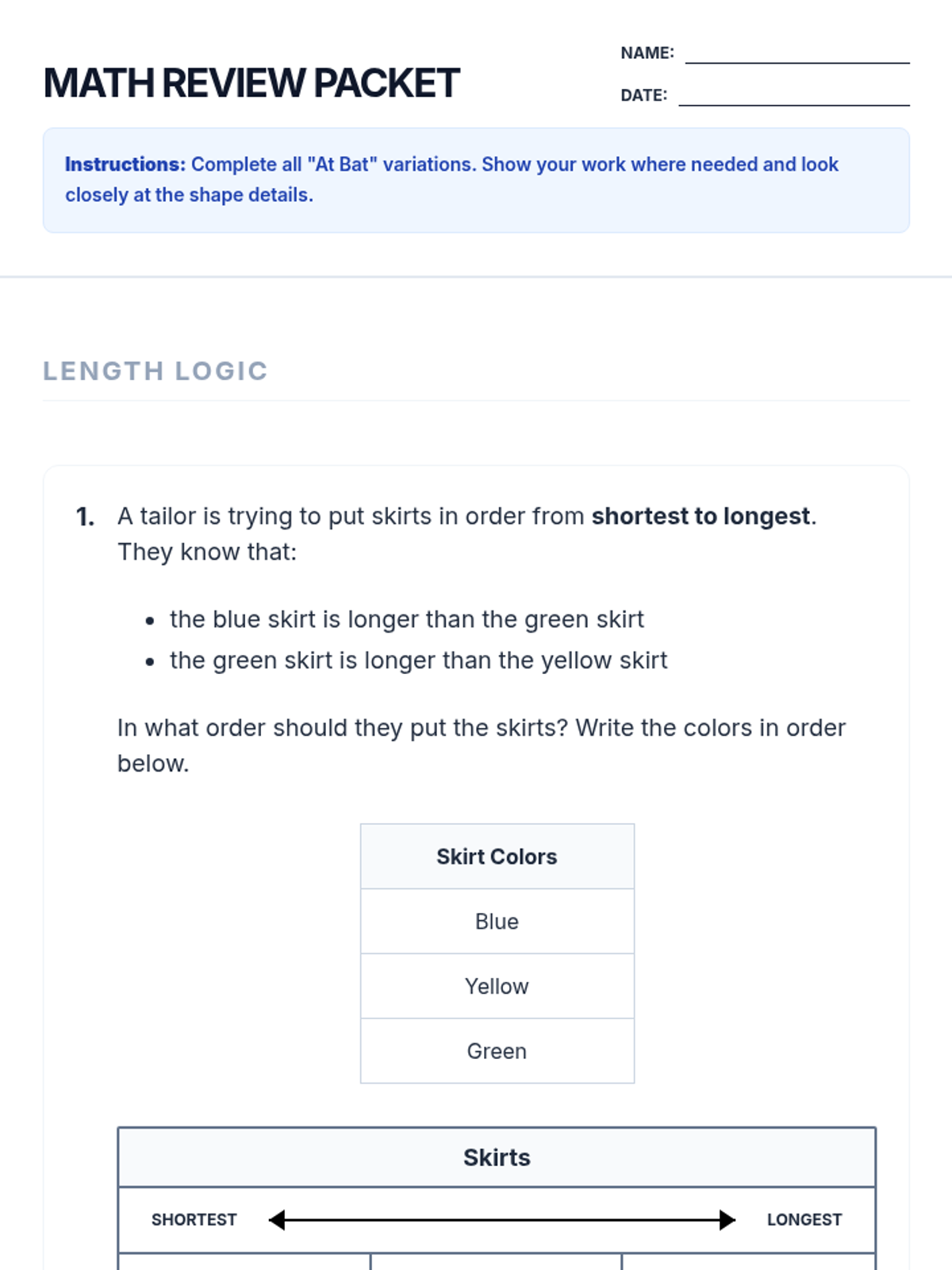
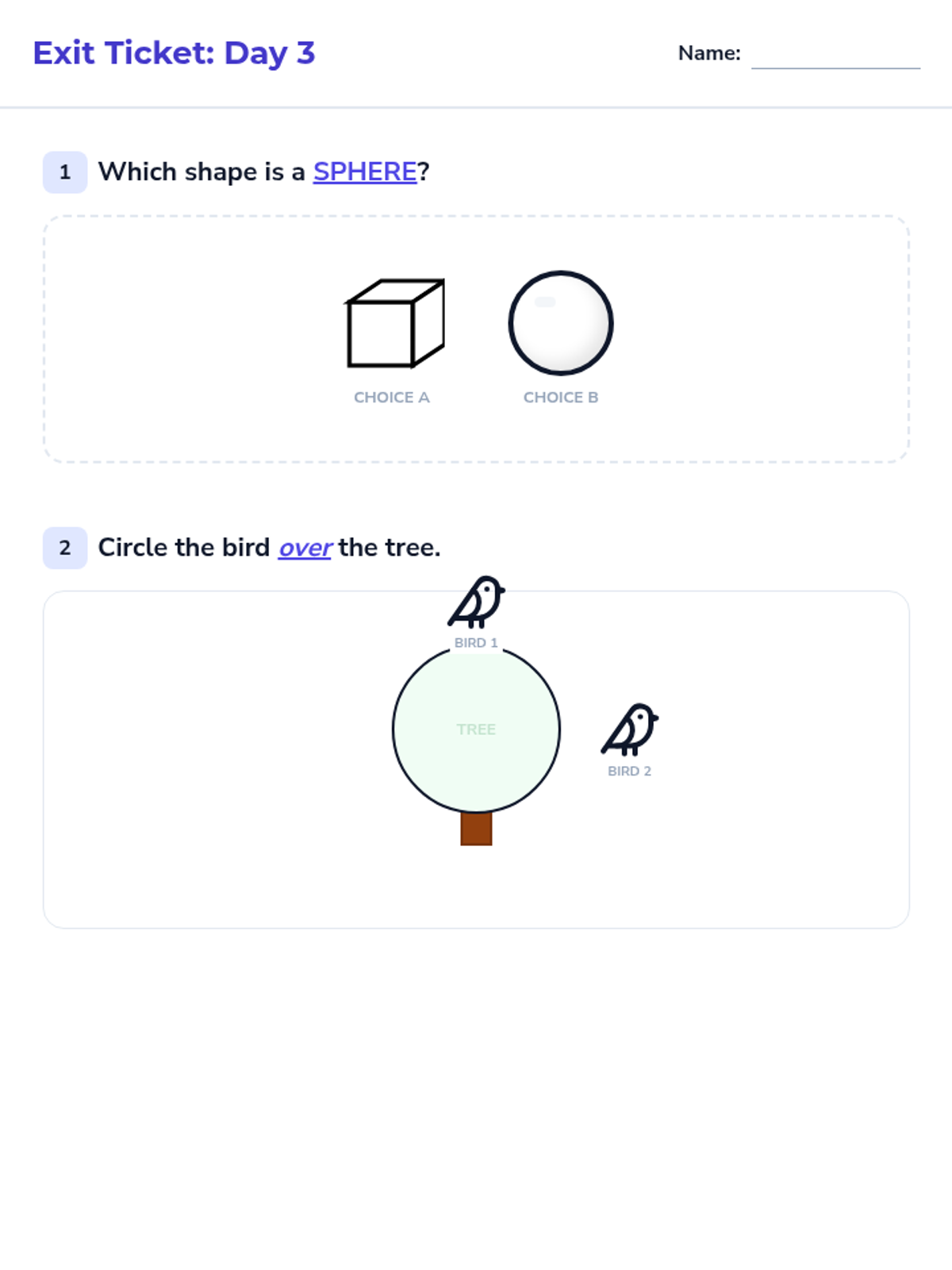
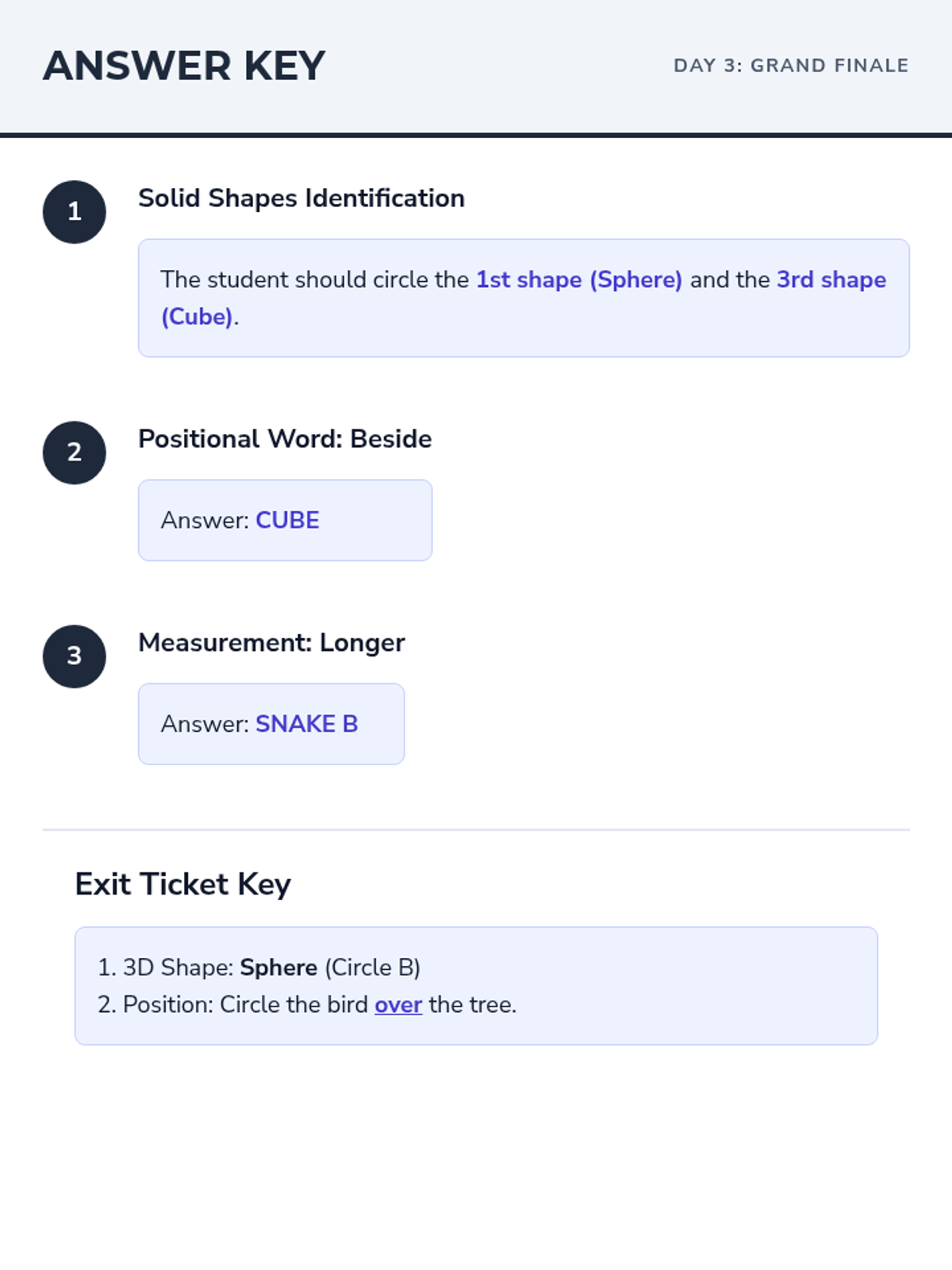
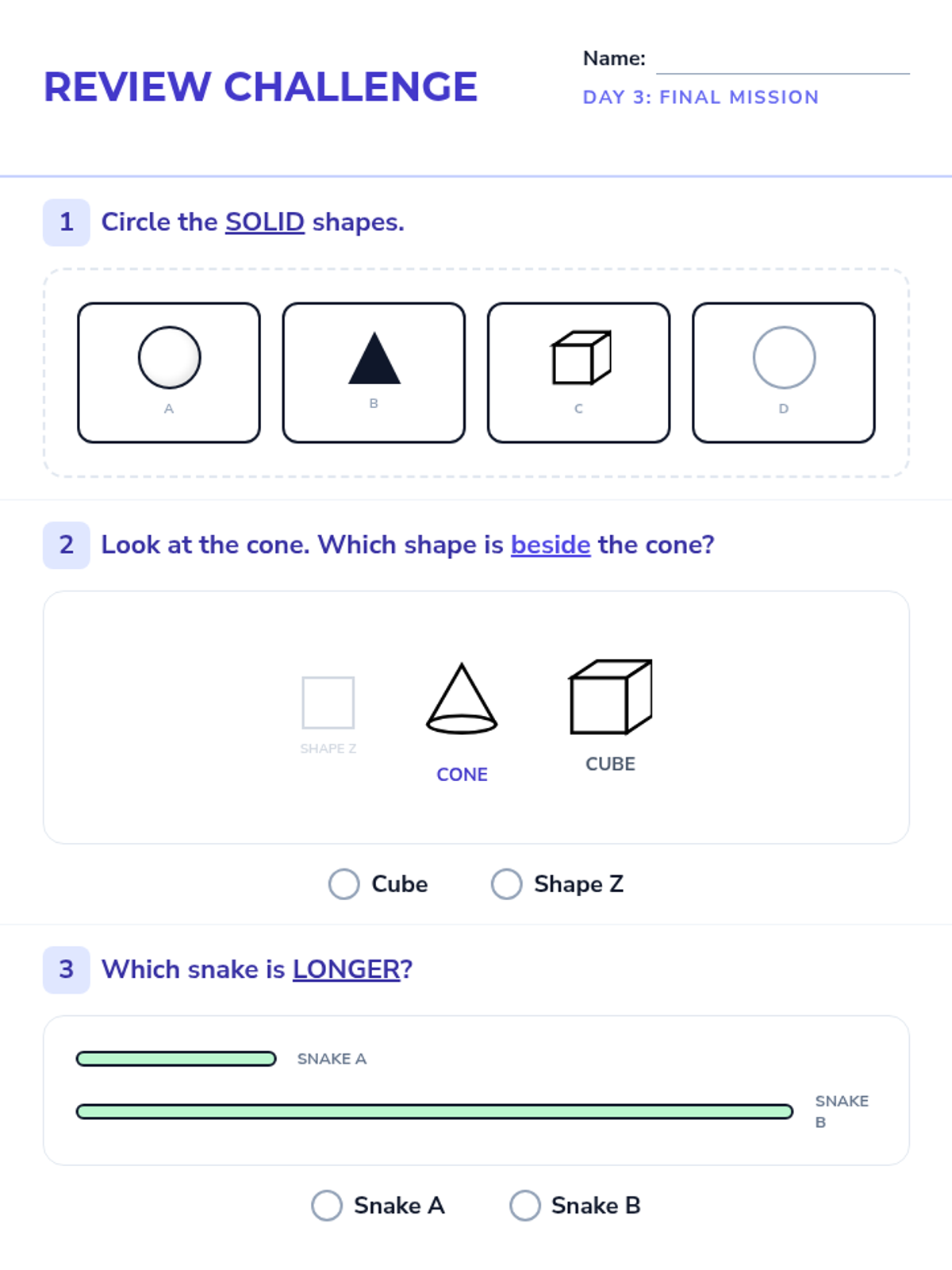
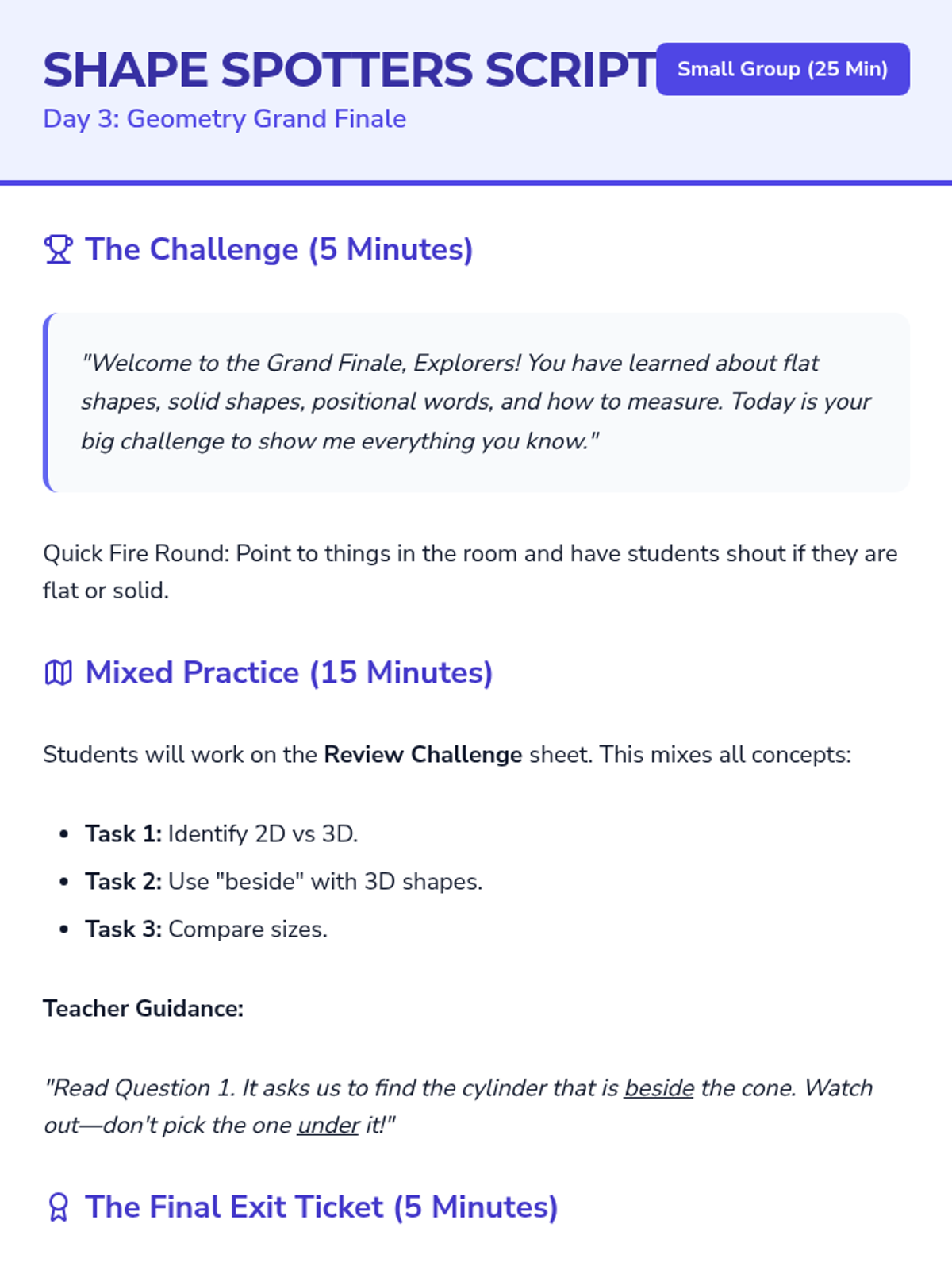
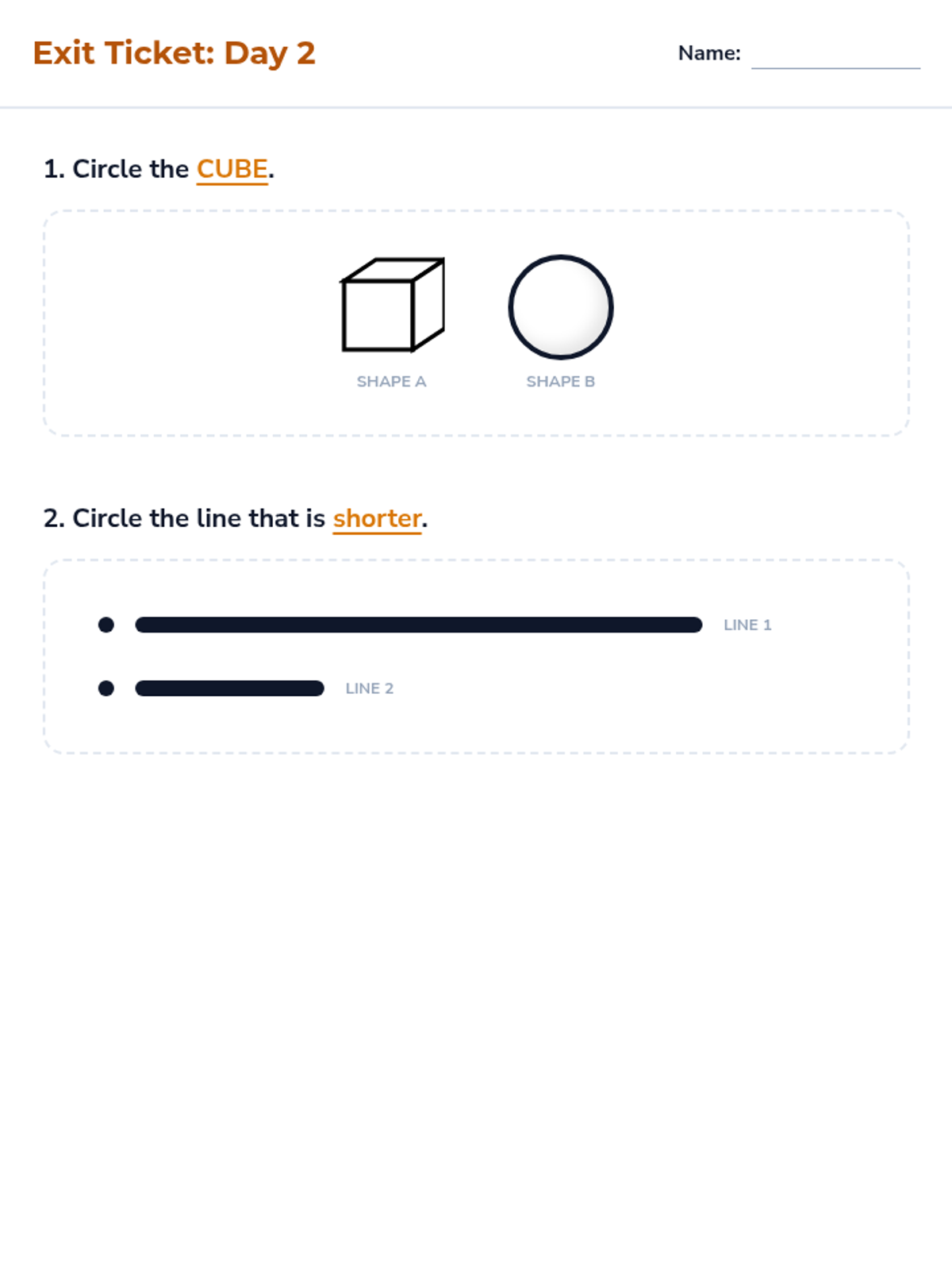
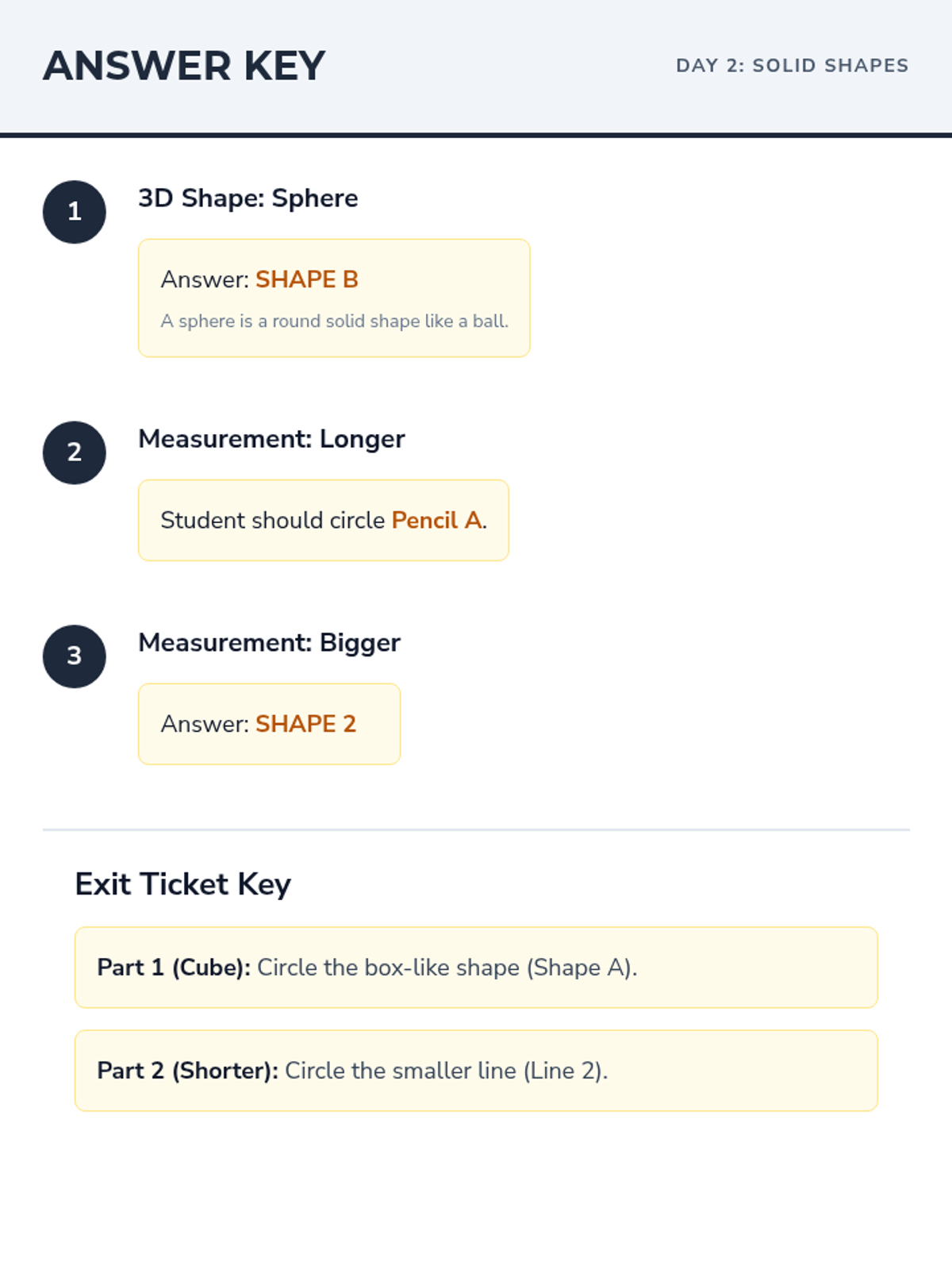
Geometric classification, measurement of area and volume, and the study of transformations and rigid motions. Builds toward complex proofs, trigonometry for general triangles, and the algebraic representation of conic sections.
A reference chart for the foundational math symbols (plus, minus, and equals) with clear visual definitions and examples for early learners.
A set of vibrant, high-impact classroom posters featuring numbers 1-10 (examples) and primary shapes with bold visuals for early learners.
A student worksheet featuring matching activities for numbers and shapes, along with simple pictorial addition and subtraction problems.
A collection of 2D and 3D shape flashcards featuring geometric definitions, clear visual icons, and real-world examples to help students identify shapes in their environment.
A set of jungle-themed flashcards for numbers 1-10, featuring clear digits, adorable animal icons for counting, and the written number word.
An answer key for the Solid Shape Sort Worksheet, highlighting objects that fit into both "Rolls" and "Stacks" categories, such as cylinders.
A cut-and-paste sorting activity where students categorize real-world 3D objects (spheres, cubes, cylinders, cones, and prisms) into "Rolls" and "Stacks" based on their physical attributes.
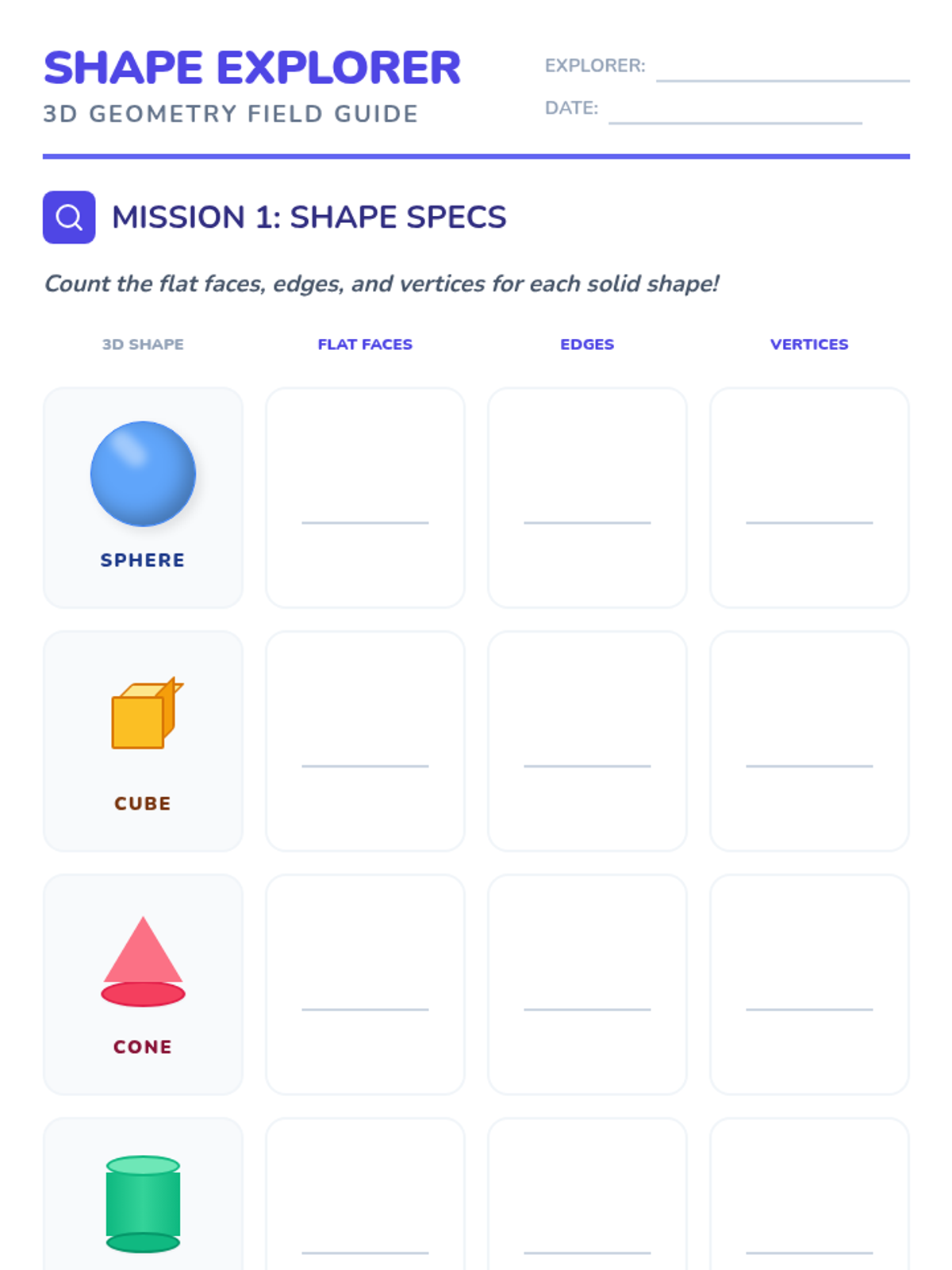
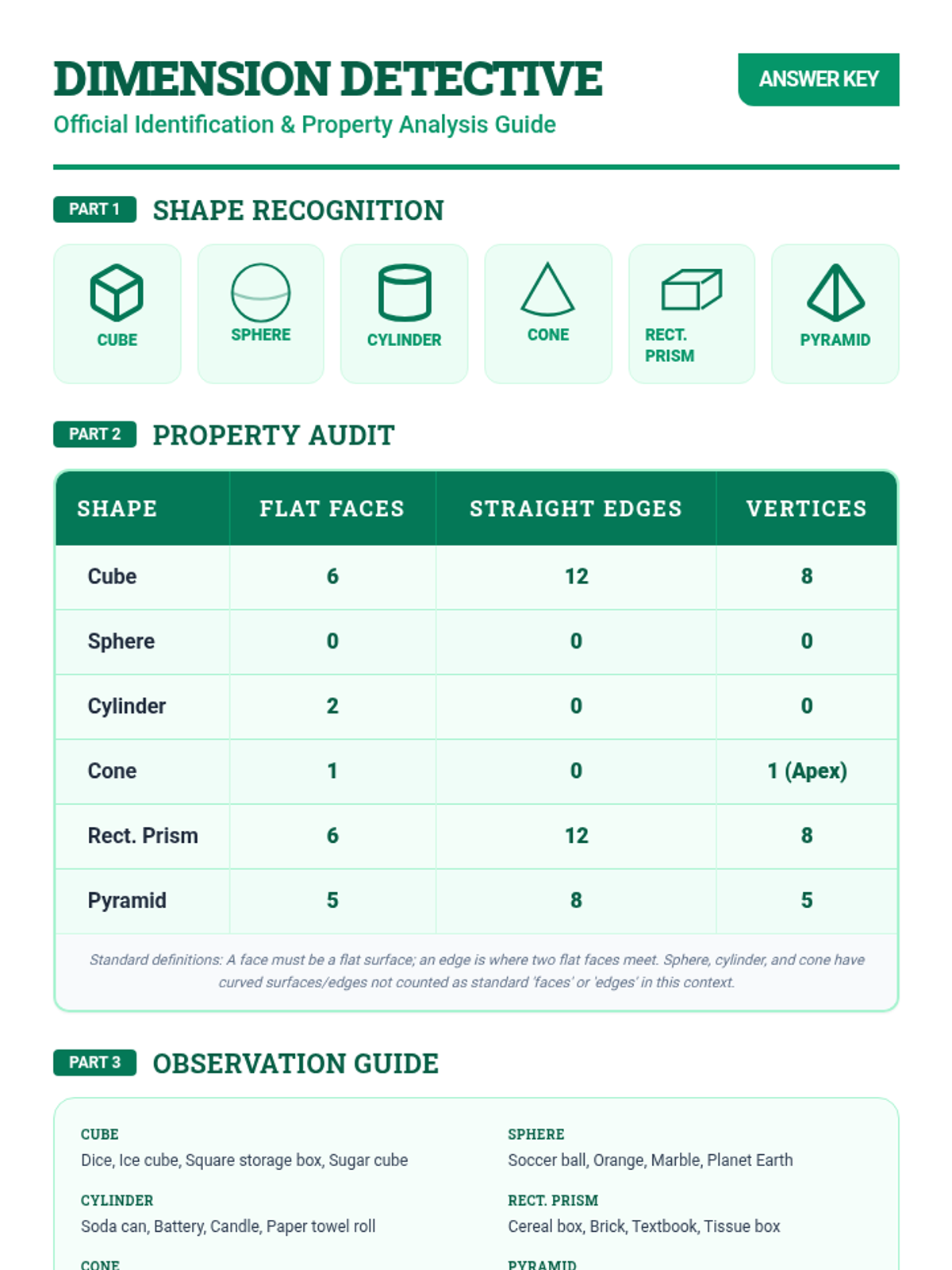
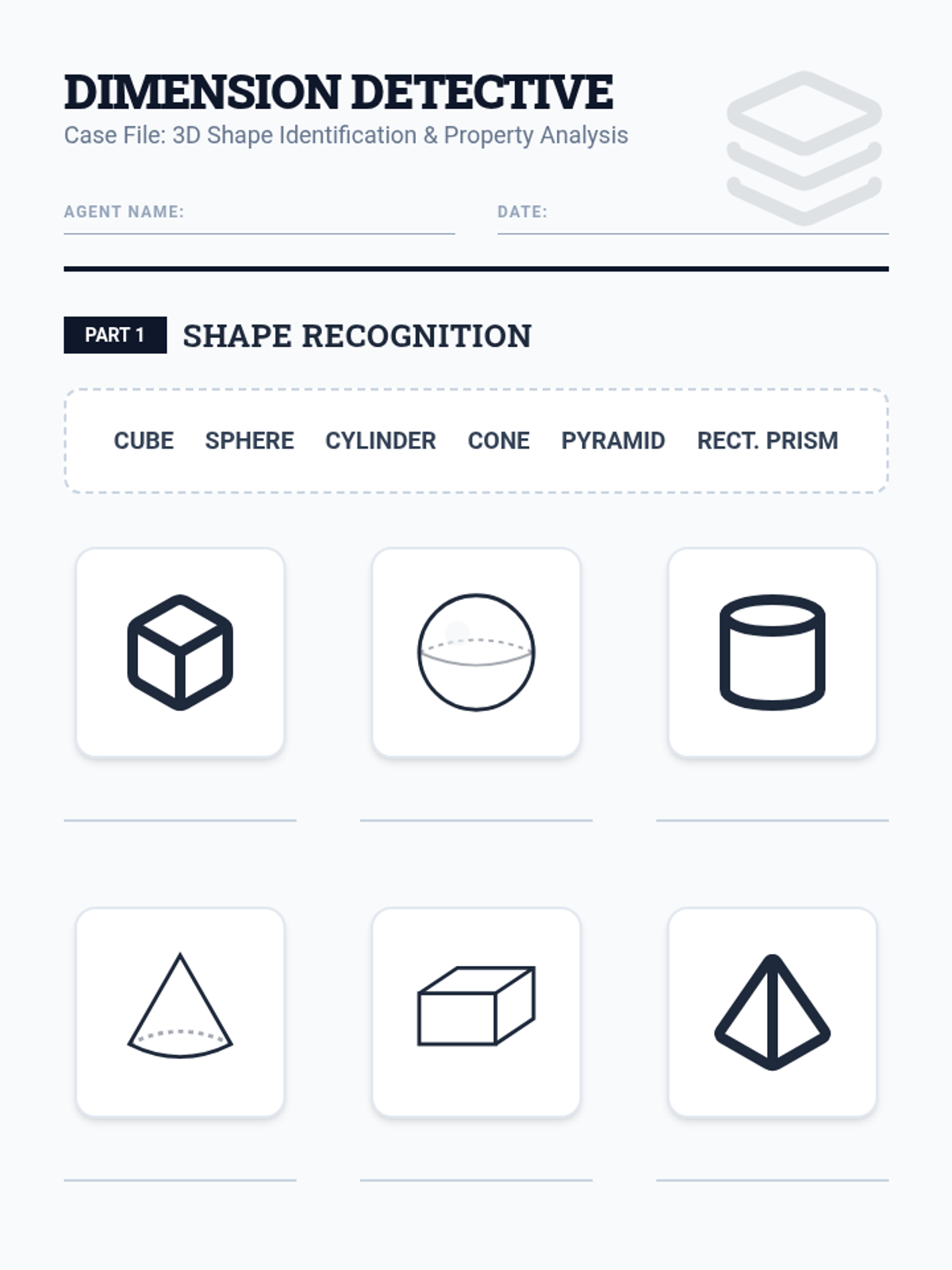
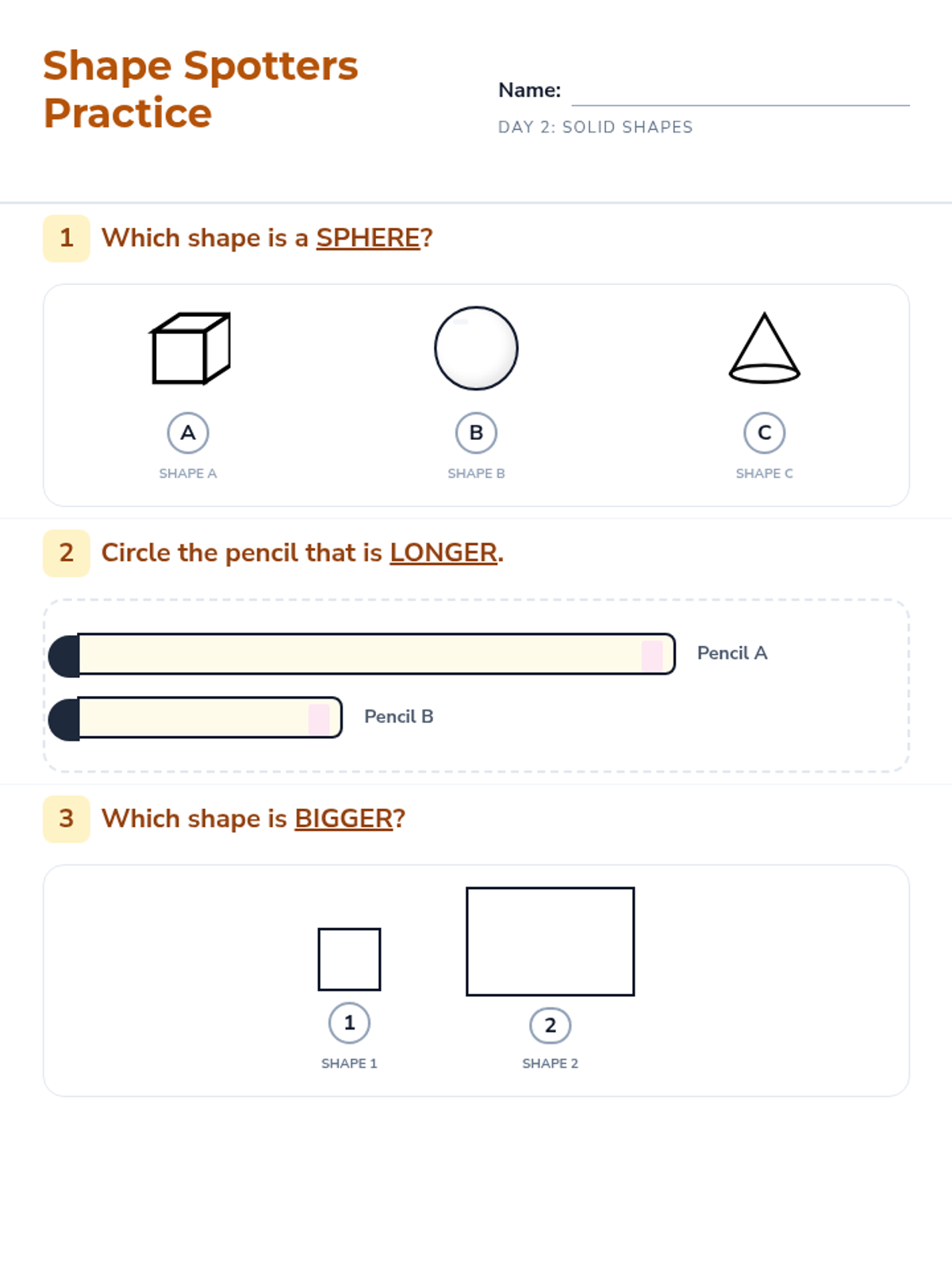
A visual presentation introducing 3D shapes (sphere, cube, cylinder, cone, rectangular prism, pyramid) and their attributes, including stacking, rolling, and sliding.
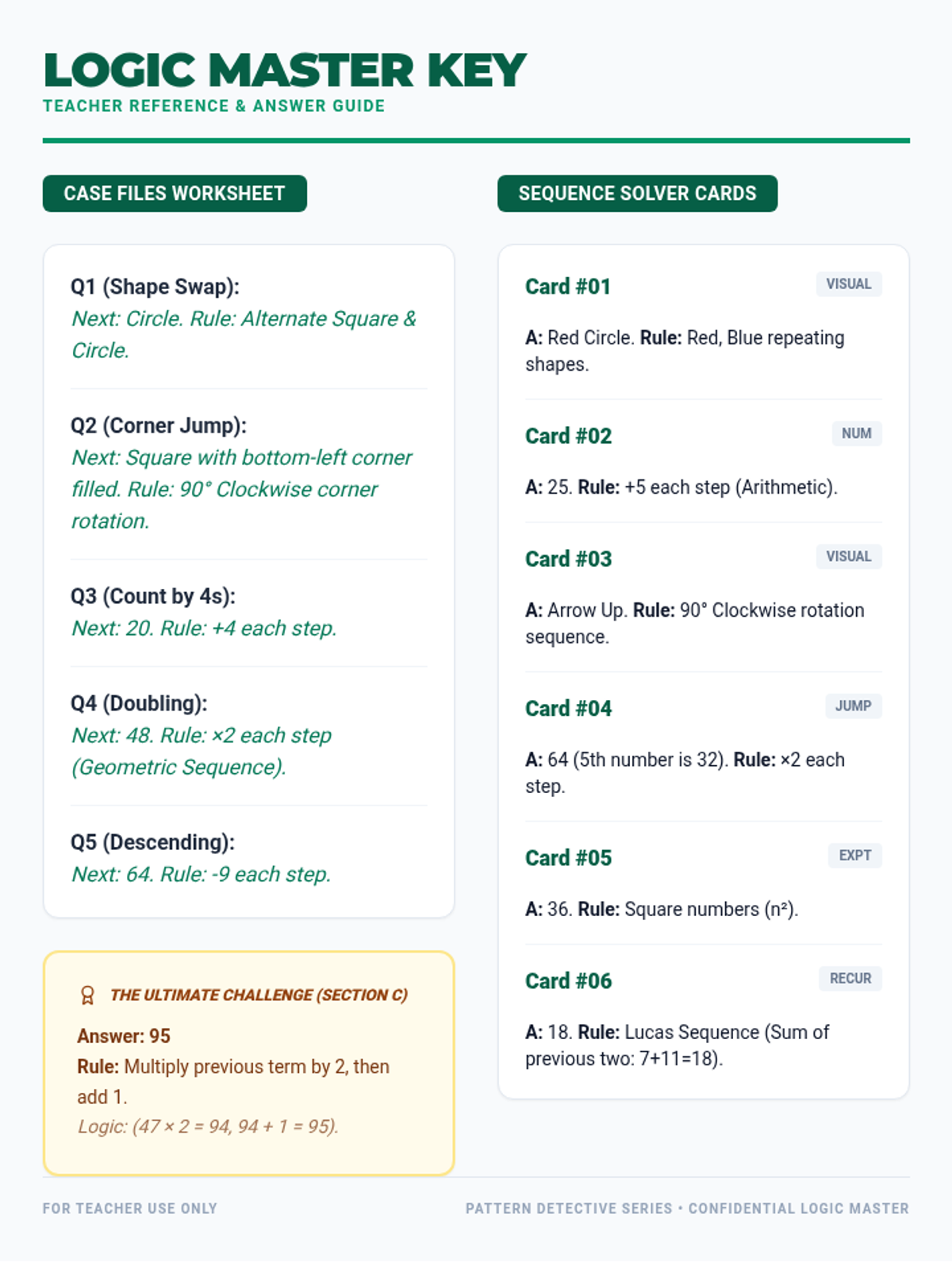
Teacher guidance and answer keys for the Pattern Detectives lesson, including differentiation strategies for various learning levels.
Level 3 mats for advanced learners, featuring growing patterns and a 'Creation Station' for students to design their own complex sequences, now optimized for a single page layout.
Level 2 mats for advanced learners, featuring ABC, AAB, and ABB patterns with internal missing elements to challenge pattern recognition.
Level 1 mats for beginning learners, focusing on simple AB and AABB repeating patterns with clear extension areas.
An engaging slide deck introducing shape patterns (AB, AABB, ABC, ABB) and growing patterns with a detective theme.
A student recording sheet for the Pattern Picnic math station. Students record the card numbers they completed, draw/color the resulting patterns, and even create a unique pattern of their own.
A teacher facilitation guide for the Pattern Picnic math station, including setup instructions, station procedures, and differentiation strategies for K-1 students.
A comprehensive set of 16 task cards for a math station, ranging from simple AB patterns to challenging AAAB and mystery missing-middle sequences. Designed for use with standard shape manipulatives.
A vibrant, student-friendly anchor chart that visually defines and demonstrates AB, AAB, and ABBA shape patterns. Redesigned to fit perfectly on a single 8.5x11 page.
A visual anchor chart 'Field Guide' for students to keep as a reference, clearly distinguishing between defining (sides, corners, closed) and non-defining (color, size, direction, material) attributes of shapes.
A quick progress monitoring assessment for students to justify shape categorization based on defining attributes.
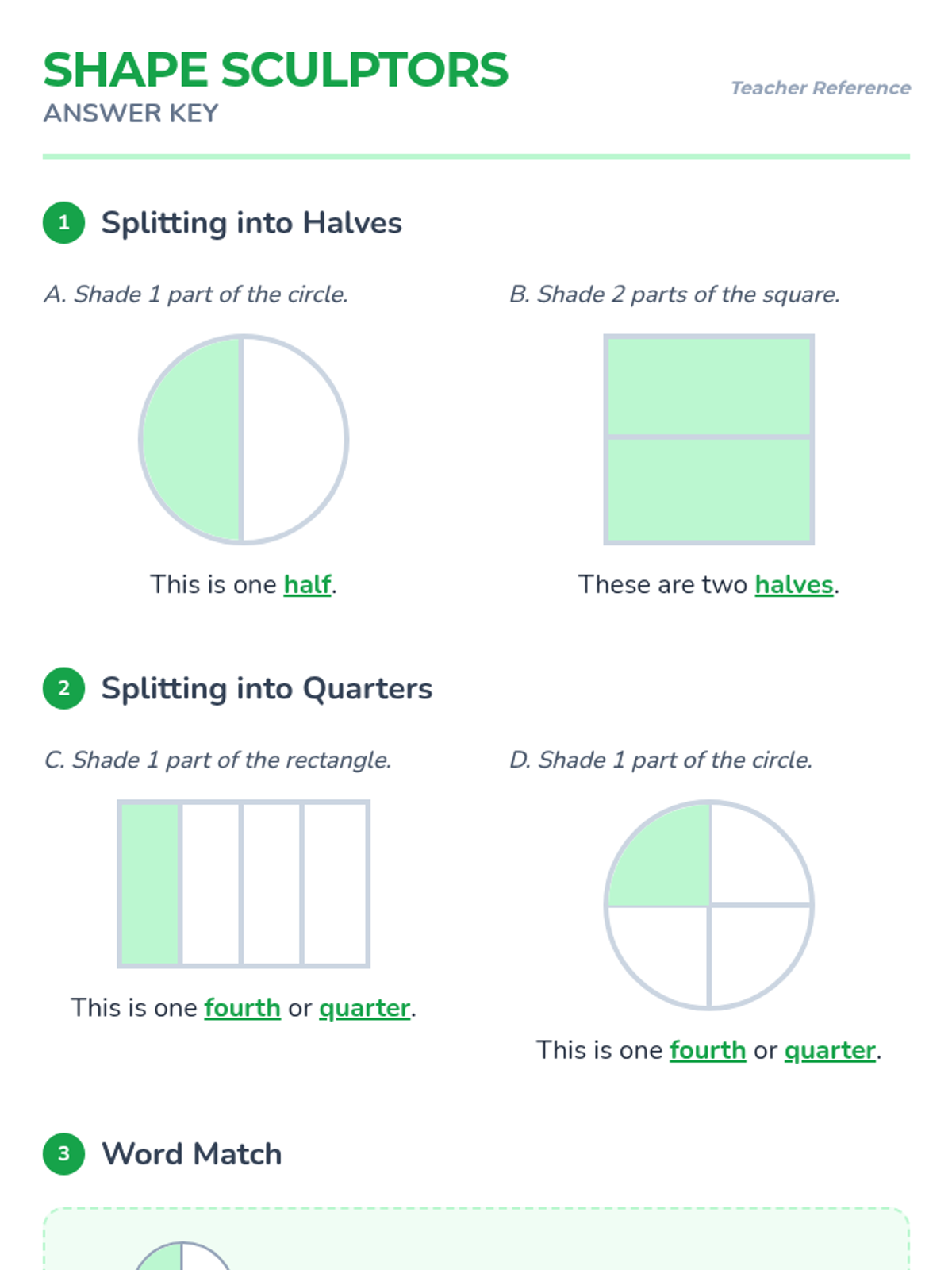
An answer key for the Fair Share Worksheet, providing correct partitioning examples and answers to the concept check and sharing story assessment.
A guide for teachers on facilitating the triangle extension lesson, including differentiation strategies for special education students.
A workspace mat for students to build triangles using sticks and dough balls, with clear areas for counting sides and corners.
Visual presentation introducing triangles, focusing on counting 3 sides and 3 corners with large visuals and clear text.
A comprehensive instructional guide for teachers to lead the Shape Detectives lesson, including warm-up prompts, video timestamps, activity instructions, and key debriefing questions.
A printable set of various squares and rectangles in different orientations to be cut out and used for the shape sorting activity.
A specialized sorting mat for students to categorize paper shapes into 'Squares' or 'Rectangles' based on their investigated side lengths.
A vibrant presentation for Kindergarten/1st Grade students introducing the 'Shape Detectives' theme, featuring key vocabulary (equal, parallel), a video embed, and visual side-length comparisons.
A student exit ticket focused on applying the lesson's core concept. Students must draw a non-square quadrilateral and explain why it doesn't meet the criteria for a square. Two tickets are provided on one page for easy printing.
A 2-page student worksheet featuring a T-chart for sorting shapes into 'Squares' and 'Not Squares' (non-square rectangles), plus a dedicated cutout page with 9 varied quadrilateral samples for the activity.
A vibrant 16:9 presentation for the 'Square Secret' lesson, including warm-up prompts, the embedded 'Describing and Naming Shapes' video, clear definitions with visual aids, and step-by-step activity instructions.
A comprehensive teacher facilitation guide for 'The Square Secret' lesson, including learning objectives, a detailed 40-minute timeline with video pause points, and a materials checklist.
Teacher guidance for the final project, including the warehouse answer key, a mastery rubric, and exit interview questions.
A student sorting project where they cut out various shapes and glue them into categories (3-sided, 4-sided, 6-sided, and non-polygons). Includes the sorting bins and the inventory sheet.
Introductory slides for the final mastery challenge, setting up the 'Shape Warehouse' scenario and review of classification rules.
Teacher guidance for Lesson 4, focusing on hexagon identification strategies and facilitating the kinesthetic 'Shape Twister' game.
Activity cards for 'Shape Twister', featuring triangles, quadrilaterals, hexagons, pentagons, and trick cards like curved lines.
Introductory slides for Lesson 4, expanding polygon identification to hexagons and reinforcing side-counting strategies.
Teacher guidance for Lesson 3, focusing on distinguishing squares from rectangles through straw-building and hierarchical classification.
A student building mat for creating squares and rectangles with straws. Includes discovery prompts about side lengths and corner types.
Introductory slides for Lesson 3, focusing on distinguishing squares from rectangles based on side length equality. Includes the 'straw build' challenge instructions.
Teacher guidance for the 'The Family of Four' lesson, focusing on introducing quadrilaterals, square corners, and the classroom scavenger hunt.
A student activity sheet including a cut-out 'L-checker' tool and a recording table for a classroom scavenger hunt to find objects with square corners.
Introductory slides for Lesson 2, focusing on defining quadrilaterals and introducing the concept of square corners (right angles) as a key identifying feature of rectangles and squares.
A student worksheet for the Shape Shifters Yoga lesson where students draw a rectangle and label its key geometric features (right angles and parallel lines).
A vibrant, high-contrast presentation for the Shape Shifters Yoga lesson, including warm-up prompts, the embedded video, guided yoga poses, and a final recap of rectangle characteristics.
A comprehensive facilitator guide for the Shape Shifters Yoga lesson, including pacing, teacher scripts, video pause points, and yoga pose descriptions.
A comprehensive teacher guide for the Monster Mirror Magic lesson, including equipment lists, step-by-step facilitation instructions, and specific video discussion cues.
A creative writing extension sheet where students write a short story and develop a profile for their symmetrical monster creation.
Visual presentation slides to guide students through the symmetry land video, key concepts of reflection, and the step-by-step monster-making activity.
A structured art activity and analysis worksheet where students create a paint-blot symmetrical monster, identify its line of symmetry, and document matching features.
Large-format vocabulary cards for 'Parallel', 'Rectangle', 'Opposite', and 'Side' with clear visual definitions for 1st-grade learners.
A comprehensive teacher guide for the 'Railway Rectangles' lesson, featuring step-by-step facilitation instructions, discussion prompts, and differentiation strategies.
A vibrant, 1st-grade-friendly slide deck for the 'Railway Rectangles' lesson, including the Khan Academy Kids video embed, guided warm-up instructions, and activity steps.
A 1st-grade worksheet focused on identifying and coloring parallel sides on a rectangle, featuring a 'train track' theme to match the lesson's warm-up.
A comprehensive facilitator guide for the Alphabet Symmetry Lab, including lesson objectives, prep instructions, video pause points, and an answer key for the letter sorting activity.
A set of printable shapes (butterfly, heart, leaf, star) with dotted lines for students to cut out and fold to physically experience symmetry.
A final exit ticket for the Symmetry Detectives lesson, requiring students to draw one symmetrical object with its line of symmetry and one asymmetrical object.
A field-journal style drawing worksheet for students to document their symmetrical nature finds and mark the line of symmetry.
A collection of large block letters inside dashed cutting guides for students to cut, fold, and test for symmetry during the Alphabet Sort activity.
A student activity sheet for the Symmetry Detectives lesson, providing five large drawing spaces for students to sketch symmetrical classroom objects and their lines of symmetry.
A vibrant slide deck for teaching symmetry to young students, featuring interactive letter challenges, a video embed, and nature-themed examples.
A visual presentation for the Symmetry Detectives lesson, featuring a triangle warm-up, an embedded summary video recap, mission instructions for the classroom search, and a 'Clock Mystery' discussion slide.
A student sorting worksheet with four categories (Vertical, Horizontal, Both, and Asymmetrical) designed for pasting block letters after testing for symmetry.
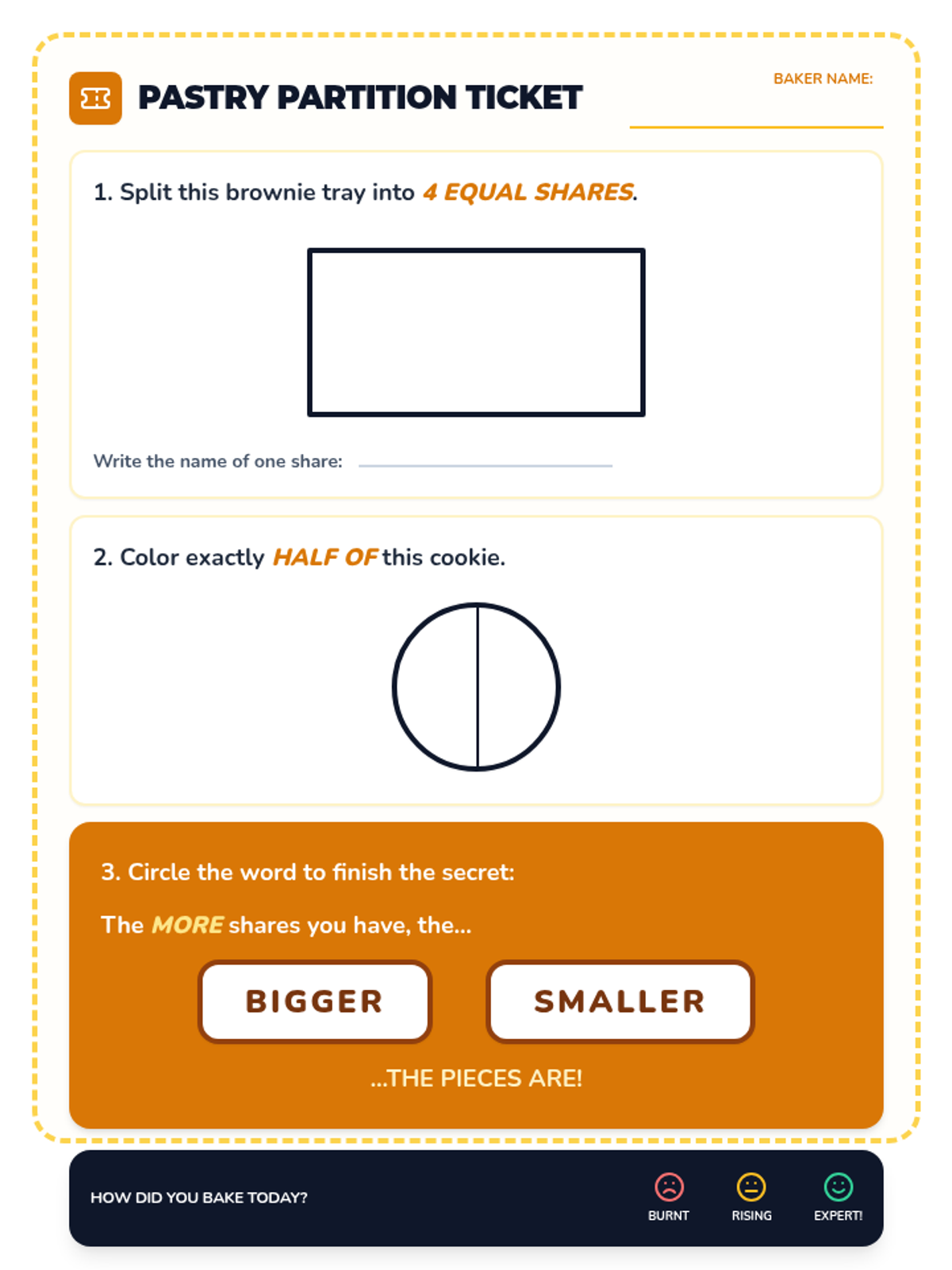
A short assessment tool for progress monitoring. Students must partition a circle into halves and a rectangle into fourths, label the shares, and answer a conceptual question about relative share sizes. Designed for Tier 2 progress tracking.
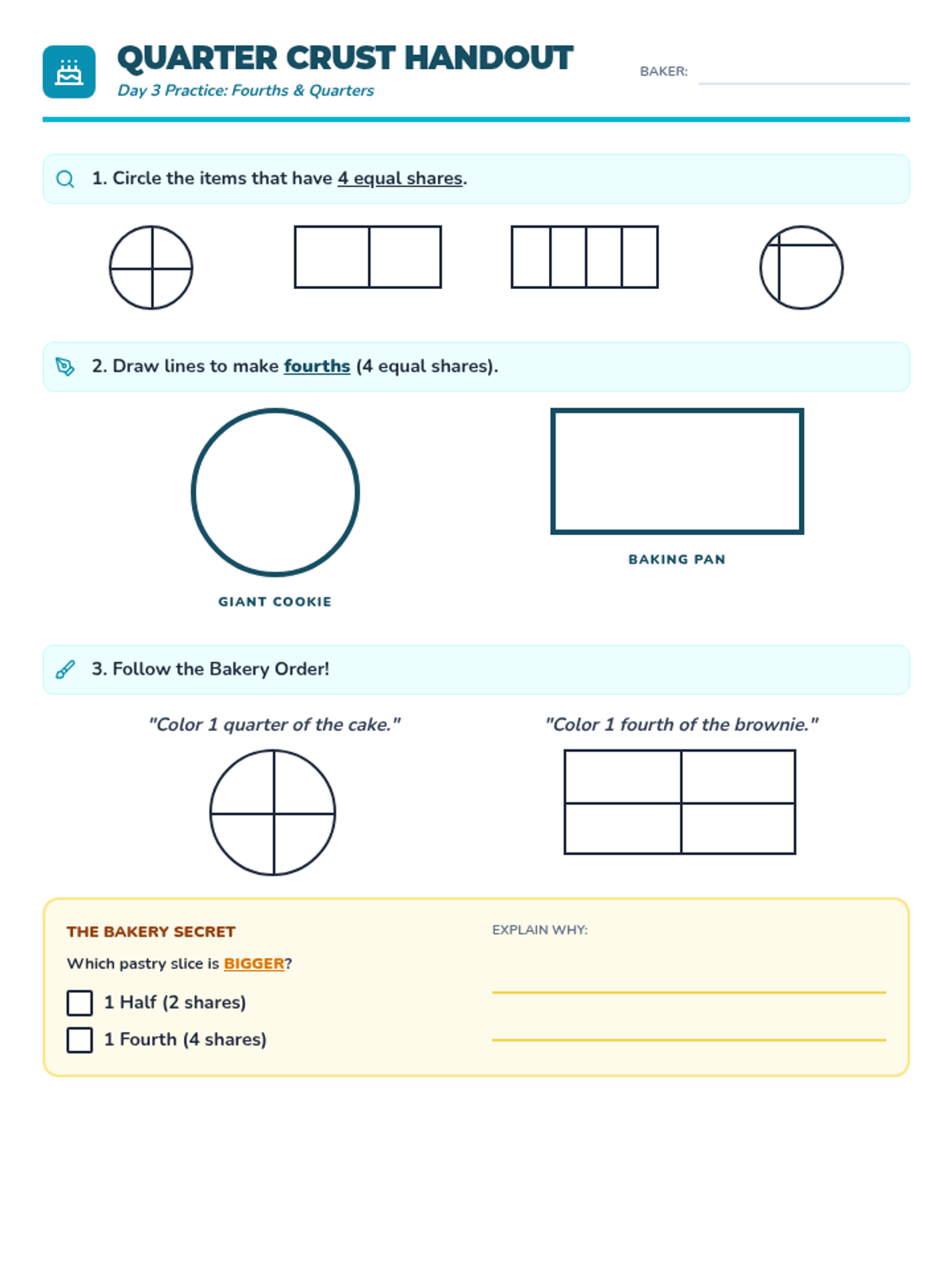
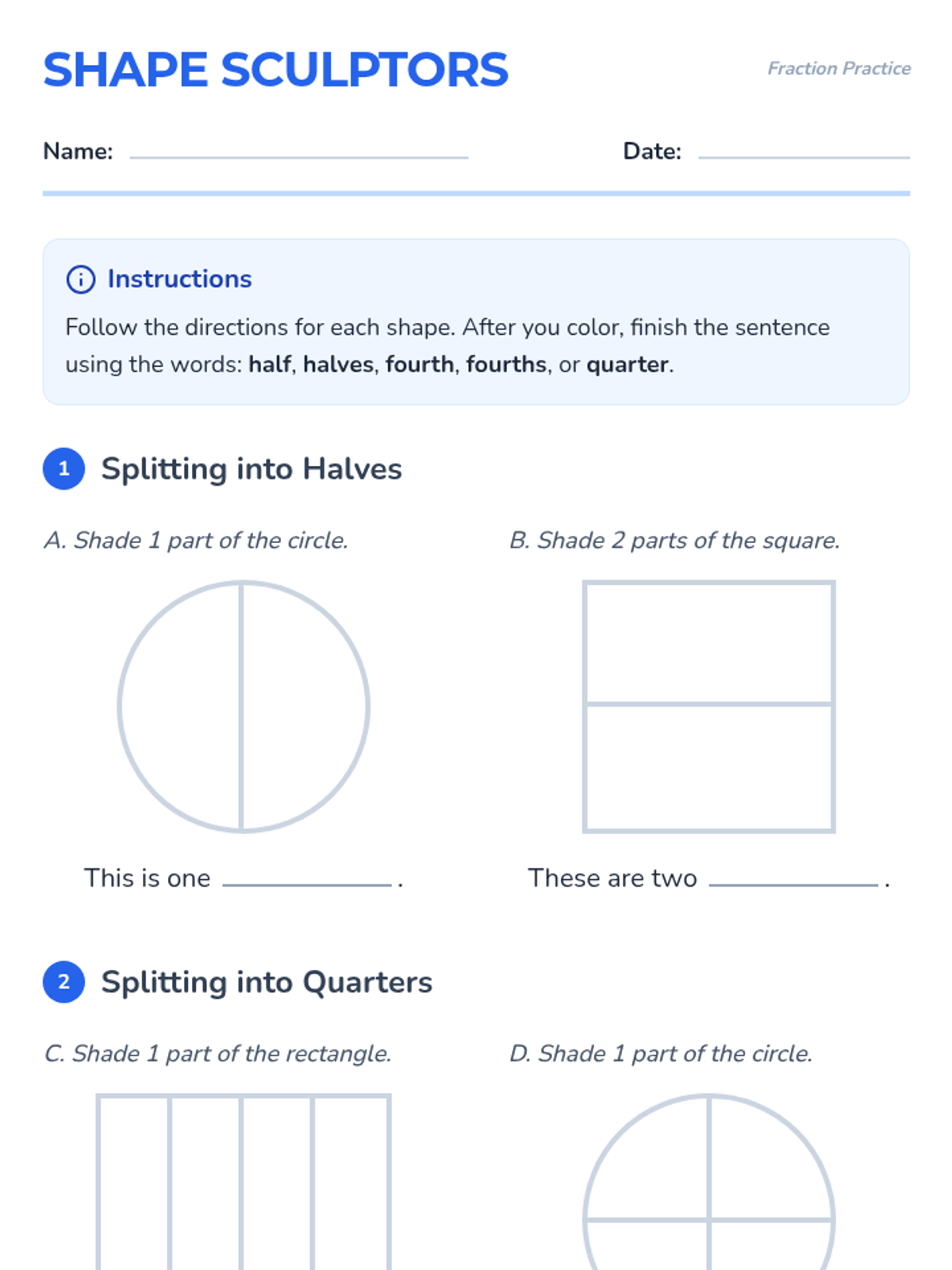
A scaffolded practice worksheet for Grade 1 students to practice partitioning shapes. It guides students through tracing and drawing lines to create halves and fourths, concluding with a visual comparison task.
Printable paper circles and rectangles designed for Grade 1 students to cut out and fold. These manipulatives are sized for easy handling and include dashed cutting lines to support the concrete phase of partitioning instruction.
A visual presentation for teaching partitioning concepts to Grade 1 students. Includes definitions of equal shares, visual comparisons of halves and fourths, and the key concept that more shares result in smaller pieces. Designed with large text and high-contrast visuals for Tier 2 support.
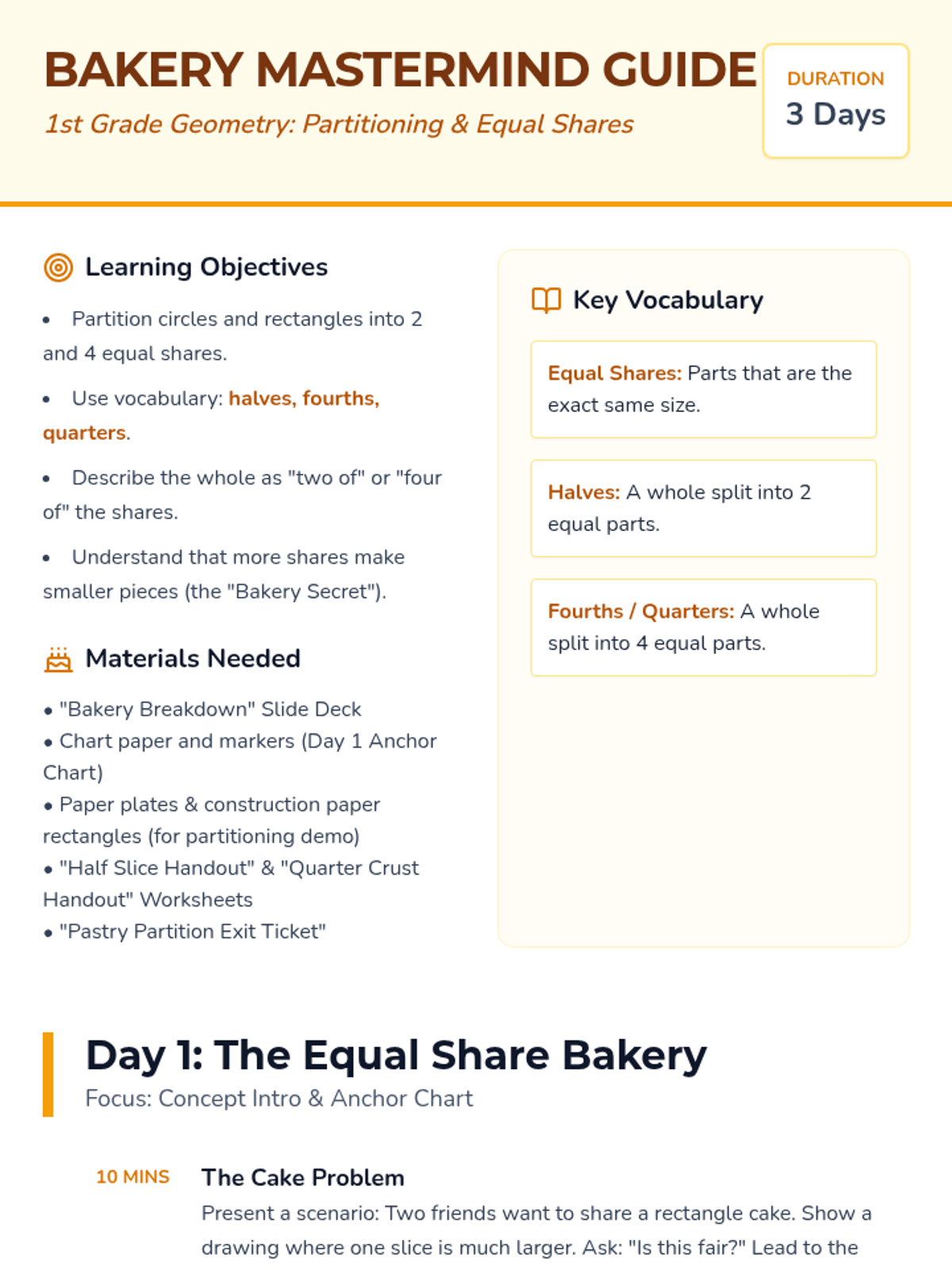
A comprehensive teacher facilitation guide for a Tier 2 intervention lesson on partitioning. Includes standard alignment, materials list, a three-phase instructional sequence (concrete, guided,Discovery), common misconceptions, and specific scaffolding strategies for small-group support.
A visual scavenger hunt worksheet for K-1 students to practice positional words. Includes large drawing areas and icons for 'on top', 'under', 'next to', and 'behind'.
A bright and interactive slide deck for the Position Pursuit lesson, featuring a Simon Says warm-up, embedded video, and visual practice for positional words.
A comprehensive teacher facilitation guide for the Position Pursuit lesson, including a 'Simon Says' warm-up, video pause points, and instructions for a classroom scavenger hunt.
A set of printable flashcards featuring common real-world objects that correspond to 3D shapes (Cube, Cuboid, Cylinder, Cone, Sphere), providing visual examples for classroom use.
Printable materials for the Mystery Shape lesson, including large numbered labels for mystery boxes and desk reference cards that summarize the attributes of common geometric solids for students.
A comprehensive teacher guide for the Shape Detectives lesson, including learning objectives, materials, vocabulary, and a step-by-step facilitation guide with video pause points.
A comprehensive teacher's guide for the Mystery Shape Detectives lesson. Includes mystery box setup instructions, a pacing guide, and specific prompts for the silent video narration and tactile investigation.
A 2nd-grade recording sheet for the Mystery Box activity. Students check off tactile attributes (faces, corners, edges) and write their predictions for the hidden geometric solids. Includes a reflection section and a helpful shape word bank.
A scavenger hunt checklist for 1st-grade students to find and record real-world examples of 3D shapes (Cube, Cuboid, Cylinder, Cone, Sphere).
A visual presentation for 2nd grade students covering 3D shape attributes (faces, edges, vertices) and guiding them through a silent video narration and the Mystery Box activity. Includes embedded video instructions and clear tactile learning goals.
A visual presentation for a 1st-grade lesson on 3D shapes, featuring an embedded instructional video, attribute breakdowns, and activity instructions.
A classroom anchor chart comparing 'on vs. above' and 'under vs. below' with clear visual examples for young learners.
A comprehensive teacher guide for the Position Patrol lesson, including learning objectives, material lists, and a detailed instructional script with video timestamps.
Interactive presentation slides for the Position Patrol lesson, featuring a warm-up challenge, embedded instructional video, and clear visual comparisons of positional words.
A visual scavenger hunt checklist for kindergarten and 1st-grade students to practice identifying positions (above, on, below, under) of classroom items.
A comprehensive teacher guide for the Sky High Shapes lesson, featuring pacing, discussion prompts, and video pause points.
A student worksheet for drawing kite frames, measuring them with non-standard units, and completing a diamond sail design.
Engaging slides for a 1st-grade geometry lesson featuring the 'Let's Make a Kite' video, shape identification, and non-standard measurement concepts.
Student activity worksheet for the Pattern Block Puzzle challenge, designed with large visual recording areas and simple 'Equal/Not Equal' check-boxes for 1st-3rd grade SPED students.
Large printable chocolate bar prop with designated cut lines to demonstrate 'fair' (equal) versus 'unfair' (unequal) shares during the lesson warm-up.
Set of large-scale printable shape mats (Square, Hexagon, Circle, Rectangle) designed for students to practice creating equal shares using physical manipulatives like pattern blocks and square tiles.
A full-page, themed graph paper with 1st-grade-appropriate square sizing for architectural area design and array practice.
Interactive slide deck for the Hands-On Equal Shares lesson, featuring embedded Khan Academy video, pause-and-build challenges, and visual reinforcement for 1st-3rd grade SPED students.
A student worksheet for the Blueprint Builders lesson where students outline and color rectangles with specific areas (6, 9, and 12 squares).
A visual presentation for the Blueprint Builders lesson, featuring skip counting warm-ups, the Khan Academy area video, and step-by-step activity instructions.
A comprehensive teacher facilitation guide for the Hands-On Equal Shares lesson, featuring step-by-step instructions, video pause points, and specific scripting for 1st-3rd grade SPED instruction.
A comprehensive teacher facilitation guide for the Blueprint Builders lesson, including pacing, skip counting prompts, and specific video pause points.
Teacher answer key for the 'Pizza Shares Exit Ticket', clearly identifying correct and incorrect partitioning of shapes.
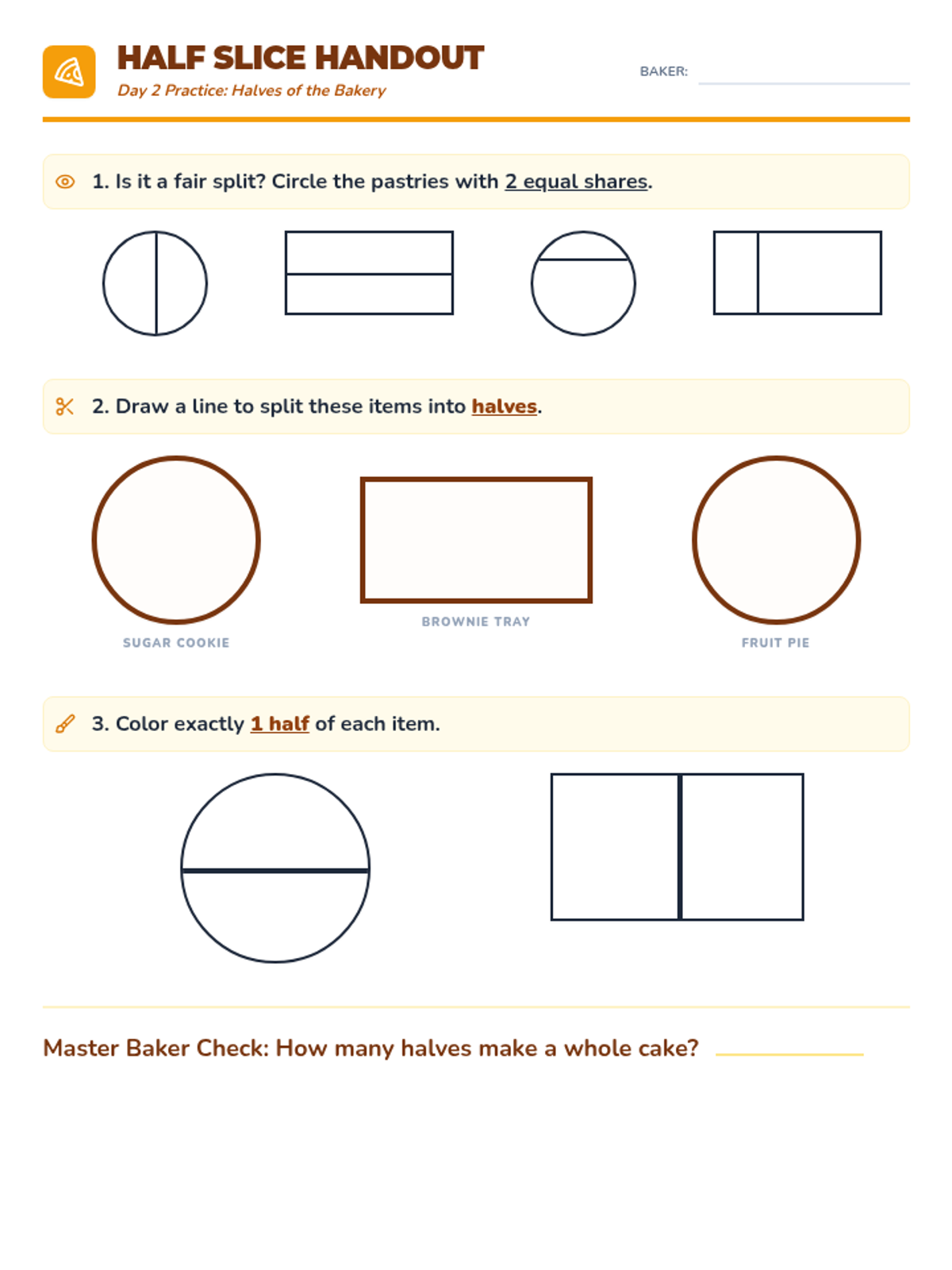
A formative assessment for 1st-grade students to identify equal shares (halves and fourths) and match them to the correct terminology.
A fun, pizza-themed laminated placemat for students to use as a workspace for Play-Doh fraction partitioning activities.
Engaging slide deck for teaching fractions to 1st graders, featuring a pizza shop theme, embedded YouTube video, and clear visual definitions of halves and fourths.
A comprehensive teacher guide for the 'Pizza Fraction Fun' lesson, including a warm-up activity, video discussion prompts, and a step-by-step Play-Doh activity guide for 1st-grade students.
A student report for Lesson 5's Great Volume Challenge. Includes space for the jar number, smart estimate, final count, and a reflection on the accuracy of the estimation.
A set of interactive slides for Lesson 5, introducing the concepts of estimation, smart guesses, and the 'Great Volume Challenge' contest.
A student blueprint recording sheet for Lesson 4. Students use this to sketch three different structures built from the same number of unit cubes, demonstrating that volume is conserved regardless of shape.
Scaffolded 3D shape composition cards that challenge students to build specific structures using solid blocks and identify the components used.