Mapping relationships through notation, algebraic representations, and growth rate comparisons. Equips learners to transform functions, model contextual data, and solve exponential equations.
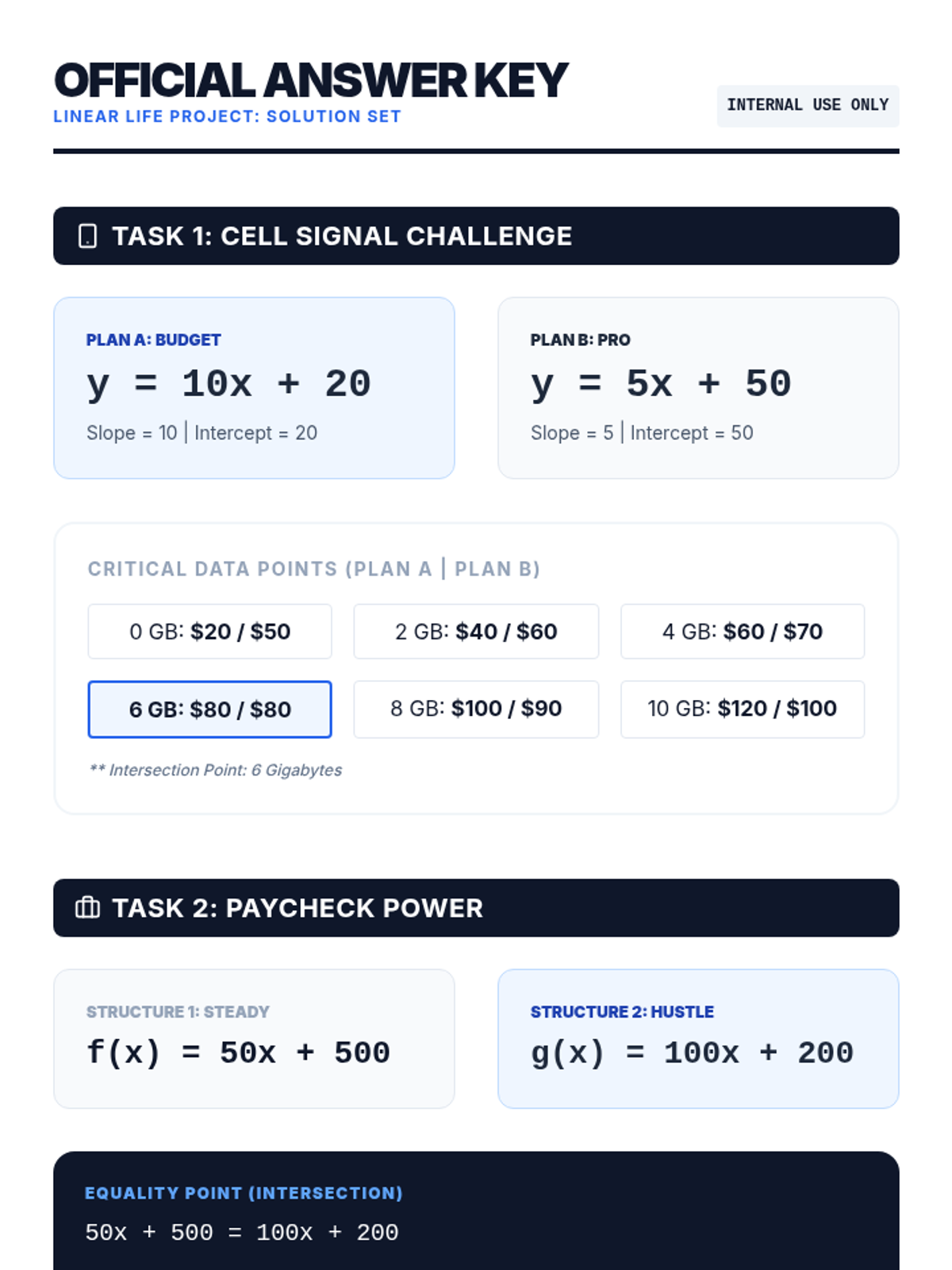
Revised answer key for the Linear Life project. Fixed mathematical notation, improved visual contrast, and ensured each task's solutions are contained on a single page for teacher ease of use.
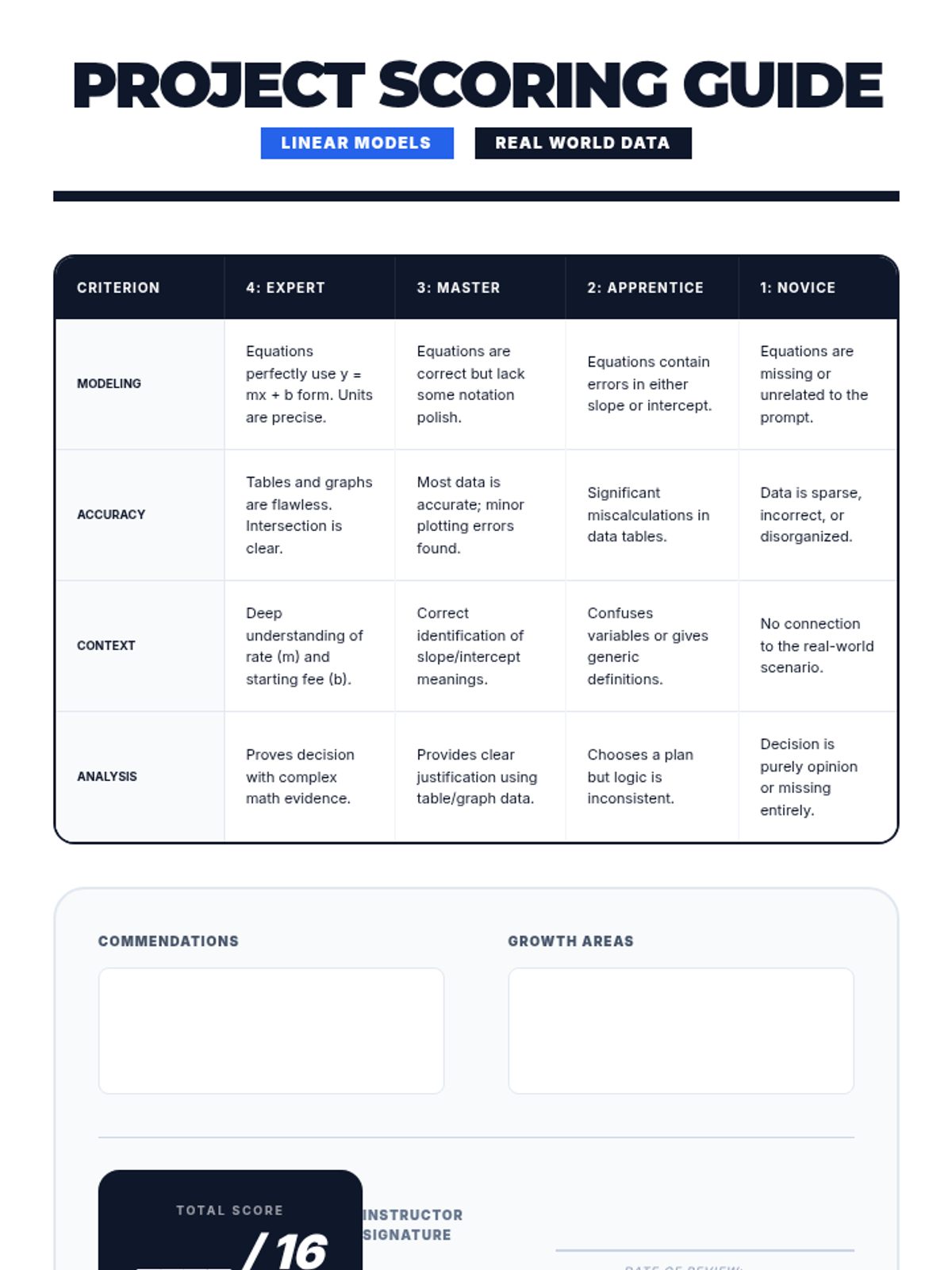
Revised grading rubric for the Linear Life project. Added Level 1 criteria, fixed math notation, and optimized layout to ensure the feedback section and grading block stay on one page.
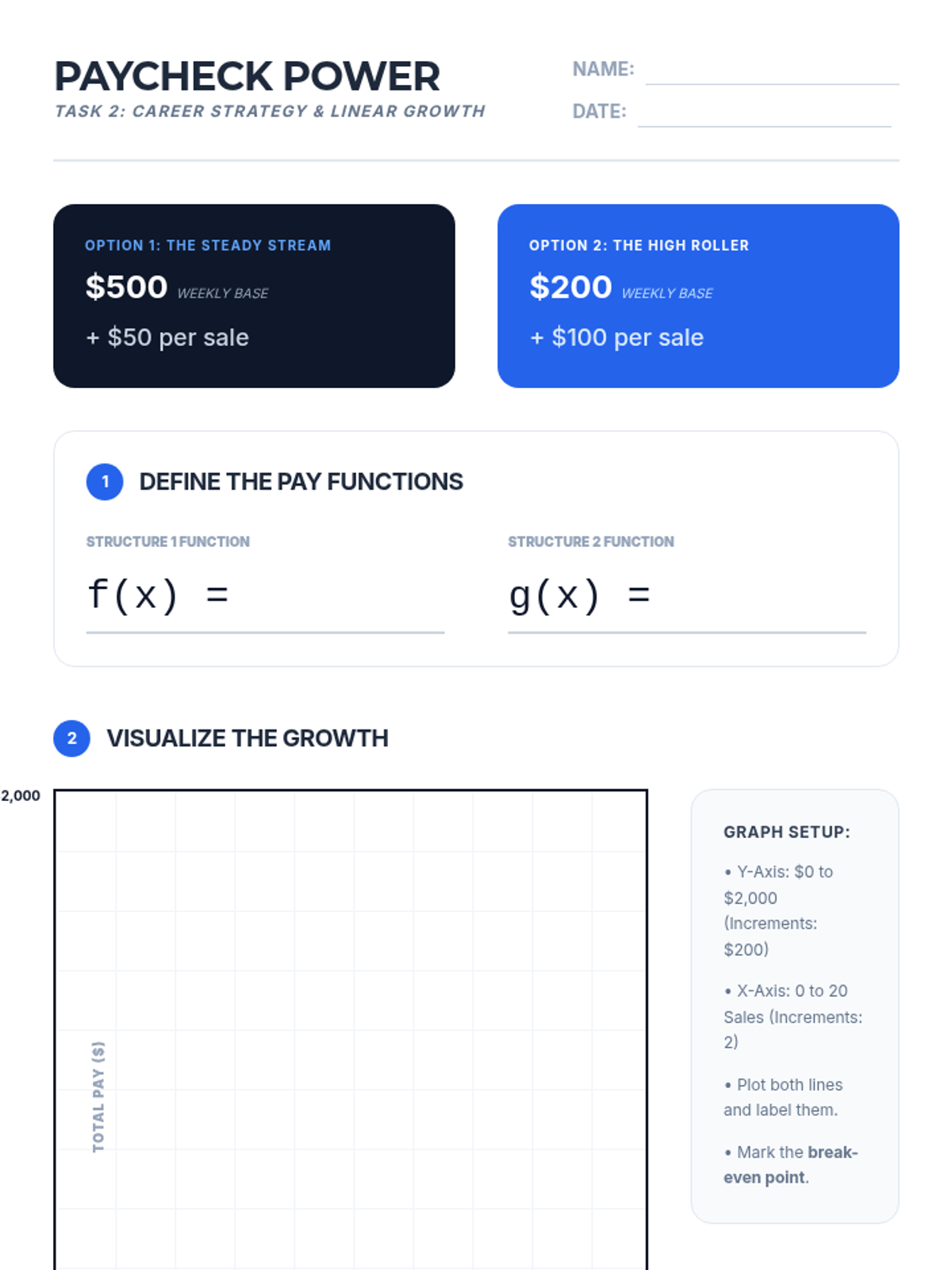
Revised student worksheet for Task 2. Improved graph rendering with a stable CSS grid, fixed page breaks, and optimized work areas for student handwriting.
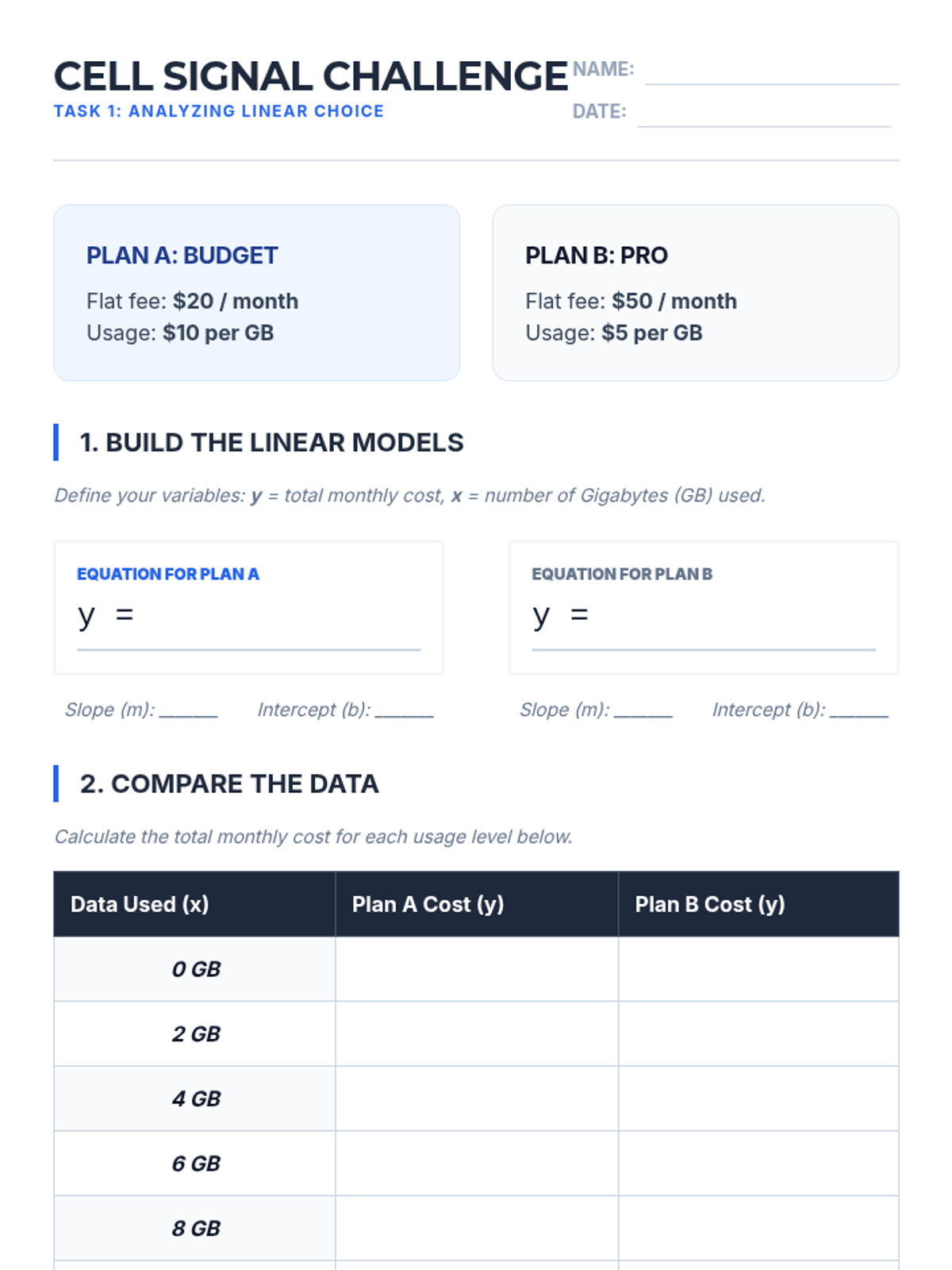
Revised student worksheet comparing two cell phone plans. Fixed page breaks, improved work areas, and clarified variable definitions.
Presentation slides for the Linear Life project, introducing slope and y-intercept in the context of cell phone plans and career commission structures. Revised with specific Task 2 data.
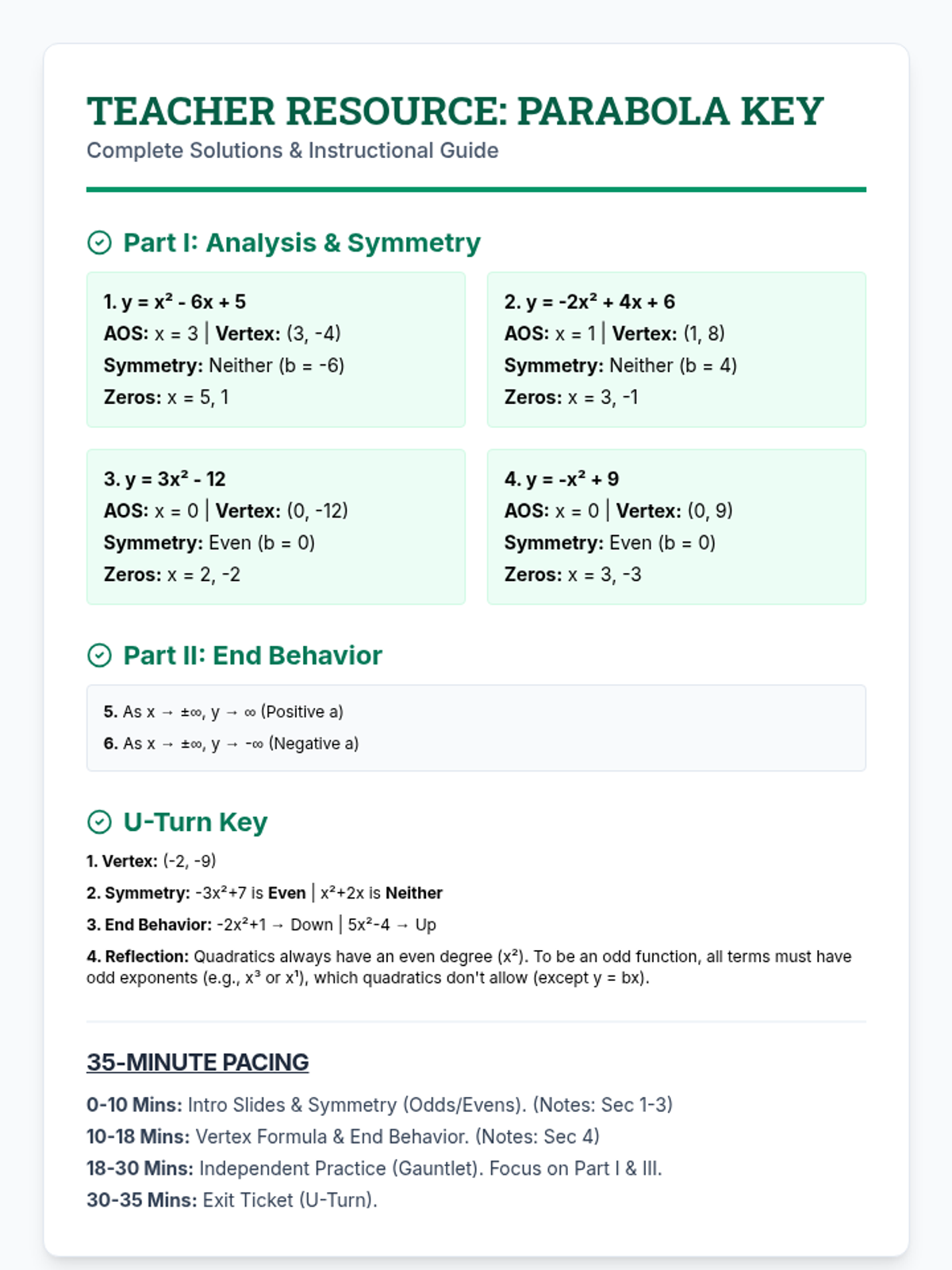
Teacher-facing answer key and instructional guide for the Parabola Party lesson, including solutions for symmetry (even/odd) and full pacing instructions. renumbered and improved solution font size.
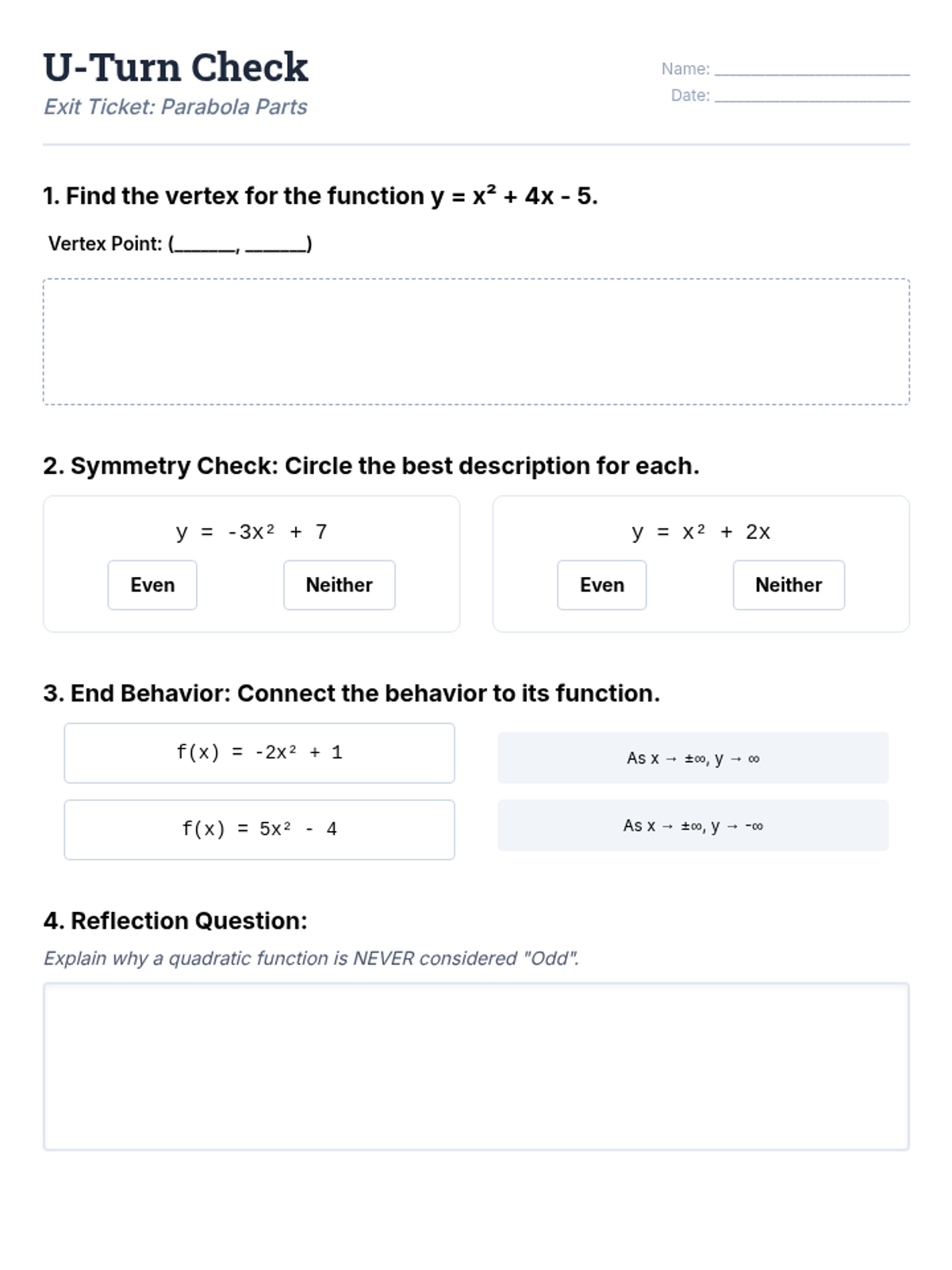
A quick learning check or exit ticket to assess student understanding of finding the vertex, matching end behavior, parity rules, and the conceptual nature of quadratics. fixed latex rendering and improved work area space.
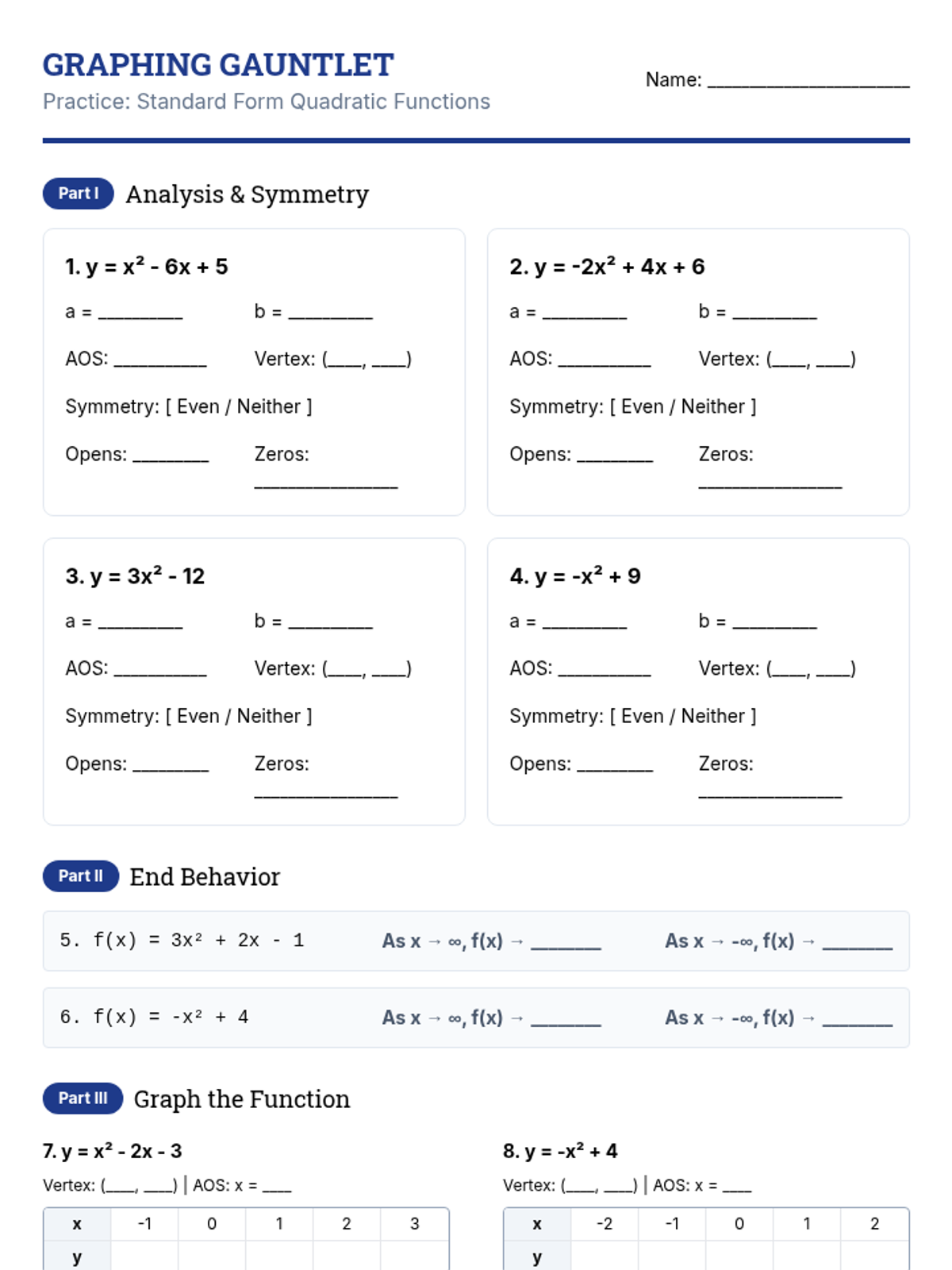
A practice worksheet with mixed difficulty problems for graphing quadratic functions in standard form, including analyzing key features, sketch graphs, and symmetry rules. term "Symmetry" used for better clarity. improved table and graph layouts.
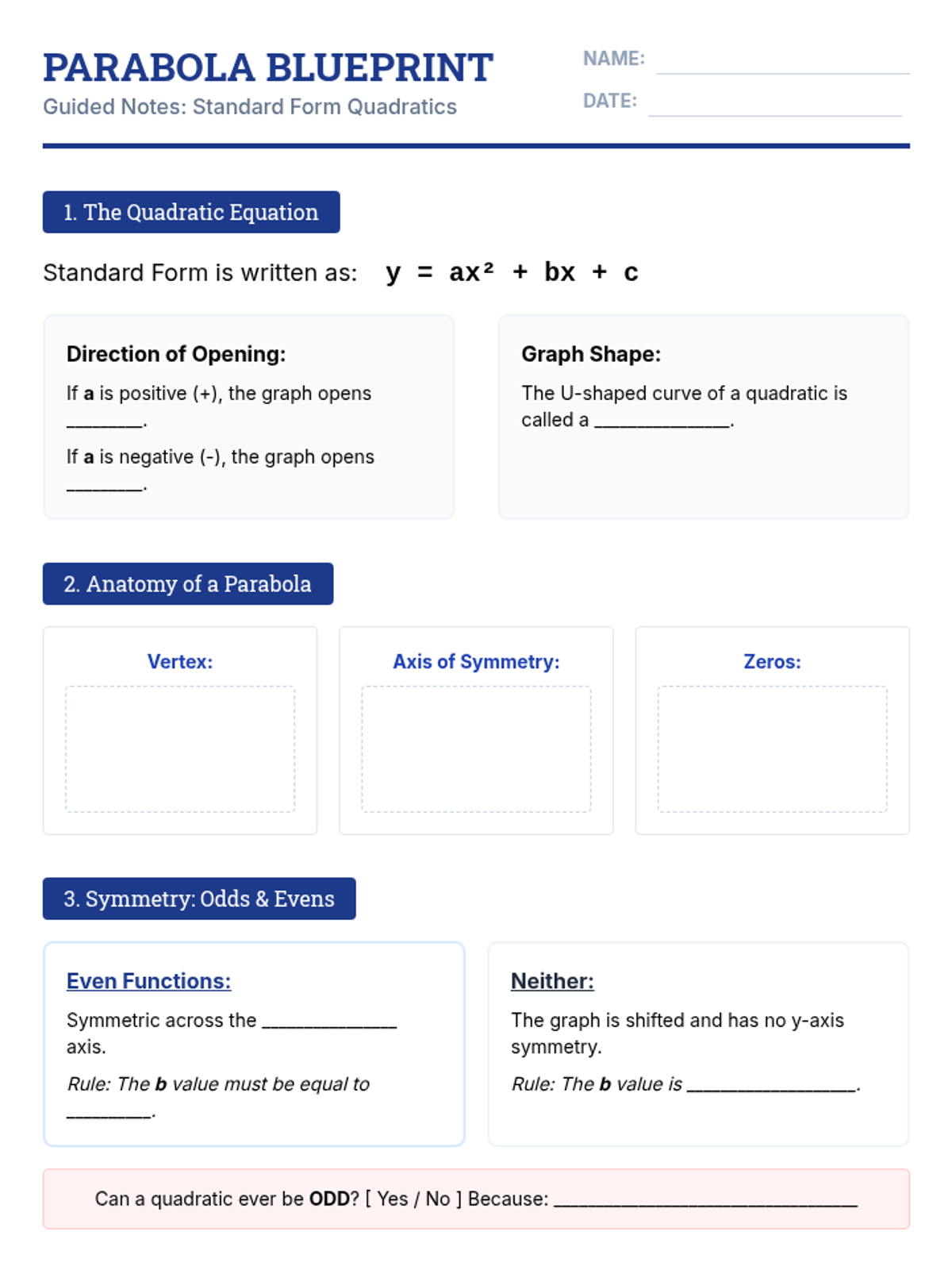
Guided notes for students to follow along during the Parabola Party lesson, including fill-in-the-blank sections for the vertex formula, anatomy, and even/odd parity rules. improved spacing and layout.
A visual slide deck teaching the fundamentals of graphing parabolas in standard form, including vertex calculation, axis of symmetry, end behavior, and zeros. now includes rules for even and odd functions.
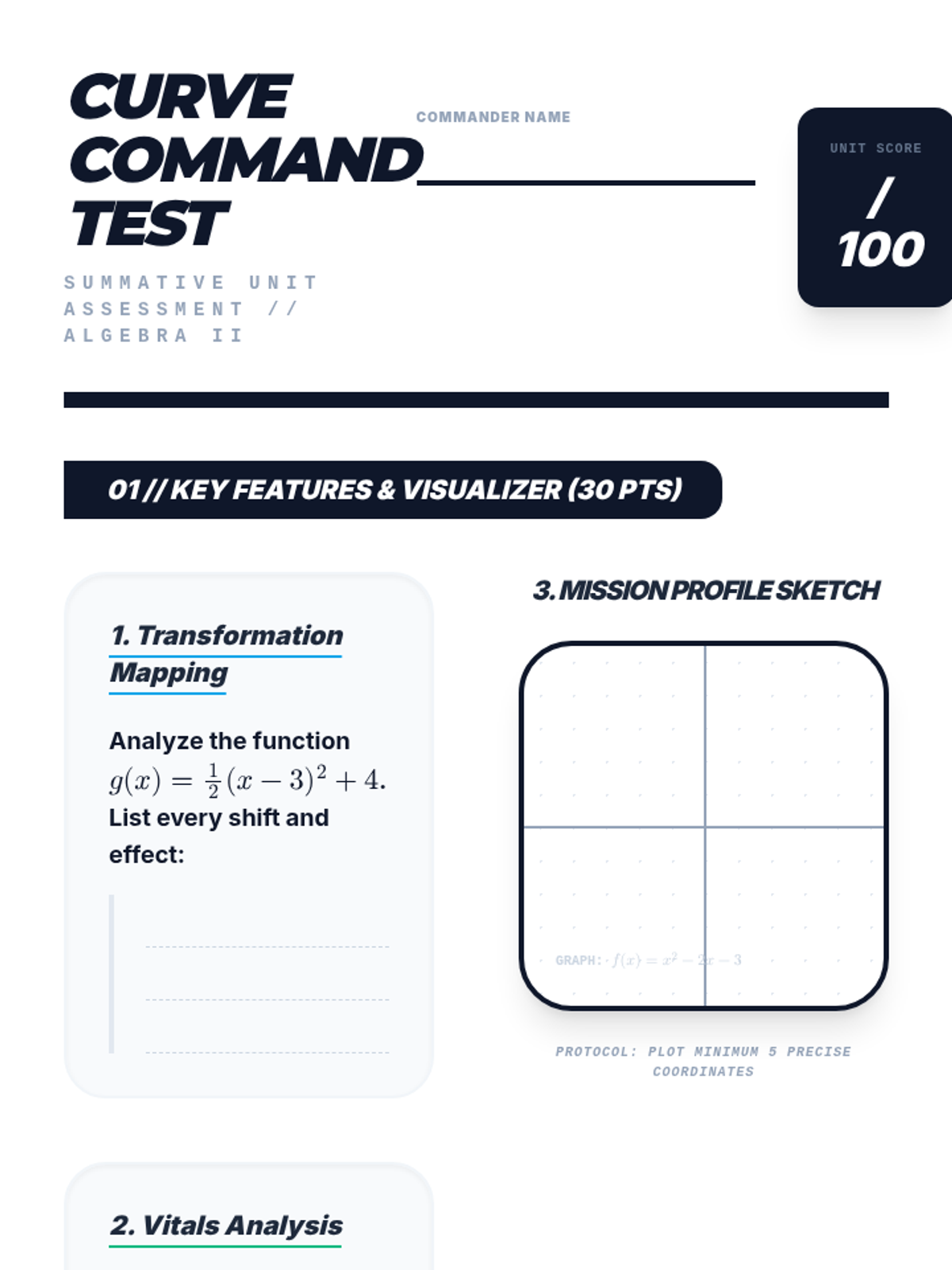
A comprehensive unit test for Algebra II students covering all quadratic targets including transformations, graphing, features, and solving methods.
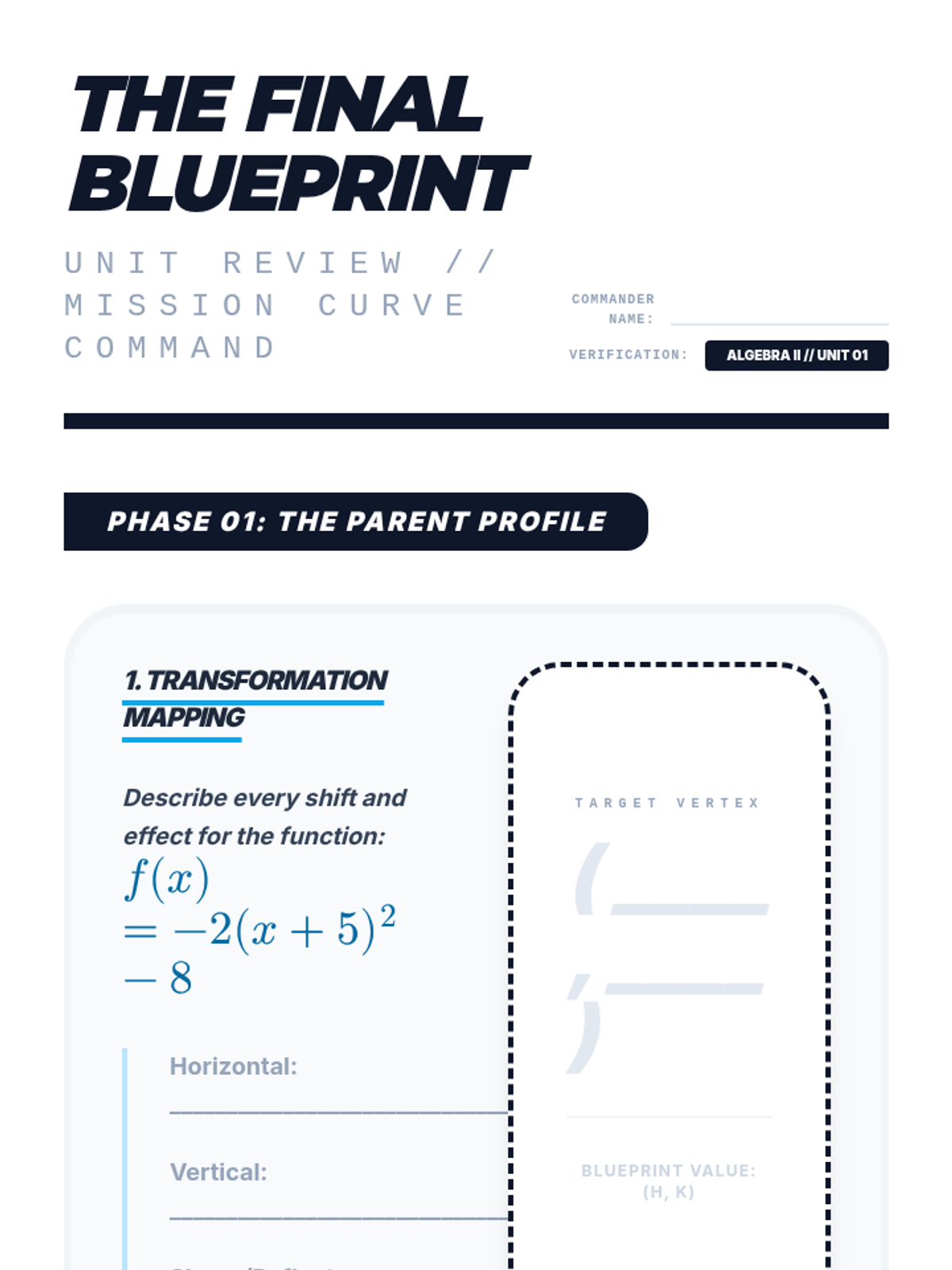
A comprehensive unit review packet covering parent functions, key features from standard form, and all solving methods for quadratic equations.
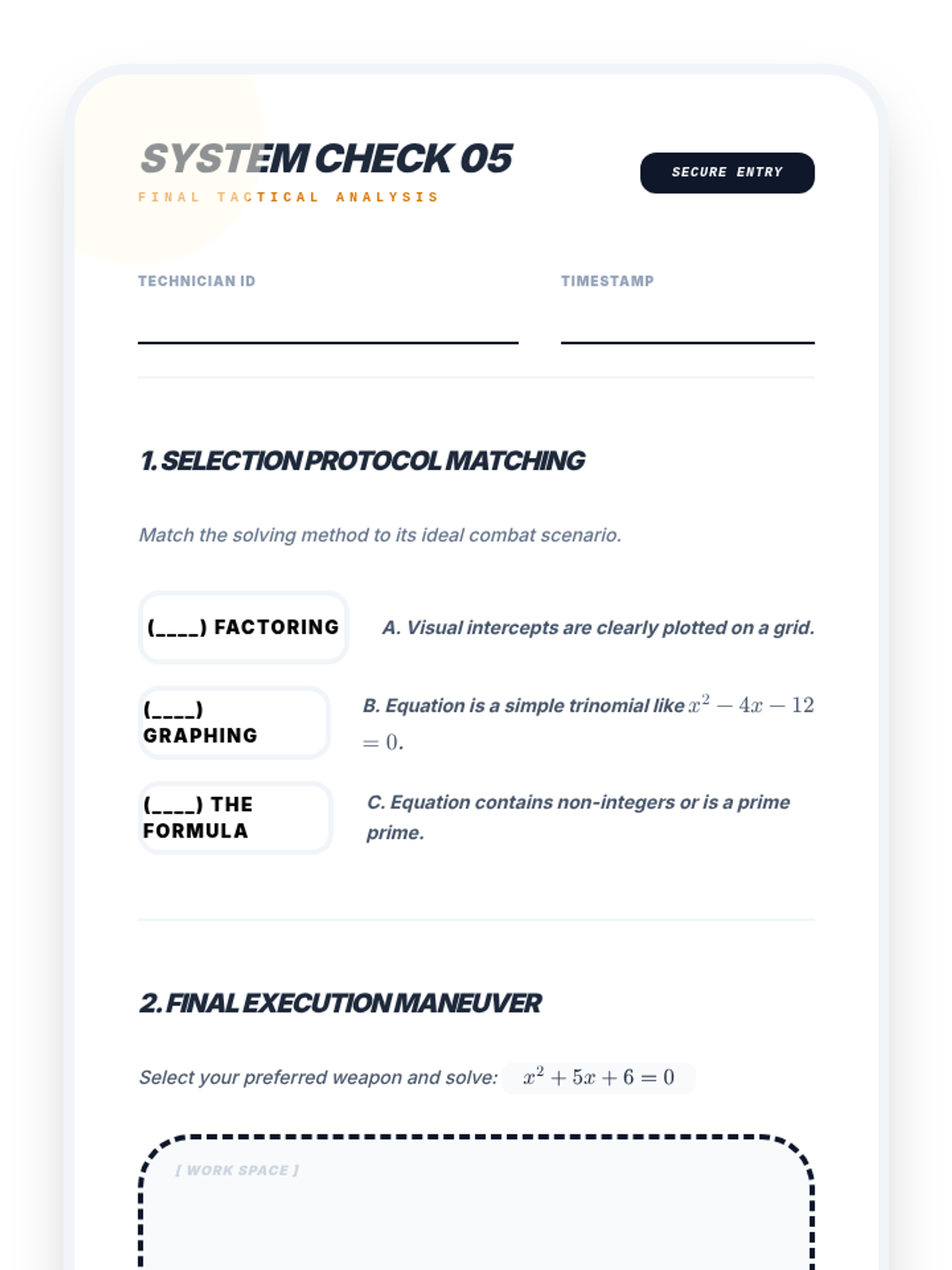
A formative assessment to evaluate students' ability to select and apply different quadratic solving methods correctly.
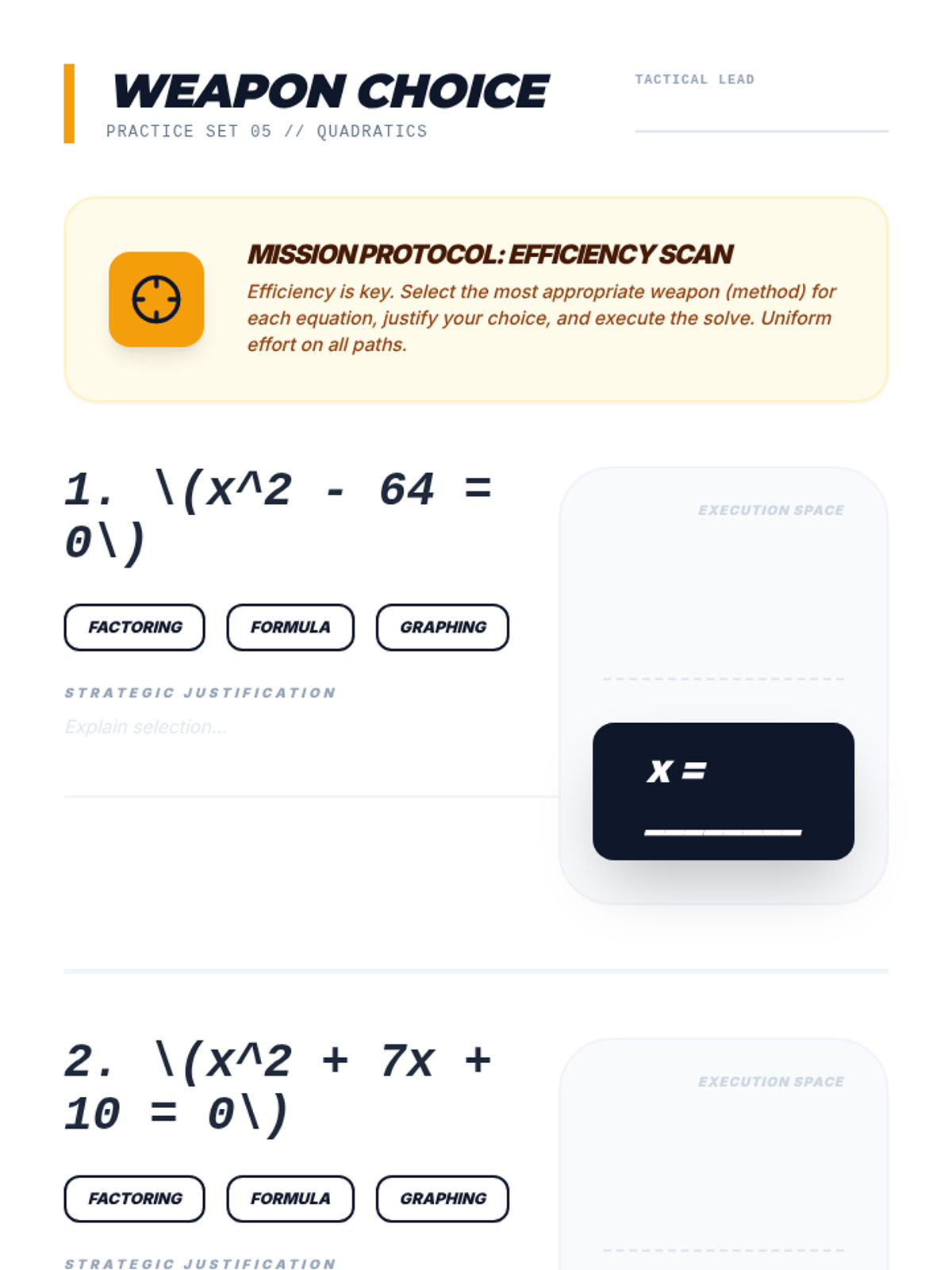
A worksheet focusing on identifying the most efficient method to solve a quadratic equation and executing the solution.
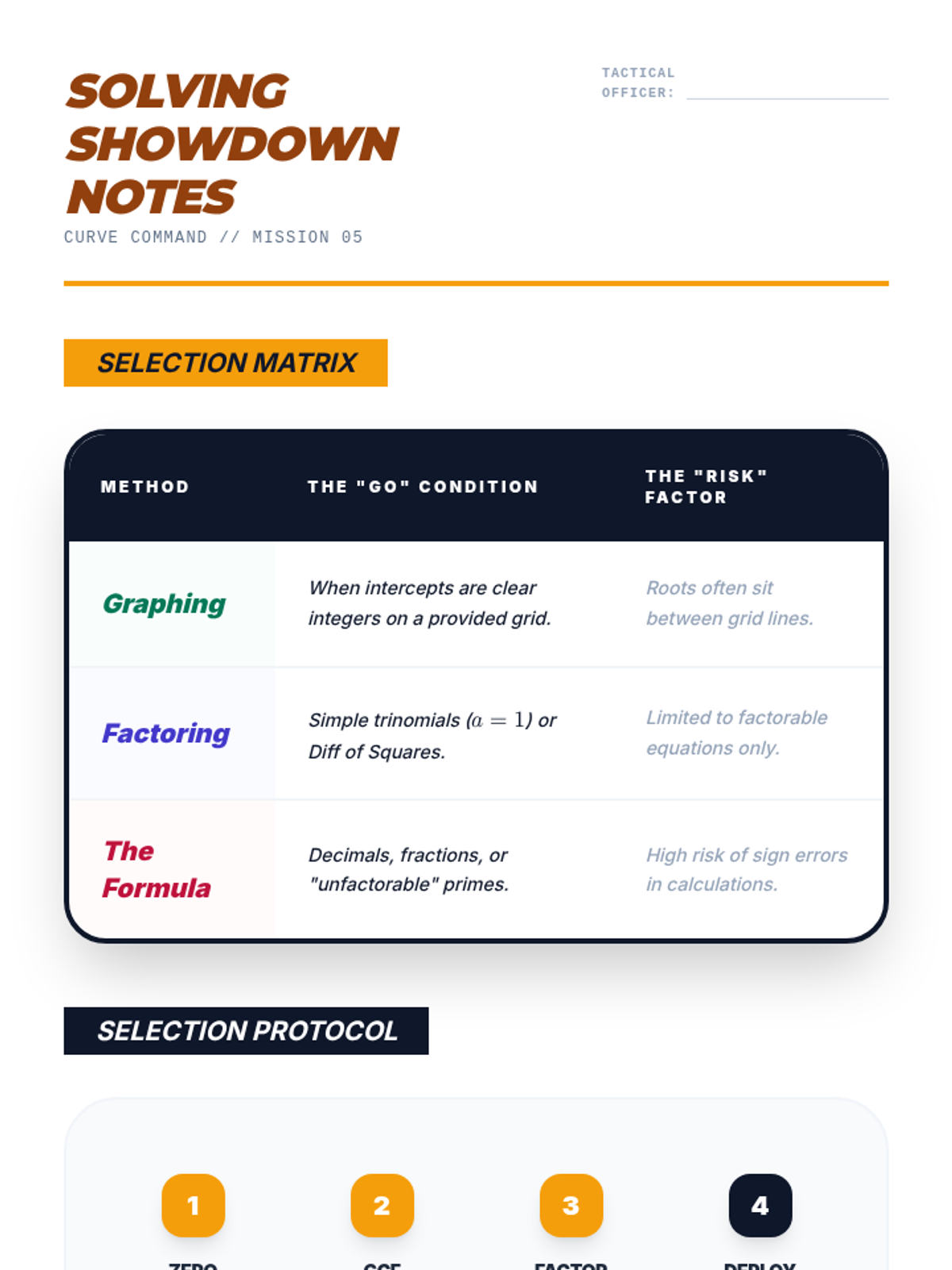
Guided notes for Lesson 5, focusing on strategy selection for solving different types of quadratic equations.
A slide deck comparing solving methods for quadratic equations, helping students decide when to graph, factor, or use the formula.
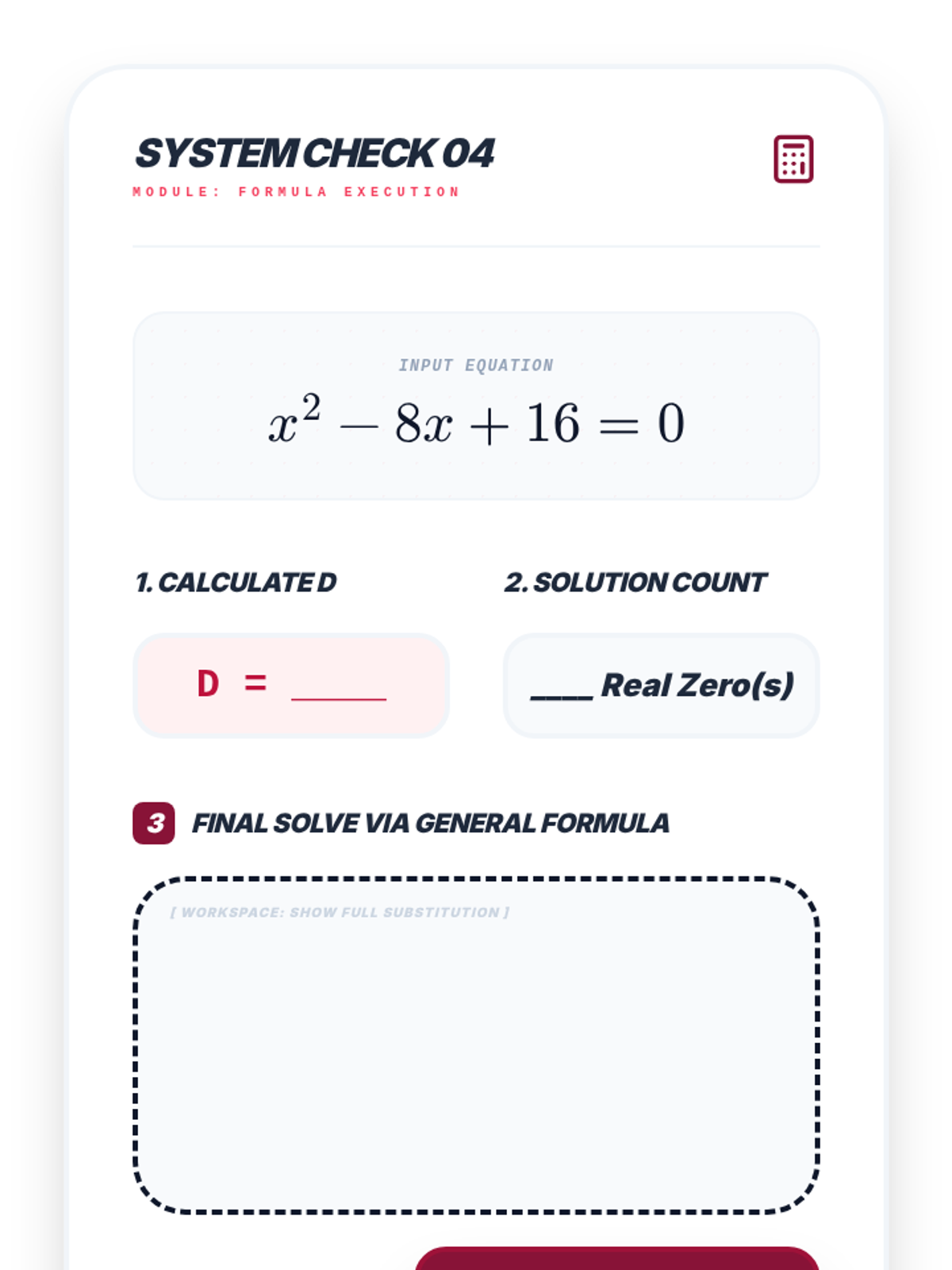
A formative assessment on the use of the discriminant and quadratic formula for single and multiple real roots.
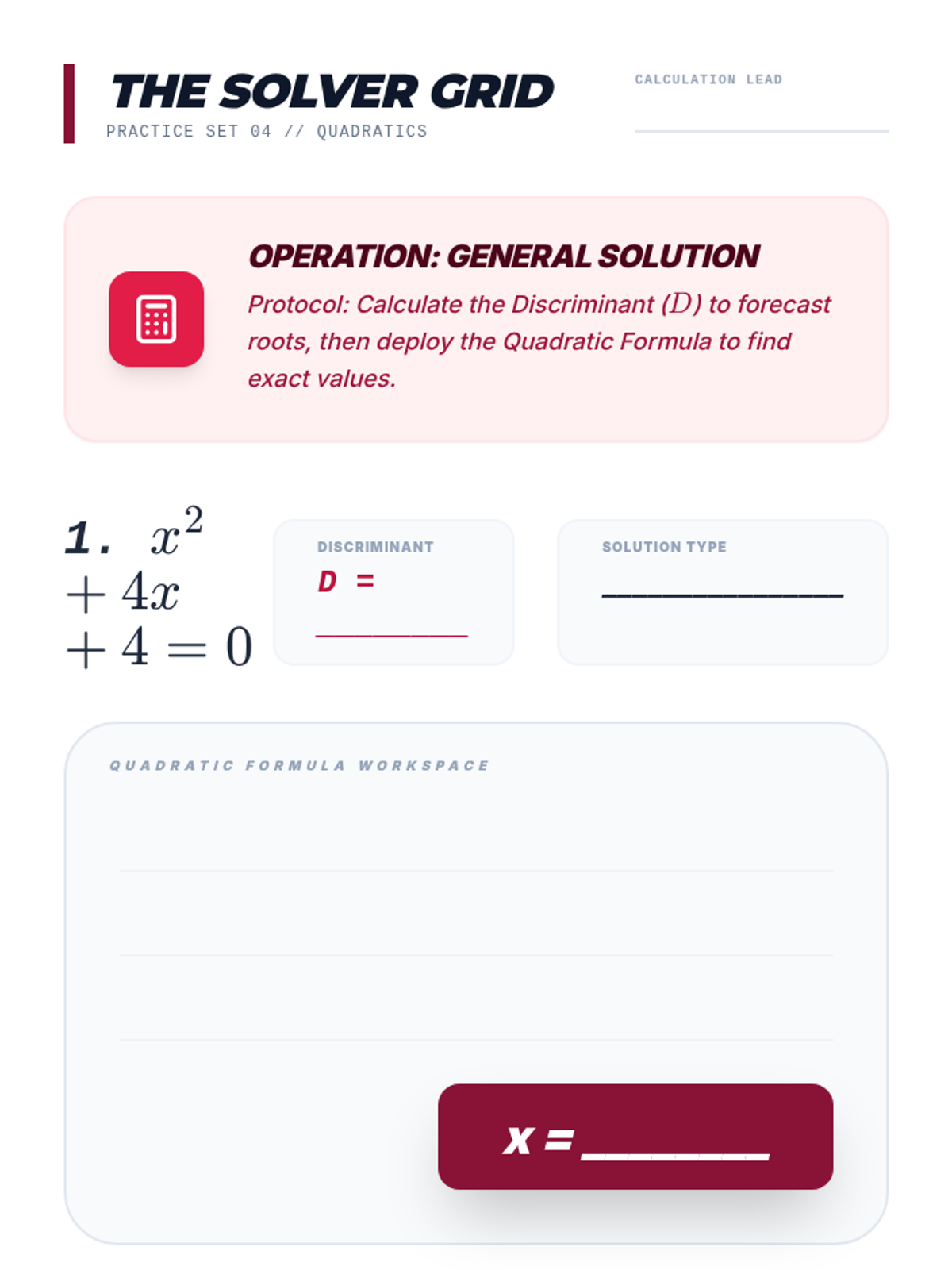
A practice worksheet requiring students to use both the discriminant and the quadratic formula to solve equations.
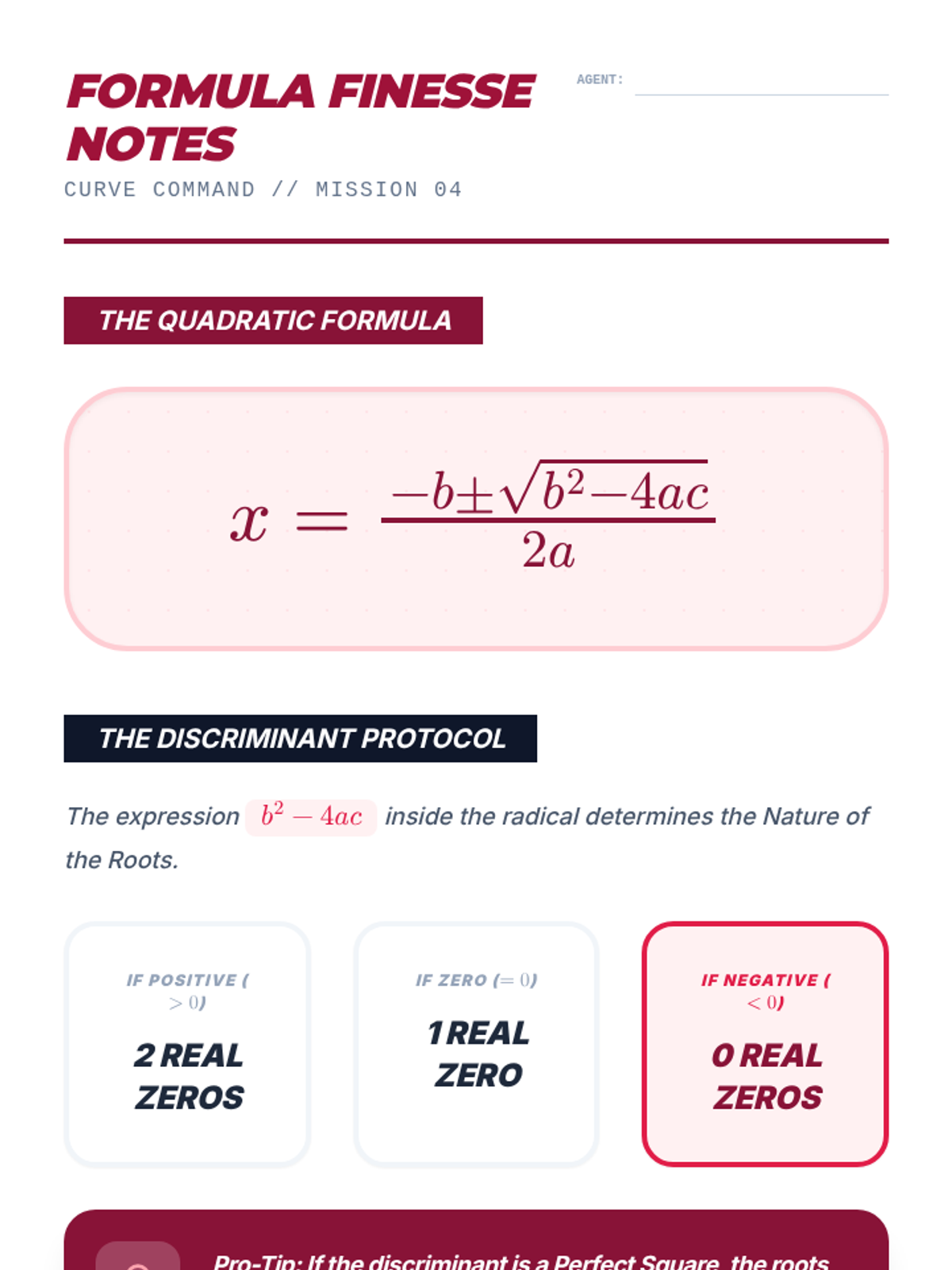
Guided notes for Lesson 4 covering the application of the Quadratic Formula and the function of the discriminant.
Slide deck for Lesson 4, introducing the Quadratic Formula and the Discriminant, with a focus on real rational roots.
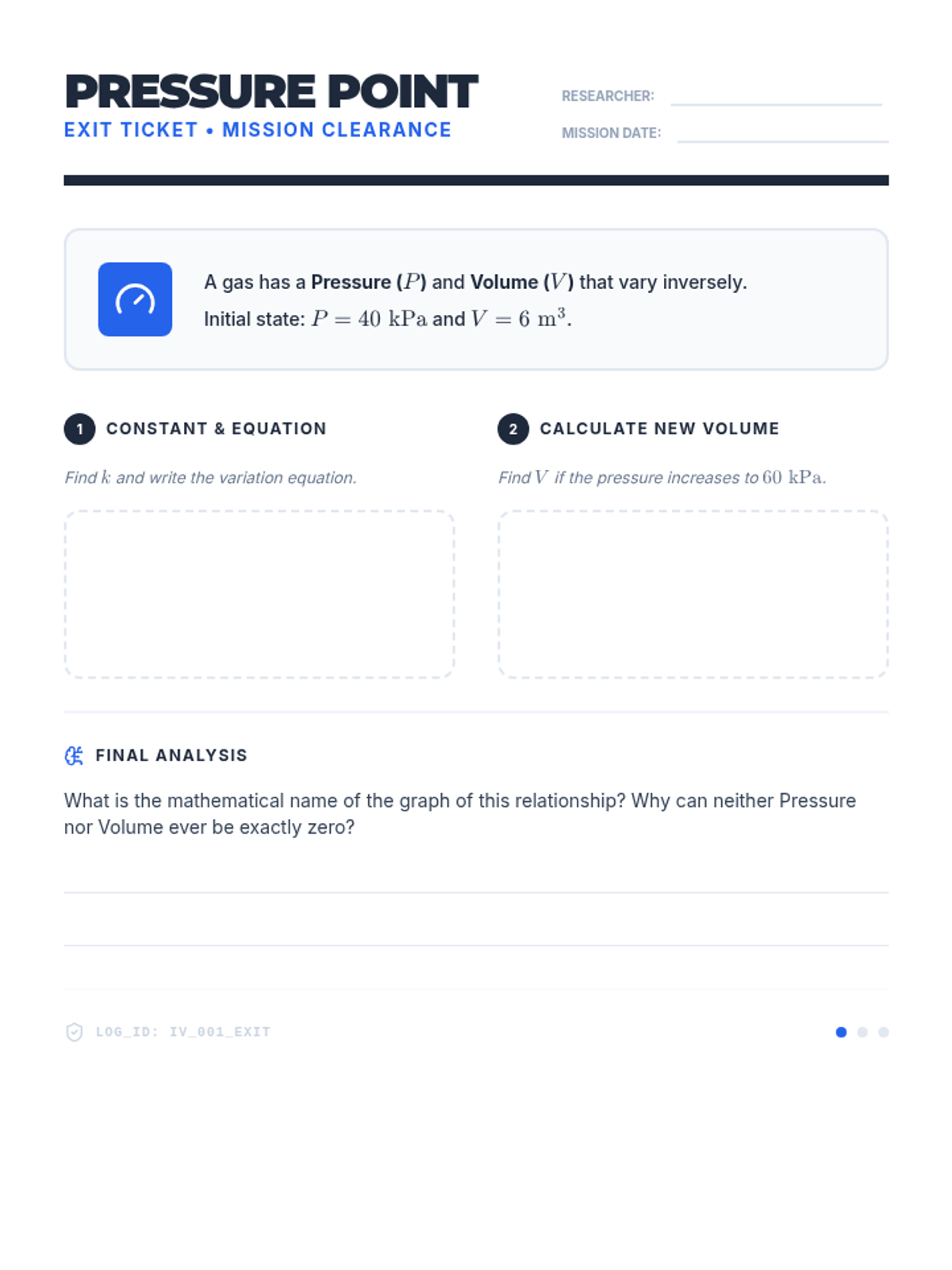
A formal exit ticket for inverse variation. Revised for single-page layout, better math rendering, and balanced work areas.
A sleek, high-contrast slide deck for inverse variation. Revised to fix math rendering, adjust viewport overflow, and correct the hyperbola graphic.
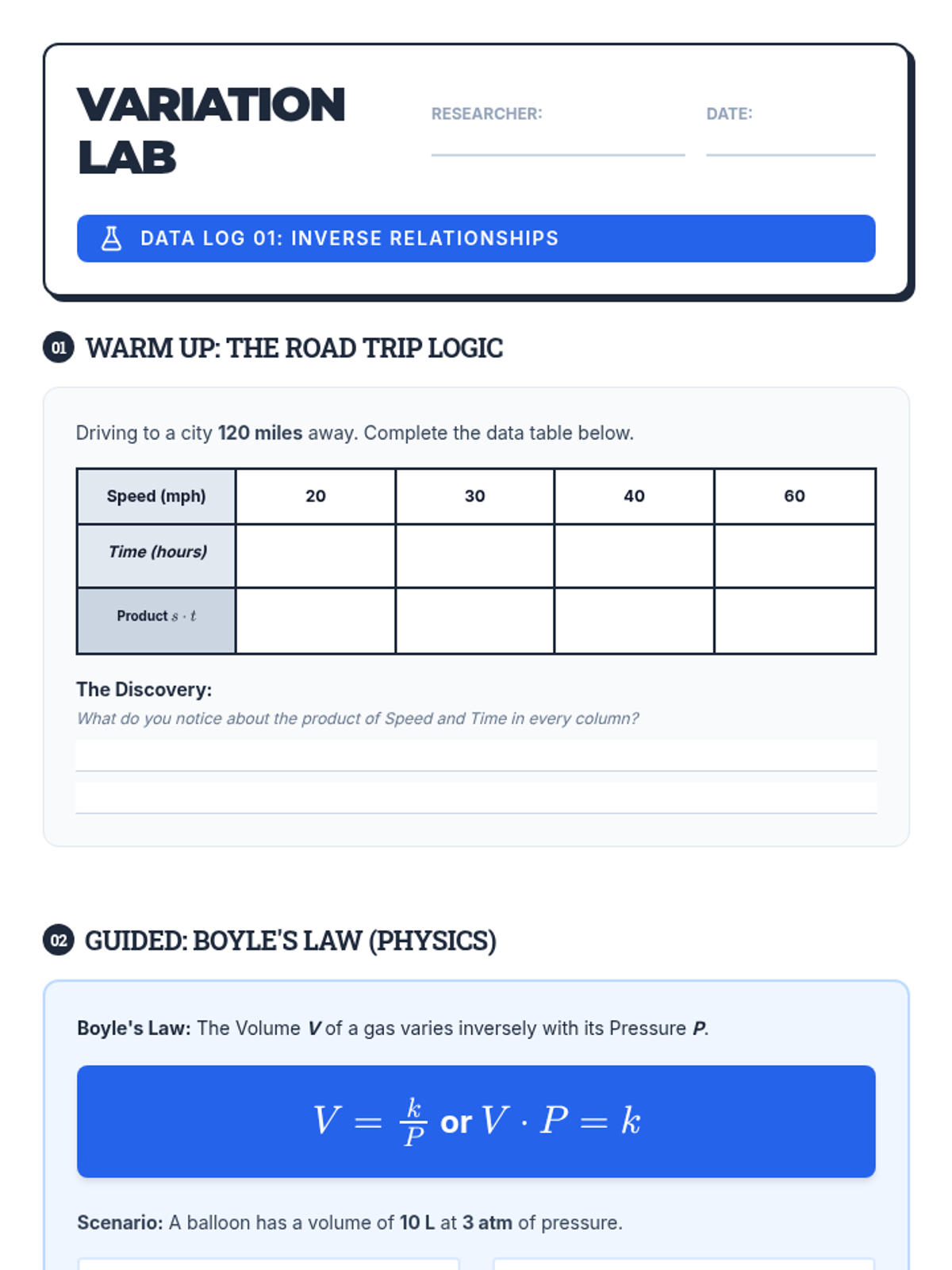
A student-facing handout containing the Warm Up, Guided Instruction, and Independent Practice for inverse variation. Revised for better page breaks, increased contrast, and added pedagogical scaffolding. Fixed math rendering and work areas.
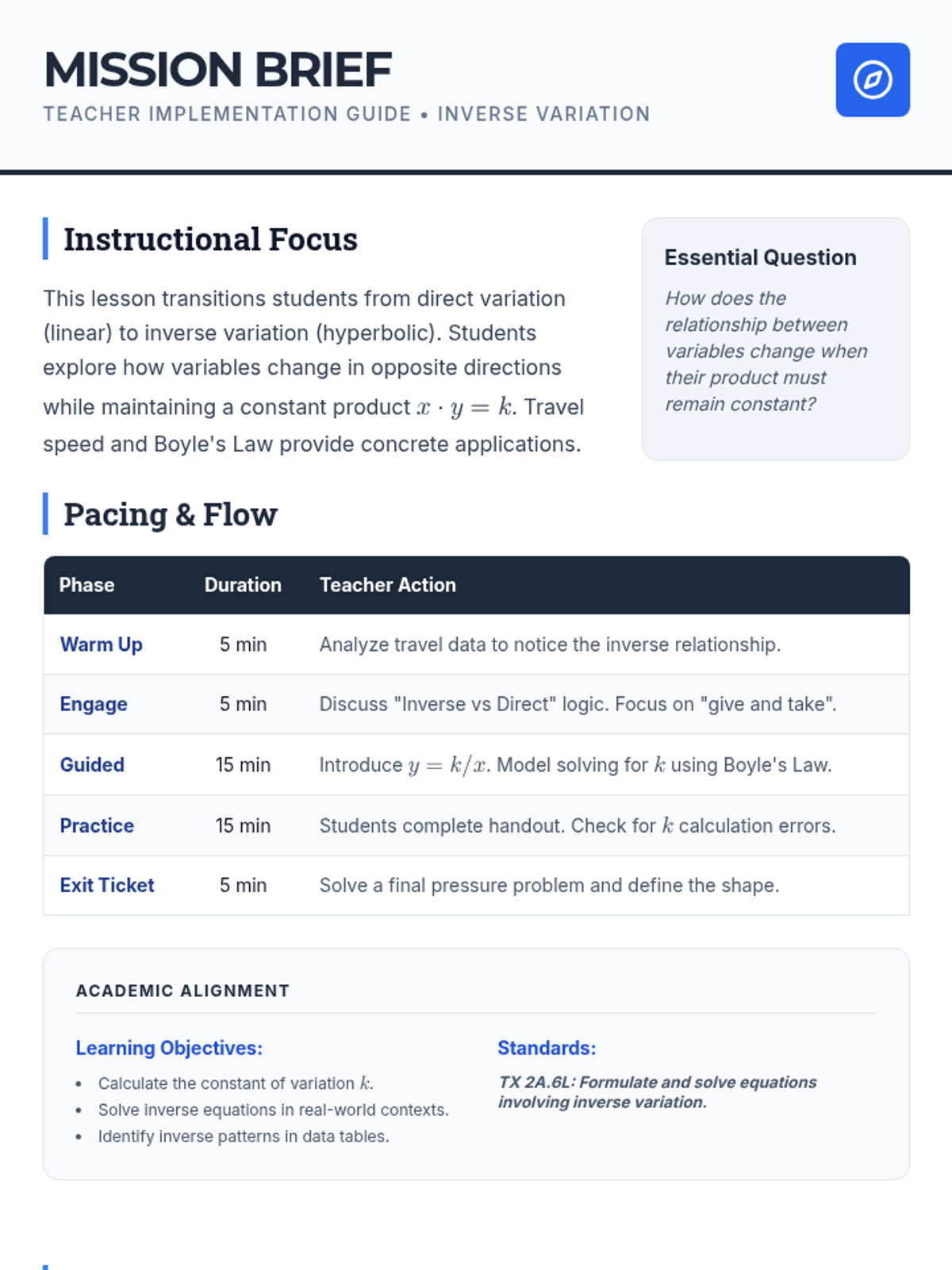
A comprehensive teacher implementation guide for the Inverse Investigators lesson, including pacing, standards alignment, answer keys, and pedagogical tips. Revised for better page breaks and math rendering.
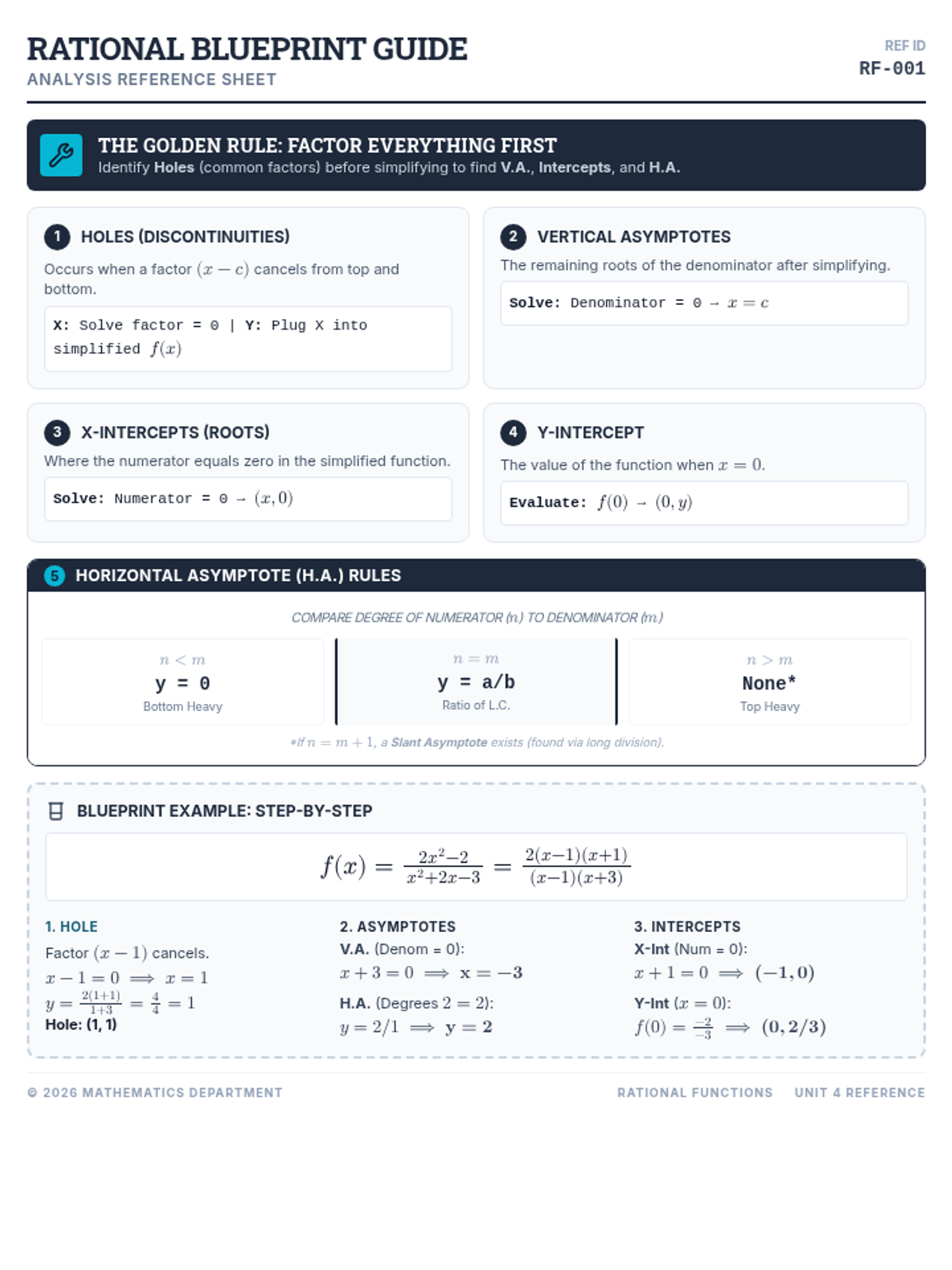
A high-density one-page reference sheet for rational functions. Includes essential steps for finding holes, asymptotes, and intercepts, plus a fully worked complex example.
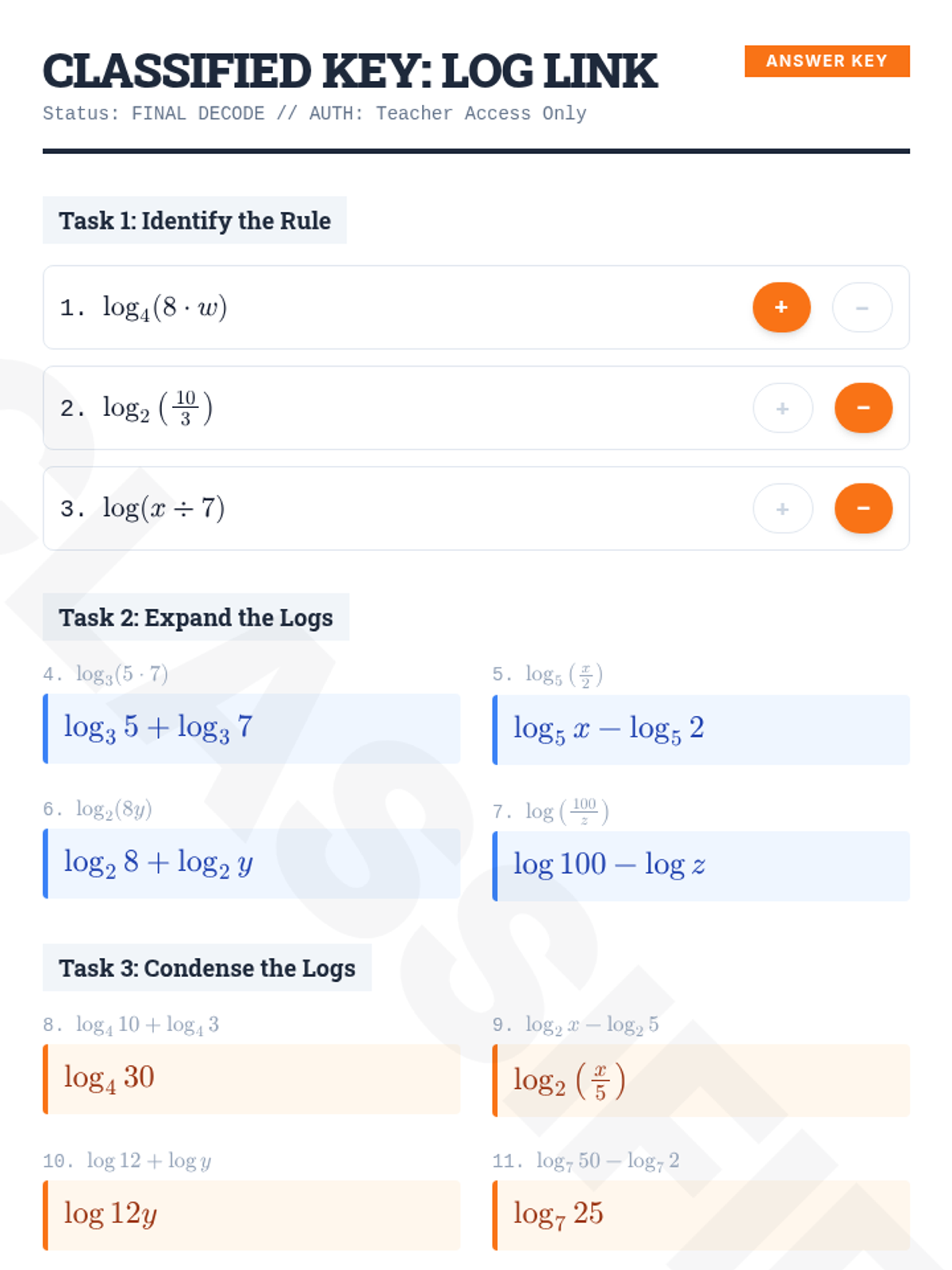
A complete answer key for the Codebreaker Logs Worksheet, showing step-by-step solutions for the multi-step challenge problem.
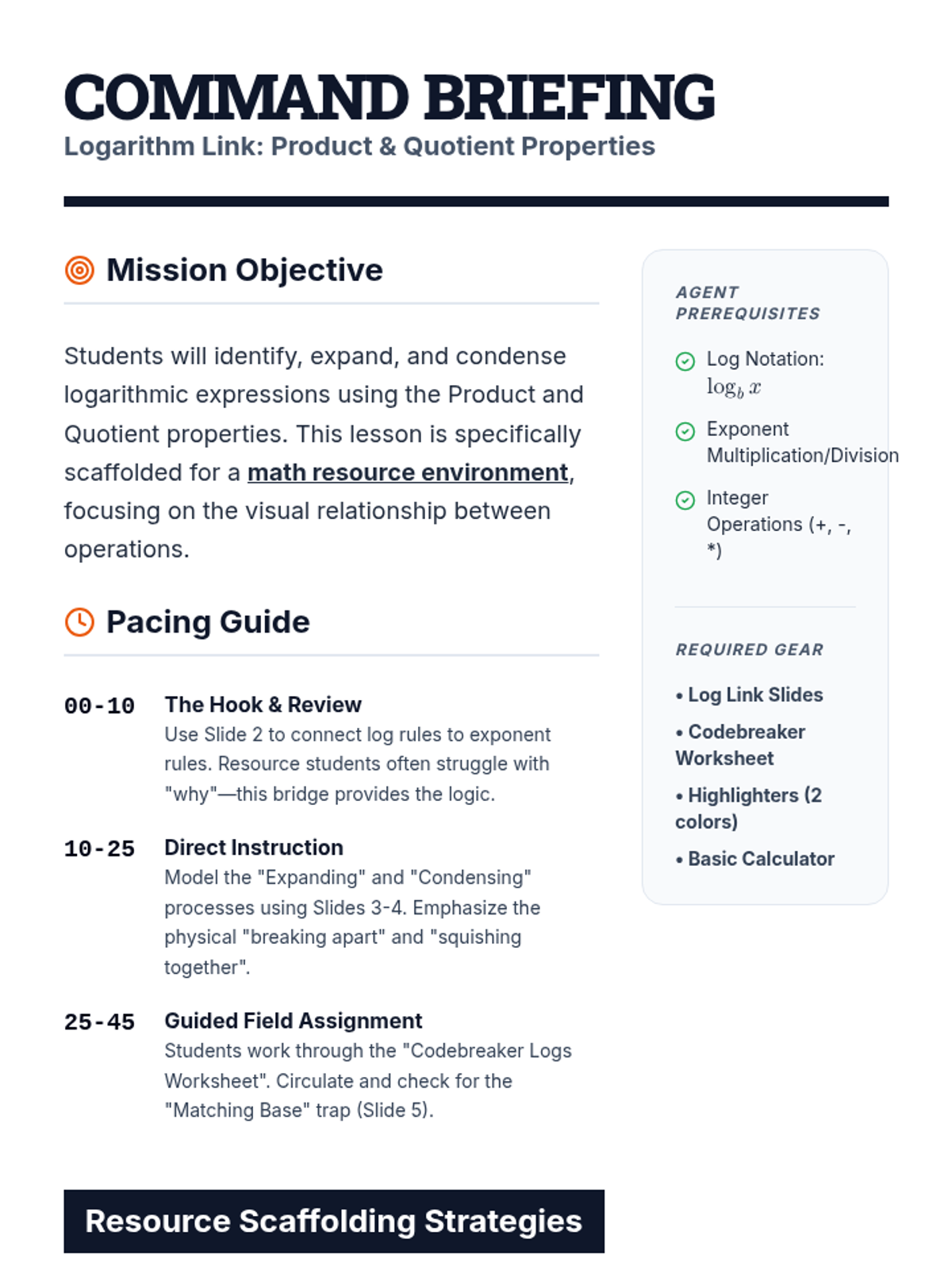
Instructional support for the teacher, featuring pacing guides, scaffolding strategies for a resource class, and common student misconceptions. (Revised for LaTeX rendering, page flow, and contrast)
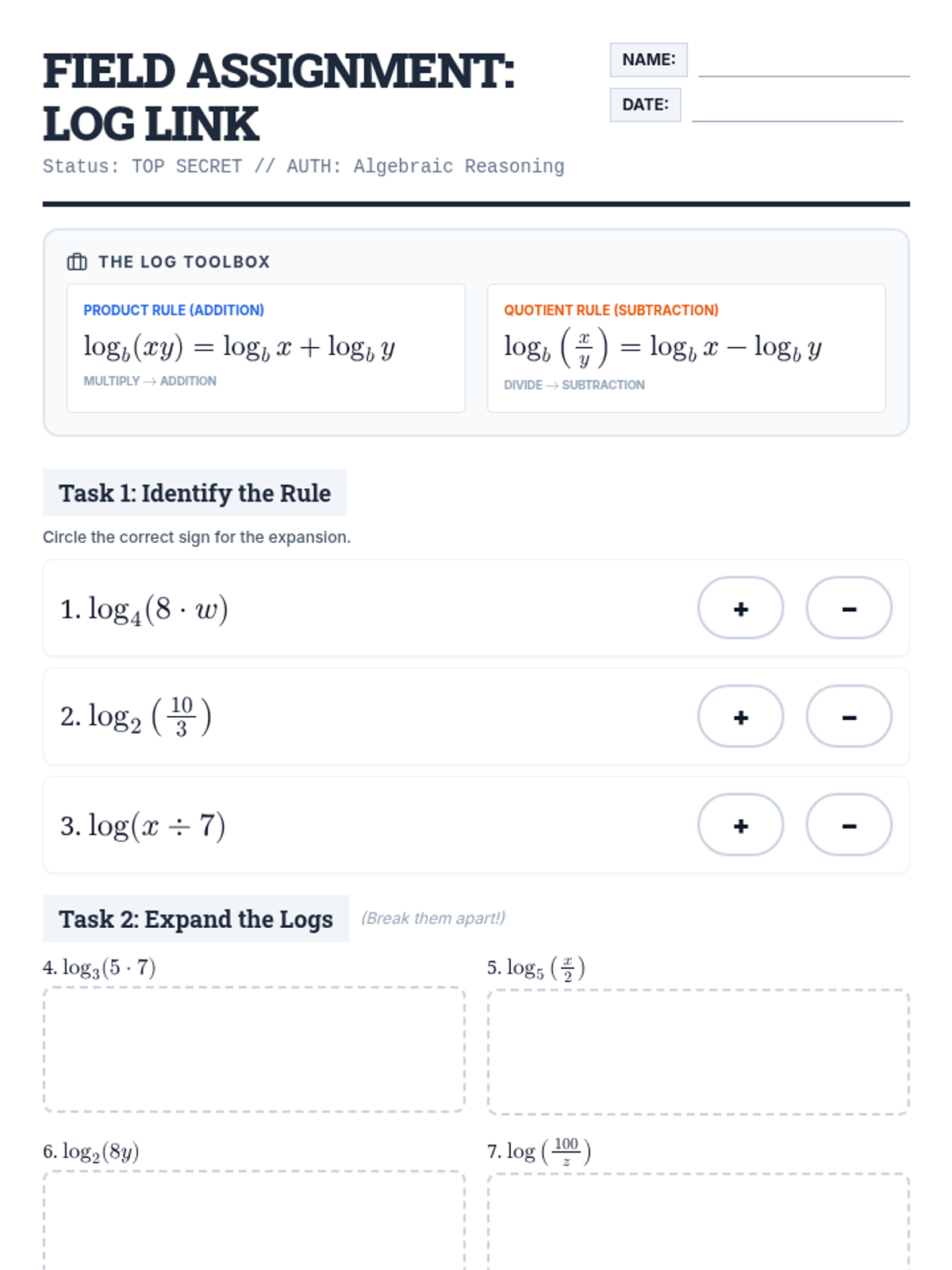
A scaffolded student worksheet for practicing the product and quotient properties of logarithms, featuring a "top secret" mission theme. (Revised for handwriting space and page fitting)
A visual presentation for teaching the product and quotient properties of logarithms, featuring clear examples and common pitfalls. (Revised for visibility and math rendering)
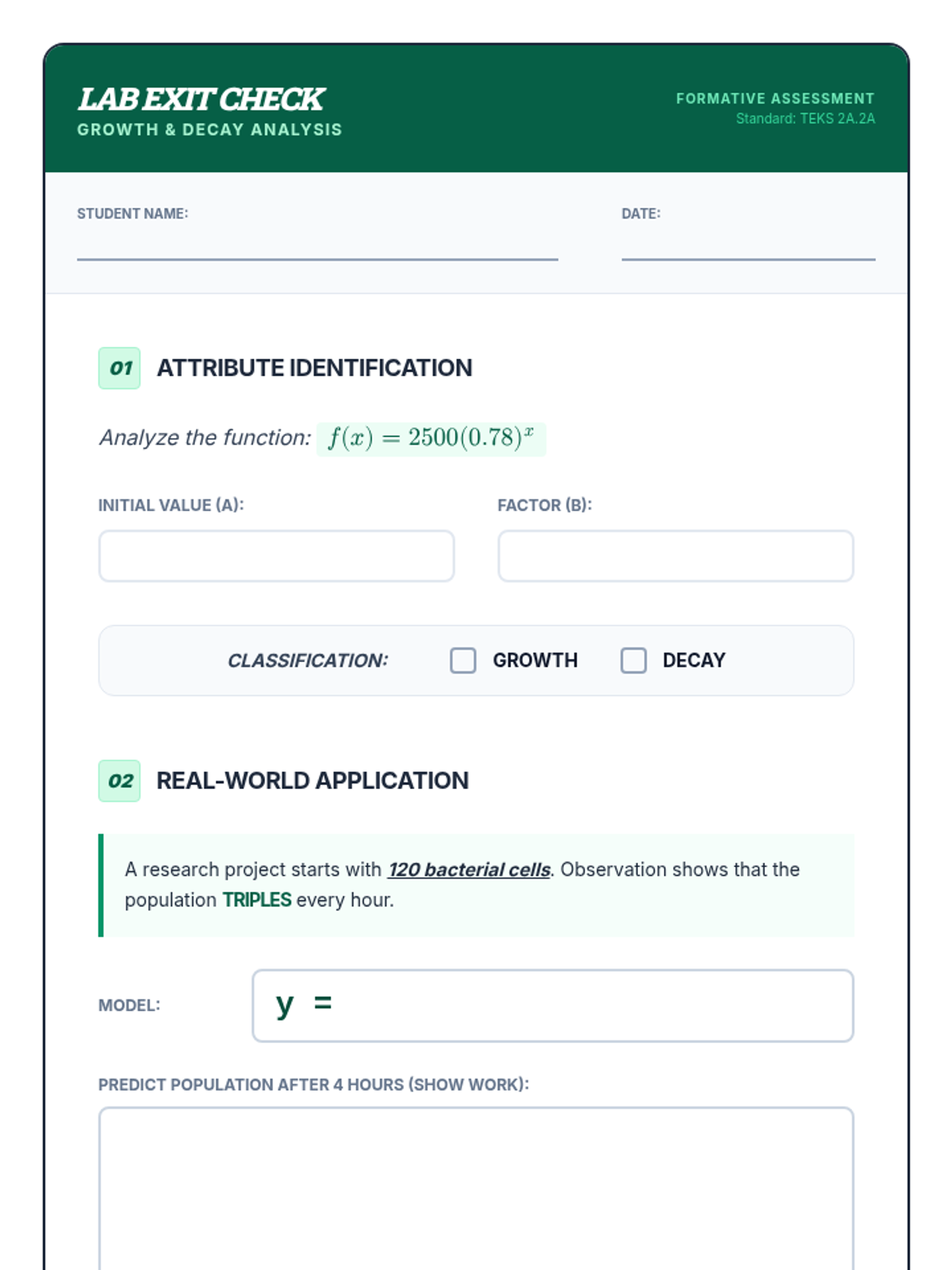
A concise exit ticket to assess student understanding of exponential growth and decay attributes and basic modeling.
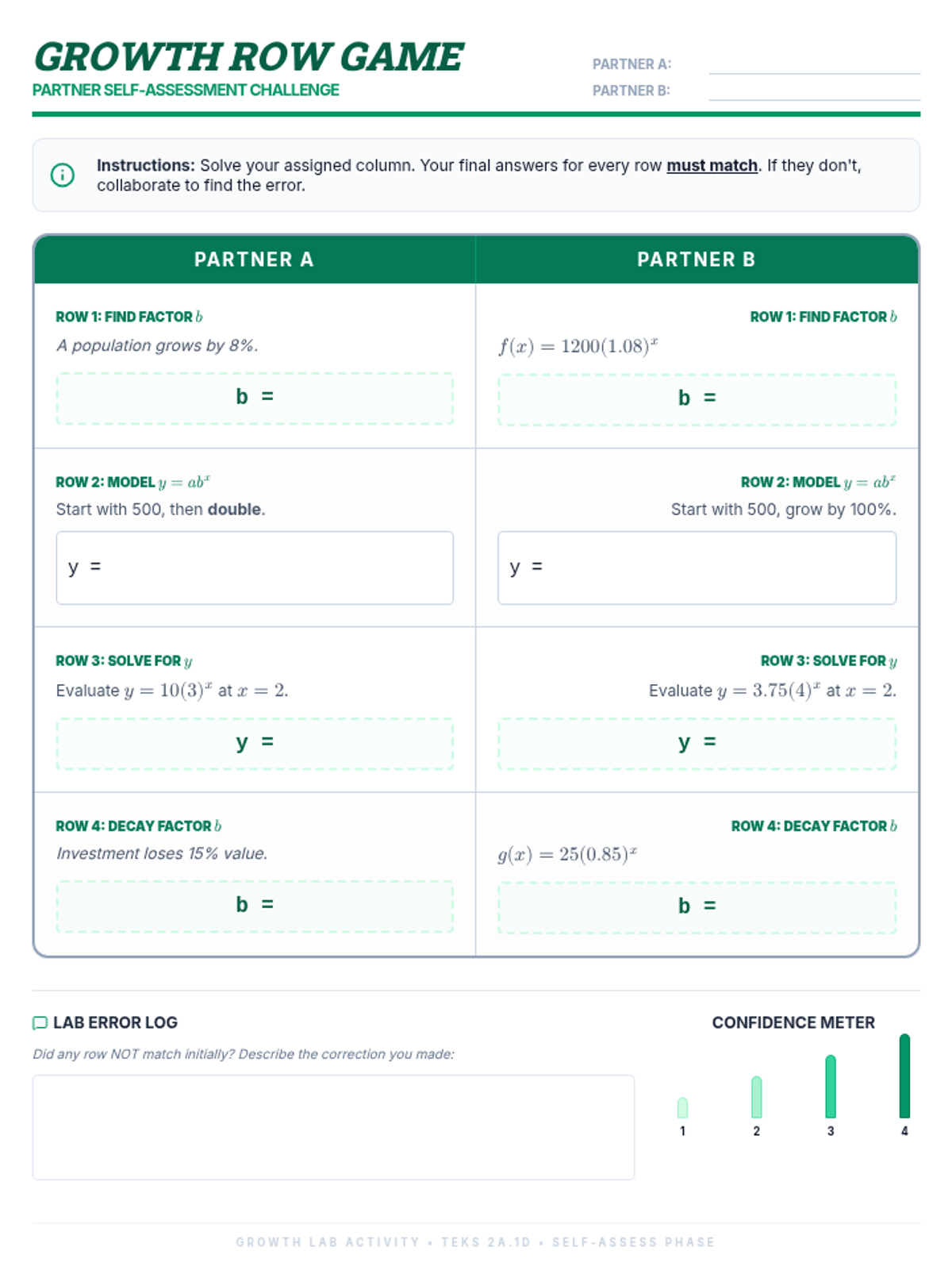
A partner "Row Game" activity where students solve different problems that result in matching answers, fostering peer support and self-assessment.
Instructional slides for exponential growth and decay, covering the model equation, identifying factors, and real-world application examples.
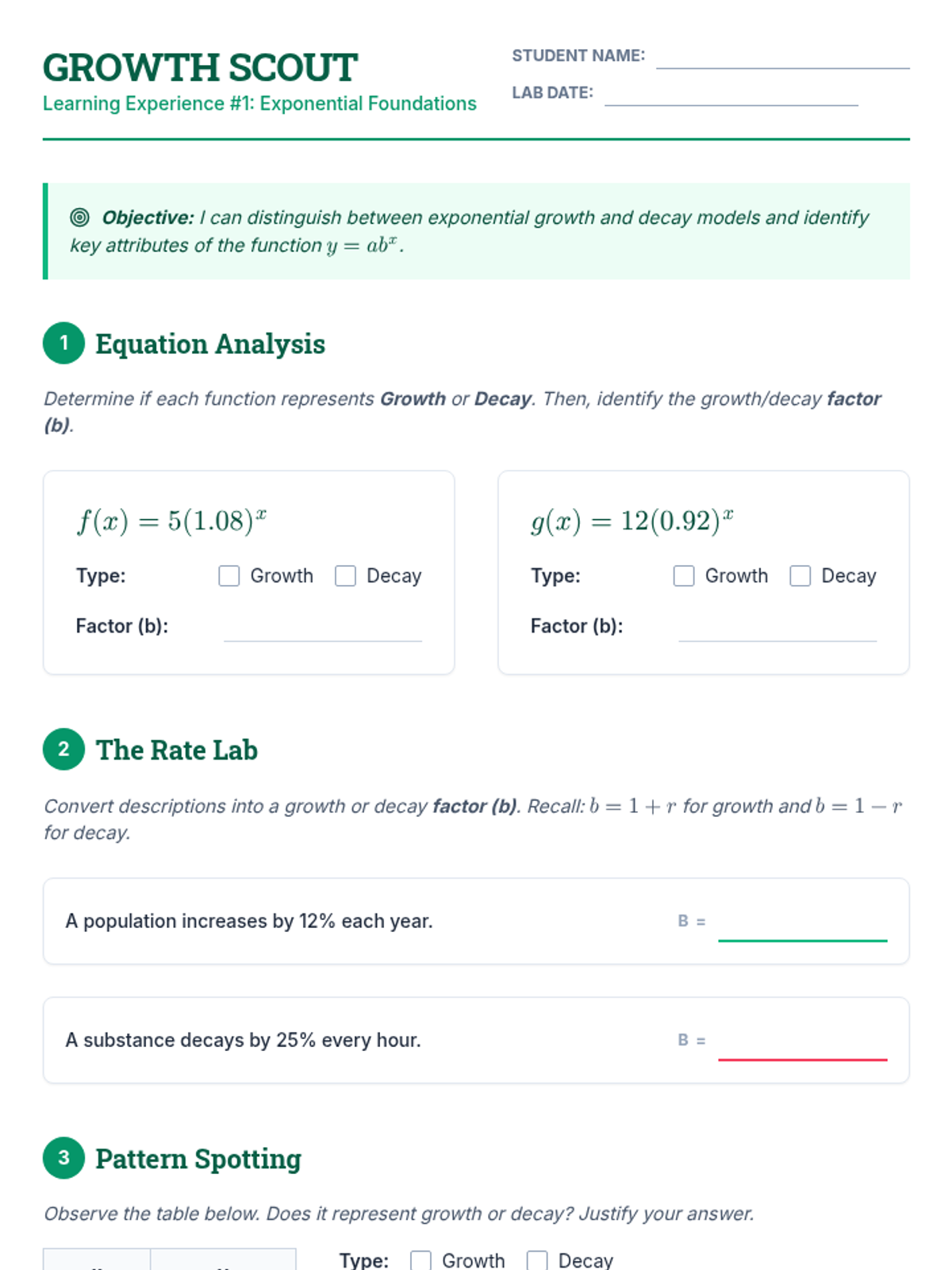
A warm-up worksheet for exponential growth and decay, focusing on identifying factors and types of functions from equations, descriptions, and tables.
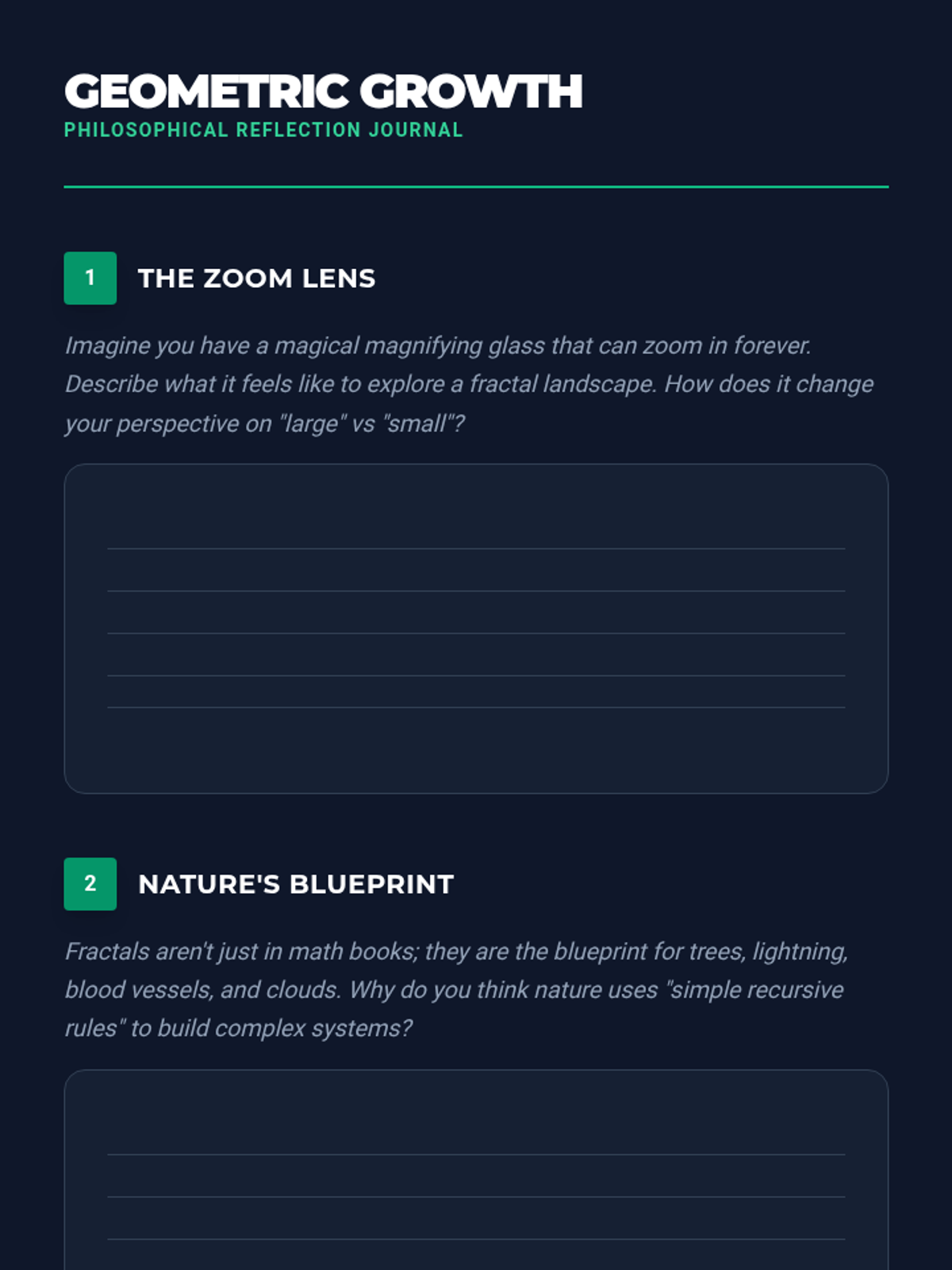
A reflective journal for students to synthesize their learning. It includes philosophical prompts on scale, nature's recursive patterns, and the infinite/finite paradox, with a dark-themed "night mode" aesthetic for focus.
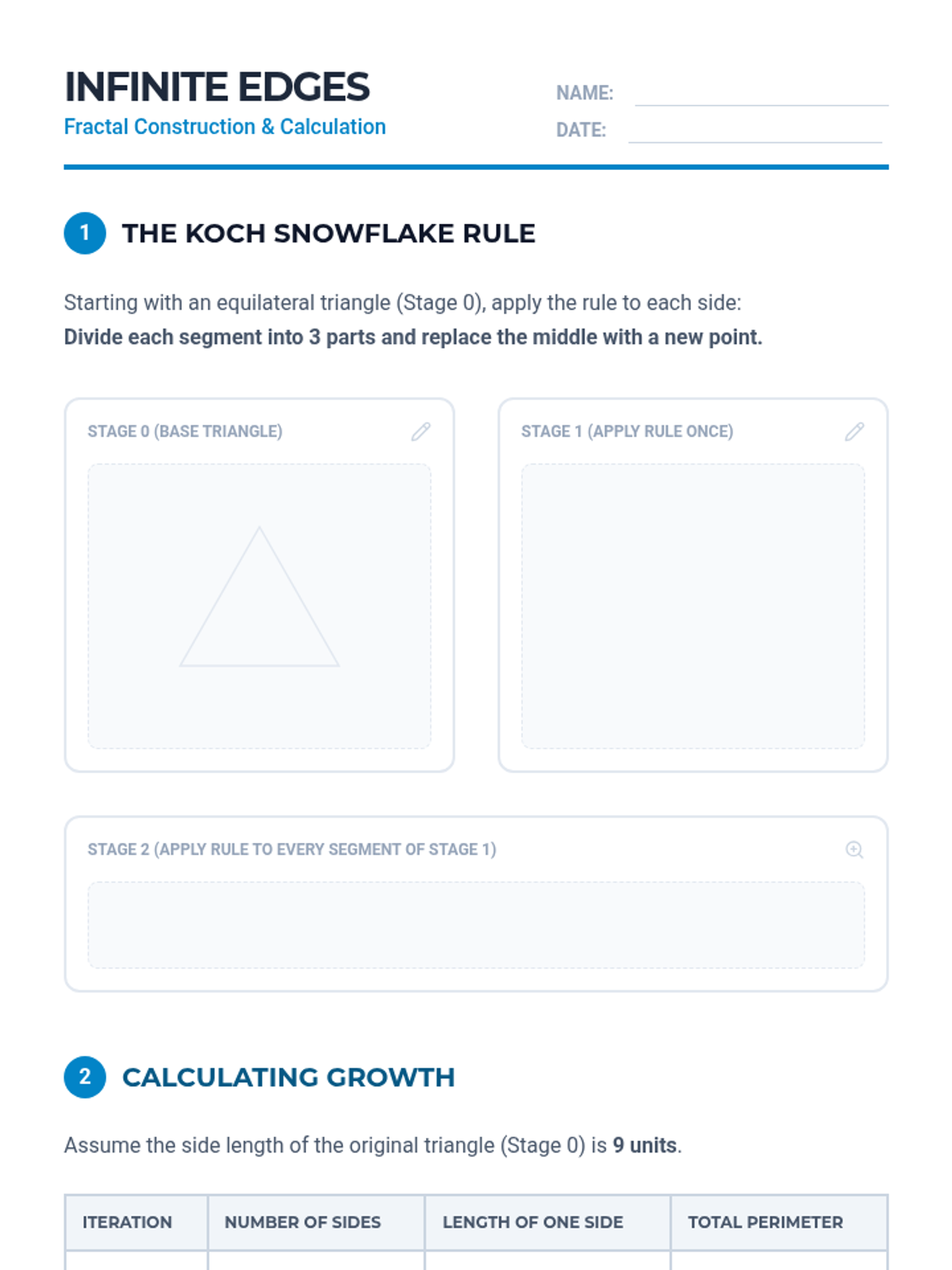
A two-page student activity worksheet for constructing the Koch Snowflake. It includes drawing areas for the first three iterations and a calculation table to analyze the relationship between sides, length, and total perimeter.
A visually striking slide deck introducing fractals, featuring the Coastline Paradox, definitions of self-similarity and recursion, and the construction rules for the Koch Snowflake.
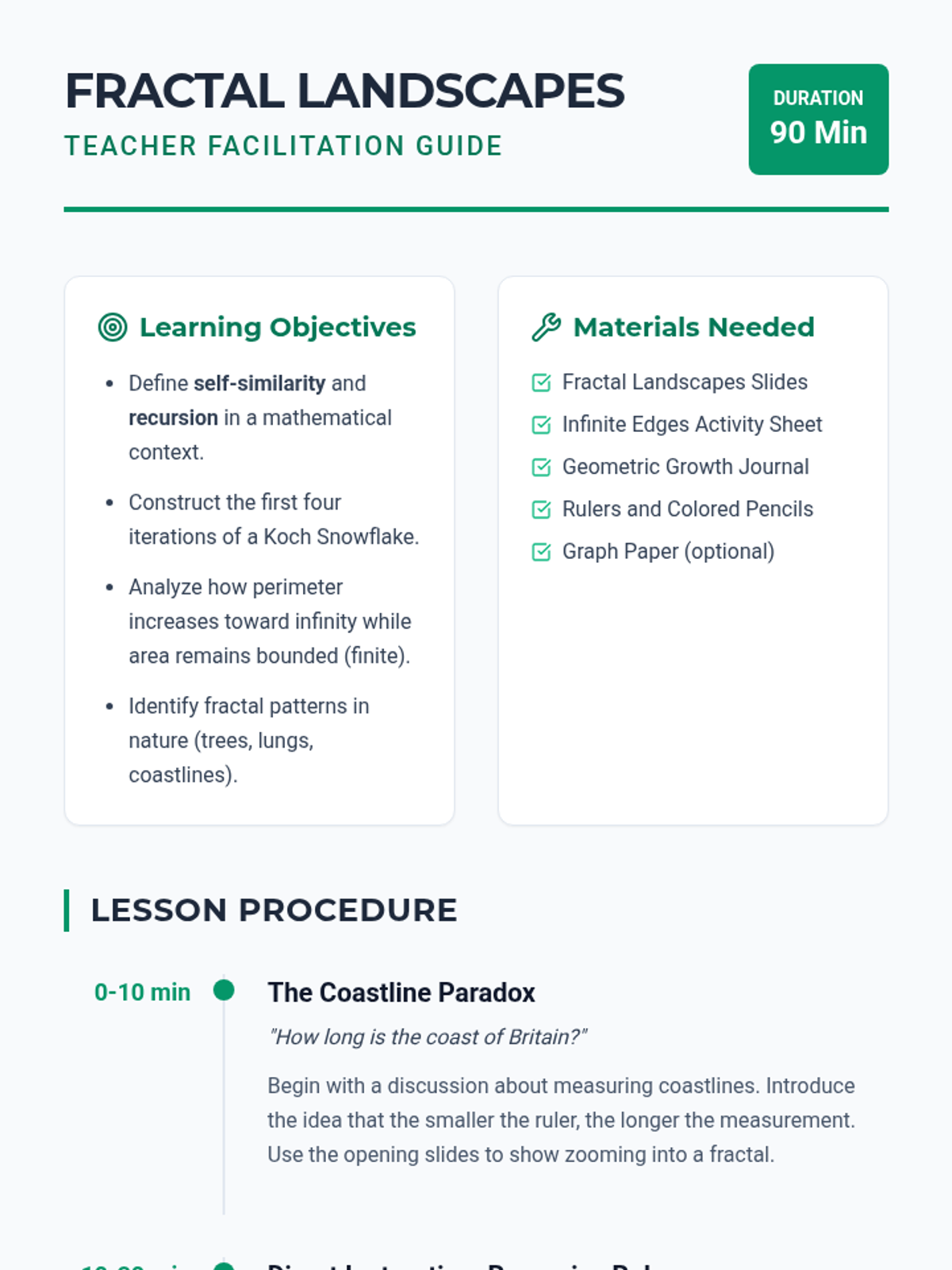
A comprehensive teacher facilitation guide for the Fractal Landscapes lesson, including learning objectives, a detailed 90-minute lesson flow, and key mathematical concepts like recursion and self-similarity.
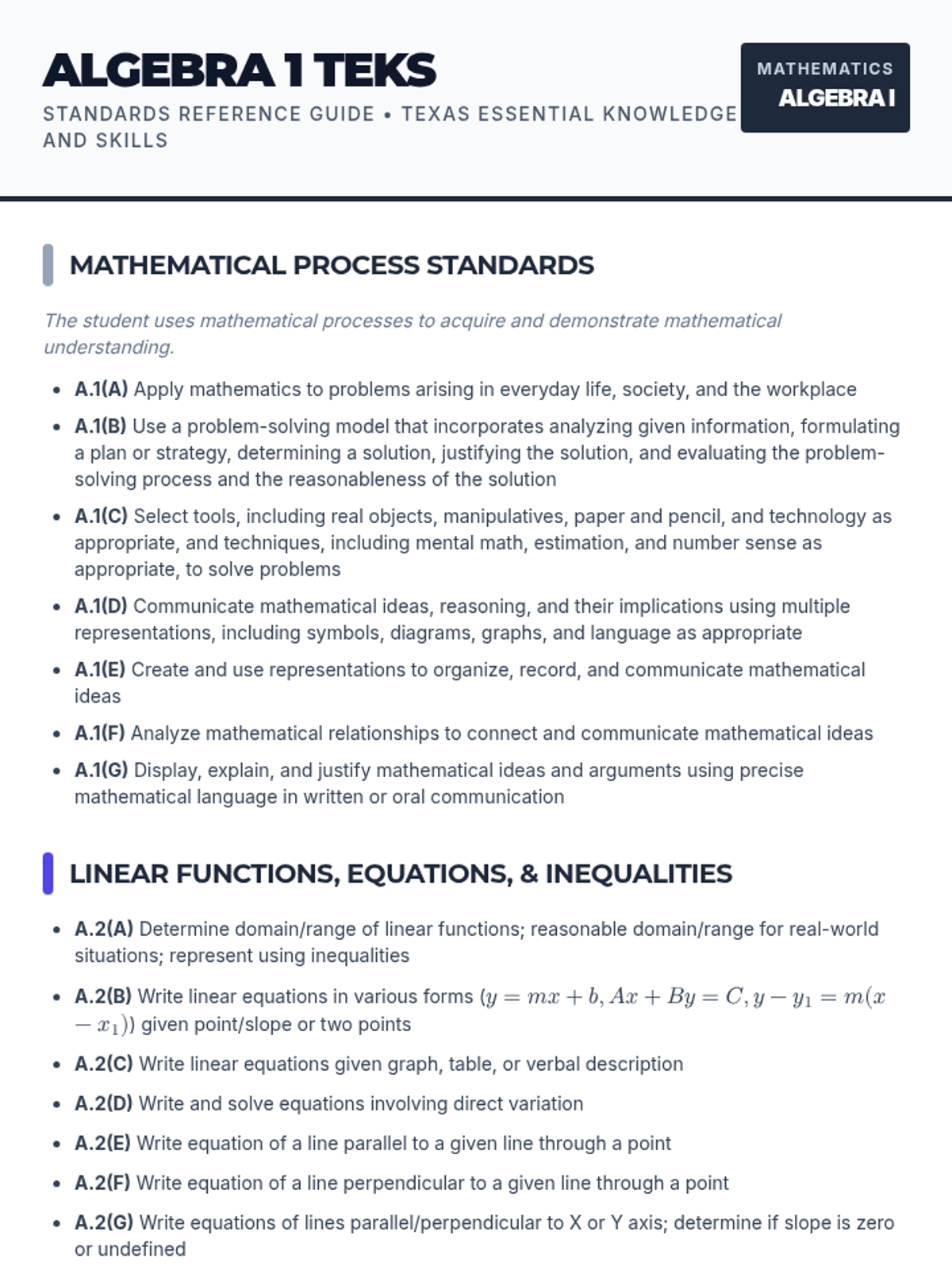
A comprehensive, formatted reference list of all Algebra 1 Texas Essential Knowledge and Skills (TEKS) organized by standard strands for teacher use. Includes Process Standards.
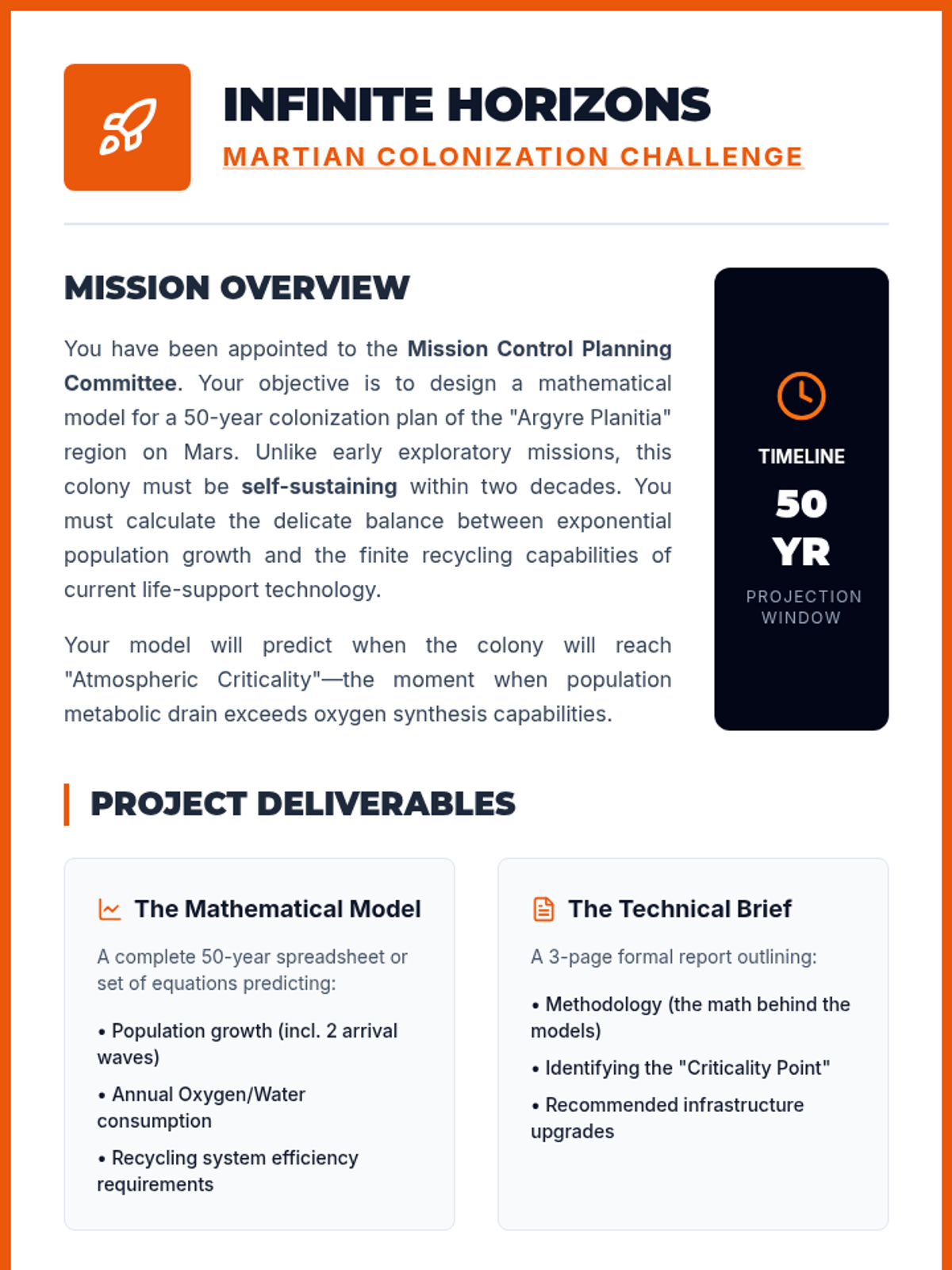
A detailed student project guide for the Mars colonization challenge, including the project scenario, deliverables, technical constants for modeling, and a comprehensive assessment rubric.
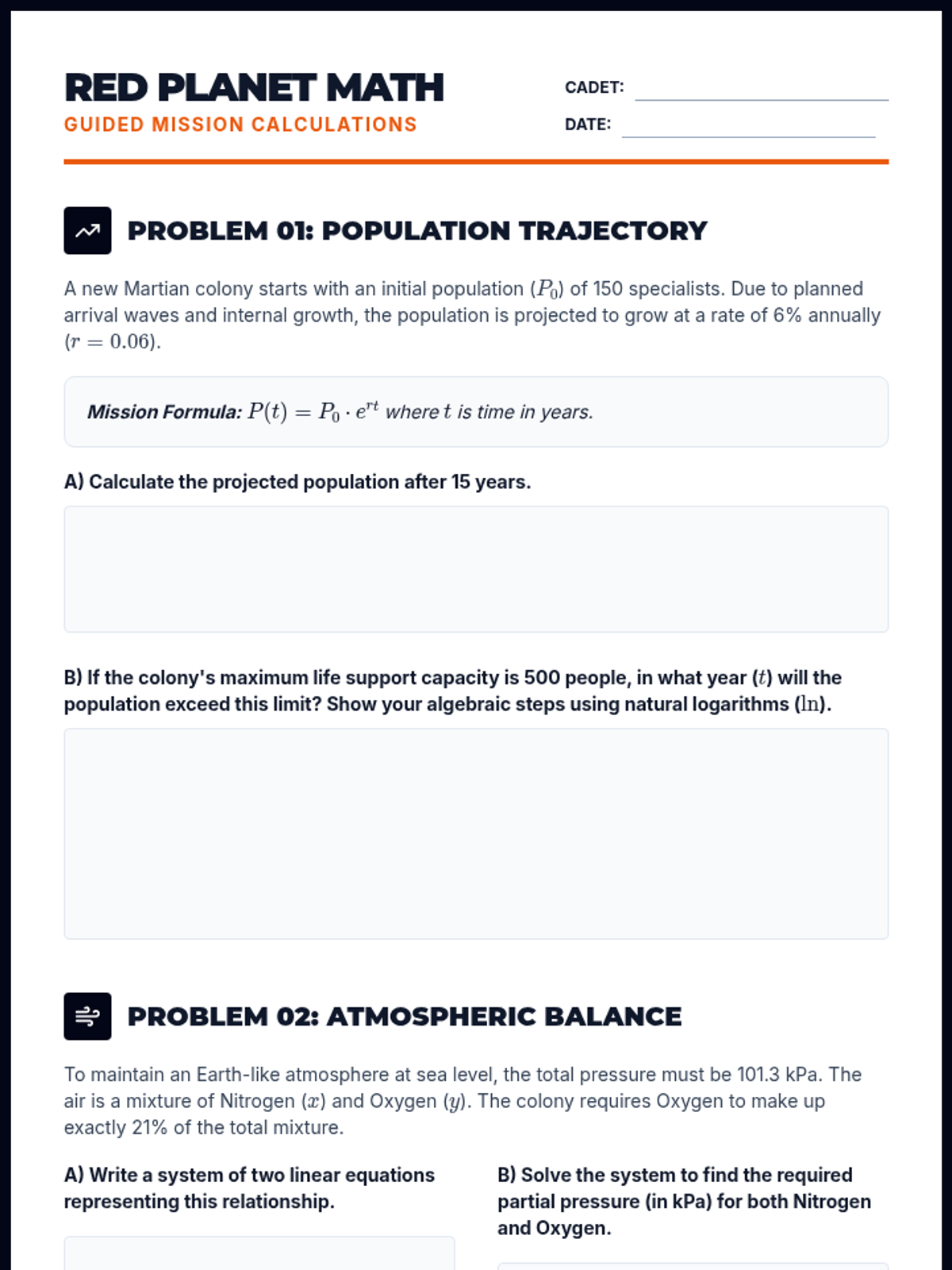
A student-facing math worksheet providing guided practice with exponential population growth models, systems of equations for atmospheric balance, and metabolic resource drain calculations.
An instructional slide deck that sets the stage for the Mars mission, presenting environmental data, metabolic constants, and the mathematical frameworks (exponential growth and systems of equations) used for modeling.
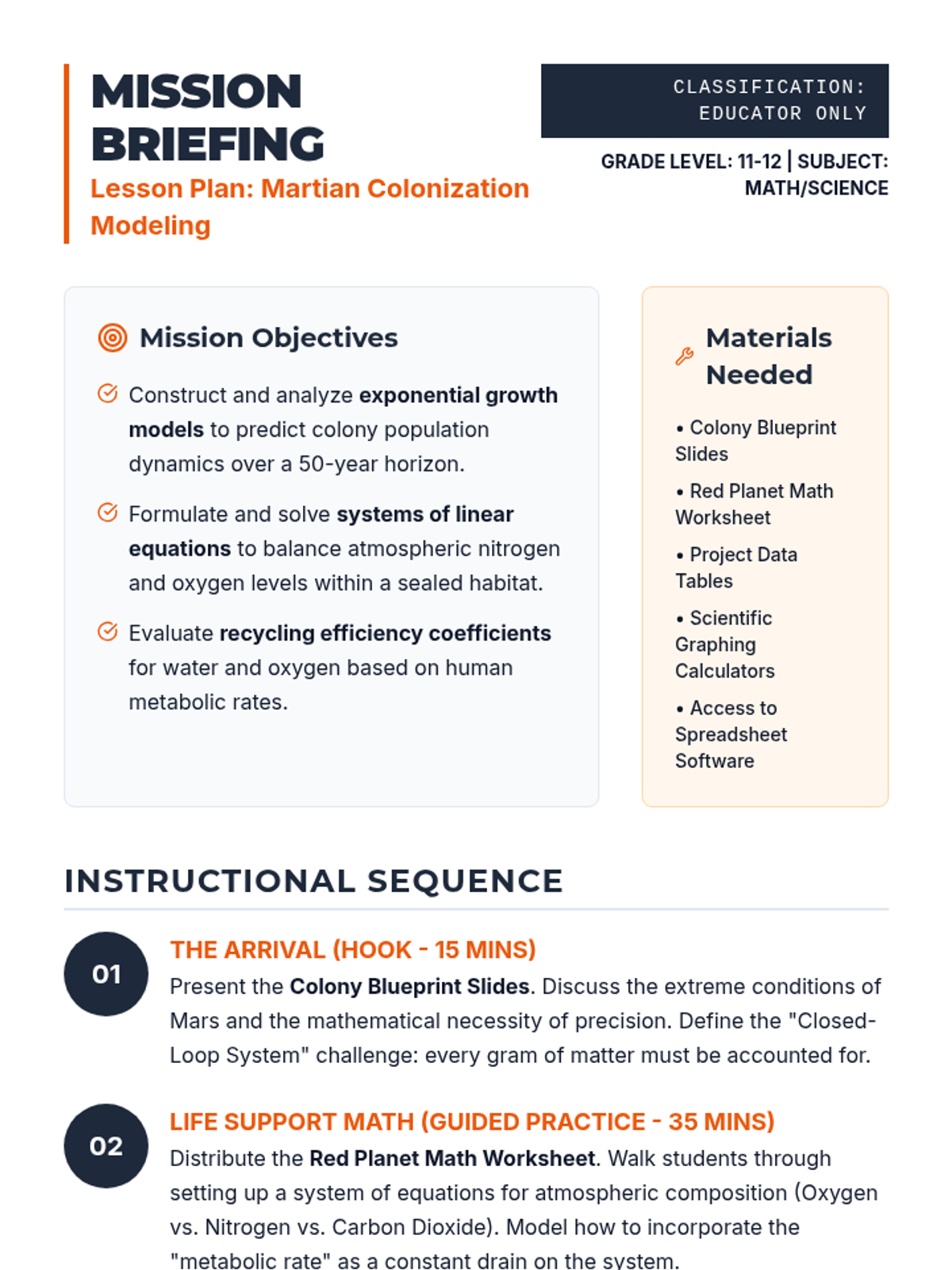
A comprehensive lesson plan for teachers detailing mission objectives, instructional sequences, curriculum standards, and differentiation strategies for the Mars colonization modeling challenge.
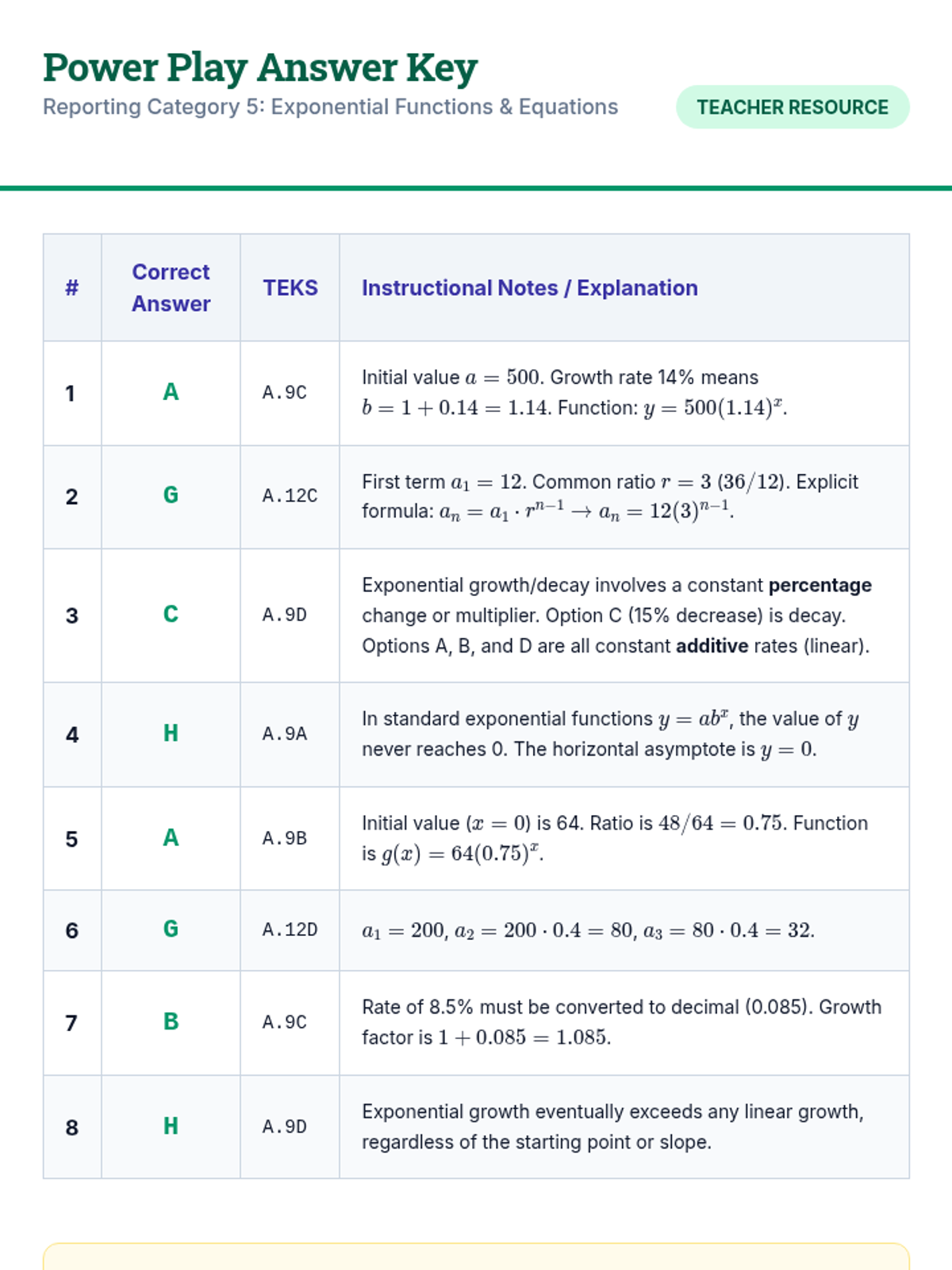
Detailed answer key for the Power Play EOC Worksheet. Includes correct answers, associated TEKS, detailed explanations for each problem, and a guide to common student misconceptions.
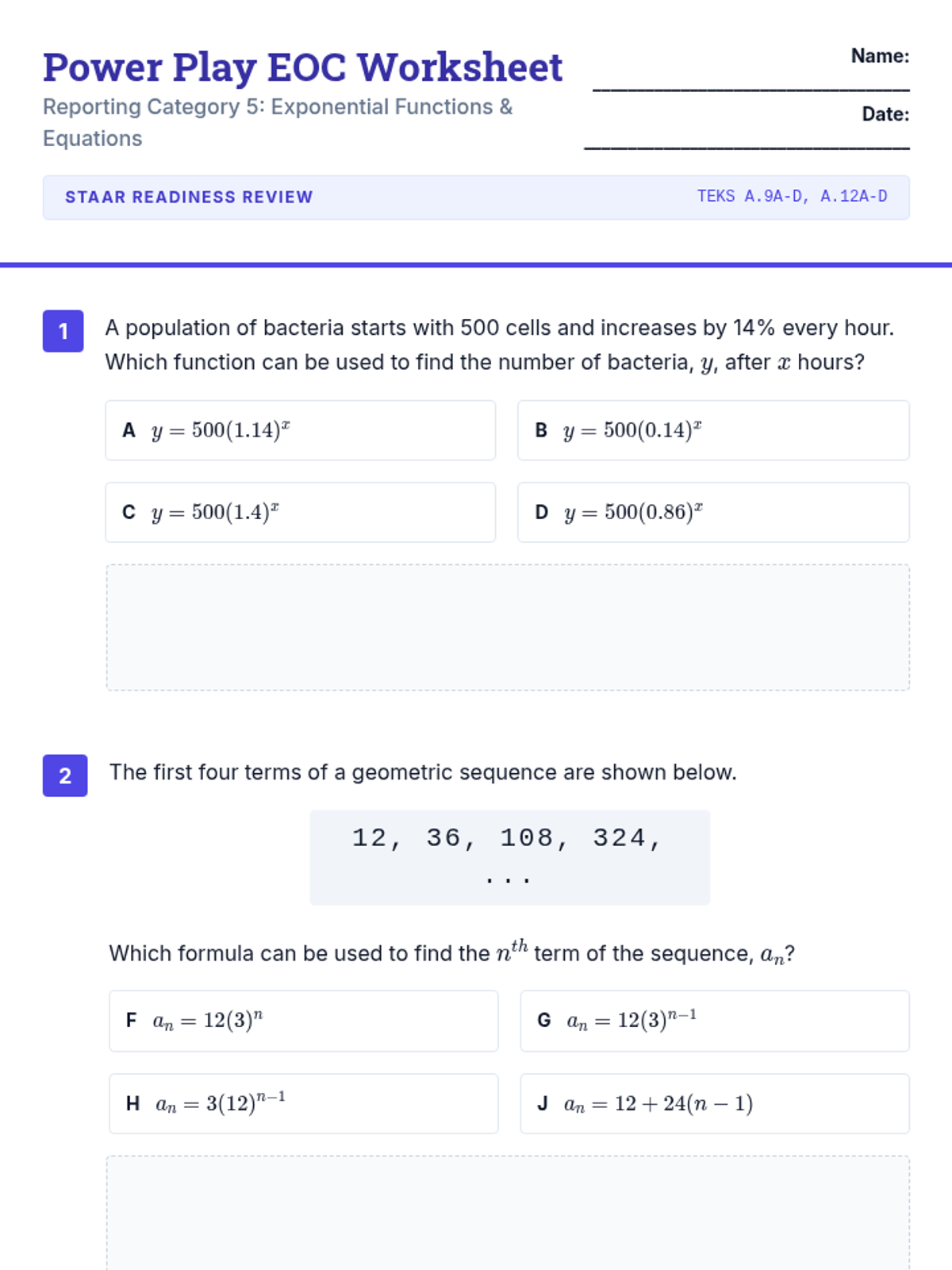
8 STAAR EOC-style problems covering exponential functions and geometric sequences. Designed for student practice with designated work areas and clear multiple-choice options.
Engaging slide deck for instruction on exponential functions and geometric sequences. Features visual comparisons of growth models, anatomical breakdown of the exponential equation, and STAAR-specific table strategies.
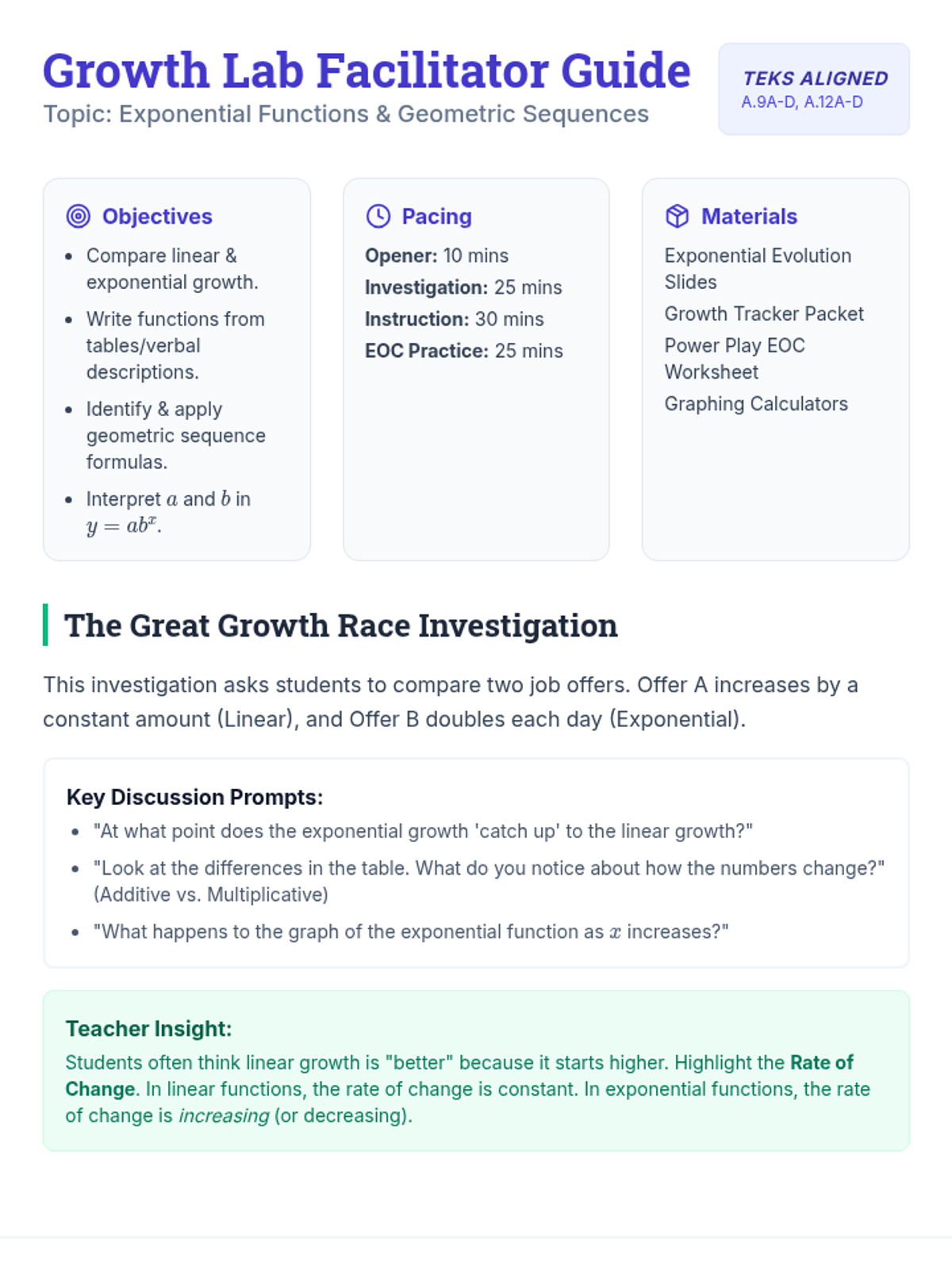
Detailed facilitator guide for teaching exponential functions and geometric sequences. Includes investigation prompts, direct instruction strategies, and TEKS-specific insights for STAAR EOC preparation.
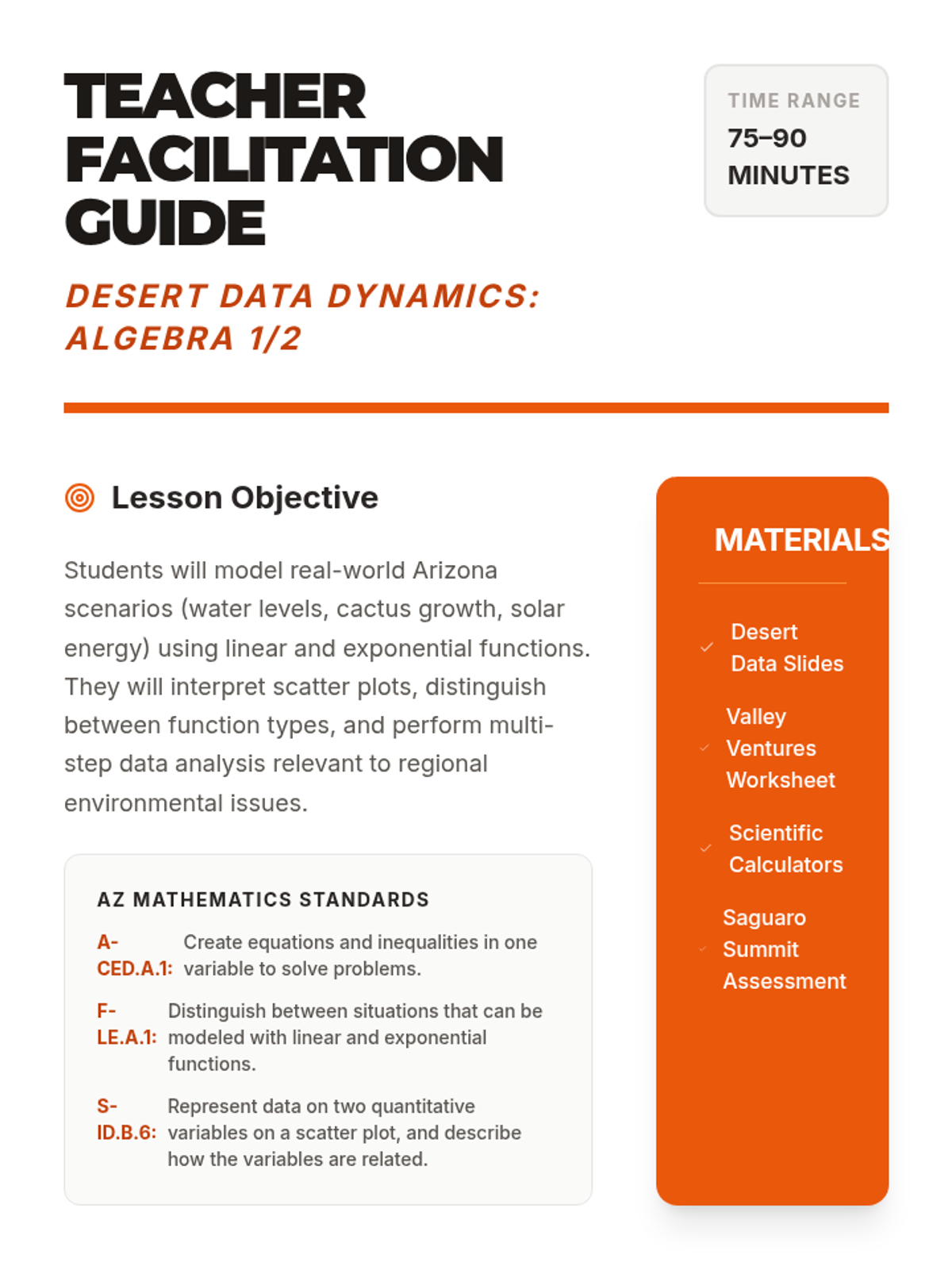
A detailed facilitator's guide for the Desert Data Dynamics lesson, including state standards alignment, a specific 90-minute pacing guide, and differentiation strategies.
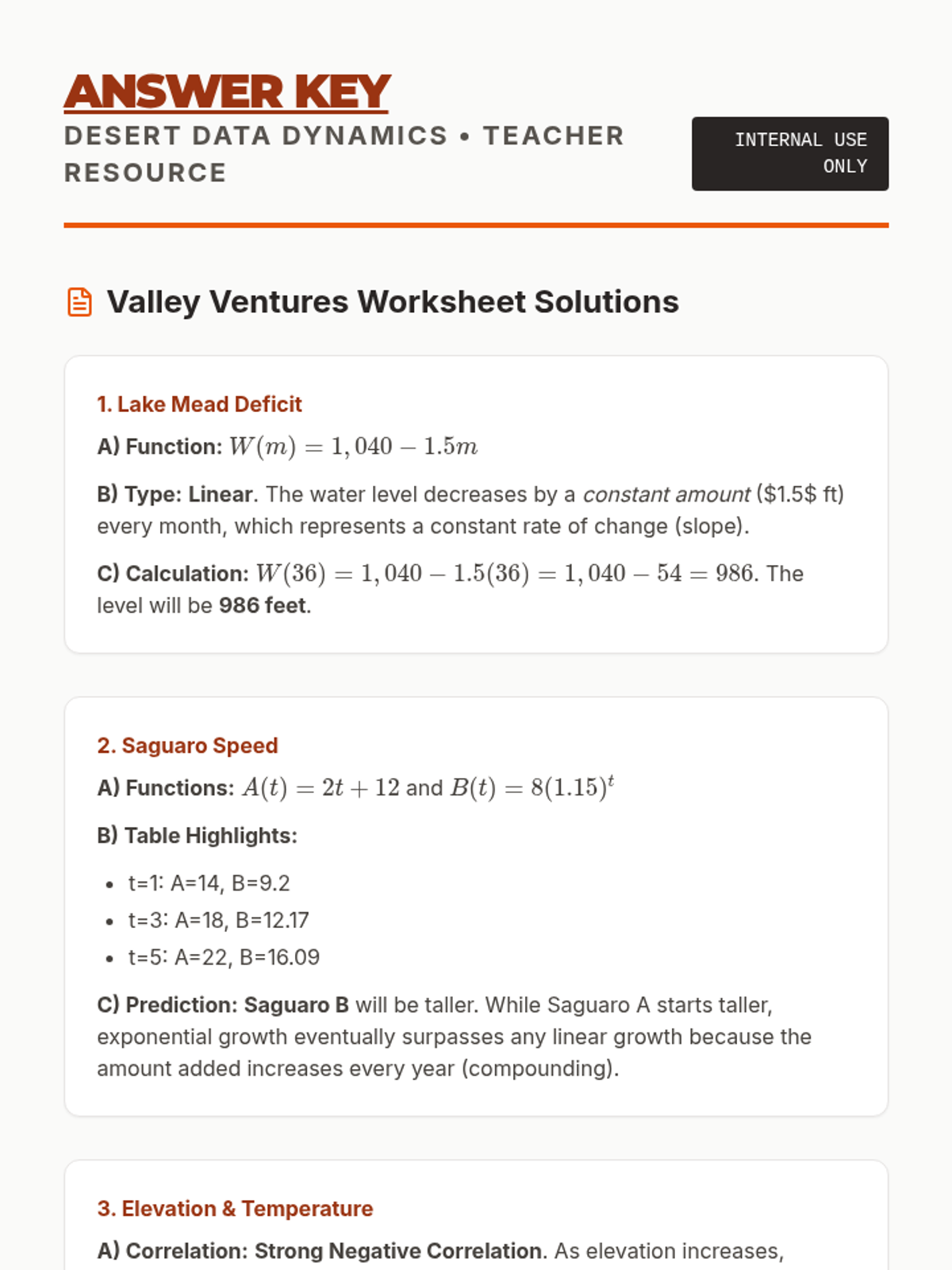
A detailed answer key for the Valley Ventures worksheet and Saguaro Summit assessment, featuring worked-out solutions and grading justifications.
A formal summative assessment featuring multi-part questions on profit modeling for a solar farm and statistical analysis of monsoon rainfall data across Arizona cities.
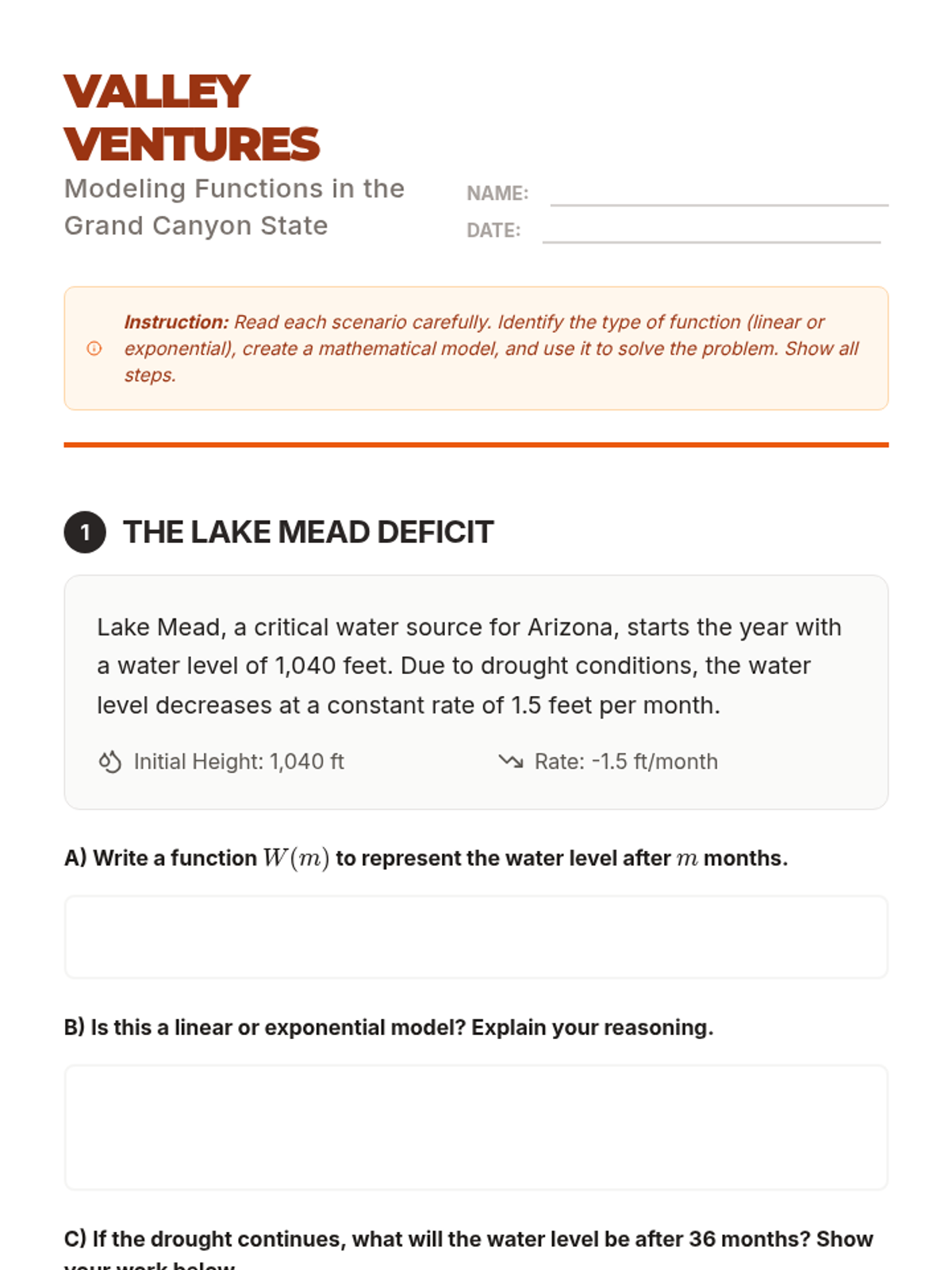
A comprehensive Algebra worksheet featuring Arizona-specific scenarios including Lake Mead water levels, Saguaro growth comparison, and elevation-temperature data analysis.
A visually engaging slide deck for high school Algebra students, introducing functions, linear vs. exponential growth, and data interpretation through Arizona-themed scenarios like solar energy and desert climates.
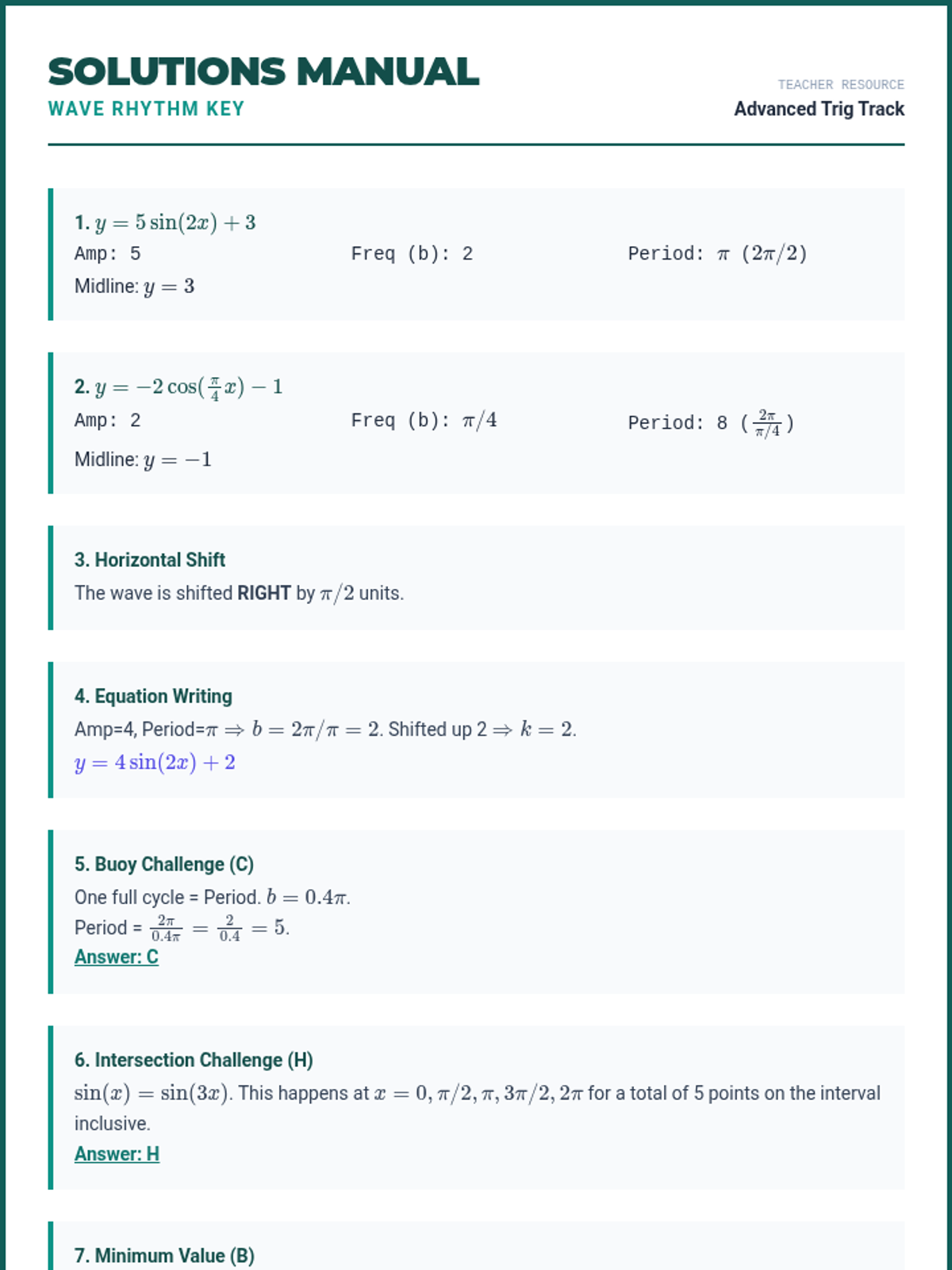
The detailed answer key for the Wave Rhythm Workout, featuring full step-by-step solutions and teacher insights for period, frequency, and wave modeling problems.
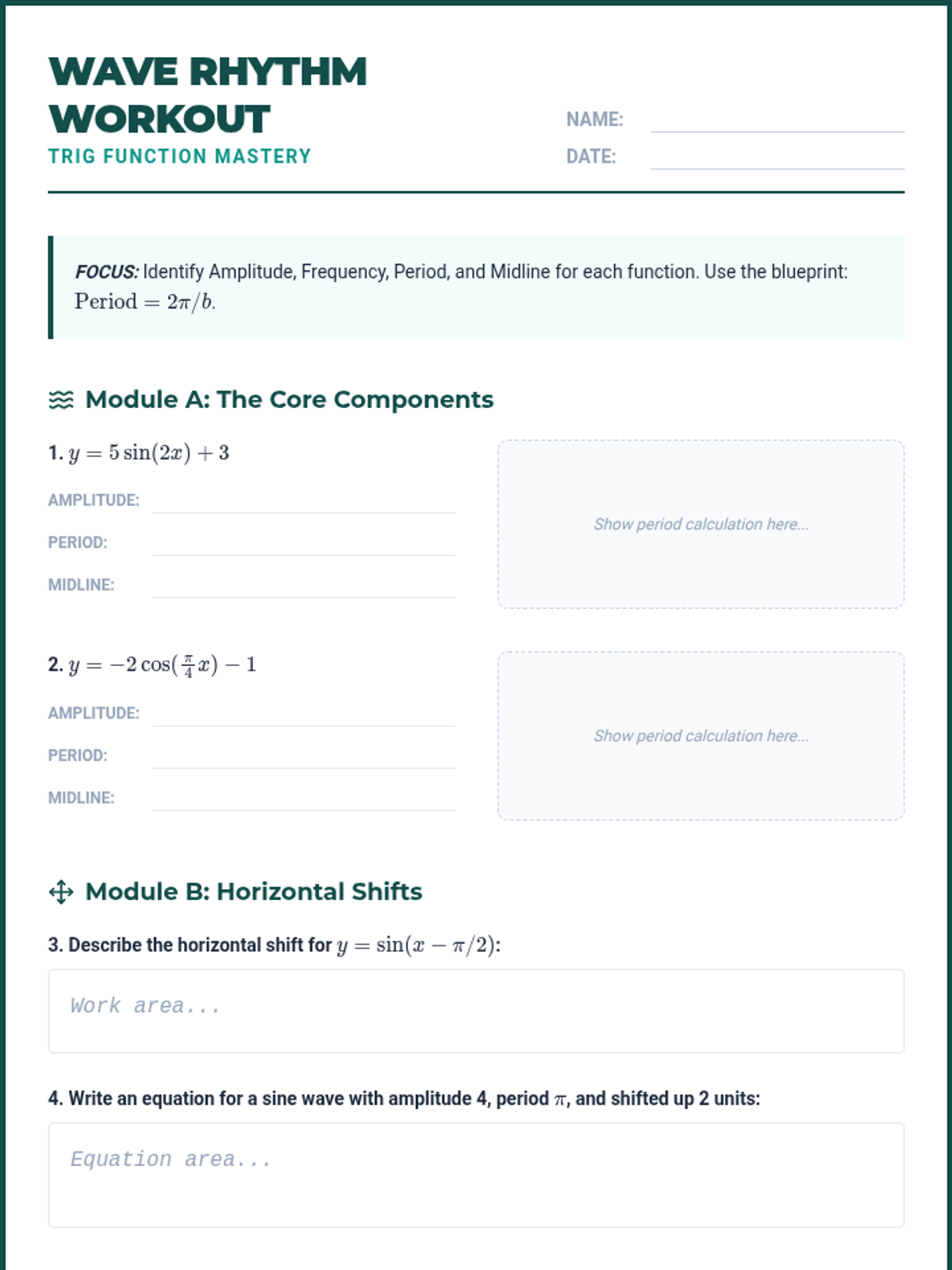
A specialized student worksheet focusing on trigonometric period, frequency, and wave components, featuring both basic identification and complex 'Final Ten' style scenario problems.
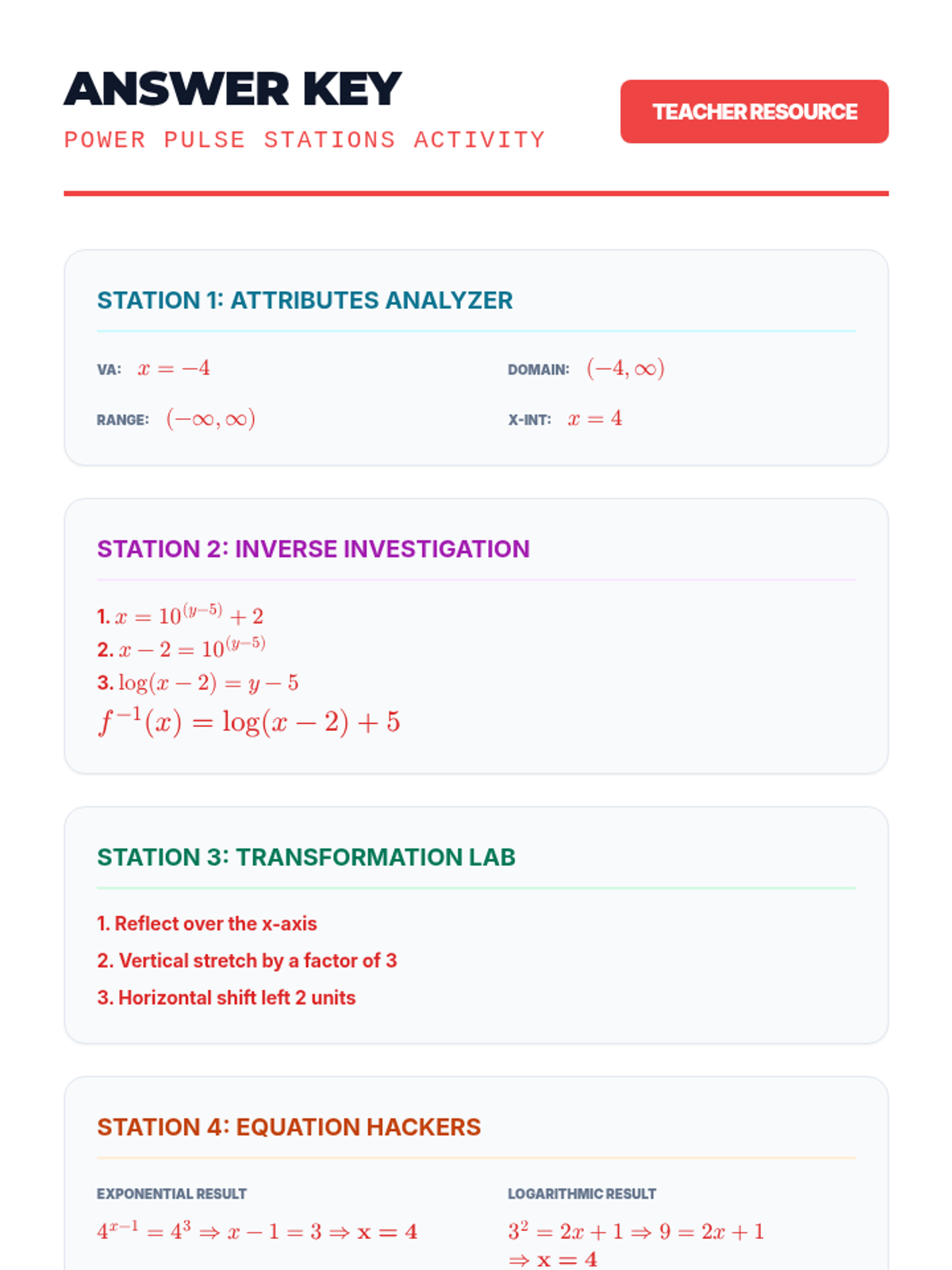
The answer key for the Power Pulse Stations Activity, providing step-by-step solutions and final answers for all five stations.
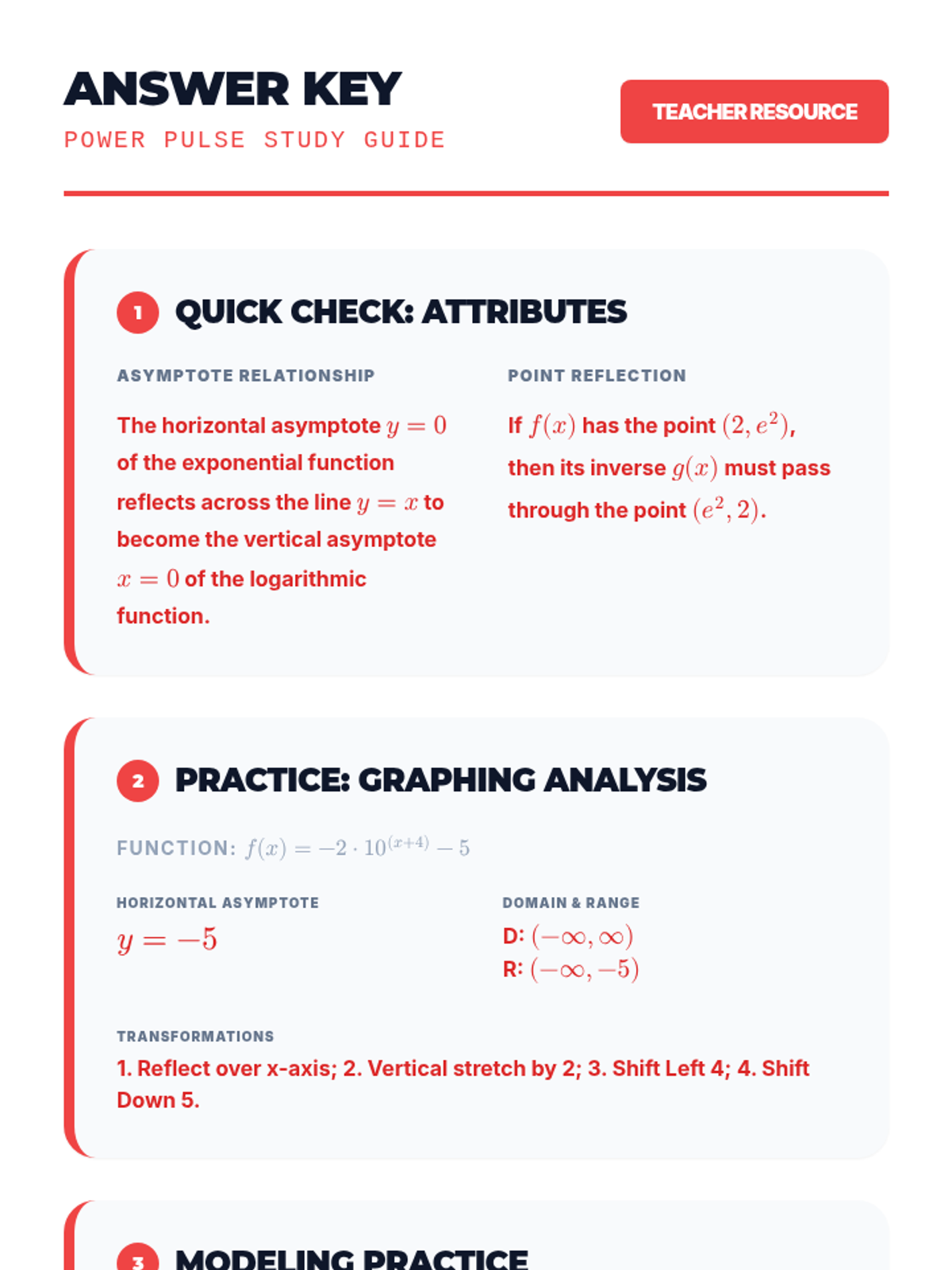
The complete answer key for the Power Pulse Study Guide, providing specific solutions for the Quick Check exercises, attribute analysis, and modeling scenarios.
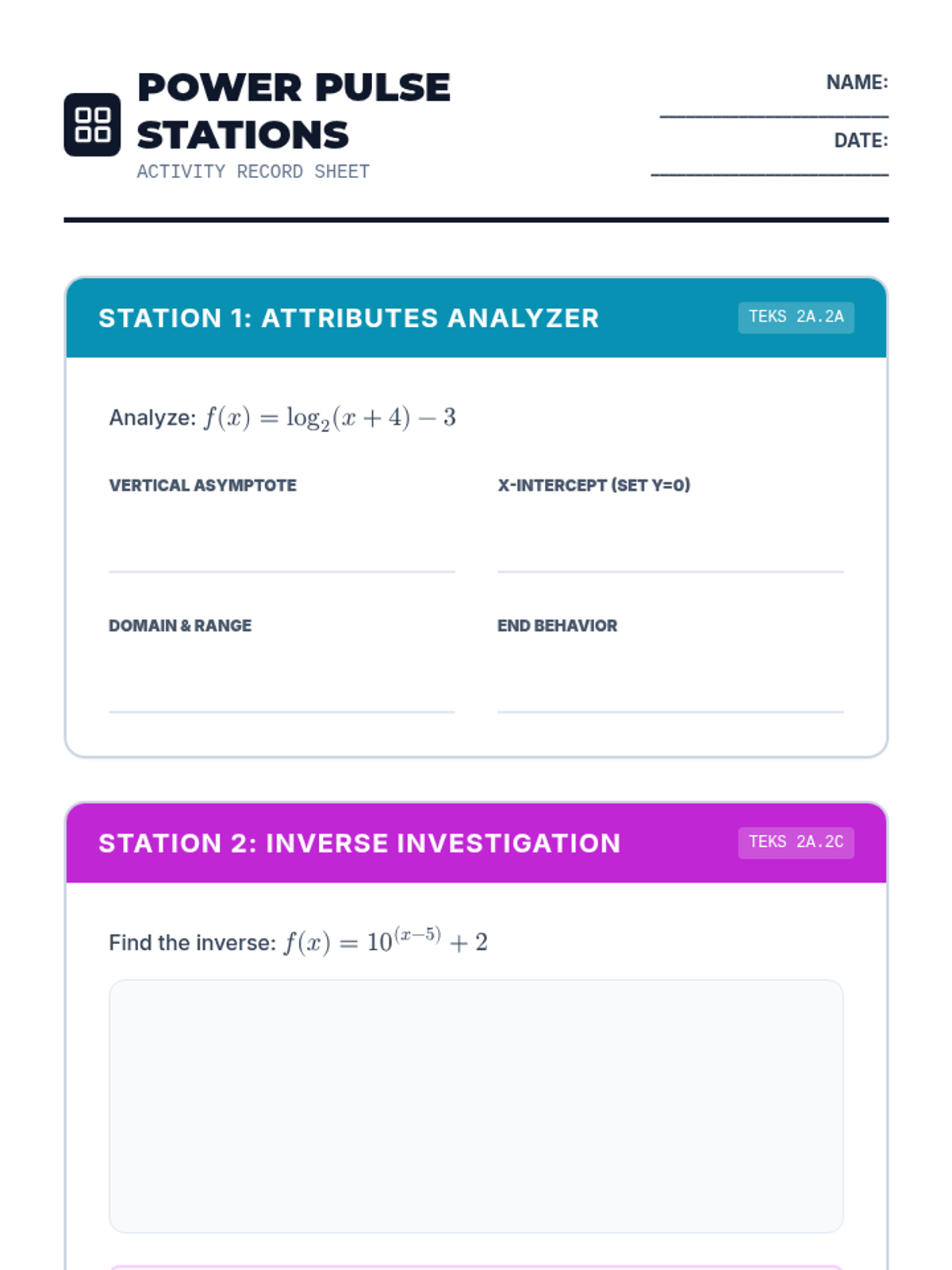
A 2-page stations activity recording sheet where students solve problems related to attributes, inverses, transformations, equations, and data modeling for exponentials and logarithms.
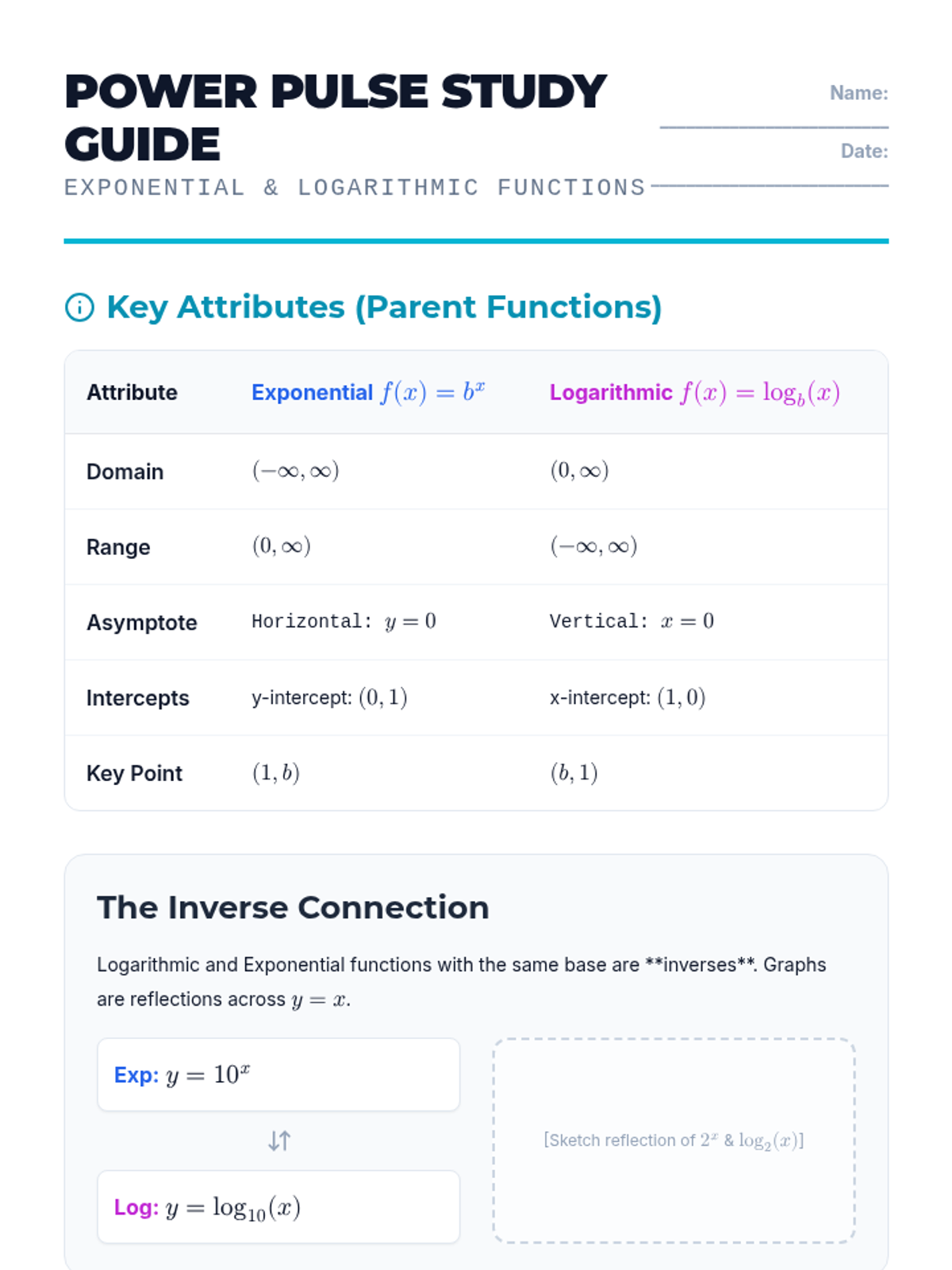
A comprehensive 3-page study guide covering key attributes of parent functions, transformation rules, inverse relationships, solving methods for exponential/logarithmic equations, and data modeling identifiers.
A high-energy, neon-themed slide deck for a comprehensive Algebra 2 review of exponential and logarithmic functions, featuring graphing attributes, transformation tables, and step-by-step solving strategies.
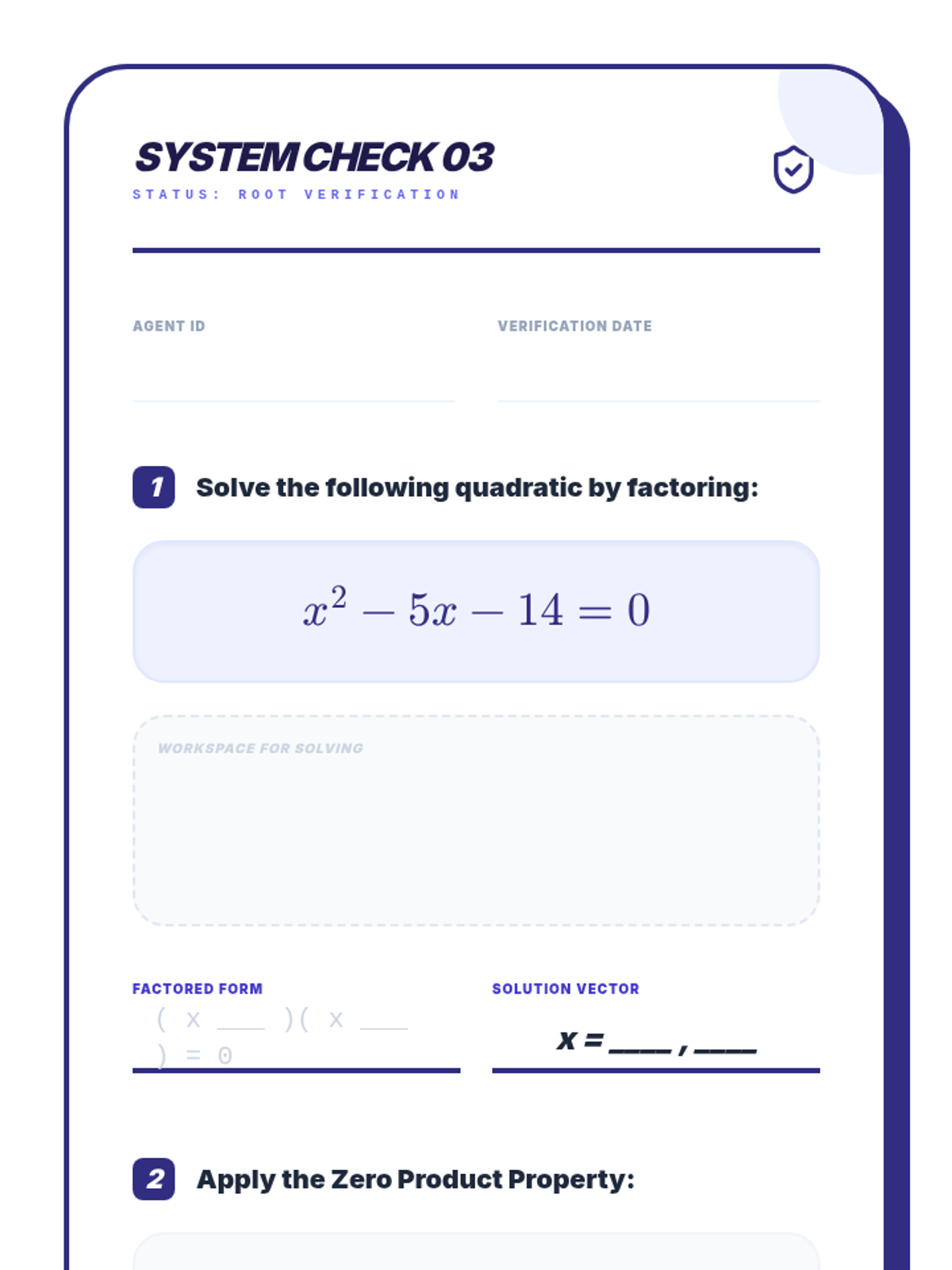
A quick check for student mastery of factoring techniques and the Zero Product Property.
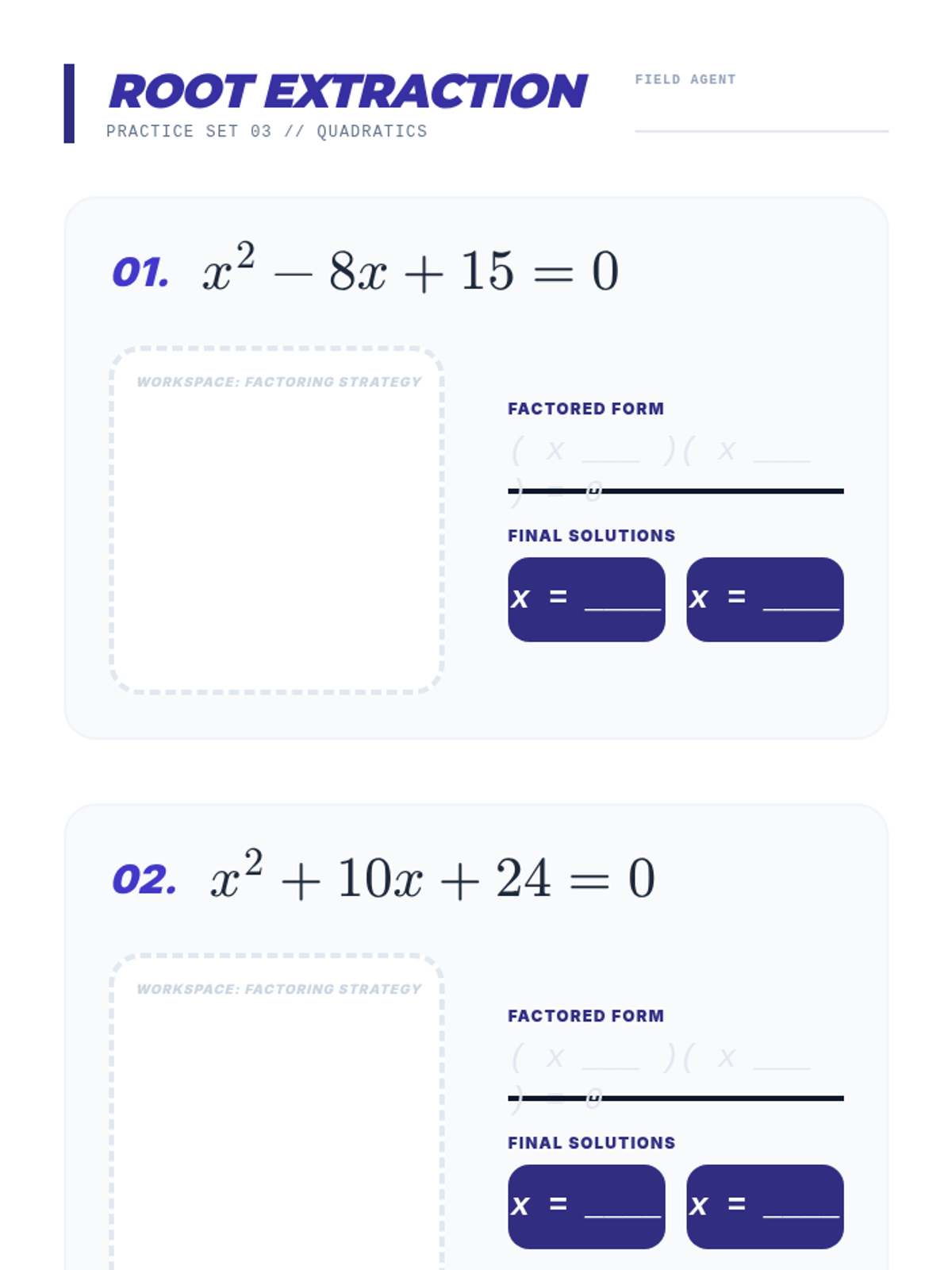
A practice worksheet for solving quadratic equations by factoring, including trinomials, GCF, and difference of squares.
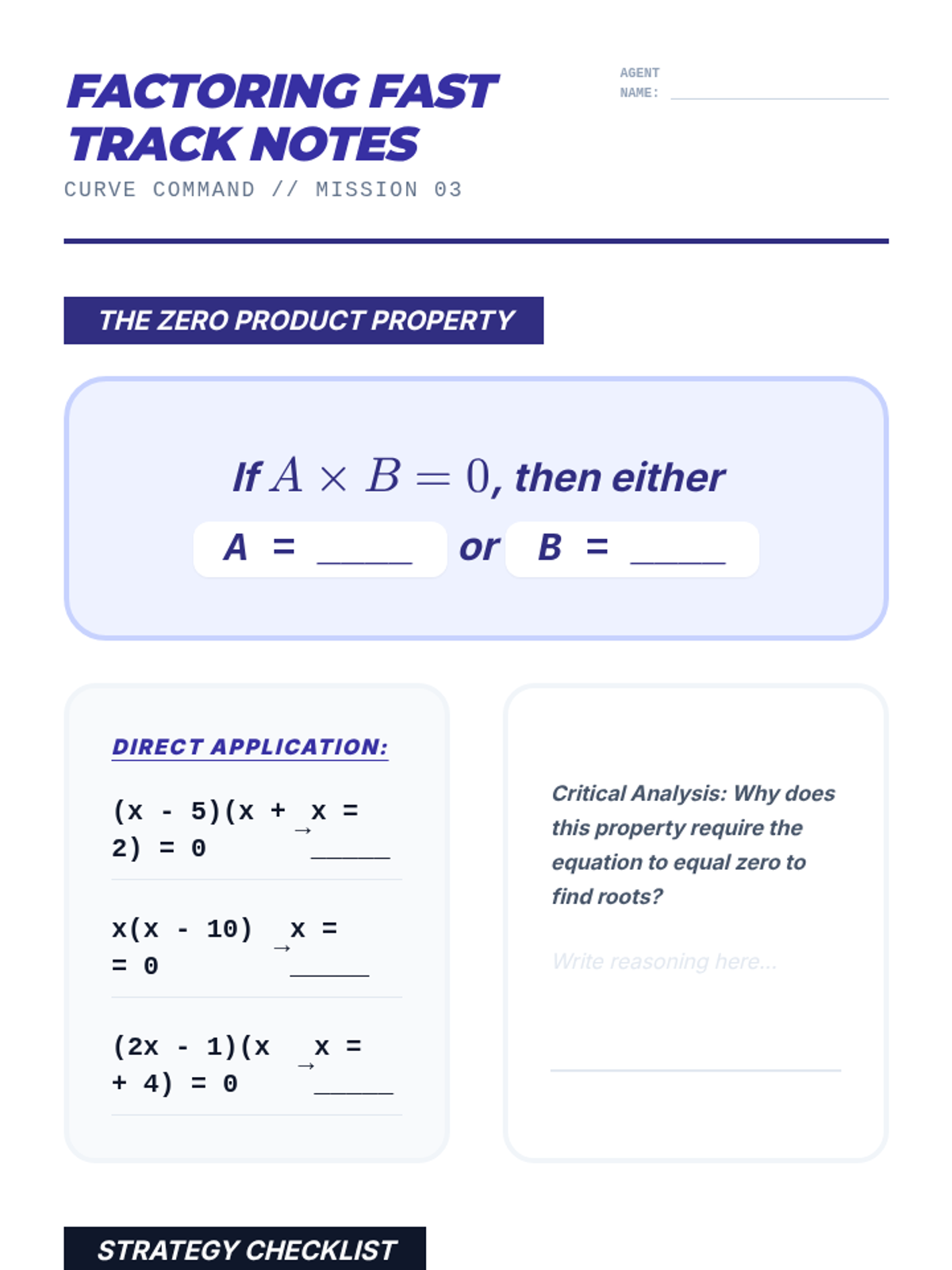
Guided notes for Lesson 3 focusing on solving quadratic equations by factoring and applying the Zero Product Property.
A slide deck for Lesson 3, teaching Algebra II students how to solve quadratic equations by factoring using the Zero Product Property.
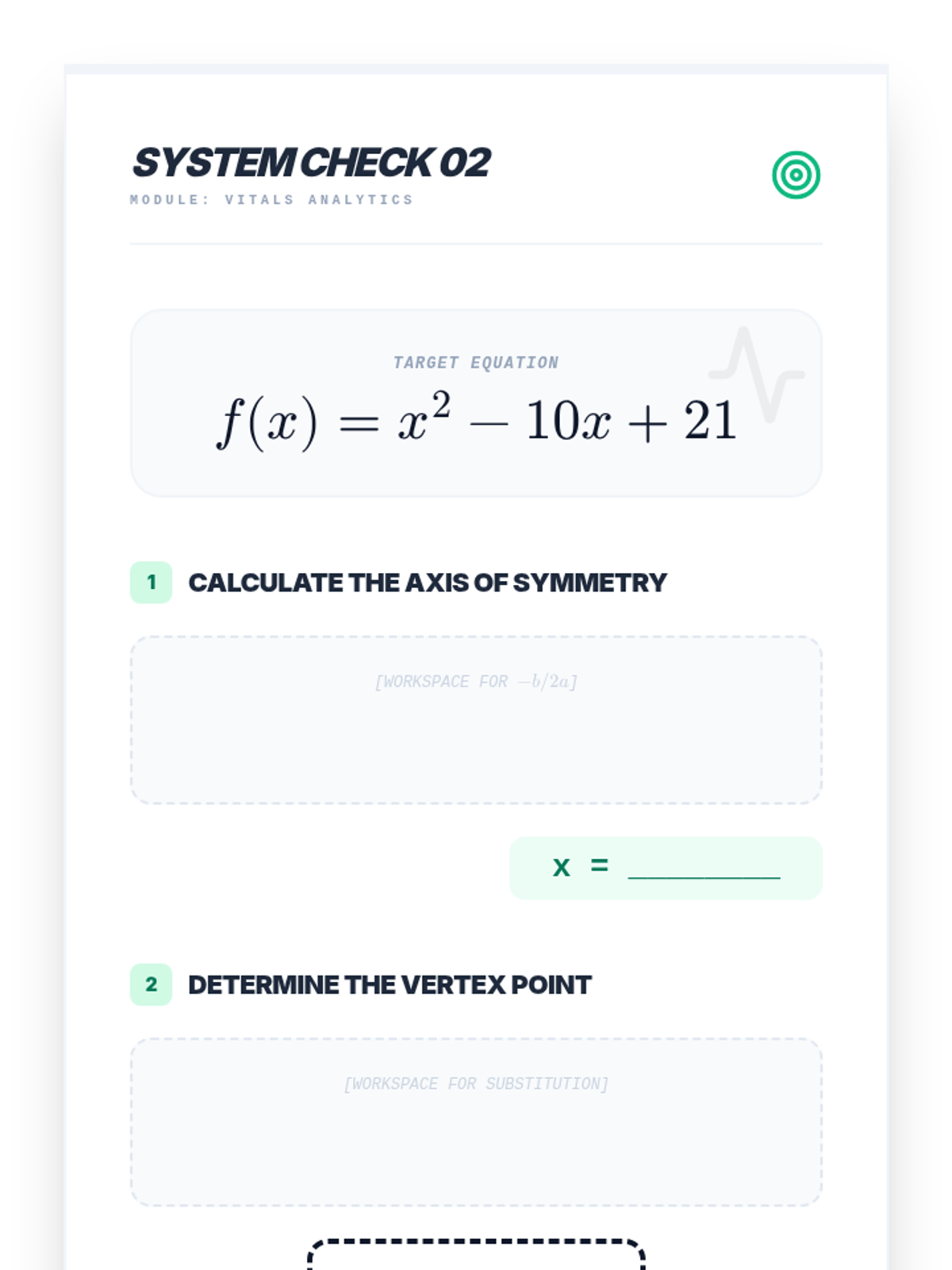
A formative assessment focusing on extracting key features from a standard form quadratic equation.
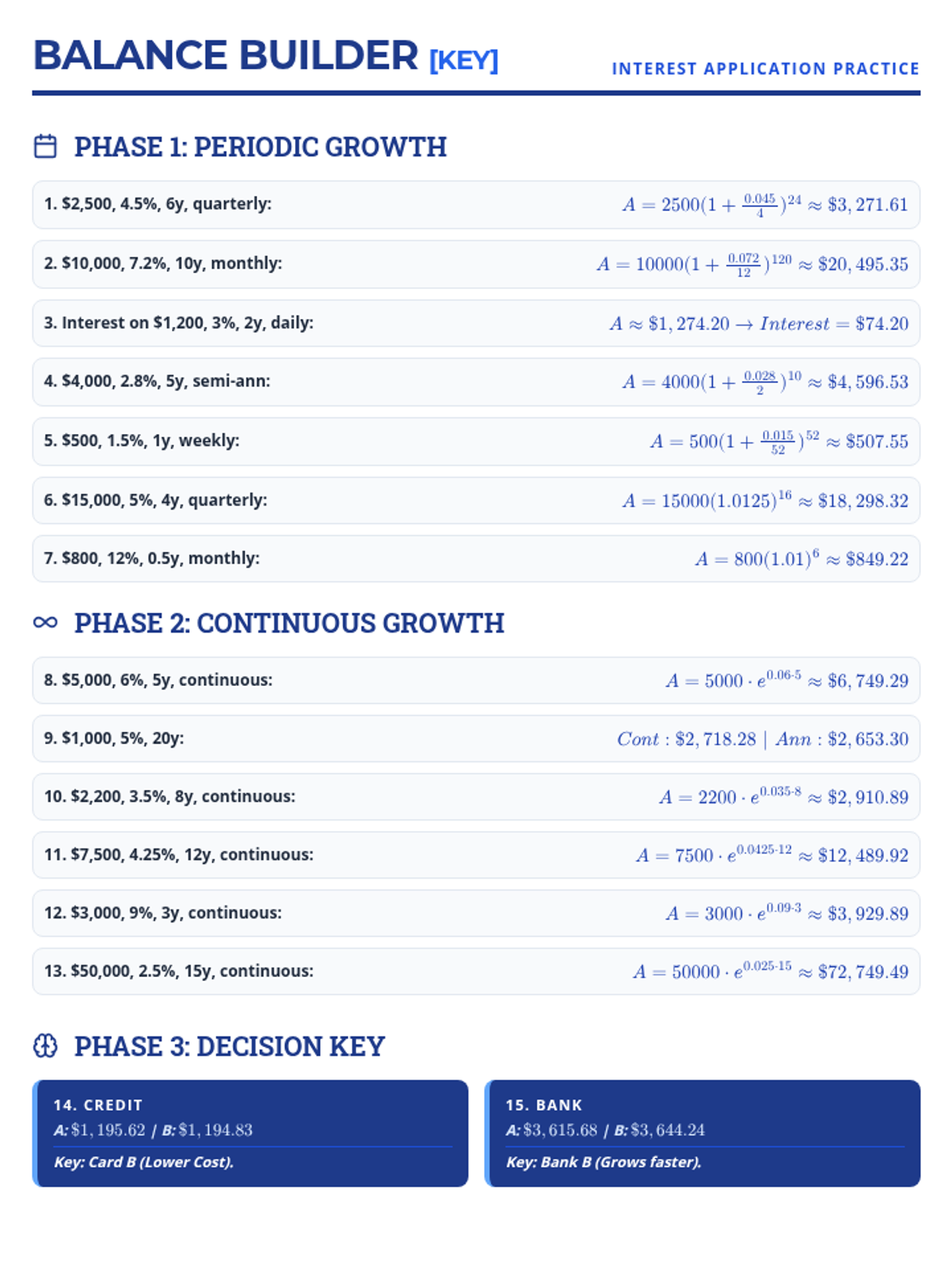
Teacher answer key for the expanded Balance Builder Worksheet, featuring complete answers and evaluations for all 15 problems. Revised to ensure consistent formatting and clear mathematical rendering on a single page.
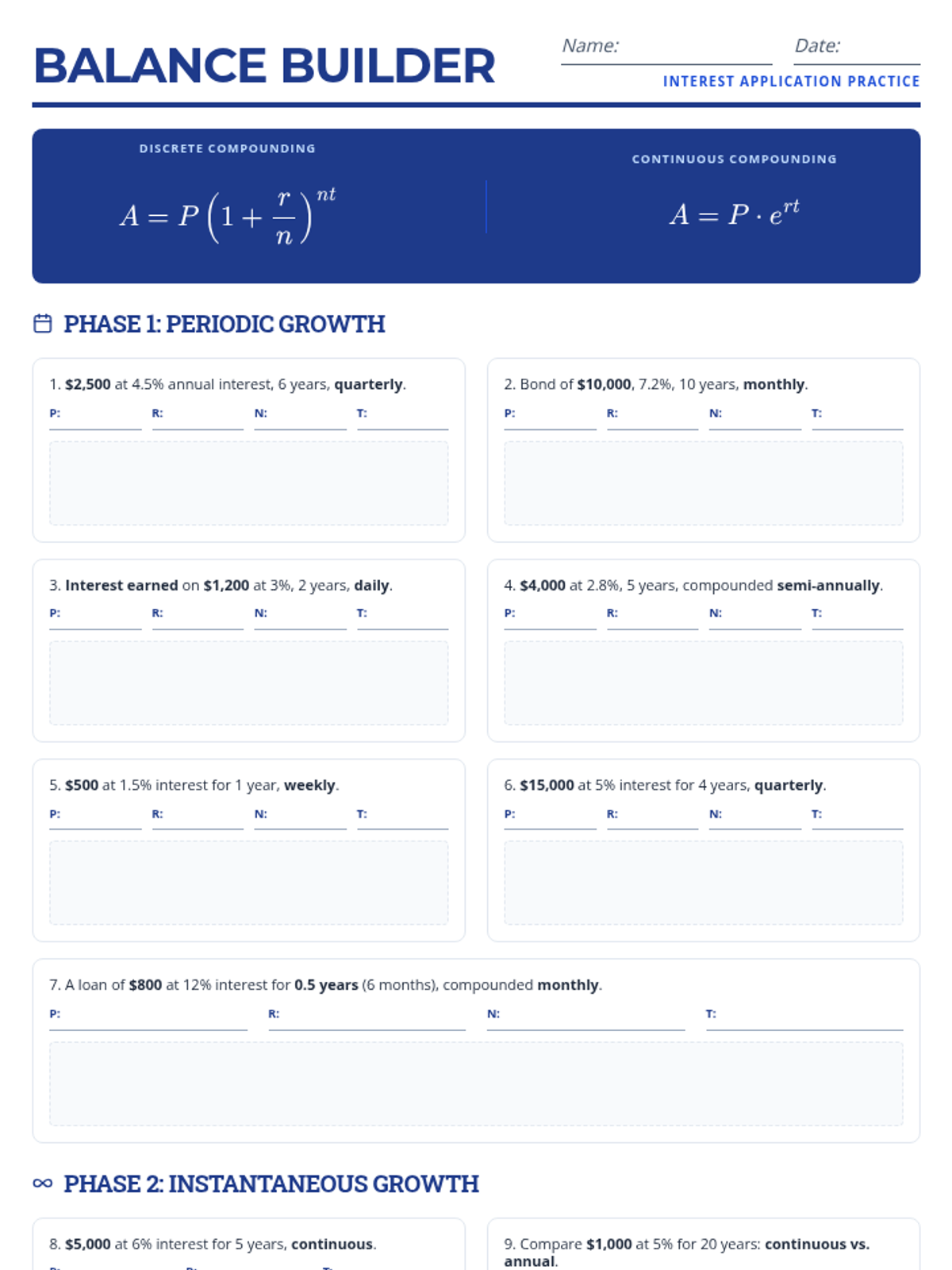
An expanded practice worksheet for Algebra 2 students featuring 15 total word problems on discrete and continuous compound interest. Includes identification of variables, step-by-step calculation areas, and comparison problems across three phases. Revised to fit on 2 pages with consistent scaffolding.
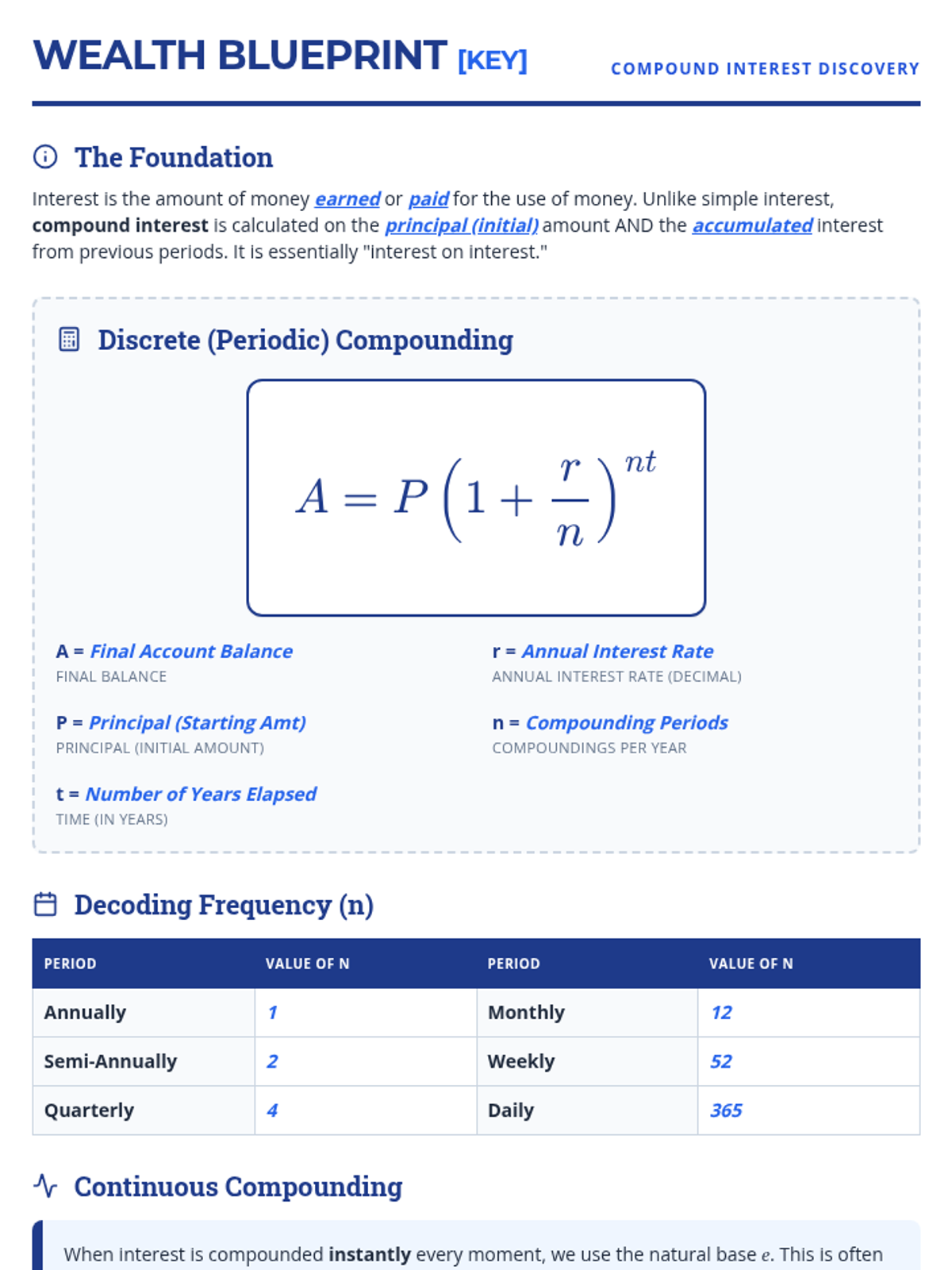
Teacher answer key for the Compound Interest Blueprint Notes, featuring all blanks filled with clear blue italicized text. Revised for better page flow and consistent formatting.
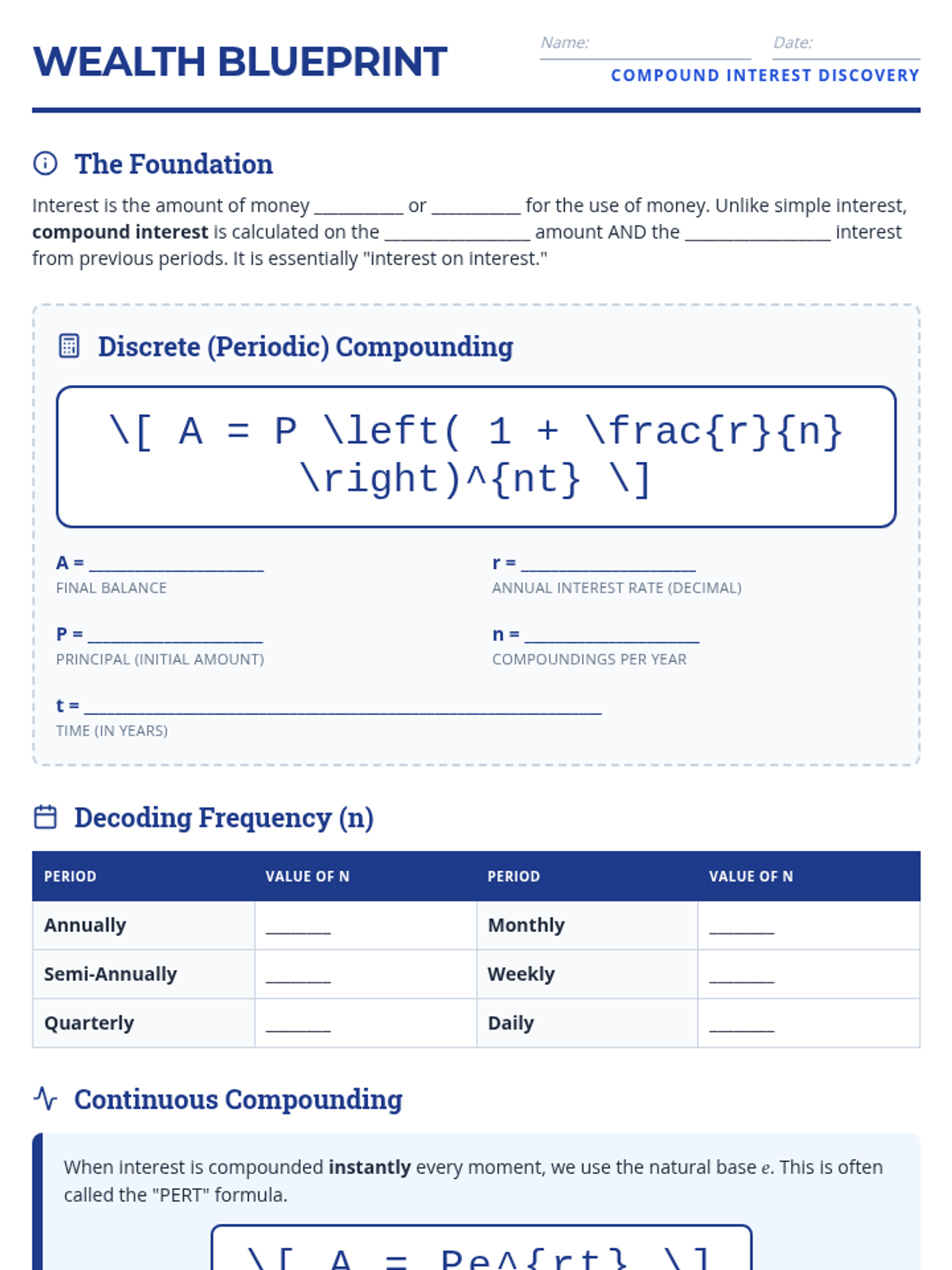
A fill-in-the-blank guided notes document for Algebra 2 students covering discrete and continuous compound interest. Includes a graphic organizer for variables and a reference table for compounding frequencies. Revised for better page flow and consistent formatting.
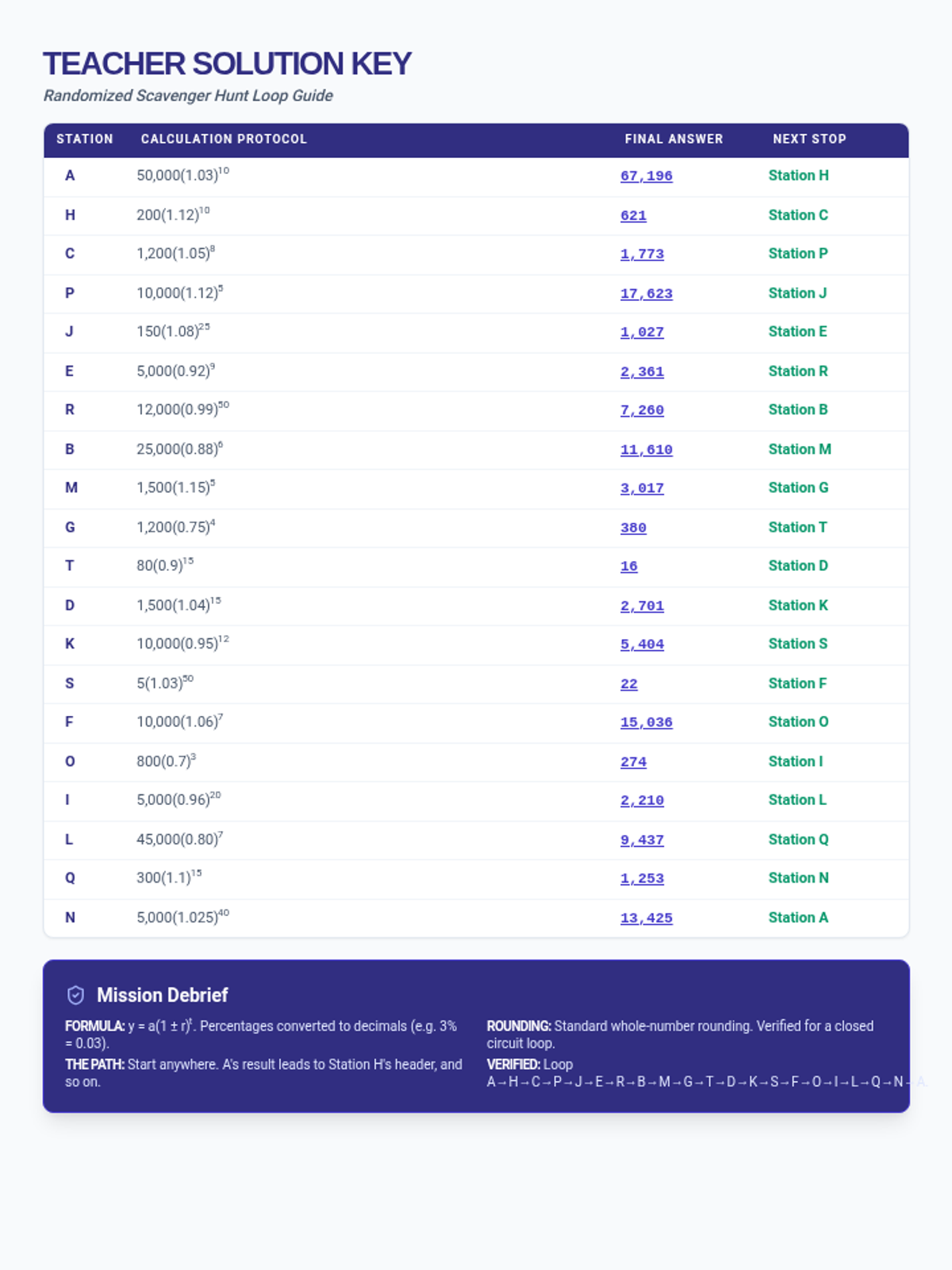
Complete teacher answer key for the Exponential Lab scavenger hunt. Provides the formula and calculation for every station using annual growth and decay models, the correct randomized loop sequence, and final answers. Fixed superscript alignment and table layout.
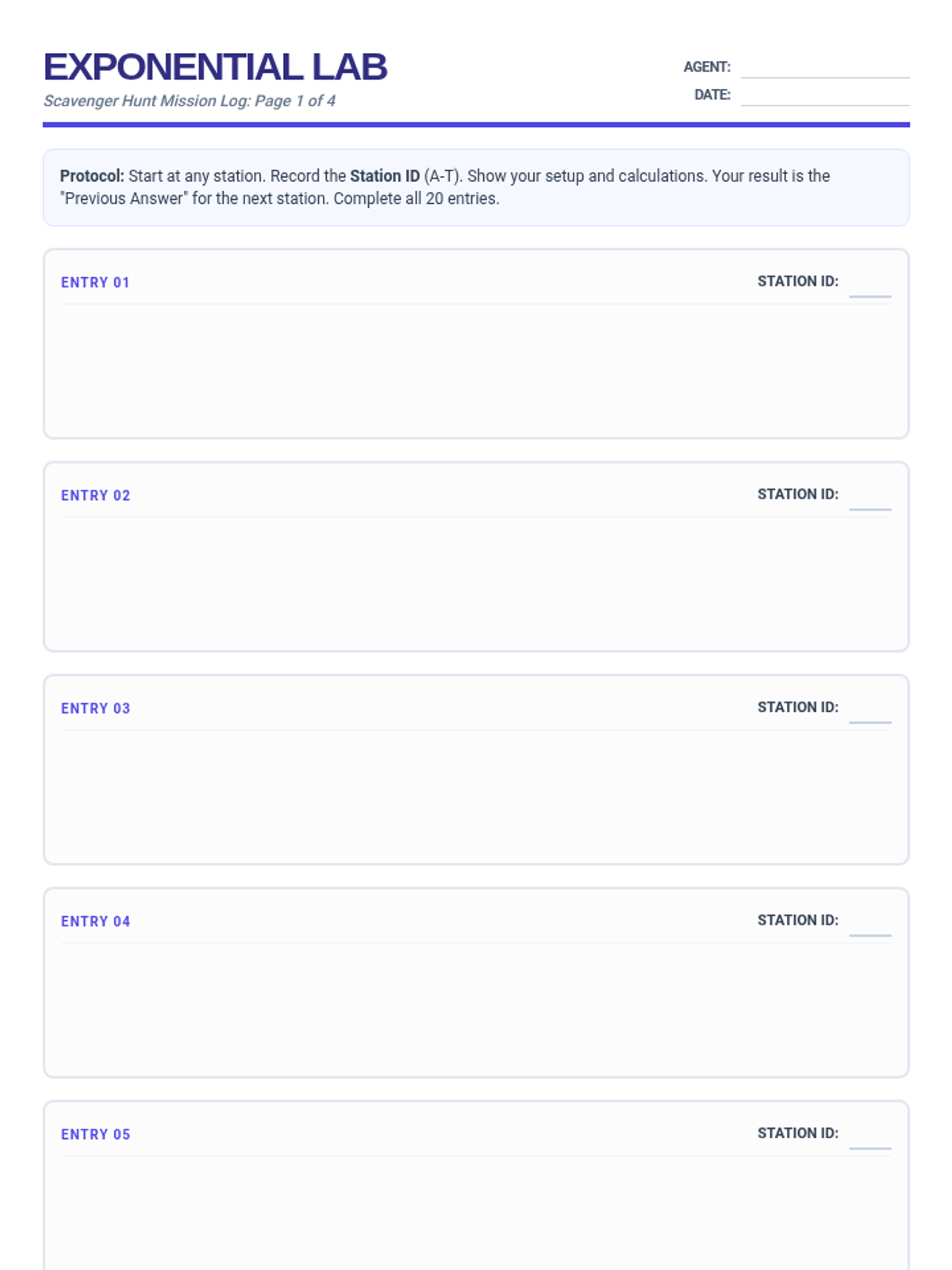
A structured student recording sheet for the Exponential Lab scavenger hunt. Includes 20 large work areas with "Station ID" fields and clear instructions to guide students through the loop across 4 pages.
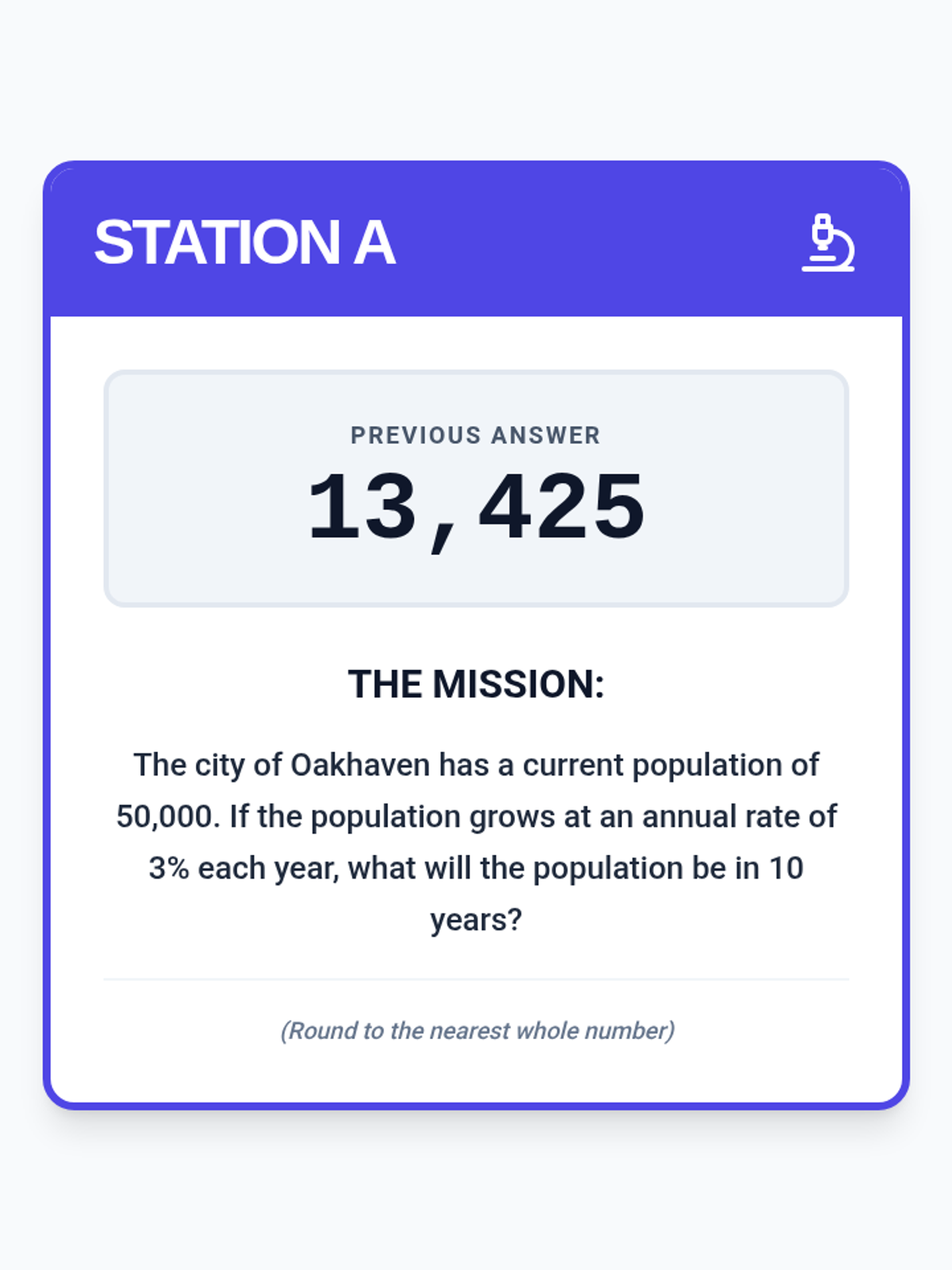
20 printable scavenger hunt station cards featuring real-world exponential growth and decay problems, all using annual percent change models. Each card is positioned on its own page with a randomized "Previous Answer" loop to increase challenge. Verified mathematically.
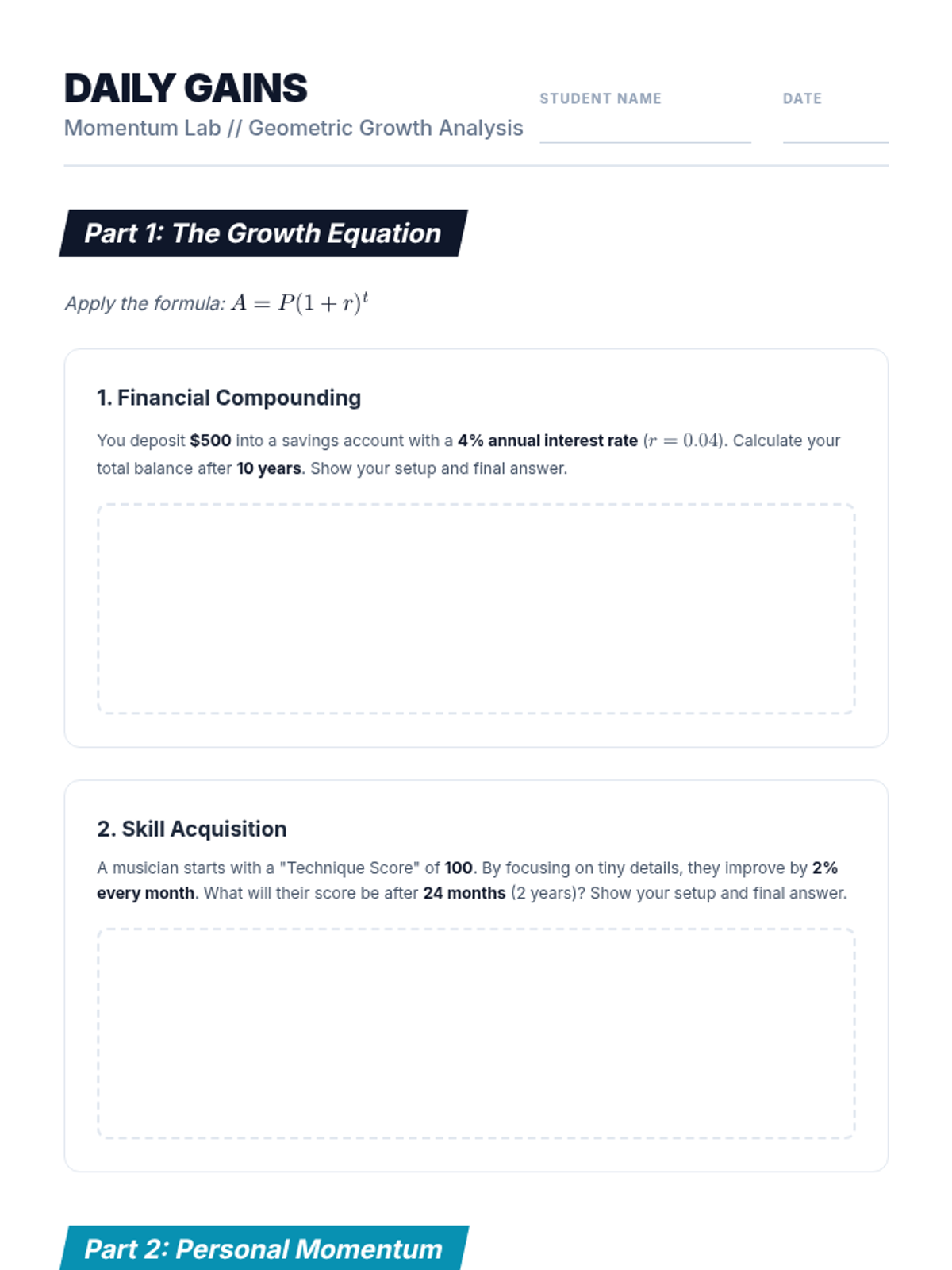
A student worksheet for 'Momentum Lab' where learners solve exponential growth problems and apply the '1% Rule' to their own personal habits and skill development.
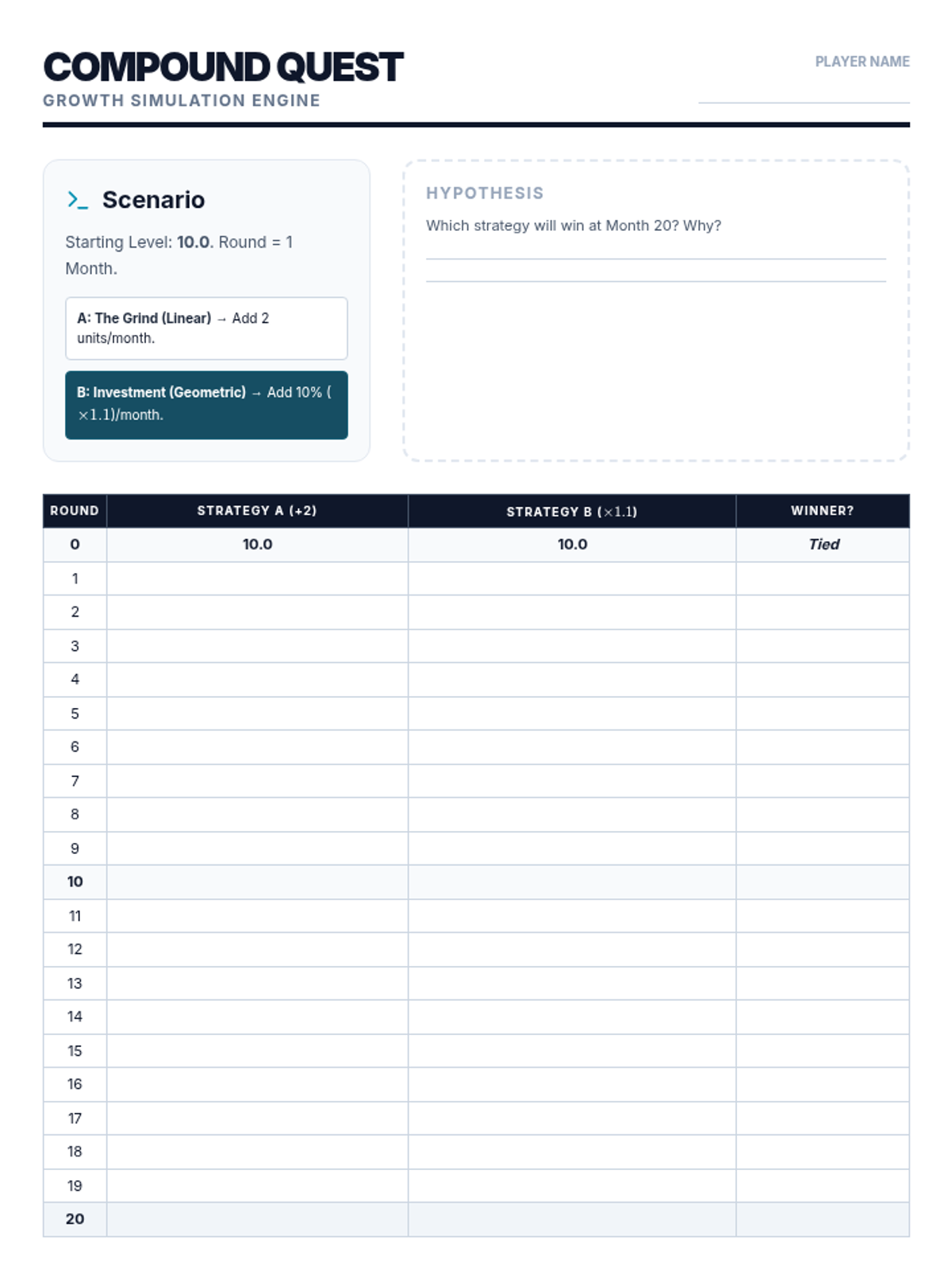
A classroom simulation activity where students model and compare linear vs. geometric growth patterns to discover the tipping point of compounding.
A high-impact slide deck for the 'Momentum Lab' lesson, featuring visual proofs of compounding, comparisons of linear vs. geometric growth, and the '1% Rule' mathematical breakdown.
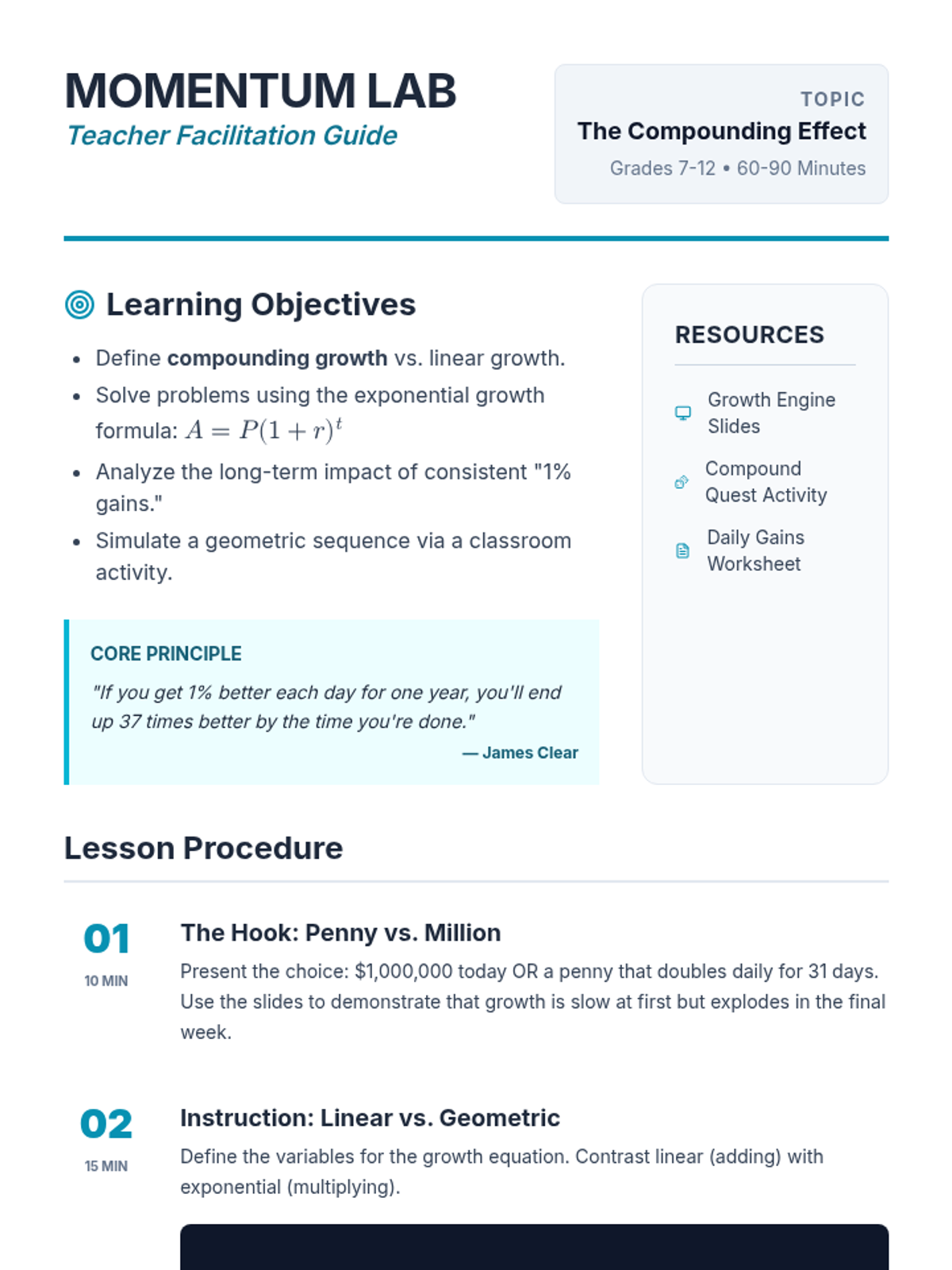
A detailed lesson plan for 'Momentum Lab', outlining objectives, materials, and a step-by-step instructional sequence focused on the compounding effect and geometric growth.
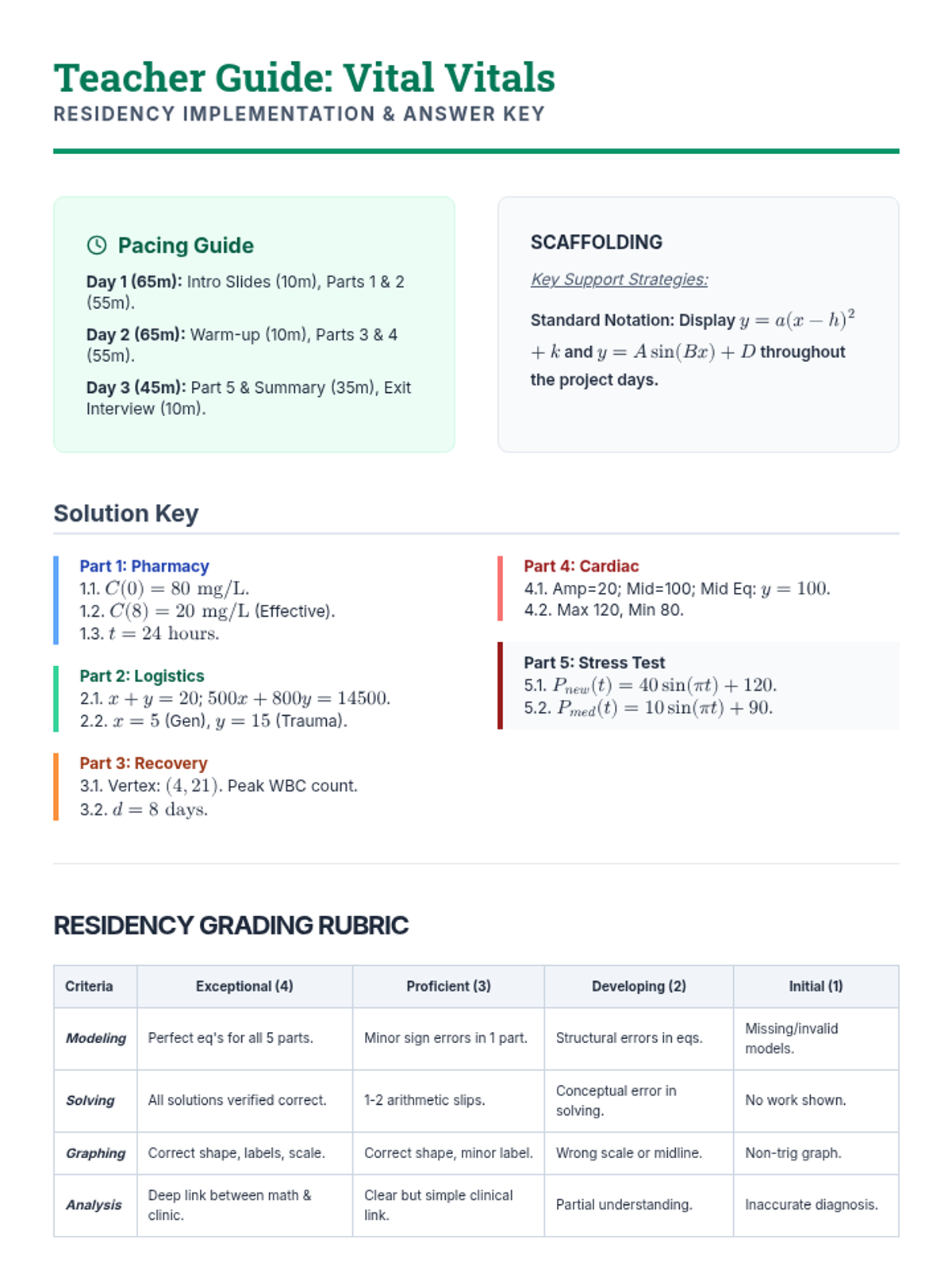
Teacher guide for the Vital Vitals project, including a day-by-day pacing guide, complete answer key with worked solutions, and a detailed grading rubric focused on modeling and clinical analysis.
Introductory slides for the Vital Vitals project. Sets the healthcare scenario, outlines the 3-day schedule, and provides visual aids for understanding heart rate transformations (trig) and patient recovery curves (quadratics).
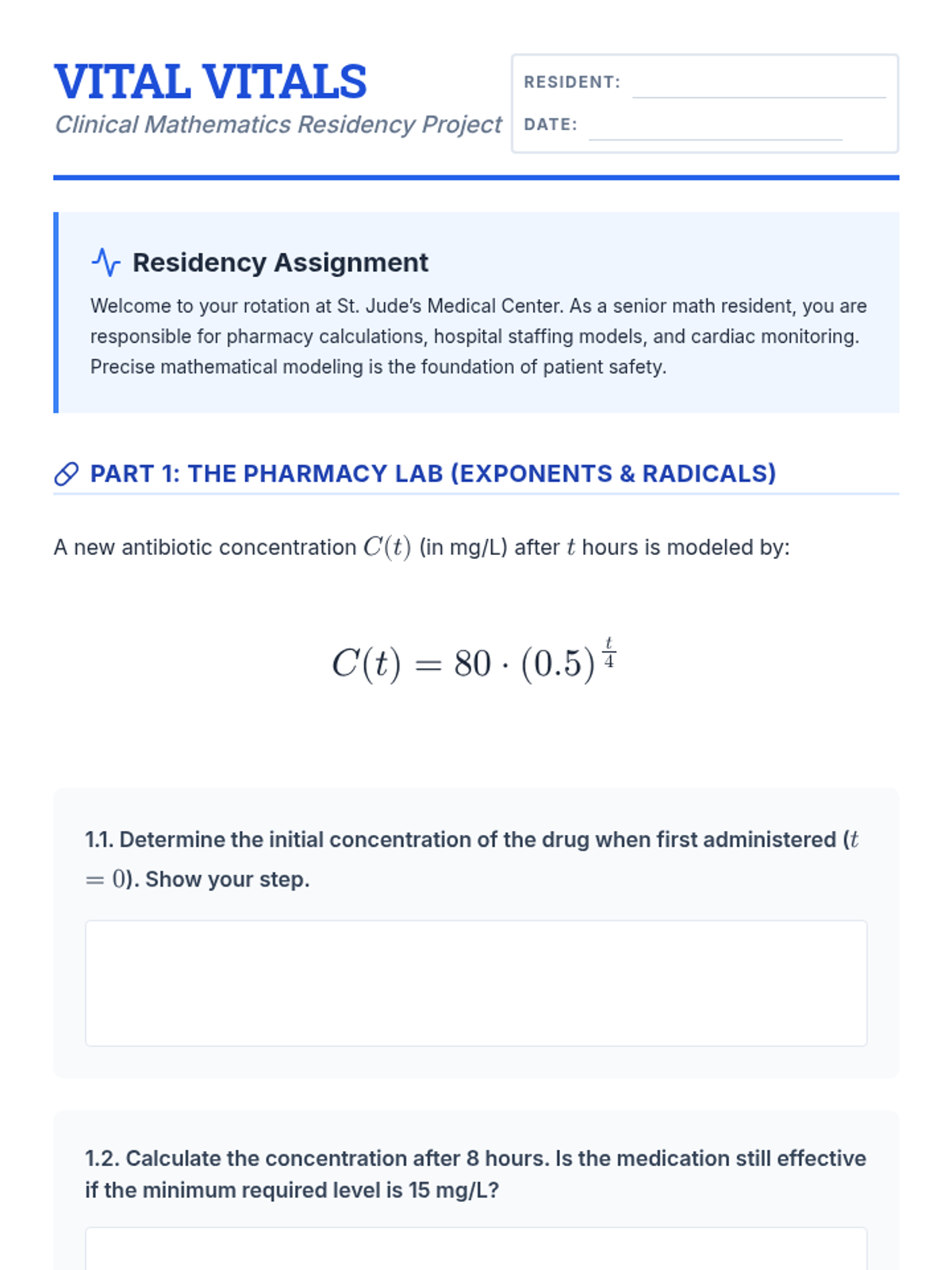
A 4-page constructed response project booklet where students act as medical residents. It covers pharmacy math (exponents/radicals), hospital staffing (linear systems), patient recovery (quadratics), and cardiac monitoring (trig transformations).
An instructional slide deck updated with a practice round example and corrected superscript styling. Designed to introduce exponential growth and decay through mathematical anatomy and financial logic.
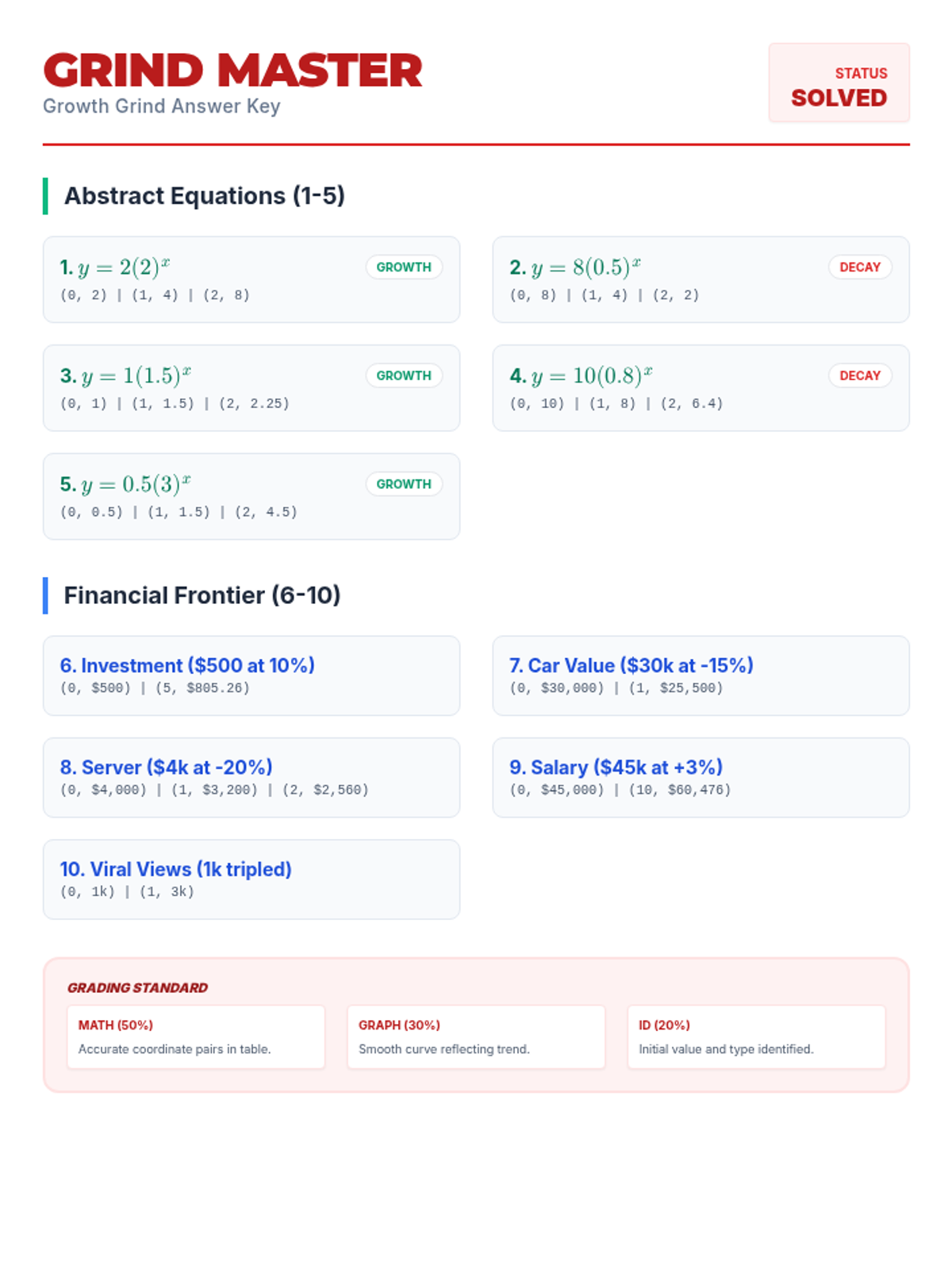
A comprehensive answer key and grading guide for the Growth Grind worksheet, featuring solved tables and key features for all 10 problems. Updated Problem 8 to a currency-based scenario.
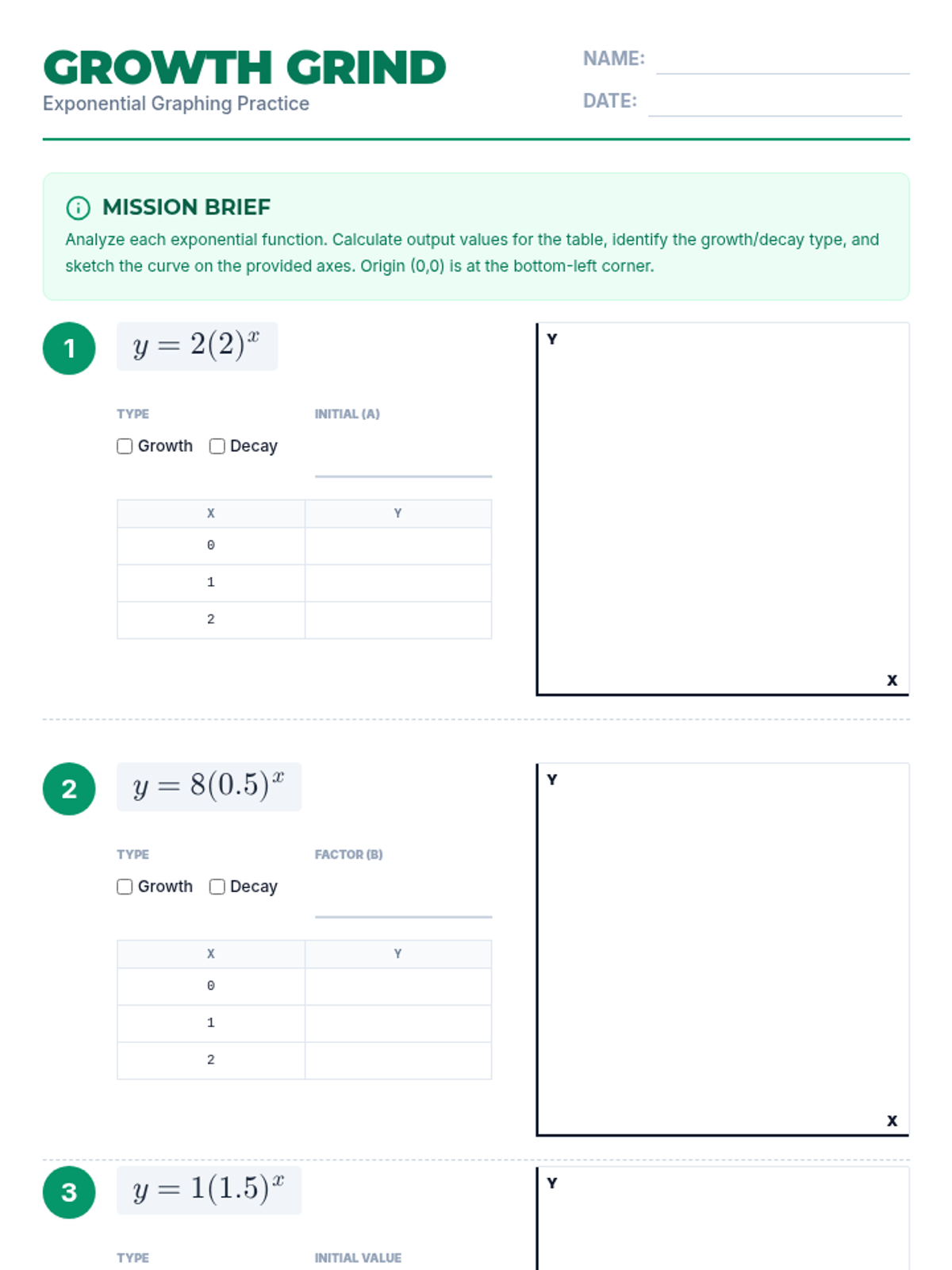
A 10-problem rapid-fire worksheet featuring a mix of abstract exponential functions and applied financial scenarios. Students must calculate data points, identify growth/decay types, and graph the resulting curves. Updated with L-shaped axes and improved layout for better flow.
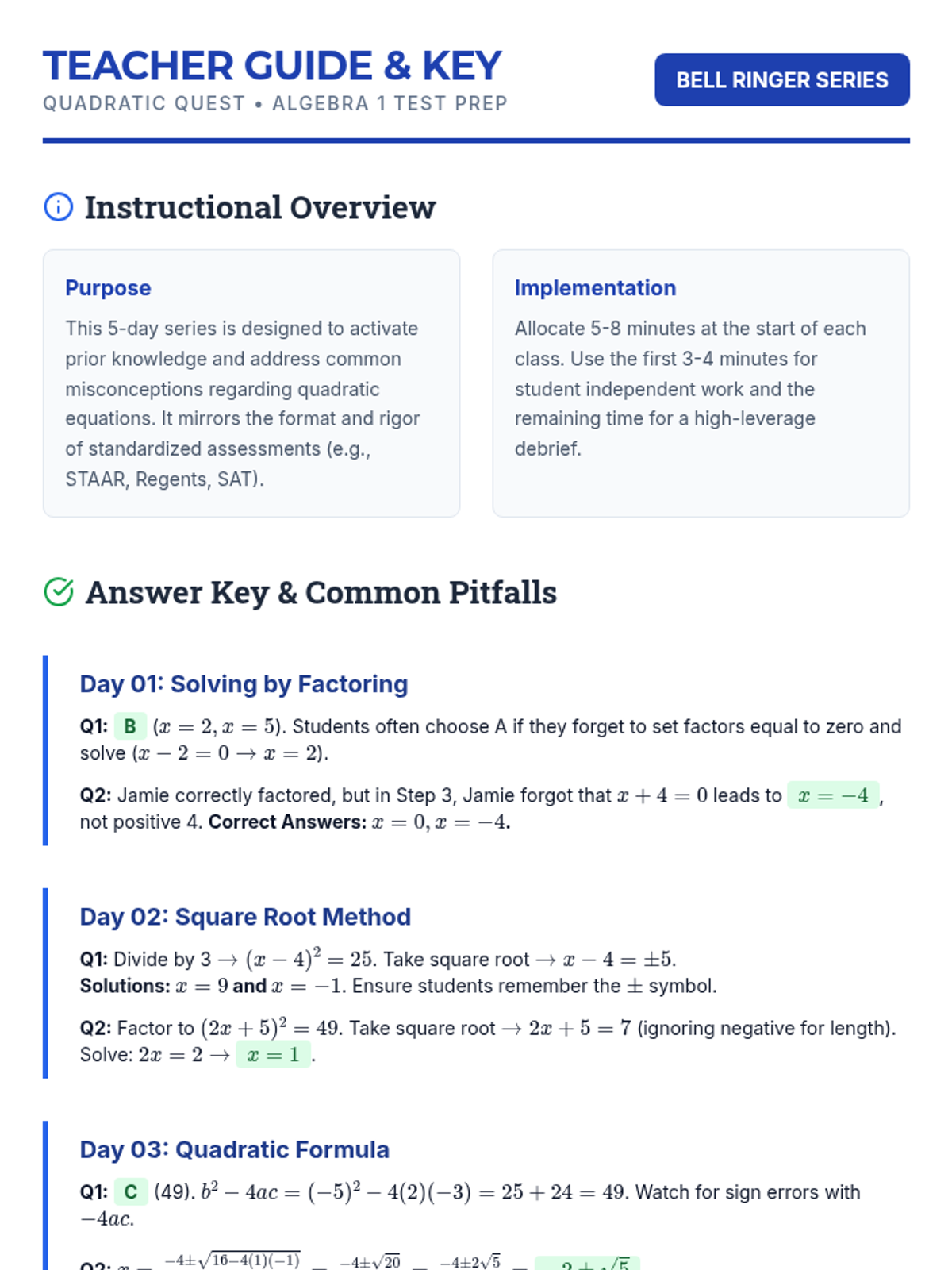
A comprehensive teacher's guide and answer key for the Quadratic Quest bell-ringer series. Includes full solutions, common student pitfalls, and instructional tips for daily debriefs.
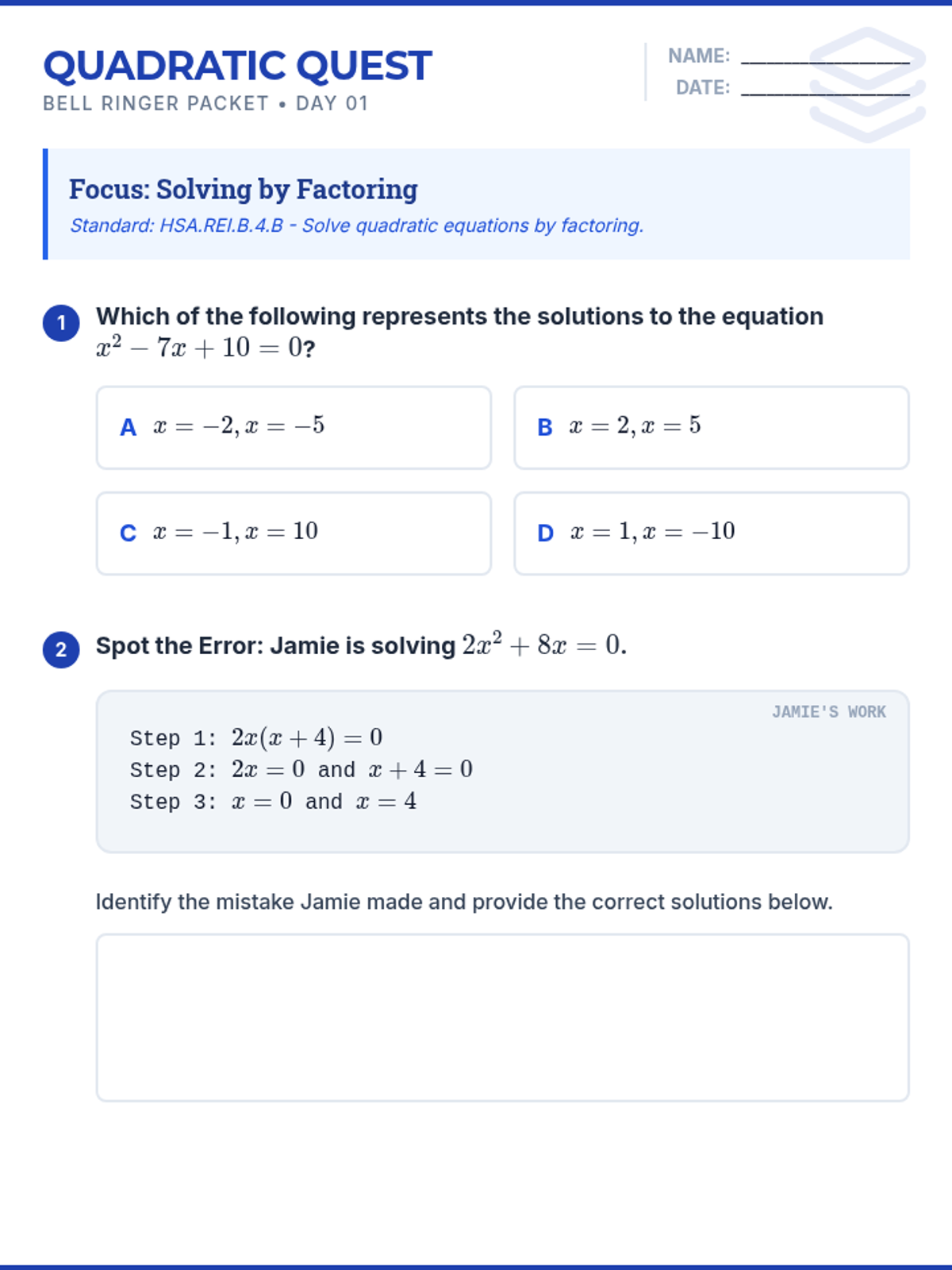
A 5-day daily bell-ringer packet for Algebra 1 students focusing on quadratic equations, designed for standardized test preparation. Includes factoring, square roots, the quadratic formula, graphing, and real-world applications. Each day is on its own page with clean work spaces.
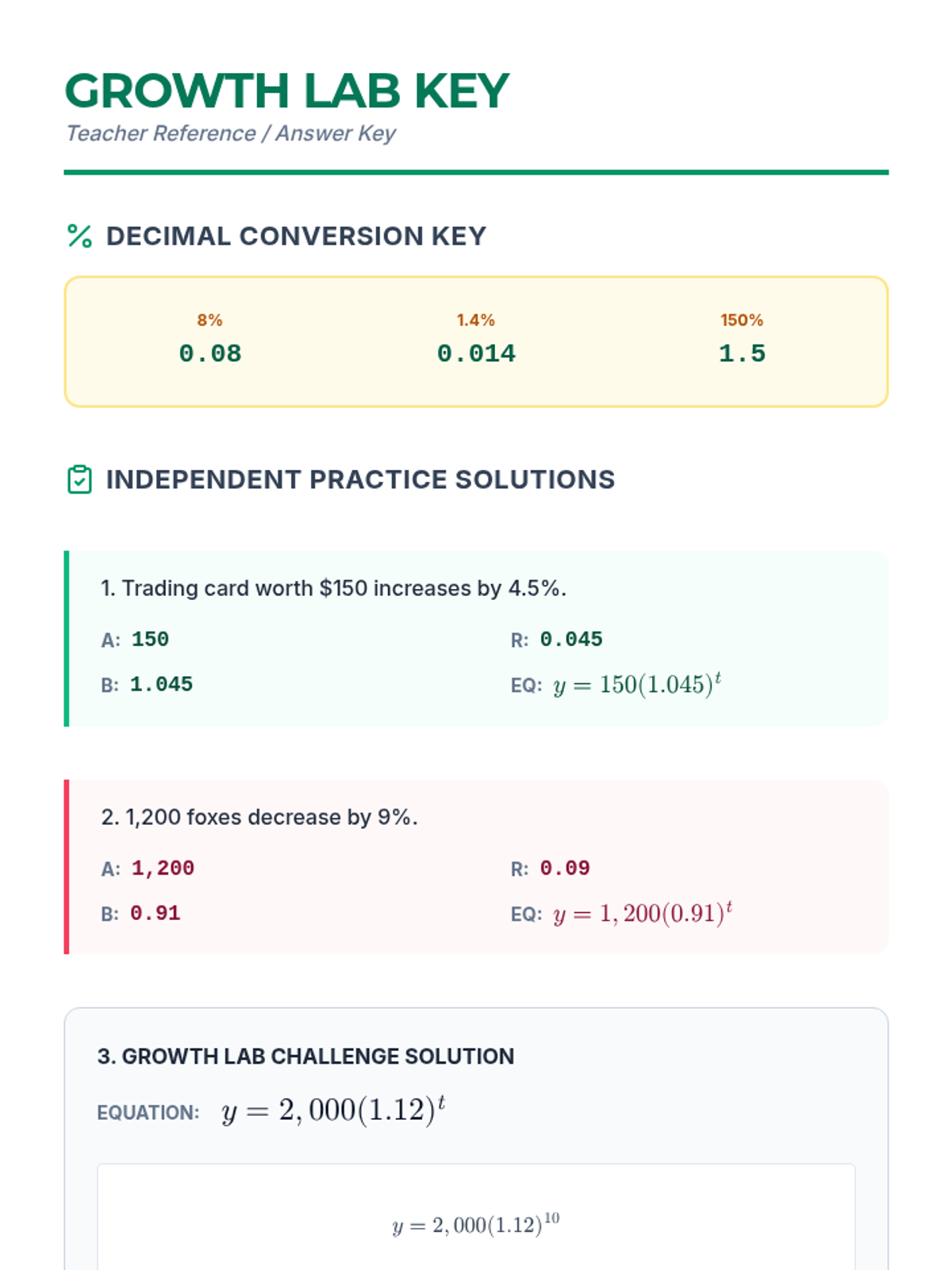
The corresponding answer key for the Growth Lab Notes, providing clear solutions and teacher-focused insights for correcting student work. Updated to reflect the removal of the fox population problem and renumbering of trials. Optimized for a single-page layout.
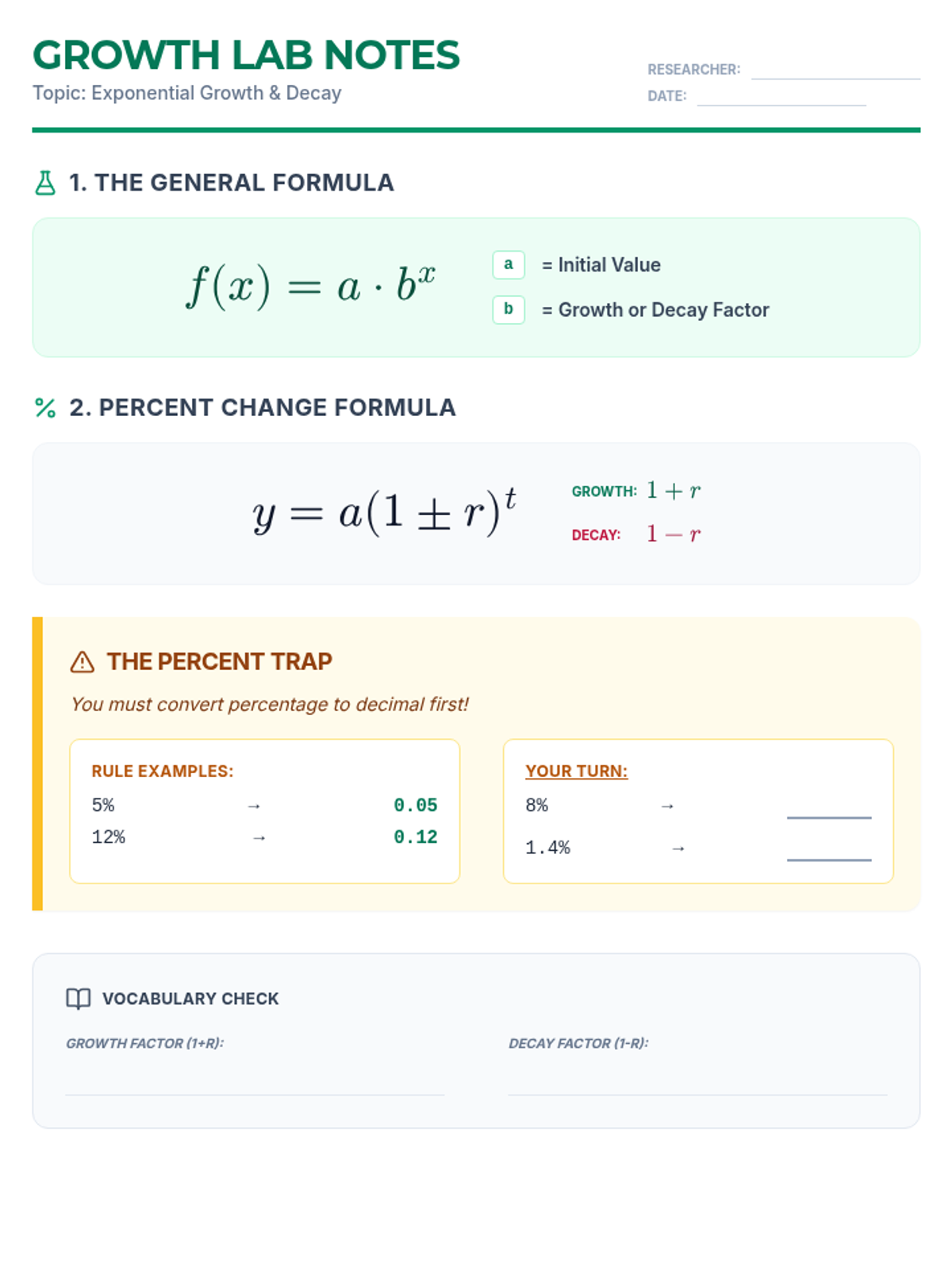
A guided note sheet for students to learn and practice exponential growth and decay formulas. Removed the fox population problem and consolidated trials to ensure a clean 2-page print layout. Problem 3 from previous versions is now renumbered as Problem 2. Spacing tightened for efficiency. Added a quick vocabulary check to utilize page space.
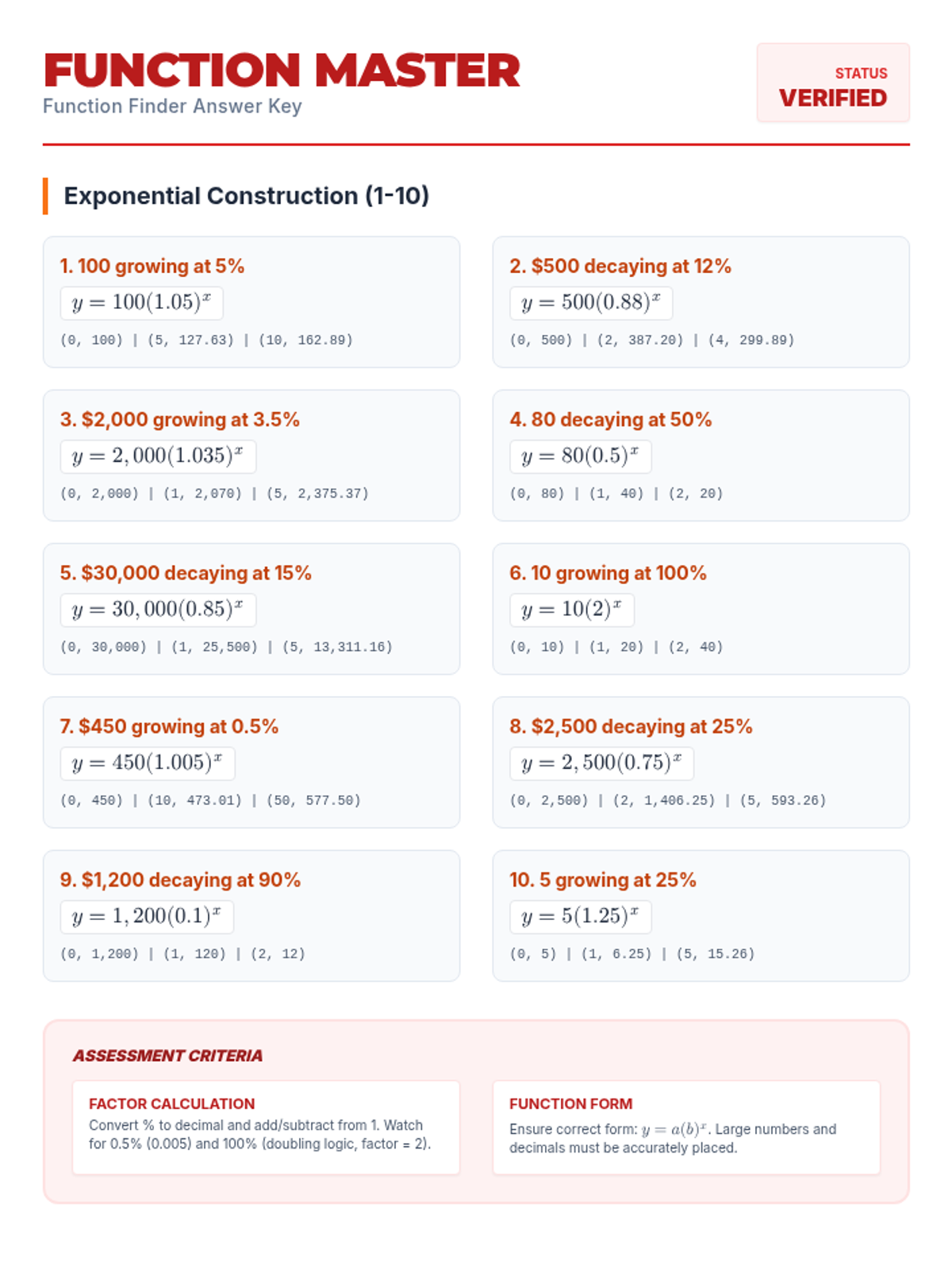
A comprehensive answer key for the Function Finder worksheet, providing the factor calculations, correct exponential functions, and solved coordinate points for all 10 construction problems. Updated for consistency and layout.
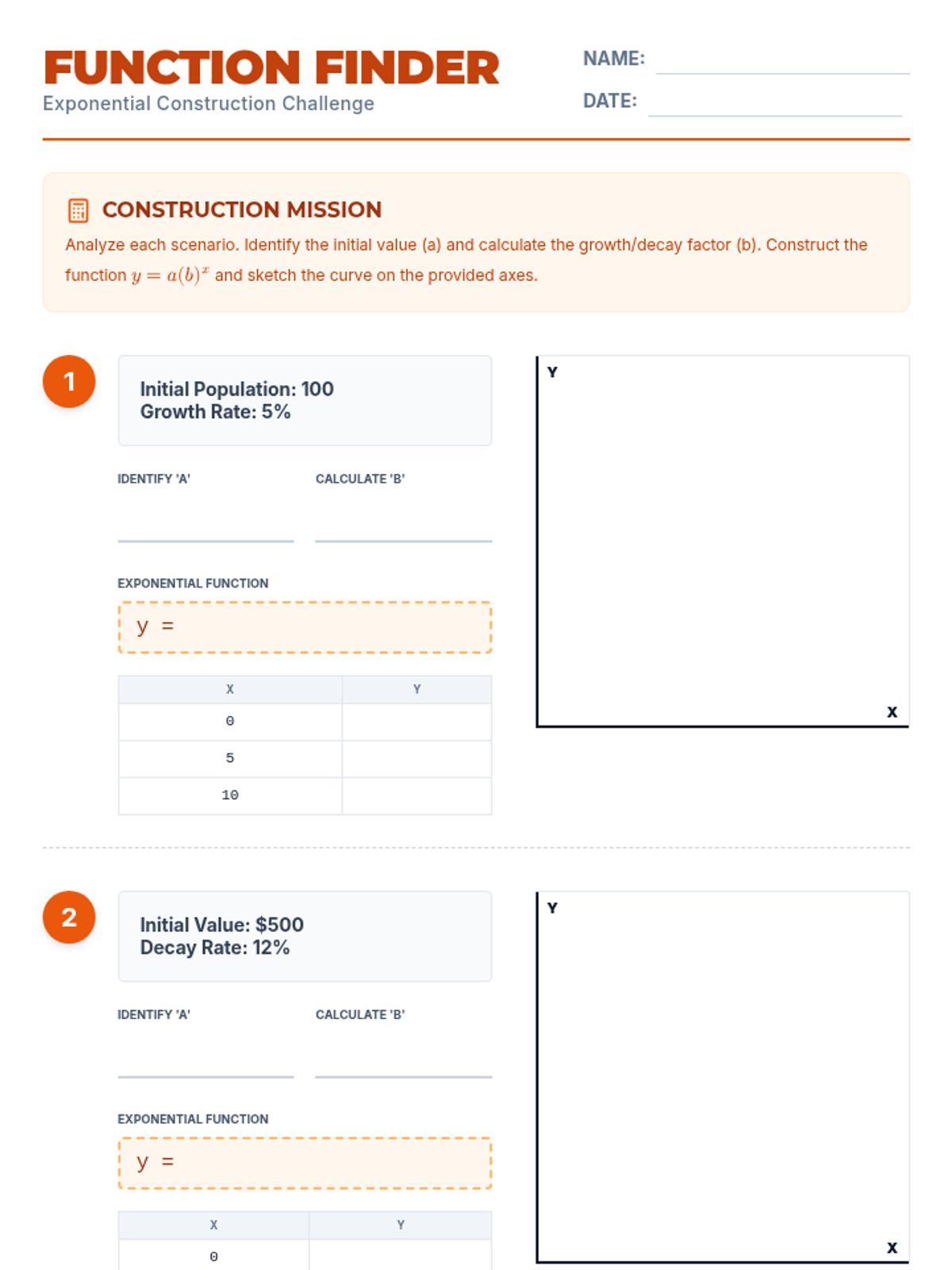
A 10-problem worksheet where students are given an initial value and a percentage growth or decay rate. They must calculate the factor, write the exponential function, create a small table of values, and graph the resulting curve. Updated with clean X-Y axes and Problem 8 as a percentage-based scenario.
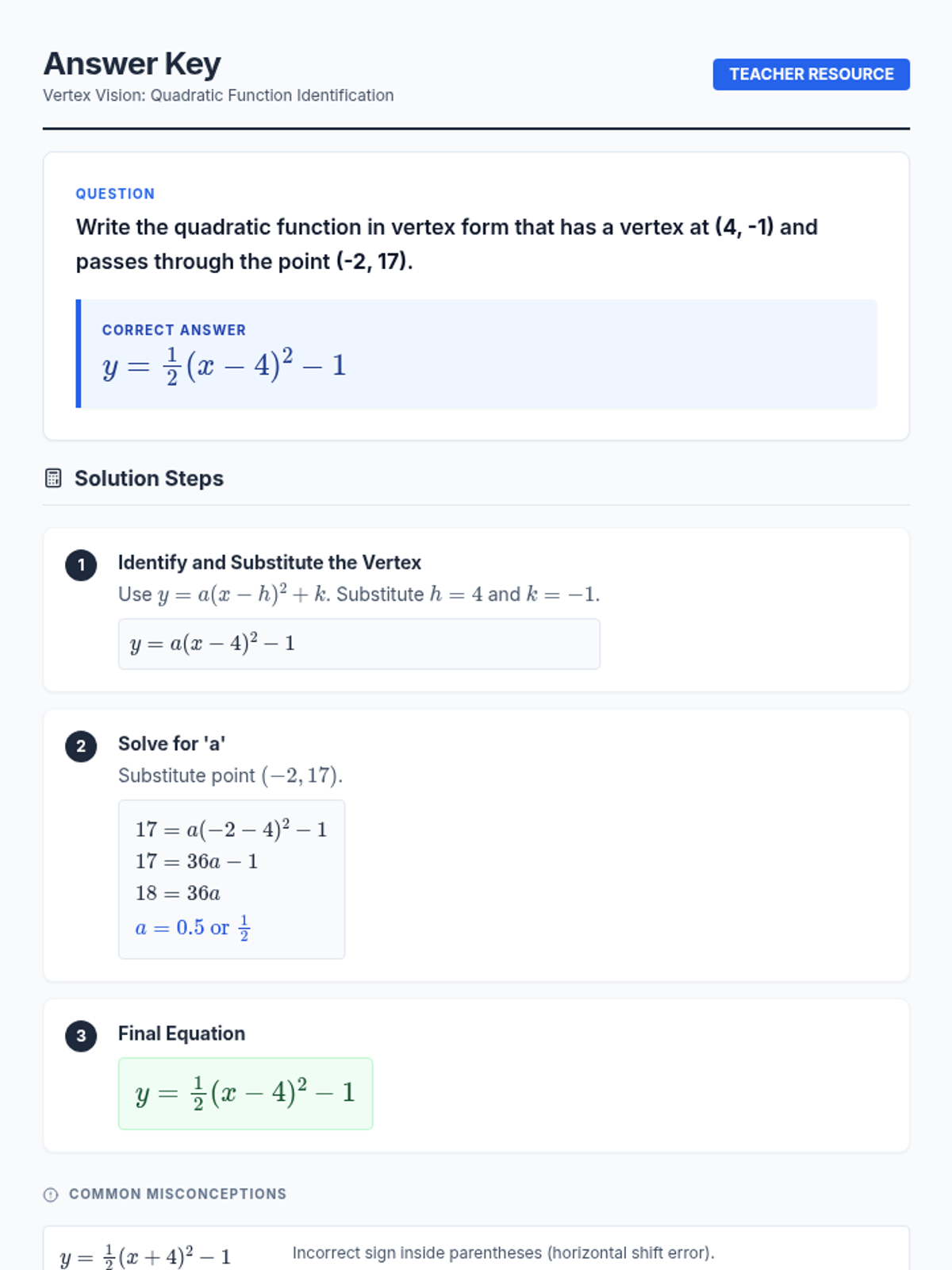
A comprehensive answer key and teacher resource providing the correct answer, step-by-step mathematical reasoning, and analysis of common student errors for the vertex form problem.
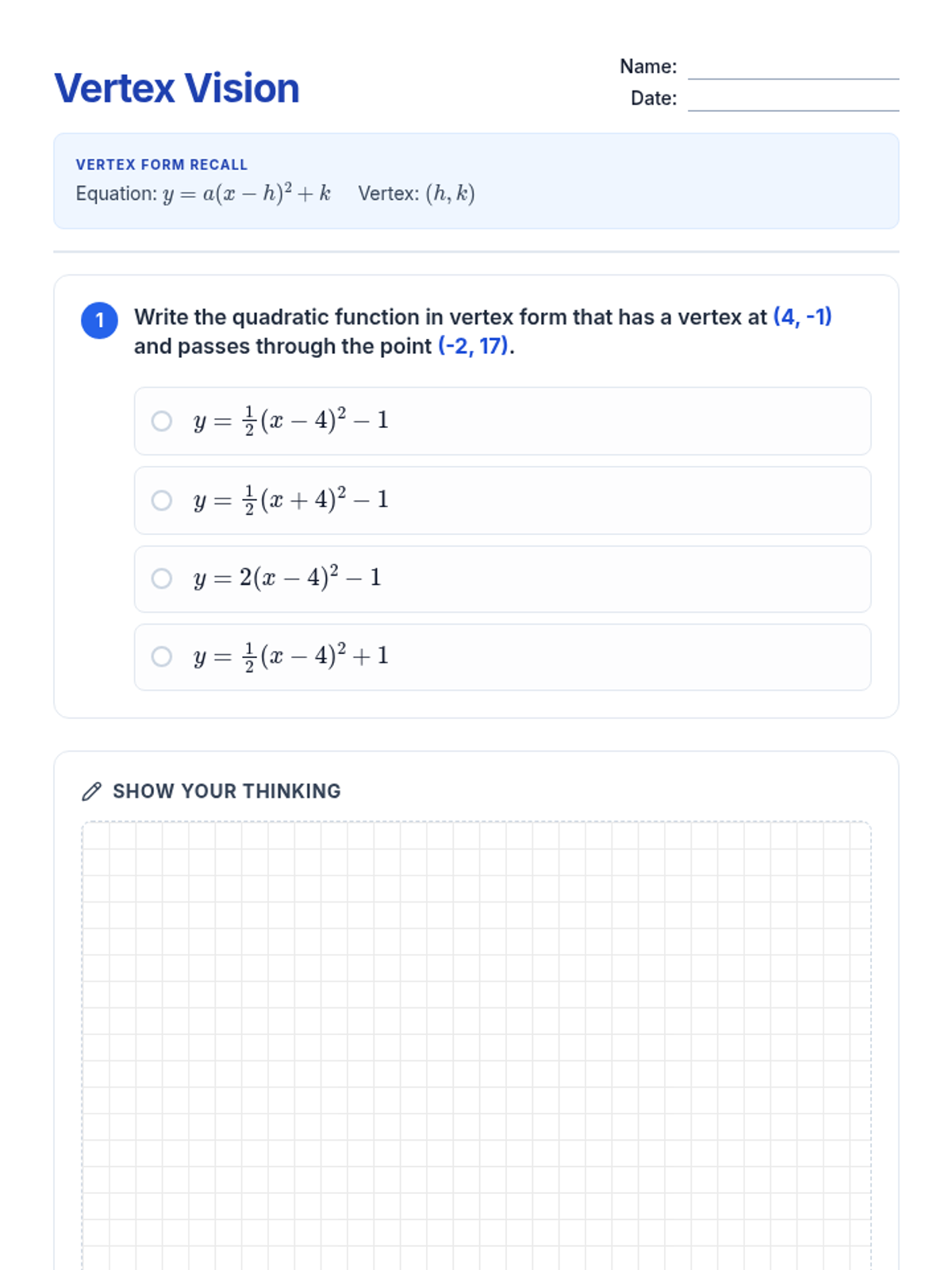
A clean, math-focused worksheet designed to help students identify the correct quadratic function in vertex form from a set of four multiple-choice options, including space for showing work.
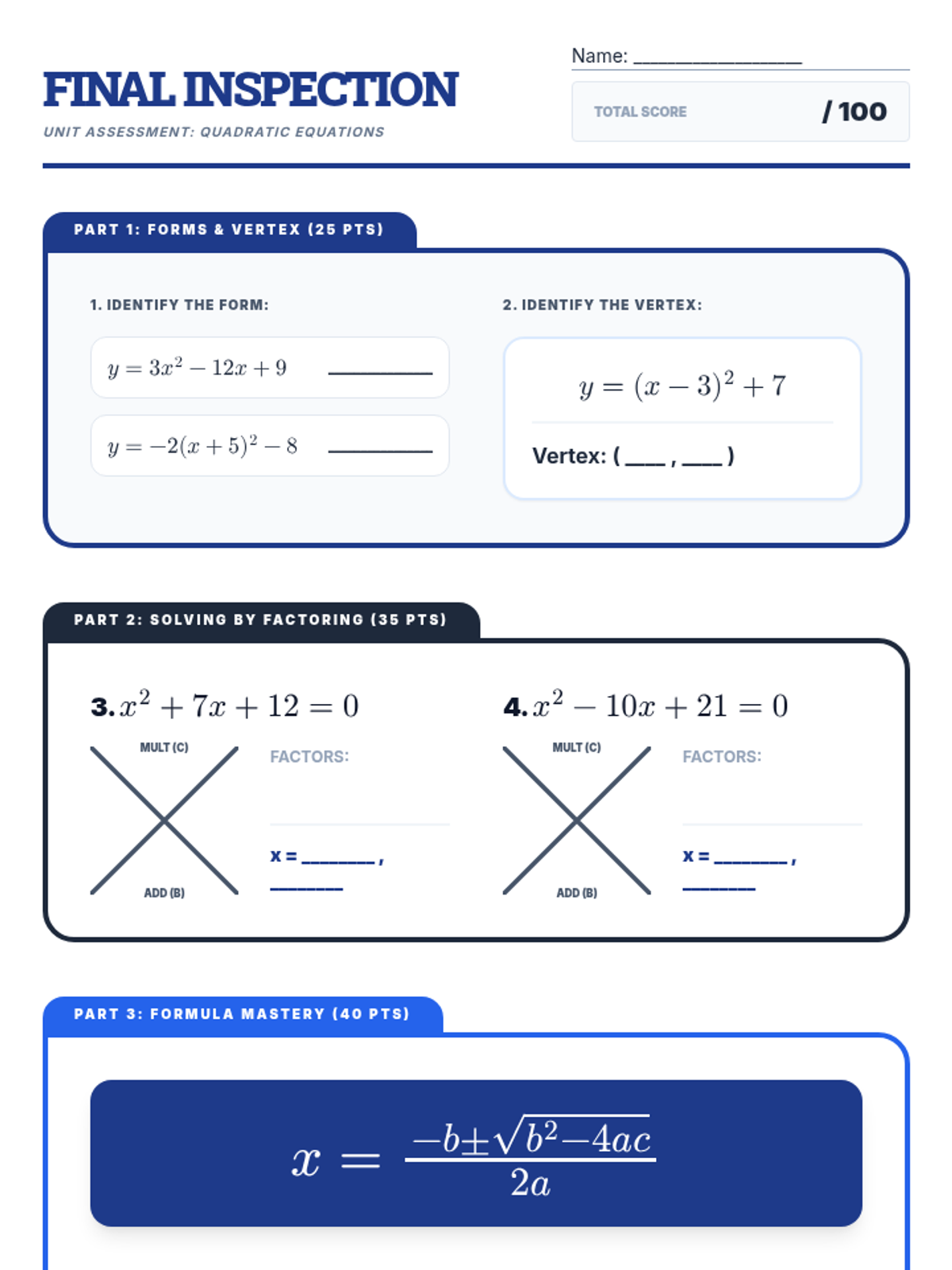
The summative assessment for the Quadratic Blueprints unit. Updated with sequential question numbering (1-5), corrected point values (25+35+40=100), functional Diamond Method labeling, and fixed LaTeX layouts. Optimized for credit recovery students.
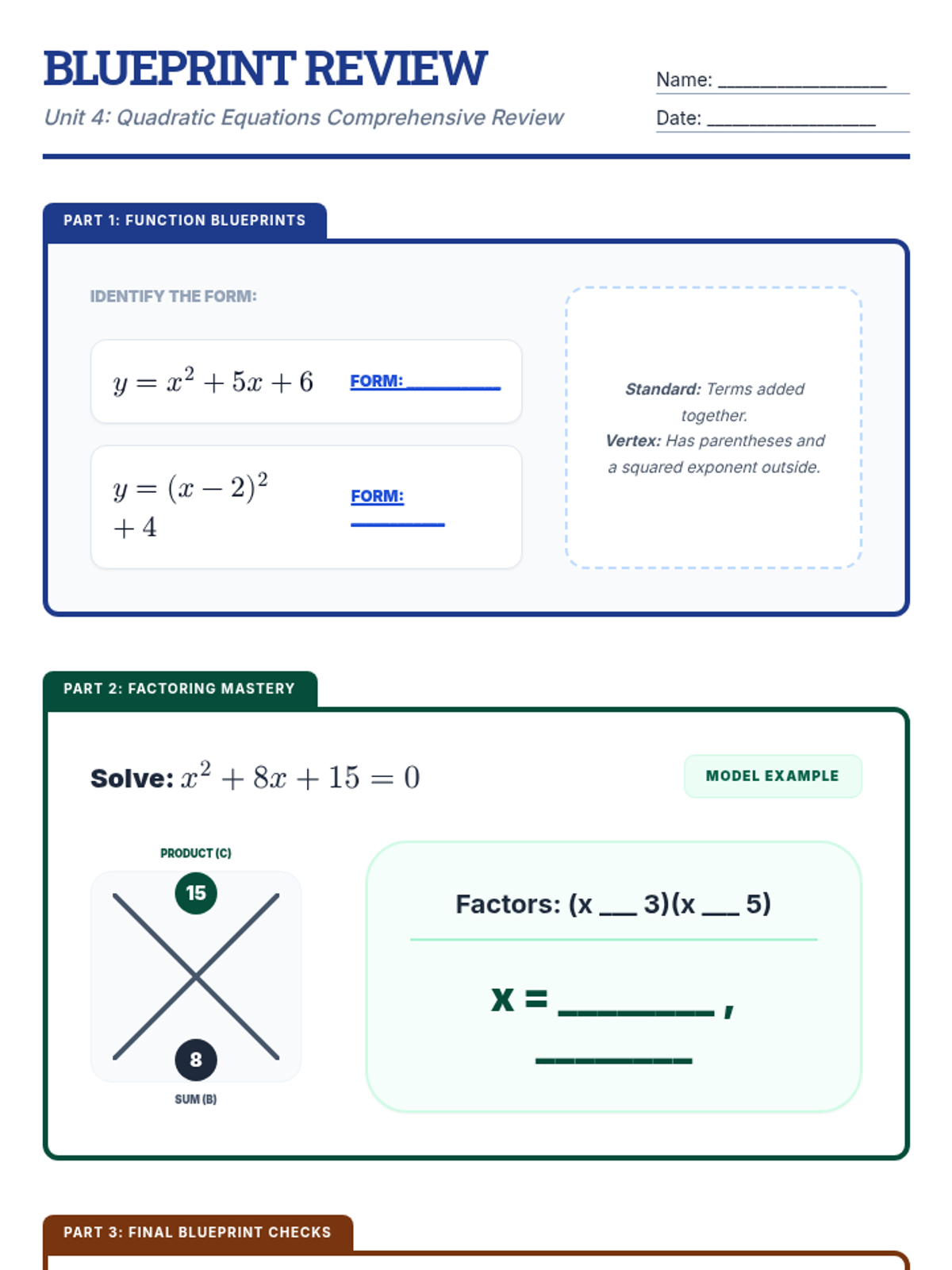
Comprehensive review sheet for the quadratics unit. Updated with functional Diamond Method labeling, increased workspace for the Quadratic Formula, fixed LaTeX formatting, and clear function form identification. Fixes missing 'x' in LaTeX and graph scale.
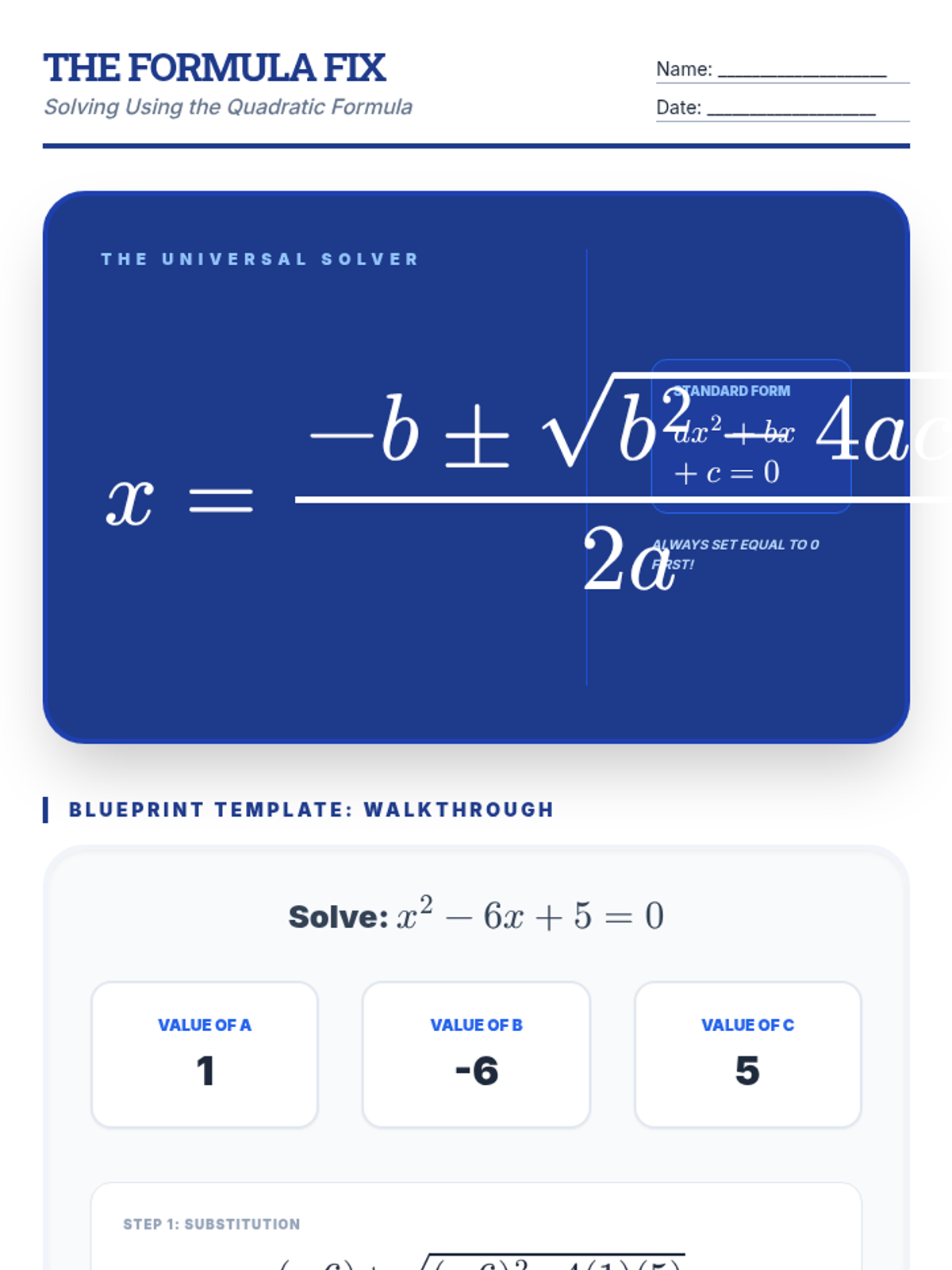
Day 3 student assignment for the Quadratic Formula. Updated with a high-visibility formula box, massively expanded work areas for complex multi-step algebra, and optimized layout to prevent content splits.
Day 3 instructional slides for the Quadratic Formula. Updated with fixed section heights to prevent cutoffs, improved contrast for better classroom visibility, and high-impact visual design for credit recovery students.
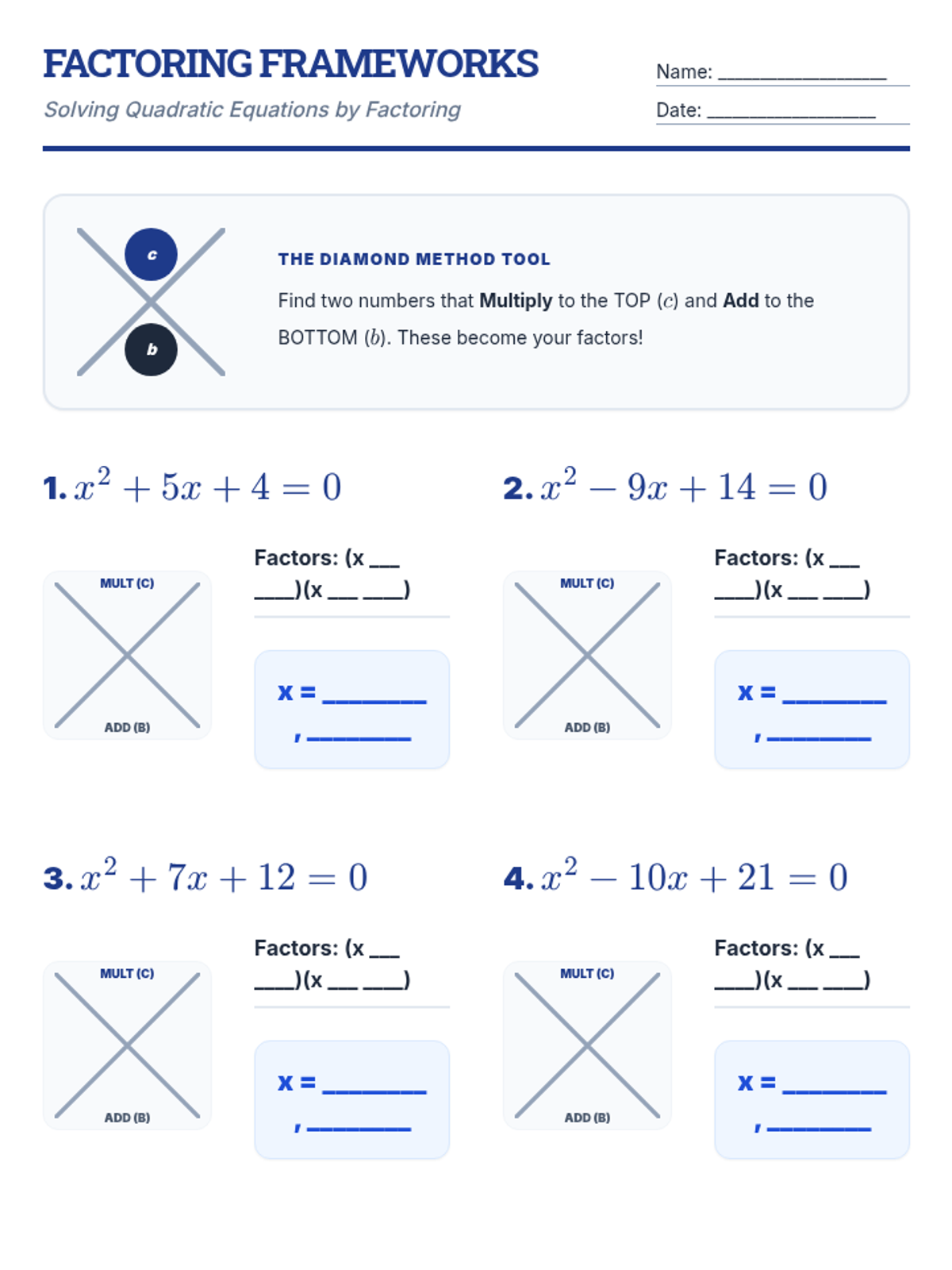
Day 2 student assignment for factoring quadratics. Updated with Diamond Method "X" graphics, sign-neutral factor templates to maintain cognitive load, and fixed layout for solution lines. Optimized for credit recovery students. Enlarged X graphics for student use.
Instructional slides for Day 2. Focuses on the Diamond Method for factoring trinomials and the Zero-Product Property. Fixes layout collisions and improves instructional depth. Fixes overflow and equation wrapping issues.
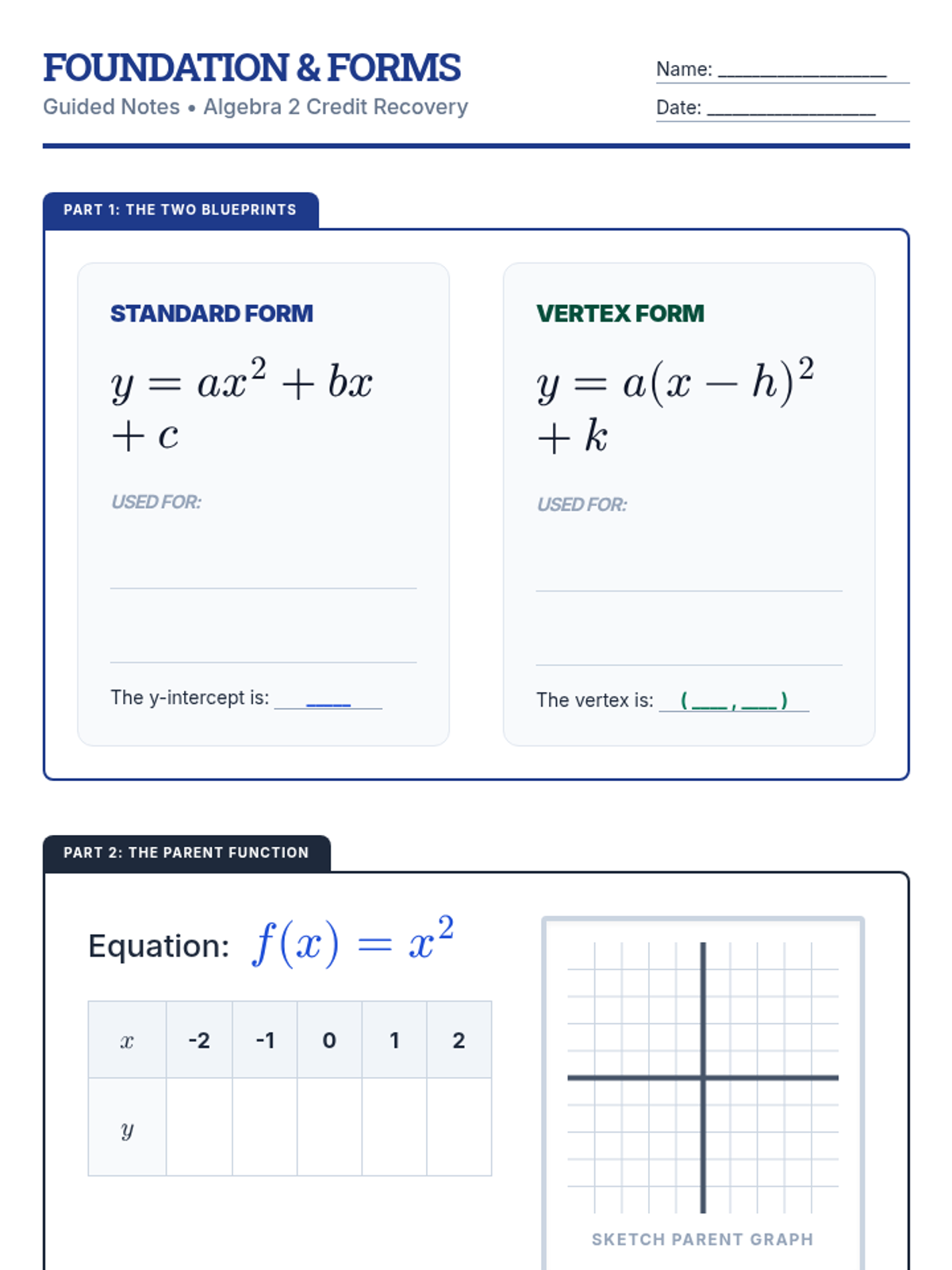
Guided notes for Day 1 of the Quadratics unit. Includes a comparison section for Standard vs. Vertex forms and a table/grid for the quadratic parent function. Fixes non-rendering SVG grid and adds more instructional space. Darkens grid for printability.
Instructional slides for Day 1. Introduces the two primary forms of quadratic functions: Standard Form and Vertex Form, highlighting their unique strengths and features for graphing and solving. Fixes LaTeX size issues and diagram overlaps.
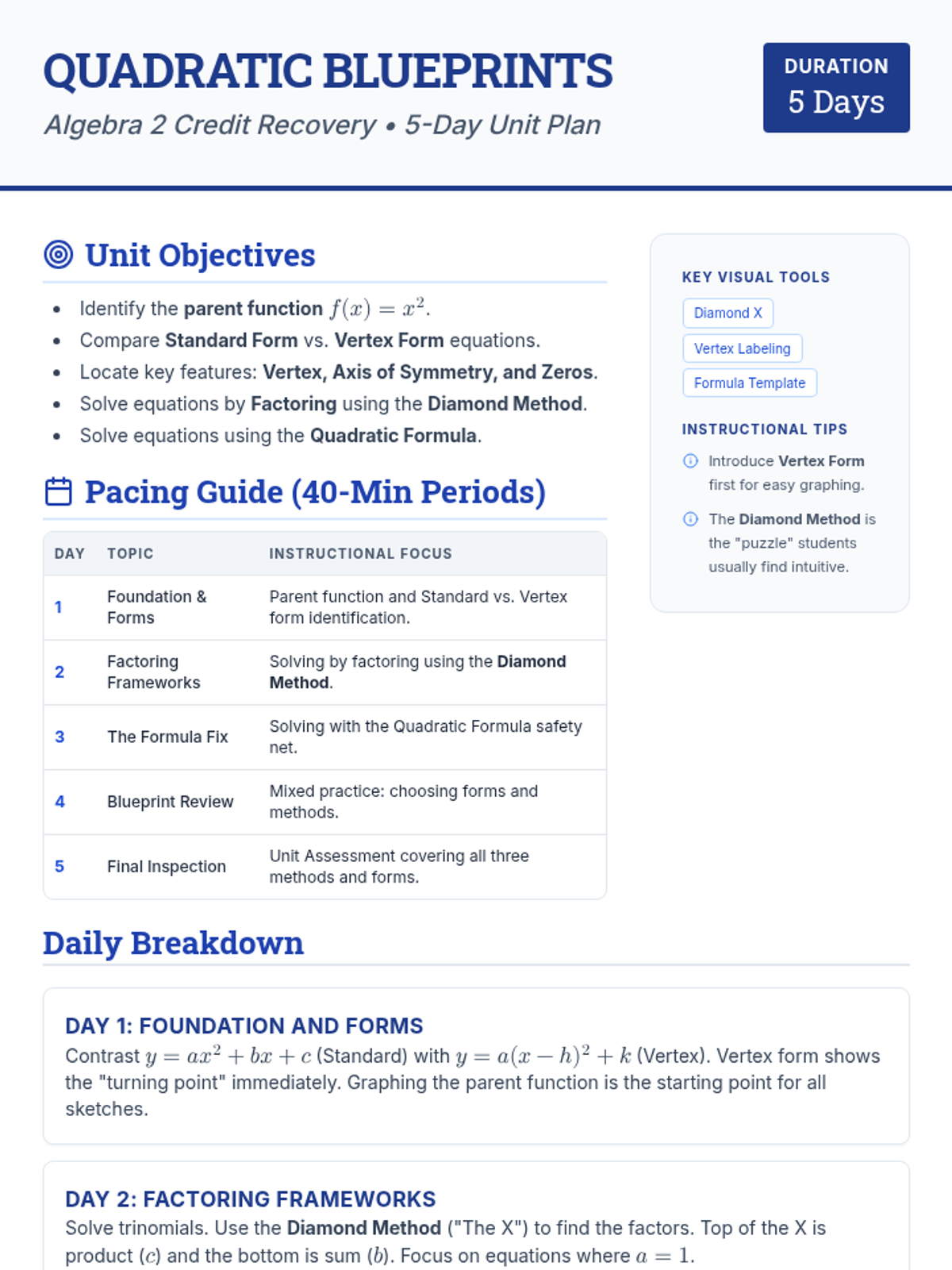
A comprehensive unit overview for teacher use, detailing the 5-day pacing and instructional focus. Updated to include the Diamond Method for factoring and the introduction of Standard vs. Vertex forms of quadratic functions. Fixes missing day breakdowns and poor page flow.
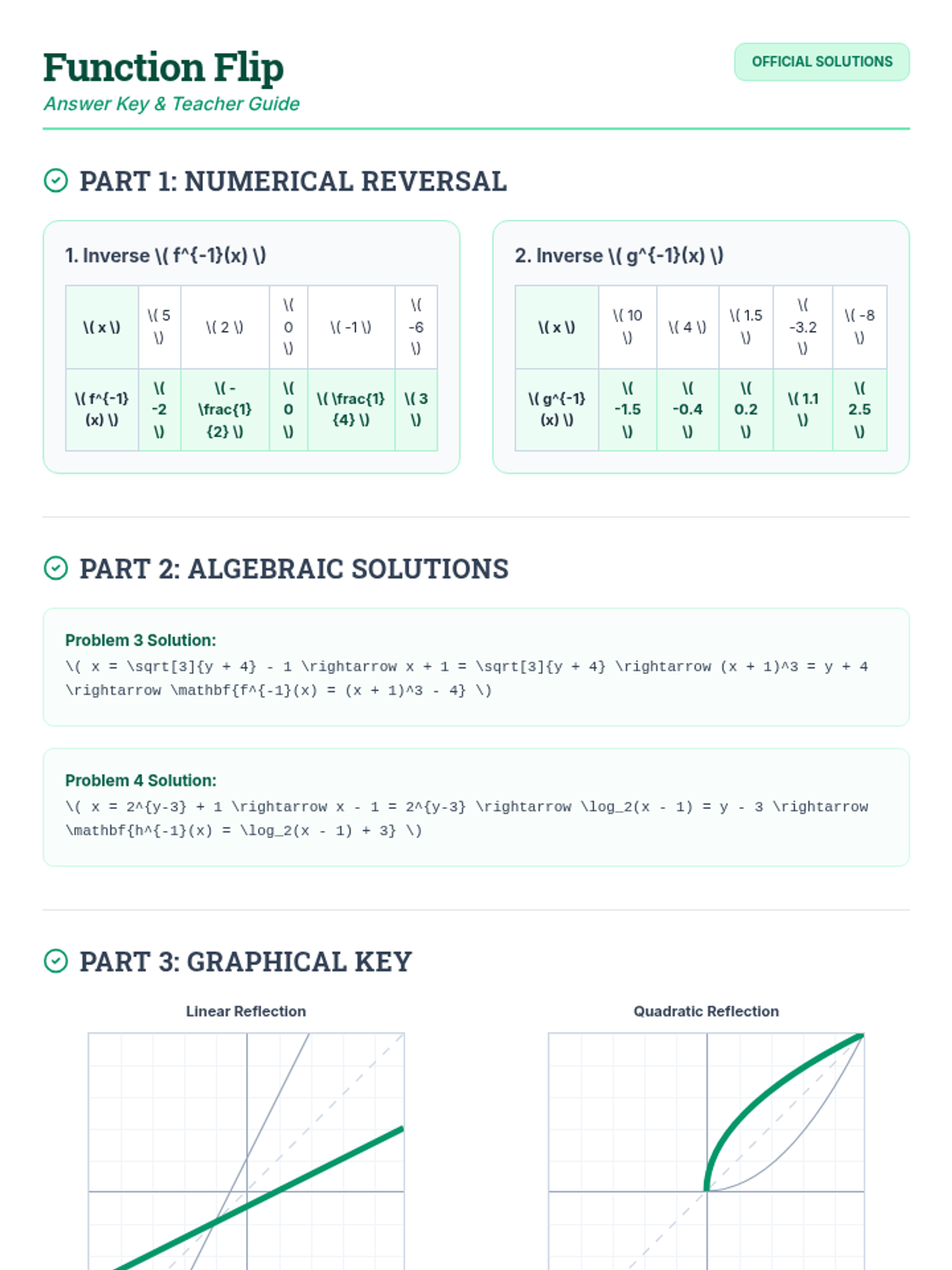
The answer key for the Inverse Flip Worksheet, featuring completed table mappings, step-by-step algebraic solutions for cubic and exponential functions, and reflected graphical representations for visual verification.
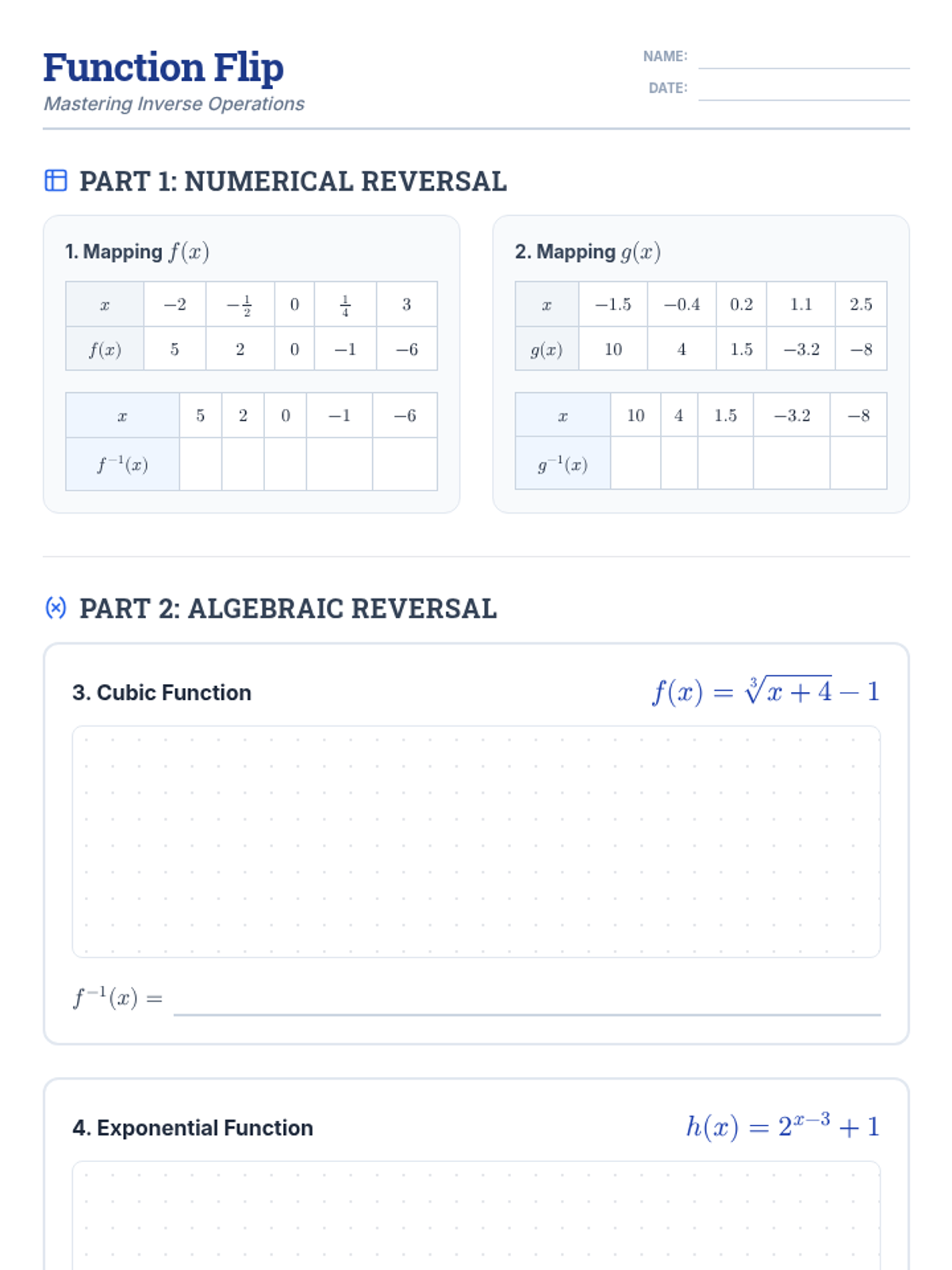
A comprehensive worksheet on inverse functions featuring table mapping, algebraic manipulation, and graphical reflections across the line y=x. Includes fractions, decimals, and multiple function types (linear, quadratic, cubic, exponential, square root).
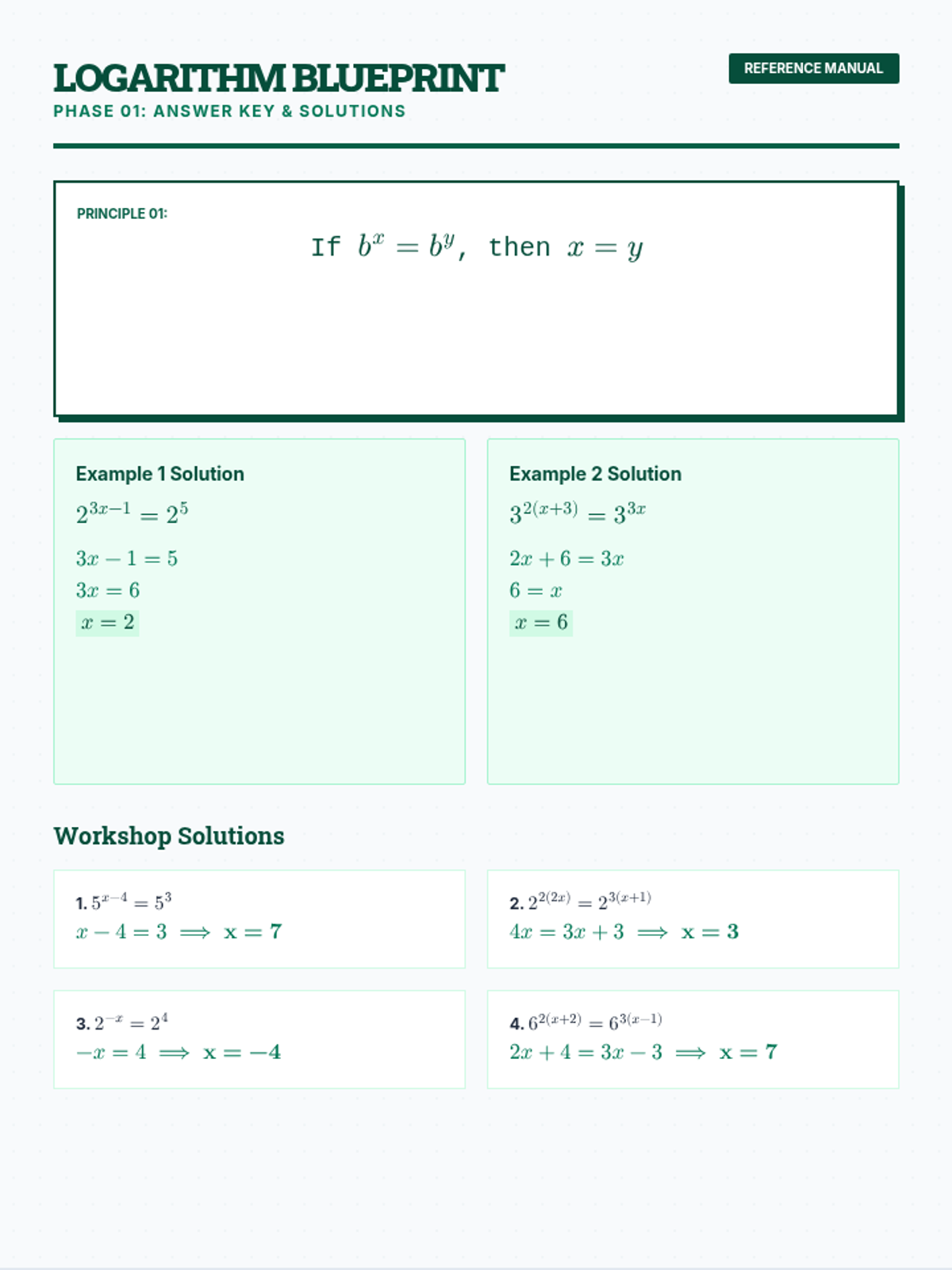
A 4-page detailed answer key for the Logarithm Blueprint Guided Notes, providing step-by-step solutions for all exponential and logarithmic equation problems.
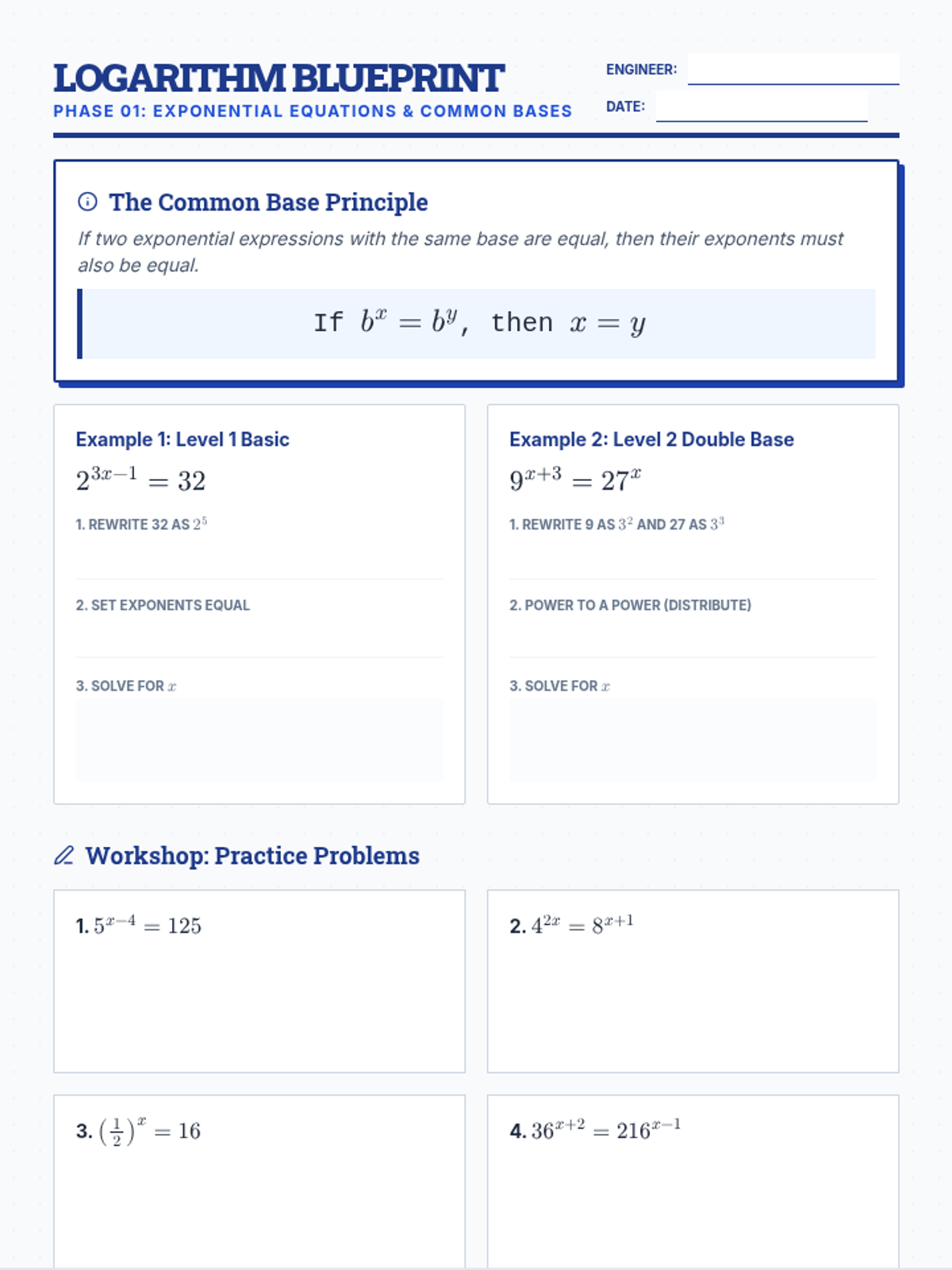
A 4-page comprehensive guided notes packet for solving exponential and logarithmic equations. It covers common bases, form conversion, and logarithmic properties with a professional technical blueprint aesthetic.
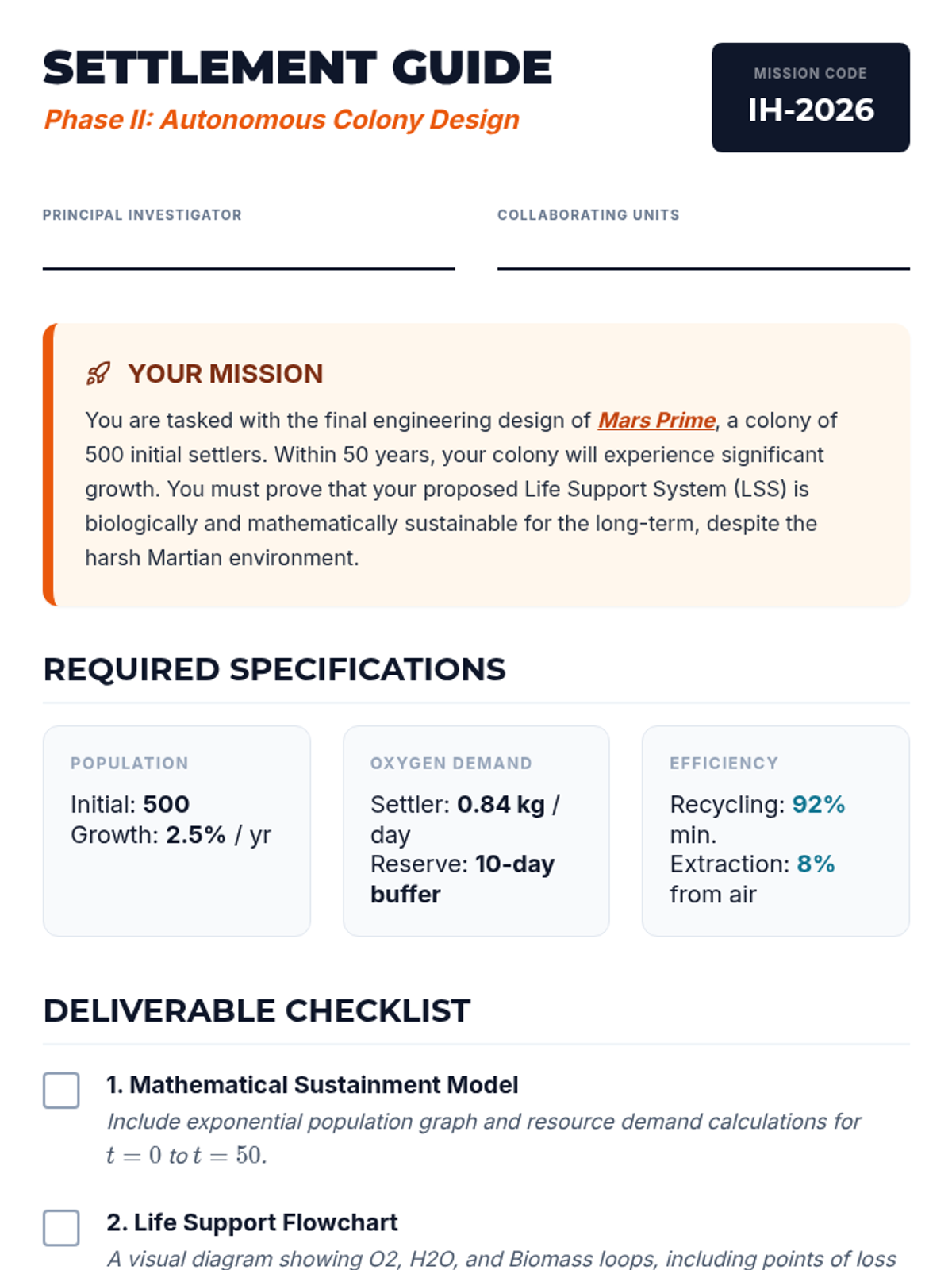
A multi-part summative project guide where students design and mathematically justify a life support system for a large-scale Mars colony over a 50-year period. Features structured work areas for graphing and technical diagrams.
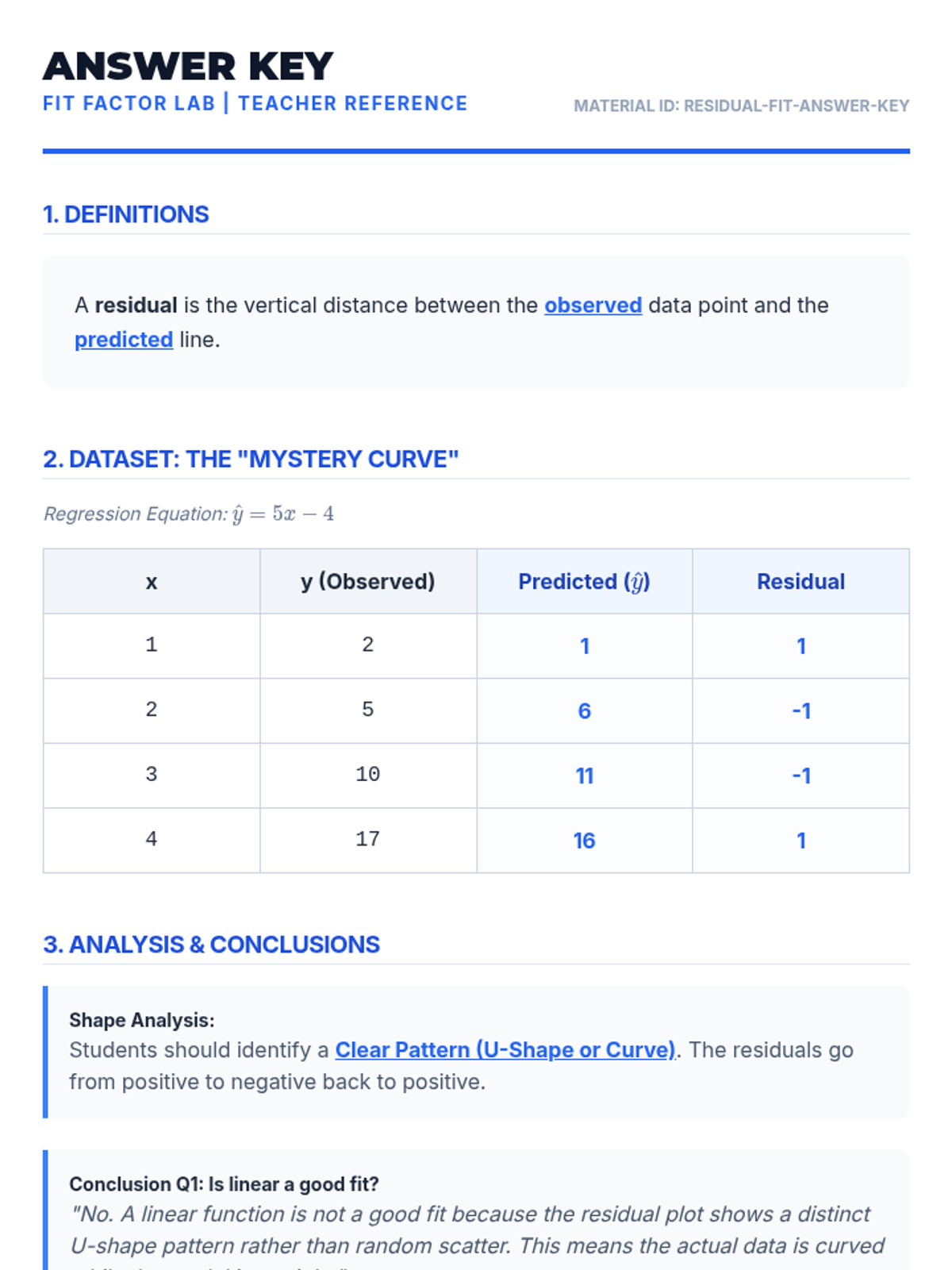
An answer key for the Fit Factor Worksheet, providing the regression equation, calculated predicted values, residuals, and sample responses for the analysis questions.
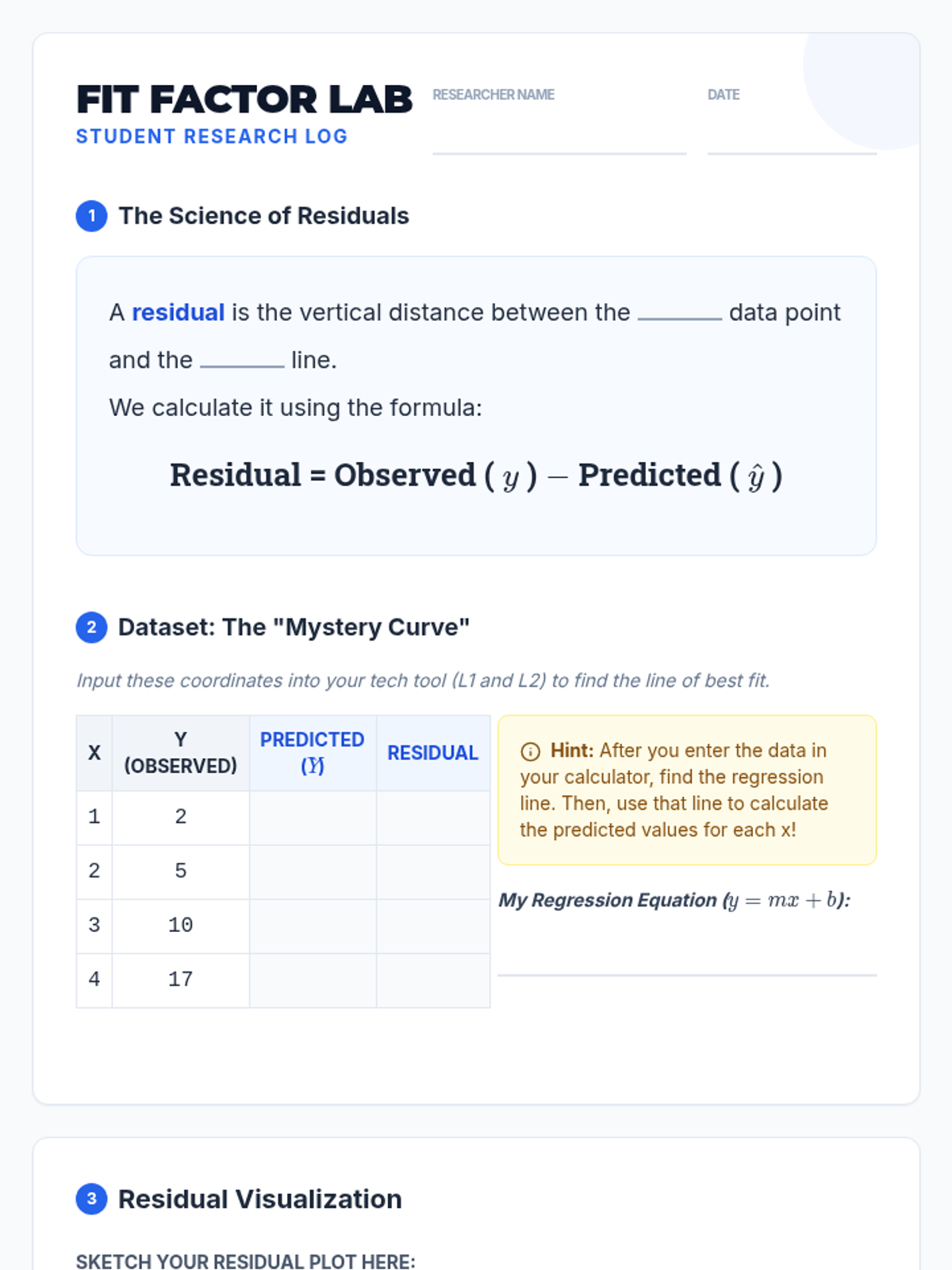
A scaffolded student worksheet for the Residual Research lesson. Students define residuals, calculate them for a small dataset, create a residual plot, and analyze the results to determine the appropriateness of a linear fit.
A visual slide deck for the Residual Research lesson, designed for teacher-led instruction and student tech exploration. Includes definitions, visual guides for analyzing residual plots, and discussion prompts.
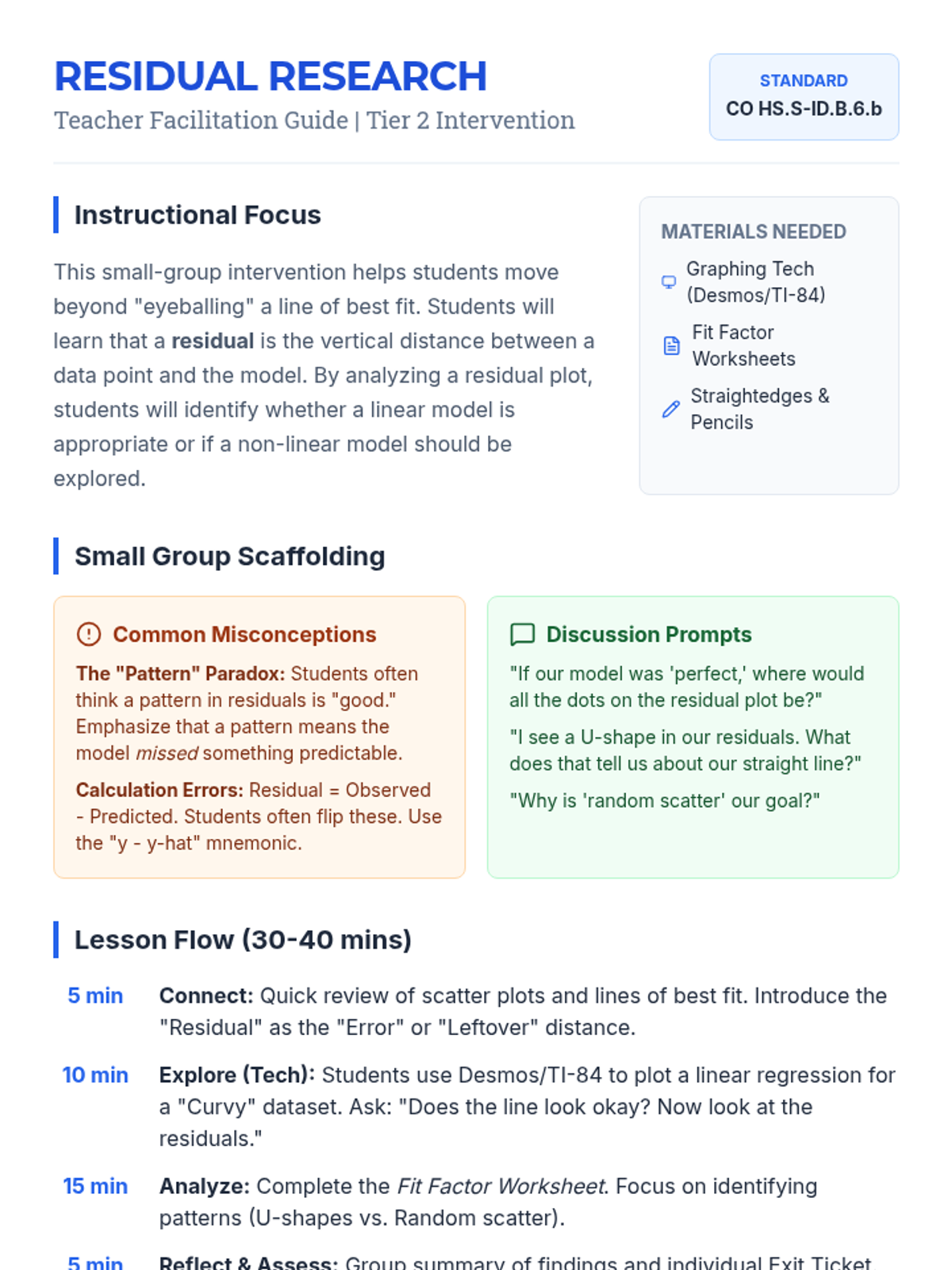
A comprehensive teacher facilitation guide for the Residual Research lesson, featuring instructional flows, small-group scaffolding strategies, common misconceptions, and a progress monitoring tracker for student assessment.
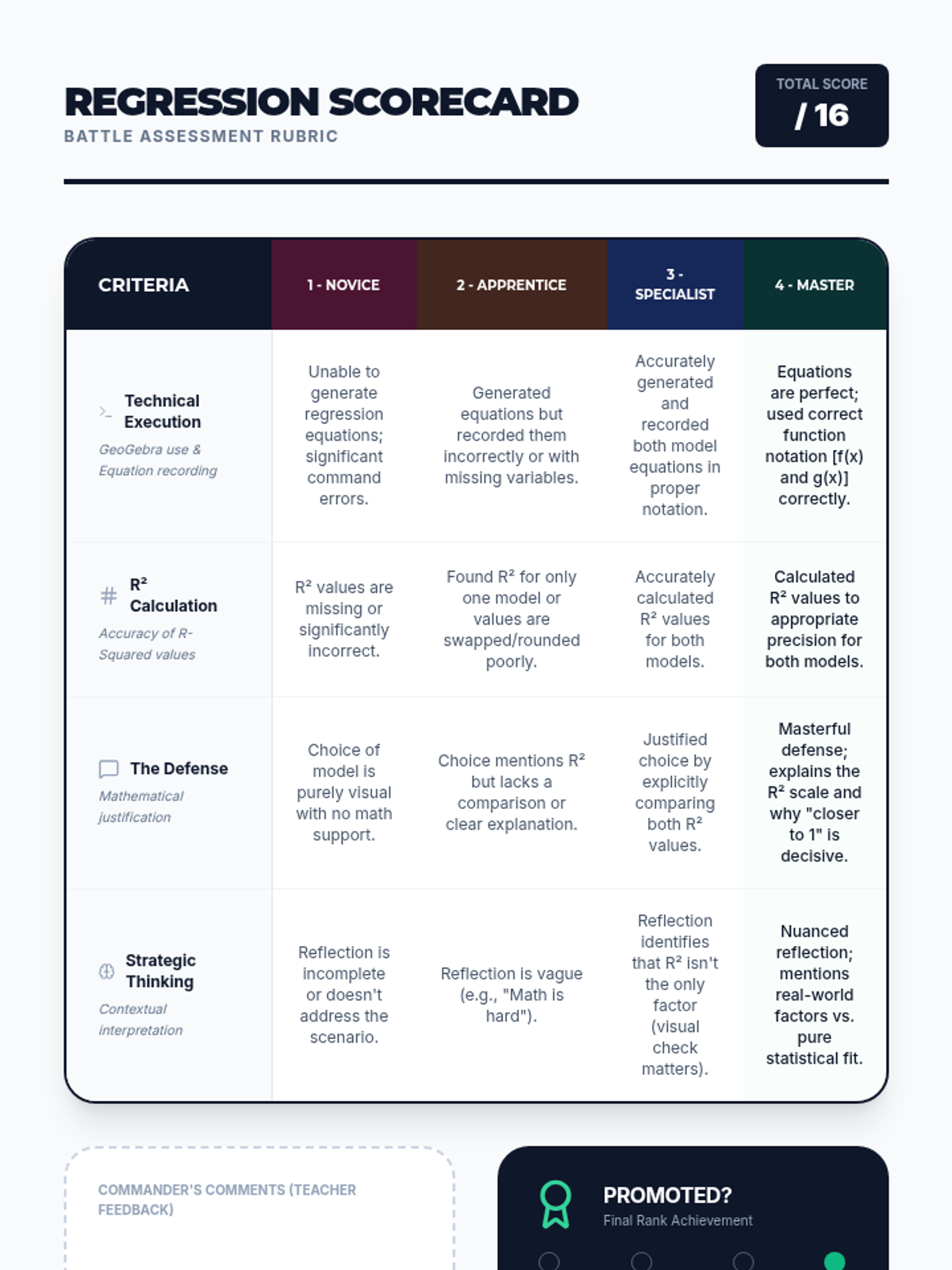
A specialized rubric for the 'Regression Battle' activity, using a gamified theme. Evaluates students on technical execution, R-squared accuracy, mathematical justification, and contextual reflection.
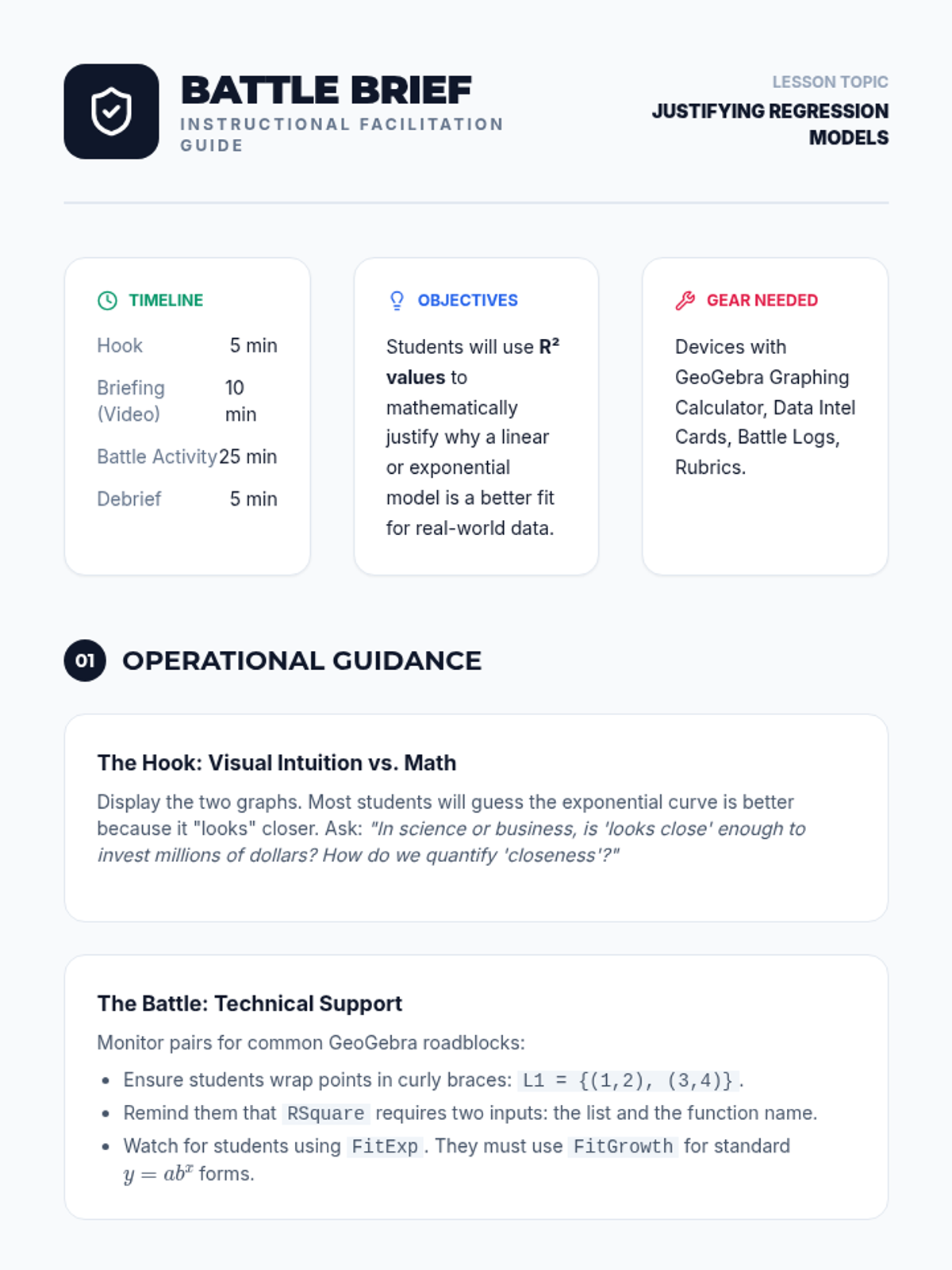
A comprehensive teacher guide for the 'Regression Battle' lesson. Includes lesson timeline, technical troubleshooting for GeoGebra, a complete answer key for the data sectors, and discussion prompts.
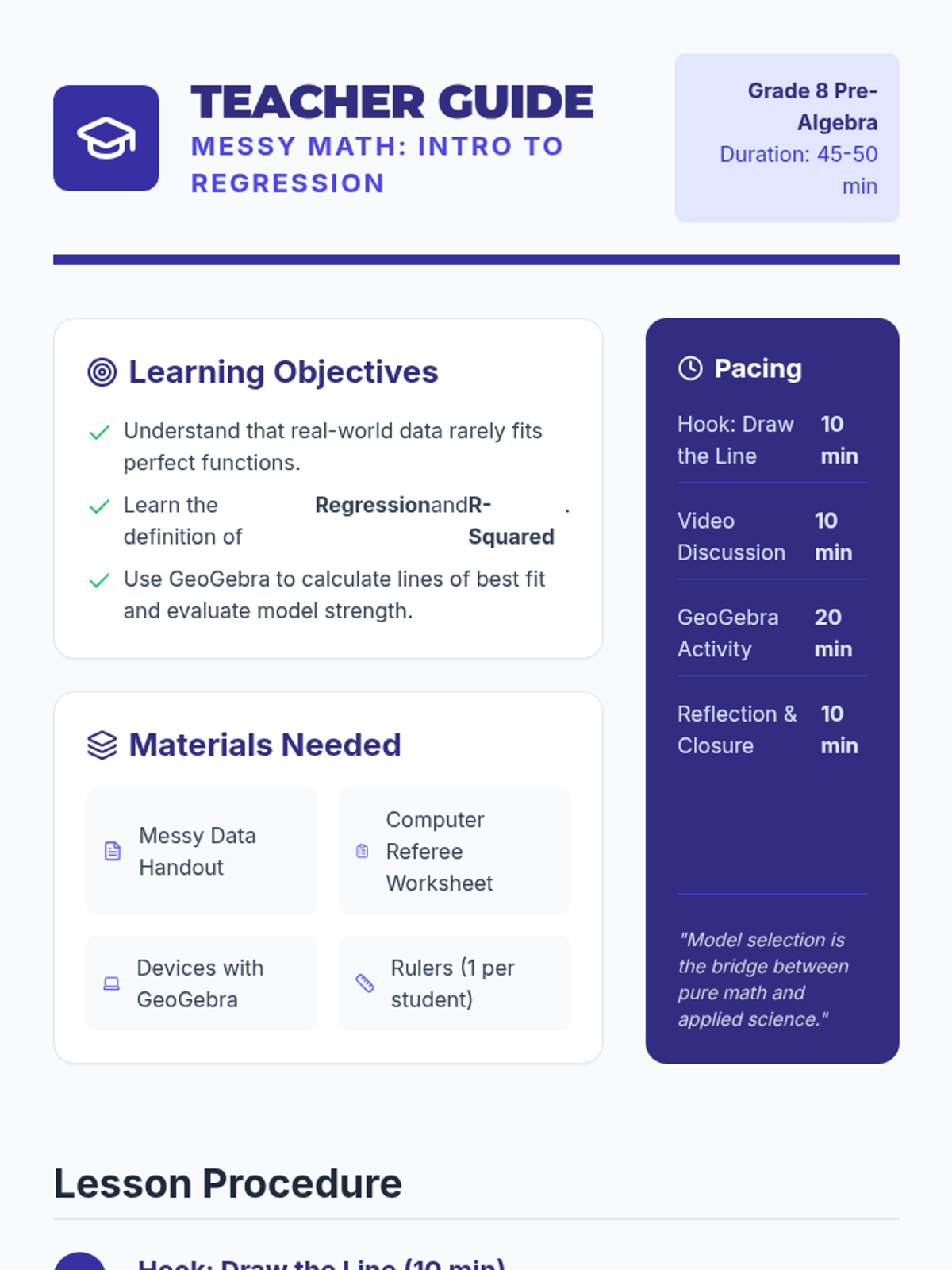
Teacher facilitation guide for the Messy Math lesson. Includes lesson pacing, student common pitfalls, answer keys for the GeoGebra activity, and discussion prompts for comparing linear and exponential models.
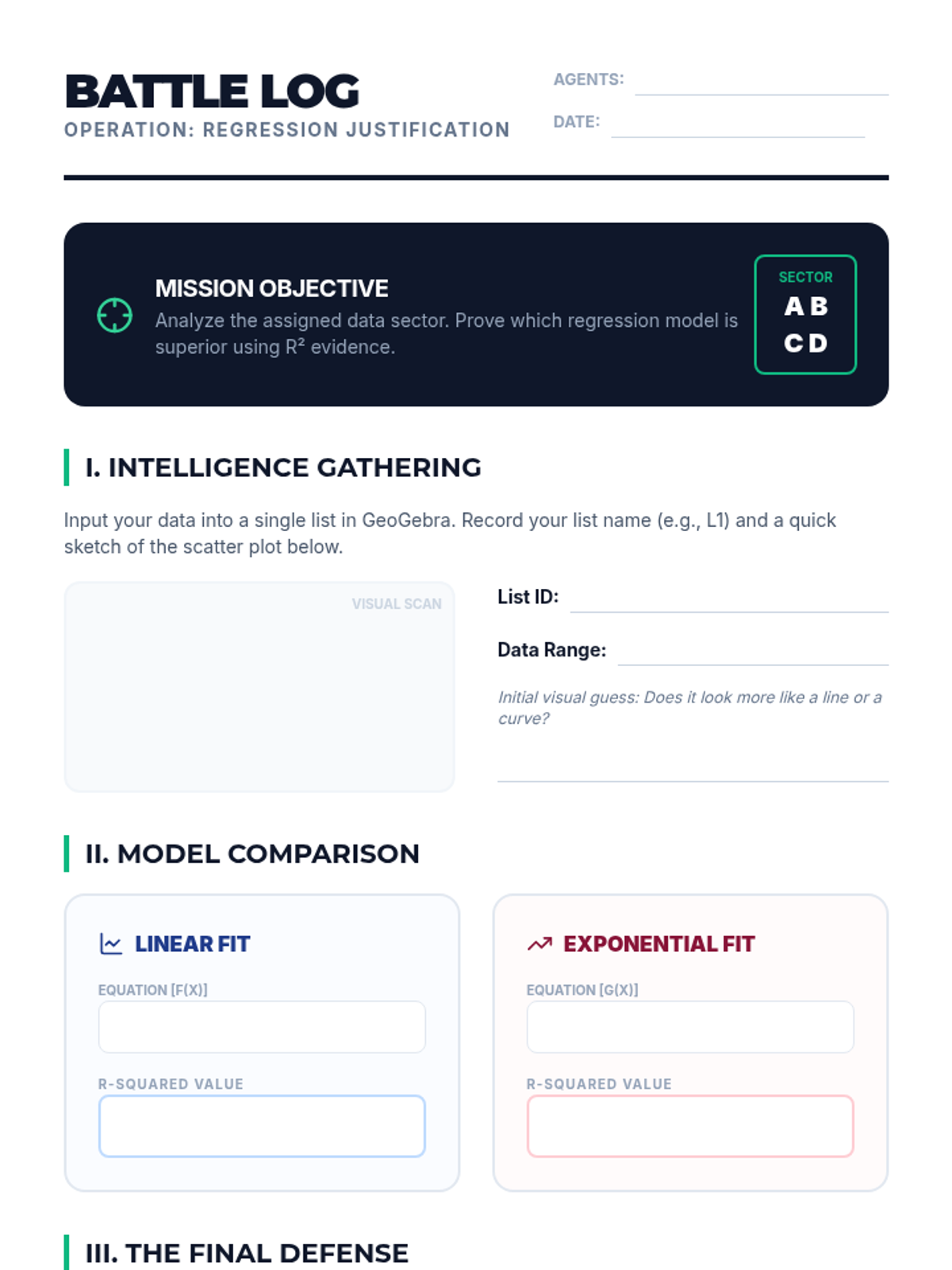
A student worksheet for the 'Regression Battle' activity. Includes space for recording data list names, linear vs. exponential equations, R-squared values, and a structured area for writing a mathematical defense.
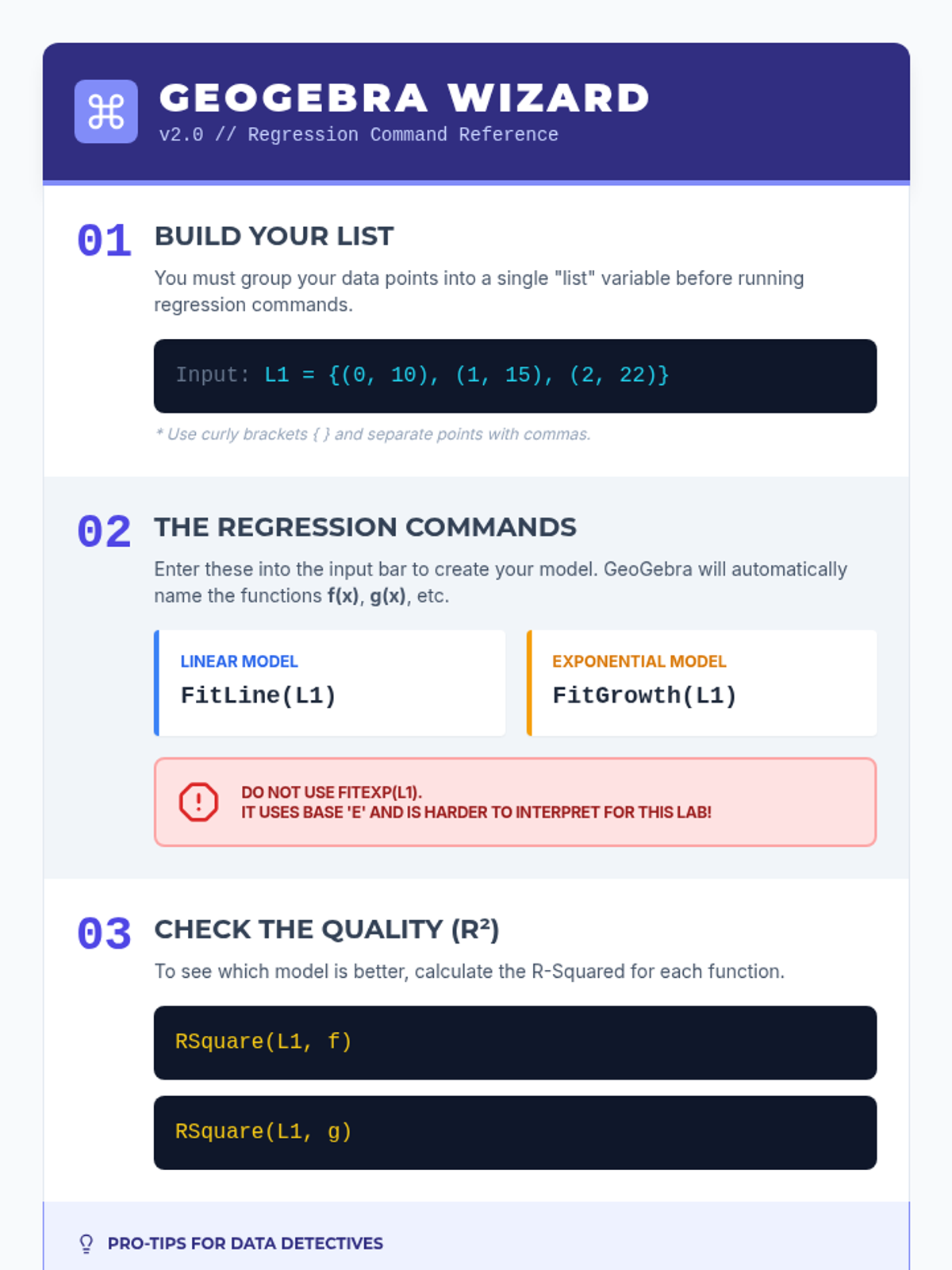
A technical "cheat sheet" for students using GeoGebra for regression, featuring step-by-step command syntax, critical warnings about exponential base choice, and R-squared calculation instructions.
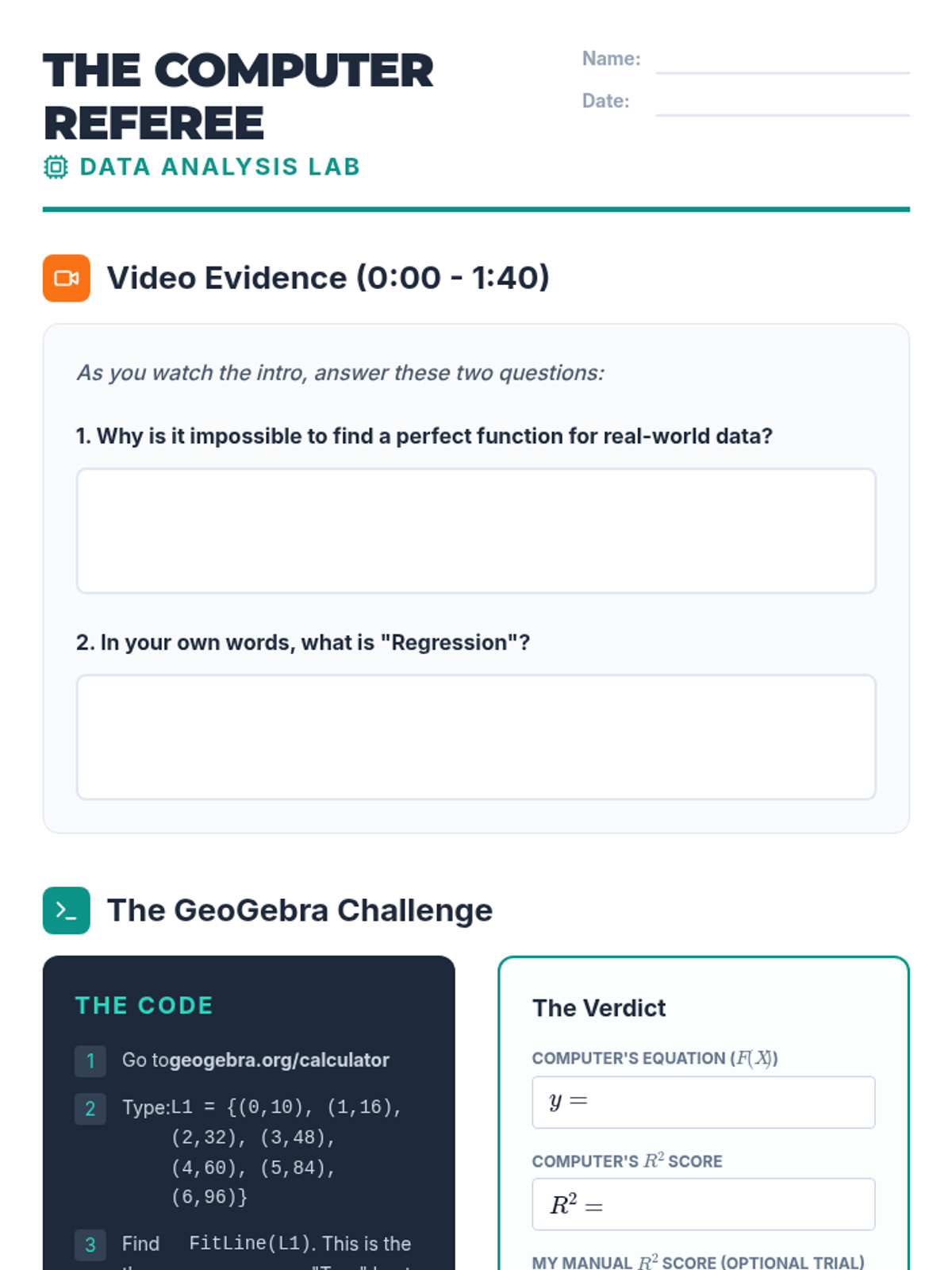
A comprehensive student worksheet for the regression lesson. Includes video viewing questions, step-by-step GeoGebra instructions, and reflection questions on model comparison and R-squared values.
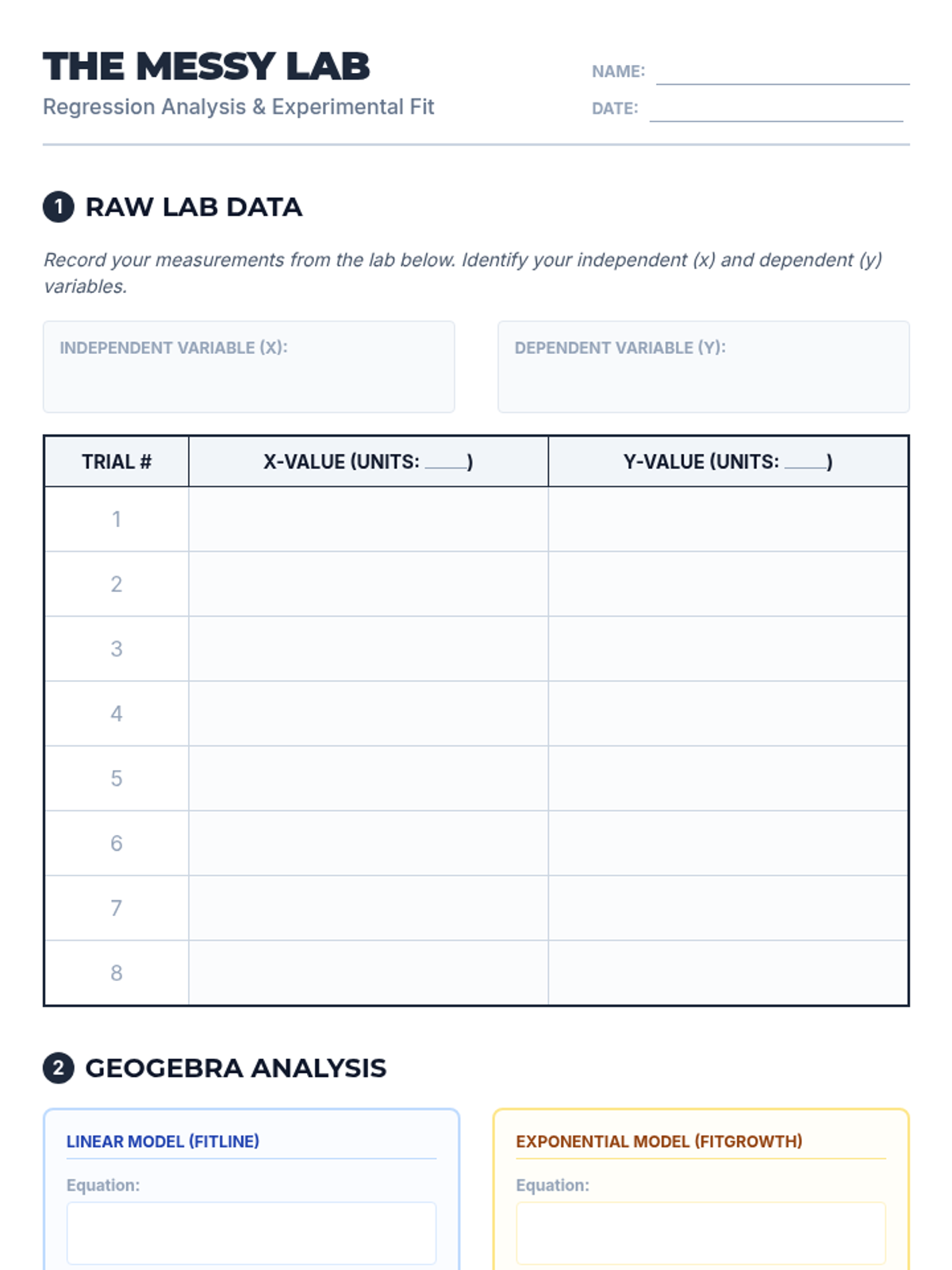
A student data sheet for recording lab measurements and documenting regression results from GeoGebra, including space for comparative analysis of linear and exponential models.
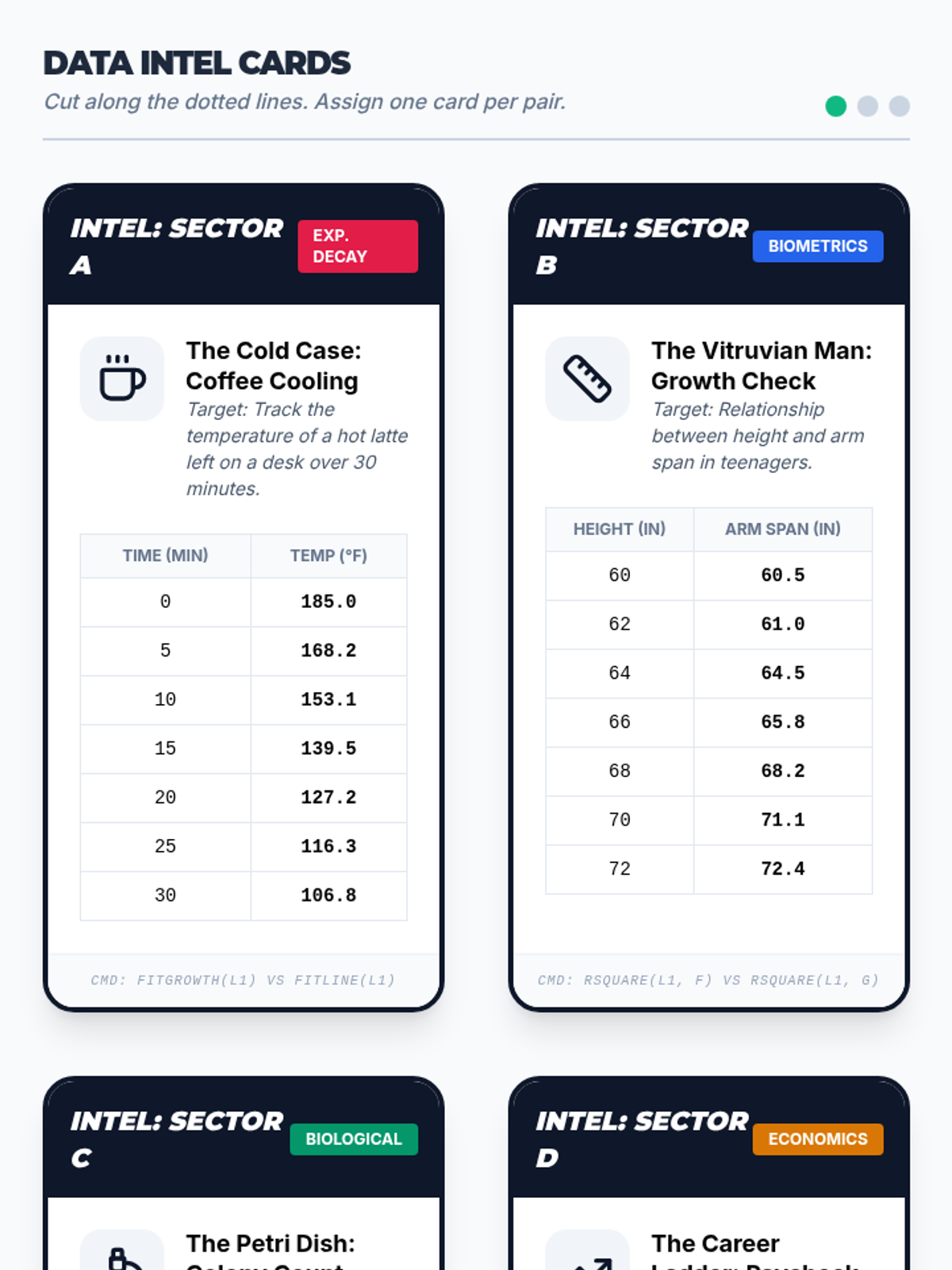
Four real-world data set cards for the Regression Battle activity. Includes scenarios like cooling coffee, biometrics, bacterial growth, and career salaries, designed as game-like 'Intelligence Cards'.
A slide deck to support the lesson on regression. Includes a video embed, key vocabulary (Regression, R-Squared), and a step-by-step guide for the GeoGebra activity.
A 7-slide presentation for introducing regression analysis in a lab setting, featuring embedded video focus, GeoGebra command guides, and discussion prompts on experimental error and R-squared.
A slide deck for a 10th-grade Algebra 2 lesson on R-squared and regression. Includes a visual hook, embedded video slide, technical command guides, and activity instructions for the 'Regression Battle'.
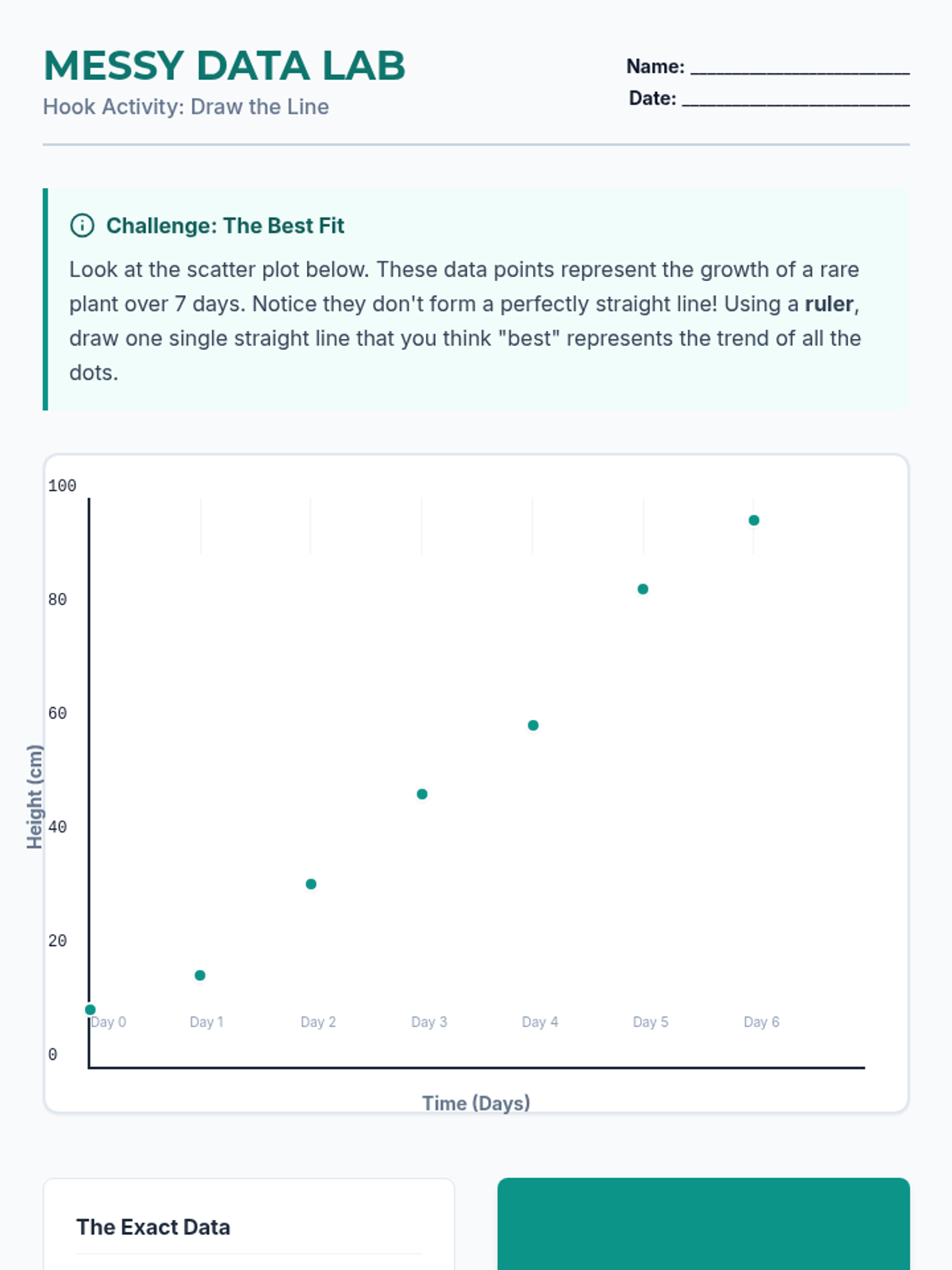
A printed scatter plot of messy data for students to manually draw a line of best fit using a ruler. Includes the specific data points needed for the subsequent computer modeling activity.
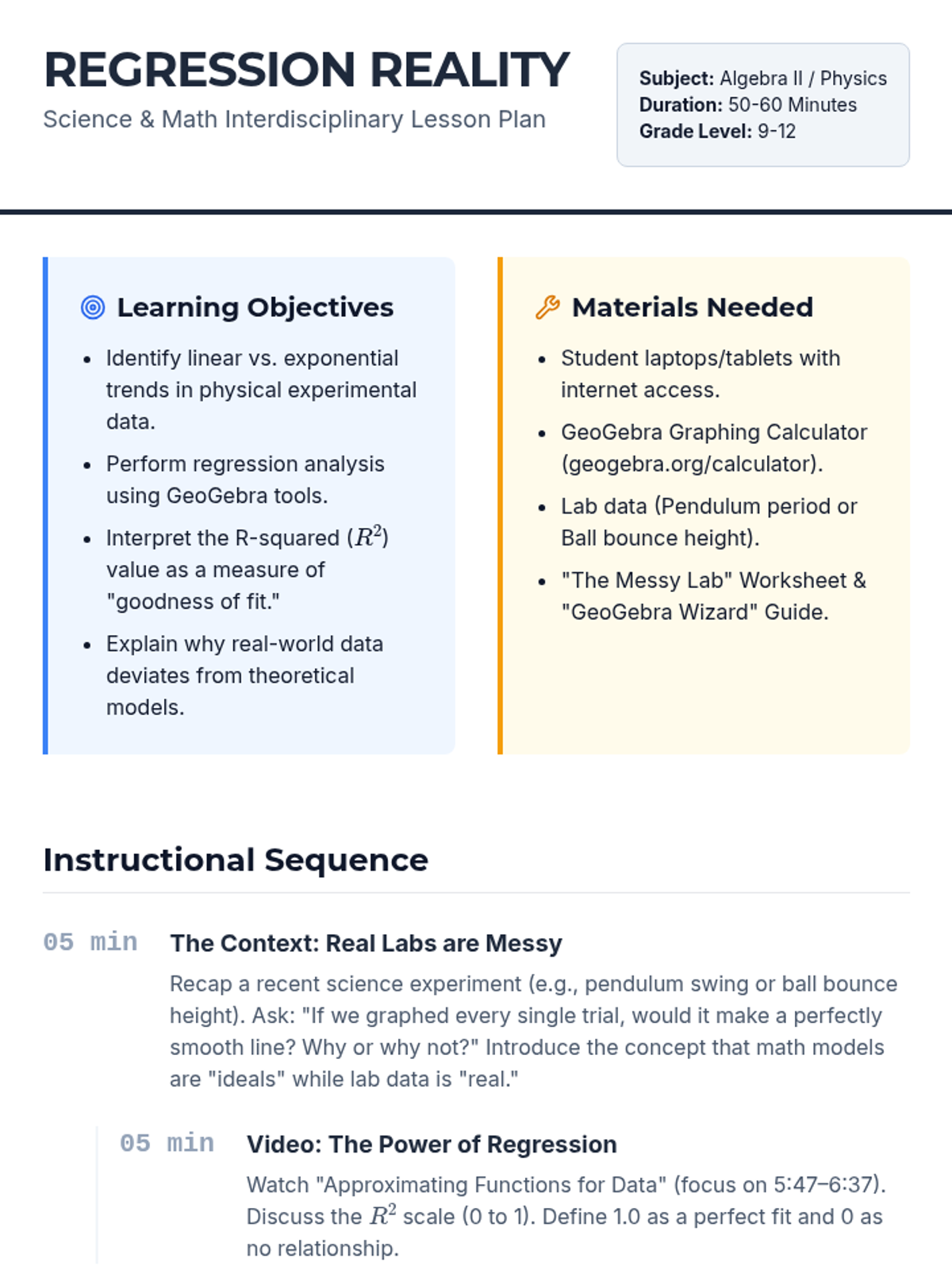
A comprehensive teacher's guide for the Regression Reality lesson, including a 60-minute instructional sequence, key vocabulary, and differentiation strategies for teaching regression in a science context.
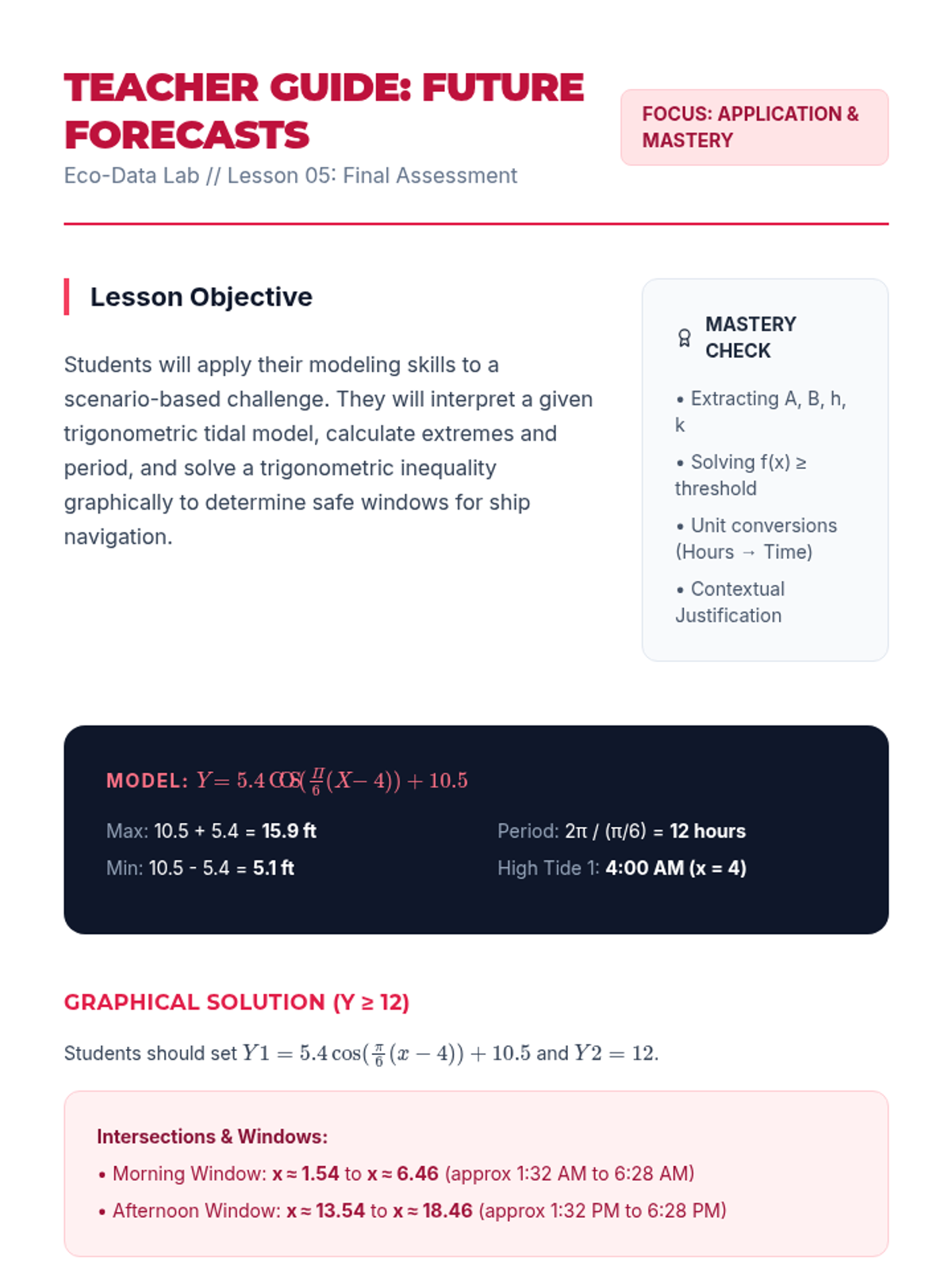
A teacher guide for Lesson 5, including answer keys for the harbor entry scenario and instructional tips on graphical inequality solutions.
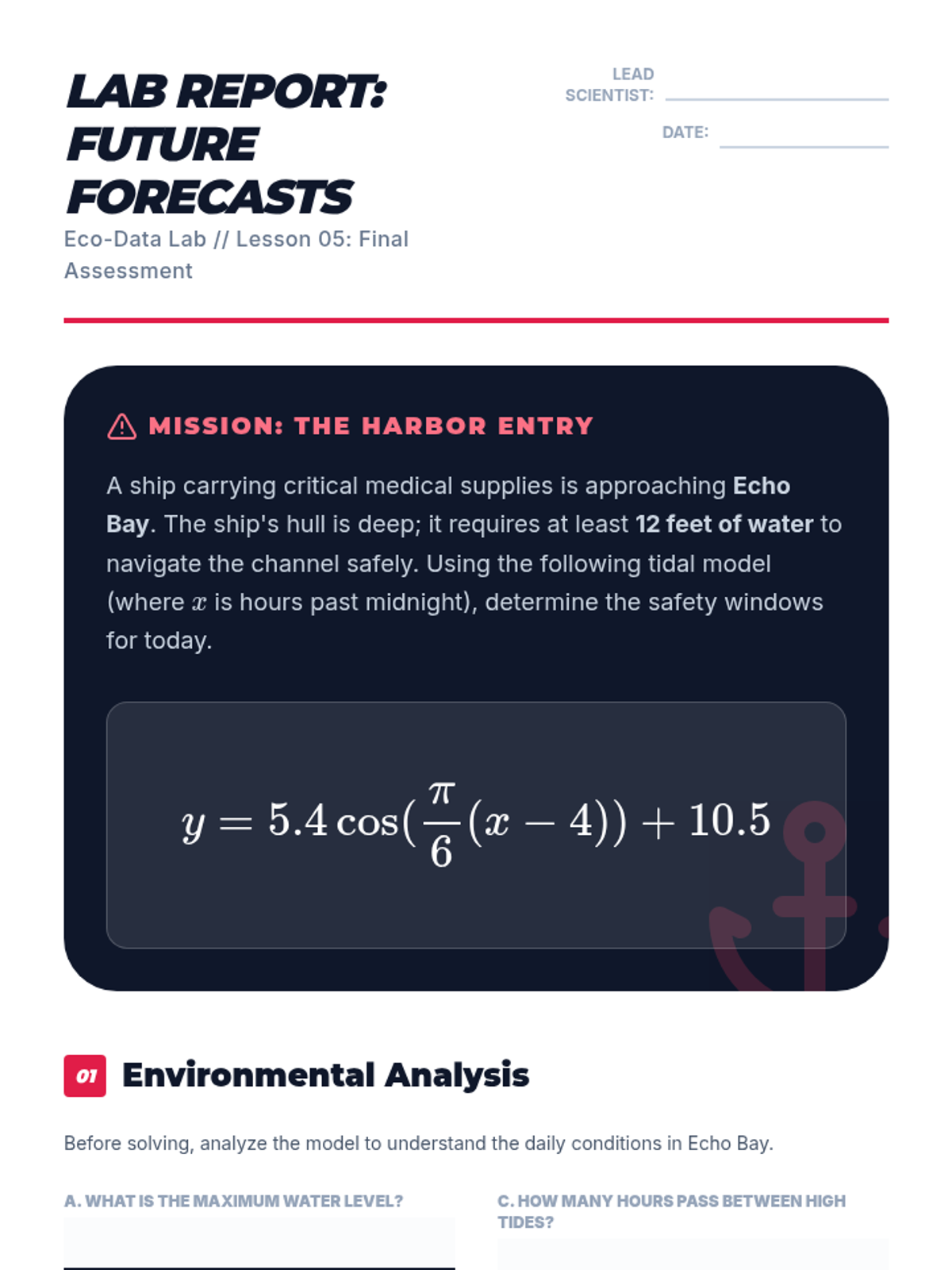
A student worksheet for Lesson 5, guiding students through a scenario-based challenge where they must use a provided trigonometric tidal model to determine safe entry windows for a ship based on depth requirements.
An instructional slide deck for Lesson 5, focusing on extrapolation and solving trigonometric inequalities graphically in the context of an environmental scenario.