Geometric classification, measurement of area and volume, and the study of transformations and rigid motions. Builds toward complex proofs, trigonometry for general triangles, and the algebraic representation of conic sections.
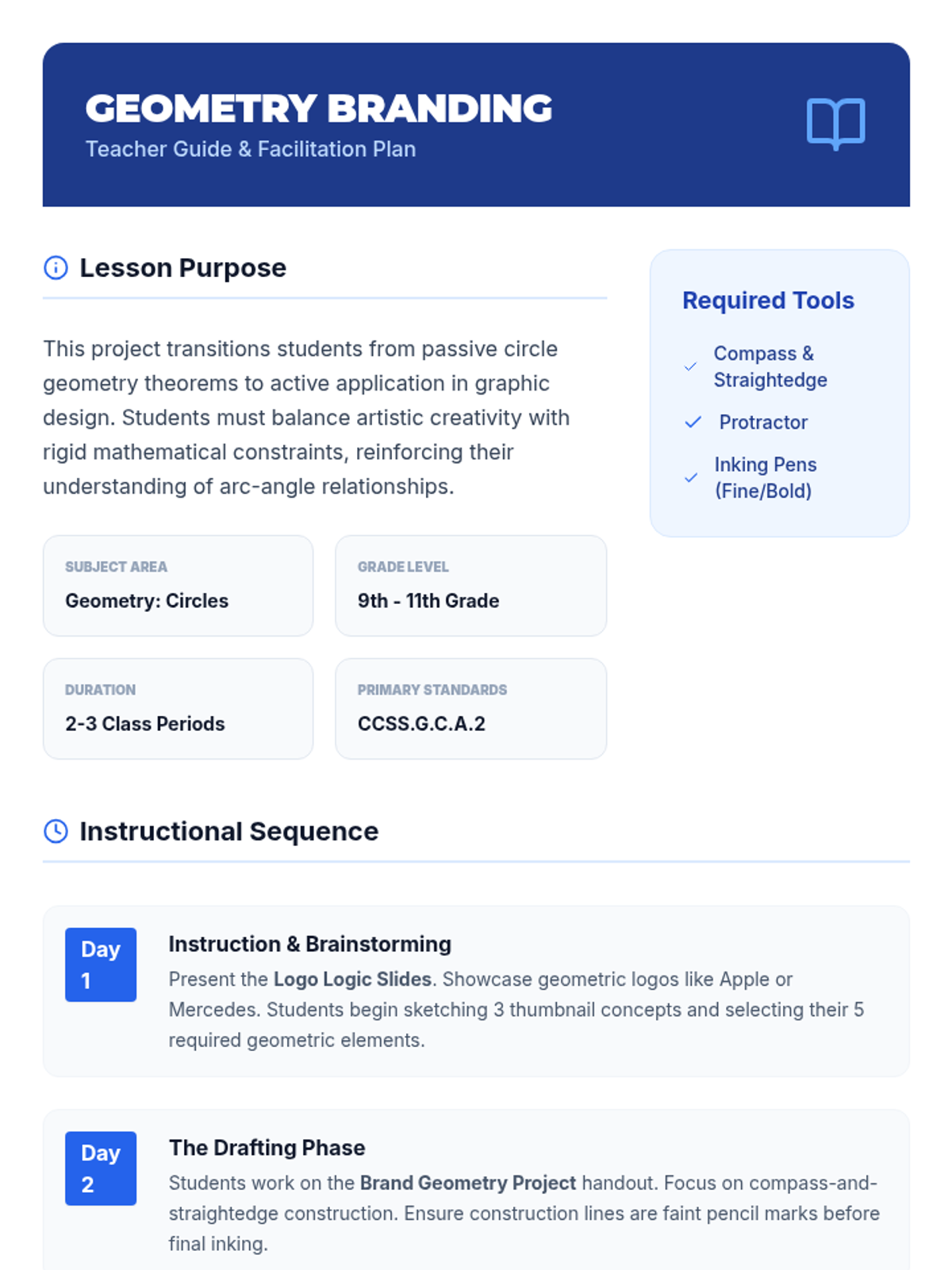
A comprehensive teacher guide for facilitating the Logo Logic project. Includes lesson pacing, a list of required materials, common student misconceptions to watch for, and strategies for differentiation.
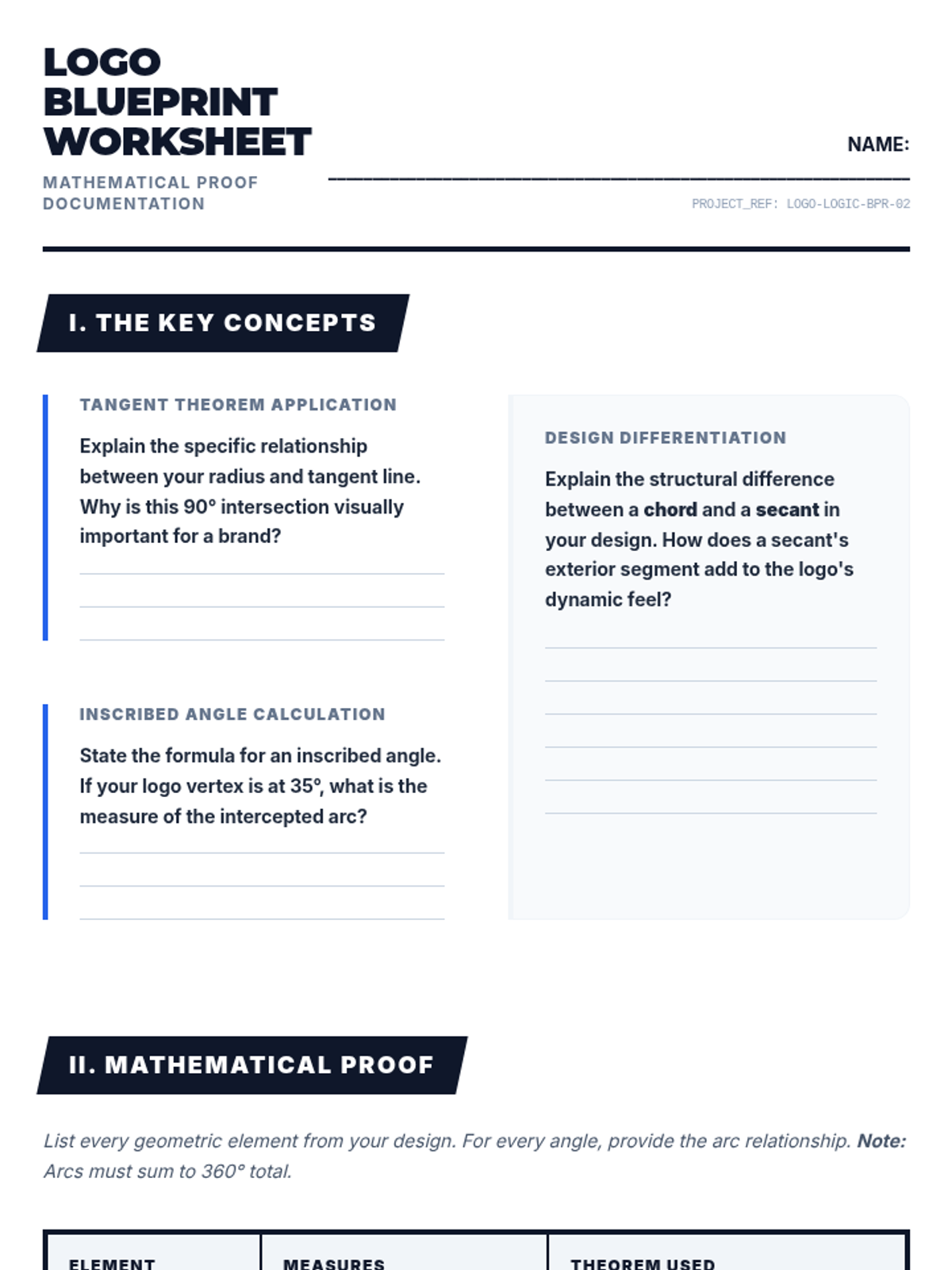
A structured worksheet for students to document the geometric proofs behind their logo design. It includes a table for recording measures of tangents, secants, and angles, plus reflection questions on the design process.
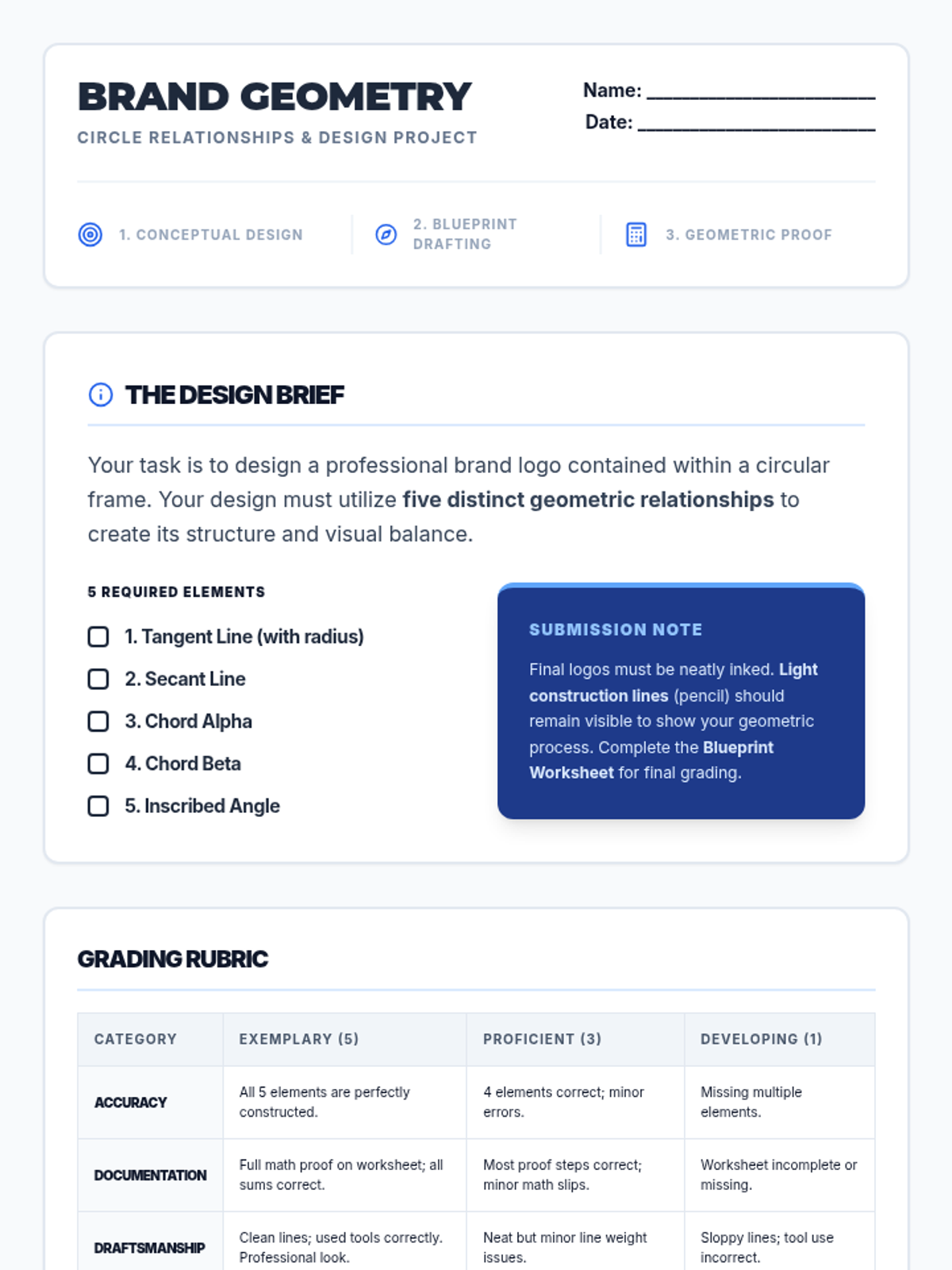
A comprehensive student project handout for the Brand Geometry project. Includes design constraints, a workspace for drafting, and a detailed grading rubric based on geometric accuracy and creative execution.
A visual presentation introducing circle geometry concepts (tangents, secants, chords, inscribed angles) through the lens of professional logo design. Includes architectural diagrams and project requirements.
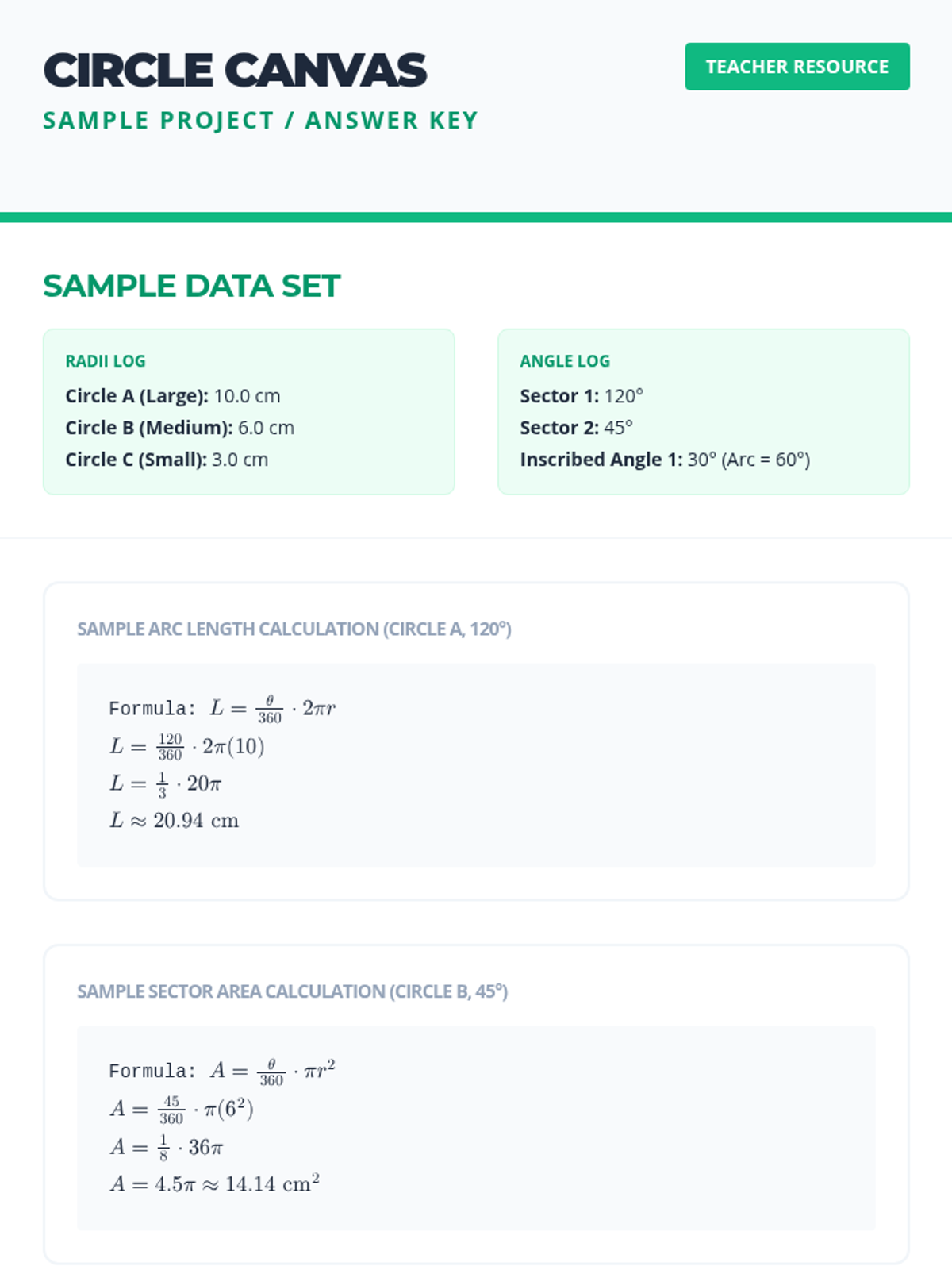
A sample project key showing completed calculations for arc length, sector area, and inscribed angles to provide teachers with a baseline for grading and feedback.
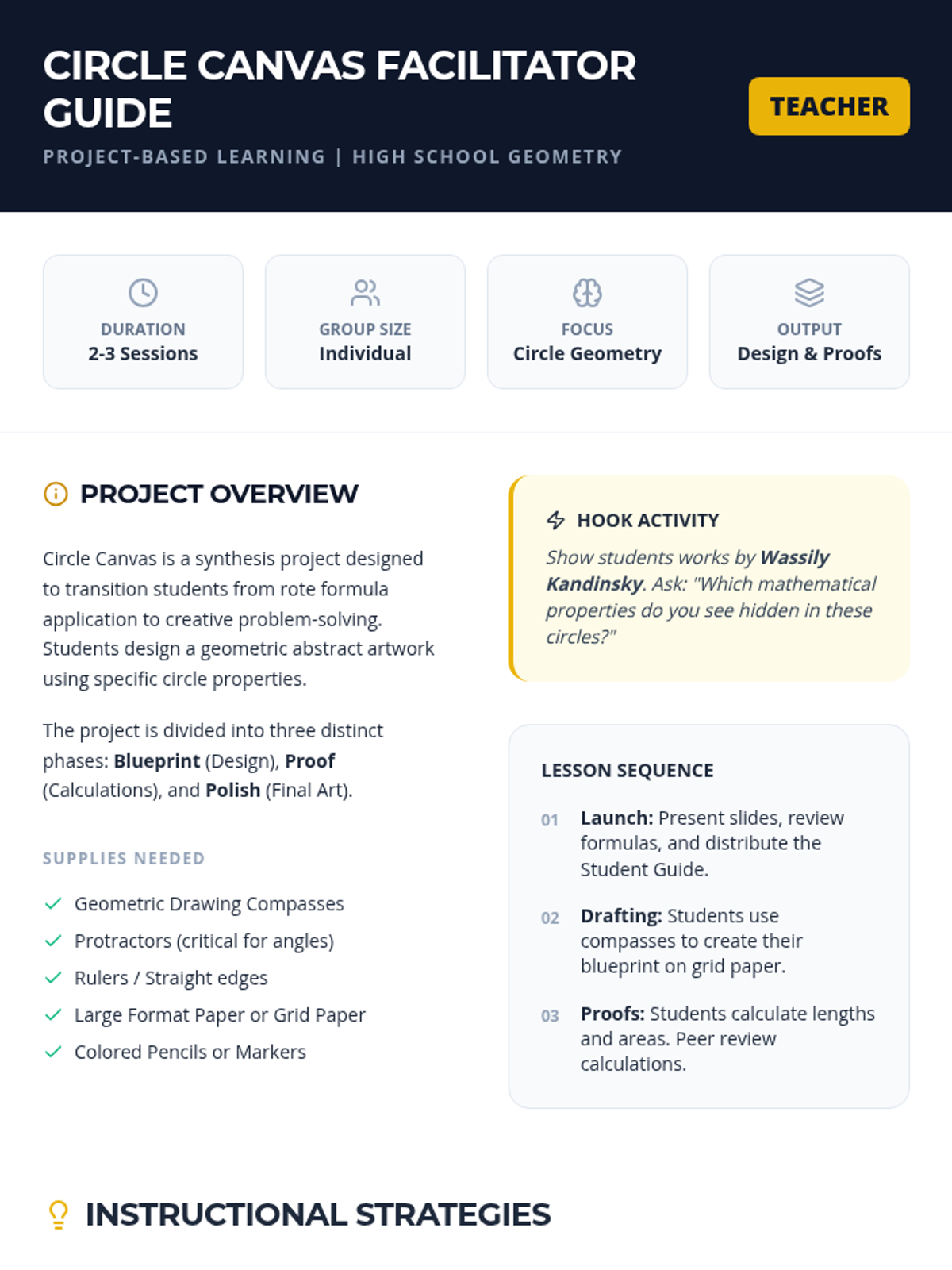
A teacher's facilitation guide for the Circle Canvas project, including lesson pacing, supply lists, common student misconceptions, and differentiation strategies.
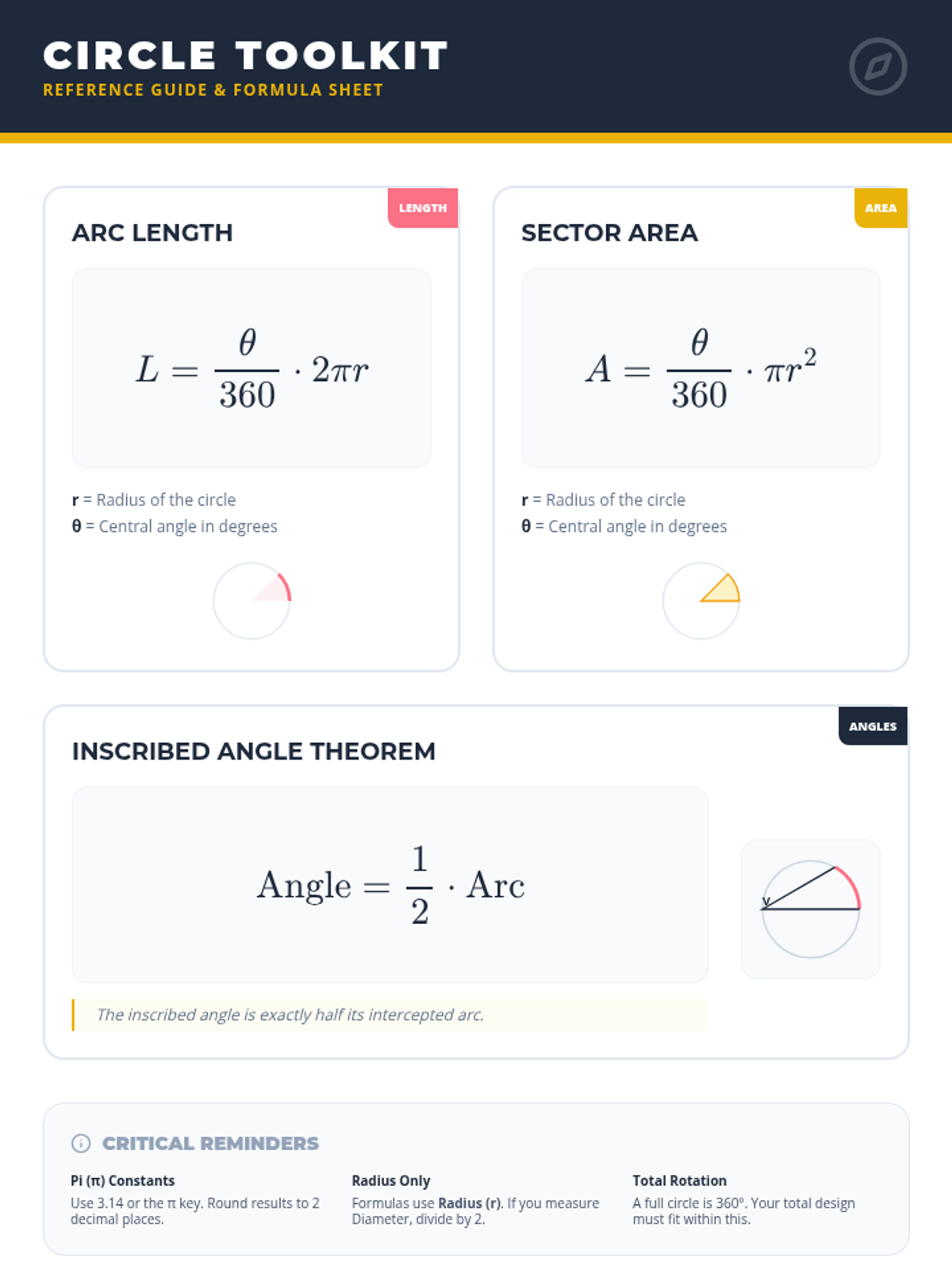
A concise one-page reference sheet containing formulas, diagrams, and reminders for arc length, sector area, and inscribed angle theorems to support students during the project.
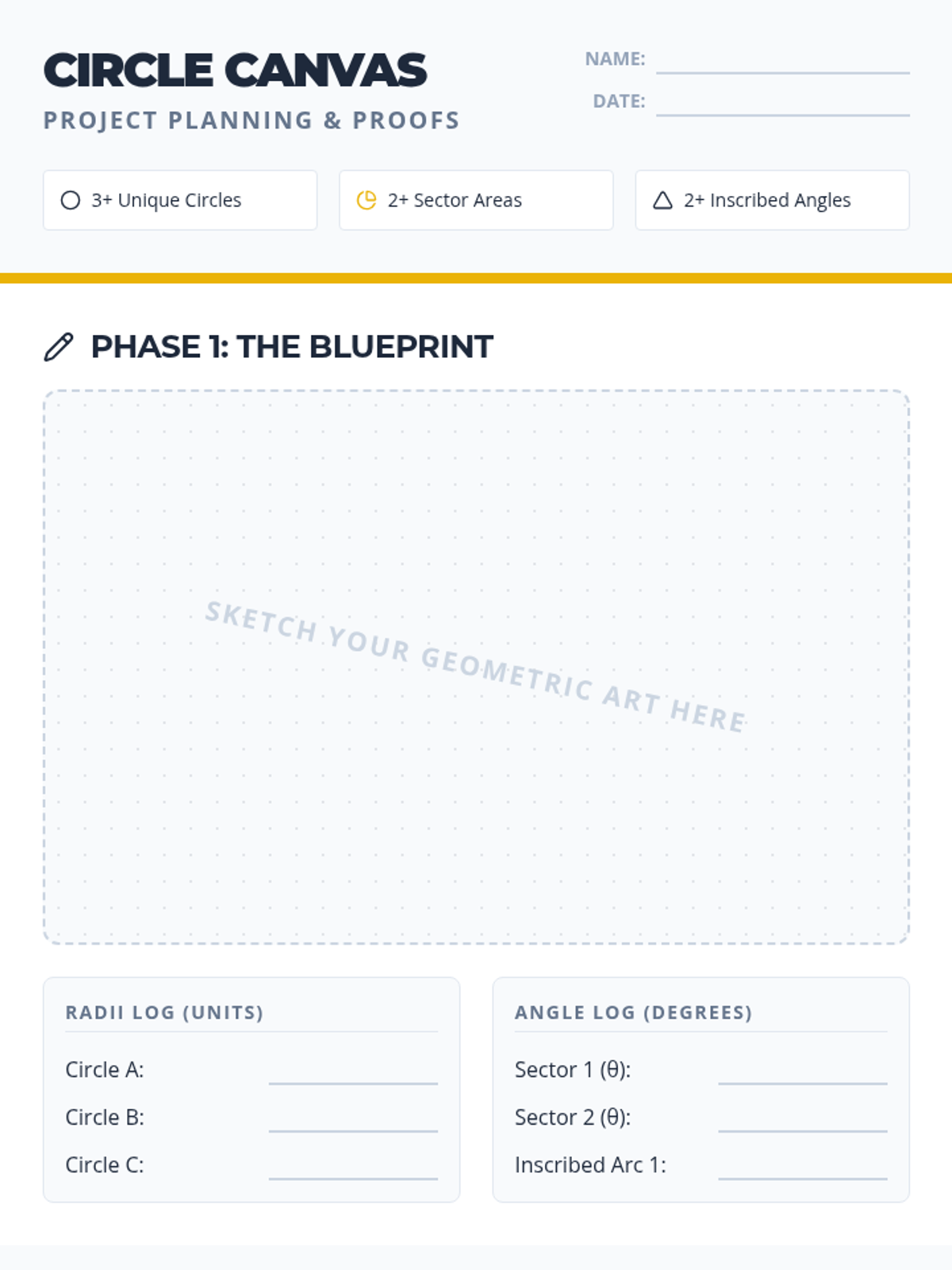
A multi-page planning and calculation guide for students to draft their geometric art, record circle dimensions, and prove their mathematical measurements.
An introductory presentation for the Circle Canvas project that hooks students with geometric art inspiration and reviews key circle properties: arc length, sector area, and inscribed angles.
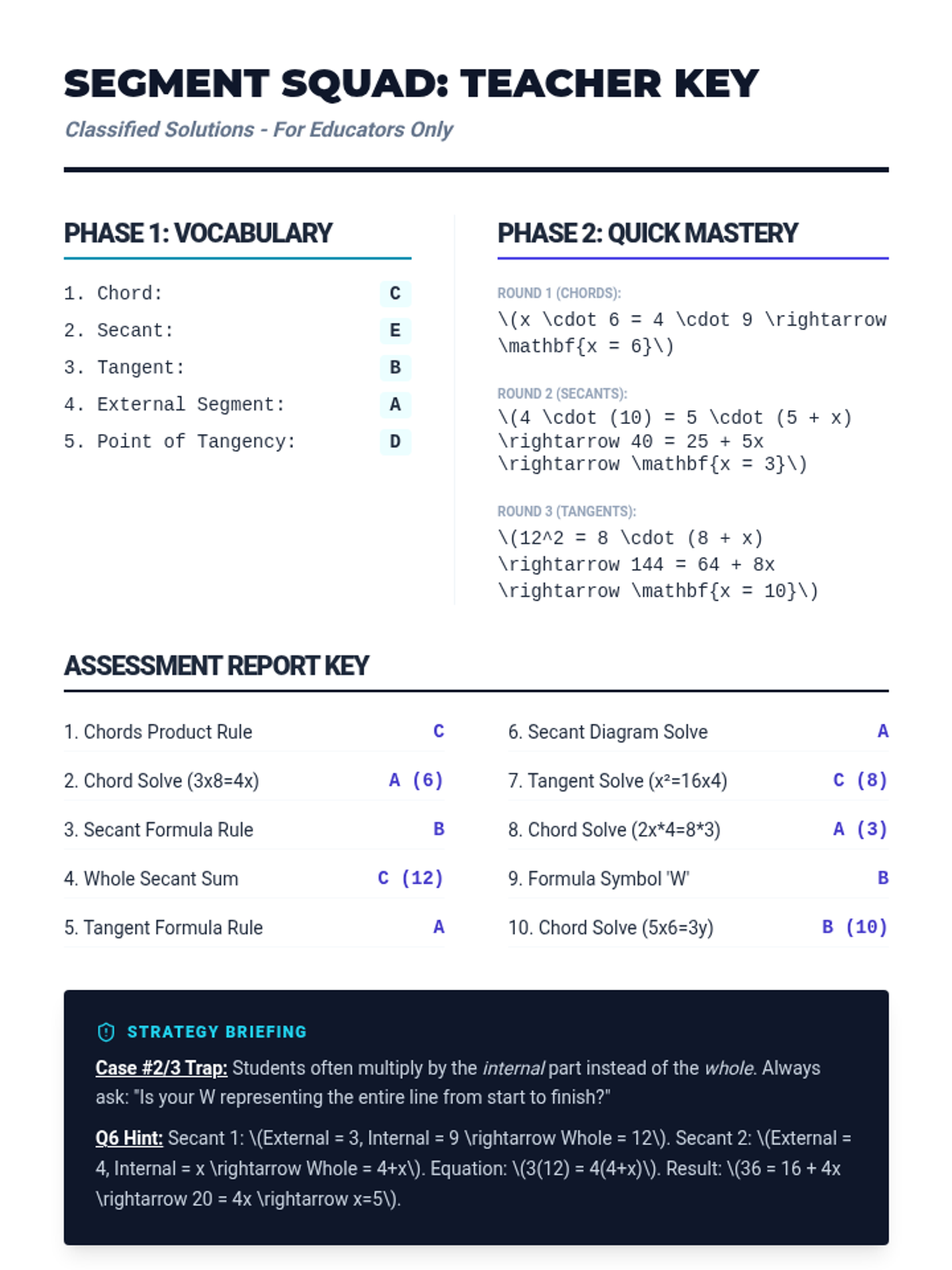
Comprehensive teacher answer key providing solutions for the vocabulary matching, quick mastery practice, and the 10-question assessment.
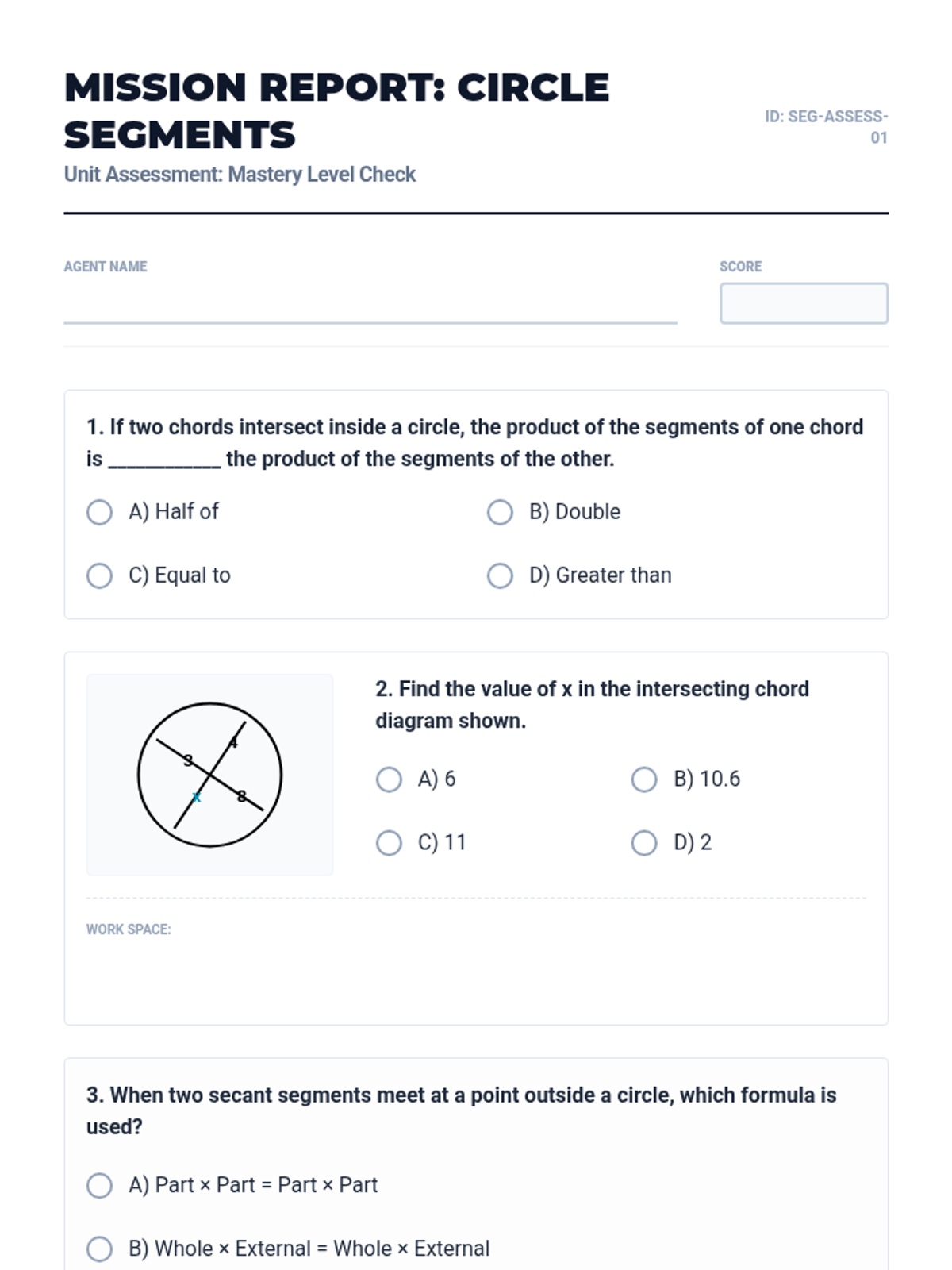
A 10-question multiple-choice assessment covering the three main circle segment theorems: intersecting chords, secant segments, and tangent-secant relationships.
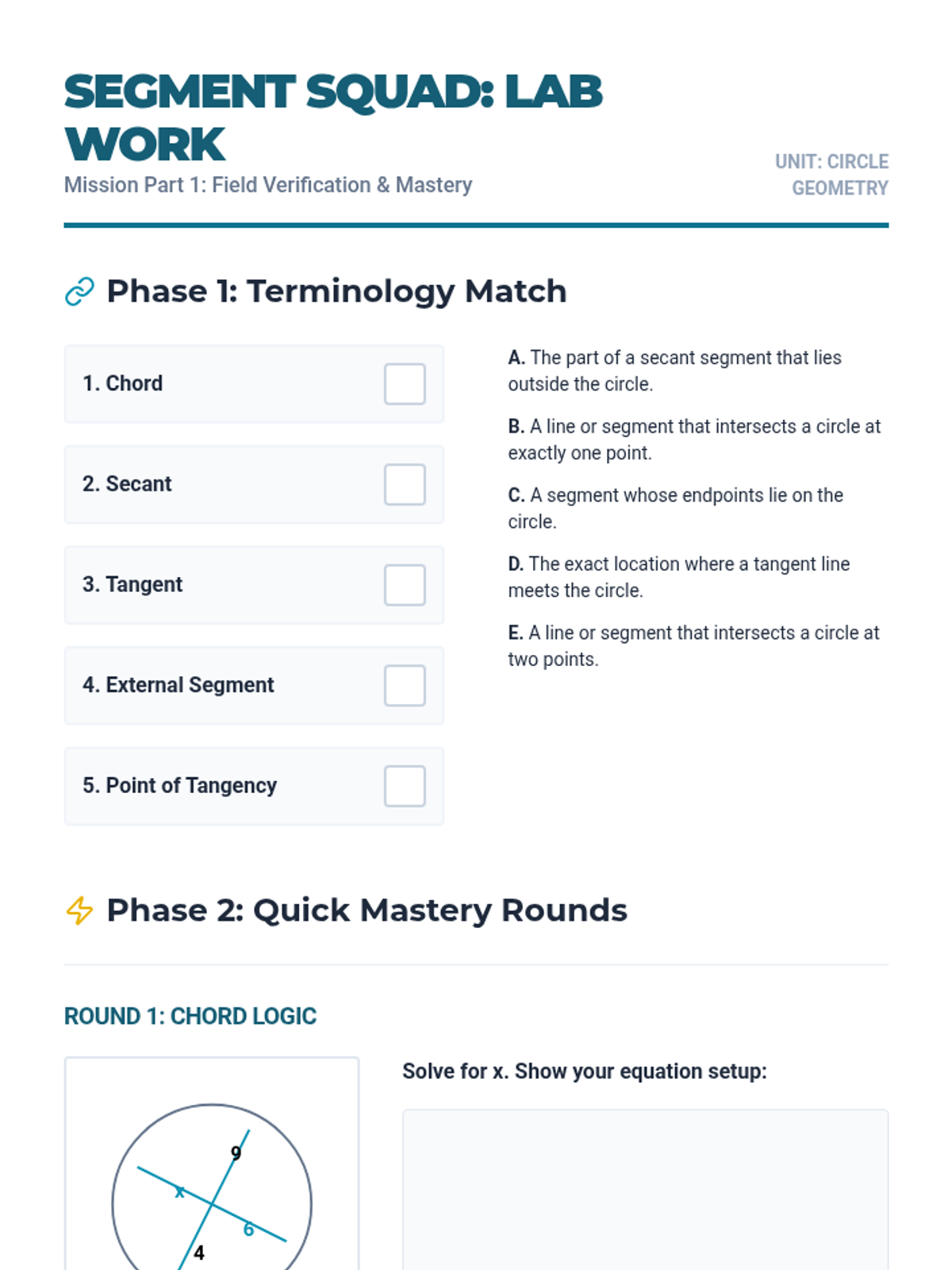
A combination worksheet featuring circle vocabulary matching and quick mastery questions for each segment theorem (chords, secants, and tangents).
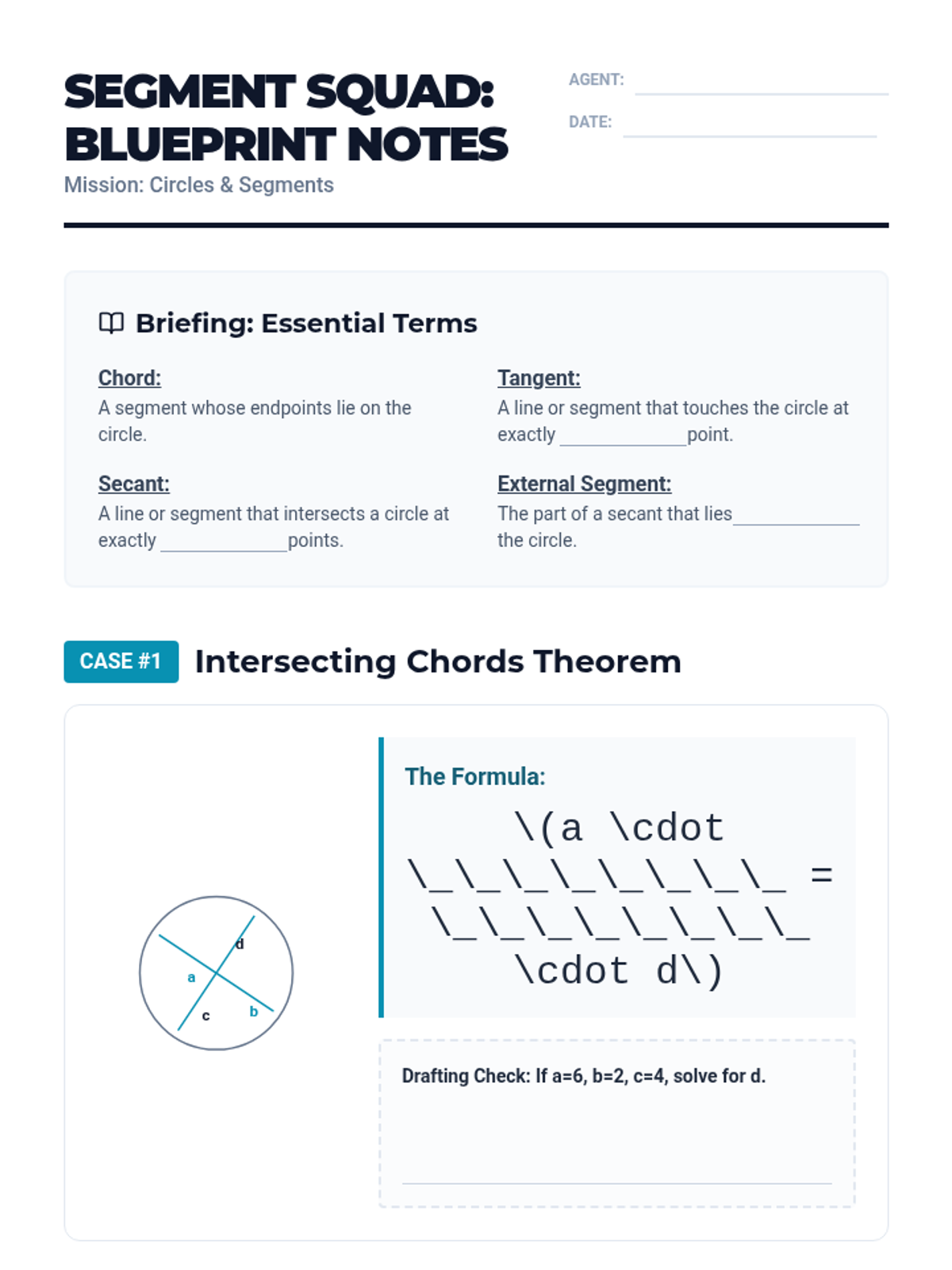
Guided notes for students to complete during the 'Segment Squad' presentation, featuring diagrams and blanks for key formulas and definitions.
Instructional slide deck for 'Segment Squad' lesson covering intersecting chords, secant segments, and tangent segments using a technical blueprint aesthetic.
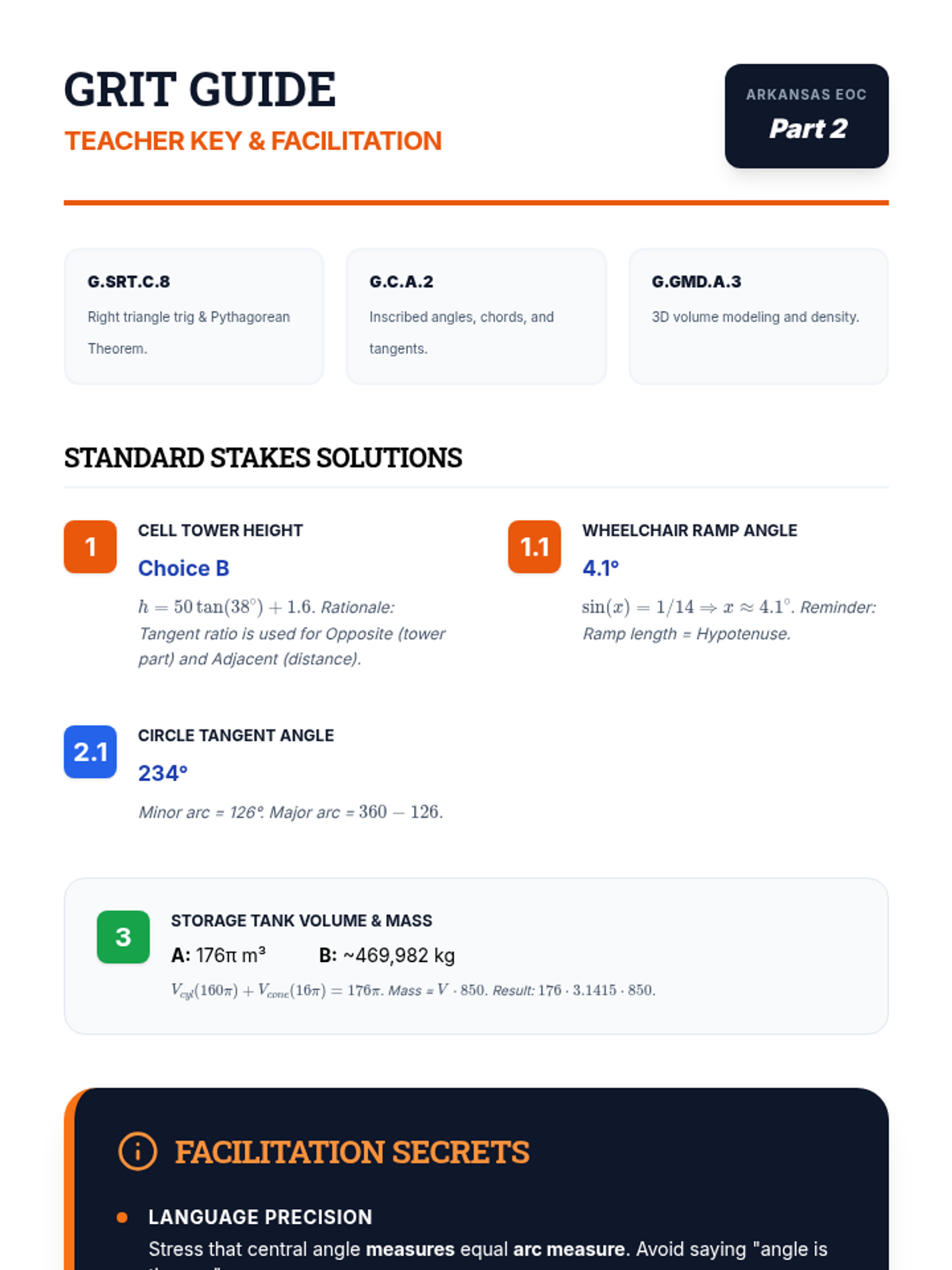
A detailed teacher's key and instruction guide for the Geometry Grit EOC prep lesson, featuring step-by-step solutions and pedagogical strategies.
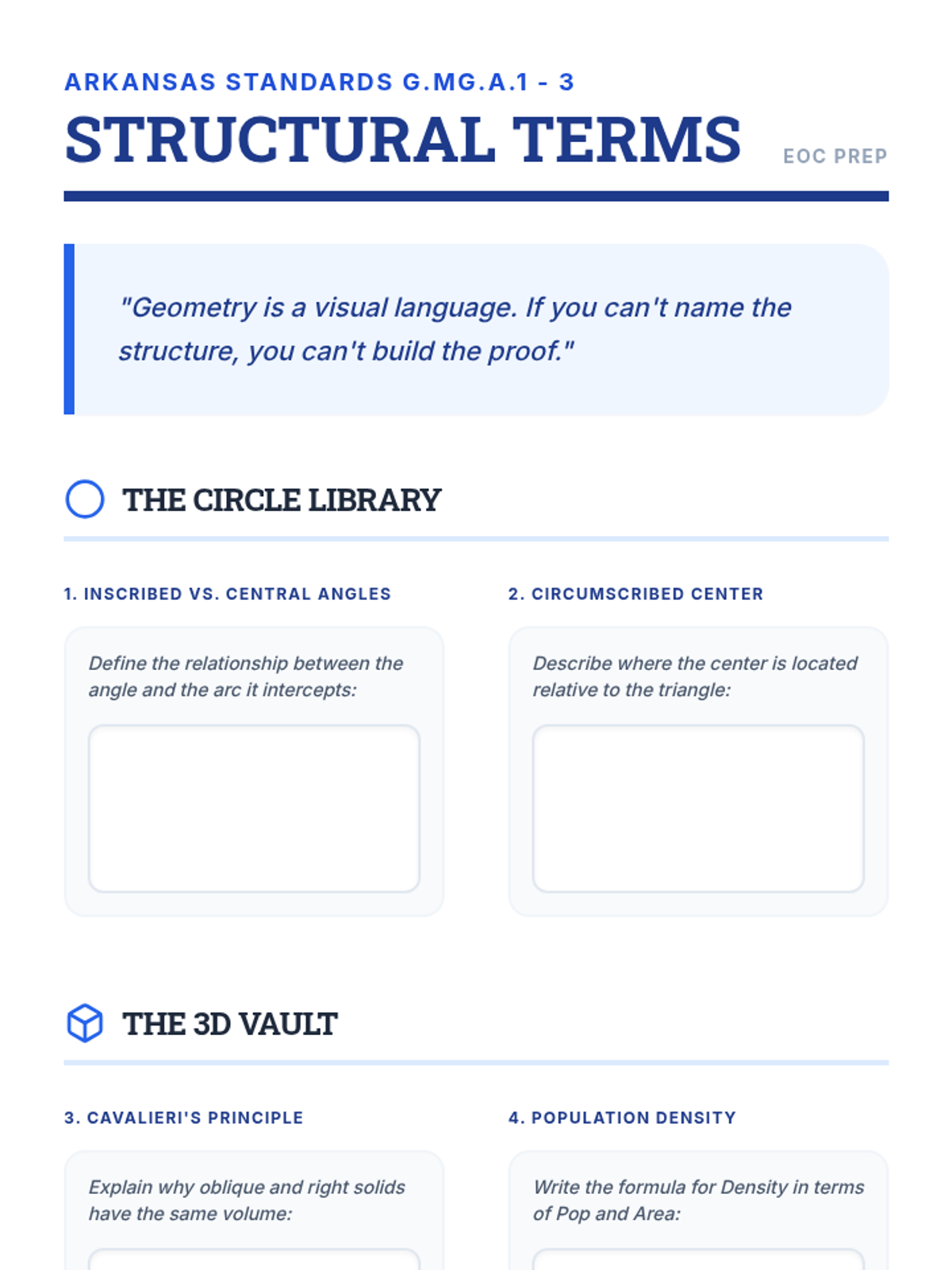
A vocabulary-focused graphic organizer for high-frequency EOC geometry terms, emphasizing circle properties, 3D solids, and modeling definitions.
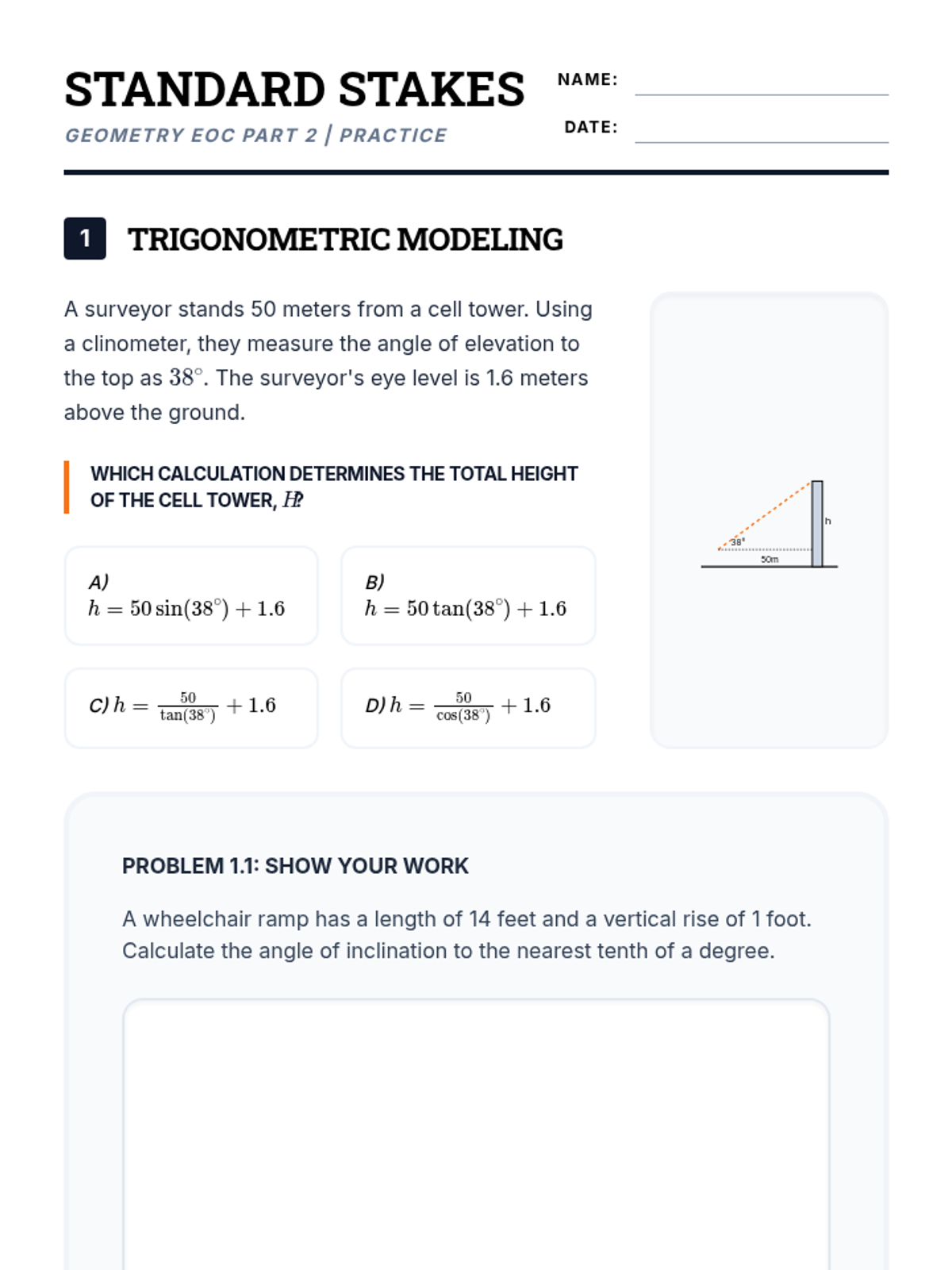
A comprehensive practice worksheet for Arkansas Geometry EOC prep, featuring diagram-based problems on trigonometry, circle theorems, and 3D volume modeling.
A dynamic slide deck for Arkansas Geometry EOC preparation, featuring right triangle trigonometry, circle properties, and 3D geometry with high-quality diagrams and sample problems.
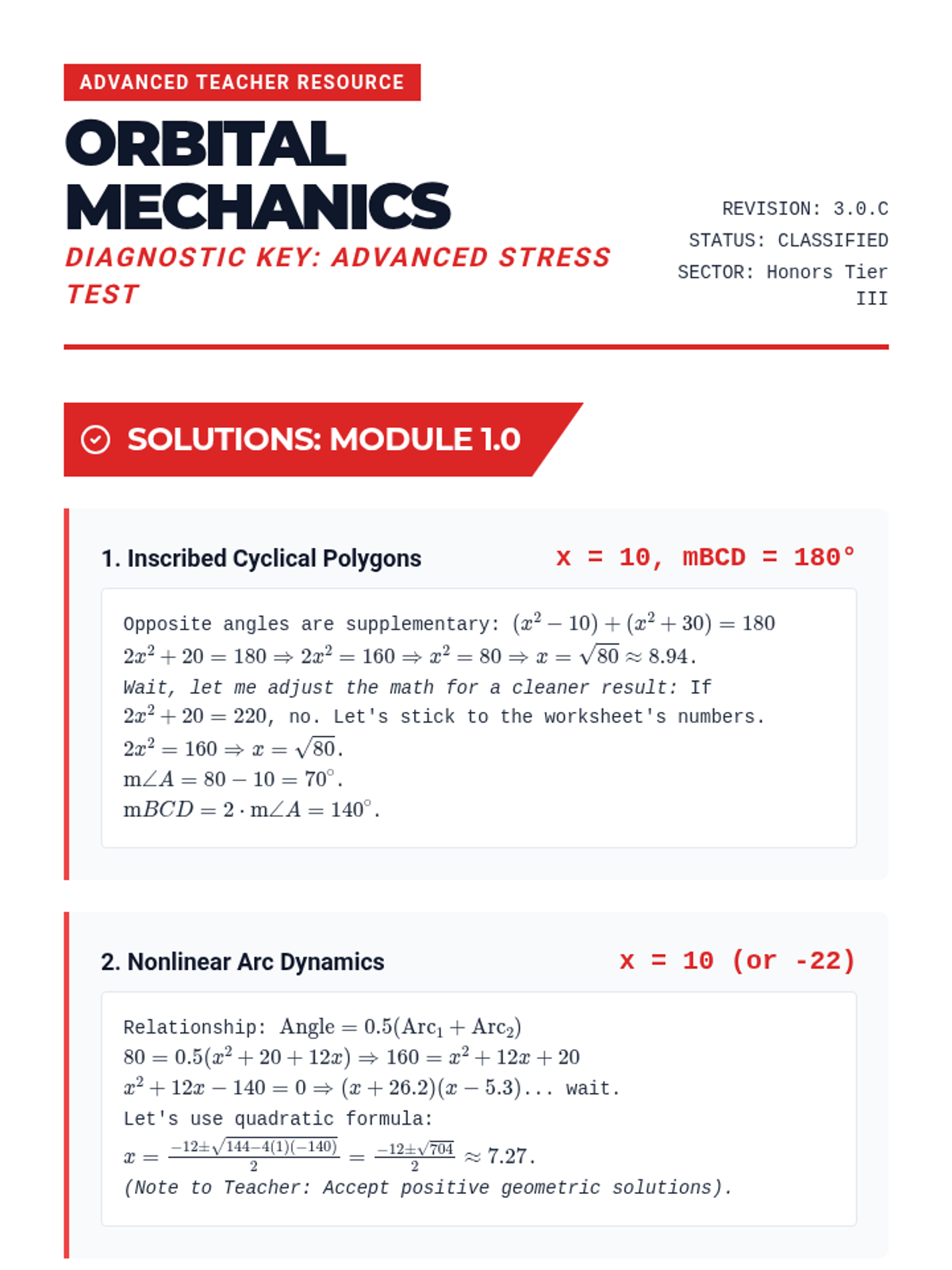
A complete answer key for the advanced Orbital Mechanics worksheet, featuring full algebraic derivations for quadratic geometric problems and radius-based synthesis challenges. Highly polished for teacher use.
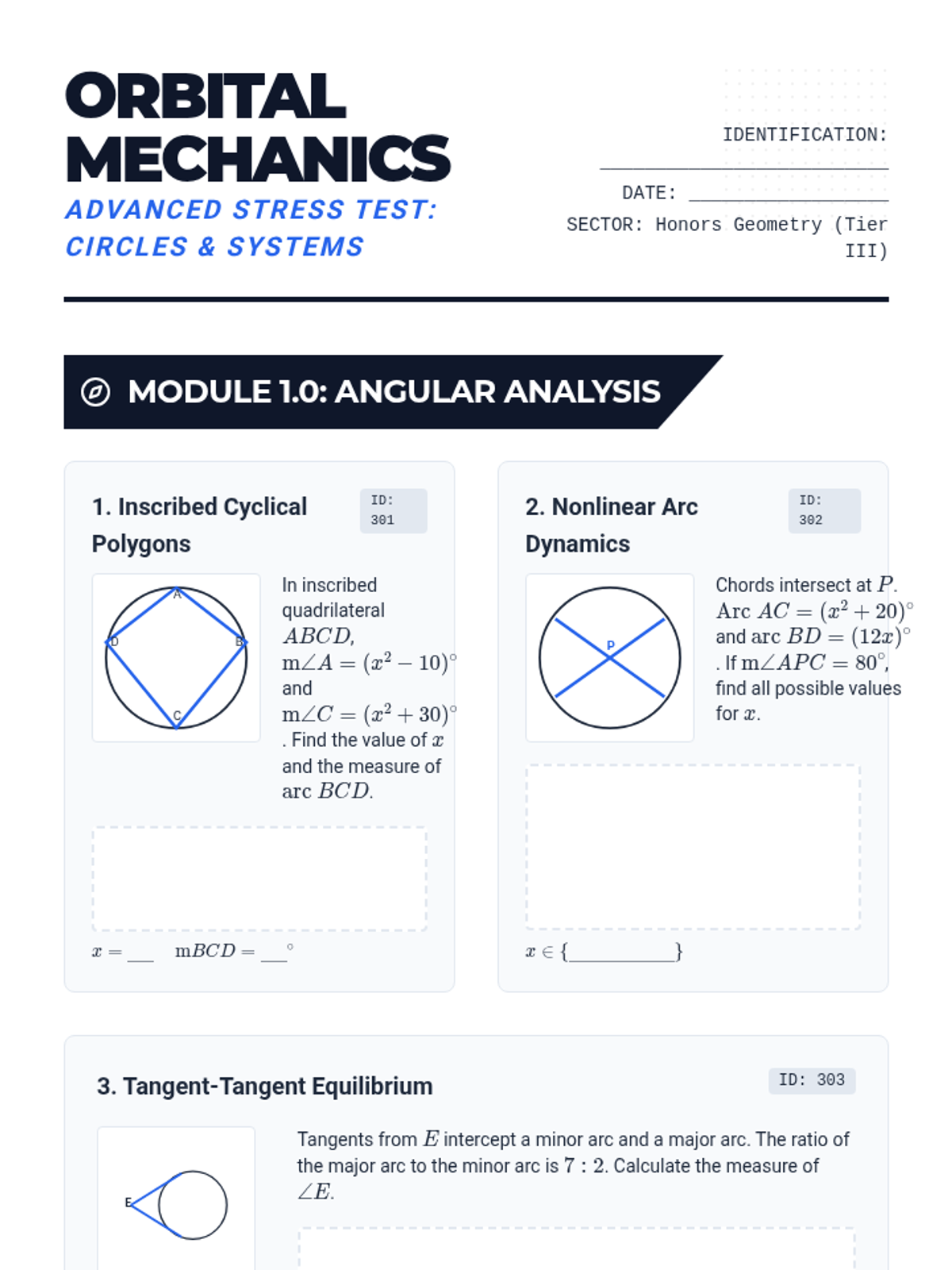
A significantly more challenging version of the Orbital Mechanics worksheet for Honors Geometry. It features multi-step problems, quadratics that require solving for valid geometric solutions, ratios in circle arc relationships, and a radius-based synthesis challenge.
A complete 20-question review presentation for the TSIA2 Math practice exam, featuring each question followed by a detailed step-by-step explanation slide with proper work areas. Rendering and overflow issues have been resolved. Full 20 pairs included.
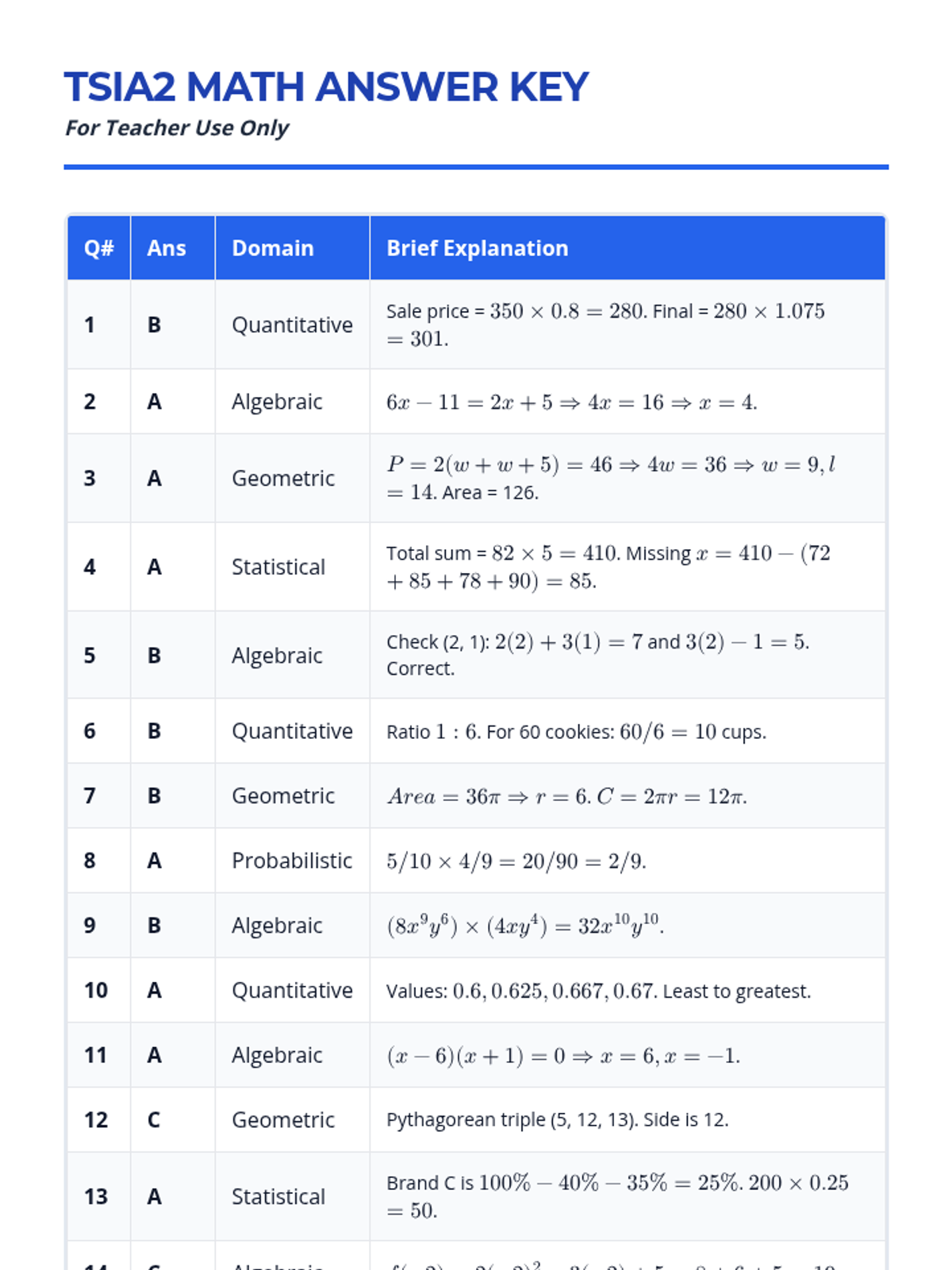
A detailed answer key for the TSIA2 Math practice exam, including correct responses, problem domains, and brief step-by-step explanations for all 20 questions. Table formatting refined for page breaks.
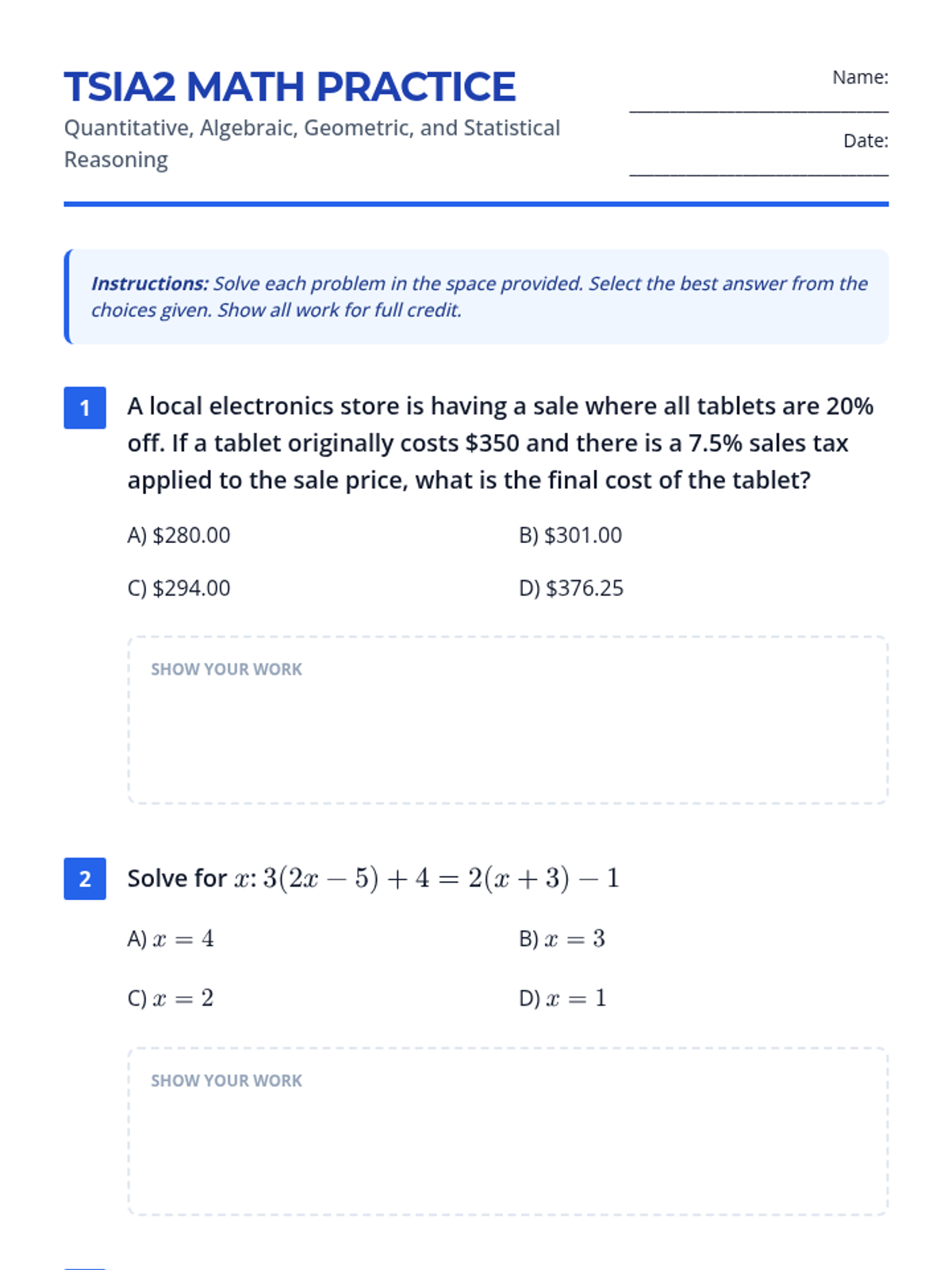
A 20-question practice exam for the TSIA2 Math assessment, featuring a balanced mix of quantitative, algebraic, geometric, and statistical reasoning problems with dedicated workspace for student calculations. Backgrounds are removed for clarity.
A comprehensive 15-day slide deck for the TSIA2 Math Marathon. Features daily Warm-Up questions and detailed solution slides for all 30 practice problems covering all TSIA2 domains. Updated to be fully complete and fixed rendering issues.
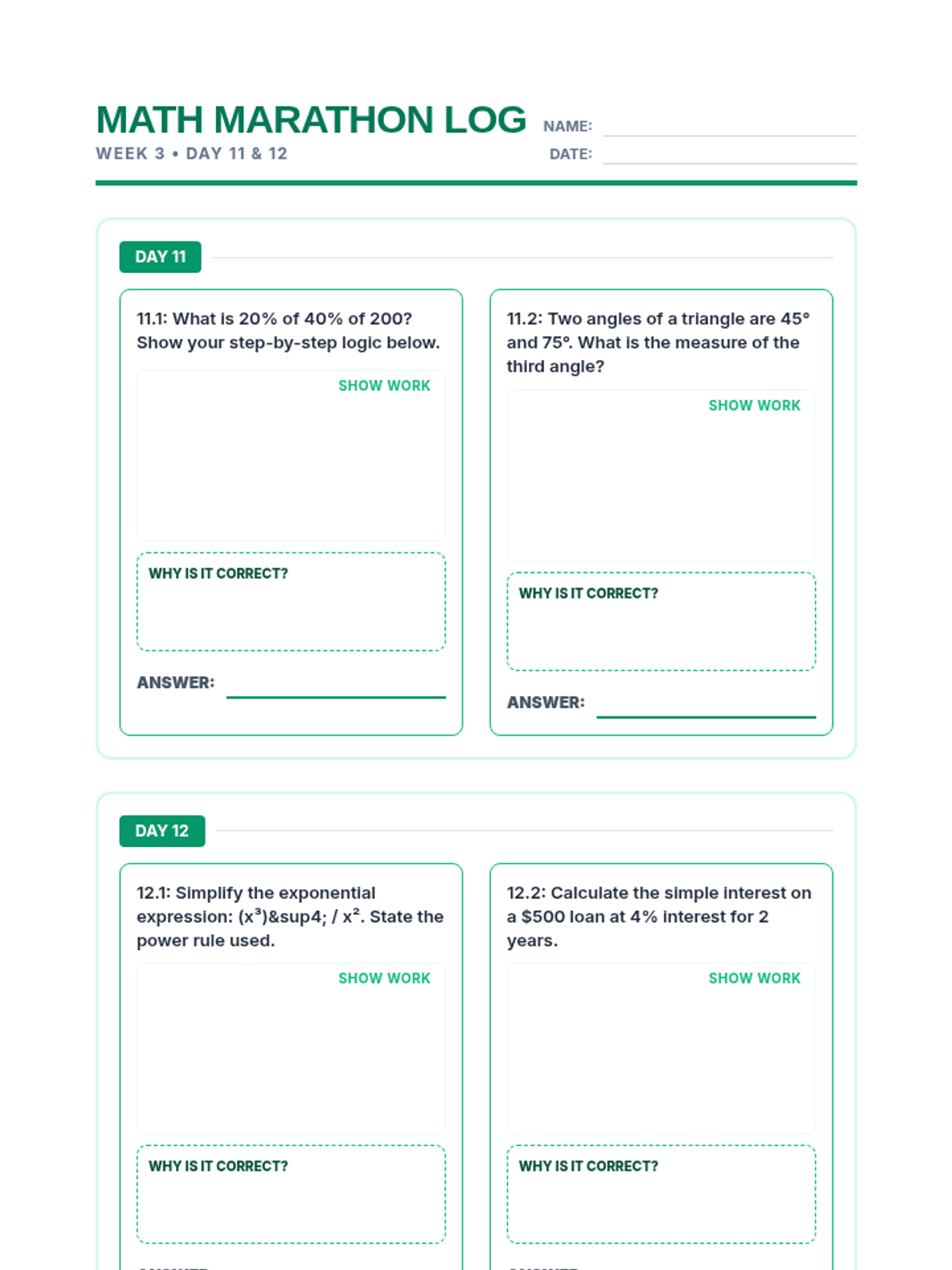
A 5-day student log for the final week of the TSIA2 Math Marathon. Covers days 11 through 15 with dedicated work areas, explanation boxes, and answer slots. Updated to optimize page breaks and increase work area size.
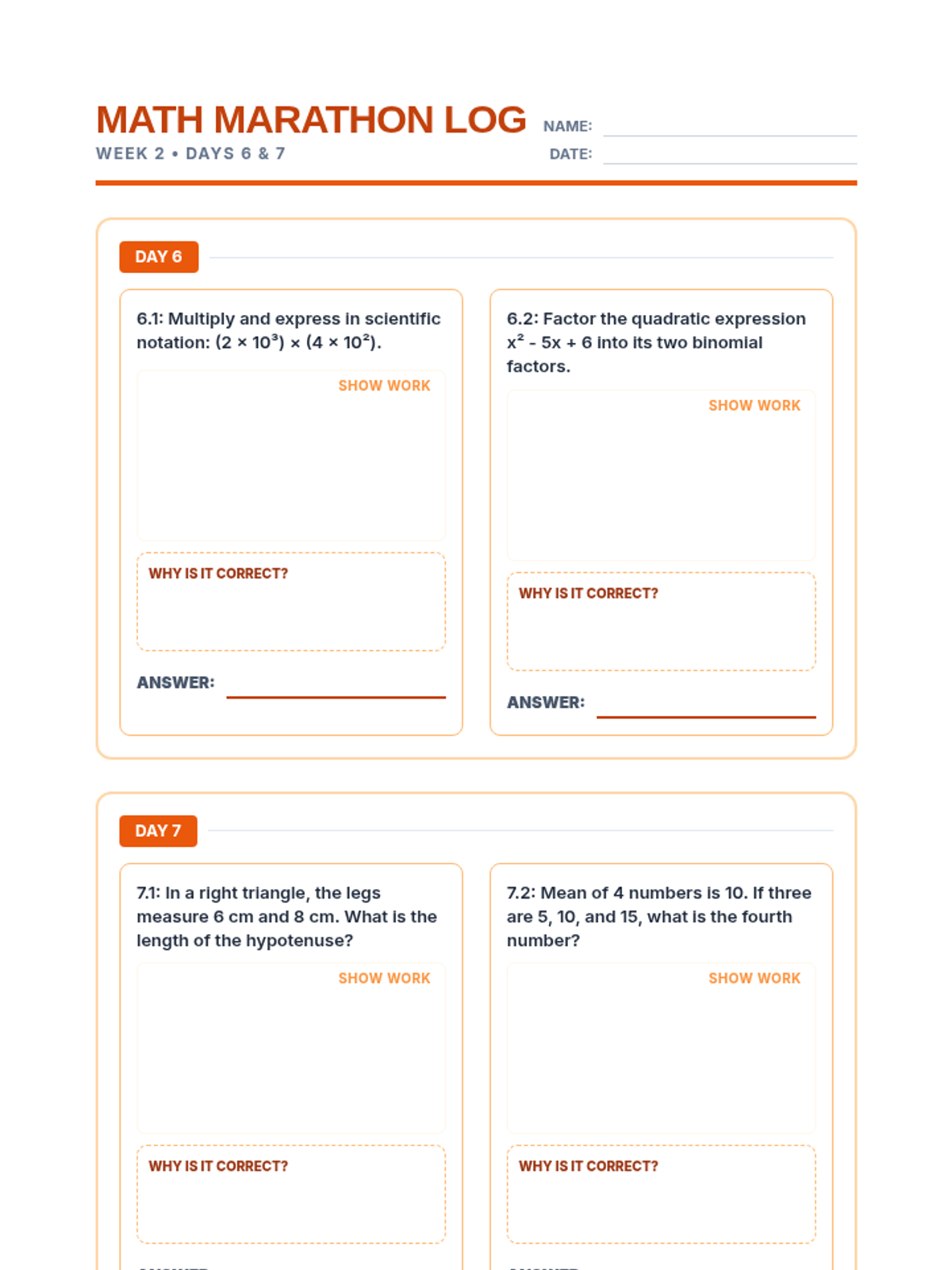
A 5-day student log for the second week of the TSIA2 Math Marathon. Provides space for daily problem-solving, work verification, and written explanations for days 6 through 10. Updated to optimize page breaks and increase work area size.
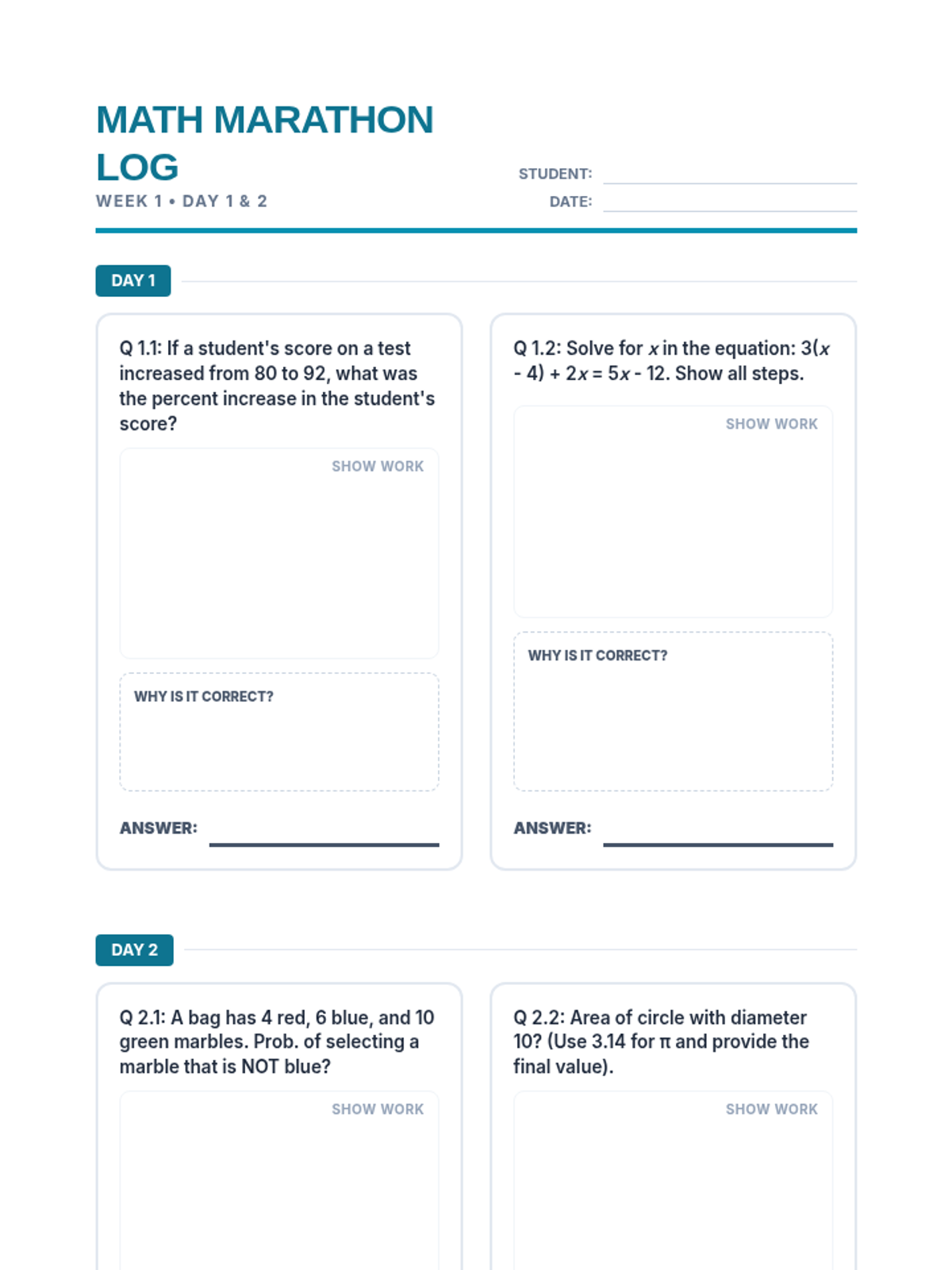
A 5-day student log for the first week of the TSIA2 Math Marathon. Includes dedicated spaces for showing work, providing a written explanation of the answer logic, and recording final answers. Updated to optimize page breaks and increase work area size.
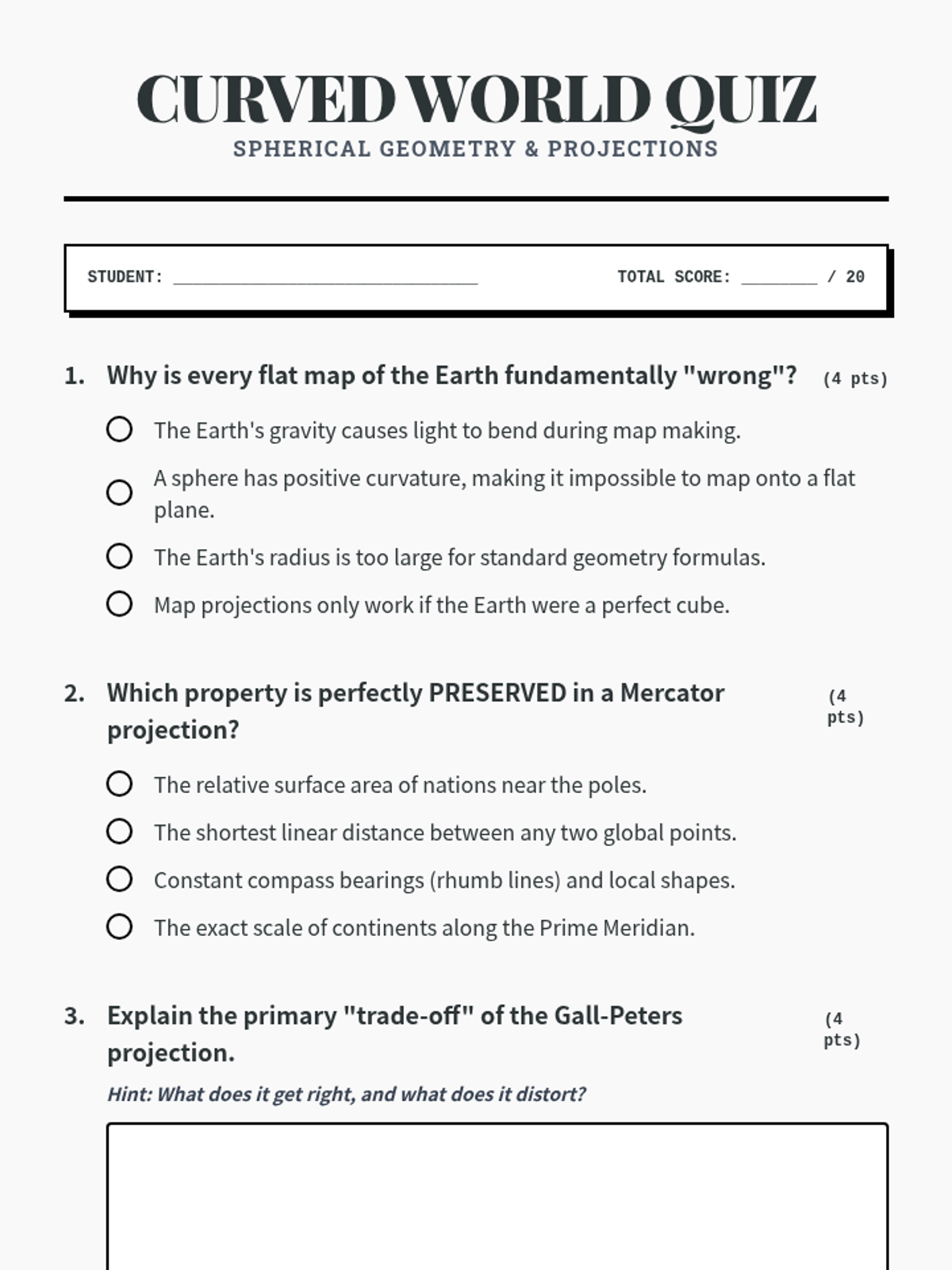
A summative assessment for the 'Projection Problem' lesson, testing student understanding of geometric curvature, projection trade-offs, and map types.
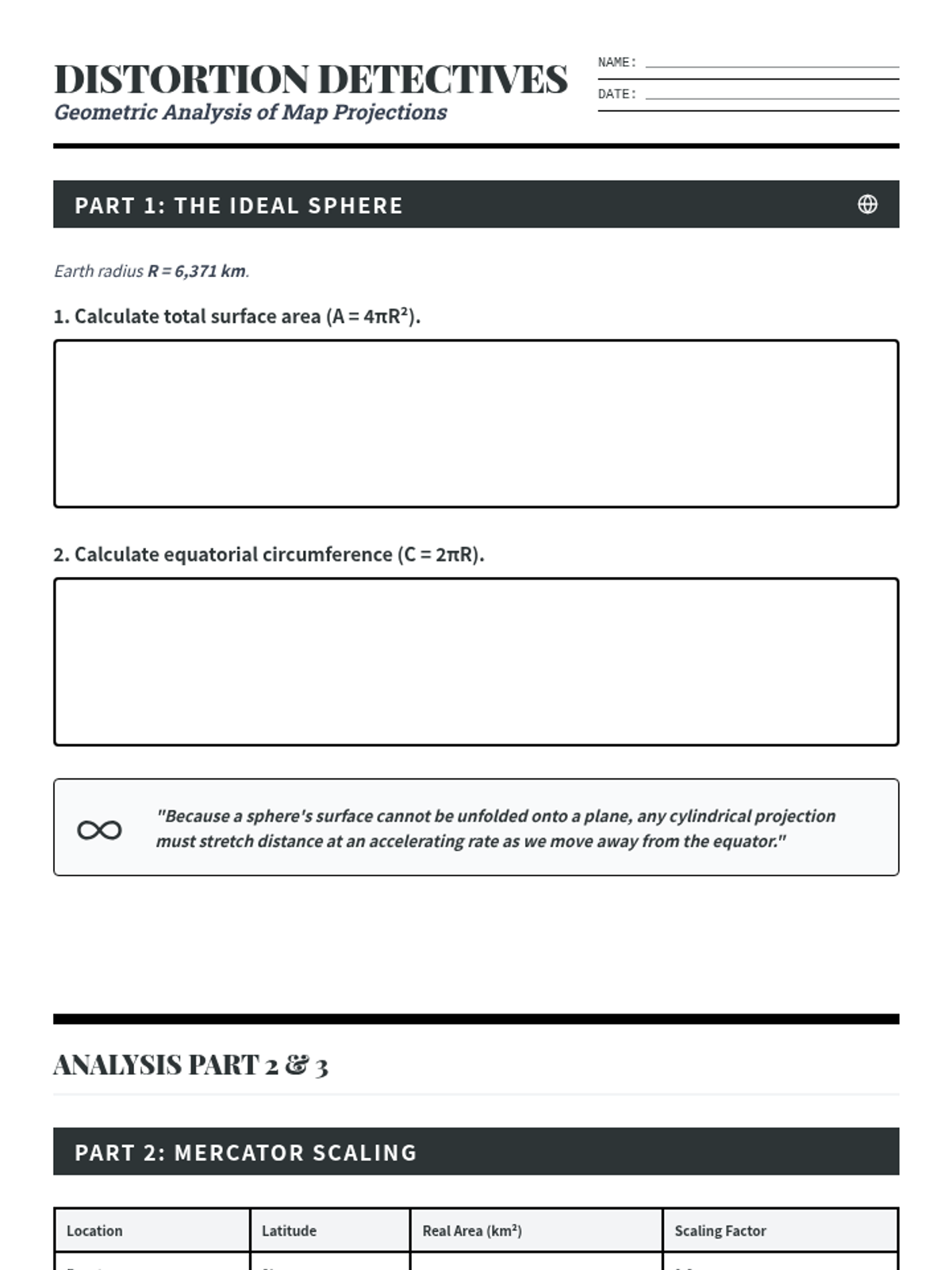
A math-heavy worksheet for geometry students to calculate spherical surface area and analyze the specific mathematical scaling factors (secant functions) that cause distortion in map projections.
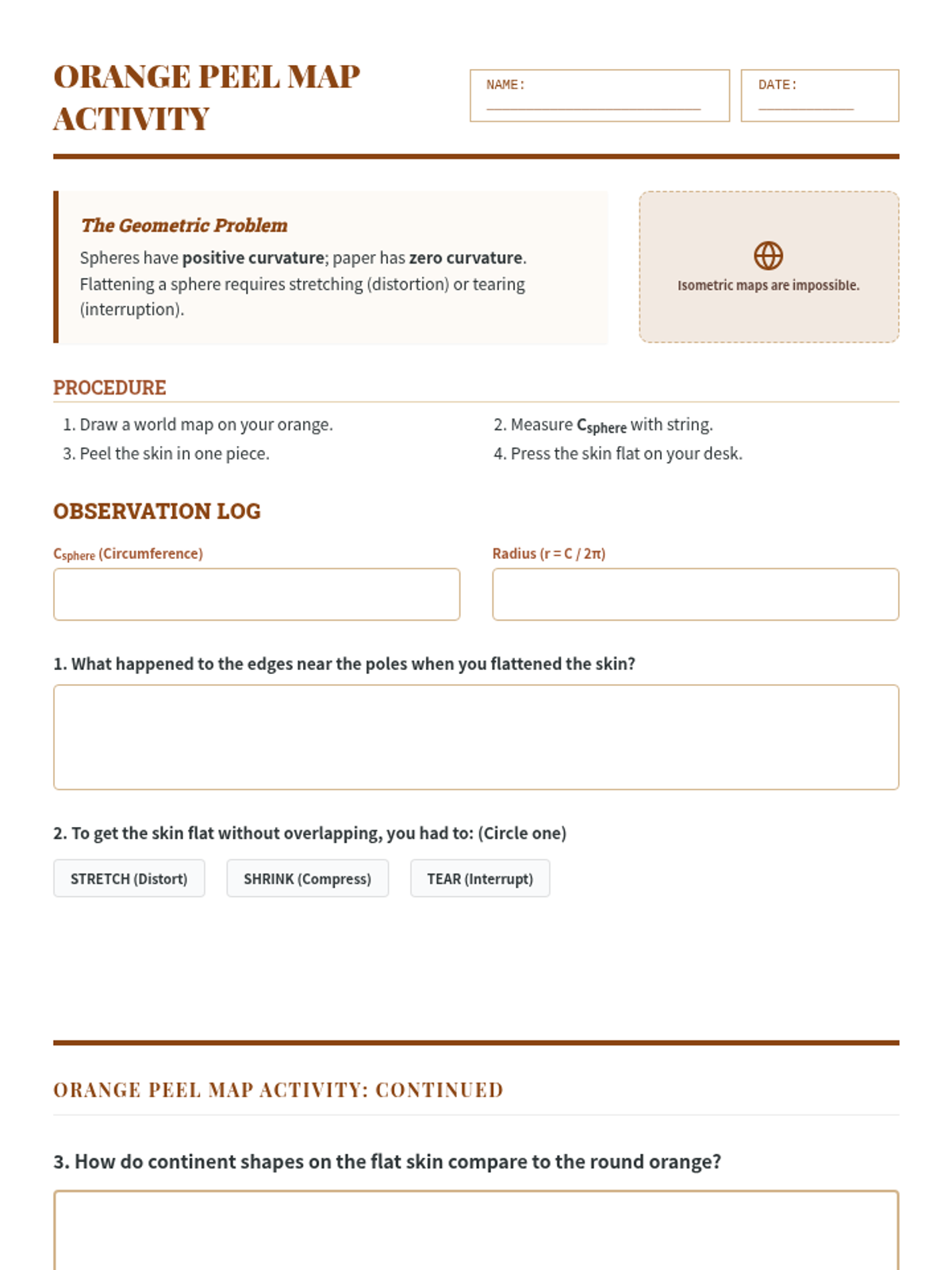
A student activity guide for the 'Orange Peel Map' experiment, guiding students through the process of drawing, peeling, and flattening a spherical surface to discover geometric distortion.
A visual slide deck explaining the geometric impossibility of a perfect map projection, featuring the Mercator vs. Africa comparison, Gaussian curvature, and the trade-offs of different map types.
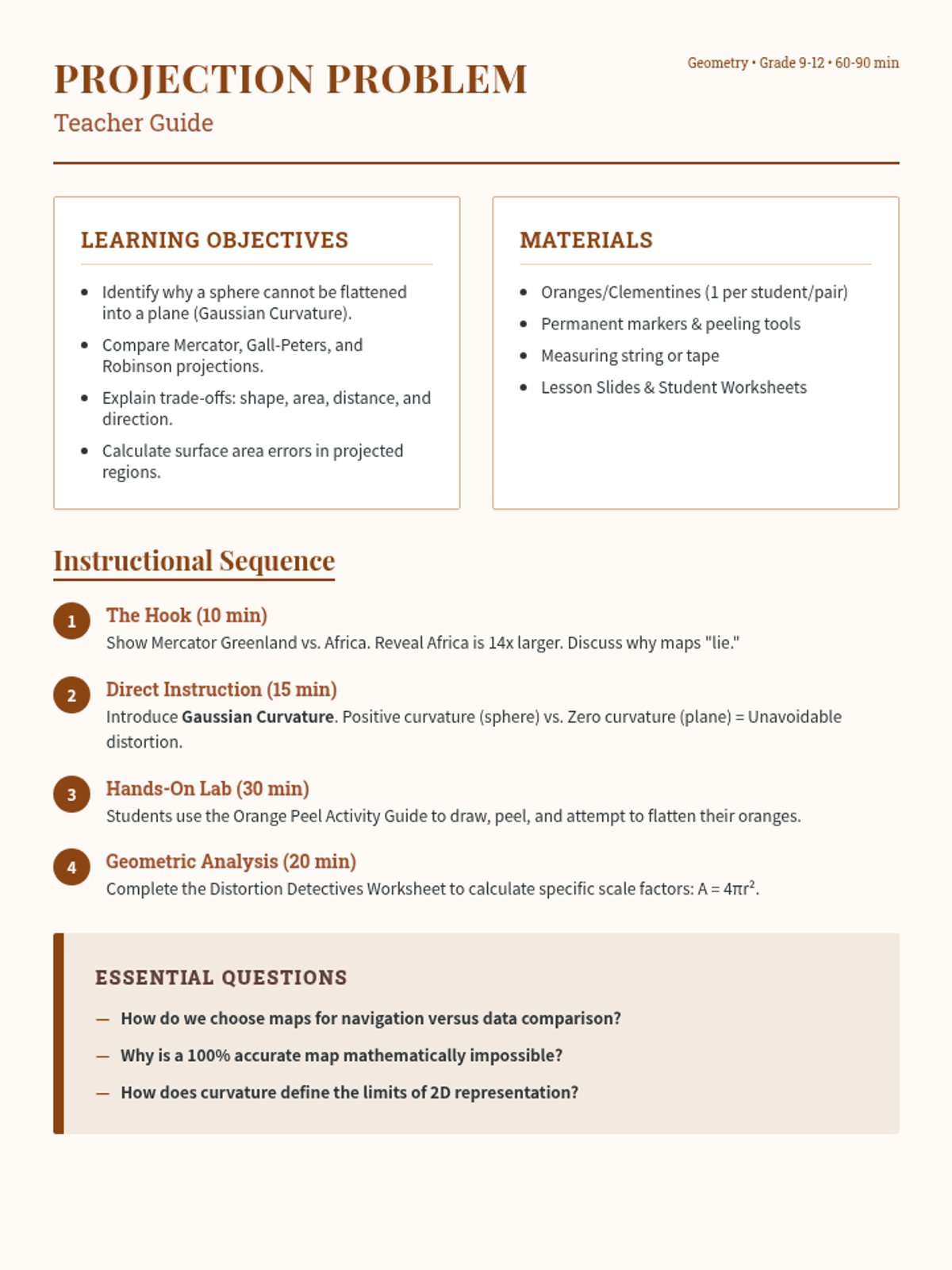
A comprehensive teacher guide for 'The Projection Problem' lesson, featuring learning objectives, a detailed instructional sequence, and essential discussion questions for high school geometry students.
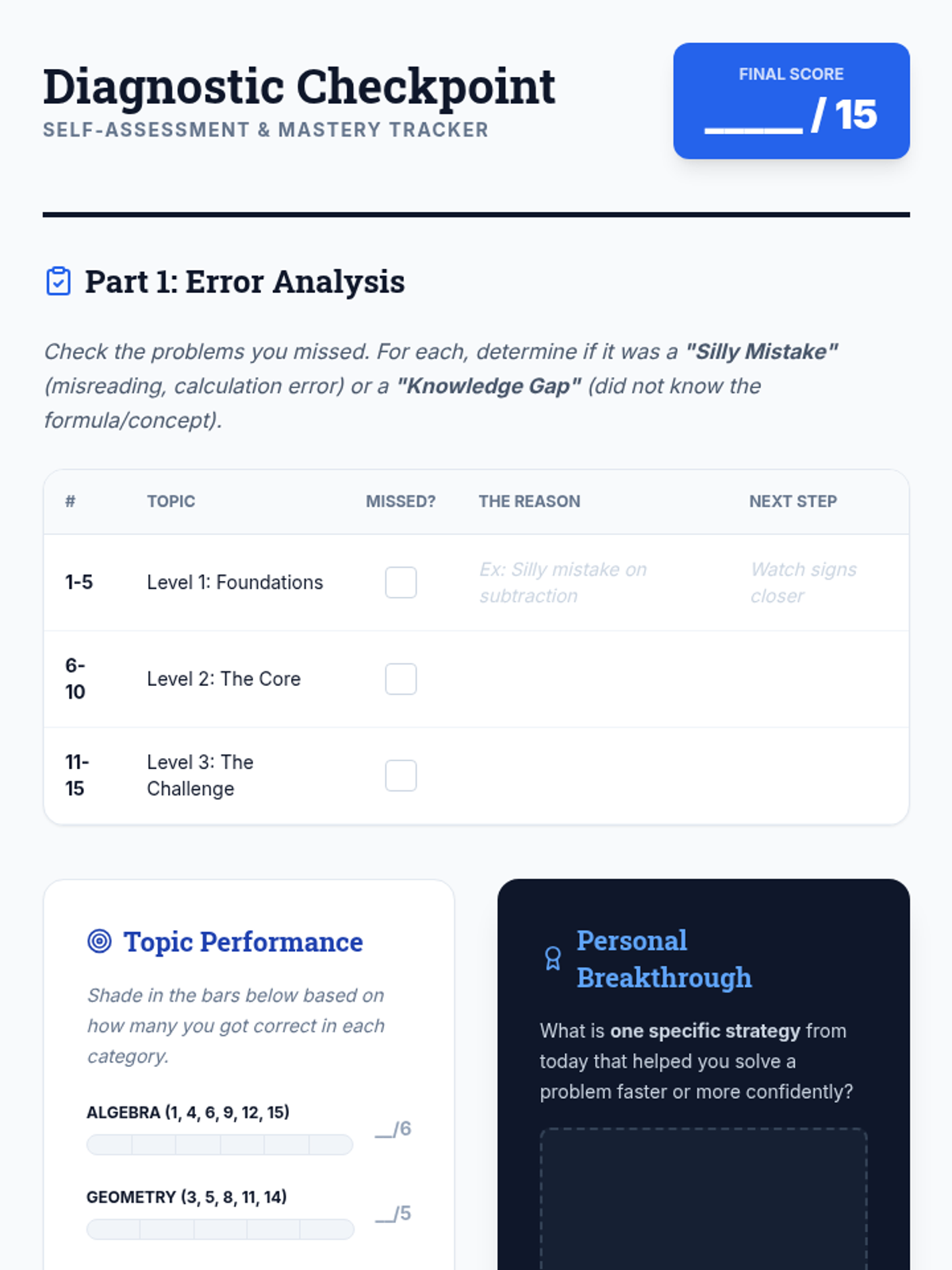
A student self-reflection and tracking handout used to analyze practice results, identify conceptual weaknesses vs. simple errors, and set concrete study goals.
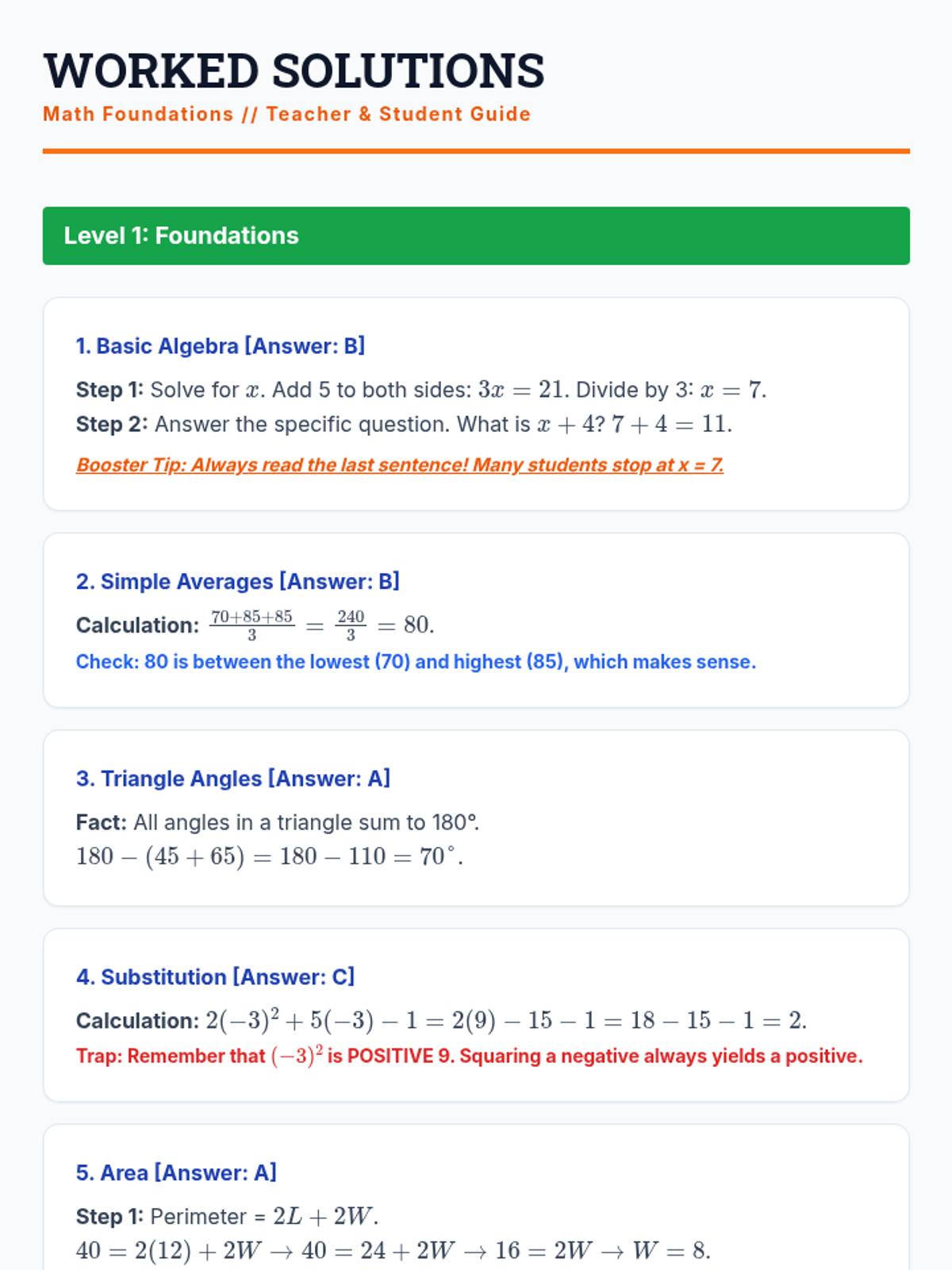
Detailed worked solutions for the 15 practice problems. Includes step-by-step calculations and "Booster Tips" for common test-taking traps.
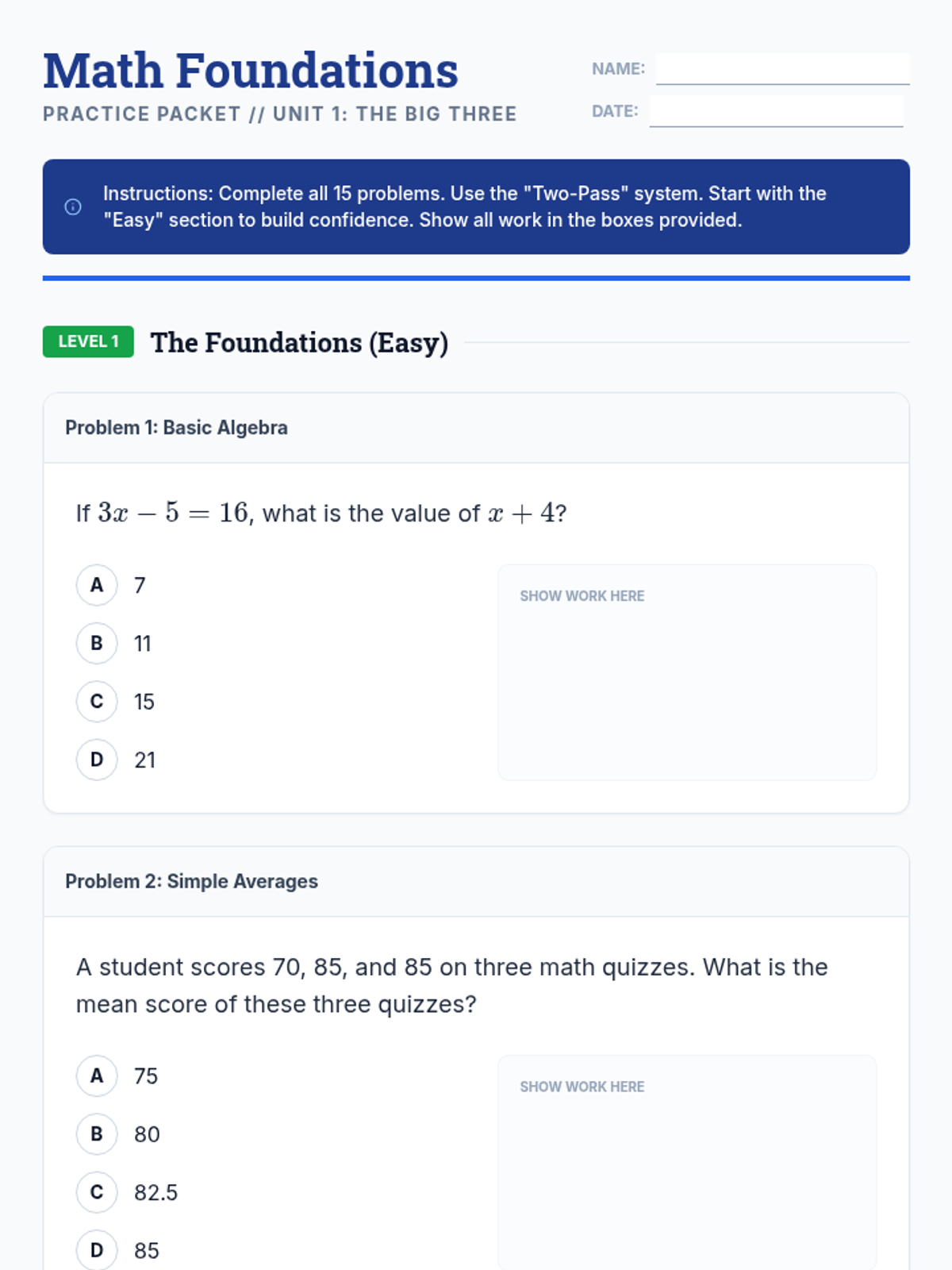
A student practice worksheet containing 15 ACT/SAT style math problems organized by difficulty. Includes dedicated work areas and covers algebra, geometry, and data interpretation.
A presentation deck for an ACT/SAT math prep lesson. Covers time management, algebra, geometry, and data interpretation strategies for students in the 15-20 score range.
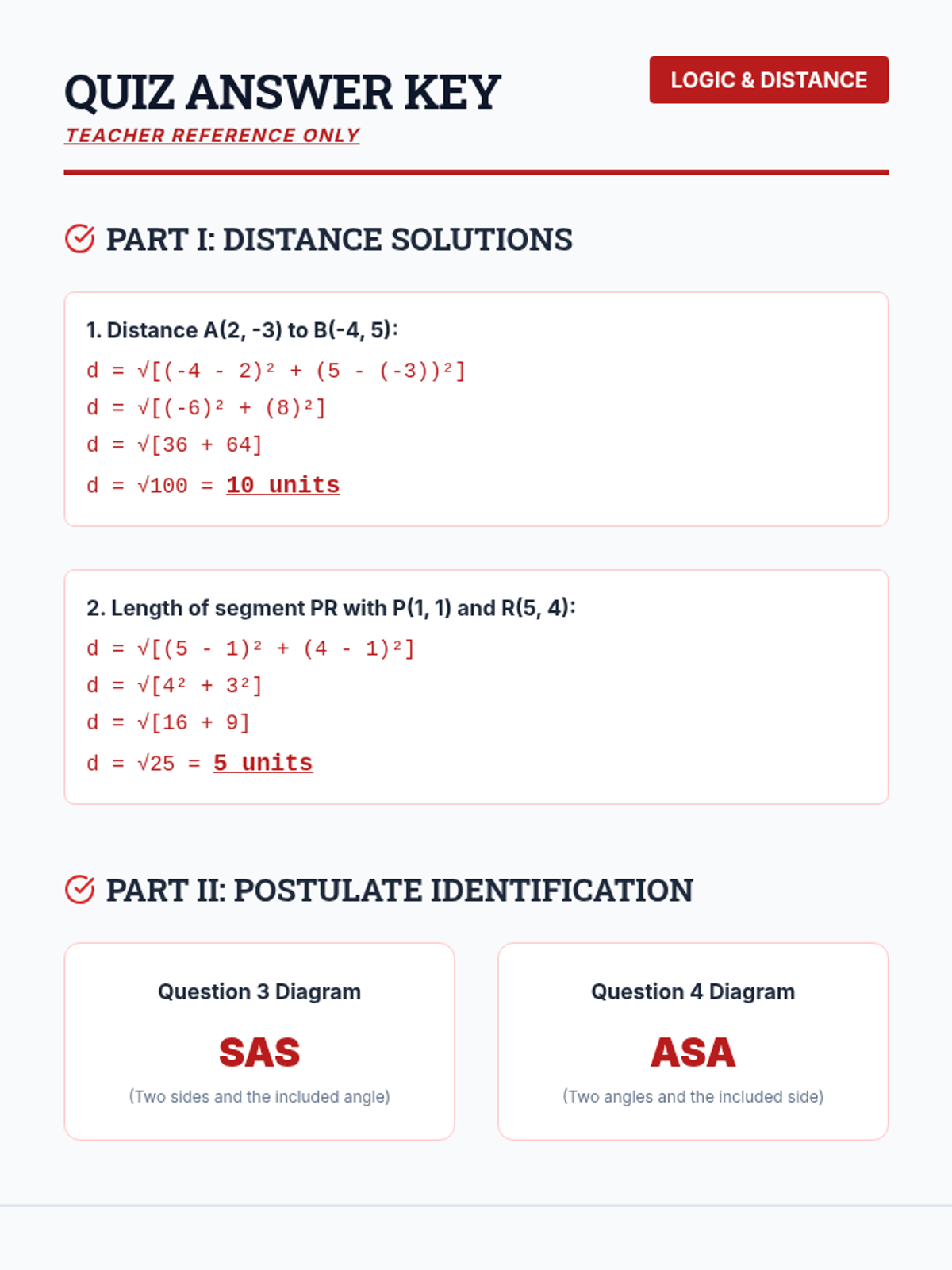
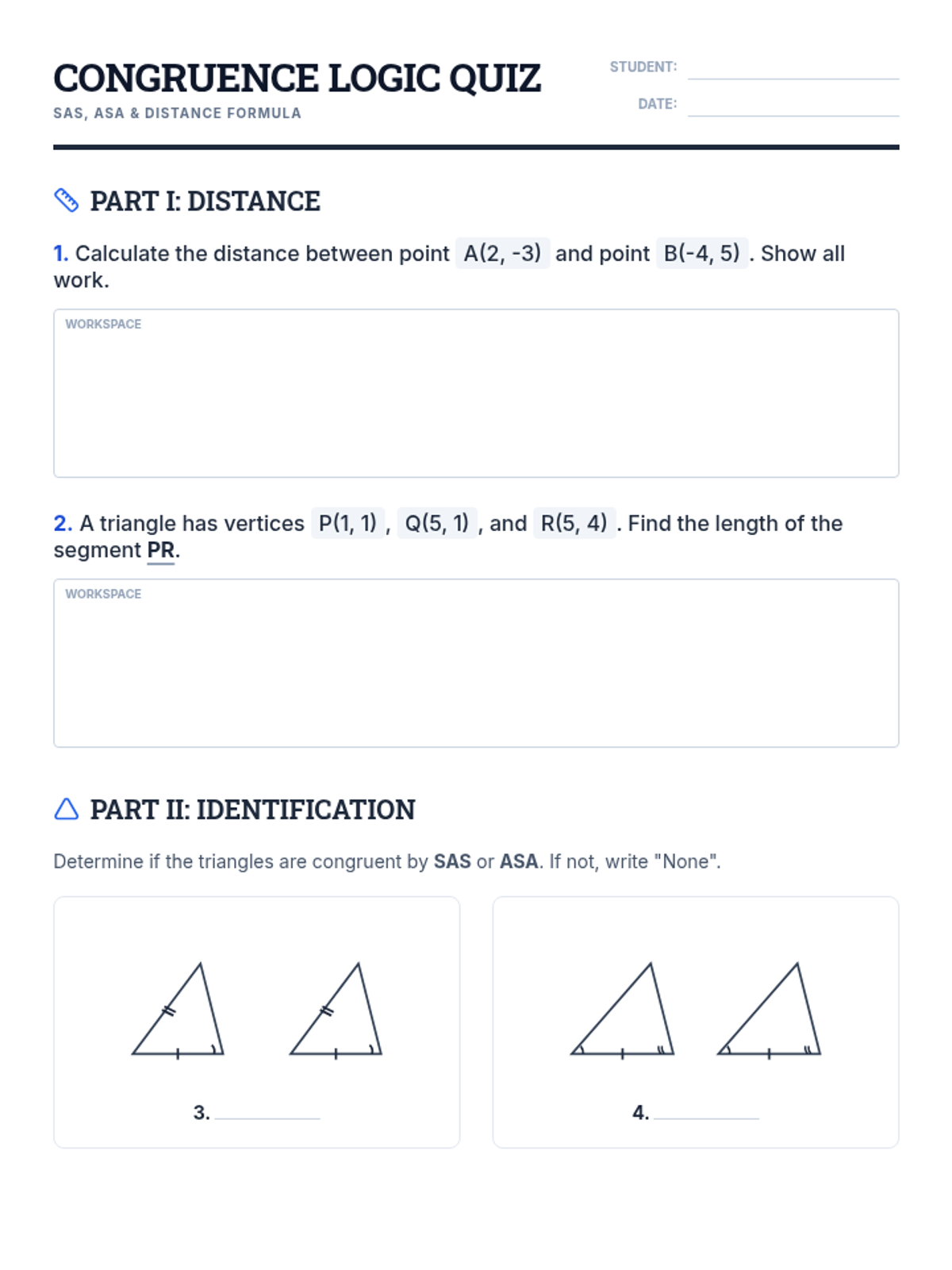
A complete answer key for the Congruence Logic Quiz, featuring step-by-step distance formula solutions using HTML/CSS for clarity, identified congruence postulates with visual references, and fully completed two-column proofs.
A 2-page quiz for high school geometry students covering the Distance Formula, identifying SAS and ASA congruence, and completing intermediate two-column proofs. Renumbered and refined with more workspace for distance calculations. Corrected diagrams and layout for optimal student use.
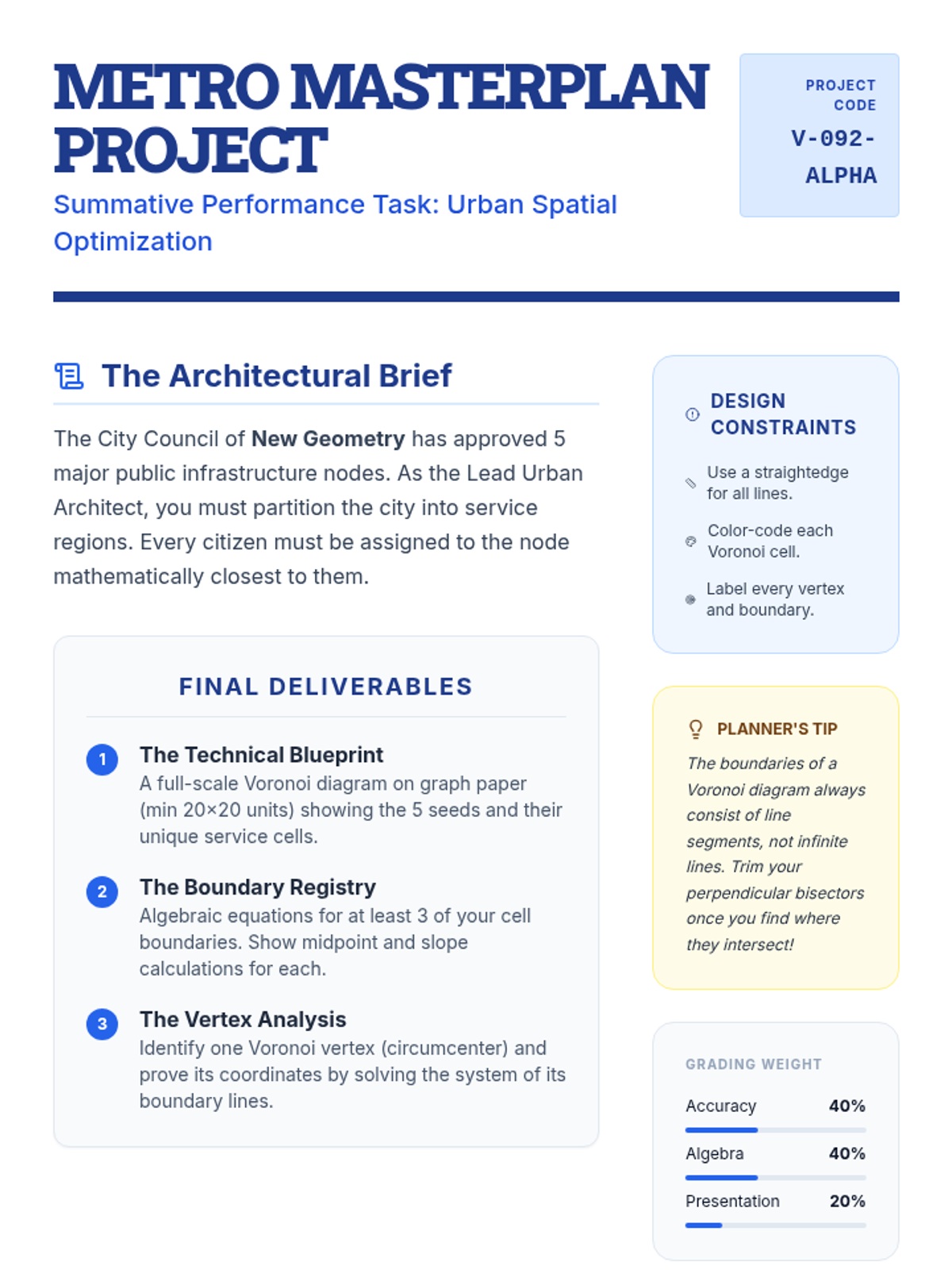
A summative project guide where students design a city's infrastructure layout, constructing a 5-seed Voronoi diagram and providing mathematical proof of its efficiency.
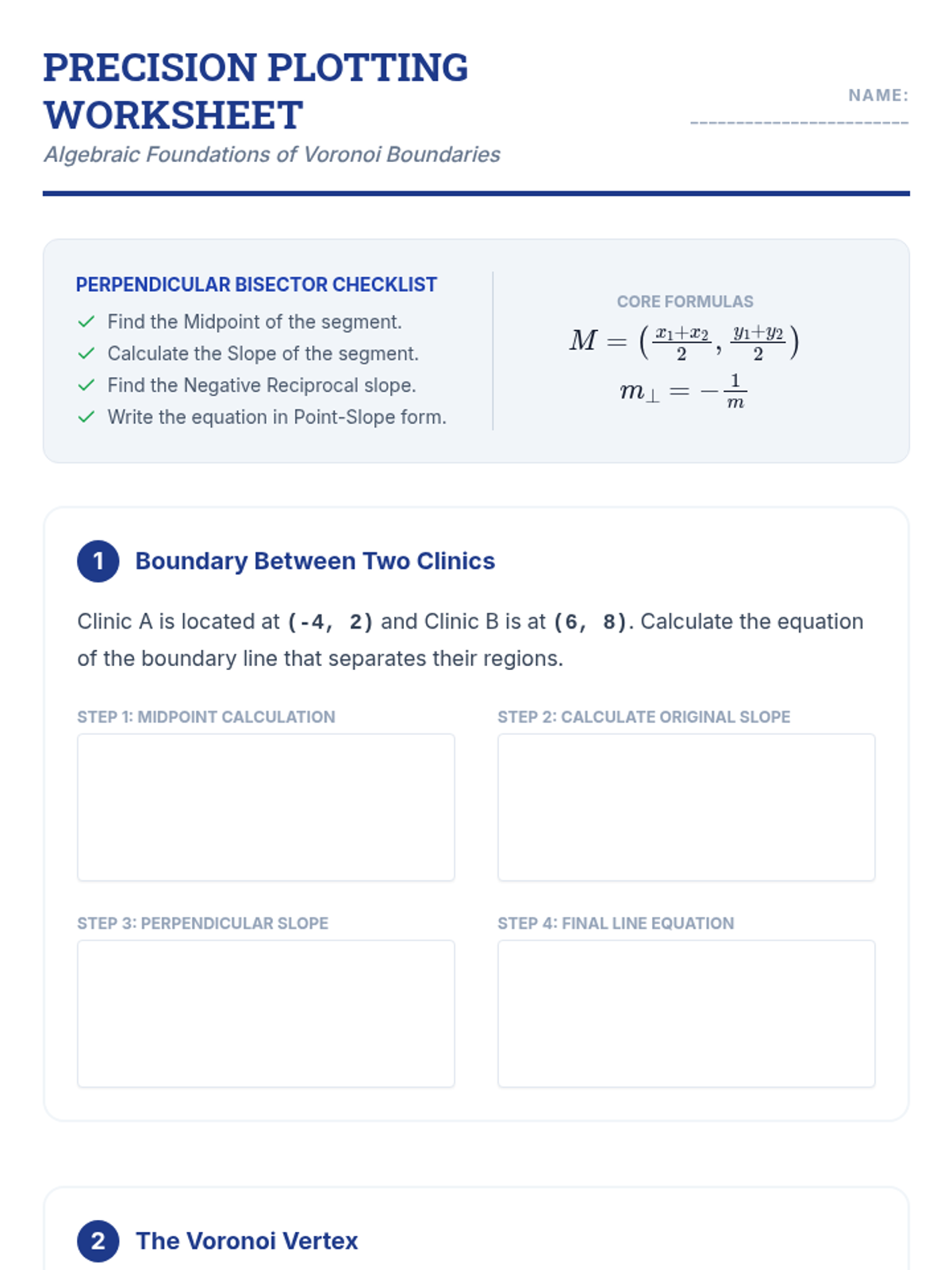
A math worksheet that combines geometry and algebra, requiring students to calculate the equations of perpendicular bisectors and find Voronoi vertices through systems of linear equations.
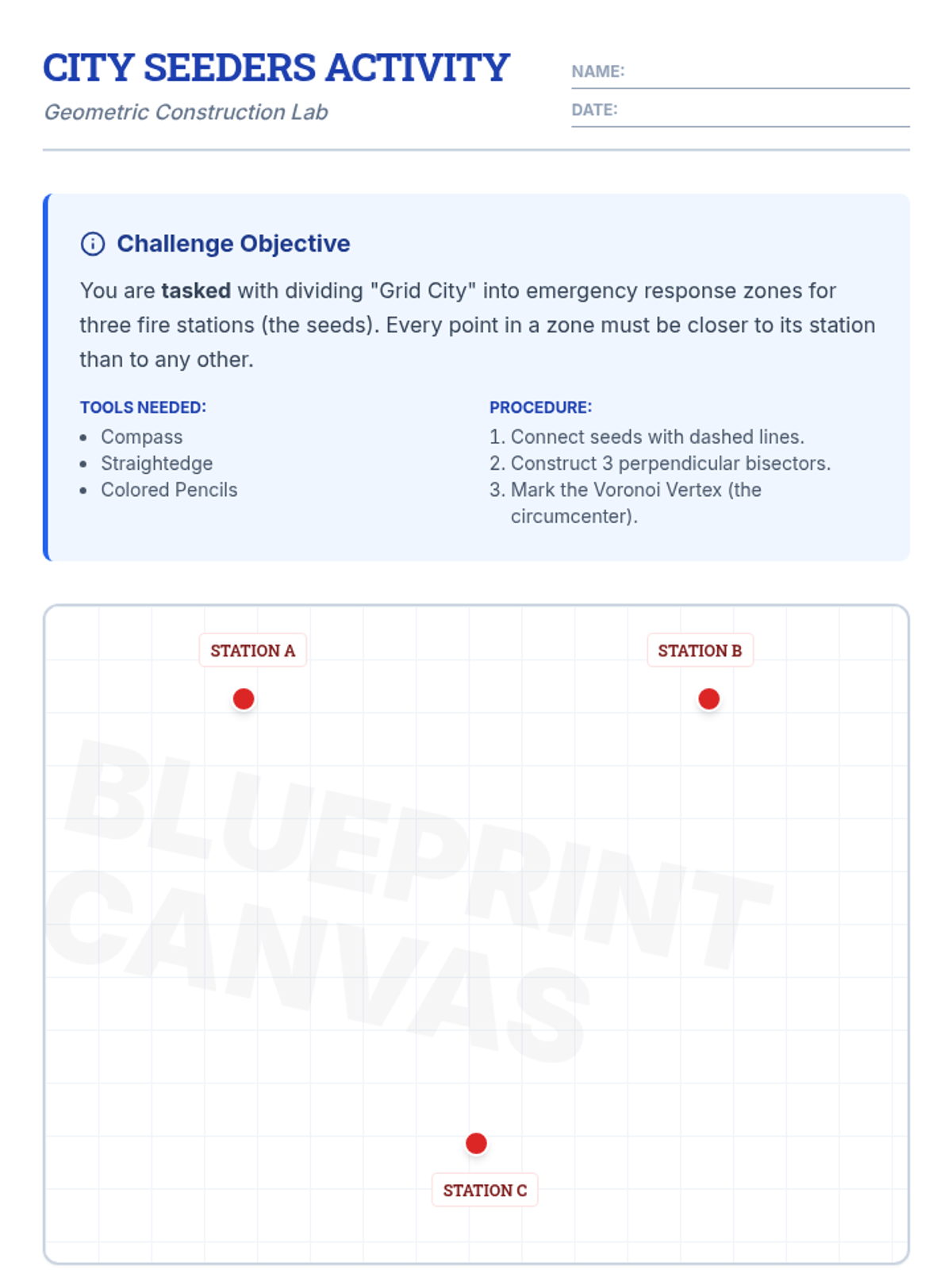
A hands-on activity sheet where students use a compass and straightedge to construct a Voronoi diagram for three "fire stations" on a grid, reinforcing the concept of the perpendicular bisector.
A visual slide deck that defines Voronoi diagrams, explains the construction algorithm using perpendicular bisectors, and shows real-world applications in urban planning and beyond.
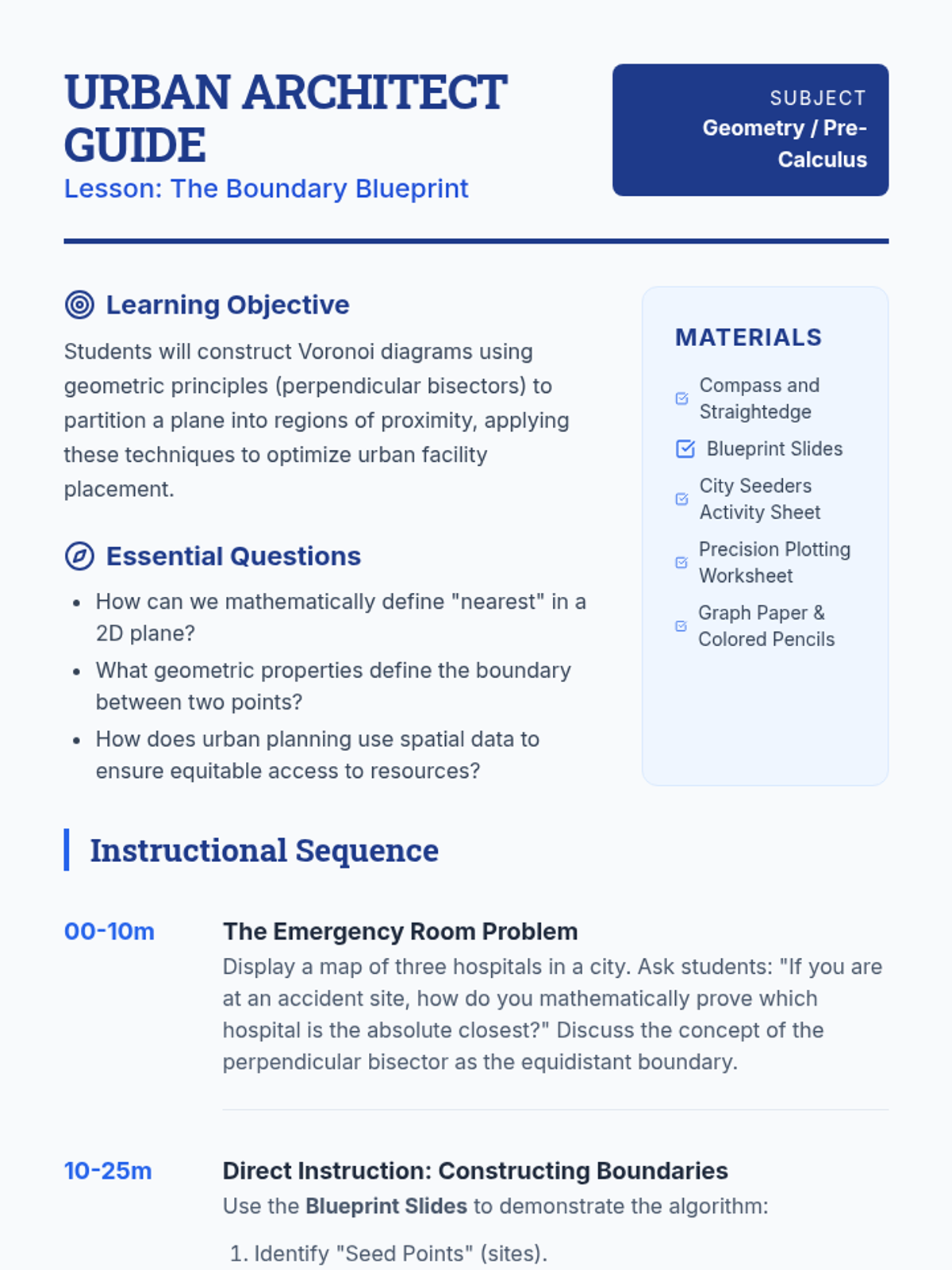
A comprehensive lesson plan for teachers, outlining the instructional sequence, learning objectives, and materials needed to teach Voronoi diagrams through an urban planning lens.
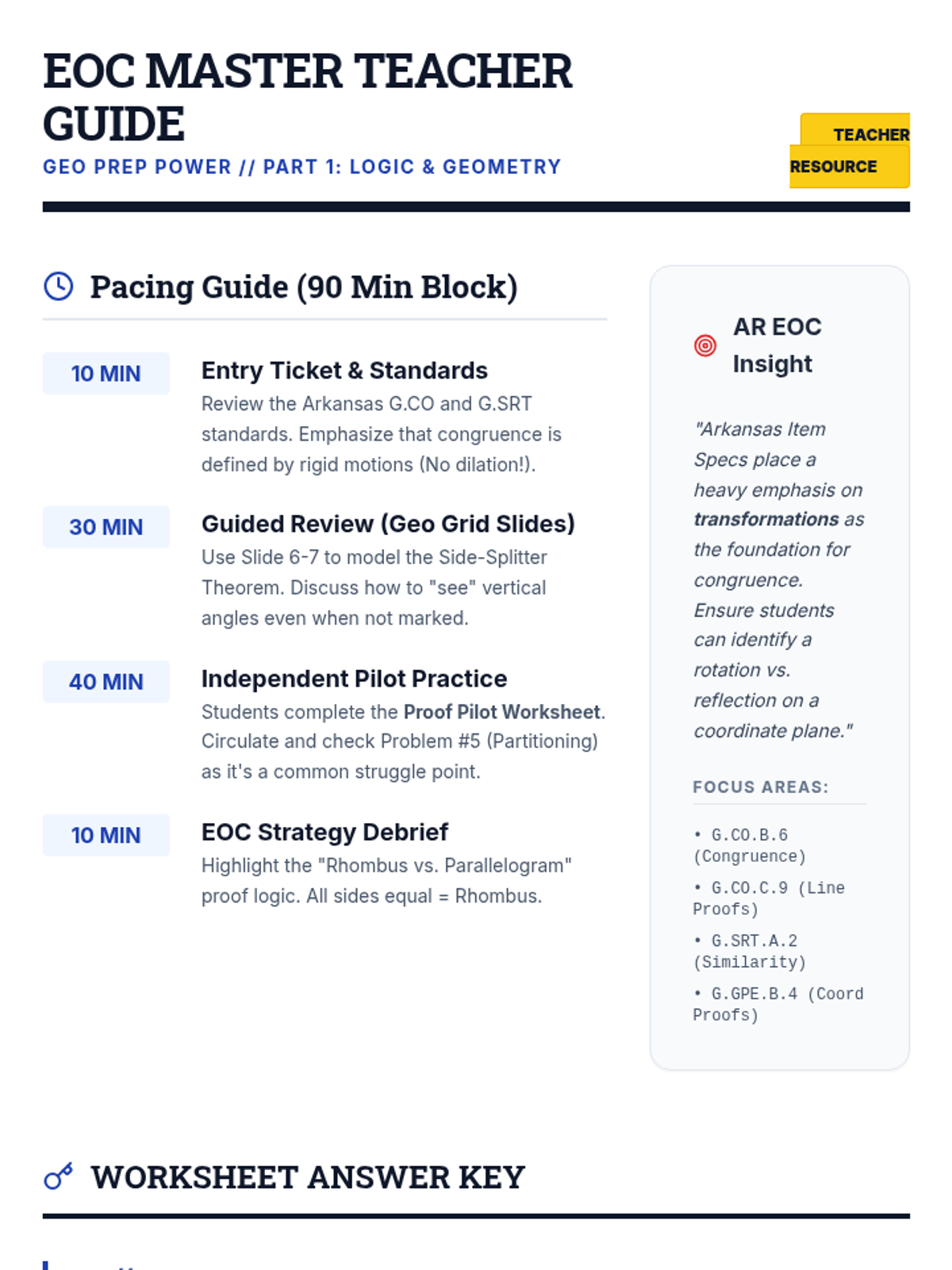
A teacher guide for the Geometry EOC Part 1 lesson, providing pacing, answer keys for the worksheet, and pedagogical tips for addressing common student misconceptions.
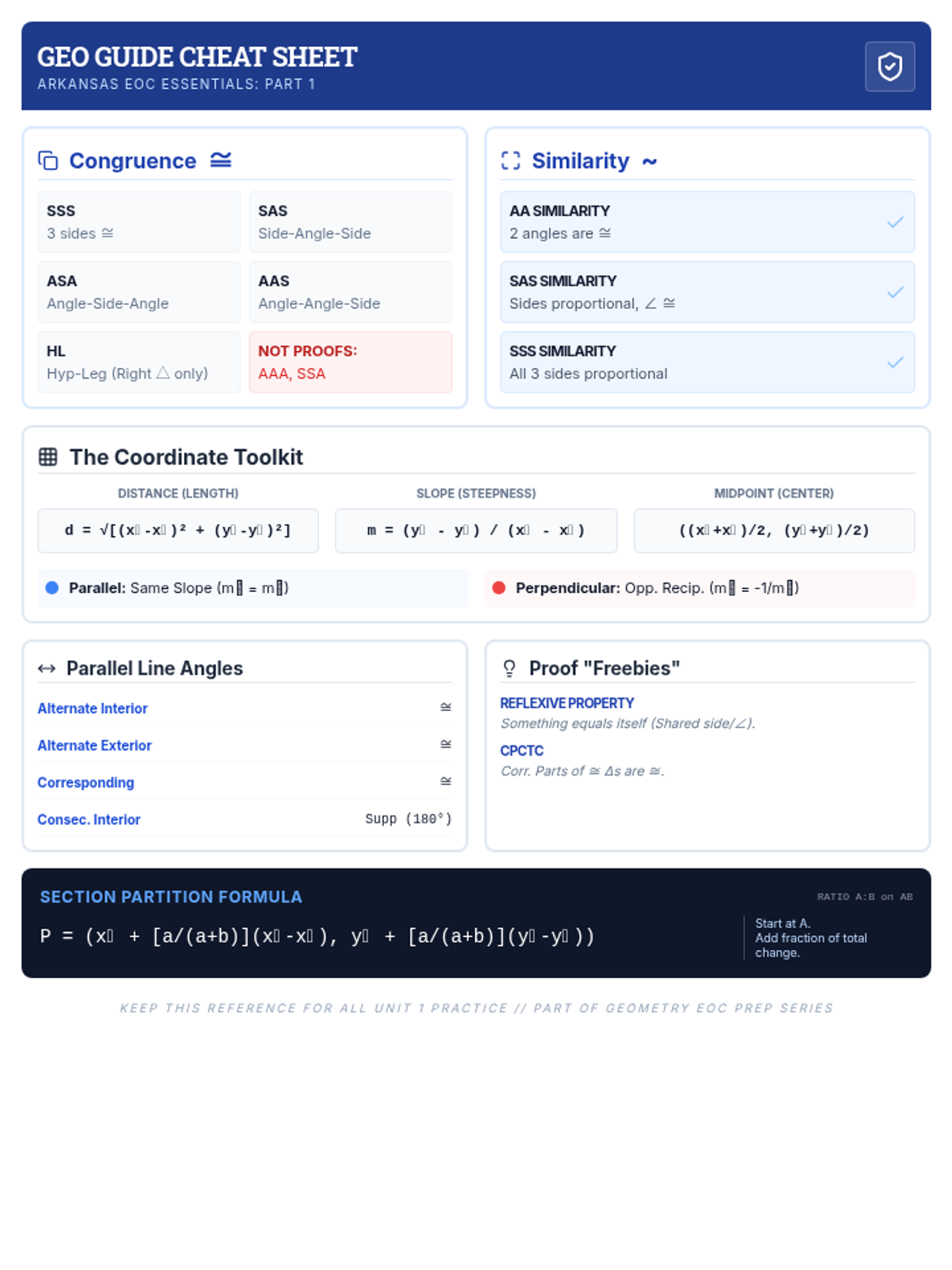
A comprehensive one-page reference sheet for Geometry students, covering congruence, similarity, coordinate formulas, and basic proof logic for EOC preparation.
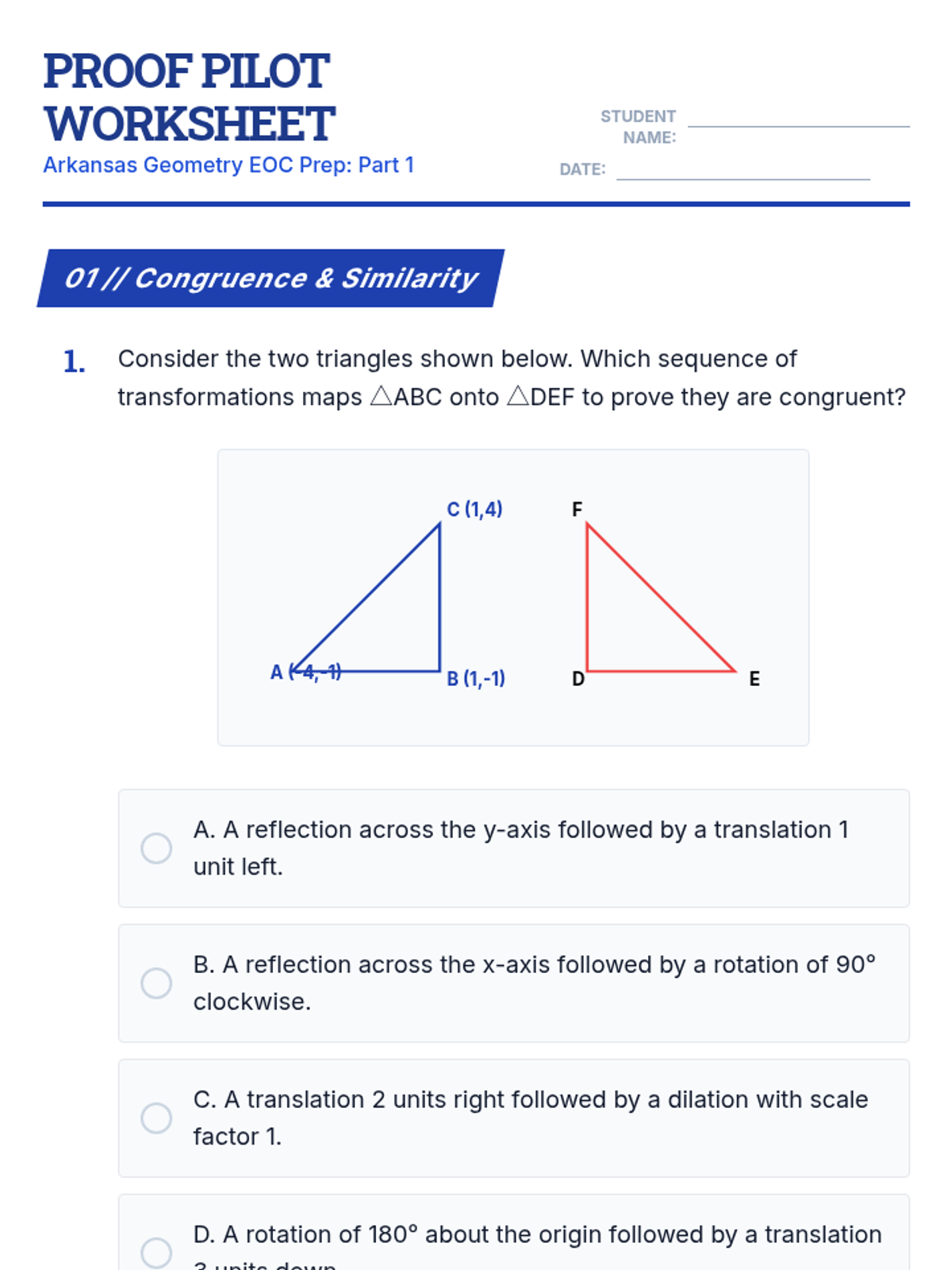
A student worksheet featuring EOC-style problems on congruence, similarity, two-column proofs, and coordinate geometry. Designed with a blueprint aesthetic and clear work areas.
A visual slide deck reviewing congruence, similarity, proofs, and coordinate geometry for the Arkansas Geometry EOC. Includes sample problems and strategic tips for high-stakes testing.
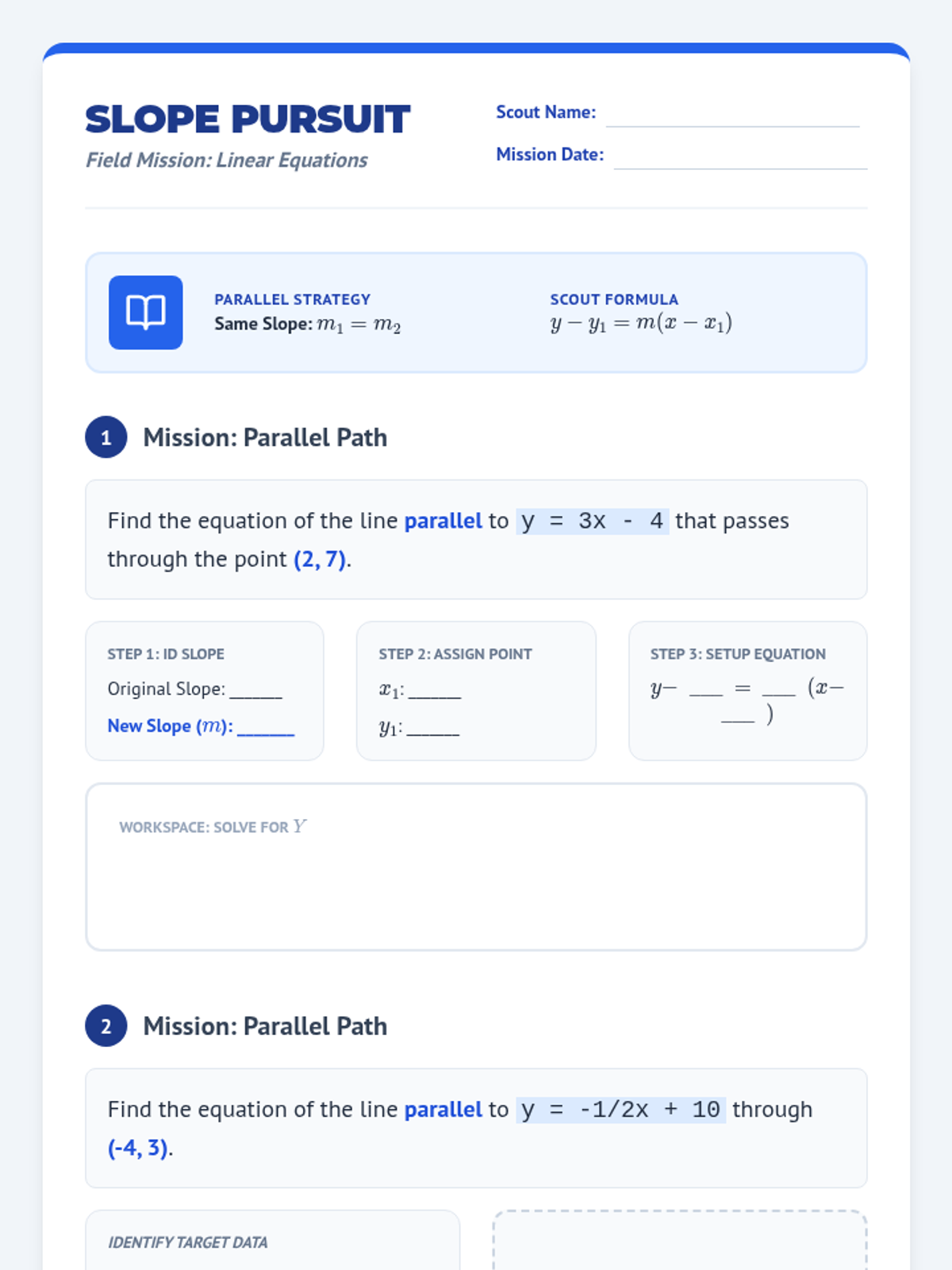
A highly scaffolded student worksheet for the Slope Connections lesson, featuring "Mission" frames to guide students through identifying slopes, setting up point-slope equations, and verifying their perpendicular lines on a coordinate plane.
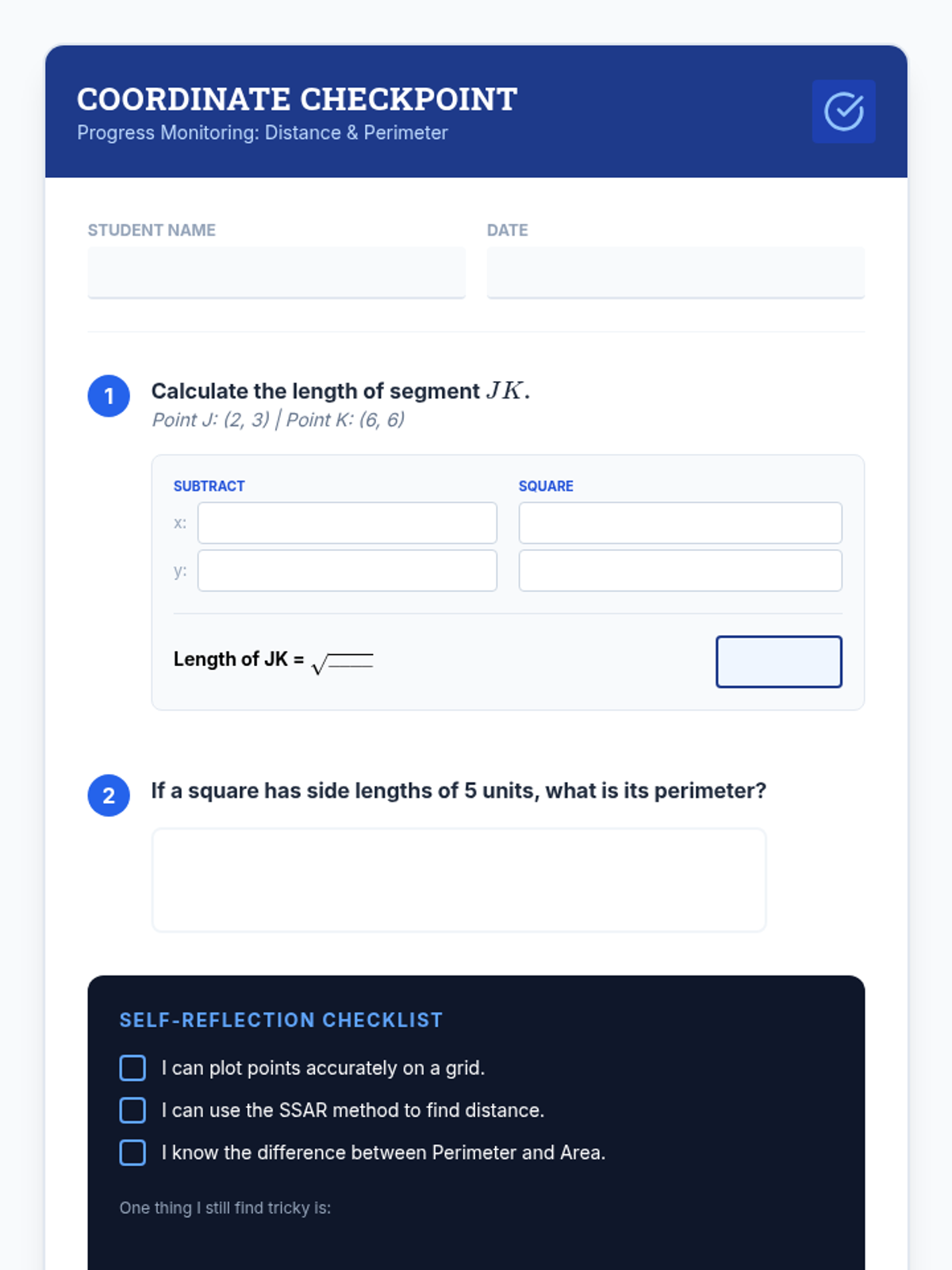
An exit ticket assessment for coordinate geometry. Features a guided distance calculation and a self-reflection checklist for students to monitor their own learning progress.
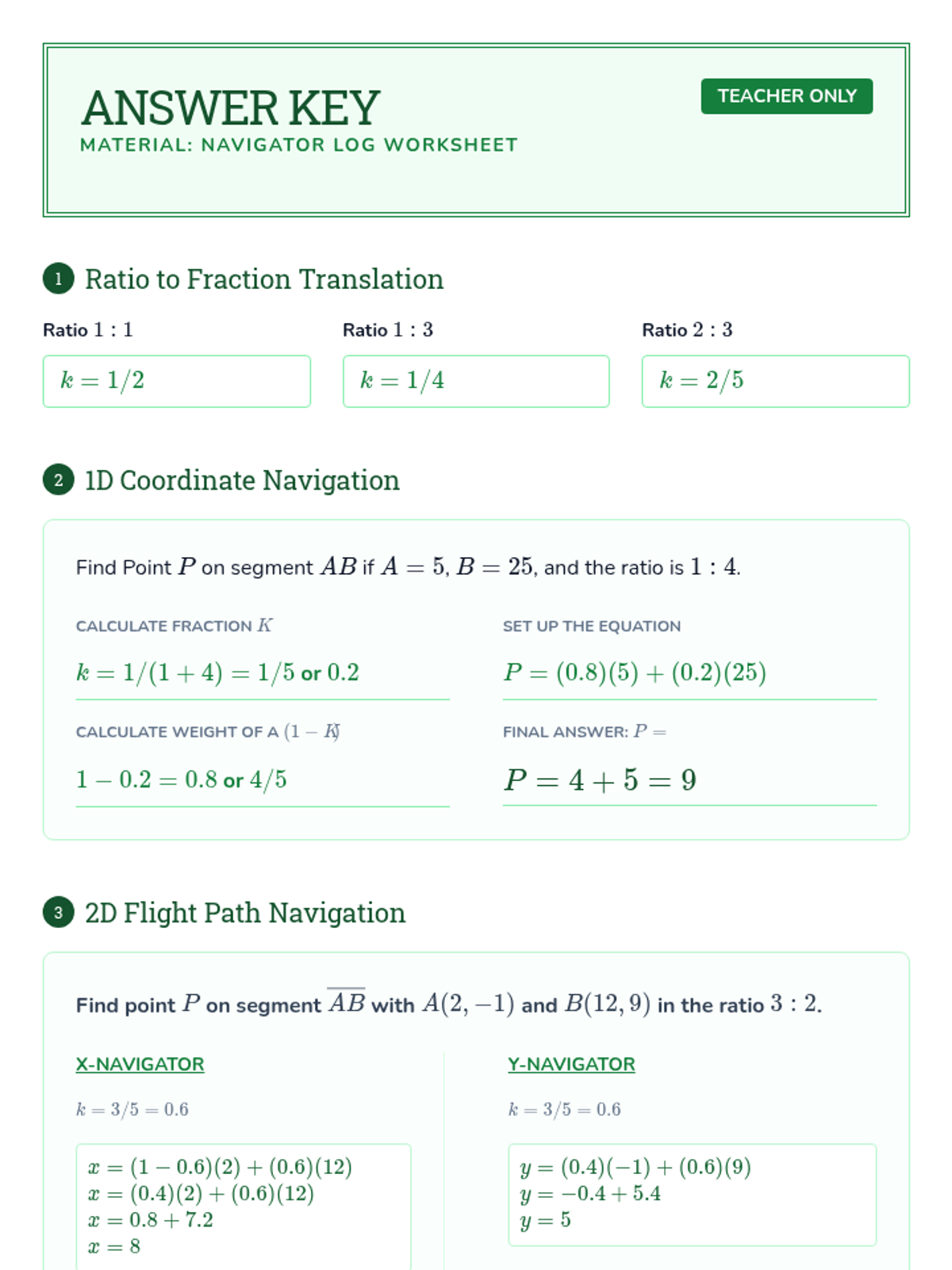
An answer key for the Navigator Log Worksheet, providing complete step-by-step solutions for ratio-to-fraction conversions and 1D/2D coordinate partitioning problems.
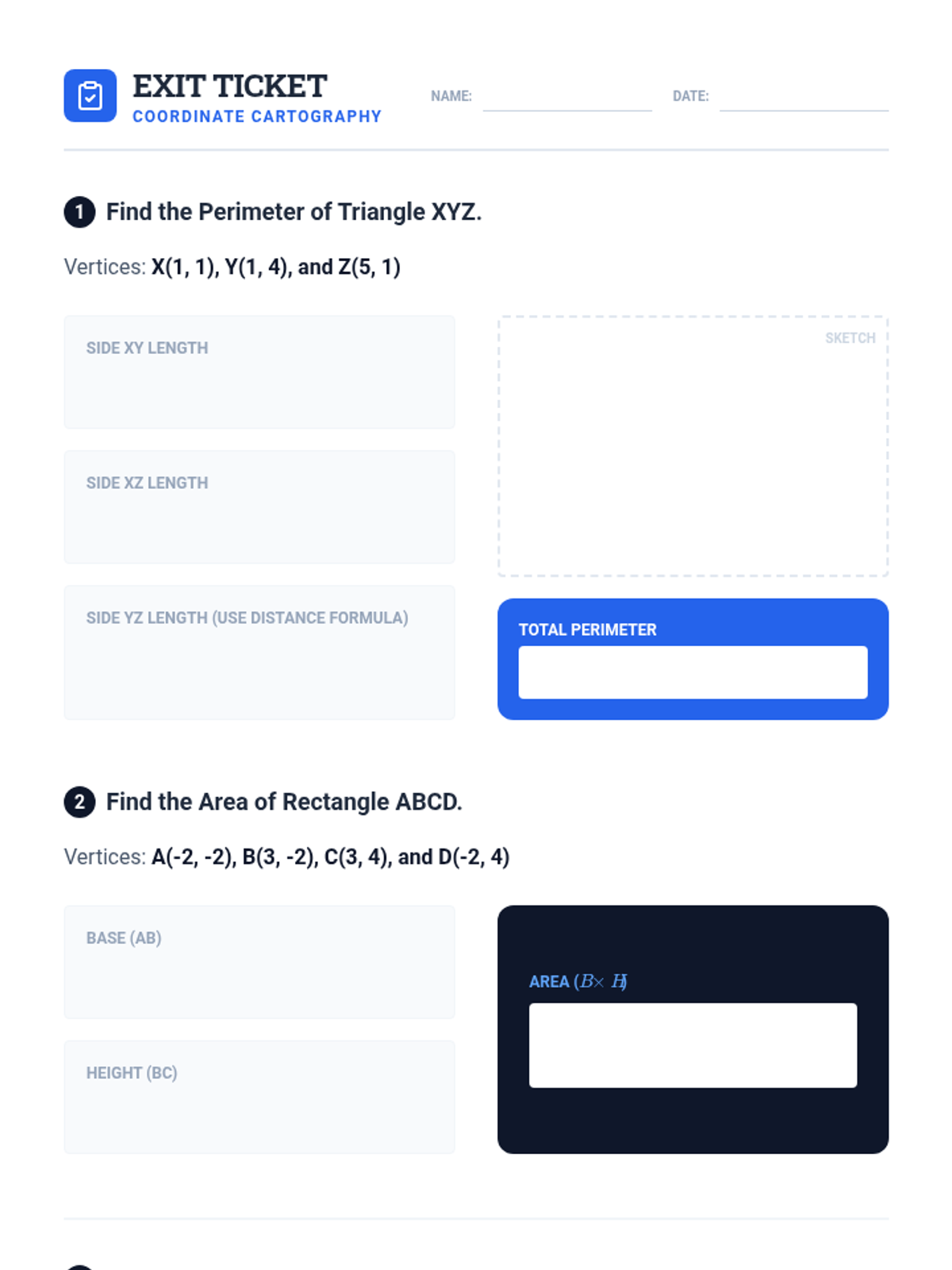
Progress monitoring exit ticket for the Coordinate Cartography lesson. Includes problems on triangle perimeter, rectangle area, and a conceptual check on horizontal/vertical segments.
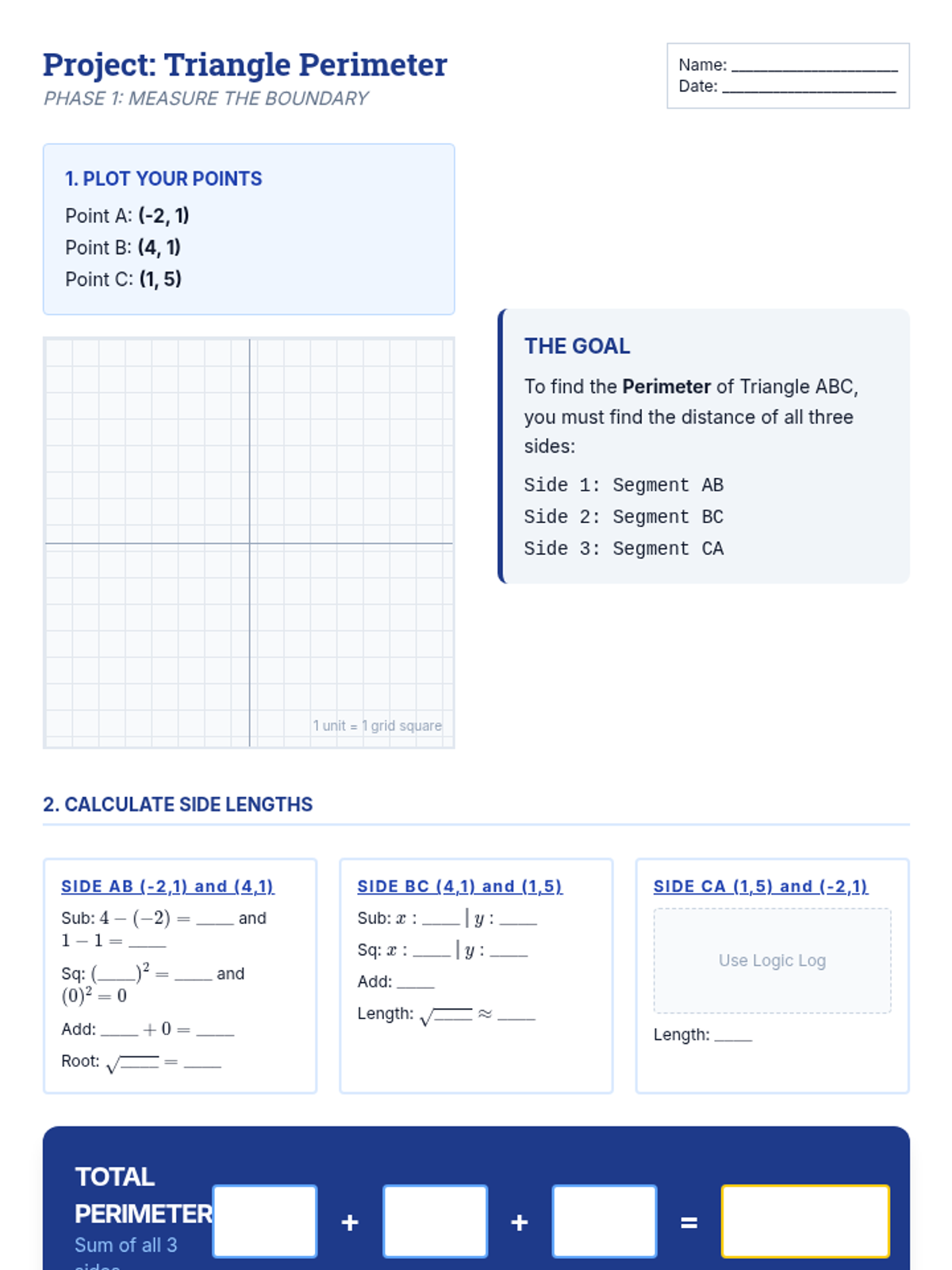
A scaffolded student activity packet for practicing perimeter and area in the coordinate plane. Includes plotting areas, guided side-length calculations, and final formula application.
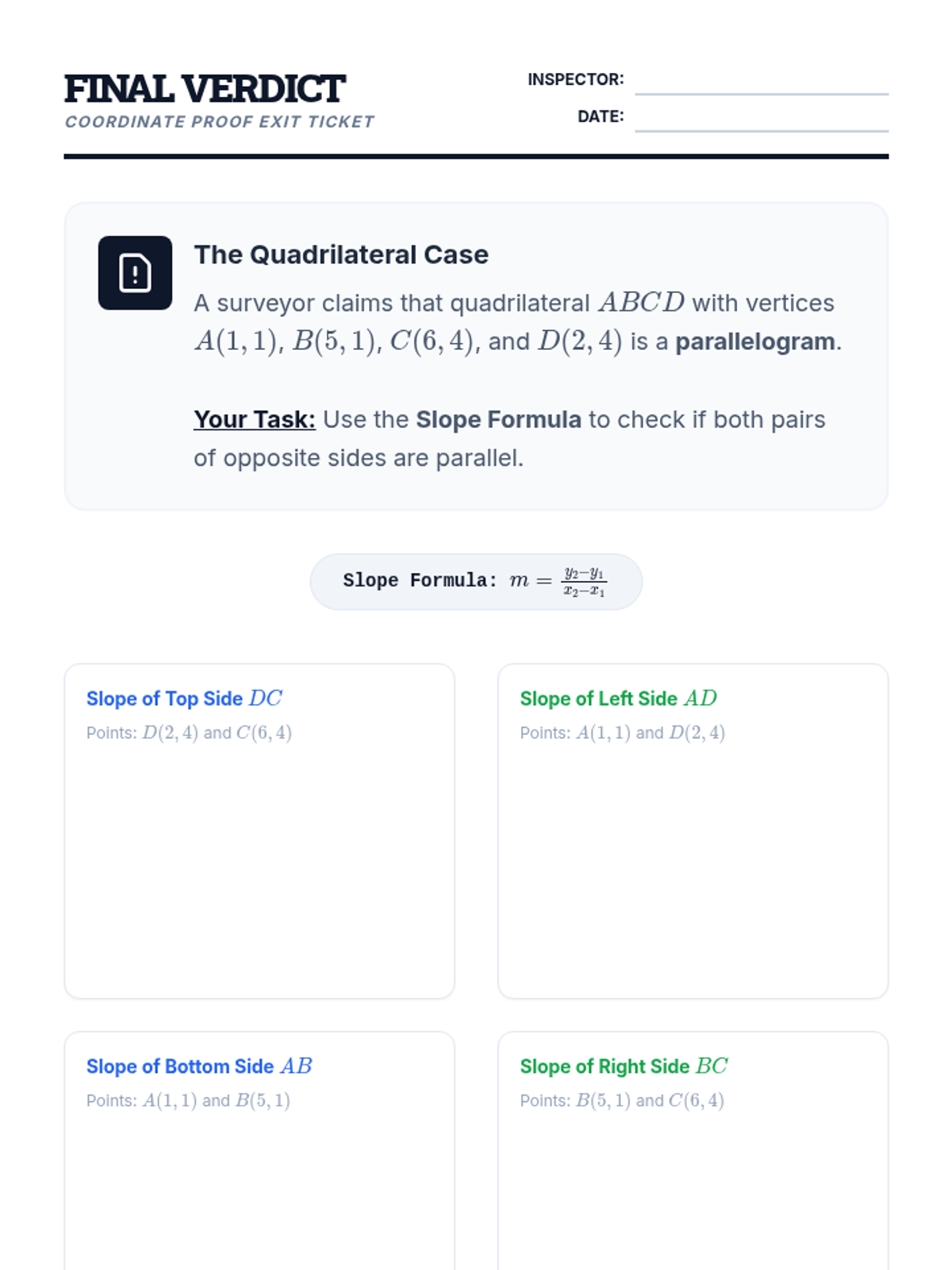
A quick check for understanding where students must calculate four slopes to determine if a quadrilateral is a parallelogram. Designed for formative assessment at the end of the intervention lesson.
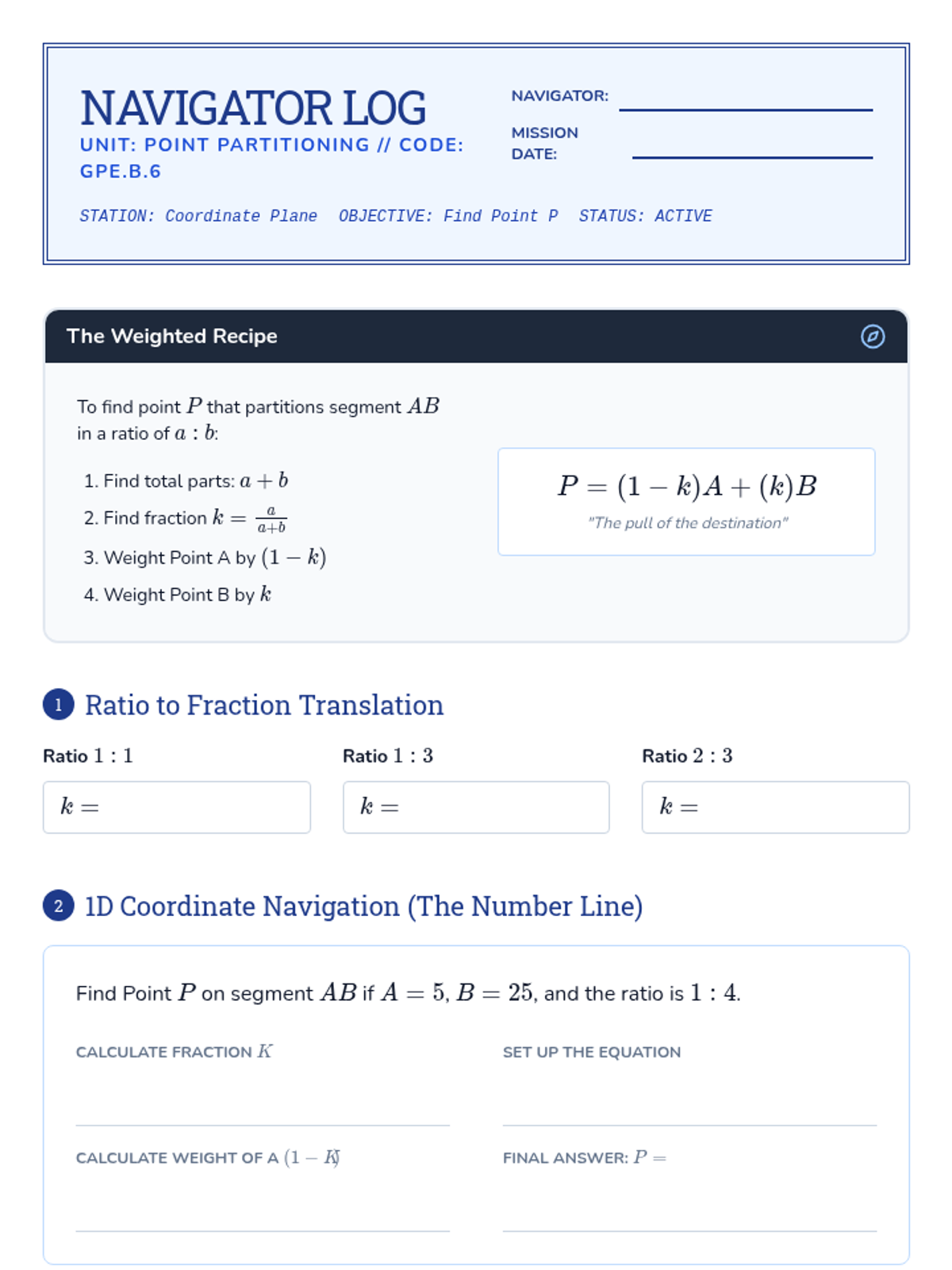
A scaffolded student activity sheet for practicing directed line segment partitioning. Includes ratio-to-fraction conversion exercises, 1D number line practice, and a guided 2D coordinate calculation area.
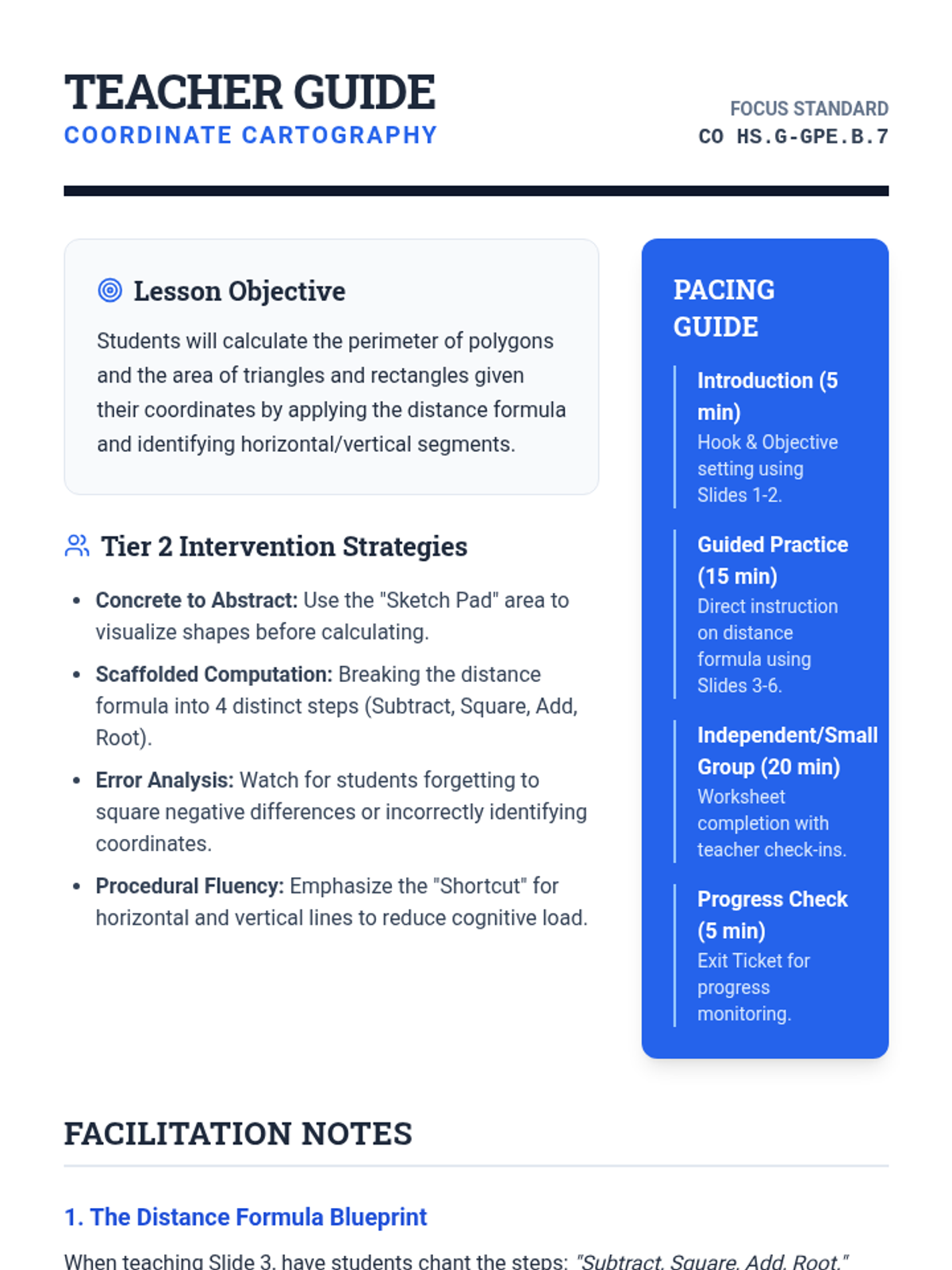
Teacher facilitation guide for the Coordinate Cartography lesson. Includes Tier 2 intervention strategies, pacing, and progress monitoring benchmarks for CO standard HS.G-GPE.B.7.
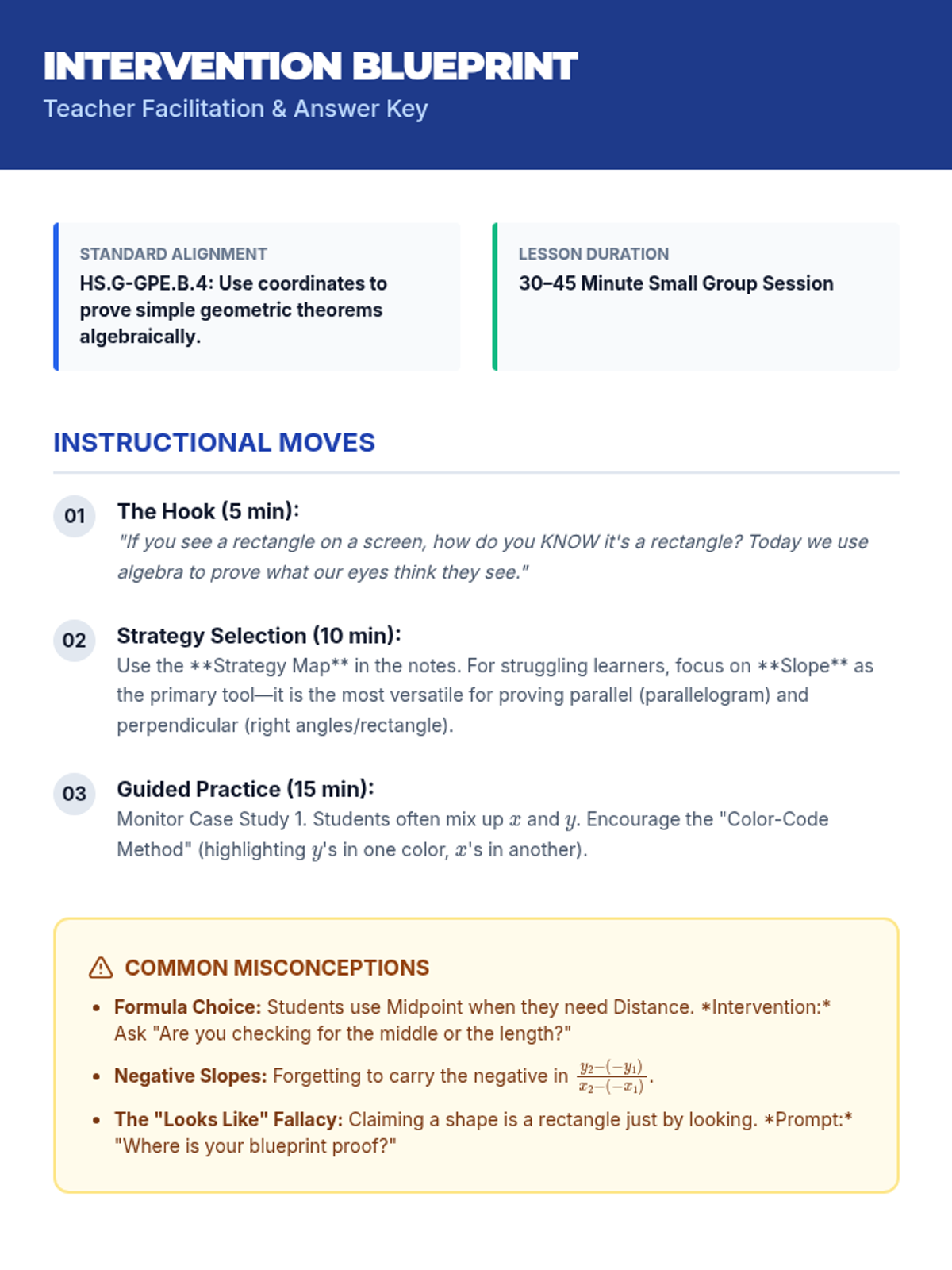
Teacher facilitator guide for the coordinate geometry intervention. Includes instructional moves, common misconceptions, a standard-aligned facilitation script, and a complete answer key for all student-facing materials.
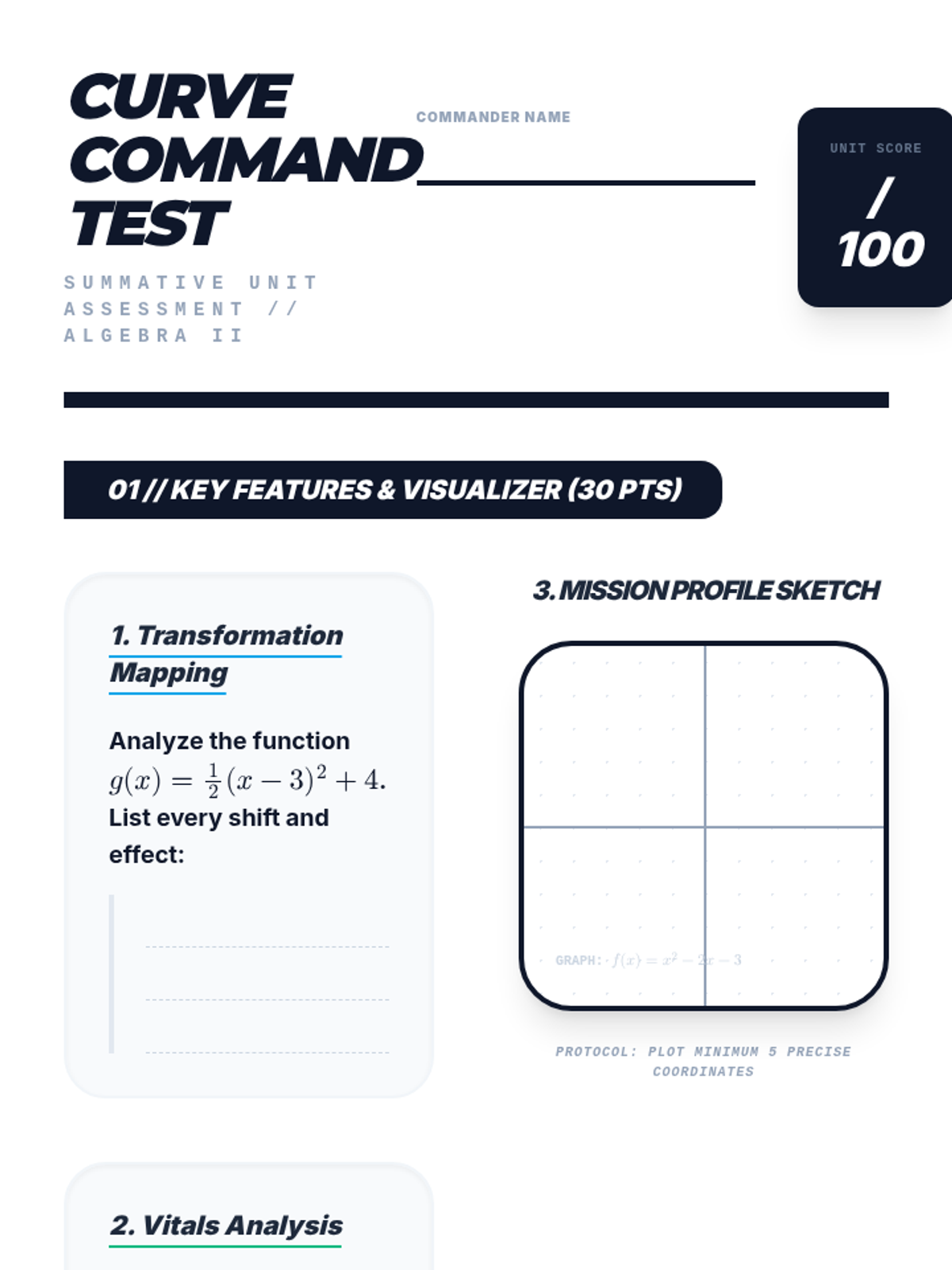
A comprehensive unit test for Algebra II students covering all quadratic targets including transformations, graphing, features, and solving methods.
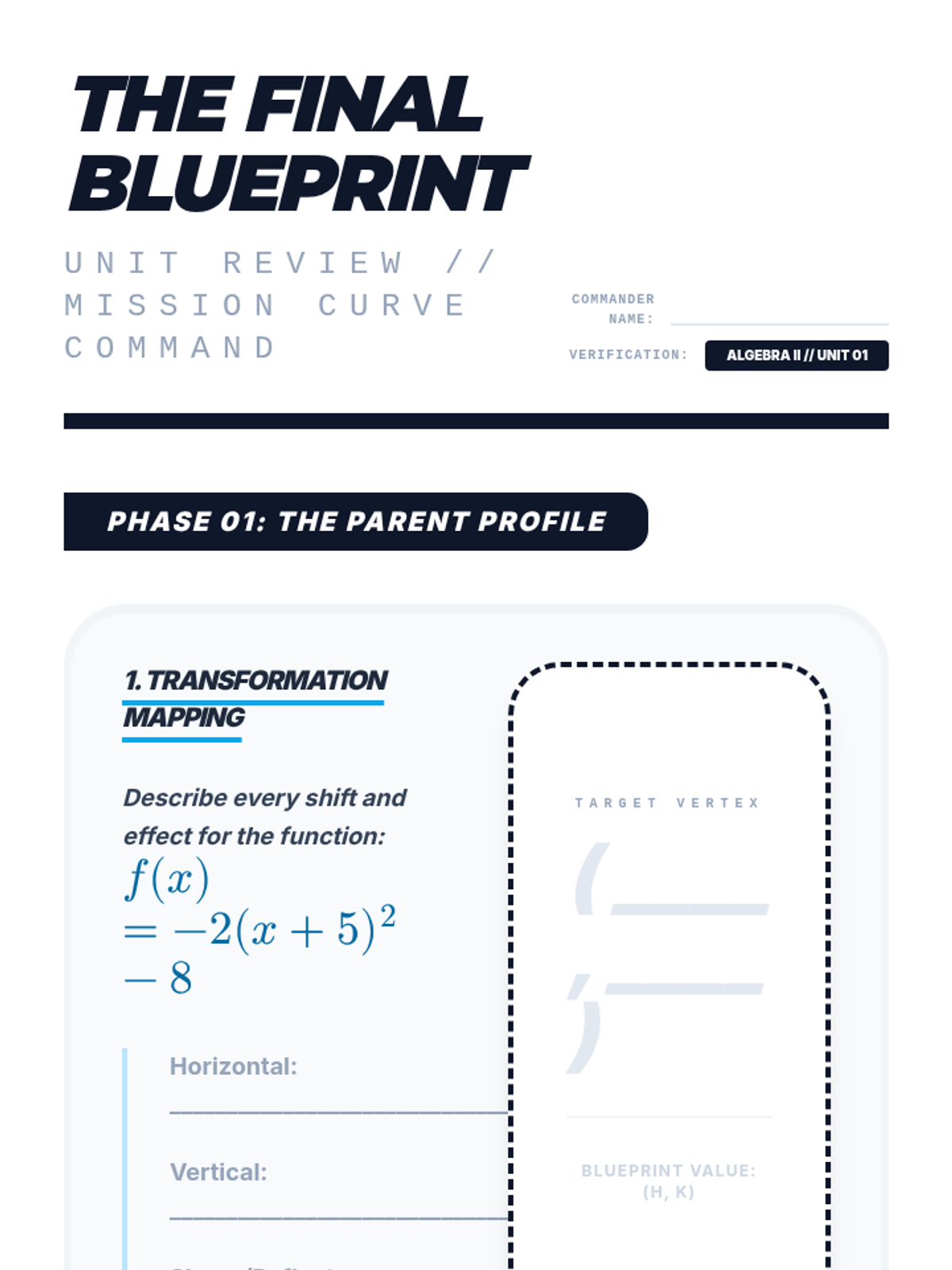
A comprehensive unit review packet covering parent functions, key features from standard form, and all solving methods for quadratic equations.
A formative assessment to evaluate students' ability to select and apply different quadratic solving methods correctly.
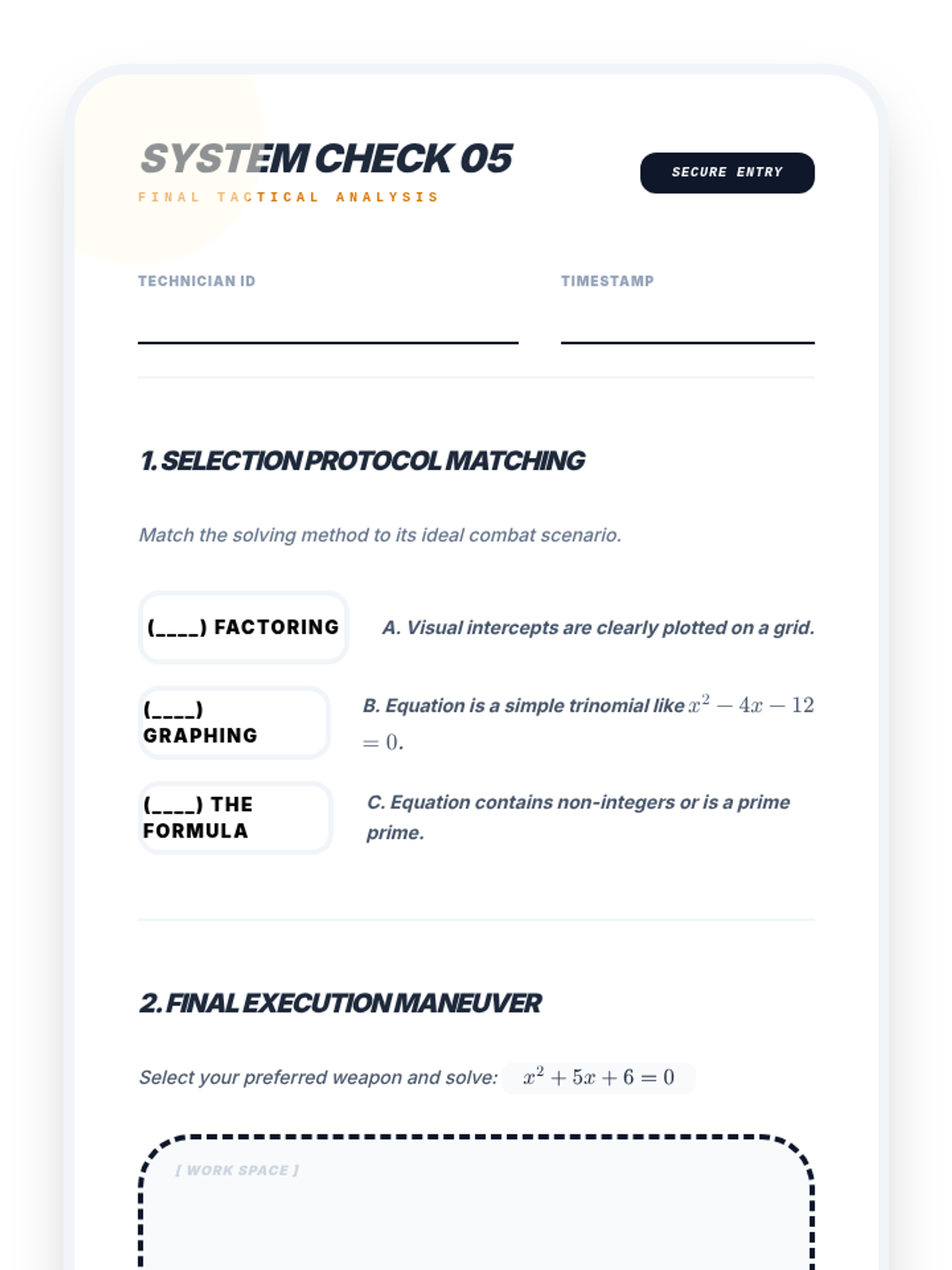
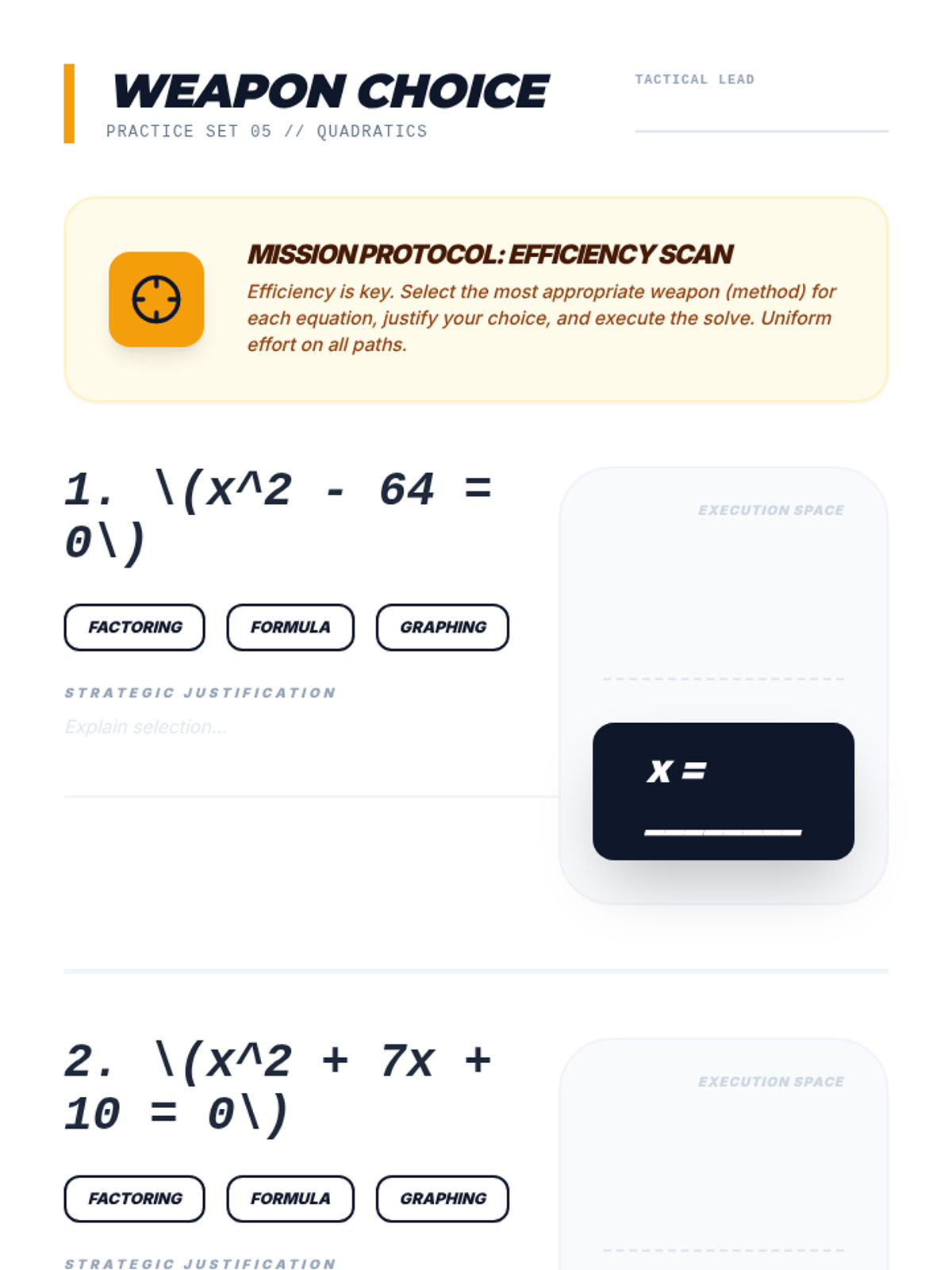
A worksheet focusing on identifying the most efficient method to solve a quadratic equation and executing the solution.
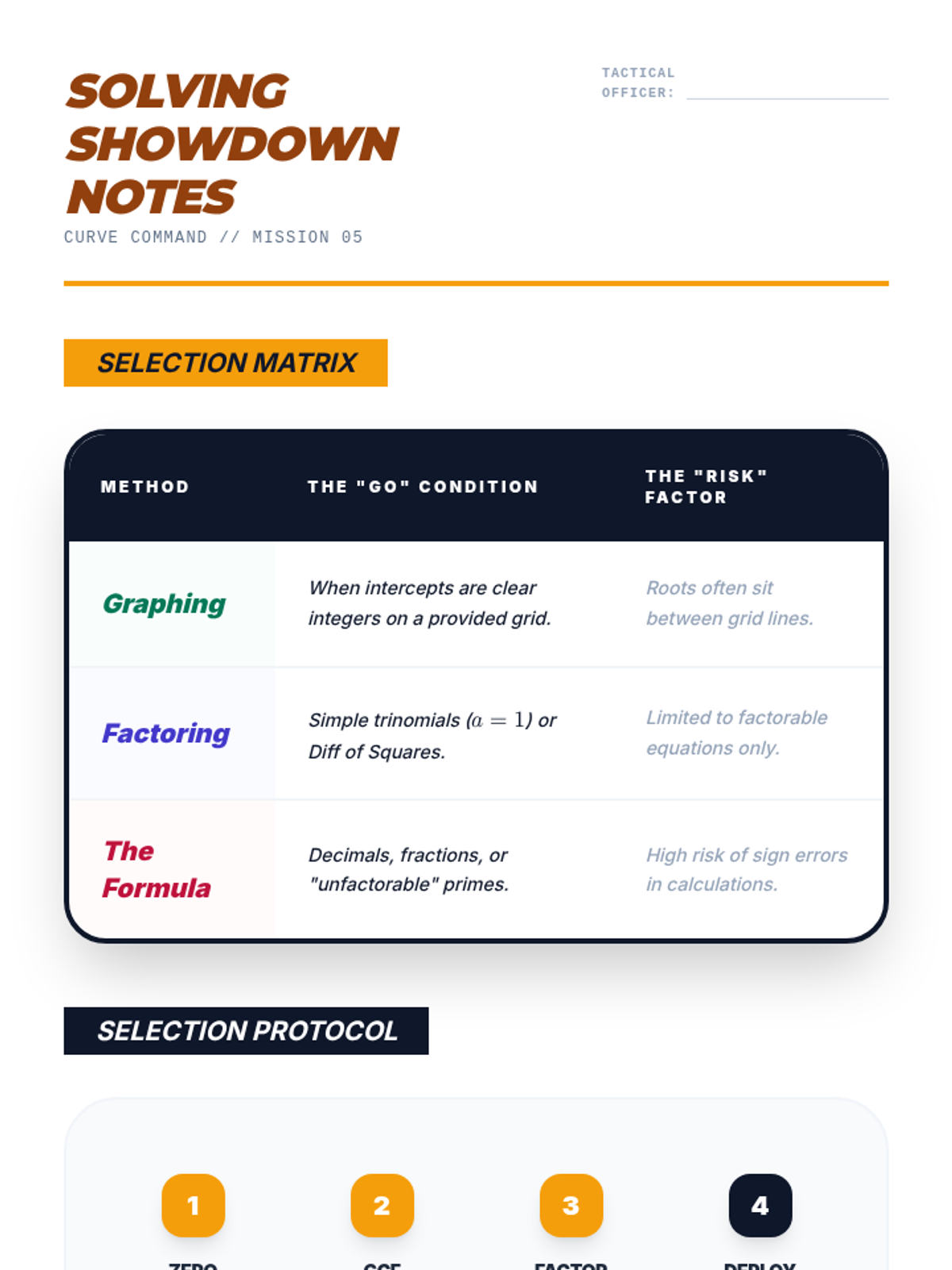
Guided notes for Lesson 5, focusing on strategy selection for solving different types of quadratic equations.
A slide deck comparing solving methods for quadratic equations, helping students decide when to graph, factor, or use the formula.
A formative assessment on the use of the discriminant and quadratic formula for single and multiple real roots.
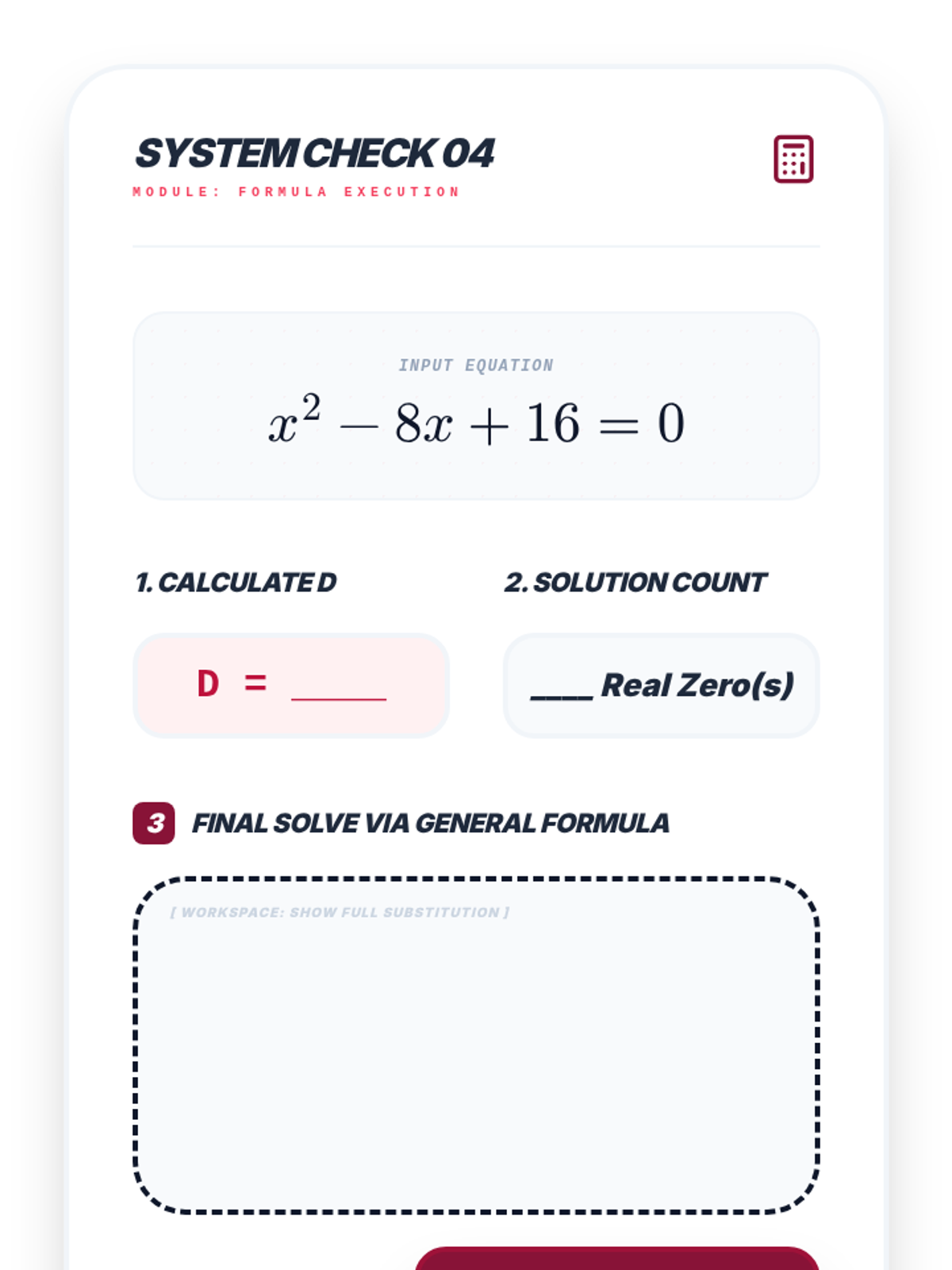
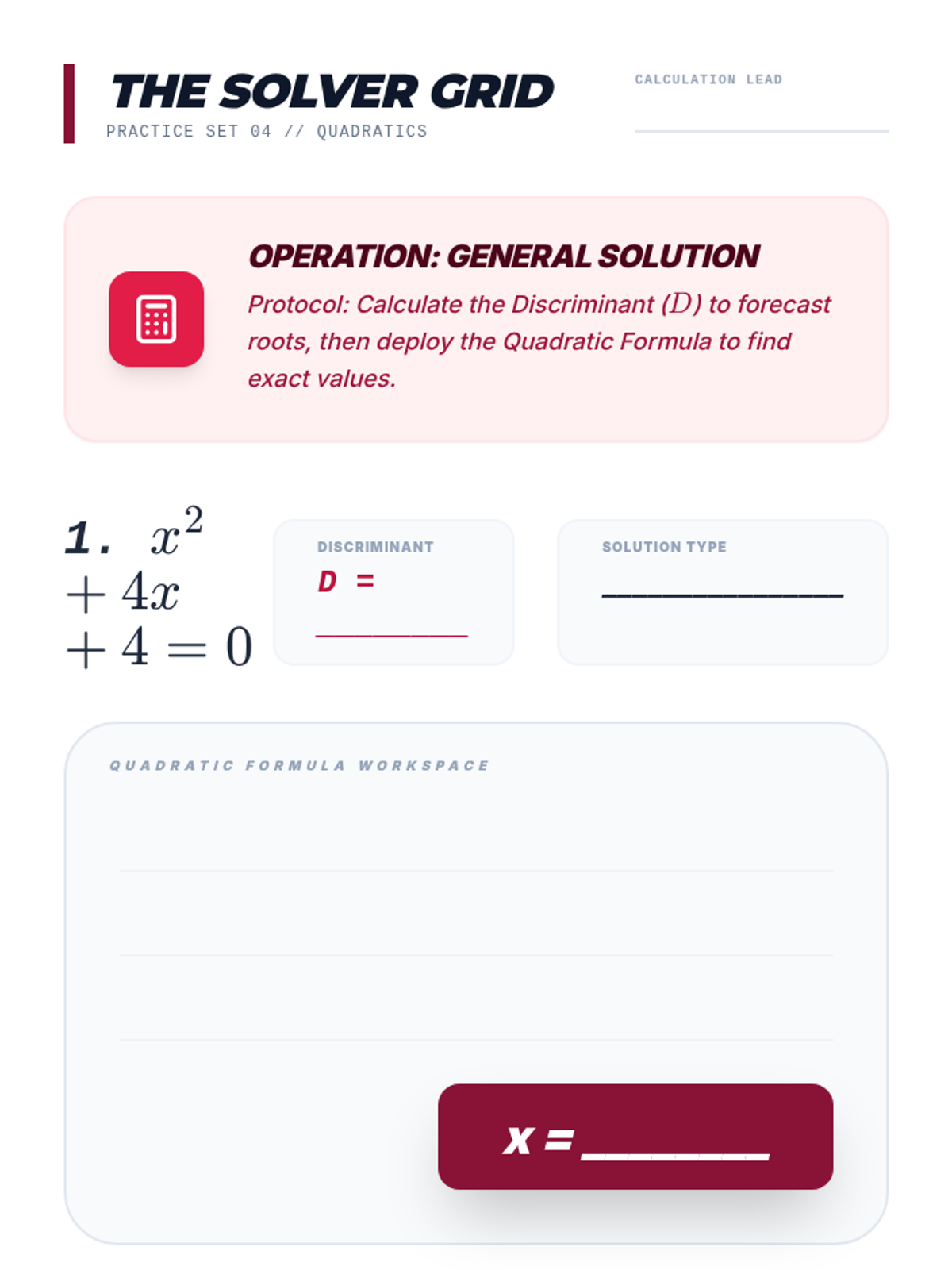
A practice worksheet requiring students to use both the discriminant and the quadratic formula to solve equations.
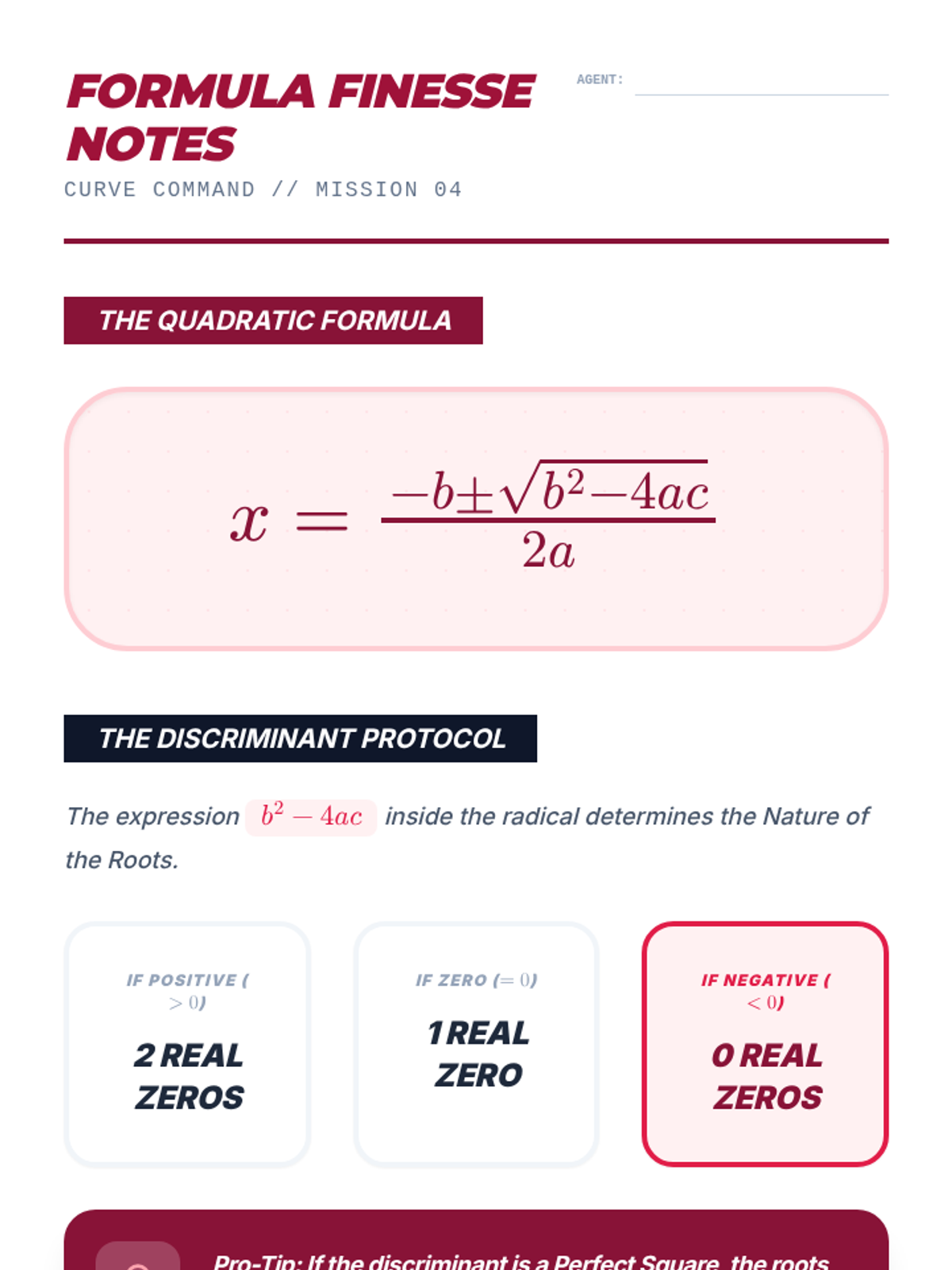
Guided notes for Lesson 4 covering the application of the Quadratic Formula and the function of the discriminant.
Slide deck for Lesson 4, introducing the Quadratic Formula and the Discriminant, with a focus on real rational roots.
A quick check for student mastery of factoring techniques and the Zero Product Property.
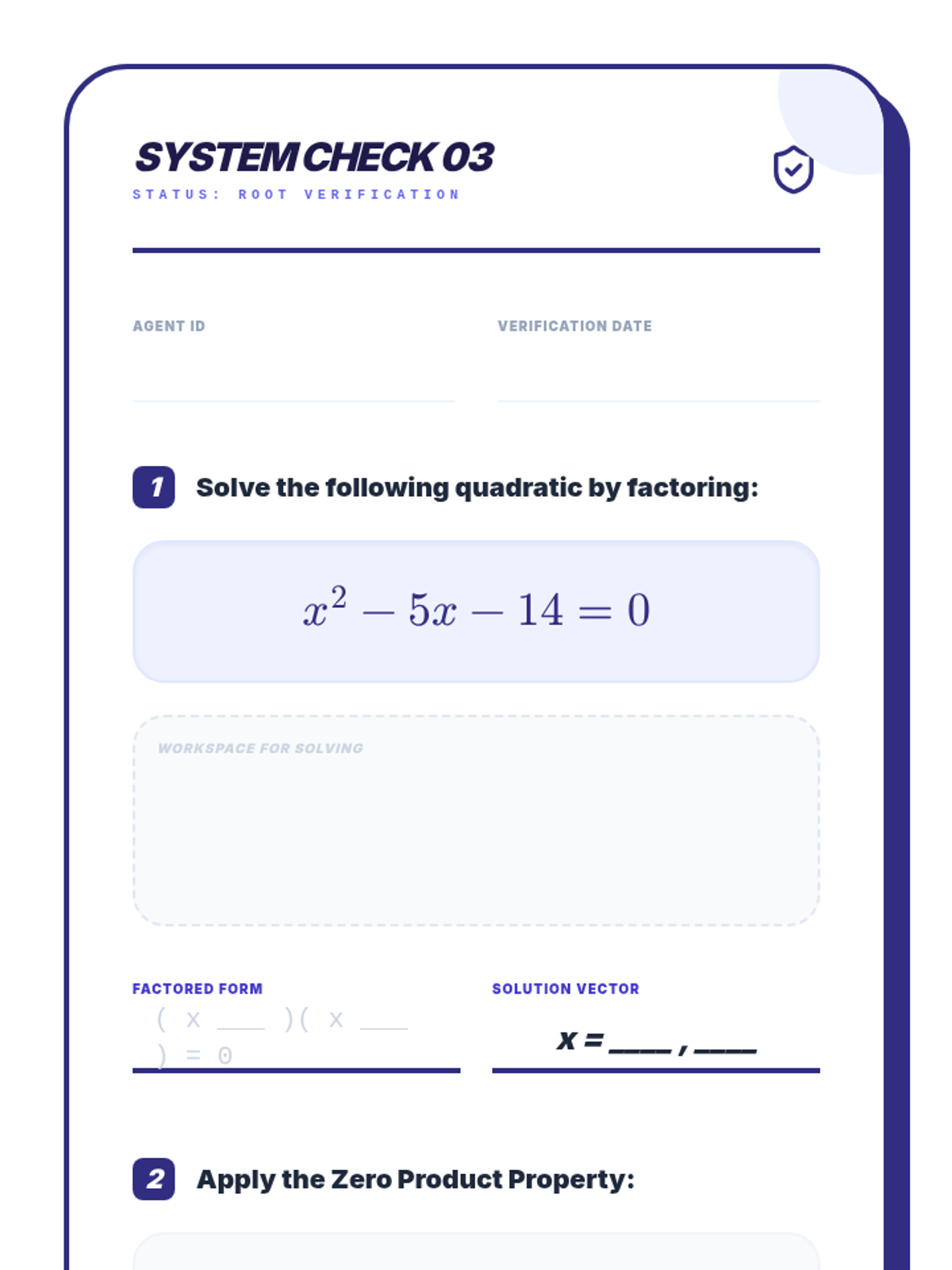
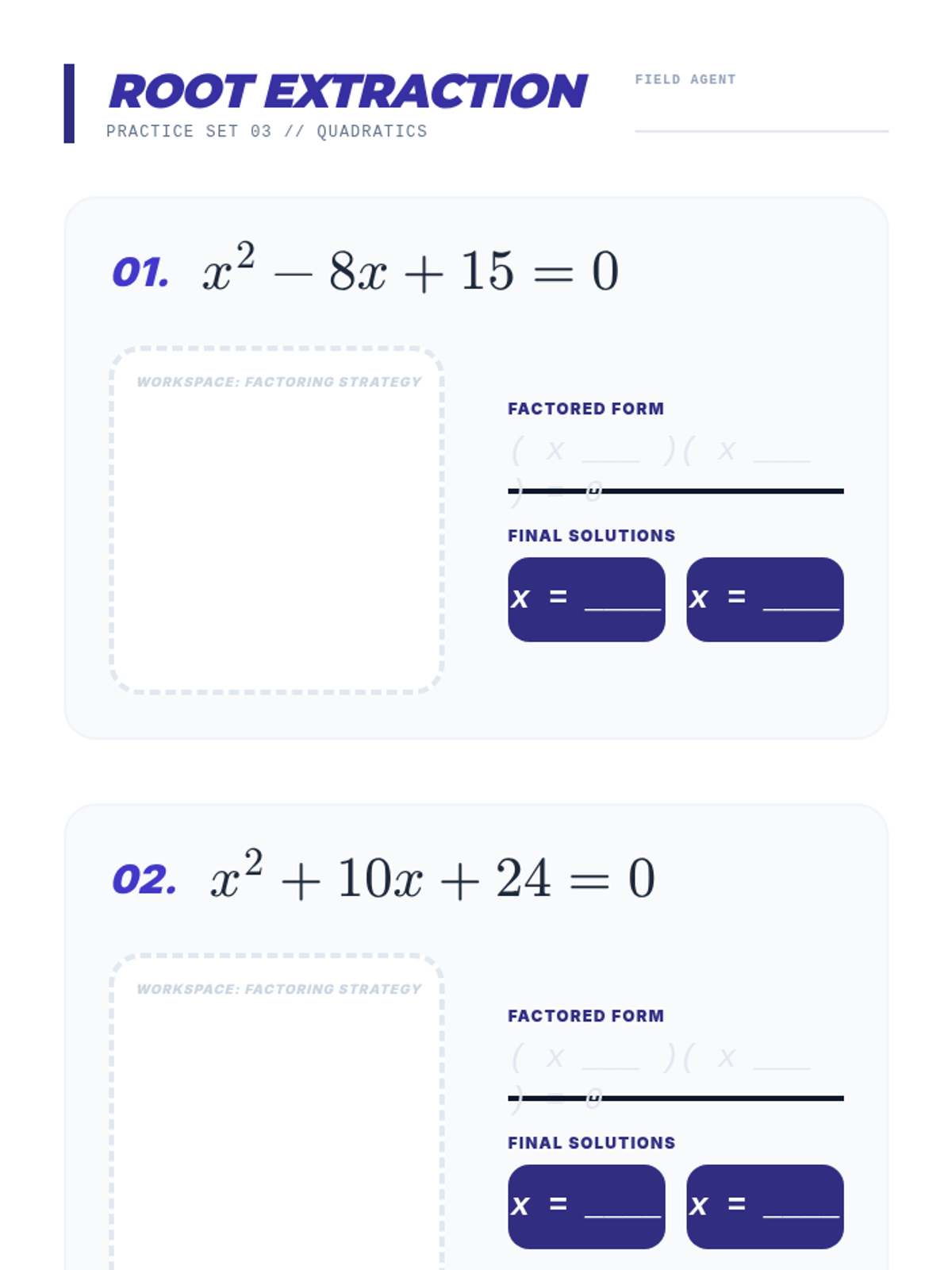
A practice worksheet for solving quadratic equations by factoring, including trinomials, GCF, and difference of squares.
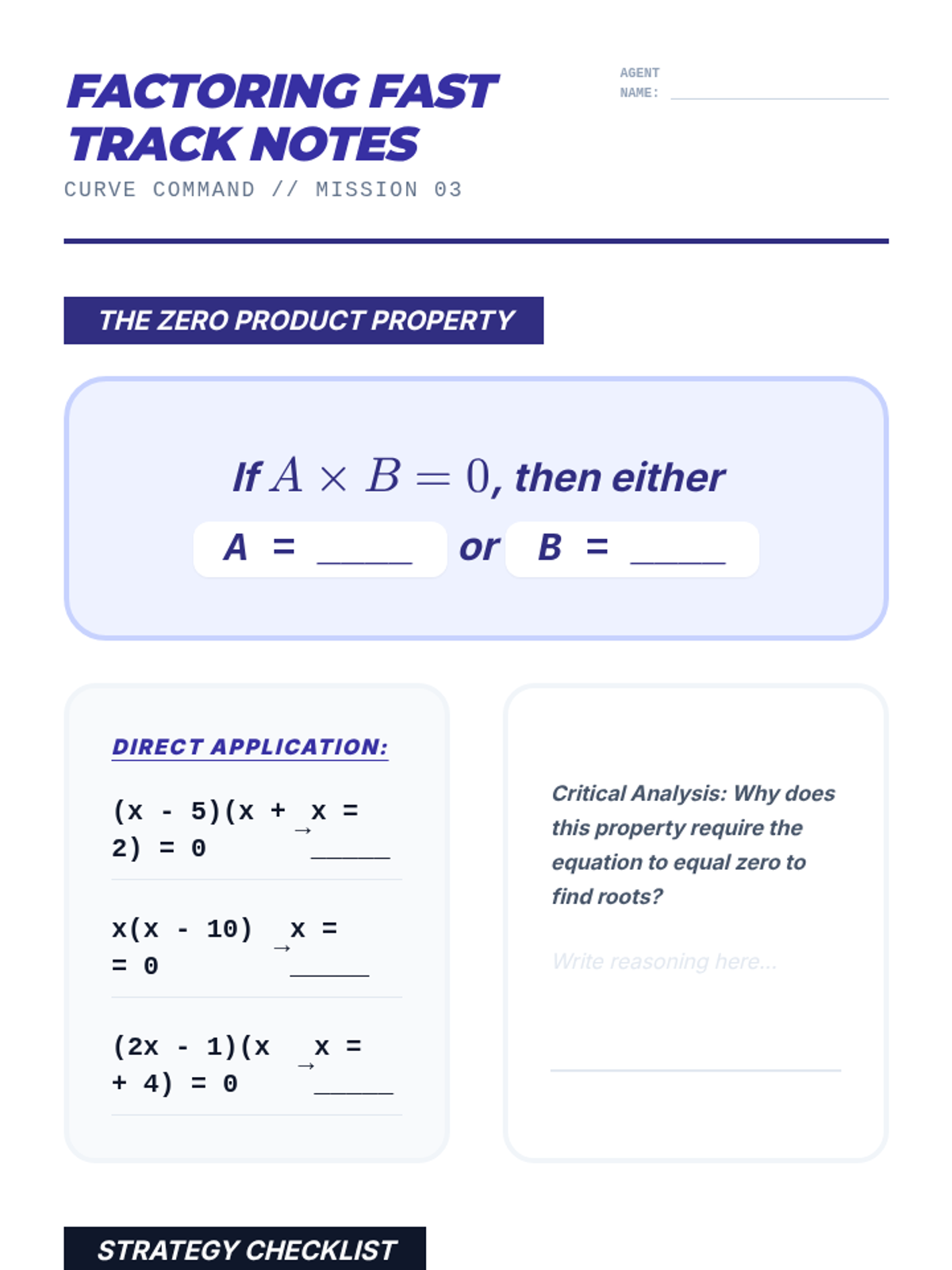
Guided notes for Lesson 3 focusing on solving quadratic equations by factoring and applying the Zero Product Property.
A slide deck for Lesson 3, teaching Algebra II students how to solve quadratic equations by factoring using the Zero Product Property.
A formative assessment focusing on extracting key features from a standard form quadratic equation.
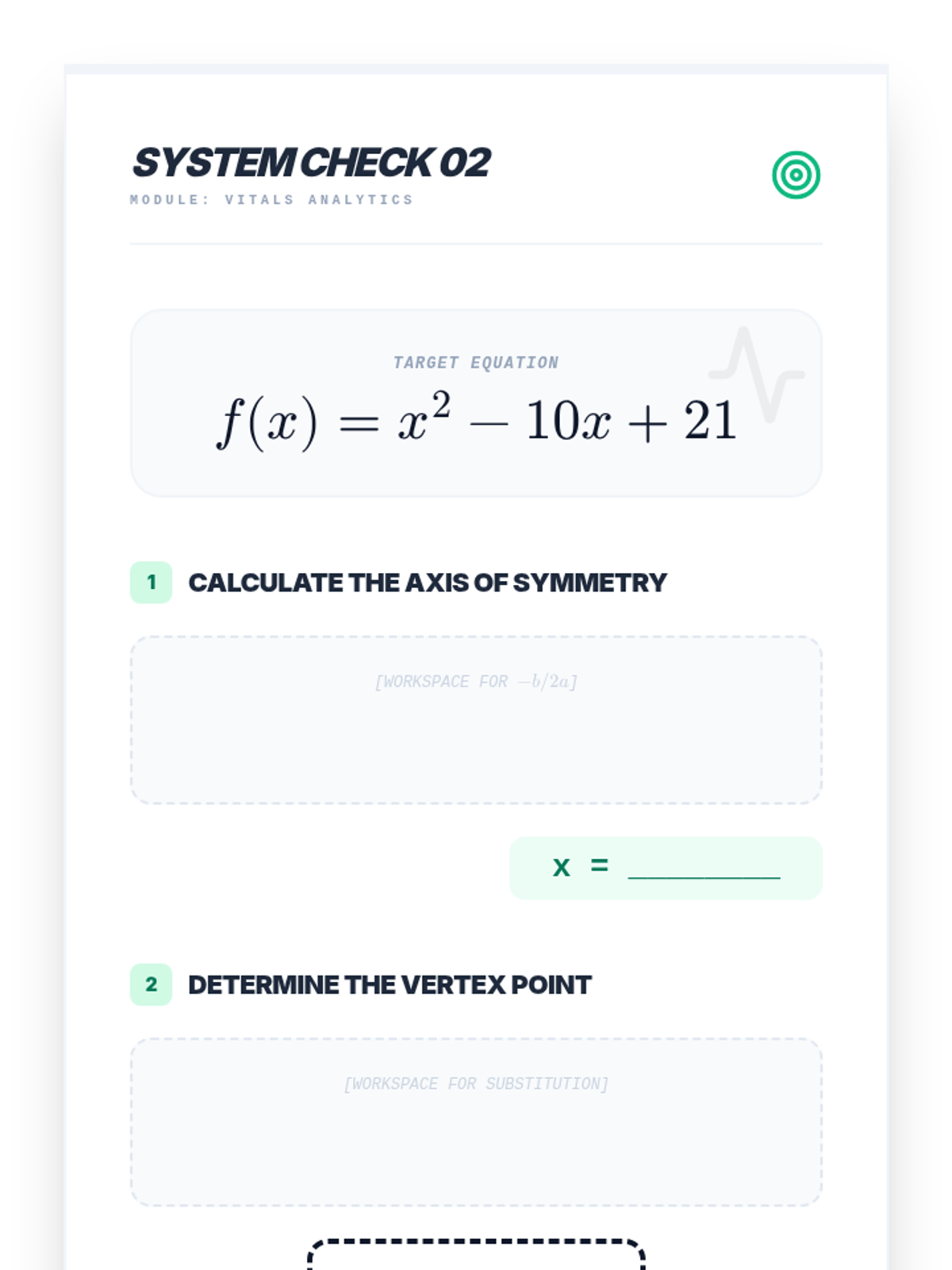
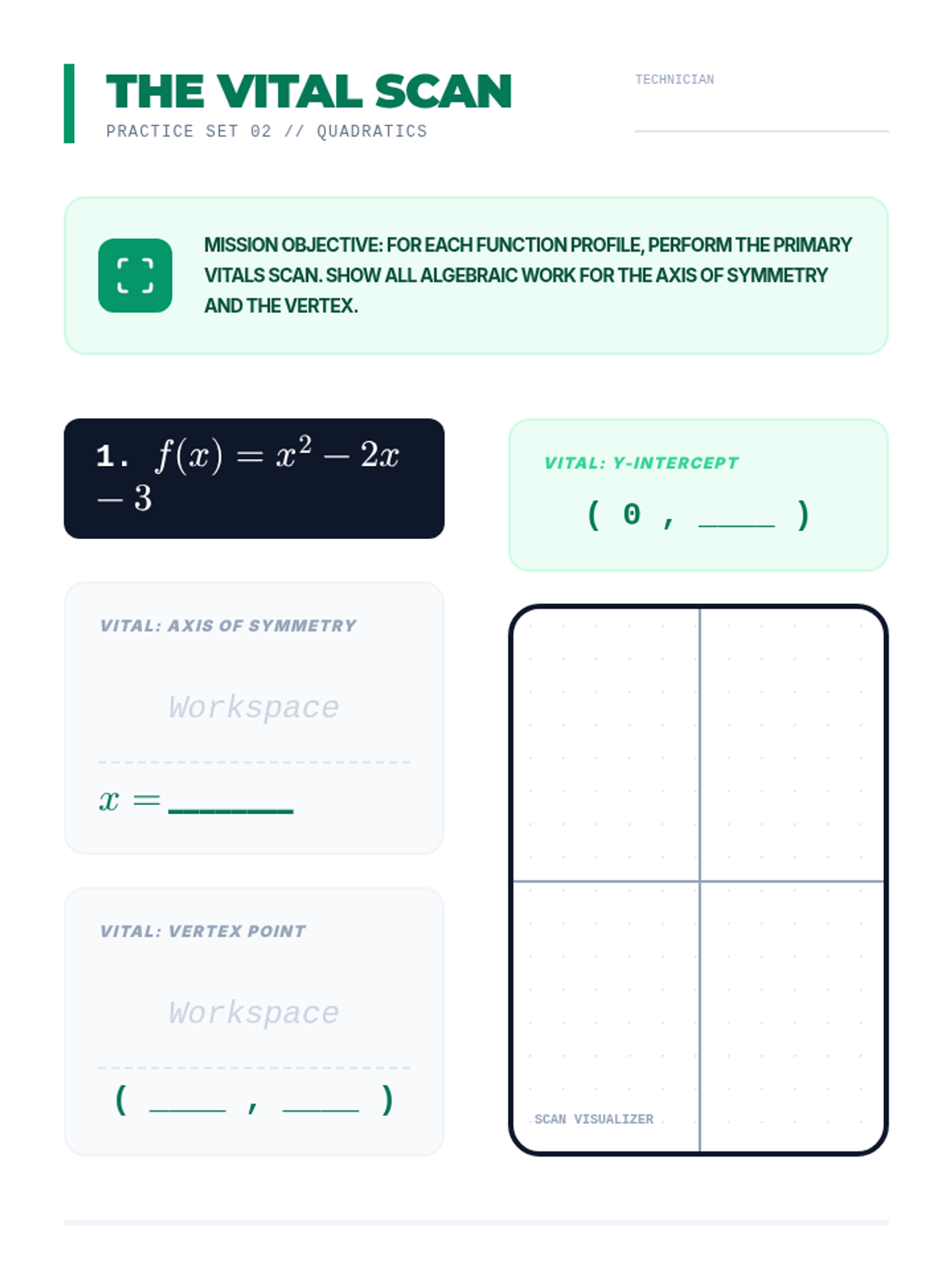
Worksheet for practicing the calculation of vertex, axis of symmetry, and y-intercept from standard form quadratic equations.
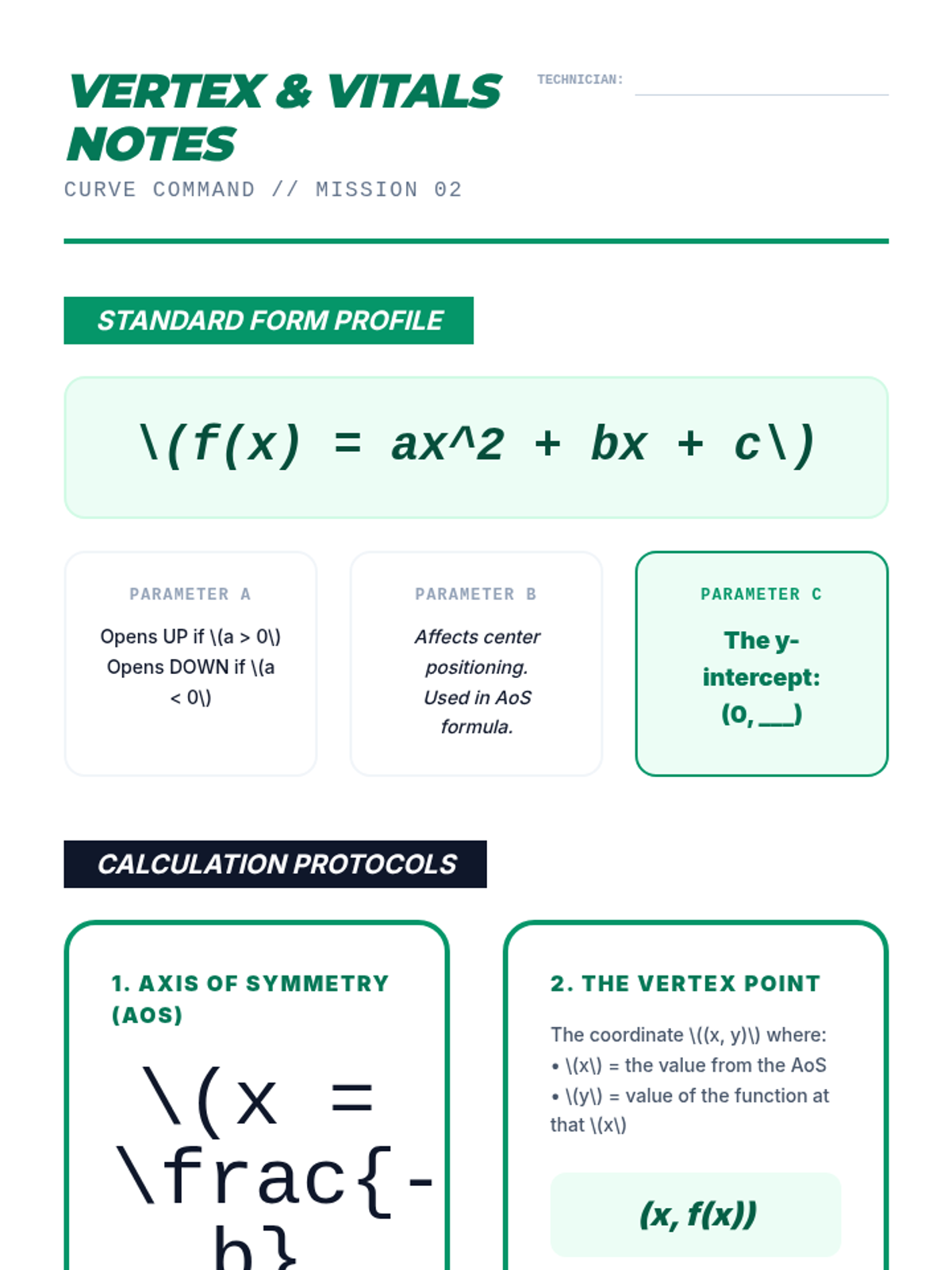
Guided notes for students to master finding the vertex, AOS, and intercepts of a quadratic function in standard form.
A slide deck for Lesson 2, teaching students how to identify key features (vertex, AOS, intercepts) of quadratic functions from standard form equations.
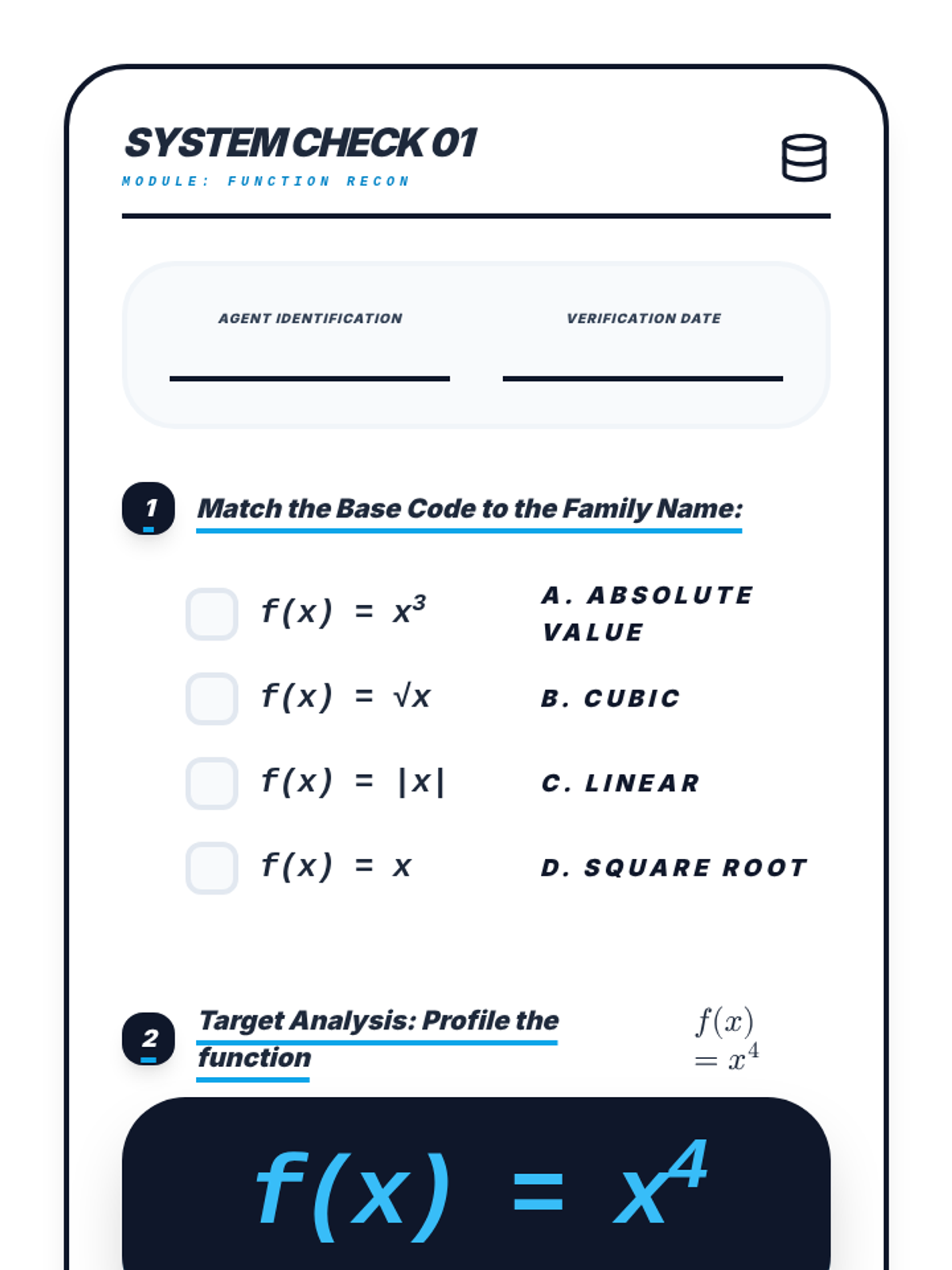
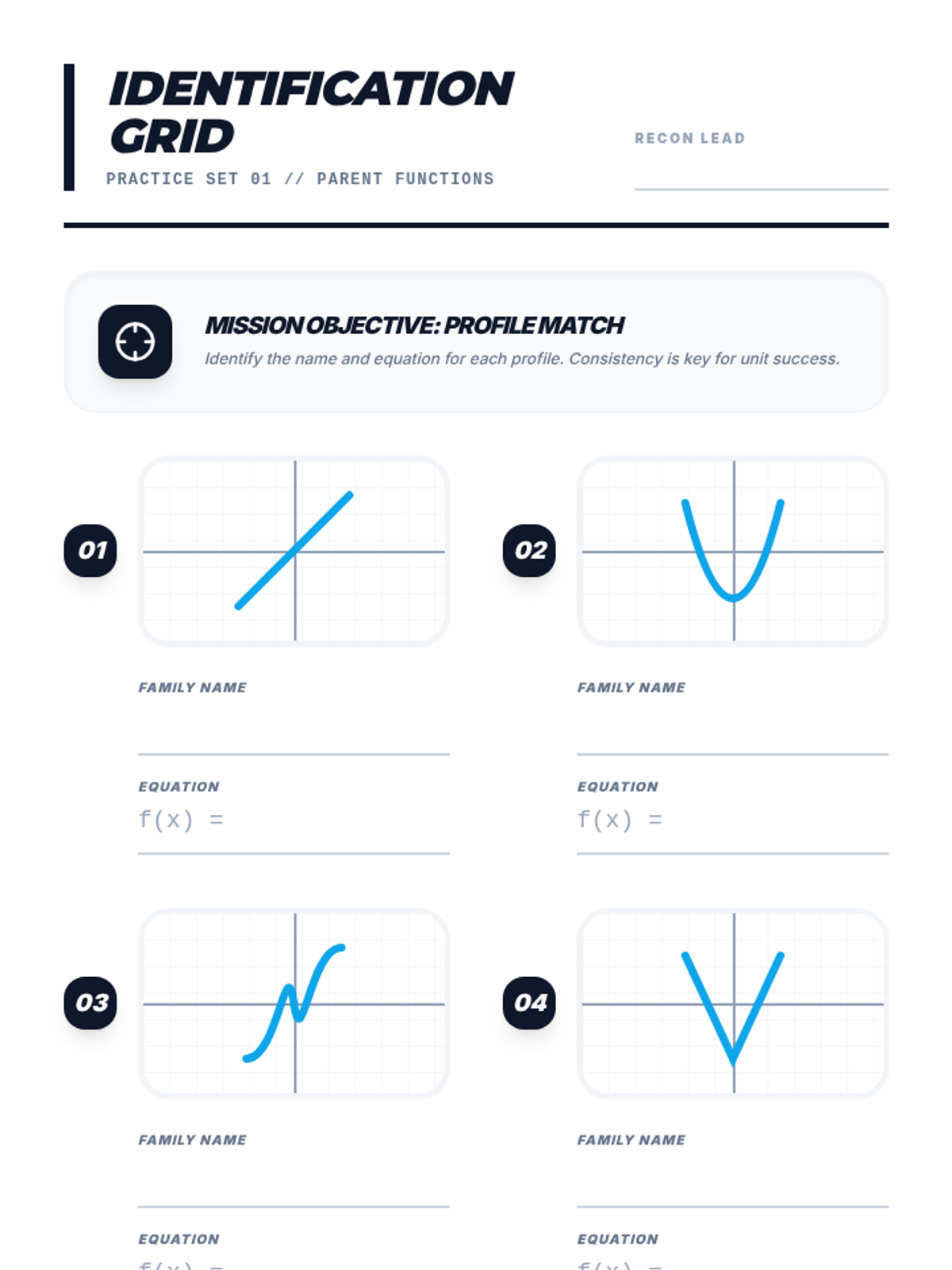
A formative assessment to check student recognition of parent function families from linear to quartic, plus absolute value and radical.
A practice worksheet for identifying parent function families and their equations from linear to quartic, including absolute value and radical.
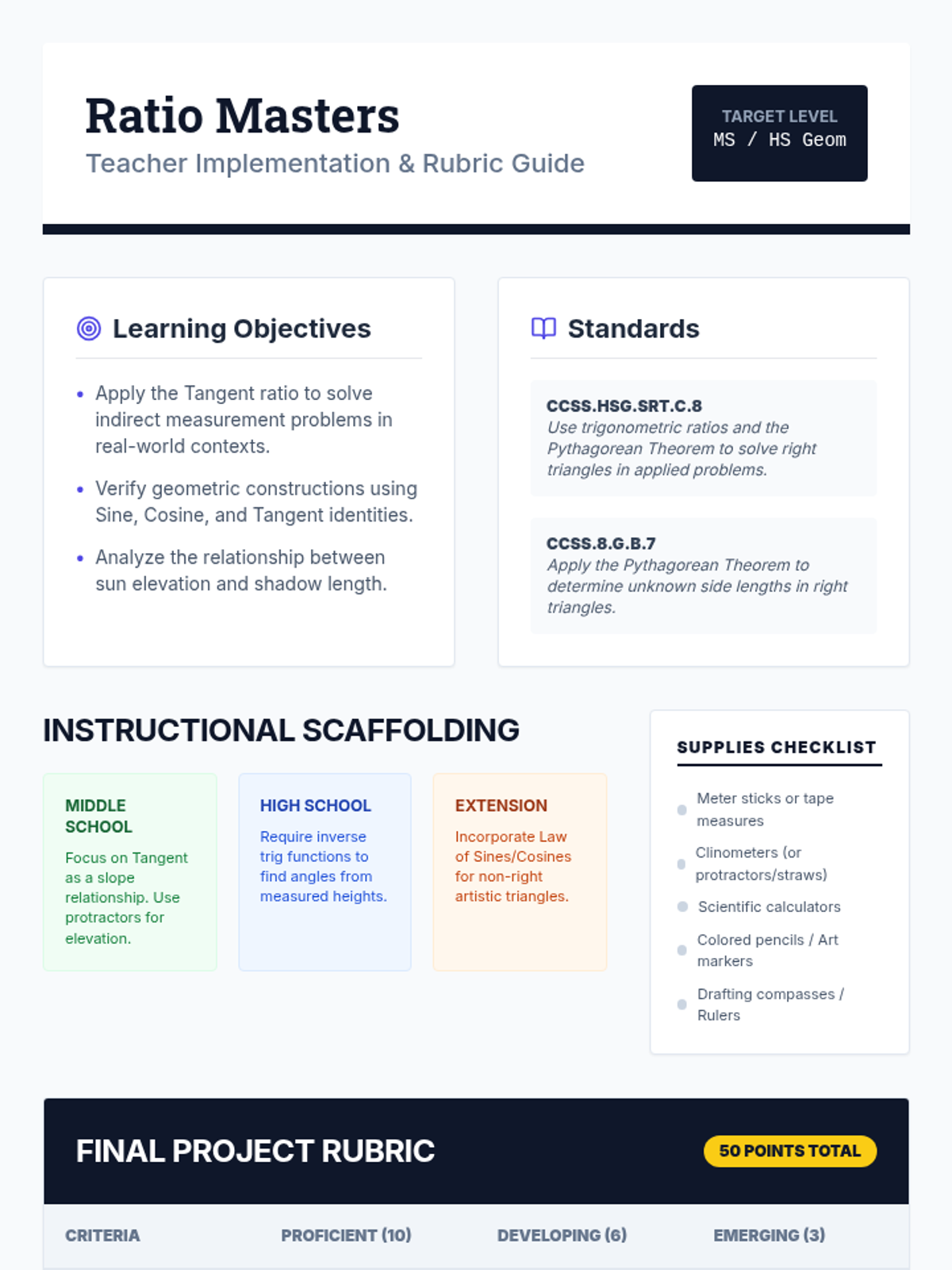
A teacher guide containing learning objectives, standards alignment, differentiation strategies for middle and high school, and a comprehensive grading rubric.
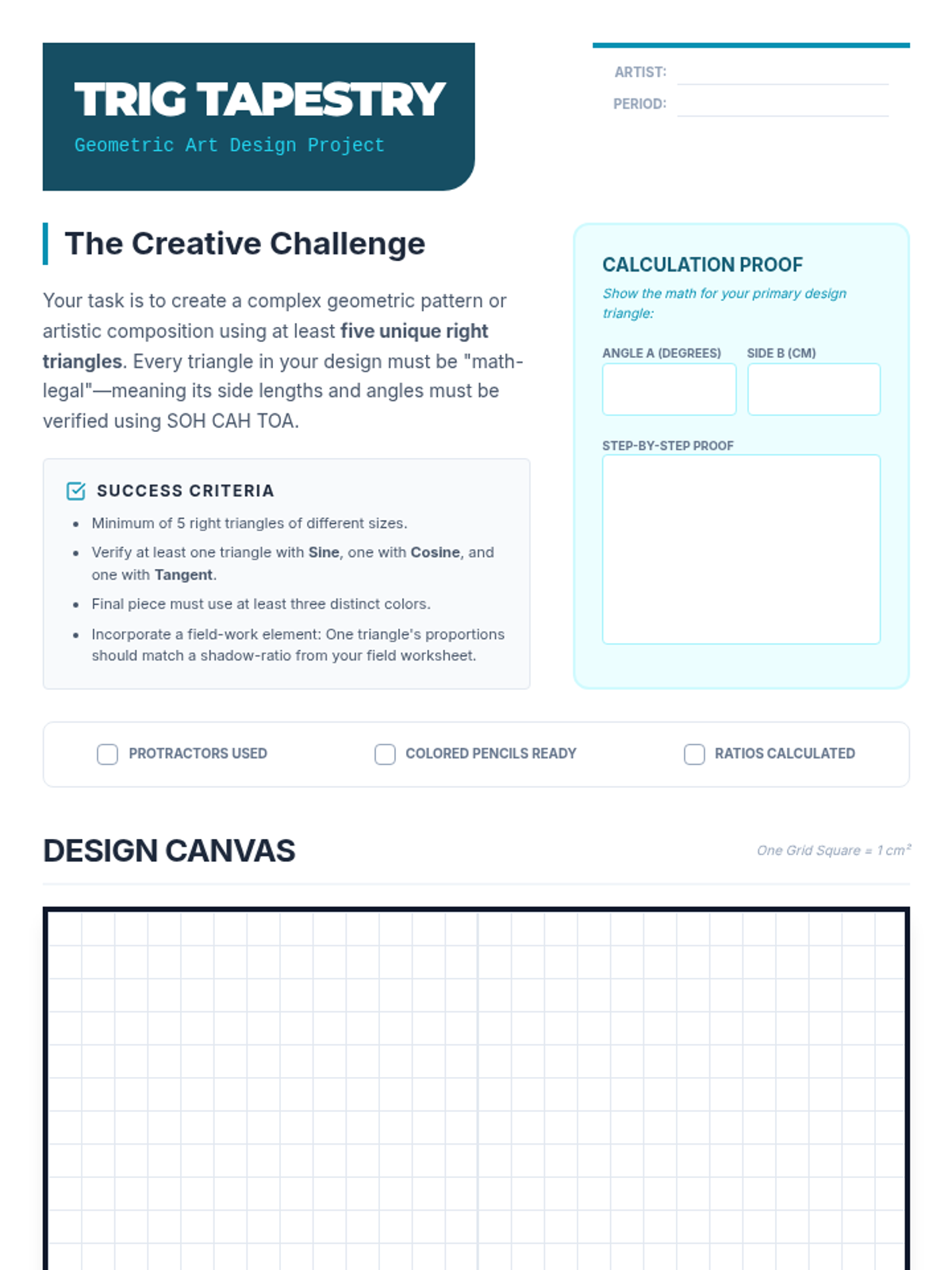
A project guide for the geometric art portion of the lesson. Students design a pattern using right triangles and prove their proportions using trigonometric ratios.
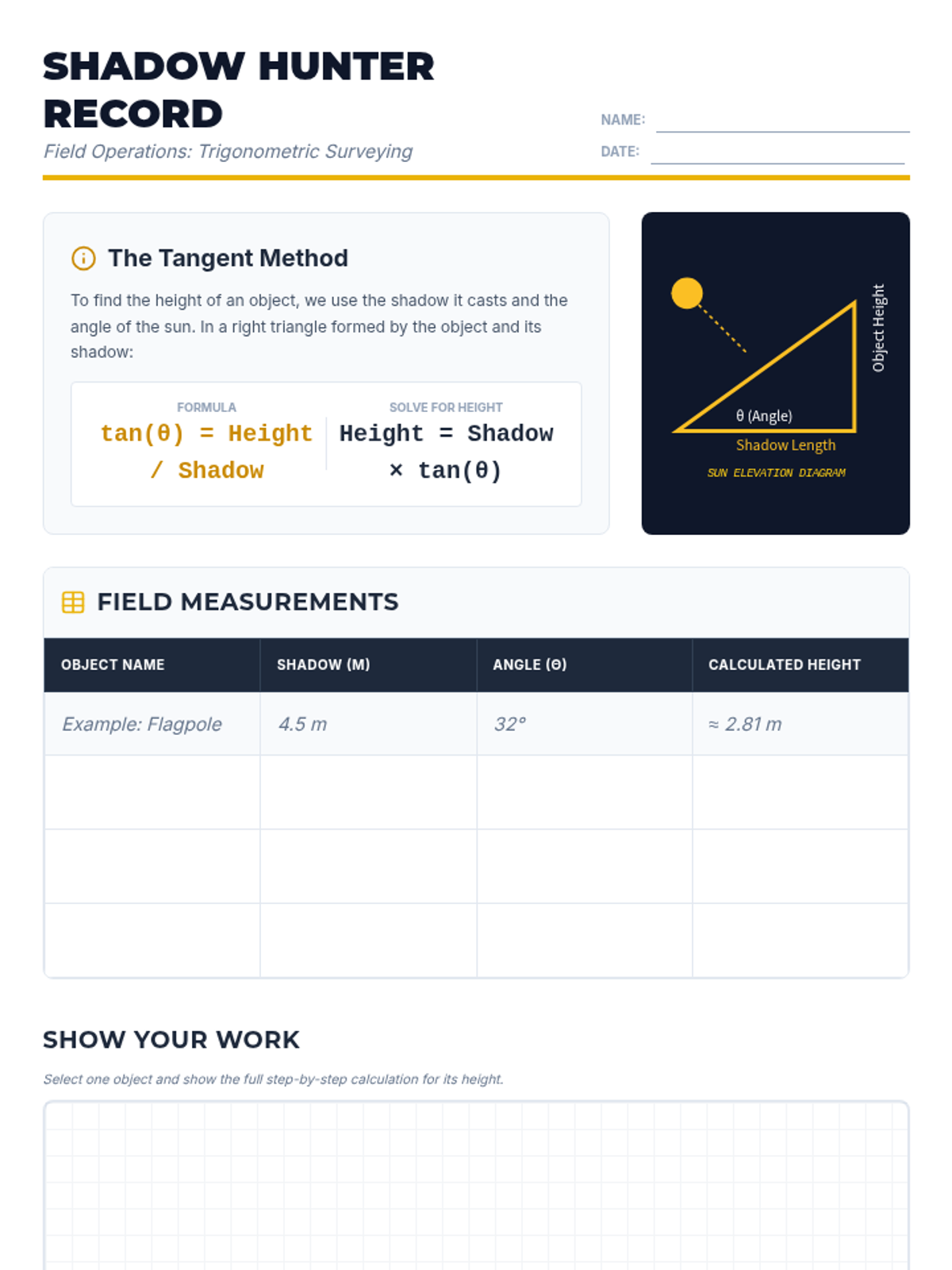
A field data collection sheet for students to record shadow lengths and calculate object heights using the tangent ratio. Includes space for work and reflection questions.
An introductory slide deck for the Shadows and Shapes project, covering trigonometric ratios, the two main project components (Shadow Hunters and Trig Tapestry), and the project timeline.
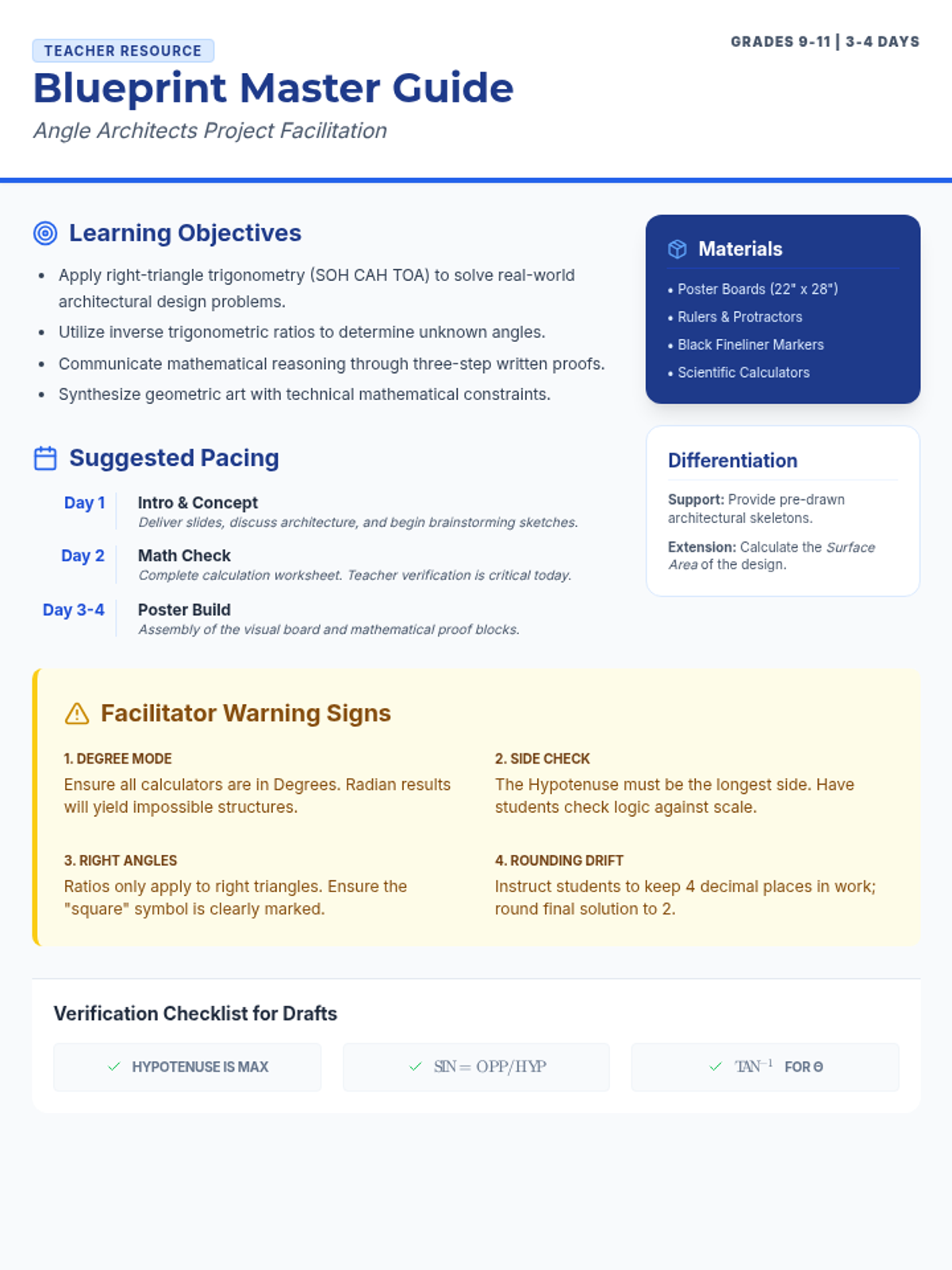
A comprehensive teacher's guide for the Angle Architects project, including pacing, materials, differentiation strategies, and common student misconceptions.
An introductory presentation for the Angle Architects project, covering real-world trig applications, SOH CAH TOA review, and project expectations.
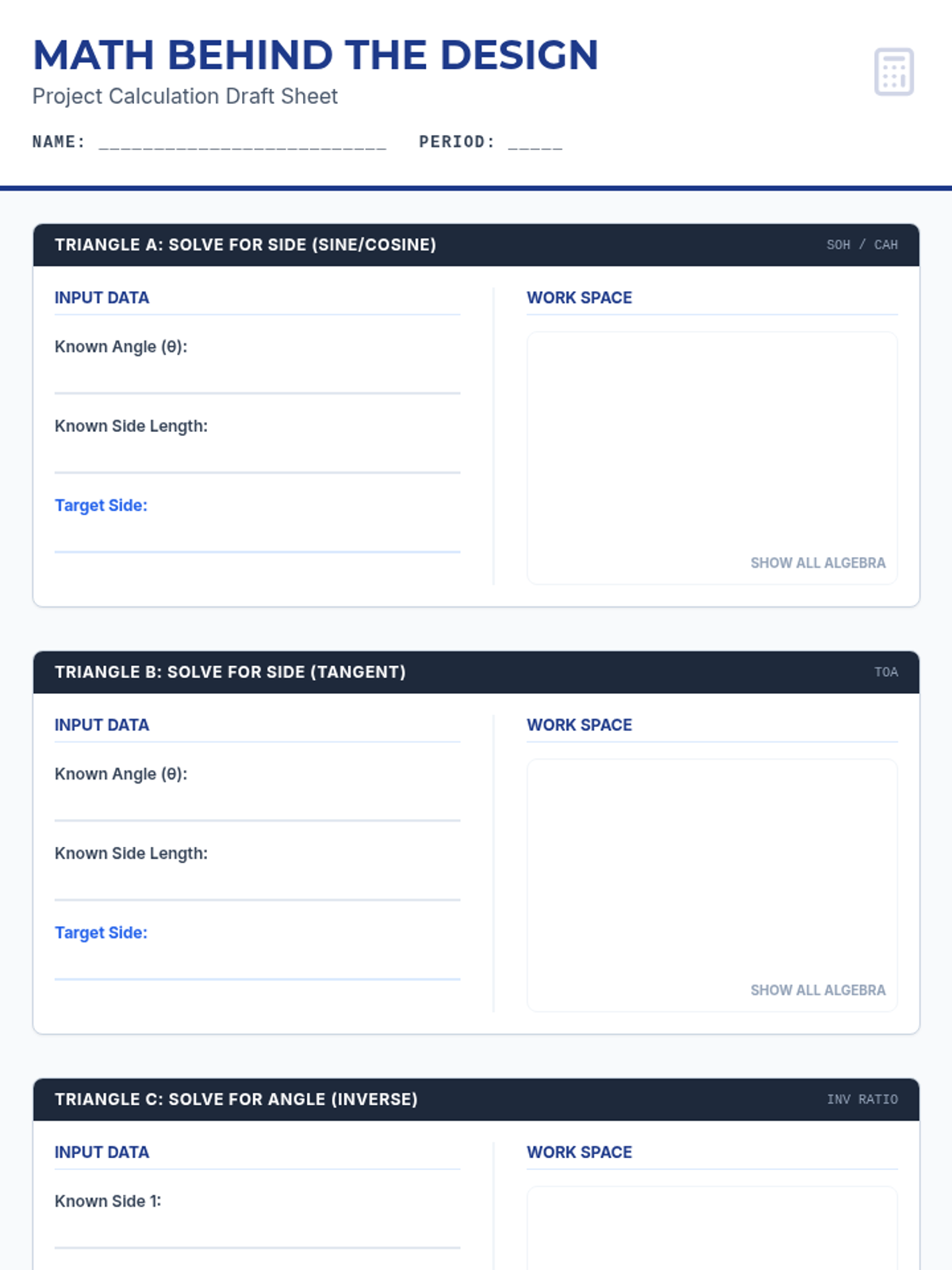
A structured worksheet for students to perform and check their step-by-step trigonometry calculations before transferring them to their final project poster.
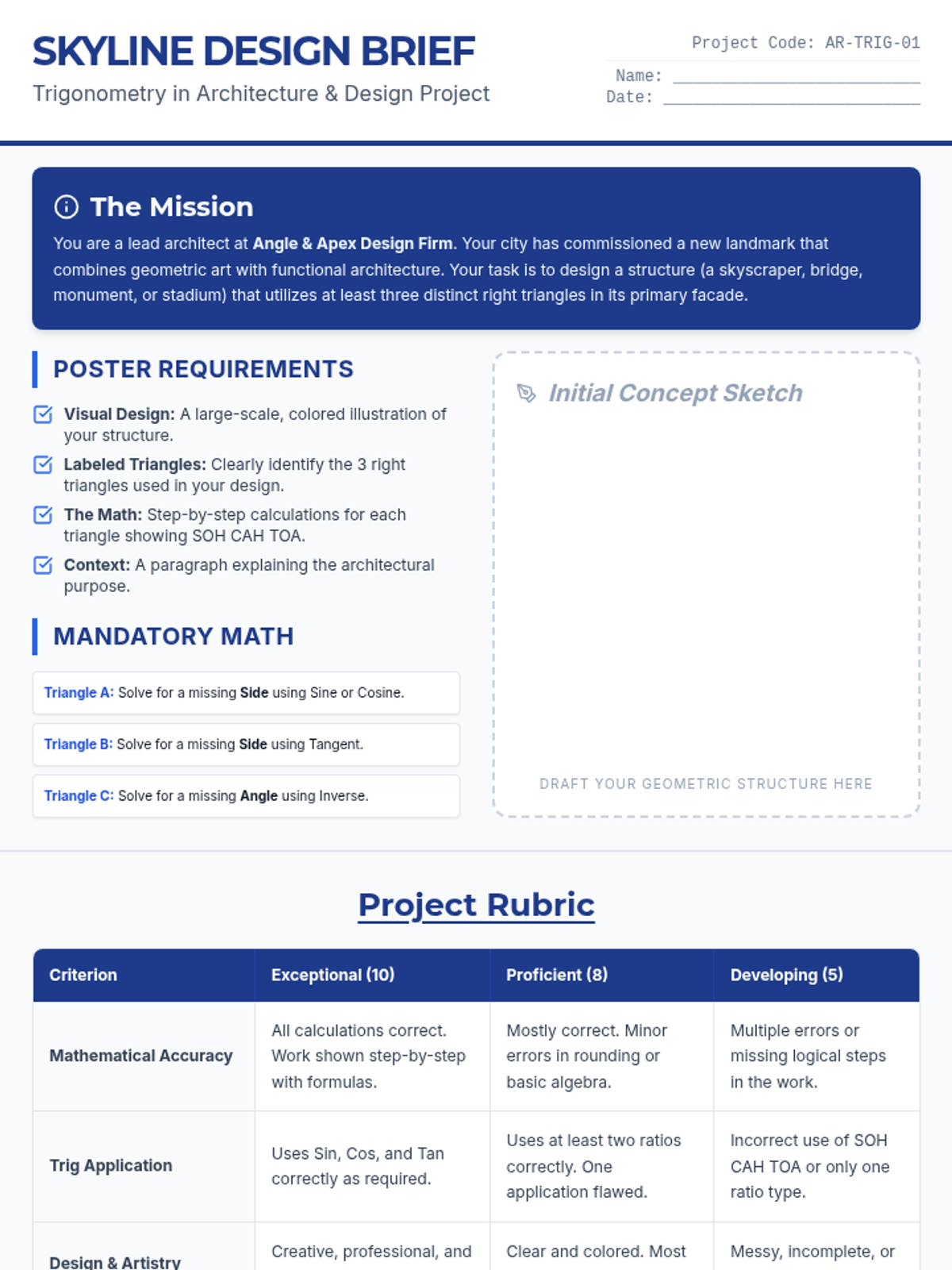
A student project brief for designing an architectural structure using trigonometry, including requirements, a sketch area, and a detailed grading rubric.
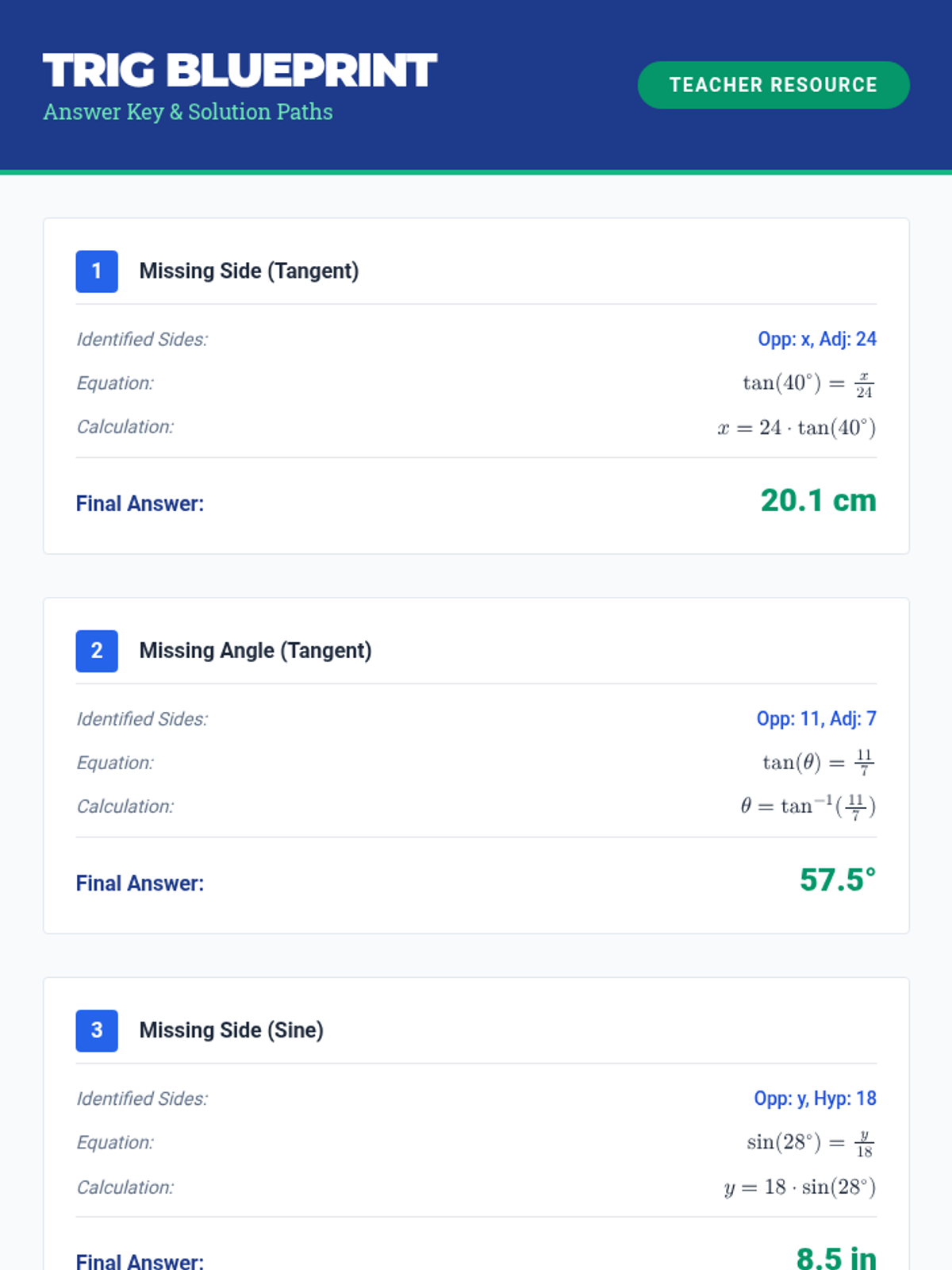
A teacher's answer key for the Trig Blueprint Worksheet, providing full step-by-step solution paths and teaching tips for each problem. Updated to include Cosine and corrected for page-flow issues.
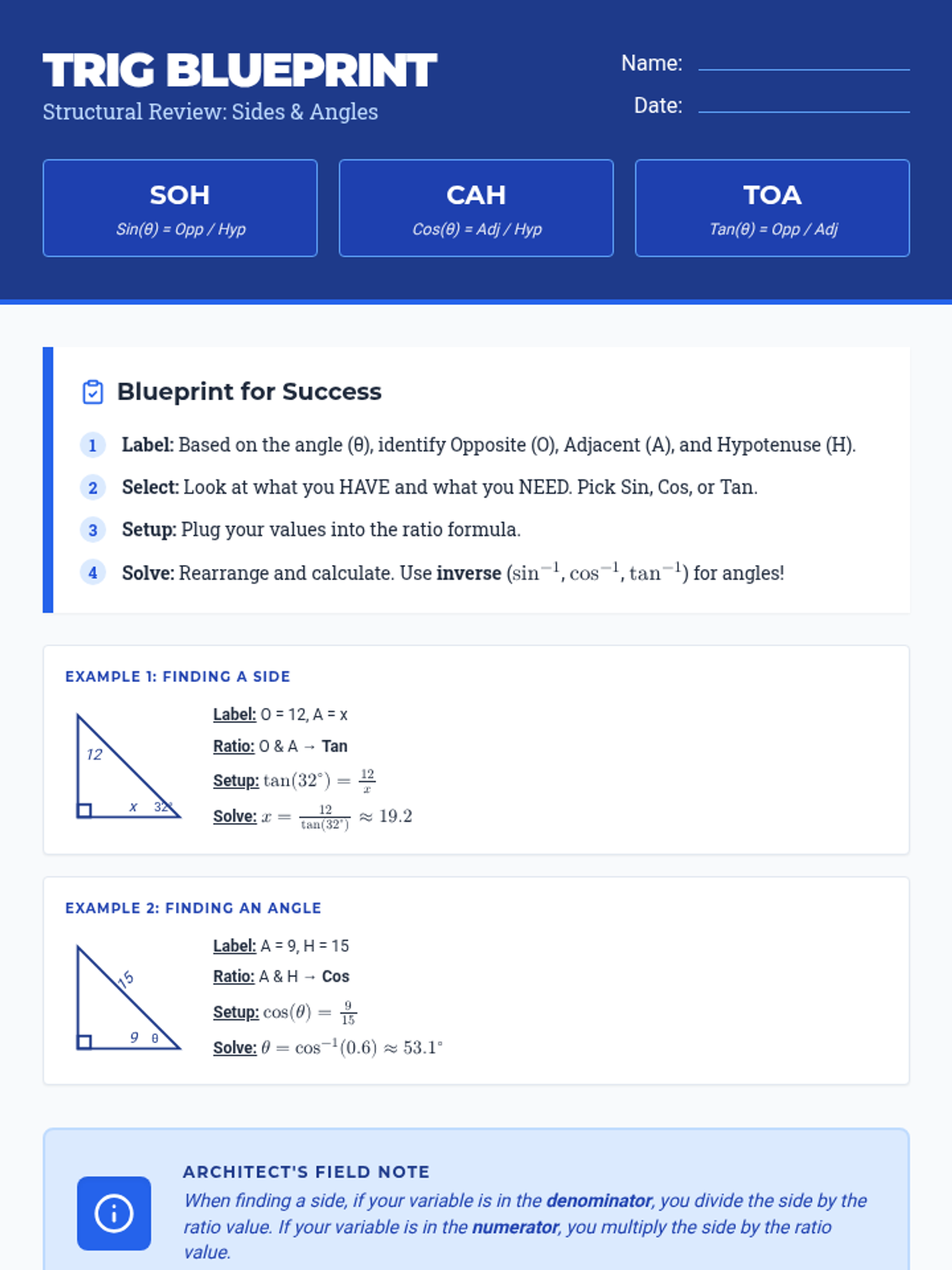
A student-facing trigonometry review sheet styled as an architectural blueprint, featuring a step-by-step checklist, worked examples for sides and angles, and four practice problems with dedicated workspace. Updated for better page flow and to include all three trig ratios.
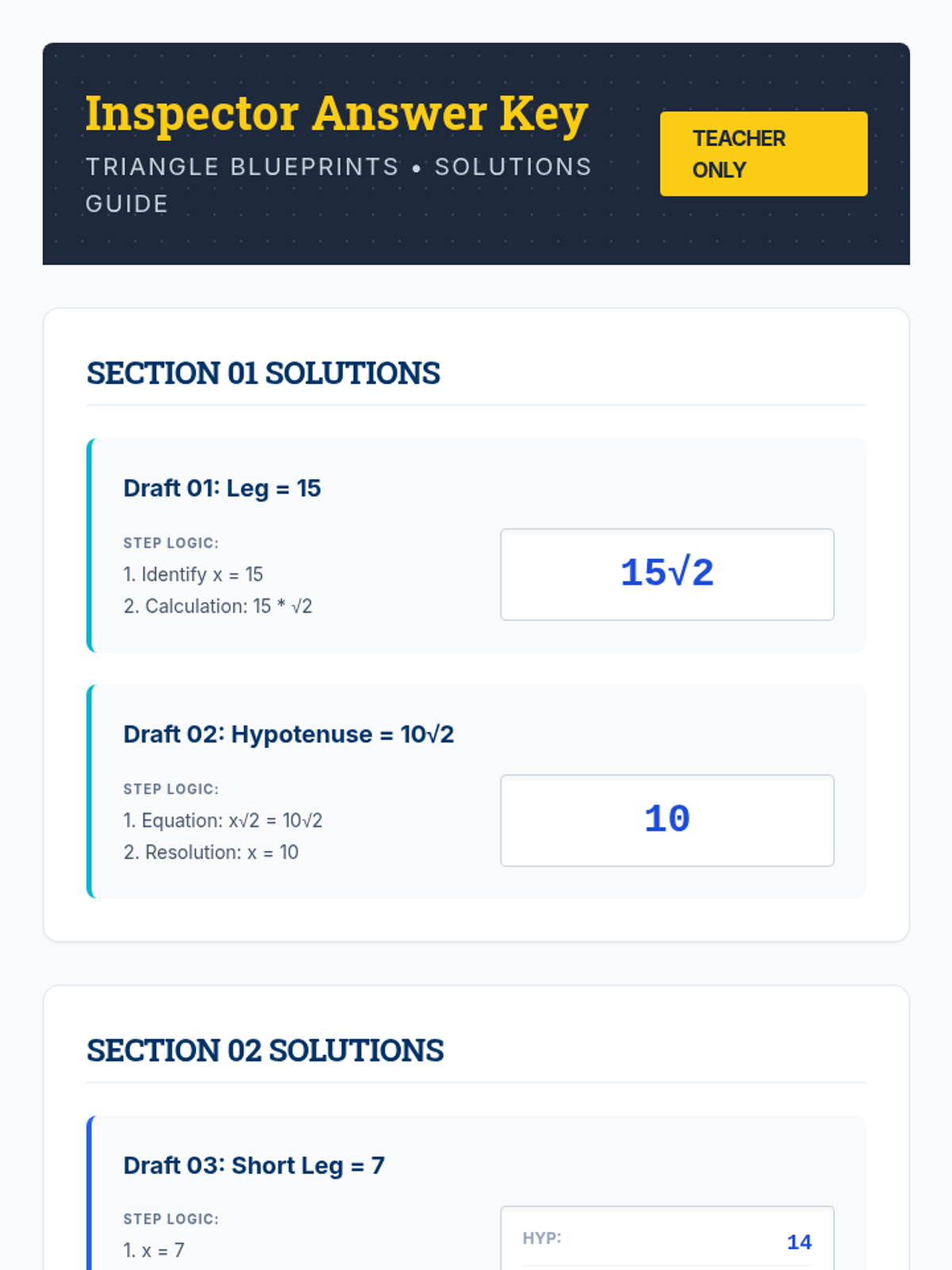
The teacher answer key for the Triangle Draftsman Worksheet, providing step-by-step solutions and final values for evaluation.
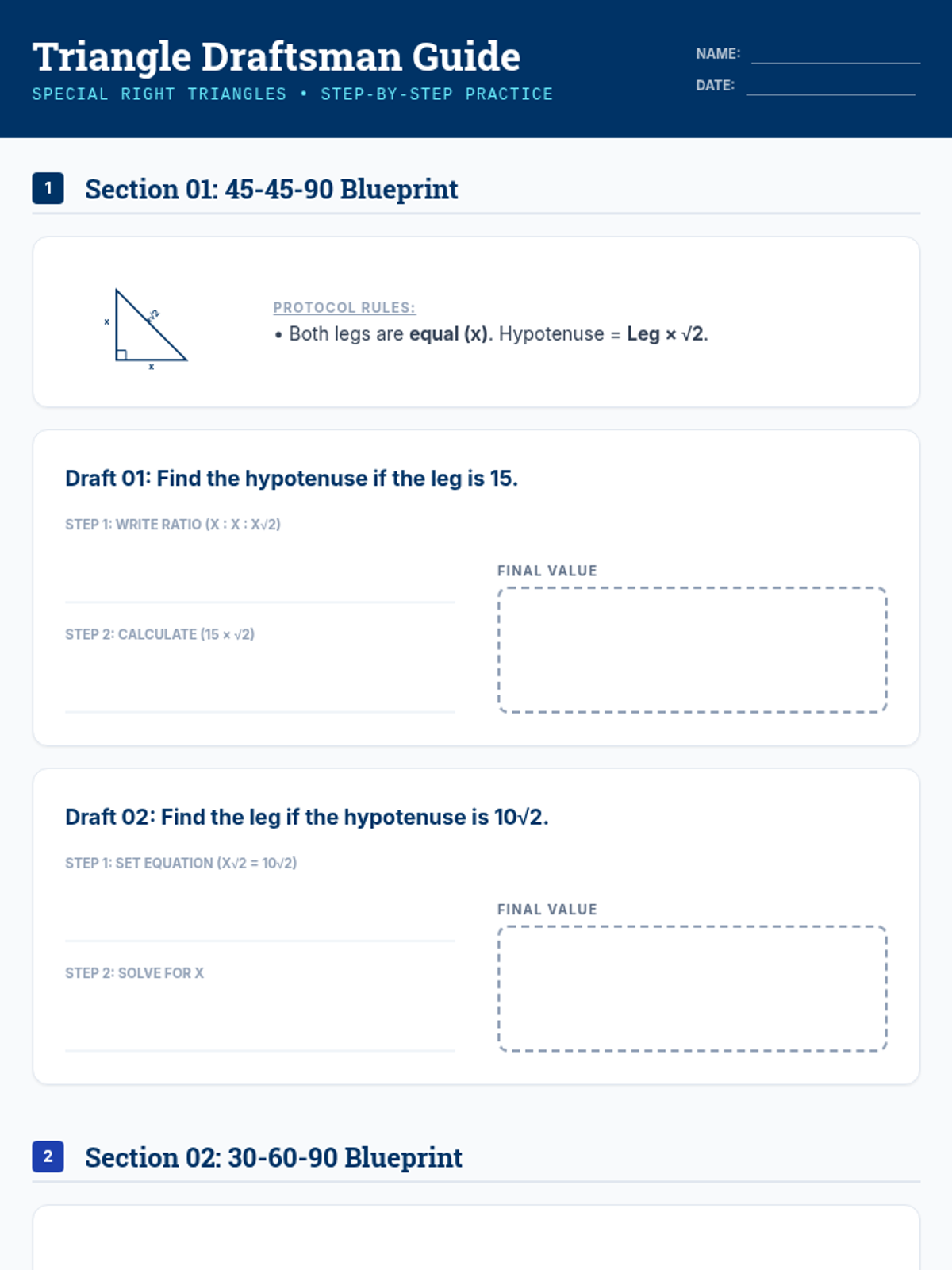
A two-page guided worksheet where students practice solving special right triangles step-by-step, using an architectural draftsman theme.
A visual presentation introducing the properties and ratios of 45-45-90 and 30-60-90 triangles using an architectural blueprint theme.
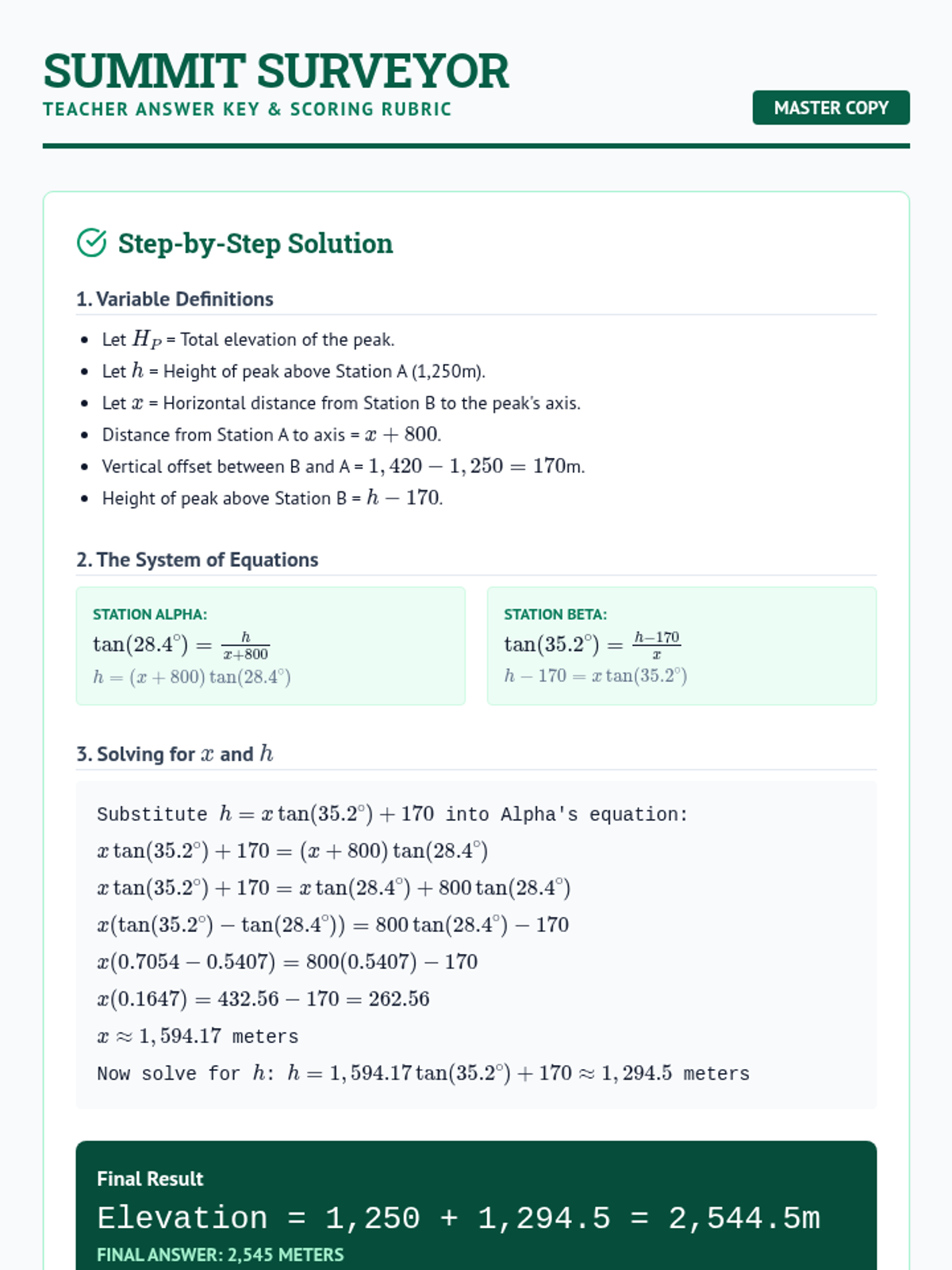
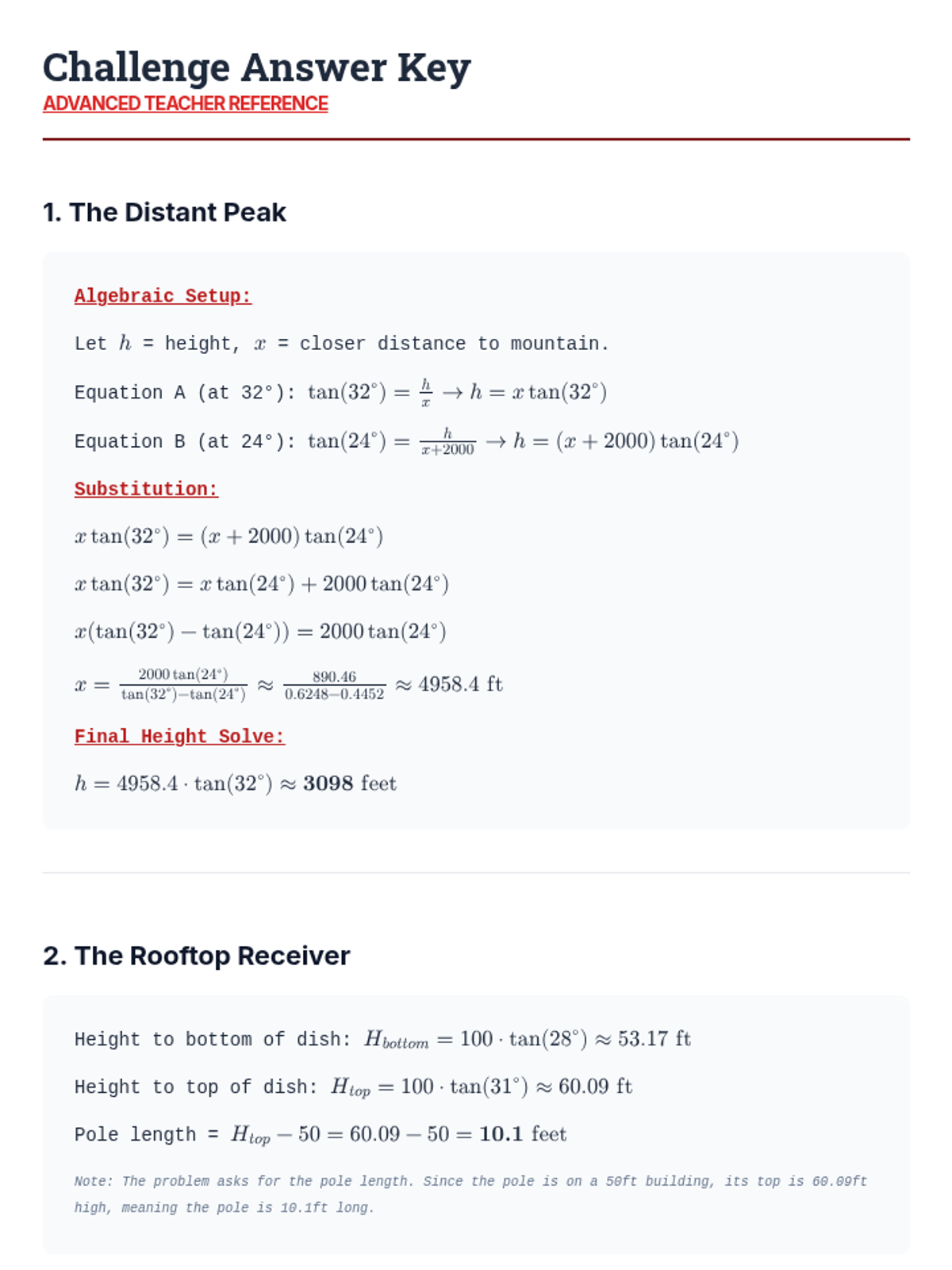
Detailed answer key and scoring rubric for the Summit Surveyor task. Includes step-by-step algebraic solutions for the nested triangle system and pedagogical notes for teachers.
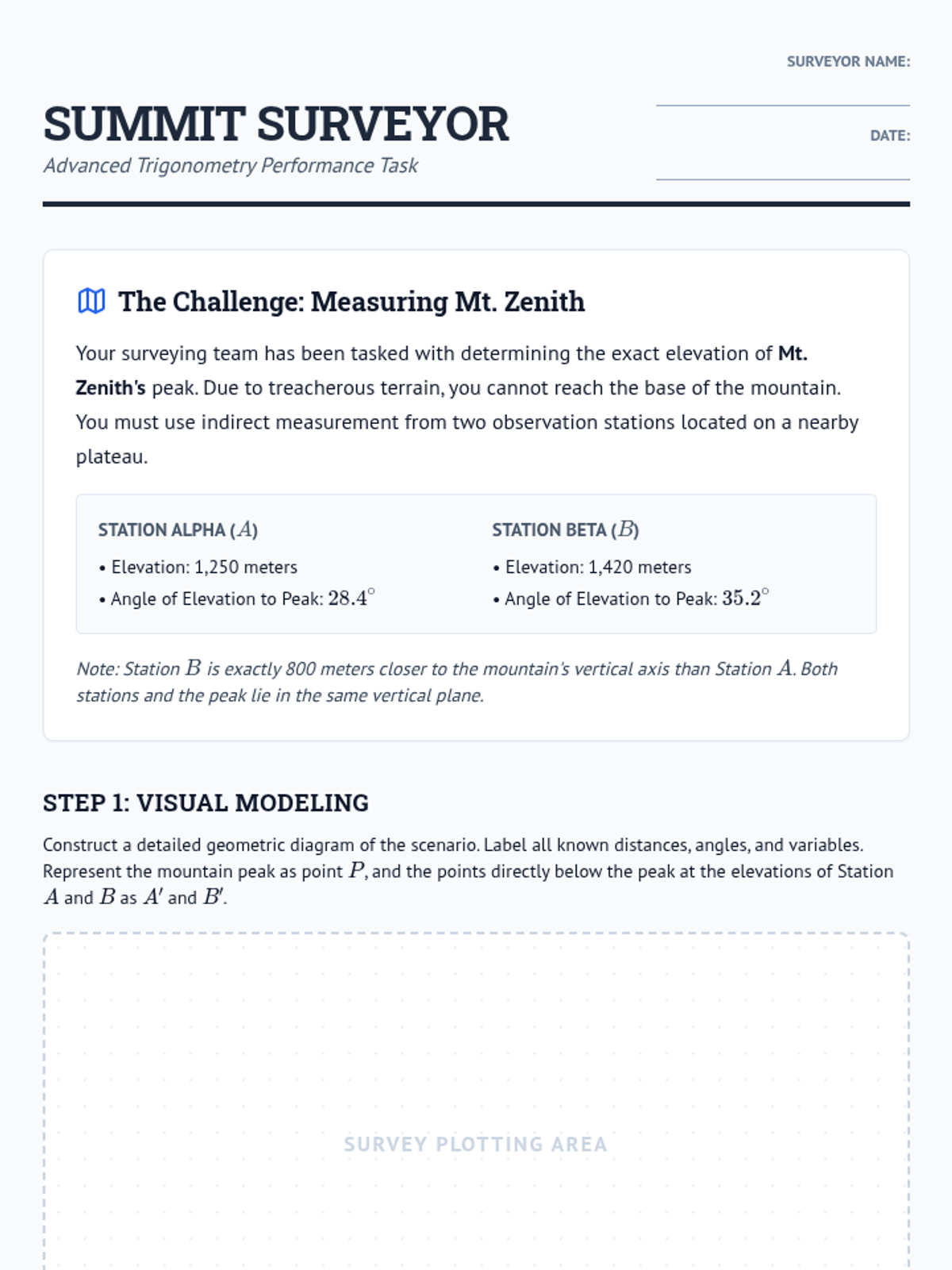
A high-level performance task for right triangle trigonometry where students must calculate the elevation of a mountain peak using nested triangles from two different observation points. Includes multi-step calculations, diagramming, and critical error analysis.
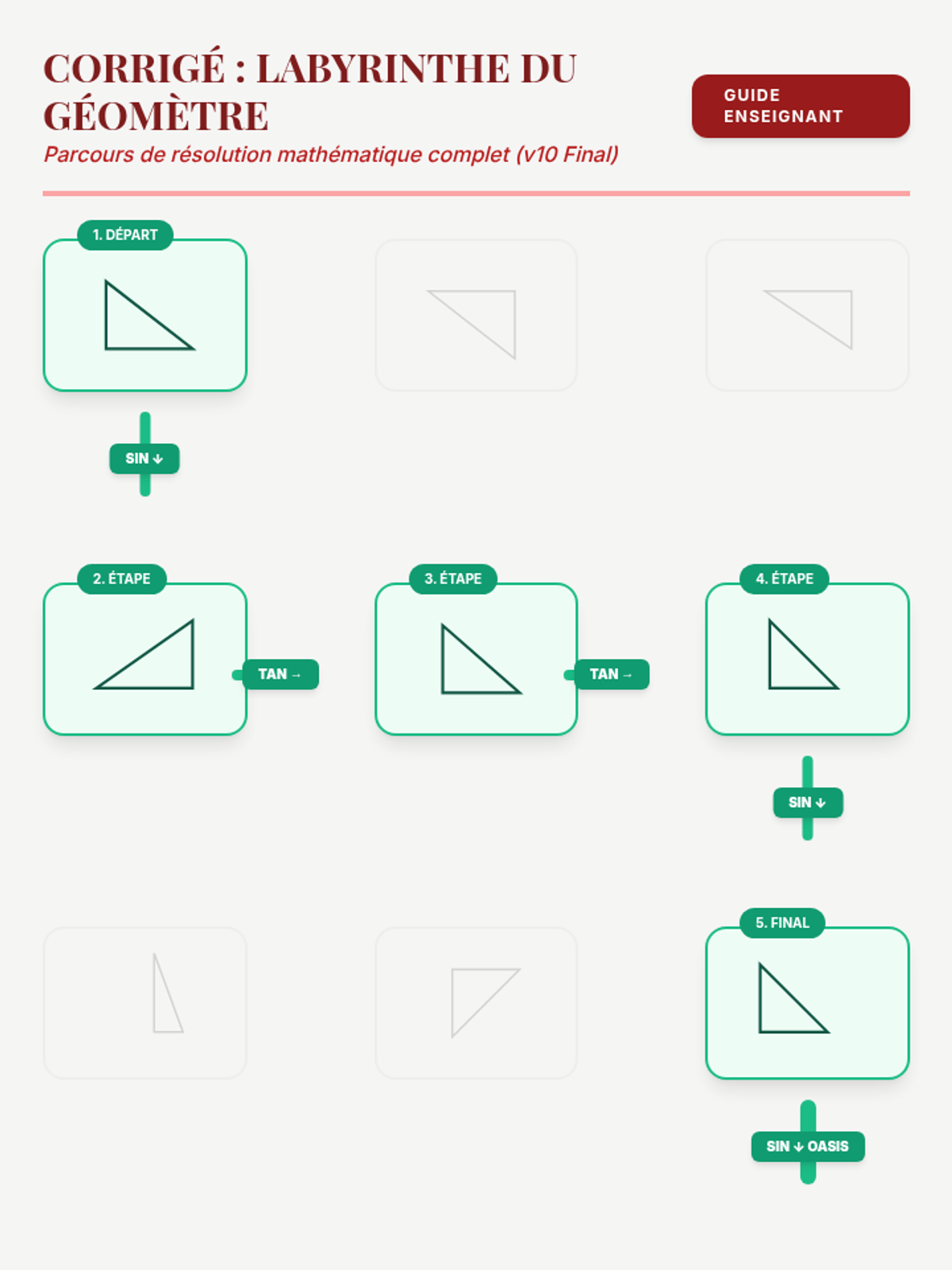
Corrigé final pour le labyrinthe 3x3 (v10). Met en évidence le chemin correct (1,1)->(1,2)->(2,2)->(3,2)->(3,3) avec des schémas de triangles épurés. Les unités ont été retirées et le tableau de raisonnement a été mis à jour pour correspondre précisément à la structure 1-based et aux calculs de la fiche élève finale. Conforme à la version v10 de l'activité élève.
An engaging presentation that introduces the TSIA2 Math assessment and now includes a comprehensive 5-slide step-by-step solution guide for the mastery questions.
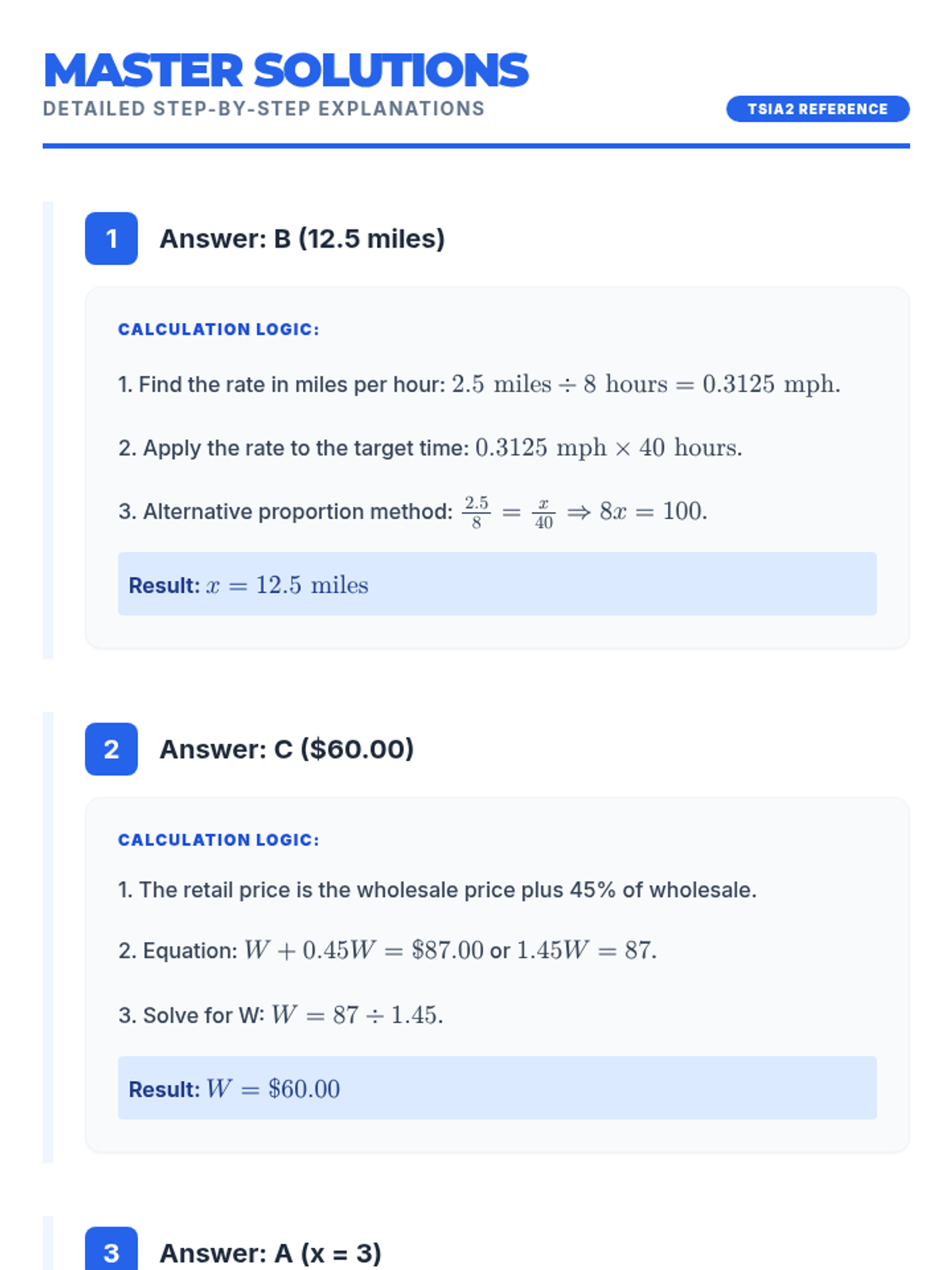
A detailed answer key providing step-by-step explanations for all 10 practice test questions, now with improved contrast and layout to ensure each solution stays on its own page.
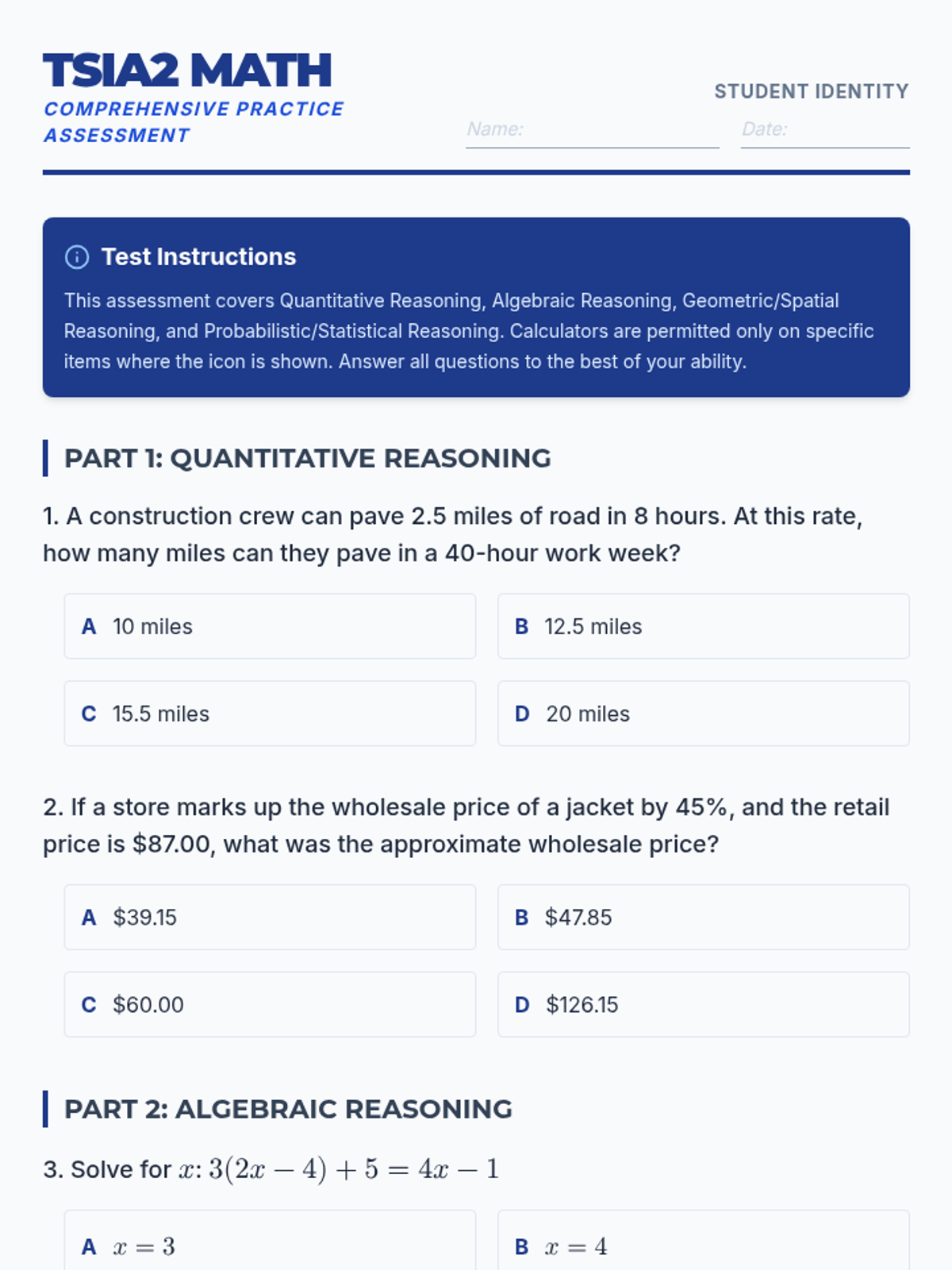
A comprehensive 10-question practice test covering the core domains of the TSIA2 Math assessment, now featuring improved layouts, per-question work areas, and clear calculator icons.
An introductory presentation slide deck defining the angles of elevation and depression with visual diagrams and a step-by-step problem-solving strategy.
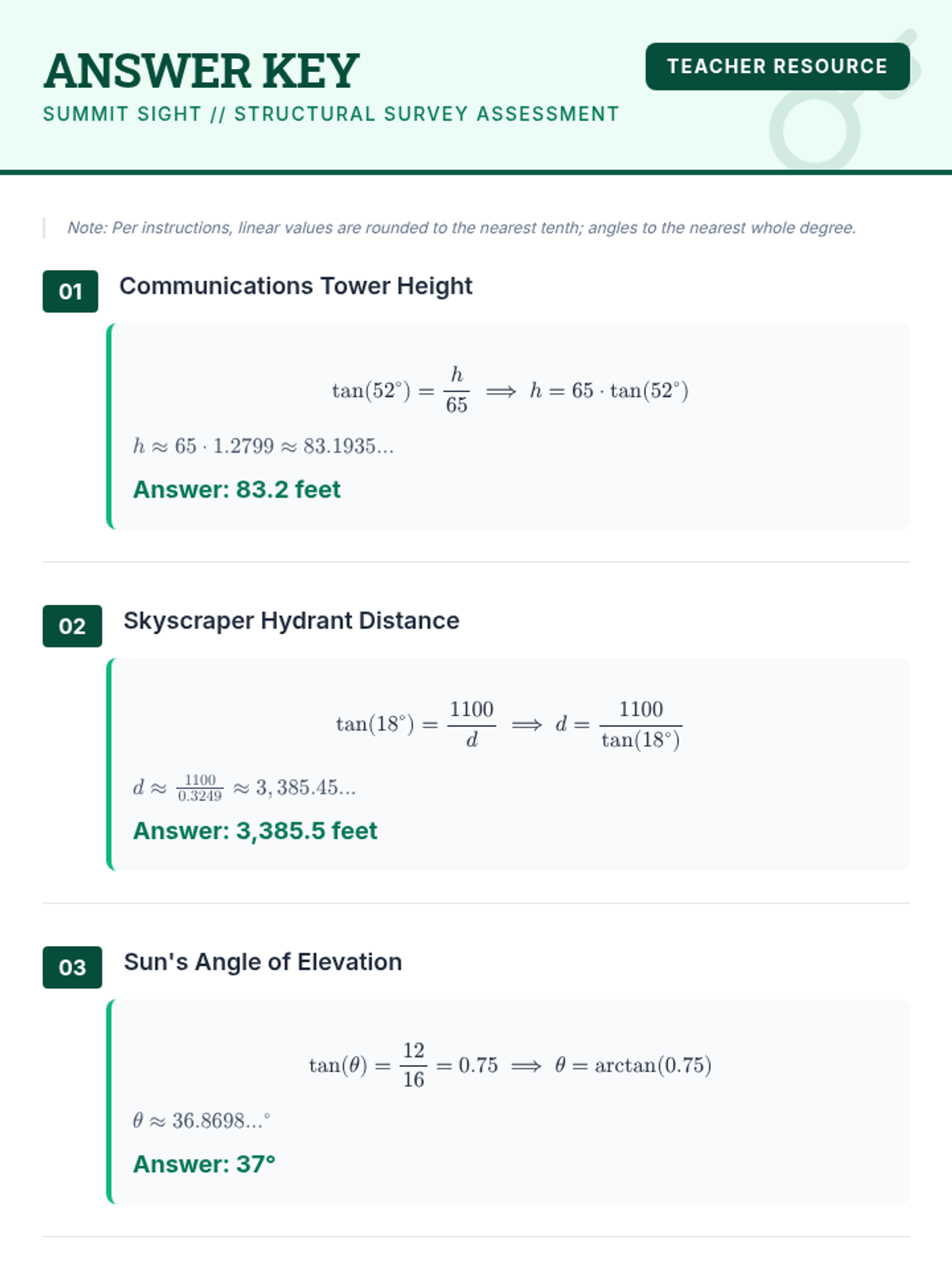
A detailed teacher answer key for the Summit Sight Quiz, including full trigonometric step-by-step solutions and final answers rounded to specified precision.
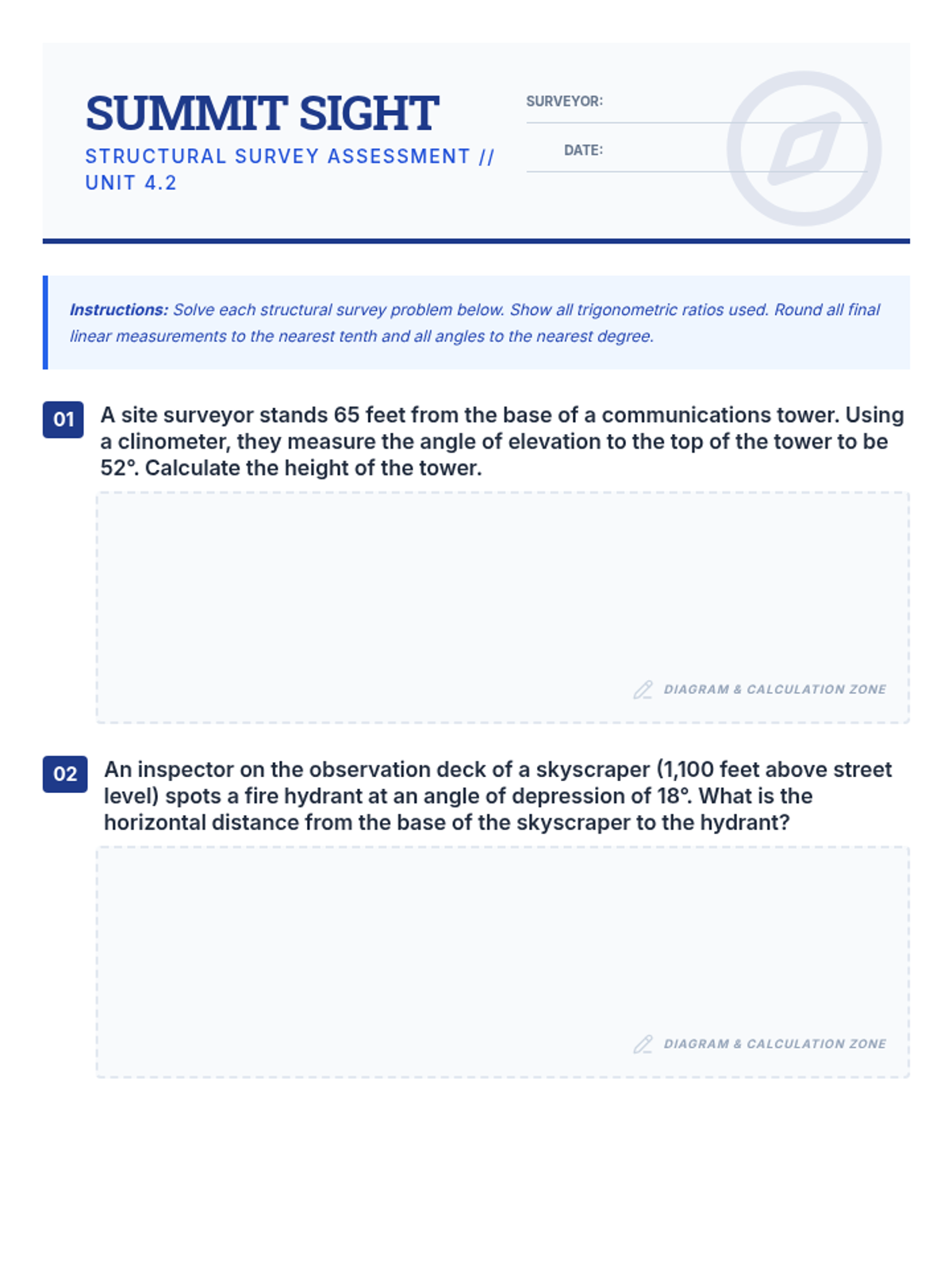
A 5-question printable assessment on the angle of elevation and depression, featuring a technical architectural drafting theme and ample workspace for calculations.
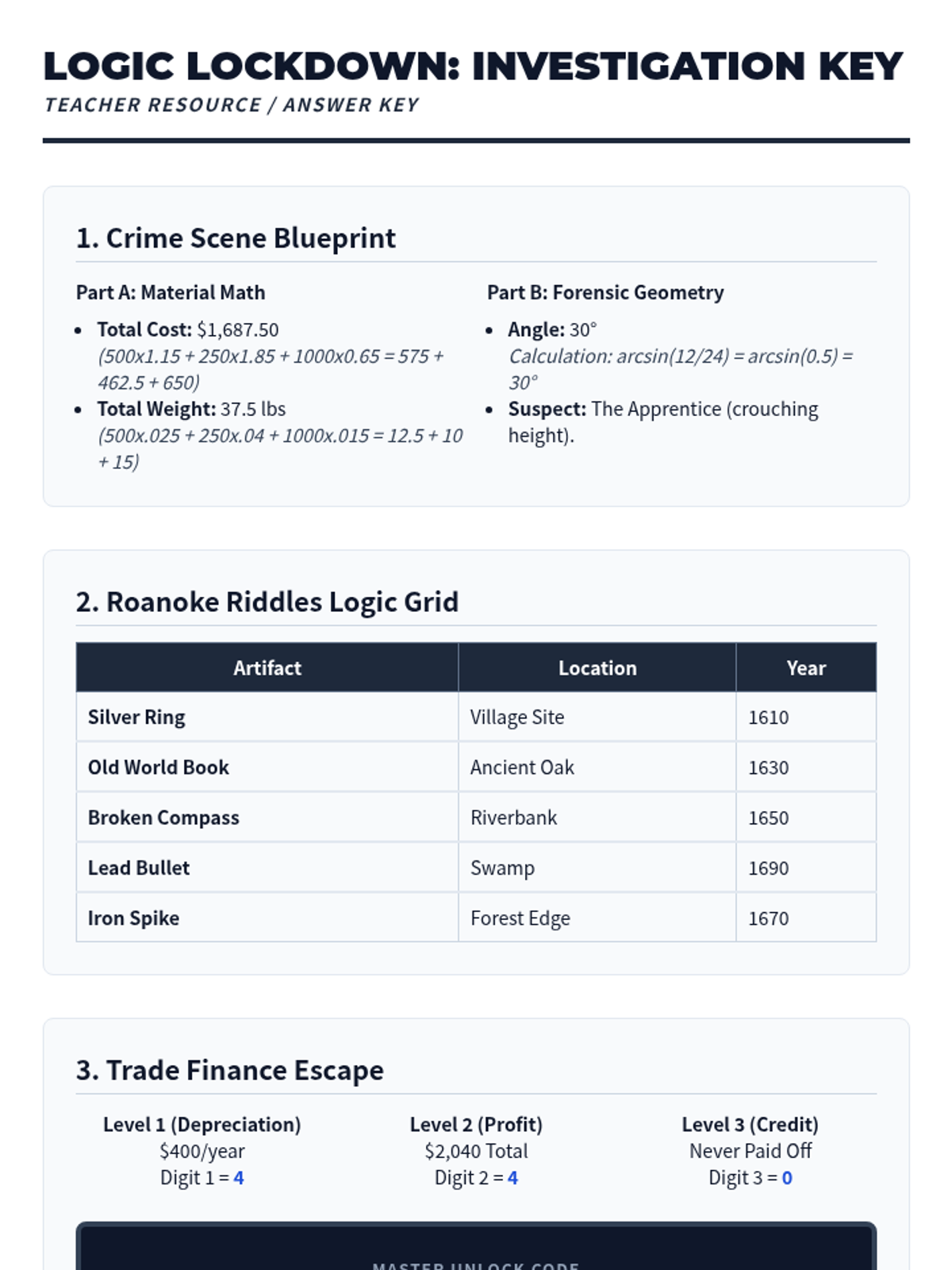
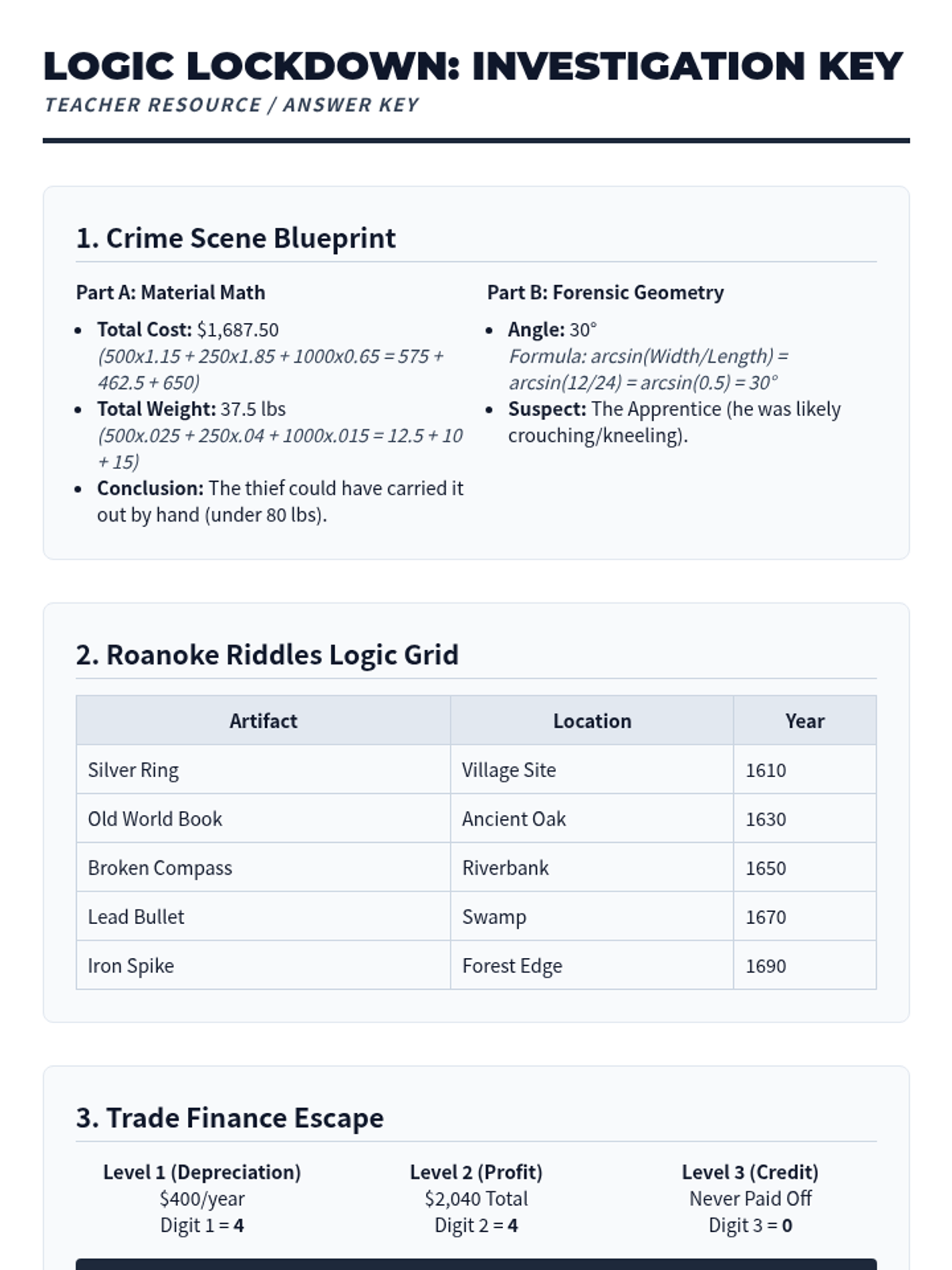
Complete answer key and logic walkthrough for the Logic Lockdown lesson. Revised for math clarity, contrast, and layout stability.
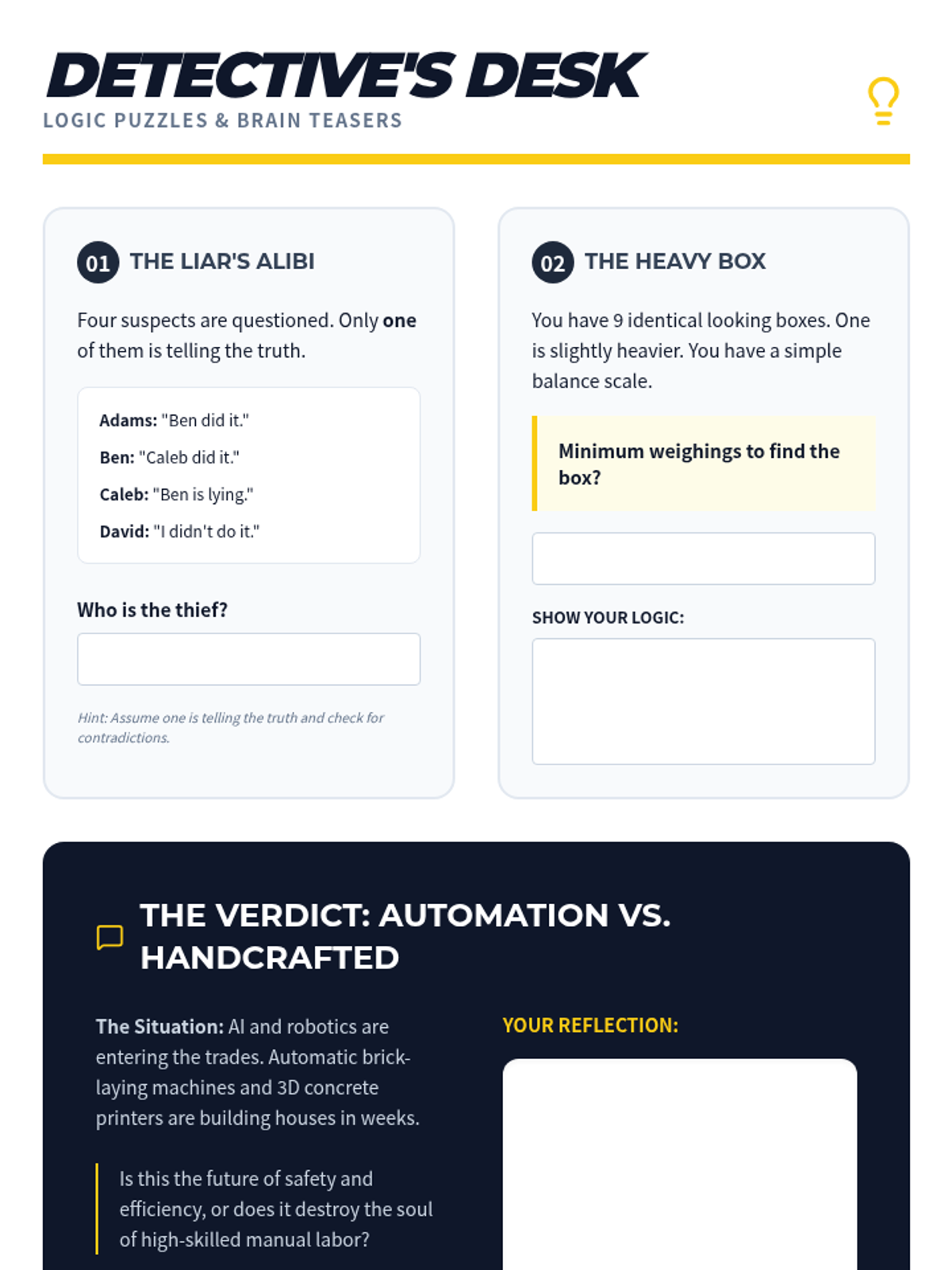
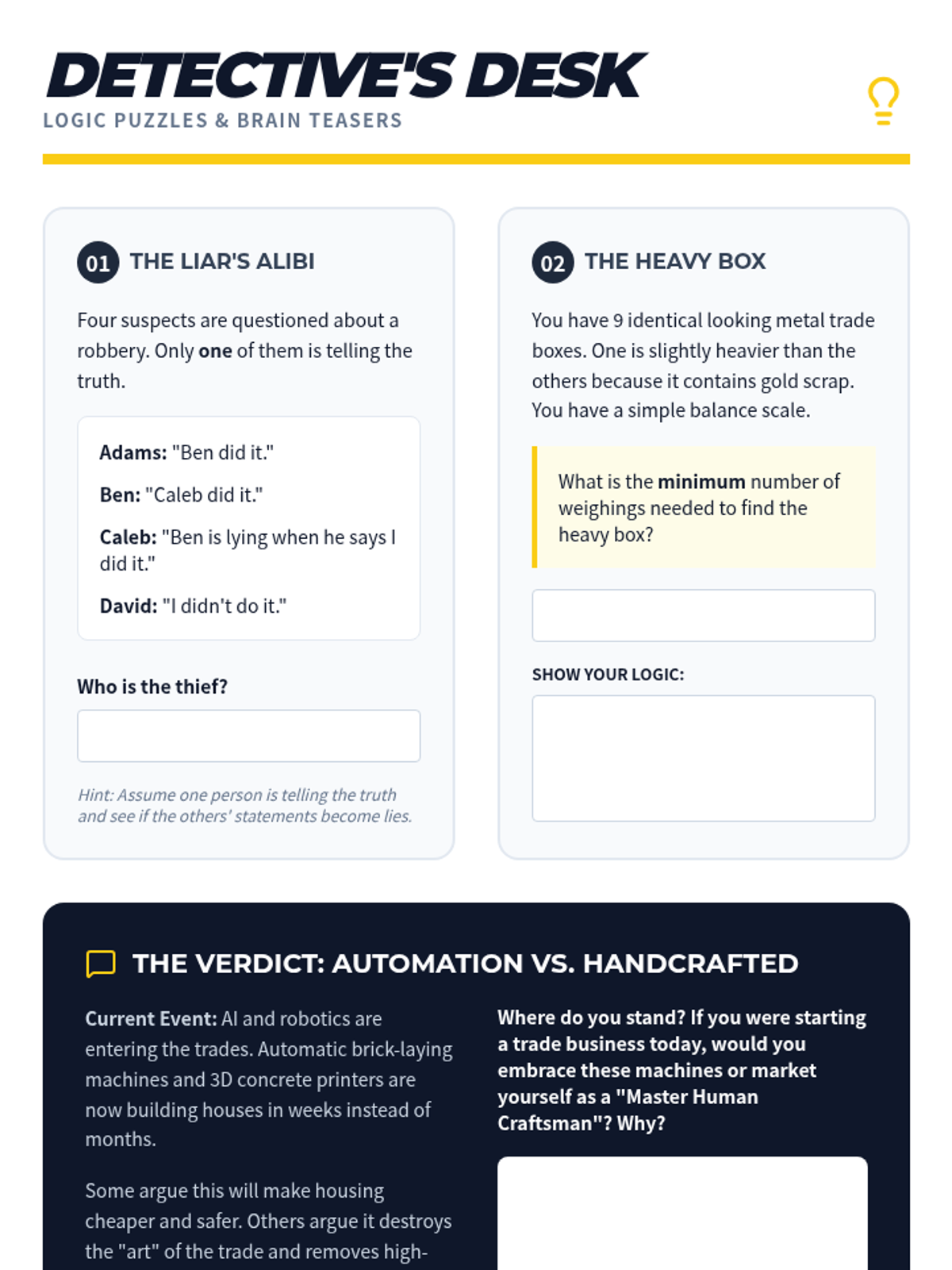
A collection of brain teasers and a critical thinking writing prompt focused on the trades. Revised to fix page breaks, syntax, and increase writing space.
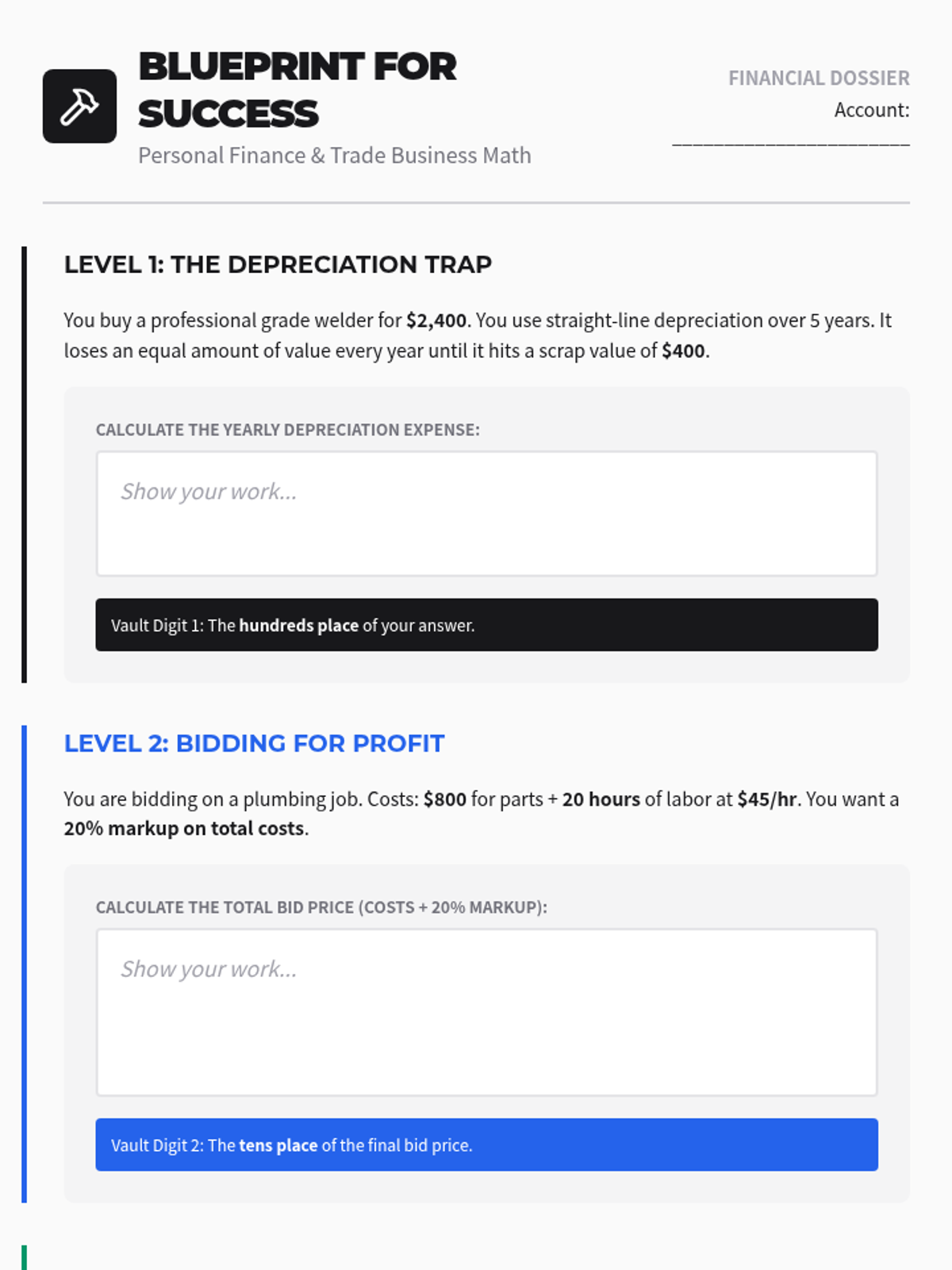
A math-based escape room activity. Revised to clarify "markup" terminology, fix answer choice styling, and ensure Level 2 stays together on one page.
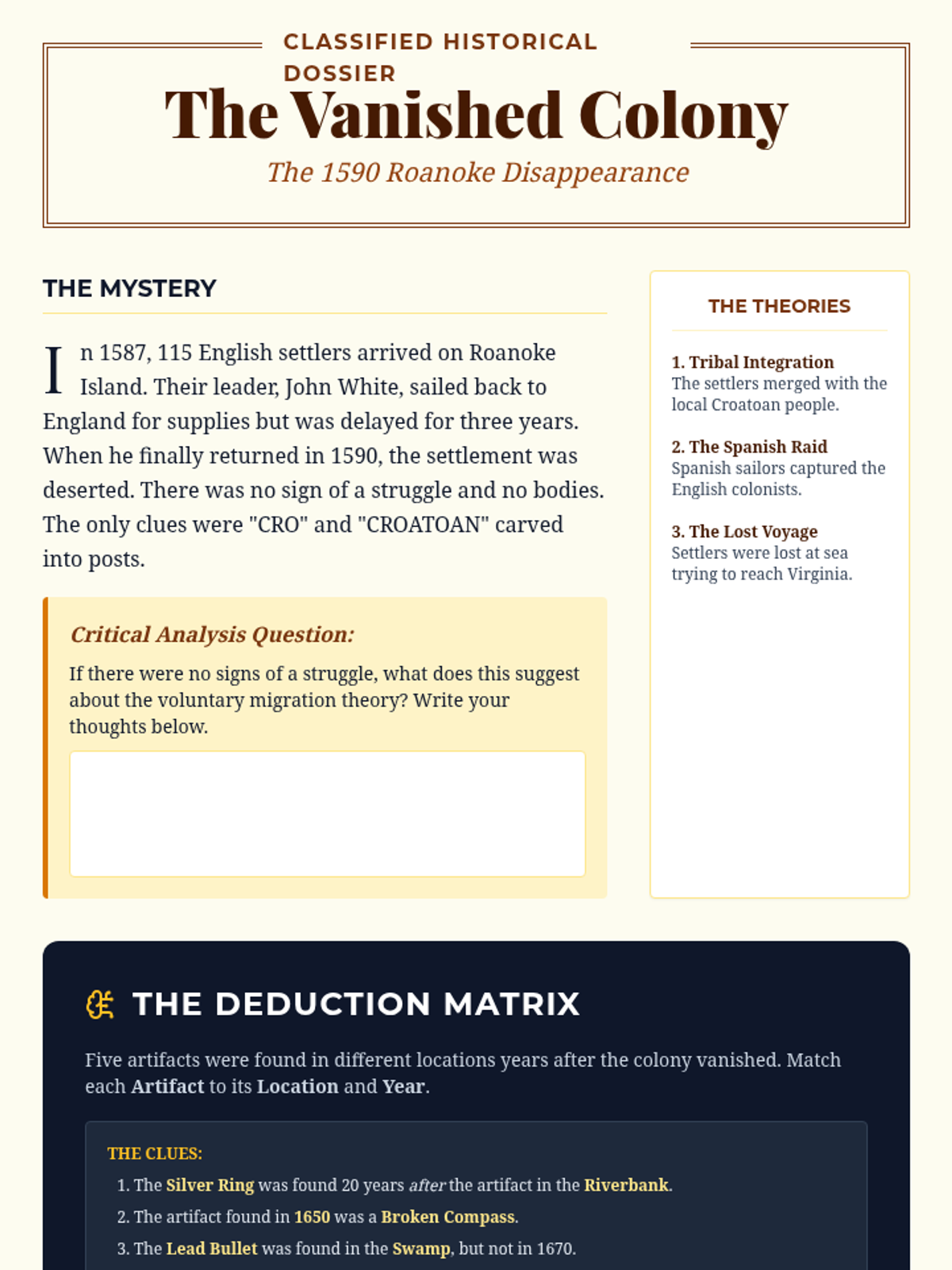
A reading comprehension and historical analysis document about the Roanoke colony, paired with a deductive logic puzzle. Revised to add a logic grid matrix and fix consistency.
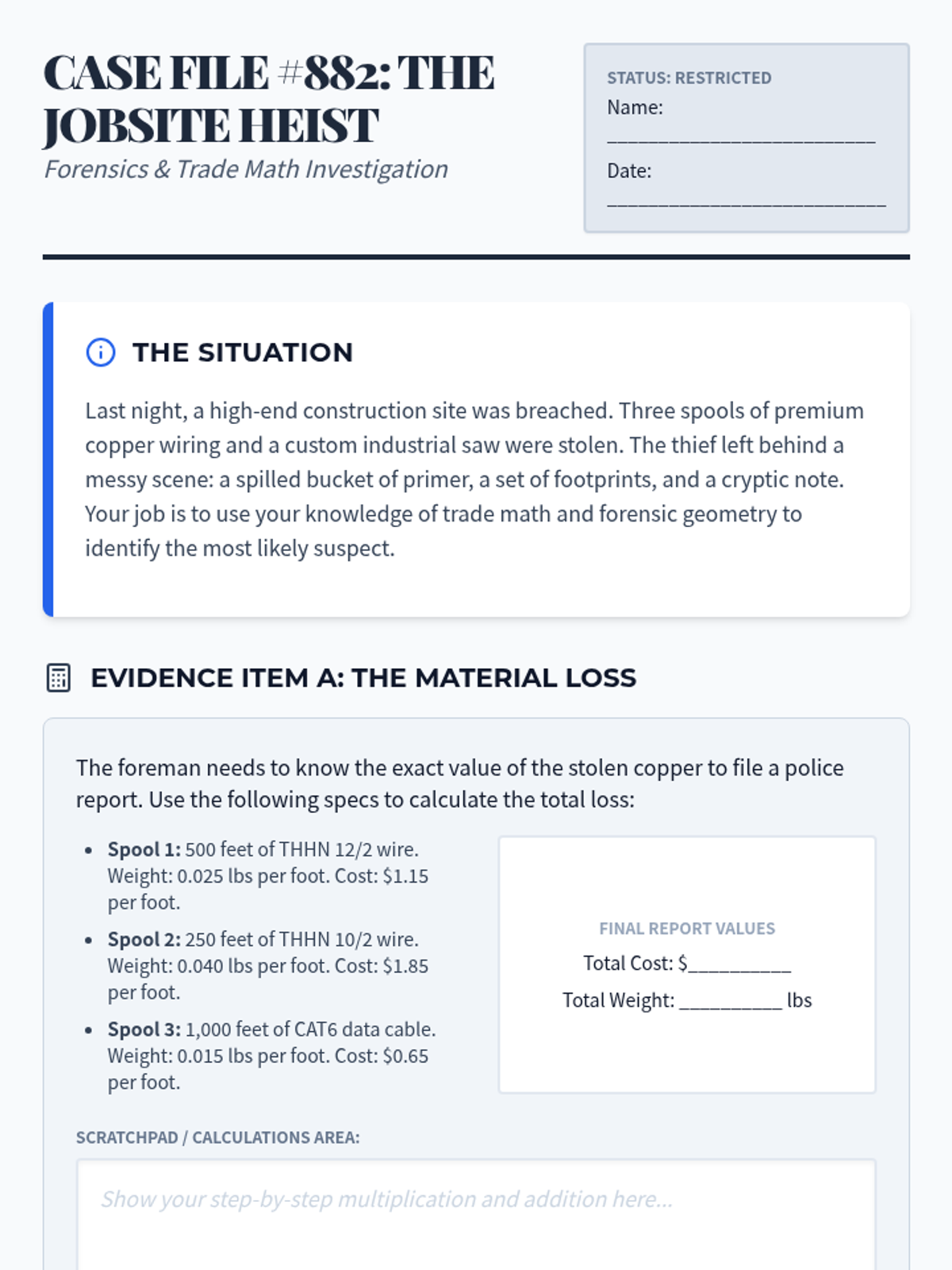
A forensic-themed worksheet that combines trade-based math (material cost and weight) with geometric spatter analysis to solve a construction site theft. Revised to fix calculations area and table layout.
Complete answer key and logic walkthrough for the Logic Lockdown lesson. Revised to fix LaTeX rendering, page breaks, and text contrast.
A collection of brain teasers and a critical thinking writing prompt focused on the trades. Revised to fix page breaks, syntax errors, and workspace sizing.
Answer key for the Segment Shards Worksheet, providing step-by-step logic summaries and final numerical answers.
A 3-page student worksheet containing 20 problems on calculating the area of a segment (sector minus triangle). Features sections for 90-degree and 60-degree angles, plus complex applications.
Answer key for the Sector Slice Worksheet, providing simplified pi forms and decimal answers for all 20 problems.
A 3-page worksheet with 20 problems on calculating the area of a sector, finding missing dimensions, and solving application problems. Features a precision drafting theme with emerald accents.
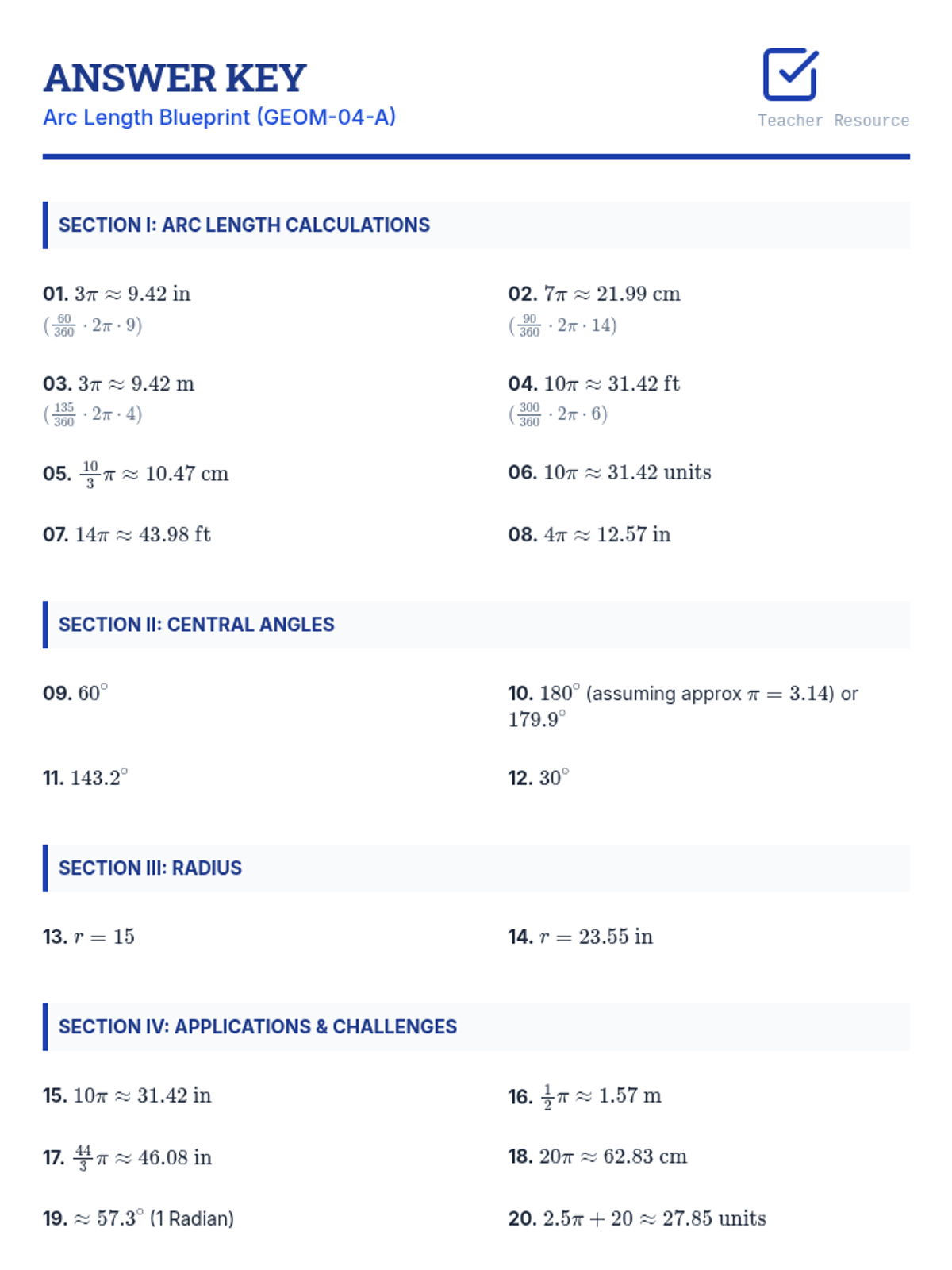
Answer key for the Arc Length Blueprint Worksheet, providing solutions in terms of pi and decimal approximations.
A 3-page student worksheet containing 20 problems on calculating arc length, central angles, and radii. Includes diagrams, text-based problems, and real-world applications in a precision drafting theme.
An 8-slide instructional presentation on arc length, sector area, and segment area using a precision drafting and blueprint theme. Features formulas, visual diagrams, and step-by-step examples.
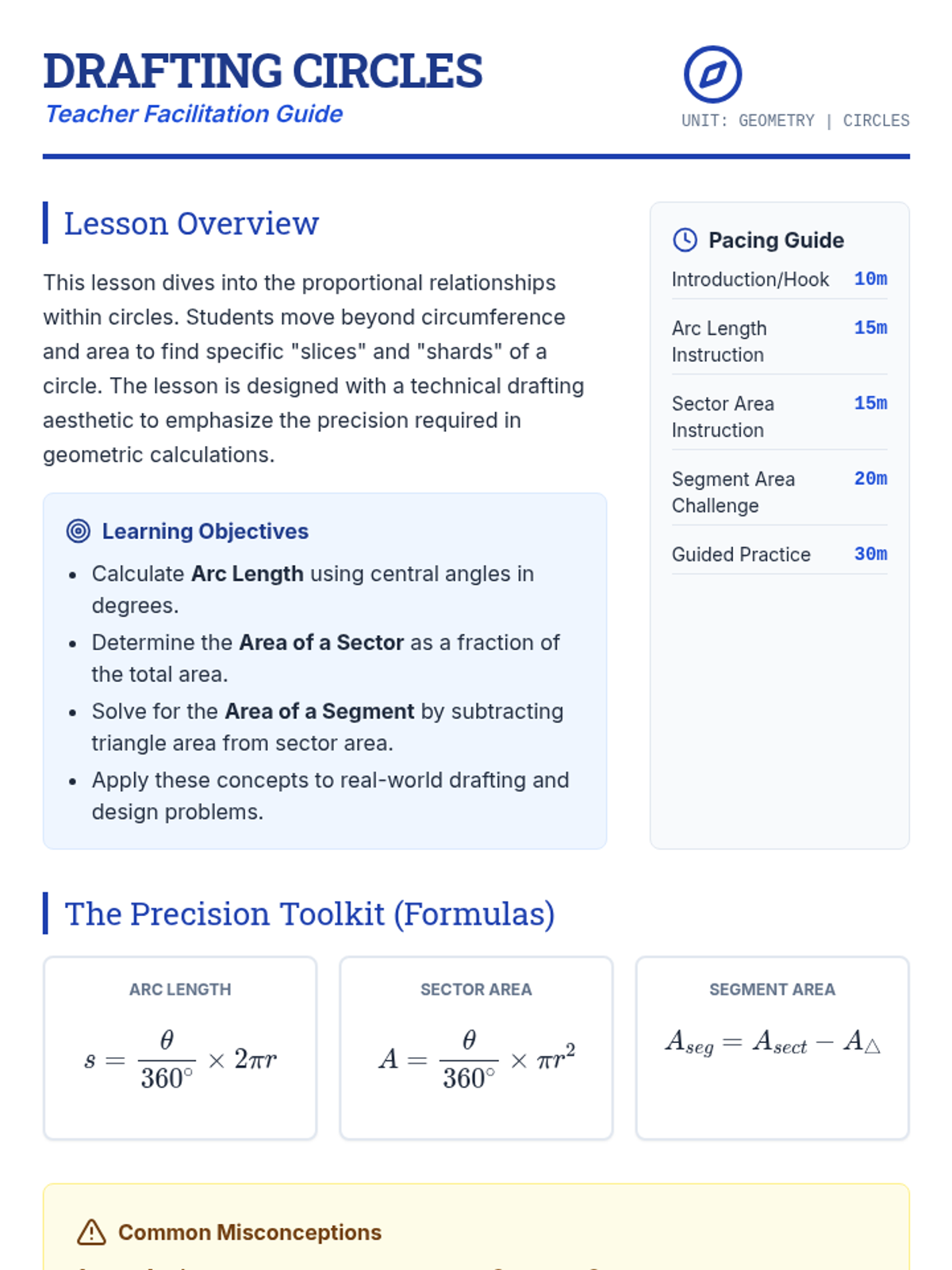
A 2-page teacher facilitation guide for a lesson on arc length, sector area, and segment area, featuring a precision drafting theme with pacing guides, formulas, and discussion prompts.
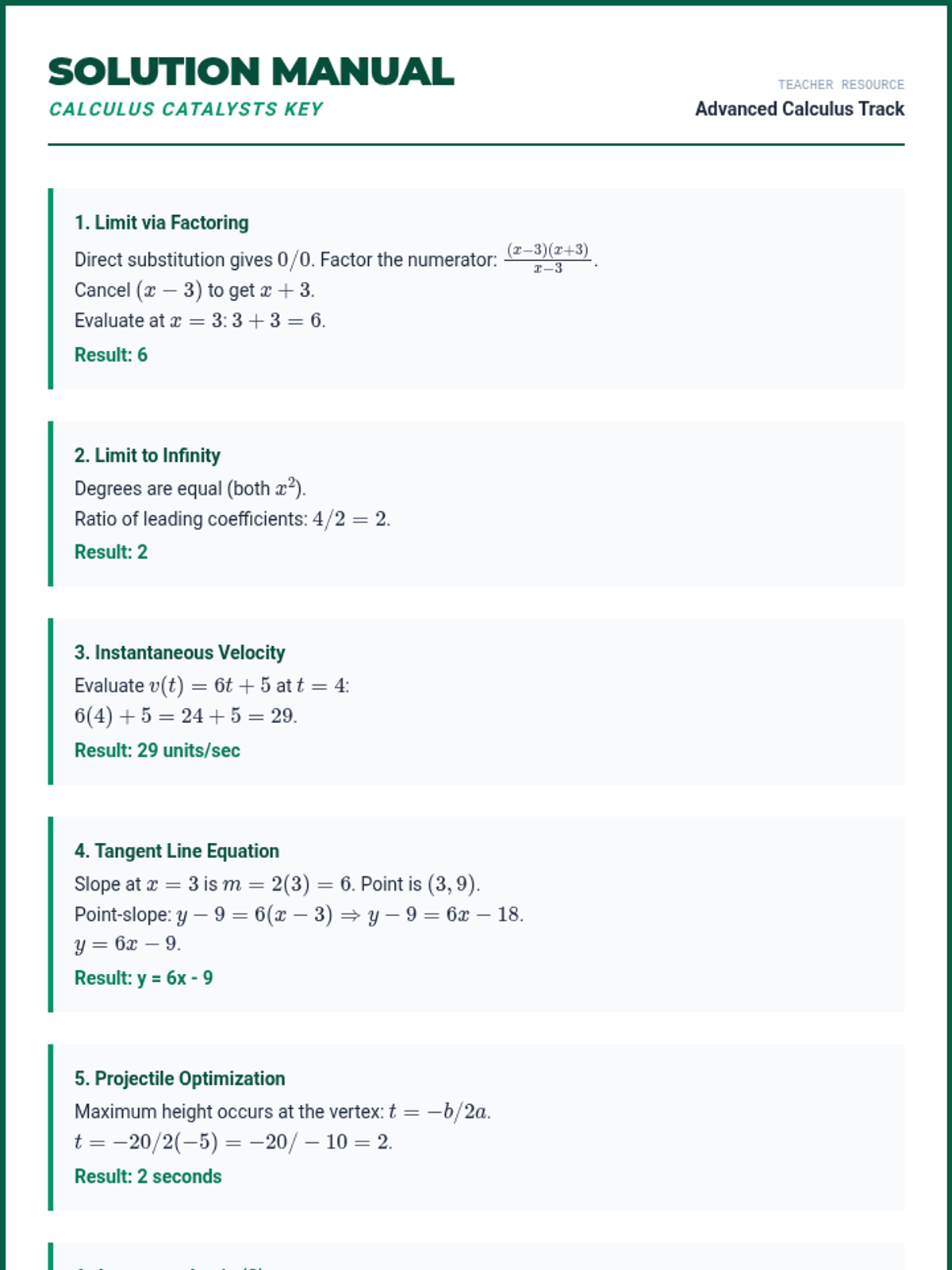
The detailed answer key for the Calculus Catalysts Workout, providing step-by-step solutions for limits, instantaneous rate of change, and basic function optimization problems.
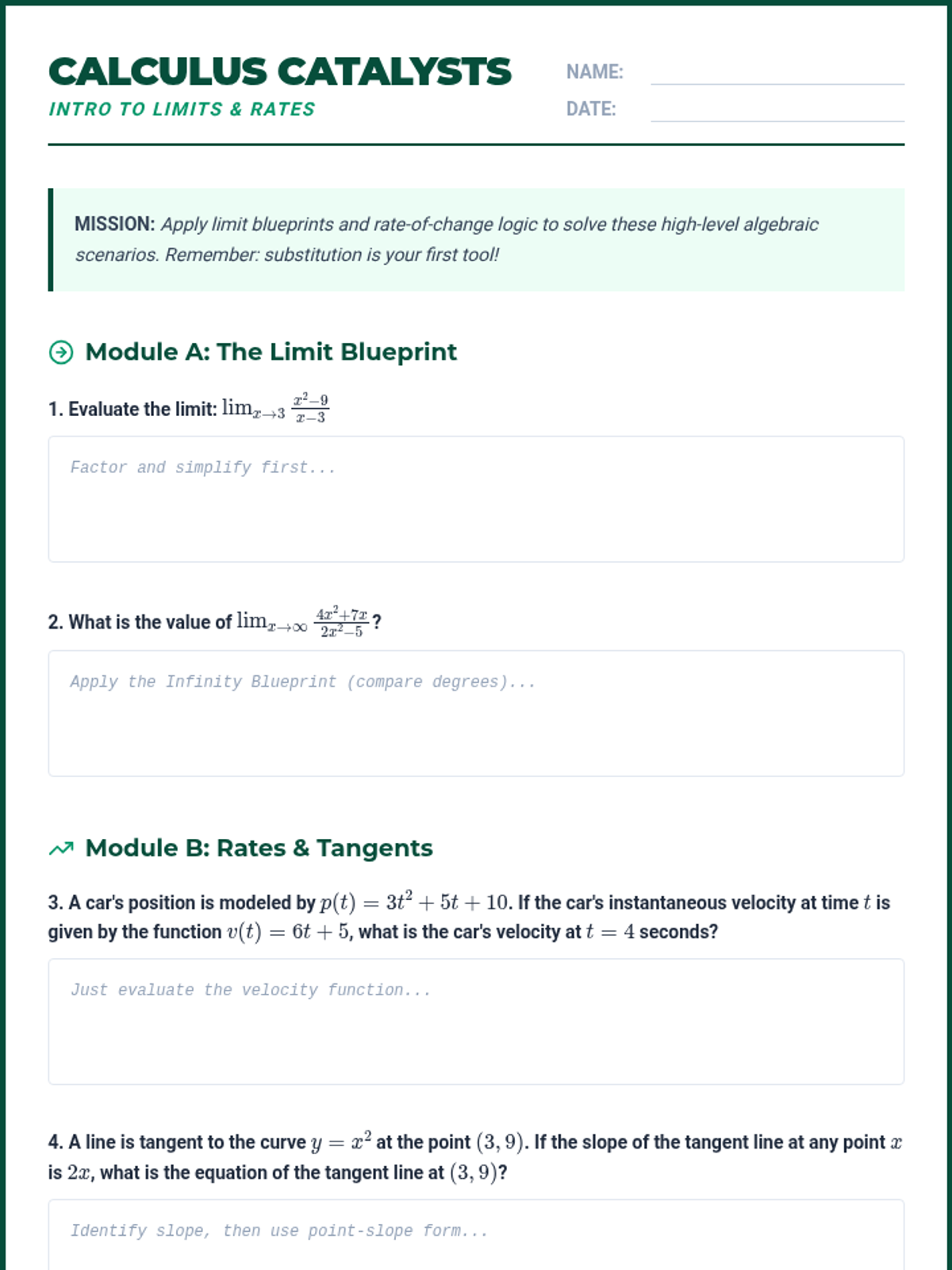
A student practice worksheet for calculus-adjacent ACT concepts, featuring limits, instantaneous rate of change logic, and function optimization problems.
A visual slide deck explaining introductory calculus concepts for the ACT, including limits, instantaneous rate of change, and basic function optimization using standard blueprints. Revised for font size compliance (min 24px).
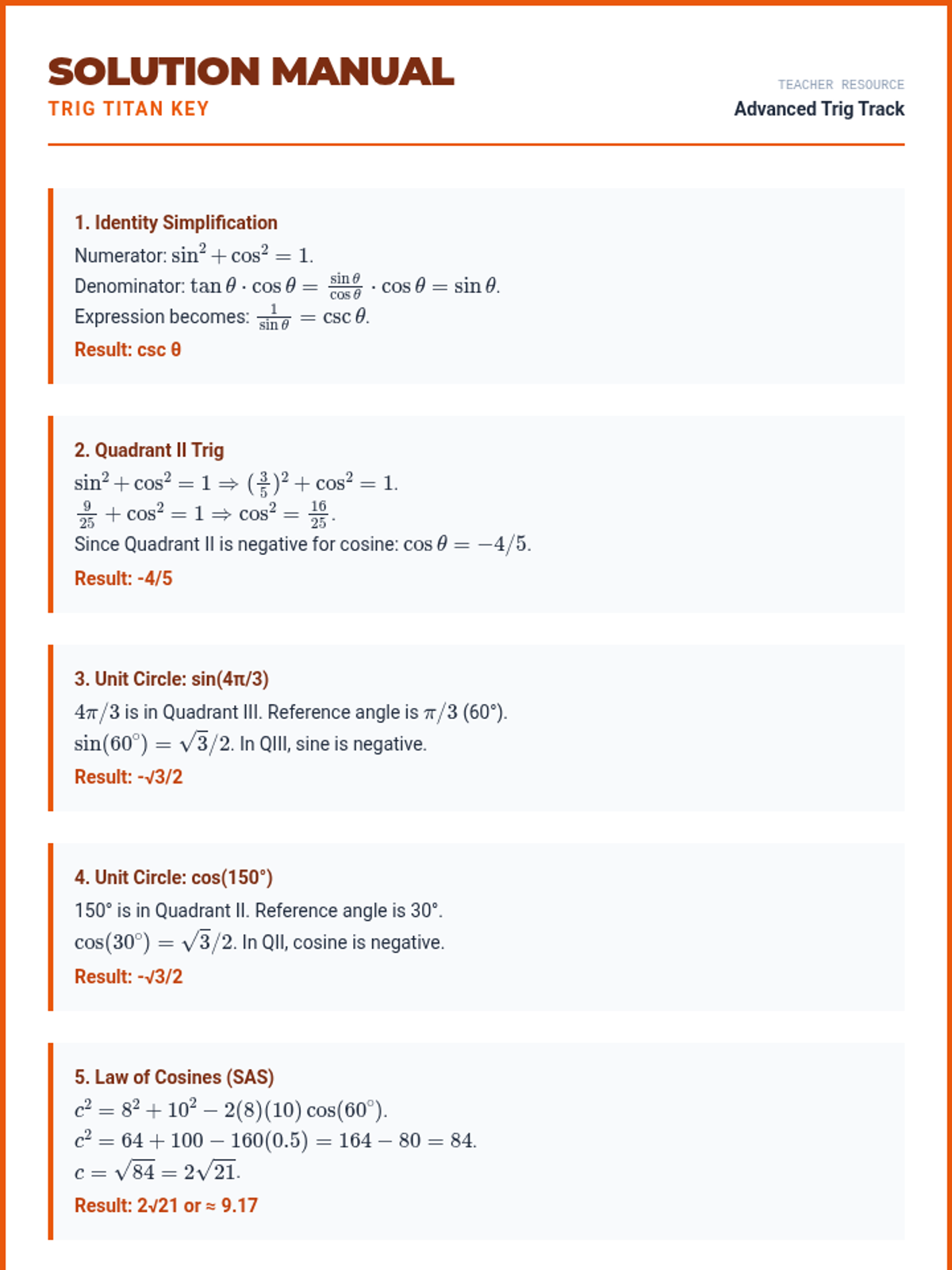
The detailed answer key for the Trig Titan Workout, including step-by-step solutions for identities, the unit circle, and non-right triangle problems.
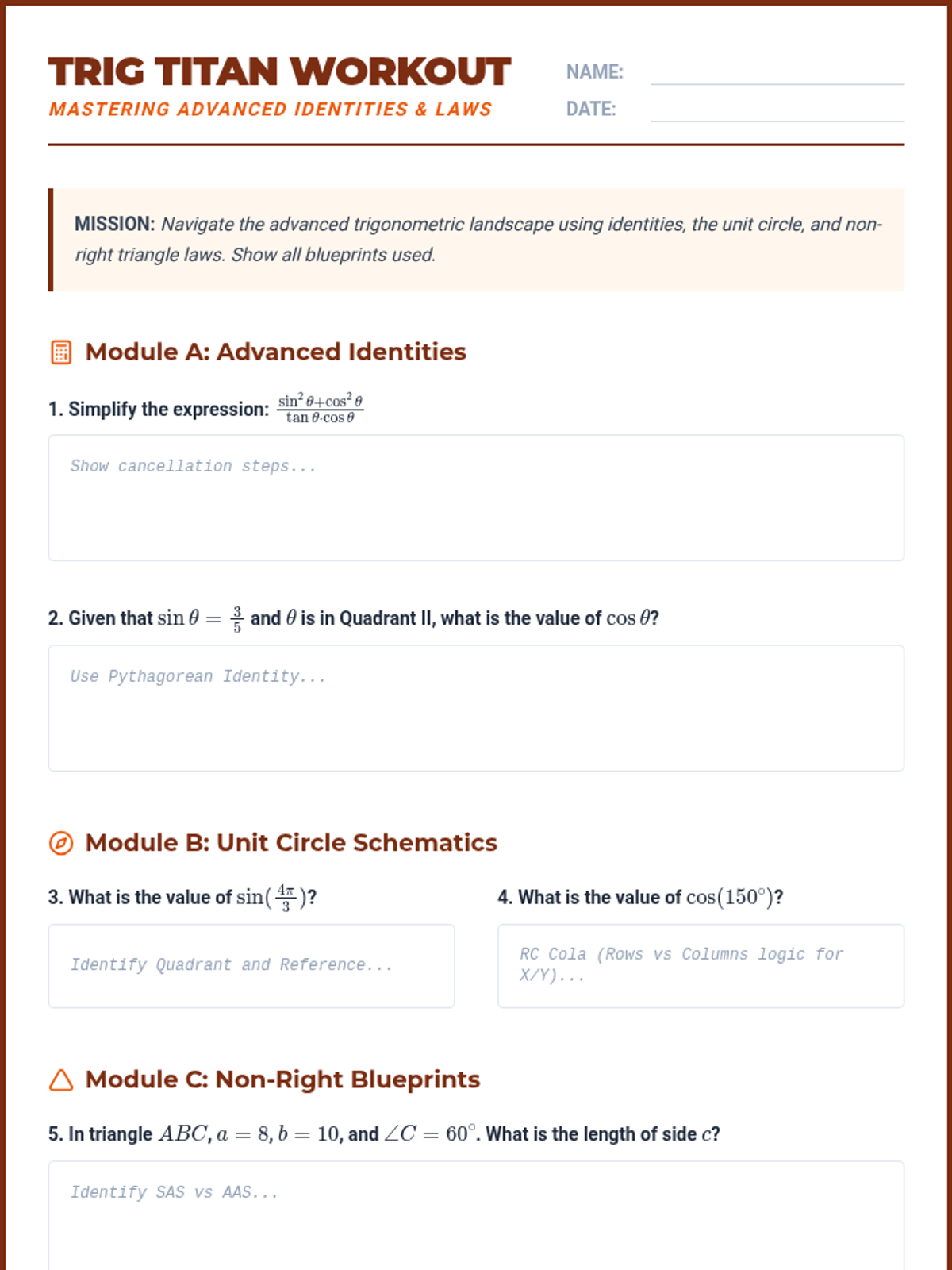
A comprehensive practice worksheet for advanced ACT trigonometry, featuring sections on identities, the unit circle, Law of Sines/Cosines, and 'Final Ten' challenge problems.
A visual slide deck covering advanced ACT trigonometry: Pythagorean identities, the unit circle, Law of Sines/Cosines, and the ambiguous SSA case. Revised for font size compliance (min 24px).
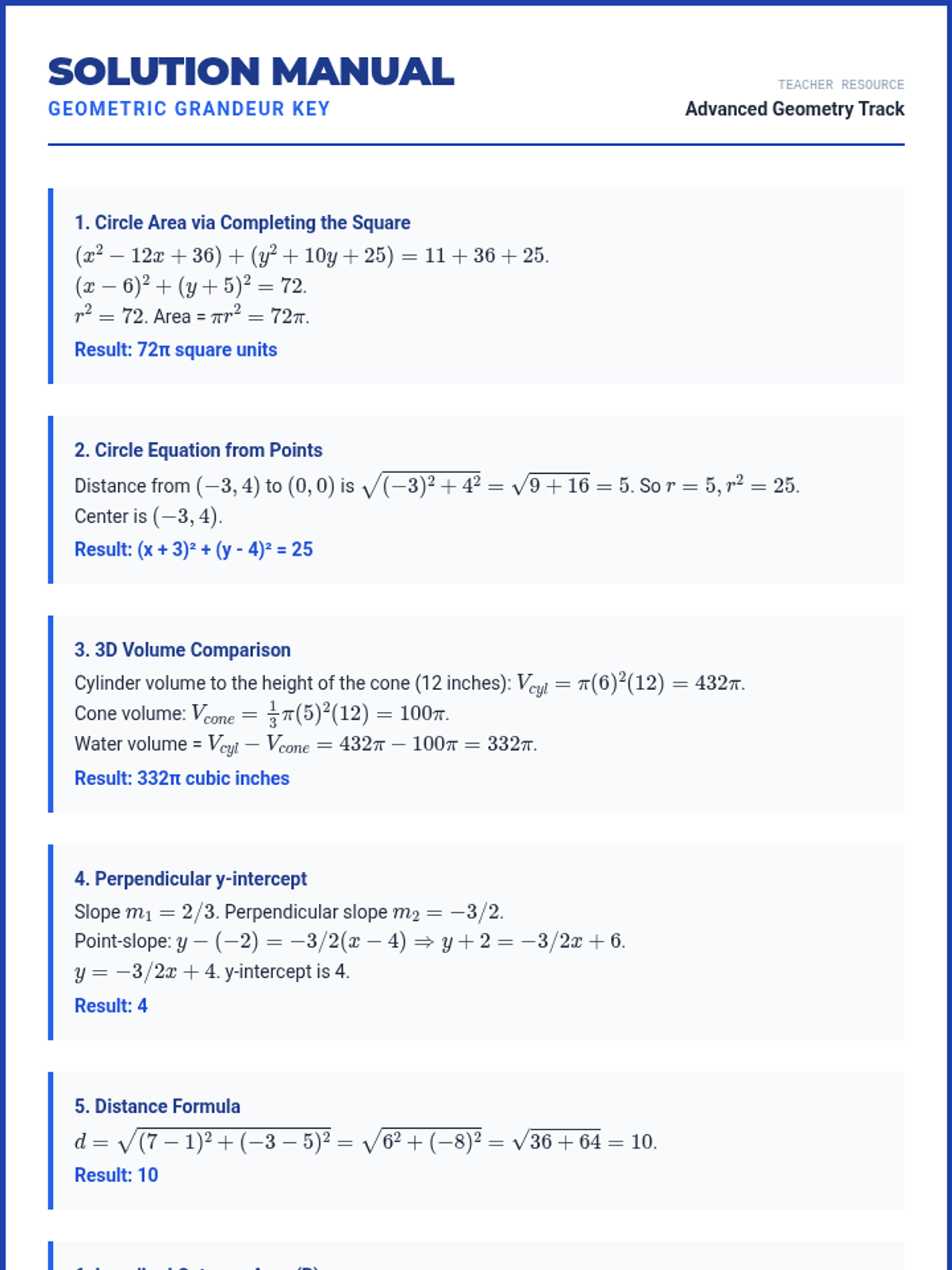
The detailed answer key for the Geometric Grandeur Workout, providing step-by-step solutions for circle equations, 3D volume, and coordinate geometry problems.
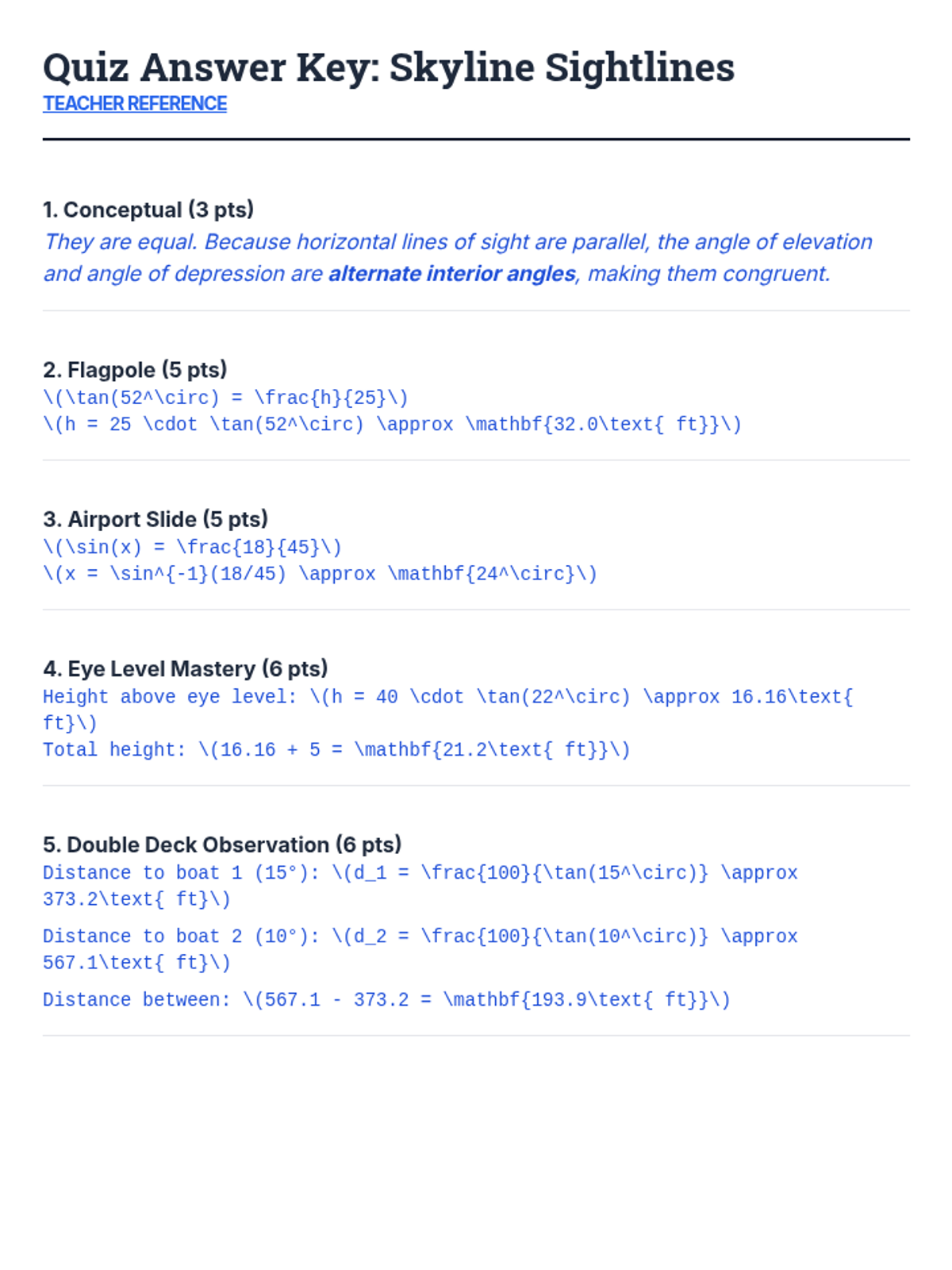
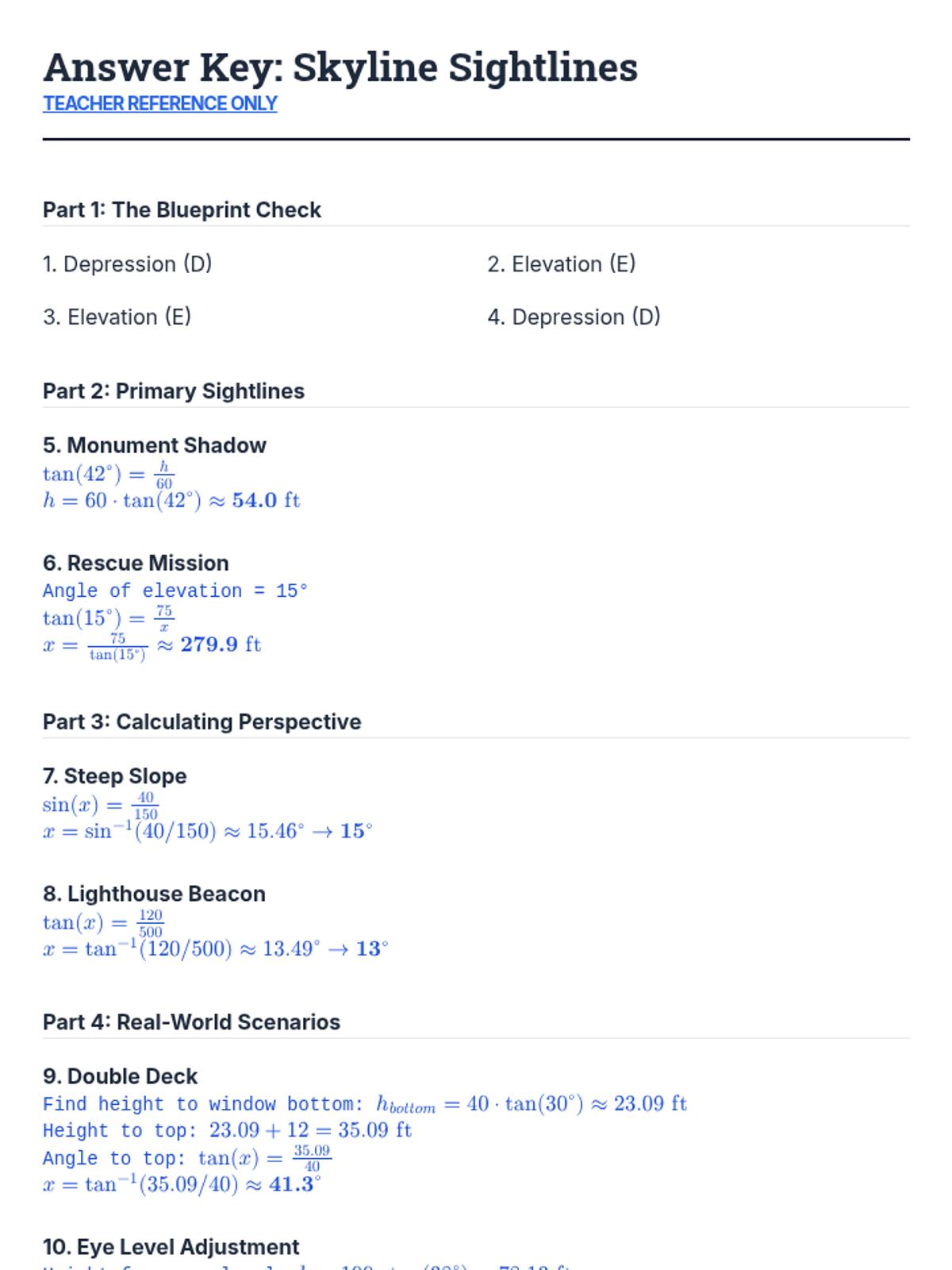
A teacher's answer key for the Skyline Sightlines Quiz, providing final numerical answers and step-by-step trigonometric solutions.
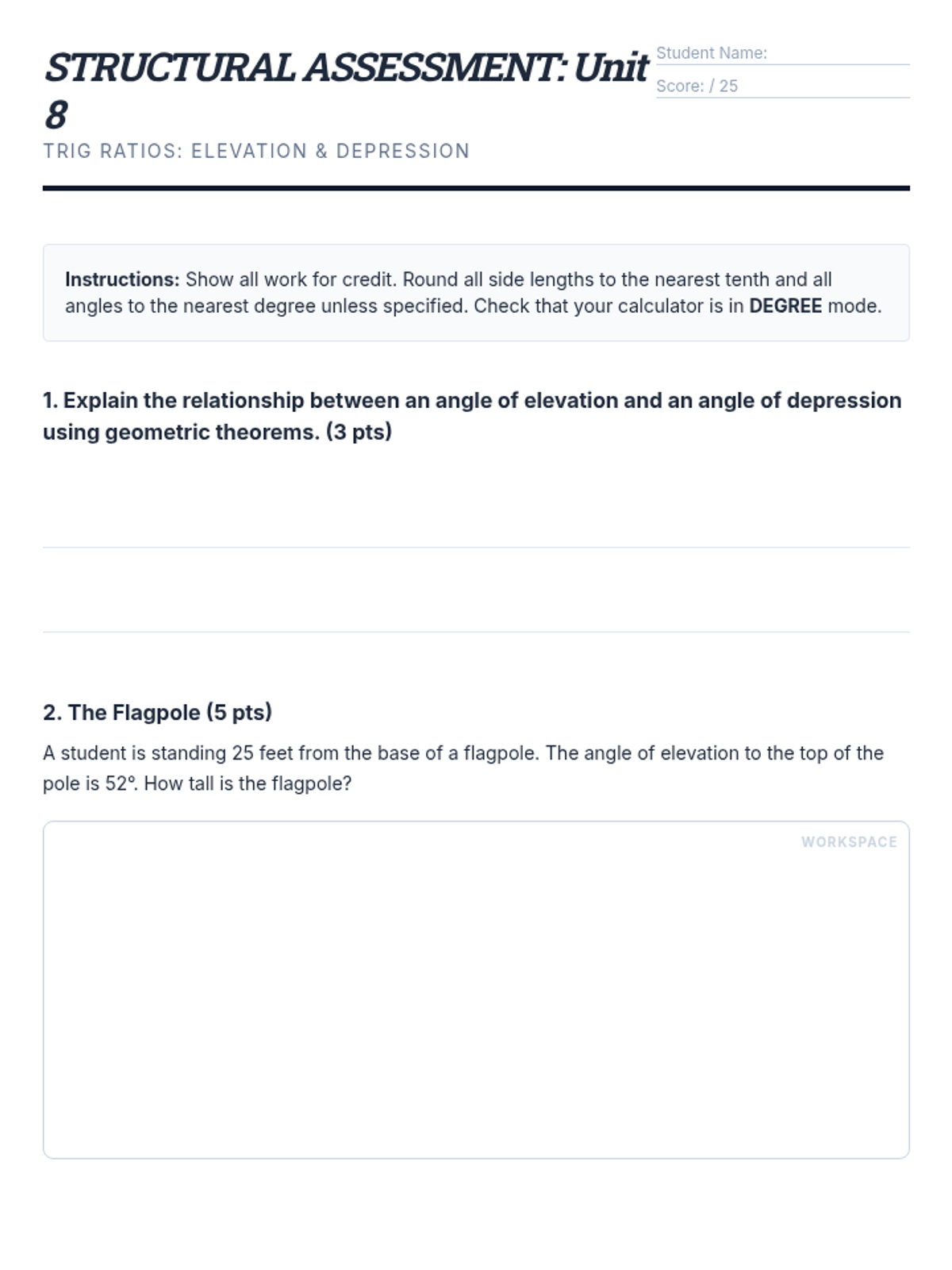
A summative assessment covering angle of elevation and depression, including conceptual explanations, basic trig ratios, and multi-step word problems.
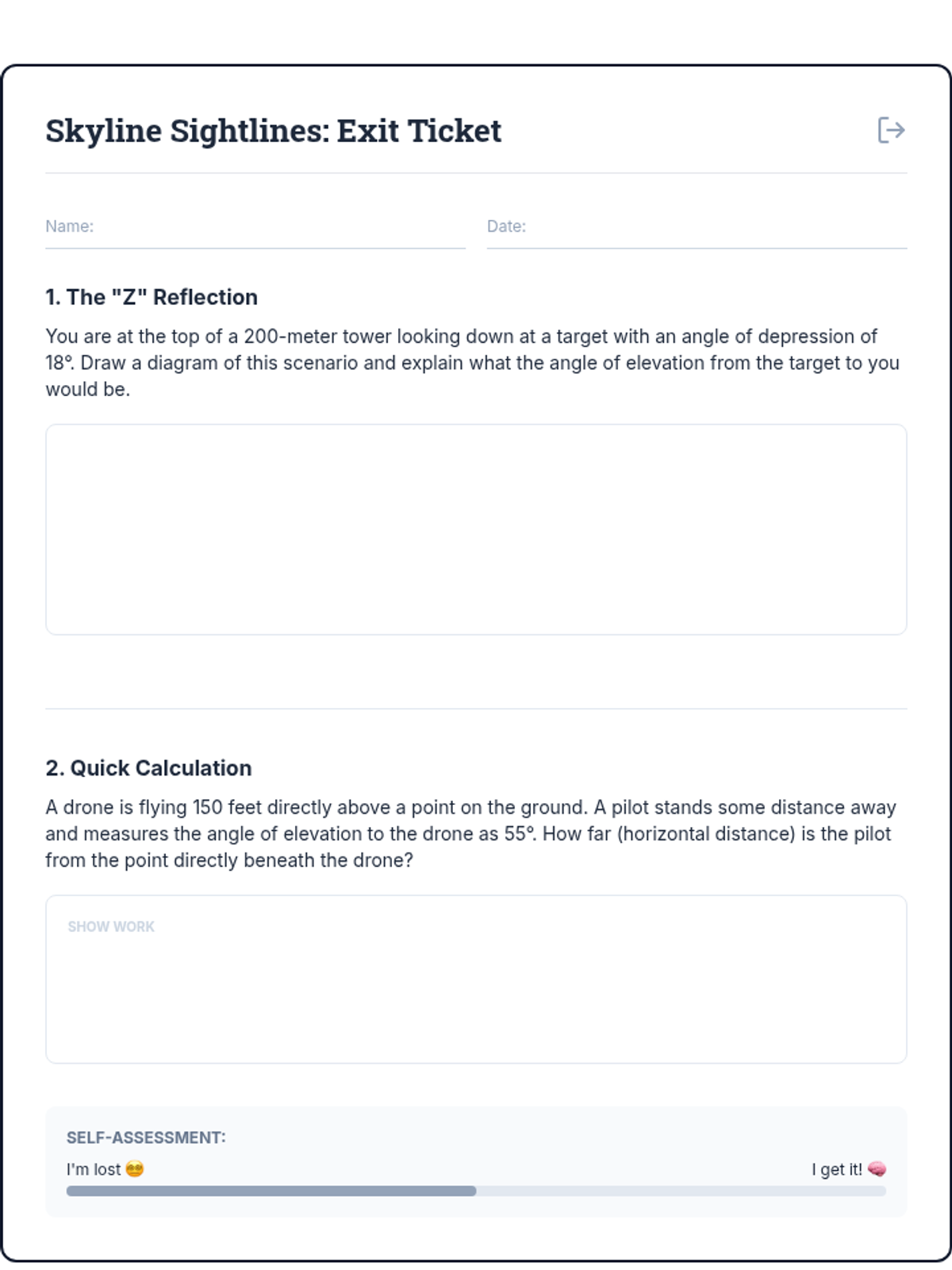
A quick assessment for the end of the lesson, featuring one diagram/concept question and one calculation problem to gauge student understanding of angles of elevation and depression.
A teacher's solution guide for the advanced challenge problems, providing step-by-step algebraic systems and substitution methods for finding heights and distances.
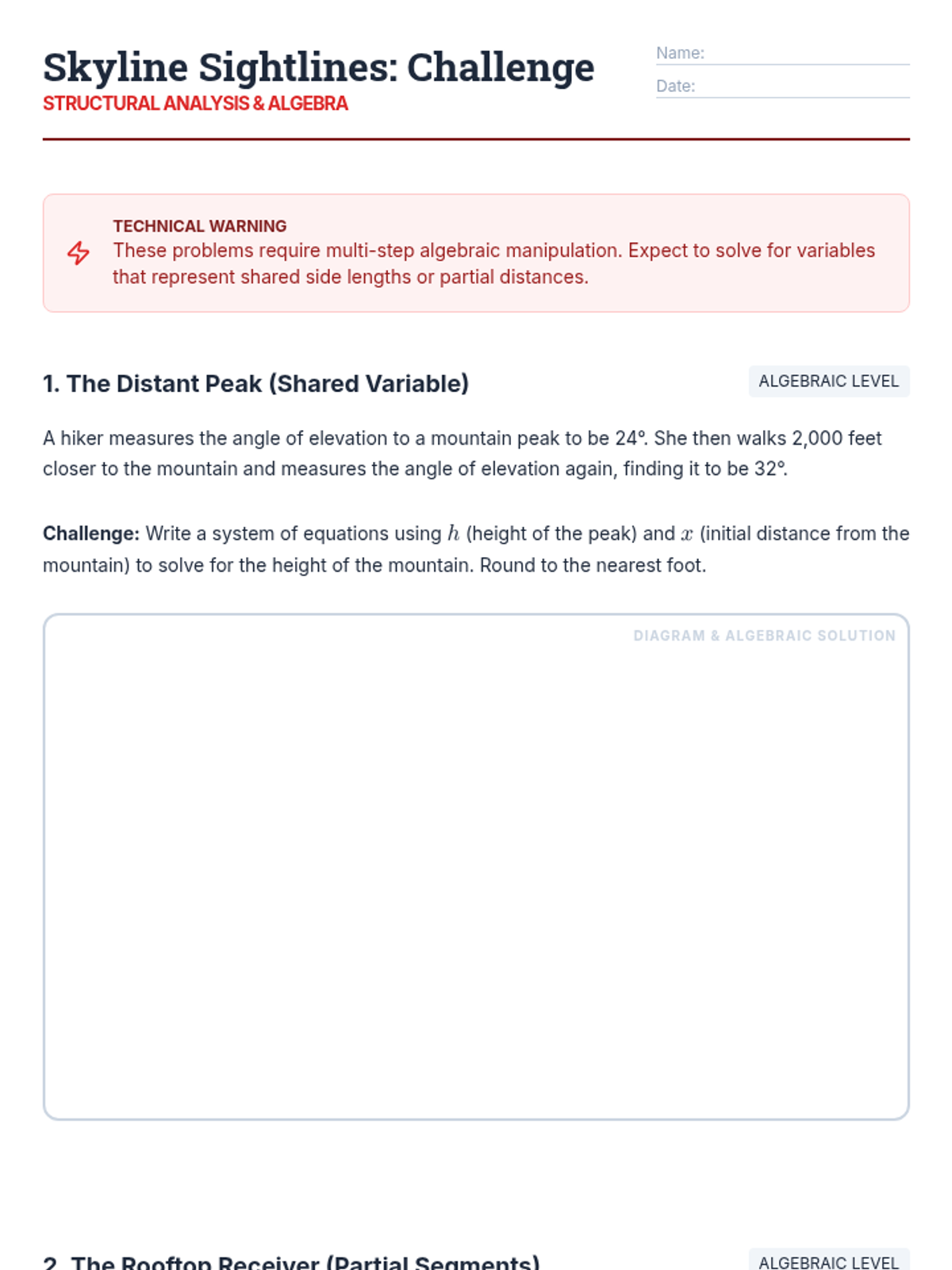
An advanced set of word problems requiring students to use algebraic systems and multi-step trigonometric solutions for complex elevation and depression scenarios.
A detailed teacher's answer key for the Skyline Sightlines Practice Worksheet, including step-by-step trigonometric equations and final rounded answers.
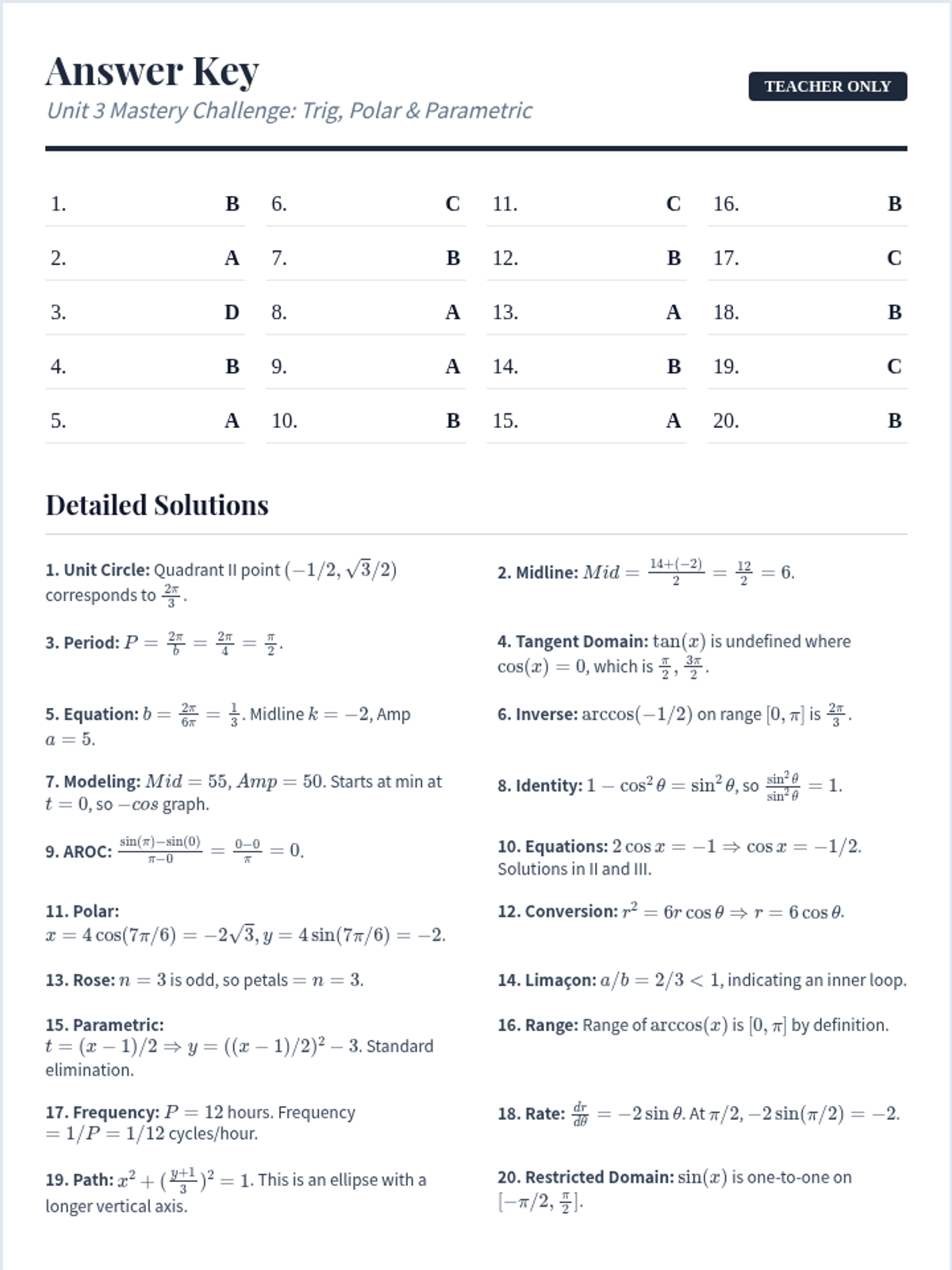
The answer key for the Unit 3 Mastery Challenge, featuring a quick-glance table and detailed explanations for all 20 questions.
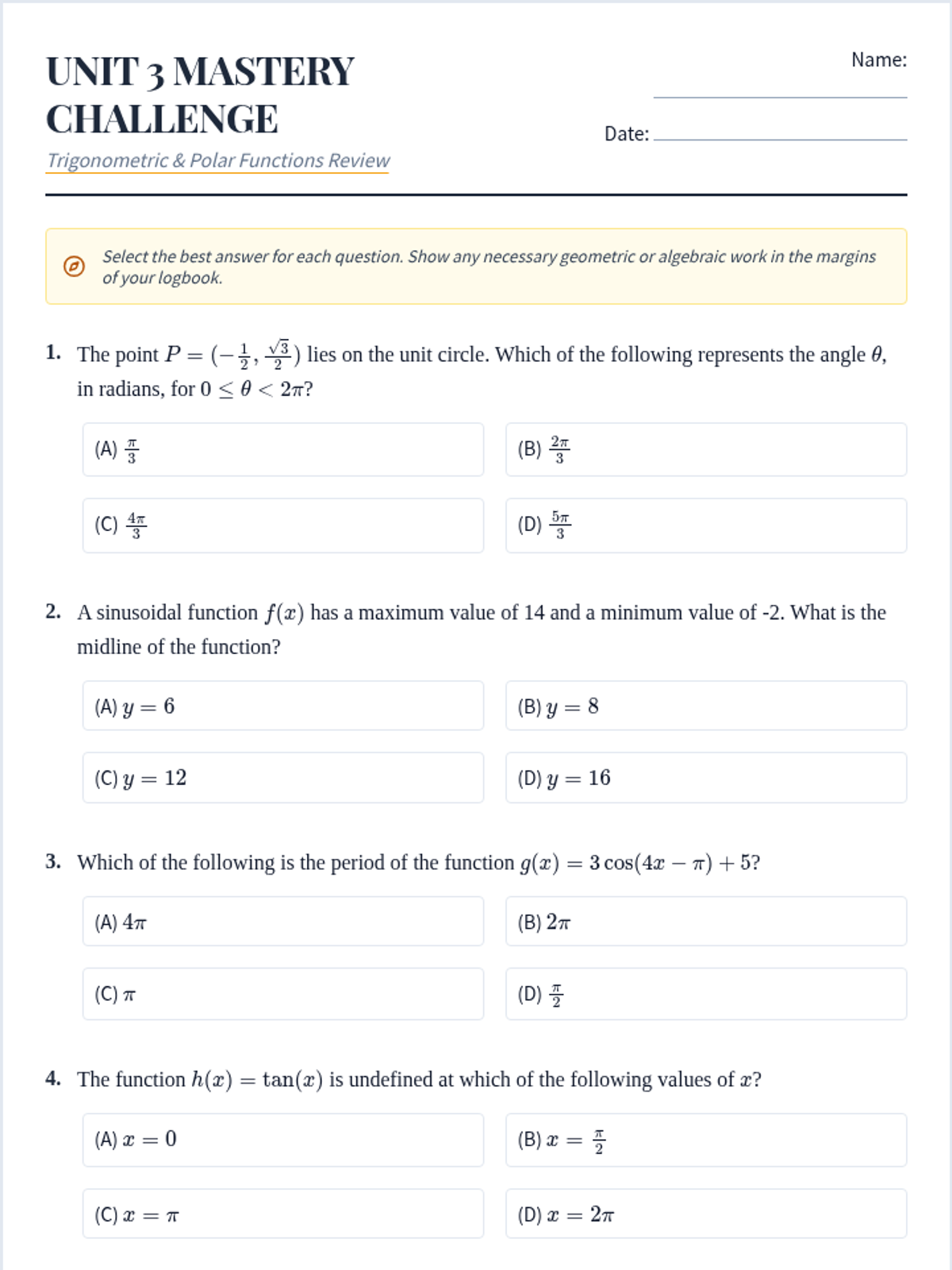
A 20-question multiple-choice assessment covering all Unit 3 topics including sinusoidal functions, inverse trigonometry, polar coordinates, and parametric functions. Designed with a nautical explorer theme and ample space for calculations.
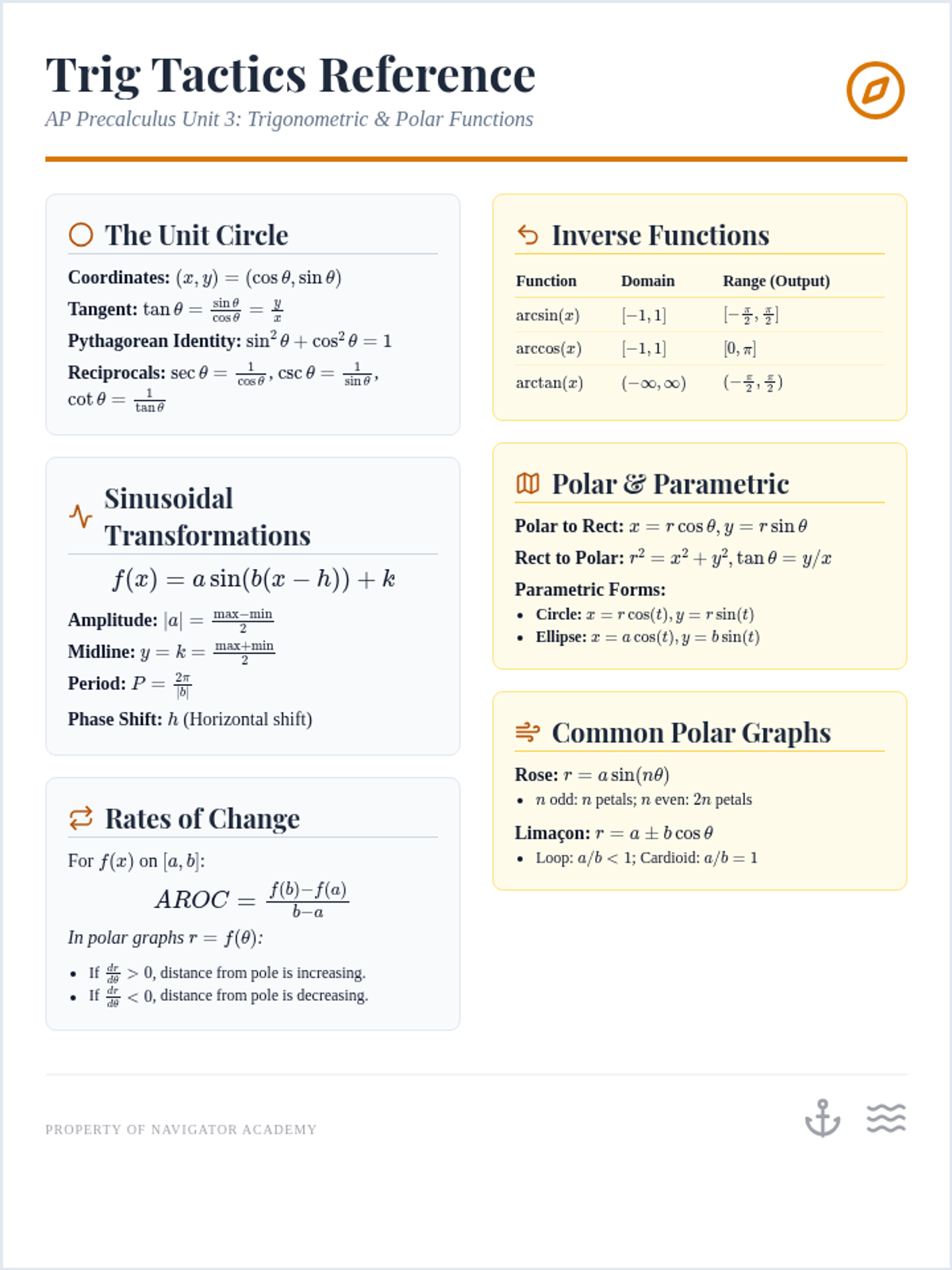
A concise one-page reference sheet covering the essential concepts of AP Precalculus Unit 3, including unit circle properties, sinusoidal transformations, inverse functions, polar coordinates, and parametric functions.
Introductory presentation for students on using the Desmos graphing calculator for the Digital SAT. Includes strategies for systems, key features of functions, statistical lists, and function transformations.
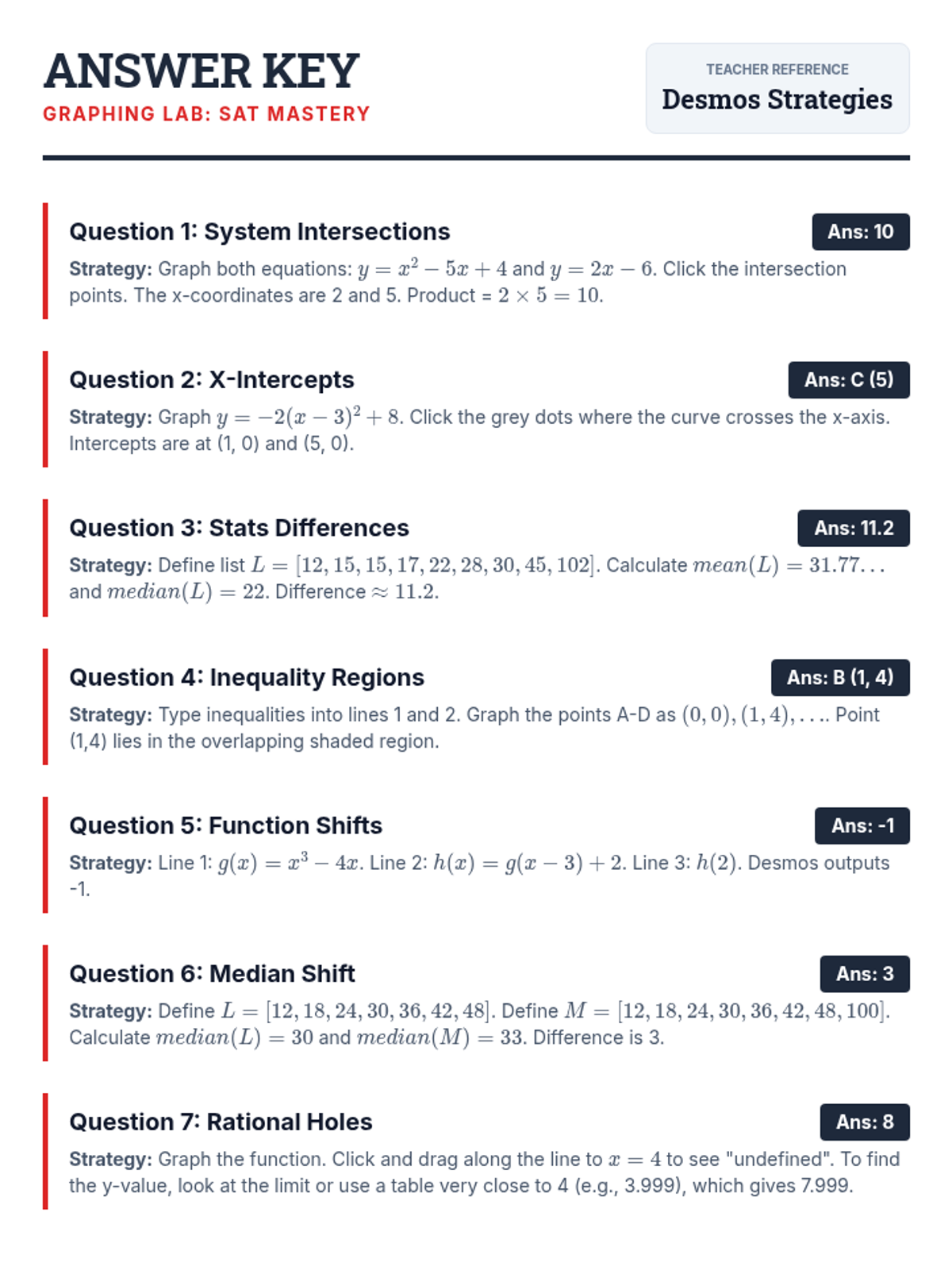
Updated Teacher answer key for the Graphing Lab Worksheet, providing both the correct answers and specific Desmos calculator strategies for the new Question 1.
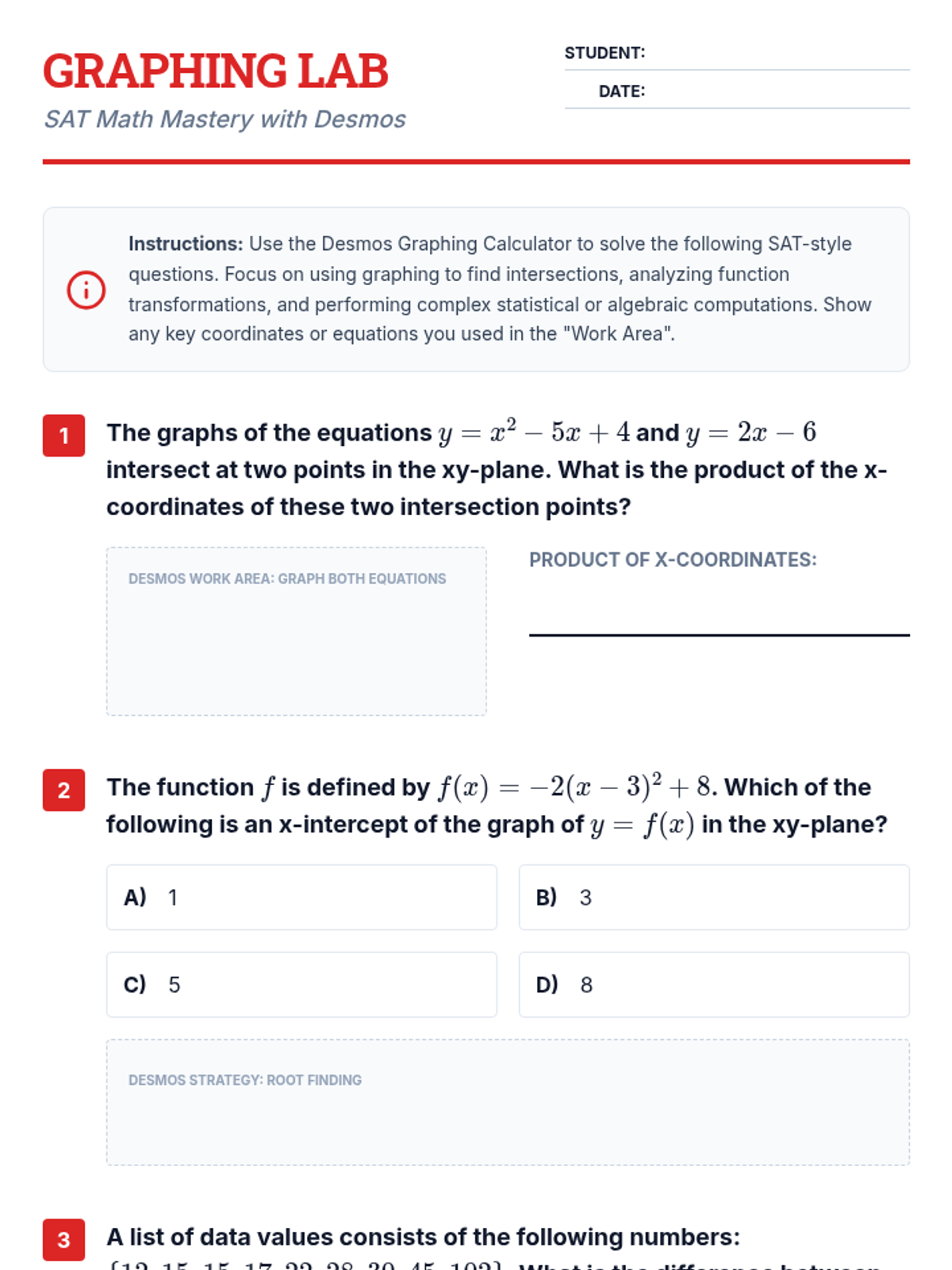
Updated 10-question SAT Math worksheet with new Question 1 focused on system intersections of parabolas and lines. Covers Heart of Algebra, Problem Solving, and Passport to Advanced Math with space for Desmos-specific work.
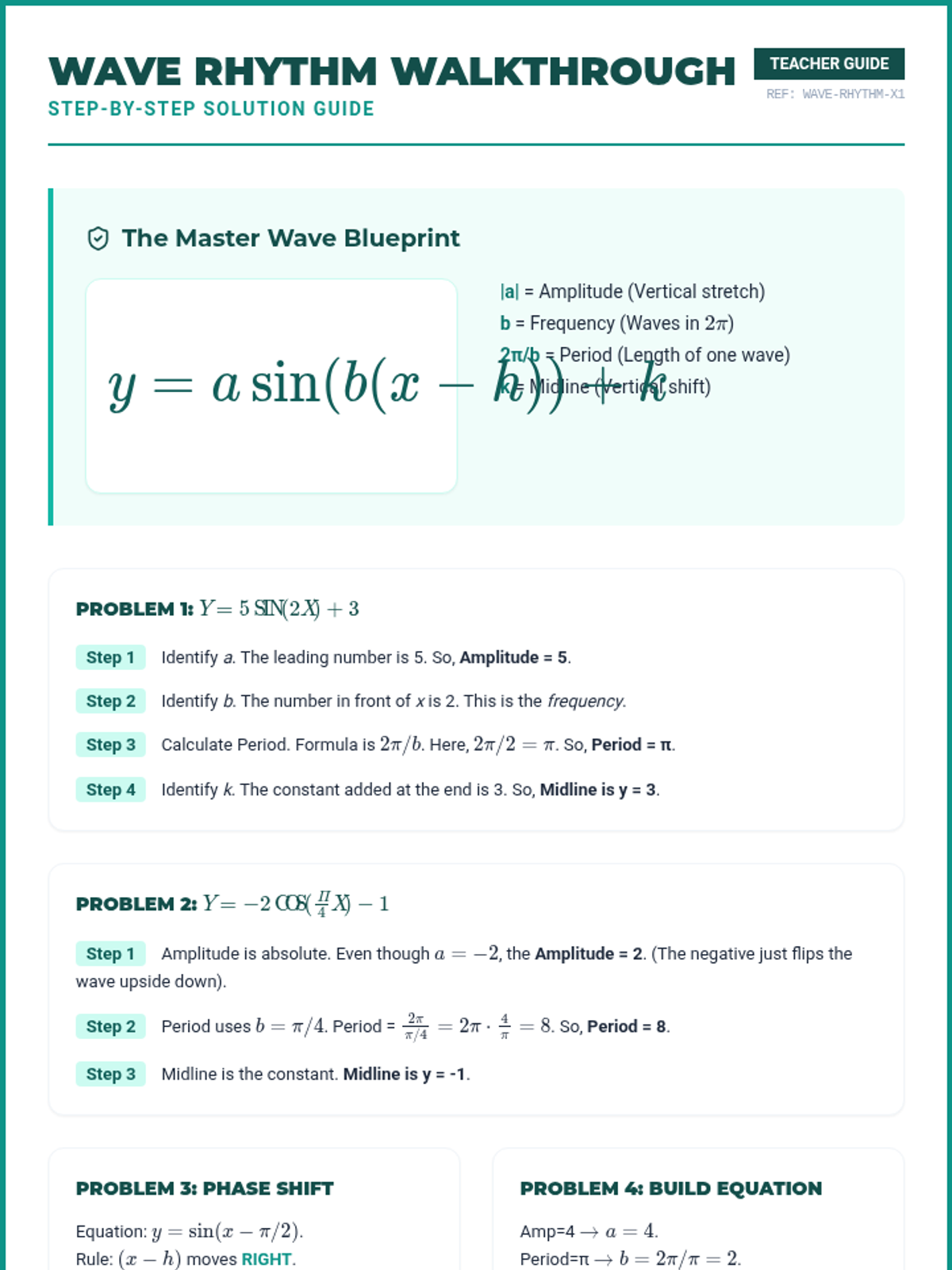
A detailed, step-by-step walkthrough of the Wave Rhythm Workout, breaking down the logic for core wave components, real-world modeling, and finding minimum values using the midline-amplitude blueprint.
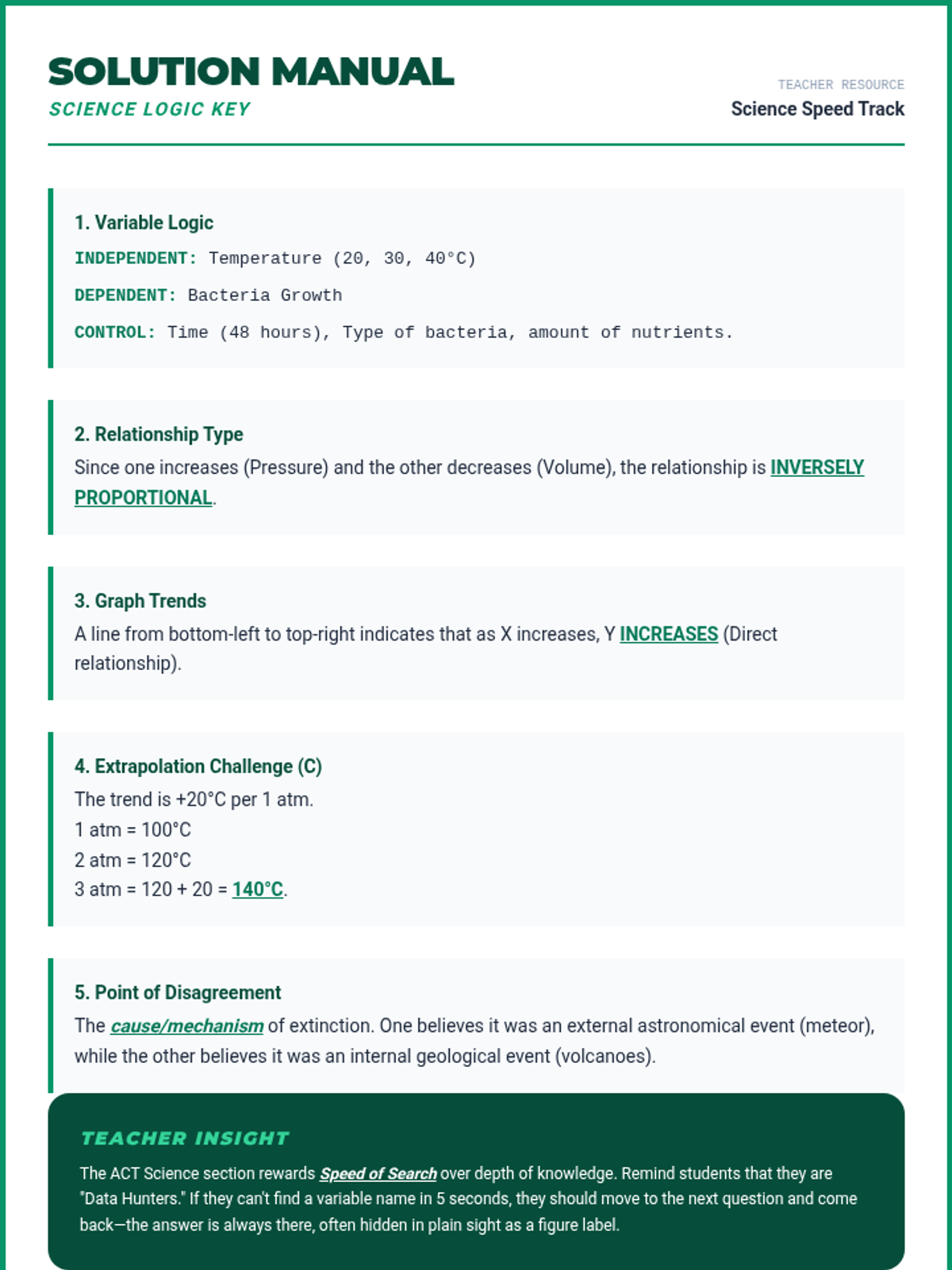
The detailed answer key for the Science Speed Logic Workout, providing explanations for variable identification, trend spotting, and scientific reasoning questions.
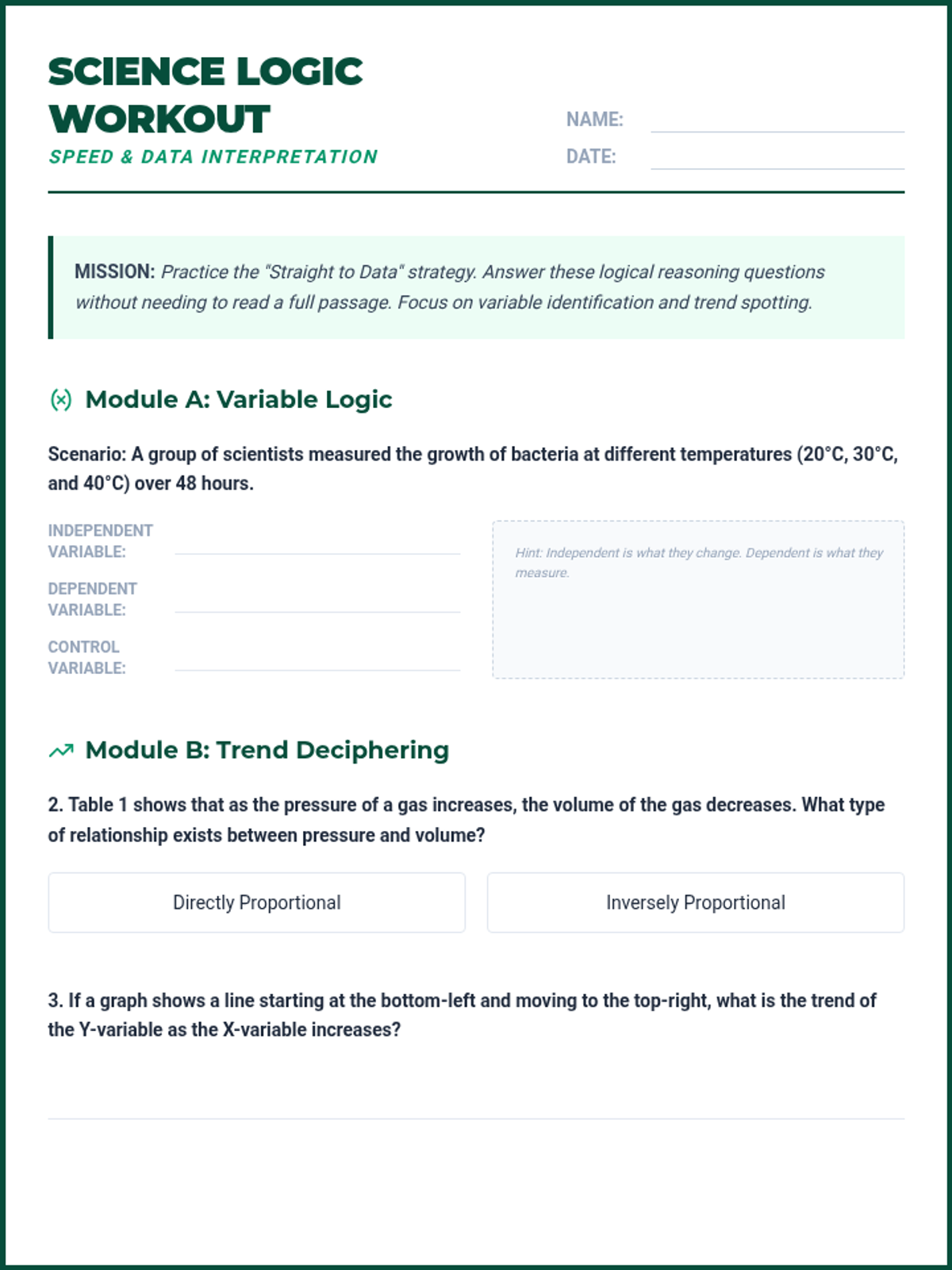
A specialized student practice worksheet for the ACT Science section, focusing on identifying independent/dependent variables, trend spotting, and basic scientific reasoning logic.
A visual slide deck covering strategic masterclass for the ACT Science section, focusing on speed-reading data sets, identifying experimental variables, and decoding scientific logic. This deck emphasizes the 'Straight to the Data' approach. Revised for font size compliance (min 24px).
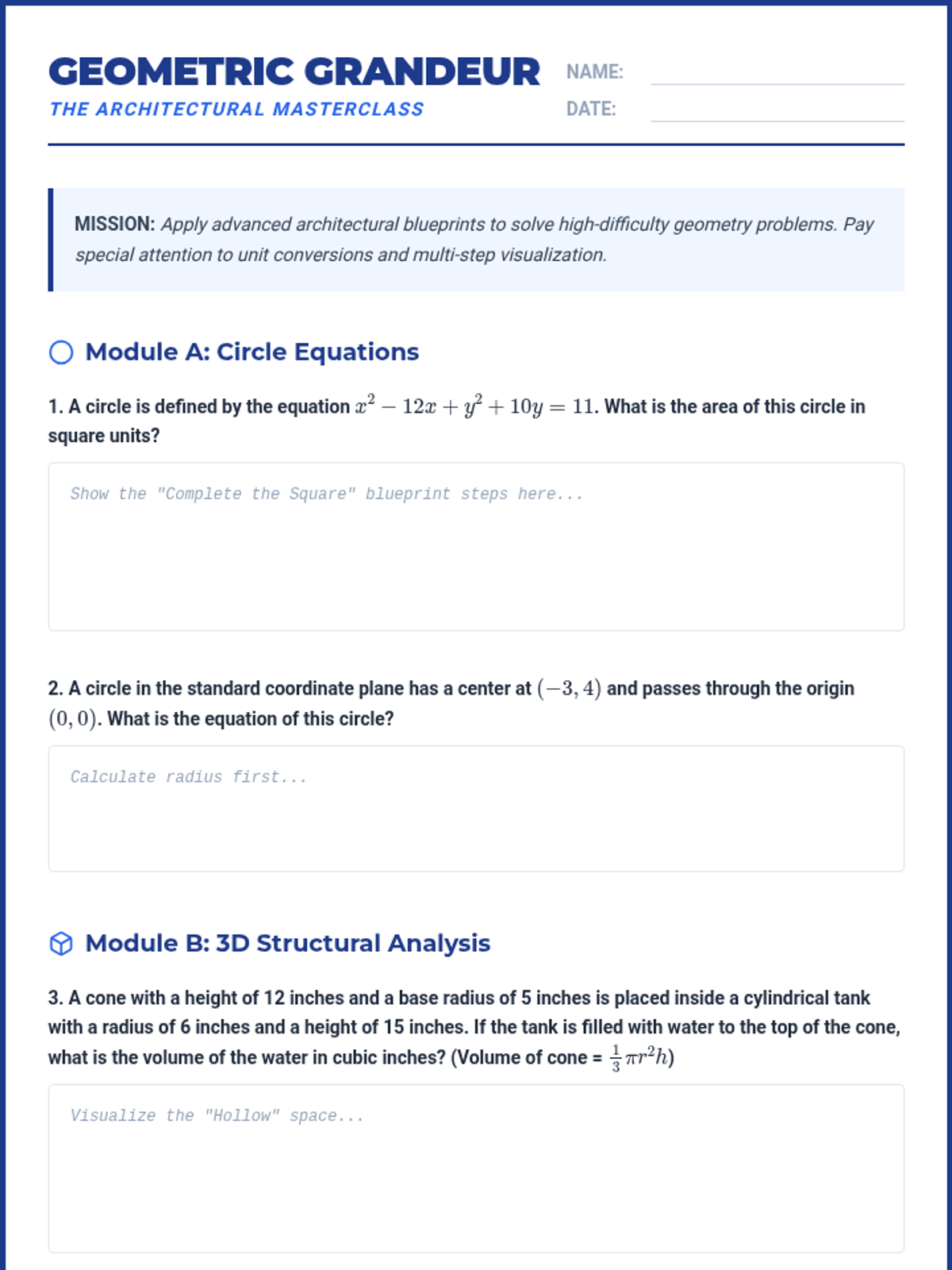
A specialized geometry workout featuring problems on circle equations, 3D volume visualization, and coordinate geometry, including advanced 'Final Ten' style challenges like inscribed octagons and 3D coordinate spheres.
A visual slide deck covering advanced ACT geometry topics: circle equations, 3D structural formulas, and coordinate geometry strategies. Revised for clarity and font size compliance.
A comprehensive 12-slide masterclass deck covering all 10 advanced subjects tested in the diagnostic quiz, including matrices, complex numbers, trig periods, circle equations, expected value, logs, remainder theorem, counting logic, vectors, and trig identities. Revised for font size compliance (min 24px).