Fundamental concepts of limits, derivatives, and integrals for modeling change and motion. Examines techniques for differentiation and integration alongside applications in optimization, area calculation, and differential equations.
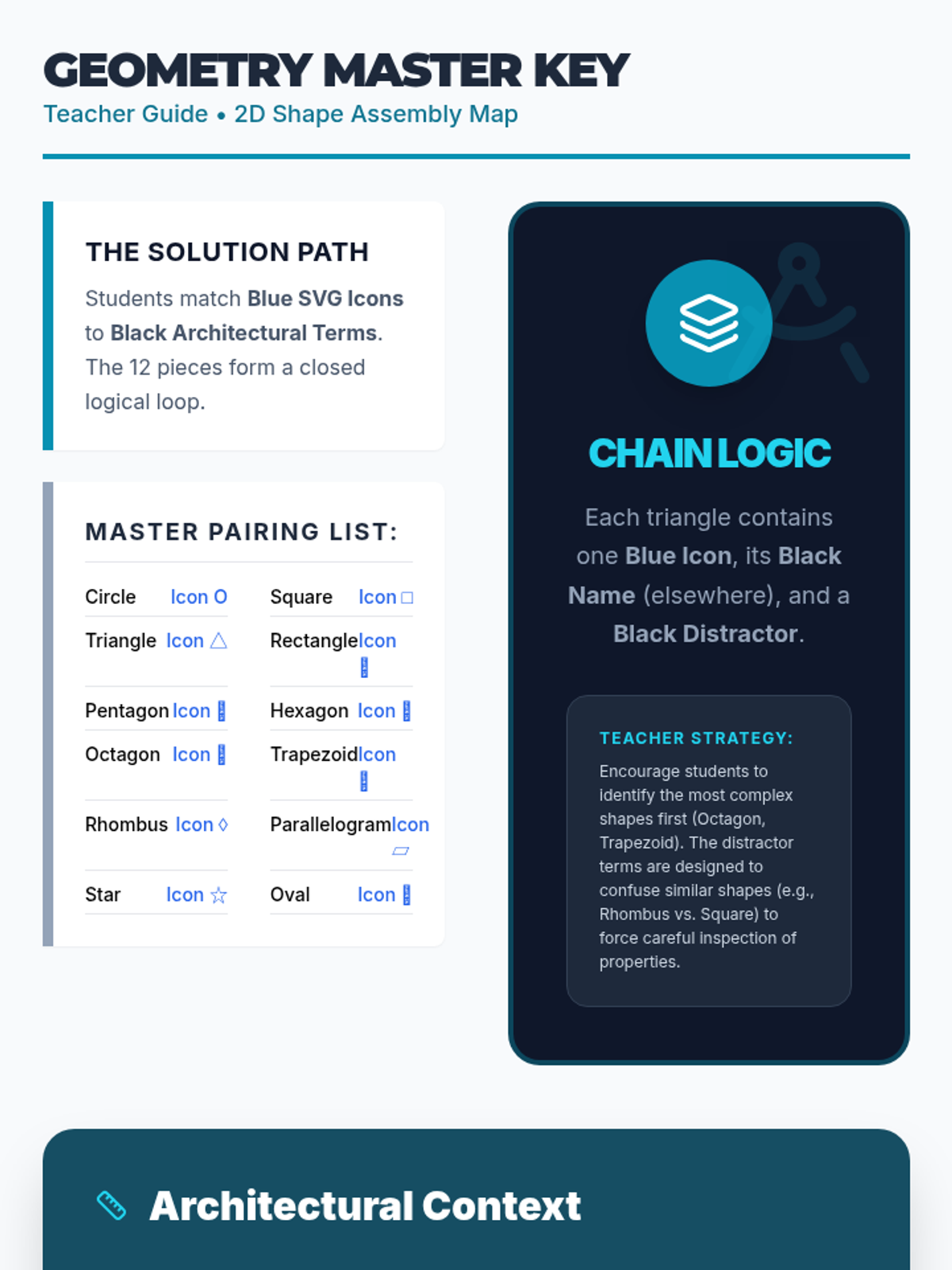
A teacher guide and answer key for the geometric shape Tarsia puzzle, providing a master pairing list and instructional strategies for identifying 2D polygons.
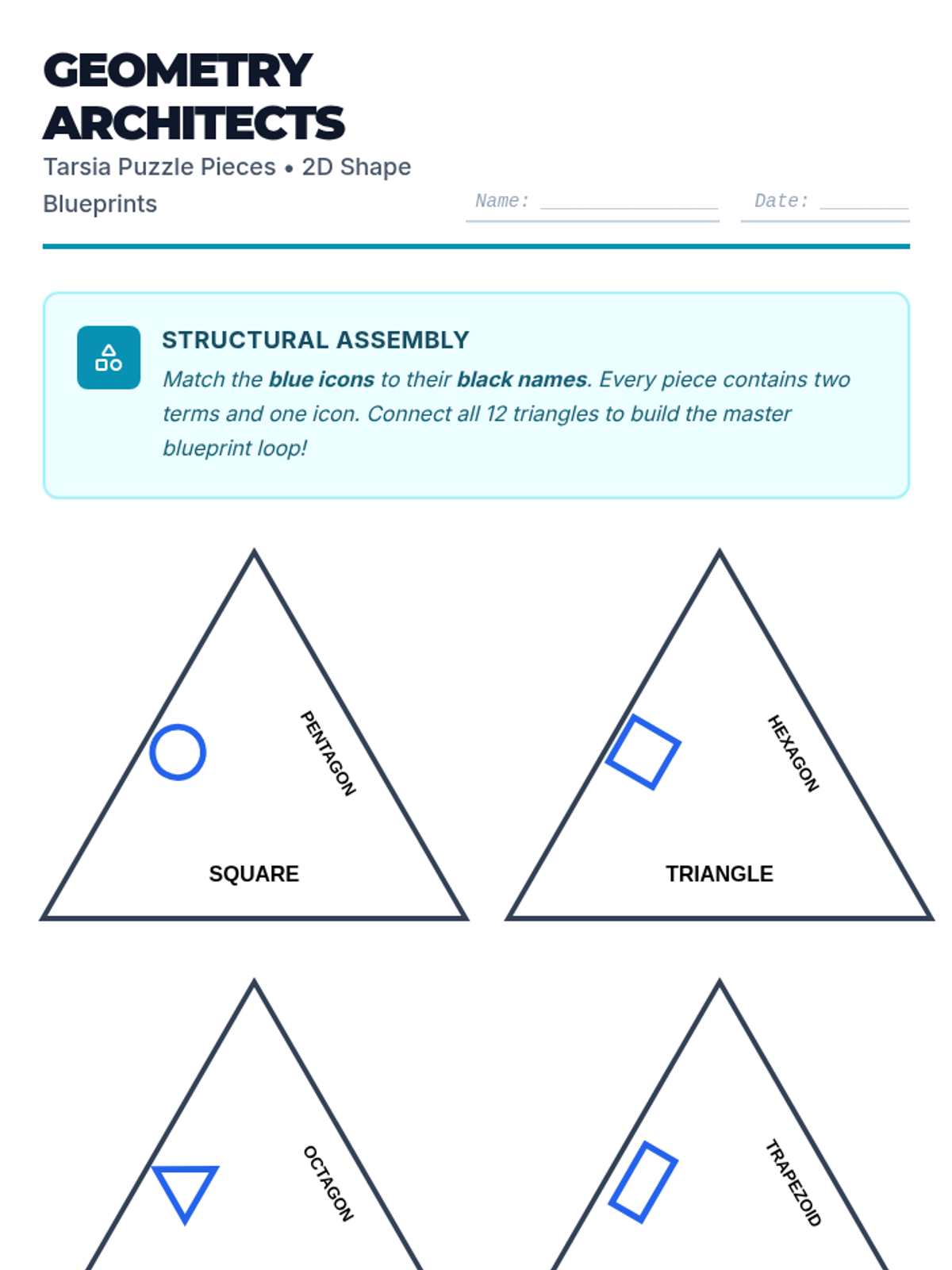
A geometric Tarsia puzzle challenge where students match blue shape icons to their black names. Includes 12 triangular pieces featuring shapes like octagons, trapezoids, and rhombuses. Designed with term dominance and precise SVG icon alignment.
A visual presentation for the Geometry Architects lesson, introducing 2D shapes with an architectural blueprint theme. Includes definitions and visual properties for polygons and circles.
A redesigned advanced Tarsia puzzle featuring a 2:1 ratio of terms to symbols on each piece. Each piece contains exactly one matching blue symbol and one black word, plus one distractor symbol. This ensures text dominance while maintaining a complex notation theme. Labels are precisely aligned inside triangle boundaries.
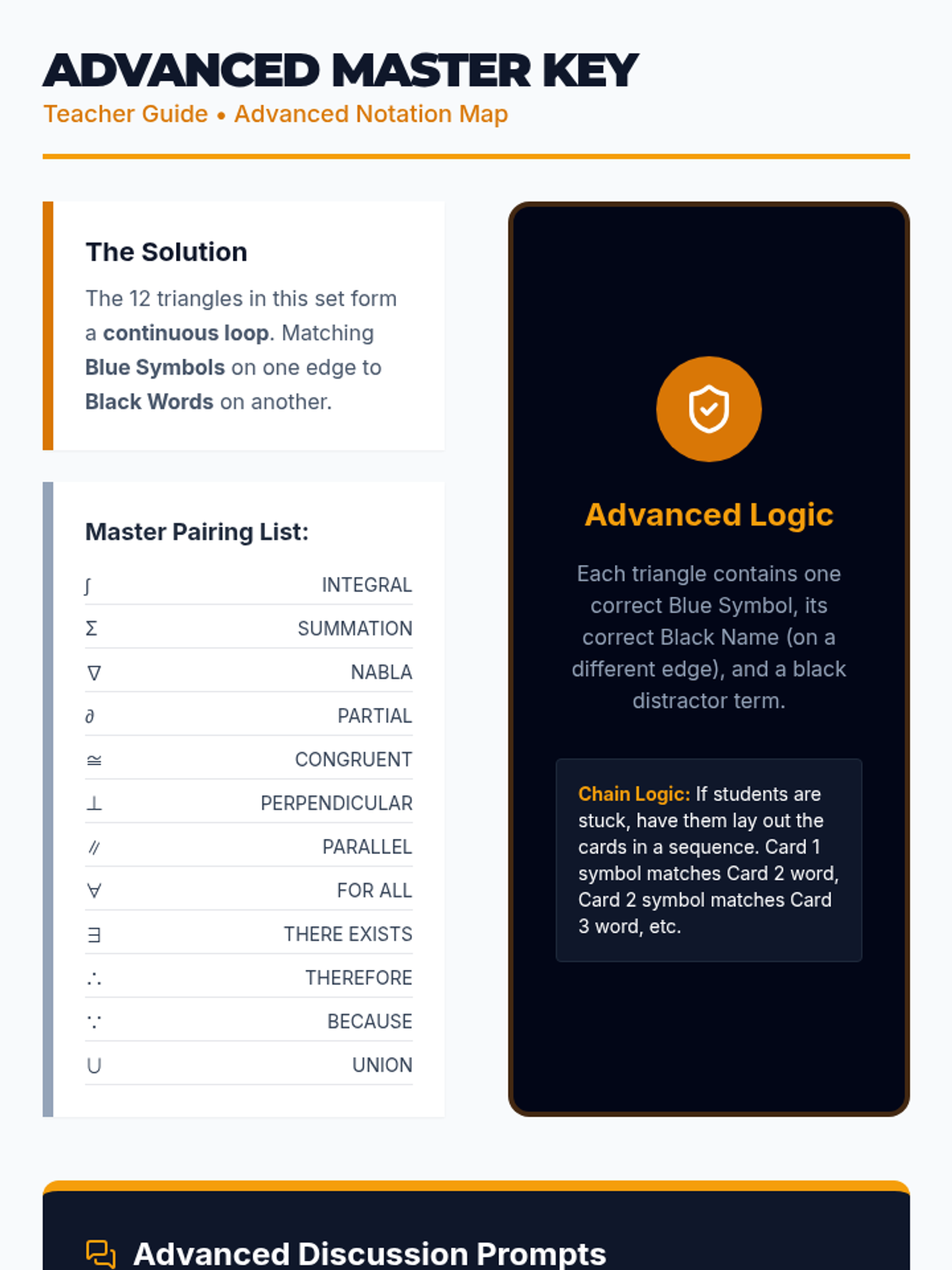
A teacher guide and answer key for the advanced notation Tarsia puzzle, including a master pairing list for complex symbols like Nabla, Integral, and Partial.
An advanced instructional slide deck introducing higher-level mathematical symbols from calculus, set theory, and geometry.
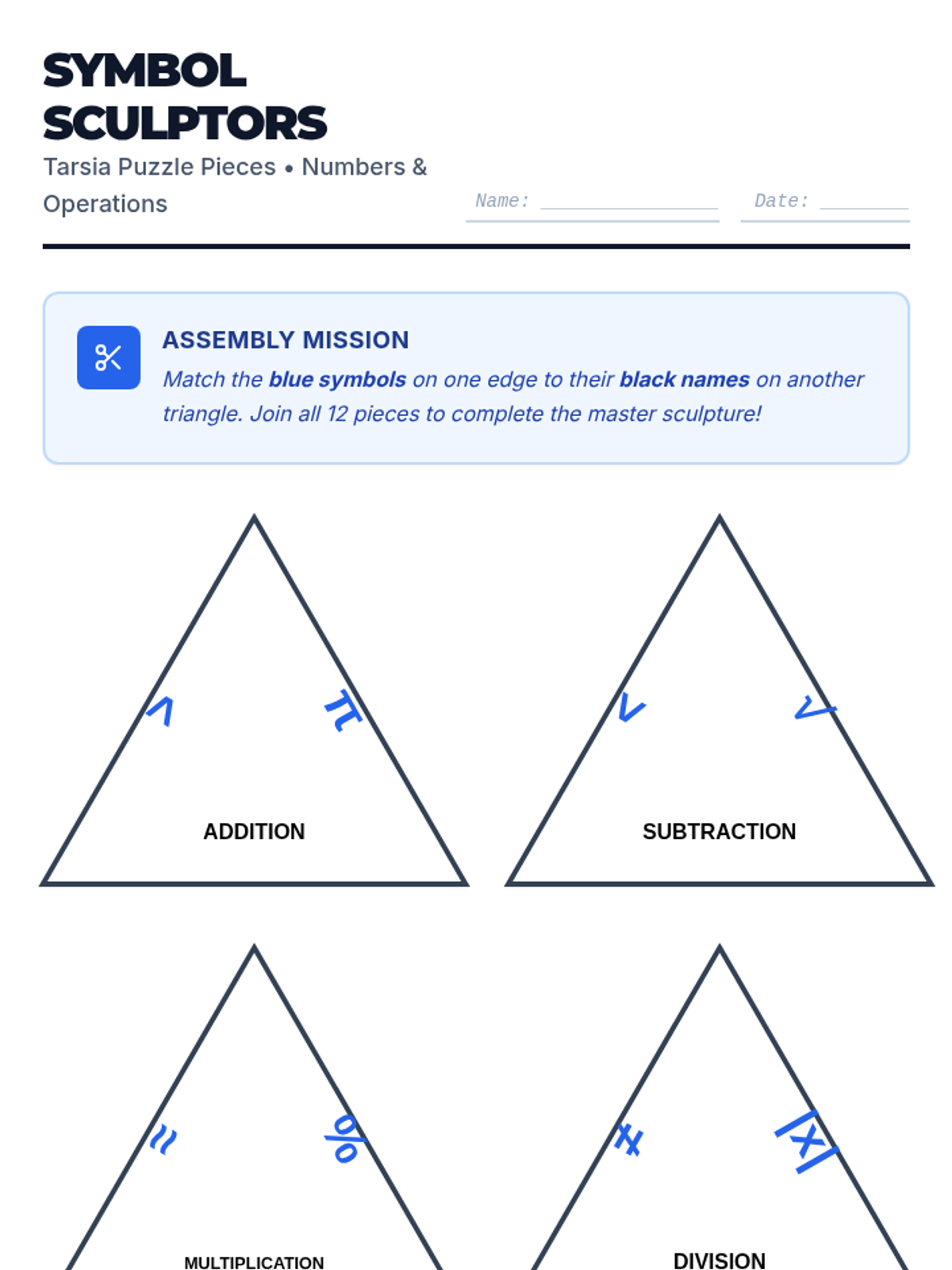
A student activity sheet containing 12 triangular puzzle pieces with mathematical symbols and their names. This is the finalized Version 3 with corrected alignment and logic. Match blue symbols on one piece to black names on another.
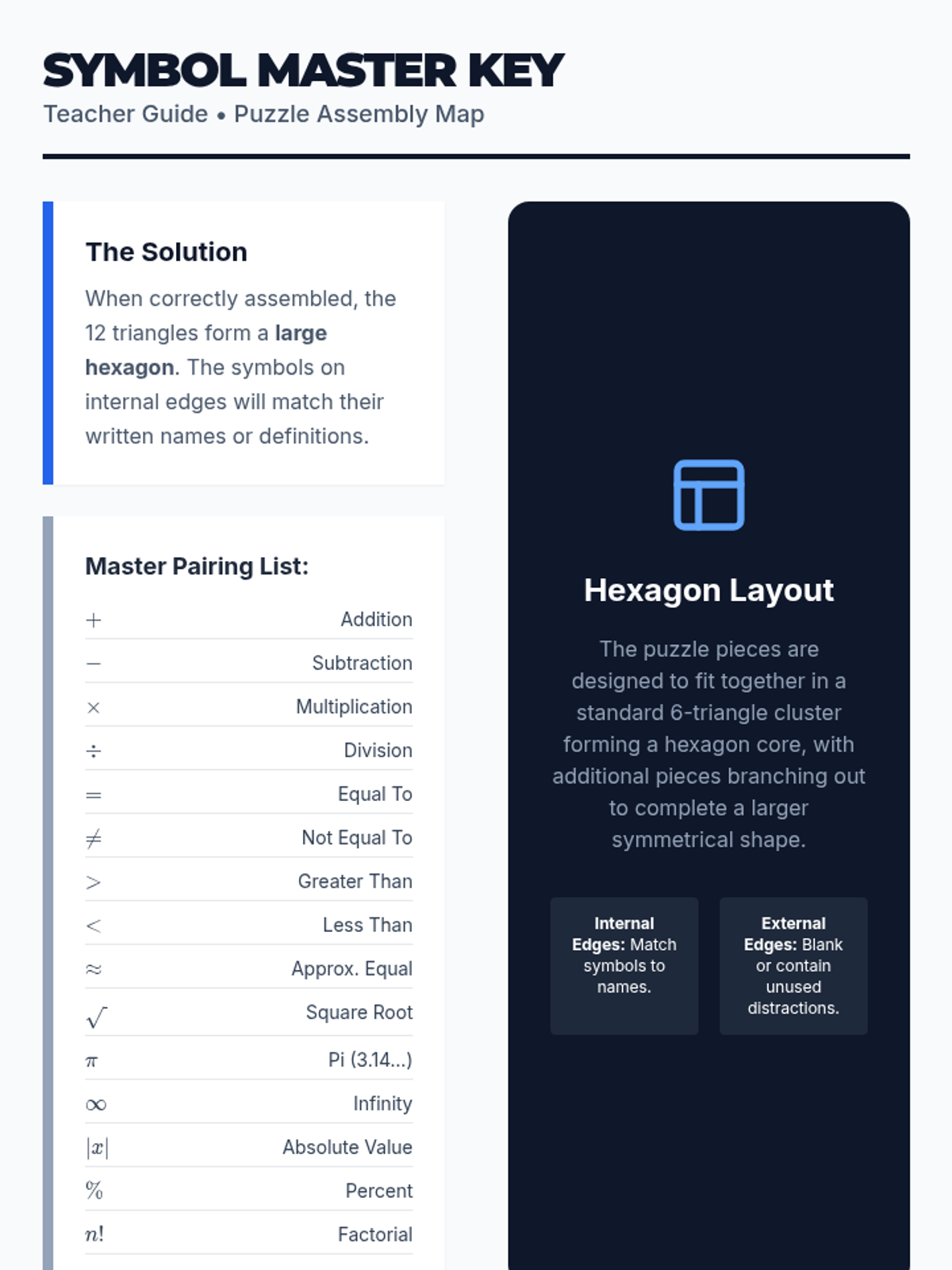
A teacher's answer key and facilitation guide for the Tarsia puzzle, including a master pairing list and assembly tips.
An instructional slide deck introducing common and advanced mathematical symbols used in operations and number relationships, featuring clear visual definitions and examples.
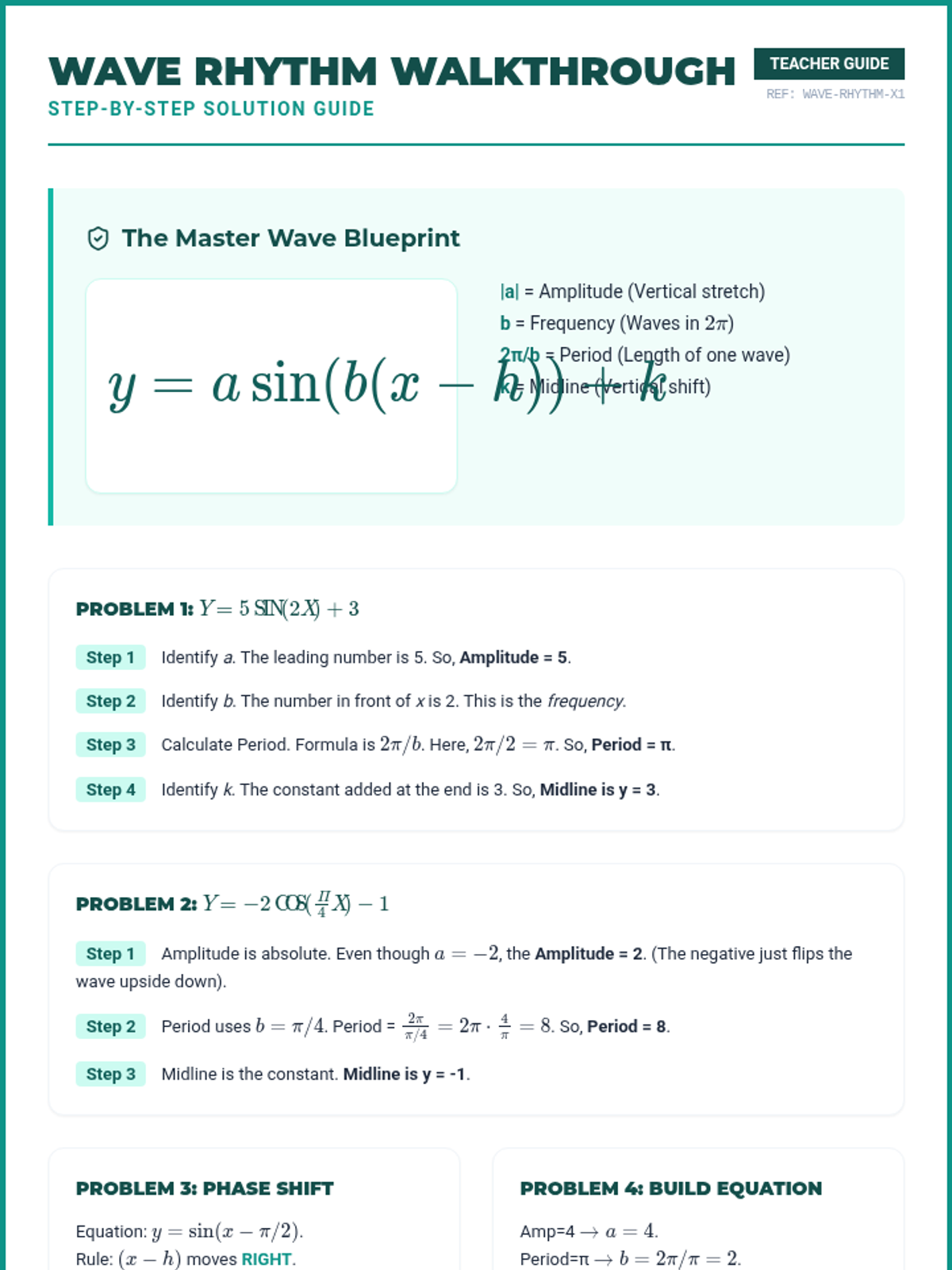
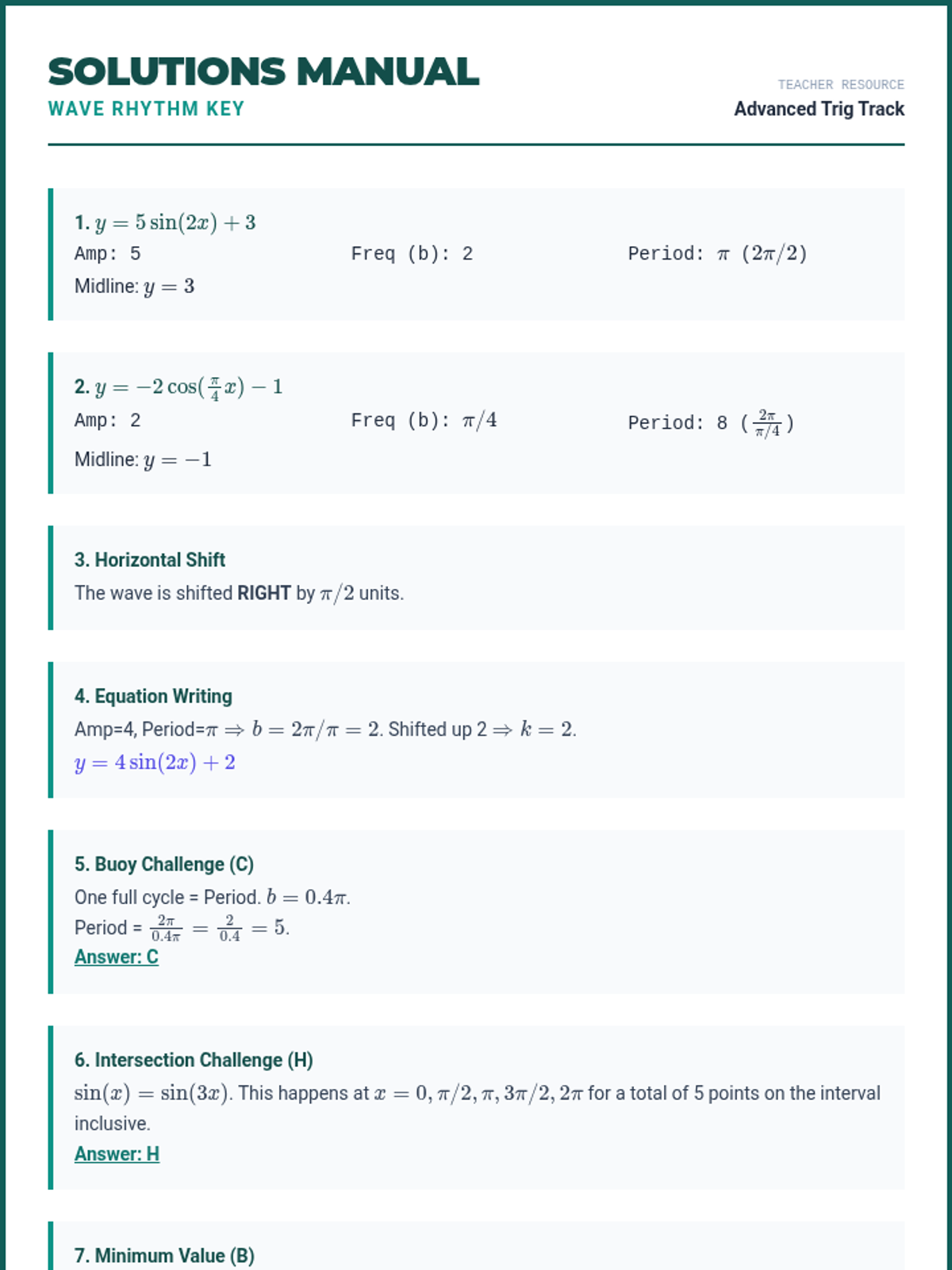
A detailed, step-by-step walkthrough of the Wave Rhythm Workout, breaking down the logic for core wave components, real-world modeling, and finding minimum values using the midline-amplitude blueprint.
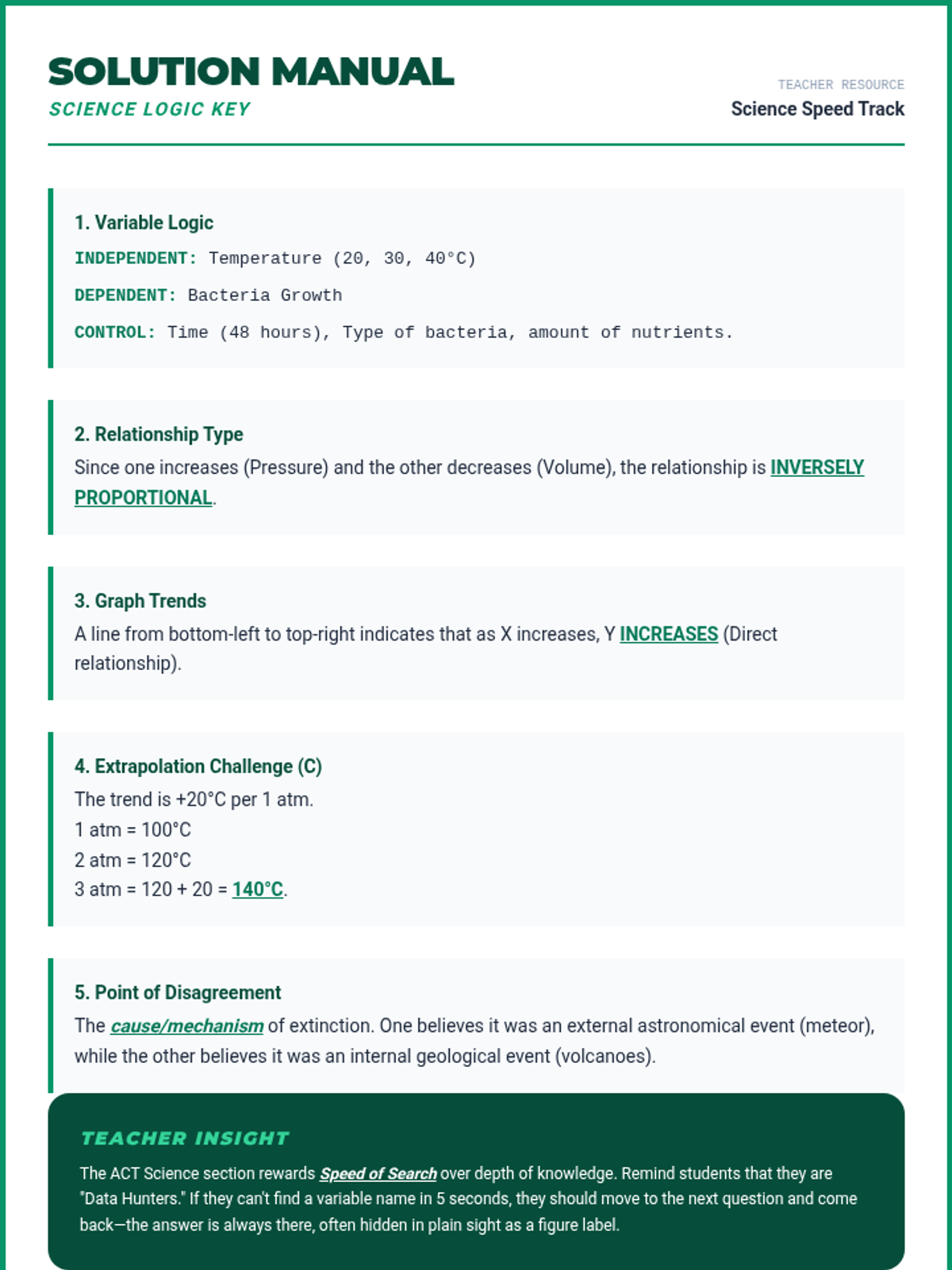
The detailed answer key for the Science Speed Logic Workout, providing explanations for variable identification, trend spotting, and scientific reasoning questions.
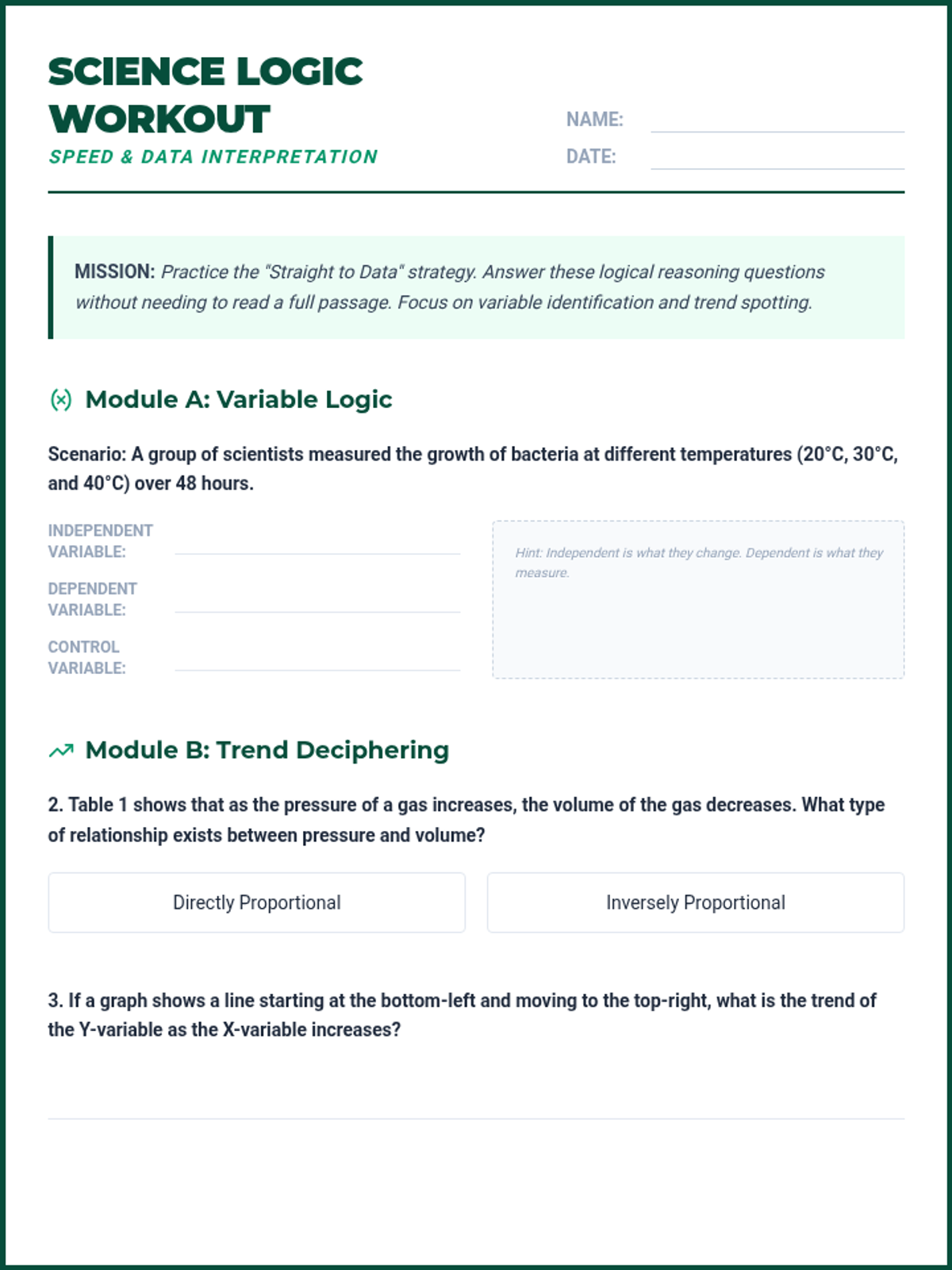
A specialized student practice worksheet for the ACT Science section, focusing on identifying independent/dependent variables, trend spotting, and basic scientific reasoning logic.
A visual slide deck covering strategic masterclass for the ACT Science section, focusing on speed-reading data sets, identifying experimental variables, and decoding scientific logic. This deck emphasizes the 'Straight to the Data' approach. Revised for font size compliance (min 24px).
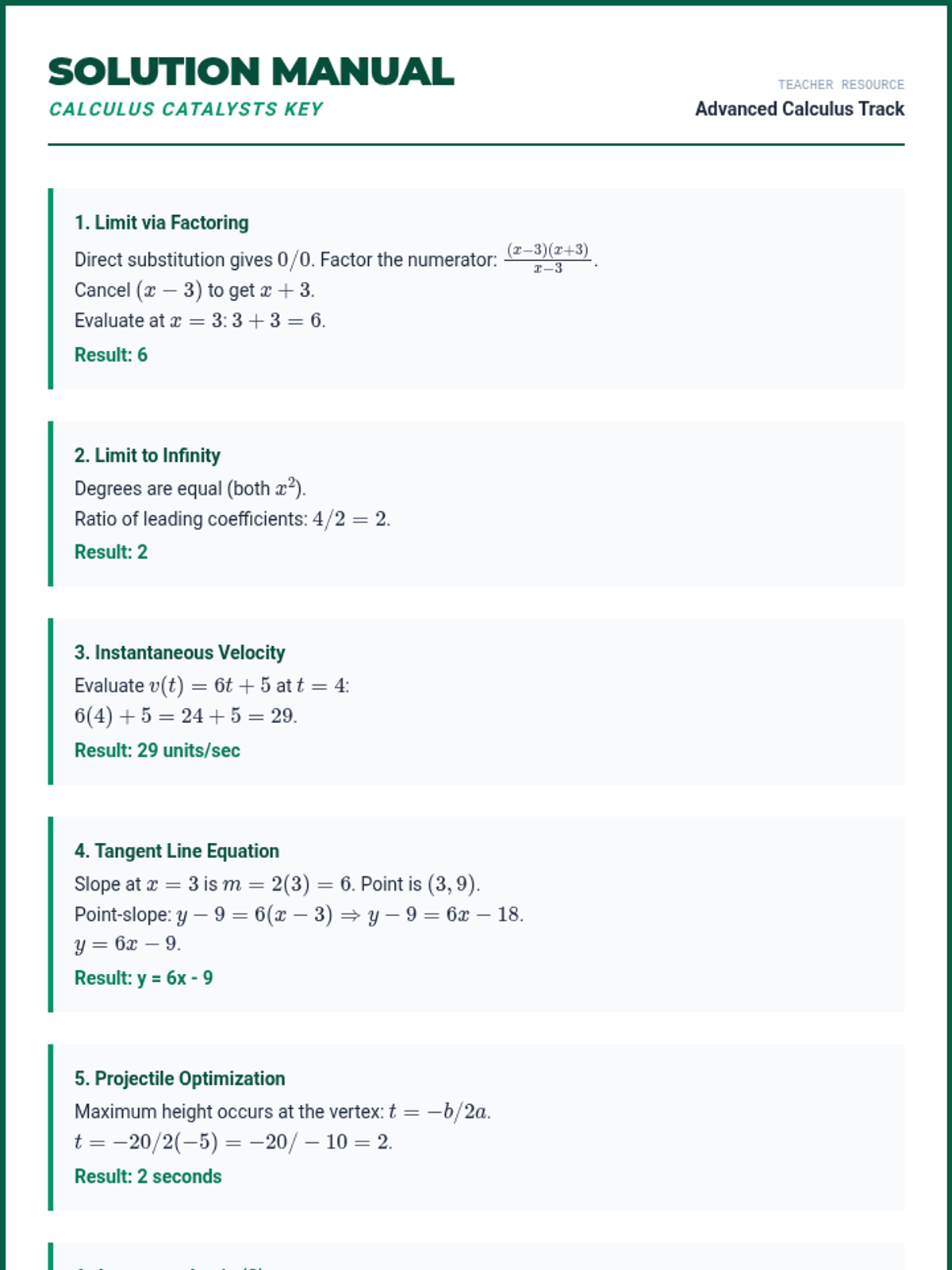
The detailed answer key for the Calculus Catalysts Workout, providing step-by-step solutions for limits, instantaneous rate of change, and basic function optimization problems.
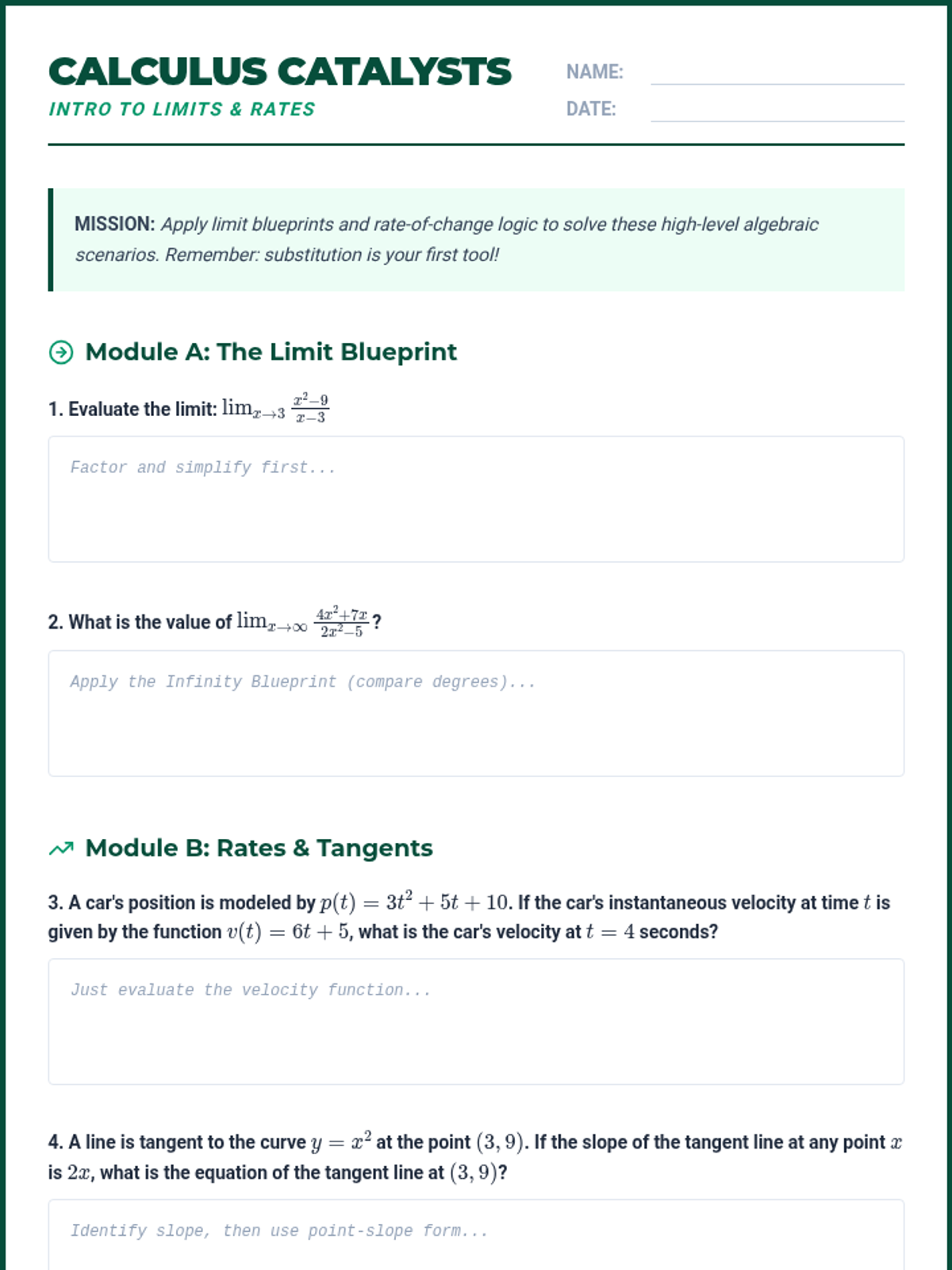
A student practice worksheet for calculus-adjacent ACT concepts, featuring limits, instantaneous rate of change logic, and function optimization problems.
A visual slide deck explaining introductory calculus concepts for the ACT, including limits, instantaneous rate of change, and basic function optimization using standard blueprints. Revised for font size compliance (min 24px).
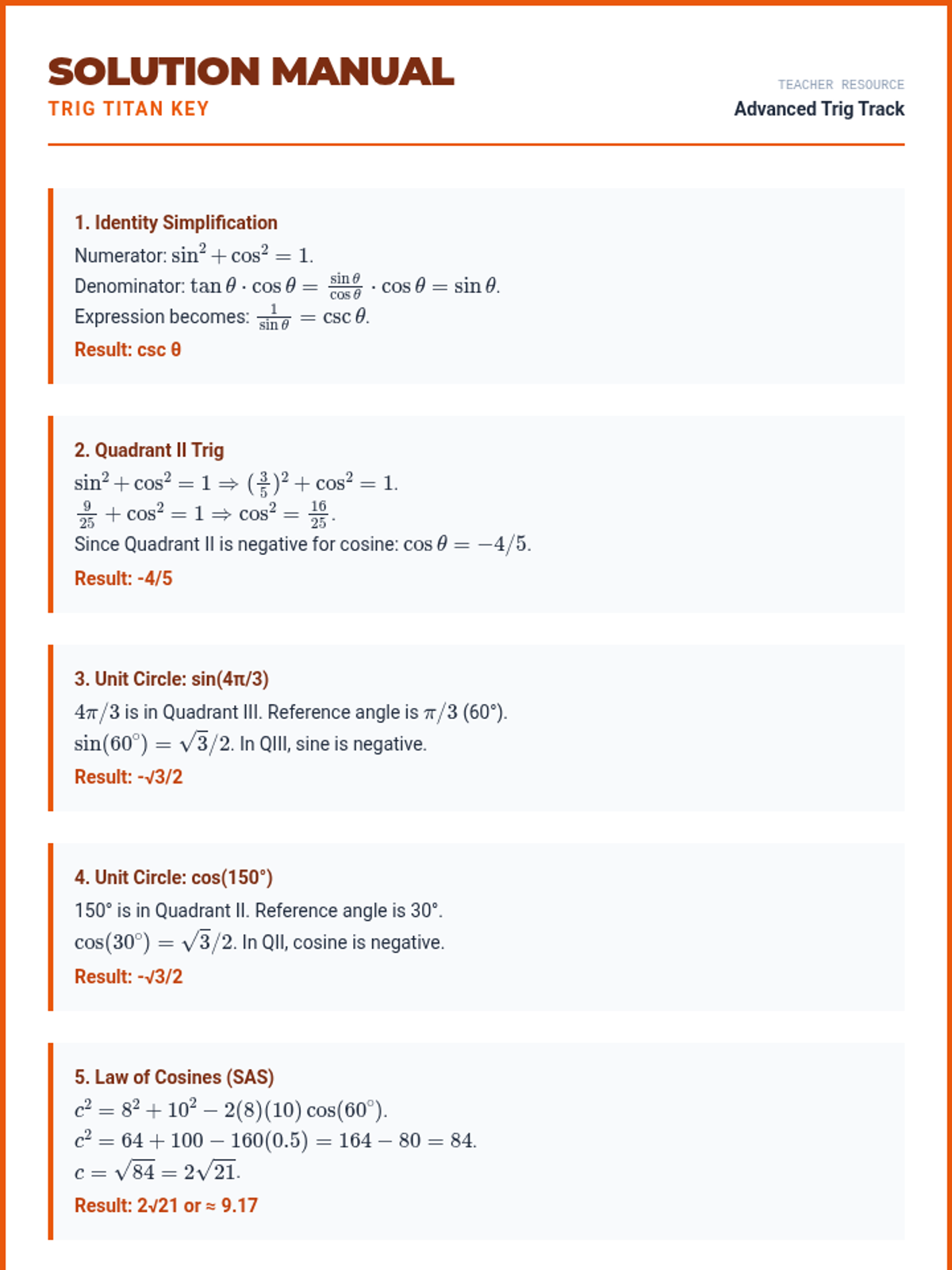
The detailed answer key for the Trig Titan Workout, including step-by-step solutions for identities, the unit circle, and non-right triangle problems.
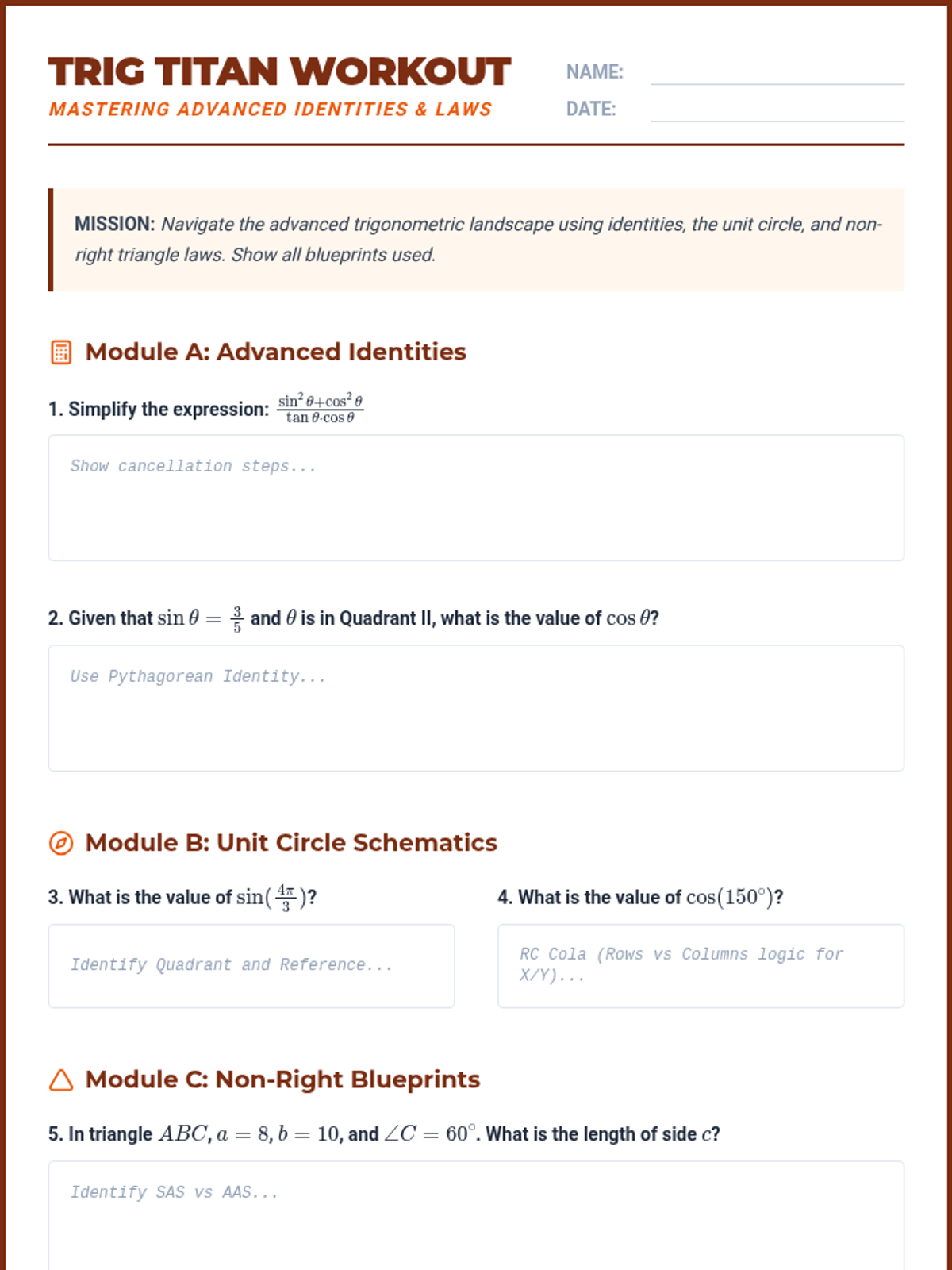
A comprehensive practice worksheet for advanced ACT trigonometry, featuring sections on identities, the unit circle, Law of Sines/Cosines, and 'Final Ten' challenge problems.
A visual slide deck covering advanced ACT trigonometry: Pythagorean identities, the unit circle, Law of Sines/Cosines, and the ambiguous SSA case. Revised for font size compliance (min 24px).
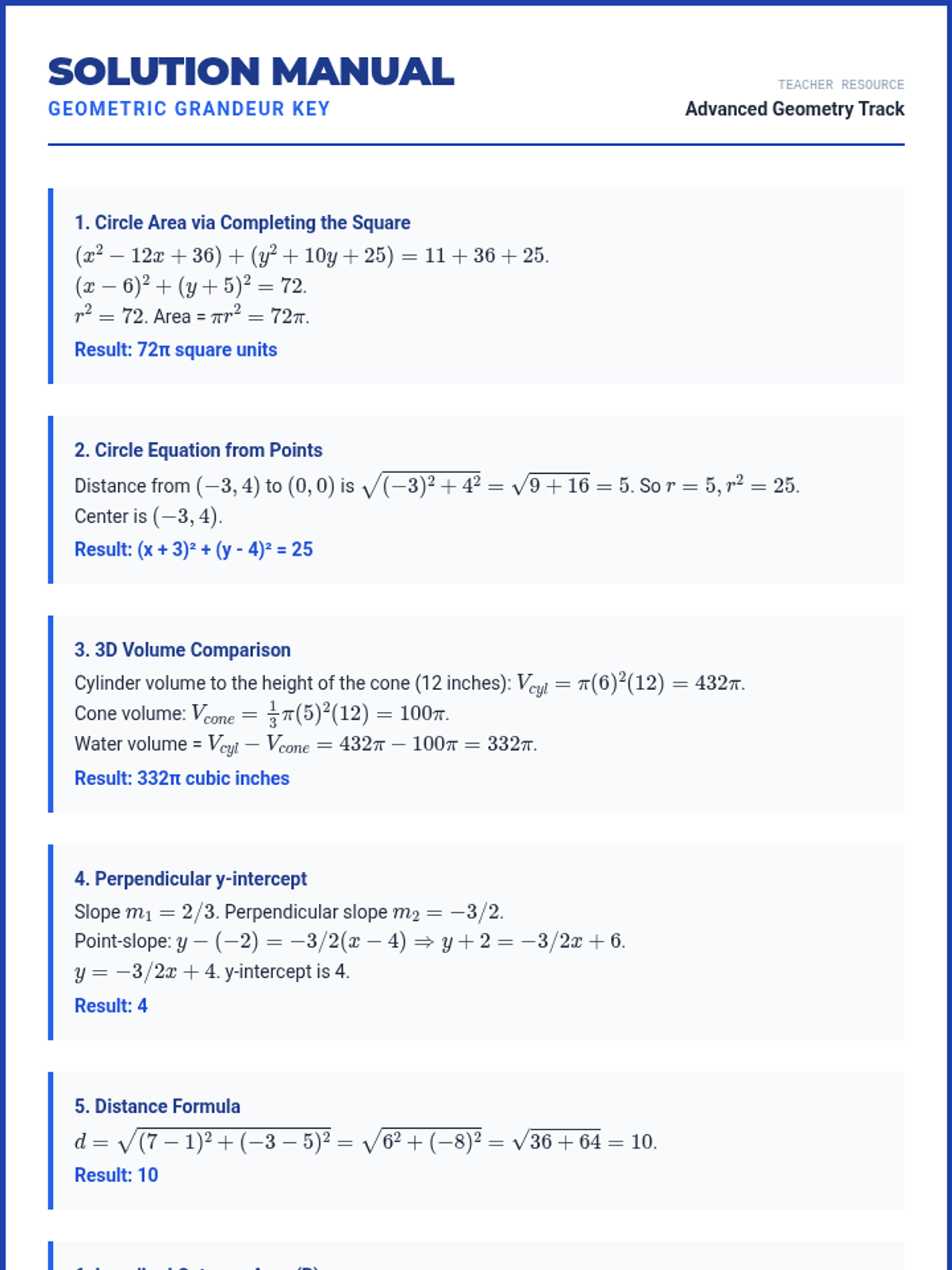
The detailed answer key for the Geometric Grandeur Workout, providing step-by-step solutions for circle equations, 3D volume, and coordinate geometry problems.
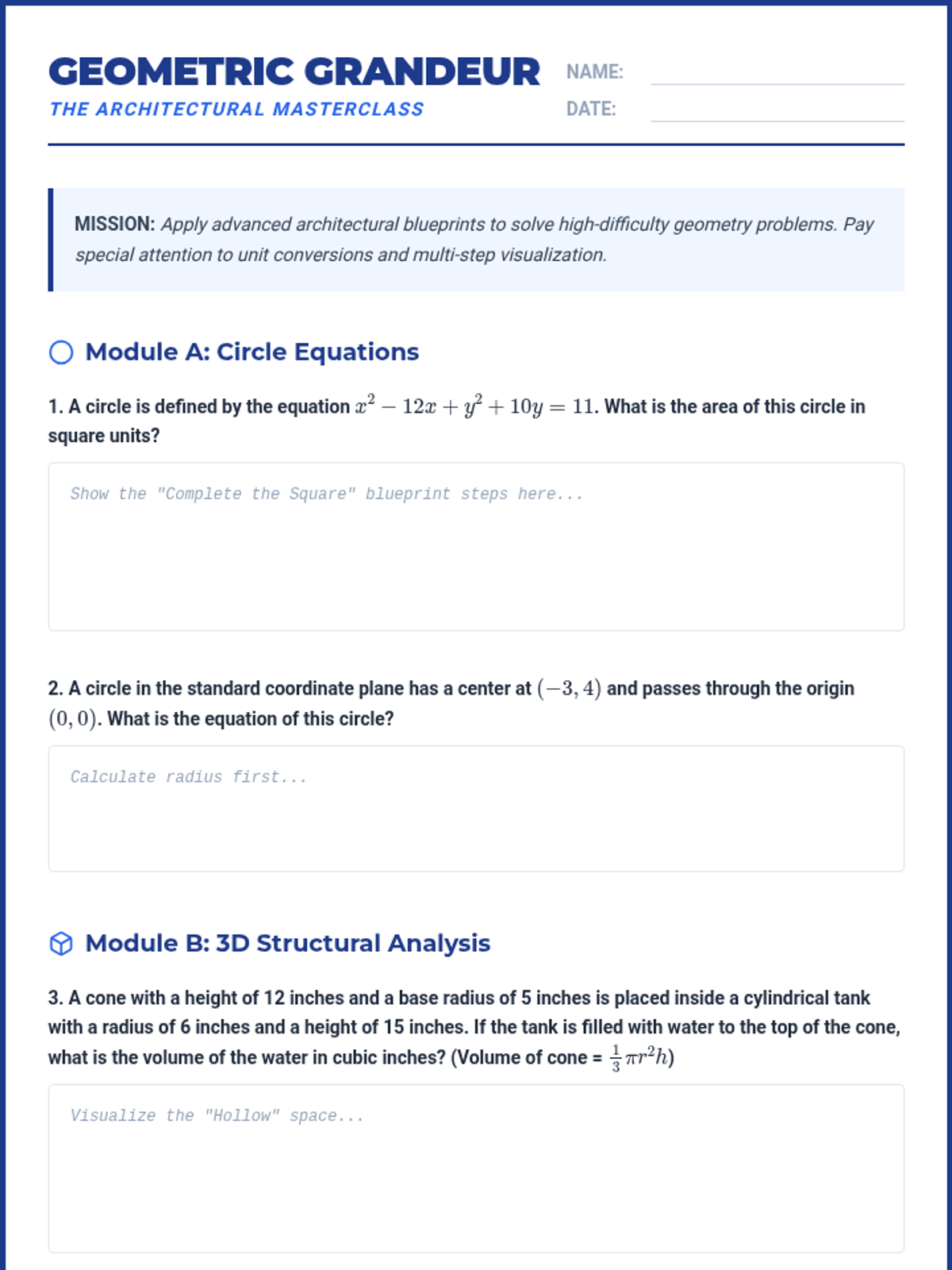
A specialized geometry workout featuring problems on circle equations, 3D volume visualization, and coordinate geometry, including advanced 'Final Ten' style challenges like inscribed octagons and 3D coordinate spheres.
A visual slide deck covering advanced ACT geometry topics: circle equations, 3D structural formulas, and coordinate geometry strategies. Revised for clarity and font size compliance.
A comprehensive 12-slide masterclass deck covering all 10 advanced subjects tested in the diagnostic quiz, including matrices, complex numbers, trig periods, circle equations, expected value, logs, remainder theorem, counting logic, vectors, and trig identities. Revised for font size compliance (min 24px).
The detailed answer key for the Wave Rhythm Workout, featuring full step-by-step solutions and teacher insights for period, frequency, and wave modeling problems.
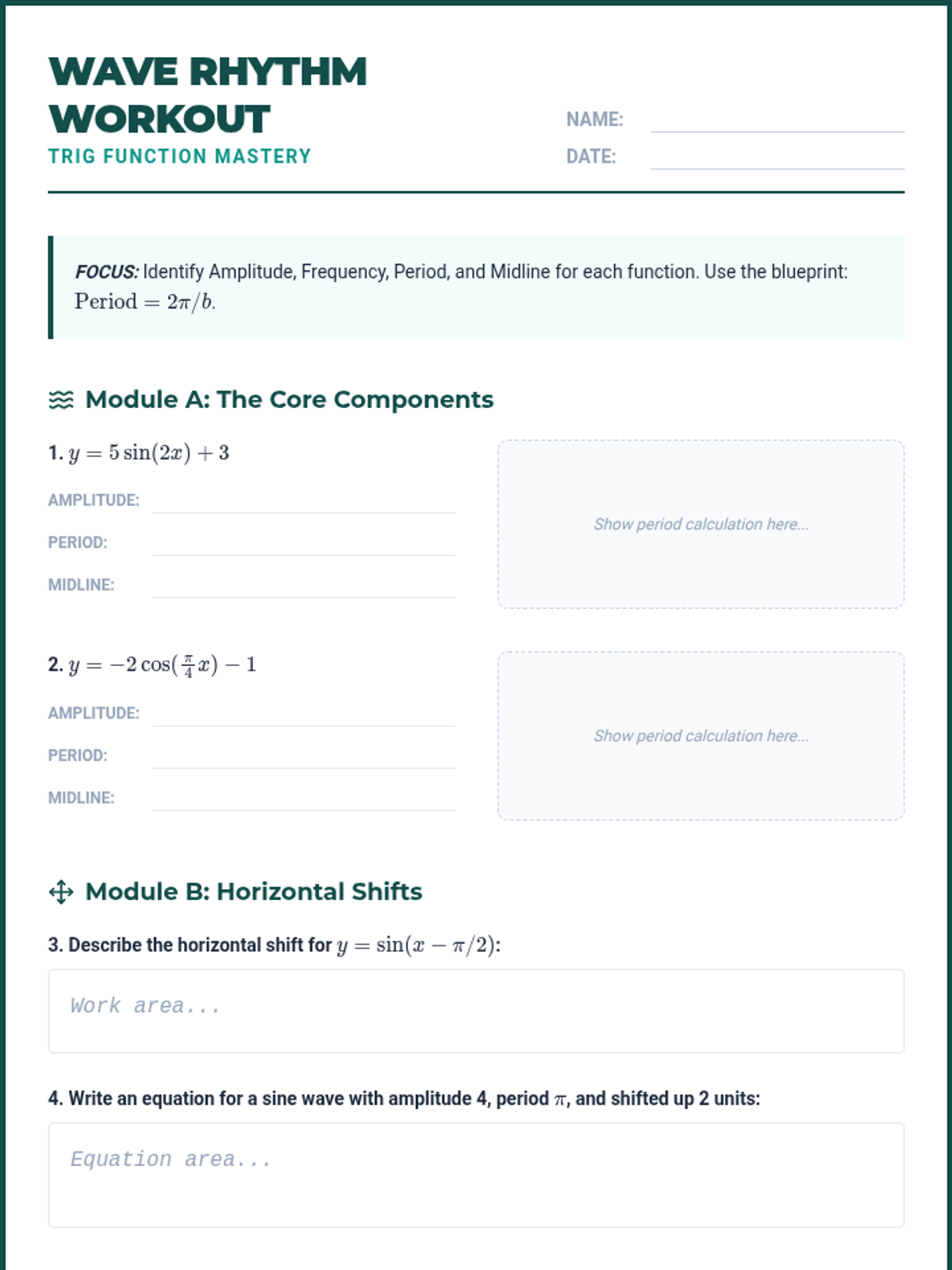
A specialized student worksheet focusing on trigonometric period, frequency, and wave components, featuring both basic identification and complex 'Final Ten' style scenario problems.
A visual slide deck explaining the components of trigonometric wave equations, with a specific focus on the 2π/b relationship for finding period from frequency. Revised for clarity and font size compliance.
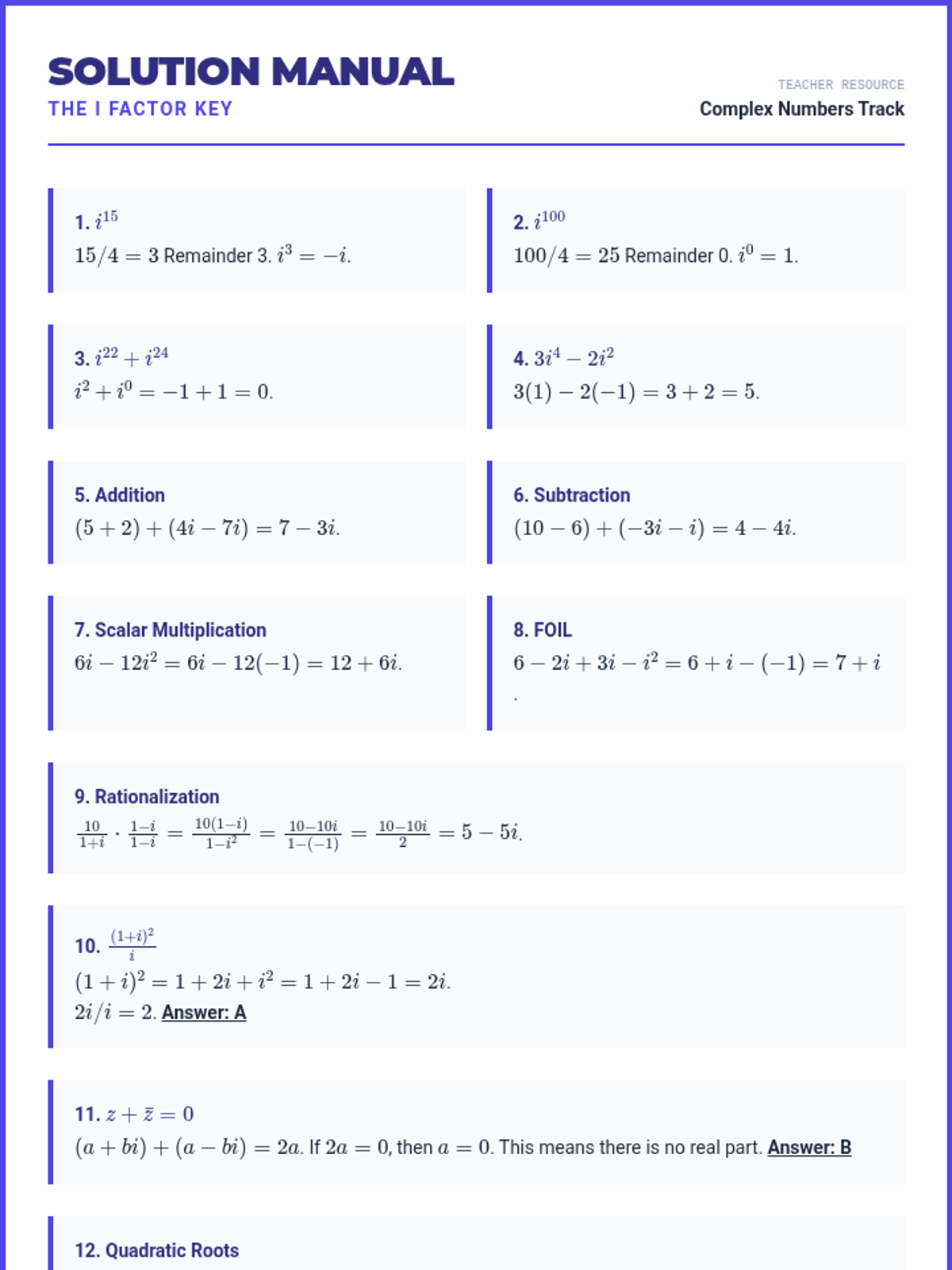
The detailed answer key for 'The i Factor Workout', featuring step-by-step solutions for powers of i, arithmetic operations, conjugates, and high-level ACT challenge problems.
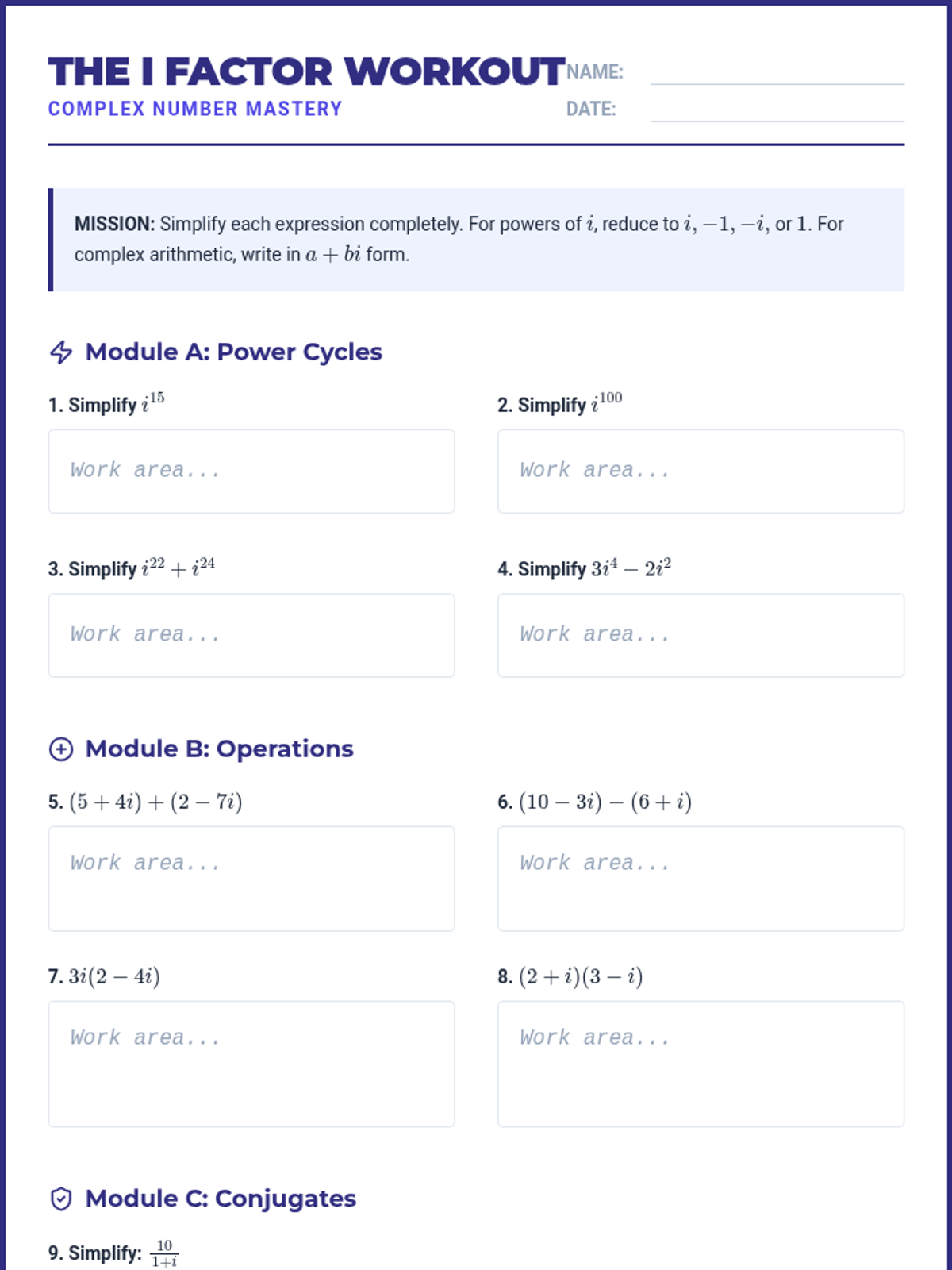
A comprehensive practice worksheet for complex numbers, featuring sections on powers of i, basic arithmetic, rationalizing with conjugates, and high-level ACT-style 'Final Ten' challenge problems.
A visual slide deck explaining imaginary and complex numbers, focusing on the definition of i, the cycle of powers, and essential arithmetic operations like multiplication and rationalizing denominators using conjugates. Revised for clarity and font size compliance.
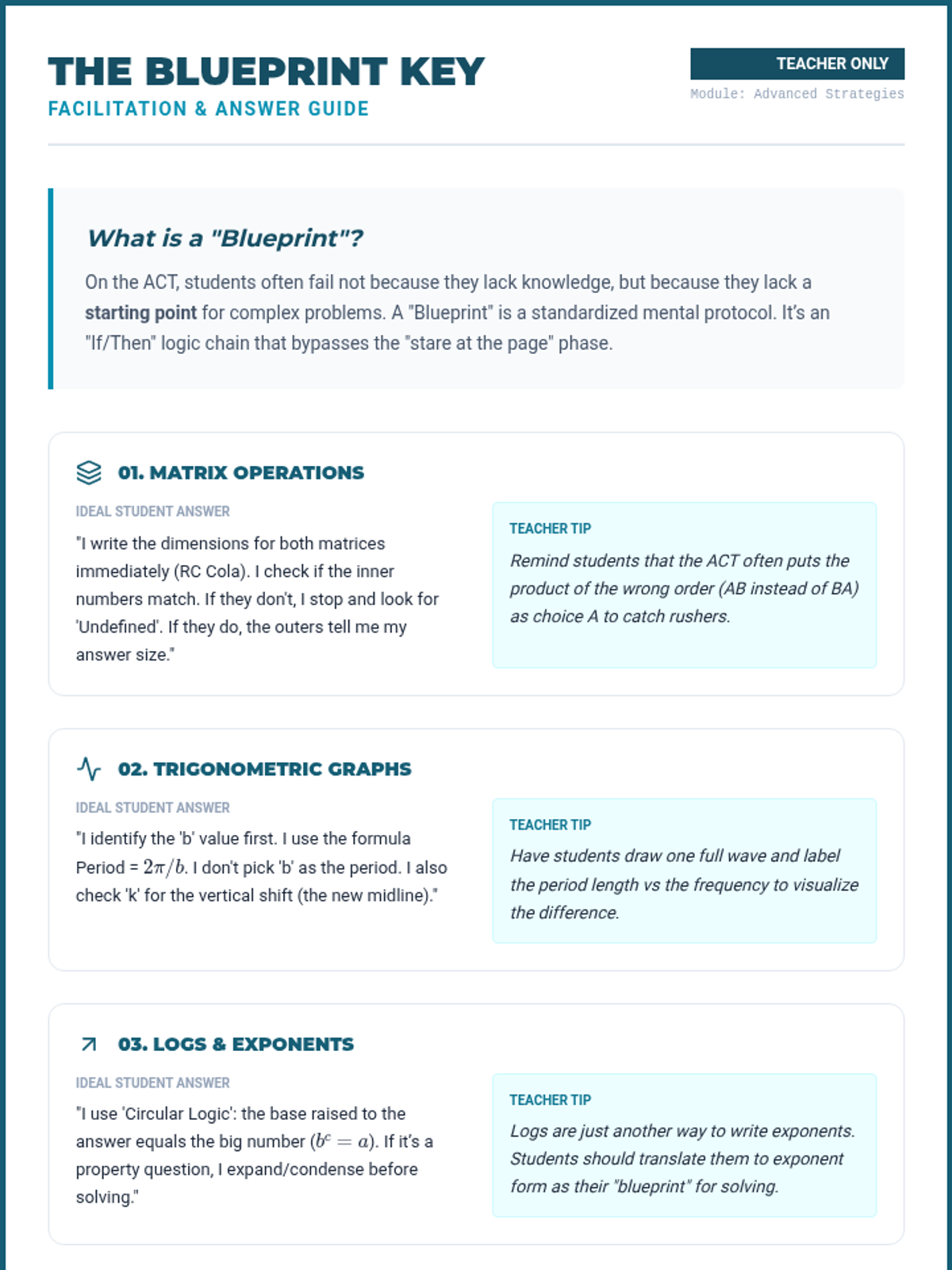
A comprehensive teacher's guide to the Strategy Blueprint Organizer, providing ideal student responses for each advanced ACT math topic and instructional tips for teaching these mental models.
A visual slide deck explaining matrix dimensions and the common 'mirror' trap where students incorrectly assume matrix multiplication is commutative. It includes a breakdown of the 'RC Cola' mnemonic and the 'Inner Match' rule. Revised for minimum font sizes.
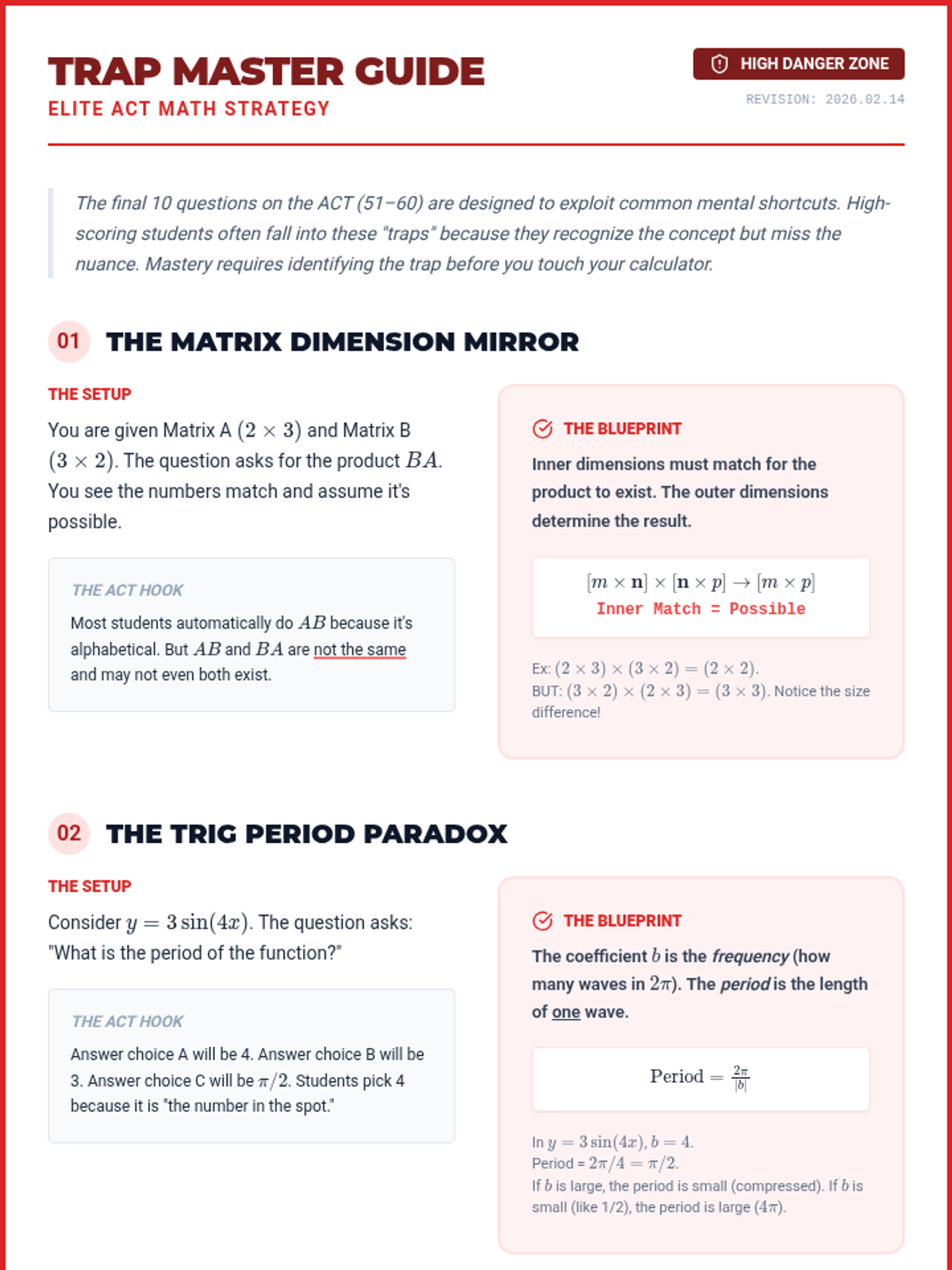
An in-depth guide to common advanced ACT math traps, providing detailed blueprints for navigating matrix dimensions, trigonometric periods, ambiguous triangle cases, and weighted averages. It includes 'The ACT Hook' for each trap and a worked 'Blueprint' for avoiding it.
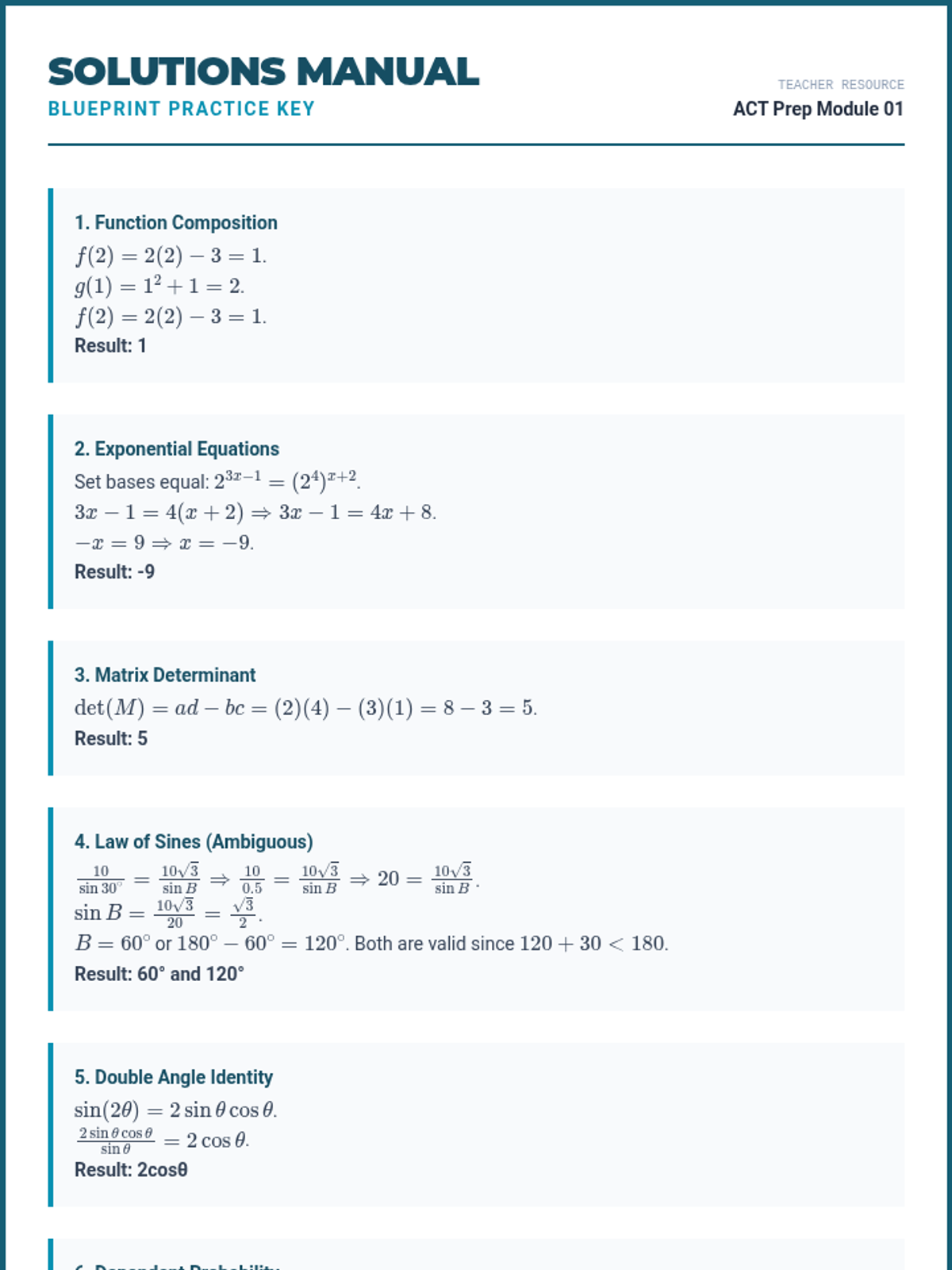
The detailed answer key for the Blueprint Problem Set, including full step-by-step solutions for all 10 problems in Algebra, Trigonometry, Statistics, and Geometry.
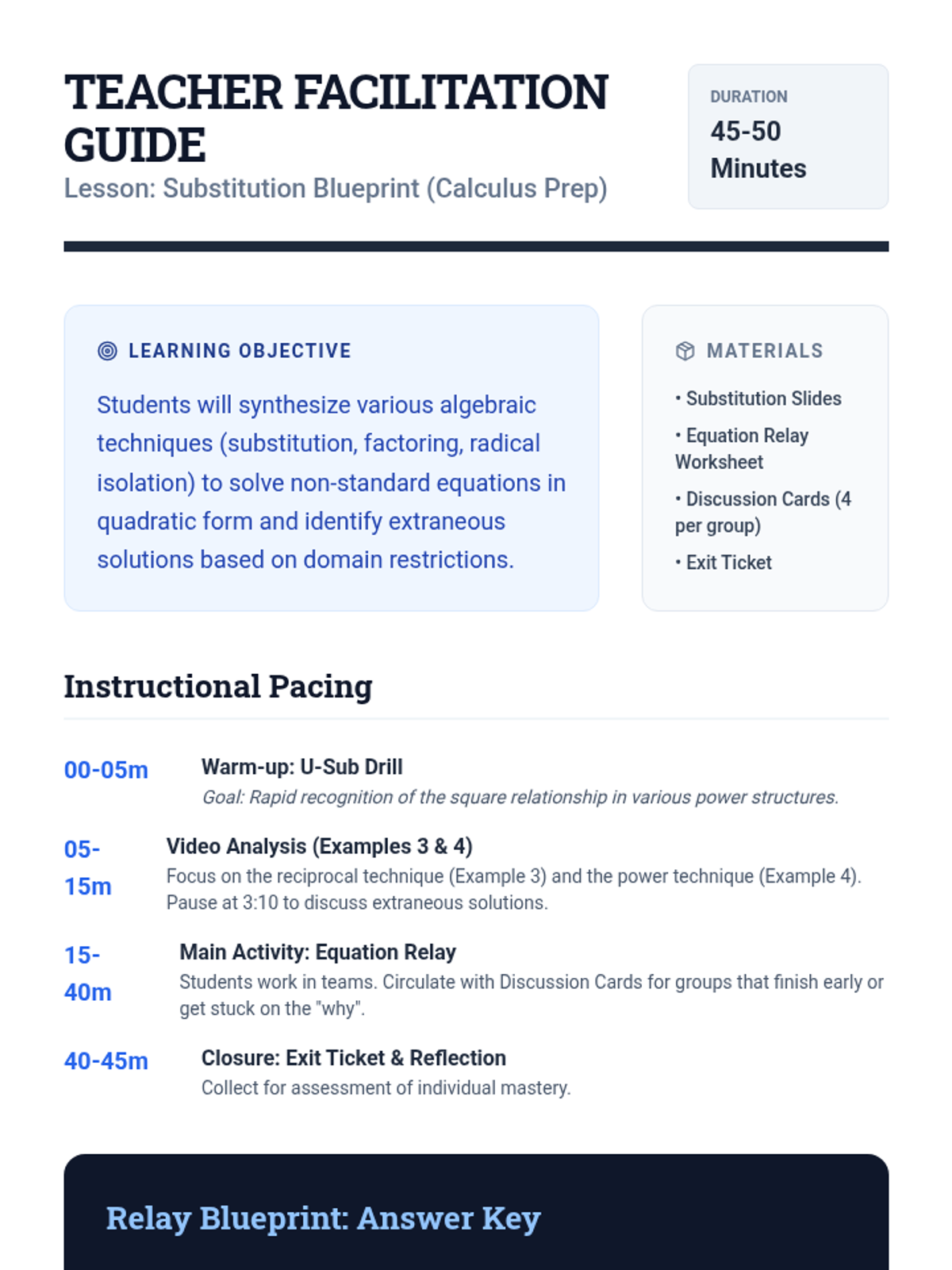
A comprehensive teacher facilitation guide including learning objectives, a detailed pacing guide, a video analysis key, and the full answer key for the Equation Relay activity.
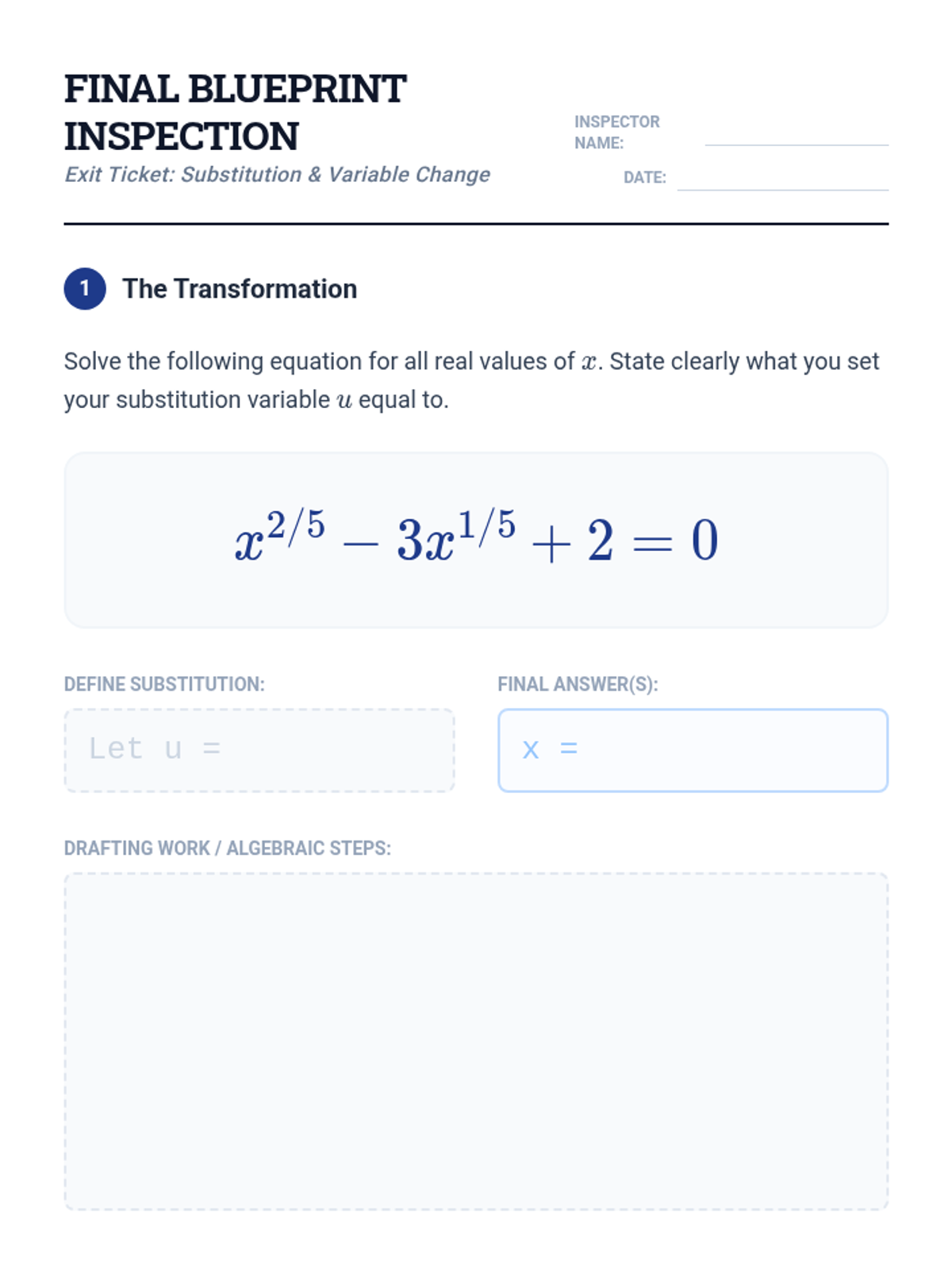
A concise exit ticket featuring a rational-exponent substitution problem and a reflection prompt on the conceptual utility of variable change in advanced mathematics.
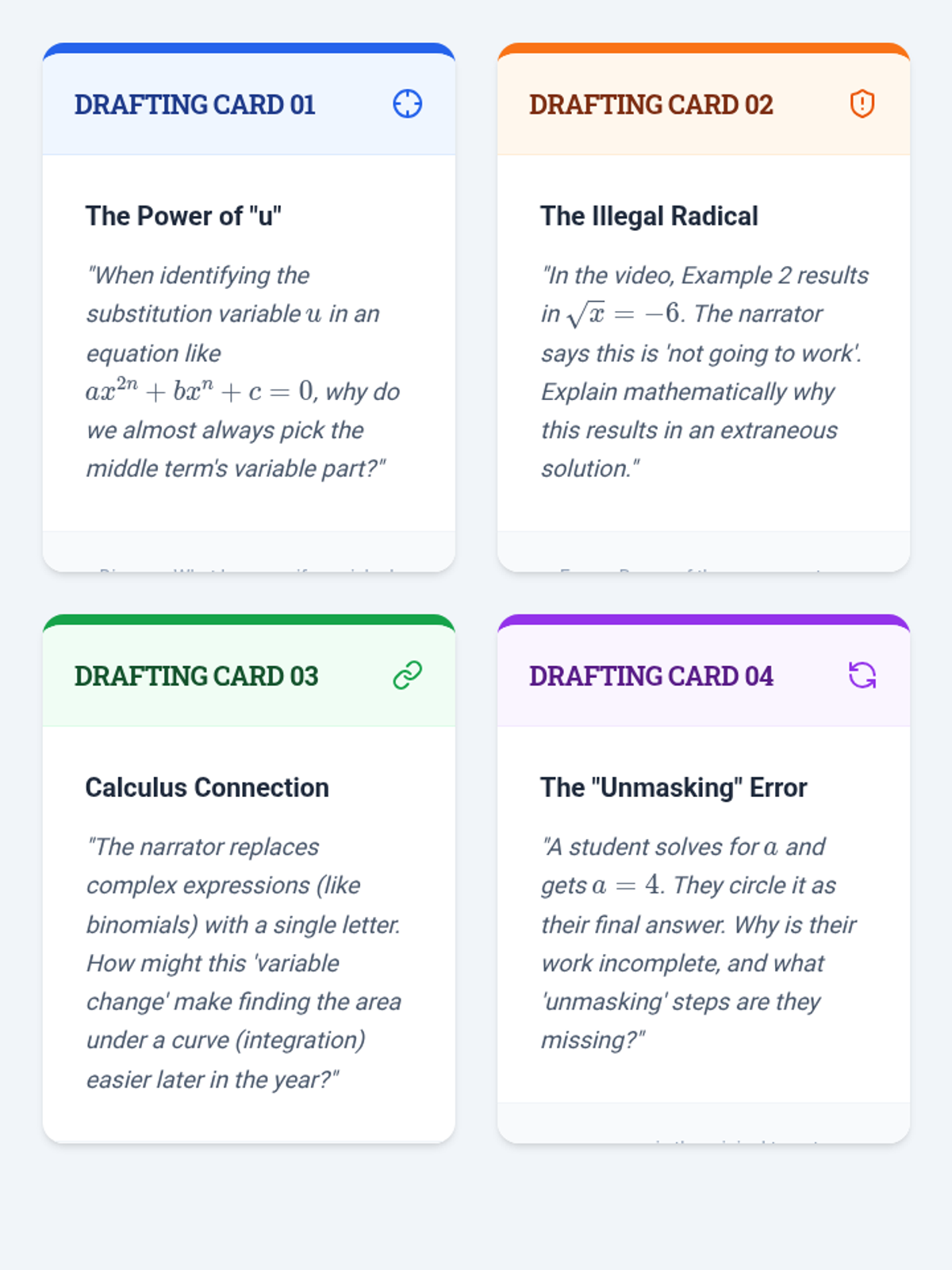
A set of four discussion prompts designed to facilitate deep conceptual understanding of variable substitution, domain restrictions, and the connection to future calculus topics.
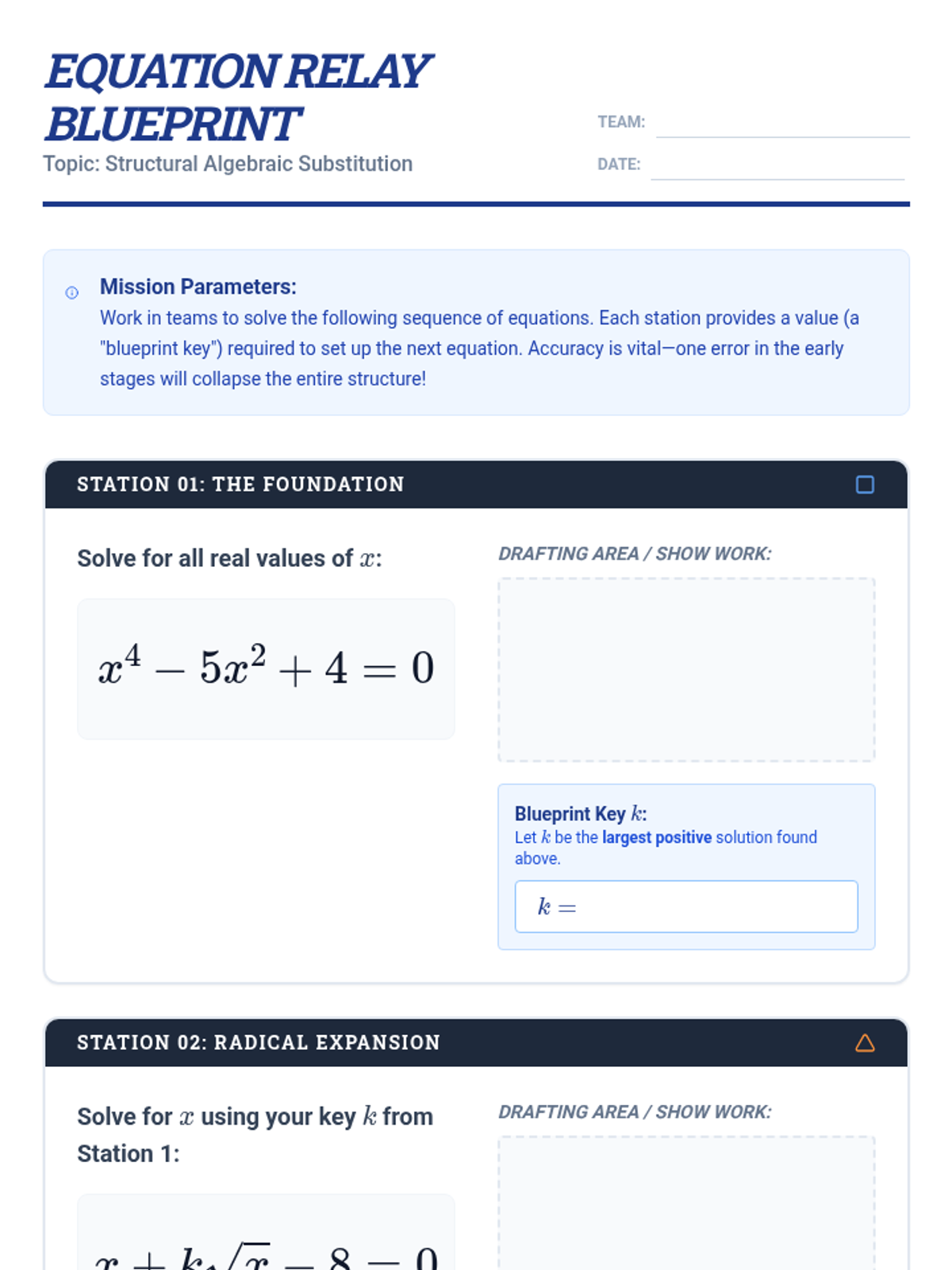
A tiered 'relay' worksheet where students solve a series of equations in quadratic form. Each station's answer is used to unlock the coefficients of the next problem, covering polynomial, radical, binomial, and rational substitution.
A comprehensive slide deck for teaching non-standard equation solving via substitution, featuring a warm-up drill, video analysis, strategic thinking slides, and a connection to future calculus topics.
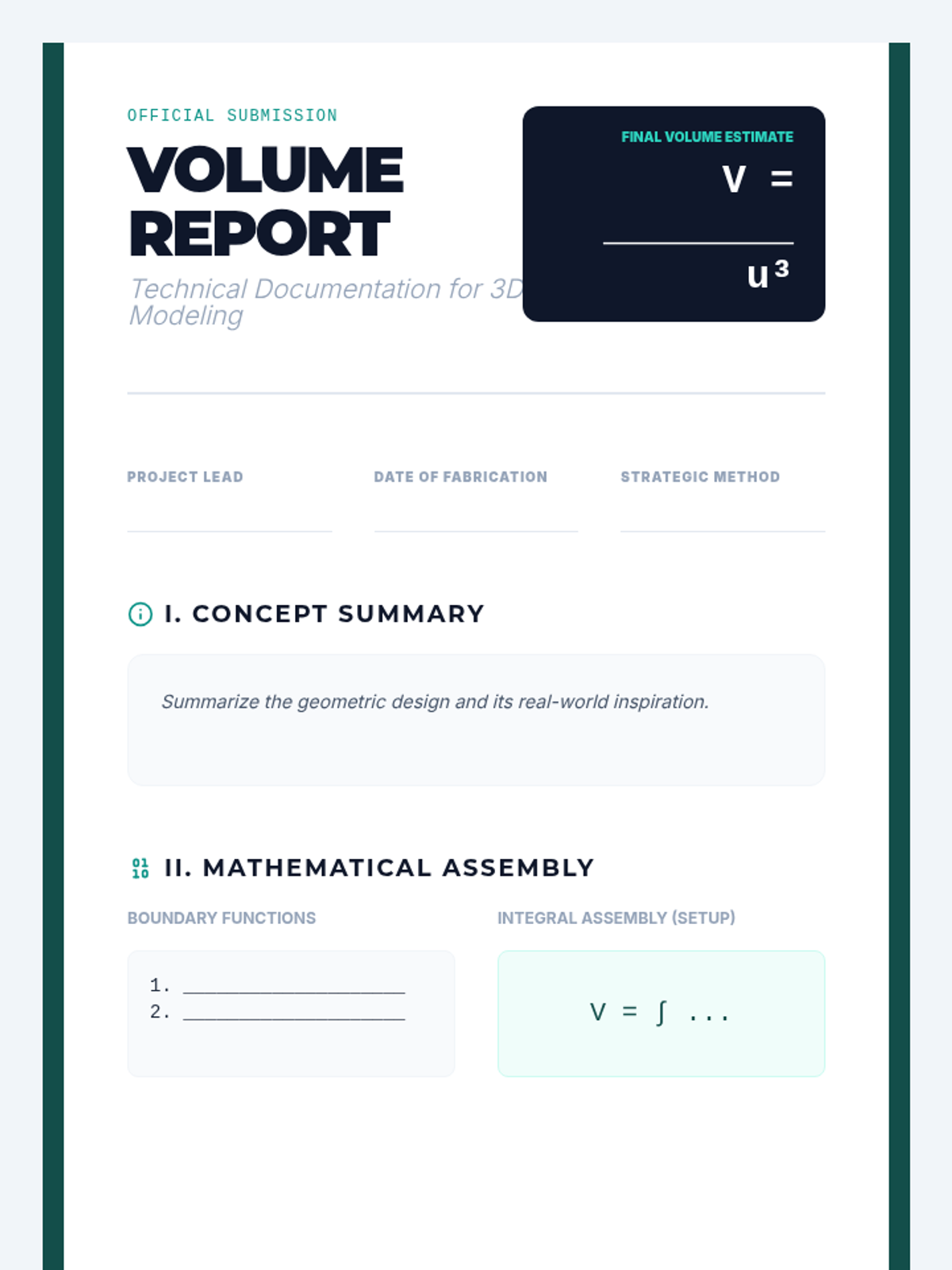
Student activity sheet for Lesson 5, serving as the final project submission template. Includes structured sections for mathematical derivation, integral evaluation, and final volume reporting.
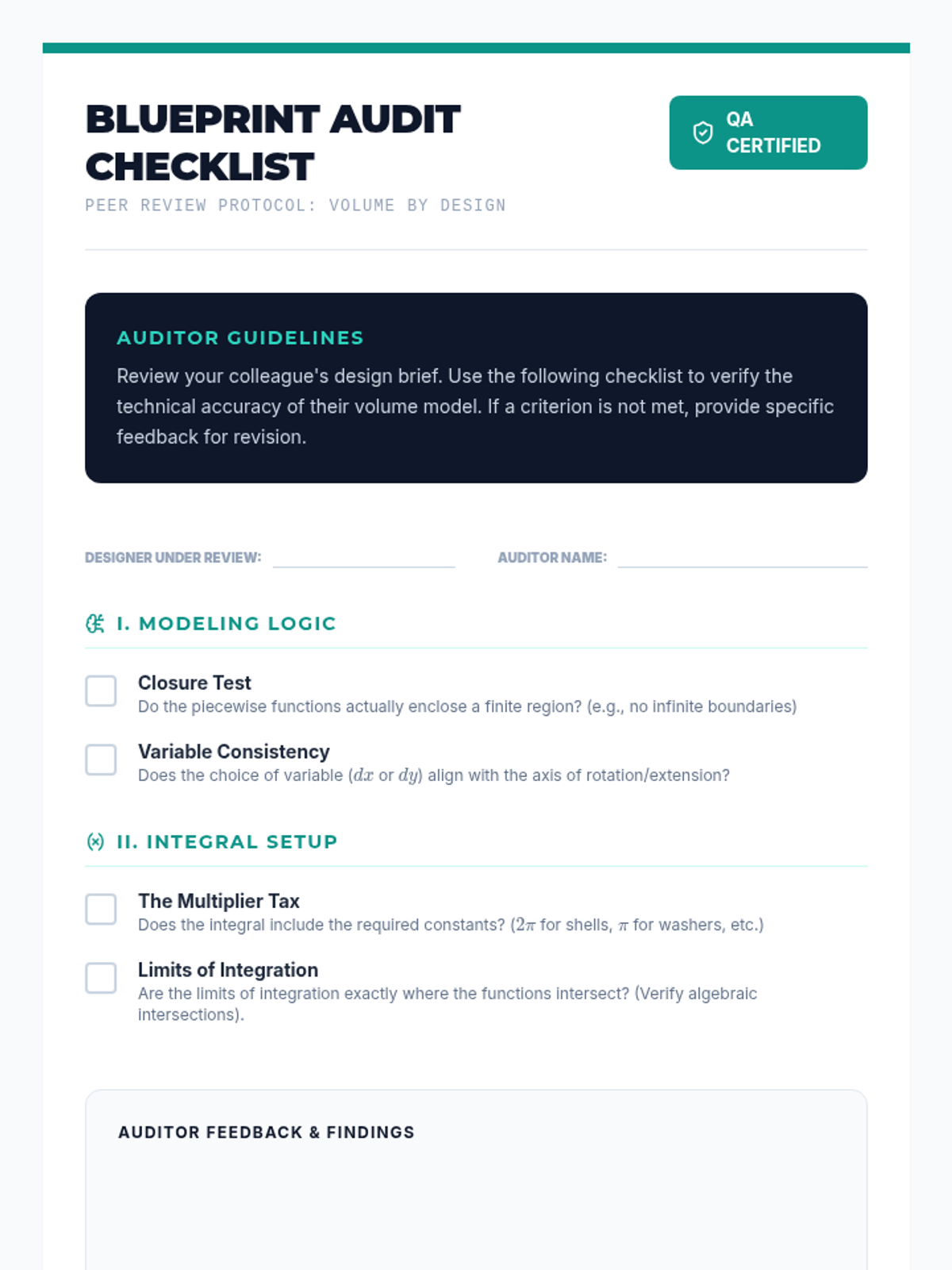
Teacher-facing peer review checklist for the final project workshop. Provides students with a structured framework for auditing each other's mathematical models and integral setups.
This slide deck facilitates the final workshop and peer-review session of the 'Volume by Design' project. It focuses on error analysis, technical verification, and professional presentation of mathematical findings.
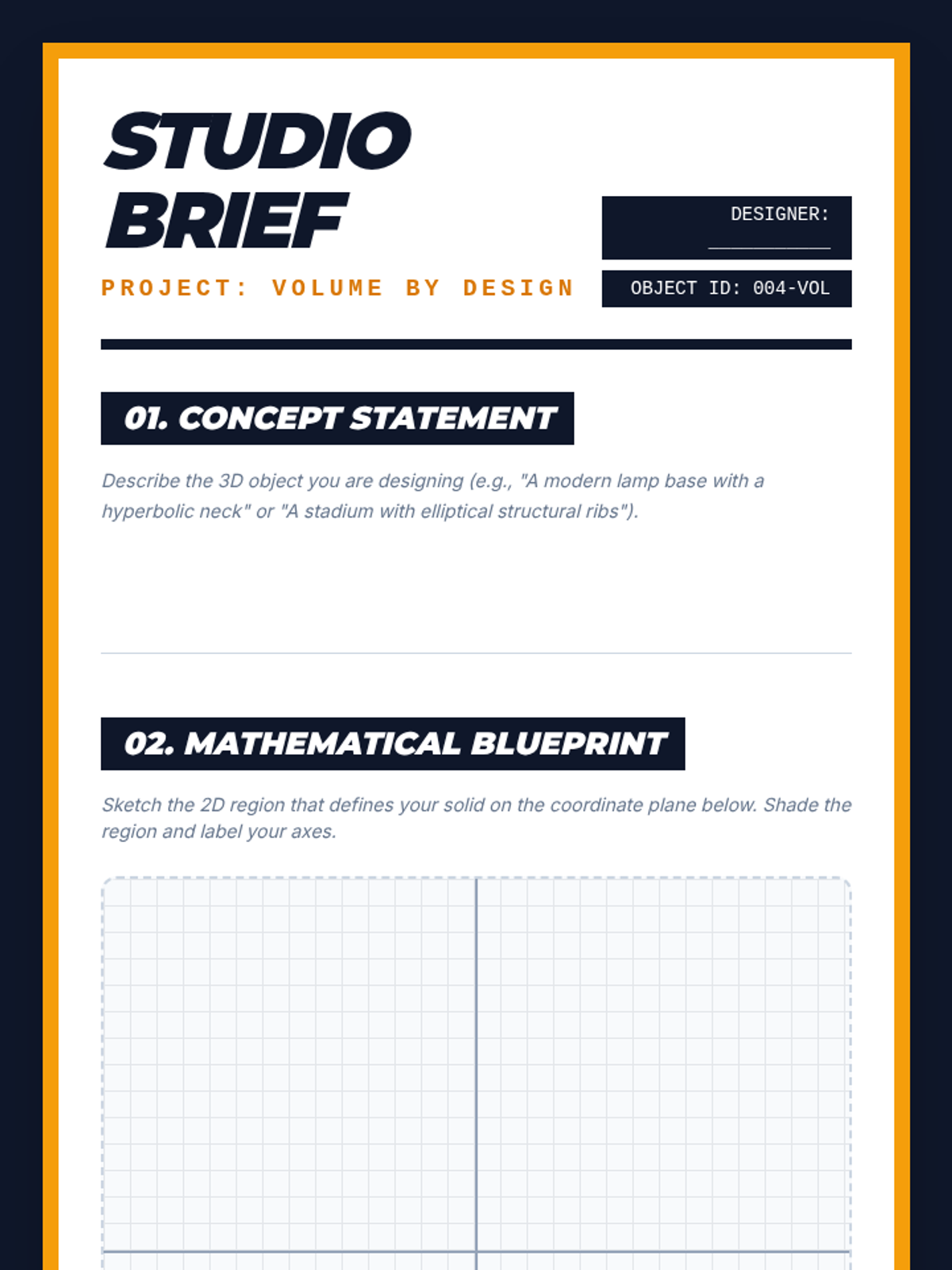
Student activity sheet for Lesson 4, serving as the official project design brief. Includes sections for concept ideation, coordinate-plane sketching, boundary function definitions, and strategic justification.
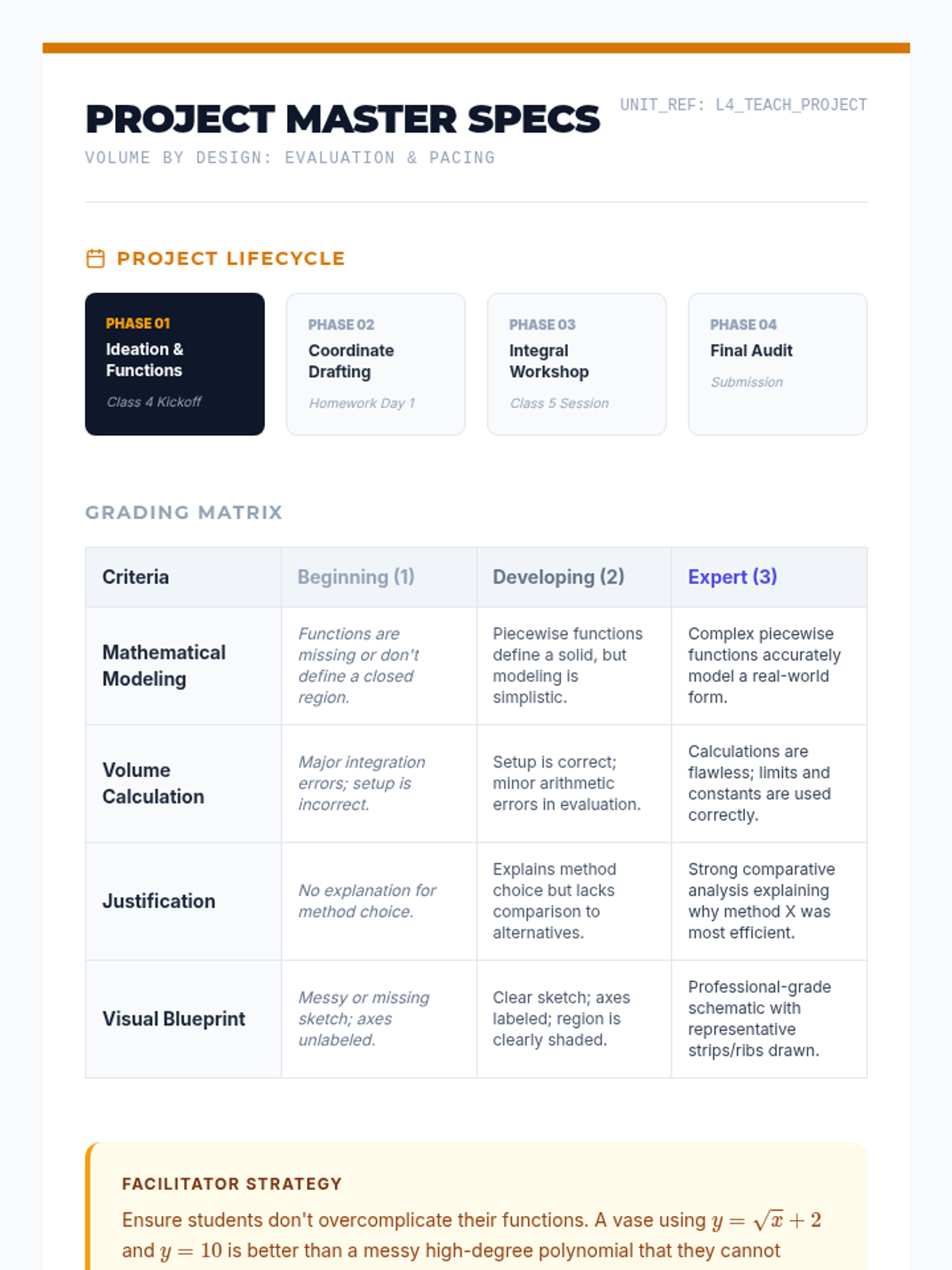
Teacher-facing project rubric and timeline for the 'Volume by Design' project. Includes specific grading criteria for mathematical modeling, calculation accuracy, and justification.
This slide deck kicks off the 'Volume by Design' capstone project. It outlines the design challenge, provides architectural inspiration, and details the technical requirements for modeling real-world objects using calculus.
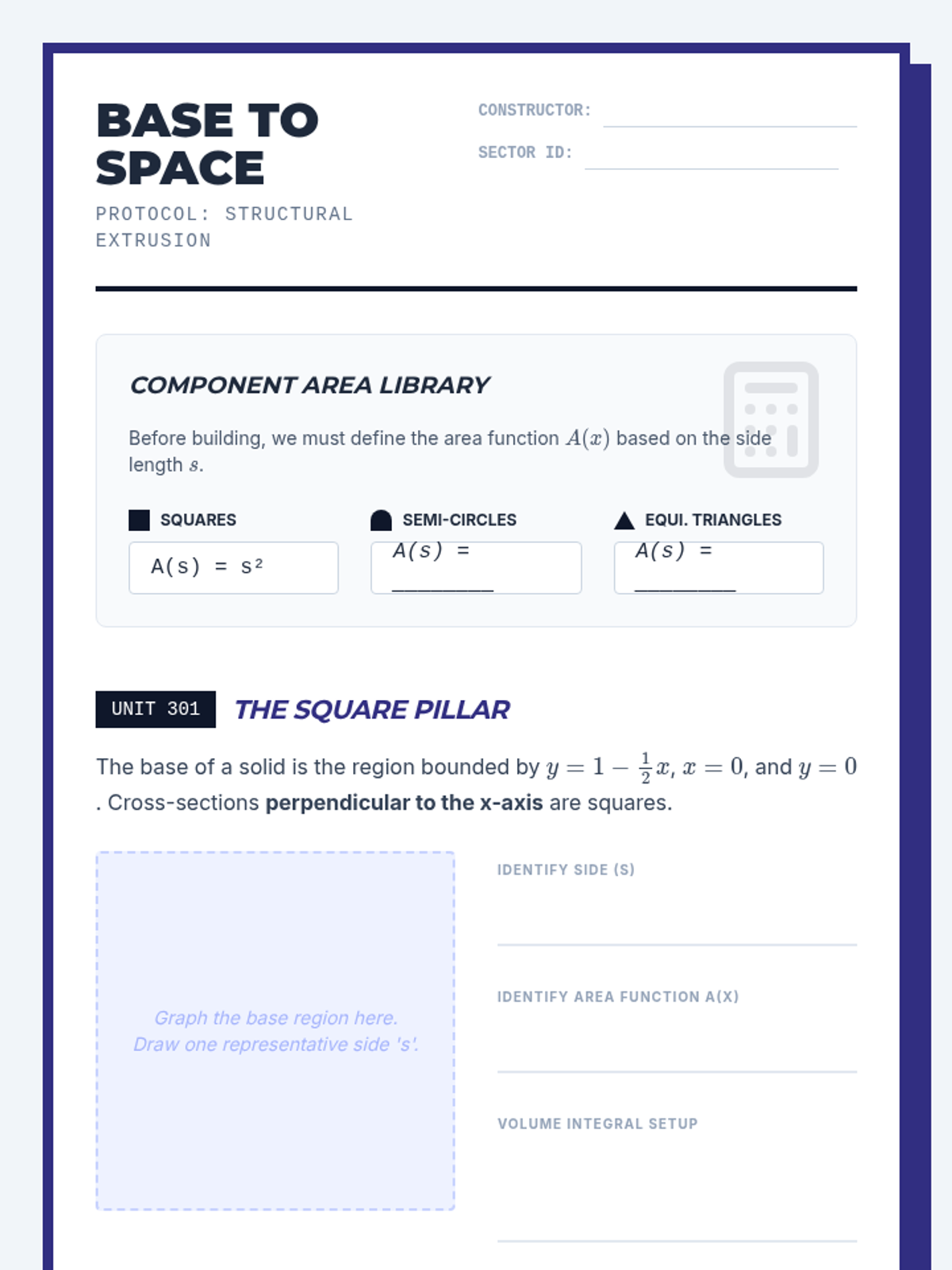
Student activity sheet for Lesson 3, focusing on volumes with known cross-sections. Students sketch base regions, identify side lengths, and set up integrals for various geometric shapes.
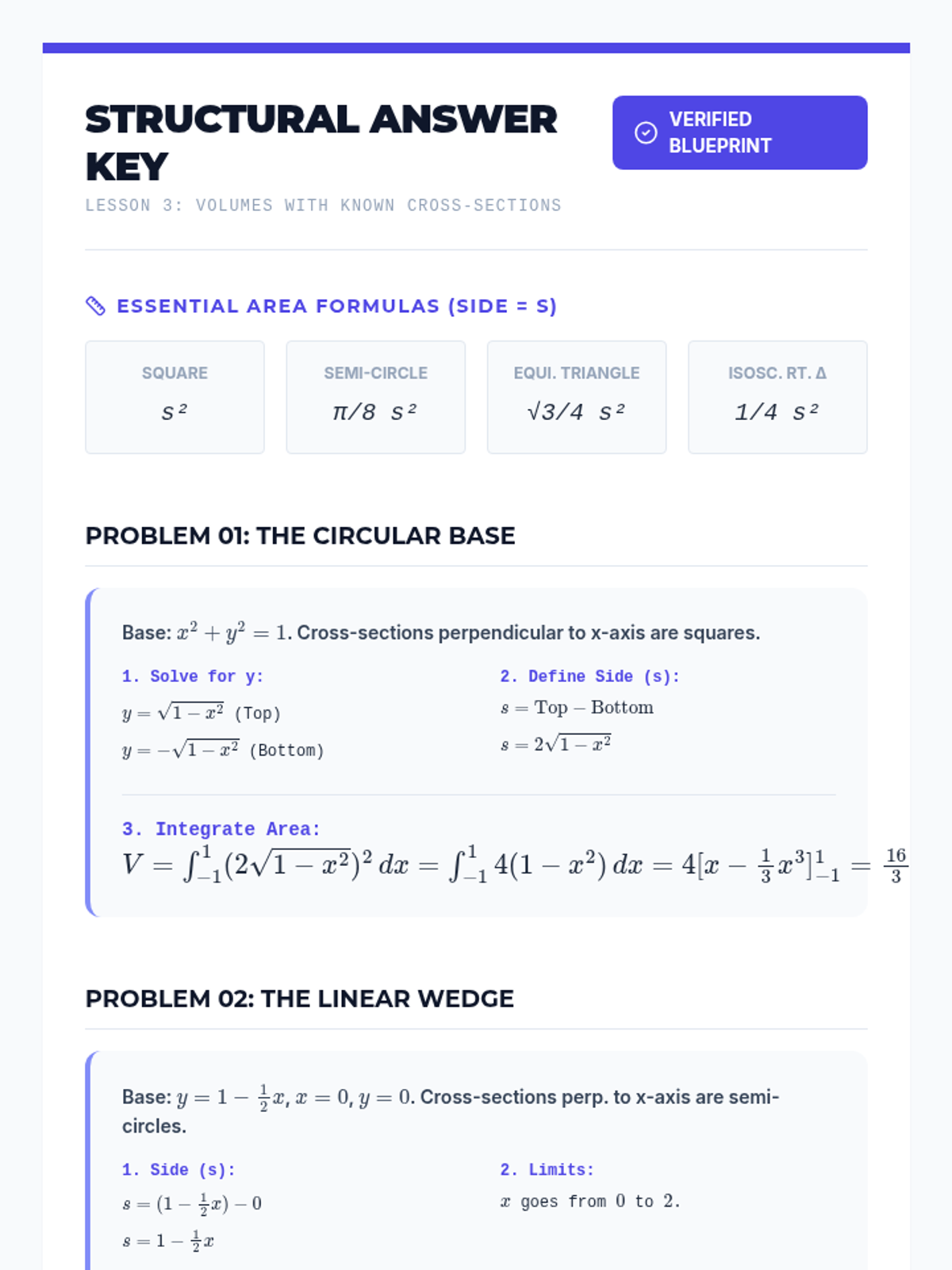
Teacher-facing answer key for Lesson 3, featuring a quick-reference area formula matrix and step-by-step solutions for cross-sectional volume problems.
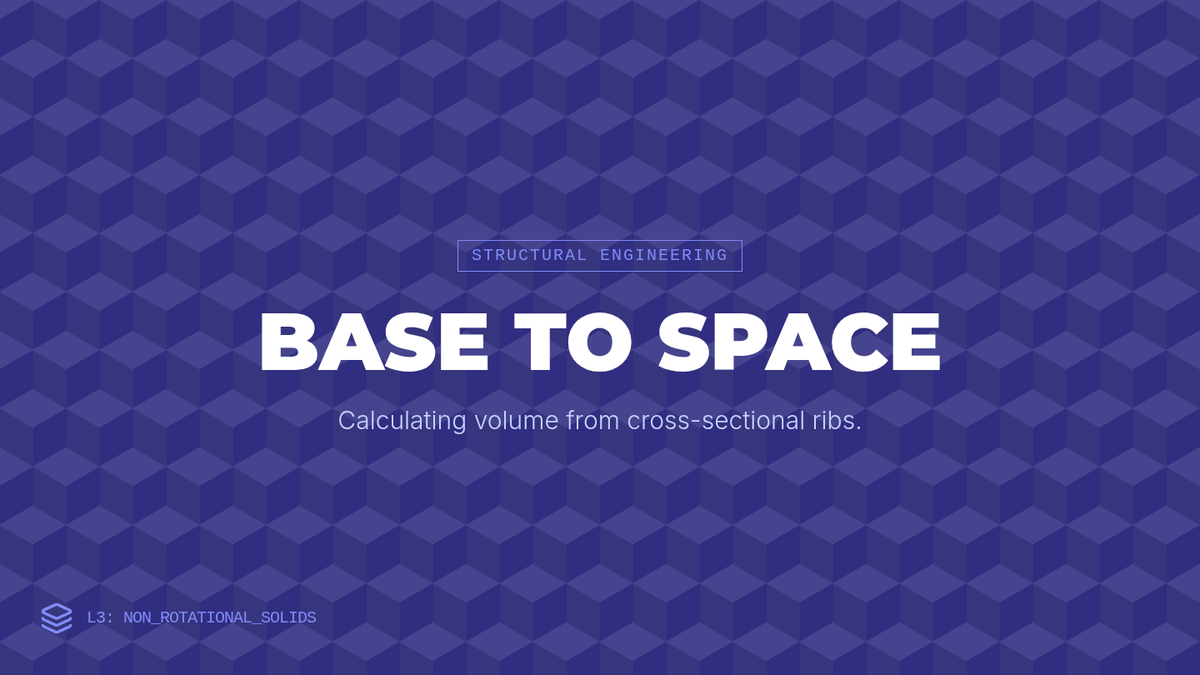
This slide deck introduces the concept of volumes with known cross-sections. It uses a structural/architectural theme to help students visualize how 2D base regions extrude into 3D solids using geometric area formulas.
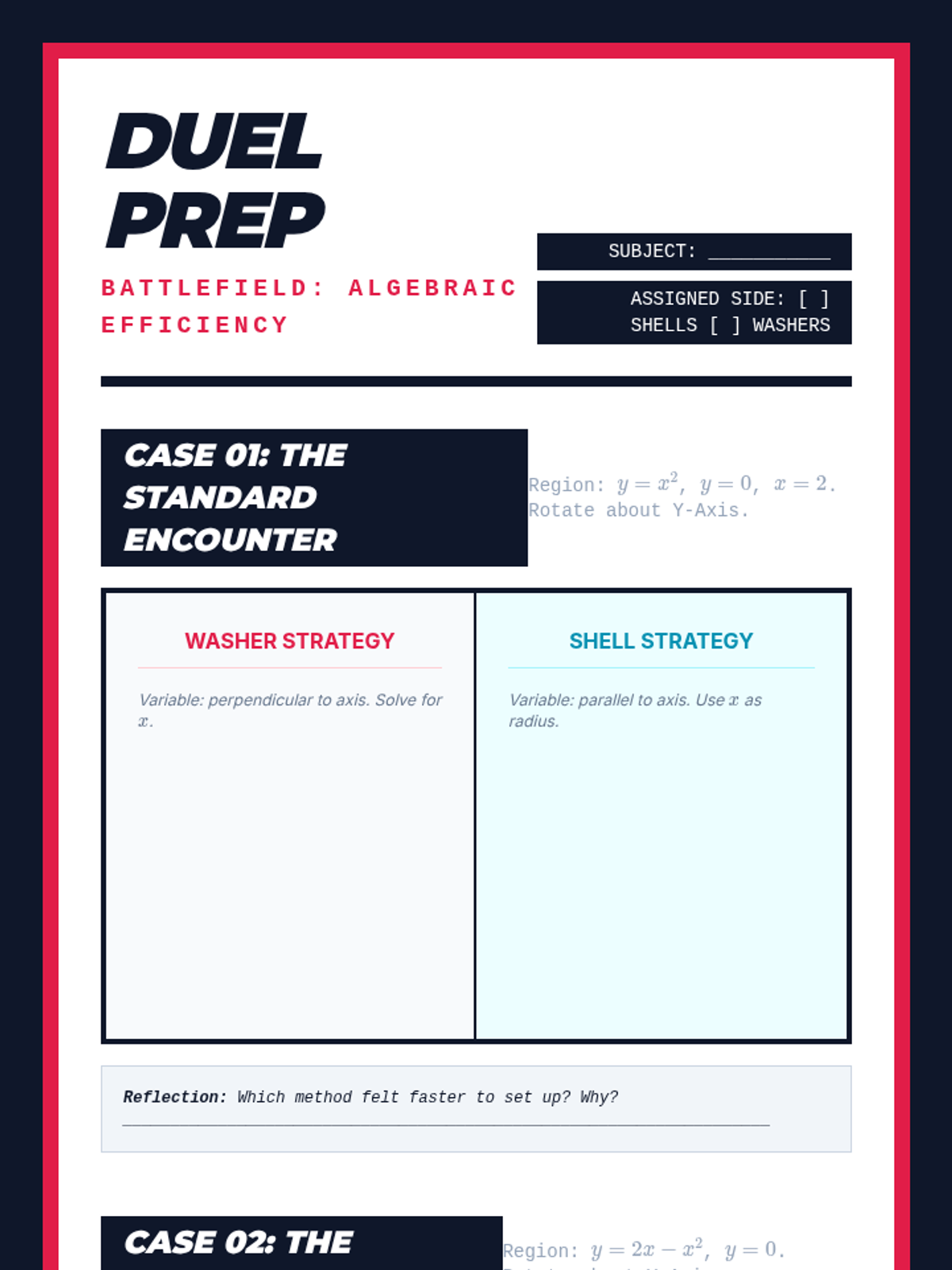
Student worksheet for comparing the Washer and Shell methods through a 'Duel' lens. Includes comparative work areas, heuristic development, and a final strategic challenge.
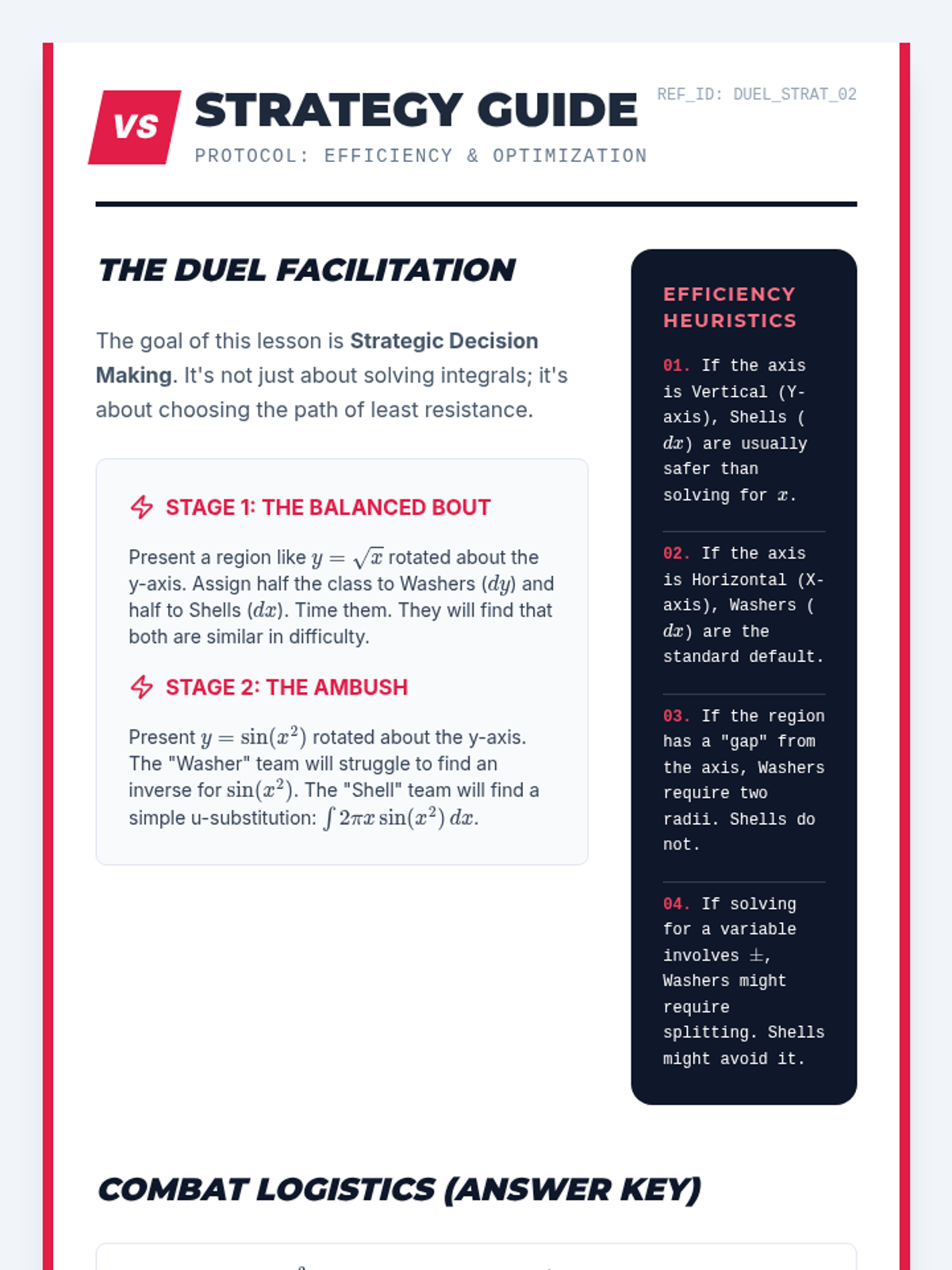
Teacher-facing strategy guide for the comparative analysis of volume methods. Includes lesson facilitation steps for the 'Calculus Duel' and a heuristic matrix for strategic decision making.
This slide deck facilitates a comparative discussion between the Washer and Shell methods. It uses a competitive 'Duel' theme to highlight efficiency, variable choice, and strategic decision-making in calculus.
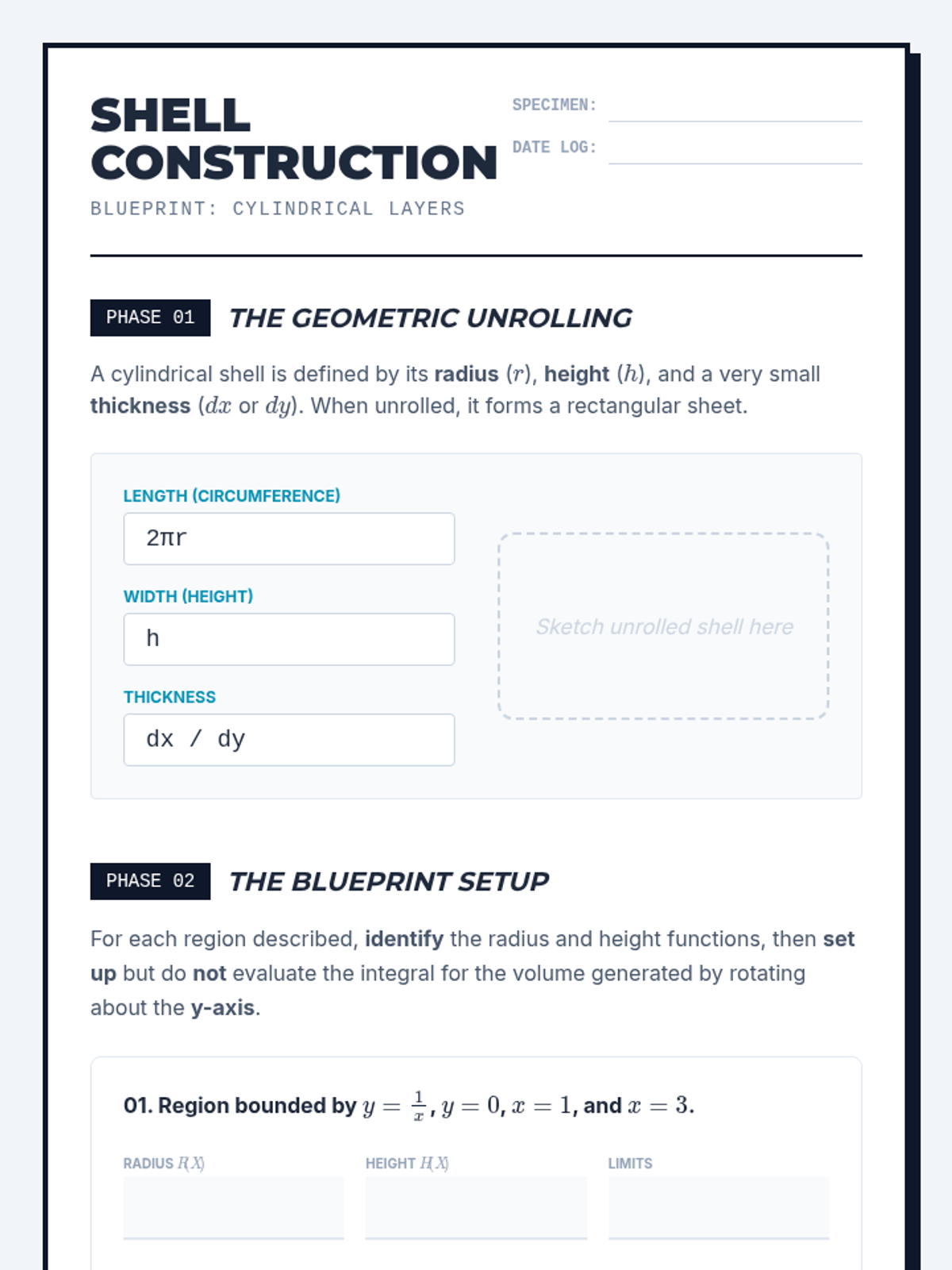
Student worksheet for Lesson 1, focusing on the derivation and application of the Shell Method. Includes identification of radius/height and full volume calculations for solids of revolution.
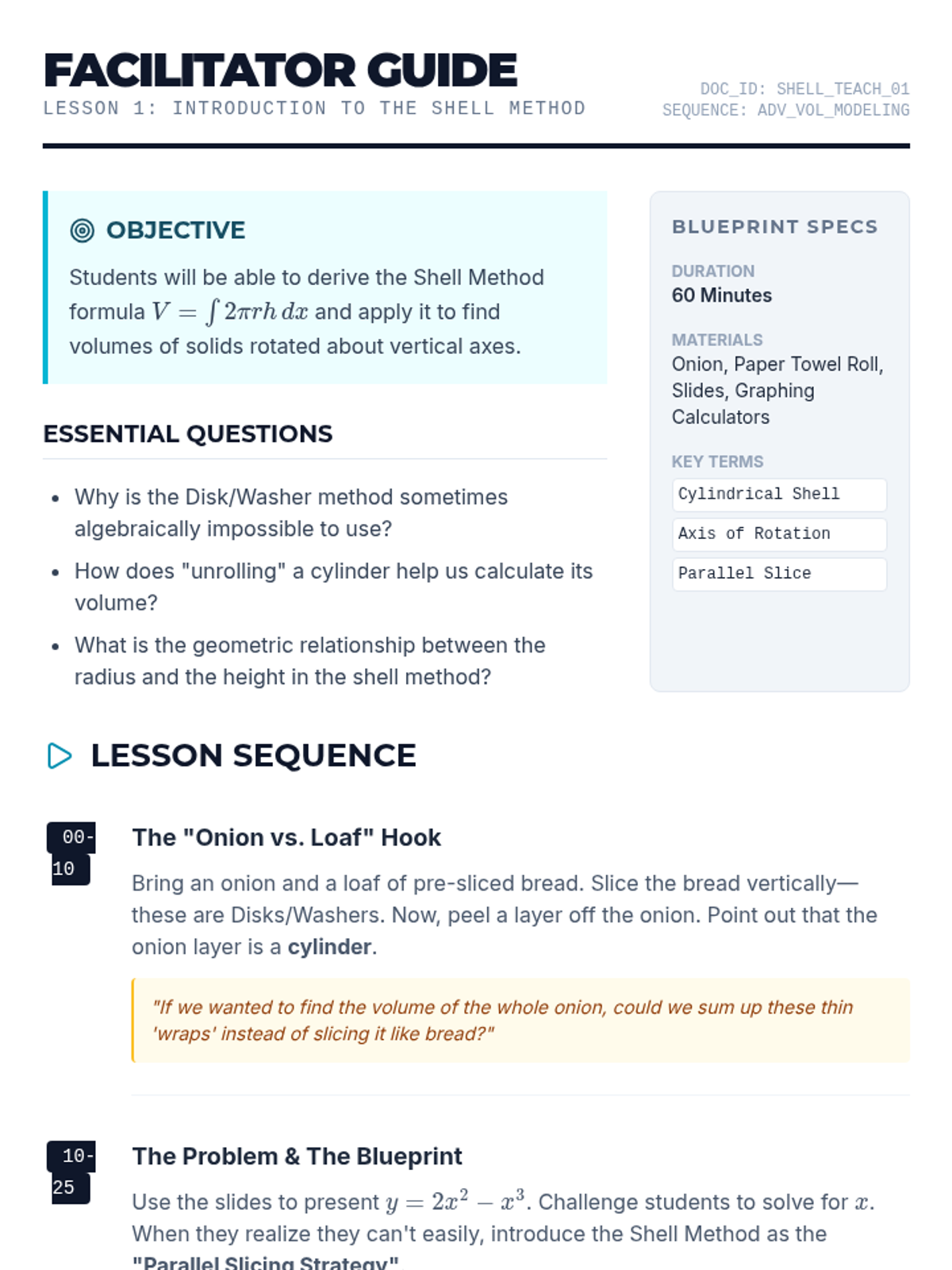
Facilitator guide for Lesson 1, detailing the 'Onion' hook, derivation steps for the Shell Method, common student misconceptions, and answer keys for classroom activities.
This slide deck introduces the Shell Method for calculating volumes of revolution. It uses an architectural/blueprint theme to guide students through the derivation of the formula and the identification of radius and height.
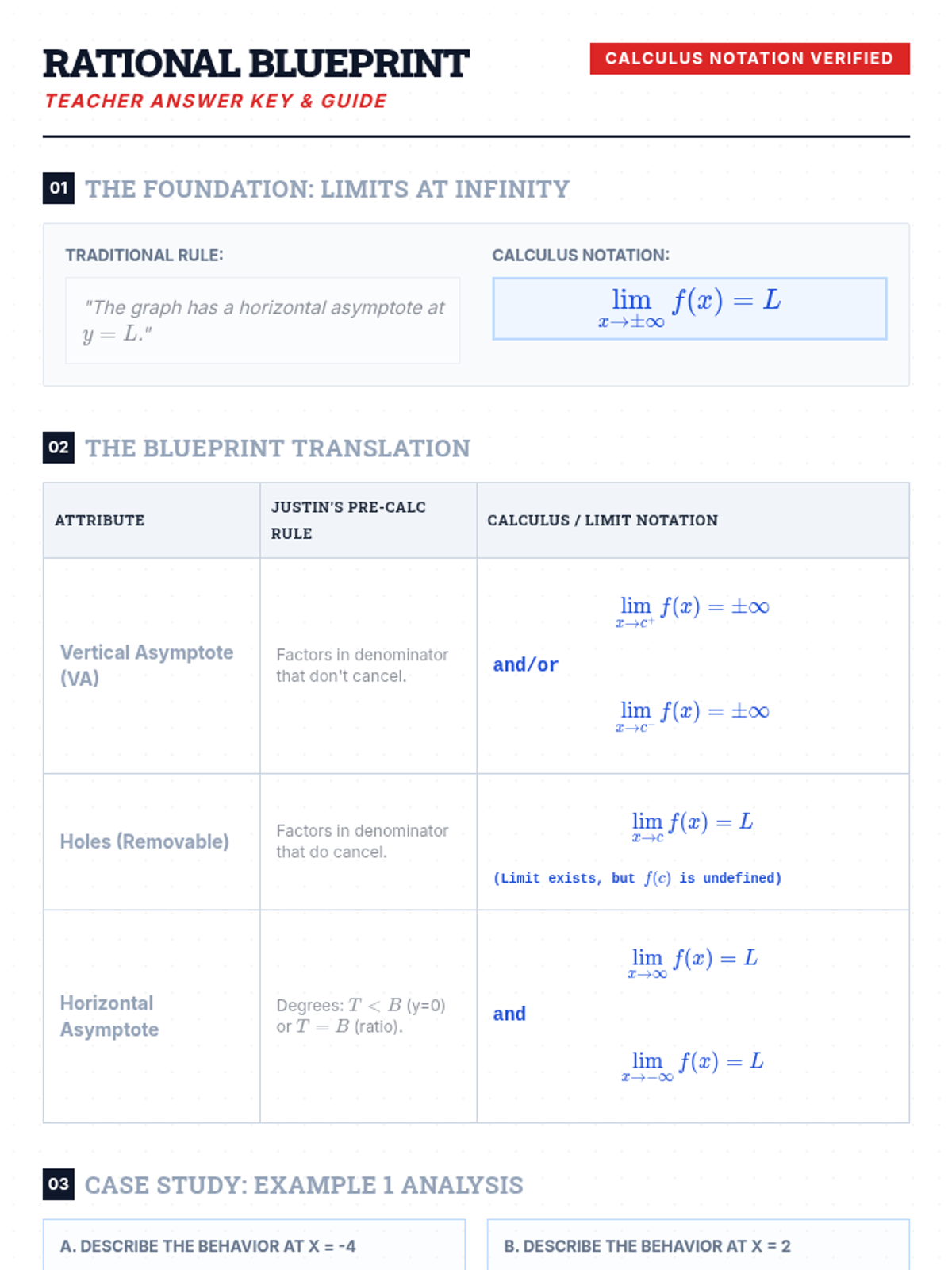
A comprehensive answer key for the Rational Blueprint worksheet, providing correct limit notation for all rational function attributes and the analysis of Example 1.
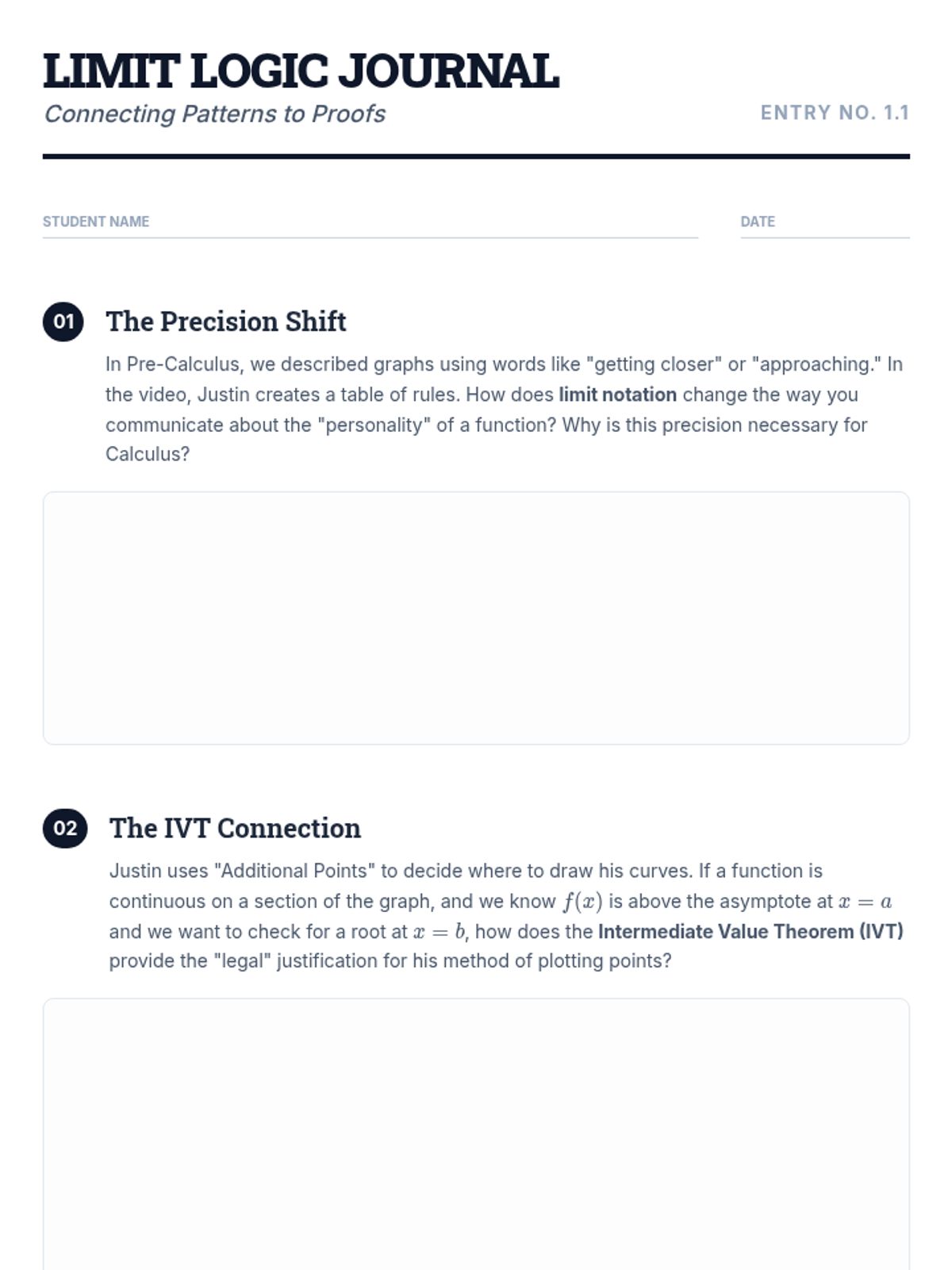
A reflection journal for students to synthesize their understanding of limit notation and connect point-plotting techniques to the Intermediate Value Theorem.
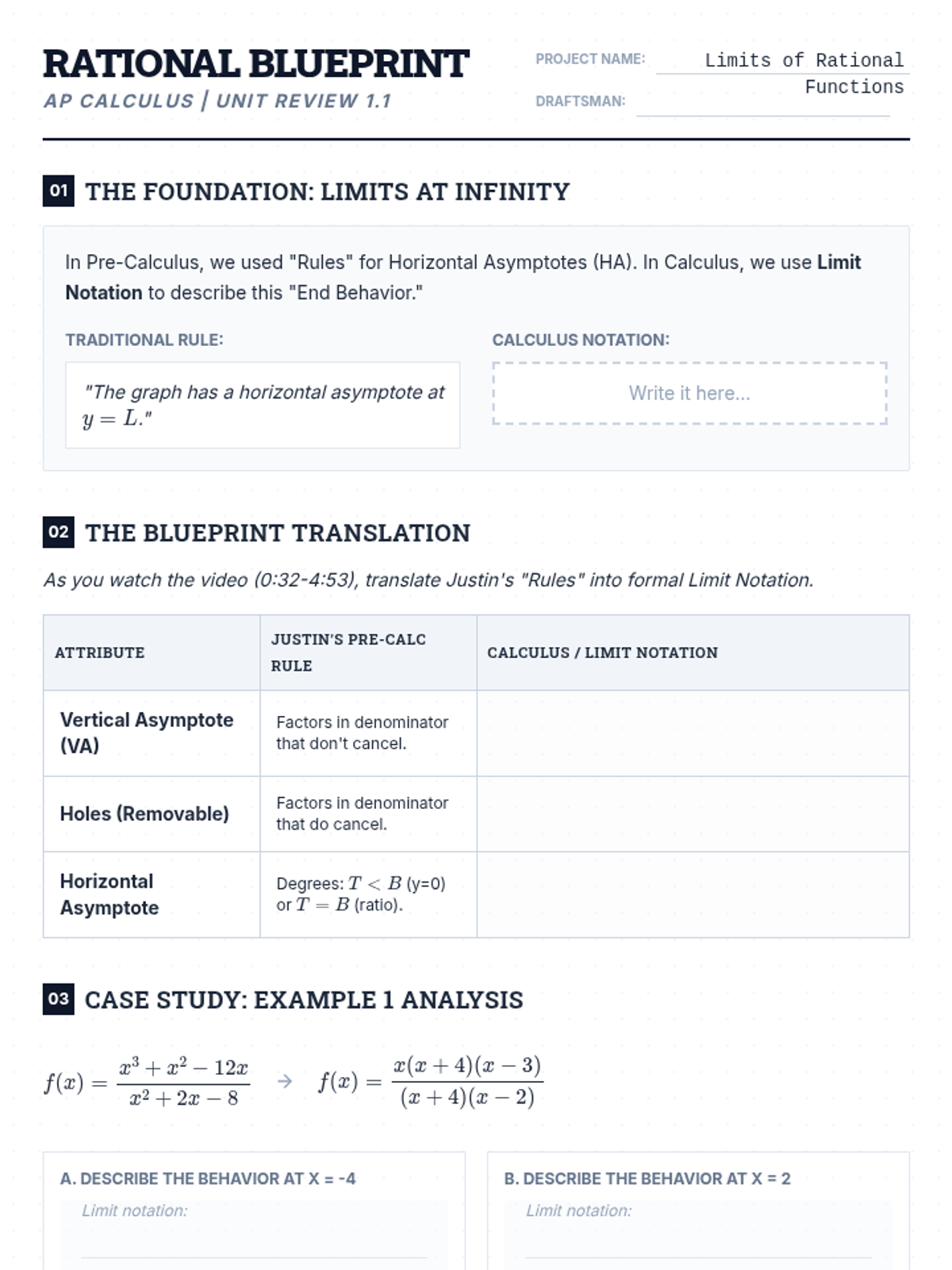
A student activity worksheet that bridges pre-calculus rational function sketching with AP Calculus limit notation, designed with a technical 'blueprint' aesthetic.
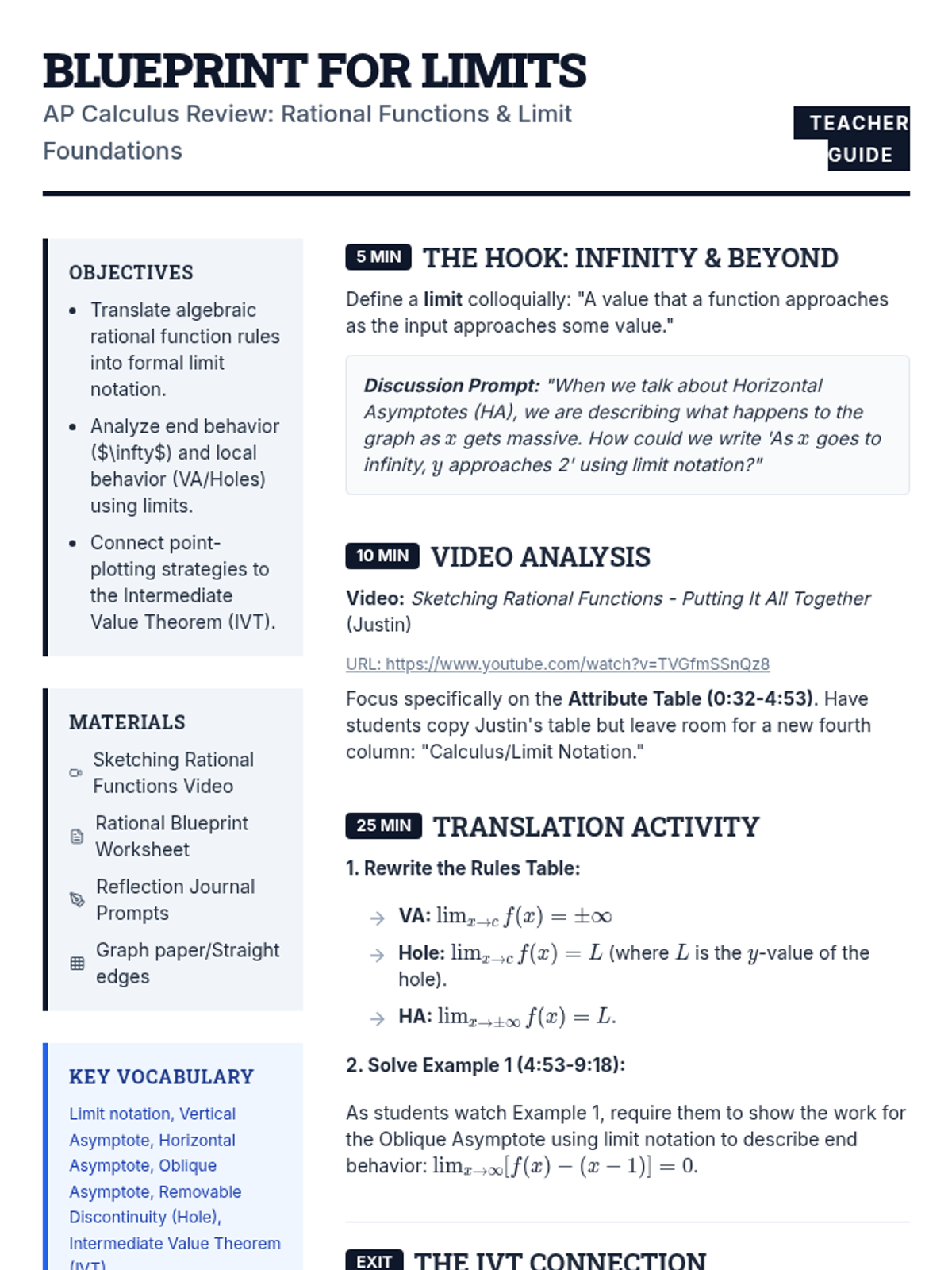
A detailed lesson plan for AP Calculus teachers that bridges the gap between pre-calculus rational function rules and formal limit notation, including a timing guide and discussion prompts based on the Justin's video.
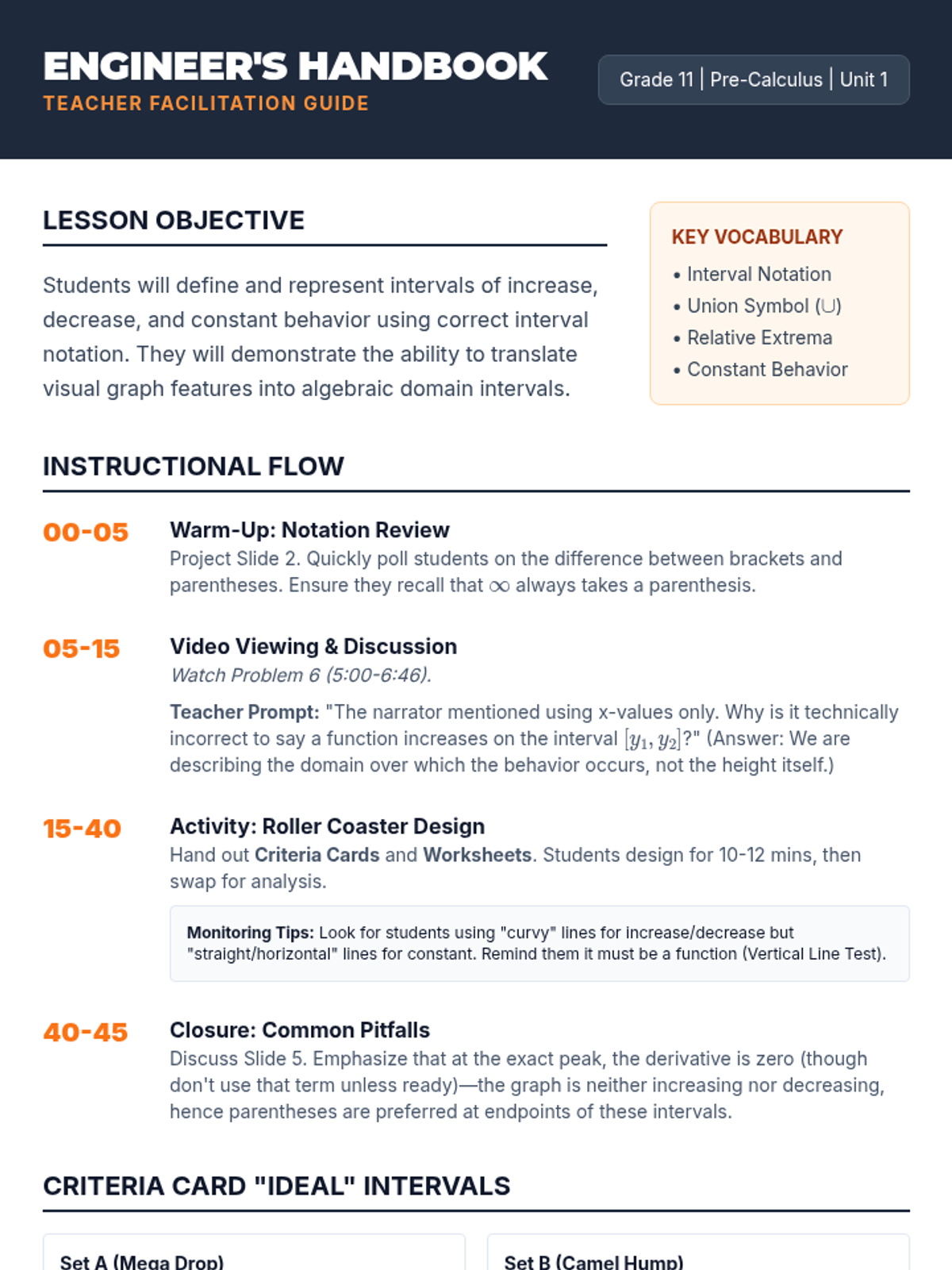
A comprehensive teacher facilitation guide for the Roller Coaster Calculus lesson. It includes pacing instructions, discussion prompts, a sample answer key for the criteria cards, and differentiation strategies.
Instructional slide deck for the Roller Coaster Calculus lesson. Includes warm-up on interval notation, embedded YouTube video for Problem 6, activity instructions, and a closure section on common misconceptions.
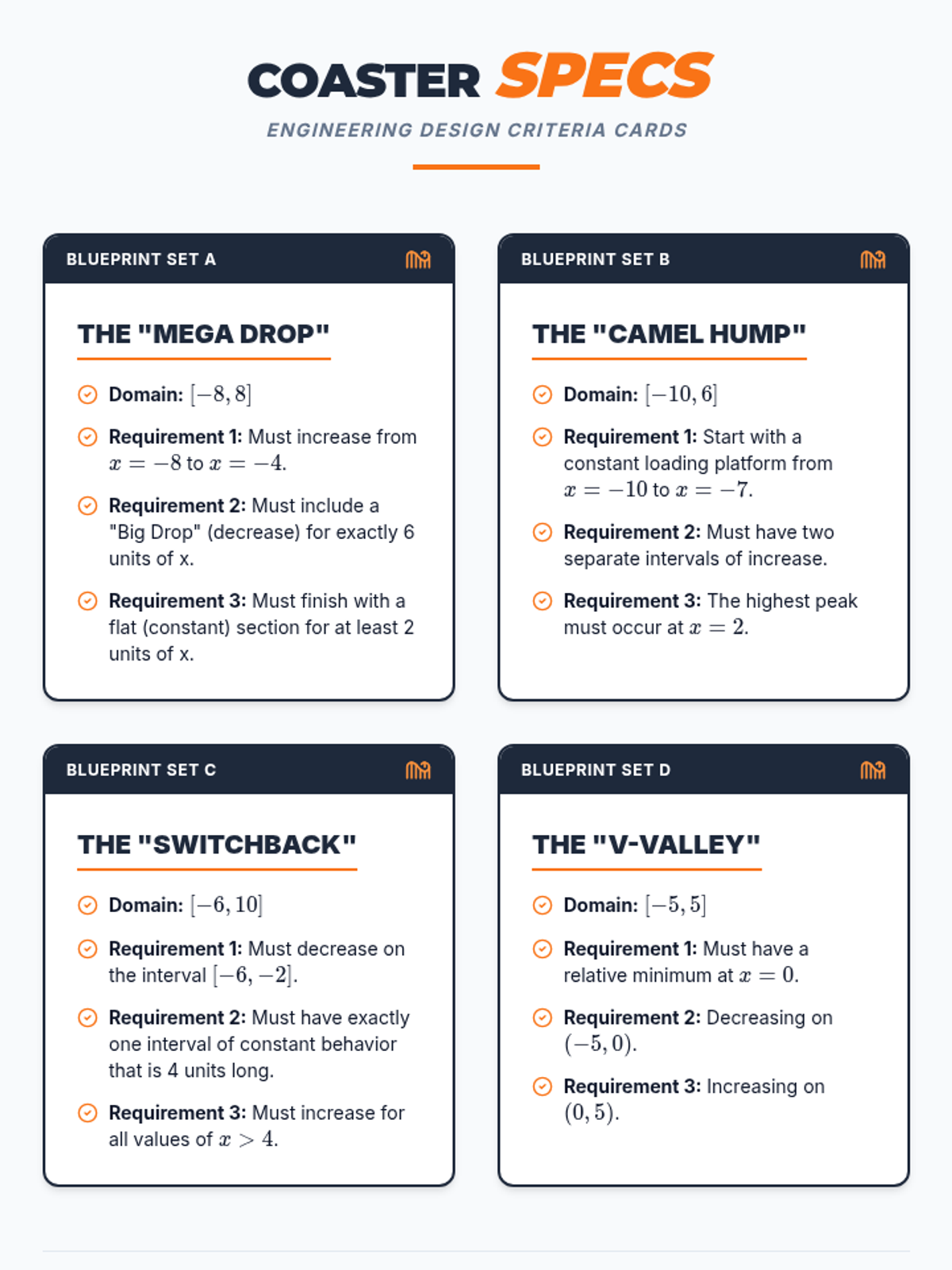
Set of four distinct "Coaster Specs" cards that provide specific mathematical criteria for students to follow during the Roller Coaster Design activity. Each card outlines domain, increase/decrease intervals, and constant behavior requirements.
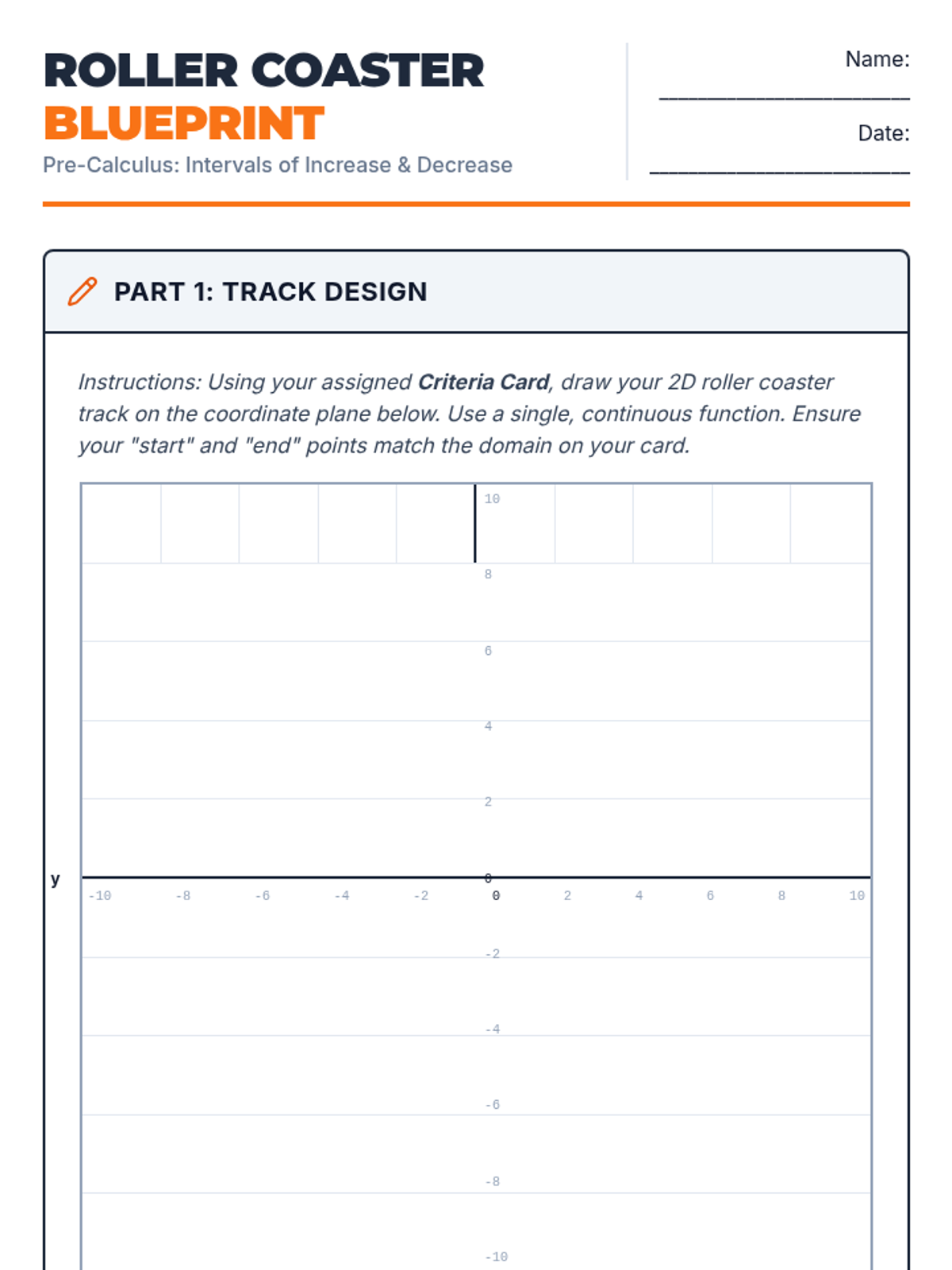
A specialized two-part worksheet for the Roller Coaster Design activity. Side A features a coordinate plane for track design, and Side B provides a peer-review section for interval analysis using interval notation.
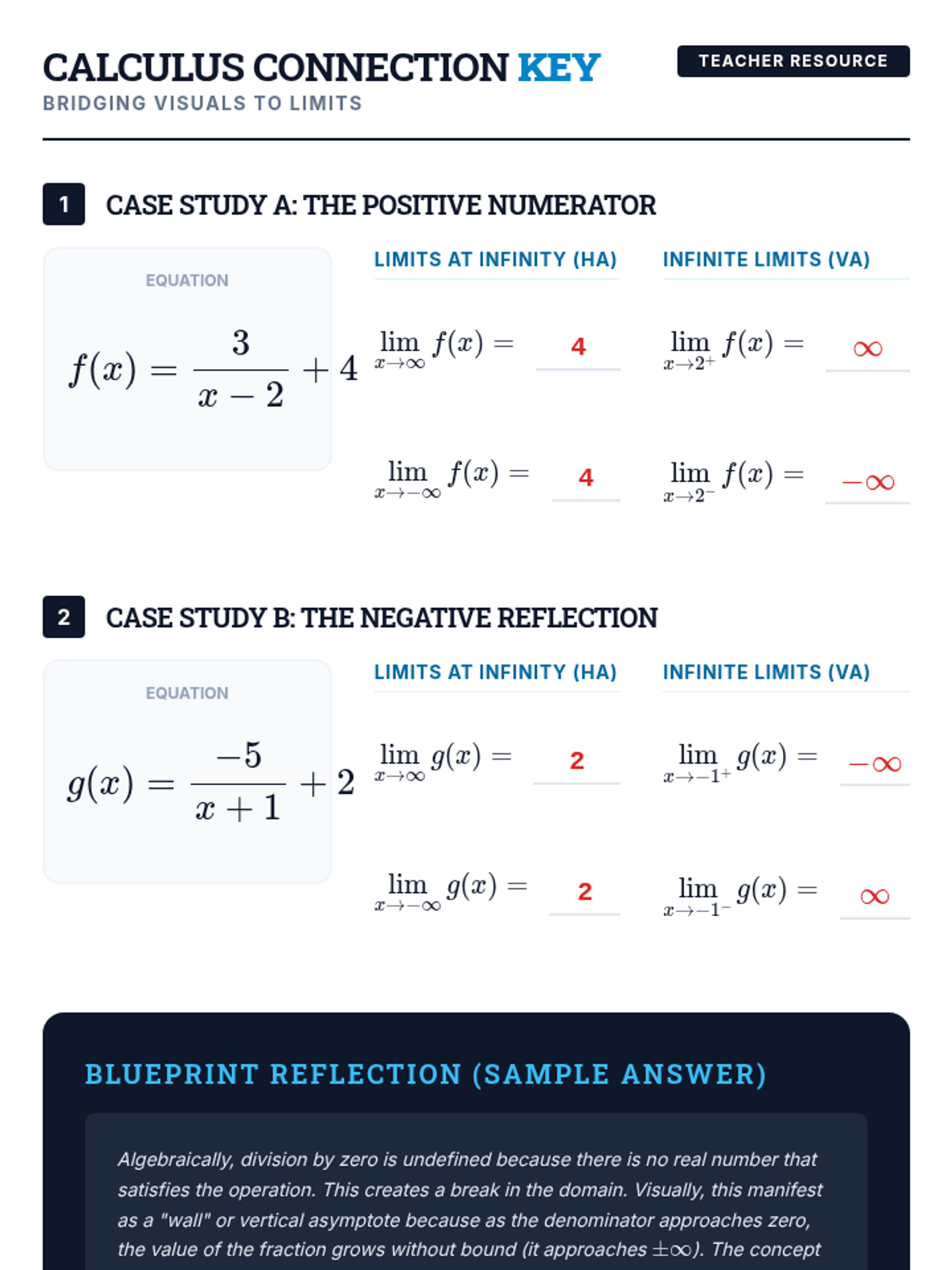
The teacher answer key for the Calculus Connection Worksheet, providing correct limit evaluations and sample reflection responses.
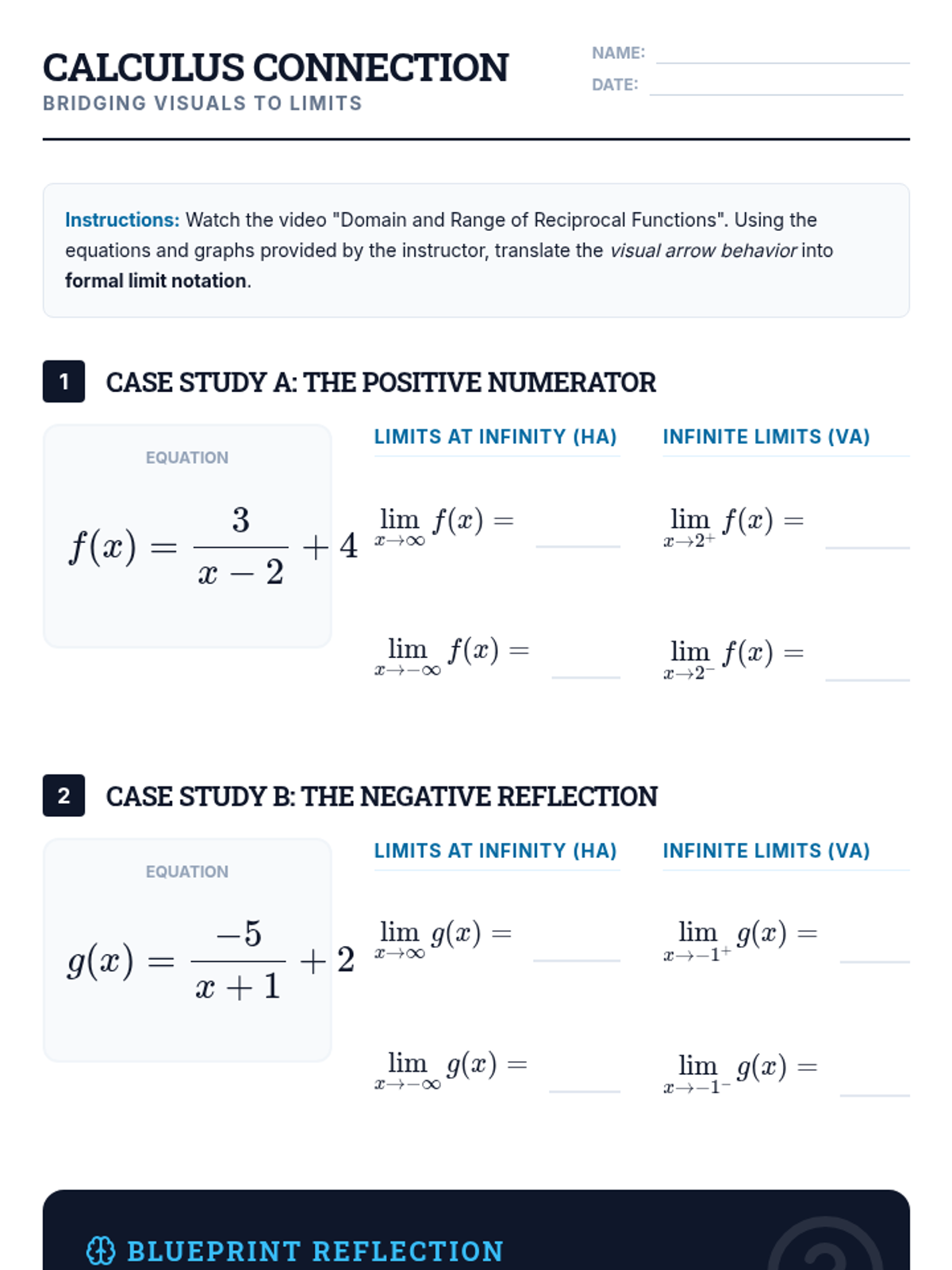
A student activity worksheet where students evaluate limits for reciprocal functions from the lesson video and connect them to vertical and horizontal asymptotes.
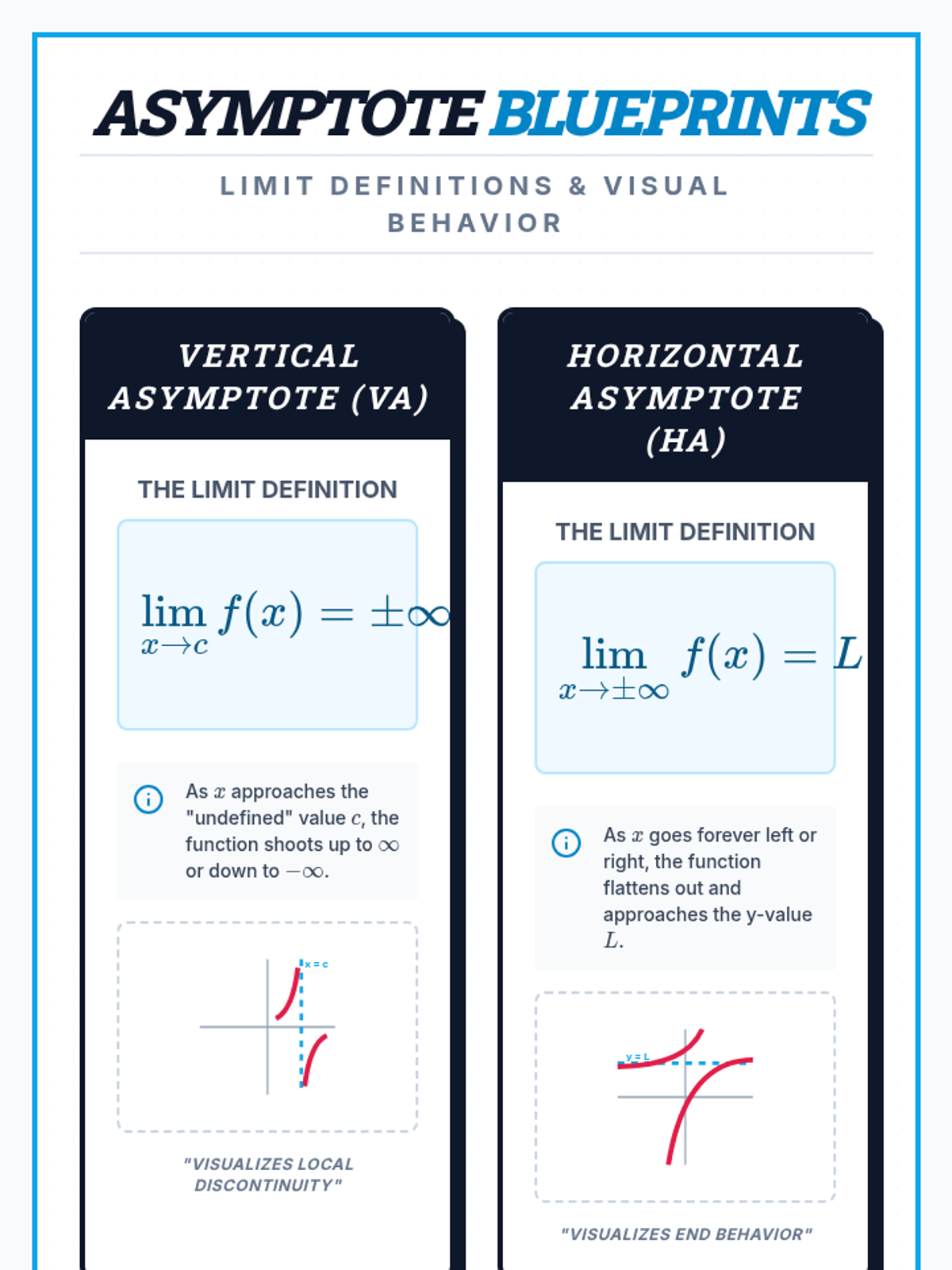
A visually striking anchor chart connecting the limit definitions of vertical and horizontal asymptotes to their graphical behaviors for 12th-grade Pre-Calculus students.
A presentation slide deck for 12th-grade Pre-Calculus connecting limits to asymptotes, including a warm-up, embedded video instruction, and guided practice.
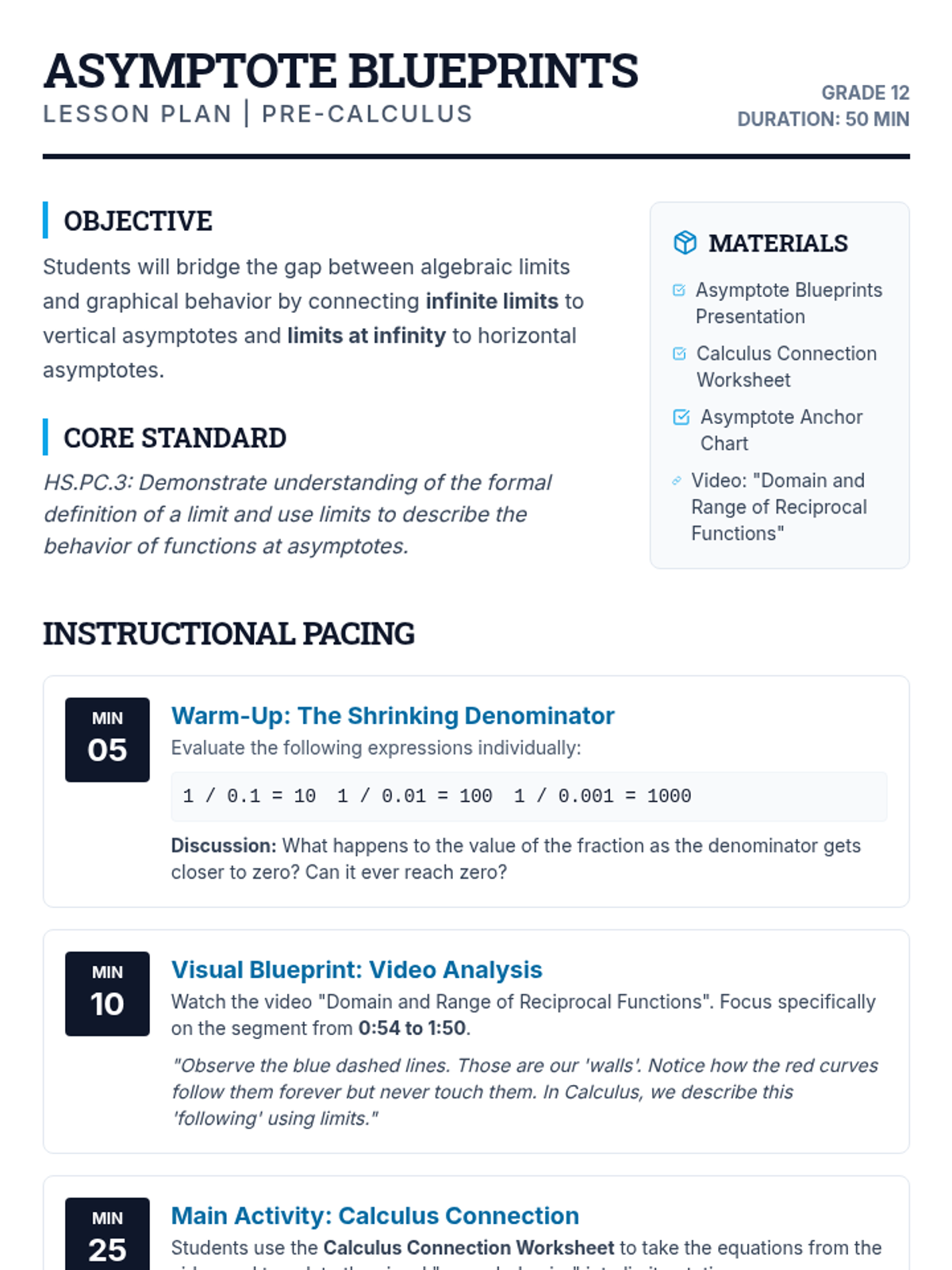
A comprehensive teacher lesson plan for a 12th-grade Pre-Calculus lesson on connecting limits to asymptotes, including pacing, warm-up prompts, and instructional tips.
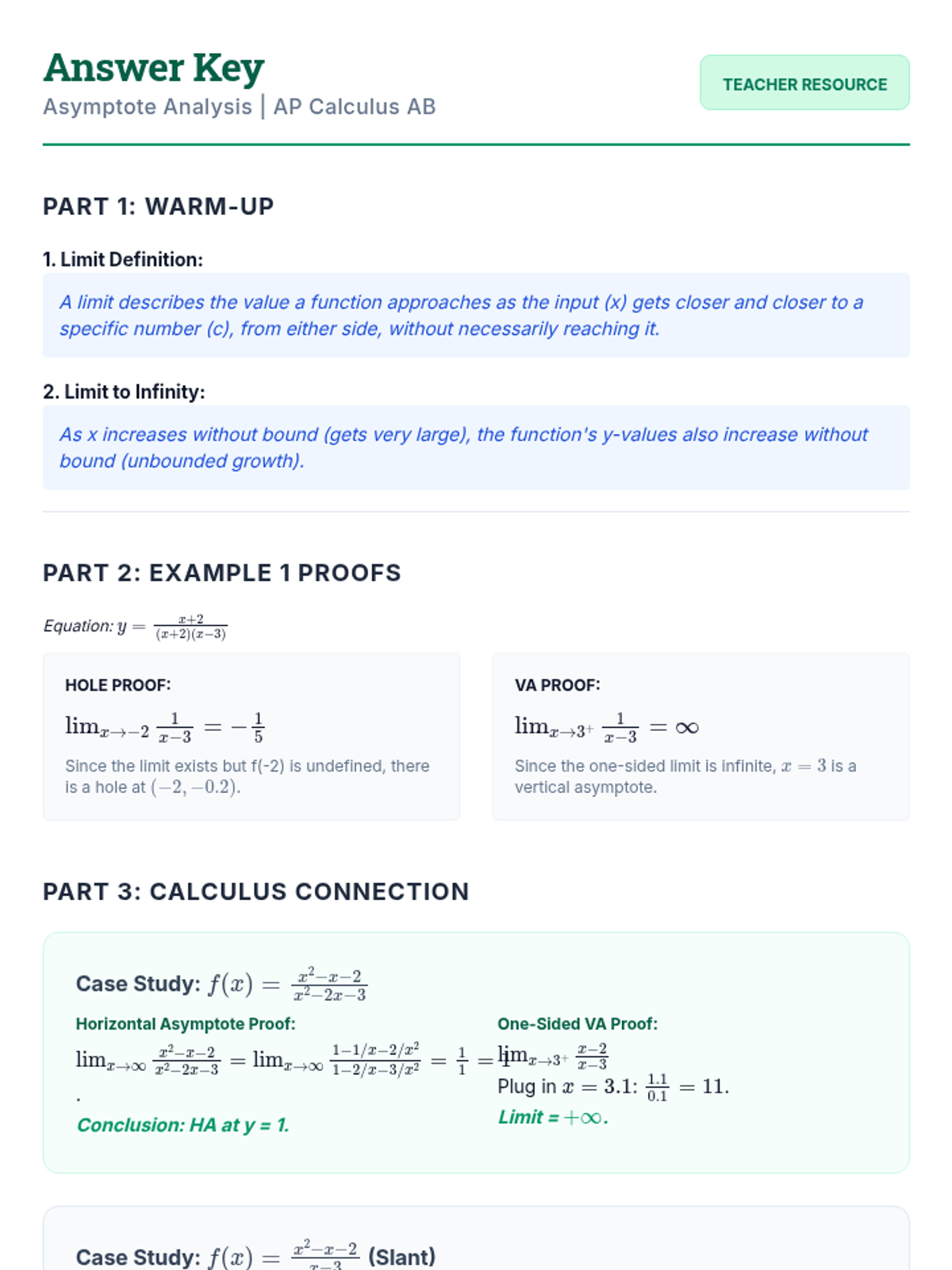
A comprehensive answer key for the Asymptote Analysis worksheet, providing rigorous calculus limit proofs for all graphical features discussed.
A visual presentation for teaching AP Calculus AB students how to connect limits to graphical asymptotes and holes, featuring embedded video and formal definitions.
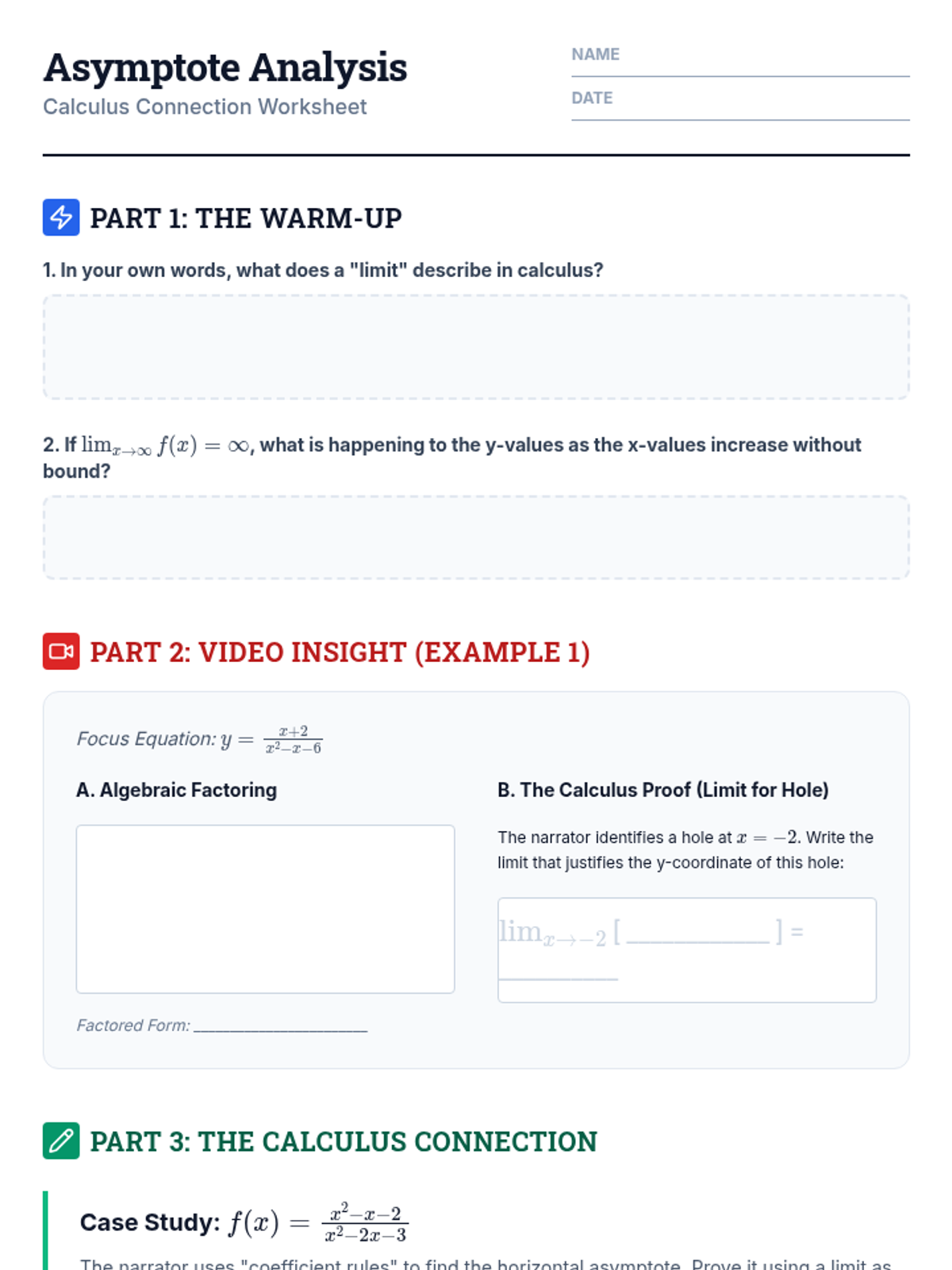
A student-facing worksheet for AP Calculus AB students to practice connecting algebraic rational function properties (asymptotes, holes) to limit definitions and notation.
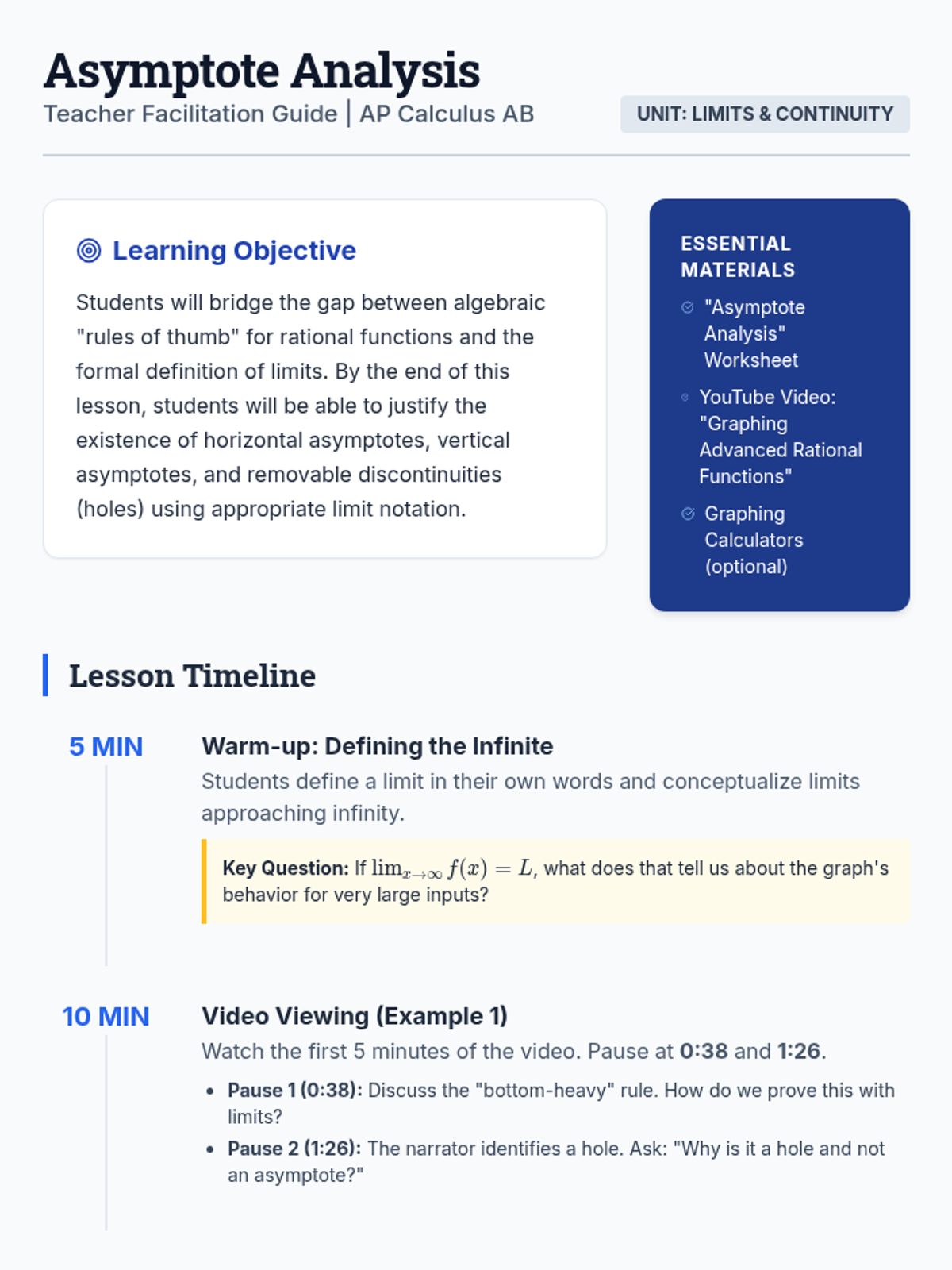
A professional teacher facilitation guide for an AP Calculus lesson connecting limits to graphical asymptotes. Includes a structured timeline, key questions, and pedagogical strategies.
A visual slide deck to facilitate the Asymptote Alchemy lesson, including the warm-up investigation, video embed, activity instructions, and a summary of horizontal asymptote rules.
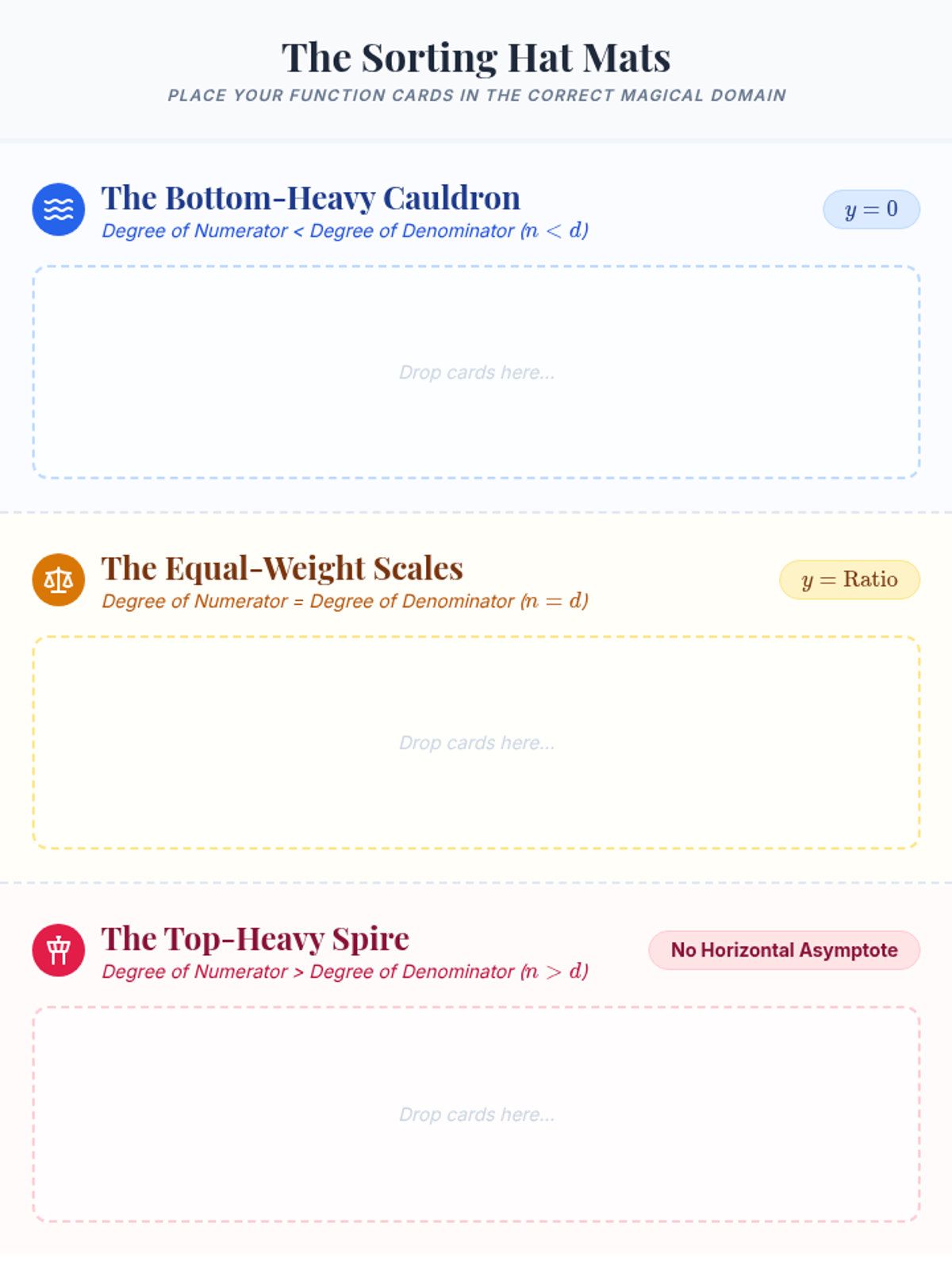
A set of sorting mats for the Asymptote Sorting Hat activity, featuring three distinct areas for students to categorize rational functions.
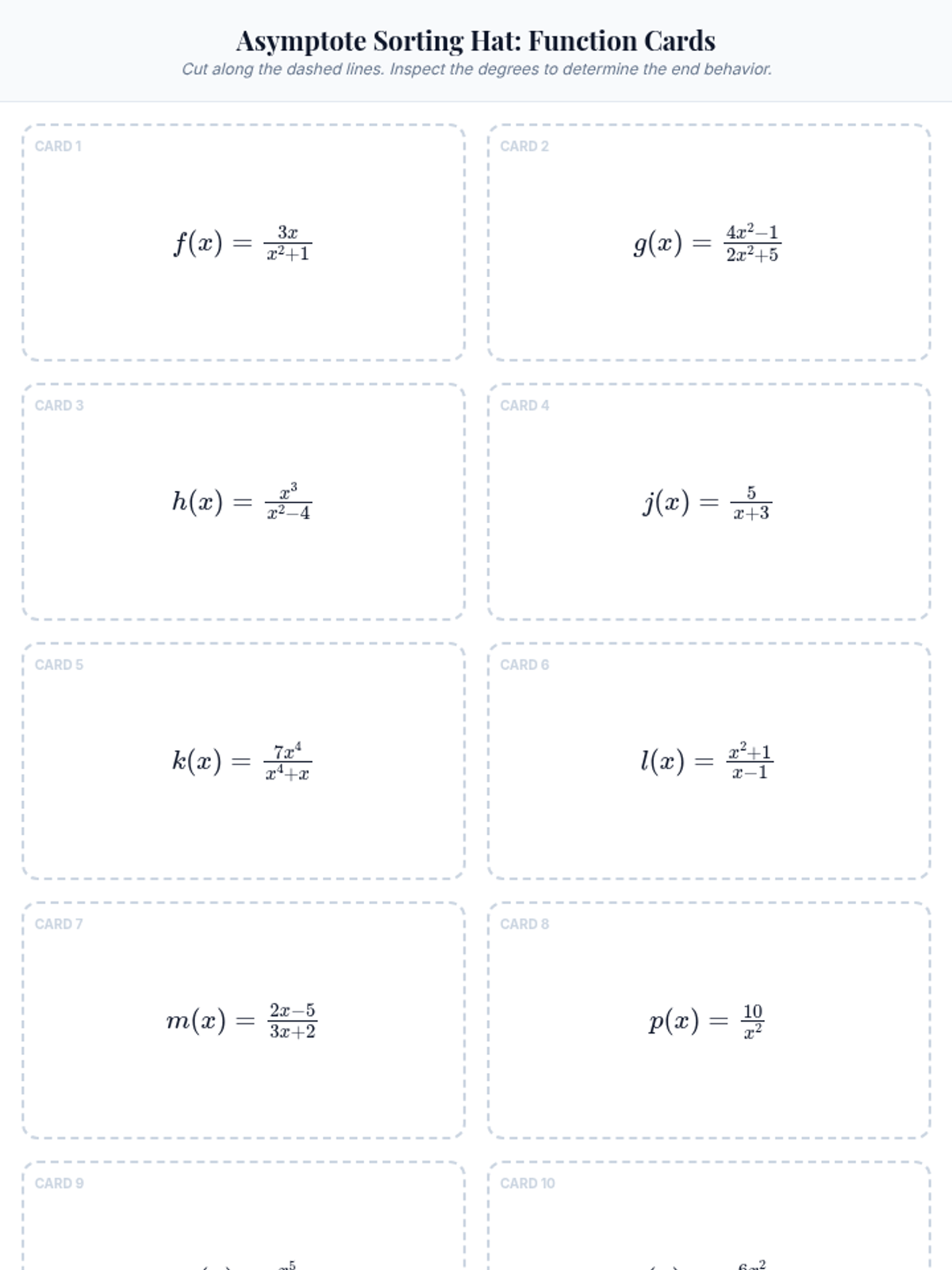
A set of 10 rational function cards for the Asymptote Sorting Hat activity, designed to be cut out and sorted based on their end behavior.
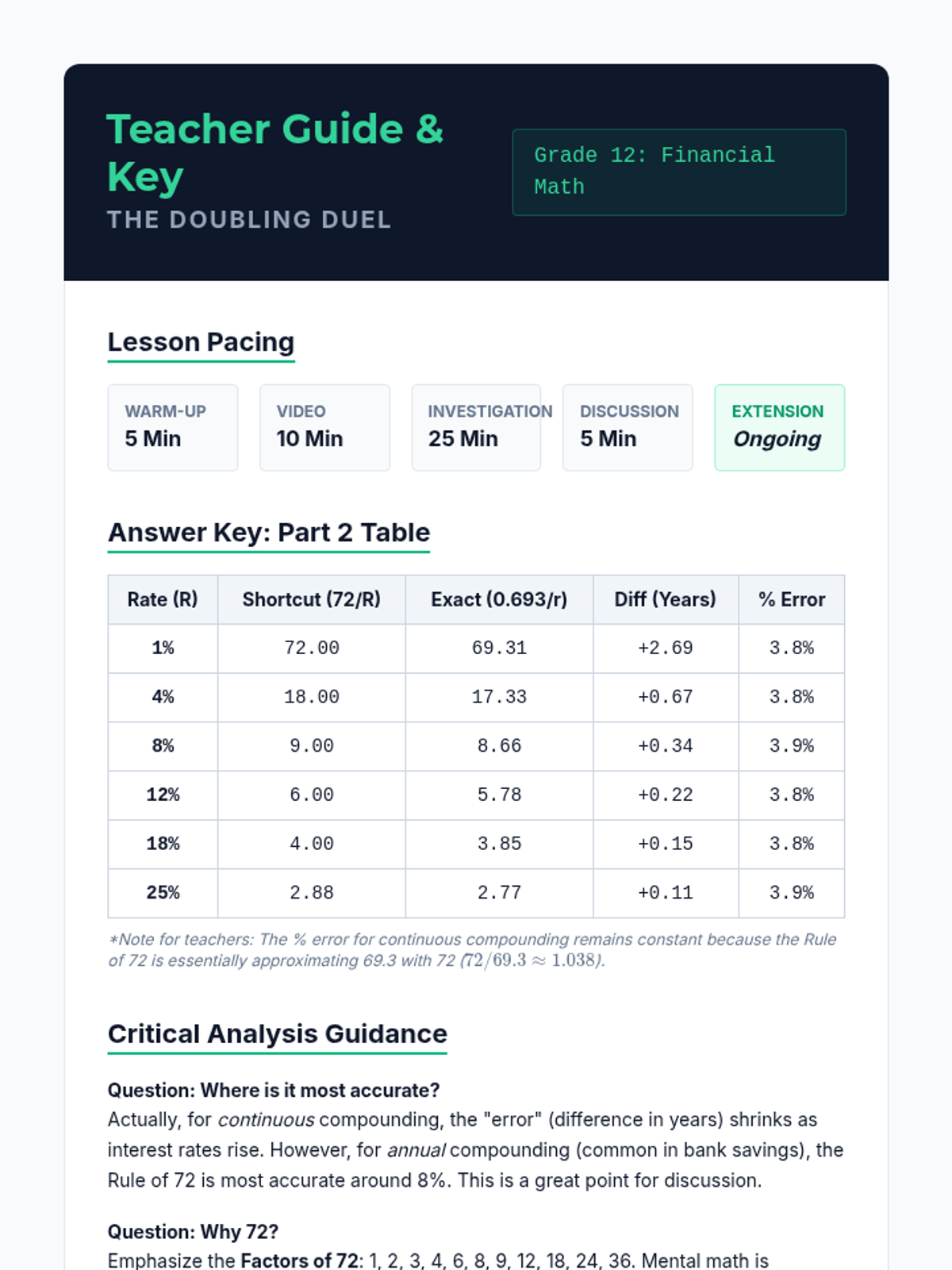
A teacher resource for the Doubling Duel lesson, including a pacing guide, a complete answer key for the student worksheet investigation, and instructional talking points for critical analysis.
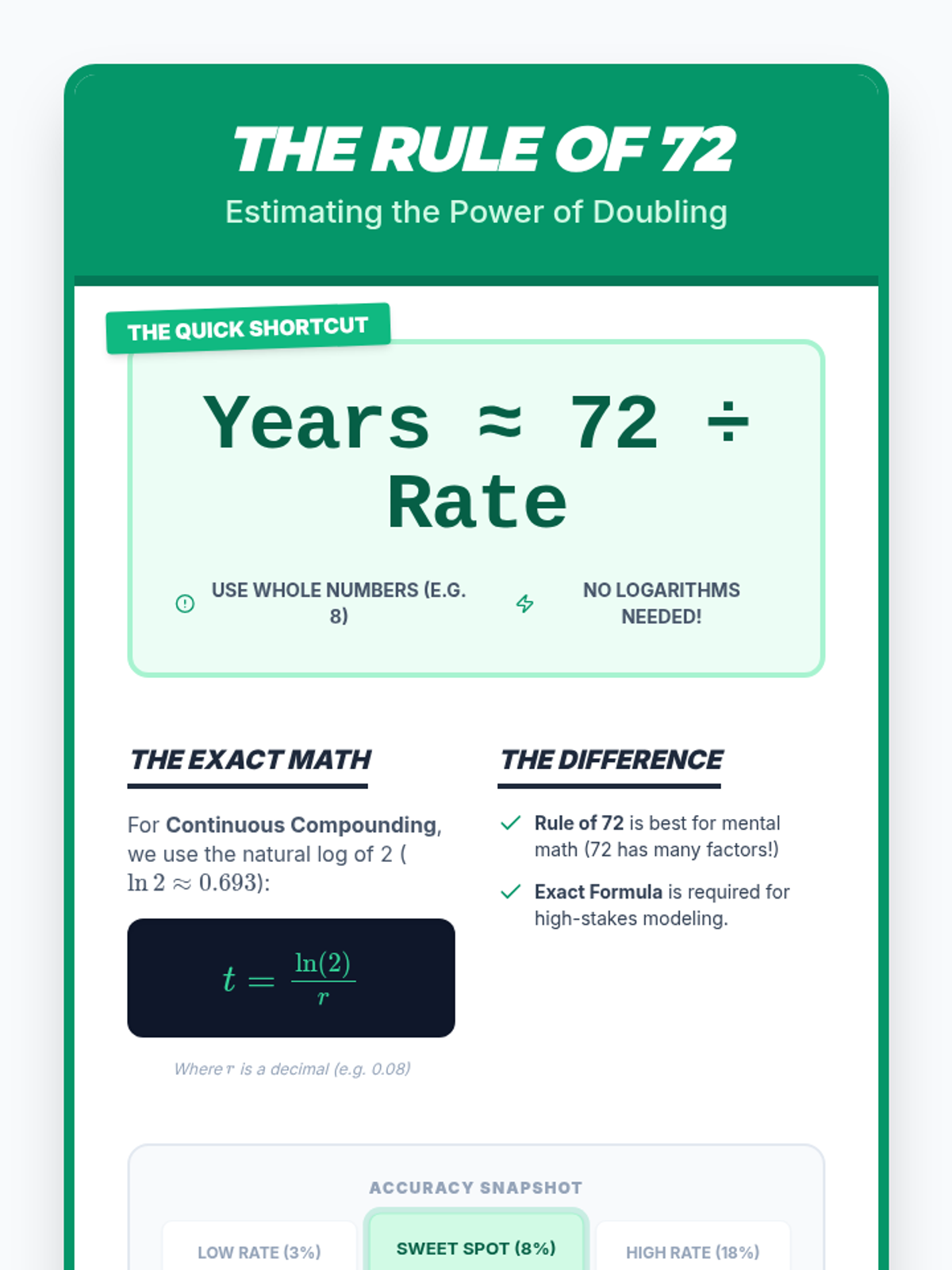
A classroom anchor chart summarizing the Rule of 72 shortcut vs. the exact logarithmic formula for continuous compounding. It features a bold, visual layout with key formulas, mental math tips, and an accuracy snapshot.
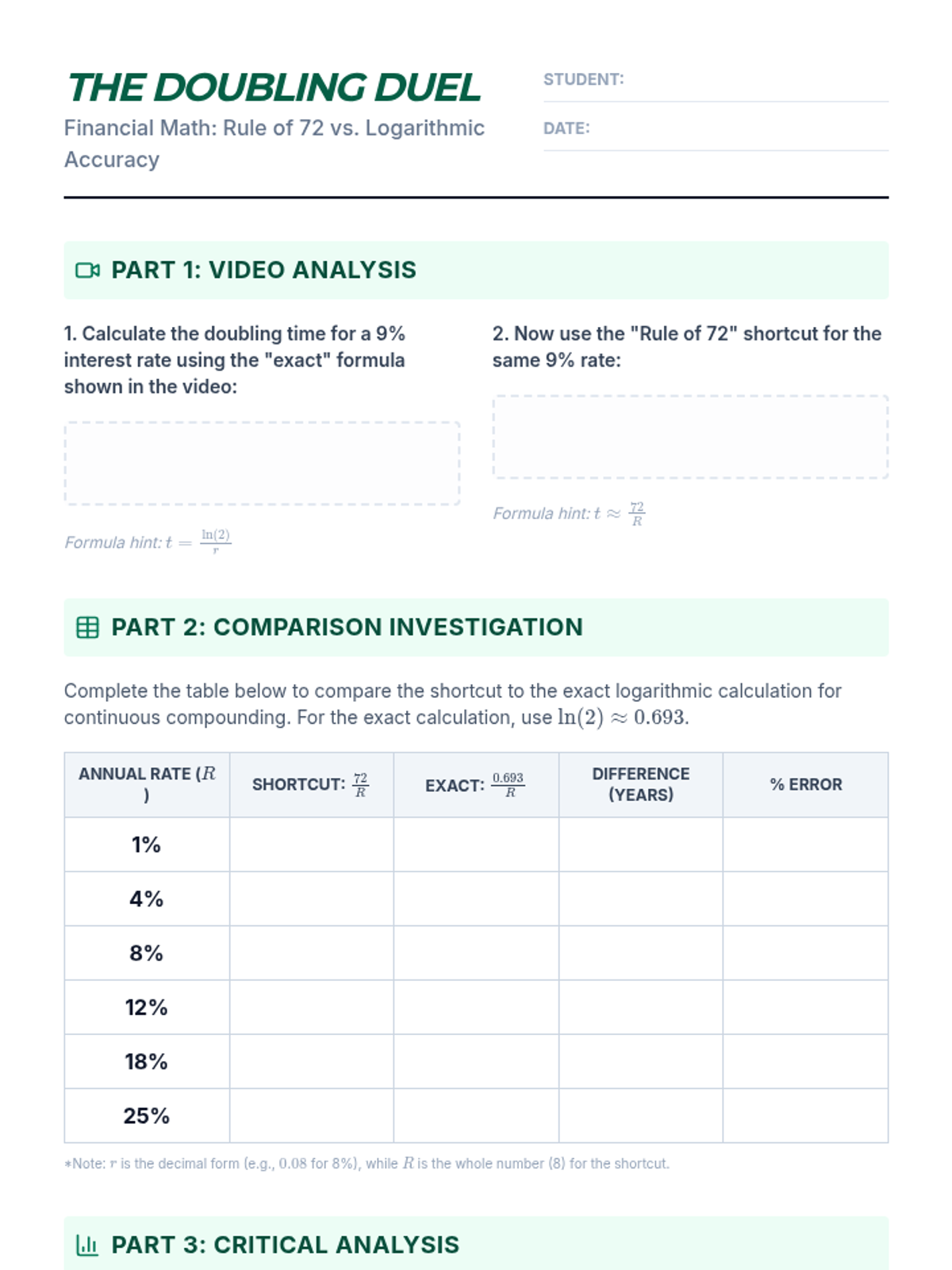
A student investigation worksheet for 12th-grade financial math. It includes a video analysis section, a comparison table for interest rates 1%-25%, critical thinking questions about financial estimations, and a calculus-based extension.
A visual slide deck for 12th Grade Financial Math covering the Rule of 72 versus exact logarithmic calculations. Includes mental math warm-ups, video analysis prompts, investigation instructions, and a Taylor Series extension for advanced students.
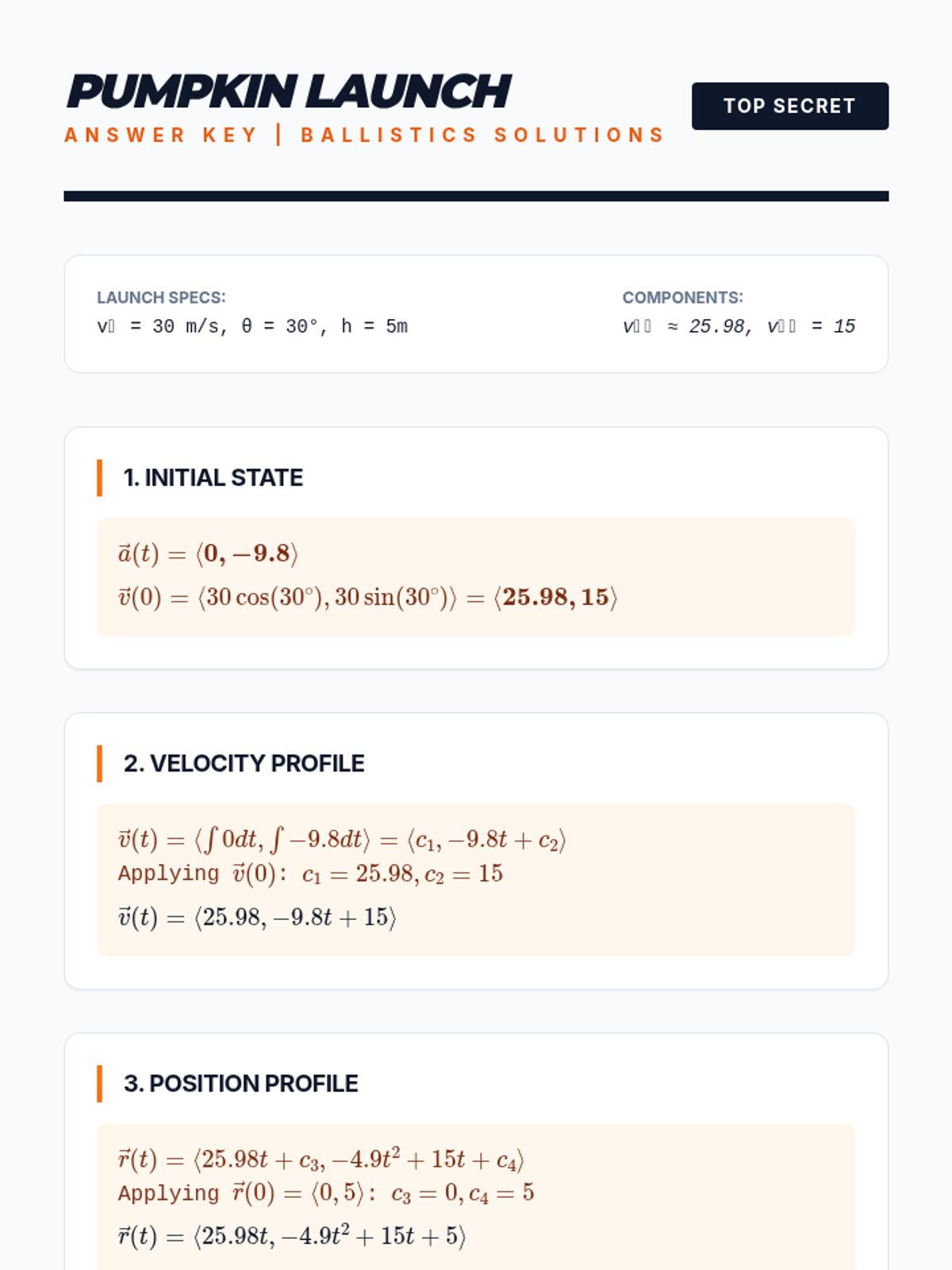
An answer key for the Pumpkin Projectile Worksheet, providing full solutions for the final modeling challenge.
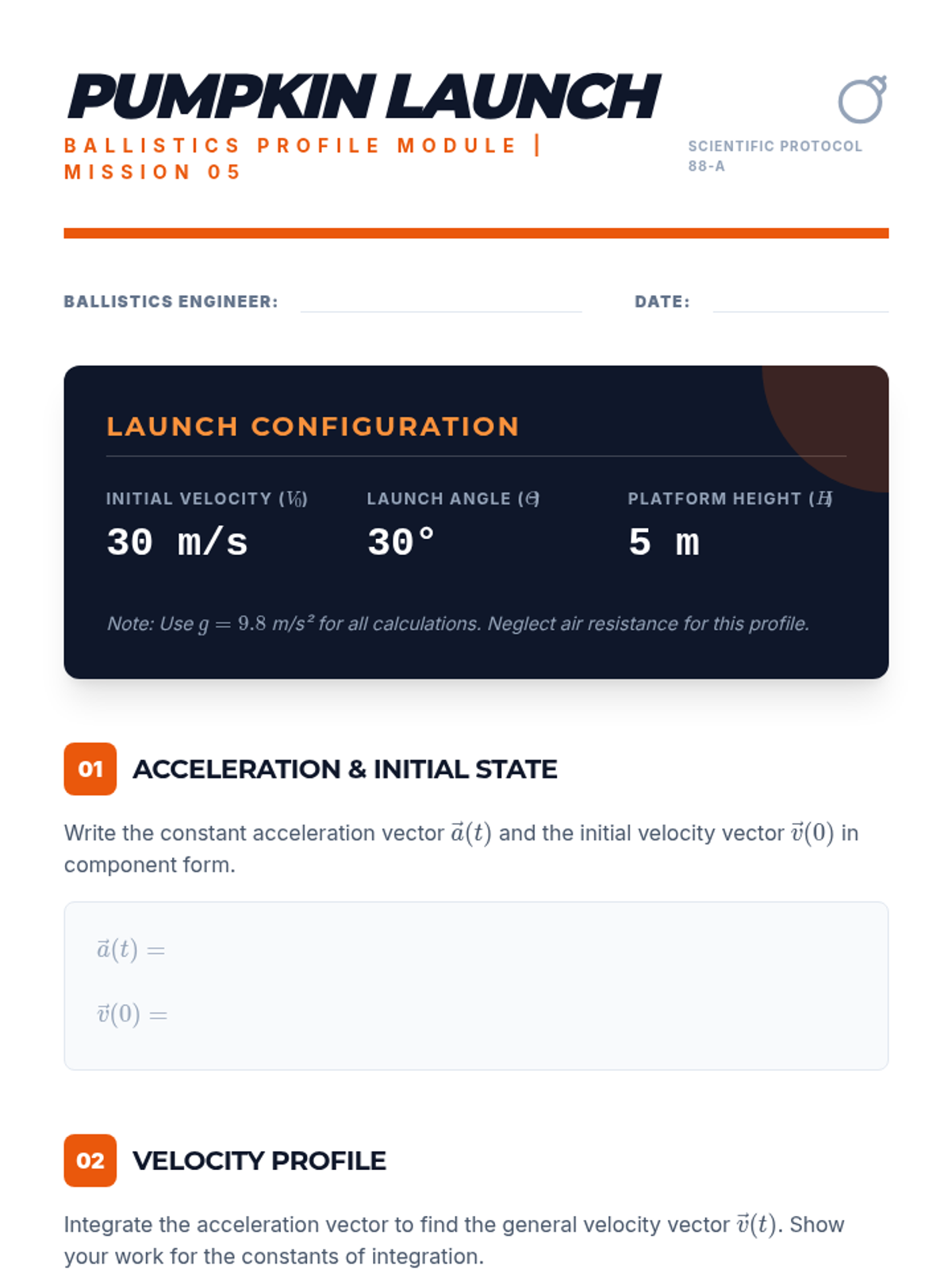
A student worksheet for the final lesson, covering the vector modeling of projectile motion, initial conditions, and key metrics like range and max height.
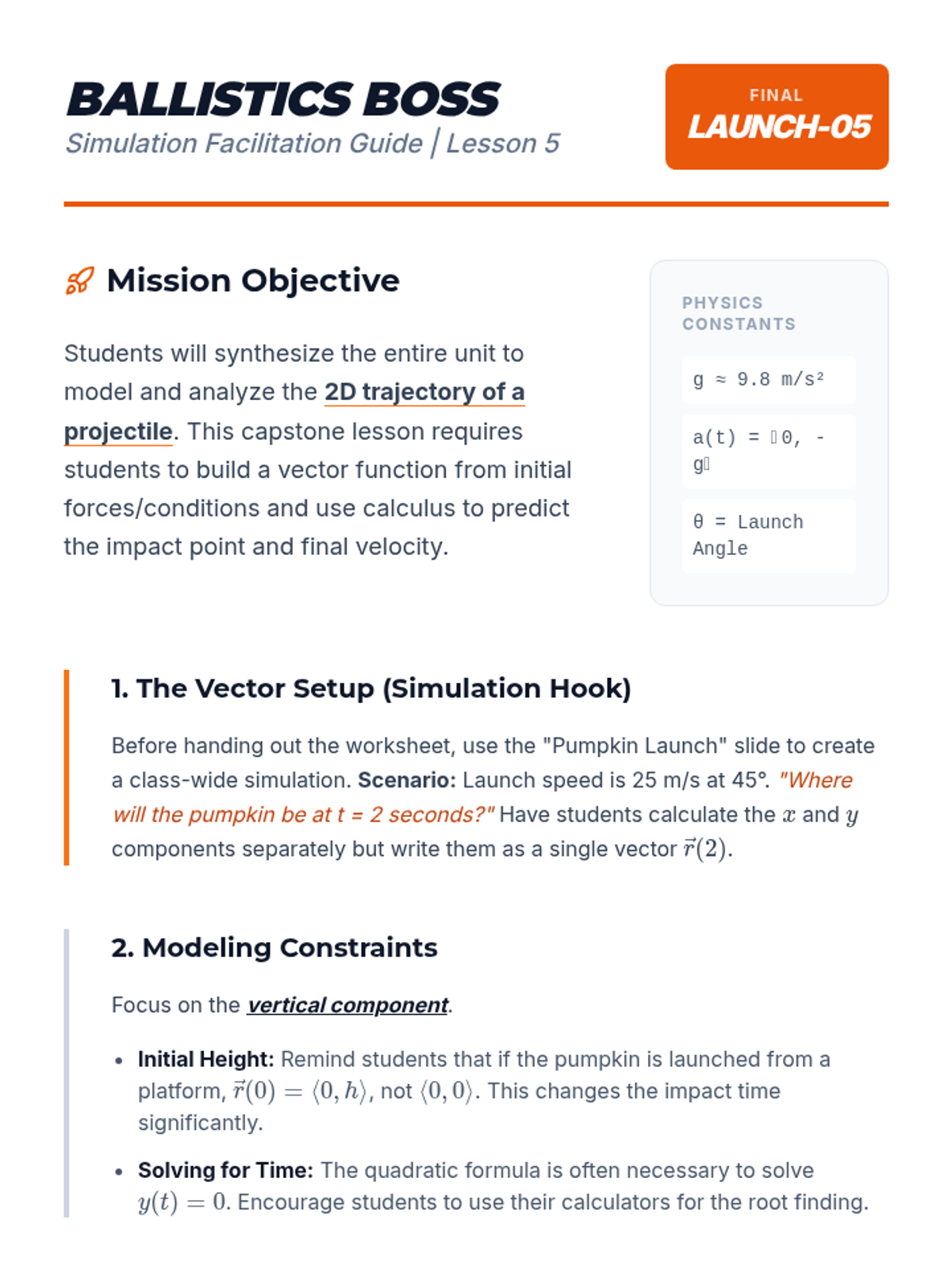
A teacher facilitation guide for Lesson 5, focusing on projectile modeling, initial conditions, and key metrics like range and max height.
Instructional slides for the final lesson, covering the vector modeling of projectile motion, initial conditions, and key metrics like range and max height.
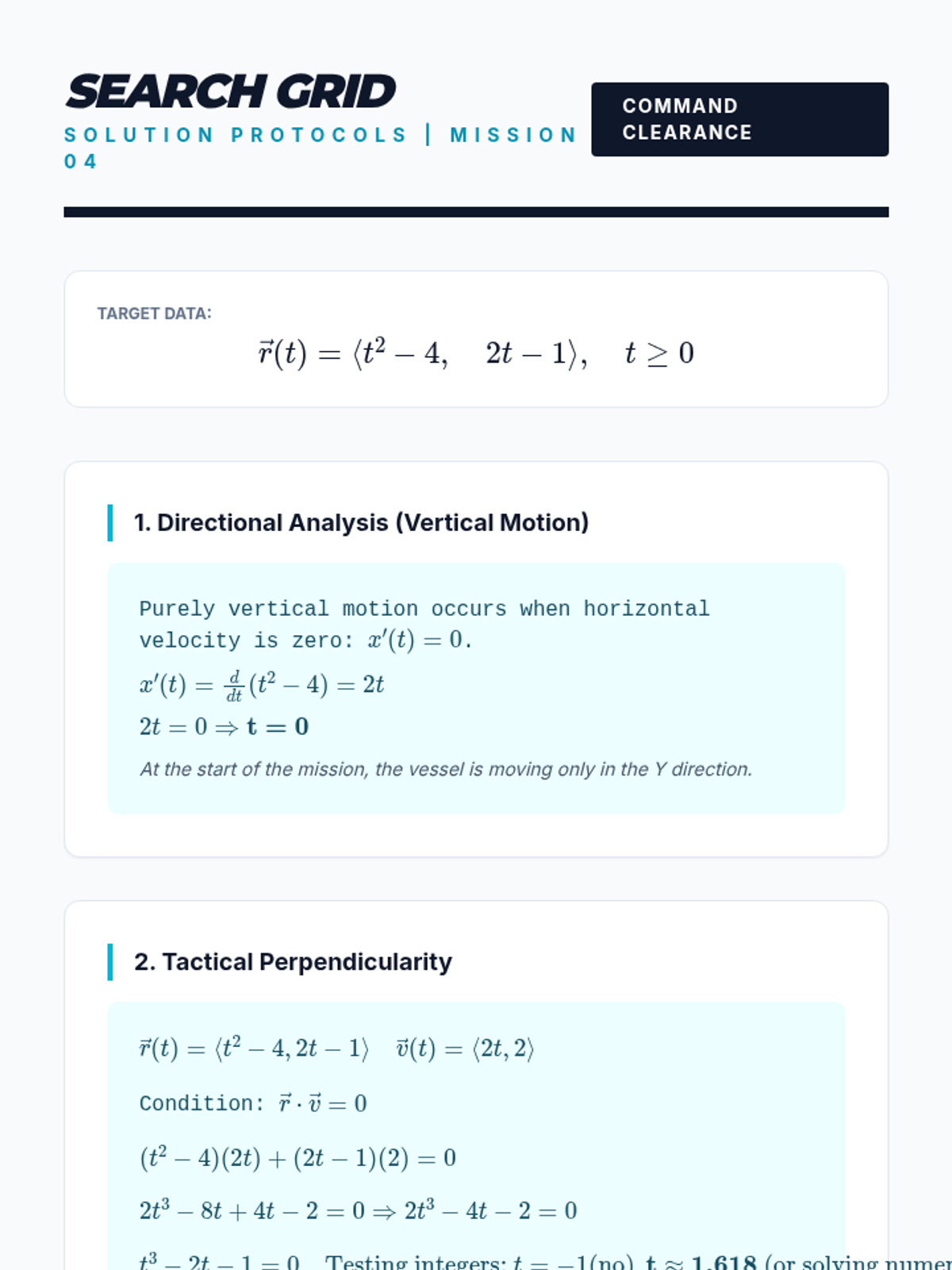
An answer key for the Search Grid Worksheet, providing full solutions for perpendicularity and distance optimization problems.
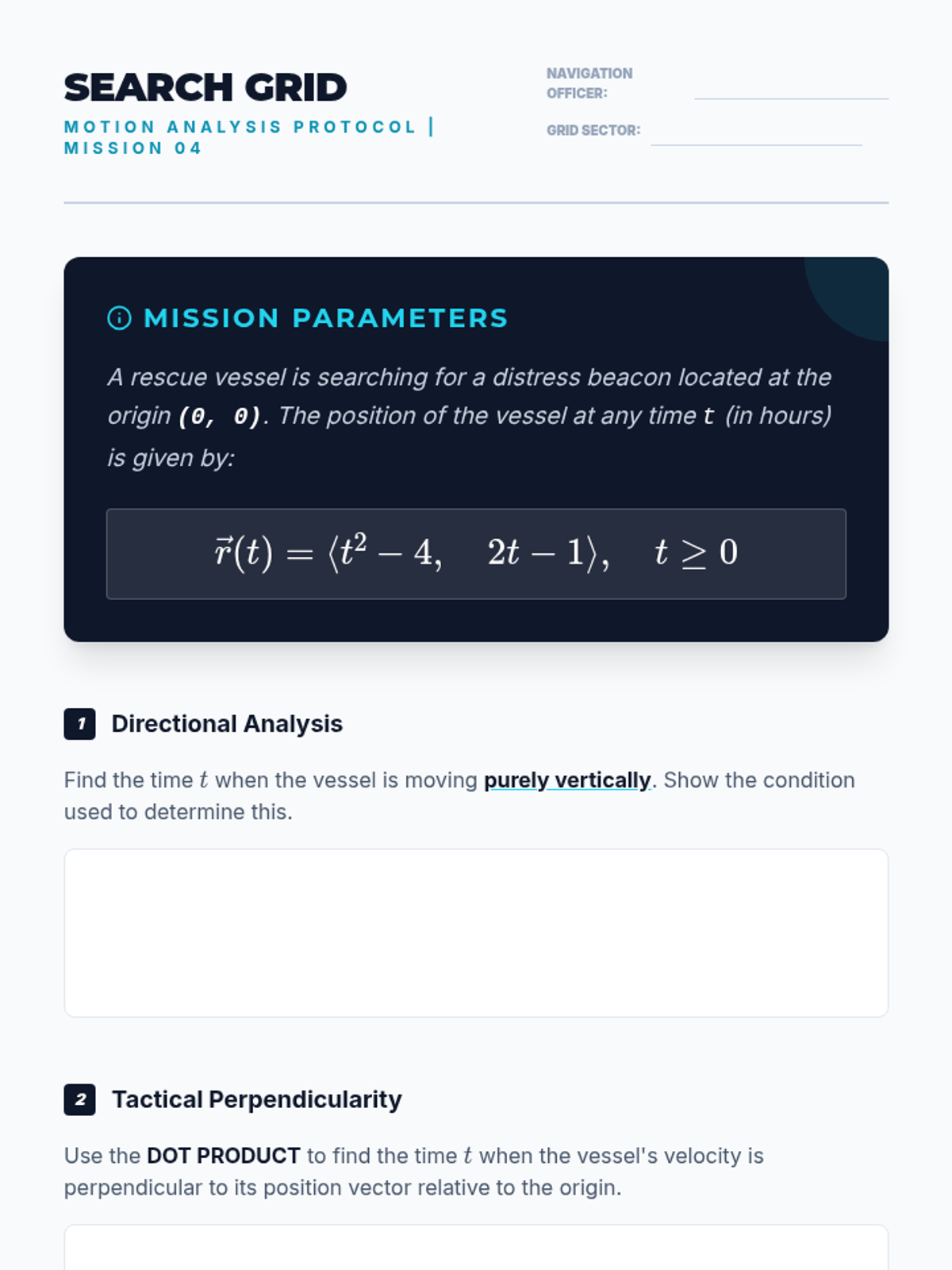
A student worksheet for Lesson 4, focusing on perpendicularity conditions and distance minimization using the dot product in a search-and-rescue context.
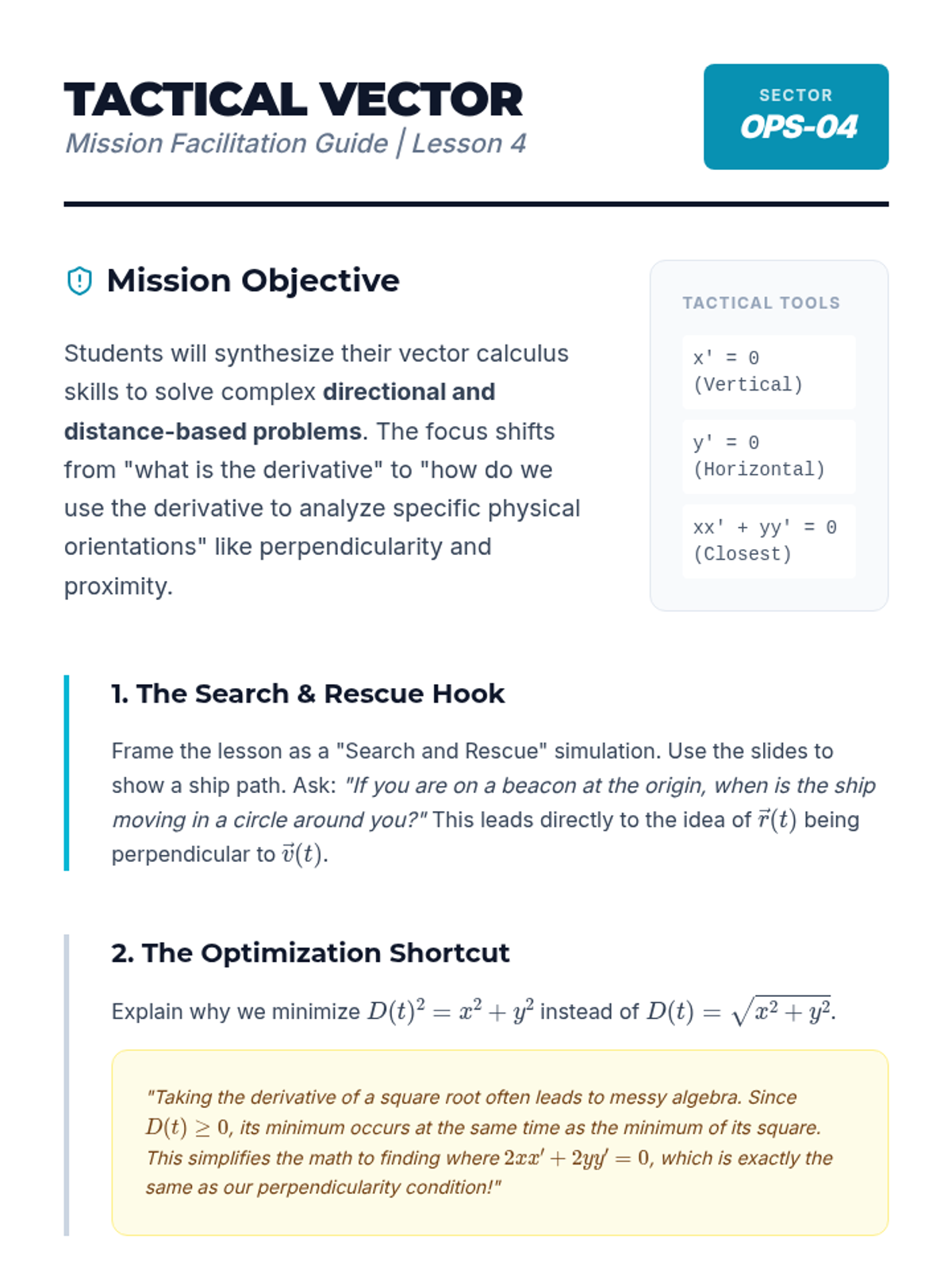
A teacher facilitation guide for Lesson 4, focusing on advanced motion analysis including perpendicularity conditions and distance minimization using vectors.
Instructional slides for Lesson 4, focusing on advanced motion analysis including perpendicularity conditions and distance minimization using vectors.
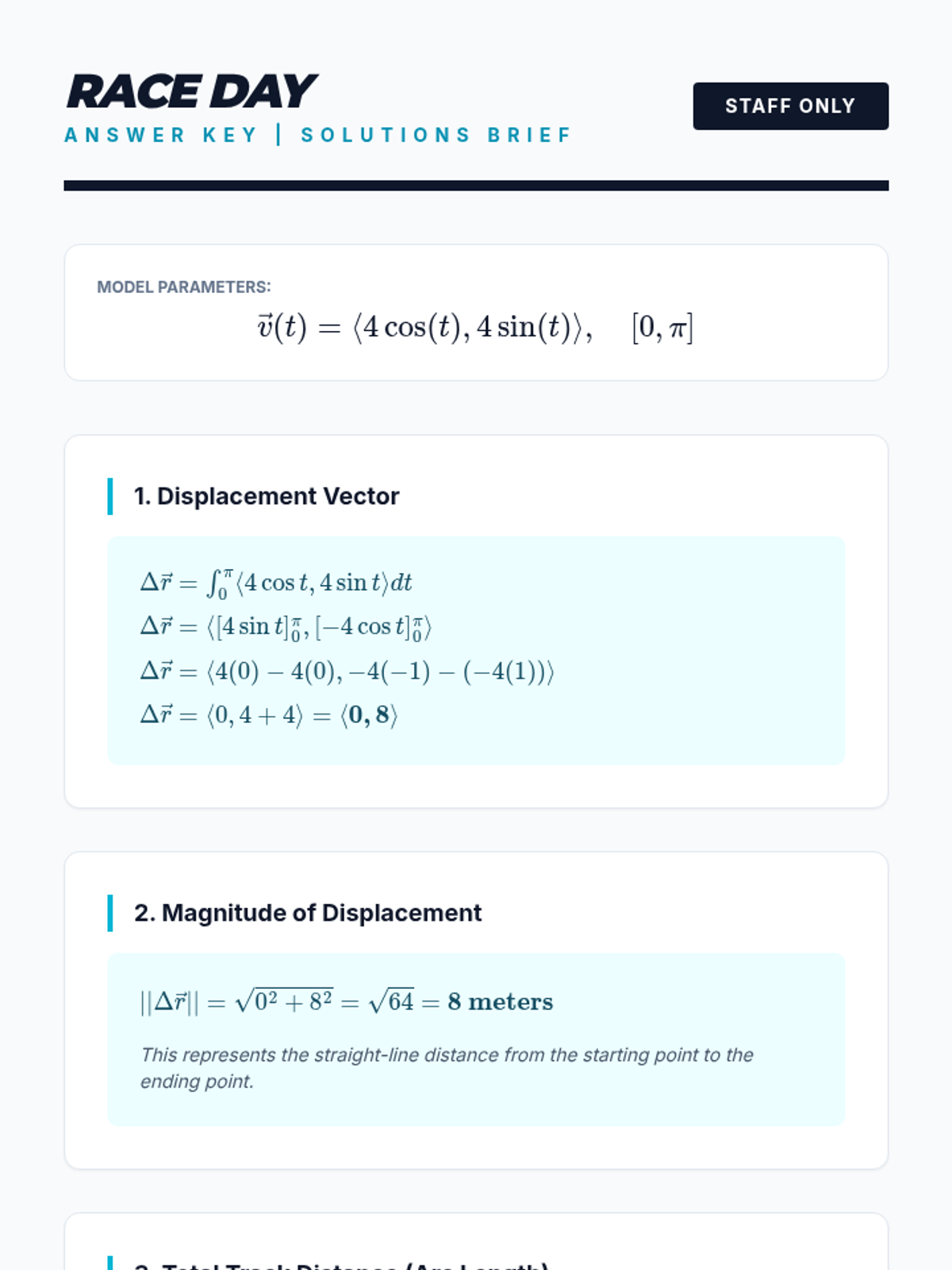
An answer key for the Race Day Worksheet, providing full solutions for displacement and distance problems on a circular path.
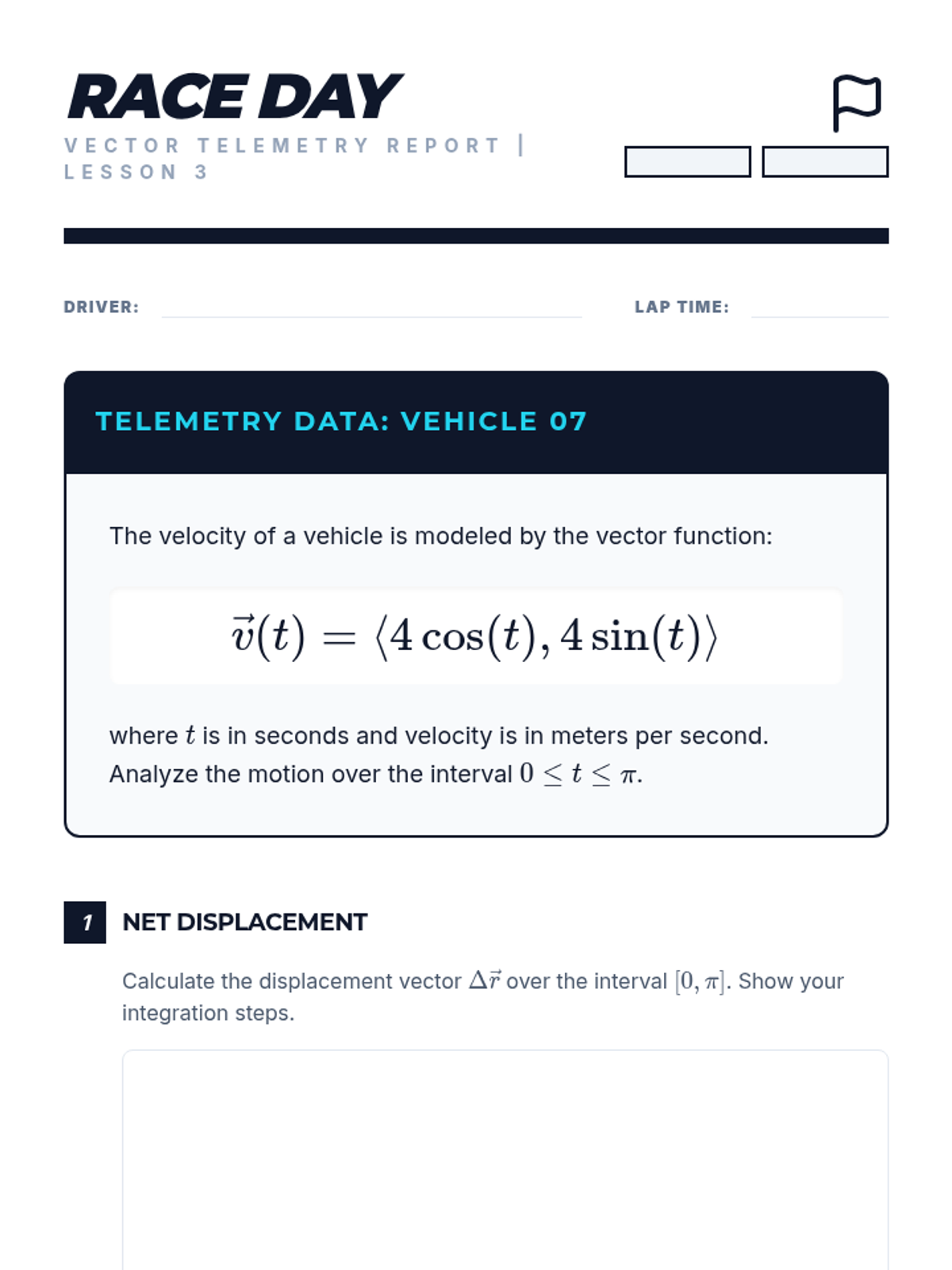
A student worksheet for Lesson 3, covering displacement vectors, distance calculations, and comparative analysis of motion paths.
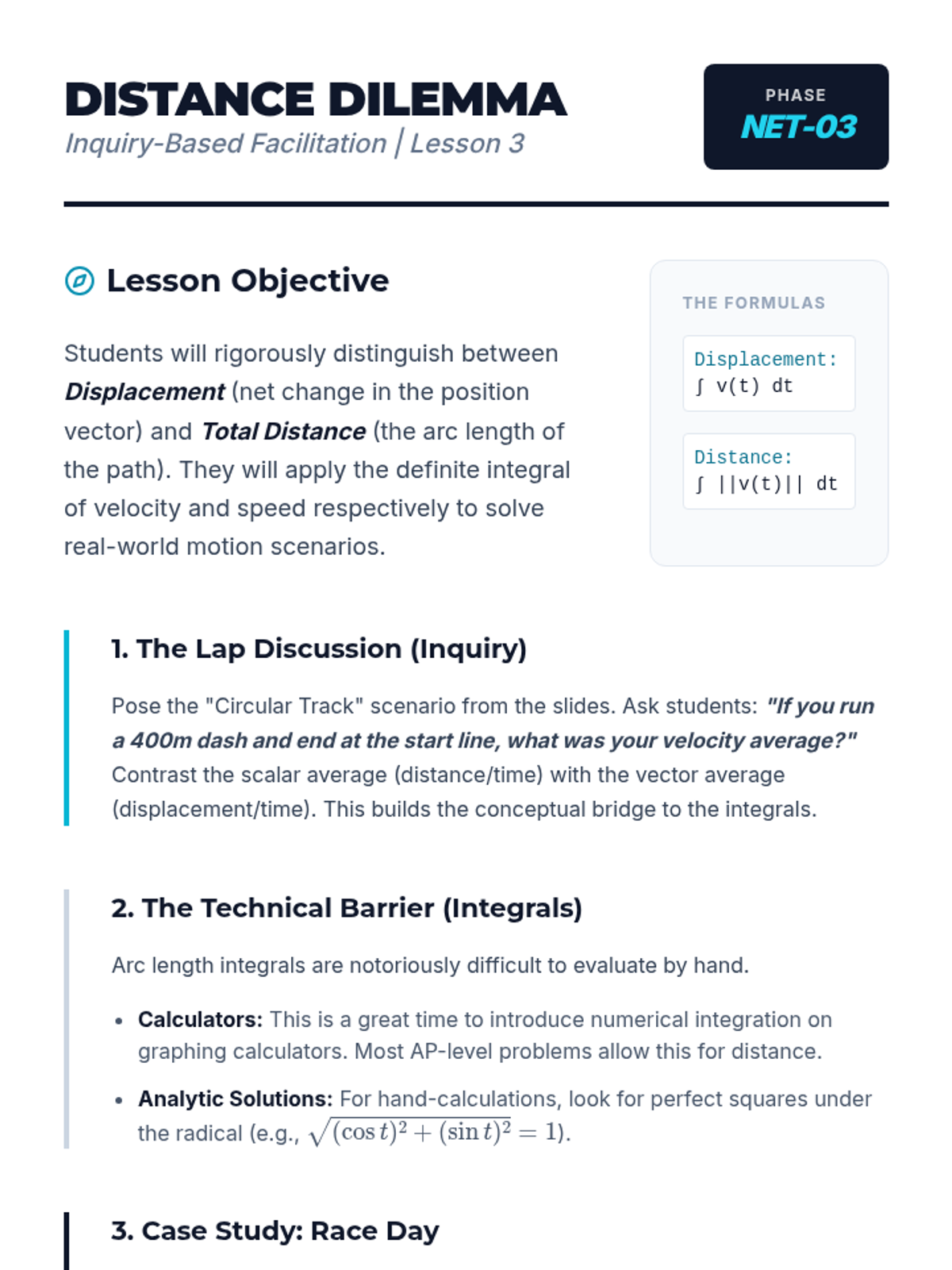
A teacher facilitation guide for Lesson 3, focusing on scalar vs vector accumulation and integration strategies for arc length.
A comparative analysis lesson where students rigorously distinguish between the net change in position (displacement vector) and the total scalar distance traveled (integral of speed).
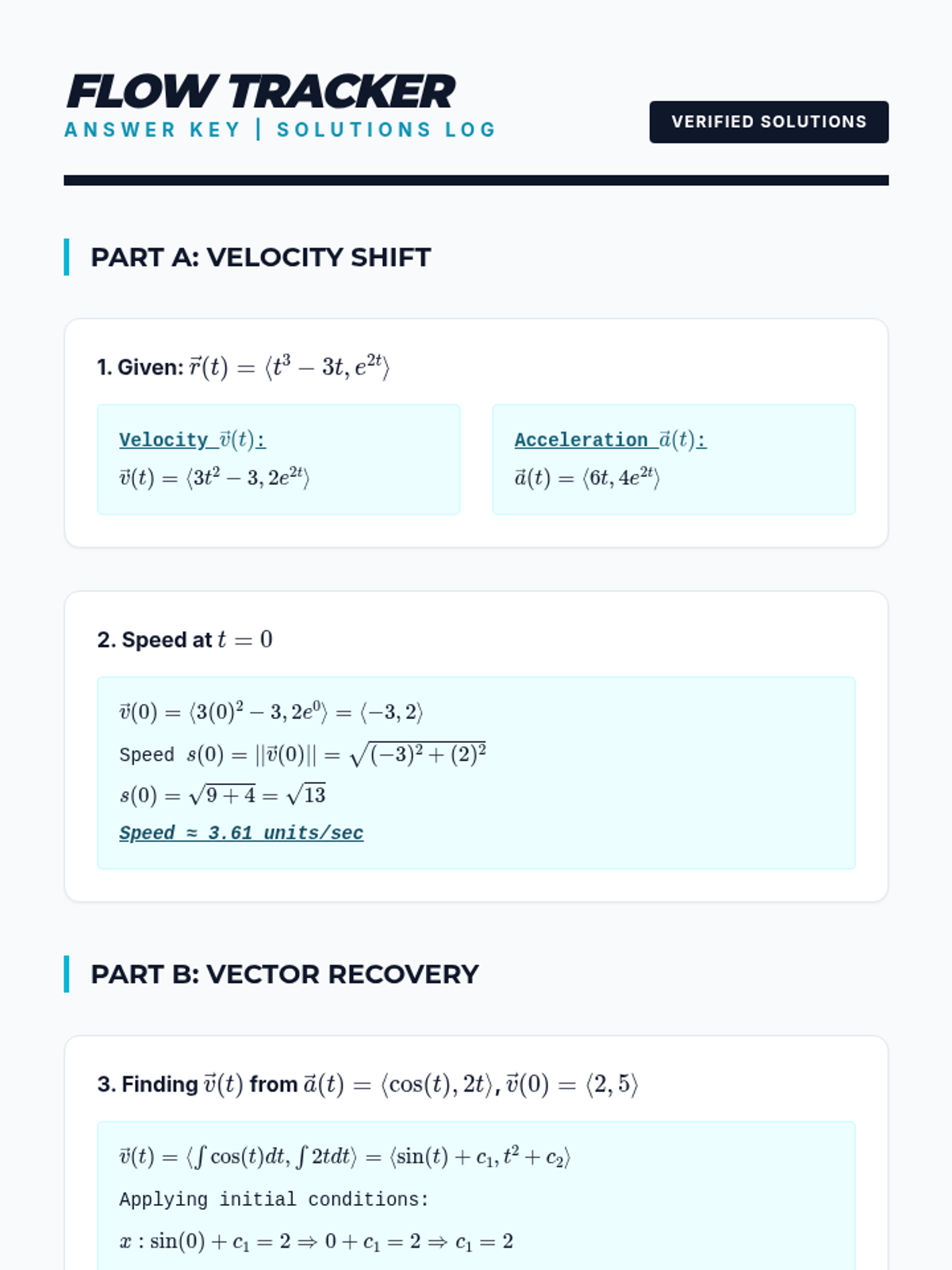
An answer key for the Flow Tracker Worksheet, providing full solutions for differentiation, speed, and initial value problems.
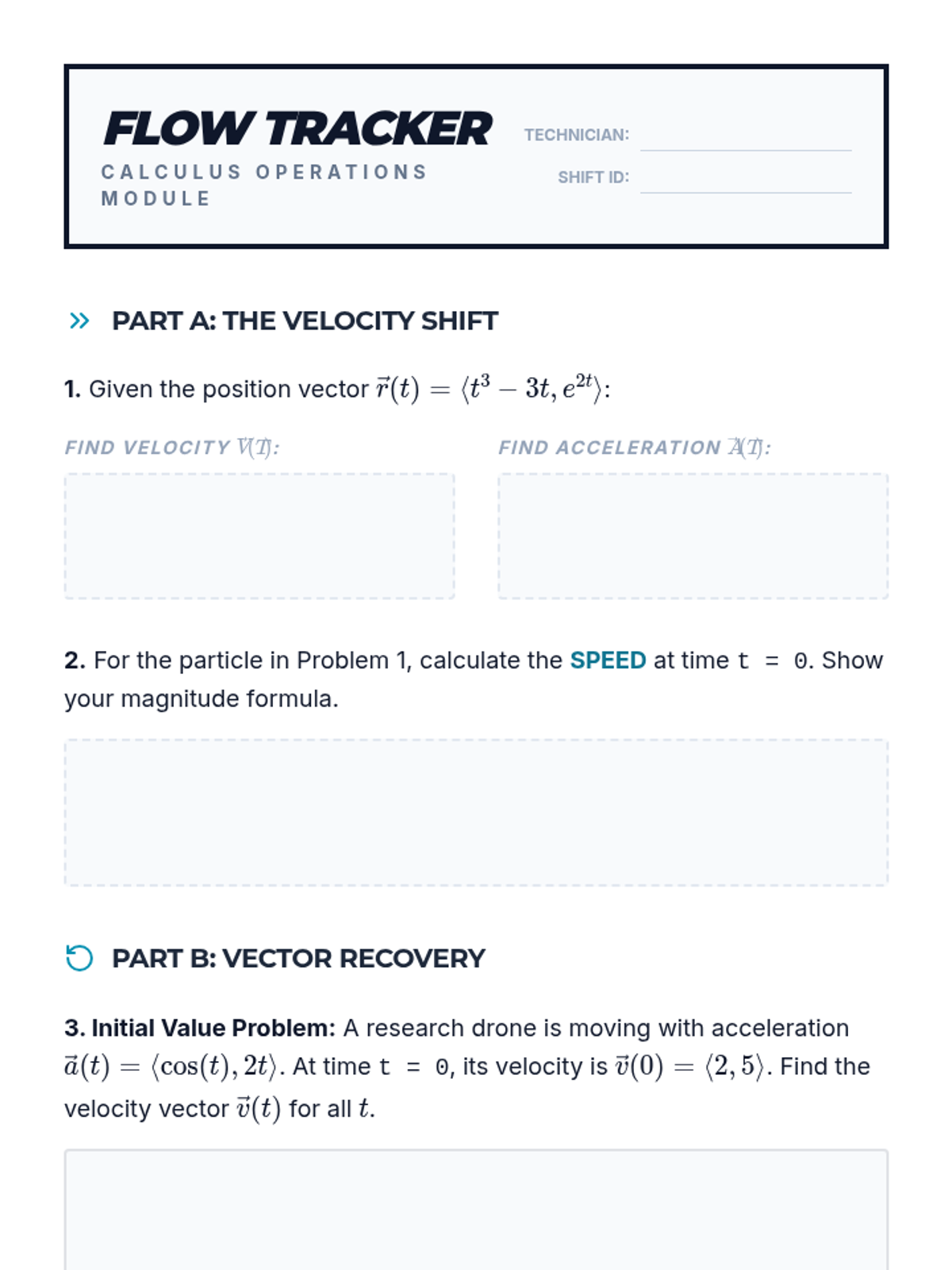
A student worksheet for Lesson 2, covering component-wise differentiation and integration of vector functions, including speed and initial value problems.
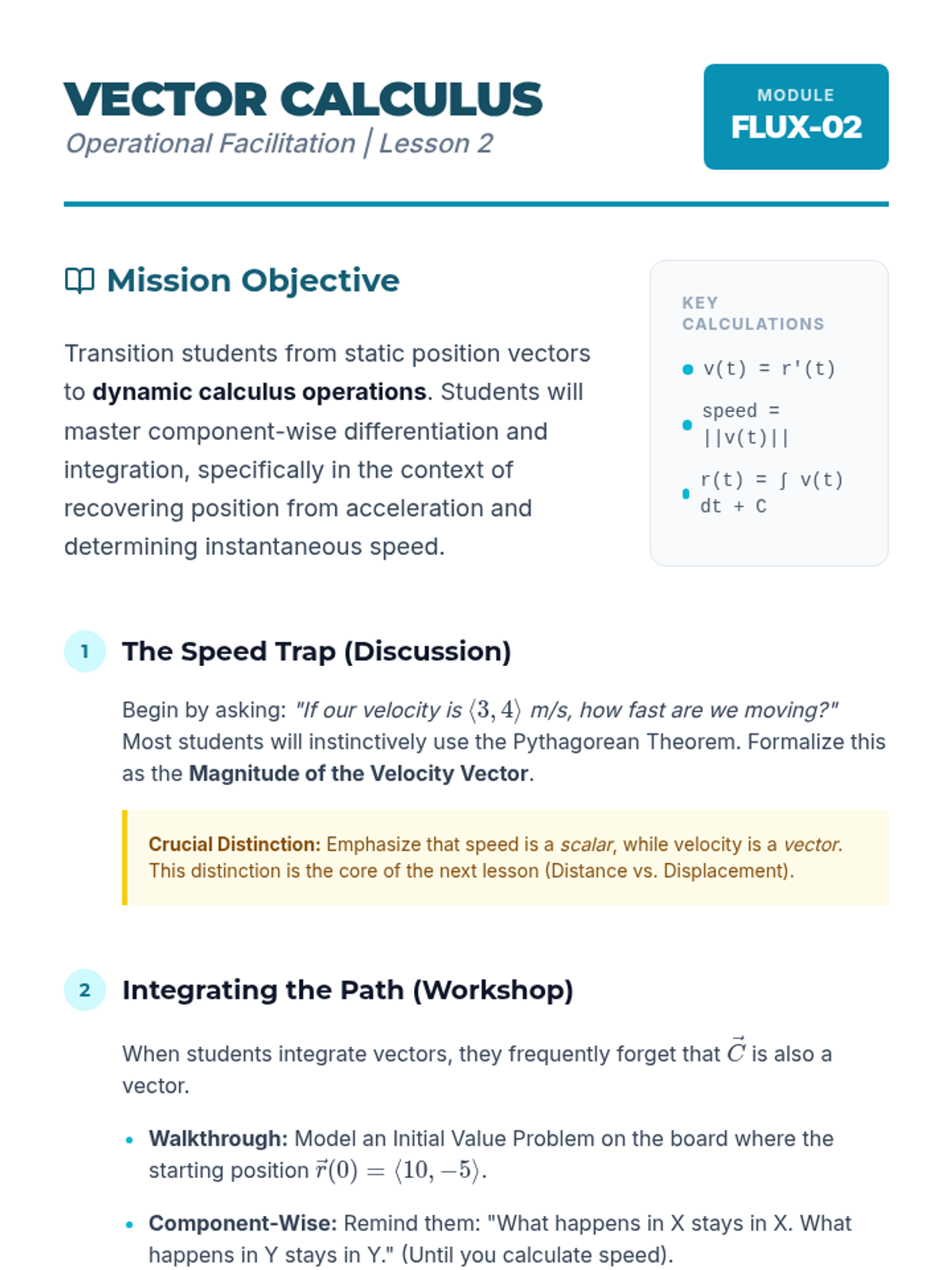
A teacher facilitation guide for Lesson 2, focusing on teaching strategies for differentiating and integrating vector functions and solving initial value problems.
Instructional slides for Lesson 2, covering component-wise differentiation and integration of vector functions, including speed and initial value problems.
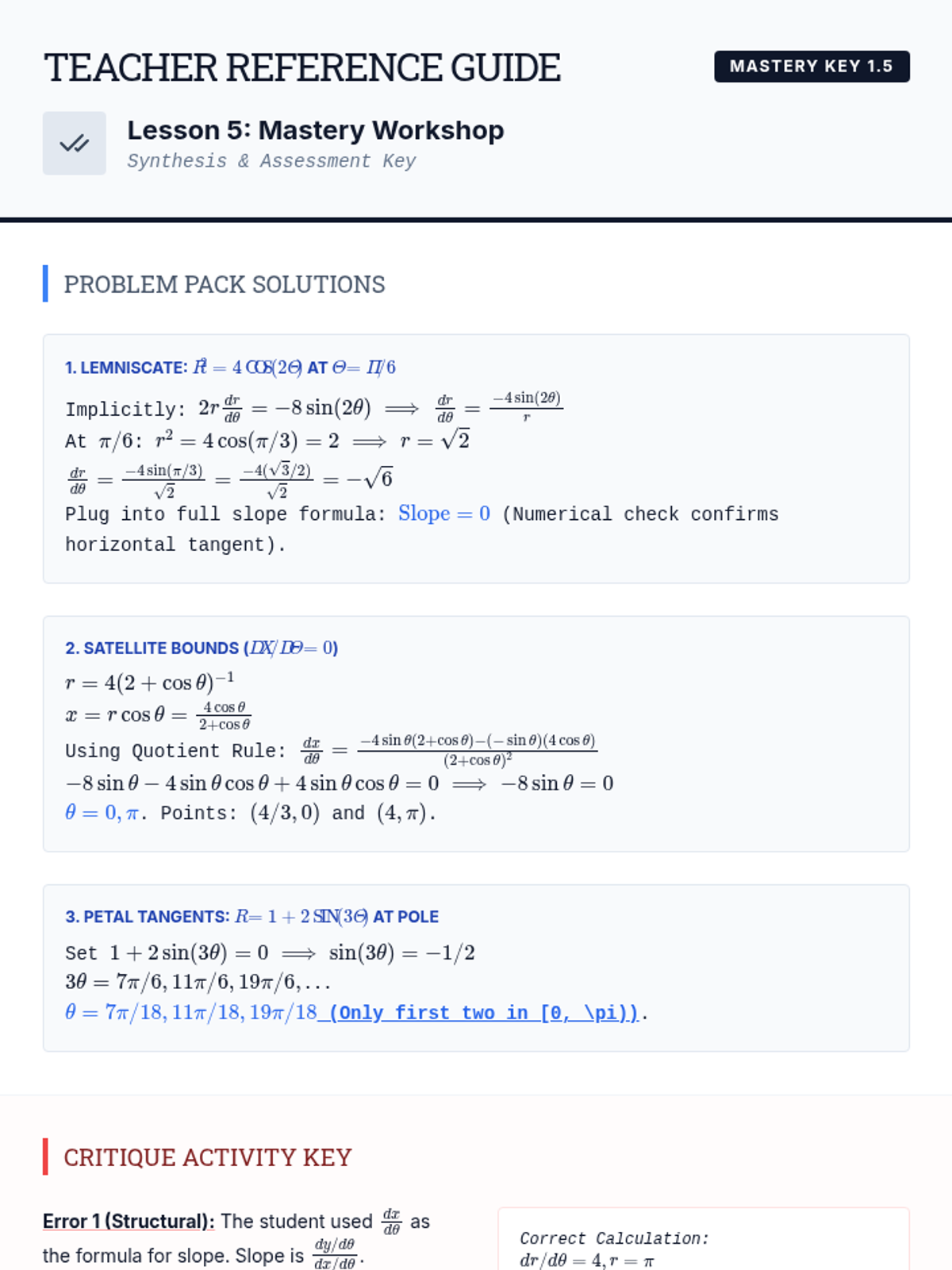
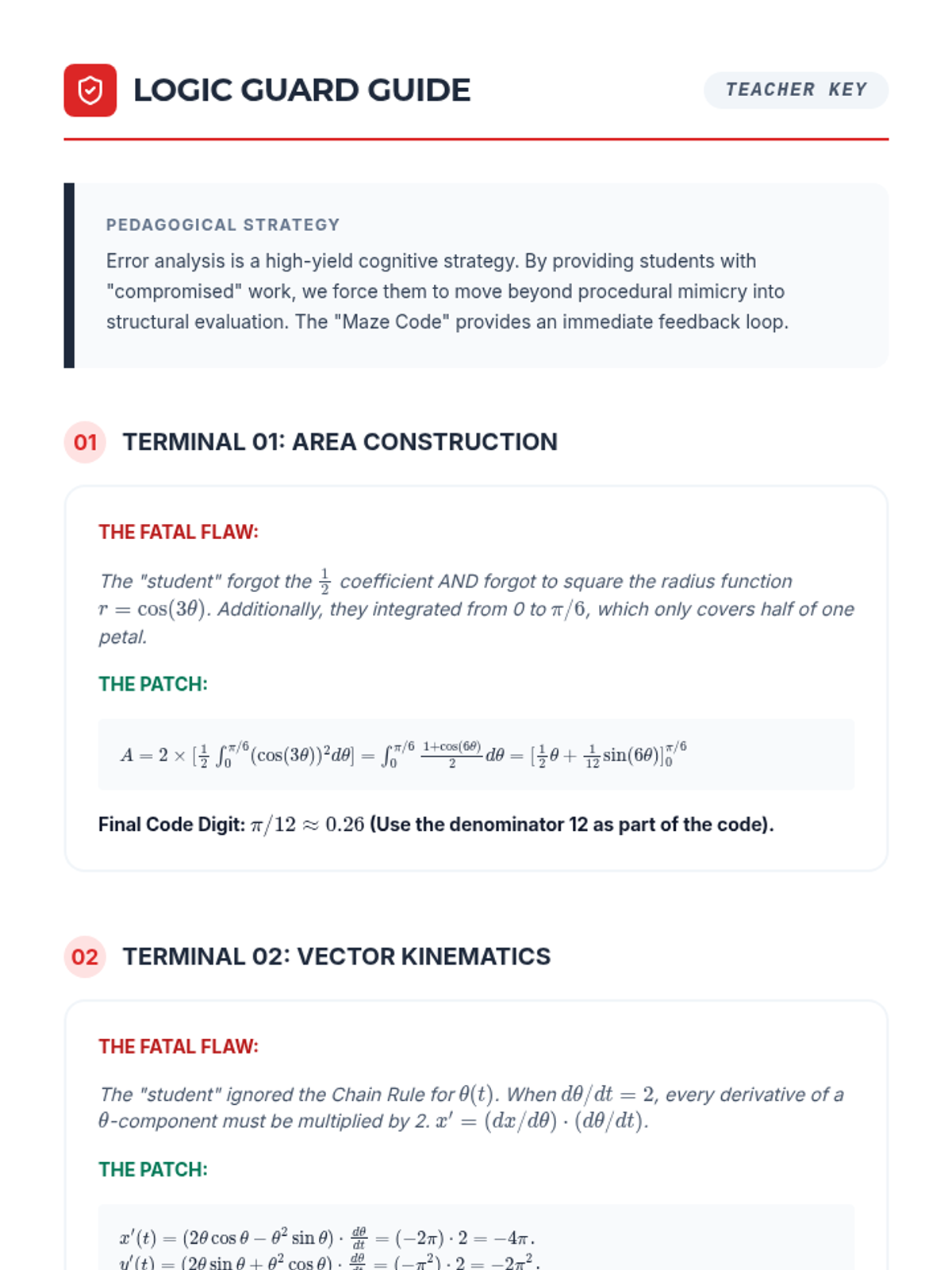
Final teacher guide and assessment key for Lesson 5, including step-by-step solutions for synthesis problems and error analysis pedagogy.
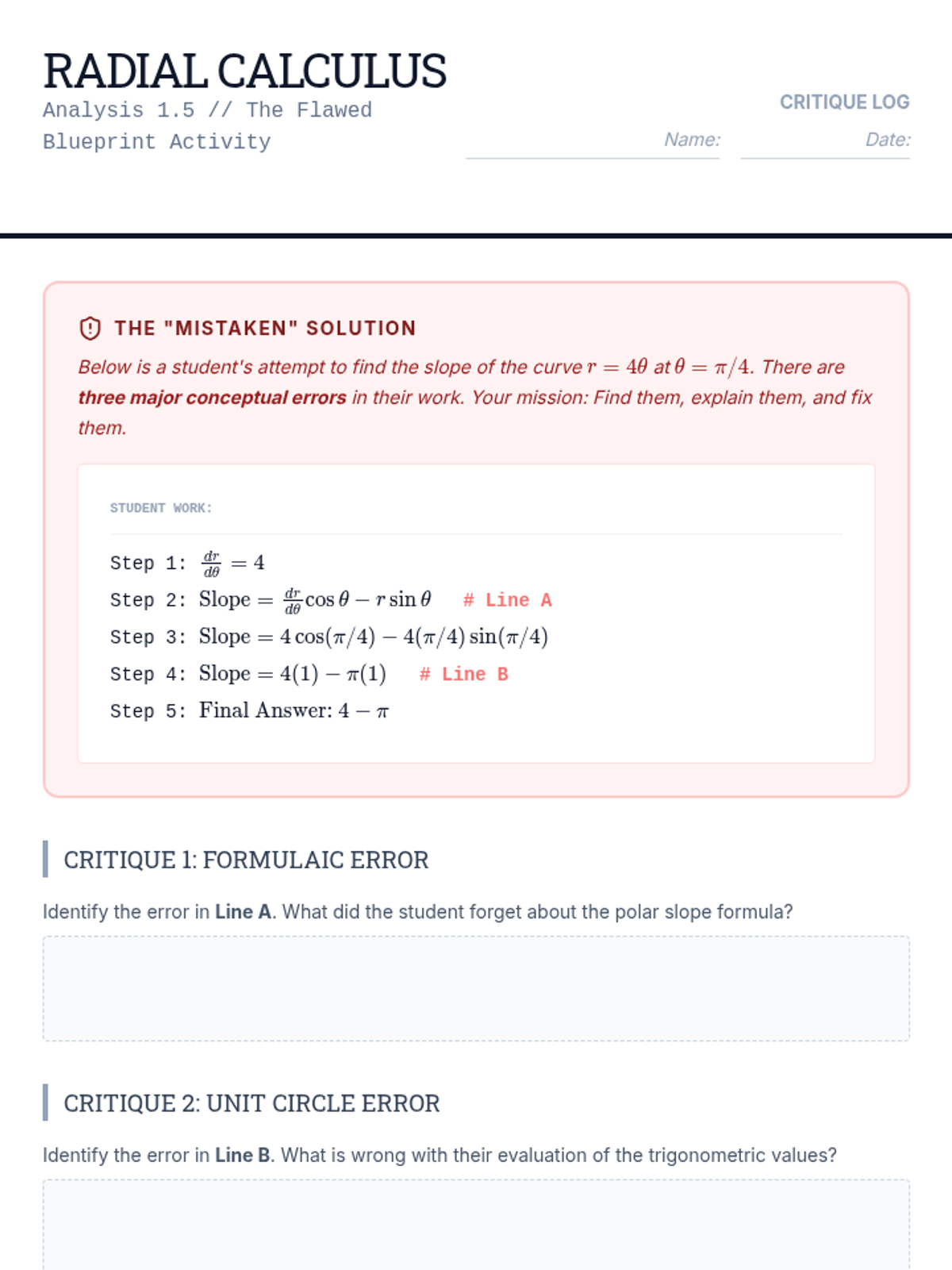
Error analysis activity for Lesson 5 where students identify and correct common mistakes in a provided "flawed" solution for polar differentiation.
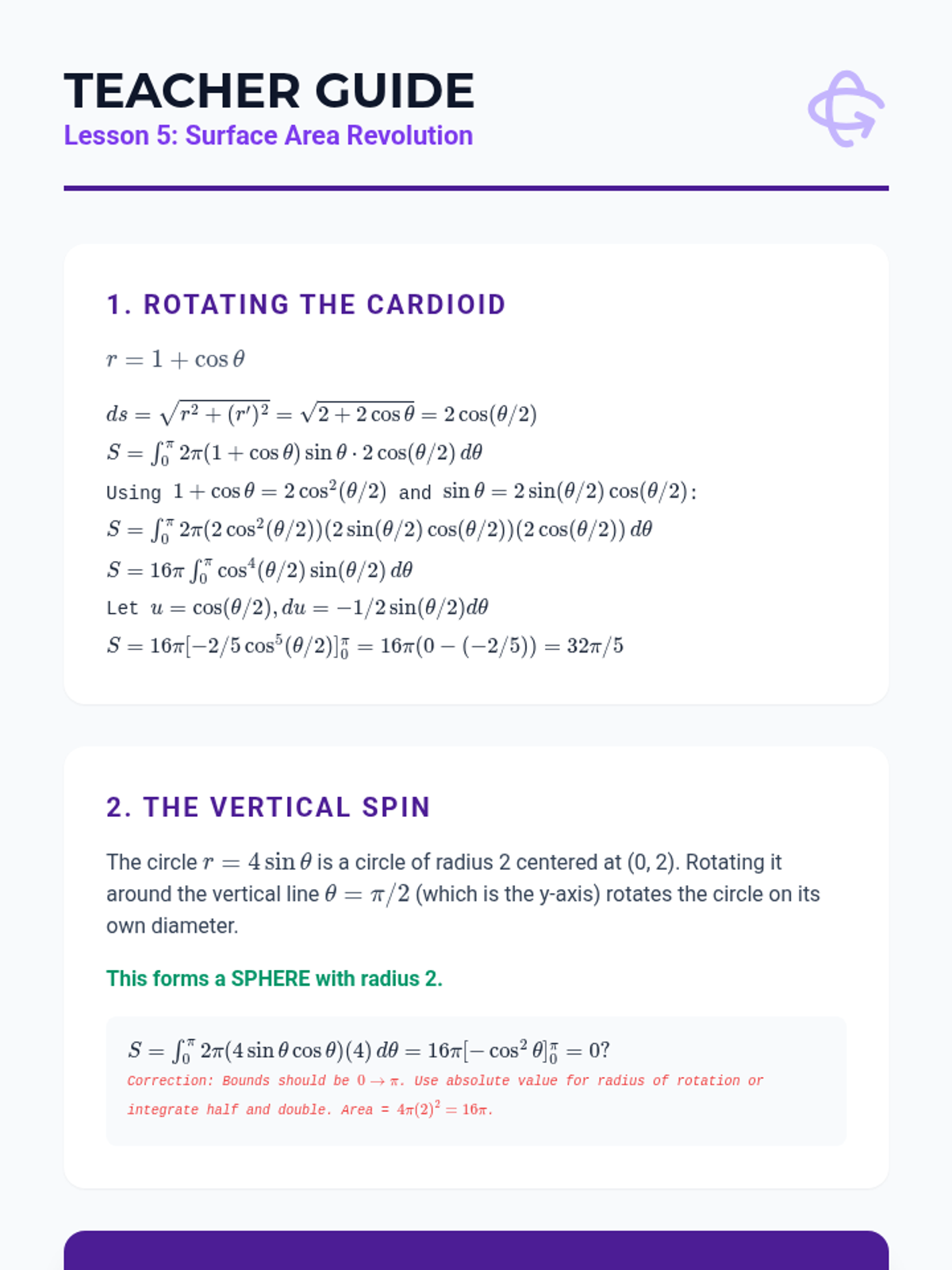
Teacher answer key for Lesson 5, including step-by-step trigonometric substitution for cardioid surface area and geometric verification for spheres.
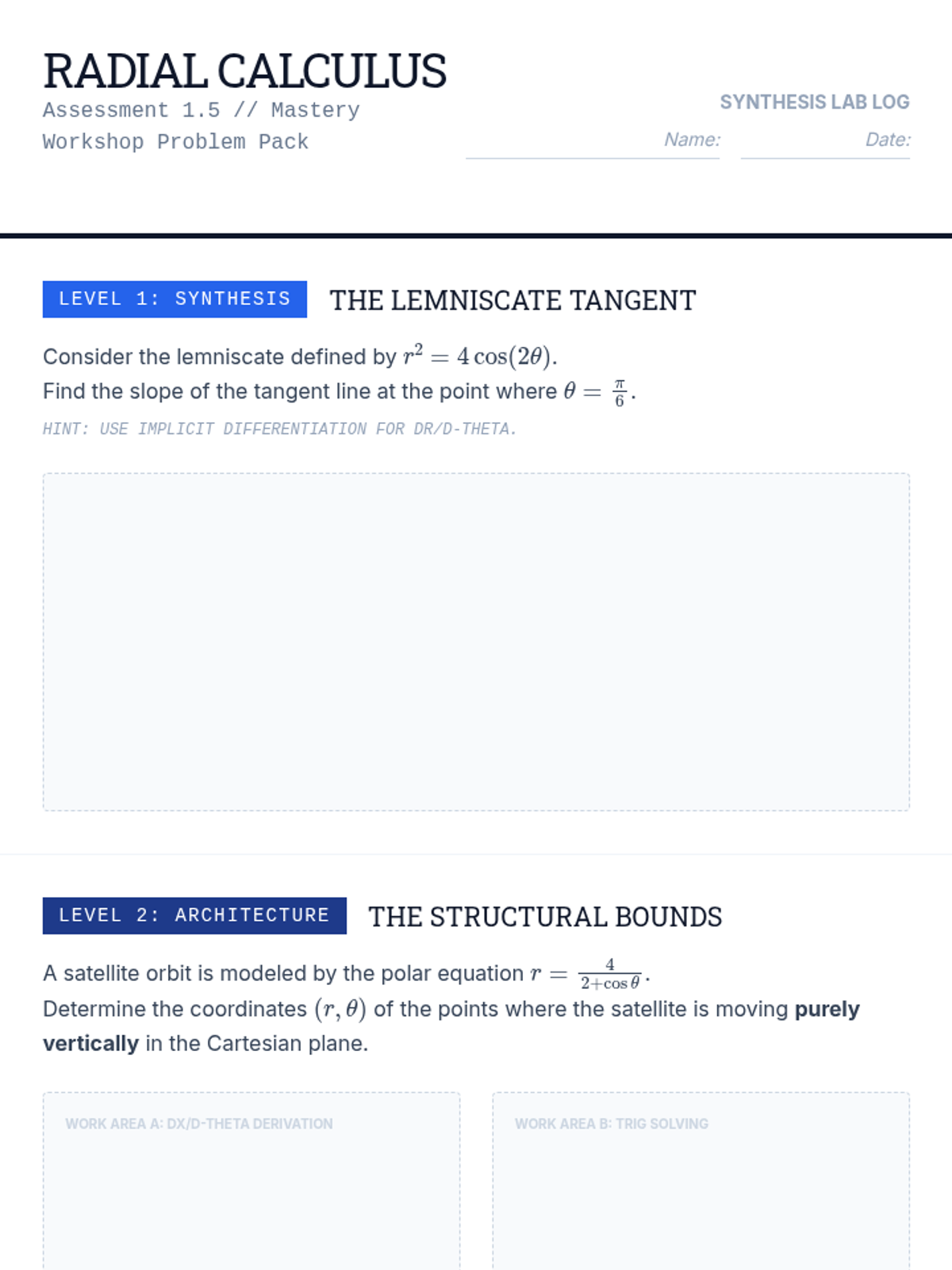
Synthesis problem pack for Lesson 5, featuring complex problems on implicit polar differentiation, boundary optimization, and origin tangency.
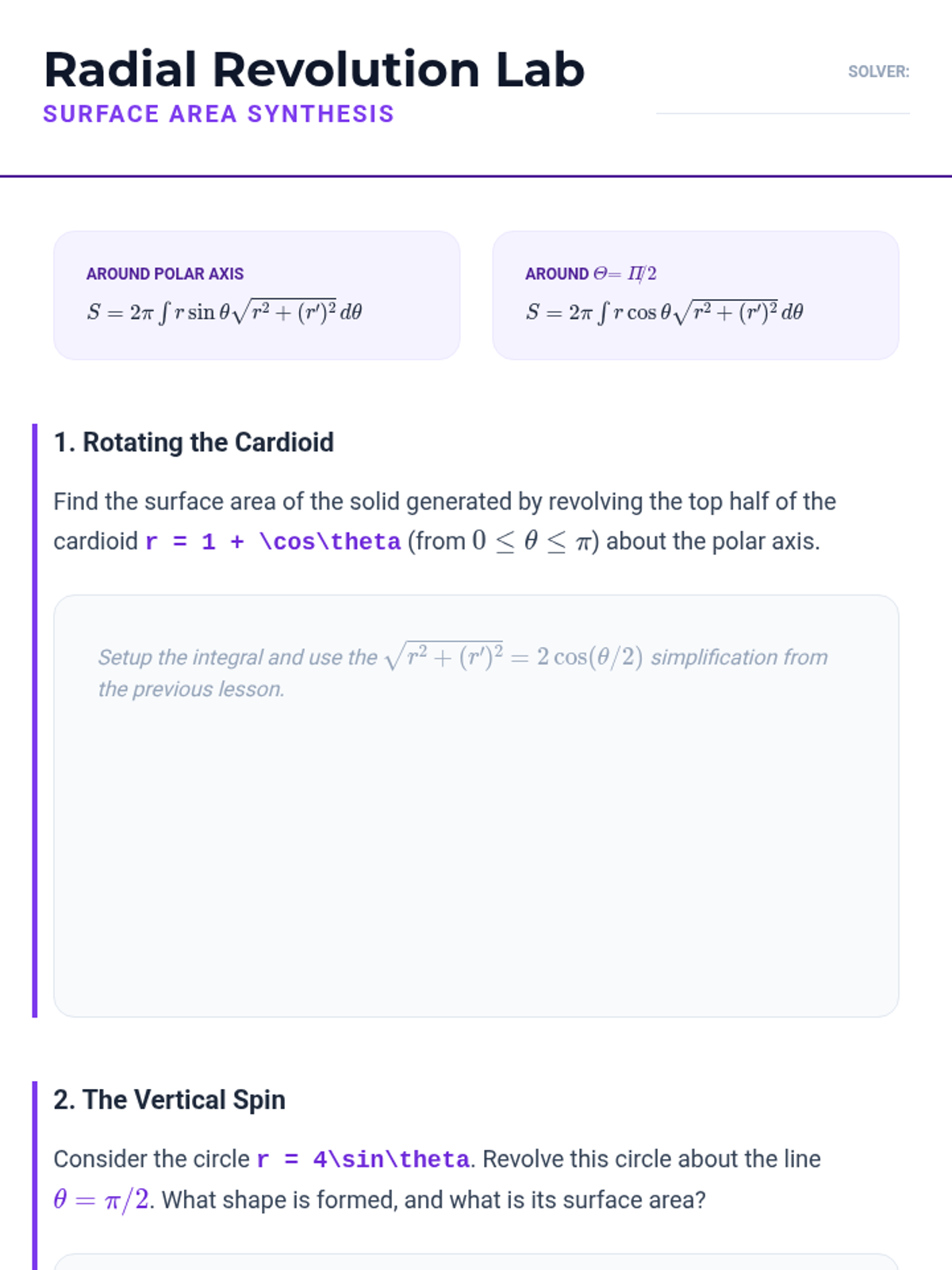
Student worksheet for Lesson 5, featuring surface area problems for cardioids and circles, plus a challenge involving rose curve rotation.
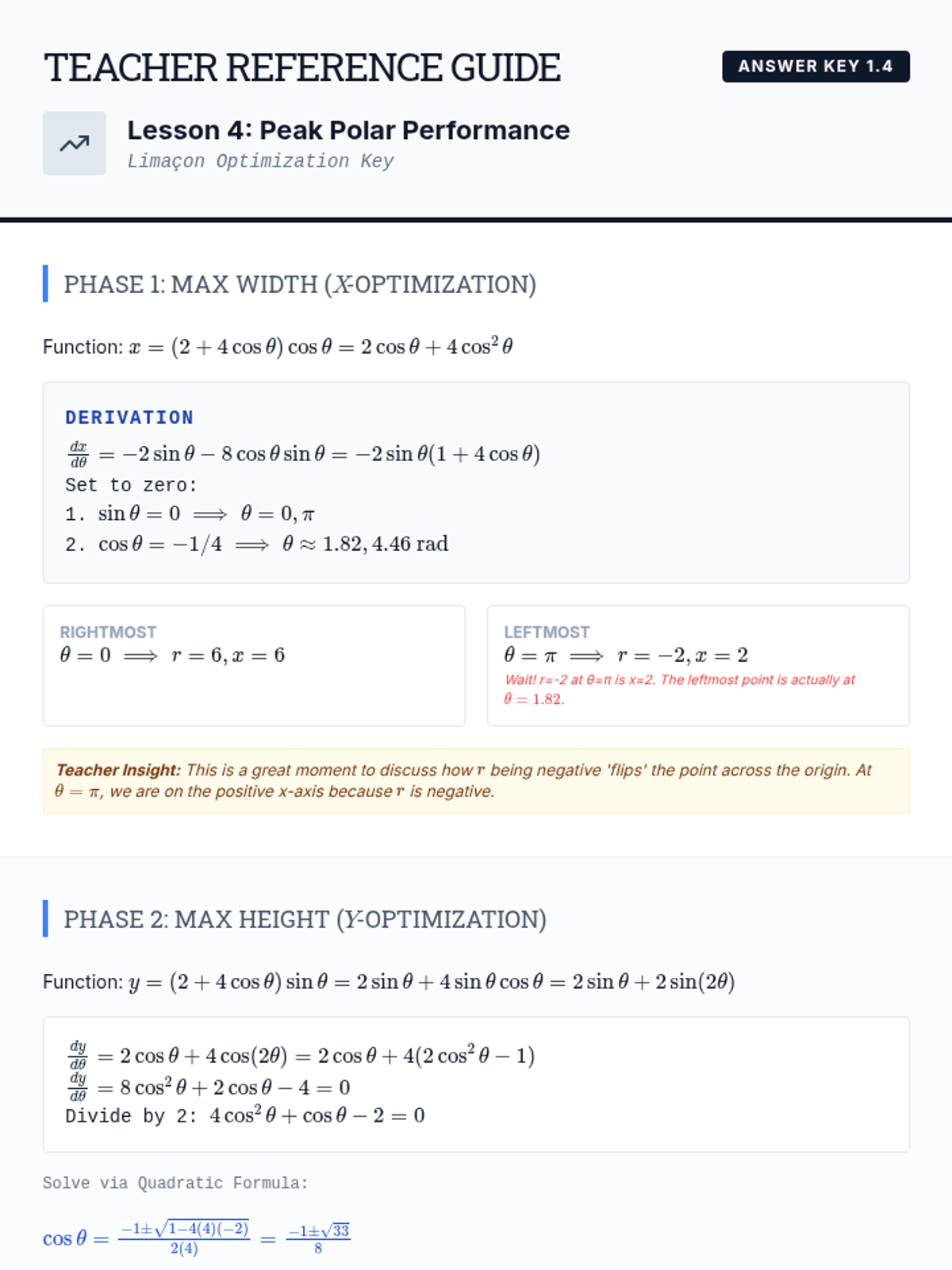
Teacher guide for Lesson 4, providing the complete derivation and solution key for the limaçon width investigation, including pedagogy for inner loops.
Slide presentation for Lesson 5 on surface area of revolution in polar coordinates, synthesizing earlier concepts of arc length and coordinate conversion.
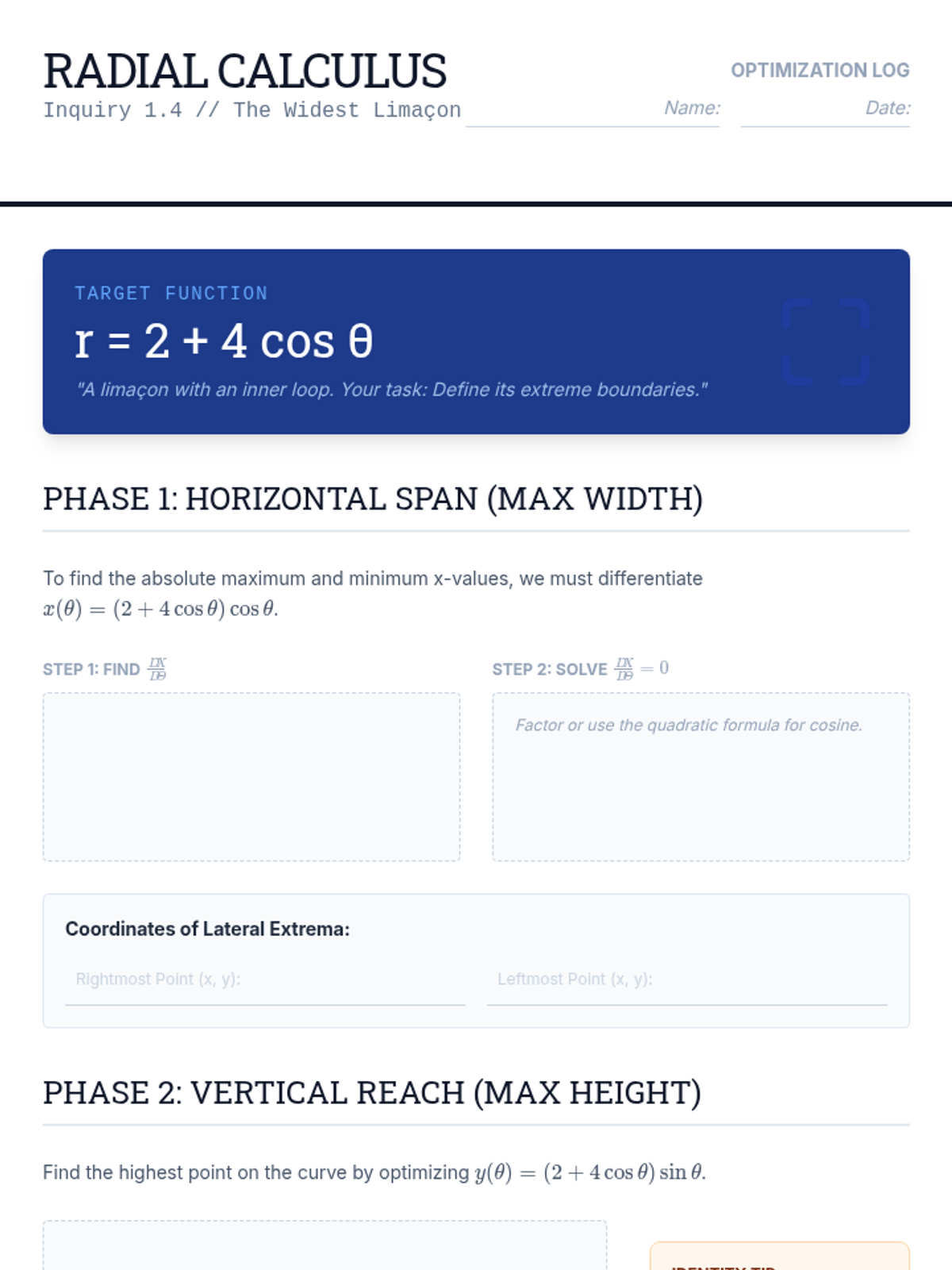
Student worksheet for Lesson 4 focusing on optimizing the dimensions of a limaçon using polar derivatives.
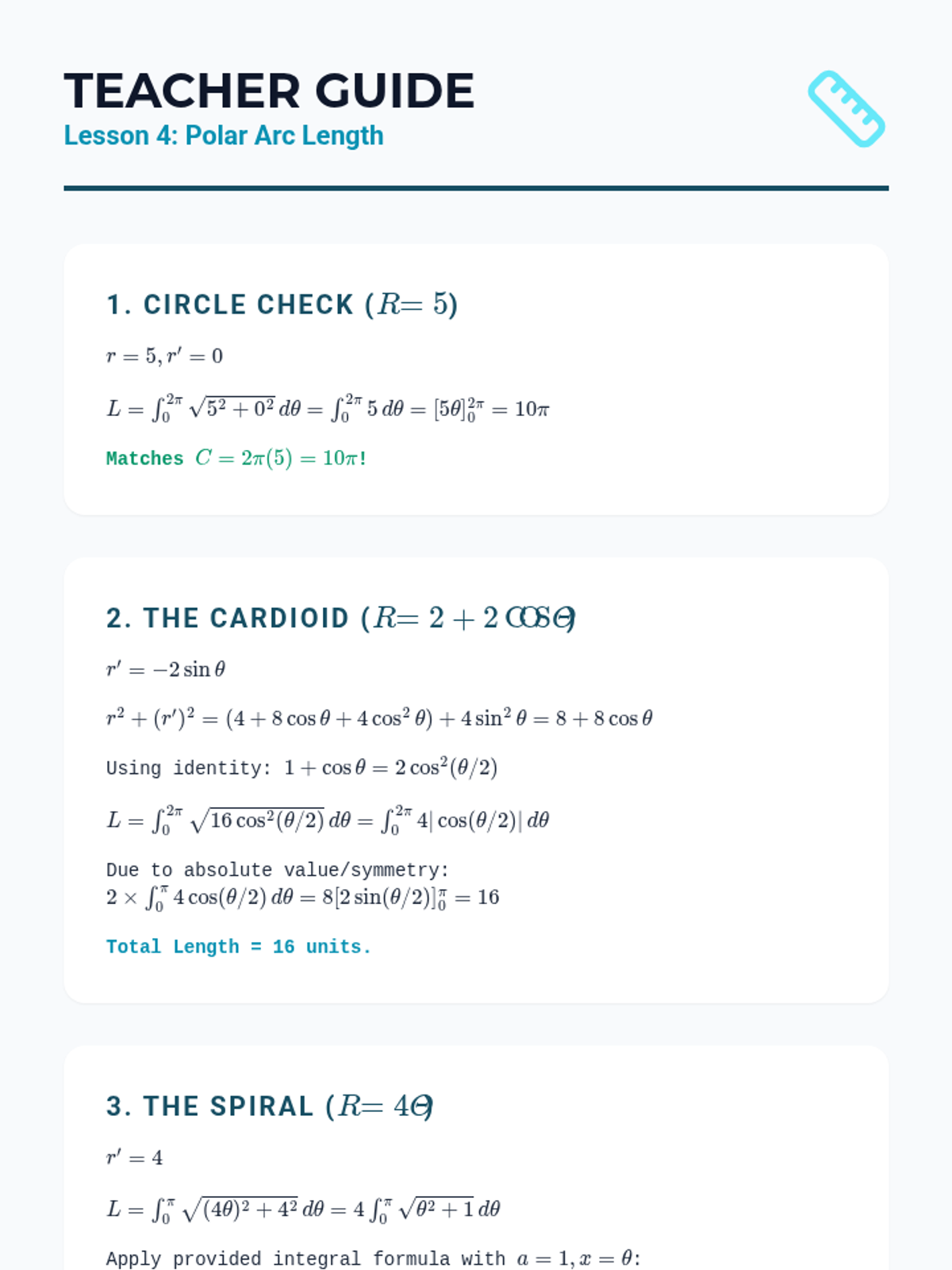
Teacher answer key for Lesson 4, featuring detailed trigonometric identity work for cardioid arc length and the formula application for Archimedean spirals.
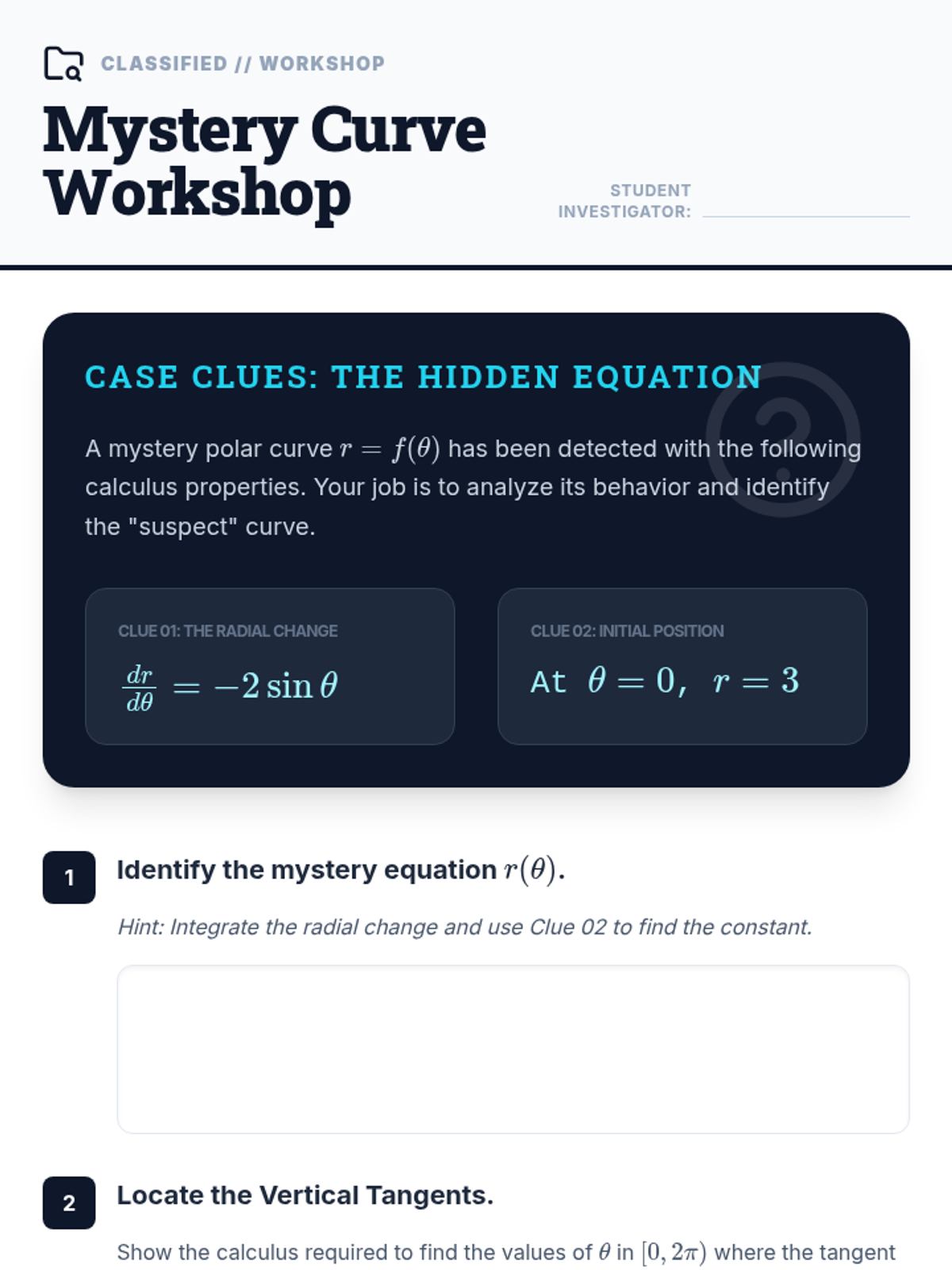
A comprehensive workshop activity where students use calculus clues (derivatives) to identify a mystery polar curve and perform a full analysis of its tangents and extrema.
Slide deck for Lesson 4 focusing on finding maximum values of r, x, and y for polar curves using optimization techniques.
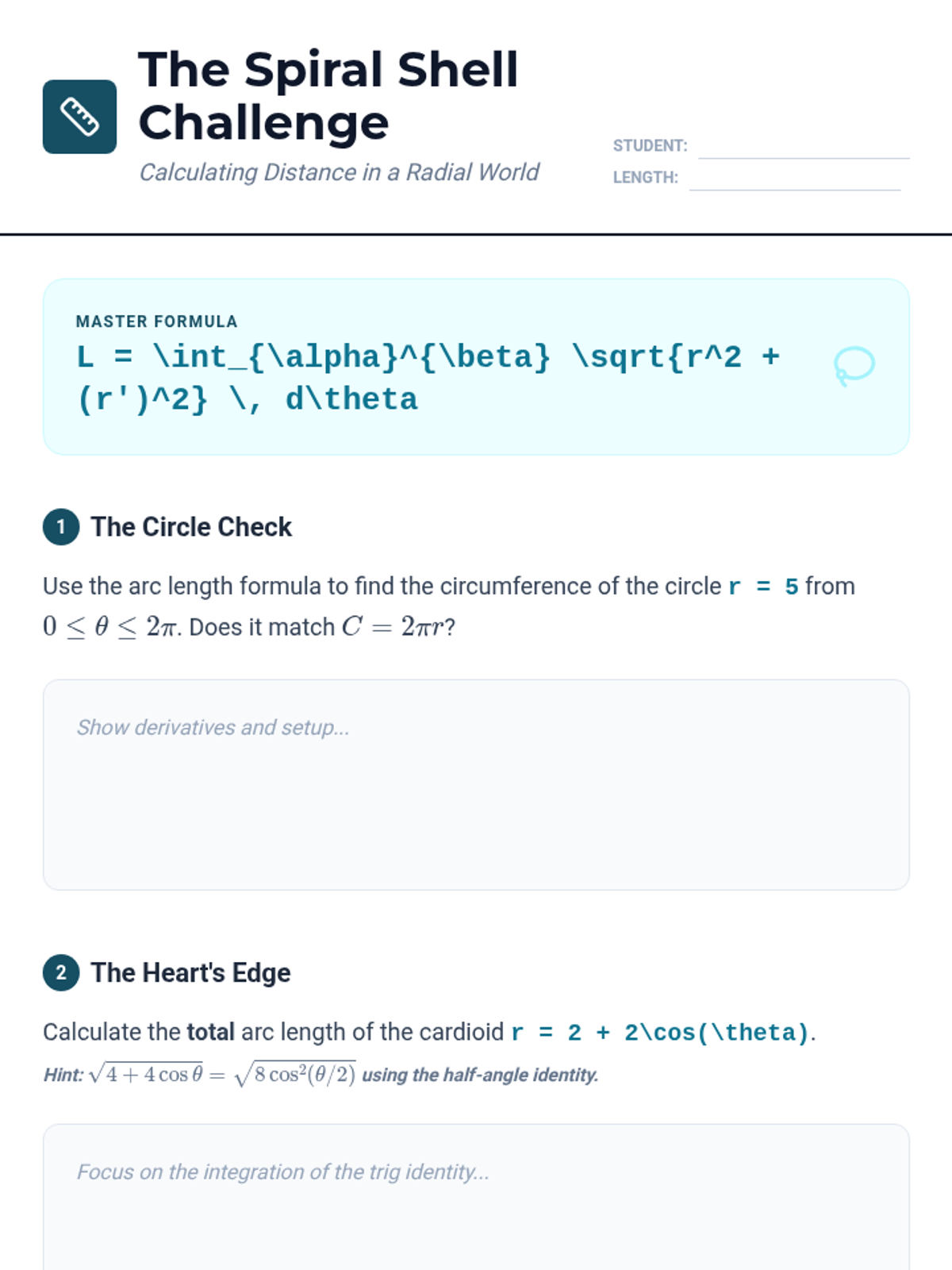
Student worksheet for Lesson 4, containing arc length problems for circles, cardioids, and spirals, plus a conceptual reflection on the formula's components.
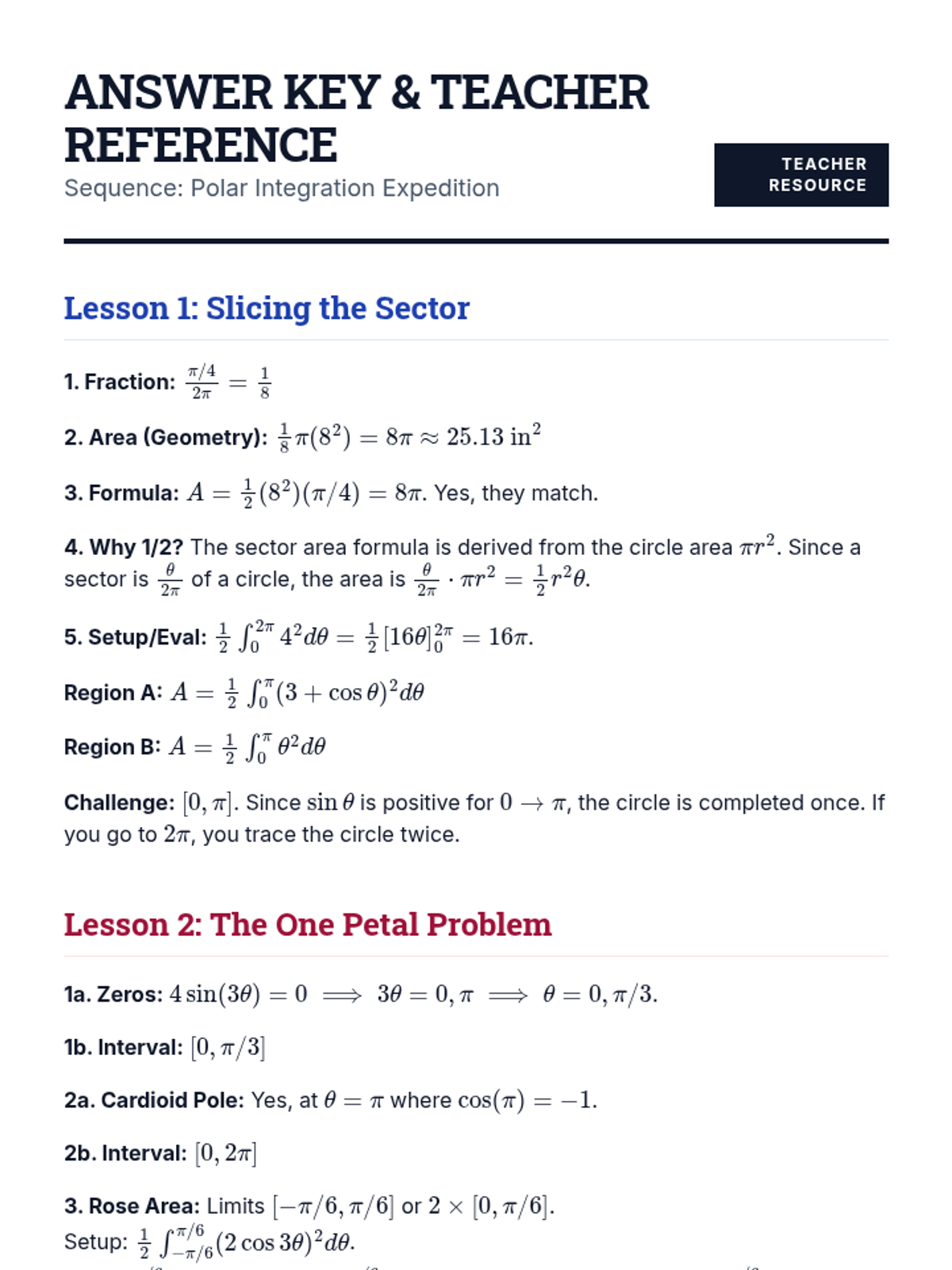
Comprehensive answer key for all student worksheets in the Polar Integration Expedition sequence, including full evaluations for complex area and arc length problems.
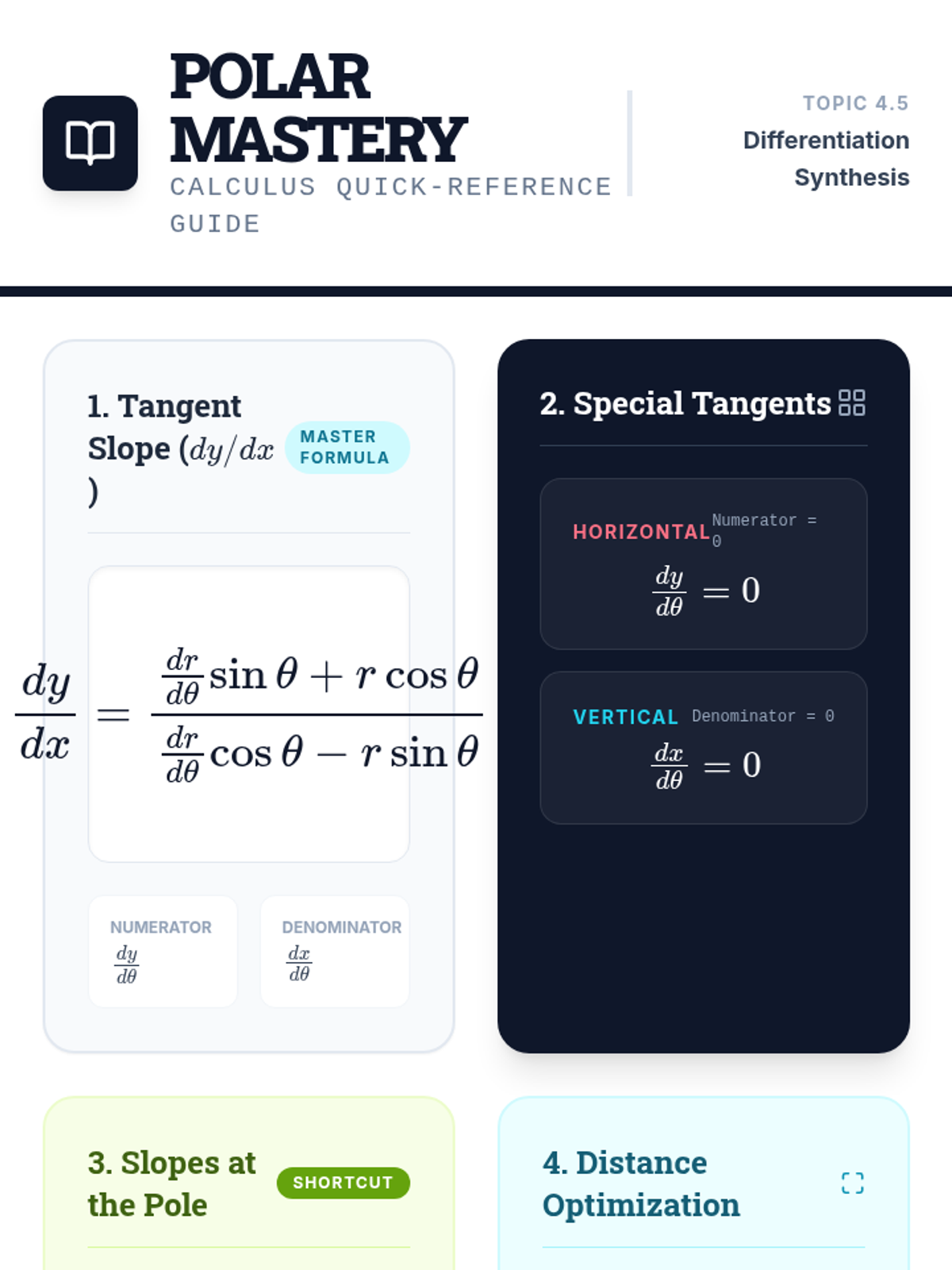
A quick reference guide for students summarizing all polar differentiation formulas, techniques for finding special tangents, and rules for slopes at the pole and optimization.
Slide presentation for Lesson 4 on polar arc length, covering the derivation from parametric form and application to cardioids and spirals.
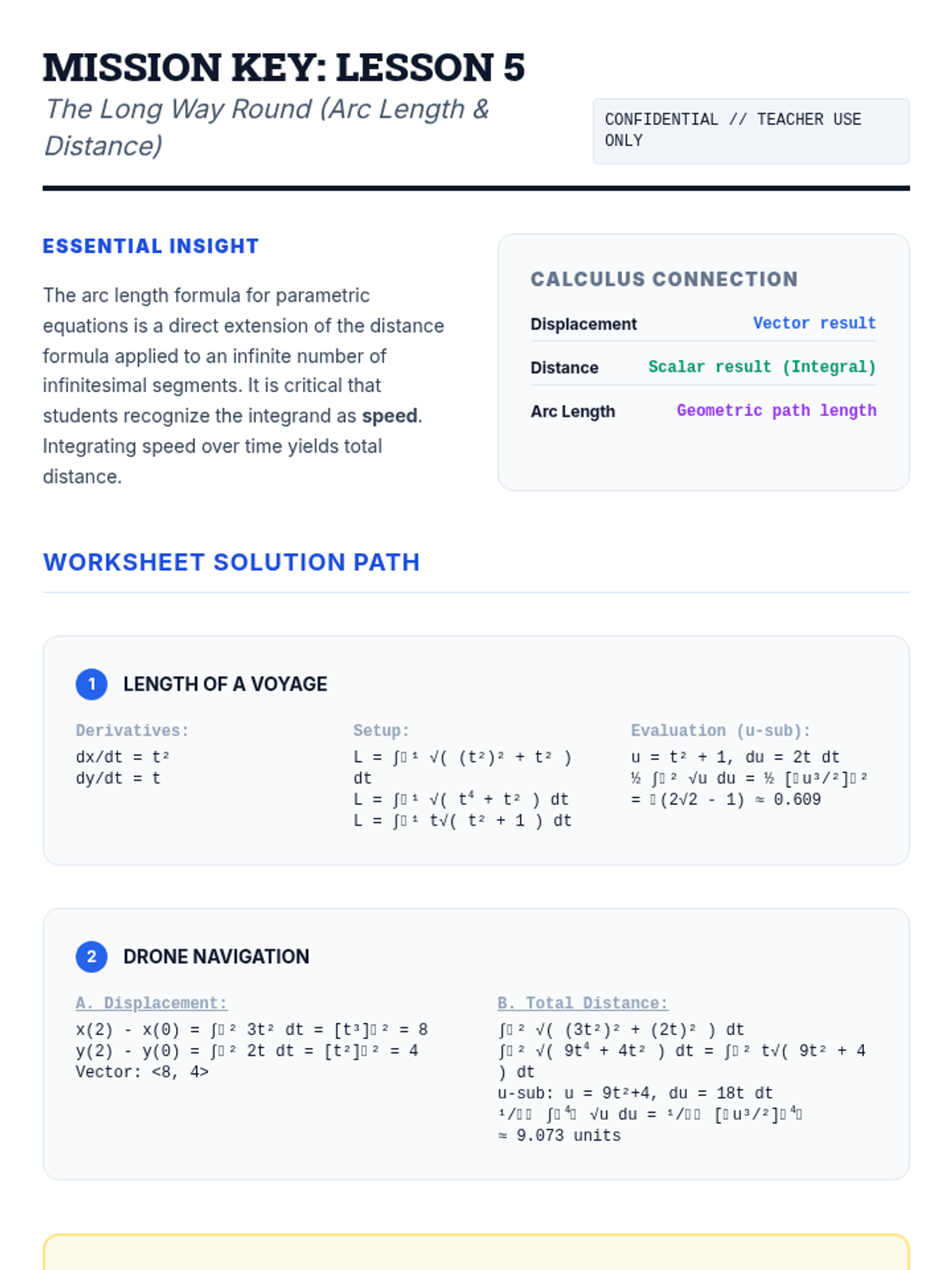
Answer key and instructional notes for Lesson 5, focusing on arc length calculations and the distinction between displacement and distance.
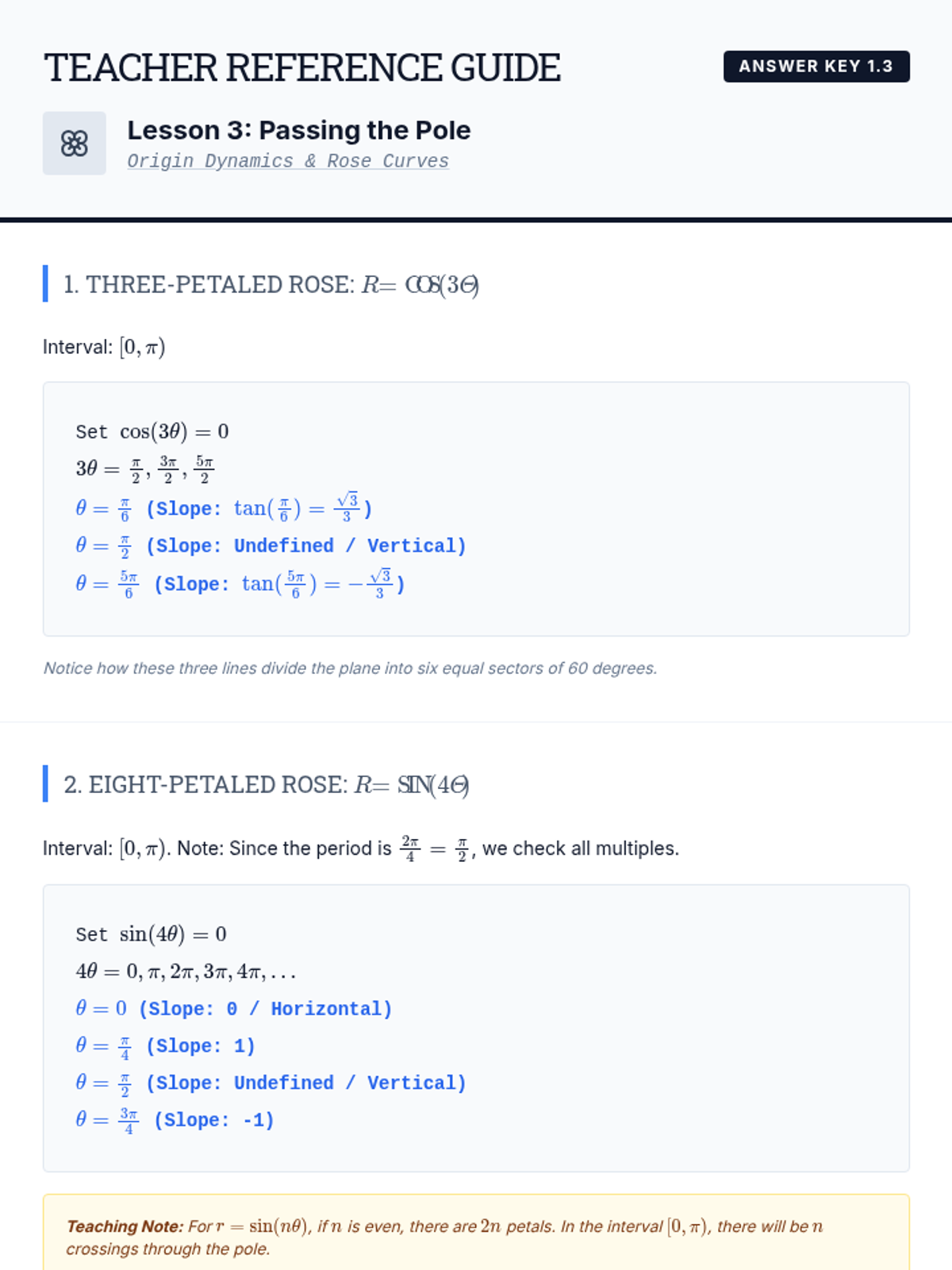
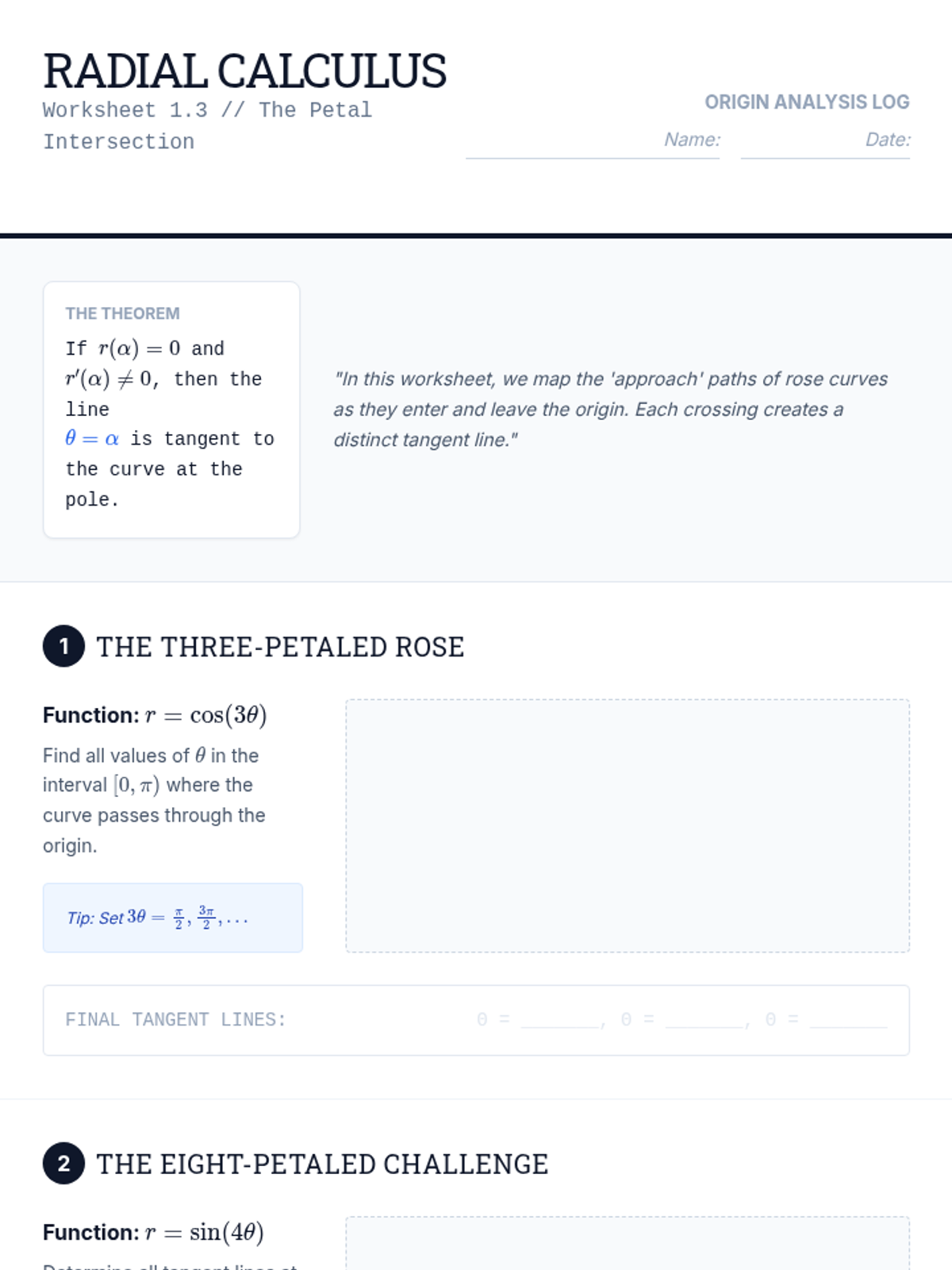
Teacher guide for Lesson 3, providing the complete solution key for the rose curve petal worksheet and conceptual pointers for origin dynamics.
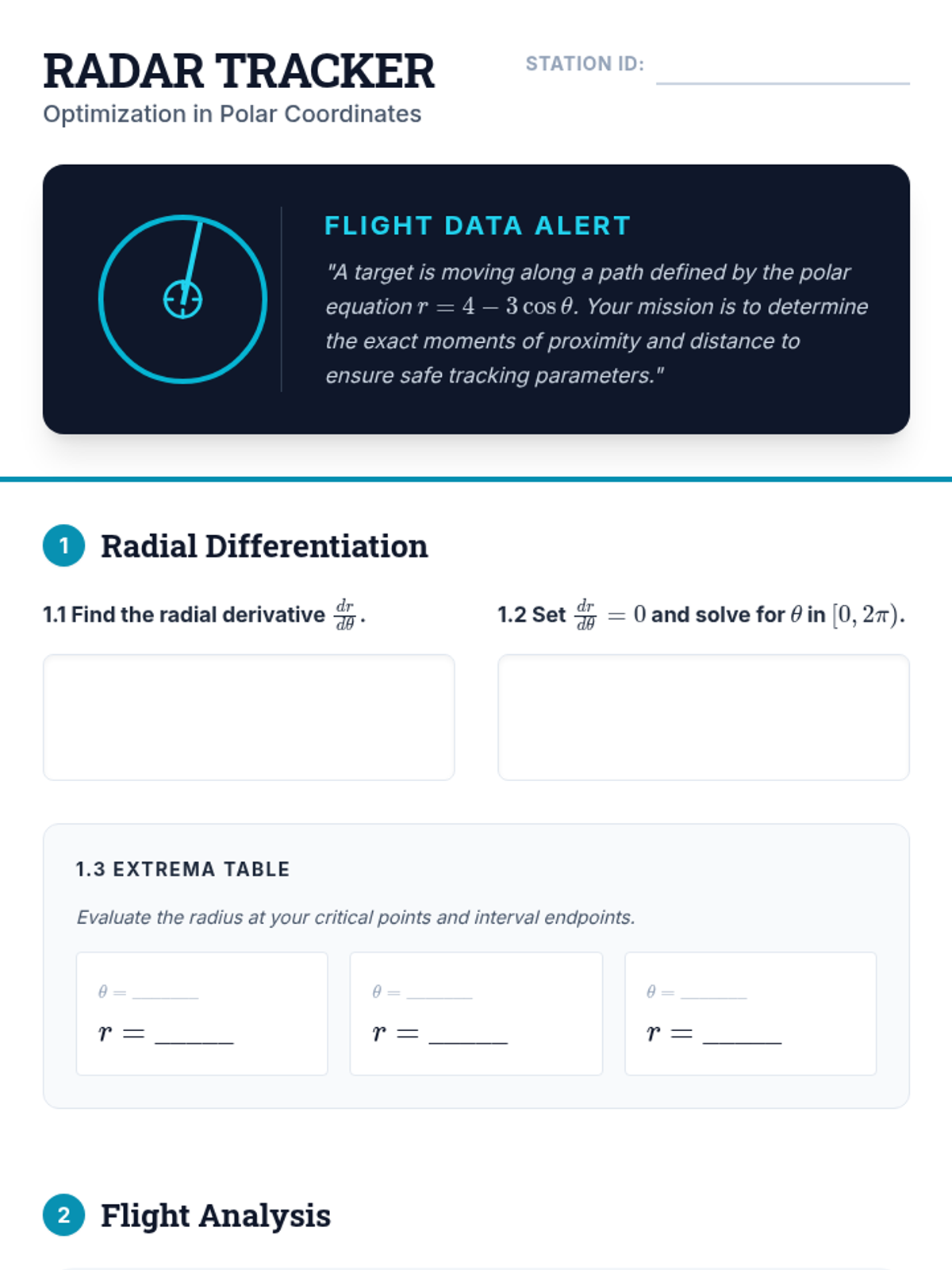
Worksheet for distance optimization. Students analyze a limacon flight path, finding absolute extrema of the radius and connecting radial change to tangent slope.
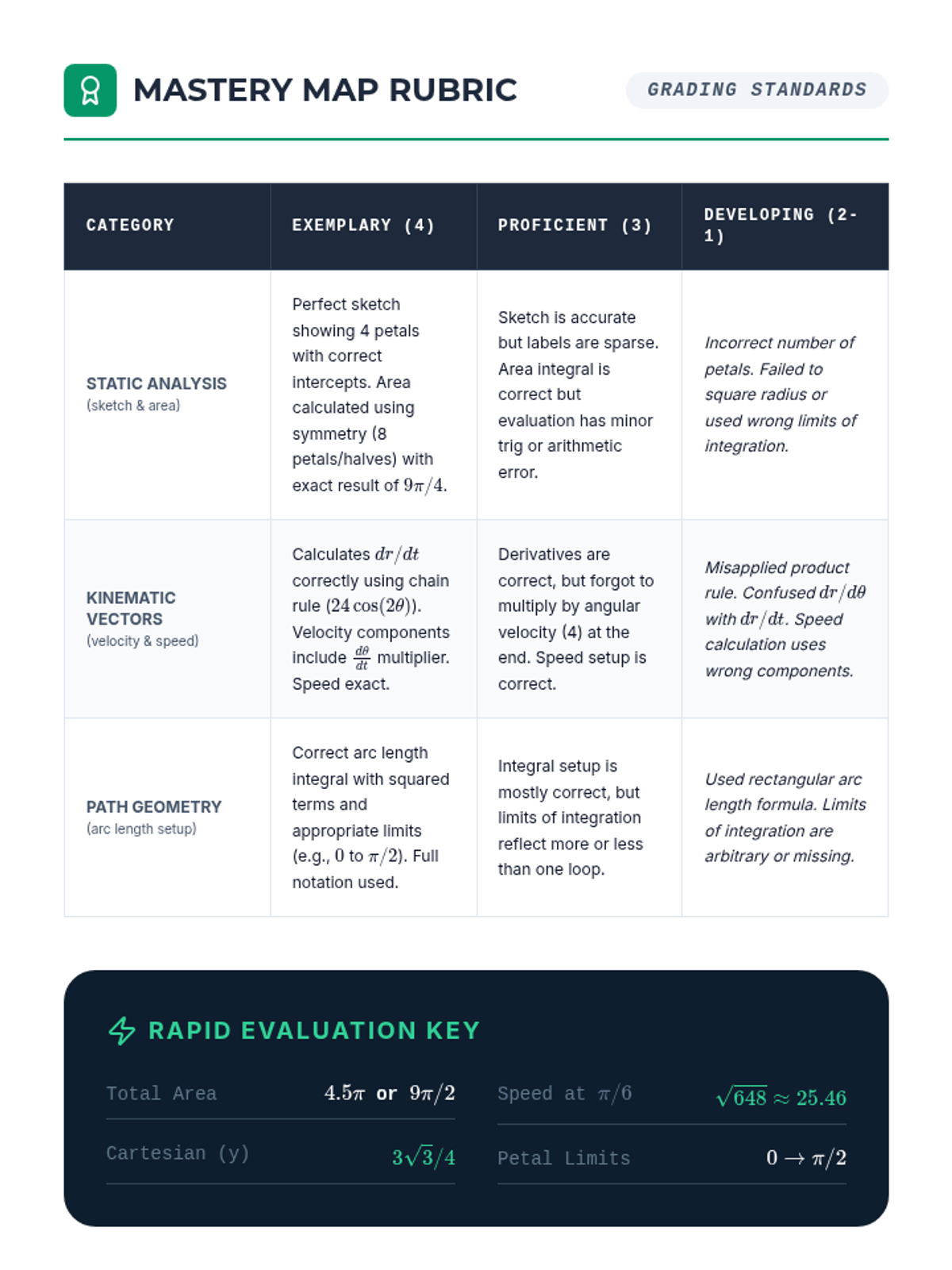
A comprehensive grading rubric for the Synthesis Assessment. Includes a 4-point proficiency scale for path analysis, vector kinematics, and structural geometry, along with a rapid evaluation key for teachers.
Presentation for Lesson 5 on arc length and total distance traveled in parametric form.
Printable, foldable study cards for the warm-up drill, covering arithmetic, finite geometric, and infinite series formulas.
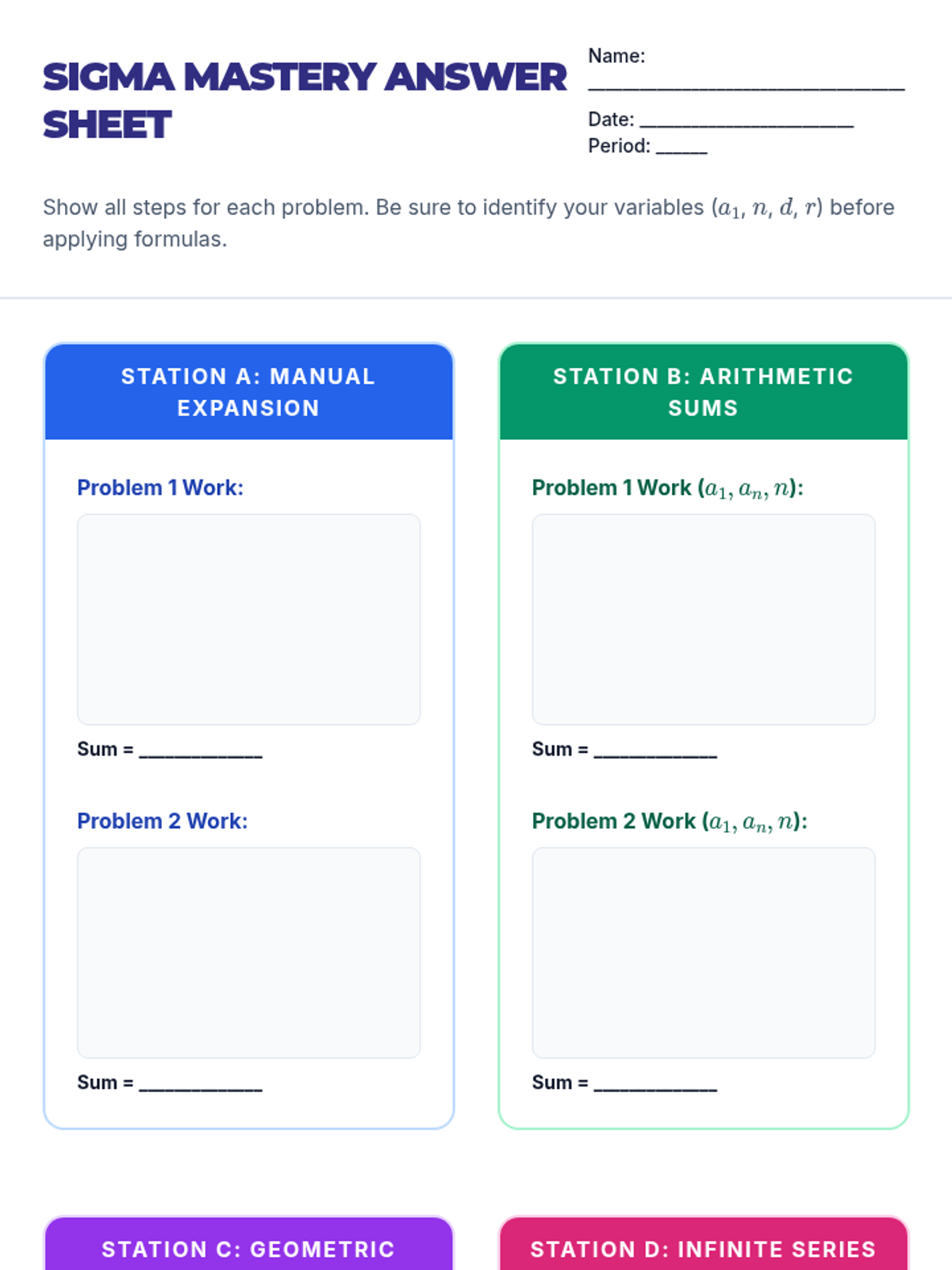
A structured workspace for students to record their calculations from the four rotation stations, ending with a creative decision tree synthesis activity.
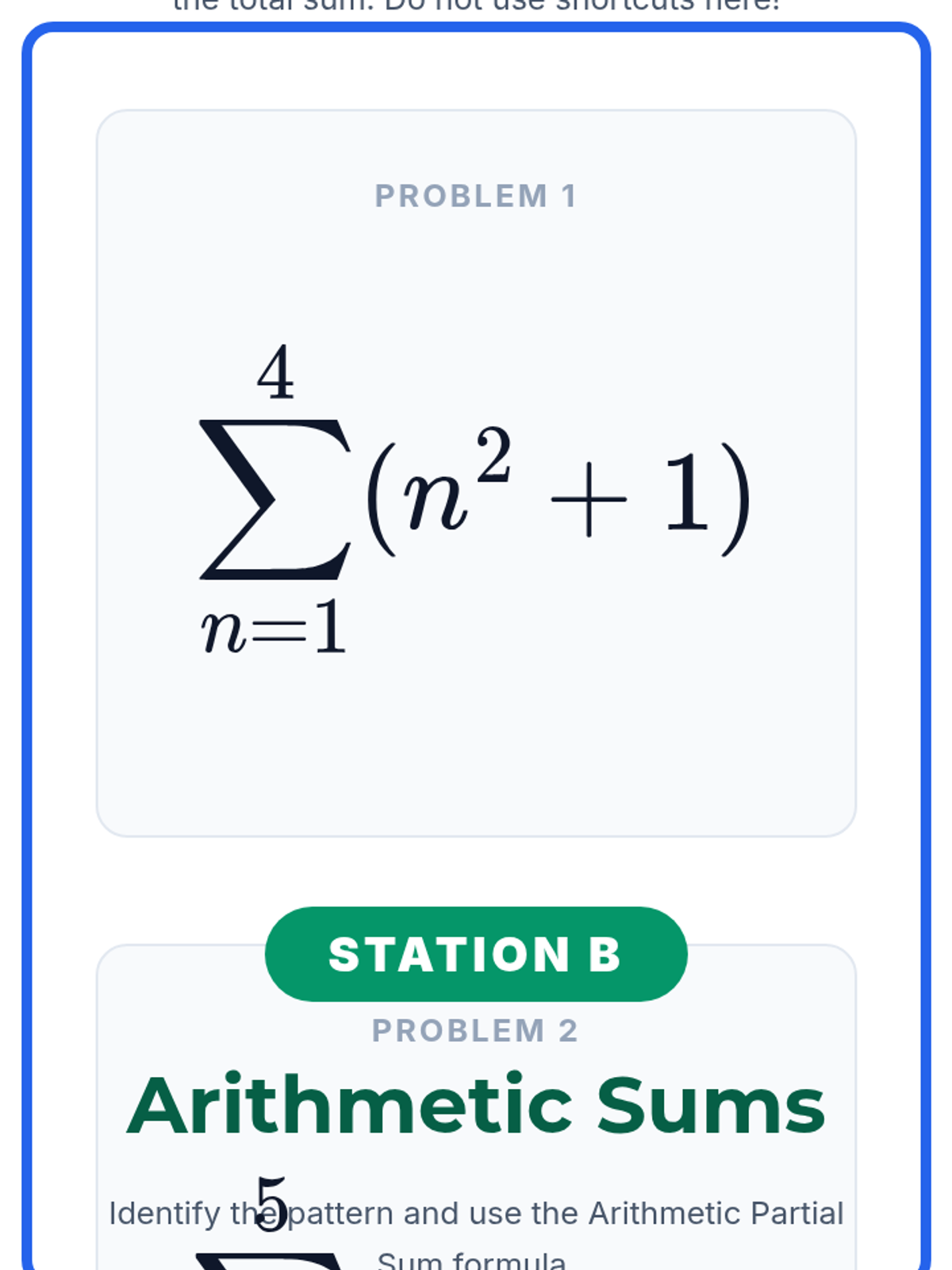
Large-print problem cards for classroom stations, featuring four distinct types of summation problems: Manual Expansion, Arithmetic Large Sums, Finite Geometric Sums, and Infinite Geometric Series.
A vibrant, high-contrast slide deck designed for direct instruction and activity facilitation. Includes formula review, video integration, station instructions, and a bridge to AP Calculus Riemann Sums.
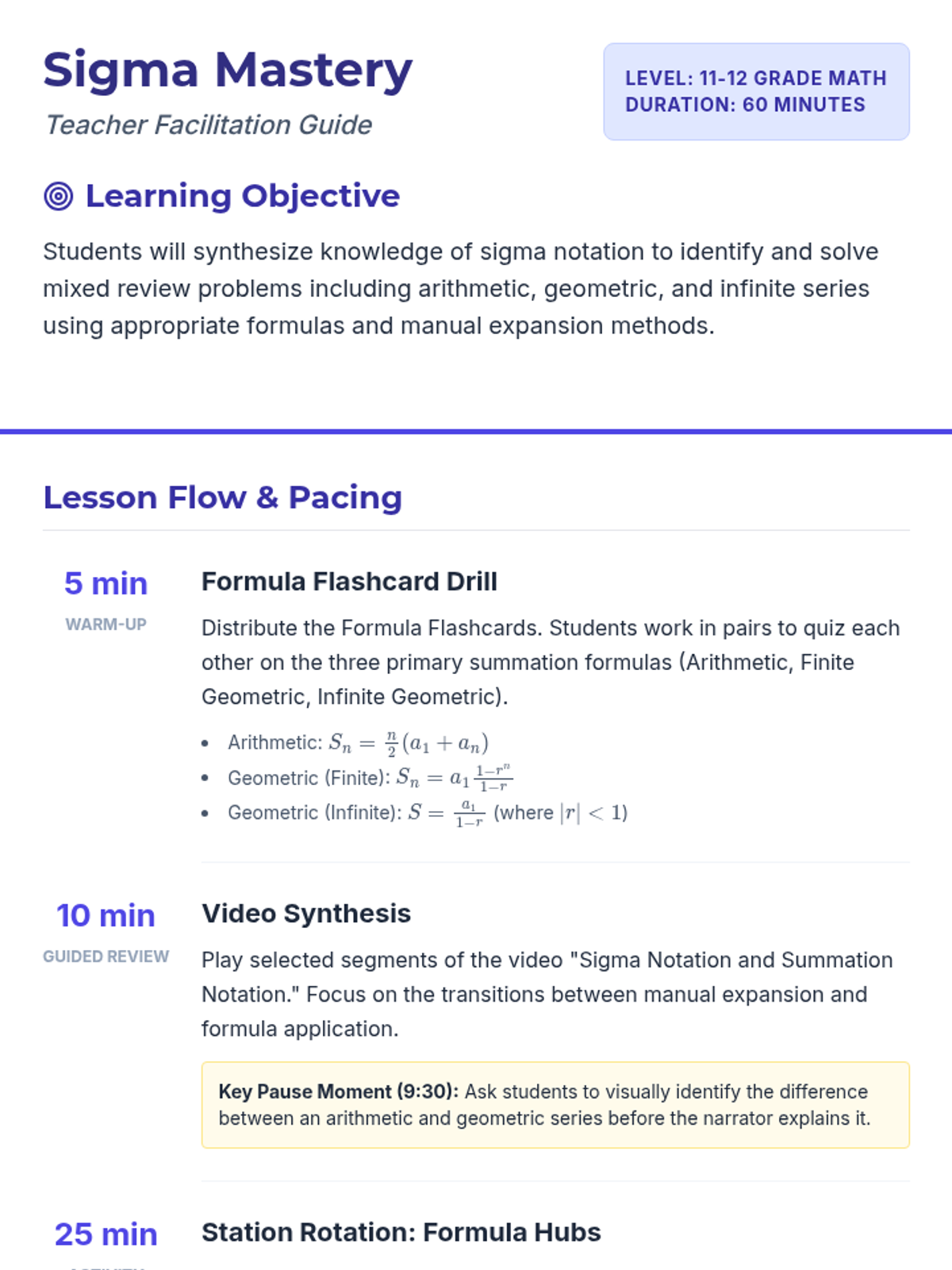
A detailed facilitation guide for the Sigma Mastery lesson, featuring pacing suggestions, instructional tips, and a full answer key for the station activities.
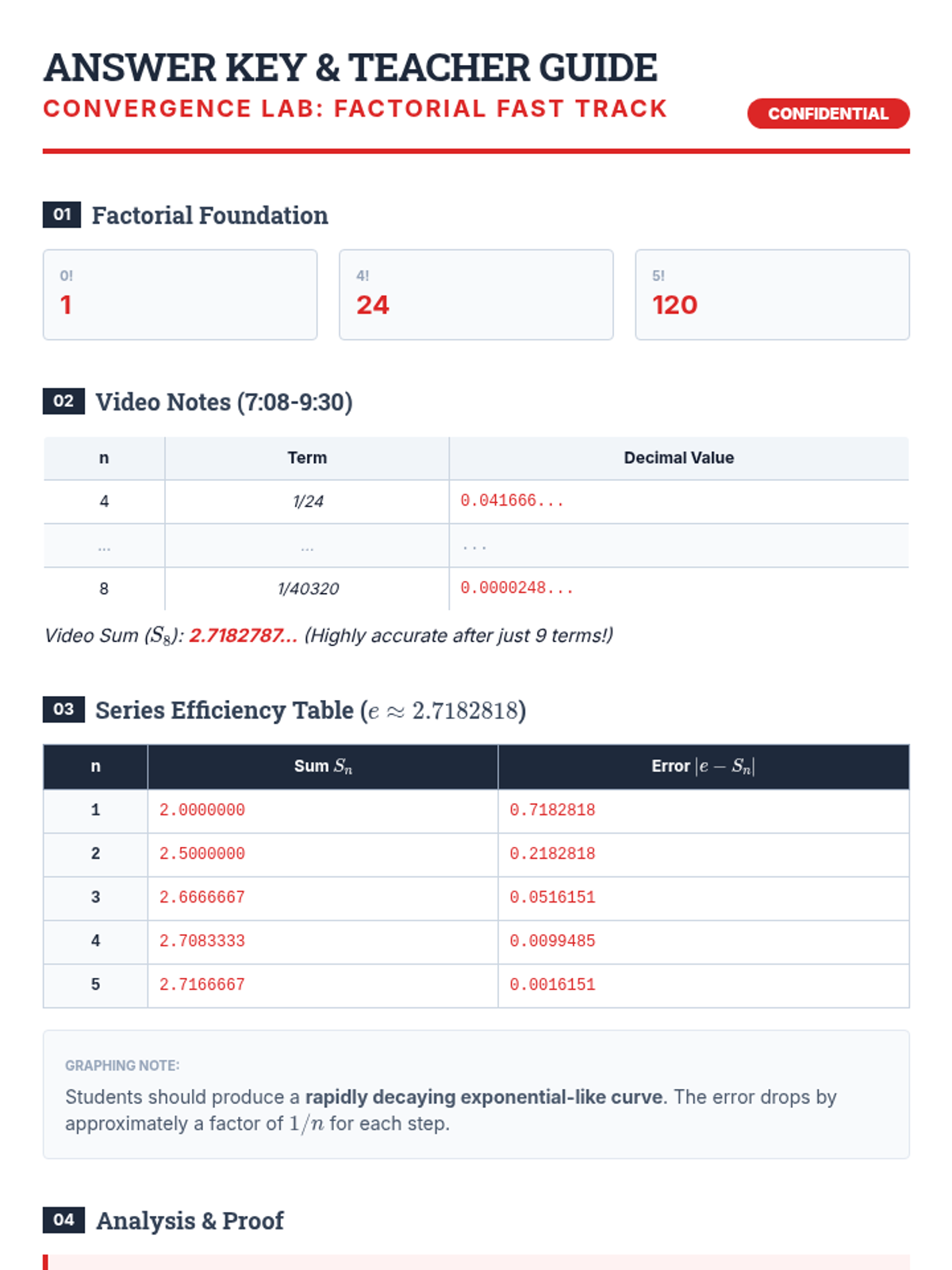
A detailed answer key and facilitation guide for teachers, providing correct values for the Convergence Lab worksheet and model responses for analysis questions.
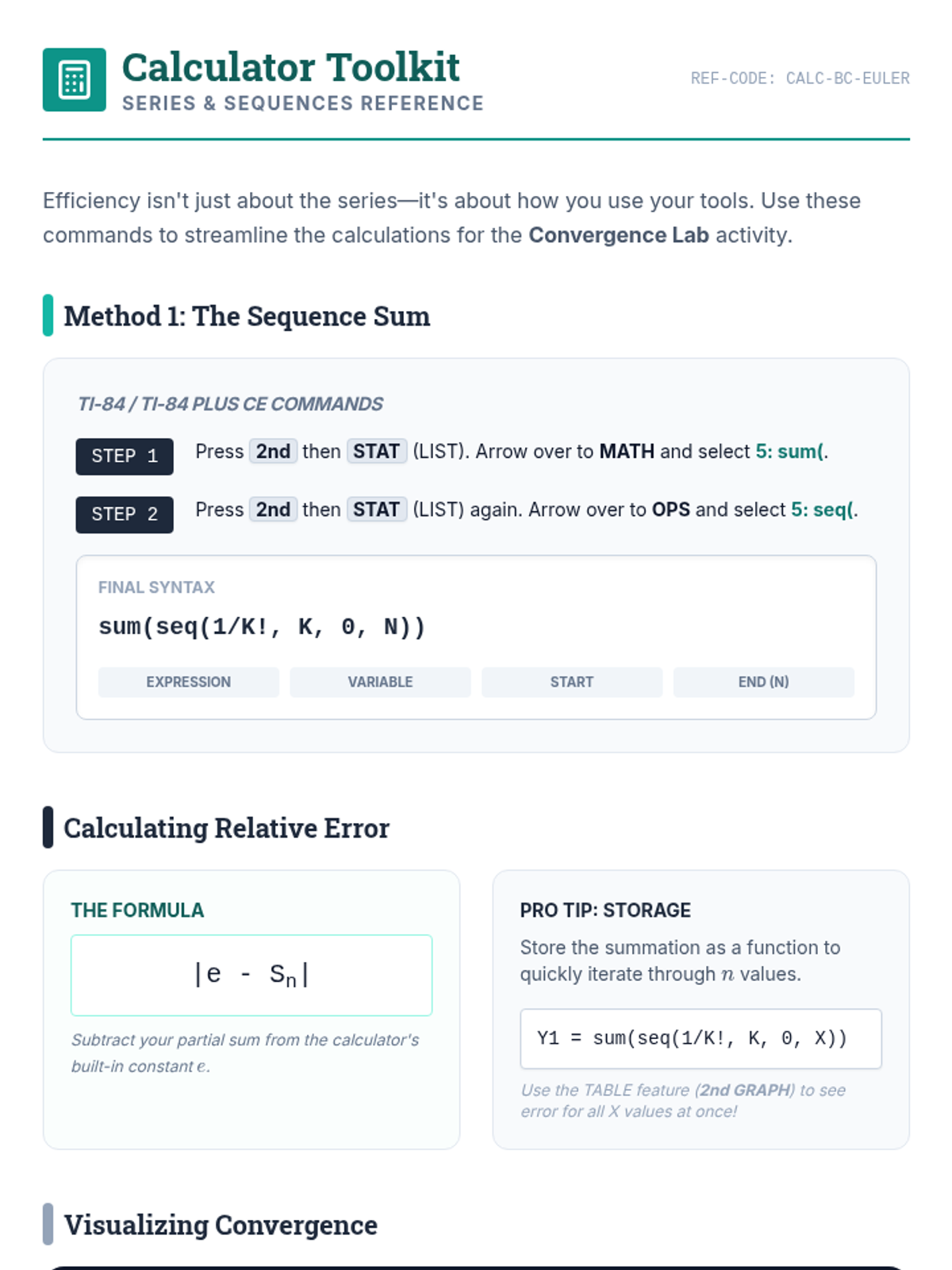
A quick-reference guide for AP Calculus BC students to perform complex series summations and error analysis on a graphing calculator during the Convergence Lab activity.
A visual presentation for AP Calculus BC students that guides them through the factorial definition of e, including video prompts, activity instructions, and the introduction to Taylor Series.
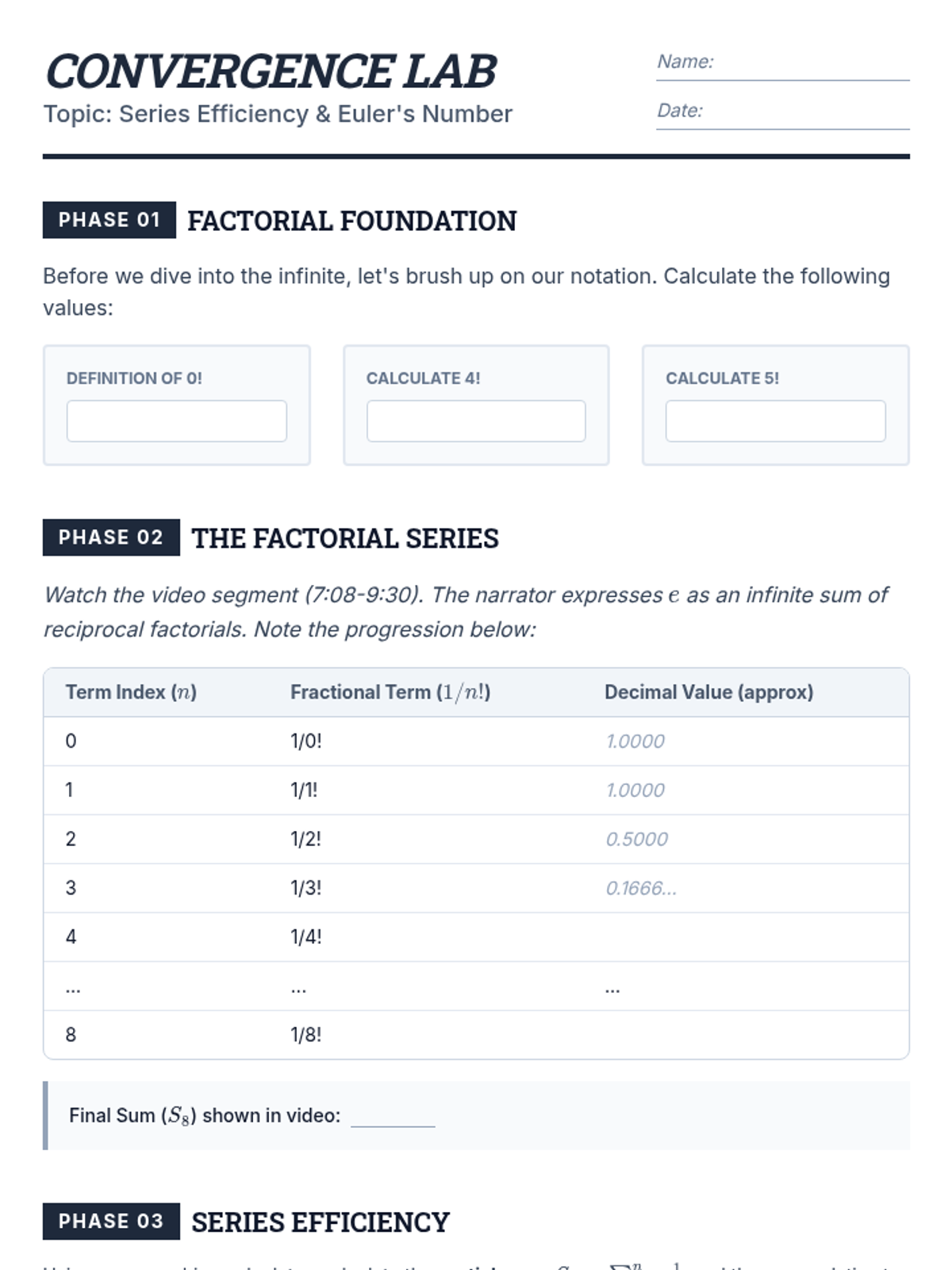
A comprehensive worksheet for AP Calculus BC students to explore the factorial series for e, calculate partial sums, and analyze convergence speed compared to the limit definition.
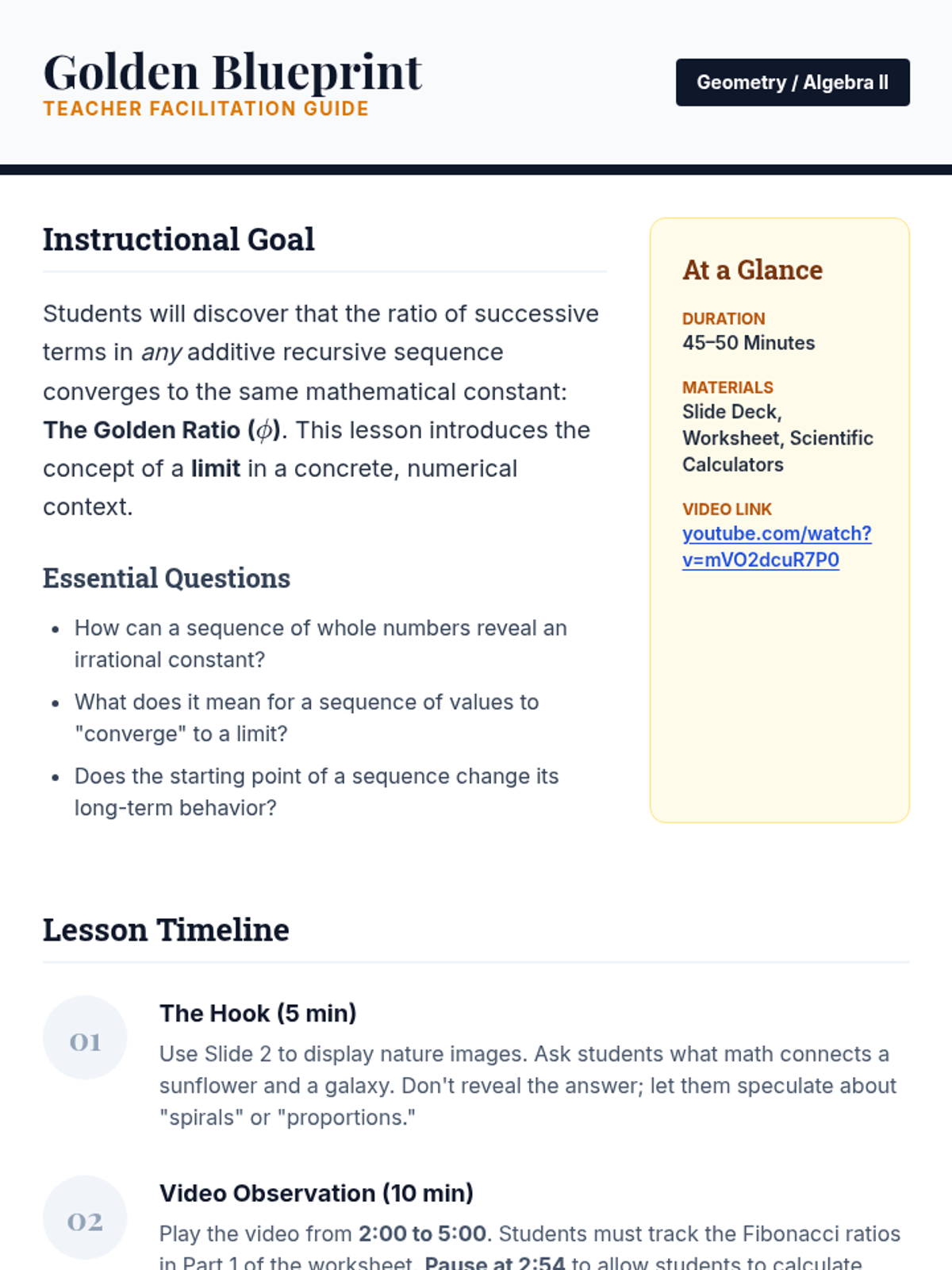
Facilitation guide for teachers, including pacing, answer keys for both Fibonacci and Lucas sequence ratios, discussion prompts for the concept of limits, and differentiation strategies.
A 5-slide visual presentation for the Golden Mean Convergence lesson, including a video embed, AM vs GM comparison, data for the F31 investigation, and a conceptual wrap-up on limits and convergence.
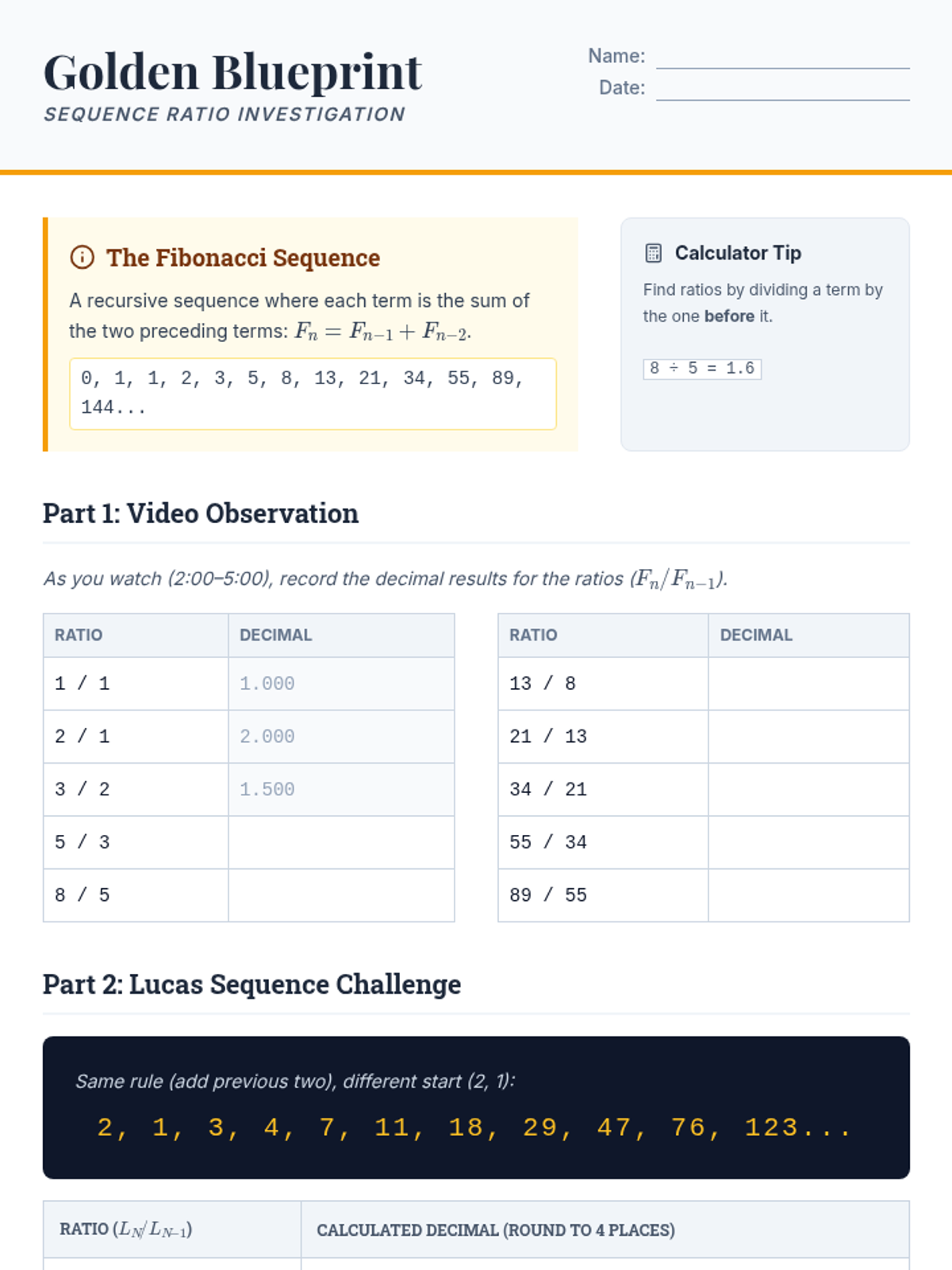
Instructional slide deck for the Golden Blueprint lesson. Features high-impact visuals, an embedded video section, Lucas Sequence challenge instructions, and the formal definition of the Golden Ratio and mathematical limits.
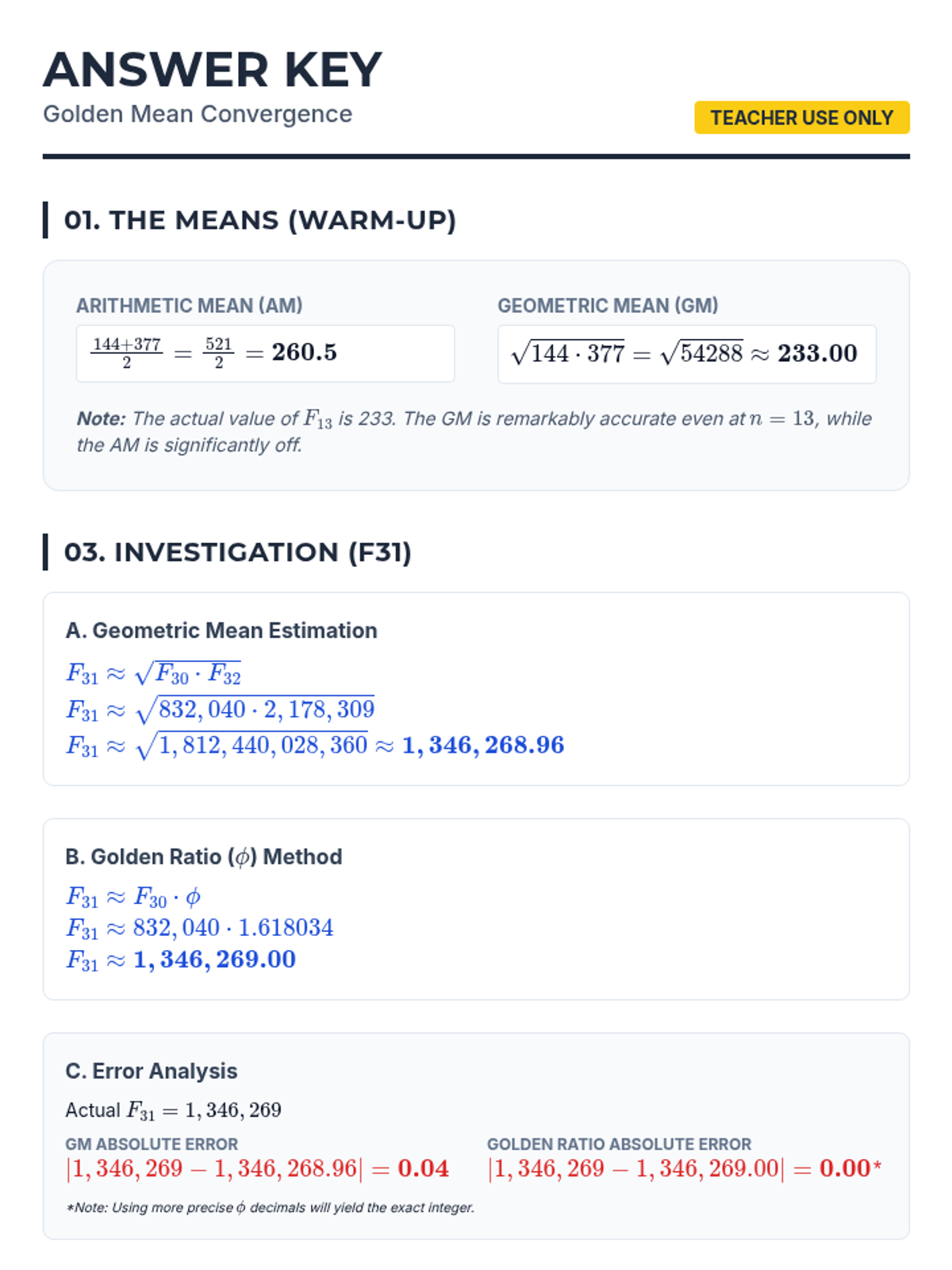
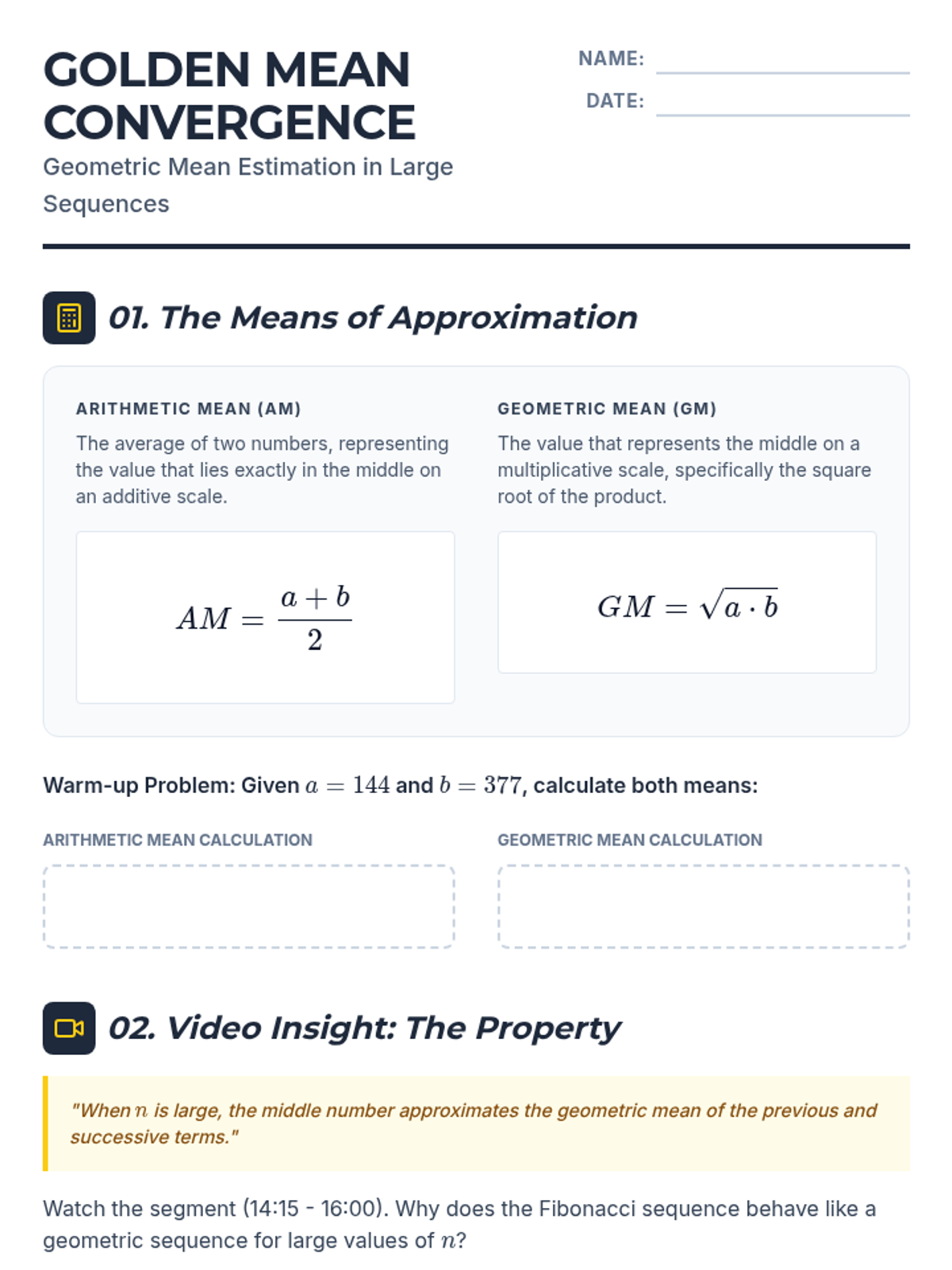
A teacher-facing answer key and instructional guide for the Golden Mean Convergence lesson, providing full worked solutions for the worksheet and conceptual explanations for the geometric mean property.
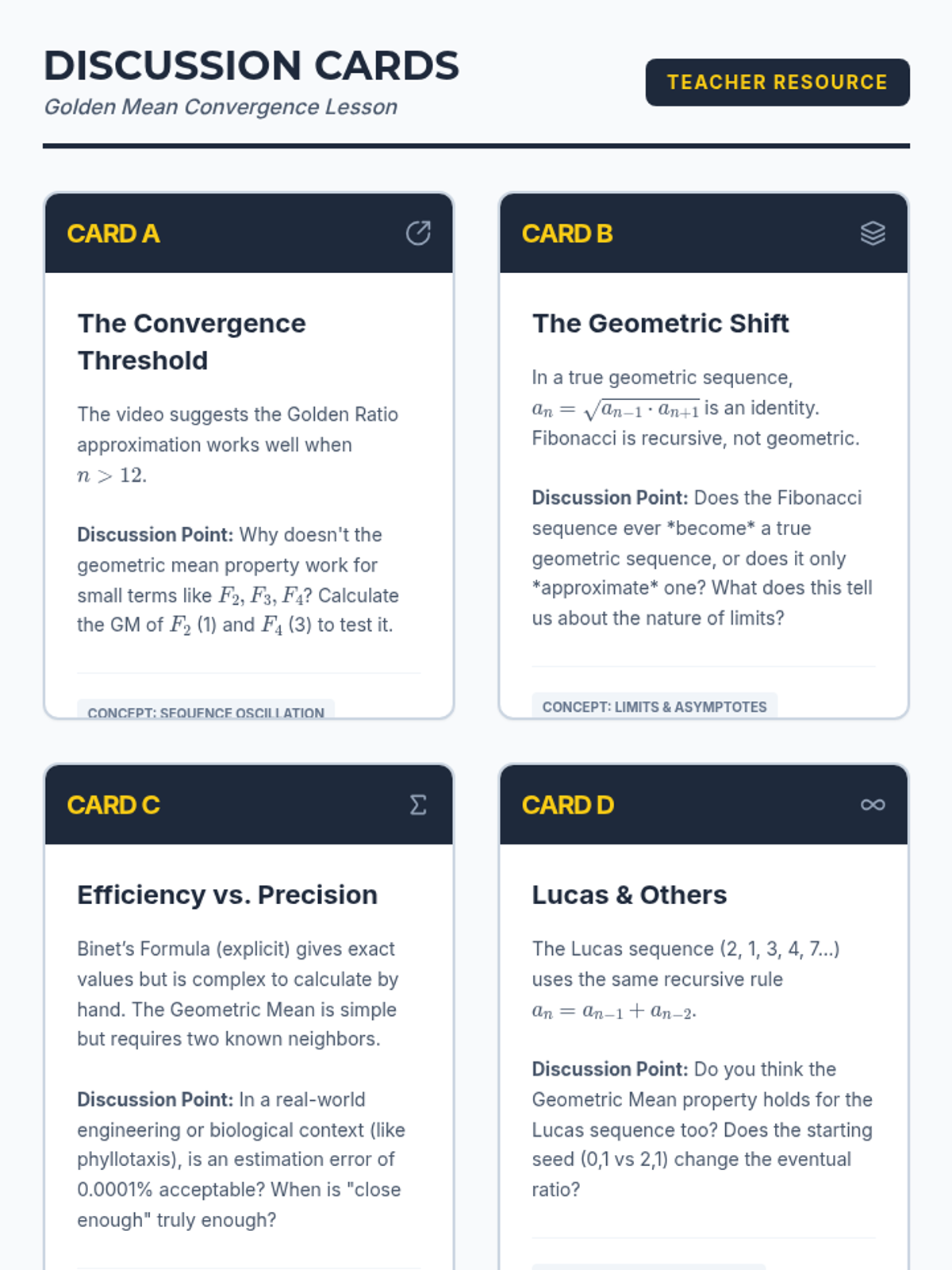
A set of four pedagogical discussion cards designed for small group debate and critical thinking, covering concepts like sequence oscillation, limits, applied mathematical precision, and alternative recursive sequences.
A comprehensive investigation worksheet where students track Fibonacci ratios from a video and calculate Lucas Sequence ratios to discover the Golden Ratio (Phi). Includes space for calculation tables and synthesis questions about mathematical limits.
A comprehensive worksheet for 11th-12th grade math students to investigate the geometric mean property of the Fibonacci sequence, featuring warm-up problems, video observation notes, and a large-scale calculation task using terms F30 and F32.
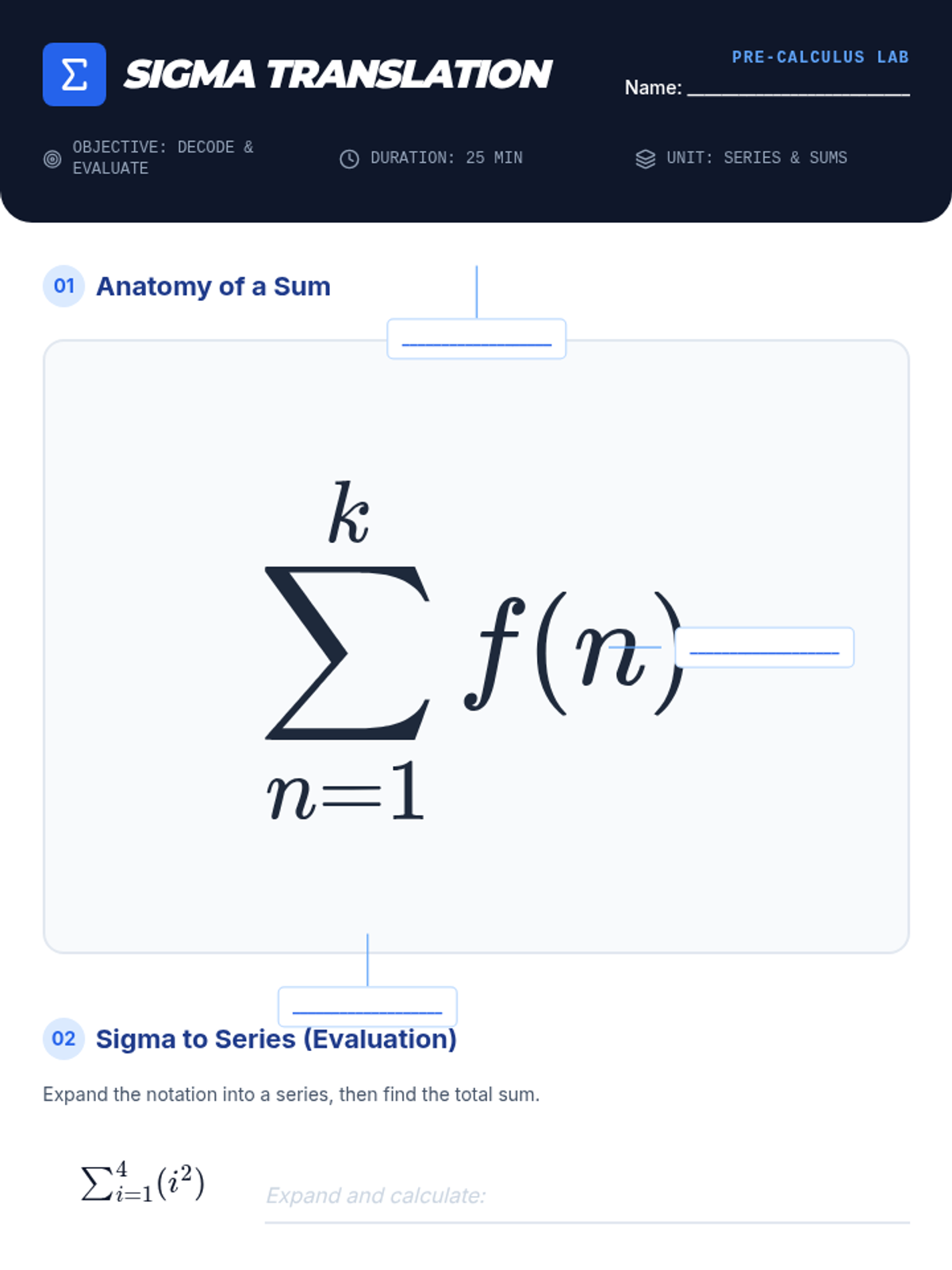
Student worksheet for the Sigma Translation activity. Includes sections for labeling the anatomy of Sigma notation, evaluating Sigma expressions, and translating arithmetic series into compact Sigma form.
Visual presentation for the Sigma Signal lesson. Includes a warm-up, video embed from the specified URL, a detailed anatomy breakdown of Sigma notation, and activity instructions.
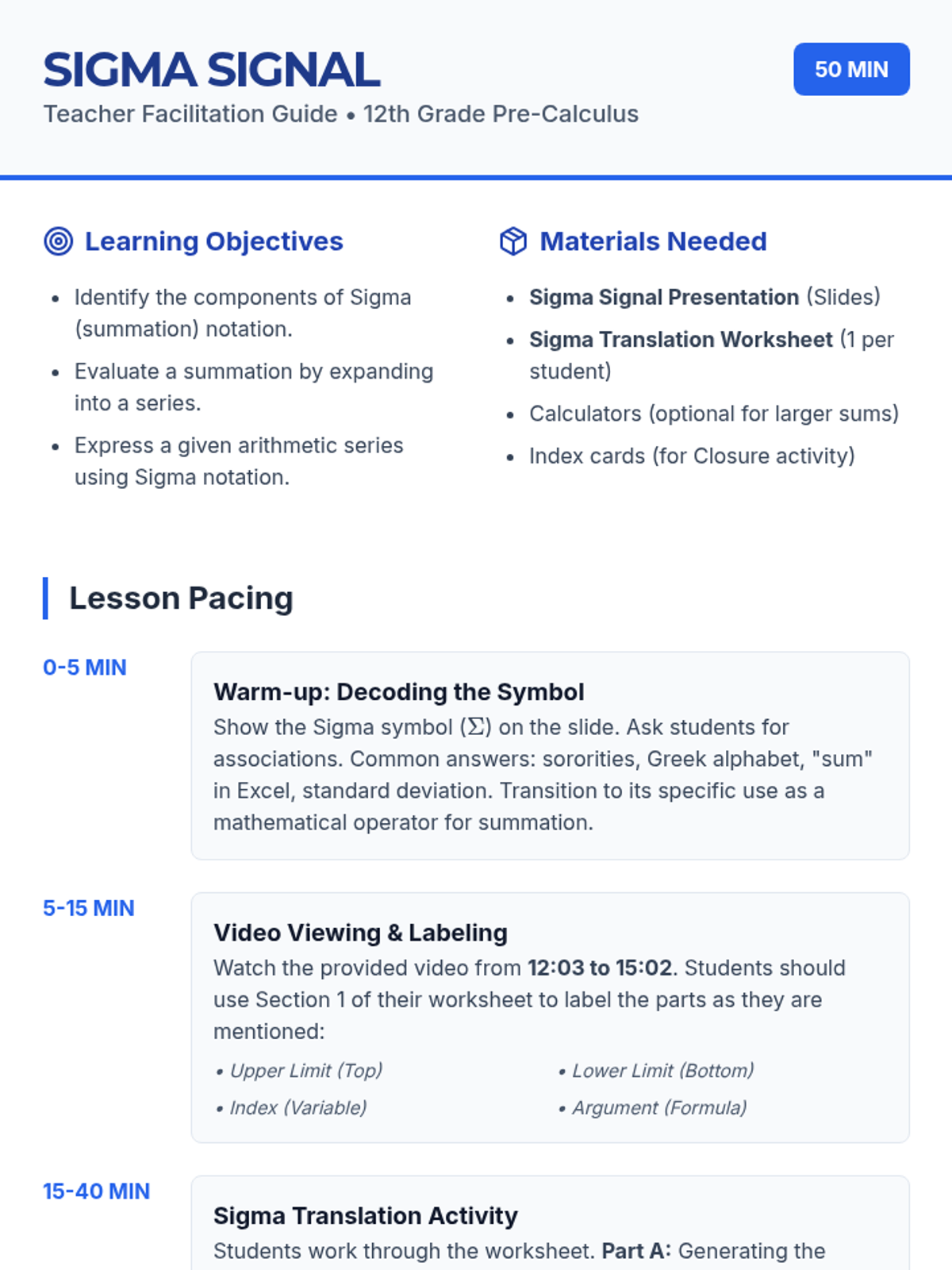
Teacher facilitation guide for the Sigma Signal lesson, including pacing, learning objectives, and a full answer key for the translation activity.
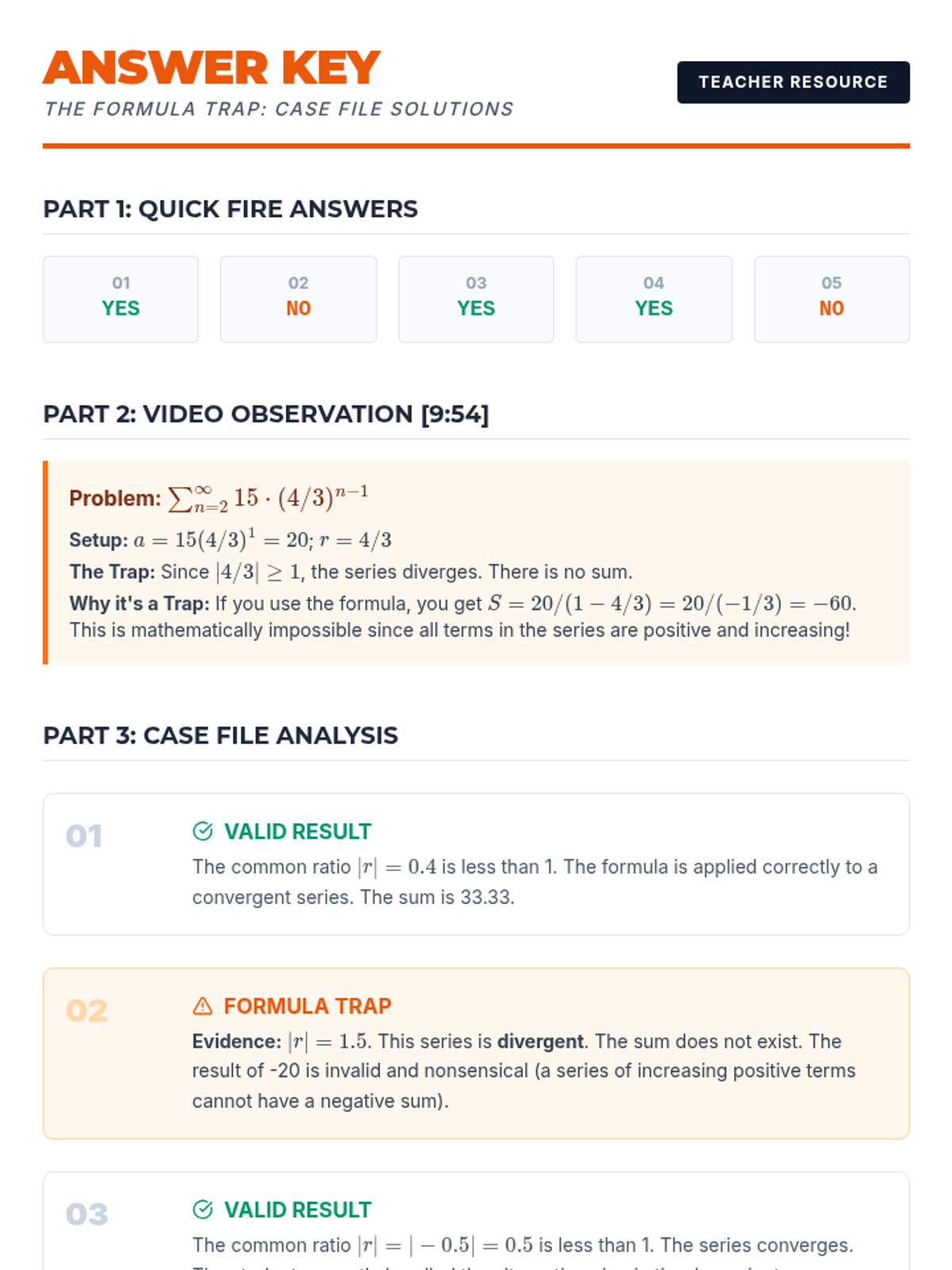
The teacher's answer key for "The Formula Trap" worksheet, providing solutions for the warm-up, video analysis, and all 5 error analysis cases with detailed evidence-based explanations.
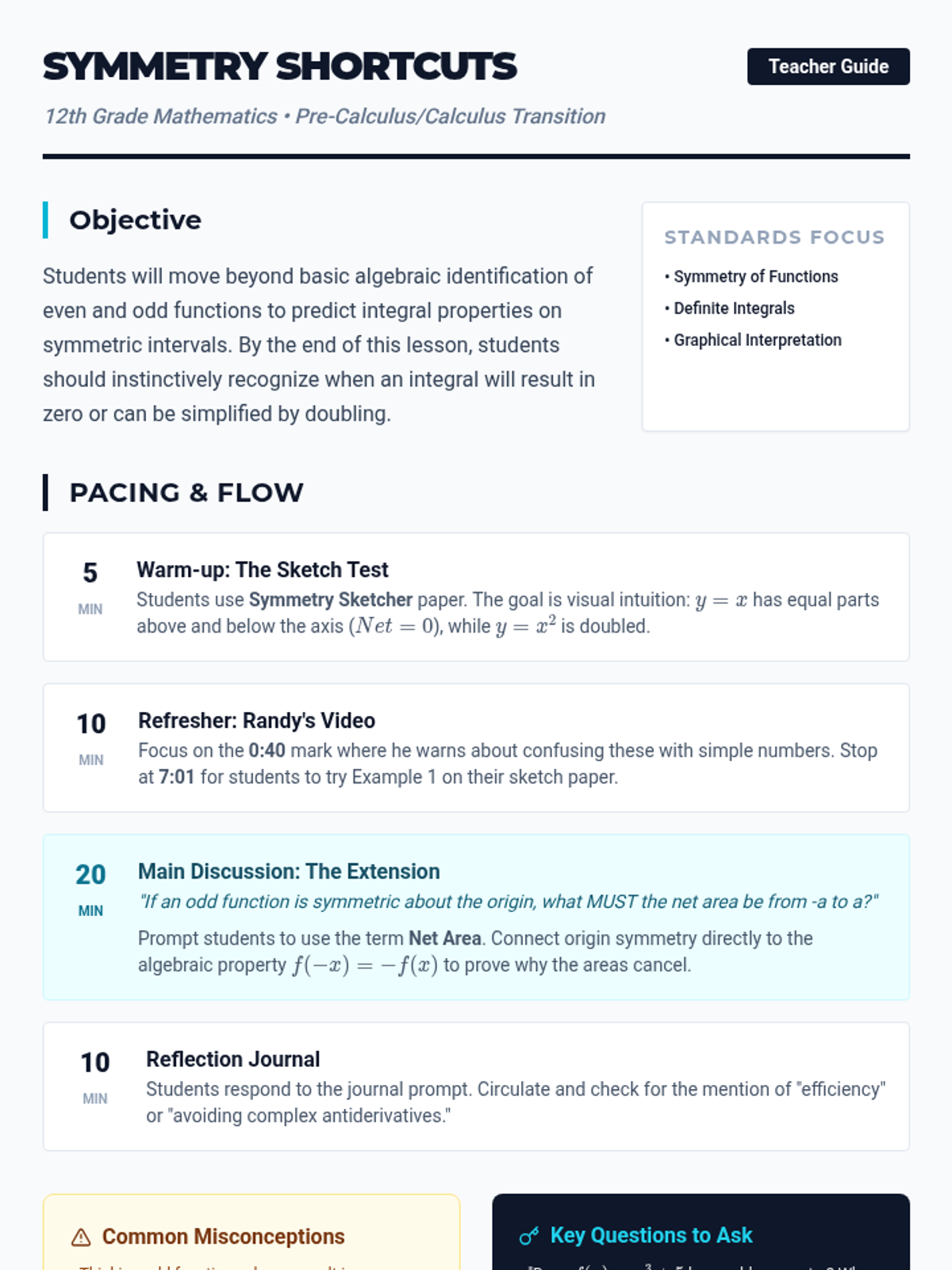
A comprehensive teacher guide for the Symmetry Shortcuts lesson, including pacing details, discussion prompts, and strategies for addressing common misconceptions.
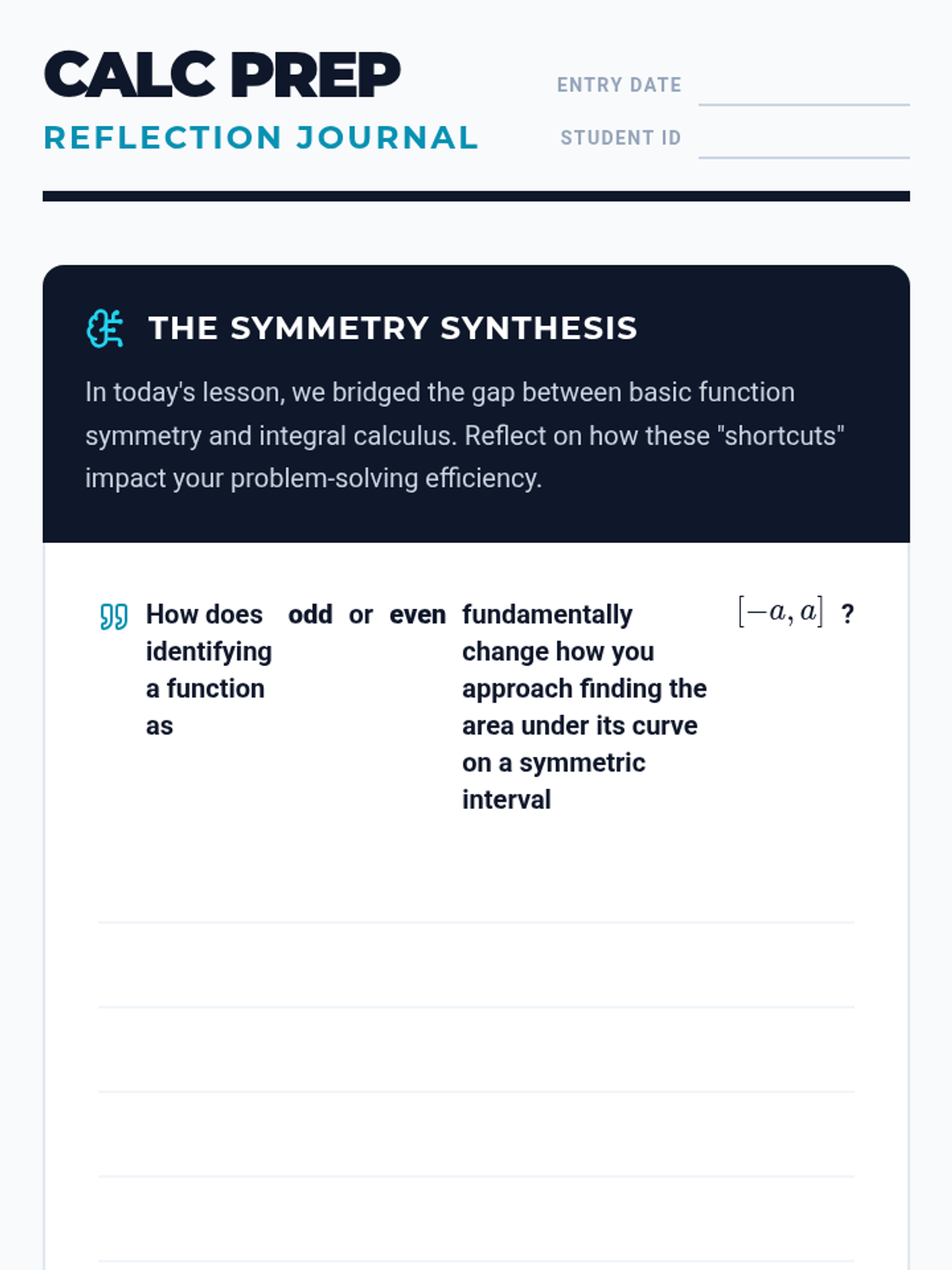
A structured reflection journal document for calculus students to synthesize their learning on even/odd function properties and their application to definite integrals.
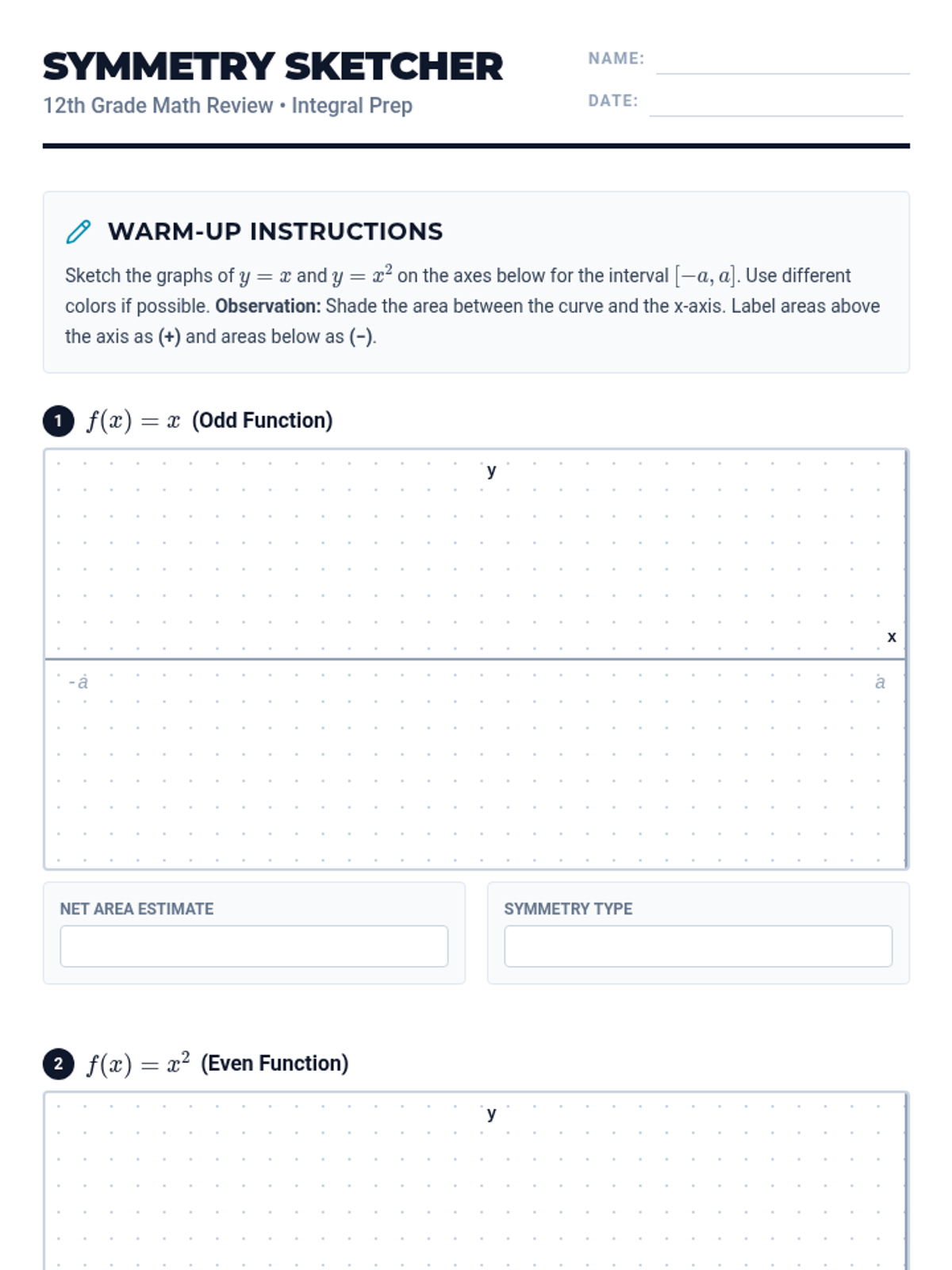
Customized graph paper for sketching even and odd functions, designed to help students visualize positive and negative area under the curve for calculus prep.
A visual slide deck for 12th-grade students that connects function symmetry (even/odd) to calculus integral shortcuts, including an embedded instructional video and guided discussion prompts.
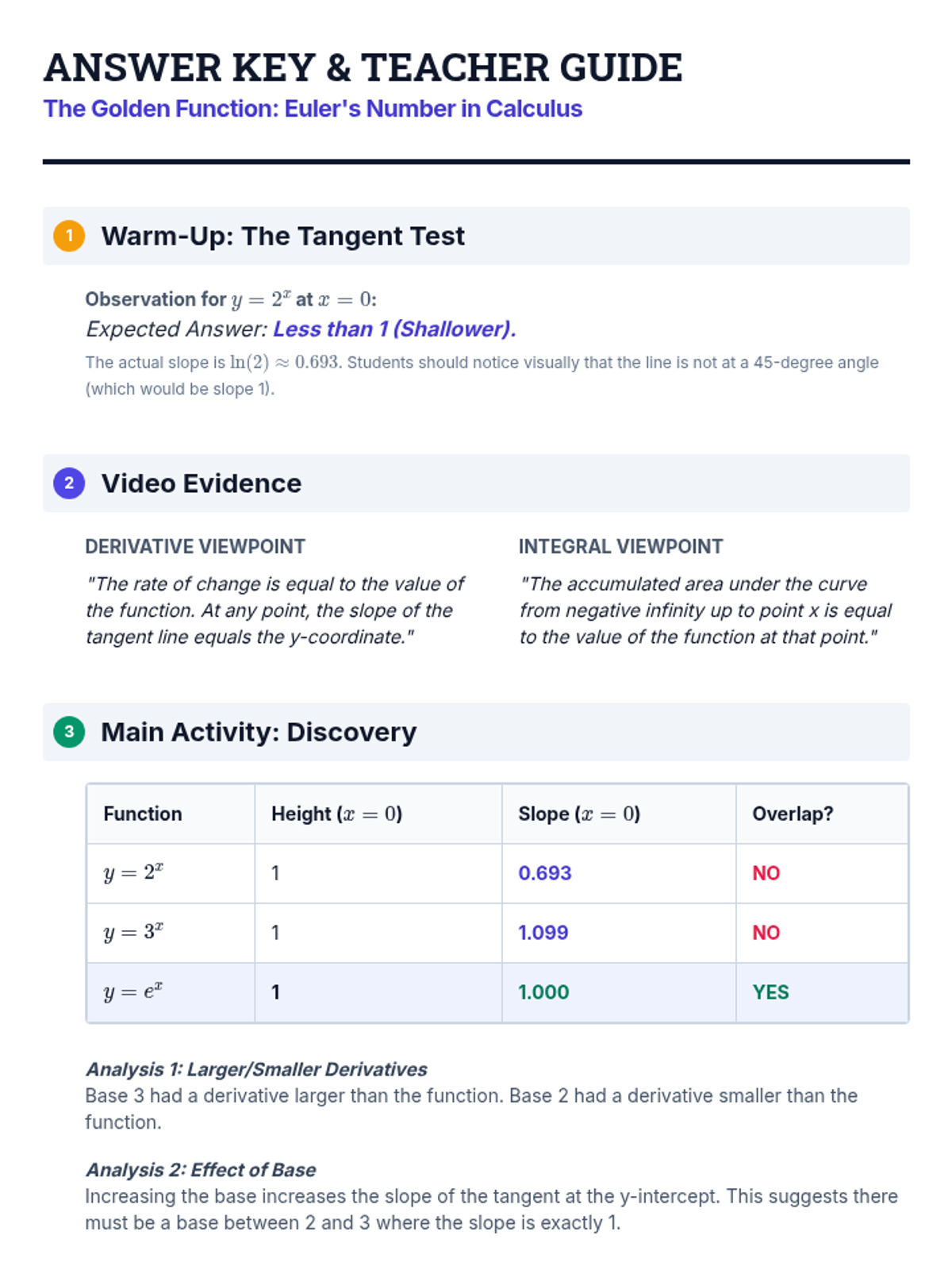
Teacher answer key for the Golden Function worksheet, including specific numerical values for slopes and conceptual guidance for the discussion questions.
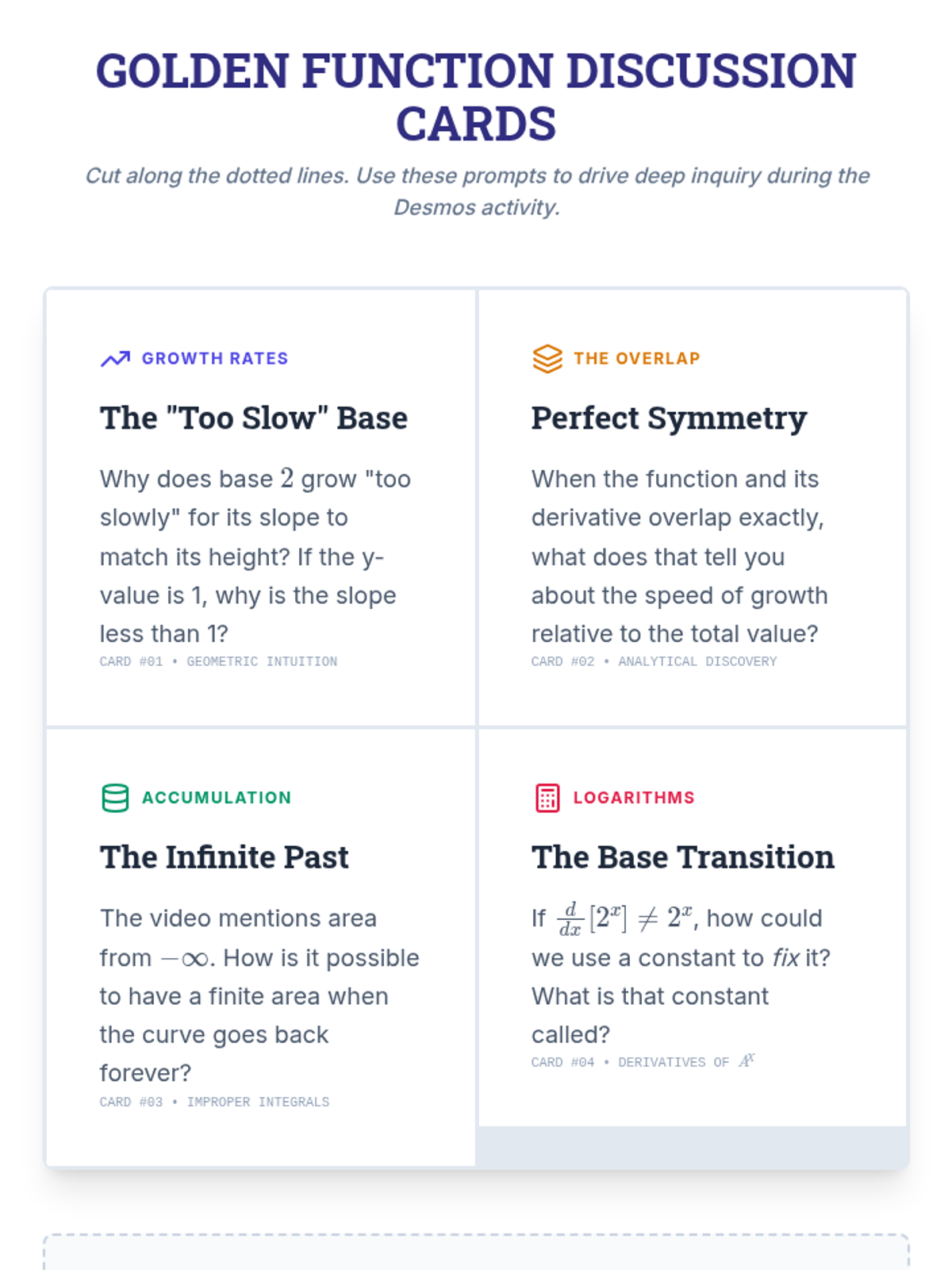
A set of four discussion prompt cards designed to spark higher-order thinking during the AP Calculus activity on Euler's Number and the properties of e^x.
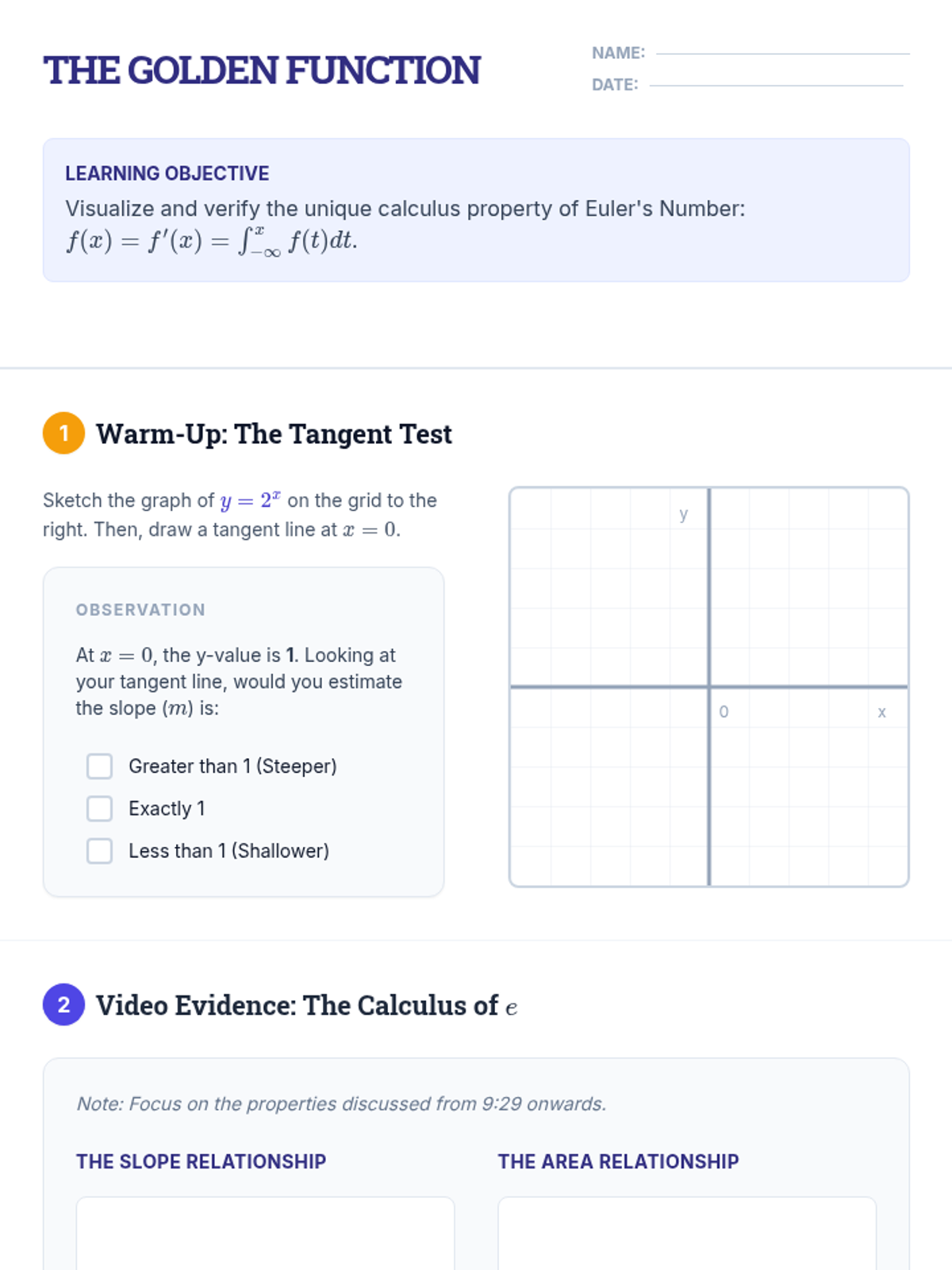
A student worksheet for the AP Calculus lesson on e^x. Includes a warm-up sketching area, a video notes section, an activity table for comparing exponential bases, and a closure reflection.
A presentation deck for AP Calculus students that introduces Euler's number and uses visual aids and a YouTube video to demonstrate the slope, height, and area relationships of e^x.
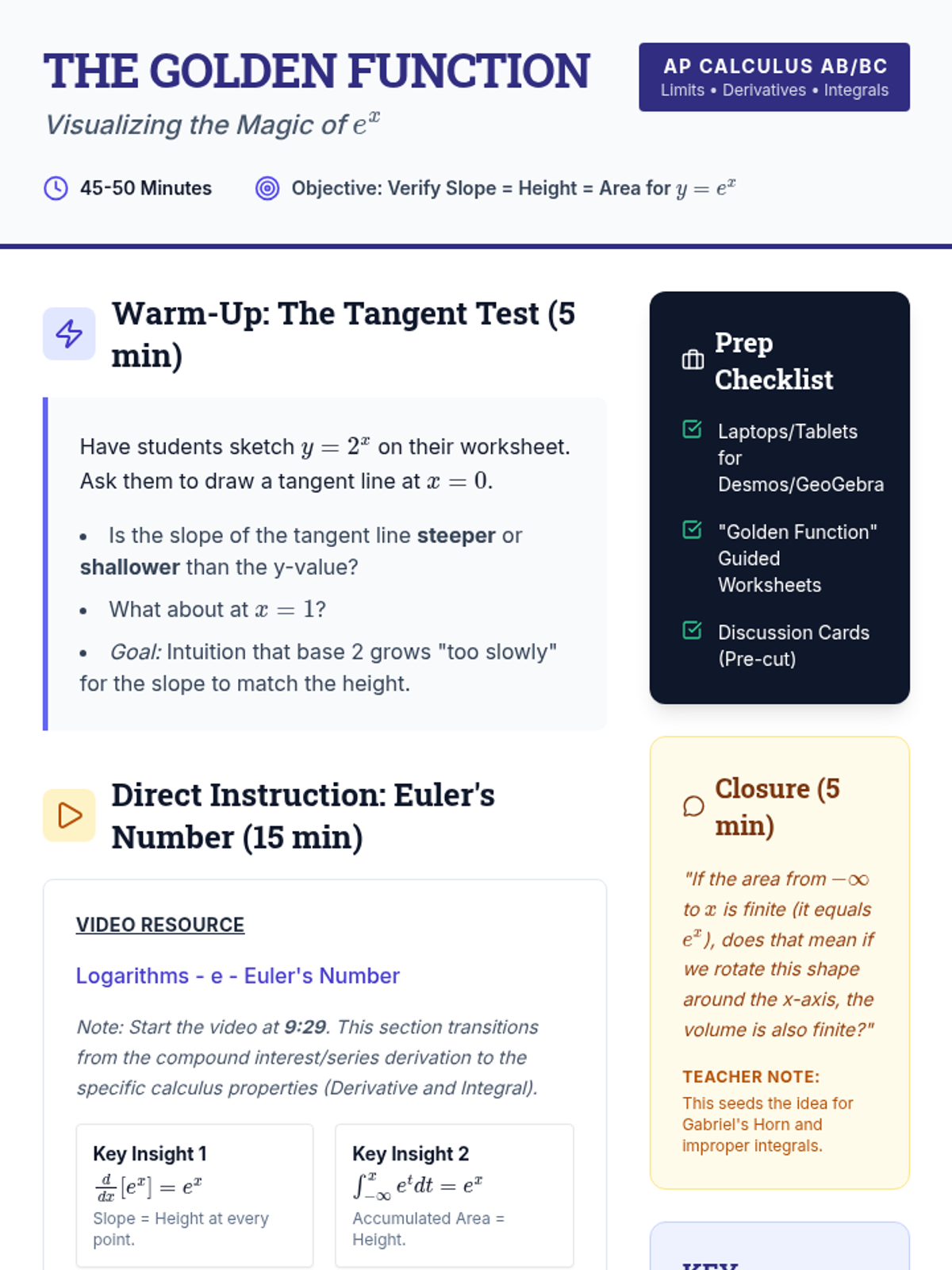
A detailed lesson plan for AP Calculus teachers outlining the flow of the Euler's Number lesson, including timestamps for the video and specific instructions for the Desmos discovery activity.
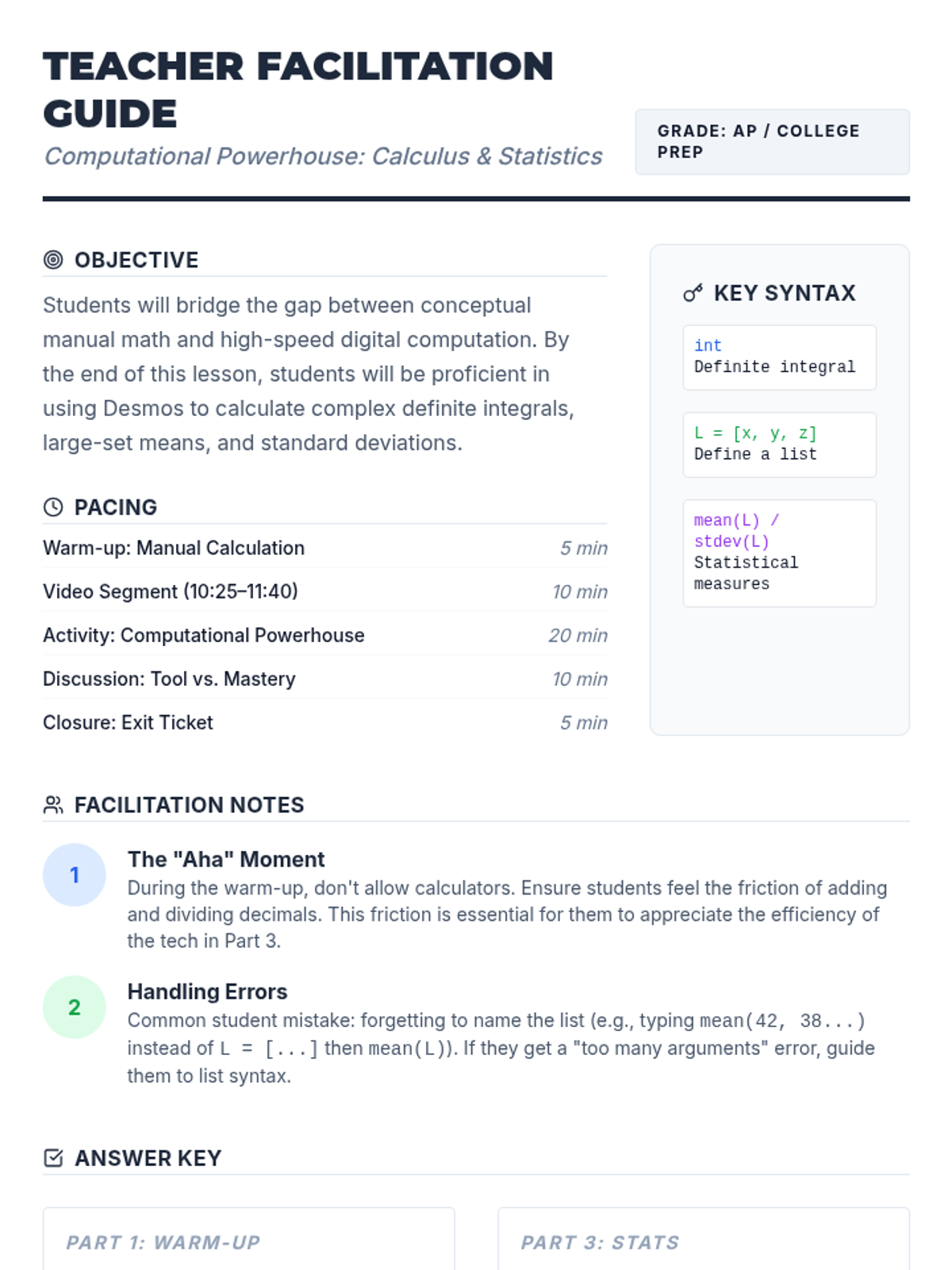
A teacher facilitation guide for the Computational Powerhouse lesson, providing pacing, syntax cheat sheets, specific facilitation tips, and a full answer key for the worksheet challenges.
A professional 6-slide deck for AP Calculus and Statistics students, facilitating a lesson on Desmos efficiency. It includes a warm-up, an embedded YouTube tutorial, a dual-track (Stats/Calc) challenge, and discussion prompts.
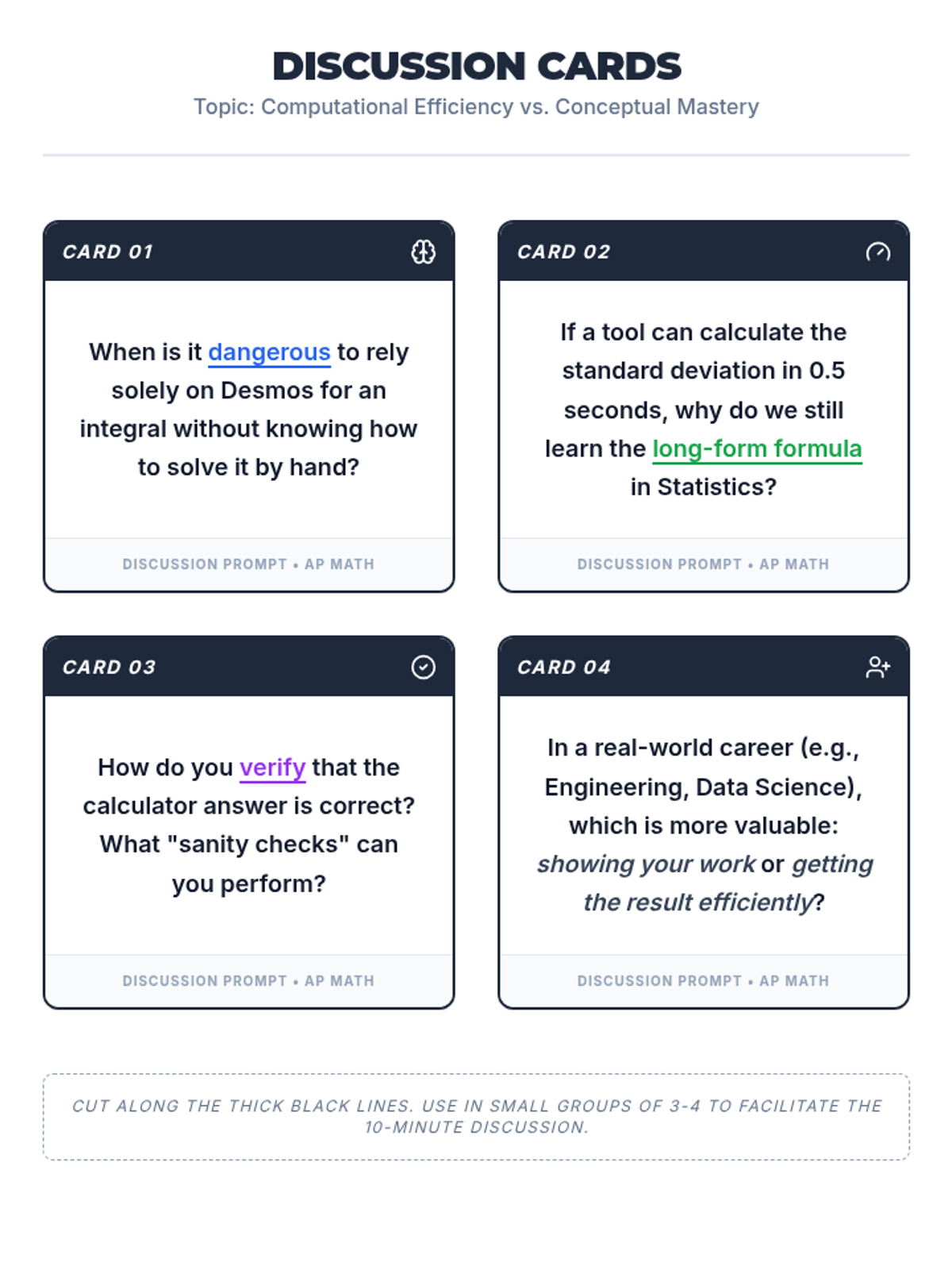
A set of four printable discussion cards for AP Calculus and Statistics students to explore the balance between computational speed and conceptual understanding. The cards prompt critical thinking about verification, danger of black-box technology, and professional application.
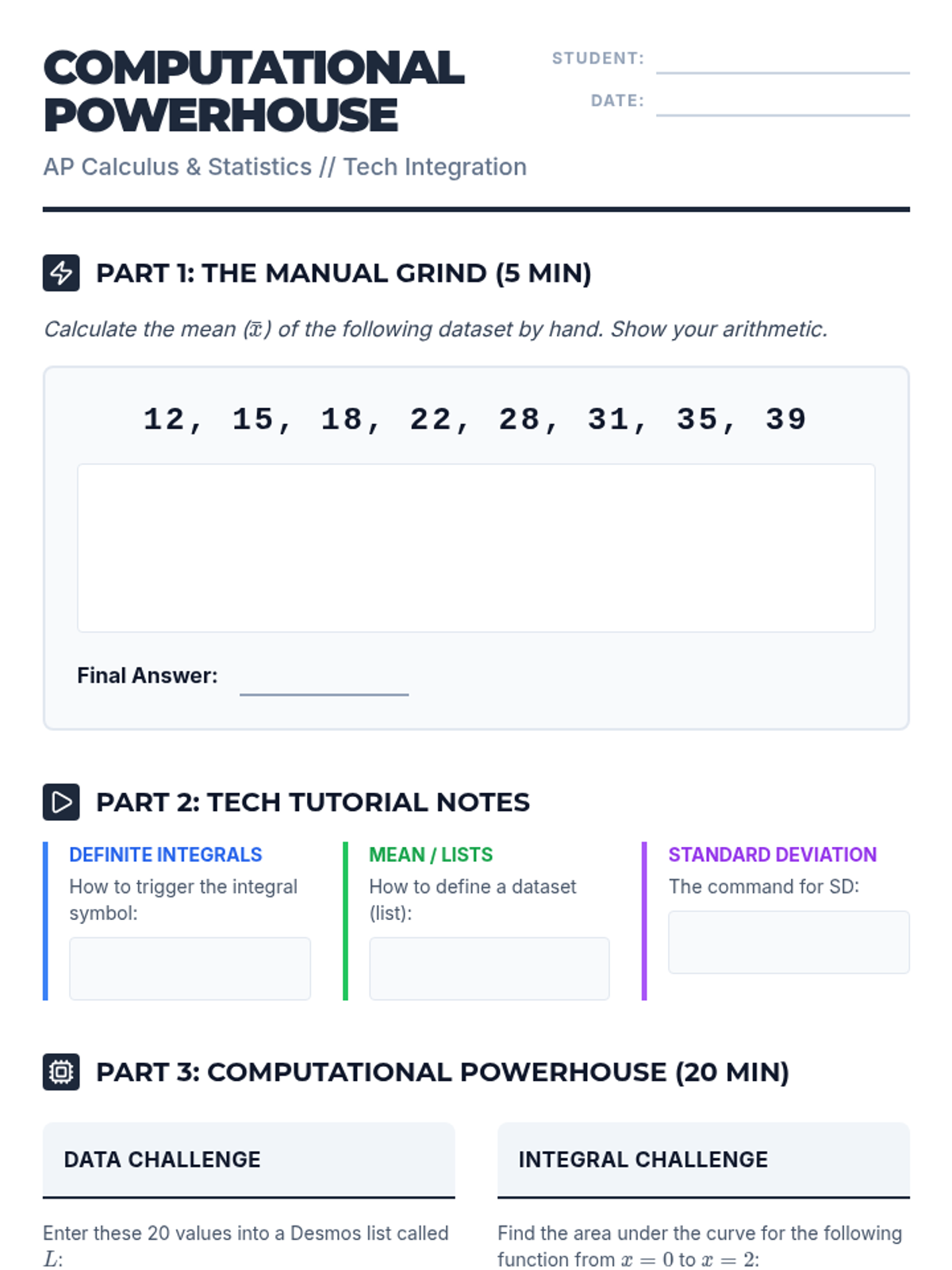
A 2-page student worksheet designed for AP Calculus and Statistics students to practice calculating means, standard deviations, and complex definite integrals using Desmos. It includes a manual warm-up, video note-taking space, and a high-complexity computational challenge.
A visual presentation deck for introducing infinite limits, featuring a "grey box" hook, the lesson video, and instructions for the Desmos "Zoom In" activity.
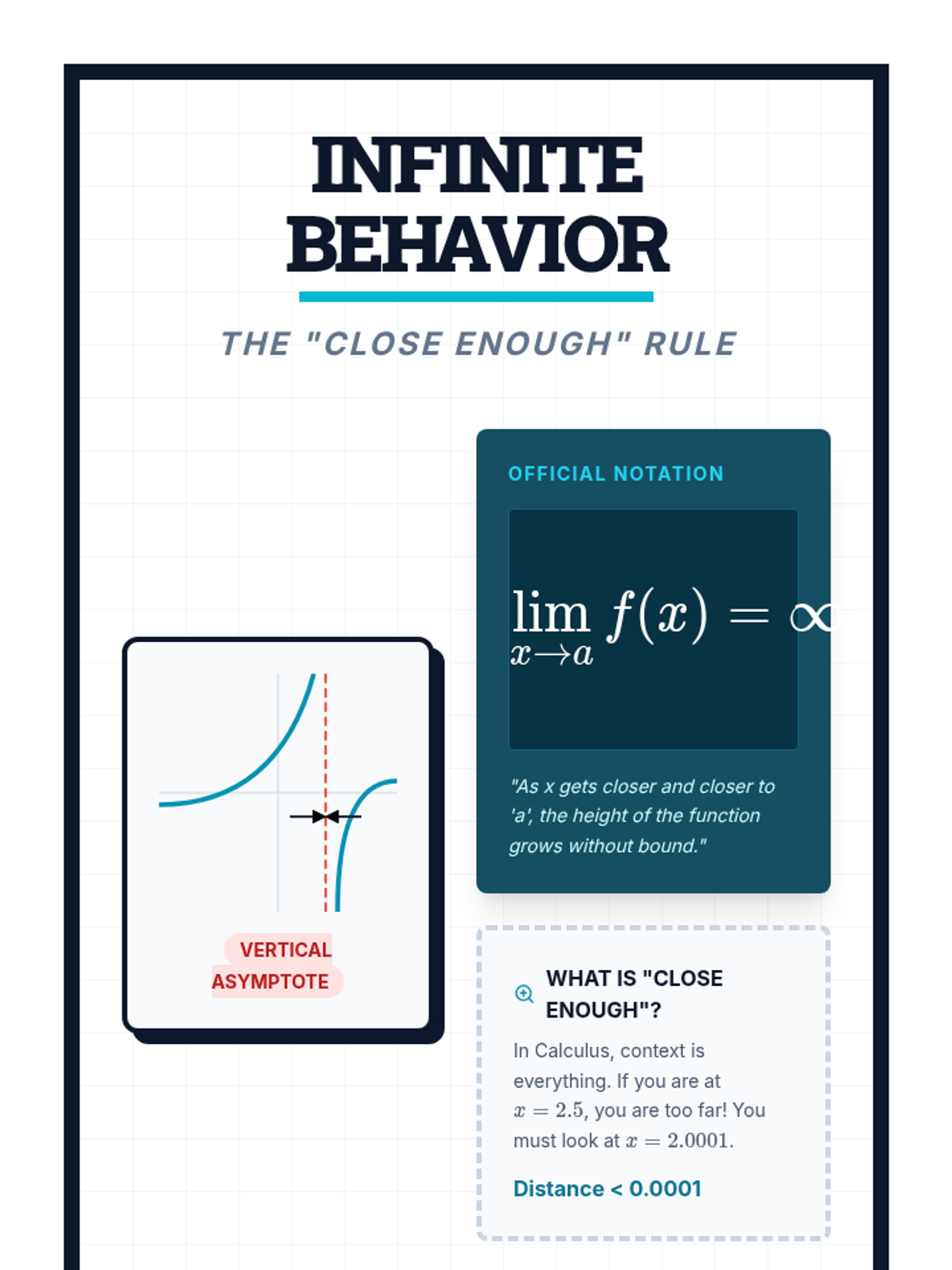
A classroom anchor chart summarizing the concept of infinite limits, featuring clear notation, a vertical asymptote diagram, and a reminder about the "close enough" rule.
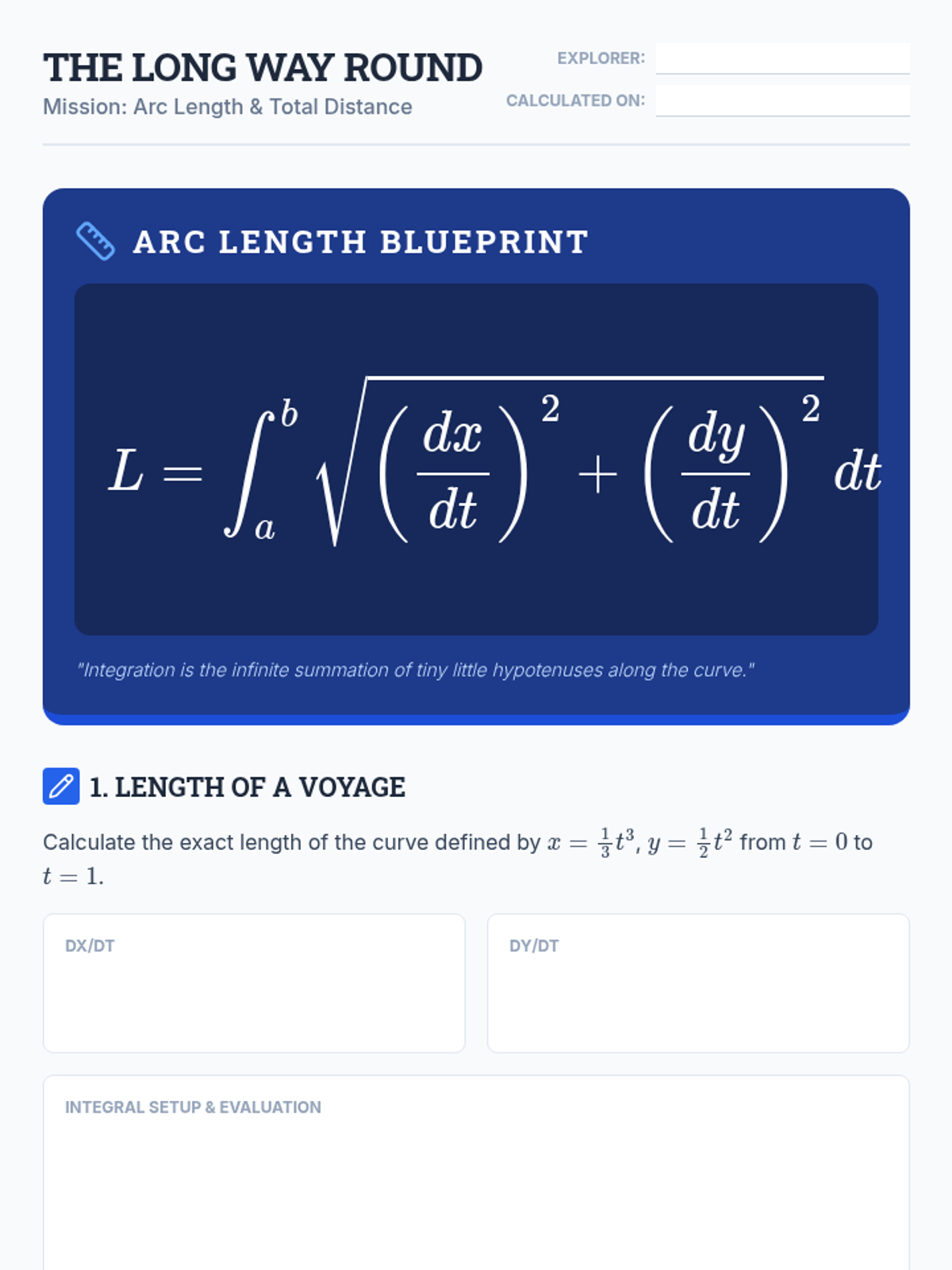
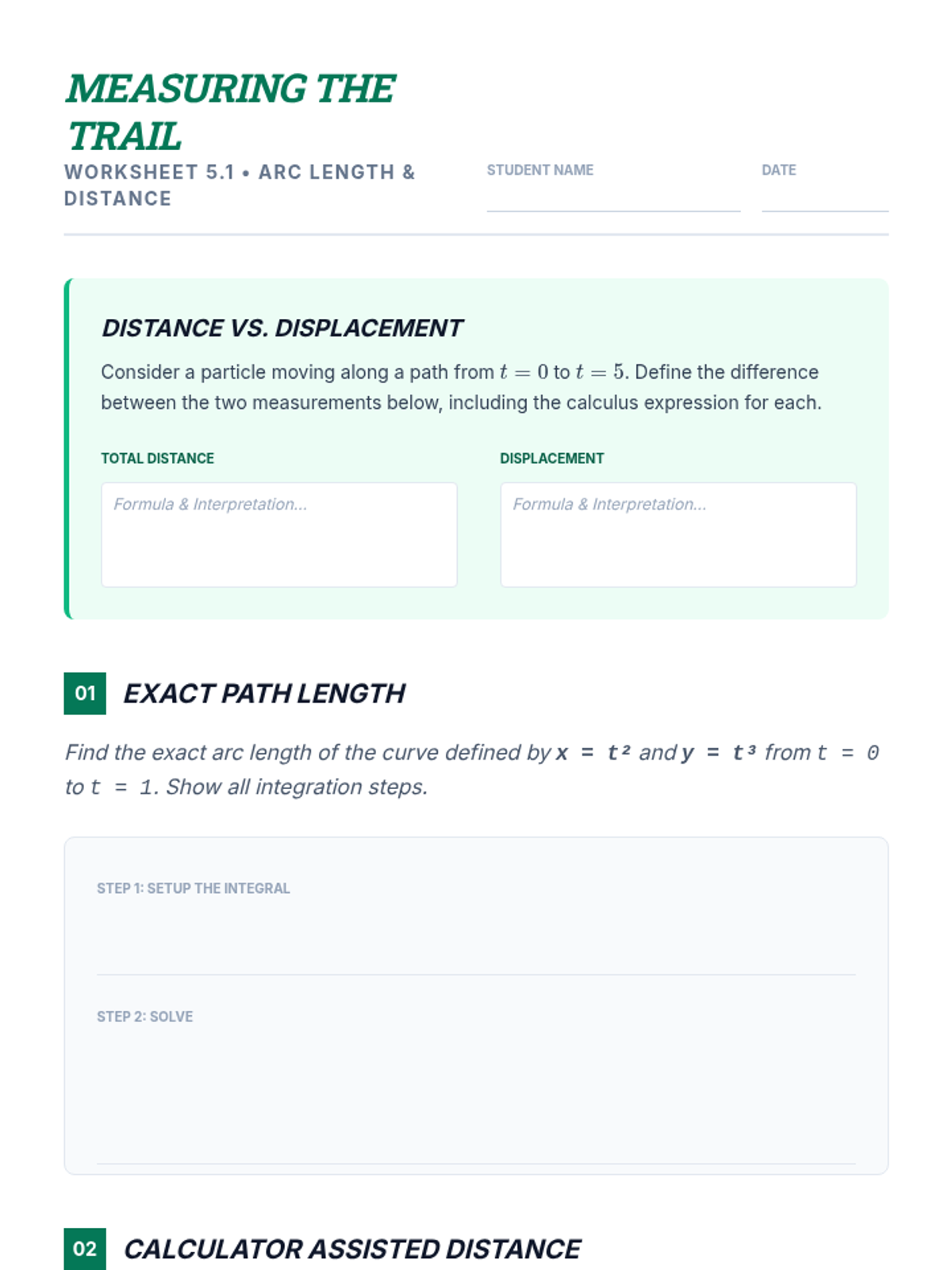
Worksheet for Lesson 5 on calculating arc length and distinguishing between net displacement and total distance.
Student worksheet for Lesson 5. Includes integral setup and evaluation for arc length, a comparison between distance and displacement, and a calculator-based problem.
Presentation for Lesson 4 covering kinematics in parametric form, including position, velocity, acceleration, and speed.
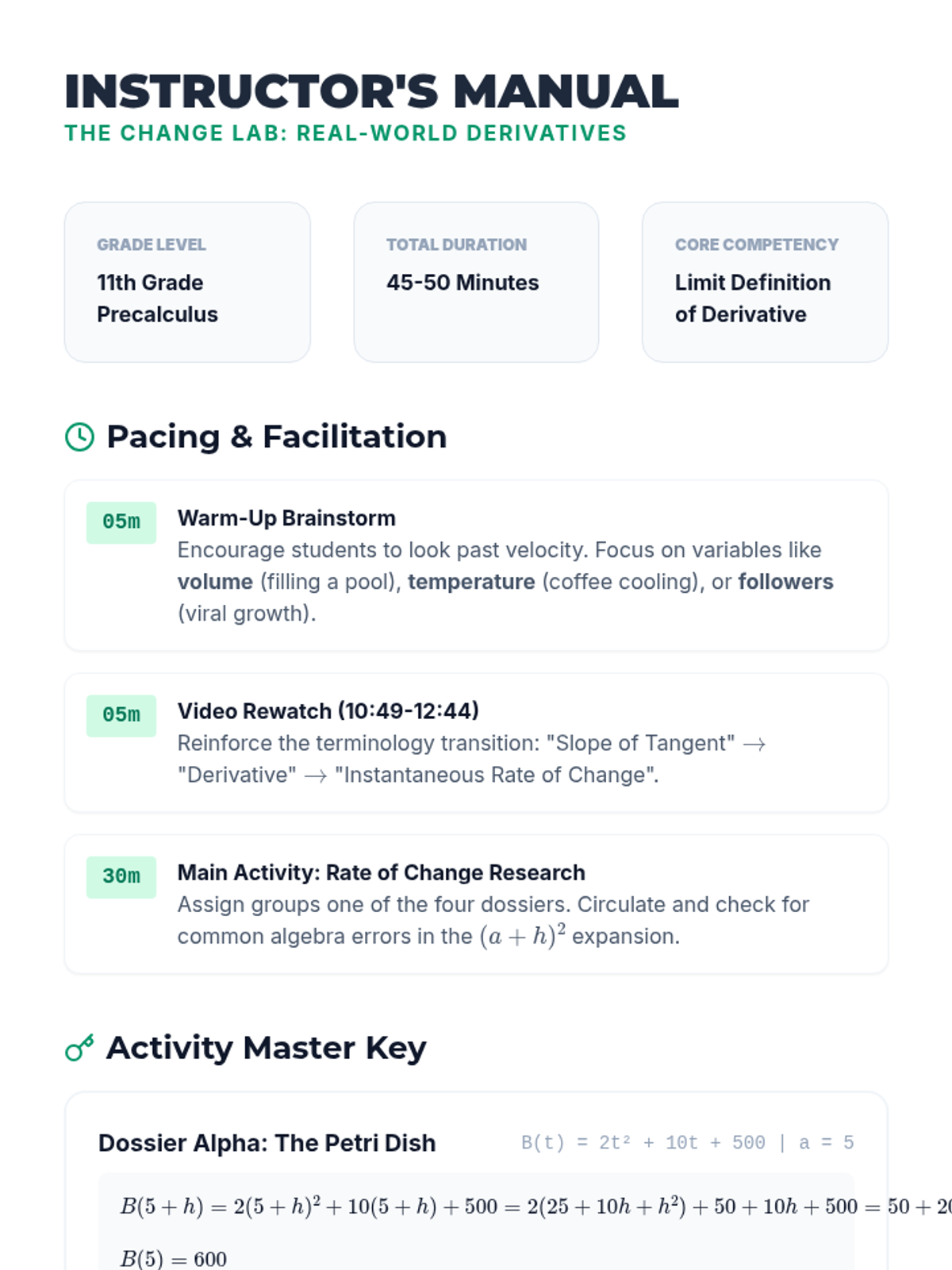
A teacher guide for 'The Change Lab' lesson, featuring pacing instructions, discussion prompts, and a detailed answer key for all group scenarios.
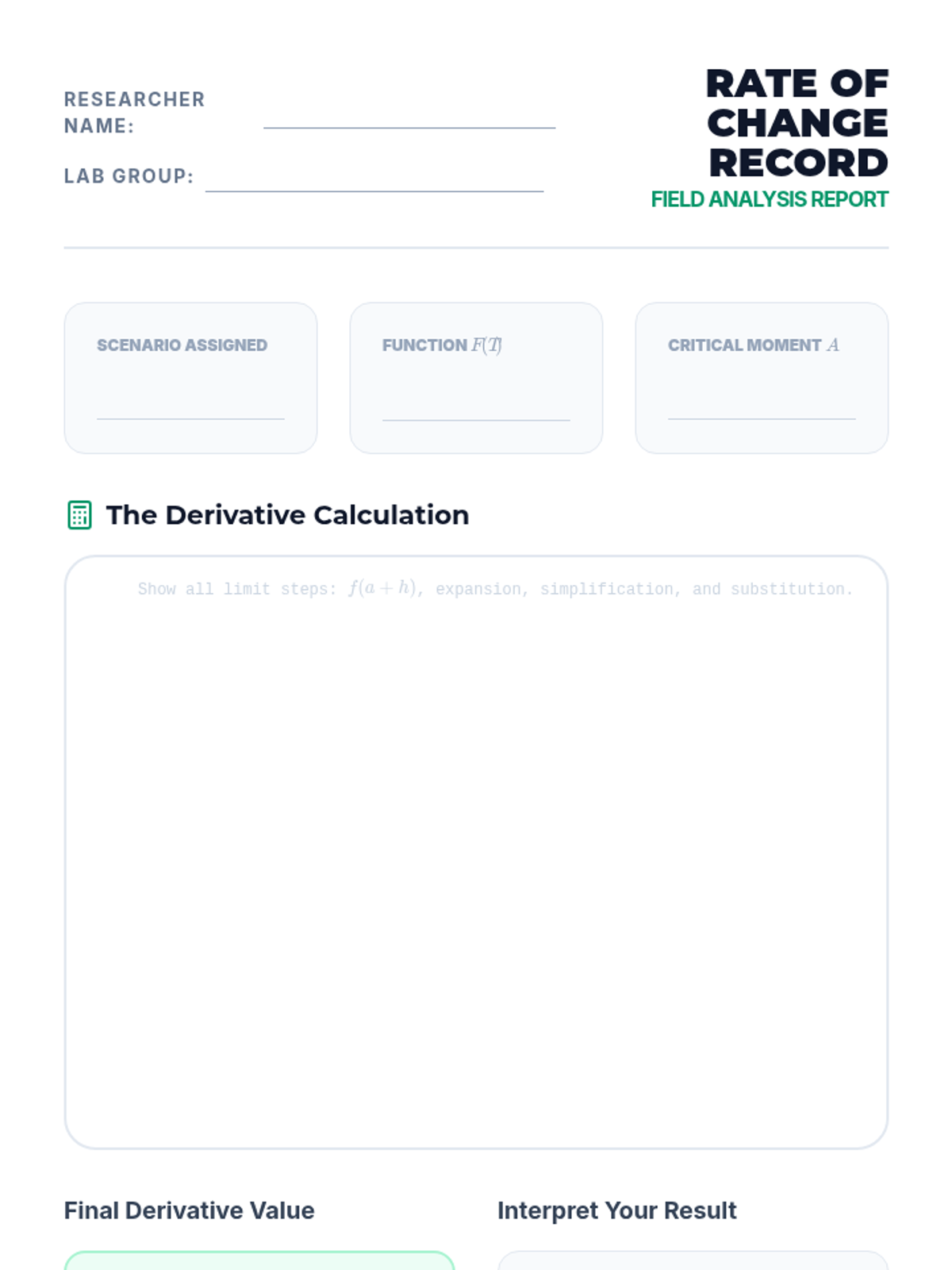
A student worksheet for recording derivative calculations and interpretations during the 'Rate of Change Research' activity, with ample space for the limit definition process.
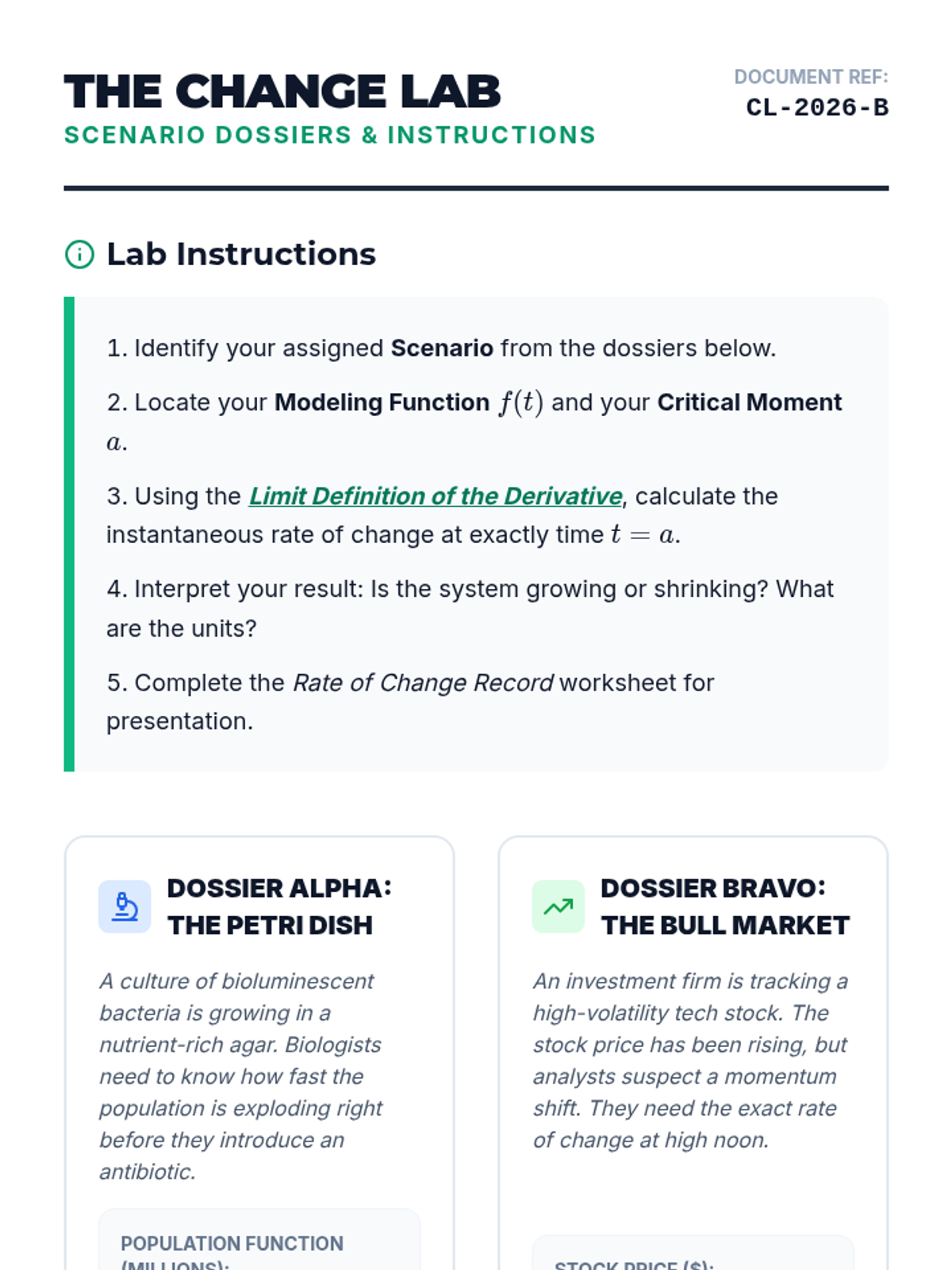
A handout containing four role-play scenarios (biology, finance, social media, and climate science) with specific functions and 'critical moments' for students to analyze using derivatives.
A visual presentation for 'The Change Lab' lesson, featuring a warm-up brainstorming session, a YouTube video summary on derivatives, group activity instructions, and a closure presentation format.
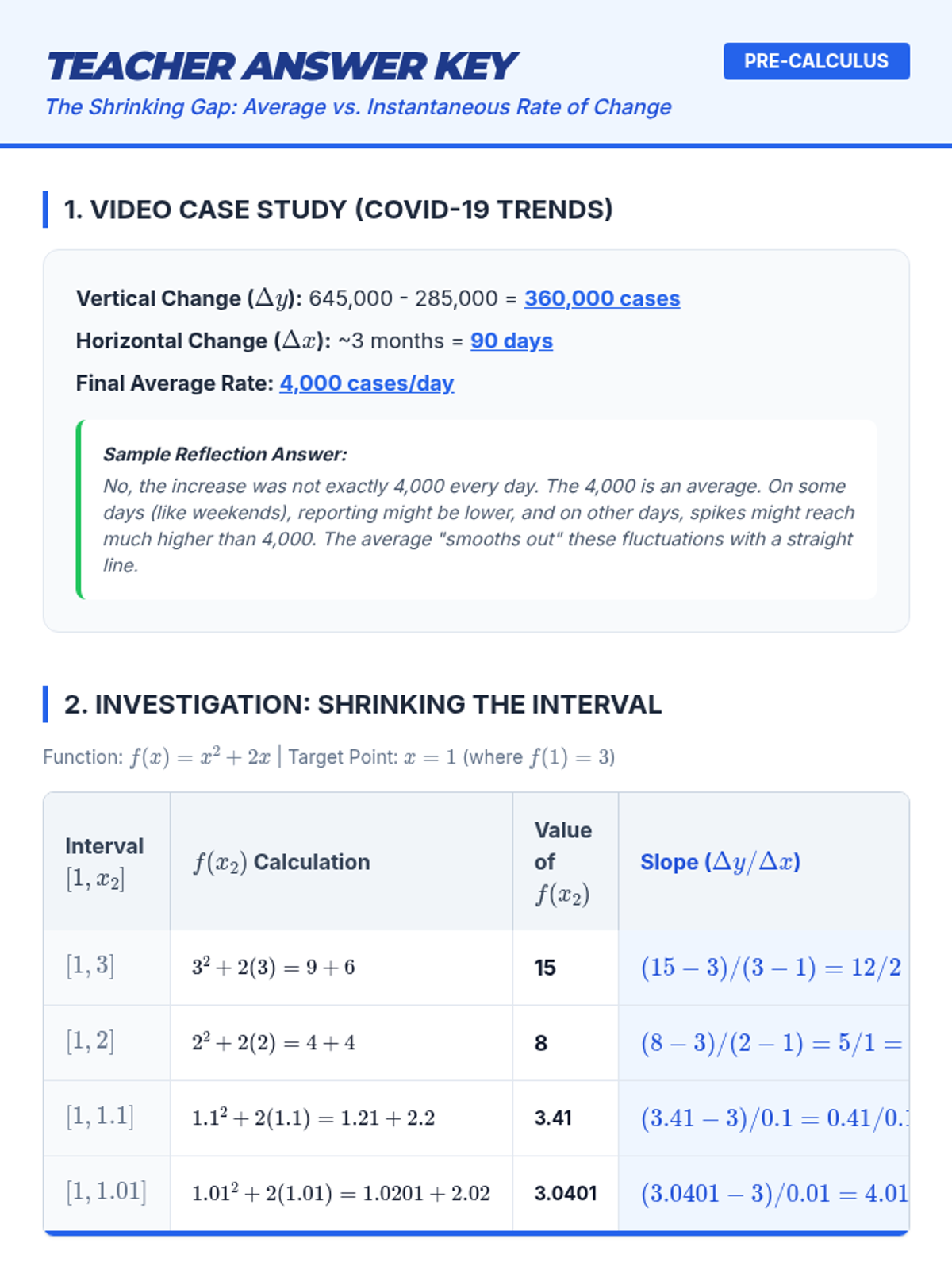
Teacher answer key for 'The Shrinking Gap' worksheet. Includes full calculations for the investigation table and sample responses for discussion questions.
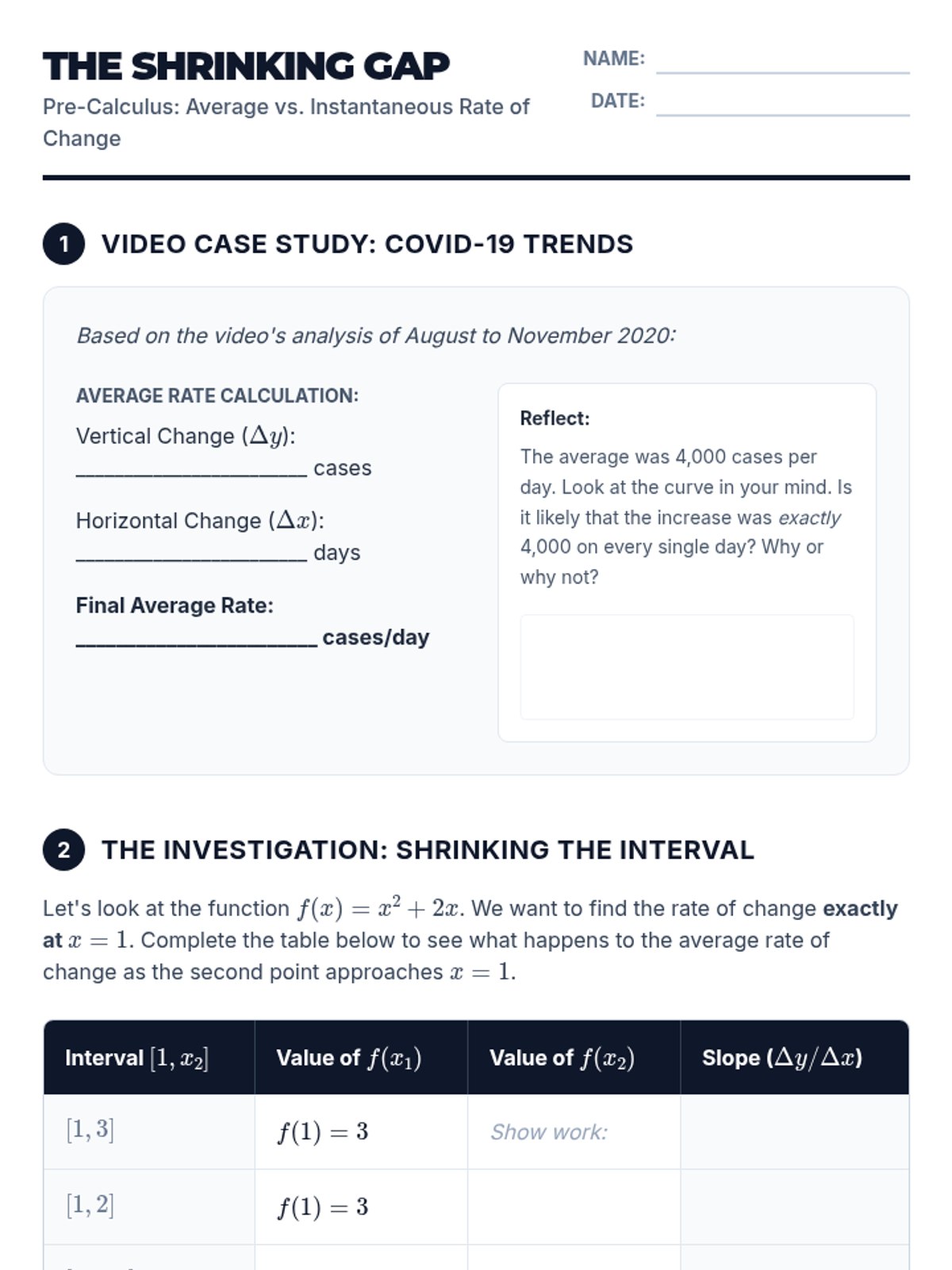
Student worksheet for 'The Shrinking Gap' lesson. Includes a section for video notes on COVID-19 data and an investigation table for calculating average rates of change as the interval shrinks for the function y = x^2 + 2x.
Slide deck for 'The Shrinking Gap' lesson. It includes the hook, video analysis discussion points, and instructions for the interval-shrinking investigation.
Student worksheet for Lesson 3 focusing on finding tangent lines at the origin for rose curves and explaining the conceptual link to Cartesian slope.
Slide deck for Lesson 3 focusing on tangent lines at the pole, including the Tangent Line Theorem and application to rose curves.
Slide deck for distance optimization in polar coordinates. Explains how to find absolute extrema of the radius function r(theta) and interprets these values as points furthest from or closest to the origin.
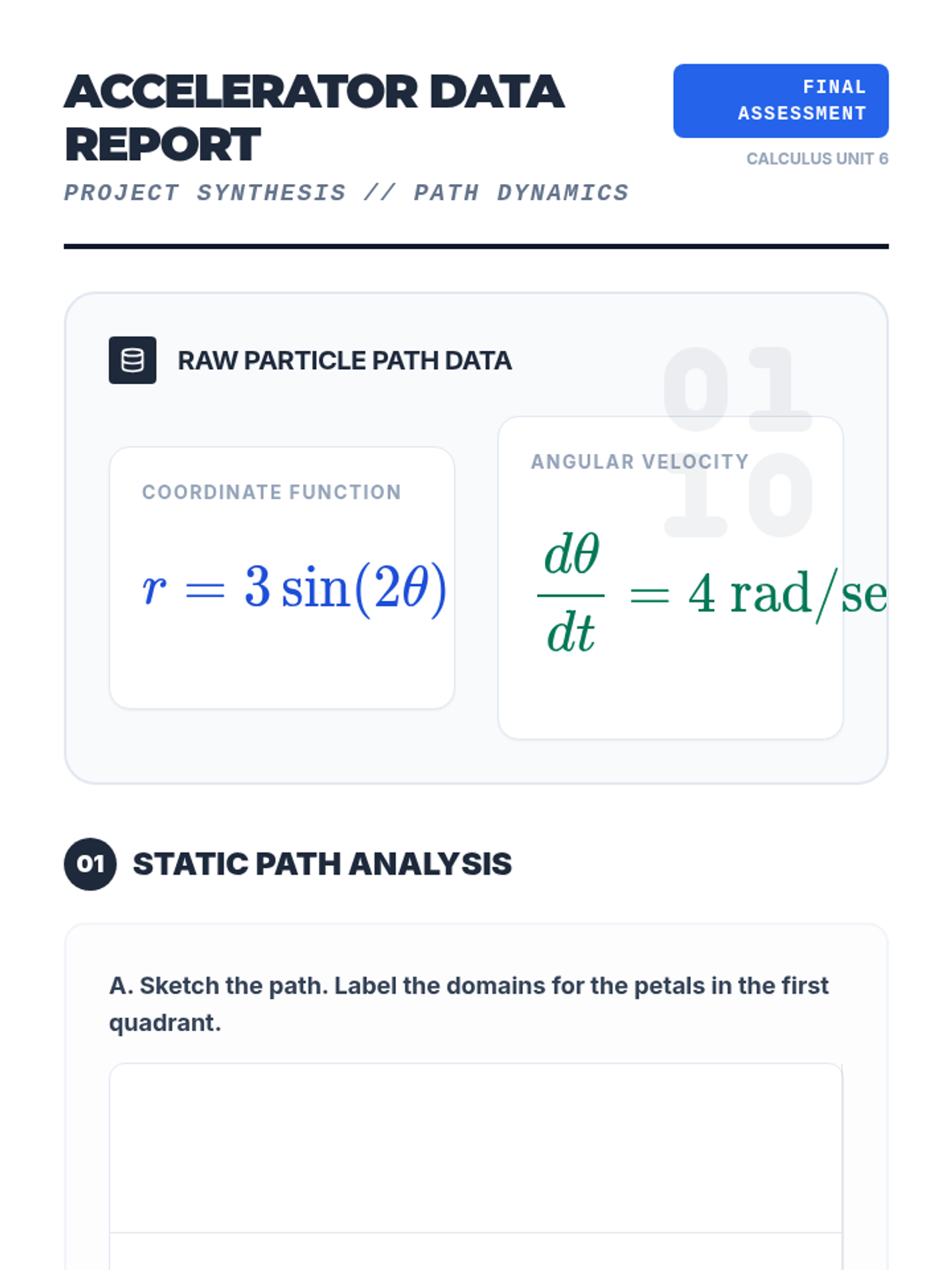
The final synthesis performance task for the sequence. Students perform a full analysis of a 4-petal rose curve, including area integration, vector differentiation for speed, and arc length setup.
Final slide deck for Lesson 5 introducing the "Particle Report" synthesis assessment. Provides the raw kinematic data for a 4-petal rose curve and outlines the multi-step analysis requirements for the final performance task.
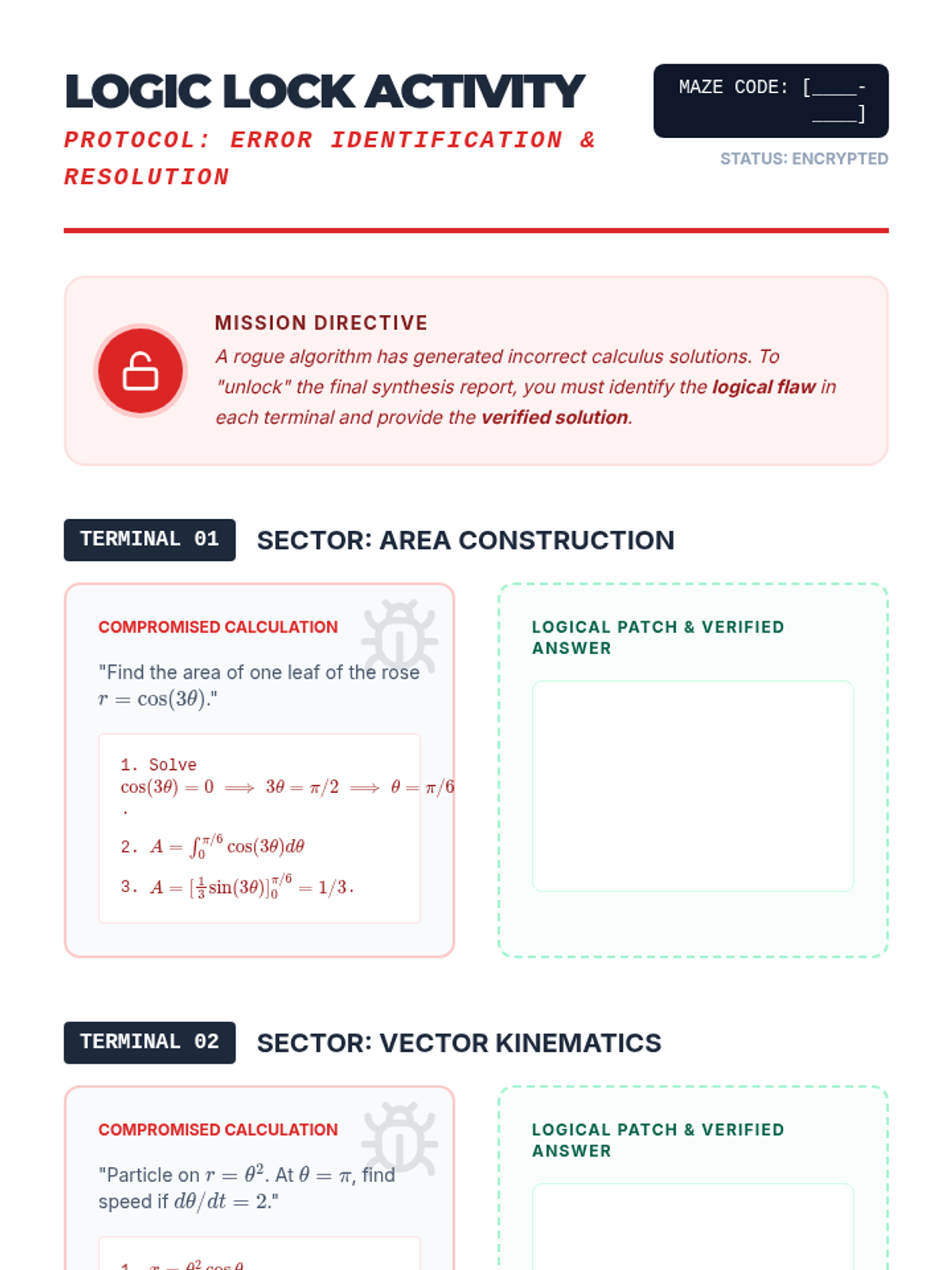
Teacher resource for the Logic Lock activity. Contains a deep dive into the specific logical flaws provided in the "compromised" student work and the correct multi-step calculus resolutions.
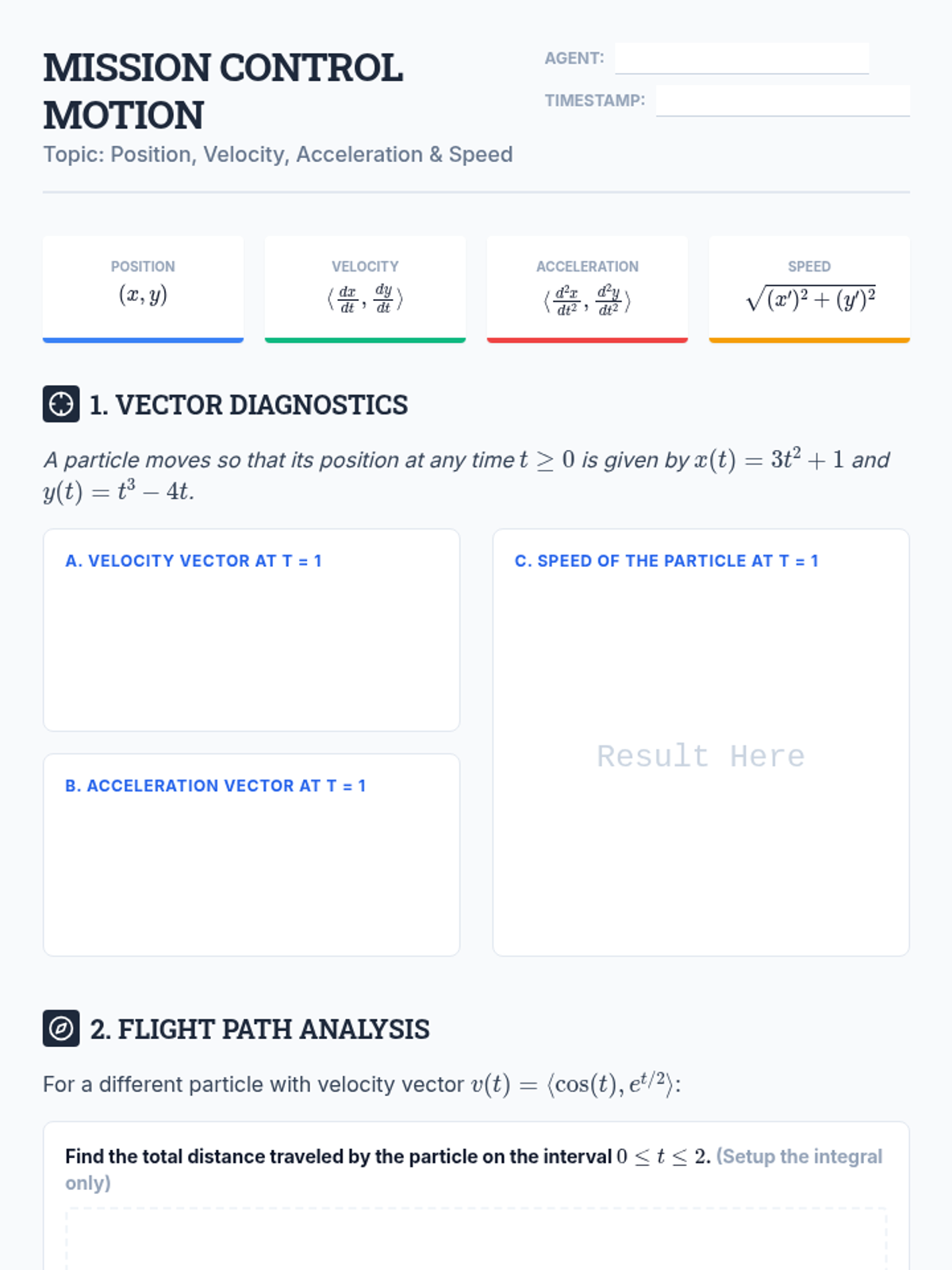
Worksheet for Lesson 4 applying derivatives to particle motion, including velocity vectors, acceleration vectors, and speed.
An escape-room style error analysis worksheet where students identify flawed calculus logic in area and motion problems to "unlock" a terminal code. Focuses on rigorous critique of mathematical reasoning.
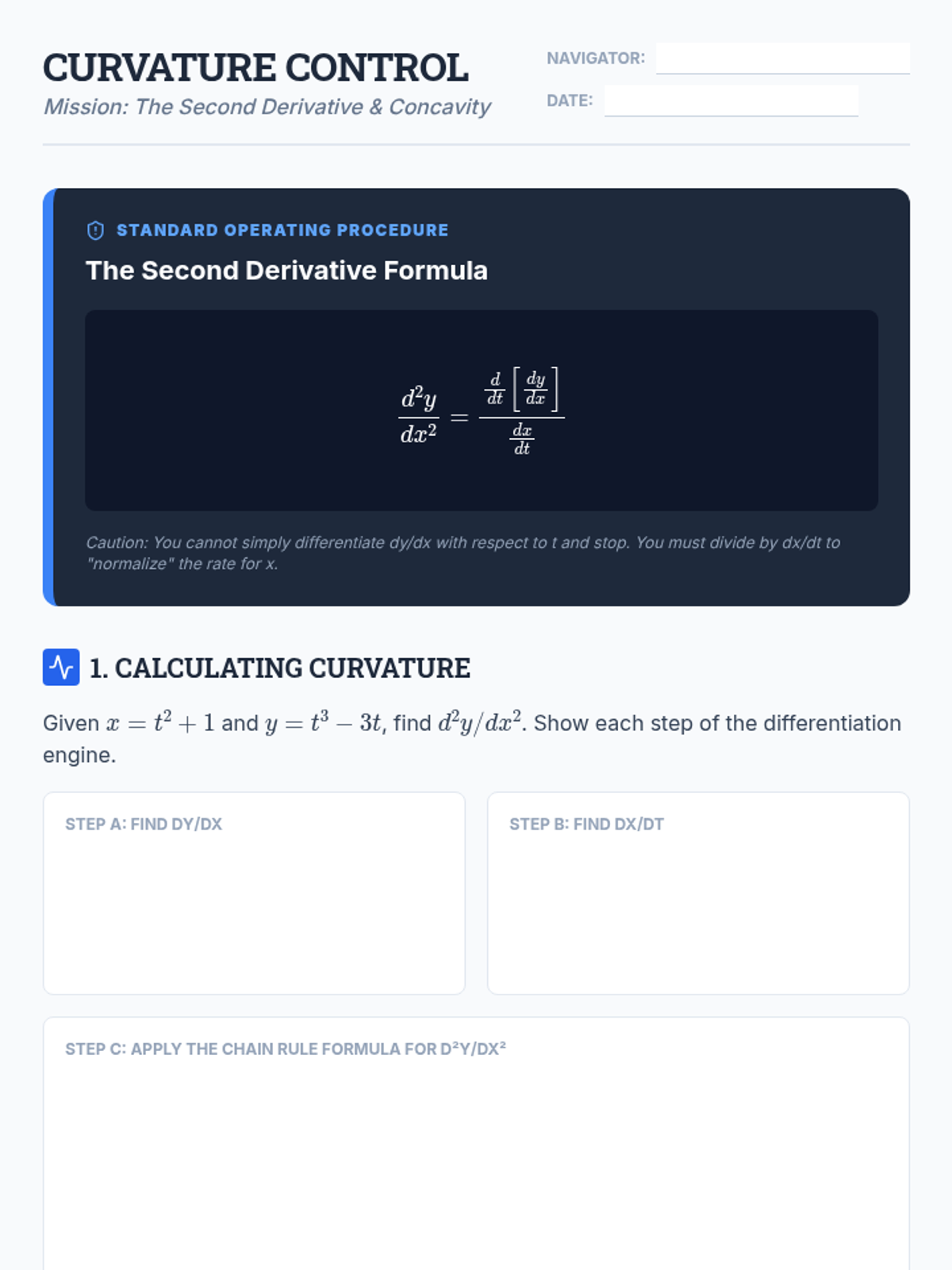
Presentation for Lesson 3 detailing the calculation of the second derivative in parametric form and its application to concavity.
Worksheet for Lesson 3 on finding the second derivative of parametric equations and analyzing concavity.
A slide deck for Lesson 4 on error analysis. Categorizes common calculus bugs (formula amnesia, chain rule neglect, domain errors) and introduces a "Bug Hunt" case study for student critique.
Presentation for Lesson 2 covering parametric differentiation, tangent lines, and horizontal/vertical tangents.
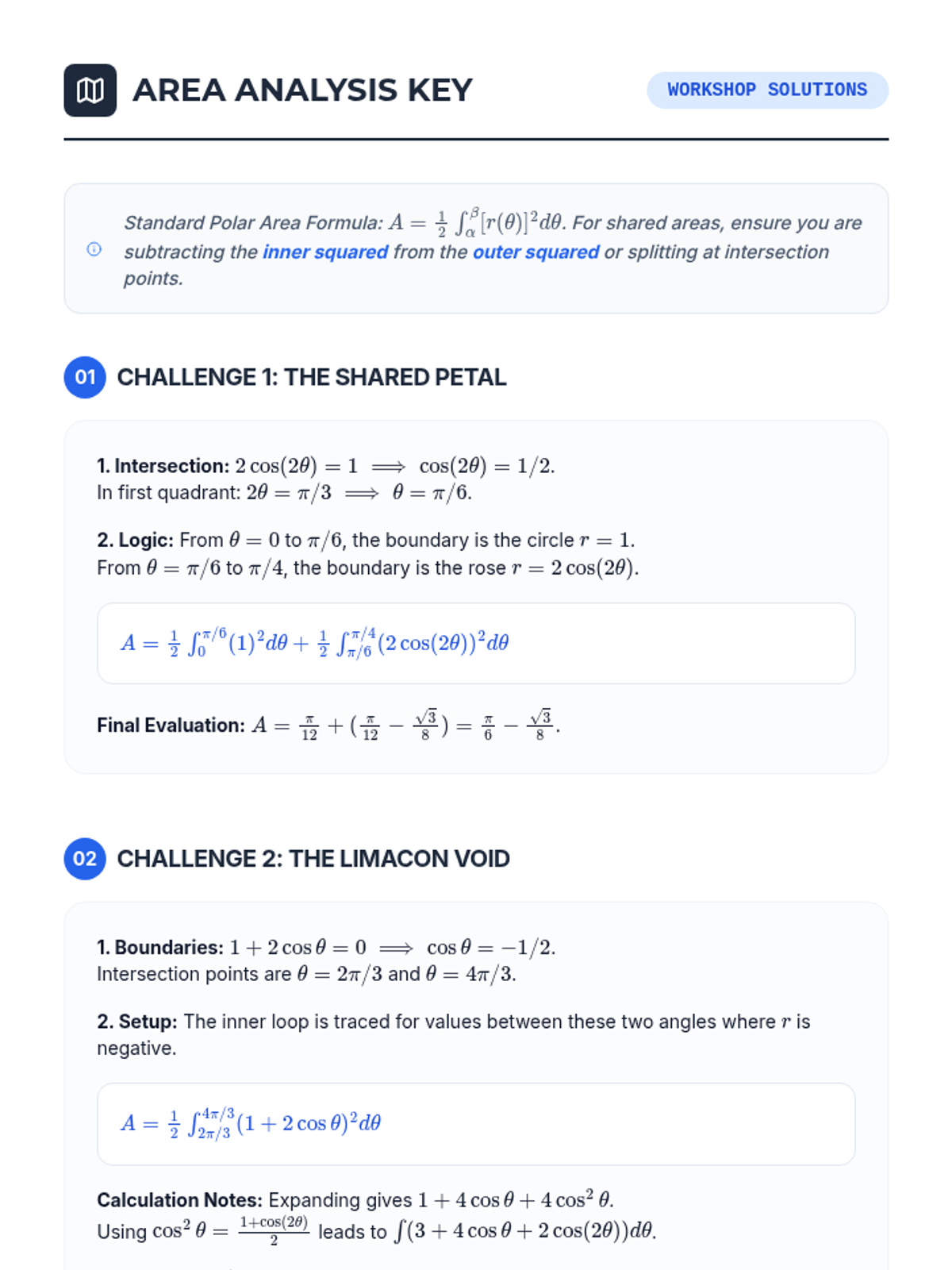
Answer key for the Shaded Region Showdown workshop. Provides intersection point derivations, step-by-step integral setup for shared regions, and final evaluated area values for rose and limacon curves.
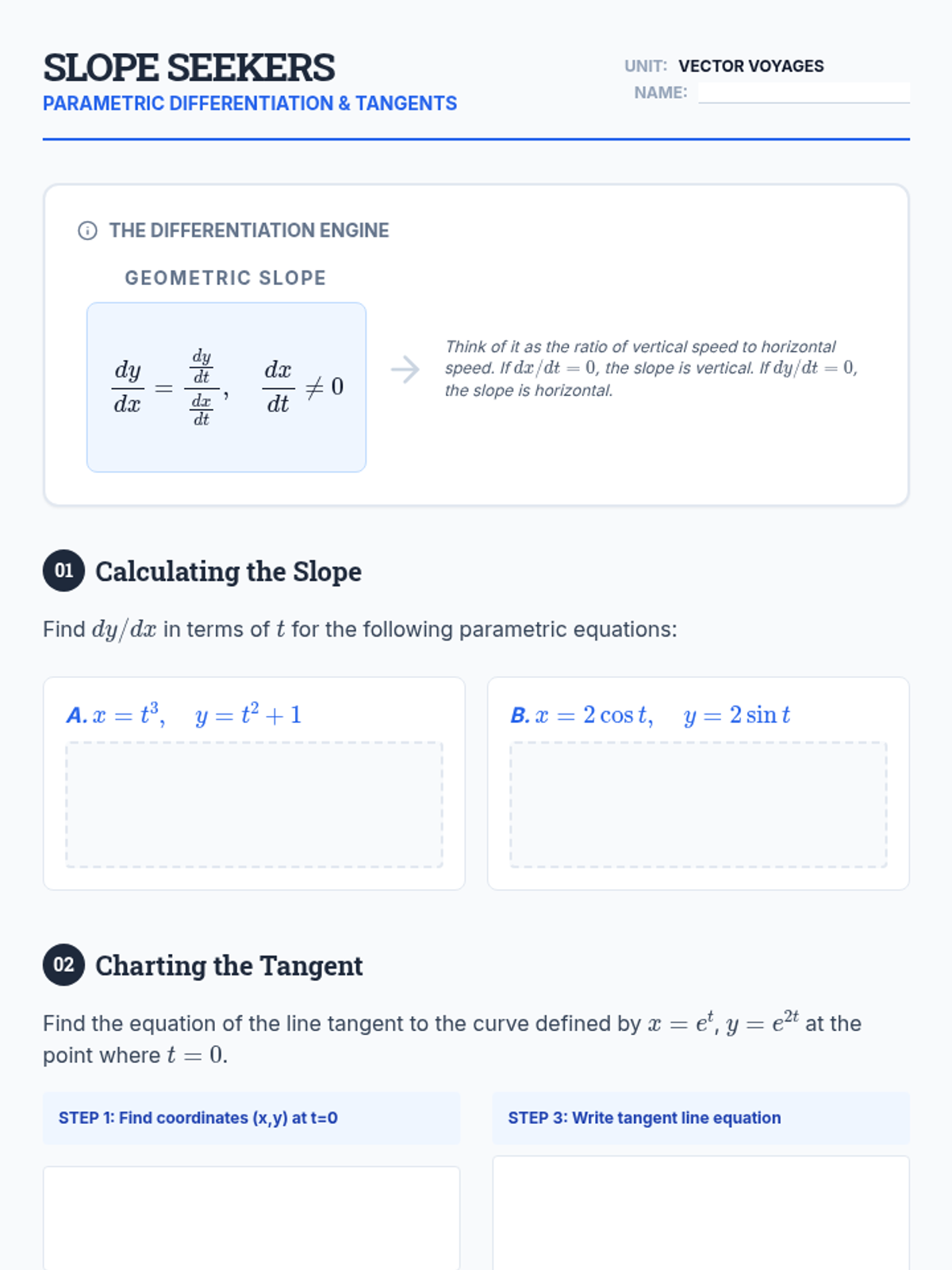
Worksheet for Lesson 2 focusing on calculating derivatives dy/dx and finding tangent line equations for parametric curves.
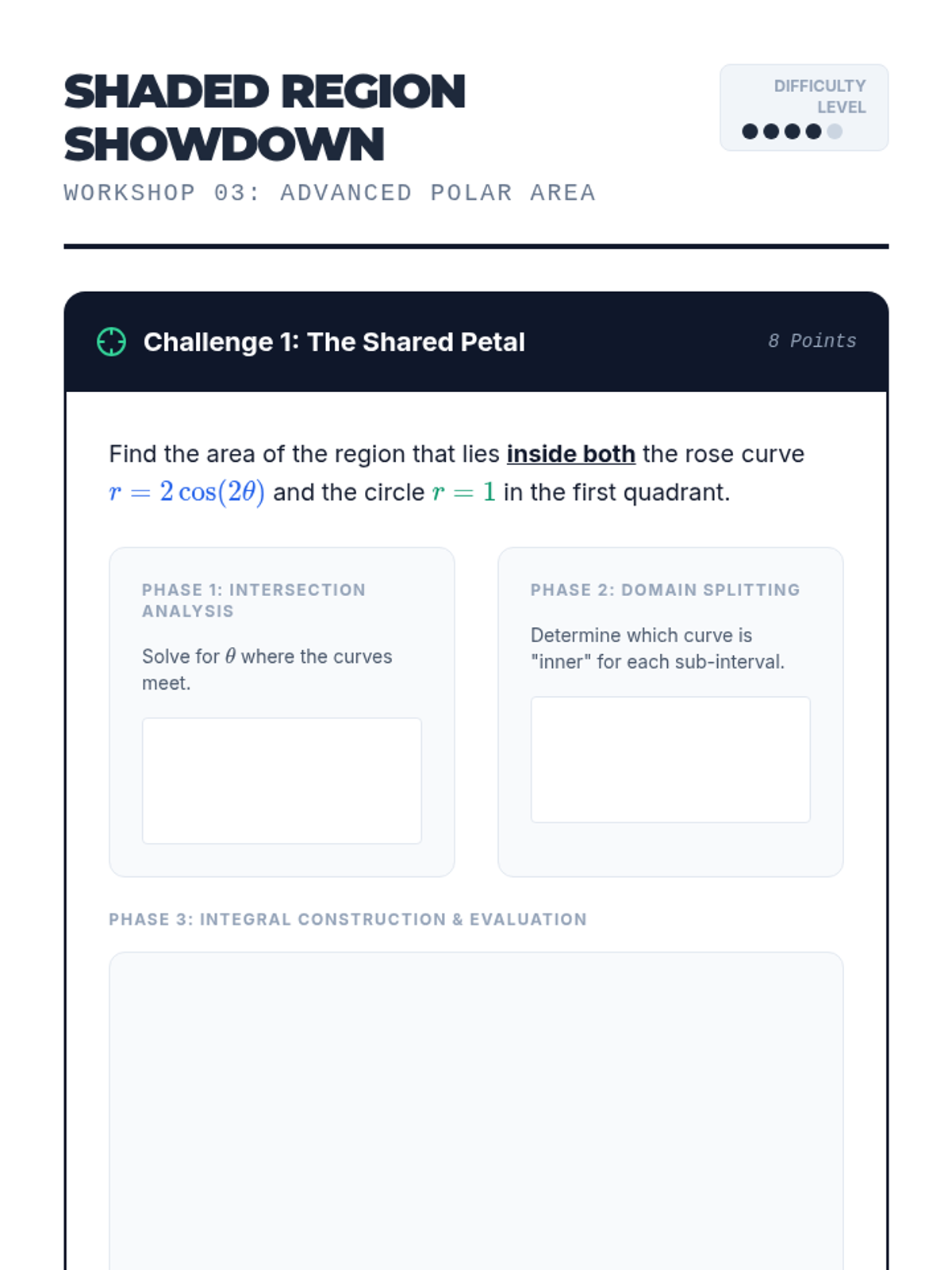
An advanced area workshop focusing on shared regions and inner loops of polar curves. Students must identify intersection points and manage negative r-values to calculate precise areas.
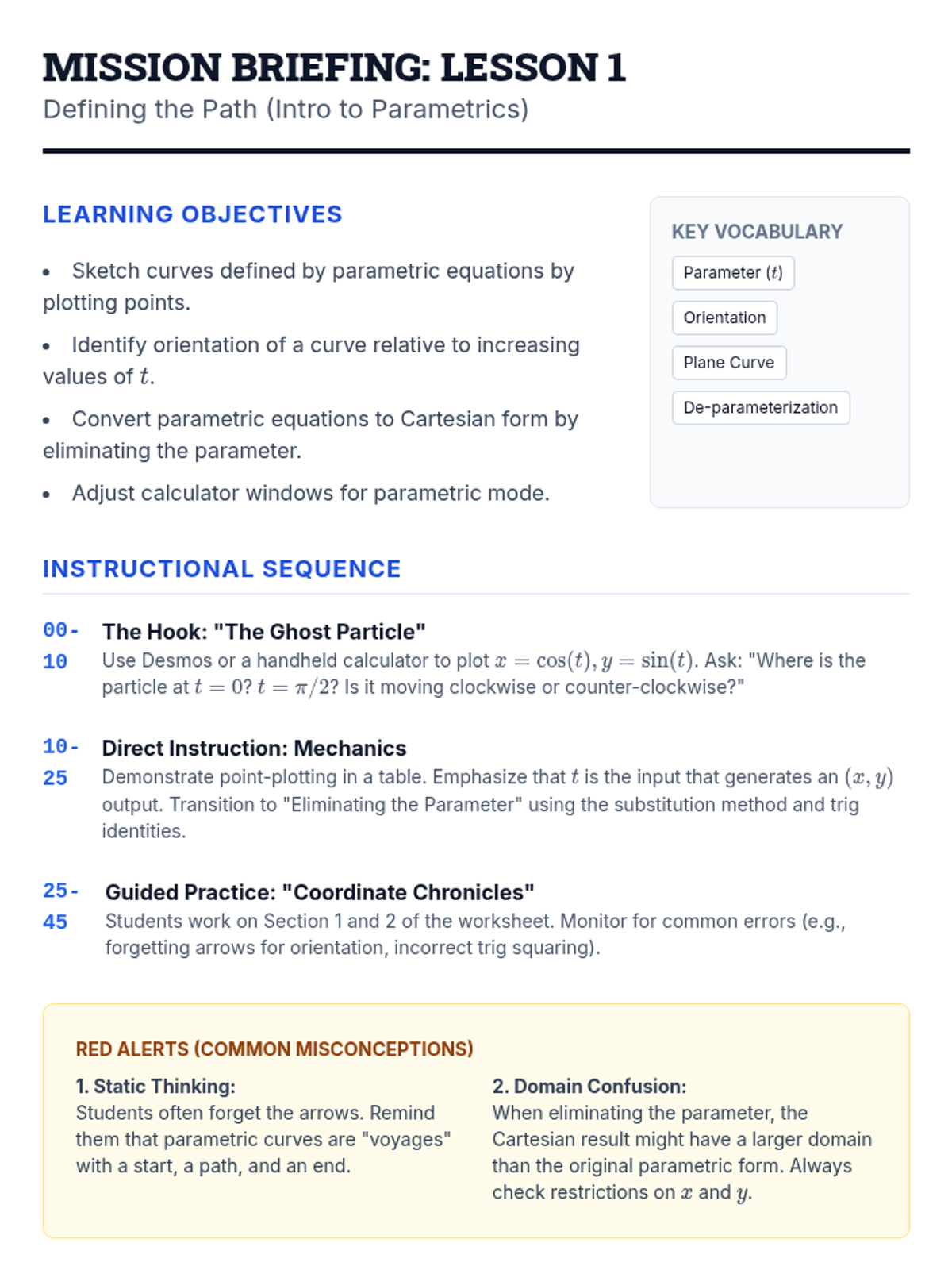
Teacher guide for Lesson 1, including learning objectives, instructional steps, and common misconceptions.
A visualization-heavy slide deck for Lesson 3 focusing on overlapping polar areas. Covers intersection point strategies, multi-curve regions, and handling negative r-values to avoid double-tracing errors.
Introductory presentation for Lesson 1, explaining parametric equations, plane curves, and parameter elimination.
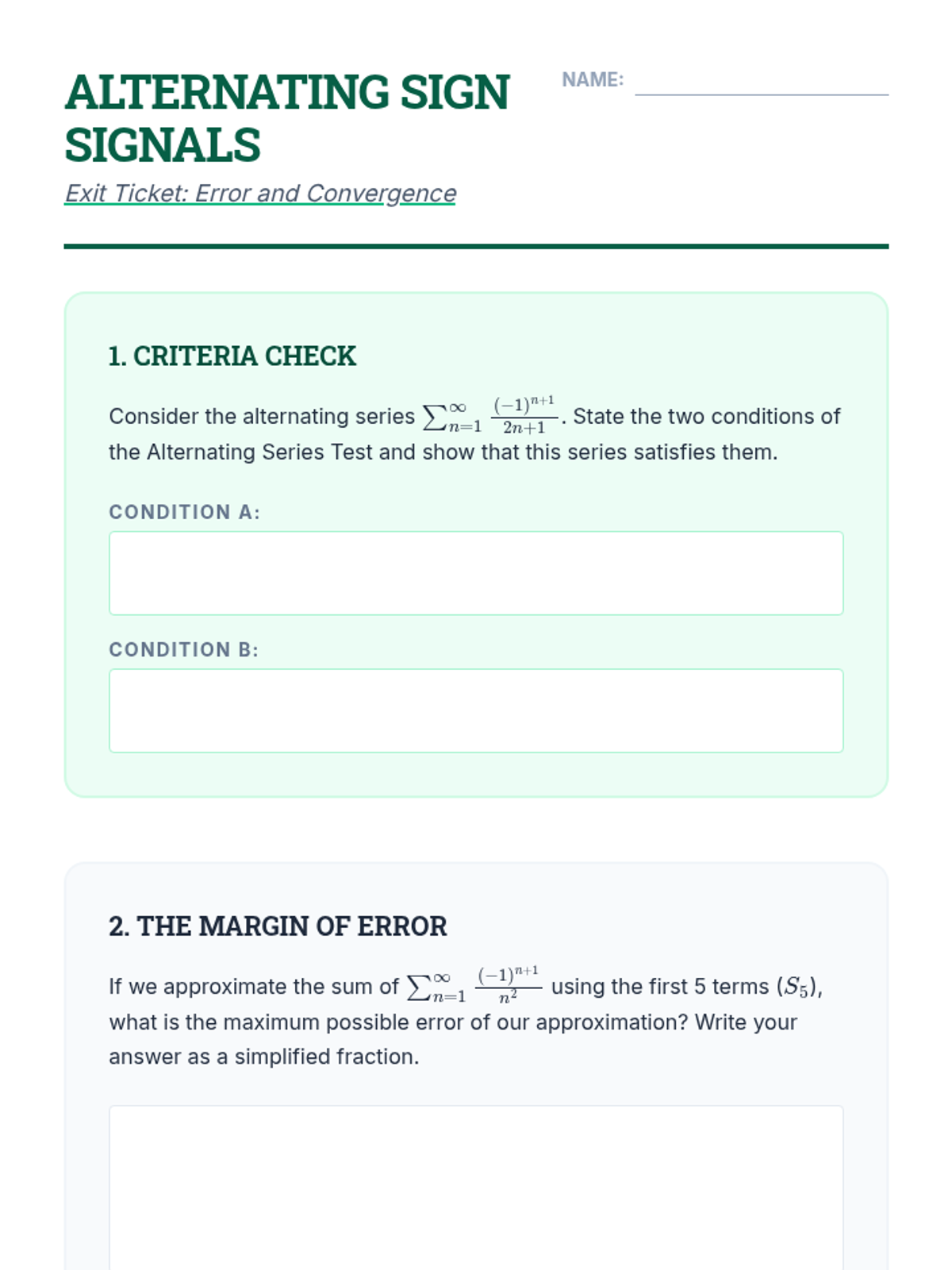
An exit ticket assessing student mastery of the Alternating Series Test, error bound calculations, and the conceptual distinction between absolute and conditional convergence.
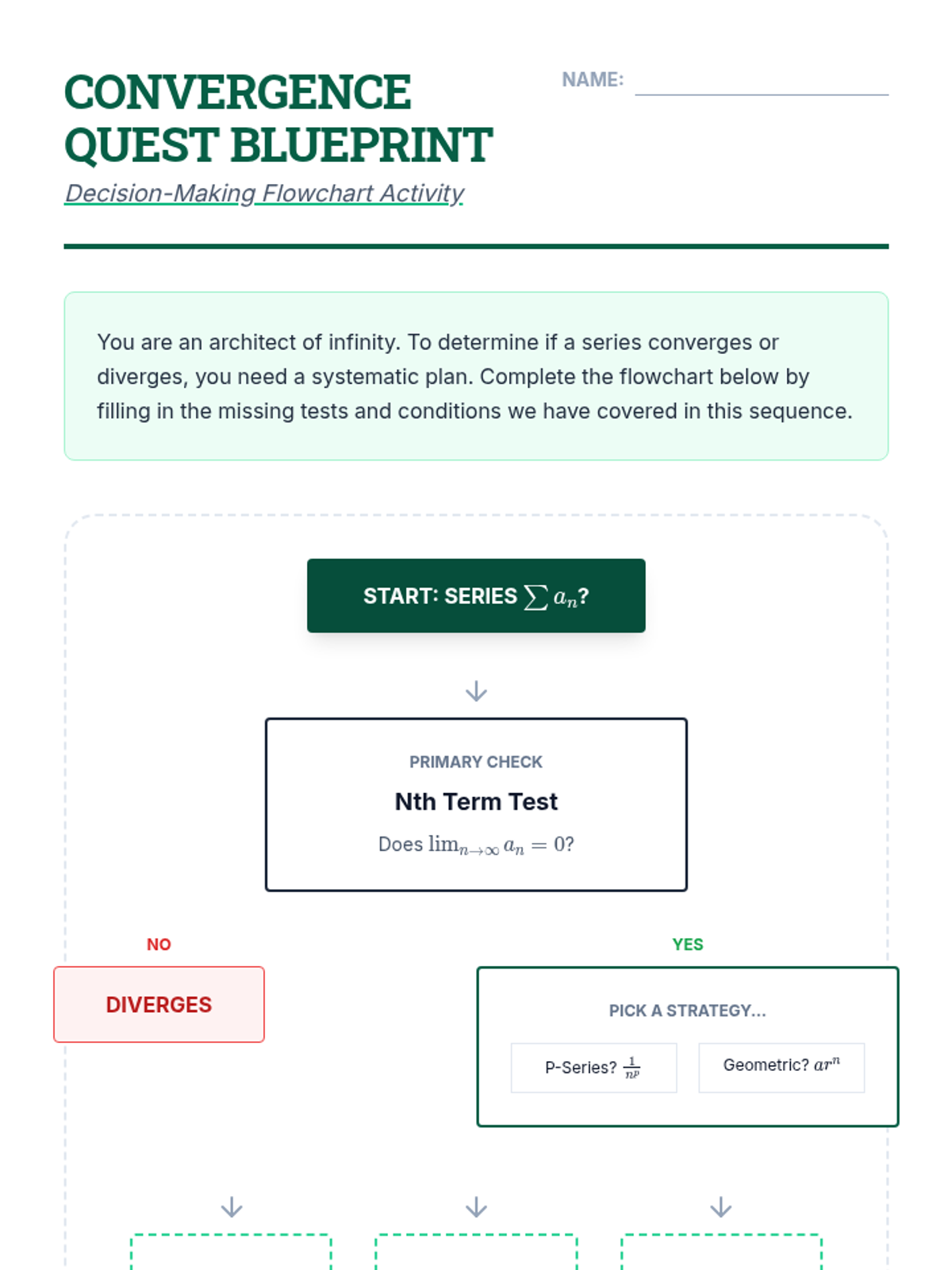
A cumulative decision-making flowchart activity that requires students to synthesize all convergence tests learned in the sequence and apply them to final complex series examples.
Lesson 5 slides on Alternating Series, covering the Leibniz criterion, error bound estimation, and the distinction between absolute and conditional convergence.
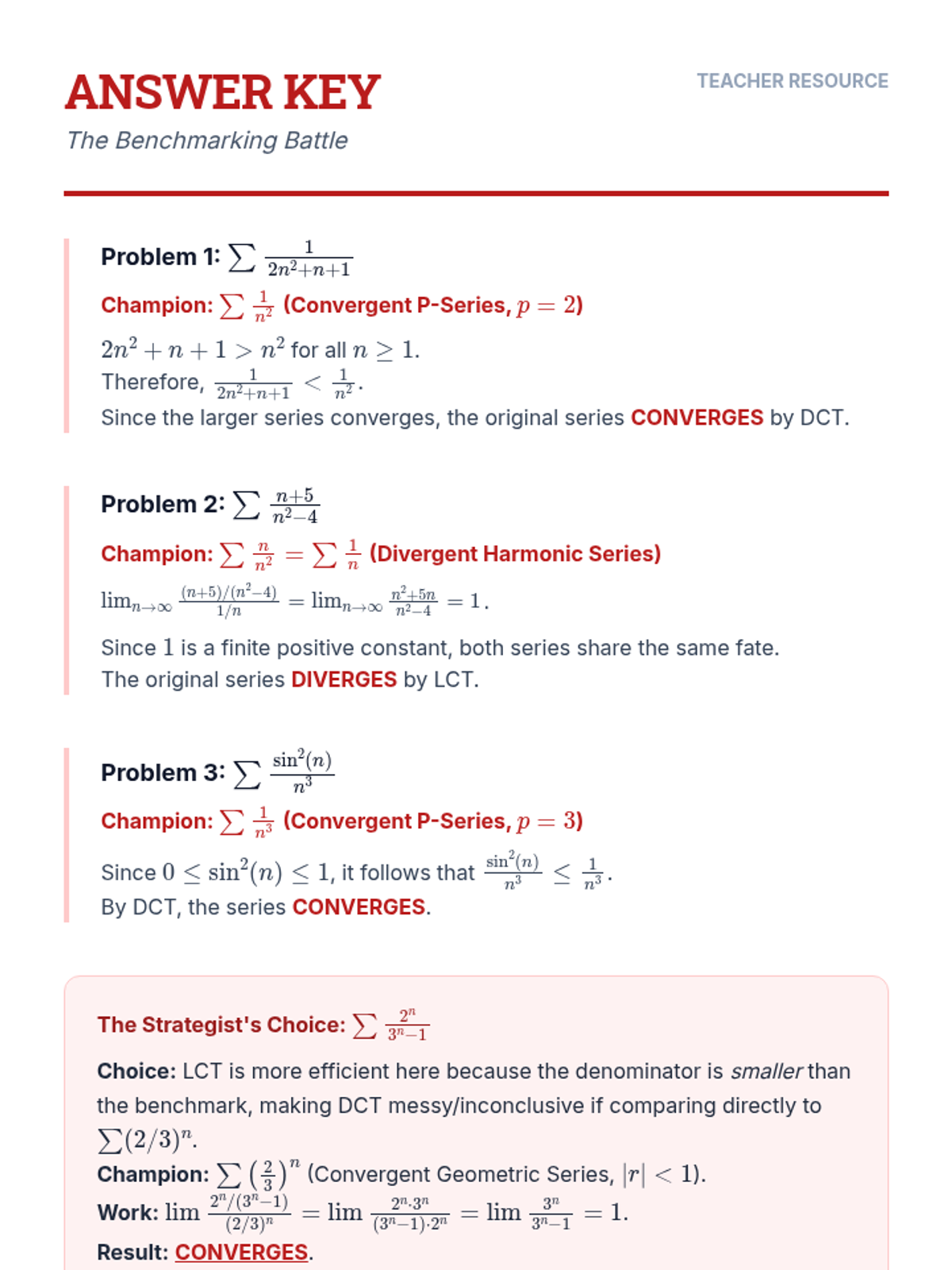
Answer key for the Benchmarking Battle worksheet, featuring clear benchmark identification, inequality setups, and limit evaluations for DCT and LCT problems.
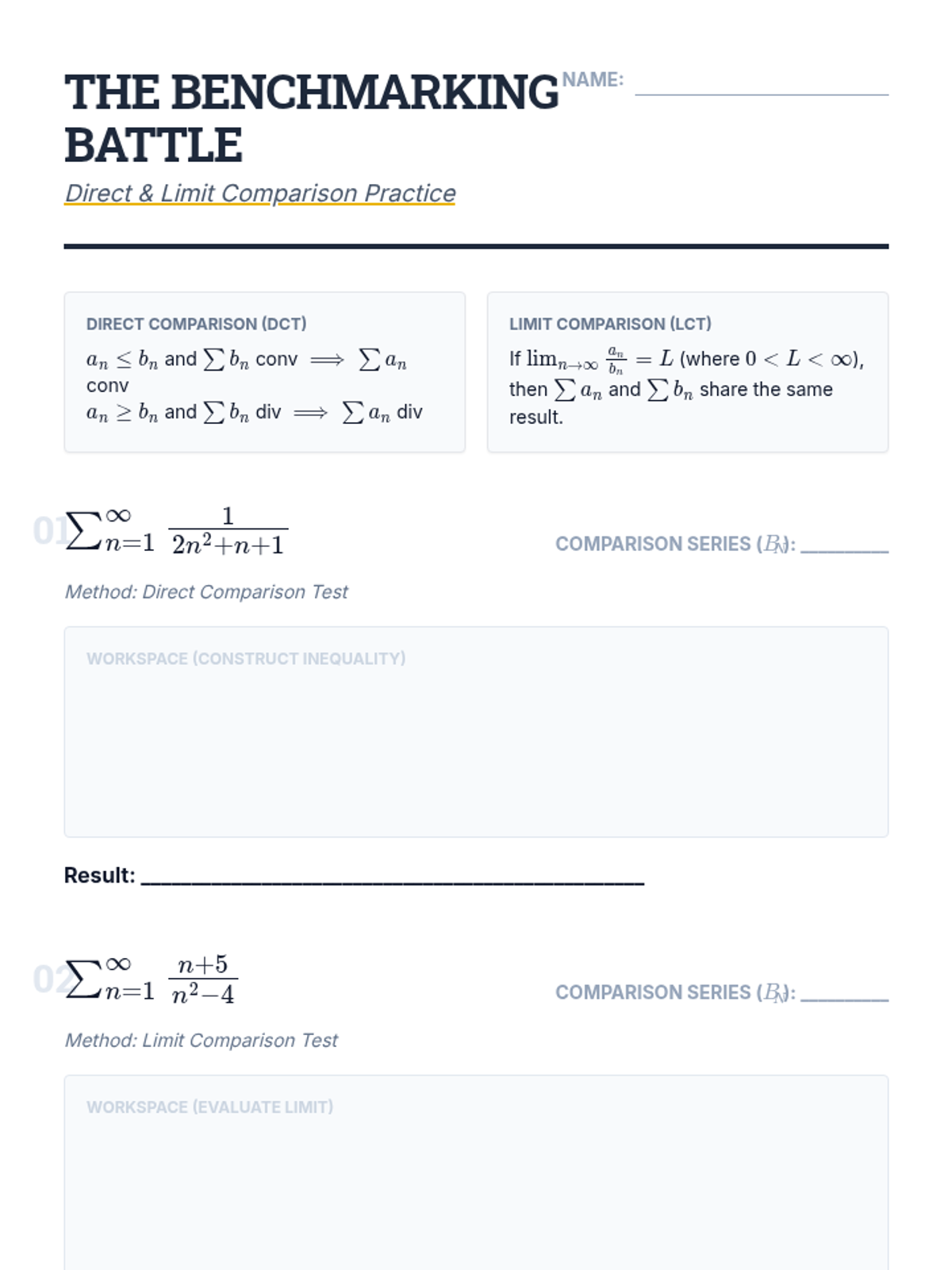
A comprehensive problem set for practicing Direct and Limit Comparison Tests, including workspace for inequalities, limits, and a strategic choice challenge.
Lesson 4 slides on Comparison Tests, introducing the Direct and Limit Comparison Tests using a weightlifting analogy and strategies for selecting dominant-term benchmarks.
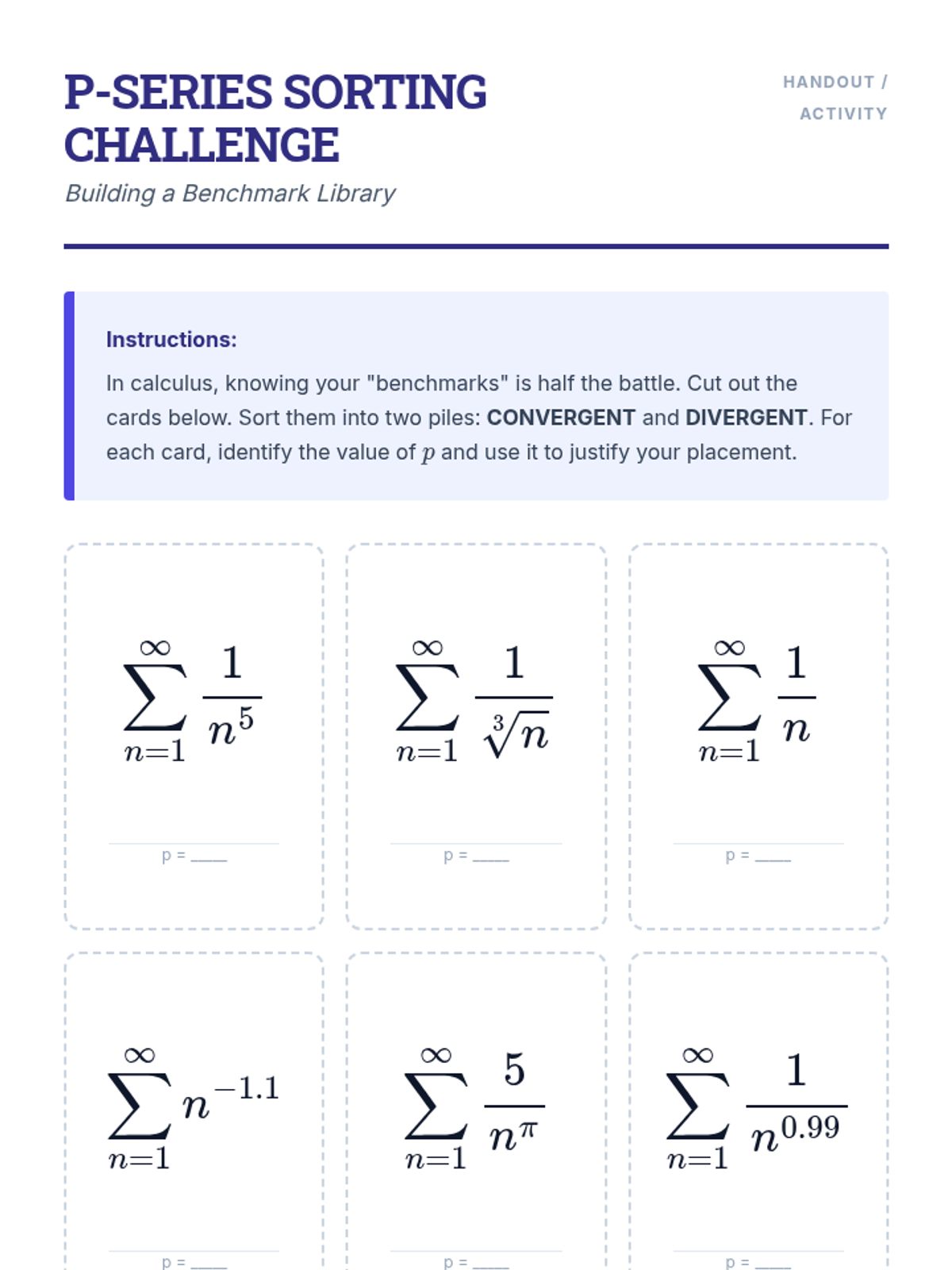
A sorting activity where students categorize different P-series as convergent or divergent based on their exponents. It includes a reference table for reinforcement.
Lesson 3 slides on P-series and the Harmonic series, illustrating the "infinite overhang" paradox and establishing the p-value criteria for convergence used as benchmarks in future tests.
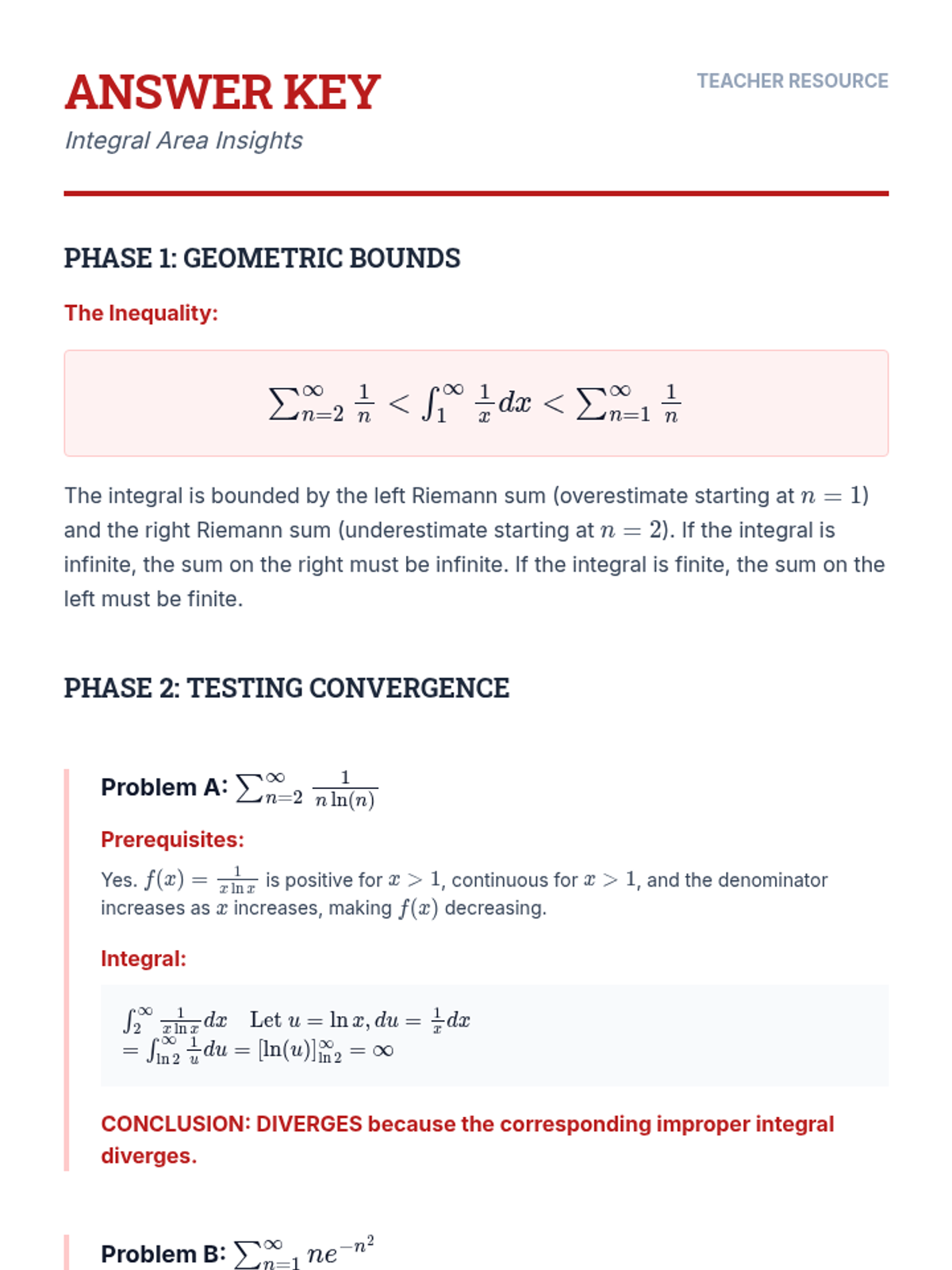
Detailed answer key for the Integral Test Investigation, providing step-by-step calculus work for improper integrals and logical justifications for convergence conclusions.
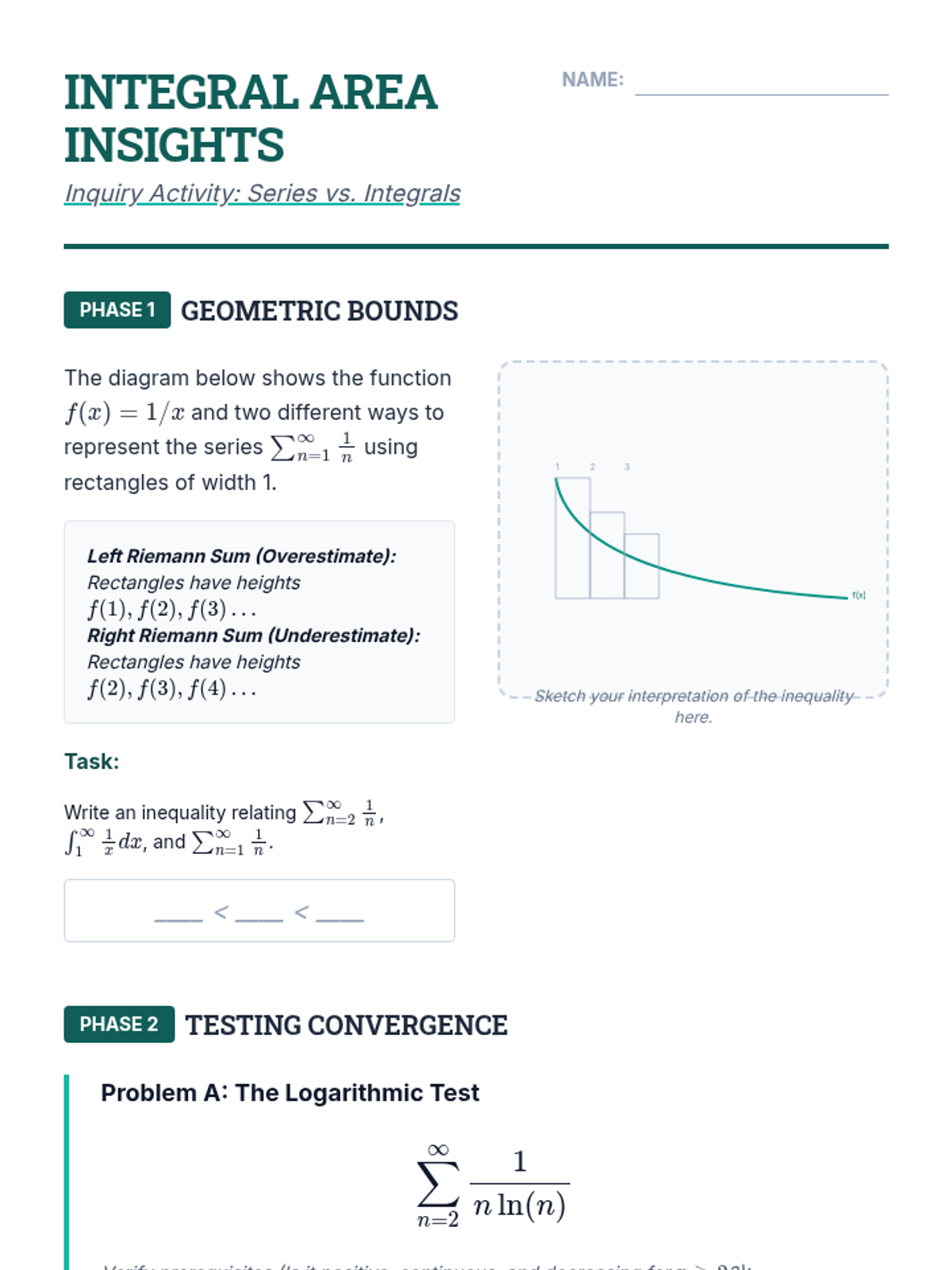
An investigation activity that guides students through the geometric derivation of the Integral Test using Riemann sums, followed by two rigorous practice problems involving U-substitution and logarithmic functions.
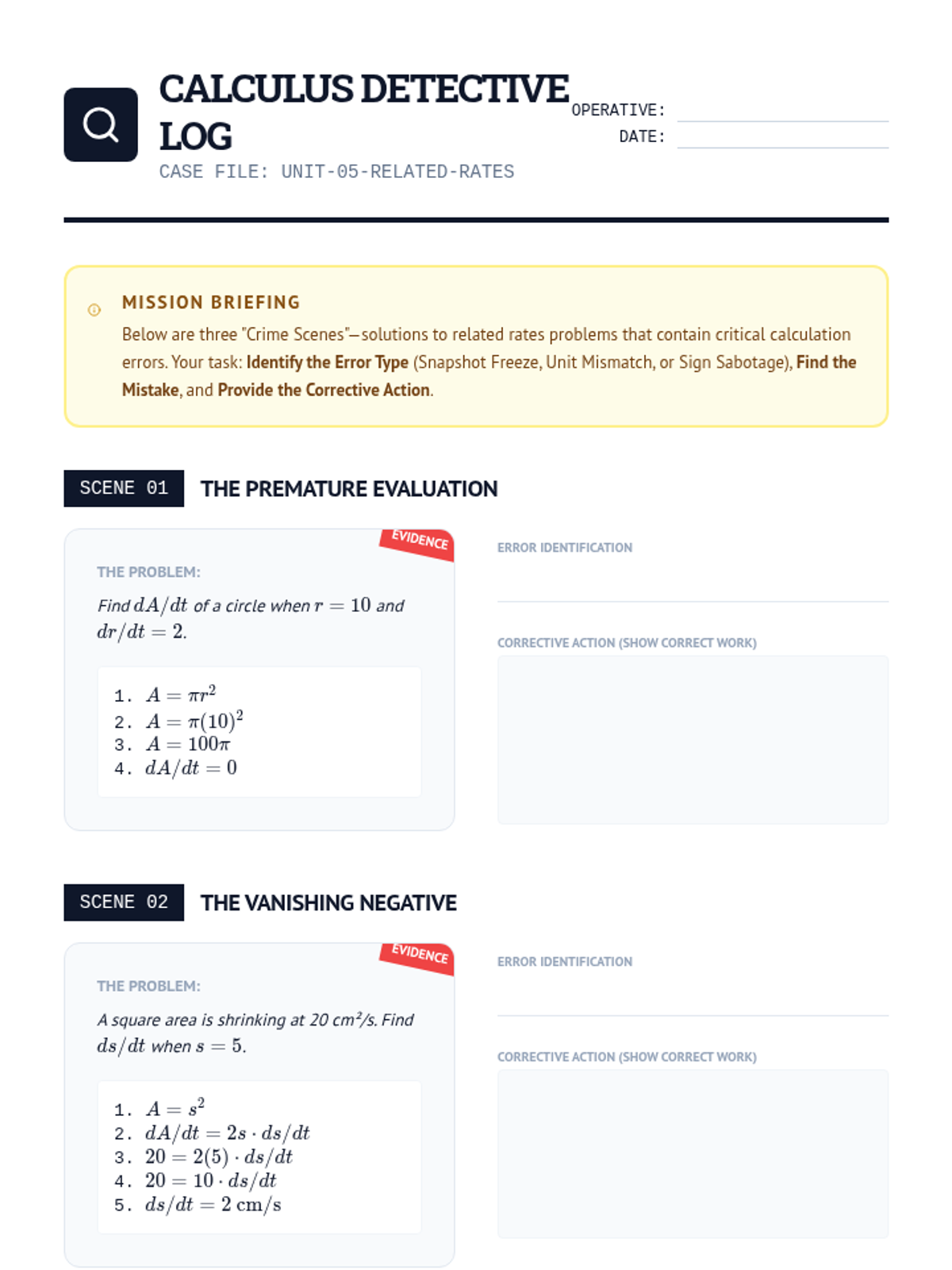
Worksheet for practicing error analysis in related rates problems, featuring "Crime Scenes" where students must identify and correct common calculus mistakes.
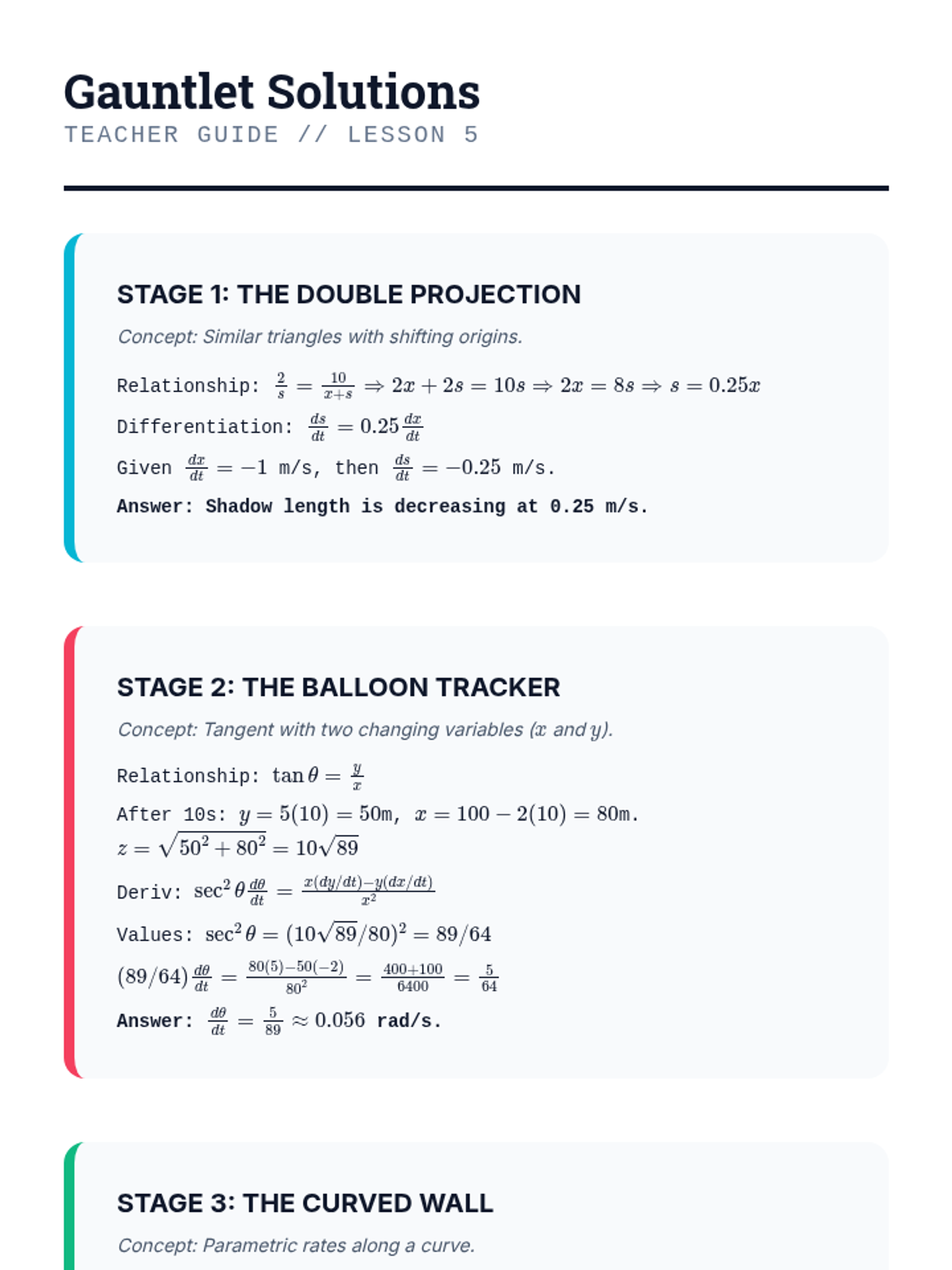
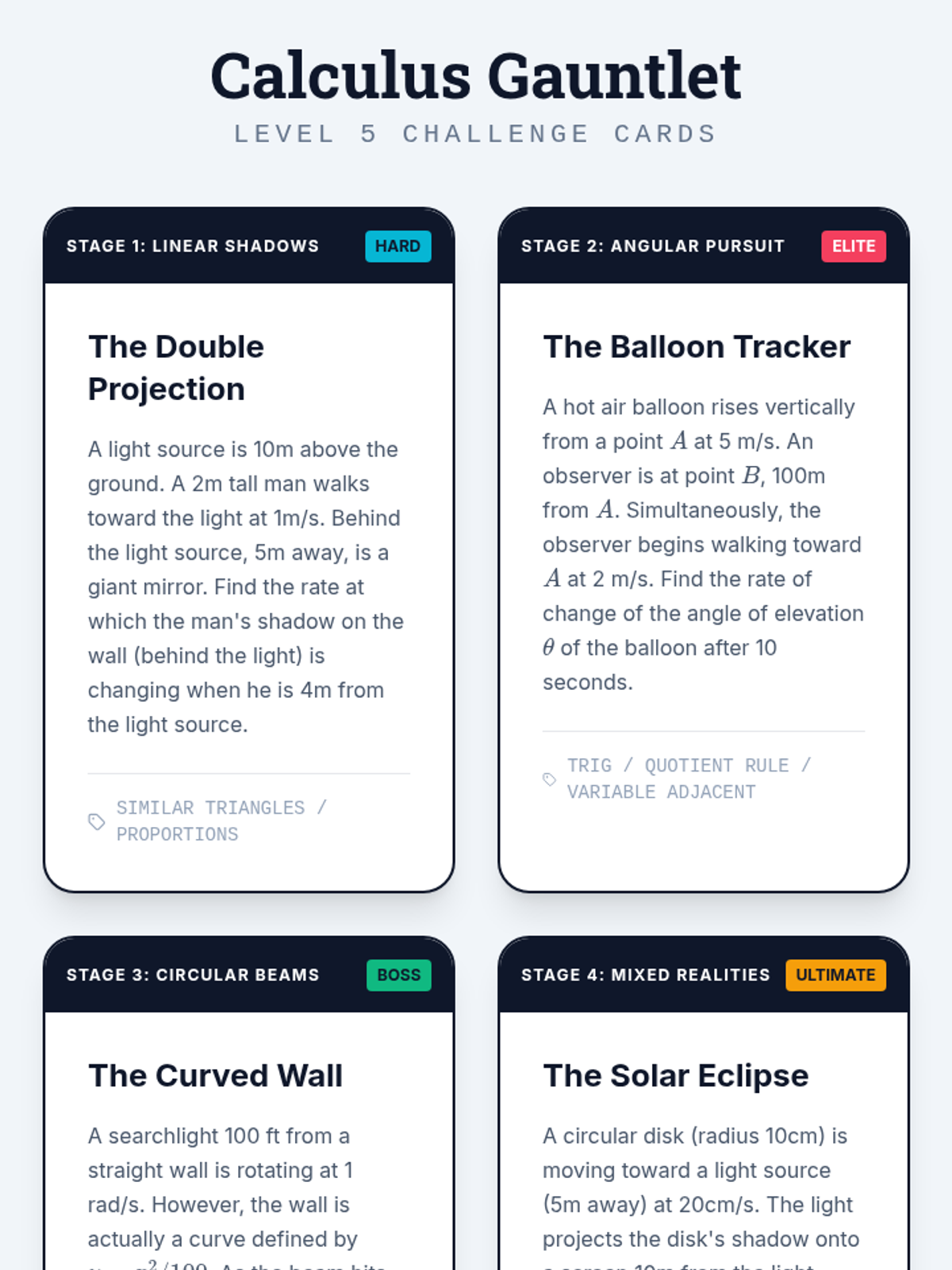
Full solution guide for the "Calculus Gauntlet" seminar in Lesson 5, providing step-by-step mathematical breakdowns for all four challenge stages.
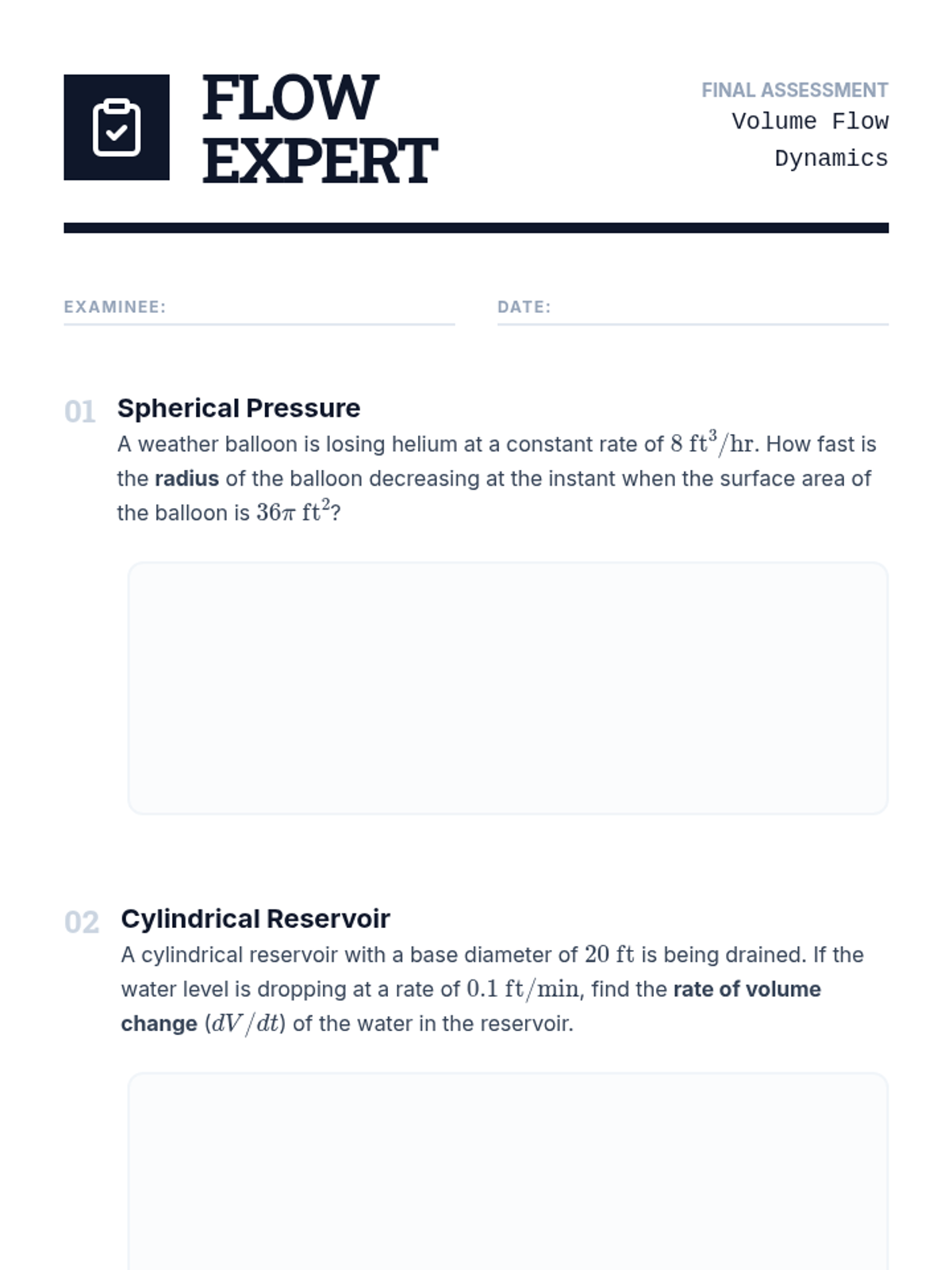
Comprehensive final exam for the Volume Flow Dynamics sequence. Includes problems on spherical balloons, cylindrical reservoirs, and a net-flow conical sieve problem.
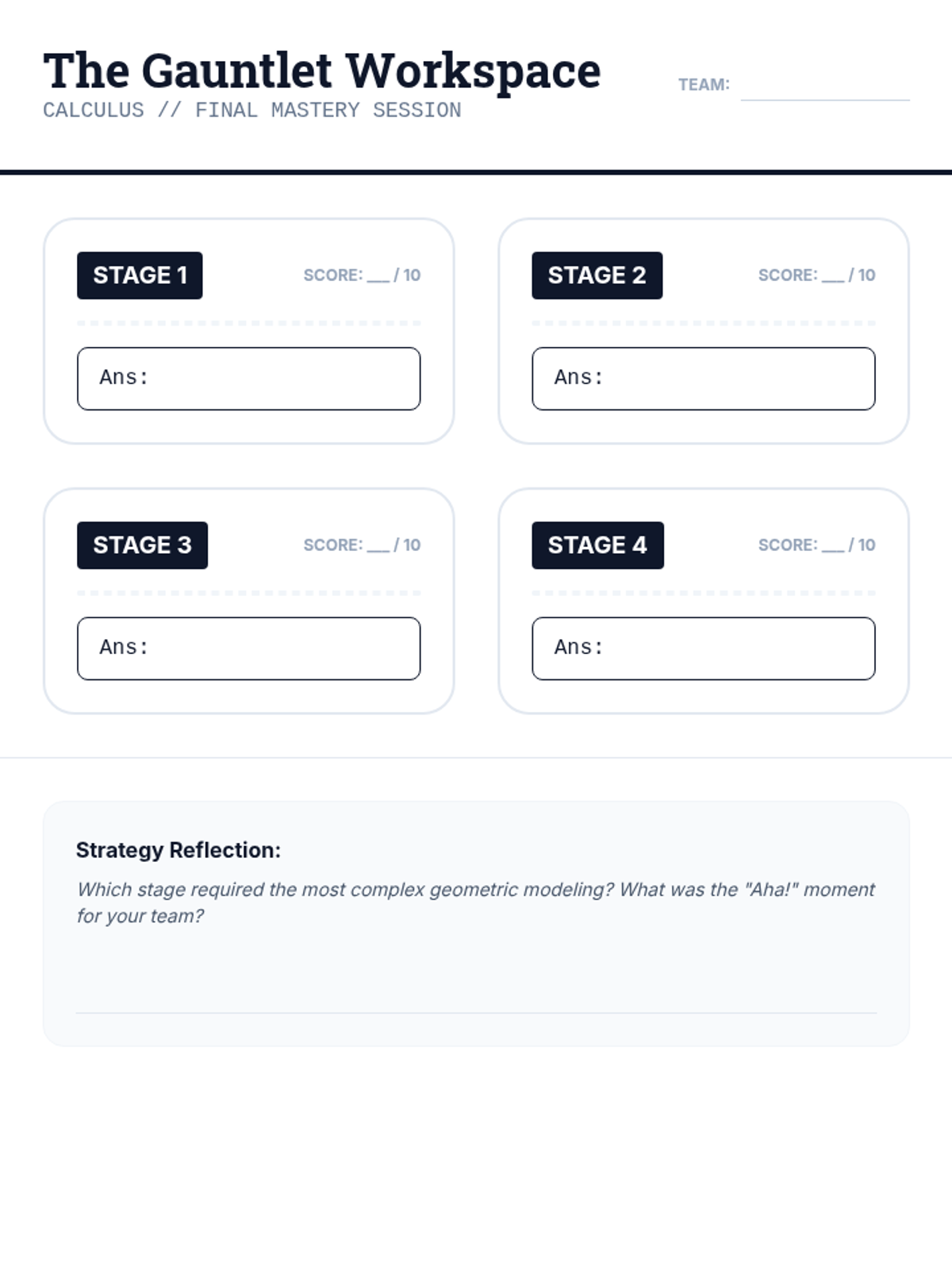
Student workspace for the Lesson 5 "Calculus Gauntlet" seminar, designed for teams to record their solutions to the four challenge stages.
Visual presentation for Lesson 5 focusing on common errors like premature substitution, unit misalignment, and sign errors in related rates problems.
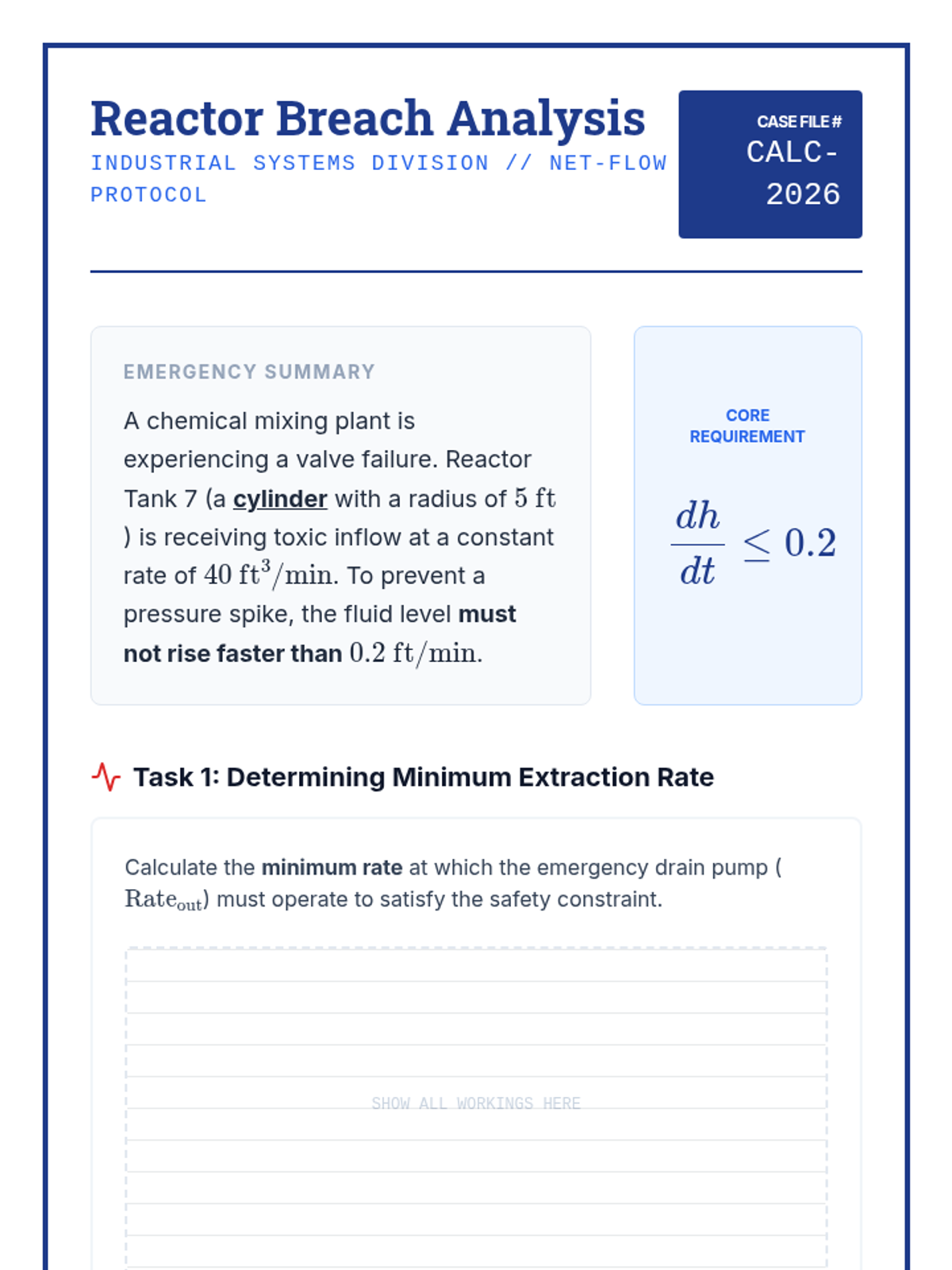
Final case study for Lesson 5. Students solve net flow problems involving a cylindrical reactor breach and a conical containment pit, culminating in an engineering recommendation.
Challenge cards for the "Calculus Gauntlet" seminar in Lesson 5, featuring complex, multi-stage related rates problems combining shadows, trigonometry, and geometry.
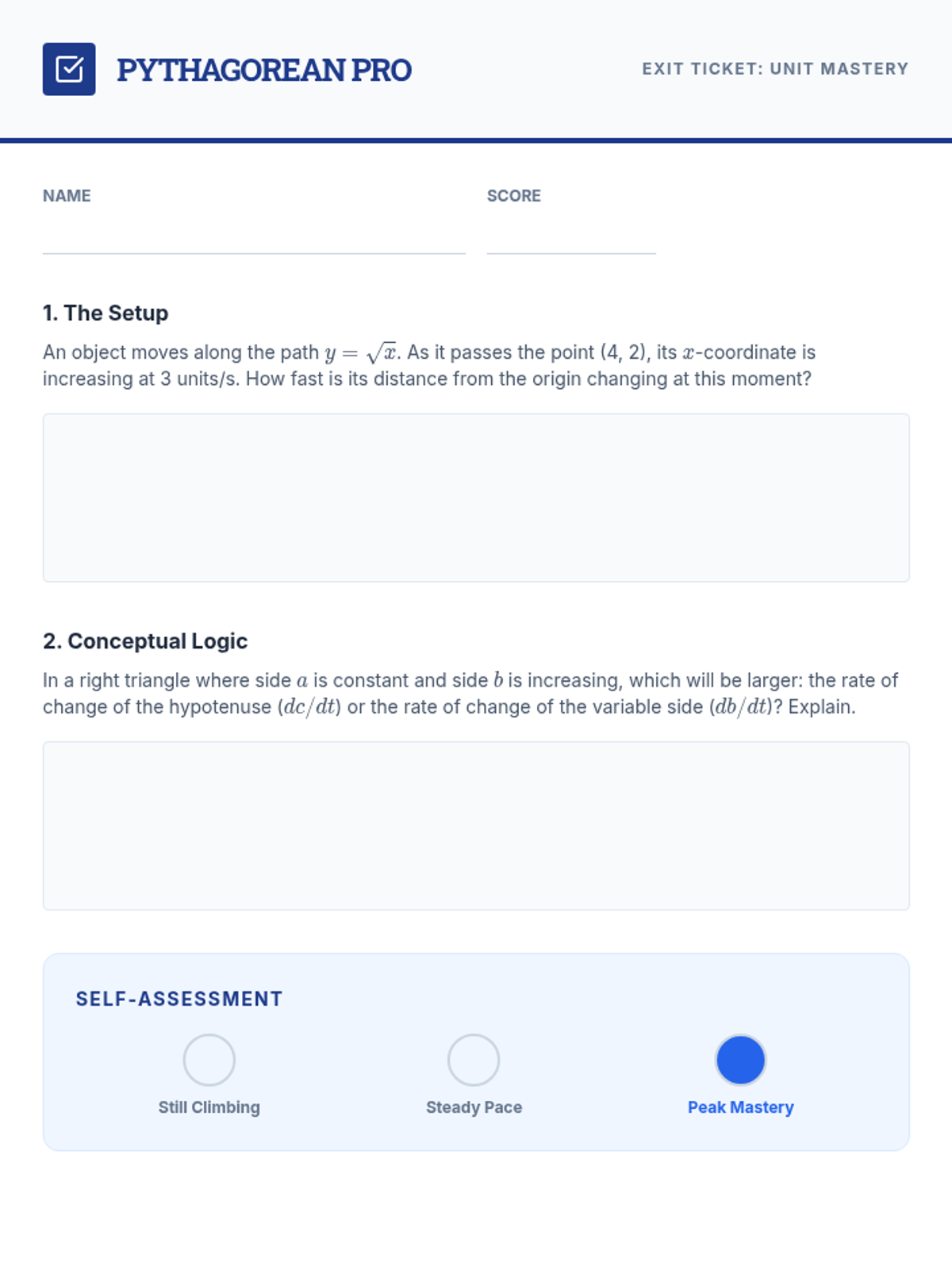
A final exit ticket to assess student understanding of Pythagorean related rates. Includes a computational problem involving a coordinate path and a conceptual comparison of rates.
Slide deck for Lesson 5 on Net Flow Dynamics. Covers the concept of dV/dt = In - Out, a cylindrical tank emergency scenario, and the added complexity of net flow in conical containers.
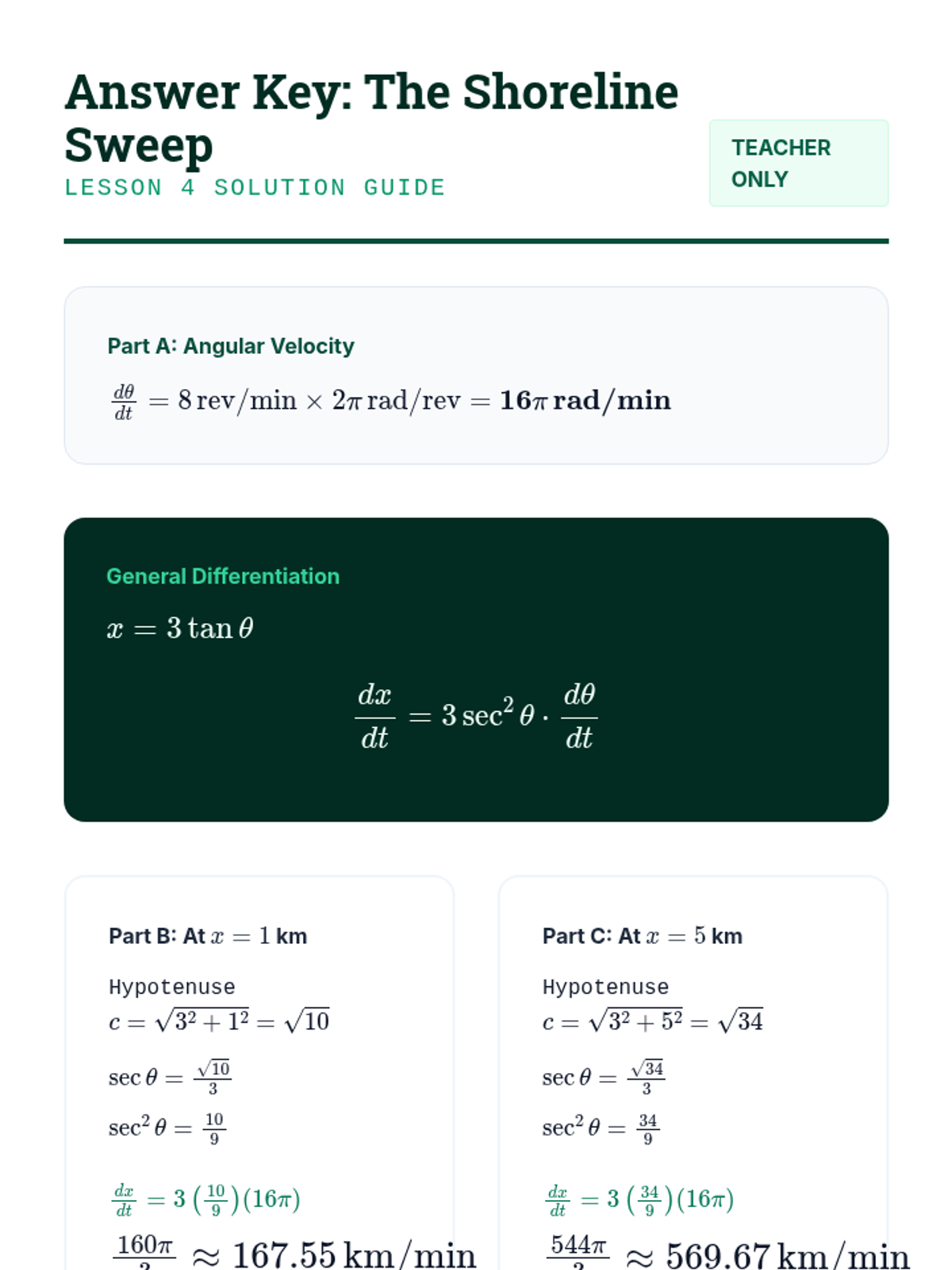
Answer key for Lesson 4's "The Shoreline Sweep" activity sheet, with detailed mathematical derivations for Part A, B, and C.
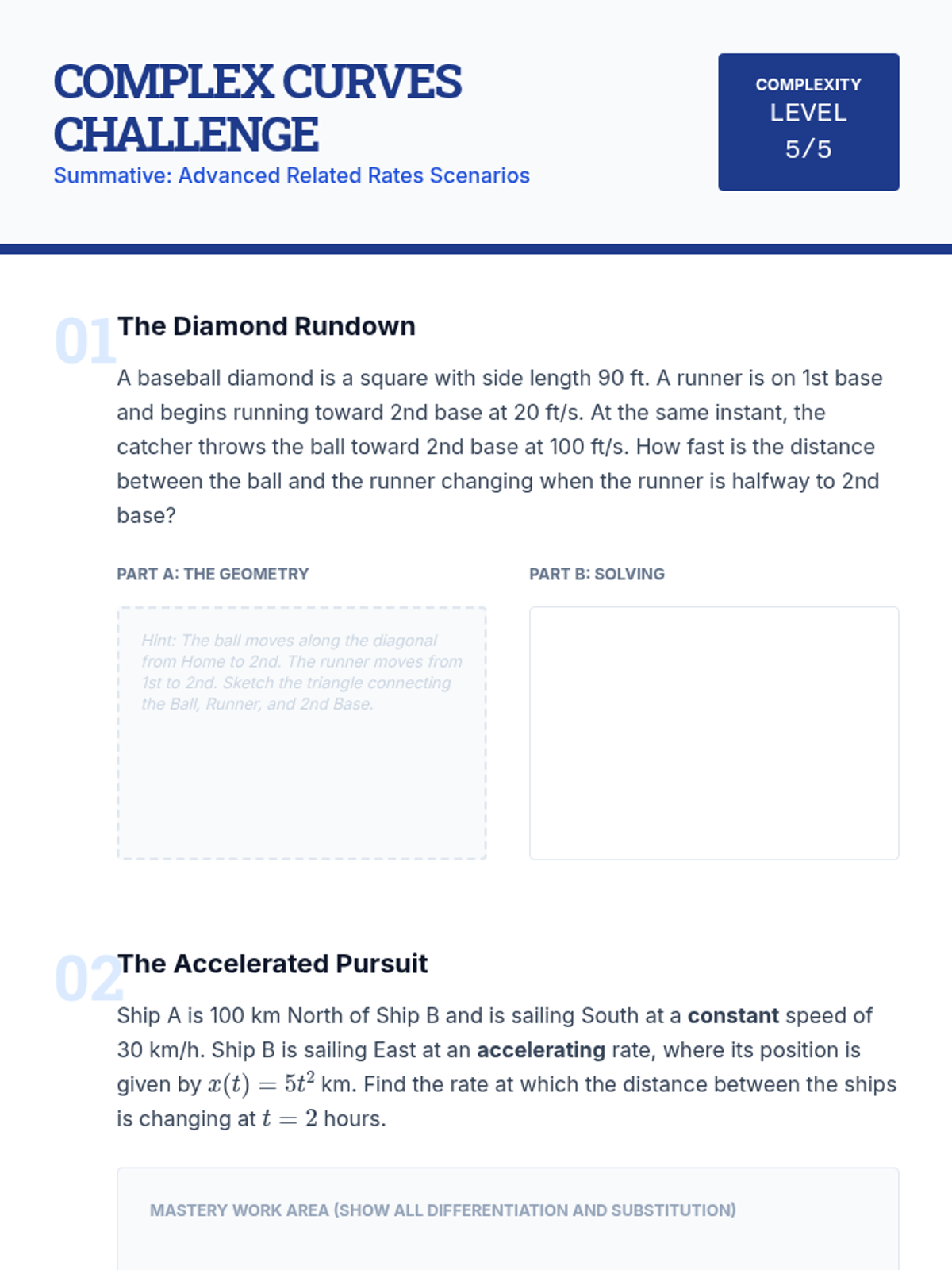
An advanced challenge set for the final lesson, featuring multi-object motion (baseball diamond), accelerating objects, and the classic lamppost shadow problem. Requires synthesis of geometry, calculus, and physics.
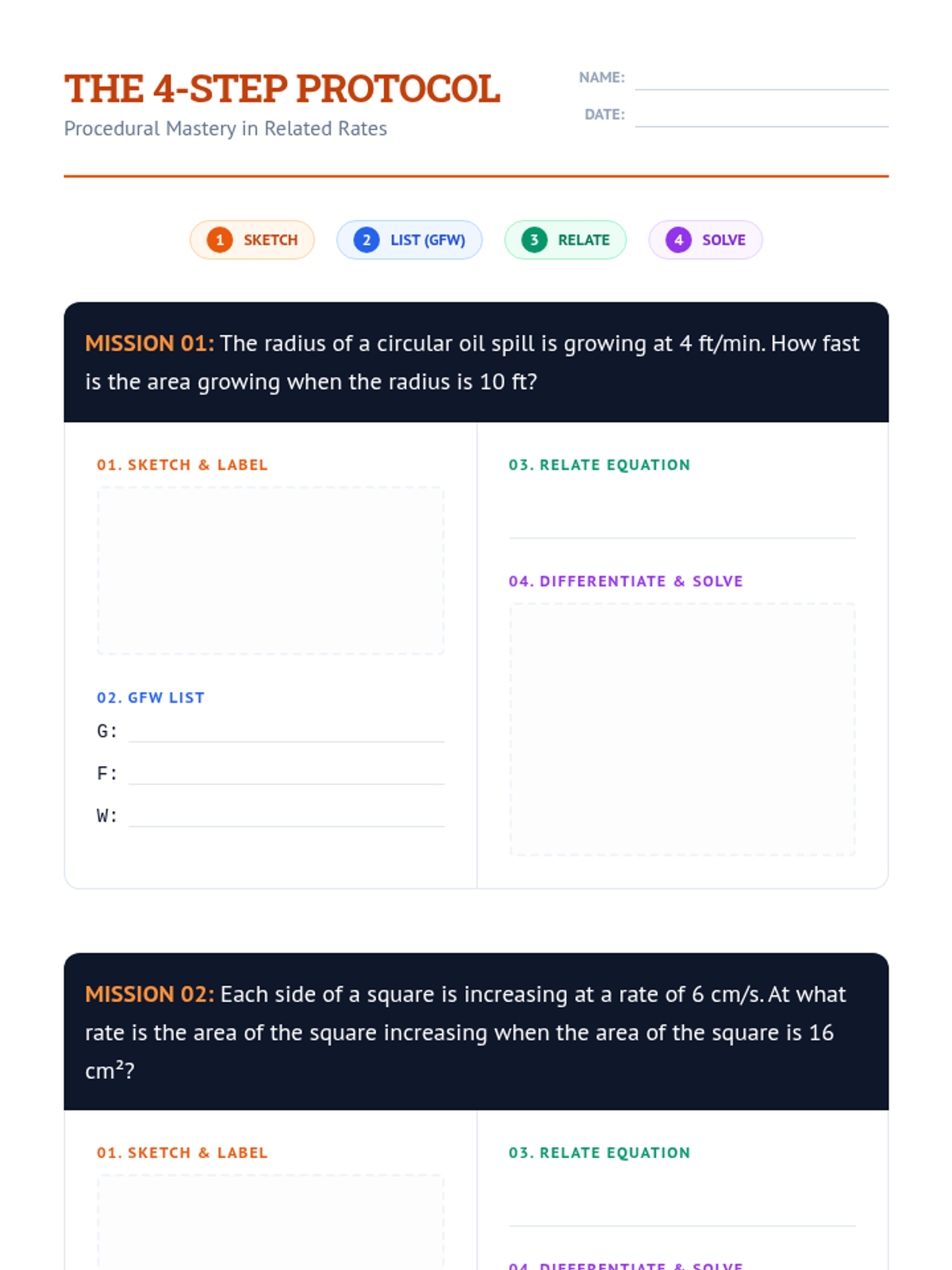
Synthesis worksheet for practicing the 4-step Related Rates protocol: Sketch, GFW List, Relate Equation, and Differentiate/Solve.
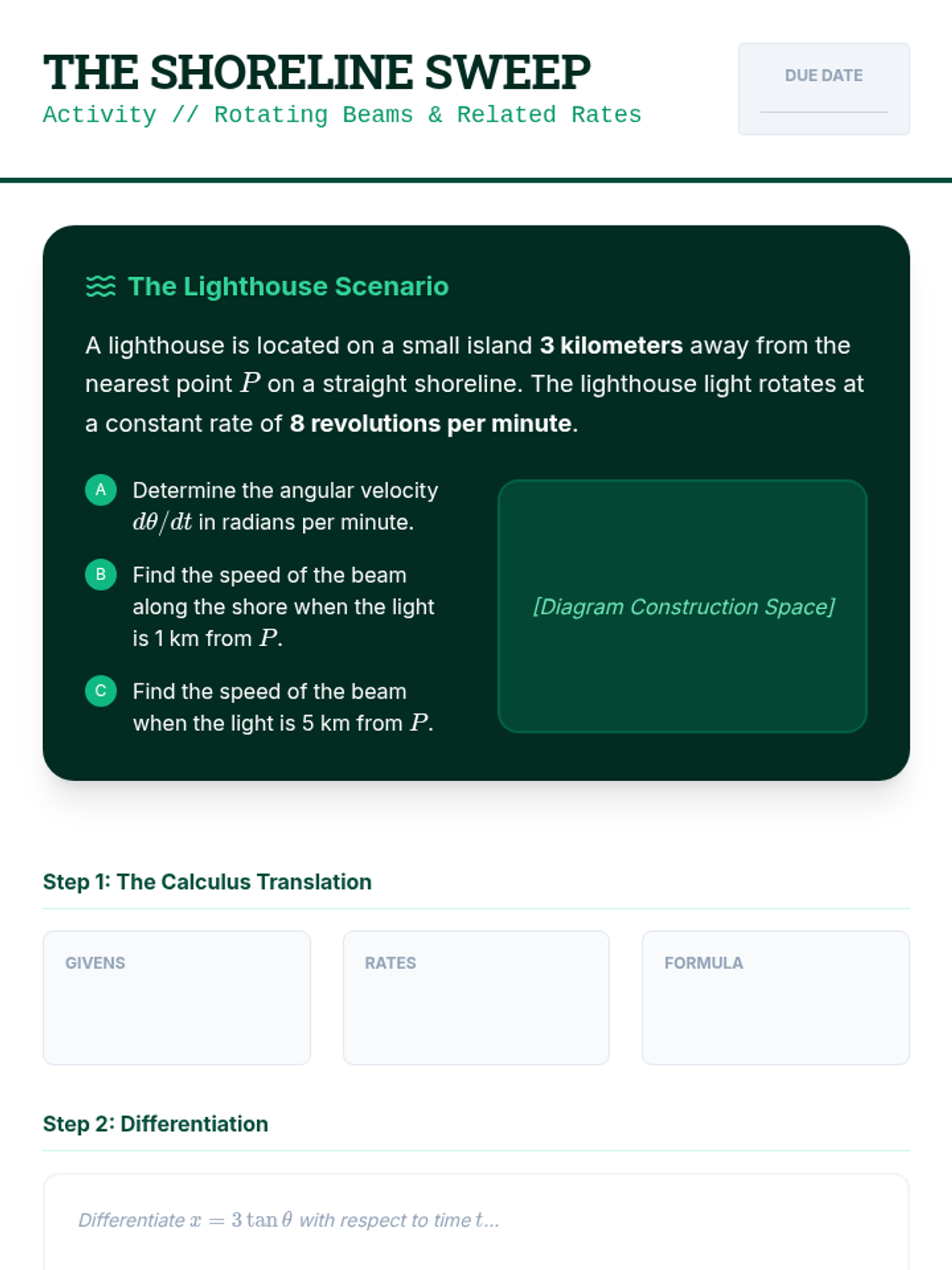
Worksheet for Lesson 4 exploring the non-linear relationship between a lighthouse's rotation and the speed of its beam as it sweeps across a shoreline.
Final slide deck for Lesson 5, presenting complex word problems like the baseball diamond runner and introduction to searchlight problems. Synthesizes all previous concepts into advanced geometric applications.
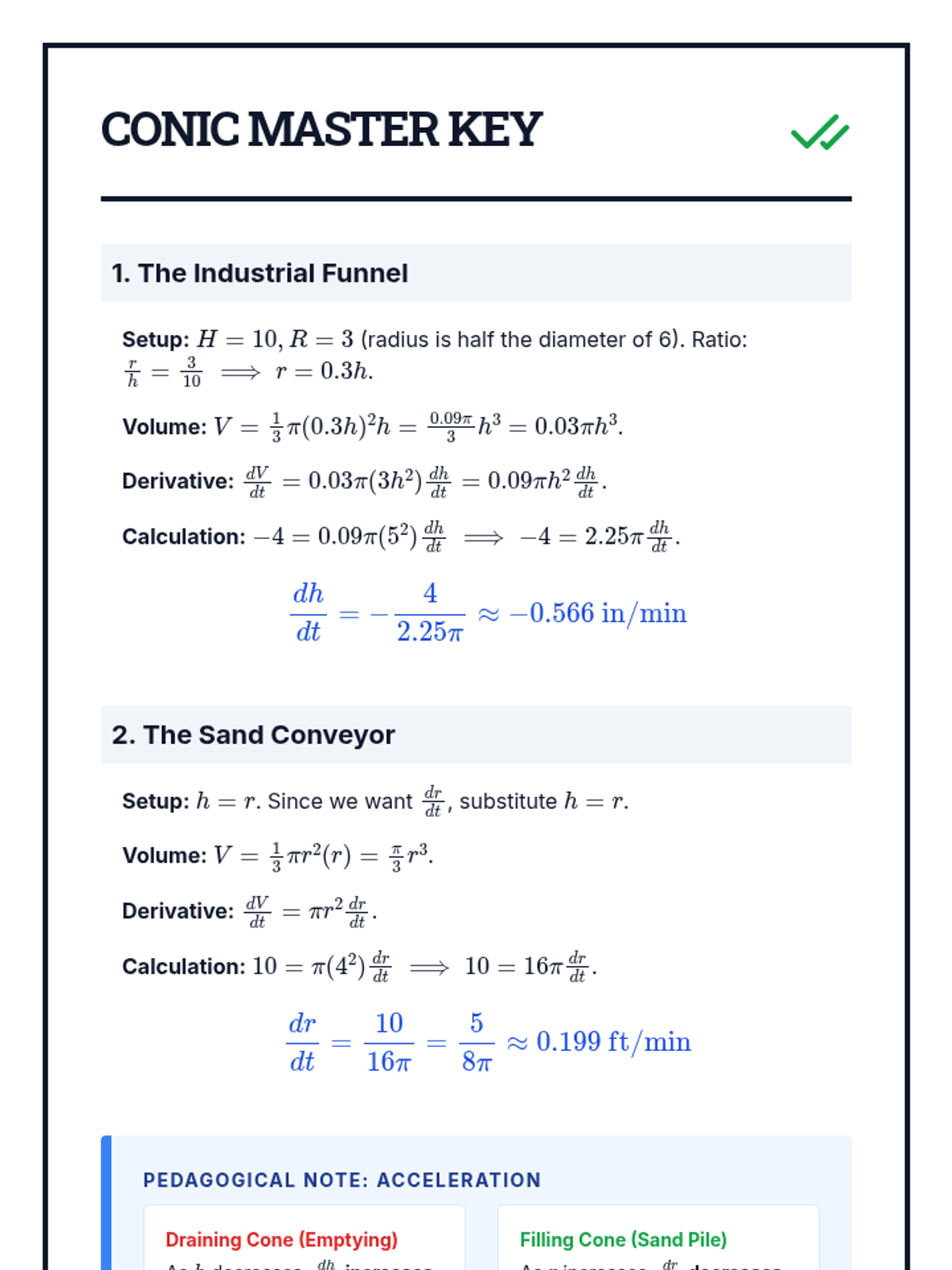
Answer key for the Hourglass Hustle workshop, featuring full mathematical proofs for the funnel and sand pile problems.
Slides for Lesson 4 exploring rotating beams and lighthouses, connecting angular velocity to the linear velocity of a beam across a surface.
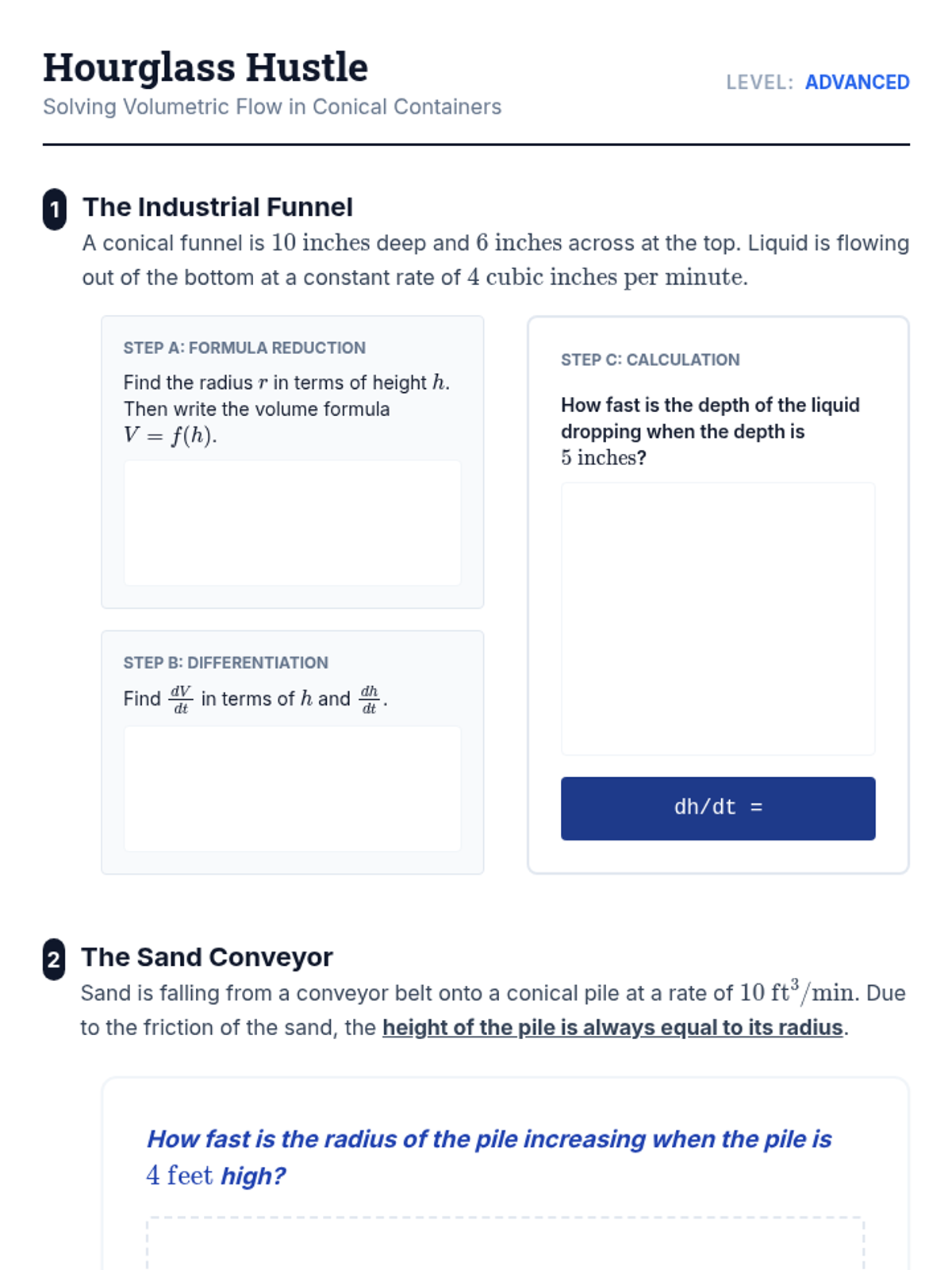
Workshop activity for Lesson 4 where students solve complex related rates problems involving conical containers and sand piles. Includes a conceptual reflection on rate acceleration.
Visual presentation for Lesson 4 focusing on the synthesized 4-step framework: Sketch, List Variables (GFW), Relate Equation, and Solve.
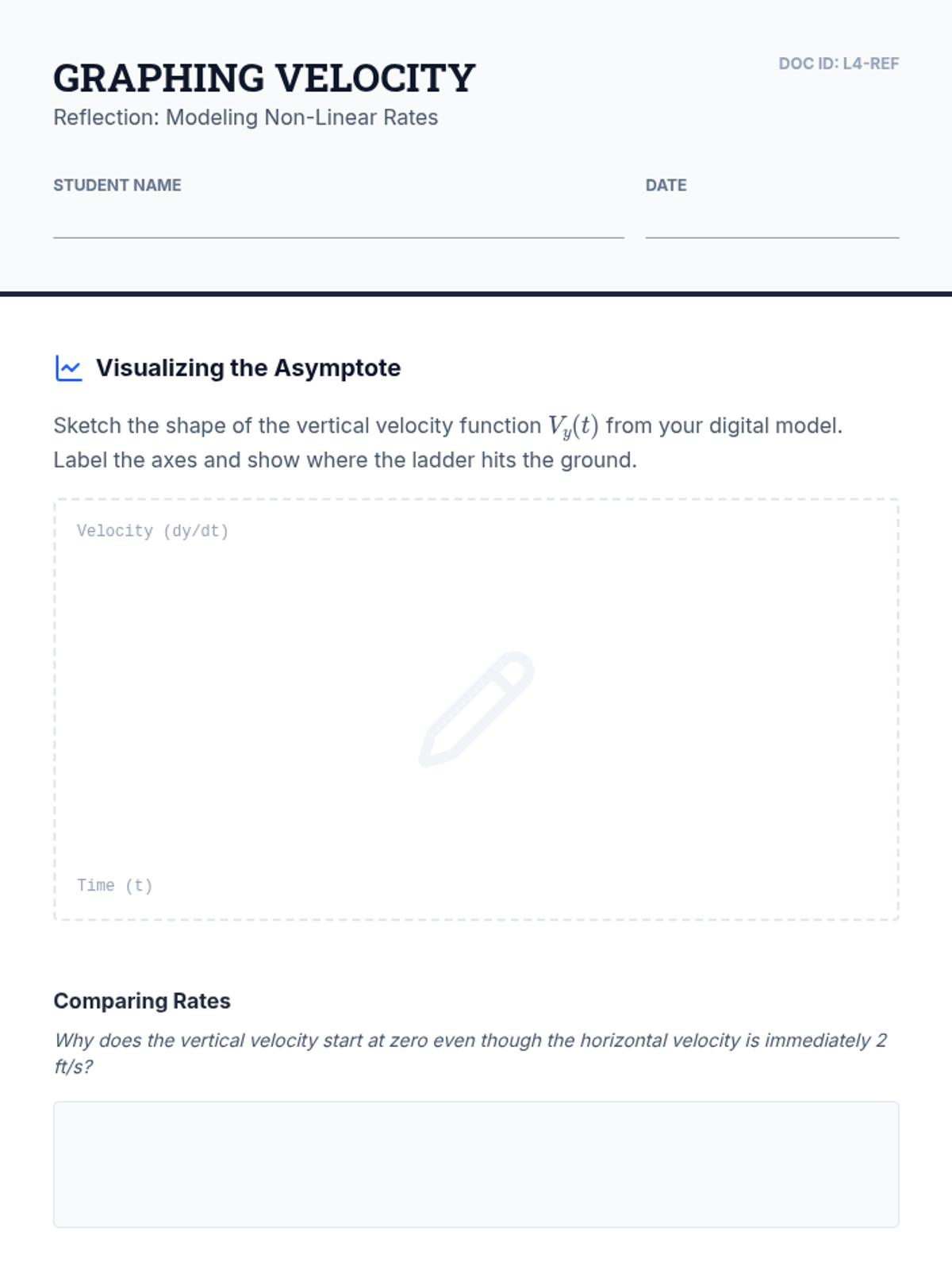
A reflection sheet for students to record their observations from the digital modeling lab, including a sketching area for the velocity-time graph and conceptual questions about rate behavior.
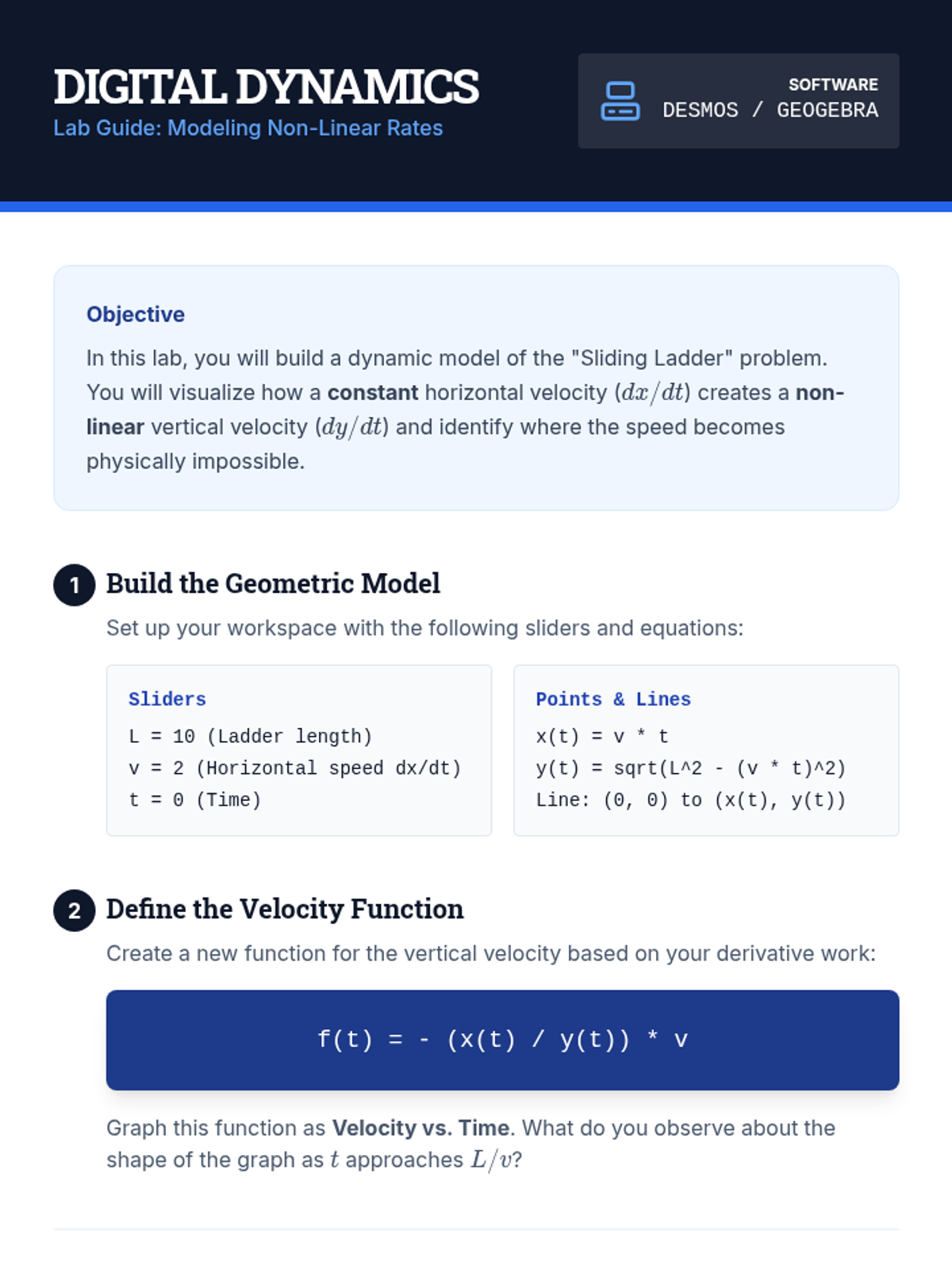
A guide for a digital project using Desmos/GeoGebra to model related rates. Students build a dynamic sliding ladder, graph the resulting vertical velocity function, and analyze the non-linear behavior and vertical asymptotes.