Syllogisms, deductive validity, and the principles of inductive probability for evaluating evidence-based claims. Targets common logical fallacies and the construction of sound, persuasive arguments.
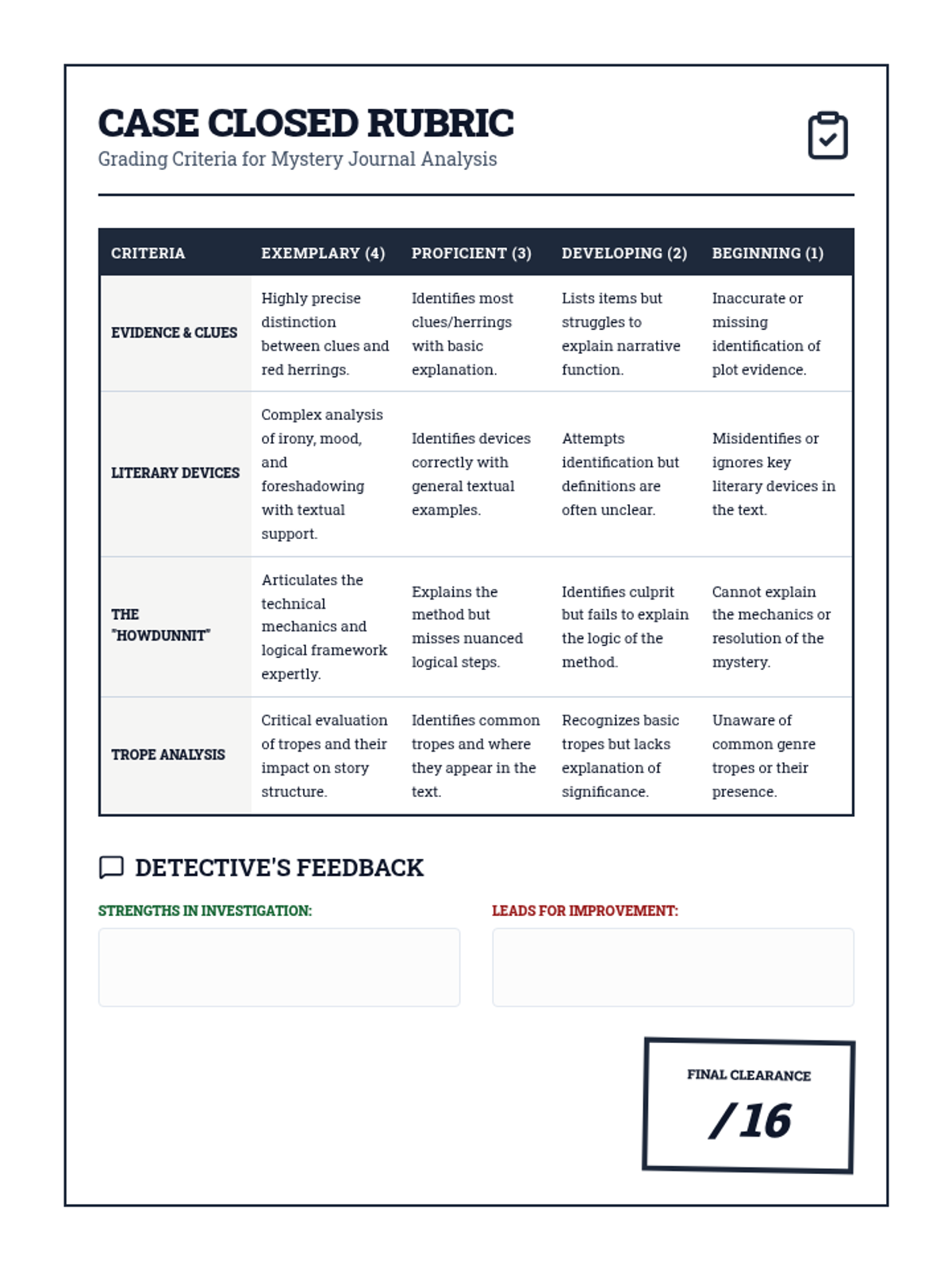
A grading rubric for teachers to evaluate student mystery journals, focusing on clue identification, analysis of literary devices, and understanding of mystery mechanics.
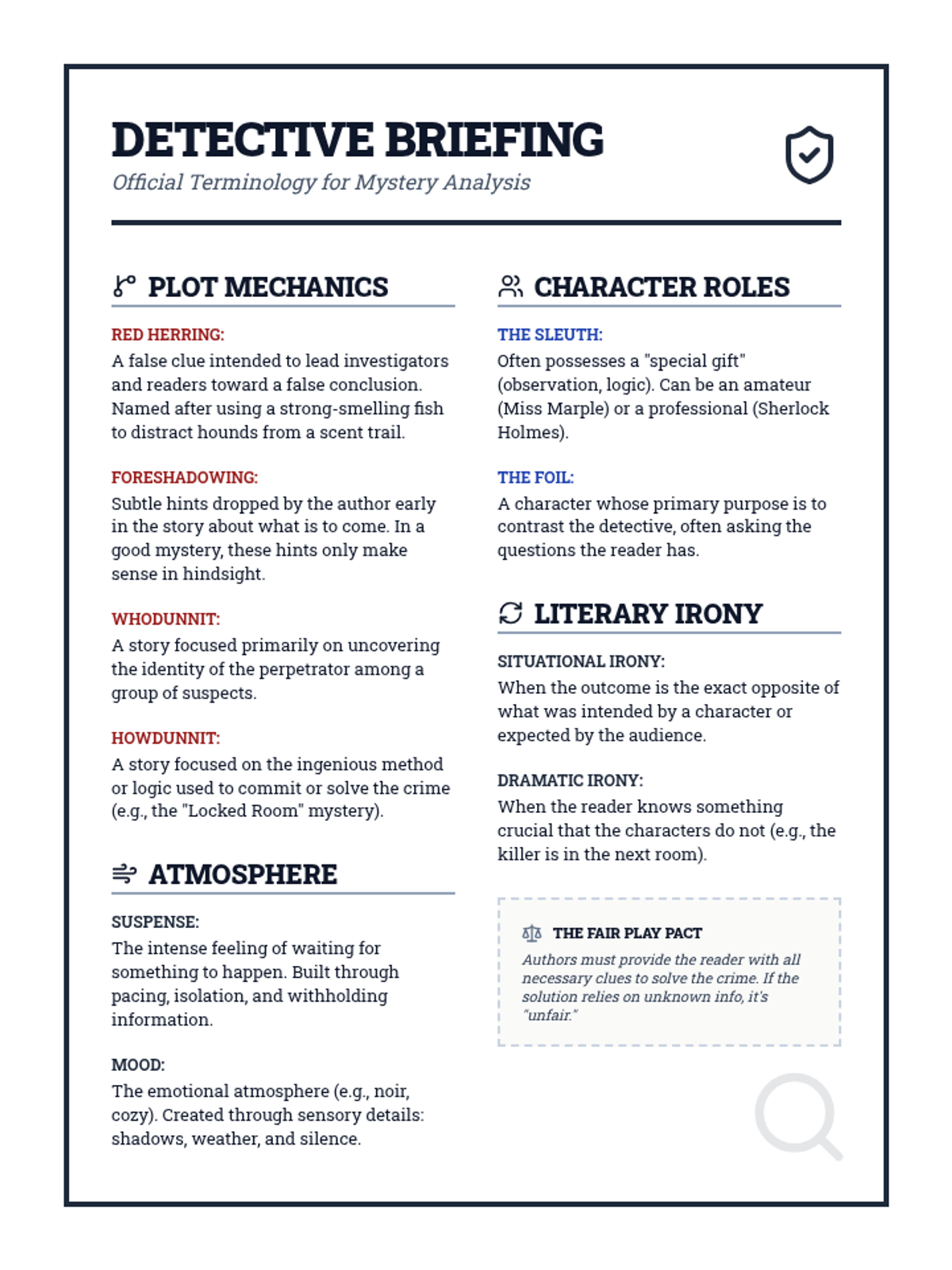
A reference sheet defining key mystery terminology, including red herrings, foreshadowing, tropes, and the differences between whodunnits and howdunnits for 8th-12th grade students.
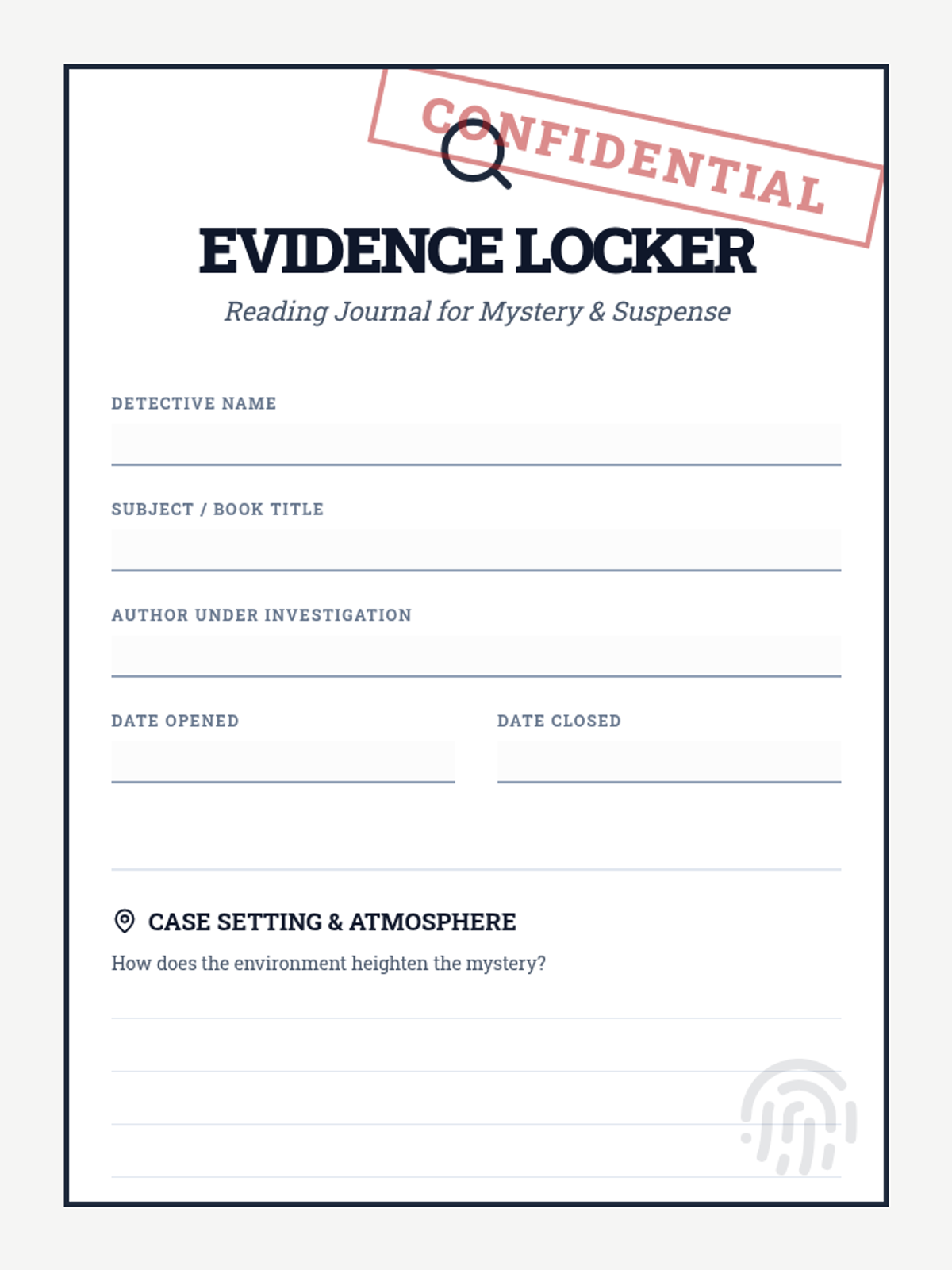
A five-page reading journal for older students (8th-12th grade) to track suspects, clues, red herrings, and complex narrative devices like irony and 'Howdunnit' mechanics in mystery novels.
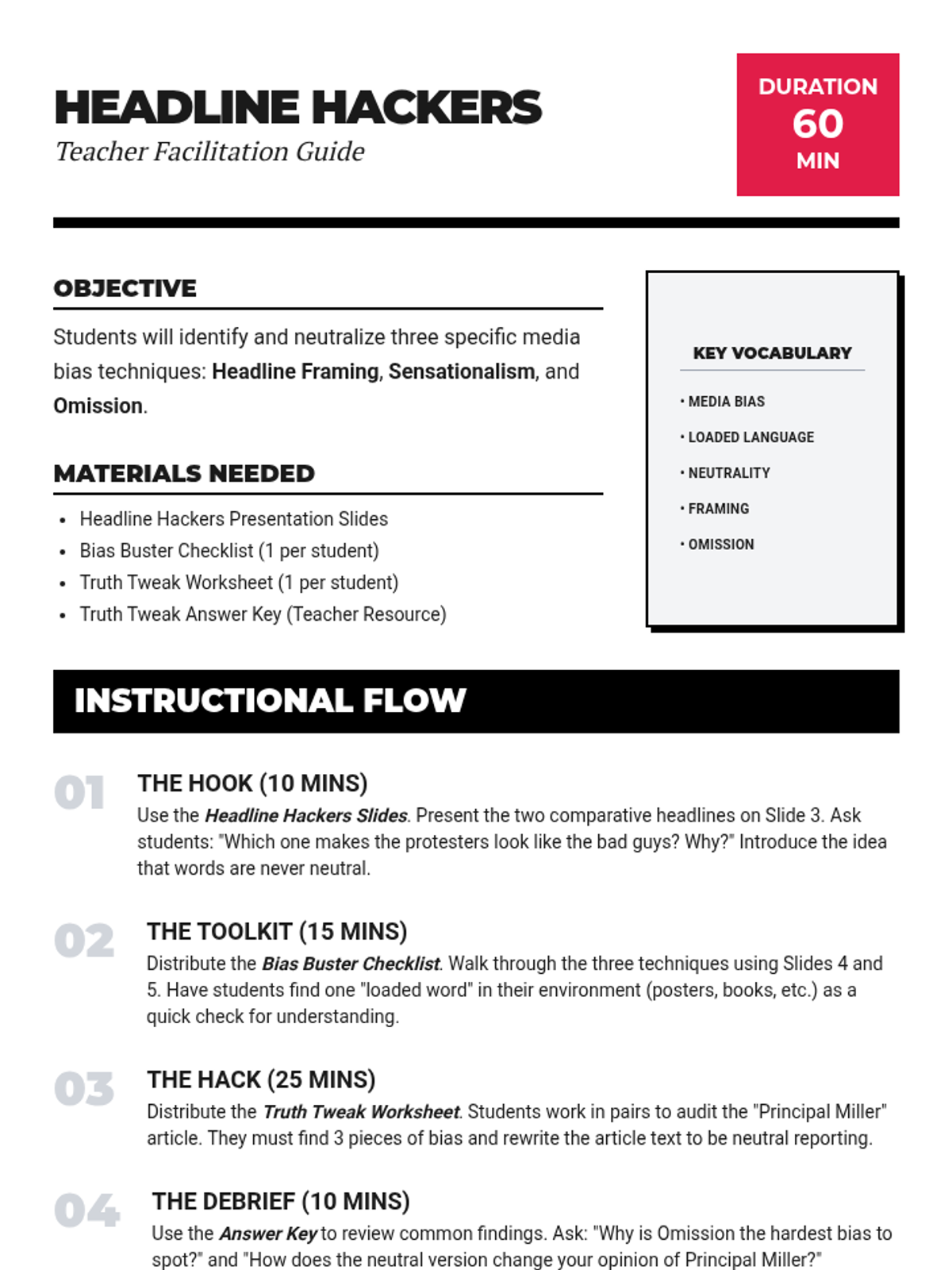
Teacher-facing facilitation guide for the Headline Hackers lesson, including learning objectives, a detailed procedure, and differentiation strategies.
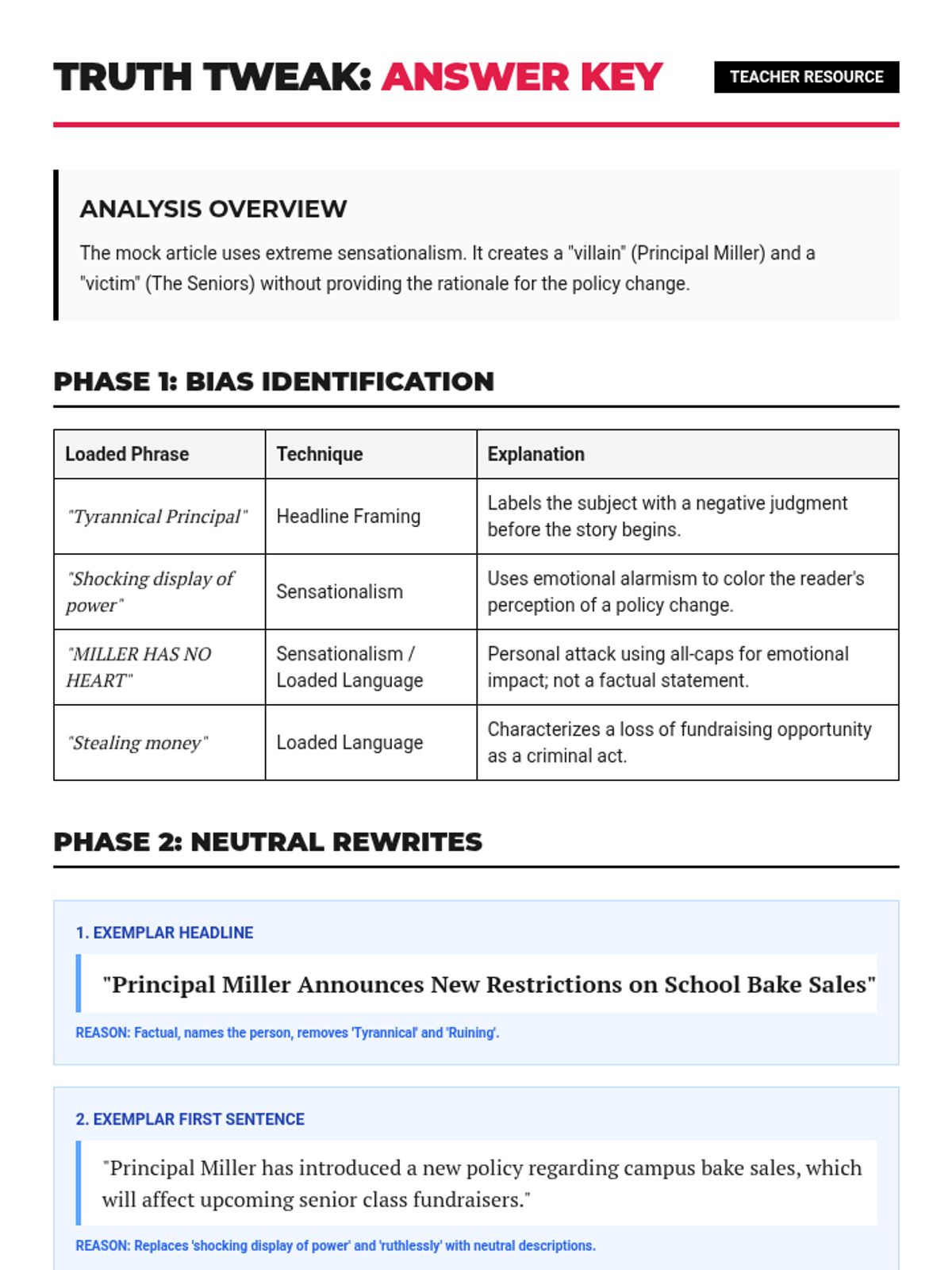
Teacher-facing answer key and exemplar for the Truth Tweak worksheet, featuring categorized bias examples and neutral rewrites of the mock article.
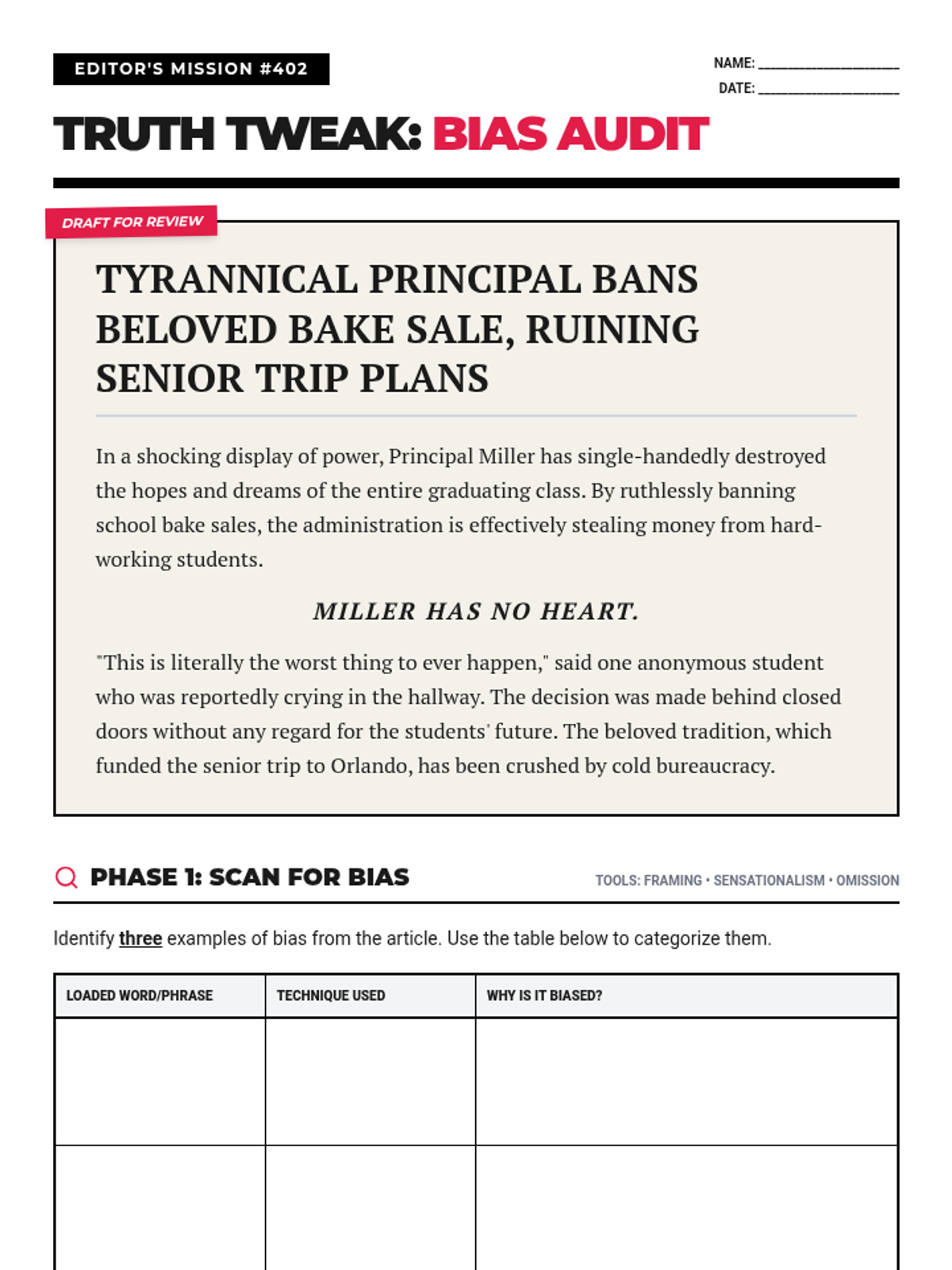
A mock news article editing task where students identify loaded language, sensationalism, and framing in a biased article about a school policy. Features a multi-phase "Truth Tweak" activity to practice neutral reporting.
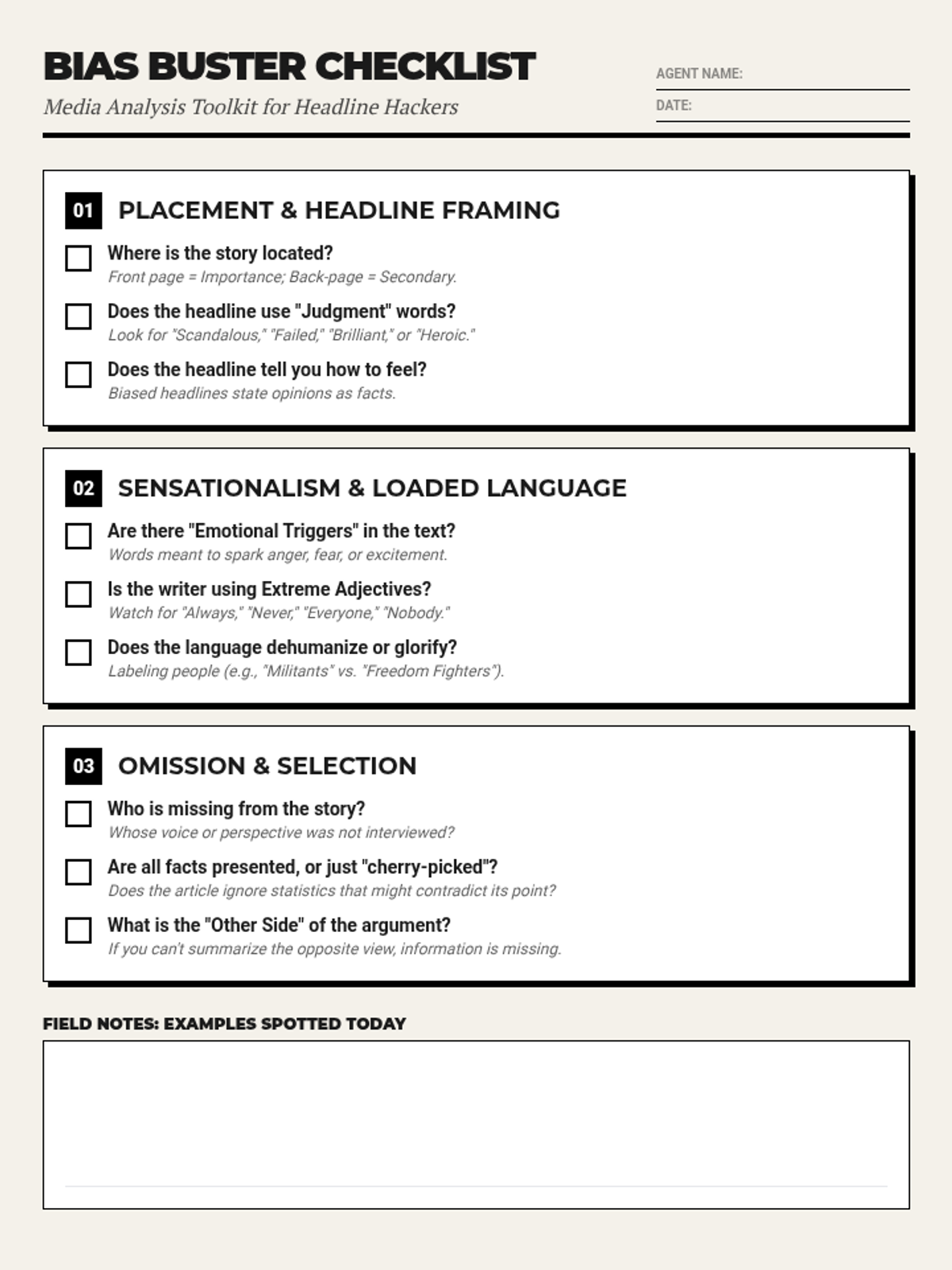
A student-facing reference tool featuring essential questions for identifying three types of media bias. Designed with an investigative "field guide" aesthetic for easy classroom use.
Visual presentation introducing the three core media bias techniques: placement/framing, sensationalism, and omission/selection. Features bold investigative aesthetics and comparative examples for students.
A vibrant slide deck for a 'Charade' film analysis, covering Hitchcockian tropes, gender agency, and the thematic use of fashion and deception, including a masterclass on thesis statement construction.
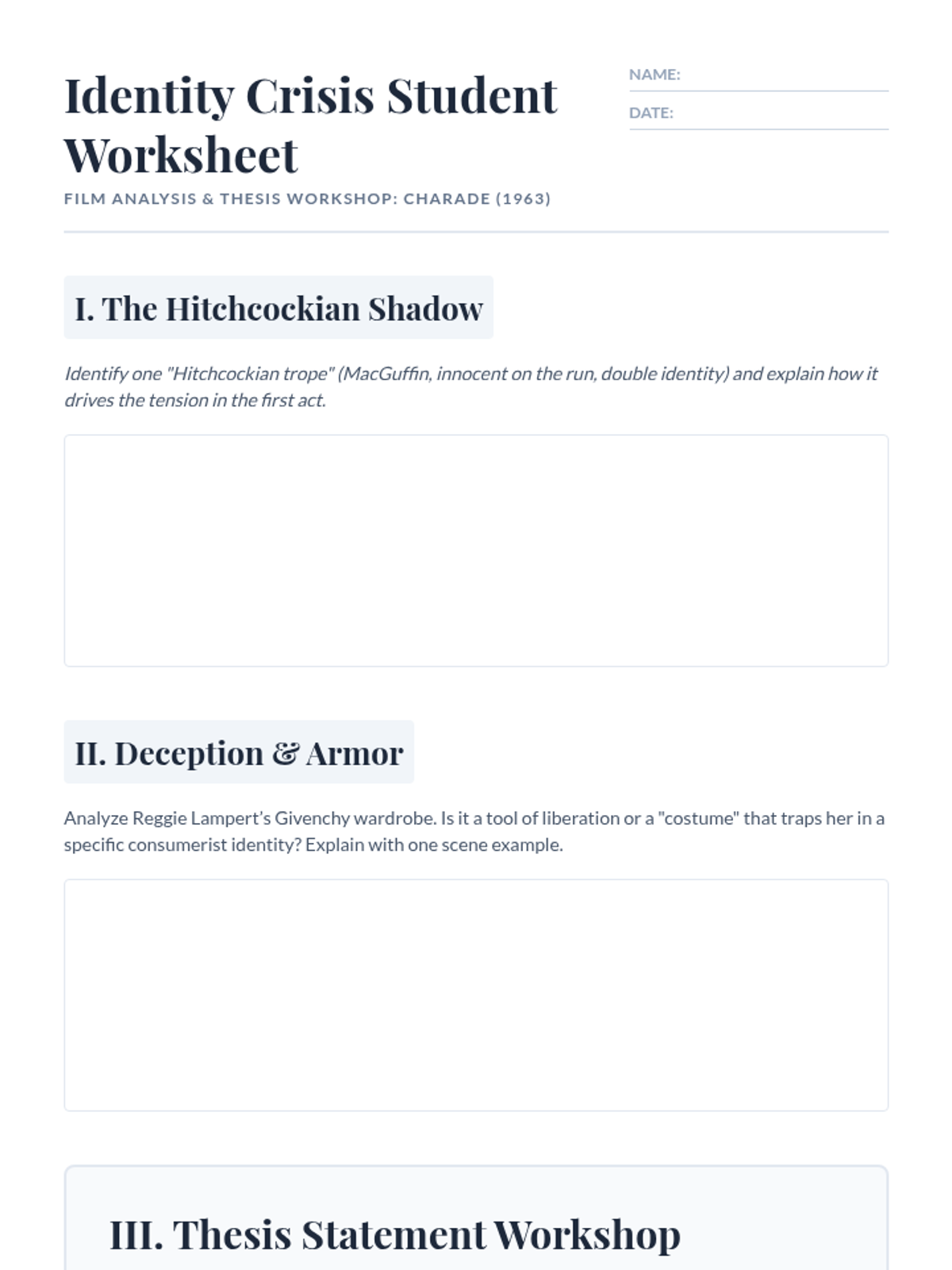
A student worksheet for analyzing 'Charade', including sections for Hitchcockian trope identification, fashion analysis, and a step-by-step thesis statement workshop.
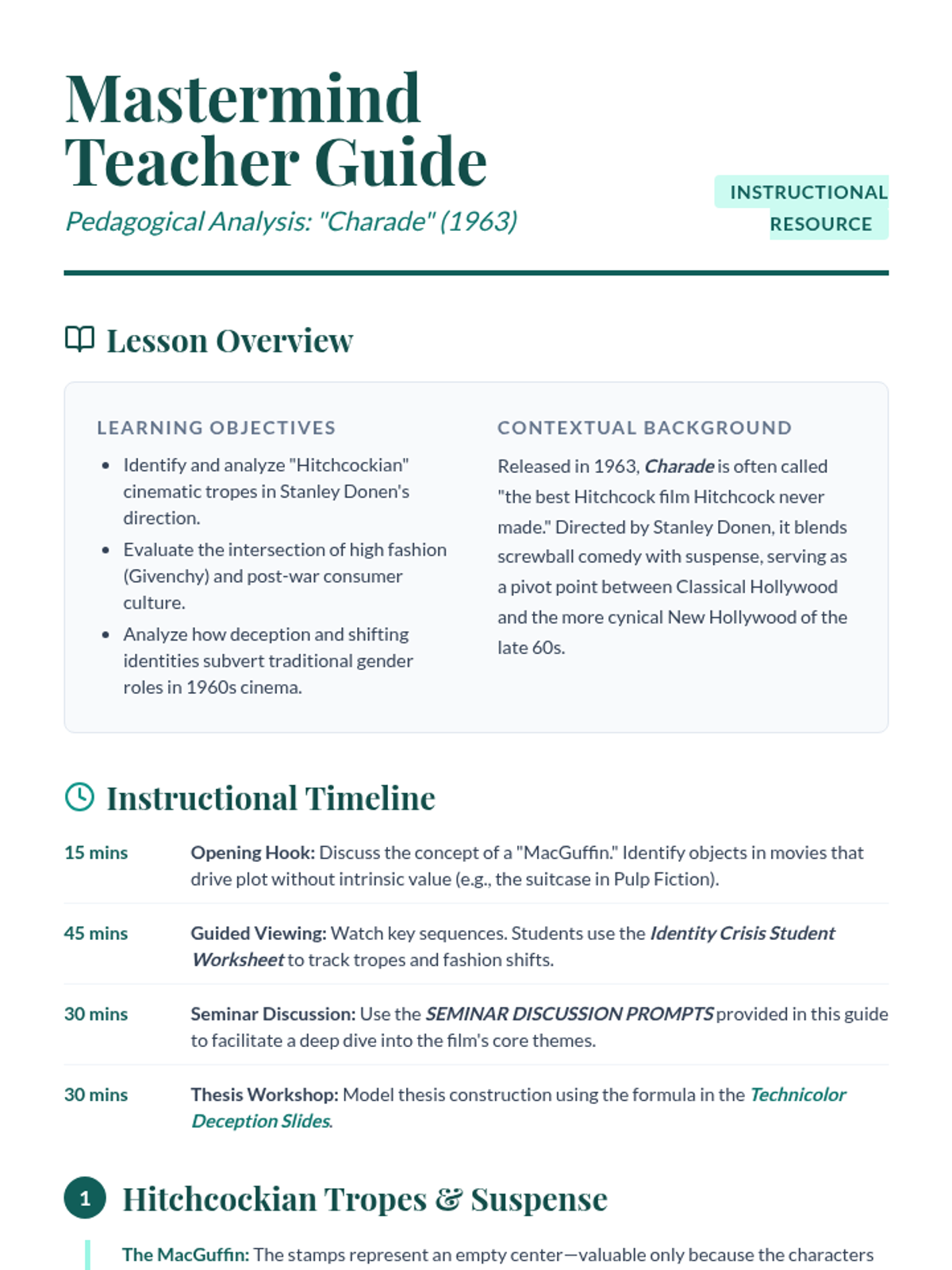
A comprehensive teacher's guide for analyzing the film 'Charade', featuring detailed breakdowns of Hitchcockian tropes, gender roles, and fashion-centric consumerism, complete with seminar discussion prompts.
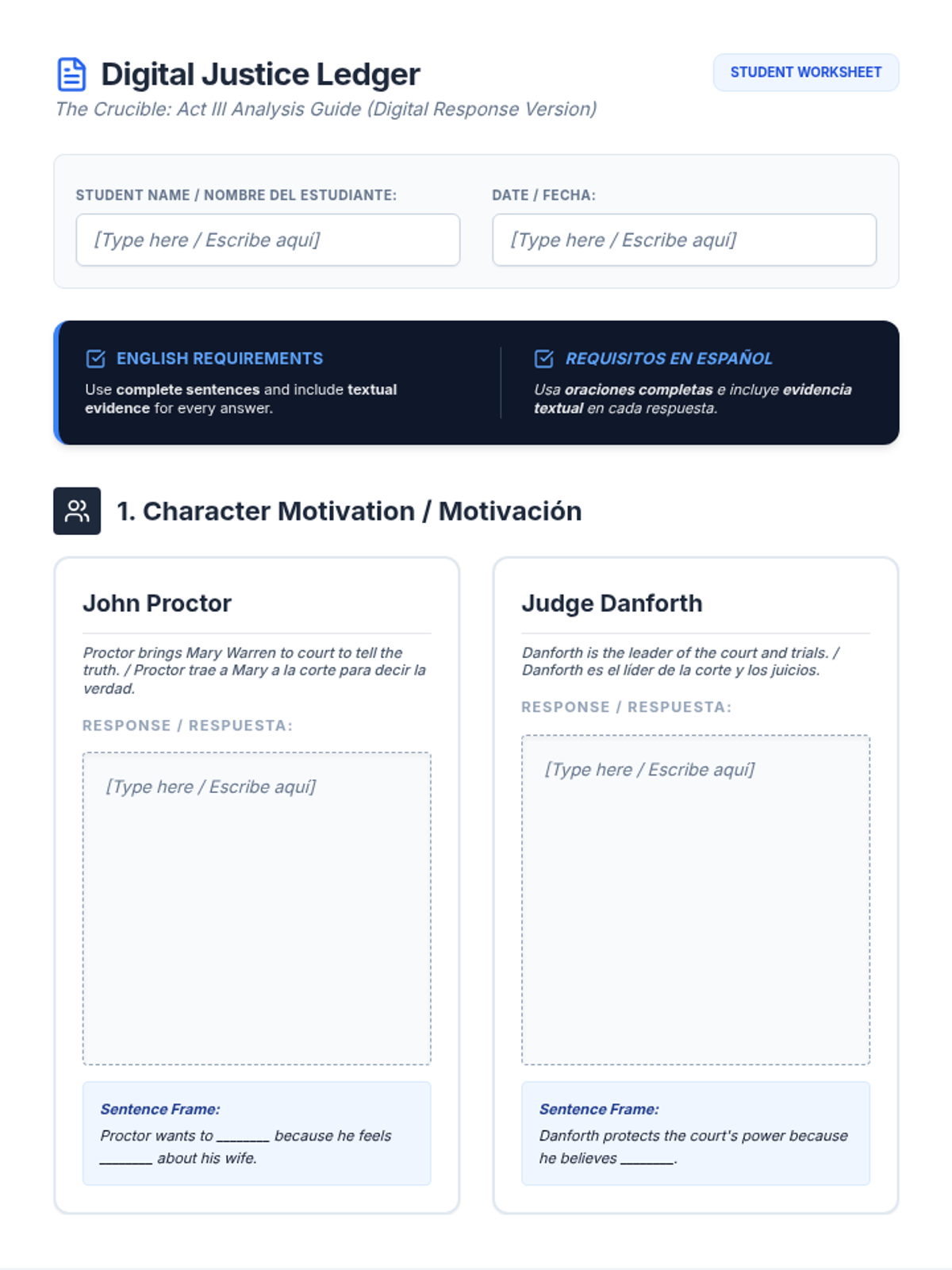
A digital version of the Justice Ledger worksheet designed for students to type their responses directly into clear work areas. Features bilingual support, sentence frames, and prominent instructions for evidence-based writing.
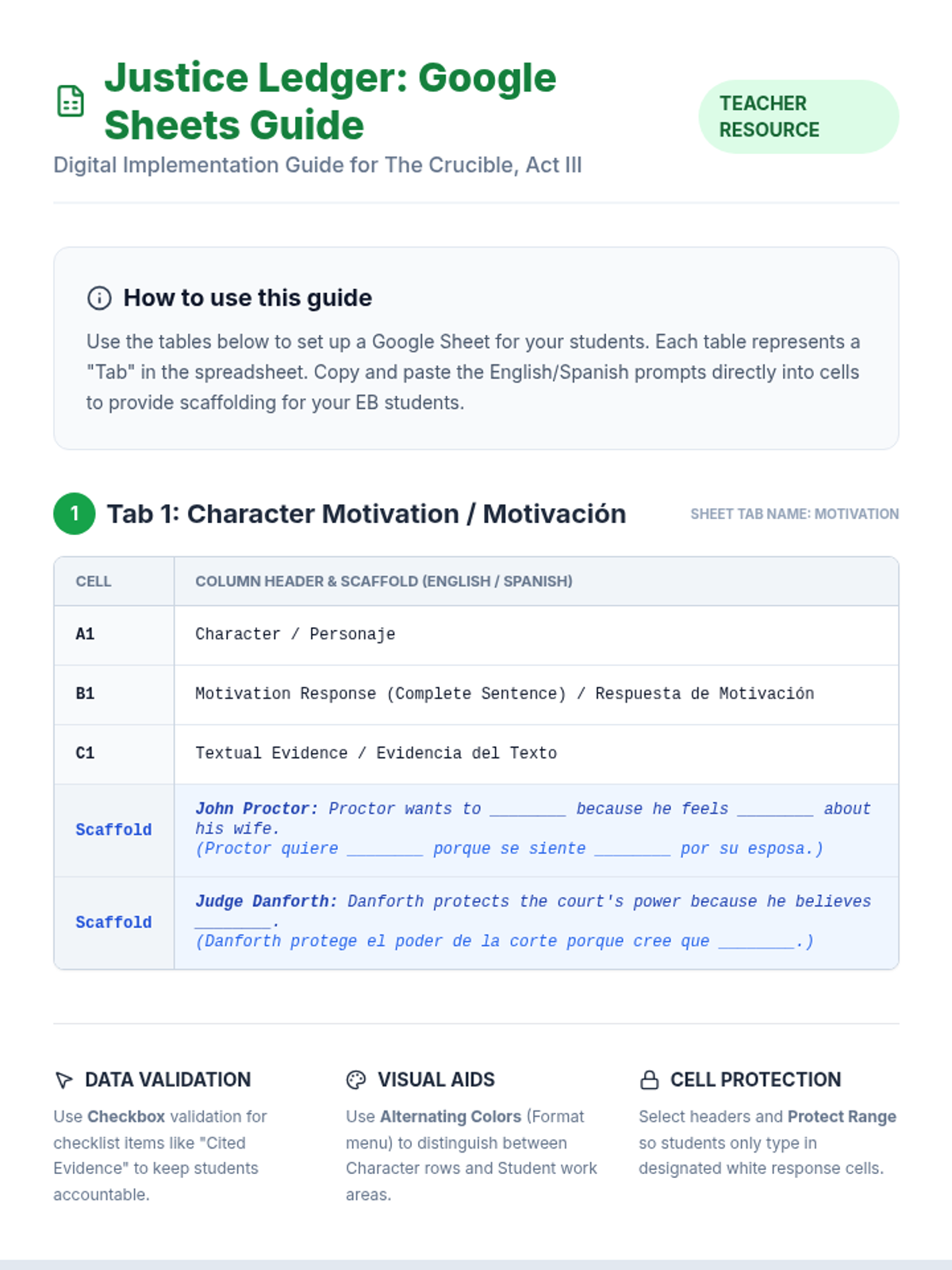
A teacher resource that provides a step-by-step layout for setting up a Google Sheet for student responses, including copy-pasteable bilingual prompts and frames.
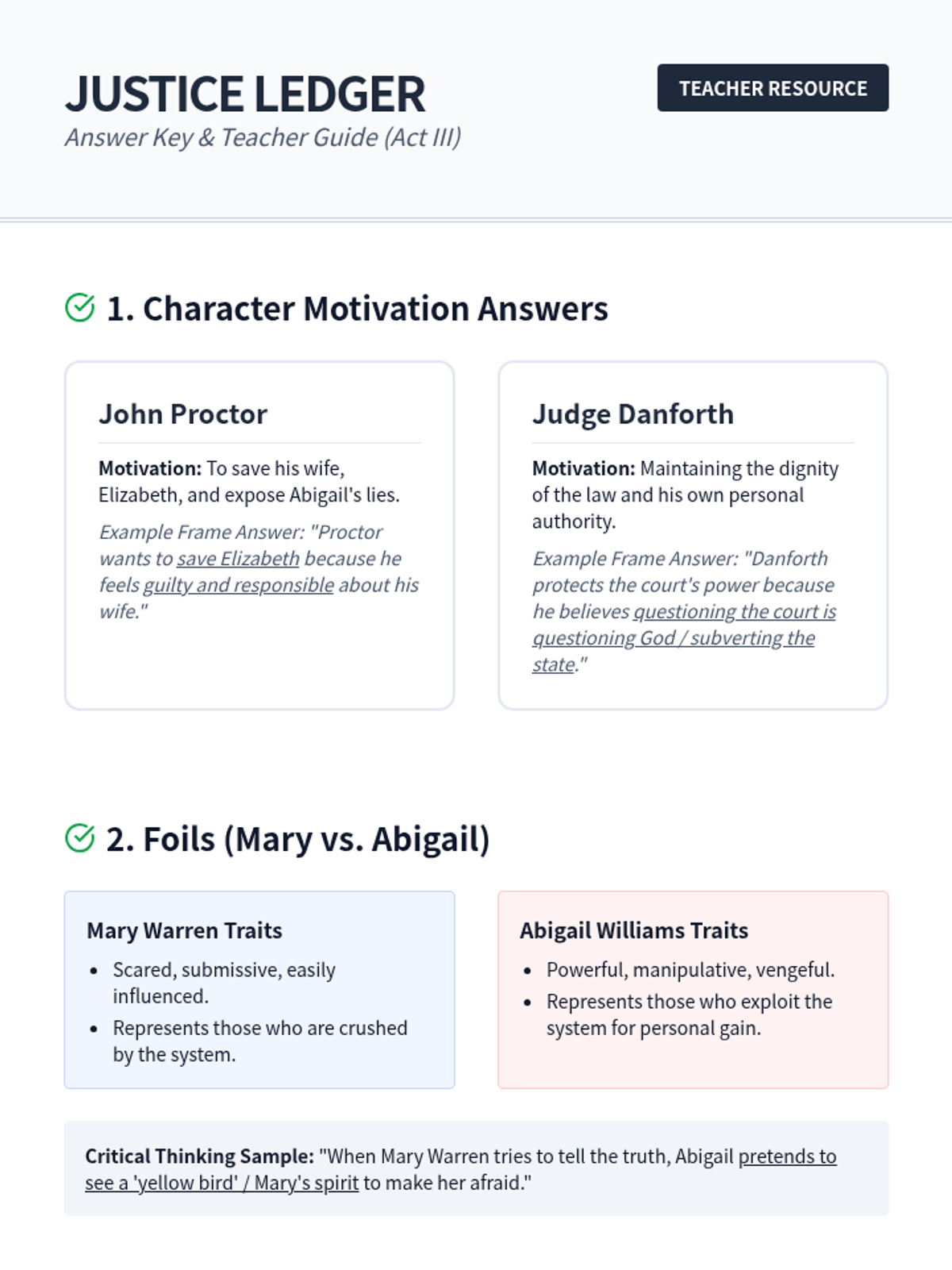
A comprehensive answer key and teacher guide for the Justice Ledger Worksheet, providing sample responses and instructional strategies for supporting English learners.
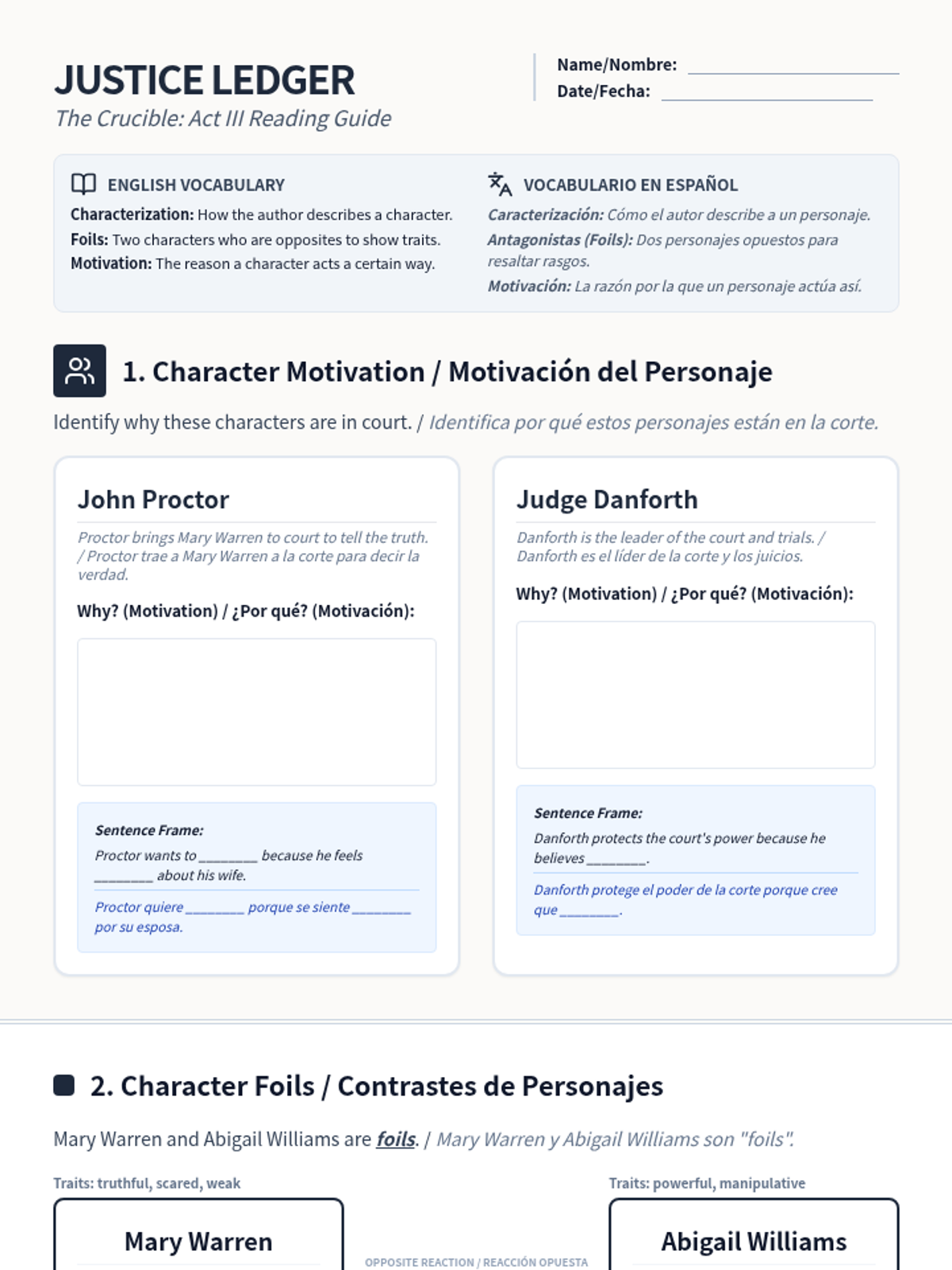
A bilingual English/Spanish reading guide for Act III of The Crucible, featuring graphic organizers, sentence frames, and visual support for characterization and tone analysis. Includes specific requirements for complete sentences and textual evidence.
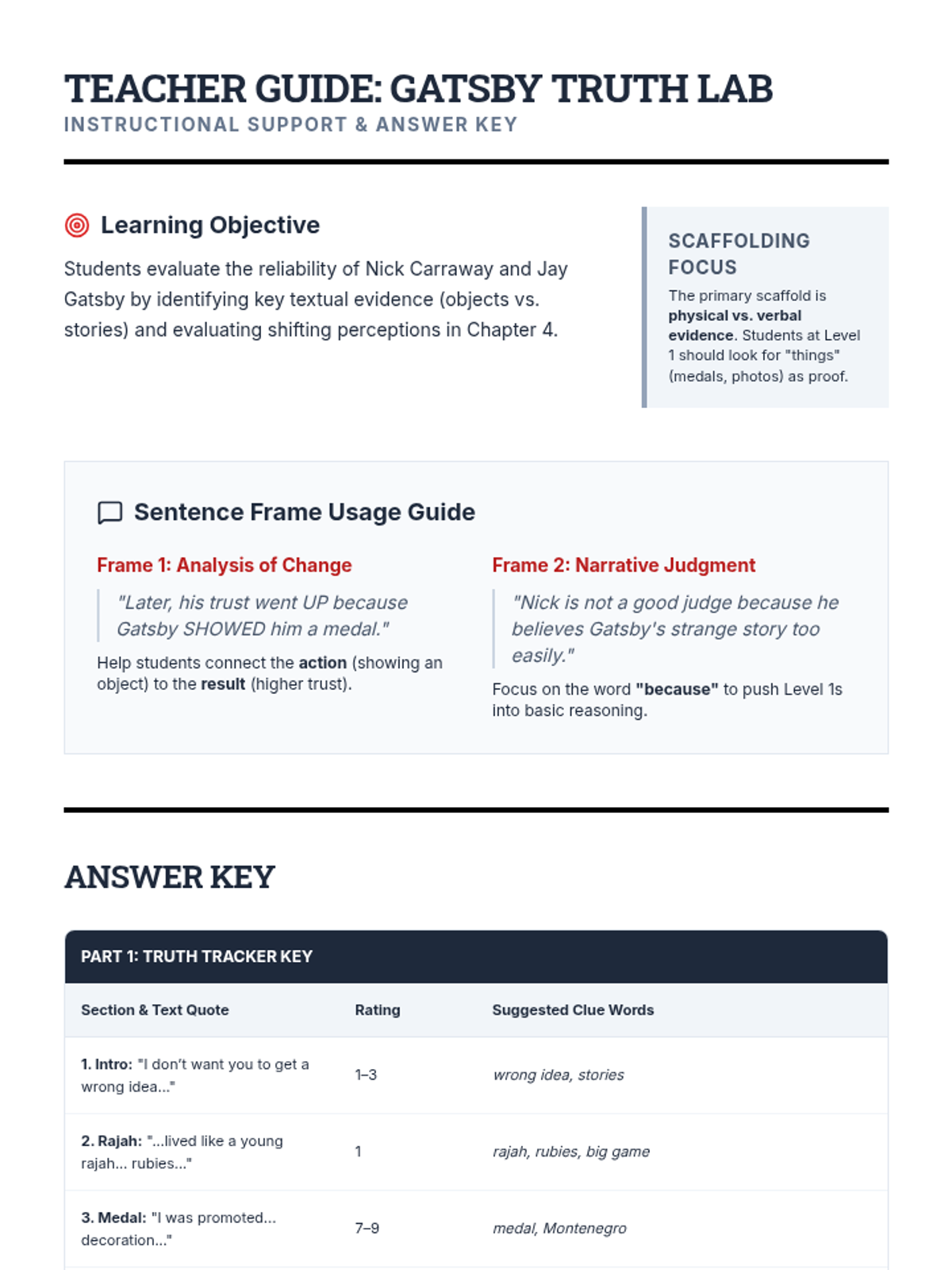
A teacher facilitation guide and answer key for the Gatsby Truth Tracker lesson. Includes ELL Level 1 specific strategies, suggested trust ratings for the worksheet sections, and a dedicated sentence frame guide. Updated to include answer key for new question.
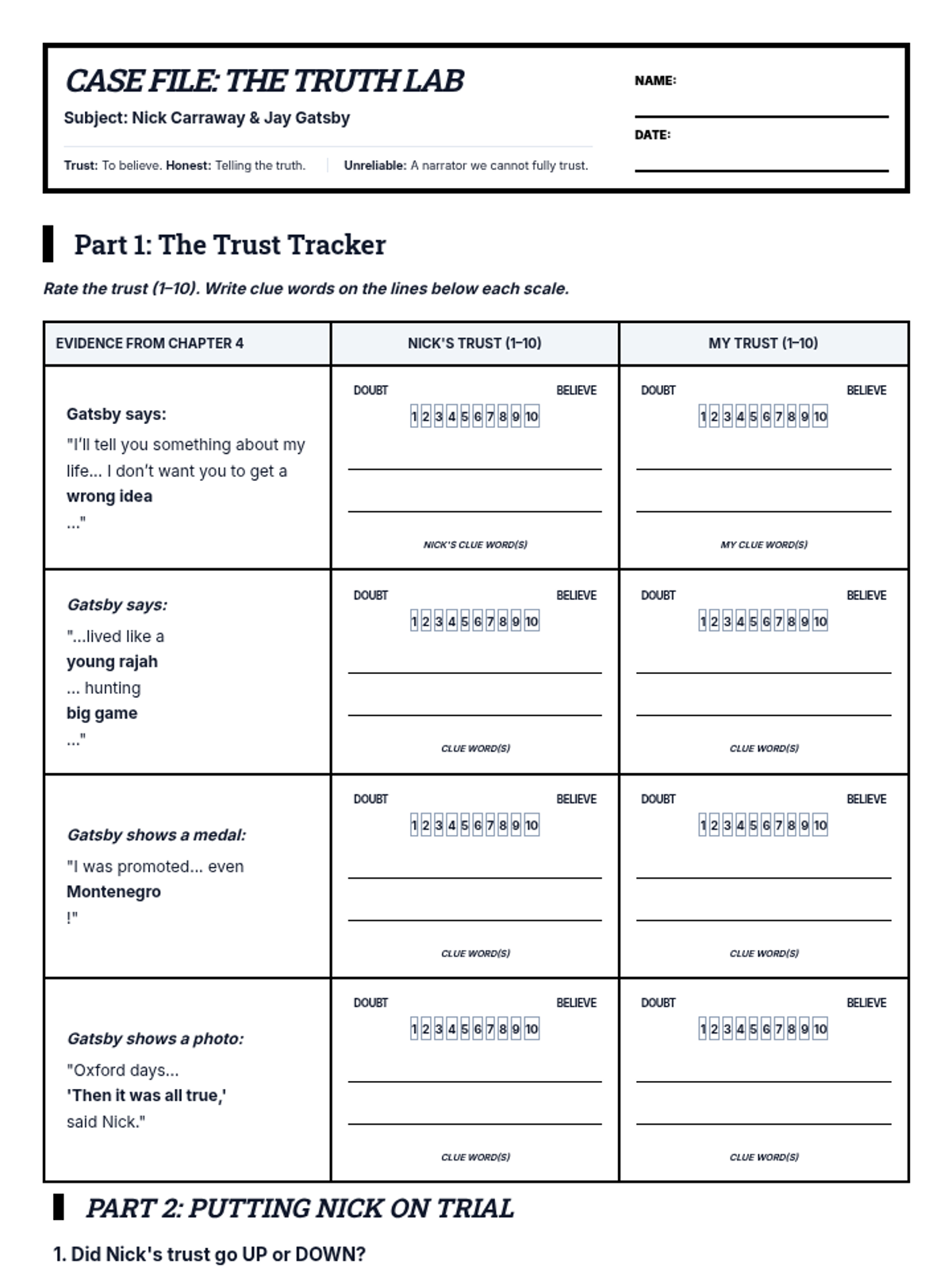
A 2-page graphic organizer worksheet for ELL Level 1 students to analyze the trustworthiness of Nick and Gatsby in The Great Gatsby Chapter 4. The Part 1 Trust Tracker rows have been expanded vertically to fill the first page and provide significant writing space for clue words. Labels for 'Doubt/Believe' and 'Clue word(s)' are repeated in every row for consistent ELL support. Layout tightened to fix page overflow.
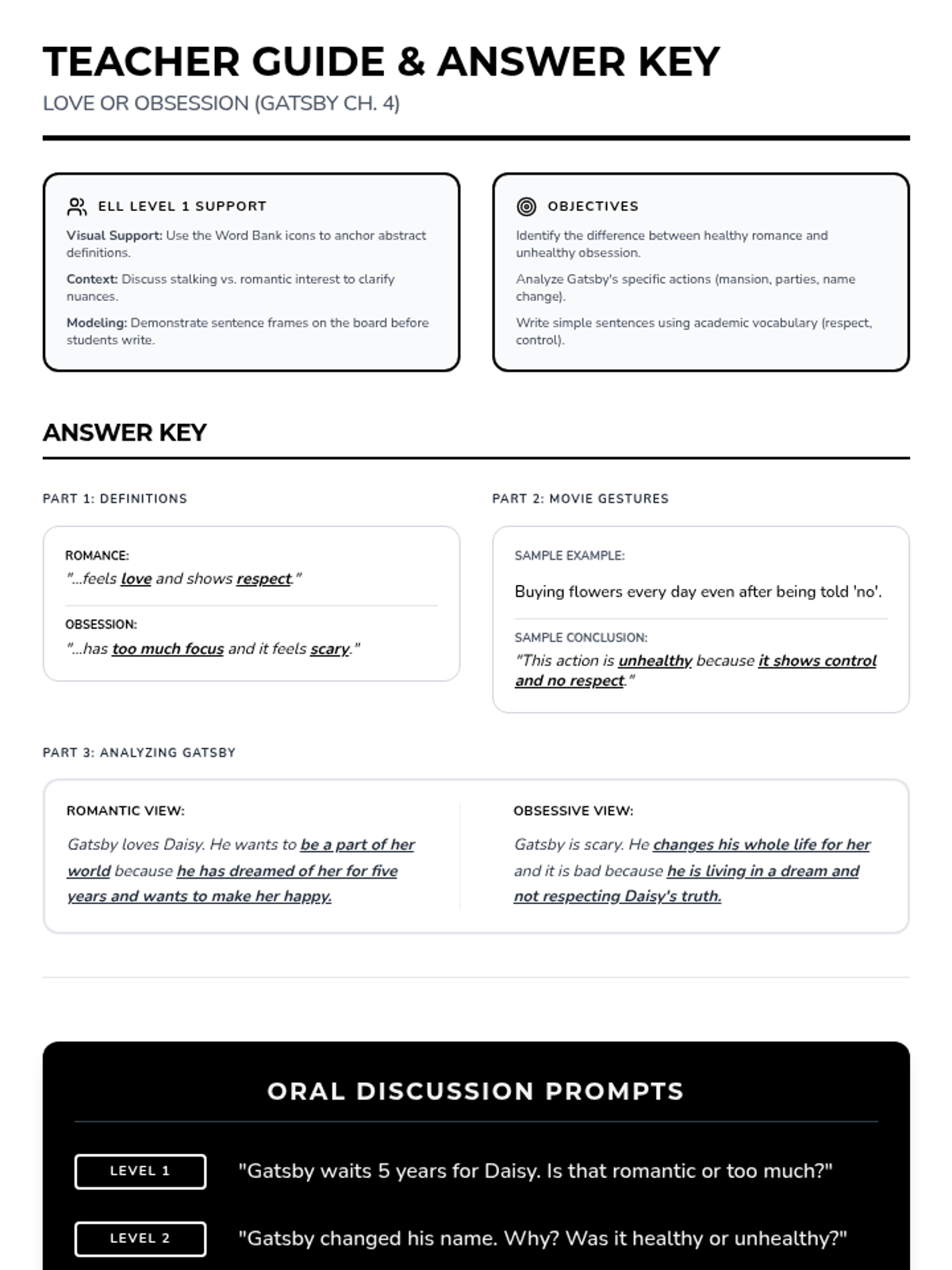
A teacher's guide and answer key for the Gatsby Romance vs. Obsession lesson. Includes instructional strategies for ELL Level 1, sample answers for sentence frames, and oral discussion prompts categorized by proficiency level. Revised for print efficiency and high contrast.
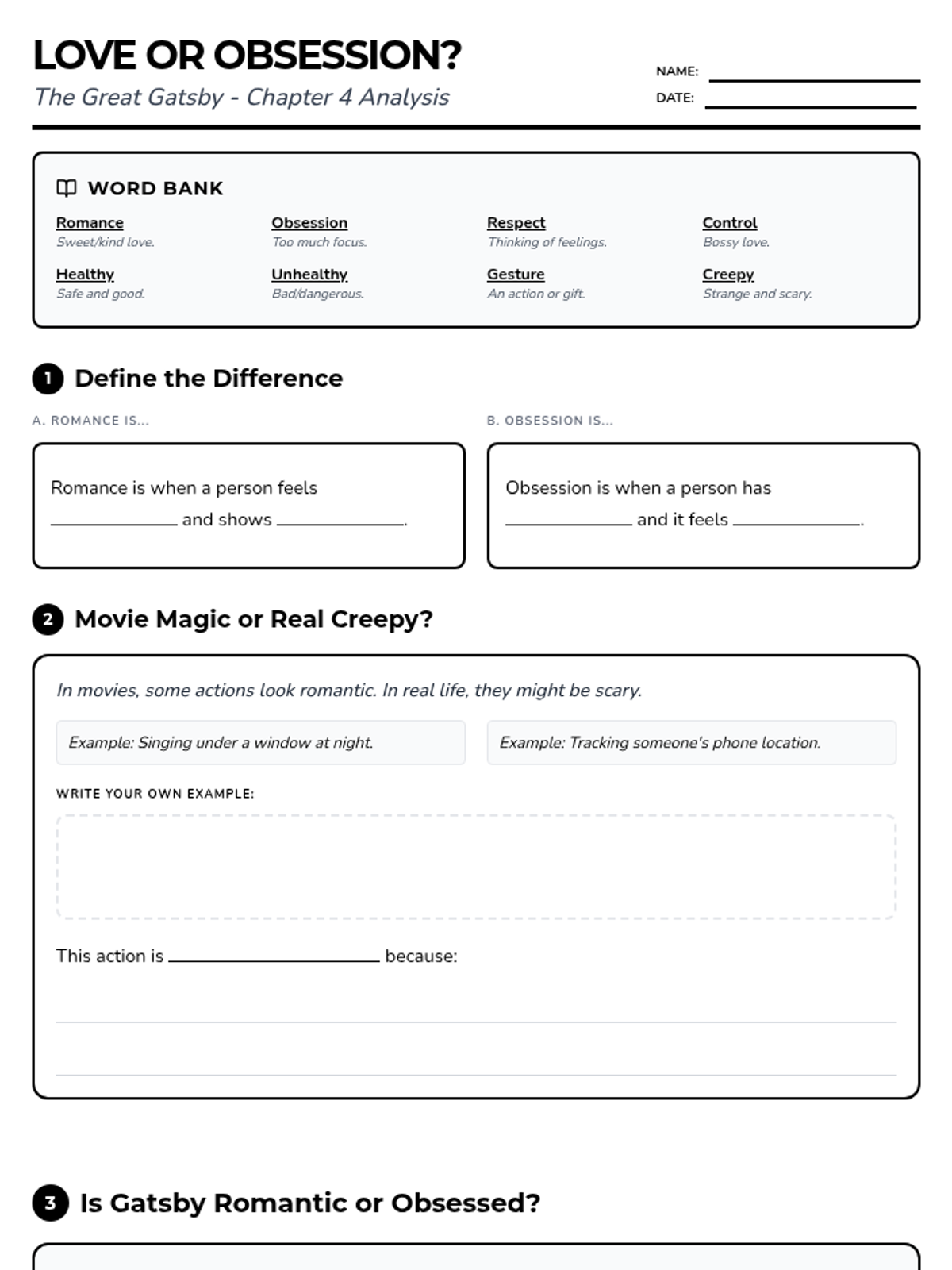
A black and white, print-friendly graphic organizer for Chapter 4 of The Great Gatsby. It includes expanded evidence about Gatsby's actions, scaffolded sentence frames for ELL Level 1 students, and a clean layout to distinguish between romance and obsession. Revised for high contrast and proper page flow.
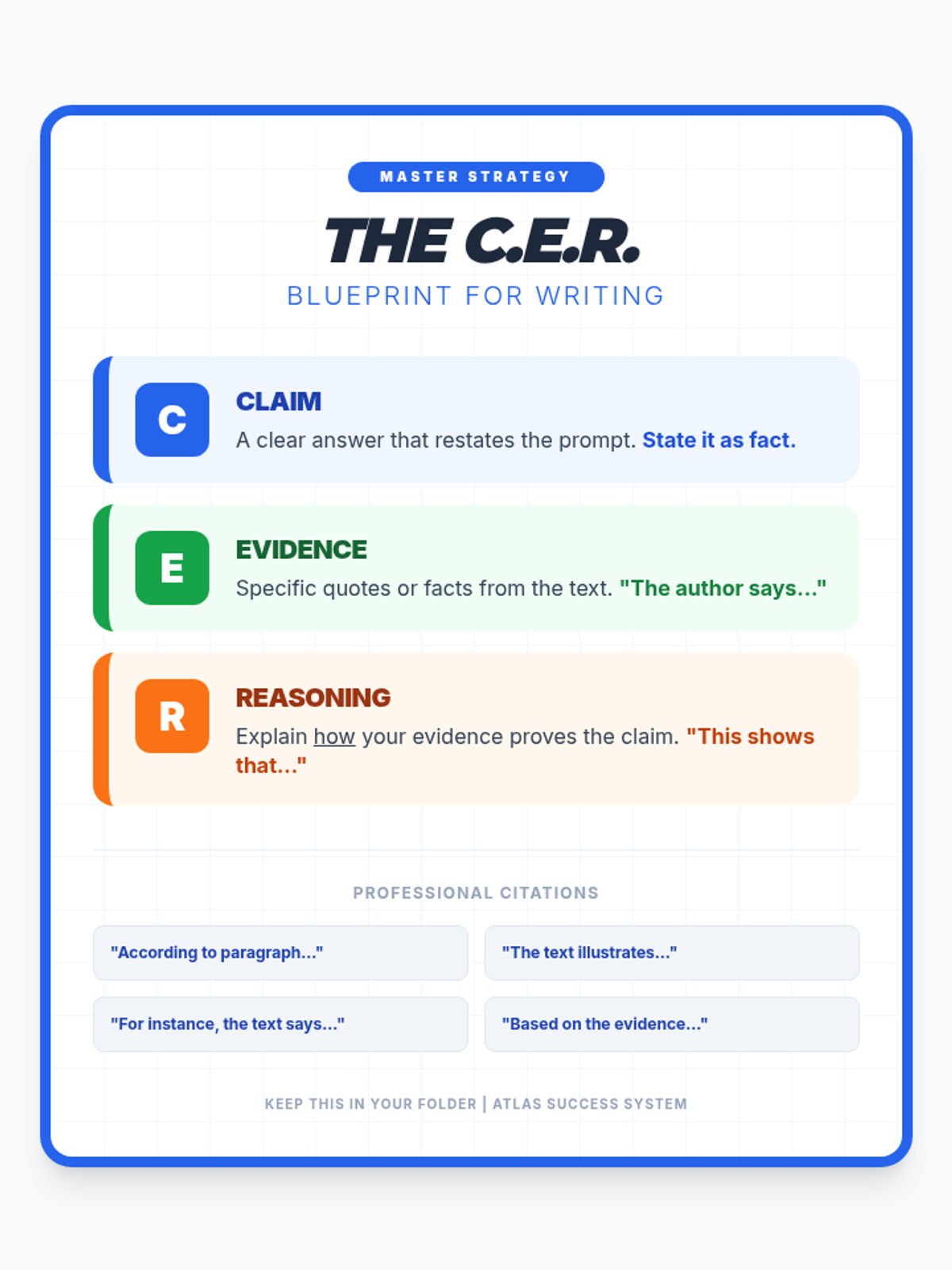
A high-impact anchor chart / reference card designed for student folders, providing a quick visual guide to the CER framework and citation starters. Revised with high-contrast, ink-friendly colors.
An introductory slide deck for the Evidence Detectives lesson, defining Claim, Evidence, and Reasoning with examples and a collaborative case study.
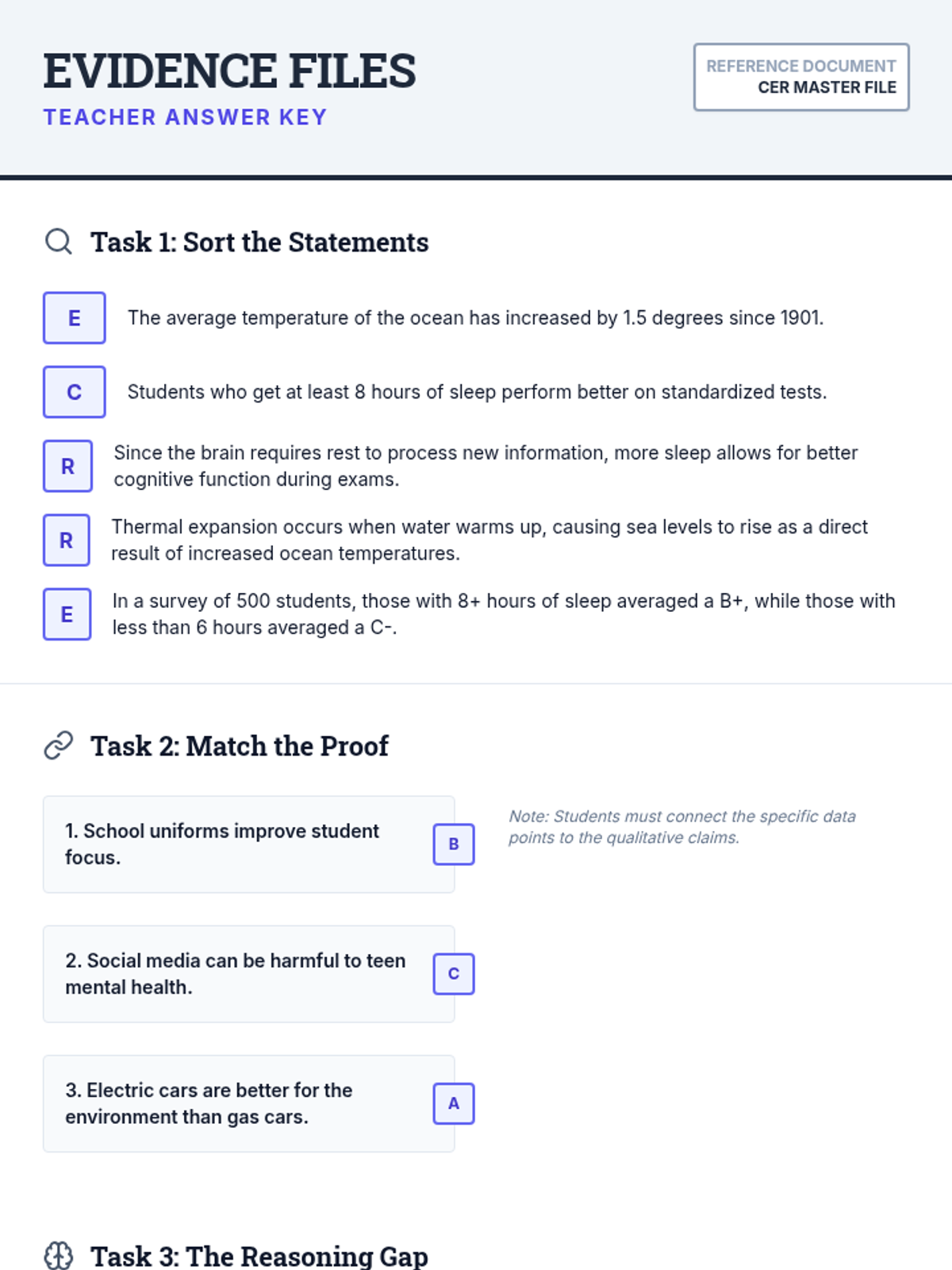
A teacher answer key for the Evidence Files Worksheet, providing sample responses and correctly identified CER components.
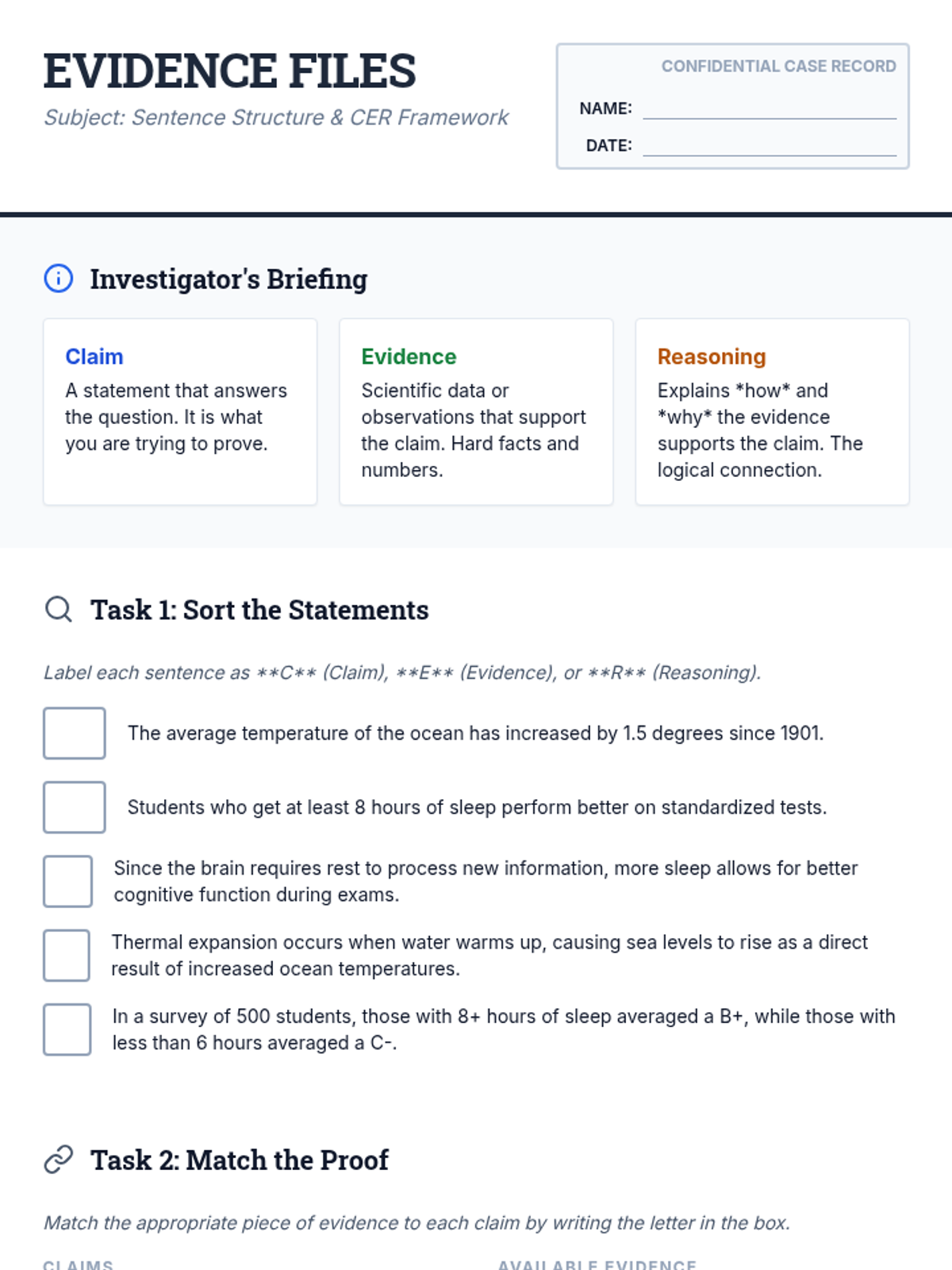
A comprehensive worksheet focusing on the Claim, Evidence, and Reasoning (CER) framework, featuring identification tasks, matching exercises, and creative writing prompts using an investigative theme.
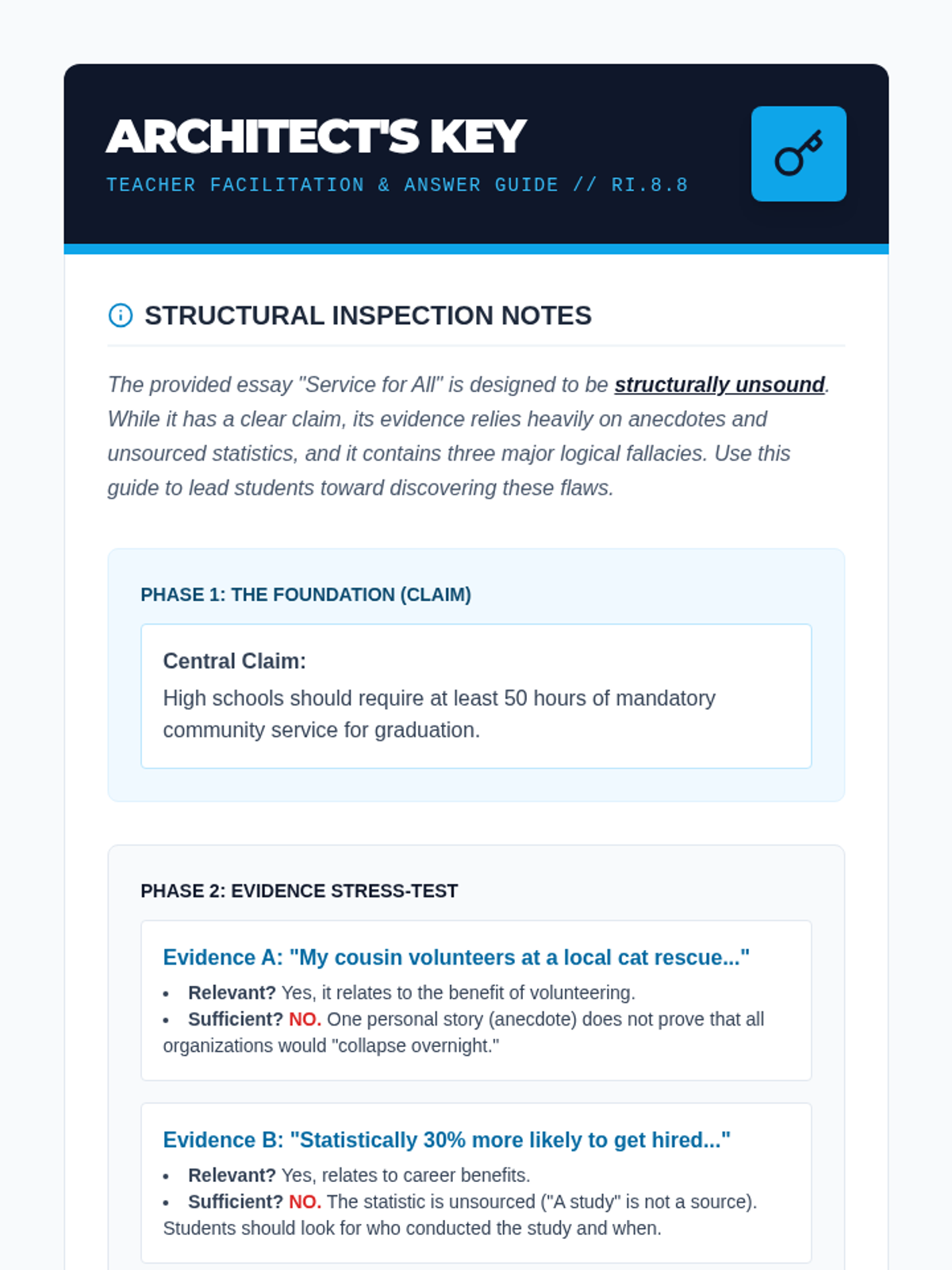
A teacher answer key and facilitation guide for the "Blueprint for Belief" worksheet, identifying central claims, assessing evidence quality, and explaining the specific logical fallacies planted in the student text.
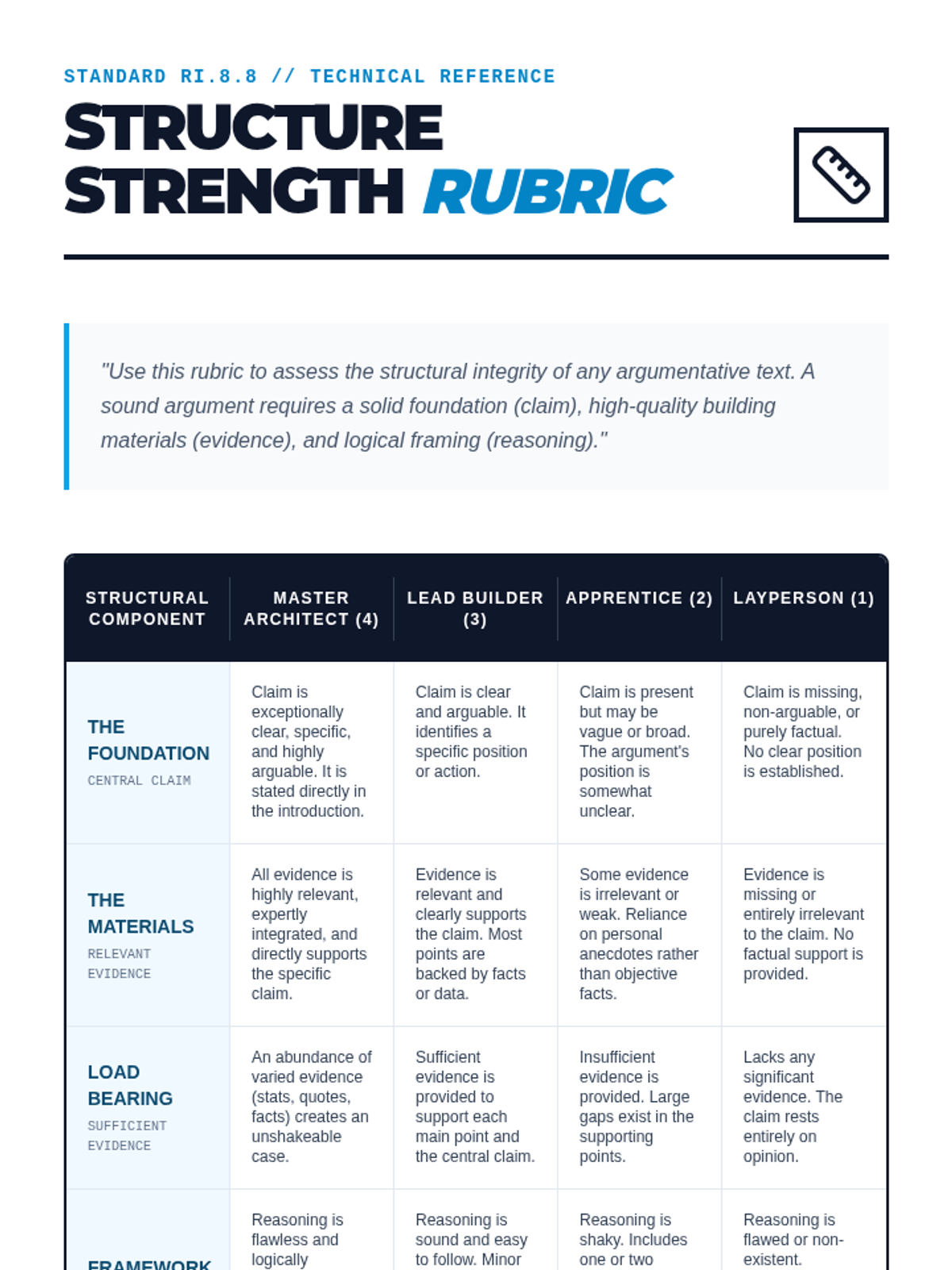
A comprehensive evaluation rubric for argumentative texts, designed with an architectural theme. Covers claim clarity, evidence relevance, sufficiency, logical reasoning, and counterargument strength.
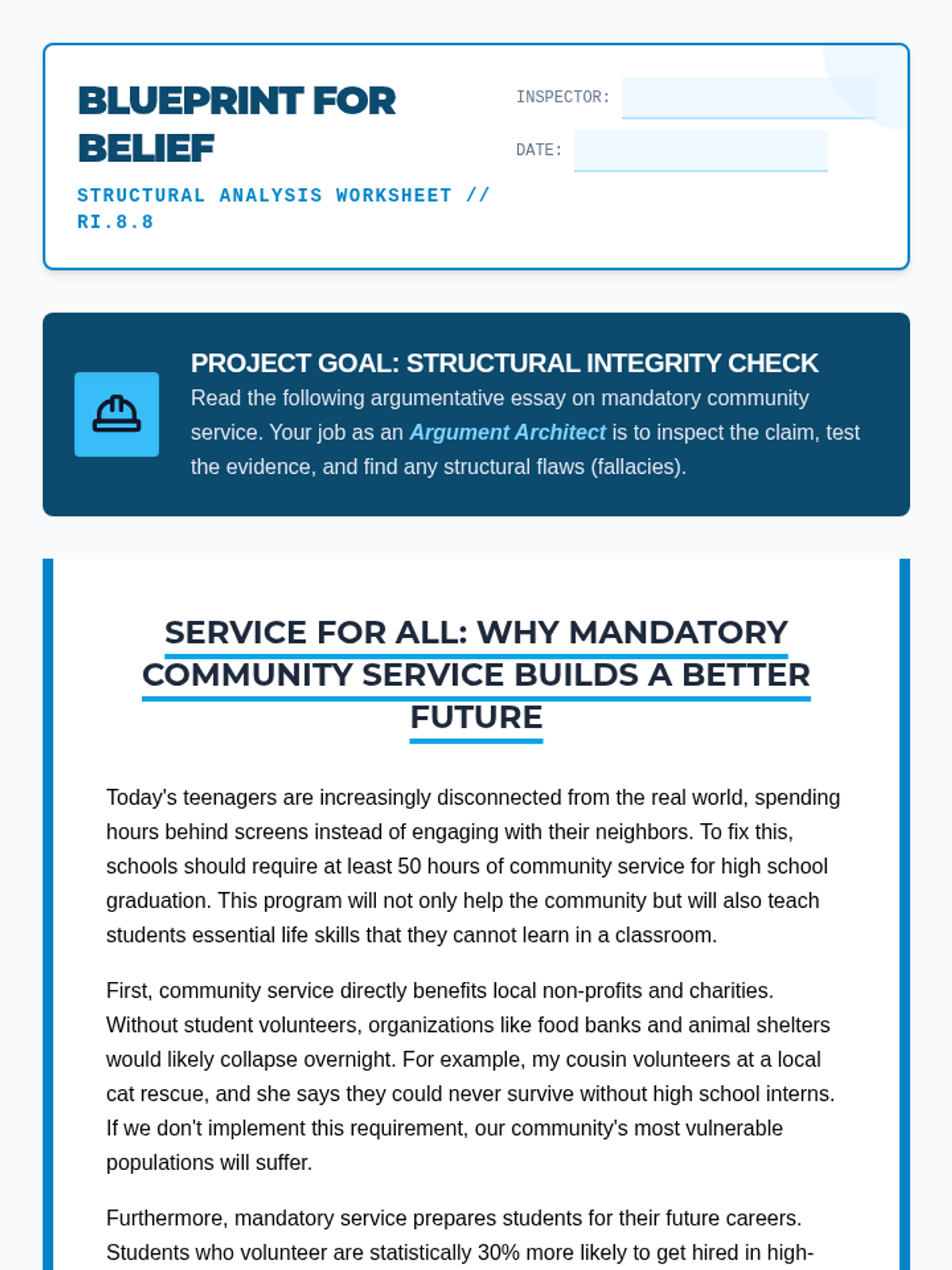
A student analysis worksheet containing an argumentative essay about mandatory community service with structured analysis tasks for claim identification, evidence evaluation, and logical fallacy detection.
A high-impact slide deck for teaching RI.8.8, focusing on argument evaluation through an architectural blueprint theme. Includes sections on claim strength, evidence assessment (Relevant/Sufficient), and logical fallacies.
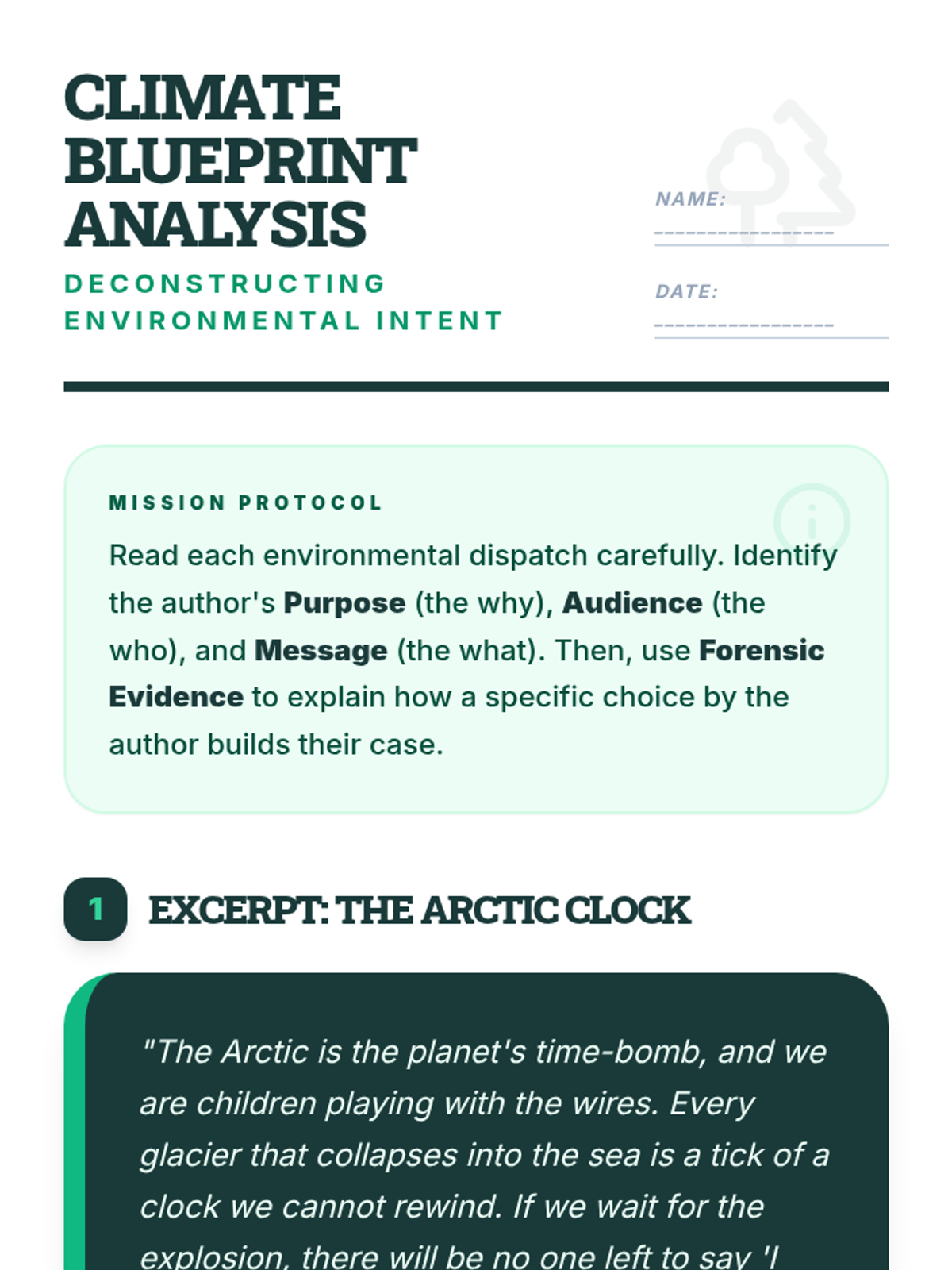
A climate-themed practice worksheet for analyzing author's purpose, audience, and message in short environmental excerpts. Features expanded work areas for handwriting and a clear checklist for self-assessment.
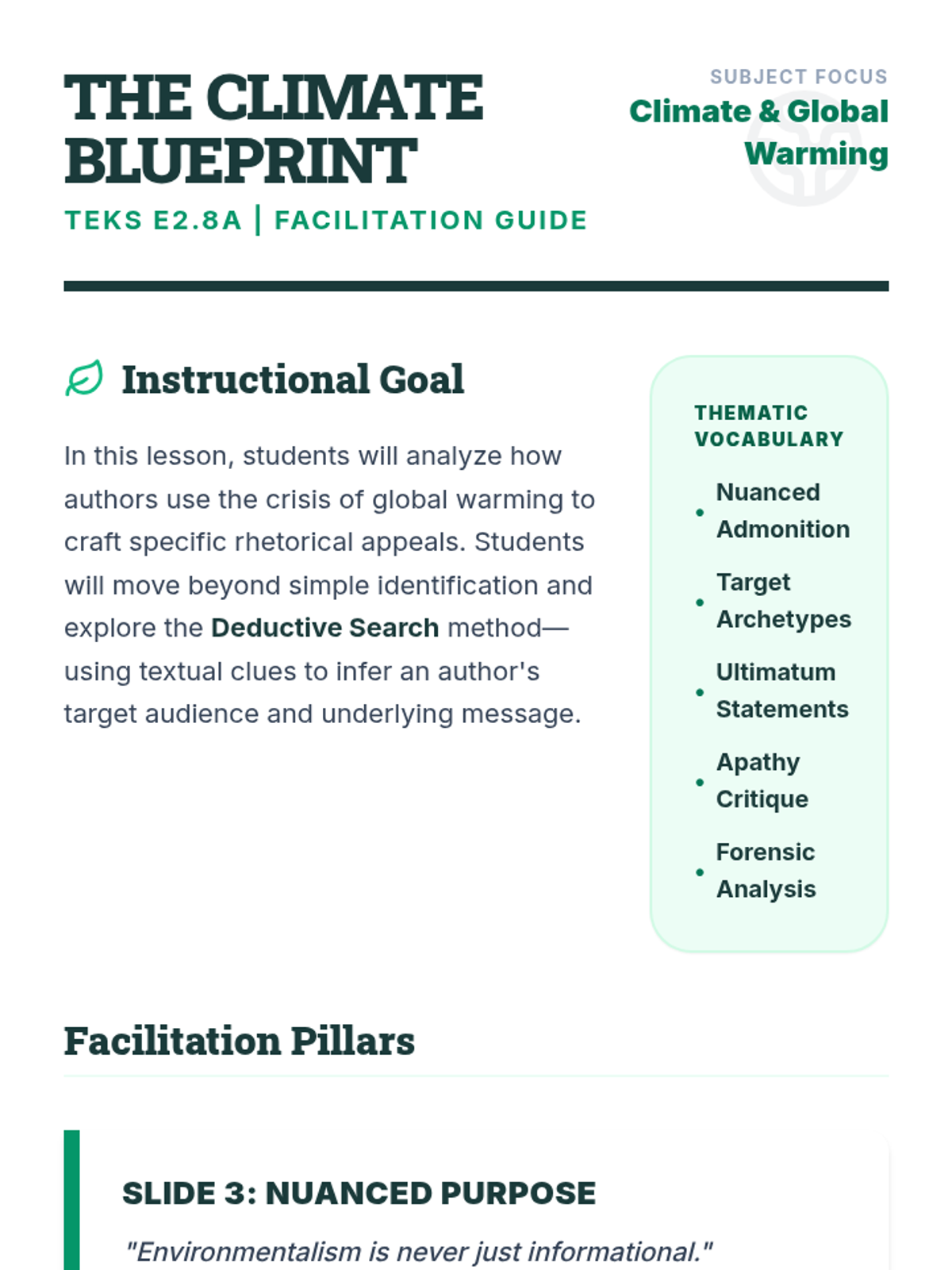
A revised teacher facilitation guide focused on TEKS E2.8A, providing slide-by-slide facilitation strategies, discussion prompts, and an analytical "Deductive Search" framework for teaching purpose, audience, and message. Revised with a global warming theme.
A climate-themed 9-slide presentation focused on TEKS E2.8A. Uses global warming examples and nature-inspired aesthetics to teach students how to analyze purpose, audience, and message. Revised to use "Bottom Line" and "Main Claim" instead of "Ultimatum".
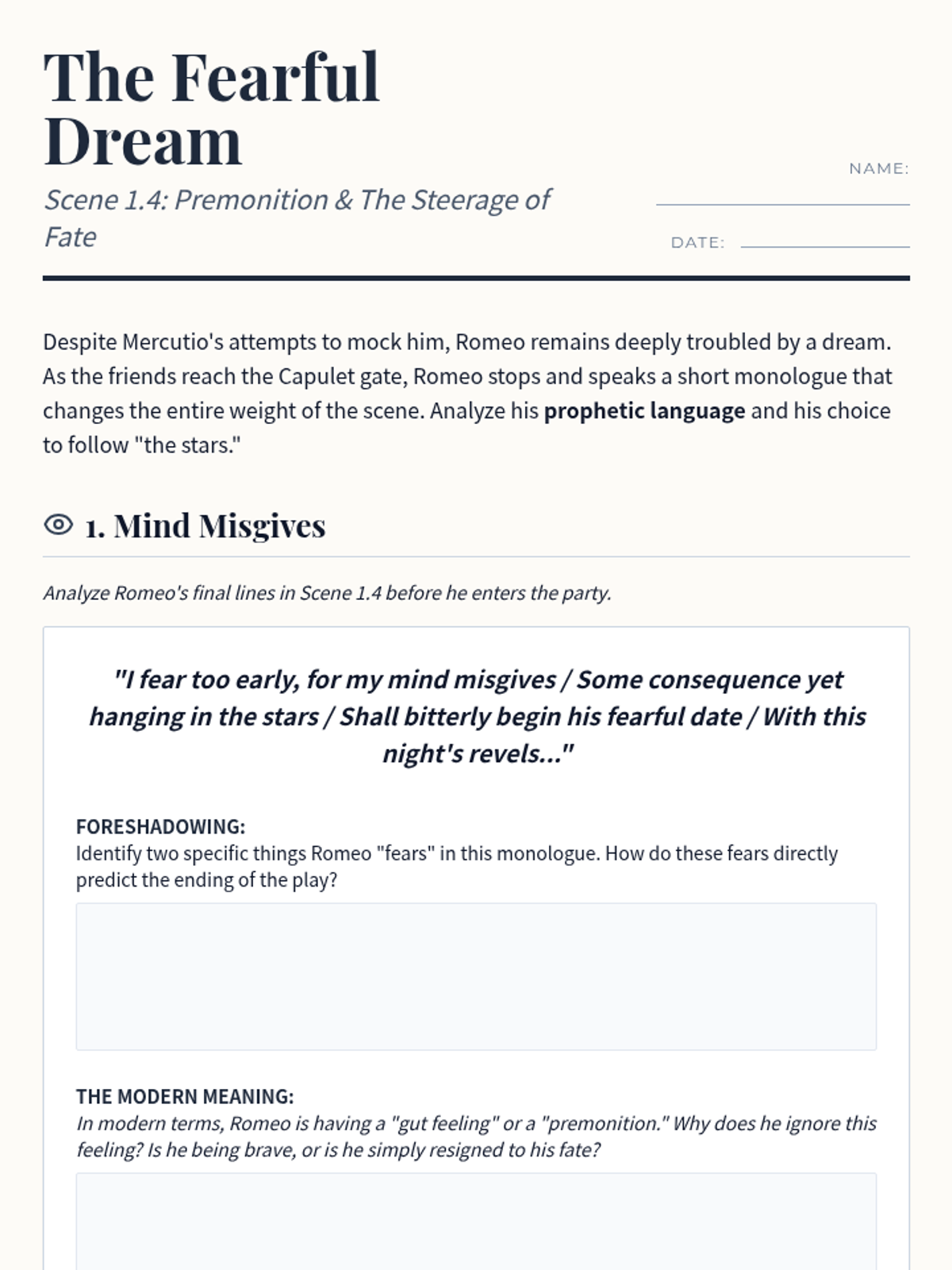
A student worksheet for Act 1, Scene 4 focusing on Romeo's premonition and the theme of fate. Analyzes his "fearful dream" and the decision to enter the party.
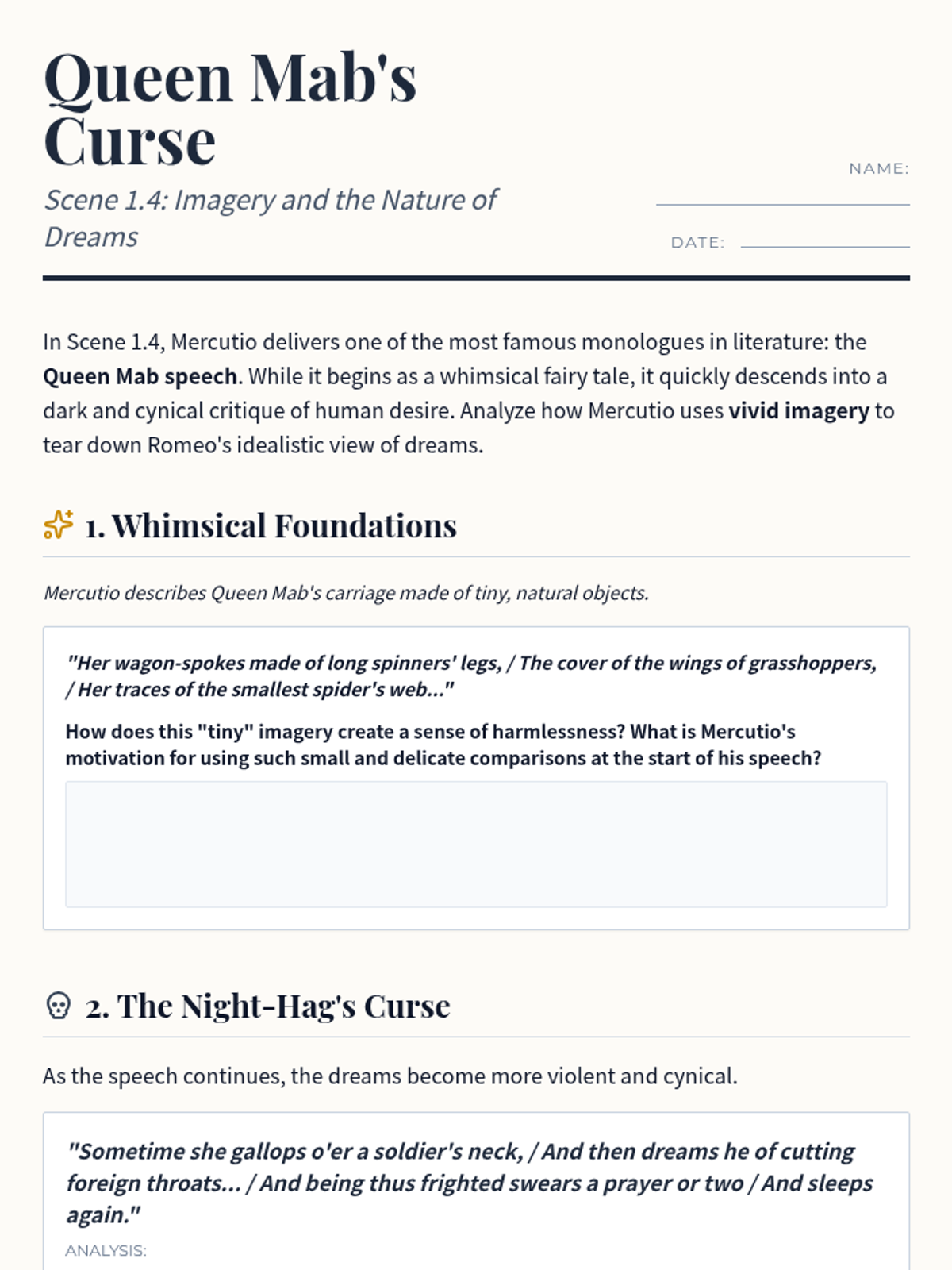
A student worksheet for Act 1, Scene 4 focusing on Mercutio's Queen Mab speech. Analyzes the shift from whimsical to dark imagery and the theme of dreams vs. reality.
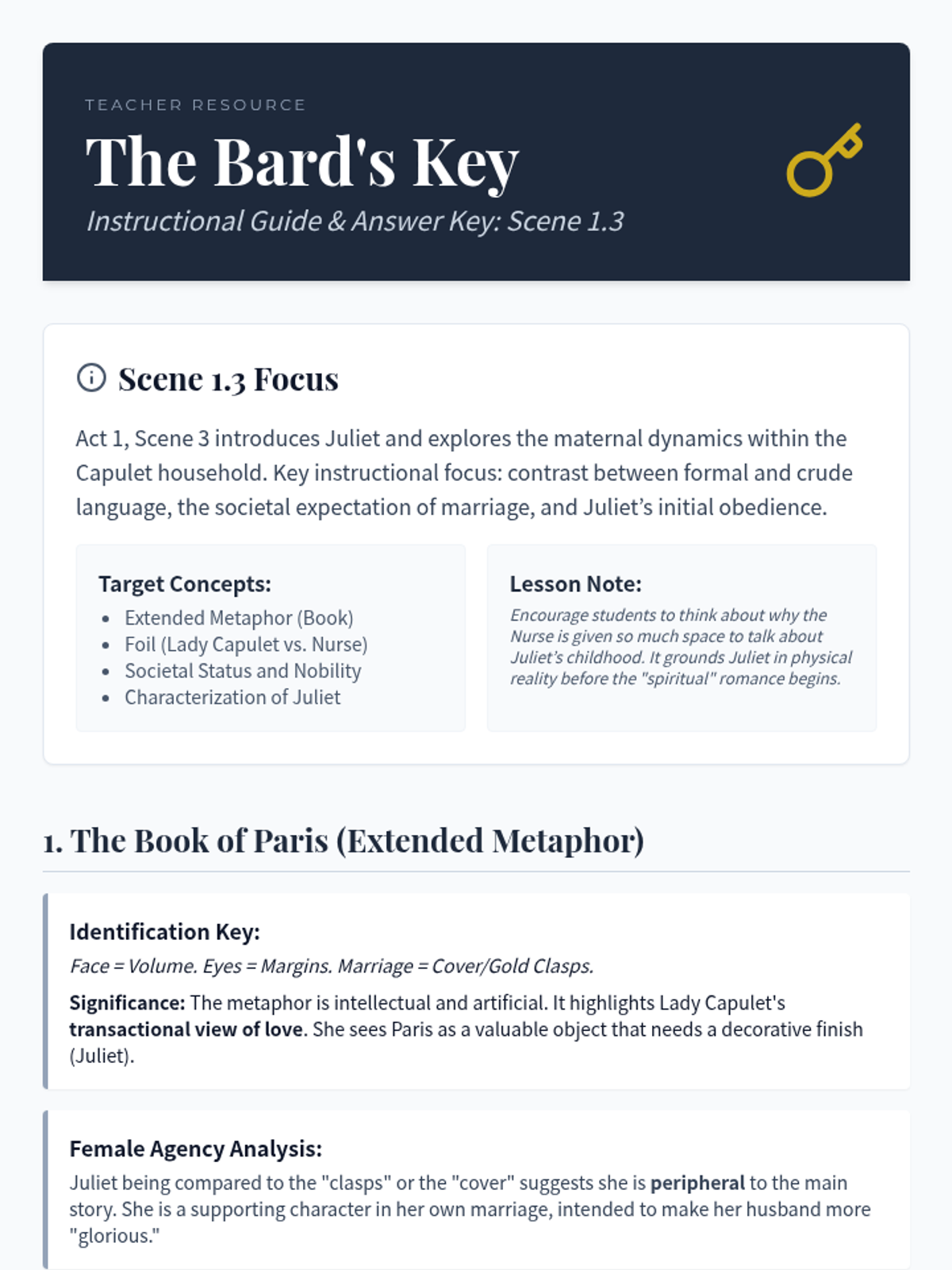
A teacher-facing guide providing an answer key and instructional tips for the Scene 1.3 worksheets. Includes analysis of Lady Capulet's book metaphor, the Nurse as a foil, and Juliet's initial obedience.
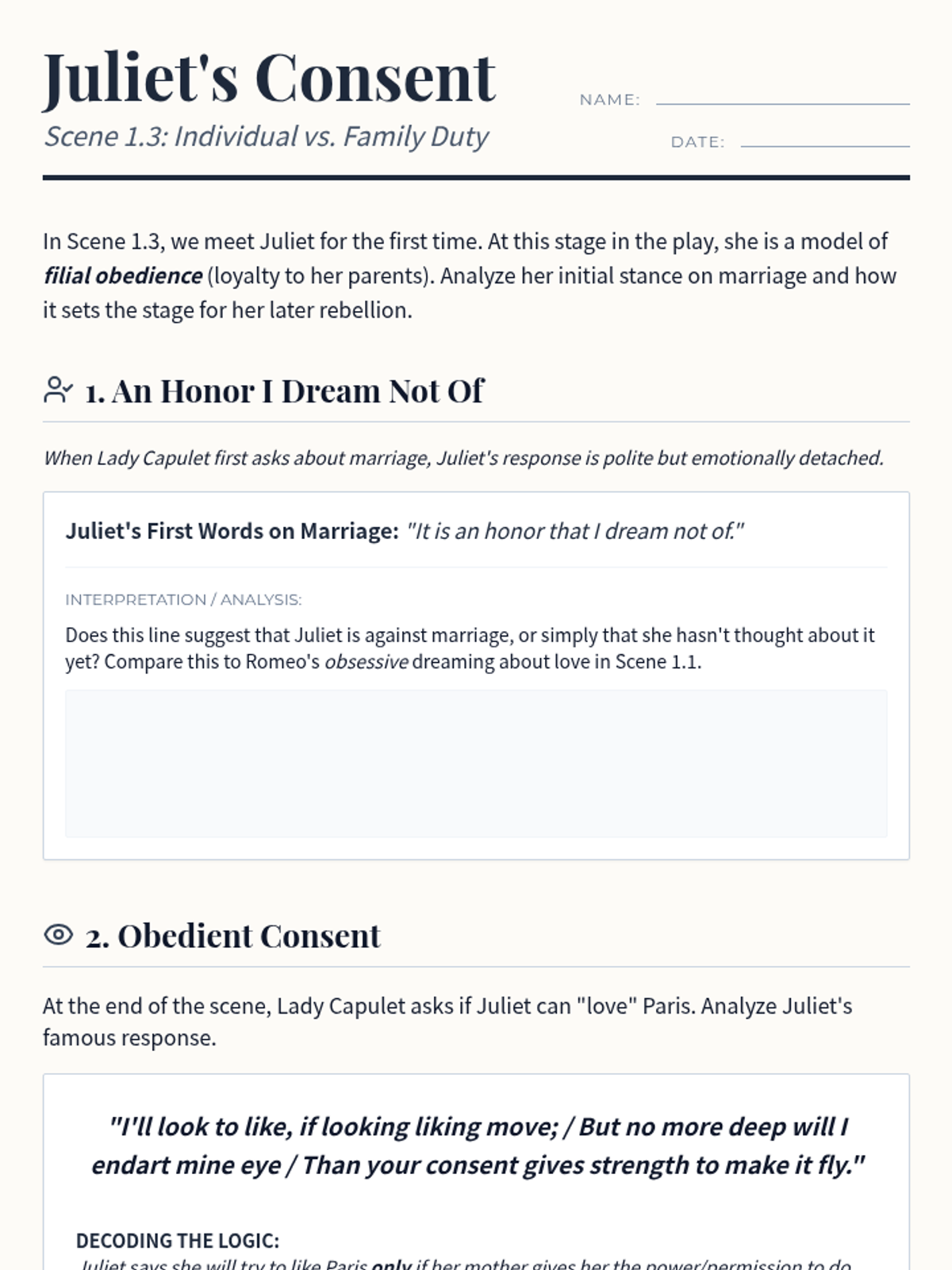
A student worksheet for Act 1, Scene 3 focusing on Juliet's initial stance on marriage and obedience. Analyzes her famous "look to like" speech and the theme of Individual vs. Society.
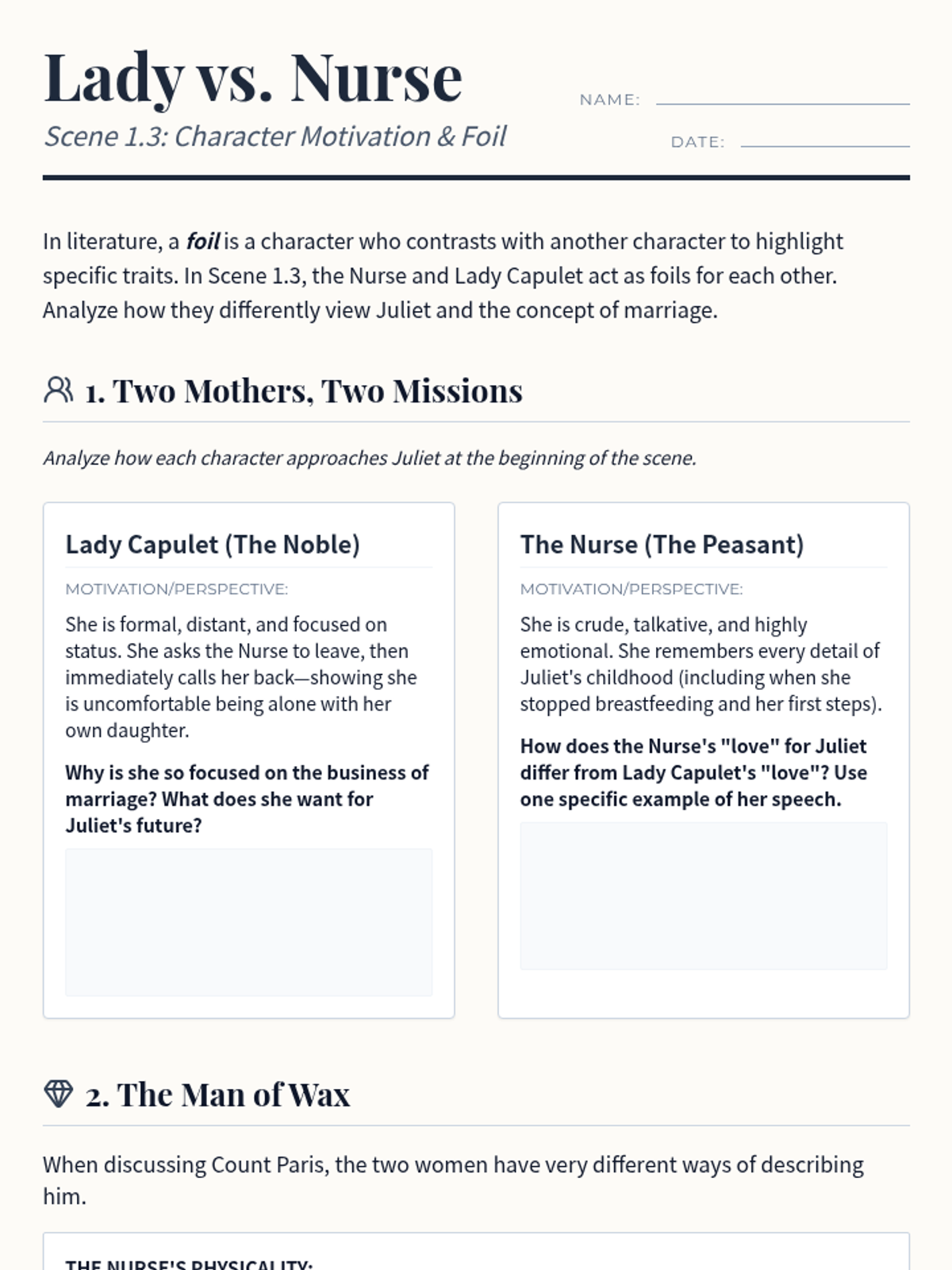
A student worksheet for Act 1, Scene 3 focusing on the foil between Lady Capulet and the Nurse. Analyzes their different motivations and views on love and marriage.
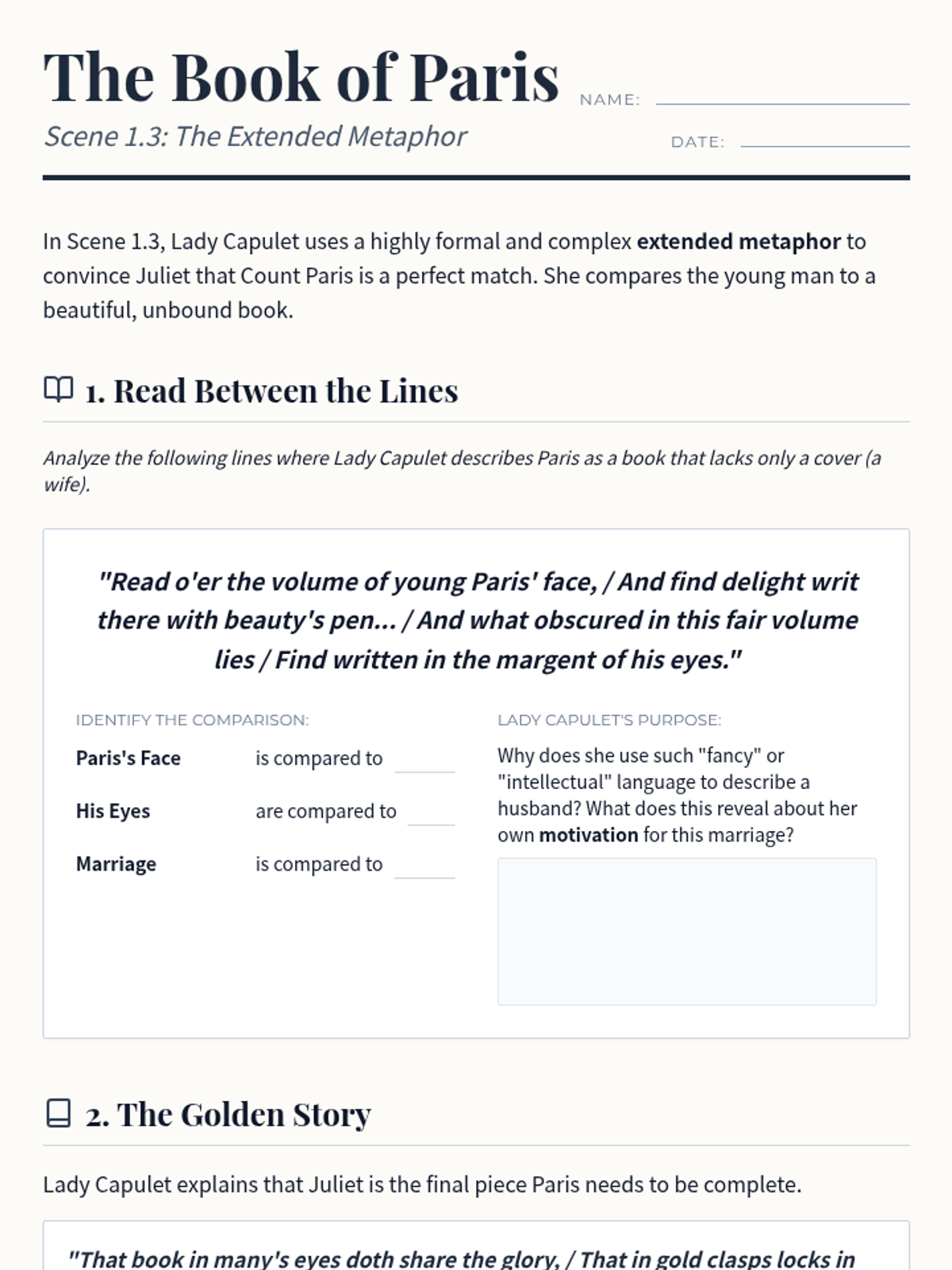
A student worksheet for Act 1, Scene 3 focusing on Lady Capulet's extended metaphor of Paris as a book. Analyzes the role of women and the nature of marriage in Verona.
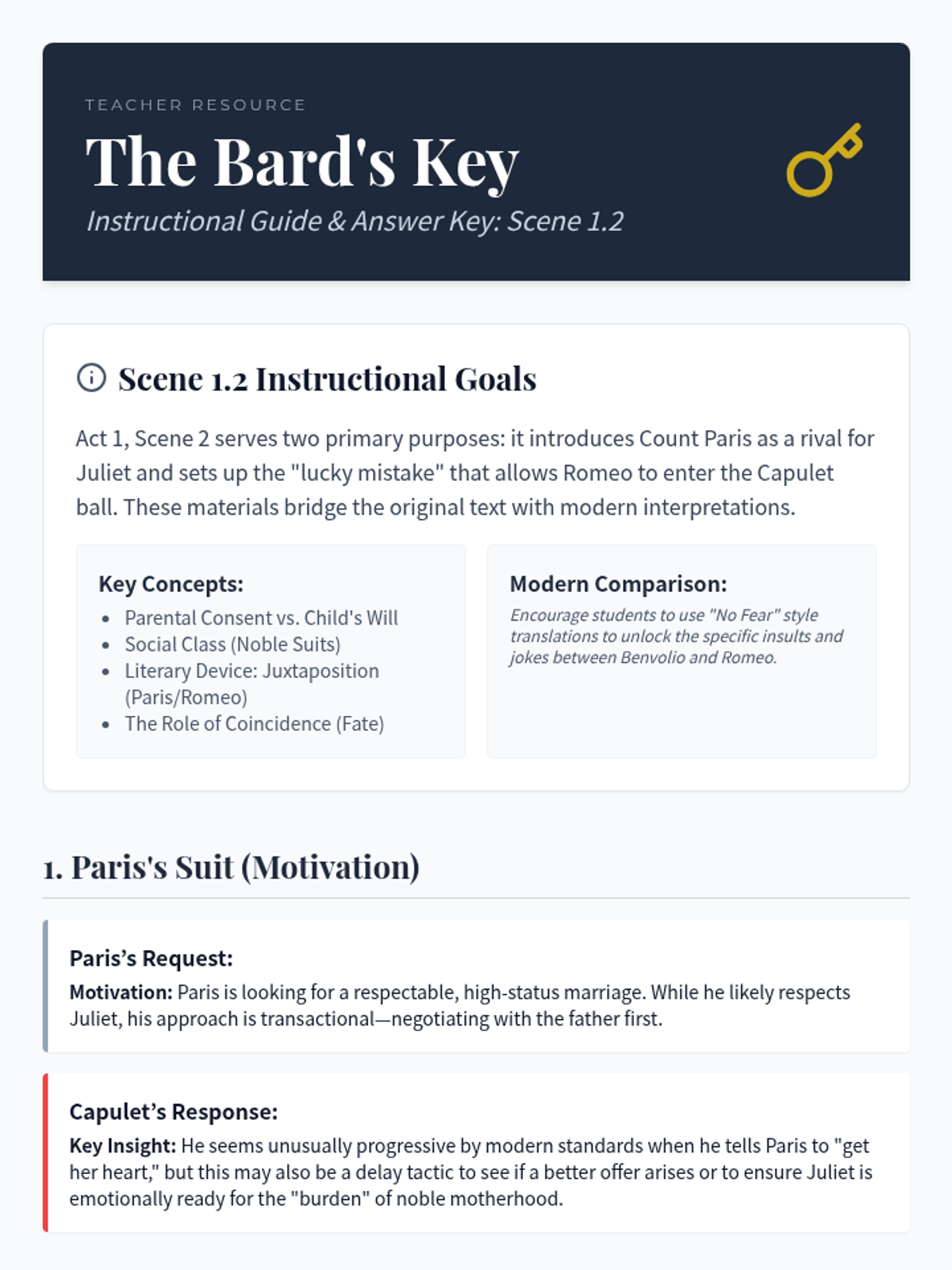
A teacher-facing guide providing an answer key and instructional tips for the Scene 1.2 worksheets. Includes analysis of Count Paris, the "Lucky Mistake" encounter, and thematic development.
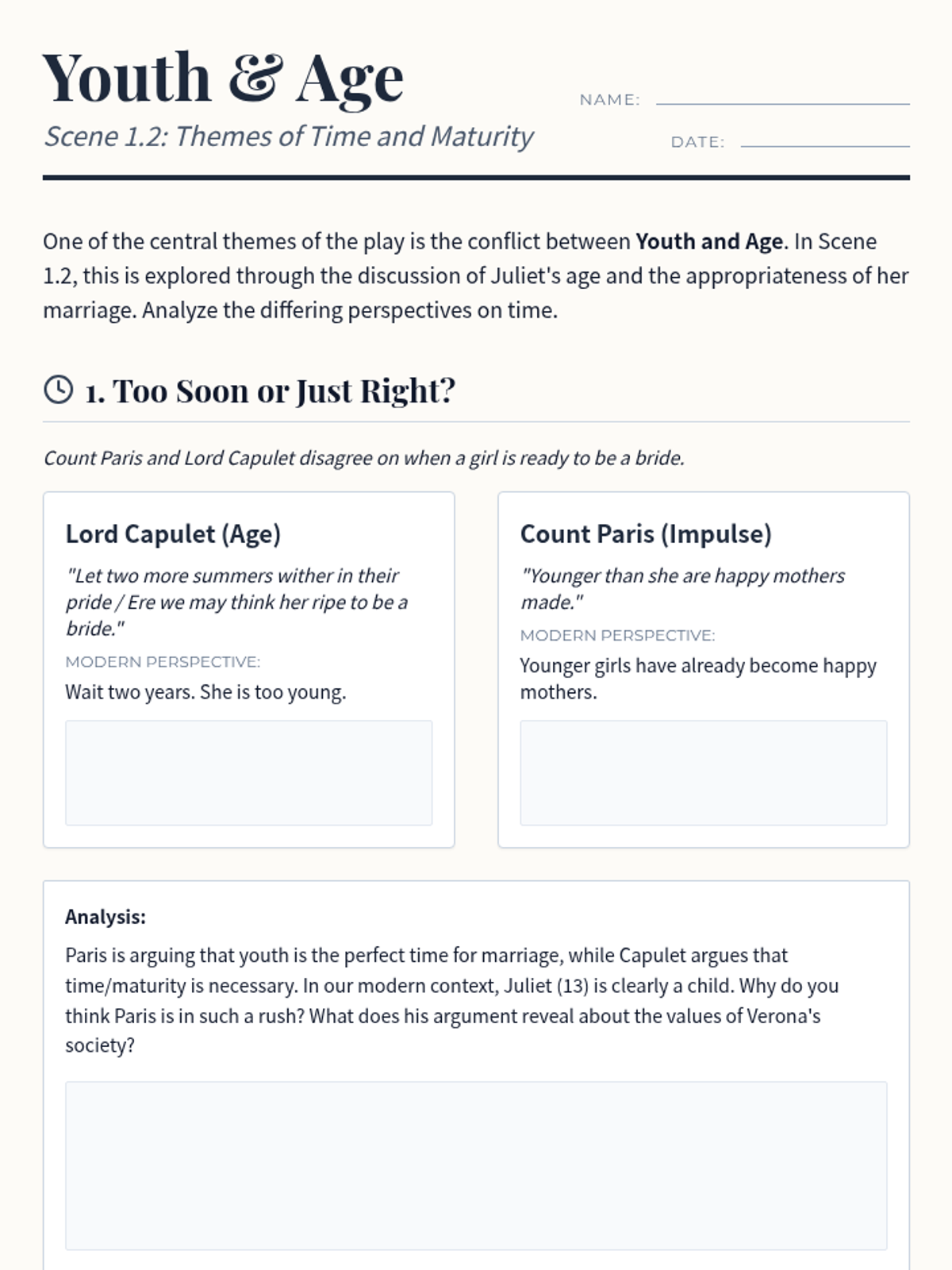
A student worksheet for Act 1, Scene 2 focusing on the theme of Youth vs. Age. Analyzes the debate over Juliet's readiness for marriage.
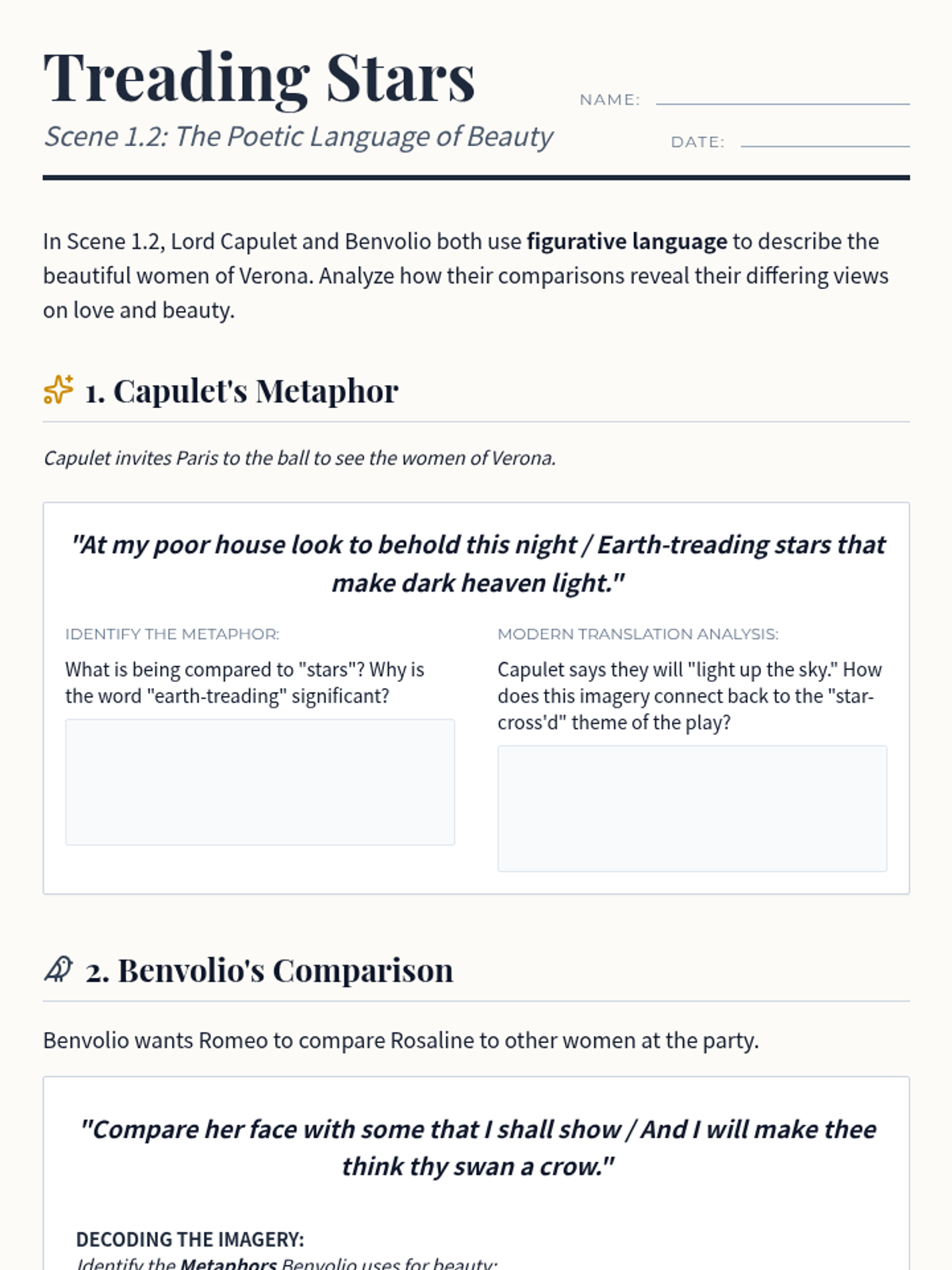
A student worksheet for Act 1, Scene 2 focusing on figurative language (swan vs. crow, earth-treading stars). Includes comparisons to Romeo's earlier poetic style.
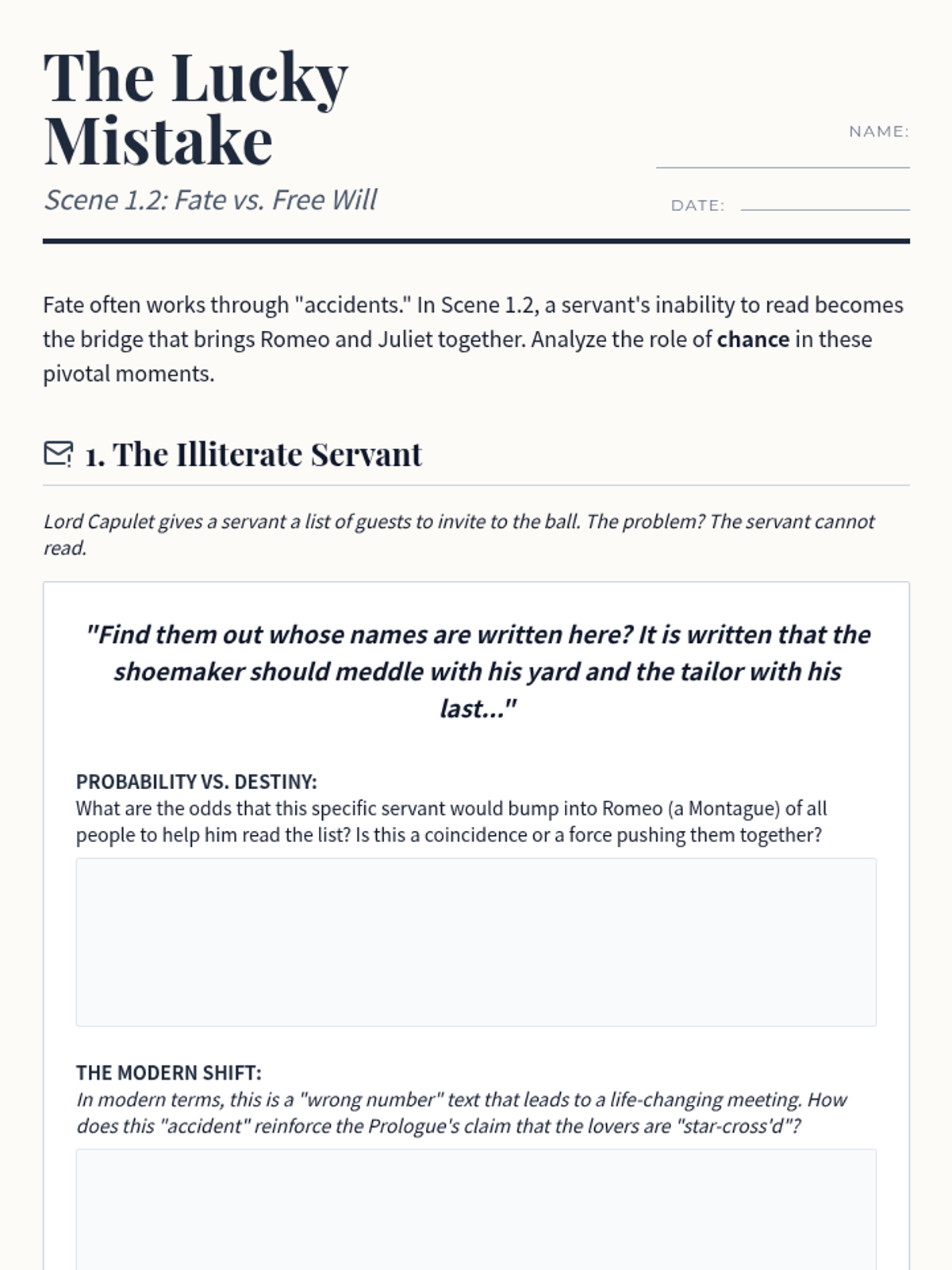
A student worksheet for Act 1, Scene 2 focusing on the theme of fate vs. free will through the encounter with the illiterate servant. Includes "No Fear" style probability analysis.
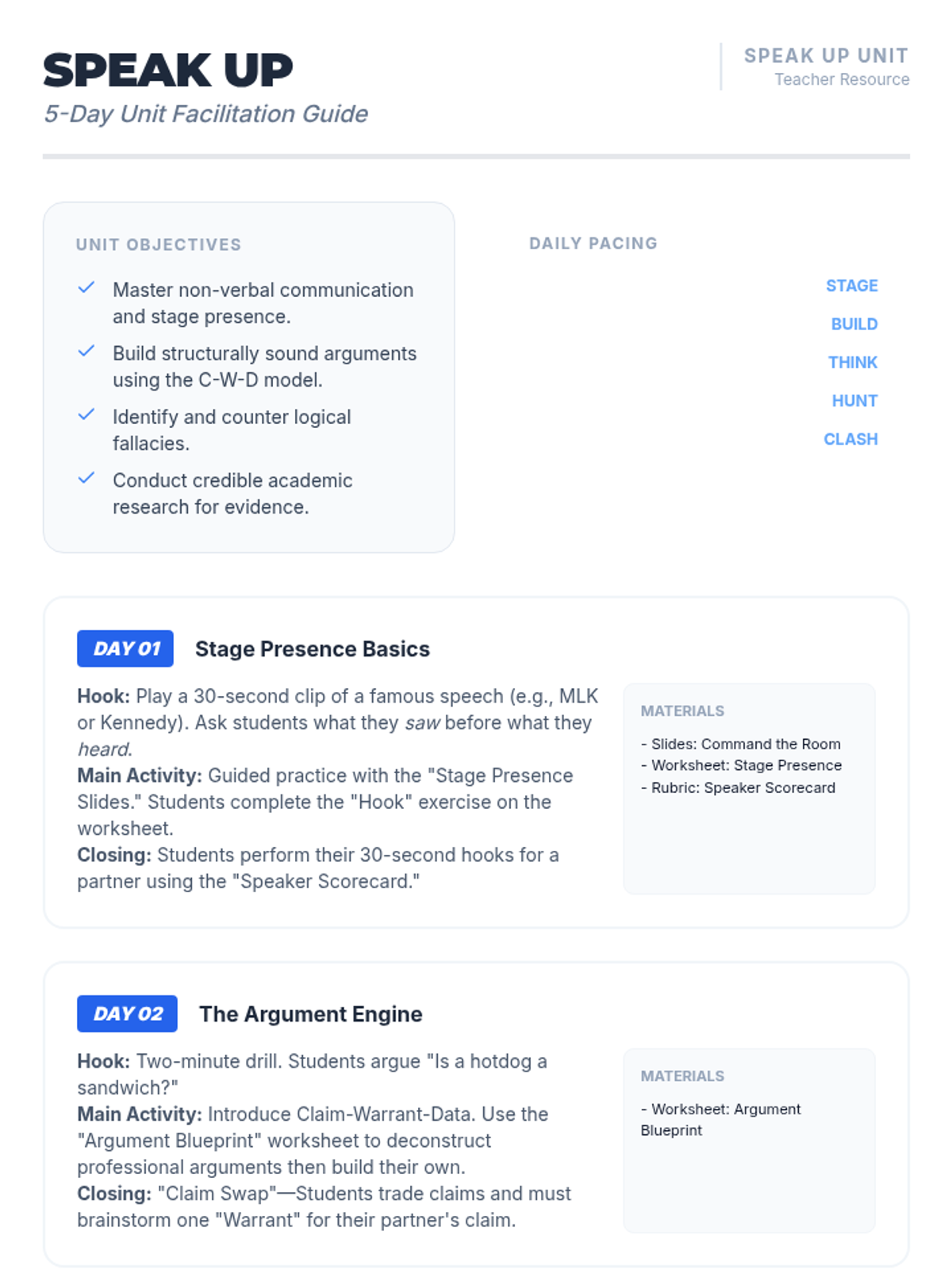
A comprehensive 5-day unit plan for teachers, detailing hooks, activities, and closing strategies for an introductory speech and debate unit.
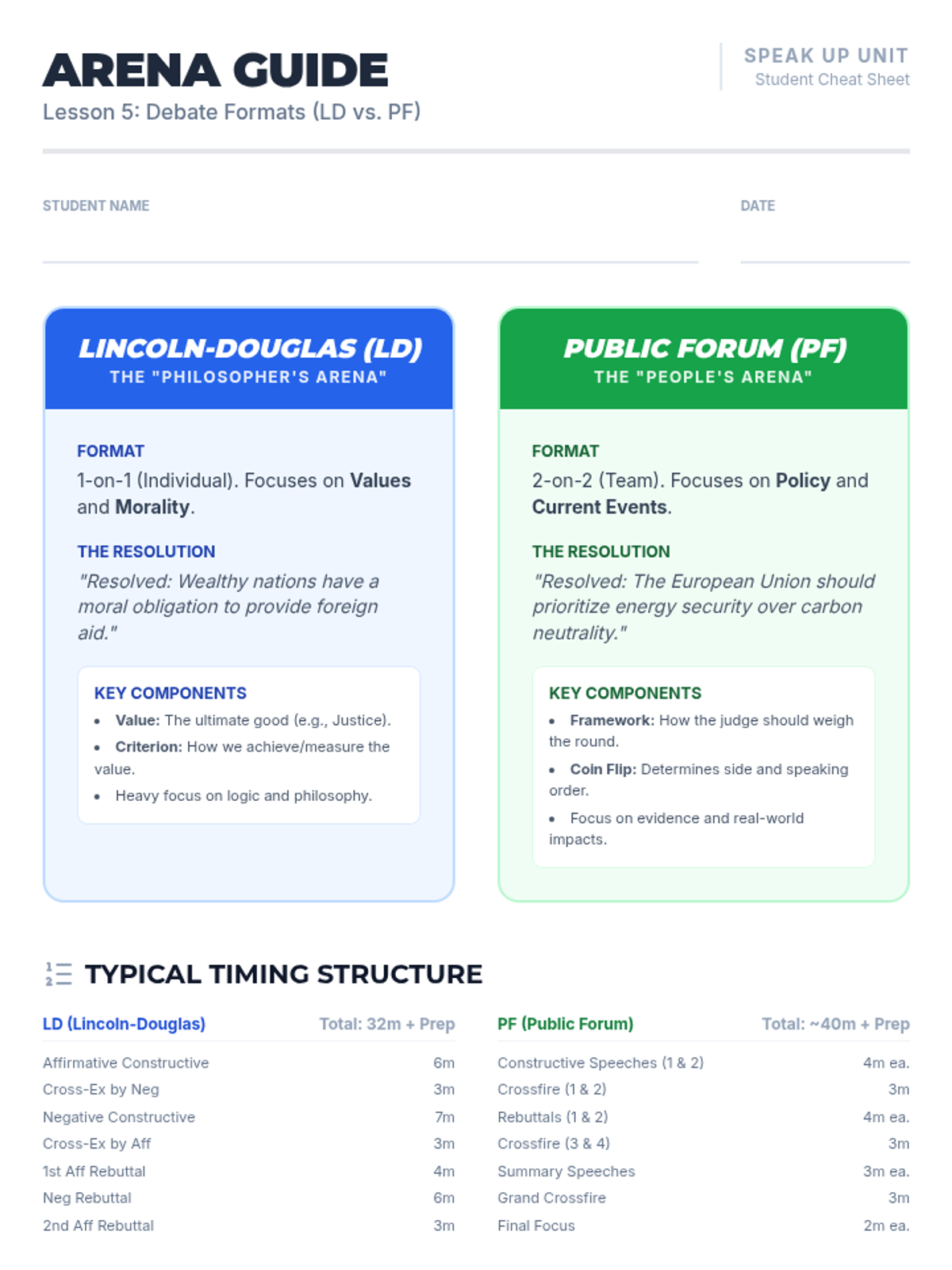
A comparison guide and cheat sheet for students detailing the differences between Lincoln-Douglas and Public Forum debate formats.
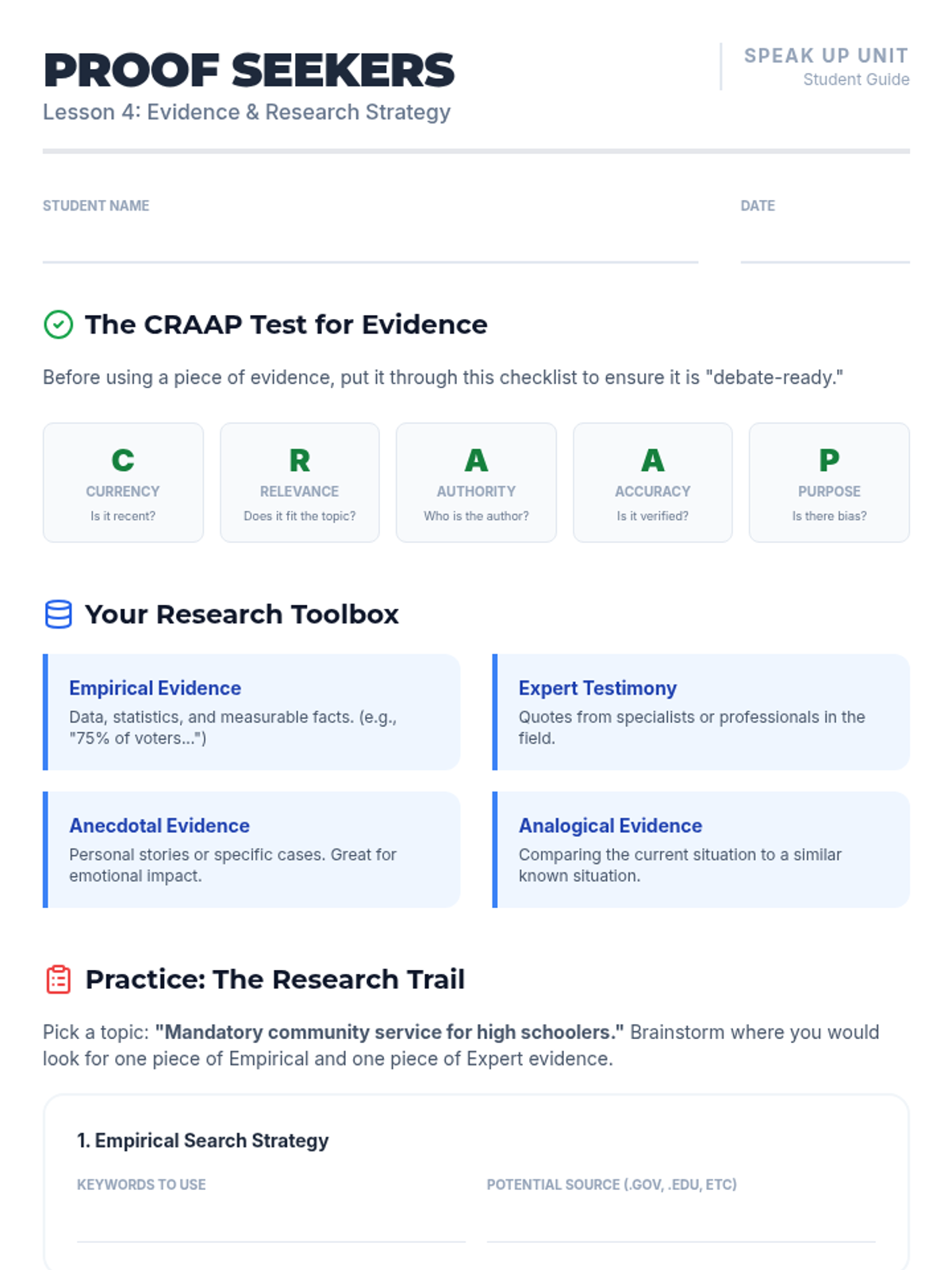
A research guide and worksheet for students, focusing on evidence evaluation (CRAAP test) and research strategies for debate.
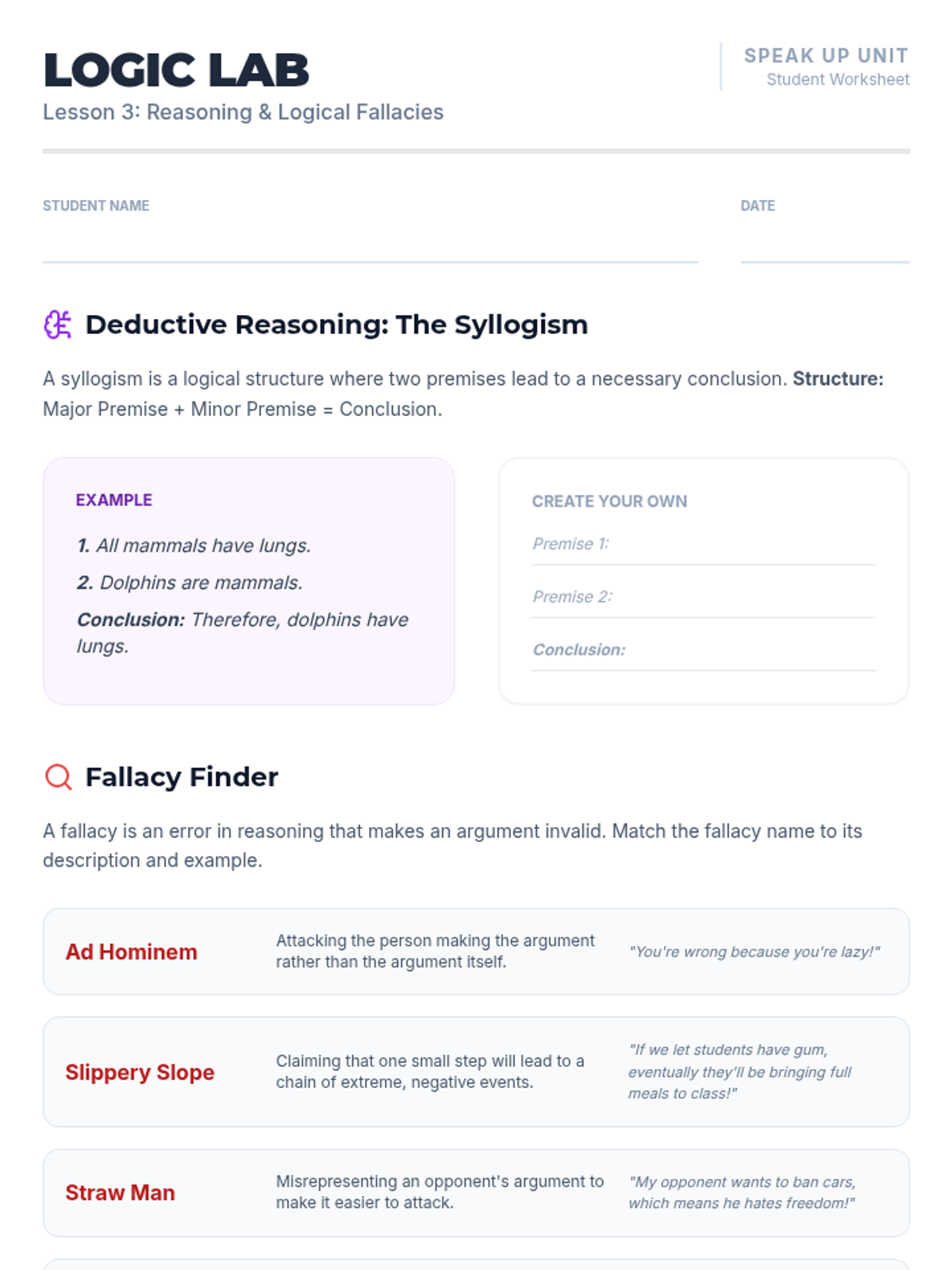
A student worksheet exploring logical reasoning, syllogisms, and common logical fallacies used in speech and debate.
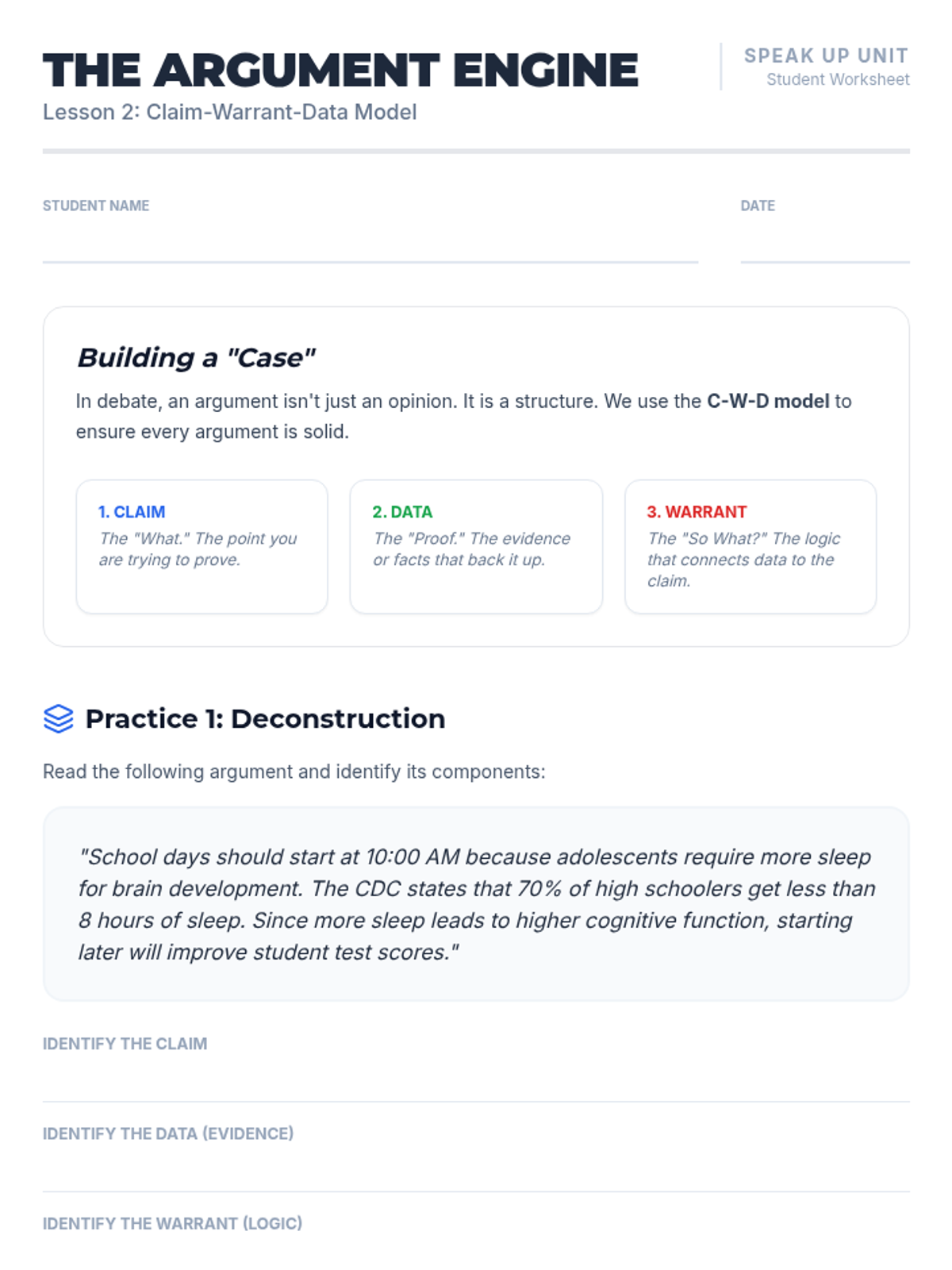
A student worksheet focusing on the Claim-Warrant-Data model of argumentation, including deconstruction and creation exercises.
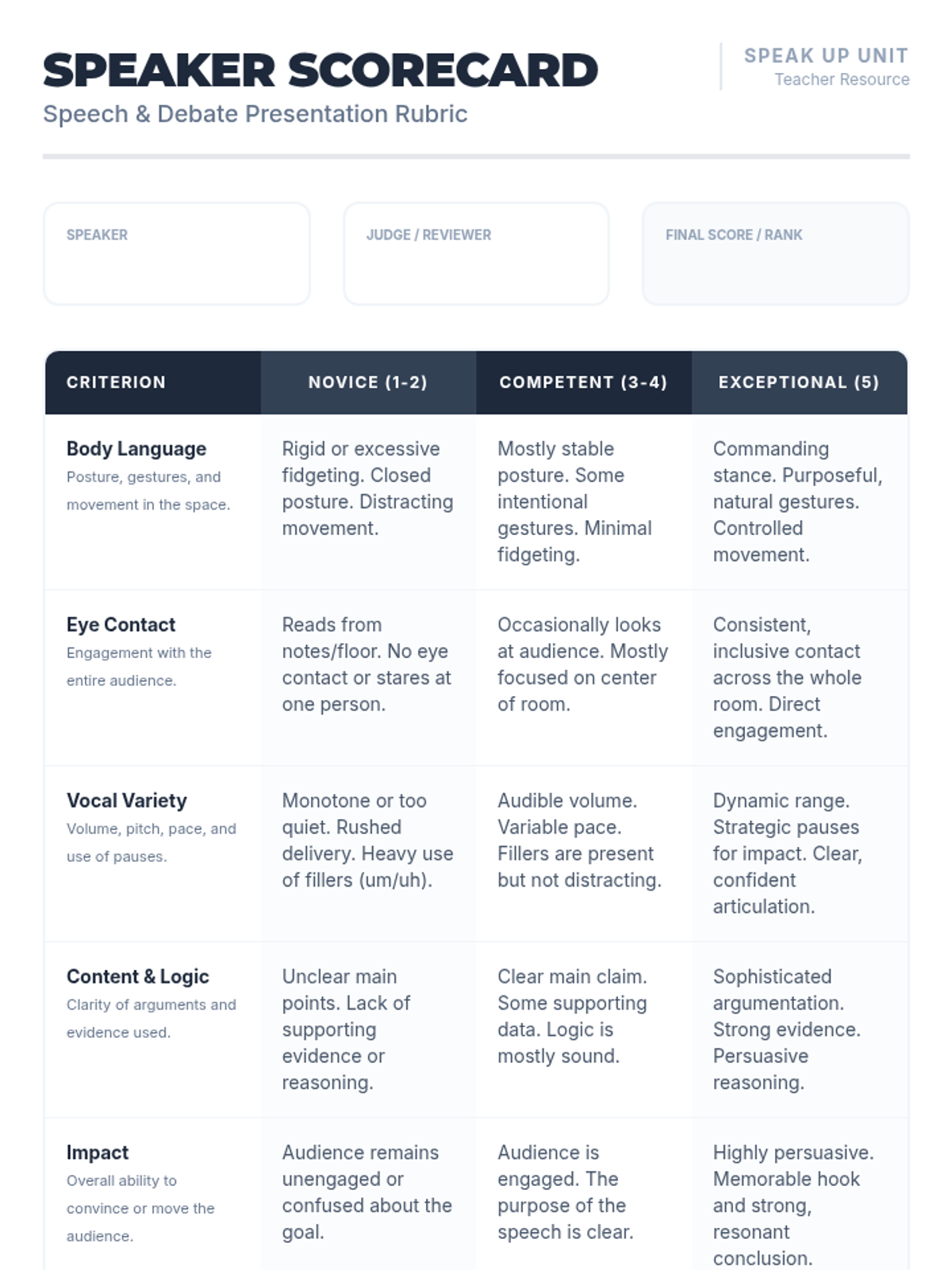
A professional rubric for evaluating speech and debate presentations, focusing on non-verbal communication, logic, and impact.
A visually engaging slide deck teaching the fundamentals of stage presence, including body language, eye contact, and vocal variety.
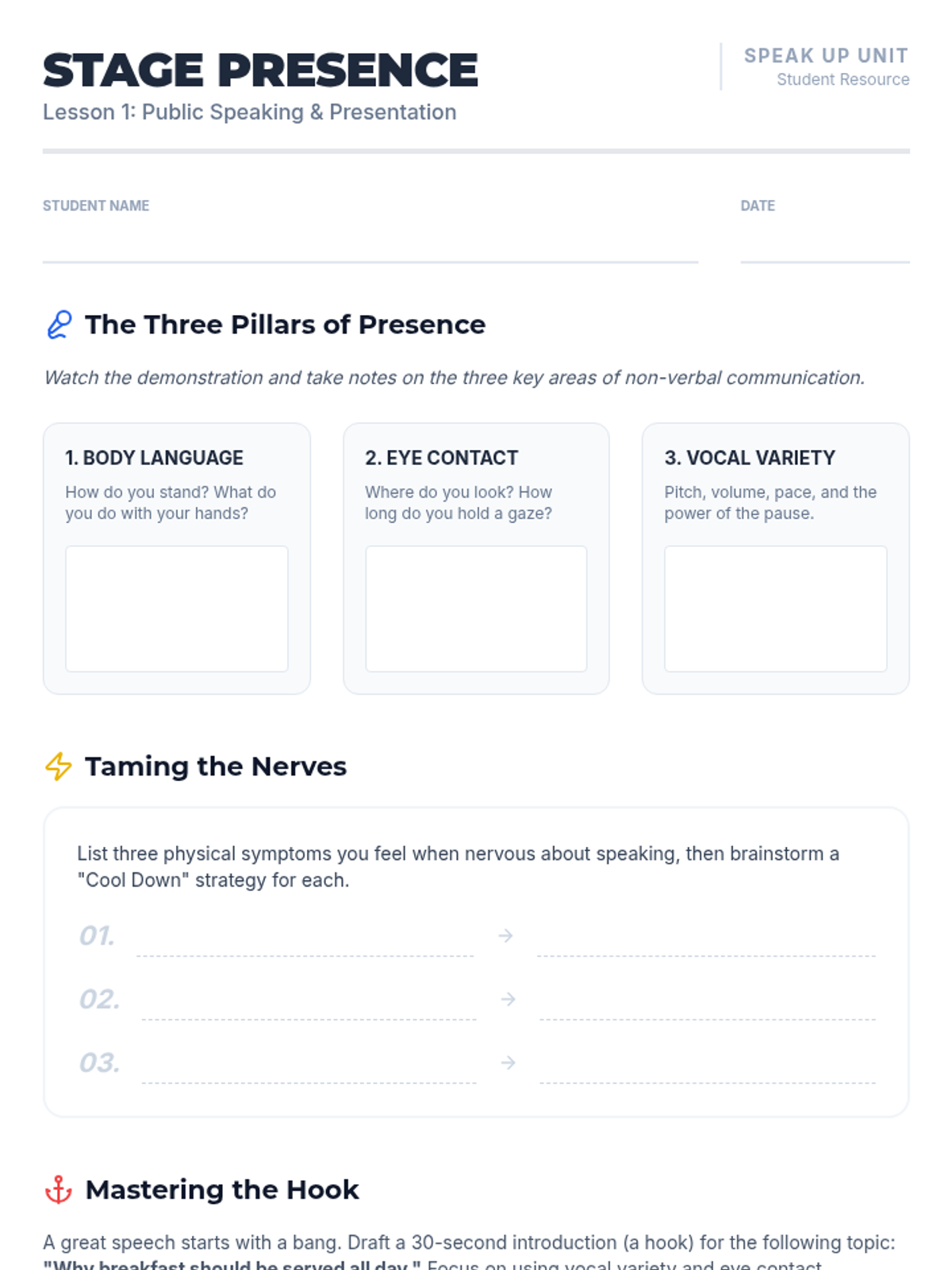
A combined student worksheet and glossary for the first day of a Speech and Debate unit, focusing on presentation skills and foundational terminology.
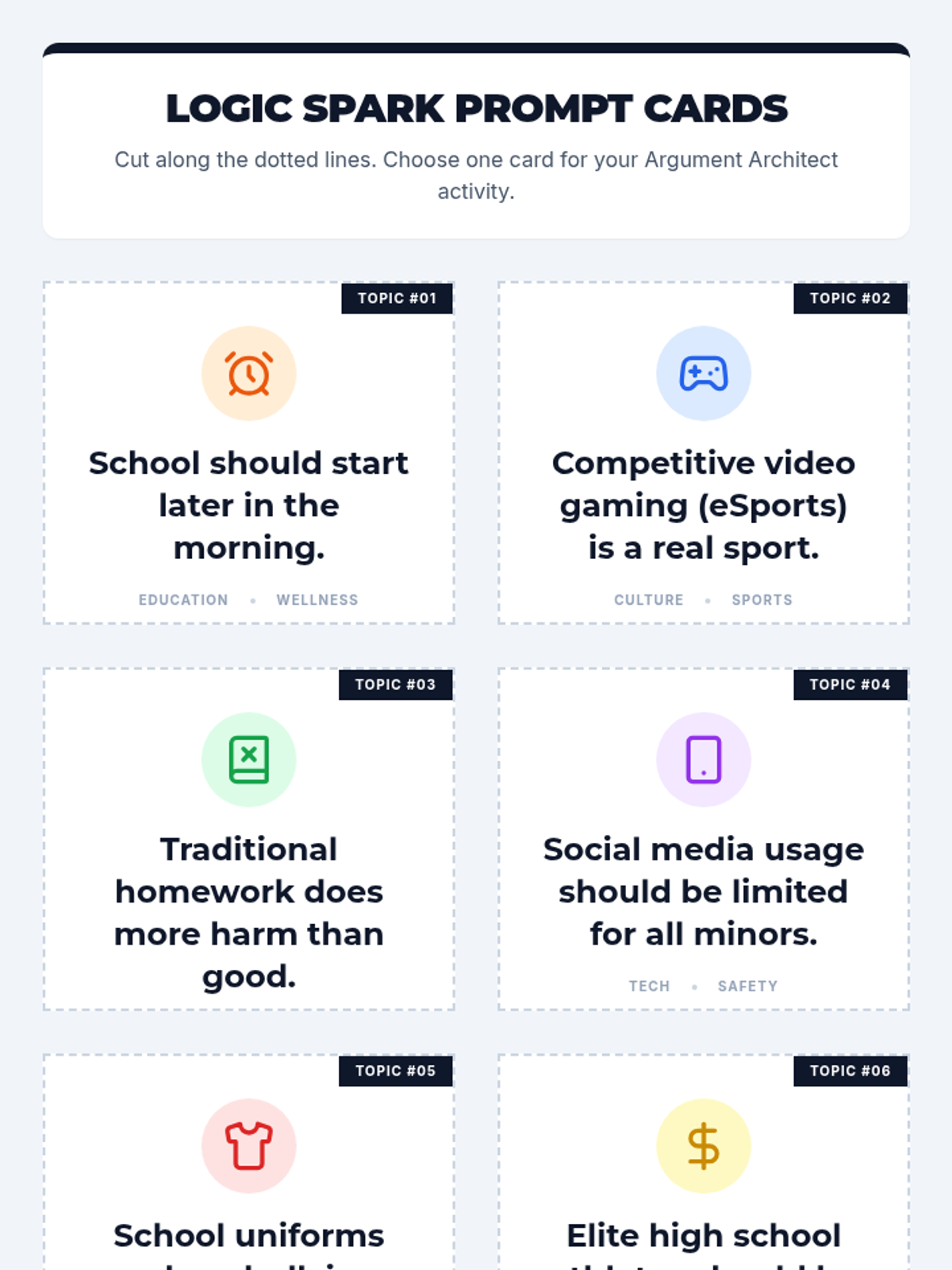
Engaging debate topic cards for students to use in constructing deductive and inductive arguments.
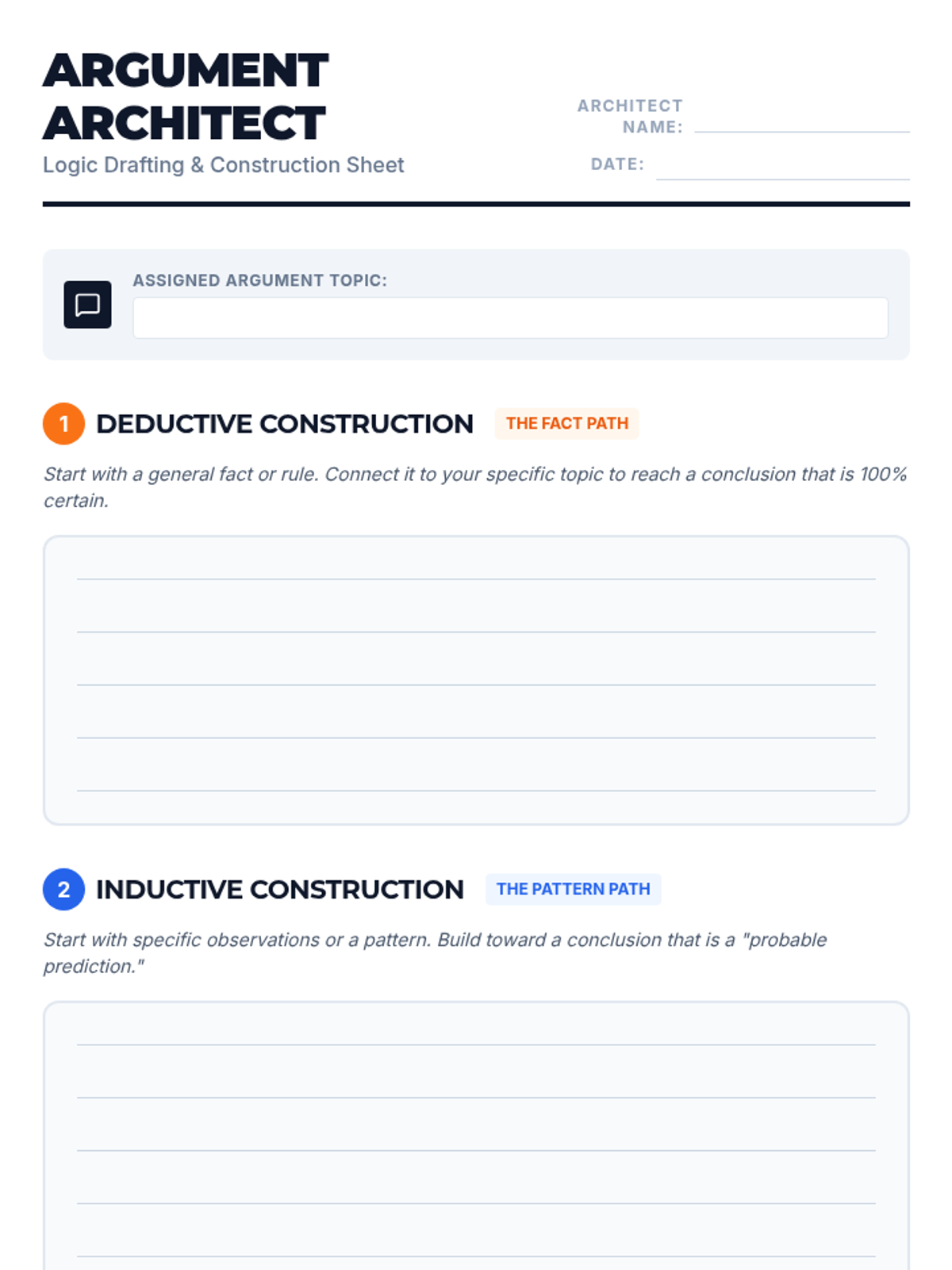
A structured writing worksheet for students to draft arguments using both deductive and inductive reasoning, including a peer review section for evaluation.
An instructional slide deck for teaching deductive and inductive reasoning, featuring video integration, clear definitions, and practice scenarios.
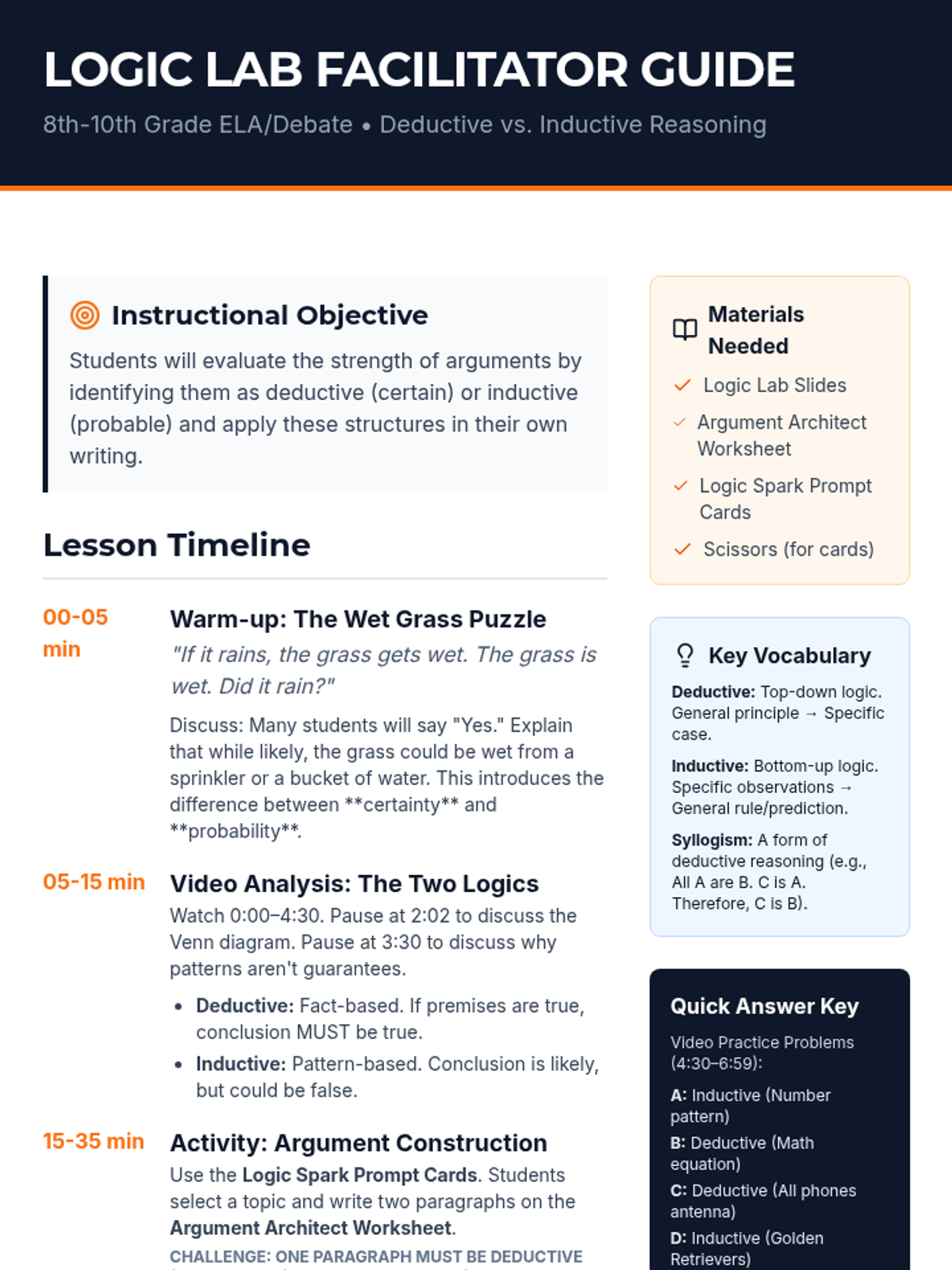
A comprehensive facilitator guide for the Logic Power lesson, including a detailed timeline, key vocabulary, video pause points, and discussion prompts.
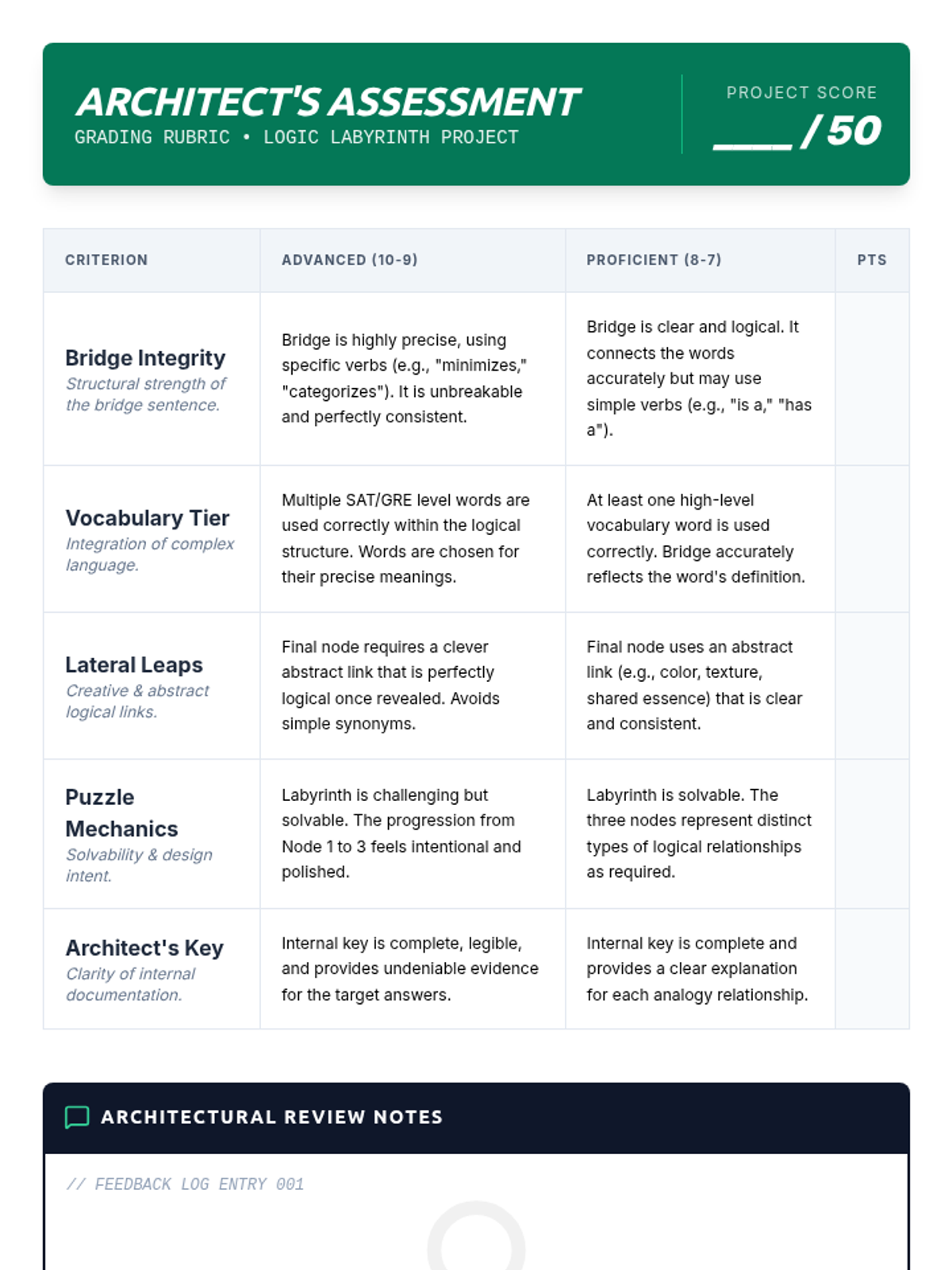
A formal grading rubric for the final Logic Labyrinth project, evaluating bridge integrity, vocabulary usage, and lateral thinking.
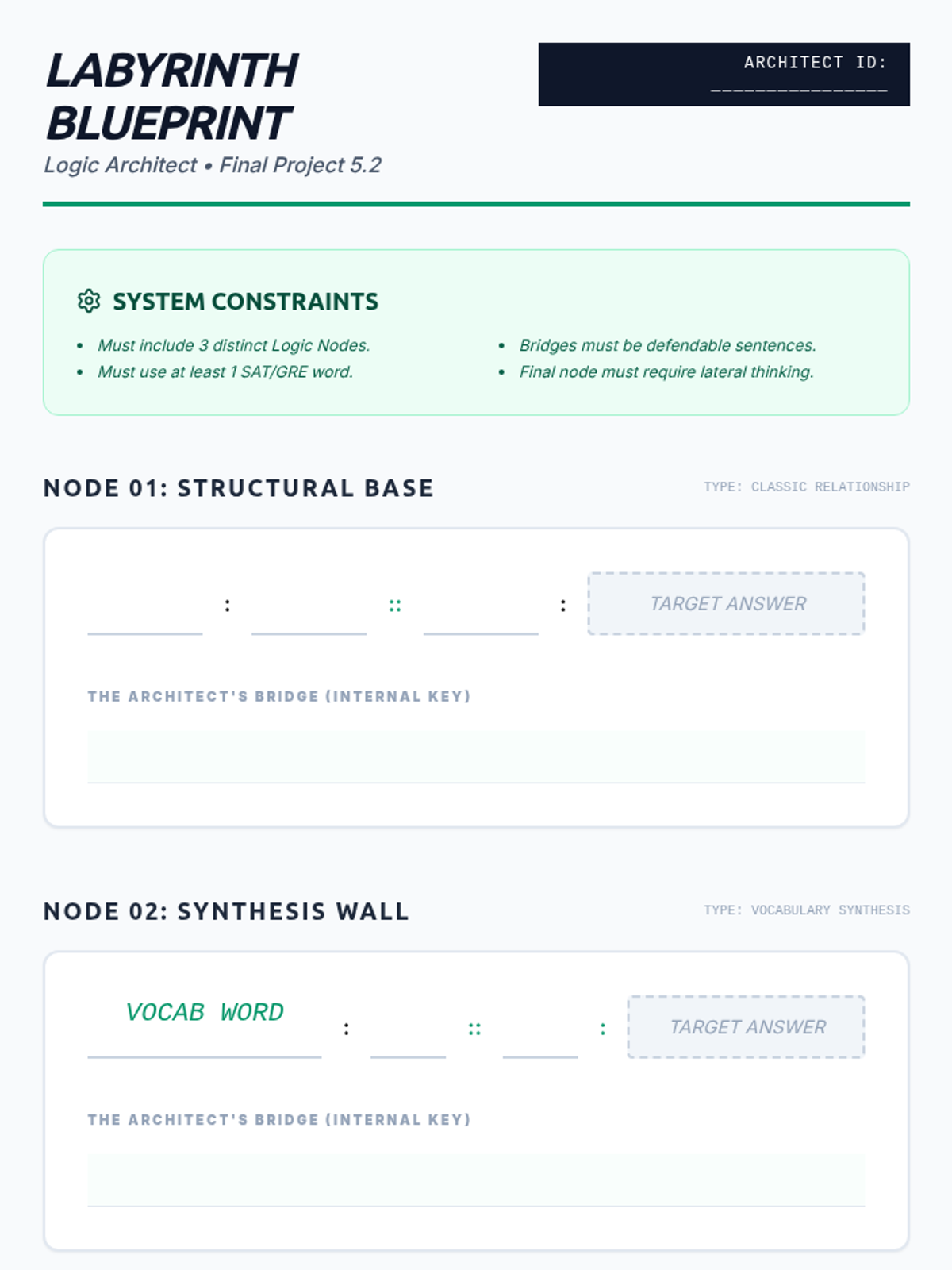
A project planning document where students design their own 3-stage logic puzzle, defining bridges and target answers for peer testing.
Slides for the final capstone project where students design their own analogy-based logic puzzles, focusing on puzzle construction and logical structural integrity.
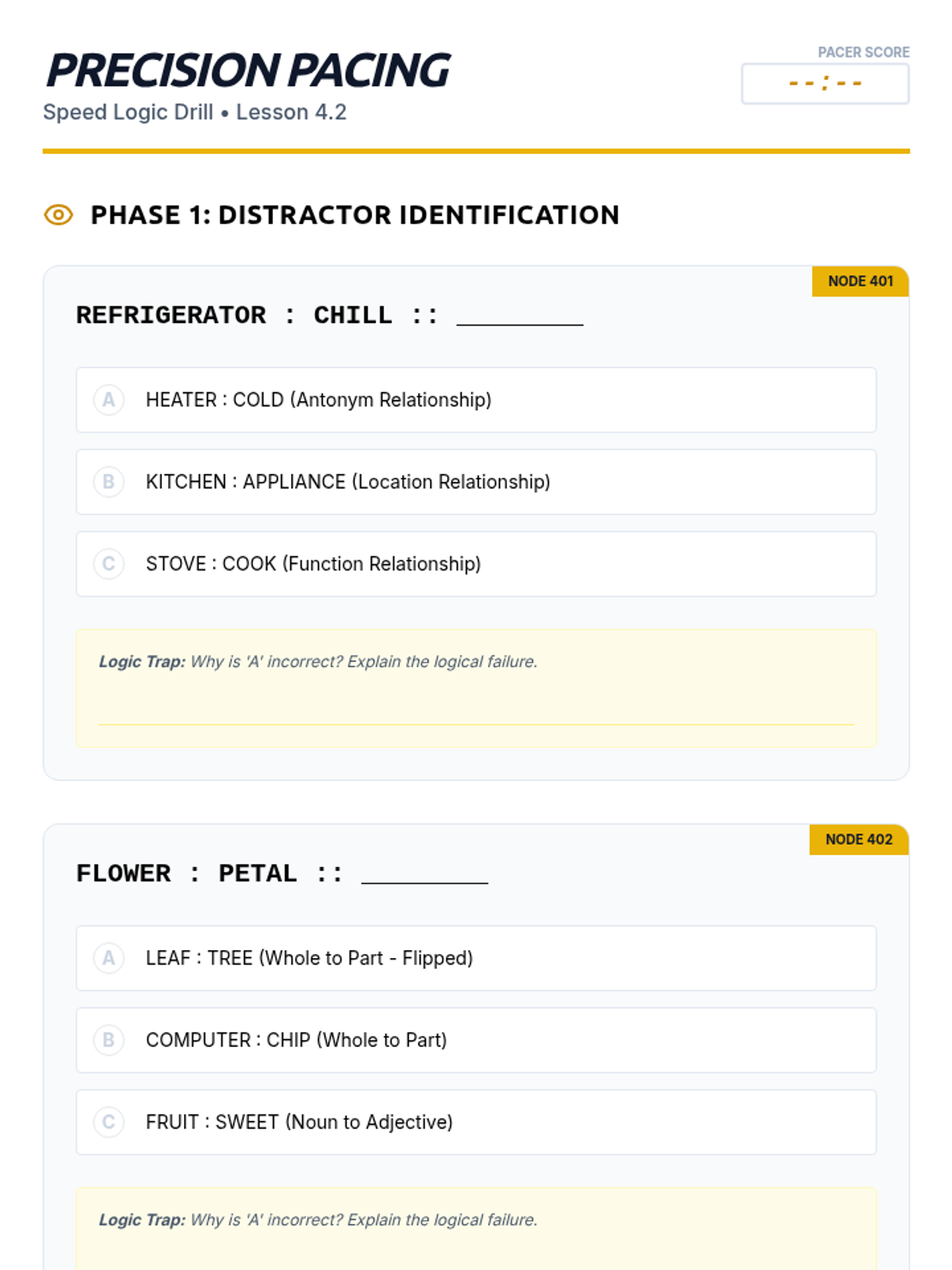
An assessment worksheet focused on precision and speed, requiring students to identify subtle logical errors and explain why specific distractors are incorrect.
Slides for a fast-paced 'Lightning Round' lesson focusing on speed, precision, and avoiding logical traps like flipped order or incorrect parts of speech.
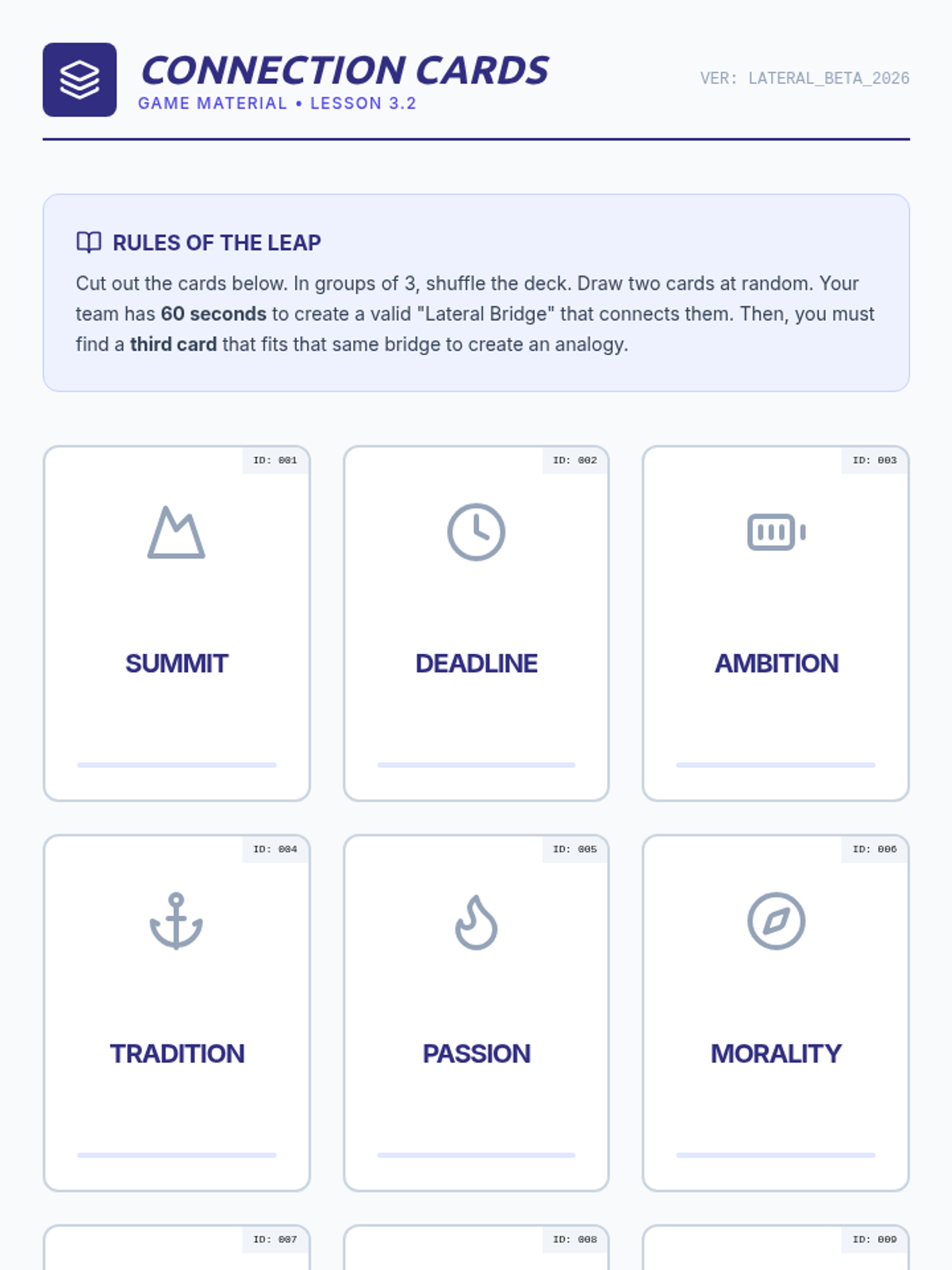
Game cards and a connection log for a lateral thinking activity where students must find non-obvious links between abstract concepts.
Slides for Lesson 3 focusing on lateral thinking and finding creative, non-obvious logical connections between concepts.
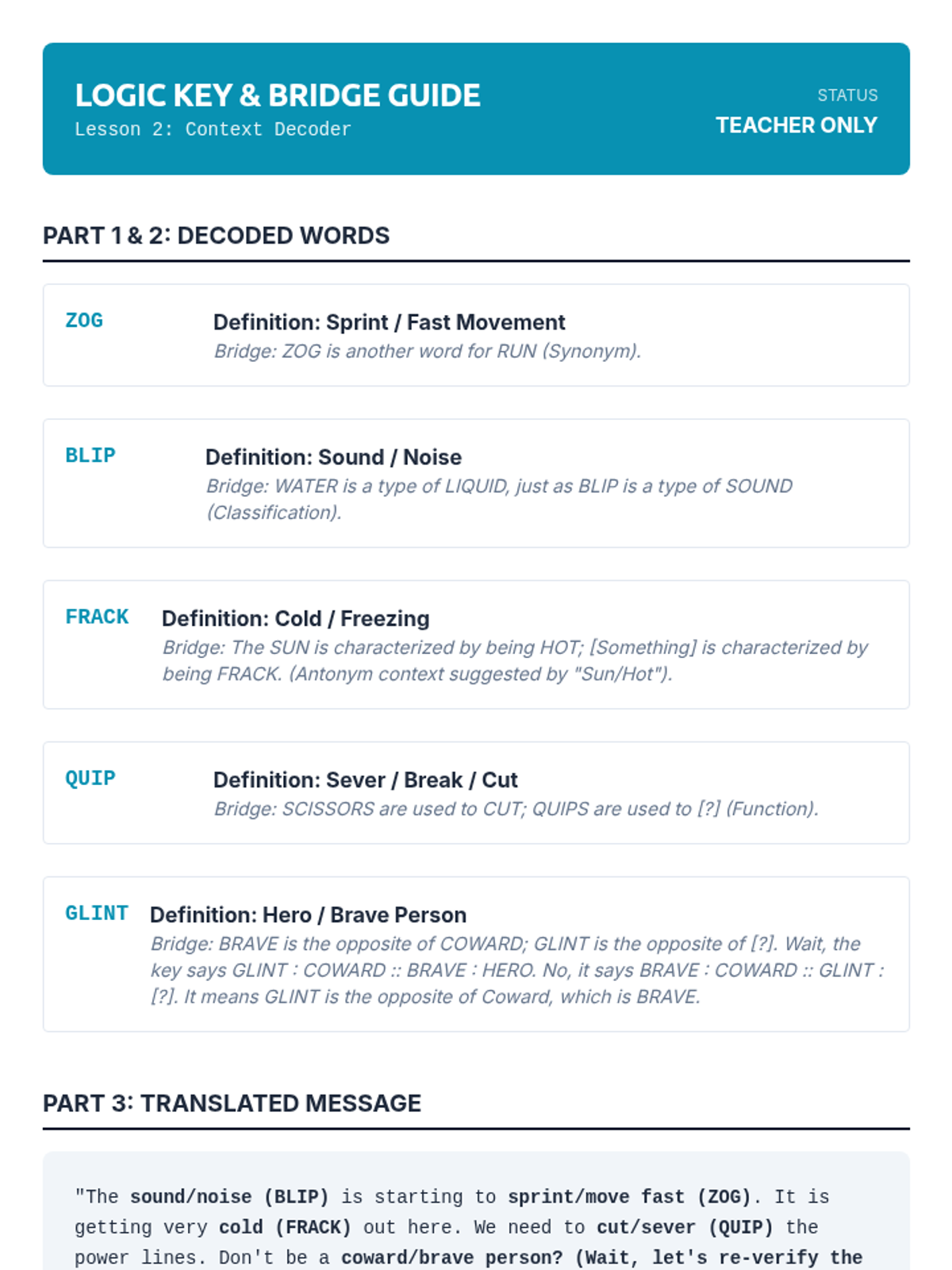
The teacher's answer key and bridge guide for Lesson 2, including the decoded slang definitions and message transcript.